WO2017220706A1 - Pharmaceutical compositions of fgf21 derivatives and uses thereof - Google Patents
Pharmaceutical compositions of fgf21 derivatives and uses thereof Download PDFInfo
- Publication number
- WO2017220706A1 WO2017220706A1 PCT/EP2017/065342 EP2017065342W WO2017220706A1 WO 2017220706 A1 WO2017220706 A1 WO 2017220706A1 EP 2017065342 W EP2017065342 W EP 2017065342W WO 2017220706 A1 WO2017220706 A1 WO 2017220706A1
- Authority
- WO
- WIPO (PCT)
- Prior art keywords
- fgf21
- ethoxy
- chem
- pharmaceutical composition
- compound
- Prior art date
- Legal status (The legal status is an assumption and is not a legal conclusion. Google has not performed a legal analysis and makes no representation as to the accuracy of the status listed.)
- Ceased
Links
- 0 CC(CC(N1C)=O)*1=O Chemical compound CC(CC(N1C)=O)*1=O 0.000 description 3
- KWXZIZBVJYGZJJ-ZDCRTTOTSA-N OC(CCCCCCCCCCC(NC[C@H](CC1)CC[C@@H]1C(N[C@@H](CCC(NCCOCCOCC(NCCOCCOCC(NCCNC(CBr)=O)=O)=O)=O)C(O)=O)=O)=O)=O Chemical compound OC(CCCCCCCCCCC(NC[C@H](CC1)CC[C@@H]1C(N[C@@H](CCC(NCCOCCOCC(NCCOCCOCC(NCCNC(CBr)=O)=O)=O)=O)C(O)=O)=O)=O)=O KWXZIZBVJYGZJJ-ZDCRTTOTSA-N 0.000 description 1
- NBEMXDMNXJIWJK-UMSFTDKQSA-N OC(CCCCCCCCCCCCCCCCCCC(N[C@@H](CCC(NCCOCCOCC(NCCOCCOCC(NCCNC(CBr)=O)=O)=O)=O)C(O)=O)=O)=O Chemical compound OC(CCCCCCCCCCCCCCCCCCC(N[C@@H](CCC(NCCOCCOCC(NCCOCCOCC(NCCNC(CBr)=O)=O)=O)=O)C(O)=O)=O)=O NBEMXDMNXJIWJK-UMSFTDKQSA-N 0.000 description 1
Classifications
-
- A—HUMAN NECESSITIES
- A61—MEDICAL OR VETERINARY SCIENCE; HYGIENE
- A61K—PREPARATIONS FOR MEDICAL, DENTAL OR TOILETRY PURPOSES
- A61K47/00—Medicinal preparations characterised by the non-active ingredients used, e.g. carriers or inert additives; Targeting or modifying agents chemically bound to the active ingredient
- A61K47/50—Medicinal preparations characterised by the non-active ingredients used, e.g. carriers or inert additives; Targeting or modifying agents chemically bound to the active ingredient the non-active ingredient being chemically bound to the active ingredient, e.g. polymer-drug conjugates
- A61K47/51—Medicinal preparations characterised by the non-active ingredients used, e.g. carriers or inert additives; Targeting or modifying agents chemically bound to the active ingredient the non-active ingredient being chemically bound to the active ingredient, e.g. polymer-drug conjugates the non-active ingredient being a modifying agent
- A61K47/54—Medicinal preparations characterised by the non-active ingredients used, e.g. carriers or inert additives; Targeting or modifying agents chemically bound to the active ingredient the non-active ingredient being chemically bound to the active ingredient, e.g. polymer-drug conjugates the non-active ingredient being a modifying agent the modifying agent being an organic compound
- A61K47/542—Carboxylic acids, e.g. a fatty acid or an amino acid
-
- A—HUMAN NECESSITIES
- A61—MEDICAL OR VETERINARY SCIENCE; HYGIENE
- A61K—PREPARATIONS FOR MEDICAL, DENTAL OR TOILETRY PURPOSES
- A61K38/00—Medicinal preparations containing peptides
- A61K38/16—Peptides having more than 20 amino acids; Gastrins; Somatostatins; Melanotropins; Derivatives thereof
- A61K38/17—Peptides having more than 20 amino acids; Gastrins; Somatostatins; Melanotropins; Derivatives thereof from animals; from humans
- A61K38/18—Growth factors; Growth regulators
- A61K38/1825—Fibroblast growth factor [FGF]
Definitions
- compositions in particular compositions comprising derivatives of analogues of FGF21, and in particular
- compositions comprising an analogues of FGF21 having a side chain in position 167, 169, 170, 171, 172, 173, 174, 175, 180 or 181 and their pharmaceutical use.
- FGF21 belongs to the FGF19 subfamily of atypical fibroblast growth factors (FGFs) with metabolic rather than mitogenic effects. FGF21 binds and activates FGF receptors (FGFRlc, FGFR2c and FGFR3c) but only in the presence of the non-signaling co-receptor beta-klotho (BKL) . Tissue specific expression of BKL determines the metabolic activity of FGF21. FGF21 transgenic mice are resistant towards diet-induced obesity and have increased longevity. FGF21 is a metabolic regulator of energy expenditure, glucose and lipid metabolism, with a great potential to reverse bodyweight, hyperglycaemia and dyslipidaemia in obese patients with diabetes and dyslipidaemia .
- FGFs atypical fibroblast growth factors
- FGF21 suffers from in vivo instability due to proteolysis, and as much as half of the endogenous circulating human FGF21 is inactive. The loss of activity is due to degradation of the C-terminal, the majority of these metabolites terminate at P171 rather than S181. Protection against metabolic breakdown in the C-terminal region is therefore desirable for a therapeutic FGF21 molecule. Engineering of the C-terminal region may protect against degradation, however so far such engineering has come at the cost of lowered or lost potency of the engineered FGF21 compound.
- the N-terminal region of FGF21 binds to FGFRs while the C-terminal region of FGF21 binds to BKL. Truncations of C-terminal amino acids lead to significant loss of potency.
- Treatment with an FGF21molecule is expected to be a regular injection and provision of a preserved formulation is therefore desired.
- In order to minimize waste is further desired to have a stable formulation with some storage flexibility.
- injectable solutions have a near neutral pH, such as a pH from 5-8. That is also the case for FGF21 compounds as described in such as
- WO10042747 that propose compositions of physiological pH or at a slightly lower pH, typically within a pH range of from about 5 to about 8 for the FGF21-PEG molecules described therein.
- the inventors of the present invention have found that use of preservatives in compositions of FGF21 analogues and FGF21 derivatives may cause increased self- association i.e. increased oligomeric size and formation of large aggregates/sub-visual particles which is undesirable. In addition the chemical and physical stability of the FGF21 derivative must be preserved.
- An aspect of the present invention relates to a pharmaceutical composition
- a pharmaceutical composition comprising an FGF21 compound.
- FGF21 compounds are described herein in particular FGF21 analogues and FGF21 derivatives.
- the composition comprises a preservative and has a pH above 7,5.
- the FGF21 compound is a FGF21 derivative.
- FGF21 derivatives have favourable functionalities such as an increased half-life.
- the inventors have identified molecules that retain stbility with the introduction of very few amino acid changes.
- these FGF21 derivatives also retain receptor affinity.
- FGF21 derivatives may be obtained by multiple routes one option is to attach a protracting side chain to the FGF21 protein. This have been described in details herein exemplified using an introduced cysteine as point of attachment. It was surprisingly found that introduction of the cysteine towards the C- terminal was well tolerated and that such compounds showed an increased half-life and retained FGF21 functionality.
- the pharmaceutical composition comprise and FGF21 derivative including a side chain attached to the FGF21 protein via a Cys residue in a position corresponding to one of the positions 167, 169, 170, 171, 172, 173, 174, 175,
- the pharmaceutical composition comprise and FGF21 derivative including a side chain attached to the FGF21 protein via a Cys residue in a position corresponding to one of the positions 169, 170, 171, 172, 173, 174, 175, 180 and 181 of FGF21 (1-181) (SEQ ID NO: 1).
- the pharmaceutical composition comprise and FGF21 derivative including a side chain attached to the FGF21 protein via a Cys residue in a position corresponding to one of the positions 169, 170, 171, 172, 173, 174, 180 and
- the side chain is attached to the FGF21 protein via a Cys residue at position 180 or position 181.
- Multiple molecules can be foreseen and again the examples provide various examples of different side chain characterized by the presence of a fatty acid or a fatty acid like part which is linked to the FGF21 cys via a linker structure.
- the pharmaceutical composition comprises a FGF21 derivative, wherein said derivative comprises a protractor attached to a Cys residue in the FGF21 backbone via a linker;
- protractor is selected from the group of
- Chem. 1A HOOC-(CH 2 ) x -CO-*
- x is an integer in the range of 8-18;
- linker comprises at least one of each of Chem. 2, Chem. 3 and Chem. 4: wherein Chem. 2 is selected from :
- n is an integer in the range of 1-5
- Chem. 3 is *-NH-(CH 2 ) 2 -[0-(CH 2 ) 2 ] k -0-[CH 2 ] n -CO-*, wherein k is an integer in the range of 1-5 and n is an integer in the range of 1-5, and
- Chem. 4 is selected from
- m is an integer in the range of 1-5; and wherein Chem. 2, Chem. 3, and Chem. 4 are interconnected via amide bonds and in the sequence indicated, connected at its *-NH end to the CO-* end of the protractor, and at its CH2-* end to the sulphur atom of the Cys residue.
- the specific FGF21 derivatives disclosed in the application are referred to as compounds 13-24, 35-41 and 43 to 56 and provide detailed examples of compounds suitable for the pharmaceutical composition of the invention.
- the pH of the composition is above 7.6, such as above 7.8, such as above 8.0.
- the preservative may be selected from the group of: phenol, m-cresol and a mix of phenol and m-cresol.
- the pharmaceutical composition comprises a phosphate buffers, such as 1- 100 mM phosphate buffer, such as 2-50 mM phosphate buffer, such as 3-24 mM phosphate buffer, such as 5-20 mM phosphate buffer.
- the pharmaceutical composition comprises an isotonic agent, such as an isotonic agent selected from the group consisting of; propylene glycol, glycerol and mannitol.
- the pharmaceutical composition comprises a FGF21 compound, 5-25 mM phosphate buffer and a preservative, wherein the composition has a pH of 7.8-8.6.
- the pharmaceutical composition comprises an FGF21 compound, phosphate buffer, an isotonic agent and a preservative, wherein the composition has a pH of 7.8-8.6.
- the pharmaceutical composition comprises an FGF21 compound, phosphate buffer, glycerol and a preservative, wherein the composition has a pH of 7.8-8.6.
- the pharmaceutical composition comprises an FGF21 compound, 5-25 mM phosphate buffer, 1-4 % glycerol and a preservative, wherein the composition has a pH of 7.8-8.6.
- the invention relates to the medical use of the pharmaceutical composition according to the application, such as method of treatment comprising administering a therapeutically effective dosage to a subject in need.
- the invention relates to medical use of the pharmaceutical composition according to the application, for treatment of diabetes, obesity and related diseases and disorders.
- an asterisk (*) in a chemical formula designates a point of attachment.
- the present invention in a first aspect relates to a pharmaceutical composition comprising an FGF21 compound.
- a plurality of FGF21 compounds are described herein in particular FGF21 analogues and FGF21 derivatives.
- the compounds described herein as well as further such similar FGF21 analogues and FGF21 derivatives may according to the invention be comprised by the pharmaceutical composition.
- the invention in a further aspect relates to a pharmaceutical composition comprising an FGF21 compound, wherein the pH of the composition is above 8.0.
- the invention relates to a pharmaceutical composition comprising an FGF21 compound, wherein the composition comprises a preservative.
- the FGF21 compound is a derivative of a FGF21 protein, wherein said protein comprises a Cys residue at a position corresponding to position 167, 169, 170, 171, 172, 173, 174, 175, 180 or position 181 of mature human FGF21 (SEQ ID NO : 1), wherein said derivative comprises a protractor attached to said Cys residue via a linker; wherein the protractor is selected from the group of
- Chem. 1A HOOC-(CH 2 ) x -CO-*
- x is an integer in the range of 8-18; and wherein the linker comprises at least one of each of Chem. 2, Chem. 3 and Chem. 4; wherein Chem . 2 is selected from :
- Chem. 3 is *-NH-(CH 2 ) 2 -[0-(CH 2 ) 2 ] k -0-[CH 2 ] n -CO-*, wherein k is an integer in the range of 1-5, n is an integer in the range of 1-5, and wherein Chem. 4 is selected from
- n is an integer in the range of 1-5.
- Chem. 2 is selected from:
- Chem. 2 is *-NH-CH(COOH)-(CH 2 ) 2 -CO-*.
- Chem. 2 is *-NH-CH 2 -cyclohexane-CO*.
- the derivative includes at least one of each of Chem. 2, Chem. 3, and Chem. 4 interconnected via amide bonds. Furthermore the linker elements are linked in the sequence indicated. Chem. 2 is connected at its *-NH end to the CO-* end of the protractor, and Chem. 4 is at its CH 2 -* end linked to the sulphur atom of the Cys residue at a position corresponding to position 167, 169, 170, 171, 172, 173, 174, 175, 180 or 181 of mature human FGF21 (SEQ ID NO: 1), or a pharmaceutically acceptable salt, amide, or ester thereof.
- Chem. 4 is at its CH 2 -* end linked to the sulphur atom of the Cys residue at a position corresponding to position 169, 170, 171, 172, 173, 174, 180 or 181 of mature human FGF21 (SEQ ID NO: 1).
- the FGF21 compound is a derivative of a FGF21 protein, wherein said protein comprises a Cys residue at a position corresponding to position 180 or position 181 of mature human FGF21 (SEQ ID NO: 1), and a maximum of 30 amino acid modifications as compared to mature human FGF21 (SEQ ID NO: 1); wherein said derivative comprises a protractor attached to said Cys residue via a linker; wherein the protractor is Chem. 1 : HOOC-(CH 2 )x-CO-*, wherein x is an integer in the range of 10-18; and wherein the linker comprises at least one of each of Chem. 2, Chem. 3 and Chem. 4:
- Chem. 3 *-NH-(CH 2 ) 2 -[0-(CH 2 ) 2 ] k -0-[CH 2 ] n -CO-*, a nd Chem. 4: *-NH-(CH 2 )m-NH-CO-CH 2 -*,
- the native FGF21 protein is synthesised with a signal peptide of 28 amino acids for secretion.
- the mature FGF21 polypeptide consisting of the remaining 181 amino acids is included in the sequence listing as SEQ ID NO: 1.
- the FGF21 protein of the derivative may now and then be referred to as the "backbone” or the “protein backbone” of the derivative or as a "FGF21 analogue".
- FGF21 protein refers to an analogue or variant of the human FGF21 (FGF21(1-181)), the sequence of which is included in the sequence listing as SEQ ID NO : 1.
- the protein having the sequence of SEQ ID NO: 1 may also be designated “native” FGF21, “mature” FGF21, and/or "mature human” FGF21.
- FGF21 analogue is the protein of SEQ ID NO: 1, which has an
- N-terminal methionine also designated MetFGF21 (SEQ ID NO: 2) .
- An N-terminal Met is added when mature human FGF21 is expressed in E. coli, see e.g. WO 2006/050247, Table 6.
- An additional N-terminal amino acid residue, preceding the histidine in position 1 of mature human FGF21 (SEQ ID NO: 1) is assigned position no. -1.
- suitable nomenclature for MetFGF21 of SEQ ID NO: 2 are MetFGF21,
- MetFGF21 shows comparable biological activity to mature human FGF21 of SEQ ID NO: 1, and is for practical reasons often used as reference compound instead of mature human FGF21 of SEQ ID NO: 1.
- the amino acid sequence of MetFGF21 is included in the sequence listing as SEQ ID NO: 2.
- the FGF21 proteins may be described by reference to i) the number of the amino acid residue in mature human FGF21(1-181) (SEQ ID NO: 1) which corresponds to the amino acid residue which is changed (i .e., the corresponding position in mature human FGF21), and to ii) the actual change.
- Amino acid residues may be identified by their full name, their one-letter code, and/or their three-letter code. These three ways are fully equivalent.
- a position equivalent to or “corresponding position” may be used to characterise the site of change in a variant FGF21 sequence by reference to mature human FGF21 (SEQ ID NO: 1). Equivalent or corresponding positions, as well as the number of changes, are easily deduced, e.g. by simple handwriting and eyeballing ; and/or a standard protein or peptide alignment program may be used, such as “align” which is based on a Needleman-Wunsch algorithm. This algorithm is described in Needleman, S. B. and Wunsch, CD., (1970), Journal of Molecular Biology, 48: 443-453, and the align program by Myers and W.
- the default scoring matrix BLOSUM62 and the default identity matrix may be used, and the penalty for the first residue in a gap may be set at -12, or preferably at -10, and the penalties for additional residues in a gap at -2, or preferably at -0.5.
- sequence no. 1 is mature human FGF21 (SEQ ID NO: 1)
- sequence no. 2 is the analogue Ala [121Q, 168L, 181CJ FGF21 (SEQ ID NO: 10) .
- the calculated identity is thus 97.8%.
- the FGF21 protein or analogue or FGF21 backbone of the FGF derivatives has at least 80% identity with human FGF21 (SEQ ID NO: 1), such as at least 85 % identity, such as at least 90 % identity, such as at least 92, 93, 94, 95, 96, 97, 98 or 99 % identity to human FGF21 (SEQ ID NO: 1).
- modification is used to describe insertions, substitutions or deletions of an amino acid residue in a given protein sequence.
- mature human FGF21 as defined by SEQ ID NO: 1 is used as reference.
- SEQ ID NO 2 as described above thus has 4 modifications compared to SEQ ID NO: 1, as each of -lAla, 121Q, 168L and 181C counts as a modification.
- a protein "comprising" certain specified changes may comprise further changes, when compared to mature human FGF21 (SEQ ID NO: 1).
- protein refers to a compound which comprises a series of amino acids interconnected by amide (or peptide) bonds.
- An FGF21 protein comprises at least 151 constituent amino acids connected by peptide bonds.
- the protein comprises at least 160, preferably at least 170, more preferably at least 180, even more preferably at least 181, or most preferably at least 182.
- the protein is a) composed of, or b) consists of, 181 or 182 amino acids.
- the protein consists of amino acids interconnected by peptide bonds.
- An amino acid may be defined as a compound which comprises an amine group and a carboxylic acid group, and optionally one or more additional groups often referred to as a side chain.
- the amine group may, e.g., be a primary or secondary amino group.
- amino acid residue is a radical of an amino acid as incorporated into a peptide or protein.
- amino acids of the FGF21 protein are alpha- amino acids where the nitrogen atom of the primary or secondary amino group is bonded to the alpha-carbon atom.
- amino acids of the FG21 protein are selected from coded amino acids and non-coded amino acids.
- all amino acids of the FGF21 protein are coded amino acids.
- Coded amino acids may be defined as in Table 1 in section 3AA-1 of the
- non-coded amino acids refers to all other amino acids.
- Non-limiting examples of non-coded amino acids are the D-isomers of the coded amino acids such as D-alanine and D-leucine.
- all specific amino acids for which the optical isomer is not stated is to be understood to mean the L-isomer (unless otherwise specified), e.g. when reference is made to the specific amino acid of glutamine, this is intended to refer to L- glutamine, unless otherwise is stated.
- amino acids are described by more general formulas such as brutto formulas or structural formulas and when no stereo chemistry is shown, these formulas are intended to cover all stereo isomers.
- the N-terminus of the FGF21 proteins is shown to the left and the C-terminus to the right.
- the FGF21 compound is an FGF21 protein (FGF21 analogue).
- the FGF21 protein (FGF21 analogue) comprises an amino acid substitution where a wild type amino acid residue is substituted by a cysteine residue.
- the FGF21 protein comprises a Cys residue in a position corresponding to one of the positions 167, 169, 170, 171, 172, 173, 174, 175, 180 and 181 of FGF21 (1-181) (SEQ ID NO: 1).
- the FGF21 protein comprises a Cys residue in a position corresponding to one of the positions 167, 169, 170, 171, 172, 173, 174 and 175 of FGF21 (1-181) (SEQ ID NO: 1).
- the FGF21 protein comprises a Cys residue in a position corresponding to one of the positions 167, 170, 171, 172, 173, 174, 175 and 180 of FGF21 (1-181) (SEQ ID NO: 1). In one embodiment the FGF21 protein comprises a Cys residue in a position corresponding to one of the positions 169, 170, 173, 174, 175, 180 and 181 of FGF21 (1-181) (SEQ ID NO: 1). In one embodiment the FGF21 protein comprises a Cys residue in a position corresponding to one of the positions 169, 170, 173, 174, 180 and 181 of FGF21 (1-181) (SEQ ID NO: 1).
- the FGF21 protein comprises a Cys residue in a position corresponding to one of the positions 170, 173, 174, 175 and 180 of FGF21 (1-181) (SEQ ID NO: 1). In one embodiment the FGF21 protein comprises a Cys residue in a position corresponding to one of the positions 170, 173, 174, 175, 180 and 181 of FGF21 (1-181) (SEQ ID NO: 1). In one embodiment the FGF21 protein comprises a Cys residue in a position corresponding to one of the positions 170, 173, 174, 175 and 180 of FGF21 (1-181) (SEQ ID NO: 1).
- the FGF21 protein comprises a Cys residue in a position corresponding to one of the positions 170, 173, 174 and 175 of FGF21 (1- 181) (SEQ ID NO: 1). In one embodiment the FGF21 protein comprises a Cys residue in a position corresponding to one of the positions 170, 173, 174, 180 and 181 of FGF21 (1- 181) (SEQ ID NO: 1). In one embodiment the FGF21 protein comprises a Cys residue in a position corresponding to one of the positions 170, 173, 174 and 180 of FGF21 (1-181) (SEQ ID NO: 1).
- the FGF21 protein comprises a Cys residue in a position corresponding to one of the positions 170, 173 and 174 of FGF21 (1-181) (SEQ ID NO: 1). In one embodiment the FGF21 protein comprises a Cys residue in a position corresponding to one of the positions 180 and 181 of FGF21 (1-181) (SEQ ID NO: 1).
- the FGF21 protein is defined so as to comprise a Cys residue either at the position corresponding to position 180 of FGF21(1-181) (SEQ ID NO: 1) or at the position corresponding to position 181 of FGF21(1-181) (SEQ ID NO: 1).
- the FGF21 protein comprises a Cys residue in a position corresponding to position 180 or 181 of FGF21 (1-181) (SEQ ID NO: 1).
- the FGF21 protein comprises a Cys residue in a position corresponding to position 180 of FGF21 (1- 181) (SEQ ID NO: 1).
- Cys residues of the FGF21 protein may be designated Cysl80 and Cysl81, respectively.
- a FGF21 protein having a Cys residue in the position corresponding to position 181 of mature human FGF21 may be referred to as Cysl81 FGF21 and/or as 181C FGF21, alternatively [Cysl81]FGF21 and/or as
- Ala[Glnl21,Leul68,Cysl80]FGF21 designates an analogue of mature human FGF21, wherein an alanine has been added to the N-terminal (i.e. Ala in the position corresponding to position -1 of mature human FGF21 (SEQ ID NO: 1)), the naturally occurring asparagine in position 121 has been substituted with glutamine, the naturally occurring methionine in position 168 has been substituted with leucine, and the naturally occurring alanine in position 180 has been substituted with cysteine.
- Ala[Glnl21,Leul68,Cysl80] designate the amino acid changes as compared to mature human FGF21 (SEQ ID NO: 1) with the numbers referring to the corresponding positions of mature FGF21, and wherein the substituent [2-[2-[[2-[2-[2-[[2-[2-[[2-[2-[[[(4S)-4- carboxy-4-(17-carboxyheptadecanoylamino)butanoyl]amino]ethoxy]ethoxy]acetyl]- amino]ethoxy]ethoxy]acetyl]amino]ethylamino]-2-oxoethyl]- is covalently attached to the sulphur atom of the cysteine in the position corresponding to position 180 in mature human FGF21 (SEQ ID NO: 1).
- the FGF21 protein may have additional amino acid changes as compared to FGF21 (SEQ ID NO: 1), however limited to a maximum of 30 amino acid changes. These changes are also as compared to mature human FGF21(1-181) (SEQ ID NO: 1), and they may represent, independently, one or more amino acid substitutions, insertions, extensions, and/or deletions.
- amino acid changes are at one or more positions corresponding to one or more of positions -1, 121, and 168 of FGF21 (SEQ ID NO: 1).
- the FGF21 protein comprises -lAla, 121Gln and 168Leu in addition to the cysteine amino acid substitution.
- the FGF21 protein comprises -lAla, 121Gln, and 168Leu in addition to either of 167Cys, 170Cys, 171Cys, 172Cys, 173Cys, 174Cys, 175Cys, 180Cys and 181Cys.
- Particular FGF21 proteins are SEQ ID NO: 8, 10, 12, 14, 15, 16, 17, 18, 19 and 20 of the sequence listing.
- the FGF21 protein comprises -lAla, 121Gln, and 168Leu in addition to either of 180Cys or 181Cys.
- FGF21 proteins are SEQ ID NO: 8 and SEQ ID NO: 10 of the sequence listing.
- derivative as used herein in the context of a FGF21 protein or analogue means a chemically modified FGF21 protein or analogue, in which a well- defined number of substituents have been covalently attached to one or more specific amino acid residues of the protein.
- the substituent(s) may be referred to as (a) side chain(s).
- the side chain is capable of forming non-covalent associations with albumin, thereby promoting the circulation of the derivative with the blood stream, and also having the effect of protracting the time of action of the derivative, due to the fact that the association of the FGF21 derivative and albumin is only slowly disintegrated to release the active pharmaceutical ingredient.
- the FGF21 compound is an FGF21 compound is an FGF21 derivative.
- the FGF21 derivative includes an FGF21 protein and a substituent which may also be refered to as a side chain.
- the side chain may here comprises a portion which is referred to herein as a protractor.
- the protractor may be at, or near, the distant end of the side chain, relative to its point of attachment to the protein.
- the side chain comprises a portion in between the protractor and the point of attachment to the protein, which portion may be referred to as a linker.
- the linker may consist of one or more linker elements.
- the side chain and/or the protractor is lipophilic, and/or negatively charged at physiological pH (7.4).
- the side chain may be covalently attached to a cysteine residue of the FGF21 protein by alkylation.
- the side chain is synthesised as and activated with a haloacetamide group, which reacts with the thiol group of a cysteine residue, under formation of a covalent thiol-carbon bond (this process being referred to as Cys- alkylation) which is also referred to as a thio-ether bond.
- a covalent thiol-carbon bond this process being referred to as Cys- alkylation
- thio-ether bond also referred to as a thio-ether bond.
- the thiol group is thus not present in the derivatives, and the sidechain is linked through the sulphur atom.
- the thiol group is mentioned in relation to a derivative it must be understood as the sulphur atom which is part of the thiol group of the cysteine prior to Cys-alkylation.
- the side chain is activated with a maleimide group, which reacts with the thiol group of a cysteine residue, under formation of a covalent thiol-carbon bond.
- the side chain (including the protractor) is attached to the FGF21 back-bone via a cysteine residue. In a further embodiment the side chain is attached to the FGF21 back-bone via an introduced cysteine residue.
- the side chain of the derivative comprise a lipophilic protractor.
- the protractor comprise a linear alkyl chain, such as a - (CH 2 ) n -, where n is 8-18, or such as 10-18, such as 12-16.
- the acidic group is at the end of the alkyl chain the protractor comprise a fatty acid.
- the protractor may thus be a di-fatty acid.
- the protractor may comprise a benzene group between the acid and the alkyl chain, such benzene group may be such as a carbonic acid exemplified, by -benzene-O- such molecules may berefered to as fatty acid like an examplified by Chem IB and Chem 1C below.
- the lipophilic protractor is a fatty acid or a fatty acid like entity. In a further embodiment the lipophilic protractor is a fatty acid.
- the lipophilic protractor is fatty acid like.
- protractor and linker may include the unreacted as well as the reacted forms of these molecules. Whether or not one or the other form is meant is clear from the context in which the term is used.
- each protractor comprises, or consists of, a protractor of formula Chem. 1 selected from the group consisting of:
- Chem. 1A HOOC-(CH 2 ) x -CO-*
- x is an integer in the range of 8-18
- x is an integer in the range of 8-18
- x is an integer in the range of 8-18.
- the length of the carbon chain defined by x may vary from 8-18 for each of the different Chem. 1 structures, while as described below shorter or longer version may be favoured for different types of protractor elements.
- *-(CH 2 ) x -* refers to straight alkylene in which x is an integer in the range of 10-18, such as 14-18 or such as 14-16.
- the protractor is a C14-C18 fatty acid
- the pharmaceutical composition thus comprises an FGF21 compound comprising a sidechain including a C14-C18 fatty acid protractor.
- *-(CH 2 ) x -* refers to straight alkylene in which x is 14.
- This protractor may be briefly referred to as C16 diacid, i.e. a fatty di- carboxylic acid with 16 carbon atoms.
- the protractor is:
- *-(CH 2 ) x -* refers to straight alkylene in which x is 16.
- This protractor may be briefly referred to as C18 diacid, i.e. a fatty di- carboxylic acid with 18 carbon atoms.
- x 16 the structure of this linker element corresponds to Chem. la :
- Chem. la HOOC-(CH 2 ) 16 -CO-*.
- the protractor is Chem. IB.
- IB *- (CH 2 ) X -* refers to a straight alkylene in which x is an integer in the range of 8-14.
- x 9 the structure of this linker element corresponds to
- the protractor is Chem. 1C.
- *-(CH 2 ) x -* refers to a straight alkylene in which x is an integer in the range of 10-18, such as 12-18 or 14-18.
- x is an integer in the range of 10-18, such as 12-18 or 14-18.
- x 15 the structure of this linker element corresponds to Chem. lc
- Benzene refers to the ring structure which in Chem. IB is substituted at CI and C4 by 0-(CH 2 )x-* and - COOH, respectively.
- the FGF21 compound of the pharmaceutical compositions comprises a linker between the protractor and the point of attachment to the protein.
- the linker may comprise or consist of one or more linker elements as described here below.
- the linker of the derivative of the FGF21 compound comprises at least one of the following linker elements Chem. 2, Chem. 3 and Chem. 4.
- the elements Chem. 2 and chem3 both holds a -NH- and CO- end allowing them to be linked by amid bonds to each other and to either -CO- or -NH- of the protractor or Chem. 4.
- Chem. 4 has a -NH- end (capable of forming an amide bond with Chem. 2 or Chem. 3, and a -NH-CO-CH 2 _ end, which in the unreacted form is a haloacetamide capable of reacting with the thiol group of the cysteine of the FGF21 analogue.
- the linker of the derivative of the FGF21 compound comprises at least one of the following linker elements Chem. 2, Chem. 3 and Chem. 4, wherein Chem. 2 is selected from:
- Chem. 3 is: *-NH-(CH 2 ) 2 -[0-(CH 2 ) 2 ] k -0-[CH 2 ] n -CO-*, wherein k is an integer in the range of 1-5, n is an integer in the range of 1-5, and wherein Chem. 4 is selected from:
- n is individually selected as an integer in the range of 1-5.
- Chem. 2 is *-NH-CH(COOH)-(CH 2 ) m -CO-*, wherein m is 1, 2 or 3. In one embodiment m is 2 or 3.
- the linker element Chem. 2 may be referred to as Chem. 2a that is*-NH-CH(COOH)-(CH 2 ) 2 -CO-*.
- the linker element *-NH-CH(COOH)- (CH 2 ) 2 -CO* may be briefly referred to as gGlu, gamma Glu, or ⁇ -Glu.
- gGlu it is the gamma carboxy group of the amino acid glutamic acid which is used for connection to another linker element.
- the (each) gGlu linker element is in the L-form.
- Chem. 2 is *-NH-(CH 2 ) m -cyclohexane-CO-*, wherein m is 1, 2 or 3. In one embodiment m is 2 or 3. In the Chem. 2 structure, the cyclohexane ring is thus substituted at CI and C4 with NH-CH2 and CO respectively.
- m is 1 and linker element Chem2 may be referred to as Chem. 2c: *-NH-CH 2 -cyclohexane-CO-*. This linker element may further be referred to as Trx.
- Chem. 3 is Chem. 3a: *-NH-(CH 2 ) 2 -0-(CH 2 ) 2 -0-CH 2 -CO-*.
- the linker element of Chem. 3a may be briefly referred to as Ado (8-amino-3,6- dioxaoctanoic acid) as it is a di-radical thereof.
- Ado (8-amino-3,6- dioxaoctanoic acid
- “m” may vary between 1 and 5.
- Chem. 4 is *-NH-(CH 2 ) m -NH-CO-CH 2 -*,wherein m is 1, 2, 3 or 4.
- m is 2 or 3.
- Chem. 4 is *-NH-CH(COOH)-(CH 2 ) m -NH-CO-CH 2 -* wherein m is 1, 2, 3 or 4. In one embodiment m is 2 or 3. In one embodiment m is 4 or 5.
- the linker of the derivative of the FGF21 compound may comprise one or more of these three different types of linker elements, and it may also comprise one or more of each individual linker element.
- the linker comprises only one Chem. 4 element.
- the linker comprises one or more of each of Chem. 2 and Chem. 3 and only one Chem. 4 element.
- the linker may consist of one Chem. 2 element, two Chem. 3a elements, and one Chem. 4 element, interconnected via amide bonds and in the sequence indicated, connected at its *-NH end to the CO-* end of the protractor, and at its CO-* end to the sulphur atom of the Cys residue in either position 180 or 181 of the FGF21 protein.
- the Chem. 4 elements thus links the -CO-* end of the Chem.
- the linker may consist of two Chem. 2 elements, such as two Chem. 2a elements, two Chem. 3a elements, and one Chem. 4 element,
- the Chem. 2 element being connected at there *-NH end to the CO-* end of the protractor, and the Chem4 at its CH 2 -* end to the sulphur atom of the Cys residue of the FGF21 protein.
- the linker is connected to the thiol group of the cys in position 167, 169, 170, 171, 172, 173, 173, 174, 175, 180 or 181 of the FGF21 protein.
- the pharmaceutical composition comprise an FGF21 compound where a side chain is attached to an FGF21 back-bone via a Cys residue in a position corresponding to one of the positions 167, 169, 170, 171, 172, 173, 174, 175, 180 and 181 of FGF21 (1-181) (SEQ ID NO: 1).
- the linker is connected to the sulphur atom of the Cys in position 180 or 181.
- the FGF21 derivative is selected from the groups consisting of:
- the derivative is selected from compound 13-24.
- the derivative is selected from compound 13-18. In one embodiment the derivative is selected from compound 20-24.
- the derivative is selected from compound 35-41.
- the derivative is selected from compound 43-56. In one embodiment the derivative is selected from compound 43-44 and 46-54. In one embodiment the derivative is selected from compound 44, 47and 50-54.
- a maleimide derived linker element can be used where p and q may vary between 1 and 5 :
- this linker element corresponds to N-(2-aminoethyl)-3-(- 2,5-dioxo-pyrrolidin-l-yl)propanamide: *- NH-(CH 2 ) 2 - NH-CO-(CH 2 ) 2 — N
- the derivatives may exist in different stereo-isomeric forms having the same molecular formula and sequence of bonded atoms, but differing only in the three- dimensional orientation of their atoms in space.
- the stereoisomerism of the exemplified derivatives is indicated in the experimental section, in the names as well as the structures, using standard nomenclature. Unless otherwise stated all stereoisomeric forms of the derivative are meant.
- the present invention relates to a pharmaceutical formulation comprising a
- FGF21 derivative having a side chain in a position corresponding to one of positions 167, 169, 170, 171, 172, 173, 174, 175, 180 or 181 as compared to mature human FGF21 (SEQ ID NO: 1).
- the side chain is covalently attached to the position of a FGF21 analogue that corresponds to position 180 of mature human FGF21 (SEQ ID NO: 1), or covalently attached to the position of a FGF21 analogue that corresponds to position 181 of mature human FGF21 (SEQ ID NO: 1).
- the side chain is covalently attached to the position of a FGF21 analogue that corresponds to position 170, 174 or 175 of mature human FGF21 (SEQ ID NO: 1), or covalently attached to the position of a FGF21 analogue that corresponds to position 167, 171, 172 or 173 of mature human FGF21 (SEQ ID NO: 1).
- a cysteine is present in the FGF21 analogue in the position of attachment of the side chain.
- the side chain is covalently attached to the sulphur atom of the cysteine residue to which the side chain is attached.
- the side chain comprises a linker and a protractor.
- the protractor may be a fatty di-acid.
- the linker may comprise several linker elements, such as one or more gGlu residues, and/or one or more Ado residues (Ado is 8-amino-3,6-dioxaoctanoic acid), and/or one or more other di-radicals incorporating a *-NH group and a *-CO group.
- the protractor and the linker are connected via an amide bond.
- the linker is connected to the sulphur atom of 180Cys or 181Cys of the FGF21 protein, via a thioether bond.
- the protractor and the linker are connected via an amide bond, while the linker is connected to the FGF21 protein through a thioether bond via the sulphur atom of the cysteine in position 167, 169, 170, 171, 172, 173, 174, 175, 180 or 181.
- the FGF21 protein incorporated in the FGF21 derivative is an analogue of mature human FGF21 (SEQ ID NO: 1), the analogue which comprises a cysteine residue in one of the positions corresponding to position 180 or position 181 of mature human FGF21 (SEQ ID NO: 1).
- the FGF21 analogue may have up to 30 amino acid changes in total as compared to mature human FGF21 (SEQ ID NO: 1), of which the cysteine residue in one of positions 180 or 181 counts for one amino acid change.
- the maximum 29 additional changes may be, independently, one or more extensions, one or more insertions, one or more deletions, and/or one or more substitutions.
- the invention relates, in a pharmaceutical composition
- a pharmaceutical composition comprising a derivative of a FGF21 protein, wherein said protein comprises a Cys residue at a position corresponding to position 167, 169, 170, 171, 172, 173, 174, 175, 180 or position 181 of mature human FGF21 (SEQ ID NO: 1), wherein said derivative comprises a protractor attached to said Cys residue via a linker; wherein the protractor is selected from the group of
- Chem. 1A HOOC-(CH 2 ) x -CO-*
- x is an integer in the range of 8-18; and wherein the linker comprises at least one of each of Chem. 2, Chem. 3 and Chem. 4; wherein Chem. 2 is selected from:
- Chem. 2A *-NH-CH(COOH)-(CH 2 ) 2 -CO-*
- Chem. 2C *-NH-CH 2 -cyclohexane-CO-*, wherein Chem. 3 is *-NH-(CH 2 ) 2 -[0-(CH 2 ) 2 ] k -0-[CH 2 ] n -CO-*, wherein k is an integer in the range of 1-5, n is an integer in the range of 1-5, and wherein Chem . 4 is selected from
- m is an integer in the range of 1-5 and wherein Chem . 2, Chem. 3, and Chem. 4 are interconnected via amide bonds and in the sequence indicated, connected at its *-NH end to the CO-* end of the protractor, and at its CH 2 -* end to the sulphur atom of the Cys residue at a position corresponding to position 167, 169, 170, 171, 172, 173, 174, 175, 180 or 181 of mature human FGF21 (SEQ ID NO: 1), or a pharmaceutically acceptable salt, amide, or ester thereof.
- the invention relates to a composition
- a composition comprising a derivative of a FGF21 protein, wherein said protein comprises a Cys residue at a position corresponding to position 180 or position 181 of mature human FGF21 (SEQ ID NO: 1), and a maximum of 30 amino acid modifications as compared to mature human FGF21 (SEQ ID NO: 1) ; wherein said derivative comprises a protractor attached to said Cys residue via a linker; wherein the protractor is Chem. 1 : HOOC-(CH 2 ) x -CO-*, wherein x is an integer in the range of 10-18; and wherein the linker comprises at least one of each of Chem . 2, Chem. 3 and Chem. 4:
- Chem. 2, Chem. 3, and Chem . 4 are interconnected via amide bonds and in the sequence indicated, connected at its *-NH end to the CO-* end of the protractor, and at its CH 2 -* end to the sulphur atom of the Cys residue at a position corresponding to position 180 or position 181 of mature human FGF21 (SEQ ID NO: 1) .
- Preferred FGF21 derivatives are designated Compound 13 to Compound 24 and disclosed in the experimental section.
- FGF21 derivatives are designated Compound 13 to Compound
- FGF21 derivatives are designated Compound 35 to Compound 41 and disclosed in the experimental section.
- FGF21 derivatives are designated Compound 43 to Compound 56 and disclosed in the experimental section.
- the invention relates to a pharmaceutical composition comprising a FGF21 analogue comprising a Cys residue at a position corresponding to position 167, 169, 170, 171, 172, 173, 174, 175, 180 or 181 of mature human FGF21 (SEQ ID NO: 1).
- the analogues preferably have a high degree of identity to human FGF21 (SEQ ID NO: 1). The degree of identity may be described by the number of amino acid substitution or modification compared to human FGF21 (SEQ ID NO: 1).
- the invention relates to a pharmaceutical composition
- a pharmaceutical composition comprising a FGF21 analogue comprising a Cys residue at a position corresponding to position 180 or position 181 of mature human FGF21 (SEQ ID NO: 1), and a maximum of 30 amino acid modifications as compared to mature human FGF21 (SEQ ID NO: 1).
- the invention relates to the pharmaceutical use of the FGF21 derivatives and analogues and formulations comprising such, for example for use in the treatment and/or prevention of all forms of diabetes and related diseases, such as eating disorders, cardiovascular diseases, diabetic complications; and/or for improving lipid parameters, improving ⁇ -cell function; and/or for delaying or preventing diabetic disease progression; and/or for of treatment and/or prevention of hepatic steatosis and non-alcoholic fatty liver disease (NAFLD).
- diabetes and related diseases such as eating disorders, cardiovascular diseases, diabetic complications
- NAFLD non-alcoholic fatty liver disease
- the FGF21 compounds are biologically active. For example they are very potent, and, also or alternatively, they bind very well to FGF receptors. Also, or alternatively, they have a protracted pharmacokinetic profile. For example they have a very long terminal half-life when administered to mice and/or mini pigs. The particular combination of good potency and long half-life may be highly desirable.
- the term "FGF21 compound” includes FGF21 proteins and FGF21 derivatives. An FGF21 compound thus pose FGF21 activity and binds the FGF21 receptor complexes.
- An FGF21 compound may be considered an FGF21 agonist which provides effects similar to mature native FGF21, although the molecule is optimized for administration as a pharmaceutical compound such as to reduce the required dose.
- an FGF21 compound may be a FGF21 derivative comprising a side chain in a position corresponding to one of positions 167, 169, 170, 171, 172, 173, 173, 174, 175, 180 and 181 of mature human FGF21 have high potency.
- a FGF21 derivatives comprising a side chain in a position corresponding to one of positions 180 and 181, and in particular position 180, of mature human FGF21 have retain high potency.
- the FGF21 derivatives have FGF21 activity.
- the FGF21 derivatives have potency towards human FGF receptors.
- potency and/or activity refer to in vitro potency, i .e. performance in a functional FGF receptor assay, more in particular to the capability of activating human FGF receptors.
- the in vitro potency may, e.g., be determined in an assay with whole cells expressing human FGF receptors (FGFRlc, FGFR2c or FGFR3c) and BKL.
- human FGF receptors FGFRlc, FGFR2c or FGFR3c
- BKL human FGF receptors
- the response of the human FGF receptors may be measured using HEK (Human
- HEK293 cells endogenously express several FGF receptors, including FGFRlc and FGFR3c. These cells are unresponsive to FGF21 until transfected with the co-receptor BKL. Activation of the FGF receptor/BKL complex leads to activation of the MAPK/ERK signalling pathway and phosphorylation of ERK. The level of phosphorylated ERK (pERK) at a given time point increases with increasing concentrations of FGF21.
- pERK phosphorylated ERK
- the in vitro potency may also be determined in an assay with mouse 3T3-L1 adipocytes.
- the FGF21 analogues and derivatives can be tested for their ability to increase glucose uptake into adipocytes.
- Differentiated 3T3-L1 adipocytes endogenously express FGFRlc and BKL.
- the 3T3-L1 cells are unresponsive to FGF21 until after differentiated as differentiation lead to expression of the co-receptor BKL.
- Activation of the FGFRlc receptor/BKL complex increase the expression of glucose transporter 1 (GLUT1) and therefore FGF21 analogues will lead to increased amount of glucose taken into the adipocytes in a dose responsive manner.
- GLUT1 glucose transporter 1
- the EC50 value is commonly used as a measure of potency of a drug. It refers to the concentration of the compound in question which induces a response halfway between the baseline and maximum, by reference to the dose-response curve. Popularly speaking EC50 represents the concentration where 50% of the maximal effect is observed.
- the in vitro potency of the derivatives may be determined as described above, and the EC50 of the derivative in question determined. The lower the EC50 value, the better the potency.
- the FGF21 derivative has a potency measured using HEK293 cells overexpressing human beta-klotho corresponding to an EC50 at 0% HSA of below 60 nM, preferably below 20 nM, or more preferably below 10 nM (e.g . determined as described in Example 6) .
- the FGF21 derivative has a potency measured using glucose uptake in 3T3-L1 adipocytes corresponding to an EC50 of below 60 nM, preferably below 20 nM, or more preferably below 10 nM (e.g . determined as described in Example 7) .
- the FGF21 derivative has an efficacy Emax measured using glucose upta ke in 3T3-L1 adipocytes of at least 50%, preferably at least 80%, or more preferably at least 90% (e.g . determined as described in Example 7) .
- the FGF21 derivative has a potency measured using glucose upta ke in 3T3-L1 adipocytes corresponding to an EC50 of below 60 nM, preferably below 20 nM, or more preferably below 10 nM (e.g . determined as described in Example 7) and an efficacy Emax measured using glucose upta ke in 3T3-L1 adipocytes of at least 80%, or more preferably at least 90% (e.g . determined as described in Example 7) .
- potency and/or activity refer to in vivo potency.
- the proteins and derivatives are potent in vivo, which may be determined as is known in the art in any suitable animal model, as well as in clinical trials.
- Lean C57BL mice is one example of a suitable animal model, and the body weight lowering effect may be determined in such mice in vivo (determined, e .g . , as described in Example 9) .
- the derivatives are protracted .
- Protraction may be estimated in vitro, and/or determined from pharmacokinetic in vivo
- An increase of the in vitro potency, EC50 value, in the presence of serum albumin indicates an affinity to serum albumin and represents a method to predict a protracted pharmacokinetic profile of the test substance in animal models.
- Protraction may be determined, e.g ., as terminal half-life (tVi) after i .v. administration to, e .g ., mice or mini pigs.
- the derivative has a terminal half-life after i .v.
- mice administration to mice of at least 1 hour, more preferably at least 3 hours, or most preferably at least 10 hours (determined, e .g . , as described in Example 8) .
- the derivative has a terminal half-life after i .v. administration to mini pigs of at least 2 hours, more preferably at least 10 hours, even more preferably at least 20 hours or most preferably at least 50 hours (determined, e.g ., as described in Example 8) .
- the derivatives are protracted and at the same time have a very good potency.
- the derivatives have good biophysical properties. These properties include but are not limited to physical stability and/or solubility. These and other biophysical properties may be measured using standard methods known in the art of protein chemistry. In a particular embodiment, these properties are improved as compared to mature human FGF21.
- these properties are comparable to mature human FGF21. In a further embodiment these properties may even appear mediocre compared to mature human FGF21, although still complying with regulatory requirements. In the latter situation the increased functionality obtained by amino acid substitution and/or side chain derivation more than compensate for the less optimal biophysical properties.
- FGF21 analogues may be produced by a method which comprises culturing a host cell containing a DNA sequence encoding the molecule and capable of expressing FGF21 analogues in a suitable nutrient medium under conditions permitting the expression of the FGF21 analogue.
- Several recombinant methods may be used in the production of FGF21 and analogues thereof. Examples of methods which may be used in the production of FGF21 in microorganisms such as, e.g., Escherichia coli and Saccharomyces cerevisiae are, e.g ., disclosed in WO12010553.
- the FGF21 analogues are derivatized at the cysteine residue by alkylation.
- Thiol reactive side chains such as side chains prepared with a haloacetamide may thus be reacted with the FGF21 analogue.
- the FGF analogue may be prepared with a cystamine protecting the thiol group of the cysteine. If so, the analogue is reduced with e.g. a reducing agent such as a phosphine, prior to reacting the analogue with the thiol reactive side chain.
- the FGF21 analogues and derivatives may be purified by a variety of procedures known in the art including, but not limited to, chromatography (e.g ., ion exchange, affinity, hydrophobic, chromatofocusing, and size exclusion), electrophoretic procedures (e.g ., preparative isoelectric focusing (IEF), differential solubility (e.g., ammonium sulfate precipitation), or extraction (see, e.g., Protein Purification, J .-C. Janson and Lars Ryden, editors, VCH Publishers, New York, 1989) .
- chromatography e.g ion exchange, affinity, hydrophobic, chromatofocusing, and size exclusion
- electrophoretic procedures e.g ., preparative isoelectric focusing (IEF), differential solubility (e.g., ammonium sulfate precipitation), or extraction (see, e.g., Protein Purification, J .-C. Janson and Lars Ryden, editors, VCH
- treatment is meant to include both the prevention and minimization of the referenced disease, disorder, or condition (i.e., “treatment” refers to both prophylactic and therapeutic administration of the FGF21 compound unless otherwise indicated or clearly contradicted by context).
- the route of administration may be any route which effectively transports a compound to the desired or appropriate place in the body, such as parenteral, for example, subcutaneous, intramuscular or intravenous.
- a compound can be administered orally, pulmonary, rectally, transdermally, buccally, sublingually, or nasally.
- compositions comprising a FGF21 compound or a
- pharmaceutically acceptable salt, amide, or ester thereof, and a pharmaceutically acceptable excipient may be prepared as is known in the art.
- the pharmaceutical composition may comprise one or more additional active substances in addition to the FGF21 compound.
- the pharmaceutical composition has a high degree of purity and that the preparation of the FGF21 compound and further active substances that are used for preparing the pharmaceutical compositions are essentially free of impurities. Impurities, bi-products and/or degradation products are, if encountered during the production process, usually removed to obtain the preparation use for preparing the pharmaceutical composition.
- excipient broadly refers to any component other than the active therapeutic ingredient(s).
- the excipient may be an inert substance, an inactive substance, and/or a not separately medicinally active substance.
- the excipient may serve various purposes, e.g. as a carrier, vehicle, diluent, tablet aid, and/or to improve administration, and/or absorption of the active substance.
- Injectable compositions comprising the FGF21 compounds can be prepared using the conventional techniques of the pharmaceutical industry which involve dissolving and mixing the ingredients as appropriate to give the desired end product. Thus, according to one procedure, a FGF21 compound is dissolved in a suitable buffer at a suitable pH so precipitation is minimised or avoided.
- the injectable composition is made sterile, for example, by sterile filtration. Antimicrobial agents may also be added to the composition.
- a composition may be a stabilised formulation.
- stabilised formulation refers to a formulation with increased physical and/or chemical stability, preferably both. In general, a formulation must be stable during use and storage (in compliance with recommended use and storage conditions) until the expiration date is reached .
- physical stability refers to physical state and changes hereof without altering covalent bonds and hence the tendency of the protein to form biologically inactive and/or insoluble aggregates and/or fibrillates as a result of exposure to thermo- mechanical stress, and/or interaction with destabilising interfaces and surfaces (such as hydrophobic surfaces) .
- the physical stability of an aqueous protein formulation may be evaluated by means of visual inspection, and/or by turbidity measurements and/or by concentration measurements after exposure to mechanical/physical stress (e.g.
- the physical stability may be evaluated using a spectroscopic agent or probe of the conformational status of the protein such as e.g. Thioflavin T or "hydrophobic patch" probes.
- chemical stability refers to chemical (in particular covalent) changes of covalent bonds in the protein structure leading to formation of chemical degradation products potentially having a reduced biological potency, and/or increased immunogenic effect as compared to the intact protein.
- the chemical stability can be evaluated by measuring the amount of chemical degradation products at various time-points after exposure to different environmental conditions, e.g. by SEC-HPLC, RP-HPLC, LCMS, and/or peptide mapping.
- an aspect of the present invention relates to a pharmaceutical composition
- a pharmaceutical composition comprising an FGF21 compound .
- the FGF21 compound may be or at least comprises a FGF21 protein, also referred to as a FGF21 backbone.
- the FGF21 compound is an FGF21 derivative.
- the pharmaceutical composition of the invention comprises one or more of the FGF21 analogues and derivatives described herein above.
- the concentration of the FGF21 molecule may vary in the pharmaceutical compositions of the invention, while the concentration should of course be high enough to provide a suitable injectable dosage. Protein formulations comprising more than 200 mg/ml can rarely be prepared and less is certainly suitable for the FGF21 compounds.
- the pharmaceutical composition comprises 1 mg/ml to 200 mg/ml, of the FGF21 compound . In one embodiment the pharmaceutical composition comprises 1 mg/ml to 150 mg/ml, of the FGF21 compound . In one embodiment the pharmaceutical composition comprises 1 mg/ml to 100 mg/ml, of the FGF21 compound. In one embodiment the pharmaceutical composition comprises 2 mg/ml to 75 mg/ml, of the FGF21 compound. In one embodiment the pharmaceutical composition comprises 5 mg/ml to 50 mg/ml, of the FGF21 compound. In one embodiment the pharmaceutical composition comprises 10 mg/ml to 25 mg/ml, of the FGF21 compound. In one embodiment the pharmaceutical composition comprises 1 mg/ml to 25 mg/ml, of the FGF21 compound.
- pH is a critical parameter as the pH should preferably be neutral to avoid skin irritation and pain at the point of injections.
- the inventors have found that for the
- FGF21 compounds described herein a slightly alkaline composition is preferred in order to avoid biophysical instability.
- the pharmaceutical composition has a pH above 7.5, 7.6, 7.7, 7.8, 7.9, 8.0, 8.1, 8.2, 8.3, 8.4, 8.5, 8.6, 8.7, 8.8, 8.9, 9.0, 9.1, 9.2, 9.3, 9.4, 9.5, 9.6, 9.7, 9.8, 9.9 or above 10.0.
- the pharmaceutical composition has a pH above 7.6, such as above 7.7, such as above 7.8, such as above 7.9, such as above 8.0, such as above 8.1 or such as above 8.2
- the pharmaceutical composition has a pH below 10.0, such as below 9 or such as below 8.5.
- the pharmaceutical composition has a pH below 8.4, 8.5, 8.6, 8.7, 8.8, 8.9, 9.0, 9.1, 9.2, 9.3, 9.4, 9.5, 9.6, 9.7, 9.8, 9.9 or below 10.0.
- the pharmaceutical composition has a pH of above 8.0 to 10.0. In one embodiment the pharmaceutical composition has a pH of above 8.0 to 9.5. In one embodiment the pharmaceutical composition has a pH of above 8.0 to 9.0.
- the pharmaceutical composition has a pH of 8.1-10.0, such as 8.1-9.8, such as 8.1-9.6, such as 8.1-9.4, such as 8.1-9.2, such as 8.1-9.0 or such as 8.1-8.8.
- the pharmaceutical composition has a pH of 7.6-8.8, such as 7.6-8.6, or such as 7.8-8.4.
- the pharmaceutical composition may comprise further excipients such as buffers and preservatives other components which are not the active molecule.
- buffers and preservatives other components which are not the active molecule.
- preservative is included in order to inhibit microbial growth in the compositions.
- the present invention in an aspect relates to a pharmaceutical composition
- a pharmaceutical composition comprising an FGF21 compound and a preservative.
- the preservative may be selected from the group of phenol, o-cresol, m-cresol, p-cresol, methyl p- hydroxybenzoate, propyl p-hydroxybenzoate, 2-phenoxyethanol, butyl p- hydroxybenzoate, 2-phenylethanol, benzyl alcohol, chlorobutanol, and thiomerosal, bronopol, benzoic acid, imidurea, chlorohexidine, sodium dehydroacetate, chlorocresol, ethyl p-hydroxybenzoate, benzethonium chloride, benzalkonium chloride, chlorphenesine (3p-chlorphenoxypropane-l,2-diol), methylparaben, propylparaben and mixtures thereof.
- the preservative is selected from the group of phenol or m- cresol or a mix of phenol and m-cresol.
- the pharmaceutical composition comprises m-cresol.
- the pharmaceutical composition comprises 5-100 mM m-cresol. In one embodiment the pharmaceutical composition comprises 10-80 mM m-cresol. In one embodiment the pharmaceutical composition comprises 20-60 mM. In one embodiment the pharmaceutical composition comprises 25-50 mM m-cresol. In one embodiment the pharmaceutical composition comprises 15-40 mM m-cresol. In one embodiment the pharmaceutical composition comprises 10-35 mM m-cresol. In one embodiment the pharmaceutical composition comprises 20-35 mM m-cresol. In one embodiment the pharmaceutical composition comprises 20-30 mM m-cresol.
- the pharmaceutical composition comprises a buffer.
- buffers can be used, such as regular buffers used in the pharmaceutical industries. Examples of such buffers include MOPS, phosphate, and carbonate, HEPES, tricine and TRIS.
- the pharmaceutical composition comprises a buffer selected from the group consisting of: MOPS, phosphate, carbonate, HEPES, tricine and TRIS.
- the pharmaceutical composition comprises a buffer that is not TRIS.
- the pharmaceutical composition comprises a buffer selected from the group consisting of: MOPS, phosphate, carbonate, HEPES and tricine. In one embodiment the pharmaceutical composition comprises a buffer selected from the group consisting of: phosphate, carbonate, HEPES and tricine. In one embodiment the pharmaceutical composition comprises a buffer selected from the group consisting of: phosphate, carbonate and tricine. In one embodiment the pharmaceutical composition comprises a buffer selected from the group consisting of: phosphate and carbonate.
- the composition comprises a phosphate buffer.
- the buffer can be used in standard concentration known to the skilled artisan and may be such as 1- 100 mM.
- the composition comprises 1-100 mM phosphate buffer, such as 2-50 mM phosphate buffer, such as 3-25 mM phosphate buffer, such as 5-20 mM phosphate buffer.
- composition may further comprise other excipients which may serve different functions.
- a stabilizer or isotonic agent is included.
- the isotonic agent may e.g. be selected from a salt (e.g. sodium chloride), a sugar or sugar alcohol, ((glycerol (glycerine), 1,2-propanediol (propyleneglycol), 1,3- propanediol, 1,3-butanediol)), an amino acid (e.g. glycine, histidine, arginine, lysine, isoleucine, aspartic acid, tryptophan, threonine)polyethyleneglycol (e.g. PEG400) and mixtures thereof.
- a salt e.g. sodium chloride
- a sugar or sugar alcohol ((glycerol (glycerine), 1,2-propanediol (propyleneglycol), 1,3- propanediol, 1,3-butanediol)
- an amino acid e.g. glycine, histidine, arginine, lysine, iso
- the isotonic agent is a sugar, such as any sugar including mono-, di-, or polysaccharides, or water-soluble glucans, further including for example fructose, glucose, mannose, sorbose, xylose, maltose, lactose, sucrose, trehalose, dextran, pullulan, dextrin, cyclodextrin, alfa and beta HPCD, soluble starch, hydroxyethyl starch and carboxymethylcellulose-Na may be used.
- a sugar such as any sugar including mono-, di-, or polysaccharides, or water-soluble glucans, further including for example fructose, glucose, mannose, sorbose, xylose, maltose, lactose, sucrose, trehalose, dextran, pullulan, dextrin, cyclodextrin, alfa and beta HPCD, soluble starch, hydroxyethyl starch and carb
- the isotonic agent is a sugar alcohol such as a C4-C8 hydrocarbon having at least one -OH group and includes, for example, mannitol, sorbitol, inositol, galactitol, dulcitol, xylitol, and arabitol.
- the sugar alcohol additive is mannitol.
- the isotonic agent is an polyol (e.g. an acyclic polyol), such as glycerol (glycerine), 1,2-propanediol (propyleneglycol), 1,3-propanediol or 1,3- butanediol or polyethyleneglycol (such as PEG400), and mixtures thereof.
- glycerol glycerine
- 1,2-propanediol propyleneglycol
- 1,3-propanediol or 1,3- butanediol polyethyleneglycol (such as PEG400), and mixtures thereof.
- the composition comprises an isotonic agent selected from the group consisting of; glycerol, propylene glycol, mannitol and NaCI.
- the composition comprises an isotonic agent selected from the group consisting of; glycerol, propylene glycol and mannitol. In one embodiment the composition comprises an isotonic agent selected from the group consisting of; glycerol and mannitol. In one embodiment the pharmaceutical composition comprises glycerol.
- the pharmaceutical composition comprises 0.1-10 %, such as 0.5-5 %, such as 1-4% glycerol, such as 1.5-3.5% glycerol . In one embodiment the pharmaceutical composition comprises around 2 % glycerol . In one embodiment the pharmaceutical composition comprises 2 % glycerol.
- the invention in a further embodiment relates to a pharmaceutical composition comprising a FGF21 compound and a preservative, wherein the composition has a pH of 7.8-8.6.
- the invention in a further embodiment relates to a pharmaceutical composition comprising an FGF21 derivative and a preservative, wherein the composition has a pH of 7.8-8.6.
- the invention in a further embodiment relates to a pharmaceutical composition comprising an FGF21 derivative, phosphate buffer and a preservative, wherein the composition has a pH of 7.8-8.6.
- the invention in a further embodiment relates to a pharmaceutical composition comprising an FGF21 derivative, 5-25 mM phosphate buffer and a preservative, wherein the composition has a pH of 7.8-8.6.
- the invention in a further embodiment relates to a pharmaceutical composition comprising an FGF21 derivative, phosphate buffer, an isotonic agent and a preservative, wherein the composition has a pH of 7.8-8.6.
- the invention in a further embodiment relates to a pharmaceutical composition comprising an FGF21 derivative, phosphate buffer, glycerol and a preservative, wherein the composition has a pH of 7.8-8.6.
- the invention in a further embodiment relates to a pharmaceutical composition comprising an FGF21 derivative, 5-25 mM phosphate buffer, 1-4 % glycerol and a preservative, wherein the composition has a pH of 7.8-8.6.
- the pharmaceutical composition comprises a surfactant
- surfactant refers to any molecules or ions that are comprised of a water- soluble (hydrophilic) part, and a fat-soluble (lipophilic) part.
- the surfactant may e.g. be selected from anionic surfactants, cationic surfactants, nonionic surfactants, and/or zwitterionic surfactants.
- the composition comprises a sufactant selected from a poloxamer and tween.
- the pharmaceutical composition comprises a chelating agent.
- the chelating agent may be selected from salts of ethylenediaminetetraacetic acid (EDTA), citric acid, and aspartic acid, and mixtures thereof.
- EDTA ethylenediaminetetraacetic acid
- the viscosity of the composition should be low.
- the pharmaceutical composition is a liquid composition.
- the pharmaceutical composition is an aqueous composition.
- the pharmaceutical composition is an aqueous solution (e.g. not a suspension).
- An aqueous formulation typically comprises at least 50% w/w water, or at least 60%, 70%, 80%, or even at least 90% w/w of water.
- a pharmaceutical composition may be a solid formulation, e.g. a freeze-dried or spray-dried composition, which may be used as is, or whereto the physician or the patient adds solvents, and/or diluents prior to use.
- Combination treatment e.g. a freeze-dried or spray-dried composition, which may be used as is, or whereto the physician or the patient adds solvents, and/or diluents prior to use.
- the treatment with a FGF21 compound may also be combined with one or more additional pharmacologically active substances, e.g. selected from anti-diabetic agents, anti-obesity agents, appetite regulating agents, antihypertensive agents, agents for the treatment and/or prevention of complications resulting from or associated with diabetes and agents for the treatment and/or prevention of complications and disorders resulting from or associated with obesity.
- additional pharmacologically active substances e.g. selected from anti-diabetic agents, anti-obesity agents, appetite regulating agents, antihypertensive agents, agents for the treatment and/or prevention of complications resulting from or associated with diabetes and agents for the treatment and/or prevention of complications and disorders resulting from or associated with obesity.
- Examples of these pharmacologically active substances are: GLP-1 receptor agonists, insulin, DPP-IV (dipeptidyl peptidase-IV) inhibitors, amylin agonists and leptin receptor agonists.
- GLP-1 receptor agonists GLP-1 receptor agonists
- insulin DPP-IV (dipeptidyl peptidase-IV) inhibitors
- amylin agonists and leptin receptor agonists.
- Such treatments may require sequential or concomitant administration of the FGF21 compound and the second active substance. Concomitant or simultaneous administration may be obtained if the two active substances are included in the same pharmaceutical composition.
- the pharmaceutical composition comprising a FGF21 compound further comprises a second active substance.
- the second active substance is selected from the group of: GLP-1 receptor agonists, insulins, DPP-IV (dipeptidyl peptidase-IV) inhibitors, amylin agonists and leptin receptor agonists.
- the second active substance is selected from the group of: GLP-1 receptor agonists and insulins.
- the present invention also relates to a composition for use as a medicament.
- composition of the invention may be used for the following medical treatments:
- diabetes prevention and/or treatment of all forms of diabetes, such as hyperglycemia, type 2 diabetes, impaired glucose tolerance, type 1 diabetes, non-insulin dependent diabetes, MODY (maturity onset diabetes of the young), gestational diabetes, and/or for reduction of HbAlC;
- diabetes such as hyperglycemia, type 2 diabetes, impaired glucose tolerance, type 1 diabetes, non-insulin dependent diabetes, MODY (maturity onset diabetes of the young), gestational diabetes, and/or for reduction of HbAlC;
- diabetes delaying or preventing diabetic disease progression, such as progression in type 2 diabetes, delaying the progression of impaired glucose tolerance (IGT) to insulin requiring type 2 diabetes, delaying or preventing insulin resistance, and/or delaying the progression of non-insulin requiring type 2 diabetes to insulin requiring type 2 diabetes;
- ITT impaired glucose tolerance
- prevention and/or treatment of obesity includeing eating disorders, e.g. by decreasing food intake, increasing energy expenditure, reducing body weight, suppressing appetite, inducing satiety; treating or preventing binge eating disorder, bulimia nervosa, and/or obesity induced by administration of an antipsychotic or a steroid; and/or prevention and/or treatment of comorbidities to obesity, such as osteoarthritis and/or urine incontinence;
- cardiovascular diseases such as syndrome X, atherosclerosis, myocardial infarction, coronary heart disease, reperfusion injury, stroke, cerebral ischemia, an early cardiac or early cardiovascular disease, left ventricular hypertrophy, coronary artery disease, hypertension, essential hypertension, acute hypertensive emergency, cardiomyopathy, heart insufficiency, exercise intolerance, acute and/or chronic heart failure, arrhythmia, cardiac dysrhythmia, syncopy, angina pectoris, cardiac bypass and/or stent reocclusion, intermittent claudication (atheroschlerosis oblitterens), diastolic dysfunction, and/or systolic dysfunction; and/or reduction of blood pressure, such as reduction of systolic blood pressure;
- cardiovascular diseases such as syndrome X, atherosclerosis, myocardial infarction, coronary heart disease, reperfusion injury, stroke, cerebral ischemia, an early cardiac or early cardiovascular disease, left ventricular hypertrophy, coronary artery disease, hypertension
- prevention and/or treatment of critical illness such as treatment of a critically ill patient, a critical illness poly-nephropathy (CIPNP) patient, and/or a potential CIPNP patient; prevention of development of critical illness or CIPNP; prevention, treatment and/or cure of systemic inflammatory response syndrome (SIRS) in a patient; prevention or reduction of the likelihood of a patient suffering from bacteraemia, septicaemia, and/or septic shock during hospitalisation.
- critical illness such as treatment of a critically ill patient, a critical illness poly-nephropathy (CIPNP) patient, and/or a potential CIPNP patient
- SIRS systemic inflammatory response syndrome
- the indication is selected from the group consisting of (i)-(vii) . In another particular embodiment, the indication is selected from the group consisting of (i), (iv), (vi) and/or (vii) .
- the following indications are particularly preferred : Type 2 diabetes, and/or obesity. In one embodiment the compositions of the invention are for treatment of Type 2 diabetes. In one embodiment the compositions of the invention are for treatment of obesity.
- a pharmaceutical composition comprising an FGF21 compound, wherein the
- composition comprises a preservative.
- composition according to embodiment 1, wherein pH of the composition is above 7.6, such as above 7.8, such as above 8.0.
- pH of the composition is below 10.0, such as below 9.0, such as below 8.8, such as below 8.6, such as below 8.5. or such as below 8.4.
- the preservative is selected from the group of: phenol, m-cresol and a mix of phenol and m-cresol .
- the composition comprises 10-100 mM m-cresol, such as comprises 20-75 mM m-cresol, such as comprises 25-50 mM m-cresol or such as 10-35 mM m-cresol .
- the composition comprises a buffer.
- composition according to any of the previous embodiments, wherein the composition comprises a buffer selected from the group consisting of: MOPS, phosphate, and carbonate, HEPES, tricine and TRIS.
- a buffer selected from the group consisting of: MOPS, phosphate, and carbonate, HEPES, tricine and TRIS.
- composition comprises a phosphate buffer.
- composition comprises 1-100 mM phosphate buffer, such as 2-50 mM phosphate buffer, such as 3-24 mM phosphate buffer, such as 5-20 mM phosphate buffer.
- composition according to any of the previous embodiments, wherein the composition comprises an isotonic agent.
- composition according to any of the previous embodiments, wherein the composition comprises an isotonic agent selected from the group consisting of; propylene glycol, glycerol and mannitol .
- composition according to any of the previous embodiments, wherein the composition comprises glycerol.
- composition according to any of the previous embodiments, wherein the composition comprises 0.1-10 %, such as 0.5-5 %, such as 1-4%, such as 1.5-3.0 % glycerol .
- composition comprises a surfactant.
- composition comprises a chelating agent.
- composition comprising a FGF21 compound, phosphate buffer and a preservative, wherein the composition has a pH of 7.8-8.6.
- composition comprising a FGF21 compound, 5-25 mM phosphate buffer and a preservative, wherein the composition has a pH of 7.8-8.6.
- composition comprising an FGF21 compound, phosphate buffer, an isotonic agent and a preservative, wherein the composition has a pH of 7.8-8.6.
- composition comprising an FGF21 compound, phosphate buffer, glycerol and a preservative, wherein the composition has a pH of 7.8-8.6. 21.
- the pharmaceutical composition according to any of the previous embodiments
- composition comprising an FGF21 compound, 5-25 mM phosphate buffer, 1-4 % glycerol and a preservative, wherein the composition has a pH of 7.8-8.6.
- composition according to any of the previous embodiments, wherein in the composition comprises 1 mg/ml to 150 mg/ml, of the FGF21 compound.
- composition according to any of the previous embodiments, wherein in the composition comprises 2 mg/ml to 50 mg/ml, of the FGF21 compound.
- composition according to any of the previous embodiments, wherein in the composition comprises 5 mg/ml to 25 mg/ml, of the FGF21 compound.
- composition according to any of the previous embodiments, wherein in the composition comprises 10 mg/ml to 20 mg/ml, of the FGF21 compound.
- composition is a liquid composition, an aqueous composition or an aqueous solution.
- FGF21 compound has FGF21 activity.
- FGF21 compound comprise an FGF21 protein
- the FGF21 protein has at least 80 %, such as 85 %, such as 90 %, such as
- the FGF21 protein has at least 96 %, such as 97 %, such as 98 %, such as 99 % identity to mature human FGF21 (SEQ ID NO: 1).
- the FGF21 protein has a maximum of 30, such as 25, such as 20, such as 15, such as 10, such as 8, such as a maximum of 5 amino acid modifications as compared to mature human FGF21 (SEQ ID NO: 1).
- the FGF21 protein has 4 or 5 amino acid modifications as compared to mature human FGF21 (SEQ ID NO: 1) .
- 35. The pharmaceutical composition according to any of the previous embodiments, wherein the FGF21 protein has 4 amino acid modifications as compared to mature human FGF21 (SEQ ID NO: 1).
- 36. The pharmaceutical composition according to any of the previous embodiments, wherein the FGF21 protein has one or more amino acid modifications in positions corresponding to positions 121, 168, 180 or 181 of mature human FGF21 (SEQ ID NO: 1).
- the FGF21 protein comprise an Ala residue at a position corresponding to -1 of mature human FGF21 (SEQ ID NO: 1).
- the FGF21 protein comprises a Cys residue in a position corresponding 169, 170, 171, 172, 173, 174, 180 or 181 of FGF21 (1-181) (SEQ ID NO: 1).
- the FGF21 protein comprises -lAla, 121Gln, and 168Leu in addition to either of 167Cys, 170Cys, 171Cys, 172Cys, 173Cys, 174Cys, 175Cys, 180Cys and 181Cys. 45.
- the FGF21 protein comprises -lAla, 121Gln, and 168Leu in addition to either of 170Cys, 171Cys, 172Cys, 173Cys, 174Cys, 175Cys, 180Cys and 181Cys.
- composition according to any of the previous embodiments, wherein the FGF21 protein comprises -lAla, 121Gln, and 168Leu in addition to either of 170Cys, 171Cys, 172Cys, 173Cys, 174Cys, 180Cys and 181Cys.
- the pharmaceutical composition according to any of the previous embodiments wherein the side chain is attached to the FGF21 back-bone via a Cys residue at position 180 or position 181.
- the pharmaceutical composition according to any of the previous embodiments, wherein the FGF21 compound is an FGF21 derivative, wherein said derivative comprises a protractor attached to a Cys residue in the FGF21 backbone via a linker; wherein the protractor is selected from the group of
- x is an integer in the range of 8-18; and wherein the linker comprises at least one of each of Chem. 2, Chem. 3 and Chem. 4: wherein Chem. 2 is selected from :
- Chem. 3 is *-NH-(CH 2 ) 2 -[0-(CH 2 ) 2 ] k -0-[CH 2 ] n -CO-*, wherein k is an integer in the range of 1-5 and n is an integer in the range of 1-5, and wherein Chem. 4: is selected from
- m is an integer in the range of 1-5; and wherein Chem. 2, Chem. 3, and Chem. 4 are interconnected via amide bonds and in the sequence indicated, connected at its *-NH end to the CO-* end of the protractor, and at its CH2-* end to the sulphur atom of the Cys residue.
- x is an integer in the range of 10-18
- x is an integer in the range of 10-18.
- n is an integer in the range of 1-2.
- composition according to embodiment 64, wherein the protractor is selected from the group consisting of:
- x is an integer in the range of 10-18.
- Chem. 2c *-NH-CH 2 -cyclohexane-CO*. 78.
- Chem. 4a *-NH-(CH 2 ) 2 -NH-CO-CH 2 -* and
- Chem. 4b *-NH-CH(COOH)-(CH 2 ) 4 -NH-CO-CH 2 -* . 79.
- Chem. 3 is: *-NH-(CH 2 ) 2 -[0-(CH 2 ) 2 ] k -0-[CH 2 ] n -CO-*, and
- Chem. 4 is: *-NH-(CH 2 ) m -NH-CO-CH 2 -*,
- k is an integer in the range of 1-5
- n is an integer in the range of 1-5
- m is an integer in the range of 1-5;
- Chem. 4 element. 85 The pharmaceutical composition according to any of the embodiment 64-84, wherein the linker consists of one Chem. 2 element, two Chem . 3 elements, and one Chem. 4 element.
- composition comprising a FGF21 derivative, phosphate buffer and a preservative, wherein the composition has a pH of 7.8-8.6.
- composition according to any of the previous embodiments comprising a FGF21 derivative, 5-25 mM phosphate buffer and a preservative, wherein the composition has a pH of 7.8-8.6.
- composition comprising an FGF21 derivative, phosphate buffer, an isotonic agent and a preservative, wherein the composition has a pH of 7.8-8.6.
- composition according to any of the previous embodiments comprising an FGF21 derivative, phosphate buffer, glycerol and a preservative, wherein the composition has a pH of 7.8-8.6.
- pharmaceutical composition according to any of the previous embodiments comprising an FGF21 derivative, 5-25 mM phosphate buffer, 1-4 % glycerol and a preservative, wherein the composition has a pH of 7.8-8.6.
- a pharmaceutical composition comprising
- composition has a pH of 7.8-8.6.
- a pharmaceutical composition comprising
- a pharmaceutical composition comprising
- composition has a pH of 8.0-8.4.
- a pharmaceutical composition comprising
- composition has a pH of 8.0-8.4.
- a pharmaceutical composition comprising
- composition has a pH of 7.8-8.4.
- a pharmaceutical composition comprising
- composition has a pH of 8.2. 99.
- a method of treament or prevention of diabetes and/or obesity comprising
- Ado 8-amino-3,6-dioxaoctanic acid
- BSPP Bis(p-sulfonatophenyl)phenylphosphine dihydrate dipotassium salt
- Fc Fragment, crystallizable
- GLP-1 glucagon-like peptide-1
- gGlu gamma glutamic acid
- IgG4 Immunoglobulin G4
- IPTG isopropyl ⁇ -D-l-thiogalactopyranoside
- MOPS 3-Morpholinopropane-l-sulfonic acid
- PBS phosphate buffered saline
- TCTU 0-(6-chloro-benzotriazol-l-yl)-N,N,N',N'-tetramethyluronium tetrafluoroborate
- TFA trifluoroacetic acid
- Tris tris(hydroxymethyl)aminomethane or 2-amino-2-hydroxymethylpropane-l,3-diol
- Trx tranexamic acid
- Sample is diluted to approx. 0.2 mg/ml and injected to a LCMS system, e.g. 3-5 uL.
- the LCMS instrument consists of a UPLC system and a mass spectrometer.
- the analogues are desalted and maybe separated at an reverse phase column (e.g. a C4, C8, C18 column or precolumn) and analysed using a linear gradient of acetonitrile in 0.02- 0.05% TFA (trifluoroacetic acid).
- the instrument should be calibrated and if possible by use of lock mass spray. MS spectrum over main chromatographic peak is generated and the intact mass is reconstructed using a deconvolution algorithm.
- Mass found is either m/z ((m+z)/z) of the compound for compounds with m ⁇ 4000 or mass (average) as the result of a deconvolution using Masshunter Workstation Software Version B.05.00 Build 5.0.519.13 SP1 (Agilent).
- Calculated Mass is the average molecular weight of the desired compound
- Calculated m/z is the molecular weight (m+z)/z of the desired compound.
- Detector setup Ionisation method Agilent Jet Stream source Scanning range : m/z min. 100, m/z max. 3200 linear reflector mode positive mode
- Step gradient 5 % to 90 % B Gradient run-time : 10 minutes: 0-1 min 5- 20% B, 1-7 min 20-90 % B , 7-8 min 90% B 8-8.5 min 90-5 %B 8.5-10 min 5% B Flow rate : 0.40 ml/min fixed Column temperature : 40°C
- Mass found is either m/z ((m+z)/z) of the compound for compounds with m ⁇ 4000 or mass (average) as the result of a deconvolution using Masshunter Workstation Software Version B.05.00 Build 5.0.519.13 SP1 (Agilent).
- Detector setup Ionisation method : ES+ , scanning range 100-1000, Cone 30 V, Capillary 300 kV, scantime 1.3 s; PDA: 210-400 nm; ELSD: Nebulizer heater-cooler 70 %, drift tube 57.0 °C
- the mature human FGF21 protein was cloned and expressed as an intracellular protein in E. coli, without the signal peptide, but with an added N-terminal methionine. More in particular, gene sequence coding for mature human FGF21 (with a Met added at the N-terminus) was codon-optimized for E. coli expression and cloned between the Ndel and BamHI site of vector pETl lc. This put FGF21 gene under control of the phage T7 promoter. The expression construct was transformed into E. coli BL21(DE3). Single colony was picked and grown in LB + Amp 100 ug/mL to OD 450 of 0.5.
- MetFGF21 Although the calculated MW of the thus expressed MetFGF21 is 19.5 kD, it migrated on the gel as a 25 kD protein, which is likely due to the high content of prolines, delaying the movement of the protein.
- MetFGF21 is used as reference compound .
- FGF21 is produced by the use of E. Coli expression systems, a methionine is introduced at the N-terminal of FGF21.
- this is not considered to affect the biological activity, and both FGF21 and MetFGF21 are thus commonly used as reference
- the E. coli cell pellet was resuspended in 10 mM potassium phosphate pH 6.0 , and was disrupted by homogenizer under 800 bar twice.
- the inclusion bodies were pelleted by centrifugation (10,000 x g, for 30 minutes), re-solubilised in 50 mM Tris pH 8.0, and optionally 2 M urea and/or 5 mM cysteamine were added, and the slurry stirred over night at 4°C. Before column application, the slurry was centrifuged again at 10,000 x g for 30 minutes. The supernatant was applied onto anion exchange chromatography (Q Sepharose Fast Flow resin, GE Healthcare) and was eluted with 50-250 mM NaCI.
- anion exchange chromatography Q Sepharose Fast Flow resin, GE Healthcare
- Example 4 Preparation of reagents for derivatisation of FGF21 analogues The preparation of a representative reagent for derivatisation is given in
- Example 4.1 The reagents of Examples 4.2-4.4 are prepared by the method provided in Example 4.1. Reagents of examples 4.5-4.17 were prepared by similar methods as described below.
- dichloromethane (2 x 250 mL) and N,N-dimethylformamide (250 mL) .
- Fmoc group was removed by treatment with 20% piperidine in dimethylformamide (1 x 5 min, 1 x 10 min, 1 x 30 min, 3 x 250 mL). Resin was washed with N,N-dimethylformamide (3 x 250 mL), 2-propanol (2 x 250 mL) and dichloromethane (300 mL, 2 x 250 mL) .
- Resin was filtered and washed with N,N-dimethylformamide (2 x 250 mL), dichloromethane (2 x 250 mL) and N,N-dimethylformamide (250 mL). Fmoc group was removed by treatment with 20% piperidine in dimethylformamide (1 x 5 min, 1 x 10 min, 1 x 30 min, 3 x 250 mL) . Resin was washed with N,N-dimethylformamide (3 x 250 mL), 2-propanol (2 x 250 mL) and dichloromethane (300 mL, 2 x 250 mL).
- Resin was shaken for 1 hour, filtered and washed with N,N-dimethylformamide (3 x 250 mL), dichloromethane (2 x 250 mL), methanol (2 x 250 mL) and dichloromethane (350, 6 x 250 mL) .
- the product was cleaved from resin by treatment with 2,2,2-trifluoethanol (250 mL) for 18 hours.
- Resin was filtered off and washed with dichloromethane (2 x 250 mL), 2-propanol/dichloromethane mixture (1 : 1, 2 x 250 mL), 2-propanol (250 mL) and dichloromethane (3 x 250 mL).
- Thethylamine (5.72 mL, 41.0 mmol) was added to a suspension of (2-amino-ethyl)-carbamic acid benzyl ester hydrochloride (6.94 g, 30.1 mmol) in dry dichloromethane (165 mL) and the resulting mixture was added to the above solution. The mixture was stirred at room temperature overnight, and then it was evaporated to dryness.
- Trifluoroacetic acid was removed in vacuo and the residue was evaporated from dichloromethane (6 x 200 mL). Diethyl ether (200 mL) was added to the oily residue and the mixture was stirred overnight to give a suspension.
- Example 4.2 Preparation of ll- ⁇ (S)-l-carboxy-3-[2-(2- ⁇ [2-(2- ⁇ [2-(2- Bromoacetylamino)ethylcarbamoyl]methoxy ⁇ -ethoxy)ethyl- carbamo l]methoxy ⁇ ethoxy)ethylcarbamoyl]propylcarbamoyl ⁇ undecanoic acid
- Example 4.3 Preparation of 13- ⁇ (S)-l-carboxy-3-[2-(2- ⁇ [2-(2- ⁇ [2-(2- Bromoacetylamino)ethylcarbamoyl]methoxy ⁇ -ethoxy)ethyl- carbamoyl]methoxy ⁇ ethoxy)ethylcarbamoyl]propylcarbamoyl ⁇ tridecanoic acid
- Example 4.5 Preparation of 18-[[(lS)-4-[2-[2-[2-[2-[2-[2-[(2-bromoacetyl)amino]ethylamino]-2-oxo- ethoxy]ethoxy]ethylamino]-2-oxo-ethoxy]ethoxy]ethylamino]-l-carboxy-4-oxo- butyl]amino]-18-oxo-octadecanoic acid
- Step 1 benzyl 18-[[(lS)-4-[2-[2-[2-[2-[2-[2-[2-(2-aminoethylamino)-2-oxo- ethoxy]ethoxy]ethylamino]-2-oxo-ethoxy]ethoxy]ethylamino]-l-benzyloxycarbonyl-4- oxo-butyl]amino]-18-oxo-octadecanoate
- ethylenediamine 8.5 ml ml
- DCM 80 ml
- triethylamine 5.2 ml
- Step2 benzyl 18-[[(lS)-l-benzyloxycarbonyl-4-[2-[2-[2-[2-[2-[2-[(2- chloroacetyl)amino]ethylamino]-2-oxo-ethoxy]ethoxy]ethylamino] -2-oxo- ethoxy]ethoxy]ethylamino]-4-oxo-butyl]amino]-18-oxo-octadecanoate
- Step 4 8-[[(lS)-4-[2-[2-[2-[2-[2-[2-[(2-Bromoacetyl)amino]ethylamino]-2-oxo- ethoxy]ethoxy]ethylamino]-2-oxo-ethoxy]ethoxy]ethylamino]-l-carboxy-4-oxo- butyl]amino]-18-oxo-octadecanoic acid.
- Resin was filtered and washed with N,N-dimethylformamide (2 x 80 mL), dichloromethane (2 x 80 mL) and N,N-dimethylformamide (2 x 80 mL) .
- Fmoc group was removed by treatment with 20% piperidine in N,N-dimethylformamide (1 x 5 min, 1 x 30 min, 2 x 80 mL).
- Resin was washed with N,N-dimethylformamide (3 x 80 mL), 2- propanol (2 x 80 mL) and dichloromethane (100 mL, 2 x 80 mL) .
- dodecanedioic acid mono-tert-butyl ester C12(OtBu)-OH, 6.13 g, 21.4 mmol
- 0-(6- chloro-benzotriazol-l-yl)-N,N,N',N'-tetramethyluronium tetrafluoroborate TCTU, 7.61 g, 21.4 mmol
- N,N-diisopropylethylamine (6.71 mL, 38.5 mmol) in
- dichloromethane/N,N-dimethylformamide mixture (4: 1, 80 mL) was added to resin and mixture was shaken for 1.5 hour. Resin was filtered and washed with N,N- dimethylformamide (6 x 80 mL), dichloromethane (4 x 80 mL), methanol (4 x 80 mL) and dichloromethane (7 x 80 mL). The product was cleaved from resin by treatment with 2,2,2-trifluoroethanol (80 mL) for 18 hours.
- Triethylamine (1.36 mL, 9.72 mmol) was added to a suspension of (2-amino- ethyl)-carbamic acid benzyl ester hydrochloride (3, 1.49 g, 6.48 mmol) in dry dichloromethane (35 mL) and the resulting mixture was added to the above solution. The mixture was stirred overnight at room temperature, and then it was evaporated in dryness.
- N,N-Diisopropylethylamine (0.40 mL, 2.28 mmol) was added to a solution of the above amine (5, 1.79 g, 1.90 mmol) in dry dichloromethane (30 mL) at -30 °C under argon.
- Bromoacetyl bromide (0.20 mL, 2.28 mmol) was added dropwise and the resulting solution was stirred at -30 °C for 3 hours. The cooling bath was removed, the mixture was stirred at room temperature for additional 1 hour and then it was evaporated to dryness.
- Example 4.7 Preparation of 16-[[4-[[(lS)-4-[2-[2-[2-[2-[2-[(2- bromoacetyl)amino]ethylamino]-2-oxo-ethoxy]ethoxy]ethylamino] -2-oxo- ethoxy]ethoxy]ethylamino]-l-carboxy-4-oxo-butyl]carbamoyl]cyclohexyl]methylamino]- 16-oxo-hexadecanoic acid
- Resin was filtered and treated with a solution of N,N-diisopropylethylamine (4.97 mL, 28.5 mmol) in methanol/dichloromethane mixture (4: 1, 2 x 5 min, 2 x 57 mL). Then resin was washed with N,N-dimethylformamide (2 x 80 mL), dichloromethane (2 x 80 mL) and N,N- dimethylformamide (3 x 80 mL) . Fmoc group was removed by treatment with 20% piperidine in N,N-dimethylformamide (1 x 5 min, 1 x 30 min, 2 x 80 mL).
- Resin was filtered and washed with N,N-dimethylformamide (2 x 80 mL), dichloromethane (2 x 80 mL) and N,N-dimethylformamide (2 x 80 mL). Fmoc group was removed by treatment with 20% piperidine in N,N-dimethylformamide (1 x 5 min, 1 x 30 min, 2 x 80 mL). Resin was washed with N,N-dimethylformamide (3 x 80 mL), 2- propanol (2 x 80 mL) and dichloromethane (100 mL, 2 x 80 mL).
- Resin was filtered and washed with N,N-dimethylformamide (2 x 80 mL), dichloromethane (2 x 80 mL) and N,N- dimethylformamide (2 x 80 mL). Fmoc group was removed by treatment with 20% piperidine in N,N-dimethylformamide (1 x 5 min, 1 x 30 min, 2 x 80 mL). Resin was washed with N,N-dimethylformamide (3 x 80 mL), 2-propanol (2 x 80 mL) and dichloromethane (100 mL, 2 x 80 mL).
- Resin was filtered and washed with N,N-dimethylformamide (6 x 80 mL), dichloromethane (4 x 80 mL), methanol (4 x 80 mL) and dichloromethane (7 x 80 mL).
- the product was cleaved from resin by treatment with 2,2,2-trifluoroethanol (80 mL) for 18 hours.
- Resin was filtered off and washed with dichloromethane (4 x 80 mL), dichloromethane/2- propanol mixture (1:1, 4 x 80 mL), 2-propanol (2 x 80 mL) and dichloromethane (6 x 80 mL). Solutions were combined; solvent evaporated and crude product was purified by column chromatography (Silicagel 60, 0.040-0-063 mm; eluent:
- Triethylamine (1.78 mL, 12.7 mmol) was added to a suspension of (2-amino-ethyl)- carbamic acid benzyl ester hydrochloride (2.15 g, 9.34 mmol) in dry dichloromethane (51 mL) and the resulting mixture was added to the above solution. The mixture was stirred overnight at room temperature, and then it was evaporated in dryness.
- N,N-Diisopropylethylamine (0.73 mL, 4.14 mmol) was added to a solution of the above amine (5, 3.45 g, 3.45 mmol) in dry dichloromethane (55 mL) at -30 °C under argon.
- Bromoacetyl bromide (0.36 mL, 4.14 mmol) was added dropwise and the resulting solution was stirred at -30 °C for 3 hours. The cooling bath was removed, the mixture was stirred at room temperature for additional 1 hour and then it was evaporated to dryness.
- Example 4.8 Preparation of 18-[[4-[[(lS)-4-[2-[2-[2-[2-[2-[2-[[(lS)-5-[(2- bromoacetyl)amino]-l-carboxy-pentyl]amino]-2-oxo-ethoxy]ethoxy]ethylamino] -2-oxo- ethoxy]ethoxy]ethylamino]-l-carboxy-4-oxo-butyl]carbamoyl]cyclohexyl]methylamino]- 18-oxo-octadecanoic acid
- Resin was filtered and washed with N,N-dimethylformamide (3 x 90 mL), dichloromethane (3 x 90mL) and N,N- dimethylformamide (3 x 90 mL). Fmoc group was removed by treatment with 20% piperidine in N,N-dimethylformamide (1 x 5 min, 1 x 10 min, 1 x 30 min, 3 x 90 mL). Resin was washed with N,N-dimethylformamide (3 x 90 mL), 2-propanol (3 x 90 mL) and dichloromethane (3 x 90 mL).
- Fmoc group was removed by treatment with 20% piperidine in N,N- dimethylformamide (1 x 5 min, 1 x 10 min, 1 x 30 min, 3 x 50 mL). Resin was washed with N,N-dimethylformamide (3 x 50 mL), 2-propanol (3 x 50 mL) and dichloromethane (3 x 30 mL). Solution of octadecanedioic acid mono-tert-butyl ester (C18(OtBu)-OH, 0.85 g, 2.28 mmol), 0-(6-chloro-benzotriazol-l-yl)-N,N,N',N'-tetramethyluronium
- Example 4.9 Preparation of 16-[[4-[[(lS)-4-[2-[2-[2-[2-[2-[2-[[(lS)-5-[(2- bromoacetyl)amino]-l-carboxy-pentyl]amino]-2-oxo-ethoxy]ethoxy]ethylamino] -2-oxo- ethoxy]ethoxy]ethylamino]-l-carboxy-4-oxo-butyl]carbamoyl]cyclohexyl]methylamino]- 16-oxo-hexadecanoic acid
- the synthetic procedure was similar to example 4.8, except that in the synthetic steps following intermediate 2 hexadecanedioic acid mono-tert-butyl ester (C16(OtBu)-OH) was used instead of octadecanedioic acid mono-tert-butyl ester (C18(OtBu)-OH).
- the product was obtained as a thick brownish oil.
- Example 4.10 Preparation of 4-[10-[[4-[2-[2-[2-[2-[2-[2-[2-[2-[[[(lS)-5-[(2- bromoacetyl)amino]-l-carboxy-pentyl]amino]-2-oxo-ethoxy]ethoxy]ethylamino] -2-oxo- ethoxy]ethoxy]ethylamino]-4-oxo-butyl]sulfonylamino]-10-oxo-decoxy] benzoic acid
- Example 4.12 Preparation of 20-[[(lS)-4-[[(lS)-4-[2-[2-[2-[2-[2-[2-[[(lS)-5-[(2- bromoacetyl)amino]-l-carboxy-pentyl]amino]-2-oxo-ethoxy]ethoxy]ethylamino] -2-oxo- ethoxy]ethoxy]ethylamino]-l-carboxy-4-oxo-butyl]amino]-l-carboxy-4-oxo- butyl]amino]-20-oxo-icosanoic acid
- Example 4.13 Preparation of 20-[[(lS)-4-[2-[2-[2-[2-[2-[2-[2-[[(lS)-5-[(2- bromoacetyl)amino]-l-carboxy-pentyl]amino]-2-oxo-ethoxy]ethoxy]ethylamino] -2-oxo- ethoxy]ethoxy]ethylamino]-l-carboxy-4-oxo-butyl]amino]-20-oxo-icosanoic acid
- Resin was filtered and washed with N,N-dimethylformamide (2 x 150 mL), dichloromethane (2 x 150mL) and N,N-dimethylformamide (150 mL). Fmoc group was removed by treatment with 20% piperidine in N,N-dimethylformamide (1 x 5 min, 1 x 30 min, 2 x 150 mL). Resin was washed with N,N-dimethylformamide (3 x 150 mL), 2- propanol (2 x 150 mL) and dichloromethane (2 x 150 mL).
- Resin was washed with N,N-dimethylformamide (3 x 150 mL), 2- propanol (2 x 150 mL) and dichloromethane (2 x 150 mL).
- the resin was separated in three portions, solution of sodium 16-sulfo-hexadecanoic acid (3, 2.28 g, 6.37 mmol, (benzotriazol-l-yloxy)tripyrrolidinophosphonium hexafluorophosphate (PyBOP, 3.31 g, 6.37 mmol) and N,N-diisopropylethylamine (2.22 mL, 12.8 mmol) in dimethyl sulfoxide (80 mL) was added to one sort of above resins and mixture was shaken for 2 hours.
- Resin was filtered and washed with ⁇ , ⁇ -dimethylformamide: water mixture (3: 1, 3 x 80 mL), N,N-dimethylformamide (3 x 80 mL), dichloromethane (3 x 80 mL) and N,N- dimethylformamide (2 x 80 mL). Mtt group was removed by treatment with 80% l,l,l,3,3,3-hexafluoro-2-propanol in dichloromethane (3 x 10 min, 2 x 30 min, 5 x 80 mL). Resin was washed with dichloromethane (6 x 80 mL).
- Resin was filtered off and washed with trifluoroacetic acid (1 x 40 mL) and dichloromethane (3 x 50 mL). Solutions were combined and solvents were evaporated to dryness giving a thick brownish oil. The oil was dissolved in water: acetonitrile mixture (4: 1, 25 mL) and the solution was passed through a column (7 x 10 cm) of Dowex 50WX4 in the H+ form (50-100 mesh; eluent: water). The fractions with acidic pH were combined and freeze-dried to give a white powder.
- Resin was filtered and washed with N,N-dimethylformamide (2 x 150 mL), dichloromethane (2 x 150mL) and N,N-dimethylformamide (150 mL). Fmoc group was removed by treatment with 20% piperidine in N,N-dimethylformamide (1 x 5 min, 1 x 30 min, 2 x 150 mL). Resin was washed with N,N-dimethylformamide (3 x 150 mL), 2- propanol (2 x 150 mL) and dichloromethane (2 x 150 mL).
- Resin was filtered and washed with N,N-dimethylformamide (2 x 70 mL), dichloromethane (2 x 70mL) and N,N-dimethylformamide (70 mL). Fmoc group was removed by treatment with 20% piperidine in N,N-dimethylformamide (1 x 5 min, 1 x 30 min, 2 x 70 mL). Resin was washed with N,N-dimethylformamide (3 x 70 mL), 2-propanol (2 x 70 mL) and dichloromethane (2 x 70 mL).
- Resin was filtered and washed with N,N-dimethylformamide (3 x 150 mL), dichloromethane (3 x 150 mL) and N,N-dimethylformamide (3 x 150 mL). Mtt group was removed by treatment with 80% l,l,l,3,3,3-hexafluoro-2-propanol in dichloromethane (3 x 10 min, 2 x 30 min, 4 x 70 mL). Resin was washed with dichloromethane (6 x 70 mL).
- Example 4.16 Preparation of 12-[[(lS)-4-[2-[2-[2-[2-[2-[2-[2-[[(lS)-5-[(2- bromoacetyl)amino]-l-carboxy-pentyl]amino]-2-oxo-ethoxy]ethoxy]ethylamino] -2-oxo- ethoxy]ethoxy]ethylamino]-l-carboxy-4-oxo-butyl]amino]-12-oxo-dodecanoic acid
- Example 4.17 Preparation of 20-[[4-[[(lS)-4-[2-[2-[2-[2-[2-[2-[[(lS)-5-[(2- bromoacetyl)amino]-l-carboxy-pentyl]amino]-2-oxo-ethoxy]ethoxy]ethylamino] -2-oxo- ethoxy]ethoxy]ethylamino]-l-carboxy-4-oxo-butyl]carbamoyl]cyclohexyl]methylamino]- 20-oxo-icosanoic acid
- Resin was filtered and washed with N,N-dimethylformamide (3 x 90 mL), dichloromethane (3 x 90mL) and N,N- dimethylformamide (3 x 90 mL). Fmoc group was removed by treatment with 20% piperidine in N,N-dimethylformamide (1 x 5 min, 1 x 10 min, 1 x 30 min, 3 x 100 mL). Resin was washed with N,N-dimethylformamide (3 x 90 mL), 2-propanol (3 x 90 mL) and dichloromethane (3 x 90 mL).
- Resin was filtered and washed with N,N-dimethylformamide (3 x 90 mL), dichloromethane (3 x 90 mL), N,N- dimethylformamide (3 x 90 mL) and dichloromethane (3 x 90 mL). Mtt group was removed by treatment with 80% l,l,l,3,3,3-hexafluoro-2-propanol in dichloromethane (2 x 10 min, 2 x 30 min, 4 x 100 mL). Resin was washed with dichloromethane (6 x 90 mL) and N,N-dimethylformamide (3 x 90 mL).
- Example 5.1 Compound 21
- the FGF21 derivatives of Examples 5.2-5.14 (Compounds 11-20 and 22-14) are prepared by the method provided in Example 5.1.
- the FGF21 derivative of examples 5.15-5.37 is prepared by the method provided in Example 5.1 or as described here below.
- This compound is a derivative of the FGF21 analogue of SEQ ID NO: 10 (see example 3).
- the mixture was purified using anion exchange on a MonoQ 10/100 GL column using A-buffer: 20 mM Tris, pH 8.0; B- buffer: 20 mM Tris, 500 mM NaCI, pH 8.0, flow 6 ml and a gradient of 0-80%B over 60 CV. Yield: 37 mg, 51%.
- This compound is a derivative of the FGF21 analogue of SEQ ID NO: 6 (see example 3) prepared by the method described under Example 5.1 using the reagent 15- ⁇ (S)-1- carboxy-3-[2-(2- ⁇ [2-(2- ⁇ [2-(2-bromoacetylamino)ethylcarbamoyl]methoxy ⁇ ethoxy)- ethylcarbamoyl]methoxy ⁇ ethoxy)ethylcarbamoyl]-propylcarbamoyl ⁇ pentadecanoic acid of Example 4.1.
- This compound is a derivative of the FGF21 analogue of SEQ ID NO: 7 (see example 3) prepared by the method described under Example 5.1 using the reagent 15- ⁇ (S)-1- carboxy-3-[2-(2- ⁇ [2-(2- ⁇ [2-(2-bromoacetylamino)-ethylcarbamoyl]methoxy ⁇ ethoxy)- ethylcarbamoyl]methoxy ⁇ ethoxy)ethylcarbamoyl]propylcarbamoyl ⁇ pentadecanoic acid of Example 4.1.
- VGSSDP LS LV GPSQGRSPS ⁇ - ⁇ H This compound is a derivative of the FGF21 analogue of SEQ ID NO: 8 (see example 3) prepared by the method described under Example 5.1 using the reagent 11- ⁇ (S)-1- carboxy-3-[2-(2- ⁇ [2-(2- ⁇ [2-(2-bromoacetylamino)-ethylcarbamoyl]methoxy ⁇ - ethoxy)ethylcarbamoyl]methoxy ⁇ ethoxy)ethylcarbamoyl]-propylcarbamoyl ⁇ undecanoic acid of Example 4.2.
- This compound is a derivative of the FGF21 analogue of SEQ ID NO: 8 (see example 3) prepared by the method described under Example 5.1 using the reagent 13- ⁇ (S)-1- carboxy-3-[2-(2- ⁇ [2-(2- ⁇ [2-(2-bromoacetylamino)ethylcarbamoyl]methoxy ⁇ - ethoxy)ethylcarbamoyl]methoxy ⁇ ethoxy)ethylcarbamoyl]propylcarbamoyl ⁇ tridecanoic acid of Example 4.3.
- This compound is a derivative of the FGF21 analogue of SEQ ID NO: 8 (see example 3) prepared by the method described under Example 5.1 using the reagent 15- ⁇ (S)-1- carboxy-3-[2-(2- ⁇ [2-(2- ⁇ [2-(2-bromoacetylamino)ethylcarbamoyl]methoxy ⁇ ethoxy)- ethylcarbamoyl]methoxy ⁇ ethoxy)ethylcarbamoyl]propylcarbamoyl ⁇ pentadecanoic acid of Example 4.1.
- This compound is a derivative of the FGF21 analogue of SEQ ID NO: 8 (see example 3) prepared by the method described under Example 5.1 using the reagent 17- ⁇ (S)-1- carboxy-3-[2-(2- ⁇ [2-(2- ⁇ [2-(2-bromoacetylamino)ethylcarbamoyl]methoxy ⁇ ethoxy)- ethylcarbamoyl]methoxy ⁇ ethoxy)ethylcarbamoyl]propylcarbamoyl ⁇ heptadecanoic acid of Example 4.5.
- This compound is a derivative of the FGF21 analogue of SEQ ID NO: 8 (see exampl prepared by the method described under Example 5.1 using the reagent 19- ⁇ (S)-1 carboxy-3-[2-(2- ⁇ [2-(2- ⁇ [2-(2-bromoacetylamino)-ethylcarbamoyl]methoxy ⁇ - ethoxy)ethylcarbamoyl]methoxy ⁇ ethoxy)ethylcarbamoyl]- propylcarbamoyl ⁇ nonadecanoic acid of Example 4.4.
- This compound is a derivative of the FGF21 analogue of SEQ ID NO: 9 (see example 3) prepared by the method described under Example 5.1 using the reagent 17- ⁇ (S)-1- carboxy-3-[2-(2- ⁇ [2-(2- ⁇ [2-(2-bromoacetylamino)-ethylcarbamoyl]methoxy ⁇ ethoxy)- ethylcarbamoyl]methoxy ⁇ ethoxy)ethylcarbamoyl]-propylcarbamoyl ⁇ heptadecanoic acid of Example 4.5.
- This compound is a derivative of the FGF21 analogue of SEQ ID NO: 1 (see example 3) prepared by the method described under Example 5.1 using the reagent 11- ⁇ (S)-1- carboxy-3-[2-(2- ⁇ [2-(2- ⁇ [2-(2-bromoacetylamino)ethylcarbamoyl]methoxy ⁇ - ethoxy)ethylcarbamoyl]methoxy ⁇ ethoxy)ethylcarbamoyl]propylcarbamoyl ⁇ undecanoic acid of Example 4.2.
- This compound is a derivative of the FGF21 analogue of SEQ ID NO: 10 (see example prepared by the method described under Example 5.1 using the reagent 13- ⁇ (S)-1- carboxy-3-[2-(2- ⁇ [2-(2- ⁇ [2-(2-bromoacetylamino)ethyl-carbamoyl]methoxy ⁇ - ethoxy)ethylcarbamoyl]methoxy ⁇ ethoxy)ethylcarbamoyl]-propylcarbamoyl ⁇ tridecanoi acid of Example 4.3.
- This compound is a derivative of the FGF21 analogue of SEQ ID NO: 10 (see example 3) prepared by the method described under Example 5.1 using the reagent 17- ⁇ (S)-1- carboxy-3-[2-(2- ⁇ [2-(2- ⁇ [2-(2-bromoacetylamino)ethylcarbamoyl]methoxy ⁇ - ethoxy)ethylcarbamoyl]methoxy ⁇ ethoxy)ethylcarbamoyl]propylcarbamoyl ⁇ heptadecanoic acid of Example 4.5.
- This compound is a derivative of the FGF21 analogue of SEQ ID NO: 10 (see example 3) prepared by the method described under Example 5.1 using the reagent 19- ⁇ (S)-1- carboxy-3-[2-(2- ⁇ [2-(2- ⁇ [2-(2-bromoacetylamino)ethyl-carbamoyl]methoxy ⁇ ethoxy)- ethylcarbamoyl]methoxy ⁇ ethoxy)ethylcarbamoyl]-propylcarbamoyl ⁇ nonadecanoic acid of Example 4.4.
- This compound is a derivative of the FGF21 analogue of SEQ ID NO: 11 (see example 3) prepared by the method described under Example 5.1 using the reagent 17- ⁇ (S)-1- carboxy-3-[2-(2- ⁇ [2-(2- ⁇ [2-(2-bromoacetylamino)-ethylcarbamoyl]methoxy ⁇ ethoxy)- ethylcarbamoyl]methoxy ⁇ ethoxy)ethylcarbamoyl]-propylcarbamoyl ⁇ heptadecanoic acid of Example 4.5.
- This compound is a derivative of the FGF21 analogue of SEQ ID NO: 13 (see example 3) prepared by the method described under Example 5.1 using the reagent 13- ⁇ (S)-1- carboxy-3-[2-(2- ⁇ [2-(2- ⁇ [2-(2-bromoacetylamino)ethylcarbamoyl]methoxy ⁇ ethoxy)- ethylcarbamoyl]methoxy ⁇ ethoxy)ethylcarbamoyl]-propylcarbamoyl ⁇ tridecanoic acid of Example 4.3.
- This compound is a derivative of the FGF21 analogue of SEQ ID NO: 14 (see example 3) prepared by the method described under Example 5.1 using the reagent 15- ⁇ (S)-1- carboxy-3-[2-(2- ⁇ [2-(2- ⁇ [2-(2-bromoacetylamino)ethylcarbamoyl]methoxy ⁇ ethoxy)- ethylcarbamoyl]methoxy ⁇ ethoxy)ethylcarbamoyl]-propylcarbamoyl ⁇ pentadecanoic acid of Example 4.1.
- This compound is a derivative of the FGF21 analogue of SEQ ID NO: 15 (see exam prepared by the method described under Example 5.1 using the reagent
Landscapes
- Health & Medical Sciences (AREA)
- Life Sciences & Earth Sciences (AREA)
- Medicinal Chemistry (AREA)
- Pharmacology & Pharmacy (AREA)
- Chemical & Material Sciences (AREA)
- Engineering & Computer Science (AREA)
- Bioinformatics & Cheminformatics (AREA)
- Veterinary Medicine (AREA)
- Public Health (AREA)
- General Health & Medical Sciences (AREA)
- Animal Behavior & Ethology (AREA)
- Epidemiology (AREA)
- Proteomics, Peptides & Aminoacids (AREA)
- Gastroenterology & Hepatology (AREA)
- Zoology (AREA)
- Immunology (AREA)
- Medicines That Contain Protein Lipid Enzymes And Other Medicines (AREA)
- Peptides Or Proteins (AREA)
Abstract
The present invention relates to pharmaceutical compositions. In particular compositions comprising derivatives of analogues of FGF21, more in particular to analogues of FGF21 having a side chain attached to a cysteine in the C-terminal part of FGF21. The invention also relates to pharmaceutical compositions comprising such FGF21 derivatives and pharmaceutically acceptable excipients, as well as the medical use of such compositions.
Description
PHARMACEUTICAL COMPOSITIONS OF FGF21 DERIVATIVES AND USES THEREOF
Technical Field
The present invention relates to pharmaceutical compositions, in particular compositions comprising derivatives of analogues of FGF21, and in particular
embodiments to pharmaceutical compositions comprising an analogues of FGF21 having a side chain in position 167, 169, 170, 171, 172, 173, 174, 175, 180 or 181 and their pharmaceutical use.
INCORPORATION-BY-REFERENCE OF THE SEQUENCE LISTING
The Sequence Listing, entitled "SEQUENCE LISTING", is 33 kb, was created on
21 June 2017 and is incorporated herein by reference.
Background
FGF21 belongs to the FGF19 subfamily of atypical fibroblast growth factors (FGFs) with metabolic rather than mitogenic effects. FGF21 binds and activates FGF receptors (FGFRlc, FGFR2c and FGFR3c) but only in the presence of the non-signaling co-receptor beta-klotho (BKL) . Tissue specific expression of BKL determines the metabolic activity of FGF21. FGF21 transgenic mice are resistant towards diet-induced obesity and have increased longevity. FGF21 is a metabolic regulator of energy expenditure, glucose and lipid metabolism, with a great potential to reverse bodyweight, hyperglycaemia and dyslipidaemia in obese patients with diabetes and dyslipidaemia .
FGF21 suffers from in vivo instability due to proteolysis, and as much as half of the endogenous circulating human FGF21 is inactive. The loss of activity is due to degradation of the C-terminal, the majority of these metabolites terminate at P171 rather than S181. Protection against metabolic breakdown in the C-terminal region is therefore desirable for a therapeutic FGF21 molecule. Engineering of the C-terminal region may protect against degradation, however so far such engineering has come at the cost of lowered or lost potency of the engineered FGF21 compound. The N-terminal region of FGF21 binds to FGFRs while the C-terminal region of FGF21 binds to BKL. Truncations of C-terminal amino acids lead to significant loss of potency.
PEGylation in position 180 of [180CJ FGF21 results in dramatic reduction in in vitro activity (J. Xu et al, Bioconjugate Chemistry (2013), 24, 915-925) . The Fc fusion protein resulting from attaching Fc to the C-terminus of FGF21 is much less potent than native FGF21 and the N-terminal Fc fusion of FGF21 (Hecht et al, PLoS One 2012, 7(11), e49345). Point mutations combined wiht Fc fusion have also been described in
WO2010129600, which further suggests that introduction of cysteine residues can increase stability by facilitating the formation of engineered disulfide bonds.
Treatment with an FGF21molecule is expected to be a regular injection and provision of a preserved formulation is therefore desired. In order to minimize waste is further desired to have a stable formulation with some storage flexibility.
It is generaly prefered that injectable solutions have a near neutral pH, such as a pH from 5-8. That is also the case for FGF21 compounds as described in such as
WO10042747 that propose compositions of physiological pH or at a slightly lower pH, typically within a pH range of from about 5 to about 8 for the FGF21-PEG molecules described therein.
Summary
Preparation of a stable formulation of a FGF21 molecule is challenging, as many parameters can be varied. In order to obtain a formulation with long storage capabilities and suitable for multiple use a preservative is need.
The inventors of the present invention have found that use of preservatives in compositions of FGF21 analogues and FGF21 derivatives may cause increased self- association i.e. increased oligomeric size and formation of large aggregates/sub-visual particles which is undesirable. In addition the chemical and physical stability of the FGF21 derivative must be preserved.
An aspect of the present invention relates to a pharmaceutical composition comprising an FGF21 compound. A plurality of FGF21 compounds are described herein in particular FGF21 analogues and FGF21 derivatives. In an embodiment the composition comprises a preservative and has a pH above 7,5. In a further embodiment the FGF21 compound is a FGF21 derivative.
As described herein such derivatives have favourable functionalities such as an increased half-life. As can be seen herein the inventors have identified molecules that retain stbility with the introduction of very few amino acid changes. In addition, these FGF21 derivatives also retain receptor affinity. FGF21 derivatives may be obtained by multiple routes one option is to attach a protracting side chain to the FGF21 protein. This have been described in details herein exemplified using an introduced cysteine as point of attachment. It was surprisingly found that introduction of the cysteine towards the C- terminal was well tolerated and that such compounds showed an increased half-life and retained FGF21 functionality.
In one embodiment the pharmaceutical composition comprise and FGF21 derivative including a side chain attached to the FGF21 protein via a Cys residue in a
position corresponding to one of the positions 167, 169, 170, 171, 172, 173, 174, 175,
180 and 181 of FGF21 (1-181) (SEQ ID NO: 1). In one embodiment the pharmaceutical composition comprise and FGF21 derivative including a side chain attached to the FGF21 protein via a Cys residue in a position corresponding to one of the positions 169, 170, 171, 172, 173, 174, 175, 180 and 181 of FGF21 (1-181) (SEQ ID NO: 1).
In one embodiment the pharmaceutical composition comprise and FGF21 derivative including a side chain attached to the FGF21 protein via a Cys residue in a position corresponding to one of the positions 169, 170, 171, 172, 173, 174, 180 and
181 of FGF21 (1-181) (SEQ ID NO: 1).
In one embodiment the side chain is attached to the FGF21 protein via a Cys residue at position 180 or position 181. Multiple molecules can be foreseen and again the examples provide various examples of different side chain characterized by the presence of a fatty acid or a fatty acid like part which is linked to the FGF21 cys via a linker structure.
In one embodiment the pharmaceutical composition comprises a FGF21 derivative, wherein said derivative comprises a protractor attached to a Cys residue in the FGF21 backbone via a linker;
wherein the protractor is selected from the group of
Chem. 1A: HOOC-(CH2)x-CO-*,
Chem. IB: HOOC-benzene-0-(CH2)x-CO-* and
Chem. 1C: HO-S(=0)2-(CH2)x-CO-*
wherein x is an integer in the range of 8-18; and
wherein the linker comprises at least one of each of Chem. 2, Chem. 3 and Chem. 4: wherein Chem. 2 is selected from :
*-NH-CH(COOH)-(CH2)m-CO-*,
*-NH-S(=0)2-(CH2)m-CO-* and
*-NH-(CH2)m-cyclohexane-CO-*,
wherein m is an integer in the range of 1-5,
wherein Chem. 3 is *-NH-(CH2)2-[0-(CH2)2]k-0-[CH2]n-CO-*, wherein k is an integer in the range of 1-5 and n is an integer in the range of 1-5, and
wherein Chem. 4: is selected from
*-NH-(CH2)m-NH-CO-CH2-* and
*-NH-CH(COOH)-(CH2)m-NH-CO-CH2-*
wherein m is an integer in the range of 1-5; and
wherein Chem. 2, Chem. 3, and Chem. 4 are interconnected via amide bonds and in the sequence indicated, connected at its *-NH end to the CO-* end of the protractor, and at its CH2-* end to the sulphur atom of the Cys residue. The specific FGF21 derivatives disclosed in the application are referred to as compounds 13-24, 35-41 and 43 to 56 and provide detailed examples of compounds suitable for the pharmaceutical composition of the invention.
The inventors have surprisingly found that increased pH have a positive effect on the stability of FGF21 compounds and derivatives. In one embodiment the pH of the composition is above 7.6, such as above 7.8, such as above 8.0. The preservative may be selected from the group of: phenol, m-cresol and a mix of phenol and m-cresol. In an embodiment the pharmaceutical composition comprises a phosphate buffers, such as 1- 100 mM phosphate buffer, such as 2-50 mM phosphate buffer, such as 3-24 mM phosphate buffer, such as 5-20 mM phosphate buffer.
In an embodiment the pharmaceutical composition comprises an isotonic agent, such as an isotonic agent selected from the group consisting of; propylene glycol, glycerol and mannitol. In an embodiment the pharmaceutical composition comprises a FGF21 compound, 5-25 mM phosphate buffer and a preservative, wherein the composition has a pH of 7.8-8.6. In an embodiment the pharmaceutical composition comprises an FGF21 compound, phosphate buffer, an isotonic agent and a preservative, wherein the composition has a pH of 7.8-8.6. In an embodiment the pharmaceutical composition comprises an FGF21 compound, phosphate buffer, glycerol and a preservative, wherein the composition has a pH of 7.8-8.6. In an embodiment the pharmaceutical composition comprises an FGF21 compound, 5-25 mM phosphate buffer, 1-4 % glycerol and a preservative, wherein the composition has a pH of 7.8-8.6.
In an aspect the invention relates to the medical use of the pharmaceutical composition according to the application, such as method of treatment comprising administering a therapeutically effective dosage to a subject in need.
In an aspect the invention relates to medical use of the pharmaceutical composition according to the application, for treatment of diabetes, obesity and related diseases and disorders.
Description
In what follows, Greek letters may be represented by their symbol or the corresponding written name, for example: a = alpha; β = beta; ε = epsilon; γ = gamma;
ω = omega; etc. Also, the Greek letter of μ may be represented by "u", e.g . in μΙ = ul, or in μΜ = ιιΜ .
An asterisk (*) in a chemical formula designates a point of attachment. As described above the present invention in a first aspect relates to a pharmaceutical composition comprising an FGF21 compound. A plurality of FGF21 compounds are described herein in particular FGF21 analogues and FGF21 derivatives. The compounds described herein as well as further such similar FGF21 analogues and FGF21 derivatives may according to the invention be comprised by the pharmaceutical composition. The invention in a further aspect relates to a pharmaceutical composition comprising an FGF21 compound, wherein the pH of the composition is above 8.0. In yet a further aspect the invention relates to a pharmaceutical composition comprising an FGF21 compound, wherein the composition comprises a preservative.
The sections below (headed FGF21 proteins and analogues and FGF21 derivatives) provide detailed descriptions of a series of FGF21 analogues and derivatives that may each individually or in groups be comprised by the pharmaceutical composition of the invention, while only a few of such embodiments are listed here. In one embodiment the FGF21 compound is a derivative of a FGF21 protein, wherein said protein comprises a Cys residue at a position corresponding to position 167, 169, 170, 171, 172, 173, 174, 175, 180 or position 181 of mature human FGF21 (SEQ ID NO : 1), wherein said derivative comprises a protractor attached to said Cys residue via a linker; wherein the protractor is selected from the group of
Chem. 1A: HOOC-(CH2)x-CO-*,
Chem. IB: HOOC-benzene-0-(CH2)x-CO- *
Chem. 1C: HO-S(=0)2-(CH2)x-CO-*
wherein x is an integer in the range of 8-18; and wherein the linker comprises at least one of each of Chem. 2, Chem. 3 and Chem. 4; wherein Chem . 2 is selected from :
*-NH-CH(COOH)-(CH2)m-CO-*,
*-NH-S(=0)2-(CH2)m-CO-* and
*-NH-(CH2)m-cyclohexane-CO-*,
wherein m is individually selected as an integer in the range of 1-5,
wherein Chem. 3 is *-NH-(CH2)2-[0-(CH2)2]k-0-[CH2]n-CO-*, wherein k is an integer in the range of 1-5, n is an integer in the range of 1-5, and wherein Chem. 4 is selected from
*-NH-(CH2)m-NH-CO-CH2-* and
*-NH-CH(COOH)-(CH2)m-NH-CO-CH2-*
wherein m is an integer in the range of 1-5.
In further embodiments Chem. 2 is selected from:
*-NH-CH(COOH)-(CH2)2-CO-*,
*-NH-S(=0)2-(CH2)3-CO-* and
*-NH-CH2-cyclohexane-CO*.
In a further embodiment Chem. 2 is *-NH-CH(COOH)-(CH2)2-CO-*.
In a further embodiment Chem. 2 is *-NH-S(=0)2-(CH2)3-CO-*.
In a further embodiment Chem. 2 is *-NH-CH2-cyclohexane-CO*.
As mentioned above the derivative includes at least one of each of Chem. 2, Chem. 3, and Chem. 4 interconnected via amide bonds. Furthermore the linker elements are linked in the sequence indicated. Chem. 2 is connected at its *-NH end to the CO-* end of the protractor, and Chem. 4 is at its CH2-* end linked to the sulphur atom of the Cys residue at a position corresponding to position 167, 169, 170, 171, 172, 173, 174, 175, 180 or 181 of mature human FGF21 (SEQ ID NO: 1), or a pharmaceutically acceptable salt, amide, or ester thereof.
In one such embodiment Chem. 4 is at its CH2-* end linked to the sulphur atom of the Cys residue at a position corresponding to position 169, 170, 171, 172, 173, 174, 180 or 181 of mature human FGF21 (SEQ ID NO: 1).
In one embodiment the FGF21 compound is a derivative of a FGF21 protein, wherein said protein comprises a Cys residue at a position corresponding to position 180 or position 181 of mature human FGF21 (SEQ ID NO: 1), and a maximum of 30 amino acid modifications as compared to mature human FGF21 (SEQ ID NO: 1); wherein said derivative comprises a protractor attached to said Cys residue via a linker; wherein the protractor is Chem. 1 : HOOC-(CH2)x-CO-*, wherein x is an integer in the range of 10-18; and wherein the linker comprises at least one of each of Chem. 2, Chem. 3 and Chem. 4:
Chem. 2: *-NH-CH(COOH)-(CH2)2-CO-*,
Chem. 3: *-NH-(CH2)2-[0-(CH2)2]k-0-[CH2]n-CO-*, a nd
Chem. 4: *-NH-(CH2)m-NH-CO-CH2-*,
wherein k is an integer in the range of 1-5, n is an integer in the range of 1-5, and m is an integer in the range of 1-5. Chem. 2, Chem . 3, and Chem. 4 are
interconnected via amide bonds and in the sequence indicated, connected at its *-NH end to the CO-* end of the protractor, and at its CH2-* end to the thiol group of the Cys residue at a position corresponding to position 180 or position 181 of mature human FGF21 (SEQ ID NO: 1).
FGF21 proteins and analogues
In nature the native FGF21 protein is synthesised with a signal peptide of 28 amino acids for secretion. The mature FGF21 polypeptide consisting of the remaining 181 amino acids is included in the sequence listing as SEQ ID NO: 1.
The FGF21 protein of the derivative may now and then be referred to as the "backbone" or the "protein backbone" of the derivative or as a "FGF21 analogue".
The term "FGF21 protein" as used herein refers to an analogue or variant of the human FGF21 (FGF21(1-181)), the sequence of which is included in the sequence listing as SEQ ID NO : 1. The protein having the sequence of SEQ ID NO: 1 may also be designated "native" FGF21, "mature" FGF21, and/or "mature human" FGF21.
In the sequence listing, the first amino acid residue of mature human FGF21 of SEQ ID NO: 1 (histidine) is assigned no. 1.
An example of an FGF21 analogue is the protein of SEQ ID NO: 1, which has an
N-terminal methionine, also designated MetFGF21 (SEQ ID NO: 2) . An N-terminal Met is added when mature human FGF21 is expressed in E. coli, see e.g. WO 2006/050247, Table 6. An additional N-terminal amino acid residue, preceding the histidine in position 1 of mature human FGF21 (SEQ ID NO: 1) is assigned position no. -1. Non-limiting examples of suitable nomenclature for MetFGF21 of SEQ ID NO: 2 are MetFGF21,
[Met] FGF21 or [-1MJFGF21.
MetFGF21 shows comparable biological activity to mature human FGF21 of SEQ ID NO: 1, and is for practical reasons often used as reference compound instead of mature human FGF21 of SEQ ID NO: 1. The amino acid sequence of MetFGF21 is included in the sequence listing as SEQ ID NO: 2.
Herein, the FGF21 proteins may be described by reference to i) the number of the amino acid residue in mature human FGF21(1-181) (SEQ ID NO: 1) which corresponds to the amino acid residue which is changed (i .e., the corresponding position in mature human FGF21), and to ii) the actual change.
Amino acid residues may be identified by their full name, their one-letter code, and/or their three-letter code. These three ways are fully equivalent.
The expressions "a position equivalent to" or "corresponding position" may be used to characterise the site of change in a variant FGF21 sequence by reference to mature human FGF21 (SEQ ID NO: 1). Equivalent or corresponding positions, as well as the number of changes, are easily deduced, e.g. by simple handwriting and eyeballing ; and/or a standard protein or peptide alignment program may be used, such as "align" which is based on a Needleman-Wunsch algorithm. This algorithm is described in Needleman, S. B. and Wunsch, CD., (1970), Journal of Molecular Biology, 48: 443-453, and the align program by Myers and W. Miller in "Optimal Alignments in Linear Space" CABIOS (computer applications in the biosciences) (1988) 4: 11-17. For the alignment, the default scoring matrix BLOSUM62 and the default identity matrix may be used, and the penalty for the first residue in a gap may be set at -12, or preferably at -10, and the penalties for additional residues in a gap at -2, or preferably at -0.5.
An example of such alignment is inserted herein below, in which sequence no. 1 is mature human FGF21 (SEQ ID NO: 1), and sequence no. 2 is the analogue Ala [121Q, 168L, 181CJ FGF21 (SEQ ID NO: 10) . The calculated identity is thus 97.8%.
# 1: FGF21
# 2: Ala[121Q, 168L, 181C]FGF21
# Matrix: EBLOSUM62
# Gap_penalty: 10.0
# Extend_penalty : 0.5
# Length: 182
# Identity: 178/182 (97.8%)
# Similarity: 179/182 (98.4%)
# Gaps: 1/182 ( 0.5%)
# Score: 952.0
1 1 -HPIPDSSPLLQFGGQVRQRYLYTDDAQQTEAHLEIREDGTVGGAADQSP 49
I I I I I I I I I I I I I I I I I I I I I I I I I I I I I I I I I I I I I I I I I I I I I I I I I
2 1 AHPIPDSSPLLQFGGQVRQRYLYTDDAQQTEAHLEIREDGTVGGAADQSP 50
1 50 ESLLQLKALKPGVIQILGVKTSRFLCQRPDGALYGSLHFDPEACSFRELL 99
I I I I I I I I I I I I I I I I I I I I I I I I I I I I I I I I I I I I I I I I I I I I I I I I I I
2 51 ESLLQLKALKPGVIQILGVKTSRFLCQRPDGALYGSLHFDPEACSFRELL 100
1 100 LEDGYNVYQSEAHGLPLHLPGNKSPHRDPAPRGPARFLPLPGLPPALPEP 149
I I I I I I I I I I I I I I I I I I I I I . I I I I I I I I I I I I I I I I I I I I I I I I I I I I 2 101 LEDGYNVYQSEAHGLPLHLPGQKSPHRDPAPRGPARFLPLPGLPPALPEP 150
1 150 PGILAPQPPDVGSSDPLSMVGPSQGRSPSYAS 181
I I I I I I I I I I I I I I I I I I : I I I I I I I I I I I I .
2 151 PGILAPQPPDVGSSDPLSLVGPSQGRSPSYAC 182
In further embodiments the FGF21 protein or analogue or FGF21 backbone of the FGF derivatives has at least 80% identity with human FGF21 (SEQ ID NO: 1), such as at least 85 % identity, such as at least 90 % identity, such as at least 92, 93, 94, 95, 96, 97, 98 or 99 % identity to human FGF21 (SEQ ID NO: 1).
The term "modification" is used to describe insertions, substitutions or deletions of an amino acid residue in a given protein sequence. In the present application mature human FGF21 as defined by SEQ ID NO: 1 is used as reference. SEQ ID NO 2 as described above thus has 4 modifications compared to SEQ ID NO: 1, as each of -lAla, 121Q, 168L and 181C counts as a modification.
A protein "comprising" certain specified changes may comprise further changes, when compared to mature human FGF21 (SEQ ID NO: 1).
The term "protein" refers to a compound which comprises a series of amino acids interconnected by amide (or peptide) bonds.
An FGF21 protein comprises at least 151 constituent amino acids connected by peptide bonds. In particular embodiments the protein comprises at least 160, preferably at least 170, more preferably at least 180, even more preferably at least 181, or most preferably at least 182. In additional particular embodiments, the protein is a) composed of, or b) consists of, 181 or 182 amino acids.
In a still further particular embodiment the protein consists of amino acids interconnected by peptide bonds.
An amino acid may be defined as a compound which comprises an amine group and a carboxylic acid group, and optionally one or more additional groups often referred to as a side chain. The amine group may, e.g., be a primary or secondary amino group.
An amino acid residue is a radical of an amino acid as incorporated into a peptide or protein.
In a particular embodiment the amino acids of the FGF21 protein are alpha- amino acids where the nitrogen atom of the primary or secondary amino group is bonded to the alpha-carbon atom.
In another particular embodiment the amino acids of the FG21 protein are selected from coded amino acids and non-coded amino acids.
In one embodiment all amino acids of the FGF21 protein are coded amino acids.
Coded amino acids may be defined as in Table 1 in section 3AA-1 of the
Recommendations by IUPAC (INTERNATIONAL UNION OF PURE AND APPLIED
CHEMISTRY; see http://www.chem.qmul.ac.uk/iupac/), where structure, trivial name, systematic name, one- and three-letter symbols for 20 coded amino acids are given.
The term "non-coded amino acids" refers to all other amino acids. Non-limiting examples of non-coded amino acids are the D-isomers of the coded amino acids such as D-alanine and D-leucine. In what follows, all specific amino acids for which the optical isomer is not stated is to be understood to mean the L-isomer (unless otherwise specified), e.g. when reference is made to the specific amino acid of glutamine, this is intended to refer to L- glutamine, unless otherwise is stated. On the other hand, where amino acids are described by more general formulas such as brutto formulas or structural formulas and when no stereo chemistry is shown, these formulas are intended to cover all stereo isomers.
According to general practice in the art the N-terminus of the FGF21 proteins is shown to the left and the C-terminus to the right. In one embodiment the FGF21 compound is an FGF21 protein (FGF21 analogue).
In one such embodiment the FGF21 protein (FGF21 analogue) comprises an amino acid substitution where a wild type amino acid residue is substituted by a cysteine residue. In one embodiment the FGF21 protein comprises a Cys residue in a position corresponding to one of the positions 167, 169, 170, 171, 172, 173, 174, 175, 180 and 181 of FGF21 (1-181) (SEQ ID NO: 1). In one embodiment the FGF21 protein comprises a Cys residue in a position corresponding to one of the positions 167, 169, 170, 171, 172, 173, 174 and 175 of FGF21 (1-181) (SEQ ID NO: 1). In one embodiment the FGF21 protein comprises a Cys residue in a position corresponding to one of the positions 167, 170, 171, 172, 173, 174, 175 and 180 of FGF21 (1-181) (SEQ ID NO: 1). In one embodiment the FGF21 protein comprises a Cys residue in a position corresponding to one of the positions 169, 170, 173, 174, 175, 180 and 181 of FGF21 (1-181) (SEQ ID NO: 1). In one embodiment the FGF21 protein comprises a Cys residue in a position corresponding to one of the positions 169, 170, 173, 174, 180 and 181 of FGF21 (1-181) (SEQ ID NO: 1). In one embodiment the FGF21 protein comprises a Cys residue in a position corresponding to one of the positions 170, 173, 174, 175 and 180 of FGF21 (1-181) (SEQ ID NO: 1). In one embodiment the FGF21 protein comprises a Cys residue in a position corresponding to one of the positions 170, 173, 174, 175, 180 and 181 of FGF21 (1-181) (SEQ ID NO: 1). In one embodiment the FGF21 protein comprises a Cys residue in a position corresponding to one of the positions 170, 173, 174, 175 and 180 of FGF21 (1-181) (SEQ ID NO: 1). In one embodiment the FGF21 protein comprises a Cys residue in a position corresponding to one of the positions 170, 173, 174 and 175 of FGF21 (1-
181) (SEQ ID NO: 1). In one embodiment the FGF21 protein comprises a Cys residue in a position corresponding to one of the positions 170, 173, 174, 180 and 181 of FGF21 (1- 181) (SEQ ID NO: 1). In one embodiment the FGF21 protein comprises a Cys residue in a position corresponding to one of the positions 170, 173, 174 and 180 of FGF21 (1-181) (SEQ ID NO: 1). In one embodiment the FGF21 protein comprises a Cys residue in a position corresponding to one of the positions 170, 173 and 174 of FGF21 (1-181) (SEQ ID NO: 1). In one embodiment the FGF21 protein comprises a Cys residue in a position corresponding to one of the positions 180 and 181 of FGF21 (1-181) (SEQ ID NO: 1).
For example, the FGF21 protein is defined so as to comprise a Cys residue either at the position corresponding to position 180 of FGF21(1-181) (SEQ ID NO: 1) or at the position corresponding to position 181 of FGF21(1-181) (SEQ ID NO: 1). In one embodiment the FGF21 protein comprises a Cys residue in a position corresponding to position 180 or 181 of FGF21 (1-181) (SEQ ID NO: 1). In one embodiment the FGF21 protein comprises a Cys residue in a position corresponding to position 180 of FGF21 (1- 181) (SEQ ID NO: 1).
These Cys residues of the FGF21 protein may be designated Cysl80 and Cysl81, respectively. For example, a FGF21 protein having a Cys residue in the position corresponding to position 181 of mature human FGF21 (SEQ ID NO: 1) may be referred to as Cysl81 FGF21 and/or as 181C FGF21, alternatively [Cysl81]FGF21 and/or as
[181CJFGF21.
The following is a non-limiting example of suitable analogue nomenclature.
Ala[Glnl21,Leul68,Cysl80]FGF21 designates an analogue of mature human FGF21, wherein an alanine has been added to the N-terminal (i.e. Ala in the position corresponding to position -1 of mature human FGF21 (SEQ ID NO: 1)), the naturally occurring asparagine in position 121 has been substituted with glutamine, the naturally occurring methionine in position 168 has been substituted with leucine, and the naturally occurring alanine in position 180 has been substituted with cysteine.
The following is a non-limiting example of suitable nomenclature for a derivative of a FGF21 analogue. S{Beta-180}-[2-[2-[[2-[2-[2-[[2-[2-[2-[[(4S)-4-carboxy-4-(17- carboxyheptadecanoylamino)butanoyl]amino]ethoxy]ethoxy]acetyl]amino]ethoxy]ethoxy ]acetyl]amino]ethylamino]-2-oxoethyl]-Ala[Glnl21,Leul68,Cysl80]FGF21 designates a derivative of an analogue of mature human FGF21 (SEQ ID NO: 1), wherein
Ala[Glnl21,Leul68,Cysl80] designate the amino acid changes as compared to mature human FGF21 (SEQ ID NO: 1) with the numbers referring to the corresponding positions of mature FGF21, and wherein the substituent [2-[2-[[2-[2-[2-[[2-[2-[2-[[(4S)-4- carboxy-4-(17-carboxyheptadecanoylamino)butanoyl]amino]ethoxy]ethoxy]acetyl]-
amino]ethoxy]ethoxy]acetyl]amino]ethylamino]-2-oxoethyl]- is covalently attached to the sulphur atom of the cysteine in the position corresponding to position 180 in mature human FGF21 (SEQ ID NO: 1).
The FGF21 protein may have additional amino acid changes as compared to FGF21 (SEQ ID NO: 1), however limited to a maximum of 30 amino acid changes. These changes are also as compared to mature human FGF21(1-181) (SEQ ID NO: 1), and they may represent, independently, one or more amino acid substitutions, insertions, extensions, and/or deletions.
In a particular embodiment the amino acid changes are at one or more positions corresponding to one or more of positions -1, 121, and 168 of FGF21 (SEQ ID NO: 1).
In one embodiment the FGF21 protein comprises -lAla, 121Gln and 168Leu in addition to the cysteine amino acid substitution.
In an embodiment the FGF21 protein comprises -lAla, 121Gln, and 168Leu in addition to either of 167Cys, 170Cys, 171Cys, 172Cys, 173Cys, 174Cys, 175Cys, 180Cys and 181Cys. Particular FGF21 proteins are SEQ ID NO: 8, 10, 12, 14, 15, 16, 17, 18, 19 and 20 of the sequence listing.
In another particular embodiment the FGF21 protein comprises -lAla, 121Gln, and 168Leu in addition to either of 180Cys or 181Cys.
Particular FGF21 proteins are SEQ ID NO: 8 and SEQ ID NO: 10 of the sequence listing.
FGF21 derivatives
The term "derivative" as used herein in the context of a FGF21 protein or analogue means a chemically modified FGF21 protein or analogue, in which a well- defined number of substituents have been covalently attached to one or more specific amino acid residues of the protein. The substituent(s) may be referred to as (a) side chain(s).
In a particular embodiment, the side chain is capable of forming non-covalent associations with albumin, thereby promoting the circulation of the derivative with the blood stream, and also having the effect of protracting the time of action of the derivative, due to the fact that the association of the FGF21 derivative and albumin is only slowly disintegrated to release the active pharmaceutical ingredient.
In one embodiment the FGF21 compound is an FGF21 compound is an FGF21 derivative. In one such embodiment the FGF21 derivative includes an FGF21 protein and a substituent which may also be refered to as a side chain. The side chain may here comprises a portion which is referred to herein as a protractor. The protractor may be at,
or near, the distant end of the side chain, relative to its point of attachment to the protein.
In a still further particular embodiment the side chain comprises a portion in between the protractor and the point of attachment to the protein, which portion may be referred to as a linker. The linker may consist of one or more linker elements.
In particular embodiments, the side chain and/or the protractor is lipophilic, and/or negatively charged at physiological pH (7.4).
The side chain may be covalently attached to a cysteine residue of the FGF21 protein by alkylation.
In a preferred embodiment, the side chain is synthesised as and activated with a haloacetamide group, which reacts with the thiol group of a cysteine residue, under formation of a covalent thiol-carbon bond (this process being referred to as Cys- alkylation) which is also referred to as a thio-ether bond. The thiol group is thus not present in the derivatives, and the sidechain is linked through the sulphur atom. In cases where the thiol group is mentioned in relation to a derivative it must be understood as the sulphur atom which is part of the thiol group of the cysteine prior to Cys-alkylation.
In another embodiment, the side chain is activated with a maleimide group, which reacts with the thiol group of a cysteine residue, under formation of a covalent thiol-carbon bond.
In one embodiment the side chain (including the protractor) is attached to the FGF21 back-bone via a cysteine residue. In a further embodiment the side chain is attached to the FGF21 back-bone via an introduced cysteine residue.
In one embodiment the side chain of the derivative comprise a lipophilic protractor. In one embodiment the protractor comprise a linear alkyl chain, such as a - (CH2)n-, where n is 8-18, or such as 10-18, such as 12-16. The protractor may further compound an acidic group such as -COOH or sulfonic acid (HO-S(=0)2-). When the acidic group is at the end of the alkyl chain the protractor comprise a fatty acid.
The protractor may further comprise a carbonyl (-C=0- or just -CO- )at the opposite end of the acid group. The protractor may thus be a di-fatty acid.
Alternatively, the protractor may comprise a benzene group between the acid and the alkyl chain, such benzene group may be such as a carbonic acid exemplified, by -benzene-O- such molecules may berefered to as fatty acid like an examplified by Chem IB and Chem 1C below.
In a further embodiment the lipophilic protractor is a fatty acid or a fatty acid like entity.
In a further embodiment the lipophilic protractor is a fatty acid.
In a further embodiment the lipophilic protractor is fatty acid like.
For the present purposes, the terms protractor, and linker may include the unreacted as well as the reacted forms of these molecules. Whether or not one or the other form is meant is clear from the context in which the term is used.
In one embodiment, each protractor comprises, or consists of, a protractor of formula Chem. 1 selected from the group consisting of:
Chem. 1A: HOOC-(CH2)x-CO-*,
wherein x is an integer in the range of 8-18,
Chem. IB: HOOC-benzene-0-(CH2)x-CO-*
wherein x is an integer in the range of 8-18, and
Chem. 1C; HO-S(=0)2-(CH2)X-CO*
wherein x is an integer in the range of 8-18.
The length of the carbon chain defined by x may vary from 8-18 for each of the different Chem. 1 structures, while as described below shorter or longer version may be favoured for different types of protractor elements. In a particular embodiment of 1A, *-(CH2)x-* refers to straight alkylene in which x is an integer in the range of 10-18, such as 14-18 or such as 14-16. In one such embodiment wherein x is 12-16, the protractor is a C14-C18 fatty acid, and the pharmaceutical composition thus comprises an FGF21 compound comprising a sidechain including a C14-C18 fatty acid protractor.
In another particular embodiment of 1A, *-(CH2)x-* refers to straight alkylene in which x is 14. This protractor may be briefly referred to as C16 diacid, i.e. a fatty di- carboxylic acid with 16 carbon atoms. In one embodiment the protractor is:
HOOC-(CH2)14-CO-*.
In another particular embodiment of 1A, *-(CH2)x-* refers to straight alkylene in which x is 16. This protractor may be briefly referred to as C18 diacid, i.e. a fatty di- carboxylic acid with 18 carbon atoms. When x= 16 the structure of this linker element corresponds to Chem. la :
Chem. la: HOOC-(CH2)16-CO-*.
In one embodiment the protractor is Chem. IB. In an embodiment of IB *- (CH2)X-* refers to a straight alkylene in which x is an integer in the range of 8-14. In particular embodiment when x=9 the structure of this linker element corresponds to
Chem. lb.
Chem. lb: HOOC-benzene-0-(CH2)9-CO*
In one embodiment the protractor is Chem. 1C. In an embodiment of 1C, *-(CH2)x-* refers to a straight alkylene in which x is an integer in the range of 10-18, such as 12-18 or 14-18. In a particular embodiment of 1C, when x= 15 the structure of this linker element corresponds to Chem. lc
Chem. lc: HO-S(=0)2-(CH2)15-CO-*
The nomenclature is as is usual in the art, for example in the above formulas *-CO* refers to carbonyl (*-C(=0)-*). For example, in any formula (R-CO-*) herein (where R is as defined by each formula), R-CO-* refers to R-C(=0)-*. Benzene refers to the ring structure which in Chem. IB is substituted at CI and C4 by 0-(CH2)x-* and - COOH, respectively. HO-S(=0)2 describes sulfonic acid.
In additional embodiments the FGF21 compound of the pharmaceutical compositions comprises a linker between the protractor and the point of attachment to the protein. The linker may comprise or consist of one or more linker elements as described here below.
The linker of the derivative of the FGF21 compound comprises at least one of the following linker elements Chem. 2, Chem. 3 and Chem. 4. The elements Chem. 2 and chem3 both holds a -NH- and CO- end allowing them to be linked by amid bonds to each other and to either -CO- or -NH- of the protractor or Chem. 4.
Chem. 4 has a -NH- end (capable of forming an amide bond with Chem. 2 or Chem. 3, and a -NH-CO-CH2_ end, which in the unreacted form is a haloacetamide capable of reacting with the thiol group of the cysteine of the FGF21 analogue.
The linker of the derivative of the FGF21 compound comprises at least one of the following linker elements Chem. 2, Chem. 3 and Chem. 4, wherein Chem. 2 is selected from:
*-NH-CH(COOH)-(CH2)m-CO-*,
*-NH-S( = 0)2-(CH2)m-CO-*,
*-NH-(CH2)m-cyclohexane-CO-*, and
wherein m is individually selected as an integer in the range of 1-5. wherein Chem. 3 is: *-NH-(CH2)2-[0-(CH2)2]k-0-[CH2]n-CO-*, wherein k is an integer in the range of 1-5, n is an integer in the range of 1-5, and wherein Chem. 4 is selected from:
*-NH-(CH2)m-NH-CO-CH2-* and
*-NH-CH(COOH)-(CH2)m-NH-CO-CH2-*
wherein m is individually selected as an integer in the range of 1-5.
In one embodiment Chem. 2 is *-NH-CH(COOH)-(CH2)m-CO-*, wherein m is 1, 2 or 3. In one embodiment m is 2 or 3.
In the embodiment where m is 2, the linker element Chem. 2 may be referred to as Chem. 2a that is*-NH-CH(COOH)-(CH2)2-CO-*.The linker element *-NH-CH(COOH)- (CH2)2-CO* may be briefly referred to as gGlu, gamma Glu, or γ-Glu. In gGlu it is the gamma carboxy group of the amino acid glutamic acid which is used for connection to another linker element. In one particular embodiment the (each) gGlu linker element is in the L-form.
In one embodiment Chem. 2 is *-NH-S(=0)2-(CH2)m -CO-*, wherein m is 1, 2 or 3. In one embodiment m is 2 or 3. The linker element *-NH-S(=0)2-(CH2)m-CO-*, is a sulfonic acid derivative, where the carboxy group is used for connection to another linker element. In one embodiment m is 3 and linker element Chem. 2 may be referred to as Chem. 2b: *-NH-S(=0)2-(CH2)3-CO*.
In one embodiment Chem. 2 is *-NH-(CH2)m-cyclohexane-CO-*, wherein m is 1, 2 or 3. In one embodiment m is 2 or 3. In the Chem. 2 structure, the cyclohexane ring is thus substituted at CI and C4 with NH-CH2 and CO respectively.
In one embodiment m is 1 and linker element Chem2 may be referred to as Chem. 2c: *-NH-CH2-cyclohexane-CO-*. This linker element may further be referred to as Trx.
In the linker element of Chem. 3, "k" and "n" may both vary between 1 and 5. When k=n = l the structure of this linker element corresponds to Chem. 3a :
In one embodiment Chem. 3 is Chem. 3a: *-NH-(CH2)2-0-(CH2)2-0-CH2-CO-*. The linker element of Chem. 3a may be briefly referred to as Ado (8-amino-3,6- dioxaoctanoic acid) as it is a di-radical thereof. In the linker element of Chem. 4, "m" may vary between 1 and 5. In one embodiment Chem. 4 is *-NH-(CH2)m-NH-CO-CH2-*,wherein m is 1, 2, 3 or 4. In one embodiment m is 2 or 3.
In one embodiment when Chem. 4 is *-NH-(CH2)m-NH-CO-CH2-* and m = 2 the structure of this linker element corresponds to Chem. 4a :*-NH-(CH2)2-NH-CO-CH2-*.
In one embodiment Chem. 4 is *-NH-CH(COOH)-(CH2)m-NH-CO-CH2-* wherein m is 1, 2, 3 or 4. In one embodiment m is 2 or 3. In one embodiment m is 4 or 5.
When Chem. 4 is *-NH-CH(COOH)-(CH2)m-NH-CO-CH2-* and m=4 the structure of this linker element corresponds to Chem. 4b: *-NH-CH(COOH)-(CH2)4-NH-CO-CH2-*.
The linker of the derivative of the FGF21 compound may comprise one or more of these three different types of linker elements, and it may also comprise one or more of each individual linker element. In one embodiment the linker comprises only one Chem. 4 element. In one embodiment the linker comprises one or more of each of Chem. 2 and Chem. 3 and only one Chem. 4 element.
As a non-limiting example, the linker may consist of one Chem. 2 element, two Chem. 3a elements, and one Chem. 4 element, interconnected via amide bonds and in the sequence indicated, connected at its *-NH end to the CO-* end of the protractor, and at its CO-* end to the sulphur atom of the Cys residue in either position 180 or 181 of the FGF21 protein. The Chem. 4 elements thus links the -CO-* end of the Chem.
2/Chem. 3 elements to the sulphur atom of the FGF21 cysteine analogue. In a further example, the linker may consist of two Chem. 2 elements, such as two Chem. 2a elements, two Chem. 3a elements, and one Chem. 4 element,
interconnected via amide bonds and in the sequence indicated. The Chem. 2 element being connected at there *-NH end to the CO-* end of the protractor, and the Chem4 at its CH2-* end to the sulphur atom of the Cys residue of the FGF21 protein.
In one embodiment the linker is connected to the thiol group of the cys in position 167, 169, 170, 171, 172, 173, 173, 174, 175, 180 or 181 of the FGF21 protein.
Further embodiments can be foreseen based on the backbone sequences disclosed herein. In one such embodiment the pharmaceutical composition comprise an FGF21 compound where a side chain is attached to an FGF21 back-bone via a Cys residue in a position corresponding to one of the positions 167, 169, 170, 171, 172, 173, 174, 175, 180 and 181 of FGF21 (1-181) (SEQ ID NO: 1).
In further embodiments the linker is connected to the sulphur atom of the Cys in position 180 or 181.
Needless to say, just for the sake of good order: The phrase "in the sequence indicated" means, that the *-NH end of the first-mentioned linker element (here the Chem. 2) is connected to the CO-* end of the protractor, and the CO-* end of the last- mentioned linker element (here Chem. 4) is connected to the thiol group of the Cys residue in question of the FGF21 protein.
In one embodiment the FGF21 derivative is selected from the groups consisting of:
a. Compound 13-24
b. Compound 35-41 and/or
c. Compound 43-56.
In a further embodiment the derivative is selected from compound 13-24.
In one embodiment the derivative is selected from compound 13-18. In one embodiment the derivative is selected from compound 20-24.
In one embodiment the derivative is selected from compound 35-41.
In one embodiment the derivative is selected from compound 43-56. In one embodiment the derivative is selected from compound 43-44 and 46-54. In one embodiment the derivative is selected from compound 44, 47and 50-54.
Instead of Chem. 4, a maleimide derived linker element can be used where p and q may vary between 1 and 5 :

When p=q = 2 the structure of this linker element corresponds to N-(2-aminoethyl)-3-(- 2,5-dioxo-pyrrolidin-l-yl)propanamide:
*- NH-(CH2)2- NH-CO-(CH2)2— N
The derivatives may exist in different stereo-isomeric forms having the same molecular formula and sequence of bonded atoms, but differing only in the three- dimensional orientation of their atoms in space. The stereoisomerism of the exemplified derivatives is indicated in the experimental section, in the names as well as the structures, using standard nomenclature. Unless otherwise stated all stereoisomeric forms of the derivative are meant. The present invention relates to a pharmaceutical formulation comprising a
FGF21 derivative having a side chain in a position corresponding to one of positions 167, 169, 170, 171, 172, 173, 174, 175, 180 or 181 as compared to mature human FGF21 (SEQ ID NO: 1). Including, such as FGF21 derivatives having a side chain in a position corresponding to one of positions 180 or 181 as compared to mature human FGF21 (SEQ ID NO: 1). More in particular the side chain is covalently attached to the position of a FGF21 analogue that corresponds to position 180 of mature human FGF21 (SEQ ID NO: 1), or covalently attached to the position of a FGF21 analogue that corresponds to position 181 of mature human FGF21 (SEQ ID NO: 1).
More in particular the side chain is covalently attached to the position of a FGF21 analogue that corresponds to position 170, 174 or 175 of mature human FGF21 (SEQ ID NO: 1), or covalently attached to the position of a FGF21 analogue that corresponds to position 167, 171, 172 or 173 of mature human FGF21 (SEQ ID NO: 1).
A cysteine is present in the FGF21 analogue in the position of attachment of the side chain. The side chain is covalently attached to the sulphur atom of the cysteine residue to which the side chain is attached. The side chain comprises a linker and a protractor. The protractor may be a fatty di-acid.
The linker may comprise several linker elements, such as one or more gGlu residues, and/or one or more Ado residues (Ado is 8-amino-3,6-dioxaoctanoic acid), and/or one or more other di-radicals incorporating a *-NH group and a *-CO group. The protractor and the linker are connected via an amide bond. The linker is connected to the sulphur atom of 180Cys or 181Cys of the FGF21 protein, via a thioether bond.
The linker may comprise several linker elements, such as one or more gGlu residues, and/or one or more Ado residues (Ado is 8-amino-3,6-dioxaoctanoic acid), and/or one or more Trx element (Trx is tranexamic acid ), and/or one or more *-NH- S(=0)2-(CH2)3-CO-* and/or one or more other di-radicals incorporating a *-NH group and a *-CO group. The protractor and the linker are connected via an amide bond, while the linker is connected to the FGF21 protein through a thioether bond via the sulphur atom of the cysteine in position 167, 169, 170, 171, 172, 173, 174, 175, 180 or 181.
The FGF21 protein incorporated in the FGF21 derivative is an analogue of mature human FGF21 (SEQ ID NO: 1), the analogue which comprises a cysteine residue in one of the positions corresponding to position 180 or position 181 of mature human FGF21 (SEQ ID NO: 1).
The FGF21 analogue may have up to 30 amino acid changes in total as compared to mature human FGF21 (SEQ ID NO: 1), of which the cysteine residue in one of positions 180 or 181 counts for one amino acid change. The maximum 29 additional changes may be, independently, one or more extensions, one or more insertions, one or more deletions, and/or one or more substitutions.
In particular the invention relates, in a pharmaceutical composition comprising a derivative of a FGF21 protein, wherein said protein comprises a Cys residue at a position corresponding to position 167, 169, 170, 171, 172, 173, 174, 175, 180 or position 181 of mature human FGF21 (SEQ ID NO: 1), wherein said derivative comprises a protractor attached to said Cys residue via a linker; wherein the protractor is selected from the group of
Chem. 1A: HOOC-(CH2)x-CO-*,
Chem. IB: HOOC-benzene-0-(CH2)x-CO-*
Chem. 1C: HO-S(=0)2-(CH2)x-CO-*
wherein x is an integer in the range of 8-18; and wherein the linker comprises at least one of each of Chem. 2, Chem. 3 and Chem. 4; wherein Chem. 2 is selected from:
Chem. 2A: *-NH-CH(COOH)-(CH2)2-CO-*,
Chem. 2B: *-NH-S(=0)2-(CH2)3-CO-* and
Chem. 2C: *-NH-CH2-cyclohexane-CO-*, wherein Chem. 3 is *-NH-(CH2)2-[0-(CH2)2]k-0-[CH2]n-CO-*, wherein k is an integer in the range of 1-5, n is an integer in the range of 1-5, and
wherein Chem . 4 is selected from
*-NH-(CH2)m-NH-CO-CH2-* and
*-NH-CH(COOH)-(CH2)m-NH-CO-CH2-*
wherein m is an integer in the range of 1-5 and wherein Chem . 2, Chem. 3, and Chem. 4 are interconnected via amide bonds and in the sequence indicated, connected at its *-NH end to the CO-* end of the protractor, and at its CH2-* end to the sulphur atom of the Cys residue at a position corresponding to position 167, 169, 170, 171, 172, 173, 174, 175, 180 or 181 of mature human FGF21 (SEQ ID NO: 1), or a pharmaceutically acceptable salt, amide, or ester thereof.
More in particular the invention relates to a composition comprising a derivative of a FGF21 protein, wherein said protein comprises a Cys residue at a position corresponding to position 180 or position 181 of mature human FGF21 (SEQ ID NO: 1), and a maximum of 30 amino acid modifications as compared to mature human FGF21 (SEQ ID NO: 1) ; wherein said derivative comprises a protractor attached to said Cys residue via a linker; wherein the protractor is Chem. 1 : HOOC-(CH2)x-CO-*, wherein x is an integer in the range of 10-18; and wherein the linker comprises at least one of each of Chem . 2, Chem. 3 and Chem. 4:
Chem. 2 : *-NH-CH(COOH)-(CH2)2-CO-*,
Chem. 3 : *-NH-(CH2)2-[0-(CH2)2]k-0-[CH2]n-CO-*, and
Chem. 4: *-NH-(CH2)m-NH-CO-CH2-*,
wherein k is an integer in the range of 1-5, n is an integer in the range of 1-5, and m is an integer in the range of 1-5. Chem. 2, Chem. 3, and Chem . 4 are interconnected via amide bonds and in the sequence indicated, connected at its *-NH end to the CO-* end of the protractor, and at its CH2-* end to the sulphur atom of the Cys residue at a position corresponding to position 180 or position 181 of mature human FGF21 (SEQ ID NO: 1) .
Preferred FGF21 derivatives are designated Compound 13 to Compound 24 and disclosed in the experimental section.
Further preferred FGF21 derivatives are designated Compound 13 to Compound
18 and disclosed in the experimental section.
Further preferred FGF21 derivatives are designated Compound 35 to Compound 41 and disclosed in the experimental section.
Further preferred FGF21 derivatives are designated Compound 43 to Compound 56 and disclosed in the experimental section.
In a further aspect, the invention relates to a pharmaceutical composition comprising a FGF21 analogue comprising a Cys residue at a position corresponding to position 167, 169, 170, 171, 172, 173, 174, 175, 180 or 181 of mature human FGF21 (SEQ ID NO: 1). The analogues preferably have a high degree of identity to human FGF21 (SEQ ID NO: 1). The degree of identity may be described by the number of amino acid substitution or modification compared to human FGF21 (SEQ ID NO: 1).
In a further aspect, the invention relates to a pharmaceutical composition comprising a FGF21 analogue comprising a Cys residue at a position corresponding to position 180 or position 181 of mature human FGF21 (SEQ ID NO: 1), and a maximum of 30 amino acid modifications as compared to mature human FGF21 (SEQ ID NO: 1).
The invention relates to the pharmaceutical use of the FGF21 derivatives and analogues and formulations comprising such, for example for use in the treatment and/or prevention of all forms of diabetes and related diseases, such as eating disorders, cardiovascular diseases, diabetic complications; and/or for improving lipid parameters, improving β-cell function; and/or for delaying or preventing diabetic disease progression; and/or for of treatment and/or prevention of hepatic steatosis and non-alcoholic fatty liver disease (NAFLD).
Functional properties
The FGF21 compounds are biologically active. For example they are very potent, and, also or alternatively, they bind very well to FGF receptors. Also, or alternatively, they have a protracted pharmacokinetic profile. For example they have a very long terminal half-life when administered to mice and/or mini pigs. The particular combination of good potency and long half-life may be highly desirable. The term "FGF21 compound" includes FGF21 proteins and FGF21 derivatives. An FGF21 compound thus pose FGF21 activity and binds the FGF21 receptor complexes.
An FGF21 compound may be considered an FGF21 agonist which provides effects similar to mature native FGF21, although the molecule is optimized for administration as a pharmaceutical compound such as to reduce the required dose. As an example an FGF21 compound may be a FGF21 derivative comprising a side chain in a position corresponding to one of positions 167, 169, 170, 171, 172, 173, 173, 174, 175, 180 and 181 of mature human FGF21 have high potency. In a further example a FGF21 derivatives comprising a side chain in a position corresponding to one of positions 180 and 181, and in particular position 180, of mature human FGF21 have retain high potency.
In one embodiment the FGF21 derivatives have FGF21 activity. For example, the FGF21 derivatives have potency towards human FGF receptors.
In a first particular embodiment, potency and/or activity refer to in vitro potency, i .e. performance in a functional FGF receptor assay, more in particular to the capability of activating human FGF receptors.
The in vitro potency may, e.g., be determined in an assay with whole cells expressing human FGF receptors (FGFRlc, FGFR2c or FGFR3c) and BKL. For example, the response of the human FGF receptors may be measured using HEK (Human
Embryonic Kidney cells) overexpressing human beta-klotho (BKL). HEK293 cells endogenously express several FGF receptors, including FGFRlc and FGFR3c. These cells are unresponsive to FGF21 until transfected with the co-receptor BKL. Activation of the FGF receptor/BKL complex leads to activation of the MAPK/ERK signalling pathway and phosphorylation of ERK. The level of phosphorylated ERK (pERK) at a given time point increases with increasing concentrations of FGF21. One non-limiting example of such an assay is described in Example 6.
The in vitro potency may also be determined in an assay with mouse 3T3-L1 adipocytes. For example, the FGF21 analogues and derivatives can be tested for their ability to increase glucose uptake into adipocytes. Differentiated 3T3-L1 adipocytes endogenously express FGFRlc and BKL. The 3T3-L1 cells are unresponsive to FGF21 until after differentiated as differentiation lead to expression of the co-receptor BKL. Activation of the FGFRlc receptor/BKL complex increase the expression of glucose transporter 1 (GLUT1) and therefore FGF21 analogues will lead to increased amount of glucose taken into the adipocytes in a dose responsive manner.
The EC50 value is commonly used as a measure of potency of a drug. It refers to the concentration of the compound in question which induces a response halfway between the baseline and maximum, by reference to the dose-response curve. Popularly speaking EC50 represents the concentration where 50% of the maximal effect is observed. The in vitro potency of the derivatives may be determined as described above, and the EC50 of the derivative in question determined. The lower the EC50 value, the better the potency.
As a non-limiting example, the FGF21 derivative has a potency measured using HEK293 cells overexpressing human beta-klotho corresponding to an EC50 at 0% HSA of below 60 nM, preferably below 20 nM, or more preferably below 10 nM (e.g . determined as described in Example 6) .
As a non-limiting example, the FGF21 derivative has a potency measured using glucose uptake in 3T3-L1 adipocytes corresponding to an EC50 of below 60 nM,
preferably below 20 nM, or more preferably below 10 nM (e.g . determined as described in Example 7) .
As a non-limiting example, the FGF21 derivative has an efficacy Emax measured using glucose upta ke in 3T3-L1 adipocytes of at least 50%, preferably at least 80%, or more preferably at least 90% (e.g . determined as described in Example 7) .
As a non-limiting example, the FGF21 derivative has a potency measured using glucose upta ke in 3T3-L1 adipocytes corresponding to an EC50 of below 60 nM, preferably below 20 nM, or more preferably below 10 nM (e.g . determined as described in Example 7) and an efficacy Emax measured using glucose upta ke in 3T3-L1 adipocytes of at least 80%, or more preferably at least 90% (e.g . determined as described in Example 7) .
In one embodiment, potency and/or activity refer to in vivo potency. The proteins and derivatives are potent in vivo, which may be determined as is known in the art in any suitable animal model, as well as in clinical trials.
It has previously been shown that the weight loss induced by FGF21 in lean mice is predictive of the effect in obese mice and therefore lean mice are considered a good screening model . Lean C57BL mice is one example of a suitable animal model, and the body weight lowering effect may be determined in such mice in vivo (determined, e .g . , as described in Example 9) .
According to a further embodiment, the derivatives are protracted . Protraction may be estimated in vitro, and/or determined from pharmacokinetic in vivo
studies. An increase of the in vitro potency, EC50 value, in the presence of serum albumin indicates an affinity to serum albumin and represents a method to predict a protracted pharmacokinetic profile of the test substance in animal models. Protraction may be determined, e.g ., as terminal half-life (tVi) after i .v. administration to, e .g ., mice or mini pigs.
As a non-limiting example, the derivative has a terminal half-life after i .v.
administration to mice of at least 1 hour, more preferably at least 3 hours, or most preferably at least 10 hours (determined, e .g . , as described in Example 8) .
As another non-limiting example, the derivative has a terminal half-life after i .v. administration to mini pigs of at least 2 hours, more preferably at least 10 hours, even more preferably at least 20 hours or most preferably at least 50 hours (determined, e.g ., as described in Example 8) .
According to a further embodiment, the derivatives are protracted and at the same time have a very good potency. The particular combination of good
potency/binding and long half-life may be highly desirable .
According to a further embodiment, the derivatives have good biophysical properties. These properties include but are not limited to physical stability and/or solubility. These and other biophysical properties may be measured using standard methods known in the art of protein chemistry. In a particular embodiment, these properties are improved as compared to mature human FGF21.
In a further embodiment these properties are comparable to mature human FGF21. In a further embodiment these properties may even appear mediocre compared to mature human FGF21, although still complying with regulatory requirements. In the latter situation the increased functionality obtained by amino acid substitution and/or side chain derivation more than compensate for the less optimal biophysical properties.
Production and purification of FGF21 compound
The production of proteins, e.g., FGF21, is well known in the art. FGF21 analogues may be produced by a method which comprises culturing a host cell containing a DNA sequence encoding the molecule and capable of expressing FGF21 analogues in a suitable nutrient medium under conditions permitting the expression of the FGF21 analogue. Several recombinant methods may be used in the production of FGF21 and analogues thereof. Examples of methods which may be used in the production of FGF21 in microorganisms such as, e.g., Escherichia coli and Saccharomyces cerevisiae are, e.g ., disclosed in WO12010553.
Specific examples of methods of preparing a number of the derivatives are included in the experimental part. In short, the FGF21 analogues are derivatized at the cysteine residue by alkylation. Thiol reactive side chains, such as side chains prepared with a haloacetamide may thus be reacted with the FGF21 analogue. The FGF analogue may be prepared with a cystamine protecting the thiol group of the cysteine. If so, the analogue is reduced with e.g. a reducing agent such as a phosphine, prior to reacting the analogue with the thiol reactive side chain.
The FGF21 analogues and derivatives may be purified by a variety of procedures known in the art including, but not limited to, chromatography (e.g ., ion exchange, affinity, hydrophobic, chromatofocusing, and size exclusion), electrophoretic procedures (e.g ., preparative isoelectric focusing (IEF), differential solubility (e.g., ammonium sulfate precipitation), or extraction (see, e.g., Protein Purification, J .-C. Janson and Lars Ryden, editors, VCH Publishers, New York, 1989) .
Mode of administration
The term "treatment" is meant to include both the prevention and minimization of the referenced disease, disorder, or condition (i.e., "treatment" refers to both prophylactic and therapeutic administration of the FGF21 compound unless otherwise indicated or clearly contradicted by context).
The route of administration may be any route which effectively transports a compound to the desired or appropriate place in the body, such as parenteral, for example, subcutaneous, intramuscular or intravenous. Alternatively, a compound can be administered orally, pulmonary, rectally, transdermally, buccally, sublingually, or nasally. Pharmaceutical compositions
Pharmaceutical compositions comprising a FGF21 compound or a
pharmaceutically acceptable salt, amide, or ester thereof, and a pharmaceutically acceptable excipient may be prepared as is known in the art.
In case of a combination product the pharmaceutical composition may comprise one or more additional active substances in addition to the FGF21 compound.
It is understood that the pharmaceutical composition has a high degree of purity and that the preparation of the FGF21 compound and further active substances that are used for preparing the pharmaceutical compositions are essentially free of impurities. Impurities, bi-products and/or degradation products are, if encountered during the production process, usually removed to obtain the preparation use for preparing the pharmaceutical composition.
The term "excipient" broadly refers to any component other than the active therapeutic ingredient(s). The excipient may be an inert substance, an inactive substance, and/or a not separately medicinally active substance.
The excipient may serve various purposes, e.g. as a carrier, vehicle, diluent, tablet aid, and/or to improve administration, and/or absorption of the active substance.
The formulation of pharmaceutically active ingredients with various excipients is known in the art, see e.g. Remington: The Science and Practice of Pharmacy (e.g. 19th edition (1995), and any later editions).
Injectable compositions comprising the FGF21 compounds can be prepared using the conventional techniques of the pharmaceutical industry which involve dissolving and mixing the ingredients as appropriate to give the desired end product. Thus, according to one procedure, a FGF21 compound is dissolved in a suitable buffer at a suitable pH so precipitation is minimised or avoided. The injectable composition is made sterile, for example, by sterile filtration. Antimicrobial agents may also be added to the composition.
A composition may be a stabilised formulation. The term "stabilised formulation" refers to a formulation with increased physical and/or chemical stability, preferably both. In general, a formulation must be stable during use and storage (in compliance with recommended use and storage conditions) until the expiration date is reached .
The term "physical stability" refers to physical state and changes hereof without altering covalent bonds and hence the tendency of the protein to form biologically inactive and/or insoluble aggregates and/or fibrillates as a result of exposure to thermo- mechanical stress, and/or interaction with destabilising interfaces and surfaces (such as hydrophobic surfaces) . The physical stability of an aqueous protein formulation may be evaluated by means of visual inspection, and/or by turbidity measurements and/or by concentration measurements after exposure to mechanical/physical stress (e.g.
agitation) at different temperatures for various time periods. Alternatively, the physical stability may be evaluated using a spectroscopic agent or probe of the conformational status of the protein such as e.g. Thioflavin T or "hydrophobic patch" probes.
The term "chemical stability" refers to chemical (in particular covalent) changes of covalent bonds in the protein structure leading to formation of chemical degradation products potentially having a reduced biological potency, and/or increased immunogenic effect as compared to the intact protein. The chemical stability can be evaluated by measuring the amount of chemical degradation products at various time-points after exposure to different environmental conditions, e.g. by SEC-HPLC, RP-HPLC, LCMS, and/or peptide mapping.
As described herein above, an aspect of the present invention relates to a pharmaceutical composition comprising an FGF21 compound . As also described herein above the FGF21 compound may be or at least comprises a FGF21 protein, also referred to as a FGF21 backbone. In one embodiment the FGF21 compound is an FGF21 derivative. In further embodiments the pharmaceutical composition of the invention comprises one or more of the FGF21 analogues and derivatives described herein above.
The concentration of the FGF21 molecule may vary in the pharmaceutical compositions of the invention, while the concentration should of course be high enough to provide a suitable injectable dosage. Protein formulations comprising more than 200 mg/ml can rarely be prepared and less is certainly suitable for the FGF21 compounds.
In one embodiment the pharmaceutical composition comprises 1 mg/ml to 200 mg/ml, of the FGF21 compound . In one embodiment the pharmaceutical composition comprises 1 mg/ml to 150 mg/ml, of the FGF21 compound . In one embodiment the pharmaceutical composition comprises 1 mg/ml to 100 mg/ml, of the FGF21 compound.
In one embodiment the pharmaceutical composition comprises 2 mg/ml to 75 mg/ml, of the FGF21 compound. In one embodiment the pharmaceutical composition comprises 5 mg/ml to 50 mg/ml, of the FGF21 compound. In one embodiment the pharmaceutical composition comprises 10 mg/ml to 25 mg/ml, of the FGF21 compound. In one embodiment the pharmaceutical composition comprises 1 mg/ml to 25 mg/ml, of the FGF21 compound.
For pharmaceutical compositions that are meant for injection, pH is a critical parameter as the pH should preferably be neutral to avoid skin irritation and pain at the point of injections. As shown in example 10-13, the inventors have found that for the
FGF21 compounds described herein a slightly alkaline composition is preferred in order to avoid biophysical instability.
In one embodiment the pharmaceutical composition has a pH above 7.5, 7.6, 7.7, 7.8, 7.9, 8.0, 8.1, 8.2, 8.3, 8.4, 8.5, 8.6, 8.7, 8.8, 8.9, 9.0, 9.1, 9.2, 9.3, 9.4, 9.5, 9.6, 9.7, 9.8, 9.9 or above 10.0.
In one embodiment the pharmaceutical composition has a pH above 7.6, such as above 7.7, such as above 7.8, such as above 7.9, such as above 8.0, such as above 8.1 or such as above 8.2
In one embodiment the pharmaceutical composition has a pH below 10.0, such as below 9 or such as below 8.5.
In one embodiment the pharmaceutical composition has a pH below 8.4, 8.5, 8.6, 8.7, 8.8, 8.9, 9.0, 9.1, 9.2, 9.3, 9.4, 9.5, 9.6, 9.7, 9.8, 9.9 or below 10.0.
In one embodiment the pharmaceutical composition has a pH of above 8.0 to 10.0. In one embodiment the pharmaceutical composition has a pH of above 8.0 to 9.5. In one embodiment the pharmaceutical composition has a pH of above 8.0 to 9.0.
In one embodiment the pharmaceutical composition has a pH of 8.1-10.0, such as 8.1-9.8, such as 8.1-9.6, such as 8.1-9.4, such as 8.1-9.2, such as 8.1-9.0 or such as 8.1-8.8.
In one embodiment the pharmaceutical composition has a pH of 7.6-8.8, such as 7.6-8.6, or such as 7.8-8.4.
As described above the pharmaceutical composition may comprise further excipients such as buffers and preservatives other components which are not the active molecule.
In order to obtain a pharmaceutical composition suitable for prolonged storage and repeated use, it is frequently required by the regulatory authorities that a
preservative is included in order to inhibit microbial growth in the compositions.
As described herein above the present invention in an aspect relates to a pharmaceutical composition comprising an FGF21 compound and a preservative. The preservative may be selected from the group of phenol, o-cresol, m-cresol, p-cresol, methyl p- hydroxybenzoate, propyl p-hydroxybenzoate, 2-phenoxyethanol, butyl p- hydroxybenzoate, 2-phenylethanol, benzyl alcohol, chlorobutanol, and thiomerosal, bronopol, benzoic acid, imidurea, chlorohexidine, sodium dehydroacetate, chlorocresol, ethyl p-hydroxybenzoate, benzethonium chloride, benzalkonium chloride, chlorphenesine (3p-chlorphenoxypropane-l,2-diol), methylparaben, propylparaben and mixtures thereof.
In one embodiment the preservative is selected from the group of phenol or m- cresol or a mix of phenol and m-cresol.
In one embodiment the pharmaceutical composition comprises m-cresol.
In one embodiment the pharmaceutical composition comprises 5-100 mM m-cresol. In one embodiment the pharmaceutical composition comprises 10-80 mM m-cresol. In one embodiment the pharmaceutical composition comprises 20-60 mM. In one embodiment the pharmaceutical composition comprises 25-50 mM m-cresol. In one embodiment the pharmaceutical composition comprises 15-40 mM m-cresol. In one embodiment the pharmaceutical composition comprises 10-35 mM m-cresol. In one embodiment the pharmaceutical composition comprises 20-35 mM m-cresol. In one embodiment the pharmaceutical composition comprises 20-30 mM m-cresol.
To stabilize the composition a buffer is usually included in the pharmaceutical compositions. In one embodiment the pharmaceutical composition comprises a buffer. A variety of buffers can be used, such as regular buffers used in the pharmaceutical industries. Examples of such buffers include MOPS, phosphate, and carbonate, HEPES, tricine and TRIS.
In one embodiment the pharmaceutical composition comprises a buffer selected from the group consisting of: MOPS, phosphate, carbonate, HEPES, tricine and TRIS.
In one embodiment the pharmaceutical composition comprises a buffer that is not TRIS.
In one embodiment the pharmaceutical composition comprises a buffer selected from the group consisting of: MOPS, phosphate, carbonate, HEPES and tricine. In one embodiment the pharmaceutical composition comprises a buffer selected from the group consisting of: phosphate, carbonate, HEPES and tricine. In one embodiment the
pharmaceutical composition comprises a buffer selected from the group consisting of: phosphate, carbonate and tricine. In one embodiment the pharmaceutical composition comprises a buffer selected from the group consisting of: phosphate and carbonate.
In one embodiment the composition comprises a phosphate buffer. The buffer can be used in standard concentration known to the skilled artisan and may be such as 1- 100 mM.
In a further such embodiment the composition comprises 1-100 mM phosphate buffer, such as 2-50 mM phosphate buffer, such as 3-25 mM phosphate buffer, such as 5-20 mM phosphate buffer.
In addition to buffer or/and preservative described above the pharmaceutical composition may further comprise other excipients which may serve different functions.
In one embodiment a stabilizer or isotonic agent is included.
The isotonic agent may e.g. be selected from a salt (e.g. sodium chloride), a sugar or sugar alcohol, ((glycerol (glycerine), 1,2-propanediol (propyleneglycol), 1,3- propanediol, 1,3-butanediol)), an amino acid (e.g. glycine, histidine, arginine, lysine, isoleucine, aspartic acid, tryptophan, threonine)polyethyleneglycol (e.g. PEG400) and mixtures thereof.
In one embodiment the isotonic agent is a sugar, such as any sugar including mono-, di-, or polysaccharides, or water-soluble glucans, further including for example fructose, glucose, mannose, sorbose, xylose, maltose, lactose, sucrose, trehalose, dextran, pullulan, dextrin, cyclodextrin, alfa and beta HPCD, soluble starch, hydroxyethyl starch and carboxymethylcellulose-Na may be used.
In one embodiment the isotonic agent is a sugar alcohol such as a C4-C8 hydrocarbon having at least one -OH group and includes, for example, mannitol, sorbitol, inositol, galactitol, dulcitol, xylitol, and arabitol. In one embodiment, the sugar alcohol additive is mannitol.
In one embodiment the isotonic agent is an polyol (e.g. an acyclic polyol), such as glycerol (glycerine), 1,2-propanediol (propyleneglycol), 1,3-propanediol or 1,3- butanediol or polyethyleneglycol (such as PEG400), and mixtures thereof.
In one embodiment the composition comprises an isotonic agent selected from the group consisting of; glycerol, propylene glycol, mannitol and NaCI.
In one embodiment the composition comprises an isotonic agent selected from the group consisting of; glycerol, propylene glycol and mannitol. In one embodiment the composition comprises an isotonic agent selected from the group consisting of; glycerol and mannitol.
In one embodiment the pharmaceutical composition comprises glycerol.
In one embodiment the pharmaceutical composition comprises 0.1-10 %, such as 0.5-5 %, such as 1-4% glycerol, such as 1.5-3.5% glycerol . In one embodiment the pharmaceutical composition comprises around 2 % glycerol . In one embodiment the pharmaceutical composition comprises 2 % glycerol.
The invention in a further embodiment relates to a pharmaceutical composition comprising a FGF21 compound and a preservative, wherein the composition has a pH of 7.8-8.6. The invention in a further embodiment relates to a pharmaceutical composition comprising an FGF21 derivative and a preservative, wherein the composition has a pH of 7.8-8.6. The invention in a further embodiment relates to a pharmaceutical composition comprising an FGF21 derivative, phosphate buffer and a preservative, wherein the composition has a pH of 7.8-8.6. The invention in a further embodiment relates to a pharmaceutical composition comprising an FGF21 derivative, 5-25 mM phosphate buffer and a preservative, wherein the composition has a pH of 7.8-8.6. The invention in a further embodiment relates to a pharmaceutical composition comprising an FGF21 derivative, phosphate buffer, an isotonic agent and a preservative, wherein the composition has a pH of 7.8-8.6. The invention in a further embodiment relates to a pharmaceutical composition comprising an FGF21 derivative, phosphate buffer, glycerol and a preservative, wherein the composition has a pH of 7.8-8.6. The invention in a further embodiment relates to a pharmaceutical composition comprising an FGF21 derivative, 5-25 mM phosphate buffer, 1-4 % glycerol and a preservative, wherein the composition has a pH of 7.8-8.6. In one embodiment the pharmaceutical composition comprises a surfactant
The term "surfactant" refers to any molecules or ions that are comprised of a water- soluble (hydrophilic) part, and a fat-soluble (lipophilic) part. The surfactant may e.g. be selected from anionic surfactants, cationic surfactants, nonionic surfactants, and/or zwitterionic surfactants. In one embodiment the composition comprises a sufactant selected from a poloxamer and tween.
In one embodiment the pharmaceutical composition comprises a chelating agent. The chelating agent may be selected from salts of ethylenediaminetetraacetic acid (EDTA), citric acid, and aspartic acid, and mixtures thereof.
In order for the pharmaceutical composition to be suitable for injections the viscosity of the composition should be low. In one embodiment the pharmaceutical composition is a liquid composition. In one embodiment the pharmaceutical composition is an aqueous composition. In one embodiment the pharmaceutical composition is an aqueous solution (e.g. not a suspension). An aqueous formulation typically comprises at least 50% w/w water, or at least 60%, 70%, 80%, or even at least 90% w/w of water.
Alternatively, a pharmaceutical composition may be a solid formulation, e.g. a freeze-dried or spray-dried composition, which may be used as is, or whereto the physician or the patient adds solvents, and/or diluents prior to use. Combination treatment
The treatment with a FGF21 compound may also be combined with one or more additional pharmacologically active substances, e.g. selected from anti-diabetic agents, anti-obesity agents, appetite regulating agents, antihypertensive agents, agents for the treatment and/or prevention of complications resulting from or associated with diabetes and agents for the treatment and/or prevention of complications and disorders resulting from or associated with obesity.
Examples of these pharmacologically active substances are: GLP-1 receptor agonists, insulin, DPP-IV (dipeptidyl peptidase-IV) inhibitors, amylin agonists and leptin receptor agonists. Such treatments may require sequential or concomitant administration of the FGF21 compound and the second active substance. Concomitant or simultaneous administration may be obtained if the two active substances are included in the same pharmaceutical composition.
In one embodiment the pharmaceutical composition comprising a FGF21 compound further comprises a second active substance. In one embodiment the second active substance is selected from the group of: GLP-1 receptor agonists, insulins, DPP-IV (dipeptidyl peptidase-IV) inhibitors, amylin agonists and leptin receptor agonists. In one embodiment the second active substance is selected from the group of: GLP-1 receptor agonists and insulins.
Pharmaceutical indications
The present invention also relates to a composition for use as a medicament.
In particular embodiments, the composition of the invention may be used for the following medical treatments:
(i) prevention and/or treatment of all forms of diabetes, such as hyperglycemia, type 2 diabetes, impaired glucose tolerance, type 1 diabetes, non-insulin dependent
diabetes, MODY (maturity onset diabetes of the young), gestational diabetes, and/or for reduction of HbAlC;
(ii) delaying or preventing diabetic disease progression, such as progression in type 2 diabetes, delaying the progression of impaired glucose tolerance (IGT) to insulin requiring type 2 diabetes, delaying or preventing insulin resistance, and/or delaying the progression of non-insulin requiring type 2 diabetes to insulin requiring type 2 diabetes;
(iii) improving β-cell function, such as decreasing β-cell apoptosis, increasing β- cell function and/or β-cell mass, and/or for restoring glucose sensitivity to β-cells;
(iv) prevention and/or treatment of obesity, includeing eating disorders, e.g. by decreasing food intake, increasing energy expenditure, reducing body weight, suppressing appetite, inducing satiety; treating or preventing binge eating disorder, bulimia nervosa, and/or obesity induced by administration of an antipsychotic or a steroid; and/or prevention and/or treatment of comorbidities to obesity, such as osteoarthritis and/or urine incontinence;
(v) prevention and/or treatment of diabetic complications, such as nephropathy;
(vi) improving lipid parameters, such as prevention and/or treatment of dyslipidemia, lowering total serum lipids; increasing HDL; lowering small, dense LDL; lowering VLDL; lowering triglycerides; lowering cholesterol; lowering plasma levels of lipoprotein a (Lp(a)) in a human; inhibiting generation of apolipoprotein a (apo(a)) in vitro and/or in vivo;
(vii) prevention and/or treatment of cardiovascular diseases, such as syndrome X, atherosclerosis, myocardial infarction, coronary heart disease, reperfusion injury, stroke, cerebral ischemia, an early cardiac or early cardiovascular disease, left ventricular hypertrophy, coronary artery disease, hypertension, essential hypertension, acute hypertensive emergency, cardiomyopathy, heart insufficiency, exercise intolerance, acute and/or chronic heart failure, arrhythmia, cardiac dysrhythmia, syncopy, angina pectoris, cardiac bypass and/or stent reocclusion, intermittent claudication (atheroschlerosis oblitterens), diastolic dysfunction, and/or systolic dysfunction; and/or reduction of blood pressure, such as reduction of systolic blood pressure;
(viii) prevention and/or treatment of hepatic steatosis and non-alcoholic fatty liver disease (NAFLD); and/or
(ix) prevention and/or treatment of critical illness, such as treatment of a critically ill patient, a critical illness poly-nephropathy (CIPNP) patient, and/or a potential CIPNP patient; prevention of development of critical illness or CIPNP; prevention, treatment and/or cure of systemic inflammatory response syndrome (SIRS) in a patient;
prevention or reduction of the likelihood of a patient suffering from bacteraemia, septicaemia, and/or septic shock during hospitalisation.
In a particular embodiment the indication is selected from the group consisting of (i)-(vii) . In another particular embodiment, the indication is selected from the group consisting of (i), (iv), (vi) and/or (vii) . The following indications are particularly preferred : Type 2 diabetes, and/or obesity. In one embodiment the compositions of the invention are for treatment of Type 2 diabetes. In one embodiment the compositions of the invention are for treatment of obesity.
While certain features of the invention have been illustrated and described herein, many modifications, substitutions, changes, and equivalents will now occur to those of ordinary skill in the art. It is, therefore, to be understood that the appended embodiments are intended to cover all such modifications and changes as fall within the true spirit of the invention although not specifically mentioned here below.
Embodiments
1. A pharmaceutical composition comprising an FGF21 compound, wherein the
composition comprises a preservative.
2. The composition according to embodiment 1, wherein pH of the composition is above 7.6, such as above 7.8, such as above 8.0.
3. The pharmaceutical composition according to any of the previous embodiments, wherein pH of the composition is below 10.0, such as below 9.0, such as below 8.8, such as below 8.6, such as below 8.5. or such as below 8.4.
4. The pharmaceutical composition according any of the previous embodiments, wherein pH of the composition is 7.6-8.8, such as 7.6-8.6, such as 7.8-8.4.
5. The pharmaceutical composition according to any of the previous embodiments, wherein the preservative is selected from the group of: phenol, m-cresol and a mix of phenol and m-cresol .
6. The pharmaceutical composition according to any of the previous embodiments, wherein the composition comprises 10-100 mM m-cresol, such as comprises 20-75 mM m-cresol, such as comprises 25-50 mM m-cresol or such as 10-35 mM m-cresol . 7. The pharmaceutical composition according to any of the previous embodiments, wherein the composition comprises a buffer.
8. The pharmaceutical composition according to any of the previous embodiments, wherein the composition comprises a buffer selected from the group consisting of: MOPS, phosphate, and carbonate, HEPES, tricine and TRIS.
9. The pharmaceutical composition according to any of the previous embodiments, wherein the composition comprises a phosphate buffer. 10. The pharmaceutical according to any of the previous embodiments, wherein the composition comprises 1-100 mM phosphate buffer, such as 2-50 mM phosphate buffer, such as 3-24 mM phosphate buffer, such as 5-20 mM phosphate buffer.
11. The pharmaceutical composition according to any of the previous embodiments, wherein the composition comprises an isotonic agent.
12. The pharmaceutical composition according to any of the previous embodiments, wherein the composition comprises an isotonic agent selected from the group consisting of; propylene glycol, glycerol and mannitol .
13. The pharmaceutical composition according to any of the previous embodiments, wherein the composition comprises glycerol.
14. The pharmaceutical composition according to any of the previous embodiments, wherein the composition comprises 0.1-10 %, such as 0.5-5 %, such as 1-4%, such as 1.5-3.0 % glycerol .
15. The pharmaceutical composition according to any of the previous embodiments, wherein the composition comprises a surfactant.
16. The pharmaceutical composition according to any of the previous embodiments, wherein the composition comprises a chelating agent.
17. The pharmaceutical composition according to any of the previous embodiments
comprising a FGF21 compound, phosphate buffer and a preservative, wherein the composition has a pH of 7.8-8.6.
18. The pharmaceutical composition according to any of the previous embodiments
comprising a FGF21 compound, 5-25 mM phosphate buffer and a preservative, wherein the composition has a pH of 7.8-8.6.
19. The pharmaceutical composition according to any of the previous embodiments
comprising an FGF21 compound, phosphate buffer, an isotonic agent and a preservative, wherein the composition has a pH of 7.8-8.6.
20. The pharmaceutical composition according to any of the previous embodiments
comprising an FGF21 compound, phosphate buffer, glycerol and a preservative, wherein the composition has a pH of 7.8-8.6. 21. The pharmaceutical composition according to any of the previous embodiments
comprising an FGF21 compound, 5-25 mM phosphate buffer, 1-4 % glycerol and a preservative, wherein the composition has a pH of 7.8-8.6.
22. The pharmaceutical composition according to any of the previous embodiments, wherein in the composition comprises 1 mg/ml to 150 mg/ml, of the FGF21 compound.
23. The pharmaceutical composition according to any of the previous embodiments, wherein in the composition comprises 2 mg/ml to 50 mg/ml, of the FGF21 compound.
24. The pharmaceutical composition according to any of the previous embodiments, wherein in the composition comprises 5 mg/ml to 25 mg/ml, of the FGF21 compound.
25. The pharmaceutical composition according to any of the previous embodiments, wherein in the composition comprises 10 mg/ml to 20 mg/ml, of the FGF21 compound.
26. The pharmaceutical formation according to any of the previous embodiments, wherein the composition is a liquid composition, an aqueous composition or an aqueous solution. 27. The pharmaceutical formation according to any of the previous embodiments, wherein the FGF21 compound has FGF21 activity.
28. The pharmaceutical formation according to any of the previous embodiments, wherein the FGF21 compound is capable of activating FGF receptors.
29. The pharmaceutical formation according to any of the previous embodiments, wherein the terminal half-life (tVi) for the FGF21 compound after i .v. administration to mini pigs is at least 20 times higher than the terminal half-life (tVi) of mature human FGF21.
30. The pharmaceutical composition according to any of the previous embodiments,
wherein the FGF21 compound comprise an FGF21 protein.
31. The pharmaceutical composition according to any of the previous embodiments,
wherein the FGF21 protein has at least 80 %, such as 85 %, such as 90 %, such as
95 % identity to mature human FGF21 (SEQ ID NO 1) .
32. The pharmaceutical composition according to any of the previous embodiments,
wherein the FGF21 protein has at least 96 %, such as 97 %, such as 98 %, such as 99 % identity to mature human FGF21 (SEQ ID NO: 1).
33. The pharmaceutical composition according to any of the previous embodiments,
wherein the FGF21 protein has a maximum of 30, such as 25, such as 20, such as 15, such as 10, such as 8, such as a maximum of 5 amino acid modifications as compared to mature human FGF21 (SEQ ID NO: 1).
34. The pharmaceutical composition according to any of the previous embodiments,
wherein the FGF21 protein has 4 or 5 amino acid modifications as compared to mature human FGF21 (SEQ ID NO: 1) .
35. The pharmaceutical composition according to any of the previous embodiments, wherein the FGF21 protein has 4 amino acid modifications as compared to mature human FGF21 (SEQ ID NO: 1). 36. The pharmaceutical composition according to any of the previous embodiments, wherein the FGF21 protein has one or more amino acid modifications in positions corresponding to positions 121, 168, 180 or 181 of mature human FGF21 (SEQ ID NO: 1). 37. The pharmaceutical composition according to any of the previous embodiments, wherein the FGF21 protein comprise an Ala residue at a position corresponding to -1 of mature human FGF21 (SEQ ID NO: 1).
38. The pharmaceutical composition according to any of the previous embodiments, wherein the FGF21 protein comprises 121Q.
39. The pharmaceutical composition according to any of the previous embodiments, wherein the FGF21 protein comprises 168L.
40. The pharmaceutical composition according to any of the previous embodiments, wherein the FGF21 protein comprises the amino acid sequence of SEQ ID NO: 8 or 10. 41. The pharmaceutical composition according to any of the previous embodiments, wherein the FGF21 protein comprises an introduced Cys amino acid
42. The pharmaceutical composition according to any of the previous embodiments, wherein the FGF21 protein comprises a Cys residue in a position corresponding 167, 169, 170, 171, 172, 173, 174, 175, 180 or 181 of FGF21 (1-181) (SEQ ID NO: 1).
43. The pharmaceutical composition according to any of the previous embodiments, wherein the FGF21 protein comprises a Cys residue in a position corresponding 169, 170, 171, 172, 173, 174, 180 or 181 of FGF21 (1-181) (SEQ ID NO: 1).
44. The pharmaceutical composition according to any of the previous embodiments, wherein the FGF21 protein comprises -lAla, 121Gln, and 168Leu in addition to either of 167Cys, 170Cys, 171Cys, 172Cys, 173Cys, 174Cys, 175Cys, 180Cys and 181Cys. 45. The pharmaceutical composition according to any of the previous embodiments, wherein the FGF21 protein comprises -lAla, 121Gln, and 168Leu in addition to either of 170Cys, 171Cys, 172Cys, 173Cys, 174Cys, 175Cys, 180Cys and 181Cys.
46. The pharmaceutical composition according to any of the previous embodiments, wherein the FGF21 protein comprises -lAla, 121Gln, and 168Leu in addition to either of 170Cys, 171Cys, 172Cys, 173Cys, 174Cys, 180Cys and 181Cys.
47. The pharmaceutical composition according to any of the previous embodiments, wherein the FGF21 protein comprises -lAla, 121Gln, and 168Leu in addition to either of 180Cys and 181Cys.
48. The pharmaceutical composition according to any of the previous embodiments, wherein the FGF21 protein has the amino acid sequence of SEQ ID NO: 8, 10, 12, 15,
16, 17, 18, 19 or 20.
49. The pharmaceutical composition according to any of the previous embodiments, wherein the FGF21 protein has the amino acid sequence of SEQ ID NO: 8, 10, 15, 16,
17, 18, 19 or 20. 50. The pharmaceutical composition according to any of the previous embodiments, wherein the FGF21 compound is a FGF21 derivative
51. The pharmaceutical composition according to any of the previous embodiments, wherein the FGF21 derivative includes a FGF21 backbone and a side chain.
52. The pharmaceutical composition according to any of the previous embodiments, wherein in the side chain of the derivative comprises a protractor.
53. The pharmaceutical composition according to any of the previous embodiments, wherein in the side chain of the derivative comprises a lipophilic protractor.
54. The pharmaceutical composition according to any of the previous embodiments, wherein in the side chain of the derivative comprises a fatty acid.
55. The pharmaceutical composition according to any of the previous embodiments, wherein the side chain of the derivative comprises a C14-C20 fatty acid. 56. The pharmaceutical composition according to any of the previous embodiments, wherein the side chain comprises a linker between the protractor and the point of attachment to the protein.
57. The pharmaceutical composition according to any of the previous embodiments, wherein the side chain is attached to the FGF21 back-bone via a cysteine residue.
58. The pharmaceutical composition according to any of the previous embodiments, wherein the side chain is attached to the FGF21 back-bone via an introduced cysteine residue.
59. The pharmaceutical composition according to any of the previous embodiments, wherein the side chain is attached to the FGF21 back-bone via a Cys residue in a position corresponding to one of the positions 167, 169, 170, 171, 172, 173, 174, 175, 180 and 181 of FGF21 (1-181) (SEQ ID NO: 1).
60. The pharmaceutical composition according to any of the previous embodiments, wherein the side chain is attached to the FGF21 back-bone via a Cys residue at position 169, 170, 171, 172, 173, 174, 175, 180 or position 181. 61. The pharmaceutical composition according to any of the previous embodiments, wherein the side chain is attached to the FGF21 back-bone via a Cys residue at position 170, 171, 172, 173, 174, 175, 180 or position 181.
62. The pharmaceutical composition according to any of the previous embodiments, wherein the side chain is attached to the FGF21 back-bone via a Cys residue at position 170, 173, 174, 175, 180 or position 181.
63. The pharmaceutical composition according to any of the previous embodiments, wherein the side chain is attached to the FGF21 back-bone via a Cys residue at position 180 or position 181.
The pharmaceutical composition according to any of the previous embodiments, wherein the FGF21 compound is an FGF21 derivative, wherein said derivative comprises a protractor attached to a Cys residue in the FGF21 backbone via a linker; wherein the protractor is selected from the group of
Chem . 1A: HOOC-(CH2)x-CO-*,
Chem. IB: HOOC-benzene-0-(CH2)x-CO-* and
Chem . 1C: HO-S(=0)2-(CH2)x-CO-*
wherein x is an integer in the range of 8-18; and wherein the linker comprises at least one of each of Chem. 2, Chem. 3 and Chem. 4: wherein Chem. 2 is selected from :
*-NH-CH(COOH)-(CH2)m-CO-*,
*-NH-S(=0)2-(CH2)m-CO-* and
*-NH-(CH2)m-cyclohexane-CO-*,
wherein m is an integer in the range of 1-5, wherein Chem . 3 is *-NH-(CH2)2-[0-(CH2)2]k-0-[CH2]n-CO-*, wherein k is an integer in the range of 1-5 and n is an integer in the range of 1-5, and wherein Chem. 4: is selected from
*-NH-(CH2)m-NH-CO-CH2-* and
*-NH-CH(COOH)-(CH2)m-NH-CO-CH2-*
wherein m is an integer in the range of 1-5; and wherein Chem. 2, Chem. 3, and Chem. 4 are interconnected via amide bonds and in the sequence indicated, connected at its *-NH end to the CO-* end of the protractor, and at its CH2-* end to the sulphur atom of the Cys residue. The pharmaceutical composition according to embodiment 64, wherein the protractor is selected from the group of
Chem . 1A: HOOC-(CH2)x-CO-*,
wherein x is an integer in the range of 10-18,
Chem . IB: HOOC-benzene-0-(CH2)x
wherein x is an integer in the range of 8-18, and
Chem. 1C; HO-S(=0)2-(CH2)x
wherein x is an integer in the range of 10-18.
66. The pharmaceutical composition according to embodiment 64, wherein Chem. 1 is 1A or 1C and x is an integer in the range of 12-18.
67. The pharmaceutical composition according to embodiment 64, wherein Chem. 1 is 1A or 1C and x is an integer in the range of 14-16. 68. The pharmaceutical composition according to embodiment 64, wherein Chem. 1 is IB and x is an integer in the range of 8-12.
69. The pharmaceutical composition according to embodiment 64-68, wherein k is an integer in the range of 1-2.
70. The pharmaceutical composition according to embodiment 64-68, wherein k is 1.
71. The pharmaceutical composition according to embodiment 64-70, wherein n is an integer in the range of 1-2.
72. The pharmaceutical composition according to embodiment 64-70, wherein n is 1.
73. The pharmaceutical composition according to embodiment 64, wherein the protractor is selected from the group consisting of:
Chem. la: HOOC-(CH2)16-CO-*,
Chem. lb: HOOC-benzene-0-(CH2)9-CO-* and
Chem. lc: HO-S(=0)2-(CH2)15-CO-*.
74. The pharmaceutical composition according to embodiment 64, wherein the protractor is Chem. 1 : HOOC-(CH2)x-CO-*,
wherein x is an integer in the range of 10-18.
75. The pharmaceutical composition according to embodiment 64, wherein the protractor is HOOC-(CH2)16-CO-*.
76. The pharmaceutical composition according to embodiment 64, wherein the protractor is: HOOC-(CH2)14-CO-* .
77. The pharmaceutical composition according to any of the embodiment 64-76, wherein Chem. 2 is selected from the group of:
Chem . 2a : *-NH-CH(COOH)-(CH2)2-CO-*,
Chem. 2b: *-NH-S(=0)2-(CH2)3-CO-* and
Chem. 2c: *-NH-CH2-cyclohexane-CO*. 78. The pharmaceutical composition according to any of the embodiment 64-77, wherein Chem. 4 is selected from the group of:
Chem. 4a : *-NH-(CH2)2-NH-CO-CH2-* and
Chem. 4b: *-NH-CH(COOH)-(CH2)4-NH-CO-CH2-* . 79. The pharmaceutical composition according to any of the embodiment 64-78, wherein Chem. 2 is: *-NH-CH(COOH)-(CH2)2-CO-*,
Chem. 3 is: *-NH-(CH2)2-[0-(CH2)2]k-0-[CH2]n-CO-*, and
Chem. 4 is: *-NH-(CH2)m-NH-CO-CH2-*,
wherein k is an integer in the range of 1-5, n is an integer in the range of 1-5, and m is an integer in the range of 1-5;
80. The pharmaceutical composition according to any of the embodiment 64-79, wherein m of Chem. 4 is an integer in the range of 1-5. 81. The pharmaceutical composition according to any of the embodiment 64-79, wherein m of Chem. 4 is 2.
82. The pharmaceutical composition according to any of the embodiment 64-80, wherein the linker comprises Chem . 3a : *-NH-(CH2)2-0-(CH2)2-0-CH2-CO-* .
83. The pharmaceutical composition according to any of the embodiment 64-82, wherein the linker comprises Chem . 4a : *-NH-(CH2)2-NH-CO-CH2-* .
84. The pharmaceutical composition according to any of the embodiment 64-83, wherein the linker consists of at least one Chem. 2 element, two Chem. 3 elements, and one
Chem. 4 element.
85. The pharmaceutical composition according to any of the embodiment 64-84, wherein the linker consists of one Chem. 2 element, two Chem . 3 elements, and one Chem. 4 element.
86. The pharmaceutical composition according to any of the embodiment 64-84, wherein the linker consists of two Chem. 2 element, two Chem. 3 elements, and one Chem. 4 element. 87. The pharmaceutical composition according to any of the embodiment 64-84, wherein the linker consists of one Chem . 2 element, two Chem. 3a elements, and one Chem . 4a element.
88. The pharmaceutical composition according to any of the previous embodiments comprising a FGF21 derivative, phosphate buffer and a preservative, wherein the composition has a pH of 7.8-8.6.
89. The pharmaceutical composition according to any of the previous embodiments comprising a FGF21 derivative, 5-25 mM phosphate buffer and a preservative, wherein the composition has a pH of 7.8-8.6.
90. The pharmaceutical composition according to any of the previous embodiments comprising an FGF21 derivative, phosphate buffer, an isotonic agent and a preservative, wherein the composition has a pH of 7.8-8.6.
91. The pharmaceutical composition according to any of the previous embodiments comprising an FGF21 derivative, phosphate buffer, glycerol and a preservative, wherein the composition has a pH of 7.8-8.6. 92. The pharmaceutical composition according to any of the previous embodiments comprising an FGF21 derivative, 5-25 mM phosphate buffer, 1-4 % glycerol and a preservative, wherein the composition has a pH of 7.8-8.6.
93. A pharmaceutical composition comprising
a) 5-50 mg/ml FGF21 compound
b) 5-25 mM phosphate buffer,
c) 1-4 % glycerol and
d) a preservative,
wherein the composition has a pH of 7.8-8.6.
94. A pharmaceutical composition comprising
a) 5-50 mg/ml FGF21 derivative
b) 5-25 mM phosphate buffer,
c) 1-4 % glycerol and
d) phenol, m-cresol or a mix of phenol and m-cresol, wherein the composition has a pH of 7.8-8.6. 95. A pharmaceutical composition comprising
a) 5-50 mg/ml FGF21 compound
b) 5-20 mM phosphate buffer,
c) 1-4 % glycerol and
d) 25-35 mM m-cresol,
wherein the composition has a pH of 8.0-8.4.
96. A pharmaceutical composition comprising
a) 5-40 mg/ml FGF21 derivative
b) 5-20 mM phosphate buffer,
c) 1-4 % glycerol and
d) 20-50 mM m-cresol,
wherein the composition has a pH of 8.0-8.4.
97. A pharmaceutical composition comprising
a) 5-50 mg/ml FGF21 derivative
b) 10-20 mM phosphate buffer,
c) 1-3 % glycerol and
d) 20-40 mM m-cresol,
wherein the composition has a pH of 7.8-8.4.
98. A pharmaceutical composition comprising
a) 5-50 mg/ml FGF21 derivative
b) 10 mM phosphate buffer,
c) 2 % glycerol and
d) 30 mM m-cresol,
wherein the composition has a pH of 8.2.
99. The pharmaceutical composition according to any of the previous embodiments wherein the FGF21 compound/derivative is selected from the group of compounds 13- 24, 35-41 and 43 to 56.
100. The pharmaceutical composition according to any of the previous embodiments wherein the FGF21 compound/derivative is selected from the group of compounds consisting of 13-24, 35-40 and 43 to 56. 101. The pharmaceutical composition according to any of the previous embodiments wherein the FGF21 compound/derivative is selected from the group of
compoundsconsisting of 13-24, 35-41 and 43 to 54.
102. The pharmaceutical composition according to any of the previous embodiments wherein the FGF21 compound/derivative is selected from the group of compounds consisting of 13-18 and 43 to 54.
103. The pharmaceutical composition according to any of the previous embodiments wherein the FGF21 compound/derivative is selected from the group of compounds consisting of 35-41.
104. A method of treament or prevention of diabetes and/or obesity comprising
administering a terapuetically effective amount of a pharmaceutical composition according to any of the previous embodiments to a patient in need thereof.
EXAMPLES
List of Abbreviations
AcOD: deuterated acetone
Ado: 8-amino-3,6-dioxaoctanic acid
BSPP: Bis(p-sulfonatophenyl)phenylphosphine dihydrate dipotassium salt
DCM : dichloromethane
DMSO: Dimethylsulfoxide
DPBS: Dulbecco's Phosphate-Buffered Saline
EDAC: (3-dimethylaminopropyl) ethyl carbodiimide
ELSD: Evaporating Light Scattering Detector
Fmoc: 9H-fluoren-9-ylmethoxycarbonyl
Fc: Fragment, crystallizable
GLP-1 : glucagon-like peptide-1
gGlu: gamma glutamic acid
GLUT1 : glucose transporter 1
HATU: 2-(7-Aza-lH-benzotriazole-l-yl)-l,l,3,3-tetramethyluronium
hexafluorophosphate
HEPES: 4-(2-hydroxyethyl)-l-piperazineethanesulfonic acid
HPLC: High Performance Liquid Chromatography
IgG4: Immunoglobulin G4
IBMX: 3-isobutyl-l-methylxanthine
IPTG: isopropyl β-D-l-thiogalactopyranoside
LCMS: Liquid Chromatography Mass Spectroscopy
Mtt: 4-methyltrityl
MOPS: 3-Morpholinopropane-l-sulfonic acid
NMR: Nuclear Magnetic resonance
OtBu: tert-butyl ester
PBS: phosphate buffered saline
RF: retardation factor
Rt: retention time
RT: room temperature
tBu: t-butyl
TCTU : 0-(6-chloro-benzotriazol-l-yl)-N,N,N',N'-tetramethyluronium tetrafluoroborate TFA: trifluoroacetic acid
tricine: N-(2-Hydroxy-l,l-bis(hydroxymethyl)ethyl)glycine
Tris: tris(hydroxymethyl)aminomethane or 2-amino-2-hydroxymethylpropane-l,3-diol Trx: tranexamic acid
UPLC: Ultra Performance Liquid Chromatography
ZOSu: N-(benzyloxycarbonyloxy)succinimide
Materials and Methods
General Methods of Detection and Characterisation
LCMS method 1
Sample is diluted to approx. 0.2 mg/ml and injected to a LCMS system, e.g. 3-5 uL. The LCMS instrument consists of a UPLC system and a mass spectrometer. The analogues are desalted and maybe separated at an reverse phase column (e.g. a C4, C8, C18 column or precolumn) and analysed using a linear gradient of acetonitrile in 0.02- 0.05% TFA (trifluoroacetic acid). The instrument should be calibrated and if possible by use of lock mass spray. MS spectrum over main chromatographic peak is generated and the intact mass is reconstructed using a deconvolution algorithm.
Example of LCMS instrument settings (Synapt) :
positive ion mode
3000 V capillary potential,
30V cone voltage
110 °C source temperature,
250 °C desolvation temperature
cone gas flow (N2) of 25L/h.
m/z range 200-3000
Deconvoluted mass is given
LCMS method 2
System: Agilent 1290 infinity series UPLC Column: Aeris WIDEPORE 3.6μ XB-C18 2,1 x 50mm Detector: Agilent Technologies LC/MSD TOF 6230 (G6230A) Detector setup
Ionisation method : Agilent Jet Stream source Scanning range: m/z min. 100, m/z max. 3200 linear reflector mode positive mode
Conditions: Linear gradient: 5 % to 95 % B Gradient run-time: 10 minutes 0-8 min 5- 95% B, 8-9 min 95% B , 9-9.5 min 95-5% B 9.5-10 min 5% B Flow rate: 0.40 ml/min fixed Column temperature: 40°C
Eluents Solvent A: 99.90 % H20, 0.02% TFA Solvent B: 99.90 % CH3CN, 0.02% TFA Solvent C: NA
Results specification and validation : Mass found is either m/z ((m+z)/z) of the compound for compounds with m<4000 or mass (average) as the result of a deconvolution using Masshunter Workstation Software Version B.05.00 Build 5.0.519.13 SP1 (Agilent).
Calculated Mass is the average molecular weight of the desired compound Calculated m/z is the molecular weight (m+z)/z of the desired compound.
LCMS method 3
System : Agilent 1290 infinity series UPLC Column : Phenomenex Aeris widepore 3,6μ C4 50x2, 1 mm Detector: Agilent Technologies LC/MSD TOF 6230 (G6230A)
Detector setup Ionisation method : Agilent Jet Stream source Scanning range : m/z min. 100, m/z max. 3200 linear reflector mode positive mode
Conditions: Step gradient: 5 % to 90 % B Gradient run-time : 10 minutes: 0-1 min 5- 20% B, 1-7 min 20-90 % B , 7-8 min 90% B 8-8.5 min 90-5 %B 8.5-10 min 5% B Flow rate : 0.40 ml/min fixed Column temperature : 40°C
Eluents Solvent A: 99.90 % H20, 0.02% TFA Solvent B: 99.90 % CH3CN, 0.02% TFA Solvent C: NA
Results specification and validation : Mass found is either m/z ((m+z)/z) of the compound for compounds with m<4000 or mass (average) as the result of a deconvolution using Masshunter Workstation Software Version B.05.00 Build 5.0.519.13 SP1 (Agilent).
Calculated Mass is the average molecular weight of the desired compound Calculated m/z is the molecular weight (m+z)/z of the desired compound. LCMS method 4
System : Waters autopurification system
Column : Kinetex C18 4.6 mm x 50 mm
Detector: UV: PDA, ELSD, MS Micromass Quatro micro
Detector setup: Ionisation method : ES+ , scanning range 100-1000, Cone 30 V, Capillary 300 kV, scantime 1.3 s; PDA: 210-400 nm; ELSD: Nebulizer heater-cooler 70 %, drift tube 57.0 °C
Conditions: Linear gradient acetonitrile/water 20 :80 to 100 : 0 + 0.1% FA, gradient runtime: 4.0 min, total run-time : 6.0 min, flow rate: 1.1 ml/min, column temperature: 23 °C
Preparation of FGF21 compounds
Example 1 : Cloning and expression of human mature FGF21
The DNA and amino acid sequences for human FGF21 have been disclosed by, e.g., Nishimura et al. in Biochim. Biophys. Acta 1492(1) : 203-206 (2000). The sequences are also available from public databases with accession nos. EMBL:AB021975 and UNIPROT:Q9NSAl, respectively.
The mature human FGF21 protein was cloned and expressed as an intracellular protein in E. coli, without the signal peptide, but with an added N-terminal methionine. More in particular, gene sequence coding for mature human FGF21 (with a Met added at the N-terminus) was codon-optimized for E. coli expression and cloned between the Ndel and BamHI site of vector pETl lc. This put FGF21 gene under control of the phage T7 promoter. The expression construct was transformed into E. coli BL21(DE3). Single colony was picked and grown in LB + Amp 100 ug/mL to OD450 of 0.5. Expression was induced with 0.3 mM IPTG for 4 hours at 37° C. Crude extracts of cells were made by sonication for analysis of FGF21 expression. A Coomassie stained SDS-PAGE showed successful expression of FGF21 which was identified mainly in the pellet fraction.
Although the calculated MW of the thus expressed MetFGF21 is 19.5 kD, it migrated on the gel as a 25 kD protein, which is likely due to the high content of prolines, delaying the movement of the protein.
In the present application, MetFGF21 is used as reference compound . When FGF21 is produced by the use of E. Coli expression systems, a methionine is introduced at the N-terminal of FGF21. However, this is not considered to affect the biological activity, and both FGF21 and MetFGF21 are thus commonly used as reference
compounds.
Example 2: Cloning and expression of FGF21 analogues
The expression constructs for analogues in table 1 (example 3) were made by mutagenesis on FGF21 mature expression construct described in example 1. Stratagene multiple-site mutagenesis kit was used. The same expression condition as described in example 1 was also applied. A coomassie blue stained SDS-PAGE showed successful expression of the analogues. The analogues were expressed including the di-peptide Met- Ala N-terminal to FGF21 sequences which allows for expression of a FGF21 analogue with Ala as N-terminal amion acid residue due to cleavage of the Met by E. coli enzymes.
Example 3 : Purification of mature FGF21 and FGF21 analogues
In order to purify mature FGF21 and FGF21 analogues described in Examples 1- 2, the following process or similar techniques were used :
The E. coli cell pellet was resuspended in 10 mM potassium phosphate pH 6.0 , and was disrupted by homogenizer under 800 bar twice. The inclusion bodies were pelleted by centrifugation (10,000 x g, for 30 minutes), re-solubilised in 50 mM Tris pH 8.0, and optionally 2 M urea and/or 5 mM cysteamine were added, and the slurry stirred over night at 4°C. Before column application, the slurry was centrifuged again at 10,000 x g for 30 minutes. The supernatant was applied onto anion exchange chromatography (Q Sepharose Fast Flow resin, GE Healthcare) and was eluted with 50-250 mM NaCI. 0.4M ammonium sulphate was added to the elution pool, which was then applied to a Phenyl FF column (GE Healthcare) equilibrated in 20 mM Tris pH 8.0, 0.4 M ammonium sulphate. The column was washed with 20 mM Tris pH 8.0, 1.5 M sodium chloride before elution with 10% Tris-chloride buffer (20 mM Tris pH 8.0, 1.5 M sodium chloride) . A 30Q column can be used for further purity polishing . The final product was analysed by SDS-PAGE or other relevant techniques. For compounds 3 and 5-10, cysteamine protection of introduced cysteines was retained during pharmacological testing. The FGF21 analogues were prepared as described above. Intact mass was determinated by LCMS (using LCMS method 1) are given for the compounds.
Table 1A. FGF21 analogues 1 to 10.
LCMS Mass
SEQ ID NO
Mol intact
Compound Compound Name Of
Weight (average) backbone
(Da)
1 MetFGF21 2 19540.0 19540.5
2 Ala[Glnl21,Leul68]FGF21 3 19475.9 19476.4
S{Beta-176}-2-aminoethylsulfanyl-
3 4 19567.1 19567.0 Ala[Glnl21,Leul68,Cysl76] FGF21
4 Ala[Glnl21,Leul68,Cysl77]FGF21 5 19481.9 19481.6
S{Beta-178}-2-aminoethylsulfanyl-
5 6 19567.1 19568.0 Ala[Glnl21,Leul68,Cysl78] FGF21
S{Beta-179}-2-aminoethylsulfanyl-
6 7 19491.0 19492.0 Ala[Glnl21,Leul68,Cysl79] FGF21
S{Beta-180}-2-aminoethylsulfanyl-
7 8 19583.1 19583.96 Ala[Glnl21,Leul68,Cysl80] FGF21
S{Beta-180}-2-aminoethylsulfanyl-
8 9 19496.0 19496.1 Ala[Glnl21,Leul68,Cysl80,
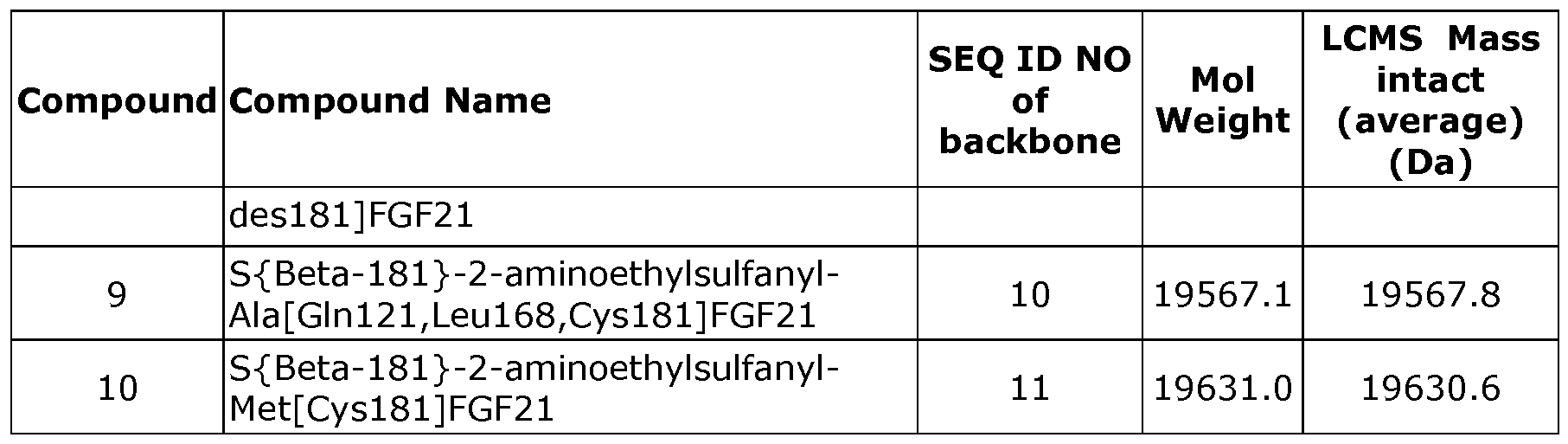
Table IB. FGF21 analogues 25 to 32
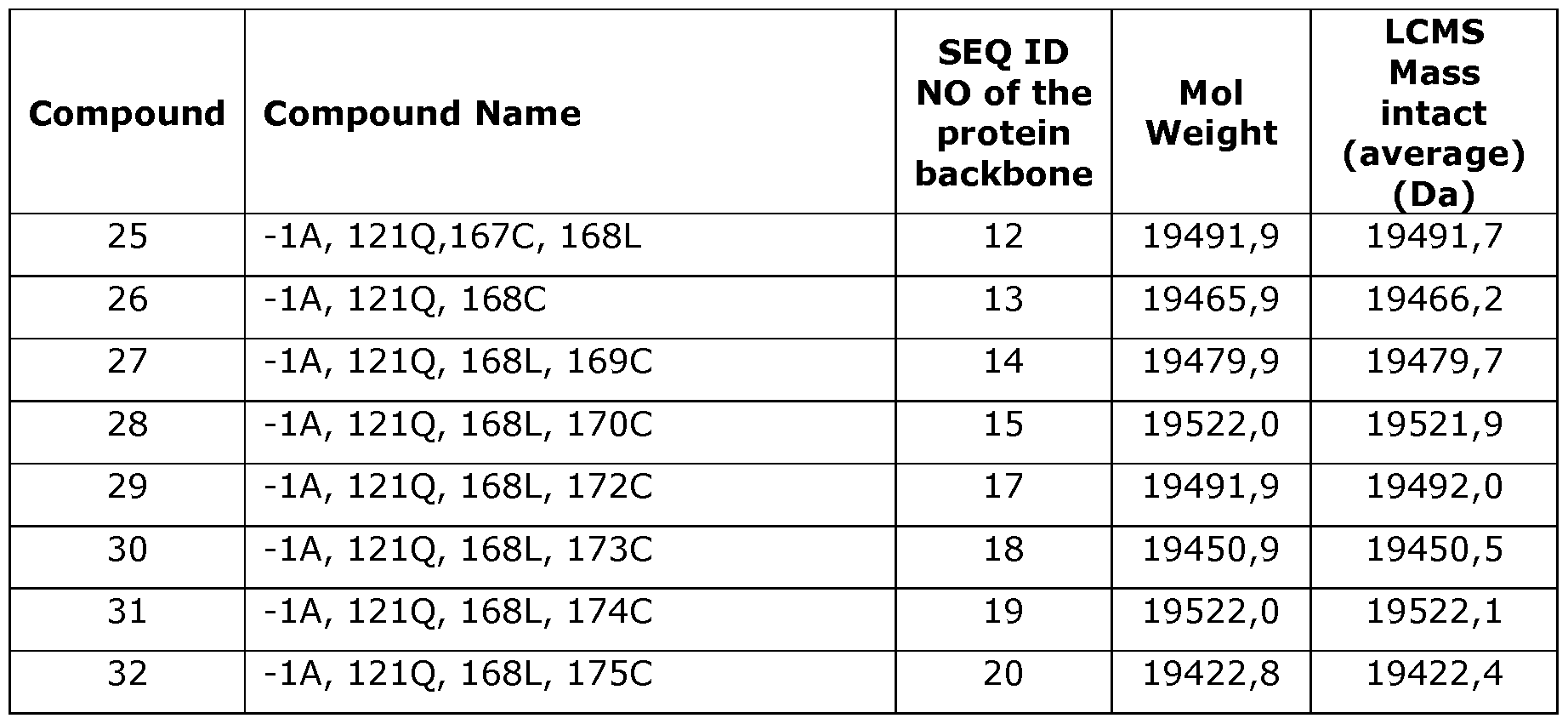
Example 4: Preparation of reagents for derivatisation of FGF21 analogues The preparation of a representative reagent for derivatisation is given in
Example 4.1. The reagents of Examples 4.2-4.4 are prepared by the method provided in Example 4.1. Reagents of examples 4.5-4.17 were prepared by similar methods as described below. Example 4.1: Preparation of 15-{(S)-l-carboxy-3-[2-(2-{[2-(2-{[2-(2- Bromoacetylamino)ethylcarbamoyl]methoxy}-ethoxy)ethyl- carbamoyl]methoxy}ethoxy)ethylcarbamoyl]propylcarbamoyl}pentadecanoic acid

Solid Phase Synthetic protocol :
A solution of N-(benzyloxycarbonyloxy)succinimide (ZOSu, 100 g, 401 mmol) in dichloromethane (500 mL) was added dropwise over 2 hours to a solution of
ethylenediamine (1, 189 mL, 2.81 mol) in dichloromethane (750 mL) . After 30 minutes the suspension was filtered and solids washed with dichloromethane. The filtrate was evaporated to dryness and the residue diluted with toluene (1.00 L) and water (0.50 L) . The resulting mixture was filtered and the filtrate was separated to afford two phases. The aqueous phase contained the product; therefore it was extracted with
dichloromethane (2 x 250 mL) . All organic phases were combined, dried over anhydrous sodium sulfate, filtered and concentrated in vacuo. The residue was diluted with toluene (750 mL) and extracted with 2 M aqueous hydrochloric acid (500 mL) and 1 M aqueous hydrochloric acid (100 mL) . Acidic aqueous phases were combined and basified with a solution of sodium hydroxide (60.0 g, 1.50 mol) in water (90 mL) . The resulting mixture was extracted with dichloromethane (4 x 200 mL), dried over anhydrous sodium sulfate, filtered, concentrated in vacuo and diluted with hexanes (200 mL) . 4 M Solution of hydrogen chloride in ether (100 mL, 400 mmol) was added to the solution, the resulting suspension was concentrated in vacuo and diluted with hexanes (1.00 L) . The
precipitated solid was filtered, washed with hexanes and dried in vacuo to give (2-amino- ethyl)-carbamic acid benzyl ester hydrochloride as white powder.
Yield : 62.62 g (68%) .
RF (Si02, dichloromethane/methanol 4: 1) : 0.25 (free base) .
1H NMR spectrum (300 MHz, AcOD-d4, 80 °C, dH) : 7.42-7.26 (m, 5 H) ; 5.16 (s, 2 H) ; 3.60 (t, J = 5.7 Hz, 2 H) ; 3.32 (t, J = 5.7 Hz, 2 H) .
2-Chlorotrityl resin 100-200 mesh 1.7 mmol/g (3, 40.1 g, 68.1 mmol) was left to swell in dry dichloromethane (250 mL) for 20 minutes. A solution of {2-[2-(9H-fluoren-9- ylmethoxycarbonylamino)-ethoxy]-ethoxy}-acetic acid (Fmoc-Ado-OH, 17.5 g, 45.4
mmol) and N,N-diisopropylethylamine (30.1 mL, 173 mmol) in dry dichloromethane (50 mL) was added to resin and the mixture was shaken for 5 hours. Resin was filtered and treated with a solution of N,N-diisopropylethylamine (15.8 mL, 90.8 mmol) in
methanol/dichloromethane mixture (4: 1, 250 mL, 2 x 5 min) . Then resin was washed with N,N-dimethylformamide (2 x 250 mL), dichloromethane (2 x 250 mL) and N,N- dimethylformamide (3 x 250 mL). Fmoc group was removed by treatment with 20% piperidine in dimethylformamide (1 x 5 min, 1 x 10 min, 1 x 30 min, 3 x 250 mL) . Resin was washed with N,N-dimethylformamide (3 x 250 mL), 2-propanol (2 x 250 mL) and dichloromethane (300 mL, 2 x 250 mL) . Solution of {2-[2-(9H-fluoren-9- ylmethoxycarbonylamino)-ethoxy]-ethoxy}-acetic acid (Fmoc-Ado-OH, 26.3 g, 68.1 mmol), 0-(6-chloro-benzotriazol-l-yl)-N,N,N',N'-tetramethyluronium tetrafluoroborate (TCTU, 24.2 g, 68.1 mmol) and N,N-diisopropylethylamine (21.4 mL, 123 mmol) in N,N- dimethylformamide (140 mL) was added to resin and mixture was shaken for 1 hour. Resin was filtered and washed with N,N-dimethylformamide (2 x 250 mL),
dichloromethane (2 x 250 mL) and N,N-dimethylformamide (250 mL) . Fmoc group was removed by treatment with 20% piperidine in dimethylformamide (1 x 5 min, 1 x 10 min, 1 x 30 min, 3 x 250 mL). Resin was washed with N,N-dimethylformamide (3 x 250 mL), 2-propanol (2 x 250 mL) and dichloromethane (300 mL, 2 x 250 mL) . Solution of (S)-2- (9H-fluoren-9-ylmethoxycarbonylamino)-pentanedioic acid 1-tert-butyl ester (Fmoc-Glu- OtBu, 29.0 g, 68.1 mmol), 0-(6-chloro-benzotriazol-l-yl)-N,N,N',N'-tetramethyluronium tetrafluoroborate (TCTU, 24.2 g, 68.1 mmol) and N,N-diisopropylethylamine (21.4 mL, 123 mmol) in N,N-dimethylformamide (140 mL) was added to resin and mixture was shaken for 1 hour. Resin was filtered and washed with N,N-dimethylformamide (2 x 250 mL), dichloromethane (2 x 250 mL) and N,N-dimethylformamide (250 mL). Fmoc group was removed by treatment with 20% piperidine in dimethylformamide (1 x 5 min, 1 x 10 min, 1 x 30 min, 3 x 250 mL) . Resin was washed with N,N-dimethylformamide (3 x 250 mL), 2-propanol (2 x 250 mL) and dichloromethane (300 mL, 2 x 250 mL). Solution of 16-(tert-butoxy)-16-oxohexadecanoic acid (23.3 g, 68.1 mmol), 0-(6-chloro- benzotriazol-l-yl)-N,N,N',N'-tetramethyluronium tetrafluoroborate (TCTU, 24.2 g, 68.1 mmol) and N,N-diisopropylethylamine (21.4 mL, 123 mmol) in N,N- dimethylformamide/dichloromethane mixture (4: 1, 200 mL) was added to resin. Resin was shaken for 1 hour, filtered and washed with N,N-dimethylformamide (3 x 250 mL), dichloromethane (2 x 250 mL), methanol (2 x 250 mL) and dichloromethane (350, 6 x 250 mL) . The product was cleaved from resin by treatment with 2,2,2-trifluoethanol (250 mL) for 18 hours. Resin was filtered off and washed with dichloromethane (2 x 250 mL), 2-propanol/dichloromethane mixture (1 : 1, 2 x 250 mL), 2-propanol (250 mL) and
dichloromethane (3 x 250 mL). Solutions were combined; solvent evaporated and crude product was purified by flash column chromatography (Silicagel 60, 0.040-0.060 mm; eluent: dichloromethane/methanol 1 : 0-9: 1). Pure (S)-22-(tert-butoxycarbonyl)-41,41- dimethyl-10,19,24,39-tetraoxo-3,6,12,15,40-pentaoxa-9,18,23-triazadotetracontanoic acid was dried in vacuo and obtained as pale yellow thick yellow oil.
Yield : 30.88 g (83%).
RF (Si02, dichloromethane/methanol 4: 1): 0.30.
1H NMR spectrum (300 MHz, CDCI3, dH): 7.36 (t, J = 5.7 Hz, 1 H); 7.02 (t, J = 5.4 Hz, 1 H); 6.55 (d, J = 7.7 Hz, 1 H); 4.46 (m, 1 H); 4.18 (s, 2 H); 4.02 (s, 2 H); 3.83-3.36 (m, 16 H); 2.44-2.12 (m, 7 H); 2.02-1.86 (m, 1 H); 1.60 (m, 4 H); 1.47 (s, 9 H); 1.45 (s, 9 H); 1.36-1.21 (m, 20 H).
LC-MS method 4:
Purity: 100%
Rt (Kinetex 4.6 mm x 50 mm, acetonitrile/water 50: 50 to 100:0 + 0.1% FA): 3.60 min. Found m/z, z=l : 818.7 (M + H) +
2-(7-Aza-lH-benzotriazole-l-yl)-l,l,3,3-tetramethyluronium hexafluorophosphate (HATU, 11.4 g, 30.1 mmol) and thethylamine (8.77 mL, 62.9 mmol) were subsequently added to a solution of (S)-22-(tert-butoxycarbonyl)-41,41-dimethyl-10, 19, 24,39- tetraoxo-3,6,12,15,40-pentaoxa-9,18,23-triazadotetracontanoic acid (22.4 g, 27.4 mmol) in dry dichloromethane (110 mL). Thethylamine (5.72 mL, 41.0 mmol) was added to a suspension of (2-amino-ethyl)-carbamic acid benzyl ester hydrochloride (6.94 g, 30.1 mmol) in dry dichloromethane (165 mL) and the resulting mixture was added to the above solution. The mixture was stirred at room temperature overnight, and then it was evaporated to dryness. The residue was re-dissolved in ethyl acetate (500 mL); washed with 1 M aqueous hydrochloric acid (2 x 200 mL), 5% aqueous solution of sodium carbonate (2 x 200 mL, very slow separation of phases), 1 M aqueous hydrochloric acid (8 x 200 mL) and brine; dried over anhydrous sodium sulfate and evaporated to dryness in vacuo. The residue was purified by flash column chromatography (Silicagel 60, 0.040- 0.060 mm; eluent: dichloromethane/methanol 95: 5) to afford 15-[(S)-3-(2-{2-[(2-{2- [(2-benzyloxycarbonylamino-ethylcarbamoyl)-methoxy]-ethoxy}-ethylcarbamoyl)- methoxy]-ethoxy}-ethylcarbamoyl)-l-tert-butoxycarbonyl-propylcarbamoyl]- pentadecanoic acid tert-butyl ester as pale yellow thick oil.
Yield : 23.84 g (88%)
RF (Si02, dichloromethane/methanol 9: 1): 0.35
1H NMR spectrum (300 MHz, CDCI3, dH): 7.39-7.26 (m, 6 H); 7.19 (t, J = 6.3 Hz, 1 H); 6.91 (t, J = 5.7 Hz, 1 H); 6.52 (d, J = 7.5 Hz, 1 H); 5.83 (t, J = 5.5 Hz, 1 H); 5.09 (s, 2 H); 4.41 (ddd, J = 12.3, 4.6 and 4.3 Hz, 1 H); 3.99 (s, 2 H); 3.97 (s, 2 H); 3.71-3.30 (m, 20 H); 2.33-2.08 (m, 7 H); 1.97-1.83 (m, 1 H); 1.67-1.51 (m, 4 H); 1.45 (s, 9 H); 1.44 (s, 9 H); 1.35-1.20 (m, 20 H).
LCMS method 4
Purity: 100%
Rt (Kinetex 4.6 mm x 50 mm, acetonitrile/water 50: 50 to 100: 0 + 0.1% FA) : 4.18 min Found m/z, z=l : 994.9 (M + H) +
Palladium on carbon (10%, 1.27 g, 1.20 mmol) was added to a solution of the above compound (23.8 g, 24.0 mmol) in methanol (350 mL) and the resulting mixture was hydrogenated at normal pressure for 4 hours. The catalyst was filtered off and the filtrate evaporated to dryness. The residue was evaporated several times from dichloromethane in order to remove residues of methanol and dried in vacuo to yield tert-butyl (S)-l-amino-25-(tert-butoxycarbonyl)-4,13,22,27-tetraoxo-6,9,15,18- tetraoxa-3,12,21,26-tetraazadotetracontan-42-oate as thick colourless oil.
Yield : 20.50 g (99%).
RF (Si02, dichloromethane/methanol 9: 1): 0.05.
1H NMR spectrum (300 MHz, CDCI3, dH): 7.54 (t, J = 5.7 Hz, 1 H); 7.41 (t, J = 5.6 Hz, 1 H); 7.14 (t, J = 5.5 Hz, 1 H); 6.68 (d, J = 7.5 Hz, 1 H); 5.25 (bs, 2 H); 4.39 (td, J=8.3 and 4.2 Hz, 1 H); 4.01 (s, 4 H); 3.74-3.39 (m, 18 H); 2.96 (t, J = 5.7 Hz, 2 H); 2.34-2.06 (m, 7 H); 1.97-1.83 (m, 1 H); 1.68-1.50 (m, 4 H); 1.45 (s, 9 H); 1.43 (s, 9 H); 1.37-1.19 (m, 20 H).
LCMS method 4
Purity: 100%
Rt (Kinetex 4.6 mm x 50 mm, acetonitrile/water 50: 50 to 100: 0 + 0.1% FA) : 1.43 min Found m/z, z=l : 860.8 (M + H) + N,N-Diisopropylethylamine (4.98 mL, 28.6 mmol) was added to a solution of the above amine (6, 20.5 g, 23.8 mmol) in dry dichloromethane (290 mL) at -30 °C under argon. Bromoacetyl bromide (2.48 mL, 28.6 mmol) was added dropwise and the resulting solution was stirred at -30 °C for additional 3 hours. The cooling bath was removed, the mixture was stirred at room temperature for 1 hour, and then the solvent was removed in vacuo. The residue was re-dissolved in ethyl acetate (450 mL) and washed with 5% aqueous solution of citric acid (300 mL). The phases were separated
within 1 hour. The organic layer was washed with water (300 mL) and the resulting emulsion was left to separate overnight to give 3 phases. The clear aqueous layer was removed and the residual 2 phases were shaken with saturated aqueous solution of potassium bromide (100 mL) was added. The phases were left to separate overnight, the aqueous one was then removed and the organic one dried over anhydrous sodium sulfate. The solvent was removed in vacuo and the residue was purified by flash column chromatography (Silicagel 60, 0.040-0.060 mm; eluent: dichloromethane/methanol 95: 5) to afford tert-butyl (S)-l-bromo-28-(tert-butoxycarbonyl)-2,7,16,25,30-pentaoxo- 9,12,18,21-tetraoxa-3,6,15,24,29-pentaazapentatetracontan-45-oate as colorless solid. Yield : 19.46 g (83%).
RF (Si02, dichloromethane/methanol 9: 1): 0.25
1H NMR spectrum (300 MHz, CDCI3, dH) : 7.46 (m, 1 H); 7.33 (t, J = 5.9 Hz, 1 H); 7.21 (t, J = 5.1 Hz, 1 H); 6.92 (t, J = 5.2 Hz, 1 H); 6.50 (d, J = 7.5 Hz, 1 H); 4.41 (ddd, J = 12.2, 4.5 and 4.2 Hz, 1 H); 4.01 (s, 4 H), 3.85 (s, 2 H); 3.75-3.40 (m, 20 H), 2.36-2.08 (m, 7 H); 1.99-1.84 (m, 1 H); 1.68-1.51 (m, 4 H), 1.46 (s, 9 H); 1.44 (s, 9 H); 1.38-1.19 (m, 20 H)
LCMS method 4
Purity: 100%
Rt (Kinetex 4.6 mm x 50 mm, acetonitrile/water 50: 50 to 100:0 + 0.1% FA) : 3.51 min. Found: m/z, z= l : 980.9, 982.9 (M + H) +
The above compound (19.5 g, 19.8 mmol) was dissolved in trifluoroacetic acid (120 mL) and the resulting solution was stirred at room temperature for 1.5 hours.
Trifluoroacetic acid was removed in vacuo and the residue was evaporated from dichloromethane (6 x 200 mL). Diethyl ether (200 mL) was added to the oily residue and the mixture was stirred overnight to give a suspension. Solid product was filtered, washed with diethyl ether and hexanes and dried in vacuo to afford the title product 15- {(S)-l-carboxy-3-[2-(2-{[2-(2-{[2-(2-Bromoacetylamino)ethylcarbamoyl]methoxy>- ethoxy)ethylcarbamoyl]methoxy}ethoxy)ethylcarbamoyl]propylcarbamoyl}pentadecanoic acid as white powder.
Yield : 16.74 g (97%).
1H NMR spectrum (300 MHz, AcOD-d4, dH) : 4.61 (dd, J=8.8 and 4.8 Hz, 1 H); 4.12 (s, 2 H), 4.10 (s, 2 H); 3.96 (s, 2 H); 3.77 -3.39 (m, 20 H), 2.49-2.18 (m, 7 H); 2.16-1.04 (m, 1 H); 1.71-1.56 (m, 4 H), 1.30 (bs, 20 H)
LCMS method 4:
Purity: 100%
Rt (Kinetex 4.6 mm x 50 mm, acetonitrile/water 50: 50 to 100: 0 + 0.1% FA)
Theoretical m/z, z= l : 869,8, Found : m/z, z= l : 868.7, 870.7
Example 4.2: Preparation of ll-{(S)-l-carboxy-3-[2-(2-{[2-(2-{[2-(2- Bromoacetylamino)ethylcarbamoyl]methoxy}-ethoxy)ethyl- carbamo l]methoxy}ethoxy)ethylcarbamoyl]propylcarbamoyl}undecanoic acid

1H NMR spectrum (300 MHz, AcOD-d4, dH) : 4.61 (dd, J=8.9 and 4.9 Hz, 1 H); 4.13 (s, 2 H); 4.10 (s, 2 H); 3.96 (s, 2 H); 3.79-3.38 (m, 20 H); 2.50-2.16 (m, 7 H); 2.16-2.00 (m, 1 H); 1.72-1.56 (m, 4 H); 1.42-1.24 (m, 12 H)
LCMS method 4:
Purity: 100% (ELSD)
Rt (Kinetex, 4.6 mm x 50 mm, acetonitrile/water 20:80 to 100: 0 + 0.1% FA) : 2.74 min Theoretical, m/z, z= l :813,8, Found m/z, z= l : 812.0, 814.0
Example 4.3: Preparation of 13-{(S)-l-carboxy-3-[2-(2-{[2-(2-{[2-(2- Bromoacetylamino)ethylcarbamoyl]methoxy}-ethoxy)ethyl- carbamoyl]methoxy}ethoxy)ethylcarbamoyl]propylcarbamoyl}tridecanoic acid

ethoxy)ethylcarbamoyl]methoxy}ethoxy)ethylcarbamoyl]propylcarbamoyl}tridecanoic acid was prepared by the same method as described in Example 4.1 resulting in a thick yellow oil.
1H NMR spectrum (300 MHz, AcOD-d4, dH) : 4.61 (dd, J=8.9 and 4.9 Hz, 1 H); 4.13 (s, 2 H); 4.11 (s, 2 H); 3.96 (s, 2 H); 3.77-3.40 (m, 20 H); 2.49-2.18 (m, 7 H); 2.16-2.07 (m, 1 H); 1.70-1.56 (m, 4 H); 1.31 (bs, 16 H).
LCMS method 4:
Purity: 100% (ELSD)
Rt (Kinetex, 4.6 mm x 50 mm, acetonitrile/water 20:80 to 100: 0 + 0.1% FA) : 2.94 min Theoretical m/z, z= l : 841.9, Found : m/z, z= l : 841.7, 843.7
Example 4.4: Preparation of 19-{(S)-l-carboxy-3-[2-(2-{[2-(2-{[2-(2-Brom
amino)ethylcarbamoyl]methoxy}ethoxy)ethylcarbamoyl]methoxy}ethoxy)- eth lcarbamoyl]propylcarbamoyl}nonadecanoic acid

19-{(S)-l-carboxy-3-[2-(2-{[2-(2-{[2-(2-Bromoacetylamino)ethylcarbamoyl]methoxy}- ethoxy)ethylcarbamoyl]methoxy}ethoxy)ethylcarbamoyl]propylcarbamoyl}nonadecanoic acid was prepared by the same method as described in Example 4.1 resulting in a beige powder.
1H NMR spectrum (300 MHz, AcOD-d4, dH) : 4.65-4.57 (m, 1 H); 4.13 (s, 2 H); 4.10 (s, 2 H); 3.96 (s, 2 H); 3.77-3.43 (m, 20 H); 2.49-2.40 (t, J = 7.3 Hz, 2 H); 2.39-2.23 (m, 5 H); 2.17-2.07 (m, 1 H); 1.68-1.57 (m, 4 H); 1.30 (bs, 28 H)
LCMS method 4:
Purity: 100% (ELSD)
Rt (Kinetex, 4.6 mm x 50 mm, acetonitrile/water 50: 50 to 100: 0 + 0.1% FA) : 2.17 min Theoretical mass: 926.0, Found m/z: 926 (M + H) +
Example 4.5: Preparation of
18-[[(lS)-4-[2-[2-[2-[2-[2-[2-[2-[(2-bromoacetyl)amino]ethylamino]-2-oxo- ethoxy]ethoxy]ethylamino]-2-oxo-ethoxy]ethoxy]ethylamino]-l-carboxy-4-oxo- butyl]amino]-18-oxo-octadecanoic acid

Solution phase syntetic protocol:
Step 1 : benzyl 18-[[(lS)-4-[2-[2-[2-[2-[2-[2-(2-aminoethylamino)-2-oxo- ethoxy]ethoxy]ethylamino]-2-oxo-ethoxy]ethoxy]ethylamino]-l-benzyloxycarbonyl-4- oxo-butyl]amino]-18-oxo-octadecanoate To a solution of ethylenediamine (8.5 ml ml) in DCM (80 ml) and triethylamine (5.2 ml) at 0 °C was added a solution of benzyl 18- [[(lS)-l-benzyloxycarbonyl-4-[2-[2-[2-[2-[2-[2-(2,5-dioxopyrrolidin-l-yl)oxy-2-oxo- ethoxy]ethoxy]ethylamino]-2-oxo-ethoxy]ethoxy]ethylamino]-4-oxo-butyl]amino]-18- oxo-octadecanoate (26 g), prepared as described in WO10029159, in DCM (320 ml) dropwise over 75 min. After stirring for 2 h the precipitate was filtered off. To the filtrate was added water (200 ml) and isopropanol (50 ml). The mixture was extracted. The organic layer was dried using MgS04. The MgS04 was removed by filtration and the filtrate was dried in vacuo to give the title compound 20,07 g ( 81% ) LCMS: Theoretical mass: 956.2; Found m/z, z= l : 957.0
Step2: benzyl 18-[[(lS)-l-benzyloxycarbonyl-4-[2-[2-[2-[2-[2-[2-[2-[(2- chloroacetyl)amino]ethylamino]-2-oxo-ethoxy]ethoxy]ethylamino] -2-oxo- ethoxy]ethoxy]ethylamino]-4-oxo-butyl]amino]-18-oxo-octadecanoate
Chloroacetic acid (0,19 g) was dissolved in DCM (15 ml). N-hydroxysuccinimide
(0.22 g) and EDAC HCI (0.42 g) was added. After stirring for 2.5h benzyl 18-[[(lS)-4-[2- [2-[2-[2-[2-[2-(2-aminoethylamino)-2-oxo-ethoxy]ethoxy]ethylamino]-2-oxo- ethoxy]ethoxy]ethylamino]-l-benzyloxycarbonyl-4-oxo-butyl]amino] -18-oxo- octadecanoate (1.5 g) in DCM (5 ml) was added. After stirring over night at RT the mixture was extracted with 1M HCI (2x20 ml) and water/brine 2: 1 (30 ml). The organic
layer was dried (MgS04), filtered and concentrated in vacuo to give a clear oil, 1.37 g (84 %)
LCMS: Theoretical mass: 1032.7; Found m/z, z= l : 1033.1 Step 3: 18-[[(lS)-l-Carboxy-4-[2-[2-[2-[2-[2-[2-[2-[(2- chloroacetyl)amino]ethylamino]-2-oxo-ethoxy]ethoxy]ethylamino] -2-oxo- ethoxy]ethoxy]ethylamino]-4-oxo-butyl]amino]-18-oxo-octadecanoic acid
To a solution of benzyl 18-[[(lS)-l-benzyloxycarbonyl-4-[2-[2-[2-[2-[2-[2-[2-[(2- chloroacetyl)amino]ethylamino]-2-oxo-ethoxy]ethoxy]ethylamino] -2-oxo- ethoxy]ethoxy]ethylamino]-4-oxo-butyl]amino]-18-oxo-octadecanoate (10,5 g) in acetone (140 ml) was added 10% PD/C (1.0 g) after Nitrogen aeration. After
hydrogenation for 6h, the mixture was heated to 40-50°C before filtration. The precipitate in the cold filtrate was isolated and washed with acetone and dried to give the title compound, 7.42 g (85%).
Step 4: 8-[[(lS)-4-[2-[2-[2-[2-[2-[2-[2-[(2-Bromoacetyl)amino]ethylamino]-2-oxo- ethoxy]ethoxy]ethylamino]-2-oxo-ethoxy]ethoxy]ethylamino]-l-carboxy-4-oxo- butyl]amino]-18-oxo-octadecanoic acid.
To a suspension of 18-[[(lS)-l-Carboxy-4-[2-[2-[2-[2-[2-[2-[2-[(2- chloroacetyl)amino]ethylamino]-2-oxo-ethoxy]ethoxy]ethylamino] -2-oxo- ethoxy]ethoxy]ethylamino]-4-oxo-butyl]amino]-18-oxo-octadecanoic acidin acetone (60 ml) was added sodium bromide (5 eq, 1.21 g). The mixture was stirred at RT in the dark. After 2h more sodium bromide (10 eq, 2.41 g) was added. After 2 days more sodium bromide (5 eq, 1.21 g) was added. After 5 days the mixture was concentrated. To half the residue was added DCM (30 ml), 10% ascorbic acid (20 ml) and water 30 ml. To the emulsion was added isopropanol (50 ml) and water (30 ml). The organic phase was separated and washed twice with a mixture of 10% ascorbic acid (20 ml) and isopropanol (10 ml). The organic layer was dried (MgS04), filtered and concentrated to give a solid oil, which was crystalised in acetone and isolated by filtration to give the title compound contaminated with starting material, 0.80 g (72%).
LCMS: Theoretical mass: 896.9. Found m/z, z= l : 898.9 (M + l)
Example 4.6: Preparation of 12-[[4-[[(lS)-4-[2-[2-[2-[2-[2-[2-[2-[(2- bromoacetyl)amino]ethylamino]-2-oxo-ethoxy]ethoxy]ethylamino] -2-oxo- ethoxy]ethoxy]ethylamino]-l-carboxy-4-oxo-butyl]carbamoyl]cyclohexyl]methylamino]- 12-oxo-dodecanoic acid

Solid Phase Synthetic protocol :
2-Chlorotrityl resin 100-200 mesh 1.8 mmol/g (1, 11.9 g, 21.4 mmol) was left to swell in dry dichloromethane (80 mL) for 20 minutes. A solution of {2-[2-(9H-fluoren-9- ylmethoxycarbonylamino)-ethoxy]-ethoxy}-acetic acid (Fmoc-OEG-OH, 5.50 g, 14.3 mmol) and N,N-diisopropylethylamine (9.44 mL, 54.2 mmol) in dry dichloromethane (70 mL) was added to resin and the mixture was shaken for 4 hours. Resin was filtered and treated with a solution of N,N-diisopropylethylamine (4.97 mL, 28.5 mmol) in
methanol/dichloromethane mixture (4: 1, 2 x 5 min, 2 x 57 mL). Then resin was washed with N,N-dimethylformamide (2 x 80 mL), dichloromethane (2 x 80 mL) and N,N- dimethylformamide (3 x 80 mL) . Fmoc group was removed by treatment with 20% piperidine in N,N-dimethylformamide (1 x 5 min, 1 x 30 min, 2 x 80 mL). Resin was washed with N,N-dimethylformamide (3 x 80 mL), 2-propanol (2 x 80 mL) and dichloromethane (100 mL, 2 x 80 mL) . Solution of {2-[2-(9H-fluoren-9- ylmethoxycarbonylamino)-ethoxy]-ethoxy}-acetic acid (Fmoc-OEG-OH, 11.0 g, 28.5 mmol), 0-(6-chloro-benzotriazol-l-yl)-N,N,N',N'-tetramethyluronium tetrafluoroborate (TCTU, 10.1 g, 28.5 mmol) and N,N-diisopropylethylamine (9.93 mL, 57.0 mmol) in N,N- dimethylformamide (80 mL) was added to resin and mixture was shaken for 2 hours. Resin was filtered and washed with N,N-dimethylformamide (2 x 80 mL),
dichloromethane (2 x 80 mL) and N,N-N,N-dimethylformamide (3 x 80 mL) . Fmoc group was removed by treatment with 20% piperidine in N,N-dimethylformamide (1 x 5 min, 1 x 30 min, 2 x 80 mL). Resin was washed with N,N-dimethylformamide (3 x 80 mL), 2- propanol (2 x 80 mL) and dichloromethane (100 mL, 2 x 80 mL) . Solution of (S)-2-(9H- fluoren-9-ylmethoxycarbonylamino)-pentanedioic acid 1-tert-butyl ester (Fmoc-LGIu-
OtBu, 9.11 g, 21.4 mmol), 0-(6-chloro-benzotriazol-l-yl)-N,N,N',N'-tetramethyluronium tetrafluoroborate (TCTU, 7.60 g, 21.4 mmol) and N,N-diisopropylethylamine (6.71 mL, 38.5 mmol) in N,N-dimethylformamide (80 mL) was added to resin and mixture was shaken for 1 hour. Resin was filtered and washed with N,N-dimethylformamide (2 x 80 mL), dichloromethane (2 x 80 mL) and N,N-dimethylformamide (2 x 80 mL) . Fmoc group was removed by treatment with 20% piperidine in N,N-dimethylformamide (1 x 5 min, 1 x 30 min, 2 x 80 mL). Resin was washed with N,N-dimethylformamide (3 x 80 mL), 2- propanol (2 x 80 mL) and dichloromethane (100 mL, 2 x 80 mL) . Solution of 4-[(9H- fluoren-9-ylmethoxycarbonylamino)methyl]cyclohexanecarboxylic acid (Fmoc-Trx-OH, 9.11 g, 21.4 mmol), 0-(6-chloro-benzotriazol-l-yl)-N,N,N',N'-tetramethyluronium tetrafluoroborate (TCTU, 7.60 g, 21.4 mmol) and N,N-diisopropylethylamine (6.71 mL, 38.5 mmol) in N,N-dimethylformamide (80 mL) was added to resin and mixture was shaken for 1 hour. Resin was filtered and washed with N,N-dimethylformamide (2 x 80 mL), dichloromethane (2 x 80 mL) and N,N-dimethylformamide (2 x 80 mL) . Fmoc group was removed by treatment with 20% piperidine in N,N-dimethylformamide (1 x 5 min, 1 x 30 min, 2 x 80 mL). Resin was washed with N,N-dimethylformamide (3 x 80 mL), 2- propanol (2 x 80 mL) and dichloromethane (100 mL, 2 x 80 mL) . Solution of
dodecanedioic acid mono-tert-butyl ester (C12(OtBu)-OH, 6.13 g, 21.4 mmol), 0-(6- chloro-benzotriazol-l-yl)-N,N,N',N'-tetramethyluronium tetrafluoroborate (TCTU, 7.61 g, 21.4 mmol) and N,N-diisopropylethylamine (6.71 mL, 38.5 mmol) in
dichloromethane/N,N-dimethylformamide mixture (4: 1, 80 mL) was added to resin and mixture was shaken for 1.5 hour. Resin was filtered and washed with N,N- dimethylformamide (6 x 80 mL), dichloromethane (4 x 80 mL), methanol (4 x 80 mL) and dichloromethane (7 x 80 mL). The product was cleaved from resin by treatment with 2,2,2-trifluoroethanol (80 mL) for 18 hours. Resin was filtered off and washed with dichloromethane (4 x 80 mL), dichloromethane/2-propanol mixture (1 : 1, 4 x 80 mL), 2- propanol (2 x 80 mL) and dichloromethane (6 x 80 mL). Solutions were combined;
solvent evaporated and crude product was purified by column chromatography (Silicagel 60, 0.040-0-063 mm; eluent: dichloromethane/methanol 1 : 0-9 : 1). The pure product (2) was dried in vacuo and obtained as oil .
Yield : 5.40 g (42%) .
RF (Si02, dichloromethane/methanol 9: 1) : 0.30.
1H NMR spectrum (300 MHz, CDCI3, dH) : 7.45-7.31 (m, 1 H); 7.10-6.97 (m, 1 H) ; 6.71- 6.60 (m, 1 H); 5.70-5.58 (m, 1 H) ; 4.43-4.31 (m, 1 H); 4.15 (s, 2 H) ; 4.01 (s, 2 H) ; 3.79-3.31 (m, 16 H) ; 3.13-3.08 (m, 2 H) ; 2.28-1.79 (m, 11 H) ; 1.71-1.51 (m, 4 H) ; 1.46 (s, 9 H) ; 1.44 (s, 9 H) ; 1.25 (bs, 12 H) ; 1.05-0.88 (m, 2 H) .
LC-MS purity: 100%.
LC-MS Rt (Sunfire 4.6 mm x 100 mm, acetonitrile/water 50 : 50 to 100 : 0 + 0.1% FA) : 2.16 min.
LC-MS m/z: 903.0 (M + H) + .
2-(7-Aza-lH-benzotriazole-l-yl)-l,l,3,3-tetramethyluronium hexafluorophosphate (HATU, 2.46 g, 6.48 mmol) and triethylamine (1.89 mL, 13.6 mmol) were subsequently added to a solution of the oil from above (2, 5.31 g, 5.89 mmol) in dry dichloromethane (23 mL) . Triethylamine (1.36 mL, 9.72 mmol) was added to a suspension of (2-amino- ethyl)-carbamic acid benzyl ester hydrochloride (3, 1.49 g, 6.48 mmol) in dry dichloromethane (35 mL) and the resulting mixture was added to the above solution. The mixture was stirred overnight at room temperature, and then it was evaporated in dryness. The residue was redissolved in ethyl acetate (70 mL) ; washed with 1 M aqueous hydrochloric acid (1 x 70 mL), 5% aqueous solution of sodium carbonate (2 x 70 mL), 1 M aqueous hydrochloric acid (4 x 70 mL) and brine (70 mL) ; dried over anhydrous sodium sulfate and evaporated . The residue was purified by flash column
chromatography (Silicagel 60, 0.040-0-063 mm; eluent: dichloromethane/methanol 95 : 5 to 92 :8) to afford a thick yellow oil .
Yield : 2.81 g (44%) .
RF (Si02, dichloromethane/methanol 9: 1) : 0.25.
1H NMR spectrum (300 MHz, CDCI3, dH) : 7.41-7.29 (m, 6 H); 7.22-7.13 (m, 1 H) ; 6.93- 6.81 (m, 1 H); 6.62-6.58 (m, 1 H) ; 5.90-5.81 (m, 1 H) ; 5.68-5.55 (m, 1 H) ; 5.09 (s, 2 H) ; 4.42-4.33 (m, 1 H) ; 4.01-3.95 (m, 4 H) ; 3.75-3.30 (m, 20 H); 3.14-3.06 (m, 2 H) ; 2.31-2.01 (m, 11 H) ; 1.97-1.76 (m, 1 H) ; 1.65-1.52 (m, 4 H) ; 1.46 (s, 9 H); 1.44 (s, 9 H) ; 1.27 (bs, 12 H) ; 1.04-0.87 (m, 2 H) .
Palladium on carbon (10%, 0.15 g, 0.13 mmol) was added to a solution of the above compound (2.81 g, 2.60 mmol) in methanol (43 mL) and the resulting mixture was hydrogenated at normal pressure for 2.5 hours. The catalyst was filtered off and the filtrate evaporated to dryness. The residue was co-evaporated four times with toluene and dried in vacuo to yield compound 5.
Yield : 2.01 g (81%) .
1H NMR spectrum (300 MHz, CDCI3, dH) : 7.51-7.36 (m, 2 H); 7.04-6.96 (m, 1 H) ; 6.76- 6.66 (m, 1 H); 5.93-5.85 (m, 1 H); 4.41-4.29 (m, 1 H) ; 4.03-3.99 (m, 4 H) ; 3.73-3.25 (m, 18 H) ; 3.13-2.97 (m, 4 H) ; 2.34-1.78 (m, 11 H) ; 1.67-1.51 (m, 4 H) ; 1.46 (s, 9 H) ; 1.44 (s, 9 H); 1.30 (m, 12 H) ; 1.04-0.88 (m, 2 H).
LC-MS purity: 100% (ELSD).
LC-MS Rt (Kinetex, 4.6 mm x 50 mm, acetonitrile/water 70:30 to 100:0 + 0.1% TFA): 0.67 min.
LC-MS m/z: 945.0 (M + H) + .
N,N-Diisopropylethylamine (0.40 mL, 2.28 mmol) was added to a solution of the above amine (5, 1.79 g, 1.90 mmol) in dry dichloromethane (30 mL) at -30 °C under argon. Bromoacetyl bromide (0.20 mL, 2.28 mmol) was added dropwise and the resulting solution was stirred at -30 °C for 3 hours. The cooling bath was removed, the mixture was stirred at room temperature for additional 1 hour and then it was evaporated to dryness. The residue was redissolved in ethyl acetate (50 mL), washed with 5% aqueous solution of citric acid (3 x 50 mL, very slow separation of phases), 1 M aqueous hydrochloric acid (4 x 50 mL) and brine (50 mL). The organic layer was dried over anhydrous sodium sulfate, filtered and evaporated. The residue was purified by flash column chromatography (Silicagel 60, 0.040-0-063 mm; eluent:
dichloromethane/methanol 95:5 to 93:7) to afford a yellow oil.
Yield: 1.63 g (80%).
RF (Si02, dichloromethane/methanol 95:5): 0.25.
1H NMR spectrum (300 MHz, CDCI3, dH): 7.56-7.48 (m, 1 H); 7.43-7.34 (m, 1 H); 7.04- 6.95 (m, 1 H); 6.62 (d, J = 7.9 Hz, 1 H); 5.74-5.63 (m, 1 H); 4.43-4.33 (m, 1 H); 4.02
(s, 4 H); 3.85 (s, 2 H); 3.73-3.40 (m, 20 H); 3.14-3.09 (m, 2 H); 2.34-2.04 (m, 9 H);
1.97-1.76 (m, 4 H); 1.68-1.51 (m, 7 H); 1.46 (s, 9 H); 1.44 (s, 9 H); 1.27 (m, 12 H);
1.07-0.90 (m, 2 H).
LC-MS purity: 100% (ELSD).
LC-MS Rt (Kinetex, 4.6 mm x 50 mm, acetonitrile/water 50:50 to 100:0 + 0.1% FA):
2.16 min.
LC-MS m/z: 1066.0 (M + H) + .
The above compound (1.53 g, 1.44 mmol) was dissolved in trifluoroacetic acid (25 mL) and left to stay for 1.5 hour. Trifluoroacetic acid was removed in vacuo and the residue was co-evaporated with toluene three times and dichloromethane ten times to afford a yellow oily solid.
Yield: 810 mg (59%).
1H NMR spectrum (300 MHz, AcOD-d4, dH): 4.64-4.54 (m, 1 H); 4.13 (s, 2 H); 4.11 (s, 2 H); 3.96 (s, 2 H); 3.78-3.40 (m, 20 H); 3.13-3.10 (d, J = 6.6 Hz, 2 H); 2.51-2.19 (m, 9 H); 1.94-1.77 (m, 4 H); 1.68-1.41 (m, 7 H); 1.31 (bs, 12 H); 1.10-0.92 (m, 2 H).
LC-MS purity: 100% (ELSD) .
LC-MS Rt (Kinetex, 4.6 mm x 50 mm, acetonitrile/water 20 : 80 to 100: 0 + 0.1% FA) : 2.82 min.
LC-MS m/z: 952.0 (M + H) + .
Example 4.7: Preparation of 16-[[4-[[(lS)-4-[2-[2-[2-[2-[2-[2-[2-[(2- bromoacetyl)amino]ethylamino]-2-oxo-ethoxy]ethoxy]ethylamino] -2-oxo- ethoxy]ethoxy]ethylamino]-l-carboxy-4-oxo-butyl]carbamoyl]cyclohexyl]methylamino]- 16-oxo-hexadecanoic acid

Solid phase synthetic protocol :
2-Chlorotrityl resin 100-200 mesh 1.8 mmol/g (1, 11.9 g, 21.4 mmol) was left to swell in dry dichloromethane (80 mL) for 20 minutes. A solution of {2-[2-(9H-fluoren-9- ylmethoxycarbonylamino)-ethoxy]-ethoxy}-acetic acid (Fmoc-OEG-OH, 5.50 g, 14.3 mmol) and N,N-diisopropylethylamine (9.44 mL, 54.2 mmol) in dry dichloromethane (70 mL) was added to resin and the mixture was shaken for 4 hours. Resin was filtered and treated with a solution of N,N-diisopropylethylamine (4.97 mL, 28.5 mmol) in methanol/dichloromethane mixture (4: 1, 2 x 5 min, 2 x 57 mL). Then resin was washed with N,N-dimethylformamide (2 x 80 mL), dichloromethane (2 x 80 mL) and N,N- dimethylformamide (3 x 80 mL) . Fmoc group was removed by treatment with 20% piperidine in N,N-dimethylformamide (1 x 5 min, 1 x 30 min, 2 x 80 mL). Resin was
washed with N,N-dimethylformamide (3 x 80 mL), 2-propanol (2 x 80 mL) and dichloromethane (100 mL, 2 x 80 mL). Solution of {2-[2-(9H-fluoren-9- ylmethoxycarbonylamino)-ethoxy]-ethoxy}-acetic acid (Fmoc-OEG-OH, 11.0 g, 28.5 mmol), 0-(6-chloro-benzotriazol-l-yl)-N,N,N',N'-tetramethyluronium tetrafluoroborate (TCTU, 10.1 g, 28.5 mmol) and N,N-diisopropylethylamine (9.93 mL, 57.0 mmol) in N,N- dimethylformamide (80 mL) was added to resin and mixture was shaken for 2 hours. Resin was filtered and washed with N,N-dimethylformamide (2 x 80 mL),
dichloromethane (2 x 80 mL) and N,N-N,N-dimethylformamide (3 x 80 mL). Fmoc group was removed by treatment with 20% piperidine in N,N-dimethylformamide (1 x 5 min, 1 x 30 min, 2 x 80 mL). Resin was washed with N,N-dimethylformamide (3 x 80 mL), 2- propanol (2 x 80 mL) and dichloromethane (100 mL, 2 x 80 mL). Solution of (S)-2-(9H- fluoren-9-ylmethoxycarbonylamino)-pentanedioic acid 1-tert-butyl ester (Fmoc-LGIu- OtBu, 9.11 g, 21.4 mmol), 0-(6-chloro-benzotriazol-l-yl)-N,N,N',N'-tetramethyluronium tetrafluoroborate (TCTU, 7.60 g, 21.4 mmol) and N,N-diisopropylethylamine (6.71 mL, 38.5 mmol) in N,N-dimethylformamide (80 mL) was added to resin and mixture was shaken for 1 hour. Resin was filtered and washed with N,N-dimethylformamide (2 x 80 mL), dichloromethane (2 x 80 mL) and N,N-dimethylformamide (2 x 80 mL). Fmoc group was removed by treatment with 20% piperidine in N,N-dimethylformamide (1 x 5 min, 1 x 30 min, 2 x 80 mL). Resin was washed with N,N-dimethylformamide (3 x 80 mL), 2- propanol (2 x 80 mL) and dichloromethane (100 mL, 2 x 80 mL). Solution of Fmoc- tranexamic acid (Fmoc-Trx-OH, 9.11 g, 21.4 mmol), 0-(6-chloro-benzotriazol-l-yl)- Ν,Ν,Ν',Ν'-tetramethyluronium tetrafluoroborate (TCTU, 7.60 g, 21.4 mmol) and N,N- diisopropylethylamine (6.71 mL, 38.5 mmol) in N,N-dimethylformamide (80 mL) was added to resin and mixture was shaken for 1 hour. Resin was filtered and washed with N,N-dimethylformamide (2 x 80 mL), dichloromethane (2 x 80 mL) and N,N- dimethylformamide (2 x 80 mL). Fmoc group was removed by treatment with 20% piperidine in N,N-dimethylformamide (1 x 5 min, 1 x 30 min, 2 x 80 mL). Resin was washed with N,N-dimethylformamide (3 x 80 mL), 2-propanol (2 x 80 mL) and dichloromethane (100 mL, 2 x 80 mL). Solution of hexadecanedioic acid mono-tert-butyl ester (C16(OtBu)-OH, 7.33 g, 21.4 mmol), 0-(6-chloro-benzotriazol-l-yl)-N,N,N',N'- tetramethyluronium tetrafluoroborate (TCTU, 7.61 g, 21.4 mmol) and N,N- diisopropylethylamine (6.71 mL, 38.5 mmol) in dichloromethane/N,N-dimethylformamide mixture (4: 1, 80 mL) was added to resin and mixture was shaken for 1.5 hour. Resin was filtered and washed with N,N-dimethylformamide (6 x 80 mL), dichloromethane (4 x 80 mL), methanol (4 x 80 mL) and dichloromethane (7 x 80 mL). The product was cleaved from resin by treatment with 2,2,2-trifluoroethanol (80 mL) for 18 hours. Resin
was filtered off and washed with dichloromethane (4 x 80 mL), dichloromethane/2- propanol mixture (1:1, 4 x 80 mL), 2-propanol (2 x 80 mL) and dichloromethane (6 x 80 mL). Solutions were combined; solvent evaporated and crude product was purified by column chromatography (Silicagel 60, 0.040-0-063 mm; eluent:
dichloromethane/methanol 1:0-9: 1). Intermediate (2) was dried in vacuo and obtained as oil.
Yield: 8.20 g (80%).
RF (Si02, dichloromethane/methanol 9:1): 0.20.
1H NMR spectrum (300 MHz, CDCI3, dH): 7.44-7.33 (m, 1 H); 7.07-6.97 (m, 1 H); 6.72- 6.63 (m, 1 H); 5.70-5.59 (m, 1 H); 4.44-4.33 (m, 1 H); 4.15 (s, 2 H); 4.01 (s, 2 H); 3.76-3.32 (m, 16 H); 3.14-3.07 (m, 2 H); 2.38-1.77 (m, 11 H); 1.71-1.50 (m, 4 H); 1.46 (s, 9 H); 1.44 (s, 9 H); 1.25 (bs, 20 H); 1.05-0.87 (m, 2 H).
LC-MS purity: 100%.
LC-MS Rt (Sunfire 4.6 mm x 100 mm, acetonitrile/water 50:50 to 100:0 + 0.1% FA): 3.56 min.
LC-MS m/z: 959.0 (M + H) + .
2-(7-Aza-lH-benzotriazole-l-yl)-l,l,3,3-tetramethyluronium hexafluorophosphate (HATU, 3.55 g, 9.34 mmol) and triethylamine (2.72 mL, 19.5 mmol) were subsequently added to a solution of intermediate 2 (8.13 g, 8.49 mmol) in dry dichloromethane (34 mL). Triethylamine (1.78 mL, 12.7 mmol) was added to a suspension of (2-amino-ethyl)- carbamic acid benzyl ester hydrochloride (2.15 g, 9.34 mmol) in dry dichloromethane (51 mL) and the resulting mixture was added to the above solution. The mixture was stirred overnight at room temperature, and then it was evaporated in dryness. The residue was redissolved in ethyl acetate (150 mL); washed with 1 M aqueous hydrochloric acid (1 x 100 mL), 5% aqueous solution of sodium carbonate (2 x 100 mL), 1 M aqueous hydrochloric acid (4 x 100 mL) and brine; dried over anhydrous sodium sulfate and evaporated. The residue was purified by flash column chromatography (Silicagel 60, 0.040-0-063 mm; eluent: dichloromethane/methanol 95:5 to 92:8) to afford compound 4 as thick yellow oil.
Yield: 5.59 g (58%).
RF (Si02, dichloromethane/methanol 9:1): 0.20.
1H NMR spectrum (300 MHz, CDCI3, dH): 7.41-7.31 (m, 6 H); 7.21-7.12 (m, 1 H); 6.92- 6.83 (m, 1 H); 6.58-6.52 (m, 1 H); 5.89-5.79 (m, 1 H); 5.62-5.51 (m, 1 H); 5.10 (s, 2 H); 4.43-4.32 (m, 1 H); 4.05-3.92 (m, 4 H); 3.75-3.30 (m, 20 H); 3.15-3.07 (m, 2 H);
2.33-2.03 (m, 11 H) ; 1.97-1.68 (m, 1 H) ; 1.67-1.51 (m, 4 H) ; 1.45 (s, 9 H); 1.44 (s, 9 H) ; 1.26 (bs, 20 H) ; 1.05-0.87 (m, 2 H) .
LC-MS purity: 100% (ELSD) .
LC-MS Rt (Kinetex, 4.6 mm x 50 mm, acetonitrile/water 70 : 30 to 100 : 0 + 0.1% TFA) : 1.41 min.
LC-MS m/z: 1136.0 (M + H) + .
Palladium on carbon (10%, 0.27 g, 0.24 mmol) was added to a solution of the above compound (4, 5.59 g, 4.93 mmol) in methanol (85 mL) and the resulting mixture was hydrogenated at normal pressure for 2.5 hours. The catalyst was filtered off and the filtrate evaporated to dryness. The residue was co-evaporated four times with toluene and dried in vacuo to yield compound 5.
Yield : 3.45 g (70%) .
1H NMR spectrum (300 MHz, CDCI3, dH) : 7.43-7.33 (m, 2 H); 7.05-6.94 (m, 1 H) ; 6.72- 6.65 (m, 1 H); 5.69-5.59 (m, 1 H); 4.44-4.33 (m, 1 H) ; 4.03-3.98 (m, 4 H) ; 3.72-3.39 (m, 18 H) ; 3.15-3.07 (m, 2 H) ; 2.96-2.90 (m, 2 H) ; 2.34-1.78 (m, 13 H); 1.71-1.51 (m, 7 H); 1.46 (s, 9 H); 1.44 (s, 9 H) ; 1.25 (m, 20 H); 1.07-0.93 (m, 1 H) .
LC-MS purity: 100% (ELSD) .
LC-MS Rt (Kinetex, 4.6 mm x 50 mm, acetonitrile/water 70 : 30 to 100 : 0 + 0.1% TFA) : 0.76 min.
LC-MS m/z: 1001.0 (M + H) + .
N,N-Diisopropylethylamine (0.73 mL, 4.14 mmol) was added to a solution of the above amine (5, 3.45 g, 3.45 mmol) in dry dichloromethane (55 mL) at -30 °C under argon. Bromoacetyl bromide (0.36 mL, 4.14 mmol) was added dropwise and the resulting solution was stirred at -30 °C for 3 hours. The cooling bath was removed, the mixture was stirred at room temperature for additional 1 hour and then it was evaporated to dryness. The residue was redissolved in ethyl acetate (100 mL), washed with 5% aqueous solution of citric acid (3 x 100 mL, very slow separation of phases), 1 M aqueous hydrochloric acid (4 x 100 mL) and brine. The organic layer was dried over anhydrous sodium sulfate, filtered and evaporated. The residue was purified by flash column chromatography (Silicagel 60, 0.040-0-063 mm; eluent: dichloromethane/methanol 95 : 5 to 93 : 7) to afford compound 6 as yellow oil .
Yield : 1.63 g (44%) .
RF (Si02, dichloromethane/methanol 95 : 5) : 0.15.
1H NMR spectrum (300 MHz, CDCI3, dH) : 7.55-7.46 (m, 1 H); 7.43-7.33 (m, 1 H); 6.99- 6.89 (m, 1 H); 6.58 (d, J = 7.5 Hz, 1 H); 5.72-5.59 (m, 1 H); 4.44-4.32 (m, 1 H); 4.02 (s, 4 H); 3.85 (s, 2 H); 3.74-3.40 (m, 20 H); 3.14-3.09 (m, 2 H); 2.33-2.05 (m, 9 H); 2.01-1.76 (m, 4 H); 1.67-1.53 (m, 7 H); 1.46 (s, 9 H); 1.44 (s, 9 H); 1.25 (m, 20 H); 1.07-0.89 (m, 2 H).
LC-MS purity: 100% (ELSD).
LC-MS Rt (Kinetex, 4.6 mm x 50 mm, acetonitrile/water 50: 50 to 100: 0 + 0.1% FA): 3.47 min.
LC-MS m/z: 1122.0 (M + H) + .
The above compound (6, 1.63 g, 1.53 mmol) was dissolved in trifluoroacetic acid (25 mL) and left to stay for 1.5 hour. Trifluoroacetic acid was removed in vacuo and the residue was co-evaporated with toluene three times. Diethyl ether (120 mL) was added to the oily residue and the mixture was stirred for 1 hour. Then precipitate was filtered off and the residue dried in vacuo to afford a white powder.
Yield : 1.55 g (90%).
1H NMR spectrum (300 MHz, AcOD-d4, dH) : 4.65-4.56 (m, 1 H); 4.14 (s, 2 H); 4.12 (s, 2 H); 3.98 (s, 2 H); 3.78-3.44 (m, 20 H); 3.14-3.10 (d, J = 6.8 Hz, 2 H); 2.48-2.21 (m, 8 H); 2.18-2.10 (m, 1 H); 1.97-1.79 (m, 4 H); 1.70-1.46 (m, 7 H); 1.32 (bs, 20 H); 1.11- 0.93 (m, 2 H).
LC-MS purity: 100% (ELSD).
LC-MS Rt (Kinetex, 4.6 mm x 50 mm, acetonitrile/water 20:80 to 100: 0 + 0.1% FA): 3.32 min.
LC-MS m/z: 1008.0 (M + H) + .
Example 4.8: Preparation of 18-[[4-[[(lS)-4-[2-[2-[2-[2-[2-[2-[[(lS)-5-[(2- bromoacetyl)amino]-l-carboxy-pentyl]amino]-2-oxo-ethoxy]ethoxy]ethylamino] -2-oxo- ethoxy]ethoxy]ethylamino]-l-carboxy-4-oxo-butyl]carbamoyl]cyclohexyl]methylamino]- 18-oxo-octadecanoic acid

Synthetic protocol:
Wang Fmoc-Lys(Mtt) resin 0.26 mmol/g (1, 11.7 g, 3.05 mmol) was left to swell in dichloromethane (100 mL) for 45 minutes. Fmoc group was removed by treatment with 20% piperidine in N,N-dimethylformamide (1 5 min, 1 x 10 min, 1 x 30 min, 3 x 90 mL). Resin was washed with N,N-dimethylformamide (3 x 90 mL), 2-propanol (3 x 90 mL) and dichloromethane (3 x 90 mL). A solution of {2-[2-(9H-fluoren-9- ylmethoxycarbonylamino)-ethoxy]-ethoxy}-acetic acid (Fmoc-OEG-OH, 2.35 g, 6.09 mmol), 0-(6-chlorobenzotriazol-l-yl)-N,N,N',N'-tetramethyluronium tetrafluoroborate
(TCTU, 2.17 g, 6.09 mmol) and N,N-diisopropylethylamine (2.12 mL, 12.2 mmol) in N,N- dimethylformamide (100 mL) was added to resin and the mixture was shaken for 1 hour. Resin was filtered and washed with N,N-dimethylformamide (3 x 90 mL),
dichloromethane (3 x 90 mL) and N,N-dimethylformamide (3 x 90 mL). Fmoc group was removed by treatment with 20% piperidine in N,N-dimethylformamide (1 x 5 min, 1 x 10 min, 1 x 30 min, 3 x 90 mL). Resin was washed with N,N-dimethylformamide (3 x 90 mL), 2-propanol (3 x 90 mL) and dichloromethane (3 x 90 mL). Solution of {2-[2-(9H- fluoren-9-ylmethoxycarbonylamino)-ethoxy]-ethoxy}-acetic acid (Fmoc-OEG-OH, 2.35 g, 6.09 mmol), 0-(6-chloro-benzotriazol-l-yl)-N,N,N',N'-tetramethyluronium
tetrafluoroborate (TCTU, 2.17 g, 6.09 mmol) and N,N-diisopropylethylamine (2.12 mL, 12.2 mmol) in N,N-dimethylformamide (100 mL) was added to resin and mixture was shaken for 1.5 hour. Resin was filtered and washed with N,N-dimethylformamide (3 x 90 mL), dichloromethane (3 x 90 mL) and N,N-dimethylformamide (3 x 90 mL) to obtain intermediate 1. Fmoc group was removed by treatment with 20% piperidine in N,N- dimethylformamide (1 x 5 min, 1 x 10 min, 1 x 30 min, 3 x 90 mL). Resin was washed with N,N-dimethylformamide (3 x 90 mL), 2-propanol (3 x 90 mL) and dichloromethane (3 x 90 mL). Solution of (S)-2-(9H-fluoren-9-ylmethoxycarbonylamino)-pentanedioic acid 1-tert-butyl ester (Fmoc-LGIu-OtBu, 1.94 g, 4.57 mmol), 0-(6-chloro-benzotriazol-l-yl)- Ν,Ν,Ν',Ν'-tetramethyluronium tetrafluoroborate (TCTU, 1.62 g, 4.57 mmol) and N,N- diisopropylethylamine (1.43 mL, 8.23 mmol) in N,N-dimethylformamide (100 mL) was
added to resin and mixture was shaken for 1.5 hour. Resin was filtered and washed with N,N-dimethylformamide (3 x 90 mL), dichloromethane (3 x 90mL) and N,N- dimethylformamide (3 x 90 mL). Fmoc group was removed by treatment with 20% piperidine in N,N-dimethylformamide (1 x 5 min, 1 x 10 min, 1 x 30 min, 3 x 90 mL). Resin was washed with N,N-dimethylformamide (3 x 90 mL), 2-propanol (3 x 90 mL) and dichloromethane (3 x 90 mL). Solution of 4-[(9H-fluoren-9- ylmethoxycarbonylamino)methyl]cyclohexanecarboxylic acid (Fmoc-Trx-OH, 1.73 g, 4.57 mmol), 0-(6-chloro-benzotriazol-l-yl)-N,N,N',N'-tetramethyluronium tetrafluoroborate (TCTU, 1.62 g, 4.57 mmol) and N,N-diisopropylethylamine (1.43 mL, 8.23 mmol) in N,N- dimethylformamide (100 mL) was added to resin and mixture was shaken for 1 hour. Resin was filtered and washed with N,N-dimethylformamide (3 x 90 mL),
dichloromethane (3 x 90mL) and N,N-dimethylformamide (3 x 90 mL) to obtain
intermediate2. Fmoc group was removed by treatment with 20% piperidine in N,N- dimethylformamide (1 x 5 min, 1 x 10 min, 1 x 30 min, 3 x 50 mL). Resin was washed with N,N-dimethylformamide (3 x 50 mL), 2-propanol (3 x 50 mL) and dichloromethane (3 x 30 mL). Solution of octadecanedioic acid mono-tert-butyl ester (C18(OtBu)-OH, 0.85 g, 2.28 mmol), 0-(6-chloro-benzotriazol-l-yl)-N,N,N',N'-tetramethyluronium
tetrafluoroborate (TCTU, 0.81 g, 2.28 mmol) and N,N-diisopropylethylamine (0.72 mL,
4.11 mmol) in N,N-dimethylformamide (50 mL) was added to resin and mixture was shaken for 1.5 hour. Resin was filtered and washed with N,N-dimethylformamide (3 x 50 mL), dichloromethane (3 x 50 mL) and N,N-dimethylformamide (3 x 50 mL). Mtt group was removed by treatment with 80% l,l,l,3,3,3-hexafluoro-2-propanol in
dichloromethane (2 x 10 min, 2 x 30 min, 4 x 50 mL). Resin was washed with dichloromethane (6 x 50 mL). Solution of bromoacetic acid (4.24 g, 30.5 mmol) and N,N ' -diisopropylcarbodiimide (DIC, 4.01 mL, 25.9 mmol) in N,N-dimethylformamide (50 mL) was added to resin and mixture was shaken for 45 minutes. Resin was filtered and washed with N,N-dimethylformamide (5 x 50 mL) and dichloromethane (10 x 50 mL). The product was cleaved from resin by treatment with trifluoroacetic acid (50 mL) for 1 hour. Resin was filtered off and washed with trifluoroacetic acid (1 x 25 mL) and dichloromethane (2 x 30 mL). Solutions were combined and solvents were evaporated to dryness giving the compound as thick brownish oil.
Yield : 2.18 mg (64%).
1H NMR spectrum (300 MHz, AcOD-d4, 80°C, dH) : 4.72-4.55 (m, 2 H); 4.16 (s, 2 H);
4.12 (s, 2 H); 3.80-3.62 (m, 12 H); 3.58-3.44 (m, 4 H); 3.32 (t, J = 6.8 Hz, 2 H); 3.15 (d, J = 6.8 Hz, 2 H); 2.51-2.07 (m, 8 H); 2.01-1.77 (m, 6 H); 1.72-1.44 (m, 11 H); 1.33
(bs, 24 H); 1.13-0.95 (m, 2 H).
LC-MS purity: 96%.
LC-MS Rt (Kinetex 4.6 mm x 50 mm, acetonitrile/water 20:80 to 100: 0 + 0.1% FA) : 3.68 min.
LC-MS m/z: 1124.1 (M + H) + .
Example 4.9: Preparation of 16-[[4-[[(lS)-4-[2-[2-[2-[2-[2-[2-[[(lS)-5-[(2- bromoacetyl)amino]-l-carboxy-pentyl]amino]-2-oxo-ethoxy]ethoxy]ethylamino] -2-oxo- ethoxy]ethoxy]ethylamino]-l-carboxy-4-oxo-butyl]carbamoyl]cyclohexyl]methylamino]- 16-oxo-hexadecanoic acid

The synthetic procedure was similar to example 4.8, except that in the synthetic steps following intermediate 2 hexadecanedioic acid mono-tert-butyl ester (C16(OtBu)-OH) was used instead of octadecanedioic acid mono-tert-butyl ester (C18(OtBu)-OH). The product was obtained as a thick brownish oil.
Yield : 2.05 mg (62%).
1H NMR spectrum (300 MHz, AcOD-d4, 80°C, dH) : 4.71-4.55 (m, 2 H); 4.16 (s, 2 H); 4.12 (s, 2 H); 3.79-3.62 (m, 12 H); 3.58-3.44 (m, 4 H); 3.32 (t, J = 6.7 Hz, 2 H); 3.15 (d, J = 6.6 Hz, 2 H); 2.49-2.07 (m, 8 H); 2.01-1.77 (m, 6 H); 1.72-1.44 (m, 11 H); 1.33 (bs, 20 H); 1.13-0.97 (m, 2 H).
LC-MS purity: 92%.
LC-MS Rt (Kinetex 4.6 mm x 50 mm, acetonitrile/water 20:80 to 100: 0 + 0.1% FA): 3.38 min.
LC-MS m/z: 1096.0 (M + H) + .
Example 4.10: Preparation of 4-[10-[[4-[2-[2-[2-[2-[2-[2-[[(lS)-5-[(2- bromoacetyl)amino]-l-carboxy-pentyl]amino]-2-oxo-ethoxy]ethoxy]ethylamino] -2-oxo- ethoxy]ethoxy]ethylamino]-4-oxo-butyl]sulfonylamino]-10-oxo-decoxy] benzoic acid

The synthetic procedure was similar to example 4.8, except that in the synthetic steps following intermediate 1 first 3-Carboxypropanesulfonamide and subsequently 10-(4- tert-butoxycarbonylphenoxy)decanoic acid were coupled to resin using standard Fmoc protection/deprotection synthetic procedures. Subsequent synthetic steps, cleavage and work-up as exemplified in example 4.8 gave a white solid.
LC-MS m/z:998.54 (M1+).
UPLC5: method 09_B4_1, Rt=8.3004 min (pH 2.3); 98% purity. Example 4.11: Preparation of 4-[10-[[(lS)-4-[2-[2-[2-[2-[2-[2-[[(lS)-5-[(2- bromoacetyl)amino]-l-carboxy-pentyl]amino]-2-oxo-ethoxy]ethoxy]ethylamino] -2-oxo- ethoxy]ethoxy]ethylamino]-l-carboxy-4-oxo-butyl]amino]-10-oxo-decoxy] benzoic acid

The synthetic procedure was similar to example 4.8, except that in the synthetic steps following intermediate 1 first (S)-2-(9H-fluoren-9-ylmethoxycarbonylamino)-pentanedioic acid 1-tert-butyl ester (Fmoc-LGIu-OtBu) and subsequently 10-(4-tert- butoxycarbonylphenoxy)decanoic acid were coupled to resin using standard Fmoc protection/deprotection synthetic procedures. Subsequent synthetic steps, cleavage and work-up as exemplified in example 4.8 gave a white solid.
LC-MS m/z: 978,55(M1+) .
UPLC5: method 09_B4_1, Rt=7.573 min (pH 2.3); 99% purity.
Example 4.12: Preparation of 20-[[(lS)-4-[[(lS)-4-[2-[2-[2-[2-[2-[2-[[(lS)-5-[(2- bromoacetyl)amino]-l-carboxy-pentyl]amino]-2-oxo-ethoxy]ethoxy]ethylamino] -2-oxo- ethoxy]ethoxy]ethylamino]-l-carboxy-4-oxo-butyl]amino]-l-carboxy-4-oxo- butyl]amino]-20-oxo-icosanoic acid

The synthetic procedure was similar to example 4.8, except that in the synthetic steps following intermediate 1 first (S)-2-(9H-fluoren-9-ylmethoxycarbonylamino)-pentanedioic acid 1-tert-butyl ester (Fmoc-LGIu-OtBu) was coupled to the resin twice, after which 20-tert-butoxy-20-oxo-icosanoic acid (C20(OtBu)-OH) was coupled to the resin using standard Fmoc protection/deprotection synthetic procedures. Subsequent synthetic steps, cleavage and work-up as exemplified in example 4.8 gave a white solid.
LC-MS m/z: 1141.2 (M + H) + .
Example 4.13: Preparation of 20-[[(lS)-4-[2-[2-[2-[2-[2-[2-[[(lS)-5-[(2- bromoacetyl)amino]-l-carboxy-pentyl]amino]-2-oxo-ethoxy]ethoxy]ethylamino] -2-oxo- ethoxy]ethoxy]ethylamino]-l-carboxy-4-oxo-butyl]amino]-20-oxo-icosanoic acid

The synthetic procedure was similar to example 4.8, except that in the synthetic steps following intermediate 1 first (S)-2-(9H-fluoren-9-ylmethoxycarbonylamino)-pentanedioic acid 1-tert-butyl ester (Fmoc-LGIu-OtBu) was coupled to the resin, after which
20-tert-butoxy-20-oxo-icosanoic acid (C20(OtBu)-OH) was coupled to the resin using standard Fmoc protection/deprotection synthetic procedures. Subsequent synthetic steps, cleavage and work-up as exemplified in example 4.8 gave a white solid.
LC-MS m/z: 1012.0 (M + H) + .
Example 4.14: Preparation of (2S,25S)-2-(4-(2-Bromoacetamido)butyl)-4,13,22-trioxo- 25-(15-sulfopentadecanamido)-6,9,15,18-tetraoxa-3,12,21-triazahexacosanedioic acid

Synthetic protocol: Wang Fmoc-Lys(Mtt) resin 0.26 mmol/g (1, 36.7 g, 9.55 mmol) was left to swell in dichloromethane (200 mL) for 45 minutes. Fmoc group was removed by treatment with 20% piperidine in N,N-dimethylformamide (1 5 min, 1 x 30 min, 2 x 150 mL). Resin was washed with N,N-dimethylformamide (3 x 150 mL), 2-propanol (2 x 150 mL) and dichloromethane (2 x 150 mL). A solution of {2-[2-(9H-fluoren-9- ylmethoxycarbonylamino)-ethoxy]-ethoxy}-acetic acid (Fmoc-OEG-OH, 7.36 g, 19.1 mmol), 0-(6-chlorobenzotriazol-l-yl)-N,N,N',N'-tetramethyluronium tetrafluoroborate (TCTU, 6.79 g, 19.1 mmol) and N,N-diisopropylethylamine (6.66 mL, 38.2 mmol) in N,N- dimethylformamide (150 mL) was added to resin and the mixture was shaken for 1 hour. Resin was filtered and washed with N,N-dimethylformamide (2 x 150 mL),
dichloromethane (2 x 150 mL) and N,N-dimethylformamide (2 x 150 mL). Fmoc group was removed by treatment with 20% piperidine in N,N-dimethylformamide (1 x 5 min, 1 x 10 min, 1 x 30 min, 3 x 150 mL). Resin was washed with N,N-dimethylformamide (2 x 150 mL), 2-propanol (2 x 150 mL) and dichloromethane (2 x 150 mL). Solution of {2-[2- (9H-fluoren-9-ylmethoxycarbonylamino)-ethoxy]-ethoxy}-acetic acid (Fmoc-OEG-OH, 7.36 g, 19.1 mmol), 0-(6-chloro-benzotriazol-l-yl)-N,N,N',N'-tetramethyluronium tetrafluoroborate (TCTU, 6.79 g, 19.1 mmol) and N,N-diisopropylethylamine (6.66 mL, 38.2 mmol) in N,N-dimethylformamide (150 mL) was added to resin and mixture was shaken for 1 hour. Resin was filtered and washed with N,N-dimethylformamide (2 x 150 mL), dichloromethane (2 x 150mL) and N,N-dimethylformamide (150 mL). Fmoc group was removed by treatment with 20% piperidine in N,N-dimethylformamide (1 x 5 min, 1 x 30 min, 2 x 150 mL). Resin was washed with N,N-dimethylformamide (3 x 150 mL), 2- propanol (2 x 150 mL) and dichloromethane (2 x 150 mL). Solution of (S)-2-(9H-fluoren- 9-ylmethoxycarbonylamino)-pentanedioic acid 1-tert-butyl ester (Fmoc-LGIu-OtBu, 6.10 g, 14.3 mmol), 0-(6-chloro-benzotriazol-l-yl)-N,N,N',N'-tetramethyluronium
tetrafluoroborate (TCTU, 5.09 g, 14.3 mmol) and N,N-diisopropylethylamine (4.49 mL, 25.8 mmol) in N,N-dimethylformamide (150 mL) was added to resin and mixture was
shaken for 1 hour. Resin was filtered and washed with N,N-dimethylformamide (2 x 150 mL), dichloromethane (2 x 150mL) and N,N-dimethylformamide (150 mL). Fmoc group was removed by treatment with 20% piperidine in N,N-dimethylformamide (1 x 5 min, 1 x 30 min, 2 x 150 mL). Resin was washed with N,N-dimethylformamide (3 x 150 mL), 2- propanol (2 x 150 mL) and dichloromethane (2 x 150 mL). The resin was separated in three portions, solution of sodium 16-sulfo-hexadecanoic acid (3, 2.28 g, 6.37 mmol, (benzotriazol-l-yloxy)tripyrrolidinophosphonium hexafluorophosphate (PyBOP, 3.31 g, 6.37 mmol) and N,N-diisopropylethylamine (2.22 mL, 12.8 mmol) in dimethyl sulfoxide (80 mL) was added to one sort of above resins and mixture was shaken for 2 hours. Resin was filtered and washed with Ν,Ν-dimethylformamide: water mixture (3: 1, 3 x 80 mL), N,N-dimethylformamide (3 x 80 mL), dichloromethane (3 x 80 mL) and N,N- dimethylformamide (2 x 80 mL). Mtt group was removed by treatment with 80% l,l,l,3,3,3-hexafluoro-2-propanol in dichloromethane (3 x 10 min, 2 x 30 min, 5 x 80 mL). Resin was washed with dichloromethane (6 x 80 mL). Solution of bromoacetic acid (6.64 g, 47.8 mmol) and N,N ' -diisopropylcarbodiimide (DIC, 5.26 mL, 34.0 mmol) in N,N-dimethylformamide (80 mL) was added to resin and mixture was shaken for 45 minutes. Resin was filtered and washed with N,N-dimethylformamide (4 x 80 mL) and dichloromethane (10 x 80 mL). The product was cleaved from resin by treatment with trifluoroacetic acid (100 mL) for 1 hour. Resin was filtered off and washed with trifluoroacetic acid (1 x 40 mL) and dichloromethane (3 x 50 mL). Solutions were combined and solvents were evaporated to dryness giving a thick brownish oil. The oilwas dissolved in water: acetonitrile mixture (4: 1, 25 mL) and the solution was passed through a column (7 x 10 cm) of Dowex 50WX4 in the H+ form (50-100 mesh; eluent: water). The fractions with acidic pH were combined and freeze-dried to give a white powder.
Yield : 2.17 g (68%).
1H NMR spectrum (300 MHz, AcOD-d4, 80 °C, dH): 4.74-4.56 (m, 2 H); 4.16 (d, J = 5.3 Hz, 4 H); 3.95 (s, 2 H); 3.82-3.64 (m, 12 H); 3.61-3.47 (m, 4 H); 3.33 (t, J = 6.9 Hz, 2 H); 3.17-3.07 (m, 2 H); 2.54 (t, J = 7.3 Hz, 2 H); 2.38 (t, J = 7.5 Hz, 2 H); 2.34-2.09 (m, 2 H); 2.01-1.93 (m, 1 H); 1.93-1.78 (m, 3 H); 1.74-1.57 (m, 4 H); 1.57-1.29 (m, 24 H). LC-MS purity: 100%.
LC-MS Rt (Kinetex 4.6 mm x 50 mm, acetonitrile/water 20:80 to 100: 0 + 0.1% FA) : 2.86 min.
LC-MS m/z: 1003.9 (M + H) + .
Example 4.15: Preparation of: 12-[[(lS)-4-[[(lS)-4-[2-[2-[2-[2-[2-[2-[[(lS)-5-[(2- bromoacetyl)amino]-l-carboxy-pentyl]amino]-2-oxo-ethoxy]ethoxy]ethylamino] -2-oxo- ethoxy]ethoxy]ethylamino]-l-carboxy-4-oxo-butyl]amino]-l-carboxy-4-oxo- butyl]amino]-12-oxo-dodecanoic acid

Synthetic protocol: Wang Fmoc-Lys(Mtt) resin 0.26 mmol/g (1, 36.7 g, 9.55 mmol) was left to swell in dichloromethane (200 mL) for 45 minutes. ). Fmoc group was removed by treatment with 20% piperidine in N,N-dimethylformamide (1 x 5 min, 1 x 30 min, 2 x 150 mL). Resin was washed with N,N-dimethylformamide (3 x 150 mL), 2-propanol (2 x 150 mL) and dichloromethane (2 x 150 mL). A solution of {2-[2-(9H-fluoren-9- ylmethoxycarbonylamino)-ethoxy]-ethoxy}-acetic acid (Fmoc-OEG-OH, 7.36 g, 19.1 mmol), 0-(6-chlorobenzotriazol-l-yl)-N,N,N',N'-tetramethyluronium tetrafluoroborate (TCTU, 6.79 g, 19.1 mmol) and N,N-diisopropylethylamine (6.66 mL, 38.2 mmol) in N,N- dimethylformamide (150 mL) was added to resin and the mixture was shaken for 1 hour. Resin was filtered and washed with N,N-dimethylformamide (2 x 150 mL),
dichloromethane (2 x 150 mL) and N,N-dimethylformamide (2 x 150 mL). Fmoc group was removed by treatment with 20% piperidine in N,N-dimethylformamide (1 x 5 min, 1 x 10 min, 1 x 30 min, 3 x 150 mL). Resin was washed with N,N-dimethylformamide (2 x 150 mL), 2-propanol (2 x 150 mL) and dichloromethane (2 x 150 mL). Solution of {2-[2- (9H-fluoren-9-ylmethoxycarbonylamino)-ethoxy]-ethoxy}-acetic acid (Fmoc-OEG-OH, 7.36 g, 19.1 mmol), 0-(6-chloro-benzotriazol-l-yl)-N,N,N',N'-tetramethyluronium tetrafluoroborate (TCTU, 6.79 g, 19.1 mmol) and N,N-diisopropylethylamine (6.66 mL, 38.2 mmol) in N,N-dimethylformamide (150 mL) was added to resin and mixture was shaken for 1 hour. Resin was filtered and washed with N,N-dimethylformamide (2 x 150 mL), dichloromethane (2 x 150mL) and N,N-dimethylformamide (150 mL). Fmoc group was removed by treatment with 20% piperidine in N,N-dimethylformamide (1 x 5 min, 1
x 30 min, 2 x 150 mL). Resin was washed with N,N-dimethylformamide (3 x 150 mL), 2- propanol (2 x 150 mL) and dichloromethane (2 x 150 mL). Solution of (S)-2-(9H-fluoren- 9-ylmethoxycarbonylamino)-pentanedioic acid 1-tert-butyl ester (Fmoc-LGIu-OtBu, 6.10 g, 14.3 mmol), 0-(6-chloro-benzotriazol-l-yl)-N,N,N',N'-tetramethyluronium
tetrafluoroborate (TCTU, 5.09 g, 14.3 mmol) and N,N-diisopropylethylamine (4.49 mL, 25.8 mmol) in N,N-dimethylformamide (150 mL) was added to resin and mixture was shaken for 1 hour. Resin was filtered and washed with N,N-dimethylformamide (2 x 150 mL), dichloromethane (2 x 150mL) and N,N-dimethylformamide (150 mL). Fmoc group was removed by treatment with 20% piperidine in N,N-dimethylformamide (1 x 5 min, 1 x 30 min, 2 x 150 mL). Resin was washed with N,N-dimethylformamide (3 x 150 mL), 2- propanol (2 x 150 mL) and dichloromethane (2 x 150 mL). The resin was separated in three portions, solution of (S)-2-(9H-fluoren-9-ylmethoxycarbonylamino)-pentanedioic acid 1-tert-butyl ester (Fmoc-LGIu-OtBu, 2.03 g, 4.78 mmol), 0-(6-chloro-benzotriazol- l-yl)-N,N,N',N'-tetramethyluronium tetrafluoroborate (TCTU, 1.70 g, 4.78 mmol) and N,N-diisopropylethylamine (1.50 mL, 8.60 mmol) in N,N-dimethylformamide (70 mL) was added to one sort of above resins (2) and mixture was shaken for 1 hour. Resin was filtered and washed with N,N-dimethylformamide (2 x 70 mL), dichloromethane (2 x 70mL) and N,N-dimethylformamide (70 mL). Fmoc group was removed by treatment with 20% piperidine in N,N-dimethylformamide (1 x 5 min, 1 x 30 min, 2 x 70 mL). Resin was washed with N,N-dimethylformamide (3 x 70 mL), 2-propanol (2 x 70 mL) and dichloromethane (2 x 70 mL). Solution of dodecanedioic acid mono-tert-butyl ester (C12(OtBu)-OH, 1.37 g, 4.78 mmol), 0-(6-chloro-benzotriazol-l-yl)-N,N,N',N'- tetramethyluronium tetrafluoroborate (TCTU, 1.70 g, 4.78 mmol) and N,N- diisopropylethylamine (1.50 mL, 8.60 mmol) in dichloromethane/N,N-dimethylformamide mixture (4: 1, 70 mL) was added to resin and mixture was shaken for 1.5 hr. Resin was filtered and washed with N,N-dimethylformamide (3 x 150 mL), dichloromethane (3 x 150 mL) and N,N-dimethylformamide (3 x 150 mL). Mtt group was removed by treatment with 80% l,l,l,3,3,3-hexafluoro-2-propanol in dichloromethane (3 x 10 min, 2 x 30 min, 4 x 70 mL). Resin was washed with dichloromethane (6 x 70 mL). Solution of bromoacetic acid (6.60 g, 47.8 mmol) and N,N ' -diisopropylcarbodiimide (DIC, 5.30 mL, 34.0 mmol) in N,N-dimethylformamide (90 mL) was added to resin and mixture was shaken for 30 minutes. Resin was filtered and washed with N,N-dimethylformamide (4 x 70 mL) and dichloromethane (10 x 70 mL). The product was cleaved from resin by treatment with trifluoroacetic acid (100 mL) for 1 hour. Resin was filtered off and washed with trifluoroacetic acid (1 x 40 mL) and dichloromethane (2 x 40 mL). Solutions were combined and solvents were evaporated to dryness giving a thick brownish oil.
Yield : 2.94 mg (90%).
1H NMR spectrum (300 MHz, AcOD-d4, dH) : 4.74-4.53 (m, 3 H); 4.17 (s, 2 H); 4.12 (s, 2 H); 3.96 (s, 2 H); 3.81-3.40 (m, 16 H); 3.31 (t, J = 6.8 Hz, 2 H); 2.57-2.20 (m, 10 H); 2.16-2.04 (m, 3 H); 1.89-1.75 (m, 1 H); 1.72-1.54 (m, 6 H); 1.52-1.41 (m, 2 H); 1.32 (bs, 12 H).
LC-MS purity: 100%.
LC-MS Rt (Kinetex 4.6 mm x 50 mm, acetonitrile/water 20:80 to 100: 0 + 0.1% FA) : 2.64 min.
LC-MS m/z: 1028.0 (M + H) + .
Example 4.16: Preparation of 12-[[(lS)-4-[2-[2-[2-[2-[2-[2-[[(lS)-5-[(2- bromoacetyl)amino]-l-carboxy-pentyl]amino]-2-oxo-ethoxy]ethoxy]ethylamino] -2-oxo- ethoxy]ethoxy]ethylamino]-l-carboxy-4-oxo-butyl]amino]-12-oxo-dodecanoic acid

The synthetic procedure was the same as for example 4.8, except that in the synthetic steps following intermediate 1 first (S)-2-(9H-fluoren-9-ylmethoxycarbonylamino)- pentanedioic acid 1-tert-butyl ester (Fmoc-LGIu-OtBu) and subsequently 12-tert-butoxy- 12-oxo-dodecanoic acid were coupled to resin using standard Fmoc
protection/deprotection synthetic procedures. Subsequent synthetic steps, cleavage and work-up as exemplified in example 4.8 gave the compound as thick brownish oil.
Yield : 97%
1H NMR spectrum (300 MHz, AcOD-d4, dH) : 4.73-4.55 (m, 2 H); 4.17 (s, 2 H); 4.12 (s, 2 H); 3.96 (s, 2 H); 3.80-3.42 (m, 16 H); 3.31 (t, J = 6.78 Hz, 2 H); 2.49-2.17 (m, 7 H); 2.01-1.92 (m, 2 H); 1.87-1.76 (m, 1 H); 1.70-1.54 (m, 6 H); 1.52-1.41 (m, 2 H); 1.32 (bs, 12 H).
LC-MS purity: 100%.
LC-MS Rt (Kinetex 4.6 mm x 50 mm, acetonitrile/water 20:80 to 100: 0 + 0.1% FA) : 2.72 min.
LC-MS m/z: 900.0 (M + H) + .
Example 4.17: Preparation of 20-[[4-[[(lS)-4-[2-[2-[2-[2-[2-[2-[[(lS)-5-[(2- bromoacetyl)amino]-l-carboxy-pentyl]amino]-2-oxo-ethoxy]ethoxy]ethylamino] -2-oxo- ethoxy]ethoxy]ethylamino]-l-carboxy-4-oxo-butyl]carbamoyl]cyclohexyl]methylamino]- 20-oxo-icosanoic acid

Wang Fmoc-Lys(Mtt) resin 0.26 mmol/g (1, 11.2 g, 2.90 mmol) was left to swell in dichloromethane (100 mL) for 45 minutes. Fmoc group was removed by treatment with 20% piperidine in N,N-dimethylformamide (1 x 5 min, 1 x 10 min, 1 x 30 min, 3 x 100 mL). Resin was washed with N,N-dimethylformamide (3 x 90 mL), 2-propanol (3 x 90 mL) and dichloromethane (3 x 90 mL). A solution of {2-[2-(9H-fluoren-9- ylmethoxycarbonylamino)-ethoxy]-ethoxy}-acetic acid (Fmoc-OEG-OH, 2.23 g, 5.80 mmol), 0-(6-chlorobenzotriazol-l-yl)-N,N,N',N'-tetramethyluronium tetrafluoroborate (TCTU, 2.06 g, 5.80 mmol) and N,N-diisopropylethylamine (2.02 mL, 11.6 mmol) in N,N- dimethylformamide (100 mL) was added to resin and the mixture was shaken for 1 hour. Resin was filtered and washed with N,N-dimethylformamide (3 x 90 mL),
dichloromethane (3 x 90 mL) and N,N-dimethylformamide (3 x 90 mL). Fmoc group was removed by treatment with 20% piperidine in N,N-dimethylformamide (1 x 5 min, 1 x 10 min, 1 x 30 min, 3 x 100 mL). Resin was washed with N,N-dimethylformamide (3 x 90 mL), 2-propanol (3 x 90 mL) and dichloromethane (3 x 90 mL). Solution of {2-[2-(9H- fluoren-9-ylmethoxycarbonylamino)-ethoxy]-ethoxy}-acetic acid (Fmoc-OEG-OH, 2.23 g, 5.80 mmol), 0-(6-chloro-benzotriazol-l-yl)-N,N,N',N'-tetramethyluronium
tetrafluoroborate (TCTU, 2.06 g, 5.80 mmol) and N,N-diisopropylethylamine (2.02 mL, 11.6 mmol) in N,N-dimethylformamide (100 mL) was added to resin and mixture was shaken for 1.5 hour. Resin was filtered and washed with N,N-dimethylformamide (3 x 90
mL), dichloromethane (3 x 90 mL) and N,N-dimethylformamide (3 x 90 mL). Fmoc group was removed by treatment with 20% piperidine in N,N-dimethylformamide (1 x 5 min, 1 x 10 min, 1 x 30 min, 3 x 100 mL). Resin was washed with N,N-dimethylformamide (3 x 90 mL), 2-propanol (3 x 90 mL) and dichloromethane (3 x 90 mL). Solution of (S)-2-(9H- fluoren-9-ylmethoxycarbonylamino)-pentanedioic acid 1-tert-butyl ester (Fmoc-LGIu- OtBu, 1.85 g, 4.35 mmol), 0-(6-chloro-benzotriazol-l-yl)-N,N,N',N'-tetramethyluronium tetrafluoroborate (TCTU, 1.55 g, 4.35 mmol) and N,N-diisopropylethylamine (1.36 mL, 7.82 mmol) in N,N-dimethylformamide (100 mL) was added to resin and mixture was shaken for 1.5 hour. Resin was filtered and washed with N,N-dimethylformamide (3 x 90 mL), dichloromethane (3 x 90mL) and N,N-dimethylformamide (3 x 90 mL). Fmoc group was removed by treatment with 20% piperidine in N,N-dimethylformamide (1 x 5 min, 1 x 10 min, 1 x 30 min, 3 x 100 mL). Resin was washed with N,N-dimethylformamide (3 x 90 mL), 2-propanol (3 x 90 mL) and dichloromethane (3 x 90 mL). Solution of
4-[(9H-fluoren-9-ylmethoxycarbonylamino)methyl]cyclohexanecarboxylic acid
(Fmoc-Trx-OH, 1.65 g, 4.35 mmol), 0-(6-chloro-benzotriazol-l-yl)-N,N,N',N'- tetramethyluronium tetrafluoroborate (TCTU, 1.55 g, 4.35 mmol) and N,N- diisopropylethylamine (1.36 mL, 7.82 mmol) in N,N-dimethylformamide (100 mL) was added to resin and mixture was shaken for 2 hours. Resin was filtered and washed with N,N-dimethylformamide (3 x 90 mL), dichloromethane (3 x 90mL) and N,N- dimethylformamide (3 x 90 mL). Fmoc group was removed by treatment with 20% piperidine in N,N-dimethylformamide (1 x 5 min, 1 x 10 min, 1 x 30 min, 3 x 100 mL). Resin was washed with N,N-dimethylformamide (3 x 90 mL), 2-propanol (3 x 90 mL) and dichloromethane (3 x 90 mL). Solution of icosanedioic acid mono-tert-butyl ester (C20(OtBu)-OH, 1.73 g, 4.35 mmol), 0-(6-chloro-benzotriazol-l-yl)-N,N,N',N'- tetramethyluronium tetrafluoroborate (TCTU, 1.55 g, 4.35 mmol) and N,N- diisopropylethylamine (1.36 mL, 7.82 mmol) in N,N-dimethylformamide (100 mL) was added to resin and mixture was shaken for 2 hours. Resin was filtered and washed with N,N-dimethylformamide (3 x 90 mL), dichloromethane (3 x 90 mL), N,N- dimethylformamide (3 x 90 mL) and dichloromethane (3 x 90 mL). Mtt group was removed by treatment with 80% l,l,l,3,3,3-hexafluoro-2-propanol in dichloromethane (2 x 10 min, 2 x 30 min, 4 x 100 mL). Resin was washed with dichloromethane (6 x 90 mL) and N,N-dimethylformamide (3 x 90 mL). Solution of bromoacetic acid (8.06 g, 58.0 mmol) and N,N ' -diisopropylcarbodiimide (DIC, 7.60 mL, 49.3 mmol) in N,N- dimethylformamide (100 mL) was added to resin and mixture was shaken for 40 minutes. Resin was filtered and washed with N,N-dimethylformamide (5 x 90 mL) and dichloromethane (12 x 90 mL). The product was cleaved from resin by treatment with
trifluoroacetic acid (100 ml_) for 1 hour. Resin was filtered off and washed with trifluoroacetic acid (1 x 50 mL) and dichloromethane (7 x 70 mL). Solutions were combined and solvents were evaporated to dryness giving a thick brownish oil.
Yield: 3.28 g (98%).
1H NMR spectrum (300 MHz, AcOD-d4, 80 °C, dH): 4.68 (dd, J=8.0 and 5.4 Hz, 1 H); 4.60 (dd, J = 7.9 and 5.3 Hz, 1 H); 4.16 (s, 2 H); 4.12 (s, 2 H); 3.94 (s, 2 H); 3.81-3.61 (m, 12 H); 3.59-3.44 (m, 4 H); 3.32 (t, J = 6.8 Hz, 2 H); 3.14 (d, J = 6.8 Hz, 2 H); 2.49- 1.79 (m, 15 H); 1.73-1.43 (m, 11 H); 1.33 (s, 28 H); 1.11-0.96 (m, 2 H).
LC-MS purity: 100% (ELSD).
LC-MS Rt (Kinetex 4.6 mm x 50 mm, acetonitrile/water 20:80 to 100:0 + 0.1% FA): 4.04 min.
LC-MS m/z: 1151.3 (M + H) + .
Example 5: Preparation of FGF21 derivatives
The preparation of a representative FGF21 derivative is given in Example 5.1 (Compound 21). The FGF21 derivatives of Examples 5.2-5.14 (Compounds 11-20 and 22-14) are prepared by the method provided in Example 5.1. The FGF21 derivative of examples 5.15-5.37 is prepared by the method provided in Example 5.1 or as described here below. Example 5.1: Compound 21
S{Beta-181}-[2-[2-[[2-[2-[2-[[2-[2-[2-[[(4S)-4-carboxy-4-(15-carboxypentadecanoyl- amino)butanoyl]amino]ethoxy]ethoxy]acetyl]amino]ethoxy]ethoxy]acetyl]amino]- ethylamino]-2-oxoethyl]-Ala[Glnl21,Leul68,Cysl81]FGF21 DAQQT EAHLE I REDG I LGVK TSRF LCQRPD N VYQS EAHGLPLHLP ALPEP PG I L APQPPD
H

Compound 21 was prepared as follows:
The Cys residue at position 181 in the S{Beta-181}-2-aminoethylsulfanyl- Ala[Glnl21,Leul68,Cysl81]FGF21 analogue of SEQ NO: 10, prepared as generally described in Examples 1-3, was modified at the thiol group of the Cys residue at position 181C with the reagent prepared in example 4.1 :

LCMS method 2:
Theoretical mass: 20279.9: Found : 20280.4 Example 5.2: Compound 11
S{Beta-178}-[2-[2-[[2-[2-[2-[[2-[2-[2-[[(4S)-4-carboxy-4-(15-carboxypentadecanoyl- amino)butanoyl]amino]ethoxy]ethoxy]acetyl]amino]ethoxy]ethoxy]acetyl]amino]- ethylamino]-2-oxoethyl]-Ala[Glnl21,Leul68,Cysl78]FGF21
YTDDAQQT EAH L E I REDG
V I Q I LGVK TSRF LCQRPD DGYNVYQS EAHGL P LH L P LPPALPEP PG I LAPQPPD
H 0
Ν^-Ο H

This compound is a derivative of the FGF21 analogue of SEQ ID NO: 6 (see example 3) prepared by the method described under Example 5.1 using the reagent 15-{(S)-1- carboxy-3-[2-(2-{[2-(2-{[2-(2-bromoacetylamino)ethylcarbamoyl]methoxy}ethoxy)- ethylcarbamoyl]methoxy}ethoxy)ethylcarbamoyl]-propylcarbamoyl}pentadecanoic acid of Example 4.1.
LCMS method 2
Theoretical mass: 20279.9; Found: 20280.2
Example 5.3: Compound 12
S{Beta-179}-[2-[2-[[2-[2-[2-[[2-[2-[2-[[(4S)-4-carboxy-4-(15-carboxypentadeca amino)butanoyl]amino]ethoxy]ethoxy]acetyl]amino]ethoxy]ethoxy]acetyl]amino]- ethylamino]-2-oxoethyl]-Ala[Glnl21,Leul68,Cysl79]FGF21
T EAH L E I REDG
K TSRF LCQRPD S EAHGLP LH LP P PG I L APQP PD

This compound is a derivative of the FGF21 analogue of SEQ ID NO: 7 (see example 3) prepared by the method described under Example 5.1 using the reagent 15-{(S)-1- carboxy-3-[2-(2-{[2-(2-{[2-(2-bromoacetylamino)-ethylcarbamoyl]methoxy}ethoxy)- ethylcarbamoyl]methoxy}ethoxy)ethylcarbamoyl]propylcarbamoyl}pentadecanoic acid of Example 4.1.
LCMS method 3
Theoretical mass: 20203.8; Found: 20204.2
Example 5.4: Compound 13
S{Beta-180}-[2-[2-[[2-[2-[2-[[2-[2-[2-[[(4S)-4-carboxy-4-(ll-carboxyundecanoyl- amino)butanoyl]amino]ethoxy]ethoxy]acetyl]amino]ethoxy]ethoxy]acetyl]amino]- ethylamino]-2-oxoethyl]-Ala[Glnl21,Leul68,Cysl80]FGF21 P I PDSSP L LQFGGQVRQR YLYTDDAQQT EAH LE I REDG

H °H 0
VGSSDP LS LV GPSQGRSPS Υ-Ν^Ν^Ο H
This compound is a derivative of the FGF21 analogue of SEQ ID NO: 8 (see example 3) prepared by the method described under Example 5.1 using the reagent 11-{(S)-1- carboxy-3-[2-(2-{[2-(2-{[2-(2-bromoacetylamino)-ethylcarbamoyl]methoxy}- ethoxy)ethylcarbamoyl]methoxy}ethoxy)ethylcarbamoyl]-propylcarbamoyl}undecanoic acid of Example 4.2.
LCMS method 2
Theoretical mass: 20239.8; Found: 20240.1
Example 5.5: Compound 14
S{Beta-180}-[2-[2-[[2-[2-[2-[[2-[2-[2-[[(4S)-4-carboxy-4-(13-carboxytridecanoyl- amino)butanoyl]amino]ethoxy]ethoxy]acetyl]amino]ethoxy]ethoxy]acetyl]amino]- ethylamino]-2-oxoethyl]-Ala[Glnl21,Leul68,Cysl80]FGF21
P I PDSS P L LQFGGQVRQR Y LYTDDAQQT EAH L E I REDG GGAADQS P ES L LQL KA L K PGV I Q I LGVK TSRF LCQRPD

VGS

LCMS method 3:
Theoretical mass: 20267.8; Found: 20268.1
EExxaammppllee 55..66:: CCoommppoouunndd 1155
SS{{BBeettaa--118800}}--[[22--[[22--[[[[22--[[22--[[22--[[[[22--[[22--[[22--[[[[((44SS))--44--ccaarrbbooxxyy--44--((1155--ccaarrbbooxxyyppeennttaaddeeccaannooyyll-- aammiinnoo))bbuuttaannooyyll]]aammiinnoo]]eetthhooxxyy]]eetthhooxxyy]]aacceettyyll]]aammiinnoo]]eetthhooxxyy]]eetthhooxxyy]]aacceettyyll]]aammiinnoo]]-- eetthhyyllaammiinnoo]]--22--ooxxooeetthhyyll]]--AAllaa[[GGllnnll2211,,LLeeuull6688,,CCyyssll8800]]FFGGFF2211 PP II PPDDSSSSPPLL LLQQFFGGGGQQVVRRQQRR YYLLYYTTDDDDAAQQQQTT EEAAHHLLEE II RREEDDGG

T VGGAADQS P ESLLQLKALK PGV I Q I LGVK TSRF LCQRPD GA L YGS L H F D PEACSFREL L L EDGYN VYQS EAHGLPLHLP GQKSPHRDPA PRGPARF L P L PGLPPALPEP PG I L APQP PD
VGSSDPLSLV GPSQGRSPS

This compound is a derivative of the FGF21 analogue of SEQ ID NO: 8 (see example 3) prepared by the method described under Example 5.1 using the reagent 15-{(S)-1- carboxy-3-[2-(2-{[2-(2-{[2-(2-bromoacetylamino)ethylcarbamoyl]methoxy}ethoxy)- ethylcarbamoyl]methoxy}ethoxy)ethylcarbamoyl]propylcarbamoyl}pentadecanoic acid of Example 4.1.
LCMS method 2:
Theoretical mass: 20295.9; Found: 20296.2 Example 5.7: Compound 16
S{Beta-180}-[2-[2-[[2-[2-[2-[[2-[2-[2-[[(4S)-4-carboxy-4-(17-carboxyheptadecanoyl- amino)butanoyl]amino]ethoxy]ethoxy]acetyl]amino]ethoxy]ethoxy]acetyl]amino]- ethylamino]-2-oxoethyl]-Ala[Glnl21,Leul68,Cysl80]FGF21
N P I PDSSP L LQFGGQVRQR Y LYTDDAQQT EAH LE I REDG
T VGGAADQS P ES L LQLKALK PGV I Q I LGVK TSRF LCQRPD GA L YGS L H F D P EACS F RE L L L EDGYN VYQS EAHGLP LH LP GQKSPHRDPA PRGPARF L P L PGLPPALPEP PG I LAPQPPD
VGS H

This compound is a derivative of the FGF21 analogue of SEQ ID NO: 8 (see example 3) prepared by the method described under Example 5.1 using the reagent 17-{(S)-1- carboxy-3-[2-(2-{[2-(2-{[2-(2-bromoacetylamino)ethylcarbamoyl]methoxy}ethoxy)- ethylcarbamoyl]methoxy}ethoxy)ethylcarbamoyl]propylcarbamoyl}heptadecanoic acid of Example 4.5.
LCMS method 3
Theoretical mass: 20323.9; Found: 20324.5
Example 5.8: Compound 17
S{Beta-180}-[2-[2-[[2-[2-[2-[[2-[2-[2-[[(4S)-4-carboxy-4-(19-carboxynonadecanoyl- amino)butanoyl]amino]ethoxy]ethoxy]acetyl]amino]ethoxy]ethoxy]acetyl]amino]- ethylamino]-2-oxoethyl]-Ala[Glnl21,Leul68,Cysl80]FGF21
P I PDSSP L LQFGGQVRQR Y LYTDDAQQT EAH LE I REDG GGAADQS P ES L LQL KAL K PGV I Q I LGVK TSRF LCQRPD L YGS L H F D PEACSFRE L L L EDGYNVYQS EAHGL P LH L P

VGS

This compound is a derivative of the FGF21 analogue of SEQ ID NO: 8 (see exampl prepared by the method described under Example 5.1 using the reagent 19-{(S)-1 carboxy-3-[2-(2-{[2-(2-{[2-(2-bromoacetylamino)-ethylcarbamoyl]methoxy}- ethoxy)ethylcarbamoyl]methoxy}ethoxy)ethylcarbamoyl]- propylcarbamoyl}nonadecanoic acid of Example 4.4.
LCMS method 3
Theoretical mass: 20352.0; Found: 20352.0
Example 5.9: Compound 18
S{Beta-180}-[2-[2-[[2-[2-[2-[[2-[2-[2-[[(4S)-4-carboxy-4-(17-carboxyheptadecanoyl- amino)butanoyl]amino]ethoxy]ethoxy]acetyl]amino]ethoxy]ethoxy]acetyl]amino]- ethylamino]-2-oxoethyl]-Ala[Glnl21,Leul68,Cysl80,desl81]FGF21
CH3
H2N ΤΓΗ p 1 P D S S P L LQFGGQVRQR YLYTDDAQQT EAH LE I REDG O
T VGGAADQS P ES L LQLKALK PGV I Q I LGVK TSRF LCQRPD GA L YGS L H F D PEACSFRE L L L EDGYNVYQS EAHGLP LH LP GQKSPHRDPA PRGPARF L P L PGLPPALPEP PG I LAPQPPD
VGS H

This compound is a derivative of the FGF21 analogue of SEQ ID NO: 9 (see example 3) prepared by the method described under Example 5.1 using the reagent 17-{(S)-1- carboxy-3-[2-(2-{[2-(2-{[2-(2-bromoacetylamino)-ethylcarbamoyl]methoxy}ethoxy)- ethylcarbamoyl]methoxy}ethoxy)ethylcarbamoyl]-propylcarbamoyl}heptadecanoic acid of Example 4.5.
LCMS method 2:
Theoretical mass: 20236.8; Found: 20237.0
Example 5.10: Compound 19
S{Beta-181}-[2-[2-[[2-[2-[2-[[2-[2-[2-[[(4S)-4-carboxy-4-(ll-carboxyundecanoyl- amino)butanoyl]amino]ethoxy]ethoxy]acetyl]amino]ethoxy]ethoxy]acetyl]amino]- ethylamino]-2-oxoethyl]-Ala[Glnl21,Leul68,Cysl81]FGF21
QT EAHLE I REDG
VK TSRF LCQRPD QS EAHGLPLHLP EP PG I LAPQPPD

This compound is a derivative of the FGF21 analogue of SEQ ID NO: 1 (see example 3) prepared by the method described under Example 5.1 using the reagent 11-{(S)-1- carboxy-3-[2-(2-{[2-(2-{[2-(2-bromoacetylamino)ethylcarbamoyl]methoxy}- ethoxy)ethylcarbamoyl]methoxy}ethoxy)ethylcarbamoyl]propylcarbamoyl}undecanoic acid of Example 4.2.
LCMS method 2:
Theoretical mass: 20223.8; Found: 20224.4.
Example 5.11: Compound 20
S{Beta-181}-[2-[2-[[2-[2-[2-[[2-[2-[2-[[(4S)-4-carboxy-4-(13-carboxytridecanoyl- amino)butanoyl]amino]ethoxy]ethoxy]acetyl]amino]ethoxy]ethoxy]acetyl]amino]- ethylamino]-2-oxoethyl]-Ala[Glnl21,Leul68,Cysl81]FGF21
DAQQT EAH LE I REDG
I LGVK TSRF LCQRPD N V YQS EAHGL P LH L P AL PEP PG I LAPQPPD
H

This compound is a derivative of the FGF21 analogue of SEQ ID NO: 10 (see example prepared by the method described under Example 5.1 using the reagent 13-{(S)-1- carboxy-3-[2-(2-{[2-(2-{[2-(2-bromoacetylamino)ethyl-carbamoyl]methoxy}- ethoxy)ethylcarbamoyl]methoxy}ethoxy)ethylcarbamoyl]-propylcarbamoyl}tridecanoi acid of Example 4.3.
LCMS method 2:
Theoretical mass: 20251.8; Found: 20252.2
Example 5.12: Compound 22
S{Beta-181}-[2-[2-[[2-[2-[2-[[2-[2-[2-[[(4S)-4-carboxy-4-(17-carboxyheptadecanoyl- amino)butanoyl]amino]ethoxy]ethoxy]acetyl]amino]ethoxy]ethoxy]acetyl]amino]- ethylamino]-2-oxoethyl]-Ala[Glnl21,Leul68,Cysl81]FGF21
P I PDSSP L LQFGGQVRQR Y LYTDDAQQT EAH LE I REDG
 GGAADQS P ES L LQL KAL K PGV I Q I LGVK TSRF LCQRPD GA L YGS L H F D PEACSFRE L L L EDGYNVYQS EAHGL P LH L P GQKSPHRDPA PRGPARF LP L PGL PPAL PEP PG I LAPQPPD
VGSS Η

This compound is a derivative of the FGF21 analogue of SEQ ID NO: 10 (see example 3) prepared by the method described under Example 5.1 using the reagent 17-{(S)-1- carboxy-3-[2-(2-{[2-(2-{[2-(2-bromoacetylamino)ethylcarbamoyl]methoxy}- ethoxy)ethylcarbamoyl]methoxy}ethoxy)ethylcarbamoyl]propylcarbamoyl}heptadecanoic acid of Example 4.5.
LCMS method 2:
Theoretical mass: 20307.9; Found: 20308.6.
Example 5.13: Compound 23
S{Beta-181}-[2-[2-[[2-[2-[2-[[2-[2-[2-[[(4S)-4-carboxy-4-(19-carboxynonadecanoyl- amino)butanoyl]amino]ethoxy]ethoxy]acetyl]amino]ethoxy]ethoxy]acetyl]amino]- ethylamino]-2-oxoethyl]-Ala[Glnl21,Leul68,Cysl81]FGF21
DAQQT EAH LE I REDG
I LGVK TSRF LCQRPD NVYQS EAHG L P L H L P ALPEP PG I L APQPPD
H

This compound is a derivative of the FGF21 analogue of SEQ ID NO: 10 (see example 3) prepared by the method described under Example 5.1 using the reagent 19-{(S)-1- carboxy-3-[2-(2-{[2-(2-{[2-(2-bromoacetylamino)ethyl-carbamoyl]methoxy}ethoxy)- ethylcarbamoyl]methoxy}ethoxy)ethylcarbamoyl]-propylcarbamoyl}nonadecanoic acid of Example 4.4.
LCMS method 2:
Theoretical mass: 20336.0; Found: 20336.2
Example 5.14: Compound 24
S{Beta-181}-[2-[2-[[2-[2-[2-[[2-[2-[2-[[(4S)-4-carboxy-4-(17-carboxyheptadecanoyl- amino)butanoyl]amino]ethoxy]ethoxy]acetyl]amino]ethoxy]ethoxy]acetyl]amino]- ethylamino]-2-oxoethyl]-Met[Cysl81]FGF21
H2N -HP I PDSSP L LQFGGQVRQR Y LYTDDAQQT EAH LE I REDG
T VGGAADQS P ES L LQL KALK PGV I Q I LGVK TSRF LCQRPD GA L YGS L H F D PEACSFRE L L L EDGYNVYQS EAHGL P LH L P GNKSPHRDPA PRGPARF LP L PGL PPAL PEP PG I LAPQPPD
VGSS H

This compound is a derivative of the FGF21 analogue of SEQ ID NO: 11 (see example 3) prepared by the method described under Example 5.1 using the reagent 17-{(S)-1- carboxy-3-[2-(2-{[2-(2-{[2-(2-bromoacetylamino)-ethylcarbamoyl]methoxy}ethoxy)- ethylcarbamoyl]methoxy}ethoxy)ethylcarbamoyl]-propylcarbamoyl}heptadecanoic acid of Example 4.5.
LCMS method 3:
Theoretical mass: 20372.2; Found: 20372.2.
Example 5.15: Compound 34
S{Beta-168}-[2-[2-[[2-[2-[2-[[2-[2-[2-[[(4S)-4-carboxy-4-(13-carboxytridecanoyl- amino)butanoyl]amino]ethoxy]ethoxy]acetyl]amino]ethoxy]ethoxy]acetyl]amino]- ethylamino]-2-oxoethyl]-Ala[Glnl21,Cysl68]FGF21
EAH LE I REDG
TSRF LCQRPD EAHGLP LH LP PG I L APQPPD
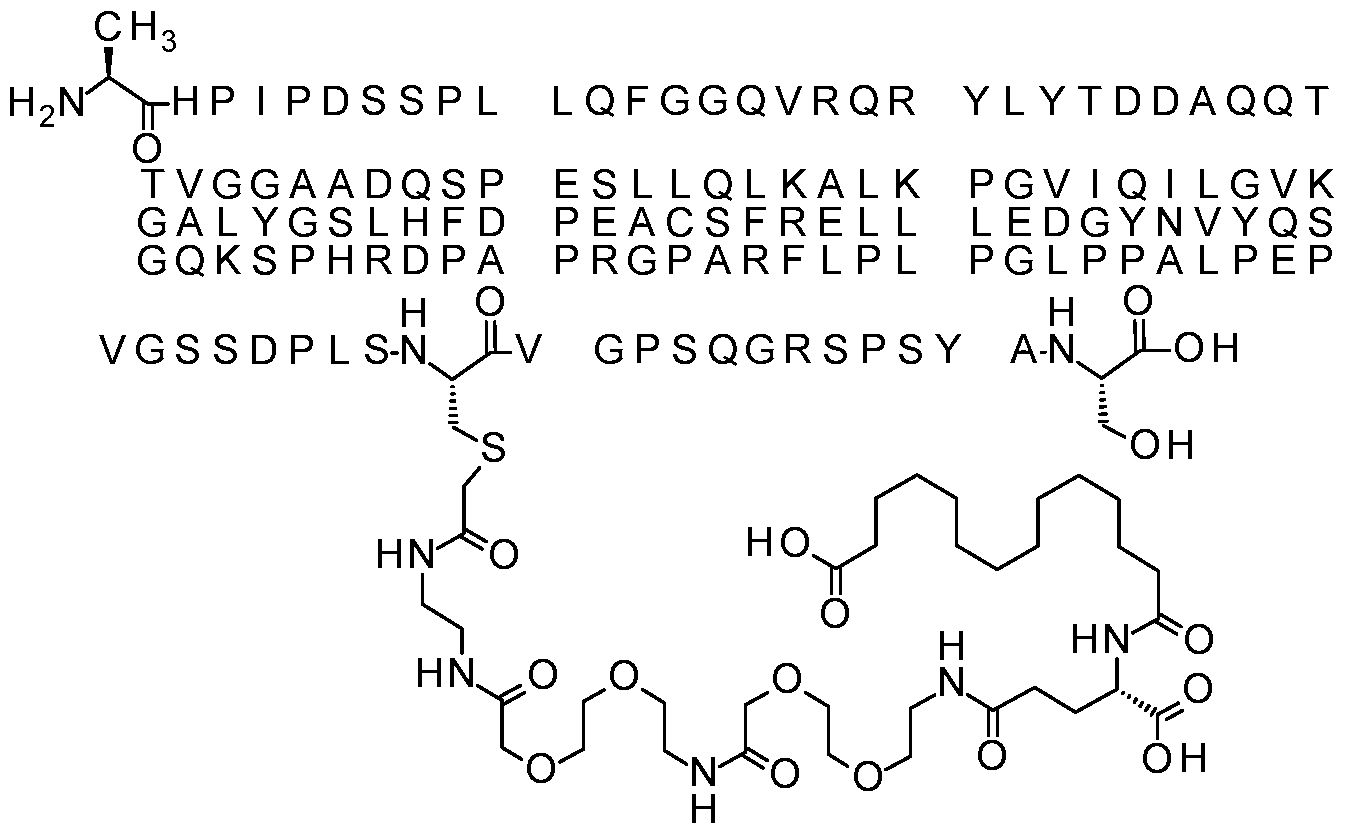
This compound is a derivative of the FGF21 analogue of SEQ ID NO: 13 (see example 3) prepared by the method described under Example 5.1 using the reagent 13-{(S)-1- carboxy-3-[2-(2-{[2-(2-{[2-(2-bromoacetylamino)ethylcarbamoyl]methoxy}ethoxy)- ethylcarbamoyl]methoxy}ethoxy)ethylcarbamoyl]-propylcarbamoyl}tridecanoic acid of Example 4.3.
LCMS method 1
Theoretical mass: 20225.; Found: 20226.7
Example 5.16: Compound 35
S{Beta-169}-[2-[2-[[2-[2-[2-[[2-[2-[2-[[(4S)-4-carboxy-4-(15-carboxypentadeca amino)butanoyl]amino]ethoxy]ethoxy]acetyl]amino]ethoxy]ethoxy]acetyl]amino]- ethylamino]-2-oxoethyl]-Ala[Glnl21,Leul68,Cysl69]FGF21
I PDSSP L LQFGGQVRQR YLYTDDAQQT EAH LE I REDG GGAADQSP ES L LQL KAL K PGV I Q I LGVK TSRF LCQRPD LYGS LHFD PEACS FRE L L L EDGYN VYQS EAHG L P L H L P

VGSSDP

This compound is a derivative of the FGF21 analogue of SEQ ID NO: 14 (see example 3) prepared by the method described under Example 5.1 using the reagent 15-{(S)-1- carboxy-3-[2-(2-{[2-(2-{[2-(2-bromoacetylamino)ethylcarbamoyl]methoxy}ethoxy)- ethylcarbamoyl]methoxy}ethoxy)ethylcarbamoyl]-propylcarbamoyl}pentadecanoic acid of Example 4.1.
LCMS method 3
Theoretical mass: 20267.8; Found: 20268.2 Example 5.17: Compound 36
18-[[(lS)-4-[2-[2-[2-[2-[2-[2-(2-acetamidoethylamino)-2-oxo- ethoxy]ethoxy]ethylamino]-2-oxo-ethoxy]ethoxy]ethylamino]-l-carboxy-4-oxo- butyl]amino]-18-oxo-octadecanoic acid-Ala [Glnl21, Leu 168, Cysl70]FGF21
H2N P I PDSSP L LQFGGQVRQR YLYTDDAQQT EAH LE I REDG
T VGGAADQS P ES L LQLKAL K PGV I Q I LGVK TSRF LCQRPD GA L YGS L H F D PEACSFRE L L L EDGYNVYQS EAHGL P LH LP GQKSPHRDP APQPPD
VGSSDP LS L

This compound is a derivative of the FGF21 analogue of SEQ ID NO: 15 (see exam prepared by the method described under Example 5.1 using the reagent
18-[[(lS)-4-[2-[2-[2-[2-[2-[2-[2-[(2-bromoacetyl)amino]ethylamino]-2-oxo- ethoxy]ethoxy]ethylamino]-2-oxo-ethoxy]ethoxy]ethylamino]-l-carboxy-4-oxo- butyl]amino]-18-oxo-octadecanoic acid of example 4.5.
Example 5.18: Compound 37
S{Beta-173}-[2-[2-[[2-[2-[2-[[2-[2-[2-[[(4S)-4-carboxy-4-(15-carboxypentadecanoyl- amino)butanoyl]amino]ethoxy]ethoxy]acetyl]amino]ethoxy]ethoxy]acetyl]amino]- ethylamino]-2-oxoethyl]-Ala[Glnl21,Leul68,Cysl73]FGF21
P I PDSSP L LQFGGQVRQR YLYTDDAQQT EAH LE I REDG

H

This compound is a derivative of the FGF21 analogue of SEQ ID NO: 18 (see example 3) prepared by the method described under Example 5.1 using the reagent 15-{(S)-1-
carboxy-3-[2-(2-{[2-(2-{[2-(2-bromoacetylamino)ethylcarbamoyl]methoxy}ethoxy)- ethylcarbamoyl]methoxy}ethoxy)ethylcarbamoyl]-propylcarbamoyl}pentadecanoic acid of Example 4.1. LCMS method 3
Theoretical mass: 20238.8; Found: 20239.3
Example 5.19: Compound 38
S{Beta-174}-[2-[2-[[2-[2-[2-[[2-[2-[2-[[(4S)-4-carboxy-4-(13-carboxytridecanoyl- amino)butanoyl]amino]ethoxy]ethoxy]acetyl]amino]ethoxy]ethoxy]acetyl]amino]- ethylamino]-2-oxoethyl]-Ala[Glnl21,Leul68,Cysl74]FGF21 QT EAHLE I REDG VK TSRF LCQRPD QS EAHGLPLH LP EP PG I LAPQPPD

This compound is a derivative of the FGF21 analogue of SEQ ID NO: 19 (see example 3) prepared by the method described under Example 5.1 using the reagent 13-{(S)-1- carboxy-3-[2-(2-{[2-(2-{[2-(2-bromoacetylamino)ethylcarbamoyl]methoxy}ethoxy)- ethylcarbamoyl]methoxy}ethoxy)ethylcarbamoyl]-propylcarbamoyl}tritadecanoic acid of Example 4.3.
LCMS method 1
Theoretical mass: 20281.9; Found: 20281.9
Example 5.20: Compound 39
18-[[(lS)-4-[2-[2-[2-[2-[2-[2-(2-acetamidoethylamino)-2-oxo- ethoxy]ethoxy]ethylamino]-2-oxo-ethoxy]ethoxy]ethylamino]-l-carboxy-4-oxo- butyl]amino]-18-oxo-octadecanoic acid-Ala [Glnl21, Leu 168, Cysl74]FGF21 P I PDSSPL LQFGGQVRQR YLYTDDAQQT EAHLE I REDG GGAADQS P E VK TSRF LCQRPD GA L YGS L H F D P QS EAHGLPLHLP GQKSPHRDPA P EP PG I L APQP PD
VGSSDPLS LV G

This compound is a derivative of the FGF21 analogue of SEQ ID NO: 19 (see example 3) prepared by the method described under Example 5.1 using the reagent
18-[[(lS)-4-[2-[2-[2-[2-[2-[2-[2-[(2-bromoacetyl)amino]ethylamino]-2-oxo- ethoxy]ethoxy]ethylamino]-2-oxo-ethoxy]ethoxy]ethylamino]-l-carboxy-4-oxo- butyl]amino]-18-oxo-octadecanoic acid of example 4.5
Example 5.21: Compound 40
16-[[(lS)-4-[2-[2-[2-[2-[2-[2-(2-acetamidoethylamino)-2-oxo- ethoxy]ethoxy]ethylamino]-2-oxo-ethoxy]ethoxy]ethylamino]-l-carboxy-4-oxo- butyl]amino]-16-oxo-hexadecanoic acid-Ala [Glnl21,Leul68,Cysl74]FGF21
QT EAH L E I REDG VK TSRF LCQRPD QS EAHG L P L H L P E P PG I LAPQP PD

This compound is a derivative of the FGF21 analogue of SEQ ID NO: 19 (see exam prepared by the method described under Example 5.1 using the reagent
16-[[(lS)-4-[2-[2-[2-[2-[2-[2-[2-[(2-bromoacetyl)amino]ethylamino]-2-oxo- ethoxy]ethoxy]ethylamino]-2-oxo-ethoxy]ethoxy]ethylamino]-l-carboxy-4-oxo- butyl]amino]-16-oxo-hexadecanoic acid of example 4.1
Example 5.22: Compound 41
S{Beta-175}-[2-[2-[[2-[2-[2-[[2-[2-[2-[[(4S)-4-carboxy-4-(15-carboxypentadeca amino)butanoyl]amino]ethoxy]ethoxy]acetyl]amino]ethoxy]ethoxy]acetyl]amino]- ethylamino]-2-oxoethyl]-Ala[Glnl21,Leul68,Cysl75]FGF21
P I PDSS P L LQFGGQVRQR Y L YTDDAQQT EAH L E I REDG GGAADQS P ES L LQ L KA L K PGV I Q I LGVK TSRF L CQRPD L YGS L H F D P EACS F RE L L L E DGYNVYQS EAHG L P L H L P

H O H O
VGSSDP L S L V GPSQGN^S PS YA-N^OH
ΌΗ
This compound is a derivative of the FGF21 analogue of SEQ ID NO: 20 (see example 3) prepared by the method described under Example 5.1 using the reagent 15-{(S)-1- carboxy-3-[2-(2-{[2-(2-{[2-(2-bromoacetylamino)ethylcarbamoyl]methoxy}ethoxy)- ethylcarbamoyl]methoxy}ethoxy)ethylcarbamoyl]-propylcarbamoyl}pentadecanoic acid of Example 4.1.
LCMS method 3
Theoretical mass: 20210.8; Found
Example 5.23: Compound 42
S{Beta-176}-[2-[2-[[2-[2-[2-[[2-[2-[2-[[(4S)-4-carboxy-4-(15-carboxypentadecanoyl- amino)butanoyl]amino]ethoxy]ethoxy]acetyl]amino]ethoxy]ethoxy]acetyl]amino]- ethylamino]-2-oxoethyl]-Ala[Glnl21,Leul68,Cysl76]FGF21 I PDSSP L LQFGGQVRQR Y LYTDDAQQT EAH L E I REDG GAADQS P ES L LQLKALK PGV I Q I LGVK TSRF LCQRPD YGS L H F D PEACS FRE L L L EDGYN VYQS EAHGL P LH L P


LCMS method 3
Theoretical mass: 20279.9; Found: 20280.4
Example 5.24: Compound 43
4-[10-[[(lS)-4-[2-[2-[2-[2-[2-[2-[[(lS)-5-acetamido-l-carboxy-pentyl]amino]-2-oxo- ethoxy]ethoxy]ethylamino]-2-oxo-ethoxy]ethoxy]ethylamino]-l-carboxy-4-oxo- butyl]amino]-10-oxo-decoxy]benzoic acid]-Ala[Glnl21,Leul68,Cysl80]FGF21
P I PDSSPL LQFGGQVRQR YLYTDDAQQT EAHLE I REDG

V H

This compound is a derivative of the FGF21 analogue of SEQ ID NO: 8 (see example 3) prepared by the method described under Example 5.1 using the reagent 4-[10-[[(lS)-4- [2-[2-[2-[2-[2-[2-[[(lS)-5-[(2-bromoacetyl)amino]-l-carboxy-pentyl]amino]-2-oxo- ethoxy]ethoxy]ethylamino]-2-oxo-ethoxy]ethoxy]ethylamino]-l-carboxy-4-oxo- butyl]amino]-10-oxo-decoxy]benzoic acid of Example 4.11.
Example 5.25: Compound 44
4-[10-[[4-[2-[2-[2-[2-[2-[2-[[(lS)-5-acetamido-l-carboxy-pentyl]amino]-2-oxo- ethoxy]ethoxy]ethylamino]-2-oxo-ethoxy]ethoxy]ethylamino] -4-oxo- butyl]sulfonylamino]-10-oxo-decoxy]benzoic acid] -Ala [Gin 121, Leu 168, Cysl80]FGF21
P I PDSSP L LQFGGQVRQR YLYTDDAQQT EAH LE I REDG
GGAADQS P ES L LQLKALK PGV I Q I LGVK TSRF LCQRPD L YGS L H F D PEACSFRE L L L EDGYN VYQS EAHGLP LH LP

H

This compound is a derivative of the FGF21 analogue of SEQ ID NO: 8 (see example 3) prepared by the method described under Example 5.1 using the reagent
4-[10-[[4-[2-[2-[2-[2-[2-[2-[[(lS)-5-[(2-bromoacetyl)amino]-l-carboxy-pentyl]amino]- 2-oxo-ethoxy]ethoxy]ethylamino]-2-oxo-ethoxy]ethoxy]ethylamino] -4-oxo- butyl]sulfonylamino]-10-oxo-decoxy]benzoic acid of Example 4.10.
Example 5.26: Compound 45
20-[[(lS)-4-[[(lS)-4-[2-[2-[2-[2-[2-[2-[[(lS)-5-acetamido-l-carboxy-pentyl]amino]-2- oxo-ethoxy]ethoxy]ethylamino]-2-oxo-ethoxy]ethoxy]ethylamino]-l-carboxy-4-oxo- butyl]amino]-l-carboxy-4-oxo-butyl]amino]-20-oxo-icosanoic acid- Ala [Glnl21,Leul68,Cysl80]FGF21
P I PDSSP L LQFGGQVRQR YLYTDDAQQT EAH LE I REDG

TV GGAADQS P ES L LQLKAL K PGV I Q I LGVK TSRF LCQRPD GA L YGS L H F D PEACS FRE L L L EDGYNVYQS EAHGLP LH L P GQ KSPHRDPA PRGPARF L P L PGLPPAL PEP PG I LAPQPPD
H

This compound is a derivative of the FGF21 analogue of SEQ ID NO: 8 (see example 3) prepared by the method described under Example 5.1 using the reagent
20-[[(lS)-4-[[(lS)-4-[2-[2-[2-[2-[2-[2-[[(lS)-5-[(2-bromoacetyl)amino]-l-carboxy- pentyl]amino]-2-oxo-ethoxy]ethoxy]ethylamino]-2-oxo-ethoxy]ethoxy]ethylamino]-l- carboxy-4-oxo-butyl]amino]-l-carboxy-4-oxo-butyl]amino]-20-oxo-icosanoic acid of example 4.12.
Example 5.27: Compound 46
20-[[(lS)-4-[2-[2-[2-[2-[2-[2-[[(lS)-5-acetamido-l-carboxy-pentyl]amino]-2-oxo- ethoxy]ethoxy]ethylamino]-2-oxo-ethoxy]ethoxy]ethylamino]-l-carboxy-4-oxo- butyl]amino]-20-oxo-icosanoic acid-Ala[Glnl21,Leul68,Cysl80]FGF21
P I PDSSPL LQFGGQVRQR YLYTDDAQQT EAHLE I REDG

TV GGAADQS P ESL LQLKALK PGV I Q I LGVK TSRF LCQRPD GA L YGS L H F D PEACS FRE L L L E DGYN V YQS EAHGLPLHLP GQ KSPHRDPA PRGPARF L P L PGLPPALPEP PG I L APQPPD

This compound is a derivative of the FGF21 analogue of SEQ ID NO: 8 (see example prepared by the method described under Example 5.1 using the reagent
20-[[(lS)-4-[2-[2-[2-[2-[2-[2-[[(lS)-5-[(2-bromoacetyl)amino]-l-carboxy- pentyl]amino]-2-oxo-ethoxy]ethoxy]ethylamino]-2-oxo-ethoxy]ethoxy]ethylamino]- carboxy-4-oxo-butyl]amino]-20-oxo-icosanoic acid of example 4.13.
Example 5.28: Compound 47
(2S)-6-acetamido-2-[[2-[2-[2-[[2-[2-[2-[[(4S)-4-carboxy-4-(16- sulfohexadecanoylamino)butanoyl]amino]ethoxy]ethoxy]acetyl]amino]ethoxy]ethoxy]a tyl]amino]hexadecanoic acid-Ala[Glnl21,Leul68,Cysl80]FGF21
P I PDSSP L LQFGGQVRQR Y LYTDDAQQT EAH L E I REDG
TVGGAADQS P ES L LQL KA L K PGV I Q I LGVK TSRF LCQRPD GA L YGS L H F D PEACS FRE L L L EDGYNVYQS EAHG L P L H L P GQKSPHRDPA PRGPARF L P L PGL PPA L PEP PG I LAPQPPD

This compound is a derivative of the FGF21 analogue of SEQ ID NO: 8 (see example 3) prepared by the method described under Example 5.1 using the reagent
(2S)-6-[(2-bromoacetyl)amino]-2-[[2-[2-[2-[[2-[2-[2-[[(4S)-4-carboxy-4-(16- sulfohexadecanoylamino)butanoyl]amino]ethoxy]ethoxy]acetyl]amino]ethoxy]ethoxy]ace tyl]amino]hexanoic acid of example 4.14.
Example 5.29: Compound 48
12-[[(lS)-4-[2-[2-[2-[2-[2-[2-[[(lS)-5-acetamido-l-carboxy-pentyl]amino]-2-oxo- ethoxy]ethoxy]ethylamino]-2-oxo-ethoxy]ethoxy]ethylamino]-l-carboxy-4-oxo- butyl]amino]-12-oxo-dodecanoic acid-Ala [Glnl21,Leul68,Cysl80]FGF21
P I PDSSPL LQFGGQVRQR YLYTDDAQQT EAHLE I REDG

T VGGAADQS P ESLLQLKALK PGV I Q I LGVK TSRF LCQRPD GA L YGS L H F D PEACSFREL L L EDGYNVYQS EAHGLPLHLP GQKSPHRDPA PRGPARF L P L PGLPPALPEP PG I L APQPPD

This compound is a derivative of the FGF21 analogue of SEQ ID NO: 8 (see example 3) prepared by the method described under Example 5.1 using the reagent
12-[[(lS)-4-[2-[2-[2-[2-[2-[2-[[(lS)-5-[(2-bromoacetyl)amino]-l-carboxy- pentyl]amino]-2-oxo-ethoxy]ethoxy]ethylamino]-2-oxo-ethoxy]ethoxy]ethylamino]-l- carboxy-4-oxo-butyl]amino]-12-oxo-dodecanoic acid of example 4.16.
Example 5.30: Compound 49
12-[[(lS)-4-[[(lS)-4-[2-[2-[2-[2-[2-[2-[[(lS)-5-acetamido-l-carboxy-pentyl]amino]-2- oxo-ethoxy]ethoxy]ethylamino]-2-oxo-ethoxy]ethoxy]ethylamino]-l-carboxy-4-oxo- butyl]amino]-l-carboxy-4-oxo-butyl]amino]-12-oxo-dodecanoic acid- Ala [Glnl21,Leul68,Cysl80]FGF21
N P I PDSSPL LQFGGQVRQR YLYTDDAQQT EAHLE I REDG
T VGGAADQS ESL LQLKALK PGV I Q I LG VK TSRF L CQRPD GA L YGS L H F PEACS FRE L L L EDGYN VYQS E AHG L P L H L P
GQKSPHRDPA PRGPARF L P L PGLPPALPEP PG I L APQP PD

This compound is a derivative of the FGF21 analogue of SEQ ID NO: 8 (see example 3) prepared by the method described under Example 5.1 using the reagent
12-[[(lS)-4-[[(lS)-4-[2-[2-[2-[2-[2-[2-[[(lS)-5-[(2-bromoacetyl)amino]-l-carboxy- pentyl]amino]-2-oxo-ethoxy]ethoxy]ethylamino]-2-oxo-ethoxy]ethoxy]ethylamino]-l- carboxy-4-oxo-butyl]amino]-l-carboxy-4-oxo-butyl]amino]-12-oxo-dodecanoic acid of example 4.15.
Example 5.31: Compound 50
20-[[4-[[(lS)-4-[2-[2-[2-[2-[2-[2-[[(lS)-5-[(2-acetamido]-l-carboxy-pentyl]amino]-2- oxo-ethoxy]ethoxy]ethylamino]-2-oxo-ethoxy]ethoxy]ethylamino]-l-carboxy-4-oxo- butyl]carbamoyl]cyclohexyl]methylamino]-20-oxo-icosanoic acid- Ala [Glnl21,Leul68,Cysl80]FGF21
EAHLE I REDG
TSRF LCQRPD EAHGLPLHLP PG I L APQP PD

This compound is a derivative of the FGF21 analogue of SEQ ID NO: 8 (see example 3) prepared by the method described under Example 5.1 using the reagent
20-[[4-[[(lS)-4-[2-[2-[2-[2-[2-[2-[[(lS)-5-[(2-bromoacetyl)amino]-l-carboxy- pentyl]amino]-2-oxo-ethoxy]ethoxy]ethylamino]-2-oxo-ethoxy]ethoxy]ethylamino]-l- carboxy-4-oxo-butyl]carbamoyl]cyclohexyl]methylamino]-20-oxo-icosanoic acid of example 4.17. Example 5.32: Compound 51
16-[[4-[[(lS)-4-[2-[2-[2-[2-[2-[2-(2-acetamidoethylamino)-2-oxo- ethoxy]ethoxy]ethylamino]-2-oxo-ethoxy]ethoxy]ethylamino]-l-carboxy-4-oxo- butyl]carbamoyl]cyclohexyl]methylamino]-16-oxo-hexadecanoic acid- Ala[Glnl21,Leul68,Cysl80]FGF21
T EAHLE I REDG
K TSRF LCQRPD S EAHGLPLHLP P PG I L APQPPD

This compound is a derivative of the FGF21 analogue of SEQ ID NO: 8 (see example 3) prepared by the method described under Example 5.1 using the reagent
16-[[4-[[(lS)-4-[2-[2-[2-[2-[2-[2-[2-[(2-bromoacetyl)amino]ethylamino]-2-oxo- ethoxy]ethoxy]ethylamino]-2-oxo-ethoxy]ethoxy]ethylamino]-l-carboxy-4-oxo- butyl]carbamoyl]cyclohexyl]methylamino]-16-oxo-hexadecanoic acid of example 4.7.
Example 5.33: Compound 52
16-[[4-[[(lS)-4-[2-[2-[2-[2-[2-[2-[[(lS)-5-[(2-acetamido]-l-carboxy-pentyl]amino]-2- oxo-ethoxy]ethoxy]ethylamino]-2-oxo-ethoxy]ethoxy]ethylamino]-l-carboxy-4-oxo- butyl]carbamoyl]cyclohexyl]methylamino]-16-oxo-hexadecanoic acid- Ala [Glnl21,Leul68,Cysl80]FGF21
P I PDSSPL LQFGGQVRQR YLYTDDAQQT EAHLE I REDG

TV GGAADQS P ESLLQLKALK PGV I Q I LGVK TSRF LCQRPD GA L YGS L H F D PEACSFRELL L EDGYNVYQS EAHGLPLHLP GQ KSPHRDPA PRGPARF L P L PGLPPALPEP PG I L APQPPD
VG SS H

This compound is a derivative of the FGF21 analogue of SEQ ID NO: 8 (see example 3) prepared by the method described under Example 5.1 using the reagent
16-[[4-[[(lS)-4-[2-[2-[2-[2-[2-[2-[[(lS)-5-[(2-bromoacetyl)amino]-l-carboxy- pentyl]amino]-2-oxo-ethoxy]ethoxy]ethylamino]-2-oxo-ethoxy]ethoxy]ethylamino]-l- carboxy-4-oxo-butyl]carbamoyl]cyclohexyl]methylamino]-16-oxo-hexadecanoic acid of example 4.9.
Example 5.34: Compound 53
18-[[4-[[(lS)-4-[2-[2-[2-[2-[2-[2-[[(lS)-5-[(2-acetamido]-l-carboxy-pentyl]amino]-2- oxo-ethoxy]ethoxy]ethylamino]-2-oxo-ethoxy]ethoxy]ethylamino]-l-carboxy-4-oxo- butyl]carbamoyl]cyclohexyl]methylamino]-18-oxo-octadecanoic acid- Ala [Glnl21,Leul68,Cysl80]FGF21
P I PDSSPL LQFGGQVRQR YLYTDDAQQT EAHLE I REDG
O
T VGGAADQS P ESL LQLKALK PGV I Q I LGVK TSRF LCQRPD GA L YGS L H F D PEACSFREL L L EDGYNVYQS EAHGLPLHLP GQKSPHRDPA PRGPARF L P L PGLPPALPEP PG I L APQP PD
H

This compound is a derivative of the FGF21 analogue of SEQ ID NO: 8 (see example 3) prepared by the method described under Example 5.1 using the reagent
18-[[4-[[(lS)-4-[2-[2-[2-[2-[2-[2-[[(lS)-5-[(2-bromoacetyl)amino]-l-carboxy- pentyl]amino]-2-oxo-ethoxy]ethoxy]ethylamino]-2-oxo-ethoxy]ethoxy]ethylamino]-l- carboxy-4-oxo-butyl]carbamoyl]cyclohexyl]methylamino]-18-oxo-octadecanoic acid of example 4.8.
Example 5.35: Compound 54
12-[[4-[[(lS)-4-[2-[2-[2-[2-[2-[2-(2-acetamidoethylamino)-2-oxo- ethoxy]ethoxy]ethylamino]-2-oxo-ethoxy]ethoxy]ethylamino]-l-carboxy-4-oxo- butyl]carbamoyl]cyclohexyl]methylamino]-12-oxo-dodecanoic acid- Ala [Glnl21,Leul68,Cysl80]FGF21
CH,
H2N P I PDSS P L LQFGGQVRQR Y LYTDDAQQT EAH L E I REDG o
TV GGAADQS P ES L LQ L KA L K PGV I Q I LGVK TSRF LCQRPD GA L YGS L H F D P EACS FRE L L L EDGYN VYQS EAHG L P L H L P GQ KS PHRDPA PRGPARF L P L PG L PPA L PE P PG I L APQP PD
VG SSDP LS LV
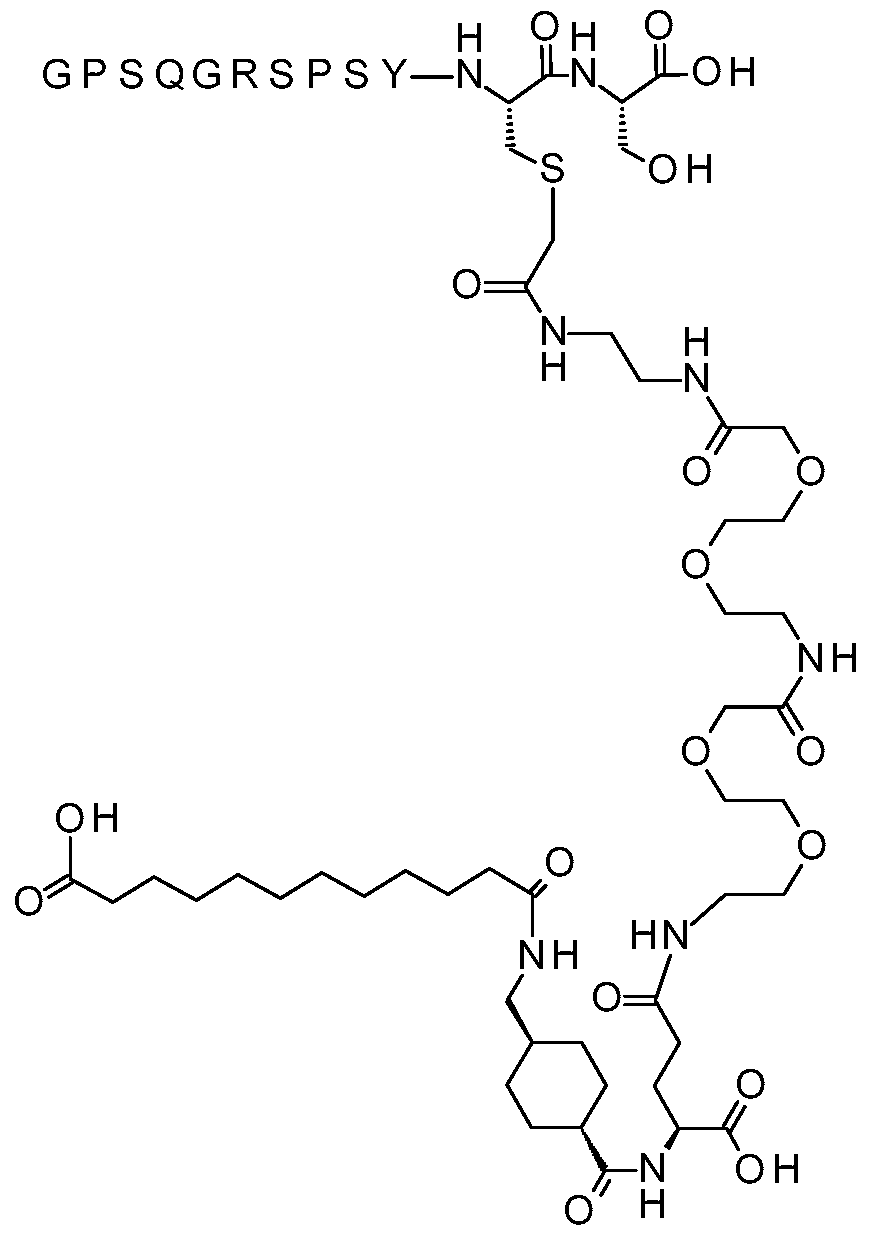
This compound is a derivative of the FGF21 analogue of SEQ ID NO: 8 (see example prepared by the method described under Example 5.1 using the reagent
12-[[4-[[(lS)-4-[2-[2-[2-[2-[2-[2-[2-[(2-bromoacetyl)amino]ethylamino]-2-oxo- ethoxy]ethoxy]ethylamino]-2-oxo-ethoxy]ethoxy]ethylamino]-l-carboxy-4-oxo- butyl]carbamoyl]cyclohexyl]methylamino]-12-oxo-dodecanoic acid of example 4.6.
Example 5.36: Compound 55
4-[10-[[(lS)-4-[2-[2-[2-[2-[2-[2-[[(lS)-5-acetamido-l-carboxy-pentyl]amino]-2-oxo- ethoxy]ethoxy]ethylamino]-2-oxo-ethoxy]ethoxy]ethylamino]-l-carboxy-4-oxo- butyl]amino]-10-oxo-decoxy]benzoic acid]-Ala[Glnl21,Leul68,Cysl81]FGF21
DAQQT EAHLE I REDG
I LGVK TSRF LCQRPD N VYQS EAHGLPLHLP ALPEP PG I L APQPPD
H

This compound is a derivative of the FGF21 analogue of SEQ ID NO: 10 (see example 3) prepared by the method described under Example 5.1 using the reagent 4-[10-[[(lS)-4- [2-[2-[2-[2-[2-[2-[[(lS)-5-[(2-bromoacetyl)amino]-l-carboxy-pentyl]amino]-2-oxo- ethoxy]ethoxy]ethylamino]-2-oxo-ethoxy]ethoxy]ethylamino]-l-carboxy-4-oxo- butyl]amino]-10-oxo-decoxy]benzoic acid of Example 4.11.
Example 5.37: Compound 56
4-[10-[[4-[2-[2-[2-[2-[2-[2-[[(lS)-5-acetamido-l-carboxy-pentyl]amino]-2-oxo- ethoxy]ethoxy]ethylamino]-2-oxo-ethoxy]ethoxy]ethylamino] -4-oxo- butyl]sulfonylamino]-10-oxo-decoxy]benzoic acid-Ala [Gin 121, Leu 168, Cysl81]FGF21
DAQQT EAH LE I REDG
I LGVK TSRF LCQRPD N VYQS EAHGLP LH LP AL PEP PG I L APQP PD
H
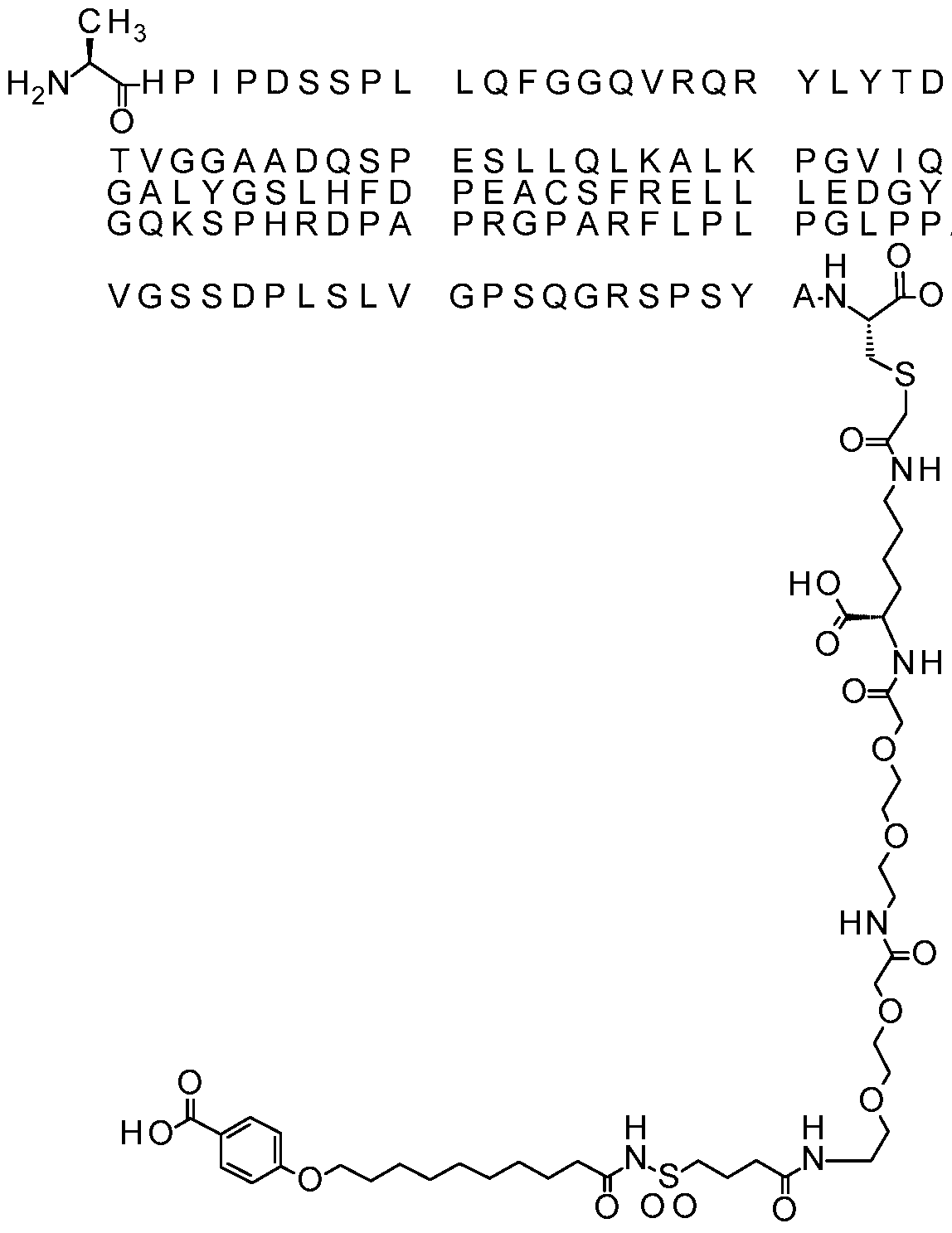
This compound is a derivative of the FGF21 analogue of SEQ ID NO: 10 (see example 3) prepared by the method described under Example 5.1 using the reagent
4-[10-[[4-[2-[2-[2-[2-[2-[2-[[(lS)-5-[(2-bromoacetyl)amino]-l-carboxy-pentyl]amino]- 2-oxo-ethoxy]ethoxy]ethylamino]-2-oxo-ethoxy]ethoxy]ethylamino] -4-oxo- butyl]sulfonylamino]-10-oxo-decoxy]benzoic acid of Example 4.10.
Preparation of FGF21 stock compositions
The prepared analogs and derivatives may be purified using standard techniques and stored in a suitable composition until preparation of the pharmaceutical composition. In the following the protein/derivative preparations were purified and desalted. During desalting step a buffer exchange to a buffer suitable for final formualtion is carried out. If required, a final concentration step was perfomred to obtain e.g.25 mg/mL. Liquid stock
solutions were sterile filtered and stored at 4°C or frozen until use. Characterisation of drug subtsance was carried out to assure suitable purity and storage stability.
Pharmacological methods
The utility of FGF21 analogues or derivatives as pharmaceutically active agents in the reduction of weight gain and treatment of obesity and diabetes in mammals (such as humans) may be demonstrated by the activity of the FGF21 agonists in conventional assays and in the in vitro and in vivo assays described below.
Such assays also provide a means whereby the activities of the FGF21 compounds can be compared with the activities of known compounds.
Example 6: FGF receptor potency in an Erk phosphorylation assay in HEK293 overexpressinq human BKL
The purpose of this example is to test the activity, or potency, of the FGF21 derivatives in vitro. The in vitro potency is the measure of FGF receptor activation in a whole cell assay.
The potencies of the FGF21 derivatives of Example 5 were determined in HEK (Human Embryonic Kidney cells) overexpressing human beta-klotho (BKL) as described further below.
In order to test the binding of the FGF21 derivatives to albumin, the assay was performed in the absence of serum albumin as well as in the presence of human serum albumin (HSA) (0.1% final assay concentration) . An increase in EC50 value (decrease in potency) in the presence of serum albumin for FGF21 derivatives would indicate binding to serum albumin and represents a method to predict a protracted pharmacokinetic profile of the test substance in animal models.
The results for FGF21 analogues are shown in table 2 and the results for the FGF21 derivatives are shown in table 3. MetFGF21 (SEQ ID NO: 2) is included for reference.
Assay principle
HEK293 cells endogenously express several FGF receptors, including FGFRlc, FGFR3c and FGFR4. These cells are unresponsive to FGF21 until transfected with the co- receptor beta-klotho (BKL) . Activation of the FGF receptor/BKL complex leads to activation of the MAPK/ERK signalling pathway and phosphorylation of ERK. The level of phosphorylated ERK (pERK) at a given time point increases with increasing
concentrations of FGF21. As described below the level of pERK is measured after 12 minutes of stimulation with a range of FGF21 analogue concentrations.
Assay description
The HEK293/beta-klotho cells are seeded with 30.000 cells/well in 96 well plates in DMEM (BioWhittaker #BE12-604F/U1), supplemented with 10% FCS (Gibco #16140- 071), 1% penicillin/streptomycin (Gibco #15140), 100 μς/ιηΙ Hygromycin B,
(Calbiochem, # 400052). Two days later and 2 hours before addition of compound the cell medium is exchanged with 100 μΙ basal medium (DMEM (BioWhittaker #BE12- 604F/U1)). The FGF21 analogues are diluted in assay medium (DMEM (BioWhittaker #BE12-604F/U1) supplemented with 0.02% Tween20), warmed to 37 °C, added to the cells (100 μΙ) and incubated at 37 °C for 12 minutes. The FGF21 derivatives were also tested in the presence of 0.1% HSA (Sigma - A1887). All medium is quickly removed and 50 μΙ lysis buffer is added pr. well. The plate is shaken for 5 minutes and the lysate is ready for measurement of pERK. pERK is measured in 384 well plates with the AlphaScreen SureFire kit (PerkinElmer #TGRES10K). This kit is based on ERK and pERK specific antibodies coupled to donor and acceptor beads. The presence of pERK will bring acceptor and donor beads in close proximity and a signal is generated that is read on EnVision. The data are analysed using GraphPad Prism and the potency of the FGF21 proteins is described as absolute EC50 value.
Table 2A. Potency of FGF21 analogues in HEK293/BKL cells
SEQ ID of EC50
Compound Compound name
Backbone (nM)
2
1 MetFGF21 1.8
3
2 Ala[Glnl21,Leul68]FGF21 2.0
S{Beta-176}-2-aminoethylsulfanyl- 4
3 227 Ala[Glnl21,Leul68,Cysl76]FGF21
5
4 Ala[Glnl21,Leul68,Cysl77]FGF21 416
S{Beta-178}-2-aminoethylsulfanyl- 6
5 105 Ala[Glnl21,Leul68,Cysl78]FGF21
S{Beta-179}-2-aminoethylsulfanyl- 7
6 69 Ala[Glnl21,Leul68,Cysl79]FGF21
S{Beta-180}-2-aminoethylsulfanyl- 8
7 2.3 Ala[Glnl21,Leul68,Cysl80]FGF21
S{Beta-180}-2-aminoethylsulfanyl- 9
8 Ala[Glnl21,Leul68,Cysl80, 20
desl81]FGF21
S{ Beta- 181 }-2-aminoethylsulfanyl- 10
9 27
Ala[Glnl21,Leul68,Cysl81]FGF21
As can be seen from the results in table 2, introduction of a cysteine in positions 176, 177, 178 or 179 dramatically decreases the potency as compared to MetFGF21. Surprisingly, however, the introduction of a cysteine in position 180 or in position 181 leads to no (180C) or modest (181C) reduction in potency as compared to MetFGF21. Compound 7, with a cysteine in position 180, displays a potency similar to both
MetFGF21 and Compound 2 having the same amino acid changes as Compound 8, except for the cysteine in position 180.
The potency of Compound 9 with a cysteine in position 181 is only slightly decreased as compared to MetFGF21 and also to Compound 2 having the same amino acid changes as Compound 9, except for the cysteine in position 181.
Table 2B. Potency of further FGF21 analogues in HEK293/BKL cells

It can be seen that compound #26 with a C168 amino acid substitution has decreased potency, while the analogues with a cysteine in position 167, 169, 170, 171, 172, 173, 174 and 175 surprising have potencies similar to MetFGF21.
Table 3A. Potency of FGF21 derivatives in HEK293/BKL cells in the absence or presence of 0.1 % HSA.

1 the average value obtained after additional testing.
As can be seen from the results in table 3A, it was surprisingly found that the attachment of a side chain to the cysteine in either of positions 178-181 does not lead to a decrease in potency as compared to the compounds without a side chain (see table 2). Compounds 11, 12, 15 and 21 all comprise an identical side chain wherein the protractor element is C16 diacid (Chem. la) (the linker elements are one Chem. 2 element, two Chem. 3a elements, and one Chem. 4a element). When comparing with the potencies of the corresponding FGF21 analogues (Compounds 5, 6, 7, and 9, see table 2), it can be seen that the potencies of these FGF21 derivatives are similar to the corresponding FGF analogues (i.e. having no side chain).
The effect on potency of compounds having protractor elements of varying fatty acid chain length was also explored. The potencies of the FGF derivatives with a cysteine in position 180 were similar for FGF21 derivatives having a C12 diacid, a C14 diacid, a C16 diacid or a C18 diacid as protractor element in the absence of HSA. The potencies of the FGF derivatives with a cysteine in position 181 were similar for FGF21 derivatives
having a C14 diacid, a C16 diacid, a C18 diacid or a C20 diacid as protractor element in the absence of HSA.
Increasing the HSA concentration has no or modest effect on the potency of derivatives comprising a C12, C14 or C16 side chain, while the potency of compounds with a C18 or C20 side chain have reduced potency in the presence of 0.1% HAS.
As can be seen from table 3A, the increase of the EC50 value in the presence of 0.1% serum albumin as compared to the EC50 value without serum albumin for the FGF21 derivatives corresponds with the increasing length of the protractor. This corresponds well with an increased half-life for these FGF21 derivatives (see Example 8).
Table 3B. Potency of further FGF21 derivatives in HEK293/BKL cells in the absence or presence of 0.1 % HSA.

The potency of FGF21 derivatives with different FGF21 backbones as described above was further tested and it was found that derivatives with the cysteine in position 169, 170, 171, 172, 173, 174 and 175 all maintain potency when derivatised with a fatty acid protractor. It is noticed that derivatization in Cys 169 reduces potency slightly.
Table 3C. Potency of further FGF21 derivatives in HEK293/BKL cells in the absence or presence of 0.1 % HSA
EC50
Protractor EC50
Compound Protein backbone (0.1% HSA) element (nM)
(nM)
43 -1A, 121Q, 168L, 180C 4-COOH-PhO-ClO 5,0 3
44 -1A, 121Q, 168L, 180C 4-COOH-PhO-ClO 3,2 4
45 -1A, 121Q, 168L, 180C C20 diacid 10,3 65,5
46 -1A, 121Q, 168L, 180C C20 diacid 6,1 52,5
47 -1A, 121Q, 168L, 180C sulfonic acid-C16 4,2 7,1
48 -1A, 121Q, 168L, 180C C12 diacid 8,4 3,4
50 -1A, 121Q, 168L, 180C C12 diacid 7,9 6,1
50 -1A, 121Q, 168L, 180C C20 diacid 4.0 35,5
51 -1A, 121Q, 168L, 180C C16 diacid 3,5 3,2
52 -1A, 121Q, 168L, 180C C16 diacid 4.0 2,1
53 -1A, 121Q, 168L, 180C C18 diacid 4,0 14.0
54 -1A, 121Q, 168L, 180C C12 diacid 4.0 4,7
55 -1A, 121Q, 168L, 181C 4-COOH-PhO-ClO 26.4 138
56 -1A, 121Q, 168L, 181C 4-COOH-PhO-ClO 24.7 132
To compare further protracting elements, different combinations of protractors and linkers were tested. All were conjugated to Cys 180 or Cys 181 and quite similar functionalities of the obtained FGF21 derivatives were observed demonstrating that a variety of protractor elements may be used when conjugated to an FGF21 Cys, such as Cys 180 or Cys 181.
Example 7: Glucose uptake in 3T3-L1 adipocytes
The C-terminal modified analogues were tested for their ability to increase glucose uptake in 3T3-L1 mouse adipocytes. The following assay was used for determining the biological activity, or potency, of FGF21 analogues and derivatives.
Assay principle
The in vitro potency may also be determined in an assay with mouse 3T3-L1 adipocytes by testing the FGF21 analogues and derivatives for their ability to increase glucose uptake into adipocytes. Differentiated 3T3-L1 adipocytes endogenously express FGFRlc and BKL. The 3T3-L1 cells are unresponsive to FGF21 until after differentiated a differentiation lead to expression of the co-receptor BKL. Activation of the FGFR1 receptor/BKL complex increase the expression of glucose transporter 1 (GLUT1) and
therefore FGF21 agonists will lead to an increased amount of glucose taken into the adipocytes in a dose responsive manner.
Assay description
Mouse 3T3-L1 fibroblasts (e.g. available from ATCC, catalogue no. CL-173) were maintained in basal medium (DMEM (4500 mg/l Glucose) with 10% Fetal Bovine Serum (FBS) and 1% Penicillin/Streptomycin) . The cells are not allowed to reach confluence and should be passed (transferred to new vials) before reaching approx. 60% of confluency (by visual inspection) .
For the glucose uptake assay, cells were 15.000 cells/well in a 96 well plate
(BIOCOAT), and when they reached confluency (high density, with a view to have differentiated adipose cells made), the medium was changed from basal medium to basal medium containing Troglitazone, IBMX, Dexamethasone (commercially available from, e.g ., Sigma) and human insulin (commercially available from, e.g., Novo Nordisk A/S) . The cells were used 7-9, days after initiation of differentiation. The cells were stimulated with increasing concentrations (0-300 nM) of the FGF21 analogues or derivatives for 20 hours in basal medium. Before addition of 3H-deoxy-glucose (in what follows: the tracer) the cells were washed in warm (approximately 37 °C) assay buffer (PBS with 1 mM MgCI2 and 2 mM CaCI2), HEPES and 0.1% Human serum albumin) and the cells were incubated with the tracer for 1 hour. This incubation was terminated by washing twice in ice cold assay buffer. The cells were lysed with Triton X-100 and lysates transferred to a 96 wells plate, microscint-40 (commercially available from, e.g., Perkin Elmer) was added and amount of tracer counted in a TOP-counter (e.g. a Packard top-counter from Perkin Elmer). The EC50 and Emax of the FGF21 compound in question were calculated. The results which are shown in tables 4-5 below indicate the EC50 (potency) and Emax (efficacy) of the FGF21 analogues and derivatives, respectively.
Table 4: Glucose uptake in 3T3-L1 adipocytes of FGF21 analogues
Glucose Glucose
Compound Compound name uptake EC50 uptake
(nM) Emax (%)
1 MetFGF21 1.2 100
2 Ala [Glnl21,Leul68] FGF21 3.1 85
Glucose Glucose
Compound Compound name uptake EC50 uptake
(nM) Emax (%)
S{Beta-176}-2-aminoethylsulfanyl-
3 73 84 Ala[Glnl21,Leul68,Cysl76]FGF21
4 Ala[Glnl21,Leul68,Cysl77]FGF21 ND ND
S{Beta-178}-2-aminoethylsulfanyl-
5 50 69 Ala[Glnl21,Leul68,Cysl78]FGF21
S{Beta-179}-2-aminoethylsulfanyl-
6 25 77 Ala[Glnl21,Leul68,Cysl79]FGF21
S{Beta-180}-2-aminoethylsulfanyl-
7 2.6 102 Ala[Glnl21,Leul68,Cysl80]FGF21
S{Beta-180}-2-aminoethylsulfanyl-
8 73 72 Ala[Glnl21,Leul68,Cysl80, desl81]FGF21
S{Beta-181}-2-aminoethylsulfanyl-
9 5.0 74 Ala[Glnl21,Leul68,Cysl81]FGF21
Table 5. Glucose uptake in 3T3-L1 adipocytes of FGF21 derivatives
Glucose Glucose
Protractor
Compound Protein backbone uptake uptake element
EC50 (nM) Emax (%)
11 Ala[Glnl21,Leul68,Cysl78]FGF21 C16 diacid 186 59
12 Ala[Glnl21,Leul68,Cysl79]FGF21 C16 diacid 107 54
13 Ala[Glnl21,Leul68,Cysl80]FGF21 C12 diacid 2.7 87
14 Ala[Glnl21,Leul68,Cysl80]FGF21 C14 diacid 6.7 106
15 Ala[Glnl21,Leul68,Cysl80]FGF21 C16 diacid 9.1 98
16 Ala[Glnl21,Leul68,Cysl80]FGF21 C18 diacid 32 109
17 Ala[Glnl21,Leul68,Cysl80]FGF21 C20 diacid 24 53
Ala[Glnl21,Leul68,Cysl80,
18 C18 diacid 8 71 desl81]FGF21
19 Ala[Glnl21,Leul68,Cysl81]FGF21 C12 diacid ND ND
20 Ala[Glnl21,Leul68,Cysl81]FGF21 C14 diacid 7.2 55
21 Ala[Glnl21,Leul68,Cysl81]FGF21 C16 diacid 31 61
22 Ala[Glnl21,Leul68,Cysl81]FGF21 C18 diacid 56 73
23 Ala[Glnl21,Leul68,Cysl81]FGF21 C20 diacid 410 57
24 Met[Cysl81]FGF21 C18 diacid 37 -
Due to the binding of the side chains of the FGF21 derivatives to albumin, the FGF21 derivatives (table 5) have lower potencies than the corresponding FGF21 analogues (table 4) due to the presence of serum and thereby albumin in the basal assay medium. The decrease in potency correlates with the length of the protractor element.
Example 8: Pharmacokinetic study in mini pigs and mice
The purpose of this study was to determine the protraction in vivo of the FGF21 derivatives after i.v. administration to mini pigs and mice, i.e. the prolongation of their time in the body and thereby their time of action. This was done in a pharmacokinetic (PK) study, where the terminal half-life of the analogue in question was determined. By terminal half-life is meant the time it takes to halve a certain plasma concentration in the terminal elimination phase.
Study in mini pigs
Female Gottingen mini pigs were obtained from Ellegaard Gottingen Minipigs (Dalmose, Denmark) approximately 7-14 months of age and weighing approximately 16- 35 kg were used in the studies. The mini pigs were housed either individually (pigs with permanent catheters) or in a group and fed restrictedly once or twice daily with SDS mini pig diet (Special Diets Services, Essex, UK).
After at least 2 weeks of acclimatisation two permanent central venous catheters were implanted in vena cava caudalis or cranialis in each animal. The animals were allowed 1 week recovery after the surgery, and were then used for repeated
pharmacokinetic studies with a suitable wash-out period between successive dosing.
Intravenous injections (the volume corresponding to for example 0.050-0.125 ml/kg) of the compounds were given through one catheter or through the venflon, and blood was sampled at predefined time points for up till 11 days post dosing (preferably through the other catheter or by venipuncture).
Blood samples (for example 0.8 ml) were collected in EDTA (8mM) coated tubes and then centrifuged at 4°C and 1942G for 10 minutes. Blood samples were collected to adequately cover the full plasma concentration-time profile of the API. In example blood samples were collected at t= predose, 0.0833, 0.25, 0.5, 0.75, 1, 1.5, 2, 3, 4, 6, 8, 10, 24, 30, 48, 72, 96, 120, 144, 168, 192, 216, 240, 264 hours after dose.
Plasma was pipetted into Micronic tubes on dry ice, and kept at -20°C until analysed for plasma concentration of the respective FGF-1 analogue using ELISA.
Individual plasma concentration-time profiles were analyzed by a non-compartmental pharmacokinetic method in Phoenix v. 6.3 (Pharsight Inc., Mountain View, CA, USA), or other relevant software for PK analysis, and the resulting terminal half-lives (harmonic mean) determined. The terminal half-life of the FGF21 derivatives is the arithmetic mean of two determinations with different dosages, as explained above.
Study in mice
The pharmacokinetic profile of FGF21 analogues was tested in normal lean C57bl mice, n = 2-3 (approximately 30 grams). FGF21 compounds were dosed as a single intravenous dose of 20 mg/kg (approximately 5 ml/kg).
The plasma levels of the FGF21 compounds were determined using Fibroblast Growth Factor-21 Human ELISA (available from BioVendor, catalogue no. RD191108200R). The PC based software, WinNonLin version 6.3 from Pharsight Corportion, Cary N.C., was used for the pharmacokinetic calculation. The results are given in table 6.
Table 6: Pharmacokinetic profiles of FGF21 analogues.
Half-life Half-life
Protractor
Compound Protein backbone mice mini pigs element
(hours) (hours)
1 MetFGF21 - 1 2
13 Ala[Glnl21,Leul68,Cysl80]FGF21 C12 diacid 1 ND
14 Ala[Glnl21,Leul68,Cysl80]FGF21 C14 diacid 1 3
15 Ala[Glnl21,Leul68,Cysl80]FGF21 C16 diacid 3 23
16 Ala[Glnl21,Leul68,Cysl80]FGF21 C18 diacid 12 70
17 Ala[Glnl21,Leul68,Cysl80]FGF21 C20 diacid ND ND
Ala[Glnl21,Leul68,Cysl80,
18 C18 diacid ND ND desl81]FGF21
19 Ala[Glnl21,Leul68,Cysl81]FGF21 C12 diacid 1
20 Ala[Glnl21,Leul68,Cysl81]FGF21 C14 diacid 3 2
21 Ala[Glnl21,Leul68,Cysl81]FGF21 C16 diacid 4 25
22 Ala[Glnl21,Leul68,Cysl81]FGF21 C18 diacid 14 85
23 Ala[Glnl21,Leul68,Cysl81]FGF21 C20 diacid 19 ND
24 Met[Cysl81]FGF21 C18 diacid 12 ND
As can be seen from table 6, the plasma half-life increases with the length of the fatty acid chain of the protractor element in both mini pigs and mice.
Example 9: Body weight reduction in lean mice
In order to determine the in vivo potency of the FGF21 derivatives the effect on body weight was studied in lean C57BL mice after subcutaneous (s.c.) administration. It has previously been shown that the weight loss induced by FGF21 in lean mice is predictive of the effect in obese mice and therefore lean mice are considered a good screening model.
The compounds were administered s.c. 1 mg/kg either once (QD) or twice (BID) daily in lOmM phosphate, 2% (w/vol) glycerol, 500ppm ( = 0.05%) polysorbate 80, pH=8.15, (2 ml/kg) for 7 days (n = 7-8). The respective vehicle treated groups (control) were treated with lOmM phosphate, 2% (w/vol) glycerol, 500ppm ( = 0.05%) polysorbate 80, pH=8.15, (2 ml/kg) s.c. twice daily for 7 days (n = 6-8). Body weight was measured before dosing and again after 7 days treatment. The results can be seen in table 7.
Table 7: Change in body weight from baseline (percentage) from day 1 to 7
Compound Dosing n/group Mean SD
Δ body weight (%) Δ body weight (%)
Vehicle BID 8 2.84 2.65
1 BID 8 -1,88** 2.52
2 BID 8 -1,98** 3.33
14 QD 8 1.85 3.33
15 QD 8 -4 4g*** 2.41
16 QD 8 -10,59*** 3.39
21 QD 8 0.18 2.12
Vehicle BID 6 0.44 3.27
13 BID 8 -2.04 1.30
14 BID 8 -3.09* 1.61
19 BID 7 0.04 1.11
20 BID 8 -0.94 2.94
*p<0.05, **p<0.01, ***p<0.001 One-way ANOVA post hoc Dunnet 's test comparing compound vs. respective vehicle, n = 6-8
The in vivo potency measured as loss of body weight of the FGF21 derivatives having the side chain in position 180 is higher than derivatives having the same side chain in position 181. The potency in vivo thus correlates with the in vitro potency. The effect on body weight reduction is dependent on plasma half-life. If plasma half-life is short then dosing twice daily increases the efficacy.
Biophysical methods
Differential Scanning Calorimetry (DSC)
The DSC analysis is performed on a MicroCal VP-Capillary DSC (Malvern) using a scan rate of 200 °C/min. The thermal transition mid-point (Tm) is obtained as a measurement for thermal stability.
Dynamic Light Scattering (DLS)
The average hydrodynamic radius (Rh, average) is determined by adding samples in triplicates to a 384 well plate (Corning 3540) and measure at 25 °C using a DynaPro PR (Wyatt Technology) .
Example 10 - Thermal stability of FGF21 molecules in buffered compositions
The thermal stability of FGF21 molecules in various buffers were addressed by Differential Scanning Calorimetry (DSC) . The DSC analysis was performed as described above. The stability of two molecules, an FGF21 backbone and an FGF21 derivative was analysed in different buffers. The final compound concentration was 5 mg/ml and the buffer concentration 10 mM and pH was 8.2 in all tests. The obtained Tm (thermal transition mid-point) for wt-like FGF21 (compound # 1) and the FGF21 derivative (compound 16) the different buffers are included in the table below. Table 8: Thermal transition mid-point (TJ for FGF21 molecules
Buffer MetFGF21 (# 1) FGF21-Diacid (# 16)
MOPS 50.3 48.1
Phosphate 51.2 48.9
Carbonate 51.6 49.3

Glycylglycine 49.0 46.6
The results in table 1 show that different buffers result in slightly different Tm for both FGF21 molecules. It is further observed that the FGF21 derivative has a lower Tm compared to the FGF21 protein in all buffers.
Example 11 - Hydrodynamic radius of FGF21 molecules in preserved formulations
The effect of including a preservative in formulations of FGF21 derivatives was evaluated using Dynamic Light Scattering (DLS) as described above. The Rh, average was determined for various FGF21 molecules including the backbone FGF21 proteins referred to as compound 1 and 2 herein as well as the FGF21 derivatives compound, 14, 15 and 16. Derivative 23 of WO2011/154349 was also included (which is different from compound 23 of the present disclosure) . All formulations were prepared to a final concentration of 10- 15 mg/ml FGF21 in 10 mM phosphate, with and without phenol and/or m-cresol . 2 % glycerol was included as isotonicity agent. Measurements were performed both at pH 7.4 and pH 8.2 and the resulting average hydrodynamic size for the various FGF21 molecules is presented in the tables below.

FGF21 compound # 1 # 2 # 23 # 14 # 15 # 16
(Met- (-1A, of
FGF21) 121Q, WO2011-
168L) 154349
Protractor None None C18 C14 C16 C18
No preservative 3.5 3.8 3.8 2.8 2.9 3.4
30 mM m-cresol 12.3 53.1 4.1 2.9 2.9 14.5

cresol viscous
Table 10 : Rh fnml at pH 8.2
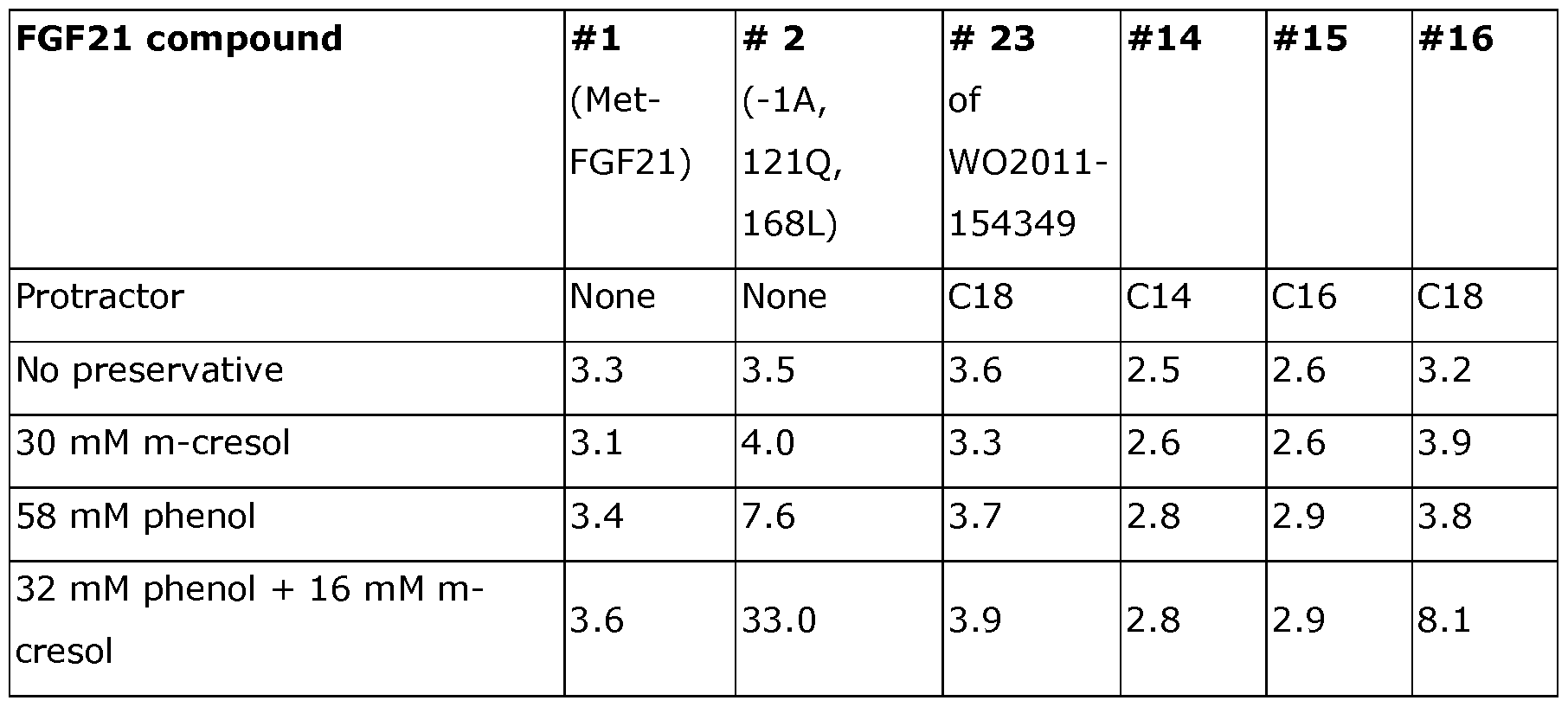
At pH 7.4 all FG21 compounds display an increased Rh,average value in the compositions comprising preservative, while only an modest increase in Rh,average value is observed for some of the FGF21 compositions comprising preservative at pH 8.2. It is concluded that an increased pH reduces the propensity for the FGF21 compounds to aggregate.
Example 12 - Thermal stability of FGF21 derivatives in preserved formulations
A series of FGF21 formulations at different pH's with 10 mM phosphate buffer 2 % glycerol and preservative (m-cresol or phenol), was prepared . The thermal stability was evaluated at pH 7.8, 8.0 and 8.2 in formulations including either 30 mM m-cresol or 58 mM phenol as preservative. In all samples 5 mg/ml of an FGF21 derivative
(compound 16) was included. The results are shown in figure 1, demonstrating that the presence of phenol and m-cresol reduces the thermal stability of the FGF21 compound ;
addition of preservative, in all cases, lead to a clear decrease in Tm. It is further observed that the Tm in all cases increases with pH, with a higher Tm at pH 8.2 compared to pH 8.0 (and 7.8) . Example 13 - Hydrodynamic radius of FGF21 molecules in preserved formulations
A series of FGF21 formulations at various pH's from pH 7.4 to pH 8.2 with 10 mM phosphate buffer including 2% glycerol and preservative (m-cresol, phenol or a mix of m-cresol and phenol), was prepared. DLS measurements were carried out as described above. The hydrodynamic radius was measured at pH 7.8, 8.0 and 8.2 in formulations including either 30 mM m-cresol, 58 mM phenol or 16 mM m-cresol plus 32 mM phenol as preservative. 1, 5, 10, 15, 20 and 25 mg/ml of an FGF21 derivative (compound 16) were included. Resulting average hydrodynamic raidus from cumulant fit is presented in Figure
2 A to C. At pH 7.4 both preservatives and the mix induce a dramatic increase in the hydrodynamic radius of the FGF21 molecule which is observed for all tested
concentrations of the FGF21 compound (1, 5, 10, 15, 20 and 25 mg/ml) . At pH 7.8 m- cresol does not lead to an increased hydrodynamic radius, while both compositions comprising phenol again display an increased hydrodynamic radius (Fig. 2B) . When pH is increased to 8.2 no effect of the preservative on the hydrodynamic radius is observed (Fig . 2C) . In conclusion, m-cresol may be the favoured preservative for FGF21 formulation having a pH around 7.8 (above 7.4 and below 8.2) while the selection of preservative may be less critical at higher pH values.
Example 14 - Aggregation propensity of FGF21 derivatives
The pH effect of aggregation propensity was studied in DLS as described above in a series of compositions all including 15 mg/ml of the FGF21 derivative # 16, 10 mM phosphate buffer and 2 % glycerol . The compositions further included m-cresol, phenol or a mix of phenol and m-cresol. Finally the pH of the compositions varied from pH 7.4 to pH 8.6. DLS measuremnts were carried out and the regularization algorithm was used for analysing the data to get an estimate on the size distribution. The level of aggregation is in this study defined as % mass of a separate peak detectable in the hydrodynamic size range of 6-1000 nm.
The results showed (figure 3) that the aggregation propensity was high for all compositions including a preservative at low pH (pH 7.4) while only very minor levels of aggregation were observed at pH 8.0 and above. As the tests are based on the evaluation of very small fractions of aggregates, batch to batch variation of the components (phenol, m-cresol and API) will result in some experimental variation.
It is concluded that FGF21 derivatives can be formulated together with a preservative and that the stability of the composition increases with pH from pH 7.4 to pH 8.6. Example 15 - Preservation of FGF21 derivatives
The preservation of FGF21 compound 16 was measured in an antimicrobial efficacy test according to Ph. Eur. 8th edition but using only Staph. Aureus (worst case) as test microorganism. The ability of the preservatives to reduce microbial growth was measured at different concentrations of m-cresol and optionally phenol and in
compositions with different content of the FGF21 compound, target FGF21 concentrations were 10-25 mg/ml. The compositions were prepared in 10 mM phosphate, 2 % glycerol and a pH 8.2. Results of the log reduction from the 24 hour reading are included in table 11 below. Table 11 : Log reduction form preservative efficacy test of FGF21 derivativesof FGF21 derivative #16

Acceptable preservative efficacy (Ph. Eur criteria B (8th Ed) of 1 log unit reduction) was obtained for all tested concentration of compound 16, when 30 mM m cresol or the combination of 32 mM phenol and 16 mM m-cresol was used.
In a further study -lMet-FGF21 (SEQ ID NO: 2) and compound 16 were tested. Compositions including 20 mg/ml of the FGF molecule, 10 mM phosphate, 2 % glycerol at pH 8.2 were prepared. Results of the log reduction from the 24 hour reading are included in table 12 below.
Table 12 : Log reduction form preservative efficacy test of FGF21 derivatives

While certain features of the invention have been illustrated and described herein, many modifications, substitutions, changes, and equivalents will now occur to those of ordinary skill in the art. It is, therefore, to be understood that the appended claims are intended to cover all such modifications and changes as fall within the true spirit of the invention.
Claims
Claims
1. A pharmaceutical composition comprising an FGF21 compound, wherein the
composition comprises a preservative and has a pH above 7.5.
2. The pharmaceutical composition according to claim 1, wherein the FGF21 compound is a FGF21 derivative.
The pharmaceutical composition according to claim 2, wherein the derivative comprises a side chain attached to the FGF21 protein via a Cys residue in a position corresponding to one of the positions 169, 170, 171, 172, 173, 174, 175, 180 and 181 of FGF21 (1-181) (SEQ ID NO: 1).
The pharmaceutical composition according to claim 3, wherein the side chain is attached to the FGF21 protein via a Cys residue at position 180 or position 181.
The pharmaceutical composition according to any of the previous claims, wherein the FGF21 protein has at least 80 %, such as 85 %, such as 90 %, such as 95 % identity to mature human FGF21 (SEQ ID NO 1) .
The pharmaceutical composition according to any of the previous claims, wherein the FGF21 compound is an FGF21 derivative, wherein said derivative comprises a protractor attached to a Cys residue in the FGF21 backbone via a linker; wherein the protractor is selected from the group of
Chem. 1A: HOOC-(CH2)x-CO-*,
Chem. IB: HOOC-benzene-0-(CH2)x-CO-* and
Chem. 1C: HO-S(=0)2-(CH2)x-CO-*
wherein x is an integer in the range of 8-18; and wherein the linker comprises at least one of each of Chem. 2, Chem . 3 and Chem. 4: herein Chem. 2 is selected from
-NH-CH(COOH)-(CH2)m-CO-*,
-NH-S(=0)2-(CH2)m-CO-* and
*-NH-(CH2)m-cyclohexane-CO-*,
wherein m is an integer in the range of 1-5, wherein Chem. 3 is *-NH-(CH2)2-[0-(CH2)2]k-0-[CH2]n-CO-*, wherein k is an integer in the range of 1-5 and n is an integer in the range of 1-5, and wherein Chem. 4: is selected from
*-NH-(CH2)m-NH-CO-CH2-* and
*-NH-CH(COOH)-(CH2)m-NH-CO-CH2-*
wherein m is an integer in the range of 1-5; and wherein Chem. 2, Chem . 3, and Chem. 4 are interconnected via amide bonds and in the sequence indicated, connected at its *-NH end to the CO-* end of the protractor, and at its CH2-* end to the sulphur atom of the Cys residue.
7. The pharmaceutical composition according to claim 6, wherein the FGF21 derivative is selected from the group of compounds 13-24, 35-41 and 43 to 56.
8. The pharmaceutical composition according to any of the previous claims, wherein pH of the composition is above 7.6, such as above 7.8, such as above 8.0.
9. The pharmaceutical composition according to any of the previous claims, wherein the preservative is selected from the group of: phenol, m-cresol and a mix of phenol and m-cresol .
10. The pharmaceutical composition according to any of the previous claims, wherein the composition comprises a phosphate buffers, such as 1-100 mM phosphate buffer, such as 2-50 mM phosphate buffer, such as 3-24 mM phosphate buffer, such as 5-20 mM phosphate buffer.
11. The pharmaceutical composition according to any of the previous claims, wherein the composition comprises an isotonic agent, such as an isotonic agent selected from the group consisting of; propylene glycol, glycerol and mannitol .
12. The pharmaceutical composition according to any of the previous claims comprising a FGF21 compound, 5-25 mM phosphate buffer and a preservative, wherein the composition has a pH of 7.8-8.6.
13. The pharmaceutical composition according to any of the previous claims comprising an FGF21 compound, phosphate buffer, an isotonic agent and a preservative, wherein the composition has a pH of 7.8-8.6.
14. The pharmaceutical composition according to any of the previous claimss comprising an FGF21 compound, phosphate buffer, glycerol and a preservative, wherein the composition has a pH of 7.8-8.6.
15. The pharmaceutical composition according to any of the previous claims comprising an FGF21 compound, 5-25 mM phosphate buffer, 1-4 % glycerol and phenol, m- cresol or a mix of phenol and m-cresol , wherein the composition has a pH of 7.8- 8.6.
Applications Claiming Priority (2)
| Application Number | Priority Date | Filing Date | Title |
|---|---|---|---|
| EP16175654.9 | 2016-06-22 | ||
| EP16175654 | 2016-06-22 |
Publications (1)
| Publication Number | Publication Date |
|---|---|
| WO2017220706A1 true WO2017220706A1 (en) | 2017-12-28 |
Family
ID=56368789
Family Applications (1)
| Application Number | Title | Priority Date | Filing Date |
|---|---|---|---|
| PCT/EP2017/065342 Ceased WO2017220706A1 (en) | 2016-06-22 | 2017-06-22 | Pharmaceutical compositions of fgf21 derivatives and uses thereof |
Country Status (1)
| Country | Link |
|---|---|
| WO (1) | WO2017220706A1 (en) |
Cited By (4)
| Publication number | Priority date | Publication date | Assignee | Title |
|---|---|---|---|---|
| US20180016318A1 (en) * | 2016-07-15 | 2018-01-18 | Eli Lilly And Company | Novel Fatty Acid Modified Urocortin-2 Analogs for the Treatment of Diabetes and Chronic Kidney Disease |
| WO2020010117A2 (en) | 2018-07-03 | 2020-01-09 | Bristol-Myers Squibb Company | Fgf21 formulations |
| US11510990B2 (en) | 2020-01-11 | 2022-11-29 | Beijing Ql Biopharmaceutical Co., Ltd. | Conjugates of fusion proteins of GLP-1 and FGF21 |
| US12331093B2 (en) | 2021-07-14 | 2025-06-17 | Beijing Ql Biopharmaceutical Co., Lt | Fusion polypeptides for metabolic disorders |
Citations (8)
| Publication number | Priority date | Publication date | Assignee | Title |
|---|---|---|---|---|
| WO2005061712A1 (en) * | 2003-12-10 | 2005-07-07 | Eli Lilly And Company | Muteins of fibroblast growth factor 21 |
| WO2006050247A2 (en) | 2004-10-29 | 2006-05-11 | Neose Technologies, Inc. | Remodeling and glycopegylation of fibroblast growth factor (fgf) |
| WO2010029159A1 (en) | 2008-09-12 | 2010-03-18 | Novo Nordisk A/S | Method of acylating a peptide or protein |
| WO2010042747A2 (en) | 2008-10-10 | 2010-04-15 | Amgen Inc. | Fgf21 mutants and uses thereof |
| WO2010129600A2 (en) | 2009-05-05 | 2010-11-11 | Amgen Inc. | Fgf21 mutants and uses thereof |
| WO2011154349A2 (en) | 2010-06-08 | 2011-12-15 | Novo Nordisk A/S | Fgf21 analogues and derivatives |
| WO2012010553A1 (en) | 2010-07-20 | 2012-01-26 | Novo Nordisk A/S | N-terminal modified fgf21 compounds |
| US20130085098A1 (en) * | 2011-10-04 | 2013-04-04 | Eli Lilly And Company | Fibroblast growth factor 21 variants |
-
2017
- 2017-06-22 WO PCT/EP2017/065342 patent/WO2017220706A1/en not_active Ceased
Patent Citations (8)
| Publication number | Priority date | Publication date | Assignee | Title |
|---|---|---|---|---|
| WO2005061712A1 (en) * | 2003-12-10 | 2005-07-07 | Eli Lilly And Company | Muteins of fibroblast growth factor 21 |
| WO2006050247A2 (en) | 2004-10-29 | 2006-05-11 | Neose Technologies, Inc. | Remodeling and glycopegylation of fibroblast growth factor (fgf) |
| WO2010029159A1 (en) | 2008-09-12 | 2010-03-18 | Novo Nordisk A/S | Method of acylating a peptide or protein |
| WO2010042747A2 (en) | 2008-10-10 | 2010-04-15 | Amgen Inc. | Fgf21 mutants and uses thereof |
| WO2010129600A2 (en) | 2009-05-05 | 2010-11-11 | Amgen Inc. | Fgf21 mutants and uses thereof |
| WO2011154349A2 (en) | 2010-06-08 | 2011-12-15 | Novo Nordisk A/S | Fgf21 analogues and derivatives |
| WO2012010553A1 (en) | 2010-07-20 | 2012-01-26 | Novo Nordisk A/S | N-terminal modified fgf21 compounds |
| US20130085098A1 (en) * | 2011-10-04 | 2013-04-04 | Eli Lilly And Company | Fibroblast growth factor 21 variants |
Non-Patent Citations (8)
| Title |
|---|
| "Remington: The Science and Practice of Pharmacy", 1995 |
| HECHT ET AL., PLOS ONE, vol. 7, no. 11, 2012, pages e49345 |
| J. XU ET AL., BIOCONJUGATE CHEMISTRY, vol. 24, 2013, pages 915 - 925 |
| JING XU ET AL: "Polyethylene Glycol Modified FGF21 Engineered to Maximize Potency and Minimize Vacuole Formation", BIOCONJUGATE CHEMISTRY, vol. 24, no. 6, 19 June 2013 (2013-06-19), pages 915 - 925, XP055192703, ISSN: 1043-1802, DOI: 10.1021/bc300603k * |
| MYERS; W. MILLER: "Optimal Alignments in Linear Space", CABIOS (COMPUTER APPLICATIONS IN THE BIOSCIENCES, vol. 4, 1988, pages 11 - 17, XP009076513, DOI: doi:10.1093/bioinformatics/4.1.11 |
| NEEDLEMAN, S.B.; WUNSCH, C.D., JOURNAL OF MOLECULAR BIOLOGY, vol. 48, 1970, pages 443 - 453 |
| NISHIMURA ET AL., BIOCHIM. BIOPHYS. ACTA, vol. 1492, no. 1, 2000, pages 203 - 206 |
| SEQUENCE LISTING, 21 June 2017 (2017-06-21) |
Cited By (6)
| Publication number | Priority date | Publication date | Assignee | Title |
|---|---|---|---|---|
| US20180016318A1 (en) * | 2016-07-15 | 2018-01-18 | Eli Lilly And Company | Novel Fatty Acid Modified Urocortin-2 Analogs for the Treatment of Diabetes and Chronic Kidney Disease |
| US10894817B2 (en) * | 2016-07-15 | 2021-01-19 | Eli Lilly And Company | Fatty acid modified urocortin-2 analogs for the treatment of diabetes and chronic kidney disease |
| WO2020010117A2 (en) | 2018-07-03 | 2020-01-09 | Bristol-Myers Squibb Company | Fgf21 formulations |
| US12226451B2 (en) | 2018-07-03 | 2025-02-18 | Bristol-Myers Squibb Company | FGF-21 formulations |
| US11510990B2 (en) | 2020-01-11 | 2022-11-29 | Beijing Ql Biopharmaceutical Co., Ltd. | Conjugates of fusion proteins of GLP-1 and FGF21 |
| US12331093B2 (en) | 2021-07-14 | 2025-06-17 | Beijing Ql Biopharmaceutical Co., Lt | Fusion polypeptides for metabolic disorders |
Similar Documents
| Publication | Publication Date | Title |
|---|---|---|
| US10124039B2 (en) | FGF21 derivatives and uses thereof | |
| HK1246156A1 (en) | Fgf21 derivatives and uses thereof | |
| EP2389190B1 (en) | Fgf21 derivatives with albumin binder a-b-c-d-e- and their use | |
| US9655974B2 (en) | N-terminal modified FGF21 compounds | |
| US8779109B2 (en) | Growth hormones with prolonged in-vivo efficacy | |
| US20130252884A1 (en) | Fgf21 analogues and derivatives | |
| JP2013533227A (en) | FGF21 analogs and derivatives | |
| US20120035099A1 (en) | Fgf21 analogues and derivatives | |
| CA2972128C (en) | Fgf21 derivatives and uses thereof | |
| BR112017011552B1 (en) | DERIVATIVES OF A FGF21 PROTEIN AND THEIR THERAPEUTIC AND/OR PROPHYLACTIC USE | |
| EP2579889A2 (en) | Fgf21 analogues and derivatives |
Legal Events
| Date | Code | Title | Description |
|---|---|---|---|
| 121 | Ep: the epo has been informed by wipo that ep was designated in this application |
Ref document number: 17733417 Country of ref document: EP Kind code of ref document: A1 |
|
| NENP | Non-entry into the national phase |
Ref country code: DE |
|
| 122 | Ep: pct application non-entry in european phase |
Ref document number: 17733417 Country of ref document: EP Kind code of ref document: A1 |