WO2017214546A1 - Compounds, related compositions, catalysts, electrochemical cells, fuel cells, their preparation and their uses - Google Patents
Compounds, related compositions, catalysts, electrochemical cells, fuel cells, their preparation and their uses Download PDFInfo
- Publication number
- WO2017214546A1 WO2017214546A1 PCT/US2017/036815 US2017036815W WO2017214546A1 WO 2017214546 A1 WO2017214546 A1 WO 2017214546A1 US 2017036815 W US2017036815 W US 2017036815W WO 2017214546 A1 WO2017214546 A1 WO 2017214546A1
- Authority
- WO
- WIPO (PCT)
- Prior art keywords
- alkyl
- alkoxy
- compound
- methyl
- formula
- Prior art date
- Legal status (The legal status is an assumption and is not a legal conclusion. Google has not performed a legal analysis and makes no representation as to the accuracy of the status listed.)
- Ceased
Links
- 0 CCC(C(*)C(C1CC2)C12C(C1)C(C2)C1C1C2(C2)C2CCC1)C1(C(C)CC*)C2(CC2)C1 Chemical compound CCC(C(*)C(C1CC2)C12C(C1)C(C2)C1C1C2(C2)C2CCC1)C1(C(C)CC*)C2(CC2)C1 0.000 description 7
- NCWPUAGWTSIHKE-RNIAWFEPSA-N C/C(/C(/C)=N/NC(Nc(cc1)ccc1OC)=S)=N\NC(Nc(cc1)ccc1OC)=S Chemical compound C/C(/C(/C)=N/NC(Nc(cc1)ccc1OC)=S)=N\NC(Nc(cc1)ccc1OC)=S NCWPUAGWTSIHKE-RNIAWFEPSA-N 0.000 description 1
Classifications
-
- C—CHEMISTRY; METALLURGY
- C07—ORGANIC CHEMISTRY
- C07C—ACYCLIC OR CARBOCYCLIC COMPOUNDS
- C07C337/00—Derivatives of thiocarbonic acids containing functional groups covered by groups C07C333/00 or C07C335/00 in which at least one nitrogen atom of these functional groups is further bound to another nitrogen atom not being part of a nitro or nitroso group
- C07C337/06—Compounds containing any of the groups, e.g. thiosemicarbazides
- C07C337/08—Compounds containing any of the groups, e.g. thiosemicarbazides the other nitrogen atom being further doubly-bound to a carbon atom, e.g. thiosemicarbazones
-
- C—CHEMISTRY; METALLURGY
- C07—ORGANIC CHEMISTRY
- C07C—ACYCLIC OR CARBOCYCLIC COMPOUNDS
- C07C337/00—Derivatives of thiocarbonic acids containing functional groups covered by groups C07C333/00 or C07C335/00 in which at least one nitrogen atom of these functional groups is further bound to another nitrogen atom not being part of a nitro or nitroso group
- C07C337/02—Compounds containing any of the groups, e.g. thiocarbazates
- C07C337/04—Compounds containing any of the groups, e.g. thiocarbazates the other nitrogen atom being further doubly-bound to a carbon atom
-
- C—CHEMISTRY; METALLURGY
- C07—ORGANIC CHEMISTRY
- C07F—ACYCLIC, CARBOCYCLIC OR HETEROCYCLIC COMPOUNDS CONTAINING ELEMENTS OTHER THAN CARBON, HYDROGEN, HALOGEN, OXYGEN, NITROGEN, SULFUR, SELENIUM OR TELLURIUM
- C07F3/00—Compounds containing elements of Groups 2 or 12 of the Periodic Table
- C07F3/06—Zinc compounds
Definitions
- this application relates to inventive compounds
- compositions comprising the inventive compounds (e.g., anode, cathodes, catalysts (e.g., electrocatalysts), glassy carbon electrodes, carbon paste electrodes, covalently modified carbon (e.g., modified graphene)), electrochemical cells comprising compositions that comprise one or more inventive compounds, fuel cells comprising compositions that comprise one or more inventive compounds, uses of one or more inventive compounds to produce H 2 (e.g., via an electrochemical cell), and uses of one or more inventive compounds to create energy from H 2 (e.g., via a fuel cell). Additional embodiments of the invention are also discussed herein.
- Some embodiments of the present invention include a compound selected from:
- Some embodiments of the present invention include a compound selected from Formula (II), M- L (II) and
- Yet other embodiments include a catalyst (e.g., an electrocatalyst) comprising a composition comprising a compound of Formula (I), a compound of Formula (II), or both.
- a catalyst e.g., an electrocatalyst
- Some embodiments encompass an anode comprising a composition comprising a compound of Formula (I), a compound of Formula (II), or both.
- Other embodiments include a cathode comprising a composition comprising a compound of Formula (I), a compound of Formula (II), or both.
- Still other embodiments of the invention include an electrochemical cell comprising a composition comprising a compound of Formula (I), a compound of Formula (II), or both. Additional embodiments include a fuel cell comprising a composition comprising a compound of Formula (I), a compound of Formula (II), or both.
- Some embodiments of the invention include a method for producing H 2 comprising contacting, in an electrochemical cell, a first composition comprising a compound of Formula (I), a compound of Formula (II), or both with a second composition comprising water. Additional embodiments include a method for producing electricity comprising contacting, in a fuel cell, a first composition comprising a compound of Formula (I), a compound of Formula (II), or both with a second composition comprising H 2 .
- Formula (I) comprising any suitable method, such as those disclosed herein, or a method for preparing a compound of Formula (II) comprising any suitable method, such as those disclosed herein.
- Additional embodiments encompass a method for preparing a catalyst (e.g., an electrocatalyst) comprising a composition comprising a compound of Formula (I), a compound of Formula (II), or both, comprising any suitable method, such as those disclosed herein.
- Still other embodiments include a method for preparing an anode comprising a composition comprising a compound of Formula (I), a compound of
- Formula (II), or both comprising any suitable method, including those disclosed herein.
- Still further embodiments include a method for preparing a cathode comprising a composition comprising a compound of Formula (I), a compound of Formula (II), or both, comprising any suitable method, such as those disclosed herein.
- FIG. 1 Electrocatalytic H 2 evolution and H 2 oxidation.
- A Cyclic voltammograms of 3 mM ZnL in methanol with (from bottom to top) no added acid, 6 mM CHsCOOH, 9 mM CH3COOH, and 12 mM CH3COOH. Data collected at a scan rate of 0.5 V/s in the presence of 0.1 M Bu 4 NPF 6 as supporting electrolyte.
- H 2 (from top to bottom at 1.00 V) with no added base, 3 mM (CH 3 CH 2 ) 3 N, 6 mM (CH 3 CH 2 ) 3 N, 12 mM (CH 3 CH 2 ) 3 N, 21 mM (CH 3 CH 2 ) 3 N, and 30 mM (CH 3 CH 2 )3N.
- D Plot of i ca t/i P versus [(CH3CH 2 N)3] for 0.3 mM ZnL under 1 atm.
- H 2 (clustered lines second from the top) and 3 mM H 2 L under 1 atm.
- H 2 top line and bottom two lines) at scan rates of 0.2( ⁇ ),0.5 ( ), and 1.0 ( ) V/s.
- FIG. 2 Mechanistic Studies of H 2 evolution.
- A Plot of charge versus time recorded during bulk electrolysis of 0.1 mM ZnL and 12 mM CH3COOH in methanol with 0.1 M Bu 4 NPF 6 as supporting electrolyte.
- B Comparisons of
- FIG. 3 Energy profile along with spin densities of species involved in catalyzed H 2 evolution. Spin-density profiles for Zn(HL-) (A), and [Zn(H 2 L-)] + (B).
- C Relative energies (ZPE corrected) for H 2 evolution through the hetero-coupling of Zn(HL-) and [Zn(H 2 L-)] + using the B97-D/6-311G(d) level of theory.
- D Structure of the singlet [Zn 2 (H 3 L- 2 )] + transition state through the hetero-coupling pathway. See Fig. 20 for further information regarding the HER mechanism, analysis of the eigenvector associated with the imaginary frequency il572 cm " 1 , and the charge densities of atoms for H 2 evolution with respect to intrinsic reaction coordinate (IRC).
- IRC intrinsic reaction coordinate
- FIG. 8. GC-TCD Readout - GC readouts of gas sampled every 30 minutes during 2.5 hour electrolysis of ZnL.
- FIG. 10 Peak currents vs square root of scan rate - 0.1 M Bu 4 NPF6 methanol solutions with 3 mM ZnL, plot showing peak current plotted against the square root of the scan rate from diffusion limited CVs.
- FIG. 13 Simulation of experimental data using DigiElch - ZnL HER
- FIG. 14 Simulation of experimental data using DigiElch - ZnL HER
- FIG. 15 Simulation of experimental data using DigiElch - ZnL HER
- FIG. 17 Optimized structure of [ZnHL] + with protonation on sulfur.
- FIG. 18 Optimized structure of [ZnHL] + with protonation on amine nitrogen.
- FIG. 19 Optimized structure of [ZnHL] + with protonation on zinc.
- FIG. 20 Transition state analysis of [Zn 2 H 3 L- 2 ] + - (Upper) Transition state geometry of [Zn 2 H3L- 2 ] + along the HER pathway, shown with active N-H bond lengths associated with the imaginary frequency il572 cm "1 , and equilibrium bond lengths in parentheses.
- (Lower) Charge densities of atoms near H 2 evolution with respect to IRC; N-H of [Zn(HL-)] + (bottom and top curves), and N-H of Zn(H 2 L-) (curves 2 nd from top and 2 nd from bottom).
- FIG. 21 UV-Vis spectra from Spectroelectrochemical Electrolysis -
- FIG. 22 CV after ZnL electrolysis - CV of ZnL after electrolysis in
- FIG. 23 Overview of reactivity using non- innocent ligands.
- FIG. 24 Electrochemical Characterization - CVs of CuL 1 in 0.1 M
- Bu 4 NPF 6 ACN solution at scan rates of (from inside to outside, at peak) 0.1, 0.2, 0.3, 0.4, 0.5, 0.6, 0.7, 0.8, 0.9, and 1.0 V/s.CuL 1 . (Inset: Cottrell plot of peak current vs square root of scan rate.)
- FIG. 25 Homogeneous Catalytic Hydrogen Evolution: Cyclic
- FIG. 26 Cyclic Voltammetry - (A) CVs (from bottom to top) of 0.6 mM
- FIG. 27 Kenetic Isotope Effects (KIE) - (A) CVs of 0.6 mM CuL 1 in
- FIG. 28 Controlled Potential Electrolysis (CPE) - CPE of 0.6 mM
- FIG. 29 Control Experiments -
- A CVs run in 0.1 M Bu 4 NPF 6 ACN solutions, showing blank ACN (bottom), with 0.0672 M acetic acid added (dashed - middle), and with 0.0672 M acetic acid and 0.6 mM CuL 1 (top).
- B CVs run in 0.1 M Bu 4 NPF 6 DMF solutions, showing blank DMF (solid), with 0.0224 M acetic acid added (dashed), and with 0.0224 M acetic acid and 0.6 mM CuL 1 (top).
- FIG. 30 Post-electrolysis "dip-test" of film - Performed on working electrode post CPE. Electrode washed with D.I water and immersed into a fresh solution of 0.1 M Bu 4 NPF 6 ACN (bottom), and upon addition of 0.292 M CH3COOH (top).
- FIG. 31 Film analysis - Calculated (left bar) and XPS experimental
- FIG. 32 UV- Visible spectrum of CuL 1 - titrated with CH3COOH (from top to bottom); 0.022 M, 0.044 M, 0.056 M, 0.067 M, 0.089 M, 0.112 M, 0.134 M, 0.157 M, 0.202 M, 0.244 M, 0.269 M, 0.292 M, 0.337 M, and 0.382 M.
- FIG. 33 ORTEP representation of [Cu(L 1 H 2 )(C10 4 )]C10 4 - Selected distances (A): Cu-Nl 1.9579(18), Cu-N4 1.9557(18), Cu-S l 2.2462(6), Cu-S2 2.2593(6), Cu-Ol 2.5166(16), Cu - 07 2.9233(19), N2-H2n 0.78(3), N3-H3n 0.76(3), N4-N5 1.364(2), N5-H5n 0.78(2), N6-H6n 0.78(3).
- FIG. 34 Proposed mechanism of hydrogen evolution by CuL 1 .
- FIG. 35 Energetic Stability from DFT -
- FIG. 37 Energetic Stability from DFT - (A) Energetic stability of
- FIG. 38 Qualitative frontier molecular orbital diagram highlighting site of reduction.
- FIG. 39 Full ORTEP view of
- FIG. 40 Open circuit potential measurement in 0.1 M Bu 4 NPF6 acetonitrile solution (top) and in 0.1 M Bu 4 NPF 6 DMF solution (bottom) with 0.269 M acetic acid added.
- FIG. 41 GC-TCD readout for gaseous product identification from electrolysis
- FIG. 42 0.6 mM CuL 1 in 0.1 M Bu 4 NPF 6 acetonitrile HER CVs scanned at 0.2 V/s.
- FIG. 43 0.6 mM CuL 1 in 0.1 M Bu 4 NPF 6 acetonitrile HER CVs scanned at 0.5 V/s.
- FIG. 44 0.6 mM CuL 1 in 0.1 M Bu 4 NPF 6 acetonitrile HER CVs scanned at 1.0 V/s.
- FIG. 45 [CuL 1 ] dependence in 0.1 M Bu 4 NPF 6 acetonitrile with 0.269
- FIG. 46 Plot of i p vs [CuL 1 ] in 0.1 M Bu 4 NPF 6 acetonitrile with 0.269
- FIG. 47 0.6 mM CuL 1 in 0.1 M Bu 4 NPF 6 DMF; HER CVs scanned at
- FIG. 49 0.6 mM CuL 1 in 0.1 M Bu 4 NPF 6 DMF; HER CVs scanned at
- FIG. 51 0.6 mM CuL 1 in 0.1 M Bu 4 NPF 6 DMF; HER CVs scanned at
- FIG. 53 Plot of scan rate vs TOF for CuL 1 in DMF.
- FIG. 54 Dip test post electrolysis in DMF.
- FIG. 55 X H NMR spectrum of [CuL 1 ] " .
- FIG. 56 X H NMR spectrum of [CuL x H] + .
- FIG. 58 Spin-density map of [CuL 1 !]*.
- FIG. 59 Energetic stability of the protonated / reduced species
- FIG. 60 Full CV of CuL 1 .
- FIG. 61 High resolution (top) XPS of copper atoms and low resolution of entire adsorbed film (bottom).
- FIG. 62 Post CV dip-test after 50 CV Cycles.
- FIG. 63 Post CV dip-test after 50 CV Cycles.
- FIG. 64 CV of Asymmetric Cu ligand - CVs of CuL 10a in CH 3 CN with increasing [H + ].
- FIG. 65 GCE (Glass Carbon Electrode) polarization curves -
- FIG. 66 Carbon Paste Electrode (CPE) analysis - (a) SEM image of CPE-CuL 1 ; (b) Nyquist plot of CPE-CuL 1 ; Polarization curves for modified CPEs.
- CPE Carbon Paste Electrode
- compositions comprising the inventive compounds (e.g., anode, cathodes, catalysts (e.g., electrocatalysts), glassy carbon electrodes, carbon paste electrodes, covalently modified carbon (e.g., modified graphene)), electrochemical cells comprising compositions that comprise one or more inventive compounds, fuel cells comprising compositions that comprise one or more inventive compounds, uses of one or more inventive compounds to produce H 2 (e.g., via an electrochemical cell), and uses of one or more inventive compounds to create energy from H 2 (e.g., via a fuel cell). Additional embodiments of the invention are also discussed herein.
- alkyl means a monovalent, straight or branched hydrocarbon chain.
- Ci-C 7 alkyl or C1-C4 alkyl refer to straight- or branched-chain saturated hydrocarbon groups having from 1 to 7 (e.g., 1, 2, 3, 4, 5, 6, or 7), or 1 to 4 (e.g., 1, 2, 3, or 4), carbon atoms, respectively.
- Ci-C 7 alkyl groups include, but are not limited to, methyl, ethyl, n-propyl, i-propyl, n-butyl, s-butyl, t-butyl, n-pentyl, s-pentyl, n-hexyl, and n- septyl.
- C1-C4 alkyl groups include, but are not limited to, methyl, ethyl, n- propyl, i-propyl, n-butyl, s-butyl, and t-butyl.
- alkenyl means a monovalent, straight or branched hydrocarbon chain that includes one or more (e.g., 1, 2, 3, or 4) double bonds.
- alkenyl groups include, but are not limited to, vinyl, allyl, 1-propenyl, 2-propenyl, 1-butenyl, 2-butenyl, 3-butenyl, 1-pentenyl, 2-pentenyl, 3- pentenyl, 4-pentenyl, 1-hexenyl, 2-hexenyl, 3-hexenyl, 4-hexenyl, and 5-hexenyl.
- alkoxy means any of the above alkyl groups which is attached to the remainder of the molecule by an oxygen atom (alkyl-O-).
- alkoxy groups include, but are not limited to, methoxy (sometimes shown as MeO-), ethoxy, isopropoxy, propoxy, and butyloxy.
- alkynyl means a monovalent, straight or branched hydrocarbon chain that includes one or more (e.g., 1, 2, 3, or 4) triple bonds and that also may optionally include one or more (e.g. 1, 2, 3, or 4) double bonds in the chain.
- alkynyl groups include, but are not limited to, ethynyl, 1-propynyl, 2-propynyl, 1-butynyl, 2-butynyl, 3-butynyl, 1-pentynyl, 2-pentynyl, 3-pentynyl, 4-pentynyl, 1-hexynyl, 2-hexynyl, 3-hexynyl, 4-hexynyl, and 5-hexynyl.
- aryl means a monovalent, monocyclic or bicyclic, 5, 6, 7, 8, 9, 10, 11, 12, 13, 14, 15, 16, 17, 18, 19, or 20 member aromatic hydrocarbon group which, when unsubstituted.
- aryl groups include, but are not limited to, phenyl, naphthyl, pyrene, tolyl, and xylyl.
- aryl that is bicyclic one or both rings can be substituted.
- cycloalkyl means a monovalent, monocyclic or bicyclic, 3, 4, 5, 6, 7, 8, 9, 10, 11, or 12 membered
- cycloalkyl groups include, but are not limited to, cyclopropyl, cyclobutyl, cyclopentyl, cyclohexyl, cycloheptyl, cyclooctyl, and bicycloalkyls (e.g., bicyclooctanes such as
- a monocyclic cycloalkyl the ring is not aromatic.
- a bicyclic cycloalkyl if one ring is aromatic, then the other is not aromatic.
- one or both rings can be substituted.
- halogen means monovalent CI, F, Br, or I.
- heteroaryl means a monovalent, monocyclic or bicyclic, 5, 6, 7, 8, 9, 10, 11, 12, 13, 14, 15, 16, 17, 18, 19, or 20 membered, hydrocarbon group, where 1, 2, 3, 4, 5, 6, 7, 8, or 9 carbon atoms are replaced by a hetero atom independently selected from nitrogen, oxygen, or sulfur atom, and the monocyclic or bicyclic ring system is aromatic.
- heteroaryl groups include, but are not limited to, thienyl (or thiophenyl), furyl, indolyl, pyrrolyl, pyridinyl, pyrazinyl, oxazolyl, thiaxolyl, quinolinyl, pyrimidinyl, imidazolyl, 1 -methyl- imidazolyl, triazolyl, tetrazolyl, lH-pyrazol-4-yl, l-Me-pyrazol-4-yl, pyridin-3-yl, pyridin-4-yl, 3,5- dimethylisoxazolyl, lH-pyrrol-3-yl, 3,5-di-Me-pyrazolyl, and lH-pyrazol-4-yl.
- a bicyclic heteroaryl if one ring is aryl, then the other is heteroaryl.
- one or both rings can have one or more hetero atoms.
- one or both rings can be substituted.
- An N-heteroaryl means a heteroaryl that comprises one or more N (e.g., 1, 2, 3, 4, 5, 6, 7, or 8); an N-heteroaryl may also comprise other hetero atoms.
- heterocyclyl means a monovalent, monocyclic or bicyclic, 5, 6, 7, 8, 9, 10, 11, or 12 membered, hydrocarbon, where 1, 2, 3, 4, 5, or 6 carbon atoms are replaced by a hetero atom independently selected from nitrogen atom, oxygen atom, or sulfur atom, and the monocyclic or bicyclic ring system is not aromatic.
- heterocyclyl groups include, but are not limited to, tetrahydropyran, pyrolidinyl (e.g., pyrrolidin-l-yl, pyrrolidin-2-yl, pyrrolidin-3-yl, or pyrrolidin-4-yl), piperazinyl (e.g., piperazin-l-yl, piperazin-2-yl, piperazin-3-yl, or piperazin-4-yl), piperidinyl (e.g., piperadin-l-yl, piperadin-2-yl, piperadin-3-yl, or piperadin-4-yl), and morpholinyl (e.g., morpholin-l-yl, morpholin-2-yl, morpholin-3-yl, or morpholin-4-yl,).
- pyrolidinyl e.g., pyrrolidin-l-yl, pyrrolidin-2-yl, pyrrolidin-3
- a bicyclic heterocyclyl if one ring is aromatic (e.g., monocyclic aryl or heteroaryl), then the other ring is not aromatic.
- one or both rings can have one or more hetero atoms.
- one or both rings can be substituted.
- An N-heterocyclyl means a heterocyclyl that comprises one or more N (e.g., 1, 2, 3, 4, 5, or 6); an N-heterocyclyl may also comprise other hetero atoms.
- hetero atom means an atom selected from nitrogen atom, oxygen atom, or sulfur atom.
- hydroxyl indicates the presence of a monovalent -OH group.
- substituted e.g., as in substituted alkyl
- substituted alkyl means that one or more hydrogen atoms of a chemical group (with one or more hydrogen atoms) can be replaced by one or more non-hydrogen substituents selected from the specified options. The replacement can occur at one or more positions.
- optionally substituted means that one or more hydrogen atoms of a chemical group (with one or more hydrogen atoms) can be, but is not required to be substituted.
- Some compounds of the invention can have one or more chiral centers and can exist in and be isolated in optically active and racemic forms, for any of the one or more chiral centers. Some compounds can exhibit polymorphism.
- the compounds of the present invention encompass any optically active, racemate, stereoisomer form, polymorphism, or mixtures thereof. If a chiral center does not provide an indication of its configuration (i.e., R or S) in a chemical structure, it should be considered to represent R, S or a racemate.
- Some embodiments of the invention include compounds of Formula (I),
- Ci-C 7 alkyl e.g., Ci, C 2 , C 3 , C 4 , C5, C 6 , or C 7 alkyl
- C 2 -C 7 alkenyl e.g., C 2 , C 3 , C 4 , C5, C 6 , or C 7 alkenyl
- C 2 -C 7 alkynyl e.g., C 2 , C 3 , C 4 , C5, C 6 , or C 7 alkynyl
- Ci-C 6 alkoxy Ci, C 2 , C 3 , C
- - X 1 is bivalent -(NH)-, -0-, -(CH 2 )-, or -S-, which -(NH)- or -(CH 2 )- can optionally be substituted with one or more (e.g., 0, 1, or 2) of halogen (e.g., F, CI, Br, or I), hydroxy (-OH), C1-C5 alkyl (e.g., Ci, C 2 , C 3 , C 4 , or C 5 alkyl), Ci-C 4 alkoxy (Ci, C 2 , C 3 , or C 4 alkoxy), methanoly (-COH), carboxy (-CO2H), nitro (-NO2), cyano (-CN), ethynyl (-CCH), sulfo (-S0 3 H), methyl, or ethyl;
- halogen e.g., F, CI, Br, or I
- hydroxy -OH
- R 2 is a monovalent H, methanoly (-COH), carboxy (-CO2H), nitro
- Ci-C 7 alkyl e.g., Ci, C 2 , C 3 , C 4 , C 5 , C 6 , or C 7 alkyl
- C 2 -C 7 alkenyl e.g., C 2 , C 3 , C 4 , C 5 , C 6 , or C 7 alkenyl
- C 2 -C 7 alkynyl e.g., C 2 , C 3 , C 4 , C5, C 6 , or C 7 alkynyl
- Ci-C 6 alkoxy Ci, C 2 , C 3 , C 4 , C5, or C 6 alkoxy
- R 3 is a monovalent H, methanoly (-COH), carboxy (-CO2H), nitro
- Ci-C 7 alkyl e.g., Ci, C 2 , C 3 , C 4 , C 5 , C 6 , or C 7 alkyl
- C 2 -C 7 alkenyl e.g., C 2 , C 3 , C 4 , C 5 , C 6 , or C 7 alkenyl
- C 2 -C 7 alkynyl e.g., C 2 , C 3 , C 4 , C 5 , C 6 , or C 7 alkynyl
- Ci-C 6 alkoxy Ci, C 2 , C 3 , C 4 , C 5 , or C 6 alk
- R 4 is a monovalent H, methanoly (-COH), carboxy (-CO2H), nitro
- Ci-C 7 alkyl e.g., Ci, C 2 , C 3 , C 4 , C 5 , C 6 , or C 7 alkyl
- C 2 -C 7 alkenyl e.g., C 2 , C 3 , C 4 , C 5 , C 6 , or C 7 alkenyl
- C 2 -C 7 alkynyl e.g., C 2 , C 3 , C 4 , C5, C 6 , or C 7 alkynyl
- Ci-C 6 alkoxy Ci, C 2 , C 3 , C 4 , C5, or C 6 alkoxy
- Ci-C 7 alkyl e.g., Ci, C 2 , C 3 , C 4 , C5, C 6 , or C 7 alkyl
- C 2 -C 7 alkenyl e.g., C 2 , C 3 , C 4 , C5, C 6 , or C 7 alkenyl
- C 2 -C 7 alkynyl e.g., C 2 , C 3 , C 4 , C5, C 6 , or C 7 alkynyl
- Ci-C 6 alkoxy Ci, C 2 , C 3 , C
- - X 2 is bivalent -(NH)-, -0-, -(CH 2 )-, or -S-, which -(NH)- or -(CH 2 )- can optionally be substituted with one or more (e.g., 0, 1, or 2) of halogen (e.g., F, CI, Br, or I), hydroxy (-OH), C1-C5 alkyl (e.g., Ci, C 2 , C 3 , C 4 , or C 5 alkyl), Ci-C 4 alkoxy (Ci, C 2 , C 3 , or C 4 alkoxy), methanoly (-COH), carboxy (-CO2H), nitro (-NO2), cyano (-CN), ethynyl (-CCH), sulfo (-S0 3 H), methyl, or ethyl; and
- halogen e.g., F, CI, Br, or I
- hydroxy -OH
- R 6 is a monovalent H, methanoly (-COH), carboxy (-CO2H), nitro
- Ci e.g., Ci, C 2 , C 3 , C 4 , C 5 , C 6 , or C 7 alkyl
- C 2 -C 7 alkenyl e.g., C 2 , C 3 , C 4 , C 5 , C 6 , or C 7 alkenyl
- C2-C-7 alkynyl e.g., C 2 , C 3 , C 4 , C5, C 6 , or C 7 alkynyl
- Ci-C 6 alkoxy Ci, C 2 , C 3 , C 4 , C5, or C 6 alkoxy
- aryl e.g., benzene or pyrene
- cycloalkyl heterocyclyl
- heteroaryl e.g., pyridinyl and 1-methyl imidazolyl
- Ci-C 7 alkyl, C 2 -C 7 alkenyl, C 2 -C 7 alkynyl, or Ci-C 6 alkoxy can optional
- the compound of Formula (I) comprises one or more of the following:
- R 3 is the same as R 4 ;
- R 3 is the same as R 4 and R 1 is the same as R 5 ;
- R 3 is the same as R 4 , X 1 is -(NH)-, X 2 is -(NH)-, and R 2 is the same as
- R 3 is the same as R 4 , R 3 is methyl, R 1 is the same as R 5 , R 1 is
- R 3 is the same as R 4 , R 3 is methyl, R 1 is the same as R 5 , R 1 is [00114] (f) R 3 is the same as R 4 , R 3 is methyl, R 1 is the same as R 5 , R 1 is
- R 3 is the same as R 4 , R 3 is methyl, R 1 is the same as R 5 , R 1 is
- R 3 is the same as R 4 , R 3 is methyl, R 1 is the same as R 5 , R 1 is
- R 3 is the same as R 4 and R 3 is methyl
- R 3 is the same as R 4 and R 3 is ethyl
- R 3 is methyl and R 4 is phenyl
- R 1 is , X 1 is -(NH)-, R 2 is -CH 3 , R 5 is (n) R 1 is , X 1 is -(NH)-, R 2 is -CH 3 , R 5 is -(NH)-, and R 6 is -CH 2 CF 3
- X 1 is -(NH)-
- R 2 is -CH 3
- R 5 is , X 2 is -0-, and R 6 is -CH 3 ;
- X 1 is -(NH)-, R 2 is -CH 3 , R > 3 5 i ;s rule , X 2 is -0-, and R 6 is -CH 2 CH 3 ;
- Formula (I) further comprises a solvent molecule coordinated with Formula (I).
- the solvent molecule can be any suitable solvent.
- the solvent molecule is selected from water, methanol, ethanol, propanol, acetonitrile, dimethylformamide, and acetone.
- the compound of Formula (I) is N-(2-aminoethyl)-2-aminoethyl-N-(2-aminoethyl)-2-aminoethyl-N-(2-aminoethyl)-2-aminoethyl-N-(2-aminoethyl)-2-aminoethyl-N-(2-aminoethyl)-2-aminoe-N-N-(2-aminoe-N-(2-aminoethyl)-2-aminoethyl-N-(2-aminoethyl)-2-aminoethyl-N-(2-aminoethyl)-2-aminoethyl-N-(2-aminoethyl)-2-aminoethyl-N-(2-aminoethyl)-2-aminoethyl-N-(2-aminoethyl)-2-aminoe
- imidazolyl an N-containing heterocyclyl, or an N-containing heteroaryl.
- Formula (I) is one of the molecules described in
- Example Sets A, B, C, D, or E can be symmetric or asymmetric.
- X 1 is not -(NH)-
- R 2 is not methoxyphenyl or p-methoxyphenyl, or (c) both (a) and (b).
- X 2 is not -(NH)-
- R 6 is not methoxyphenyl or p-methoxyphenyl, or (c) both (a) and (b).
- R 3 is not methyl
- R 4 is not methyl
- Formula (I) is not
- Formula (I) is part of a homogenous solution, a homogenous aqueous solution, a heterogeneous solution, a heterogeneous aqueous solution, or a glassy carbon electrode.
- a homogenous solution, a homogenous aqueous solution, a heterogeneous solution, or a heterogeneous aqueous solution can each comprise a compound of Formula (I).
- a glassy carbon electrode, a carbon paste e.g., embedded with one or more of polynuclear catalysts, coordinated polymers, or metal-organic frameworks
- covalent modified carbon e-g-, graphene
- non-covalent modified carbon e.g., graphene
- Some embodiments of the invention include a compound selected from
- - M is Ni, Pd, Pt, Cu, Ag, Au, Zn, Cd, Hg, Co, Rh, Ti, V, Cr, Mn, or Fe; or
- M is Cu 2+ , Cu + , Zn 2+ , Co 2+ , Ni 2+ , Cd 2+ , Mn 2+ , Ru 2+ , or Fe 2+ ; or M is Cu 2+ , Cu + , Zn 2+ , Co 2+ , Cd 2+ , Mn 2+ , Ru 2+ , or Fe 2+ ; or M is Cu 2+ , Zn 2+ , Co 2+ , Cd 2+ , Mn 2+ , or Fe 2+ ; or M is Cu 2+ , Zn 2+ , Ni 2+ , or Co 2+ ; or M is Cu 2+ , Zn 2+ , or Co 2+ ; or M is Cu 2+ , Zn 2+ , or Co 2+ ; or M is Cu 2+ , Zn 2+ , or Co 2+ ; or M is Cu 2+ , Zn 2+ , or Ni 2+ ; or M is Cu 2+ or Zn 2+ ; and
- M includes one or more transition metals. In other embodiments, M does not include a transition metal. In certain embodiments, M includes non-transition metals.
- Formula (II) is a compound of Formula (II- A)
- R 7 is a monovalent H, methanoly (-COH), carboxy (-CO2H), nitro
- Ci-C 7 alkyl e.g., Ci, C 2 , C 3 , C 4 , C 5 , C 6 , or C 7 alkyl
- C 2 -C 7 alkenyl e.g., C 2 , C 3 , C 4 , C 5 , C 6 , or C 7 alkenyl
- C2-C-7 alkynyl e.g., C 2 , C 3 , C 4 , C5, C 6 , or C 7 alkynyl
- Ci-C 6 alkoxy Ci, C 2 , C 3 , C 4 , C5, or C 6 alkoxy
- -(NH)-, -(N-CH(CH 3 ) 2 )-, -(N-CH 2 CH 3 )-, or -(N-CH 3 )- can optionally be substituted with one or more of halogen, hydroxy (-OH), C1-C5 alkyl, C1-C4 alkoxy, methanoly (-COH), carboxy (-CO2H), nitro (-NO2), cyano (-CN), ethynyl (-CCH), sulfo (-S0 3 H), methyl, or ethyl;
- R 8 is a monovalent H, methanoly (-COH), carboxy (-CO2H), nitro
- Ci-C 7 alkyl e.g., Ci, C 2 , C 3 , C 4 , C 5 , C 6 , or C 7 alkyl
- C 2 -C 7 alkenyl e.g., C 2 , C 3 , C 4 , C 5 , C 6 , or C 7 alkenyl
- C 2 -C 7 alkynyl e.g., C 2 , C 3 , C 4 , C5, C 6 , or C 7 alkynyl
- Ci-C 6 alkoxy Ci, C 2 , C 3 , C 4 , C5, or C 6 alkoxy
- - R 9 is a monovalent H, methanoly (-COH), carboxy (-CO2H), nitro
- Ci-C 7 alkyl e.g., Ci, C 2 , C 3 , C 4 , C 5 , C 6 , or C 7 alkyl
- C 2 -C 7 alkenyl e.g., C 2 , C 3 , C 4 , C 5 , C 6 , or C 7 alkenyl
- C 2 -C 7 alkynyl e.g., C 2 , C 3 , C 4 , C5, C 6 , or C 7 alkynyl
- Ci-C 6 alkoxy Ci, C 2 , C 3 , C 4 , C5, or C 6 alkoxy
- - X 4 is bivalent -(NH)-, -(N-CH(CH 3 ) 2 )-, -(N-CH2CH3)-, -(N-CH 3 )-, or -O-
- -(NH)-, -(N-CH(CH 3 ) 2 )-, -(N-CH 2 CH 3 )-, or -(N-CH3)- can optionally be substituted with one or more of halogen, hydroxy (-OH), C1-C5 alkyl, Ci-C 4 alkoxy, methanoly (-COH), carboxy (-CO2H), nitro (-NO2), cyano (-CN), ethynyl (-CCH), sulfo (-S0 3 H), methyl, or ethyl;
- R 10 is a monovalent H, methanoly (-COH), carboxy (-CO2H), nitro
- Ci-C 7 alkyl e.g., Ci, C 2 , C 3 , C 4 , C 5 , C 6 , or C 7 alkyl
- C 2 -C 7 alkenyl e.g., C 2 , C 3 , C 4 , C 5 , C 6 , or C 7 alkenyl
- C2-C-7 alkynyl e.g., C 2 , C 3 , C 4 , C5, C 6 , or C 7 alkynyl
- Ci-C 6 alkoxy Ci, C 2 , C 3 , C 4 , C5, or C 6 alkoxy
- M is Cu 2+ , Cu + , Zn 2+ , Co 2+ , Ni 2+ , Cd 2+ , Mn 2+ , Ru 2+ , or Fe 2+ ; or M is Cu 2+ , Cu + , Zn 2+ , Co 2+ , Cd 2+ , Mn 2+ , Ru 2+ , or Fe 2+ ; or M is Cu 2+ , Zn 2+ , Co 2+ , Cd 2+ , Mn 2+ , or Fe 2+ ; or M is Cu 2+ , Zn 2+ , Ni 2+ , or Co 2+ ; or M is Cu 2+ , Zn 2+ , or Co 2+ ; or M is Cu 2+ , Zn 2+ , or Co 2+ ; or M is Cu 2+ , Zn 2+ , or Co 2+ ; or M is Cu 2+ , Zn 2+ , or Ni 2+ ; or M is Cu 2+ or Zn 2+ .
- M is Cu 2+ , Zn 2+ , Ni 2+ , or Co 2+ ; or M is Cu 2+ , Zn 2+ , or Co 2+ ; or M is Cu 2+ , Zn 2+ , or Ni 2+ ; or M is Cu 2+ or Zn 2+ .
- M includes one or more transition metals. In other embodiments, M does not include a transition metal. In certain embodiments, M includes non-transition metals.
- R 3 is the same as R 4 ;
- R 3 is the same as R 4 and R 1 is the same as R 5 ;
- R 3 is the same as R 4 , X 1 is -(NH)-, X 2 is -(NH)-, and R 2 is the same as
- R 3 is the same as R 4 , R 3 is methyl, R 1 is the same as R 5 , R 1 is , X 1 is -(NH)-, and R 2 is -CH 3 ;
- R 3 is the same as R 4 , R 3 is methyl, R 1 is the same as R 5 , R 1 is
- R 3 is the same as R 4 , R 3 is methyl, R 1 is the same as R 5 , R 1 is
- R 3 is the same as R 4 , R 3 is methyl, R 1 is the same as R 5 , R 1 is
- R 3 is the same as R 4 , R 3 is methyl, R 1 is the same as R 5 , R 1 is
- R 3 is the same as R 4 and R 3 is methyl
- R 3 is the same as R 4 and R 3 is ethyl
- X 1 is -(NH)-
- R 2 is -CH 3
- R 5 is , X 2 is -0-, and R 6 is -CH 3 ;
- X 1 is -(NH)-, R 2 is -CH 3 , R > 3 5 i ;s rule , X 2 is -0-, and R 6 is -CH 2 CH 3 ;
- R 8 is the same as R 9 ;
- R 8 is the same as R 9 and X 3 -R 7 is the same as X 4 -R 10 ;
- R 8 is the same as R 9 , X 3 is -(NH)-, X 4 is -(NH)-, and R 7 is the same as R 10 ;
- R 8 is the same as R 9 , R 8 is methyl, X 3 -R 7 is the same as X 4 -R 10 , X 3 (NH)-, and R 7 is -CH 3 ;
- R 8 is the same as R 9 , R 8 is methyl, X 3 -R 7 is the same as X 4 -R 10 , X 3
- R 8 is the same as R 9 , R 8 is methyl, X 3 -R 7 is the same as X 4 -R 10 , X 3
- R 8 is the same as R 9 , R 8 is methyl, X 3 -R 7 is the same as X 4 -R 10 , X 3 is -
- R 8 is the same as R 9 , R 8 is methyl, X 3 -R 7 is the same as X 4 -R 10 , X 3 is -
- R 7 is -CH 3 ;
- R 8 is the same as R 9 and R 8 is methyl
- R 8 is the same as R 9 and R 8 is ethyl
- X 3 is -(NH)-
- R 7 is -CH 3
- X 4 is -(N-CH(CH 3 ) 2 )-
- R 10 is -CH(CH 3 ) 2 ;
- X 3 is -(NH)-
- R 7 is -CH 3
- X 4 is -(NH)-
- R 10 is -CH 2 CF 3 ;
- X 3 is -(NH)-, R 7 is -CH 3 , X 4 is -0-, and R 10 is -CH 2 CH 3 ;
- M is Zn 2+ , Co 2+ , Ni 2+ or Cu 2+ , (e.g.,
- M is Zn 2+ , Ni 2+ or Cu 2+ ; or M is Zn 2+ , Co 2+ or Cu 2+ ; or M is Zn 2+ or Cu 2+ ).
- Formula (II) further comprises a solvent molecule coordinated with Formula (II).
- the solvent molecule can be any suitable solvent molecule.
- the solvent molecule is selected from water, ethanol, propanol, acetonitrile, dimethylformamide, and acetone.
- Formula (II) is
- R 5 is pyridinyl, 1- methyl- imidazolyl, an N-containing heterocyclyl, or an N-containing heteroaryl.
- Formula (II) is symmetric or is asymmetric.
- X 1 is not -(NH)-
- R 2 is not methoxyphenyl or p-methoxyphenyl, or (c) both (a) and (b).
- X 2 is not - (NH)-
- R 6 is not methoxyphenyl or p-methoxyphenyl, or (c) both (a) and (b).
- R 3 is not methyl
- R 4 is not methyl, or (c) both (a) and (b).
- Formula (II) is not
- Formula (II) is
- Formula (II) is one of the molecules described in
- a compound of Formula (II) is part of a homogenous solution, a homogenous aqueous solution, a heterogeneous solution, or a heterogeneous aqueous solution.
- a homogenous solution, a homogenous aqueous solution, a heterogeneous solution, or a heterogeneous aqueous solution each comprise a compound of Formula (II).
- the carbon paste carbon paste comprises an extended structure motif (e.g., motif I, motif II, or motif III of scheme below).
- Certain embodiments of the invention include glassy carbon electrodes
- Glassy carbon electrodes can be used for any suitable purpose including but not limited to use in heterogeneous aqueous solutions. Glassy carbon electrodes can be made using any suitable method including but not limited to dropcast or spray coating. In some instances, contributions to adhesion to the electrode can include but are not limited to ⁇ - ⁇ interactions, the water-insolubility of Formula (I) or Formula (II), or both. In some instances, asymmetric structures of Formula (I), Formula (II) or both can be used, in that the asymmetric structure is capable (e.g., designed) of linking to the GCE. In other instances, symmetric molecules of Formula (I), Formula (II) or both can be used to make GCEs. [00204] Other embodiments of the invention include carbon paste electrodes
- CPE embedded with compositions comprising Formula (I), Formula (II), or both.
- the embedded compositions can be any suitable composition including but not limited to molecular catalysts or related extended structures (e.g., polynuclear catalysts, coordination polymers, metal-organic frameworks, or extended structures as described herein). Extended structures can be made using any suitable technique, including but not limited to those exemplified in the Examples or the scheme above; that technique can be applied to any suitable Formula (I) or Formula (II) and is not limited to the specific molecules used.
- asymmetric structures of Formula (I), Formula (II) or both can be used, in that the asymmetric structure can be capable (e.g., designed) of forming desired extended networks.
- symmetric molecules of Formula (I), Formula (II) or both can be used, in that the asymmetric structure can be capable (e.g., designed) of forming desired extended networks.
- symmetric molecules of Formula (I), Formula (II) or both can be used, in that the a
- Still other embodiments of the invention include attachment of Formula
- Attachment can include any suitable attachment including but not limited to covalent or enhanced non-covalent attachment (e.g., ⁇ - ⁇ interactions, insolubility of Formula (I) or Formula
- the carbon surface e.g., carbon electrode
- the carbon surface can be modified with any suitable linker, such as being modified with diazonium compounds, animation chemistry, amide, coupling amines, carboxylic acids, epoxides or any suitable linker so that Formula (I), Formula (II), or an extended structure thereof can be linked to the carbon surface.
- Linker length in some embodiments, is chosen to allow catalyst to adopt one or more confirmations that occur during catalysis (e.g., the linker can be used to force drive a desired catalytic mechanism, such as ligand centered reactivity). In yet other embodiments, the linker length is not so long as to diminish electron transfer between catalyst and carbon surface.
- Formula (I), Formula (II) or both can comprise a carboxylic acid or carboxaldehyde to attach to a carbon surface (e.g., modified with amines).
- asymmetric structures of Formula (I), Formula (II) or both can be used, in that the asymmetric structure is capable (e.g., designed) of linking to the modified or unmodified carbon surface.
- symmetric molecules of Formula (I), Formula (II) or both can be used (e.g., designed) to linking to the modified or unmodified carbon surface.
- related extended structures e.g., polynuclear catalysts,
- coordination polymers metal-organic frameworks, or extended structures as described herein
- metal-organic frameworks metal-organic frameworks, or extended structures as described herein
- Covalent modification of carbon surfaces can be accomplished using any suitable technique, including but not limited to those exemplified in the scheme above; that technique can be applied to any suitable Formula (I) or Formula (II) and is not limited to the specific molecules used.
- inventive compounds e.g., Formula (I) or
- Formula (II), or their embodiments in any of the above GCEs, CPEs, or carbon surfaces can be used in one or more of the following applications: catalysts (e.g., electrocatalysts) for activation of small molecules (e.g., alcohols, such as, but not limited to, methanol, ethanol, propanol, butanol, and all their isomers), integration into PEM fuel cells;
- catalysts e.g., electrocatalysts
- small molecules e.g., alcohols, such as, but not limited to, methanol, ethanol, propanol, butanol, and all their isomers
- inventive compounds e.g., Formula (I) or
- Formula (II) and their metal (e.g., zinc or copper) complexes) can have one or more of the following uses or properties: use as a substitution for metal-hydride intermediates; capable of being engineered with different functional groups to match a desired application; air and water stable; no special precautions in preparation, storage, or handling; low molecular weights; capable of reducing the mass of catalyst in a particular application; capable of being prepared in high yield (e.g., in 4 - 7 steps from
- catalysts can be prepared in alcohol solution; and catalysis can be conducted in alcohol or water.
- the inventive e.g., Formula (I) or Formula (II) and their metal (e.g., zinc or copper) complexes
- the inventive compounds comprise proton relay groups (e.g., as part of the ligand structure).
- the inventive compounds comprise structure(s) or modification(s) that are capable of attaching to an electrode surface, a solid support, or both.
- light driven evolution of H 2 with the inventive compounds can be accomplished using various photo sensitizers and sacrificial redox mediators.
- the inventive compounds e.g., where M is Cu
- Some embodiments of the invention include a catalyst (e.g., an electrocatalyst) comprising a composition comprising a compound of Formula (I), a compound of Formula (II), or both.
- a catalyst e.g., an electrocatalyst
- Other embodiments include an anode comprising a composition comprising a compound of Formula (I), a compound of Formula (II), or both.
- Other embodiments include a cathode comprising a composition comprising a compound of Formula (I), a compound of Formula (II), or both.
- an electrochemical cell comprising a composition comprising a compound of Formula (I), a compound of Formula (II), or both.
- the cathode of the electrochemical cell comprises the composition
- the anode of the electrochemical cell comprises the composition, or both.
- Still other embodiments of the invention include a fuel cell comprising a composition comprising a compound of Formula (I), a compound of Formula (II), or both.
- the cathode of the fuel cell comprises the composition
- the anode of the fuel cell comprises the composition, or both.
- Additional embodiments of the invention include a method for producing
- H 2 comprising contacting, in an electrochemical cell, a first composition comprising a compound of Formula (I), a compound of Formula (II), or both with a second
- the Turn Over Frequency is from about 20 s “1 to about 100,000 s “1 , about 100 s “1 to about 100,000 s “1 , from about 500 s “1 to about 100,000 s “1 , from about 500 s “1 to about 50,000 s “1 , from about 500 s "1 to about 20,000 s “1 , about 20 s “1 , about 100 s “1 , about 500 s “1 , about 1000 s "1 , about
- the overpotential is greater than about 0 V, not less than about 0.1 V, not more than about 0.1 V, not more than 0.5 V, not more than 1 V, not more than 10 V, not more than 100 V, from about 0 V to about 2000 V, from about 0 V to about 1000 V, from about 0 V to about 750 V, from about 0 V to about 300 V, from about 0 V to about 350 V, from about 0 V to about 200 V, from about 0 V to about 100 V, from about 0 V to about 20 V, from about 0 V to about 10 V, from about 0 V to about 5 V, from about 0 V to about 2 V, from about 0 V to about 1 V, from about 0.1 V to about 2000 V, from about 0.1
- Other instances of the invention include a method for oxidizing an aldehyde, an alcohol, acetonitrile, or water comprising contacting, in an electrochemical cell, a composition comprising a compound of Formula (I), a compound of Formula (II), or both.
- the overpotential is greater than about 0 V, not less than about 0.1 V, not more than about 0.1 V, not more than 0.5 V, not more than 1 V, not more than 10 V, not more than 100 V, from about 0 V to about 2000 V, from about 0 V to about 1000 V, from about 0 V to about 750 V, from about 0 V to about 300 V, from about 0 V to about 350 V, from about 0 V to about 200 V, from about 0 V to about 100 V, from about 0 V to about 20 V, from about 0 V to about 10 V, from about 0 V to about 5 V, from about 0 V to about 2 V, from about 0 V to about 1 V, from about 0.1 V to about 2000 V, from about 0.1 V to about 1000 V, from about 0.1 V to about 750 V, from about 0.1 V to about 300 V, from about 0.1 V to about 350 V, from about 0.1 V to about 200 V, from about 0.1 V to about 100 V, from about 0.1 V to about 0.1
- Some embodiments of the invention include a method for producing electricity comprising contacting, in a fuel cell, a first composition comprising a compound of Formula (I), a compound of Formula (II), or both with a second composition comprising H 2 .
- the anode of the fuel cell comprises the first composition.
- the cathode of the fuel cell comprises the first composition.
- the TOF is from about 1 s “1 to about 1000 s “1 , from about 5 s “1 to about 1000 s “1 , from about 5 s “1 to about 500 s “1 , from about 5 s “1 to about 200 s “1 , about 1 s “1 , about 5 s “1 , about 10 s “1 , about 32 s “1 , about 50 s “1 , about 76 s “1 , about 100 s “1 , about 120 s “1 , about 200 s “1 , about 300 s “1 , about 500 s “1 , or about 1000 s “1 .
- the overpotential is greater than about 0 V, not less than about 0.1 V, not more than about 0.1 V, not more than 0.5 V, not more than 1 V, not more than 10 V, not more than 100 V, from about 0 V to about 2000 V, from about 0 V to about 1000 V, from about 0 V to about 750 V, from about 0 V to about 300 V, from about 0 V to about 350 V, from about 0 V to about 200 V, from about 0 V to about 100 V, from about 0 V to about 20 V, from about 0 V to about 10 V, from about 0 V to about 5 V, from about 0 V to about 2 V, from about 0 V to about 1 V, from about 0.1 V to about 2000 V, from about 0.1 V to about 1000 V, from about 0.1 V to about 750 V, from about 0.1 V to about 300 V, from about 0.1 V to about 350 V, from about 0.1 V to about 200 V, from about 0.1 V to about 100 V, from about 0.1 V to about 0.1
- inventions include a method for preparing a compound of Formula (I) comprising any suitable method, such as those disclosed herein.
- the compound of Formula (I) is prepared comprising [00217] (a) reacting a compound of Formula (III) R NH 2 (III)
- R 1 , R 3 , R 4 , and R 5 are defined herein.
- Recovery can occur using any suitable method including but not limited to HPLC (e.g., reverse phase), LC, precipitation, centrifugation, column chromatography (e.g., size exclusion
- compositions of the invention include a method for preparing a compound of Formula (II) comprising any suitable method, such as those disclosed herein.
- the compound of Formula (II) is prepared comprising [00224] (a) reacting a compound of Formula (I) with M (e.g., Zn, Co, or Cu) or salt thereof; and
- M is defined herein.
- Recovery can occur using any suitable method including but not limited to HPLC (e.g., reverse phase), LC, precipitation, centrifugation, column chromatography (e.g., size exclusion chromatography or ion exchange chromatography), use of silica gel, or combinations thereof.
- HPLC e.g., reverse phase
- LC precipitation
- centrifugation e.g., centrifugation
- column chromatography e.g., size exclusion chromatography or ion exchange chromatography
- silica gel e.g., silica gel, or combinations thereof.
- Additional embodiments include a method for preparing a catalyst (e.g., an electrocatalyst) comprising a composition comprising a compound of Formula (I), a compound of Formula (II), or both, comprising any suitable method, including those described herein. Additional embodiments include a method for preparing an anode comprising a composition comprising a compound of Formula (I), a compound of Formula (II), or both, comprising any suitable method, including those described herein. Further embodiments include a method for preparing a cathode comprising a composition comprising a compound of Formula (I), a compound of Formula (II), or both, comprising any suitable method, including those described herein.
- a catalyst e.g., an electrocatalyst
- Additional embodiments include a method for preparing an anode comprising a composition comprising a compound of Formula (I), a compound of Formula (II), or both, comprising any suitable method, including those described herein.
- Example Set A The compounds discussed in Example Set A include H 2 L and ZnL.
- a control (blank) CPC study was conducted and subtracted from experimental results. Electrolysis was then measured with the addition of the 0.1 mM ZnL. Electrolysis was conducted for 2.5 hours and the samples were subjected to gas chromatographic analysis every 30 minutes.
- a Gow-Mac series 400 GC-TCD with molecular sieve column was used for product detection. The column was heated to 130 °C under N 2 gas flow with 250 ⁇ L ⁇ injection samples injected onto the column. The integrated area of the H 2 peak was then compared to the pre-made H 2 calibration curve in order to calculate the volume and moles of H 2 generated.
- Overpotential can be defined as the difference between the thermodynamic and equilibrium potentials for a given reaction and the potential at which the reaction occurs under a set of specific conditions. Using this method of Appel and Helm (ACS Catal., 2014, Vol. 4, pp. 630-633; DOI: 10.1021/cs401013v), the overpotential ( ⁇ ) for proton reduction or H 2 oxidation by ZnL or H 2 L under specific experimental conditions can be estimated as:
- EOCP is the measured open circuit potential measured under catalytic conditions specific for each reaction
- E ca t/2 is the potential at one-half the maximum of the catalytic current measured for the catalyzed reduction of protons or oxidation of 3 ⁇ 4 by ZnL or 3 ⁇ 4L.
- n l[-0.924 -(- 1.68V)]l
- Equation Al details the relationship between the catalytic current ic at , the catalyst concentration [cat], and the acid concentration [H + ] for a catalytic reaction that is first-order in acid and first-order in catalyst under scan rate independent conditions.
- the terms n, F, A, and D are the normal electrochemical terms related to the number of electrons transferred, Faraday's constant, area of the electrode, and diffusion constant, respectively.
- i cat nFA[cat] /Dk[H + ] (Al)
- Equation A2 (Randle-Sevcik equation) provides the relationship between the peak current i p , catalyst concentration, and scan rate (v) in the absence of acid.
- the factor of 0.4463 is related to the diffusion equations, R is the gas constant, and T is temperature in K.
- the other terms are the same as in equation Al.
- i p 0A463FA [cat] (A2)
- Equation A4 can further be simplified to equation A5, when
- Blank and control experiments were performed for ZnL and H 2 L HER CV studies. Blank runs consisted of 0.1 M Bu 4 NPF 6 methanol or acetonitrile, depending on experiment, which had been purged with N 2 gas for 10 minutes. Control CVs run in 0.1 M Bu 4 NPF 6 methanol or acetonitrile with 12 mM acetic acid showed minimal currents when compared to currents observed after addition of either ZnL or H 2 L electrocatalysts.
- Blank and control experiments were performed for ZnL and H 2 L HOR CV studies. Blank runs consisted of 0.1 M Bu 4 NPF 6 methanol solutions, which had been purged with N 2 gas for 10 minutes. Control CVs in the absence of ZnL or H 2 L were performed. CVs were run under an H 2 atmosphere in solutions of 0.1 M Bu 4 NPF 6 methanol with increasing concentrations of triethylamine, added until a concentration of 30 mM. The current observed was significantly lower when compared to the current observed after the addition of the ZnL or H 2 L electrocatalysts. Additionally, control experiments were performed with ZnL or H 2 L in 0.1 M Bu 4 NPF 6 methanol solutions under an N 2 atmosphere. Application of an N 2 atmosphere resulted in no catalytic currents. After introduction of an H 2 atmosphere and purging the solution with H 2 for 15 minutes, catalytic current was observed.
- the output gas was sampled, 250 ih, every 30 minutes and analyzed by the GC-TCD described in electrochemical methods section. After sampling, the chromatographic peak area of hydrogen is obtained.
- the GC-TCD calibration curve was prepared by sampling known hydrogen concentrations, made with known volumes of hydrogen, from the working compartment, with a constant known N 2 flow rate, and then measured by the same procedure described above.
- H 2 L displays an irreversible reduction at -2.1 V and an irreversible oxidation at +0.5 V in methanol versus Fc + /Fc.
- the cathodic current at -2.1 V increases steadily (Fig. 6) reaching a maximum at concentrations of 9.8 mM (Fig. IB).
- H 2 L displays a TOF of 1320 s "1 with an overpotential of 1430 mV. To our knowledge, this is the only reported metal-free, homogeneous electrocatalyst for HER.
- UV-Vis spectra were recorded before electrolysis and then measured every 15 minutes during electrolysis showing the growth of the absorption band near 250 nm and a decrease in the absorption band near 430 nm (Fig. 21). A CV was then recorded with addition of 12 mM acetic acid (Fig. 22). An additional control was performed after prolonged reduction in order to rule out ligand decomposition onto electrode surface as possible source of catalysis. After reduction, the working electrode was removed, washed with DI water, and then placed in fresh solution containing no catalyst, upon which no current was observed.
- non-transition metal complex ZnL and the metal- free ligand H 2 L disclosed herein appear to represent a fundamentally new class of homogeneous HER and HOR electrocatalysts. Unlike traditional catalysts that employ a metal-hydride as the key intermediate, this new approach facilitates H 2 evolution through ligand-centered radical coupling.
- the combination of the redox active ligand H 2 L with the non-transition metal Zn constrains redox activity to the ligand, in contrast to transition metal complexes where spin-coupling between the ligand radical and unpaired electrons on the metal may reduce reactivity.
- radical character to the ligand is further evidenced by the catalytic activity of H 2 L; albeit with higher overpotential than ZnL.
- the enhanced activity with Zn in some instances, is understood to be attributed in part to the Lewis acidity of Zn(II), which balances the charge of the anionic ligand, promotes proto nation, and lowers the reduction potential.
- Zn(II) can provide a structural framework for the N 2 S 2 chelate that pre-organizes the radical complexes for H 2 evolution.
- Example Set B HER of Cu complexes
- Example Set B The compounds discussed in Example Set B include H 2 L 2 , ML 1 , and ML 2 .
- Overpotential can be defined as the difference between the
- thermodynamic and equilibrium potentials for a given reaction and the potential at which the reaction occurs under a set of specific conditions.
- the direct measurement of the equilibrium potential for the reduction of protons (EH + ) can be accomplished through an open circuit potential (OCP) measurements, as described by Appel and Helm (ACS Catal., 2014, Vol. 4, pp. 630-633; DOI: 10.1021/cs401013v).
- Equation B 1 details the relationship between the catalytic current i ca t, the catalyst concentration [cat], and the acid concentration [H + ] for a catalytic reaction that is second-order in acid and first-order in catalyst.
- the terms n, F, A, and D are the normal electrochemical terms related to the number of electrons transferred, Faraday's constant, area of the electrode (0.07 cm 2 ), and diffusion constant, respectively.
- Equation B2 (Randle-Sevcik equation) provides the relationship between the peak current (i p ), catalyst concentration, and scan rate (v) in the absence of acid.
- the factor of 0.4463 is related to the diffusion equations, R is the gas constant, and T is temperature in K.
- the other terms are the same as in equation B 1.
- i p 0A463FA [cat] (B2)
- TOF observed rate constant or turnover frequency
- Faradaic efficiency (moles of H 2 quantified) / (moles of H 2 theoretical based on charge) x 100%
- the CuL 1 compound was isolated as an air-stable burgundy solid from H2L 1 and copper(II) acetate as previously reported previously (Betts et al., Angew. Chem. Int. Ed. 2008, Vol. 44, pp. 8416-8419 - DOI: 10.1002/anie.200801936; Christ Kunststoff et al., Dalton Trans. 2007, pp. 5043-5054 - DOI: 10.1039/B705087A).
- the cyclic voltammogram (CV) of CuL 1 in acetonitrile (ACN) or dimethylformamide (DMF) containing 0.1 M Bu 4 NPF 6 as supporting electrolyte displays a reversible Cu n/I event at - 1.20 V vs. ferrocenium/ferrocene (Fc + /Fc) consistent with prior reports.
- Additional CV data collected at multiple scan rates from 0.1 to 1.0 V/s in ACN ( Figure 24) and DMF (data not shown) were used to construct Cottrell plots ( Figure 24 inset) establishing that the Cu n/I reduction is diffusion limited and demonstrating the potential of CuL 1 as a homogeneous electrocatalyst.
Landscapes
- Chemical & Material Sciences (AREA)
- Organic Chemistry (AREA)
- Organic Low-Molecular-Weight Compounds And Preparation Thereof (AREA)
Abstract
In some embodiments, this application relates to inventive compounds (e.g.. Formula (I), Formula (II), thiosemicarbazones and/or thiosemicarbazones and then metal (e.g..zinc, cobalt, nickel, or copper) complexes, and extended structures thereof), methods for preparation of the inventive compounds, compositions comprising the inventive compounds (e.g., anode, cathodes, catalysts (e.g., electrocatalysts), glassy carbon electrodes, carbon paste electrodes, covalently modified carbon (e.g., modified graphene)), electrochemical cells comprising compositions that comprise one or more inventive compounds, fuel cells comprising compositions that comprise one or more inventive compounds, uses of one or more inventive compounds to produce H2 (e.g., via an electrochemical cell), and uses of one or more inventive compounds to create energy from H2 (e.g., via a fuel cell). Additional embodiments of the invention are also discussed herein.
Description
COMPOUNDS, RELATED COMPOSITIONS, CATALYSTS,
ELECTROCHEMICAL CELLS, FUEL CELLS, THEIR PREPARATION AND
THEIR USES
CROSS-REFERENCE TO RELATED APPLICATIONS
[0001] This application claims the benefit of U.S. Provisional Application
No. 62/348,420, filed June 10, 2016, which is herein incorporated by reference in its entirety. This application also claims the benefit of U.S. Provisional Application No. 62/436,490, filed December 20, 2016, which is herein incorporated by reference in its entirety.
GOVERNMENT RIGHTS
[0002] This invention was made with government support under CHE 1361728 awarded by the National Science Foundation. The U.S. Government has certain rights in the invention. BACKGROUND
[0003] Rising energy demands, coupled with growing concerns of repercussion from global climate change, have ignited considerable interest in the development of carbon neutral energy systems. Hydrogen is a promising component of these systems representing a light weight, energy dense energy carrier. Hydrogen evolution reactions (HERs), which involve a two-electron reduction of protons, can be used to store energy in H2, with subsequent energy release through hydrogen oxidation reactions (HORs).
Platinum is a catalyst for HER and HOR, yet its scarcity and high costs limit practical large scale application.
[0004] In addition, there remains a broader need for catalysts, related compounds, related compositions, and related electrochemical cells that have more desirable properties compared than currently exist, such as but not limited to: better efficiency (e.g., lower overpotential and higher turnover frequency), less expensive to produce, more easily synthesized, and more robust.
[0005] Certain embodiments of the invention can address one or more of the deficiencies discussed above.
[0006] In some embodiments, this application relates to inventive compounds
(e.g., Formula (I), Formula (II), thiosemicarbazones and/or thiosemicarbazones and their metal (e.g., zinc, cobalt, or copper) complexes, and extended structures thereof), methods for preparation of the inventive compounds, compositions comprising the inventive compounds (e.g., anode, cathodes, catalysts (e.g., electrocatalysts), glassy carbon electrodes, carbon paste electrodes, covalently modified carbon (e.g., modified graphene)), electrochemical cells comprising compositions that comprise one or more inventive compounds, fuel cells comprising compositions that comprise one or more inventive compounds, uses of one or more inventive compounds to produce H2 (e.g., via an electrochemical cell), and uses of one or more inventive compounds to create energy from H2 (e.g., via a fuel cell). Additional embodiments of the invention are also discussed herein.
SUMMARY
[0007] Some embodiments of the present invention include a compound selected
from Formula (I),
 (I), and
[0008] salts, optical isomers, geometric isomers, salts of isomers, and derivatives thereof.
[0009] Some embodiments of the present invention include a compound selected from Formula (II), M- L (II) and
[0010] salts, optical isomers, geometric isomers, salts of isomers, and derivatives thereof.
[0011] Yet other embodiments include a catalyst (e.g., an electrocatalyst) comprising a composition comprising a compound of Formula (I), a compound of Formula (II), or both. Some embodiments encompass an anode comprising a composition comprising a compound of Formula (I), a compound of Formula (II), or both. Other embodiments include a cathode comprising a composition comprising a compound of Formula (I), a compound of Formula (II), or both.
[0012] Still other embodiments of the invention include an electrochemical cell comprising a composition comprising a compound of Formula (I), a compound of Formula (II), or both. Additional embodiments include a fuel cell comprising a composition comprising a compound of Formula (I), a compound of Formula (II), or both.
[0013] Some embodiments of the invention include a method for producing H2 comprising contacting, in an electrochemical cell, a first composition comprising a compound of Formula (I), a compound of Formula (II), or both with a second composition comprising water. Additional embodiments include a method for producing electricity comprising contacting, in a fuel cell, a first composition comprising a compound of Formula (I), a compound of Formula (II), or both with a second composition comprising H2.
[0014] Further embodiments encompass a method for preparing a compound of
Formula (I) comprising any suitable method, such as those disclosed herein, or a method for preparing a compound of Formula (II) comprising any suitable method, such as those disclosed herein. Additional embodiments encompass a method for preparing a catalyst (e.g., an electrocatalyst) comprising a composition comprising a compound of Formula (I), a compound of Formula (II), or both, comprising any suitable method, such as those disclosed herein. Still other embodiments include a method for preparing an anode comprising a composition comprising a compound of Formula (I), a compound of
Formula (II), or both, comprising any suitable method, including those disclosed herein. Still further embodiments include a method for preparing a cathode comprising a composition comprising a compound of Formula (I), a compound of Formula (II), or both, comprising any suitable method, such as those disclosed herein.
[0015] Other embodiments of the invention are also disclosed herein.
BRIEF DESCRIPTION OF THE DRAWINGS
[0016] The following drawings form part of the present specification and are included to further demonstrate certain aspects of the present invention. The invention may be better understood by reference to one or more of these drawings in combination with the description of specific embodiments presented herein.
[0017] FIG. 1. Electrocatalytic H2 evolution and H2 oxidation. (A) Cyclic voltammograms of 3 mM ZnL in methanol with (from bottom to top) no added acid, 6 mM CHsCOOH, 9 mM CH3COOH, and 12 mM CH3COOH. Data collected at a scan rate of 0.5 V/s in the presence of 0.1 M Bu4NPF6 as supporting electrolyte. (B) Plot of icat versus [CH3COOH] for 3 mM ZnL (upper lines at 3 mM CH3COOH) at scan rates of 0.2 (Δ), 0.3 (O), 0.4 (□), and 0.5 (O) V/s and 3 mM H2L (lower lines at 3 mM CH3COOH) at scan rates of 0.2(Δ),0.5 (O), and 1.0 ( X ) V/s. (C) Cyclic voltammograms of 0.3 mM ZnL in methanol under 1 atm. H2 (from top to bottom at 1.00 V) with no added base, 3 mM (CH3CH2)3N, 6 mM (CH3CH2)3N, 12 mM (CH3CH2)3N, 21 mM (CH3CH2)3N, and 30 mM (CH3CH2)3N. Data collected at a scan rate of 0.5 V/s in the presence of 0.1 M Bu4NPF6 as supporting electrolyte. (D) Plot of icat/iP versus [(CH3CH2N)3] for 0.3 mM ZnL under 1 atm. H2 (clustered lines second from the top) and 3 mM H2L under 1 atm. H2 (top line and bottom two lines) at scan rates of 0.2(Δ),0.5 ( ), and 1.0 ( ) V/s.
[0018] FIG. 2. Mechanistic Studies of H2 evolution. (A) Plot of charge versus time recorded during bulk electrolysis of 0.1 mM ZnL and 12 mM CH3COOH in methanol with 0.1 M Bu4NPF6 as supporting electrolyte. (B) Comparisons of
experimental (solid) and simulated (dotted) cyclic voltammograms for 3 mM ZnL and 12 mM CH3COOH in methanol with 0.1 M Bu4NPF6 as supporting electrolyte at scan rates
of (from bottom to top) 0.3, 0.4, and 0.5 V/s. (C) Concurrent catalytic pathways for hydrogen evolution through homo-coupling of neutral Zn(HL-) radicals and hetero- coupling of a neutral Zn(HL-) and cationic [Zn(H2L-)]+ radicals.
[0019] FIG. 3. Energy profile along with spin densities of species involved in catalyzed H2 evolution. Spin-density profiles for Zn(HL-) (A), and [Zn(H2L-)]+ (B). (C) Relative energies (ZPE corrected) for H2 evolution through the hetero-coupling of Zn(HL-) and [Zn(H2L-)]+ using the B97-D/6-311G(d) level of theory. (D) Structure of the singlet [Zn2(H3L-2)]+ transition state through the hetero-coupling pathway. See Fig. 20 for further information regarding the HER mechanism, analysis of the eigenvector associated with the imaginary frequency il572 cm" 1, and the charge densities of atoms for H2 evolution with respect to intrinsic reaction coordinate (IRC).
[0020] FIG. 4. ZnL in acetonitrile CV, v = 0.2 V/s - 0.1 M Bu4NPF6 acetonitrile solution with 3 mM ZnL vs Fc+/Fc°.
[0021] FIG. 5. ZnL HER acid concentration dependent CVs, v = 0.2 V/s - 0.1 M Bu4NPF6 acetonitrile solution with increasing concentrations of acid; vs Fc+/Fc°.
[0022] FIG. 6. H2L HER acid dependent CVs, v = 0.5 V/s - 0.1 M Bu4NPF6 methanol solution with increasing concentrations of acid; vs Fc+/Fc (lowest concentration at bottom).
[0023] FIG. 7. H2L HOR base concentration dependent CVs, v = 0.5 V/s - H2L HOR, H2 atmosphere with increasing [Et3N], vs Fc+/Fc° (highest concentration of base at bottom).
[0024] FIG. 8. GC-TCD Readout - GC readouts of gas sampled every 30 minutes during 2.5 hour electrolysis of ZnL.
[0025] FIG. 9. ZnL Diffusion Limited CV Overlay - 0.1 M Bu4NPF6 methanol solution with 3 mM ZnL run from v = 0.1 - 1.0 V/s vs Ag/AgCl (highest mV/s at bottom).
[0026] FIG. 10. Peak currents vs square root of scan rate - 0.1 M Bu4NPF6 methanol solutions with 3 mM ZnL, plot showing peak current plotted against the square root of the scan rate from diffusion limited CVs.
[0027] FIG. 11. ZnL concentration dependent CVs, v = 0.5 V/s - 0.1 M
Bu4NPF6 methanol solution with 12 mM acetic acid added with increasing ZnL concentrations; vs Ag/AgCl (highest ZnL concentration at bottom).
[0028] FIG. 12. Plot of [ZnL]2 vs catalytic current, v = 0.5 V/s.
[0029] FIG. 13. Simulation of experimental data using DigiElch - ZnL HER
CV Simulations of experimental data; 12 mM [acid]; v = 0.2 - 0.5 V/s vs Fc+/Fc° (lowest V/s at bottom).
[0030] FIG. 14. Simulation of experimental data using DigiElch - ZnL HER
CV Simulations of experimental data; 12 mM [acid]; v = 0.6 - 5.0 V/s vs Fc+/Fc° (lowest V/s at bottom).
[0031] FIG. 15. Simulation of experimental data using DigiElch - ZnL HER
CV Simulations of experimental data; 6 mM [acid]; v = 0.2 - 0.5 V/s vs Fc+/Fc° (lowest V/s at bottom).
[0032] FIG. 16. Optimized structure of [ZnHL]+ with protonation on hydrazino nitrogen.
[0033] FIG. 17. Optimized structure of [ZnHL]+ with protonation on sulfur.
[0034] FIG. 18. Optimized structure of [ZnHL]+ with protonation on amine nitrogen.
[0035] FIG. 19. Optimized structure of [ZnHL]+ with protonation on zinc.
[0036] FIG. 20. Transition state analysis of [Zn2H3L-2]+ - (Upper) Transition state geometry of [Zn2H3L-2]+ along the HER pathway, shown with active N-H bond lengths associated with the imaginary frequency il572 cm"1 , and equilibrium bond lengths in parentheses. (Lower) Charge densities of atoms near H2 evolution with respect to IRC; N-H of [Zn(HL-)]+ (bottom and top curves), and N-H of Zn(H2L-) (curves 2nd from top and 2nd from bottom).
[0037] FIG. 21. UV-Vis spectra from Spectroelectrochemical Electrolysis -
(Upper) UV spectra recorded every 15 minutes during the electrolysis of 1 mM ZnL under applied potential of -1.7 V in 0.1 M Bu4NPF6 methanol solution. (Lower) Blow up of 350-500 nm region showing isosbestic point at 400 nm.
[0038] FIG. 22. CV after ZnL electrolysis - CV of ZnL after electrolysis in
0.1 M Bu4NPF6 methanol solution with 12 mM acetic acid added, v = 0.2 V/s vs Fc+/Fc°.
[0039] FIG. 23. Overview of reactivity using non- innocent ligands.
[0040] FIG. 24. Electrochemical Characterization - CVs of CuL1 in 0.1 M
Bu4NPF6 ACN solution at scan rates of (from inside to outside, at peak) 0.1, 0.2, 0.3, 0.4,
0.5, 0.6, 0.7, 0.8, 0.9, and 1.0 V/s.CuL1. (Inset: Cottrell plot of peak current vs square root of scan rate.)
[0041] FIG. 25. Homogeneous Catalytic Hydrogen Evolution: Cyclic
Voltammetry - (A) CVs (from bottom to top) of 0.6 mM CuL1 in 0.1M Bu4NPF6 ACN with 0.0244 M CH3COOH, 0.0448 M CH3COOH, 0.0896 M CH3COOH, 0.134 M CH3COOH, 0.179 M CH3COOH, 0.244 M CH3COOH, and 0.269 M CH3COOH, (Inset: Blow up of CV showing shift of Cun/I reduction event.); (B) Plot of ica/iP vs [CH3COOH] for 0.60 mM CuL1 at scan rates of 0.20 (X), 0.50 (·) and 1.00 (*) V/s; (C) Catalytic Tafel Plot of CuL1 with comparison of performance for hydrogen evolution with those of others reported in literature.♦: Con(dmgH)2py; ·: [Ni(P2 PhNPh)2]2+;■: NiL2;▲: ZnL1; X: H2L1.
[0042] FIG. 26. Cyclic Voltammetry - (A) CVs (from bottom to top) of 0.6 mM
CuL1 in 0.1M Bu4NPF6 DMF with 0.0244 M CH3COOH, 0.0672 M CH3COOH, 0.112 M CH3COOH, 0.157 M CH3COOH, 0.202 M CH3COOH, 0.246 M CH3COOH, 0.269 M CH3COOH, and 0.292 M CH3COOH. (B) Plot of icat / ip vs [CH3COOH] for 0.6 mM CuL1 at scan rates of 0.20 (♦), 0.50 (■) and 1.00 (A) V/s. (C) CVs of 0.6 mM CuL1 in 0.1M Bu4NPF6 DMF with 0.292 M CH3COOH at scan rates from 0.1 to 1.0 V/s. (D) Plot of icat vs scan rate for 0.6 mM CuL1 in 0.1M Bu4NPF6 DMF with 0.292 M CH3COOH.
[0043] FIG. 27. Kenetic Isotope Effects (KIE) - (A) CVs of 0.6 mM CuL1 in
0.1 M Bu4NPF6 ACN solution with 0.269 M acetic acid at (from top to bottom) 0 mole % of CD3COOD, 20 mole % of CD3COOD, 40 mole % of CD3COOD, 60 mole % of CD3COOD, 80 mole % of CD3COOD, and 100 mole % of CD3COOD mole % of CD3COOD. (B) Plot of KIE vs % CD3COOD.
[0044] FIG. 28. Controlled Potential Electrolysis (CPE) - CPE of 0.6 mM
CuL1 in 0.1 M Bu4NPF6 ACN (left-most and second from left) or 0.1 M Bu4NPF6 DMF (second from right and right-most) solutions with 0.292 M CH3COOH added; 0.1 M Bu4NPF6 DMF with 0.292 M CH3COOH, no CuL1 (overlaps with x-axis, zero apparent charge)).
[0045] FIG. 29. Control Experiments - (A) CVs run in 0.1 M Bu4NPF6 ACN solutions, showing blank ACN (bottom), with 0.0672 M acetic acid added (dashed - middle), and with 0.0672 M acetic acid and 0.6 mM CuL1 (top). (B) CVs run in 0.1 M Bu4NPF6 DMF solutions, showing blank DMF (solid), with 0.0224 M acetic acid added (dashed), and with 0.0224 M acetic acid and 0.6 mM CuL1 (top).
[0046] FIG. 30. Post-electrolysis "dip-test" of film - Performed on working electrode post CPE. Electrode washed with D.I water and immersed into a fresh solution of 0.1 M Bu4NPF6 ACN (bottom), and upon addition of 0.292 M CH3COOH (top).
[0047] FIG. 31. Film analysis - Calculated (left bar) and XPS experimental
(right bar) relative atomic mass percent for post-electrolysis CuL1 derived films. Error bars show + 3σ for 4 experimental measurements.
[0048] FIG. 32. UV- Visible spectrum of CuL1 - titrated with CH3COOH (from top to bottom); 0.022 M, 0.044 M, 0.056 M, 0.067 M, 0.089 M, 0.112 M, 0.134 M, 0.157 M, 0.202 M, 0.244 M, 0.269 M, 0.292 M, 0.337 M, and 0.382 M.
[0049] FIG. 33. ORTEP representation of [Cu(L1H2)(C104)]C104 - Selected distances (A): Cu-Nl 1.9579(18), Cu-N4 1.9557(18), Cu-S l 2.2462(6), Cu-S2 2.2593(6), Cu-Ol 2.5166(16), Cu - 07 2.9233(19), N2-H2n 0.78(3), N3-H3n 0.76(3), N4-N5 1.364(2), N5-H5n 0.78(2), N6-H6n 0.78(3). Selected angles (°): Nl-Cu-N4 78.80(7), Nl-
Cu-S l 86.88(6), N4-Cu-S(2) 86.08(5), S l-Cu-S2 108.02(2), N2-Nl-Cu 118.19(14), Nl- N2-H2n 121(2), N5-N4-Cu 119.13(14), N4-N5-H5n 119.9(19).
[0050] FIG. 34. Proposed mechanism of hydrogen evolution by CuL1.
[0051] FIG. 35. Energetic Stability from DFT - (A) Energetic stability of protonated species, [CuI^H]"1" (S = ½). (B) Energetic Stability of protonated / reduced species, CuL1!! (S = 0), B3LYP/6-311g(d,p).
[0052] FIG. 36. Energetic Stability from DFT - Energetic stability of the protonated / reduced / protonated species, [Qu^th]"1-, in the singlet (S = 0) and triplet (S = 1) electronic states, B3LYP/6-311g(d,p).
[0053] FIG. 37. Energetic Stability from DFT - (A) Energetic stability of
CuL1!!! (S = ½). (B) Spin-density map of CuL« lWi with second protonation on N4, B3LYP/6-311g(d,p).
[0054] FIG. 38. Qualitative frontier molecular orbital diagram highlighting site of reduction.
[0055] FIG. 39. Full ORTEP view of

[0056] FIG. 40. Open circuit potential measurement in 0.1 M Bu4NPF6 acetonitrile solution (top) and in 0.1 M Bu4NPF6 DMF solution (bottom) with 0.269 M acetic acid added.
[0057] FIG. 41. GC-TCD readout for gaseous product identification from electrolysis
[0058] FIG. 42. 0.6 mM CuL1 in 0.1 M Bu4NPF6 acetonitrile HER CVs scanned at 0.2 V/s.
[0059] FIG. 43. 0.6 mM CuL1 in 0.1 M Bu4NPF6 acetonitrile HER CVs scanned at 0.5 V/s.
[0060] FIG. 44. 0.6 mM CuL1 in 0.1 M Bu4NPF6 acetonitrile HER CVs scanned at 1.0 V/s.
[0061] FIG. 45. [CuL1] dependence in 0.1 M Bu4NPF6 acetonitrile with 0.269
M CH3COOH HER CVs.
[0062] FIG. 46. Plot of ip vs [CuL1] in 0.1 M Bu4NPF6 acetonitrile with 0.269
M CH3COOH.
[0063] FIG. 47. 0.6 mM CuL1 in 0.1 M Bu4NPF6 DMF; HER CVs scanned at
0.2 V/s.
[0064] FIG. 48. Plot of icatliP vs [CH3COOH] ; v = 0.2 V/s.
[0065] FIG. 49. 0.6 mM CuL1 in 0.1 M Bu4NPF6 DMF; HER CVs scanned at
0.5 V/s.
[0066] FIG. 50. Plot of icatliP vs [CH3COOH] ; v = 0.5 V/s.
[0067] FIG. 51. 0.6 mM CuL1 in 0.1 M Bu4NPF6 DMF; HER CVs scanned at
1.0 V/s.
[0068] FIG. 52. Plot of icatliP vs [CH3COOH] ; v = 1.0 V/s.
[0069] FIG. 53. Plot of scan rate vs TOF for CuL1 in DMF.
[0070] FIG. 54. Dip test post electrolysis in DMF.
[0071] FIG. 55. XH NMR spectrum of [CuL1]".
[0072] FIG. 56. XH NMR spectrum of [CuLxH]+.
[0073] FIG. 57. Spin-density map of CuL1 (S=l/2).
[0074] FIG. 58. Spin-density map of [CuL1!!]*.
[0075] FIG. 59. Energetic stability of the protonated / reduced species,
CuLxH, in the singlet (S = 0) and triplet (S = 1) electronic states.
[0076] FIG. 60. Full CV of CuL1.
[0077] FIG. 61. High resolution (top) XPS of copper atoms and low resolution of entire adsorbed film (bottom).
[0078] FIG. 62. Post CV dip-test after 50 CV Cycles.
[0079] FIG. 63. Post CV dip-test after 50 CV Cycles.
[0080] FIG. 64. CV of Asymmetric Cu ligand - CVs of CuL10a in CH3CN with increasing [H+].
[0081] FIG. 65. GCE (Glass Carbon Electrode) polarization curves -
Polarization curves in 0.5 H2S04 (aq) with modified GCE (working), Pt (counter), and Ag/AgCl (3.5 M KC1) (reference) electrodes.
[0082] FIG. 66. Carbon Paste Electrode (CPE) analysis - (a) SEM image of CPE-CuL1; (b) Nyquist plot of CPE-CuL1; Polarization curves for modified CPEs.
DETAILED DESCRIPTION
[0083] While embodiments encompassing the general inventive concepts may take diverse forms, various embodiments will be described herein, with the understanding that the present disclosure is to be considered merely exemplary, and the general inventive concepts are not intended to be limited to the disclosed embodiments.
[0084] In some embodiments, this application relates to inventive compounds
(e.g., Formula (I), Formula (II), thiosemicarbazones and/or thiosemicarbazones and their metal (e.g., zinc, cobalt,or copper) complexes, and extended structures thereof), methods for preparation of the inventive compounds, compositions comprising the inventive compounds (e.g., anode, cathodes, catalysts (e.g., electrocatalysts), glassy carbon electrodes, carbon paste electrodes, covalently modified carbon (e.g., modified graphene)), electrochemical cells comprising compositions that comprise one or more inventive compounds, fuel cells comprising compositions that comprise one or more inventive compounds, uses of one or more inventive compounds to produce H2 (e.g., via an electrochemical cell), and uses of one or more inventive compounds to create energy from H2 (e.g., via a fuel cell). Additional embodiments of the invention are also discussed herein.
[0085] As used herein (unless otherwise specified), the term "alkyl" means a monovalent, straight or branched hydrocarbon chain. For example, the terms "Ci-C7 alkyl" or "C1-C4 alkyl" refer to straight- or branched-chain saturated hydrocarbon groups having from 1 to 7 (e.g., 1, 2, 3, 4, 5, 6, or 7), or 1 to 4 (e.g., 1, 2, 3, or 4), carbon atoms, respectively. Examples of Ci-C7 alkyl groups include, but are not limited to, methyl, ethyl, n-propyl, i-propyl, n-butyl, s-butyl, t-butyl, n-pentyl, s-pentyl, n-hexyl, and n- septyl. Examples of C1-C4 alkyl groups include, but are not limited to, methyl, ethyl, n- propyl, i-propyl, n-butyl, s-butyl, and t-butyl.
[0086] As used herein (unless otherwise specified), the term "alkenyl" means a monovalent, straight or branched hydrocarbon chain that includes one or more (e.g., 1, 2, 3, or 4) double bonds. Examples of alkenyl groups include, but are not limited to, vinyl,
allyl, 1-propenyl, 2-propenyl, 1-butenyl, 2-butenyl, 3-butenyl, 1-pentenyl, 2-pentenyl, 3- pentenyl, 4-pentenyl, 1-hexenyl, 2-hexenyl, 3-hexenyl, 4-hexenyl, and 5-hexenyl.
[0087] As used herein (unless otherwise specified), the term "alkoxy" means any of the above alkyl groups which is attached to the remainder of the molecule by an oxygen atom (alkyl-O-). Examples of alkoxy groups include, but are not limited to, methoxy (sometimes shown as MeO-), ethoxy, isopropoxy, propoxy, and butyloxy.
[0088] As used herein (unless otherwise specified), the term "alkynyl" means a monovalent, straight or branched hydrocarbon chain that includes one or more (e.g., 1, 2, 3, or 4) triple bonds and that also may optionally include one or more (e.g. 1, 2, 3, or 4) double bonds in the chain. Examples of alkynyl groups include, but are not limited to, ethynyl, 1-propynyl, 2-propynyl, 1-butynyl, 2-butynyl, 3-butynyl, 1-pentynyl, 2-pentynyl, 3-pentynyl, 4-pentynyl, 1-hexynyl, 2-hexynyl, 3-hexynyl, 4-hexynyl, and 5-hexynyl.
[0089] As used herein (unless otherwise specified), the term "aryl" means a monovalent, monocyclic or bicyclic, 5, 6, 7, 8, 9, 10, 11, 12, 13, 14, 15, 16, 17, 18, 19, or 20 member aromatic hydrocarbon group which, when unsubstituted. Examples of aryl groups include, but are not limited to, phenyl, naphthyl, pyrene, tolyl, and xylyl. For an aryl that is bicyclic, one or both rings can be substituted.
[0090] As used herein (unless otherwise specified), the term "cycloalkyl" means a monovalent, monocyclic or bicyclic, 3, 4, 5, 6, 7, 8, 9, 10, 11, or 12 membered
hydrocarbon group. The rings can be saturated or partially unsaturated. Examples of cycloalkyl groups include, but are not limited to, cyclopropyl, cyclobutyl, cyclopentyl, cyclohexyl, cycloheptyl, cyclooctyl, and bicycloalkyls (e.g., bicyclooctanes such as
[2.2.2]bicyclooctane or [3.3.0]bicyclooctane, bicyclononanes such as
[4.3.0]bicyclononane, and bicyclodecanes such as [4.4.0]bicyclodecane (decalin), or spiro compounds). For a monocyclic cycloalkyl, the ring is not aromatic. For a bicyclic cycloalkyl, if one ring is aromatic, then the other is not aromatic. For a bicyclic cycloalkyl, one or both rings can be substituted.
[0091] As used herein (unless otherwise specified), the term "halogen" means monovalent CI, F, Br, or I.
[0092] As used herein (unless otherwise specified), the term "heteroaryl" means a monovalent, monocyclic or bicyclic, 5, 6, 7, 8, 9, 10, 11, 12, 13, 14, 15, 16, 17, 18, 19, or 20 membered, hydrocarbon group, where 1, 2, 3, 4, 5, 6, 7, 8, or 9 carbon atoms are replaced by a hetero atom independently selected from nitrogen, oxygen, or sulfur atom, and the monocyclic or bicyclic ring system is aromatic. Examples of heteroaryl groups include, but are not limited to, thienyl (or thiophenyl), furyl, indolyl, pyrrolyl, pyridinyl, pyrazinyl, oxazolyl, thiaxolyl, quinolinyl, pyrimidinyl, imidazolyl, 1 -methyl- imidazolyl, triazolyl, tetrazolyl, lH-pyrazol-4-yl, l-Me-pyrazol-4-yl, pyridin-3-yl, pyridin-4-yl, 3,5- dimethylisoxazolyl, lH-pyrrol-3-yl, 3,5-di-Me-pyrazolyl, and lH-pyrazol-4-yl. For a bicyclic heteroaryl, if one ring is aryl, then the other is heteroaryl. For a bicyclic heteroaryl, one or both rings can have one or more hetero atoms. For a bicyclic heteroaryl, one or both rings can be substituted. An N-heteroaryl means a heteroaryl that comprises one or more N (e.g., 1, 2, 3, 4, 5, 6, 7, or 8); an N-heteroaryl may also comprise other hetero atoms.
[0093] As used herein (unless otherwise specified), the term "heterocyclyl" means a monovalent, monocyclic or bicyclic, 5, 6, 7, 8, 9, 10, 11, or 12 membered, hydrocarbon, where 1, 2, 3, 4, 5, or 6 carbon atoms are replaced by a hetero atom
independently selected from nitrogen atom, oxygen atom, or sulfur atom, and the monocyclic or bicyclic ring system is not aromatic. Examples of heterocyclyl groups include, but are not limited to, tetrahydropyran, pyrolidinyl (e.g., pyrrolidin-l-yl, pyrrolidin-2-yl, pyrrolidin-3-yl, or pyrrolidin-4-yl), piperazinyl (e.g., piperazin-l-yl, piperazin-2-yl, piperazin-3-yl, or piperazin-4-yl), piperidinyl (e.g., piperadin-l-yl, piperadin-2-yl, piperadin-3-yl, or piperadin-4-yl), and morpholinyl (e.g., morpholin-l-yl, morpholin-2-yl, morpholin-3-yl, or morpholin-4-yl,). For a bicyclic heterocyclyl, if one ring is aromatic (e.g., monocyclic aryl or heteroaryl), then the other ring is not aromatic. For a bicyclic heterocyclyl, one or both rings can have one or more hetero atoms. For a bicyclic heterocyclyl, one or both rings can be substituted. An N-heterocyclyl means a heterocyclyl that comprises one or more N (e.g., 1, 2, 3, 4, 5, or 6); an N-heterocyclyl may also comprise other hetero atoms.
[0094] As used herein (unless otherwise specified), the term "hetero atom" means an atom selected from nitrogen atom, oxygen atom, or sulfur atom.
[0095] As used herein (unless otherwise specified), the terms "hydroxy" or
"hydroxyl" indicates the presence of a monovalent -OH group.
[0096] As used herein (unless otherwise specified), the term "substituted" (e.g., as in substituted alkyl) means that one or more hydrogen atoms of a chemical group (with one or more hydrogen atoms) can be replaced by one or more non-hydrogen substituents selected from the specified options. The replacement can occur at one or more positions. The term "optionally substituted" means that one or more hydrogen atoms of a chemical group (with one or more hydrogen atoms) can be, but is not required to be substituted.
[0097] Some compounds of the invention can have one or more chiral centers and can exist in and be isolated in optically active and racemic forms, for any of the one or more chiral centers. Some compounds can exhibit polymorphism. The compounds of the present invention encompass any optically active, racemate, stereoisomer form, polymorphism, or mixtures thereof. If a chiral center does not provide an indication of its configuration (i.e., R or S) in a chemical structure, it should be considered to represent R, S or a racemate.
[0098] Some embodiments of the invention include compounds of Formula (I),

[0099] salts, optical isomers, geometric isomers, salts of isomers, and derivatives thereof, wherein
[00100]
 or is a monovalent H, methanoly (-
COH), carboxy (-C02H), nitro (-N02), sulfo (-S03H), halogen (e.g., F, CI, Br, or I), aryl (e.g., benzene or pyrene), cycloalkyl, heterocyclyl, heteroaryl (e.g., pyridinyl and 1- methyl imidazolyl), Ci-C7 alkyl (e.g., Ci, C2, C3, C4, C5, C6, or C7 alkyl), C2-C7 alkenyl (e.g., C2, C3, C4, C5, C6, or C7 alkenyl), C2-C7 alkynyl (e.g., C2, C3, C4, C5, C6, or C7 alkynyl), or Ci-C6 alkoxy (Ci, C2, C3, C4, C5, or C6 alkoxy), which aryl (e.g., benzene or pyrene), cycloalkyl, heterocyclyl, heteroaryl (e.g., pyridinyl and 1-methyl imidazolyl),
Ci-C7 alkyl, C2-C-7 alkenyl, C2-C7 alkynyl, or Ci-C6 alkoxy can optionally be substituted with one or more (e.g., 0, 1, 2, 3, 4, 5, or 6) of halogen (e.g., F, CI, Br, or I), hydroxy (- OH), C1-C5 alkyl (e.g., Ci, C2, C3, C4, or C5 alkyl), C1-C4 alkoxy (Ci, C2, C3, or C4 alkoxy), methanoly (-COH), carboxy (-CO2H), nitro (-NO2), cyano (-CN), ethynyl (- CCH), sulfo (-S03H), methyl, or ethyl;
[00101] - X1 is bivalent -(NH)-, -0-, -(CH2)-, or -S-, which -(NH)- or -(CH2)- can optionally be substituted with one or more (e.g., 0, 1, or 2) of halogen (e.g., F, CI, Br, or I), hydroxy (-OH), C1-C5 alkyl (e.g., Ci, C2, C3, C4, or C5 alkyl), Ci-C4 alkoxy (Ci, C2, C3, or C4 alkoxy), methanoly (-COH), carboxy (-CO2H), nitro (-NO2), cyano (-CN), ethynyl (-CCH), sulfo (-S03H), methyl, or ethyl;
[00102] - R2 is a monovalent H, methanoly (-COH), carboxy (-CO2H), nitro
(-NO2), sulfo (-S03H), halogen (e.g., F, CI, Br, or I), aryl (e.g., benzene or pyrene), cycloalkyl, heterocyclyl, heteroaryl (e.g., pyridinyl and 1-methyl imidazolyl), Ci-C7 alkyl (e.g., Ci, C2, C3, C4, C5, C6, or C7 alkyl), C2-C7 alkenyl (e.g., C2, C3, C4, C5, C6, or C7 alkenyl), C2-C7 alkynyl (e.g., C2, C3, C4, C5, C6, or C7 alkynyl), or Ci-C6 alkoxy (Ci, C2, C3, C4, C5, or C6 alkoxy), which aryl (e.g., benzene or pyrene), cycloalkyl, heterocyclyl, heteroaryl (e.g., pyridinyl and 1-methyl imidazolyl), Ci-C7 alkyl, C2-C7 alkenyl, C2-C7 alkynyl, or Ci-C6 alkoxy can optionally be substituted with one or more (e.g., 0, 1, 2, 3, 4, 5, or 6) of halogen (e.g., F, CI, Br, or I), hydroxy (-OH), C1-C5 alkyl (e.g., Ci, C2, C3, C4, or C5 alkyl), Ci-C4 alkoxy (Ci, C2, C3, or C4 alkoxy), methanoly (-COH), carboxy (- CO2H), nitro (-NO2), cyano (-CN), ethynyl (-CCH), sulfo (-S03H), methyl, or ethyl;
[00103] - R3 is a monovalent H, methanoly (-COH), carboxy (-CO2H), nitro
(-NO2), sulfo (-S03H), halogen (e.g., F, CI, Br, or I), aryl (e.g., benzene or pyrene),
cycloalkyl, heterocyclyl, heteroaryl (e.g., pyridinyl and 1-methyl imidazolyl), Ci-C7 alkyl (e.g., Ci, C2, C3, C4, C5, C6, or C7 alkyl), C2-C7 alkenyl (e.g., C2, C3, C4, C5, C6, or C7 alkenyl), C2-C7 alkynyl (e.g., C2, C3, C4, C5, C6, or C7 alkynyl), or Ci-C6 alkoxy (Ci, C2, C3, C4, C5, or C6 alkoxy), which aryl (e.g., benzene or pyrene), cycloalkyl, heterocyclyl, heteroaryl (e.g., pyridinyl and 1-methyl imidazolyl), Ci-C7 alkyl, C2-C7 alkenyl, C2-C7 alkynyl, or Ci-C6 alkoxy can optionally be substituted with one or more (e.g., 0, 1, 2, 3, 4, 5, or 6) of halogen (e.g., F, CI, Br, or I), hydroxy (-OH), C1-C5 alkyl (e.g., Ci, C2, C3, C4, or C5 alkyl), Ci-C4 alkoxy (Ci, C2, C3, or C4 alkoxy), methanoly (-COH), carboxy (- C02H), nitro (-NO2), cyano (-CN), ethynyl (-CCH), sulfo (-S03H), methyl, or ethyl;
[00104] - R4 is a monovalent H, methanoly (-COH), carboxy (-CO2H), nitro
(-NO2), sulfo (-S03H), halogen (e.g., F, CI, Br, or I), aryl (e.g., benzene or pyrene), cycloalkyl, heterocyclyl, heteroaryl (e.g., pyridinyl and 1-methyl imidazolyl), Ci-C7 alkyl (e.g., Ci, C2, C3, C4, C5, C6, or C7 alkyl), C2-C7 alkenyl (e.g., C2, C3, C4, C5, C6, or C7 alkenyl), C2-C7 alkynyl (e.g., C2, C3, C4, C5, C6, or C7 alkynyl), or Ci-C6 alkoxy (Ci, C2, C3, C4, C5, or C6 alkoxy), which aryl (e.g., benzene or pyrene), cycloalkyl, heterocyclyl, heteroaryl (e.g., pyridinyl and 1-methyl imidazolyl), Ci-C7 alkyl, C2-C7 alkenyl, C2-C7 alkynyl, or Ci-C6 alkoxy can optionally be substituted with one or more (e.g., 0, 1, 2, 3, 4, 5, or 6) of halogen (e.g., F, CI, Br, or I), hydroxy (-OH), C1-C5 alkyl (e.g., Ci, C2, C3, C4, or C5 alkyl), Ci-C4 alkoxy (Ci, C2, C3, or C4 alkoxy), methanoly (-COH), carboxy (- C02H), nitro (-NO2), cyano (-CN), ethynyl (-CCH), sulfo (-S03H), methyl, or ethyl;
[00105] - R5 i is
 or is a monovalent H, methanoly (-
COH), carboxy (-C02H), nitro (-N02), sulfo (-S03H), halogen (e.g., F, CI, Br, or I), aryl (e.g., benzene or pyrene), cycloalkyl, heterocyclyl, heteroaryl (e.g., pyridinyl and 1- methyl imidazolyl), Ci-C7 alkyl (e.g., Ci, C2, C3, C4, C5, C6, or C7 alkyl), C2-C7 alkenyl (e.g., C2, C3, C4, C5, C6, or C7 alkenyl), C2-C7 alkynyl (e.g., C2, C3, C4, C5, C6, or C7 alkynyl), or Ci-C6 alkoxy (Ci, C2, C3, C4, C5, or C6 alkoxy), which aryl (e.g., benzene or pyrene), cycloalkyl, heterocyclyl, heteroaryl (e.g., pyridinyl and 1-methyl imidazolyl), Ci-C7 alkyl, C2-C7 alkenyl, C2-C7 alkynyl, or Ci-C6 alkoxy can optionally be substituted with one or more (e.g., 0, 1, 2, 3, 4, 5, or 6) of halogen (e.g., F, CI, Br, or I), hydroxy (- OH), C1-C5 alkyl (e.g., Ci, C2, C3, C4, or C5 alkyl), Ci-C4 alkoxy (Ci, C2, C3, or C4 alkoxy), methanoly (-COH), carboxy (-CO2H), nitro (-NO2), cyano (-CN), ethynyl (- CCH), sulfo (-S03H), methyl, or ethyl;
[00106] - X2 is bivalent -(NH)-, -0-, -(CH2)-, or -S-, which -(NH)- or -(CH2)- can optionally be substituted with one or more (e.g., 0, 1, or 2) of halogen (e.g., F, CI, Br, or I), hydroxy (-OH), C1-C5 alkyl (e.g., Ci, C2, C3, C4, or C5 alkyl), Ci-C4 alkoxy (Ci, C2, C3, or C4 alkoxy), methanoly (-COH), carboxy (-CO2H), nitro (-NO2), cyano (-CN), ethynyl (-CCH), sulfo (-S03H), methyl, or ethyl; and
[00107] - R6 is a monovalent H, methanoly (-COH), carboxy (-CO2H), nitro
(-NO2), sulfo (-S03H), halogen (e.g., F, CI, Br, or I), aryl (e.g., benzene or pyrene), cycloalkyl, heterocyclyl, heteroaryl (e.g., pyridinyl and 1-methyl imidazolyl), Ci-C7 alkyl
(e.g., Ci, C2, C3, C4, C5, C6, or C7 alkyl), C2-C7 alkenyl (e.g., C2, C3, C4, C5, C6, or C7
alkenyl), C2-C-7 alkynyl (e.g., C2, C3, C4, C5, C6, or C7 alkynyl), or Ci-C6 alkoxy (Ci, C2, C3, C4, C5, or C6 alkoxy), which aryl (e.g., benzene or pyrene), cycloalkyl, heterocyclyl, heteroaryl (e.g., pyridinyl and 1-methyl imidazolyl), Ci-C7 alkyl, C2-C7 alkenyl, C2-C7 alkynyl, or Ci-C6 alkoxy can optionally be substituted with one or more (e.g., 0, 1, 2, 3, 4, 5, or 6) of halogen (e.g., F, CI, Br, or I), hydroxy (-OH), C1-C5 alkyl (e.g., Ci, C2, C3, C4, or C5 alkyl), Ci-C4 alkoxy (Ci, C2, C3, or C4 alkoxy), methanoly (-COH), carboxy (- C02H), nitro (-NO2), cyano (-CN), ethynyl (-CCH), sulfo (-S03H), methyl, or ethyl.
[00108] In some embodiments, the compound of Formula (I) comprises one or more of the following:
[00109] (a) R3 is the same as R4;
[00110] (b) R3 is the same as R4 and R1 is the same as R5;
[00111] (c) R3 is the same as R4, X1 is -(NH)-, X2 is -(NH)-, and R2 is the same as
[00112] (d) R3 is the same as R4, R3 is methyl, R1 is the same as R5, R1 is
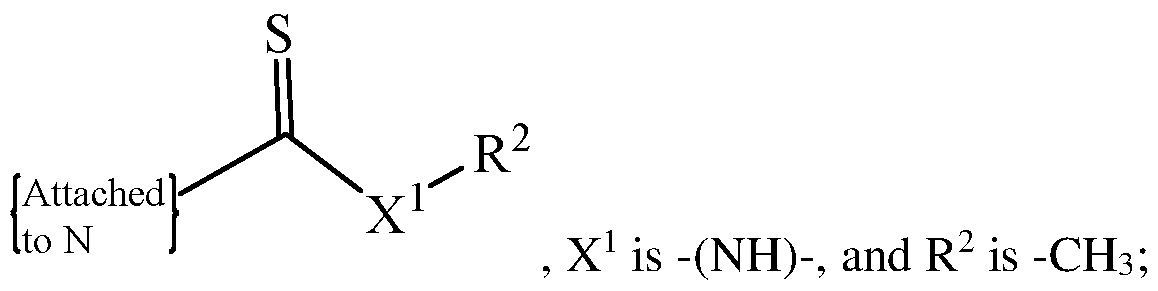
[00113] (e) R3 is the same as R4, R3 is methyl, R1 is the same as R5, R1 is
 [00114] (f) R3 is the same as R4, R3 is methyl, R1 is the same as R5, R1 is

[00115] (g) R3 is the same as R4, R3 is methyl, R1 is the same as R5, R1 is

[00116] (h) R3 is the same as R4, R3 is methyl, R1 is the same as R5, R1 is

[00117] (i) R3 is the same as R4 and R3 is methyl;
[00118] (]) R3 is the same as R4 and R3 is ethyl;
[00119] (k) R3 is methyl and R4 is phenyl;


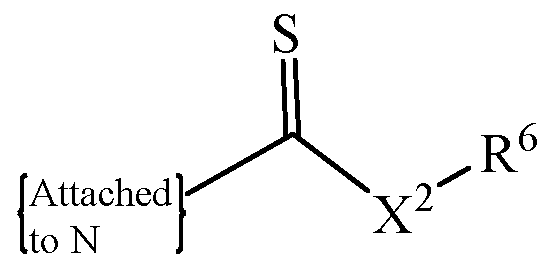
, X1 is -(NH)-, R2 is -CH3, R5 is
 , X2 is -0-, and R6 is -CH3;
, X1 is -(NH)-, R2 is -CH3, R >35 i ;s„
 , X2 is -0-, and R6 is -CH2CH3;
[00125] (q) (1) the limitations of (1) and (2) the limitations of (i), (j), or (k);
[00126] (r) (1) the limitations of (m) and (2) the limitations of (i), (j), or (k);
[00127] (s) (1) the limitations of (n) and (2) the limitations of (i), (j), or (k);
[00128] (t) (1) the limitations of (o) and (2) the limitations of (i), (j), or (k); or
[00129] (u) (1) the limitations of (p) and (2) the limitations of (i), (j), or (k).
[00130] In some embodiments, Formula (I) further comprises a solvent molecule coordinated with Formula (I). In other embodiments, the solvent molecule can be any suitable solvent. In some embodiments, the solvent molecule is selected from water, methanol, ethanol, propanol, acetonitrile, dimethylformamide, and acetone.
[00131] In certain embodiments, the compound of Formula (I) is

imidazolyl, an N-containing heterocyclyl, or an N-containing heteroaryl.
[00132] In some embodiments, Formula (I) is one of the molecules described in
Example Sets A, B, C, D, or E. In other embodiments, Formula (I) can be symmetric or asymmetric.
[00133] In certain embodiments of Formula (I) (a) X1 is not -(NH)-, (b) R2 is not methoxyphenyl or p-methoxyphenyl, or (c) both (a) and (b). In other embodiments of Formula (I) (a) X2 is not -(NH)-, (b) R6 is not methoxyphenyl or p-methoxyphenyl, or (c) both (a) and (b). In yet other embodiments, (a) R3 is not methyl, (b) R4 is not methyl, or (c) both (a) and (b). In still other embodiments, Formula (I) is not

[00134] In some embodiments, Formula (I) is part of a homogenous solution, a homogenous aqueous solution, a heterogeneous solution, a heterogeneous aqueous solution, or a glassy carbon electrode. In other embodiments, a homogenous solution, a homogenous aqueous solution, a heterogeneous solution, or a heterogeneous aqueous solution, can each comprise a compound of Formula (I). In certain embodiments, a glassy carbon electrode, a carbon paste (e.g., embedded with one or more of polynuclear catalysts, coordinated polymers, or metal-organic frameworks), covalent modified carbon (e-g-, graphene), or non-covalent modified carbon (e.g., graphene), can each comprise or reacted with the compound of Formula (I).
[00135] Some embodiments of the invention include a compound selected from
Formula (II), M L (II) and
[00136] salts, optical isomers, geometric isomers, salts of isomers, and derivatives thereof, wherein
[00137] - M is Ni, Pd, Pt, Cu, Ag, Au, Zn, Cd, Hg, Co, Rh, Ti, V, Cr, Mn, or Fe; or
M is Cu2+, Cu+, Zn2+, Co2+, Ni2+, Cd2+, Mn2+, Ru2+, or Fe2+; or M is Cu2+, Cu+, Zn2+, Co2+, Cd2+, Mn2+, Ru2+, or Fe2+; or M is Cu2+, Zn2+, Co2+, Cd2+, Mn2+, or Fe2+; or M is
Cu2+, Zn2+, Ni2+, or Co2+; or M is Cu2+, Zn2+, or Co2+; or M is Cu2+, Zn2+, or Ni2+; or M is Cu2+ or Zn2+; and
[00138] - L is selected from a compound of Formula (I). In some embodiments, M includes one or more transition metals. In other embodiments, M does not include a transition metal. In certain embodiments, M includes non-transition metals.
[00139] In some embodiments, Formula (II) is a compound of Formula (II- A)

[00140] - R7 is a monovalent H, methanoly (-COH), carboxy (-CO2H), nitro
(-NO2), sulfo (-SO3H), halogen (e.g., F, CI, Br, or I), aryl (e.g., benzene or pyrene), cycloalkyl, heterocyclyl, heteroaryl (e.g., pyridinyl and 1-methyl imidazolyl), Ci-C7 alkyl (e.g., Ci, C2, C3, C4, C5, C6, or C7 alkyl), C2-C7 alkenyl (e.g., C2, C3, C4, C5, C6, or C7 alkenyl), C2-C-7 alkynyl (e.g., C2, C3, C4, C5, C6, or C7 alkynyl), or Ci-C6 alkoxy (Ci, C2, C3, C4, C5, or C6 alkoxy), which aryl (e.g., benzene or pyrene), cycloalkyl, heterocyclyl, heteroaryl (e.g., pyridinyl and 1-methyl imidazolyl), Ci-C7 alkyl, C2-C-7 alkenyl, C2-C-7 alkynyl, or Ci-C6 alkoxy can optionally be substituted with one or more (e.g., 0, 1, 2, 3, 4, 5, or 6) of halogen (e.g., F, CI, Br, or I), hydroxy (-OH), C1-C5 alkyl (e.g., Ci, C2, C3, C4, or C5 alkyl), Ci-C4 alkoxy (Ci, C2, C3, or C4 alkoxy), methanoly (-COH), carboxy (- CO2H), nitro (-NO2), cyano (-CN), ethynyl (-CCH), sulfo (-S03H), methyl, or ethyl;
[00141] - X3 is bivalent -(NH)-, -(N-CH(CH3)2)-, -(N-CH2CH3)-, -(N-CH3)-, or -O-
, which -(NH)-, -(N-CH(CH3)2)-, -(N-CH2CH3)-, or -(N-CH3)- can optionally be substituted with one or more of halogen, hydroxy (-OH), C1-C5 alkyl, C1-C4 alkoxy, methanoly (-COH), carboxy (-CO2H), nitro (-NO2), cyano (-CN), ethynyl (-CCH), sulfo (-S03H), methyl, or ethyl;
[00142] - R8 is a monovalent H, methanoly (-COH), carboxy (-CO2H), nitro
(-NO2), sulfo (-S03H), halogen (e.g., F, CI, Br, or I), aryl (e.g., benzene or pyrene), cycloalkyl, heterocyclyl, heteroaryl (e.g., pyridinyl and 1-methyl imidazolyl), Ci-C7 alkyl (e.g., Ci, C2, C3, C4, C5, C6, or C7 alkyl), C2-C7 alkenyl (e.g., C2, C3, C4, C5, C6, or C7 alkenyl), C2-C7 alkynyl (e.g., C2, C3, C4, C5, C6, or C7 alkynyl), or Ci-C6 alkoxy (Ci, C2, C3, C4, C5, or C6 alkoxy), which aryl (e.g., benzene or pyrene), cycloalkyl, heterocyclyl, heteroaryl (e.g., pyridinyl and 1-methyl imidazolyl), Ci-C7 alkyl, C2-C7 alkenyl, C2-C7 alkynyl, or Ci-C6 alkoxy can optionally be substituted with one or more (e.g., 0, 1, 2, 3, 4, 5, or 6) of halogen (e.g., F, CI, Br, or I), hydroxy (-OH), C1-C5 alkyl (e.g., Ci, C2, C3, C4, or C5 alkyl), Ci-C4 alkoxy (Ci, C2, C3, or C4 alkoxy), methanoly (-COH), carboxy (- C02H), nitro (-NO2), cyano (-CN), ethynyl (-CCH), sulfo (-S03H), methyl, or ethyl;
[00143] - R9 is a monovalent H, methanoly (-COH), carboxy (-CO2H), nitro
(-NO2), sulfo (-S03H), halogen (e.g., F, CI, Br, or I), aryl (e.g., benzene or pyrene), cycloalkyl, heterocyclyl, heteroaryl (e.g., pyridinyl and 1-methyl imidazolyl), Ci-C7 alkyl (e.g., Ci, C2, C3, C4, C5, C6, or C7 alkyl), C2-C7 alkenyl (e.g., C2, C3, C4, C5, C6, or C7 alkenyl), C2-C7 alkynyl (e.g., C2, C3, C4, C5, C6, or C7 alkynyl), or Ci-C6 alkoxy (Ci, C2, C3, C4, C5, or C6 alkoxy), which aryl (e.g., benzene or pyrene), cycloalkyl, heterocyclyl, heteroaryl (e.g., pyridinyl and 1-methyl imidazolyl), Ci-C7 alkyl, C2-C7
alkenyl, C2-C-7 alkynyl, or Ci-C6 alkoxy can optionally be substituted with one or more (e.g., 0, 1, 2, 3, 4, 5, or 6) of halogen (e.g., F, CI, Br, or I), hydroxy (-OH), C1-C5 alkyl (e.g., Ci, C2, C3, C4, or C5 alkyl), C1-C4 alkoxy (Ci, C2, C3, or C4 alkoxy), methanoly (- COH), carboxy (-CO2H), nitro (-NO2), cyano (-CN), ethynyl (-CCH), sulfo (-SO3H), methyl, or ethyl;
[00144] - X4 is bivalent -(NH)-, -(N-CH(CH3)2)-, -(N-CH2CH3)-, -(N-CH3)-, or -O-
, which -(NH)-, -(N-CH(CH3)2)-, -(N-CH2CH3)-, or -(N-CH3)- can optionally be substituted with one or more of halogen, hydroxy (-OH), C1-C5 alkyl, Ci-C4 alkoxy, methanoly (-COH), carboxy (-CO2H), nitro (-NO2), cyano (-CN), ethynyl (-CCH), sulfo (-S03H), methyl, or ethyl;
[00145] - R10 is a monovalent H, methanoly (-COH), carboxy (-CO2H), nitro
(-NO2), sulfo (-S03H), halogen (e.g., F, CI, Br, or I), aryl (e.g., benzene or pyrene), cycloalkyl, heterocyclyl, heteroaryl (e.g., pyridinyl and 1-methyl imidazolyl), Ci-C7 alkyl (e.g., Ci, C2, C3, C4, C5, C6, or C7 alkyl), C2-C7 alkenyl (e.g., C2, C3, C4, C5, C6, or C7 alkenyl), C2-C-7 alkynyl (e.g., C2, C3, C4, C5, C6, or C7 alkynyl), or Ci-C6 alkoxy (Ci, C2, C3, C4, C5, or C6 alkoxy), which aryl (e.g., benzene or pyrene), cycloalkyl, heterocyclyl, heteroaryl (e.g., pyridinyl and 1-methyl imidazolyl), Ci-C7 alkyl, C2-C-7 alkenyl, C2-C-7 alkynyl, or Ci-C6 alkoxy can optionally be substituted with one or more (e.g., 0, 1, 2, 3, 4, 5, or 6) of halogen (e.g., F, CI, Br, or I), hydroxy (-OH), C1-C5 alkyl (e.g., Ci, C2, C3, C4, or C5 alkyl), Ci-C4 alkoxy (Ci, C2, C3, or C4 alkoxy), methanoly (-COH), carboxy (- CO2H), nitro (-NO2), cyano (-CN), ethynyl (-CCH), sulfo (-S03H), methyl, or ethyl; and [00146] - M is Ni, Pd, Pt, Cu, Ag, Au, Zn, Cd, Hg, Co, Rh, Ti, V, Cr, Mn, or Fe; or
M is Cu2+, Cu+, Zn2+, Co2+, Ni2+, Cd2+, Mn2+, Ru2+, or Fe2+; or M is Cu2+, Cu+, Zn2+,
Co2+, Cd2+, Mn2+, Ru2+, or Fe2+; or M is Cu2+, Zn2+, Co2+, Cd2+, Mn2+, or Fe2+; or M is Cu2+, Zn2+, Ni2+, or Co2+; or M is Cu2+, Zn2+, or Co2+; or M is Cu2+, Zn2+, or Ni2+; or M is Cu2+ or Zn2+.
[00147] In certain embodiments, M is Cu2+, Zn2+, Ni2+, or Co2+; or M is Cu2+, Zn2+, or Co2+; or M is Cu2+, Zn2+, or Ni2+; or M is Cu2+ or Zn2+. In some embodiments, M includes one or more transition metals. In other embodiments, M does not include a transition metal. In certain embodiments, M includes non-transition metals.
[00148] In some embodiments of Formula (II),
[00149] (a) R3 is the same as R4;
[00150] (b) R3 is the same as R4 and R1 is the same as R5;
[00151] (c) R3 is the same as R4, X1 is -(NH)-, X2 is -(NH)-, and R2 is the same as
R6;
[00152] (d) R3 is the same as R4, R3 is methyl, R1 is the same as R5, R1 is
 , X1 is -(NH)-, and R2 is -CH3;
[00153] (e) R3 is the same as R4, R3 is methyl, R1 is the same as R5, R1 is


[00155] (g) R3 is the same as R4, R3 is methyl, R1 is the same as R5, R1 is

[00156] (h) R3 is the same as R4, R3 is methyl, R1 is the same as R5, R1 is

[00157] (i) R3 is the same as R4 and R3 is methyl;
[00158] (]) R3 is the same as R4 and R3 is ethyl;
[00159] (k) R3 is methyl and R4 is phenyl;


, X1 is -(NH)-, R2 is -CH3, R5 is
 , X2 is -0-, and R6 is -CH3;
, X1 is -(NH)-, R2 is -CH3, R >35 i ;s„
 , X2 is -0-, and R6 is -CH2CH3;
[00165] (q) (1) the limitations of (1) and (2) the limitations of (i), (j), or (k);
[00166] (r) (1) the limitations of (m) and (2) the limitations of (i), (j), or (k);
[00167] (s) (1) the limitations of (n) and (2) the limitations of (i), (j), or (k);
[00168] (t) (1) the limitations of (o) and (2) the limitations of (i), (j), or (k); or [00169] (u) (1) the limitations of (p) and (2) the limitations of (i), (j), or (k).
[00170] In some embodiments of Formula (II),
[00171] (a) R8 is the same as R9;
[00172] (b) R8 is the same as R9 and X3-R7 is the same as X4-R10;
[00173] (c) R8 is the same as R9, X3 is -(NH)-, X4 is -(NH)-, and R7 is the same as R10;
[00174] (d) R8 is the same as R9, R8 is methyl, X3-R7 is the same as X4-R10, X3 (NH)-, and R7 is -CH3;
[00175] (e) R8 is the same as R9, R8 is methyl, X3-R7 is the same as X4-R10, X3
(NH)-, and R7 is -C5H6;
[00176] (f) R8 is the same as R9, R8 is methyl, X3-R7 is the same as X4-R10, X3
(NH)-, and R7 is -CH2F3;
[00177] (g) R8 is the same as R9, R8 is methyl, X3-R7 is the same as X4-R10, X3 is -
(NCHs)-, and R7 is -CH3;
[00178] (h) R8 is the same as R9, R8 is methyl, X3-R7 is the same as X4-R10, X3 is -
0-, and R7 is -CH3;
[00179] (i) R8 is the same as R9 and R8 is methyl;
[00180] (]) R8 is the same as R9 and R8 is ethyl;
[00181] (k) R8 is methyl and R9 is phenyl;
[00182] (1) X3 is -(NH)-, R7 is -CH3, X4 is -(N-CH(CH3)2)-, and R10 is -CH(CH3)2;
[00183] (m) X3 is -(NH)-, R7 is -CH3, X4 is -(NH)-, and R10 is -C5H6;
[00184] (n) X3 is -(NH)-, R7 is -CH3, X4 is -(NH)-, and R10 is -CH2CF3;
[00185] (o) X3 is -(NH)-, R7 is -CH3, X4 is -0-, and R10 is -CH3;
[00186] (p) X3 is -(NH)-, R7 is -CH3, X4 is -0-, and R10 is -CH2CH3;
[00187] (q) (1) the limitations of (1) and (2) the limitations of (i), (j), or (k);
[00188] (r) (1) the limitations of (m) and (2) the limitations of (i), (j), or (k);
[00189] (s) (1) the limitations of (n) and (2) the limitations of (i), (j), or (k);
[00190] (t) (1) the limitations of (o) and (2) the limitations of (i), (j), or (k); or
[00191] (u) (1) the limitations of (p) and (2) the limitations of (i), (j), or (k).
[00192] In some embodiments of Formula (II), M is Zn2+, Co2+, Ni2+ or Cu2+, (e.g.,
M is Zn2+, Ni2+ or Cu2+; or M is Zn2+, Co2+ or Cu2+; or M is Zn2+ or Cu2+).
[00193] In other embodiments, Formula (II) further comprises a solvent molecule coordinated with Formula (II). In other embodiments, the solvent molecule can be any suitable solvent molecule. In certain embodiments, the solvent molecule is selected from water, ethanol, propanol, acetonitrile, dimethylformamide, and acetone.
[00194] In some embodiments, Formula (II) is

Co, Ni, or Cu (e.g., M is Zn, Ni, or Cu; or M is Zn, Co, or Cu; or M is Zn or Cu) and R5 is pyridinyl, 1- methyl- imidazolyl, an N-containing heterocyclyl, or an N-containing heteroaryl.
[00195] In certain embodiments, Formula (II) is symmetric or is asymmetric.
[00196] In other embodiments, (a) X1 is not -(NH)-, (b) R2 is not methoxyphenyl or p-methoxyphenyl, or (c) both (a) and (b). In yet other embodiments, (a) X2 is not - (NH)-, (b) R6 is not methoxyphenyl or p-methoxyphenyl, or (c) both (a) and (b). In certain embodiments, (a) R3 is not methyl, (b) R4 is not methyl, or (c) both (a) and (b).
[00197] In some embodiments, Formula (II) is not

[00198] In some embodiments, Formula (II) is


[00199] In other embodiments, Formula (II) is


[00200] In some embodiments, Formula (II) is one of the molecules described in
Example Sets A, B, C, D, or E.
[00201] In some embodiments, a compound of Formula (II) is part of a homogenous solution, a homogenous aqueous solution, a heterogeneous solution, or a heterogeneous aqueous solution. In other embodiments, a homogenous solution, a homogenous aqueous solution, a heterogeneous solution, or a heterogeneous aqueous solution, each comprise a compound of Formula (II).
[00202] In other embodiments, a glassy carbon electrode, a carbon paste (e.g., embedded with one or more of polynuclear catalysts, coordinated polymers, or metal- organic frameworks), covalent modified carbon (e.g., graphene), or non-covalent
modified carbon (e.g., graphene), each comprises or is reacted with a compound of Formula (II). In certain embodiments, the carbon paste carbon paste comprises an extended structure motif (e.g., motif I, motif II, or motif III of scheme below).

[00203] Certain embodiments of the invention include glassy carbon electrodes
(GCE) comprising Formula (I), Formula (II), or both. Glassy carbon electrodes can be used for any suitable purpose including but not limited to use in heterogeneous aqueous solutions. Glassy carbon electrodes can be made using any suitable method including but not limited to dropcast or spray coating. In some instances, contributions to adhesion to the electrode can include but are not limited to π-π interactions, the water-insolubility of Formula (I) or Formula (II), or both. In some instances, asymmetric structures of Formula (I), Formula (II) or both can be used, in that the asymmetric structure is capable (e.g., designed) of linking to the GCE. In other instances, symmetric molecules of Formula (I), Formula (II) or both can be used to make GCEs.
[00204] Other embodiments of the invention include carbon paste electrodes
(CPE) embedded with compositions comprising Formula (I), Formula (II), or both. The embedded compositions can be any suitable composition including but not limited to molecular catalysts or related extended structures (e.g., polynuclear catalysts, coordination polymers, metal-organic frameworks, or extended structures as described herein). Extended structures can be made using any suitable technique, including but not limited to those exemplified in the Examples or the scheme above; that technique can be applied to any suitable Formula (I) or Formula (II) and is not limited to the specific molecules used. In some instances, asymmetric structures of Formula (I), Formula (II) or both can be used, in that the asymmetric structure can be capable (e.g., designed) of forming desired extended networks. In other instances, symmetric molecules of Formula
(I), Formula (II) or both can be used to make extended structures.
[00205] Still other embodiments of the invention include attachment of Formula
(I) , Formula (II), or both, to carbon surfaces (e.g., graphene, glassy carbon, graphite, carbon nanotubes, carbon nanospheres, or multiwalled carbon ananotubes). Attachment can include any suitable attachment including but not limited to covalent or enhanced non-covalent attachment (e.g., π- π interactions, insolubility of Formula (I) or Formula
(II) , or combinations thereof). In certain instances, the carbon surface (e.g., carbon electrode) can be modified with any suitable linker, such as being modified with diazonium compounds, animation chemistry, amide, coupling amines, carboxylic acids, epoxides or any suitable linker so that Formula (I), Formula (II), or an extended structure thereof can be linked to the carbon surface. Linker length, in some embodiments, is chosen to allow catalyst to adopt one or more confirmations that occur during catalysis
(e.g., the linker can be used to force drive a desired catalytic mechanism, such as ligand centered reactivity). In yet other embodiments, the linker length is not so long as to diminish electron transfer between catalyst and carbon surface. In certain embodiments, Formula (I), Formula (II) or both can comprise a carboxylic acid or carboxaldehyde to attach to a carbon surface (e.g., modified with amines). In some instances, asymmetric structures of Formula (I), Formula (II) or both can be used, in that the asymmetric structure is capable (e.g., designed) of linking to the modified or unmodified carbon surface. In other instances, symmetric molecules of Formula (I), Formula (II) or both can be used (e.g., designed) to linking to the modified or unmodified carbon surface. In certain embodiments, related extended structures (e.g., polynuclear catalysts,
coordination polymers, metal-organic frameworks, or extended structures as described herein) can be attached to the modified or unmodified carbon surface.

[00206] Covalent modification of carbon surfaces can be accomplished using any suitable technique, including but not limited to those exemplified in the scheme above;
that technique can be applied to any suitable Formula (I) or Formula (II) and is not limited to the specific molecules used.
[00207] In some embodiments, the inventive compounds (e.g., Formula (I) or
Formula (II), or their embodiments in any of the above GCEs, CPEs, or carbon surfaces) can be used in one or more of the following applications: catalysts (e.g., electrocatalysts) for activation of small molecules (e.g., alcohols, such as, but not limited to, methanol, ethanol, propanol, butanol, and all their isomers), integration into PEM fuel cells;
hydrogen evolution for solar energy storage; sustainable hydrogen resource for fertilizer production; solid electrolytes for small battery development;
hydrogenation/dehydrogenation catalysts; electrocatalytic C02 reduction catalyst;
selective olefin binding and functionalization; ethylene and small molecule detection; desulfurization; incorporation into electroactivc films or thin films; incorporation into conductive polymers; electroactive, tunable metal-organic-frameworks; water purification; and water desalination.
[00208] In some embodiments, the inventive compounds (e.g., Formula (I) or
Formula (II) and their metal (e.g., zinc or copper) complexes) can have one or more of the following uses or properties: use as a substitution for metal-hydride intermediates; capable of being engineered with different functional groups to match a desired application; air and water stable; no special precautions in preparation, storage, or handling; low molecular weights; capable of reducing the mass of catalyst in a particular application; capable of being prepared in high yield (e.g., in 4 - 7 steps from
commercially available bulk reagents) and/or inexpensively; does not utilize precious or
semi-precious metals for catalysts; catalysts can be prepared in alcohol solution; and catalysis can be conducted in alcohol or water.
[00209] In certain embodiments, the inventive (e.g., Formula (I) or Formula (II) and their metal (e.g., zinc or copper) complexes) comprise proton relay groups (e.g., as part of the ligand structure). In certain embodiments, the inventive compounds comprise structure(s) or modification(s) that are capable of attaching to an electrode surface, a solid support, or both. In certain instances, light driven evolution of H2 with the inventive compounds can be accomplished using various photo sensitizers and sacrificial redox mediators. In other embodiments, the inventive compounds (e.g., where M is Cu) can be used as a catalyst for the oxidation alcohols to aldehydes using air.
[00210] Some embodiments of the invention include a catalyst (e.g., an electrocatalyst) comprising a composition comprising a compound of Formula (I), a compound of Formula (II), or both. Other embodiments include an anode comprising a composition comprising a compound of Formula (I), a compound of Formula (II), or both. Other embodiments include a cathode comprising a composition comprising a compound of Formula (I), a compound of Formula (II), or both.
[00211] Other embodiments include an electrochemical cell comprising a composition comprising a compound of Formula (I), a compound of Formula (II), or both. In some instances, the cathode of the electrochemical cell comprises the composition, the anode of the electrochemical cell comprises the composition, or both.
[00212] Still other embodiments of the invention include a fuel cell comprising a composition comprising a compound of Formula (I), a compound of Formula (II), or
both. In some instances, the cathode of the fuel cell comprises the composition, the anode of the fuel cell comprises the composition, or both.
[00213] Additional embodiments of the invention include a method for producing
H2 comprising contacting, in an electrochemical cell, a first composition comprising a compound of Formula (I), a compound of Formula (II), or both with a second
composition comprising water. In some instances, the cathode of the electrochemical cell comprises the first composition. In certain embodiments, the Turn Over Frequency (TOF) is from about 20 s"1 to about 100,000 s"1, about 100 s"1 to about 100,000 s"1, from about 500 s"1 to about 100,000 s"1, from about 500 s"1 to about 50,000 s"1, from about 500 s"1 to about 20,000 s"1, about 20 s"1, about 100 s"1, about 500 s"1, about 1000 s"1, about
5000 s"1, about 10000 s"1, about 12000 s"1, about 16000 s"1, about 20000 s"1, about 50000 s"1, or about 100,000 s"1. In some embodiments, the overpotential is greater than about 0 V, not less than about 0.1 V, not more than about 0.1 V, not more than 0.5 V, not more than 1 V, not more than 10 V, not more than 100 V, from about 0 V to about 2000 V, from about 0 V to about 1000 V, from about 0 V to about 750 V, from about 0 V to about 300 V, from about 0 V to about 350 V, from about 0 V to about 200 V, from about 0 V to about 100 V, from about 0 V to about 20 V, from about 0 V to about 10 V, from about 0 V to about 5 V, from about 0 V to about 2 V, from about 0 V to about 1 V, from about 0.1 V to about 2000 V, from about 0.1 V to about 1000 V, from about 0.1 V to about 750 V, from about 0.1 V to about 300 V, from about 0.1 V to about 350 V, from about 0.1 V to about 200 V, from about 0.1 V to about 100 V, from about 0.1 V to about 20 V, from about 0.1 V to about 10 V, from about 0.1 V to about 5 V, from about 0.1 V to about 2 V,
from about 0.1 V to about 1 V, about 0.1 V, about 0.5 V, about 1 V, about 5 V, about 10 V, about 100 V, about 250 V, about 350 V, about 400 V, about 500 V, or about 1000 V.
[00214] Other instances of the invention include a method for oxidizing an aldehyde, an alcohol, acetonitrile, or water comprising contacting, in an electrochemical cell, a composition comprising a compound of Formula (I), a compound of Formula (II), or both. In some embodiments, the overpotential is greater than about 0 V, not less than about 0.1 V, not more than about 0.1 V, not more than 0.5 V, not more than 1 V, not more than 10 V, not more than 100 V, from about 0 V to about 2000 V, from about 0 V to about 1000 V, from about 0 V to about 750 V, from about 0 V to about 300 V, from about 0 V to about 350 V, from about 0 V to about 200 V, from about 0 V to about 100 V, from about 0 V to about 20 V, from about 0 V to about 10 V, from about 0 V to about 5 V, from about 0 V to about 2 V, from about 0 V to about 1 V, from about 0.1 V to about 2000 V, from about 0.1 V to about 1000 V, from about 0.1 V to about 750 V, from about 0.1 V to about 300 V, from about 0.1 V to about 350 V, from about 0.1 V to about 200 V, from about 0.1 V to about 100 V, from about 0.1 V to about 20 V, from about 0.1 V to about 10 V, from about 0.1 V to about 5 V, from about 0.1 V to about 2 V, from about 0.1 V to about 1 V, about 0.1 V, about 0.5 V, about 1 V, about 5 V, about 10 V, about 100 V, about 250 V, about 350 V, about 400 V, about 500 V, or about 1000 V.
[00215] Some embodiments of the invention include a method for producing electricity comprising contacting, in a fuel cell, a first composition comprising a compound of Formula (I), a compound of Formula (II), or both with a second composition comprising H2. In some embodiments of this method, the anode of the fuel cell comprises the first composition. In some embodiments of this method, the cathode
of the fuel cell comprises the first composition. In certain instances, the TOF is from about 1 s"1 to about 1000 s"1, from about 5 s"1 to about 1000 s"1, from about 5 s"1 to about 500 s"1, from about 5 s"1 to about 200 s"1, about 1 s"1, about 5 s"1, about 10 s"1, about 32 s"1, about 50 s"1, about 76 s"1, about 100 s"1, about 120 s"1, about 200 s"1, about 300 s"1, about 500 s"1, or about 1000 s"1. In yet additional embodiments, the overpotential is greater than about 0 V, not less than about 0.1 V, not more than about 0.1 V, not more than 0.5 V, not more than 1 V, not more than 10 V, not more than 100 V, from about 0 V to about 2000 V, from about 0 V to about 1000 V, from about 0 V to about 750 V, from about 0 V to about 300 V, from about 0 V to about 350 V, from about 0 V to about 200 V, from about 0 V to about 100 V, from about 0 V to about 20 V, from about 0 V to about 10 V, from about 0 V to about 5 V, from about 0 V to about 2 V, from about 0 V to about 1 V, from about 0.1 V to about 2000 V, from about 0.1 V to about 1000 V, from about 0.1 V to about 750 V, from about 0.1 V to about 300 V, from about 0.1 V to about 350 V, from about 0.1 V to about 200 V, from about 0.1 V to about 100 V, from about 0.1 V to about 20 V, from about 0.1 V to about 10 V, from about 0.1 V to about 5 V, from about 0.1 V to about 2 V, from about 0.1 V to about 1 V, about 0.1 V, about 0.5 V, about 1 V, about 5 V, about 10 V, about 100 V, about 250 V, about 350 V, about 400 V, about 500 V, or about 1000 V.
[00216] Other embodiments of the invention include a method for preparing a compound of Formula (I) comprising any suitable method, such as those disclosed herein. In some instances, the compound of Formula (I) is prepared comprising
[00217] (a) reacting a compound of Formula (III) R NH 2 (III)
[00218] with a compound of Formula (IV)
[00219] (b) reacting a compound of Formul
 a (V)
a (V)
(V)
[00220] with a compound of Formula (VI)
(VI); and
[00221] (c) recovering the compound of Formula (I),
[00222] wherein R1, R3, R4, and R5 are defined herein. Recovery can occur using any suitable method including but not limited to HPLC (e.g., reverse phase), LC, precipitation, centrifugation, column chromatography (e.g., size exclusion
chromatography or ion exchange chromatography), use of silica gel, or combinations thereof.
[00223] Other embodiments of the invention include a method for preparing a compound of Formula (II) comprising any suitable method, such as those disclosed herein. In certain instances, the compound of Formula (II) is prepared comprising
[00224] (a) reacting a compound of Formula (I) with M (e.g., Zn, Co, or Cu) or salt thereof; and
[00225] (b) recovering the compound of Formula (II),
[00226] wherein M is defined herein. Recovery can occur using any suitable method including but not limited to HPLC (e.g., reverse phase), LC, precipitation, centrifugation, column chromatography (e.g., size exclusion chromatography or ion exchange chromatography), use of silica gel, or combinations thereof.
[00227] Additional embodiments include a method for preparing a catalyst (e.g., an electrocatalyst) comprising a composition comprising a compound of Formula (I), a compound of Formula (II), or both, comprising any suitable method, including those described herein. Additional embodiments include a method for preparing an anode comprising a composition comprising a compound of Formula (I), a compound of Formula (II), or both, comprising any suitable method, including those described herein. Further embodiments include a method for preparing a cathode comprising a composition comprising a compound of Formula (I), a compound of Formula (II), or both, comprising any suitable method, including those described herein.
[00228] The presently-disclosed subject matter is further illustrated by the following specific but non-limiting examples. The following examples may include compilations of data that are representative of data gathered at various times during the course of development and experimentation related to the present invention.
EXAMPLES
Example Set A: HER and HOR of Zn and metal- free complexes
The compounds discussed in Example Set A include H2L and ZnL.

ZnL

Materials and Methods for Example Set A
[00231] All solvents were purified with an MBraun solvent purification system prior to use.
[00232] Electrochemical Methods
[00233] All cyclic voltammetry (CV) and controlled potential coulometry (CPC) measurements were recorded using a Gamry Interface potentiostat/galvanostat, which was connected to a glassy carbon working electrode (6.5 mm diameter, surface area = 0.07 cm2), a platinum wire counter electrode, and Ag/AgCl reference electrode. Before use, the working electrode was polished using aqueous alumina slurry. Working and
counter electrodes were cleaned before use by washing with water, ethanol, acetone, isopropanol and methanol, and then sonicated in methanol. CV measurements were conducted using a three-neck electrochemical cell that was washed and dried in oven over night before use. All electrochemical experiments were conducted under a N2 atmosphere, aside from HOR experiments. All CPC measurements were conducted using a custom built gas tight Parr-electrolysis reactor with a volume of 30 mL washed and dried night before use. The working compartment was fitted with a platinum working electrode (surface area = 0.07 cm2) and an Ag/AgCl reference electrode. The auxiliary compartment was fitted with a Pt wire counter electrode. The working compartment contained 12 mM acetic acid added to a 0.1 M Bu4NPF6 methanol solution, while the auxiliary compartment was filled with 0.1 M Bu4NPF6 methanol solution. Both compartments were purged for 15 min with N2 and kept under a constant N2 flow. A control (blank) CPC study was conducted and subtracted from experimental results. Electrolysis was then measured with the addition of the 0.1 mM ZnL. Electrolysis was conducted for 2.5 hours and the samples were subjected to gas chromatographic analysis every 30 minutes. A Gow-Mac series 400 GC-TCD with molecular sieve column was used for product detection. The column was heated to 130 °C under N2 gas flow with 250 μL· injection samples injected onto the column. The integrated area of the H2 peak was then compared to the pre-made H2 calibration curve in order to calculate the volume and moles of H2 generated.
[00234] Statistical Analysis
[00235] Overpotential Determination: Overpotential can be defined as the difference between the thermodynamic and equilibrium potentials for a given reaction
and the potential at which the reaction occurs under a set of specific conditions. Using this method of Appel and Helm (ACS Catal., 2014, Vol. 4, pp. 630-633; DOI: 10.1021/cs401013v), the overpotential (η) for proton reduction or H2 oxidation by ZnL or H2L under specific experimental conditions can be estimated as:

[00236] EOCP is the measured open circuit potential measured under catalytic conditions specific for each reaction, and Ecat/2 is the potential at one-half the maximum of the catalytic current measured for the catalyzed reduction of protons or oxidation of ¾ by ZnL or ¾L.
[00237] Overpotential calculation; ZnL HER: η = Overpotential = I(EBH+(OCP)) -(Ecat/2)l
n = l[-0.924 -(- 1.68V)]l
η = 0.756 V vs Fc+/Fc°
[00238] Overpotential calculation; ZnL HOR: η = Overpotential = I(EBH+(OCP)) -(Ecat/2)l
η = 1(0.190-0.505)1
η = 0.315 V vs Fc+/Fc°
[00239] Overpotential calculation; H2L HER: η = Overpotential = I(EBH+(OCP)) -(Ecat/2)l
η = Ι[-0.37 -(- 1.80)]Ι
η = 1.43 V vs Fc+/Fc°
[00240] Overpotential calculation; H2L HOR: η = Overpotential = I(EBH+(OCP)) -(Ec t/2)l
η = 1(0.177-0.505)1
η = 0.328 V vs Fc+/Fc°
[00241] Determination of ZnL Diffusion Coefficient (Do):
[00242] Using the Randles-Sevcrk equation (Eq. A2), and plotting peak current vs the square root of the scan rate allows for accurate calculation of the diffusion coefficient, Do.
Slope (Figs. 10- 11)≡ 1.94E-5 = 0.4463FA[cat] [(FD0/RT)]0 5 A=0.071 cm2
[cat] = 3E-6 moles/cm3
F = 96485 C/mole e
R = ideal gas constant
T = 298 K
Do = 1.15E-7 cm2/s in MeOH
[00243] Sample Calculations Electrolysis:
[00244] Theoretical Moles of Hydrogen Made via Total Charge:
19.8 C x (1 mol e7 96485 C) x (1 mol H2 / 2 mol e ) = moles H2 theoretical
Moles H2 theoretical = 0.00011 moles H2 based on charge from electrolysis
[00245] Faradaic Efficiency Calculations:
Faradaic Efficiency = (Moles H2 Quantified / Moles of H2 Theoretical) x 100% Faradaic Efficiency = (0.000093 moles) / (0.00011 moles) x 100%
Faradaic Efficiency = 85%
[00246] TON Calculations:
TON = Moles of H2 Produced / Moles of ZnL Used
TON = (0.00011 moles H2 produced) / (0.000003 moles ZnL used)
TON = 36.7
[00247] HER Equations for TOF Calculation:
[00248] Equation Al details the relationship between the catalytic current icat, the catalyst concentration [cat], and the acid concentration [H+] for a catalytic reaction that is first-order in acid and first-order in catalyst under scan rate independent conditions. The terms n, F, A, and D are the normal electrochemical terms related to the number of electrons transferred, Faraday's constant, area of the electrode, and diffusion constant, respectively.
icat = nFA[cat] /Dk[H+] (Al)
[00249] Equation A2 (Randle-Sevcik equation) provides the relationship between the peak current ip, catalyst concentration, and scan rate (v) in the absence of acid. The factor of 0.4463 is related to the diffusion equations, R is the gas constant, and T is temperature in K. The other terms are the same as in equation Al. ip = 0A463FA [cat] (A2)
[00250] Thus, the ratio of icat / iP (equation A3) is obtained from equations Al and
A2 lcat IRTk[H+]
(A3)
ip 0.4463 \| Fv
[00251] Under pseudo first-order conditions where kobs = k[H+], equation A3 simplifies to A4. lcat RTk, obs (A4)
ip 0.4463 \l Fv
[00252] Equation A4 can further be simplified to equation A5, when
bimolecular processes.

[00253] Since no peak current for ZnL was observed in the absence of substrate in methanol, the experimentally determined diffusion coefficient, 1.15E-7, was used to calculate the value for ip. This gave an ip of 43 μΑ when run at 5 V/s (the scan rate in which catalytic current becomes independent of scan rate). Furthermore, the value of ip was confirmed through simulations using DigiElch, which agree with the calculated ip
values. Using equation A5, the TOF or kobs can be calculated using the experimentally determined ip value as well as the icat observed at 5 V/s, 230 μΑ. This results in a TOF of 1170 s"1.
[00254] We then calculated the TOF using Eq. A6, which is Eq. Al under pseudo first-order conditions, in order to compare both calculated values, which are in agreement with each other.

[00255] Sample Calculations ZnL TOF/£0i«.- [00256] Using Eq. A5: icat = 230 μΑ; ip = 43 μΑ; v = 5.0 V/s
= TOF = 1170 s 1
[00257] Using Eq. A6: icat = 230 μΑ; n = 1 mole e7 mole of ZnL; F = 96485 C / mole"; A = 0.071 cm2; [cat] = 3E-6 moles / cm3; Dcat = 1.15E-7 cm2 / s.
= :ofo / TOF=1100 s 1
[00258] ZnL HER Kinetic Isotope Effect: Acetic Acid vs d- Acetic Acid:

5 V/s 1170 975 1.2
[00259] HOR TOF ZnL and H2L Sample Calculation when v
ZnL:
TOF = kobs = v * 1.94(i ip)2 when icat = -111 μΑ and ip = - 117 μΑ at 1.0 V/s TOF = 72 s 1
TOF = kobs = v * 1.94(i ip)2 when icat = -475μΑ and ip = - 117 μΑ at 1.0 V/s TOF = 32 s 1
[00260] Computational Methods
[00261] All calculations were performed in the gas phase using density functional theory (DFT) employing the B97-D exchange correlation functional, and the 6-311G(d) basis set for all atoms as implemented in the Gaussian09 suite of programs for electronic structure and ChemCraft was used for graphics visualization. Transition states were determined locally using the Berny algorithm with GEDIIS, and verified by IRC calculations with forward and reverse step sizes of 40. All optimizations were performed under tight constraints, with no symmetry imposed. Several dimeric TS structures in various protonation states were initially investigated by DFT using the berny algorithm for local TS optimization in the gas phase. These structures were constructed manually based on optimized reactants and products, or by modifying previously published semicarbazide dimers. Dimers without ruptured Zn-S and Zn-N bonds were also considered, but precluded based on energetic grounds.
[00262] Supplementary Text
[00263] Blank and control experiments were performed for ZnL and H2L HER CV studies. Blank runs consisted of 0.1 M Bu4NPF6 methanol or acetonitrile, depending on experiment, which had been purged with N2 gas for 10 minutes. Control CVs run in 0.1 M Bu4NPF6 methanol or acetonitrile with 12 mM acetic acid showed minimal currents when compared to currents observed after addition of either ZnL or H2L electrocatalysts.
[00264] Blank and control experiments were performed for ZnL and H2L HOR CV studies. Blank runs consisted of 0.1 M Bu4NPF6 methanol solutions, which had been purged with N2 gas for 10 minutes. Control CVs in the absence of ZnL or H2L were performed. CVs were run under an H2 atmosphere in solutions of 0.1 M Bu4NPF6
methanol with increasing concentrations of triethylamine, added until a concentration of 30 mM. The current observed was significantly lower when compared to the current observed after the addition of the ZnL or H2L electrocatalysts. Additionally, control experiments were performed with ZnL or H2L in 0.1 M Bu4NPF6 methanol solutions under an N2 atmosphere. Application of an N2 atmosphere resulted in no catalytic currents. After introduction of an H2 atmosphere and purging the solution with H2 for 15 minutes, catalytic current was observed.
[00265] To quantify H2 production, the output gas was sampled, 250 ih, every 30 minutes and analyzed by the GC-TCD described in electrochemical methods section. After sampling, the chromatographic peak area of hydrogen is obtained. The GC-TCD calibration curve was prepared by sampling known hydrogen concentrations, made with known volumes of hydrogen, from the working compartment, with a constant known N2 flow rate, and then measured by the same procedure described above. A linear relationship between the chromatographic peak areas of the hydrogen sampled and the specific amounts of hydrogen used was established, defined by y = mx + b, where y is the peak area and x is the amount of hydrogen. Using this linear relationship, the amount of hydrogen produced during experimental electrolysis can be calculated from the integrated peak areas obtained.
[00266] Digital simulations of voltammetric data were performed using commercially available DigiElch Pro software package (v.7). Models were fit using an experimentally determined ZnL diffusion coefficient and an experimentally determined value of a and ks. The consistency of the mechanism over a broad set reaction conditions
was confirmed through models employing multiple scan rates and acid concentrations, all which agree with experimental results
[00267] Examination of the change in bond lengths and bond angles amongst ZnL,
[Zn(HL)]+, Zn(HL-), and [Zn(H2L-)]+ (Tables A4 - A6) assist to explain structural and electronic changes over the course of the ZnL catalyzed HER mechanism. Initial protonation of ZnL to give [Zn(HL)+] results in a slight puckering of the ligand framework around the Zn center shown by the lengthening of the Zn-S l, Zn-N2, Zn-N3 bonds and a decrease in the Zn-S2 bond as well as an increase in the S l-Zn-S2, N3-Zn- S2 bond angles and decrease of the S l-Zn-N2, N2-Zn-N3 bond angles. Subsequent reduction to the neutral radical species, Zn(HL-), is accompanied by significant contraction of the Zn-N2 and Zn-N3 bonds, 2.118 A and 2.125 A to 2.059 A and 2.045 A, respectively. Furthermore, moving across the mechanism from protonation to reduction, the C2-C3 bond length always decreases in length moving from an initial length of 1.478 A to 1.470 A after protonation, and then decreasing further to 1.427 A after reduction, in agreement with the spin-density map of Zn(HL-).
Results and Discussion for Example Set A
[00268] Solutions of ZnL in methanol or acetonitrile display catalytic hydrogen evolution upon reduction in the presence of acetic acid. In methanol, the cathodic current at -1.7 V increases with increasing acid concentration indicative of an electrocatalytic process (Fig. 1A). The current plateaus at 12.0 mM acetic acid indicating acid- saturation (Fig. IB) with a maximum turnover frequency (TOF) of 1170 s"1 at overpotential of 756 mV. No reduction wave for ZnL is observed within the potential limits of methanol in the
absence of acid, signifying that HER might require protonation prior to reduction. In acetonitrile, addition of acetic acid results in catalytic current at -2.3 V, which is near the irreversible ligand-centered reduction of H2L in the absence of acid (Figs. 4-5) and within the range of reduction potentials previously reported for thiosemicarbizides. Catalytic current becomes independent of acid concentration at 23 mM, yielding a higher TOF of 11700 s"1, but with a larger overpotential of 1074 mV. The lower overpotential in methanol appears consistent with outer-coordination sphere proton shuttling, which facilitates ligand protonation prior to electrochemical reduction. The HER TOF of ZnL is substantially higher than other proposed ligand-centered catalysts suggesting H2L itself may also demonstrate catalytic activity.
[00269] The metal- free H2L ligand was subsequently evaluated as a proton reduction catalyst. H2L displays an irreversible reduction at -2.1 V and an irreversible oxidation at +0.5 V in methanol versus Fc+/Fc. Upon addition of acetic acid, the cathodic current at -2.1 V increases steadily (Fig. 6) reaching a maximum at concentrations of 9.8 mM (Fig. IB). Under acid- saturated conditions, H2L displays a TOF of 1320 s"1 with an overpotential of 1430 mV. To our knowledge, this is the only reported metal-free, homogeneous electrocatalyst for HER.
[00270] As well as electrocatalytic HER, ZnL and H2L also catalyze HOR.
Introduction of triethylamine to methanol solutions of ZnL or H2L under one atmosphere of H2 results in an increase in anodic current near the irreversible oxidation wave of ZnL or H2L, respectively (Fig. 1C and Fig. 7). For ZnL, the catalytic current shows saturation behavior (Fig. ID) with near saturation at a base concentration of 30 mM yielding a TOF of 72 s"1 with an overpotential of 315 mV. The HOR activity of H2L ligand was similarly
assessed reaching saturation at 21 mM base (Fig. ID) with a TOF of 32 s"1 and an overpotential of 328 mV. The HOR TOFs of ZnL and H2L are among the highest reported of any homogenous electrocatalyst.
[00271] The stability of ZnL as a HER electrocatalyst was further examined by controlled potential coulometry. At an applied potential of -1.7 V versus Fc+/Fc, ZnL evolves H2 from 12 mM acetic acid solutions in methanol with a turnover number (TON) of 37 after 2.5 hours (Fig. 2A) based on a total charge of 19.8 C. The identity of the gaseous product was confirmed as H2 by gas chromatography thermal conductivity (GC- TCD). The integrated peak areas of headspace samples collected during electrolysis (Fig. 8) indicate a minimum faradaic efficiency of 85%. Throughout the electrolysis, the TOF remained consistent at 15 h"1 with no signs of decreasing activity. Spectroelectrochemical experiments were performed on 0.1 M Bu4NPF6 methanol solutions of ZnL with an applied potential of -1.7 V in order to identify the absorption characteristics of the one- electron reduced electrocatalyst, [ZnL]". UV-Vis spectra were recorded before electrolysis and then measured every 15 minutes during electrolysis showing the growth of the absorption band near 250 nm and a decrease in the absorption band near 430 nm (Fig. 21). A CV was then recorded with addition of 12 mM acetic acid (Fig. 22). An additional control was performed after prolonged reduction in order to rule out ligand decomposition onto electrode surface as possible source of catalysis. After reduction, the working electrode was removed, washed with DI water, and then placed in fresh solution containing no catalyst, upon which no current was observed.
[00272] To evaluate the HER mechanism of ZnL, we first determined the rate law and measured the H/D kinetic isotope effect. Under acid-dependent conditions, the
catalytic current (icat) displays a linear dependence on the square root of the scan rate indicating the current appears limited by acid diffusion to the electrode surface (Figs. 9- 10). Further, under no n- saturating acid conditions icat appears directly proportional to [H+] (Fig. IB) indicating a first-order dependence on acid concentration. Varying the [ZnL] at fixed acid concentrations confirms first-order dependence at catalyst concentrations above 2 mM (Figs. 11- 12). Using the deuterated acid CD3CO2D, the ZnL catalyst displays a small kinetic isotope effect (KIE) of 1.2.
[00273] Several example simulations and calculations were performed, as described herein. However, the scope of the invention is not limited by the results, pathways, or mechanisms exemplified in the simulations.
[00274] Digital simulations of the cyclic voltammograms (Fig. 2B and Table Al) reveal parallel routes to proton reduction involving homo-coupling of two, neutral Zn(HL") radicals and hetero-coupling of a neutral Zn(HL") radical with the cationic radical [Zn(H2L*)]+. The proposed mechanism (Fig. 2C) begins with protonation of ZnL, I = 2.4 x 10⁵, followed by reduction to Zn(HL'), E° = - 1.81 V vs. Fc+/Fc. In the homo- coupling pathway, two Zn(HL") rapidly combine, kf = 3 x 10⁹ M_1 s"1, to evolve H2 and regenerate two equivalents of ZnL. In the alternate pathway, one equivalent of Zn(HL") is further protonated, K = 8.8 , prior to hetero-coupling. Combination of [Zn(H2L*)]+ with the second equivalent of Zn(HL"), k/ = 2 x 10¹⁰ M_1 s"1, yields H2 completing the catalytic cycle. The simulated kinetic and thermodynamic parameters reveal that both routes to H2 evolution are operational across a range of experimental conditions (Figs. 13- 15 and Table A2 - A3).
[00275] Density functional theory (DFT) calculations using the B97-D functional and the 6-311G(d) basis set, support the proposed catalytic cycle and elucidate the hydrazino nitrogen as the site of proto nation. Each of the metal complexes in Fig. 2C was successfully optimized (Table A4 - A6). Energies (Table A7) reveal that protonation at the hydrazino nitrogen (Fig. 16) is favored by at least 13.0 kcal/mol relative to other potential basic sites within ZnL (Figs. 17-19). Evolution of H2 through homo-coupling of two Zn(HL") radicals is exergonic by 42.6 kcal/mol, while the parallel pathway involving hetero-coupling of Zn(HL") and [Zn(H2L*)]+ releases 28.8 kcal/mol.
[00276] Analyses of the Zn(HL') and [Zn(H2L')]+ spin density profiles (Figs. 3A and 3B) show radical character delocalized on both protonated ligand frameworks. H2 is evolved by radical hetero-coupling, overcoming an 8.1 kcal/mol barrier (Figs. 3C and 3D). The absence of spin density on Zn for all species involved in the HER, is support for ligand based reduction (Table A8). The transition state (TS) can be described as a dimer with H dissociations from each monomer fragment, along their respective N-H
coordinates to form H2 (Fig. 20). This is consistent with N-H bond lengths in the TS of
1.25 A for Zn(HL"), and 1.36 A for [Zn(H2L*)]+ compared to respective equilibrium N-H distances, both of 1.02 A. The longer N-H bond in the TS associated with [Zn(H2L*)]+ may also be attributed to an increased charge density along the forward IRC for both N and H, compared to Zn(HL") (Fig. 20). The HER from [Zn2H3L* 2]+ is thus interpreted as dimeric, where the now charge-reorganized Zn(H2L") fragment promotes early electron transfer, and is coupled to proton transfer from [Zn(HL*)]+ to form H2.
[00277] In summary, some of the non-transition metal complex ZnL and the metal- free ligand H2L disclosed herein appear to represent a fundamentally new class of
homogeneous HER and HOR electrocatalysts. Unlike traditional catalysts that employ a metal-hydride as the key intermediate, this new approach facilitates H2 evolution through ligand-centered radical coupling. The combination of the redox active ligand H2L with the non-transition metal Zn constrains redox activity to the ligand, in contrast to transition metal complexes where spin-coupling between the ligand radical and unpaired electrons on the metal may reduce reactivity. The confinement of radical character to the ligand is further evidenced by the catalytic activity of H2L; albeit with higher overpotential than ZnL. The enhanced activity with Zn, in some instances, is understood to be attributed in part to the Lewis acidity of Zn(II), which balances the charge of the anionic ligand, promotes proto nation, and lowers the reduction potential. Further, Zn(II) can provide a structural framework for the N2S2 chelate that pre-organizes the radical complexes for H2 evolution.
Table Al. Optimized parameters of data fitting, 12 mM [acid]; v = 0.2 - 0.5 V/s vs
Fc+/Fc°

Zn(HL-) + Zn(HL-) = H2 Optimized 4.89E+10 3.09E+09
Upper Limit 4.96E+10 6.51E+09
Lower Limit 4.80E+10 6.45E+08
Zn(HL-) + [Zn(H2L-)]+ = H2 Optimized 9.07E+07 2.47E+10
Upper Limit 9.19E+07 3.95E+10
Lower Limit 8.90E+07 9.94E+09
[Zn(H2L-)]+ = Zn(HL-) + H+ Calculated 1.87E-05 8.14E+04
Upper Limit 1.87E-05 1.07E+05
Lower Limit 1.87E-05 2.82E+04
Table A2. Optimized parameters of data fitting, 12 mM [acid]; v = 0.6 - 5.0 V/s vs
Fc+/Fc°

Fc+/Fc°

Table A4. Bond length comparison of calculated HER intermediates

Zn-N3 2.116 2.125 2.045 2.061
Sl-Cl 1.774 1.719 1.728 1.732
C1-N5 1.356 1.343 1.373 1.349
N5-C5 1.460 1.467 1.459 1.463
Cl-Nl 1.339 1.373 1.351 1.361
N1-N2 1.344 1.357 1.368 1.362
N1-H15 - 1.015 1.016 1.015
N2-C2 1.312 1.313 1.368 1.348
C2-C3 1.478 1.470 1.427 1.436
C3-N3 1.312 1.322 1.345 1.348
N3-N4 1.344 1.321 1.349 1.362
N4-C4 1.339 1.361 1.329 1.361
C4-S2 1.774 1.767 1.792 1.732
C4-N6 1.356 1.341 1.367 1.349
N6-C8 1.460 1.469 1.458 1.463
Table A5. Bond angle comparison of calculated HER intermediates

15
Table A6. Computational Input Coordinates
ZnL
0 1
Zn 0.00003000 -0.87035000 -0.00021000
S 1.99717800 -1.98187000 0.39859600
C 3.02385700 -0.57568000 0.06312600
N 2.64126500 0.68182000 -0.11295000
N 1.29611500 0.83221600 -0.13343000
C 0.74221000 2.00306700 -0.01927000
C -0.74227000 2.00309000 0.01908300
N -1.29622000 0.83222900 0.13305300
N -2.64133000 0.68180300 0.11294100
C -3.02384000 -0.57582000 -0.06295000 s -1.99721000 -1.98199000 -0.39809000
N 4.35570700 -0.82176000 0.01195100
C 5.36070300 0.19708100 -0.24871000
C 1.51592800 3.28691200 0.08674400
C -1.51582000 3.28710900 -0.08627000
N -4.35572000 -0.82183000 -0.01172000
C -5.36071000 0.19724100 0.24805300
H 4.64910400 -1.76944000 0.19775300
H -4.64921000 -1.76953000 -0.19732000
H 6.34217200 -0.28345000 -0.24323000
H 5.33720300 0.97919000 0.51882200
H 5.19661500 0.66931400 -1.22332000
H 2.57356100 3.10001400 -0.10327000
H 1.41553600 3.72317600 1.09013800
H 1.14601100 4.03184200 -0.62751000
H -2.57412000 3.09947900 0.09927500
H -1.14881000 4.02987600 0.63178900
H -1.41150000 3.72652300 -1.08785000
H -6.34227000 -0.28309000 0.24188600
H -5.19732000 0.66960500 1.22273300
H -5.33643000 0.97923600 -0.51956000 rZnHLl+
1 1
Zn 0.000030000 -0.870350000 -0.000210000
S 1.997178000 -1.981870000 0.398596000
C 3.023857000 -0.575680000 0.063126000
N 2.641265000 0.681820000 -0.112950000
N 1.296115000 0.832216000 -0.133430000
C 0.742210000 2.003067000 -0.019270000
C -0.742270000 2.003090000 0.019083000
N -1.296220000 0.832229000 0.133053000
N -2.641330000 0.681803000 0.112941000
C -3.023840000 -0.575820000 -0.062950000 s -1.997210000 -1.981990000 -0.398090000
N 4.355707000 -0.821760000 0.011951000
C 5.360703000 0.197081000 -0.248710000
C 1.515928000 3.286912000 0.086744000
C -1.515820000 3.287109000 -0.086270000
N -4.355720000 -0.821830000 -0.011720000
C -5.360710000 0.197241000 0.248053000
H 4.649104000 -1.769440000 0.197753000
H -4.649210000 -1.769530000 -0.197320000
H 6.342172000 -0.283450000 -0.243230000
H 5.337203000 0.979190000 0.518822000
H 5.196615000 0.669314000 -1.223320000
H 2.573561000 3.100014000 -0.103270000
H 1.415536000 3.723176000 1.090138000
H 1.146011000 4.031842000 -0.627510000
H -2.574120000 3.099479000 0.099275000
H -1.148810000 4.029876000 0.631789000
H -1.411500000 3.726523000 -1.087850000
H -6.342270000 -0.283090000 0.241886000
H -5.197320000 0.669605000 1.222733000
H -5.336430000 0.979236000 -0.519560000
H 3.281842792 1.442241206 -0.219812917
Zn(HL-)
0 2
Zn 0.000030000 -0.870350000 -0.000210000
S 1.997178000 -1.981870000 0.398596000
C 3.023857000 -0.575680000 0.063126000
N 2.641265000 0.681820000 -0.112950000
N 1.296115000 0.832216000 -0.133430000
C 0.742210000 2.003067000 -0.019270000
C -0.742270000 2.003090000 0.019083000
N -1.296220000 0.832229000 0.133053000
N -2.641330000 0.681803000 0.112941000
C -3.023840000 -0.575820000 -0.062950000 s -1.997210000 -1.981990000 -0.398090000
N 4.355707000 -0.821760000 0.011951000
C 5.360703000 0.197081000 -0.248710000
C 1.515928000 3.286912000 0.086744000
C -1.515820000 3.287109000 -0.086270000
N -4.355720000 -0.821830000 -0.011720000
C -5.360710000 0.197241000 0.248053000
H 4.649104000 -1.769440000 0.197753000
H -4.649210000 -1.769530000 -0.197320000
H 6.342172000 -0.283450000 -0.243230000
H 5.337203000 0.979190000 0.518822000
H 5.196615000 0.669314000 -1.223320000
H 2.573561000 3.100014000 -0.103270000
H 1.415536000 3.723176000 1.090138000
H 1.146011000 4.031842000 -0.627510000
H -2.574120000 3.099479000 0.099275000
H -1.148810000 4.029876000 0.631789000
H -1.411500000 3.726523000 -1.087850000
H -6.342270000 -0.283090000 0.241886000
H -5.197320000 0.669605000 1.222733000 H -5.336430000 0.979236000 -0.519560000 H 3.281842792 1.442241206 -0.219812917

Zn 0.000030000 -0.870350000 -0.000210000
S 1.997178000 -1.981870000 0.398596000
C 3.023857000 -0.575680000 0.063126000
N 2.641265000 0.681820000 -0.112950000
N 1.296115000 0.832216000 -0.133430000
C 0.742210000 2.003067000 -0.019270000
C -0.742270000 2.003090000 0.019083000
N -1.296220000 0.832229000 0.133053000
N -2.641330000 0.681803000 0.112941000
C -3.023840000 -0.575820000 -0.062950000 s -1.997210000 -1.981990000 -0.398090000
N 4.355707000 -0.821760000 0.011951000
C 5.360703000 0.197081000 -0.248710000
C 1.515928000 3.286912000 0.086744000
C -1.515820000 3.287109000 -0.086270000
N -4.355720000 -0.821830000 -0.011720000
C -5.360710000 0.197241000 0.248053000
H 4.649104000 -1.769440000 0.197753000
H -4.649210000 -1.769530000 -0.197320000
H 6.342172000 -0.283450000 -0.243230000
H 5.337203000 0.979190000 0.518822000
H 5.196615000 0.669314000 -1.223320000
H 2.573561000 3.100014000 -0.103270000
H 1.415536000 3.723176000 1.090138000
H 1.146011000 4.031842000 -0.627510000
H -2.574120000 3.099479000 0.099275000
H -1.148810000 4.029876000 0.631789000
H -1.411500000 3.726523000 -1.087850000
H -6.342270000 -0.283090000 0.241886000
H -5.197320000 0.669605000 1.222733000
H -5.336430000 0.979236000 -0.519560000
H 3.281842792 1.442241206 -0.219812917
H -3.281933702 1.442187461 0.219910007
Protonation of ZnL at sulfur
1 1
30 0.000030000 -0.870350000 -0.000210000 16 1.997178000 -1.981870000 0.398596000 6 3.023857000 -0.575680000 0.063126000
7 2.641265000 0.681820000 -0.112950000 7 1.296115000 0.832216000 -0.133430000 6 0.742210000 2.003067000 -0.019270000
6 -0.742270000 2.003090000 0.019083000
7 -1.296220000 0.832229000 0.133053000 7 -2.641330000 0.681803000 0.112941000
6 -3.023840000 -0.575820000 -0.062950000 16 -1.997210000 -1.981990000 -0.398090000
7 4.355707000 -0.821760000 0.011951000 6 5.360703000 0.197081000 -0.248710000 6 1.515928000 3.286912000 0.086744000
6 -1.515820000 3.287109000 -0.086270000
7 -4.355720000 -0.821830000 -0.011720000 6 -5.360710000 0.197241000 0.248053000
4.649104000 -1.769440000 0.197753000 -4.649210000 -1.769530000 -0.197320000 6.342172000 -0.283450000 -0.243230000 5.337203000 0.979190000 0.518822000 5.196615000 0.669314000 -1.223320000 2.573561000 3.100014000 -0.103270000 1.415536000 3.723176000 1.090138000 1.146011000 4.031842000 -0.627510000 -2.574120000 3.099479000 0.099275000 -1.148810000 4.029876000 0.631789000 -1.411500000 3.726523000 -1.087850000 -6.342270000 -0.283090000 0.241886000 -5.197320000 0.669605000 1.222733000 -5.336430000 0.979236000 -0.519560000 2.274340046 -3.233237278 0.753787688
Protonation at Amine Nitrogen
1 1
Zn 0.000030000 -0.870350000 -0.000210000
S 1.997178000 -1.981870000 0.398596000
C 3.023857000 -0.575680000 0.063126000
N 2.641265000 0.681820000 -0.112950000
N 1.296115000 0.832216000 -0.133430000
C 0.742210000 2.003067000 -0.019270000
C -0.742270000 2.003090000 0.019083000
N -1.296220000 0.832229000 0.133053000
N -2.641330000 0.681803000 0.112941000
C -3.023840000 -0.575820000 -0.062950000 s -1.997210000 -1.981990000 -0.398090000
N 4.355707000 -0.821760000 0.011951000
C 5.360703000 0.197081000 -0.248710000
C 1.515928000 3.286912000 0.086744000
C -1.515820000 3.287109000 -0.086270000
N -4.355720000 -0.821830000 -0.011720000
C -5.360710000 0.197241000 0.248053000
5 H 4.649104000 -1.769440000 0.197753000
H -4.649210000 -1.769530000 -0.197320000
H 6.342172000 -0.283450000 -0.243230000
H 5.337203000 0.979190000 0.518822000
H 5.196615000 0.669314000 -1.223320000
10 H 2.573561000 3.100014000 -0.103270000
H 1.415536000 3.723176000 1.090138000
H 1.146011000 4.031842000 -0.627510000
H -2.574120000 3.099479000 0.099275000
H -1.148810000 4.029876000 0.631789000
15 H -1.411500000 3.726523000 -1.087850000
H -6.342270000 -0.283090000 0.241886000
H -5.197320000 0.669605000 1.222733000
H -5.336430000 0.979236000 -0.519560000
H 4.370833470 -0.021327902 -0.587281548
Zx)
Protonation on Zinc
1 1
Zn 0.000030000 -0.870350000 -0.000210000
S 1.997178000 -1.981870000 0.398596000
25 C 3.023857000 -0.575680000 0.063126000
N 2.641265000 0.681820000 -0.112950000
N 1.296115000 0.832216000 -0.133430000
C 0.742210000 2.003067000 -0.019270000
C -0.742270000 2.003090000 0.019083000
30 N -1.296220000 0.832229000 0.133053000
N -2.641330000 0.681803000 0.112941000
C -3.023840000 -0.575820000 -0.062950000 s -1.997210000 -1.981990000 -0.398090000
N 4.355707000 -0.821760000 0.011951000
35 C 5.360703000 0.197081000 -0.248710000
C 1.515928000 3.286912000 0.086744000
C -1.515820000 3.287109000 -0.086270000
N -4.355720000 -0.821830000 -0.011720000
C -5.360710000 0.197241000 0.248053000
40 H 4.649104000 -1.769440000 0.197753000
H -4.649210000 -1.769530000 -0.197320000
H 6.342172000 -0.283450000 -0.243230000
H 5.337203000 0.979190000 0.518822000
H 5.196615000 0.669314000 -1.223320000
45 H 2.573561000 3.100014000 -0.103270000
H 1.415536000 3.723176000 1.090138000
H 1.146011000 4.031842000 -0.627510000
H -2.574120000 3.099479000 0.099275000
H -1.148810000 4.029876000 0.631789000
H -1.411500000 3.726523000 -1.087850000
H -6.342270000 -0.283090000 0.241886000
H -5.197320000 0.669605000 1.222733000
H -5.336430000 0.979236000 -0.519560000
H 0.000293000 -2.650349596 -0.001380325
Hydrogen
0 1
H 3.259348439 4.169555780 -0.124845483
H 3.259348439 4.169555780 -0.864845483
Table A7. Comparison of calculated energies for various protonation sites on ZnL

Table A8. α-β spin density comparison for radical species: Zn(HL-) and [ZnH2L-]+

[00279] The compounds discussed in Example Set B include H2L2, ML1, and ML2.
[00280] H2L2 .

[00281] MLi


[00282] ML2
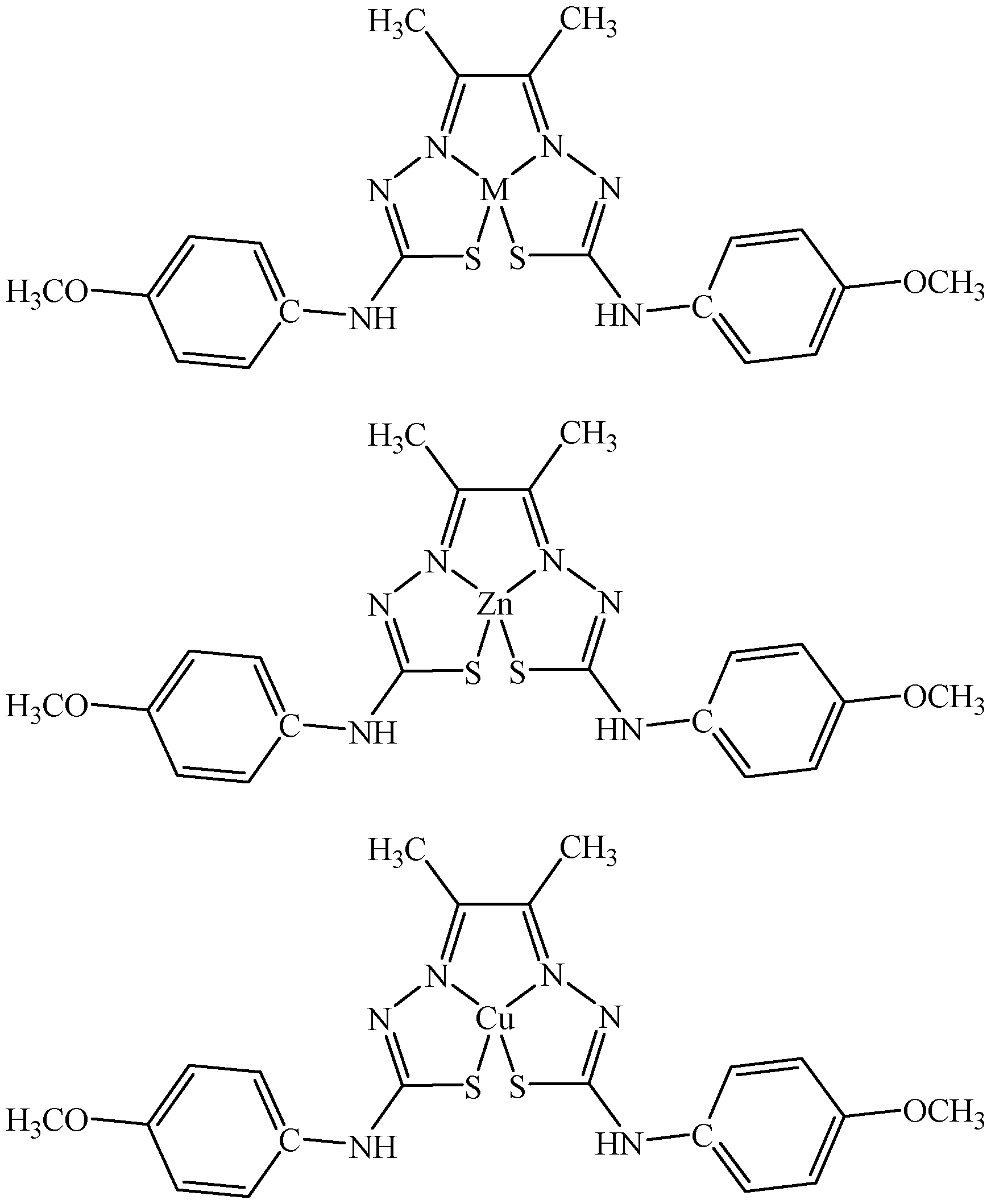


Materials and Methods for Example Set B
[00283] Electrochemical Methods
[00284] All cyclic voltammetry (CV) and controlled potential coulometry (CPC) measurements were recorded using a Gamry Interface potentiostat/galvanostat, which was connected to a glassy carbon working electrode (6.5 mm diameter, surface area = 0.07 cm2), a platinum wire counter electrode, and Ag/AgCl reference electrode. Before use, the working electrode was polished using an aqueous alumina slurry. The working
and counter electrodes were cleaned before use by washing with water, ethanol, isopropanol, acetone and then sonication for 10 minutes in acetonitrile. CV
measurements were conducted using a three-neck electrochemical cell that was washed and dried in an oven overnight before use. All electrochemical experiments were conducted under a N2 atmosphere. All CPC measurements were conducted using a two chambered glass electrolysis cell with working and auxiliary compartments separated by a frit, with a volume of 10 mL in each, washed and dried the night before use. The working compartment was fitted with a glassy carbon working electrode and an Ag/AgCl reference electrode. The auxiliary compartment was fitted with a Pt wire counter electrode. The working compartment contained 0.292 M acetic acid added to a 0.1 M
Bu4NPF6 acetonitrile or DMF solution, while the auxiliary compartment was filled with 0.1 M BU4NPF6 acetonitrile or DMF solution. Both compartments were purged for 15 min with N2 prior to electrolysis. A control (blank) CPC study was conducted and subtracted from experimental results (supporting information). Electrolysis measurements were performed after addition of 0.6 mM CuL1 to the working compartment for several time durations. The evolved gas was subjected to GC-TCD analysis at the end of the electrolysis using a Gow-Mac series 400 GC-TCD equipped with a molecular sieve column for product detection. The column was heated to 130 °C under N2 gas flow with 250 μΐ^ injection samples injected onto the column to confirm H2 as the gaseous product.
[00285] Qverpotential Determination
[00286] Overpotential can be defined as the difference between the
thermodynamic and equilibrium potentials for a given reaction and the potential at which the reaction occurs under a set of specific conditions. In the case of H2 evolution or
oxidation, when either the equilibrium potential for the standard state H+/H2 couple (E°H+) is not known for some particular solvent, or a reliable pKa scale is unavailable, the direct measurement of the equilibrium potential for the reduction of protons (EH+) can be accomplished through an open circuit potential (OCP) measurements, as described by Appel and Helm (ACS Catal., 2014, Vol. 4, pp. 630-633; DOI: 10.1021/cs401013v).
Using this method provides an accurate determination of the equilibrium potential for the H+/H2 couple under a wide range of acids and bases, as well as solvents or mixtures of solvents. This method has proven valuable for the determination of EH+ of protic ionic liquids and various acid base pairs in acetonitrile DMF and/or water. The accurate determination of overpotential can sometimes require an estimation of Ec t/2 and EH+, each of which can change, depending on the reaction conditions. The value for the potential for catalysis should be related to the catalytic current, and therefore, we use Ec t/2. This combined with a value for EH+, obtained through OCP measurements allows for calculation of the overpotential (η) for proton reduction by CuL1 under some specific experimental conditions. The overpotential can then be estimated as, η = I(EOCP - Ec t/2)l, where EOCP is the measured open circuit potential measured under catalytic conditions specific for each reaction, and Ec t/2 is the potential at one-half the maximum of the catalytic current measured for the catalyzed reduction of protons (see sample
calculations).
[00287] Faradaic Efficiency Determination
[00288] Evolved gas from the cathode compartment displaced water in a cylinder with radius 1.12 cm by a height of 2.16 cm. Using the equation for the volume of a cylinder, V = n(r)2h, we can calculate the volume displaced. This is calculated to be 8.51
mL. Using the conversion factor of 22.4 L of any ideal gas per one mole of gas allows us to quantify the number of moles of H2 evolved as 3.80 x 10"4 moles. This value can then be compared to the theoretical number of moles of H2 evolved based on charge determined earlier, 4.40 x 10"4. Faradaic efficiency is defined as moles of H2
quantified/moles of H2 theoretical based on charge x 100%. This corresponds with a minimum Faradic efficiency of 86.0%.
[00289] Turnover Frequency Determination
icat = nFA[cat]jDk[H+]2 (B l)
[00290] Equation B 1 details the relationship between the catalytic current icat, the catalyst concentration [cat], and the acid concentration [H+] for a catalytic reaction that is second-order in acid and first-order in catalyst. The terms n, F, A, and D are the normal electrochemical terms related to the number of electrons transferred, Faraday's constant, area of the electrode (0.07 cm2), and diffusion constant, respectively.
[00291] Equation B2 (Randle-Sevcik equation) provides the relationship between the peak current (ip), catalyst concentration, and scan rate (v) in the absence of acid. The factor of 0.4463 is related to the diffusion equations, R is the gas constant, and T is temperature in K. The other terms are the same as in equation B 1. ip = 0A463FA [cat] (B2)
[00292] Thus, the ratio of icafiP (equation B3) is obtained from the quotient equations B 1 and B2.
 [00293] Under pseudo first-order conditions where kobs = k[H+]2, equation B3 simplifies to B4.

[00294] Equation B4 can be simplified further to equation B5, when n=2, and when at scan rate independent conditions can be used to estimate the observed rate constant or turnover frequency (TOF) (see sample calculations). kobs = 1.94 x v icat , (B5)
[00295] X-ray Photoelectron Spectroscopy of Electrode Adsorbed Films
[00296] CPEs of 0.6 mM CuL1 with 0.292 M acetic acid added in 0.1 M Bu4NPF6 DMF and ACN solutions were run for 23.5 and 4.2 hours, respectively. After completion of electrolysis, the working electrode was removed and washed with DI water. A visible red-brown film persisted on the electrode surface. The films were scraped off using a spatula, collected onto wax paper, and transferred to a glass vial, which was sealed and wrapped with parafilm. XPS analysis was conducted by the Nano scale Characterization Facility at the University of Indiana (Bloomington, IN) using a PHI VersaProbe II Scanning X-ray Microprobe system.
[00297] Computational Methods
[00298] Initial calculations were performed using M06, B3LYP and B97-D. Based on energetic minima results, B3LYP was chosen for use as the functional for subsequent calculations. Optimizations were performed in the gas phase using density functional theory (DFT) employing the B3LYP exchange correlation functional, and the 6-
311G(d,p) basis set for all atoms as implemented in the Gaussian09 suite of programs for electronic structure and ChemCraft was used for graphics visualization. All optimizations were performed under tight constraints, with no symmetry imposed. All input coordinates are available below.
[00299] Sample Calculations
[00300] Overpotential calculation at the potential of half catalytic current (Ecat/2) ;
CuL1 HER: η = Overpotential = I(EBH+(OCP)) -(Ecat 2)l
η = l[-0.50 -(-2.20 V)]l
η = 1.7 V vs Fc+/Fc°
[00301] Determination of CuL1 Diffusion Coefficient (Do) (Acetonitrile):
Slope≡ 3.22E-5 = 0.4463FA[cat] [(FD0/RT)]0-5
A=0.071 cm2
[cat] = 6E-7 moles/cm3
F = 96485 C/mole e
R = ideal gas constant
T = 298 K
Do = 7.9E-6 cm2 / s in acetonitrile
[00302] Determination of CuL1 Diffusion Coefficient (Do) (DMF):
Slope≡ 3E-5 = 0.4463FA[cat] [(FD0/RT)]0 5
A=0.071 cm2
[cat] = 6E-7 moles/cm3
F = 96485 C/mole e
R = ideal gas constant
T = 298 K
Do = 9.35E-6 cm2 / s in DMF
[00303] TQFmax Sample Calculation for CuL1 in acetonitrile:
Using equation B5, at scan-rate independent conditions, when v = 0.2 v/s and when icat = 2250 μΑ and ip = \A μΑ
160.71
TOFmax / kobs = 10000 s"1
[00304] TQFmax Sample Calculation for CuL1 in Dimethylformamide:
Using equation B5, at scan rate independent conditions, when v = 1.0 v/s, and when icat = 1490 μΑ and ip = 29 μΑ

TOFmax / :ofo = 5140 s"1
[00305] Sample Calculations CuL1 Electrolysis in Acetonitrile:
[00306] Trial 1: Total charge = Qwith cat - Qbiank = Qnet
60.49 C - 0.0576 C = 60.43
[00307] Theoretical Moles of Hydrogen Made via Total Charge:
60.43 C x (1 mol e7 96485 C) x (1 mol H2/ 2 mol e ) = moles H2 theoretical
Moles H2 theoretical = 0.00031 moles H2 based on charge from electrolysis
[00308] Trial 1: CuL1 TON Calculation:
TON = Moles of H2 Produced / Moles of CuL1 Used
TON = (0.00031 moles H2 produced) / (0.000006 moles CuL1 used)
TON = 51.7
[00309] Trial 2: Total Charge = Qwith cat - Qbiank = Qnet
84.74 C - 0.0576 C = 84.68
[00310] Theoretical moles of Hydrogen made via Total Charge
84.68 C x (1 mol e / 96485 C) x (1 mol H2 / 2 mol e ) = moles H2 theoretical
Moles H2 Theoretical = 0.00044 moles H2 based on charge from electrolysis
[00311] Trial 2: CuL1 TON Calculation:
TON = Moles of H2 Produced / Moles of CuL1 Used
TON = (0.00044 moles of H2 produced) / (0.000006 moles CuL1 used)
TON = 73.3
[00312] Sample Calculations CuL1 Electrolysis in DMF [00313] Trial 1: Total charge = Qwith cat - Qbiank = Qnet
67.03 C - 0.0682 C = 66.96 C
[00314] Theoretical Moles of Hydrogen made via total Charge:
66.96 x (1 mol e / 96485 C) x (1 mol H2 / 2 mol e ) = moles of H2 theoretical
Moles H2 Theoretical = 0.00035 moles H2 based on charge from electrolysis
[00315] Trial 1: CuL1 TON Calculation:
TON = Moles of H2 Produced / Moles of CuL1 Used
TON = (0.00035 moles of H2 produced) / (0.000006 moles
CuL1 used)
TON = 58.3
[00316] Trial 2: Total Charge = Qwith cat - Qbiank = Qnet
85.06 C - 0.682 C = 85 C
[00317] Theoretical Moles of Hydrogen made via total Charge:
85 x (1 mol e / 96485 C) x (1 mol H2 / 2 mol e ) = moles of H2 theoretical
Moles H2 Theoretical = 0.00044 moles H2 based on charge from electrolysis
[00318] Trial 2: CuL1 TON Calculation:
TON = Moles of H2 Produced / Moles of CuL1 Used
TON = (0.00044 moles of H2 produced) / (0.000006 moles
CuL1 used)
TON = 73.3 [00319] Trial 2: CuL1 Faradaic Efficiency Calculation:
Faradaic efficiency = (moles of H2 quantified) / (moles of H2 theoretical based on charge) x 100%
= (0.000356moles) / (0.00044 Moles) x 100%
= 81 % Faradaic Efficiency
[00320] Cry stallo graphic Details
[00321] A light-purple plate 0.26 x 0.10 x 0.01 rnm^ crystal of [CuL1H2]2+, grown through liquid-liquid diffusion of pentane into methanol/acetonitrile solution of 1 mM CuL1 with four drops of perchloric acid added, was mounted on a CryoLoop for collection of x-ray data on an Agilent Technologies/Oxford Diffraction Gemini CCD diffractometer. The CrysAlisPro1 CCD software package (v 1.171.36.32) was used to acquire a total of 772 forty-five second frame ω-scan exposures of data at 100K to a 2Θ max = 57.42° using monochromated MoKa radiation (0.71073 A) from a sealed tube. Frame data were processed using CrysAlisPro1 RED to determine final unit cell parameters: a = 8.7724(3) A, b = 9.3218(3) A, c = 12.1476(5) A, a = 100.149(3), β = 107.682(3)°, γ = 97.493(3)°, V = 913.55(6) A3, £>caic = 1.901 Mg/m3, Z = 2 to produce raw hkl data that were then corrected for absorption (transmission min./max. = 0.848 /1.000; μ = 1.769 mm"1) using SCALE3 ABSPACK. The structure was solved by Direct methods in the space group P-1 using SHELXS and refined by least squares methods on F2 using SHELXL. Non-hydrogen atoms were refined with anisotropic atomic displacement parameters. Imine H's were located by difference maps and refined isotropically. Methyl hydrogen atoms were placed in their geometrically generated positions and refined as a riding model and these atoms were assigned U(H) = 1.5 x Ueq. For all 4720 unique reflections (R(int) 0.040) the final anisotropic full matrix least-
squares refinement on F2 for 264 variables converged at Rl = 0.044 and wR2 = 0.075 with a GOF of 1.06.
Table Bl: Bond lengths (A) for [Cu(L1H2)(C104)]C104.

Table B2: Bond angles (°) for [Cu(L1H2)(C104)]C104.

N(1)-N(2)-H(2N) 121(2) N(3)-C(7)-H(7A) 109.5
C(5)-N(2)-H(2N) 121(2) N(3)-C(7)-H(7B) 109.5
C(5)-N(3)-C(7) 124.8(2) H(7A)-C(7)-H(7B) 109.5
C(5)-N(3)-H(3N) 119(2) N(3)-C(7)-H(7C) 109.5
C(7)-N(3)-H(3N) 116(2) H(7A)-C(7)-H(7C) 109.5
C(2)-N(4)-N(5) 122.83(19) H(7B)-C(7)-H(7C) 109.5
C(2)-N(4)-Cu(l) 118.03(15) N(6)-C(8)-H(8A) 109.5
N(5)-N(4)-Cu(l) 119.13(14) N(6)-C(8)-H(8B) 109.5
C(6)-N(5)-N(4) 116.86(18) H(8A)-C(8)-H(8B) 109.5
C(6)-N(5)-H(5N) 120.5(19) N(6)-C(8)-H(8C) 109.5
N(4)-N(5)-H(5N) 119.9(19) H(8A)-C(8)-H(8C) 109.5
C(6)-N(6)-C(8) 123.5(2) H(8B)-C(8)-H(8C) 109.5
C(6)-N(6)-H(6N) 117(2) 0(2)-Cl(l)-0(4) 110.85(12)
C(8)-N(6)-H(6N) 119(2) 0(2)-Cl(l)-0(3) 109.38(11)
N(l)-C(l)-C(3) 125.2(2) 0(4)-Cl(l)-0(3) 110.25(11)
N(l)-C(l)-C(2) 112.56(18) 0(2)-Cl(l)-0(l) 110.29(11)
C(3)-C(l)-C(2) 122.2(2) 0(4)-Cl(l)-0(l) 109.21(10)
N(4)-C(2)-C(4) 124.6(2) 0(3)-Cl(l)-0(l) 106.78(10)
N(4)-C(2)-C(l) 112.47(19) 0(8)-Cl(2)-0(7) 109.28(13)
C(4)-C(2)-C(l) 122.83(19) 0(8)-Cl(2)-0(6) 110.09(14)
C(1)-C(3)-H(3A) 109.5 0(7)-Cl(2)-0(6) 109.35(12)
C(1)-C(3)-H(3B) 109.5 0(8)-Cl(2)-0(5) 109.98(11)
H(3A)-C(3)-H(3B) 109.5 0(7)-Cl(2)-0(5) 109.47(12)
C(1)-C(3)-H(3C) 109.5 0(6)-Cl(2)-0(5) 108.65(11)
H(3A)-C(3)-H(3C) 109.5
H(3B)-C(3)-H(3C) 109.5
Table B3. ] ■Cinetic Isoto] pe Effect: CH3COOH vs
%D-Acid icat (uA) TOF (s"1) KIE
0.00 2250 10021.68 1
20.00 1837 6680.269 1.500192
40.00 1257 3127.852 3.204015
60.00 1045 2161.764 4.635883
80.00 910 1639.3 6.113392
100.00 819 1327.833 7.547398
Table B4: Computational Input Coordinates
CuL1
0 2
Cu 1.431847450 -0.488032580 0.446112510
S 2.332615610 -0.119942340 2.552696700
S 2.858402730 -1.722415690 -0.909505780
N -0.257435500 0.971116720 2.468152050
N -0.172027540 0.534274340 1.177021620
N 0.574079220 -1.034389140 -2.391256330
N 0.223704470 -0.461096440 -1.204115870
C 0.866804360 0.696900310 3.160702940
C -1.156654600 0.726779040 0.313291070
C 1.780157800 -1.630949380 -2.329823970
C -0.928456430 0.172470660 -1.041194200
C -2.430852170 1.445672040 0.707410510
C -1.949721220 0.325466600 -2.151313540
N 0.905903760 1.099112750 4.470338340
N 2.249331710 -2.229486700 -3.469048500
C 1.542073250 -2.300940750 -4.757663730
C -0.256906930 1.621968390 5.210058210
H -0.736089590 2.427871470 4.633939270
H 0.095862870 2.020878310 6.174487110
H -1.009760380 0.833110030 5.396764760
H -3.052880760 1.693994160 -0.164430810
H -2.187359810 2.369822740 1.257044200
H -3.027972700 0.817502200 1.394048690
H 2.232241150 -2.034661770 -5.577035900
H 0.709065320 -1.588742850 -4.742827890
H 1.143750430 -3.316026930 -4.940576080
H -1.595749020 -0.186808630 -3.055724620
H -2.117801900 1.390722990 -2.392856600
H -2.924379830 -0.103170090 -1.856998090
H 1.714229460 0.779113230 5.003296850
H 3.143979070 -2.710111620 -3.380991940
1 2
Cu 1.431847450 -0.488032580 0.446112510
S 2.332615610 -0.119942340 2.552696700
S 2.858402730 -1.722415690 -0.909505780
N -0.257435500 0.971116720 2.468152050
N -0.172027540 0.534274340 1.177021620
N 0.574079220 -1.034389140 -2.391256330
N 0.223704470 -0.461096440 -1.204115870
C 0.866804360 0.696900310 3.160702940
C -1.156654600 0.726779040 0.313291070
C 1.780157800 -1.630949380 -2.329823970
C -0.928456430 0.172470660 -1.041194200
C -2.430852170 1.445672040 0.707410510
C -1.949721220 0.325466600 -2.151313540
N 0.905903760 1.099112750 4.470338340
N 2.249331710 -2.229486700 -3.469048500
C 1.542073250 -2.300940750 -4.757663730
C -0.256906930 1.621968390 5.210058210
H -0.736089590 2.427871470 4.633939270
H 0.095862870 2.020878310 6.174487110
H -1.009760380 0.833110030 5.396764760
H -3.052880760 1.693994160 -0.164430810
H -2.187359810 2.369822740 1.257044200
H -3.027972700 0.817502200 1.394048690
H 2.232241150 -2.034661770 -5.577035900
H 0.709065320 -1.588742850 -4.742827890
H 1.143750430 -3.316026930 -4.940576080
H -1.595749020 -0.186808630 -3.055724620
H -2.117801900 1.390722990 -2.392856600
H -2.924379830 -0.103170090 -1.856998090
H 1.714229460 0.779113230 5.003296850
H 3.143979070 -2.710111620 -3.380991940
H 0.002279216 -1.014134076 -3.211399298
CuVn
0 1
Cu 1.431847450 -0.488032580 0.446112510 s 2.332615610 -0.119942340 2.552696700 s 2.858402730 -1.722415690 -0.909505780
N -0.257435500 0.971116720 2.468152050
N -0.172027540 0.534274340 1.177021620
N 0.574079220 -1.034389140 -2.391256330
N 0.223704470 -0.461096440 -1.204115870
C 0.866804360 0.696900310 3.160702940
C -1.156654600 0.726779040 0.313291070
C 1.780157800 -1.630949380 -2.329823970
C -0.928456430 0.172470660 -1.041194200
C -2.430852170 1.445672040 0.707410510
C -1.949721220 0.325466600 -2.151313540
N 0.905903760 1.099112750 4.470338340
N 2.249331710 -2.229486700 -3.469048500
C 1.542073250 -2.300940750 -4.757663730
C -0.256906930 1.621968390 5.210058210
H -0.736089590 2.427871470 4.633939270
H 0.095862870 2.020878310 6.174487110
H -1.009760380 0.833110030 5.396764760
H -3.052880760 1.693994160 -0.164430810
H -2.187359810 2.369822740 1.257044200
H -3.027972700 0.817502200 1.394048690
H 2.232241150 -2.034661770 -5.577035900
H 0.709065320 -1.588742850 -4.742827890
H 1.143750430 -3.316026930 -4.940576080
H -1.595749020 -0.186808630 -3.055724620
H -2.117801900 1.390722990 -2.392856600
H -2.924379830 -0.103170090 -1.856998090
H 1.714229460 0.779113230 5.003296850
H 3.143979070 -2.710111620 -3.380991940
H 0.002279216 -1.014134076 -3.211399298
CuVU (Triplet)
0 3
Cu 1.431847450 -0.488032580 0.446112510
S 2.332615610 -0.119942340 2.552696700
S 2.858402730 -1.722415690 -0.909505780
N -0.257435500 0.971116720 2.468152050
N -0.172027540 0.534274340 1.177021620
N 0.574079220 -1.034389140 -2.391256330
N 0.223704470 -0.461096440 -1.204115870
C 0.866804360 0.696900310 3.160702940
C -1.156654600 0.726779040 0.313291070
C 1.780157800 -1.630949380 -2.329823970
C -0.928456430 0.172470660 -1.041194200
C -2.430852170 1.445672040 0.707410510
C -1.949721220 0.325466600 -2.151313540
N 0.905903760 1.099112750 4.470338340
N 2.249331710 -2.229486700 -3.469048500
C 1.542073250 -2.300940750 -4.757663730
C -0.256906930 1.621968390 5.210058210
H -0.736089590 2.427871470 4.633939270
H 0.095862870 2.020878310 6.174487110
H -1.009760380 0.833110030 5.396764760
H -3.052880760 1.693994160 -0.164430810
H -2.187359810 2.369822740 1.257044200
H -3.027972700 0.817502200 1.394048690
H 2.232241150 -2.034661770 -5.577035900
H 0.709065320 -1.588742850 -4.742827890
H 1.143750430 -3.316026930 -4.940576080
H -1.595749020 -0.186808630 -3.055724620
H -2.117801900 1.390722990 -2.392856600
H -2.924379830 -0.103170090 -1.856998090
H 1.714229460 0.779113230 5.003296850
H 3.143979070 -2.710111620 -3.380991940
H 0.002279216 -1.014134076 -3.211399298

1 1
Cu 1.201842280 -0.715405322 0.506889342 s 2.102610440 -0.347315082 2.613473532 s 2.628397560 -1.949788432 -0.848728948
N -0.487440670 0.743743978 2.528928882
N -0.402032710 0.306901598 1.237798452
N 0.344074050 -1.261761882 -2.330479498
N -0.006300700 -0.688469182 -1.143339038
C 0.636799190 0.469527568 3.221479772
C -1.386659770 0.499406298 0.374067902
C 1.550152630 -1.858322122 -2.269047138
C -1.158461600 -0.054902082 -0.980417368
C -2.660857340 1.218299298 0.768187342
C -2.179726390 0.098093858 -2.090536708
N 0.675898590 0.871740008 4.531115172
N 2.019326540 -2.456859442 -3.408271668
C 1.312068080 -2.528313492 -4.696886898
C -0.486912100 1.394595648 5.270835042
H -0.966094760 2.200498728 4.694716102
H -0.134142300 1.793505568 6.235263942
H -1.239765550 0.605737288 5.457541592
H -3.282885930 1.466621418 -0.103653978
H -2.417364980 2.142449998 1.317821032
H -3.257977870 0.590129458 1.454825522
H 2.002235980 -2.262034512 -5.516259068
H 0.479060150 -1.816115592 -4.682051058
H 0.913745260 -3.543399672 -4.879799248
H -1.825754190 -0.414181372 -2.994947788
H -2.347807070 1.163350248 -2.332079768
H -3.154385000 -0.330542832 -1.796221258
H 1.484224290 0.551740488 5.064073682
H 2.913973900 -2.937484362 -3.320215108
H -0.227725954 -1.241506818 -3.150622466
H -1.284747732 1.209226221 2.913152425

0 2
Cu 1.201842280 -0.715405322 0.506889342
S 2.102610440 -0.347315082 2.613473532
S 2.628397560 -1.949788432 -0.848728948
N -0.487440670 0.743743978 2.528928882
N -0.402032710 0.306901598 1.237798452
N 0.344074050 -1.261761882 -2.330479498
N -0.006300700 -0.688469182 -1.143339038
C 0.636799190 0.469527568 3.221479772
C -1.386659770 0.499406298 0.374067902
C 1.550152630 -1.858322122 -2.269047138
C -1.158461600 -0.054902082 -0.980417368
C -2.660857340 1.218299298 0.768187342
C -2.179726390 0.098093858 -2.090536708
N 0.675898590 0.871740008 4.531115172
N 2.019326540 -2.456859442 -3.408271668
C 1.312068080 -2.528313492 -4.696886898
C -0.486912100 1.394595648 5.270835042
H -0.966094760 2.200498728 4.694716102
H -0.134142300 1.793505568 6.235263942
H -1.239765550 0.605737288 5.457541592
H -3.282885930 1.466621418 -0.103653978
H -2.417364980 2.142449998 1.317821032
H -3.257977870 0.590129458 1.454825522
H 2.002235980 -2.262034512 -5.516259068
H 0.479060150 -1.816115592 -4.682051058
H 0.913745260 -3.543399672 -4.879799248
H -1.825754190 -0.414181372 -2.994947788
H -2.347807070 1.163350248 -2.332079768
H -3.154385000 -0.330542832 -1.796221258
H 1.484224290 0.551740488 5.064073682
H 2.913973900 -2.937484362 -3.320215108
H -0.227725954 -1.241506818 -3.150622466
H -1.284747732 1.209226221 2.913152425
CuL- Ή2-Ν4Η
0 2
Cu 1.431847450 -0.488032580 0.446112510
S 2.332615610 -0.119942340 2.552696700
S 2.858402730 -1.722415690 -0.909505780
N -0.257435500 0.971116720 2.468152050
N -0.172027540 0.534274340 1.177021620
N 0.574079220 -1.034389140 -2.391256330
N 0.223704470 -0.461096440 -1.204115870
C 0.866804360 0.696900310 3.160702940
C -1.156654600 0.726779040 0.313291070
C 1.780157800 -1.630949380 -2.329823970
C -0.928456430 0.172470660 -1.041194200
C -2.430852170 1.445672040 0.707410510
C -1.949721220 0.325466600 -2.151313540
N 0.905903760 1.099112750 4.470338340
N 2.249331710 -2.229486700 -3.469048500
C 1.542073250 -2.300940750 -4.757663730
C -0.256906930 1.621968390 5.210058210
H -0.736089590 2.427871470 4.633939270
H 0.095862870 2.020878310 6.174487110
H -1.009760380 0.833110030 5.396764760
H -3.052880760 1.693994160 -0.164430810
H -2.187359810 2.369822740 1.257044200
H -3.027972700 0.817502200 1.394048690
H 2.232241150 -2.034661770 -5.577035900
H 0.709065320 -1.588742850 -4.742827890
H 1.143750430 -3.316026930 -4.940576080
H -1.595749020 -0.186808630 -3.055724620
H -2.117801900 1.390722990 -2.392856600
H -2.924379830 -0.103170090 -1.856998090
H 1.714229460 0.779113230 5.003296850
H 3.143979070 -2.710111620 -3.380991940
H 0.002279216 -1.014134076 -3.211399298
H -0.537578235 -0.345922291 -1.882139314
Results and Discussion for Example B
[00322] Synthesis and Electrochemical Characterization
[00323] The CuL1 compound was isolated as an air-stable burgundy solid from H2L1 and copper(II) acetate as previously reported previously (Betts et al., Angew. Chem. Int. Ed. 2008, Vol. 44, pp. 8416-8419 - DOI: 10.1002/anie.200801936; Christlieb et al., Dalton Trans. 2007, pp. 5043-5054 - DOI: 10.1039/B705087A). The cyclic voltammogram (CV) of CuL1 in acetonitrile (ACN) or dimethylformamide (DMF) containing 0.1 M Bu4NPF6 as supporting electrolyte displays a reversible Cun/I event at - 1.20 V vs. ferrocenium/ferrocene (Fc+/Fc) consistent with prior reports. Additional CV data collected at multiple scan rates from 0.1 to 1.0 V/s in ACN (Figure 24) and DMF (data not shown) were used to construct Cottrell plots (Figure 24 inset) establishing that the Cun/I reduction is diffusion limited and demonstrating the potential of CuL1 as a homogeneous electrocatalyst. The slope of the plot yields a diffusion coefficient of 7.9 x 10"6 cm2/s in ACN and 9.35 x 10"6 cm2/s in DMF. The formal Cum/n couple was observed at 0.24 V vs Fc+/Fc in DMF and ACN in line with prior reports, but this event was not further evaluated in the current study.
[00324] Homogeneous Catalytic Hydrogen Evolution: Cyclic Voltammetry and
KIE
[00325] Addition of acetic acid exceeding 24 mM to 0.6 mM ACN solutions of CuL1 shifts the Cun/I reduction potential from -1.20 V to -0.95 V and introduces a catalytic cathodic current at -1.70 V vs Fc+/Fc (Figure 25 A). The +0.25 V shift is consistent with a single protonation event prior to the initial electrochemical reduction. The ratio of the catalytic current to the peak current displays linear dependence on the acid concentration up to 0.157 M, indicating a second-order dependence of the catalytic rate on the acid concentration. At concentrations greater than 0.157 M the current response begins to plateau, reaching an acid independent region at concentrations of 0.269 M, (Figure 25B). This transition from second-order to zero-order dependence requires a pre-equilibrium step(s) involving two protons that precedes the rate determining step for H2 elimination. The current becomes scan rate independent at 0.2 V/s. Under these conditions the ip of the Cun/I reduction event, 14.0 μΑ, and the icat max from the acid-independent region, 2.25 mA, correspond with a maximum icafiP value of 161, affording a TOF of 10,000 s"1.
[00326] The electrocatalytic activity of 0.6 mM CuL1 with acetic acid was also assessed in DMF. An increase in current at -1.9 V vs Fc+/Fc is observed upon increasing additions of acetic acid (Figure 26 A). At concentrations of acid greater than 0.292 M, the current saturates reaching a maximum icat of 1.49 mA (Figure 26B). Acid addition results in a shift of the Cun/I potential from -1.20 V to -0.95 V, as observed in ACN, attributed to a single protonation event prior to reduction. Catalytic current becomes independent of
scan rate above 1.0 V/s (Figure 26C and 26D). Under these conditions icat is 1490 μΑ and ip is 29 μΑ giving a TOF of 5140 s"1, which is significantly lower than the TOF in ACN.
[00327] The Tafel plot of the log TOF versus overpotential for CuL1 (Figure 25C) displays the TOF as a function of the applied overpotential. CuL1 displays the highest maximum logTOF values reported to date of any homogeneous ligand-centered electrocatalyst, reaching a maximum of 3.99. The CuL1 electrocatalyst maintains a logTOF value greater than one, with applied overpotentials greater than 1.2 V.
Overpotentials less than 1.2 V result in significantly decreased TOF values, correlating with negative or near zero logTOF values. The local maxima observed near 0.4 V is indicative of the pre-catalytic Cun/I reduction, which has anodic shift of 0.25 V during catalysis. The maximum logTOF for CuL1 of 3.99 requires a large overpotential of 2.0 V.
[00328] Analysis of the CVs of CuL1 under catalytic HER conditions appear to reveal a new oxidation event at a potential of -0.65 V Fc+/Fc during the return anodic scan (Figure 25A inset), which is assigned to the Cu(II/I) couple of the diprotonated copper(I) intermediate, [Qu^Fh]"1-. This event is 300 mV more positive than the Cu(II/I) couple of the monoprotonated [CuL^]"1", which in turn is 250 mV more positive than the CuL1. The intensity of the peak current at -0.65 V demonstrates scan rate dependence typical of diffusion controlled behavior (Figure 26C) confirming it is not due to an adsorbed species.
[00329] As noted above, the catalysis is second-order in acid in the acid dependent regime. To determine the order with respect to the catalyst, the concentration of CuL1 was varied from 0.1 to 1.0 mM in solution containing 0.15 M acetic acid. A plot of
catalyst concentration versus peak current reveals a linear relationship, confirming a first- order dependence on the concentration of the catalyst and an overall third-order process.
[00330] To further evaluate the HER mechanism of CuL1, the H/D kinetic isotope effect (KIE) was measured. CuL1 displays a large KIE of 7.54 using 100 % CD3CO2D. The high KIE value observed when using 100% CD3CO2D is distinct from the inverse KIEs reported for some HER catalysts proceeding through metal-hydrides, but similar to that observed for a ligand-centered Re-thiolate HER catalyst. Since CuL1 HER catalysis is second-order in [H+], a proton inventory study was conducted to determine the number of protons involved in the rate determining step. Cyclic voltammograms collected with variable quantities of CH3CO2H and CD3CO2D were used to generate plots of KIE versus the percent fraction of CD3CO2D (Figures 27A & 27B). The plot yields a linear fit consistent with the involvement of a single proton in the rate determining step.
[00331] Controlled Potential Electrolysis
[00332] A series of controlled potential electrolysis (CPE) experiments were performed using 0.6 mM CuL1 and 0.292 M acetic acid, with potential held at -1.65 V vs FcTFc, in both DMF and ACN (Table B5). Electrolysis in 0.1 M Bu4NPF6 DMF solutions was allowed to run for 84,400 seconds (23.4 hours) resulting in a total charge passed of 85.0 C, corresponding to 4.4 x 10"4 moles of ¾ produced with a turnover number (TON) of 73.3. Gas analysis of the headspace using gas chromatography thermal conductivity (GC-TCD) confirms ¾ as the gaseous product (Figure 41). The charge increases linearly over time with no signs of degradation or decrease in activity over 23 hours (Figure 28). A second CPE in DMF over 72,120 seconds (20 hours) yielded
comparable results giving a slightly lower charge of 67.0 C, producing 3.5 x 10"4 moles of H2 corresponding with a TON of 58.3.
Table B5. Summary of CPE Results

[00333] The CPEs performed in 0.1 M Bu4NPF6 ACN passed similar charge, giving values of 60.4 and 84.7 C corresponding to TON values of 51.7 and 73.3, over shorter electrolysis times of 15,000 and 13,000 seconds, respectively (Figure 28). The current in ACN is higher than in DMF, resulting in a steeper slope in the charge-time plots, consistent with relative TOFs from CV studies. Electrolysis beyond 15,000 seconds in ACN is complicated by diffusion across the frit from the working to auxiliary compartment. This results in the appearance of a brown, cloudy mixture in the auxiliary compartment concurrent with the plateauing of charge. This phenomenon was consistently observed in ACN, but was absent in DMF.
[00334] Control Experiments
[00335] A series of control experiments were performed to confirm CuL1 as the electrocatalyst. First, CVs were recorded on ACN and DMF solutions containing only acetic acid. Addition of 67.2 mM acetic acid to 0.1 M Bu4NPF6 ACN solutions resulted
in an observable current of 300 μΑ (Figure 29 A). However, after 2 CV cycles the current drops to a stable value near 100 μΑ. Upon addition of 0.6 mM CuL1, the current increases to 900 μΑ (Figure 29 A). In DMF addition of 22.4 mM acetic acid results in a modest current increase of ~5 μΑ (Figure 29B). Addition of 0.6 mM CuL1 to this solution resulted in an increase in current, giving a value of 200 μΑ (Figure 29B). At more cathodic potentials, a substantial change in the CVs of CuL1 with 22.4 mM acetic acid added is observed with current increase onset potentials near -1.7 V vs Fc+/Fc (Figure 29B). These control experiments identify CuL1 as the source of the catalytic activity, but do not exclude the possibility that it may be the precursor to an adsorbed catalyst.
[00336] To probe for adsorption of the CuL1 on the electrode surface prior to catalysis, a "soak test" was performed using the methods of Dempsey and co-workers (Lee at al., Inorg. Chem. 2017, Vol. 56, pp. 1988-1998 - DOI:
10.1021/acs.inorgchem.6b02586). The working electrode was immersed overnight in a 0.1 M Bu4NPF6 ACN solution containing 0.6 mM CuL1 and 0.292 M acetic acid. It was then removed, washed with DI water, and placed into a fresh solution of 0.1 M Bu4NPF6 ACN, with no added acid or catalyst. The resulting CV displayed no redox events indicating no detectable adsorption of CuL1 derived species under these conditions.
[00337] A second series of controls were performed to evaluate if a catalytically active adsorbed species forms during CV catalysis. These post-CV "dip-tests" were conducted after 10 cycles and 50 cycles (See Figures 62 and 63). During the 50 cycles from -0.5 to -2.3 V vs. Fc+/Fc on 0.6 mM CuL1 solutions under acid saturated conditions the current reaches a maximum value of - 1.5 mA. The working electrode was removed, washed with DI water, and immersed into a fresh solution of 0.1 M Bu4NPF6 ACN or
DMF. The resulting CVs showed no significant Faradaic current in the window from -0.5 to -2.3 V. Upon addition of 0.292 M acetic acid, a catalytic current of 1 mA was observed at -1. 7 V. After we extended the scan window to include 0.4 V, the catalytic current at - 1.7 V is absent. This confirms that at least some of the HER catalysis results from adsorbed CuL1 species.
[00338] To probe if all of the catalytic activity results from adsorbed catalysts, we repeated the /wsi-CV "dip-test" after 10 cycles from -0.5 to -2.5 V vs. Fc+/Fc on 0.6 mM CuL1 solutions under acid saturated conditions, again reaching maximum current values of - 1.5 mA. The working electrode was removed, washed with DI water, and immersed into a fresh solution of 0.1 M Bu4NPF6 DMF. As before, the resulting CVs showed no observable Faradaic current in the window from -0.5 to -2.5 V. CVs following addition of 0.292 M acetic acid that also showed only 400 μΑ of current -1.7 V. While these results indicate that surface adsorbed CuL1 is responsible for some of the catalytic current after as few as 10 cycles, they show that the majority of HER activity under homogeneous conditions is due to dissolved CuL1 complex.
[00339] In addition, a post-electrolysis "dip-test" was performed following CPE studies of CuL1 catalyzed HER. Under these conditions, a substantial amount of surface adsorbed CuL1 derived complex is expected. After both CPEs in DMF and ACN, the working electrode was removed, washed with DI water, and immersed into a fresh 0.1 M Bu4NPF6 DMF/ ACN solution. The CV was collected. In contrast to the post-CV "dip- tests", the electrode displays three reduction events at -0.9 V, -1.4 V and -2.1 V vs Fc+/Fc. The first two events are near the observed Cu(II/I) reductions potentials of
[CuL^]"1" and CuL1, respectively. The most cathodic event is near the reduction potential
of H2L1. Upon addition of 0.292 M acetic acid to the solution, current increases and catalysis is observed (Figure 30).
[00340] Analysis of the films following electrolysis in DMF and ACN by x-ray photoelectron spectroscopy revealed atomic percentages consistent with CuL1, Figure 31. The results are inconsistent with the formation of nanoparticles consisting of metallic Cu, copper oxides, or copper sulfides. The data from the two solvents are indistinguishable. High resolution XPS (see above and Figure 61) confirms the presence of Cu ions and is inconsistent with metallic Cu.
[00341] Protonated Derivatives of CuL1
[00342] A series of protonated derivatives of CuL1 were evaluated as potential catalytically relevant intermediates. These include the mono- and di-protonated Cu(II) complexes [CuLH]+ and [CuLH2]2+ and the Cu(I) analogue CuLH.
[00343] To confirm that [CuLH]+ is present in solution under catalytic conditions, acid titrations were monitored by UV- visible spectroscopy. The spectrum of 0.6 mM CuL1 in deoxygenated DMF shows absorbance bands at 310, 375, 475 and 520 nm. The solution was titrated with acetic acid, increasing in concentration from 0.022 M to 0.382 M (Figure 32). The absorbance bands of CuL1 decrease in intensity, concurrent with increases at 405 and 460 nm consistent with the formation of [CuL^]"1". The proposed protonation site is the hydrizino N, in line with previous reports and density functional theory computations (vide infra).
[00344] To characterize the monoprotonated Cu(I) species, CuL^, CuL1 was first reduced and then protonated. In an Ar filled glove box, CuL1 was dissolved in DMSO-d6. Upon addition of one equivalent of cobaltocence, the solution changed color from red to
light purple. The solution was stirred for 15 minutes to obtain the reduced anionic copper complex, [CuL1]". An aliquot was added to an NMR tube for analysis. The lH NMR spectrum of [CuL1]" displays the expected peaks. Chemical shifts at 2.73, 2.89, and 7.95 ppm are assigned to the methyl backbone CH3, NH(CH3), and NH(CH3), respectively, and integrate with a ratio of 3:3: 1 (Figure 55). Addition of one equivalent of HBF4 to the [CuL1]" solution results in a color change from light purple to orange. An aliquot was taken and analyzed by lH NMR. Each of the peaks observed in [CuL1]" are still present, along with a new peak at 8.27 ppm, which integrates to 1 (Figure 56). The new peak is assigned to the protonation of the hydrazino nitrogen. The chemical shift is inconsistent with metal-centered protonation, which would result in a copper hydride with a negative chemical shift.
[00345] Our CH3COOH titration studies of diprotonated Cu(II) complex
 show no evidence of a second protonation event under catalytic conditions. Although
 is not catalytically relevant, x-ray quality crystals of
were obtained from perchloric acid solution. The ORTEP representation shows protonation of both hydrizino nitrogens, axial coordination of one perchlorate, and axial association of the second perchlorate, Figure 33. A complete description of the crystallographic details is provided above.
[00346] Proposed Homogeneous HER Mechanism
[00347] A proposed CECE mechanism for homogenous HER catalyzed by CuL1 is shown in Figure 34. Step 1 is an initial chemical (C) event involving protonation of the hydrazino nitrogen on CuL1 to yield [CuL^]"1". This is followed by an electrochemical step (E) assigned as a metal-centered reduction giving the neutral Cu(I) species, CuL^.
Step 3 is a chemical step involving protonation on the other hydrazino nitrogen, affording the Cu(I) cation, [Cul^fh]"1". Step 4 is the final electrochemical step, a proposed ligand- centered reduction to give the neutral species, Cul^fh. The Cul^fh complex can be regarded as Cu(I) coordinated by a nitrogen-centered radical. Step 5 shows double bond rearrangement, resulting in an anionic coordinated nitrogen. This anionic nitrogen induces an internal proton transfer, a tautomerism that has been observed in many thiosemicarbazone complexes, leading to formation of the H2 evolving complex. Finally, in step 6, hydrogen is evolved through hydrogen atom or proton/hydride coupling at the adjacent N-H bonds.
[00348] The proposed mechanism is consistent with the experimentally determined rate law and the KIE study. Both protons are added to a single CuL1 complex prior to the rate determining step (r.d.s.) consistent with the first-order catalyst and second-order proton dependence on current. The proton inventory study suggests that a single proton is involved in the r.d.s. This favors tautomerization, step 5, over hydrogen evolution, step 6, as the rate limiting event. The solvent dependency of the TOF further supports this interpretation. The TOF in DMF is approximately one-half that in ACN. This is attributed to H-bonding interactions between DMF and ligand N-H groups. These stabilizing interactions retard the rate limiting tautomerization step in DMF relative to ACN. To assess the viability of this mechanism, density functional theory computations on all proposed species were performed.
[00349] Density Functional Theory Investigations
[00350] All proposed complexes in Figure 34 were assessed using density functional theory (DFT) using the B3LYP hybrid functional and the 6-311g(d,p) basis
set. First, we evaluated the protonation event associated with step 1. Calculations on the singly protonated intermediate, [CuI^H]"1", support our assignment of the hydrazino nitrogen as the site of protonation. For [CuI^H]"1" (S = 1/2), the Cu, S, N3 (hydrazino), N4 (coordinated), and N6 (pendant amine) were evaluated as possible protonation sites. In each structure, the geometry and frequencies were optimized and the energies minimized. The hydrizino protonated geometry is energetically preferred, lying 10 kcal/mole lower than the metal-hydride (Figure 35A). Protonation at S is less favored by 12 kcal/mole and attempts to optimize structures with protonation on N4 and N6 resulted in migration of the hydrogen onto the hydrazino nitrogen.
[00351] Next, the one-electron reduced protonated species, CuI^H (S = 0) (Figure
35B), was examined to determine if reduction, step 2, impacts the location of the proton. Computed free energies for structures with protonation at Cu, S, and each N, clearly indicate that protonation on the hydrazino N is still favored. Protonation at S is disfavored by 11 kcal/mole, while protonation at the pendant amine is less favored by 18 kcal/mole. Attempts to optimize CuI^H with protonation at the coordinated nitrogen again resulted in migration of hydrogen onto the hydrazino nitrogen. We also considered CuI^H with protonation on the hydrazino nitrogen in its triplet electronic configuration (S = 1). However, it is 5.77 kcal/mole higher in energy (see Figure 59), confirming the nature of the first reduction as metal based.
[00352] Step 3 of the proposed mechanism involves addition of a second proton to
CuI^H. Energy minimizations of the doubly protonated, singly reduced intermediate, [CuI^Fh]"1" in both the singlet (S = 0) and triplet (S = 1) electronic states were performed. For each spin state, the copper, the opposing hydrazino nitrogen (Nl), sulfur (S2) , the
pendant amine (N6) and the coordinated nitrogen (N4) were all considered as the second protonation site. In both electronic states, protonation on the opposing hydrazino nitrogen (Nl) is favored over all other protonation sites by at least 8 kcal/mole. Comparison of the singlet and triplet state the energies for protonation on N4 indicate the singlet is more stable by 6.09 kcal/mole (Figure 36).
[00353] The addition of the second electron, step 4, leads to formation of the hydrogen evolving complex Cul^fh through proposed rearrangement, step 5. The geometry and frequencies of Cul^fh were optimized with one proton located on N3 while considering multiple sites for the second proton including the copper, the opposing hydrazino nitrogen (Nl), sulfur (S2) the pendant amine (N6) and the coordinated nitrogen (N4). Energy minimizations indicate that placement of the second proton on Nl or N4 nitrogen are most favored, by at least 17 kcal/mole, compared to all other sites (Figure 37A). Notably, energies for protonation at Nl and N4 differ by only 0.39 kcal/mole, indicating that the tautomerization associated with step 5 in the proposed mechanism is viable. Further, examination of the spin-density (SD) shows that the second reduction is primarily ligand based, with 34% on N2, 38% on C4, 14% on Nl, 8% on N5, and only 3% on Cu (Figure 37B).
[00354] Discussion
[00355] The complexes cited herein present intriguing reactivity as the ligand can participate in electron transfer events, either with or without a transition metal— rendering it "non-innocent" in some instances. Additionally, the ligands can be protonated generating various tautomeric forms— rendering it not only non- innocent, but
also "promiscuous" in some instances. The combination of these two factors can be dependent on the identity of the metal ion, and, in some instances, can result in three types of HER reactivity: a) ligand-assisted metal reactivity with Ni, b) ligand-centered reactivity with Zn, and c) metal-assisted ligand reactivity with Cu.
[00356] In some examples, the impact of the metal is manifested in the initial protonation and initial reduction sites. For both CuL1 and ZnL1, a hydrazino N is protonated prior to the initial reduction. The initial site of reduction can be rationalized based on the relative energies of the metal d-orbitals and an unoccupied ligand centered orbital, Figure 38. The metal d-orbital energies decrease from Ni2+ to Cu2+ to Zn2+ with increasing effective nuclear charge. For Ni2+, a vacant ligand centered orbital lies below the vacant metal dZ2 orbital yielding a ligand-centered radical upon reduction. For Cu2+, the stabilized <i-orbital manifold falls below the ligand-centered orbital resulting in metal- centered reduction. For Zn2+, the <i-orbitals are filled required ligand-centered reduction. Additionally, the site of reduction and the localization of spin-density can impact the site of protonation. For Cu, the proton remains on the hydrizino nitrogen after metal-centered reduction. In contrast, for Ni the ligand-centered reduction favors double bond rearrangement similar to step 5 in Figure 34. As a result, the tautomers with protonation of the hydrizino N and anionic coordinated N have similar energies. For Zn, the tautomer with the proton remaining on the hydrizino N remains favored after ligand-centered reduction.
[00357] In some embodiments, the mechanism for H2 evolution is a consequence of the initial protonation and reduction sites. For Ni, some has posited that the second reduction is metal-based, generating a nucleophilic d9 Ni(I) center. Further protonation is
proposed to occur at the metal generating a Ni -hydride as the catalytically active species for H2 evolution. In this context, NiL2 can demonstrate ligand-assisted metal reactivity, in which the ligand serves as an auxiliary redox site to facilitate two-electron chemistry at the metal. This can be a common role for redox active ligands in transition metal catalysis. In contrast, the HER chemistry of ZnL1 can be ligand-centered. Its HER mechanism can localize all chemical and electrochemical steps on the ligand, with the metal providing structural support. As in the case of NiL2, initial protonation and reduction is ligand-centered, however, the d10 Zn(II), in some instances, is incapable of undergoing a second reduction and HER proceeds via a bimolecular process.
[00358] The HER chemistry of CuL1 displays a less common type of mechanism with redox non- innocent ligands, which we defined as metal-assisted ligand-centered reactivity. The initial metal-centered reduction leads to a d10 Cu(I), which is isoelectronic with ZnL1. As such, it can accommodate subsequent ligand-based protonation and reduction events with evolution of H2 from the ligand-center. In this context, the metal serves as the auxiliary redox site, which can facilitate two-electron chemistry at the ligand.
[00359] CuL1 demonstrates a metal-assisted ligand-centered mechanism, in some instances. The redox non-innocence and protonation promiscuity of the ligand provides for a variety of HER mechanisms, some of which can be dependent on the metal ion. The CuL1 system exhibits the highest reported TOF of any ligand-centered homogeneous HER catalysts to date. However, its high activity can sometimes require large overpotential. Nonetheless, the metal-assisted ligand reactivity of CuL1 provides a new template for future HER electrocatalysts that, in some instances, function without the
participation of a metal-hydride. The current study demonstrates that non-innocent ligands can work in conjunction with a redox-active metal to promote ligand-centered reactivity. This represents a new approach to the development of electrocatalysts for HER and, possibly, the activation of other small molecules.
[00360] Example Set C: Example syntheses and electrochemical
investigations of alkoxy derivatives
[00361] Alkoxy derivatives were prepared as shown in the scheme below.

[00362] The hydrazinecarbothioc acid O-alkyl esters were prepared and condensed with diones. This was followed by metalation (shown here as Cu acetate).
Characterization of their Cu(II) complexes reveals only small structural and spectroscopic changes relative to their bis-thiosemicarbazone counterparts. However, electro-chemical investigations reveal anodic shifts of -340 mV in the Cun/I reduction. The results demonstrate the ability to modulate the potential by variation of the thiosemicarbazone N-termini without imparting large structural changes. The synthetic strategies highlighted in the scheme provide examples of the design of new molecular catalysts, the synthesis of catalysts with extended structures, and the covalent attachment of catalysts to electrode surfaces. [00363] Example Set D: Example Syntheses
[00364] A series of compounds can be synthesized containing transition metal-
(Cu), non-transition metal- (Zn), and metal-free derivatives of symmetric (Ri = R2) derivatives (H2L1-4) and the corresponding asymmetric derivatives (H2L5"8) in which R2 is an ethoxy group, as in the scheme below.

[00365] The bis-thiosemicarbazone ligands H2L1"4 and their Cu and Zn complexes have been prepared. The asymmetric ligand H2L5, was prepared by condensation of la with the N-amino-O-ethylthiocarbamate (prepared from ethanol, CS2, and ΝΗ2ΝΗ2·Η20) in 50 - 70% yield (see above). Addition of Cu(OAc)2 in methanol yields CuL5 as a dark brown precipitates upon reflux. Spectroscopic characterization reveals a similar ligand environment as CuL1 and related derivatives. The x-ray structure of CuL5, confirms the asymmetric N2S2 environment.
[00366] Example Set E: Examples of Asymmetric Formulas
[00367] A series of asymmetric ligands has been synthesized, according to the scheme below.

[00368] Ligands H2L10a"c have been prepared by condensation of la-c with the N- amino-O-ethylthiocarbamate (prepared from ethanol, CS2, and ΝΗ2ΝΗ2·Η20) in 50 - 70% yield. Addition of Cu(OAc)2 in methanol yields CuL10a"c as a dark brown precipitates upon reflux. Spectroscopic characterization reveals a similar ligand environment as CuL1 and related derivatives. The x-ray structure of CuL10a, confirms the asymmetric N2S2 environment. H2L8a and CuL8a were also prepared.
[00369] The CVs of CuL10a"c in acetonitrile (0.1 M TBAHFP) show a
quasireversible reduction and oxidation. For CuL10a, the Cun/I reduction occurs at - 1010 mV with the formal CuIII/n couple observed at +448 mV. These values lie between the respective potentials of the symmetric derivatives CuL1 and CuL5. Substitution of the backbone methyl groups with ethyl results in a small, but measurable cathodic shift to
-1030 mV for the Cu . Incorporation of phenyl substituent in the backbone, CuL , yields a larger shift in the Cun/I potential to -850 mV. Notably, the Cun/I reduction of CuL10c is more accessible than in the symmetric CuL5. This confirms modification of backbone R groups as a viable strategy to tune potential. Also, the CH2CF3 group of CuL8a shifts the Cun/I potential to +70 mV with relative to CuL1 in DMF.40
[00370] Initial CVs confirm the HER activity of CuL10b c in acetonitrile. Addition of acetic acid to CuL10c increases catalytic current at -1.5 V, Figure 64. The current is first-order in [acid] until it reaches acid independence at [acid] > 0.093 M. The maximum catalytic currents stabilizes at 1.80 mA associated with a maximum icafiP value of 43.8 (v = 1.0 V/s), affording a TOF of 15,600 s"1 assuming the mechanism is bimolecular, as observed for CuL1. An overpotential of 1.5 V was determined by open circuit potential methods. CuL10b has similar HER electrocatalytic activity.
[00371] Example Set F: Glassy Carbon Electrode (GCE) Preparation and Results
[00372] H2L1 and its Cu and Zn complexes (See Example Set B) are insoluble in water making them ideal candidates for preparing modified GCEs. GC-H2L1, GC-ZnL1, and GC-CuL1 were prepared by dropcast of from 20 nmol to 200nmol of the appropriate catalyst on 5 mm GCE disks and curing of the resulting films. Electrodes were thoroughly dried and stored in air prior to use. The Electrochemical Impedance
Spectroscopic (EIS) data for GC-CuL1 is consistent with a contact resistance of 14 Ω. The charge transfer resistance, which has an impact on overpotential, of GC-CuL1 is 1760 Ω.
This relatively low charge transfer resistance could be attributed to the ease of electron transfer within the planar, conjugated framework of CuL1. Results for ZnL1 are similar. Initial CV studies confirm HER activity of the surface confined catalysts. From the polarization curves, the overpotential required to achieve a current density of 10 mA/cm2 is 699 mV for GC-CuL1, Figure 65. GC-ZnL1 and GC-H2L1 have higher overpotential of 940 mV and 1200 mV, respectively.
[00373] Example Set G: Carbon Paste Electrodes (CPE) - Fabrication and Surface Analysis
[00374] CPEs modified with H2L1, CuL1 and ZnL1 (from Example Set B) were prepared by mixing graphite fine powder with and 0.5 wt% of the appropriate catalyst in dichloro methane and sonicating for 15 min. The mixture was dried under an infrared lamp for 30 min. Paraffin oil (20 wt%) was added and the resulting slurry was carefully mixed to form the carbon paste. The paste was pressed into a plastic tube and a Cu wire was inserted to establish electrical contact. The electrode surface was polished with weighing paper and washed with deionized water. Finally, 2 μL· oΐ a Nafion (5% in isopropanol) was added to the polished surface and the chemically modified CPE was dried under an infrared heating lamp for 15 min. CPEs were stored in air.
[00375] The CPE-CuL1 surface was imaged using SEM and the impedance measured by EIS. The SEM images show clear and homogeneous graphite layers with uniformly distributed pores, Figure 66a. The surface porosity should allow for sufficient ion diffusion from the bulk to the catalysts embedded in the electrode film. Resistance
between the CPE-CuL1 and solution was measured by EIS. Data collected over a frequency range of 10"2 to 105 Hz at an applied overpotential of 1.3 V were used to construct a Nyquist plot, Figure 66b. Fitting of the data yields a resistance between the electrode surface and electrolyte of 12.3 Ω, a charge transfer resistance within the electrode of 508 Ω, a capacitive component indicative of space charges or electrical dipoles in the sample. Overall, resistance for the CPEs is significantly smaller than the modified GCEs in Example Set F.
[00376] Polarization curves were recorded for the CPE-CuL1 in 0.5 M H2SO4 solution under ambient conditions, Figure 66c. The overpotential required to obtain a current density of 60 niA/cm2 is 0.65 V. At lower current densities, the overpotential is below the 0.6 V benchmark for relevant HER catalysts, although the value at the recommended current density of 10 niA/cm2 complicated by a series of events attributed to formation of a catalytically active dinuclear species, as seen in homogenous solution. For CPE-ZnL1 and CPE-H2L1, the overpotential required for 60 niA/cm2 is 0.94 and 1.04 V, respectively.
[00377] Initial assessment of the electrode stability of CPE-CuL1 was investigated by repetitive scanning in 0.5 M H2SO4 solution for 500 cycles from 0.0 to -1.7 V at a scan rate of 50 mV/s. The overpotential required for a current density of 100 niA/cm2 increased by only 50 mV. The long term stability of CPE-CuL1 was benchmarked by chronopotentiometry at a fixed catalytic current density of 100 mV/cm2 for 24 hours. The overpotential increased by 97 mV over the first 8 hours and remained constant thereafter indicating good stability over long time electrolysis.
Additional Embodiments
[00378] Al. A compound selected from a compound of Formula (I),

[00379] salts, optical isomers, geometric isomers, salts of isomers, and derivatives thereof, wherein
[0
 or is a monovalent H, methanoly (-
COH), carboxy (-C02H), nitro (-N02), sulfo (-S03H), halogen (e.g., F, CI, Br, or I), aryl (e.g., benzene or pyrene), cycloalkyl, heterocyclyl, heteroaryl (e.g., pyridinyl and 1- methyl imidazolyl), Ci-C7 alkyl (e.g., Ci, C2, C3, C4, C5, C6, or C7 alkyl), C2-C7 alkenyl (e.g., C2, C3, C4, C5, C6, or C7 alkenyl), C2-C7 alkynyl (e.g., C2, C3, C4, C5, C6, or C7 alkynyl), or Ci-C6 alkoxy (Ci, C2, C3, C4, C5, or C6 alkoxy), which aryl (e.g., benzene or pyrene), cycloalkyl, heterocyclyl, heteroaryl (e.g., pyridinyl and 1-methyl imidazolyl), Ci-C7 alkyl, C2-C7 alkenyl, C2-C7 alkynyl, or Ci-C6 alkoxy can optionally be substituted with one or more (e.g., 0, 1, 2, 3, 4, 5, or 6) of halogen (e.g., F, CI, Br, or I), hydroxy (- OH), C1-C5 alkyl (e.g., Ci, C2, C3, C4, or C5 alkyl), Ci-C4 alkoxy (Ci, C2, C3, or C4 alkoxy), methanoly (-COH), carboxy (-CO2H), nitro (-NO2), cyano (-CN), ethynyl (- CCH), sulfo (-S03H), methyl, or ethyl;
[00381] - X1 is bivalent -(NH)-, -0-, -(CH2)-, or -S-, which -(NH)- or -(CH2)- can optionally be substituted with one or more (e.g., 0, 1, or 2) of halogen (e.g., F, CI, Br, or I), hydroxy (-OH), C1-C5 alkyl (e.g., Ci, C2, C3, C4, or C5 alkyl), Ci-C4 alkoxy (Ci, C2, C3, or C4 alkoxy), methanoly (-COH), carboxy (-C02H), nitro (-N02), cyano (-CN), ethynyl (-CCH), sulfo (-S03H), methyl, or ethyl;
[00382] - R2 is a monovalent H, methanoly (-COH), carboxy (-C02H), nitro
(-N02), sulfo (-S03H), halogen (e.g., F, CI, Br, or I), aryl (e.g., benzene or pyrene), cycloalkyl, heterocyclyl, heteroaryl (e.g., pyridinyl and 1-methyl imidazolyl), Ci-C7 alkyl (e.g., Ci, C2, C3, C4, C5, C6, or C7 alkyl), C2-C7 alkenyl (e.g., C2, C3, C4, C5, C6, or C7 alkenyl), C2-C7 alkynyl (e.g., C2, C3, C4, C5, C6, or C7 alkynyl), or Ci-C6 alkoxy (Ci, C2, C3, C4, C5, or C6 alkoxy), which aryl (e.g., benzene or pyrene), cycloalkyl, heterocyclyl, heteroaryl (e.g., pyridinyl and 1-methyl imidazolyl), Ci-C7 alkyl, C2-C7 alkenyl, C2-C7 alkynyl, or Ci-C6 alkoxy can optionally be substituted with one or more (e.g., 0, 1, 2, 3, 4, 5, or 6) of halogen (e.g., F, CI, Br, or I), hydroxy (-OH), C1-C5 alkyl (e.g., Ci, C2, C3, C4, or C5 alkyl), Ci-C4 alkoxy (Ci, C2, C3, or C4 alkoxy), methanoly (-COH), carboxy (- C02H), nitro (-NO2), cyano (-CN), ethynyl (-CCH), sulfo (-S03H), methyl, or ethyl;
[00383] - R3 is a monovalent H, methanoly (-COH), carboxy (-CO2H), nitro
(-NO2), sulfo (-S03H), halogen (e.g., F, CI, Br, or I), aryl (e.g., benzene or pyrene), cycloalkyl, heterocyclyl, heteroaryl (e.g., pyridinyl and 1-methyl imidazolyl), Ci-C7 alkyl (e.g., Ci, C2, C3, C4, C5, C6, or C7 alkyl), C2-C7 alkenyl (e.g., C2, C3, C4, C5, C6, or C7 alkenyl), C2-C7 alkynyl (e.g., C2, C3, C4, C5, C6, or C7 alkynyl), or Ci-C6 alkoxy (Ci, C2, C3, C4, C5, or C6 alkoxy), which aryl (e.g., benzene or pyrene), cycloalkyl, heterocyclyl, heteroaryl (e.g., pyridinyl and 1-methyl imidazolyl), Ci-C7 alkyl, C2-C7 alkenyl, C2-C7
alkynyl, or Ci-C6 alkoxy can optionally be substituted with one or more (e.g., 0, 1, 2, 3, 4, 5, or 6) of halogen (e.g., F, CI, Br, or I), hydroxy (-OH), C1-C5 alkyl (e.g., Ci, C2, C3, C4, or C5 alkyl), C1-C4 alkoxy (Ci, C2, C3, or C4 alkoxy), methanoly (-COH), carboxy (- CO2H), nitro (-NO2), cyano (-CN), ethynyl (-CCH), sulfo (-S03H), methyl, or ethyl;
[00384] - R4 is a monovalent H, methanoly (-COH), carboxy (-CO2H), nitro
(-NO2), sulfo (-S03H), halogen (e.g., F, CI, Br, or I), aryl (e.g., benzene or pyrene), cycloalkyl, heterocyclyl, heteroaryl (e.g., pyridinyl and 1-methyl imidazolyl), Ci-C7 alkyl (e.g., Ci, C2, C3, C4, C5, C6, or C7 alkyl), C2-C7 alkenyl (e.g., C2, C3, C4, C5, C6, or C7 alkenyl), C2-C7 alkynyl (e.g., C2, C3, C4, C5, C6, or C7 alkynyl), or Ci-C6 alkoxy (Ci, C2, C3, C4, C5, or C6 alkoxy), which aryl (e.g., benzene or pyrene), cycloalkyl, heterocyclyl, heteroaryl (e.g., pyridinyl and 1-methyl imidazolyl), Ci-C7 alkyl, C2-C7 alkenyl, C2-C7 alkynyl, or Ci-C6 alkoxy can optionally be substituted with one or more (e.g., 0, 1, 2, 3, 4, 5, or 6) of halogen (e.g., F, CI, Br, or I), hydroxy (-OH), C1-C5 alkyl (e.g., Ci, C2, C3, C4, or C5 alkyl), Ci-C4 alkoxy (Ci, C2, C3, or C4 alkoxy), methanoly (-COH), carboxy (- CO2H), nitro (-NO2), cyano (-CN), ethynyl (-CCH), sulfo (-S03H), methyl, or ethyl;

COH), carboxy (-CO2H), nitro (-NO2), sulfo (-S03H), halogen (e.g., F, CI, Br, or I), aryl (e.g., benzene or pyrene), cycloalkyl, heterocyclyl, heteroaryl (e.g., pyridinyl and 1- methyl imidazolyl), Ci-C7 alkyl (e.g., Ci, C2, C3, C4, C5, C6, or C7 alkyl), C2-C7 alkenyl (e.g., C2, C3, C4, C5, C6, or C7 alkenyl), C2-C7 alkynyl (e.g., C2, C3, C4, C5, C6, or C7 alkynyl), or Ci-C6 alkoxy (Ci, C2, C3, C4, C5, or C6 alkoxy), which aryl (e.g., benzene or
pyrene), cycloalkyl, heterocyclyl, heteroaryl (e.g., pyridinyl and 1-methyl imidazolyl), Ci-C7 alkyl, C2-C-7 alkenyl, C2-C-7 alkynyl, or Ci-C6 alkoxy can optionally be substituted with one or more (e.g., 0, 1, 2, 3, 4, 5, or 6) of halogen (e.g., F, CI, Br, or I), hydroxy (- OH), C1-C5 alkyl (e.g., Ci, C2, C3, C4, or C5 alkyl), C1-C4 alkoxy (Ci, C2, C3, or C4 alkoxy), methanoly (-COH), carboxy (-CO2H), nitro (-NO2), cyano (-CN), ethynyl (- CCH), sulfo (-S03H), methyl, or ethyl;
[00386] - X2 is bivalent -(NH)-, -0-, -(CH2)-, or -S-, which -(NH)- or -(CH2)- can optionally be substituted with one or more (e.g., 0, 1, or 2) of halogen (e.g., F, CI, Br, or I), hydroxy (-OH), C1-C5 alkyl (e.g., Ci, C2, C3, C4, or C5 alkyl), Ci-C4 alkoxy (Ci, C2, C3, or C4 alkoxy), methanoly (-COH), carboxy (-CO2H), nitro (-NO2), cyano (-CN), ethynyl (-CCH), sulfo (-S03H), methyl, or ethyl; and
[00387] - R6 is a monovalent H, methanoly (-COH), carboxy (-CO2H), nitro
(-NO2), sulfo (-S03H), halogen (e.g., F, CI, Br, or I), aryl (e.g., benzene or pyrene), cycloalkyl, heterocyclyl, heteroaryl (e.g., pyridinyl and 1-methyl imidazolyl), Ci-C7 alkyl (e.g., Ci, C2, C3, C4, C5, C6, or C7 alkyl), C2-C7 alkenyl (e.g., C2, C3, C4, C5, C6, or C7 alkenyl), C2-C-7 alkynyl (e.g., C2, C3, C4, C5, C6, or C7 alkynyl), or Ci-C6 alkoxy (Ci, C2, C3, C4, C5, or C6 alkoxy), which aryl (e.g., benzene or pyrene), cycloalkyl, heterocyclyl, heteroaryl (e.g., pyridinyl and 1-methyl imidazolyl), Ci-C7 alkyl, C2-C-7 alkenyl, C2-C-7 alkynyl, or Ci-C6 alkoxy can optionally be substituted with one or more (e.g., 0, 1, 2, 3, 4, 5, or 6) of halogen (e.g., F, CI, Br, or I), hydroxy (-OH), C1-C5 alkyl (e.g., Ci, C2, C3, C4, or C5 alkyl), Ci-C4 alkoxy (Ci, C2, C3, or C4 alkoxy), methanoly (-COH), carboxy (- CO2H), nitro (-NO2), cyano (-CN), ethynyl (-CCH), sulfo (-S03H), methyl, or ethyl.
[00388] A2. The compound of embodiment Al, wherein
[00389] (a) R3 is the same as R4;
[00390] (b) R3 is the same as R4 and R1 is the same as R5;
[00391] (c) R3 is the same as R4, X1 is -(NH)-, X2 is -(NH)-, and R2 is the same as R6;
[00392] (d) R3 is the same as R4, R3 is methyl, R1 is the same as R5, R1 is
 , X1 is -(NH)-, and R2 is -CH3;
[00393] (e) R3 is the same as R4, R3 is methyl, R1 is the same as R5, R1 is
 , X1 is -(NH)-, and R2 is -C5H6;
[00394] (f) R3 is the same as R4, R3 is methyl, R1 is the same as R5, R1 is
 , X1 is -(NH)-, and R2 is -CH2F3;
[00395] (g) R3 is the same as R4, R3 is methyl, R1 is the same as R5, R1 is
 , X1 is -(NCH3)-, and R2 is -CH3;
[00396] (h) R3 is the same as R4, R3 is methyl, R1 is the same as R5, R1 is
, X1 is -(NCH3)-, and R2 is -CH3;
[00396] (h) R3 is the same as R4, R3 is methyl, R1 is the same as R5, R1 is
 , X1 is -0-, and R2 is -CH3;
[00397] (i) R3 is the same as R4 and R3 is methyl;
[00398] (j) R3 is the same as R4 and R3 is ethyl;
[00399] (k) R3 is methyl and R4 is phenyl;
X1 is -(NH)-, R2 is -CH3, R5 is
 -(N-CH(CH3)2)-, and R6 is -CH(CH3):
, X1 is -(NH)-, R2 is -CH3, R5 is
 , X2 is -(NH)-, and R6 is -C5H6;
, X1 is -(NH)-, R2 is -CH3, R5 is
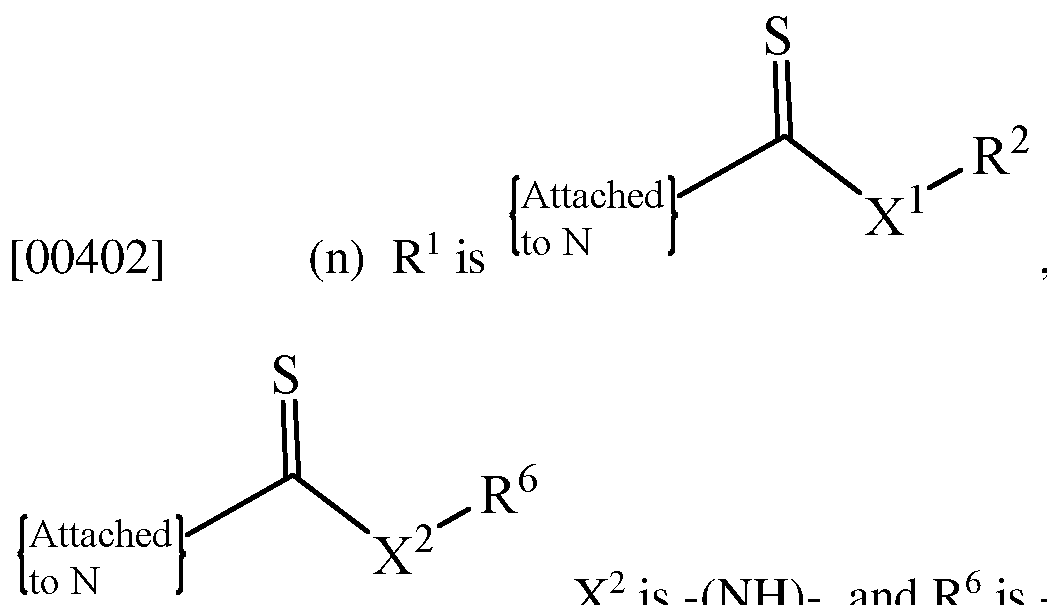 -(NH)-, and R6 is -CH2CF3
, X1 is -(NH)-, R2 is -CH3, R5 is
 , X2 is -0-, and Rb 6 i ;s„ -CH3;
, X1 is -(NH)-, R2 is -CH3, R5 is
 , X2 is -0-, and R6 is -CH2CH3;
[00405] (q) (1) the limitations of (1) and (2) the limitations of (i), (j), or (k);
[00406] (r) (1) the limitations of (m) and (2) the limitations of (i), (j), or (k);
[00407] (s) (1) the limitations of (n) and (2) the limitations of (i), (j), or (k);
[00408] (t) (1) the limitations of (o) and (2) the limitations of (i), (j), or (k); or [00409] (u) (1) the limitations of (p) and (2) the limitations of (i), (j), or (k).
[00410] A3. The compound of embodiment Al or embodiment A2, wherein
Formula (I) further comprises a solvent molecule coordinated with Formula (I).
[00411] A4. The compound of any of embodiments Al to A3, wherein Formula
(I) further comprises a solvent molecule coordinated with Formula (I) and the solvent molecule is selected from water, methanol, ethanol, propanol, acetonitrile,
dimethylformamide, and acetone.
The compound of any of embodiments Al to A4, wherein the

methyl-imidazolyl, an N-containing heterocyclyl, or an N-containing heteroaryl.
[00413] A6. The compound of any of embodiments Al to A5, wherein (a) X1 is not -(NH)-, (b) R2 is not methoxyphenyl or p-methoxyphenyl, or (c) both (a) and (b).
[00414] A7. The compound of any of embodiments Al to A6, wherein (a) X2 not -(NH)-, (b) R6 is not methoxyphenyl or p-methoxyphenyl, or (c) both (a) and (b).
[00415] A8. The compound of any of embodiments Al to A7, wherein (a) R3 not methyl, (b) R4 is not methyl, or (c) both (a) and (b).
[00416] A9. The compound of any of embodiments Al to A8, wherein the compound is not

[00417] A10. The compound of any of embodiments Al to A9, wherein the compound is part of a homogenous solution, a homogenous aqueous solution, a heterogeneous solution, a heterogeneous aqueous solution, or a glassy carbon electrode.
[00418] Al l. A homogenous solution, a homogenous aqueous solution, a heterogeneous solution, or a heterogeneous aqueous solution, each comprising the compound of any of embodiments Al to A9.
[00419] A12. A glassy carbon electrode, a carbon paste (e.g., embedded with one or more of polynuclear catalysts, coordinated polymers, or metal-organic frameworks), covalent modified carbon (e.g., graphene), or non-covalent modified carbon (e.g.,
graphene), each comprising or reacted with the compound of any of embodiments Al to A9.
[00420] A13. The carbon paste of embodiment A 12, wherein the carbon paste comprises an extended structure motif (e.g., motif I, motif II, or motif III of scheme 11).

[00421] B l. A compound selected from Formula (II),
[00422] M L (II) and
[00423] salts, optical isomers, geometric isomers, salts of isomers, and derivatives thereof, wherein
[00424] - M is Ni, Pd, Pt, Cu, Ag, Au, Zn, Cd, Hg, Co, Rh, Ti,
V, Cr, Mn, or Fe (e.g., M is Cu2+, Cu+, Zn2+, Co2+, Ni2+, Cd2+, Mn2+, Ru2+, or Fe2+; or M is Cu2+, Cu+, Zn2+, Co2+, Ni2+, Cd2+, Mn2+, Ru2+, or Fe2+; or M is Cu2+, Zn2+, Ni2+, Co2+,
Cd2+, Mn2+, or Fe2+; or M is Cu2+, Zn2+, Ni2+, or Co2+; or M is Cu2+, Zn2+, or Ni2+;
Cu2+, Zn2+, or Co2+; or M is Cu2+ or Zn2+) and
[00425] - L is selected from a thiosemicarbazone or a compound of Formula (I) of embodiments A1-A9.
[00426] B2. The compound of embodiment B 1 wherein Formula (II) is a compound of Formula (II- A)

[00427] - R7 is a monovalent H, methanoly (-COH), carboxy (-CO2H), nitro
(-NO2), sulfo (-SO3H), halogen (e.g., F, CI, Br, or I), aryl (e.g., benzene or pyrene), cycloalkyl, heterocyclyl, heteroaryl (e.g., pyridinyl and 1-methyl imidazolyl), Ci-C7 alkyl (e.g., Ci, C2, C3, C4, C5, C6, or C7 alkyl), C2-C7 alkenyl (e.g., C2, C3, C4, C5, C6, or C7 alkenyl), C2-C7 alkynyl (e.g., C2, C3, C4, C5, C6, or C7 alkynyl), or Ci-C6 alkoxy (Ci, C2, C3, C4, C5, or C6 alkoxy), which aryl (e.g., benzene or pyrene), cycloalkyl, heterocyclyl, heteroaryl (e.g., pyridinyl and 1-methyl imidazolyl), Ci-C7 alkyl, C2-C-7 alkenyl, C2-C-7 alkynyl, or Ci-C6 alkoxy can optionally be substituted with one or more (e.g., 0, 1, 2, 3, 4, 5, or 6) of halogen (e.g., F, CI, Br, or I), hydroxy (-OH), C1-C5 alkyl (e.g., Ci, C2, C3, C4,
or C5 alkyl), C1-C4 alkoxy (Ci, C2, C3, or C4 alkoxy), methanoly (-COH), carboxy (- CO2H), nitro (-NO2), cyano (-CN), ethynyl (-CCH), sulfo (-SO3H), methyl, or ethyl;
[00428] - X3 is bivalent -(NH)-, -(N-CH(CH3)2)-, -(N-CH2CH3)-, -(N-CH3)-, or -O-
, which -(NH)-, -(N-CH(CH3)2)-, -(N-CH2CH3)-, or -(N-CH3)- can optionally be substituted with one or more of halogen, hydroxy (-OH), C1-C5 alkyl, Ci-C4 alkoxy, methanoly (-COH), carboxy (-CO2H), nitro (-NO2), cyano (-CN), ethynyl (-CCH), sulfo (-S03H), methyl, or ethyl, or , which -(N-CH(CH3)2)-, -(N-CH2CH3)-, or -(N-CH3)- can optionally be substituted with one or more of halogen, hydroxy (-OH), C1-C5 alkyl, Ci-C4 alkoxy, methanoly (-COH), carboxy (-CO2H), nitro (-NO2), cyano (-CN), ethynyl (- CCH), sulfo (-S03H), methyl, or ethyl;
[00429] - R8 is a monovalent H, methanoly (-COH), carboxy (-CO2H), nitro
(-NO2), sulfo (-S03H), halogen (e.g., F, CI, Br, or I), aryl (e.g., benzene or pyrene), cycloalkyl, heterocyclyl, heteroaryl (e.g., pyridinyl and 1-methyl imidazolyl), Ci-C7 alkyl (e.g., Ci, C2, C3, C4, C5, C6, or C7 alkyl), C2-C7 alkenyl (e.g., C2, C3, C4, C5, C6, or C7 alkenyl), C2-C-7 alkynyl (e.g., C2, C3, C4, C5, C6, or C7 alkynyl), or Ci-C6 alkoxy (Ci, C2, C3, C4, C5, or C6 alkoxy), which aryl (e.g., benzene or pyrene), cycloalkyl, heterocyclyl, heteroaryl (e.g., pyridinyl and 1-methyl imidazolyl), Ci-C7 alkyl, C2-C-7 alkenyl, C2-C-7 alkynyl, or Ci-C6 alkoxy can optionally be substituted with one or more (e.g., 0, 1, 2, 3, 4, 5, or 6) of halogen (e.g., F, CI, Br, or I), hydroxy (-OH), C1-C5 alkyl (e.g., Ci, C2, C3, C4, or C5 alkyl), Ci-C4 alkoxy (Ci, C2, C3, or C4 alkoxy), methanoly (-COH), carboxy (- CO2H), nitro (-NO2), cyano (-CN), ethynyl (-CCH), sulfo (-S03H), methyl, or ethyl;
[00430] - R9 is a monovalent H, methanoly (-COH), carboxy (-CO2H), nitro
(-NO2), sulfo (-S03H), halogen (e.g., F, CI, Br, or I), aryl (e.g., benzene or pyrene),
cycloalkyl, heterocyclyl, heteroaryl (e.g., pyridinyl and 1-methyl imidazolyl), Ci-C7 alkyl (e.g., Ci, C2, C3, C4, C5, C6, or C7 alkyl), C2-C7 alkenyl (e.g., C2, C3, C4, C5, C6, or C7 alkenyl), C2-C7 alkynyl (e.g., C2, C3, C4, C5, C6, or C7 alkynyl), or Ci-C6 alkoxy (Ci, C2, C3, C4, C5, or C6 alkoxy), which aryl (e.g., benzene or pyrene), cycloalkyl, heterocyclyl, heteroaryl (e.g., pyridinyl and 1-methyl imidazolyl), Ci-C7 alkyl, C2-C7 alkenyl, C2-C7 alkynyl, or Ci-C6 alkoxy can optionally be substituted with one or more (e.g., 0, 1, 2, 3, 4, 5, or 6) of halogen (e.g., F, CI, Br, or I), hydroxy (-OH), C1-C5 alkyl (e.g., Ci, C2, C3, C4, or C5 alkyl), Ci-C4 alkoxy (Ci, C2, C3, or C4 alkoxy), methanoly (- COH), carboxy (-CO2H), nitro (-NO2), cyano (-CN), ethynyl (-CCH), sulfo (-S03H), methyl, or ethyl;
[00431] - X4 is bivalent -(NH)-, -(N-CH(CH3)2)-, -(N-CH2CH3)-, -(N-CH3)-, or -O-
, which -(NH)-, -(N-CH(CH3)2)-, -(N-CH2CH3)-, or -(N-CH3)- can optionally be substituted with one or more of halogen, hydroxy (-OH), C1-C5 alkyl, Ci-C4 alkoxy, methanoly (-COH), carboxy (-CO2H), nitro (-NO2), cyano (-CN), ethynyl (-CCH), sulfo (-S03H), methyl, or ethyl, or, which -(N-CH(CH3)2)-, -(N-CH2CH3)-, or -(N-CH3)- can optionally be substituted with one or more of halogen, hydroxy (-OH), C1-C5 alkyl, Ci-C4 alkoxy, methanoly (-COH), carboxy (-CO2H), nitro (-NO2), cyano (-CN), ethynyl (- CCH), sulfo (-S03H), methyl, or ethyl;
[00432] - R10 is a monovalent H, methanoly (-COH), carboxy (-CO2H), nitro
(-NO2), sulfo (-S03H), halogen (e.g., F, CI, Br, or I), aryl (e.g., benzene or pyrene), cycloalkyl, heterocyclyl, heteroaryl (e.g., pyridinyl and 1-methyl imidazolyl), Ci-C7 alkyl (e.g., Ci, C2, C3, C4, C5, C6, or C7 alkyl), C2-C7 alkenyl (e.g., C2, C3, C4, C5, C6, or C7 alkenyl), C2-C7 alkynyl (e.g., C2, C3, C4, C5, C6, or C7 alkynyl), or Ci-C6 alkoxy (Ci, C2,
C3, C4, C5, or Ce alkoxy), which aryl (e.g., benzene or pyrene), cycloalkyl, heterocyclyl, heteroaryl (e.g., pyridinyl and 1-methyl imidazolyl), Ci-C7 alkyl, C2-C-7 alkenyl, C2-C-7 alkynyl, or Ci-C6 alkoxy can optionally be substituted with one or more (e.g., 0, 1, 2, 3, 4, 5, or 6) of halogen (e.g., F, CI, Br, or I), hydroxy (-OH), C1-C5 alkyl (e.g., Ci, C2, C3, C4, or C5 alkyl), Ci-C4 alkoxy (Ci, C2, C3, or C4 alkoxy), methanoly (-COH), carboxy (- CO2H), nitro (-NO2), cyano (-CN), ethynyl (-CCH), sulfo (-S03H), methyl, or ethyl; and [00433] - M is Ni, Pd, Pt, Cu, Ag, Au, Zn, Cd, Hg, Co, Rh, Ti, V, Cr, Mn, or Fe; or
M is Cu2+, Cu+, Zn2+, Co2+, Ni2+, Cd2+, Mn2+, Ru2+, or Fe2+; or M is Cu2+, Cu+, Zn2+, Co2+, Cd2+, Mn2+, Ru2+, or Fe2+; or M is Cu2+, Zn2+, Co2+, Cd2+, Mn2+, or Fe2+; or M is Cu2+, Zn2+, Ni2+, or Co2+; or M is Cu2+, Zn2+, or Ni2+; or M is Cu2+, Zn2+, or Co2+; or M is Cu2+ or Zn2+.
[00434] B3. The compound of embodiment B l or embodiment B2, wherein
[00435] (a) R3 is the same as R4;
[00436] (b) R3 is the same as R4 and R1 is the same as R5;
[00437] (c) R3 is the same as R4, X1 is -(NH)-, X2 is -(NH)-, and R2 is the same as
[00438] (d) R3 is the same as R4, R3 is methyl, R1 is the same as R5, R1 is
 [00439] (e) R3 is the same as R >44, R D J3 i ;s methyl, R1 is the same as R )35, R D 1 I is
 , X1 is -(NH)-, and R2 is -C5H6;
[00440] (f) R3 is the same as R4, R3 is methyl, R1 is the same as R5, R1 is
 , X1 is -(NH)-, and R2 is -CH2F3;
[00441] (g) R3 is the same as R4, R3 is methyl, R1 is the same as R5, R1 is

Attached
, X1 is -(NCH3)-, and R2 is -CH3;
[00442] (h) R3 is the same as R4, R3 is methyl, R1 is the same as R5, R1 is
 , X1 is -0-, and R2 is -CH3;
[00443] (i) R3 is the same as R4 and R3 is methyl;
[00444] (]) R3 is the same as R4 and R3 is ethyl;
[00445] (k) R3 is methyl and R4 is phenyl;
, X1 is -(NH)-, R2 is -CH3, R5 is
 -(N-CH(CH3)2)-, and R6 is -CH(CH3):
[00447] (m) R s
 , X1 is -(NH)-, R2 is -CH3, R5 is
 (n) R is , X1 is -(NH)-, R2 is -CH3, R5 is
 , X2 is -(NH)-, and Rb is -CH2CF3;
, X1 is -(NH)-, R2 is -CH3, R >35 i ;s„
 , X2 is -0-, and R6 is -CH3;
, X1 is -(NH)-, R2 is -CH3, R >35 i ;s„
 , X2 is -0-, and R6 is -CH2CH3;
[00451] (q) (1) the limitations of (1) and (2) the limitations of (i), (j), or (k);
[00452] (r) (1) the limitations of (m) and (2) the limitations of (i), (j), or (k);
[00453] (s) (1) the limitations of (n) and (2) the limitations of (i), (j), or (k);
[00454] (t) (1) the limitations of (o) and (2) the limitations of (i), (j), or (k); or [00455] (u) (1) the limitations of (p) and (2) the limitations of (i), (j), or (k).
[00456] B4. The compound of any of embodiments B l to B3, wherein
[00457] (a) R8 is the same as R9;
[00458] (b) R8 is the same as R9 and X3-R7 is the same as X4-R10;
[00459] (c) R8 is the same as R9, X3 is -(NH)-, X4 is -(NH)-, and R7 is the same as
[00460] (d) R8 is the same as R9, R8 is methyl, X3-R7 is the same as X4-R10, X3 is -
(NH)-, and R7 is -CH3;
[00461] (e) R8 is the same as R9, R8 is methyl, X3-R7 is the same as X4-R10, X3 is -
(NH)-, and R7 is -C5H6;
[00462] (f) R8 is the same as R9, R8 is methyl, X3-R7 is the same as X4-R10, X3 is -
(NH)-, and R7 is -CH2F3;
[00463] (g) R8 is the same as R9, R8 is methyl, X3-R7 is the same as X4-R10, X3 is -
(NCH3)-, and R7 is -CH3;
[00464] (h) R8 is the same as R9, R8 is methyl, X3-R7 is the same as X4-R10, X3 is -
0-, and R7 is -CH3;
[00465] (i) R8 is the same as R9 and R8 is methyl;
[00466] (J) R8 is the same as R9 and R8 is ethyl;
[00467] (k) R8 is methyl and R9 is phenyl;
[00468] (1) X3 is -(NH)-, R7 is -CH3, X4 is -(N-CH(CH3)2)-, and R10 is -CH(CH3)2;
[00469] (m) X3 is -(NH)-, R7 is -CH3, X4 is -(NH)-, and R10 is -C5H6;
[00470] (n) X3 is -(NH)-, R7 is -CH3, X4 is -(NH)-, and R10 is -CH2CF3;
[00471] (o) X3 is -(NH)-, R7 is -CH3, X4 is -0-, and R10 is -CH3;
[00472] (p) X3 is -(NH)-, R7 is -CH3, X4 is -0-, and R10 is -CH2CH3;
[00473] (q) (1) the limitations of (1) and (2) the limitations of (i), (j), or (k);
[00474] (r) (1) the limitations of (m) and (2) the limitations of (i), (j), or (k);
[00475] (s) (1) the limitations of (n) and (2) the limitations of (i), (j), or (k);
[00476] (t) (1) the limitations of (o) and (2) the limitations of (i), (j), or (k); or
[00477] (u) (1) the limitations of (p) and (2) the limitations of (i), (j), or (k).
[00478] B5. The compound of any of embodiments B l to B4, wherein the M is
Zn2+, Co2+, Ni2+, or Cu2+ (e.g., M is Zn2+, Co2+, or Cu2+).
[00479] B6. The compound of any of embodiments B l to B5, wherein Formula
(II) further comprises a solvent molecule coordinated with Formula (II).
[00480] B7. The compound of any of embodiments B l to B6, wherein Formula
(II) further comprises a solvent molecule coordinated with Formula (II) and the solvent molecule is selected from water, ethanol, propanol, acetonitrile, dimethylformamide, and acetone.
[00481] B8. The compound of any of embodiments B l to B7, wherein the compound is


Co, Ni, or Cu (e.g., M is Zn, Co, or Cu; or M is Zn, Ni, or Cu; or M is Zn or Cu) and R5 is pyridinyl, 1- methyl- imidazolyl, an N-containing heterocyclyl, or an N-containing heteroaryl.
[00482] B9. The compound of any of embodiments B l to B8, wherein (a) X is not -(NH)-, (b) R2 is not methoxyphenyl or p-methoxyphenyl, or (c) both (a) and (b).
[00483] B 10. The compound of any of embodiments B l to B9, wherein (a) X2 is not -(NH)-, (b) R6 is not methoxyphenyl or p-methoxyphenyl, or (c) both (a) and (b).
[00484] B 11. The compound of any of embodiments B 1 to B 10, wherein (a) R3 is not methyl, (b) R is not methyl, or (c) both (a) and (b).
[00485] B 12. The compound of any of embodiments B 1 to B 11, wherein (a) X3 is not -(NH)-, (b) R is not methoxyphenyl or p-methoxyphenyl, or (c) both (a) and (b).
[00486] B 13. The compound of any of embodiments B l to B 12, wherein (a) X is not -(NH)-, (b) R is not methoxyphenyl or p-methoxyphenyl, or (c) both (a) and (b).
[00487] B 14. The compound of any of embodiments B l to B 13, wherein (a) R is not methyl, (b) R is not methyl, or (c) both (a) and (b).
B 15. The compound of any of embodiments B 1 to B 14, wherein the

[00489] B 16. The compound of any of embodiments B 1 to B 15, wherein the compound is part of a homogenous solution, a homogenous aqueous solution, a heterogeneous solution, or a heterogeneous aqueous solution.
[00490] B 17. A homogenous solution, a homogenous aqueous solution, a heterogeneous solution, or a heterogeneous aqueous solution, each comprising the compound of any of embodiments B l to B 16.
[00491] B 18. A glassy carbon electrode, a carbon paste (e.g., embedded with one or more of polynuclear catalysts, coordinated polymers, or metal-organic frameworks), covalent modified carbon (e.g., graphene), or non-covalent modified carbon (e.g., graphene), each comprising or reacted with the compound of any of embodiments B l to B 17.
[00492] B 19. The carbon paste of embodiment B 18, wherein the carbon paste comprises an extended structure motif (e.g., motif I, motif II, or motif III of scheme 11).

[00494] Dl. An anode comprising a composition comprising a compound of Formula (I) (e.g., embodiments A1-A13), a compound of Formula (II) (e.g.,
embodiments B 1-B 19), or both.
[00495] El. A cathode comprising a composition comprising a compound of
Formula (I) (e.g., embodiments A1-A13), a compound of Formula (II) (e.g.,
embodiments B 1-B 19), or both.
[00496] Fl. An electrochemical cell comprising a composition comprising a compound of Formula (I) (e.g., embodiments A1-A13), a compound of Formula (II) (e.g., embodiments B 1-B 19), or both.
[00497] F2. The electrochemical cell of embodiment Fl, wherein the cathode of the electrochemical cell comprises the composition.
[00498] Gl. A fuel cell comprising a composition comprising a compound of
Formula (I) (e.g., embodiments A1-A13), a compound of Formula (II) (e.g.,
embodiments B 1-B 19), or both.
[00499] G2. The fuel cell of embodiment Gl, wherein the anode of the fuel cell comprises the first composition.
[00500] HI. A method for producing H2 comprising contacting, in an
electrochemical cell, a first composition comprising a compound of Formula (I) (e.g., embodiments A1-A13), a compound of Formula (II) (e.g., embodiments B 1-B 19), or both with a second composition comprising water.
[00501] H2. The method of embodiment HI, wherein the cathode of the electrochemical cell comprises the first composition.
[00502] H3. The method of HI or H2, wherein the TOF is from about 20 s"1 to about 100,000 s"1, about 100 s"1 to about 100,000 s"1, from about 500 s"1 to about 100,000 s"1, from about 500 s"1 to about 50,000 s"1, from about 500 s"1 to about 20,000 s"1, about 20 s"1, about 100 s"1, about 500 s"1, about 1000 s"1, about 5000 s"1, about 10000 s"1, about 12000 s"1, about 16000 s"1, about 20000 s"1, about 50000 s-\ or about 100,000 s"1.
[00503] H4. A method for oxidizing an aldehyde or an alcohol comprising contacting, in an electrochemical cell, a composition comprising a compound of Formula (I) (e.g., embodiments A1-A13), a compound of Formula (II) (e.g., embodiments B l- B 19), or both.
[00504] H5. The method of any of HI -H4, wherein the overpotential is greater than about 0 V, not less than about 0.1 V, not more than about 0.1 V, not more than 0.5 V, not more than 1 V, not more than 10 V, not more than 100 V, from about 0 V to about 2000 V, from about 0 V to about 1000 V, from about 0 V to about 750 V, from about 0 V to about 300 V, from about 0 V to about 350 V, from about 0 V to about 200 V, from about 0 V to about 100 V, from about 0 V to about 20 V, from about 0 V to about 10 V, from about 0 V to about 5 V, from about 0 V to about 2 V, from about 0 V to about 1 V, from about 0.1 V to about 2000 V, from about 0.1 V to about 1000 V, from about 0.1 V to about 750 V, from about 0.1 V to about 300 V, from about 0.1 V to about 350 V, from about 0.1 V to about 200 V, from about 0.1 V to about 100 V, from about 0.1 V to about 20 V, from about 0.1 V to about 10 V, from about 0.1 V to about 5 V, from about 0.1 V to about 2 V, from about 0.1 V to about 1 V, about 0.1 V, about 0.5 V, about 1 V, about 5 V, about 10 V, about 100 V, about 250 V, about 350 V, about 400 V, about 500 V, or about 1000 V. [00505] II. A method for producing electricity comprising contacting, in a fuel cell, a first composition comprising a compound of Formula (I) (e.g., embodiments Al- A13), a compound of Formula (II) (e.g., embodiments B 1-B 19), or both with a second composition comprising H2.
[00506] 12. The method of embodiment II, wherein the anode of the fuel cell comprises the first composition.
[00507] 13. The method of II or 12, wherein the TOF is from about 1 s"1 to about
1000 s"1, from about 5 s"1 to about 1000 s"1, from about 5 s"1 to about 500 s"1, from about 5 s"1 to about 200 s"1, about 1 s"1, about 5 s"1, about 10 s"1, about 32 s"1, about 50 s"1, about 76 s"1, about 100 s"1, about 120 s"1, about 200 s"1, about 300 s"1, about 500 s"1, or about 1000 s"1.
[00508] 14. The method of any of 11-13, wherein the overpotential is greater than about 0 V, not less than about 0.1 V, not more than about 0.1 V, not more than 0.5 V, not more than 1 V, not more than 10 V, not more than 100 V, from about 0 V to about 2000 V, from about 0 V to about 1000 V, from about 0 V to about 750 V, from about 0 V to about 300 V, from about 0 V to about 350 V, from about 0 V to about 200 V, from about 0 V to about 100 V, from about 0 V to about 20 V, from about 0 V to about 10 V, from about 0 V to about 5 V, from about 0 V to about 2 V, from about 0 V to about 1 V, from about 0.1 V to about 2000 V, from about 0.1 V to about 1000 V, from about 0.1 V to about 750 V, from about 0.1 V to about 300 V, from about 0.1 V to about 350 V, from about 0.1 V to about 200 V, from about 0.1 V to about 100 V, from about 0.1 V to about 20 V, from about 0.1 V to about 10 V, from about 0.1 V to about 5 V, from about 0.1 V to about 2 V, from about 0.1 V to about 1 V, about 0.1 V, about 0.5 V, about 1 V, about 5 V, about 10 V, about 100 V, about 250 V, about 350 V, about 400 V, about 500 V, or about 1000 V.
[00509] Jl. A method for preparing a compound of Formula (I) (e.g., embodiments A1-A13) comprising any suitable method.
[00510] J2. The method of Jl, wherein the compound of Formula (I) is prepared comprising
H
.N>
(a) reacting a compound of Formula (III) R NH 2 (III)
[00512] with a compound of Formula (IV)

[00513] (b) reacting a compound of Formula (V)
 (V)
(V)
[00514] with a compound of Formula (VI)
 (VI); and
[00515] (c) recovering the compound of Formula (I),
[00516] wherein R1, R3, R4, and R5 are defined as in embodiments A1-A13.
[00517] Kl. A method for preparing a compound of Formula (II) (e.g., embodiments B 1-B 19) comprising any suitable method.
[00518] K2. The method of Kl, wherein the compound of Formula (II) is prepared
[00519] (a) reacting a compound of Formula (I) (e.g., embodiments A1-A13) with M; and
[00520] (b) recovering the compound of Formula (II),
[00521] wherein M is defined as in embodiments B 1-B 19.
[00522] LI. A method for preparing a catalyst (e.g., an electrocatalyst) comprising a composition comprising a compound of Formula (I) (e.g., embodiments A1-A13), a compound of Formula (II) (e.g., embodiments B 1-B 19), or both, comprising any suitable method.
[00523] Ml. A method for preparing an anode comprising a composition comprising a compound of Formula (I) (e.g., embodiments A1-A13), a compound of Formula (II) (e.g., embodiments B 1-B 19), or both, comprising any suitable method.
[00524] Nl. A method for preparing a cathode comprising a composition comprising a compound of Formula (I) (e.g., embodiments A1-A13), a compound of Formula (II) (e.g., embodiments B 1-B 19), or both, comprising any suitable method.
[00525] The headings used in the disclosure are not meant to suggest that all disclosure relating to the heading is found within the section that starts with that heading. Disclosure for any subject may be found throughout the specification.
[00526] It is noted that terms like "preferably," "commonly," and "typically" are not used herein to limit the scope of the claimed invention or to imply that certain features are critical, essential, or even important to the structure or function of the claimed invention. Rather, these terms are merely intended to highlight alternative or additional features that may or may not be utilized in a particular embodiment of the present invention. [00527] As used in the disclosure, "a" or "an" means one or more than one, unless otherwise specified. As used in the claims, when used in conjunction with the word "comprising" the words "a" or "an" means one or more than one, unless otherwise specified. As used in the disclosure or claims, "another" means at least a second or more, unless otherwise specified. As used in the disclosure, the phrases "such as", "for example", and "e.g." mean "for example, but not limited to" in that the list following the term ("such as", "for example", or "e.g.") provides some examples but the list is not necessarily a fully inclusive list. The word "comprising" means that the items following the word "comprising" may include additional unrecited elements or steps; that is, "comprising" does not exclude additional unrecited steps or elements. [00528] Unless otherwise indicated, all numbers expressing quantities of ingredients, properties such as reaction conditions, and so forth used in the specification and claims are to be understood as being modified in all instances by the term "about".
Accordingly, unless indicated to the contrary, the numerical parameters set forth in this specification and claims are approximations that can vary depending upon the desired properties or functions sought to be obtained by the presently-disclosed subject matter.
[00529] As used herein, the term "about," when referring to a value or to an amount of mass, weight, time, volume, concentration or percentage is meant to encompass variations of in some embodiments +20%, in some embodiments +10%, in some embodiments +5%, in some embodiments +1%, in some embodiments +0.5%, and in some embodiments +0.1% from the specified amount, as such variations are appropriate to perform the disclosed method.
[00530] Detailed descriptions of one or more embodiments are provided herein. It is to be understood, however, that the present invention may be embodied in various forms. Therefore, specific details disclosed herein (even if designated as preferred or advantageous) are not to be interpreted as limiting, but rather are to be used as an illustrative basis for the claims and as a representative basis for teaching one skilled in the art to employ the present invention in any appropriate manner. Indeed, various modifications of the invention in addition to those described herein will become apparent to those skilled in the art from the foregoing description and the accompanying figures. Such modifications are intended to fall within the scope of the appended claims.
Claims
1. A compound selected from a compound of Formula (I),

salts, optical isomers, geometric isomers, salts of isomers, and derivatives thereof, wherein

- X1 is bivalent -(NH)-, -0-, -(CH2)-, or -S-, which -(NH)- or -(CH2)- can optionally be substituted with one or more of halogen, hydroxy (-OH), C1-C5 alkyl, C1-C4 alkoxy, methanoly (-COH), carboxy (-CO2H), nitro (-NO2), cyano (-CN), ethynyl (- CCH), sulfo (-SO3H), methyl, or ethyl;
- R2 is a monovalent H, methanoly (-COH), carboxy (-CO2H), nitro (-NO2), sulfo (-SO3H), halogen, aryl, cycloalkyl, heterocyclyl, heteroaryl, Ci-C7 alkyl, C2-C7 alkenyl, C2-C-7 alkynyl, or Ci-C6 alkoxy, which aryl, cycloalkyl, heterocyclyl, heteroaryl, Ci-C7 alkyl, C2-C7 alkenyl, C2-C7 alkynyl, or Ci-C6 alkoxy can optionally be substituted with one or more of halogen, hydroxy (-OH), C1-C5 alkyl, C1-C4 alkoxy, methanoly (-COH),
carboxy (-C02H), nitro (-NO2), cyano (-CN), ethynyl (-CCH), sulfo (-SO3H), methyl, or ethyl;
- R3 is a monovalent H, methanoly (-COH), carboxy (-CO2H), nitro (-NO2), sulfo (-SO3H), halogen, aryl, cycloalkyl, heterocyclyl, heteroaryl, Ci-C7 alkyl, C2-C7 alkenyl, C2-C7 alkynyl, or Ci-C6 alkoxy, which aryl, cycloalkyl, heterocyclyl, heteroaryl, Ci-C7 alkyl, C2-C-7 alkenyl, C2-C7 alkynyl, or Ci-C6 alkoxy can optionally be substituted with one or more of halogen, hydroxy (-OH), C1-C5 alkyl, C1-C4 alkoxy, methanoly (-COH), carboxy (-CO2H), nitro (-NO2), cyano (-CN), ethynyl (-CCH), sulfo (-SO3H), methyl, or ethyl;
- R4 is a monovalent H, methanoly (-COH), carboxy (-CO2H), nitro (-NO2), sulfo (-SO3H), halogen, aryl, cycloalkyl, heterocyclyl, heteroaryl, Ci-C7 alkyl, C2-C-7 alkenyl, C2-C-7 alkynyl, or Ci-C6 alkoxy, which aryl, cycloalkyl, heterocyclyl, heteroaryl, Ci-C7 alkyl, C2-C-7 alkenyl, C2-C7 alkynyl, or Ci-C6 alkoxy can optionally be substituted with one or more of halogen, hydroxy (-OH), C1-C5 alkyl, C1-C4 alkoxy, methanoly (-COH), carboxy (-CO2H), nitro (-NO2), cyano (-CN), ethynyl (-CCH), sulfo (-SO3H), methyl, or ethyl;

- X2 is bivalent -(NH)-, -0-, -(CH2)-, or -S-, which -(NH)- or -(CH2)- can optionally be substituted with one or more of halogen, hydroxy (-OH), C1-C5 alkyl, C1-C4 alkoxy, methanoly (-COH), carboxy (-CO2H), nitro (-NO2), cyano (-CN), ethynyl (- CCH), sulfo (-SO3H), methyl, or ethyl; and
- R6 is a monovalent H, methanoly (-COH), carboxy (-CO2H), nitro (-NO2), sulfo (-SO3H), halogen, aryl, cycloalkyl, heterocyclyl, heteroaryl, Ci-C7 alkyl, C2-C-7 alkenyl, C2-C-7 alkynyl, or Ci-C6 alkoxy, which aryl, cycloalkyl, heterocyclyl, heteroaryl, Ci-C7 alkyl, C2-C-7 alkenyl, C2-C-7 alkynyl, or Ci-C6 alkoxy can optionally be substituted with one or more of halogen, hydroxy (-OH), C1-C5 alkyl, C1-C4 alkoxy, methanoly (-COH), carboxy (-CO2H), nitro (-NO2), cyano (-CN), ethynyl (-CCH), sulfo (-SO3H), methyl, or ethyl.
2. The compound of claim 1, wherein
(a) R3 is the same as R4;
(b) R3 is the same as R4 and R1 is the same as R5;
(c) R3 is the same as R4, X1 is -(NH)-, X2 is -(NH)-, and R2 is the same as R6;
(d) R3 is the same as R4, R3 is methyl, R1 is the same as R5, R1 is

(e) R3 is the same as R4, R3 is methyl, R1 is the same as R5, R1 is

(f) R3 is the same as R4, R3 is methyl, R1 is the same as R5, R1 is


(h) R3 is the same as R4, R3 is methyl, R1 is the same as R5, R1 is

(i) R3 is the same as R4 and R3 is methyl;
(j) R3 is the same as R4 and R3 is ethyl;
(k) R3 is methyl and R4 is phenyl;
X1 is -(NH)-, R2 is -CH3, R5 is
-CH(CH3)2)-, and R6 is -CH(CH3)2;
, X1 is -(NH)-, R2 is -CH3, R5 is

H2CF3;
is -CH3, R5 is
(
 p) R s , X1 is -(NH)-, R2 is -CH3, R >35 i ;s„

(q) (1) the limitations of (1) and (2) the limitations of (i), (j), or (k);
(r) (1) the limitations of (m) and (2) the limitations of (i), (j), or (k);
(s) (1) the limitations of (n) and (2) the limitations of (i), (j), or (k);
(t) (1) the limitations of (o) and (2) the limitations of (i), (j), or (k); or
(u) (1) the limitations of (p) and (2) the limitations of (i), (j), or (k).
3. The compound of claim 1 or claim 2, wherein Formula (I) further comprises a solvent molecule coordinated with Formula (I).
4. The compound of any of claims 1-3, wherein Formula (I) further comprises a solvent molecule coordinated with Formula (I) and the solvent molecule is selected from water, methanol, ethanol, propanol, acetonitrile, dimethylformamide, and acetone.
5. The com ound of any of claims 1-4, wherein the compound is

imidazolyl, an N-containing heterocyclyl, or an N-containing heteroaryl.
6. The compound of any of claims 1-5, wherein (a) X1 is not -(NH)-, (b) R2 is not methoxyphenyl or p-methoxyphenyl, or (c) both (a) and (b).
7. The compound of any of claims 1-6, wherein (a) X2 is not -(NH)-, (b) R6 is not methoxyphenyl or p-methoxyphenyl, or (c) both (a) and (b).
8. The compound of any of claims 1-7, wherein (a) R3 is not methyl, (b) R4 is not methyl, or (c) both (a) and (b).
9. The compound of any of claims 1-8, wherein the compound is not

10. A compound selected from a compound of Formula (II),
M L (II) and
salts, optical isomers, geometric isomers, salts of isomers, and derivatives thereof, wherein
- M is Ni, Pd, Pt, Cu, Ag, Au, Zn, Cd, Hg, Co, Rh, Ti, V, Cr, Mn, or Fe; and
- L is a compound of Formula (I) of any of claims 1-9.
11. The compound of claim 10, wherein Formula (II) is a compound of Formula (II- A)

- R7 is a monovalent H, methanoly (-COH), carboxy (-CO2H), nitro (-NO2), sulfo (-SO3H), halogen, aryl, cycloalkyl, heterocyclyl, heteroaryl, Ci-C7 alkyl, C2-C-7 alkenyl, C2-C-7 alkynyl, or Ci-C6 alkoxy, which aryl, cycloalkyl, heterocyclyl, heteroaryl, Ci-C7 alkyl, C2-C-7 alkenyl, C2-C-7 alkynyl, or Ci-C6 alkoxy can optionally be substituted with one or more of halogen, hydroxy (-OH), C1-C5 alkyl, C1-C4 alkoxy, methanoly (-COH), carboxy (-CO2H), nitro (-NO2), cyano (-CN), ethynyl (-CCH), sulfo (-SO3H), methyl, or ethyl;
- X3 is bivalent -(NH)-, -(N-CH(CH3)2)-, -(N-CH2CH3)-, -(N-CH3)-, or -O- , which -(NH)-, -(N-CH(CH3)2)-, -(N-CH2CH3)-, or -(N-CH3)- can optionally be substituted with one or more of halogen, hydroxy (-OH), C1-C5 alkyl, C1-C4 alkoxy, methanoly (-COH), carboxy (-CO2H), nitro (-NO2), cyano (-CN), ethynyl (-CCH), sulfo (-S03H), methyl, or ethyl;
- R8 is a monovalent H, methanoly (-COH), carboxy (-CO2H), nitro (-NO2), sulfo (-S03H), halogen, aryl, cycloalkyl, heterocyclyl, heteroaryl, Ci-C7 alkyl, C2-C7 alkenyl, C2-C7 alkynyl, or Ci-C6 alkoxy, which aryl, cycloalkyl, heterocyclyl, heteroaryl, Ci-C7 alkyl, C2-C7 alkenyl, C2-C7 alkynyl, or Ci-C6 alkoxy can optionally be substituted with one or more of halogen, hydroxy (-OH), C1-C5 alkyl, C1-C4 alkoxy, methanoly (-COH), carboxy (-CO2H), nitro (-NO2), cyano (-CN), ethynyl (-CCH), sulfo (-S03H), methyl, or ethyl;
- R9 is a monovalent H, methanoly (-COH), carboxy (-CO2H), nitro (-NO2), sulfo (-S03H), halogen, aryl, cycloalkyl, heterocyclyl, heteroaryl, Ci-C7 alkyl, C2-C-7 alkenyl, C2-C7 alkynyl, or Ci-C6 alkoxy, which aryl, cycloalkyl, heterocyclyl, heteroaryl, Ci-C7 alkyl, C2-C7 alkenyl, C2-C7 alkynyl, or Ci-C6 alkoxy can optionally be substituted with one or more of halogen, hydroxy (-OH), C1-C5 alkyl, C1-C4 alkoxy, methanoly (-COH), carboxy (-CO2H), nitro (-NO2), cyano (-CN), ethynyl (-CCH), sulfo (-S03H), methyl, or ethyl;
- X4 is bivalent -(NH)-, -(N-CH(CH3)2)-, -(N-CH2CH3)-, -(N-CH3)-, or -O- , which -(NH)-, -(N-CH(CH3)2)-, -(N-CH2CH3)-, or -(N-CH3)- can optionally be substituted with one or more of halogen, hydroxy (-OH), C1-C5 alkyl, C1-C4 alkoxy, methanoly (-COH), carboxy (-CO2H), nitro (-NO2), cyano (-CN), ethynyl (-CCH), sulfo (-S03H), methyl, or ethyl;
- R10 is a monovalent H, methanoly (-COH), carboxy (-CO2H), nitro (-NO2), sulfo (-S03H), halogen, aryl, cycloalkyl, heterocyclyl, heteroaryl, Ci-C7 alkyl, C2-C-7 alkenyl, C2-C7 alkynyl, or Ci-C6 alkoxy, which aryl, cycloalkyl, heterocyclyl, heteroaryl, Ci-C7 alkyl, C2-C7 alkenyl, C2-C7 alkynyl, or Ci-C6 alkoxy can optionally be substituted with one or more of halogen, hydroxy (-OH), C1-C5 alkyl, C1-C4 alkoxy,
methanoly (-COH), carboxy (-C02H), nitro (-NO2), cyano (-CN), ethynyl (-CCH), sulfo (-SO3H), methyl, or ethyl; and
- M is Ni, Pd, Pt, Cu, Ag, Au, Zn, Cd, Hg, Co, Rh, Ti, V, Cr, Mn, or Fe.
12. The compound of claim 10 or claim 11, wherein
(a) R8 is the same as R9;
(b) R8 is the same as R9 and X3-R7 is the same as X4-R10;
(c) R8 is the same as R9, X3 is -(NH)-, X4 is -(NH)-, and R7 is the same as R10;
(d) R8 is the same as R9, R8 is methyl, X3-R7 is the same as X4-R10, X3 is -(NH)-, and R7 is -CH3;
(e) R8 is the same as R9, R8 is methyl, X3-R7 is the same as X4-R10, X3 is -(NH)-, and R7 is -C5H6;
(f) R8 is the same as R9, R8 is methyl, X3-R7 is the same as X4-R10, X3 is -(NH)-, and R7 is -CH2F3;
(g) R8 is the same as R9, R8 is methyl, X3-R7 is the same as X4-R10, X3 is - (NCH3)-, and R7 is -CH3;
(h) R8 is the same as R9, R8 is methyl, X3-R7 is the same as X4-R10, X3 is -0-, and R7 is -CH3;
(i) R8 is the same as R9 and R8 is methyl;
(j) R8 is the same as R9 and R8 is ethyl;
(k) R8 is methyl and R9 is phenyl;
(1) X3 is -(NH)-, R7 is -CH3, X4 is -(N-CH(CH3)2)-, and R10 is -CH(CH3)2;
(m) X3 is -(NH)-, R7 is -CH3, X4 is -(NH)-, and R10 is -C5H6;
(n) X3 is -(NH)-, R7 is -CH3, X4 is -(NH)-, and R10 is -CH2CF3;
(o) X3 is -(NH)-, R7 is -CH3, X4 is -0-, and R10 is -CH3;
(p) X3 is -(NH)-, R7 is -CH3, X4 is -0-, and R10 is -CH2CH3;
(q) (1) the limitations of (1) and (2) the limitations of (i), (j), or (k);
(r) (1) the limitations of (m) and (2) the limitations of (i), (j), or (k);
(s) (1) the limitations of (n) and (2) the limitations of (i), (j), or (k);
(t) (1) the limitations of (o) and (2) the limitations of (i), (j), or (k); or
(u) (1) the limitations of (p) and (2) the limitations of (i), (]), or (k).
13. The compound of any of claims 10-12, wherein the M is Zn/+, Co/+, Ni/+, or Cu
14. The compound of any of claims 10-13, wherein Formula (II) further comprises a solvent molecule coordinated with Formula (II).
15. The compound of any of claims 10-14, wherein Formula (II) further comprises a solvent molecule coordinated with Formula (II) and the solvent molecule is selected from water, ethanol, propanol, acetonitrile, dimethylformamide, and acetone.
16. The compound of any of claims 10-15, wherein the compound is

17. The compound of any of claims 10-16, wherein (a) X3 is not -(NH)-, (b) R7 is not methoxyphenyl or p-methoxyphenyl, or (c) both (a) and (b).
18. The compound of any of claims 10-17, wherein (a) X4 is not -(NH)-, (b) R10 is not methoxyphenyl or p-methoxyphenyl, or (c) both (a) and (b).
19. The compound of any of claims 10-18, wherein (a) R8 is not methyl, (b) R9 is not methyl, or (c) both (a) and (b).
20. The com ound of any of claims 10-19, wherein the compound is not

21. A catalyst or an electrocatalyst comprising a composition comprising a compound of Formula (I), a compound of Formula (II), or both.
22. An electrochemical cell comprising a composition comprising a compound of Formula (I), a compound of Formula (II), or both.
23. The electrochemical cell of claim 22, wherein the cathode of the electrochemical cell comprises the composition.
24. A method for producing H2 comprising contacting, in an electrochemical cell, a first composition comprising a compound of Formula (I), a compound of Formula (II), or both, with a second composition comprising water.
25. The method of claim 24, wherein the cathode of the electrochemical cell comprises the first composition.
26. The method of claim 24 or claim 25, wherein the TOF is from about 20 s"1 to about 100,000 s"1, about 100 s"1 to about 100,000 s"1, from about 500 s"1 to about 100,000 s"1, from about 500 s"1 to about 50,000 s"1, from about 500 s"1 to about 20,000 s"1, about 20 s" about 100 s"1, about 500 s"1, about 1000 s"1, about 5000 s"1, about 10000 s"1, about 12000 s"1, about 16000 s"1, about 20000 s"1, about 50000 s^^r about 100,000 s"1.
Priority Applications (1)
| Application Number | Priority Date | Filing Date | Title |
|---|---|---|---|
| US16/214,088 US11142835B2 (en) | 2016-06-10 | 2018-12-09 | Compounds, their preparation, related compositions, catalysts, electrochemical cells, fuel cells, and uses thereof |
Applications Claiming Priority (4)
| Application Number | Priority Date | Filing Date | Title |
|---|---|---|---|
| US201662348420P | 2016-06-10 | 2016-06-10 | |
| US62/348,420 | 2016-06-10 | ||
| US201662436490P | 2016-12-20 | 2016-12-20 | |
| US62/436,490 | 2016-12-20 |
Related Child Applications (1)
| Application Number | Title | Priority Date | Filing Date |
|---|---|---|---|
| US16/214,088 Continuation-In-Part US11142835B2 (en) | 2016-06-10 | 2018-12-09 | Compounds, their preparation, related compositions, catalysts, electrochemical cells, fuel cells, and uses thereof |
Publications (1)
| Publication Number | Publication Date |
|---|---|
| WO2017214546A1 true WO2017214546A1 (en) | 2017-12-14 |
Family
ID=59078258
Family Applications (1)
| Application Number | Title | Priority Date | Filing Date |
|---|---|---|---|
| PCT/US2017/036815 Ceased WO2017214546A1 (en) | 2016-06-10 | 2017-06-09 | Compounds, related compositions, catalysts, electrochemical cells, fuel cells, their preparation and their uses |
Country Status (1)
| Country | Link |
|---|---|
| WO (1) | WO2017214546A1 (en) |
Cited By (4)
| Publication number | Priority date | Publication date | Assignee | Title |
|---|---|---|---|---|
| WO2018204564A1 (en) * | 2017-05-04 | 2018-11-08 | University Of Louisville Research Foundation, Inc. | Thiosemicarbazone derivatives as anti-cancer agents |
| WO2019046761A1 (en) * | 2017-09-01 | 2019-03-07 | Oregon State University | Therapeutic metal complexes and ligands and methods of making and using same |
| US11142835B2 (en) | 2016-06-10 | 2021-10-12 | University Of Louisville Research Foundation, Inc. | Compounds, their preparation, related compositions, catalysts, electrochemical cells, fuel cells, and uses thereof |
| US11208379B2 (en) | 2017-05-04 | 2021-12-28 | University Of Louisville Research Foundation, Inc. | Compounds, compositions, methods for treating diseases, and methods for preparing compounds |
Citations (1)
| Publication number | Priority date | Publication date | Assignee | Title |
|---|---|---|---|---|
| WO2010066010A1 (en) * | 2008-12-12 | 2010-06-17 | The University Of Melbourne | Process for the preparation of asymmetrical bis(thiosemicarbazones) |
-
2017
- 2017-06-09 WO PCT/US2017/036815 patent/WO2017214546A1/en not_active Ceased
Patent Citations (1)
| Publication number | Priority date | Publication date | Assignee | Title |
|---|---|---|---|---|
| WO2010066010A1 (en) * | 2008-12-12 | 2010-06-17 | The University Of Melbourne | Process for the preparation of asymmetrical bis(thiosemicarbazones) |
Non-Patent Citations (15)
| Title |
|---|
| ACS CATAL., vol. 4, 2014, pages 630 - 633 |
| ANDREW R. COWLEY ET AL: "Copper Complexes of Thiosemicarbazone-Pyridylhydrazine (THYNIC) Hybrid Ligands: A New Versatile Potential Bifunctional Chelator for Copper Radiopharmaceuticals", INORGANIC CHEMISTRY, vol. 45, no. 2, 1 January 2006 (2006-01-01), pages 496 - 498, XP055071414, ISSN: 0020-1669, DOI: 10.1021/ic0514492 * |
| APPEL; HELM, ACS CATAL., vol. 4, 2014, pages 630 - 633 |
| BETTS ET AL., ANGEW. CHEM. INT. ED., vol. 44, 2008, pages 8416 - 8419 |
| CALATAYUD D ET AL: "A fluorescent dissymmetric thiosemicarbazone ligand containing a hydrazone quinoline arm and its complexes with cadmium and mercury", EUROPEAN JOURNAL OF INORGANIC CHEMISTRY, 7 November 2012 (2012-11-07), pages 80 - 90, XP002772467 * |
| CALATAYUD D ET AL: "Complexes of group 12 metals containing a hybrid thiosemicarbazone-pyridylhydrazone ligand", INORGANICA CHIMICA ACTA, vol. 381, 20 October 2011 (2011-10-20), pages 150 - 161, XP002772466 * |
| CHRISTLIEB ET AL., DALTON TRANS., 2007, pages 5043 - 5054 |
| GALLUCCI R., J.CHEM.ENG.DATA, vol. 27, 1 January 1982 (1982-01-01), pages 217 - 219, XP002772464 * |
| HUETING R. ET AL: "Bis(thiosemicarbazones) as bifunctional chelators for the room temperature 64-copper labeling of peptides", DALTON TRANSACTIONS, vol. 39, 3 March 2010 (2010-03-03), pages 3620 - 3632, XP002772465 * |
| LEE, INORG. CHEM., vol. 56, 2017, pages 1988 - 1998 |
| MCKONE ET AL: "Earth-abundant hydrogen evolution electrocatalysts", CHEMICAL SCIENCE, vol. 5, 5 November 2013 (2013-11-05), pages 865 - 878, XP002772469 * |
| STEFANI CHRISTIAN ET AL: "Identification of differential anti-neoplastic activity of copper bis(thiosemicarbazones) that is mediated by intracellular reactive oxygen species generation and lysosomal membrane permeabilization", JOURNAL OF INORGANIC BIOCHEMISTRY, vol. 152, 17 August 2015 (2015-08-17), pages 20 - 37, XP029338706, ISSN: 0162-0134, DOI: 10.1016/J.JINORGBIO.2015.08.010 * |
| STRAISTARI T ET AL: "A thiosemicarbazone-Nickel(II) complex as efficient electrocatalyst for hydrogen evolution", CHEMCATCHEM, vol. 9, 22 November 2016 (2016-11-22), pages 2262 - 2268, XP002772468 * |
| VIJAYAN PARANTHAMAN ET AL: "Toward a new avenue in ruthenium-sulphur chemistry of binuclear[mu]-sulphido bridged ([mu]-S)2complexes having Ru2S2core: Targeted synthesis, crystal structure, biomolecules interaction and theirin vitroanticancer activities", INORGANICA CHIMICA ACTA, ELSEVIER BV, NL, vol. 453, 14 September 2016 (2016-09-14), pages 596 - 617, XP029775838, ISSN: 0020-1693, DOI: 10.1016/J.ICA.2016.09.024 * |
| WINKELMANN E ET AL: "Anticoccidial activity of dithiosemicarbazones", ARZNEIMITTEL FORSCHUNG. DRUG RESEA, ECV EDITIO CANTOR VERLAG, AULENDORF, DE, vol. 27, no. 5, 1 January 1977 (1977-01-01), pages 950 - 967, XP009160332, ISSN: 0004-4172 * |
Cited By (7)
| Publication number | Priority date | Publication date | Assignee | Title |
|---|---|---|---|---|
| US11142835B2 (en) | 2016-06-10 | 2021-10-12 | University Of Louisville Research Foundation, Inc. | Compounds, their preparation, related compositions, catalysts, electrochemical cells, fuel cells, and uses thereof |
| WO2018204564A1 (en) * | 2017-05-04 | 2018-11-08 | University Of Louisville Research Foundation, Inc. | Thiosemicarbazone derivatives as anti-cancer agents |
| US11208379B2 (en) | 2017-05-04 | 2021-12-28 | University Of Louisville Research Foundation, Inc. | Compounds, compositions, methods for treating diseases, and methods for preparing compounds |
| WO2019046761A1 (en) * | 2017-09-01 | 2019-03-07 | Oregon State University | Therapeutic metal complexes and ligands and methods of making and using same |
| EP3676271A1 (en) * | 2017-09-01 | 2020-07-08 | Oregon State University | Therapeutic metal complexes and ligands and methods of making and using same |
| US11596651B2 (en) * | 2017-09-01 | 2023-03-07 | Oregon State University | Therapeutic metal complexes and ligands and methods of making and using the same |
| US12403159B2 (en) | 2017-09-01 | 2025-09-02 | Oregon State University | Therapeutic metal complexes and ligands and methods of making and using the same |
Similar Documents
| Publication | Publication Date | Title |
|---|---|---|
| Nie et al. | Enhancing a molecular electrocatalyst’s activity for CO2 reduction by simultaneously modulating three substituent effects | |
| Franco et al. | Transition metal-based catalysts for the electrochemical CO 2 reduction: from atoms and molecules to nanostructured materials | |
| Kügler et al. | Copper complexes as catalyst precursors in the electrochemical hydrogen evolution reaction | |
| Fang et al. | Electrochemical and spectroelectrochemical studies of diphosphorylated metalloporphyrins. Generation of a phlorin anion product | |
| WO2017214546A1 (en) | Compounds, related compositions, catalysts, electrochemical cells, fuel cells, their preparation and their uses | |
| US11005108B2 (en) | Molecularly tunable heterogeneous catalysts by edge functionalization of graphitic carbons | |
| Phipps et al. | Ligand-centered hydrogen evolution with Ni (II) and Pd (II) DMTH | |
| Gilbert-Wilson et al. | Low Oxidation State Iron (0), Iron (I), and Ruthenium (0) Dinitrogen Complexes with a Very Bulky Neutral Phosphine Ligand | |
| US20210355064A1 (en) | Methods related to carbon dioxide | |
| Waldie et al. | Cyclopentadienyl cobalt complexes as precatalysts for electrocatalytic hydrogen evolution | |
| US11142835B2 (en) | Compounds, their preparation, related compositions, catalysts, electrochemical cells, fuel cells, and uses thereof | |
| Agonigi et al. | Controlled Dissociation of Iron and Cyclopentadienyl from a Diiron Complex with a Bridging C3 Ligand Triggered by One-Electron Reduction | |
| Ciancaleoni et al. | DFT Mechanistic Insights into the Alkyne Insertion Reaction Affording Diiron μ-Vinyliminium Complexes and New Functionalization Pathways | |
| Dimé et al. | Versatile redox reactivity of triaryl-meso-substituted Ni (II) porphyrin | |
| Goberna-Ferron et al. | A fast metal–metal bonded water oxidation catalyst | |
| Binyamin et al. | Nickel–iron-modified 2D metal–organic framework as a tunable precatalyst for electrochemical water oxidation | |
| Yadav et al. | Chlorocobaloxime containing N-(4-pyridylmethyl)-1, 8-naphthalamide peripheral ligands: synthesis, characterization and enhanced electrochemical hydrogen evolution in alkaline medium | |
| TWI640530B (en) | Iron-sulfur complex and method for producing hydrogen using the same as catalyst | |
| Xue et al. | Function of 7, 7, 8, 8-tetracyanoquinodimethane (TCNQ) on electrocatalytic hydrogen generation catalyzed by N, N′-benzene bis (salicylideniminato) nickel (II) | |
| Amin et al. | A newly synthesized single crystal zinc complex as molecular electrocatalyst for efficient hydrogen generation from neutral aqueous solutions | |
| Kalita et al. | Integrating Homogeneous and Heterogeneous Catalytic Systems for Synergistic Water Oxidation: Role of Geometrically Distinct Bispidine Metal Complexes | |
| US10283781B2 (en) | Lewis acid electrocatalysed fuel cell and battery | |
| Berro et al. | Electrocatalytic reduction of CO 2 to CO and HCO 2− with Zn (ii) complexes displaying cooperative ligand reduction | |
| Ray et al. | Electrocatalytic CO2 reduction to HCO2H by protic NHC-Ir complexes | |
| Kim et al. | New cyclopentadienyl rhodium catalysts for electrochemical hydrogen production |
Legal Events
| Date | Code | Title | Description |
|---|---|---|---|
| 121 | Ep: the epo has been informed by wipo that ep was designated in this application |
Ref document number: 17731433 Country of ref document: EP Kind code of ref document: A1 |
|
| NENP | Non-entry into the national phase |
Ref country code: DE |
|
| 122 | Ep: pct application non-entry in european phase |
Ref document number: 17731433 Country of ref document: EP Kind code of ref document: A1 |