WO2017211784A1 - Process for preparing 2,3-unsaturated alcohols - Google Patents
Process for preparing 2,3-unsaturated alcohols Download PDFInfo
- Publication number
- WO2017211784A1 WO2017211784A1 PCT/EP2017/063654 EP2017063654W WO2017211784A1 WO 2017211784 A1 WO2017211784 A1 WO 2017211784A1 EP 2017063654 W EP2017063654 W EP 2017063654W WO 2017211784 A1 WO2017211784 A1 WO 2017211784A1
- Authority
- WO
- WIPO (PCT)
- Prior art keywords
- weight
- nerol
- hydrogenation
- alkyl
- catalyst
- Prior art date
- Legal status (The legal status is an assumption and is not a legal conclusion. Google has not performed a legal analysis and makes no representation as to the accuracy of the status listed.)
- Ceased
Links
Classifications
-
- C—CHEMISTRY; METALLURGY
- C07—ORGANIC CHEMISTRY
- C07C—ACYCLIC OR CARBOCYCLIC COMPOUNDS
- C07C29/00—Preparation of compounds having hydroxy or O-metal groups bound to a carbon atom not belonging to a six-membered aromatic ring
- C07C29/132—Preparation of compounds having hydroxy or O-metal groups bound to a carbon atom not belonging to a six-membered aromatic ring by reduction of an oxygen containing functional group
- C07C29/136—Preparation of compounds having hydroxy or O-metal groups bound to a carbon atom not belonging to a six-membered aromatic ring by reduction of an oxygen containing functional group of >C=O containing groups, e.g. —COOH
- C07C29/14—Preparation of compounds having hydroxy or O-metal groups bound to a carbon atom not belonging to a six-membered aromatic ring by reduction of an oxygen containing functional group of >C=O containing groups, e.g. —COOH of a —CHO group
- C07C29/141—Preparation of compounds having hydroxy or O-metal groups bound to a carbon atom not belonging to a six-membered aromatic ring by reduction of an oxygen containing functional group of >C=O containing groups, e.g. —COOH of a —CHO group with hydrogen or hydrogen-containing gases
-
- B—PERFORMING OPERATIONS; TRANSPORTING
- B01—PHYSICAL OR CHEMICAL PROCESSES OR APPARATUS IN GENERAL
- B01J—CHEMICAL OR PHYSICAL PROCESSES, e.g. CATALYSIS OR COLLOID CHEMISTRY; THEIR RELEVANT APPARATUS
- B01J23/00—Catalysts comprising metals or metal oxides or hydroxides, not provided for in group B01J21/00
- B01J23/70—Catalysts comprising metals or metal oxides or hydroxides, not provided for in group B01J21/00 of the iron group metals or copper
- B01J23/89—Catalysts comprising metals or metal oxides or hydroxides, not provided for in group B01J21/00 of the iron group metals or copper combined with noble metals
- B01J23/8906—Iron and noble metals
-
- B—PERFORMING OPERATIONS; TRANSPORTING
- B01—PHYSICAL OR CHEMICAL PROCESSES OR APPARATUS IN GENERAL
- B01J—CHEMICAL OR PHYSICAL PROCESSES, e.g. CATALYSIS OR COLLOID CHEMISTRY; THEIR RELEVANT APPARATUS
- B01J37/00—Processes, in general, for preparing catalysts; Processes, in general, for activation of catalysts
- B01J37/009—Preparation by separation, e.g. by filtration, decantation, screening
-
- B—PERFORMING OPERATIONS; TRANSPORTING
- B01—PHYSICAL OR CHEMICAL PROCESSES OR APPARATUS IN GENERAL
- B01J—CHEMICAL OR PHYSICAL PROCESSES, e.g. CATALYSIS OR COLLOID CHEMISTRY; THEIR RELEVANT APPARATUS
- B01J37/00—Processes, in general, for preparing catalysts; Processes, in general, for activation of catalysts
- B01J37/02—Impregnation, coating or precipitation
- B01J37/0236—Drying, e.g. preparing a suspension, adding a soluble salt and drying
-
- B—PERFORMING OPERATIONS; TRANSPORTING
- B01—PHYSICAL OR CHEMICAL PROCESSES OR APPARATUS IN GENERAL
- B01J—CHEMICAL OR PHYSICAL PROCESSES, e.g. CATALYSIS OR COLLOID CHEMISTRY; THEIR RELEVANT APPARATUS
- B01J37/00—Processes, in general, for preparing catalysts; Processes, in general, for activation of catalysts
- B01J37/04—Mixing
-
- B—PERFORMING OPERATIONS; TRANSPORTING
- B01—PHYSICAL OR CHEMICAL PROCESSES OR APPARATUS IN GENERAL
- B01J—CHEMICAL OR PHYSICAL PROCESSES, e.g. CATALYSIS OR COLLOID CHEMISTRY; THEIR RELEVANT APPARATUS
- B01J37/00—Processes, in general, for preparing catalysts; Processes, in general, for activation of catalysts
- B01J37/06—Washing
-
- C—CHEMISTRY; METALLURGY
- C11—ANIMAL OR VEGETABLE OILS, FATS, FATTY SUBSTANCES OR WAXES; FATTY ACIDS THEREFROM; DETERGENTS; CANDLES
- C11B—PRODUCING, e.g. BY PRESSING RAW MATERIALS OR BY EXTRACTION FROM WASTE MATERIALS, REFINING OR PRESERVING FATS, FATTY SUBSTANCES, e.g. LANOLIN, FATTY OILS OR WAXES; ESSENTIAL OILS; PERFUMES
- C11B9/00—Essential oils; Perfumes
- C11B9/0007—Aliphatic compounds
- C11B9/0015—Aliphatic compounds containing oxygen as the only heteroatom
Definitions
- the present invention relates to a process for the selective catalytic hydrogenation of an ⁇ , ⁇ -unsaturated carbonyl compound, in particular neral or geranial, in the presence of a small amount of a tertiary amine to give the correspondingly unsaturated alcohol, in particular nerol or geraniol.
- the ⁇ , ⁇ -unsaturated carbonyl compound is introduced to the reaction as the major component of an educt composition, such as in particular citral.
- the invention further relates to the unsaturated alcohol obtainable by the inventive process, to a fragrance or aroma substance composition comprising a nerol compound obtainable by the inventive process, to a method for imparting and/or intensifying an odor or flavor of a product, and also to perfumed or flavored products comprising a nerol compound obtainable by the inventive process.
- Nerol and geraniol are valuable aroma chemicals that find use especially as odorants. They belong, together with citronellol and 2-phenylethanol, to the so-called rose alcohols, which are the principal constituents of rose oil and important aroma chemicals for creating a rose accord. Nerol often is of particular importance as it contributes fresh and green notes, whereas the scent of geraniol is rounder and more fruity.
- mixtures can be advantageous in certain situations, such as when the components of the mixture can be readily separated by a method such as rectification or when the mixture itself has desirable properties
- the formation of mixtures of nerol and geraniol are disadvantageous for the production of nerol.
- geraniol may readily be separated from nerol by distillation
- the presence of geraniol in the nerol mixture has the effect of decreasing the purity of the nerol obtained by rectification, as the codistilling impurities citronellol and nerol isomers III to V present in the reaction mixture become concentrated in the nerol fraction during the rectification.
- the hydrogenation processes of the prior art are often also hampered in that they either do not allow at least near-complete conversion or are routinely terminated before full conversion is reached in order to reduce the levels of the
- nerol content after hydrogenation is defined as the percentage of the amount of nerol relative to the combined amounts of all compounds derived from the educt composition, consisting essentially of nerol, geraniol, citronellol, nerol isomers III to V, cis-citral, trans-citral, and citronellal.
- the "geraniol content after hydrogenation” is defined accordingly.
- a second measure of the selectivity of a hydrogenation starting from an educt composition that includes neral is the "nerol purity attainable by rectification", which is defined as the percentage of the amount of nerol relative to the combined amounts of nerol, citronellol and the nerol isomers III to V within the raw product obtained after completion of the hydrogenation.
- the final reaction mixture includes only small amounts of the side products that cannot be removed by rectification, i.e. citronellol and the nerol isomers III to V, the nerol purity attainable by rectification is close to 100 %.
- the nerol purity attainable by rectification is substantially lower than 100 %.
- the final reaction mixture contains large amounts of other products, such as geraniol, cis- citral, or trans-citral, which are themselves separable from nerol by rectification, and small amounts of byproducts such as citronellol or nerol isomers III to V, the nerol purity attainable by rectification will also be substantially lower than 100 %, because the non-separable side products become concentrated in the nerol fraction during rectification.
- both the "nerol content after hydrogenation” and the “nerol purity attainable by rectification” should be as high as possible, ideally close to 100 %.
- the following processes of the prior art for converting citral into nerol and/or geraniol use activity-reducing and selectivity-enhancing bases.
- these processes are still afflicted with disadvantages for large scale preparations. Sonavane et al.
- US 201 1/0201819 and US 201 1/0201820 disclose the hydrogenation of ⁇ , ⁇ - unsaturated carbonyl compounds in the presence of a homogeneous copper catalyst, a mono- or diphosphine and a base to give the corresponding alcohol.
- WO 2015/004088 discloses the transfer hydrogenation of citral to nerol/geraniol mixtures in the presence of a base and a sophisticated amino-amide-transition- metal complex as catalyst which is hardly suitable for a conversion on a production scale.
- EP 1 930 075 discloses hydrogenation catalysts comprising an oxygen-containing gallium compound which is useful for the preparation of unsaturated alcohols from corresponding unsaturated aldehydes, such as citral. However, the conversion rates reported in EP 1 930 075 for the hydrogenation of citral to afford
- nerol/geraniol mixtures are rather mediocre.
- EP 1 317 959, EP 0 024 648, EP 0 071 787 and EP 1 318 128 all disclose catalytic hydrogenations converting unsaturated carbonyl compounds into the correspondingly unsaturated alcohols using noble metal catalysts or
- the process should be easy to perform and be suitable for industrial scale production. It should especially allow for selective conversion to the desired unsaturated alcohol at high rates and require only catalysts that are relatively inexpensive, easy to handle and recycable.
- the present invention provides a process for preparing an unsaturated alcohol of the formula (I),
- R 1 and R 2 are each independently from one another selected from hydrogen, Ci- C2o-alkyl which is unsubstituted or substituted with 1 to 5 identical or different radicals R 4 , C2-C2o-alkenyl which contains 1 , 2, 3, 4 or 5 double bonds and is unsubstituted or substituted with 1 to 5 identical or different radicals R 5 , aryl which is unsubstituted or substituted with 1 to 5 identical or different radicals R 6 , and 3-, 4-, 5-, 6- or 7-membered saturated, partially unsaturated or aromatic heterocyclic rings containing as ring members 1 , 2 or 3
- heteroatoms which are, independently of each other, selected from N, NR a ,
- R 3 is selected from hydrogen and Ci-C4-alkyl
- R 4 is selected from hydroxyl, cyano, nitro, halogen, C3-C7-cycloalkyl, C1-C4- alkoxy, Ci-C4-alkoxycarbonyl, Ci-C4-alkylcarbonyloxy, -NR 7a R 7b and aryl which may be unsubstituted or substituted with 1 to 5 identical or different radicals R 6 ;
- R 5 is selected from hydroxyl, cyano, nitro, halogen, Ci-C4-alkyl, C3-C7- cycloalkyl, Ci-C4-alkoxy, Ci-C4-alkoxycarbonyl, Ci-C4-alkylcarbonyloxy,
- R 6 is selected from cyano, nitro, halogen, Ci-C4-alkyl, C3-C7-cycloalkyl,
- R 7a and R 7b are each independently from one another selected from hydrogen
- R 7a and R 7b together represent a C2-C7-alkylene chain which in combination with the nitrogen atom it is bonded to forms a 3-, 4-, 5-, 6-, 7- or 8-membered saturated, partly unsaturated or aromatic ring, wherein the alkylene chain may contain 1 or 2 heteroatoms which are, independently of each other, selected from O, S and
- NR b and where the alkylene chain may optionally be substituted with 1 , 2, 3 or 4 identical or different radicals selected from halogen, Ci-C6-alkyl, C3-C7-cycloalkyl and Ci-C6-alkoxy;
- R 8 is selected from hydrogen, Ci-C6-alkyl, C2-C6-alkenyl, C3-C7-cycloalkyl, wherein the three last mentioned radicals may be unsubstituted or substituted with 1 or 2 identical or different radicals selected from hydroxyl and Ci-C4-alkoxy;
- R 9 is selected from Ci-C6-alkyl, C2-C6-alkenyl, C3-C7-cycloalkyl, wherein the three last mentioned radicals may be unsubstituted or substituted with 1 or 2 identical or different radicals selected from hydroxyl and Ci-C4-alkoxy;
- R a is selected from Ci-C4-alkyl, C3-C7-cycloalkyl and Ci-C4-alkoxy;
- R b is selected from hydrogen, Ci-C4-alkyl, C3-C7-cycloalkyl and Ci-C4-alkoxy; which comprises subjecting an educt composition including at least 75 % by weight of an unsaturated aldehyde of the formula (II)
- R 1 , R 2 and R 3 have the above defined meanings, to a hydrogenation in the presence of a catalyst and a tertiary amine; wherein the tertiary amine is used in an amount ranging from 0.001 to 0.7 % by weight, based on the total amount of the liquid reaction mixture.
- a first embodiment of the invention relates to a process for the preparation of an unsaturated alcohol of the formula (I),
- R 1 and R 2 are each independently from one another selected from hydrogen
- Ci-C2o-alkyl which is unsubstituted or substituted with 1 to 5 identical or different radicals R 4 , C2-C2o-alkenyl which contains 1 , 2, 3, 4 or 5 double bonds and is unsubstituted or substituted with 1 to 5 identical or different radicals R 5 , aryl which is unsubstituted or substituted with 1 to 5 identical or different radicals R 6 , and 3-, 4-, 5-, 6- or 7-membered saturated, partially unsaturated or aromatic heterocyclic rings containing as ring members 1 , 2 or 3 heteroatoms which are, independently of each other, selected from N, NR a , O and S, wherein the heterocyclic rings are unsubstituted or substituted with 1 to 5 identical or different radicals R 6 ; provided that R 1 and R 2 are different from each other;
- R 3 is selected from hydrogen and Ci-C4-alkyl
- R 4 is selected from hydroxyl, cyano, nitro, halogen, C3-C7-cycloalkyl, C1-C4- alkoxy, Ci-C4-alkoxycarbonyl, Ci-C4-alkylcarbonyloxy, -NR 7a R 7b and aryl which may be unsubstituted or substituted with 1 to 5 identical or different radicals R 6 ;
- R 5 is selected from hydroxyl, cyano, nitro, halogen, Ci-C4-alkyl, C3-C7- cycloalkyl, Ci-C4-alkoxy, Ci-C4-alkoxycarbonyl, Ci-C4-alkylcarbonyloxy,
- R 6 is selected from cyano, nitro, halogen, Ci-C4-alkyl, C3-C7-cycloalkyl,
- R 7a and R 7b are each independently from one another selected from hydrogen
- R 7a and R 7b together represent a C2-C7-alkylene chain which in combination with the nitrogen atom it is bonded to forms a 3-, 4-, 5-, 6-, 7- or 8-membered saturated, partly unsaturated or aromatic ring, wherein the alkylene chain may contain 1 or 2 heteroatoms which are, independently of each other, selected from O, S and NR b , and where the alkylene chain may optionally be substituted with 1 , 2, 3 or 4 identical or different radicals selected from halogen, Ci-C6-alkyl, C3-C7-cycloalkyl and Ci-C6-alkoxy;
- R 8 is selected from hydrogen, Ci-C6-alkyl, C2-C6-alkenyl, C3-C7-cycloalkyl, wherein the three last mentioned radicals may be unsubstituted or substituted with 1 or 2 identical or different radicals selected from hydroxyl and Ci-C4-alkoxy;
- R 9 is selected from Ci-C6-alkyl, C2-C6-alkenyl, C3-C7-cycloalkyl, wherein the three last mentioned radicals may be unsubstituted or substituted with 1 or 2 identical or different radicals selected from hydroxyl and Ci-C4-alkoxy;
- R a is selected from Ci-C4-alkyl, C3-C7-cycloalkyl and Ci-C4-alkoxy;
- R b is selected from hydrogen, Ci-C4-alkyl, C3-C7-cycloalkyl and Ci-C4-alkoxy; which comprises subjecting an educt composition including at least 75 % by weight of an unsaturated aldehyde of the formula (II) wherein R 1 , R 2 and R 3 have the above defined meanings, to a hydrogenation in the presence of a catalyst and a tertiary amine; wherein the tertiary amine is used in an amount ranging from 0.001 to less than 1 % by weight, preferably in an amount ranging from 0.002 to 0.75 % by weight, based on the total amount of the liquid reaction mixture.
- a special variant of the first embodiment of the invention relates to a process for the preparation of an unsaturated alcohol of the formula (I),
- R 1 and R 2 are each independently from one another selected from hydrogen, Ci-C2o-alkyl which is unsubstituted or substituted with 1 to 5 identical or different radicals R 4 , C2-C2o-alkenyl which contains 1 , 2, 3, 4 or 5 double bonds and is unsubstituted or substituted with 1 to 5 identical or different radicals R 5 , aryl which is unsubstituted or substituted with 1 to 5 identical or different radicals R 6 , and 3-, 4-, 5-, 6- or 7-membered saturated, partially unsaturated or aromatic heterocyclic rings containing as ring members 1 , 2 or 3 heteroatoms which are, independently of each other, selected from N, NR a , O and S, wherein the heterocyclic rings are unsubstituted or substituted with 1 to 5 identical or different radicals R 6 ; provided that R 1 and R 2 are different from each other;
- R 3 is selected from hydrogen and Ci-C4-alkyl
- R 4 is selected from hydroxyl, cyano, nitro, halogen, C3-C7-cycloalkyl, C1-C4- alkoxy, Ci-C4-alkoxycarbonyl, Ci-C4-alkylcarbonyloxy, -NR 7a R 7b and aryl which may be unsubstituted or substituted with 1 to 5 identical or different radicals R 6 ;
- R 5 is selected from hydroxyl, cyano, nitro, halogen, Ci-C4-alkyl, C3-C7- cycloalkyl, Ci-C4-alkoxy, Ci-C4-alkoxycarbonyl, Ci-C4-alkylcarbonyloxy, -NR 7a R 7b and aryl which may be unsubstituted or substituted with 1 to 5 identical or different radicals R 6 ;
- R 6 is selected from cyano, nitro, halogen, Ci-C4-alkyl, C3-C7-cycloalkyl,
- R 7a and R 7b are each independently from one another selected from hydrogen
- R 7a and R 7b together represent a C2-C7-alkylene chain which in combination with the nitrogen atom it is bonded to forms a 3-, 4-, 5-, 6-, 7- or 8-membered saturated, partly unsaturated or aromatic ring, wherein the alkylene chain may contain 1 or 2 heteroatoms which are, independently of each other, selected from O, S and
- alkylene chain may optionally be substituted with 1 , 2, 3 or 4 identical or different radicals selected from halogen, Ci-C6-alkyl, C3-C7-cycloalkyl and Ci-C6-alkoxy;
- R 8 is selected from hydrogen, Ci-C6-alkyl, C2-C6-alkenyl, C3-C7-cycloalkyl, wherein the three last mentioned radicals may be unsubstituted or substituted with 1 or 2 identical or different radicals selected from hydroxyl and Ci-C 4 -alkoxy;
- R 9 is selected from Ci-C6-alkyl, C2-C6-alkenyl, C3-C7-cycloalkyl, wherein the three last mentioned radicals may be unsubstituted or substituted with 1 or 2 identical or different radicals selected from hydroxyl and Ci-C 4 -alkoxy;
- R a is selected from Ci-C 4 -alkyl, C3-C7-cycloalkyl and Ci-C 4 -alkoxy;
- R b is selected from hydrogen, Ci-C 4 -alkyl, C3-C7-cycloalkyl and Ci-C 4 -alkoxy; which comprises subjecting an educt composition including at least 75 % by weight of an unsaturated aldehyde of the formula (II)
- R 1 , R 2 and R 3 have the above defined meanings, to a hydrogenation in the presence of a catalyst and a tertiary wherein the tertiary amine is used in an amount ranging from 0.001 to 0.7 % by weight, based on the total amount of the liquid reaction mixture.
- a second embodiment of the invention relates to the process according to embodiment 1 , wherein the catalyst is a heterogeneous catalyst.
- heterogeneous catalyst is a supported catalyst which comprises ruthenium as supported on an inert support material.
- a fourth embodiment of the invention relates to the process according to embodiment 3, wherein the supported catalyst additionally comprises iron.
- a sixth embodiment of the invention relates to the process according to embodiment 4 or 5, wherein the supported catalyst has an iron content in the range of 0.1 to 5 % by weight, based on the dry weight of the catalyst.
- a seventh embodiment of the invention relates to the process according to any one of embodiments 3 to 6, wherein the supported catalyst is prepared by a process comprising the following steps:
- a eighth embodiment of the invention relates to the process according to embodiment 7, wherein the reduction in step f) is carried out at a temperature in the range of 100 to below 600 °C, preferably 120 to below 400 °C and in particular 150 to 250 °C.
- a ninth embodiment of the invention relates to the process according to any one of embodiments 3 to 8, wherein the support material is selected from carbon, alumina and silica, and preferably is carbon.
- a tenth embodiment of the invention relates to the process according to any one of the preceding embodiments, wherein the tertiary amine is used in an amount ranging from 0.005 to 0.5 % by weight and preferably 0.01 to 0.2 % by weight, based on the total amount of the liquid reaction mixture.
- a eleventh embodiment of the invention relates to the process according to any one of the preceding embodiments, wherein the tertiary amine is selected from tri(Ci-C2o-alkyl)amines and preferably is trimethylamine.
- a twelfth embodiment of the invention relates to the process according to any one of the preceding embodiments, wherein the hydrogenation is carried out in the presence of a protic organic solvent which is preferably selected from Ci-Cs- alkanoles and in particular is methanol.
- a thirteenth embodiment of the invention relates to the process according to any one of the preceding embodiments, wherein the hydrogenation is carried out at a temperature in the range of 40 to 150°C and preferably 50 to 90°C.
- a fourteenth embodiment of the invention relates to the process according to any one of the preceding embodiments, wherein the hydrogenation is carried out at a pressure in the range of 10 to 200 bar and preferably 20 to 100 bar.
- a fifteenth embodiment of the invention relates to the process according to any one of the preceding embodiments, wherein the hydrogenation is carried out discontinuously.
- a sixteenth embodiment of the invention relates to the process according to embodiment 15, wherein the heterogeneous catalyst used in the hydrogenation is a recycled catalyst that had been used in at least one previous hydrogenation reaction.
- a seventeenth embodiment of the invention relates to the process according to embodiment 15 or 16, wherein the educt composition is contacted with the tertiary amine only after the hydrogenation vessel containing the catalyst was purged with hydrogen gas and the desired reaction pressure and temperature within the vessel have been reached.
- a eighteenth embodiment of the invention relates to the process according to any one of c embodiments 15 to 17, wherein the educt composition is added to the reaction mixture continuously or intermittently over the course of the
- a nineteenth embodiment of the invention relates to the process according to any one of the preceding embodiments, wherein
- R 1 and R 2 is C2-Cio-alkyl or C2-Cio-alkenyl containing one double bond and the other one is hydrogen or methyl;
- R 3 is hydrogen.
- R 1 and R 2 are C4-Cio-alkenyl containing one double bond and the other one is methyl;
- R 3 is hydrogen
- a twenty-first embodiment of the invention relates to the process according to any one of the preceding embodiments, wherein the unsaturated alcohol of the formula (I) is geraniol and the unsaturated aldehyde of the formula (II) is geranial.
- a twenty-second embodiment of the invention relates to the process according to any one of embodiments 1 to 20, wherein the unsaturated alcohol of the formula (I) is nerol and the unsaturated aldehyde of the formula (II) is neral.
- a twenty-third embodiment of the invention relates to the process according to embodiment 21 or 22, wherein the educt composition is citral.
- a twenty-fourth embodiment of the invention relates to the process according to embodiment 23, wherein the citral comprises at least 90 % and preferably at least 99 % by weight of neral.
- a twenty-fifth embodiment of the invention relates to the process according to embodiment 24, wherein the raw product obtained has a nerol content after hydrogenation of more than 85 % by weight, preferably more than 90 % by weight, and a geraniol content after hydrogenation of not more than 9 % by weight, preferably not more than 6 % by weight.
- a twenty-sixth embodiment of the invention relates to the process according to any one of embodiments 22 to 25, wherein the raw product obtained after the
- hydrogenation is subjected to a rectification step affording nerol in a purity of above 90 %, preferably above 94 %, and in particular above 96 %.
- a twenty-seventh embodiment of the invention relates to the process according to any one of embodiments 22 to 26, wherein the raw product obtained after the hydrogenation is subjected to a rectification step affording a nerol compound having a level of the by-products citronellol and nerol isomers in total of less than 10 % by weight, preferably less than 6 % by weight, and in particular from 2 to 4 % by weight.
- a twenty-eighth embodiment of the invention relates to the nerol compound obtainable by the process according to embodiment 27, which comprises 94 to 98 % by weight, preferably 96 to 98 % by weight, of nerol and 2 to 6 % by weight, preferably 2 to 4 % by weight, of the by-products citronellol and nerol isomers together, relative in each case to the total weight of the nerol compound.
- a twenty-ninth embodiment of the invention relates to the use of the nerol compound according to embodiment 28 as aroma chemical, in particular as odorant.
- a thirtieth embodiment of the invention relates to the use according to embodiment 29 in compositions selected from perfumes, detergents and cleaners, cosmetic compositions, bodycare compositions, hygiene articles, products for oral and dental hygiene, scent dispensers and fragrances.
- a thirty-second embodiment of the invention relates to a fragrance or aroma substance composition, comprising
- composition comprises at least one of the components b) or c).
- a thirty-third embodiment of the invention relates to the composition according to embodiment 32, comprising the component a) in a weight fraction of from 0.1 to 70 % by weight, preferably 1 to 50 % by weight, based on the total weight of the composition.
- a thirty-fourth embodiment of the invention relates to a method for imparting and/or intensifying an odor or flavor of a product with a fresh, citrusy, powdery and smooth rose-floral note, in which the product is brought into contact with an organoleptically effective amount of the nerol compound according to
- a thirty-fifth embodiment of the invention relates to a perfumed or aromatized product, comprising an organoleptically effective amount of the nerol compound according to embodiment 28 or comprising an organoleptically effective amount of a fragrance or aroma substance composition as defined in either of embodiments 32 and 33.
- a thirty-sixth embodiment of the invention relates to the product according to embodiment 35, selected from scent dispensers and fragrance perfumes, detergents and cleaners, cosmetic compositions, bodycare compositions, hygiene articles, products for oral and dental hygiene, pharmaceutical compositions and crop protection compositions.
- the process according to the invention is associated with a series of advantages. Firstly, starting from educt compositions mainly comprising unsaturated aldehydes of the formula II it affords the unsaturated alcohols of the formula I in high yields and low levels of side products. Particularly, the formation of those side products that cannot be removed by rectification, i.e. citronellol and the nerol isomers, is markedly reduced. Also, the process does not require sophisticated hydrogenation catalysts but only readily accessible ones and, in addition, enables the catalyst to maintain its activity over many re-use cycles. In conclusion, the process of the invention allows for the easy, efficient and economical production of the desired alcohols of the formula I.
- the organic moieties mentioned in the above definitions of the variables are - like the term halogen - collective terms for individual listings of the individual group members.
- the prefix C n -C m indicates in each case the possible number of carbon atoms in the group.
- halogen refers to fluoro, chloro, bromo or iodo.
- Ci-C n -alkyl refers to a branched or unbranched saturated hydrocarbon group having 1 to n, e.g. 1 to 10 carbon atoms, preferably 1 to 6 carbon atoms and in particular 1 to 4 carbon atoms, for example methyl, ethyl, propyl, 1 -methylethyl, butyl, 1 -methylpropyl, 2-methylpropyl,
- Ci-C4-alkyl means for example methyl, ethyl, propyl,
- Ci-C n -alkoxy is a Ci-C n -alkyl group, as defined above, attached via an oxygen atom.
- Ci-C2-alkoxy is methoxy or ethoxy.
- Ci-C4-alkoxy is, for example, methoxy, ethoxy, n-propoxy, 1 -methylethoxy (isopropoxy), butoxy, 1 -methylpropoxy (sec-butoxy), 2-methylpropoxy (isobutoxy) or 1 ,1 -dimethylethoxy (tert-butoxy).
- Ci-C4-alkoxy includes the meanings given for Ci-C4-alkoxy and also includes, for example, pentoxy, 1 -methylbutoxy, 2-methylbutoxy, 3-methylbutoxy, 1 ,1 -dimethylpropoxy, 1 ,2-dimethylpropoxy, 2,2-dimethylpropoxy, 1 -ethylpropoxy, hexoxy, 1 -methylpentoxy,
- containing one double bond is for example one of those mentioned above for
- 1 .3.6.8- nonatetraenyl and C2-C2o-alkenyl containing five double bonds is for example 1 ,3,5,7, 9-decapentaenyl, 1 ,4,6,8,10-undecapentaenyl,
- C3-C7-cycloalkyl refers to a monocyclic and bicyclic 3- to 7-membered saturated cydoaliphatic radical, e.g. cyclopropyl, cyclobutyl, cyclopentyl, cyclohexyl, cycloheptyl, bicyclo[2.2.1]heptyl and bicyclo[3.1 .1]heptyl.
- cycloalkyl denotes a monocyclic saturated hydrocarbon radical.
- Ci-C4-alkoxycarbonyl is a Ci-C4-alkoxy group, as defined above, attached via a carbonyl group.
- Ci-C2-Alkoxycarbonyl is methoxycarbonyl or ethoxycarbonyl.
- Ci-C4-Alkoxy is, for example, methoxycarbonyl, ethoxycarbonyl, n-propoxycarbonyl,
- Ci-C2-alkylcarbonyloxy is methylcarbonyloxy or ethylcarbonyloxy.
- Ci-C4-alkylcarbonyloxy is, for example, methylcarbonyloxy, ethylcarbonyloxy, n-propylcarbonyloxy, 1 -methylethylcarbonyloxy, butylcarbonyloxy,
- aryl refers to an aromatic hydrocarbon radical such as naphthyl or in particular phenyl.
- 3-, 4-, 5-, 6- or 7-membered saturated, partially unsaturated or aromatic heterocyclic ring containing as ring members 1 , 2 or 3 heteroatoms which are, independently from each other, selected from N, NR a , O and S refers to monocyclic radicals, the monocyclic radicals being saturated, partially unsaturated or aromatic.
- the heterocyclic radical may be attached to the remainder of the molecule via a carbon ring member or via a nitrogen ring member.
- Examples of 3-, 4-, 5-, 6- or 7-membered saturated heterocyclic rings include: oxiranyl, aziridinyl, azetidinyl, 2-tetrahydrofuranyl, 3-tetrahydrofuranyl, 2-tetrahydrothienyl,
- Examples of 3-, 4-, 5-, 6- or 7-membered partially unsaturated heterocyclic rings include: 2,3-dihydrofur-2-yl, 2,3-d ihyd rofur-3-yl , 2,4-dihydrofur-2-yl, 2,4-d ihyd rofur-3-yl , 2,3-dihydrothien-2-yl, 2,3-dihydrothien-3-yl, 2,4-dihydrothien-2-yl, 2,4-dihydrothien-3-yl, 2-pyrrolin-2-yl, 2-pyrrolin-3-yl, 3 pyrrolin-2-yl, 3-pyrrolin-3-yl, 2-isoxazolin-3-yl,
- tetrahydropyridinyl 3-di- or tetrahydropyridazinyl, 4 di- or tetrahydropyridazinyl, 2-di- or tetrahydropyrimidinyl, 4-di- or tetrahydropyrimidinyl, 5 di- or tetrahydropyrimidinyl, di- or tetrahydropyrazinyl, 1 ,3,5-di- or tetrahydrotriazin-2-yl, 1 ,2, 4-di- or tetrahydrotriazin-3-yl, 2,3,4,5-tetrahydro[1 H]azepin-1 -, -2-, -3-, -4-, -5-, -6- or -7-yl,
- 5- or 6-membered aromatic heterocyclic rings also termed heteroaromatic rings, heteroaryl or hetaryl
- heteroaromatic rings include: 2-furyl, 3-furyl, 2-thienyl, 3-thienyl, 2-pyrrolyl, 3-pyrrolyl, 3-pyrazolyl, 4-pyrazo-"lyl, 5-pyrazolyl, 2-oxazolyl, 4-oxazolyl, 5-oxazolyl,
- a "Ci-C7-alkylene chain” is divalent branched or preferably non-branched or linear saturated aliphatic chain having 1 to 7 carbon atoms, for example -CH2-, -CH2CH2-, -CH(CHs)-, -CH2CH2CH2-, -CH(CH 3 )CH 2 -, -CH 2 CH(CH 3 ) -, -CH2CH2CH2CH2-,
- C2-C7-alkylene chain which in combination with the nitrogen atom it is bonded to forms a 3-, 4-, 5-, 6-, 7- or 8-membered saturated, partly unsaturated or aromatic ring, wherein the alkylene chain may contain 1 or 2 heteroatoms which are, independently of each other, selected from O, S and NR b ", as used herein refers to monocyclic radicals, the monocyclic radicals being saturated, partially unsaturated or aromatic.
- the heterocyclic radical is attached to the remainder of the molecule via the nitrogen to which the C2-C7-alkylene chain is bonded to and which, consequently, is a ring member.
- Examples are those of heterocyclic rings mentioned above for "3-, 4-, 5-, 6- or 7-membered saturated, partially unsaturated or aromatic heterocyclic ring containing as ring members 1 , 2 or 3 heteroatoms which are, independently from each other, selected from N, NR a , O and S" that are attached via a nitrogen atom.
- liquid reaction mixture refers to the liquid part of the reaction mixture which includes all liquid components as well as any solid
- components dissolved therein such as solvents as well as liquid or dissolved educts, products and by-products.
- neutral refers to a composition consisting largely, i.e. to an extent of usually at least 90 % by weight, preferably at least 95 % by weight and in particular at least 98 % by weight, of a mixture of neral and geranial in any proportion.
- a preferred embodiment of the invention relates to the preparation of compounds of the formula I, wherein:
- R 1 and R 2 are selected from:
- Ci-C2o-alkyl which is unsubstituted or substituted with 1 to 5 identical or different radicals selected from hydroxyl, cyano, nitro, halogen, C3-C7-cycloalkyl and C1-C4- alkoxy,
- C2-C2o-alkenyl which contains 1 , 2, 3 or 4 double bonds and is unsubstituted or substituted with 1 to 5 identical or different radicals selected from hydroxyl, cyano, nitro, halogen, Ci-C4-alkyl, C3-C7-cycloalkyl and Ci-C4-alkoxy, and
- aryl which is unsubstituted or substituted with 1 to 5 identical or different radicals selected from hydroxyl, cyano, nitro, halogen, Ci-C4-alkyl, C3-C7-cycloalkyl and Ci-C4-alkoxy;
- R 1 and R 2 is selected from:
- Ci-Cio-alkyl which is unsubstituted or substituted with 1 to 3 identical or different radicals selected from hydroxyl, cyano, nitro, halogen, C3-C7-cycloalkyl and C1-C4- alkoxy; and R 3 is selected from hydrogen and Ci-C4-alkyl.
- Another preferred embodiment of the invention relates to the preparation of compounds of the formula I, wherein:
- R 1 and R 2 are selected from:
- Ci-Ci5-alkyl which is unsubstituted or substituted with 1 to 3 identical or different radicals selected from hydroxyl, halogen, C3-C6-cycloalkyl and Ci-C4-alkoxy, and C2-Ci5-alkenyl which contains 1 , 2 or 3 double bonds and is unsubstituted or substituted with 1 to 3 identical or different radicals selected from hydroxyl, halogen, Ci-C4-alkyl and Ci-C3-alkoxy;
- R 1 and R 2 are selected from hydrogen and unsubstituted Ci-C4-alkyl
- R 3 is selected from hydrogen and Ci-C4-alkyl.
- a further preferred embodiment of the invention relates to the preparation of compounds of the formula I, wherein:
- R 1 and R 2 is C2-Cio-alkyl or C2-Cio-alkenyl containing one double bond;
- the other one is hydrogen or methyl
- R 3 is hydrogen
- a particularly preferred embodiment of the invention relates to the preparation of compounds of the formula I, wherein:
- R 1 and R 2 is C4-Cio-alkenyl containing one double bond
- R 3 is hydrogen
- a specifically preferred embodiment of the invention relates to a process wherein the unsaturated alcohol of the formula I is geraniol and the unsaturated aldehyde of the formula II is geranial.
- Another specifically preferred embodiment of the invention hereafter called
- embodiment B relates to a process wherein the unsaturated alcohol of the
- formula I is nerol and the unsaturated aldehyde of the formula II is neral.
- citral is used as the educt composition.
- citral as educt composition that comprises as the unsaturated aldehyde of formula II at least 80 % by weight, preferably at least 85 % by weight, more preferably at least 90 % by weight, even more preferably at least 95 % by weight, particularly at least 98 % by weight and specifically at least 99 % by weight of geranial.
- citral which comprises at least 80 % by weight of geranial and at least 15 % by weight of neral, more preferably at least 90 % by weight of geranial and at least 5 % by weight of neral, even more preferably at least 95 % by weight of geranial and up to 5 % by weight of neral, particularly at least 98 % by weight of geranial and up to 2 % by weight of neral and specifically at least 99 % by weight of geranial and up to 1 % by weight of neral.
- citral as educt composition that comprises as the unsaturated aldehyde of formula II at least 80 % by weight, preferably at least 85 % by weight, more preferably at least 90 % by weight, even more preferably at least 95 % by weight, particularly at least 98 % by weight and specifically at least 99 % by weight of neral.
- citral which comprises at least 80 % by weight of neral and at least 15 % by weight of geranial, more preferably at least 90 % by weight of neral and at least 5 % by weight of geranial, even more preferably at least 95 % by weight of neral and up to 5 % by weight of geranial, particularly at least 98 % by weight of neral and up to 2 % by weight of geranial and specifically at least 99 % by weight of neral and up to 1 % by weight of geranial.
- the hydrogenation of the inventive process for preparing 2,3-unsaturated alcohols of the formula I is performed in a reaction vessel customary for such a reaction.
- reaction vessels are autoclaves and bubble columns of the type described in EP 1 318 128 which are typically equipped with a heating device, a stirring apparatus for mixing the reactants and a thermometer for controlling the temperature of the reaction mixture.
- the process according to the present invention comprises the conversion to the 2,3-unsaturated alcohol of the formula I via a catalytic hydrogenation of the corresponding aldehyde of the formula II.
- the conversion is effected by reacting the alcohol I with hydrogen as reducing agent in the presence of a catalyst and a tertiary amine under suitable reaction conditions.
- the catalyst used in the process of the invention may in principle be any catalyst capable of catalyzing the conversion of an aldehyde into the corresponding alcohol via a hydrogenation reaction using gaseous hydrogen as hydrogen source.
- a homogeneous or heterogeneous catalyst which comprises at least one transition metal, in particular one from the groups IVB, VI 11 B or IB of the Periodic Table (CAS version), for example zirconium, palladium, platinum, iron, cobalt, nickel, rhodium, iridium, ruthenium or copper. These metals may be
- the catalyst comprises as active metal
- the catalyst may include not only ruthenium but also one or more
- the catalyst besides ruthenium additionally comprises iron as a further active metal in its metallic form, in the form of one of its oxides or salts, or mixtures thereof.
- the weight data with regard to ruthenium and other metals refer to the weight of the metal, regardless whether the metals are present in metallic form or in the form of their oxides or salts.
- the catalyst is a heterogeneous catalyst, which typically is either a full catalyst or a supported catalyst.
- a full catalyst is a catalyst, where the active metal in its elementary or oxidic form makes up at least 50 % by weight in particular at least 80 % by weight of the catalyst in its active form.
- a supported catalyst is a catalyst where the active metal is supported on an inert support material. In a supported catalyst the amount of active metal is principally in the range from 0.05 % by weight to 15 % by weight, preferably from 0.1 to 10% by weight, in particular from 1 to 7 % by weight, based on the dry weight of the catalyst.
- Suitable support materials include carbon, such as activated carbon, silicon carbide, silica, titanium dioxide, zirconium dioxide, alumina and alumosilicates, such as zeolites.
- the support material has a specific surface area, determined by N2 adsorption according to DIN 66131 , of at least 10 m 2 /g, in particular from 50 to
- the support material is preferably selected from the group consisting of carbon, alumina and silica, and in particular is carbon, such as specifically activated carbon.
- the heterogeneous catalyst is a supported catalyst comprising ruthenium that is supported on an inert support material.
- the supported catalyst additionally comprises a further transition metal that is also supported on the support material.
- the further transition metal is preferably iron.
- the ruthenium content of the supported catalyst is preferably in the range of 0.1 to 10 % by weight, in particular of 1 to 7% by weight, while its iron content, if iron is included in the catalyst, is preferably in the range of 0.1 to 5 % by weight, in particular of 0.1 to 3% by weight, based in each case on the dry weight of the catalyst.
- the supported catalyst can be used in the form of a powder.
- a powder has particle sizes in the range from 1 to 200 ⁇ , in particular 1 to 100 ⁇ .
- Powdery catalysts are suitable especially when the catalyst is suspended in the reaction mixture to be hydrogenated.
- shaped bodies which may have, for example, the shape of spheres, tablets, cylinders, strands, rings or hollow cylinders, stars, spalls and the like. The dimensions of these shaped bodies vary typically within the range from 0.5 mm to 25 mm. Frequently, catalyst extrudates with extrudate dimeters of 1 to 5 mm and extrudate lengths of 2 to 25 mm are used.
- the catalyst used in the process according to the invention comprises both ruthenium and iron as supported on a support material which is a carbon carrier, in particular activated carbon.
- a catalyst is typically used in powder form.
- the catalysts according to the invention that comprise one or more transition metals can be prepared by customary processes well-known in the art.
- the herein preferred supported catalysts comprising ruthenium and optionally iron are preferably obtained by the process disclosed in EP 1 317 959 and especially by the process disclosed in the unpublished European patent application 15188361.8 filed on October 5, 2015. Both documents are incorporated herein by reference. In summary said processes comprising the following steps:
- the support material employed in step a) is typically in a finely divided form, such as for example powdered activated carbon.
- the aqueous suspension obtained in step a) may be used in step b) as is or may possibly be adjusted to a pH value below 7, in particular below 6, by adding an acid, e.g. nitric acid, or to a pH value above 7, in particular above 8, by adding a base, such as sodium hydroxide.
- step b) the addition of the ruthenium salt and, if applicable, the iron salt is preferably carried out at an elevated suspension temperature, in particular at a temperature of 50 to 95°C, and specifically at a temperature of 70 to 90°C.
- Suitable salts of ruthenium and iron include their chlorides, nitrates,
- nitrosylnitrates such as in particular ruthenium chloride, ruthenium nitrosyl nitrate, iron chloride and iron nitrate.
- step c) the base, such as for example sodium carbonate, sodium
- step b) hydrogencarbonate, ammonium carbonate, ammonia, urea, sodium hydroxide, potassium hydroxide or lithium hydroxide, in particular sodium hydroxide, is typically slowly added to the suspension obtained in step b) until a pH value in the range of 6 to 14, preferably in the range of 8 to 12 and in particular in the range of 8 to 10 is reached.
- the base is preferably added to the suspension having an elevated temperature, in particular a temperature of 50 to 95°C, and specifically a temperature of 70 to 90 °C.
- step d) the loaded support is preferably separated by filtration and the obtained filter cake is then dried in step e) usually under reduced pressure or an inert gas atmosphere.
- step f) the material obtained in step e) is reduced in a hydrogen stream, possibly diluted with an inert gas, such as nitrogen.
- the hydrogen content of the hydrogen stream is typically in the range of 5 to 100 % by volume, preferably 5 to 50 % by volume and in particular 5 to 25 % by volume.
- the reduction in step f) is preferably carried out at a temperature in the range of 100 to below 600 °C, preferably 150 to below 550 °C, and in particular 180 to 520 °C. In one embodiment of the invention the reduction in step f) is carried out at a temperature in the range of 400 to below 600 °C, preferably 450 to 550 °C, and in particular 480 to 520 °C.
- the reduction in step f) is carried out at a temperature of 100 to 400 °C, preferably 120 to 300, in particular 150 to 250 °C, especially 180 to 220 °C, and specifically 190 to 210 °C.
- step g) the catalyst obtained in step f) may be conditioned under a low flammability liquid, such as water, typically after cooling it to temperatures below 40°C.
- a passivation process can be carried out in step f).
- passivation is effected by means of a diluted oxygen stream usually at a temperature in the range of 10 to 30°C, such as ambient temperature.
- Preferred diluted oxygen streams have an oxygen content of below 50 % by volume, in particular below 25 % by volume, particularly preferred below 10 % by volume, especially below 5 % by volume and specifically of about 1 % by volume.
- an inert gas such as nitrogen, helium, neon, argon or carbon dioxide, and preferably nitrogen
- the preparation of a fixed bed catalyst is carried out similarly to the process described above for the suspension catalyst, except that in step a) shaped bodies such as extrudates, strands, spheres, or the like, are used in place of the powdered material.
- the characteristic dimensions of these bodies are generally above 1 mm.
- the tertiary amine used in the process of the invention may in principle be any tertiary amine, preference is given, however, to those that are readily separable from the product of formula I by rectification.
- preferred tertiary amines have a boiling point substantially lower than or higher than the boiling point of nerol, and particularly preferred ones have a boiling point of less than 180 °C at a pressure of 1 bar.
- the tertiary amine may be selected from those disclosed in EP 0 071 787 and is usually selected from tertiary aliphatic amines, such as optionally substituted trialkyl amines, e.g.
- trimethylamine triethylamine, dimethylethylamine and triethanolamine, or optionally substituted ⁇ , ⁇ -dialkyl cycloalkylamines, e.g. N,N-dimethyl
- cyclohexylamine ⁇ , ⁇ -dialkyl arylalkylamines, e.g. N,N-dimethylbenyzlamine, heterocyclic aromatic amines, e.g. pyridine, 3-chloropyridine, 2-methoxypyridine, collidine, 2,2'-bipyridine and phenanthroline, N-alkyl substituted heterocyclic amines, e.g. N-methyl piperidine and N-methyl morpholine, and tertiary mixed alkyl-aryl amines, such as ⁇ , ⁇ -dimethyl aniline.
- heterocyclic aromatic amines e.g. pyridine, 3-chloropyridine, 2-methoxypyridine, collidine, 2,2'-bipyridine and phenanthroline
- N-alkyl substituted heterocyclic amines e.g. N-methyl piperidine and N-methyl morpholine
- the tertiary amine is selected from tri(Ci-C2o-alkyl)amines, more preferably from tri(Ci-C5-alkyl)amines, in particular from tri(Ci-C3-alkyl)amines, such as trimethylamine, triethylamine or ⁇ , ⁇ -dimethylethylamine, and specifically is trimethylamine.
- the hydrogenation is typically carried out in a semi-continuous or discontinuous manner but, alternatively, may possibly also be conducted in a continuous manner.
- the hydrogenation is carried out discontinuously, i.e. in a batchwise manner.
- the reactants, the catalyst and the tertiary amine can in principle be brought into contact with each other in any desired sequence.
- the educt composition including the unsaturated aldehyde II can be initially charged and then the tertiary amine is added or, conversely, the tertiary amine can be initially charged and admixed with the aldehyde II, whereby the educt composition and the tertiary amine in each case may possibly be added in dissolved or dispersed form, if appropriate.
- the aldehyde II and the tertiary amine can also be charged simultaneously to the reaction vessel.
- the hydrogen gas is added before, after or during the addition of the aldehyde II or the tertiary amine by pressurizing the vessel.
- the catalyst is added before, after or together with the aldehyde II or the tertiary amine. It has been found to be favorable to minimize the residence time of the educt composition in the presence of the tertiary amine, in particular if the educt composition is citral. Therefore, in case the hydrogenation is effected in a discontinuous manner, the educt composition is preferably brought into contact with the tertiary amine not before or, at the earliest, immediately before the hydrogenation reaction is initiated, namely in particular, directly after,
- the educt composition is contacted with the tertiary amine only after the vessel containing the catalyst has been purged with hydrogen gas and the desired reaction pressure and temperature within the vessel is reached. This can be accomplished for instance by adding the catalyst, purging and pressurizing the reaction vessel with hydrogen, setting the interior of the vessel to the desired temperature and adding either the educt composition or the tertiary amine in arbitrary sequence and only immediately thereafter adding the tertiary amine or the educt composition, respectively.
- the steps of adding the catalyst, purging and pressurizing the vessel with hydrogen and setting the interior temperature of the vessel are carried out in arbitrary sequence and then the educt composition and the tertiary amine are added separately from each other in direct succession. If it is necessary to bring the tertiary amine into contact with the educt composition before initiation of the hydrogenation, it is preferable to do so at a low temperature, such as less than 40 °C.
- the educt composition can be added to the reaction mixture continuously or intermittently over the course of the hydrogenation reaction. This way the intended full amount of the educt composition is not added in all at once but instead gradually over the period of the reaction.
- the two aforementioned measures for reducing the contact between the educt composition and the tertiary amine can also be applied in combination. Such an approach can be realized for instance by adding the catalyst, purging and pressurizing the reaction vessel with hydrogen and setting the interior temperature of the vessel in arbitrary sequence, then adding the tertiary amine and immediately thereafter starting to gradually add the educt composition.
- the hydrogenation reaction of the inventive process may or may not be conducted in the presence of a solvent that is inert under hydrogenation conditions.
- a solvent that is inert under hydrogenation conditions.
- the hydrogenation is carried out in the presence of such a solvent, in particular a protic organic solvent.
- the organic solvent is selected from d-Cs-alkanoles, in particular from methanol, ethanol and isopropanol, and specifically is methanol.
- Solvent is typically added to the hydrogenation reaction in an amount of 0 to 50 % by weight, preferably in an amount of 5 to 40 % by weight, in particular in an amount of 10 to 30 % by weight and specifically in an amount of 15 to 25 % by weight, relative in each case to the total weight of the liquid reaction mixture.
- a solvent is used in the hydrogenation reaction it is typically added together with the tertiary amine in the form of a solution obtained by dissolving the tertiary amine in the solvent.
- the tertiary amine is used in an amount ranging from 0.005 to 0.5 % by weight, in particular from 0.01 to 0.2 % by weight and specifically from 0.05 to 0.15 % by weight, relative in each case to the total amount of the liquid reaction mixture.
- the catalyst used in hydrogenation of the inventive process is a supported catalyst as described herein before, especially a supported catalyst described herein as being preferred, that is used in an amount of 0.1 to 10 % by weight, preferably 0.2 to 5 % by weight, in particular 0.5 to 3 % by weight and specifically 0.8 to 2 % by weight, relative in each case to the total weight of the reaction mixture.
- reaction mixture is meant to include the liquid as well as the solid constituents of the hydrogenation reaction mixture.
- the hydrogenation is typically carried at a hydrogen pressure in the range from 1 to 250 bar, preferably in the range from 10 to 200 bar, more preferably in the rang e from 20 to 100 bar, in particular in the range from 30 to 75 bar and specifically in the range from 40 to 60 bar.
- the hydrogen used for the hydrogenation can be used in pure form or, if desired, also in the form of mixtures with other, preferably inert gases, such as nitrogen or argon. Preference is given to using hydrogen in undiluted form.
- the hydrogenation is typically carried at a temperature in the range from 10 to 200 °C, preferably in the range from 10 to 200 °C, more preferably in the range from 40 to 150 °C, in particular in the range from 50 to 90 °C and specifically in the range of 60 to 80°C.
- the activity of the catalyst is usually not significantly changed during the hydrogenation carried out in a batch format.
- the catalyst therefore, can be re-used in one or more subsequent discontinuous runs, i. e. the catalyst is recyclable.
- the aforementioned supported catalysts comprising ruthenium and iron it has even been found that one or more re-uses typically result in an improved selectivity of the catalysts.
- a heterogeneous catalyst is used in the inventive hydrogenation that is a recycled catalyst having been used in at least one, especially in at least two previous hydrogenation reactions.
- the work-up of the reaction mixture obtained in the hydrogenation of the inventive process and the isolation of the product of the formula I are effected in a customary manner, for example by filtration, an aqueous extractive work-up or by a distillative separation, for example under reduced pressure.
- the product of formula I may be obtained in sufficient purity by applying such measures or a combination thereof, obviating additional purification steps. Alternatively, further purification can be accomplished by methods commonly used in the art, such as chromatography.
- the work-up and the isolation of the product of the formula I are effected by filtering off the catalyst which then is typically recycled, removing volatile components, such as solvent and the tertiary amine, e.g. by evaporation and finally isolating the product of formula I by vacuum rectification.
- a raw product which has a nerol content after hydrogenation, i.e. a nerol content after completion of the
- said raw product has a geraniol content after hydrogenation of preferably not more than 9 % by weight, more preferably not more than 6 % by weight and in particular not more than 4 % by weight.
- the raw product obtained after completion of the hydrogenation has a nerol purity attainable by rectification, as defined herein before, of typically above 90 %, preferably above 93 %, more preferably above 94 %, in particular above 95 % and specifically above 96 %. Accordingly, in a preferred embodiment of the invention the raw product obtained after the hydrogenation of the process according to embodiment B and possibly
- nerol in a purity of above 90 %, preferably above 93 %, more preferably above 94 %, in particular above 95 % and specifically above 96 %.
- the present invention provides a nerol compound that is obtainable by the process of the invention after a final rectification step, in particular a nerol compound named hereunder "nerol compound A" which is characterized in that it comprises nerol in an amount exceeding 90 % by weight, preferably exceeding 93 % by weight, more preferably exceeding 95 % by weight and specifically exceeding 96 % by weight, relative in each case to the total weight of the nerol compound.
- nerol compound A which is characterized in that it comprises nerol in an amount exceeding 90 % by weight, preferably exceeding 93 % by weight, more preferably exceeding 95 % by weight and specifically exceeding 96 % by weight, relative in each case to the total weight of the nerol compound.
- the nerol compound A comprises 94 to 98 % by weight, preferably 95 to 98 % by weight and more preferably 96 to 98 % by weight, of nerol and 2 to 6 % by weight, preferably 2 to 5 % by weight and more preferably 2 to 4 % by weight, of the by-products citronellol and nerol isomers of formulae III to V together, relative in each case to the total weight of the nerol compound.
- nerol compound A having a nerol content of at least above 90 % by weight, a new compound is provided for use as an aroma chemical and particularly as odorant which holds very advantageous olfactory properties, in that it is suitable for producing scents with rose-floral and fresh, citrus-like notes.
- a preferred embodiment of the present invention is directed to uses of the nerol compound A obtainable by the inventive process as an aroma chemical and especially as an odorant.
- Particular preference is given to such uses of the nerol compound A in compositions to be flavored or odorized, for instance perfumes, detergents and cleaners, cosmetic compositions, bodycare compositions, hygiene articles, products for oral and dental hygiene, scent dispensers and fragrances.
- nerol compound A for producing a radiant and impactful rose-floral note that is fresh, citrusy, powdery, and smooth, in particular in a composition to be flavored or odorized, such as one of those mentioned above.
- the present invention provides a fragrance or aroma substance composition, comprising
- the composition comprises at least one of the components b) or c).
- the fragrance or aroma substance composition according to the
- the fragrance or aroma substance composition according to the invention comprises the component a) in a weight fraction of from 0.1 to 95 % by weight, more preferably from 0.1 to 90 % by weight and in particular from 0.1 to 80 % by weight, based on the total weight of the composition. More preferably, the fragrance or aroma substance composition according to the invention comprises the component a) in a weight fraction of from 0.1 to 70 % by weight, more preferably 1 to 50 % by weight, based on the total weight of the composition. In a specific embodiment, the fragrance or aroma substance composition according to the invention comprises the component a) in a weight fraction of from 2 to 30 % by weight, more specifically 3 to 15 % by weight, based on the total weight of the composition.
- the fragrance or aroma substance compositions of the present invention may also optionally comprise as component b) one or more additional fragrance substance(s) different from component a).
- the fragrance or aroma substance compositions of the present invention may also optionally comprise as component c) one or more diluent(s).
- the fragrance or aroma substance compositions of the present invention may also optionally comprise further constituents known to those of skill in the art as common ingredients in fragrance or aroma substance compositions.
- the fragrance or aroma substance composition according to the invention comprises the component a) as the sole aroma chemical.
- the fragrance or aroma substance composition according to the invention comprises as component b) at least one further aroma chemical besides the nerol compound A obtainable by the inventive process.
- Examples of substances that are suitable to be included in the inventive fragrance or aroma substance composition as optional aroma chemicals of component b) can be found for example in S. Arctander, Perfume and Flavor Materials, Vol. I and II, Montclair, N.J., 1969, selfpublished, or in K. Bauer, D. Garbe and H. Surburg, Common Fragrance and Flavor Materials, 4 th edition, Wiley-VCH, Weinheim 2001 , such as for instance the following substances: extracts from natural raw materials such as essential oils, concretes, absolutes, resins, resinoids, balsams, tinctures such as e.g.
- ambergris tincture amyris oil; angelica seed oil; angelica root oil; aniseed oil; valerian oil; basil oil; tree moss absolute; bay oil; mugwort oil; benzoin resin; bergamot oil; beeswax absolute; birch tar oil; bitter almond oil; savory oil; buchu leaf oil; cabreuva oil; cade oil; calmus oil; camphor oil; cananga oil; cardamom oil; cascarilla oil; cassia oil; cassia absolute; castoreum absolute; cedar leaf oil; cedar wood oil; cistus oil; citronella oil; lemon oil; copaiba balsam; copaiba balsam oil; coriander oil; costus root oil; cumin oil; cypress oil; davana oil; dill weed oil; dill seed oil; Eau de brouts absolute; oak moss absolute; elemi oil; tarragon oil;
- eucalyptus citriodora oil eucalyptus citriodora oil
- eucalyptus oil eucalyptus oil
- fennel oil pine needle oil
- galbanum oil eucalyptus citriodora oil
- galbanum resin geranium oil; grapefruit oil; guaiacwood oil; gurjun balsam; gurjun balsam oil; helichrysum absolute; helichrysum oil; ginger oil; iris root absolute; iris root oil; jasmine absolute; calmus oil; camomile oil blue; roman camomile oil; carrot seed oil; cascarilla oil; pine needle oil; spearmint oil; caraway oil; labdanum oil; labdanum absolute; labdanum resin; lavandin absolute; lavandin oil; lavender absolute; lavender oil; lemongrass oil; lovage oil; lime oil distilled; lime oil pressed; linalool oil; litsea cubeba oil; laurel leaf oil; mace oil; marjoram oil; mandarin oil; massoia bark oil;
- camphene caryophyllene; cedrene; farnesene; limonene; longifolene; myrcene;
- ocimene valencene; (E,Z)-1 ,3,5-undecatriene; styrene; diphenylmethane; the aliphatic alcohols such as e.g. hexanol; octanol; 3-octanol; 2,6-dimethylheptanol;
- 3- ene the aliphatic ketones and oximes thereof such as e.g. 2-heptanone; 2-octanone; 3-octanone; 2-nonanone; 5-methyl-3-heptanone; 5-methyl-3-heptanone oxime;
- menthol isopulegol; alpha-terpineol; terpine-4-ol; menthan-8-ol; menthan-1 -ol; menthan-7-ol; borneol; isoborneol; linalool oxide; nopol; cedrol; ambrinol; vetiverol; guajol; and the formates, acetates, propionates, isobutyrates, butyrates, isovalerates, pentanoates, hexanoates, crotonates, tiglinates and 3-methyl-2-butenoat.es thereof; the cyclic terpene aldehydes and ketones such as e.g. menthone; isomenthone;
- dihydronootkatone 4,6,8-megastigmatrien-3-one; alpha-sinensal; beta-sinensal;
- acetylated cedar wood oil methyl cedryl ketone
- the cyclic alcohols such as e.g. 4-tert-butylcyclohexanol; 3,3,5-trimethylcyclohexanol; 3-isocamphylcyclohexanol; 2,6,9-trimethyl-Z2,Z5,E9-cyclododecatrien-1 -ol; 2-isobutyl- 4-methyltetrahydro-2H-pyran-4-ol
- the cycloaliphatic alcohols such as e.g. alpha-3,3-trimethylcyclohexylmethanol
- cyclododecyl methyl ether 1 ,1 -dimethoxycyclododecane; (ethoxymethoxy)cyclo- dodecane; alpha-cedrene epoxide; 3a,6,6,9a-tetramethyldodecahydronaphtho[2,1 - b]furan; 3a-ethyl-6,6,9a-trimethyldodecahydronaphtho[2,1 -b]furan; 1 ,5,9-trimethyl-
- 2-naphthalenyl methyl ketone methyl 2,6,10-trimethyl-2,5,9-cyclododecatrienyl ketone; tert-butyl (2,4-dimethyl-3-cyclohexen-1 -yl) ketone; the esters of cyclic alcohols such as e.g. 2-tert-butylcyclohexyl acetate; 4-tert- butylcyclohexyl acetate; 2-tert-pentylcyclohexyl acetate; 4-tert-pentylcyclohexyl acetate; 3,3,5-trimethylcyclohexyl acetate; decahydro-2-naphthyl acetate;
- esters of cycloaliphatic alcohols such as e.g. 1-cyclohexylethyl crotonate
- esters of cycloaliphatic carboxylic acids such as e.g.
- allyl 3-cyclohexylpropionate allyl cyclohexyloxyacetate; cis- and trans-methyl dihydrojasmonate; cis- and trans- methyl jasmonate; methyl 2-hexyl-3-oxocyclopentanecarboxylate; ethyl 2-ethyl- 6,6-dimethyl-2-cyclohexenecarboxylate; ethyl 2,3,6,6-tetramethyl-2-cyclohexene- carboxylate; ethyl 2-methyl-1 ,3-dioxolane-2-acetate; the araliphatic alcohols such as e.g. benzyl alcohol; 1 -phenylethyl alcohol,
- phenylethyl phenylacetate methyl cinnamate; ethyl cinnamate; benzyl cinnamate; phenylethyl cinnamate; cinnamyl cinnamate; allyl phenoxyacetate; methyl salicylate; isoamyl salicylate; hexyl salicylate; cyclohexyl salicylate; cis-3-hexenyl salicylate;
- benzyl salicylate phenylethyl salicylate; methyl 2,4-dihydroxy-3,6-dimethylbenzoate; ethyl 3-phenylglycidate; ethyl 3-methyl-3-phenylglycidate; the nitrogen-containing aromatic compounds such as e.g. 2,4,6-trinitro-1 ,3-dimethyl- 5-tert-butylbenzene; 3,5-dinitro-2,6-dimethyl-4-tert-butylacetophenone; cinnamonitrile; 3-methyl-5-phenyl-2-pentenonitrile; 3-methyl-5-phenylpentanonitrile; methyl
- eugenol eugenyl methyl ether; isoeugenol; isoeugenyl methyl ether; thymol; carvacrol; diphenyl ether; beta-naphthyl methyl ether; beta-naphthyl ethyl ether; beta-naphthyl isobutyl ether; 1 ,4-dimethoxybenzene; eugenyl acetate; 2-methoxy-4-methylphenol; 2-ethoxy-5-(1 -propenyl)phenol; p-cresyl phenylacetate; the heterocyclic compounds such as e.g. 2,5-dimethyl-4-hydroxy-2H-furan-3-one;
- the further aroma chemical that besides the nerol compound A may optionally be also included in the fragrance or aroma substance composition of the invention is preferably selected from the known range of substances having a floral and/or herbal rose scent, such as in particular natural rose oils, rose oxide, dihydrorose oxide, the nerol isomers of formulae III to V, geraniol, diphenyl ether, rose pyranes such as e.g.
- the weight ratio of component a) to component b), is preferably in a range from 100:1 to 1 :100, more preferably from 50:1 to 1 :50 and in particular from 25:1 to 1 :25.
- the fragrance or aroma substance composition can optionally comprise at least one diluent of component c).
- Suitable diluents can be used individually or as a mixture of two or more diluents. Suitable diluents are those as are customarily used as solvents for fragrances or flavors.
- the fragrance or aroma substance composition comprises, as diluent(s) of component c), at least one compound which is liquid at 20 °C and 1013 mbar.
- the nerol compound A of component a) has a solubility in component c), if present, of at least 0.1 mg/ml at 20 °C, particularly preferably of at least 0.5 mg/ml at 20 °C.
- the one or more compounds of component b), if present, preferably have solubilities in component c) of at least 0.1 mg/ml at 20 °C, in particular of at least 0.5 mg/ml at 20°C.
- the diluent(s) of component c) are preferably selected from aliphatic and cycloaliphatic mono-alcohols, polyols, open-chain aliphatic ethers, cyclic ethers, polyol mono- and polyethers, esters and mixtures thereof.
- Suitable aliphatic and cycloaliphatic mono-alcohols are e.g. ethanol, n-propanol, isopropanol, n-butanol, sec-butanol, tert-butanol and cyclohexanol.
- Suitable polyols are e.g. ethylene glycol, propylene glycol, 1 ,2-butylene glycol, diethylene glycol, dipropylene glycol or glycerol.
- Suitable open-chain aliphatic ethers and cyclic ethers are e.g. diethyl ether, dipropyl ether, diisopropyl ether, methyl tert-butyl ether, tetrahydrofuran, tetrahydropyran, 1 ,4-dioxane or morpholine.
- Suitable polyol mono- and polyethers are e.g. ethylene glycol monomethyl ether, ethylene glycol dimethyl ether, ethylene glycol monoethyl ether, ethylene glycol diethyl ether, propylene glycol monoethyl ether, propylene glycol diethyl ether or diethylene glycol monoethyl ether.
- Suitable esters are ethyl acetate, methyl acetate, propyl acetate, isopropyl acetate, n-butyl acetate, sec-butyl acetate, tert-butyl acetate, isobutyl acetate, isoamyl acetate, ethyl butyrates, ethyl lactate, diethyl carbonate, ethylene carbonates, propylene carbonate, triethyl citrate, isopropyl myristate, diethyl phthalate, dialkyl esters of 1 ,2-cyclohexanedicarboxylic acid, specifically 1 ,2-cyclohexanedicarboxylic acid diisononyl ester (Hexamoll ® DINCH, BASF SE), etc.
- the present invention also provides a method for imparting and/or intensifying an odor or flavor of a product with a fresh, citrusy, powdery and smooth rose-floral note, in which the product is brought into contact with an organoleptically effective amount of the nerol compound A that is obtainable by the inventive process.
- the contacting of the product with the nerol compound A is achieved by incorporating the nerol compound A into the product and or by
- nerol compound A may be used in neat form or in the form of the fragrance or aroma substance composition of the invention.
- an organoleptically effective amount is to be understood as meaning an amount which suffices, upon application as intended, to bring about a scent impression for the user or consumer.
- this is specifically the impression of a pleasant citrusy odor with a rose-floral note.
- the present invention additionally provides a perfumed or aromatized product, comprising an organoleptically effective amount of the nerol compound A as obtainable by the inventive process, or comprising an organoleptically effective amount of the inventive fragrance or aroma substance composition as defined herein before.
- Said perfumed or aromatized product is preferably obtained by the aforementioned method for imparting and/or intensifying an odor or flavor of a product.
- perfumed or aromatized products as well as products to be perfumed or aromatized are preferably selected from scent dispensers and fragrance perfumes, detergents and cleaners, cosmetic compositions, body care compositions, hygiene articles, products for oral and dental hygiene, pharmaceutical compositions and crop protection compositions.
- scent dispensers are for instance air fresheners in a liquid or a gel-like form which may be adsorbed to a solid carrier.
- fragrance perfumes are for instance perfume extracts, Eau de perfumes, Eau de Toilettes, Eau de Colognes, Eau de Solide, Extrait perfume, aerosol sprays, scented cleaners and oils.
- detergents are for instance liquid detergents, powder detergents, laundry pretreatments such as bleaches, soaking agents and stain removers, fabric softeners, washing soaps and washing tablets.
- cleaners are for instance perfumed acidic, alkaline and neutral cleaners, such as e.g. floor cleaners, window cleaners, dishwashing detergents, bath and sanitary cleaners, scouring milk, solid and liquid toilet cleaners, powder and foam carpet cleaners, waxes and polishes such as furniture polishes, floor waxes, shoe creams, disinfectants, surface disinfectants and sanitary cleaners, brake cleaners, pipe cleaners, lime scale removers, grill and oven cleaners, algae and moss removers, mold removers and facade cleaners.
- cosmetic compositions are for instance cosmetic emulsions of the oil-in- water type, of the water-in-oil type and of the water-in-oil-in-water type, such as e.g. skin creams and lotions, face creams and lotions, sunscreen creams and lotions, after sun creams and lotions, hand creams and lotions, foot creams and lotions, hair removal creams and lotions, aftershave creams and lotions, tanning creams and lotions, and also decorative cosmetics such as e.g. eyeshadows, nail varnishes, make- ups, lipsticks and mascara.
- cosmetic emulsions of the oil-in- water type, of the water-in-oil type and of the water-in-oil-in-water type such as e.g. skin creams and lotions, face creams and lotions, sunscreen creams and lotions, after sun creams and lotions, hand creams and lotions, foot creams and lotions, hair removal creams and lotions, aftershave creams
- body care compositions are for instance aftershaves, pre-shave products, splash colognes, solid and liquid soaps, shower gels, shampoos, shaving soaps, saving foams, bath oils, hair care products such as e.g. hairsprays, hair gels, setting hair lotions, hair conditioners, hair shampoo, permanent and semi-permanent hair colorants, hair shaping compositions such as cold waves and hair smoothing compositions, hair tonics, hair creams and hair lotions, deodorants and antiperspirants such as e.g. underarm sprays, roll-ons, deodorant sticks and deodorant creams.
- hair care products such as e.g. hairsprays, hair gels, setting hair lotions, hair conditioners, hair shampoo, permanent and semi-permanent hair colorants
- hair shaping compositions such as cold waves and hair smoothing compositions, hair tonics, hair creams and hair lotions, deodorants and antiperspirants such as e.g. underarm sprays, roll-ons,
- Examples of hygiene articles are for instance candles, lamp oils, joss sticks, insecticides, repellents, propellants, rust removers, perfumed freshening wipes, armpit pads, baby diapers, sanitary towels, toilet paper, cosmetic wipes, pocket tissues and dishwasher deodorizer;
- Examples of products for oral and dental hygiene are for instance toothpaste and dental floss.
- compositions useful for treating humans or animals examples of crop protection compositions are any compositions useful to protect crops in particular against weeds, insects and/or fungi.
- Example 1 Preparation of Catalyst A (in analogy to EP 1 317 959, example 1 D) 1 10 g of the activated carbon Norit SX Plus® were introduced without further pretreatment into a stirred flask with 2 L of water, suspended and heated to 80° C under reflux. The pH was then raised to 9 by adding aqueous NaOH (1 mol/l). Within one hour, 300 ml. of a solution of ruthenium nitrosyl nitrate and iron nitrate (concentration corresponding to 5.85 g of Ru and 1.17 g of Fe) are added dropwise at 80° C while at the same time maintaining the pH at about 9 by simultaneously adding aqueous NaOH.
- ruthenium nitrosyl nitrate and iron nitrate concentration corresponding to 5.85 g of Ru and 1.17 g of Fe
- the cold suspension was filtered and washed with 40 L of water, then dried in a vacuum drying cabinet at 80° C for 16 h.
- the dried powder was then reduced in a rotary sphere oven in a stream consisting of 70% hydrogen and 30% nitrogen at 200° C. for 3 h. After the end of the reduction, cooling was carried out under nitrogen and the catalyst was passivated with a gas mixture of 1 % oxygen in nitrogen.
- the catalyst had a Ru content of 5.0% by weight, an Fe content of 1.0% by weight and an Na content of 0.036% by weight.
- GC analyses were performed using a Stabilwax column from Restek with a length of 60 m, an inner diameter of 0.32 mm and a film thickness of 1 .0 ⁇ , an injector temperature of 260 °C, an FID detector with a detector temperature of 300 °C, and the oven program: 125 °C start temperature, ramp 5 °C/min increase to 160 °C, 30 min isothermal, ramp 10 °C/min increase to 235 °C, 20 min isothermal.
- the stirrer was switched on and the interior temperature was adjusted to 70°C.
- the excess hydrogen was continuously released via an exhaust valve.
- the hydrogen flow was reduced to 6 sl/h and after six additional hours the hydrogenation was terminated by removing the reaction mixture from the autoclave by filtering it through a frit.
- the raw product obtained following removal of volatile components, such as methanol and trimethylamine, by evaporation had the following composition (in area% measured by GC: neral: 0.2%, geranial: 0.1 %, citronellol: 2.2%, nerol isomers: 2.3%, nerol 85.5%, geraniol: 8.5%.
- the nerol content after hydrogenation, as defined herein previously, was 85.5%.
- the hydrogenation was then terminated after a total reaction time of 4-5 hours by removing the reaction mixture from the autoclave by filtering it through a frit.
- the raw products obtained following removal of volatile components, such as methanol and trimethylamine, by evaporation had the compositions listed in the following table 2, runs 1 , 2, and 3 (in area% measured by GC).
- nerol content after hydrogenation as defined herein previously,
- citral (30 g) comprising 99.2% neral and 0.1 % geranial, and a solution of trimethylamine (180 mg) in methanol (29.8 g) were added separately and in direct succession to the autoclave. Additional portions of citral (3 x 30 g) were introduced after a reaction time of 1 .5 hours, 3 hours and 4.5 hours, respectively, into the autoclave. The excess hydrogen was continuously released via an exhaust valve. After a total reaction time of seven hours the hydrogenation was terminated by removing the reaction mixture from the autoclave by filtering it through a frit.
- the raw product obtained following removal of volatile components, such as methanol and trimethylamine, by evaporation had the following composition (in area% measured by GC): neral: 0.6%, geranial:
- nerol isomers 1 .6%, nerol 90.0%, geraniol: 3.9%.
- the raw product was rectified using a spinning band column at a still temperature of 1 17-1 18°C, a head vaccum of 20 mbar and a reflux to distillate ratio of 5:1.
- the nerol fraction was collected at a head temperature of 1 15°C.
- the olfactory assessment of the nerol fraction by a perfumer revealed a nerol scent of good quality with a warm geraniol effect.
- Example 7 To an autoclave with an interior volume of 300 ml. was charged recycled Catalyst A (2.3 g), hydrogen was afterwards introduced into the autoclave until a pressure of 50 bar was reached. Then the hydrogen flow was set to 16 sl/h. Meanwhile, the stirrer was switched on and the interior temperature was adjusted to 70°C.
- citral (30 g) comprising 99.2% neral and 0.1 % geranial, and a solution of trimethylamine (180 mg) in methanol (29.8 g) were added separately and in direct succession to the autoclave. Additional portions of citral (3 x 30 g) were introduced after a reaction time of 1 .5 hours, 3 hours and 4.5 hours, respectively, into the autoclave. The excess hydrogen was continuously released via an exhaust valve. After a total reaction time of 6.5 hours the hydrogenation was terminated by removing the reaction mixture from the autoclave by filtering it through a frit.
- the raw product obtained following removal of volatile components, such as methanol and trimethylamine, by evaporation had the following composition (in area% measured by GC): neral: 2.9%, geranial:
- the hydrogenation was then terminated after a total reaction time of 6 hours by removing the reaction mixture from the autoclave by filtering it through a frit.
- the raw product obtained following removal of volatile components, such as methanol and trimethylamine, by evaporation had the following composition (in area% measured by GC): neral: 0.0%, geranial: 0.0%, citronellol: 3.1 %, nerol isomers: 1 .9%, nerol 62.9%, geraniol: 31 .5%.
- the nerol content after hydrogenation, as defined herein previously, was 62.9%.
- the nerol purity attainable by rectification, as defined herein previously, was 92.8%.
- the hydrogenation was terminated after a total reaction time of 1 .2 hours by removing the reaction mixture from the autoclave by filtering it through a frit.
- the raw product obtained following removal of volatile components, such as methanol and trimethylamine, by evaporation had the following composition (in area% measured by GC): neral 0.3%, geranial: 0.1 %, citronellol: 3.3%, nerol isomers: 3.1 %, nerol 54.4%, geraniol: 37.2%.
- the nerol purity attainable by rectification, as defined herein before, was 89.5%.
- Comparative Example 3 corresponds to the working example of EP 1 317 959 which describes a discontinuous hydrogenation of citral using trimethylamine in an amount of 3 % by volume.
- the high trimethylamine content results in a very low yield of nerol due to its largely increased isomerization to geraniol.
- the seventh hydrogenation is according to the invention and was conducted as follows:
Landscapes
- Chemical & Material Sciences (AREA)
- Organic Chemistry (AREA)
- Engineering & Computer Science (AREA)
- Chemical Kinetics & Catalysis (AREA)
- Materials Engineering (AREA)
- Life Sciences & Earth Sciences (AREA)
- Oil, Petroleum & Natural Gas (AREA)
- Wood Science & Technology (AREA)
- Organic Low-Molecular-Weight Compounds And Preparation Thereof (AREA)
- Fats And Perfumes (AREA)
- Low-Molecular Organic Synthesis Reactions Using Catalysts (AREA)
Abstract
Description


Claims
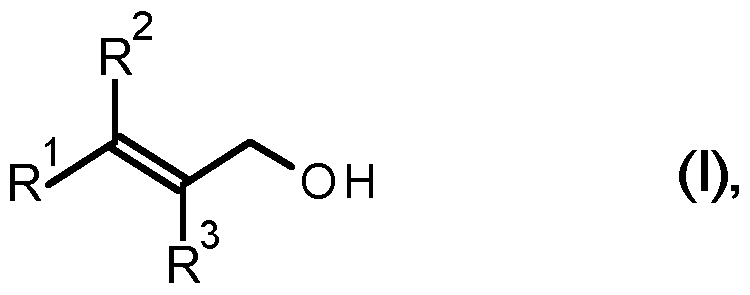
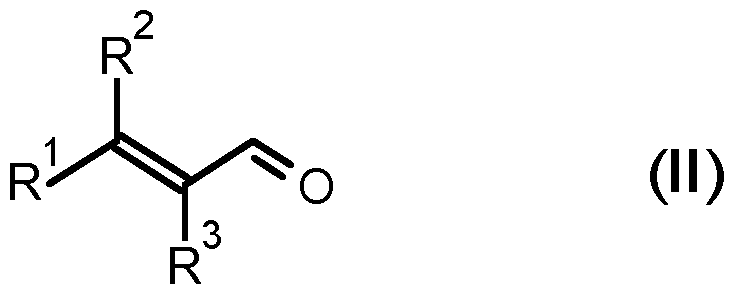

Priority Applications (8)
| Application Number | Priority Date | Filing Date | Title |
|---|---|---|---|
| ES17726970T ES2844182T3 (en) | 2016-06-07 | 2017-06-06 | Procedure for the preparation of alcohols with unsaturation in position 2,3 |
| US16/307,197 US11407700B2 (en) | 2016-06-07 | 2017-06-06 | Process for preparing 2,3-unsaturated alcohols |
| CN201780034819.1A CN109311789B (en) | 2016-06-07 | 2017-06-06 | Process for preparing 2, 3-unsaturated alcohols |
| MX2018015270A MX395501B (en) | 2016-06-07 | 2017-06-06 | PROCESS FOR THE PREPARATION OF 2,3-UNSATURATED ALCOHOLS. |
| MYPI2018002076A MY199521A (en) | 2016-06-07 | 2017-06-06 | Process for preparing 2,3-unsaturated alcohols |
| BR112018074704-1A BR112018074704B1 (en) | 2016-06-07 | 2017-06-06 | PROCESS FOR PREPARING AN UNSATURATED ALCOHOL, NEROL COMPOUND, USE OF NEROL COMPOUND, FRAGRANCE OR AROMA SUBSTANCE COMPOSITION, AND, METHOD FOR CONFERING AND/OR INTENSIFYING AN ODOR OR FLAVOR OF A PRODUCT |
| EP17726970.1A EP3464224B1 (en) | 2016-06-07 | 2017-06-06 | Process for preparing 2,3-unsaturated alcohols |
| JP2018563920A JP7146646B2 (en) | 2016-06-07 | 2017-06-06 | Method for producing 2,3-unsaturated alcohol |
Applications Claiming Priority (2)
| Application Number | Priority Date | Filing Date | Title |
|---|---|---|---|
| EP16173352 | 2016-06-07 | ||
| EP16173352.2 | 2016-06-07 |
Publications (1)
| Publication Number | Publication Date |
|---|---|
| WO2017211784A1 true WO2017211784A1 (en) | 2017-12-14 |
Family
ID=56112884
Family Applications (1)
| Application Number | Title | Priority Date | Filing Date |
|---|---|---|---|
| PCT/EP2017/063654 Ceased WO2017211784A1 (en) | 2016-06-07 | 2017-06-06 | Process for preparing 2,3-unsaturated alcohols |
Country Status (9)
| Country | Link |
|---|---|
| US (1) | US11407700B2 (en) |
| EP (1) | EP3464224B1 (en) |
| JP (1) | JP7146646B2 (en) |
| CN (1) | CN109311789B (en) |
| BR (1) | BR112018074704B1 (en) |
| ES (1) | ES2844182T3 (en) |
| MX (1) | MX395501B (en) |
| MY (1) | MY199521A (en) |
| WO (1) | WO2017211784A1 (en) |
Cited By (5)
| Publication number | Priority date | Publication date | Assignee | Title |
|---|---|---|---|---|
| CN109503327A (en) * | 2018-12-12 | 2019-03-22 | 万华化学集团股份有限公司 | A kind of method that hydrogenating citral prepares nerol and geraniol |
| US11407700B2 (en) | 2016-06-07 | 2022-08-09 | Basf Se | Process for preparing 2,3-unsaturated alcohols |
| CN115124405A (en) * | 2022-09-01 | 2022-09-30 | 山东新和成药业有限公司 | Method for preparing leaf alcohol by isomerizing 4-hexene-1-alcohol and ruthenium-based catalyst used in method |
| WO2024231292A1 (en) | 2023-05-10 | 2024-11-14 | Basf Se | Process for preparing 2,3-unsaturated alcohols |
| EP4549622A1 (en) | 2023-10-31 | 2025-05-07 | Basf Se | Hydrogenation of carbonyl compounds using hydrogen with low deuterium content |
Families Citing this family (2)
| Publication number | Priority date | Publication date | Assignee | Title |
|---|---|---|---|---|
| CN111018666B (en) * | 2019-12-12 | 2022-11-04 | 万华化学集团股份有限公司 | Improved method for preparing nerol geraniol and catalytic system therefor |
| CN116854562B (en) * | 2023-05-30 | 2025-07-29 | 江苏宏邦化工科技有限公司 | Method for synthesizing nerol and geraniol by selectively hydrogenating citral |
Citations (8)
| Publication number | Priority date | Publication date | Assignee | Title |
|---|---|---|---|---|
| EP0024648A1 (en) | 1979-08-24 | 1981-03-11 | BASF Aktiengesellschaft | Process for the production of unsaturated alcohols |
| EP0071787A2 (en) | 1981-08-04 | 1983-02-16 | BASF Aktiengesellschaft | Ruthenium/carbon-hydrogenation catalysts, their preparation and their use in the selective hydrogenation of unsaturated carbonyl compounds |
| EP1317959A1 (en) | 2001-12-07 | 2003-06-11 | Basf Aktiengesellschaft | Process for producing carbon-supported ruthenium/iron-catalysts |
| EP1318128A2 (en) | 2001-12-07 | 2003-06-11 | Basf Aktiengesellschaft | Process for the selective hydrogenation of olefinically unsubstituted carbonyl compounds |
| EP1930075A1 (en) | 2005-09-07 | 2008-06-11 | National University Corporation Nagaoka University | Hydrogenation catalyst for carbonyl group, method for producing same, and method for producing unsaturated alcohol by using such catalyst |
| US20110201819A1 (en) | 2008-12-11 | 2011-08-18 | Takasago International Corporation | Method for producing alcohol compound |
| US20110201820A1 (en) | 2008-12-11 | 2011-08-18 | Takasago International Corporation | Method for producing alcohol compound |
| WO2015004088A1 (en) | 2013-07-08 | 2015-01-15 | Dsm Ip Assets B. V. | Selective transfer hydrogenation of citral or ethyl citral |
Family Cites Families (8)
| Publication number | Priority date | Publication date | Assignee | Title |
|---|---|---|---|---|
| EP0760243B1 (en) | 1995-08-31 | 2006-03-29 | The Procter & Gamble Company | Use of allylic alcohol perfumes as a malodour reduction agent |
| EP2008989A1 (en) * | 2007-06-26 | 2008-12-31 | Basf Se | Continuous method for manufacturing neral in pure or enriched form |
| CN101747152B (en) * | 2008-12-18 | 2012-10-24 | 复旦大学 | Citral liquid-phase hydrogenation method for synthesizing unsaturated alcohols |
| CN106795193B (en) | 2014-09-12 | 2021-02-26 | 巴斯夫欧洲公司 | Method for preparing 2'-O-fucosyllactose |
| JP6822948B2 (en) | 2014-09-26 | 2021-01-27 | ビーエイエスエフ・ソシエタス・エウロパエアBasf Se | Use of pure or highly isomer-enriched cis- or trans- (2-isobutyl-4-methyltetrahydropyran-4-yl) acetate as isomer |
| EP3233778B1 (en) | 2014-12-19 | 2019-02-20 | Basf Se | Method for producing optically active carbonyl compounds |
| JP6741687B2 (en) | 2015-05-04 | 2020-08-19 | ビーエーエスエフ ソシエタス・ヨーロピアBasf Se | How to prepare melon |
| WO2017211784A1 (en) | 2016-06-07 | 2017-12-14 | Basf Se | Process for preparing 2,3-unsaturated alcohols |
-
2017
- 2017-06-06 WO PCT/EP2017/063654 patent/WO2017211784A1/en not_active Ceased
- 2017-06-06 EP EP17726970.1A patent/EP3464224B1/en active Active
- 2017-06-06 MY MYPI2018002076A patent/MY199521A/en unknown
- 2017-06-06 JP JP2018563920A patent/JP7146646B2/en active Active
- 2017-06-06 BR BR112018074704-1A patent/BR112018074704B1/en active IP Right Grant
- 2017-06-06 MX MX2018015270A patent/MX395501B/en unknown
- 2017-06-06 ES ES17726970T patent/ES2844182T3/en active Active
- 2017-06-06 US US16/307,197 patent/US11407700B2/en active Active
- 2017-06-06 CN CN201780034819.1A patent/CN109311789B/en active Active
Patent Citations (8)
| Publication number | Priority date | Publication date | Assignee | Title |
|---|---|---|---|---|
| EP0024648A1 (en) | 1979-08-24 | 1981-03-11 | BASF Aktiengesellschaft | Process for the production of unsaturated alcohols |
| EP0071787A2 (en) | 1981-08-04 | 1983-02-16 | BASF Aktiengesellschaft | Ruthenium/carbon-hydrogenation catalysts, their preparation and their use in the selective hydrogenation of unsaturated carbonyl compounds |
| EP1317959A1 (en) | 2001-12-07 | 2003-06-11 | Basf Aktiengesellschaft | Process for producing carbon-supported ruthenium/iron-catalysts |
| EP1318128A2 (en) | 2001-12-07 | 2003-06-11 | Basf Aktiengesellschaft | Process for the selective hydrogenation of olefinically unsubstituted carbonyl compounds |
| EP1930075A1 (en) | 2005-09-07 | 2008-06-11 | National University Corporation Nagaoka University | Hydrogenation catalyst for carbonyl group, method for producing same, and method for producing unsaturated alcohol by using such catalyst |
| US20110201819A1 (en) | 2008-12-11 | 2011-08-18 | Takasago International Corporation | Method for producing alcohol compound |
| US20110201820A1 (en) | 2008-12-11 | 2011-08-18 | Takasago International Corporation | Method for producing alcohol compound |
| WO2015004088A1 (en) | 2013-07-08 | 2015-01-15 | Dsm Ip Assets B. V. | Selective transfer hydrogenation of citral or ethyl citral |
Non-Patent Citations (3)
| Title |
|---|
| K. BAUER; D. GARBE; H. SURBURG: "Common Fragrance and Flavor Materials, 4th ed.", 2001, WILEY-VCH |
| S. ARCTANDER, PERFUME AND FLAVOR MATERIALS, vol. I, II, 1969 |
| SYNLETT, vol. 1, 2004, pages 146 - 148 |
Cited By (7)
| Publication number | Priority date | Publication date | Assignee | Title |
|---|---|---|---|---|
| US11407700B2 (en) | 2016-06-07 | 2022-08-09 | Basf Se | Process for preparing 2,3-unsaturated alcohols |
| CN109503327A (en) * | 2018-12-12 | 2019-03-22 | 万华化学集团股份有限公司 | A kind of method that hydrogenating citral prepares nerol and geraniol |
| CN109503327B (en) * | 2018-12-12 | 2021-09-07 | 万华化学集团股份有限公司 | A kind of method for preparing nerol and geraniol from hydrogenated citral |
| CN115124405A (en) * | 2022-09-01 | 2022-09-30 | 山东新和成药业有限公司 | Method for preparing leaf alcohol by isomerizing 4-hexene-1-alcohol and ruthenium-based catalyst used in method |
| CN115124405B (en) * | 2022-09-01 | 2022-11-11 | 山东新和成药业有限公司 | Method for preparing leaf alcohol by isomerizing 4-hexene-1-alcohol and ruthenium-based catalyst used in method |
| WO2024231292A1 (en) | 2023-05-10 | 2024-11-14 | Basf Se | Process for preparing 2,3-unsaturated alcohols |
| EP4549622A1 (en) | 2023-10-31 | 2025-05-07 | Basf Se | Hydrogenation of carbonyl compounds using hydrogen with low deuterium content |
Also Published As
| Publication number | Publication date |
|---|---|
| CN109311789B (en) | 2023-04-04 |
| ES2844182T3 (en) | 2021-07-21 |
| MX395501B (en) | 2025-03-25 |
| US11407700B2 (en) | 2022-08-09 |
| BR112018074704A2 (en) | 2019-03-19 |
| BR112018074704B1 (en) | 2022-09-27 |
| JP2019517543A (en) | 2019-06-24 |
| US20190263738A1 (en) | 2019-08-29 |
| EP3464224A1 (en) | 2019-04-10 |
| MY199521A (en) | 2023-11-03 |
| JP7146646B2 (en) | 2022-10-04 |
| MX2018015270A (en) | 2019-10-07 |
| CN109311789A (en) | 2019-02-05 |
| EP3464224B1 (en) | 2020-10-14 |
Similar Documents
| Publication | Publication Date | Title |
|---|---|---|
| US11407700B2 (en) | Process for preparing 2,3-unsaturated alcohols | |
| US10112882B2 (en) | Use of novel cyclic carbaldeydes as an aromatic substance | |
| JP6822948B2 (en) | Use of pure or highly isomer-enriched cis- or trans- (2-isobutyl-4-methyltetrahydropyran-4-yl) acetate as isomer | |
| US20180290959A1 (en) | Use of novel mixtures of (e/z) cyclopentadecenone isomers, the production and use thereof as flavoring substance | |
| US20180312458A1 (en) | Method f0r the purification of cyclohexadec-8-en-1-one | |
| US11542221B2 (en) | α, α-disubstituted carboxylic acid esters for use as aroma chemicals | |
| CN111051483B (en) | Esters and ethers of 2,2,4,4-tetramethylcyclobutane-1,3-diol as aroma chemicals | |
| EP4214186B1 (en) | Muguet type fragrance compounds | |
| JP4688818B2 (en) | (Z) -7-cyclohexadecene-1-one as odorant | |
| EP3692027B1 (en) | Aroma chemical compositions containing 3,5-diethyl-2-propyl-tetrahydropyran and/or unsaturated derivatives thereof | |
| US12583833B2 (en) | Enrichment of a diastereomer in Magnolan | |
| EP3880777B1 (en) | Perfuming ingredients with lily of the valley note | |
| US20220228085A1 (en) | Fragrance or flavour mixture | |
| US12234206B2 (en) | Bi- and tricyclic compounds for use as aroma chemicals | |
| EP4214184B1 (en) | Cyclopropanated sandalwood type compounds | |
| US11420921B2 (en) | 2-(5-isopropyl-2-methyl-cyclohex-2-en-1-yl-)acetaldehyde and 2-(6-isopropyl-3-methyl-cyclohex-2-en-1-yl-) acetaldehyde as new odorants | |
| BR112020006074B1 (en) | AROMATIC CHEMICAL COMPOSITION, USE OF A COMPOUND, METHODS FOR PREPARING A COMPOUND AND A FRAGRANCE COMPOSITION OR FOR MODIFYING THE AROMATIC CHARACTER OF A FRAGRANCE COMPOSITION, COMPOSITION, STEREOISOMER, AND, MIXTURE |
Legal Events
| Date | Code | Title | Description |
|---|---|---|---|
| 121 | Ep: the epo has been informed by wipo that ep was designated in this application |
Ref document number: 17726970 Country of ref document: EP Kind code of ref document: A1 |
|
| ENP | Entry into the national phase |
Ref document number: 2018563920 Country of ref document: JP Kind code of ref document: A |
|
| NENP | Non-entry into the national phase |
Ref country code: DE |
|
| REG | Reference to national code |
Ref country code: BR Ref legal event code: B01A Ref document number: 112018074704 Country of ref document: BR |
|
| ENP | Entry into the national phase |
Ref document number: 2017726970 Country of ref document: EP Effective date: 20190107 |
|
| ENP | Entry into the national phase |
Ref document number: 112018074704 Country of ref document: BR Kind code of ref document: A2 Effective date: 20181129 |