WO2017210593A1 - Flame-retardant electrolyte composition for lithium-ion batteries - Google Patents
Flame-retardant electrolyte composition for lithium-ion batteries Download PDFInfo
- Publication number
- WO2017210593A1 WO2017210593A1 PCT/US2017/035740 US2017035740W WO2017210593A1 WO 2017210593 A1 WO2017210593 A1 WO 2017210593A1 US 2017035740 W US2017035740 W US 2017035740W WO 2017210593 A1 WO2017210593 A1 WO 2017210593A1
- Authority
- WO
- WIPO (PCT)
- Prior art keywords
- carbonate
- tetrabromobisphenol
- lithium
- bis
- composition
- Prior art date
- Legal status (The legal status is an assumption and is not a legal conclusion. Google has not performed a legal analysis and makes no representation as to the accuracy of the status listed.)
- Ceased
Links
Classifications
-
- H—ELECTRICITY
- H01—ELECTRIC ELEMENTS
- H01M—PROCESSES OR MEANS, e.g. BATTERIES, FOR THE DIRECT CONVERSION OF CHEMICAL ENERGY INTO ELECTRICAL ENERGY
- H01M10/00—Secondary cells; Manufacture thereof
- H01M10/05—Accumulators with non-aqueous electrolyte
- H01M10/056—Accumulators with non-aqueous electrolyte characterised by the materials used as electrolytes, e.g. mixed inorganic/organic electrolytes
- H01M10/0564—Accumulators with non-aqueous electrolyte characterised by the materials used as electrolytes, e.g. mixed inorganic/organic electrolytes the electrolyte being constituted of organic materials only
- H01M10/0566—Liquid materials
- H01M10/0567—Liquid materials characterised by the additives
-
- H—ELECTRICITY
- H01—ELECTRIC ELEMENTS
- H01M—PROCESSES OR MEANS, e.g. BATTERIES, FOR THE DIRECT CONVERSION OF CHEMICAL ENERGY INTO ELECTRICAL ENERGY
- H01M10/00—Secondary cells; Manufacture thereof
- H01M10/05—Accumulators with non-aqueous electrolyte
- H01M10/052—Li-accumulators
- H01M10/0525—Rocking-chair batteries, i.e. batteries with lithium insertion or intercalation in both electrodes; Lithium-ion batteries
-
- H—ELECTRICITY
- H01—ELECTRIC ELEMENTS
- H01M—PROCESSES OR MEANS, e.g. BATTERIES, FOR THE DIRECT CONVERSION OF CHEMICAL ENERGY INTO ELECTRICAL ENERGY
- H01M10/00—Secondary cells; Manufacture thereof
- H01M10/42—Methods or arrangements for servicing or maintenance of secondary cells or secondary half-cells
- H01M10/4235—Safety or regulating additives or arrangements in electrodes, separators or electrolyte
-
- H—ELECTRICITY
- H01—ELECTRIC ELEMENTS
- H01M—PROCESSES OR MEANS, e.g. BATTERIES, FOR THE DIRECT CONVERSION OF CHEMICAL ENERGY INTO ELECTRICAL ENERGY
- H01M10/00—Secondary cells; Manufacture thereof
- H01M10/05—Accumulators with non-aqueous electrolyte
- H01M10/056—Accumulators with non-aqueous electrolyte characterised by the materials used as electrolytes, e.g. mixed inorganic/organic electrolytes
- H01M10/0564—Accumulators with non-aqueous electrolyte characterised by the materials used as electrolytes, e.g. mixed inorganic/organic electrolytes the electrolyte being constituted of organic materials only
- H01M10/0566—Liquid materials
- H01M10/0568—Liquid materials characterised by the solutes
-
- H—ELECTRICITY
- H01—ELECTRIC ELEMENTS
- H01M—PROCESSES OR MEANS, e.g. BATTERIES, FOR THE DIRECT CONVERSION OF CHEMICAL ENERGY INTO ELECTRICAL ENERGY
- H01M10/00—Secondary cells; Manufacture thereof
- H01M10/05—Accumulators with non-aqueous electrolyte
- H01M10/056—Accumulators with non-aqueous electrolyte characterised by the materials used as electrolytes, e.g. mixed inorganic/organic electrolytes
- H01M10/0564—Accumulators with non-aqueous electrolyte characterised by the materials used as electrolytes, e.g. mixed inorganic/organic electrolytes the electrolyte being constituted of organic materials only
- H01M10/0566—Liquid materials
- H01M10/0569—Liquid materials characterised by the solvents
-
- H—ELECTRICITY
- H01—ELECTRIC ELEMENTS
- H01M—PROCESSES OR MEANS, e.g. BATTERIES, FOR THE DIRECT CONVERSION OF CHEMICAL ENERGY INTO ELECTRICAL ENERGY
- H01M2300/00—Electrolytes
- H01M2300/0017—Non-aqueous electrolytes
- H01M2300/0025—Organic electrolyte
-
- Y—GENERAL TAGGING OF NEW TECHNOLOGICAL DEVELOPMENTS; GENERAL TAGGING OF CROSS-SECTIONAL TECHNOLOGIES SPANNING OVER SEVERAL SECTIONS OF THE IPC; TECHNICAL SUBJECTS COVERED BY FORMER USPC CROSS-REFERENCE ART COLLECTIONS [XRACs] AND DIGESTS
- Y02—TECHNOLOGIES OR APPLICATIONS FOR MITIGATION OR ADAPTATION AGAINST CLIMATE CHANGE
- Y02E—REDUCTION OF GREENHOUSE GAS [GHG] EMISSIONS, RELATED TO ENERGY GENERATION, TRANSMISSION OR DISTRIBUTION
- Y02E60/00—Enabling technologies; Technologies with a potential or indirect contribution to GHG emissions mitigation
- Y02E60/10—Energy storage using batteries
Definitions
- This invention relates to electrolyte flame-retardant compositions for lithium ion batteries.
- a lithium ion battery is a container comprising a positive electrode, a negative electrode and a separator (insulating layer) interposed between the positive electrode and the negative electrode.
- the battery also typically contains a non-aqueous electrolyte composition comprising a nonaqueous solvent with a lithium salt dissolved therein. Under a load, the electrolyte composition allows the positive charge lithium ions to migrate from the negative electrode through the separator to the positive electrode. For each lithium ion, an electron must make the same journey through an external circuit resulting in an electrical current.
- the positive electrode active material is usually composed of a composite metal oxide, such as a lithium-containing transition metal oxide (e.g., LiCo0 2 ).
- the negative electrode is typically composed of a material capable of absorbing and desorbing lithium ions, for example, a carbon material such as graphite.
- the separator is usually a microporous membrane made of a polyolefin resin such as polyethylene, polypropylene, polyethylene oxide, polyvinylidene fluoride or polyacrylate.
- a polyolefin resin such as polyethylene, polypropylene, polyethylene oxide, polyvinylidene fluoride or polyacrylate.
- the lithium salt e.g., LiPF 6
- a nonaqueous solvent e.g., ethylene carbonate or dialkyl carbonates are used as the non-aqueous solvent.
- the non-aqueous electrolyte composition may have fire safety or explosions problems.
- the problems would likely be caused by improper operations, such as short-circuiting, overcharging or over-discharging.
- these flame retardant additives are phosphorus -containing flame retardants.
- the present application relates, however, to brominated flame retardants, which may be used as additives for non-aqueous electrolyte compositions having improved results over traditional flame retardant additives used in lithium ion batteries.
- the present invention relates to an electrolyte flame-retardant compositions comprising: a) an organic solvent; b) a lithium salt; and c) a brominated flame retardant selected from the group consisting of tribromoneopentyl alcohol, dibromoneopentyl glycol, 2,4,6-(tris(2,4,6- tribromophenoxy)-l,3,5-triazine, tetrabromobiphenol, tetrabromobiphenol carbonate, tetrabromobiphenol epoxy, tetrabromobisphenol F, tetrabromobisphenol F carbonate, tetrabromobisphenol F epoxy, tetrabromobisphenol S, tetrabromobisphenol S carbonate, tetrabromobisphenol S epoxy, (tetrabromobiphenol-bis(2,3-dibromopropyl ether)), (tetrabromobiphenol-bis(2,3-dibromo
- the present invention relates to an electrolyte flame-retardant composition
- an electrolyte flame-retardant composition comprising: a) an organic solvent; b) a lithium salt; and c) a brominated flame retardant selected from the group consisting of the flame retardant components described above.
- the lithium salt used in electrolyte flame-retardant compositions may be any lithium salt generally used in the art.
- the lithium salt may be LiPF 6 , L1BF 4 , LiSbF 6 , LiAsF 6 , L1CF3SO3, Li(CF 3 S0 2 ) 3, Li(CF 3 S0 2 ) 2 N, L1C4F9SO3, LiC10 4 , L1AIO4, L1AICI4, L1AIF4, LiBPh 4 , LiB 10 Cl 10 , CH 3 SO 3 L1, C 4 F 3 SO 3 L1, (CF 3 S0 2 ) 2 NLi, LiN(C x F 2x+1 S0 2 )(C x F 2y+1 S0 2 ) (wherein, x and y are whole positive numbers), CF 3 C0 2 Li, LiCl, Lil, lithium bis(oxalate) borate (LIBOB), a Ci to C 6 aliphatic lithium carbonate, phenyl lithium borate, lithium imide, or combinations thereof.
- LiB 10 Cl 10 CH 3 SO 3 L1, C 4 F 3 SO 3 L1, (CF 3 S
- the concentration of the lithium salt may be in a range of concentrations used in the art.
- the lithium salt may be used at a concentration of about 0.1 molar (M) to about 2.5 M, or about 0.65M to about 2 M, or about 0.8 M to about 1.8 M, or about 0.9M to 1.5 M, but the concentrations are not limited thereto.
- the organic solvent used in electrolyte flame-retardant compositions may be any organic solvent used in the art.
- the organic solvent may be a polar aprotic solvent such as a carbonate-based solvent, an ester-based solvent, an ether-based solvent, a ketone-based solvent, an alcohol-based solvent or combinations thereof.
- carbonate-based solvents are used.
- the carbonate-based solvents may be a chain carbonate compound, a cyclic carbonate compound, a fluorocarbonate compound or combinations thereof.
- Non limiting examples of chain carbonate compounds may be, for example, diethyl carbonate, dimethyl carbonate, dipropyl carbonate, methyl propyl carbonate, ethyl propyl carbonate, methyl ethyl carbonate, or a combination thereof.
- Non limiting examples of cyclic carbonate compound may be, for example, ethylene carbonate, propylene carbonate, butylene carbonate, vinyl ethylene carbonate, or combinations thereof.
- the fluorocarbonate compound may be, for example, fluoroethylene carbonate, 4,5- difluoroethylene carbonate, 4,4-difluoroethylene carbonate, 4,4,5-trifluoroethylene carbonate, 4,4,5,5-tetrafluoroethylene carbonate, 4-fluoro-5-methylethylene carbonate, 4-fluoro-4- methylethylene carbonate, 4,5-difluoro-4-methyl ethylene carbonate, 4,4,5-trifluoro-5- methylethylene carbonate, trifluoromethyl ethylene carbonate, or combinations thereof.
- the carbonate-based solvents are typically used as mixtures of the cyclic carbonate and the chain carbonate compounds because the dielectric constant and viscosity of the mixtures are especially suitable for electrolyte compositions.
- a volume ratio of the cyclic carbonate compound to the chain carbonate compound may be about 1: 1 to about 1:9.
- the carbonate-based compound may have a fluorocarbonate compound further added to the mixture of the chain and/or cyclic carbonate compound.
- the fluorocarbonate compound may increase solubility of a lithium salt to increase ion conductivity and may facilitate formation of a film on the negative electrode.
- ester-based solvents that may be used are: methyl acetate, ethyl acetate, n-propyl acetate, dimethyl acetate, methyl propionate, ethyl propionate, ⁇ -butyrolactone, decanolide, valerolactone, mevalonolactone, caprolactone, methyl formate, or combinations thereof.
- Non-limiting examples of ether-based solvent dibutyl ether, tetraglyme, diglyme, 1,2-dimethoxy ethane, 1,2-diethoxy ethane, ethoxy methoxy ethane, 2-methyl tetrahydrofuran, tetrahydrofuran, (“THF”), or combinations thereof.
- ether-based solvent dibutyl ether, tetraglyme, diglyme, 1,2-dimethoxy ethane, 1,2-diethoxy ethane, ethoxy methoxy ethane, 2-methyl tetrahydrofuran, tetrahydrofuran, (“THF”), or combinations thereof.
- Non-limiting examples of the ketone -based solvent for example, cyclohexanone and examples of the alcohol-based solvent are: ethyl alcohol, isopropyl alcohol, or combinations thereof.
- the non-aqueous organic solvent may be used alone or as a mixture of two or more thereof and when two or more thereof are used as a mixture, a mixture ratio may be suitably adjusted according to a desired battery performance and this may be easily understood by one of ordinary skill in the art.
- the organic solvent may further include an aromatic hydrocarbon-based organic solvent in addition to the carbonate-based solvent.
- the carbonate-based solvent and an aromatic hydrocarbon-based organic solvent may be mixed in a volume ratio of, for example, about 1: 1 to about 30: 1.
- Non-limiting examples of the aromatic hydrocarbon-based organic solvent are: benzene, fluorobenzene, 1,2-difluorobenzene, 1,3-difluorobenzene, 1,4-difluorobenzene, 1,2,3- trifluorobenzene, 1,2,4-trifluorobenzene, chlorobenzene, 1,2-dichlorobenzene, 1,3- dichlorobenzene, 1,4-dichlorobenzene, 1,2,3-trichlorobenzene, 1 ,2,4-trichlorobenzene, iodobenzene, 1,2-diiodobenzene, 1,3-diiodobenzene, 1,4-diiodobenzene, 1,2,3-triiodobenzene, 1,2,4-triiodobenzene, toluene, iluorotoluene, 1 ,2-diiluorotoluene
- the brominated flame retardant may be selected from: tribromophenol, dibromoethyldibromocyclohexane, tetrabromocyclooctane, bromopropanol, tetrabromobisphenol A bis (allyl ether), 2,2',6,6'-Tetrabromobisphenol A diglycidyl ether, 2,3- dibromo-2-propen-l-ol, 2,3-dibromo-2-buten-l,4-diol, pentabromobenzyl acrylate, pentabromobenzyl methacrylate,
- the electrolyte flame retardant composition may further contain other additives such as to facilitate the formation of a solid electrolyte interphase (“SEI”) or film to further improve cycle characteristics.
- SEI solid electrolyte interphase
- the other additives may be, for example, tris(trimethyl silyl) phosphate, lithium difluoro (oxalato) borate, vinylene carbonate, propane sultone, succinonitrile, L1BF 4 , a silane compound including a functional group that may form a siloxane bond, such as acryl, amino, epoxy, methoxy, ethoxy, or vinyl, or a silazane compound such as hexamethyldisilazane.
- the additives may be added alone or as a mixture of two or more thereof.
- the other additives may be included in an amount of about 0.01 wt % to about 10 wt %, based on a total weight of the organic solvent.
- the other additives may be included in an amount of about 0.05 wt % to about 10 wt %, or about 0.1 wt % to about 5 wt %, or about 0.5 wt % to about 4 wt %, based on the total weight of the organic solvent.
- the amount of these additives are not particularly limited as long as the use of the other additives does not substantially decrease improvement effects on capacity retention rates obtained from the use of the electrolyte.
- the Examples were prepared in a glove box by dissolving the 2 weight percent of the flame retardant (FR) in a solution of 1.2 M LiPF6 in ethylene carbonate / ethylmethyl carbonate (EC/EMC 3/7 wt/wt). Solutions were shaken for 24 hours to solubilize the flame retardants.
- FR flame retardant
- EC/EMC 3/7 wt/wt ethylene carbonate / ethylmethyl carbonate
- the flame retardants studied were tetrabromobisphenol A (TBBPA), tribromoneopentyl alcohol (TBNPA), 2,3-dibromo-2-propen-l-ol (DBAA), dibromoethyldibromocyclohexane (BCL-462) and tetrabromobisphenol A-bis(2,3-dibromopropyl ether) (HP-800).
- TBPA tetrabromobisphenol A
- TNPA tribromoneopentyl alcohol
- DBAA 2,3-dibromo-2-propen-l-ol
- BCL-462 dibromoethyldibromocyclohexane
- HP-800 tetrabromobisphenol A-bis(2,3-dibromopropyl ether
- test procedure was modeled on a procedure published by D. Peramunage, J.M. Ziegelbaur, G.L. Holleck, Proc. Electrochem. Soc, 2001-21, 306 (2001), where they used a UL-94
- HB Horizontal Burn test apparatus.
- a 1/4 inch wire mesh was placed to hold the sample in the horizontal position.
- the samples were thin cylindrical fiber glass wicks, 5 inch X 1/8 inch (Pepperell Braiding Company) which were dried at 120° C for 24 hours then transferred to a desiccator.
- the 1.2 M LiPF6 solution (0.75 g) was added drop wise onto the wick to cover the whole length.
- the wick was allowed to equilibrate for 5 minutes before being transferred for flammability testing.
- the sample was ignited by holding the flame in contact with the end of the wick for 10 seconds. Time was recorded from the ignition until the flame reached the end of the wick. The burn times were an average of 3 samples.
Landscapes
- Chemical & Material Sciences (AREA)
- Engineering & Computer Science (AREA)
- Manufacturing & Machinery (AREA)
- Chemical Kinetics & Catalysis (AREA)
- Electrochemistry (AREA)
- General Chemical & Material Sciences (AREA)
- Physics & Mathematics (AREA)
- Condensed Matter Physics & Semiconductors (AREA)
- General Physics & Mathematics (AREA)
- Inorganic Chemistry (AREA)
- Materials Engineering (AREA)
- Secondary Cells (AREA)
Abstract
This invention relates to electrolyte flame-retardant compositions for lithium ion batteries.
Description
FLAME-RETARD ANT ELECTROLYTE COMPOSITION
FOR LITHIUM-ION BATTERIES
TECHNICAL FIELD
This invention relates to electrolyte flame-retardant compositions for lithium ion batteries.
BACKGROUND A lithium ion battery is a container comprising a positive electrode, a negative electrode and a separator (insulating layer) interposed between the positive electrode and the negative electrode. The battery also typically contains a non-aqueous electrolyte composition comprising a nonaqueous solvent with a lithium salt dissolved therein. Under a load, the electrolyte composition allows the positive charge lithium ions to migrate from the negative electrode through the separator to the positive electrode. For each lithium ion, an electron must make the same journey through an external circuit resulting in an electrical current.
The positive electrode active material is usually composed of a composite metal oxide, such as a lithium-containing transition metal oxide (e.g., LiCo02). The negative electrode is typically composed of a material capable of absorbing and desorbing lithium ions, for example, a carbon material such as graphite.
The separator is usually a microporous membrane made of a polyolefin resin such as polyethylene, polypropylene, polyethylene oxide, polyvinylidene fluoride or polyacrylate.
In the non-aqueous electrolyte composition, the lithium salt (e.g., LiPF6) is dissolved in a nonaqueous solvent. The solvent used in the electrolyte should be able to dissolve the lithium salt, have low viscosity to allow the movement of the lithium ions and be stable at the electrodes. Typically, ethylene carbonate or dialkyl carbonates are used as the non-aqueous solvent.
However, due to relatively low flash or inflammation points of these non-aqueous solvents, the non-aqueous electrolyte composition may have fire safety or explosions problems. The problems would likely be caused by improper operations, such as short-circuiting, overcharging or over-discharging. To reduce these problems, it has been proposed to prepare non-aqueous
electrolyte compositions containing flame retardant additives. Typically, these flame retardant additives are phosphorus -containing flame retardants.
The present application relates, however, to brominated flame retardants, which may be used as additives for non-aqueous electrolyte compositions having improved results over traditional flame retardant additives used in lithium ion batteries.
SUMMARY OF THE INVENTION
The present invention relates to an electrolyte flame-retardant compositions comprising: a) an organic solvent; b) a lithium salt; and c) a brominated flame retardant selected from the group consisting of tribromoneopentyl alcohol, dibromoneopentyl glycol, 2,4,6-(tris(2,4,6- tribromophenoxy)-l,3,5-triazine, tetrabromobiphenol, tetrabromobiphenol carbonate, tetrabromobiphenol epoxy, tetrabromobisphenol F, tetrabromobisphenol F carbonate, tetrabromobisphenol F epoxy, tetrabromobisphenol S, tetrabromobisphenol S carbonate, tetrabromobisphenol S epoxy, (tetrabromobiphenol-bis(2,3-dibromopropyl ether)), (tetrabromobiphenol-bis(2,3-dibromo-2-methylpropyl ether)), (tetrabromobisphenol F-bis(2,3- dibromopropyl ether)), (tetrabromobisphenol F-bis(2,3-dibromo-2-methylpropyl ether)), (tetrabromobisphenol S-bis(2,3 -dibromopropyl ether)), (tetrabromobisphenol S-bis(2,3-dibromo- 2-methylpropyl ether)), tribromophenol, dibromoethyldibromocyclohexane, tetrabromocyelooctane, bromopropanol, 2,3-dibromo-2-propen-l-ol, 2,3-dibromo-2-buten-l,4- diol,, pentabromobenzyl methacrylate, , 2,2',6,6'-Tetrabromobisphenol A diglycidyl ether, tribromoethylene, l,3-dibromo-2,2-dimethylpropane, 2,2-bis(bromomethyl)-l,3- dibromopropane, lithium salts of the brominated flame retardant containing hydroxyl groups, or combinations thereof.
DETAILED DESCRIPTION OF THE INVENTION
The present invention relates to an electrolyte flame-retardant composition comprising: a) an organic solvent; b) a lithium salt; and c) a brominated flame retardant selected from the group consisting of the flame retardant components described above.
The lithium salt used in electrolyte flame-retardant compositions may be any lithium salt generally used in the art. For example, the lithium salt may be LiPF6, L1BF4, LiSbF6, LiAsF6, L1CF3SO3, Li(CF3S02) 3, Li(CF3S02)2N, L1C4F9SO3, LiC104, L1AIO4, L1AICI4, L1AIF4, LiBPh4, LiB10Cl10, CH3SO3L1, C4F3SO3L1, (CF3S02)2NLi, LiN(CxF2x+1S02)(CxF2y+1 S02) (wherein, x and y are whole positive numbers), CF3C02Li, LiCl, Lil, lithium bis(oxalate) borate (LIBOB), a Ci to C6 aliphatic lithium carbonate, phenyl lithium borate, lithium imide, or combinations thereof.
The concentration of the lithium salt may be in a range of concentrations used in the art. For example, the lithium salt may be used at a concentration of about 0.1 molar (M) to about 2.5 M, or about 0.65M to about 2 M, or about 0.8 M to about 1.8 M, or about 0.9M to 1.5 M, but the concentrations are not limited thereto.
The organic solvent used in electrolyte flame-retardant compositions may be any organic solvent used in the art. The organic solvent may be a polar aprotic solvent such as a carbonate-based solvent, an ester-based solvent, an ether-based solvent, a ketone-based solvent, an alcohol-based solvent or combinations thereof.
In most lithium ion batteries, carbonate-based solvents are used. The carbonate-based solvents may be a chain carbonate compound, a cyclic carbonate compound, a fluorocarbonate compound or combinations thereof.
Non limiting examples of chain carbonate compounds may be, for example, diethyl carbonate, dimethyl carbonate, dipropyl carbonate, methyl propyl carbonate, ethyl propyl carbonate, methyl ethyl carbonate, or a combination thereof. Non limiting examples of cyclic carbonate compound may be, for example, ethylene carbonate, propylene carbonate, butylene carbonate, vinyl ethylene carbonate, or combinations thereof.
The fluorocarbonate compound may be, for example, fluoroethylene carbonate, 4,5- difluoroethylene carbonate, 4,4-difluoroethylene carbonate, 4,4,5-trifluoroethylene carbonate, 4,4,5,5-tetrafluoroethylene carbonate, 4-fluoro-5-methylethylene carbonate, 4-fluoro-4- methylethylene carbonate, 4,5-difluoro-4-methyl ethylene carbonate, 4,4,5-trifluoro-5- methylethylene carbonate, trifluoromethyl ethylene carbonate, or combinations thereof.
The carbonate-based solvents are typically used as mixtures of the cyclic carbonate and the chain carbonate compounds because the dielectric constant and viscosity of the mixtures are especially suitable for electrolyte compositions. For example, a volume ratio of the cyclic carbonate compound to the chain carbonate compound may be about 1: 1 to about 1:9. The carbonate-based compound may have a fluorocarbonate compound further added to the mixture of the chain and/or cyclic carbonate compound. The fluorocarbonate compound may increase solubility of a lithium salt to increase ion conductivity and may facilitate formation of a film on the negative electrode.
Non-limiting examples of ester-based solvents that may be used are: methyl acetate, ethyl acetate, n-propyl acetate, dimethyl acetate, methyl propionate, ethyl propionate, γ-butyrolactone, decanolide, valerolactone, mevalonolactone, caprolactone, methyl formate, or combinations thereof.
Non-limiting examples of ether-based solvent, dibutyl ether, tetraglyme, diglyme, 1,2-dimethoxy ethane, 1,2-diethoxy ethane, ethoxy methoxy ethane, 2-methyl tetrahydrofuran, tetrahydrofuran, ("THF"), or combinations thereof.
Non-limiting examples of the ketone -based solvent, for example, cyclohexanone and examples of the alcohol-based solvent are: ethyl alcohol, isopropyl alcohol, or combinations thereof.
The non-aqueous organic solvent may be used alone or as a mixture of two or more thereof and when two or more thereof are used as a mixture, a mixture ratio may be suitably adjusted according to a desired battery performance and this may be easily understood by one of ordinary skill in the art.
The organic solvent may further include an aromatic hydrocarbon-based organic solvent in addition to the carbonate-based solvent. In this regard, the carbonate-based solvent and an aromatic hydrocarbon-based organic solvent may be mixed in a volume ratio of, for example, about 1: 1 to about 30: 1.
Non-limiting examples of the aromatic hydrocarbon-based organic solvent are: benzene, fluorobenzene, 1,2-difluorobenzene, 1,3-difluorobenzene, 1,4-difluorobenzene, 1,2,3-
trifluorobenzene, 1,2,4-trifluorobenzene, chlorobenzene, 1,2-dichlorobenzene, 1,3- dichlorobenzene, 1,4-dichlorobenzene, 1,2,3-trichlorobenzene, 1 ,2,4-trichlorobenzene, iodobenzene, 1,2-diiodobenzene, 1,3-diiodobenzene, 1,4-diiodobenzene, 1,2,3-triiodobenzene, 1,2,4-triiodobenzene, toluene, iluorotoluene, 1 ,2-diiluorotoluene, 1,3 -difluorotoluene, 1,4- difluorotoluene, 1,2,3-trifluorotoluene, 1,2,4-trifluorotoluene, chlorotoluene, 1,2-dichlorotoluene, 1,3-dichlorotoluene, 1 ,4-dichlorotoluene, 1,2,3-trichlorotoluene, 1,2,4-trichlorotoluene, iodotoluene, 1,2-diiodotoluene, 1,3-diiodotoluene, 1,4-diiodotoluene, 1,2,3-triiodotoluene, 1,2,4- triiodotoluene, xylene, or combinations thereof.
The brominated flame retardant may be selected from: tribromophenol, dibromoethyldibromocyclohexane, tetrabromocyclooctane, bromopropanol, tetrabromobisphenol A bis (allyl ether), 2,2',6,6'-Tetrabromobisphenol A diglycidyl ether, 2,3- dibromo-2-propen-l-ol, 2,3-dibromo-2-buten-l,4-diol, pentabromobenzyl acrylate, pentabromobenzyl methacrylate,

Tribromoneopentyl alcohol

Dibromoneopentyl glycol

2,4,6-(tris(2,4,6-tribromophenoxy)-l,3,5-triazine

tetrabromobiphenol

Tetrabromobiphenol carbonate
n = 1-10

Tetrabromobiphenol epoxy n = 0-10
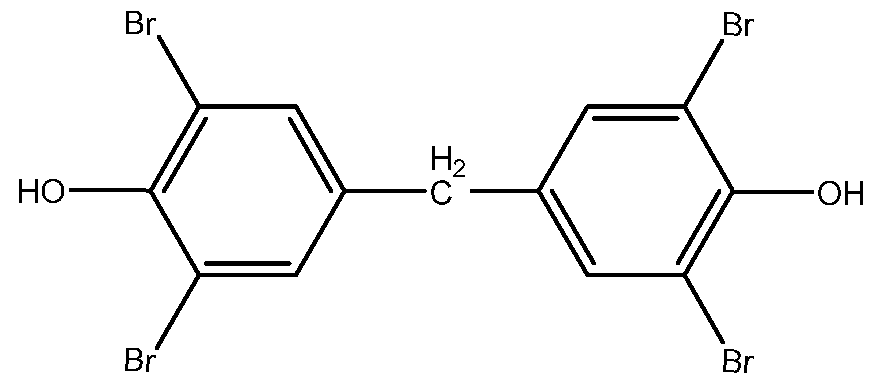
Tetrabromobisphenol F

Tetrabromobisphenol F carbonate n = 1-10

Tetrabromobisphenol F epoxy n = 0-10

Tetrabromobisphenol S

Tetrabromobisphenol S carbonate n= 1-10


X = H or CH3
(tetrabromobisphenol F-bis(2,3-dibromopropyl ether)) (X=H) (tetrabromobisphenol F-bis(2,3-dibromo-2-methylpropyl ether)) (X=CH3)

(tetrabromobisphenol S-bis(2,3-dibromopropyl ether)) (X=H),
(tetrabromobisphenol S-bis(2,3-dibromo-2-methylpropyl ether)) (X=CH3), lithium salts of the above brominated flame retardant containing hydroxyl groups, or combinations thereof.
The electrolyte flame retardant composition may further contain other additives such as to facilitate the formation of a solid electrolyte interphase ("SEI") or film to further improve cycle characteristics.
The other additives may be, for example, tris(trimethyl silyl) phosphate, lithium difluoro (oxalato) borate, vinylene carbonate, propane sultone, succinonitrile, L1BF4, a silane compound
including a functional group that may form a siloxane bond, such as acryl, amino, epoxy, methoxy, ethoxy, or vinyl, or a silazane compound such as hexamethyldisilazane. The additives may be added alone or as a mixture of two or more thereof.
The other additives may be included in an amount of about 0.01 wt % to about 10 wt %, based on a total weight of the organic solvent. For example, the other additives may be included in an amount of about 0.05 wt % to about 10 wt %, or about 0.1 wt % to about 5 wt %, or about 0.5 wt % to about 4 wt %, based on the total weight of the organic solvent. However, the amount of these additives are not particularly limited as long as the use of the other additives does not substantially decrease improvement effects on capacity retention rates obtained from the use of the electrolyte.
The following examples are presented for purposes of illustration, and are not intended to impose limitations on the scope of this invention. All percentages in the following examples are by weight unless otherwise noted.
EXAMPLES
The Examples were prepared in a glove box by dissolving the 2 weight percent of the flame retardant (FR) in a solution of 1.2 M LiPF6 in ethylene carbonate / ethylmethyl carbonate (EC/EMC 3/7 wt/wt). Solutions were shaken for 24 hours to solubilize the flame retardants. The flame retardants studied were tetrabromobisphenol A (TBBPA), tribromoneopentyl alcohol (TBNPA), 2,3-dibromo-2-propen-l-ol (DBAA), dibromoethyldibromocyclohexane (BCL-462) and tetrabromobisphenol A-bis(2,3-dibromopropyl ether) (HP-800).
The test procedure was modeled on a procedure published by D. Peramunage, J.M. Ziegelbaur, G.L. Holleck, Proc. Electrochem. Soc, 2001-21, 306 (2001), where they used a UL-94
Horizontal Burn (HB) test apparatus. A 1/4 inch wire mesh was placed to hold the sample in the horizontal position. The samples were thin cylindrical fiber glass wicks, 5 inch X 1/8 inch (Pepperell Braiding Company) which were dried at 120° C for 24 hours then transferred to a desiccator. The 1.2 M LiPF6 solution (0.75 g) was added drop wise onto the wick to cover the whole length. The wick was allowed to equilibrate for 5 minutes before being transferred for flammability testing. The sample was ignited by holding the flame in contact with the end of the
wick for 10 seconds. Time was recorded from the ignition until the flame reached the end of the wick. The burn times were an average of 3 samples.

Components referred to by chemical name or formula anywhere in the specification or claims hereof, whether referred to in the singular or plural, are identified as they exist prior to coming into contact with another substance referred to by chemical name or chemical type (e.g., another component, a solvent, or etc.). It matters not what chemical changes, transformations and/or reactions, if any, take place in the resulting mixture or solution as such changes, transformations, and/or reactions are the natural result of bringing the specified components together under the conditions called for pursuant to this disclosure. Thus the components are identified as ingredients to be brought together in connection with performing a desired operation or in forming a desired composition. Also, even though the claims hereinafter may refer to substances, components and/or ingredients in the present tense ("comprises", "is", etc.), the reference is to the substance, component or ingredient as it existed at the time just before it was first contacted, blended or mixed with one or more other substances, components and/or ingredients in accordance with the present disclosure. The fact that a substance, component or ingredient may have lost its original identity through a chemical reaction or transformation during the course of contacting, blending or mixing operations, if conducted in accordance with this disclosure and with ordinary skill of a chemist, is thus of no practical concern.
The invention described and claimed herein is not to be limited in scope by the specific examples and embodiments herein disclosed, since these examples and embodiments are intended as illustrations of several aspects of the invention. Any equivalent embodiments are intended to be
within the scope of this invention. Indeed, various modifications of the invention in addition to those shown and described herein will become apparent to those skilled in the art from the foregoing description. Such modifications are also intended to fall within the scope of the appended claims.
Claims
1. An electrolyte flame-retardant composition comprising: a) an organic solvent; b) a lithium salt; and c) a brominated flame retardant selected from the group consisting of: , tribromoneopentyl alcohol, dibromoneopentyl glycol, 2,4,6-(tris(2,4,6-tribromophenoxy)- 1,3,5- triazine, tetrabromobiphenol, tetrabromobiphenol carbonate, tetrabromobiphenol epoxy, tetrabromobisphenol F, tetrabromobisphenol F carbonate, tetrabromobisphenol F epoxy, tetrabromobisphenol S, tetrabromobisphenol S carbonate, tetrabromobisphenol S epoxy, (tetrabromobiphenol-bis(2,3-dibromopropyl ether)), (tetrabromobiphenol-bis(2,3-dibromo-2- methylpropyl ether)), (tetrabromobisphenol F-bis(2,3-dibromopropyl ether)), (tetrabromobisphenol F-bis(2,3-dibromo-2-methylpropyl ether)), (tetrabromobisphenol S- bis(2,3-dibromopropyl ether)), (tetrabromobisphenol S-bis(2,3-dibromo-2-methylpropyl ether)), tribromophenol, dibromoethyldibromocyclohexane, tetrabromocyclooctane, bromopropanol, 2,3- dibromo-2-propen-l-ol, 2,3-dibromo-2-buten-l,4-diol, pentabromobenzyl methacrylate, 2,2',6,6'- tetrabromobisphenol A diglycidyl ether, tribromoethylene, l,3-dibromo-2,2-dimethylpropane, 2,2-bis(bromomethyl)-l,3-dibromopropane, lithium salts of the brominated flame retardant containing hydroxyl groups, and combinations thereof.
2. The composition of claim 1, wherein the lithium salt is LiPF6, LiBF4, LiSbF6, LiAsF6, LiCF3S03, Li(CF3S02) 3, Li(CF3S02)2N, LiC4F9S03, LiC104, LiA104, LiAlC , LiAlF4, LiBPh4, LiBioClio, CH3SO3L1, C4F3S03Li, (CF3S02)2NLi, LiN(CxF2x+iS02)(CxF2y+i S02), wherein x and y are whole positive numbers, CF3C02Li, LiCl, Lil, lithium bis(oxalate) borate (LIBOB), a Ci to C6 aliphatic lithium carbonate, phenyl lithium borate, lithium imide, or combinations thereof.
3. The composition of claim 1, wherein the organic solvent salt is a carbonate-based solvent, an ester-based solvent, an ether-based solvent, a ketone-based solvent, an alcohol-based or combinations thereof.
4. The composition of claim 1, wherein the organic solvent is diethyl carbonate, dimethyl carbonate, dipropyl carbonate, methyl propyl carbonate, ethyl propyl carbonate, methyl ethyl carbonate, ethylene carbonate, propylene carbonate, butylene carbonate, vinyl ethylene carbonate or combinations thereof.
5. The composition of claim 1, wherein the amount of brominated flame retardant is about 0.001 wt % to about 10 wt %, based on a total weight of the organic solvent.
6. The composition of claim 5, wherein the amount of lithium salt is at a concentration of about 0.1 molar to about 2.5 molar.
7. A lithium battery comprising a positive electrode, a negative electrode, a separator, and an electrolyte composition, wherein said electrolyte composition comprises the electrolyte flame- retardant composition of claim 1.
Applications Claiming Priority (4)
| Application Number | Priority Date | Filing Date | Title |
|---|---|---|---|
| US201662344627P | 2016-06-02 | 2016-06-02 | |
| US62/344,627 | 2016-06-02 | ||
| US201762484446P | 2017-04-12 | 2017-04-12 | |
| US62/484,446 | 2017-04-12 |
Publications (1)
| Publication Number | Publication Date |
|---|---|
| WO2017210593A1 true WO2017210593A1 (en) | 2017-12-07 |
Family
ID=59034957
Family Applications (1)
| Application Number | Title | Priority Date | Filing Date |
|---|---|---|---|
| PCT/US2017/035740 Ceased WO2017210593A1 (en) | 2016-06-02 | 2017-06-02 | Flame-retardant electrolyte composition for lithium-ion batteries |
Country Status (1)
| Country | Link |
|---|---|
| WO (1) | WO2017210593A1 (en) |
Cited By (10)
| Publication number | Priority date | Publication date | Assignee | Title |
|---|---|---|---|---|
| CN109671982A (en) * | 2018-12-25 | 2019-04-23 | 河南电池研究院有限公司 | A kind of high-temperature lithium ion battery high safety electrolyte matching silicon-carbon cathode material |
| KR20200060693A (en) * | 2017-09-28 | 2020-06-01 | 알베마를 코포레이션 | Brominated flame retardants and their application in polyurethane foams |
| WO2021101922A1 (en) * | 2019-11-18 | 2021-05-27 | Albemarle Corporation | Flame retardants for battery electrolytes |
| WO2021101920A1 (en) * | 2019-11-18 | 2021-05-27 | Albemarle Corporation | Flame retardants for lithium batteries |
| WO2021101924A1 (en) * | 2019-11-18 | 2021-05-27 | Albemarle Corporation | Flame retardants for battery electrolytes |
| WO2021101921A1 (en) * | 2019-11-18 | 2021-05-27 | Albemarle Corporation | Flame retardants for lithium batteries |
| WO2022212637A1 (en) * | 2021-04-01 | 2022-10-06 | Albemarle Corporation | Flame retardants for battery electrolytes |
| WO2022240803A1 (en) * | 2021-05-11 | 2022-11-17 | Albemarle Corporation | Flame retardants for battery electrolytes |
| US12494507B2 (en) | 2019-11-18 | 2025-12-09 | Albemarle Corporation | Flame retardants for battery electrolytes |
| TWI918615B (en) | 2019-11-18 | 2026-03-21 | 美商亞比馬利股份有限公司 | Nonaqueous electrolyte solution for lithium batteries and producing process thereof |
Citations (3)
| Publication number | Priority date | Publication date | Assignee | Title |
|---|---|---|---|---|
| US20060292450A1 (en) * | 2004-07-13 | 2006-12-28 | Matsushita Electric Industrial Co., Ltd. | Non-aqueous electrolyte secondary battery |
| CN103050730A (en) * | 2012-11-29 | 2013-04-17 | 东莞市翔丰华电池材料有限公司 | Metal-containing niobium modified lithium titanate battery |
| JP2013251211A (en) * | 2012-06-04 | 2013-12-12 | Hitachi Ltd | Electrolyte for magnesium ion secondary battery, and magnesium ion secondary battery |
-
2017
- 2017-06-02 WO PCT/US2017/035740 patent/WO2017210593A1/en not_active Ceased
Patent Citations (3)
| Publication number | Priority date | Publication date | Assignee | Title |
|---|---|---|---|---|
| US20060292450A1 (en) * | 2004-07-13 | 2006-12-28 | Matsushita Electric Industrial Co., Ltd. | Non-aqueous electrolyte secondary battery |
| JP2013251211A (en) * | 2012-06-04 | 2013-12-12 | Hitachi Ltd | Electrolyte for magnesium ion secondary battery, and magnesium ion secondary battery |
| CN103050730A (en) * | 2012-11-29 | 2013-04-17 | 东莞市翔丰华电池材料有限公司 | Metal-containing niobium modified lithium titanate battery |
Cited By (26)
| Publication number | Priority date | Publication date | Assignee | Title |
|---|---|---|---|---|
| JP7191870B2 (en) | 2017-09-28 | 2022-12-19 | アルベマール コーポレーション | Brominated flame retardant and its use in polyurethane foam |
| KR20200060693A (en) * | 2017-09-28 | 2020-06-01 | 알베마를 코포레이션 | Brominated flame retardants and their application in polyurethane foams |
| JP2020536128A (en) * | 2017-09-28 | 2020-12-10 | アルベマール・コーポレーシヨン | Its use in brominated flame retardants and polyurethane foams |
| KR102634501B1 (en) | 2017-09-28 | 2024-02-07 | 알베마를 코포레이션 | Brominated flame retardants and their application in polyurethane foams |
| CN109671982A (en) * | 2018-12-25 | 2019-04-23 | 河南电池研究院有限公司 | A kind of high-temperature lithium ion battery high safety electrolyte matching silicon-carbon cathode material |
| JP7623376B2 (en) | 2019-11-18 | 2025-01-28 | アルベマール コーポレーション | Flame retardants for lithium batteries |
| TWI904116B (en) * | 2019-11-18 | 2025-11-11 | 美商亞比馬利股份有限公司 | Flame retardants for battery electrolytes |
| CN114667630A (en) * | 2019-11-18 | 2022-06-24 | 雅宝公司 | Flame retardant for battery electrolytes |
| CN114730942A (en) * | 2019-11-18 | 2022-07-08 | 雅宝公司 | Flame retardant for lithium batteries |
| CN114730908A (en) * | 2019-11-18 | 2022-07-08 | 雅宝公司 | Flame Retardants for Lithium Batteries |
| CN114762175A (en) * | 2019-11-18 | 2022-07-15 | 雅宝公司 | Flame retardant for battery electrolytes |
| IL292842B1 (en) * | 2019-11-18 | 2026-04-01 | Albemarle Corp | Flame retardants for lithium batteries |
| TWI918615B (en) | 2019-11-18 | 2026-03-21 | 美商亞比馬利股份有限公司 | Nonaqueous electrolyte solution for lithium batteries and producing process thereof |
| WO2021101924A1 (en) * | 2019-11-18 | 2021-05-27 | Albemarle Corporation | Flame retardants for battery electrolytes |
| US20220416316A1 (en) * | 2019-11-18 | 2022-12-29 | Albemarle Corporation | Flame Retardants For Battery Electrolytes |
| JP2023503040A (en) * | 2019-11-18 | 2023-01-26 | アルベマール コーポレーション | Flame retardant for lithium batteries |
| JP2023503041A (en) * | 2019-11-18 | 2023-01-26 | アルベマール コーポレーション | Flame retardant for battery electrolyte |
| WO2021101920A1 (en) * | 2019-11-18 | 2021-05-27 | Albemarle Corporation | Flame retardants for lithium batteries |
| WO2021101922A1 (en) * | 2019-11-18 | 2021-05-27 | Albemarle Corporation | Flame retardants for battery electrolytes |
| TWI891678B (en) * | 2019-11-18 | 2025-08-01 | 美商亞比馬利股份有限公司 | Flame retardants for lithium betteries |
| CN114730908B (en) * | 2019-11-18 | 2025-08-08 | 雅宝公司 | Flame retardants for lithium batteries |
| WO2021101921A1 (en) * | 2019-11-18 | 2021-05-27 | Albemarle Corporation | Flame retardants for lithium batteries |
| US12494507B2 (en) | 2019-11-18 | 2025-12-09 | Albemarle Corporation | Flame retardants for battery electrolytes |
| AU2022246865B2 (en) * | 2021-04-01 | 2026-01-29 | Albemarle Corporation | Flame retardants for battery electrolytes |
| WO2022212637A1 (en) * | 2021-04-01 | 2022-10-06 | Albemarle Corporation | Flame retardants for battery electrolytes |
| WO2022240803A1 (en) * | 2021-05-11 | 2022-11-17 | Albemarle Corporation | Flame retardants for battery electrolytes |
Similar Documents
| Publication | Publication Date | Title |
|---|---|---|
| WO2017210593A1 (en) | Flame-retardant electrolyte composition for lithium-ion batteries | |
| JP6926293B2 (en) | Non-aqueous electrolyte solution and non-aqueous electrolyte solution secondary battery using it | |
| Cao et al. | Electrolyte engineering for safer lithium‐ion batteries: a review | |
| CN105580189B (en) | Nonaqueous electrolytic solution and nonaqueous electrolyte battery using the nonaqueous electrolytic solution | |
| JP5738011B2 (en) | Non-aqueous electrolyte additive for secondary battery, non-aqueous electrolyte for secondary battery and non-aqueous electrolyte secondary battery | |
| JP5622424B2 (en) | Electrolyte for secondary battery | |
| JP5202607B2 (en) | Electrolytic solution for lithium battery and lithium battery including the same | |
| KR102130028B1 (en) | Rechargeable lithium battery | |
| CN107210489B (en) | Nonaqueous electrolyte solution and nonaqueous electrolyte secondary battery | |
| CN106165182A (en) | Electrolyte composition containing ester of dicarboxylic acid | |
| WO2017138452A1 (en) | Electrolytic solution for nonaqueous electrolytic solution battery, and nonaqueous electrolytic solution battery using same | |
| JP6019663B2 (en) | Non-aqueous electrolyte and non-aqueous electrolyte battery using the same | |
| WO2011059458A1 (en) | Battery electrolyte solutions containing phosphorus-sulfur compounds | |
| KR20230108247A (en) | Electrolyte for rechargeable lithium battery and rechargeable lithium battery including the same | |
| JP2017027925A (en) | Flame retardant electrolyte for lithium secondary battery and lithium secondary battery including the same | |
| EP2966719B1 (en) | Electrolyte for rechargeable lithium battery and rechargeable lithium battery including same | |
| WO2019088097A1 (en) | Nonaqueous electrolyte solution and nonaqueous electrolyte battery | |
| JP7362905B2 (en) | Electrolyte for lithium secondary batteries and lithium secondary batteries containing the same | |
| EP3016196B1 (en) | Electrolyte for rechargeable lithium battery and rechargeable lithium battery including the same | |
| Senthil et al. | Functional Electrolyte Additives: A Pinch of Salt/Solvent to an Electrolyte for High Energy Density Lithium‐Ion and Lithium–Metal Batteries | |
| JP2015111557A (en) | Non-aqueous electrolyte and non-aqueous electrolyte secondary battery using the same | |
| US12494507B2 (en) | Flame retardants for battery electrolytes | |
| JP6764345B2 (en) | Alkylbenzoate derivatives as electrolyte additives for lithium-based batteries | |
| WO2022138705A1 (en) | Electrolytic solution and non-aqueous electrolytic solution secondary battery | |
| CN107078283A (en) | It is used as acetic acid 2 [(methoxycarbonyl) epoxide] methyl esters of electrolyte components |
Legal Events
| Date | Code | Title | Description |
|---|---|---|---|
| NENP | Non-entry into the national phase |
Ref country code: DE |
|
| 121 | Ep: the epo has been informed by wipo that ep was designated in this application |
Ref document number: 17729339 Country of ref document: EP Kind code of ref document: A1 |
|
| 122 | Ep: pct application non-entry in european phase |
Ref document number: 17729339 Country of ref document: EP Kind code of ref document: A1 |