WO2017194960A1 - Asymmetric conjugate compounds - Google Patents
Asymmetric conjugate compounds Download PDFInfo
- Publication number
- WO2017194960A1 WO2017194960A1 PCT/GB2017/051331 GB2017051331W WO2017194960A1 WO 2017194960 A1 WO2017194960 A1 WO 2017194960A1 GB 2017051331 W GB2017051331 W GB 2017051331W WO 2017194960 A1 WO2017194960 A1 WO 2017194960A1
- Authority
- WO
- WIPO (PCT)
- Prior art keywords
- antibody
- independently selected
- seq
- groups
- amino acid
- Prior art date
- Legal status (The legal status is an assumption and is not a legal conclusion. Google has not performed a legal analysis and makes no representation as to the accuracy of the status listed.)
- Ceased
Links
- 0 O=C1N(CCC2)[C@]2(*2)C2Nc2ccccc12 Chemical compound O=C1N(CCC2)[C@]2(*2)C2Nc2ccccc12 0.000 description 23
- RWTVVRYBJODJAZ-FQEVSTJZSA-N COc(cc(C(N(C1)[C@H](CO)Cc2c1cccc2)=O)c([N+]([O-])=O)c1)c1OCc1ccccc1 Chemical compound COc(cc(C(N(C1)[C@H](CO)Cc2c1cccc2)=O)c([N+]([O-])=O)c1)c1OCc1ccccc1 RWTVVRYBJODJAZ-FQEVSTJZSA-N 0.000 description 2
- LNBKDLQGQBVWGG-DJNXLDHESA-N CCOC(CCCCCOc(c(OC)c1)cc(NCC2N3[C@H](CO)CCC2)c1C3=O)=O Chemical compound CCOC(CCCCCOc(c(OC)c1)cc(NCC2N3[C@H](CO)CCC2)c1C3=O)=O LNBKDLQGQBVWGG-DJNXLDHESA-N 0.000 description 1
- SKCONVCYLRNREF-IBGZPJMESA-N CCOC(CCCCCOc(cc(c(C(N1[C@H](CO)CCCC1)=O)c1)NC(OCC=C)=O)c1OC)=O Chemical compound CCOC(CCCCCOc(cc(c(C(N1[C@H](CO)CCCC1)=O)c1)NC(OCC=C)=O)c1OC)=O SKCONVCYLRNREF-IBGZPJMESA-N 0.000 description 1
- XIFRDMPTPJGWFM-HEMCELMJSA-N CN(CC1)CCN1C(Oc1cc(N(C[C@H]2CCl)C(CCCOc(cc(c(C(N(CCCC3)[C@@H]3[C@@H]3OC4OCCCC4)=O)c4)N3C(OCC=C)=O)c4OC)=O)c2c2c1cccc2)=O Chemical compound CN(CC1)CCN1C(Oc1cc(N(C[C@H]2CCl)C(CCCOc(cc(c(C(N(CCCC3)[C@@H]3[C@@H]3OC4OCCCC4)=O)c4)N3C(OCC=C)=O)c4OC)=O)c2c2c1cccc2)=O XIFRDMPTPJGWFM-HEMCELMJSA-N 0.000 description 1
- QRTZSAMVAGBVSC-IKOFQBKESA-N CN(CC1)CCN1C(Oc1cc(N(C[C@H]2CCl)C(CCCOc(cc(c3c4)N=CC(CCCC5)N5C3=O)c4OC)=O)c2c2c1cccc2)=O Chemical compound CN(CC1)CCN1C(Oc1cc(N(C[C@H]2CCl)C(CCCOc(cc(c3c4)N=CC(CCCC5)N5C3=O)c4OC)=O)c2c2c1cccc2)=O QRTZSAMVAGBVSC-IKOFQBKESA-N 0.000 description 1
- JLSPSESXVHUIMK-UHFFFAOYSA-N COC(CCCOc(cc(c(C(N(CCCC1)C1C(C1)C1C1O)=O)c2)N1C=O)c2OC)=O Chemical compound COC(CCCOc(cc(c(C(N(CCCC1)C1C(C1)C1C1O)=O)c2)N1C=O)c2OC)=O JLSPSESXVHUIMK-UHFFFAOYSA-N 0.000 description 1
- BHDFPPAGAMBFPD-UHFFFAOYSA-N COC(CCCOc(cc(c(C(N1C2CCCC1)=O)c1)NC2OC2OCCCC2)c1OC)=O Chemical compound COC(CCCOc(cc(c(C(N1C2CCCC1)=O)c1)NC2OC2OCCCC2)c1OC)=O BHDFPPAGAMBFPD-UHFFFAOYSA-N 0.000 description 1
- ACJFTQRLWFBSHU-QFIPXVFZSA-N COC([C@H](Cc1c(C2)cccc1)N2C(c(c([N+]([O-])=O)c1)cc(OC)c1OCc1ccccc1)=O)=O Chemical compound COC([C@H](Cc1c(C2)cccc1)N2C(c(c([N+]([O-])=O)c1)cc(OC)c1OCc1ccccc1)=O)=O ACJFTQRLWFBSHU-QFIPXVFZSA-N 0.000 description 1
- MFHPLTMQFDXCLZ-XTJVQUPUSA-N COc(c(OCCCC(O)=O)c1)cc(C(N(Cc2c(C3)cccc2)[C@@H]3C2OC3OCCCC3)=O)c1N2C(OCC=C)=O Chemical compound COc(c(OCCCC(O)=O)c1)cc(C(N(Cc2c(C3)cccc2)[C@@H]3C2OC3OCCCC3)=O)c1N2C(OCC=C)=O MFHPLTMQFDXCLZ-XTJVQUPUSA-N 0.000 description 1
- JGQJIXYXBOSHDU-FQEVSTJZSA-N COc(cc(C(N(C1)[C@H](CO)Cc2c1cccc2)=O)c(N)c1)c1OCc1ccccc1 Chemical compound COc(cc(C(N(C1)[C@H](CO)Cc2c1cccc2)=O)c(N)c1)c1OCc1ccccc1 JGQJIXYXBOSHDU-FQEVSTJZSA-N 0.000 description 1
- GDRQODRUVWBRMI-UHFFFAOYSA-N COc(cc(C=O)c(NC(C(C1)C1C1NCCCC1)OC1OCCCC1)c1)c1OCCCC(O)=O Chemical compound COc(cc(C=O)c(NC(C(C1)C1C1NCCCC1)OC1OCCCC1)c1)c1OCCCC(O)=O GDRQODRUVWBRMI-UHFFFAOYSA-N 0.000 description 1
- RQGVTDRGAHFHSM-VFSQZRSHSA-N COc(cc(c(N(C([C@H](C1)N2Cc3c1cccc3)OC1OCCCC1)C(OCC=C)=O)c1)C2=O)c1OCCCC(N(C[C@H]1CCl)c2c1c(cccc1)c1c(O)c2)=O Chemical compound COc(cc(c(N(C([C@H](C1)N2Cc3c1cccc3)OC1OCCCC1)C(OCC=C)=O)c1)C2=O)c1OCCCC(N(C[C@H]1CCl)c2c1c(cccc1)c1c(O)c2)=O RQGVTDRGAHFHSM-VFSQZRSHSA-N 0.000 description 1
Classifications
-
- C—CHEMISTRY; METALLURGY
- C07—ORGANIC CHEMISTRY
- C07D—HETEROCYCLIC COMPOUNDS
- C07D471/00—Heterocyclic compounds containing nitrogen atoms as the only ring hetero atoms in the condensed system, at least one ring being a six-membered ring with one nitrogen atom, not provided for by groups C07D451/00 - C07D463/00
- C07D471/02—Heterocyclic compounds containing nitrogen atoms as the only ring hetero atoms in the condensed system, at least one ring being a six-membered ring with one nitrogen atom, not provided for by groups C07D451/00 - C07D463/00 in which the condensed system contains two hetero rings
- C07D471/04—Ortho-condensed systems
-
- A—HUMAN NECESSITIES
- A61—MEDICAL OR VETERINARY SCIENCE; HYGIENE
- A61K—PREPARATIONS FOR MEDICAL, DENTAL OR TOILETRY PURPOSES
- A61K47/00—Medicinal preparations characterised by the non-active ingredients used, e.g. carriers or inert additives; Targeting or modifying agents chemically bound to the active ingredient
- A61K47/50—Medicinal preparations characterised by the non-active ingredients used, e.g. carriers or inert additives; Targeting or modifying agents chemically bound to the active ingredient the non-active ingredient being chemically bound to the active ingredient, e.g. polymer-drug conjugates
- A61K47/51—Medicinal preparations characterised by the non-active ingredients used, e.g. carriers or inert additives; Targeting or modifying agents chemically bound to the active ingredient the non-active ingredient being chemically bound to the active ingredient, e.g. polymer-drug conjugates the non-active ingredient being a modifying agent
- A61K47/68—Medicinal preparations characterised by the non-active ingredients used, e.g. carriers or inert additives; Targeting or modifying agents chemically bound to the active ingredient the non-active ingredient being chemically bound to the active ingredient, e.g. polymer-drug conjugates the non-active ingredient being a modifying agent the modifying agent being an antibody, an immunoglobulin or a fragment thereof, e.g. an Fc-fragment
- A61K47/6801—Drug-antibody or immunoglobulin conjugates defined by the pharmacologically or therapeutically active agent
- A61K47/6803—Drugs conjugated to an antibody or immunoglobulin, e.g. cisplatin-antibody conjugates
-
- A—HUMAN NECESSITIES
- A61—MEDICAL OR VETERINARY SCIENCE; HYGIENE
- A61K—PREPARATIONS FOR MEDICAL, DENTAL OR TOILETRY PURPOSES
- A61K47/00—Medicinal preparations characterised by the non-active ingredients used, e.g. carriers or inert additives; Targeting or modifying agents chemically bound to the active ingredient
- A61K47/50—Medicinal preparations characterised by the non-active ingredients used, e.g. carriers or inert additives; Targeting or modifying agents chemically bound to the active ingredient the non-active ingredient being chemically bound to the active ingredient, e.g. polymer-drug conjugates
- A61K47/51—Medicinal preparations characterised by the non-active ingredients used, e.g. carriers or inert additives; Targeting or modifying agents chemically bound to the active ingredient the non-active ingredient being chemically bound to the active ingredient, e.g. polymer-drug conjugates the non-active ingredient being a modifying agent
- A61K47/68—Medicinal preparations characterised by the non-active ingredients used, e.g. carriers or inert additives; Targeting or modifying agents chemically bound to the active ingredient the non-active ingredient being chemically bound to the active ingredient, e.g. polymer-drug conjugates the non-active ingredient being a modifying agent the modifying agent being an antibody, an immunoglobulin or a fragment thereof, e.g. an Fc-fragment
- A61K47/6801—Drug-antibody or immunoglobulin conjugates defined by the pharmacologically or therapeutically active agent
- A61K47/6803—Drugs conjugated to an antibody or immunoglobulin, e.g. cisplatin-antibody conjugates
- A61K47/68035—Drugs conjugated to an antibody or immunoglobulin, e.g. cisplatin-antibody conjugates the drug being a pyrrolobenzodiazepine
-
- A—HUMAN NECESSITIES
- A61—MEDICAL OR VETERINARY SCIENCE; HYGIENE
- A61P—SPECIFIC THERAPEUTIC ACTIVITY OF CHEMICAL COMPOUNDS OR MEDICINAL PREPARATIONS
- A61P35/00—Antineoplastic agents
Definitions
- the invention relates to asymmetric conjugate compounds comprising a guanine- alkylating moiety [e.g., pyrrolobenzodiazepine (PBD) or a Pyrridinobenzodiazepines (PDD)] linked to an adenine-alkylating moiety [e.g., a cyclopropylpyrolo[e]ndolone (CPI) or cyclopropyl[c]benzo[e]indolone (CBI)], and to salts, solvates and tautomers thereof, which are useful as medicaments, in particular as anti-proliferative agents.
- a guanine- alkylating moiety e.g., pyrrolobenzodiazepine (PBD) or a Pyrridinobenzodiazepines (PDD)
- PBD Pyrridinobenzodiazepines
- an adenine-alkylating moiety e.g., a cyclo
- PBDs Pyrridinobenzodiazepines
- PPDs pyrrolobenzodiazepines
- the PBDs were originally discovered in Streptomyces species (1-5). They are tricyclic in nature, and are comprised of fused 6- 7-5-membered rings that comprise an anthranilate (A ring), a diazepine (B ring) and a pyrrolidine (C ring) (3).
- the related PDDs are comprised of fused 6-7-6-membered rings.
- Carbinolamine Imine Carbinolamine alkyl ether
- the natural products interact in the minor groove of the DNA helix with excellent fit (i.e., good "isohelicity") due to a right-handed longitudinal twist induced by a chiral Cua-position which has the (S)-configuration (6).
- the DNA adduct has been reported to inhibit a number of biological processes including the binding of transcription factors (7-9) and the function of enzymes such as endonucleases (10, 11) and RNA polymerase (12).
- PBD monomers e.g., anthramycin
- PBDs are thought to interact with DNA by first locating at a low-energy binding sequence (i.e., a s'-Pu-G-Pu-3' triplet) through Van der Waals, hydrogen bonding and electrostatic interactions (7).
- WO 2010/091150 discloses a dimer of a 6-7-6 ring system linked via their A-rings.
- WO 2015/028850 discloses 6-7-5 ring system PBD dimers that are linked via phosphine oxide containing linkers attached to their aromatic A-rings.
- WO 2010/091150 discloses a dimer of a 6-7-6 ring system linked via their A-rings.
- WO 2015/028850 discloses 6-7-5 ring system PBD dimers that are linked via phosphine oxide containing linkers attached to their aromatic A-rings.
- WO 2010/091150 discloses a dimer of a 6-7-6 ring system linked via their A-rings.
- WO 2015/028850 discloses 6-7-5 ring system PBD dimers that are linked via phosphine oxide containing linkers attached to their aromatic A-rings.
- WO 2010/091150 discloses a dimer of a 6-7-6 ring system linked via their A
- 2015/028850 discloses a dimer compound containing a 6-7-6 ring system linked via the key phosphine oxide containing linkers.
- PBD dimers can form sequence selective G-G cross-links in the DNA minor groove (18).
- Bizelesin and related dimeric CPI molecules have been investigated as stand-alone anticancer agents but they were abandoned as potential clinical agents due to significant liver toxicity (19).
- Such dimeric CPI molecules are capable of binding to adenine bases (A) and so forming sequence selective A-A cross-links in the DNA minor groove.
- a related asymmetric molecule shown below Compound 11, has also been disclosed but this has significantly lower cross-linking efficiency than 27eS or UTA-6026 (22).
- WO2015023355 discloses drug moieties comprising CBI dimers and also drug moieties comprising a CBI linked to an unsubstituted PBD. WO2015023355 also discloses antibody-drug conjugates comprising such drug moieties; furthermore, immunoconjugates comprising such drug moieties linked to antibodies that bind HER2 are disclosed in WO2016040723. No agents that act through cross-linking A to G base pairs have been developed for clinical use.
- a number of clinically-used cancer therapeutics work by forming intra- and/or interstrand covalent DNA cross-links.
- All clinically-used agents of this type form inter- or intrastrand crosslinks between guanine (G) bases.
- Cells do not usually encounter 3 ⁇ 4is-links between guanine (G) and adenine (A) base pairs, and agents forming these lesions have not been developed for clinical use.
- asymmetric conjugate compounds comprising a PBD/PDD and a CPI/CBI.
- the inventors have discovered asymmetric conjugate compounds providing properties, such as improved cross-linking efficiency, cytoxicity and modified sequence-selectivity that results in effective compounds.
- extensive rational design based on proprietary molecular modelling techniques has suggested that modification of the central linker between the alkylating moieties may further enhance DNA-binding and cytotoxicity.
- the present invention seeks to overcome problem(s) associated with the prior art.
- the present invention provides a compound of formula (I):
- A is a group selected from:
- Ri is selected from H and halogen
- R 2 is selected from -CH 2 -halogen, Ci- 6 alkyl and H, and R 3 is H;
- p is o or 1; and when p is 1 then Y is C-R 7 , Y 2 is C-R 6 , Y 3 is C-R 5 and Y is C-R4; and for (Ai) and (A2) when p is o either (a) Y is selected from N-Ri 9 , O and S; Y 2 is selected from C-R 6 and N; and Ys is C-R 5 ; or (b) Ys is selected from N-Rig, O and S; Y 2 is selected from C-R 6 and N; and Y is C-R 7 ; and for (A3) when p is o, Y is selected from N-R ig , O and S; and Y 2 is selected from C-R6 and N;
- R4, R 5 , R 6 and R 7 are each independently selected from H and R 20 ,
- R 4 and R 5 , or R 5 and R 6 , or R 6 and R 7 together with the carbon atoms to which they are attached form a 6-membered aryl, or a 5- or 6- membered cyclic, heterocyclic, or heteroaryl ring optionally substituted with up to three independently selected optional R 20 groups;
- Rs is selected from selected from H, nitrogen protecting groups and R 20 ;
- OH, C-NH 2 or C-R'" then represents the double bonds of an aromatic 6-membered ring and R 3 is absent;
- R'" is a prodrug moiety containing carbonyl, carbamoyl, glycosyl, O- amino, O-acylamino, para-aminobenzyl ether, peptidyl or phosphate groups;
- L is selected from an amino acid, a peptide chain having from 2 to 12 amino acids, a paraformaldehyde chain -(0CH 2 )i_ 24 -, a polyethylene glycol chain -(0CH 2 CH 2 )i_i 2 - and -(CH 2 ) m -Y6-(CH 2 )n- wherein
- n is an integer selected from o to 12,
- n is an integer selected from o to 12, and
- Y 6 is selected from -(CH 2 ) Z - and a group (Li) that is selected from arylene, monocyclic heteroarylene, monocyclic cycloalkylene, monocyclic
- z is an integer selected from 1 to 5;
- B is a polycyclic group selected from:
- dotted lines indicate the optional presence of one or more double bonds; q is o or 1;
- R g and R i0 are selected such that either:
- Rg is H and R i0 is OCi-6 alkyl
- Rg is selected from S0 3 H, nitrogen protecting groups and R 20;
- R 9 is H or Ci -6 alkyl, and R i0 is oxo or H;
- Rn and R i2 , R i2 and R i3 , or R i3 and R i4 together with the carbon atoms to which they are attached form a 6-membered aryl, or a 5- or 6- membered cyclic, heterocyclic, or heteroaryl ring optionally substituted with up to three independently selected optional R 20 groups;
- each s is an integer independently selected from o to 6;
- each t is an integer independently selected from 1 to 6;
- each j is an integer independently selected from o to 6;
- each k is an integer independently selected from 1 to 6; each Rig, R 2i , R 22 , R 23 , R 24 , R 26 , R 27 and R 28 is independently selected from H and Ci- alkyl; and each R 25 is independently selected from H, Ci-i 2 alkyl, C 5 - g heteroaryl, C 6 -i 5
- heteroarylalkyl, phenyl and C 7 - i2 aralkyl groups wherein the heteroaryl, heteroarylalkyl, phenyl and aralkyl groups are optionally substituted with up to three independently selected optional R 20 groups; each R A is independently selected from:
- R B and R c are each independently selected from H and Ci-8 alkyl, or together R B and R c join to form a ring and together are (CH 2 ) 2 _ 3 , where T 1 is selected from -C(O), -C(0)(CH 2 ) 0 - 50 C(0)-, -C(0)PhC(0 where Ph is 1,3- or 1,4-phenylene;
- het is a mono-, bi-, or tricyclic heteroarylene of 5 to 12 members, containing one, two, or three heteroatoms independently selected from O, N, S, P and B, wherein het is optionally substituted up to three independently selected optional R 20 groups;
- each X A is independently selected from a bond, -NH-, -N(Ci-8 alkyl)-, - O- and -S-
- each R D , R E , R F , and R G are each independently H or R 20 , or R D and R E form a ring system, or R F and R G form a ring system, or both R D and R E , and R F and R G independently form ring systems, where said ring systems are independently selected from -C1-& 0 heterocyclyl or -C3-C8 carbocyclycl, or R D , R E , R F , and R G are each bonds to different carbons on D, wherein f and g are each
- D is a bond or is selected from the group consisting of-S-, -Ci-Cs alkylene-, -C0-C14 arylene-, -C0-C14 heteroarylene-, -Ci-Cs heteroalkylene-, -C 7 - C 22 aralkylene, -C1-C10 heterocyclo and -C 3 -C8 carbocyclo, where said -Ci-Cs alkylene-, -C6-C 1 4 arylene-, -C6-C 1 4 heteroarylene-, -Ci-Cs heteroalkylene-, -C 7 - C 22 aralkylene, -C1-C1 0 heterocyclo and— C 3 -C8 carbocyclo are optionally substituted up to three independently selected optional R 20 groups; with the proviso that when the compound is:
- Rn, R i2 and R i3 is independently selected from C 5 - g heteroaryl, C6 i 5 heteroarylalkyl, phenyl and C 7- i 2 aralkyl groups and these groups are optionally substituted with up to three independently selected optional R 20 groups, or that one of Rn and R i2 or R i2 and R i3 , or R i3 together with the carbon atoms to which they are attached form a 6-membered aryl, or a 5- or 6-membered cyclic, heterocyclic, or heteroaryl ring optionally substituted with up to three independently selected optional R 20 groups; with the proviso that R 5 and R 6 are each independently selected from H and R 20 when B, q and A are selected as (Bi), o and (A4) respectively; with the proviso that when R 2 is Ci -6 alkyl or H, that R 9 and R i0 are selected from options (i), (ii), (iii) or (
- R 2 and R 3 together with the carbon atoms to which they are attached form a cyclopropyl ring.
- A is a group selected from:
- Ri is selected from H and halogen
- R 2 is selected from -CH 2 -halogen, Ci -6 alkyl and H, and R 3 is H; or R 2 and R 3 together with the carbon atoms to which they are attached form a cyclopropyl ring;
- p is o or 1; and when p is l then Y is C-R 7 , Y 2 is C-R 6 , Y 3 is C-R 5 and Y ⁇ is C-R4; and for (Ai) and (A2) when p is o either (a) Y is selected from N-Ri 9 , O and S; Y 2 is selected from C-R 6 and N; and Y 3 is C-R 5 ; or (b) Y 3 is selected from N-Rig, O and S; Y 2 is selected from C-R 6 and N; and Y is C-R 7 ; and for (A3) when p is o, Y is selected from N-Ri 9 , O and S; and Y 2 is selected from C-R 6 and N;
- R4, R 5 , R 6 and R 7 are each independently selected from H and R 20 ,
- R 4 and R 5 , or R 5 and R 6 , or R 6 and R 7 together with the carbon atoms to which they are attached form a 6-membered aryl, or a 5- or 6- membered cyclic, heterocyclic, or heteroaryl ring optionally substituted with up to three independently selected optional R 20 groups;
- Rs is selected from selected from H, nitrogen protecting groups and R 20 ;
- C-OH, C-NH 2 or C-R'" then represents the double bonds of an aromatic 6-membered ring and R 3 is absent;
- R'" is a prodrug moiety containing carbonyl, carbamoyl, glycosyl, O- amino, O-acylamino, para-aminobenzyl ether, peptidyl or phosphate groups
- L is selected from an amino acid, a peptide chain having from 2 to 12 amino acids, a paraformaldehyde chain -(0CH 2 )i_ 24 -, a polyethylene glycol chain -(0CH 2 CH 2 )i_i 2 - and -(CH 2 ) m -Y6-(CH 2 ) n - wherein
- n is an integer selected from o to 12,
- n is an integer selected from o to 12, and
- Y 6 is selected from -(CH 2 ) Z - and a group (Li) that is selected from arylene, monocyclic heteroarylene, monocyclic cycloalkylene, monocyclic
- z is an integer selected from 1 to 5;
- B is a polycyclic group selected from:
- dotted lines indicate the optional presence of one or more double bonds; q is o or 1;
- R 9 and R i0 are selected such that either:
- R 9 is H and R i0 is OH
- R 9 is H and R i0 is OCi-6 alkyl
- Rg is selected from S0 3 H, nitrogen protecting groups and R 20;
- R 9 is H or Ci- 6 alkyl, and R i0 is oxo or H
- Rn and R i2 , R i2 and R i3 , or R i3 and R i4 together with the carbon atoms to which they are attached form a 6-membered aryl, or a 5- or 6- membered cyclic, heterocyclic, or heteroaryl ring optionally substituted with up to three independently selected optional R 20 groups;
- each s is an integer independently selected from o to 6;
- each t is an integer independently selected from 1 to 6;
- each k is an integer independently selected from 1 to 6; each Ri 9 , R 2i , R 22 , R 23 , R 24 , R26, R27 and R 2 8 is independently selected from H and Ci -6 alkyl; and each R 25 is independently selected from H, Ci-i 2 alkyl, C 5 - g heteroaryl, C 6 -i 5
- heteroarylalkyl phenyl and C 7 - i2 aralkyl groups; wherein the heteroaryl,
- heteroarylalkyl, phenyl and aralkyl groups are optionally substituted with up to three independently selected optional R 20 groups; each R A is independently selected from:
- R B and R c are each independently selected from H or Ci-8 alkyl, or together R B and R c join to form a ring and together are (CH 2 ) 2 _ 3 , where T 1 is selected from -C(O), -C(0)(CH 2 ) 0 - 50 C(0)-, -C(0)PhC(0)- where Ph is 1,3- or 1,4-phenylene;
- het is a mono-, bi-, or tricyclic heteroarylene of 5 to 12 members, containing one, two, or three heteroatoms independently selected from O, N, S, P and B, wherein het is optionally substituted up to three independently selected optional R 20 groups;
- each X A is independently selected from a bond, -NH-, -N(Ci-8 alkyl)-, - O- and -S-
- each R D , R E , R F , and R G are each independently H or R 20 , or R D and R E form a ring system, or R F and R G form a ring system, or both R D and R E , and R F and R G
- ring systems independently form ring systems, where said ring systems are independently selected from -C1-C10 heterocyclyl or -C3-C8 carbocyclycl, or R D , R E , R F , and R G are each bonds to different carbons on D, wherein f and g are each independently an integer from o to 50 and w is an integer from 1 to 50, and wherein D is a bond or is selected from the group consisting of-S-, -Ci-Cs alkylene-, -C6-C 1 4 arylene-, -C6-C14 heteroarylene-, -Ci-Cs heteroalkylene-, -C 7 -C 2 2 aralkylene, -&-& 0 heterocyclo and -C 3 -C8 carbocyclo, where said -Ci-Cs alkylene-, -C 6 -Ci arylene-, -C6-C 1 4 heteroarylene-, -Ci-C
- R 2 and R 3 together with the carbon atoms to which they are attached form a cyclopropyl ring.
- A is a group selected from:
- Ri is selected from H and halogen
- R 2 is selected from -CH 2 -halogen and H, and R 3 is H;
- p is o or 1; and when p is 1 then Y is C-R 7 , Y 2 is C-R 6 , Y 3 is C-R 5 and Y is C-R4;
- R 4 and R 5 , or R 5 and R 6 , or R 6 and R 7 together with the carbon atoms to which they are attached form a 6-membered aryl, or a 5- or 6- membered cyclic, heterocyclic, or heteroaryl ring optionally substituted with up to three independently selected optional R 20 groups;
- Rs is selected from H, nitrogen protecting groups and R 20 ;
- NH 2 then represents the double bonds of an aromatic 6- membered ring and R 3 is absent;
- L is selected from an amino acid, a peptide chain having from 2 to 12 amino acids, a paraformaldehyde chain -(0CH 2 )i_ 24 -, a polyethylene glycol chain -(0CH 2 CH 2 )i_i 2 - and -(CH 2 ) m -Y6-(CH 2 )n- wherein
- n is an integer selected from o to 12,
- n is an integer selected from o to 12, and
- Y 6 is selected from -(CH 2 ) Z - and a group (Li) that is selected from arylene, monocyclic heteroarylene, monocyclic cycloalkylene, monocyclic
- z is an integer selected from 1 to 5;
- B is a polycyclic group selected from:
- dotted lines indicate the optional presence of one or more double bonds; q is o or 1;
- R 9 is H and R i0 is OCi-6 alkyl
- R g is selected from S0 3 H, nitrogen protecting groups and R 20 ;
- Rn and R i2 , R i2 and R i3 , or R i3 and R i4 together with the carbon atoms to which they are attached form a 6-membered aryl, or a 5- or 6- membered cyclic, heterocyclic, or heteroaryl ring optionally substituted with up to three independently selected optional R 20 groups;
- each s is an integer independently selected from o to 6;
- each t is an integer independently selected from 1 to 6;
- each j is an integer independently selected from o to 6;
- each k is an integer independently selected from 1 to 6; each Rig, R 2i , R 22 , R 23 , R 24 , R 26 , R 27 and R 28 is independently selected from H and Ci- 6 alkyl; and each R 25 is independently selected from H, Ci-i 2 alkyl, C 5 - g heteroaryl, C6-15
- heteroarylalkyl, phenyl and C 7 - i2 aralkyl groups wherein the heteroaryl, heteroarylalkyl, phenyl and aralkyl groups are optionally substituted with up to three independently selected optional R 20 groups; each R A is independently selected from:
- R B and R c are each independently selected from H and Ci-8 alkyl, or together R B and R c join to form a ring and together are (CH 2 ) 2 _ 3 , where T 1 is selected from -C(O), -C(0)(CH 2 ) 0 - 50 C(0)-, -C(0)PhC(0 where Ph is 1,3- or 1,4-phenylene;
- het is a mono-, bi-, or tricyclic heteroarylene of 5 to 12 members, containing one, two, or three heteroatoms independently selected from O, N, S, P and B, wherein het is optionally substituted up to three independently selected optional R 20 groups;
- each X A is independently selected from a bond, -NH-, -N(Ci-8 alkyl)-, - O- and -S-
- each R D , R E , R F , and R G are each independently H or R 20 , or R D and R E form a ring system, or R F and R G form a ring system, or both R D and R E , and R F and R G independently form ring systems, where said ring systems are independently selected from -C1-& 0 heterocyclyl or -C3-C8 carbocyclycl, or R D , R E , R F , and R G are each bonds to different carbons on D, wherein f and g are each
- D is a bond or is selected from the group consisting of-S-, -Ci-Cs alkylene-, -C0-C14 arylene-, -C0-C14 heteroarylene-, -Ci-Cs heteroalkylene-, -C 7 - C 22 aralkylene, -C1-C10 heterocyclo and -C 3 -C8 carbocyclo, where said -Ci-Cs alkylene-, -C6-C 1 4 arylene-, -C6-C 1 4 heteroarylene-, -Ci-Cs heteroalkylene-, -C 7 - C 22 aralkylene, -C1-C1 0 heterocyclo and ⁇ C 3 -C8 carbocyclo are optionally substituted up to three independently selected optional R 20 groups; with the proviso that when the compound is:
- Rn, R i2 and R i3 is independently selected from C 5 - g heteroaryl, C 6 - 15 heteroarylalkyl, phenyl and C 7- i 2 aralkyl groups and these groups are optionally substituted with up to three independently selected optional R 20 groups, or that one of Rn and R i2 or R i2 and R i3 , or R i3 together with the carbon atoms to which they are attached form a 6-membered aryl, or a 5- or 6- membered cyclic, heterocyclic, or heteroaryl ring optionally substituted with up to three independently selected optional R 20 groups; and with the proviso that R 5 and R 6 are each independently selected from H and R 2 o when B, q and A are selected as (Bi), o and (A4) respectively.
- A is a rou selected from:
- h is o or 1;
- Ri is selected from H and halogen
- R 2 is selected from -CH 2 -halogen and H, and R 3 is H;
- p is o or 1; and when p is 1 then Y is C-R 7 , Y 2 is C-R 6 , Y 3 is C-R 5 and Y is C-R4; and for (Ai) and (A2) when p is o either (a) Y is selected from N-Ri 9 , O and S; Y 2 is selected from C-R 6 and N; and Ys is C-R 5 ; or (b) Ys is selected from N-Ri 9 , O and S; Y 2 is selected from C-R 6 and N; and Y is C-R 7 ; and for (A3) when p is o, Y is selected from N-Ri 9 , O and S; and Y 2 is selected from C-R 6 and N; R4, R 5 , R 6 and R 7 are each independently selected from H and R 20 ,
- R 4 and R 5 , or R 5 and R 6 , or R 6 and R 7 together with the carbon atoms to which they are attached form a 6-membered aryl, or a 5- or 6- membered cyclic, heterocyclic, or heteroaryl ring optionally substituted with up to three independently selected optional R 20 groups;
- Rs is selected from selected from H, nitrogen protecting groups and R 20 ;
- NH 2 then represents the double bonds of an aromatic 6- membered ring and R 3 is absent;
- L is selected from an amino acid, a peptide chain having from 2 to 12 amino acids, a paraformaldehyde chain -(0CH 2 )i_ 24 -, a polyethylene glycol chain -(0CH 2 CH 2 )i_i 2 - and -(CH 2 ) m -Y6-(CH 2 )n- wherein
- n is an integer selected from o to 12,
- n is an integer selected from o to 12, and
- Y 6 is selected from -(CH 2 ) Z - and a group (Li) that is selected from arylene, monocyclic heteroarylene, monocyclic cycloalkylene, monocyclic
- z is an integer selected from 1 to 5;
- B is a polycyclic group selected from:
- dotted lines indicate the optional presence of one or more double bonds; q is o or 1;
- R 9 is H and R i0 is OCi-6 alkyl
- R g is selected from S0 3 H, nitrogen protecting groups and R 20;
- Rn and R i2 , R i2 and R i3 , or R i3 and R i4 together with the carbon atoms to which they are attached form a 6-membered aryl, or a 5- or 6- membered cyclic, heterocyclic, or heteroaryl ring optionally substituted with up to three independently selected optional R 20 groups;
- each s is an integer independently selected from o to 6;
- each t is an integer independently selected from 1 to 6;
- each j is an integer independently selected from o to 6;
- each k is an integer independently selected from 1 to 6; each Rig, R 2i , R 22 , R 23 , R 24 , R 26 , R 27 and R 28 is independently selected from H and Ci- alkyl; and each R 25 is independently selected from H, d -12 alkyl, C 5 - g heteroaryl, C 6 - heteroarylalkyl, phenyl and C 7 - i2 aralkyl groups; wherein the heteroaryl, heteroarylalkyl, phenyl and aralkyl groups are optionally substituted with up to three independently selected optional R 20 groups each R A is independently selected from:
- R B and R c are each independently selected from H and Ci-8 alkyl, or together R B and R c join to form a ring and together are (CH 2 ) 2 _ 3 , where T 1 is selected from -C(O), -C(0)(CH 2 ) 0 - 50 C(0)-, -C(0)PhC(0 where Ph is 1,3- or 1,4-phenylene;
- het is a mono-, bi-, or tricyclic heteroarylene of 5 to 12 members, containing one, two, or three heteroatoms independently selected from O, N, S, P and B, wherein het is optionally substituted up to three independently selected optional R 20 groups;
- each X A is independently selected from a bond, -NH-, -N(Ci-8 alkyl)-, - O- and -S-
- each R D , R E , R F , and R G are each independently H or R 20 , or R D and R E form a ring system, or R F and R G form a ring system, or both R D and R E , and R F and R G independently form ring systems, where said ring systems are independently selected from -C1-& 0 heterocyclyl or -C3-C8 carbocyclycl, or R D , R E , R F , and R G are each bonds to different carbons on D, wherein f and g are each
- D is a bond or is selected from the group consisting of-S-, -Ci-Cs alkylene-, -C0-C14 arylene-, -C0-C14 heteroarylene-, -Ci-Cs heteroalkylene-, -C 7 - C 22 aralkylene, -C1-C10 heterocyclo and -C 3 -C8 carbocyclo, where said -Ci-Cs alkylene-, -C6-C 1 4 arylene-, -C6-C 1 4 heteroarylene-, -Ci-Cs heteroalkylene-, -C 7 - C 22 aralkylene, -C1-C1 0 heterocyclo and ⁇ C 3 -C8 carbocyclo are optionally substituted up to three independently selected optional R 20 groups.
- a compound of formula (I) and salts, solvates and tautomers thereof for use in the treatment of a proliferative disease.
- a pharmaceutical composition comprising a compound of formula (I) and salts and solvates thereof and a pharmaceutically acceptable carrier or diluent.
- the pharmaceutical composition of the present invention may further comprise one or more (e.g. two, three or four) further active agents.
- the present invention provides the use of a compound of formula (I) and salts, solvates and tautomers thereof in the manufacture of a medicament for treating a proliferative disease.
- the present invention provides a method of treatment of a patient suffering from a proliferative disease, comprising administering to said patient a therapeutically effective amount of a compound of formula (I) and salts, solvates and tautomers thereof or a pharmaceutical composition of the present invention.
- the compound of formula (I) and salts, solvates and tautomers thereof may be administered alone or in combination with other treatments, either simultaneously or sequentially depending upon the condition to be treated.
- the compound of formula (I) and salts, solvates and tautomers thereof may be used as a payload on a tumour-targeting agent (e.g., antibody, antibody fragment, hormone, etc.).
- a tumour-targeting agent e.g., antibody, antibody fragment, hormone, etc.
- Substituted when used in connection with a chemical substituent or moiety (e.g., an alkyl group), means that one or more hydrogen atoms of the substituent or moiety have been replaced with one or more non-hydrogen atoms or groups, provided that valence requirements are met and that a chemically stable compound results from the substitution.
- a chemical substituent or moiety e.g., an alkyl group
- Optionally substituted refers to a parent group which may be unsubstituted or which may be substituted with one or more substituents.
- the optional substituted parent group comprises from one to three optional substituents.
- a group maybe “optionally substituted with up to three groups” this means that the group may be substituted with o, 1, 2 or 3 of the optional substituents.
- a group maybe “optionally substituted with one or two optional substituents” this means that the group may be substituted with o, 1 or 2 of the optional substituents.
- Suitably groups may be optionally substituted with o or 1 optional substituents.
- Optional substituents may be selected from Ci -7 alkyl, C 2 - 7 alkenyl, C 2 - 7 alkynyl, C 5 - 20 aryl, C 3- i 0 cycloalkyl, C 3- i 0 cycloalkenyl, C 3- i 0 cycloalkynyl, C 3 - 20 heterocyclyl, C 3 - 20 heteroaryl, acetal, acyl, acylamido, acyloxy, amidino, amido, amino, aminocarbonyloxy, azido, carboxy, cyano, ether, formyl, guanidino, halo, hemiacetal, hemiketal, hydroxamic acid, hydroxyl, imidic acid, imino, ketal, nitro, nitroso, oxo, oxycarbonyl, oxycarboyloxy, sulfamino, sulfamyl, sulfate, sulf
- Ci alkyl refers to straight chain and branched saturated hydrocarbon groups, generally having from l to 12 carbon atoms; more suitably Ci -7 alkyl; more suitably Ci -6 alkyl; more suitably Ci -3 alkyl.
- alkyl groups include methyl, ethyl, n- propyl, i-propyl, n-butyl, s-butyl, i-butyl, t-butyl, pent-i-yl, pent-2-yl, pent-3-yl, 3- methylbut-i-yl, 3-methylbut-2-yl, 2-methylbut-2-yl, 2,2,2-trimethyleth-i-yl, n-hexyl, n- heptyl, and the like.
- Alkylene refers to a divalent radical derived from an alkane which may be a straight chain or branched, as exemplified by -CH 2 CH 2 CH 2 CH 2 -.
- “Monocyclic cycloalkylene” refers to a divalent radical derived from a saturated monocyclic hydrocarbon group (or cycloalkane).
- the cycloalkylene group may be attached to the rest of the compound at any ring atom unless such attachment would violate valence requirements.
- the monocylic cycloalkylene group is a C 3- i 0 cycloalkylene group that is a cycloalkyl group having from 3 to 10 carbon atoms that comprise the ring.
- the monocylic cycloalkylene group is a C 3 - 7 cycloalkylene group, more suitably a C 6 cycloalkylene group (i.e.
- amino acid refers to organic compounds containing amine (-NH 2 ) and carboxyl (- COOH) functional groups, along with a side chain (R group) specific to each amino acid.
- Each amino acid may be independently selected from any amino acid.
- each amino acid is an alpha amino acid, where the amine and the carboxylic acid groups are attached to the first (alpha-) carbon atom.
- each amino acid may be selected from alanine, arginine, asparagine, aspartic acid, citrulline, cysteine, glutamic acid, glutamine, glycine, histidine, isoleucine, leucine, lysine, methionine,
- Aryl refers to fully unsaturated monocyclic, bicyclic and polycyclic aromatic hydrocarbons having at least one aromatic ring and having a specified number of carbon atoms that comprise their ring members (e.g., 6-membered aryl refers to an aryl group having 6 carbon atoms as ring members and 0 6 - ⁇ 4 aryl refers to an aryl group having 6 to 14 carbon atoms as ring members).
- the aryl group may be attached to a parent group or to a substrate at any ring atom and may include one or more non- hydrogen substituents unless such attachment or substitution would violate valence requirements.
- a C 6 -i 4 aryl is selected from a C 6 -i2 aryl, more suitably, a Ce-w aryl.
- Examples of aryl groups include phenyl.
- Arylene refers to a divalent radical derived from an aryl group, e.g. -C H 4 - which is the arylene derived from phenyl.
- C7-12 aralkyl refers to an arylalkyl group having 7 to 12 carbon atoms and comprising an alkyl group substituted with an aryl group.
- the alkyl group is a Ci -6 alkyl group and the aryl group is phenyl.
- Examples of C 7- i 2 aralkyl include benzyl and phenethyl. In some cases the C 7 -i 2 aralkyl group may be optionally substituted and an example of an optionally substituted C 7- i 2 aralkyl group is 4-methoxylbenzyl.
- C3-C8 carbocyclyl by itself or as part of another term, is a 3-, 4-, 5-, 6-, 7- or 8- membered monovalent, substituted or unsubstituted, saturated or unsaturated non- aromatic monocyclic or bicyclic carbocyclic ring derived by the removal of one hydrogen atom from a ring atom of a parent ring system.
- Representative C 3 -Cs carbocyclyl include, but are not limited to, cyclopropyl, cyclobutyl, cyclopentyl, cyclopentadienyl, cyclohexyl, cyclohexenyl, 1 ,3-cyclohexadienyl, 1 ,4-cyclohexadienyl, cycloheptyl, 1 ,3-cycloheptadienyl, 1 ,3,5-cycloheptatrienyl, cyclooctyl, cyclooctadienyl, bicyclo(i.i .1 pentane, and bicyclo(2.2.2.)octane.
- a C 3 -Cs carbocyclyl group can be optionally substituted.
- Halogen refers to a group selected from F, CI, Br, and I.
- the halogen is CI.
- heteroalkyl refers to a stable straight or branched chain hydrocarbon
- heteroatom(s) O, N and S may be placed at any interior position of the heteroalkyl group.
- the heteroatom Si may be placed at any position of the heteroalkyl group, including the position at which the alkyl group is attached to the remainder of the molecule. Up to two heteroatoms may be consecutive.
- Heteroalkyl groups typically comprise from 1 to 1 5 carbon atoms, preferably from 1 to 12 carbon atoms, more preferably from 1 to 8 carbon atoms, and most preferably from 1 to 4 carbon atoms. Heteroalkyl groups may be optionally substituted.
- heteroalkylene refers to a divalent group derived from heteroalkyl (as discussed above).
- heteroatoms can also occupy either or both of the chain termini.
- Heteroalkylene groups may be optionally substituted.
- C 5 - 9 heteroaryl refers to unsaturated monocyclic or bicyclic aromatic groups comprising from 5 to 9 ring atoms, whether carbon or heteroatoms, of which from 1 to 5 are ring heteroatoms.
- any monocyclic heteroaryl ring has from 5 to 6 ring atoms and from 1 to 3 ring heteroatoms.
- each ring heteroatom is
- the bicyclic rings include fused ring systems and, in particular, include bicyclic groups in which a monocyclic heterocycle comprising 5 ring atoms is fused to a benzene ring.
- the heteroaryl group may be attached to a parent group or to a substrate at any ring atom and may include one or more non-hydrogen substituents unless such attachment or substitution would violate valence requirements or result in a chemically unstable compound.
- monocyclic heteroaryl groups include, but are not limited to, those derived from:
- N1O1 oxazole, isoxazole, isoxazine
- N 2 0i oxadiazole (e.g. i-oxa-2,3-diazolyl, i-oxa-2,4-diazolyl, i-oxa-2,5-diazolyl, l-oxa-
- N1S1 thiazole, isothiazole
- N 2 imidazole, pyrazole, pyridazine, pyrimidine, pyrazine;
- N 3 triazole, triazine
- heteroaryl which comprise fused rings include, but are not limited to, those derived from:
- NiOi benzoxazole, benzisoxazole
- NiSi benzothiazole
- N 2 benzimidazole, indazole
- N 2 0i benzofurazan
- N 4 purine (e.g., adenine, guanine), pteridine;
- 5- or 6-membered heteroaryl refers to unsaturated monocyclic aromatic groups comprising from 5 or 6 ring atoms, whether carbon or heteroatoms, of which from 1 to 5 are ring heteroatoms.
- any monocyclic heteroaryl ring has from 5 to 6 ring atoms and from 1 to 3 ring heteroatoms.
- each ring heteroatom is
- heteroaryl group may be attached to a parent group or to a substrate at any ring atom and may include one or more non-hydrogen substituents unless such attachment or substitution would violate valence requirements or result in a chemically unstable compound.
- monocyclic heteroaryl groups include, but are not limited to, those derived from the list given above in relation to the definition for C 5 - 9 heteroaryl.
- heteroarylene refers to a divalent radical derived from a heteroaryl group (such as those described above) and preferably contain 5-1 4, 6-1 4, or 6-20 carbon atoms in addition to one, two or three heteroatoms. Heteroarylenes may be monocyclic, bicyclic, or tricyclic ring systems.
- heteroarylenes are not limited to, but may be selected from triazolylene, tetrazolylene, oxadiazolylene, pyridylene, furylene, benzofuranylene, thiophenylene, benzothiophenylene, quinolinylene, pyrrolylene, indolylene, oxazolylene, benzoxazolylene, imidazolylene, benzimidazolylene, thiazolylene, benzothiazolylene, isoxazolylene, pyrazolylene, isothiazolylene, pyridazinylene, pyrimidinylene, pyrazinylene, triazinylene, cinnolinylene,
- Monocyclic heteroarylene refers to a divalent radical derived from a monocyclic heteroaryl group (in particular those derived from this list of monocyclic heteroaryl groups provided above).
- C0-15 heteroarylalkyl refers to an alkyl group substituted with a heteroaryl group.
- the alkyl is a Ci -6 alkyl group and the heteroaryl group is C 5 - 9 heteroaryl as defined above.
- C 6 -i 5 heteroarylalkyl groups include pyrrol-2-ylmethyl, pyrrol-3-ylmethyl, pyrrol-4-ylmethyl, pyrrol-3-ylethyl, pyrrol-4-ylethyl, imidazol-2- ylmethyl, imidazol-4-ylmethyl, imidazol-4-ylethyl, thiophen-3-ylmethyl, furan-3- ylmethyl, pyridin-2-ylmethyl, pyridin-2-ylethyl, thiazol-2-ylmethyl, thiazol-4-ylmethyl, thiazol-2-ylethyl, pyrimidin-2-ylpropyl, and the like.
- C3-20 heterocyclyl refers to saturated or partially unsaturated monocyclic, bicyclic or polycyclic groups having ring atoms composed of 3 to 20 ring atoms, whether carbon atoms or heteroatoms, of which from 1 to 10 are ring heteroatoms.
- each ring has from 3 to 7 ring atoms and from 1 to 4 ring heteroatoms (e.g., suitably C 3 - 5 heterocyclyl refers to a heterocyclyl group having 3 to 5 ring atoms and 1 to 4 heteroatoms as ring members).
- the ring heteroatoms are independently selected from nitrogen, oxygen, and sulphur.
- bicyclic heterocyclyl groups may include isolated rings, spiro rings, fused rings, and bridged rings.
- the heterocyclyl group may be attached to a parent group or to a substrate at any ring atom and may include one or more non-hydrogen substituents unless such attachment or substitution would violate valence requirements or result in a chemically unstable compound.
- monocyclic heterocyclyl groups include, but are not limited to, those derived from:
- Ni aziridine, azetidine, pyrrolidine, pyrroline, 2H-pyrrole or 3H-pyrrole, piperidine, dihydropyridine, tetrahydropyridine, azepine;
- Oi oxirane, oxetane, tetrahydrofuran, dihydrofuran, tetrahydropyran, dihydropyran, pyran, oxepin;
- Si thiirane, thietane, tetrahydrothiophene, tetrahydrothiopyran, thiepane;
- N 2 imidazoiidine, pyrazolidine, imidazoline, pyrazoline, piperazine: NiOi: tetrahydrooxazole, dihydrooxazole, tetrahydroisoxazole, dihydroisoxazole, morpholine, tetrahydrooxazine, dihydrooxazine, oxazine;
- NiSi thiazoline, thiazolidine, thiomorpholine
- OiSi oxathiole and oxathiane (thioxane);
- NiOiSi oxathiazine
- substituted monocyclic heterocyclyl groups include those derived from saccharides, in cyclic form, for example, furanoses, such as arabinofuranose, lyxofuranose, ribofuranose, and xylofuranse, and pyranoses, such as aliopyranose, altropyranose, glucopyranose, mannopyranose, gulopyranose, idopyranose, galactopyranose, and talopyranose.
- furanoses such as arabinofuranose, lyxofuranose, ribofuranose, and xylofuranse
- pyranoses such as aliopyranose, altropyranose, glucopyranose, mannopyranose, gulopyranose, idopyranose, galactopyranose, and talopyranose.
- 5- or 6-membered heterocyclic refers to saturated or partially unsaturated monocyclic examples of "C 3 - 20 heterocyclyl” groups.
- 5- or 6-membered heterocyclic having ring atoms composed of 5 to 6 ring atoms, whether carbon atoms or heteroatoms, of which from 1 to 4 are ring heteroatoms. More suitably, each ring has from 5 to 6 ring atoms and from 1 to 2 ring heteroatoms.
- the ring heteroatoms are independently selected from nitrogen, oxygen, and sulphur.
- “Monocyclic heterocyclylene” refers to a divalent radical derived from a monocyclic heterocyclyl group (in particular those derived from this list of monocyclic heterocyclyl groups provided above).
- “Monocyclic cycloalkenylene” refers to a divalent radical derived from a cycloalkyl that contains at least one double bond.
- the cycloalkenylene group comprises one or two double bonds.
- the cycloalkenylene group may be attached to the rest of the compound at any ring atom unless such attachment would violate valence
- the monocylic cycloalkenylene group is a C 3 _ 7 cycloalkenylene group, more suitably a C 6 cycloalkenylene group (i.e. a cyclohexenylene group).
- Nitrogen protecting groups are well known in the art and are groups that block or protect the nitrogen groups from further reaction. Nitrogen protecting groups are exemplified by carbamates, such as methyl or ethyl carbamate, 9-fluorenylmethyloxy- carbonyl (Fmoc), substituted ethyl carbamates, carbamates cleaved by 1,6-beta- elimination, ureas, amides, peptides, alkyl and aryl derivatives. Carbamate protecting groups have the general formula:
- a zig-zag line indicates the point of attachment of the shown group (e.g. the protecting group above) to the rest of the compound of formula (I).
- Suitable nitrogen protecting groups may be selected from acetyl, trifluoroacetyl, t-butyloxy- carbonyl (BOC), benzyloxycarbonyl (Cbz) and 9-fluorenylmethyloxy-carbonyl (Fmoc).
- Particularly preferred protecting groups include Alloc (allyloxycarbonyl), Troc (2,2,2- Trichloroethyl carbonate), Teoc [2-(Trimethylsilyl)ethoxycarbony], BOC (tert- butyloxycarbonyl), Doc (2,4-dimethylpent-3-yloxycarbonyl), Hoc (cyclohexyloxy- carbonyl), TcBOC (2,2,2-trichloro-tert-butyloxycarbonyl), Fmoc (9- fluorenylmethyloxycarbonyl), l-Adoc (l-Adamantyloxycarbonyl) and 2-Adoc (2- adamantyloxycarbonyl).
- Hydroxyl protecting groups are well known in the art, a large number of suitable groups are described on pages 16 to 366 of Wuts, P.G.M. and Greene, T.W., Protective Groups in Organic Synthesis, 4 th Edition, Wiley-lnterscience, 2007, and in P. Kocienski, Protective Groups, 3rd Edition (2005) which are incorporated herein by reference.
- Classes of particular interest include silyl ethers, methyl ethers, alkyl ethers, benzyl ethers, esters, benzoates, carbonates, and sulfonates.
- Particularly preferred protecting groups include THP (tetrahydropyranyl ether).
- an "acceptor human framework” for the purposes herein is a framework comprising the amino acid sequence of a light chain variable domain (VL) framework or a heavy chain variable domain (VH) framework derived from a human immunoglobulin framework or a human consensus framework, as defined below.
- An acceptor human framework "derived from” a human immunoglobulin framework or a human consensus framework may comprise the same amino acid sequence thereof, or it may contain amino acid sequence changes.
- the number of amino acid changes are 10 or less, 9 or less, 8 or less, 7 or less, 6 or less, 5 or less, 4 or less, 3 or less, or 2 or less.
- the VL acceptor human framework is identical in sequence to the VL human immunoglobulin framework sequence or human consensus framework sequence.
- Binding affinity refers to the strength of the sum total of noncovalent interactions between a single binding site of a molecule (e.g., an antibody) and its binding partner (e.g., an antigen). Unless indicated otherwise, as used herein, "binding affinity” refers to intrinsic binding affinity which reflects a 1 : 1 interaction between members of a binding pair (e.g., antibody and antigen).
- the affinity of a molecule X for its partner Y can generally be represented by the dissociation constant (Kd). Affinity can be measured by common methods known in the art, including those described herein. Specific illustrative and exemplary embodiments for measuring binding affinity are described in the following.
- an “affinity matured” antibody refers to an antibody with one or more alterations in one or more hypervariable regions (HVRs), compared to a parent antibody which does not possess such alterations, such alterations resulting in an improvement in the affinity of the antibody for antigen.
- HVRs hypervariable regions
- antibody is used herein in the broadest sense and encompasses various antibody structures, including but not limited to monoclonal antibodies, polyclonal antibodies, multispecific antibodies (e.g., bispecific antibodies), and antibody fragments so long as they exhibit the desired antigen-binding activity.
- antibody fragment refers to a molecule other than an intact antibody that comprises a portion of an intact antibody and that binds the antigen to which the intact antibody binds.
- antibody fragments include but are not limited to Fv, Fab, Fab', Fab'-SH, F(ab')2; diabodies; linear antibodies; single-chain antibody molecules (e.g. scFv); and multispecific antibodies formed from antibody fragments.
- chimeric antibody refers to an antibody in which a portion of the heavy and/or light chain is derived from a particular source or species, while the remainder of the heavy and/or light chain is derived from a different source or species.
- the "class" of an antibody refers to the type of constant domain or constant region possessed by its heavy chain.
- the heavy chain constant domains that correspond to the different classes of immunoglobulins are called ⁇ , ⁇ , ⁇ , ⁇ , and ⁇ , respectively.
- cytotoxic agent refers to a substance that inhibits or prevents a cellular function and/ or causes cell death or destruction.
- Cytotoxic agents include, but are not limited to, radioactive isotopes (e.g., At 211 , I 131 , I 12 s, Y9°, Re 186 , Rel88 > Sm ⁇ , Bi 212 , P 32 , Pb 212 and radioactive isotopes of Lu); chemotherapeutic agents or drugs (e.g., methotrexate, adriamicin, vinca alkaloids (vincristine, vinblastine, etoposide), doxorubicin, melphalan, mitomycin C, chlorambucil, daunorubicin or other
- intercalating agents growth inhibitory agents
- enzymes and fragments thereof such as nucleolytic enzymes
- antibiotics antibiotics
- toxins such as small molecule toxins or enzymatically active toxins of bacterial, fungal, plant or animal origin, including fragments and/or variants thereof; and the various antitumor or anticancer agents disclosed below.
- co-administering is meant intravenously administering two (or more) drugs during the same administration, rather than sequential infusions of the two or more drugs. Generally, this will involve combining the two (or more) drugs into the same ⁇ bag prior to co-administration thereof.
- a drug that is administered "concurrently" with one or more other drugs is
- chemotherapeutic agent refers to a chemical compound useful in the treatment of cancer.
- chemotherapeutic agents include alkylating agents such as thiotepa and cyclosphosphamide (CYTOXAN®); alkyl sulfonates such as busulfan, improsulfan and piposulfan; aziridines such as benzodopa, carboquone, meturedopa, and uredopa; ethylenimines and methylamelamines including altretamine, triethylenemelamine, triethylenephosphoramide, triethylenethiophosphoramide and trimethylomelamine; acetogenins (especially bullatacin and bullatacinone); delta-9- tetrahydrocannabinol (dronabinol, MARINOL®); beta-lapachone; lapachol;
- alkylating agents such as thiotepa and cyclosphosphamide (CYTOXAN®)
- alkyl sulfonates such as busulfan, improsulfan and pi
- colchicines include betulinic acid; a camptothecin (including the synthetic analogue topotecan (HYCAMTIN®), CPT-11 (irinotecan, CAMPTOSAR®), acetylcamptothecin, scopolectin, and 9-aminocamptothecin); bryostatin; callystatin; CC-1065 (including its adozelesin, carzelesin and bizelesin synthetic analogues); podophyllotoxin;
- camptothecin including the synthetic analogue topotecan (HYCAMTIN®), CPT-11 (irinotecan, CAMPTOSAR®), acetylcamptothecin, scopolectin, and 9-aminocamptothecin
- bryostatin callystatin
- CC-1065 including its adozelesin, carzelesin and bizelesin synthetic analogues
- podophyllotoxin including its ado
- podophyllinic acid podophyllinic acid; teniposide; cryptophycins (particularly cryptophycin 1 and cryptophycin 8); dolastatin; duocarmycin (including the synthetic analogues, KW-2189 and CB1-TM1); eleutherobin; pancratistatin; a sarcodictyin; spongistatin; nitrogen mustards such as chlorambucil, chlornaphazine, chlorophosphamide, estramustine, ifosfamide, mechlorethamine, mechlorethamine oxide hydrochloride, melphalan, novembichin, phenesterine, prednimustine, trofosfamide, uracil mustard; nitrosoureas such as carmustine, chlorozotocin, fotemustine, lomustine, nimustine, and
- antibiotics such as the enediyne antibiotics (e.g., calicheamicin, especially calicheamicin gammail and calicheamicin omegali (see, e.g., Nicolaou et al., Angew. Chem lntl. Ed. Engl, 33 : 183-186 (1994)); CDP323, an oral alpha-4 integrin inhibitor; dynemicin, including dynemicin A; an esperamicin; as well as
- doxorubicin including ADRIAMYCIN®, morpholino-doxorubicin, cyanomorpholino- doxorubicin, 2- pyrrolino-doxorubicin, doxorubicin HC1 liposome injection (DOXIL®), liposomal doxorubicin TLC D-99 (MYOCET®), peglylated liposomal doxorubicin (CAELYX®), and deoxydox
- aldophosphamide glycoside aminolevulinic acid; eniluracil; amsacrine; bestrabucil; bisantrene; edatraxate; defofamine; demecolcine; diaziquone; elfornithine; elliptinium acetate; an epothilone; etoglucid; gallium nitrate; hydroxyurea; lentinan; lonidainine; maytansinoids such as maytansine and ansamitocins; mitoguazone; mitoxantrone; mopidanmol; nitraerine; pentostatin; phenamet; pirarubicin; losoxantrone; 2- ethylhydrazide; procarbazine; PSK® polysaccharide complex (JHS Natural Products, Eugene, OR); razoxane; rhizoxin; sizofiran; spirogermanium;
- FILDESIN® dacarbazine; mannomustine; mitobronitol; mitolactol; pipobroman; gacytosine; arabinoside ("Ara-C”); thiotepa; taxoid, e.g., paclitaxel (TAXOL®), albumin-engineered nanoparticle formulation of paclitaxel (ABRAXANETM), and docetaxel (TAXOTERE®); chloranbucil; 6-thioguanine; mercaptopurine;
- methotrexate platinum agents such as cisplatin, oxaliplatin (e.g., ELOXATIN®), and carboplatin; vincas, which prevent tubulin polymerization from forming microtubules, including vinblastine (VELBAN®), vincristine (ONCOVIN®), vindesine (ELDISINE®, FILDESIN®), and vinorelbine (NAVELBINE® ) ; etoposide (VP- 16); ifosfamide;
- platinum agents such as cisplatin, oxaliplatin (e.g., ELOXATIN®), and carboplatin
- vincas which prevent tubulin polymerization from forming microtubules, including vinblastine (VELBAN®), vincristine (ONCOVIN®), vindesine (ELDISINE®, FILDESIN®), and vinorelbine (NAVELBINE® ) ; etoposide (VP- 16); ifosfamide;
- mitoxantrone leucovorin; novantrone; edatrexate; daunomycin; aminopterin;
- ibandronate topoisomerase inhibitor RFS 2000; difluoromethyl ornithine (DMFO); retinoids such as retinoic acid, including bexarotene (TARGRETIN®);
- bisphosphonates such as clodronate (for example, BONEFOS® or OSTAC®), etidronate (DIDROCAL®), NE-58095, zoledronic acid/zoledronate (ZOMETA®), alendronate (FOSAMAX®), pamidronate (AREDIA®), tiludronate (SKELID®), or risedronate (ACTONEL®); troxacitabine (a 1,3- dioxolane nucleoside cytosine analog); antisense oligonucleotides, particularly those that inhibit expression of genes in signaling pathways implicated in aberrant cell proliferation, such as, for example, PKC- alpha, Raf, H-Ras, and epidermal growth factor receptor (EGF- R); vaccines such as THERATOPE® vaccine and gene therapy vaccines, for example, ALLOVECTIN® vaccine, LEUVECTIN® vaccine, and VAXID® vaccine; topoisomerase 1 inhibitor (e.g., LURTOTECAN®
- GENESENSE® pixantrone; EGFR inhibitors (see definition below); tyrosine kinase inhibitors; serine-threonine kinase inhibitors such as rapamycin (sirolimus, RAPAMUNE®); farnesyltransferase inhibitors such as lonafarnib (SCH 6636, SARASARTM); and pharmaceutically acceptable salts, acids or derivatives of any of the above; as well as combinations of two or more of the above such as CHOP, an abbreviation for a combined therapy of cyclophosphamide, doxorubicin, vincristine, and prednisolone; and FOLFOX, an abbreviation for a treatment regimen with oxaliplatin (ELOXATINTM) combined with 5-FU and leucovorin.
- ELOXATINTM oxaliplatin
- Chemotherapeutic agents as defined herein include “anti-hormonal agents” or
- hormones which act to regulate, reduce, block, or inhibit the effects of hormones that can promote the growth of cancer. They may be hormones themselves, including, but not limited to: anti-estrogens with mixed agonist/antagonist profile, including, tamoxifen (NOLVADEX®), 4-hydroxytamoxifen, toremifene
- SERM3 selective estrogen receptor modulators
- SERM3 pure anti- estrogens without agonist properties, such as fulvestrant (FASLODEX®), and EM800 (such agents may block estrogen receptor (ER) dimerization, inhibit DNA binding, increase ER turnover, and/or suppress ER levels); aromatase inhibitors, including steroidal aromatase inhibitors such as formestane and exemestane (AROMASIN®), and nonsteroidal aromatase inhibitors such as anastrazole (ARFMIDEX®), letrozole (FEMARA®) and aminoglutethimide, and other aromatase inhibitors include vorozole (RIVISOR®), megestrol acetate (MEGASE®), fadrozole, and 4(5 imidazoles;
- lutenizing hormone-releaseing hormone agonists including leuprolide (LUPRON® and ELIGARD®), goserelin, buserelin, and tripterelin; sex steroids, including progestines such as megestrol acetate and medroxyprogesterone acetate, estrogens such as diethylstilbestrol and premarin, and androgens/retinoids such as
- fluoxymesterone all transretionic acid and fenretinide; onapristone; anti- progesterones; estrogen receptor down- regulators (ERDs); anti-androgens such as flutamide, nilutamide and bicalutamide; and pharmaceutically acceptable salts, acids or derivatives of any of the above; as well as combinations of two or more of the above.
- Antibody effector functions refer to those biological activities attributable to the Fc region of an antibody, which vary with the antibody isotype. Examples of antibody effector functions include: Clq binding and complement dependent cytotoxicity (CDC); Fc receptor binding; antibody-dependent cell-mediated cytotoxicity (ADCC);
- epitope refers to the particular site on an antigen molecule to which an antibody binds.
- epitope 4D5 or “4D5 epitope” or “4D5" is the region in the extracellular domain of HER2 to which the antibody 4D5 (ATCC CRL 10463) and trastuzumab bind. This epitope is close to the transmembrane domain of HER2, and within domain IV of HER2.
- a routine cross-blocking assay such as that described in Antibodies, A Laboratory Manual, Cold Spring Harbor Laboratory, Ed Harlow and David Lane (1988), can be performed.
- epitope mapping can be performed to assess whether the antibody binds to the 4D5 epitope of HER2 (e.g. any one or more residues in the region from about residue 550 to about residue 610, inclusive, of HER2 (SEQ ID NO: 39).
- epitope 2C4 or “2C4 epitope” is the region in the extracellular domain of HER2 to which the antibody 2C4 binds.
- a routine cross-blocking assay such as that described in Antibodies, A
- Epitope 2C4 comprises residues from domain II in the extracellular domain of HER2.
- the 2C4 antibody and pertuzumab bind to the extracellular domain of HER2 at the junction of domains I, II and III (Franklin et al. Cancer Cell 5:317-328 (2004)).
- Anti-HER2 murine antibody 7C2 binds to an epitope in domain I of HER2. See, e.g., PCT Publication No. WO 98/ 17797.
- This epitope is distinct from the epitope bound by trastuzumab, which binds to domain IV of HER2, and the epitope bound by pertuzumab, which binds to domain II of HER2.
- trastuzumab disrupts ligand- independent HER2-HER3 complexes, thereby inhibiting downstream signaling (e.g. PI3K/AKT).
- pertuzumab binding to domain II prevents ligand-driven HER2 interaction with other HER family members (e.g. HER3, HERl or HER4), thus also preventing downstream signal transduction.
- Binding of MAb 7C2 to domain I does not result in interference of trastuzumab or pertuzumab binding to domains IV and II, respectively, thereby offering the potential of combining a MAb 7C2 ADC with trastuzumab, trastuzumab emtansine (T-DM-i), and/or pertuzumab.
- Murine antibody 7C2, 7C2.B9 is described in PCT Publication No. WO 98/ 17797.
- An anti-HER2 7C2 humanized antibody is disclosed in WO2016/040723 Al.
- the term "Fc region" herein is used to define a C-terminal region of an immunoglobulin heavy chain that contains at least a portion of the constant region.
- a human IgG heavy chain Fc region extends from Cys226, or from Pro230, to the carboxyl-terminus of the heavy chain.
- the C-terminal lysine (Lys447) of the Fc region may or may not be present.
- numbering of amino acid residues in the Fc region or constant region is according to the EU numbering system, also called the EU index, as described in Kabat et al., Sequences of Proteins of
- FR Framework or "FR” refers to variable domain residues other than hypervariable region (HVR) residues.
- the FR of a variable domain generally consists of four FR domains: FRi, FR2, FR3, and FR4. Accordingly, the HVR and FR sequences generally appear in the following sequence in VH (or VL): FRi-Hi(Li)-FR2-H2(L2)-FR3-H3(L3 FR4.
- full length antibody “intact antibody,” and “whole antibody” are used herein interchangeably to refer to an antibody having a structure substantially similar to a native antibody structure or having heavy chains that contain an Fc region as defined herein.
- host cell refers to cells into which exogenous nucleic acid has been introduced, including the progeny of such cells.
- Host cells include “transformants” and “transformed cells,” which include the primary transformed cell and progeny derived therefrom without regard to the number of passages. Progeny may not be completely identical in nucleic acid content to a parent cell, but may contain mutations. Mutant progeny that have the same function or biological activity as screened or selected for in the originally transformed cell are included herein.
- a “human antibody” is one which possesses an amino acid sequence which corresponds to that of an antibody produced by a human or a human cell or derived from a non- human source that utilizes human antibody repertoires or other human antibody- encoding sequences. This definition of a human antibody specifically excludes a humanized antibody comprising non-human antigen-binding residues.
- a "human consensus framework” is a framework which represents the most commonly occurring amino acid residues in a selection of human immunoglobulin VL or VH framework sequences. Generally, the selection of human immunoglobulin VL or VH sequences is from a subgroup of variable domain sequences. Generally, the subgroup of sequences is a subgroup as in Kabat et al., Sequences of Proteins of Immunological
- the subgroup is subgroup kappa I as in Kabat et al., supra. In one embodiment, for the VH, the subgroup is subgroup III as in Kabat et al., supra.
- a "humanized” antibody refers to a chimeric antibody comprising amino acid residues from non-human HVRs and amino acid residues from human FRs.
- a humanized antibody will comprise substantially all of at least one, and typically two, variable domains, in which all or substantially all of the HVRs (e.g., CDRs) correspond to those of a non-human antibody, and all or substantially all of the FRs correspond to those of a human antibody.
- a humanized antibody optionally may comprise at least a portion of an antibody constant region derived from a human antibody.
- a "humanized form" of an antibody, e.g., a non-human antibody refers to an antibody that has undergone humanization.
- hypervariable region refers to each of the regions of an antibody variable domain which are hypervariable in sequence and/or form structurally defined loops ("hypervariable loops").
- native four-chain antibodies comprise six HVRs; three in the VH (Hi, H2, H3), and three in the VL (Li, L2, L3).
- HVRs generally comprise amino acid residues from the hypervariable loops and/ or from the "complementarity determining regions" (CDRs), the latter being of highest sequence variability and/or involved in antigen recognition.
- CDRs complementarity determining regions
- Exemplary hypervariable loops occur at amino acid residues 26-32 (Li), 50-52 (L2), 91-96 (L3), 26-32 (Hi), 53-55 (H2), and 96-101 (H3).
- Exemplary CDRs CDR-Li, CDR-L2, CDR-L3, CDR-Hi, CDR-H2, and CDR- H3) occur at amino acid residues 24-34 of Li, 50-56 of L2, 89-97 of L3, 31-35B of Hi, 50-65 of H2, and 95-102 of H3.
- CDRi in VH CDRs generally comprise the amino acid residues that form the hypervariable loops.
- CDRs also comprise "specificity
- SDRs residues that contact antigen. SDRs are contained within regions of the CDRs called abbreviated-CDRs, or a- CDRs.
- Exemplary a-CDRs (a-CDR-Li, a-CDR-L2, a-CDR-L3, a-CDR-Hi, a-CDR-H2, and a-CDR-H3) occur at amino acid residues 31-34 of LI, 50-55 of L2, 89-96 of L3, 31-35B of HI, 50-58 of H2, and 95-102 of H3.
- HVR residues and other residues in the variable domain are numbered herein according to Kabat et al., supra.
- an “immunoconjugate” is an antibody conjugated to one or more heterologous molecule(s), including but not limited to a cytotoxic agent.
- immunosuppressive agent refers to substances that act to suppress or mask the immune system of the mammal being treated herein. This would include substances that suppress cytokine production, down-regulate or suppress self-antigen expression, or mask the MHC antigens.
- agents examples include 2-amino-6-aryl-5-substituted pyrimidines (see U.S. Pat. No. 4,665,077); non-steroidal anti-inflammatory drugs (NSAIDs); ganciclovir, tacrolimus, glucocorticoids such as Cortisol or aldosterone, anti-inflammatory agents such as a cyclooxygenase inhibitor, a 5- lipoxygenase inhibitor, or a leukotriene receptor antagonist; purine antagonists such as azathioprine or mycophenolate mofetil (MMF); alkylating agents such as cyclophosphamide; bromocryptine; danazol;
- NSAIDs non-steroidal anti-inflammatory drugs
- ganciclovir tacrolimus
- glucocorticoids such as Cortisol or aldosterone
- anti-inflammatory agents such as a cyclooxygenase inhibitor, a 5- lipoxygenase inhibitor, or a leu
- steroids such as corticosteroids or glucocorticosteroids or glucocorticoid analogs, e.g., prednisone, methylprednisolone, including SOLU-MEDROL®
- methylprednisolone sodium succinate, and dexamethasone dihydrofolate reductase inhibitors such as methotrexate (oral or subcutaneous); anti-malarial agents such as chloroquine and hydroxychloroquine; sulfasalazine; leflunomide; cytokine or cytokine receptor antibodies including anti-interferon-alpha, -beta, or -gamma antibodies, antitumor necrosis factor(TNF)-alpha antibodies (infliximab (REMICADE®) or adalimumab), anti-TNF-alpha immunoadhesin (etanercept), anti-TNF-beta antibodies, anti-interleukin-2 (IL-2) antibodies and anti-IL-2 receptor antibodies, and anti- interleukin-6 (IL-6) receptor antibodies and antagonists (such as ACTEMRATM
- anti-LFA-i antibodies including anti-CDna and anti-CDi8 antibodies; anti-L3T4 antibodies; heterologous anti-lymphocyte globulin; pan-T antibodies, preferably anti-CD3 or anti-CD4/CD4a antibodies; soluble peptide containing a LFA-3 binding domain (WO 90/08187); streptokinase; transforming growth factor-beta (TGF-beta); streptodornase; RNA or DNA from the host; FK506; RS-61443;
- T-cell receptor Cohen et al, U.S. Pat. No. 5,114,721); T-cell receptor fragments (Offner et al, Science, 251 : 430-432 (1991); WO 90/11294; Ianeway, Nature, 341 : 482 (1989); and WO 91/01133); BAFF antagonists such as BAFF antibodies and BR3 antibodies and ZTNF4 antagonists (for review, see Mackay and Mackay, Trends Immunol, 23 : 113-5 (2002) and see also definition below); biologic agents that interfere with T cell helper signals, such as anti- CD40 receptor or anti-CD40 ligand (CD 154), including blocking antibodies to CD40-CD40 ligand (e.g., Durie et al, Science, 261 : 1328-30 (1993); Mohan et al, J.
- CD40-CD40 ligand CD 154
- T10B9 T10B9
- Some preferred immunosuppressive agents herein include cyclophosphamide, chlorambucil, azathioprine, leflunomide, MMF, or methotrexate.
- an “isolated antibody” is one which has been separated from a component of its natural environment.
- an antibody is purified to greater than 95% or 99% purity as determined by, for example, electrophoretic (e.g., SDS-PAGE, isoelectric focusing (IEF), capillary electrophoresis) or chromatographic (e.g., ion exchange or reverse phase HPLC).
- electrophoretic e.g., SDS-PAGE, isoelectric focusing (IEF), capillary electrophoresis
- chromatographic e.g., ion exchange or reverse phase HPLC
- isolated nucleic acid refers to a nucleic acid molecule that has been separated from a component of its natural environment.
- An isolated nucleic acid includes a nucleic acid molecule contained in cells that ordinarily contain the nucleic acid molecule, but the nucleic acid molecule is present extrachromosomally or at a chromosomal location that is different from its natural chromosomal location.
- isolated nucleic acid encoding an antibody refers to one or more nucleic acid molecules encoding antibody heavy and light chains (or fragments thereof), including such nucleic acid molecule(s) in a single vector or separate vectors, and such nucleic acid molecule(s) present at one or more locations in a host cell.
- HER2 refers to any native, mature HER2 which results from processing of a HER2 precursor protein in a cell.
- the term includes HER2 from any vertebrate source, including mammals such as primates (e.g. humans and cynomolgus monkeys) and rodents (e.g., mice and rats), unless otherwise indicated.
- the term also includes naturally occurring variants of HER2, e.g., splice variants or allelic variants.
- the amino acid sequence of an exemplary human HER2 precursor protein, with signal sequence is shown in SEQ ID NO: 64.
- the amino acid sequence of an exemplary mature human HER2 is amino acids 23-1255 of SEQ ID NO: 64.
- HER2 -positive cell refers to a cell that expresses HER2 on its surface.
- monoclonal antibody refers to an antibody obtained from a population of substantially homogeneous antibodies, i.e., the individual antibodies comprising the population are identical and/or bind the same epitope, except for possible variant antibodies, e.g., containing naturally occurring mutations or arising during production of a monoclonal antibody preparation, such variants generally being present in minor amounts.
- polyclonal antibody preparations which typically include different antibodies directed against different determinants
- each monoclonal antibody of a monoclonal antibody preparation is directed against a single determinant on an antigen.
- the modifier "monoclonal” indicates the character of the antibody as being obtained from a substantially homogeneous population of antibodies, and is not to be construed as requiring production of the antibody by any particular method.
- the monoclonal antibodies to be used in accordance with the present invention may be made by a variety of techniques, including but not limited to the hybridoma method, recombinant DNA methods, phage- display methods, and methods utilizing transgenic animals containing all or part of the human immunoglobulin loci, such methods and other exemplary methods for making monoclonal antibodies being described herein.
- naked antibody refers to an antibody that is not conjugated to a heterologous moiety (e.g., a cytotoxic moiety) or radiolabel.
- the naked antibody may be present in a pharmaceutical formulation.
- Native antibodies refer to naturally occurring immunoglobulin molecules with varying structures.
- native IgG antibodies are heterotetrameric
- each heavy chain has a variable region (VH), also called a variable heavy domain or a heavy chain variable domain, followed by three constant domains (CHI, CH2, and CH3).
- VH variable region
- VL variable light domain
- CL constant light domain
- Percent (%) amino acid sequence identity with respect to a reference polypeptide sequence is defined as the percentage of amino acid residues in a candidate sequence that are identical with the amino acid residues in the reference polypeptide sequence, after aligning the sequences and introducing gaps, if necessary, to achieve the maximum percent sequence identity, and not considering any conservative
- % amino acid sequence identity values are generated using the sequence comparison computer program ALIGN-2.
- the ALIGN-2 sequence comparison computer program was authored by Genentech, Inc., and the source code has been filed with user documentation in the U.S. Copyright Office,
- the ALIGN-2 program is publicly available from Genentech, Inc., South San Francisco, California, or may be compiled from the source code.
- the ALIGN-2 program should be compiled for use on a UNIX operating system, including digital UNIX V4.0D. All sequence comparison parameters are set by the ALIGN-2 program and do not vary.
- % amino acid sequence identity of a given amino acid sequence A to, with, or against a given amino acid sequence B is calculated as follows:
- PD-i axis binding antagonist refers to a molecule that inhibits the interaction of a PD-i axis binding partner with either one or more of its binding partner, so as to remove T-cell dysfunction resulting from signaling on the PD-i signaling axis - with a result being to restore or enhance T-cell function (e.g., proliferation, cytokine production, target cell killing).
- a PD-i axis binding antagonist includes a PD-i binding antagonist, a PD-Li binding antagonist and a PD-L2 binding antagonist.
- PD-i binding antagonist refers to a molecule that decreases, blocks, inhibits, abrogates or interferes with signal transduction resulting from the interaction of PD- 1 with one or more of its binding partners, such as PD-Li, PD-L2.
- the PD-i binding antagonist is a molecule that inhibits the binding of PD-i to one or more of its binding partners.
- the PD-i binding antagonist inhibits the binding of PD-i to PD-Li and/or PD-L2.
- PD-i binding antagonists include anti-PD-i antibodies, antigen binding fragments thereof, immunoadhesins, fusion proteins, oligopeptides and other molecules that decrease, block, inhibit, abrogate or interfere with signal transduction resulting from the interaction of PD-i with PD-Li and/or PD-L2.
- a PD-i binding antagonist reduces the negative co-stimulatory signal mediated by or through cell surface proteins expressed on T lymphocytes mediated signaling through PD-i so as render a dysfunctional T-cell less dysfunctional (e.g., enhancing effector responses to antigen recognition).
- the PD-i binding antagonist is an anti-PD- 1 antibody.
- a PD-i binding antagonist is MDX-1106 (nivolumab) described herein.
- a PD-i binding antagonist is MK- 3475 (lambrolizumab) described herein.
- a PD-i binding antagonist is CT-01 1 (pidilizumab) described herein.
- a PD-i binding antagonist is AMP-224 described herein.
- PD-Li binding antagonist refers to a molecule that decreases, blocks, inhibits, abrogates or interferes with signal transduction resulting from the interaction of PD- Li with either one or more of its binding partners, such as PD-i, B7-1.
- a PD-Li binding antagonist is a molecule that inhibits the binding of PD- Li to its binding partners.
- the PD-Li binding antagonist inhibits binding of PD-Li to PD-i and/or B7-1.
- the PD-Li binding antagonists include anti-PD-Li antibodies, antigen binding fragments thereof, immunoadhesins, fusion proteins, oligopeptides and other molecules that decrease, block, inhibit, abrogate or interfere with signal transduction resulting from the interaction of PD-Li with one or more of its binding partners, such as PD-i, B7-1.
- a PD-Li binding antagonist reduces the negative co-stimulatory signal mediated by or through cell surface proteins expressed on T lymphocytes mediated signalling through PD-Li so as to render a dysfunctional T-cell less dysfunctional (e.g., enhancing effector responses to antigen recognition).
- a PD-Li binding antagonist is an anti-PD-Li antibody.
- an anti-PD-Li antibody is YW243.55. S70 described herein.
- an anti- PD-Li antibody is MDX-1105 described herein.
- an anti-PD- Li antibody is MPDL3280A described herein.
- an anti-PD-Li antibody is MEDI4736 described herein.
- PD-L2 binding antagonist refers to a molecule that decreases, blocks, inhibits, abrogates or interferes with signal transduction resulting from the interaction of PD- L2 with either one or more of its binding partners, such as PD-i.
- a PD-L2 binding antagonist is a molecule that inhibits the binding of PD-L2 to one or more of its binding partners.
- the PD-L2 binding antagonist inhibits binding of PD-L2 to PD-i.
- the PD-L2 antagonists include anti-PD-L2 antibodies, antigen binding fragments thereof, immunoadhesins, fusion proteins, oligopeptides and other molecules that decrease, block, inhibit, abrogate or interfere with signal transduction resulting from the interaction of PD-L2 with either one or more of its binding partners, such as PD-i.
- a PD-L2 binding antagonist reduces the negative co-stimulatory signal mediated by or through cell surface proteins expressed on T lymphocytes mediated signaling through PD-L2 so as render a dysfunctional T-cell less
- a PD-L2 binding antagonist is an immunoadhesin.
- a “fixed” or “flat” dose of a therapeutic agent herein refers to a dose that is
- the fixed or flat dose is therefore not provided as a mg/kg dose or a mg/m 2 dose, but rather as an absolute amount of the therapeutic agent.
- a “loading” dose herein generally comprises an initial dose of a therapeutic agent administered to a patient, and is followed by one or more maintenance dose(s) thereof. Generally, a single loading dose is administered, but multiple loading doses are contemplated herein. Usually, the amount of loading dose(s) administered exceeds the amount of the maintenance dose(s) administered and/or the loading dose(s) are administered more frequently than the maintenance dose(s), so as to achieve the desired steady-state concentration of the therapeutic agent earlier than can be achieved with the maintenance dose(s).
- a “maintenance" dose herein refers to one or more doses of a therapeutic agent administered to the patient over a treatment period. Usually, the maintenance doses are administered at spaced treatment intervals, such as approximately every week, approximately every 2 weeks, approximately every 3 weeks, or approximately every 4 weeks, preferably every 3 weeks.
- Intravenous bag or “IV bag” is a bag that can hold a solution which can be administered via the vein of a patient.
- the solution is a saline solution (e.g. about 0.9% or about 0.45% NaCl).
- the IV bag is formed from polyolefin or polyvinal chloride.
- variant region or “variable domain” refers to the domain of an antibody heavy or light chain that is involved in binding the antibody to antigen.
- variable domains of the heavy chain and light chain (VH and VL, respectively) of a native antibody generally have similar structures, with each domain comprising four conserved framework regions (FRs) and three hypervariable regions (HVRs).
- FRs conserved framework regions
- HVRs hypervariable regions
- antibodies that bind a particular antigen may be isolated using a VH or VL domain from an antibody that binds the antigen to screen a library of
- VL or VH domains complementary VL or VH domains, respectively. See, e.g., Portolano et al., J. Immunol. 150:880-887 (1993); Clarkson et al, Nature 352:624-628 (1991).
- vector refers to a nucleic acid molecule capable of propagating another nucleic acid to which it is linked.
- the term includes the vector as a self- replicating nucleic acid structure as well as the vector incorporated into the genome of a host cell into which it has been introduced.
- Certain vectors are capable of directing the expression of nucleic acids to which they are operatively linked. Such vectors are referred to herein as "expression vectors.”
- a "free cysteine amino acid” refers to a cysteine amino acid residue which has been engineered into a parent antibody, has a thiol functional group (-SH), and is not paired as an intramolecular or intermolecular disulfide bridge.
- drug refers to a compound (e.g., compounds of Formula (I) and compounds specifically named above) that may be used for treating a subject in need of treatment.
- Excipient refers to any substance that may influence the bioavailability of a drug, but is otherwise pharmacologically inactive.
- “Pharmaceutically acceptable” substances refers to those substances which are within the scope of sound medical judgment suitable for use in contact with the tissues of subjects without undue toxicity, irritation, allergic response, and the like,
- “Pharmaceutical composition” refers to the combination of one or more drug substances and one or more excipients.
- subject refers to a human or non-human mammal.
- non-human mammals examples include livestock animals such as sheep, horses, cows, pigs, goats, rabbits and deer; and companion animals such as cats, dogs, rodents, and horses.
- “Therapeutically effective amount” of a drug refers to the quantity of the drug or composition that is effective in treating a subject and thus producing the desired therapeutic, ameliorative, inhibitory or preventative effect.
- the therapeutically effective amount may depend on the weight and age of the subject and the route of administration, among other things.
- Treating refers to reversing, alleviating, inhibiting the progress of, or preventing a disorder, disease or condition to which such term applies, or to reversing, alleviating, inhibiting the progress of, or preventing one or more symptoms of such disorder, disease or condition.
- Treatment refers to the act of "treating", as defined immediately above.
- A is a group selected from:
- the ring containing Y in (Ai), (A2) and (A3) is an aromatic ring and because of the limitations on the substituents is either a 6-membered aryl ring (when p is 1) or is a 5- membered heteroaryl ring (when p is o). and (A8):
- (A2) and (A3) may be represented by (A9), (Aio), (An), (A12) and
- A is selected from (A4), (A5), (A6), (A7), (A8), (A9), (Aio), (An), (A12) and (A13).
- Ai is selected from (A4), (A5), (A6), (A7), (A8), (A9), (Aio), (An), (A12) and (A13).
- A is selected from (A4), (A5), (A6), (A7), (A8), (A9), (Aio), (An), (A12), (A13), (A14), (A15), (A16), (A17), (A18), (A19), (A20), (A21), (A22), (A23) and (A24).
- A is selected from (Ai), (A2), (A3) and (A4).
- A is selected from (Ai), (A2) and (A3).
- A is (Ai).
- (Ai) is selected from:
- (Ai) is suitably selected from (A25), (A26) and (A27); and when p is o then (Ai) is suitably selected from (A28), (A29), (A30), (A31), (A32) and (A33). More suitably, (Ai) is selected from (A25), (A26), (A27) (A28), (A29), (A30) and (A31).
- A is (A2).
- (A2) is selected from:
- (A2) is selected from (A34), (A35), (A37), (A38), (A39) and (A40).
- A is (A3).
- (A3) is selected from:
- (A3) is selected from (A43), (A44), (A46) and (A47).
- A is (A4).
- (A4) is selected from:
- A is (A5).
- (A5) is:
- A is selected from
- Xi may be an ester that links group A to group L in either direction.
- L is selected from -(CH 2 ) m -(CH 2 ) z -(CH 2 ) n -,
- L is select
- L is selected from -(CH 2 ) 0 -io-(CH 2 )i- 5 -(CH 2 ) 0 -io- and
- L is selected from -(CH 2 ) 0 - 5 -(CH 2 )i-5-(CH 2 )o-5- and
- L is selected from
- L is selected from -CH 2 -, -CH 2 -CH 2 -, -CH 2 -CH 2 -CH 2 -, -CH 2 -CH 2 -CH 2 -, -CH 2 -CH 2 -CH 2 - CH 2 -, -CH 2 -CH 2 -CH 2 -CH 2 -, -CH 2 -CH 2 -CH 2 -CH 2 -, -CH 2 -CH 2 -CH 2 -CH 2 -CH 2 -CH 2 - and
- L is N
- X 2 may be an ester that links group L to group B in either direction.
- B is a polycyclic group selected from:
- the C-ring is a 6-membered ring that contains the C-R14 group.
- the C-R14 group in the brackets is removed and the C-ring is a 5-membered ring.
- B is a polycyclic group selected from:
- B is a polycyclic group selected from (B2), (B3) and (B4).
- B selected from (B4), (B6), (B7), (B8) and (B9).
- B is selected from (B4), (B6) and (B8).
- B is (Bi).
- (Bi) is selected from:
- (Bi) is (Bio).
- B is (B2).
- (B2) is selected from:
- the compounds of formula (I) comprise a group B selected from (Bi), (B2) and (B3);
- the compounds of formula (I) may be fully saturated or may optionally have one or two double bonds.
- q 1, if one double bond is present it may be situated between any one of Ci and C2, C2 and C3, and C3 and C4.
- q 1 if two double bonds are present they are situated between Ci and C2, and C3 and C4.
- B is (Bi), q is 1 and (Bi) comprises one or more optional double bonds and is selected from (B19), which has a double bond between Ci and C2; (B20), which has a double bond between C2 and C3; (B21), which has a double bond between C3 and C4; and (B22) which has a double bond between Ci and C2 and a second double bond between C3 and C4:
- B is (B2), q is 1 and (B2) comprises one or more optional double bonds and is selected from:
- B is (B3), q is 1 and (B3) comprises one or more optional double bonds and is selected from:
- the compounds of formula (I) may be fully saturated or may optionally have one double bond.
- B is (Bi), q is o and (Bi) comprises an optional double bond and is selected from (B31), which has a double bond between Ci and C2; and (B32), which has a double bond between C2 and C3;
- B is (B2) q is o and (B2) comprises an optional double bond and is selected from:
- B is (B2) q is o and (B2) comprises an optional double bond and is selected from:
- B is selected from:
- the compound of formula (I) is a compound that has the formula (II):
- the compound of formula (II) is a compound that has the formula (III):
- the compound of formula (II) is a compound that has the formula (IV):
- the compound of formula (II) is a compound that has the formula (V):
- the compound of formula (I) is a compound that has the formula (VI):
- the compound of formula (VI) is a compound that has the formula (VII)
- the compound of formula (I) is a compound that has the formula (VIII):
- the compound of formula (I) is a compound that has the formula (IX):
- the compound of formula (VIII) is a compound that has the formula (X):
- the compound of formula (I) is a compound that has the formula (XI):
- the compound of formula (I) is a compound that has the formula (XII):
- the compound of formula (XI) is a compound that has the formula (XIII):
- the compound of formula (I) is a compound that has the formula (XIV):
- the compound of formula (I) is a compound that has the formula (XV):
- the compound of formula (I) is a compound that has the formula (XVI):
- the compound of formula (I) is selected from compounds of the formula (II), (III), (IV), (V), (VI), (VII), (VIII), (IX), (X), (XI) (XII), (XIII), (XIV), (XV) and (XVI) and salts, solvates and tautomers thereof.
- Ri is selected from H, F, CI, Br and I. More suitably, Ri is selected from H and CI. More suitably, Ri is H.
- R 2 is -CH 2 -halogen and R 3 is H.
- R 2 is selected from -CH 2 -F, -CH 2 -C1, -CH 2 -Br and -CH 2 -I. More suitably, R 2 is selected from -CH 2 - Cl and -CH 2 -Br. Most suitably, R 2 is-CH 2 -Cl.
- R 2 is Ci -6 alkyl and R 3 is H.
- R 2 is methyl, ethyl, propyl.
- R 2 and R 3 together with the carbon atoms to which they are attached form a cyclopropyl ring.
- Y is selected from N-Ri 9 , O and S. In these aspects, more suitably Y is selected from N-Ri 9 and O. Most suitably, Y is N-Ri 9 .
- Y 2 is selected from C-R 6 and N. More suitable Y 2 is C-R 6 .
- Y 3 is selected from N-Ri 9 , O and S. In these aspects, more suitably Y 3 is selected from N-R i9 and O. Most suitably, Y 3 is N-R i9 .
- Y is CH.
- Ys is C-OH. ⁇ 6
- Y 6 is selected from -(CH 2 ) Z - and a group (Li) that is selected from arylene and monocyclic heteroarylene optionally substituted with up to three independently selected optional R 20 groups.
- Y 6 is selected from -(CH 2 ) Z - and a group (Li) that is selected from phenylene, pyridinylene, pyrrolylene, pyridylene, furanylene, thiphenylene optionally substituted with up to three independently selected optional R 20 groups.
- Y 6 is selected from -CH 2 -, -CH 2 -CH 2 -, -CH 2 -CH 2 -CH 2 -, -CH 2 -CH 2 -CH 2 -, - CH 2 -CH 2 -CH 2 -CH 2 -CH 2 - and a group (Li) that is selected from (L2) and (L3); wherein (L2) and (L3) have the following structures:
- Y? is selected from C-R 32 and N;
- Y 8 is selected from N-R 25 , O and S;
- R29, R 3 o, R31 and R 33 are independently selected from H and R 20 .
- Y 6 is selected from -CH 2 -, -CH 2 -CH 2 -, -CH 2 -CH 2 -CH 2 -, -CH 2 -CH 2 -CH 2 -, - CH 2 -CH 2 -CH 2 -CH 2 -CH 2 - and a group (Li) that is selected from (L4) and (L5); wherein (L3) and (L4) have the following structures:
- Y 6 is selected from -CH 2 -, -CH 2 -CH 2 -, -CH 2 -CH 2 -CH 2 -, -CH 2 -CH 2 -CH 2 -, - CH 2 -CH 2 -CH 2 -CH 2 -CH 2 - and a group (Li) that has the following structure:
- Y 6 is selected from -CH 2 -, -CH 2 -CH 2 -, -CH 2 -CH 2 -CH 2 -, -CH 2 -CH 2 -CH 2 -, - CH 2 -CH 2 -CH 2 -CH 2 -CH 2 - and a group the following structure (L7):
- Y 7 is selected from C-R 25 and N.
- Y 7 is C-R 25 ; suitably, Y 7 is CH. In another aspect, Y 7 is N.
- Y 8 is selected from N-R 25 , O and S.
- Y 8 is N-R 25 ; more suitably, Y 8 is selected from N-H and N-CH 3 .
- groups (A1HA5) contain a further fused ring (not drawn).
- the remaining groups (from R 4 , R 5 , R6 and R 7 ) that do not form the further fused ring are each independently selected from the normal specified list of groups, i.e. from H and R 20 .
- A is (Ai)
- p is 1 and R 5 and R 6 together with the carbon atoms to which they are attached form a 6- membered aryl ring
- the structure of the group A can be shown as follows:
- Groups R 4 and R 7 do not form the further fused ring and so are each independently selected from the normal specified list of groups for R 4 , R 5 , R 6 and R 7 , i.e. from H and R 20 ..
- the H groups shown on the further fused ring of (A57) may be optionally substituted with up to three independently selected optional R 20 groups.
- Rs is selected from H and R 20 .
- R 9 and R i0 together form a double bond.
- R 9 is H and R i0 is OH.
- R 9 is H and R i0 is OCH 3 or OCH 2 CH 3 .
- R 9 is selected from OH, S0 3 H, nitrogen protecting groups, methyl, ethyl, OCH 3 , OCH 2 CH 3 , 0CH 2 Ph, (CH 2 ) s -C0 2 H, (CH 2 ) s -C0 2 CH 3 , (CH 2 )s-C0 2 CH 2 CH 3 , 0-(CH 2 ) t -NH 2 , 0-(CH 2 ) t -NH-CH 3 , (CH 2 ) S -NH 2 , (CH 2 ) S -NH-CH 3 ,
- R 9 is selected from OH, S0 3 H, methyl, ethyl, OCH 3 ,
- OCH 2 CH 3 , C0 2 H, C0 2 CH 3 , C0 2 CH 2 CH 3 , 0-(CH 2 ) t -NH 2 and (CH 2 ) S -NH 2 and R 10 is H.
- R 9 is S0 3 H and the compound of formula (I) is a salt thereof.
- R 9 is S0 3 H and the compound of formula (I) is an alkali metal salt thereof (AM) + ; hence, in this aspect, R 9 maybe written as S0 3 ⁇ (AM) + .
- R 9 is S0 3 H and the compound of formula (I) is an alkali metal salt thereof chosen from Li + , Na + and K + . More suitably, R 9 is S0 3 H and the compound of formula (I) is a Na + salt thereof; hence, in this aspect, R 9 may be written as S0 3 ⁇ Na + .
- groups (B1HB3) contain a further fused ring (not drawn).
- groups (B1HB3) contain a further fused ring (not drawn).
- the remaining groups (from Rn, R i2 , R i3 and R i4 ) that do not form the further fused ring are each independently selected from the normal specified list of groups, i.e.
- B is (Bi)
- q is 1 and R i3 and R i4 together with the carbon atoms to which they are attached form a 6-membered aryl
- qi is o, 1, 2 or 3.
- R 20 groups present on the aromatic ring in (B43). More suitably qi is o or 1.
- B is (Bi) and is (Bio), (B11) or (B43).
- Groups R11 and R i2 do not form the further fused ring and so are each independently selected from the normal specified list of groups for Rn, R i2 , R i3 and R i4 .
- the H groups shown on the further fused ring of (B42) may be substituted with up to three independently selected optional R 20 groups.
- Rn and R i2 , R i2 and R i3 , or R i3 and R i4 together with the carbon atoms to which they are attached form a 6-membered aryl, or a 5- or 6-membered cyclic, heterocyclic, or heteroaryl ring optionally substituted with up to three independently selected optional R 20 groups.
- Rn, R i2 , R i3 and R i4 are each independently selected from H, R 20 , R 25 , (CH 2 ) S - OR 25 , (CH 2 )s-C0 2 R 25 , (CH 2 )s-NR 25 R 26 , 0-(CH 2 ) t -NR 25 R 26 , NH-C(0)-R 25 , 0-(CH 2 ) t -NH- C(0)-R 25 , 0-(CH 2 ) t -C(0)-NH-R 25 , (CH 2 ) s -C(0)R 25 and (CH 2 ) s -C(0)NR 25 R 26 ;
- Rn and R i2 , R i2 and R i3 , or R i3 and R i4 together with the carbon atoms to which they are attached form a 6-membered aryl, or a 5- or 6-membered cyclic, heterocyclic, or heteroaryl ring optionally substituted with up to three independently selected optional R 20 groups.
- R i2 , R i3 and R i4 are H.
- Rn is H.
- R 12 is H.
- R i3 is H.
- R i4 is H.
- Ri 5 , Ri 6 Ri 7 and R i8 are each independently selected from H and R 20 .
- Ri 5 , Ri 6 Ri 7 and R i8 are each independently selected from H, (CH 2 )j-0H, methyl, ethyl, OCH 3 , OCH 2 CH 3 , 0CH 2 Ph, C0 2 H, C0 2 CH 3 , C0 2 CH 2 CH 3 , 0-(CH 2 ) t -NH 2 and (CH 2 ) s -NH 2 .
- Ri 5 , Ri 6 Ri 7 and R i8 are each independently selected from H, (CH 2 )j-0H, OCH 3 , OCH 2 CH 3 , 0CH 2 Ph and (CH 2 ) S -NH 2 .
- R i5 is H.
- Ri 6 is OCH 3 .
- R i7 is OCH 3 .
- R i8 is H. RIQ. R91. R99. Rp 3 . R94. Rpfi. Rp and R?s
- each R ig , R 2i , R 22 , R 23 , R 24 , R 26 , R 27 and R 2 8 is independently selected from H, methyl, ethyl, n-propyl, i-propyl, n-butyl, s-butyl, i-butyl and t-butyl.
- each R ig , R 2i , R 22 , R 23 , R 24 , R 26 , R 27 and R 2 s is independently selected from H, methyl, and ethyl. More suitably each R ig , R 2i , R 22 , R 23 , R 24 , R 26 , R 27 and R 2 s is independently selected from H and methyl.
- each R 20 is independently selected from (CH 2 )j-0H, methyl, ethyl, OCH 3 , OCH 2 CH 3 , C0 2 H, C0 2 CH 3 , C0 2 CH 2 CH 3 , 0-(CH 2 ) k -NH 2 and (CH 2 )j-NH 2 .
- one R 20 group is selected from 0-(CH 2 ) k -NH 2 and (CH 2 )j-NH 2 ; and the remaining R 20 groups are each independently selected from (CH 2 )j-0H, methyl, ethyl, OCH 3 , OCH 2 CH 3 , C0 2 H, C0 2 CH 3 , C0 2 CH 2 CH 3 .
- R 25 is selected from C 5 - 9 heteroaryl, Ce heteroarylalkyl, phenyl, benzyl and phenethyl; wherein the heteroaryl, heteroarylalkyl, phenyl and aralkyl groups are optionally substituted with up to three independently selected optional R 20 groups.
- R 25 is selected from H, Ci alkyl, N-methylpyrrolyl, furanyl, thiophenyl, N- methylimidazolyl, oxazolyl, thiazolyl, pyridyl, indolyl, N-methylindolyl, benzofuranyl, benzothiophenyl, benzimidazolyl, N-methylbenzoimidazolyl, benzooxazolyl, benzothiazolyl, pyrrol-3-ylmethyl, pyrrol-4-ylmethyl, imidazol-2-ylmethyl, imidazol-4- ylmethyl, thiophen-3-ylmethyl, furan-3-ylmethyl, phenyl, benzyl and phenethyl;
- R 25 is selected from H, Ci -6 alkyl, N-methylpyrrolyl, furanyl, thiophenyl, N- methylimidazolyl, oxazolyl, thiazolyl, pyridyl, indolyl, N-methylindolyl, benzofuranyl, benzothiophenyl, benzimidazolyl, N-methylbenzoimidazolyl, benzooxazolyl, benzothiazolyl, pyrrol-3-ylmethyl, pyrrol-4-ylmethyl, imidazol-2-ylmethyl, imidazol-4- ylmethyl, thiophen-3-ylmethyl, furan-3-ylmethyl, phenyl, benzyl and phenethyl;
- heteroaryl, heteroarylalkyl, phenyl and aralkyl groups are optionally substituted with up to three independently selected optional R 20 groups.
- R 25 is selected from H, methyl, ethyl, n-propyl, i-propyl, n-butyl, s-butyl, i- butyl, t-butyl, N-methylpyrrolyl, furanyl, thiophenyl, N-methylimidazolyl, oxazolyl, thiazolyl, pyridyl, indolyl, N-methylindolyl, benzofuranyl, benzothiophenyl,
- benzimidazolyl N-methylbenzoimidazolyl, benzooxazolyl, benzothiazolyl, pyrrol-3- ylmethyl, pyrrol-4-ylmethyl, imidazol-2-ylmethyl, imidazol-4-ylmethyl, thiophen-3- ylmethyl, furan-3-ylmethyl, phenyl, benzyl and phenethyl optionally substituted with up to three independently selected optional R 20 groups.
- R 25 is selected from H, methyl, ethyl, n-propyl, i-propyl, n-butyl, s-butyl, i- butyl, t-butyl, N-methylpyrrolyl, furanyl, thiophenyl, N-methylimidazolyl, oxazolyl, thiazolyl, pyridyl, indolyl, N-methylindolyl, benzofuranyl, benzothiophenyl,
- benzimidazolyl N-methylbenzoimidazolyl, benzooxazolyl, benzothiazolyl, phenyl, benzyl and phenethyl optionally substituted with up to three independently selected optional R 20 groups .
- R 25 is selected from H, methyl, ethyl, n-propyl, i-propyl, n-butyl, s-butyl, i-butyl, t-butyl.
- R 2G , R 3 o, R 3 i and R 32 are each independently selected from H and R 20 .
- R 2G , R 30 , R 3 1 and R 32 are each independently selected from H, (CH 2 )j-0H, methyl, ethyl, OCH 3 , OCH 2 CH 3 , 0CH 2 Ph, C0 2 H, C0 2 CH 3 , C0 2 CH 2 CH 3 , 0-(CH 2 ) t -NH 2 and (CH 2 ) s -NH 2 .
- R 2G , R 30 , R 3 1 and R 32 are each independently selected from H, (CH 2 )j-0H, OCH 3 , OCH 2 CH 3 , 0CH 2 Ph and (CH 2 ) S -NH 2 . More suitably, R 2g is H.
- R 30 is H. More suitably, R 3 i is H. More suitably, R 32 is H.
- one of R 2g , R 30 , R 3 i and R 32 is selected from 0-(CH 2 )k-NR 27 R 28 , (CH 2 )j-
- R 33 , R 34 and R 35 are each independently selected from H and R 20 .
- R 33 , R 34 and R 35 are each independently selected from H, (CH 2 )j-0H, methyl, ethyl, OCH 3 , OCH 2 CH 3 , 0CH 2 Ph, C0 2 H, C0 2 CH 3 , C0 2 CH 2 CH 3 , 0-(CH 2 ) t -NH 2 and More suitably, R 33 , R 34 and R 35 are each independently selected from H, (CH 2 )j-0H, OCH 3 , OCH 2 CH 3 , 0CH 2 Ph and (CH 2 ) S -NH 2 .
- R 33 is H. More suitably, R 34 is H.
- R 35 is H.
- one of R 33 , R 34 and R 35 is selected from 0-(CH 2 )k-NR 27 R 28 , (CH 2 )j-
- R 33 , R 34 and R 35 are each independently selected from H, (CH 2 ) 0H, d- 6 alkyl, Od- 6 alkyl, 0CH 2 Ph and (CH 2 )j-C0 2 R 27 .
- R4 when Y 6 is -(CH 2 ) Z - at least one of R4, R5, R 6 , R 7 , Rs, Rg ? Rn, Ri 2 , Ri 3 , Ri 4 , R15, R 1 6, Ri 7 and R 1 8 is selected from H, Ci- 6 alkyl, OCi-6 alkyl and 0CH 2 Ph; suitably, at least two, three, four, five, six, seven, eight, nine, ten or eleven of R4, R 5 , R 6 , R 7 , Rs, Rg, Ru, Ri 2 , Ri 3 , R 1 4, R15, R 1 6, Ri 7 and R 1 8 are selected from H, Ci -6 alkyl, OCi-6 alkyl and 0CH 2 Ph.
- Y 6 is -(CH 2 ) Z - at least one of R4, R 5 , R6, R 7 , Rs, Rg, Ru, Ri 2 , Ri 3 , Ri 4 , R15, R 1 6, Ri 7 and Ris is H; suitably, at least two, three, four, five, six, seven, eight, nine, ten or eleven of R 5 , R 6 , Rs, Rg, Rn, R12, Ri 3 , R16 and R i7 are H.
- R4 when Y 6 is -(CH 2 ) z" one of R4, R5, R 6 , R 7 , Rs, Rg, Ru, Ri 2 , Ri 3 , R 14 , R 15 , R l6 , Ri 7 and R l8 is selected from OH, (CH 2 )j-C0 2 R 27 , 0-(CH 2 ) k -NR 27 R 28 , (CH 2 )
- R 4 , R 5 , R 6 , R 7 , Rs, R 9 , Rn, Ri 2 , Ri 3 , Ri 4 , R15, R 1 6, Ri 7 and Ris are selected from H, Ci -6 alkyl, OCi-6 alkyl and 0CH 2 Ph.
- R 4 , R 5 , R6, R 7 , Rs, Rg, Rn, Ri 2 , Ri 3 , Ri 4 , R15, R 1 6, Ri 7 , Ris, R 2 g, R 3 o, R 3 i and R 32 is selected from H, Ci -6 alkyl, OCi-6 alkyl and 0CH 2 Ph; suitably, at least two, three, five, six, seven, eight, nine, ten, eleven, twelve, thirteen or fourteen of R , R 5 , R 6 , R 7 , Rs, Rg, Rn, R12, Ri 3 , Ri 4 , R15, R16, R17, R18, R2g, R 3 o, R 3 i and R 32 are selected from H, Ci -6 alkyl, OCi-6 alkyl and 0CH 2 Ph.
- R 4 , R5, R 6 , R 7 , Rs, Rg, Rn, Ri 2 , Ri 3 , Ri 4 , R15, R16, Ri 7 , Ris, R 2 g, R 3 o, R31 and R 32 is H; suitably, at least two, three, five, six, seven, eight, nine, ten , eleven, twelve, thirteen or fourteen of R 4 , R 5 , R6, R 7 , Rs, R 9 , Rn, R i2 , R i3 , R i4 , Ri 5 , R16, Ri 7 , Ris, R2g, R 3 o, R31 and R 3 2 are H.
- R4, R 5 , R 6 , R 7 , Rs, Rg, Rii, Ri2, R13, R14, R15, R16, R17, R18, R29, R 3 o, R31 and R 32 are selected from H, Ci -6 alkyl, Od-6 alkyl and 0CH 2 Ph.
- the compound of formula (I) and salts, solvates and tautomers thereof are selected with the proviso that Y 6 is a group (Li) when A, B, p and q are selected as (Ai), (Bi), 1 and o respectively.
- the compound of formula (I) and salts, solvates and tautomers thereof are selected with the proviso that Y 6 is a group (Li) when A is selected from (Ai), (A2) and (A3); and B, h, p and q are (Bi), o, 1 and o respectively.
- Y 6 is selected from monocyclic heteroarylene, monocyclic cycloalkylene, monocyclic cycloalkenylene and monocyclic heterocyclylene groups optionally substituted with up to three independently selected optional R 20 groups.
- each R A is independently selected from -het- and -X ⁇ 'P-X ⁇ .
- each R B is independently selected from H and Ci-8 alkyl. More suitably, each R B is independently selected from H and Ci -6 alkyl. More suitably, each R B is independently selected from H, methyl, ethyl, propyl and butyl.
- each R c is independently selected from H and &-8 alkyl. More suitably, each R c is independently selected from H and & -6 alkyl. More suitably, each R c is independently selected from H, methyl, ethyl, propyl and butyl.
- each T 1 is selected from -C(O), -C(0)(CH 2 ) 0 - 20 C(0)-, -C(0)PhC(0 .
- each T 1 is selected from -C(O), -C(0)(CH 2 ) 0 -i 0 C(0)-, -C(0)PhC(0 .
- each T 1 is selected from -C(O), -C(0)(CH 2 ) 0 - 5 C(0)-, -C(0)PhC(0 .
- each T 1 is selected from -C(O), -C(0)C(0 , -C(0)(CH 2 )C(0)-, -C(0)(CH 2 ) 2 C(0)-, -C(0)(CH 2 ) 3 C(0)-, - C(0)(CH 2 ) 4 C(0)-, -C(0)PhC(0)-. 2 ⁇
- each X A is independently selected from a bond, -NH-, -N(Ci-8 alkyl)- and -0-. het
- het is a mono-, bi-, or tricyclic heteroarylene of 5 to 10 members, suitably, 5 to 9 members.
- het is a mono-, bi-, or tricyclic heteroarylene containing one or two, heteroatoms independently selected from O, N, S, P and B.
- het is a mono- or bicyclic heteroarylene of 5 to 12 members.
- heteroatoms independently selected from O, N and S.
- het is substituted with up to three independently selected optional R 20 groups.
- each f is an integer independently selected from o to 40; suitably
- o to 30 independently selected from o to 30; suitably, from o to 20; suitably, from o to 10; suitably, from o to 9; suitably, from o to 8; suitably, from o to 7; suitably, from o to 6; suitably, from o to 5; suitably, from o to 4; suitably, from o to 3; suitably, from o to 2; suitably, from o to 1.
- each g is an integer independently selected from o to 40; suitably
- o to 30 independently selected from o to 30; suitably, from o to 20; suitably, from o to 10; suitably, from o to 9; suitably, from o to 8; suitably, from o to 7; suitably, from o to 6; suitably, from o to 5; suitably, from o to 4; suitably, from o to 3; suitably, from o to 2; suitably, from o to 1.
- h is 1. In other aspects, h is o. Suitably, h is o. j
- Each j is an integer independently selected from o to 6; that is each j is independently selected from o, 1, 2, 3, 4, 5 and 6.
- each j is an integer independently selected from o to 5; suitably independently selected from o to 4; suitably independently selected from o to 3; suitably
- j is o. k
- Each k is an integer independently selected from 1 to 6; that is each k is independently selected from 1, 2, 3, 4, 5 and 6.
- each k is an integer independently selected from 1 to 5; suitably independently selected from 1 to 4; suitably independently selected from 1 to 3; suitably independently selected from 1 to 2. In some aspects, k is 1.
- n is an integer selected from o to 12; that is m is selected from o, 1, 2, 3, 4, 5, 6, 7, 8, 9, 10, 11 and 12.
- m is an integer selected from o to 11; suitably selected from o to 10; suitably selected from o to 9; suitably selected from o to 8; suitably selected from o to 7;
- m is o.
- n is an integer selected from o to 12; that is n is selected from o, 1, 2, 3, 4, 5, 6, 7, 8, 9, 10, 11 and 12.
- n is an integer selected from o to 11; suitably selected from o to 10; suitably selected from o to 9; suitably selected from o to 8; suitably selected from o to 7;
- n is 1.
- p is 1. In other aspects, p is o. Suitably, p is o. a
- q is 1. In other aspects, q is o. Suitably, q is 1. s
- Each s is an integer independently selected from o to 6; that is each s is independently selected from o, l, 2, 3, 4, 5 and 6.
- each s is an integer independently selected from o to 5; suitably
- s is o. t
- Each t is an integer independently selected from 1 to 6; that is each t is independently selected from 1, 2, 3, 4, 5 and 6.
- each t is an integer independently selected from 1 to 5; suitably independently selected from 1 to 4; suitably independently selected from 1 to 3; suitably independently selected from 1 to 2.
- t is 1. w
- each w is an integer independently selected from 1 to 40; suitably
- w is 1.
- Each z is an integer selected from 1 to 5; that is z is selected from 1, 2, 3, 4 and 5.
- z is an integer selected from 1 to 4; suitably selected from 1 to 3; suitably selected from 1 to 2.
- z is 1.
- a prodrug moiety is a masked form of an active drug that needs to be transformed before exhibiting its pharmacological action.
- such moieties are designed to be activated after an enzymatic or chemical reaction once they have been administered into the body.
- Activation of prodrugs typically involves the elimination of the prodrug moiety to release the drug.
- Prodrugs are considered to be inactive or at least significantly less active than the released drugs.
- prodrug moieties are known for group A, such as CPI or CBI groups, in compounds of formula (I).
- prodrug moieties containing carbonyl, carbamoyl, glycosyl, O-amino, O-acylamino, para-aminobenzyl ether, peptidyl or phosphate groups have been reported in Wolff, I., et al, Clin. Cancer Res. 1996, 2,
- the -(CH 2 )i-io- linker consists of 1, 2, 3, 4, 5, 6, 7, 8, 9 or 10 CH 2 units.
- linkers consist of 3, 4, 5, 6 or 7 CH 2 units.
- the -[AA] 2 -i 2 - is a peptide group consisting of 2, 3, 4, 5, 6, 7, 8, 9, 10, 11 or 12 amino acid units.
- this peptide group consist of 2, 3, 4, 5, 6, 7 or 8 amino acid units.
- the prodrug moiety R'" is selected from -0-NH 2 , -O-NHCH 3 ,
- the prodrug moiety is:
- R' and R" together with the nitrogen to which they are attached form a 6- membered heterocyclic ring optionally substituted with 1, 2 or 3 Ci -6 alkyl groups. together with the nitrogen to which they are attached form: More suitably, R' and R" together with the nitrogen to which they are attached form:
- the compound of formula (I) is selected with the proviso that when the compound is:
- Rn, R i2 and R i3 is independently selected from C 5 - 9 heteroaryl, C 6 -i 5 heteroarylalkyl, phenyl and C 7- i 2 aralkyl groups and these groups are optionally substituted with up to three independently selected optional R 20 groups.
- the remain groups of Rn, R i2 and R i3 that are not selected from C 5 - 9 heteroaryl, C6-15 heteroarylalkyl, phenyl and C 7 - i2 aralkyl groups are selected from the normal specified list of substituents, i.e.
- the compound of formula (I) is selected with the proviso that when the compound is:
- Rn and R i2 or R i2 and R i3 , or R i3 together with the carbon atoms to which they are attached form a 6-membered aryl, or a 5- or 6-membered cyclic, heterocyclic, or heteroaryl ring optionally substituted with up to three independently selected optional R 20 groups.
- the PBD moiety comprises a further fused ring and the remaining group out of Rn, R i2 and R i3 that does not form part of this further fused ring is selected from the normal specified list of substituents, i.e.
- the compound of formula (I) is selected with the proviso that R 5 and R 6 are each independently selected from H and R 20 when B, q and A are selected as (Bi), o and (A4) respectively, hence, in these aspects when the compound of formula (I) has the following structure
- R 5 and R 6 are each independently selected from H and R 2 ⁇
- the compounds of formula (I) and salts, solvates and tautomers thereof are selected with the proviso that at least one of Rn, R i2 and R i3 is independently selected from C5-9 heteroaryl, 0 6 - ⁇ 5 heteroarylalkyl, phenyl and C 7 - i2 aralkyl groups and these groups are optionally substituted with up to three independently selected optional R 20 groups when B, q, A, p and h are selected as (Bi), o, (Ai), 1 and o respectively; and with the proviso that R 5 and R 6 are each independently selected from H and R 20 when B, q and A are selected as (Bi), o and (A4) respectively.
- the compounds of formula (I) and salts, solvates and tautomers thereof are selected with the proviso that either p is o or h is 1 when B, q and A are selected as (Bi), o, (Ai), 1 and o respectively; and with the proviso that R 5 and R 6 are each
- the compounds of formula (I) and salts, solvates and tautomers thereof are selected with the proviso that A is selected from (A2), (A3), (A4) and (A5) when B, q and A are selected as (Bi), o, (Ai), 1 and o respectively; and with the proviso that R 5 and R 6 are each independently selected from H and R 20 when B, q and A are selected as (Bi), o and (A4) respectively.
- the compound of formula (I) is selected with the proviso that when R 2 is Ci-6 alkyl that R g and R i0 are selected from options (i), (ii), (iii) or (iv).
- R 2 is Ci- 6 alkyl then the moiety A of the compound of formula (I) will not alkylate DNA.
- the options for R g and R i0 are limited to those that ensure that the moiety B of the compound of formula (I) does alkylate with DNA. Examples of compounds that fall within this proviso are:
- the compound of formula (I) is selected with the proviso that when (v) R g is H or Ci -6 alkyl, and R i0 is oxo or H; then either R 2 is selected from -CH 2 -halogen and H, and R 3 is H; or R 2 and R 3 together with the carbon atoms to which they are attached form a cyclopropyl ring.
- option (v) applies then the moiety B of the compound of formula (I) will not alkylate DNA.
- the options for R 2 are limited to those that ensure that the moiety A of the compound of formula (I) does alkylate with DNA. Examples of compounds that fall within this proviso are shown below:
- R 9 is H, R i0 is H; and R 2 is-CH 2 -Cl.
- R ⁇ is H, Rio is oxo and R 2 is-CH 2 -Cl.
- the present invention relates to a compound of formula (I) and salts, solvates and tautomers thereof, for use as a drug in an antibody-drug conjugate.
- a compound of formula (I) and salts, solvates and tautomers thereof for use as a drug in an antibody-drug conjugate by attaching to an antibody or an antibody fragment via an optional linker group.
- the compound of formula (I) and salts, solvates and tautomers thereof is attached to an antibody or an antibody fragment via a linker group.
- the antibody-drug conjugate is for use in for treatment of a disease, more specifically of a proliferative disease.
- the present invention relates to the use of a compound of formula (I) and salts, solvates and tautomers thereof, as a drug in an antibody-drug conjugate.
- the compound of formula (I) and salts, solvates and tautomers thereof is attached to an antibody or an antibody fragment via a linker group.
- the antibody-drug conjugate is for use in for treatment of a disease, more specifically of a proliferative disease.
- the drug may be attached by any suitable functional group that it contains to the antibody or antibody fragment optionally via a linker group.
- the drug contains one or more functional groups such as amine, hydroxyl or carboxylic acid groups for attaching the drug to the antibody or antibody fragment optionally via a linker group.
- the invention finds application in the treatment of disease, more specifically of a proliferative disease.
- proliferative disease refers to an unwanted or uncontrolled cellular proliferation of excessive or abnormal cells which is undesired, such as, neoplastic or hyperplastic growth, whether in vitro or in vivo.
- proliferative conditions include, but are not limited to, benign, pre-malignant, and malignant cellular proliferation, including but not limited to, neoplasms and tumours (e.g. histocytoma, glioma, astrocyoma, osteoma), cancers (e.g.
- lung cancer small cell lung cancer, hepatocellular cancer, gastric or stomach cancer including gastrointestinal cancer, bowel cancer, colon cancer, hepatoma, breast cancer, glioblastoma, cervical cancer, ovarian cancer, oesophageal [or esophageal] cancer, oral cancer, prostate cancer, testicular cancer, liver cancer, rectal cancer, colorectal cancer, endometrial or uterine carcinoma, uterine cancer, salivary gland carcinoma, kidney or renal cancer, prostate cancer, vulval cancer, thyroid cancer, hepatic carcinoma, anal carcinoma, penile carcinoma, head and neck cancer, bladder cancer, pancreas cancer, brain cancer, sarcoma, osteosarcoma, Kaposi's sarcoma, melanoma), leukemias, psoriasis, bone diseases, fibroproliferative disorders (e.g.
- the proliferative disease is selected from bladder cancer, bone cancer, bowel cancer, brain cancer, breast cancer, cervical cancer, colon cancer, head and neck cancer, leukemia, liver cancer, lung cancer, lymphoma, melanoma, oesophageal cancer, oral cancer, ovarian cancer, pancreatic cancer, prostate cancer, rectal cancer, renal cancer, retinoblastoma, sarcoma, skin cancer, stomach cancer, testicular cancer, thyroid cancer and uterine cancer.
- the proliferative disease is selected from breast cancer and cervical cancer.
- Any type of cell may be treated, including but not limited to, bone, eye, head and neck, lung, gastrointestinal (including, e.g. mouth, oesophagus, bowel, colon), breast
- a skilled person is readily able to determine whether or not a candidate compound treats a proliferative condition for any particular cell type.
- subjects are human, livestock animals and companion animals.
- the compounds of formula (I) find application as payloads for antibodies or antibody fragments or other targeting moieties (e.g. hormones, proteins and small molecule targeting agents such as folic acid).
- targeting moieties e.g. hormones, proteins and small molecule targeting agents such as folic acid.
- the compounds of formula (I) readily allow conjugation to antibodies or antibody fragments or other targeting moieties.
- the substituent groups of the compounds of formula (I) may interact with DNA sequences and may be selected so as to target specific sequences.
- Antibody and antibody fragments may interact with DNA sequences and may be selected so as to target specific sequences.
- antibody specifically covers monoclonal antibodies, polyclonal antibodies, dimers, multimers, multispecific antibodies (e.g., bispecific antibodies), intact antibodies and antibody fragments, so long as they exhibit the desired biological activity, for example, the ability to bind CD19 (Miller et al (2003) Journal, of
- Antibodies may be murine, human, humanized, chimeric, or derived from other species.
- An antibody is a protein generated by the immune system that is capable of recognizing and binding to a specific antigen. (Janeway, C, Travers, P., Walport, M., Shlomchik (2001) Immuno Biology, 5th Ed., Garland Publishing, New York).
- a target antigen generally has numerous binding sites, also called epitopes, recognized by CDRs on multiple antibodies. Each antibody that specifically binds to a different epitope has a different structure. Thus, one antigen may have more than one corresponding antibody.
- An antibody includes a full-length immunoglobulin molecule or an immunologically active portion of a full-length immunoglobulin molecule, i.e., a molecule that contains an antigen binding site that immunospecifically binds an antigen of a target of interest or part thereof, such targets including but not limited to, cancer cell or cells that produce autoimmune antibodies associated with an autoimmune disease.
- the immunoglobulin can be of any type (e.g. IgG, IgE, IgM, IgD, and IgA), class (e.g. lgGi , lgG2, lgG3, lgG4, IgAi and lgA2) or subclass, or allotype (e.g.
- the immunoglobulins can be derived from any species, including human, murine, or rabbit origin.
- binds an epitope is used to mean the antibody binds an epitope with a higher affinity than a non-specific partner such as Bovine Serum Albumin (BSA, Genbank accession no. CAA76847, version no. CAA76847.1 Gl:3336842, record update date: Jan 7, 201 1 02:30 PM).
- BSA Bovine Serum Albumin
- the antibody binds an epitope with an association constant (Ka) at least 2, 3, 4, 5, 10, 20, 50, 100, 200, 500, 1000, 2000, 5000, 10 4 , 10 5 or io 6 -fold higher than the antibody's association constant for BSA, when measured at physiological conditions.
- Antibody fragments comprise a portion of a full length antibody, generally the antigen binding or variable region thereof.
- Examples of antibody fragments include Fab, Fab', F(ab')2, and scFv fragments; diabodies; linear antibodies; fragments produced by a Fab expression library, anti-idiotypic (anti-Id) antibodies, CDR
- monoclonal antibody refers to an antibody obtained from a population of substantially homogeneous antibodies, i.e. the individual antibodies comprising the population are identical except for possible naturally occurring mutations that may be present in minor amounts. Monoclonal antibodies are highly specific, being directed against a single antigenic site.
- each monoclonal antibody is directed against a single determinant on the antigen.
- the monoclonal antibodies are advantageous in that they may be
- the modifier "monoclonal” indicates the character of the antibody as being obtained from a substantially homogeneous population of antibodies, and is not to be construed as requiring production of the antibody by any particular method.
- the monoclonal antibodies to be used in accordance with the present invention may be made by the hybridoma method first described by Kohler et al (1975) Nature 256:495, or may be made by recombinant DNA methods (see, US 4816567).
- the monoclonal antibodies may also be isolated from phage antibody libraries using the techniques described in Clackson et al (1991 )
- the monoclonal antibodies herein specifically include “chimeric” antibodies in which a portion of the heavy and/or light chain is identical with or homologous to
- Chimeric antibodies include "primatized" antibodies comprising variable domain antigen- binding sequences derived from a non-human primate (e.g. Old World Monkey or Ape) and human constant region sequences.
- an “intact antibody” herein is one comprising VL and VH domains, as well as a light chain constant domain (CL) and heavy chain constant domains, CHi , CH2 and CH3.
- the constant domains may be native sequence constant domains (e.g. human native sequence constant domains) or amino acid sequence variant thereof.
- the intact antibody may have one or more "effector functions" which refer to those biological activities attributable to the Fc region (a native sequence Fc region or amino acid sequence variant Fc region) of an antibody. Examples of antibody effector functions include Ci q binding; complement dependent cytotoxicity; Fc receptor binding; antibody-dependent cell-mediated cytotoxicity (ADCC); phagocytosis; and down regulation of cell surface receptors such as B cell receptor and BCR.
- intact antibodies can be assigned to different "classes.” There are five major classes of intact antibodies: IgA, IgD, IgE, IgG, and IgM, and several of these maybe further divided into “subclasses” (isotypes), e.g., lgGi , lgG2, lgG3, lgG4, IgA, and lgA2.
- the heavy-chain constant domains that correspond to the different classes of antibodies are called ⁇ , ⁇ , ⁇ , ⁇ , and ⁇ , respectively.
- the subunit structures and three-dimensional configurations of different classes of immunoglobulins are well known.
- the antibodies disclosed herein may be modified. For example, to make them less immunogenic to a human subject. This may be achieved using any of a number of techniques familiar to the person skilled in the art, such as humanisation.
- ADC antibody-drug conjugates
- immunoconjugates for the local delivery of cytotoxic or cytostatic agents, i.e. drugs to kill or inhibit tumor cells in the treatment of cancer, targets delivery of the drug moiety to tumors, and intracellular accumulation therein, whereas systemic administration of these unconjugated drug agents may result in unacceptable levels of toxicity to normal cells (Xie et al (2006) Expert. Opin. Biol. Ther. 6(3):28i -291 ; Kovtun ef a/ (2006) Cancer Res. 66(6):3214-3121 ; Law et al (2006) CancerRes. 66(4):2328-2337; Wu et al (2005) Nature Biotech. 23(9): 1 137-1 145; Lambert J. (2005) Current Opin. in
- Efforts to design and refine ADC have focused on the selectivity of monoclonal antibodies (mAbs) as well as drug mechanism of action, drug -linking, drug/antibody ratio (loading), and drug-releasing properties (Junutula, et al., 2008b Nature Biotech., 26(8):925-932; Doman ef a/ (2009) Blood Ii4(i3):272i -2729; US 7521541 ; US 7723485; WO2009/052249;
- Drug moieties may impart their cytotoxic and cytostatic effects by mechanisms including tubulin binding, DNA binding, proteasome and/or topoisomerase inhibition. Some cytotoxic drugs tend to be inactive or less active when conjugated to large antibodies or protein receptor ligands.
- BMPRiB bone morphogenetic protein receptor-type IB, Genbank accession no. NM_001203
- WO200254940 (Page 100-101); W0200259377(Page 349- 350); WO200230268 (Claim 27; Page 376); WO200148204 (Example; Fig 4) NP_ooii94 bone
- WO2004048938 (Example 2); WO2004032842 (Example TV); WO2003042661 (Claim 12); WO2003016475 (Claim 1); WO200278524 (Example 2); WO200299074 (Claim 19; Page 127-129); WO200286443 (Claim 27; Pages 222, 393); WO2003003906 (Claim 10; Page 293); WO200264798 (Claim 33; Page 93-95); WO200014228 (Claim 5; Page 133-136); US2003224454 (Fig 3); WO2003025138 (Claim 12; Page 150);
- NP_003477 solute carrier family 7 cationic amino acid transporter, y+ system
- member 5 /pid NP_003477.3 - Homo sapiens
- WO200292836 (Claim 6; Fig 12); WO200283866 (Claim 15; Page 116-121);
- MPF MPF
- MSLN MSLN
- SMR megakaryocyte potentiating factor
- mesothelin Genbank accession no. NM_oos823
- Yamaguchi N., et al Biol. Chem. 269 (2), 805-808 (1994), Proc. Natl. Acad. Sci. U.SA. 96 (20): 11531-11536 (1999), Proc. Natl. Acad. Sci. U.SA. 93 (1): 136-140 (1996), J. Biol. Chem.
- Sema 5b (FLJ10372, KIAA1445, Mm.42015, SEMA5B, SEMAG, Semaphorin 5b Hlog, sema domain, seven thrombospondin repeats (type 1 and type l-like), transmembrane domain (TM) and short cytoplasmic domain, (semaphorin) 5B, Genbank accession no. AB040878) Nagase T., et al (2000) DNA Res.
- WO2003101400 (Claim 11); Accession: Q9P283; EMBL; AB040878; BAA95969.1. Genew; HGNC: 10737; (8) PSCA hlg (2700050Ci2Rik, C5300o80i6Rik, RIKEN cDNA 2700050C12, RIKEN cDNA 2700050C12 gene, Genbank accession no. AY358628); Ross et al (2002) Cancer Res. 62:2546-2553; US2003129192 (Claim 2); US2004044180 (Claim 12);
- ETBR Endothelin type B receptor, Genbank accession no. AY275463
- WO2003016475 (Claim 1); WO2003016475 (Claim 1); WO200261087 (Fig 1);
- WO2003016494 (Fig 6); WO2003025138 (Claim 12; Page 144); WO200198351 (Claim 1; Page 124-125); EP522868 (Claim 8; Fig 2); WO200177172 (Claim 1; Page 297-299); US2003109676; US6518404 (Fig 3); US5773223 (Claim la; Col 31-34);
- WO2003104275 (Claim 1); WO2004046342 (Example 2); WO2003042661 (Claim 12); WO2003083074 (Claim 14; Page 61); WO2003018621 (Claim 1); WO2003024392 (Claim 2; Fig 93); WO200166689 (Example 6); Cross-references: LocusID: 54894; NP_o6o233.2; NM_oi7763_i (11) STEAP2 (HGNC_8639, IPCA-i, PCANAPi, STAMPi, STEAP2, STMP, prostate cancer associated gene 1, prostate cancer associated protein 1, six transmembrane epithelial antigen of prostate 2, six transmembrane prostate protein, Genbank accession no. AF455138)
- WO2003104270 (Claim 11); WO2003104270 (Claim 16); US2004005598 (Claim 22); WO2003042661 (Claim 12); US2003060612 (Claim 12; Fig 10); WO200226822 (Claim 23; Fig 2); WO200216429 (Claim 12; Fig 10); Cross-references: GL22655488;
- TrpM4 (BR22450, FLJ20041, TRPM4, TRPM4B, transient receptor potential cation channel, subfamily M, member 4, Genbank accession no. NM_oi7036)
- CRIPTO (CR, CRi, CRGF, CRIPTO, TDGFi, teratocarcinoma-derived growth factor, Genbank accession no. NP_003203 or NM_003212)
- CD21 (CR2 (Complement receptor 2) or C3DR (C3d/Epstein Barr virus receptor) or Hs.73792 Genbank accession no. M26004)
- CD79I (CD79B, CD79 , IGb (immunoglobulin-associated beta), B29, Genbank accession no. NM_ooo626 or 11038674)
- FcRH2 (IFGP4, IRTA4, SPAPiA (SH2 domain containing phosphatase anchor protein la), SPAPiB, SPAPiC, Genbank accession no. NM_030704, AY358130)
- HEPv2 ErbB2, Genbank accession no. M11730
- WO2004009622 WO2003081210; WO2003089904 (Claim 9); WO2003016475 (Claim 1); US2003118592; WO2003008537 (Claim 1); WO2003055439 (Claim 29; Fig 1 A-B); WO2003025228 (Claim 37; Fig 5C); WO200222636 (Example 13; Page 95- 107); WO200212341 (Claim 68; Fig 7); WO200213847 (Page 71-74); WO200214503 (Page 114-117); WO200153463 (Claim 2; Page 41-46); WO200141787 (Page 15);
- WO200044899 (Claim 52; Fig 7); WO200020579 (Claim 3; Fig 2); US5869445 (Claim 3; Col 31-38); WO9630514 (Claim 2; Page 56-61); EP1439393 (Claim 7);
- WO2004043361 (Claim 7); WO2004022709; WO200100244 (Example 3; Fig 4);
- NCA accession no. M18728
- Example 4 WO2004031238; WO2003042661 (Claim 12); WO200278524 (Example 2); WO200286443 (Claim 27; Page 427); WO200260317 (Claim 2); Accession: P40199; Q14920; EMBL; M29541; AAA59915.1. EMBL; M18728; (19) MDP (DPEPi, Genbank accession no. BC017023)
- WO200222153 (Page 45-47); US2002042366 (Page 20-21); WO200146261 (Page 57- 59); WO200146232 (Page 63-65); W09837193 (Claim 1; Page 55-59); Accession:
- EphB2R (DRT, ERK, Heks, EPHT3, Tyros, Genbank accession no. NM_004442) Chan,J. and Watt, V.M., Oncogene 6 (6), 1057-1061 (1991) Oncogene 10 (5):897-905
- PSCA Prostate stem cell antigen precursor, Genbank accession no. AJ297436
- Reiter R.E. et al Proc. Natl. Acad. Sci. U.SA. 95, 1735-1740, 1998; Gu Z., et al Oncogene 19, 1288-1296, 2000; Biochem. Biophys. Res. Commun. (2000) 275(3)1783- 788; WO2004022709; EP1394274 (Example 11); US2004018553 (Claim 17);
- W09851824 (Claim 10; Page 94); WO9840403 (Claim 2; Fig lB); Accession: 043653; EMBL; AF043498; AAC39607.1.
- AAP14954 lipoma HMGIC fusion-partner-like protein /pid AAPi4954.i - Homo sapiens Species: Homo sapiens (human)
- WO2003054152 (Claim 20); WO2003000842 (Claim 1); WO2003023013 (Example 3, Claim 20); US2003194704 (Claim 45); Cross-references: GL30102449; AAP14954.1; ⁇ 26 ⁇ 703_ ⁇
- WO2004011611; WO2003045422 (Example; Page 32-33); WO2003014294 (Claim 35; Fig 6B); WO2003035846 (Claim 70; Page 615-616); WO200294852 (Col 136-137); WO200238766 (Claim 3; Page 133); WO200224909 (Example 3; Fig 3); Cross- references: MIM:6o6209; NP_443l77.l; NM_052945_l; AF 132600
- CD22 B-cell receptor CD22-B isoform, BL-CAM, Lyb-8, Lyb8, SIGLEC-2
- CD79a (CD79A, CD790, immunoglobulin-associated alpha, a B cell-specific protein that covalently interacts with Ig beta (CD79B) and forms a complex on the surface with Ig M molecules, transduces a signal involved in B-cell differentiation), pi: 4.84, MW: 25028 TM: 2 [P] Gene Chromosome: I9qi3.2, Genbank accession No.
- CXCR5 Bokitt's lymphoma receptor 1, a G protein-coupled receptor that is activated by the CXCL13 chemokine, functions in lymphocyte migration and humoral defense, plays a role in HrV-2 infection and perhaps development of AIDS, lymphoma, myeloma, and leukemia); 372 aa, pi: 8.54 MW: 41959 TM: 7 [P] Gene Chromosome: 1 iq23.3, Genbank accession No. NP_ooi707.i)
- WO200172830 pages 12- 13; WO200022129 (Example 1, pages 152-153, Example 2, pages 254-256); W09928468 (claim 1, page 38); US5440021 (Example 2, col 49-52); W09428931 (pages 56-58); W09217497 (claim 7, Fig 5); Dobner et al (1992) Eur. J. Immunol. 22:2795-2799; Barella et al (1995) Biochem. J. 309:773-779;
- HLA-DOB Beta subunit of MHC class II molecule (la antigen) that binds peptides and presents them to CD4+ T lymphocytes); 273 aa, pi: 6.56 MW: 30820 TM: 1 [P] Gene Chromosome: 6p2i.3, Genbank accession No. NP_002in.i)
- P2X5 (Punnergic receptor P2X ligand-gated ion channel 5, an ion channel gated by extracellular ATP, may be involved in synaptic transmission and neurogenesis, deficiency may contribute to the pathophysiology of idiopathic detrusor instability); 422 aa), pi: 7.63, MW: 47206 TM: 1 [P] Gene Chromosome: 17P13.3, Genbank accession No. NP_002552.2)
- CD72 B-cell differentiation antigen CD72, Lyb-2) PROTEIN SEQUENCE Full maeaity...tafrfpd (1..359; 359 aa), pi: 8.66, MW: 40225 TM: 1 [P] Gene Chromosome: 9 ⁇ 13 ⁇ 3 > Genbank accession No. NP_ooi773.i)
- WO2004042346 (claim 65); WO2003026493 (pages 51-52, 57-58); WO200075655
- LY64 Lymphocyte antigen 64 (RP105), type I membrane protein of the leucine rich repeat (LRR) family, regulates B-cell activation and apoptosis, loss of function is associated with increased disease activity in patients with systemic lupus
- FcRHi Fc receptor-like protein 1, a putative receptor for the immunoglobulin Fc domain that contains C2 type Ig-like and ITAM domains, may have a role in B- lymphocyte differentiation); 429 aa, pi: 5.28, MW: 46925 TM: 1 [P] Gene
- WO2003077836 discloses WO200138490 (claim 3, Fig 18B-1-18B-2); (36) TENB2 (TMEFF2, tomoregulin, TPEF, HPPi, TR, putative transmembrane proteoglycan, related to the EGF/heregulin family of growth factors and follistatin);
- TEFF2 tomoregulin, TPEF, HPPi, TR, putative transmembrane proteoglycan, related to the EGF/heregulin family of growth factors and follistatin
- WO2004074320 (SEQ ID NO 810); JP2004113151 (SEQ ID NOS 2, 4, 8);
- WO2003042661 (SEQ ID NO 580); WO2003009814 (SEQ ID NO 411); EP1295944
- PMEL17 (silver homolog; SILV; D12S53E; PMEL17; SI; SIL); ME20; gpioo) BC001414; BT007202; M32295; M77348; NM_oo6928; McGlinchey, R.P. et al (2009) Proc. Natl. Acad. Sci. U.SA. 106 (33), 13731-13736; Kummer, M.P. et al (2009) J. Biol. Chem. 284 (4), 2296-2306;
- TMEFFi transmembrane protein with EGF-like and two follistatin-like domains 1; Tomoregulin-i); H7365; C9orf2; C9ORF2; U19878; X83961; NM_o8o655;
- GDNF-Rai GDNF family receptor alpha l; GFRAi; GDNFR; GDNFRA; RETLi; TRNRi; RETiL; GDNFR-alphai; GFR- ALPHA- 1) ; U95847; BC014962; NM_145793 NM_005204; Kim, M.H. et al (2009) Mol. Cell. Biol. 29 (8), 2264-2277; Treanor, J.J. et al (1996) Nature 382 (6586)180-83;
- Ly6E lymphocyte antigen 6 complex, locus E, Ly67,RIG-E,SCA-2,TSA-l;
- LGR5 leucine-rich repeat-containing G protein-coupled receptor 5; GPR49, GPR67
- NP_003058.i NM_003667.2
- Salanti G. et al (2009) Am. J. Epidemiol. 170 (5):537-545; Yamamoto, Y. et al (2003) Hematology 37 (3):528-533;
- RET ret proto-oncogene; MEN2A; HSCRi; MEN2B; MTCi; PTC; CDHF12;
- LY6K lymphocyte antigen 6 complex, locus K; LY6K; HSJ001348; FLJ35226; ⁇ _059997 ⁇ 3; NM_o 17527.3; Ishikawa, N. et al (2007) Cancer Res. 67 (24): 11601- 11611; de Nooij-van Dalen, A G. et al (2003) Int. J. Cancer 103 (6)1768-774;
- GPR19 G protein-coupled receptor 19; Mm.4787; NP_oo6i34.i; NM_oo6i43.2; Montpetit, A. and Colltt, D. (1999) Hum. Genet. 105 (1-2): 162-164; O'Dowd, B.F. et al (1996) FEBS Lett. 394 (3):325"329; (47) GPR54 (KISSi receptor; KISSiR; GPR54; HOT7T175; AXOR12); NP_ii5940.2; NM 032551.4; Navenot, J.M. et al (2009) Mol. Pharmacol. 75 (6): 1300-1306; Hata, K. et al (2009) Anticancer Res. 29 (2):6i7-623; (48) ASPHDi (aspartate beta-hydroxylase domain containing 1; LOC253982);
- Tyrosinase (TYR; OCAIA; OCAiA; tyrosinase; SHEP3); NP_000303.i;
- TMEM118 ring finger protein, transmembrane 2; RNFT2; FLJ 14627;
- GPR172A G protein-coupled receptor 172A; GPCR41; FLJ11856; DisErtd747e); NP_078807.i; NM_024531.3; Ericsson, T.A. et al (2003) Proc. Natl. Acad. Sci. U.SA. 100 (ii):6759-6704; Takeda, S. et al (2002) FEBS Lett. 520 (i-3):97-ioi.
- CD33 a member of the sialic acid binding, immunoglobulin-like lectin family, is a 67- kDa glycosylated transmembrane protein. CD33 is expressed on most myeloid and monocytic leukemia cells in addition to committed myelomonocytic and erythroid progenitor cells. It is not seen on the earliest pluripotent stem cells, mature
- CD33 contains two tyrosine residues on its cytoplasmic tail, each of which is followed by hydrophobic residues similar to the immunoreceptor tyrosine-based inhibitory motif (ITIM) seen in many inhibitory receptors.
- ITIM immunoreceptor tyrosine-based inhibitory motif
- CLL-i (CLEC12A, MICL, and DCAL2)
- CTL/CTLD C-type lectin/C- type lectin-like domain
- CLL-i has been shown to be a type II transmembrane receptor comprising a single C-type lectin-like domain (which is not predicted to bind either calcium or sugar), a stalk region, a transmembrane domain and a short cytoplasmic tail containing an ITIM motif.
- the anti-CD22 antibodies of an ADC comprises three light chain hypervariable regions (HVR-Li, HVR-L2 and HVR-L3) and three heavy chain hypervariable regions (HVR-Hi, HVR-H2 and HVR-H3), according to US 8226945:
- HVR-L3 FQGSQFPYT (SEQ ID NO: 3)
- HVR-H2 GR1YPGDGDTNYSGKFKG (SEQ ID NO: 5)
- HVR-H3 DGSSWDWYFDV (SEQ ID NO: 6)
- an ADC comprises anti-Ly6E antibodies.
- Lymphocyte antigen 6 complex locus E (Ly6E), also known as retinoic acid induced gene E (RIG-E) and stem cell antigen 2 (SCA-2). It is a GPI linked, 131 amino acid length, ⁇ 8.4kDa protein of unknown function with no known binding partners. It was initially identified as a transcript expressed in immature thymocyte, thymic medullary epithelial cells in mice (Mao, et al. (1996) Proc. Natl. Acad. Sci. U.SA. 93 :59io-59i4).
- the invention provides an immunoconjugate comprising an anti-Ly6E antibody described in PCT Publication No. WO 2013/177055.
- the invention provides an antibody-drug conjugate comprising an anti-Ly6E antibody comprising at least one, two, three, four, five, or six HVRs selected from (a) HVR-Hi comprising the amino acid sequence of SEQ ID NO: 12; (b) HVR-H2 comprising the amino acid sequence of SEQ ID NO: 13; (c) HVR-H3 comprising the amino acid sequence of SEQ ID NO: 14; (d) HVR-Li comprising the amino acid sequence of SEQ ID NO: 9; (e) HVR-L2 comprising the amino acid sequence of SEQ ID NO: 10; and (f) HVR-L3 comprising the amino acid sequence of SEQ ID NO: 11.
- HVR-Hi comprising the amino acid sequence of SEQ ID NO: 12
- HVR-H2 comprising the amino acid sequence of SEQ ID NO: 13
- HVR-H3 comprising the amino acid sequence of SEQ ID NO: 14
- HVR-Li comprising the amino acid sequence of SEQ ID NO: 9
- the invention provides an antibody-drug conjugate comprising an antibody that comprises at least one, at least two, or all three VH HVR sequences selected from (a) HVR-Hi comprising the amino acid sequence of SEQ ID NO: 12; (b) HVR-H2 comprising the amino acid sequence of SEQ ID NO: 13; and (c) HVR-H3 comprising the amino acid sequence of SEQ ID NO: 14.
- the antibody comprises (a) HVR-Hi comprising the amino acid sequence of SEQ ID NO: 12; (b) HVR-H2 comprising the amino acid sequence of SEQ ID NO: 13; and (c) HVR- H3 comprising the amino acid sequence of SEQ ID NO: 14.
- the invention provides an antibody-drug conjugate comprising an antibody that comprises at least one, at least two, or all three VL HVR sequences selected from (a) HVR-Li comprising the amino acid sequence of SEQ ID NO: 9; (b) HVR-L2 comprising the amino acid sequence of SEQ ID NO: 10; and (c) HVR-L3 comprising the amino acid sequence of SEQ ID NO: 11.
- the antibody comprises (a) HVR-Li comprising the amino acid sequence of SEQ ID NO: 9; (b) HVR-L2 comprising the amino acid sequence of SEQ ID NO: 10; and (c) HVR-L3 comprising the amino acid sequence of SEQ ID NO: 11.
- an antibody-drug conjugate of the invention comprises an antibody comprising (a) a VH domain comprising at least one, at least two, or all three VH HVR sequences selected from (i) HVR-Hi comprising the amino acid sequence of SEQ ID NO: 12, (ii) HVR-H2 comprising the amino acid sequence of SEQ ID NO: 13, and (iii) HVR-H3 comprising an amino acid sequence selected from SEQ ID NO: 14; and (b) a VL domain comprising at least one, at least two, or all three VL HVR sequences selected from (i) HVR-Li comprising the amino acid sequence of SEQ ID NO: 9, (ii) HVR-L2 comprising the amino acid sequence of SEQ ID NO: 10, and (c) HVR-L3 comprising the amino acid sequence of SEQ ID NO: 11.
- the invention provides an antibody-drug conjugate comprising an antibody that comprises (a) HVR-Hi comprising the amino acid sequence of SEQ ID NO: 12; (b) HVR-H2 comprising the amino acid sequence of SEQ ID NO: 13; (c) HVR- H3 comprising the amino acid sequence of SEQ ID NO: 14; (d) HVR-Li comprising the amino acid sequence of SEQ ID NO: 9; (e) HVR-L2 comprising the amino acid sequence of SEQ ID NO: 10; and (f) HVR-L3 comprising the amino acid sequence of SEQ ID NO: 11.
- an anti-Ly6E antibody of an antibody-drug conjugate is humanized.
- an anti-Ly6E antibody comprises HVRs as in any of the above embodiments, and further comprises a human acceptor framework, e.g. a human immunoglobulin framework or a human consensus framework.
- an anti-Ly6E antibody of an antibody-drug conjugate comprises a heavy chain variable domain (VH) sequence having at least 90%, 91%, 92%, 93%, 94%, 95%, 96%, 97%, 98%, 99%, or 100% sequence identity to the amino acid sequence of SEQ ID NO: 8.
- VH heavy chain variable domain
- a VH sequence having at least 90%, 91%, 92%, 93%, 94%, 95%, 96%, 97%, 98%, or 99% identity to the amino acid sequence of SEQ ID NO: 8 contains substitutions (e.g., conservative substitutions), insertions, or deletions relative to the reference sequence, but an anti-Ly6E antibody comprising that sequence retains the ability to bind to Ly6E.
- a total of 1 to 10 amino acids have been substituted, inserted and/or deleted in SEQ ID NO: 8.
- a total of 1 to 5 amino acids have been substituted, inserted and/ or deleted in SEQ ID NO: 8.
- the anti-Ly6E antibody comprises the VH sequence of SEQ ID NO: 8, including post-translational modifications of that sequence.
- the VH comprises one, two or three HVRs selected from: (a) HVR-Hi comprising the amino acid sequence of SEQ ID NO: 12, (b) HVR-H2 comprising the amino acid sequence of SEQ ID NO: 13, and (c) HVR-H3 comprising the amino acid sequence of SEQ ID NO: 14.
- an anti-Ly6E antibody of an antibody-drug conjugate comprising a light chain variable domain (VL) having at least 90%, 91%, 92%, 93%, 94%, 95%, 96%, 97%, 98%, 99%, or 100% sequence identity to the amino acid sequence of SEQ ID NO: 7.
- VL light chain variable domain
- a VL sequence having at least 90%, 91%, 92%, 93%, 94%, 95%, 96%, 97%, 98%, or 99% identity to the amino acid sequence of SEQ ID NO:7 contains substitutions (e.g., conservative substitutions), insertions, or deletions relative to the reference sequence, but an anti-Ly6E antibody comprising that sequence retains the ability to bind to Ly6E.
- the anti-Ly6E antibody comprises the VL sequence of SEQ ID NO: 7, including post- translational modifications of that sequence.
- the VL comprises one, two or three HVRs selected from (a) HVR-Li comprising the amino acid sequence of SEQ ID NO: 9; (b) HVR-L2 comprising the amino acid sequence of SEQ ID NO: 10; and (c) HVR-L3 comprising the amino acid sequence of SEQ ID NO: 11.
- an antibody-drug conjugate comprising an anti-Ly6E antibody
- the antibody comprises a VH as in any of the embodiments provided above, and a VL as in any of the embodiments provided above.
- an antibody-drug conjugate comprising the VH and VL sequences in SEQ ID NO: 8 and SEQ ID NO: 7, respectively, including post-translational modifications of those sequences.
- antibody-drug conjugate comprising antibodies that bind to the same epitope as an anti-Ly6E antibody provided herein.
- an immunoconjugate comprising an antibody that binds to the same epitope as an anti-Ly6E antibody comprising a VH sequence of SEQ ID NO: 8 and a VL sequence of SEQ ID NO: 7, respectively.
- an anti-Ly6E antibody of an antibody-drug conjugate is a monoclonal antibody, including a human antibody.
- an anti-Ly6E antibody of an antibody-drug conjugate is an antibody fragment, e.g., a Fv, Fab, Fab', scFv, diabody, or F(ab') 2 fragment.
- the antibody is a substantially full length antibody, e.g., an IgGl antibody, IgG2a antibody or other antibody class or isotype as defined herein.
- an immunconjugate comprises an anti- Ly6E antibody comprising a heavy chain and a light chain comprising the amino acid sequences of SEQ ID NO: 16 and 15, respectively.
- I1U9B12 vi2 GKTVKLLIYY TSNLHSGVPS RFSGSGSGTD YTLTISSLQP light chain
- PSVFLFPPKP KDTLMISRTP EVTCVWDVS HEDPEVKFNW YVDGVEVHNA KTKPREEQYN STYRVVSVLT VLHQDWLNGK
- an ADC comprises anti-HER2 antibodies.
- an anti-HER2 antibody of an ADC of the invention comprises a humanized anti-HER2 antibody, e.g., huMAb4D5-i, huMAb4D5-2, huMAb4D5-3, huMAb4D5-4, huMAb4D5-5, huMAb4D5-6, huMAb4D5-7 and huMAb4D5- 8, as described in Table 3 of US 5821337, which is specifically incorporated by reference herein.
- Those antibodies contain human framework regions with the complementarity- determining regions of a murine antibody (4D5) that binds to HER2.
- the humanized antibody huMAb4D5-8 is also referred to as trastuzumab, commercially available under the tradename HERCEPTIN®.
- an anti- HER2 antibody of an ADC of the invention comprises a humanized anti-HER2 antibody, e.g., humanized 2C4, as described in US7862817.
- An exemplary humanized 2C4 antibody is pertuzumab, commercially available under the tradename PERJETA®.
- an anti-HER2 antibody of an ADC of the invention comprises a humanized 7C2 anti-HER2 antibody.
- a humanized 7C2 antibody is an anti-HER2 antibody.
- the invention provides an antibody-drug conjugate comprising an anti-HER2 antibody comprising at least one, two, three, four, five, or six HVRs selected from (a) HVR-Hi comprising the amino acid sequence of SEQ ID NO: 22; (b) HVR-H2 comprising the amino acid sequence of SEQ ID NO: 23, 27, or 28; (c) HVR- H3 comprising the amino acid sequence of SEQ ID NO: 24 or 29; (d) HVR-Li comprising the amino acid sequence of SEQ ID NO: 19; (e) HVR-L2 comprising the amino acid sequence of SEQ ID NO: 20; and (f) HVR-L3 comprising the amino acid sequence of SEQ ID NO: 21.
- HVR-Hi comprising the amino acid sequence of SEQ ID NO: 22
- HVR-H2 comprising the amino acid sequence of SEQ ID NO: 23, 27, or 28
- HVR- H3 comprising the amino acid sequence of SEQ ID NO: 24 or 29
- HVR-Li comprising the amino acid sequence of
- the invention provides an antibody-drug conjugate comprising an anti-HER2 antibody comprising at least one, two, three, four, five, or six HVRs selected from (a) HVR-Hi comprising the amino acid sequence of SEQ ID NO: 22; (b) HVR-H2 comprising the amino acid sequence of SEQ ID NO: 23; (c) HVR-H3 comprising the amino acid sequence of SEQ ID NO: 24; (d) HVR-Li comprising the amino acid sequence of SEQ ID NO: 19; (e) HVR-L2 comprising the amino acid sequence of SEQ ID NO: 20; and (f) HVR-L3 comprising the amino acid sequence of SEQ ID NO: 21.
- HVR-Hi comprising the amino acid sequence of SEQ ID NO: 22
- HVR-H2 comprising the amino acid sequence of SEQ ID NO: 23
- HVR-H3 comprising the amino acid sequence of SEQ ID NO: 24
- HVR-Li comprising the amino acid sequence of SEQ ID NO: 19
- the invention provides an antibody-drug conjugate comprising an antibody that comprises at least one, at least two, or all three VH HVR sequences selected from (a) HVR-Hi comprising the amino acid sequence of SEQ ID NO: 22; (b) HVR-H2 comprising the amino acid sequence of SEQ ID NO: 23, 27, or 28; and (c) HVR-H3 comprising the amino acid sequence of SEQ ID NO: 24 or 29.
- the invention provides an immunoconjugate comprising an antibody that comprises at least one, at least two, or all three VH HVR sequences selected from (a) HVR-Hi comprising the amino acid sequence of SEQ ID NO: 22; (b) HVR-H2 comprising the amino acid sequence of SEQ ID NO: 23; and (c) HVR-H3 comprising the amino acid sequence of SEQ ID NO: 24.
- the antibody comprises (a) HVR-Hi comprising the amino acid sequence of SEQ ID NO: 22; (b) HVR-H2 comprising the amino acid sequence of SEQ ID NO: 23, 27, or 28; and (c) HVR-H3 comprising the amino acid sequence of SEQ ID NO: 24 or 29.
- the antibody comprises (a) HVR-Hi comprising the amino acid sequence of SEQ ID NO: 22; (b) HVR-H2 comprising the amino acid sequence of SEQ ID NO: 23; and (c) HVR-H3 comprising the amino acid sequence of SEQ ID NO: 24.
- the invention provides an antibody-drug conjugate comprising an antibody that comprises at least one, at least two, or all three VL HVR sequences selected from (a) HVR-Li comprising the amino acid sequence of SEQ ID NO: 19; (b) HVR-L2 comprising the amino acid sequence of SEQ ID NO: 20; and (c) HVR-L3 comprising the amino acid sequence of SEQ ID NO: 21.
- the antibody comprises (a) HVR-Li comprising the amino acid sequence of SEQ ID NO: 19;
- an antibody-drug conjugate of the invention comprises an antibody comprising (a) a VH domain comprising at least one, at least two, or all three VH HVR sequences selected from (i) HVR-Hi comprising the amino acid sequence of SEQ ID NO: 22, (ii) HVR-H2 comprising the amino acid sequence of SEQ ID NO: 23, 27, or 28, and (iii) HVR-H3 comprising an amino acid sequence selected from SEQ ID NO: 24 or 29; and (b) a VL domain comprising at least one, at least two, or all three VL HVR sequences selected from (i) HVR-Li comprising the amino acid sequence of SEQ ID NO: 19, (ii) HVR-L2 comprising the amino acid sequence of SEQ ID NO: 20, and (c) HVR-L3 comprising the amino acid sequence
- an antibody-drug conjugate of the invention comprises an antibody comprising (a) a VH domain comprising at least one, at least two, or all three VH HVR sequences selected from (i) HVR-Hi comprising the amino acid sequence of SEQ ID NO: 22, (ii) HVR-H2 comprising the amino acid sequence of SEQ ID NO: 23, and (iii) HVR-H3 comprising an amino acid sequence selected from SEQ ID NO: 24; and (b) a VL domain comprising at least one, at least two, or all three VL HVR sequences selected from (i) HVR-Li comprising the amino acid sequence of SEQ ID NO: 19, (ii) HVR-L2 comprising the amino acid sequence of SEQ ID NO: 20, and (c) HVR-L3 comprising the amino acid sequence of SEQ ID NO: 21.
- the invention provides an antibody-drug conjugate comprising an antibody that comprises (a) HVR-Hi comprising the amino acid sequence of SEQ ID NO: 22; (b) HVR-H2 comprising the amino acid sequence of SEQ ID NO: 23, 27, or 28;
- HVR-H3 comprising the amino acid sequence of SEQ ID NO: 24 or 29;
- HVR-Li comprising the amino acid sequence of SEQ ID NO: 19;
- HVR-L2 comprising the amino acid sequence of SEQ ID NO: 20;
- HVR-L3 comprising the amino acid sequence of SEQ ID NO: 21.
- the invention provides an antibody-drug conjugate comprising an antibody that comprises (a) HVR-Hi comprising the amino acid sequence of SEQ ID NO: 22; (b) HVR-H2 comprising the amino acid sequence of SEQ ID NO: 23; (c) HVR-H3 comprising the amino acid sequence of SEQ ID NO: 24; (d) HVR-Li comprising the amino acid sequence of SEQ ID NO: 19; (e) HVR-L2 comprising the amino acid sequence of SEQ ID NO: 20; and (f) HVR-L3 comprising the amino acid sequence of SEQ ID NO: 21.
- an anti-HER2 antibody of an antibody-drug conjugate is humanized.
- an anti-HER2 antibody of an antibody- drug conjugate comprises HVRs as in any of the above embodiments, and further comprises a human acceptor framework, e.g. a human immunoglobulin framework or a human consensus framework.
- an anti-HER2 antibody of an antibody-drug conjugate comprises a heavy chain variable domain (VH) sequence having at least 90%, 91%, 92%, 93%, 94%, 95%, 96%, 97%, 98%, 99%, or 100% sequence identity to the amino acid sequence of SEQ ID NO: 18.
- VH heavy chain variable domain
- a VH sequence having at least 90%, 91%, 92%, 93%, 94%, 95%, 96%, 97%, 98%, or 99% identity to the amino acid sequence of SEQ ID NO: 18 contains substitutions (e.g., conservative substitutions), insertions, or deletions relative to the reference sequence, but an anti-HER2 antibody comprising that sequence retains the ability to bind to HER2.
- the anti- HER2 antibody comprises the VH sequence of SEQ ID NO: 18, including post- translational modifications of that sequence.
- the VH comprises one, two or three HVRs selected from: (a) HVR-Hi comprising the amino acid sequence of SEQ ID NO: 22, (b) HVR-H2 comprising the amino acid sequence of SEQ ID NO: 23, and (c) HVR-H3 comprising the amino acid sequence of SEQ ID NO: 24.
- an anti-HER2 antibody of an antibody-drug conjugate comprising a light chain variable domain (VL) having at least 90%, 91%, 92%, 93%, 94%, 95%, 96%, 97%, 98%, 99%, or 100% sequence identity to the amino acid sequence of SEQ ID NO: 17.
- VL light chain variable domain
- a VL sequence having at least 90%, 91%, 92%, 93%, 94%, 95%, 96%, 97%, 98%, or 99% identity to the amino acid sequence of SEQ ID NO: 17 contains substitutions (e.g., conservative
- substitutions a total of 1 to 10 amino acids have been substituted, inserted and/or deleted in SEQ ID NO: 17. In certain embodiments, a total of 1 to 5 amino acids have been substituted, inserted and/or deleted in SEQ ID NO: 17. In certain embodiments,
- the substitutions, insertions, or deletions occur in regions outside the HVRs (i.e., in the FRs).
- the anti-HER2 antibody comprises the VL sequence of SEQ ID NO: 17, including post-translational modifications of that sequence.
- the VL comprises one, two or three HVRs selected from (a) HVR-Li comprising the amino acid sequence of SEQ ID NO: 19; (b) HVR-L2 comprising the amino acid sequence of SEQ ID NO: 20; and (c) HVR-L3 comprising the amino acid sequence of SEQ ID NO: 21.
- an antibody-drug conjugate comprising an anti-HER2 antibody
- the antibody comprises a VH as in any of the embodiments provided above, and a VL as in any of the embodiments provided above.
- an antibody-drug conjugate comprising an antibody
- the antibody comprises the VH and VL sequences in SEQ ID NO: 18 and SEQ ID NO: 17, respectively, including post-translational modifications of those sequences.
- an antibody-drug conjugate comprising an antibody comprising an antibody
- the antibody comprises the humanized 7C2.V2.2.LA (hu7C2) K149C kappa light chain sequence of SEQ ID NO: 30
- an antibody-drug conjugate comprising an antibody is provided, wherein the antibody comprises the HU7C2 A118C IgGi heavy chain sequence of SEQ ID NO: 31
- antibody-drug conjugates comprising antibodies that bind to the same epitope as an anti-HER2 antibody provided herein.
- an immunoconjugate comprising an antibody that binds to the same epitope as an anti-HER2 antibody comprising a VH sequence of SEQ ID NO: 18 and a VL sequence of SEQ ID NO: 17, respectively.
- an anti-HER2 antibody of an antibody-drug conjugate according to any of the above embodiments is a monoclonal antibody, including a human antibody.
- an anti-HER2 antibody of an immunoconjugate is an antibody fragment, e.g., a Fv, Fab, Fab', scFv, diabody, or F(ab') 2 fragment.
- an immunoconjugate comprises an antibody that is a substantially full length antibody, e.g., an IgGl antibody, IgG2a antibody or other antibody class or isotype as defined herein.
Landscapes
- Health & Medical Sciences (AREA)
- Bioinformatics & Cheminformatics (AREA)
- Engineering & Computer Science (AREA)
- Chemical & Material Sciences (AREA)
- Organic Chemistry (AREA)
- Life Sciences & Earth Sciences (AREA)
- Pharmacology & Pharmacy (AREA)
- Medicinal Chemistry (AREA)
- Animal Behavior & Ethology (AREA)
- General Health & Medical Sciences (AREA)
- Public Health (AREA)
- Veterinary Medicine (AREA)
- Immunology (AREA)
- Epidemiology (AREA)
- Nuclear Medicine, Radiotherapy & Molecular Imaging (AREA)
- General Chemical & Material Sciences (AREA)
- Chemical Kinetics & Catalysis (AREA)
- Pharmaceuticals Containing Other Organic And Inorganic Compounds (AREA)
Abstract
The invention relates to compound of formula (I): A-X1-L-X2-B and salts, solvates and tautomers thereof, which are useful as medicaments, in particular as anti-proliferative agents and for use as a drug in an antibody-drug conjugate; wherein A is a group selected from (A1), (A2), (A3), (A4) and (A5); X1 and X2 are independently selected from O, S, NR28, CR28R29, CR28R29O, C(=O), C(=O)NR28, NR28C(=O), C(O)-RA-C(O)-NH, C(O)-RA-NH-C(O), C(O) -NH-RA-C(O), NH-C(O)-RA-C(O), NH-C(O)-RA-C(O)-NH, NH-C(O)-RA-NH-C(O), C(O)-NH-RA-NH-C(O), C(O)-NH-RA-C(O)-NH, O-C(O) and C(O)-O or is absent; L is selected from an amino acid, a peptide chain having from 2 to 12 amino acids, a paraformaldehyde chain –(OCH2)1-24-, a polyethylene glycol chain -(OCH2CH2)1-12- and –(CH2)m-Y6-(CH2)n- wherein Y6 is selected from –(CH2)z- and a group (L1) a group (L1) that is selected from arylene, monocyclic heteroarylene, monocyclic cycloalkylene, monocyclic cycloalkenylene and monocyclic heterocyclylene groups optionally substituted with up to three optional substituent groups; and B is a polycyclic group selected from (B1), (B2) and (B3).
Description
ASYMMETRIC CONJUGATE COMPOUND S
FIELD OF THE INVENTION
The invention relates to asymmetric conjugate compounds comprising a guanine- alkylating moiety [e.g., pyrrolobenzodiazepine (PBD) or a Pyrridinobenzodiazepines (PDD)] linked to an adenine-alkylating moiety [e.g., a cyclopropylpyrolo[e]ndolone (CPI) or cyclopropyl[c]benzo[e]indolone (CBI)], and to salts, solvates and tautomers thereof, which are useful as medicaments, in particular as anti-proliferative agents.
BACKGROUND TO THE INVENTION
Pyrridinobenzodiazepines (PDDs) and pyrrolobenzodiazepines (PBDs) are sequence- selective DNA minor-groove binding agents. The PBDs were originally discovered in Streptomyces species (1-5). They are tricyclic in nature, and are comprised of fused 6- 7-5-membered rings that comprise an anthranilate (A ring), a diazepine (B ring) and a pyrrolidine (C ring) (3). The related PDDs are comprised of fused 6-7-6-membered rings. PBDs are characterized by an electrophilic Nio=Cn imine group (as shown below) or the hydrated equivalent, a carbinolamine [NH-CH(OH)], or a carbinolamine alkyl ether ([NH-CH(OR, where R = alkyl)] which can form a covalent bond to a O2- amino group of guanine in DNA to form a DNA adduct (6).

Carbinolamine Imine Carbinolamine alkyl ether
The natural products interact in the minor groove of the DNA helix with excellent fit (i.e., good "isohelicity") due to a right-handed longitudinal twist induced by a chiral Cua-position which has the (S)-configuration (6). The DNA adduct has been reported to inhibit a number of biological processes including the binding of transcription factors (7-9) and the function of enzymes such as endonucleases (10, 11) and RNA polymerase (12). PBD monomers (e.g., anthramycin) have been shown by footprinting (6), NMR (13, 14), molecular modeling (15) and X-ray crystallography (16) to span three base pairs and to have a thermodynamic preference for the sequence s'-Pu-G-Pu- 3' (where Pu = purine, and G is the reacting guanine) (17) and a kinetic preference for 5'-Py-G-Py-3' (where Py = Pyrimidine).
PBDs are thought to interact with DNA by first locating at a low-energy binding sequence (i.e., a s'-Pu-G-Pu-3' triplet) through Van der Waals, hydrogen bonding and electrostatic interactions (7). Then, once in place, a nucleophilic attack by the exocyclic C2-amino group of the central guanine occurs to form the covalent adduct (7). Once bound, the PBD remains anchored in the DNA minor groove, avoiding DNA repair by causing negligible distortion of the DNA helix (16). The ability of PBDs to form an adduct in the minor groove and cross-link DNA enables them to interfere with DNA processing and, hence, their potential for use as antiproliferative agents. PDDs are also minor groove-binding molecules with similar mechanism of action and cytotoxicity.
WO 2010/091150 discloses a dimer of a 6-7-6 ring system linked via their A-rings. WO 2015/028850 discloses 6-7-5 ring system PBD dimers that are linked via phosphine oxide containing linkers attached to their aromatic A-rings. In addition, WO
2015/028850 discloses a dimer compound containing a 6-7-6 ring system linked via the key phosphine oxide containing linkers. Such PBD dimers can form sequence selective G-G cross-links in the DNA minor groove (18).
Bizelesin and related dimeric CPI molecules have been investigated as stand-alone anticancer agents but they were abandoned as potential clinical agents due to significant liver toxicity (19). Such dimeric CPI molecules are capable of binding to adenine bases (A) and so forming sequence selective A-A cross-links in the DNA minor groove.
More recently PBD and CPI units have been joined together to create asymmetric molecules capable of forming cross-links to both G and A bases, the first example was UTA-6026 (20).

UTA-6026
The most persuasive evidence for significant interstrand cross-linking ability and cytotoxicity of asymmetric molecules of this type relate to 27eS (21) which was significantly more cytotoxic than most PBD dimers.
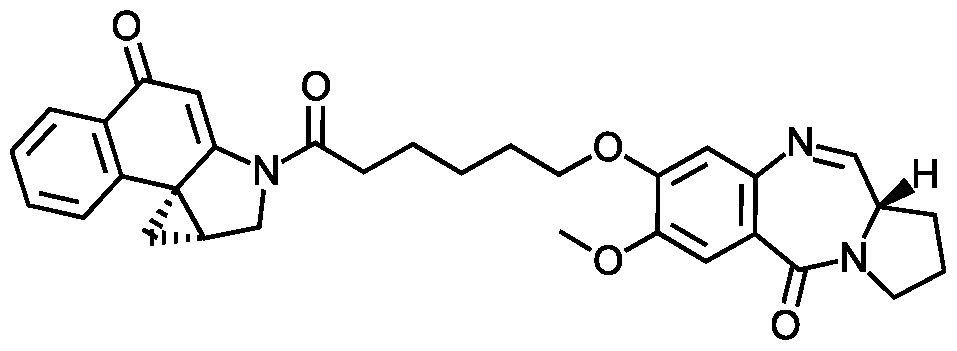
27eS
A related asymmetric molecule, shown below Compound 11, has also been disclosed but this has significantly lower cross-linking efficiency than 27eS or UTA-6026 (22).

Compound 11
WO2015023355 discloses drug moieties comprising CBI dimers and also drug moieties comprising a CBI linked to an unsubstituted PBD. WO2015023355 also discloses antibody-drug conjugates comprising such drug moieties; furthermore, immunoconjugates comprising such drug moieties linked to antibodies that bind HER2 are disclosed in WO2016040723. No agents that act through cross-linking A to G base pairs have been developed for clinical use.
A number of clinically-used cancer therapeutics (e.g., cisplatin) work by forming intra- and/or interstrand covalent DNA cross-links. Although the molecular steps that lead from cross-linking to cell death, and the reasons for tumour cell selectivity, are not fully understood, potency and selectivity are known to relate to DNA repair deficiencies in tumour cells. All clinically-used agents of this type form inter- or intrastrand crosslinks between guanine (G) bases. Cells do not usually encounter ¾is-links between guanine (G) and adenine (A) base pairs, and agents forming these lesions have not been developed for clinical use. Thus, there exists a need for further asymmetric compounds and related derivatives that are therapeutically active for treating a variety of different diseases (in particular, proliferative diseases) as G-A lesions should be more difficult to repair, leading to enhanced lethality.
The present application reports asymmetric conjugate compounds comprising a PBD/PDD and a CPI/CBI. The inventors have discovered asymmetric conjugate compounds providing properties, such as improved cross-linking efficiency, cytoxicity and modified sequence-selectivity that results in effective compounds. Furthermore, extensive rational design based on proprietary molecular modelling techniques has suggested that modification of the central linker between the alkylating moieties may further enhance DNA-binding and cytotoxicity.
The present invention seeks to overcome problem(s) associated with the prior art. SUMMARY OF THE INVENTION
The present invention provides a compound of formula (I):
A-X!-L-X2-B
(I)
and salts, solvates and tautomers thereof, for use as a drug in an antibody-drug conjugate,
wherein;
A is a group selected from:

(Ai), (A2), (A3), (A4) and (A5); h is o or 1;
Ri is selected from H and halogen;
either R2 is selected from -CH2-halogen, Ci-6 alkyl and H, and R3 is H;
or R2 and R3 together with the carbon atoms to which they are attached form a cyclopropyl ring;
p is o or 1; and when p is 1 then Y is C-R7, Y2 is C-R6, Y3 is C-R5 and Y is C-R4; and for (Ai) and (A2) when p is o either (a) Y is selected from N-Ri9, O and S; Y2 is selected from C-R6 and N; and Ys is C-R5; or (b) Ys is selected from N-Rig, O and S; Y2 is selected from C-R6 and N; and Y is C-R7; and for (A3) when p is o, Y is selected from N-Rig, O and S; and Y2 is selected from C-R6 and N;
R4, R5, R6 and R7 are each independently selected from H and R20,
or one of R4 and R5, or R5 and R6, or R6 and R7 together with the carbon atoms to which they are attached form a 6-membered aryl, or a 5- or 6-
membered cyclic, heterocyclic, or heteroaryl ring optionally substituted with up to three independently selected optional R20 groups;
Rs is selected from selected from H, nitrogen protecting groups and R20;
X3 is selected from C=0, C-OH and C-R'"; or Ys is selected from C=0, C-OH, C- NH2 and C-R'"; with the carbon forming part of the ring; and
when X3 or Ys is C=0 then represents an α,β-unsaturated double bond conjugated with the C=0; and when X3 is C-OH or C-R'" or Ys is C-
OH, C-NH2 or C-R'" then represents the double bonds of an aromatic 6-membered ring and R3 is absent;
wherein R'" is a prodrug moiety containing carbonyl, carbamoyl, glycosyl, O- amino, O-acylamino, para-aminobenzyl ether, peptidyl or phosphate groups;
Xi is selected from O, S, NR21, CR21R22, CR21R220, C(=0), C(=0)NR21, NR21C(=0), C(0 RA-C(0)-NH, C(0)-RA-NH-C(0), C(O) -NH-RA-C(0), NH-C(0)-RA-C(0), NH-C(0)-RA- C(0)-NH, NH-C(0)-RA-NH-C(0), C(0)-NH-RA-NH-C(0), C(0)-NH-RA-C(0)-NH, O- C(O) and C(0)-0 or is absent;
L is selected from an amino acid, a peptide chain having from 2 to 12 amino acids, a paraformaldehyde chain -(0CH2)i_24-, a polyethylene glycol chain -(0CH2CH2)i_i2- and -(CH2)m-Y6-(CH2)n- wherein
m is an integer selected from o to 12,
n is an integer selected from o to 12, and
Y6 is selected from -(CH2)Z- and a group (Li) that is selected from arylene, monocyclic heteroarylene, monocyclic cycloalkylene, monocyclic
cycloalkenylene and monocyclic heterocyclylene groups optionally substituted with up to three independently selected optional R20 groups;
z is an integer selected from 1 to 5;
X2 is selected from O, S, NR23, CR23R24, CR23R240, C(=0), C(=0)NR23, NR24C(=0), C(0)-RA-C(0)-NH, C(0)-RA-NH-C(0), C(O) -NH-RA-C(0), NH-C(0)-RA-C(0), NH-
C(0)-RA-C(0)-NH, NH-C(0)-RA-NH-C(0), C(0)-NH-RA-NH-C(0), C(0)-NH-RA-C(0 NH, O-C(O) and C(0)-0 or is absent;
B is a polycyclic group selected from:

(Bi), (B2) and (B3);
the dotted lines indicate the optional presence of one or more double bonds; q is o or 1;
and Rg and Ri0 are selected such that either:
(i) Rg and Ri0 together form a double bond;
(ii) R9 is H and R10 is OH;
(iii) Rg is H and Ri0 is OCi-6 alkyl;
(iv) Rg is selected from S03H, nitrogen protecting groups and R20;

(v) R9 is H or Ci-6 alkyl, and Ri0 is oxo or H;
R11, R12, R13 and Ri4 are independently selected from H, R20, R25, =CH2, =CH- (CH2)s-CH3,
 =0, (CH2)s-OR25, (CH2)s-C02R25, (CH2)S-NR25R26, 0-(CH2)t-NR25R26, NH-C(0)-R25, 0-(CH2)t-NH-C(0)-R25, 0-(CH2)t-C(0)-NH- R25, (CH2)s-S02R25, 0-S02R25, (CH2)s-C(0)R25 and (CH2)s-C(0)NR25R26;
or one of Rn and Ri2, Ri2 and Ri3, or Ri3 and Ri4 together with the carbon atoms to which they are attached form a 6-membered aryl, or a 5- or 6- membered cyclic, heterocyclic, or heteroaryl ring optionally substituted with up to three independently selected optional R20 groups;
each s is an integer independently selected from o to 6;
each t is an integer independently selected from 1 to 6;
R15, R16, R17 and R18 are independently selected from H and R20; each R20 is independently selected from (CH2)j-0H, Ci-6 alkyl, OCi-6 alkyl, 0CH2Ph, (CH2)j-C02R27, 0-(CH2)k-NR27R28, (CH2)j-NR27R28, C(=0)-NH-(CH2)k-NR27R28, C(=0 NH-C6H4-(CH2)j-R27 and C(=0)-NH-(CH2)k-C(=NH)NR27R28;
each j is an integer independently selected from o to 6;
each k is an integer independently selected from 1 to 6; each Rig, R2i, R22, R23, R24, R26, R27 and R28 is independently selected from H and Ci- alkyl; and each R25 is independently selected from H, Ci-i2 alkyl, C5-g heteroaryl, C6-i5
heteroarylalkyl, phenyl and C7-i2 aralkyl groups; wherein the heteroaryl,
heteroarylalkyl, phenyl and aralkyl groups are optionally substituted with up to three independently selected optional R20 groups; each RA is independently selected from:
-NRB-T1-NRC- where RB and Rc are each independently selected from H and Ci-8 alkyl, or together RB and Rc join to form a ring and together are (CH2)2_3, where T1 is selected from -C(O), -C(0)(CH2)0-50C(0)-, -C(0)PhC(0 where Ph is 1,3- or 1,4-phenylene;
-het- wherein het is a mono-, bi-, or tricyclic heteroarylene of 5 to 12 members, containing one, two, or three heteroatoms independently selected from O, N, S, P and B, wherein het is optionally substituted up to three independently selected optional R20 groups;
-χΑ_τ¾-χΑ-, where T2 is:

wherein each XA is independently selected from a bond, -NH-, -N(Ci-8 alkyl)-, - O- and -S-, each RD, RE, RF, and RG are each independently H or R20, or RD and RE form a ring system, or RF and RG form a ring system, or both RD and RE, and RF and RG independently form ring systems, where said ring systems are independently selected from -C1-&0 heterocyclyl or -C3-C8 carbocyclycl, or RD, RE, RF, and RG are each bonds to different carbons on D, wherein f and g are each
independently an integer from o to 50 and w is an integer from 1 to 50, and wherein D is a bond or is selected from the group consisting of-S-, -Ci-Cs alkylene-, -C0-C14 arylene-, -C0-C14 heteroarylene-, -Ci-Cs heteroalkylene-, -C7- C22 aralkylene, -C1-C10 heterocyclo and -C3-C8 carbocyclo, where said -Ci-Cs alkylene-, -C6-C14 arylene-, -C6-C14 heteroarylene-, -Ci-Cs heteroalkylene-, -C7- C22 aralkylene, -C1-C10 heterocyclo and— C3-C8 carbocyclo are optionally substituted up to three independently selected optional R20 groups; with the proviso that when the compound is:

that at least one of Rn, Ri2 and Ri3 is independently selected from C5-g heteroaryl, C6 i5 heteroarylalkyl, phenyl and C7-i2 aralkyl groups and these groups are optionally substituted with up to three independently selected optional R20 groups, or that one of Rn and Ri2 or Ri2 and Ri3, or Ri3 together with the carbon atoms to which they are attached form a 6-membered aryl, or a 5- or 6-membered cyclic, heterocyclic, or heteroaryl ring optionally substituted with up to three independently selected optional R20 groups; with the proviso that R5 and R6 are each independently selected from H and R20 when B, q and A are selected as (Bi), o and (A4) respectively; with the proviso that when R2 is Ci-6 alkyl or H, that R9 and Ri0 are selected from options (i), (ii), (iii) or (iv); and with the proviso that when (v) R9 is H or Ci-6 alkyl, and Ri0 is oxo or H; then either R2 is -CH2-halogen and R3 is H;
or R2 and R3 together with the carbon atoms to which they are attached form a cyclopropyl ring.
In a further aspect there is provided a compound of formula (I):

(I)
and salts, solvates and tautomers thereof,
wherein;
A is a group selected from:

(Ai), (A2), (A3), (A4) and (A5); h is o or 1;
Ri is selected from H and halogen;
either R2 is selected from -CH2-halogen, Ci-6 alkyl and H, and R3 is H;
or R2 and R3 together with the carbon atoms to which they are attached form a cyclopropyl ring;
p is o or 1; and when p is l then Y is C-R7, Y2 is C-R6, Y3 is C-R5 and Y^ is C-R4; and for (Ai) and (A2) when p is o either (a) Y is selected from N-Ri9, O and S; Y2 is selected from C-R6 and N; and Y3 is C-R5; or (b) Y3 is selected from N-Rig, O and S; Y2 is selected from C-R6 and N; and Y is C-R7; and for (A3) when p is o, Y is selected from N-Ri9, O and S; and Y2 is selected from C-R6 and N;
R4, R5, R6 and R7 are each independently selected from H and R20,
or one of R4 and R5, or R5 and R6, or R6 and R7 together with the carbon atoms to which they are attached form a 6-membered aryl, or a 5- or 6- membered cyclic, heterocyclic, or heteroaryl ring optionally substituted with up to three independently selected optional R20 groups;
Rs is selected from selected from H, nitrogen protecting groups and R20;
X3 is selected from C=0, C-OH and C-R'"; or Ys is selected from C=0, C-OH, C-
NH2 and C-R'"; with the carbon forming part of the ring; and
when X3 or Ys is C=0 then represents an α,β-unsaturated double bond conjugated with the C=0; and when X3 is C-OH or C-R'"; or Ys is
C-OH, C-NH2 or C-R'" then represents the double bonds of an aromatic 6-membered ring and R3 is absent;
wherein R'" is a prodrug moiety containing carbonyl, carbamoyl, glycosyl, O- amino, O-acylamino, para-aminobenzyl ether, peptidyl or phosphate groups
Xi is selected from O, S, NR21, CR21R22, CR21R220, C(=0), C(=0)NR21, NR21C(=0), C(0 RA-C(0)-NH, C(0)-RA-NH-C(0), C(O) -NH-RA-C(0), NH-C(0)-RA-C(0), NH-C(0)-RA- C(0)-NH, NH-C(0)-RA-NH-C(0), C(0)-NH-RA-NH-C(0), C(0)-NH-RA-C(0)-NH, O- C(O) and C(0)-0 or is absent;
L is selected from an amino acid, a peptide chain having from 2 to 12 amino acids, a paraformaldehyde chain -(0CH2)i_24-, a polyethylene glycol chain -(0CH2CH2)i_i2- and -(CH2)m-Y6-(CH2)n- wherein
m is an integer selected from o to 12,
n is an integer selected from o to 12, and
Y6 is selected from -(CH2)Z- and a group (Li) that is selected from arylene, monocyclic heteroarylene, monocyclic cycloalkylene, monocyclic
cycloalkenylene and monocyclic heterocyclylene groups optionally substituted with up to three independently selected optional R20 groups;
z is an integer selected from 1 to 5;
X2 is selected from O, S, NR23, CR23R24, CR23R240, C(=0), C(=0)NR23, NR24C(=0), C(0)-RA-C(0)-NH, C(0)-RA-NH-C(0), C(O) -NH-RA-C(0), NH-C(0)-RA-C(0), NH- C(0)-RA-C(0)-NH, NH-C(0)-RA-NH-C(0), C(0)-NH-RA-NH-C(0), C(0)-NH-RA-C(0 NH, O-C(O) and C(0)-0 or is absent;
B is a polycyclic group selected from:

the dotted lines indicate the optional presence of one or more double bonds; q is o or 1;
and R9 and Ri0 are selected such that either:
(i) R9 and Ri0 together form a double bond;
(ii) R9 is H and Ri0 is OH;
(iii) R9 is H and Ri0 is OCi-6 alkyl;
(iv) Rg is selected from S03H, nitrogen protecting groups and R20;

(v) R9 is H or Ci-6 alkyl, and Ri0 is oxo or H
R11, Ri2, Ri3 and Ri4 are independently selected from H, R20, R25, =CH2, =CH-
(CH2)s-CH3, =CH-(CH2)s-R25, =0, (CH2)s-OR25, (CH2)s-C02R25, (CH2)S-NR25R26, 0-(CH2)t-NR25R26, NH-C(0)-R25, 0-(CH2)t-NH-C(0)-R25, 0-(CH2)t-C(0)-NH- R25, (CH2)s-S02R25, 0-S02R25, (CH2)s-C(0)R25 and (CH2)s-C(0)NR25R26;
or one of Rn and Ri2, Ri2 and Ri3, or Ri3 and Ri4 together with the carbon atoms to which they are attached form a 6-membered aryl, or a 5- or 6- membered cyclic, heterocyclic, or heteroaryl ring optionally substituted with up to three independently selected optional R20 groups;
each s is an integer independently selected from o to 6;
each t is an integer independently selected from 1 to 6;
R15, R16, R17 and R18 are independently selected from H and R20; each R20 is independently selected from (CH2)j-0H, Ci-6 alkyl, OCi-6 alkyl, 0CH2Ph, (CH2)j-C02R27, 0-(CH2)k-NR27R28, (CH2)j-NR27R28, C(=0)-NH-(CH2)k-NR27R28; C(=0)- NH-C6H4-(CH2)j-R27 and C(=0)-NH-(CH2)k-C(=NH)NR27R28;
each j is an integer independently selected from o to 6;
each k is an integer independently selected from 1 to 6; each Ri9, R2i, R22, R23, R24, R26, R27 and R28 is independently selected from H and Ci-6 alkyl; and each R25 is independently selected from H, Ci-i2 alkyl, C5-g heteroaryl, C6-i5
heteroarylalkyl, phenyl and C7-i2 aralkyl groups; wherein the heteroaryl,
heteroarylalkyl, phenyl and aralkyl groups are optionally substituted with up to three independently selected optional R20 groups; each RA is independently selected from:
-NRB-T1-NRC- where RB and Rc are each independently selected from H or Ci-8 alkyl, or together RB and Rc join to form a ring and together are (CH2)2_3, where T1 is selected from -C(O), -C(0)(CH2)0-50C(0)-, -C(0)PhC(0)- where Ph is 1,3- or 1,4-phenylene;
-het- wherein het is a mono-, bi-, or tricyclic heteroarylene of 5 to 12 members, containing one, two, or three heteroatoms independently selected from O, N, S, P and B, wherein het is optionally substituted up to three independently selected optional R20 groups;
-χΑ_τ¾-χΑ-, where T2 is:

wherein each XA is independently selected from a bond, -NH-, -N(Ci-8 alkyl)-, - O- and -S-, each RD, RE, RF, and RG are each independently H or R20, or RD and RE form a ring system, or RF and RG form a ring system, or both RD and RE, and RF and RG
independently form ring systems, where said ring systems are independently selected from -C1-C10 heterocyclyl or -C3-C8 carbocyclycl, or RD, RE, RF, and RG are each bonds to different carbons on D, wherein f and g are each independently an integer from o to 50 and w is an integer from 1 to 50, and wherein D is a bond or is selected from the group
consisting of-S-, -Ci-Cs alkylene-, -C6-C14 arylene-, -C6-C14 heteroarylene-, -Ci-Cs heteroalkylene-, -C7-C22 aralkylene, -&-&0 heterocyclo and -C3-C8 carbocyclo, where said -Ci-Cs alkylene-, -C6-Ci arylene-, -C6-C14 heteroarylene-, -Ci-Cs heteroalkylene-, - C7-C22 aralkylene, -C1-C10 heterocyclo and— C3-Cs carbocyclo are optionally substituted up to three independently selected optional R20 groups; with the proviso that when R2 is Ci-6 alkyl or H, that R9 and Ri0 are selected from options (i), (ii), (iii) or (iv); and with the proviso that when (v) R9 is H or Ci-6 alkyl, and Ri0 is oxo or H; then either R2 is -CH2-halogen and R3 is H;
or R2 and R3 together with the carbon atoms to which they are attached form a cyclopropyl ring.
In a further aspect, there is provided a compound of formula (I):

(I)
and salts, solvates and tautomers thereof, for use as a drug in an antibody-drug conjugate,
wherein;
A is a group selected from:

(Al), (A2), (A3), (A4) and (A5); h is o or 1;
Ri is selected from H and halogen;
either R2 is selected from -CH2-halogen and H, and R3 is H;
or R2 and R3 together with the carbon atoms to which they are attached form a cyclopropyl ring;
p is o or 1; and when p is 1 then Y is C-R7, Y2 is C-R6, Y3 is C-R5 and Y is C-R4;
and for (Ai) and (A2) when p is o either (a) Y is selected from N-Ri9, O and S; Y2 is selected from C-R6 and N; and Y3 is C-R5; or (b) Y3 is selected from N-Rig, O and S; Y2 is selected from C-R6 and N; and Y is C-R7; and for (A3) when p is o, Y is selected from N-Ri9, O and S; and Y2 is selected from C-R6 and N;
R4, R5, R6 and R7 are each independently selected from H and R20,
or one of R4 and R5, or R5 and R6, or R6 and R7 together with the carbon atoms to which they are attached form a 6-membered aryl, or a 5- or 6- membered cyclic, heterocyclic, or heteroaryl ring optionally substituted with up to three independently selected optional R20 groups;
Rs is selected from H, nitrogen protecting groups and R20;
X3 is selected from C=0 and C-OH, or Ys is selected from C=0, C-OH and C-
NH2, with the carbon forming part of the ring; and
when X3 or Ys is C=0 then represents an α,β-unsaturated double bond conjugated with the C=0; and when X3 is C-OH or Ys is C-OH or C-
NH2 then represents the double bonds of an aromatic 6- membered ring and R3 is absent;
Xi is selected from O, S, NR21, CR21R22, CR21R220, C(=0), C(=0)NR21, NR21C(=0), C(0 RA-C(0)-NH, C(0)-RA-NH-C(0), C(O) -NH-RA-C(0), NH-C(0)-RA-C(0), NH-C(0)-RA- C(0)-NH, NH-C(0)-RA-NH-C(0), C(0)-NH-RA-NH-C(0), C(0)-NH-RA-C(0)-NH, O- C(O) and C(0)-0 or is absent;
L is selected from an amino acid, a peptide chain having from 2 to 12 amino acids, a paraformaldehyde chain -(0CH2)i_24-, a polyethylene glycol chain -(0CH2CH2)i_i2- and -(CH2)m-Y6-(CH2)n- wherein
m is an integer selected from o to 12,
n is an integer selected from o to 12, and
Y6 is selected from -(CH2)Z- and a group (Li) that is selected from arylene, monocyclic heteroarylene, monocyclic cycloalkylene, monocyclic
cycloalkenylene and monocyclic heterocyclylene groups optionally substituted with up to three independently selected optional R20 groups;
z is an integer selected from 1 to 5; X2 is selected from O, S, NR23, CR23R24, CR23R240, C(=0), C(=0)NR23, NR24C(=0), C(0)-RA-C(0)-NH, C(0)-RA-NH-C(0), C(O) -NH-RA-C(0), NH-C(0)-RA-C(0), NH- C(0)-RA-C(0)-NH, NH-C(0)-RA-NH-C(0), C(0)-NH-RA-NH-C(0), C(0)-NH-RA-C(0 NH, O-C(O) and C(0)-0 or is absent; B is a polycyclic group selected from:

(Bi), (B2) and (B3);
the dotted lines indicate the optional presence of one or more double bonds; q is o or 1;
and either:
(i) Rg and Ri0 together form a double bond;
(ii) R9 is H and R10 is OH;
(iii) R9 is H and Ri0 is OCi-6 alkyl; or
(iv) Rg is selected from S03H, nitrogen protecting groups and R20;

R11, R12, R13 and Ri4 are independently selected from H, R20, R25, =CH2, =CH- (CH2)s-CH3, =CH-(CH2)s-R25, =0, (CH2)s-OR25, (CH2)s-C02R25, (CH2)S-NR25R26, 0-(CH2)t-NR25R26, NH-C(0)-R25, 0-(CH2)t-NH-C(0)-R25, 0-(CH2)t-C(0)-NH- R25, (CH2)s-S02R25, 0-S02R25, (CH2)s-C(0)R25 and (CH2)s-C(0)NR25R26;
or one of Rn and Ri2, Ri2 and Ri3, or Ri3 and Ri4 together with the carbon atoms to which they are attached form a 6-membered aryl, or a 5- or 6- membered cyclic, heterocyclic, or heteroaryl ring optionally substituted with up to three independently selected optional R20 groups;
each s is an integer independently selected from o to 6;
each t is an integer independently selected from 1 to 6;
R15, R16, R17 and R18 are independently selected from H and R20; each R20 is independently selected from (CH2)j-0H, Ci-6 alkyl, OCi-6 alkyl, 0CH2Ph, (CH2)j-C02R27, 0-(CH2)k-NR27R28, (CH2)j-NR27R28, C(=0)-NH-(CH2)k-NR27R28, C(=0 NH-C6H4-(CH2)j-R27 and C(=0)-NH-(CH2)k-C(=NH)NR27R28;
each j is an integer independently selected from o to 6;
each k is an integer independently selected from 1 to 6; each Rig, R2i, R22, R23, R24, R26, R27 and R28 is independently selected from H and Ci-6 alkyl; and each R25 is independently selected from H, Ci-i2 alkyl, C5-g heteroaryl, C6-15
heteroarylalkyl, phenyl and C7-i2 aralkyl groups; wherein the heteroaryl,
heteroarylalkyl, phenyl and aralkyl groups are optionally substituted with up to three independently selected optional R20 groups; each RA is independently selected from:
-NRB-T1-NRC- where RB and Rc are each independently selected from H and Ci-8 alkyl, or together RB and Rc join to form a ring and together are (CH2)2_3, where T1 is selected from -C(O), -C(0)(CH2)0-50C(0)-, -C(0)PhC(0 where Ph is 1,3- or 1,4-phenylene;
-het- wherein het is a mono-, bi-, or tricyclic heteroarylene of 5 to 12 members, containing one, two, or three heteroatoms independently selected from O, N, S, P and B, wherein het is optionally substituted up to three independently selected optional R20 groups;
-χΑ_τ¾-χΑ-, where T2 is:

wherein each XA is independently selected from a bond, -NH-, -N(Ci-8 alkyl)-, - O- and -S-, each RD, RE, RF, and RG are each independently H or R20, or RD and RE form a ring system, or RF and RG form a ring system, or both RD and RE, and RF and RG independently form ring systems, where said ring systems are independently selected from -C1-&0 heterocyclyl or -C3-C8 carbocyclycl, or RD, RE, RF, and RG are each bonds to different carbons on D, wherein f and g are each
independently an integer from o to 50 and w is an integer from 1 to 50, and wherein D is a bond or is selected from the group consisting of-S-, -Ci-Cs alkylene-, -C0-C14 arylene-, -C0-C14 heteroarylene-, -Ci-Cs heteroalkylene-, -C7- C22 aralkylene, -C1-C10 heterocyclo and -C3-C8 carbocyclo, where said -Ci-Cs alkylene-, -C6-C14 arylene-, -C6-C14 heteroarylene-, -Ci-Cs heteroalkylene-, -C7- C22 aralkylene, -C1-C10 heterocyclo and ~C3-C8 carbocyclo are optionally substituted up to three independently selected optional R20 groups; with the proviso that when the compound is:

at least one of Rn, Ri2 and Ri3 is independently selected from C5-g heteroaryl, C6- 15 heteroarylalkyl, phenyl and C7-i2 aralkyl groups and these groups are optionally substituted with up to three independently selected optional R20 groups, or that one of Rn and Ri2 or Ri2 and Ri3, or Ri3 together with the carbon atoms to which they are attached form a 6-membered aryl, or a 5- or 6- membered cyclic, heterocyclic, or heteroaryl ring optionally substituted with up to three independently selected optional R20 groups; and with the proviso that R5 and R6 are each independently selected from H and R2o when B, q and A are selected as (Bi), o and (A4) respectively.
In a further aspect, there is provided a compound of formula (I):

(I)
and salts, solvates and tautomers thereof,
wherein;
A is a rou selected from:

(Ai),
h is o or 1;
Ri is selected from H and halogen;
either R2 is selected from -CH2-halogen and H, and R3 is H;
or R2 and R3 together with the carbon atoms to which they are attached form a cyclopropyl ring;
p is o or 1; and when p is 1 then Y is C-R7, Y2 is C-R6, Y3 is C-R5 and Y is C-R4; and for (Ai) and (A2) when p is o either (a) Y is selected from N-Ri9, O and S; Y2 is selected from C-R6 and N; and Ys is C-R5; or (b) Ys is selected from N-Ri9, O and S; Y2 is selected from C-R6 and N; and Y is C-R7; and for (A3) when p is o, Y is selected from N-Ri9, O and S; and Y2 is selected from C-R6 and N;
R4, R5, R6 and R7 are each independently selected from H and R20,
or one of R4 and R5, or R5 and R6, or R6 and R7 together with the carbon atoms to which they are attached form a 6-membered aryl, or a 5- or 6- membered cyclic, heterocyclic, or heteroaryl ring optionally substituted with up to three independently selected optional R20 groups;
Rs is selected from selected from H, nitrogen protecting groups and R20;
X3 is selected from C=0 and C-OH, or Ys is selected from C=0, C-OH and C-
NH2, with the carbon forming part of the ring; and
when X3 or Ys is C=0 then represents an α,β-unsaturated double bond conjugated with the C=0; and when X3 is C-OH or Ys is C-OH or C-
NH2 then represents the double bonds of an aromatic 6- membered ring and R3 is absent;
Xi is selected from O, S, NR21, CR21R22, CR21R220, C(=0), C(=0)NR21, NR21C(=0), C(0 RA-C(0)-NH, C(0)-RA-NH-C(0), C(O) -NH-RA-C(0), NH-C(0)-RA-C(0), NH-C(0)-RA- C(0)-NH, NH-C(0)-RA-NH-C(0), C(0)-NH-RA-NH-C(0), C(0)-NH-RA-C(0)-NH, O- C(O) and C(0)-0 or is absent;
L is selected from an amino acid, a peptide chain having from 2 to 12 amino acids, a paraformaldehyde chain -(0CH2)i_24-, a polyethylene glycol chain -(0CH2CH2)i_i2- and -(CH2)m-Y6-(CH2)n- wherein
m is an integer selected from o to 12,
n is an integer selected from o to 12, and
Y6 is selected from -(CH2)Z- and a group (Li) that is selected from arylene, monocyclic heteroarylene, monocyclic cycloalkylene, monocyclic
cycloalkenylene and monocyclic heterocyclylene groups optionally substituted with up to three independently selected optional R20 groups;
z is an integer selected from 1 to 5; X2 is selected from O, S, NR23, CR23R24, CR23R240, C(=0), C(=0)NR23, NR24C(=0), C(0)-RA-C(0)-NH, C(0)-RA-NH-C(0), C(O) -NH-RA-C(0), NH-C(0)-RA-C(0), NH- C(0)-RA-C(0)-NH, NH-C(0)-RA-NH-C(0), C(0)-NH-RA-NH-C(0), C(0)-NH-RA-C(0 NH, O-C(O) and C(0)-0 or is absent; B is a polycyclic group selected from:

(B2) (B3) and (B4);
the dotted lines indicate the optional presence of one or more double bonds; q is o or 1;
and either:
(i) Rg and Ri0 together form a double bond;
(ii) R9 is H and R10 is OH;
(iii) R9 is H and Ri0 is OCi-6 alkyl; or
(iv) Rg is selected from S03H, nitrogen protecting groups and R20;

R11, R12, R13 and Ri4 are independently selected from H, R20, R25, =CH2, =CH- (CH2)s-CH3,
 =0, (CH2)s-OR25, (CH2)s-C02R25, (CH2)S-NR25R26, 0-(CH2)t-NR25R26, NH-C(0)-R25, 0-(CH2)t-NH-C(0)-R25, 0-(CH2)t-C(0)-NH- R25, (CH2)s-S02R25, 0-S02R25, (CH2)s-C(0)R25 and (CH2)s-C(0)NR25R26;
or one of Rn and Ri2, Ri2 and Ri3, or Ri3 and Ri4 together with the carbon atoms to which they are attached form a 6-membered aryl, or a 5- or 6- membered cyclic, heterocyclic, or heteroaryl ring optionally substituted with up to three independently selected optional R20 groups;
each s is an integer independently selected from o to 6;
each t is an integer independently selected from 1 to 6;
R15, R16, R17 and R18 are independently selected from H and R20; each R20 is independently selected from (CH2)j-0H, Ci-6 alkyl, OCi-6 alkyl, 0CH2Ph, (CH2)j-C02R27, 0-(CH2)k-NR27R28, (CH2)j-NR27R28, C(=0)-NH-(CH2)k-NR27R28; C(=0 NH-C6H4-(CH2)j-R27 and C(=0)-NH-(CH2)k-C(=NH)NR27R28;
each j is an integer independently selected from o to 6;
each k is an integer independently selected from 1 to 6; each Rig, R2i, R22, R23, R24, R26, R27 and R28 is independently selected from H and Ci- alkyl; and each R25 is independently selected from H, d-12 alkyl, C5-g heteroaryl, C6- heteroarylalkyl, phenyl and C7-i2 aralkyl groups; wherein the heteroaryl,
heteroarylalkyl, phenyl and aralkyl groups are optionally substituted with up to three independently selected optional R20 groups each RA is independently selected from:
-NRB-T1-NRC- where RB and Rc are each independently selected from H and Ci-8 alkyl, or together RB and Rc join to form a ring and together are (CH2)2_3, where T1 is selected from -C(O), -C(0)(CH2)0-50C(0)-, -C(0)PhC(0 where Ph is 1,3- or 1,4-phenylene;
-het- wherein het is a mono-, bi-, or tricyclic heteroarylene of 5 to 12 members, containing one, two, or three heteroatoms independently selected from O, N, S, P and B, wherein het is optionally substituted up to three independently selected optional R20 groups;
-χΑ_τ¾-χΑ-, where T2 is:

wherein each XA is independently selected from a bond, -NH-, -N(Ci-8 alkyl)-, - O- and -S-, each RD, RE, RF, and RG are each independently H or R20, or RD and RE form a ring system, or RF and RG form a ring system, or both RD and RE, and RF and RG independently form ring systems, where said ring systems are independently selected from -C1-&0 heterocyclyl or -C3-C8 carbocyclycl, or RD, RE, RF, and RG are each bonds to different carbons on D, wherein f and g are each
independently an integer from o to 50 and w is an integer from 1 to 50, and wherein D is a bond or is selected from the group consisting of-S-, -Ci-Cs alkylene-, -C0-C14 arylene-, -C0-C14 heteroarylene-, -Ci-Cs heteroalkylene-, -C7- C22 aralkylene, -C1-C10 heterocyclo and -C3-C8 carbocyclo, where said -Ci-Cs alkylene-, -C6-C14 arylene-, -C6-C14 heteroarylene-, -Ci-Cs heteroalkylene-, -C7- C22 aralkylene, -C1-C10 heterocyclo and ~C3-C8 carbocyclo are optionally substituted up to three independently selected optional R20 groups.
In a further aspect, there is provided a compound of formula (I) and salts, solvates and tautomers thereof for use in a method of therapy.
In a further aspect, there is provided a compound of formula (I) and salts, solvates and tautomers thereof for use as a medicament.
In a further aspect, there is provided a compound of formula (I) and salts, solvates and tautomers thereof for use in the treatment of a proliferative disease. In a further aspect, there is provided a pharmaceutical composition comprising a compound of formula (I) and salts and solvates thereof and a pharmaceutically acceptable carrier or diluent. The pharmaceutical composition of the present invention may further comprise one or more (e.g. two, three or four) further active agents. In a further aspect, the present invention provides the use of a compound of formula (I) and salts, solvates and tautomers thereof in the manufacture of a medicament for treating a proliferative disease.
In a further aspect, the present invention provides a method of treatment of a patient suffering from a proliferative disease, comprising administering to said patient a therapeutically effective amount of a compound of formula (I) and salts, solvates and tautomers thereof or a pharmaceutical composition of the present invention.
In a further aspect, the compound of formula (I) and salts, solvates and tautomers thereof may be administered alone or in combination with other treatments, either simultaneously or sequentially depending upon the condition to be treated.
In a further aspect, the compound of formula (I) and salts, solvates and tautomers thereof, may be used as a payload on a tumour-targeting agent (e.g., antibody, antibody fragment, hormone, etc.).
Definitions
The following abbreviations are used throughout the specification: Ac acetyl; AIBN Azobisisobutyronitrile; Alloc allyloxycarbonyl; BAIB bis(acetoxy)iodobenzene/
(diacetoxyiodo)benzene; Boc tert-butoxycarbonyl; BPDs benzopyrridodiazecines; CBz benzyloxycarbonyl; CBI cyclopropyl[c]benzo[e]indolone, CPI cyclopropylpyrolo[e]- indolone, DBU i,8-diazabicyclo[5.4.o]undec-7-ene; DHP dihydropyran; DMAP 4-
dimethylaminopyridine; DMF dimethylformamide; DMSO dimethylsulfoxide; DPPA diphenylphosphory azide; EDC1 i-Ethyl-3-(3-dimethylaminopropyl)carbodiimide; Et ethyl; Et20 diethyl ether; EtOAc ethyl acetate; EtOH ethanol; Fmoc 9-fluorenylmethyl- oxycarbonyl; HATU (i-[Bis(dimethylamino)methylene]-iH-i,2,3-triazolo[4,5-b]- pyridinium 3-oxid hexafluorophosphate); HMDST hexamethyldisilathiane; iBu iso- butyl; KOtBu potassium t-butoxide; L-Selectride Lithium tri-sec-butyl(hydride)borate; Me methyl; MeOH methanol; PBDs pyrrolo[2,i-c][i,4]benzo-diazepines; PDDs pyrridinobenzodiazepines; PIFA phenyliodine (III) bis[trifluoroacetate]; Ph phenyl; p- TSA /PTSA p-Toluenesulfonic acid; Pyr pyridine; TBAF tetrabutylammonium fluoride; TBAI tetrabutylammonium iodide; TBS-C1/TBDMSC1 tert- butyldimethylsilyl chloride; TEA triethylamine; TEMPO (2,2,6,6-tetramethyl-piperidin-i-yl)oxyl; TFA trifluoro- acetic acid; THF tetrahydrofuran; THP tetrahydropyranyl; Troc 2,2,2-Trichloroethyl carbonate and Ts (tosylate) p-toluene sulfonic acid. "Substituted", when used in connection with a chemical substituent or moiety (e.g., an alkyl group), means that one or more hydrogen atoms of the substituent or moiety have been replaced with one or more non-hydrogen atoms or groups, provided that valence requirements are met and that a chemically stable compound results from the substitution.
"Optionally substituted" refers to a parent group which may be unsubstituted or which may be substituted with one or more substituents. Suitably, unless otherwise specified, when optional substituents are present the optional substituted parent group comprises from one to three optional substituents. Where a group maybe "optionally substituted with up to three groups", this means that the group may be substituted with o, 1, 2 or 3 of the optional substituents. Where a group maybe "optionally substituted with one or two optional substituents", this means that the group may be substituted with o, 1 or 2 of the optional substituents. Suitably groups may be optionally substituted with o or 1 optional substituents.
Optional substituents may be selected from Ci-7 alkyl, C2-7 alkenyl, C2-7 alkynyl, C5-20 aryl, C3-i0 cycloalkyl, C3-i0 cycloalkenyl, C3-i0 cycloalkynyl, C3-20 heterocyclyl, C3-20 heteroaryl, acetal, acyl, acylamido, acyloxy, amidino, amido, amino, aminocarbonyloxy, azido, carboxy, cyano, ether, formyl, guanidino, halo, hemiacetal, hemiketal, hydroxamic acid, hydroxyl, imidic acid, imino, ketal, nitro, nitroso, oxo, oxycarbonyl, oxycarboyloxy, sulfamino, sulfamyl, sulfate, sulfhydryl, sulfinamino, sulfinate, sulfino,
sulfinyl, sulfinyloxy, sulfo, sulfonamido, sulfonamino, sulfonate, sulfonyl, sulfonyloxy, uredio groups.
"Independently selected" is used in the context of statement that, for example, "each R2i and R22 are independently selected from H and Ci-6 alkyl,..." and means that each instance of the functional group, e.g. R2i, is selected from the listed options
independently of any other instance of R2i or R22 in the compound. Hence, for example, H may be selected for the first instance of R2i in the compound; methyl may be selected for the next instance of R2i in the compound; and ethyl may be selected for the first instance of R22 in the compound.
Ci alkyl: refers to straight chain and branched saturated hydrocarbon groups, generally having from l to 12 carbon atoms; more suitably Ci-7 alkyl; more suitably Ci-6 alkyl; more suitably Ci-3 alkyl. Examples of alkyl groups include methyl, ethyl, n- propyl, i-propyl, n-butyl, s-butyl, i-butyl, t-butyl, pent-i-yl, pent-2-yl, pent-3-yl, 3- methylbut-i-yl, 3-methylbut-2-yl, 2-methylbut-2-yl, 2,2,2-trimethyleth-i-yl, n-hexyl, n- heptyl, and the like.
"Alkylene" refers to a divalent radical derived from an alkane which may be a straight chain or branched, as exemplified by -CH2CH2CH2CH2-.
"Monocyclic cycloalkylene" refers to a divalent radical derived from a saturated monocyclic hydrocarbon group (or cycloalkane). The cycloalkylene group may be attached to the rest of the compound at any ring atom unless such attachment would violate valence requirements. Suitably, the monocylic cycloalkylene group is a C3-i0 cycloalkylene group that is a cycloalkyl group having from 3 to 10 carbon atoms that comprise the ring. Suitably the monocylic cycloalkylene group is a C3-7 cycloalkylene group, more suitably a C6 cycloalkylene group (i.e. a cyclohexylene group). "Amino acid" refers to organic compounds containing amine (-NH2) and carboxyl (- COOH) functional groups, along with a side chain (R group) specific to each amino acid. Each amino acid may be independently selected from any amino acid. Suitably, each amino acid is an alpha amino acid, where the amine and the carboxylic acid groups are attached to the first (alpha-) carbon atom. Suitably each amino acid may be selected from alanine, arginine, asparagine, aspartic acid, citrulline, cysteine, glutamic acid, glutamine, glycine, histidine, isoleucine, leucine, lysine, methionine,
phenylalanine, proline, serine, threonine, tryptophan, tyrosine and valine.
"Aryl": refers to fully unsaturated monocyclic, bicyclic and polycyclic aromatic hydrocarbons having at least one aromatic ring and having a specified number of carbon atoms that comprise their ring members (e.g., 6-membered aryl refers to an aryl group having 6 carbon atoms as ring members and 06-ι4 aryl refers to an aryl group having 6 to 14 carbon atoms as ring members). The aryl group may be attached to a parent group or to a substrate at any ring atom and may include one or more non- hydrogen substituents unless such attachment or substitution would violate valence requirements. Suitably, a C6-i4 aryl is selected from a C6-i2 aryl, more suitably, a Ce-w aryl. Examples of aryl groups include phenyl.
"Arylene" refers to a divalent radical derived from an aryl group, e.g. -C H4- which is the arylene derived from phenyl.
"C7-12 aralkyl" refers to an arylalkyl group having 7 to 12 carbon atoms and comprising an alkyl group substituted with an aryl group. Suitably the alkyl group is a Ci-6 alkyl group and the aryl group is phenyl. Examples of C7-i2 aralkyl include benzyl and phenethyl. In some cases the C7-i2 aralkyl group may be optionally substituted and an example of an optionally substituted C7-i2 aralkyl group is 4-methoxylbenzyl.
"C3-C8 carbocyclyl" by itself or as part of another term, is a 3-, 4-, 5-, 6-, 7- or 8- membered monovalent, substituted or unsubstituted, saturated or unsaturated non- aromatic monocyclic or bicyclic carbocyclic ring derived by the removal of one hydrogen atom from a ring atom of a parent ring system. Representative C3-Cs carbocyclyl include, but are not limited to, cyclopropyl, cyclobutyl, cyclopentyl, cyclopentadienyl, cyclohexyl, cyclohexenyl, 1 ,3-cyclohexadienyl, 1 ,4-cyclohexadienyl, cycloheptyl, 1 ,3-cycloheptadienyl, 1 ,3,5-cycloheptatrienyl, cyclooctyl, cyclooctadienyl, bicyclo(i.i .1 pentane, and bicyclo(2.2.2.)octane. A C3-Cs carbocyclyl group can be optionally substituted.
Halogen: refers to a group selected from F, CI, Br, and I. Suitably, the halogen is CI.
"heteroalkyl," refers to a stable straight or branched chain hydrocarbon, or
combinations thereof, fully saturated or containing from 1 to 3 degrees of unsaturation, consisting of the stated number of carbon atoms and from one to three heteroatoms selected from the group consisting of O, N, Si and S, and wherein the nitrogen and sulfur atoms may optionally be oxidized and the nitrogen heteroatom may optionally be
quaternized. The heteroatom(s) O, N and S may be placed at any interior position of the heteroalkyl group. The heteroatom Si may be placed at any position of the heteroalkyl group, including the position at which the alkyl group is attached to the remainder of the molecule. Up to two heteroatoms may be consecutive. Heteroalkyl groups typically comprise from 1 to 1 5 carbon atoms, preferably from 1 to 12 carbon atoms, more preferably from 1 to 8 carbon atoms, and most preferably from 1 to 4 carbon atoms. Heteroalkyl groups may be optionally substituted.
"heteroalkylene" refers to a divalent group derived from heteroalkyl (as discussed above). For heteroalkylene groups, heteroatoms can also occupy either or both of the chain termini. Heteroalkylene groups may be optionally substituted.
"C5-9 heteroaryl": refers to unsaturated monocyclic or bicyclic aromatic groups comprising from 5 to 9 ring atoms, whether carbon or heteroatoms, of which from 1 to 5 are ring heteroatoms. Suitably, any monocyclic heteroaryl ring has from 5 to 6 ring atoms and from 1 to 3 ring heteroatoms. Suitably each ring heteroatom is
independently selected from nitrogen, oxygen, and sulfur. The bicyclic rings include fused ring systems and, in particular, include bicyclic groups in which a monocyclic heterocycle comprising 5 ring atoms is fused to a benzene ring. The heteroaryl group may be attached to a parent group or to a substrate at any ring atom and may include one or more non-hydrogen substituents unless such attachment or substitution would violate valence requirements or result in a chemically unstable compound.
Examples of monocyclic heteroaryl groups include, but are not limited to, those derived from:
Ni: pyrrole, pyridine;
Oi: furan;
Si: thiophene;
N1O1: oxazole, isoxazole, isoxazine;
N20i: oxadiazole (e.g. i-oxa-2,3-diazolyl, i-oxa-2,4-diazolyl, i-oxa-2,5-diazolyl, l-oxa-
3,4-diazolyl);
N3O1: oxatriazole;
N1S1: thiazole, isothiazole;
N2: imidazole, pyrazole, pyridazine, pyrimidine, pyrazine;
N3: triazole, triazine; and,
N4: tetrazole.
Examples of heteroaryl which comprise fused rings, include, but are not limited to, those derived from:
Oi. benzofuran, isobenzofuran;
Ni: indole, isoindole, indolizine, isoindoline;
Si: benzothiofuran;
NiOi: benzoxazole, benzisoxazole;
NiSi: benzothiazole;
N2: benzimidazole, indazole;
02: benzodioxole;
N20i: benzofurazan;
N2Si: benzothiadiazole;
N3: benzotriazole; and
N4: purine (e.g., adenine, guanine), pteridine;
"5- or 6-membered heteroaryl": refers to unsaturated monocyclic aromatic groups comprising from 5 or 6 ring atoms, whether carbon or heteroatoms, of which from 1 to 5 are ring heteroatoms. Suitably, any monocyclic heteroaryl ring has from 5 to 6 ring atoms and from 1 to 3 ring heteroatoms. Suitably each ring heteroatom is
independently selected from nitrogen, oxygen, and sulfur. The heteroaryl group may be attached to a parent group or to a substrate at any ring atom and may include one or more non-hydrogen substituents unless such attachment or substitution would violate valence requirements or result in a chemically unstable compound. Examples of monocyclic heteroaryl groups include, but are not limited to, those derived from the list given above in relation to the definition for C5-9 heteroaryl.
"heteroarylene" refers to a divalent radical derived from a heteroaryl group (such as those described above) and preferably contain 5-1 4, 6-1 4, or 6-20 carbon atoms in addition to one, two or three heteroatoms. Heteroarylenes may be monocyclic, bicyclic, or tricyclic ring systems. Representative heteroarylenes, are not limited to, but may be selected from triazolylene, tetrazolylene, oxadiazolylene, pyridylene, furylene, benzofuranylene, thiophenylene, benzothiophenylene, quinolinylene, pyrrolylene, indolylene, oxazolylene, benzoxazolylene, imidazolylene, benzimidazolylene, thiazolylene, benzothiazolylene, isoxazolylene, pyrazolylene, isothiazolylene, pyridazinylene, pyrimidinylene, pyrazinylene, triazinylene, cinnolinylene,
phthalazinylene, quinazolinylene, pyrimidylene, azepinylene, oxepinylene, and quinoxalinylene. Heteroarylenes are optionally substituted.
"Monocyclic heteroarylene" refers to a divalent radical derived from a monocyclic heteroaryl group (in particular those derived from this list of monocyclic heteroaryl groups provided above).
"C0-15 heteroarylalkyl" refers to an alkyl group substituted with a heteroaryl group. Suitably the alkyl is a Ci-6 alkyl group and the heteroaryl group is C5-9 heteroaryl as defined above. Examples of C6-i5 heteroarylalkyl groups include pyrrol-2-ylmethyl, pyrrol-3-ylmethyl, pyrrol-4-ylmethyl, pyrrol-3-ylethyl, pyrrol-4-ylethyl, imidazol-2- ylmethyl, imidazol-4-ylmethyl, imidazol-4-ylethyl, thiophen-3-ylmethyl, furan-3- ylmethyl, pyridin-2-ylmethyl, pyridin-2-ylethyl, thiazol-2-ylmethyl, thiazol-4-ylmethyl, thiazol-2-ylethyl, pyrimidin-2-ylpropyl, and the like.
"C3-20 heterocyclyl" or "heterocyclo": refers to saturated or partially unsaturated monocyclic, bicyclic or polycyclic groups having ring atoms composed of 3 to 20 ring atoms, whether carbon atoms or heteroatoms, of which from 1 to 10 are ring heteroatoms. Suitably, each ring has from 3 to 7 ring atoms and from 1 to 4 ring heteroatoms (e.g., suitably C3-5 heterocyclyl refers to a heterocyclyl group having 3 to 5 ring atoms and 1 to 4 heteroatoms as ring members). The ring heteroatoms are independently selected from nitrogen, oxygen, and sulphur.
As with bicyclic cycloalkyl groups, bicyclic heterocyclyl groups may include isolated rings, spiro rings, fused rings, and bridged rings. The heterocyclyl group may be attached to a parent group or to a substrate at any ring atom and may include one or more non-hydrogen substituents unless such attachment or substitution would violate valence requirements or result in a chemically unstable compound.
Examples of monocyclic heterocyclyl groups include, but are not limited to, those derived from:
Ni : aziridine, azetidine, pyrrolidine, pyrroline, 2H-pyrrole or 3H-pyrrole, piperidine, dihydropyridine, tetrahydropyridine, azepine;
Oi: oxirane, oxetane, tetrahydrofuran, dihydrofuran, tetrahydropyran, dihydropyran, pyran, oxepin;
Si: thiirane, thietane, tetrahydrothiophene, tetrahydrothiopyran, thiepane;
02: dioxoiane, dioxane, and dioxepane;
03: trioxane;
N2: imidazoiidine, pyrazolidine, imidazoline, pyrazoline, piperazine:
NiOi: tetrahydrooxazole, dihydrooxazole, tetrahydroisoxazole, dihydroisoxazole, morpholine, tetrahydrooxazine, dihydrooxazine, oxazine;
NiSi: thiazoline, thiazolidine, thiomorpholine;
N20i: oxadiazine;
OiSi: oxathiole and oxathiane (thioxane); and
NiOiSi: oxathiazine.
Examples of substituted monocyclic heterocyclyl groups include those derived from saccharides, in cyclic form, for example, furanoses, such as arabinofuranose, lyxofuranose, ribofuranose, and xylofuranse, and pyranoses, such as aliopyranose, altropyranose, glucopyranose, mannopyranose, gulopyranose, idopyranose, galactopyranose, and talopyranose.
"5- or 6-membered heterocyclic" refers to saturated or partially unsaturated monocyclic examples of "C3-20 heterocyclyl" groups. 5- or 6-membered heterocyclic having ring atoms composed of 5 to 6 ring atoms, whether carbon atoms or heteroatoms, of which from 1 to 4 are ring heteroatoms. More suitably, each ring has from 5 to 6 ring atoms and from 1 to 2 ring heteroatoms. The ring heteroatoms are independently selected from nitrogen, oxygen, and sulphur.
"Monocyclic heterocyclylene" refers to a divalent radical derived from a monocyclic heterocyclyl group (in particular those derived from this list of monocyclic heterocyclyl groups provided above). "Monocyclic cycloalkenylene" refers to a divalent radical derived from a cycloalkyl that contains at least one double bond. Suitably, the cycloalkenylene group comprises one or two double bonds. The cycloalkenylene group may be attached to the rest of the compound at any ring atom unless such attachment would violate valence
requirements. Suitably the monocylic cycloalkenylene group is a C3_7 cycloalkenylene group, more suitably a C6 cycloalkenylene group (i.e. a cyclohexenylene group).
Nitrogen protecting groups
Nitrogen protecting groups are well known in the art and are groups that block or protect the nitrogen groups from further reaction. Nitrogen protecting groups are exemplified by carbamates, such as methyl or ethyl carbamate, 9-fluorenylmethyloxy- carbonyl (Fmoc), substituted ethyl carbamates, carbamates cleaved by 1,6-beta-
elimination, ureas, amides, peptides, alkyl and aryl derivatives. Carbamate protecting groups have the general formula:

In this specification a zig-zag line indicates the point of attachment of the shown group (e.g. the protecting group above) to the rest of the compound of formula (I). Suitable nitrogen protecting groups may be selected from acetyl, trifluoroacetyl, t-butyloxy- carbonyl (BOC), benzyloxycarbonyl (Cbz) and 9-fluorenylmethyloxy-carbonyl (Fmoc).
A large number of possible carbamate nitrogen protecting groups are listed on pages 706 to 771 of Wuts, P.G.M. and Greene, T.W., Protective Groups in Organic Synthesis, 4th Edition, Wiley-lnterscience, 2007, and in P. Kocienski, Protective Groups, 3rd Edition (2005) which are incorporated herein by reference.
Particularly preferred protecting groups include Alloc (allyloxycarbonyl), Troc (2,2,2- Trichloroethyl carbonate), Teoc [2-(Trimethylsilyl)ethoxycarbony], BOC (tert- butyloxycarbonyl), Doc (2,4-dimethylpent-3-yloxycarbonyl), Hoc (cyclohexyloxy- carbonyl), TcBOC (2,2,2-trichloro-tert-butyloxycarbonyl), Fmoc (9- fluorenylmethyloxycarbonyl), l-Adoc (l-Adamantyloxycarbonyl) and 2-Adoc (2- adamantyloxycarbonyl).
Hydroxyl protecting groups
Hydroxyl protecting groups are well known in the art, a large number of suitable groups are described on pages 16 to 366 of Wuts, P.G.M. and Greene, T.W., Protective Groups in Organic Synthesis, 4th Edition, Wiley-lnterscience, 2007, and in P. Kocienski, Protective Groups, 3rd Edition (2005) which are incorporated herein by reference.
Classes of particular interest include silyl ethers, methyl ethers, alkyl ethers, benzyl ethers, esters, benzoates, carbonates, and sulfonates. Particularly preferred protecting groups include THP (tetrahydropyranyl ether).
When trade names are used herein, applicants intend to independently include the trade name product formulation, the generic drug, and the active pharmaceutical ingredient(s) of the trade name product.
An "acceptor human framework" for the purposes herein is a framework comprising the amino acid sequence of a light chain variable domain (VL) framework or a heavy chain variable domain (VH) framework derived from a human immunoglobulin framework or a human consensus framework, as defined below. An acceptor human framework "derived from" a human immunoglobulin framework or a human consensus framework may comprise the same amino acid sequence thereof, or it may contain amino acid sequence changes. In some embodiments, the number of amino acid changes are 10 or less, 9 or less, 8 or less, 7 or less, 6 or less, 5 or less, 4 or less, 3 or less, or 2 or less. In some embodiments, the VL acceptor human framework is identical in sequence to the VL human immunoglobulin framework sequence or human consensus framework sequence.
"Affinity" refers to the strength of the sum total of noncovalent interactions between a single binding site of a molecule (e.g., an antibody) and its binding partner (e.g., an antigen). Unless indicated otherwise, as used herein, "binding affinity" refers to intrinsic binding affinity which reflects a 1 : 1 interaction between members of a binding pair (e.g., antibody and antigen). The affinity of a molecule X for its partner Y can generally be represented by the dissociation constant (Kd). Affinity can be measured by common methods known in the art, including those described herein. Specific illustrative and exemplary embodiments for measuring binding affinity are described in the following.
An "affinity matured" antibody refers to an antibody with one or more alterations in one or more hypervariable regions (HVRs), compared to a parent antibody which does not possess such alterations, such alterations resulting in an improvement in the affinity of the antibody for antigen.
The term "antibody" is used herein in the broadest sense and encompasses various antibody structures, including but not limited to monoclonal antibodies, polyclonal antibodies, multispecific antibodies (e.g., bispecific antibodies), and antibody fragments so long as they exhibit the desired antigen-binding activity.
An "antibody fragment" refers to a molecule other than an intact antibody that comprises a portion of an intact antibody and that binds the antigen to which the intact antibody binds. Examples of antibody fragments include but are not limited to Fv, Fab, Fab', Fab'-SH, F(ab')2; diabodies; linear antibodies; single-chain antibody molecules (e.g. scFv); and multispecific antibodies formed from antibody fragments.
The term "chimeric" antibody refers to an antibody in which a portion of the heavy and/or light chain is derived from a particular source or species, while the remainder of the heavy and/or light chain is derived from a different source or species.
The "class" of an antibody refers to the type of constant domain or constant region possessed by its heavy chain. There are five major classes of antibodies: IgA, IgD, IgE, IgG, and IgM, and several of these may be further divided into subclasses (isotypes), e.g., IgGi, IgG2, IgG3, IgG4, IgAi, and IgA2. The heavy chain constant domains that correspond to the different classes of immunoglobulins are called α, δ, ε, γ, and μ, respectively.
The term "cytotoxic agent" as used herein refers to a substance that inhibits or prevents a cellular function and/ or causes cell death or destruction. Cytotoxic agents include, but are not limited to, radioactive isotopes (e.g., At211, I131, I12s, Y9°, Re186, Rel88> Sm^, Bi212, P32, Pb212 and radioactive isotopes of Lu); chemotherapeutic agents or drugs (e.g., methotrexate, adriamicin, vinca alkaloids (vincristine, vinblastine, etoposide), doxorubicin, melphalan, mitomycin C, chlorambucil, daunorubicin or other
intercalating agents); growth inhibitory agents; enzymes and fragments thereof such as nucleolytic enzymes; antibiotics; toxins such as small molecule toxins or enzymatically active toxins of bacterial, fungal, plant or animal origin, including fragments and/or variants thereof; and the various antitumor or anticancer agents disclosed below.
By "co-administering" is meant intravenously administering two (or more) drugs during the same administration, rather than sequential infusions of the two or more drugs. Generally, this will involve combining the two (or more) drugs into the same Γν bag prior to co-administration thereof.
A drug that is administered "concurrently" with one or more other drugs is
administered during the same treatment cycle, on the same day of treatment as the one or more other drugs, and, optionally, at the same time as the one or more other drugs. For instance, for cancer therapies given every 3 weeks, the concurrently administered drugs are each administered on day-i of a 3-week cycle. A "chemotherapeutic agent" refers to a chemical compound useful in the treatment of cancer. Examples of chemotherapeutic agents include alkylating agents such as thiotepa and cyclosphosphamide (CYTOXAN®); alkyl sulfonates such as busulfan,
improsulfan and piposulfan; aziridines such as benzodopa, carboquone, meturedopa, and uredopa; ethylenimines and methylamelamines including altretamine, triethylenemelamine, triethylenephosphoramide, triethylenethiophosphoramide and trimethylomelamine; acetogenins (especially bullatacin and bullatacinone); delta-9- tetrahydrocannabinol (dronabinol, MARINOL®); beta-lapachone; lapachol;
colchicines; betulinic acid; a camptothecin (including the synthetic analogue topotecan (HYCAMTIN®), CPT-11 (irinotecan, CAMPTOSAR®), acetylcamptothecin, scopolectin, and 9-aminocamptothecin); bryostatin; callystatin; CC-1065 (including its adozelesin, carzelesin and bizelesin synthetic analogues); podophyllotoxin;
podophyllinic acid; teniposide; cryptophycins (particularly cryptophycin 1 and cryptophycin 8); dolastatin; duocarmycin (including the synthetic analogues, KW-2189 and CB1-TM1); eleutherobin; pancratistatin; a sarcodictyin; spongistatin; nitrogen mustards such as chlorambucil, chlornaphazine, chlorophosphamide, estramustine, ifosfamide, mechlorethamine, mechlorethamine oxide hydrochloride, melphalan, novembichin, phenesterine, prednimustine, trofosfamide, uracil mustard; nitrosoureas such as carmustine, chlorozotocin, fotemustine, lomustine, nimustine, and
ranimnustine; antibiotics such as the enediyne antibiotics (e.g., calicheamicin, especially calicheamicin gammail and calicheamicin omegali (see, e.g., Nicolaou et al., Angew. Chem lntl. Ed. Engl, 33 : 183-186 (1994)); CDP323, an oral alpha-4 integrin inhibitor; dynemicin, including dynemicin A; an esperamicin; as well as
neocarzinostatin chromophore and related chromoprotein enediyne antibiotic chromophores), aclacinomysins, actinomycin, authramycin, azaserine, bleomycins, cactinomycin, carabicin, carminomycin, carzinophilin, chromomycins, dactinomycin, daunorubicin, detorubicin, 6-diazo-5-oxo-L-norleucine, doxorubicin (including ADRIAMYCIN®, morpholino-doxorubicin, cyanomorpholino- doxorubicin, 2- pyrrolino-doxorubicin, doxorubicin HC1 liposome injection (DOXIL®), liposomal doxorubicin TLC D-99 (MYOCET®), peglylated liposomal doxorubicin (CAELYX®), and deoxydoxorubicin), epirubicin, esorubicin, idarubicin, marcellomycin, mitomycins such as mitomycin C, mycophenolic acid, nogalamycin, olivomycins, peplomycin, porfrromycin, puromycin, quelamycin, rodorubicin, streptonigrin, streptozocin, tubercidin, ubenimex, zinostatin, zorubicin; anti-metabolites such as methotrexate, gemcitabine (GEMZAR®), tegafur (UFTORAL®), capecitabine (XELODA®), an epothilone, and 5-fluorouracil (5-FU); folic acid analogues such as denopterin, methotrexate, pteropterin, trimetrexate; purine analogs such as fludarabine, 6- mercaptopurine, thiamiprine, thioguanine; pyrimidine analogs such as ancitabine, azacitidine, 6-azauridine, carmofur, cytarabine, dideoxyuridine, doxifluridine, enocitabine, floxuridine; androgens such as calusterone, dromostanolone propionate,
epitiostanol, mepitiostane, testolactone; anti-adrenals such as aminoglutethimide, mitotane, trilostane; folic acid replenisher such as frolinic acid; aceglatone;
aldophosphamide glycoside; aminolevulinic acid; eniluracil; amsacrine; bestrabucil; bisantrene; edatraxate; defofamine; demecolcine; diaziquone; elfornithine; elliptinium acetate; an epothilone; etoglucid; gallium nitrate; hydroxyurea; lentinan; lonidainine; maytansinoids such as maytansine and ansamitocins; mitoguazone; mitoxantrone; mopidanmol; nitraerine; pentostatin; phenamet; pirarubicin; losoxantrone; 2- ethylhydrazide; procarbazine; PSK® polysaccharide complex (JHS Natural Products, Eugene, OR); razoxane; rhizoxin; sizofiran; spirogermanium; tenuazonic acid;
triaziquone; 2,2',2'-trichlorotriethylamine; trichothecenes (especially T-2 toxin, verracurin A, roridin A and anguidine); urethan; vindesine (ELDISINE®,
FILDESIN®); dacarbazine; mannomustine; mitobronitol; mitolactol; pipobroman; gacytosine; arabinoside ("Ara-C"); thiotepa; taxoid, e.g., paclitaxel (TAXOL®), albumin-engineered nanoparticle formulation of paclitaxel (ABRAXANETM), and docetaxel (TAXOTERE®); chloranbucil; 6-thioguanine; mercaptopurine;
methotrexate; platinum agents such as cisplatin, oxaliplatin (e.g., ELOXATIN®), and carboplatin; vincas, which prevent tubulin polymerization from forming microtubules, including vinblastine (VELBAN®), vincristine (ONCOVIN®), vindesine (ELDISINE®, FILDESIN®), and vinorelbine (NAVELBINE® ) ; etoposide (VP- 16); ifosfamide;
mitoxantrone; leucovorin; novantrone; edatrexate; daunomycin; aminopterin;
ibandronate; topoisomerase inhibitor RFS 2000; difluoromethyl ornithine (DMFO); retinoids such as retinoic acid, including bexarotene (TARGRETIN®);
bisphosphonates such as clodronate (for example, BONEFOS® or OSTAC®), etidronate (DIDROCAL®), NE-58095, zoledronic acid/zoledronate (ZOMETA®), alendronate (FOSAMAX®), pamidronate (AREDIA®), tiludronate (SKELID®), or risedronate (ACTONEL®); troxacitabine (a 1,3- dioxolane nucleoside cytosine analog); antisense oligonucleotides, particularly those that inhibit expression of genes in signaling pathways implicated in aberrant cell proliferation, such as, for example, PKC- alpha, Raf, H-Ras, and epidermal growth factor receptor (EGF- R); vaccines such as THERATOPE® vaccine and gene therapy vaccines, for example, ALLOVECTIN® vaccine, LEUVECTIN® vaccine, and VAXID® vaccine; topoisomerase 1 inhibitor (e.g., LURTOTECAN®); rmRH (e.g., ABARELIX®); BAY439006 (sorafenib; Bayer); SU- 11248 (sunitinib, SUTENT®, Pfizer); perifosine, COX-2 inhibitor (e.g., celecoxib or etoricoxib), proteosome inhibitor (e.g., PS341); bortezomib (VELCADE®); CCI-779; tipifarnib (R11577); orafenib, ABT510; Bcl-2 inhibitor such as oblimersen sodium
(GENASENSE®); pixantrone; EGFR inhibitors (see definition below); tyrosine kinase inhibitors; serine-threonine kinase inhibitors such as rapamycin (sirolimus,
RAPAMUNE®); farnesyltransferase inhibitors such as lonafarnib (SCH 6636, SARASARTM); and pharmaceutically acceptable salts, acids or derivatives of any of the above; as well as combinations of two or more of the above such as CHOP, an abbreviation for a combined therapy of cyclophosphamide, doxorubicin, vincristine, and prednisolone; and FOLFOX, an abbreviation for a treatment regimen with oxaliplatin (ELOXATINTM) combined with 5-FU and leucovorin.
Chemotherapeutic agents as defined herein include "anti-hormonal agents" or
"endocrine therapeutics" which act to regulate, reduce, block, or inhibit the effects of hormones that can promote the growth of cancer. They may be hormones themselves, including, but not limited to: anti-estrogens with mixed agonist/antagonist profile, including, tamoxifen (NOLVADEX®), 4-hydroxytamoxifen, toremifene
(FARESTON®), idoxifene, droloxifene, raloxifene (EVISTA®), trioxifene, keoxifene, and selective estrogen receptor modulators (SERMs) such as SERM3; pure anti- estrogens without agonist properties, such as fulvestrant (FASLODEX®), and EM800 (such agents may block estrogen receptor (ER) dimerization, inhibit DNA binding, increase ER turnover, and/or suppress ER levels); aromatase inhibitors, including steroidal aromatase inhibitors such as formestane and exemestane (AROMASIN®), and nonsteroidal aromatase inhibitors such as anastrazole (ARFMIDEX®), letrozole (FEMARA®) and aminoglutethimide, and other aromatase inhibitors include vorozole (RIVISOR®), megestrol acetate (MEGASE®), fadrozole, and 4(5 imidazoles;
lutenizing hormone-releaseing hormone agonists, including leuprolide (LUPRON® and ELIGARD®), goserelin, buserelin, and tripterelin; sex steroids, including progestines such as megestrol acetate and medroxyprogesterone acetate, estrogens such as diethylstilbestrol and premarin, and androgens/retinoids such as
fluoxymesterone, all transretionic acid and fenretinide; onapristone; anti- progesterones; estrogen receptor down- regulators (ERDs); anti-androgens such as flutamide, nilutamide and bicalutamide; and pharmaceutically acceptable salts, acids or derivatives of any of the above; as well as combinations of two or more of the above.
"Effector functions" refer to those biological activities attributable to the Fc region of an antibody, which vary with the antibody isotype. Examples of antibody effector functions include: Clq binding and complement dependent cytotoxicity (CDC); Fc receptor binding; antibody-dependent cell-mediated cytotoxicity (ADCC);
phagocytosis; down regulation of cell surface receptors (e.g. B cell receptor); and B cell activation.
The term "epitope" refers to the particular site on an antigen molecule to which an antibody binds.
The "epitope 4D5" or "4D5 epitope" or "4D5" is the region in the extracellular domain of HER2 to which the antibody 4D5 (ATCC CRL 10463) and trastuzumab bind. This epitope is close to the transmembrane domain of HER2, and within domain IV of HER2. To screen for antibodies which bind to the 4D5 epitope, a routine cross-blocking assay such as that described in Antibodies, A Laboratory Manual, Cold Spring Harbor Laboratory, Ed Harlow and David Lane (1988), can be performed. Alternatively, epitope mapping can be performed to assess whether the antibody binds to the 4D5 epitope of HER2 (e.g. any one or more residues in the region from about residue 550 to about residue 610, inclusive, of HER2 (SEQ ID NO: 39).
The "epitope 2C4" or "2C4 epitope" is the region in the extracellular domain of HER2 to which the antibody 2C4 binds. In order to screen for antibodies which bind to the 2C4 epitope, a routine cross-blocking assay such as that described in Antibodies, A
Laboratory Manual, Cold Spring Harbor Laboratory, Ed Harlow and David Lane (1988), can be performed. Alternatively, epitope mapping can be performed to assess whether the antibody binds to the 2C4 epitope of HER2. Epitope 2C4 comprises residues from domain II in the extracellular domain of HER2. The 2C4 antibody and pertuzumab bind to the extracellular domain of HER2 at the junction of domains I, II and III (Franklin et al. Cancer Cell 5:317-328 (2004)). Anti-HER2 murine antibody 7C2 binds to an epitope in domain I of HER2. See, e.g., PCT Publication No. WO 98/ 17797. This epitope is distinct from the epitope bound by trastuzumab, which binds to domain IV of HER2, and the epitope bound by pertuzumab, which binds to domain II of HER2. By binding domain IV, trastuzumab disrupts ligand- independent HER2-HER3 complexes, thereby inhibiting downstream signaling (e.g. PI3K/AKT). In contrast, pertuzumab binding to domain II prevents ligand-driven HER2 interaction with other HER family members (e.g. HER3, HERl or HER4), thus also preventing downstream signal transduction. Binding of MAb 7C2 to domain I does not result in interference of trastuzumab or pertuzumab binding to domains IV and II, respectively, thereby offering the potential of combining a MAb 7C2 ADC with trastuzumab, trastuzumab emtansine (T-DM-i), and/or pertuzumab. Murine antibody 7C2, 7C2.B9, is described in PCT Publication No. WO 98/ 17797. An anti-HER2 7C2 humanized antibody is disclosed in WO2016/040723 Al.
The term "Fc region" herein is used to define a C-terminal region of an immunoglobulin heavy chain that contains at least a portion of the constant region. The term includes native sequence Fc regions and variant Fc regions. In one embodiment, a human IgG heavy chain Fc region extends from Cys226, or from Pro230, to the carboxyl-terminus of the heavy chain. However, the C-terminal lysine (Lys447) of the Fc region may or may not be present. Unless otherwise specified herein, numbering of amino acid residues in the Fc region or constant region is according to the EU numbering system, also called the EU index, as described in Kabat et al., Sequences of Proteins of
Immunological Interest, 5th Ed. Public Health Service, National Institutes of Health, Bethesda, MD, 1991.
"Framework" or "FR" refers to variable domain residues other than hypervariable region (HVR) residues. The FR of a variable domain generally consists of four FR domains: FRi, FR2, FR3, and FR4. Accordingly, the HVR and FR sequences generally appear in the following sequence in VH (or VL): FRi-Hi(Li)-FR2-H2(L2)-FR3-H3(L3 FR4.
The terms "full length antibody," "intact antibody," and "whole antibody" are used herein interchangeably to refer to an antibody having a structure substantially similar to a native antibody structure or having heavy chains that contain an Fc region as defined herein.
The terms "host cell," "host cell line," and "host cell culture" are used interchangeably and refer to cells into which exogenous nucleic acid has been introduced, including the progeny of such cells. Host cells include "transformants" and "transformed cells," which include the primary transformed cell and progeny derived therefrom without regard to the number of passages. Progeny may not be completely identical in nucleic acid content to a parent cell, but may contain mutations. Mutant progeny that have the same function or biological activity as screened or selected for in the originally transformed cell are included herein.
A "human antibody" is one which possesses an amino acid sequence which corresponds to that of an antibody produced by a human or a human cell or derived from a non- human source that utilizes human antibody repertoires or other human antibody- encoding sequences. This definition of a human antibody specifically excludes a humanized antibody comprising non-human antigen-binding residues.
A "human consensus framework" is a framework which represents the most commonly occurring amino acid residues in a selection of human immunoglobulin VL or VH framework sequences. Generally, the selection of human immunoglobulin VL or VH sequences is from a subgroup of variable domain sequences. Generally, the subgroup of sequences is a subgroup as in Kabat et al., Sequences of Proteins of Immunological
Interest, Fifth Edition, NIH Publication 91-3242, Bethesda MD (1991), vols. 1-3. In one embodiment, for the VL, the subgroup is subgroup kappa I as in Kabat et al., supra. In one embodiment, for the VH, the subgroup is subgroup III as in Kabat et al., supra. A "humanized" antibody refers to a chimeric antibody comprising amino acid residues from non-human HVRs and amino acid residues from human FRs. In certain embodiments, a humanized antibody will comprise substantially all of at least one, and typically two, variable domains, in which all or substantially all of the HVRs (e.g., CDRs) correspond to those of a non-human antibody, and all or substantially all of the FRs correspond to those of a human antibody. A humanized antibody optionally may comprise at least a portion of an antibody constant region derived from a human antibody. A "humanized form" of an antibody, e.g., a non-human antibody, refers to an antibody that has undergone humanization. The term "hypervariable region" or "HVR," as used herein, refers to each of the regions of an antibody variable domain which are hypervariable in sequence and/or form structurally defined loops ("hypervariable loops"). Generally, native four-chain antibodies comprise six HVRs; three in the VH (Hi, H2, H3), and three in the VL (Li, L2, L3). HVRs generally comprise amino acid residues from the hypervariable loops and/ or from the "complementarity determining regions" (CDRs), the latter being of highest sequence variability and/or involved in antigen recognition. Exemplary hypervariable loops occur at amino acid residues 26-32 (Li), 50-52 (L2), 91-96 (L3), 26-32 (Hi), 53-55 (H2), and 96-101 (H3). (Chothia and Lesk, J. Mol. Biol. 196:901-917 (1987).) Exemplary CDRs (CDR-Li, CDR-L2, CDR-L3, CDR-Hi, CDR-H2, and CDR- H3) occur at amino acid residues 24-34 of Li, 50-56 of L2, 89-97 of L3, 31-35B of Hi, 50-65 of H2, and 95-102 of H3. (Kabat et al., Sequences of Proteins of Immunological Interest, 5th Ed. Public Health Service, National Institutes of Health, Bethesda, MD (1991).) With the exception of CDRi in VH, CDRs generally comprise the amino acid residues that form the hypervariable loops. CDRs also comprise "specificity
determining residues," or "SDRs," which are residues that contact antigen. SDRs are contained within regions of the CDRs called abbreviated-CDRs, or a- CDRs. Exemplary a-CDRs (a-CDR-Li, a-CDR-L2, a-CDR-L3, a-CDR-Hi, a-CDR-H2, and a-CDR-H3)
occur at amino acid residues 31-34 of LI, 50-55 of L2, 89-96 of L3, 31-35B of HI, 50-58 of H2, and 95-102 of H3. (See Almagro and Fransson, Front. Biosci. 13 : 1619- 1633 (2008).) Unless otherwise indicated, HVR residues and other residues in the variable domain (e.g., FR residues) are numbered herein according to Kabat et al., supra.
An "immunoconjugate" is an antibody conjugated to one or more heterologous molecule(s), including but not limited to a cytotoxic agent.
The term "immunosuppressive agent" as used herein for adjunct therapy refers to substances that act to suppress or mask the immune system of the mammal being treated herein. This would include substances that suppress cytokine production, down-regulate or suppress self-antigen expression, or mask the MHC antigens.
Examples of such agents include 2-amino-6-aryl-5-substituted pyrimidines (see U.S. Pat. No. 4,665,077); non-steroidal anti-inflammatory drugs (NSAIDs); ganciclovir, tacrolimus, glucocorticoids such as Cortisol or aldosterone, anti-inflammatory agents such as a cyclooxygenase inhibitor, a 5- lipoxygenase inhibitor, or a leukotriene receptor antagonist; purine antagonists such as azathioprine or mycophenolate mofetil (MMF); alkylating agents such as cyclophosphamide; bromocryptine; danazol;
dapsone; glutaraldehyde (which masks the MHC antigens, as described in U.S. Pat. No. 4,120,649); anti-idiotypic antibodies for MHC antigens and MHC fragments;
cyclosporin A; steroids such as corticosteroids or glucocorticosteroids or glucocorticoid analogs, e.g., prednisone, methylprednisolone, including SOLU-MEDROL®
methylprednisolone sodium succinate, and dexamethasone; dihydrofolate reductase inhibitors such as methotrexate (oral or subcutaneous); anti-malarial agents such as chloroquine and hydroxychloroquine; sulfasalazine; leflunomide; cytokine or cytokine receptor antibodies including anti-interferon-alpha, -beta, or -gamma antibodies, antitumor necrosis factor(TNF)-alpha antibodies (infliximab (REMICADE®) or adalimumab), anti-TNF-alpha immunoadhesin (etanercept), anti-TNF-beta antibodies, anti-interleukin-2 (IL-2) antibodies and anti-IL-2 receptor antibodies, and anti- interleukin-6 (IL-6) receptor antibodies and antagonists (such as ACTEMRA™
(tocilizumab)); anti-LFA-i antibodies, including anti-CDna and anti-CDi8 antibodies; anti-L3T4 antibodies; heterologous anti-lymphocyte globulin; pan-T antibodies, preferably anti-CD3 or anti-CD4/CD4a antibodies; soluble peptide containing a LFA-3 binding domain (WO 90/08187); streptokinase; transforming growth factor-beta (TGF-beta); streptodornase; RNA or DNA from the host; FK506; RS-61443;
chlorambucil; deoxyspergualin; rapamycin; T-cell receptor (Cohen et al, U.S. Pat. No. 5,114,721); T-cell receptor fragments (Offner et al, Science, 251 : 430-432 (1991); WO
90/11294; Ianeway, Nature, 341 : 482 (1989); and WO 91/01133); BAFF antagonists such as BAFF antibodies and BR3 antibodies and ZTNF4 antagonists (for review, see Mackay and Mackay, Trends Immunol, 23 : 113-5 (2002) and see also definition below); biologic agents that interfere with T cell helper signals, such as anti- CD40 receptor or anti-CD40 ligand (CD 154), including blocking antibodies to CD40-CD40 ligand (e.g., Durie et al, Science, 261 : 1328-30 (1993); Mohan et al, J. Immunol, 154: 1470- 80 (1995)) and CTLA4-Ig (Finck et al, Science, 265: 1225-7 (i994)); and T-cell receptor antibodies (EP 340,109) such as T10B9. Some preferred immunosuppressive agents herein include cyclophosphamide, chlorambucil, azathioprine, leflunomide, MMF, or methotrexate.
An "isolated antibody" is one which has been separated from a component of its natural environment. In some embodiments, an antibody is purified to greater than 95% or 99% purity as determined by, for example, electrophoretic (e.g., SDS-PAGE, isoelectric focusing (IEF), capillary electrophoresis) or chromatographic (e.g., ion exchange or reverse phase HPLC). For review of methods for assessment of antibody purity, see, e.g., Flatman et al., J. Chromatogr. B 848:79-87 (2007).
An "isolated nucleic acid" refers to a nucleic acid molecule that has been separated from a component of its natural environment. An isolated nucleic acid includes a nucleic acid molecule contained in cells that ordinarily contain the nucleic acid molecule, but the nucleic acid molecule is present extrachromosomally or at a chromosomal location that is different from its natural chromosomal location. "Isolated nucleic acid encoding an antibody" refers to one or more nucleic acid molecules encoding antibody heavy and light chains (or fragments thereof), including such nucleic acid molecule(s) in a single vector or separate vectors, and such nucleic acid molecule(s) present at one or more locations in a host cell. The term "HER2," as used herein, refers to any native, mature HER2 which results from processing of a HER2 precursor protein in a cell. The term includes HER2 from any vertebrate source, including mammals such as primates (e.g. humans and cynomolgus monkeys) and rodents (e.g., mice and rats), unless otherwise indicated. The term also includes naturally occurring variants of HER2, e.g., splice variants or allelic variants. The amino acid sequence of an exemplary human HER2 precursor protein, with signal sequence (with signal sequence, amino acids 1-22) is shown in SEQ
ID NO: 64. The amino acid sequence of an exemplary mature human HER2 is amino acids 23-1255 of SEQ ID NO: 64.
The term "HER2 -positive cell" refers to a cell that expresses HER2 on its surface. The term "monoclonal antibody" as used herein refers to an antibody obtained from a population of substantially homogeneous antibodies, i.e., the individual antibodies comprising the population are identical and/or bind the same epitope, except for possible variant antibodies, e.g., containing naturally occurring mutations or arising during production of a monoclonal antibody preparation, such variants generally being present in minor amounts. In contrast to polyclonal antibody preparations, which typically include different antibodies directed against different determinants
(epitopes), each monoclonal antibody of a monoclonal antibody preparation is directed against a single determinant on an antigen. Thus, the modifier "monoclonal" indicates the character of the antibody as being obtained from a substantially homogeneous population of antibodies, and is not to be construed as requiring production of the antibody by any particular method. For example, the monoclonal antibodies to be used in accordance with the present invention may be made by a variety of techniques, including but not limited to the hybridoma method, recombinant DNA methods, phage- display methods, and methods utilizing transgenic animals containing all or part of the human immunoglobulin loci, such methods and other exemplary methods for making monoclonal antibodies being described herein.
A "naked antibody" refers to an antibody that is not conjugated to a heterologous moiety (e.g., a cytotoxic moiety) or radiolabel. The naked antibody may be present in a pharmaceutical formulation.
"Native antibodies" refer to naturally occurring immunoglobulin molecules with varying structures. For example, native IgG antibodies are heterotetrameric
glycoproteins of about 150,000 daltons, composed of two identical light chains and two identical heavy chains that are disulfide-bonded. From N- to C-terminus, each heavy chain has a variable region (VH), also called a variable heavy domain or a heavy chain variable domain, followed by three constant domains (CHI, CH2, and CH3). Similarly, from N- to C-terminus, each light chain has a variable region (VL), also called a variable light domain or a light chain variable domain, followed by a constant light (CL) domain. The light chain of an antibody may be assigned to one of two types, called kappa (κ) and lambda (λ), based on the amino acid sequence of its constant domain.
"Percent (%) amino acid sequence identity" with respect to a reference polypeptide sequence is defined as the percentage of amino acid residues in a candidate sequence that are identical with the amino acid residues in the reference polypeptide sequence, after aligning the sequences and introducing gaps, if necessary, to achieve the maximum percent sequence identity, and not considering any conservative
substitutions as part of the sequence identity. Alignment for purposes of determining percent amino acid sequence identity can be achieved in various ways that are within the skill in the art, for instance, using publicly available computer software such as BLAST, BLAST-2, ALIGN or Megalign (DNASTAR) software. Those skilled in the art can determine appropriate parameters for aligning sequences, including any algorithms needed to achieve maximal alignment over the full length of the sequences being compared. For purposes herein, however, % amino acid sequence identity values are generated using the sequence comparison computer program ALIGN-2. The ALIGN-2 sequence comparison computer program was authored by Genentech, Inc., and the source code has been filed with user documentation in the U.S. Copyright Office,
Washington D.C., 20559, where it is registered under U.S. Copyright Registration No. TXU510087. The ALIGN-2 program is publicly available from Genentech, Inc., South San Francisco, California, or may be compiled from the source code. The ALIGN-2 program should be compiled for use on a UNIX operating system, including digital UNIX V4.0D. All sequence comparison parameters are set by the ALIGN-2 program and do not vary.
In situations where ALIGN-2 is employed for amino acid sequence comparisons, the % amino acid sequence identity of a given amino acid sequence A to, with, or against a given amino acid sequence B (which can alternatively be phrased as a given amino acid sequence A that has or comprises a certain % amino acid sequence identity to, with, or against a given amino acid sequence B) is calculated as follows:
100 times the fraction X/Y
where X is the number of amino acid residues scored as identical matches by the sequence alignment program ALIGN-2 in that program's alignment of A and B, and where Y is the total number of amino acid residues in B. It will be appreciated that where the length of amino acid sequence A is not equal to the length of amino acid sequence B, the % amino acid sequence identity of A to B will not equal the % amino acid sequence identity of B to A. Unless specifically stated otherwise, all % amino acid sequence identity values used herein are obtained as described in the immediately preceding paragraph using the ALIGN-2 computer program
The term "PD-i axis binding antagonist" refers to a molecule that inhibits the interaction of a PD-i axis binding partner with either one or more of its binding partner, so as to remove T-cell dysfunction resulting from signaling on the PD-i signaling axis - with a result being to restore or enhance T-cell function (e.g., proliferation, cytokine production, target cell killing). As used herein, a PD-i axis binding antagonist includes a PD-i binding antagonist, a PD-Li binding antagonist and a PD-L2 binding antagonist.
The term "PD-i binding antagonist" refers to a molecule that decreases, blocks, inhibits, abrogates or interferes with signal transduction resulting from the interaction of PD- 1 with one or more of its binding partners, such as PD-Li, PD-L2. In some embodiments, the PD-i binding antagonist is a molecule that inhibits the binding of PD-i to one or more of its binding partners. In a specific aspect, the PD-i binding antagonist inhibits the binding of PD-i to PD-Li and/or PD-L2. For example, PD-i binding antagonists include anti-PD-i antibodies, antigen binding fragments thereof, immunoadhesins, fusion proteins, oligopeptides and other molecules that decrease, block, inhibit, abrogate or interfere with signal transduction resulting from the interaction of PD-i with PD-Li and/or PD-L2. In one embodiment, a PD-i binding antagonist reduces the negative co-stimulatory signal mediated by or through cell surface proteins expressed on T lymphocytes mediated signaling through PD-i so as render a dysfunctional T-cell less dysfunctional (e.g., enhancing effector responses to antigen recognition). In some embodiments, the PD-i binding antagonist is an anti-PD- 1 antibody. In a specific aspect, a PD-i binding antagonist is MDX-1106 (nivolumab) described herein. In another specific aspect, a PD-i binding antagonist is MK- 3475 (lambrolizumab) described herein. In another specific aspect, a PD-i binding antagonist is CT-01 1 (pidilizumab) described herein. In another specific aspect, a PD-i binding antagonist is AMP-224 described herein.
The term "PD-Li binding antagonist" refers to a molecule that decreases, blocks, inhibits, abrogates or interferes with signal transduction resulting from the interaction of PD- Li with either one or more of its binding partners, such as PD-i, B7-1. In some embodiments, a PD-Li binding antagonist is a molecule that inhibits the binding of PD- Li to its binding partners. In a specific aspect, the PD-Li binding antagonist inhibits binding of PD-Li to PD-i and/or B7-1. In some embodiments, the PD-Li binding antagonists include anti-PD-Li antibodies, antigen binding fragments thereof, immunoadhesins, fusion proteins, oligopeptides and other molecules that decrease, block, inhibit, abrogate or interfere with signal transduction resulting from the
interaction of PD-Li with one or more of its binding partners, such as PD-i, B7-1. In one embodiment, a PD-Li binding antagonist reduces the negative co-stimulatory signal mediated by or through cell surface proteins expressed on T lymphocytes mediated signalling through PD-Li so as to render a dysfunctional T-cell less dysfunctional (e.g., enhancing effector responses to antigen recognition). In some embodiments, a PD-Li binding antagonist is an anti-PD-Li antibody. In a specific aspect, an anti-PD-Li antibody is YW243.55. S70 described herein. In another specific aspect, an anti- PD-Li antibody is MDX-1105 described herein. In still another specific aspect, an anti-PD- Li antibody is MPDL3280A described herein. In still another specific aspect, an anti-PD-Li antibody is MEDI4736 described herein.
The term "PD-L2 binding antagonist" refers to a molecule that decreases, blocks, inhibits, abrogates or interferes with signal transduction resulting from the interaction of PD- L2 with either one or more of its binding partners, such as PD-i. In some embodiments, a PD-L2 binding antagonist is a molecule that inhibits the binding of PD-L2 to one or more of its binding partners. In a specific aspect, the PD-L2 binding antagonist inhibits binding of PD-L2 to PD-i. In some embodiments, the PD-L2 antagonists include anti-PD-L2 antibodies, antigen binding fragments thereof, immunoadhesins, fusion proteins, oligopeptides and other molecules that decrease, block, inhibit, abrogate or interfere with signal transduction resulting from the interaction of PD-L2 with either one or more of its binding partners, such as PD-i. In one embodiment, a PD-L2 binding antagonist reduces the negative co-stimulatory signal mediated by or through cell surface proteins expressed on T lymphocytes mediated signaling through PD-L2 so as render a dysfunctional T-cell less
dysfunctional (e.g., enhancing effector responses to antigen recognition). In some embodiments, a PD-L2 binding antagonist is an immunoadhesin.
A "fixed" or "flat" dose of a therapeutic agent herein refers to a dose that is
administered to a human patient without regard for the weight (WT) or body surface area (BSA) of the patient. The fixed or flat dose is therefore not provided as a mg/kg dose or a mg/m2 dose, but rather as an absolute amount of the therapeutic agent.
A "loading" dose herein generally comprises an initial dose of a therapeutic agent administered to a patient, and is followed by one or more maintenance dose(s) thereof. Generally, a single loading dose is administered, but multiple loading doses are contemplated herein. Usually, the amount of loading dose(s) administered exceeds the amount of the maintenance dose(s) administered and/or the loading dose(s) are
administered more frequently than the maintenance dose(s), so as to achieve the desired steady-state concentration of the therapeutic agent earlier than can be achieved with the maintenance dose(s). A "maintenance" dose herein refers to one or more doses of a therapeutic agent administered to the patient over a treatment period. Usually, the maintenance doses are administered at spaced treatment intervals, such as approximately every week, approximately every 2 weeks, approximately every 3 weeks, or approximately every 4 weeks, preferably every 3 weeks.
"Infusion" or "infusing" refers to the introduction of a drug-containing solution into the body through a vein for therapeutic purposes. Generally, this is achieved via an intravenous (IV) bag. An "intravenous bag" or "IV bag" is a bag that can hold a solution which can be administered via the vein of a patient. In one embodiment, the solution is a saline solution (e.g. about 0.9% or about 0.45% NaCl). Optionally, the IV bag is formed from polyolefin or polyvinal chloride. The term "variable region" or "variable domain" refers to the domain of an antibody heavy or light chain that is involved in binding the antibody to antigen. The variable domains of the heavy chain and light chain (VH and VL, respectively) of a native antibody generally have similar structures, with each domain comprising four conserved framework regions (FRs) and three hypervariable regions (HVRs). (See, e.g., Kindt et al. Kuby Immunology, 6th ed., W.H. Freeman and Co., page 91 (2007).) A single VH or VL domain may be sufficient to confer antigen-binding specificity.
Furthermore, antibodies that bind a particular antigen may be isolated using a VH or VL domain from an antibody that binds the antigen to screen a library of
complementary VL or VH domains, respectively. See, e.g., Portolano et al., J. Immunol. 150:880-887 (1993); Clarkson et al, Nature 352:624-628 (1991).
The term "vector," as used herein, refers to a nucleic acid molecule capable of propagating another nucleic acid to which it is linked. The term includes the vector as a self- replicating nucleic acid structure as well as the vector incorporated into the genome of a host cell into which it has been introduced. Certain vectors are capable of directing the expression of nucleic acids to which they are operatively linked. Such vectors are referred to herein as "expression vectors."
A "free cysteine amino acid" refers to a cysteine amino acid residue which has been engineered into a parent antibody, has a thiol functional group (-SH), and is not paired as an intramolecular or intermolecular disulfide bridge.
"Drug", "drug substance", "active pharmaceutical ingredient", and the like, refer to a compound (e.g., compounds of Formula (I) and compounds specifically named above) that may be used for treating a subject in need of treatment. "Excipient" refers to any substance that may influence the bioavailability of a drug, but is otherwise pharmacologically inactive.
"Pharmaceutically acceptable" substances refers to those substances which are within the scope of sound medical judgment suitable for use in contact with the tissues of subjects without undue toxicity, irritation, allergic response, and the like,
commensurate with a reasonable benefit-to-risk ratio, and effective for their intended use.
"Pharmaceutical composition" refers to the combination of one or more drug substances and one or more excipients.
The term "subject" as used herein refers to a human or non-human mammal.
Examples of non-human mammals include livestock animals such as sheep, horses, cows, pigs, goats, rabbits and deer; and companion animals such as cats, dogs, rodents, and horses.
"Therapeutically effective amount" of a drug refers to the quantity of the drug or composition that is effective in treating a subject and thus producing the desired therapeutic, ameliorative, inhibitory or preventative effect. The therapeutically effective amount may depend on the weight and age of the subject and the route of administration, among other things.
"Treating" refers to reversing, alleviating, inhibiting the progress of, or preventing a disorder, disease or condition to which such term applies, or to reversing, alleviating, inhibiting the progress of, or preventing one or more symptoms of such disorder, disease or condition.
"Treatment" refers to the act of "treating", as defined immediately above.
As used herein the term "comprising" means "consisting at least in part of. When interpreting each statement in this specification that includes the term "comprising", features other than that or those prefaced by the term may also be present. Related terms such as "comprise" and "comprises" are to be interpreted in the same manner.
A is a group selected from:

(Ai), (A2), (A3), (A4) and (A5).
The ring containing Y in (Ai), (A2) and (A3) is an aromatic ring and because of the limitations on the substituents is either a 6-membered aryl ring (when p is 1) or is a 5- membered heteroaryl ring (when p is o). and (A8):

(A6) (A7) and (A8).
When p is o (Ai), (A2) and (A3) may be represented by (A9), (Aio), (An), (A12) and

(A9), (Aio), (An), (A12) and (A13).
Suitably A is selected from (A4), (A5), (A6), (A7), (A8), (A9), (Aio), (An), (A12) and (A13).
In (Ai), (A2), (A3), (A4) and (A5) when X3 or Ys is C=0 with the carbon forming part of the ring, then represents an α,β-unsaturated double bond conjugated with the
C=0 such that (Ai), (A2), (A3), (A4) and (A5) are represented by (A14), (A15), (A16), (A17) and (A18) respectively:

(A14), (A15), (A16), (A17) and (A18)
In (Ai), (A2), (A3), (A4) and (A5) when X3 is C-OH or Ys is C-OH or C-NH2 then represents the double bonds of an aromatic 6-membered ring and R3 is absent such that (Ai), (A2), (A3), (A4) and (A5) are represented by (A19), (A20), (A21), (A22) and (A23) respectively:

(A22), (A23) and (A24).
Suitably A is selected from (A4), (A5), (A6), (A7), (A8), (A9), (Aio), (An), (A12), (A13), (A14), (A15), (A16), (A17), (A18), (A19), (A20), (A21), (A22), (A23) and (A24).
Suitably A is selected from (Ai), (A2), (A3) and (A4). Suitably A is selected from (Ai), (A2) and (A3).
Suitably A is (Ai). Suitably, (Ai) is selected from:

(A25), (A26), (A27), (A28), (A29),

(A30), (A31), (A32) and (A33).
Hence, when p is 1 then (Ai) is suitably selected from (A25), (A26) and (A27); and when p is o then (Ai) is suitably selected from (A28), (A29), (A30), (A31), (A32) and (A33). More suitably, (Ai) is selected from (A25), (A26), (A27) (A28), (A29), (A30) and (A31).
Suitably A is (A2). Suitably, (A2) is selected from:

(A39), (A40), (A41) and (A42).
More suitably, (A2) is selected from (A34), (A35), (A37), (A38), (A39) and (A40). Suitably A is (A3). Suitably, (A3) is selected from:

Suitably A is (A4). Suitably, (A4) is selected from:

(A49) and (A50)
Suitably A is (A5). Suitably, (A5) is:

(A55), (A56),

(A57) and (A58).
In one aspect, A is selected from

(A59) and (A60).
Suitably, Xi is selected from O, S, NR21, CR21R22, CR21R220, C(=0), C(=0)NR21, NR21C(=0), O-C(O) and C(0)-0 or is absent.
Suitably, Xi is selected from O, S, NR28, CR28R2g, C(=0), C(=0)NR28 and NR28C(=0) or is absent. Hence, Xi may be an ester that links group A to group L in either direction. Thus, when Xi is selected as C(=0)NR28 then A is linked to L as follows: A-C(=0)NR28- L-X2-D, whereas when Xi is NR28C(=0) then A is linked to L as follows: A- NR28C(=0)- L-X2-D.
Suitably, Xi is selected from C(=0), C(=0)NH and NHC(=0) or is absent. Most suitably, when A is (Ai) then Xi is C(=0).
Most suitably, when A is (A2) then Xi is NHC(=0).
L
Suitably, L is selected from -(CH2)m-(CH2)z-(CH2)n-,

The above structures are drawn without specifying the positions of any of the groups, i.e. groups R2g, R30, R3i, and the two groups (shown by bonds that end in a zig-zag line) where the ring is attached to the rest of the molecule. Hence, these groups may be present on any position of the ring except for Y? or Y8 (as positioning a group, such as R2g at Y7 or Y8 would not meet the valence requirements).
Suitably, L is select

Suitably, L is selected from -(CH2)0-io-(CH2)i-5-(CH2)0-io- and

Suitably, L is selected from -(CH2)0-5-(CH2)i-5-(CH2)o-5- and

Suitably, L is selected from

More suitably, L is selected from -CH2-, -CH2-CH2-, -CH2-CH2-CH2-, -CH2-CH2-CH2- CH2-, -CH2-CH2-CH2-CH2-CH2-, -CH2-CH2-CH2-CH2-CH2-CH2-, -CH2-CH2-CH2-CH2- CH2-CH2-CH2- and

In one aspect, L is

Suitably, X2 is selected from O, S, NR23, CR23R24, CR23R240, C(=0), C(=0)NR23, NR24C(=0), O-C(O) and C(0)-0 or is absent. Suitably, X2 is selected from O, S, CR30R3i, C(=0), C(=0)NR30, NR30C(=0) or is absent. Hence, X2 may be an ester that links group L to group B in either direction. Thus, when
X2 is selected as C(=0)NR30 then L is linked to B as follows: A-X!-L-C(=0)NR3o-D, whereas when X2 is NR30C(=0) then L is linked to B as follows: A-Xi-L-NR30C(=0)-D.
Suitably, X2 is selected from O, CR30R3i, C(=0) or is absent.
Most suitably, when B is (Bi) then X2 is O.
Most suitably, when B is (B2) then X2 is CR30R3i or is absent.
B
B is a polycyclic group selected from:
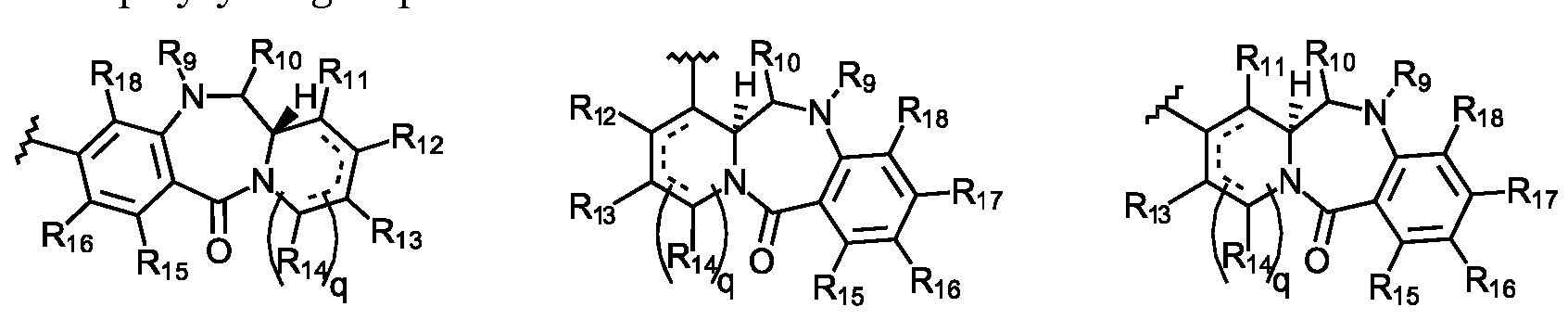
(Bi), (B2) and (B3).
When q is 1, the C-ring is a 6-membered ring that contains the C-R14 group. However, when q is o, the C-R14 group in the brackets is removed and the C-ring is a 5-membered ring.
Suitably, B is a polycyclic group selected from:

(B7), (B8) and (B9).
In some aspects, B is a polycyclic group selected from (B2), (B3) and (B4). Suitably, B selected from (B4), (B6), (B7), (B8) and (B9). Suitably, B is selected from (B4), (B6) and (B8).
In some aspects, B is (Bi). Suitably, (Bi) is selected from:

(Bio) and
More suitably, (Bi) is (Bio).
In some aspect, B is (B2). Suitably, (B2) is selected from:

(B16), (B17) and (B18).
Optional double bonds in the C-ring of group B
The compounds of formula (I) comprise a group B selected from (Bi), (B2) and (B3);

(Bi), (B2) and (B3)
wherein the dotted lines indicate the optional presence of one or more double bonds.
Hence, when q = 1 the compounds of formula (I) may be fully saturated or may optionally have one or two double bonds. When q = 1, if one double bond is present it may be situated between any one of Ci and C2, C2 and C3, and C3 and C4. When q = 1 if two double bonds are present they are situated between Ci and C2, and C3 and C4.
In one aspect, B is (Bi), q is 1 and (Bi) comprises one or more optional double bonds and is selected from (B19), which has a double bond between Ci and C2; (B20), which has a double bond between C2 and C3; (B21), which has a double bond between C3 and C4; and (B22) which has a double bond between Ci and C2 and a second double bond between C3 and C4:

(B19), (B20), (B21) and (B22). In another aspect, B is (B2), q is 1 and (B2) comprises one or more optional double bonds and is selected from:

(B23), (B24), (B25) and (B26). In another aspect, B is (B3), q is 1 and (B3) comprises one or more optional double bonds and is selected from:

(B27), (B28), (B29) and (B30).
Hence, when q = o the compounds of formula (I) may be fully saturated or may optionally have one double bond. When q = o if a double bond is present it is situated between Ci and C2 or C2 and C3.
In another aspect, B is (Bi), q is o and (Bi) comprises an optional double bond and is selected from (B31), which has a double bond between Ci and C2; and (B32), which has a double bond between C2 and C3;

(B31) and (B32).
In another aspect, B is (B2) q is o and (B2) comprises an optional double bond and is selected from:

(B33) and (B34).
In another aspect, B is (B2) q is o and (B2) comprises an optional double bond and is selected from:

In another aspect, B is selected from:

(B37), (B38), (B39) and (B40).
Suitable structures
Suitably the compound of formula (I) is a compound that has the formula (II):

(ID
and salts, solvates and tautomers thereof.
Suitably the compound of formula (II) is a compound that has the formula (III):

(HI)
and salts, solvates and tautomers thereof.
Suitably the compound of formula (II) is a compound that has the formula (IV):


(VI)
and salts, solvates and tautomers thereof.
Suitably the compound of formula (VI) is a compound that has the formula (VII)

Suitably the compound of formula (I) is a compound that has the formula (VIII):

(VIII)
and salts, solvates and tautomers thereof. Suitably the compound of formula (I) is a compound that has the formula (IX):

(IX)
and salts, solvates and tautomers thereof. Suitably the compound of formula (VIII) is a compound that has the formula (X):

(X)
and salts, solvates and tautomers thereof. Suitably the compound of formula (I) is a compound that has the formula (XI):

Suitably the compound of formula (I) is a compound that has the formula (XII):

(XII)
and salts, solvates and tautomers thereof. Suitably the compound of formula (XI) is a compound that has the formula (XIII):

(XIII)
and salts, solvates and tautomers thereof. Suitably the compound of formula (I) is a compound that has the formula (XIV):

(XrV) and salts, solvates and tautomers thereof.
Suitably the compound of formula (I) is a compound that has the formula (XV):
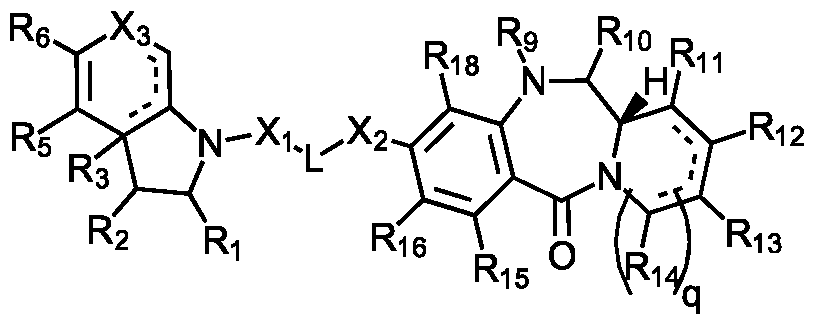
Suitably the compound of formula (I) is a compound that has the formula (XVI):

Suitably the compound of formula (I) is selected from compounds of the formula (II), (III), (IV), (V), (VI), (VII), (VIII), (IX), (X), (XI) (XII), (XIII), (XIV), (XV) and (XVI) and salts, solvates and tautomers thereof.
X3 is selected from C=0; C-OH; and C-R'" wherein R'" is a prodrug moiety containing carbonyl, carbamoyl, glycosyl, O-amino, O-acylamino, para-aminobenzyl ether, peptidyl or phosphate groups. Hence, the C of these groups C=0; C-OH; and C-R'" is a carbon of the ring system of (Ai), (A2), (A3) and (A4) in which X3 appears and the groups =0; -OH; and -R'" are substituent groups attached to the ring carbon. For example, for (Ai) the X3 groups C=0; C-OH; C-0-C(=0)-NR'R"; and C-R'" result in the following structures:

(A61) (A62) and (A63).
Suitably, X3 is selected from C=0 and C-OH.
Suitably, Ri is selected from H, F, CI, Br and I. More suitably, Ri is selected from H and CI. More suitably, Ri is H.
In one aspect, R2 is -CH2-halogen and R3 is H. Suitably in this aspect R2 is selected from -CH2-F, -CH2-C1, -CH2-Br and -CH2-I. More suitably, R2 is selected from -CH2- Cl and -CH2-Br. Most suitably, R2 is-CH2-Cl. In another aspect, R2 is Ci-6 alkyl and R3 is H. Suitably in this aspect, R2 is methyl, ethyl, propyl.
In another aspect, R2 and R3 together with the carbon atoms to which they are attached form a cyclopropyl ring.
Y
In some aspects, Y is selected from N-Ri9, O and S. In these aspects, more suitably Y is selected from N-Ri9 and O. Most suitably, Y is N-Ri9.
Y2
In some aspects, Y2 is selected from C-R6 and N. More suitable Y2 is C-R6.
In some aspects, Y3 is selected from N-Ri9, O and S. In these aspects, more suitably Y3 is selected from N-Ri9 and O. Most suitably, Y3 is N-Ri9.
Y4
Suitably, Y is CH.
Y5 is selected from C=0; C-OH; C-NH2; and C-R'" wherein R'" is a prodrug moiety containing carbonyl, carbamoyl, glycosyl, O-amino, O-acylamino, para-aminobenzyl ether, peptidyl or phosphate groups. Hence, the C of these groups C=0; C-OH; C-NH2; and C-R'" is a carbon of the ring system of (A5) in which Ys appears and the groups =0; -OH; and -R'" are substituent groups attached to the ring carbon. Thus, for (A5) the Ys groups C=0; C-OH; C-NH2; C-0-C(=0)-NR'R"; and C-R'" result in the following structures:

(A64), (A65), (A66), and (A67).
Suitably, Ys is selected C=0; C-OH and C-NH2.
More suitably, Ys is C-OH. γ6
Suitably, Y6 is selected from -(CH2)Z- and a group (Li) that is selected from arylene and monocyclic heteroarylene optionally substituted with up to three independently selected optional R20 groups.
Suitably, Y6 is selected from -(CH2)Z- and a group (Li) that is selected from phenylene, pyridinylene, pyrrolylene, pyridylene, furanylene, thiphenylene optionally substituted with up to three independently selected optional R20 groups. Suitably, Y6 is selected from -CH2-, -CH2-CH2-, -CH2-CH2-CH2-, -CH2-CH2-CH2-CH2-, - CH2-CH2-CH2-CH2-CH2- and a group (Li) that is selected from (L2) and (L3); wherein (L2) and (L3) have the following structures:

(L2) and (L3);
wherein Y? is selected from C-R32 and N;
Y8 is selected from N-R25, O and S; and
R29, R3o, R31 and R33 are independently selected from H and R20.
Suitably, Y6 is selected from -CH2-, -CH2-CH2-, -CH2-CH2-CH2-, -CH2-CH2-CH2-CH2-, - CH2-CH2-CH2-CH2-CH2- and a group (Li) that is selected from (L4) and (L5); wherein (L3) and (L4) have the following structures:

(L4) and (L5). Suitably, Y6 is selected from -CH2-, -CH2-CH2-, -CH2-CH2-CH2-, -CH2-CH2-CH2-CH2-, - CH2-CH2-CH2-CH2-CH2- and a group (Li) that has the following structure:

(L6).
Suitably, Y6 is selected from -CH2-, -CH2-CH2-, -CH2-CH2-CH2-, -CH2-CH2-CH2-CH2-, - CH2-CH2-CH2-CH2-CH2- and a group the following structure (L7):

(L7).
Y7 is selected from C-R25 and N.
In one aspect, Y7 is C-R25; suitably, Y7 is CH. In another aspect, Y7 is N.
Y8
Y8 is selected from N-R25, O and S.
Suitably, Y8 is N-R25; more suitably, Y8 is selected from N-H and N-CH3.

In the aspects where one of R4 and R5, R5 and R6, or R6 and R7 together with the carbon atoms to which they are attached form a 6-membered aryl, or a 5- or 6-membered cyclic, heterocyclic, or heteroaryl ring optionally substituted with up to three independently selected optional R20 groups, groups (A1HA5) contain a further fused ring (not drawn). In these aspects, then the remaining groups (from R4, R5, R6 and R7) that do not form the further fused ring are each independently selected from the normal specified list of groups, i.e. from H and R20. For example, where A is (Ai), p is 1 and R5 and R6 together with the carbon atoms to which they are attached form a 6- membered aryl ring the structure of the group A can be shown as follows:

(Α57)·
Groups R4 and R7 do not form the further fused ring and so are each independently selected from the normal specified list of groups for R4, R5, R6 and R7, i.e. from H and R20.. In addition, the H groups shown on the further fused ring of (A57) may be optionally substituted with up to three independently selected optional R20 groups.
Rs
Suitably, Rs is selected from H and R20.
Suitably, R9 and Ri0 together form a double bond. In one aspect (ii), R9 is H and Ri0 is OH.
In another aspect (iii), suitably R9 is H and Ri0 is OCH3 or OCH2CH3.
In another aspect (iv), suitably R9 is selected from OH, S03H, nitrogen protecting groups, methyl, ethyl, OCH3, OCH2CH3, 0CH2Ph, (CH2)s-C02H, (CH2)s-C02CH3, (CH2)s-C02CH2CH3, 0-(CH2)t-NH2, 0-(CH2)t-NH-CH3, (CH2)S-NH2, (CH2)S-NH-CH3,
C(=0)-NH-(CH2)t-NH2, C(=0)-NH-(CH2)t-NH-CH3, C(=0)-NH-C6H4-(CH2)s-H, C(=0)- NH-(CH2)t-C(=NH)NH2 and C(=0)-NH-(CH2)t-C(=NH)NH-CH3 and R10 is H. More suitably in this aspect (iv), R9 is selected from OH, S03H, methyl, ethyl, OCH3,
OCH2CH3, C02H, C02CH3, C02CH2CH3, 0-(CH2)t-NH2 and (CH2)S-NH2 and R10 is H.
In some aspects, R9 is S03H and the compound of formula (I) is a salt thereof. Suitably, in this aspect, R9 is S03H and the compound of formula (I) is an alkali metal salt thereof (AM)+; hence, in this aspect, R9 maybe written as S03 ~(AM)+. Suitably, R9 is S03H and the compound of formula (I) is an alkali metal salt thereof chosen from Li+, Na+ and K+. More suitably, R9 is S03H and the compound of formula (I) is a Na+ salt thereof; hence, in this aspect, R9 may be written as S03 ~Na+.
For the options where any of Rn, Ri2, Ri3 and Ri4 are each independently selected from =CH2, =CH-(CH2)s-CH3,
 and =0, the carbon of the C-ring to which it is attached cannot have an optional double bond in order for the valence requirements of the molecule to be met. For example, if B is (Bi) and Rn is =CH2 and is positioned at the Ci position of the C-ring adjacent to the fused carbon of the C-ring, and Ri2 and Ri3 are each H then the resulting B g nted as:

In the aspects where one of Rn and Ri2, Ri2 and Ri3, or Ri3 and Ri4 together with the carbon atoms to which they are attached form a 6-membered aryl, or a 5- or 6- membered cyclic, heterocyclic, or heteroaryl ring optionally substituted with up to three optional substituent groups, groups (B1HB3) contain a further fused ring (not drawn). In these aspects, then the remaining groups (from Rn, Ri2, Ri3 and Ri4) that do not form the further fused ring are each independently selected from the normal specified list of groups, i.e. from H, R20, R25, =CH2, =CH-(CH2)S-CH3, =CH-(CH2)S-R25, =0, (CH2)S- OR25, (CH2)s-C02R25, (CH2)s-NR25R26, 0-(CH2)t-NR25R26, NH-C(0)-R25, 0-(CH2)t-NH- C(0)-R25, 0-(CH2)t-C(0)-NH-R25, (CH2)s-S02R25, 0-S02R25, (CH2)s-C(0)R25 and (CH2)S- C(0)NR25R26. For example, where B is (Bi), q is 1 and Ri3 and Ri4 together with the carbon atoms to which they are attached form a 6-membered aryl ring the structure of the group B can be shown as foll
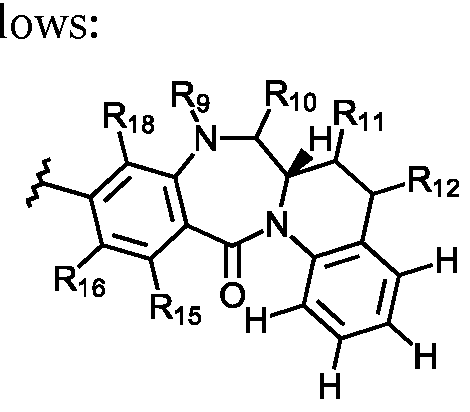
(B42). More suitably, in such aspect

(B43);
wherein qi is o, 1, 2 or 3.
Hence, there may be o, 1, 2 or 3 optional independently selected R20 groups present on the aromatic ring in (B43). More suitably qi is o or 1. In a more suitable aspect, B is (Bi) and is (Bio), (B11) or (B43).
Groups R11 and Ri2 do not form the further fused ring and so are each independently selected from the normal specified list of groups for Rn, Ri2, Ri3 and Ri4. In addition, the H groups shown on the further fused ring of (B42) may be substituted with up to three independently selected optional R20 groups.
Suitably, where one of Rn and Ri2, Ri2 and Ri3, or Ri3 and Ri4 together with the carbon atoms to which they are attached form an optionally substituted 5- or 6-membered heterocyclic or heteroaryl ring the heterocyclic or heteroaryl ring comprises one nitrogen atom.
Suitably, Rn, Ri2, Ri3 and Ri4 are each independently selected from H, R20, R25, =CH- (CH2)s-R25, (CH2)s-OR25, (CH2)s-C02R25, (CH2)S-NR25R26, 0-(CH2)t-NR25R26, NH-C(O)- R25, 0-(CH2)t-NH-C(0)-R25, 0-(CH2)t-C(0)-NH-R25, (CH2)s-S02R25, 0-S02R25, (CH2)S- C(0)R25, (CH2)s-C(0)NR25R26;
or one of Rn and Ri2, Ri2 and Ri3, or Ri3 and Ri4 together with the carbon atoms to which they are attached form a 6-membered aryl, or a 5- or 6-membered cyclic, heterocyclic, or heteroaryl ring optionally substituted with up to three independently selected optional R20 groups.
Suitably, Rn, Ri2, Ri3 and Ri4 are each independently selected from H, R20, R25, (CH2)S- OR25, (CH2)s-C02R25, (CH2)s-NR25R26, 0-(CH2)t-NR25R26, NH-C(0)-R25, 0-(CH2)t-NH- C(0)-R25, 0-(CH2)t-C(0)-NH-R25, (CH2)s-C(0)R25 and (CH2)s-C(0)NR25R26;
or one of Rn and Ri2, Ri2 and Ri3, or Ri3 and Ri4 together with the carbon atoms to which they are attached form a 6-membered aryl, or a 5- or 6-membered cyclic, heterocyclic, or heteroaryl ring optionally substituted with up to three independently selected optional R20 groups.
Suitably at least one of R , Ri2, Ri3 and Ri4 is H. Suitably, Rn is H.
Suitably, R 12 is H. Suitably, Ri3 is H. Suitably, Ri4 is H. R1¾. R1fi. R17 and R18
Suitably, Ri5, Ri6 Ri7 and Ri8 are each independently selected from H and R20. Suitably, Ri5, Ri6 Ri7 and Ri8 are each independently selected from H, (CH2)j-0H, methyl, ethyl, OCH3, OCH2CH3, 0CH2Ph, C02H, C02CH3, C02CH2CH3, 0-(CH2)t-NH2 and (CH2)s-NH2.
More suitably, Ri5, Ri6 Ri7 and Ri8 are each independently selected from H, (CH2)j-0H, OCH3, OCH2CH3, 0CH2Ph and (CH2)S-NH2.
More suitably, Ri5 is H.
More suitably, Ri6 is OCH3.
More suitably, Ri7 is OCH3.
More suitably, Ri8 is H. RIQ. R91. R99. Rp3. R94. Rpfi. Rp and R?s
Suitably each Rig, R2i, R22, R23, R24, R26, R27 and R28 is independently selected from H, methyl, ethyl, n-propyl, i-propyl, n-butyl, s-butyl, i-butyl and t-butyl.
Suitably each Rig, R2i, R22, R23, R24, R26, R27 and R2s is independently selected from H, methyl, and ethyl. More suitably each Rig, R2i, R22, R23, R24, R26, R27 and R2s is independently selected from H and methyl.
Rao
Suitably, each R20 is independently selected from (CH2)j-0H, methyl, ethyl, OCH3, OCH2CH3, 0CH2Ph, (CH2)j-C02R27, 0-(CH2)k-NR27R28, (CH2)j-NR27R28, C(=0)-NH-
 Suitably, each R20 is independently selected from (CH2)j-0H, methyl, ethyl, OCH3, OCH2CH3, 0CH2Ph, (CH2)j-C02H, (CH2)j-C02CH3, (CH2)j-C02CH2CH3, 0-(CH2)k-NH2, 0-(CH2)k-NH-CH3, (CH2)j-NH2, (CH2)j-NH-CH3, C(=0)-NH-(CH2)k-NH2, C(=0)-NH- (CH2)k-NH-CH3, C(=0)-NH-C6H4-(CH2)j-H, C(=0)-NH-(CH2)k-C(=NH)NH2 and C(=0)-NH-(CH2)k-C(=NH)NH-CH3.
More suitably, each R20 is independently selected from (CH2)j-0H, methyl, ethyl, OCH3, OCH2CH3, C02H, C02CH3, C02CH2CH3, 0-(CH2)k-NH2 and (CH2)j-NH2. Suitably, one R20 group is selected from 0-(CH2)k-NR27R28, (CH2)j-NR27R28, C(=0)-NH-

and the remaining R20 groups are each independently selected from (CH2)j-0H, Ci-6 alkyl, Od-6 alkyl, 0CH2Ph and (CH2)rC02R27. More suitably, one R20 group is selected from 0-(CH2)k-NH2, 0-(CH2)k-NH-CH3, (CH2)j-NH2, (CH2)j-NH-CH3, C(=0)-NH-(CH2)k-NH2, C(=0)-NH-(CH2)k-NH-CH3, C(=0)-NH-C6H4-(CH2)j-H, C(=0)-NH-(CH2)k-C(=NH)NH2 and C(=0)-NH-(CH2)k- C(=NH)NH-CH3; and the remaining R20 groups are each independently selected from (CH2)j-0H, methyl, ethyl, OCH3, OCH2CH3, 0CH2Ph, (CH2)j-C02H, (CH2) C02CH3 and

More suitably, one R20 group is selected from 0-(CH2)k-NH2 and (CH2)j-NH2; and the remaining R20 groups are each independently selected from (CH2)j-0H, methyl, ethyl, OCH3, OCH2CH3, C02H, C02CH3, C02CH2CH3.
Raa
Suitably R25 is selected from C5-9 heteroaryl, Ce heteroarylalkyl, phenyl, benzyl and phenethyl; wherein the heteroaryl, heteroarylalkyl, phenyl and aralkyl groups are optionally substituted with up to three independently selected optional R20 groups.
Suitably R25 is selected from H, Ci alkyl, N-methylpyrrolyl, furanyl, thiophenyl, N- methylimidazolyl, oxazolyl, thiazolyl, pyridyl, indolyl, N-methylindolyl, benzofuranyl, benzothiophenyl, benzimidazolyl, N-methylbenzoimidazolyl, benzooxazolyl, benzothiazolyl, pyrrol-3-ylmethyl, pyrrol-4-ylmethyl, imidazol-2-ylmethyl, imidazol-4- ylmethyl, thiophen-3-ylmethyl, furan-3-ylmethyl, phenyl, benzyl and phenethyl;
wherein the heteroaryl, heteroarylalkyl, phenyl and aralkyl groups are optionally substituted with up to three independently selected optional R20 groups.
Suitably R25 is selected from H, Ci-6 alkyl, N-methylpyrrolyl, furanyl, thiophenyl, N- methylimidazolyl, oxazolyl, thiazolyl, pyridyl, indolyl, N-methylindolyl, benzofuranyl, benzothiophenyl, benzimidazolyl, N-methylbenzoimidazolyl, benzooxazolyl, benzothiazolyl, pyrrol-3-ylmethyl, pyrrol-4-ylmethyl, imidazol-2-ylmethyl, imidazol-4- ylmethyl, thiophen-3-ylmethyl, furan-3-ylmethyl, phenyl, benzyl and phenethyl;
wherein the heteroaryl, heteroarylalkyl, phenyl and aralkyl groups are optionally substituted with up to three independently selected optional R20 groups.
Suitably R25 is selected from H, methyl, ethyl, n-propyl, i-propyl, n-butyl, s-butyl, i- butyl, t-butyl, N-methylpyrrolyl, furanyl, thiophenyl, N-methylimidazolyl, oxazolyl, thiazolyl, pyridyl, indolyl, N-methylindolyl, benzofuranyl, benzothiophenyl,
benzimidazolyl, N-methylbenzoimidazolyl, benzooxazolyl, benzothiazolyl, pyrrol-3- ylmethyl, pyrrol-4-ylmethyl, imidazol-2-ylmethyl, imidazol-4-ylmethyl, thiophen-3- ylmethyl, furan-3-ylmethyl, phenyl, benzyl and phenethyl optionally substituted with up to three independently selected optional R20 groups.
Suitably R25 is selected from H, methyl, ethyl, n-propyl, i-propyl, n-butyl, s-butyl, i- butyl, t-butyl, N-methylpyrrolyl, furanyl, thiophenyl, N-methylimidazolyl, oxazolyl, thiazolyl, pyridyl, indolyl, N-methylindolyl, benzofuranyl, benzothiophenyl,
benzimidazolyl, N-methylbenzoimidazolyl, benzooxazolyl, benzothiazolyl, phenyl, benzyl and phenethyl optionally substituted with up to three independently selected optional R20 groups .
In some embodiments, R25 is selected from H, methyl, ethyl, n-propyl, i-propyl, n-butyl, s-butyl, i-butyl, t-butyl.

R2G, R3o, R3i and R32 are each independently selected from H and R20.
Suitably, R2G, R30, R31 and R32 are each independently selected from H, (CH2)j-0H, methyl, ethyl, OCH3, OCH2CH3, 0CH2Ph, C02H, C02CH3, C02CH2CH3, 0-(CH2)t-NH2 and (CH2)s-NH2.
More suitably, R2G, R30, R31 and R32 are each independently selected from H, (CH2)j-0H, OCH3, OCH2CH3, 0CH2Ph and (CH2)S-NH2.
More suitably, R2g is H.
More suitably, R30 is H. More suitably, R3i is H. More suitably, R32 is H.
In some aspects, one of R2g, R30, R3i and R32 is selected from 0-(CH2)k-NR27R28, (CH2)j-

(CH2)k-C(=NH)NR27R28; and the remaining of R2g, R3o> R3i and R32 are each
independently selected from H, OH, α_6 alkyl, Od-6 alkyl, 0CH2Ph and (CH2)rC02R27.
In some aspects, one of R2g, R30, R3i and R32 is selected from 0-(CH2)g-NR26R27, (CH2)f- NR26R27, C(=0)-NH-(CH2)g-NR26R27, C(=0)-NH-C6H4-(CH2)f-R2o and C(=0)-NH- (CH2)g-C(=NH)NR26R27; and the remaining of R2g, R3o> R3i and R32 are H.
Rq i, Rqd and R^
R33, R34 and R35 are each independently selected from H and R20.
Suitably, R33, R34 and R35 are each independently selected from H, (CH2)j-0H, methyl, ethyl, OCH3, OCH2CH3, 0CH2Ph, C02H, C02CH3, C02CH2CH3, 0-(CH2)t-NH2 and
 More suitably, R33, R34 and R35 are each independently selected from H, (CH2)j-0H, OCH3, OCH2CH3, 0CH2Ph and (CH2)S-NH2.
More suitably, R33 is H. More suitably, R34 is H.
More suitably, R35 is H.
In some aspects, one of R33, R34 and R35 is selected from 0-(CH2)k-NR27R28, (CH2)j-

(CH2)k-C(=NH)NR27R28; and the remaining of R33, R34 and R35 are each independently selected from H, (CH2) 0H, d-6 alkyl, Od-6 alkyl, 0CH2Ph and (CH2)j-C02R27.
In some aspects, one of R33, R34 and R35 is selected from 0-(CH2)g-NR26R27, (CH2)f- NR26R27, C(=0)-NH-(CH2)g-NR26R27, C(=0)-NH-C6H4-(CH2)f-R20 and C(=0)-NH- (CH2)g-C(=NH)NR26R27; and the remaining of R33, R34 and R35 are H.
Combinations
Suitably, when Y6 is -(CH2)Z- at least one of R4, R5, R6, R7, Rs, Rg? Rn, Ri2, Ri3, Ri4, R15, R16, Ri7 and R18 is selected from H, Ci-6 alkyl, OCi-6 alkyl and 0CH2Ph; suitably, at least two, three, four, five, six, seven, eight, nine, ten or eleven of R4, R5, R6, R7, Rs, Rg, Ru, Ri2, Ri3, R14, R15, R16, Ri7 and R18 are selected from H, Ci-6 alkyl, OCi-6 alkyl and 0CH2Ph.
Suitably, when Y6 is -(CH2)Z- at least one of R4, R5, R6, R7, Rs, Rg, Ru, Ri2, Ri3, Ri4, R15, R16, Ri7 and Ris is H; suitably, at least two, three, four, five, six, seven, eight, nine, ten or eleven of R5, R6, Rs, Rg, Rn, R12, Ri3, R16 and Ri7 are H.
In some aspects, suitably, when Y6 is -(CH2) z" one of R4, R5, R6, R7, Rs, Rg, Ru, Ri2, Ri3, R14, R15, Rl6, Ri7 and Rl8 is selected from OH, (CH2)j-C02R27, 0-(CH2)k-NR27R28, (CH2)

(CH2)k-C(=NH)NR27R28. Suitably the remaining of R4, R5, R6, R7, Rs, R9, Rn, Ri2, Ri3, Ri4, R15, R16, Ri7 and Ris are selected from H, Ci-6 alkyl, OCi-6 alkyl and 0CH2Ph.
Suitably, when Y6 is (Li) at least one of R4, R5, R6, R7, Rs, Rg, Rn, Ri2, Ri3, Ri4, R15, R16, Ri7, Ris, R2g, R3o, R3i and R32 is selected from H, Ci-6 alkyl, OCi-6 alkyl and 0CH2Ph; suitably, at least two, three, five, six, seven, eight, nine, ten, eleven, twelve, thirteen or fourteen of R , R5, R6, R7, Rs, Rg, Rn, R12, Ri3, Ri4, R15, R16, R17, R18, R2g, R3o, R3i and R32 are selected from H, Ci-6 alkyl, OCi-6 alkyl and 0CH2Ph.
Suitably, when Y6 is (Li) at least one of R4, R5, R6, R7, Rs, Rg, Rn, Ri2, Ri3, Ri4, R15, R16, Ri7, Ris, R2g, R3o, R31 and R32 is H; suitably, at least two, three, five, six, seven, eight, nine, ten , eleven, twelve, thirteen or fourteen of R4, R5, R6, R7, Rs, R9, Rn, Ri2, Ri3, Ri4, Ri5, R16, Ri7, Ris, R2g, R3o, R31 and R32 are H.
In some aspects, suitably, when Y6 is (Li) one R4, R5, R6, R7, Rs, Rg, Rn, R12, Ri3, Ri4, Ri5, Rl6, Ri7, Ris, R29, R3o, R3i and R32 is selected from OH, (CH2)j-C02R27, 0-(CH2)k- NR27R2s, (CH2)j-NR27R28,
 and C(=0)-NH-(CH2)k-C(=NH)NR27R28. Suitably the remaining of R4, R5, R6, R7, Rs, Rg,
Rii, Ri2, R13, R14, R15, R16, R17, R18, R29, R3o, R31 and R32 are selected from H, Ci-6 alkyl, Od-6 alkyl and 0CH2Ph.
and C(=0)-NH-(CH2)k-C(=NH)NR27R28. Suitably the remaining of R4, R5, R6, R7, Rs, Rg,
Rii, Ri2, R13, R14, R15, R16, R17, R18, R29, R3o, R31 and R32 are selected from H, Ci-6 alkyl, Od-6 alkyl and 0CH2Ph.
In some aspects, the compound of formula (I) and salts, solvates and tautomers thereof are selected with the proviso that Y6 is a group (Li) when A, B, p and q are selected as (Ai), (Bi), 1 and o respectively.
In some aspects, the compound of formula (I) and salts, solvates and tautomers thereof are selected with the proviso that Y6 is a group (Li) when A is selected from (Ai), (A2) and (A3); and B, h, p and q are (Bi), o, 1 and o respectively. Suitably in this aspect, Y6 is selected from monocyclic heteroarylene, monocyclic cycloalkylene, monocyclic cycloalkenylene and monocyclic heterocyclylene groups optionally substituted with up to three independently selected optional R20 groups. ΒΔ
Suitably, each RA is independently selected from -het- and -X^'P-X^.
Suitably, each RB is independently selected from H and Ci-8 alkyl. More suitably, each RB is independently selected from H and Ci-6 alkyl. More suitably, each RB is independently selected from H, methyl, ethyl, propyl and butyl.
R£
Suitably, each Rc is independently selected from H and &-8 alkyl. More suitably, each Rc is independently selected from H and &-6 alkyl. More suitably, each Rc is independently selected from H, methyl, ethyl, propyl and butyl.
V
Suitably, each T1 is selected from -C(O), -C(0)(CH2)0-20C(0)-, -C(0)PhC(0 . Suitably, each T1 is selected from -C(O), -C(0)(CH2)0-i0C(0)-, -C(0)PhC(0 . Suitably, each T1 is selected from -C(O), -C(0)(CH2)0-5C(0)-, -C(0)PhC(0 . Suitably, each T1 is selected from -C(O), -C(0)C(0 , -C(0)(CH2)C(0)-, -C(0)(CH2)2C(0)-, -C(0)(CH2)3C(0)-, - C(0)(CH2)4C(0)-, -C(0)PhC(0)-. 2^
Suitably, each XA is independently selected from a bond, -NH-, -N(Ci-8 alkyl)- and -0-.
het
Suitably, het is a mono-, bi-, or tricyclic heteroarylene of 5 to 10 members, suitably, 5 to 9 members. Suitably, het is a mono-, bi-, or tricyclic heteroarylene containing one or two, heteroatoms independently selected from O, N, S, P and B.
Suitably, het is a mono- or bicyclic heteroarylene of 5 to 12 members. Suitably, mono-, bi-, or tricyclic heteroarylene containing one, two, or there
heteroatoms independently selected from O, N and S.
Suitably het is substituted with up to three independently selected optional R20 groups. f
Suitably, each f is an integer independently selected from o to 40; suitably
independently selected from o to 30; suitably, from o to 20; suitably, from o to 10; suitably, from o to 9; suitably, from o to 8; suitably, from o to 7; suitably, from o to 6; suitably, from o to 5; suitably, from o to 4; suitably, from o to 3; suitably, from o to 2; suitably, from o to 1. g
Suitably, each g is an integer independently selected from o to 40; suitably
independently selected from o to 30; suitably, from o to 20; suitably, from o to 10; suitably, from o to 9; suitably, from o to 8; suitably, from o to 7; suitably, from o to 6; suitably, from o to 5; suitably, from o to 4; suitably, from o to 3; suitably, from o to 2; suitably, from o to 1. h
In some aspects, h is 1. In other aspects, h is o. Suitably, h is o. j
Each j is an integer independently selected from o to 6; that is each j is independently selected from o, 1, 2, 3, 4, 5 and 6.
Suitably, each j is an integer independently selected from o to 5; suitably independently selected from o to 4; suitably independently selected from o to 3; suitably
independently selected from o to 2; suitably independently selected from o to 1. In some aspects, j is o. k
Each k is an integer independently selected from 1 to 6; that is each k is independently selected from 1, 2, 3, 4, 5 and 6.
Suitably, each k is an integer independently selected from 1 to 5; suitably independently selected from 1 to 4; suitably independently selected from 1 to 3; suitably independently selected from 1 to 2. In some aspects, k is 1.
IB
m is an integer selected from o to 12; that is m is selected from o, 1, 2, 3, 4, 5, 6, 7, 8, 9, 10, 11 and 12.
Suitably, m is an integer selected from o to 11; suitably selected from o to 10; suitably selected from o to 9; suitably selected from o to 8; suitably selected from o to 7;
suitably selected from o to 6; suitably selected from o to 5; suitably selected from o to 4; suitably selected from o to 3; suitably selected from o to 2; suitably selected from o to 1.
In some aspects, m is o. n
n is an integer selected from o to 12; that is n is selected from o, 1, 2, 3, 4, 5, 6, 7, 8, 9, 10, 11 and 12.
Suitably, n is an integer selected from o to 11; suitably selected from o to 10; suitably selected from o to 9; suitably selected from o to 8; suitably selected from o to 7;
suitably selected from o to 6; suitably selected from o to 5; suitably selected from o to 4; suitably selected from o to 3; suitably selected from o to 2; suitably selected from o to 1.
In some aspects, n is 1.
E
In some aspects, p is 1. In other aspects, p is o. Suitably, p is o. a
In some aspects, q is 1. In other aspects, q is o. Suitably, q is 1. s
Each s is an integer independently selected from o to 6; that is each s is independently selected from o, l, 2, 3, 4, 5 and 6.
Suitably, each s is an integer independently selected from o to 5; suitably
independently selected from o to 4; suitably independently selected from o to 3;
suitably independently selected from o to 2; suitably independently selected from o to 1.
In some aspects, s is o. t
Each t is an integer independently selected from 1 to 6; that is each t is independently selected from 1, 2, 3, 4, 5 and 6. Suitably, each t is an integer independently selected from 1 to 5; suitably independently selected from 1 to 4; suitably independently selected from 1 to 3; suitably independently selected from 1 to 2.
In some aspects, t is 1. w
Suitably, each w is an integer independently selected from 1 to 40; suitably
independently selected from 1 to 30; suitably, from 1 to 20; suitably, from 1 to 10; suitably, from 1 to 9; suitably, from 1 to 8; suitably, from 1 to 7; suitably, from 1 to 6; suitably, from 1 to 5; suitably, from 1 to 4; suitably, from 1 to 3; suitably, from 1 to 2. Suitably, w is 1.
z
Each z is an integer selected from 1 to 5; that is z is selected from 1, 2, 3, 4 and 5.
Suitably, z is an integer selected from 1 to 4; suitably selected from 1 to 3; suitably selected from 1 to 2.
In some aspects, z is 1.
Prodrug Moiety R'"
A prodrug moiety is a masked form of an active drug that needs to be transformed before exhibiting its pharmacological action. Typically, such moieties are designed to be activated after an enzymatic or chemical reaction once they have been administered into the body. Activation of prodrugs typically involves the elimination of the prodrug moiety to release the drug. Prodrugs are considered to be inactive or at least significantly less active than the released drugs.
Several prodrug moieties are known for group A, such as CPI or CBI groups, in compounds of formula (I). In particular, prodrug moieties containing carbonyl, carbamoyl, glycosyl, O-amino, O-acylamino, para-aminobenzyl ether, peptidyl or phosphate groups have been reported in Wolff, I., et al, Clin. Cancer Res. 1996, 2,
1717-1723; Wang, Y., et al, Bioorg. Med. Chem. 2006, 14, 7854-7861; Tietze, L. F., et al, J. Med. Chem. 2009, 52, 537-543; Jin, W., et al, J. Am. Chem.Soc. 2007, 129, 15391-15397; Jeffrey, et al,. J. Med. Chem. 2005, 48, 1344-1358; Boger, D. L., et al, Synthesis 1999, 1505-1509; Tercel, M., et al,. J. Org. Chem. 1999, 64, 5946-5953; Nagamura, S., et al, Bioorg. Med. Chem.1997, 5, 623 630; and Zhao, R. Y. et al, J. Med. Chem. 2011, 55, 766-782.
Suitably, the prodrug moiety R'" is selected from -0-NHRig, -0-NRigBoc, P(0)(0H)2, - -NHS02Rig, -0-C(=0)-NR'R", -0-NHC(0)C(CH3)3, -0-NHC02Rig, -NHC0NH2, -O-

Hence, the -[AA]2-i2- is a peptide group consisting of 2, 3, 4, 5, 6, 7, 8, 9, 10, 11 or 12 amino acid units. Suitably, this peptide group consist of 2, 3, 4, 5, 6, 7 or 8 amino acid units.
More suitably, the prodrug moiety R'" is selected from -0-NH2, -O-NHCH3,
-0-P(0)(0H)2, -O-NHBoc, -0-NCH3Boc, -0-NHS02CH3,

More suitably, the prodrug moiety is:

R' and R"
Suitably, R' and R" together with the nitrogen to which they are attached form a 6- membered heterocyclic ring optionally substituted with 1, 2 or 3 Ci-6 alkyl groups. together with the nitrogen to which they are attached form:
 More suitably, R' and R" together with the nitrogen to which they are attached form:

Other As ects
In some aspects, the compound of formula (I) is selected with the proviso that when the compound is:

at least one of Rn, Ri2 and Ri3 is independently selected from C5-9 heteroaryl, C6-i5 heteroarylalkyl, phenyl and C7-i2 aralkyl groups and these groups are optionally substituted with up to three independently selected optional R20 groups. In such aspect, the remain groups of Rn, Ri2 and Ri3 that are not selected from C5-9 heteroaryl, C6-15 heteroarylalkyl, phenyl and C7-i2 aralkyl groups, are selected from the normal specified list of substituents, i.e. they are independently selected from H, R20, R25, =CH2, =CH-(CH2)s-CH3, =CH-(CH2)s-R25, =0, (CH2)s-OR25, (CH2)s-C02R25, (CH2)S- NR25R26, 0-(CH2)t-NR25R26, NH-C(0)-R25, 0-(CH2)t-NH-C(0)-R25, 0-(CH2)t-C(0)-NH- R25, (CH2)s-S02R25, 0-S02R25, (CH2)s-C(0)R25 and (CH2)s-C(0)NR25R26; or one of Rn and Ri2, Ri2 and Ri3, or Ri3 and Ri4 together with the carbon atoms to which they are attached form a 6-membered aryl, or a 5- or 6-membered cyclic, heterocyclic, or heteroaryl ring optionally substituted with up to three independently selected optional R20 groups.
In some aspects, the compound of formula (I) is selected with the proviso that when the compound is:

that one of Rn and Ri2 or Ri2 and Ri3, or Ri3 together with the carbon atoms to which they are attached form a 6-membered aryl, or a 5- or 6-membered cyclic, heterocyclic, or heteroaryl ring optionally substituted with up to three independently selected
optional R20 groups. In such aspects, the PBD moiety comprises a further fused ring and the remaining group out of Rn, Ri2 and Ri3 that does not form part of this further fused ring is selected from the normal specified list of substituents, i.e. from H, R20, R25, =CH2, =CH-(CH2)s-CH3, =CH-(CH2)s-R25, =0, (CH2)s-OR25, (CH2)s-C02R25, (CH2)S- NR25R26, 0-(CH2)t-NR25R26, NH-C(0)-R25, 0-(CH2)t-NH-C(0)-R25, 0-(CH2)t-C(0)-NH- R25, (CH2)s-S02R25, 0-S02R25, (CH2)s-C(0)R25 and (CH2)s-C(0)NR25R26.
In some aspects, the compound of formula (I) is selected with the proviso that R5 and R6 are each independently selected from H and R20 when B, q and A are selected as (Bi), o and (A4) respectively, hence, in these aspects when the compound of formula (I) has the following structure

that R5 and R6 are each independently selected from H and R2< Suitably, the compounds of formula (I) and salts, solvates and tautomers thereof are selected with the proviso that at least one of Rn, Ri2 and Ri3 is independently selected from C5-9 heteroaryl, 06-ι5 heteroarylalkyl, phenyl and C7-i2 aralkyl groups and these groups are optionally substituted with up to three independently selected optional R20 groups when B, q, A, p and h are selected as (Bi), o, (Ai), 1 and o respectively; and with the proviso that R5 and R6 are each independently selected from H and R20 when B, q and A are selected as (Bi), o and (A4) respectively.
Suitably, the compounds of formula (I) and salts, solvates and tautomers thereof are selected with the proviso that either p is o or h is 1 when B, q and A are selected as (Bi), o, (Ai), 1 and o respectively; and with the proviso that R5 and R6 are each
independently selected from H and R20 when B, q and A are selected as (Bi), o and (A4) respectively.
Suitably, the compounds of formula (I) and salts, solvates and tautomers thereof are selected with the proviso that A is selected from (A2), (A3), (A4) and (A5) when B, q and A are selected as (Bi), o, (Ai), 1 and o respectively; and with the proviso that R5 and R6 are each independently selected from H and R20 when B, q and A are selected as (Bi), o and (A4) respectively.
In some aspects, the compound of formula (I) is selected with the proviso that when R2 is Ci-6 alkyl that Rg and Ri0 are selected from options (i), (ii), (iii) or (iv). When R2 is Ci- 6 alkyl then the moiety A of the compound of formula (I) will not alkylate DNA. In such aspects, the options for Rg and Ri0 are limited to those that ensure that the moiety B of the compound of formula (I) does alkylate with DNA. Examples of compounds that fall within this proviso are:

In some aspects, the compound of formula (I) is selected with the proviso that when (v) Rg is H or Ci-6 alkyl, and Ri0 is oxo or H; then either R2 is selected from -CH2-halogen and H, and R3 is H; or R2 and R3 together with the carbon atoms to which they are attached form a cyclopropyl ring. When option (v) applies then the moiety B of the compound of formula (I) will not alkylate DNA. In such aspects, the options for R2 are limited to those that ensure that the moiety A of the compound of formula (I) does alkylate with DNA. Examples of compounds that fall within this proviso are shown below:

In the top compound R9 is H, Ri0 is H; and R2 is-CH2-Cl. In the bottom compound, R< is H, Rio is oxo and R2 is-CH2-Cl.
Applications
In some aspects, the present invention relates to a compound of formula (I) and salts, solvates and tautomers thereof, for use as a drug in an antibody-drug conjugate.
Suitably, a compound of formula (I) and salts, solvates and tautomers thereof, for use as a drug in an antibody-drug conjugate by attaching to an antibody or an antibody fragment via an optional linker group. Suitably, the compound of formula (I) and salts, solvates and tautomers thereof, is attached to an antibody or an antibody fragment via a linker group. Suitably, the antibody-drug conjugate is for use in for treatment of a disease, more specifically of a proliferative disease. In some aspects, the present invention relates to the use of a compound of formula (I) and salts, solvates and tautomers thereof, as a drug in an antibody-drug conjugate. Suitably, the use of a compound of formula (I) and salts, solvates and tautomers thereof, as a drug in an antibody-drug conjugate by attaching to an antibody or an antibody fragment via an optional linker group. Suitably, the compound of formula (I) and salts, solvates and tautomers thereof, is attached to an antibody or an antibody fragment via a linker group. Suitably, the antibody-drug conjugate is for use in for treatment of a disease, more specifically of a proliferative disease. Suitably, the drug may be attached by any suitable functional group that it contains to the antibody or antibody fragment optionally via a linker group. Typically, the drug contains one or more functional groups such as amine, hydroxyl or carboxylic acid groups for attaching the drug to the antibody or antibody fragment optionally via a linker group.
The invention finds application in the treatment of disease, more specifically of a proliferative disease.
The term "proliferative disease" refers to an unwanted or uncontrolled cellular proliferation of excessive or abnormal cells which is undesired, such as, neoplastic or hyperplastic growth, whether in vitro or in vivo. Examples of proliferative conditions include, but are not limited to, benign, pre-malignant, and malignant cellular proliferation, including but not limited to, neoplasms and tumours (e.g. histocytoma, glioma, astrocyoma, osteoma), cancers (e.g. lung cancer, small cell lung cancer, hepatocellular cancer, gastric or stomach cancer including gastrointestinal cancer, bowel cancer, colon cancer, hepatoma, breast cancer, glioblastoma, cervical cancer, ovarian cancer, oesophageal [or esophageal] cancer, oral cancer, prostate cancer, testicular cancer, liver cancer, rectal cancer, colorectal cancer, endometrial or uterine carcinoma, uterine cancer, salivary gland carcinoma, kidney or renal cancer, prostate cancer, vulval cancer, thyroid cancer, hepatic carcinoma, anal carcinoma, penile
carcinoma, head and neck cancer, bladder cancer, pancreas cancer, brain cancer, sarcoma, osteosarcoma, Kaposi's sarcoma, melanoma), leukemias, psoriasis, bone diseases, fibroproliferative disorders (e.g. of connective tissues), and atherosclerosis. Suitably the proliferative disease is selected from bladder cancer, bone cancer, bowel cancer, brain cancer, breast cancer, cervical cancer, colon cancer, head and neck cancer, leukemia, liver cancer, lung cancer, lymphoma, melanoma, oesophageal cancer, oral cancer, ovarian cancer, pancreatic cancer, prostate cancer, rectal cancer, renal cancer, retinoblastoma, sarcoma, skin cancer, stomach cancer, testicular cancer, thyroid cancer and uterine cancer. Suitably the proliferative disease is selected from breast cancer and cervical cancer.
Any type of cell may be treated, including but not limited to, bone, eye, head and neck, lung, gastrointestinal (including, e.g. mouth, oesophagus, bowel, colon), breast
(mammary), cervix, ovarian, uterus, prostate, liver (hepatic), kidney (renal), bladder, pancreas, brain, and skin.
A skilled person is readily able to determine whether or not a candidate compound treats a proliferative condition for any particular cell type. Suitably subjects are human, livestock animals and companion animals.
The compounds of formula (I) find application as payloads for antibodies or antibody fragments or other targeting moieties (e.g. hormones, proteins and small molecule targeting agents such as folic acid). The compounds of formula (I) readily allow conjugation to antibodies or antibody fragments or other targeting moieties.
The substituent groups of the compounds of formula (I) may interact with DNA sequences and may be selected so as to target specific sequences. Antibody and antibody fragments
The term "antibody" specifically covers monoclonal antibodies, polyclonal antibodies, dimers, multimers, multispecific antibodies (e.g., bispecific antibodies), intact antibodies and antibody fragments, so long as they exhibit the desired biological activity, for example, the ability to bind CD19 (Miller et al (2003) Journal, of
Immunology 170:4854-4861). Antibodies may be murine, human, humanized, chimeric, or derived from other species. An antibody is a protein generated by the immune system that is capable of recognizing and binding to a specific antigen.
(Janeway, C, Travers, P., Walport, M., Shlomchik (2001) Immuno Biology, 5th Ed., Garland Publishing, New York). A target antigen generally has numerous binding sites, also called epitopes, recognized by CDRs on multiple antibodies. Each antibody that specifically binds to a different epitope has a different structure. Thus, one antigen may have more than one corresponding antibody. An antibody includes a full-length immunoglobulin molecule or an immunologically active portion of a full-length immunoglobulin molecule, i.e., a molecule that contains an antigen binding site that immunospecifically binds an antigen of a target of interest or part thereof, such targets including but not limited to, cancer cell or cells that produce autoimmune antibodies associated with an autoimmune disease. The immunoglobulin can be of any type (e.g. IgG, IgE, IgM, IgD, and IgA), class (e.g. lgGi , lgG2, lgG3, lgG4, IgAi and lgA2) or subclass, or allotype (e.g. human Gi mi , Gi m2, Gi m3, non-Gi mi [that, is any allotype other than Gi mi], Gi mi7, G21TL23, G31TL21 , G31TL28, G31TLI 1 , G31TL5, G3mi3, G31TL14, G3mio, G31TLI5, G3mi6, G3m6, G31TL24, G31TL26, G31TL27, A2mi , A2m2, Kmi , Km2 and K1T13) of immunoglobulin molecule. The immunoglobulins can be derived from any species, including human, murine, or rabbit origin.
As used herein, "binds an epitope" is used to mean the antibody binds an epitope with a higher affinity than a non-specific partner such as Bovine Serum Albumin (BSA, Genbank accession no. CAA76847, version no. CAA76847.1 Gl:3336842, record update date: Jan 7, 201 1 02:30 PM). In some embodiments the antibody binds an epitope with an association constant (Ka) at least 2, 3, 4, 5, 10, 20, 50, 100, 200, 500, 1000, 2000, 5000, 104, 105 or io6-fold higher than the antibody's association constant for BSA, when measured at physiological conditions.
"Antibody fragments" comprise a portion of a full length antibody, generally the antigen binding or variable region thereof. Examples of antibody fragments include Fab, Fab', F(ab')2, and scFv fragments; diabodies; linear antibodies; fragments produced by a Fab expression library, anti-idiotypic (anti-Id) antibodies, CDR
(complementary determining region), and epitope-binding fragments of any of the above which immunospecifically bind to cancer cell antigens, viral antigens or microbial antigens, single-chain antibody molecules; and multispecifrc antibodies formed from antibody fragments. The term "monoclonal antibody" as used herein refers to an antibody obtained from a population of substantially homogeneous antibodies, i.e. the individual antibodies comprising the population are identical except for possible naturally occurring mutations that may be present in minor amounts. Monoclonal antibodies are highly specific, being directed against a single antigenic site.
Furthermore, in contrast to polyclonal antibody preparations which include different antibodies directed against different determinants (epitopes), each monoclonal antibody is directed against a single determinant on the antigen. In addition to their specificity, the monoclonal antibodies are advantageous in that they may be
synthesized uncontaminated by other antibodies. The modifier "monoclonal" indicates the character of the antibody as being obtained from a substantially homogeneous population of antibodies, and is not to be construed as requiring production of the antibody by any particular method. For example, the monoclonal antibodies to be used in accordance with the present invention may be made by the hybridoma method first described by Kohler et al (1975) Nature 256:495, or may be made by recombinant DNA methods (see, US 4816567). The monoclonal antibodies may also be isolated from phage antibody libraries using the techniques described in Clackson et al (1991 )
Nature, 352:624-628; Marks et al (1991) J. Mol. Biol., 222:581-597 or from transgenic mice carrying a fully human immunoglobulin system (Lonberg (2008) Curr. Opinion 20(4):450-459)·
The monoclonal antibodies herein specifically include "chimeric" antibodies in which a portion of the heavy and/or light chain is identical with or homologous to
corresponding sequences in antibodies derived from a particular species or belonging to a particular antibody class or subclass, while the remainder of the chain(s) is identical with or homologous to corresponding sequences in antibodies derived from another species or belonging to another antibody class or subclass, as well as fragments of such antibodies, so long as they exhibit the desired biological activity (US 4816567; and Morrison et al (1984) Proc. Natl. Acad. Sci. USA, 81 :68si -6855). Chimeric antibodies include "primatized" antibodies comprising variable domain antigen- binding sequences derived from a non- human primate (e.g. Old World Monkey or Ape) and human constant region sequences. An "intact antibody" herein is one comprising VL and VH domains, as well as a light chain constant domain (CL) and heavy chain constant domains, CHi , CH2 and CH3. The constant domains may be native sequence constant domains (e.g. human native sequence constant domains) or amino acid sequence variant thereof. The intact antibody may have one or more "effector functions" which refer to those biological activities attributable to the Fc region (a native sequence Fc region or amino acid sequence variant Fc region) of an antibody. Examples of antibody effector functions include Ci q binding; complement dependent cytotoxicity; Fc receptor binding; antibody-dependent cell-mediated cytotoxicity (ADCC); phagocytosis; and down regulation of cell surface receptors such as B cell receptor and BCR.
Depending on the amino acid sequence of the constant domain of their heavy chains, intact antibodies can be assigned to different "classes." There are five major classes of intact antibodies: IgA, IgD, IgE, IgG, and IgM, and several of these maybe further divided into "subclasses" (isotypes), e.g., lgGi , lgG2, lgG3, lgG4, IgA, and lgA2. The heavy-chain constant domains that correspond to the different classes of antibodies are called α, δ, ε, γ, and μ, respectively. The subunit structures and three-dimensional configurations of different classes of immunoglobulins are well known. The antibodies disclosed herein may be modified. For example, to make them less immunogenic to a human subject. This may be achieved using any of a number of techniques familiar to the person skilled in the art, such as humanisation.
Antibody-drug conjugates
Antibody therapy has been established for the targeted treatment of patients with cancer, immunological and angiogenic disorders (Carter, P. (2006) Nature Reviews Immunology 6:343-357). The use of antibody-drug conjugates (ADC), i.e.
immunoconjugates, for the local delivery of cytotoxic or cytostatic agents, i.e. drugs to kill or inhibit tumor cells in the treatment of cancer, targets delivery of the drug moiety to tumors, and intracellular accumulation therein, whereas systemic administration of these unconjugated drug agents may result in unacceptable levels of toxicity to normal cells (Xie et al (2006) Expert. Opin. Biol. Ther. 6(3):28i -291 ; Kovtun ef a/ (2006) Cancer Res. 66(6):3214-3121 ; Law et al (2006) CancerRes. 66(4):2328-2337; Wu et al (2005) Nature Biotech. 23(9): 1 137-1 145; Lambert J. (2005) Current Opin. in
Pharmacol. 5:543-549; Hamann P. (2005) Expert Opin. Ther. Patents 15(9): 1087-1 103; Payne, G. (2003) Cancer Cell 3:207-212; Trail ef a/ (2003) Cancer Immunol. Immunother. 52:328-337; Syrigos and Epenetos (1999) Anticancer Research 19:605- 614). Maximal efficacy with minimal toxicity is sought thereby. Efforts to design and refine ADC have focused on the selectivity of monoclonal antibodies (mAbs) as well as drug mechanism of action, drug -linking, drug/antibody ratio (loading), and drug-releasing properties (Junutula, et al., 2008b Nature Biotech., 26(8):925-932; Doman ef a/ (2009) Blood Ii4(i3):272i -2729; US 7521541 ; US 7723485; WO2009/052249;
McDonagh (2006) Protein Eng. Design & Sel. 19(7): 299-307; Doronina ef a/ (2006) Bioconj. Chem. 17:114-124; Erickson ef a/ (2006) CancerRes. 66(8): 1-8; Sanderson et a/ (2005) Clin. CancerRes. 1 1 :843-852; Jeffrey et al (2005) J. Med. Chem. 48:1344-
1358; Hamblett et al (2004) Clin. Cancer Res. 10:7063- 7070). Drug moieties may impart their cytotoxic and cytostatic effects by mechanisms including tubulin binding, DNA binding, proteasome and/or topoisomerase inhibition. Some cytotoxic drugs tend to be inactive or less active when conjugated to large antibodies or protein receptor ligands.
TUMOR- ASSOCIATED ANTIGENS:
(1) BMPRiB (bone morphogenetic protein receptor-type IB, Genbank accession no. NM_001203)
ten Dijke,P., et al Science 264 (5155): 101-104 (1994), Oncogene 14 (11): 1377- 1382 (1997); WO2004063362 (Claim 2); WO2003042661 (Claim 12); US2003134790-A1 (Page 38-39); WO2002102235 (Claim 13; Page 296); WO2003055443 (Page 91-92); WO200299122 (Example 2; Page 528-530); WO2003029421 (Claim 6);
WO2003024392 (Claim 2; Fig 112); WO200298358 (Claim 1; Page 183);
WO200254940 (Page 100-101); W0200259377(Page 349- 350); WO200230268 (Claim 27; Page 376); WO200148204 (Example; Fig 4) NP_ooii94 bone
morphogenetic protein receptor, type IB /pid=NP_ooii94.i - Cross-references:
MIM:603248; ΝΡ_οοιΐ94.ΐ; AY065994
(2) E16 (LATi, SLC7A5, Genbank accession no. NM_003486)
Biochem. Biophys. Res. Commun. 255 (2), 283-288 (1999), Nature 395 (6699): 288- 291 (1998), Gaugitsch, H.W., et al (1992) J. Biol. Chem. 267 (16): 11267-11273);
WO2004048938 (Example 2); WO2004032842 (Example TV); WO2003042661 (Claim 12); WO2003016475 (Claim 1); WO200278524 (Example 2); WO200299074 (Claim 19; Page 127-129); WO200286443 (Claim 27; Pages 222, 393); WO2003003906 (Claim 10; Page 293); WO200264798 (Claim 33; Page 93-95); WO200014228 (Claim 5; Page 133-136); US2003224454 (Fig 3); WO2003025138 (Claim 12; Page 150);
NP_003477 solute carrier family 7 (cationic amino acid transporter, y+ system), member 5 /pid=NP_003477.3 - Homo sapiens; Cross-references: MIM:6ooi82;
ΝΡ_003477·3; NM_oi5923; NM_003486_i
(3) STEAPi (six transmembrane epithelial antigen of prostate, Genbank accession no. NM_oi2449)
Cancer Res. 61 (15), 5857-5860 (2001), Hubert, R.S., et al (1999) Proc. Natl. Acad. Sci. U.SA. 96 (25): 14523-14528); WO2004065577 (Claim 6); WO2004027049 (Fig lL); EP1394274 (Example 11); WO2004016225 (Claim 2); WO2003042661 (Claim 12);
US2003157089 (Example 5); US2003185830 (Example 5); US2003064397 (Fig 2); WO200289747 (Example 5; Page 618-619); WO2003022995 (Example 9; Fig 13A, Example 53; Page 173, Example 2; Fig 2A); NP_03058i six transmembrane epithelial antigen of the prostate; Cross-references: ΜΙΜ:6θ44ΐ5; NP_03058i.i; NM_oi2449_i
(4) 0772P (CA125, MUC16, Genbank accession no. AF361486)
J. Biol. Chem. 276 (29):2737i-27375 (2001)); WO2004045553 (Claim 14);
WO200292836 (Claim 6; Fig 12); WO200283866 (Claim 15; Page 116-121);
US2003124140 (Example 16); US 798959; Cross-references: GL34501467;
AAK74120.3; AF36i486_i
(5) MPF (MPF, MSLN, SMR, megakaryocyte potentiating factor, mesothelin, Genbank accession no. NM_oos823) Yamaguchi, N., et al Biol. Chem. 269 (2), 805-808 (1994), Proc. Natl. Acad. Sci. U.SA. 96 (20): 11531-11536 (1999), Proc. Natl. Acad. Sci. U.SA. 93 (1): 136-140 (1996), J. Biol. Chem. 270 (37):21984-21990 (1995)); WO2003101283 (Claim 14); (WO2002102235 (Claim 13; Page 287-288); WO2002101075 (Claim 4; Page 308-309); WO200271928 (Page 320-321); WO9410312 (Page 52-57); Cross- references: MIM:6oi05i; NP_oos8i4.2; NM_oos823_i (6) Napi2b (Napi3b, NAPI-3B, NPTIIb, SLC34A2, solute carrier family 34
(sodium phosphate), member 2, type II sodium-dependent phosphate transporter 3b,Genbank accession no. NM_oo6424) J. Biol. Chem. 277 (22): 19665-19672 (2002), Genomics 62 (2):28i-284 (1999), Feild, J.A., et al (1999) Biochem. Biophys. Res. Commun. 258 (3):578-582); WO2004022778 (Claim 2); EP1394274 (Example 11); WO2002102235 (Claim 13; Page 326); EP875569 (Claim 1; Page 17-19); WO200157188 (Claim 20; Page 329); WO2004032842 (Example TV); WO200175177 (Claim 24; Page 139-140); Cross-references: ΜΙΜ:6θ42ΐ7; NP_oo64i5.i; NM_oo6424_i
(7) Sema 5b (FLJ10372, KIAA1445, Mm.42015, SEMA5B, SEMAG, Semaphorin 5b Hlog, sema domain, seven thrombospondin repeats (type 1 and type l-like), transmembrane domain (TM) and short cytoplasmic domain, (semaphorin) 5B, Genbank accession no. AB040878) Nagase T., et al (2000) DNA Res. 7 (2): 143-150); WO2004000997 (Claim 1); WO2003003984 (Claim 1); WO200206339 (Claim 1; Page 50); WO200188133 (Claim 1; Page 41-43, 48-58); WO2003054152 (Claim 20);
WO2003101400 (Claim 11); Accession: Q9P283; EMBL; AB040878; BAA95969.1. Genew; HGNC: 10737;
(8) PSCA hlg (2700050Ci2Rik, C5300o80i6Rik, RIKEN cDNA 2700050C12, RIKEN cDNA 2700050C12 gene, Genbank accession no. AY358628); Ross et al (2002) Cancer Res. 62:2546-2553; US2003129192 (Claim 2); US2004044180 (Claim 12);
US2004044179 (Claim 11); US2003096961 (Claim 11); US2003232056 (Example 5); WO2003105758 (Claim 12); US2003206918 (Example 5); EP1347046 (Claim 1);
WO2003025148 (Claim 20); Cross-references: GL37182378; AAQ88991.1;
AY358628_i
(9) ETBR (Endothelin type B receptor, Genbank accession no. AY275463);
Nakamuta M., et al Biochem. Biophys. Res. Commun. 177, 34-39, 1991; Ogawa Y., et al Biochem. Biophys. Res. Commun. 178, 248-255, 1991; Arai H., et al Jpn. Circ. J. 56, 1303- 1307, 1992; Arai H., et al J. Biol. Chem. 268, 3463-3470, 1993; Sakamoto A., Yanagisawa M., et al Biochem. Biophys. Res. Commun. 178, 656-663, 1991;
Elshourbagy N. A., et al J. Biol. Chem. 268, 3873-3879, 1993; Haendler B., et al J. Cardiovasc. Pharmacol. 20, S1-S4, 1992; Tsutsumi M., et al Gene 228, 43-49, 1999; Strausberg R.L., et al Proc. Natl. Acad. Sci. U.SA. 99, 16899-16903, 2002; Bourgeois C, et al J. Clin. Endocrinol. Metab. 82, 3116- 3123, 1997; Okamoto Y., et al Biol. Chem. 272, 21589-21596, 1997; Verheij J.B., et al Am. J. Med. Genet. 108, 223-225, 2002; Hofstra R.M.W., et al Eur. J. Hum. Genet. 5, 180-185, 1997; Puffenberger E.G., et al Cell 79, 1257-1266, 1994; Attie T., et al, Hum. Mol. Genet. 4, 2407-2409, 1995;
Auricchio A., et al Hum. Mol. Genet. 5:351-354, 1996; Amiel J., et al Hum. Mol. Genet. 5, 355-357, 1996; Hofstra R.M.W., et al Nat. Genet. 12, 445-447, 1996; Svensson PJ., et al Hum. Genet. 103, 145-148, 1998; Fuchs S., et al Mol. Med. 7, 115-124, 2001; Pingault V., et al (2002) Hum. Genet. 111, 198-206; WO2004045516 (Claim 1); WO2004048938 (Example 2); WO2004040000 (Claim 151); WO2003087768 (Claim 1);
WO2003016475 (Claim 1); WO2003016475 (Claim 1); WO200261087 (Fig 1);
WO2003016494 (Fig 6); WO2003025138 (Claim 12; Page 144); WO200198351 (Claim 1; Page 124-125); EP522868 (Claim 8; Fig 2); WO200177172 (Claim 1; Page 297-299); US2003109676; US6518404 (Fig 3); US5773223 (Claim la; Col 31-34);
WO2004001004;
(10) MSG783 (RNF124, hypothetical protein FLJ20315, Genbank accession no.
NM_oi7703);
WO2003104275 (Claim 1); WO2004046342 (Example 2); WO2003042661 (Claim 12); WO2003083074 (Claim 14; Page 61); WO2003018621 (Claim 1); WO2003024392 (Claim 2; Fig 93); WO200166689 (Example 6); Cross-references: LocusID: 54894; NP_o6o233.2; NM_oi7763_i
(11) STEAP2 (HGNC_8639, IPCA-i, PCANAPi, STAMPi, STEAP2, STMP, prostate cancer associated gene 1, prostate cancer associated protein 1, six transmembrane epithelial antigen of prostate 2, six transmembrane prostate protein, Genbank accession no. AF455138)
Lab. Invest. 82 (11): 1573-1582 (2002); WO2003087306; US2003064397 (Claim 1; Fig 1); WO200272596 (Claim 13; Page 54-55); WO200172962 (Claim 1; Fig 4B);
WO2003104270 (Claim 11); WO2003104270 (Claim 16); US2004005598 (Claim 22); WO2003042661 (Claim 12); US2003060612 (Claim 12; Fig 10); WO200226822 (Claim 23; Fig 2); WO200216429 (Claim 12; Fig 10); Cross-references: GL22655488;
AAN04080.1; AF455i38_i
(12) TrpM4 (BR22450, FLJ20041, TRPM4, TRPM4B, transient receptor potential cation channel, subfamily M, member 4, Genbank accession no. NM_oi7036)
Xu, X.Z., et al Proc. Natl. Acad. Sci. U.SA. 98 (19): 10692-10697 (2001), Cell 109 (3):397- 407 (2002), J. Biol. Chem. 278 (33)130813-30820 (2003); US2003143557 (Claim 4); WO200040614 (Claim 14; Page 100-103); WO200210382 (Claim 1; Fig 9A); WO2003042661 (Claim 12); WO200230268 (Claim 27; Page 391); US2003219806 (Claim 4); WO200162794 (Claim 14; Fig lA-D); Cross-references: MIM:6o6936;
NP_o6oio6.2; NM_oi7036_i
(13) CRIPTO (CR, CRi, CRGF, CRIPTO, TDGFi, teratocarcinoma-derived growth factor, Genbank accession no. NP_003203 or NM_003212)
Ciccodicola, A., et al EMBO J. 8 (7): 1987-1991 (1989), Am. J. Hum. Genet. 49 (3):555- 565 (1991); US2003224411 (Claim 1); WO2003083041 (Example 1); WO2003034984 (Claim 12); WO200288170 (Claim 2; Page 52-53); WO2003024392 (Claim 2; Fig 58); WO200216413 (Claim 1; Page 94-95, 105); WO200222808 (Claim 2; Fig 1);
US5854399 (Example 2; Col 17-18); US5792616 (Fig 2); Cross-references: MIM:
187395; NP_003203.i; NM_0032i2_i
(14) CD21 (CR2 (Complement receptor 2) or C3DR (C3d/Epstein Barr virus receptor) or Hs.73792 Genbank accession no. M26004)
Fujisaku et al (1989) J. Biol. Chem. 264 (4):2ii8-2i25); Weis J. J., et al J. Exp. Med. 167, 1047-1066, 1988; Moore M., et al Proc. Natl. Acad. Sci. U.SA. 84, 9194-9198, 1987; Barel M., et al Mol. Immunol. 35, 1025-1031, 1998; Weis J. J., et al Proc. Natl. Acad. Sci. U.SA. 83, 5639-5643, 1986; Sinha S.K., et al (1993) J. Immunol. 150, 5311- 5320; WO2004045520 (Example 4); US2004005538 (Example 1); WO2003062401
(Claim 9); WO2004045520 (Example 4); WO9102536 (Fig 9.1-9.9); WO2004020595 (Claim 1); Accession: P20023; Q13866; Q14212; EMBL; M26004; AAA35786.1.
(15) CD79I) (CD79B, CD79 , IGb (immunoglobulin-associated beta), B29, Genbank accession no. NM_ooo626 or 11038674)
Proc. Natl. Acad. Sci. U.SA. (2003) 100 (7):4126-4131, Blood (2002) 100 (9)13068- 3076, Muller et al (1992) Eur. J. Immunol. 22 (6): 1621-1625); WO2004016225 (claim 2, Fig 140); WO2003087768, US2004101874 (claim 1, page 102); WO2003062401 (claim 9); WO200278524 (Example 2); US2002150573 (claim 5, page 15); US5644033; WO2003048202 (claim 1, pages 306 and 309); WO 99/558658, US6534482 (claim 13, Fig 17A/B); WO200055351 (claim 11, pages 1145-1146); Cross-references: MIM:
147245; NP_ooo6i7.i; NM_ooo626_i
(16) FcRH2 (IFGP4, IRTA4, SPAPiA (SH2 domain containing phosphatase anchor protein la), SPAPiB, SPAPiC, Genbank accession no. NM_030704, AY358130)
Genome Res. 13 (io):226s-2270 (2003), Immunogenetics 54 (2):87-95 (2002), Blood 99 (8):2662-2669 (2002), Proc. Natl. Acad. Sci. U.SA. 98 (i7):9772-9777 (2001), Xu, M.J., et al (2001) Biochem. Biophys. Res. Commun. 280 (3):768-775; WO2004016225 (Claim 2); WO2003077836; WO200138490 (Claim 5; Fig 18D-1-18D-2);
WO2003097803 (Claim 12); WO2003089624 (Claim 25); Cross-references:
MIM: 606509; NP_ii039i.2; NM_030704_i
(17) HEPv2 (ErbB2, Genbank accession no. M11730)
Coussens L., et al Science (1985) 230(4730): 1132-1139); Yamamoto T., et al Nature 319, 230-234, 1986; Semba K., et al Proc. Natl. Acad. Sci. U.SA. 82, 6497- 6501, 1985; Swiercz J.M., et al J. Cell Biol. 165, 869-880, 2004; Kuhns J. J., et al J. Biol. Chem. 274, 36422-36427, 1999; Cho H.-S., et al Nature 421, 756-760, 2003; Ehsani A, et al (1993) Genomics 15, 426-429; WO2004048938 (Example 2); WO2004027049 (Fig ll);
WO2004009622; WO2003081210; WO2003089904 (Claim 9); WO2003016475 (Claim 1); US2003118592; WO2003008537 (Claim 1); WO2003055439 (Claim 29; Fig 1 A-B); WO2003025228 (Claim 37; Fig 5C); WO200222636 (Example 13; Page 95- 107); WO200212341 (Claim 68; Fig 7); WO200213847 (Page 71-74); WO200214503 (Page 114-117); WO200153463 (Claim 2; Page 41-46); WO200141787 (Page 15);
WO200044899 (Claim 52; Fig 7); WO200020579 (Claim 3; Fig 2); US5869445 (Claim 3; Col 31-38); WO9630514 (Claim 2; Page 56-61); EP1439393 (Claim 7);
WO2004043361 (Claim 7); WO2004022709; WO200100244 (Example 3; Fig 4);
Accession: P04626; EMBL; M11767; AAA35808.1. EMBL; M11761; AAA35808.1.
(18) NCA (CEACAM6, Genbank accession no. M18728);
Barnett T., et al Genomics 3, 59-66, 1988; Tawaragi Y., et al Biochem. Biophys. Res. Commun. 150, 89-96, 1988; Strausberg R.L., et al Proc. Natl. Acad. Sci. U.SA. 99: 16899- 16903, 2002; WO2004063709; EP 1439393 (Claim 7); WO2004044178
(Example 4); WO2004031238; WO2003042661 (Claim 12); WO200278524 (Example 2); WO200286443 (Claim 27; Page 427); WO200260317 (Claim 2); Accession: P40199; Q14920; EMBL; M29541; AAA59915.1. EMBL; M18728; (19) MDP (DPEPi, Genbank accession no. BC017023)
Proc. Natl. Acad. Sci. U.SA. 99 (26): 16899-16903 (2002); WO2003016475 (Claim 1); WO200264798 (Claim 33; Page 85-87); JP05003790 (Fig 6-8); W09946284 (Fig 9); Cross-references: MIM: 179780; AAH17023.1; BCoi7023_i (20) IL20Ra (IL20Ra, ZCYTOR7, Genbank accession no. AF 184971);
Clark H.F., et al Genome Res. 13, 2265-2270, 2003; Mungall A.J., et al Nature 425, 805-811, 2003; Blumberg H., et al Cell 104, 9-19, 2001; Dumoutier L., et al J.
Immunol. 167, 3545-3549, 2001; Parrish-Novak J., et al J. Biol. Chem. 277, 47517- 47523, 2002; Pletnev S., et al (2003) Biochemistry 42: 12617-12624; Sheikh F., et al (2004) J. Immunol. 172, 2006-2010; EP1394274 (Example 11); US2004005320 (Example 5); WO2003029262 (Page 74-75); WO2003002717 (Claim 2; Page 63);
WO200222153 (Page 45-47); US2002042366 (Page 20-21); WO200146261 (Page 57- 59); WO200146232 (Page 63-65); W09837193 (Claim 1; Page 55-59); Accession:
Q9UHF4; Q6UWA9; Q96SH8; EMBL; AF 184971; AAF01320.1.
(21) Brevican (BCAN, BEHAB, Genbank accession no. AF229053)
Gary S.C., et al Gene 256, 139-147, 2000; Clark H.F., et al Genome Res. 13, 2265- 2270, 2003; Strausberg R.L., et al Proc. Natl. Acad. Sci. U.SA. 99, 16899-16903, 2002;
US2003186372 (Claim 11); US2003186373 (Claim 11); US2003119131 (Claim 1; Fig 52); US2003119122 (Claim 1; Fig 52); US2003119126 (Claim 1); US2003119121 (Claim 1; Fig 52); US2003119129 (Claim 1); US2003119130 (Claim 1); US2003119128 (Claim 1; Fig 52); US2003119125 (Claim 1); WO2003016475 (Claim 1); WO200202634 (Claim 1);
(22) EphB2R (DRT, ERK, Heks, EPHT3, Tyros, Genbank accession no. NM_004442) Chan,J. and Watt, V.M., Oncogene 6 (6), 1057-1061 (1991) Oncogene 10 (5):897-905
(1995), Annu. Rev. Neurosci. 21 :309-345 (1998^ Int. Rev. Cytol. 196: 177-244 (2000); WO2003042661 (Claim 12); WO200053216 (Claim 1; Page 41); WO2004065576
(Claim l); WO2004020583 (Claim 9); WO2003004529 (Page 128-132);
WO200053216 (Claim 1; Page 42); Cross-references: MIM: 600997; NP_004433.2; NM_004442_i (23) ASLG659 (B7I1, Genbank accession no. AX092328)
US20040101899 (Claim 2); WO2003104399 (Claim 11); WO2004000221 (Fig 3); US2003165504 (Claim 1); US2003124140 (Example 2); US2003065143 (Fig 60); WO2002102235 (Claim 13; Page 299); US2003091580 (Example 2); WO200210187 (Claim 6; Fig 10); WO200194641 (Claim 12; Fig 7b); WO200202624 (Claim 13; Fig lA- lB); US2002034749 (Claim 54; Page 45-46); WO200206317 (Example 2; Page 320- 321, Claim 34; Page 321-322); WO200271928 (Page 468-469); WO200202587 (Example 1; Fig 1); WO200140269 (Example 3; Pages 190-192); WO200036107 (Example 2; Page 205-207); WO2004053079 (Claim 12); WO2003004989 (Claim 1); WO200271928 (Page 233-234, 452-453); WO 0116318;
(24) PSCA (Prostate stem cell antigen precursor, Genbank accession no. AJ297436) Reiter R.E., et al Proc. Natl. Acad. Sci. U.SA. 95, 1735-1740, 1998; Gu Z., et al Oncogene 19, 1288-1296, 2000; Biochem. Biophys. Res. Commun. (2000) 275(3)1783- 788; WO2004022709; EP1394274 (Example 11); US2004018553 (Claim 17);
WO2003008537 (Claim 1); WO200281646 (Claim 1; Page 164); WO2003003906
(Claim 10; Page 288); WO200140309 (Example 1; Fig 17); US2001055751 (Example 1; Fig lb); WO200032752 (Claim 18; Fig 1); WO9851805 (Claim 17; Page 97);
W09851824 (Claim 10; Page 94); WO9840403 (Claim 2; Fig lB); Accession: 043653; EMBL; AF043498; AAC39607.1.
(25) GEDA (Genbank accession No. AY260763);
AAP14954 lipoma HMGIC fusion-partner-like protein /pid=AAPi4954.i - Homo sapiens Species: Homo sapiens (human)
WO2003054152 (Claim 20); WO2003000842 (Claim 1); WO2003023013 (Example 3, Claim 20); US2003194704 (Claim 45); Cross-references: GL30102449; AAP14954.1; ΑΥ26θ703_ι
(26) BAFF-R (B cell -activating factor receptor, BLyS receptor 3, BR3, Genbank accession No. AF116456); BAFF receptor /pid=NP_443i77.i - Homo sapiens
Thompson, J.S., et al Science 293 (5537), 2108-2111 (2001); WO2004058309;
WO2004011611; WO2003045422 (Example; Page 32-33); WO2003014294 (Claim 35; Fig 6B); WO2003035846 (Claim 70; Page 615-616); WO200294852 (Col 136-137);
WO200238766 (Claim 3; Page 133); WO200224909 (Example 3; Fig 3); Cross- references: MIM:6o6209; NP_443l77.l; NM_052945_l; AF 132600
(27) CD22 (B-cell receptor CD22-B isoform, BL-CAM, Lyb-8, Lyb8, SIGLEC-2,
FLJ22814, Genbank accession No. AK026467);
Wilson et al (1991) J. Exp. Med. 173 : 137-146; WO2003072036 (Claim 1; Fig 1); Cross- references: MIM: 107266; NP_00l702.l; NM_00l77l_l
(28) CD79a (CD79A, CD790, immunoglobulin-associated alpha, a B cell-specific protein that covalently interacts with Ig beta (CD79B) and forms a complex on the surface with Ig M molecules, transduces a signal involved in B-cell differentiation), pi: 4.84, MW: 25028 TM: 2 [P] Gene Chromosome: I9qi3.2, Genbank accession No.
NP_ooi774.io)
WO2003088808, US20030228319; WO2003062401 (claim 9); US2002150573 (claim 4, pages 13-14); W09958658 (claim 13, Fig 16); WO9207574 (Fig 1); US5644033; Ha et al (1992) J. Immunol. 148(5): 1526-1531; Mueller et al (1992) Eur. J. Biochem. 22: 1621-1625; Hashimoto et al (1994) Immunogenetics 40(4):287-295; Preud'homme et al (1992) Clin. Exp. Immunol. 90(1): 141-146; Yu et al (1992) J. Immunol. 148(2) 633-637; Sakaguchi et al (1988) EMBOJ. 7(n):3457-3464;
(29) CXCR5 (Burkitt's lymphoma receptor 1, a G protein-coupled receptor that is activated by the CXCL13 chemokine, functions in lymphocyte migration and humoral defense, plays a role in HrV-2 infection and perhaps development of AIDS, lymphoma, myeloma, and leukemia); 372 aa, pi: 8.54 MW: 41959 TM: 7 [P] Gene Chromosome: 1 iq23.3, Genbank accession No. NP_ooi707.i)
WO2004040000; WO2004015426; US2003105292 (Example 2); US6555339
(Example 2); WO200261087 (Fig 1); WO200157188 (Claim 20, page 269);
WO200172830 (pages 12- 13); WO200022129 (Example 1, pages 152-153, Example 2, pages 254-256); W09928468 (claim 1, page 38); US5440021 (Example 2, col 49-52); W09428931 (pages 56-58); W09217497 (claim 7, Fig 5); Dobner et al (1992) Eur. J. Immunol. 22:2795-2799; Barella et al (1995) Biochem. J. 309:773-779;
(30) HLA-DOB (Beta subunit of MHC class II molecule (la antigen) that binds peptides and presents them to CD4+ T lymphocytes); 273 aa, pi: 6.56 MW: 30820 TM: 1 [P] Gene Chromosome: 6p2i.3, Genbank accession No. NP_002in.i)
Tonnelle et al (1985) EMBO J. 4(n):2839-2847; Jonsson et al (1989) Immunogenetics 29(6):4ii-4i3; Beck et al (1992) J. Mol. Biol. 228:433-441; Strausberg et al (2002)
Proc. Natl. Acad. Sci USA 99: 16899-16903; Servenius et al (1987) J. Biol. Chem.
262:8759-8766; Beck et al (1996) J. Mol. Biol. 255: 1-13; Naruse et al (2002) Tissue Antigens 59:512-519; W09958658 (claim 13, Fig 15); US6153408 (Col 35-38);
US5976551 (col 168-170); US6011146 (col 145-146); Kasahara et al (1989)
Immunogenetics 3θ(ι):66-68; Larhammar et al (1985) J. Biol. Chem. 260(26): 14111- 14119;
(31) P2X5 (Punnergic receptor P2X ligand-gated ion channel 5, an ion channel gated by extracellular ATP, may be involved in synaptic transmission and neurogenesis, deficiency may contribute to the pathophysiology of idiopathic detrusor instability); 422 aa), pi: 7.63, MW: 47206 TM: 1 [P] Gene Chromosome: 17P13.3, Genbank accession No. NP_002552.2)
Le et al (1997) FEBSLett. 418(1-2): 195-199; WO2004047749; WO2003072035 (claim 10); Touchman et al (2000) Genome Res. 10: 165-173; WO200222660 (claim 20); WO2003093444 (claim 1); WO2003087768 (claim 1); WO2003029277 (page 82);
(32) CD72 (B-cell differentiation antigen CD72, Lyb-2) PROTEIN SEQUENCE Full maeaity...tafrfpd (1..359; 359 aa), pi: 8.66, MW: 40225 TM: 1 [P] Gene Chromosome: 9Ρ13·3> Genbank accession No. NP_ooi773.i)
WO2004042346 (claim 65); WO2003026493 (pages 51-52, 57-58); WO200075655
(pages 105-106); Von Hoegen et al (1990) J. Immunol. i44(i2):4870-4877; Strausberg et al (2002) Proc. Natl. Acad. Sci USA 99: 16899-16903;
(33) LY64 (Lymphocyte antigen 64 (RP105), type I membrane protein of the leucine rich repeat (LRR) family, regulates B-cell activation and apoptosis, loss of function is associated with increased disease activity in patients with systemic lupus
erythematosis); 661 aa, pi: 6.20, MW: 74147 TM: 1 [P] Gene Chromosome: 5qi2, Genbank accession No. NP_005573.i)
US2002193567; WO9707198 (claim 11, pages 39-42); Miura et al (1996) Genomics 38(3):299-304; Miura et al (1998) Blood 92:2815-2822; WO2003083047; W09744452 (claim 8, pages 57-61); WO200012130 (pages 24-26);
(34) FcRHi (Fc receptor-like protein 1, a putative receptor for the immunoglobulin Fc domain that contains C2 type Ig-like and ITAM domains, may have a role in B- lymphocyte differentiation); 429 aa, pi: 5.28, MW: 46925 TM: 1 [P] Gene
Chromosome: iq2i-iq22, Genbank accession No. NP_443i70.i)
WO2003077836; WO200138490 (claim 6, Fig 18E-1-18-E-2); Davis et al (2001) Proc. Natl. Acad. Sci USA 98(17)19772-9777; WO2003089624 (claim 8); EP1347046 (claim 1); WO2003089624 (claim 7); (35) IRTA2 (Immunoglobulin superfamily receptor translocation associated 2, a putative immunoreceptor with possible roles in B cell development and
lymphomagenesis; deregulation of the gene by translocation occurs in some B cell malignancies); 977 aa, pi: 6.88 MW: 106468 TM: 1 [P] Gene Chromosome: iq2i, Genbank accession No. Human: AF343662, AF343663, AF343664, AF343665, AF369794, AF397453, AK090423, AK090475, AL834187, AY358085; Mouse:
AK089756, AY158090, AY506558; NP_ii257i.i WO2003024392 (claim 2, Fig 97); Nakayama et al (2000) Biochem. Biophys. Res. Commun. 277(1): 124-127;
WO2003077836; WO200138490 (claim 3, Fig 18B-1-18B-2); (36) TENB2 (TMEFF2, tomoregulin, TPEF, HPPi, TR, putative transmembrane proteoglycan, related to the EGF/heregulin family of growth factors and follistatin);
374 aa, NCBI Accession: AAD55776, AAF91397, AAG49451, NCBI RefSeq: NP_057276;
NCBI Gene: 23671; OMIM: 605734; SwissProt Q9UIK5; Genbank accession No.
AF179274; AY358907, CAF85723, CQ782436
WO2004074320 (SEQ ID NO 810); JP2004113151 (SEQ ID NOS 2, 4, 8);
WO2003042661 (SEQ ID NO 580); WO2003009814 (SEQ ID NO 411); EP1295944
(pages 69-70); WO200230268 (page 329); WO200190304 (SEQ ID NO 2706);
US2004249130; US2004022727; WO2004063355; US2004197325; US2003232350;
US2004005563; US2003124579; Horie et al (2000) Genomics 67: 146-152; Uchida et al (1999) Biochem. Biophys. Res. Commun. 266:593-602; Liang et al (2000) Cancer
Res. 60:4907-12; Glynne- Jones et al (2001) Int J Cancer. Oct 15594(2): 178-84;
(37) PMEL17 (silver homolog; SILV; D12S53E; PMEL17; SI; SIL); ME20; gpioo) BC001414; BT007202; M32295; M77348; NM_oo6928; McGlinchey, R.P. et al (2009) Proc. Natl. Acad. Sci. U.SA. 106 (33), 13731-13736; Kummer, M.P. et al (2009) J. Biol. Chem. 284 (4), 2296-2306;
(38) TMEFFi (transmembrane protein with EGF-like and two follistatin-like domains 1; Tomoregulin-i); H7365; C9orf2; C9ORF2; U19878; X83961; NM_o8o655;
NM_003692; Harms, P.W. (2003) Genes Dev. 17 (21), 2624-2629; Gery, S. et al (2003) Oncogene 22 (i8):2723-2727;
(39) GDNF-Rai (GDNF family receptor alpha l; GFRAi; GDNFR; GDNFRA; RETLi; TRNRi; RETiL; GDNFR-alphai; GFR- ALPHA- 1) ; U95847; BC014962; NM_145793 NM_005204; Kim, M.H. et al (2009) Mol. Cell. Biol. 29 (8), 2264-2277; Treanor, J.J. et al (1996) Nature 382 (6586)180-83;
(40) Ly6E (lymphocyte antigen 6 complex, locus E, Ly67,RIG-E,SCA-2,TSA-l);
NP_002337.i; NM_002346.2; de Nooij-van Dalen, A G. et al (2003) Int. J. Cancer 103 (6), 768-774; Zammit, D.J. et al (2002) Mol. Cell. Biol. 22 (3)1946-952; WO

(41) TMEM46 (shisa homolog 2 (Xenopus laevis); SHISA2); NP_00i007539.i;
NM_00i007538.i; Furushima, K. et al (2007) Dev. Biol. 306 (2), 480-492; Clark, H.F. et al (2003) Genome Res. 13 (10)12265-2270; (42) Ly6G6D (lymphocyte antigen 6 complex, locus G6D; Ly6-D, MEGTl);
NP_o67079.2; NM_021246.2; Mallya, M. et al (2002) Genomics 80 (1): 113-123;
Ribas, G. et al (1999) J. Immunol. 163 (1)1278-287;
(43) LGR5 (leucine-rich repeat-containing G protein-coupled receptor 5; GPR49, GPR67); NP_003058.i; NM_003667.2; Salanti, G. et al (2009) Am. J. Epidemiol. 170 (5):537-545; Yamamoto, Y. et al (2003) Hematology 37 (3):528-533;
(44) RET (ret proto-oncogene; MEN2A; HSCRi; MEN2B; MTCi; PTC; CDHF12;
Hs.168114; RET51; RET-ELEi); NP_o66i24.i; ΝΜ_020975·4; Tsukamoto, H. et al (2009) Cancer Sci. 100 (10): 1895-1901; Narita, N. et al (2009) Oncogene 28
(34):3058-3o68;
(45) LY6K (lymphocyte antigen 6 complex, locus K; LY6K; HSJ001348; FLJ35226); ΝΡ_059997·3; NM_o 17527.3; Ishikawa, N. et al (2007) Cancer Res. 67 (24): 11601- 11611; de Nooij-van Dalen, A G. et al (2003) Int. J. Cancer 103 (6)1768-774;
(46) GPR19 (G protein-coupled receptor 19; Mm.4787); NP_oo6i34.i; NM_oo6i43.2; Montpetit, A. and Sinnett, D. (1999) Hum. Genet. 105 (1-2): 162-164; O'Dowd, B.F. et al (1996) FEBS Lett. 394 (3):325"329;
(47) GPR54 (KISSi receptor; KISSiR; GPR54; HOT7T175; AXOR12); NP_ii5940.2; NM 032551.4; Navenot, J.M. et al (2009) Mol. Pharmacol. 75 (6): 1300-1306; Hata, K. et al (2009) Anticancer Res. 29 (2):6i7-623; (48) ASPHDi (aspartate beta-hydroxylase domain containing 1; LOC253982);
NP_859069.2; NM_i8i7i8.3; Gerhard, D.S. et al (2004) Genome Res. 14 (ioB):2i2i- 2127;
(49) Tyrosinase (TYR; OCAIA; OCAiA; tyrosinase; SHEP3); NP_000303.i;
NM_000372.4; Bishop, D.T. et al (2009) Nat. Genet. 41 (8)1920-925; Nan, H. et al (2009) Int. J. Cancer 125 (4): 909-917;
(50) TMEM118 (ring finger protein, transmembrane 2; RNFT2; FLJ 14627);
NP_ooii03373.i; NM 001109903.1; Clark, H.F. et al (2003) Genome Res. 13
(10)12265- 2270; Scherer, S.E. et al (2006) Nature 440 (7082)1346-351
(51) GPR172A (G protein-coupled receptor 172A; GPCR41; FLJ11856; DisErtd747e); NP_078807.i; NM_024531.3; Ericsson, T.A. et al (2003) Proc. Natl. Acad. Sci. U.SA. 100 (ii):6759-6704; Takeda, S. et al (2002) FEBS Lett. 520 (i-3):97-ioi.
(52) CD33, a member of the sialic acid binding, immunoglobulin-like lectin family, is a 67- kDa glycosylated transmembrane protein. CD33 is expressed on most myeloid and monocytic leukemia cells in addition to committed myelomonocytic and erythroid progenitor cells. It is not seen on the earliest pluripotent stem cells, mature
granulocytes, lymphoid cells, or nonhematopoietic cells (Sabbath et al, (1985) J. Clin. Invest. 75:756-56; Andrews et al, (1986) Blood 68: 1030-5). CD33 contains two tyrosine residues on its cytoplasmic tail, each of which is followed by hydrophobic residues similar to the immunoreceptor tyrosine-based inhibitory motif (ITIM) seen in many inhibitory receptors.
(53) CLL-i (CLEC12A, MICL, and DCAL2), encodes a member of the C-type lectin/C- type lectin-like domain (CTL/CTLD) superfamily. Members of this family share a common protein fold and have diverse functions, such as cell adhesion, cell-cell signalling, glycoprotein turnover, and roles in inflammation and immune response. The protein encoded by this gene is a negative regulator of granulocyte and monocyte function. Several alternatively spliced transcript variants of this gene have been described, but the full-length nature of some of these variants has not been determined.
This gene is closely linked to other CTL/ CTLD superfamily members in the natural killer gene complex region on chromosome I2pi3 (Drickamer K (1999) Curr. Opin. Struct. Biol. 9 (5)1585-90; van Rhenen A, et al, (2007) Blood 110 (7):2059-66; Chen CH, et al. (2006) Blood 107 (4): 1459-67; Marshall AS, et al. (2006) Eur. J. Immunol. 36 (8)12159-69; Bakker AB, et al (2005) Cancer Res. 64 (22)18443-50; Marshall AS, et al (2004) J. Biol. Chem. 279 (15): 14792-802). CLL-i has been shown to be a type II transmembrane receptor comprising a single C-type lectin-like domain (which is not predicted to bind either calcium or sugar), a stalk region, a transmembrane domain and a short cytoplasmic tail containing an ITIM motif.
Anti-CD22 Antibodies
In certain embodiments, the anti-CD22 antibodies of an ADC comprises three light chain hypervariable regions (HVR-Li, HVR-L2 and HVR-L3) and three heavy chain hypervariable regions (HVR-Hi, HVR-H2 and HVR-H3), according to US 8226945:
HVR-Ll RSSQSIVHSVGNTFLE (SEQ ID NO: 1)
HVR-L2 KVSNRFS (SEQ ID NO: 2)
HVR-L3 FQGSQFPYT (SEQ ID NO: 3)
HVR-Hl GYEFSRSWMN (SEQ ID NO: 4)
HVR-H2 GR1YPGDGDTNYSGKFKG (SEQ ID NO: 5)
HVR-H3 DGSSWDWYFDV (SEQ ID NO: 6)
Anti-Ly6E Antibodies
In certain embodiments, an ADC comprises anti-Ly6E antibodies. Lymphocyte antigen 6 complex, locus E (Ly6E), also known as retinoic acid induced gene E (RIG-E) and stem cell antigen 2 (SCA-2). It is a GPI linked, 131 amino acid length, ~8.4kDa protein of unknown function with no known binding partners. It was initially identified as a transcript expressed in immature thymocyte, thymic medullary epithelial cells in mice (Mao, et al. (1996) Proc. Natl. Acad. Sci. U.SA. 93 :59io-59i4). In some embodiments, the invention provides an immunoconjugate comprising an anti-Ly6E antibody described in PCT Publication No. WO 2013/177055.
In some embodiments, the invention provides an antibody-drug conjugate comprising an anti-Ly6E antibody comprising at least one, two, three, four, five, or six HVRs selected from (a) HVR-Hi comprising the amino acid sequence of SEQ ID NO: 12; (b) HVR-H2 comprising the amino acid sequence of SEQ ID NO: 13; (c) HVR-H3 comprising the amino acid sequence of SEQ ID NO: 14; (d) HVR-Li comprising the
amino acid sequence of SEQ ID NO: 9; (e) HVR-L2 comprising the amino acid sequence of SEQ ID NO: 10; and (f) HVR-L3 comprising the amino acid sequence of SEQ ID NO: 11. In one aspect, the invention provides an antibody-drug conjugate comprising an antibody that comprises at least one, at least two, or all three VH HVR sequences selected from (a) HVR-Hi comprising the amino acid sequence of SEQ ID NO: 12; (b) HVR-H2 comprising the amino acid sequence of SEQ ID NO: 13; and (c) HVR-H3 comprising the amino acid sequence of SEQ ID NO: 14. In a further embodiment, the antibody comprises (a) HVR-Hi comprising the amino acid sequence of SEQ ID NO: 12; (b) HVR-H2 comprising the amino acid sequence of SEQ ID NO: 13; and (c) HVR- H3 comprising the amino acid sequence of SEQ ID NO: 14.
In another aspect, the invention provides an antibody-drug conjugate comprising an antibody that comprises at least one, at least two, or all three VL HVR sequences selected from (a) HVR-Li comprising the amino acid sequence of SEQ ID NO: 9; (b) HVR-L2 comprising the amino acid sequence of SEQ ID NO: 10; and (c) HVR-L3 comprising the amino acid sequence of SEQ ID NO: 11. In one embodiment, the antibody comprises (a) HVR-Li comprising the amino acid sequence of SEQ ID NO: 9; (b) HVR-L2 comprising the amino acid sequence of SEQ ID NO: 10; and (c) HVR-L3 comprising the amino acid sequence of SEQ ID NO: 11.
In another aspect, an antibody-drug conjugate of the invention comprises an antibody comprising (a) a VH domain comprising at least one, at least two, or all three VH HVR sequences selected from (i) HVR-Hi comprising the amino acid sequence of SEQ ID NO: 12, (ii) HVR-H2 comprising the amino acid sequence of SEQ ID NO: 13, and (iii) HVR-H3 comprising an amino acid sequence selected from SEQ ID NO: 14; and (b) a VL domain comprising at least one, at least two, or all three VL HVR sequences selected from (i) HVR-Li comprising the amino acid sequence of SEQ ID NO: 9, (ii) HVR-L2 comprising the amino acid sequence of SEQ ID NO: 10, and (c) HVR-L3 comprising the amino acid sequence of SEQ ID NO: 11.
In another aspect, the invention provides an antibody-drug conjugate comprising an antibody that comprises (a) HVR-Hi comprising the amino acid sequence of SEQ ID NO: 12; (b) HVR-H2 comprising the amino acid sequence of SEQ ID NO: 13; (c) HVR- H3 comprising the amino acid sequence of SEQ ID NO: 14; (d) HVR-Li comprising the amino acid sequence of SEQ ID NO: 9; (e) HVR-L2 comprising the amino acid
sequence of SEQ ID NO: 10; and (f) HVR-L3 comprising the amino acid sequence of SEQ ID NO: 11.
In any of the above embodiments, an anti-Ly6E antibody of an antibody-drug conjugate is humanized. In one embodiment, an anti-Ly6E antibody comprises HVRs as in any of the above embodiments, and further comprises a human acceptor framework, e.g. a human immunoglobulin framework or a human consensus framework. In another aspect, an anti-Ly6E antibody of an antibody-drug conjugate comprises a heavy chain variable domain (VH) sequence having at least 90%, 91%, 92%, 93%, 94%, 95%, 96%, 97%, 98%, 99%, or 100% sequence identity to the amino acid sequence of SEQ ID NO: 8. In certain embodiments, a VH sequence having at least 90%, 91%, 92%, 93%, 94%, 95%, 96%, 97%, 98%, or 99% identity to the amino acid sequence of SEQ ID NO: 8 contains substitutions (e.g., conservative substitutions), insertions, or deletions relative to the reference sequence, but an anti-Ly6E antibody comprising that sequence retains the ability to bind to Ly6E. In certain embodiments, a total of 1 to 10 amino acids have been substituted, inserted and/or deleted in SEQ ID NO: 8. In certain embodiments, a total of 1 to 5 amino acids have been substituted, inserted and/ or deleted in SEQ ID NO: 8. In certain embodiments, substitutions, insertions, or deletions occur in regions outside the HVRs (i.e., in the FRs). Optionally, the anti-Ly6E antibody comprises the VH sequence of SEQ ID NO: 8, including post-translational modifications of that sequence. In a particular embodiment, the VH comprises one, two or three HVRs selected from: (a) HVR-Hi comprising the amino acid sequence of SEQ ID NO: 12, (b) HVR-H2 comprising the amino acid sequence of SEQ ID NO: 13, and (c) HVR-H3 comprising the amino acid sequence of SEQ ID NO: 14.
In another aspect, an anti-Ly6E antibody of an antibody-drug conjugate is provided, wherein the antibody comprises a light chain variable domain (VL) having at least 90%, 91%, 92%, 93%, 94%, 95%, 96%, 97%, 98%, 99%, or 100% sequence identity to the amino acid sequence of SEQ ID NO: 7. In certain embodiments, a VL sequence having at least 90%, 91%, 92%, 93%, 94%, 95%, 96%, 97%, 98%, or 99% identity to the amino acid sequence of SEQ ID NO:7 contains substitutions (e.g., conservative substitutions), insertions, or deletions relative to the reference sequence, but an anti-Ly6E antibody comprising that sequence retains the ability to bind to Ly6E. In certain embodiments, a total of 1 to 10 amino acids have been substituted, inserted and/or deleted in SEQ ID NO: 7. In certain embodiments, a total of 1 to 5 amino acids have been substituted,
inserted and/or deleted in SEQ ID NO: 7. In certain embodiments, the substitutions, insertions, or deletions occur in regions outside the HVRs (i.e., in the FRs). Optionally, the anti-Ly6E antibody comprises the VL sequence of SEQ ID NO: 7, including post- translational modifications of that sequence. In a particular embodiment, the VL comprises one, two or three HVRs selected from (a) HVR-Li comprising the amino acid sequence of SEQ ID NO: 9; (b) HVR-L2 comprising the amino acid sequence of SEQ ID NO: 10; and (c) HVR-L3 comprising the amino acid sequence of SEQ ID NO: 11.
In another aspect, an antibody-drug conjugate comprising an anti-Ly6E antibody is provided, wherein the antibody comprises a VH as in any of the embodiments provided above, and a VL as in any of the embodiments provided above.
In one embodiment, an antibody-drug conjugate is provided, wherein the antibody comprises the VH and VL sequences in SEQ ID NO: 8 and SEQ ID NO: 7, respectively, including post-translational modifications of those sequences.
In a further aspect, provided herein are antibody-drug conjugate comprising antibodies that bind to the same epitope as an anti-Ly6E antibody provided herein. For example, in certain embodiments, an immunoconjugate is provided comprising an antibody that binds to the same epitope as an anti-Ly6E antibody comprising a VH sequence of SEQ ID NO: 8 and a VL sequence of SEQ ID NO: 7, respectively.
In a further aspect of the invention, an anti-Ly6E antibody of an antibody-drug conjugate according to any of the above embodiments is a monoclonal antibody, including a human antibody. In one embodiment, an anti-Ly6E antibody of an antibody-drug conjugate is an antibody fragment, e.g., a Fv, Fab, Fab', scFv, diabody, or F(ab')2 fragment. In another embodiment, the antibody is a substantially full length antibody, e.g., an IgGl antibody, IgG2a antibody or other antibody class or isotype as defined herein. In some embodiments, an immunconjugate (ADC) comprises an anti- Ly6E antibody comprising a heavy chain and a light chain comprising the amino acid sequences of SEQ ID NO: 16 and 15, respectively.
Table of Ly6E AntibodySequences

variable region EDFATYYCQQ YSELPWTFGQ GTKVEIK
anti-Ly6E EVQLVESGPA LVKPTQTLTL TCTVSGFSLT
antibody GYSVNWIRQPPGKAL EWLGMIWGDG STDYNSALKS hu9Bi2 vi2 RLTISKDTSK NQWLTMTNM DPVDTATYYC
heavy chain ARDYYFNYAS WFAYWGQGTL VTVSS
variable region
anti-Ly6E SASQGISNYLN
antibody
hu9Bi2 vi2
HVR-Li
anti-Ly6E YTSNLHS
antibody
hu9Bi2 vi2
HVR-L2
anti-Ly6E QQYSELPWT
antibody
hu9Bi2 vi2
HVR-L3
anti-Ly6E GFSLTGYSVN
antibody
hu9Bi2 vi2
HVR-Hi
anti-Ly6E MIWGDGSTDY NSALKS
antibody
hu9Bi2 vi2
HVR-H2
anti-Ly6E DYYVNYASWFAY
antibody
hu9Bi2 vi2
HVR-H3
anti-Ly6E DIQMTQSPSS LSASVGDRVT ITCSASQGIS NYLNWYQQKP antibody GKTVKLLT Y TSNLHSGVPS RFSGSGSGTD YTLTISSLQP hu9Bi2 vi2 EDFATYYCQQ YSELPWTFGQ GTKVEIK RTVAAPSVFIF K149C kappa PPSDEQLKSG TASWCLLNN FYPREAKVQW
light chain CVDNALQSGN
SQESVTEQDS KDSTYSLSST LTLSKADYEK
HKVYACEVTH
QGLSSPVTKS FNRGEC
16 anti-Ly6E EVQL VESGPA LVKPTQTLTL TCTVSGFSLT GYSVNWIRQP antibody PGKALEWLGM IWGDGSTDYN SALKSRLTIS
I1U9B12 V12 KDTSKNQWL
IgGi heavy TMTNMDPVDT ATYYCARDYY FNYASWFAYW
chain GQGTLVTVSS
ASTKGPSVFP LAPSSKSTSG GTAALGCLVK DYFPEPVTVS WNSGALTSGV HTFPAVLQSS GLYSLSSWT VPSSSLGTQT YICNVNHKPS NTKVDKKVEP KSCDKTHTCP PCPAPELLGG
PSVFLFPPKP KDTLMISRTP EVTCVWDVS HEDPEVKFNW YVDGVEVHNA KTKPREEQYN STYRVVSVLT VLHQDWLNGK
EYKCKVSNKA LPAPIEKTIS KAKGQPREPQ VYTLPPSREE MTKNQVSLTC LVKGFYPSDI AVEWESNGQP ENNYKTTPPV
LDSDGSFFLY SKLTVDKSRW QQGNVFSCSV
MHEALHNHYT
QKSLSLSPGK
Anti-HER2 Antibodies
In certain embodiments, an ADC comprises anti-HER2 antibodies. In one embodiment of the invention, an anti-HER2 antibody of an ADC of the invention comprises a humanized anti-HER2 antibody, e.g., huMAb4D5-i, huMAb4D5-2, huMAb4D5-3, huMAb4D5-4, huMAb4D5-5, huMAb4D5-6, huMAb4D5-7 and huMAb4D5- 8, as described in Table 3 of US 5821337, which is specifically incorporated by reference herein. Those antibodies contain human framework regions with the complementarity- determining regions of a murine antibody (4D5) that binds to HER2. The humanized antibody huMAb4D5-8 is also referred to as trastuzumab, commercially available under the tradename HERCEPTIN®. In another embodiment of the invention, an anti- HER2 antibody of an ADC of the invention comprises a humanized anti-HER2 antibody, e.g., humanized 2C4, as described in US7862817. An exemplary humanized 2C4 antibody is pertuzumab, commercially available under the tradename PERJETA®.
In another embodiment of the invention, an anti-HER2 antibody of an ADC of the invention comprises a humanized 7C2 anti-HER2 antibody. A humanized 7C2 antibody is an anti-HER2 antibody. In some embodiments, the invention provides an antibody-drug conjugate comprising an anti-HER2 antibody comprising at least one, two, three, four, five, or six HVRs selected from (a) HVR-Hi comprising the amino acid sequence of SEQ ID NO: 22; (b) HVR-H2 comprising the amino acid sequence of SEQ ID NO: 23, 27, or 28; (c) HVR- H3 comprising the amino acid sequence of SEQ ID NO: 24 or 29; (d) HVR-Li comprising the amino acid sequence of SEQ ID NO: 19; (e) HVR-L2 comprising the amino acid sequence of SEQ ID NO: 20; and (f) HVR-L3 comprising the amino acid sequence of SEQ ID NO: 21. In some embodiments, the invention provides an antibody-drug conjugate comprising an anti-HER2 antibody comprising at least one, two, three, four, five, or six HVRs selected from (a) HVR-Hi comprising the amino acid sequence of SEQ ID NO: 22; (b) HVR-H2 comprising the amino acid sequence of SEQ ID NO: 23; (c) HVR-H3 comprising the amino acid sequence of SEQ ID NO: 24; (d) HVR-Li comprising the amino acid sequence of SEQ ID NO: 19; (e) HVR-L2 comprising the amino acid sequence of SEQ ID NO: 20; and (f) HVR-L3 comprising the amino acid sequence of SEQ ID NO: 21.
In one aspect, the invention provides an antibody-drug conjugate comprising an antibody that comprises at least one, at least two, or all three VH HVR sequences selected from (a) HVR-Hi comprising the amino acid sequence of SEQ ID NO: 22; (b) HVR-H2 comprising the amino acid sequence of SEQ ID NO: 23, 27, or 28; and (c) HVR-H3 comprising the amino acid sequence of SEQ ID NO: 24 or 29. In one aspect, the invention provides an immunoconjugate comprising an antibody that comprises at least one, at least two, or all three VH HVR sequences selected from (a) HVR-Hi comprising the amino acid sequence of SEQ ID NO: 22; (b) HVR-H2 comprising the amino acid sequence of SEQ ID NO: 23; and (c) HVR-H3 comprising the amino acid sequence of SEQ ID NO: 24. In a further embodiment, the antibody comprises (a) HVR-Hi comprising the amino acid sequence of SEQ ID NO: 22; (b) HVR-H2 comprising the amino acid sequence of SEQ ID NO: 23, 27, or 28; and (c) HVR-H3 comprising the amino acid sequence of SEQ ID NO: 24 or 29. In a further embodiment, the antibody comprises (a) HVR-Hi comprising the amino acid sequence of SEQ ID NO: 22; (b) HVR-H2 comprising the amino acid sequence of SEQ ID NO: 23; and (c) HVR-H3 comprising the amino acid sequence of SEQ ID NO: 24.
In another aspect, the invention provides an antibody-drug conjugate comprising an antibody that comprises at least one, at least two, or all three VL HVR sequences selected from (a) HVR-Li comprising the amino acid sequence of SEQ ID NO: 19; (b) HVR-L2 comprising the amino acid sequence of SEQ ID NO: 20; and (c) HVR-L3 comprising the amino acid sequence of SEQ ID NO: 21. In one embodiment, the antibody comprises (a) HVR-Li comprising the amino acid sequence of SEQ ID NO: 19;
(b) HVR-L2 comprising the amino acid sequence of SEQ ID NO: 20; and (c) HVR-L3 comprising the amino acid sequence of SEQ ID NO : 21. In another aspect, an antibody-drug conjugate of the invention comprises an antibody comprising (a) a VH domain comprising at least one, at least two, or all three VH HVR sequences selected from (i) HVR-Hi comprising the amino acid sequence of SEQ ID NO: 22, (ii) HVR-H2 comprising the amino acid sequence of SEQ ID NO: 23, 27, or 28, and (iii) HVR-H3 comprising an amino acid sequence selected from SEQ ID NO: 24 or 29; and (b) a VL domain comprising at least one, at least two, or all three VL HVR sequences selected from (i) HVR-Li comprising the amino acid sequence of SEQ ID NO: 19, (ii) HVR-L2 comprising the amino acid sequence of SEQ ID NO: 20, and (c) HVR-L3 comprising the amino acid sequence of SEQ ID NO: 21. In another aspect, an antibody-drug conjugate of the invention comprises an antibody comprising (a) a VH domain comprising at least one, at least two, or all three VH HVR sequences selected from (i) HVR-Hi comprising the amino acid sequence of SEQ ID NO: 22, (ii) HVR-H2 comprising the amino acid sequence of SEQ ID NO: 23, and (iii) HVR-H3 comprising an amino acid sequence selected from SEQ ID NO: 24; and (b) a VL domain comprising at least one, at least two, or all three VL HVR sequences selected from (i) HVR-Li comprising the amino acid sequence of SEQ ID NO: 19, (ii) HVR-L2 comprising the amino acid sequence of SEQ ID NO: 20, and (c) HVR-L3 comprising the amino acid sequence of SEQ ID NO: 21.
In another aspect, the invention provides an antibody-drug conjugate comprising an antibody that comprises (a) HVR-Hi comprising the amino acid sequence of SEQ ID NO: 22; (b) HVR-H2 comprising the amino acid sequence of SEQ ID NO: 23, 27, or 28;
(c) HVR-H3 comprising the amino acid sequence of SEQ ID NO: 24 or 29; (d) HVR-Li comprising the amino acid sequence of SEQ ID NO: 19; (e) HVR-L2 comprising the amino acid sequence of SEQ ID NO: 20; and (f) HVR-L3 comprising the amino acid sequence of SEQ ID NO: 21. In another aspect, the invention provides an antibody-drug conjugate comprising an antibody that comprises (a) HVR-Hi comprising the amino acid sequence of SEQ ID NO: 22; (b) HVR-H2 comprising the amino acid sequence of
SEQ ID NO: 23; (c) HVR-H3 comprising the amino acid sequence of SEQ ID NO: 24; (d) HVR-Li comprising the amino acid sequence of SEQ ID NO: 19; (e) HVR-L2 comprising the amino acid sequence of SEQ ID NO: 20; and (f) HVR-L3 comprising the amino acid sequence of SEQ ID NO: 21.
In any of the above embodiments, an anti-HER2 antibody of an antibody-drug conjugate is humanized. In one embodiment, an anti-HER2 antibody of an antibody- drug conjugate comprises HVRs as in any of the above embodiments, and further comprises a human acceptor framework, e.g. a human immunoglobulin framework or a human consensus framework.
In another aspect, an anti-HER2 antibody of an antibody-drug conjugate comprises a heavy chain variable domain (VH) sequence having at least 90%, 91%, 92%, 93%, 94%, 95%, 96%, 97%, 98%, 99%, or 100% sequence identity to the amino acid sequence of SEQ ID NO: 18. In certain embodiments, a VH sequence having at least 90%, 91%, 92%, 93%, 94%, 95%, 96%, 97%, 98%, or 99% identity to the amino acid sequence of SEQ ID NO: 18 contains substitutions (e.g., conservative substitutions), insertions, or deletions relative to the reference sequence, but an anti-HER2 antibody comprising that sequence retains the ability to bind to HER2. In certain embodiments, a total of 1 to 10 amino acids have been substituted, inserted and/or deleted in SEQ ID NO: 18. In certain embodiments, a total of 1 to 5 amino acids have been substituted, inserted and/or deleted in SEQ ID NO: 18. In certain embodiments, substitutions, insertions, or deletions occur in regions outside the HVRs (i.e., in the FRs). Optionally, the anti- HER2 antibody comprises the VH sequence of SEQ ID NO: 18, including post- translational modifications of that sequence. In a particular embodiment, the VH comprises one, two or three HVRs selected from: (a) HVR-Hi comprising the amino acid sequence of SEQ ID NO: 22, (b) HVR-H2 comprising the amino acid sequence of SEQ ID NO: 23, and (c) HVR-H3 comprising the amino acid sequence of SEQ ID NO: 24.
In another aspect, an anti-HER2 antibody of an antibody-drug conjugate is provided, wherein the antibody comprises a light chain variable domain (VL) having at least 90%, 91%, 92%, 93%, 94%, 95%, 96%, 97%, 98%, 99%, or 100% sequence identity to the amino acid sequence of SEQ ID NO: 17. In certain embodiments, a VL sequence having at least 90%, 91%, 92%, 93%, 94%, 95%, 96%, 97%, 98%, or 99% identity to the amino acid sequence of SEQ ID NO: 17 contains substitutions (e.g., conservative
substitutions), insertions, or deletions relative to the reference sequence, but an anti-
HER2 antibody comprising that sequence retains the ability to bind to HER2. In certain embodiments, a total of 1 to 10 amino acids have been substituted, inserted and/or deleted in SEQ ID NO: 17. In certain embodiments, a total of 1 to 5 amino acids have been substituted, inserted and/or deleted in SEQ ID NO: 17. In certain
embodiments, the substitutions, insertions, or deletions occur in regions outside the HVRs (i.e., in the FRs). Optionally, the anti-HER2 antibody comprises the VL sequence of SEQ ID NO: 17, including post-translational modifications of that sequence. In a particular embodiment, the VL comprises one, two or three HVRs selected from (a) HVR-Li comprising the amino acid sequence of SEQ ID NO: 19; (b) HVR-L2 comprising the amino acid sequence of SEQ ID NO: 20; and (c) HVR-L3 comprising the amino acid sequence of SEQ ID NO: 21.
In another aspect, an antibody-drug conjugate comprising an anti-HER2 antibody is provided, wherein the antibody comprises a VH as in any of the embodiments provided above, and a VL as in any of the embodiments provided above.
In one embodiment, an antibody-drug conjugate comprising an antibody is provided, wherein the antibody comprises the VH and VL sequences in SEQ ID NO: 18 and SEQ ID NO: 17, respectively, including post-translational modifications of those sequences.
In one embodiment, an antibody-drug conjugate comprising an antibody is provided, wherein the antibody comprises the humanized 7C2.V2.2.LA (hu7C2) K149C kappa light chain sequence of SEQ ID NO: 30 In one embodiment, an antibody-drug conjugate comprising an antibody is provided, wherein the antibody comprises the HU7C2 A118C IgGi heavy chain sequence of SEQ ID NO: 31
In a further aspect, provided herein are antibody-drug conjugates comprising antibodies that bind to the same epitope as an anti-HER2 antibody provided herein.
For example, in certain embodiments, an immunoconjugate is provided, comprising an antibody that binds to the same epitope as an anti-HER2 antibody comprising a VH sequence of SEQ ID NO: 18 and a VL sequence of SEQ ID NO: 17, respectively. In a further aspect of the invention, an anti-HER2 antibody of an antibody-drug conjugate according to any of the above embodiments is a monoclonal antibody, including a human antibody. In one embodiment, an anti-HER2 antibody of an
immunoconjugate is an antibody fragment, e.g., a Fv, Fab, Fab', scFv, diabody, or F(ab')2 fragment. In another embodiment, an immunoconjugate comprises an antibody that is a substantially full length antibody, e.g., an IgGl antibody, IgG2a antibody or other antibody class or isotype as defined herein.
Table of humanized 7C2 anti-HER2 antibody sequences
SEQ ID Description Sequence
NO
17 Humanized DIVMTQSPDS LAVSLGERAT INCRASQSVS
7C2.V2.2.LA GSRFTYMHWY QQKPGQPPKL LIKYASILES
("hu7C2") light GVPDRFSGSG SGTDFTLTIS SLQAEDVAVY
chain variable YCQHSWEIPP WTFGQGTKVE IK
region
18 Humanized EVQLVQSGAE VKKPGASVKV SCKASGYSFT
7C2.V2.2.LA GYWMNWVRQA PGQGLEWIGM IHPLDAEIRA
("hu7C2") NQKFRDRVTI TVDTSTSTAY LELSSLRSED
heavy chain TAVYYCARGT YDGGFEYWGQ GTLVTVSS
variable region
19 hu7C2 HVR-Li RASQSVSGSRFTYMH
20 hu7C2 HVR- YASILES
L2
21 hu7C2 HVR- QHSWEIPPWT
L3
22 hu7C2 HVR- GYWMN
Hi
23 hu7C2 HVR- MIHPLDAEIRANQKFRD
H2
24 hu7C2 HVR- GTYDGGFEY
H3
25 Humanized DIVMTQSPDS LAVSLGERAT INCRASQSVS
7C2.V2.2.LA GSRFTYMHWY QQKPGQPPKL LIKYASILES
(hu7C2) kappa GVPDRFSGSG SGTDFTLTIS SLQAEDVAVY
light chain YCQHSWEIPP WTFGQGTKVE IKRTVAAPSV
FIFPPSDEQL KSGTASWCL LNNFYPREAK VQWKVDNALQ SGNSQESVTE QDSKDSTYSL SSTLTLSKAD YEKHKVYACE VTHQGLSSPV
TKSFNRGEC
Humanized EVQLVQSGAE VKKPGASVKV SCKASGYSFT 7C2.V2.2.LA GYWMNWVRQA PGQGLEWIGM IHPLDAEIRA (hu7C2) IgGi NQKFRDRVTI TVDTSTSTAY LELSSLRSED heavy chain TAVYYCARGT YDGGFEYWGQ GTLVTVSSAS
TKGPSVFPLA PSSKSTSGGT AALGCLVKDY FPEPVTVSWN SGALTSGVHT FPAVLQSSGL YSLSSWTVP SSSLGTQTYI CNVNHKPSNT KVDKKVEPKS CDKTHTCPPC PAPELLGGPS VFLFPPKPKD TLMISRTPEV TCVWDVSHE DPEVKFNWYV DGVEVHNAKT KPREEQYNST YRWSVLTVL HQDWLNGKEY KCKVSNKALP APIEKTISKA KGQPREPQVY TLPPSREEMT KNQVSLTCLV KGFYPSDIAV EWESNGQPEN NYKTTPPVLD SDGSFFLYSK LTVDKSRWQQ GNVFSCSVMH EALHNHYTQK SLSLSPGK
HU7C2. MIHPMDSEIRANQKFRD
V2.1.S53M
HVR-H2
HU7C2. MIHPLDSEIRANQKFRD
V2.1.S53L
HVR-H2
HU7C2. GTYDGGFKY
V2.1.E101K
HVR-H3
Humanized DIVMTQSPDS LAVSLGERAT INCRASQSVS 7C2.V2.2.LA GSRFTYMHWY QQKPGQPPKL LIKYASILES (hu7C2) K149C GVPDRFSGSG SGTDFTLTIS SLQAEDVAVY kappa light YCQHSWEIPP WTFGQGTKVE IKRTVAAPSV chain FIFPPSDEQL KSGTASWCL LNNFYPREAK
VQWCVDNALQ SGNSQESVTE QDSKDSTYSL SSTLTLSKAD YEKHKVYACE VTHQGLSSPV TKSFNRGEC
Humanized EVQLVQSGAE VKKPGASVKV SCKASGYSFT 7C2.V2.2.LA GYWMNWVRQA PGQGLEWIGM IHPLDAEIRA (hu7C2) A118C NQKFRDRVTI TVDTSTSTAY LELSSLRSED IgGi heavy TAVYYCARGT YDGGFEYWGQ GTLVTVSSCS
chain TKGPSVFPLA PSSKSTSGGT AALGCLVKDY
FPEPVTVSWN SGALTSGVHT FPAVLQSSGL
YSLSSWTVP SSSLGTQTYI CNVNHKPSNT
KVDKKVEPKS CDKTHTCPPC PAPELLGGPS
VFLFPPKPKD TLMISRTPEV TCVWDVSHE
DPEVKFNWYV DGVEVHNAKT KPREEQYNST
YRWSVLTVL HQDWLNGKEY KCKVSNKALP
APIEKTISKA KGQPREPQVY TLPPSREEMT
KNQVSLTCLV KGFYPSDIAV EWESNGQPEN
NYKTTPPVLD SDGSFFLYSK LTVDKSRWQQ
GNVFSCSVMH EALHNHYTQK SLSLSPGK
Anti-MUCi6 Antibodies
In certain embodiments, an ADC comprises anti-MUCi6 antibodies.
In some embodiments, the invention provides an antibody-drug conjugate comprising an anti-MUCi6 antibody comprising at least one, two, three, four, five, or six HVRs selected from (a) HVR-Hi comprising the amino acid sequence of SEQ ID NO: 35; (b) HVR-H2 comprising the amino acid sequence of SEQ ID NO: 36; (c) HVR-H3 comprising the amino acid sequence of SEQ ID NO: 37; (d) HVR-Li comprising the amino acid sequence of SEQ ID NO: 32; (e) HVR-L2 comprising the amino acid sequence of SEQ ID NO: 33 and (f) HVR-L3 comprising the amino acid sequence of SEQ ID NO: 34· In one aspect, the invention provides an antibody-drug conjugate comprising an antibody that comprises at least one, at least two, or all three VH HVR sequences selected from (a) HVR-Hi comprising the amino acid sequence of SEQ ID NO: 35; (b) HVR-H2 comprising the amino acid sequence of SEQ ID NO: 36; (c) HVR-H3 comprising the amino acid sequence of SEQ ID NO: 37. In a further embodiment, the antibody comprises (a) HVR-Hi comprising the amino acid sequence of SEQ ID NO: 35; (b) HVR-H2 comprising the amino acid sequence of SEQ ID NO: 36; (c) HVR-H3 comprising the amino acid sequence of SEQ ID NO: 37.
In another aspect, the invention provides an antibody-drug conjugate comprising an antibody that comprises at least one, at least two, or all three VL HVR sequences selected from (a) HVR-Li comprising the amino acid sequence of SEQ ID NO: 32; (b)
HVR-L2 comprising the amino acid sequence of SEQ ID NO: 33; and (c) HVR-L3 comprising the amino acid sequence of SEQ ID NO: 34. In one embodiment, the antibody comprises (a) HVR-Li comprising the amino acid sequence of SEQ ID NO: 32; (b) HVR-L2 comprising the amino acid sequence of SEQ ID NO: 33; and (c) HVR- L3 comprising the amino acid sequence of SEQ ID NO: 34.
In another aspect, an antibody-drug conjugate of the invention comprises an antibody comprising (a) a VH domain comprising at least one, at least two, or all three VH HVR sequences selected from (i) HVR-Hi comprising the amino acid sequence of SEQ ID NO: 35, (ii) HVR-H2 comprising the amino acid sequence of SEQ ID NO: 36, and (iii) HVR-H3 comprising an amino acid sequence selected from SEQ ID NO: 37; and (b) a VL domain comprising at least one, at least two, or all three VL HVR sequences selected from (i) HVR-Li comprising the amino acid sequence of SEQ ID NO: 32, (ii) HVR-L2 comprising the amino acid sequence of SEQ ID NO: 33, and (c) HVR-L3 comprising the amino acid sequence of SEQ ID NO: 34.
In another aspect, the invention provides an antibody-drug conjugate comprising an antibody that comprises (a) HVR-Hi comprising the amino acid sequence of SEQ ID NO: 35 (b) HVR-H2 comprising the amino acid sequence of SEQ ID NO: 36; (c) HVR- H3 comprising the amino acid sequence of SEQ ID NO: 37; (d) HVR-Li comprising the amino acid sequence of SEQ ID NO: 32; (e) HVR-L2 comprising the amino acid sequence of SEQ ID NO: 33; and (f) HVR-L3 comprising the amino acid sequence of SEQ ID NO: 34· In any of the above embodiments, an anti-MUCi6 antibody of an antibody-drug conjugate is humanized. In one embodiment, an anti-MUCi6 antibody comprises HVRs as in any of the above embodiments, and further comprises a human acceptor framework, e.g. a human immunoglobulin framework or a human consensus framework.
In another aspect, an anti-MUCi6 antibody of an antibody-drug conjugate comprises a heavy chain variable domain (VH) sequence having at least 90%, 91%, 92%, 93%, 94%, 95%, 96%, 97%, 98%, 99%, or 100% sequence identity to the amino acid sequence of SEQ ID NO: 39. In certain embodiments, a VH sequence having at least 90%, 91%, 92%, 93%, 94%, 95%, 96%, 97%, 98%, or 99% identity to the amino acid sequence of SEQ ID NO: 39 contains substitutions (e.g., conservative substitutions), insertions, or deletions relative to the reference sequence, but an anti-MUCi6 antibody comprising
that sequence retains the ability to bind to MUC16. In certain embodiments, a total of 1 to 10 amino acids have been substituted, inserted and/or deleted in SEQ ID NO: 39. In certain embodiments, a total of 1 to 5 amino acids have been substituted, inserted and/or deleted in SEQ ID NO: 39. In certain embodiments, substitutions, insertions, or deletions occur in regions outside the HVRs (i.e., in the FRs). Optionally, the anti- MUC16 antibody comprises the VH sequence of SEQ ID NO: 39, including post- translational modifications of that sequence. In a particular embodiment, the VH comprises one, two or three HVRs selected from: (a) HVR-Hi comprising the amino acid sequence of SEQ ID NO: 35, (b) HVR-H2 comprising the amino acid sequence of SEQ ID NO: 36, and (c) HVR-H3 comprising the amino acid sequence of SEQ ID NO: 37·
In another aspect, an anti-MUCi6 antibody of an antibody-drug conjugate is provided, wherein the antibody comprises a light chain variable domain (VL) having at least 90%, 91%, 92%, 93%, 94%, 95%, 96%, 97%, 98%, 99%, or 100% sequence identity to the amino acid sequence of SEQ ID NO: 38. In certain embodiments, a VL sequence having at least 90%, 91%, 92%, 93%, 94%, 95%, 96%, 97%, 98%, or 99% identity to the amino acid sequence of SEQ ID NO:38 contains substitutions (e.g., conservative
substitutions), insertions, or deletions relative to the reference sequence, but an anti- MUC16 antibody comprising that sequence retains the ability to bind to MUC16. In certain embodiments, a total of 1 to 10 amino acids have been substituted, inserted and/or deleted in SEQ ID NO: 38. In certain embodiments, a total of 1 to 5 amino acids have been substituted, inserted and/or deleted in SEQ ID NO: 38. In certain
embodiments, the substitutions, insertions, or deletions occur in regions outside the HVRs (i.e., in the FRs). Optionally, the anti-MUCi6 antibody comprises the VL sequence of SEQ ID NO: 38, including post-translational modifications of that sequence. In a particular embodiment, the VL comprises one, two or three HVRs selected from (a) HVR-Li comprising the amino acid sequence of SEQ ID NO: 32; (b) HVR- L2 comprising the amino acid sequence of SEQ ID NO: 33; and (c) HVR-L3 comprising the amino acid sequence of SEQ ID NO: 34.
In another aspect, an antibody-drug conjugate comprising an anti-MUCi6 antibody is provided, wherein the antibody comprises a VH as in any of the embodiments provided above, and a VL as in any of the embodiments provided above.
In one embodiment, an antibody-drug conjugate is provided, wherein the antibody comprises the VH and VL sequences in SEQ ID NO: 39 and SEQ ID NO: 38, respectively, including post-translational modifications of those sequences. In a further aspect, provided herein are antibody-drug conjugate comprising antibodies that bind to the same epitope as an anti-MUCi6 antibody provided herein. For example, in certain embodiments, an immunoconjugate is provided comprising an antibody that binds to the same epitope as an anti-MUCi6 antibody comprising a VH sequence of SEQ ID NO: 39 and a VL sequence of SEQ ID NO: 38, respectively.
In a further aspect of the invention, an anti-MUCi6 antibody of an antibody-drug conjugate according to any of the above embodiments is a monoclonal antibody, including a human antibody. In one embodiment, an anti-MUCi6 antibody of an antibody-drug conjugate is an antibody fragment, e.g., a Fv, Fab, Fab', scFv, diabody, or F(ab')2 fragment. In another embodiment, the antibody is a substantially full length antibody, e.g., an IgGi antibody, IgG2a antibody or other antibody class or isotype as defined herein.
Table of MUC16 Antibody Sequences
SEQ ID Description Sequence
NO
32 Anti-Mucl6 KASDLIHNWL A
antibody
HVR-Ll
33 Anti-Mucl6 YGATSLET
antibody
HVR-L2
34 Anti-Mucl6 QQYWTTPFT
antibody
HVR-L3
35 Anti-Mucl6 GYSITNDYAWN
antibody
HVR-Hl
36 Anti-Mucl6 GYISYSGYTT YNPSLKS
antibody
HVR-H2
37 Anti-Mucl6 ARWASGLDY
antibody
HVR-H3
38 Anti-Mucl6 DIQMTQSPSS LSASVGDRVT ITCKASDLIH
antibody light NWLAWYQQKP GKAPKLLIYG ATSLETGVPS chain variable RFSGSGSGTD FTLTISSLQP EDFATYYCQQ
region YWTTPFTFGQ GTKVEIKR
39 Anti-Mucl6 EVQLVESGGG LVQPGGSLRL SCAASGYSIT
antibody heavy NDYAWNWVRQ APGKGLEWVG YISYSGYTTY chain variable NPSLKSRFTI SRDTSKNTLY LQMNSLRAED
region TAVYYCARWA SGLDYWGQGT LVTVSS
Anti-STEAP-i Antibodies
In certain embodiments, an ADC comprises anti-STEAP-i antibodies.
In some embodiments, the invention provides an antibody-drug conjugate comprising an anti-STEAP-i antibody comprising at least one, two, three, four, five, or six HVRs selected from (a) HVR-Hi comprising the amino acid sequence of SEQ ID NO: 40; (b) HVR-H2 comprising the amino acid sequence of SEQ ID NO: 41; (c) HVR-H3 comprising the amino acid sequence of SEQ ID NO: 42; (d) HVR-Li comprising the amino acid sequence of SEQ ID NO: 43; (e) HVR-L2 comprising the amino acid sequence of SEQ ID NO: 44 and (f) HVR-L3 comprising the amino acid sequence of SEQ ID NO: 45· In one aspect, the invention provides an antibody-drug conjugate comprising an antibody that comprises at least one, at least two, or all three VH HVR sequences selected from (a) HVR-Hi comprising the amino acid sequence of SEQ ID NO: 40; (b) HVR-H2 comprising the amino acid sequence of SEQ ID NO: 41; (c) HVR-H3 comprising the amino acid sequence of SEQ ID NO: 42. In a further embodiment, the antibody comprises (a) HVR-Hi comprising the amino acid sequence of SEQ ID NO: 40; (b) HVR-H2 comprising the amino acid sequence of SEQ ID NO: 41; (c) HVR-H3 comprising the amino acid sequence of SEQ ID NO: 42.
In another aspect, the invention provides an antibody-drug conjugate comprising an antibody that comprises at least one, at least two, or all three VL HVR sequences selected from (a) HVR-Li comprising the amino acid sequence of SEQ ID NO: 43; (b)
HVR-L2 comprising the amino acid sequence of SEQ ID NO: 44; and (c) HVR-L3 comprising the amino acid sequence of SEQ ID NO: 45. In one embodiment, the antibody comprises (a) HVR-Li comprising the amino acid sequence of SEQ ID NO: 43; (b) HVR-L2 comprising the amino acid sequence of SEQ ID NO: 44; and (c) HVR- L3 comprising the amino acid sequence of SEQ ID NO: 45.
In another aspect, an antibody-drug conjugate of the invention comprises an antibody comprising (a) a VH domain comprising at least one, at least two, or all three VH HVR sequences selected from (i) HVR-Hi comprising the amino acid sequence of SEQ ID NO: 40, (ii) HVR-H2 comprising the amino acid sequence of SEQ ID NO: 41, and (iii) HVR-H3 comprising an amino acid sequence selected from SEQ ID NO: 42; and (b) a VL domain comprising at least one, at least two, or all three VL HVR sequences selected from (i) HVR-Li comprising the amino acid sequence of SEQ ID NO: 43, (ii) HVR-L2 comprising the amino acid sequence of SEQ ID NO: 44, and (c) HVR-L3 comprising the amino acid sequence of SEQ ID NO: 45.
In another aspect, the invention provides an antibody-drug conjugate comprising an antibody that comprises (a) HVR-Hi comprising the amino acid sequence of SEQ ID NO: 40 (b) HVR-H2 comprising the amino acid sequence of SEQ ID NO: 41; (c) HVR- H3 comprising the amino acid sequence of SEQ ID NO: 42; (d) HVR-Li comprising the amino acid sequence of SEQ ID NO: 43; (e) HVR-L2 comprising the amino acid sequence of SEQ ID NO: 44; and (f) HVR-L3 comprising the amino acid sequence of SEQ ID NO: 45· In any of the above embodiments, an anti-STEAP-i antibody of an antibody-drug conjugate is humanized. In one embodiment, an anti-STEAP-i antibody comprises HVRs as in any of the above embodiments, and further comprises a human acceptor framework, e.g. a human immunoglobulin framework or a human consensus framework.
In another aspect, an anti-STEAP-i antibody of an antibody-drug conjugate comprises a heavy chain variable domain (VH) sequence having at least 90%, 91%, 92%, 93%, 94%, 95%, 96%, 97%, 98%, 99%, or 100% sequence identity to the amino acid sequence of SEQ ID NO: 46. In certain embodiments, a VH sequence having at least 90%, 91%, 92%, 93%, 94%, 95%, 96%, 97%, 98%, or 99% identity to the amino acid sequence of SEQ ID NO: 46 contains substitutions (e.g., conservative substitutions), insertions, or deletions relative to the reference sequence, but an anti-STEAP-i antibody comprising
that sequence retains the ability to bind to STEAP-i. In certain embodiments, a total of l to 10 amino acids have been substituted, inserted and/or deleted in SEQ ID NO: 46. In certain embodiments, a total of 1 to 5 amino acids have been substituted, inserted and/or deleted in SEQ ID NO: 46. In certain embodiments, substitutions, insertions, or deletions occur in regions outside the HVRs (i.e., in the FRs). Optionally, the anti- STEAP-i antibody comprises the VH sequence of SEQ ID NO: 46, including post- translational modifications of that sequence. In a particular embodiment, the VH comprises one, two or three HVRs selected from: (a) HVR-Hi comprising the amino acid sequence of SEQ ID NO: 40, (b) HVR-H2 comprising the amino acid sequence of SEQ ID NO: 41, and (c) HVR-H3 comprising the amino acid sequence of SEQ ID NO: 42.
In another aspect, an anti-STEAP-i antibody of an antibody-drug conjugate is provided, wherein the antibody comprises a light chain variable domain (VL) having at least 90%, 91%, 92%, 93%, 94%, 95%, 96%, 97%, 98%, 99%, or 100% sequence identity to the amino acid sequence of SEQ ID NO: 47. In certain embodiments, a VL sequence having at least 90%, 91%, 92%, 93%, 94%, 95%, 96%, 97%, 98%, or 99% identity to the amino acid sequence of SEQ ID NO: 47 contains substitutions (e.g., conservative substitutions), insertions, or deletions relative to the reference sequence, but an anti- STEAP-i antibody comprising that sequence retains the ability to bind to STEAP-i. In certain embodiments, a total of 1 to 10 amino acids have been substituted, inserted and/or deleted in SEQ ID NO: 47 In certain embodiments, a total of 1 to 5 amino acids have been substituted, inserted and/or deleted in SEQ ID NO: 47. In certain embodiments, the substitutions, insertions, or deletions occur in regions outside the HVRs (i.e., in the FRs). Optionally, the anti-STEAP-i antibody comprises the VL sequence of SEQ ID NO: 47, including post-translational modifications of that sequence. In a particular embodiment, the VL comprises one, two or three HVRs selected from (a) HVR-Li comprising the amino acid sequence of SEQ ID NO: 43; (b) HVR- L2 comprising the amino acid sequence of SEQ ID NO: 44; and (c) HVR-L3 comprising the amino acid sequence of SEQ ID NO: 45.
In another aspect, an antibody-drug conjugate comprising an anti-STEAP-i antibody is provided, wherein the antibody comprises a VH as in any of the embodiments provided above, and a VL as in any of the embodiments provided above.
In one embodiment, an antibody-drug conjugate is provided, wherein the antibody comprises the VH and VL sequences in SEQ ID NO: 46 and SEQ ID NO: 47, respectively, including post-translational modifications of those sequences. In a further aspect, provided herein are antibody-drug conjugate comprising antibodies that bind to the same epitope as an anti-STEAP-i antibody provided herein. For example, in certain embodiments, an immunoconjugate is provided comprising an antibody that binds to the same epitope as an anti-STEAP-i antibody comprising a VH sequence of SEQ ID NO: 46 and a VL sequence of SEQ ID NO: 47, respectively.
In a further aspect of the invention, an anti-STEAP-i antibody of an antibody-drug conjugate according to any of the above embodiments is a monoclonal antibody, including a human antibody. In one embodiment, an anti-STEAP-i antibody of an antibody-drug conjugate is an antibody fragment, e.g., a Fv, Fab, Fab', scFv, diabody, or F(ab')2 fragment. In another embodiment, the antibody is a substantially full length antibody, e.g., an IgGl antibody, IgG2a antibody or other antibody class or isotype as defined herein.
Table of STEAP Antibody Sequences

47 Anti-STEAP-i DIQMTQSPSS LSASVGDRVT ITCKSSQSLL
light chain YRSNQKNYLA WYQQKPGKAP KLLIYWASTR
variable region ESGVPSRFSG SGSGTDFTLT ISSLQPEDFA
TYYCQQYYNY PRTFGQGTKV EIK
Anti-NaPi2b Antibodies
In certain embodiments, an ADC comprises anti-NaPi2b antibodies. In some embodiments, the invention provides an antibody-drug conjugate comprising an anti- NaPi2b antibody comprising at least one, two, three, four, five, or six HVRs selected from (a) HVR-Hi comprising the amino acid sequence of SEQ ID NO: 48; (b) HVR-H2 comprising the amino acid sequence of SEQ ID NO: 49; (c) HVR-H3 comprising the amino acid sequence of SEQ ID NO: 50; (d) HVR-Li comprising the amino acid sequence of SEQ ID NO: 51; (e) HVR-L2 comprising the amino acid sequence of SEQ ID NO: 52 and (f) HVR-L3 comprising the amino acid sequence of SEQ ID NO: 53.
In one aspect, the invention provides an antibody-drug conjugate comprising an antibody that comprises at least one, at least two, or all three VH HVR sequences selected from (a) HVR-Hi comprising the amino acid sequence of SEQ ID NO: 48; (b) HVR-H2 comprising the amino acid sequence of SEQ ID NO: 49; (c) HVR-H3 comprising the amino acid sequence of SEQ ID NO: 50. In a further embodiment, the antibody comprises (a) HVR-Hi comprising the amino acid sequence of SEQ ID NO: 48; (b) HVR-H2 comprising the amino acid sequence of SEQ ID NO: 49; (c) HVR-H3 comprising the amino acid sequence of SEQ ID NO: 50.
In another aspect, the invention provides an antibody-drug conjugate comprising an antibody that comprises at least one, at least two, or all three VL HVR sequences selected from (a) HVR-Li comprising the amino acid sequence of SEQ ID NO: 51; (b) HVR-L2 comprising the amino acid sequence of SEQ ID NO: 52; and (c) HVR-L3 comprising the amino acid sequence of SEQ ID NO: 53. In one embodiment, the antibody comprises (a) HVR-Li comprising the amino acid sequence of SEQ ID NO: 51; (b) HVR-L2 comprising the amino acid sequence of SEQ ID NO: 52; and (c) HVR-L3 comprising the amino acid sequence of SEQ ID NO: 53.
In another aspect, an antibody-drug conjugate of the invention comprises an antibody comprising (a) a VH domain comprising at least one, at least two, or all three VH HVR
sequences selected from (i) HVR-Hi comprising the amino acid sequence of SEQ ID NO: 48, (ii) HVR-H2 comprising the amino acid sequence of SEQ ID NO: 49, and (iii) HVR-H3 comprising an amino acid sequence selected from SEQ ID NO: 50; and (b) a VL domain comprising at least one, at least two, or all three VL HVR sequences selected from (i) HVR-Li comprising the amino acid sequence of SEQ ID NO: 51, (ii) HVR-L2 comprising the amino acid sequence of SEQ ID NO: 52, and (c) HVR-L3 comprising the amino acid sequence of SEQ ID NO: 53.
In another aspect, the invention provides an antibody-drug conjugate comprising an antibody that comprises (a) HVR-Hi comprising the amino acid sequence of SEQ ID NO: 48 (b) HVR-H2 comprising the amino acid sequence of SEQ ID NO: 49; (c) HVR- H3 comprising the amino acid sequence of SEQ ID NO: 50; (d) HVR-Li comprising the amino acid sequence of SEQ ID NO: 51; (e) HVR-L2 comprising the amino acid sequence of SEQ ID NO: 52; and (f) HVR-L3 comprising the amino acid sequence of SEQ ID NO: 53·
In any of the above embodiments, an anti-NaPi2b antibody of an antibody-drug conjugate is humanized. In one embodiment, an anti-NaPi2b antibody comprises HVRs as in any of the above embodiments, and further comprises a human acceptor framework, e.g. a human immunoglobulin framework or a human consensus framework.
In another aspect, an anti-NaPi2b antibody of an antibody-drug conjugate comprises a heavy chain variable domain (VH) sequence having at least 90%, 91%, 92%, 93%, 94%, 95%, 96%, 97%, 98%, 99%, or 100% sequence identity to the amino acid sequence of SEQ ID NO: 54. In certain embodiments, a VH sequence having at least 90%, 91%, 92%, 93%, 94%, 95%, 96%, 97%, 98%, or 99% identity to the amino acid sequence of SEQ ID NO: 54 contains substitutions (e.g., conservative substitutions), insertions, or deletions relative to the reference sequence, but an anti-NaPi2b antibody comprising that sequence retains the ability to bind to NaPi2b. In certain embodiments, a total of 1 to 10 amino acids have been substituted, inserted and/or deleted in SEQ ID NO: 54. In certain embodiments, a total of 1 to 5 amino acids have been substituted, inserted and/or deleted in SEQ ID NO: 54. In certain embodiments, substitutions, insertions, or deletions occur in regions outside the HVRs (i.e., in the FRs). Optionally, the anti- NaPi2b antibody comprises the VH sequence of SEQ ID NO: 54, including post- translational modifications of that sequence. In a particular embodiment, the VH comprises one, two or three HVRs selected from: (a) HVR-Hi comprising the amino
acid sequence of SEQ ID NO: 48, (b) HVR-H2 comprising the amino acid sequence of SEQ ID NO: 49, and (c) HVR-H3 comprising the amino acid sequence of SEQ ID NO: 50. In another aspect, an anti-NaPi2b antibody of an antibody-drug conjugate is provided, wherein the antibody comprises a light chain variable domain (VL) having at least 90%, 91%, 92%, 93%, 94%, 95%, 96%, 97%, 98%, 99%, or 100% sequence identity to the amino acid sequence of SEQ ID NO: 55. In certain embodiments, a VL sequence having at least 90%, 91%, 92%, 93%, 94%, 95%, 96%, 97%, 98%, or 99% identity to the amino acid sequence of SEQ ID NO: 55 contains substitutions (e.g., conservative
substitutions), insertions, or deletions relative to the reference sequence, but an anti- NaPi2b antibody comprising that sequence retains the ability to bind to anti-NaPi2b. In certain embodiments, a total of 1 to 10 amino acids have been substituted, inserted and/or deleted in SEQ ID NO: 55. In certain embodiments, a total of 1 to 5 amino acids have been substituted, inserted and/or deleted in SEQ ID NO: 55. In certain
embodiments, the substitutions, insertions, or deletions occur in regions outside the HVRs (i.e., in the FRs). Optionally, the anti-NaPi2b antibody comprises the VL sequence of SEQ ID NO: 55, including post-translational modifications of that sequence. In a particular embodiment, the VL comprises one, two or three HVRs selected from (a) HVR-Li comprising the amino acid sequence of SEQ ID NO: 51; (b) HVR-L2 comprising the amino acid sequence of SEQ ID NO: 52; and (c) HVR-L3 comprising the amino acid sequence of SEQ ID NO: 53.
In another aspect, an antibody-drug conjugate comprising an anti-NaPi2b antibody is provided, wherein the antibody comprises a VH as in any of the embodiments provided above, and a VL as in any of the embodiments provided above.
In one embodiment, an antibody-drug conjugate is provided, wherein the antibody comprises the VH and VL sequences in SEQ ID NO: 54 and SEQ ID NO: 55,
respectively, including post-translational modifications of those sequences.
In a further aspect, provided herein are antibody-drug conjugate comprising antibodies that bind to the same epitope as an anti-NaPi2b antibody provided herein. For example, in certain embodiments, an immunoconjugate is provided comprising an antibody that binds to the same epitope as an anti-NaPi2b antibody comprising a VH sequence of SEQ ID NO: 54 and a VL sequence of SEQ ID NO: 55, respectively.
In a further aspect of the invention, an anti-NaPi2b antibody of an antibody-drug conjugate according to any of the above embodiments is a monoclonal antibody, including a human antibody. In one embodiment, an anti-NaPi2b antibody of an antibody-drug conjugate is an antibody fragment, e.g., a Fv, Fab, Fab', scFv, diabody, F(ab')2 fragment. In another embodiment, the antibody is a substantially full length antibody, e.g., an IgGl antibody, IgG2a antibody or other antibody class or isotype as defined herein.
Table of NaPi2b Antibody Sequences

Anti-CD79b Antibodies
In certain embodiments, an ADC comprises anti-CD79b antibodies. In some embodiments, the invention provides an antibody-drug conjugate comprising an anti- CD79b antibody comprising at least one, two, three, four, five, or six HVRs selected
from (a) HVR-Hi comprising the amino acid sequence of SEQ ID NO: 58; (b) HVR-H2 comprising the amino acid sequence of SEQ ID NO: 59; (c) HVR-H3 comprising the amino acid sequence of SEQ ID NO: 60; (d) HVR-Li comprising the amino acid sequence of SEQ ID NO: 61; (e) HVR-L2 comprising the amino acid sequence of SEQ ID NO: 62; and (f) HVR-L3 comprising the amino acid sequence of SEQ ID NO: 63.
In one aspect, the invention provides an antibody-drug conjugate comprising an antibody that comprises at least one, at least two, or all three VH HVR sequences selected from (a) HVR-Hi comprising the amino acid sequence of SEQ ID NO: 58; (b) HVR-H2 comprising the amino acid sequence of SEQ ID NO: 59; and (c) HVR-H3 comprising the amino acid sequence of SEQ ID NO: 60. In a further embodiment, the antibody comprises (a) HVR-Hi comprising the amino acid sequence of SEQ ID NO: 58; (b) HVR-H2 comprising the amino acid sequence of SEQ ID NO: 59; and (c) HVR- H3 comprising the amino acid sequence of SEQ ID NO: 60.
In another aspect, the invention provides an antibody-drug conjugate comprising an antibody that comprises at least one, at least two, or all three VL HVR sequences selected from (a) HVR-Li comprising the amino acid sequence of SEQ ID NO: 61; (b) HVR-L2 comprising the amino acid sequence of SEQ ID NO: 62; and (c) HVR-L3 comprising the amino acid sequence of SEQ ID NO: 63. In one embodiment, the antibody comprises (a) HVR-Li comprising the amino acid sequence of SEQ ID NO: 61; (b) HVR-L2 comprising the amino acid sequence of SEQ ID NO: 62; and (c) HVR-L3 comprising the amino acid sequence of SEQ ID NO: 63. In another aspect, an antibody-drug conjugate of the invention comprises an antibody comprising (a) a VH domain comprising at least one, at least two, or all three VH HVR sequences selected from (i) HVR-Hi comprising the amino acid sequence of SEQ ID NO: 58, (ii) HVR-H2 comprising the amino acid sequence of SEQ ID NO: 59, and (iii) HVR-H3 comprising an amino acid sequence selected from SEQ ID NO: 60; and (b) a VL domain comprising at least one, at least two, or all three VL HVR sequences selected from (i) HVR-Li comprising the amino acid sequence of SEQ ID NO: 61, (ii) HVR-L2 comprising the amino acid sequence of SEQ ID NO: 62, and (iii) HVR-L3 comprising the amino acid sequence of SEQ ID NO: 63. In another aspect, the invention provides an antibody-drug conjugate comprising an antibody that comprises (a) HVR-Hi comprising the amino acid sequence of SEQ ID NO: 58; (b) HVR-H2 comprising the amino acid sequence of SEQ ID NO: 59; (c) HVR-
H3 comprising the amino acid sequence of SEQ ID NO: 60; (d) HVR-Li comprising the amino acid sequence of SEQ ID NO: 61; (e) HVR-L2 comprising the amino acid sequence of SEQ ID NO: 62; and (f) HVR-L3 comprising the amino acid sequence of SEQ ID NO: 63.
In any of the above embodiments, an anti-CD79b antibody of an antibody-drug conjugate is humanized. In one embodiment, an anti-CD79b antibody comprises HVRs as in any of the above embodiments, and further comprises a human acceptor framework, e.g. a human immunoglobulin framework or a human consensus framework.
In another aspect, an anti-CD79b antibody of an antibody-drug conjugate comprises a heavy chain variable domain (VH) sequence having at least 90%, 91%, 92%, 93%, 94%, 95%, 96%, 97%, 98%, 99%, or 100% sequence identity to the amino acid sequence of SEQ ID NO: 56. In certain embodiments, a VH sequence having at least 90%, 91%, 92%, 93%, 94%, 95%, 96%, 97%, 98%, or 99% identity to the amino acid sequence of SEQ ID NO: 56 contains substitutions (e.g., conservative substitutions), insertions, or deletions relative to the reference sequence, but an anti-CD79b antibody comprising that sequence retains the ability to bind to CD79b. In certain embodiments, a total of 1 to 10 amino acids have been substituted, inserted and/or deleted in SEQ ID NO: 56. In certain embodiments, a total of 1 to 5 amino acids have been substituted, inserted and/or deleted in SEQ ID NO: 56. In certain embodiments, substitutions, insertions, or deletions occur in regions outside the HVRs (i.e., in the FRs). Optionally, the anti- CD79b antibody comprises the VH sequence of SEQ ID NO: 8, including post- translational modifications of that sequence. In a particular embodiment, the VH comprises one, two or three HVRs selected from: (a) HVR-Hi comprising the amino acid sequence of SEQ ID NO: 58, (b) HVR-H2 comprising the amino acid sequence of SEQ ID NO: 59, and (c) HVR-H3 comprising the amino acid sequence of SEQ ID NO: 60.
In another aspect, an anti-CD79b antibody of an antibody-drug conjugate is provided, wherein the antibody comprises a light chain variable domain (VL) having at least 90%, 91%, 92%, 93%, 94%, 95%, 96%, 97%, 98%, 99%, or 100% sequence identity to the amino acid sequence of SEQ ID NO: 57. In certain embodiments, a VL sequence having at least 90%, 91%, 92%, 93%, 94%, 95%, 96%, 97%, 98%, or 99% identity to the amino acid sequence of SEQ ID NO: 57 contains substitutions (e.g., conservative
substitutions), insertions, or deletions relative to the reference sequence, but an anti-
CD79I) antibody comprising that sequence retains the ability to bind to CD79b. In certain embodiments, a total of 1 to 10 amino acids have been substituted, inserted and/or deleted in SEQ ID NO: 57. In certain embodiments, a total of 1 to 5 amino acids have been substituted, inserted and/or deleted in SEQ ID NO: 57. In certain
embodiments, the substitutions, insertions, or deletions occur in regions outside the HVRs (i.e., in the FRs). Optionally, the anti-CD79b antibody comprises the VL sequence of SEQ ID NO: 57, including post-translational modifications of that sequence. In a particular embodiment, the VL comprises one, two or three HVRs selected from (a) HVR-Li comprising the amino acid sequence of SEQ ID NO: 61; (b) HVR-L2 comprising the amino acid sequence of SEQ ID NO: 62; and (c) HVR-L3 comprising the amino acid sequence of SEQ ID NO: 63.
In another aspect, an antibody-drug conjugate comprising an anti-CD79b antibody is provided, wherein the antibody comprises a VH as in any of the embodiments provided above, and a VL as in any of the embodiments provided above.
In one embodiment, an antibody-drug conjugate is provided, wherein the antibody comprises the VH and VL sequences in SEQ ID NO: 56 and SEQ ID NO: 57, respectively, including post-translational modifications of those sequences.
In a further aspect, provided herein are antibody-drug conjugate comprising antibodies that bind to the same epitope as an anti-CD79b antibody provided herein. For example, in certain embodiments, an immunoconjugate is provided comprising an antibody that binds to the same epitope as an anti-CD79b antibody comprising a VH sequence of SEQ ID NO: 56 and a VL sequence of SEQ ID NO: 57, respectively.
In a further aspect of the invention, an anti-CD79b antibody of an antibody-drug conjugate according to any of the above embodiments is a monoclonal antibody, including a human antibody. In one embodiment, an anti-CD79b antibody of an antibody-drug conjugate is an antibody fragment, e.g., a Fv, Fab, Fab', scFv, diabody, or F(ab')2 fragment. In another embodiment, the antibody is a substantially full length antibody, e.g., an IgGl antibody, IgG2a antibody or other antibody class or isotype as defined herein. Table of CD79b Antibody Sequences
SEQ ID Description Sequence
NO
56 anti-CD79b EVQLVESGGG LVQPGGSLRL SCAASGYTFS
huMA79bv28 SYWIEWVRQA PGKGLEWIGE ILPGGGDTNY heavy chain NEIFKGRATF SADTSKNTAY LQMNSLRAED variable region TAVYYCTRRV PIRLDYWGQG TLVTVSS
57 anti-CD79b DIQLTQSPSS LSASVGDRVT ITCKASQSVD
huMA79bv28 YEGDSFLNWY QQKPGKAPKL L1YAASNLES light chain GVPSRFSGSG SGTDFTLTIS SLQPEDFATY variable region YCQQSNEDPL TFGQGTKVEI KR
58 anti-CD79b GYTFSSYWIE
huMA79bv28
HVR-Hl
59 anti-CD79b GEILPGGGDTNYNEIFKG
huMA79bv28
HVR-H2
60 anti-CD79b TRRVPIRLDY
huMA79bv28
HVR-H3
61 anti-CD79b KASQSVDYEGDSFLN
huMA79bv28
HVR-Ll
62 anti-CD79b AASNLES
huMA79bv28
HVR-L2
63 anti-CD79b QQSNEDPLT
huMA79bv28
HVR-L3
Human HER2 Precursor Protein
Details of an exemplary human HER2 precursor protein with signal sequences is provided below
SEQ ID Description Sequence
NO
64 Exemplary MELAALCRWG LLLALLPPGA ASTQVCTGTD
human HER2 MKLRLPASPE THLDMLRHLY QGCQWQGNL precursor ELTYLPTNAS LSFLQDIQEV QGYVLIAHNQ
protein, with VRQVPLQRLR IVRGTQLFED NYALAVLDNG signal DPLNNTTPVT GASPGGLREL QLRSLTEILK sequence GGVLIQRNPQ LCYQDTILWK DIFHKNNQLA
LTLIDTNRSR ACHPCSPMCK GSRCWGESSE
DCQSLTRTVC AGGCARCKGP LPTDCCHEQC
AAGCTGPKHS DCLACLHFNH SGICELHCPA
LVTYNTDTFE SMPNPEGRYT FGASCVTACP
YNYLSTDVGS CTLVCPLHNQ EVTAEDGTQR
CEKCSKPCAR VCY GLGMEHL REVRAVTSAN
IQEFAGCKKI FGSLAFLPES FDGDPASNTA
PLQPEQLQVF ETLEEITGYL YISAWPDSLP
DLSVFQNLQV IRGRILHNGA YSLTLQGLGI
SWLGLRSLRE LGSGLALIHH NTHLCFVHTV
PWDQLFRNPH QALLHTANRP EDECVGEGLA
CHQLCARGHC WGPGPTQCVN CSQFLRGQEC
VEECRVLQGL PREYVNARHC LPCHPECQPQ
NGSVTCFGPE ADQCVACAHY KDPPFCVARC
PSGVKPDLSY MPIWKFPDEE GACQPCPINC
THSCVDLDDK GCPAEQRASP LTSIISAWG
ILLVWLGW FGILIKRRQQ KIRKYTMRRL
LQETELVEPL TPSGAMPNQA QMRILKETEL
RKVKVLGSGA FGTVYKGIWI PDGENVKIPV
AIKVLRENTS PKANKEILDE AYVMAGVGSP
YVSRLLGICL TSTVQLVTQL MPYGCLLDHV
RENRGRLGSQ DLLNWCMQIA KGMSYLEDVR
LVHRDLAARN VLVKSPNHVK ITDFGLARLL
DIDETEYHAD GGKVPIKWMA LESILRRRFT
HQSDVWSYGV TVWELMTFGA KPYDGIPARE
IPDLLEKGER LPQPPICTID VYMIMFVKCWM
IDSECRPRFR ELVSEFSRMA RDPQRFWIQ
NEDLGPASPL DSTFYRSLLE DDDMGDLVDA
EEYLVPQQGF FCPDPAPGAG GMVHHRHRSS
STRSGGGDLT LGLEPSEEEA PRSPLAPSEG
AGSDVFDGDL GMGAAKGLQS LPTHDPSPLQ
RYSEDPTVPL PSETDGYVAP LTCSPQPEYV
NQPDVRPQPP SPREGPLPAA RPAGATLERP
KTLSPGKNGV VKDVFAFGGA VENPEYLTPQ
GGAAPQPHPP PAFSPAFDNL YYWDQDPPER
GAPPSTFKGT PTAENPEYLG LDVPV
Antibody Affinity
In certain embodiments, an antibody provided herein has a dissociation constant (Kd) of≤ ΐμΜ,≤ loo nM,≤ 50 nM,≤ 10 nM,≤ 5 nM,≤ 1 nM,≤ 0.1 nM,≤ 0.01 nM, or≤ 0.001 nM, and optionally is≥ lo ^ M. (e.g. 10 8 M or less, e.g. from 10 8 M to lo ^ M, e.g., from 10^ M to lo ^ M).
In one embodiment, Kd is measured by a radiolabeled antigen binding assay (RIA) performed with the Fab version of an antibody of interest and its antigen as described by the following assay. Solution binding affinity of Fabs for antigen is measured by equilibrating Fab with a minimal concentration of (125I)-labeled antigen in the presence of a titration series of unlabeled antigen, then capturing bound antigen with an anti- Fab antibody-coated plate (see, e.g., Chen et ah, J. Mol. Biol. 293 :865-88i(i999)). To establish conditions for the assay, MICROTITER® multi-well plates (Thermo
Scientific) are coated overnight with 5 μg/ml of a capturing anti-Fab antibody (Cappel Labs) in 50 mM sodium carbonate (pH 9.6), and subsequently blocked with 2% (w/v) bovine serum albumin in PBS for two to five hours at room temperature
(approximately 23°C). In a non-adsorbent plate (Nunc #269620), 100 pM or 26 pM [125I]-antigen are mixed with serial dilutions of a Fab of interest (e.g., consistent with assessment of the anti-VEGF antibody, Fab-12, in Presta et ah, Cancer Res. 57:4593- 4599 (1997)). The Fab of interest is then incubated overnight; however, the incubation may continue for a longer period (e.g., about 65 hours) to ensure that equilibrium is reached. Thereafter, the mixtures are transferred to the capture plate for incubation at room temperature (e.g., for one hour). The solution is then removed and the plate washed eight times with 0.1% polysorbate 20 (TWEEN-20®) in PBS. When the plates have dried, 150 μΐ/well of scintillant (MICROSCF T-20™; Packard) is added, and the plates are counted on a TOPCOUNT™ gamma counter (Packard) for ten minutes. Concentrations of each Fab that give less than or equal to 20% of maximal binding are chosen for use in competitive binding assays.
According to another embodiment, Kd is measured using surface plasmon resonance assays using a BIAC0RE®-2000 or a BIACORE®-3000 (BIAcore, Inc., Piscataway, NJ) at 25°C with immobilized antigen CM5 chips at ~io response units (RU). Briefly, carboxymethylated dextran biosensor chips (CM5, BIACORE, Inc.) are activated with
N- ethyl-A^'-(3-dimethyl-aminopropyl)-carbodiimide hydrochloride (EDC) and N- hydroxysuccinimide (NHS) according to the supplier's instructions. Antigen is diluted with 10 mM sodium acetate, pH 4.8, to 5 μg/ml (-0.2 μΜ) before injection at a flow rate of 5 μΐ/minute to achieve approximately 10 response units (RU) of coupled protein. Following the injection of antigen, 1 M ethanolamine is injected to block unreacted groups. For kinetics measurements, two-fold serial dilutions of Fab (0.78 nM to 500 nM) are injected in PBS with 0.05% polysorbate 20 (TWEEN-20™) surfactant (PBST) at 25°C at a flow rate of approximately 25 μΐ/min. Association rates (kon) and dissociation rates (k0ff) are calculated using a simple one-to-one Langmuir binding model (BIACORE® Evaluation Software version 3.2) by simultaneously fitting the association and dissociation sensorgrams. The equilibrium dissociation constant (Kd) is calculated as the ratio k0ff/kon, See, e.g., Chen et al., J. Mol. Biol. 293 :865-88i (1999). If the on-rate exceeds 106 M 1 s 1 by the surface plasmon resonance assay above, then the on-rate can be determined by using a fluorescent quenching technique that measures the increase or decrease in fluorescence emission intensity (excitation = 295 nm; emission = 340 nm, 16 nm band-pass) at 25°C of a 20 nM anti-antigen antibody (Fab form) in PBS, pH 7.2, in the presence of increasing concentrations of antigen as measured in a spectrometer, such as a stop-flow equipped spectrophotometer (Aviv Instalments) or a 8000-series SLM-AMINCO spectrophotometer (ThermoSpectronic) with a stirred cuvette.
Antibody Fragments
In certain embodiments, an antibody provided herein is an antibody fragment.
Antibody fragments include, but are not limited to, Fab, Fab', Fab'-SH, F(ab')2, Fv, and scFv fragments, and other fragments described below. For a review of certain antibody fragments, see Hudson et al. Nat. Med. 9: 129-134 (2003). For a review of scFv fragments, see, e.g., Pluckthiin, in The Pharmacology of Monoclonal Antibodies, vol. 113, Rosenburg and Moore eds., (Springer- Verlag, New York), pp. 269-315 (1994); see also WO 93/16185; and U.S. Patent Nos. 5,571,894 and 5,587,458. For discussion of Fab and F(ab')2 fragments comprising salvage receptor binding epitope residues and having increased in vivo half-life, see U.S. Patent No. 5,869,046.
Diabodies are antibody fragments with two antigen-binding sites that may be bivalent or bispecific. See, for example, EP 404,097; WO 1993/01161; Hudson et al, Nat. Med. 9: 129-134 (2003); and Hollinger et al, Proc. Natl. Acad. Sci. USA 90: 6444-6448
(1993)· Triabodies and tetrabodies are also described in Hudson et ah, Nat. Med. 9: 129-134 (2003).
Single-domain antibodies are antibody fragments comprising all or a portion of the heavy chain variable domain or all or a portion of the light chain variable domain of an antibody. In certain embodiments, a single-domain antibody is a human single-domain antibody (Domantis, Inc., Waltham, MA; see, e.g., U.S. Patent No. 6,248,516).
Antibody fragments can be made by various techniques, including but not limited to proteolytic digestion of an intact antibody as well as production by recombinant host cells (e.g. E. coli or phage), as described herein.
Chimeric and Humanized Antibodies In certain embodiments, an antibody provided herein is a chimeric antibody. Certain chimeric antibodies are described, e.g., in U.S. Patent No. 4,816,567; and Morrison et ah, Proc. Natl. Acad. Sci. USA, 81 16851-6855 (1984)). In one example, a chimeric antibody comprises a non-human variable region (e.g., a variable region derived from a mouse, rat, hamster, rabbit, or non-human primate, such as a monkey) and a human constant region. In a further example, a chimeric antibody is a "class switched" antibody in which the class or subclass has been changed from that of the parent antibody. Chimeric antibodies include antigen-binding fragments thereof.
In certain embodiments, a chimeric antibody is a humanized antibody. Typically, a non-human antibody is humanized to reduce immunogenicity to humans, while retaining the specificity and affinity of the parental non-human antibody. Generally, a humanized antibody comprises one or more variable domains in which HVRs, e.g., CDRs, (or portions thereof) are derived from a non-human antibody, and FRs (or portions thereof) are derived from human antibody sequences. A humanized antibody optionally will also comprise at least a portion of a human constant region. In some embodiments, some FR residues in a humanized antibody are substituted with corresponding residues from a non-human antibody (e.g., the antibody from which the HVR residues are derived), e.g., to restore or improve antibody specificity or affinity. Humanized antibodies and methods of making them are reviewed, e.g., in Almagro and Fransson, Front. Biosci. 13 : 1619-1633 (2008), and are further described, e.g., in Riechmann et ah, Nature 332:323-329 (1988); Queen et ah, Proc. Nat'lAcad. Sci. USA
86: 10029-10033 (1989); US Patent Nos. 5,821,337, 7,527,791, 6,982,321, and
7,087,409; Kashmiri et al, Methods 36:25-34 (2005) (describing SDR (a-CDR) grafting); Padlan, Mol. Immunol. 28:489-498 (1991) (describing "resurfacing");
Dall'Acqua et al, Methods 36:43-60 (2005) (describing "FR shuffling"); and Osbourn et al, Methods 36:61-68 (2005) and Klimka et al, Br. J. Cancer, 83 :252-26o (2000) (describing the "guided selection" approach to FR shuffling).
Human framework regions that maybe used for humanization include but are not limited to: framework regions selected using the "best-fit" method (see, e.g., Sims et al. J. Immunol. 151 12296 (1993)); framework regions derived from the consensus sequence of human antibodies of a particular subgroup of light or heavy chain variable regions (see, e.g., Carter et al. Proc. Natl. Acad. Sci. USA, 89:4285 (1992); and Presta et al. J. Immunol, 151 12623 (1993)); human mature (somatically mutated) framework regions or human germline framework regions (see, e.g., Almagro and Fransson, Front. Biosci. 13 : 1619-1633 (2008)); and framework regions derived from screening FR libraries (see, e.g., Baca et al, J. Biol. Chem. 272: 10678-10684 (1997) and Rosok et al, J. Biol. Chem. 271 :226n-226i8 (1996)).
Human Antibodies
In certain embodiments, an antibody provided herein is a human antibody. Human antibodies can be produced using various techniques known in the art. Human antibodies are described generally in van Dijk and van de Winkel, Curr. Opin.
Pharmacol. 5: 368-74 (2001) and Lonberg, Curr. Opin. Immunol. 20:450-459 (2008).
Human antibodies may be prepared by administering an immunogen to a transgenic animal that has been modified to produce intact human antibodies or intact antibodies with human variable regions in response to antigenic challenge. Such animals typically contain all or a portion of the human immunoglobulin loci, which replace the endogenous immunoglobulin loci, or which are present extrachromosomally or integrated randomly into the animal's chromosomes. In such transgenic mice, the endogenous immunoglobulin loci have generally been inactivated. For review of methods for obtaining human antibodies from transgenic animals, see Lonberg, Nat. Biotech. 23 : 1117-1125 (2005). See also, e.g., U.S. Patent Nos. 6,075,181 and 6,150,584 describing XENOMOUSE™ technology; U.S. Patent No. 5,770,429 describing
HuMAB® technology; U.S. Patent No. 7,041,870 describing K-M MOUSE®
technology, and U.S. Patent Application Publication No. US 2007/0061900, describing
VELOCIMOUSE® technology). Human variable regions from intact antibodies generated by such animals may be further modified, e.g., by combining with a different human constant region. Human antibodies can also be made by hybridoma-based methods. Human myeloma and mouse-human heteromyeloma cell lines for the production of human monoclonal antibodies have been described. (See, e.g., Kozbor J. Immunol, 133 : 3001 (1984); Brodeur et ah, Monoclonal Antibody Production Techniques and Applications, pp. 51- 63 (Marcel Dekker, Inc., New York, 1987); and Boerner et ah, J. Immunol., 147: 86 (1991).) Human antibodies generated via human B-cell hybridoma technology are also described in Li et ah, Proc. Natl. Acad. Sci. USA, 103 :3557-3562 (2θθ6). Additional methods include those described, for example, in U.S. Patent No. 7,189,826 (describing production of monoclonal human IgM antibodies from hybridoma cell lines) and Ni, Xiandai Mianyixue, 26(4)1265-268 (2006) (describing human-human hybridomas). Human hybridoma technology (Trioma technology) is also described in Vollmers and Brandlein, Histology and Histopathology, 20(3)1927-937 (2005) and Vollmers and Brandlein, Methods and Findings in Experimental and Clinical Pharmacology, 27(3): 185-91 (2005).
Human antibodies may also be generated by isolating Fv clone variable domain sequences selected from human-derived phage display libraries. Such variable domain sequences may then be combined with a desired human constant domain. Techniques for selecting human antibodies from antibody libraries are described below.
Library-Derived Antibodies
Antibodies of the invention may be isolated by screening combinatorial libraries for antibodies with the desired activity or activities. For example, a variety of methods are known in the art for generating phage display libraries and screening such libraries for antibodies possessing the desired binding characteristics. Such methods are reviewed, e.g., in Hoogenboom et ah Methods in Molecular Biology 178: 1-37 (O'Brien et ah, ed., Human Press, Totowa, NJ, 2001) and further described, e.g., in the McCafferty et ah, Nature 348:552-554; Clackson et ah, Nature 352: 624-628 (1991); Marks et ah, J. Mol. Biol. 222: 581-597 (1992); Marks and Bradbury, Methods in Molecular Biology 248: 161-175 (Lo, ed., Human Press, Totowa, NJ, 2003); Sidhu et ah, J. Mol. Biol. 338(2): 299-310 (2004); Lee et ah, J. Mol. Biol. 340(5): 1073-1093 (2004); Fellouse, Proc. Natl. Acad. Sci. USA 101(34): 12467-12472 (2004); and Lee et ah, J. Immunol.
Methods 284(1-2): 119-132(2004).
In certain phage display methods, repertoires of VH and VL genes are separately cloned by polymerase chain reaction (PCR) and recombined randomly in phage libraries, which can then be screened for antigen-binding phage as described in Winter et ah, Ann. Rev. Immunol, 12: 433-455 (1994). Phage typically display antibody fragments, either as single- chain Fv (scFv) fragments or as Fab fragments. Libraries from immunized sources provide high-affinity antibodies to the immunogen without the requirement of constructing hybridomas. Alternatively, the naive repertoire can be cloned (e.g., from human) to provide a single source of antibodies to a wide range of non-self and also self antigens without any immunization as described by Griffiths et ah, EMBO J 12: 725-734 (1993). Finally, naive libraries can also be made synthetically by cloning unrearranged V-gene segments from stem cells, and using PCR primers containing random sequence to encode the highly variable CDR3 regions and to accomplish rearrangement in vitro, as described by Hoogenboom and Winter, J. Mol. Biol, 227: 381-388 (1992). Patent publications describing human antibody phage libraries include, for example: US Patent No. 5,750,373, and US Patent Publication Nos. 2005/0079574, 2005/0119455, 2005/0266000, 2007/0117126, 2007/0160598, 2007/0237764, 2007/0292936, and 2009/0002360. Antibodies or antibody fragments isolated from human antibody libraries are considered human antibodies or human antibody fragments herein.
Multispecific Antibodies In certain embodiments, an antibody provided herein is a multispecific antibody, e.g. a bispecific antibody. Multispecific antibodies are monoclonal antibodies that have binding specificities for at least two different sites. In certain embodiments, bispecific antibodies may bind to two different epitopes of the same target. Bispecific antibodies may also be used to localize cytotoxic agents to cells which express the target. Bispecific antibodies can be prepared as full length antibodies or antibody fragments.
Techniques for making multispecific antibodies include, but are not limited to, recombinant co-expression of two immunoglobulin heavy chain-light chain pairs having different specificities (see Milstein and Cuello, Nature 305: 537 (1983)), WO 93/08829, and Traunecker et ah, EMBO J. 10: 3655 (1991)), and "knob-in-hole" engineering (see, e.g., U.S. Patent No. 5,731,168). The term "knob-into-hole" or "KnH" technology as used herein refers to the technology directing the pairing of two
polypeptides together in vitro or in vivo by introducing a protuberance (knob) into one polypeptide and a cavity (hole) into the other polypeptide at an interface in which they interact. For example, KnHs have been introduced in the Fc:Fc binding interfaces, CL:CHi interfaces or VH/VL interfaces of antibodies (see, e.g., US 2011/0287009, US2007/0178552, WO 96/027011, WO 98/050431, Zhu et ah, 1997, Protein Science 6:781-788, and WO2012/106587). In some embodiments, KnHs drive the pairing of two different heavy chains together during the manufacture of multispecific antibodies. For example, multispecific antibodies having KnH in their Fc regions can further comprise single variable domains linked to each Fc region, or further comprise different heavy chain variable domains that pair with similar or different light chain variable domains. KnH technology can be also be used to pair two different receptor extracellular domains together or any other polypeptide sequences that comprises different target recognition sequences (e.g., including affibodies, peptibodies and other Fc fusions).
The term "knob mutation" as used herein refers to a mutation that introduces a protuberance (knob) into a polypeptide at an interface in which the polypeptide interacts with another polypeptide. In some embodiments, the other polypeptide has a hole mutation.
The term "hole mutation" as used herein refers to a mutation that introduces a cavity (hole) into a polypeptide at an interface in which the polypeptide interacts with another polypeptide. In some embodiments, the other polypeptide has a knob mutation. A brief nonlimiting discussion is provided below.
A "protuberance" refers to at least one amino acid side chain which projects from the interface of a first polypeptide and is therefore positionable in a compensatory cavity in the adjacent interface (i.e. the interface of a second polypeptide) so as to stabilize the heteromultimer, and thereby favor heteromultimer formation over homomultimer formation, for example. The protuberance may exist in the original interface or may be introduced synthetically (e.g., by altering nucleic acid encoding the interface). In some embodiments, nucleic acid encoding the interface of the first polypeptide is altered to encode the protuberance. To achieve this, the nucleic acid encoding at least one "original" amino acid residue in the interface of the first polypeptide is replaced with nucleic acid encoding at least one "import" amino acid residue which has a larger side chain volume than the original amino acid residue. It will be appreciated that there can
be more than one original and corresponding import residue. The side chain volumes of the various amino residues are shown, for example, in Table 1 of US2011/0287009. A mutation to introduce a "protuberance" may be referred to as a "knob mutation." In some embodiments, import residues for the formation of a protuberance are naturally occurring amino acid residues selected from arginine (R), phenylalanine (F), tyrosine (Y) and tryptophan (W). In some embodiments, an import residue is tryptophan or tyrosine. In some embodiment, the original residue for the formation of the protuberance has a small side chain volume, such as alanine, asparagine, aspartic acid, glycine, serine, threonine or valine.
A "cavity" refers to at least one amino acid side chain which is recessed from the interface of a second polypeptide and therefore accommodates a corresponding protuberance on the adjacent interface of a first polypeptide. The cavity may exist in the original interface or may be introduced synthetically (e.g. by altering nucleic acid encoding the interface). In some embodiments, nucleic acid encoding the interface of the second polypeptide is altered to encode the cavity. To achieve this, the nucleic acid encoding at least one "original" amino acid residue in the interface of the second polypeptide is replaced with DNA encoding at least one "import" amino acid residue which has a smaller side chain volume than the original amino acid residue. It will be appreciated that there can be more than one original and corresponding import residue. In some embodiments, import residues for the formation of a cavity are naturally occurring amino acid residues selected from alanine (A), serine (S), threonine (T) and valine (V). In some embodiments, an import residue is serine, alanine or threonine. In some embodiments, the original residue for the formation of the cavity has a large side chain volume, such as tyrosine, arginine, phenylalanine or tryptophan. A mutation to introduce a "cavity" may be referred to as a "hole mutation."
The protuberance is "positionable" in the cavity which means that the spatial location of the protuberance and cavity on the interface of a first polypeptide and second polypeptide respectively and the sizes of the protuberance and cavity are such that the protuberance can be located in the cavity without significantly perturbing the normal association of the first and second polypeptides at the interface. Since protuberances such as Tyr, Phe and Trp do not typically extend perpendicularly from the axis of the interface and have preferred conformations, the alignment of a protuberance with a corresponding cavity may, in some instances, rely on modeling the protuberance/cavity pair based upon a three-dimensional structure such as that obtained by X-ray
crystallography or nuclear magnetic resonance (NMR). This can be achieved using widely accepted techniques in the art.
In some embodiments, a knob mutation in an IgGl constant region is T366W (EU numbering). In some embodiments, a hole mutation in an IgGl constant region comprises one or more mutations selected from T366S, L368A and Y407V (EU numbering). In some embodiments, a hole mutation in an IgGl constant region comprises T366S, L368A and Y407V (EU numbering).
In some embodiments, a knob mutation in an IgG4 constant region is T366W (EU numbering). In some embodiments, a hole mutation in an IgG4 constant region comprises one or more mutations selected from T366S, L368A, and Y407V (EU numbering). In some embodiments, a hole mutation in an IgG4 constant region comprises T366S, L368A, and Y407V (EU numbering).
Multi-specific antibodies may also be made by engineering electrostatic steering effects for making antibody Fc-heterodimeric molecules (WO 2009/089004A1); cross-linking two or more antibodies or fragments (see, e.g., US Patent No. 4,676,980, and Brennan et ah, Science, 229: 81 (1985)); using leucine zippers to produce bi-specific antibodies (see, e.g., Kostelny et ah, J. Immunol, 148(5): 1547-1553 (1992)); using "diabody" technology for making bispecific antibody fragments (see, e.g., Hollinger et ah, Proc. Natl Acad. Sci. USA, 90:6444-6448 (1993)); and using single-chain Fv (sFv) dimers (see, e.g. Gruber et ah, J. Immunol, 152:5368 (1994)); and preparing trispecific antibodies as described, e.g., in Tutt et ah J. Immunol. 147: 60 (1991).
Engineered antibodies with three or more functional antigen binding sites, including "Octopus antibodies," are also included herein (see, e.g. US 2006/0025576A1).
The antibody or fragment herein also includes a "Dual Acting FAb" or "DAF" comprising an antigen binding site that binds to the target as well as another, different antigen (see, US 2008/0069820, for example).
Antibody Variants
In certain embodiments, amino acid sequence variants of the antibodies provided herein are contemplated. For example, it may be desirable to improve the binding affinity and/ or other biological properties of the antibody. Amino acid sequence
variants of an antibody may be prepared by introducing appropriate modifications into the nucleotide sequence encoding the antibody, or by peptide synthesis. Such
modifications include, for example, deletions from, and/or insertions into and/or substitutions of residues within the amino acid sequences of the antibody. Any combination of deletion, insertion, and substitution can be made to arrive at the final construct, provided that the final construct possesses the desired characteristics, e.g., antigen-binding.
Substitution, Insertion, and Deletion Variants
In certain embodiments, antibody variants having one or more amino acid
substitutions are provided. Sites of interest for substitutional mutagenesis include the HVRs and FRs. Conservative substitutions are shown below in a Table of conservative substitutions under the heading of "preferred substitutions." More substantial changes are provided in the Table under the heading of "exemplary substitutions," and as further described below in reference to amino acid side chain classes. Amino acid substitutions may be introduced into an antibody of interest and the products screened for a desired activity, e.g., retained/improved antigen binding, decreased
immunogenicity, or improved ADCC or CDC.
Table of conservative substitutions
Original Residue Exemplary Substitutions Preferred Substitutions
Ala (A) Val; Leu; He Val
Arg (R) Lys; Gin; Asn Lys
Asn (N) Gin; His; Asp; Lys; Arg Gin
Asp (D) Glu; Asn Glu
Cys (C) Ser; Ala Ser
Gin (Q) Asn; Glu Asn
Glu (E) Asp; Gin Asp
Gly (G) Ala Ala
His (H) Asn; Gin; Lys; Arg Arg
He (I) Leu; Val; Met; Ala; Phe; Norleucine Leu
Leu (L) Norleucine; He; Val; Met; Ala; Phe He
Lys (K) Arg; Gin; Asn Arg
Met (M) Leu; Phe; He Leu
Phe (F) Trp; Leu; Val;Ile; Ala; Tyr Tyr
Pro (P) Ala Ala
Ser (S) Thr Thr
Thr (T) Val; Ser Ser
Trp (W) Tyr; Phe Tyr
Tyr (Y) Trp; Phe; Thr; Ser Phe
Val (V) He; Leu; Met; Phe; Ala; Norleucine Leu
Amino acids maybe grouped according to common side-chain properties:
(l) hydrophobic: Norleucine, Met, Ala, Val, Leu, He;
(2) neutral hydrophilic: Cys, Ser, Thr, Asn, Gin;
(3) acidic: Asp, Glu;
(4) basic: His, Lys, Arg;
(5) residues that influence chain orientation: Gly, Pro;
(6) aromatic: Trp, Tyr, Phe.
Non-conservative substitutions will entail exchanging a member of one of these classes for another class.
One type of substitutional variant involves substituting one or more hypervariable region residues of a parent antibody (e.g. a humanized or human antibody). Generally, the resulting variant(s) selected for further study will have modifications (e.g., improvements) in certain biological properties (e.g., increased affinity, reduced immunogenicity) relative to the parent antibody and/ or will have substantially retained certain biological properties of the parent antibody. An exemplary substitutional variant is an affinity matured antibody, which may be conveniently generated, e.g., using phage display-based affinity maturation techniques such as those described herein. Briefly, one or more HVR residues are mutated and the variant antibodies displayed on phage and screened for a particular biological activity (e.g. binding affinity).
Alterations (e.g., substitutions) may be made in HVRs, e.g., to improve antibody affinity. Such alterations may be made in HVR "hotspots," i.e., residues encoded by codons that undergo mutation at high frequency during the somatic maturation process (see, e.g., Chowdhury, Methods Mol. Biol. 207: 179-196 (2008)), and/or SDRs (a- CDRs), with the resulting variant VH or VL being tested for binding affinity. Affinity maturation by constructing and reselecting from secondary libraries has been
described, e.g., in Hoogenboom et al. in Methods in Molecular Biology 178: 1-37 (O'Brien et al, ed., Human Press, Totowa, NJ, (2001).) In some embodiments of affinity maturation, diversity is introduced into the variable genes chosen for maturation by any of a variety of methods (e.g., error-prone PCR, chain shuffling, or oligonucleotide-directed mutagenesis). A secondary library is then created. The library is then screened to identify any antibody variants with the desired affinity. Another method to introduce diversity involves HVR-directed approaches, in which several HVR residues (e.g., 4-6 residues at a time) are randomized. HVR residues involved in antigen binding may be specifically identified, e.g., using alanine scanning mutagenesis or modeling. CDR-H3 and CDR-L3 in particular are often targeted.
In certain embodiments, substitutions, insertions, or deletions may occur within one or more HVRs so long as such alterations do not substantially reduce the ability of the antibody to bind antigen. For example, conservative alterations (e.g., conservative substitutions as provided herein) that do not substantially reduce binding affinity may be made in HVRs. Such alterations may be outside of HVR "hotspots" or SDRs. In certain embodiments of the variant VH and VL sequences provided above, each HVR either is unaltered, or contains no more than one, two or three amino acid
substitutions.
A useful method for identification of residues or regions of an antibody that may be targeted for mutagenesis is called "alanine scanning mutagenesis" as described by Cunningham and Wells (1989) Science, 244: 1081-1085. In this method, a residue or group of target residues (e.g., charged residues such as arg, asp, his, lys, and glu) are identified and replaced by a neutral or negatively charged amino acid (e.g., alanine or polyalanine) to determine whether the interaction of the antibody with antigen is affected. Further substitutions may be introduced at the amino acid locations demonstrating functional sensitivity to the initial substitutions. Alternatively, or additionally, a crystal structure of an antigen-antibody complex is used to identify contact points between the antibody and antigen. Such contact residues and neighboring residues may be targeted or eliminated as candidates for substitution. Variants maybe screened to determine whether they contain the desired properties.
Amino acid sequence insertions include amino- and/ or carboxyl -terminal fusions ranging in length from one residue to polypeptides containing a hundred or more residues, as well as intrasequence insertions of single or multiple amino acid residues. Examples of terminal insertions include an antibody with an N-terminal methionyl
residue. Other insertional variants of the antibody molecule include the fusion to the N- or C-terminus of the antibody to an enzyme (e.g. for ADEPT) or a polypeptide which increases the serum half-life of the antibody. Glycosylation variants
In certain embodiments, an antibody provided herein is altered to increase or decrease the extent to which the antibody is glycosylated. Addition or deletion of glycosylation sites to an antibody may be conveniently accomplished by altering the amino acid sequence such that one or more glycosylation sites is created or removed.
Where the antibody comprises an Fc region, the carbohydrate attached thereto may be altered. Native antibodies produced by mammalian cells typically comprise a branched, biantennary oligosaccharide that is generally attached by an N-linkage to Asn297 of the CH2 domain of the Fc region. See, e.g., Wright et al. TIBTECH 15:26-32 (1997). The oligosaccharide may include various carbohydrates, e.g., mannose, N-acetyl
glucosamine (GlcNAc), galactose, and sialic acid, as well as a fucose attached to a GlcNAc in the "stem" of the biantennary oligosaccharide structure. In some
embodiments, modifications of the oligosaccharide in an antibody of the invention may be made in order to create antibody variants with certain improved properties.
In one embodiment, antibody variants are provided having a carbohydrate structure that lacks fucose attached (directly or indirectly) to an Fc region. For example, the amount of fucose in such antibody may be from 1% to 80%, from 1% to 65%, from 5% to 65% or from 20% to 40%). The amount of fucose is determined by calculating the average amount of fucose within the sugar chain at Asn297, relative to the sum of all glycostructures attached to Asn 297 (e. g. complex, hybrid and high mannose structures) as measured by MALDI-TOF mass spectrometry, as described in WO 2008/077546, for example. Asn297 refers to the asparagine residue located at about position 297 in the Fc region (Eu numbering of Fc region residues); however, Asn297 may also be located about ± 3 amino acids upstream or downstream of position 297, i.e., between positions 294 and 300, due to minor sequence variations in antibodies. Such fucosylation variants may have improved ADCC function. See, e.g., US Patent Publication Nos. US 2003/0157108; US 2004/0093621. Examples of publications related to "defucosylated" or "fucose- deficient" antibody variants include: US
2003/0157108; WO 2000/61739; WO 2001/29246; US 2003/0115614; US
2002/0164328; US 2004/0093621; US 2004/0132140; US 2004/0110704; US
2004/0110282; US 2004/0109865; WO 2003/085119; WO 2003/084570; wo 2005/035586; WO 2005/035778; WO2005/053742; WO2002/031140; Okazaki et al. J. Mol. Biol. 336: 1239-1249 (2004); Yamane-Ohnuki et al. Biotech. Bioeng. 87: 614 (2004). Examples of cell lines capable of producing defucosylated antibodies include Led 3 CHO cells deficient in protein fucosylation (Ripka et al. Arch. Biochem. Biophys. 249:533-545 (1986); US Pat Appl No US 2003/0157108; and WO 2004/056312, especially at Example 11), and knockout cell lines, such as alpha-1,6- fucosyl transferase gene, FUT8, knockout CHO cells (see, e.g., Yamane-Ohnuki et al. Biotech. Bioeng. 87: 614 (2004); Kanda, Y. et al, Biotechnol. Bioeng., 94(4)1680-688 (2006); and

Antibodies variants are further provided with bisected oligosaccharides, e.g., in which a biantennary oligosaccharide attached to the Fc region of the antibody is bisected by GlcNAc. Such antibody variants may have reduced fucosylation and/ or improved ADCC function. Examples of such antibody variants are described, e.g., in WO 2003/011878 (Jean- Mairet et al); US Patent No. 6,602,684 (Umana et al); and US 2005/0123546 (Umana et al). Antibody variants with at least one galactose residue in the
oligosaccharide attached to the Fc region are also provided. Such antibody variants may have improved CDC function. Such antibody variants are described, e.g., in WO 1997/30087 (Patel et al); WO 1998/58964 (Raju, S.); and WO 1999/22764 (Raju, S.).
Fc region variants
In certain embodiments, one or more amino acid modifications may be introduced into the Fc region of an antibody provided herein, thereby generating an Fc region variant. The Fc region variant may comprise a human Fc region sequence (e.g., a human IgGl, IgG2, IgG3 or IgG4 Fc region) comprising an amino acid modification (e.g. a substitution) at one or more amino acid positions. In certain embodiments, the invention contemplates an antibody variant that possesses some but not all effector functions, which make it a desirable candidate for applications in which the half life of the antibody in vivo is important yet certain effector functions (such as complement and ADCC) are unnecessary or deleterious. In vitro and/or in vivo cytotoxicity assays can be conducted to confirm the reduction/depletion of CDC and/or ADCC activities. For example, Fc receptor (FcR) binding assays can be conducted to ensure that the antibody lacks FcyR binding (hence likely lacking ADCC activity), but retains FcRn binding ability. The primary cells for mediating ADCC, NK
cells, express FcyRIII only, whereas monocytes express FcyRI, FcyRII and FcyRIII. FcR expression on hematopoietic cells is summarized in Table 3 on page 464 of Ravetch and Kinet, Annu. Rev. Immunol. 9:457-492 (1991). Non- limiting examples of in vitro assays to assess ADCC activity of a molecule of interest is described in U.S. Patent No. 5,500,362 (see, e.g. Hellstrom, I. et al. Proc. Nat'lAcad. Sci. USA 83 17059-7063 (1986)) and Hellstrom, I et al, Proc. Nat'lAcad. Sci. USA 82: 1499-1502 (1985);
5,821,337 (see Bruggemann, M. et al, J. Exp. Med. 166: 1351-1361 (1987)).
Alternatively, non-radioactive assays methods may be employed (see, for example, ACTI™ non-radioactive cytotoxicity assay for flow cytometry (CellTechnology, Inc. Mountain View, CA; and CytoTox 96® non-radioactive cytotoxicity assay (Promega, Madison, WI). Useful effector cells for such assays include peripheral blood
mononuclear cells (PBMC) and Natural Killer (NK) cells. Alternatively, or additionally, ADCC activity of the molecule of interest may be assessed in vivo, e.g., in an animal model such as that disclosed in Clynes et al. Proc. Nat'lAcad. Sci. USA 95:652-656 (1998). Ciq binding assays may also be carried out to confirm that the antibody is unable to bind Ciq and hence lacks CDC activity. See, e.g., Ciq and C3C binding ELISA in WO 2006/029879 and WO 2005/ 100402. To assess complement activation, a CDC assay may be performed (see, for example, Gazzano-Santoro et al, J. Immunol.
Methods 202: 163 (1996); Cragg, M.S. et al, Blood 101 : 1045-1052 (2003); and Cragg, M.S. and M.J. Glennie, Blood 103 : 2738-2743 (2004)). FcRn binding and in vivo clearance/half life determinations can also be performed using methods known in the art (see, e.g., Petkova, S.B. et al, Int 1 Immunol. 18(12): 1759-1769 (2006)). In some embodiments, one or more amino acid modifications may be introduced into the Fc portion of the antibody provided herein in order to increase IgG binding to the neonatal Fc receptor. In certain embodiments, the antibody comprises the following three mutations according to EU numbering: M252Y, S254T, and T256E (the "YTE mutation") (US Patent No. 8,697,650; see also Dall'Acqua et al, Journal of Biological Chemistry 28i(33):235i4-23524 (2006). In certain embodiments, the YTE mutation does not affect the ability of the antibody to bind to its cognate antigen. In certain embodiments, the YTE mutation increases the antibody's serum half-life compared to the native (i.e., non-YTE mutant) antibody. In some embodiments, the YTE mutation increases the serum half-life of the antibody by 3-fold compared to the native (i.e., non- YTE mutant) antibody. In some embodiments, the YTE mutation increases the serum half-life of the antibody by 2-fold compared to the native (i.e., non-YTE mutant) antibody. In some embodiments, the YTE mutation increases the serum half-life of the
antibody by 4-fold compared to the native (i.e., non-YTE mutant) antibody. In some embodiments, the YTE mutation increases the serum half-life of the antibody by at least 5-fold compared to the native (i.e., non-YTE mutant) antibody. In some embodiments, the YTE mutation increases the serum half-life of the antibody by at least 10-fold compared to the native (i.e., non-YTE mutant) antibody. See, e.g., US Patent No. 8,697,650; see also Dall'Acqua et ah, Journal of Biological Chemistry 28i(33):235i4-23524 (2006).
In certain embodiments, the YTE mutant provides a means to modulate antibody- dependent cell-mediated cytotoxicity (ADCC) activity of the antibody. In certain embodiments, the YTEO mutant provides a means to modulate ADCC activity of a humanized IgG antibody directed against a human antigen. See, e.g., US Patent No. 8,697,650; see also Dall'Acqua et ah, Journal of Biological Chemistry 281(33)123514- 23524 (2006).
In certain embodiments, the YTE mutant allows the simultaneous modulation of serum half-life, tissue distribution, and antibody activity (e.g., the ADCC activity of an IgG antibody). See, e.g., US Patent No. 8,697,650; see also Dall'Acqua et ah, Journal of Biological Chemistry 281(33)123514-23524 (2006).
Antibodies with reduced effector function include those with substitution of one or more of Fc region residues 238, 265, 269, 270, 297, 327 and 329 (U.S. Patent No.
6,737,056). Such Fc mutants include Fc mutants with substitutions at two or more of amino acid positions 265, 269, 270, 297 and 327, including the so-called "DANA" Fc mutant with substitution of residues 265 and 297 to alanine (US Patent No. 7,332,581).
In certain embodiments, the proline at position 329 (EU numbering ) (P329) of a wild- type human Fc region is substituted with glycine or arginine or an amino acid residue large enough to destroy the proline sandwich within the Fc/Fc gamma receptor interface, that is formed between the P329 of the Fc and tryptophane residues W87 and WHO of FcgRIII (Sondermann et ah, Nature 406, 267-273 (20 July 2000)). In a further embodiment, at least one further amino acid substitution in the Fc variant is S228P, E233P, L234A, L235A, L235E, N297A, N297D, or P331S and still in another embodiment said at least one further amino acid substitution is L234A and L235A of the human IgGl Fc region or S228P and L235E of the human IgG4 Fc region, all according to EU numbering (U.S. Patent No. 8,969,526 which is incorporated by reference in its entirety).
In certain embodiments, a polypeptide comprises the Fc variant of a wild-type human IgG Fc region wherein the polypeptide has P329 of the human IgG Fc region substituted with glycine and wherein the Fc variant comprises at least two further amino acid substitutions at L234A and L235A of the human IgGl Fc region or S228P and L235E of the human IgG4 Fc region, and wherein the residues are numbered according to the EU numbering (U.S. Patent No. 8,969,526 which is incorporated by reference in its entirety). In certain embodiments, the polypeptide comprising the P329G, L234A and L235A (EU numbering) substitutions exhibit a reduced affinity to the human FCYRIIIA and FCYRIIA, for down-modulation of ADCC to at least 20% of the ADCC induced by the polypeptide comprising the wildtype human IgG Fc region, and/or for down-modulation of ADCP (U.S. Patent No. 8,969,526 which is
incorporated by reference in its entirety). In a specific embodiment the polypeptide comprising an Fc variant of a wildtype human Fc polypeptide comprises a triple mutation: an amino acid substitution at position Pro329, a L234A and a L235A mutation according to EU numbering (P329 / LALA) (U.S. Patent No. 8,969,526 which is incorporated by reference in its entirety). In specific embodiments, the polypeptide comprises the following amino acid
substitutions: P329G, L234A, and L235A according to EU numbering.
Certain antibody variants with improved or diminished binding to FcRs are described. (See, e.g., U.S. Patent No. 6,737,056; WO 2004/056312, and Shields et al, J. Biol. Chem. 9(2): 6591-6604 (2001).)
In certain embodiments, an antibody variant comprises an Fc region with one or more amino acid substitutions which improve ADCC, e.g., substitutions at positions 298, 333, and/or 334 of the Fc region (EU numbering of residues). In some embodiments, alterations are made in the Fc region that result in altered (i.e., either improved or diminished) Ciq binding and/ or Complement Dependent
Cytotoxicity (CDC), e.g., as described in US Patent No. 6,194,551, WO 99/51642, and Idusogie et al. J. Immunol. 164: 4178-4184 (2000). Antibodies with increased half lives and improved binding to the neonatal Fc receptor (FcRn), which is responsible for the transfer of maternal IgGs to the fetus (Guyer et al, J. Immunol. 117:587 (1976) and Kim et al, J. Immunol. 24:249 (1994)), are described
in US2005/0014934A1 (Hinton et al.). Those antibodies comprise an Fc region with one or more substitutions therein which improve binding of the Fc region to FcRn. Such Fc variants include those with substitutions at one or more of Fc region residues: 238, 256, 265, 272, 286, 303, 305, 307, 311, 312, 317, 340, 356, 360, 362, 376, 378, 380, 382, 413, 424 or 434, e.g., substitution of Fc region residue 434 (US Patent No.
7,371,826). See also Duncan & Winter, Nature 322:738-40 (1988); U.S. Patent No. 5,648,260; U.S. Patent No. 5,624,821; and WO 94/29351 concerning other examples of Fc region variants. Cysteine engineered antibody variants
In certain embodiments, it may be desirable to create cysteine engineered antibodies, e.g., a "THIOMAB™" or TDC, in which one or more residues of an antibody are substituted with cysteine residues. In particular embodiments, the substituted residues occur at sites of the antibody that are available for conjugation. By substituting those residues with cysteine, reactive thiol groups are thereby positioned at accessible sites of the antibody and maybe used to conjugate the antibody to other moieties, such as drug moieties or linker-drug moieties, to create an immunoconjugate, as described further herein. In certain embodiments, any one or more of the following residues may be substituted with cysteine: K149 (Kabat numbering) of the light chain; V205 (Kabat numbering) of the light chain; A118 (EU numbering) of the heavy chain; A140 (EU numbering) of the heavy chain; L174 (EU numbering) of the heavy chain; Y373 (EU numbering) of the heavy chain; and S400 (EU numbering) of the heavy chain Fc region. In specific embodiments, the antibodies described herein comprise the HC- A140C (EU numbering) cysteine substitution. In specific embodiments, the antibodies described herein comprise the LC-K149C (Kabat numbering) cysteine substitution. In specific embodiments, the antibodies described herein comprise the HC-A118C (EU numbering) cysteine substitution. Cysteine engineered antibodies may be generated as described, e.g., in U.S. Patent No. 7,521,541.
In certain embodiments, the antibody comprises one of the following heavy chain cysteine substitutions:

HC T 187 183
HC T 209 205
HC V 262 258
HC G 371 367
HC Y 373 369
HC E 382 378
HC S 424 420
HC N 434 430
HC Q 438 434
In certain embodiments, the antibody comprises one of the following light chain cysteine substitutions:

A nonlimiting exemplary hu7C2.v2.2.LA light chain (LC) R149C THIOMAB™ has the heavy chain and light chain amino acid sequences of SEQ ID NOs: 26 and 30, respectively. A nonlimiting exemplary hu7C2.v2.2.LA heavy chain (HC) A118C
THIOMAB™ has the heavy chain and light chain amino acid sequences of SEQ ID NOs: 31 and 25, respectively.
Antibody Derivatives
In certain embodiments, an antibody provided herein may be further modified to contain additional nonproteinaceous moieties that are known in the art and readily available. The moieties suitable for denvatization of the antibody include but are not limited to water soluble polymers. Non-limiting examples of water soluble polymers include, but are not limited to, polyethylene glycol (PEG), copolymers of ethylene glycol/propylene glycol, carboxymethylcellulose, dextran, polyvinyl alcohol, polyvinyl pyrrolidone, poly-i, 3- dioxolane, poly-i, 3, 6-trioxane, ethylene/maleic anhydride
copolymer, polyaminoacids (either homopolymers or random copolymers), and dextran or poly(n-vinyl pyrrolidone)polyethylene glycol, propylene glycol
homopolymers, polypropylene oxide/ethyl ene oxide co-polymers, polyoxyethylated polyols (e.g., glycerol), polyvinyl alcohol, and mixtures thereof. Polyethylene glycol propionaldehyde may have advantages in manufacturing due to its stability in water. The polymer may be of any molecular weight, and may be branched or unb ranched. The number of polymers attached to the antibody may vary, and if more than one polymer is attached, they can be the same or different molecules. In general, the number and/or type of polymers used for derivatization can be determined based on considerations including, but not limited to, the particular properties or functions of the antibody to be improved, whether the antibody derivative will be used in a therapy under defined conditions, etc.
In another embodiment, conjugates of an antibody and nonproteinaceous moiety that may be selectively heated by exposure to radiation are provided. In one embodiment, the nonproteinaceous moiety is a carbon nanotube (Kam et ah, Proc. Natl. Acad. Sci. USA 102: 11600-11605 (2005)). The radiation may be of any wavelength, and includes, but is not limited to, wavelengths that do not harm ordinary cells, but which heat the nonproteinaceous moiety to a temperature at which cells proximal to the antibody- nonproteinaceous moiety are killed.
Recombinant Methods and Compositions
Antibodies may be produced using recombinant methods and compositions, e.g., as described in U.S. Patent No. 4,816,567. In one embodiment, isolated nucleic acid encoding an antibody described herein is provided. Such nucleic acid may encode an amino acid sequence comprising the VL and/ or an amino acid sequence comprising the VH of the antibody (e.g., the light and/or heavy chains of the antibody). In a further embodiment, one or more vectors (e.g., expression vectors) comprising such nucleic acid are provided. In a further embodiment, a host cell comprising such nucleic acid is provided. In one such embodiment, a host cell comprises (e.g., has been transformed with): (1) a vector comprising a nucleic acid that encodes an amino acid sequence comprising the VL of the antibody and an amino acid sequence comprising the VH of the antibody, or (2) a first vector comprising a nucleic acid that encodes an amino acid sequence comprising the VL of the antibody and a second vector comprising a nucleic acid that encodes an amino acid sequence comprising the VH of the antibody. In one embodiment, the host cell is eukaryotic, e.g. a Chinese Hamster Ovary (CHO) cell or
lymphoid cell (e.g., Yo, NSo Sp20 cell). In one embodiment, a method of making an antibody is provided, wherein the method comprises culturing a host cell comprising a nucleic acid encoding the antibody, as provided above, under conditions suitable for expression of the antibody, and optionally recovering the antibody from the host cell (or host cell culture medium).
For recombinant production of an antibody, nucleic acid encoding an antibody, e.g., as described above, is isolated and inserted into one or more vectors for further cloning and/or expression in a host cell. Such nucleic acid may be readily isolated and sequenced using conventional procedures (e.g., by using oligonucleotide probes that are capable of binding specifically to genes encoding the heavy and light chains of the antibody).
Suitable host cells for cloning or expression of antibody-encoding vectors include prokaryotic or eukaryotic cells described herein. For example, antibodies may be produced in bacteria, in particular when glycosylation and Fc effector function are not needed. For expression of antibody fragments and polypeptides in bacteria, see, e.g., U.S. Patent Nos. 5,648,237, 5,789, 199, and 5,840,523. (See also Charlton, Methods in Molecular Biology, Vol. 248 (B.K.C. Lo, ed., Humana Press, Totowa, NT, 2003), pp. 245-254, describing expression of antibody fragments in E. coli.) After expression, the antibody may be isolated from the bacterial cell paste in a soluble fraction and can be further purified.
In addition to prokaryotes, eukaryotic microbes such as filamentous fungi or yeast are suitable cloning or expression hosts for antibody-encoding vectors, including fungi and yeast strains whose glycosylation pathways have been "humanized," resulting in the production of an antibody with a partially or fully human glycosylation pattern. See Gerngross, Nat. Biotech. 22: 1409-1414 (2004), and Li et ah, Nat. Biotech. 24:210-215 (2006).
Suitable host cells for the expression of glycosylated antibody are also derived from multicellular organisms (invertebrates and vertebrates). Examples of invertebrate cells include plant and insect cells. Numerous baculoviral strains have been identified which may be used in conjunction with insect cells, particularly for transfection of Spodoptera frugiperda cells.
Plant cell cultures can also be utilized as hosts. See, e.g., US Patent Nos. 5,959,177, 6,040,498, 6,420,548, 7,125,978, and 6,417,429 (describing PLANTIBODIES™ technology for producing antibodies in transgenic plants). Vertebrate cells may also be used as hosts. For example, mammalian cell lines that are adapted to grow in suspension may be useful. Other examples of useful mammalian host cell lines are monkey kidney CVi line transformed by SV40 (COS-7); human embryonic kidney line (293 or 293 cells as described, e.g., in Graham et al, J. Gen Virol. 36:59 (1977); baby hamster kidney cells (BHK); mouse Sertoli cells (TM4 cells as described, e.g., in Mather, Biol. Reprod. 23 : 243-251 (1980); monkey kidney cells
(CVi); African green monkey kidney cells (VERO-76); human cervical carcinoma cells (HELA); canine kidney cells (MDCK; buffalo rat liver cells (BRL 3A); human lung cells (W138); human liver cells (Hep G2); mouse mammary tumor (MMT 060562); TRI cells, as described, e.g., in Mather et ah, Annals N.Y. Acad. Sci. 383 :44-68 (1982); MRC 5 cells; and FS4 cells. Other useful mammalian host cell lines include Chinese hamster ovary (CHO) cells, including DHFR CHO cells (Urlaub et ah, Proc. Natl. Acad. Sci. USA 77:4216 (1980)); and myeloma cell lines such as Yo, NSo and Sp2/o. For a review of certain mammalian host cell lines suitable for antibody production, see, e.g., Yazaki and Wu, Methods in Molecular Biology, Vol. 248 (B.K.C. Lo, ed., Humana Press, Totowa, NJ), pp. 255-268 (2003).
Administration & Dose
Compounds of formula I may be administered alone or in combination with one or another or with one or more pharmacologically active compounds which are different from the compounds of formula I.
Compounds of the invention may suitably be combined with various components to produce compositions of the invention. Suitably the compositions are combined with a pharmaceutically acceptable carrier or diluent to produce a pharmaceutical
composition (which maybe for human or animal use). Suitable carriers and diluents include isotonic saline solutions, for example phosphate-buffered saline. Useful pharmaceutical compositions and methods for their preparation may be found in standard pharmaceutical texts. See, for example, Handbook for Pharmaceutical Additives, 3rd Edition (eds. M. Ash and I. Ash), 2007 (Synapse Information Resources, Inc., Endicott, New York, USA) and Remington: The Science and Practice of
Pharmacy, 21st Edition (ed. D. B. Troy) 2006 (Lippincott, Williams and Wilkins, Philadelphia, USA) which are incorporated herein by reference.
The compounds of the invention may be administered by any suitable route. Suitably the compounds of the invention will normally be administered orally or by any parenteral route, in the form of pharmaceutical preparations comprising the active ingredient, optionally in the form of a non-toxic organic, or inorganic, acid, or base, addition salt, in a pharmaceutically acceptable dosage form.
The compounds of the invention, their pharmaceutically acceptable salts, and pharmaceutically acceptable solvates of either entity can be administered alone but will generally be administered in admixture with a suitable pharmaceutical excipient diluent or carrier selected with regard to the intended route of administration and standard pharmaceutical practice.
For example, the compounds of the invention or salts or solvates thereof can be administered orally, buccally or sublingually in the form of tablets, capsules (including soft gel capsules), ovules, elixirs, solutions or suspensions, which may contain flavouring or colouring agents, for immediate-, delayed-, modified-, sustained-, controlled-release or pulsatile delivery applications. The compounds of the invention may also be administered via fast dispersing or fast dissolving dosages forms.
Such tablets may contain excipients such as microcrystalline cellulose, lactose, sodium citrate, calcium carbonate, dibasic calcium phosphate and glycine, disintegrants such as starch (preferably corn, potato or tapioca starch), sodium starch glycollate,
croscarmellose sodium and certain complex silicates, and granulation binders such as polyvinylpyrrolidone, hydroxypropylmethyl cellulose (HPMC), hydroxypropylcellulose (HPC), sucrose, gelatin and acacia. Additionally, lubricating agents such as magnesium stearate, stearic acid, glyceryl behenate and talc may be included.
Solid compositions of a similar type may also be employed as fillers in gelatin capsules. Preferred excipients in this regard include lactose, starch, a cellulose, milk sugar or high molecular weight polyethylene glycols. For aqueous suspensions and/or elixirs, the compounds of the invention may be combined with various sweetening or flavouring agents, colouring matter or dyes, with emulsifying and/or suspending agents and with diluents such as water, ethanol, propylene glycol and glycerin, and
combinations thereof.
Modified release and pulsatile release dosage forms may contain excipients such as those detailed for immediate release dosage forms together with additional excipients that act as release rate modifiers, these being coated on and/or included in the body of the device. Release rate modifiers include, but are not exclusively limited to, hydroxypropylmethyl cellulose, methyl cellulose, sodium carboxymethylcellulose, ethyl cellulose, cellulose acetate, polyethylene oxide, Xanthan gum, Carbomer, ammonio methacrylate copolymer, hydrogenated castor oil, carnauba wax, paraffin wax, cellulose acetate phthalate, hydroxypropylmethyl cellulose phthalate, methacrylic acid copolymer and mixtures thereof. Modified release and pulsatile release dosage forms may contain one or a combination of release rate modifying excipients. Release rate modifying excipients maybe present both within the dosage form i.e. within the matrix, and/or on the dosage form i.e. upon the surface or coating.
Fast dispersing or dissolving dosage formulations (FDDFs) may contain the following ingredients: aspartame, acesulfame potassium, citric acid, croscarmellose sodium, crospovidone, diascorbic acid, ethyl acrylate, ethyl cellulose, gelatin,
hydroxypropylmethyl cellulose, magnesium stearate, mannitol, methyl methacrylate, mint flavouring, polyethylene glycol, fumed silica, silicon dioxide, sodium starch glycolate, sodium stearyl fumarate, sorbitol, xylitol.
The compounds of the invention can also be administered parenterally, for example, intravenously, intra-arterially, or they may be administered by infusion techniques. For such parenteral administration they are best used in the form of a sterile aqueous solution which may contain other substances, for example, enough salts or glucose to make the solution isotonic with blood. The aqueous solutions should be suitably buffered (preferably to a pH of from 3 to 9), if necessary. The preparation of suitable parenteral formulations under sterile conditions is readily accomplished by standard pharmaceutical techniques well-known to those skilled in the art. Suitably formulation of the invention is optimised for the route of administration e.g. oral, intravenously, etc.
Administration may be in one dose, continuously or intermittently (e.g. in divided doses at appropriate intervals) during the course of treatment. Methods of determining the most effective means and dosage are well known to a skilled person and will vary with the formulation used for therapy, the purpose of the therapy, the target cell(s) being treated, and the subject being treated. Single or multiple administrations can be
carried out with the dose level and the dose regimen being selected by the treating physician, veterinarian, or clinician.
Depending upon the disorder and patient to be treated, as well as the route of administration, the compositions may be administered at varying doses. For example, a typical dosage for an adult human may be 100 ng to 25 mg (suitably about 1 micro g to about 10 mg) per kg body weight of the subject per day.
Suitably guidance may be taken from studies in test animals when estimating an initial dose for human subjects. For example when a particular dose is identified for mice, suitably an initial test dose for humans may be approx. 0.5X to 2x the mg/Kg value given to mice.
Other Forms
Unless otherwise specified, included in the above are the well known ionic, salt, solvate, and protected forms of these substituents. For example, a reference to carboxylic acid (-COOH) also includes the anionic (carboxylate) form (-COO ), a salt or solvate thereof, as well as conventional protected forms. Similarly, a reference to an amino group includes the protonated form (-N+HRiR2), a salt or solvate of the amino group, for example, a hydrochloride salt, as well as conventional protected forms of an amino group. Similarly, a reference to a hydroxyl group also includes the anionic form (-0 ), a salt or solvate thereof, as well as conventional protected forms.
Isomers. Salts and Solvates
Certain compounds may exist in one or more particular geometric, optical,
enantiomeric, diasteriomeric, epimeric, atropic, stereoisomeric, tautomeric, conformational, or anomeric forms, including but not limited to, cis- and trans-forms; E- and Z-forms; c-, t-, and r- forms; endo- and exo-forms; R-, S-, and meso-forms; D- and L-forms; d- and 1- forms; (+) and (-) forms; keto-, enol-, and enolate-forms; syn- and anti-forms; synclinal- and anticlinal-forms; alpha- and beta-forms; axial and equatorial forms; boat-, chair-, twist-, envelope-, and half chair-forms; and
combinations thereof, hereinafter collectively referred to as "isomers" (or "isomeric forms"). Note that, except as discussed below for tautomeric forms, specifically excluded from the term "isomers", as used herein, are structural (or constitutional) isomers (i.e.
isomers which differ in the connections between atoms rather than merely by the
position of atoms in space). For example, a reference to a methoxy group, -OCH3, is not to be construed as a reference to its structural isomer, a hydroxymethyl group, - CH20H. A reference to a class of structures may well include structurally isomeric forms falling within that class (e.g. Ci-7 alkyl includes n-propyl and iso-propyl; butyl includes n-, iso-, sec-, and tert-butyl; methoxyphenyl includes ortho-, meta-, and para-methoxyphenyl).
The above exclusion does not apply to tautomeric forms, for example, keto-, enol-, and enolate-forms, as in, for example, the following tautomeric pairs: keto/ enol, imine/enamine, amide/imino alcohol, amidine/amidine, nitroso/oxime,
thioketone/enethiol, N-nitroso/hyroxyazo, and nitro/aci-nitro. In some cases, the compounds of formula (I) can exist as tautomers. Suitably, the compounds of formula (I) include the keto-enol tautomers of the drawn structures.
Note that specifically included in the term "isomer" are compounds with one or more isotopic substitutions. For example, H may be in any isotopic form, including Ή, 2H (D), and 3H (T); C maybe in any isotopic form, including 12C, ^C, and ^C; O may be in any isotopic form, including l60 and l80; and the like.
Unless otherwise specified, a reference to a particular compound includes all such isomeric forms, including (wholly or partially) racemic and other mixtures thereof.
Methods for the preparation (e.g. asymmetric synthesis) and separation (e.g. fractional crystallisation and chromatographic means) of such isomeric forms are either known in the art or are readily obtained by adapting the methods taught herein, or known methods, in a known manner.
Unless otherwise specified, a reference to a particular compound also includes ionic, salt, solvate, and protected forms of thereof, for example, as discussed below.
Compounds of Formula (I), which include compounds specifically named above, may form pharmaceutically acceptable complexes, salts, solvates and hydrates. These salts include nontoxic acid addition salts (including di-acids) and base salts.
If the compound is cationic, or has a functional group which maybe cationic (e.g. -NH2 may be -NH3 +), then an acid addition salt may be formed with a suitable anion.
Examples of suitable inorganic anions include, but are not limited to, those derived from the following inorganic acids hydrochloric acid, nitric acid, nitrous acid, phosphoric acid, sulfuric acid, sulphurous acid, hydrobromic acid, hydroiodic acid, hydrofluoric acid, phosphoric acid and phosphorous acids. Examples of suitable organic anions include, but are not limited to, those derived from the following organic acids: 2-acetyoxybenzoic, acetic, ascorbic, aspartic, benzoic, camphorsulfonic, cinnamic, citric, edetic, ethanedisulfonic, ethanesulfonic, fumaric, glucheptonic, gluconic, glutamic, glycolic, hydroxymaleic, hydroxynaphthalene carboxylic, isethionic, lactic, lactobionic, lauric, maleic, malic, methanesulfonic, mucic, oleic, oxalic, palmitic, pamoic, pantothenic, phenylacetic, phenylsulfonic, propionic, pyruvic, salicylic, stearic, succinic, sulfanilic, tartaric, toluenesulfonic, and valeric. Examples of suitable polymeric organic anions include, but are not limited to, those derived from the following polymeric acids: tannic acid, carboxymethyl cellulose. Such salts include acetate, adipate, aspartate, benzoate, besylate, bicarbonate, carbonate, bisulfate, sulfate, borate, camsylate, citrate, cyclamate, edisylate, esylate, formate, fumarate, gluceptate, gluconate, glucuronate, hexafluorophosphate, hibenzate,
hydrochloride/chloride, hydrobromide/bromide, hydroiodide/iodide, isethionate, lactate, malate, maleate, malonate, mesylate, methylsulfonate, naphthylate, 2- napsylate, nicotinate, nitrate, orotate, oxalate, palmitate, pamoate, phosphate, hydrogen phosphate, dihydrogen phosphate, pyroglutamate, saccharate, stearate, succinate, tannate, tartrate, tosylate, trifluoroacetate and xinofoate salts.
For example, if the compound is anionic, or has a functional group which may be anionic (e.g. -COOH may be -COO ), then a base salt may be formed with a suitable cation. Examples of suitable inorganic cations include, but are not limited to, metal cations, such as an alkali or alkaline earth metal cation, ammonium and substituted ammonium cations, as well as amines. Examples of suitable metal cations include sodium (Na+) potassium (K+), magnesium (Mg2+), calcium (Ca2+), zinc (Zn2+), and aluminum (Al3+). Examples of suitable organic cations include, but are not limited to, ammonium ion (i.e. NH4+) and substituted ammonium ions (e.g. NH3R+, NH2R2 +, NHR3 +, NR4 +). Examples of some suitable substituted ammonium ions are those derived from: ethylamine, diethylamine, dicyclohexylamine, triethylamine, butylamine, ethylenediamine, ethanolamine, diethanolamine, piperazine, benzylamine,
phenylbenzylamine, choline, meglumine, and tromethamine, as well as amino acids, such as lysine and arginine. An example of a common quaternary ammonium ion is N(CH3)4 +. Examples of suitable amines include arginine, N,N'-dibenzylethylene- diamine, chloroprocaine, choline, diethylamine, diethanolamine, dicyclohexylamine,
ethylenediamine, glycine, lysine, N-methylglucamine, olamine, 2-amino-2- hydroxymethyl-propane-i,3-diol, and procaine. For a discussion of useful acid addition and base salts, see S. M. Berge et al., J. Pharm. Sci. (1977) 66:1-19; see also Stahl and Wermuth, Handbook of Pharmaceutical Salts: Properties, Selection, and Use (2011)
Pharmaceutically acceptable salts may be prepared using various methods. For example, one may react a compound of Formula (I) with an appropriate acid or base to give the desired salt. One may also react a precursor of the compound of Formula (I) with an acid or base to remove an acid- or base-labile protecting group or to open a lactone or lactam group of the precursor. Additionally, one may convert a salt of the compound of Formula (I) to another salt through treatment with an appropriate acid or base or through contact with an ion exchange resin. Following reaction, one may then isolate the salt by filtration if it precipitates from solution, or by evaporation to recover the salt. The degree of ionization of the salt may vary from completely ionized to almost non-ionized.
It maybe convenient or desirable to prepare, purify, and/or handle a corresponding solvate of the active compound. The term "solvate" describes a molecular complex comprising the compound and one or more pharmaceutically acceptable solvent molecules (e.g., EtOH). The term "hydrate" is a solvate in which the solvent is water. Pharmaceutically acceptable solvates include those in which the solvent may be isotopically substituted (e.g., D20, acetone-d6, DMSO-d6).
A currently accepted classification system for solvates and hydrates of organic compounds is one that distinguishes between isolated site, channel, and metal-ion coordinated solvates and hydrates. See, e.g., K. R. Morris (H. G. Brittain ed.)
Polymorphism in Pharmaceutical Solids (1995). Isolated site solvates and hydrates are ones in which the solvent (e.g., water) molecules are isolated from direct contact with each other by intervening molecules of the organic compound. In channel solvates, the solvent molecules lie in lattice channels where they are next to other solvent molecules. In metal-ion coordinated solvates, the solvent molecules are bonded to the metal ion.
When the solvent or water is tightly bound, the complex will have a well-defined stoichiometry independent of humidity. When, however, the solvent or water is weakly bound, as in channel solvates and in hygroscopic compounds, the water or solvent content will depend on humidity and drying conditions.v In such cases, non- stoichiometry will typically be observed.
Compounds of formula (I) include imine, carbinolamine and carbinolamine ether forms of the PBD or PDD. The carbinolamine or the carbinolamine ether is formed when a nucleophilic solvent (H20, ROH) adds across the imine bond of the PBD or PDD moiety. The balance of these equilibria between these forms depend on the conditions in which the compounds are found, as well as the nature of the moiety itself.
These compounds may be isolated in solid form, for example, by lyophilisation. Further particular and preferred aspects are set out in the accompanying independent and dependent claims. Features of the dependent claims may be combined with features of the independent claims as appropriate, and in combinations other than those explicitly set out in the claims. SYNTHETIC STRATEGIES
The compounds of Formula (I) may be prepared using the techniques described below. Some of the schemes and examples may omit details of common reactions, including oxidations, reductions, and so on, separation techniques (extraction, evaporation, precipitation, chromatography, filtration, trituration, crystallization, and the like), and analytical procedures, which are known to persons of ordinary skill in the art of organic chemistry. The details of such reactions and techniques can be found in a number of treatises, including Richard Larock, Comprehensive Organic Transformations, A Guide to Functional Group Preparations, 2nd Ed (2010), and the multi-volume series edited by Michael B. Smith and others, Compendium of Organic Synthetic Methods (1974 et seq.). Starting materials and reagents may be obtained from commercial sources or may be prepared using literature methods. Some of the reaction schemes may omit minor products resulting from chemical transformations (e.g., an alcohol from the hydrolysis of an ester, C02 from the decarboxylation of a diacid, etc.). In addition, in some instances, reaction intermediates may be used in subsequent steps without isolation or purification (i.e., in situ).
In some of the reaction schemes and examples below, certain compounds can be prepared using protecting groups, which prevent undesirable chemical reaction at otherwise reactive sites. Protecting groups may also be used to enhance solubility or otherwise modify physical properties of a compound. For a discussion of protecting group strategies, a description of materials and methods for installing and removing
protecting groups, and a compilation of useful protecting groups for common functional groups, including amines, carboxylic acids, alcohols, ketones, aldehydes, and so on, see T. W. Greene and P. G. Wuts, Protecting Groups in Organic Chemistry, 4th Edition, (2006) and P. Kocienski, Protective Groups, 3rd Edition (2005).
Generally, the chemical transformations described throughout the specification may be carried out using substantially stoichiometric amounts of reactants, though certain reactions may benefit from using an excess of one or more of the reactants.
Additionally, many of the reactions disclosed throughout the specification may be carried out at about room temperature (RT) and ambient pressure, but depending on reaction kinetics, yields, and so on, some reactions may be run at elevated pressures or employ higher temperatures (e.g., reflux conditions) or lower temperatures (e.g., -78°C. to o°C). Any reference in the disclosure to a stoichiometric range, a temperature range, a pH range, etc., whether or not expressly using the word "range," also includes the indicated endpoints.
Many of the chemical transformations may also employ one or more compatible solvents, which may influence the reaction rate and yield. Depending on the nature of the reactants, the one or more solvents may be polar protic solvents (including water), polar aprotic solvents, non-polar solvents, or some combination. Representative solvents include saturated aliphatic hydrocarbons (e.g., n-pentane, n-hexane, n- heptane, n-octane); aromatic hydrocarbons (e.g., benzene, toluene, xylenes);
halogenated hydrocarbons (e.g., methylene chloride, chloroform, carbon tetrachloride); aliphatic alcohols (e.g., methanol, ethanol, propan-i-ol, propan-2-ol, butan-i-ol, 2- methyl-propan-i-ol, butan-2-ol, 2-methyl-propan-2-ol, pentan-i-ol, 3-methyl-butan-i- ol, hexan-i-ol, 2-methoxy-ethanol, 2-ethoxy-ethanol, 2-butoxy-ethanol, 2-(2-methoxy- ethoxy)-ethanol, 2-(2-ethoxy-ethoxy)-ethanol, 2-(2-butoxy-ethoxy)-ethanol); ethers (e.g., diethyl ether, di-isopropyl ether, dibutyl ether, 1,2-dimethoxy-ethane, 1,2- diethoxy-ethane, i-methoxy-2-(2-methoxy-ethoxy)-ethane, i-ethoxy-2-(2-ethoxy- ethoxy)-ethane, tetrahydrofuran, 1,4-dioxane); ketones (e.g., acetone, methyl ethyl ketone); esters (methyl acetate, ethyl acetate); nitrogen-containing solvents (e.g., formamide, Ν,Ν-dimethylformamide, acetonitrile, N-methyl-pyrrolidone, pyridine, quinoline, nitrobenzene); sulfur-containing solvents (e.g., carbon disulfide, dimethyl sulfoxide, tetrahydro-thiophene-i,i,-dioxide); and phosphorus-containing solvents (e.g., hexamethylphosphoric triamide).
Further particular and preferred aspects are set out in the accompanying independent and dependent claims. Features of the dependent claims may be combined with features of the independent claims as appropriate, and in combinations other than those explicitly set out in the claims.
BRIEF DESCRIPTION OF THE DRAWINGS
Embodiments of the present invention will now be described further, with reference to the accompanying drawings, in which:
Figure l shows a snapshot of a Molecular Dynamics Simulation showing cross-linking of a PBD-Phenyl-CBI covalently bound in the intrastrand mode in the four base-pair sequence 5'-XC(GJAAT£A)X-3', showing excellent accommodation in the minor groove with little distortion of the central base-pairing.
Figure 2 shows a snapshot of a Molecular Dynamics Simulation showing cross-linking of a PBD-Phenyl-CBI covalently bound in the interstrand mode in the five base-pair sequence '-XCf G) ATTAX- ' . showing excellent accommodation in the minor groove. Figure 3 shows a snapshot of a Molecular Dynamics Simulation showing 27eS (21) covalently bound in the intrastrand mode in the four base-pair sequence 5'- XC(G)TTT£A)X-3', showing excellent accommodation in the minor groove with little distortion of the central base-pairing.
Figure 4 shows a snapshot of a Molecular Dynamics Simulation showing 27eS covalently bound in the interstrand mode in the five base-pair sequence 5'- XCfG)ATTAX- '. showing excellent accommodation in the minor groove with little distortion of the central base-pairing.
Figure 5 shows a snapshot of a Molecular Dynamics Simulation showing a Ci-linked PBD-Phenyl-CBI dual-covalently bound to the minor groove. PBD-Phenyl-CBI covalently bound in the interstrand mode in the four base-pair sequence 5'- XCfG)ATAX-3', showing excellent accommodation in the minor groove with little distortion of the central base-pairing.
Figure 6 shows a snapshot of a Molecular Dynamics Simulation illustrating PBD-CBI forming an interstrand cross-link in the minor groove of DNA across the sequence 5'- XC£GlATTAX-3'. PBD-CBI shows little distortion of the central base-pairing, suggesting excellent accommodation in the minor groove of DNA.
Figure 7 shows a snapshot of a Molecular Dynamics Simulation illustrating PDD-CBI (C8-linked) forming an intrastrand cross-link in the minor groove of DNA across the sequence fi'-XCf GlATTf A1X- '. The PDD-CBI shows little distortion of the central base-pairing, suggesting excellent accommodation in the minor groove of DNA.
Figure 8 shows a sequence of the labelled strand of the TyrT DNA fragment used in the study.
Figure 9 shows an autoradiograph of a denaturing polyacrylamide gel showing DNA interstrand cross-linking by 13 in linear 32P-end-labelled TyrT DNA following overnight incubation at 37 °C at various concentrations. FA = formamide.
Figure 10 shows an autoradiograph of a denaturing polyacrylamide gel showing DNA interstrand cross-linking by the PBD dimer Talirine in linear 32P-end-labelled TyrT
DNA following overnight incubation at 37 °C at various concentrations.
Figure 11 shows a cleavage pattern showing the interaction of 13 with TyrT DNA fragment. Ligand concentrations are shown at the top of the gel. Tracks labelled "GA" are markers for specific purines.
Figure 12 shows a sequence of the TyrT DNA fragment showing the possible cross- linked adducts relating to the observed cleavage sites on the electrophoresis gel produced by compound 13 due to thermally-induced cleavage at the sites of adnenine alkylation by the CBI unit.
Figure 13 shows fuorescently labelled DNA duplexes used in the FRET melting study to study the formation of interstrand (top) and intrastrand (bottom) cross-links. The labels were fluorescein (F) and dabcyl (Q).
Figure 14 shows FRET denaturation data for the two DNA sequences shown in Figure 13. The melting temperature of each duplex increases significantly in proportion to the concentration of 13 present, providing strong supporting evidence that the compound can produce interstrand (top panel) and intrastrand (bottom panel) cross-links.
EXAMPLES
General rem arks
Unless otherwise stated, all reagents and synthetic building blocks and reagents were purchased from standard commercial suppliers, such as Maybridge Chemicals (UK), Fluorochem (USA), ChemShuttle Inc (USA) and Sigma-Aldrich (UK) and used as purchased. iV-Boc 0-Bn-(S)-seco-CBI was purchased from YProTech (UK) and
SYNthesis Med Chem (UK). Solvents were purchased from Sigma-Aldrich (UK) and Fisher Scientific (UK). Anhydrous reactions were carried out in pre-oven-dried glassware under an inert atmosphere of nitrogen or argon. Anhydrous solvents were used as purchased without further drying. Thin Layer Chromatography (TLC) was performed on silica gel aluminium plates (Merck 60, F254), and flash column
chromatography was carried out either manually, using silica gel (Merck 9385, 230- 400 mesh ASTM, 40-63 μΜ) (whilst monitoring by thin layer chromatography: UV (254 nm) and an aqueous alkaline solution of potassium permanganate as stain), or
using a Grace Reveleris® X2 automated Flash Chromatography System. All NMR spectra were obtained at room temperature using a Broker DPX400 spectrometer, for which chemical shifts are expressed in ppm relative to the solvent and coupling constants are expressed in Hz. Microwave reactions were carried out. on an Anton Paar Monowave 300 microwave synthesis reactor. Yields refer to isolated material
(homogeneous by TLC or NMR) unless otherwise stated and names are assigned according to IUPAC nomenclature. All Liquid Chromatography Mass Spectroscopy (LCMS) analysis was performed on a Waters Alliance 2695 with water (A) and acetonitrile (B) comprising the mobile phases. Formic acid (0.1%) was added to both acetonitrile and water to ensure acidic conditions throughout the analysis. Function type: Diode array (535 scans). Column type: Monolithic C18 50 X 4.60 mm. Mass spectrometry data were collected using a Waters Micromass ZQ instrument coupled to a Waters 2695 HPLC with a Waters 2996 PDA. Waters Micromass ZQ parameters used were: Capillary (kV), 3.38; Cone (V), 35; Extractor (V), 3.0; Source temperature (°C), loo; Desolvation Temperature (°C), 200; Cone flow rate (L/h), 50; De-solvation flow rate (L/h), 250. LCMS gradient conditions are described as follows.
Method A (10 min): from 95% A/5% B to 50% B over 3 min. Then from 50% B to 80% B over 2 min. Then from 80% B to 95% B over 1.5 min and held constant for 1.5 min. This was then reduced to 5% B over 0.2 min and maintained to 5% B for 1.8 min. The flow rate was 0.5 mL/ min, 200 was split via a zero dead volume T piece which passed into the mass spectrometer. The wavelength range of the UV detector was 220- 400 nm. Method B (5 min): from 95% A/5% B to 90% B over 3 min. Then from 90% B to 95% B over 0.5 min and held constant for 1 min. This was then reduced to 5% B over 0.5 min. The flow rate was 1.0 mL/ min, 100 was split via a zero dead volume T piece which passed into the mass spectrometer. The wavelength range of the UV detector was 220-500 nm.
Method C (5 min): from 95% A/5% B, which was increased to 90% B over 3 min and to 95% B over a further 0.5 min. The gradient was then held at 95% B for 1 min and then returned to 5% B over 0.5 min. The total duration of the run was 5 minutes and the solvent flow rate was 1 mL/ min, 100 was split via a zero dead volume T piece which passed into the mass spectrometer. The wavelength range of the UV detector was 220-500 nm.
Exam ple 1: Molecular m odeling
Methodology
Ligand Preparation
Each ligand used in the study was built using ChemBioOffice, and was energy- minimized using the MMFF94 (23) force-field. Ligand structures were then imported into AMBER (vii) (24) software, AMBER modules were loaded, and antechamber was used to convert the structures to mote files with the application of Gasteiger charges. Further missing parameters were then generated using parmchk, which uses the gaff.dat force-field to facilitate this process.
DNA Preparation
DNA was built in every instance using the nuc module of AMBER. The gaff and DNA optimised parmggbsco (25) force-fields and modified DNA library were loaded for DNA. Parmbsco considers α/γ bond rotations of nucleic acids, reducing fraying of bases over long-scale MD simulations (25).
Ligand: DNA Adduct Simulation
The AMBER module xleap was used to make initial approximate docking alignments of ligands into the minor groove of DNA (with the appropriate sequence), prior to subsequent energy minimization. The placement was done such that the N10 of the
PBD was within 2A of the intended exocyclic amino group of the reacting guanine. This was undertaken as the PBD is thought to form a reaction-mediating H-bond with the DNA, which in turn pulls the molecule into the minor groove, and non-covalent simulations allowed the investigation of initial ligand:DNA contacts.
A similar process was undertaken for covalently bound simulations where the ligand was first docked in the DNA minor groove of each individual sequence, and covalent bonds were then created. The CBI was first covalently bound to N3 of the appropriate adenine (parameters for covalent attachment derived in-house), and simulated mono- covalently bound in order to investigate DNA span of unsymmetrical dimers. A third set of simulations was also undertaken where the covalent bond was created between both the N3 of an adenine and the cyclopropane of the CBI and between the exocyclic amine of guanine and the N10-C11 imine of the PBD using the AMBER module xleap. CiiiS stereochemistry was maintained in every case at the binding interface of the PBD. Parameters for the covalent attachment of the PBD to DNA were created using parameters derived previously through molecular mechanics calculations (26).
Each adduct was then minimized in a stepwise manner to facilitate accommodation in the minor groove. In this procedure, positional restraints are initially used on the DNA atoms to keep their positions fixed and the ligands are then energy minimized alone, followed by full minimization of the system (without restraints) to ensure ligands are accommodated deep in the minor groove.
Production simulations were undertaken in implicit solvent, where the Generalised Born solvation method was used, which is equivalent to the Poisson Boltzmann method, but includes a surface area term to enable accuracy in the simulation of macromolecules (27). A term to allow for monovalent electrostatic ion screening was also employed to simulate the effect of Na+ ions in the surrounding environment.
The choice of simulation time is important, and is generallyjudged upon availability of hardware and time required for the simulation to equilibrate to a degree where potential energy can be considered stable over time. A valuable indicator of this is obtained through plotting conformational variability of the ligand:DNA adduct over time. This is achieved by comparing the coordinates of each frame with the first frame, finding the best RMS fit in each case. In the case of DNA macromolecule simulation (and particularly PBD: DNA adduct simulation), a simulation time of 10ns in duration in implicit solvent is sufficient to represent the ligand:DNA complex, as simulations of this type are well established in literature (28, 29, 30) using the protocol outlined. Example RMSD graphs of simulations contained within this study are provided in Supporting Information, proving simulations went to equilibrium as expected. RMSD calculations were also conducted between the lowest energy snapshot of the MD simulations (derived through a ptraj script) and the ligand:DNA adduct structure post full minimization of the system, which provided a numeric measurement of DNA disorder.
Discussion
The novel hybrid molecules described herein have been designed through molecular modeling to ensure that they (a) fit snugly in the DNA minor groove, and (b) the two alkylating moieties are in the appropriate positions to cross-link GC and AT base pairs (Figures 1 & 2). In the case of the PBD-Phenyl-CBI molecule (Figures 1 & 2), the central phenyl linker forms extensive van der Waals interactions with the minor groove floor, which in turn stabilizes the adduct formed. For example, the non-covalent binding ability of the
dimer is reflected in free energy of binding calculations (kcal/mol) undertaken between the PBD-Phenyl-CBI ligand and DNA sequence 5 ' - GTATAAC ATTATATAC- ' . where free energy of binding results suggest strong affinity (-4i.55kcal/mol) with the minor groove. This compares favourably to the known PBD-CBI dimer 2yeS (Figures 3 & 4) which has free energy of binding of -40.73kcal/mol with the same sequence, suggesting the phenyl-containing molecule should stabilize DNA to a greater extent than the 27eS molecule.
Furthermore, RMSD calculations were also conducted between the lowest energy snapshot of the MD simulations (derived through a ptraj script) and the ligand:DNA adduct structure post full minimization of the system, which provided a numeric measurement of DNA disorder. In the case of the known PBD-CBI hybrid 2yeS, DNA disorder was calculated to be 1.18, whereas slightly less disorder (0.80) was observed in simulations of the PBD-Phenyl-CBI hybrid, again suggesting similar potency as degree of DNA distortion is correlated with DNA-binding ability. Base-pairing was maintained throughout simulation, suggesting stable adducts were generated.
Examples of PDD-CBI molecules connected via the same linkage as the PBD-CBI molecule 2yeS also suggest strong affinity with the DNA minor groove, inferring similar potency. For example, the PDD-CBI molecule containing a pentamethylene linker possesses a free energy of binding value of -40.52kcal/mol and an RMSD value of 1.02, which suggests strong DNA-binding ability and little distortion of DNA.
Simulations of the Ci-linked PBD-CBI dimer containing a phenyl linker (suggest similar interaction with the minor groove (Figure 5). The shape fit of the molecule is conducive to DNA minor groove interactivity (as evidenced in non-covalent
simulations), and covalently bound simulations illustrate the molecule snugly bound in the minor groove, with the phenyl linker forming extensive non-covalent interactions with the minor groove floor. Furthermore, little distortion of the minor groove was evident in simulations (RMSD of 1.06), and base pairing was maintained, suggesting strong interactivity with the minor groove floor.
The PBD-CBI conjugate linked via C7 on the A-ring of the CBI also exhibits extensive interactions with the minor groove floor. The molecule fits snugly in the minor groove (in a similar manner to the PBD dimers), causing little DNA distortion. The imine of the PBD is ideally located to alkylate DNA (in this instance G26 on the reverse strand), and the CBI is also ideally situated to alkylate an adenine base four base pairs away
(i.e., An). As such, the PBD-CBI conjugate spans five base-pairs (5'-C(G)ATTA-3'), and in the example snapshot (Figure 6) can be observed to form an interstrand cross-link in DNA. The free energy of binding calculations are similarly favourable, and suggest strong affinity for the minor groove.
Surprisingly, dimers linked via the C8 of the CBI and C8 of the PDD/PBD also suggest comparable binding affinity and accommodation in the minor groove of DNA to those linked via C7.

C7-linked CBI-PDD Dimer
Free energy of binding calculations suggest an affinity of -37.72kcal/mol for the DNA sequence, which is slightly less favourable than other molecules simulated (Table 1). However, both PBD/PDD and CBI are located at precise orientations in non-covalent simulations, suggesting that alkylation of the guanine (by PBD/PDD) and adenine (by the CBI) would readily occur. The example illustrated below (Figure 7) shows an intra- strand cross-link, but simulations suggest an inter-strand cross-link is equally likely. Similarly, the central methylene linker of the dimer forms van der Waals interactions with the minor groove floor (particularly thymine residues, in this instance T25 and T9), which assist in stabilizing the adduct. Little DNA distortion occurs, and this is reflected in RMSD calculations (0.78).

PBD/PDD-CBI 5'-GCTATAACATTATATAC-3' -41-56 Ο.64 Y (C7-linked)
PBD/PDD-CBI 5'-GCTATAACATTATATAC-3' -37-72 Ο.78 Y (C8-linked)
Table 1: Free energy of binding, RMSD calculations and degree of base-pair maintenance of PBD-CBI and PDD-CBI molecules in cross-linked DNA sequences (span of molecule highlighted in red). General synthetic schem e for PDD precursor

Exam ple 2 : Methyl 4-( -form yl-2-m ethoxyphenoxy)butanoate (1)

A mixture of vanillin (20.0 g, 131 mmol), methyl 4-bromobutanoate (17.5 mL, 139 mmol) and potassium carbonate (27.2 g, 197 mmol) in A V-dimethylformamide (100 mL) was stirred at room temperature for 18 h. The reaction mixture was diluted with water (500 mL) and the title compound (30.2 g, 91%) was obtained by filtration as a
white solid. The product was carried through to the next step without any further purification.
Ή NMR (400 MHz, CDCI3) δ 9.84 (s, lH), 7-46-7-37 (m, 2H), 6.98 (d, J=8.2 Hz, lH), 4.16 (t, J=6.3 Hz, 2H), 3.91 (s, 3H), 3.69 (s, 3H), 2.56 (t, J=7.2 Hz, 2H), 2.20 (quin, J=6.7 Hz, 2H); ¾»C NMR (100 MHz, CDC13) δ 190.9, 173.4, 153-8, 149-9, 130-1, 126.8, 111.6, 109.2, 67.8, 56.0, 51.7, 30.3, 24.2; MS M/Z (EIMS) = 271.9 (M+Na)+, 253 (M+H)+; LCMS (Method A): tR = 6.48 min.
Exam ple 3 : Methyl 4 -(4 -form yl-2 -m e thoxy-5 -nitroph enoxy) butanoate (2)

To a stirring solution of potassium nitrate (10.0 g, 98.9 mmol) in TFA (50 mL) at o °C was added dropwise a solution of methyl 4-(4-formyl-2-methoxyphenoxy)butanoate (1) (20.0 g, 79.2 mmol) in TFA (50 mL). The reaction mixture was stirred at room temperature for 1 h. It was then concentrated in vacuo and diluted with ethyl acetate (400 mL). The organic layer was sequentially washed with brine (3 x 100 mL) and a saturated aqueous solution of sodium hydrogen carbonate (2 x 80 mL), dried over sodium sulfate, filtered and concentrated to give the title compound (23.5 g, 100%) as a yellow solid. The product was carried through to the next step without any further purification.
Ή NMR (400 MHz, CDCI3) δ 10.42 (s, lH), 7.60 (s, lH), 7.39 (s, lH), 4.21 (t, J=6.3 Hz, 2H), 3.98 (s, 3H), 3.70 (s, 3H), 2.61-2.53 (m, 2H), 2.22 (quin, J=6.6 Hz, 2H); NMR (100 MHz, CDCI3) δ 187.8, 173.2, 153.5, 151-7, 143-8, 125.5, 109-9, ιο8.ι, 68.6, 56.6, 51.8, 30.2, 24.1; MS M/Z (EIMS) = 298 (M+H), 296.1 (M-H)-; LCMS (Method A): tR = 6.97 min.

2 3
To a solution of methyl 4-(4-formyl-2-methoxy-5-nitrophenoxy)butanoate (2 ) (23.0 g,
77.4 mmol) in acetone (600 mL) was quickly added a hot (70 °C) solution of potassium permanganate (46.0 g, 291 mmol) in water (400 mL). The reaction mixture was stirred at 70 °C for 3 h. The reaction mixture was cooled to room temperature and passed through celite. The cake of celite was washed with hot water (200 mL). A solution of sodium bisulfite in HC1 (1 M, 200 mL) was added to the filtrate which was extracted
with dichloromethane (2 x 400 mL). The combined organic extracts were then was dried over sodium sulfate, filtered and concentrated. The resulting residue was purified by column chromatography (silica), eluting with methanol/dichloro methane (from 0% to 50%), to give the title compound (17.0 g, 70%) as a pale yellow solid.
Ή NMR (400 MHz, MeOD) δ 7-47 (s, iH), 7.25 (s, iH), 4.13 (t, J=6.2 Hz, 2H), 3.94 (s, 3H), 3.68 (s, 3H), 2.54 (t, J=7.2 Hz, 2H), 2.17-2.06 (m, 2H); ¾»C NMR (100 MHz, MeOD) δ 175-3, i68.6, 153.8, 151.3, 143.1, 122.8, 112.4, 109-2, 69.6, 57.0, 52.2, 31.2, 25.5; MS M/Z (EIMS) = 314 (M+H)+, 311.9 (M-H>; LCMS (Method A): tR = 6.22 min. Exam ple 5 : Methyl (5)-4 -(4 -(2-(hvdroxym ethyl)piperidine -l-carbonyl)-2- m ethoxy-5-nitrophenoxy)butanoate (4)

3 4
A mixture of 5-methoxy-4-(4-methoxy-4-oxobutoxy)-2-nitrobenzoic acid (3) (8.0 g, 25.5 mmol), oxalyl chloride (6.6 mL, 77.0 mmol) and anhydrous iV,iV-dimethl- formamide (2 drops) in anhydrous dichloromethane (100 mL) was stirred at room temperature for 1 h. Anhydrous toluene (20 mL) was added to the reaction mixture which was then concentrated in vacuo. A solution of the resulting residue in anhydrous dichloromethane (10 mL) was added dropwise to a solution of (S)-piperidin-2- ylmethanol (3.8 g, 33.4 mmol) and triethylamine (10.7 mL, 77.0 mmol) in anhydrous dichloromethane (90 mL) at - 10 °C. The reaction mixture was stirred at room temperature for 2 h and then washed with hydrochloric acid (1 M, 50 mL) and brine (50 mL), dried over sodium sulfate, filtered and concentrated. The resulting residue was purified by column chromatography (silica), eluting with methanol/ dichloro- methane (from 0% to 5%), to give the title compound (9.2 g, 73%) as a yellow oil.
Ή NMR (400 MHz, CDCI3) δ 7.68-7.64 (m, iH), 6.77-6.70 (m, iH), 4.16-4.07 (m, 3H), 3-93-3-89 (m, 3H), 3-83 (s, iH), 3.67 (s, 3H), 3-15 (d, J=i-4 Hz, iH), 3.11 (s, iH), 2.78 (s, iH), 2.56-2.50 (m, 3H), 2.21-2.12 (m, 4H), 1.74-1.55 (m, 4H); «C NMR (100 MHz, CDCI3) 8 173-3, 168.1, 154-6, 148.2, 137.4, 127-6, ui-4, 108.3, 68.3, 60.6, 56.7, 53-5, 51-7, 43.3, 38.0, 34.9, 30.3, 24.1, 19.7; MS M/Z (EIMS) = 411.0 (M+H)+; LCMS (Method A): tR = 6.28 min.
Exam ple 6 : Methyl (5) -4 -(5-am ino-4-(2-(hvdroxym ethyl)piperidine-l- carbonvP-2-m ethoxyphenoxy)butanoate (5)

4 5
To a solution of methyl (S)-4-(4-(2-(hydroxymethyl)piperidine-i-carbonyl)-2-methoxy-
5-nitrophenoxy)butanoate (4 ) (9.2 g, 22.4 mmol) in ethanol (40 mL) and ethyl acetate (10 mL) was added palladium on activated charcoal (10% wt. basis) (920 mg). The reaction mixture was hydrogenated at 35 psi for 3 h in a Parr apparatus. The reaction mixture was filtered through celite and the resulting cake was washed with ethyl acetate. The filtrate was concentrated in vacuo to give the title compound (9.0 g, 90%) as a pink solid. The product was carried through to the next step without any further purification.
Ή NMR (400 MHz, CDCI3) δ 6.69 (s, lH), 6.27-6.18 (m, lH), 4-03-3-94 (m, 3H), 3-94" 3.82 (m, 3H), 3-81-3-76 (m, lH), 3.74 (s, 3H), 3-73-3-68 (m, lH), 3-67-3-65 (m, 3H), 3.56 (d, J=4.8 Hz, lH), 3.03 (s, lH), 2.51 (t, J=7.2 Hz, 2H), 2.11 (quin, J=6.7 Hz, 2H), 1.68-1.59 (m, 4H), 1.55-1.40 (m, 2H); ^C NMR (100 MHz, CDC13) δ 173.6, 171.2, 150.3, 141-8, 141.1, H3-2, 112.3, 102.4, 67.5, 60.8, 60.4, 56.8, 51.6, 30.4, 25.8, 24.3, 21.0, 19.9, 14.2; MS M/Z (EIMS) = 381.0 (M+H)+; LCMS (Method A): tR = 5.52 min.
Exam ple 7: Methyl (5)-4 -(5-(((allyloxy)carbonyl)am ino)-4-(2-(hvdroxyl-

To a solution of methyl (S)-4-(5-amino-4-(2-(hydroxymethyl)piperidine-i-carbonyl)-2- methoxyphenoxy)butanoate (5) (9.0 g, 23.7 mmol) and pyridine (4.4 mL, 54.4 mmol) in anhydrous dichloromethane (100 mL) at - 10 °C was added dropwise a solution of allylchloroformate (2.6 mL, 24.8 mmol) in anhydrous dichloromethane (20 mL). The reaction mixture was stirred at room temperature for 30 min. The reaction mixture was sequentially washed with a saturated aqueous solution of copper (II) sulfate (80 mL), water (80 mL) and a saturated aqueous solution of sodium hydrogen carbonate (80 mL). The organic layer was dried over sodium sulfate, filtered and concentrated. The resulting residue (2.0 g out of the 11.0 g crude) was purified by column chromatography
(silica), eluting with methanol/dichloromethane (from 0% to 1%), to give the title compound (930 mg, 47% based on the amount purified) as a yellow oil.
Ή NMR (400 MHz, CDCI3) δ 8.30 (br s, lH), 7.63 (br s, lH), 6.76 (br s, lH), 5.92 (ddt,
J=17.2, 10.6, 5-4, 5-4 Hz, lH), 5-37-5-28 (m, lH), 5.20 (dq, J=io.4, 1.3 Hz, lH), 4.65- 4-56 (m, 2H), 4.06 (t, J=6.2 Hz, 2H), 3.94-3.82 (m, lH), 3.79 (s, 3H), 3-66 (s, 3H),
3.62-3.54 (m, iH), 3.40 (br s, iH), 3.10-2.88 (m, iH), 2.52 (t, J=7-4 Hz, 2H), 2.22-2.04 (m, 3H), 1.64 (br s, 4H), 1.56-1.31 (m, 2H); ¾»C NMR (100 MHz, CDC13) δ 173-5, 170.6, 153-9, 149-7, 144-8, 132.6, 130.1, 117.6, 116.9, uo.8, 107.1, 106.0, 67.7, 65.6, 60.7, 56.3, 53-5, 51-6, 43-1, 30-5, 25.7, 24.4, 19-75 MS M/Z (EIMS) = 465.1 (M+H)÷; LCMS (Method A): £R = 6.47 min.
Exam le 8 : Allyl (65.6a5)-6-hvdroxy-2-methoxy-3-(4-methoxy-4- oxobutoxy)-12-oxo-6.6a.7.8.9.10 -h exahvdro benzol^ IpyridoT 1.2 -

6
To a solution of methyl (S)-4-(5-(((allyloxy)carbonyl)amino)-4-(2-(hydroxymethyl)- piperidine-i-carbonyl)-2-methoxyphenoxy)butanoate (6) (930 mg, 2.0 mmol) in dichloromethane (45 mL) was added 2,2,6,6-tetramethyl-piperidin-i-yl)oxyl (TEMPO) (32 mg, 0.20 mmol) and (diacetoxyiodo)-benzene (773 mg, 2.4 mmol). The reaction mixture was stirred at room temperature for 16 h, and was then sequentially washed with a saturated aqueous solution of sodium metabisulfite (20 mL), a saturated aqueous solution of sodium hydrogen carbonate (20 mL), water (20 mL) and brine (20 mL). The organic layer was then dried over sodium sulfate, filtered and concentrated. The resulting residue was purified by column chromatography (silica), eluting with methanol/dichloromethane (from 0% to 5%), to give the title compound (825 mg, 89%) as a cream solid.
MS M/Z (EIMS) = 462.9 (M+H)+; LCMS (Method A): tR = 6.30 min. Example 9: Allyl (65,6a5)-2-methoxy-3-(4-methoxy-4-oxobutoxy)-12-oxo-6- ((tetrahvdro-2H-pyran-2-yl)oxy)-6,6a,7,8 ,9,10 -hexahydrobenzorelpyrido- ri,2-airi,41diazepine-5(12H)-carboxylate (8)

7 8
A mixture of allyl (6S,6aS)-6-hydroxy-2-methoxy-3-(4-methoxy-4-oxobutoxy)-i2-oxo- 6,6a,7,8,9,io-hexahydrobenzo[e]pyrido[i,2-a][i,4]diazepine-5(i2H)-carboxylate (7) (825 mg, 1.8 mmol), 3,4-dihydro-2H-pyran (1.7 mL, 18.2 mmol) and p-toluenesulfonic acid monohydrate (pTSA) (8.5 mg, 1% w/w) in ethyl acetate (12 mL) was stirred at
room temperature for 16 h. The reaction mixture was then diluted with ethyl acetate (50 mL) and washed with a saturated aqueous solution of sodium hydrogen carbonate (20 mL) and brine (30 mL). The organic layer was dried over sodium sulfate, filtered and concentrated. The resulting residue was purified by column chromatography (silica), eluting with methanol/ dichloro methane (from 0% to 2%), to give the title compound (820 mg, 84%) as a cream solid.
MS M/Z (EIMS) = 546.7 (M+H)+; LCMS (Method A): tR = 7.70 min.
Exam ple 10 : 4 -( ((65.6a5) -5 -( (Allyloxy)carbo nvn -2-m eth oxy-12-oxo -6 - ((tetra-hvdro -2H-pyran -2 -yl)o xy) -5,6 ,6 a,7,8 ,9 ,10 ,12 -

To a solution of allyl (6S,6aS)-2-methoxy-3-(4-methoxy-4-oxobutoxy)-i2-oxo-6- ((tetrahydro-2H-pyran-2-yl)oxy)-6,6a,7,8,9,io-hexahydrobenzo[e]pyrido[i,2- a][i,4]diazepine-5(i2H)-carboxylate (8 ) (770 mg, 1.4 mmol) in 1,4-dioxane (10 mL) was added a 0.5 M aqueous solution of sodium hydroxide (10 mL, 5.0 mmol). The reaction mixture was stirred at room temperature for 2 h and was then concentrated in vacuo, after which water (20 mL) was added and the aqueous layer was acidified to pH = 1 with an aqueous 1 M citric acid solution (5 mL). The aqueous layer was then extracted with ethyl acetate (2 x 50 mL). The combined organic extracts were then washed with brine (50 mL), dried over sodium sulfate, filtered and concentrated to give the title compound (700 mg, 93%) as a yellow oil. The product was carried through to the next step without any further purification.
MS M/Z (EIMS) = 532.9 (M+H)+; LCMS (Method A): tR = 6.98 min.
Reaction sc
 i) Pd/C (10 wt. %), NH4HCO2, THF/H20, 35 °C; ii) HCI (4 M in 1 ,4-dioxane), r.t. Exam ple 11: tert-Butyl (5) -l-(chlorom e thyl) -5-hvdroxy-1.2 -dihvdro -3 H - benzo Tel indole -3 -carboxylate ( 10 )

10
A solution of ieri-butyl (S)-5-(benzyloxy)-i-(chloromethyl)-i,2-dihydro-3H-benzo[e]- indole-3-carboxylate (460 mg, 1.09 mmol) in tetrahydrofuran (10 mL) was charged with palladium on activated charcoal (10 wt. % basis) (230 mg) and a solution of ammonium formate (547 mg, 8.68 mmol) in water (2 mL) and then heated to 35 °C under an inert atmosphere of argon. After 1 h, the mixture was allowed to cool and filtered through a pad of celite, which was then washed with ethyl acetate. After extracting the filtrate with ethyl acetate (2 x 50 mL), the combined organic extracts were dried over magnesium sulfate and concentrated in vacuo. The residue was then purified by reciystallisation (ethyl acetate/hexane) to give the title compound (244 mg, 67%) as a white solid.
Ή NMR (400 MHz, CDCI3) 8.23 (d, J=8.3 Hz, iH), 7.86 (br s, iH), 7.63 (d, J=8.3, iH), 7.50 (ddt, J=6.8, 1.4, 1.3 Hz, iH), 7-38-7-33 (m, iH), 4.27 (d, J=ii.5 Hz, iH), 4.17- 4.09 (m, iH), 3.95 (tt, J=io.o, 2.8 Hz, 2H), 3.43 (t, J=ii.5 Hz, iH), 1.64 (s, 9H); ¾»C NMR (100 MHz, CDCI3) 154.1, 153.2, 141.1, 130.4, 127.6, 123.7, 122.9, 121.8, 121.7, 114.3, 99-2, 81.9, 53-2, 46.5, 41-8, 28.6; MS M/Z (ES-) = 332 (M-i)-; LCMS (Method C): = 3-73 min. Exam le 12 : (S) -l-(Chlorom ethyl)-2,3 -dihvdro-lH-benzo rel indol-5-ol hydrochloride ( 11)

A solution of ieri-butyl (S)-i-(chloromethyl)-5-hydroxy-i,2-dihydro-3H-benzo[e]- indole-3-carboxylate (10 ) (30 mg, 0.090 mmol) in hydrochloric acid (4 M in 1,4- dioxane) was stirred at room temperature under argon. Progress was monitored by LCMS and after approximately 1 h, the reaction mixture was concentrated in vacuo to give the title compound (24 mg, quant.) as a pale green crystalline solid (unstable), which was used immediately in the subsequent step without further purification.
MS M/Z (EIMS) = 234 (M+H)+; LCMS (Method C): tR = 2.62 min.

Deprotection of (S)-ieri-butyl i-(chloromethyl)-5-hydroxy-iH-benzo[e]indole-3(2H)- carboxylate (10 ) [Sigma-Aldrich] is carried out under acid catalysis to provide the crude hydrochloride salt (11) which is then coupled with the protected PDD compound (9) using i-(3-dimethylaminopropyl)-3-ethylcarbodiimide hydrochloride and 4- (dimethylamino)pyridine or i-(3-dimethylaminopropyl)-3-ethylcarbodiimide hydrochloride in ,Λ^-dimethylacetamide to give the protected asymmetric conjugate compound (12). Deprotection of (12) along with imine formation is achieved by reacting (12) with tetrakis(triphenylphosphine)palladium(o) in the presence of triphenyl-phosphine in pyrrolidine and dichloromethane results in (13).
Analogous compounds comprising a PBD unit can be prepared using a protected PBD compound that is equivalent to (9 ). The synthesis of such protected PBD compounds is disclosed in Wo 2007/039752 and WO 2013/164593.
Example 14: Allyl (65.6a5)-3-(4-((5)-l-(chloromethvn-5-hvdroxy-1.2- dihvdro-3H-benzore1indol-3-yl)-4-oxobutoxy)-2-methoxy-12-oxo-6- ((tetrahvdro-2H-pyran-2-yl)oxy)-6.6a.7.8.9.10 -hexahydrobenzoTel-

9 12
A solution of 4-(((6S',6aS,)-5-((allyloxy)carbonyl)-2-methoxy-i2-oxo-6-((tetrahydro- 2H-pyran-2-yl)oxy)-5,6,6a,7,8,9,io,i2-octahydrobenzo[e]pyrido[i,2-a][i,4]diazepin-3- yl)oxy)butanoic acid (9 ) (97.0 mg, 0.183 mmol) in A V-dimethylacetamide (2.5 mL) was charged with (S)-i-(chloromethyl)-2,3-dihydro-iH-benzo[e]indol-5-ol
hydrochloride (11) (49.0 mg, 0.183 mmol) and A^-(3-dimethylaminopropyl)-A^'- ethylcarbodiimide hydrochloride (70.0 mg, 0.365 mmol) and stirred at room
temperature under argon for 18 h. The reaction mixture was subsequently quenched with a saturated aqueous solution of sodium hydrogen carbonate, then taken up into ethyl acetate, separated and extracted with ethyl acetate (2 x 50 mL). The combined organic extracts were then washed with brine (50 mL), dried over magnesium sulfate and concentrated in vacuo. Column chromatography (silica), eluting with ethyl acetate/hexane (from 25% to 100%) afforded the title compound (18 mg, 14%) as a pale green oil.
Ή NMR (400 MHz, CDCI3) δ 8.28 (d, J=8.2 Hz, iH), 8.11 (br s, iH), 7.65 (d, J=8.2 Hz, iH), 7.50 (t, J=7.6 Hz, iH), 7.36 (t, J=7-3 Hz, iH), 7.28 (s, iH), 7.18 (br s, iH), 6.18 (d, J=9-3 Hz, iH), 5-78-5-64 (m, iH), 5-13-4-96 (m, 2H), 4.54 (d, J=ii.2 Hz, iH), 4.39 (br s, lH), 4.26 (d, J=7-6 Hz, 2H), 4.18 (d, J=9-4 Hz, iH), 4.02 (d, J=8.3 Hz, iH), 3-95 (d, J=8.3 Hz, iH), 3.89 (s, 3H), 3-86 (br s, iH), 3.82 (d, J=9-i Hz, iH), 3·74"3·65 (m, iH), 3.56-3.44 (m, 2H), 3.39 (t, J=io.7 Hz, 2H), 2.81-2.70 (m, iH), 2.68-2.62 (m, iH), 2.39- 2.23 (m, 3H), 1.85-1.74 (m, 2H), 1.71-1.63 (m, 4H), 1.54-1.38 (m, 6H); «C NMR (100 MHz, CDCI3) δ 171.1, 169-4, 155-0, Ι49·ΐ, Ι4ΐ·4, 138-7, 135-1, 130.0, 129.3, 127.6, 124.0, 123-3, 122.7, 122.6, 121.9, 118.8, 117-3, ιΐ4·3, H3-2, 110.5, 100.3, 94-0, 83-8, 66.7, 63-8, 56.1, 55-7, 53-2, 46-4, 45-4, 42-3, 38.8, 38.1, 35-5, 30-4, 25.2, 23.3, 22.9, 21.4, ι8.2; MS Μ/Ζ (EIMS) = 770 (M+Na)+; MS Μ/Ζ (ES-) = 746 (Μ-ι>; LCMS (Method C): tR = 3-77 min.
Exam ple 15 : (5) -3 -(4 -( (5) -l-(Chlorom ethvn -5 -hvdroxy-1.2 -dihvdro -3H- benzo re1 indol-3 -yl) -4 -oxobutoxy) -2-m ethoxy-7,8 ,9 ,10 -tetrahydrobe nzo rel - pyrido r i,2 -ai r i,41 diazepin-12 (6 aH) -one ( 13)

12
A solution of allyl (6S',6aS,)-3-(4-((S,)-i-(chloromethyl)-5-hydroxy-i,2-dihydro-3H- benzo[e]indol-3-yl)-4-oxobutoxy)-2-methoxy-i2-oxo-6-((tetrahydro-2H-pyran-2- yl)oxy)-6,6a,7,8,9,io-hexahydrobenzo[e]pyrido[i,2-a][i,4]diazepine-5(i2H)-
carboxylate (12) (17.5 mg, 0.023 mmol) in dichloromethane (1 mL) was charged with tetrakis(triphenylphosphine)palladium(o) (1 mg) and pyrrolidine (10 μΐ,) and then stirred at room temperature under argon. After approximately 1 min, the resulting mixture was concentrated in vacuo and immediately purified by column
chromateography, eluting with methanol/ethyl acetate (from 0% to 10%), to give the title compound (2.5 mg, 19%) as a yellow oil.
Ή NMR (400 MHz, CDCI3) δ 9.27 (br s, iH), 8.28 (d, J=8.4 Hz, iH), 8.21 (s, iH), 7.88 (d, J=5-7 Hz, iH), 7.64 (d, J=8.4 Hz, iH), 7.51 (t, J=7-7 Hz, iH), 7.41 (s, iH), 7.38 (t, J=7.7 Hz, iH), 6.85 (s, iH), 4.36-4.19 (m, 4H), 4.06-4.00 (m, iH), 3-96-3-91 (m, 2H), 3.84 (s, 3H), 3.72 (dd, J=io.o, 4.4 Hz iH), 3.40 (dd, J=io.8, 4.8 Hz, iH), 3.23 (ddd, J=i4.i, 10.8, 4.0 Hz, iH), 2.90-2.86 (m, iH), 2.80-2.76 (m, iH), 2.47-2.34 (m, 2H), 1.89-1.62 (m, 6H); ^C NMR (100 MHz, acetone-d6) δ 170.6, i66.8, 164.0, 160.3, 150.8, 147.9, 142.4, 140.3, 130.4, 127-2, 123.2, 122.7, 122.4, 121.3, 114-4, 113-5, m-7, 110.0, 100.4, 67.8, 59-6, 55-4, 52-9, 49-6, 47-0, 41-7, 39-1, 31-7, 24.2, 22.9, 18.2; MS M/Z (EIMS) = 562 (M+H)+; LCMS (Method C): tR = 3.28 min, LCMS (Method A): tR = 6.85 min; HRMS (ESI) calculated for: [C3iH33ClN305]+: 562.2103, found: 562.2098.
General reaction schem e for asym m etric conjugate com pound (24)

18 19


14
A solution of vanillin (6.50 g, 42.7 mmol), ethyl 6-bromohexanoate (8.00 mL, 45.0 mmol) and potassium carbonate (8.70 g, 63.0 mmol) in AyV-dimethylformamide (50 mL) was stirred at room temperature for 18 h. The reaction mixture was then diluted with water (100 mL), separated and extracted with ethyl acetate (120 mL). The combined organic extracts were sequentially washed with water (100 mL), brine (100 mL), dried over magnesium sulfate, filtered and concentrated to give the title compound (12.5 g, 99%) as a yellow oil, which was carried through to the next step without any further purification.
Ή NMR (400 MHz, CDCI3) δ 9.84 (s, lH), 7.43 (dd, J=8.i, 1.9 Hz, lH), 7.40 (d, J=i.9 Hz, lH), 6.96 (d, J=8.i Hz, lH), 4.08-4.15 (m, 4H), 3-9 (s, 3H), 2.34 (t, J=7-5 Hz, 2H), 1.87-1.94 (m, 2H), 1.68-1.75 (m, 2H), 1.49-1.56 (m, 2H), 1.25 (t, J=7.2 Hz, 3H); MS M/Z (EIMS) = 317 (M+Na)+; LCMS (Method B): tR = 3.82 min.
Exam ple 17: Ethyl 6-(4 -form yl-2-m ethoxy-5-nitrophenoxy)hexanoate (15)

14 15
A solution of potassium nitrate (5.40 g, 53.0 mmol) in trifluoroacetic acid (25 mL) at room temperature was charged slowly with a solution of ethyl 6-(4-formyl-2-methoxy- phenoxy)hexanoate (14 ) (12.5, 42.0 mmol) in trifluoroacetic acid (25 mL). The reaction mixture was stirred for 1 h and then concentrated in vacuo, after which the resulting residue was dissolved in ethyl acetate (200 mL). This was then washed with brine (3 x 50 mL) followed by a saturated aqueous solution of sodium hydrogen carbonate (2 x 40 mL). The organic extract was then dried over magnesium sulfate and concentrated in vacuo to give the title compound (14.4 g, 99%) as a yellow solid. This was carried through to the next step without any further purification.
Ή NMR (400 MHz, CDCI3) δ 10.43 (s, lH) 7.58 (s, lH), 7.40 (s, lH), 4.10-4.16 (m, 4H), 4.00 (s, 3H), 2.35 (t, J=7.4 Hz, 2H), 1.84-1.96 (m, 2H), 1.69-1.76 (m, 2H), 1.50-1.58 (m, 2H), 1.25 (t, J=7-2 Hz, 3H); MS M/Z (EIMS) = 340 (M+H)+; LCMS (Method B): tR = 4.02 min.
Exam ple 18 : 4-((6-Ethoxy-6 -oxohexyl)oxy)-5-m ethoxy-2-nitrobenzoic acid
£16_L

15
A solution of ethyl 6-(4-formyl-2-methoxy-5-nitrophenoxy)hexanoate (15) (7.80 g, 23.0 mmol) in acetone (200 mL) was charged with a hot (70 °C) solution of potassium permanganate (13.6 g, 86.0 mmol) in water (100 ml). The resulting mixture was stirred at 70 °C for 4 h and then cooled to room temperature and filtered through a pad of celite. The filter cake was subsequently washed with hot water (100 mL). A solution of sodium bisulfite in hydrochloric acid (1 M, 100 mL) was added to the filtrate, which was then extracted with dichloromethane (2 x 200 mL). The combined organic extracts
were dried over sodium sulfate and concentrated in vacuo to give the title compound (5.0 g, 61%) as a yellow solid which was used in the next step without further purification.
Ή NMR (400 MHz, CDCI3) 57-34 (s, iH), 7.14 (s, iH), 3-96-4-03 (m, 4H), 3.84 (s, 3H), 2.24 (t, J=7-4 Hz, 2H), 1.70-1.77 (m, 2H), 1.55-1-62 (m, 2H), 1.39-1-45 (m, 2H), 1.13 (t, J=7-i Hz, 3H); MS M/Z (EIMS) = 354 (M-H)+; LCMS (Method B): tR = 3.63 min.
Exam ple 19 : Ethyl (S)-6-(4 -(2-(hvdroxym ethyl)piperidine-l-carbonyl)-2-

16 17
A solution of 4-((6-ethoxy-6-oxohexyl)oxy)-5-methoxy-2-nitrobenzoic acid (16 ) (2.00 g, 5.60 mmol) in dichloromethane (40 mL) was charged with trimethyl amine (4.70 mL, 33.8 mmol) and 0-(7-azabenzotriazole-i-yl)-A V,A V-tetramethyluronium hexafluoro- phosphate (2.20 g, 5.90 mmol) and the resulting mixture was stirred for 2 h at room temperature. A solution of (S,)-piperidin-2-ylmethanol (647 mg, 5.63 mmol) in dichloromethane (10 mL) was then added and the resulting mixture was stirred for 16 h at room temperature. The reaction was quenched with a saturated aqueous solution of sodium hydrogen carbonate (40 mL), the phases were separated and the aqueous layer was further extracted with dichloromethane (20 mL). The combined organic extracts were washed with brine (40 mL), dried over magnesium sulfate, filtered and
concentrated to give an amber oil. Purification was carried out by column
chromatography (silica), eluting with ethyl acetate/ hexane (from 0% to 100%), to give the title compound (1.20 g, 48%) as a colourless oil.
Ή NMR (400 MHz, CDCI3) δ 7.63-7.6o (m, iH), 6.77-6.75 (m, iH), 4.13-4.02 (m, 4H), 3-93 (s, 3H), 3-78-3-70 (m, iH), 3-68-3-39 (m, iH), 3-i8-3-H (m, 3H), 2.32 (t, J=7-6 Hz, 2H), 1.91-1.83 (m, 2H), 1.72-1.39 (m, 11H), 1.26 (t, J=7-i Hz, 3H); MS M/Z (EIMS) = 453 (M+H)+; LCMS (Method B): tR = 3.63 min. Exam ple 20 : Ethyl (S) -6 -(5-am ino-4 -(2-(hvdroxym ethyl)piperidine-l- carbonyl) -2-m ethoxyphenoxy)hexanoate (18 )

17 18
A solution of ethyl (S,)-6-(4-(2-(hydroxymethyl)piperidine-i-carbonyl)-2-methoxy-5- nitrophenoxy) hexanoate (17) (1.20 g, 2.70 mmol) in methanol (20 mL) was charged with Raney®-Nickel (slurry in H20) (120 mg). The resulting mixture was hydrogenated at 4 atm for 1.5 h in a Parr apparatus, then filtered through a pad of celite and concentrated in vacuo to give the title compound (991 mg, 87%) as a grey oil that solidifies upon standing. The resulting material was carried through to the next step without further purification.
Ή NMR (400 MHz, CDCI3) δ 6.69 (s, lH), 6.32 (s, lH), 4.13 (m, 4H), 3.98 (t, J=6.5 Hz, 2H), 3.79 (s, 3H), 3-67-3-57 (m, lH), 3-22-3.19 (m, 4H), 2.87 (s, 2H), 2.36-2.32 (m, 2H), 1.89-1.82 (m, 2H), 1.73-1-65 (m, 6H), 1.55-1-47 (m, 3H), 1.27 (t, J=7-i Hz, 3H); MS M/Z (EIMS) = 423 (M+H)+; LCMS (Method B): tR = 3.23 min.
Exam ple 21: Ethyl (S)-6-(5-(((allyloxy)carbonyl)am ino) -4 -(2-(hvdroxy-

18 19
A solution of ethyl (S,)-6-(5-amino-4-(2-(hydroxymethyl)piperidine-i-carbonyl)-2- methoxyphenoxy) hexanoate (18 ) (1.23 g, 2.91 mmol) and anhydrous pyridine (542 μΐ,, 6.69 mmol) in anhydrous dichloromethane (20 mL), at -10 °C, was charged with a solution of allyl chloroformate (278 μί, 2.62 mmol) in dichloromethane (12 mL), dropwise. The resulting reaction mixture was stirred at room temperature for 0.5 h, quenched with a saturated aqueous solution of copper (II) sulfate (25 mL), diluted with dichloromethane (10 mL), separated and successively washed with water (20 mL), a saturated aqueous solution of sodium hydrogen carbonate (20 mL) and brine (20 mL). The organic extract was then dried over magnesium sulfate and concentrated in vacuo to give the title compound (588 mg, 40%) as an orange oil. The resulting material was carried through to the next step without further purification.
Ή NMR (400 MHz, CDCI3) δ 8.23 (br s, lH), 7.70 (br s, lH), 6.78 (s, lH), 6.00-5.90 (m, lH), 5·38-5·33 (m, lH), 5.24 (dd, J=io.4, 1.3 Hz, lH), 4.63 (m, 2H), 4.12 (q, J=7.i Hz, 2H) 4.05 (t, J=6.6 Hz, 2H), 3.83 (s, 3H), 3.72-3.64 (m, lH), 3.12-3.02 (m, lH), 2.33 (t, J=7.6 Hz, 2H), 1.91-1.84 (m, 2H), 1.74-1.67 (m, 10H), 1.66-1.54 (m, 4H), 1.26 (t, J=7.i Hz, 3H); MS M/Z (EIMS) = 507 (M+H)+; LCMS (Method B): tR = 3.70 min.
Example 22: Allyl (6S,6aS)-3-((6-ethoxy-6-oxohexyl)oxy)-6-hvdroxy-2- metho xy- 12 -oxo -6, 6 a, 7, 8, 9, 10 -hexahvdrobenzorelpyridori,2-al Γ 1,41 - diazepine-5(12H)-carboxylate (20)

19 20
A solution of ethyl (S')-6-(5-(((allyloxy)carbonyl)amino)-4-(2-(hydroxymethyl)- piperidine-i-carbonyl)-2-methoxyphenoxy)hexanoate (19) (1.70 g, 3.40 mmol) in dichloromethane (80 mL) was charged with 2,2,6,6-tetramethyl-i-piperidinyloxy (53 mg, 0.30 mmol) and (diacetoxyiodo)benzene (1.30 g, 4.00 mmol). The resulting mixture was stirred at room temperature for 16 h and was then cooled in an ice bath and quenched with a saturated aqueous solution of sodium metabisulfite (35 mL). The mixture was then diluted with dichloromethane (30 mL), separated and sequentially washed with a saturated aqueous solution of sodium hydrogen carbonate (30 mL), water (30 mL) and brine (30 mL). The organic extract was then dried over magnesium sulfate and concentrated in vacuo. Purification was carried out by column
chromatography (silica), eluting with ethyl acetate/hexane (from 0% to 80%) to give the desired compound (1.10 g, 66%) as a colourless oil.
Ή NMR (400 MHz, CDCI3) δ 7-72-7-70 (m, iH), 7-i3"7-09 (m, iH), 5.98-5.08 (m, iH), 5.38-5-25 (m, iH), 5-19-5-14 (m, 2H), 4-72-4-63 (m, 2H), 4-50-4-35 (m, iH), 4.13 (q, J=7.i Hz, 2H), 4.08-4.03 (m, iH), 4.01-3.96 (m, 2H), 3.91 (s, 3H), 3.83-3.81 (m, iH), 3-53-3-45 (m, iH), 3-10-3-03 (m, iH), 2.33 (t, J=7-6 Hz, 2H), 1.90-1.83 (m, 2H), 1.74- 1.62 (m, 10H), 1.53-1-48 (m, 2H); MS M/Z (EIMS) = 505 (M+H)+; LCMS (Method B): = 3-57 min. Example 23: Allyl (6S.6aS)-3-((6-ethoxy-6-oxohexyl)oxy)-2-methoxy-12- oxo-6-((tetrahvdro-2H-pyran-2-yl)oxy)-6.6a.7.8.9.10 -hexahvdrobenzorel-

20 21
A solution of allyl (6S,6aS)-3-((6-ethoxy-6-oxohexyl)oxy)-6-hydroxy-2-methoxy-i2- oxo-6,6a,7,8,9,io-hexahydrobenzo[e]pyrido[i,2-a][i,4]diazepine-5(i2H)-carboxylate
(20 ) (1.10 g, 2.20 mmol) in dichloromethane (50 mL) was charged with 3,4-dihydro- 2H-pyran (2.00 mL, 22.4 mmol) and p-toluenesulfonic acid monohydrate (113 mg, 1% w/w). The resulting mixture was stirred at room temperature for 4 h. The reaction mixture was then diluted with dichloromethane (50 mL) and washed with a saturated aqueous solution of sodium hydrogen carbonate (50 mL) and brine (50 mL). The organic extract was then dried over magnesium sulfate and concentrated. Purification by column chromatography (silica), eluting with ethyl acetate/hexane (from 0% to 70%), gave the title compound (863 mg, 66%) as a yellow oil.
Ή NMR (400 MHz, CDCI3) δ 7·ΐ6 (m, iH), 6.50 (s, iH), 6.10 (m, iH), 5.81-5.76 (m, iH), 5.14-5-03 (m, 2H), 4·69-4·57 (m, 2H), 4·47"4·37 (m, iH), 4.34-4.26 (m, iH), 4.12 (q, J=7-i Hz, 2H), 4-01-3-94 (m, 3H), 3-90 (s, 3H), 3.68-3.62 (m, iH), 3.68-3.46 (m, 2H), 3.12-3.03 (m, iH), 2.33 (t, J=7.4 Hz, 2H), 1.89-1.66 (m, 11H), 1.57-1-47 (m, 6H), 1.25 (t, J=7-i Hz, 3H); MS M/Z (EIMS) = 589 (M+H)+; LCMS (Method B): tR = 4.32 min.
Exam ple 24 : 6 -(( (65.6a5) -5 -( (Allyloxy)carbo nvn -2-m eth oxy-12-oxo -6 - ((tetrahvdro -2H-pyran-2-yl) oxy) -5.6.6a.7.8.9.10 .12 -octahvdrobenzo re l -

21 22
A solution of allyl (6S,6aS)-3-((6-ethoxy-6-oxohexyl)oxy)-2-methoxy- 12-0x0-6- ((tetrahydro-2H-pyran-2-yl)oxy)-6,6a,7,8,9,io-hexahydrobenzo[e]pyrido[i,2-a][i,4]- diazepine-5(i2H)-carboxylate (21) (200 mg, 0.340 mmol) in 1,4-dioxane (3 ml) was charged with an aqueous solution of sodium hydroxide (0.5 M, 1.20 mL). The reaction mixture was stirred at room temperature for 2 h and was then concentrated in vacuo, after which water (6 ml) was added and the aqueous layer was then acidified to pH = 1 with citric acid (1 M). The aqueous layer was then extracted with ethyl acetate (2x 40 mL) and the combined organic extracts were then washed with brine (40 ml), dried over sodium sulfate and concentrated to give the title compound as a yellow oil (181 mg, 95%) which was used in the subsequent step without further purification.
Ή NMR (400 MHz, CDCI3) δ 7·ΐ8 (s, iH), 6.19 (s, iH), 6.18-5.99 (m, iH), 5.81-5.71 (m, iH), 5.12-5.02 (m, 2H), 4·67-4·5ΐ (m, iH), 4.48-4.36 (m, iH), 4-31-4-23 (m, iH), 4.00- 3.88 (m, 7H), 3.66-3.46 (m, 2H), 3.12-3.02 (m, iH), 2.36 (t, J=7-4 Hz, 2H), 1.81-1.79
(m, 2H), 1.75-1-65 (m, 10H), 1.55-1-49 (m, 7H); MS M/Z (EIMS) = 561 (M+H)+; LCMS (Method B): tR = 3.78 min.
Exam ple 25 : Allyl (65.6 a5) -3 -((6 -( (5) -l-(chlo ro m ethvn -5 -hvdroxy-1.2- dihvdro -3H-benzo re l indol-3 -yl) -6 -oxohexyl)oxy) -2-m e thoxy-12-oxo -6 - ((tetrahvdro -2H-pyran-2-yl) oxy) -6.6 a.7.8.9.10 -h exahvdrobenzo re l -

22 23
A solution of 6-(((6S,,6aS)-5-((allyloxy)carbonyl)-2-methoxy-i2-oxo-6-((tetrahydro-
2H-pyran-2-yl)oxy)-5,6,6a,7,8,9,io,i2-octahydrobenzo[e]pyrido[i,2-a][i,4]diazepin-3- yl)oxy)hexanoic acid (22 ) (37 mg, 0.066 mmol) in N,N-dimethylacetamide (1.0 mL) was charged with (S)-i-(chloromethyl)-2,3-dihydro-iH-benzo[e]indol-5-ol
hydrochloride (11) (18 mg, 0.066 mmol) and A^-(3-dimethylaminopropyl)-A^'- ethylcarbodiimide hydrochloride (26.0 mg, 0.133 mmol) and stirred at room temperature under argon for 18 h. The reaction mixture was subsequently quenched with a saturated aqueous solution of sodium hydrogen carbonate, then taken up into ethyl acetate, separated and extracted with ethyl acetate (2 x 50 mL). The combined organic extracts were then washed with brine (50 mL), dried over magnesium sulfate and concentrated in vacuo. Column chromatography (silica), eluting with ethyl acetate/hexane (from 10% to 100%) followed by methanol (100%) afforded the title compound (11.4 mg, 22%) as a yellow oil.
Ή NMR (400 MHz, CDCI3) δ 8.34 (d, J=7-2 Hz, iH), 8.29 (d, J=8.2 Hz, iH), 7.65 (d, J=8.4 Hz, iH), 7-54-7-48 (m, iH), 7-39-7-33 (m, iH), 7.18 (s, iH), 6.58 (s, iH), 6.19 (d, J=io.o Hz, iH), 6.01 (d, J=io.o Hz, iH), 5.81-5.66 (m, iH), 5.17-4.99 (m, 3H), 4.68- 4.42 (m, 2H), 4.35-4.24 (m, 3H), 4.09-4-01 (m, 3H), 3.88 (s, 3H), 3-85-3-80 (m, iH), 3.67-3.60 (m, iH), 3-52-3-46 (m, iH), 3.42 (t, J=n Hz, iH), 3.13-3.02 (m, iH), 2.74- 2.55 (m, 2H), 2.01-1.88 (m, 6H), 1.82-1.61 (m, 12H); «C NMR (100 MHz, CDC13) δ 171.2, 163-7, 156-3, 155-1, 149-3, 146.6, 141.2, 131.6, 130.0, 127.6, 125.4, 123-9, 123-5, 122.7, 122.0, 117.9, 116.0, 114.6, 110.5, 108.0, 106.4, 100.4, 94-7, 69.1, 66.8, 63.0, 60.4, 56.1, 55-9, 52-3, 46.9, 46.3, 42-3, 35-7, 31-9, 29.7, 29.4, 25.5, 25.4, 25.2, 23.1, 22.7; MS M/Z (ES-) = 774 (M-i)-; MS M/Z (EIMS) = 798 (M+Na)+; LCMS (Method C): tR = 3-93 min.
Example 26 : (5)-3-((6-((5)-l-(Chloromethvn-5-hvdroxy-1.2-dihvdro-3H- benzore1indol-3-yl)-6-oxohexyl)oxy)-2-methoxy-7,8,9,10 -te trah yd ro benzoyl pyridori,2-al ri,41diazepin-12(6aH) -one (24)

23 24
Experiment (i)
A solution of allyl (6S,,6aS,)-3-((6-((S)-i-(chloromethyl)-5-hydroxy-i,2-dihydro-3H- benzo[e]indol-3-yl)-6-oxohexyl)oxy)-2-methoxy-i2-oxo-6-((tetrahydro-2H-pyran-2- yl)oxy)-6,6a,7,8,9,io-hexahydrobenzo[e]pyrido[i,2-a][i,4]diazepine-5(i2H)- carboxylate (23 ) (n mg, 0.014 mmol) in dichloro methane (1 mL) was charged with tetrakis(triphenylphosphine)palladium(o) (1 mg) and pyrrolidine (10 μΐ,) and then stirred at room temperature under argon. After approximately 1 min, the resulting mixture was concentrated in vacuo and immediately purified by column
chromatography, eluting with ethyl acetate/hexane (from 50% to 100%) then with methanol/ethyl acetate (from 0% to 100%), to give the title compound (0.6 mg, 7.5%) as a yellow oil.
MS M/Z (EIMS) = 590 (M+H)+; LCMS (Method C): tR = 3.80 min.
Experiment (ii)
A solution of allyl (6S,,6aS,)-3-((6-((S)-i-(chloromethyl)-5-hydroxy-i,2-dihydro-3H- benzo[e]indol-3-yl)-6-oxohexyl)oxy)-2-methoxy-i2-oxo-6-((tetrahydro-2H-pyran-2- yl)oxy)-6,6a,7,8,9,io-hexahydrobenzo[e]pyrido[i,2-a][i,4]diazepine-5(i2H)- carboxylate (23 ) (27 mg, 0.035 mmol) in dichloromethane (4 mL) was charged with tetrakis(triphenylphosphine)palladium(o) (4 mg) and pyrrolidine (4 Ι and then stirred at room temperature under argon. After approximately 1 min, the resulting mixture was concentrated in vacuo and immediately purified by column
chromatography, eluting with ethyl acetate/hexane (from 50% to 100%), to give the title compound (8 mg, 38%) as a yellow oil.
Ή NMR (400 MHz, acetone-d6) 9.30 (br s, iH), 8.21 (d, J=8.2 Hz, iH), 8.13 (s, iH), 7-97 (d, J=5-5 Hz, iH), 7.80 (d, J=8.6 Hz, iH), 7·74"7·67 (m, iH), 7·63"7·49 (m, iH),
7.33 (s, iH), 6.78 (s, iH), 4-39-4-30 (m, 2H), 4.19-4.11 (m, 3H), 4.10-4.05 (m, iH), 4.01 (dd, J=ii.o, 3.5 Hz, iH), 3.85 (s, 3H), 3-79-3-68 (m, 2H), 3.16 (td, J=ii.3, 3-1 Hz, iH), 2.70-2.56 (m, 2H), 2.18-2.10 (m, iH), 2.02-1.95 (m, iH), 1.94-1.76 (m, 6H), 1.70-1.60
(m, 4H); MS (ES+): m/z = 590 (M+H)+; LCMS (Method C): tR = 3-8o min, LCMS (Method A): tR = 7.20 min.
Exam ple 27: tert-Butyl (8 b/g ,9a5)-4-oxo-9 ,9a-dihydro-lH-benzo rel cvclo- pro arclindole-2(4H)-carboxylate (25)

10 25
A solution of ieri-butyl (S)-i-(chloromethyl)-5-hydroxy-i,2-dihydro-3H-benzo[e]- indole-3-carboxylate (10 ) (20 mg, 0.060 mmol) in anhydrous N,N-dimethylacetamide (1.0 mL) was cooled to o °C and charged with potassium carbonate (58.0 mg, 0.419 mmol) and stirred at this temperature for 25 min. The reaction mixture was then quenched (cold) with a saturated aqueous solution of sodium hydrogen carbonate and the resulting slurry extracted twice with ethyl acetate. The combined organic extracts were then dried over magnesium sulfate and concentrated in vacuo before purification was enacted by column chromatography (silica), eluting with ethyl acetate/hexane (25%, isocratic) to give the title compound (14 mg, 79%) as a yellow solid.
Ή NMR (400 MHz, CDCI3) δ 8.22 (dd, J=7-9, 1.1 Hz, iH), 7.49 (dd, J=7-7, 1.4 Hz, iH), 7.39 (dt, J=7.6, 1.2 Hz, iH), 6.86 (dd, J=7.8, 0.6 Hz, iH), 6.82 (br s, iH), 4.04-3.96 (m, 2H), 2.79-2.73 (m, iH), 1.62 (dd, J=7-7, 4-4 Hz, iH), 1.57 (s, 9H), 1.47 (t, J=4-7 Hz, iH); «C NMR (100 MHz, CDCI3) δ i86.i, 159.7, 151-7, 140.2, 132.7, 131.8, 126.9, 126.5, 120.9, 108.7, 83-5, 52-9, 33-5, 28.2, 23.4, 14.1; MS M/Z (EIMS) = 298 (M+H)+; LCMS
(Method C): tR = 3.37 min.
General synthetic schem e to prepare an A group precursor


In step a, an aryl aldehyde is reacted with the phosphonate ester to produce an alkene compound. The tert-butyl protecting group is removed in step b to provide a carboxylic acid. In step c, this carboxylic acid is coupled with acetic anhydride to yield a naphthalene derivative. The acetyl group is removed in step d to produce the alcohol. In step d, the alcohol group is protected with a benzyl group. The ethyl ester is then removed in step f and the carboxylic acid is reacted with diphenylphosphoryl azide to produce an acyl azide that undergoes a Curtis rearrangement in the presence of tert- butanol to provide the tert-butyl carbamate in step g. The naphthalene ring is iodinated in step h to provide an aryl iodide derivative. In step i, the aryl carbamate is coupled with allyl chloride compound at the carbamate nitrogen. The aryl nitro group is reduced to the aryl amine in step 1, and this aryl amine is protected with a Fmoc protecting group in step m. Radical cyclisation is carried out in step n to preferentially provide the 5-membered ring exo cyclisation product. Removal of the Boc protecting group provides the A group precursor.
Further methods and experimental procedures for making A-rings and A-ring precursors have been disclosed by Jia and Lown (31) and by Elgersma et al. (32).
Exam le 28 : (S) -l-(Chlorom ethyl) -2,3-dihvdro -lH-benzo relindol-5-ol hydrochloride ( 11)

11
A solution of ieri-butyl (S)-5-(benzyloxy)-i-(chloromethyl)-i,2-dihydro-3H- benzo[e]indole-3-carboxylate (100 mg, 0.236 mmol) in anhydrous dichloromethane (3 mL) was charged with boron trichloride (1 M solution in dichloromethane, 708 ί, 0.708 mmol), in a dropwise manner via syringe, at room temperature and under an inert atmosphere of argon. The resulting orange solution was stirred for 5 min before being quenched by cautious addition of methanol (5 mL), then concentrated in vacuo, charged again with methanol (5 mL) and re-concentrated to give the title compound (55 mg, quant.) as a pale green crystalline solid (unstable), which was used immediately in the subsequent step without further purification.
MS (ES+): m/z = 234 (M+H)+; LCMS (Method C): tR = 2.62 min.
Exam ple 29 : tgrt-Butyl (5) -l-(chlorom ethyl) -5-((4-m ethylpiperazine-l-

10 26
A solution of ieri-butyl (S)-i-(chloromethyl)-5-hydroxy-i,2-dihydro-3H- benzo[e]indole-3-carboxylate (10 ) (50 mg, 0.15 mmol) in dichloromethane (5 mL) was charged with 4-methyl-i-piperazinecarbonyl chloride hydrochloride (89 mg, 0.45 mmol), 4-(dimethylamino)pyridine (20 mg, 0.17 mmol) and triethylamine (73 ί, 0.52 mmol) and stirred at room temperature for 18 h. The reaction mixture was
subsequently washed with water (2 x 10 mL), dried over magnesium sulfate and concentrated in vacuo, to give the title compound (59 mg, 86%) as a yellow solid.
Ή NMR (400 MHz, CDCI3) 8.05 (br s, lH), 7.82 (d, J=8.4 Hz, lH), 7.68 (d, J=8.3 Hz, lH), 7-51-7-45 (m, lH), 7-38-7-33 (m, lH), 4.28-4.21 (br, lH), 4-15-4-07 (m, lH), 4.03- 3.96 (m, lH), 3-94-3-88 (m, lH), 3.72 (t, J=4-9 Hz, 2H), 3.68-3.60 (m, 2H), 3.45 (t,
J=io.8 Hz, lH), 2.61-2.50 (m, 4H), 2.31 (s, 3H), 1.57 (s, 9H); ^C NMR (100 MHz, CDCI3) δ 153-4, 152.4, 148.4, 148-3, 130.2, 127.6, 124.2, 124.1, 122.6, 122.3, 120.1, 109.3, 81.2, 54-6, 54-2, 48.5, 46.3, 46.1, 45-8, 28.4; MS (ES+): m/z = 460 (M+H)÷; LCMS (Method C): tR = 3.00 min.
Reaction schem e for preparing com pound (29)

Exam ple 30 : (5)-5-(Benzyloxy) -l-(chlorom ethyl) -2,3-dihvdro-lH- benzo rglindole hydrochloride (27)

27
A solution of tert-butyl (S)-5-(benzyloxy)-i-(chloromethyl)-i,2-dihydro-3H- benzo[e]indole-3-carboxylate (100 mg, 0.236 mmol) in 1,4-dioxane (1 mL) was charged with hydrochloric acid (4 M in 1,4-dioxane) (2 mL) dropwise and stirred at room temperature for 2 h, whereupon it was concentrated in vacuo to give the title compound (85 mg, quant.) as a green solid (unstable), which was used immediately in the subsequent step without further purification.
MS (ES+): m/z = 324 (M+H)+; LCMS (Method C): tR = 3-77 min.
Exam ple 31: (S) -l-(5-(Benzyloxy) -l-(chlorom ethyl) -1.2-dihvdro -3H-benzo- relindol-3 -vl)ethan-l-one (6)

27 28
A solution of (S')-5-(benzyloxy)-i-(chloromethyl)-2,3-dihydro-iH-benzo[e]indole hydrochloride (27) (85 mg, 0.24 mmol) in A V-dimethylacetamide (1 mL) was charged with acetic acid (100 μΐ,), and A 3-dimethylaminopropyl)-N'-ethylcarbodiimide hydrochloride (45 mg, 0.24 mmol) and stirred at room temperature for 18 h. The reaction mixture was subsequently quenched with a saturated aqueous solution of sodium hydrogen carbonate, and extracted with ethyl acetate (2 x 50 mL). The combined organic extracts were then washed with brine (50 mL), dried over magnesium sulfate and concentrated in vacuo. Column chromatography (silica), eluting with ethyl acetate/hexane (from 0% to 20%) afforded the title compound (53 mg, 62%) as a white solid.
Ή NMR (400 MHz, CDCI3) 8.34 (d, J=8.4 Hz, iH), 8.18 (s, iH), 7.67 (d, J=8.3 Hz, iH), 7-58-7-53 (m, 3H), 7-46-7-41 (m, 2H), 7-40-7-35 (m, 2H), 5.30 (dd, J=n.8, 2.0 Hz, 2H), 4.28 (br, iH), 4.08-4.01 (m, iH), 3.98 (dd, J=n.2, 3.0 Hz, iH), 3.80-3.63 (m, iH), 3.47-3.41 (m, iH), 2.33 (s, 3H); 13C NMR (100 MHz, CDC13) 169.1, 155-9, 141-7, 136.8, 129.8, 128.6, 128.0, 127.6, 123.7, 123-7, 123-3, 122.0, 115.2, 110.3, 98.0, 70.4, 54.0, 46.2, 42.4, 22.7; MS (ES+): m/z = 366 (M+H)+; LCMS (Method C): tR = 4-38 min.
Exam ple 32 : (5) -l-(l-(Chlorom ethvn-5-hvdroxy-1.2-dihvdro -3H- be n zo \e 1 indo 1-3 -yl)e than -l-o ne (7)

28 29
A solution of (S')-i-(5-(benzyloxy)-i-(chloromethyl)-i,2-dihydro-3H-benzo[e]indol-3- yl)ethan-i-one (28 ) (24 mg, 0.066 mmol) in tetrahydrofuran (1 mL) was charged with ammonium formate (25% aqueous solution) (132 ί, 0.53 mmol) and palladium on activated charcoal (10 wt. % basis) (2 mg) and then heated to 35 °C under an inert atmosphere of argon. After 3 h, the mixture was allowed to cool and filtered through a pad of celite, washed with acetone and then concentrated in vacuo. After diluting in ethyl acetate and washing with water (50 mL) followed by brine (50 mL), the organic extract was dried over magnesium sulfate and concentrated in vacuo to give the title compound (6.3 mg, 35%) as a green solid.
Ή NMR (400 MHz, CDCI3) £8.47 (s, iH), 8.32 (d, J=8.i Hz, iH), 7.69 (d, J=8.3 Hz, iH), 7.48 (td, J=7-6, 1.3 Hz, iH), 7.38 (m, iH), 4.24-4.16 (m, iH), 3.80-3.69 (m, 4H), 2.38 (s, 3H); MS (ES+): m/z = 276 (M+H)+; LCMS (Method C): tR = 3·ΐ8 min.
Exam ple 33 : Ethyl 2-(3-(brom om ethyl)phenyl)acetate (30 )
Q iT^i o
Br
EtO' EtO'
30
A mixture of Λ^-bromosuccinimide (12.5 g, 71.2 mmol), azobisisobutyronitrile (366 mg, 2.30 mmol) and ethyl m-tolylacetate (10 mL, 56.6 mmol) in carbon tetrachloride (60 mL) was stirred at reflux for 3 h. The reaction mixture was then allowed to cool to room temperature, filtered, and the filtrate concentrated in vacuo. Purification by column chromatography (silica), eluting with ethyl acetate/ hexane (from 0% to 9%) gave the title compound (6.7 g, 46%) as a colourless oil.
Ή NMR (400 MHz, CDCI3) 7-34-7-23 (m, H), 4-50 (s, 2H), 4.22-4.13 (m, 2H), 3.63 (s, 2H), 1.29 (t, J=8.2 Hz, 3H); «C NMR (100 MHz, CDC13) £171.3, 138.1, 134.7, 129.9, 129.3, 129.0, 128.7, 60.9, 41.1, 33.3, 14.2; MS (ES+): m/z = 258 (M+H)+; LCMS
(Method B): £R = 3.90 min.
Reaction schem e for preparing com pound (42)

i) BnBr, K2C03, acetone, r.t; ii) KN03, TFA, r.t; iii) KMn04, acetone, H20, reflux; Oxalyl chloride, (s piperidin-2-ylmethanol, DMF cat., Et3N, CH2C12, o °C - r.t.; v FeCl3.6H20, NH2NH2.H20, activated charcoal, MeOH, H20, reflux; vi)
Allylchloroformate, pyridine, CH2C12, -10 °C - r.t; vii) TEMPO, BAIB, CH2C12, r.t.; viii) BC13 (1 M in PhMe), CH2C12, -78 °C; ix) Ethyl 2-(3-(bromomethyl)phenyl)acetate, K2C03, DMF, r.t; x) NaOH, 1,4-dioxane, r.t.; xi) (S)-seco-CBl-HC , EDC1-HC1, DMA, r.t.; xii) Pd(PPh3)4, pyrrolidine, CH2C12, r.t.

31
A mixture of vanillin (15.0 g, 99 mmol), benzyl bromide, (12.9 mL, 109 mmol) and potassium carbonate (6.7 g, 0.49 mmol) in acetone (225 mL) was stirred at room temperature for 18 h. The reaction was diluted with water (200 mL) and extracted with ethyl acetate (2 x 200 mL). The combined organics were then washed with water (100 mL) and brine (100 mL), dried over magnesium sulfate, filtered and concentrated to give the title compound (12.5 g, 62%) as a pale yellow solid. The product was carried through to the next step without further purification.
Ή NMR (400 MHz, CDCI3) 9-84 (s, lH), 7·45"7·3ΐ (m, 7H), 6.98 (d, J=8.2 Hz, lH), 5.24 (s, 2H), 3.94 (s, 3H); ¾»C NMR (100 MHz, CDC13) 190.9, 153-6, 150.1, 136.0, 130.3, 128.7, 128.2, 127.2, 126.6, 112.4, 109.4, 70.9, 56.0; MS (ES+): m/z = 243 (M+H)+, MS (ES-): m/z = 241 (M-l ; LCMS (Me thod B ): £R= 3.82 min; LCMS
(Method A): tR = 7.53 min.
Exam ple 35 : 4 -(Benzyloxy) -5-m ethoxy-2 -nitrobenzalde hyde (32)

31 32
A solution of potassium nitrate (5.4 g, 53 mmol) in trifluoroacetic acid (25 mL) was added dropwise to a solution of 4-(benzyloxy)-3-methoxybenzaldehyde (31) (12.5 g, 42 mmol) in trifluoroacetic acid (25 mL) at room temperature. The reaction mixture was stirred for 1 h. It was then concentrated in vacuo and the residue was dissolved in ethyl acetate (200 mL). The organic layer was successively washed with brine (3 x 50 mL) and a saturated aqueous solution of sodium hydrogen carbonate (2 x 40 mL), dried over magnesium sulfate, filtered and concentrated to give the title compound (14.4 g, 100%) as a yellow solid. The product was used in the next step without further purification.
Ή NMR (400 MHz, DMSO-d6) 10.21 (s, lH), 7.84 (s, lH), 7-50-7-38 (m, 6H), 5.33 (s, 2H), 3.96 (s, 3H); !SC NMR (100 MHz, CDC13) £188.6, 152.8, 150.8, 135-6, 128.6, 128.5, 128.3, 128.1, 124.9, 110.2, 108.7, 70.7, 56.5; MS (ES+): m/z = 288 (M+H)+, MS (ES-): m/z = 286 (M-i)-; LCMS (Method B): tR= 3.98 min, LCMS (Method A): tR= 7.67 min.

A solution of 4-(benzyloxy)-5-methoxy-2-nitrobenzaldehyde (32) (8.0 g, 28 mmol) in acetone (300 mL) was quickly charged with a hot (70 °C) solution of potassium permanganate (16.5 g, 104 mmol) in water (150 ml). The mixture was then stirred at 70 °C for 4 h. The reaction mixture was then allowed to cool to room temperature and passed through a pad of celite, which was then washed with hot water (120 mL). A solution of sodium bisulfite in hydrochloric acid (1 M, 120 mL) was added to the filtrate, which was then extracted with dichloromethane (2 x 200 mL). The combined organic extracts were subsequently dried over sodium sulfate, filtered and concentrated to give the title compound (6.7 g, 79%) as a yellow solid, which was used in the subsequent step without further purification.
Ή NMR (400 MHz, CDCI3) £7-55 (s, lH), 7-49"7-37 (m, 6H), 5.17 (s, 2H), 4-99 (br s, lH), 3-93 (s, 3H); «C NMR (100 MHz, MeOD) £168.6, 154.1, 151.0, 142.9, 137-3, 129-7, 129.4, 129.0, 123.2, 112.5, 110.0, 72.3, 57.1; MS (ES+): m/z = 302 (M+H)+, MS (ES-): m/z = 302 (M-l)-; LCMS (Method B): tR = 3.62 min, LCMS (Method A): tR= 7.02 min. Exam le 37: (S)-(4 -(Benzyloxy)-5-m ethoxy-2-nitrophenyl)(2-(hvdroxy- m ethyl)piperidin-l-yl)m ethanone (34)

33 34
A solution of 4-(benzyloxy)-5-methoxy-2-nitrobenzoic acid (33) (1.00 g, 3.30 mmol) and oxalyl chloride (0.84 mL, 9.90 mmol) in anhydrous dichloromethane (10 mL) was charged with ,Λ^-dimethylformamide (drops) at o °C. The resulting mixture was stirred for 2 h at room temperature, and then concentrated in vacuo. Anhydrous toluene was then charged to the resulting residue and the mixture concentrated again.
After re-solubilising in anhydrous dichloromethane (10 mL), the resulting solution was then added dropwise to a solution of (S,)-piperidin-2-ylmethanol (494 mg, 4.30 mmol) and triethylamine (1.4 mL, 9.9 mmol) in anhydrous dichloromethane (10 mL). The resulting mixture was stirred for 16 h at room temperature. The reaction was quenched with hydrochloric acid (1 M, 20 mL), the phases were separated and the organic extract was washed with brine (15 mL), dried over sodium sulfate, filtered and concentrated in vacuo. Purification was carried out by column chromatography (silica), eluting with ethyl acetate/hexane (from 0% to 50%), to give the title compound (974 mg, 74%) as an amber oil.
Ή NMR (400 MHz, CDCI3) 7-76 (s, ιΗ), 7·44"7·38 (m, 5H), 6.83 (s, lH), 5.20 (s, 2H), 4-37 (br s, lH), 3.98 (s, 3H), 3-94-3-78 (m, 4H), 3.16 (m, 2H), 2.19-1.83 (m, 5H); MS (ES+): m/z = 401 (M+H)+; LCMS (Method B ): tR = 3.60 min.
Exam le 38 : (S) -(2-Am ino-4-(benzyloxy)-5-m ethoxyphenyl) (2-(hvdroxy- m ethyl)piperidin-l-yl)m ethanone (35)

34 35
A solution of (S')-(4-(benzyloxy)-5-methoxy-2-nitrophenyl)(2-(hydroxymethyl)- piperidin-i-yl)methanone (34 ) (1.67 g, 4.18 mmol) in methanol (60 mL) and water (60 mL) was sequentially charged with activated charcoal (2.26 g, 188 mmol), iron(III) chloride hexahydrate (678 mg, 2.51 mmol) and hydrazine monohydrate (2.51 mL, 50.2 mmol) under an inert atmosphere of nitrogen. The reaction mixture was then heated to reflux for 16 h, before cooling to room temperature, filtering through a pad of celite and concentrating in vacuo. After extracting with ethyl acetate (2 x 80 mL), the organic extracts were combined, washed with brine (100 ml), dried over sodium sulfate, filtered and concentrated in vacuo. Purification by column chromatography (silica), eluting with ethyl acetate/hexane (from o to 100%) gave the title compound (991 mg, 82%) as a yellow oil that solidifies upon standing.
MS (ES+): m/z = 371 (M+H)+, MS (ES-): m/z = 369 (M-l ; LCMS (Method B ): tR = 3.22 min.
Exam ple 39 : Allyl (S)-(5-(benzyloxy) -2-(2-(hvdroxym ethyl)piperidine -l- carbo n yl) -4 -m ethoxyphenyl) carbarn ate (36)

35 36
A solution of (S')-(2-amino-4-(benzyloxy)-5-methoxyphenyl)(2-(hydroxymethyl)- piperidin-i-yl)methanone (35) (942 mg, 2.54 mmol) and pyridine (473 μΐ,, 5.48 mmol) in anhydrous dichloromethane (10 mL) at -10 °C, was slowly charged with a solution of allylchloroformate (243 μί, 2.29 mmol) in dichloromethane (10 mL). The resulting mixture was stirred at room temperature for 0.5 h, before diluting with dichloromethane (10 mL) and extracting with a saturated aqueous solution of copper (II) sulfate (25 mL). The organic phase was then washed successively with water (20 mL), a saturated aqueous solution of sodium hydrogen carbonate (20 mL) and brine (20 mL), then dried over sodium sulfate, filtered and concentrated in vacuo. Purification by column chromatography (silica), eluting with ethyl acetate/hexane (from o to 100%) gave the title compound (789 mg, 68%) as a colourless oil that solidifies upon standing. Ή NMR (400 MHz, CDCI3) 8.30 (br s, lH), 7.80 (br s, ιΗ), 7·49"7·47 (m, 2H) 7.40- 7-30 (m, 3H) 6.82 (brs, lH), 6.00-5.91 (m, lH), 5·39"5·34 (m, lH), 5.24 (dd, J=io.4, 1.3 Hz, lH), 5.16 (s, 2H), 4.64 (dd, J=5-4, 1-3 Hz, 2H), 3-98-3-90 (m, lH), 3.85 (s, 3H), 3-71-3-57 (m, 2H), 3.25-2.98 (m, 2H), 1.79-1-63 (m, 4H), 1.58-1.44 (m, 2H); MS (ES+): m/z = 455 (M+H)+, MS (ES-): m/z = 453 (M-l ; LCMS (Method B ): tR = 3.72mm. Exam ple 40 : Allyl (6aS)-3 -(benzyloxy) -6 -hvdroxy-2-m ethoxy-12-oxo - 6.6 a.7.8.9.10 -hexahvdrobenzo re1 yrido ri.2-a 1 ri.41 diaze ine-5( 12H)- carboxylate (37)

36 37
A solution of allyl (S')-(5-(benzyloxy)-2-(2-(hydroxymethyl)piperidine-i-carbonyl)-4- methoxypheny carbamate (36 ) (789 mg, 1.74 mmol) in dichloromethane (20 mL) was charged with 2,2,6,6-tetramethyl-i-piperidinyloxy (28 mg, 0.17 mmol) and
(diacetoxyiodo)benzene (672 mg, 2.10 mmol). The reaction mixture was stirred at room temperature for 16 h and then placed in an ice bath before quenching with a saturated aqueous solution of sodium metabisulfite (15 mL). After extracting with dichloromethane (20 mL), the organic layer was sequentially washed with a saturated aqueous solution of sodium hydrogen carbonate (20 mL), water (20 mL) and brine (20 mL),
then dried over sodium sulfate, filtered and concentrated in vacuo. Purification was carried out by column chromatography (silica), eluting with ethyl acetate/hexane (from o% to 100%) to give the title compound (347 mg, 44%) as a colourless oil.
Ή NMR (400 MHz, CDCI3) 7.43-7.29 (m, 5H), 7.20 (s, lH), 6.69 (br s, lH), 5.90 (d, J=io.3 Hz, lH), 5.29 (s, 2H), 5-17-5-05 (m, 4H), 4-50 (br s, lH), 4.44 (br s, lH), 4.41- 4.31 (m, lH), 3.92 (s, 3H), 3.48 (ddd, J=io.2, 6.0, 3.8 Hz, lH), 3-H-3-00 (m, lH), 2.07- 1.99 (m, lH), 1.82-1.55 (m, 5H); ^C NMR (100 MHz, CDC13) £207.1, 168.9, 156.1, 150.0, 149.2, 136.3, 131.9, 128.6, 128.1, 127.3, 125-6, 118.0, 114.2, 110.8, 82.4, 71.1, 66.7, 56.2, 55.3, 38.7, 30.9, 23.2, 23.0; MS (ES+): m/z = 453 (M+H)+, MS (ES-): m/z = 451 (M-i)-; LCMS (Metho d B ): tR = 3.53 min.
Exam ple 41: Allyl (6aS) -3.6 -dihvdroxy-2 -m ethoxy-12 -oxo -6.6 a.7.8.9.10 - hexahvdrobenzo r boxylate (38 )

37 38
A solution of allyl (6aS)-3-(benzyloxy)-6-hydroxy-2-methoxy-i2-oxo-6,6a,7,8,9,io- hexahydrobenzo[e]pyrido[i,2-a][i,4]diazepine-5(i2H)-carboxylate (37) (861 mg, 1.90 mmol) in anhydrous dichloromethane (30 mL) was cooled to -78 °C and slowly charged with boron trichloride (1 M in toluene) (3.81 mL, 3.80 mmol). The resulting mixture was stirred at the same temperature for 30 min and subsequently quenched by cautious addition of water (5 mL). After diluting with dichloromethane (50 mL) and separating, the organic layer was dried over sodium sulfate, filtered and concentrated in vacuo to give the title compound (407 mg, 59%) as an orange solid, which was used in the subsequent step without further purification.
Ή NMR (400 MHz, CDCI3) £7-18 (s, lH) 6.75 (s, lH) 6.30 (br s, lH) 5-95-5-92 (m, lH) 5-83-5-77 (m, lH), 5-18-5-13 (m, 2H), 4.66-4.62 (m, lH), 4.50-4.47 (m, lH), 4-37-4-32 (m, lH), 3.92 (s, 3H), 3-50-3-45 (m, lH), 3.10-3.03 (m, lH), 2.08-2.03 (m, lH), 1.82- 1.61 (m, 6H); MS (ES+): m/z = 363 (M+H)+; LCMS (Method B ): tR = 2.78 min. Exam ple 42 : Allyl (6aS) -3 -((3 -(2 -ethoxy-2 -oxoethyl) be nzyl)oxy) -6 -hvdroxy- 2 -m etho xy- 12 -oxo -6.6 a.7.8.9.10 -hexahvdrobe nzo re 1 pyrido r i.2-a i r i.41 - diaze pine -5 ( 12H) -carboxylate (39 )

38 39
A solution of allyl (6aS)-3,6-dihydroxy-2-methoxy-i2-oxo-6,6a,7,8,9,io-hexahydro- benzo[e]pyrido[i,2-a][i,4]diazepine-5(i2H)-carboxylate (38) (492 mg, 1.36 mmol) and ethyl 2-(3-(bromomethyl)phenyl)acetate (30 ) (492 mg, 1.36 mmol) in N,iV-dimethyl- formamide (10 mL) was charged with potassium carbonate (282 mg, 2.04 mmol). After stirring at room temperature for 16 h, water (10 mL) was added and the mixture extracted with ethyl acetate (2 x 15 mL). The combined organic extracts were then washed with an aqueous solution of lithium chloride (1 M, 2 x 10 mL), dried over sodium sulfate, filtered and concentrated in vacuo. Purification was carried out by column chromatography (silica), eluting with ethyl acetate/hexane (from 0% to 100%) to give the title compound (385 mg, 52%) as a white solid.
Ή NMR (400 MHz, CDCI3) 7.36-7.33 (m, 4H) 7.23-7.22 (m, iH), 7.20 (s, iH), 6.70 (br s, iH), 5.90 (d, J=io.4 Hz, iH), 5-72-5-70 (m, iH), 5-14-5-12 (m, 3H), 4.54-4.36 (m, 3H), 4-15 (q, J=7-2 Hz, 2H), 3.94 (s, 3H), 3-62 (s, 2H), 3-50-3-45 (m, iH), 3-07-3-04 (m, iH), 2.06-2.02 (m, iH), 1.81-1.64 (m, 5H), 1.26 (t, J=7.2 Hz, 3H); MS (ES+): m/z = 539 (M+H)+; LCMS (Method B): tR = 3.68 min.
Example 43: 2-(3-((((6aS)-5-((Allyloxy)carbonyl)-6-hvdroxy-2-methoxy-12- oxo -5, 6, 6 a, 7, 8, 9, 10 ,12-octahvdrobenzore1 yridori,2-airi,41diaze iii-3-yl)- oxy)methyl)phenyl)acetic acid (40)

A solution of allyl (6aS)-3-((3-(2-ethoxy-2-oxoethyl)benzyl)oxy)-6-hydroxy-2-methoxy- i2-oxo-6,6a,7,8,9,io-hexahydrobenzo[e]pyrido[i,2-a][i,4]diazepine-5(i2H)- carboxylate (39 ) (273 mg, 0.51 mmol) in 1,4-dioxane (2 mL) was treated with an aqueous solution of sodium hydroxide (1 M, 2 mL). The reaction mixture was stirred at room temperature for 2 h and then concentrated in vacuo. The resulting residue was dissolved in water (5 mL), acidified with acetic acid to ρΗ=ι, and extracted with ethyl acetate (2x5 mL). The combined organics were then washed with brine, dried over
sodium sulfate, filtered and concentrated in vacuo to give the title compound (206 mg, 80%) as a white solid, which was used in subsequent steps with no further purification. Ή NMR (400 MHz, CDCI3) 7.28-7.23 (m, 3H), 7.20-7.14 (m, 2H), 7.10 (s, iH), 6.62 (br s, iH), 5.81 (d, J=io.4 Hz, iH), 5-65-5-57 (m, iH), 5.05-5-01 (m, 4H), 4.46-4.25 (m, 3H), 3·8ι (s, 3H), 3-55 (s, 2H), 3·43"3·37 (m, iH), 3.01-2.94 (m, iH), 1.98-1.93 (m, iH), 1.72-1.51 (m, 5H); MS (ES+): m/z = 511 (M+H)+; LCMS (Metho d B ): tR = 3.22 min.
Exam ple 44 : Allyl (6aS -3 - 3 -(2 - S -l-(chlorom eth vn -5-hvdroxy-1.2- dihvdro -3H-benzo rg l indol-3 -yl) -2-oxoeth yl)benzyl) oxy) -6 -hvdroxy-2- m etho xy-12 -oxo -6 ,6 a,7,,8 ,9 ,10 -h exahvdrobenzo rel yrido r i,2 -a1 Γ 1,41 - diaze pine -5 ( 12H) -carboxylate (41)

40 41
A solution of 2-(3-((((6aS')-5-((Allyloxy)carbonyl)-6-hydroxy-2-methoxy-i2-oxo- 5,6,6a,7,8,9,io,i2-octahydrobenzo[e]pyrido[i,2-a][i,4]diazepin-3-yl)oxy)methyl)- phenyl)acetic acid (40 ) (44 mg, 0.087 mmol) in N,N-dimethylacetamide (1.0 mL) was charged with (S)-i-(chloromethyl)-2,3-dihydro-iH-benzo[e]indol-5-ol hydrochloride (2) (20 mg, 0.087 mmol) and A 3-dimethylaminopropyl)-N'-ethylcarbodiimide hydrochloride (50.0 mg, 0.261 mmol) and stirred at room temperature under argon for 18 h. The reaction mixture was subsequently quenched with a saturated aqueous solution of sodium hydrogen carbonate, and extracted with ethyl acetate (2 x 50 mL). The combined organic extracts were then washed with brine (50 mL), dried over magnesium sulfate and concentrated in vacuo. Column chromatography (silica), eluting with ethyl acetate/hexane (from 50% to 100%) afforded the title compound (44 mg, 71%) as a yellow oil.
Ή NMR (400 MHz, CDCI3) £8.29-8.13 (m, 2H), 7.63 (t, J=9-2 Hz, lH), 7·54"7·47 (m, iH), 7-45-7-29 (m, 4H), 7-20 (br s, iH), 7.15 (d, J=4-2 Hz, iH), 6.78 (s, iH), 5.99 (dd, J=i4-7, 10.0 Hz, iH), 5-74-5-61 (m, iH), 5-41-5-24 (m, iH), 5-11-4-99 (m, 3H), 4-60-4.50 (m, iH), 4-49-4-41 (m, iH), 4.37-4.20 (m, 3H), 4-05-3-93 (m, 2H), 3.91 (s, 3H), 3.38 (t, J=io.7 Hz, iH), 3.32-3.22 (m, iH), 3.08-2.93 (m, 3H), 1.98-1.83 (m, iH), 1.79-1.69 (m, 2H), 1.68-1.60 (m, 3H); !3C NMR (100 MHz, CDC13) £170.3, 169.3, 156.0, 155.0, 149.4, 144.8, 141.2, 141.1, 136.7, 133.8, 131.7, 130.0, 129.4, 129.2, 127.7, 126.4, 126.0, 123.8, 123.6, 122.7, 122.6, 122.1, 117.6, 117.5, 110.3, 100.6, 100.4, 82.3, 71.2, 70.0, 66.7, 56.1,
53-3, 46.6, 46.2, 42.3, 38.9, 3ΐ·9, 29.3, 23.0; MS (ES-): m/z = 724 (M-i)-, MS (ES+): m/z = 748 (M+Na)+; LCMS (Method C): tR = 3.52 min.
Exam ple 45 : (S) -3 -((3 -(2 -( (S) -l-(Chlorom ethyl) -5 -hvdroxy-1.2 -dihvdro -3H- benzo rgl indol-3 -yl) -2 -oxoethyl)benzyl) oxy) -2-m eth oxy-7.8.9.10 -

41 42
A solution of allyl (6aS,)-3-((3-(2-((S)-i-(chloromethyl)-5-hydroxy-i,2-dihydro-3H- benzo[e]indol-3-yl)-2-oxoethyl)benzyl)oxy)-6-hydroxy-2-methoxy-i2-oxo-
6,6a,7,8,9,io-hexahydrobenzo[e]pyrido[i,2-a][i,4]diazepine-5(i2H)-carboxylate (41) (44 mg, 0.061 mmol) in dichloromethane (1 mL) was charged with tetrakis(triphenyl- phosphine)palladium(o) (1 mg) and pyrrolidine (10 μΐ,) and then stirred at room temperature under argon. After approximately 5 min, the resulting mixture was concentrated in vacuo and immediately purified by column chromatography, eluting with acetone/dichloro methane (from 30% to 100%) then with methanol/acetone (10%, isocratic), to give the title compound (19 mg, 50%) as a yellow oil.
Ή NMR (400 MHz, acetone-d6) 9.34 (br s, lH), 8.21 (d, J=8.6 Hz, lH), 8.10 (br s, lH), 7.92 (d, J=5-9 Hz, lH), 7.80 (d, J=7-8 Hz, lH), 7-75-7-67 (m, lH), 7·65"7·59 (m, lH), 7-57-7-50 (m, 2H), 7.40 (d, J=7-0 Hz, lH), 7-38-7-34 (m, 2H), 6.84 (br, lH), 5.26- 5.12 (m, lH), 5-13-5-06 (m, lH), 4.45-4.39 (m, 2H), 4-37-4-31 (m, 2H), 4-14-4-09 (m, 2H), 4-00-3-93 (m, 2H), 3.82 (s, 3H), 3-73-3-70 (s, lH), 3.67-3-60 (m, lH), 2.50 (t, J=7.4 Hz, lH), 2.32 (dt, J=7-4, 2.0 Hz, lH), 1.82-1.77 (m, 2H), 1.64-1.55 (br, 2H); MS (ES+): m/z = 624 (M+H)+; LCMS (Me thod C): tR = 4.02 min, LCMS (Method A): tR = 7-6o min.
Reaction sche m e for preparing com pound (56 )
i) BnBr, K2C03, acetone, r.t; ii) KN03, TFA, o °C; iii) KMn04, acetone, H20, reflux; iv)
(C0C1)2, DMF cat., Et3N, methyl (s i,2,3,4-tetrahydroisoquinoline-3-carboxylate, CH2C12, r.t.; v) LiBH4. THF, o °C; vi) FeCl3.6H20, NH2NH2.H20, activated charcoal,
MeOH, reflux; vii) Allylchloroformate, pyridine, CH2C12, -10 °C - r.t.; viii) TEMPO,
BAIB, CH2C12, r.t.; ix) BC13 (1 M in CH2C12), CH2C12, -78 °C; x) methyl 4-bromo- butanoate, K2C03, DMF, r.t; xi) DHP, pTSA, EtOAc, r.t.; xii) NaOH, 1,4-dioxane, r.t.; xiii) S>seco-CBI-HCl, EDC1-HC1, DMA, r.t.; xiv) Pd(PPh3)4, pyrrolidine, CH2C12, r.t.

Exam ple 46 : Methyl (S)-2-(4 -(benzyloxy) -5-m ethoxy-2-nitrobenzoyl)-

33 43
A mixture of 4-(benzyloxy)-5-methoxy-2-nitrobenzoic acid (33) (2.0 g, 6.6 mmol), oxalyl chloride (1.70 mL, 19.8 mmol) and anhydrous A V-dimethylformamide (2 drops) in anhydrous dichloromethane (40 mL) was stirred at room temperature for 3 h.
Anhydrous toluene (8 mL) was added to the reaction mixture which was then concentrated in vacuo. A solution of the resulting residue in anhydrous dichloromethane (10 mL) was added dropwise to a solution of methyl (S)-i,2,3,4-tetrahydro- isoquinoline-3-carboxylate (1.65 g, 7.26 mmol) and triethylamine (2.0 mL, 14.5 mmol) in anhydrous dichloromethane (30 mL), at -10 °C. The reaction mixture was stirred at room temperature for 2 h and then washed with hydrochloric acid (1 M, 20 mL) and brine (20 mL), dried over sodium sulfate, filtered and concentrated. The resulting
residue was purified by column chromatography (silica), eluting with acetone/dichloro- methane (from o% to 30%), to give the title compound (2.5 g, 79%) as a yellow oil. Ή NMR (400 MHz, CDCI3) 7·49-7·42 (m, 6H), 7- 4-7-19 (m, 5H), 5.5 (s, 2H), 4.64- 4.60 (m, lH), 4.38-4.26 (m, 2H), 3.93 (s, 3H), 3.58 (s, 3H), 3·33"3·23 (m, 2H); ¾»C NMR (100 MHz, CDCI3) δ 170.8, 170.3, 154.6, 148.4, 135.3, 133-5, 130-5, 130.1, 128.9, 128.8, 128.6, 128.4, 127-7, 127-4, 126.7, 109-3, 109·ΐ, 71-4, 56.8, 52.6, 31.8, 31.0, 30.5; MS (ES+): m/z = 477 (M+H)+; LCMS (Method B): tR = 4.10 min.
Exam le 47: (S)-(4-(Benzyloxy)-5-methoxy-2-nitrophenyl)(3-(hvdroxy- methyl)-3,4-dihvdroisoquinolin-2(lH)-yl)methanone (44)

43 44
A solution of methyl (S)-2-(4-(benzyloxy)-5-methoxy-2-nitrobenzoyl)-i,2,3,4-tetra- hydroisoquinoline-3-carboxylate (43) (2.4 g, 5.0 mmol) in anhydrous tetrahydrofuran (48 mL) was charged with a solution of lithium boro hydride (2 M in tetrahydrofuran, 3.8 mL, 8.7 mmol) at o °C. The reaction mixture was stirred at room temperature for 3 hours. Water (150 mL) was added dropwise at o °C and the reaction mixture was then extracted with ethyl acetate (2 x 100 mL). The combined organic extracts were then concentrated in vacuo. The resulting residue was purified by column chromatography (silica), eluting with acetone/ dichloromethane (from 0% to 30%), to give the title compound (2.2 g, 97%) as creamy oil.
Ή NMR (400 MHz, CDCI3) £7.42-7.39 (m, 4H), 7-36-7-34 (m, 5H), 7.30 (s, lH), 7.29 (s, lH), 5.17 (s, 2H), 4.62 (s, lH), 4-36-4-25 (m, lH), 4-23"4-i6 (m, 2H), 3.87 (s, 3H), 3-70-3-63 (m, lH), 3-58-3-50 (m, lH), 3.05-2.97 (m, 2H); NMR (100 MHz, CDC13) δ 168.2, 150.2, 148.3, 133.7, 128.9, 128.9, 128.8, 128.6, 127.7, 127-6, 127.5, 127-0, 126.5, 114-4, 110-6, 108.9, 103·9, 91-6, 71-4, 65.4, 54-4, 33-3; MS (ES+): m/z = 449 (M+H)+; LCMS (Method B): tR = 3.78 min.
Exam le 48 : (S)-(2-Amino-4-(benzyloxy)-5-methoxyphenyl)(3-(hvdroxy- methyl)-3,4-dihvdroisoquinolin-2(lH)-yl)methanone (45)

44 45
A solution of (S')-(4-(benzyloxy)-5-methoxy-2-nitrophenyl)(3-(hydroxymethyl)-3,4- dihydroisoquinolin-2(iH)-yl)methanone (44 ) (2.20 g, 4.90 mmol) in tetrahydrofuran (50 mL) and methanol (50 mL) was charged with iron (III) chloride hexahydrate (0.80 g, 2.90 mmol), activated charcoal (2.60 g, 221 mmol) and hydrazine (2.90 mL, 58.9 mmol). The reaction mixture was then stirred at reflux (85 °C) for 16 h. The mixture was subsequently allowed to cool to room temperature and filtered through a plug of celite. The filter cake was washed with ethyl acetate and methanol and then
concentrated in vacuo to give the title compound (1.7 g, 83%) as brown solid.
Ή NMR (400 MHz, MeOD) 7.48 (s, lH), 7.46 (s, lH), 7.41-7.33 (m, 4H), 7.20-7.18 (m, 3H), 6.84 (s, lH), 6.56 (s, lH), 5.11 (s, 2H), 4.61 (s, lH), 4.54-4.40 (m, lH), 3.77 (s, 3H), 3.62-3.54 (m, 2H), 3.19 (dd, J=i6.2, 5.9 Hz, 2H), 2.92-2.80 (m, 2H); «C NMR (100 MHz, MeOD) 169.1, 149.8, 141.0, 135.5, 130.7, 129.0, 128.7, 128.6, 128.5, 128.4, 128.2, 127.4, 127.0, 126.7, no.l, 109.1, 71.O, 68.7, 64.8, 56.4, 50.3, 27.9; MS (ES+): m/z = 419 (M+H)+; LCMS (Method B ): tR = 3.50 min.
Exam ple 49 : Allyl (S)-(5-(benzyloxy) -2-(3-(hvdroxym ethvn-1.2.3.4-tetra-

45 46
A solution of (S')-(2-amino-4-(benzyloxy)-5-methoxyphenyl)(3-(hydroxymethyl)-3,4- dihydroisoquinolin-2(iH)-yl)methanone (45) (1.50 g, 3.6 mmol) and anhydrous pyridine (696 ί, 8.97 mmol) in anhydrous dichloromethane (50 mL) at -10 °C was slowly charged with a solution of allylchloroformate (343 ί, 3.23 mmol) in anhydrous dichloromethane (30 mL). The reaction mixture was stirred at room temperature for 30 min and then sequentially washed with a saturated aqueous solution of copper (II) sulfate (50 mL), water (50 mL) and a saturated aqueous solution of sodium hydrogen
carbonate (50 mL). The organic layer was dried over sodium sulfate, filtered and concentrated in vacuo. The resulting residue was purified by column chromatography (silica), eluting with acetone/dichloromethane (from 0% to 20%), to give the title compound (1.47 g, 81%) as an off-white solid.
Ή NMR (400 MHz, MeOD) 8.14 (s, iH), 7.81 (s, iH), 7.51 (s, iH), 7.49 (s, iH), 7.42- 7.32 (m, 4H), 7-23-7-17 (m, 3H), 6.82 (s, iH), 5-97-5-87 (m, iH), 5.33 (dq, J=i7-2, 1.5 Hz, iH), 5.22 (dq, J=io.6, 1.3 Hz, iH), 5.19 (s, 2H), 4.68-4.64 (m, iH), 4.61 (dd, J=5-5, 1.3 Hz, 2H), 4.44 (br. s, 2H), 3.82 (s, 3H), 3-70-3-64 (m, iH), 3-21-3-15 (m, iH), 2.74 (br. s, iH); ¾»C NMR (100 MHz, CDC13) δ 169.4, 152-9, 148-7, 144-1, 140.1, 135-3, 131-4, 130.5, 129.1, 128.1, 127.5, 127-0, 126.7, 125-9, 125-5, 117-9, 116.8, 109.6, 105.7, 69.7, 67.4, 66.0, 64.7, 55-3, 53-8, 26.8; MS (ES+): m/z = 503 (M+H)+; LCMS (Method B ): £R = 3.95 min.
Exam ple 50 : Allyl (6 aS) -3 -(benzylo xy) -6 -hvdroxy-2 -m etho xy-14 -oxo -
6.6 a.7.12 -te trahvdrobenzo r5.61 r i.41 diazepino r i.2 - > 1 iso quino line -5( 14H)- carboxylate

46 47
A solution of allyl (S)-(5-(benzyloxy)-2-(3-(hydroxymethyl)-i,2,3,4-tetrahydro- isoquinoline-2-carbonyl)-4-methoxyphenyl)carbamate (46 ) (1.4 g, 2.78 mmol) in dichloromethane (80 mL) was charged with 2,2,6,6-tetramethyl-i-piperidinyloxy (44 mg, 0.28 mmol) and (diacetoxyiodo)benzene (1.0 g, 3.33 mmol). The reaction mixture was stirred at room temperature for 16 h and was then sequentially washed with a saturated aqueous solution of sodium metabisulfite (40 mL), a saturated aqueous solution of sodium hydrogen carbonate (40 mL), water (30 mL) and brine (30 mL). The organic layer was then dried over sodium sulfate, filtered and concentrated. The resulting residue was purified by column chromatography (silica), eluting with acetone/dichloromethane (from 0% to 20%), to give the title compound (1.2 g, 86%) as an off-white solid.
Ή NMR (400 MHz, CDCI3) 7.44-7.31 (m, 6H), 7.28-7.26 (m, 5H), 6.72 (s, iH), 5.70- 5.61 (m, iH), 5.31 (d, J=9-8 Hz, iH), 5.20-5.17 (m, iH), 5.11-5.07 (m, 3H), 4-83 (d, J=i5-6 Hz, iH), 4.58 (d, J=15.6 Hz, iH), 4.48-4.34 (m, 2H), 3,94 (s, 3H), 3-74-3-69 (m, iH), 3-17-3-05 (m, 2H); ^C NMR (100 MHz, CDC13) £169.0, 149-0, 136.2, 134.3, 133-7,
I3I.8, I26.7, I28.2, I27.9, I27.8, I27.3, I26.7, II8.I, II4.O, 111.2, 84.8, 7I.O, 66.7, 56.2,
53-5, 50.8, 44-3, 30.2; MS (ES+): m/z = 501 (M+H)+; LCMS (Method B): tR = 3.80 min. Example 51: Allyl (6aS)-3.6-dihvdroxy-2-methoxy-14-oxo-6.6a.7.12-tetra- hvdrobenzo oxylate (48)

47 48
A solution of allyl (6aS)-3-(benzyloxy)-6-hydroxy-2-methoxy-i4-oxo-6,6a,7,i2-tetra- hydrobenzo[5,6][i,4]diazepino[i,2-¾]isoquinoline-5(i4H)-carboxylate (47) (1.10 g, 2.20 mmol) in anhydrous dichloromethane (20 mL) was charged with a solution of boron trichloride (1 M in hexane, 4.4 mL, 4.4 mmol) at -78 °C. The resulting mixture was stirred for 5 h at -78 °C and then quenched via dropwise addition of water (5 mL). An aqueous acetic acid solution (50 mL) was added to adjust to pH=3, and the resulting mixture was then extracted with ethyl acetate (2 x 60 mL ). The combined organic extracts were then concentrated in vacuo. The resulting residue was purified by column chromatography (silica), eluting with acetone/dichloro methane (from 0% to 30%), to give the title compound (860 mg, 95%) as a pale yellow solid.
Ή NMR (400 MHz, CDCI3) 7.29-7.26 (m, 6H), 6.76 (s, lH), 6.02 (s, ιΗ), 5·84"5·75 (m, lH), 5-34-5-31 (m, lH), 5-17-5-13 (m, 2H), 4.83 (d, J=i5-6 Hz, lH), 4.64-4-56 (m, 2H), 4.46-4.43 (m, lH), 3,95 (s, 3H), 3-75-3-70 (m, lH), 3·ΐ9"3·θ6 (m, 2H); «CNMR (100 MHz, CDCI3) δ 169.0, 159.4, 148.0, 146.0, 134.3, 133-7, 131-8, 127.9, 127-8, 127.3, 126.7, 118.1, 115-3, 110.6, 84.8, 66.8, 56.3, 44.3, 31.0, 30.2; MS (ES+): m/z = 411
(M+H)+; LCMS (Method B): tR = 3.15 min.
Example 52: Allyl (6aS)-6-hvdroxy-2-methoxy-3-(4-methoxy-4-oxobutoxy)-
14-oxo-6,6a,7,12-tetrahydrobenzor5,61 ri,41diazepinori,2->lisoquinoline-
5(14H)-carboxylate (49)

48 49
A solution of allyl (6aS)-3,6-dihydroxy-2-methoxy-i4-oxo-6,6a,7,i2-tetrahydrobenzo- [5,6][i,4]diazepino[i,2-&]isoquinoline-5(i4H)-carboxylate (48 ) (300 mg, 0.73 mmol) in A V-dimethylformamide (3 mL) was charged with methyl 4-bromobutanoate (166 ί, 1.31 mmol) and potassium carbonate (151 mg, 1.10 mmol) and stirred at room temperature under an inert atmosphere of argon for 20 h. The reaction mixture was diluted with water (30 mL) and extracted with ethyl acetate (3 x 20 mL). The combined organic extracts were then washed with brine (20 mL), dried over magnesium sulfate, filtered and concentrated in vacuo to give the title compound (368 mg, 99%) as a yellow oil, which was carried through to the subsequent step without further purification.
Ή NMR (400 MHz, CDCI3) 7.30 (s, 5H), 6.75 (br. s, iH), 5.86-5.74 (m, iH), 5.38 (d, J=9.8 Hz, iH), 5.13 (d, J=u.3 Hz, 2H) 4.83 (d, J=i5-6 Hz, iH), 4-43 (br. s, iH), 4.08 (q, J=5.9 Hz, 2H), 3-94-3-91 (m, 3H), 3.71 (s, 3H), 3-50 (t, J=6.4 Hz, 2H) 3.07-3.20 (m, 2H), 2.56-2.59 (m, 2H), 2.25-2.17 (m, 4H); «C NMR (100 MHz, CDC13) 173.3, 172.9, 169.0, 148.7, 134-3, 133-8, 131-9, 127-7, 127-7, 127-1, 126.6, 124.9, 117-7, 113-6, lll.l, 84.7, 67.9, 66.5, 56.0, 55-8, 51.6, 51.6, 44-2, 32.6, 30.3, 27.7, 24.2; MS (ES+): m/z = 511 (M+H)+, MS (ES-): m/z = 509 (M-l ; LCMS (Me thod B ): tR = 3.63 min, LCMS
(Method A): tR = 6.97 min. Exam ple 53 : Allyl (6 aS) -2 -m ethoxy-3 -(4 -m ethoxy-4 -oxo butoxy) -14 -oxo -6 - ( (tetrahvdro -2H-pyran-2-yl) oxy) -6.6 a.7.12 -tetrahvdrobenzo r5.6i r i.41 - diaze ino i.2 - > 1 iso quinoline -5( 14H) -carboxylate (50 )

49 50
A solution of allyl (6aS)-6-hydroxy-2-methoxy-3-(4-methoxy-4-oxobutoxy)-i4-oxo- 6,6a,7,i2-tetrahydrobenzo[5,6][i,4]diazepino[i,2-¾]isoquinoline-5(i4H)-carboxylate (49 ) (367 mg, 0.72 mmol) in ethyl acetate (2 mL) was charged with p-ioluenesulfonic acid monohydrate (3.7 mg, 1% w/w) and 3,4-dihydro-2H-pyran (657 ί, 7.20 mmol). The resulting mixture was stirred at room temperature for 20 h, then diluted with ethyl acetate (15 mL) and subsequently washed with a saturated aqueous solution of sodium hydrogen carbonate (10 mL), water (15 mL) and brine (15 mL), dried over magnesium sulfate, filtered and concentrated in vacuo. Column chromatography (silica gel), eluting ethyl acetate/petroleum ether (50%, isocratic) afforded the title compound (390 mg, 91%) as a light-yellow gel.
Ή NMR (400 MHz, CDCI3) δ 7.73-7.70 (m, iH), 7.56-7.52 (m, iH), 7.30-7.28 (m, iH), 7.23 (d, J=8.2 Hz, iH), 6.86 (s, iH), 6.60 (s, iH), 5-81-5-63 (m, iH), 5.46 (d, J=9-4 Hz, iH), 5-11-5-03 (m, 2H), 4.79 (d, J=i5-6 Hz, iH), 4.74-4.48 (m, 2H), 4-48-4-31 (m, iH), 4.28-4.18 (m, 2H), 4.06 (q, J=6.o Hz, 2H), 3.91 (s, 3H), 3-69 (s, 3H), 3-63-3-51, (m, 2H), 3-25-3.17 (m, iH), 3.12-3.05 (m, iH), 2.62-2.47 (m, 2H), 2.26-2.10 (m, 2H), 1.90- 1.65 (m, 3H), 1.58 (d, J=io.9 Hz, 3H); «C NMR (100 MHz, CDC13) 0173.4, 169.2, 167.7, 149-2, 134-7, 132.4, 130.8, 128.8, 126.5, 117-2, 117.1, 114-5, 113-9, 111.2, 110.8, 99-9, 90.2, 67.7, 68.1, 66.3, 63.6, 56.1, 51.6, 44.2, 31.1, 30.4, 28.9, 25.2, 23.7, 23.0, 20.1, 10.9; MS (ES+): m/z = 595 (M+H)+; LCMS (Me thod B ): fR = 4.35 min, LCMS (Method A): £R = 8.27 min.
Exam le 54 : 4 -(( (6 a5) -5-((Allyloxy) carbonyl) -2 -m e thoxy-14 -oxo -6 -((tetra- hvdro -2H-pyran -2 -vDoxy) -5.6.6 a.7.12.14 -he xahvdrobenzo r5.6i ri.41 - diazepino i.2 - > l iso quino lin-3 -yl) oxy) butanoic acid (51)

50 51
A solution of allyl (6aS')-2-methoxy-3-(4-methoxy-4-oxobutoxy)-i4-oxo-6-((tetrahydro- 2H-pyran-2-yl)oxy)-6,6a,7,i2-tetrahydrobenzo[5,6][i,4]diazepino[i,2-¾]isoquinoline- 5(i4H)-carboxylate (50 ) (332 mg, 0.55 mmol) in 1,4-dioxane (1 mL) was charged with an aqueous solution of sodium hydroxide (1 M, 1.20 mL, 1.2 mmol) and stirred at room temperature for 15 h. The reaction mixture was then concentrated in vacuo, whereupon water (10 mL) was added and the suspension was acidified to ρΗ=ι with an aqueous solution of citric acid (1 M). The aqueous layer was then extracted with ethyl acetate (3 x 15 mL) and the combined organic extracts were then washed with brine (15 mL) and concentrated in vacuo to give the title compound (278 mg, 87%) as a white solid.
Ή NMR (400 MHz, CDCI3) 7.78-7.69 (m, iH), 7.60-7.53 (m, iH), 7.32-7.30 (m, iH), 7.30 (br. s, iH), 6.89 (s, iH), 6.61 (br. s, iH), 5.82-5.62 (m, iH), 5.47 (d, J=9-8 Hz, iH), 5.13-5.03 (m, 2H), 4.82 (d, J=i6.o Hz, iH), 4-73-4-55 (m, 2H), 4.30-4.20 (m, 2H), 4.18- 4.06 (m, 2H), 3.99 (dd, J=io.7, 5.3 Hz, iH), 3.93 (s, 3H), 3.80-3.68 (m, iH), 3.60 (br. s, iH), 3.21 (d, J=3.i Hz, iH), 3.15-3.08 (m, iH), 2.61 (q, J=7-3 Hz, 2H), 2.18 (quin, J=6.6 Hz, 2H), 1.89-1.67 (m, 3H), 1.65-1.53 (m, 3H); «C NMR (lOO MHz, CDC13) δ 177.8, 169.4, ι69·4, ι67·8, 149-2, 149-0, 134-6, 132.4, 130-9, 128.8, 127.7, 127-5, 126.8, 126.5, 117-2, 68.1, 67-6, 66.3, 63-3, 56.1, 44-2, 38-7, 3ΐ·ΐ, 30-3, 28.9, 25.3, 23-7, 23-0, 20.0,
14.0, 10.9; MS (ES+): m/z = 581 (M+H)+, MS (ES-): m/z = 579 (M-l)-; LCMS
(Method B): £R = 3.93 min, LCMS (Method A): tR = 7.53 min.
Example 55: Allyl (6aS)-3-(4-((S)-l-(chloromethyl)-5-hvdroxy-1.2-dihvdro- 3H-benzorg1indol-3-yl)-4-oxobutoxy)-2-methoxy-14-oxo-6-((tetrahvdro- 2H-pyran-2-yl)oxy)-6.6a.7.12-tetrahvdrobenzor5.6iri.41diaze inori.2- >1isoquinoline-5(14H)-carboxylate (52)

51 52
A solution of 4-(((6aS)-5-((allyloxy)carbonyl)-2-methoxy-i4-oxo-6-((tetrahydro-2H- pyran-2-yl)oxy)-5,6,6a,7,i2,i4-hexahydrobenzo[5,6][i,4]diazepino[i,2-b]isoquinolin-3- yl)oxy)butanoic acid (51) (109 mg, 0.188 mmol) in A V-dimethylacetamide (4 mL) was charged with (S)-i-(chloromethyl)-2,3-dihydro-iH-benzo[e]indol-5-ol hydrochloride (2) (38.0 mg, 0.188 mmol) andA 3-dimethylaminopropyl)-N'-ethylcarbodiimide hydrochloride (108 mg, 0.56 mmol) and stirred at room temperature under argon for 18 h. The reaction mixture was subsequently quenched with a saturated aqueous solution of sodium hydrogen carbonate, then extracted with ethyl acetate (3 x 60 mL). The combined organic extracts were then washed with brine (80 mL), dried over magnesium sulfate and concentrated in vacuo. Column chromatography (silica), eluting with ethyl acetate/hexane (from 25% to 100%) afforded the title compound (62 mg, 46%) as a grey oil.
Ή NMR (400 MHz, CDCI3) 8.27 (d, J=9-0 Hz, lH), 7.64 (d, J=8.2, lH), 7-52-7-48 (m, lH), 7-38-7-34 (m, lH), 7.27-7.18 (m, 6H), 6.94 (s, lH), 5-70-5-63 (m, lH), 5.04-4.95 (m, 2H), 4.79-4.48 (m, 2H), 4-35-4-19 (m, 4H), 4-03-3-88 (m, 6H), 3.68 (br. s, lH), 3-59-3-37 (m, 2H), 3.16-2.72 (m, 4H), 2.39-2.28 (m, 2H), 1.70-1.41 (m, 8H), 1.33-1.28 (m, 2H); MS (ES-): m/z = 794 (M-i ; LCMS (Method C): tR = 4-15 min.
Example 56: (S)-3-(4-((S)-l-(Chloromethyl)-5-hvdroxy-1.2-dihvdro-3H- benzorglindol-3-yl)-4-oxobutoxy)-2-methoxy-7,12-dihydrobenzor5,6iri,41- diaze inori,2->lisoquinolin-14(6aH)-one (53)

52 53
A solution of allyl (6aS)-3-(4-((S,)-i-(chloromethyl)-5-hydroxy-i,2-dihydro-3H-benzo- [e]indol-3-yl)-4-oxobutoxy)-2-methoxy-i4-oxo-6-((tetrahydro-2H-pyran-2-yl)oxy)- 6,6a,7,i2-tetrahydrobenzo[5,6][i,4]diazepino[i,2-¾]isoquinoline-5(i4H)-carboxylate (52 ) (32 mg, 0.041 mmol) in dichloromethane (4 mL) was charged with tetrakis- (triphenylphosphine)palladium(o) (4 mg) and pyrrolidine (10 μΐ,) and then stirred at room temperature under argon. After approximately 10 min, the resulting mixture was concentrated in vacuo and immediately purified by column chromatography, eluting with methanol/ ethyl acetate (from 0% to 5%), to give the title compound (3 mg, 12%) as a yellow oil.
Ή NMR (400 MHz, acetone-d6) ^9-38 (br s, lH), 8.21 (d, J=8.2 Hz, lH), 8.14 (s, lH), 7.80 (d, J=8.6 Hz, lH), 7.72 (d, J=7-8 Hz, lH), 7.69 (d, J=7-4 Hz, lH), 7.61 (d, J=6.6 Hz, lH), 7·58-7·48 (m, 2H), 7-44 (s, lH), 7.38-7.28 (m, 2H), 6.84 (s, lH), 4.89 (d, J=i5-2 Hz, lH), 4.56 (dd, J=i5-2, 2.5 Hz, lH), 4-40-4-31 (m, 2H), 4.23 (dt, J=6.3, 3-3 Hz, 2H), 4-03-3-98 (m, lH), 3-95-3-89 (m, lH), 3.87 (s, 3H), 3-75-3-67 (m, lH), 3.34- 3.29 (m, 2H), 2.79-2.69 (m, lH), 2.26-2.21 (m, 2H), 1.62-1.53 (m, lH), 1.40-1.35 (m, lH); ^C NMR (100 MHz, acetone-d6) 170.0, 167.4, 159-0, 155.6, 151.1, 146.8, 145.6, 134.4, 134-0, 131-9, 130.4, 128.6, 128.5, 127-9, 127-7, 127-0, 126.2, 123.3, 122.7, 122.4, 114.4, 112.1, 110.3, 110.0, 104.5, 67.8, 55-4, 52-9, 49-4, 43-2, 31-6, 30.2, 26.0; MS (ES+): m/z = 610 (M+H)+; LCMS (Method C): tR = 3.55 min.

i) 4-methyl-i-piperazinecarbonyl chloride hydrochloride, DMAP, Et3N, CH2C12, r.t.; ii) Pd(PPh3)4, pyrrolidine, CH2C12, r.t.
Exam ple 57: Allyl (65.6 a5) -3 -(4 -( (5) -l-(chlorom ethvn -5-((4 -m e thyl- piperazine -l-carbonyl) oxy) -1.2 -dihvdro -3H-be nzo re1 indol-3 -vP -4 - oxobutoxy) -2 -m etho xy-12 -oxo -6 -((tetrah vdro -2H-pyran -2 -yl)oxy) -
6, 6 a, 7, 8 , 9 , 10 -hexahvdrobenzo rel yrido ri,2-a l ri,41 diazepine-5( 12H) - carboxylate (54)

12 54
A solution of allyl (6S',6aS,)-3-(4-((S,)-i-(chloromethyl)-5-hydroxy-i,2-dihydro-3H- benzo[e]indol-3-yl)-4-oxobutoxy)-2-methoxy-i2-oxo-6-((tetrahydro-2H-pyran-2-yl)- oxy)-6,6a,7,8,9,io-hexahydrobenzo[e]pyrido[i,2-a][i,4]diazepine-5(i2H)-carboxylate (17) (177 mg, 0.237 mmol) in dichloromethane (3 mL) was charged with 4-methyl-i- piperazinecarbonyl chloride hydrochloride (141 mg, 0.710 mmol), 4-(dimethylamino)- pyridine (32 mg, 0.26 mmol) and triethylamine (115 μΐ,, 0.83 mmol) and stirred at room temperature for 18 h. The reaction mixture was subsequently washed with water (2 x 10 mL), dried over magnesium sulfate and concentrated in vacuo, to give the title compound (95 mg, 46%) as a yellow oil, which was used in the subsequent step without further purification.
Ή NMR (400 MHz, CDCI3) 8.48 (s, lH), 7.99 (d, J=8.6 Hz, lH), 7.84 (d, J=8.2 Hz, lH), 7.64 (t, J=7-4 Hz, lH), 7-56-7-50 (m, lH), 7.30 (s, lH), 6.78 (s, lH), 6.62 (d, J=5-9 Hz, lH), 6.31 (d, J=9-4 Hz, lH), 5-95"5-8o (m, lH), 5-26-5.14 (m, 3H), 4-8i-4-56 (m, 3H), 4-49-4-35 (m, 4H), 4-34"4-i8 (m, 4H), 4-10-4-05 (m, 2H), 4.01 (s, 3H), 3-99-3-94 (br, 2H), 3.74 (br, 4H), 3-64-3-57 (m, 2H), 2.72-2.59 (m, 4H), 2.50 (s, 3H), 2.45-2.38 (m, 3H), 1.94-1-73 (m, 9H); ¾»C NMR (100 MHz, CDC13) S 170.7, 169.1, 157-8, 151.7, 149.3, 148.3, 141-0, 139-3, 132.0, 129.7, 127-6, 124.9, 124-8, 122.6, 122.4, 120.8, 117.2, 114.0, 110.8, 108.2, 106.5, 95-3, 84.1, 68.0, 66.4, 63.2, 57-7, 56.Ο, 54-7, 53-0, 46.6, 46.1, 45.7, 42.4, 31.9, 30.7, 29.2, 25.2, 23.8, 22.9, 18.1; MS (ES+): m/z = 874 (M+H)+; LCMS (Method C): tR = 3.00 min.
Exam ple 58 : (5 -l-(Chlorom ethvn -3-(4 -(((5 -2-m ethoxy-12-oxo -6a.7.8.9.10.
12-hexahvdrobenzo rgl yrido r i,2-ai r i,41diaze in-3 -yl)oxy)butanoyl)-2,3 - dihvdro-lH-benzo reliiidol-5-yl 4 -m ethylpiperazine -l-carboxylate (55)

54
A solution of allyl (6S',6aS,)-3-(4-((S,)-i-(chloromethyl)-5-((4-methylpiperazine-i- carbonyl)oxy)-i,2-dihydro-3H-benzo[e]indol-3-yl)-4-oxobutoxy)-2-methoxy-i2-oxo-6- ((tetrahydro-2H-pyran-2-yl)oxy)-6,6a,7,8,9,io-hexahydrobenzo[e]pyrido[i,2-a][i,4]- diazepine-5(i2H)-carboxylate (54) (95 mg, 0.11 mmol) in dichloro methane (0.5 mL) was charged with tetrakis(triphenylphosphine)palladium(o) (13 mg) and pyrrolidine (11 μΐ,) and then stirred at room temperature under argon. After 5 min, the resulting mixture was concentrated in vacuo and purified by column chromatography (silica), eluting with ethyl acetate (100%), followed by triethylamine/ethyl acetate (3%), then triethylamine/methanol/ethyl acetate (from 3:5:95 to 3:10:90), to give the title compound (48 mg, 65%) as a creamy solid.
Ή NMR (400 MHz, acetone-d6) 8.38 (s, iH), 7.96 (d, J=5-9 Hz, iH), 7.93-7.88 (m, 2H), 7-56-7-50 (m, iH), 7-44-7-39 (m, iH), 7.33 (s, iH), 6.81 (s, iH), 4.44-4.32 (m, 2H), 4.29-4.09 (m, 3H), 4.03 (dd, J=io.9, 3-1 Hz, iH), 3.86 (s, 3H), 3-82-3.72 (m, 2H), 3.55 (br, 2H), 3-33-3-28 (m, 2H), 3.24-3.20 (m, iH), 3-i8-3-i2 (m, iH), 2.89-2.78 (m, iH), 2.76-2.66 (m, iH), 2.52 (br, 2H), 2.45 (br, 2H), 2.40-2.36 (m, iH), 2.31 (s, 3H), 2.20 (t, J=6.6 Hz, iH), 2.18-2.09 (m, iH), 2.00-1.89 (m, iH), 1.81-1.75 (m, 2H), 1.73-1.55 (m, 2H); ^CNMR (100 MHz, acetone-d6) 170.6, 166.7, 163.9, 153-0, 150.9, 147.9, 141-6, 140.4, 130.0, 127.3, 124.6, 124.4, 122.9, 122.5, 120.9, 117-1, iH-8, 110.7, 110.0, 67.9,
55-4, 54-6, 52.8, 49-6, 47-9, 46.9, 45-7, 45-5, 45-3, 39·ΐ, 3ΐ·5, 25.2, 24.2, 23.0, i8.2; MS (ES+): m/z = 688 (M+H)+; LCMS (Method C): tR = 2.72 min.
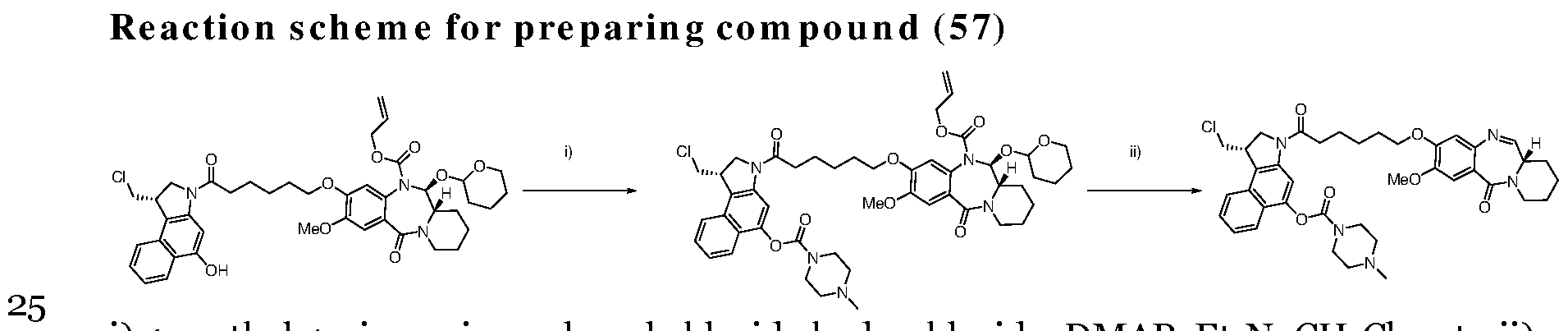
4-met y-i-pperaznecar ony c or e y roc or e, DMAP, Et3N, CH2C2, r.t.; Pd(PPh3)4, pyrrolidine, CH2C12, r.t.
Example 59: Allyl (65.6a5)-3-((6-((5)-l-(chloromethvn-5-((4-methyl- piperazine-l-carbonyl)oxy)-l,2-dihvdro-3H-benzore1indol-3-yl)-6-
oxohexyl) oxy)-2-me thoxy-12 -oxo-6 -((tetrahydro-2H-p yran-2-yl)oxy) - 6, 6 a, 7, 8, 9, 10 -hexahvdrobenzorel yridori,2-al ri,41diazepine-5(12H)- carboxyla

23 56
A solution of allyl (6S',6aS,)-3-((6-((S,)-i-(chloromethyl)-5-hydroxy-i,2-dihydro-3H- benzo[e]indol-3-yl)-6-oxohexyl)oxy)-2-methoxy-i2-oxo-6-((tetrahydro-2H-pyran-2- yl)oxy)-6,6a,7,8,9,io-hexahydrobenzo[e]pyrido[i,2-a][i,4]diazepine-5(i2H)- carboxylate (23) (49 mg, 0.063 mmol) in dichloromethane (5 mL) was charged with 4- methyl-i-piperazinecarbonyl chloride hydrochloride (38 mg, 0.19 mmol), 4-(dimethyl- amino)pyridine (8.5 mg, 0.069 mmol) and triethylamine (30 μΐ,, 0.22 mmol) and stirred at room temperature for 18 h. The reaction mixture was subsequently washed with water (2 x 10 mL), dried over magnesium sulfate and concentrated in vacuo, to give the title compound (45 mg, 79%) as a brown oil, which was used in the subsequent step without further purification.
Ή NMR (400 MHz, CDCI3) 8.35 (s, iH), 7.85 (d, J=8.2 Hz, iH), 7.71 (d, J=8.2 Hz, iH), 7-54-7-49 (m, iH), 7.41 (t, J=7-8 Hz, iH), 7.16 (s, iH), 6.51 (s, iH), 6.18 (d, J=9-4 Hz, iH), 6.01 (d, J=io.2 Hz, iH), 5-83-5-69 (m, iH), 5.16-5.00 (m, 2H), 4.68-4.54 (m, iH), 4.34-4.20 (m, 3H), 4-13-3-93 (m, 4H), 3-89 (s, 3H), 3-73 (br, iH), 3.65 (br, 3H), 3-51-3-45 (m, 2H), 3-H-3-01 (m, iH), 2.87 (br, iH), 2.57 (br, 6H), 2.41 (s, 3H), 2.37-2.31 (m, 2H), 1.97-1.87 (m, 2H), 1.84-1.71 (m, 6H), 1.68-1.44 (m, 10H); ^CNMR (100 MHz, CDCI3) δ 172.1, 169-2, 153-3, 149-3, 148-3, 143-9, 139-7, 133-6, 132.0, 127.6, 125.7, 124-8, 122.7, 122.4, 121.0, 120.8, 117-9, H3-7, 110.9, 108.1, 94.0, 93.6, 68.9, 66.4, 63.2, 6o.i, 56.1, 54-5, 53-4, 53-1, 46.0, 42.5, 38.8, 35-7, 30-7, 28.9, 25.7, 25.3, 24.2, 23.0, 20.0, 18.2; MS (ES+): m/z = 902 (M+H)+; LCMS (Method C): tR = 3.18 min.
Example 60 : (S)-l-(Chloromethyl)-3-(6-(((S)-2-methoxy-12-oxo-6a.7.8.9.
10 ,12-hexahvdrobenzorg1 yridori,2-a1 ri,41diazepin-3-yl)oxy)hexanoyl)-
2,3-dihvdro-lH-benzore1iiidol-5-yl 4-methylpiperazine-l-carboxylate (57)

56 57
A solution of allyl (6S',6aS,)-3-((6-((S,)-i-(chloromethyl)-5-((4-methylpiperazine-i- carbonyl)oxy)-i,2-dihydro-3H-benzo[e]indol-3-yl)-6-oxohexyl)oxy)-2-methoxy-i2-oxo- 6-((tetrahydro-2H-pyran-2-yl)oxy)-6,6a,7,8,9,io-hexahydrobenzo[e]pyrido[i,2-a][i,4]- diazepine-5(i2H)-carboxylate (56 ) (45 mg, 0.050 mmol) in dichloromethane (5 mL) was charged with tetrakis(triphenylphosphine)palladium(o) (6 mg) and pyrrolidine (5 μΐ,) and then stirred at room temperature under argon. After 5 min, the resulting mixture was concentrated in vacuo and purified by column chromatography (silica), eluting with ethyl acetate (100%), followed by triethylamine/ethyl acetate (3%), then triethylamine/methanol/ethyl acetate (from 3:5:95 to 3:10:90), to give the title compound (18 mg, 50%) as a creamy solid.
Ή NMR (400 MHz, acetone-d6) 8.38 (s, iH), 7.97 (d, J=5-5 Hz, iH), 7.92 (dd, J=8.4, 4.1 Hz, 2H), 7.55 (t, J=7-6 Hz, iH), 7·45"7·40 (m, iH), 7.33 (s, iH), 6.77 (s, iH), 4-46- 4-35 (m, 2H), 4.27 (br, iH), 4.17-4.10 (m, 2H), 4.08-4.02 (m, 2H), 3.86 (s, 3H), 3-85- 3.79 (m, 2H), 3-80-3.74 (m, 2H), 3.56 (br s, 2H), 3·ΐ9"3·ΐι (m, iH), 2.70-2.62 (m, iH), 2.54 (br s, 2H), 2.46 (br s, 2H), 2.32 (s, 3H), 2.18-2.10 (m, iH), 1.93-1.86 (m, 2H), 1.85- 1.76 (m, 6H), 1.69-1.59 (m, 4H); NMR (100 MHz, acetone-d6) 172.6, 168.7, 163.9, 153-0, 151-0, 147-9, 147-0, 142.7, 140.4, 132.5, 127-3, 124-3, 122.9, 122.5, 121.2, 117.3, 116.7, 111-8, 110.0, 109.8, 68.5, 55-4, 52-8, 49-6, 49-2, 47-9, 46-9, 46-5, 45-4, 39-1, 35-1, 31.9, 25.5, 24.2, 24.0, 23.0, 18.2; MS (ES+): m/z = 716 (M+H)+; LCMS (Method C): tR = 2.83 min.

i) 4-methyl-i-piperazinecarbonyl chloride hydrochloride, DMAP, Et3N, CH2C12, r.t.; ii) Pd(PPh3)4, pyrrolidine, CH2C12, r.t.
Exam ple 61: Allyl (6aS -3 - 3 -(2 - S -l-(chlorom ethvn -5- 4 -m ethyl- piperazine -l-carbonyl) oxy) -l,2 -dihvdro -3H-be nzo re1 indol-3 -yl) -2 -oxo -
ethyl)benzyl)oxy)-6-hvdroxy-2-methoxy-12-oxo-6,6a,7,,8,9,10 -hexahydro-

41 58
A solution of allyl (6aS,)-3-((3-(2-((S)-i-(chloromethyl)-5-hydroxy-i,2-dihydro-3H- benzo[e]indol-3-yl)-2-oxoethyl)benzyl)oxy)-6-hydroxy-2-methoxy-i2-oxo- 6,6a,7,8,9,io-hexahydrobenzo[e]pyrido[i,2-a][i,4]diazepine-5(i2H)-carboxylate (41) (65 mg, 0.090 mmol) in dichloromethane (5 mL) was charged with 4-methyl-i- piperazinecarbonyl chloride hydrochloride (54 mg, 0.27 mmol), 4-(dimethylamino)- pyridine (12 mg, 0.098 mmol) and triethylamine (41 μΐ,, 0.31 mmol) and stirred at room temperature for 18 h. The reaction mixture was subsequently washed with water (2 x 10 mL), dried over magnesium sulfate and concentrated in vacuo, to give the title compound (50 mg, 66%) as a brown oil, which was used in the subsequent step without further purification.
Ή NMR (400 MHz, CDCI3) 8.27 (s, iH), 7.79 (d, J=8.6 Hz, iH), 7.62 (d, J=8.2 Hz, iH), 7-43 (t, J=7-6 Hz, iH), 7-38-7-32 (m, iH), 7-31-7-26 (m, 3H), 7-23-7-17 (m, iH), 7.10 (s, iH), 6.64 (s, iH), 5.84 (d, J=io.2 Hz, iH), 5-70-5-53 (m, iH), 5.04 (br, 4H), 4.27 (d, J=9-4 Hz, 2H), 4-15-4-08 (m, iH), 3.95 (br s, iH), 3.80 (s, 3H), 3-69-3-64 (m, iH), 3.57 (br s, 4H), 3-41-3-30 (m, 2H), 3.02-2.92 (m, iH), 2.47 (br s, 4H), 2.39-2.35 (m, 3H), 2.32 (s, 3H), 1.98-1.89 (m, 2H), 1.74-1.60 (m, 2H), 1.59-1.53 (m, 3H); «C NMR (100
MHz, CDCI3) δ 169.2, 168.9, 153-3, 149-6, 149-0, 148.9, 148.2, 140.8, 140.7, 136.8, 134.1, 131.9, 129.6, 129.0, 128.9, 127.9, 127.5, 126.0, 124.9, 124.8, 122.5, 121.2, 117.6, 116.2, 114.6, 110.9, 110.6, 106.3, 101.4, 82.2, 70.8, 66.4, 56.0, 55-5, 54-5, 54-0, 53-1, 48-4, 45-9, 45-6, 38.6, 29.6, 22.9, 18.2; MS (ES+): m/z = 852 (M+H)+; LCMS (Method C): tR = 2.97 min.
Example 62: (S)-l-(Chloromethvn-3-(2-(3-((((S)-2-methoxy-12-oxo-
6 a, 7, 8, 9, 10 ,12-hexahvdrobenzorg1Pyridori,2-airi,41diazepin-3-yl)oxy)- methyl)phenyl)acetyl)-2,3-dihvdro-lH-benzore1iiidol-5-yl 4-methyl- piperazine-l-carboxylate (59)

58 59
A solution of allyl (6aS')-3-((3-(2-((S,)-i-(chloromethyl)-5-((4-methylpiperazine-i- carbonyl)oxy)-i,2-dihydro-3H-benzo[e]indol-3-yl)-2-oxoethyl)benzyl)oxy)-6-hydroxy- 2-methoxy-i2-oxo-6,6a,7,8,9,io-hexahydrobenzo[e]pyrido[i,2-a][i,4]diazepine-5(i2H) -carboxylate (58 ) (50 mg, 0.059 mmol) in dichloro methane (5 mL) was charged with tetrakis(triphenylphosphine)palladium(o) (7 mg) and pyrrolidine (6 μΐ,) and then stirred at room temperature under argon. After 5 min, the resulting mixture was concentrated in vacuo and purified by column chromatography (silica), eluting with ethyl acetate (100%), followed by triethylamine/ ethyl acetate (3%), then triethylamine/ methanol/ethyl acetate (from 3:5:95 to 3:10:90), to give the title compound (12 mg, 27%) as a creamy solid.
Ή NMR (400 MHz, acetone-d6) 8.35 (s, iH), 7.96-7.90 (m, 3H), 7.59-7.52 (m, 2H), 7-45 (d, J=8.6 Hz, iH), 7.41 (d, J=3-5 Hz, iH), 7-37 (br, 2H), 7-34 (d, J=2.o Hz, iH), 6.85 (d, J=5-5 Hz, iH), 5-26-5.25 (m, 2H), 4-51-4-38 (m, 2H), 4.26 (br, iH), 4.13 (d,
J=i2.i Hz, iH), 4.01 (br, 4H), 3.89-3-82 (m, 5H), 3.80-3.70 (m, 4H), 3.55 (br, 4H), 2.53 (br, 2H), 2.46 (br, 2H), 2.31 (s, 3H), 1.66-1.57 (m, 2H); NMR (100 MHz, acetone-d6) 168.1, 164.0, 157-4, 153-3, 151-3, 150.5, 148.0, 146.4, 143-4, 140.2, 135.3, 132.8, 129.1, 128.6, 127.4, 126.0, 124.5, 123.6, 123.0, 122.5, 118.4, 116.6, 111.8, 110.7, 110.6, 70.3, 55-4, 54-5, 53-1, 49-5, 47-9, 46-7, 45-6, 45-4, 45-3, 39-1, 25.2, 24.1, 18.2; MS (ES+): m/z = 750 (M+H)+; LCMS (Method C): tR = 2.90 min.

4-methyl-i-piperazinecarbonyl chloride hydrochloride, DMAP, Et3N, CH2C12, r.t.; ii) Pd(PPh3)4, pyrrolidine, CH2C12, r.t.
Exam ple 63 : Allyl (6a5)-3 -(4-((5) -l-(chlorom ethyl) -5-((4-m ethylpiperazine -l-carbonyl)oxy) -l,2-dihvdro-3H-benzo re1 indol-3 -yl)-4-oxobutoxy)-2-
methoxy-14-oxo-6-((tetrahvdro-2H-pyran-2-yl)oxy)-6,6a,7,12-tetrahvdro-

Ή NMR (400 MHz, acetone-d6) 8.36 (d, J=2.7 Hz, iH), 7.97-7.92 (m, 2H), 7.93-7.87 (m, iH), 7-57-7-51 (m, iH), 7-44-7-39 (m, iH), 7-34-7-28 (m, 3H), 7.14 (d, J=7-8 Hz, iH), 6.98 (s, iH), 5-83-5-67 (m, iH), 5-64-5-56 (m, iH), 5.42 (d, J=9-4 Hz, iH), 5-12-4-96 (m, 2H), 4.76-4.66 (m, iH), 4-51-4-40 (m, 2H), 4-39-4-25 (m, 3H), 4-17 (br, 2H), 4.08-4.02 (m, iH), 4.00-3.91 (m, iH), 3.86 (s, 3H), 3-84-3-77 (m, 2H), 3.68-3.48 (m, 4H), 3.20- 3.06 (m, 3H), 2.89-2.79 (m, iH), 2.57-2.42 (m, 4H), 2.30 (s, 3H), 2.23-2.15 (m, 2H), 2.06-2.01 (m, 2H), 1.80-1.66 (m, 2H), 1.61-1.43 (m, 4H); ^CNMR (100 MHz, acetone- d6) δ 171.1, i6i.8, 153-0, 149-2, 149-0, 147-2, 144-6, 143-5, 136.0, 135-4, 134-8, 127.9, 127.7, 127.6, 127.3, 126.9, 126.8, 126.4, 123.0, 122.9, 122.5, 120.9, 120.7, 116.4, 114-8, 110.7, 109-6, 107.3, 102.8, 97-2, 67.9, 65.8, 63.2, 59-5, 55-5, 52-8, 49-6, 49-1, 46-9, 45-4, 43-5, 41-9, 35-2, 33-7, 31-5, 30-9, 30.1, 25.2; MS (ES+): m/z = 922 (M+H)+; LCMS
(Method C): tR = 3.20 min.
Example 64: (5)-l-(Chloromethvn-3-(4-(((5)-2-methoxy-14-oxo-6a.7.12.14- tetrahvdrobenzor5,6iri,41diazepinori,2->1isoquinolin-3-yl)oxy)butanoyl)- 2.3-dihvdro-lH-benzore1indol-5-yl 4-methylpiperazine-l-carboxylate (61)

60 64
A solution of allyl (6aS')-3-(4-((S, i-(chloromethyl)-5-((4-methylpiperazine-i- carbonyl)oxy)-i,2-dihydro-3H-benzo[e]indol-3-yl)-4-oxobutoxy)-2-methoxy- 14-0x0-6- ((tetrahydro-2H-pyran-2-yl)oxy)-6,6a,7,i2-tetrahydrobenzo[5,6][i,4]diazepino[i,2- ¾]isoquinoline-5(i4H)-carboxylate (60 ) (27 mg, 0.029 mmol) in dichloro methane (4 mL) was charged with tetrakis(triphenylphosphine)palladium(o) (3.3 mg) and pyrrolidine (3 Ι and then stirred at room temperature under argon. After 5 min, the resulting mixture was concentrated in vacuo and purified by column chromatography (silica), eluting with ethyl acetate (100%), followed bytriethylamine/ethyl acetate (3%), then triethylamine/methanol/ethyl acetate (from 3:5:95 to 3:10:90), to give the title compound (9 mg, 41%) as a brown solid.
Ή NMR (400 MHz, acetone-d6) 8.38 (s, iH), 7.96-7.89 (m, 3H), 7.56 (t, J=7.6 Hz, iH), 7-49 (t, J=4-5 Hz, iH), 7-47-7-42 (m, 2H), 7-36-7-27 (m, 3H), 6.84 (s, iH), 4.88 (d, J=i5-2, iH), 4.56 (d, J=i5-2 Hz, iH), 4.48-4.36 (m, 3H), 4-33-4-19 (m, 3H), 4-15-4-03 (m, 2H), 3-94-3-89 (m, iH), 3.87 (s, 3H), 3-84-3-76 (m, 4H), 3.55 (br, 2H), 3.32 (t, J=5-3 Hz, lH), 2.57-2.41 (m, 4H), 2.31 (s, 3H), 2.27-2.19 (m, 2H); «C NMR (100 MHz, acetone-d6) δ 170.6, 165.6, 162.4, 153.0, 149.0, 151.1, 147.9, 145-8, 136.5, 135-3, 134-4, 128.8, 127.9, 127-7, 127-0, 126.2, 124.4, 122.9, 122.5, H2.2, 116.0, 113.9, 112.2, 110.7, 110.3, 67.9, 55-4, 54-5, 52-9, 49-9, 49-4, 45-5, 43-2, 41-9, 31-5, 30-2, 24.1; MS (ES+): m/z = 736 (M+H)+; LCMS (Method C): tR = 2.88 min.
Exam ple 65 : Biological and Biophysical Characterisation Cytotoxicity in Cell Lines
The cytotoxicity of compounds 13, 24, 42, 53, 55, 57, 59 and 61 were evaluated in the FaDu (head and neck cancer) and PC3 (prostate) cell lines using the standard MTT assay for a 72 hour incubation period (Table 1). Some of the CBI-PDD dimers were extremely cytotoxic reaching IC50 values of 10 picomolar in some cell lines (e.g., Compound 42 in FaDu). As anticipated, the prodrug forms of the molecules were significantly less active (e.g., Compound 59 = 4.5 micromolar in FaDu).
Table 1: Cytotoxicity of CBI-PDD analogues in the FaDu and PC3 cell lines.
Com pound Cytotoxicity
Num ber FaDu (nM, 72 PC3 (nM, 72
hour) hour)
13 1.17 1-43
24 1.83 0.12
42 0.01 0.03
53 0.65 0.02
55 1-5 0.02
57 >10 3
59 4500 900
61 >10 >10
Biophysical Characterisation
The ability of 13 to cross-link DNA was determined using an assay involving a linear double-stranded TyrT fragment (Figure 8). The PBD dimer Talirine (SGD1882) was used as a positive control, as PBD dimers have previously been shown to cross-link DNA (33).
Following denaturation conditions (treatment with formamide and heating at 65 °C for 5 min) the DNA strands were completely separated (see controls C2 and C4, Figure 9). The presence of an interstrand cross-link holds the denatured strands in close proximity, and cross-linked adducts therefore run as double-stranded DNA on polyacrylamide gel.
Each compound was tested at 10 different concentrations, and the assay was repeated twice. The cross-linking ability of 13 is shown in Figure 9. Cross-links are clearly detectable at concentrations of 10 μΜ, ι μΜ, 500 nM and 300nM, and are visible at concentrations as low as ιοηΜ also. Using the same assay, the PBD dimer Talirine was also shown to cross-link DNA down to a concentration of 10 nM (Figure 10). These results demonstrate that 13 can produce DNA cross-links at concentrations comparable to the PBD dimer.
Cleavage Assay
The ability of 13 to cleave double-stranded DNA was investigated using a modification of the previously established DNA footprinting assay (34). Following an overnight incubation of the ligand-DNA complexes, the mixture was mixed with strand
separation buffer containing 10 mM EDTA, 10 mM NaOH, 0.1% bromophenol blue, 80% formamide and incubated at 100 °C for 3 min. The mixture was then immediately cooled on ice and run on an 8% denaturing gel. Examination of the obtained gel (Figure 11) shows distinct cleavage patterns produced by 13 (black arrows). Using the GA marker, these additional bands were identified as cleavage products produced by 13 at certain A sites of the DNA fragment. Furthermore, the TyrT DNA fragment contains multiple potential binding sites for 13 (i.e., multiple examples of potential G-A cross- linking sites), but surprisingly only three preferred sites were observed during this experiment. This suggests that the molecule acts in a highly sequence selective manner. The possible adducts formed within the TyrT sequence are shown in Figure 12.
FRET DNA Melting
FRET DNA melting studies were undertaken on 13 using two fluorescently labelled sequences. The sequences (Figure 13) were designed to provide additional evidence that 13 can form inter- and intrastrand cross-links. Inosines were inserted in place of traditional DNA bases to limit the number of binding sites available for 13 to interact with.
The short duplexes used in this FRET study are relatively unstable in the duplex form with a melting temperature below 30°C so that, in the absence of ligand, a large part of the melting occurs below the starting temperature of the experiment. However, the inter- and intrastrand cross-links formed by 13 stabilizes the duplex form, producing very large increases in melting temperature with Tm values of ~65 °C for 5'- AIIAGAITTIT-3' (Figure 14, top panel) suggesting interstrand cross-link formation and 60 °C for 5'-AAIAAAGAIIA-3' (Figure 14, bottom panel) suggesting intra-strand cross-link formation. Increasing concentrations of 13 cause a greater amount of the melting transition to appear at the higher temperature (i.e. a greater number of the DNA molecules are cross-linked). A greater effect for 5'-AIIAGAITTlT-3' can be observed at lower concentrations of 13.
Sum m ary of Cross-linking Data
Taken together, the cross-linking data presented above provide strong evidence that 13 (and its analogues - data not shown) produces both intrastrand and interstrand crosslinks which appear to form with a high degree of sequence-specificity (e.g., Figures 11 and 12). It is possible that the compound may also form mono-alkylated adducts with guanine and adenine bases. Together, this population of DNA adduct types may account for the cytotoxicity of this family of compounds in cells.
Biophysical Characterisation Methodology
1. Material
1.1. DNA fragment
The preparation of the TyrT DNA fragment (Figure 8) has been previously described (34). Briefly, the sequence which had been cloned into the BamHl site of pUCi8 was obtained by cutting with Hindlll and EcoRl. Radiolabelled DNA fragments were prepared by filling in the 3'-end of the Hindlll site with [a-32P]dATP using Klenow DNA polymerase (exo-).
The radiolabelled DNA fragment was separated from the remainder of the plasmid DNA on a 6% non-denaturing polyacrylamide gel. The gel (20 cm long, 0.3 mm thick) was run at 400 V in lx TBE running buffer for about i-2h, until the bromophenol blue had run most of the way down the gel. The glass plates were separated and the position of the labelled DNA fragment was established by short (1 min) exposure to an X-ray film. The relevant band was then cut from the gel and the radiolabelled DNA eluted by adding 300 μΐ, ιο mM Tris-HCl, pH 7.5 containing 0.1 mM EDTA and gently agitating overnight at room temperature. The eluted DNA was finally precipitated with ethanol and re-suspended in a suitable volume of 10 mM Tris-HCl, pH 7.5 containing 0.1 mM EDTA buffer so as to give at least 10 counts per second/ μΐ, on a hand-held Geiger counter. With fresh plasmid and a-32P-dATP this process typically generated about 150 μΐ, of radiolabelled fragment DNA. The absolute concentration of the DNA is not important, and it is typically lower than 10 nM. 1.2. Compounds
13 was synthesised as described above and the PBD dimer Talirine was obtained from Aurum Pharmatech LLC. Stock solution was prepared by dissolving the ligands in DMSO to give a concentration of 10 mM. From this stock solution, working solutions of the desired concentration were prepared by diluting with 10 mM Tris-HCl, pH 7.5 containing 10 mM NaCl.
2. Cleavage Assay
2.1. Preparation ofligand-DNA complexes
Radiolabelled DNA (1.5 μΐ,) was mixed with 1.5 μΐ, ligand solution of various concentrations (10 μΜ-io nM) and incubated overnight at 37 °C.
2.2. Preparation ofGA marker
Labelled DNA (1.5 μΐ,) was mixed with 20 ΐ, sterile water and 5 ΐ, of denaturing loading solution (80% formamide containing 10 mM EDTA, 10 mM NaOH, 0.01% bromophenol blue). The sample was then incubated at 100 °C for 20 min with the micro- centrifuge tube cap open to allow evaporation.
2.3. Cleavage assay
Loading solution (4.5 μί) was added to samples from Section 2.1. The digestion products were boiled for 3 min at 100 °C and quickly cooled on ice prior to
electrophoresis. Separation was performed on an 8% denaturing polyacrylamide gel (40 cm long, 0.3 mm thick) at 1500V for about 2 h until the dye reached the bottom of the gel. The gel plates were then separated, the gels fixed by immersing in 10% (v/v) acetic acid, followed by transfer to Whatmann 3MM paper and drying under vacuum at 80 °C. The dried gel was then exposed to a phosphorimager screen overnight before being scanned using a Typhon FLA 7000 instrument.
3. Cross -linking Assay
3.1. Preparation of Ligand-DNA complexes
Radiolabeled DNA (1.5 μΐ,) was mixed with 1.5 μΐ, ligand solution of various concentrations (10 μΜ-10 nM) and incubated overnight at 37 °C.
3.2 Cross-linking assay
After overnight incubation, the samples were mixed with 7 μΐ, loading solution (80% formamide containing 10 mM EDTA, 10 mM NaOH, 0.1% bromophenol blue) and incubated at 65 °C for 5 min. Control 1 (Ci) for native double-stranded DNA consisted of 1.5 μΐ. labelled DNA, 1.5 μΐ. ιο mM Tris-HCl, pH 7.5 containing 0.1 mM EDTA and 7 μΐ, lx loading dye. Control 2 (C2) for denatured native single-stranded DNA was composed of 1.5 μΐ. labelled DNA, 1.5 μΐ, ιο mM Tris-HCl, pH 7.5 containing 0.1 mM EDTA which was incubated at 65 °C for 5 min. Control 3 (C3) for native double- stranded DNA consisted of 1.5 μΐ. labelled DNA, 1.5 μΐ, ιο mM Tris-HCl, pH 7.5 containing 0.1 mM EDTA and 7 μΐ, SSB. Control 4 (C4) for denatured native single- stranded DNA was composed of 1.5 μΐ. labelled DNA, 1.5 μΐ, ιο mM Tris-HCl, pH 7.5 containing 0.1 mM EDTA and 7 μΐ, SSB which was incubated at 65 °C for 5 min.
Separation was performed on a 7.5% denaturing polyacrylamide gel (20 cm long, 0.3 mm thick) at 500V for about 4 h until the dye reached the bottom of the gel. The gel plates were then separated, the gels fixed by immersing in 10% (v/v) acetic acid, followed by transfer to Whatmann 3MM paper and drying under vacuum at 80 °C. The
dried gel was then exposed to a phosphorimager screen overnight before scanning using a Typhon FLA 7000 instrument.
FRET Studies Methodology
1. General
1.1. Oligonucleotides
Oligonucleotides were obtained from ATDbio (Southampton, UK) in lyophilised form. They were labelled with a fluorophore molecule (F = fluorescein) at the 5'-end and a quencher molecule (Q = dabcyl) at the 3'-end of the complementary strand. Each oligonucleotide was dissolved in distilled H20 to form stock solutions of 100 μΜ.
Working solutions of 5 μΜ were prepared by diluting the stock solution with distilled H20.
1.2. Buffers
The following buffers were used: 250 mM phosphate buffer pH 7.4 (consisting of sodium dihydrogen phosphate and sodium phosphate diluted in distilled H20) and 5 M sodium chloride buffer. All buffers and distilled H20 were filtered through a 0.2 μΜ filter prior to use. 1.3. Compound
For the FRET experiments a stock solution of 13 was prepared by dissolving it in DMSO to give a concentration of 10 mM. From this stock solution, working solutions of the desired concentration were prepared by diluting the stock solution with distilled H20.
1.4. Preparation ofligand-DNA complexes
The reaction mixture was comprised of 4 μΐ, of 250 mM phosphate buffer (final concentration of 50 mM), 4 μΐ, flourophor and 4 μΐ, quencher molecule of the appropriate oligonucleotide for a final concentration of 0.2 μΜ, 4 μΐ, 5 M sodium chloride (final concentration of 1 M NaCl), and 4 μΐ, of distilled H20. This mixture was heated in an Eppendorf tube at 90 °C for 1 min and slowly cooled down to room temperature. This process was carried out to anneal the single strands to double- stranded DNA. Following this, 4 μΐ, of the ligand was added in the desired
concentration and the mixture incubated overnight either at room temperature or 4 °C. A control sample of DNA only was prepared by mixing 4 μΐ, 250 mM phosphate buffer (final concentration of 50 mM) with 4 μΐ, fluorophore-labelled and 4 μΐ, quencher- labelled oligonucleotides (of the appropriate sequence) to give a final concentration of
0.2 μΜ, 4 μΐ, 5 Μ sodium chloride (final concentration of l M NaCl) and 4 μί, distilled H20. This mixture was analysed without prior annealing.
1.5. Fluorescence melting
Fluorescence melting profiles were measured using a Roche LightCycler using a total reaction volume of 20 μL. Initially, the samples were denatured by heating to 95 °C at a rate of 1 °C min 1. The samples were then maintained at 95 °C for 5 min before annealing by cooling to 25 °C at 1 °C min 1. The samples were then held at 25 °C for a further 5 min and finally melted by heating to 95 °C at 1 °C min 1. Annealing steps and melting steps were all recorded and changes in fluorescence were measured at 520 nm.
1.6. Data analysis
Tm values were obtained from the first derivates of the melting profiles using the Roche LightCycler software.
MTT Cytotoxicity Methodology
Tumor cell lines were maintained in RPMI1640 medium supplemented with 10% heat- inactivated fetal bovine serum, 2mM L-glutamine and imM sodium pyruvate. 1800 cells per well were seeded in a volume of ιδομΐ in a 96-well flat bottom polystyrene plate. The cells were allowed to adhere overnight at 37°C in a C02 incubator. Ligands were initially formulated in DMSO, and stocks stored at -8o°C. They were then further formulated at ιοχ concentration in RPMI1640 medium. 20ul of diluted samples were added into each treatment well. On each plate, blank wells with no cells, and untreated wells containing cells, were included. Plates were then cultured at 37°C in a C02 incubator for 72hrs. Cytotoxicity was evaluated using a tetrazolium salt-based assay, the MTT assay. After 72hours, the supernatant was removed from each well and 200 μΐ of a sterile filtered
 MTT solution in water added to each well. The plates were then incubated at 37°C in a C02 incubator for 4hrs. The supernatant was then removed and the formazan crystals formed solubilized by adding Ι50μ1 of DMSO to each well. The plate was then read on a plate reader at 54onm, and percentage cell survival calculated as follows: ((mean absorbance treated wells at concentration x - mean absorbance blank wells) ÷ (mean absorbance untreated wells at concentration x - mean absorbance blank wells)) x 100. Data were plotted as concentration in nM vs. % cell survival in Microsoft Excel, and IC50 values (concentration where cell survival is reduced by a half) were determined from the graph.
REFERENCES
MTT solution in water added to each well. The plates were then incubated at 37°C in a C02 incubator for 4hrs. The supernatant was then removed and the formazan crystals formed solubilized by adding Ι50μ1 of DMSO to each well. The plate was then read on a plate reader at 54onm, and percentage cell survival calculated as follows: ((mean absorbance treated wells at concentration x - mean absorbance blank wells) ÷ (mean absorbance untreated wells at concentration x - mean absorbance blank wells)) x 100. Data were plotted as concentration in nM vs. % cell survival in Microsoft Excel, and IC50 values (concentration where cell survival is reduced by a half) were determined from the graph.
REFERENCES
1. Antonow, D., and Thurston, D. E. (2011) Chem Rev 111, 2815-2864.
2. Cipolla, L., Araujo, A. C, Airoldi, C, and Bini, D. (2009) Anticancer Agents Med Chem 9, 1-31.
3. Gerratana, B. (2012) Med Res Rev 32, 254-293.
4. Hartley, J. A. (2011) Expert Opin Investig Drugs 20, 733-744.
5. Kamal, A., Reddy, K. L., Devaiah, V., Shankaraiah, N., and Reddy, D. R. (2006) Mini Rev Med Chem 6, 53-69.
6. Hurley, L. H., Reck, T., Thurston, D. E., Langley, D. R., Holden, K. G.,
Hertzberg, R. P., Hoover, J. R., Gallagher, G., Jr., Faucette, L. F., Mong, S. M., (1988) Chem Res Toxicol 1, 258-268.
7. Wells, G., Martin, C. R., Howard, P. W., Sands, Z. A., Laughton, C. A.,
Tiberghien, A., Woo, C. K., Masterson, L. A., Stephenson, M. J., Hartley, J. A., Jenkins, T. C, Shnyder, S. D., Loadman, P. M., Waring, M. J., and Thurston, D. E. (2006) J Med Chem 49, 5442-5461.
8. Brucoli, F., Hawkins, R. M., James, C. H., Jackson, P. J., Wells, G., Jenkins, T.
C, Ellis, T., Kotecha, M., Hochhauser, D., Hartley, J. A., Howard, P. W., and Thurston,
D. E. (2013) J Med Chem 56, 6339-6351.
9. Kotecha, M., Kluza, J., Wells, G., O'Hare, C. C, Forni, C, Mantovani, R.,
Howard, P. W., Morris, P., Thurston, D. E., Hartley, J. A., and Hochhauser, D. (2008) Mol Cancer Ther 7, 1319-1328.
10. Puwada, M. S., Hartley, J. A., Jenkins, T. C, and Thurston, D. E. (1993) Nucleic Acids Res 21, 3671-3675.
11. Clingen, P. H., De Silva, I. U., McHugh, P. J., Ghadessy, F. J., Tilby, M. J., Thurston, D. E., and Hartley, J. A. (2005) Nucleic Acids Res 33, 3283-3291.
12. Puwada, M. S., Forrow, S. A., Hartley, J. A., Stephenson, P., Gibson, I., Jenkins, T. C, and Thurston, D. E. (1997) Biochemistry 36, 2478-2484.
13. Barkley, M. D., Cheatham, S., Thurston, D. E., and Hurley, L. H. (1986)
Biochemistry 25, 3021-3031.
14. Seifert, J., Pezeshki, S., Kamal, A., and Weisz, K. (2012) Organic &
Biomolecular Chemistry 10, 6850-6860.
15. Smellie, M., Bose, D. S., Thompson, A. S., Jenkins, T. C, Hartley, J. A., and Thurston, D. E. (2003) Biochemistry 42, 8232-8239.
16. Kopka, M. L., Goodsell, D. S., Baikalov, I., Grzeskowiak, K., Cascio, D., and Dickerson, R. E. (1994) Biochemistry 33, 13593-13610.
17. Kizu, R., Draves, P. H., and Hurley, L. H. (1993) Biochemistry 32, 8712-8722.
18. Wilkinson, G. P., Loadman, P. M., Taylor, J. P., Jenkins, T. C, Double, J. A., Gregson, S. J., Howard, P. W., and Thurston, D. E. (2002) European Journal of Cancer 38, S28-S29.
19. Schwartz, G. H., Patnaik, A., Hammond, L. A., Rizzo, J., Berg, K., Von Hoff, D. D., and Rowinsky, E. K. (2003)AnnaZs of Oncology 14, 775-782.
20. Zhou, Q., Duan, W. H., Simmons, D., Shayo, Y., Raymond, M. A., Dorr, R. T., and Hurley, L. H. (2001) J. Am. Chem. Soc. 123, 4865-4866.
21. Tercel, M., Stribbling, S. M., Sheppard, H., Siim, B. G., Wu, K., Pullen, S. M., Botting, K. J., Wilson, W. R., and Denny, W. A. (2003) J. Med. Chem. 46, 2132-2151. 22. Purnell, B., Sato, A., O'Kelley, A., Price, C, Summerville, K., Hudson, S., O'Hare, C, Kiakos, K., Asao, T., Lee, M., and Hartley, J. A. (2006) Bioorganic & Medicinal Chemistry Letters 16, 5677-5681.
23. T. A. Halgren, (1996) Journal of Computational Chemistry, 17, 490-519.
24. D. A. Case, Darden, T. A., Cheatham III, T. E., Simmerling, C. L., Wang, J., Duke, R. E., Luo, R., Walker, R. C, Zhang, W., Merz, K. M., Roberts, B., Wang, B., Hayik, S., Roitberg, A., Seabra, G., Kolossvary, I., Wong, K. F., Paesani, F., Vanicek, J., Liu, J., Wu, X., Brozell, S. R., Steinbrecher, T., Gohlke, H., Cai, Q., Ye, X., Wang, J., Hsieh, M.-J., Cui, G., Roe, D. R., Mathews, D. H., Seetin, M. G., Sagui, C, Babin, V.,
Luchko, T., Gusarov, S., Kovalenko, A., Kollman, P. A., AMBER 11, University of California, San Francisco, 2010, 2010.
25. A. Perez, I. Marchan, D. Svozil, J. Sponer, T. E. Cheatham, 3rd, C. A. Laughton and M. Orozco, (2007) Biophys J, 92, 3817-3829.
26. S. N. Rao, U. C. Singh and P. A. Kollman, (1986) Journal of Medicinal
Chemistry, 29, 2484-2492.
27. V. Tsui and D. A. Case, (2000) Biopolymers, 56, 275-291.
28. F. Brucoli, R. M. Hawkins, C. H. James, P. J. Jackson, G. Wells, T. C. Jenkins, T. Ellis, M. Kotecha, D. Hochhauser, J. A. Hartley, P. W. Howard and D. E. Thurston, (2013) Journal of Medicinal Chemistry, 56, 6339-6351.
29. K. M. Rahman, P. J. M. Jackson, C. H. James, B. P. Basu, J. A. Hartley, M. de la Fuente, A. Schatzlein, M. Robson, R. B. Pedley, C. Pepper, K. R. Fox, P. W. Howard and D. E. Thurston, (2013) Journal of Medicinal Chemistry, 56, 2911-2935.
30. P. J. Jackson, C. H. James, T. C. Jenkins, K. M. Rahman and D. E. Thurston, (2014) ACS Chem Biol, 9, 2432-2440.
31. G. Jai, J.W. Lown, (2000) Bioorganic & Medicinal Chemistry, 8, 1607-1617.
32. R. C. Elgersma, et al, (2015) Mol. Pharmaceutics, 12, 1813-1835.
33. K. M. Rahman, A. S. Thompson, C. H. James, M. Narayanaswamy, D. E.
Thurston, Journal of the American Chemical Society 2009 , 131, 13756-13766.
34. Drew, H.R. and A.A. Travers, DNA structural variations in the E. coli tyrT promoter. Cell, 1984. 37(2): p. 491-502.
Claims
1. A compound of formula (I):
A-X!-L-X2-B
(I)
and salts, solvates and tautomers thereof, for use as a drug in an antibody-drug conjugate,
wherein;
A is a group selected from:

(Ai), (A2), (A3), (A4) and (A5); h is o or 1;
Ri is selected from H and halogen;
either R2 is selected from -CH2-halogen, Ci-6 alkyl and H, and R3 is H;
or R2 and R3 together with the carbon atoms to which they are attached form a cyclopropyl ring;
p is o or 1; and when p is 1 then Y is C-R7, Y2 is C-R6, Y3 is C-R5 and Y^ is C-R4; and for (Ai) and (A2) when p is o either (a) Y is selected from N-Ri9, O and S; Y2 is selected from C-R6 and N; and Ys is C-R5; or (b) Ys is selected from N-Rig, O and S; Y2 is selected from C-R6 and N; and Y is C-R7; and for (A3) when p is o, Y is selected from N-Ri9, O and S; and Y2 is selected from C-R6 and N;
R4, R5, R6 and R7 are each independently selected from H and R20,
or one of R4 and R5, or R5 and R6, or R6 and R7 together with the carbon atoms to which they are attached form a 6-membered aryl, or a 5- or 6- membered cyclic, heterocyclic, or heteroaryl ring optionally substituted with up to three independently selected optional R20 groups;
Rs is selected from selected from H, nitrogen protecting groups and R20;
X3 is selected from C=0, C-OH and C-R'"; or Ys is selected from C=0, C-OH, C-
NH2 and C-R'"; with the carbon forming part of the ring; and
when X3 or Ys is C=0 then represents an α,β-unsaturated double bond conjugated with the C=0; and when X3 is C-OH or C-R'" or Ys is C-
OH, C-NH2 or C-R'" then represents the double bonds of an aromatic 6-membered ring and R3 is absent;
wherein R'" is a prodrug moiety containing carbonyl, carbamoyl, glycosyl, O- amino, O-acylamino, para-aminobenzyl ether, peptidyl or phosphate groups;
Xi is selected from O, S, NR21, CR21R22, CR21R220, C(=0), C(=0)NR21, NR21C(=0), C(0 RA-C(0)-NH, C(0)-RA-NH-C(0), C(O) -NH-RA-C(0), NH-C(0)-RA-C(0), NH-C(0)-RA- C(0)-NH, NH-C(0)-RA-NH-C(0), C(0)-NH-RA-NH-C(0), C(0)-NH-RA-C(0)-NH, O- C(O) and C(0)-0 or is absent;
L is selected from an amino acid, a peptide chain having from 2 to 12 amino acids, a paraformaldehyde chain -(0CH2)i_24-, a polyethylene glycol chain -(0CH2CH2)i_i2- and -(CH2)m-Y6-(CH2)n- wherein
m is an integer selected from o to 12,
n is an integer selected from o to 12, and
Y6 is selected from -(CH2)Z- and a group (Li) that is selected from arylene, monocyclic heteroarylene, monocyclic cycloalkylene, monocyclic
cycloalkenylene and monocyclic heterocyclylene groups optionally substituted with up to three independently selected optional R20 groups;
z is an integer selected from 1 to 5; X2 is selected from O, S, NR23, CR23R24, CR23R240, C(=0), C(=0)NR23, NR24C(=0), C(0)-RA-C(0)-NH, C(0)-RA-NH-C(0), C(O) -NH-RA-C(0), NH-C(0)-RA-C(0), NH- C(0)-RA-C(0)-NH, NH-C(0)-RA-NH-C(0), C(0)-NH-RA-NH-C(0), C(0)-NH-RA-C(0 NH, O-C(O) and C(0)-0 or is absent; B is a polycyclic group selected from:

the dotted lines indicate the optional presence of one or more double bonds; q is o or 1;
and R9 and Ri0 are selected such that either:
(i) Rg and Ri0 together form a double bond;
(ii) R9 is H and R10 is OH;
(iii) Rg is H and Ri0 is OCi-6 alkyl;
(iv) Rg is selected from S03H, nitrogen protecting groups and R20;

(v) R9 is H or Ci-6 alkyl, and Ri0 is oxo or H;
Rii, Ri2, R13 and Ri4 are independently selected from H, R20, R25, =CH2, =CH- (CH2)s-CH3,
 =0, (CH2)s-OR25, (CH2)s-C02R25, (CH2)S-NR25R26,
0-(CH2)t-NR25R26, NH-C(0)-R25, 0-(CH2)t-NH-C(0)-R25, 0-(CH2)t-C(0)-NH-
R25, (CH2)s-S02R25, 0-S02R25, (CH2)s-C(0)R25 and (CH2)s-C(0)NR25R26;
or one of Rn and Ri2, Ri2 and Ri3, or Ri3 and Ri4 together with the carbon atoms to which they are attached form a 6-membered aryl, or a 5- or 6- membered cyclic, heterocyclic, or heteroaiyl ring optionally substituted with up to three independently selected optional R20 groups;
each s is an integer independently selected from o to 6;
each t is an integer independently selected from 1 to 6;
R15, R16, R17 and R18 are independently selected from H and R20; each R20 is independently selected from (CH2)j-0H, Ci-6 alkyl, OCi-6 alkyl, 0CH2Ph, (CH2)j-C02R27, 0-(CH2)k-NR27R28, (CH2)j-NR27R28, C(=0)-NH-(CH2)k-NR27R28, C(=0 NH-C6H4-(CH2)j-R27 and C(=0)-NH-(CH2)k-C(=NH)NR27R28;
each j is an integer independently selected from o to 6;
each k is an integer independently selected from 1 to 6; each Rig, R2i, R22, R23, R24, R26, R27 and R28 is independently selected from H and Ci-6 alkyl; and each R25 is independently selected from H, Ci-i2 alkyl, C5-g heteroaiyl, C6-i5
heteroarylalkyl, phenyl and C7-i2 aralkyl groups; wherein the heteroaiyl,
heteroarylalkyl, phenyl and aralkyl groups are optionally substituted with up to three independently selected optional R20 groups; each RA is independently selected from:
-NRB-T1-NRC- where RB and Rc are each independently selected from H and Ci-8 alkyl, or together RB and Rc join to form a ring and together are (CH2)2_3, where T1 is selected from -C(O), -C(0)(CH2)0-50C(0)-, -C(0)PhC(0)- where Ph is 1,3- or 1,4-phenylene;
-het- wherein het is a mono-, bi-, or tricyclic heteroarylene of 5 to 12 members, containing one, two, or three heteroatoms independently selected from O, N, S, P and B, wherein het is optionally substituted up to three independently selected optional R20 groups;
-χΑ_τ¾-χΑ-, where T2 is:

wherein each XA is independently selected from a bond, -NH-, -N(Ci-8 alkyl)-, - O- and -S-, each RD, RE, RF, and RG are each independently H or R20, or RD and RE form a ring system, or RF and RG form a ring system, or both RD and RE, and RF and RG independently form ring systems, where said ring systems are independently selected from -C1-C10 heterocyclyl or -C3-C8 carbocyclycl, or RD, RE, RF, and RG are each bonds to different carbons on D, wherein f and g are each
independently an integer from o to 50 and w is an integer from 1 to 50, and wherein D is a bond or is selected from the group consisting of-S-, -Ci-Cs alkylene-, -C0-C14 arylene-, -C0-C14 heteroarylene-, -Ci-Cs heteroalkylene-, -C7- C22 aralkylene, -C1-C10 heterocyclo and -C3-C8 carbocyclo, where said -Ci-Cs alkylene-, -C6-C14 arylene-, -C0-C14 heteroarylene-, -Ci-Cs heteroalkylene-, -C7- C22 aralkylene, -C1-C10 heterocyclo and— C3-C8 carbocyclo are optionally substituted up to three independently selected optional R20 groups; with the proviso that when the compound is:

that at least one of Rn, Ri2 and Ri3 is independently selected from C5-9 heteroaryl, Ce heteroarylalkyl, phenyl and C7-i2 aralkyl groups and these groups are optionally substituted with up to three independently selected optional R20 groups, or that one of Rn and Ri2 or Ri2 and Ri3, or Ri3 together with the carbon atoms to which they are attached form a 6-membered aryl, or
5- or 6-membered cyclic, heterocyclic, or heteroaryl ring optionally substituted with up to three independently selected optional R20 groups; with the proviso that R5 and R6 are each independently selected from H and R20 when B, q and A are selected as (Bi), o and (A4) respectively; with the proviso that when R2 is Ci-6 alkyl or H, that R9 and Ri0 are selected from options (i), (ii), (iii) or (iv); and with the proviso that when (v) R9 is H or Ci-6 alkyl, and Ri0 is oxo or H; then either R2 is -CH2-halogen and R3 is H;
or R2 and R3 together with the carbon atoms to which they are attached form a cyclopropyl ring.
2. A compound of formula (I):

(I)
and salts, solvates and tautomers thereof,
wherein;
A is a group selected from:

(Ai), (A2), (A3), (A4) and (A5); h is o or 1;
Ri is selected from H and halogen;
either R2 is selected from -CH2-halogen, Ci-6 alkyl and H, and R3 is H;
or R2 and R3 together with the carbon atoms to which they are attached form a cyclopropyl ring;
p is o or 1; and when p is 1 then Y is C-R7, Y2 is C-R6, Y3 is C-R5 and Y is C-R4; and for (Ai) and (A2) when p is o either (a) Y is selected from N-Ri9, O and S; Y2 is selected from C-R6 and N; and Y3 is C-R5; or (b) Y3 is selected from N-Rig, O and S; Y2 is selected from C-R6 and N; and Y is C-R7; and for (A3) when p is o, Y is selected from N-Ri9, O and S; and Y2 is selected from C-R6 and N;
R4, R5, R6 and R7 are each independently selected from H and R20,
or one of R4 and R5, or R5 and R6, or R6 and R7 together with the carbon atoms to which they are attached form a 6-membered aryl, or a 5- or 6- membered cyclic, heterocyclic, or heteroaryl ring optionally substituted with up to three independently selected optional R20 groups;
Rs is selected from selected from H, nitrogen protecting groups and R20;
X3 is selected from C=0, C-OH and C-R'"; or Ys is selected from C=0, C-OH, C- NH2 and C-R'"; with the carbon forming part of the ring; and
when X3 or Ys is C=0 then represents an α,β-unsaturated double bond conjugated with the C=0; and when X3 is C-OH or C-R'"; or Ys is
C-OH, C-NH2 or C-R'" then represents the double bonds of an aromatic 6-membered ring and R3 is absent;
wherein R'" is a prodrug moiety containing carbonyl, carbamoyl, glycosyl, O- amino, O-acylamino, para-aminobenzyl ether, peptidyl or phosphate groups
Xi is selected from O, S, NR21, CR21R22, CR21R220, C(=0), C(=0)NR21, NR21C(=0), C(0 RA-C(0)-NH, C(0)-RA-NH-C(0), C(O) -NH-RA-C(0), NH-C(0)-RA-C(0), NH-C(0)-RA- C(0)-NH, NH-C(0)-RA-NH-C(0), C(0)-NH-RA-NH-C(0), C(0)-NH-RA-C(0)-NH, O- C(O) and C(0)-0 or is absent;
L is selected from an amino acid, a peptide chain having from 2 to 12 amino acids, a paraformaldehyde chain -(0CH2)i_24-, a polyethylene glycol chain -(0CH2CH2)i_i2- and -(CH2)m-Y6-(CH2)n- wherein
m is an integer selected from o to 12,
n is an integer selected from o to 12, and
Y6 is selected from -(CH2)Z- and a group (Li) that is selected from arylene, monocyclic heteroarylene, monocyclic cycloalkylene, monocyclic
cycloalkenylene and monocyclic heterocyclylene groups optionally substituted with up to three independently selected optional R20 groups;
z is an integer selected from 1 to 5;
X2 is selected from O, S, NR23, CR23R24, CR23R240, C(=0), C(=0)NR23, NR24C(=0), C(0)-RA-C(0)-NH, C(0)-RA-NH-C(0), C(O) -NH-RA-C(0), NH-C(0)-RA-C(0), NH- C(0)-RA-C(0)-NH, NH-C(0)-RA-NH-C(0), C(0)-NH-RA-NH-C(0), C(0)-NH-RA-C(0 NH, O-C(O) and C(0)-0 or is absent;
B is a polycyclic group selected from:

(B2) (B3) and (B4);
the dotted lines indicate the optional presence of one or more double bonds; q is o or 1;
and Rg and Ri0 are selected such that either:
(i) Rg and Ri0 together form a double bond;
(ii) R9 is H and R10 is OH;
(iii) Rg is H and Ri0 is OCi-6 alkyl;
(iv) Rg is selected from S03H, nitrogen protecting groups and R20;

(v) R9 is H or Ci-6 alkyl, and Ri0 is oxo or H
R11, R12, R13 and Ri4 are independently selected from H, R20, R25, =CH2, =CH- (CH2)s-CH3, =CH-(CH2)s-R25, =0, (CH2)s-OR25, (CH2)s-C02R25, (CH2)S-NR25R26, 0-(CH2)t-NR25R26, NH-C(0)-R25, 0-(CH2)t-NH-C(0)-R25, 0-(CH2)t-C(0)-NH- R25, (CH2)s-S02R25, 0-S02R25, (CH2)s-C(0)R25 and (CH2)s-C(0)NR25R26;
or one of Rn and Ri2, Ri2 and Ri3, or Ri3 and Ri4 together with the carbon atoms to which they are attached form a 6-membered aryl, or a 5- or 6- membered cyclic, heterocyclic, or heteroaryl ring optionally substituted with up to three independently selected optional R20 groups;
each s is an integer independently selected from o to 6;
each t is an integer independently selected from 1 to 6;
R15, R16, R17 and R18 are independently selected from H and R20; each R20 is independently selected from (CH2)j-0H, Ci-6 alkyl, OCi-6 alkyl, 0CH2Ph, (CH2)j-C02R27, 0-(CH2)k-NR27R28, (CH2)j-NR27R28, C(=0)-NH-(CH2)k-NR27R28; C(=0 NH-C6H4-(CH2)j-R27 and C(=0)-NH-(CH2)k-C(=NH)NR27R28;
each j is an integer independently selected from o to 6;
each k is an integer independently selected from 1 to 6; each Rig, R2i, R22, R23, R24, R26, R27 and R28 is independently selected from H and Ci- alkyl; and each R25 is independently selected from H, Ci-i2 alkyl, C5-g heteroaryl, C6-i5
heteroarylalkyl, phenyl and C7-i2 aralkyl groups; wherein the heteroaryl,
heteroarylalkyl, phenyl and aralkyl groups are optionally substituted with up to three independently selected optional R20 groups; each RA is independently selected from:
-NRB-T1-NRC- where RB and Rc are each independently selected from H or Ci-8 alkyl, or together RB and Rc join to form a ring and together are (CH2)2_3, where T1 is selected from -C(O), -C(0)(CH2)0-50C(0)-, -C(0)PhC(0 where Ph is 1,3- or 1,4-phenylene;
-het- wherein het is a mono-, bi-, or tricyclic heteroarylene of 5 to 12 members, containing one, two, or three heteroatoms independently selected from O, N, S, P and B, wherein het is optionally substituted up to three independently selected optional R20 groups;
-χΑ_τ¾-χΑ-, where T2 is:

wherein each XA is independently selected from a bond, -NH-, -N(Ci-8 alkyl)-, - O- and -S-, each RD, RE, RF, and RG are each independently H or R20, or RD and RE form a ring system, or RF and RG form a ring system, or both RD and RE, and RF and RG
independently form ring systems, where said ring systems are independently selected from -C1-C10 heterocyclyl or -C3-C8 carbocyclycl, or RD, RE, RF, and RG are each bonds to different carbons on D, wherein f and g are each independently an integer from o to 50 and w is an integer from 1 to 50, and wherein D is a bond or is selected from the group consisting of-S-, -Ci-Cs alkylene-, -C0-C14 arylene-, -C0-C14 heteroarylene-, -Ci-Cs heteroalkylene-, -C7-C22 aralkylene, -&-&0 heterocyclo and -C3-C8 carbocyclo, where said -Ci-Cs alkylene-, -C0-C14 arylene-, -C6-C14 heteroarylene-, -Ci-Cs heteroalkylene-, - C7-C22 aralkylene, -C1-C10 heterocyclo and ~C3-C8 carbocyclo are optionally substituted up to three independently selected optional R20 groups; with the proviso that when R2 is Ci-6 alkyl or H, that R9 and Ri0 are selected from options (i), (ii), (iii) or (iv); and
with the proviso that when (v) Rg is H or Ci-6 alkyl, and Ri0 is oxo or H; then either R2 is -CH2-halogen and R3 is H;
or R2 and R3 together with the carbon atoms to which they are attached form a cyclopropyl ring.
3. A compound of formula (I) and salts, solvates and tautomers thereof according to claim 2, wherein A is (Ai).
4. A compound of formula (I) according to claim 2 or 3, wherein the compound has the formula (III):

(HI)
and salts, solvates and tautomers thereof.
5. A compound of formula (I) according to claim 2 or 3, wherein the compound has the formula (VI):

(VI)
and salts, solvates and tautomers thereof.
6. A compound of formula (I) according to claim 2, wherein the compound has the formula (IX):

(IX)
and salts, solvates and tautomers thereof.
7. A compound of formula (I) according to claim 2, wherein the compound has the formula (XII):

(XII)
and salts, solvates and tautomers thereof.
8. A compound of formula (I) according to claim 2, wherein the compound has the formula (XIV):

9. A compound of formula (I) and salts, solvates and tautomers thereof according to any one of claims 2 to 8, wherein Xi is selected from C(=0) and NHC(=0).
10. A compound of formula (I) and salts, solvates and tautomers thereof according to any one of claims 2 to 9, wherein X2 is selected from O and CH2, or is absent.
11. A compound of formula (I) and salts, solvates and tautomers thereof according to any one of claims 2 to 10, wherein L is -(CH2)3-.
12. A compound of formula (I) and salts, solvates and tautomers thereof according to any one of claims 2 to 11 for use as a medicament.
13. A pharmaceutical composition comprising a compound of formula (I) and salts, solvates and tautomers thereof of any one of claims 2 to 11 and a pharmaceutically acceptable carrier or diluent.
14. A method of treatment of a patient suffering from a proliferative disease, comprising administering to said patient a therapeutically effective amount of a compound of any one of claims 2 to 11 or a pharmaceutical composition of claim 13.
15. A compound of formula (I) and salts, solvates and tautomers thereof according to any one of claims 1 to 11 for use in the treatment of a proliferative disease.
16. A compound of formula (I) and salts, solvates and tautomers thereof according to claim 15 for use in the treatment of a proliferative disease, wherein the proliferative disease is selected from bladder cancer, bone cancer, bowel cancer, brain cancer, breast cancer, cervical cancer, colon cancer, head and neck cancer, leukemia, liver cancer, lung cancer, lymphoma, melanoma, oesophageal cancer, oral cancer, ovarian cancer, pancreatic cancer, prostate cancer, rectal cancer, renal cancer, retinoblastoma, sarcoma, skin cancer, stomach cancer, testicular cancer, thyroid cancer and uterine cancer.
17. The use of a compound of formula (I) and salts, solvates and tautomers thereof according to any one of claims 1 to 11 in the manufacture of a medicament for treating a proliferative disease.
Priority Applications (4)
| Application Number | Priority Date | Filing Date | Title |
|---|---|---|---|
| CA3063329A CA3063329A1 (en) | 2016-05-13 | 2017-05-12 | Asymmetric conjugate compounds |
| EP17724419.1A EP3455225A1 (en) | 2016-05-13 | 2017-05-12 | Asymmetric conjugate compounds |
| US16/189,310 US20190144443A1 (en) | 2016-05-13 | 2018-11-13 | Asymmetric conjugate compounds |
| US18/066,137 US20240002379A1 (en) | 2016-05-13 | 2022-12-14 | Asymmetric conjugate compounds |
Applications Claiming Priority (4)
| Application Number | Priority Date | Filing Date | Title |
|---|---|---|---|
| GBGB1608408.9A GB201608408D0 (en) | 2016-05-13 | 2016-05-13 | Asymmetric conjugate compounds |
| GB1608408.9 | 2016-05-13 | ||
| GBGB1620407.5A GB201620407D0 (en) | 2016-12-01 | 2016-12-01 | Asymmetric conjugate compounds |
| GB1620407.5 | 2016-12-01 |
Related Child Applications (1)
| Application Number | Title | Priority Date | Filing Date |
|---|---|---|---|
| US16/189,310 Continuation-In-Part US20190144443A1 (en) | 2016-05-13 | 2018-11-13 | Asymmetric conjugate compounds |
Publications (1)
| Publication Number | Publication Date |
|---|---|
| WO2017194960A1 true WO2017194960A1 (en) | 2017-11-16 |
Family
ID=58737686
Family Applications (1)
| Application Number | Title | Priority Date | Filing Date |
|---|---|---|---|
| PCT/GB2017/051331 Ceased WO2017194960A1 (en) | 2016-05-13 | 2017-05-12 | Asymmetric conjugate compounds |
Country Status (4)
| Country | Link |
|---|---|
| US (2) | US20190144443A1 (en) |
| EP (1) | EP3455225A1 (en) |
| CA (1) | CA3063329A1 (en) |
| WO (1) | WO2017194960A1 (en) |
Cited By (5)
| Publication number | Priority date | Publication date | Assignee | Title |
|---|---|---|---|---|
| CN109180681A (en) * | 2017-08-18 | 2019-01-11 | 四川百利药业有限责任公司 | A kind of DNA toxicity dimer compound |
| EP3522932A4 (en) * | 2016-10-10 | 2020-06-24 | Cellerant Therapeutics, Inc. | Isoquinolidinobenzodiazepine (iqb)-1(chloromethyl)-2,3-dihydro-1h-benzo[e]indole (cbi) dimers |
| WO2020157491A1 (en) | 2019-01-29 | 2020-08-06 | Femtogenix Limited | G-a crosslinking cytotoxic agents |
| WO2022023735A1 (en) * | 2020-07-28 | 2022-02-03 | Femtogenix Limited | Cytotoxic agents |
| WO2024005123A1 (en) | 2022-06-30 | 2024-01-04 | 東レ株式会社 | Pharmaceutical composition for treating and/or preventing cancer |
Families Citing this family (17)
| Publication number | Priority date | Publication date | Assignee | Title |
|---|---|---|---|---|
| GB2536650A (en) | 2015-03-24 | 2016-09-28 | Augmedics Ltd | Method and system for combining video-based and optic-based augmented reality in a near eye display |
| US12521201B2 (en) | 2017-12-07 | 2026-01-13 | Augmedics Ltd. | Spinous process clamp |
| US12458411B2 (en) | 2017-12-07 | 2025-11-04 | Augmedics Ltd. | Spinous process clamp |
| WO2019211741A1 (en) | 2018-05-02 | 2019-11-07 | Augmedics Ltd. | Registration of a fiducial marker for an augmented reality system |
| US11766296B2 (en) | 2018-11-26 | 2023-09-26 | Augmedics Ltd. | Tracking system for image-guided surgery |
| US12178666B2 (en) | 2019-07-29 | 2024-12-31 | Augmedics Ltd. | Fiducial marker |
| US11980506B2 (en) | 2019-07-29 | 2024-05-14 | Augmedics Ltd. | Fiducial marker |
| US11382712B2 (en) | 2019-12-22 | 2022-07-12 | Augmedics Ltd. | Mirroring in image guided surgery |
| US11389252B2 (en) | 2020-06-15 | 2022-07-19 | Augmedics Ltd. | Rotating marker for image guided surgery |
| US12239385B2 (en) | 2020-09-09 | 2025-03-04 | Augmedics Ltd. | Universal tool adapter |
| US12502163B2 (en) | 2020-09-09 | 2025-12-23 | Augmedics Ltd. | Universal tool adapter for image-guided surgery |
| WO2023178641A1 (en) * | 2022-03-25 | 2023-09-28 | 成都百利多特生物药业有限责任公司 | Dna toxic dimer compound and conjugate thereof |
| US11896445B2 (en) | 2021-07-07 | 2024-02-13 | Augmedics Ltd. | Iliac pin and adapter |
| US12150821B2 (en) | 2021-07-29 | 2024-11-26 | Augmedics Ltd. | Rotating marker and adapter for image-guided surgery |
| WO2023021451A1 (en) | 2021-08-18 | 2023-02-23 | Augmedics Ltd. | Augmented reality assistance for osteotomy and discectomy |
| WO2023203521A1 (en) | 2022-04-21 | 2023-10-26 | Augmedics Ltd. | Systems and methods for medical image visualization |
| IL319523A (en) | 2022-09-13 | 2025-05-01 | Augmedics Ltd | Augmented reality eyewear for image-guided medical intervention |
Family Cites Families (1)
| Publication number | Priority date | Publication date | Assignee | Title |
|---|---|---|---|---|
| BR112016002829A2 (en) * | 2013-08-12 | 2017-09-19 | Genentech Inc | COMPOUND AND PROCESS FOR PREPARING ANTIBODY-DRUG CONJUGATE COMPOUND, PHARMACEUTICAL COMPOSITION, CANCER TREATMENT METHOD, CANCER TREATMENT KIT, DRUG LINKER INTERMEDIATE, CBI DIMER DRUG MOUNT AND COMPOUND |
-
2017
- 2017-05-12 CA CA3063329A patent/CA3063329A1/en active Pending
- 2017-05-12 WO PCT/GB2017/051331 patent/WO2017194960A1/en not_active Ceased
- 2017-05-12 EP EP17724419.1A patent/EP3455225A1/en not_active Withdrawn
-
2018
- 2018-11-13 US US16/189,310 patent/US20190144443A1/en not_active Abandoned
-
2022
- 2022-12-14 US US18/066,137 patent/US20240002379A1/en not_active Abandoned
Non-Patent Citations (2)
| Title |
|---|
| KIRAN KUMAR KOTHAKONDA ET AL: "Synthesis of a novel tetrahydroisoquinolino[2,1-c][1,4]benzodiazepine ring system with DNA recognition potential", BIOORGANIC & MEDICINAL CHEMISTRY LETTERS, vol. 14, no. 17, 1 September 2004 (2004-09-01), AMSTERDAM, NL, pages 4371 - 4373, XP055387420, ISSN: 0960-894X, DOI: 10.1016/j.bmcl.2004.07.001 * |
| TERCEL M: "UNSYMMETRICAL DNA CROSS-LINKING AGENTS", JOURNAL OF MEDICINAL CHEMI, AMERICAN CHEMICAL SOCIETY, vol. 46, 1 January 2003 (2003-01-01), pages 2132 - 2151, XP008079149, ISSN: 0022-2623, DOI: 10.1021/JM020526P * |
Cited By (7)
| Publication number | Priority date | Publication date | Assignee | Title |
|---|---|---|---|---|
| EP3522932A4 (en) * | 2016-10-10 | 2020-06-24 | Cellerant Therapeutics, Inc. | Isoquinolidinobenzodiazepine (iqb)-1(chloromethyl)-2,3-dihydro-1h-benzo[e]indole (cbi) dimers |
| CN109180681A (en) * | 2017-08-18 | 2019-01-11 | 四川百利药业有限责任公司 | A kind of DNA toxicity dimer compound |
| CN109180681B (en) * | 2017-08-18 | 2021-08-20 | 四川百利药业有限责任公司 | A DNA toxic dimer compound |
| WO2020157491A1 (en) | 2019-01-29 | 2020-08-06 | Femtogenix Limited | G-a crosslinking cytotoxic agents |
| US20220098191A1 (en) * | 2019-01-29 | 2022-03-31 | Femogenix Limited | G-a crosslinking cytotoxic agents |
| WO2022023735A1 (en) * | 2020-07-28 | 2022-02-03 | Femtogenix Limited | Cytotoxic agents |
| WO2024005123A1 (en) | 2022-06-30 | 2024-01-04 | 東レ株式会社 | Pharmaceutical composition for treating and/or preventing cancer |
Also Published As
| Publication number | Publication date |
|---|---|
| CA3063329A1 (en) | 2017-11-16 |
| EP3455225A1 (en) | 2019-03-20 |
| US20190144443A1 (en) | 2019-05-16 |
| US20240002379A1 (en) | 2024-01-04 |
Similar Documents
| Publication | Publication Date | Title |
|---|---|---|
| US20240002379A1 (en) | Asymmetric conjugate compounds | |
| US20240109916A1 (en) | Cytotoxic agents | |
| US20210371413A1 (en) | Polycyclic amides as cytotoxic agents | |
| CA2996902C (en) | Pyrrolobenzodiazepine antibody drug conjugates and methods of use | |
| US12090211B2 (en) | Methods for preparing antibody drug conjugates | |
| US11000510B2 (en) | Methods of using anti-CD79b immunoconjugates | |
| US20220098191A1 (en) | G-a crosslinking cytotoxic agents | |
| US20230302142A1 (en) | Cytotoxic Agents | |
| IL323979A (en) | Antibodies and antibody-drug conjugates and methods of use and synthetic processes and intermediates |
Legal Events
| Date | Code | Title | Description |
|---|---|---|---|
| NENP | Non-entry into the national phase |
Ref country code: DE |
|
| 121 | Ep: the epo has been informed by wipo that ep was designated in this application |
Ref document number: 17724419 Country of ref document: EP Kind code of ref document: A1 |
|
| ENP | Entry into the national phase |
Ref document number: 2017724419 Country of ref document: EP Effective date: 20181213 |
|
| ENP | Entry into the national phase |
Ref document number: 3063329 Country of ref document: CA |