WO2017194632A1 - Imidazo[4,5-c]quinolin-2-one compounds and their use in treating cancer - Google Patents
Imidazo[4,5-c]quinolin-2-one compounds and their use in treating cancer Download PDFInfo
- Publication number
- WO2017194632A1 WO2017194632A1 PCT/EP2017/061229 EP2017061229W WO2017194632A1 WO 2017194632 A1 WO2017194632 A1 WO 2017194632A1 EP 2017061229 W EP2017061229 W EP 2017061229W WO 2017194632 A1 WO2017194632 A1 WO 2017194632A1
- Authority
- WO
- WIPO (PCT)
- Prior art keywords
- compound
- formula
- pharmaceutically acceptable
- acceptable salt
- cancer
- Prior art date
- Legal status (The legal status is an assumption and is not a legal conclusion. Google has not performed a legal analysis and makes no representation as to the accuracy of the status listed.)
- Ceased
Links
- QKOHIWSFXOZYFM-UHFFFAOYSA-N CC(C)N(c(c(cc(cc1)-c(cc2)cnc2OCCCN(CC2)CCC2F)c1nc1)c1N1C)C1=O Chemical compound CC(C)N(c(c(cc(cc1)-c(cc2)cnc2OCCCN(CC2)CCC2F)c1nc1)c1N1C)C1=O QKOHIWSFXOZYFM-UHFFFAOYSA-N 0.000 description 1
Classifications
-
- C—CHEMISTRY; METALLURGY
- C07—ORGANIC CHEMISTRY
- C07D—HETEROCYCLIC COMPOUNDS
- C07D471/00—Heterocyclic compounds containing nitrogen atoms as the only ring hetero atoms in the condensed system, at least one ring being a six-membered ring with one nitrogen atom, not provided for by groups C07D451/00 - C07D463/00
- C07D471/02—Heterocyclic compounds containing nitrogen atoms as the only ring hetero atoms in the condensed system, at least one ring being a six-membered ring with one nitrogen atom, not provided for by groups C07D451/00 - C07D463/00 in which the condensed system contains two hetero rings
- C07D471/04—Ortho-condensed systems
-
- A—HUMAN NECESSITIES
- A61—MEDICAL OR VETERINARY SCIENCE; HYGIENE
- A61P—SPECIFIC THERAPEUTIC ACTIVITY OF CHEMICAL COMPOUNDS OR MEDICINAL PREPARATIONS
- A61P35/00—Antineoplastic agents
Definitions
- This specification relates to substituted imidazo[4,5-c]quinolin-2-one compounds and pharmaceutically acceptable salts thereof. These compounds and salts selectively modulate ataxia telangiectasia mutated ("ATM") kinase, and the specification therefore also relates to their use to treat or prevent ATM mediated disease, including cancer.
- ATM telangiectasia mutated
- the specification further relates to pharmaceutical compositions comprising substituted imidazo[4,5-c]quinolin-2-one compounds and pharmaceutically acceptable salts thereof; kits comprising such compounds and salts; methods of manufacture of such compounds and salts; and intermediates useful in such manufacture.
- ATM kinase is a serine threonine kinase originally identified as the product of the gene mutated in ataxia telangiectasia. Ataxia telangiectasia is located on human chromosome 1 lq22-23 and codes for a large protein of about 350 kDa, which is characterized by the presence of a phosphatidylinositol ("PI") 3-kinase- like serine/threonine kinase domain flanked by FRAP-ATM-TRRAP and FATC domains which modulate ATM kinase activity and function. ATM kinase has been identified as a major player of the DNA damage response elicited by double strand breaks.
- PI phosphatidylinositol
- ATM kinase signalling can be broadly divided into two categories: a canonical pathway, which signals together with the Mrel l-Rad50-NBS1 complex from double strand breaks and activates the DNA damage checkpoint, and several non-canonical modes of activation, which are activated by other forms of cellular stress (Cremona et al, Oncogene 2013, 3351-3360).
- ATM kinase is rapidly and robustly activated in response to double strand breaks and is reportedly able to phosphorylate in excess of 800 substrates
- ATM kinase is present predominantly in the nucleus of the cell in an inactive homodimeric form but autophosphorylates itself on Serl981 upon sensing a DNA double strand break (canonical pathway), leading to dissociation to a monomer with full kinase activity (Bakkenist et al., Nature 2003, 499-506). This is a critical activation event, and ATM phospho-Serl981 is therefore both a direct pharmacodynamic and patient selection biomarker for tumour pathway dependency.
- ATM kinase responds to direct double strand breaks caused by common anti-cancer treatments such as ionising radiation and topoisomerase-II inhibitors but also to topoisomerase-I inhibitors via single strand break to double strand break conversion during replication.
- ATM kinase inhibition can potentiate the activity of any these agents, and as a result ATM kinase inhibitors are expected to be of use in the treatment of cancer.
- CN102372711A reports certain imidazo[4,5-c]quinolin-2-one compounds which are mentioned to be dual inhibitors of PI 3 -kinase a and mammalian target of rapam cin ("mTOR”) kinase, including:
- CN102399218A reports certain imidazo[4,5-c]quinolin-2-one compounds which are mentioned to be PI 3-kinase a inhibitors.
- CN102399218A reports certain imidazo[4,5-c]quinolin-2-one compounds which are mentioned to be PI 3-kinase a inhibitors.
- the compounds reported in CN102399218A are the following:
- the compounds of the present specification generally possess very potent ATM kinase inhibitory activity, but much less potent activity against other tyrosine kinase enzymes, such as PI 3-kinase a, mTOR kinase, ataxia telangiectasia and Rad3-related protein (“ATR") kinase, and DNA-dependent protein kinase ("DNAPK").
- PI 3-kinase a mTOR kinase
- ATR ataxia telangiectasia and Rad3-related protein
- DNAPK DNA-dependent protein kinase
- the compounds of the present specification not only inhibit ATM kinase, but can also be considered highly selective inhibitors of ATM kinase.
- the compounds of the present specification are expected to be particularly useful in the treatment of diseases in which ATM kinase is implicated (for example, in the treatment of cancer), but where it is desirable to minimise off-target effects or toxicity that might arise due to the inhibition of other tyrosine kinase enzymes, such as class PI 3-kinase a, mTOR kinase, ATR kinase and/or DNAPK.
- other tyrosine kinase enzymes such as class PI 3-kinase a, mTOR kinase, ATR kinase and/or DNAPK.
- R 1 is 4-fluoropiperidin-l-yl or 3-fluoropyrrolidin-l-yl
- R 2 is methyl or hydro.
- composition which comprises a compound of Formula (I), or a pharmaceutically acceptable salt thereof, and at least one pharmaceutically acceptable excipient.
- This specification also describes, in part, a compound of Formula (I), or a pharmaceutically acceptable salt thereof, for use in therapy.
- This specification also describes, in part, a compound of Formula (I), or a pharmaceutically acceptable salt thereof, for use in the treatment of cancer.
- This specification also describes, in part, the use of a compound of Formula (I), or a pharmaceutically acceptable salt thereof, in the manufacture of a medicament for the treatment of cancer.
- This specification also describes, in part, a method for treating cancer in a warm blooded animal in need of such treatment, which comprises administering to said warm-blooded animal a therapeutically effective amount of a compound of Formula (I), or a pharmaceutically acceptable salt thereof.
- Figure 1 X-Ray Powder Diffraction Pattern of Form A of 8-(6-(3-(4- Fluoropiperidin- 1 -yl)propoxy)pyridin-3-yl)- 1 -isopropyl-3-methyl- 1 ,3-dihydro-2H- imidazo[4,5-c]quinolin-2-one.
- Figure 2 DSC Thermogram of Form A of 8-(6-(3-(4-Fluoropiperidin-l- yl)propoxy)pyridin-3-yl)-l-isopropyl-3-methyl-l,3-dihydro-2H-imidazo[4,5- c]quinolin-2-one.
- Figure 3 X-Ray Powder Diffraction Pattern of Form C of 8-(6-(3-(4- Fluoropiperidin- 1 -yl)propoxy)pyridin-3-yl)- 1 -isopropyl-3-methyl- 1 ,3-dihydro-2H- imidazo[4,5-c]quinolin-2-one.
- Figure 4 DSC Thermogram of Form C of 8-(6-(3-(4-Fluoropiperidin-l- yl)propoxy)pyridin-3-yl)-l-isopropyl-3-methyl-l,3-dihydro-2H-imidazo[4,5- c]quinolin-2-one.
- Figure 5 X-Ray Powder Diffraction Pattern of Form D of 8-(6-(3-(4- Fluoropiperidin- 1 -yl)propoxy)pyridin-3-yl)- 1 -isopropyl-3-methyl- 1 ,3-dihyd] imidazo[4,5-c]quinolin-2-one.
- Figure 6 DSC Thermogram of Form D of 8-(6-(3-(4-Fluoropiperidin- l- yl)propoxy)pyridin-3-yl)-l-isopropyl-3-methyl-l,3-dihydro-2H-imidazo[4,5- c]quinolin-2-one.
- R 1 is 4-fluoropiperidin-l-yl or 3-fluoropyrrolidin- l-yl
- R 2 is methyl or hydro.
- hydro group is equivalent to a hydrogen atom. Atoms with a hydro group attached to them can be regarded as unsubstituted.
- a 3-fluoropyrrolidin-l-yl group can exist in two enantiomeric forms, (S)-3- fluoropyrrolidin-l-yl and (R)-3-fluoropyrrolidin- l-yl, with the structures shown below.
- a suitable pharmaceutically acceptable salt of a compound of Formula (I) is, for example, an acid-addition salt.
- An acid addition salt of a compound of Formula (I) may be formed by bringing the compound into contact with a suitable inorganic or organic acid under conditions known to the skilled person.
- An acid addition salt may for example be formed using an inorganic acid selected from hydrochloric acid, hydrobromic acid, sulphuric acid and phosphoric acid.
- An acid addition salt may also be formed using an organic acid selected from trifluoroacetic acid, citric acid, maleic acid, oxalic acid, acetic acid, formic acid, benzoic acid, fumaric acid, succinic acid, tartaric acid, lactic acid, pyruvic acid, methanesulfonic acid, benzenesulfonic acid and /?ara-toluenesulfonic acid.
- an organic acid selected from trifluoroacetic acid, citric acid, maleic acid, oxalic acid, acetic acid, formic acid, benzoic acid, fumaric acid, succinic acid, tartaric acid, lactic acid, pyruvic acid, methanesulfonic acid, benzenesulfonic acid and /?ara-toluenesulfonic acid.
- a compound of Formula (I) or a pharmaceutically acceptable salt thereof where the pharmaceutically acceptable salt is a hydrochloric acid, hydrobromic acid, sulphuric acid, phosphoric acid, trifluoroacetic acid, citric acid, maleic acid, oxalic acid, acetic acid, formic acid, benzoic acid, fumaric acid, succinic acid, tartaric acid, lactic acid, pyruvic acid, methanesulfonic acid, benzenesulfonic acid or /?ara-toluenesulfonic acid salt.
- a compound of Formula (I) or a pharmaceutically acceptable salt thereof where the pharmaceutically acceptable salt is a hydrochloric acid, hydrobromic acid, sulphuric acid, phosphoric acid, trifluoroacetic acid, citric acid, maleic acid, oxalic acid, acetic acid, formic acid, benzoic acid, fumaric acid, succinic acid, tartaric acid, lactic acid, pyr
- a further embodiment provides any of the embodiments defined herein (for example the embodiment of claim 1) with the proviso that one or more specific Examples (for instance one, two or three specific Examples) selected from
- R 1 is 4-fluoropiperidin-l-yl.
- R 1 is 3-fluoropyrrolidin- l-yl.
- R 1 is (S)-3-fluoropyrrolidin- l-yl.
- R 1 is (R)-3-fluoropyrrolidin-l-yl.
- R 2 is methyl
- R 2 is hydro.
- R 1 is tetrahydropyran-3-yl
- R 2 is methyl or hydro
- R 3 is hydro or fluoro
- R 4 is hydro or fluoro
- R 5 is methyl
- any compound of Formula (I), or a pharmaceutically acceptable salt thereof which may be prepared according to the experimental details in the Examples section.
- 8-(6-(3-(4f uoropiperidin- l- yl)propoxy)pyridin-3-yl)-l-isopropyl-3-methyl-l,3-dihydro-2H-imidazo[4,5- c]quinolin-2-one there is provided 8-(6-(3-(4f uoropiperidin- l- yl)propoxy)pyridin-3-yl)-l-isopropyl-3-methyl-l,3-dihydro-2H-imidazo[4,5- c]quinolin-2-one.
- solvated forms may be a hydrated form, such as a hemi-hydrate, a mono-hydrate, a di-hydrate, a tri-hydrate or an alternative quantity thereof.
- the invention encompasses all such solvated and unsolvated forms of compounds of Formula (I), particularly to the extent that such forms possess ATM kinase inhibitory activity, as for example measured using the tests described herein. Atoms of the compounds and salts described in this specification may exist as their isotopes.
- the invention encompasses all compounds of Formula (I) where an atom is replaced by one or more of its isotopes (for example a compound of Formula (I) where one or more carbon atom is an U C or 13 C carbon isotope, or where one or more hydrogen atoms is a 2 H or 3 H isotope).
- Tautomers are structural isomers that exist in equilibrium resulting from the migration of a hydrogen atom.
- the invention includes all tautomers of compounds of Formula (I) particularly to the extent that such tautomers possess ATM kinase inhibitory activity.
- optically active or racemic forms by virtue of an aymmetric carbon atom.
- the invention includes any optically active or racemic form of a compound of Formula (I) which possesses ATM kinase inhibitory activity, as for example measured using the tests described herein.
- the synthesis of optically active forms may be carried out by standard techniques of organic chemistry well known in the art, for example by synthesis using optically active materials or by resolution of a racemic form.
- a compound of Formula (I), or a pharmaceutically acceptable salt thereof which is a single optical isomer being in an enantiomeric excess (%ee) of > 95%, > 98% or > 99%.
- the single optical isomer is present in an enantiomeric excess (%ee) of > 99%.
- a compound of Formula (I), or a pharmaceutically acceptable salt thereof which is an ( ⁇ -optical isomer being in an enantiomeric excess (%ee) of > 95%, > 98% or > 99%.
- the (S)- optical isomer is present in an enantiomeric excess (%ee) of > 99%.
- a compound of Formula (I), or a pharmaceutically acceptable salt thereof which is an (R)-optical isomer being in an enantiomeric excess (%ee) of > 95%, > 98% or > 99%.
- the (R)- optical isomer is present in an enantiomeric excess (%ee) of > 99%.
- Compounds and salts described in this specification may be crystalline, and may exhibit one or more crystalline forms.
- the invention encompasses any crystalline or amorphous form of a compound of Formula (I), or mixture of such forms, which possesses ATM kinase inhibitory activity.
- crystalline materials may be characterised using conventional techniques such as X-Ray Powder Diffraction (XRPD), Differential Scanning Calorimetry (DSC), Thermal Gravimetric Analysis (TGA), Diffuse Reflectance Infrared Fourier Transform (DRIFT) spectroscopy, Near Infrared (NIR) spectroscopy, solution and/or solid state nuclear magnetic resonance spectroscopy.
- XRPD X-Ray Powder Diffraction
- DSC Differential Scanning Calorimetry
- TGA Thermal Gravimetric Analysis
- DRIFT Diffuse Reflectance Infrared Fourier Transform
- NIR Near Infrared
- solution and/or solid state nuclear magnetic resonance spectroscopy solution and/or solid state nuclear magnetic resonance spectroscopy.
- the water content of crystalline materials may be determined by Karl Fischer analysis.
- the crystalline forms described herein provide XRPD patterns substantially the same as the XRPD patterns shown in the Figures, and have the various 2-theta values as shown in the Tables included herein.
- an XRPD pattern or diffractogram may be obtained which has one or more measurement errors depending on the recording conditions, such as the equipment or machine used.
- intensities in an XRPD pattern may fluctuate depending on measurement conditions or sample preparation as a result of preferred orientation.
- the relative intensity of peaks can also be affected by, for example, grains above 30 ⁇ in size and non-unitary aspect ratios.
- the skilled person understands that the position of reflections can be affected by the precise height at which the sample sits in the diffractometer, and also the zero calibration of the diffractometer.
- the surface planarity of the sample may also have a small effect.
- solid forms are not limited to the crystals that provide XRPD patterns that are identical to the XRPD pattern shown in the Figures, and any crystals providing XRPD patterns substantially the same as those shown in the Figures fall within the scope of the invention.
- a person skilled in the art of XRPD is able to judge the substantial identity of XRPD patterns.
- a crystals that provide XRPD patterns that are identical to the XRPD pattern shown in the Figures
- measurement error of a diffraction angle in an XRPD is approximately plus or minus 0.2° 2-theta, and such degree of a measurement error should be taken into account when considering the X-ray powder diffraction pattern in the Figures and when reading data contained in the Tables included herein.
- Example 1 exhibits crystalline properties, and three crystalline form are characterised herein.
- a crystalline form, Form A of 8-(6-(3- (4-fluoropiperidin-l-yl)propoxy)pyridin-3-yl)-l-isopropyl-3-methyl-l,3-dihydro- 2H-imidazo[4,5-c]quinolin-2-one, which has an X-ray powder diffraction pattern with at least one specific peak at about 2-theta 10.9°.
- a crystalline form, Form A of 8-(6-(3- (4-fluoropiperidin-l-yl)propoxy)pyridin-3-yl)-l-isopropyl-3-methyl-l,3-dihydro- 2H-imidazo[4,5-c]quinolin-2-one, which has an X-ray powder diffraction pattern with at least one specific peak at about 2-theta 20.6°.
- a crystalline form, Form A of 8-(6-(3- (4-fluoropiperidin-l-yl)propoxy)pyridin-3-yl)-l-isopropyl-3-methyl-l,3-dihydro- 2H-imidazo[4,5-c]quinolin-2-one, which has an X-ray powder diffraction pattern with at least two specific peaks at about 2-theta 10.9 and 20.6°.
- a crystalline form, Form A of 8-(6-(3- (4-fluoropiperidin-l-yl)propoxy)pyridin-3-yl)-l-isopropyl-3-methyl-l,3-dihydro- 2H-imidazo[4,5-c]quinolin-2-one, which has an X-ray powder diffraction pattern with specific peaks at about 2-theta 3.6, 10.9, 12.6, 14.4, 17.3, 18.0, 19.6, 20.3, 20.6 and 23.5°.
- a crystalline form, Form A of 8-(6-(3- (4-fluoropiperidin-l-yl)propoxy)pyridin-3-yl)-l-isopropyl-3-methyl-l,3-dihydro- 2H-imidazo[4,5-c]quinolin-2-one, which has an X-ray powder diffraction pattern with at least one specific peak at 2-theta 10.9° plus or minus 0.2° 2-theta.
- a crystalline form, Form A of 8-(6-(3- (4-fluoropiperidin-l-yl)propoxy)pyridin-3-yl)-l-isopropyl-3-methyl-l,3-dihydro- 2H-imidazo[4,5-c]quinolin-2-one, which has an X-ray powder diffraction pattern with at least one specific peak at 2-theta 20.6° plus or minus 0.2° 2-theta.
- a crystalline form, Form A of 8-(6-(3- (4-fluoropiperidin-l-yl)propoxy)pyridin-3-yl)-l-isopropyl-3-methyl-l,3-dihydro- 2H-imidazo[4,5-c]quinolin-2-one, which has an X-ray powder diffraction pattern with at least two specific peaks at 2-theta 7.0 and 9.2° where both 2-theta values are plus or minus 0.2° 2-theta.
- a crystalline form, Form A of 8-(6-(3- (4-fluoropiperidin-l-yl)propoxy)pyridin-3-yl)-l-isopropyl-3-methyl-l,3-dihydro- 2H-imidazo[4,5-c]quinolin-2-one, which has an X-ray powder diffraction pattern with specific peaks at 2-theta 3.6, 10.9, 12.6, 14.4, 17.3, 18.0, 19.6, 20.3, 20.6 and 23.5° where all 2-theta values are plus or minus 0.2° 2-theta.
- Form C of 8-(6-(3- (4-fluoropiperidin-l-yl)propoxy)pyridin-3-yl)-l-isopropyl-3-methyl-l,3-dihydro- 2H-imidazo[4,5-c]quinolin-2-one.
- a crystalline form, Form C of 8-(6-(3- (4-fluoropiperidin-l-yl)propoxy)pyridin-3-yl)-l-isopropyl-3-methyl-l,3-dihydro- 2H-imidazo[4,5-c]quinolin-2-one, which has an X-ray powder diffraction pattern with at least one specific peak at about 2-theta 6.8°.
- a crystalline form, Form C of 8-(6-(3- (4-fluoropiperidin-l-yl)propoxy)pyridin-3-yl)-l-isopropyl-3-methyl-l,3-dihydro- 2H-imidazo[4,5-c]quinolin-2-one, which has an X-ray powder diffraction pattern with at least one specific peak at about 2-theta 13.5°.
- a crystalline form, Form C of 8-(6-(3- (4-fluoropiperidin-l-yl)propoxy)pyridin-3-yl)-l-isopropyl-3-methyl-l,3-dihydro- 2H-imidazo[4,5-c]quinolin-2-one, which has an X-ray powder diffraction pattern with at least two specific peaks at about 2-theta 6.8 and 13.5°.
- a crystalline form, Form C of 8-(6-(3- (4-fluoropiperidin-l-yl)propoxy)pyridin-3-yl)-l-isopropyl-3-methyl-l,3-dihydro- 2H-imidazo[4,5-c]quinolin-2-one, which has an X-ray powder diffraction pattern with specific peaks at about 2-theta 6.8, 11.2, 13.3, 13.5, 16.5, 17.6, 18.5, 21.7, 25.0 and 25.8°.
- a crystalline form, Form C of 8-(6-(3- (4-fluoropiperidin-l-yl)propoxy)pyridin-3-yl)-l-isopropyl-3-methyl-l,3-dihydro- 2H-imidazo[4,5-c]quinolin-2-one, which has an X-ray powder diffraction pattern with at least one specific peak at 2-theta 6.8° plus or minus 0.2° 2-theta.
- a crystalline form, Form C of 8-(6-(3- (4-fluoropiperidin-l-yl)propoxy)pyridin-3-yl)-l-isopropyl-3-methyl-l,3-dihydro- 2H-imidazo[4,5-c]quinolin-2-one, which has an X-ray powder diffraction pattern with at least one specific peak at 2-theta 13.5° plus or minus 0.2° 2-theta.
- a crystalline form, Form C of 8-(6-(3- (4-fluoropiperidin-l-yl)propoxy)pyridin-3-yl)-l-isopropyl-3-methyl-l,3-dihydro- 2H-imidazo[4,5-c]quinolin-2-one, which has an X-ray powder diffraction pattern with at least two specific peaks at 2-theta 6.8 and 13.5° where both 2-theta values are plus or minus 0.2° 2-theta.
- a crystalline form, Form C of 8-(6-(3- (4-fluoropiperidin-l-yl)propoxy)pyridin-3-yl)-l-isopropyl-3-methyl-l,3-dihydro- 2H-imidazo[4,5-c]quinolin-2-one which has a DSC endotherm with an onset of melting at about 141.1°C and a peak at about 142.0°C, an exothermic event at about 143.0°C, and an endotherm with an onset of melting at about 158.1°C and a peak at about 159.1°C.
- a crystalline form, Form C of 8-(6-(3- (4-fluoropiperidin-l-yl)propoxy)pyridin-3-yl)-l-isopropyl-3-methyl-l,3-dihydro- 2H-imidazo[4,5-c]quinolin-2-one which has a DSC endotherm with an onset of melting at 141.1°C plus or minus 5°C and a peak at 142.0°C plus or minus 5°C, and an exothermic event at 143.0°C plus or minus 5°C.
- a crystalline form, Form C of 8-(6-(3- (4-fluoropiperidin-l-yl)propoxy)pyridin-3-yl)-l-isopropyl-3-methyl-l,3-dihydro- 2H-imidazo[4,5-c]quinolin-2-one which has a DSC endotherm with an onset of melting at 141.1°C plus or minus 5°C and a peak at 142.0°C plus or minus 5°C, an exothermic event at 143.0°C plus or minus 5°C, and an endotherm with an onset of melting at 158.1°C plus or minus 5°C and a peak at 159.1°C plus or minus 5°C.
- a crystalline form, Form C of 8-(6-(3- (4-fluoropiperidin-l-yl)propoxy)pyridin-3-yl)-l-isopropyl-3-methyl-l,3-dihydro- 2H-imidazo[4,5-c]quinolin-2-one which has a DSC endotherm with an onset of melting at 141.1°C and a peak at 142.0°C, an exothermic event at 143.0°C and an endotherm with an onset of melting at 158.1°C and a peak at 159.1°C.
- Form D 8-(6-(3- (4-fluoropiperidin-l-yl)propoxy)pyridin-3-yl)-l-isopropyl-3-methyl-l,3-dihydro- 2H-imidazo[4,5-c]quinolin-2-one.
- a crystalline form, Form D of 8-(6-(3- (4-fluoropiperidin-l-yl)propoxy)pyridin-3-yl)-l-isopropyl-3-methyl-l,3-dihydro- 2H-imidazo[4,5-c]quinolin-2-one, which has an X-ray powder diffraction pattern with at least one specific peak at about 2-theta 10.2°.
- a crystalline form, Form D of 8-(6-(3- (4-fluoropiperidin-l-yl)propoxy)pyridin-3-yl)-l-isopropyl-3-methyl-l,3-dihydro- 2H-imidazo[4,5-c]quinolin-2-one, which has an X-ray powder diffraction pattern with at least one specific peak at about 2-theta 19.2°.
- a crystalline form, Form D of 8-(6-(3- (4-fluoropiperidin-l-yl)propoxy)pyridin-3-yl)-l-isopropyl-3-methyl-l,3-dihydro- 2H-imidazo[4,5-c]quinolin-2-one, which has an X-ray powder diffraction pattern with at least two specific peaks at about 2-theta 10.2 and 19.2°.
- a crystalline form, Form D of 8-(6-(3- (4-fluoropiperidin-l-yl)propoxy)pyridin-3-yl)-l-isopropyl-3-methyl-l,3-dihydro- 2H-imidazo[4,5-c]quinolin-2-one, which has an X-ray powder diffraction pattern with specific peaks at about 2-theta 3.6, 10.2, 14.3, 14.6, 18.3, 19.2 and 19.6°.
- a crystalline form, Form D of 8-(6-(3- (4-fluoropiperidin-l-yl)propoxy)pyridin-3-yl)-l-isopropyl-3-methyl-l,3-dihydro- 2H-imidazo[4,5-c]quinolin-2-one, which has an X-ray powder diffraction pattern with at least one specific peak at 2-theta 10.2° plus or minus 0.2° 2-theta.
- a crystalline form, Form D of 8-(6-(3- (4-fluoropiperidin-l-yl)propoxy)pyridin-3-yl)-l-isopropyl-3-methyl-l,3-dihydro- 2H-imidazo[4,5-c]quinolin-2-one, which has an X-ray powder diffraction pattern with at least one specific peak at 2-theta 19.2° plus or minus 0.2° 2-theta.
- a crystalline form, Form D of 8-(6-(3- (4-fluoropiperidin-l-yl)propoxy)pyridin-3-yl)-l-isopropyl-3-methyl-l,3-dihydro- 2H-imidazo[4,5-c]quinolin-2-one, which has an X-ray powder diffraction pattern with at least two specific peaks at 2-theta 7.0 and 9.2° where both 2-theta values are plus or minus 0.2° 2-theta.
- a crystalline form, Form D of 8-(6-(3- (4-fluoropiperidin-l-yl)propoxy)pyridin-3-yl)-l-isopropyl-3-methyl-l,3-dihydro- 2H-imidazo[4,5-c]quinolin-2-one, which has an X-ray powder diffraction pattern with specific peaks at 2-theta 3.6, 10.2, 14.3, 14.6, 18.3, 19.2 and 19° where all 2- theta values are plus or minus 0.2° 2-theta.
- the degree of crystallinity may be greater than about 60%. In some embodiments the degree of crystallinity is greater than about 80%. In some embodiments the degree of crystallinity is greater than about 90%. In some embodiments the degree of crystallinity is greater than about 95%. In some embodiments the degree of crystallinity is greater than about 98%.
- “Degree of crystallinity” may refer to the percentage of a single crystalline form compared to all other crystalline or amorphous forms present; or the percentage of all crystalline forms compared to amorphous forms present.
- reaction is conveniently performed in a suitable solvent (for example DMF, DMA or THF) and in the presence of a base (for example sodium hydride) at a suitable temperature (for example a temperature in the range of about 20-50°C).
- a suitable solvent for example DMF, DMA or THF
- a base for example sodium hydride
- R 2 is methyl or hydro
- X is a leaving group.
- X is a halogen atom or a triflate group.
- X is a fluorine atom.
- R 2 is methyl
- X is a leaving group.
- X is a halogen atom or a triflate group.
- X is a fluorine atom.
- a suitable salt of a compound of Formula (II) is, for example, an acid-addition salt.
- An acid addition salt of a compound of Formula (II) may be formed by bringing the compound into contact with a suitable inorganic or organic acid under conditions known to the skilled person.
- An acid addition salt may for example be formed using an inorganic acid selected from the group consisting of hydrochloric acid, hydrobromic acid, sulphuric acid and phosphoric acid.
- An acid addition salt may also be formed using an organic acid selected from the group consisting of trifluoroacetic acid, citric acid, maleic acid, oxalic acid, acetic acid, formic acid, benzoic acid, fumaric acid, succinic acid, tartaric acid, lactic acid, pyruvic acid, methanesulfonic acid, benzenesulfonic acid and para- toluenesulfonic acid.
- an organic acid selected from the group consisting of trifluoroacetic acid, citric acid, maleic acid, oxalic acid, acetic acid, formic acid, benzoic acid, fumaric acid, succinic acid, tartaric acid, lactic acid, pyruvic acid, methanesulfonic acid, benzenesulfonic acid and para- toluenesulfonic acid.
- a compound of Formula (II) or a salt thereof where the salt is a hydrochloric acid, hydrobromic acid, sulphuric acid, phosphoric acid, trifluoroacetic acid, citric acid, maleic acid, oxalic acid, acetic acid, formic acid, benzoic acid, fumaric acid, succinic acid, tartaric acid, lactic acid, pyruvic acid, methanesulfonic acid, benzenesulfonic acid or para- toluenesulfonic acid salt.
- the compounds of Formula (I), and pharmaceutically acceptable salts thereof are expected to be useful in therapy, for example in the treatment of diseases or medical conditions mediated at least in part by ATM kinase, including cancer.
- cancer includes both non-metastatic cancer and also metastatic cancer, such that treating cancer involves treatment of both primary tumours and also tumour metastases.
- ATM kinase inhibitory activity refers to a decrease in the activity of ATM kinase as a direct or indirect response to the presence of a compound of Formula (I), or pharmaceutically acceptable salt thereof, relative to the activity of ATM kinase in the absence of compound of Formula (I), or pharmaceutically acceptable salt thereof.
- Such a decrease in activity may be due to the direct interaction of the compound of Formula (I), or pharmaceutically acceptable salt thereof with ATM kinase, or due to the interaction of the compound of Formula (I), or pharmaceutically acceptable salt thereof with one or more other factors that in turn affect ATM kinase activity.
- the compound of Formula (I), or pharmaceutically acceptable salt thereof may decrease ATM kinase by directly binding to the ATM kinase, by causing (directly or indirectly) another factor to decrease ATM kinase activity, or by (directly or indirectly) decreasing the amount of ATM kinase present in the cell or organism.
- the term “therapy” is intended to have its normal meaning of dealing with a disease in order to entirely or partially relieve one, some or all of its symptoms, or to correct or compensate for the underlying pathology.
- the term “therapy” also includes “prophylaxis” unless there are specific indications to the contrary.
- the terms “therapeutic” and “therapeutically” should be interpreted in a corresponding manner.
- prophylaxis is intended to have its normal meaning and includes primary prophylaxis to prevent the development of the disease and secondary prophylaxis whereby the disease has already developed and the patient is temporarily or permanently protected against exacerbation or worsening of the disease or the development of new symptoms associated with the disease.
- treatment is used synonymously with “therapy”.
- treat can be regarded as “applying therapy” where “therapy” is as defined herein.
- a compound of Formula (I), or a pharmaceutically acceptable salt thereof for use in the treatment of a disease mediated by ATM kinase.
- a compound of Formula (I), or a pharmaceutically acceptable salt thereof for use in the treatment of a disease mediated by ATM kinase, where the disease mediated by ATM kinase is cancer.
- a compound of Formula (I), or a pharmaceutically acceptable salt thereof for use in the treatment of a disease mediated by ATM kinase, where the disease mediated by ATM kinase is colorectal cancer, glioblastoma, gastric cancer, ovarian cancer, diffuse large B-cell lymphoma, chronic lymphocytic leukaemia, acute myeloid leukaemia, head and neck squamous cell carcinoma, breast cancer, hepatocellular carcinoma, small cell lung cancer or non-small cell lung cancer.
- a compound of Formula (I), or a pharmaceutically acceptable salt thereof for use in the treatment of a disease mediated by ATM kinase, where the disease mediated by ATM kinase is colorectal cancer.
- a compound of Formula (I), or a pharmaceutically acceptable salt thereof for use in the treatment of cancer.
- a compound of Formula (I), or a pharmaceutically acceptable salt thereof for use in the treatment of colorectal cancer, glioblastoma, gastric cancer, ovarian cancer, diffuse large B-cell lymphoma, chronic lymphocytic leukaemia, acute myeloid leukaemia, head and neck squamous cell carcinoma, breast cancer, hepatocellular carcinoma, small cell lung cancer or non-small cell lung cancer.
- a compound of Formula (I), or a pharmaceutically acceptable salt thereof for use in the treatment of colorectal cancer.
- a compound of Formula (I), or a pharmaceutically acceptable salt thereof for use in the treatment of Huntingdon's disease.
- a compound of Formula (I), or a pharmaceutically acceptable salt thereof, for use as a neuroprotective agent for use as a neuroprotective agent.
- a “neuroprotective agent” is an agent that preserves neuronal structure and/or function.
- the use of the compound of Formula (I), or a pharmaceutically acceptable salt thereof, in the manufacture of a medicament for the treatment of a disease mediated by ATM kinase where the disease mediated by ATM kinase is colorectal cancer, glioblastoma, gastric cancer, ovarian cancer, diffuse large B-cell lymphoma, chronic lymphocytic leukaemia, acute myeloid leukaemia, head and neck squamous cell carcinoma, breast cancer, hepatocellular carcinoma, small cell lung cancer and non-small cell lung cancer.
- a method for treating a disease in which inhibition of ATM kinase is beneficial in a warm-blooded animal in need of such treatment which comprises administering to said warm-blooded animal a therapeutically effective amount of a compound of Formula (I), or a
- therapeutically effective amount refers to an amount of a compound of Formula (I) as described in any of the embodiments herein which is effective to provide "therapy” in a subject, or to “treat” a disease or disorder in a subject.
- the therapeutically effective amount may cause any of the changes observable or measurable in a subject as described in the definition of "therapy", “treatment” and “prophylaxis” above.
- the effective amount can reduce the number of cancer or tumour cells; reduce the overall tumour size; inhibit or stop tumour cell infiltration into peripheral organs including, for example, the soft tissue and bone; inhibit and stop tumour metastasis; inhibit and stop tumour growth; relieve to some extent one or more of the symptoms associated with the cancer; reduce morbidity and mortality; improve quality of life; or a combination of such effects.
- An effective amount may be an amount sufficient to decrease the symptoms of a disease responsive to inhibition of ATM kinase activity.
- efficacy in-vivo can, for example, be measured by assessing the duration of survival, time to disease progression (TTP), the response rates (RR), duration of response, and/or quality of life.
- effective amounts may vary depending on route of administration, excipient usage, and co-usage with other agents.
- the amount of the compound of formula (I) or pharmaceutically acceptable salt described in this specification and the amount of the other pharmaceutically active agent(s) are, when combined, jointly effective to treat a targeted disorder in the animal patient.
- the combined amounts are in a "therapeutically effective amount” if they are, when combined, sufficient to decrease the symptoms of a disease responsive to inhibition of ATM activity as described above.
- such amounts may be determined by one skilled in the art by, for example, starting with the dosage range described in this specification for the compound of formula (I) or pharmaceutically acceptable salt thereof and an approved or otherwise published dosage range(s) of the other pharmaceutically active compound(s).
- Warm-blooded animals include, for example, humans.
- a method for treating a disease in which inhibition of ATM kinase is beneficial in a warm-blooded animal in need of such treatment which comprises administering to said warm-blooded animal a therapeutically effective amount of a compound of Formula (I), or a
- a method for treating a disease in which inhibition of ATM kinase is beneficial in a warm-blooded animal in need of such treatment which comprises administering to said warm-blooded animal a therapeutically effective amount of a compound of Formula (I), or a
- the disease in which inhibition of ATM kinase is beneficial is colorectal cancer, glioblastoma, gastric cancer, ovarian cancer, diffuse large B-cell lymphoma, chronic lymphocytic leukaemia, acute myeloid leukaemia, head and neck squamous cell carcinoma, breast cancer, hepatocellular carcinoma, small cell lung cancer or non-small cell lung cancer.
- a method for treating a disease in which inhibition of ATM kinase is beneficial in a warm-blooded animal in need of such treatment which comprises administering to said warm-blooded animal a therapeutically effective amount of a compound of Formula (I), or a
- a method for treating a disease in which inhibition of ATM kinase is beneficial in a warm-blooded animal in need of such treatment which comprises administering to said warm-blooded animal a therapeutically effective amount of a compound of Formula (I), or a
- a method for treating cancer in a warm-blooded animal in need of such treatment which comprises administering to said warm-blooded animal a therapeutically effective amount of a compound of Formula (I), or a pharmaceutically acceptable salt thereof.
- a method for treating colorectal cancer, glioblastoma, gastric cancer, ovarian cancer, diffuse large B-cell lymphoma, chronic lymphocytic leukaemia, acute myeloid leukaemia, head and neck squamous cell carcinoma, breast cancer, hepatocellular carcinoma, small cell lung cancer or non-small cell lung cancer in a warm-blooded animal in need of such treatment which comprises administering to said warm-blooded animal a therapeutically effective amount of a compound of Formula (I), or a pharmaceutically acceptable salt thereof.
- a method for treating colorectal cancer in a warm-blooded animal in need of such treatment which comprises
- a method for treating Huntingdon's disease in a warm-blooded animal in need of such treatment which comprises administering to said warm-blooded animal a therapeutically effective amount of a compound of Formula (I), or a pharmaceutically acceptable salt thereof.
- a method for effecting neuroprotection in a warm-blooded animal in need of such treatment which comprises
- a method for treating cancer in a warm-blooded animal in need of such treatment which comprises administering to said warm-blooded animal a therapeutically effective amount of a compound of Formula (I), or a pharmaceutically acceptable salt thereof.
- said cancer is selected from colorectal cancer, glioblastoma, gastric cancer, ovarian cancer, diffuse large B-cell lymphoma, chronic lymphocytic leukaemia, acute myeloid leukaemia, head and neck squamous cell carcinoma, breast cancer, hepatocellular carcinoma, small cell lung cancer and non-small cell lung cancer.
- said cancer is selected from colorectal cancer, glioblastoma, gastric cancer, ovarian cancer, diffuse large B-cell lymphoma, chronic lymphocytic leukaemia, head and neck squamous cell carcinoma and lung cancer.
- said cancer is colorectal cancer.
- said cancer may be selected from colorectal cancer, glioblastoma, gastric cancer, ovarian cancer, diffuse large B-cell lymphoma, chronic lymphocytic leukaemia, acute myeloid leukaemia, head and neck squamous cell carcinoma, breast cancer, hepatocellular carcinoma, small cell lung cancer and non-small cell lung cancer.
- the cancer is colorectal cancer.
- the cancer is glioblastoma.
- the cancer is gastric cancer.
- the cancer is oesophageal cancer.
- the cancer is ovarian cancer.
- the cancer is endometrial cancer.
- the cancer is cervical cancer.
- the cancer is diffuse large B-cell lymphoma.
- the cancer is chronic lymphocytic leukaemia.
- the cancer is acute myeloid leukaemia.
- the cancer is head and neck squamous cell carcinoma.
- the cancer is breast cancer. In one embodiment the cancer is triple negative breast cancer.
- Triple negative breast cancer is any breast cancer that does not test positive for the oestrogen receptor, progesterone receptor and Her2/neu. Test methods to determine a positive test with respect to each of these receptors are well known in the art.
- the cancer is hepatocellular carcinoma.
- the cancer is lung cancer. In one embodiment the lung cancer is small cell lung cancer. In one embodiment the lung cancer is non- small cell lung cancer.
- the cancer is metastatic cancer.
- the metastatic cancer comprises metastases of the central nervous system.
- the metastases of the central nervous system comprise brain metastases.
- the metastases of the central nervous system comprise leptomeningeal metastases.
- “Leptomeningeal metastases” occur when cancer spreads to the meninges, the layers of tissue that cover the brain and the spinal cord. Metastases can spread to the meninges through the blood or they can travel from brain metastases, carried by the cerebrospinal fluid (CSF) that flows through the meninges.
- CSF cerebrospinal fluid
- the cancer is non-metastatic cancer.
- the anti-cancer treatment described in this specification may be useful as a sole therapy, or may involve, in addition to administration of the compound of Formula (I), conventional surgery, radiotherapy or chemotherapy; or a combination of such additional therapies.
- Such conventional surgery, radiotherapy or chemotherapy may be administered simultaneously, sequentially or separately to treatment with the compound of Formula (I).
- Radiotherapy may include one or more of the following categories of therapy:
- iii Systemic radiation therapy, including but not limited to iodine 131 and strontium 89.
- a compound of Formula (I), or a pharmaceutically acceptable salt thereof for use in the treatment of cancer, where the compound of Formula (I), or a pharmaceutically acceptable salt thereof, is administered in combination with radiotherapy.
- the compound of Formula (I), or a pharmaceutically acceptable salt thereof is administered in combination with radiotherapy.
- radiotherapy is selected from one or more of the categories of radiotherapy listed under points (i) - (iii) above.
- a compound of Formula (I), or a pharmaceutically acceptable salt thereof for use in the treatment of glioblastoma, lung cancer (for example small cell lung cancer or non-small cell lung cancer), breast cancer (for example triple negative breast cancer), head and neck squamous cell carcinoma, oesophageal cancer, cervical cancer or endometrial cancer, where the compound of Formula (I), or a pharmaceutically acceptable salt thereof, is administered in combination with radiotherapy.
- lung cancer for example small cell lung cancer or non-small cell lung cancer
- breast cancer for example triple negative breast cancer
- head and neck squamous cell carcinoma for example oesophageal cancer
- cervical cancer for example triple negative breast cancer
- endometrial cancer for use in the treatment of glioblastoma
- the compound of Formula (I), or a pharmaceutically acceptable salt thereof is administered in combination with radiotherapy.
- radiotherapy is selected from one or more of the categories of radiotherapy listed under points (i) - (iii) above.
- a compound of Formula (I), or a pharmaceutically acceptable salt thereof for use in the treatment of glioblastoma, where the compound of Formula (I), or a pharmaceutically acceptable salt thereof, is administered in combination with radiotherapy.
- the radiotherapy is selected from one or more of the categories of radiotherapy listed under points (i) - (iii) above.
- a compound of Formula (I), or a pharmaceutically acceptable salt thereof for use in the treatment of metastatic cancer, where the compound of Formula (I), or a pharmaceutically acceptable salt thereof, is administered in combination with radiotherapy.
- the radiotherapy is selected from one or more of the categories of radiotherapy listed under points (i) - (iii) above.
- a compound of Formula (I), or a pharmaceutically acceptable salt thereof for use in the treatment of metastases of the central nervous system, where the compound of Formula (I), or a
- radiotherapy is selected from one or more of the categories of radiotherapy listed under points (i) - (iii) above.
- a compound of Formula (I), or a pharmaceutically acceptable salt thereof for use in the treatment of leptomeningeal metastases, where the compound of Formula (I), or a pharmaceutically acceptable salt thereof, is administered in combination with radiotherapy.
- the radiotherapy is selected from one or more of the categories of radiotherapy listed under points (i) - (iii) above.
- a compound of Formula (I), or a pharmaceutically acceptable salt thereof for use in the treatment of cancer, where the compound of Formula (I), or a pharmaceutically acceptable salt thereof, is administered simultaneously, separately or sequentially with radiotherapy.
- the radiotherapy is selected from one or more of the categories of radiotherapy listed under points (i) - (iii) above.
- a method of treating cancer in a warmblooded animal who is in need of such treatment which comprises administering to said warm-blooded animal a compound of Formula (I), or a pharmaceutically acceptable salt thereof and radiotherapy, wherein the compound of Formula (I), or a pharmaceutically acceptable salt thereof, and radiotherapy are jointly effective in producing an anti-cancer effect.
- the cancer is selected from glioblastoma, lung cancer (for example small cell lung cancer or non-small cell lung cancer), breast cancer (for example triple negative breast cancer), head and neck squamous cell carcinoma, oesophageal cancer, cervical cancer and
- the cancer is glioblastoma.
- the cancer is metastatic cancer.
- the metastatic cancer comprises metastases of the central nervous system.
- the metastases of the central nervous system comprise brain metastases.
- the metastases of the central nervous system comprise leptomeningeal metastases.
- the radiotherapy is selected from one or more of the categories of radiotherapy listed under points (i) - (iii) above.
- a method of treating cancer in a warmblooded animal who is in need of such treatment which comprises administering to said warm-blooded animal a compound of Formula (I), or a pharmaceutically acceptable salt thereof and simultaneously, separately or sequentially administering radiotherapy, wherein the compound of Formula (I), or a pharmaceutically acceptable salt thereof, and radiotherapy are jointly effective in producing an anticancer effect.
- the cancer is glioblastoma.
- the cancer is metastatic cancer.
- the metastatic cancer comprises metastases of the central nervous system.
- the metastases of the central nervous system comprise brain metastases.
- the metastases of the central nervous system comprise leptomeningeal metastases.
- the radiotherapy is selected from one or more of the categories of radiotherapy listed under points (i) - (iii) above.
- Chemotherapy may include one or more of the following categories of anti- tumour substance:
- Antineoplastic agents and combinations thereof such as DNA alkylating agents (for example cisplatin, oxaliplatin, carboplatin, cyclophosphamide, nitrogen mustards like ifosfamide, bendamustine, melphalan, chlorambucil, busulphan, temozolamide and nitrosoureas like carmustine); antimetabolites (for example gemcitabine and antifolates such as fluoropyrimidines like 5-fluorouracil and tegafur, raltitrexed, methotrexate, cytosine arabinoside, and hydroxyurea); anti-tumour antibiotics (for example anthracyclines like adriamycin, bleomycin, doxorubicin, liposomal doxorubicin, pirarubicin, daunomycin, valrubicin, epirubicin, idarubicin, mitomycin-C, dactinomycin
- Antiangiogenic agents such as those that inhibit the effects of vascular endothelial growth factor
- endothelial growth factor for example the anti-vascular endothelial cell growth factor antibody bevacizumab and for example, a VEGF receptor tyrosine kinase inhibitor such as vandetanib (ZD6474), sorafenib, vatalanib (PTK787), sunitinib (SU11248), axitinib (AG-013736), pazopanib (GW 786034) and cediranib (AZD2171); compounds such as those disclosed in International Patent Applications W097/22596, WO 97/30035, WO
- linomide inhibitors of integrin ⁇ 3 function and angiostatin
- angiopoietins and their receptors Tie-1 and Tie-2
- inhibitors of PLGF inhibitors of delta-like ligand (DLL-4); iii.
- Immunotherapy approaches including for example ex-vivo and in-vivo approaches to increase the immunogenicity of patient tumour cells, such as transfection with cytokines such as interleukin 2, interleukin 4 or granulocyte-macrophage colony stimulating factor; approaches to decrease T-cell anergy or regulatory T-cell function; approaches that enhance T-cell responses to tumours, such as blocking antibodies to CTLA4 (for example ipilimumab and tremelimumab), B7H1, PD-1 (for example BMS-936558 or AMP-514), PD-L1 (for example MEDI4736) and agonist antibodies to
- CD 137 approaches using transfected immune cells such as
- cytokine-transfected dendritic cells approaches using cytokine-transfected tumour cell lines, approaches using antibodies to tumour associated antigens, and antibodies that deplete target cell types (e.g., unconjugated anti-CD20 antibodies such as Rituximab, radiolabeled anti-CD20 antibodies Bexxar and Zevalin, and anti-CD54 antibody Campath); approaches using anti-idiotypic antibodies; approaches that enhance Natural Killer cell function; and approaches that utilize antibody-toxin conjugates (e.g. anti- CD33 antibody Mylotarg); immunotoxins such as moxetumumab pasudotox; agonists of toll-like receptor 7 or toll-like receptor 9;
- unconjugated anti-CD20 antibodies such as Rituximab, radiolabeled anti-CD20 antibodies Bexxar and Zevalin, and anti-CD54 antibody Campath
- approaches using anti-idiotypic antibodies approaches that enhance Natural Killer cell function
- approaches that utilize antibody-toxin conjugates e.g
- Efficacy enhancers such as leucovorin.
- a compound of Formula (I), or a pharmaceutically acceptable salt thereof, for use in the treatment of cancer where the compound of Formula (I), or a pharmaceutically acceptable salt thereof, is administered in combination with at least one additional anti-tumour substance.
- the additional anti- tumour substance is selected from one or more of the anti-tumour substances listed under points (i) - (iv) above.
- a compound of Formula (I), or a pharmaceutically acceptable salt thereof, for use in the treatment of cancer where the compound of Formula (I), or a pharmaceutically acceptable salt thereof, is administered simultaneously, separately or sequentially with at least one additional anti-tumour substance.
- the additional anti-tumour substance is selected from one or more of the anti-tumour substances listed under points (i) - (iv) above.
- a method of treating cancer in a warmblooded animal who is in need of such treatment which comprises administering to said warm-blooded animal a compound of Formula (I), or a pharmaceutically acceptable salt thereof and at least one additional anti-tumour substance, wherein the amounts of the compound of Formula (I), or a pharmaceutically acceptable salt thereof, and the additional anti-tumour substance are jointly effective in producing an anti-cancer effect.
- the additional anti-tumour substance is selected from one or more of the anti-tumour substances listed under points (i) - (iv) above.
- a method of treating cancer in a warmblooded animal who is in need of such treatment which comprises administering to said warm-blooded animal a compound of Formula (I), or a pharmaceutically acceptable salt thereof, and simultaneously, separately or sequentially administering at least one additional anti-tumour substance to said warm-blooded animal, wherein the amounts of the compound of Formula (I), or pharmaceutically acceptable salt thereof, and the additional anti-tumour substance are jointly effective in producing an anti-cancer effect.
- the additional anti-tumour substance is selected from one or more of the anti-tumour substances listed under points (i) - (iv) above.
- a compound of Formula (I), or a pharmaceutically acceptable salt thereof, and at least one anti-neoplastic agent for use in the treatment of cancer In one embodiment there is provided a compound of Formula (I), or a pharmaceutically acceptable salt thereof, for use in the treatment of cancer, where the compound of Formula (I), or a pharmaceutically acceptable salt thereof, is administered in combination with at least one anti-neoplastic agent. In one embodiment the anti-neoplastic agent is selected from the list of
- antineoplastic agents in point (i) above In one embodiment there is provided a compound of Formula (I), or a pharmaceutically acceptable salt thereof, and at least one anti-neoplastic agent for use in the simultaneous, separate or sequential treatment of cancer. In one embodiment there is provided a compound of Formula (I), or a pharmaceutically acceptable salt thereof, for use in the treatment of cancer, where the compound of Formula (I), or a pharmaceutically acceptable salt thereof, is administered simultaneously, separately or sequentially with at least one anti-neoplastic agent. In one embodiment the antineoplastic agent is selected from the list of antineoplastic agents in point (i) above.
- a compound of Formula (I), or a pharmaceutically acceptable salt thereof, for use in the treatment of cancer where the compound of Formula (I), or a pharmaceutically acceptable salt thereof, is administered simultaneously, separately or sequentially with at least one additional anti-tumour substance selected from cisplatin, oxaliplatin, carboplatin, valrubicin, idarubicin, doxorubicin, pirarubicin, irinotecan, topotecan, amrubicin, epirubicin, etoposide, mitomycin, bendamustine, chlorambucil, cyclophosphamide, ifosfamide, carmustine, melphalan, bleomycin, olaparib, MEDI4736, AZD1775 and AZD6738.
- additional anti-tumour substance selected from cisplatin, oxaliplatin, carboplatin, valrubicin, idarubicin, doxorubicin,
- a compound of Formula (I), or a pharmaceutically acceptable salt thereof, for use in the treatment of cancer where the compound of Formula (I), or a pharmaceutically acceptable salt thereof, is administered simultaneously, separately or sequentially with at least one additional anti-tumour substance selected from cisplatin, oxaliplatin, carboplatin, doxorubicin, pirarubicin, irinotecan, topotecan, amrubicin, epirubicin, etoposide, mitomycin, bendamustine, chlorambucil, cyclophosphamide, ifosfamide, carmustine, melphalan, bleomycin, olaparib, AZD1775 and AZD6738.
- additional anti-tumour substance selected from cisplatin, oxaliplatin, carboplatin, doxorubicin, pirarubicin, irinotecan, topotecan, amrubicin, epirubicin, etopo
- a compound of Formula (I), or a pharmaceutically acceptable salt thereof for use in the treatment of cancer, where the compound of Formula (I), or a pharmaceutically acceptable salt thereof, is administered simultaneously, separately or sequentially with at least one additional anti-tumour substance selected from doxorubicin, irinotecan, topotecan, etoposide, mitomycin, bendamustine, chlorambucil, cyclophosphamide, ifosfamide, carmustine, melphalan, bleomycin and olaparib.
- additional anti-tumour substance selected from doxorubicin, irinotecan, topotecan, etoposide, mitomycin, bendamustine, chlorambucil, cyclophosphamide, ifosfamide, carmustine, melphalan, bleomycin and olaparib.
- a compound of Formula (I), or a pharmaceutically acceptable salt thereof for use in the treatment of cancer, where the compound of Formula (I), or a pharmaceutically acceptable salt thereof, is administered simultaneously, separately or sequentially with at least one additional anti-tumour substance selected from doxorubicin, irinotecan, topotecan, etoposide, mitomycin, bendamustine, chlorambucil, cyclophosphamide, ifosfamide, carmustine, melphalan and bleomycin.
- additional anti-tumour substance selected from doxorubicin, irinotecan, topotecan, etoposide, mitomycin, bendamustine, chlorambucil, cyclophosphamide, ifosfamide, carmustine, melphalan and bleomycin.
- a compound of Formula (I), or a pharmaceutically acceptable salt thereof for use in the treatment of cancer, where the compound of Formula (I), or a pharmaceutically acceptable salt thereof, is administered simultaneously, separately or sequentially with at least one additional anti-tumour substance selected from doxorubicin, pirarubicin, amrubicin and epirubicin.
- a compound of Formula (I), or a pharmaceutically acceptable salt thereof for use in the treatment of acute myeloid leukaemia, where the compound of Formula (I), or a pharmaceutically acceptable salt thereof, is administered simultaneously, separately or sequentially with at least one additional anti-tumour substance selected from doxorubicin, pirarubicin, amrubicin and epirubicin.
- a compound of Formula (I), or a pharmaceutically acceptable salt thereof for use in the treatment of breast cancer, where the compound of Formula (I), or a pharmaceutically acceptable salt thereof, is administered simultaneously, separately or sequentially with at least one additional anti-tumour substance selected from doxorubicin, pirarubicin, amrubicin and epirubicin.
- a compound of Formula (I), or a pharmaceutically acceptable salt thereof for use in the treatment of triple negative breast cancer, where the compound of Formula (I), or a pharmaceutically acceptable salt thereof, is administered simultaneously, separately or sequentially with at least one additional anti-tumour substance selected from doxorubicin, pirarubicin, amrubicin and epirubicin.
- a compound of Formula (I), or a pharmaceutically acceptable salt thereof for use in the treatment of hepatocellular carcinoma, where the compound of Formula (I), or a pharmaceutically acceptable salt thereof, is administered simultaneously, separately or sequentially with at least one additional anti-tumour substance selected from doxorubicin, pirarubicin, amrubicin and epirubicin.
- a compound of Formula (I), or a pharmaceutically acceptable salt thereof for use in the treatment of cancer, where the compound of Formula (I), or a pharmaceutically acceptable salt thereof, is administered simultaneously, separately or sequentially with irinotecan.
- a compound of Formula (I), or a pharmaceutically acceptable salt thereof for use in the treatment of colorectal cancer, where the compound of Formula (I), or a pharmaceutically acceptable salt thereof, is administered simultaneously, separately or sequentially with irinotecan.
- a compound of Formula (I), or a pharmaceutically acceptable salt thereof for use in the treatment of colorectal cancer, where the compound of Formula (I), or a pharmaceutically acceptable salt thereof, is administered simultaneously, separately or sequentially with FOLFIRI.
- FOLFIRI is a dosage regime involving a combination of leucovorin, 5- fluorouracil and irinotecan.
- a compound of Formula (I), or a pharmaceutically acceptable salt thereof for use in the treatment of cancer, where the compound of Formula (I), or a pharmaceutically acceptable salt thereof, is administered simultaneously, separately or sequentially with olaparib.
- a compound of Formula (I), or a pharmaceutically acceptable salt thereof for use in the treatment of gastric cancer, where the compound of Formula (I), or a pharmaceutically acceptable salt thereof, is administered simultaneously, separately or sequentially with olaparib.
- a compound of Formula (I), or a pharmaceutically acceptable salt thereof, for use in the treatment of cancer where the compound of Formula (I), or a pharmaceutically acceptable salt thereof, is administered simultaneously, separately or sequentially with topotecan.
- a compound of Formula (I), or a pharmaceutically acceptable salt thereof, for use in the treatment of lung cancer where the compound of Formula (I), or a pharmaceutically acceptable salt thereof, is administered simultaneously, separately or sequentially with topotecan.
- a compound of Formula (I), or a pharmaceutically acceptable salt thereof for use in the treatment of small cell lung cancer, where the compound of Formula (I), or a pharmaceutically acceptable salt thereof, is administered simultaneously, separately or sequentially with topotecan.
- a compound of Formula (I), or a pharmaceutically acceptable salt thereof for use in the treatment of cancer, where the compound of Formula (I), or a pharmaceutically acceptable salt thereof, is administered simultaneously, separately or sequentially with immunotherapy.
- the immunotherapy is one or more of the agents listed under point (iii) above.
- a compound of Formula (I), or a pharmaceutically acceptable salt thereof for use in the treatment of cancer, where the compound of Formula (I), or a pharmaceutically acceptable salt thereof, is administered simultaneously, separately or sequentially with an anti-PD-Ll antibody (for example MEDI4736).
- an anti-PD-Ll antibody for example MEDI4736
- a further additional anti-tumour substance in a further unit dosage form b) A further additional anti-tumour substance in a further unit dosage form; c) Container means for containing said first and further unit dosage forms; and optionally
- the anti-tumour substance comprises an anti-neoplastic agent.
- the antineoplastic agent is one or more of the agents listed under point (i) above.
- the compounds of Formula (I), and pharmaceutically acceptable salts thereof may be administered as pharmaceutical compositions, comprising one or more pharmaceutically acceptable excipients. Therefore, in one embodiment there is provided a pharmaceutical composition comprising a compound of Formula (I), or a pharmaceutically acceptable salt thereof, and at least one pharmaceutically acceptable excipient.
- excipient(s) selected for inclusion in a particular composition will depend on factors such as the mode of administration and the form of the composition provided. Suitable pharmaceutically acceptable excipients are well known to persons skilled in the art and are described, for example, in the Handbook of Pharmaceutical Excipients, Sixth edition, Pharmaceutical Press, edited by Rowe, Ray C; Sheskey, Paul J; Quinn, Marian. Pharmaceutically acceptable excipients may function as, for example, adjuvants, diluents, carriers, stabilisers, flavourings, colorants, fillers, binders, disintegrants, lubricants, glidants, thickening agents and coating agents. As persons skilled in the art will appreciate, certain
- pharmaceutically acceptable excipients may serve more than one function and may serve alternative functions depending on how much of the excipient is present in the composition and what other excipients are present in the composition.
- compositions may be in a form suitable for oral use (for example as tablets, lozenges, hard or soft capsules, aqueous or oily suspensions, emulsions, dispersible powders or granules, syrups or elixirs), for topical use (for example as creams, ointments, gels, or aqueous or oily solutions or suspensions), for administration by inhalation (for example as a finely divided powder or a liquid aerosol), for administration by insufflation (for example as a finely divided powder) or for parenteral administration (for example as a sterile aqueous or oily solution for intravenous, subcutaneous, intramuscular or intramuscular dosing), or as a suppository for rectal dosing.
- the compositions may be obtained by conventional procedures well known in the art.
- Compositions intended for oral use may contain additional components, for example, one or more colouring, sweetening, flavouring and/or preservative agents.
- the compound of Formula (I) will normally be administered to a warm-blooded animal at a unit dose within the range 2.5-5000 mg/m 2 body area of the animal, or approximately 0.05-100 mg/kg, and this normally provides a therapeutically-effective dose.
- a unit dose form such as a tablet or capsule will usually contain, for example 0.1-250 mg of active ingredient.
- the overall dose will necessarily be varied depending upon the host treated, the particular route of administration, any therapies being co-administered, and the severity of the illness being treated. Accordingly the practitioner who is treating any particular patient may determine the optimum dosage, with reference to the approved label of the drug.
- compositions described herein comprise compounds of Formula (I), or a pharmaceutically acceptable salt thereof, and are therefore expected to be useful in therapy.
- a pharmaceutical composition for use in therapy comprising a compound of Formula (I), or a pharmaceutically acceptable salt thereof, and at least one pharmaceutically acceptable excipient.
- a pharmaceutical composition for use in the treatment of a disease in which inhibition of ATM kinase is beneficial comprising a compound of Formula (I), or a pharmaceutically acceptable salt thereof, and at least one pharmaceutically acceptable excipient.
- compositions for use in the treatment of cancer comprising a compound of Formula (I), or a
- a pharmaceutical composition for use in the treatment of a cancer in which inhibition of ATM kinase is beneficial comprising a compound of Formula (I), or a pharmaceutically acceptable salt thereof, and at least one pharmaceutically acceptable excipient.
- Armen Glider Flash Spot II Ultimate (Armen Instrument, Saint- Ave, France) or automated Presearch combiflash companions using prepacked Merck normal phase Si60 silica cartridges (granulometry: 15-40 or 40- 63 ⁇ ) obtained from Merck, Darmstad, Germany, silicycle silica cartridges or graceresolv silica cartridges;
- NMR magnetic resonance
- LCMS mass spectroscopy following liquid chromatography
- the collimated X-ray source was passed through an automatic variable divergence slit set at V20 and the reflected radiation directed through a 5.89mm antiscatter slit and a 9.55mm detector slit.
- the sample was exposed for 0.03 seconds per 0.00570° 2-theta increment (continuous scan mode) over the range 2 degrees to 40 degrees 2-theta in theta-theta mode.
- the running time was 3 minutes and 36 seconds.
- the instrument was equipped with a Position sensitive detector (Lynxeye). Control and data capture was by means of a Dell Optiplex 686 NT 4.0 Workstation operating with Diffrac+ software; Differential Scanning Calorimetry was performed on a TA Instruments Q2000 DSC.
- the reaction mixture was diluted with ethyl acetate (400 ml), and washed three times with water (3 x 200 ml). The organic layer was dried over MgS0 4 , filtered and evaporated to afford crude product.
- the crude product was purified by FCC, elution gradient 0 to 4% 2N NH 3 /MeOH in DCM and pure fractions were evaporated to dryness then stirred overnight with diethyl ether (20 ml).
- Example 1 Form A is characterised in providing an X-ray powder diffraction pattern substantially as shown in Figure 1.
- Ten X-Ray powder diffraction peaks are shown in Table 1.
- Example 1 Form A displays the following thermal parameters: a melting endotherm with an onset of 157.8°C and a peak at 158.9°C, preceded by a small endotherm at 59°C as determined by DSC at a scanning rate of 10°C/mins ( Figure 2).
- a different crystalline form of 8-(6-(3-(4-fluoropiperidin-l-yl)propoxy)pyridin-3- yl)-l-isopropyl-3-methyl-l,3-dihydro-2H-imidazo[4,5-c]quinolin-2-one , Form C was produced by slurrying the Form A material described above in ethyl acetate at ambient temperature. Approximately 20mg of the Form A material was placed in a vial with a magnetic stirrer bar, and approximately 2ml of ethyl acetate added. The vial was then sealed tightly with a cap and left to stir on a magnetic stirrer plate. After approximately 4 days, the sample was removed from the plate, the cap taken off and the slurry left to dry under ambient conditions before it was analysed by XRPD and DSC.
- Example 1 Form C is characterised in providing an X-ray powder diffraction pattern substantially as shown in Figure 3. Ten X-Ray powder diffraction peaks are shown in Table 2.
- Example 1 Form C displays the following thermal parameters: a melting endo therm with an onset of 141.1°C and a peak at 142.0°C, followed by an exothermic event ar 143.0°C and a subsequent endotherm with an onset of 158.1°C and a peak at 159.1°C as determined by DSC at a scanning rate of 10°C/mins ( Figure 4).
- a different crystalline form of 8-(6-(3-(4-fluoropiperidin-l-yl)propoxy)pyridin-3- yl)-l-isopropyl-3-methyl-l,3-dihydro-2H-imidazo[4,5-c]quinolin-2-one , Form D was produced by slurrying the Form A material described above in water at ambient temperature. Approximately 20mg of the Form A material was placed in a vial with a magnetic stirrer bar, and approximately 2ml of water added. The vial was then sealed tightly with a cap and left to stir on a magnetic stirrer plate. After approximately 4 days, the sample was removed from the plate, the cap taken off and the slurry left to dry under ambient conditions before it was analysed by XRPD and DSC.
- Example 1 Form D is characterised in providing an X-ray powder diffraction pattern substantially as shown in Figure 5. Characteristic X-Ray powder diffraction peaks are shown in Table 3.
- Example 1 Form C displays the following thermal parameters: a melting endo therm with an onset of 141.1°C and a peak at 142.0°C, followed by an exothermic event ar 143.0°C and a subsequent endotherm with an onset of 158.1°C and a peak at 159.1°C as determined by DSC at a scanning rate of 10°C/mins ( Figure 6).
- Example 1 8-(6-(3-(4-fluoropiperidin-l-yl)propoxy)pyridin-3-yl)-l-isopropyl-3- methyl-l,3-dihydro-2H-imidazo[4,5-c]quinolin-2-one can also be isolated as the methanesulfonic acid salt by dissolving the free base in a small quantity of DCM and treating with an equivalent of methanesulfonic acid dissolved in a small quantity of DCM, removing the solvent and then stirring the residue in diethyl ether followed by filtration.
- (R)-8-(6-(3-(3-Fluoropyrrolidin-l-yl)propoxy)pyridin-3-yl)-l-isopropyl-3-methyl- l,3-dihydro-2H-imidazo[4,5-c]quinolin-2-one can also be isolated as the methanesulfonic acid salt by dissolving the free base in a small quantity of DCM and treating with an equivalent of methanesulfonic acid dissolved in a small quantity of DCM, removing the solvent and then stirring the residue in Et 2 0 followed by filtration.
- the reaction was stirred at room temperature for between 2 to 28 h.
- N,N-Dimethylformamide dimethyl acetal (54.2 mL, 408.29 mmol) was added to a solution of 8-bromo-l-isopropyl-3H-imidazo[4,5-c]quinolin-2-one (25.00 g, 81.66 mmol) in DMF (375 mL). The mixture was heated to 80°C for 3 h then allowed to cool to ambient temperature and stirred for 16 h. The precipitate was collected by filtration, washed with water (4 x 300 mL) and dried under vacuum at 50°C to afford the desired material as a white solid (23.82 g, 91 %).
- Triethylamine (45.3 mL, 332.06 mmol) was added to 6-bromo-4- (isopropylamino)quinoline-3-carboxylic acid (34.22 g, 110.69 mmol) in DMF (342 mL) at ambient temperature. After stirring at ambient temperature for 30 minutes, diphenyl phosphorazidate (26.2 mL, 121.76 mmol) was added and the resulting mixture stirred at 60 °C for 2 h.
- reaction mixture was poured into water (1500 mL); the precipitate collected by filtration, washed with water (2 x 700 mL) and dried under vacuum at 50°C to afford the desired material as a beige solid (29.6 g, 87 ), which was used without further purification.
- Ethyl 6-bromo-4-(isopropylamino)quinoline-3-carboxylate (38.0 g, 112.69 mmol) was suspended in methanol (800 mL) and water (200 mL). 10M sodium hydroxide solution (33.8 mL, 338.07 mmol) was added and the mixture stirred at ambient temperature for 1 h. THF (200 mL) was added and the resultant mixture stirred for 16 h. Water (400 mL) was added and the organics removed under reduced pressure.
- Propan-2-amine (11.00 ml, 128.02 mmol) was added to a suspension of ethyl 6- bromo-4-chloroquinoline-3-carboxylate (36.61 g, 116.38 mmol) and potassium carbonate (32.2 g, 232.77 mmol) in acetonitrile (250 mL) at 0°C. The mixture was stirred at 54 °C under reflux for 3 h. Further potassium carbonate (10.7 g, 77.6 mmol) and propan-2-amine (3.6 ml, 42.7 mmol) were added and stirring continued at 48 °C for a further 16 h.
- the following assays were used to measure the effects of the compounds of the present invention: a) ATM cellular potency assay; b) PI3K cellular potency assay; c) mTOR cellular potency assay; d) ATR cellular potency assay; e): DNAPK cellular potency assay.
- 4NQO 4-Nitroquinoline N- oxide
- Ab Antibody
- BSA Bovine Serum Albumin
- C0 2 Carbon Dioxide
- DMEM Dulbecco's Modified Eagle Medium
- DMSO Dimethyl Sulphoxide
- EDTA Ethylenediaminetetraacetic Acid
- EGTA Ethylene Glycol Tetraacetic Acid
- ELISA Enzyme-linked Immunosorbent Assay
- EMEM Eagle's Minimal Essential Medium
- FBS Foetal Bovine Serum
- h hour(s)
- HRP Horseradish Peroxidase; i.p.
- TRIS Tris(Hydroxymethyl)aminomethane
- MTS reagent [3-(4,5- dimethylthiazol-2-yl)-5-(3-carboxymethoxyphenyl)-2-(4-sulfophenyl)-2H- tetrazolium, inner salt, and an electron coupling reagent (phenazine methosulfate) PMS; s.c. sub-cutaneously.
- IC50 values were calculated using a smart fitting model in Genedata. The IC50 value was the concentration of test compound that inhibited 50% of biological activity.
- pATM assay The rationale of the pATM assay is to identify inhibitors of ATM in cells.
- HT29 cells are incubated with test compounds for lhr prior to X-ray-irradiation, lh later the cells are fixed and stained for pATM (Serl981). The fluorescence is read on the arrayscan imaging platform.
- HT29 cells (ECACC #85061109) were seeded into 384 well assay plates (Costar #3712) at a density of 3500 cells / well in 40 ⁇ 1 EMEM medium containing 1% L glutamine and 10% FBS and allowed to adhere overnight.
- the following morning compounds of Formula (I) in 100% DMSO were added to assay plates by acoustic dispensing. After lh incubation at 37°C and 5% C0 2 , plates (up to 6 at a time) were irradiated using the X-RAD 320 instrument (PXi) with equivalent to ⁇ 600cGy. Plates were returned to the incubator for a further lh.
- Phospho-ATM Serl981 antibody (Millipore #MAB3806) was diluted 10000 fold in PBS containing 0.05% polysorbate/Tween and 3% BSA and 20 ⁇ 1 was added to each well and incubated over night at r.t. The next morning plates were washed three times with 50 ⁇ 1 / well PBS, using a Biotek EL405 plate washer, and then 20 ⁇ 1 of secondary Ab solution, containing 500 fold diluted Alexa Fluor® 488 Goat anti- rabbit IgG (Life Technologies, A11001) and 0.002mg/ml Hoeschst dye (Life technologies #H-3570), in PBS containing 0.05% polysorbate/Tween and 3% BSA, was added.
- ATR is a PI 3-kinase-related kinase which phosphorylates multiple substrates on serine or threonine residues in response to DNA damage during or replication blocks.
- Chkl a downstream protein kinase of ATR, plays a key role in DNA damage checkpoint control. Activation of Chkl involves phosphorylation of Ser317 and Ser345 (the latter regarded as the preferential target for
- HT29 cells (ECACC #85061109) were seeded into 384 well assay plates (Costar #3712) at a density of 6000 cells / well in 40 ⁇ 1 EMEM medium containing 1% L glutamine and 10% FBS and allowed to adhere overnight.
- the following morning compound of Formula (I) in 100% DMSO were added to assay plates by acoustic dispensing.
- 40nl of 3mM 4NQO in 100% DMSO was added to all wells by acoustic dispensing, except minimum control wells which were left untreated with 4NQO to generate a null response control. Plates were returned to the incubator for a further lh.
- Phospho-Chkl Ser 345 antibody (Cell Signalling Technology #2348) was diluted 150 fold in PBS containing 0.05% polysorbate/Tween and 15 ⁇ 1 was added to each well and incubated over night at r.t. The next morning plates were washed three times with 50 ⁇ 1 / well PBS, using a Biotek EL405 plate washer, and then 20 ⁇ 1 of secondary Ab solution, containing 500 fold diluted Alexa Fluor 488 Goat anti- rabbit IgG (Molecular Probes #A- 11008) and 0.002mg/ml Hoeschst dye (Molecular Probes #H-3570), in PBST, was added.
- PDKl was identified as the upstream activation loop kinase of protein kinase B (Aktl), which is essential for the activation of PKB. Activation of the lipid kinase
- PI3K phosphoinositide 3 kinase
- PI3K is activated, which converts PIP2 to PIP3, which is bound by the PH domain of PDKl resulting in recruitment of PDKl to the plasma membrane where it phosphorylates AKT at Thr308 in the activation loop.
- the aim of this cell-based mode of action assay is to identify compounds that inhibit PDK activity or recruitment of PDKl to membrane by inhibiting PI3K activity.
- Phosphorylation of phospho-Akt (T308) in BT474c cells following treatment with compounds for 2h is a direct measure of PDKl and indirect measure of PDK activity.
- BT474 cells human breast ductal carcinoma, ATCC HTB-20
- black 384 well plates Costar, #3712
- 5600 cells / well in DMEM containing 10% FBS and 1% glutamine were seeded into black 384 well plates (Costar, #3712) at a density of 5600 cells / well in DMEM containing 10% FBS and 1% glutamine and allowed to adhere overnight.
- the cell lysates were transferred into ELISA plates (Greiner # 781077) which had been pre-coated with an anti total- AKT antibody in PBS buffer and non-specific binding was blocked with 1% BSA in PBS containing 0.05% Tween 20. Plates were incubated over night at 4°C. The next day the plates were washed with PBS buffer containing 0.05% Tween 20 and further incubated with a mouse monoclonal anti-phospho AKT T308 for 2h. Plates were washed again as above before addition of a horse anti-mouse-HRP conjugated secondary antibody.
- the phospho-AKTser473 cell assay was performed in the MDA-MB-468 cell line, a PTEN null breast adenocarcinoma human cell line. As a consequence of the lack of PTEN, pAKT is constitutively activated which eliminates the requirement for stimulation to induce phosphorylation.
- MDA-MB-468 cells were cultured in cell media composed of DMEM (Dulbecco's modified Eagle's medium #D6546)), 10% (v/v) Foetal Calf Serum and 1% (v/v) L-Glutamine. After harvesting, cells were dispensed into black, 384- well Costar plates (#3712, Corning) to give 1500 cells per well in a total volume of 40 ⁇ 1 cell media, and were incubated overnight at 37°C, 90% relative humidity and 5% C02 in a rotating incubator. Compounds were then tested by one of two assay protocols A or B:
- the cell plates were then incubated for 2 h at 37 °C before being fixed by the addition of 20 ⁇ 1 3.7% formaldehyde in PBS/A (1.2% final concentration), followed by a 40 minute room temperature incubation, and then a 2x wash with 150 ⁇ 1 PBS/A (phosphate buffered saline) using a BioTek ELx406 platewasher.
- Cells were permeabilised and blocked with 20 ⁇ 1 of assay buffer (0.5% Tween 20 in PBS/A + 1% milk powder) for lh at room temperature, and then washed lx with 50 ⁇ 1 PBS/A.
- DMSO dimethyl sulphoxide
- All compounds or DMSO (dimethyl sulphoxide) for the DNAPK cell ELISA assay were dispensed from source plates containing compounds at lOmM in 100% (v/v) DMSO or 100% DMSO, directly into assay plates using an Echo 555 Acoustic dispenser (Labcyte IncTM).
- lOmM compound stocks were diluted 1 : 100 using a fixed-tip 96-head Agilent VPrep liquid handler (Agilent Technologies, Santa Clara, CA) to give four intermediate dilutions (lOmM, ⁇ , ⁇ , ⁇ ).
- This intermediate plate was used by the Echo to dispense compounds and DMSO directly into the cell plates with a 12 point dose range (30, 10, 3.125, 1.25, 0.3, 0.1, 0.03125, 0.0125, 0.003, 0.001, 0.0003125, 0.00003 ⁇ ) in order to calculate compound IC50, with a total DMSO concentration in the assay of 0.3%.
- the DNA-PK cell ELISA assay was performed in the HT29 colorectal carcinoma cell line.
- HT29 cells were cultured in cell media composed of MEM (Minimum Essential Medium Eagle Sigma #M2279), 10% (v/v) Foetal Calf Serum and 1% (v/v) 200 mM L-Glutamine. After harvesting, cells were dispensed into black, 384-well Costar plates (#3712, Corning) to give 15,000 cells per well in a total volume of 40 ul cell media, and were incubated overnight at 37°C, 90% relative humidity and 5% CO2 in a rotating incubator.
- Greiner 781077 all-black high-bind 384-well ELISA plates were coated with 0.5 ⁇ / ⁇ 1 DNA-PK antibody (Abeam #abl832) in PBS overnight at 4°C. The following day the Greiner ELISA plates were washed 3x with PBS-T and blocked with 3% BSA/PBS for ⁇ 2h, before a further 3x wash with PBS-T. Test compounds and reference controls were dosed directly into the cell plates using a Labcyte Echo 555 acoustic dispenser. The cell plates were then incubated for 1 h at 37°C before receiving a radiation dose of 8 Gy (XRAD 320, table height 65). The cells were incubated for a further 1 h before removal of cell media.
- Lysis buffer in-house preparation with addition of protease inhibitor cocktail tablets, Roche # 04 693 116 001 was dispensed at 25 ⁇ 1 ⁇ 11 and plates were incubated at 4°C for 15-20 min. Cell lysates (20 ⁇ 1 ⁇ 11) were transferred to the DNA-PK antibody-coated ELISA plates using a CyBio Felix liquid handling platform, and ELISA plates were incubated at 4°C overnight. The following day, ELISA plates were washed 3x with PBS-T and dispensed with in- house pS2056-DNA-PK antibody (O ⁇ g/ml in 3% BSA/PBS) at 20 ⁇ 1 ⁇ 11.
- Table 5 shows comparative data for certain Compounds of CN102399218A and CN102372711A in Assays a) to e).
Landscapes
- Chemical & Material Sciences (AREA)
- Organic Chemistry (AREA)
- Health & Medical Sciences (AREA)
- General Chemical & Material Sciences (AREA)
- Medicinal Chemistry (AREA)
- Nuclear Medicine, Radiotherapy & Molecular Imaging (AREA)
- Chemical Kinetics & Catalysis (AREA)
- Pharmacology & Pharmacy (AREA)
- Life Sciences & Earth Sciences (AREA)
- Animal Behavior & Ethology (AREA)
- General Health & Medical Sciences (AREA)
- Public Health (AREA)
- Veterinary Medicine (AREA)
- Pharmaceuticals Containing Other Organic And Inorganic Compounds (AREA)
Abstract
The specification generally relates to compounds of Formula (I) and pharmaceutically acceptable salts thereof, where R1 is 4-fluoropiperidin-1-yl or 3-fluoropyrrolidin-1-yl and R2 is methyl or hydro; the use of compounds of Formula (I) or pharmaceutically acceptable salts thereof to treat or prevent ATM mediated disease, including cancer; pharmaceutical compositions comprising substituted imidazo[4,5- c]quinolin-2-one compounds or pharmaceutically acceptable salts thereof; kits comprising compounds of Formula (I) or pharmaceutically acceptable salts thereof; methods of manufacture of compounds of Formula (I) or pharmaceutically acceptable salts thereof; and intermediates useful in such manufacture.
Description
Imidazo[4,5-c]quinolin-2-one Compounds and Their Use in Treating Cancer
FIELD OF INVENTION
This specification relates to substituted imidazo[4,5-c]quinolin-2-one compounds and pharmaceutically acceptable salts thereof. These compounds and salts selectively modulate ataxia telangiectasia mutated ("ATM") kinase, and the specification therefore also relates to their use to treat or prevent ATM mediated disease, including cancer. The specification further relates to pharmaceutical compositions comprising substituted imidazo[4,5-c]quinolin-2-one compounds and pharmaceutically acceptable salts thereof; kits comprising such compounds and salts; methods of manufacture of such compounds and salts; and intermediates useful in such manufacture.
BACKGROUND
ATM kinase is a serine threonine kinase originally identified as the product of the gene mutated in ataxia telangiectasia. Ataxia telangiectasia is located on human chromosome 1 lq22-23 and codes for a large protein of about 350 kDa, which is characterized by the presence of a phosphatidylinositol ("PI") 3-kinase- like serine/threonine kinase domain flanked by FRAP-ATM-TRRAP and FATC domains which modulate ATM kinase activity and function. ATM kinase has been identified as a major player of the DNA damage response elicited by double strand breaks. It primarily functions in S/G2/M cell cycle transitions and at collapsed replication forks to initiate cell cycle checkpoints, chromatin modification, HR repair and pro-survival signalling cascades in order to maintain cell integrity after DNA damage (Lavin, M. F.; Rev. Mol. Cell Biol. 2008, 759-769).
ATM kinase signalling can be broadly divided into two categories: a canonical pathway, which signals together with the Mrel l-Rad50-NBS1 complex from double strand breaks and activates the DNA damage checkpoint, and several non-canonical modes of activation, which are activated by other forms of cellular stress (Cremona et al, Oncogene 2013, 3351-3360).
ATM kinase is rapidly and robustly activated in response to double strand breaks and is reportedly able to phosphorylate in excess of 800 substrates
(Matsuoka et al., Science 2007, 1160-1166), coordinating multiple stress response pathways (Kurz and Lees Miller, DNA Repair 2004, 889-900). ATM kinase is present predominantly in the nucleus of the cell in an inactive homodimeric form but autophosphorylates itself on Serl981 upon sensing a DNA double strand break (canonical pathway), leading to dissociation to a monomer with full kinase activity (Bakkenist et al., Nature 2003, 499-506). This is a critical activation event, and ATM phospho-Serl981 is therefore both a direct pharmacodynamic and patient selection biomarker for tumour pathway dependency.
ATM kinase responds to direct double strand breaks caused by common anti-cancer treatments such as ionising radiation and topoisomerase-II inhibitors but also to topoisomerase-I inhibitors via single strand break to double strand break conversion during replication. ATM kinase inhibition can potentiate the activity of any these agents, and as a result ATM kinase inhibitors are expected to be of use in the treatment of cancer.
CN102372711A reports certain imidazo[4,5-c]quinolin-2-one compounds which are mentioned to be dual inhibitors of PI 3 -kinase a and mammalian target of rapam cin ("mTOR") kinase, including:

3
Certain compounds reported in CN102372711A
CN102399218A reports certain imidazo[4,5-c]quinolin-2-one compounds which are mentioned to be PI 3-kinase a inhibitors. Among the compounds reported in CN102399218A are the following:

1 14
Certain compounds reported in CN102399218A
While the compounds of CN 102372711A and CN102399218A are reported to possess activity against PI 3-kinase a and in some cases mTOR kinase, there remains a need to develop new compounds that are more effective against different kinase enzymes, such as ATM kinase. There further exists a need for new compounds that act against certain kinase enzymes, like ATM kinase, in a highly selective fashion {i.e. by modulating ATM more effectively than other biological targets).
As demonstrated elsewhere in the specification (for example in the cell based assays described in the experimental section), the compounds of the present specification generally possess very potent ATM kinase inhibitory activity, but much less potent activity against other tyrosine kinase enzymes, such as PI 3-kinase a, mTOR kinase, ataxia telangiectasia and Rad3-related protein ("ATR") kinase, and DNA-dependent protein kinase ("DNAPK"). As such, the compounds of the present specification not only inhibit ATM kinase, but can also be considered highly selective inhibitors of ATM kinase.
As a result of their highly selective nature, the compounds of the present specification are expected to be particularly useful in the treatment of diseases in which ATM kinase is implicated (for example, in the treatment of cancer), but where it is desirable to minimise off-target effects or toxicity that might arise due to the inhibition of other tyrosine kinase enzymes, such as class PI 3-kinase a, mTOR kinase, ATR kinase and/or DNAPK.
SUMMARY OF INVENTION
Briefly, this specification describes, in part, a compound of Formula (I):

(I)
or a pharmaceutically acceptable salt thereof, where:
R1 is 4-fluoropiperidin-l-yl or 3-fluoropyrrolidin-l-yl; and
R2 is methyl or hydro.
This specification also describes, in part, a pharmaceutical composition which comprises a compound of Formula (I), or a pharmaceutically acceptable salt thereof, and at least one pharmaceutically acceptable excipient.
This specification also describes, in part, a compound of Formula (I), or a pharmaceutically acceptable salt thereof, for use in therapy.
This specification also describes, in part, a compound of Formula (I), or a pharmaceutically acceptable salt thereof, for use in the treatment of cancer.
This specification also describes, in part, the use of a compound of Formula (I), or a pharmaceutically acceptable salt thereof, in the manufacture of a medicament for the treatment of cancer.
This specification also describes, in part, a method for treating cancer in a warm blooded animal in need of such treatment, which comprises administering to said warm-blooded animal a therapeutically effective amount of a compound of Formula (I), or a pharmaceutically acceptable salt thereof.
BRIEF DESCRIPTION OF THE FIGURES
Figure 1: X-Ray Powder Diffraction Pattern of Form A of 8-(6-(3-(4- Fluoropiperidin- 1 -yl)propoxy)pyridin-3-yl)- 1 -isopropyl-3-methyl- 1 ,3-dihydro-2H- imidazo[4,5-c]quinolin-2-one.
Figure 2: DSC Thermogram of Form A of 8-(6-(3-(4-Fluoropiperidin-l- yl)propoxy)pyridin-3-yl)-l-isopropyl-3-methyl-l,3-dihydro-2H-imidazo[4,5- c]quinolin-2-one.
Figure 3: X-Ray Powder Diffraction Pattern of Form C of 8-(6-(3-(4- Fluoropiperidin- 1 -yl)propoxy)pyridin-3-yl)- 1 -isopropyl-3-methyl- 1 ,3-dihydro-2H- imidazo[4,5-c]quinolin-2-one. Figure 4: DSC Thermogram of Form C of 8-(6-(3-(4-Fluoropiperidin-l- yl)propoxy)pyridin-3-yl)-l-isopropyl-3-methyl-l,3-dihydro-2H-imidazo[4,5- c]quinolin-2-one.
Figure 5: X-Ray Powder Diffraction Pattern of Form D of 8-(6-(3-(4- Fluoropiperidin- 1 -yl)propoxy)pyridin-3-yl)- 1 -isopropyl-3-methyl- 1 ,3-dihyd] imidazo[4,5-c]quinolin-2-one. Figure 6: DSC Thermogram of Form D of 8-(6-(3-(4-Fluoropiperidin- l- yl)propoxy)pyridin-3-yl)-l-isopropyl-3-methyl-l,3-dihydro-2H-imidazo[4,5- c]quinolin-2-one.
ILLUSTRATIVE EMBODIMENTS
Many embodiments are detailed in this specification and will be apparent to a reader skilled in the art. The embodiments are not to be interpreted as being limiting.
In the first embodiment there is provided a compound of Formula (I):

(I)
or a pharmaceutically acceptable salt thereof, where:
R1 is 4-fluoropiperidin-l-yl or 3-fluoropyrrolidin- l-yl; and
R2 is methyl or hydro.
A "hydro" group is equivalent to a hydrogen atom. Atoms with a hydro group attached to them can be regarded as unsubstituted.
A 3-fluoropyrrolidin-l-yl group can exist in two enantiomeric forms, (S)-3- fluoropyrrolidin-l-yl and (R)-3-fluoropyrrolidin- l-yl, with the structures shown below.

(S) (R)
The term "pharmaceutically acceptable" is used to specify that an object (for example a salt, dosage form or excipient) is suitable for use in patients. An example list of pharmaceutically acceptable salts can be found in the Handbook of
Pharmaceutical Salts: Properties, Selection and Use, P. H. Stahl and C. G.
Wermuth, editors, Weinheim zurich:Wiley-VCH/VHCA, 2002. A suitable pharmaceutically acceptable salt of a compound of Formula (I) is, for example, an acid-addition salt. An acid addition salt of a compound of Formula (I) may be formed by bringing the compound into contact with a suitable inorganic or organic acid under conditions known to the skilled person. An acid addition salt may for example be formed using an inorganic acid selected from hydrochloric acid, hydrobromic acid, sulphuric acid and phosphoric acid. An acid addition salt may also be formed using an organic acid selected from trifluoroacetic acid, citric acid, maleic acid, oxalic acid, acetic acid, formic acid, benzoic acid, fumaric acid, succinic acid, tartaric acid, lactic acid, pyruvic acid, methanesulfonic acid, benzenesulfonic acid and /?ara-toluenesulfonic acid.
Therefore, in one embodiment there is provided a compound of Formula (I) or a pharmaceutically acceptable salt thereof, where the pharmaceutically acceptable salt is a hydrochloric acid, hydrobromic acid, sulphuric acid, phosphoric acid, trifluoroacetic acid, citric acid, maleic acid, oxalic acid, acetic acid, formic acid, benzoic acid, fumaric acid, succinic acid, tartaric acid, lactic acid, pyruvic acid, methanesulfonic acid, benzenesulfonic acid or /?ara-toluenesulfonic acid salt. In one embodiment there is provided a compound of Formula (I) or a
pharmaceutically acceptable salt thereof, where the pharmaceutically acceptable salt is a methanesulfonic acid salt. In one embodiment there is provided a compound of Formula (I) or a pharmaceutically acceptable salt thereof, where the pharmaceutically acceptable salt is a mowo-methanesulfonic acid salt, i.e. the stoichiometry of the compound of the compound of Formula (I) to methanesulfonic acid is 1: 1.
A further embodiment provides any of the embodiments defined herein (for example the embodiment of claim 1) with the proviso that one or more specific Examples (for instance one, two or three specific Examples) selected from
Examples 1, 2 and 3 is individually disclaimed.
Some values of variable groups in Formula (I) are as follows. Such values may be used in combination with any of the definitions, claims (for example claim 1), or embodiments defined herein to provide further embodiments.
a) R1 is 4-fluoropiperidin-l-yl.
b) R1 is 3-fluoropyrrolidin- l-yl.
c) R1 is (S)-3-fluoropyrrolidin- l-yl.
d) R1 is (R)-3-fluoropyrrolidin-l-yl.
e) R2 is methyl.
f) R2 is hydro.
In one embodiment there is provided a compound of Formula (I), or a pharmaceutically acceptable salt thereof, where:
R1 is tetrahydropyran-3-yl;
R2 is methyl or hydro;
R3 is hydro or fluoro;
R4 is hydro or fluoro; and
R5 is methyl.
In one embodiment there is provided a compound of Formula (I), or a pharmaceutically acceptable salt thereof, wherein the compound is selected from:
8-(6-(3-(4-Fluoropiperidin- l-yl)propoxy)pyridin-3-yl)-l-isopropyl-3- methyl- l,3-dihydro-2H-imidazo[4,5-c]quinolin-2-one;
(5,)-8-(6-(3-(3-Fluoropyrrolidin-l-yl)propoxy)pyridin-3-yl)-l-isopropyl-3- methyl- l,3-dihydro-2H-imidazo[4,5-c]quinolin-2-one; and
(R)-8-(6-(3-(3-Fluoropyrrolidin- l-yl)propoxy)pyridin-3-yl)- l-isopropyl-3- methyl- l,3-dihydro-2H-imidazo[4,5-c]quinolin-2-one.
In one embodiment there is provided any compound of Formula (I), or a pharmaceutically acceptable salt thereof, which may be prepared according to the experimental details in the Examples section.
In one embodiment there is provided 8-(6-(3-(4-fluoropiperidin- l- yl)propoxy)pyridin-3-yl)-l-isopropyl-3-methyl-l,3-dihydro-2H-imidazo[4,5- c]quinolin-2-one, or a pharmaceutically acceptable salt thereof.
In one embodiment there is provided 8-(6-(3-(4f uoropiperidin- l- yl)propoxy)pyridin-3-yl)-l-isopropyl-3-methyl-l,3-dihydro-2H-imidazo[4,5- c]quinolin-2-one.
In one embodiment there is provided a pharmaceutically acceptable salt of 8-(6-(3-(4-fluoropiperidin- l-yl)propoxy)pyridin-3-yl)-l-isopropyl-3-methyl- l,3- dihydro-2H-imidazo[4,5-c]quinolin-2-one.
In one embodiment there is provided (5,)-8-(6-(3-(3-fluoropyrrolidin- l- yl)propoxy)pyridin-3-yl)-l-isopropyl-3-methyl-l,3-dihydro-2H-imidazo[4,5- c]quinolin-2-one, or a pharmaceutically acceptable salt thereof,
In one embodiment there is provided (5,)-8-(6-(3-(3-fluoropyrrolidin- l- yl)propoxy)pyridin-3-yl)-l-isopropyl-3-methyl-l,3-dihydro-2H-imidazo[4,5- c]quinolin-2-one.
In one embodiment there is provided a pharmaceutically acceptable salt of (5,)-8-(6-(3-(3-fluoropyrrolidin-l-yl)propoxy)pyridin-3-yl)-l-isopropyl-3-methyl- l,3-dihydro-2H-imidazo[4,5-c]quinolin-2-one.
In one embodiment there is provided (R)-8-(6-(3-(3-fluoropyrrolidin-l- yl)propoxy)pyridin-3-yl)-l-isopropyl-3-methyl-l,3-dihydro-2H-imidazo[4,5- c]quinolin-2-one, or a pharmaceutically acceptable salt thereof.
In one embodiment there is provided (R)-8-(6-(3-(3-fluoropyrrolidin-l- yl)propoxy)pyridin-3-yl)-l-isopropyl-3-methyl-l,3-dihydro-2H-imidazo[4,5- c]quinolin-2-one.
In one embodiment there is provided a pharmaceutically acceptable salt of (R)-8-(6-(3-(3-fluoropyrrolidin- l-yl)propoxy)pyridin-3-yl)- l-isopropyl-3-methyl- l,3-dihydro-2H-imidazo[4,5-c]quinolin-2-one.
Compounds and salts described in this specification may exist in solvated forms and unsolvated forms. For example, a solvated form may be a hydrated form, such as a hemi-hydrate, a mono-hydrate, a di-hydrate, a tri-hydrate or an alternative quantity thereof. The invention encompasses all such solvated and unsolvated forms of compounds of Formula (I), particularly to the extent that such forms possess ATM kinase inhibitory activity, as for example measured using the tests described herein.
Atoms of the compounds and salts described in this specification may exist as their isotopes. The invention encompasses all compounds of Formula (I) where an atom is replaced by one or more of its isotopes (for example a compound of Formula (I) where one or more carbon atom is an UC or 13C carbon isotope, or where one or more hydrogen atoms is a 2H or 3H isotope).
Compounds and salts described in this specification may exist as a mixture of tautomers. "Tautomers" are structural isomers that exist in equilibrium resulting from the migration of a hydrogen atom. The invention includes all tautomers of compounds of Formula (I) particularly to the extent that such tautomers possess ATM kinase inhibitory activity.
Compounds and salts described in this specification exist in optically active or racemic forms by virtue of an aymmetric carbon atom. The invention includes any optically active or racemic form of a compound of Formula (I) which possesses ATM kinase inhibitory activity, as for example measured using the tests described herein. The synthesis of optically active forms may be carried out by standard techniques of organic chemistry well known in the art, for example by synthesis using optically active materials or by resolution of a racemic form.
Therefore, in one embodiment there is provided a compound of Formula (I), or a pharmaceutically acceptable salt thereof, which is a single optical isomer being in an enantiomeric excess (%ee) of > 95%, > 98% or > 99%. In one embodiment, the single optical isomer is present in an enantiomeric excess (%ee) of > 99%.
In one embodiment there is provided a compound of Formula (I), or a pharmaceutically acceptable salt thereof, which is an (^-optical isomer being in an enantiomeric excess (%ee) of > 95%, > 98% or > 99%. In one embodiment, the (S)- optical isomer is present in an enantiomeric excess (%ee) of > 99%.
In one embodiment there is provided a compound of Formula (I), or a pharmaceutically acceptable salt thereof, which is an (R)-optical isomer being in an enantiomeric excess (%ee) of > 95%, > 98% or > 99%. In one embodiment, the (R)- optical isomer is present in an enantiomeric excess (%ee) of > 99%.
Compounds and salts described in this specification may be crystalline, and may exhibit one or more crystalline forms. The invention encompasses any
crystalline or amorphous form of a compound of Formula (I), or mixture of such forms, which possesses ATM kinase inhibitory activity.
It is generally known that crystalline materials may be characterised using conventional techniques such as X-Ray Powder Diffraction (XRPD), Differential Scanning Calorimetry (DSC), Thermal Gravimetric Analysis (TGA), Diffuse Reflectance Infrared Fourier Transform (DRIFT) spectroscopy, Near Infrared (NIR) spectroscopy, solution and/or solid state nuclear magnetic resonance spectroscopy. The water content of crystalline materials may be determined by Karl Fischer analysis.
The crystalline forms described herein provide XRPD patterns substantially the same as the XRPD patterns shown in the Figures, and have the various 2-theta values as shown in the Tables included herein. One skilled in the art will understand that an XRPD pattern or diffractogram may be obtained which has one or more measurement errors depending on the recording conditions, such as the equipment or machine used. Similarly, it is generally known that intensities in an XRPD pattern may fluctuate depending on measurement conditions or sample preparation as a result of preferred orientation. Persons skilled in the art of XRPD will further realise that the relative intensity of peaks can also be affected by, for example, grains above 30μιη in size and non-unitary aspect ratios. The skilled person understands that the position of reflections can be affected by the precise height at which the sample sits in the diffractometer, and also the zero calibration of the diffractometer. The surface planarity of the sample may also have a small effect.
As a result of these considerations, the diffraction pattern data presented are not to be taken as absolute values (Jenkins, R & Snyder, R.L. 'Introduction to X- Ray Powder Diffractometry' John Wiley & Sons 1996; Bunn, C.W. (1948), 'Chemical Crystallography', Clarendon Press, London; Klug, H. P. & Alexander, L. E. (1974), 'X-Ray Diffraction Procedures'). It should correspondingly be understood that the solid forms are not limited to the crystals that provide XRPD patterns that are identical to the XRPD pattern shown in the Figures, and any crystals providing XRPD patterns substantially the same as those shown in the Figures fall within the scope of the invention. A person skilled in the art of XRPD
is able to judge the substantial identity of XRPD patterns. Generally, a
measurement error of a diffraction angle in an XRPD is approximately plus or minus 0.2° 2-theta, and such degree of a measurement error should be taken into account when considering the X-ray powder diffraction pattern in the Figures and when reading data contained in the Tables included herein.
The compound of Example 1 exhibits crystalline properties, and three crystalline form are characterised herein.
Therefore, in one embodiment there is provided a crystalline form, Form A of 8-(6-(3-(4-fluoropiperidin-l-yl)propoxy)pyridin-3-yl)-l-isopropyl-3-methyl-l,3- dihydro-2H-imidazo[4,5-c]quinolin-2-one.
In one embodiment there is provided a crystalline form, Form A of 8-(6-(3- (4-fluoropiperidin-l-yl)propoxy)pyridin-3-yl)-l-isopropyl-3-methyl-l,3-dihydro- 2H-imidazo[4,5-c]quinolin-2-one, which has an X-ray powder diffraction pattern with at least one specific peak at about 2-theta = 10.9°.
In one embodiment there is provided a crystalline form, Form A of 8-(6-(3- (4-fluoropiperidin-l-yl)propoxy)pyridin-3-yl)-l-isopropyl-3-methyl-l,3-dihydro- 2H-imidazo[4,5-c]quinolin-2-one, which has an X-ray powder diffraction pattern with at least one specific peak at about 2-theta = 20.6°.
In one embodiment there is provided a crystalline form, Form A of 8-(6-(3- (4-fluoropiperidin-l-yl)propoxy)pyridin-3-yl)-l-isopropyl-3-methyl-l,3-dihydro- 2H-imidazo[4,5-c]quinolin-2-one, which has an X-ray powder diffraction pattern with at least two specific peaks at about 2-theta = 10.9 and 20.6°.
In one embodiment there is provided a crystalline form, Form A of 8-(6-(3- (4-fluoropiperidin-l-yl)propoxy)pyridin-3-yl)-l-isopropyl-3-methyl-l,3-dihydro- 2H-imidazo[4,5-c]quinolin-2-one, which has an X-ray powder diffraction pattern with specific peaks at about 2-theta = 3.6, 10.9, 12.6, 14.4, 17.3, 18.0, 19.6, 20.3, 20.6 and 23.5°.
In one embodiment there is provided a crystalline form, Form A of 8-(6-(3- (4-fluoropiperidin-l-yl)propoxy)pyridin-3-yl)-l-isopropyl-3-methyl-l,3-dihydro- 2H-imidazo[4,5-c]quinolin-2-one, which has an X-ray powder diffraction pattern substantially the same as the X-ray powder diffraction pattern shown in Figure 1.
In one embodiment there is provided a crystalline form, Form A of 8-(6-(3- (4-fluoropiperidin-l-yl)propoxy)pyridin-3-yl)-l-isopropyl-3-methyl-l,3-dihydro- 2H-imidazo[4,5-c]quinolin-2-one, which has an X-ray powder diffraction pattern with at least one specific peak at 2-theta = 10.9° plus or minus 0.2° 2-theta.
In one embodiment there is provided a crystalline form, Form A of 8-(6-(3- (4-fluoropiperidin-l-yl)propoxy)pyridin-3-yl)-l-isopropyl-3-methyl-l,3-dihydro- 2H-imidazo[4,5-c]quinolin-2-one, which has an X-ray powder diffraction pattern with at least one specific peak at 2-theta = 20.6° plus or minus 0.2° 2-theta.
In one embodiment there is provided a crystalline form, Form A of 8-(6-(3- (4-fluoropiperidin-l-yl)propoxy)pyridin-3-yl)-l-isopropyl-3-methyl-l,3-dihydro- 2H-imidazo[4,5-c]quinolin-2-one, which has an X-ray powder diffraction pattern with at least two specific peaks at 2-theta = 7.0 and 9.2° where both 2-theta values are plus or minus 0.2° 2-theta.
In one embodiment there is provided a crystalline form, Form A of 8-(6-(3- (4-fluoropiperidin-l-yl)propoxy)pyridin-3-yl)-l-isopropyl-3-methyl-l,3-dihydro- 2H-imidazo[4,5-c]quinolin-2-one, which has an X-ray powder diffraction pattern with specific peaks at 2-theta = 3.6, 10.9, 12.6, 14.4, 17.3, 18.0, 19.6, 20.3, 20.6 and 23.5° where all 2-theta values are plus or minus 0.2° 2-theta.
DSC analysis of Form A of 8-(6-(3-(4-fluoropiperidin-l- yl)propoxy)pyridin-3-yl)-l-isopropyl-3-methyl-l,3-dihydro-2H-imidazo[4,5- c]quinolin-2-one shows a melting endotherm with an onset of 157.8°C and a peak at 158.9°C, which endotherm is preceded by a small endotherm at 59.0°C (Figure 2).
A person skilled in the art understands that the value or range of values observed in a particular compound's DSC Thermogram will show variation between batches of different purities. Therefore, whilst for one compound the range may be small, for others the range may be quite large. Generally, a measurement error of a diffraction angle in DSC thermal events is approximately plus or minus 5°C, and such degree of a measurement error should be taken into account when considering the DSC data included herein.
Therefore, in one embodiment there is provided a crystalline form, Form A of 8-(6-(3-(4-fluoropiperidin-l-yl)propoxy)pyridin-3-yl)-l-isopropyl-3-methyl-l,3-
dihydro-2H-imidazo[4,5-c]quinolin-2-one, which has a DSC endotherm with an onset of melting at about 157.8°C and a peak at about 158.9°C.
In one embodiment there is provided a crystalline form, Form A of 8-(6-(3- (4-fluoropiperidin-l-yl)propoxy)pyridin-3-yl)-l-isopropyl-3-methyl-l,3-dihydro- 2H-imidazo[4,5-c]quinolin-2-one, which has a DSC endotherm with an onset of melting at 157.8°C plus or minus 5°C and a peak at 158.9°C plus or minus 5°C.
In one embodiment there is provided a crystalline form, Form A of 8-(6-(3- (4-fluoropiperidin-l-yl)propoxy)pyridin-3-yl)-l-isopropyl-3-methyl-l,3-dihydro- 2H-imidazo[4,5-c]quinolin-2-one, which has a DSC endotherm with an onset of melting at 157.8°C and a peak at 158.9°C.
In one embodiment there is provided a crystalline form, Form A of 8-(6-(3- (4-fluoropiperidin-l-yl)propoxy)pyridin-3-yl)-l-isopropyl-3-methyl-l,3-dihydro- 2H-imidazo[4,5-c]quinolin-2-one, which has a DSC thermogram substantially as shown in Figure 2.
In one embodiment there is provided a crystalline form, Form C of 8-(6-(3- (4-fluoropiperidin-l-yl)propoxy)pyridin-3-yl)-l-isopropyl-3-methyl-l,3-dihydro- 2H-imidazo[4,5-c]quinolin-2-one.
In one embodiment there is provided a crystalline form, Form C of 8-(6-(3- (4-fluoropiperidin-l-yl)propoxy)pyridin-3-yl)-l-isopropyl-3-methyl-l,3-dihydro- 2H-imidazo[4,5-c]quinolin-2-one, which has an X-ray powder diffraction pattern with at least one specific peak at about 2-theta = 6.8°.
In one embodiment there is provided a crystalline form, Form C of 8-(6-(3- (4-fluoropiperidin-l-yl)propoxy)pyridin-3-yl)-l-isopropyl-3-methyl-l,3-dihydro- 2H-imidazo[4,5-c]quinolin-2-one, which has an X-ray powder diffraction pattern with at least one specific peak at about 2-theta = 13.5°.
In one embodiment there is provided a crystalline form, Form C of 8-(6-(3- (4-fluoropiperidin-l-yl)propoxy)pyridin-3-yl)-l-isopropyl-3-methyl-l,3-dihydro- 2H-imidazo[4,5-c]quinolin-2-one, which has an X-ray powder diffraction pattern with at least two specific peaks at about 2-theta = 6.8 and 13.5°.
In one embodiment there is provided a crystalline form, Form C of 8-(6-(3- (4-fluoropiperidin-l-yl)propoxy)pyridin-3-yl)-l-isopropyl-3-methyl-l,3-dihydro- 2H-imidazo[4,5-c]quinolin-2-one, which has an X-ray powder diffraction pattern
with specific peaks at about 2-theta = 6.8, 11.2, 13.3, 13.5, 16.5, 17.6, 18.5, 21.7, 25.0 and 25.8°.
In one embodiment there is provided a crystalline form, Form C of 8-(6-(3- (4-fluoropiperidin-l-yl)propoxy)pyridin-3-yl)-l-isopropyl-3-methyl-l,3-dihydro- 2H-imidazo[4,5-c]quinolin-2-one, which has an X-ray powder diffraction pattern substantially the same as the X-ray powder diffraction pattern shown in Figure 3.
In one embodiment there is provided a crystalline form, Form C of 8-(6-(3- (4-fluoropiperidin-l-yl)propoxy)pyridin-3-yl)-l-isopropyl-3-methyl-l,3-dihydro- 2H-imidazo[4,5-c]quinolin-2-one, which has an X-ray powder diffraction pattern with at least one specific peak at 2-theta = 6.8° plus or minus 0.2° 2-theta.
In one embodiment there is provided a crystalline form, Form C of 8-(6-(3- (4-fluoropiperidin-l-yl)propoxy)pyridin-3-yl)-l-isopropyl-3-methyl-l,3-dihydro- 2H-imidazo[4,5-c]quinolin-2-one, which has an X-ray powder diffraction pattern with at least one specific peak at 2-theta = 13.5° plus or minus 0.2° 2-theta.
In one embodiment there is provided a crystalline form, Form C of 8-(6-(3- (4-fluoropiperidin-l-yl)propoxy)pyridin-3-yl)-l-isopropyl-3-methyl-l,3-dihydro- 2H-imidazo[4,5-c]quinolin-2-one, which has an X-ray powder diffraction pattern with at least two specific peaks at 2-theta = 6.8 and 13.5° where both 2-theta values are plus or minus 0.2° 2-theta.
In one embodiment there is provided a crystalline form, Form C of 8-(6-(3- (4-fluoropiperidin-l-yl)propoxy)pyridin-3-yl)-l-isopropyl-3-methyl-l,3-dihydro- 2H-imidazo[4,5-c]quinolin-2-one, which has an X-ray powder diffraction pattern with specific peaks at 2-theta = 6.8, 11.2, 13.3, 13.5, 16.5, 17.6, 18.5, 21.7, 25.0 and 25.8° where all 2-theta values are plus or minus 0.2° 2-theta.
DSC analysis of Form C of 8-(6-(3-(4-fluoropiperidin-l- yl)propoxy)pyridin-3-yl)-l-isopropyl-3-methyl-l,3-dihydro-2H-imidazo[4,5- c]quinolin-2-one shows a melting endotherm with an onset of 141.1°C and a peak at 142.0°C, an exothermic event at 143.0°C, and a melting endotherm with an onset of 158.1°C and a peak at 159.1°C (Figure 4).
Therefore, in one embodiment there is provided a crystalline form, Form C of 8-(6-(3-(4-fluoropiperidin-l-yl)propoxy)pyridin-3-yl)-l-isopropyl-3-methyl-l,3-
dihydro-2H-imidazo[4,5-c]quinolin-2-one, which has a DSC endotherm with an onset of melting at about 141.1°C and a peak at about 142.0°C.
In one embodiment there is provided a crystalline form, Form C of 8-(6-(3- (4-fluoropiperidin-l-yl)propoxy)pyridin-3-yl)-l-isopropyl-3-methyl-l,3-dihydro- 2H-imidazo[4,5-c]quinolin-2-one, which has a DSC endotherm with an onset of melting at about 141.1°C and a peak at about 142.0°C and an exothermic event at about 143.0°C.
In one embodiment there is provided a crystalline form, Form C of 8-(6-(3- (4-fluoropiperidin-l-yl)propoxy)pyridin-3-yl)-l-isopropyl-3-methyl-l,3-dihydro- 2H-imidazo[4,5-c]quinolin-2-one, which has a DSC endotherm with an onset of melting at about 141.1°C and a peak at about 142.0°C, an exothermic event at about 143.0°C, and an endotherm with an onset of melting at about 158.1°C and a peak at about 159.1°C.
Therefore, in one embodiment there is provided a crystalline form, Form C of 8-(6-(3-(4-fluoropiperidin-l-yl)propoxy)pyridin-3-yl)-l-isopropyl-3-methyl-l,3- dihydro-2H-imidazo[4,5-c]quinolin-2-one, which has a DSC endotherm with an onset of melting at 141.1°C plus or minus 5°C and a peak at 142.0°C plus or minus 5°C.
In one embodiment there is provided a crystalline form, Form C of 8-(6-(3- (4-fluoropiperidin-l-yl)propoxy)pyridin-3-yl)-l-isopropyl-3-methyl-l,3-dihydro- 2H-imidazo[4,5-c]quinolin-2-one, which has a DSC endotherm with an onset of melting at 141.1°C plus or minus 5°C and a peak at 142.0°C plus or minus 5°C, and an exothermic event at 143.0°C plus or minus 5°C.
In one embodiment there is provided a crystalline form, Form C of 8-(6-(3- (4-fluoropiperidin-l-yl)propoxy)pyridin-3-yl)-l-isopropyl-3-methyl-l,3-dihydro- 2H-imidazo[4,5-c]quinolin-2-one, which has a DSC endotherm with an onset of melting at 141.1°C plus or minus 5°C and a peak at 142.0°C plus or minus 5°C, an exothermic event at 143.0°C plus or minus 5°C, and an endotherm with an onset of melting at 158.1°C plus or minus 5°C and a peak at 159.1°C plus or minus 5°C.
Therefore, in one embodiment there is provided a crystalline form, Form C of 8-(6-(3-(4-fluoropiperidin-l-yl)propoxy)pyridin-3-yl)-l-isopropyl-3-methyl-l,3-
dihydro-2H-imidazo[4,5-c]quinolin-2-one, which has a DSC endotherm with an onset of melting at 141. PC and a peak at 142.0°C.
In one embodiment there is provided a crystalline form, Form C of 8-(6-(3- (4-fluoropiperidin-l-yl)propoxy)pyridin-3-yl)-l-isopropyl-3-methyl-l,3-dihydro- 2H-imidazo[4,5-c]quinolin-2-one, which has a DSC endotherm with an onset of melting at 141.1°C and a peak at 142.0°C and an exothermic event at 143.0°C.
In one embodiment there is provided a crystalline form, Form C of 8-(6-(3- (4-fluoropiperidin-l-yl)propoxy)pyridin-3-yl)-l-isopropyl-3-methyl-l,3-dihydro- 2H-imidazo[4,5-c]quinolin-2-one, which has a DSC endotherm with an onset of melting at 141.1°C and a peak at 142.0°C, an exothermic event at 143.0°C and an endotherm with an onset of melting at 158.1°C and a peak at 159.1°C.
In one embodiment there is provided a crystalline form, Form C of 8-(6-(3- (4-fluoropiperidin-l-yl)propoxy)pyridin-3-yl)-l-isopropyl-3-methyl-l,3-dihydro- 2H-imidazo[4,5-c]quinolin-2-one, which has a DSC thermogram substantially as shown in Figure 4.
In one embodiment there is provided a crystalline form, Form D of 8-(6-(3- (4-fluoropiperidin-l-yl)propoxy)pyridin-3-yl)-l-isopropyl-3-methyl-l,3-dihydro- 2H-imidazo[4,5-c]quinolin-2-one.
In one embodiment there is provided a crystalline form, Form D of 8-(6-(3- (4-fluoropiperidin-l-yl)propoxy)pyridin-3-yl)-l-isopropyl-3-methyl-l,3-dihydro- 2H-imidazo[4,5-c]quinolin-2-one, which has an X-ray powder diffraction pattern with at least one specific peak at about 2-theta = 10.2°.
In one embodiment there is provided a crystalline form, Form D of 8-(6-(3- (4-fluoropiperidin-l-yl)propoxy)pyridin-3-yl)-l-isopropyl-3-methyl-l,3-dihydro- 2H-imidazo[4,5-c]quinolin-2-one, which has an X-ray powder diffraction pattern with at least one specific peak at about 2-theta = 19.2°.
In one embodiment there is provided a crystalline form, Form D of 8-(6-(3- (4-fluoropiperidin-l-yl)propoxy)pyridin-3-yl)-l-isopropyl-3-methyl-l,3-dihydro- 2H-imidazo[4,5-c]quinolin-2-one, which has an X-ray powder diffraction pattern with at least two specific peaks at about 2-theta = 10.2 and 19.2°.
In one embodiment there is provided a crystalline form, Form D of 8-(6-(3- (4-fluoropiperidin-l-yl)propoxy)pyridin-3-yl)-l-isopropyl-3-methyl-l,3-dihydro-
2H-imidazo[4,5-c]quinolin-2-one, which has an X-ray powder diffraction pattern with specific peaks at about 2-theta = 3.6, 10.2, 14.3, 14.6, 18.3, 19.2 and 19.6°.
In one embodiment there is provided a crystalline form, Form D of 8-(6-(3- (4-fluoropiperidin-l-yl)propoxy)pyridin-3-yl)-l-isopropyl-3-methyl-l,3-dihydro- 2H-imidazo[4,5-c]quinolin-2-one, which has an X-ray powder diffraction pattern substantially the same as the X-ray powder diffraction pattern shown in Figure 5.
In one embodiment there is provided a crystalline form, Form D of 8-(6-(3- (4-fluoropiperidin-l-yl)propoxy)pyridin-3-yl)-l-isopropyl-3-methyl-l,3-dihydro- 2H-imidazo[4,5-c]quinolin-2-one, which has an X-ray powder diffraction pattern with at least one specific peak at 2-theta = 10.2° plus or minus 0.2° 2-theta.
In one embodiment there is provided a crystalline form, Form D of 8-(6-(3- (4-fluoropiperidin-l-yl)propoxy)pyridin-3-yl)-l-isopropyl-3-methyl-l,3-dihydro- 2H-imidazo[4,5-c]quinolin-2-one, which has an X-ray powder diffraction pattern with at least one specific peak at 2-theta = 19.2° plus or minus 0.2° 2-theta.
In one embodiment there is provided a crystalline form, Form D of 8-(6-(3- (4-fluoropiperidin-l-yl)propoxy)pyridin-3-yl)-l-isopropyl-3-methyl-l,3-dihydro- 2H-imidazo[4,5-c]quinolin-2-one, which has an X-ray powder diffraction pattern with at least two specific peaks at 2-theta = 7.0 and 9.2° where both 2-theta values are plus or minus 0.2° 2-theta.
In one embodiment there is provided a crystalline form, Form D of 8-(6-(3- (4-fluoropiperidin-l-yl)propoxy)pyridin-3-yl)-l-isopropyl-3-methyl-l,3-dihydro- 2H-imidazo[4,5-c]quinolin-2-one, which has an X-ray powder diffraction pattern with specific peaks at 2-theta = 3.6, 10.2, 14.3, 14.6, 18.3, 19.2 and 19° where all 2- theta values are plus or minus 0.2° 2-theta.
DSC analysis of Form D of 8-(6-(3-(4-fluoropiperidin-l- yl)propoxy)pyridin-3-yl)-l-isopropyl-3-methyl-l,3-dihydro-2H-imidazo[4,5- c]quinolin-2-one shows a melting endotherm with an onset of 153.4°C and a peak at 156.9°C, which endotherm is preceded by a small endotherm at 80.0°C (Figure 6).
Therefore, in one embodiment there is provided a crystalline form, Form D of 8-(6-(3-(4-fluoropiperidin-l-yl)propoxy)pyridin-3-yl)-l-isopropyl-3-methyl-l,3-
dihydro-2H-imidazo[4,5-c]quinolin-2-one, which has a DSC endotherm with an onset of melting at about 153.4°C and a peak at about 156.9°C.
In one embodiment there is provided a crystalline form, Form D of 8-(6-(3- (4-fluoropiperidin-l-yl)propoxy)pyridin-3-yl)-l-isopropyl-3-methyl-l,3-dihydro- 2H-imidazo[4,5-c]quinolin-2-one, which has a DSC endotherm with an onset of melting at 153.4°C plus or minus 5°C and a peak at 156.9°C plus or minus 5°C.
In one embodiment there is provided a crystalline form, Form D of 8-(6-(3- (4-fluoropiperidin-l-yl)propoxy)pyridin-3-yl)-l-isopropyl-3-methyl-l,3-dihydro- 2H-imidazo[4,5-c]quinolin-2-one, which has a DSC endotherm with an onset of melting at 153.4°C and a peak at 156.9°C.
In one embodiment there is provided a crystalline form, Form D of 8-(6-(3- (4-fluoropiperidin-l-yl)propoxy)pyridin-3-yl)-l-isopropyl-3-methyl-l,3-dihydro- 2H-imidazo[4,5-c]quinolin-2-one, which has a DSC thermogram substantially as shown in Figure 6.
When it is stated that an embodiment relates to a crystalline form, the degree of crystallinity may be greater than about 60%. In some embodiments the degree of crystallinity is greater than about 80%. In some embodiments the degree of crystallinity is greater than about 90%. In some embodiments the degree of crystallinity is greater than about 95%. In some embodiments the degree of crystallinity is greater than about 98%. "Degree of crystallinity" may refer to the percentage of a single crystalline form compared to all other crystalline or amorphous forms present; or the percentage of all crystalline forms compared to amorphous forms present.
Compounds of Formula (I) may for example be prepared by the reaction of a compound of Formula (II):

(Π)
Or a salt thereof, where R2 is as defined in any of the embodiments herein and X is a leaving group (for example a halogen atom, or alternatively a fluorine atom) with a compound of formula (III):

(III)
Or a salt thereof, where R1 is as defined in any of the embodiments herein. The reaction is conveniently performed in a suitable solvent (for example DMF, DMA or THF) and in the presence of a base (for example sodium hydride) at a suitable temperature (for example a temperature in the range of about 20-50°C).
Compounds of Formula (II), and salts thereof, are therefore useful as intermediates in the preparation of the compounds of Formula (I) and provide a further embodiment.
In one embodiment there is provided a compound of Formula (II), or a salt thereof, where:
R2 is methyl or hydro; and
X is a leaving group. In one embodiment X is a halogen atom or a triflate group. In one embodiment X is a fluorine atom.
In one embodiment there is provided a compound of Formula (II), or a salt thereof, where:
R2 is methyl; and
X is a leaving group. In one embodiment X is a halogen atom or a triflate group. In one embodiment X is a fluorine atom.
In one embodiment there is provided 7-fluoro-8-(6-fluoro-3-pyridyl)-l- isopropyl-3-methyl-imidazo[4,5-c]quinolin-2-one, or a salt thereof.
In any of the embodiments where a compound of Formula (II) or a salt thereof is mentioned it is to be understood that such salts do not need to be pharmaceutically acceptable salts. A suitable salt of a compound of Formula (II) is, for example, an acid-addition salt. An acid addition salt of a compound of Formula (II) may be formed by bringing the compound into contact with a suitable inorganic or organic acid under conditions known to the skilled person. An acid addition salt may for example be formed using an inorganic acid selected from the group
consisting of hydrochloric acid, hydrobromic acid, sulphuric acid and phosphoric acid. An acid addition salt may also be formed using an organic acid selected from the group consisting of trifluoroacetic acid, citric acid, maleic acid, oxalic acid, acetic acid, formic acid, benzoic acid, fumaric acid, succinic acid, tartaric acid, lactic acid, pyruvic acid, methanesulfonic acid, benzenesulfonic acid and para- toluenesulfonic acid.
Therefore, in one embodiment there is provided a compound of Formula (II) or a salt thereof, where the salt is a hydrochloric acid, hydrobromic acid, sulphuric acid, phosphoric acid, trifluoroacetic acid, citric acid, maleic acid, oxalic acid, acetic acid, formic acid, benzoic acid, fumaric acid, succinic acid, tartaric acid, lactic acid, pyruvic acid, methanesulfonic acid, benzenesulfonic acid or para- toluenesulfonic acid salt.
In one embodiment there is provided any one of the novel intermediates described in the experimental section.
As a result of their ATM kinase inhibitory activity, the compounds of Formula (I), and pharmaceutically acceptable salts thereof are expected to be useful in therapy, for example in the treatment of diseases or medical conditions mediated at least in part by ATM kinase, including cancer.
Where "cancer" is mentioned, this includes both non-metastatic cancer and also metastatic cancer, such that treating cancer involves treatment of both primary tumours and also tumour metastases.
"ATM kinase inhibitory activity" refers to a decrease in the activity of ATM kinase as a direct or indirect response to the presence of a compound of Formula (I), or pharmaceutically acceptable salt thereof, relative to the activity of ATM kinase in the absence of compound of Formula (I), or pharmaceutically acceptable salt thereof. Such a decrease in activity may be due to the direct interaction of the compound of Formula (I), or pharmaceutically acceptable salt thereof with ATM kinase, or due to the interaction of the compound of Formula (I), or pharmaceutically acceptable salt thereof with one or more other factors that in turn affect ATM kinase activity. For example, the compound of Formula (I), or pharmaceutically acceptable salt thereof may decrease ATM kinase by directly binding to the ATM kinase, by causing (directly or indirectly) another factor to
decrease ATM kinase activity, or by (directly or indirectly) decreasing the amount of ATM kinase present in the cell or organism.
The term "therapy" is intended to have its normal meaning of dealing with a disease in order to entirely or partially relieve one, some or all of its symptoms, or to correct or compensate for the underlying pathology. The term "therapy" also includes "prophylaxis" unless there are specific indications to the contrary. The terms "therapeutic" and "therapeutically" should be interpreted in a corresponding manner.
The term "prophylaxis" is intended to have its normal meaning and includes primary prophylaxis to prevent the development of the disease and secondary prophylaxis whereby the disease has already developed and the patient is temporarily or permanently protected against exacerbation or worsening of the disease or the development of new symptoms associated with the disease.
The term "treatment" is used synonymously with "therapy". Similarly the term "treat" can be regarded as "applying therapy" where "therapy" is as defined herein.
In one embodiment there is provided a compound of Formula (I), or a pharmaceutically acceptable salt thereof, for use in therapy.
In one embodiment there is provided the use of the compound of Formula (I), or a pharmaceutically acceptable salt thereof, in the manufacture of a medicament.
In one embodiment there is provided a compound of Formula (I), or a pharmaceutically acceptable salt thereof, for use in the treatment of a disease mediated by ATM kinase.
In one embodiment there is provided a compound of Formula (I), or a pharmaceutically acceptable salt thereof, for use in the treatment of a disease mediated by ATM kinase, where the disease mediated by ATM kinase is cancer.
In one embodiment there is provided a compound of Formula (I), or a pharmaceutically acceptable salt thereof, for use in the treatment of a disease mediated by ATM kinase, where the disease mediated by ATM kinase is colorectal cancer, glioblastoma, gastric cancer, ovarian cancer, diffuse large B-cell lymphoma, chronic lymphocytic leukaemia, acute myeloid leukaemia, head and neck squamous
cell carcinoma, breast cancer, hepatocellular carcinoma, small cell lung cancer or non-small cell lung cancer.
In one embodiment there is provided a compound of Formula (I), or a pharmaceutically acceptable salt thereof, for use in the treatment of a disease mediated by ATM kinase, where the disease mediated by ATM kinase is colorectal cancer.
In one embodiment there is provided a compound of Formula (I), or a pharmaceutically acceptable salt thereof, for use in the treatment of cancer.
In one embodiment there is provided a compound of Formula (I), or a pharmaceutically acceptable salt thereof, for use in the treatment of colorectal cancer, glioblastoma, gastric cancer, ovarian cancer, diffuse large B-cell lymphoma, chronic lymphocytic leukaemia, acute myeloid leukaemia, head and neck squamous cell carcinoma, breast cancer, hepatocellular carcinoma, small cell lung cancer or non-small cell lung cancer.
In one embodiment there is provided a compound of Formula (I), or a pharmaceutically acceptable salt thereof, for use in the treatment of colorectal cancer.
In one embodiment there is provided a compound of Formula (I), or a pharmaceutically acceptable salt thereof, for use in the treatment of Huntingdon's disease.
In one embodiment there is provided a compound of Formula (I), or a pharmaceutically acceptable salt thereof, for use as a neuroprotective agent.
A "neuroprotective agent" is an agent that preserves neuronal structure and/or function.
In one embodiment there is provided the use of the compound of Formula (I), or a pharmaceutically acceptable salt thereof, in the manufacture of a medicament for the treatment of a disease mediated by ATM kinase.
In one embodiment there is provided the use of the compound of Formula (I), or a pharmaceutically acceptable salt thereof, in the manufacture of a medicament for the treatment of a disease mediated by ATM kinase, where the disease mediated by ATM kinase is cancer.
In one embodiment there is provided the use of the compound of Formula (I), or a pharmaceutically acceptable salt thereof, in the manufacture of a medicament for the treatment of a disease mediated by ATM kinase, where the disease mediated by ATM kinase is colorectal cancer, glioblastoma, gastric cancer, ovarian cancer, diffuse large B-cell lymphoma, chronic lymphocytic leukaemia, acute myeloid leukaemia, head and neck squamous cell carcinoma, breast cancer, hepatocellular carcinoma, small cell lung cancer and non-small cell lung cancer.
In one embodiment there is provided the use of the compound of Formula (I), or a pharmaceutically acceptable salt thereof, in the manufacture of a medicament for the treatment of a disease mediated by ATM kinase, where the disease mediated by ATM kinase is colorectal cancer.
In one embodiment there is provided the use of the compound of Formula (I), or a pharmaceutically acceptable salt thereof, in the manufacture of a medicament for the treatment of cancer.
In one embodiment there is provided the use of the compound of Formula (I), or a pharmaceutically acceptable salt thereof, in the manufacture of a medicament for the treatment of colorectal cancer, glioblastoma, gastric cancer, ovarian cancer, diffuse large B-cell lymphoma, chronic lymphocytic leukaemia, acute myeloid leukaemia, head and neck squamous cell carcinoma, breast cancer, hepatocellular carcinoma, small cell lung cancer or non-small cell lung cancer.
In one embodiment there is provided the use of the compound of Formula (I), or a pharmaceutically acceptable salt thereof, in the manufacture of a medicament for the treatment of colorectal cancer.
In one embodiment there is provided the use of the compound of Formula (I), or a pharmaceutically acceptable salt thereof, in the manufacture of a medicament for the treatment of Huntingdon's disease.
In one embodiment there is provided the use of the compound of Formula (I), or a pharmaceutically acceptable salt thereof, in the manufacture of a medicament for use as a neuroprotective agent.
In one embodiment there is provided a method for treating a disease in which inhibition of ATM kinase is beneficial in a warm-blooded animal in need of such treatment, which comprises administering to said warm-blooded animal a
therapeutically effective amount of a compound of Formula (I), or a
pharmaceutically acceptable salt thereof.
The term "therapeutically effective amount" refers to an amount of a compound of Formula (I) as described in any of the embodiments herein which is effective to provide "therapy" in a subject, or to "treat" a disease or disorder in a subject. In the case of cancer, the therapeutically effective amount may cause any of the changes observable or measurable in a subject as described in the definition of "therapy", "treatment" and "prophylaxis" above. For example, the effective amount can reduce the number of cancer or tumour cells; reduce the overall tumour size; inhibit or stop tumour cell infiltration into peripheral organs including, for example, the soft tissue and bone; inhibit and stop tumour metastasis; inhibit and stop tumour growth; relieve to some extent one or more of the symptoms associated with the cancer; reduce morbidity and mortality; improve quality of life; or a combination of such effects. An effective amount may be an amount sufficient to decrease the symptoms of a disease responsive to inhibition of ATM kinase activity. For cancer therapy, efficacy in-vivo can, for example, be measured by assessing the duration of survival, time to disease progression (TTP), the response rates (RR), duration of response, and/or quality of life. As recognized by those skilled in the art, effective amounts may vary depending on route of administration, excipient usage, and co-usage with other agents. For example, where a combination therapy is used, the amount of the compound of formula (I) or pharmaceutically acceptable salt described in this specification and the amount of the other pharmaceutically active agent(s) are, when combined, jointly effective to treat a targeted disorder in the animal patient. In this context, the combined amounts are in a "therapeutically effective amount" if they are, when combined, sufficient to decrease the symptoms of a disease responsive to inhibition of ATM activity as described above. Typically, such amounts may be determined by one skilled in the art by, for example, starting with the dosage range described in this specification for the compound of formula (I) or pharmaceutically acceptable salt thereof and an approved or otherwise published dosage range(s) of the other pharmaceutically active compound(s).
"Warm-blooded animals" include, for example, humans.
In one embodiment there is provided a method for treating a disease in which inhibition of ATM kinase is beneficial in a warm-blooded animal in need of such treatment, which comprises administering to said warm-blooded animal a therapeutically effective amount of a compound of Formula (I), or a
pharmaceutically acceptable salt thereof, and where the disease in which inhibition of ATM kinase is beneficial is cancer.
In one embodiment there is provided a method for treating a disease in which inhibition of ATM kinase is beneficial in a warm-blooded animal in need of such treatment, which comprises administering to said warm-blooded animal a therapeutically effective amount of a compound of Formula (I), or a
pharmaceutically acceptable salt thereof, and where the disease in which inhibition of ATM kinase is beneficial is colorectal cancer, glioblastoma, gastric cancer, ovarian cancer, diffuse large B-cell lymphoma, chronic lymphocytic leukaemia, acute myeloid leukaemia, head and neck squamous cell carcinoma, breast cancer, hepatocellular carcinoma, small cell lung cancer or non-small cell lung cancer.
In one embodiment there is provided a method for treating a disease in which inhibition of ATM kinase is beneficial in a warm-blooded animal in need of such treatment, which comprises administering to said warm-blooded animal a therapeutically effective amount of a compound of Formula (I), or a
pharmaceutically acceptable salt thereof, and where the disease in which inhibition of ATM kinase is beneficial is colorectal cancer.
In one embodiment there is provided a method for treating a disease in which inhibition of ATM kinase is beneficial in a warm-blooded animal in need of such treatment, which comprises administering to said warm-blooded animal a therapeutically effective amount of a compound of Formula (I), or a
pharmaceutically acceptable salt thereof, and where the disease in which inhibition of ATM kinase is beneficial is Huntingdon's disease.
In one embodiment there is provided a method for treating cancer in a warm-blooded animal in need of such treatment, which comprises administering to said warm-blooded animal a therapeutically effective amount of a compound of Formula (I), or a pharmaceutically acceptable salt thereof.
In one embodiment there is provided a method for treating colorectal cancer, glioblastoma, gastric cancer, ovarian cancer, diffuse large B-cell lymphoma, chronic lymphocytic leukaemia, acute myeloid leukaemia, head and neck squamous cell carcinoma, breast cancer, hepatocellular carcinoma, small cell lung cancer or non-small cell lung cancer in a warm-blooded animal in need of such treatment, which comprises administering to said warm-blooded animal a therapeutically effective amount of a compound of Formula (I), or a pharmaceutically acceptable salt thereof.
In one embodiment there is provided a method for treating colorectal cancer in a warm-blooded animal in need of such treatment, which comprises
administering to said warm-blooded animal a therapeutically effective amount of a compound of Formula (I), or a pharmaceutically acceptable salt thereof.
In one embodiment there is provided a method for treating Huntingdon's disease in a warm-blooded animal in need of such treatment, which comprises administering to said warm-blooded animal a therapeutically effective amount of a compound of Formula (I), or a pharmaceutically acceptable salt thereof.
In one embodiment there is provided a method for effecting neuroprotection in a warm-blooded animal in need of such treatment, which comprises
administering to said warm-blooded animal a therapeutically effective amount of a compound of Formula (I), or a pharmaceutically acceptable salt thereof.
In one embodiment there is provided a method for treating cancer in a warm-blooded animal in need of such treatment, which comprises administering to said warm-blooded animal a therapeutically effective amount of a compound of Formula (I), or a pharmaceutically acceptable salt thereof. In one embodiment, said cancer is selected from colorectal cancer, glioblastoma, gastric cancer, ovarian cancer, diffuse large B-cell lymphoma, chronic lymphocytic leukaemia, acute myeloid leukaemia, head and neck squamous cell carcinoma, breast cancer, hepatocellular carcinoma, small cell lung cancer and non-small cell lung cancer. In one embodiment, said cancer is selected from colorectal cancer, glioblastoma, gastric cancer, ovarian cancer, diffuse large B-cell lymphoma, chronic lymphocytic leukaemia, head and neck squamous cell carcinoma and lung cancer. In one embodiment, said cancer is colorectal cancer.
In any embodiment where cancer is mentioned in a general sense, said cancer may be selected from colorectal cancer, glioblastoma, gastric cancer, ovarian cancer, diffuse large B-cell lymphoma, chronic lymphocytic leukaemia, acute myeloid leukaemia, head and neck squamous cell carcinoma, breast cancer, hepatocellular carcinoma, small cell lung cancer and non-small cell lung cancer.
In any embodiment where cancer is mentioned in a general sense the following embodiments may apply:
In one embodiment the cancer is colorectal cancer.
In one embodiment the cancer is glioblastoma.
In one embodiment the cancer is gastric cancer.
In one embodiment the cancer is oesophageal cancer.
In one embodiment the cancer is ovarian cancer.
In one embodiment the cancer is endometrial cancer.
In one embodiment the cancer is cervical cancer.
In one embodiment the cancer is diffuse large B-cell lymphoma.
In one embodiment the cancer is chronic lymphocytic leukaemia.
In one embodiment the cancer is acute myeloid leukaemia.
In one embodiment the cancer is head and neck squamous cell carcinoma.
In one embodiment the cancer is breast cancer. In one embodiment the cancer is triple negative breast cancer.
"Triple negative breast cancer" is any breast cancer that does not test positive for the oestrogen receptor, progesterone receptor and Her2/neu. Test methods to determine a positive test with respect to each of these receptors are well known in the art.
In one embodiment the cancer is hepatocellular carcinoma.
In one embodiment the cancer is lung cancer. In one embodiment the lung cancer is small cell lung cancer. In one embodiment the lung cancer is non- small cell lung cancer.
In one embodiment the cancer is metastatic cancer. In one embodiment the metastatic cancer comprises metastases of the central nervous system. In one embodiment the metastases of the central nervous system comprise brain
metastases. In one embodiment the metastases of the central nervous system comprise leptomeningeal metastases.
"Leptomeningeal metastases" occur when cancer spreads to the meninges, the layers of tissue that cover the brain and the spinal cord. Metastases can spread to the meninges through the blood or they can travel from brain metastases, carried by the cerebrospinal fluid (CSF) that flows through the meninges. In one embodiment the cancer is non-metastatic cancer.
The anti-cancer treatment described in this specification may be useful as a sole therapy, or may involve, in addition to administration of the compound of Formula (I), conventional surgery, radiotherapy or chemotherapy; or a combination of such additional therapies. Such conventional surgery, radiotherapy or chemotherapy may be administered simultaneously, sequentially or separately to treatment with the compound of Formula (I).
Radiotherapy may include one or more of the following categories of therapy:
i. External radiation therapy using electromagnetic radiation, and
intraoperative radiation therapy using electromagnetic radiation;
ii. Internal radiation therapy or brachytherapy; including interstitial radiation therapy or intraluminal radiation therapy; or
iii. Systemic radiation therapy, including but not limited to iodine 131 and strontium 89.
In one embodiment there is provided a compound of Formula (I), or a pharmaceutically acceptable salt thereof, for use in the treatment of cancer, where the compound of Formula (I), or a pharmaceutically acceptable salt thereof, is administered in combination with radiotherapy. In one embodiment the
radiotherapy is selected from one or more of the categories of radiotherapy listed under points (i) - (iii) above.
In one embodiment there is provided a compound of Formula (I), or a pharmaceutically acceptable salt thereof, for use in the treatment of glioblastoma, lung cancer (for example small cell lung cancer or non-small cell lung cancer), breast cancer (for example triple negative breast cancer), head and neck squamous cell carcinoma, oesophageal cancer, cervical cancer or endometrial cancer, where
the compound of Formula (I), or a pharmaceutically acceptable salt thereof, is administered in combination with radiotherapy. In one embodiment the
radiotherapy is selected from one or more of the categories of radiotherapy listed under points (i) - (iii) above.
In one embodiment there is provided a compound of Formula (I), or a pharmaceutically acceptable salt thereof, for use in the treatment of glioblastoma, where the compound of Formula (I), or a pharmaceutically acceptable salt thereof, is administered in combination with radiotherapy. In one embodiment the radiotherapy is selected from one or more of the categories of radiotherapy listed under points (i) - (iii) above.
In one embodiment there is provided a compound of Formula (I), or a pharmaceutically acceptable salt thereof, for use in the treatment of metastatic cancer, where the compound of Formula (I), or a pharmaceutically acceptable salt thereof, is administered in combination with radiotherapy. In one embodiment the radiotherapy is selected from one or more of the categories of radiotherapy listed under points (i) - (iii) above.
In one embodiment there is provided a compound of Formula (I), or a pharmaceutically acceptable salt thereof, for use in the treatment of metastases of the central nervous system, where the compound of Formula (I), or a
pharmaceutically acceptable salt thereof, is administered in combination with radiotherapy. In one embodiment the radiotherapy is selected from one or more of the categories of radiotherapy listed under points (i) - (iii) above.
In one embodiment there is provided a compound of Formula (I), or a pharmaceutically acceptable salt thereof, for use in the treatment of leptomeningeal metastases, where the compound of Formula (I), or a pharmaceutically acceptable salt thereof, is administered in combination with radiotherapy. In one embodiment the radiotherapy is selected from one or more of the categories of radiotherapy listed under points (i) - (iii) above.
In one embodiment there is provided a compound of Formula (I), or a pharmaceutically acceptable salt thereof, for use in the treatment of cancer, where the compound of Formula (I), or a pharmaceutically acceptable salt thereof, is administered simultaneously, separately or sequentially with radiotherapy. In one
embodiment the radiotherapy is selected from one or more of the categories of radiotherapy listed under points (i) - (iii) above.
In one embodiment there is provided a method of treating cancer in a warmblooded animal who is in need of such treatment, which comprises administering to said warm-blooded animal a compound of Formula (I), or a pharmaceutically acceptable salt thereof and radiotherapy, wherein the compound of Formula (I), or a pharmaceutically acceptable salt thereof, and radiotherapy are jointly effective in producing an anti-cancer effect. . In one embodiment the cancer is selected from glioblastoma, lung cancer (for example small cell lung cancer or non-small cell lung cancer), breast cancer (for example triple negative breast cancer), head and neck squamous cell carcinoma, oesophageal cancer, cervical cancer and
endometrial cancer. In one embodiment the cancer is glioblastoma. In one embodiment, the cancer is metastatic cancer. In one embodiment the metastatic cancer comprises metastases of the central nervous system. In one embodiment the metastases of the central nervous system comprise brain metastases. In one embodiment the metastases of the central nervous system comprise leptomeningeal metastases. In any embodiment the radiotherapy is selected from one or more of the categories of radiotherapy listed under points (i) - (iii) above.
In one embodiment there is provided a method of treating cancer in a warmblooded animal who is in need of such treatment, which comprises administering to said warm-blooded animal a compound of Formula (I), or a pharmaceutically acceptable salt thereof and simultaneously, separately or sequentially administering radiotherapy, wherein the compound of Formula (I), or a pharmaceutically acceptable salt thereof, and radiotherapy are jointly effective in producing an anticancer effect. In one embodiment the cancer is glioblastoma. In one embodiment, the cancer is metastatic cancer. In one embodiment the metastatic cancer comprises metastases of the central nervous system. In one embodiment the metastases of the central nervous system comprise brain metastases. In one embodiment the metastases of the central nervous system comprise leptomeningeal metastases. In any embodiment the radiotherapy is selected from one or more of the categories of radiotherapy listed under points (i) - (iii) above.
Chemotherapy may include one or more of the following categories of anti- tumour substance:
i. Antineoplastic agents and combinations thereof, such as DNA alkylating agents (for example cisplatin, oxaliplatin, carboplatin, cyclophosphamide, nitrogen mustards like ifosfamide, bendamustine, melphalan, chlorambucil, busulphan, temozolamide and nitrosoureas like carmustine); antimetabolites (for example gemcitabine and antifolates such as fluoropyrimidines like 5-fluorouracil and tegafur, raltitrexed, methotrexate, cytosine arabinoside, and hydroxyurea); anti-tumour antibiotics (for example anthracyclines like adriamycin, bleomycin, doxorubicin, liposomal doxorubicin, pirarubicin, daunomycin, valrubicin, epirubicin, idarubicin, mitomycin-C, dactinomycin, amrubicin and mithramycin); antimitotic agents (for example vinca alkaloids like vincristine, vinblastine, vindesine and vinorelbine and taxoids like taxol and taxotere and polokinase inhibitors); and topoisomerase inhibitors (for example epipodophyllotoxins like etoposide and teniposide, amsacrine, irinotecan, topotecan and camptothecin); inhibitors of DNA repair mechanisms such as CHK kinase; DNA-dependent protein kinase inhibitors; inhibitors of poly (ADP-ribose) polymerase (PARP inhibitors, including olaparib); and Hsp90 inhibitors such as tanespimycin and retaspimycin, inhibitors of ATR kinase (such as AZD6738); and inhibitors of WEE1 kinase (such as AZD1775/MK-1775);
ii. Antiangiogenic agents such as those that inhibit the effects of vascular
endothelial growth factor, for example the anti-vascular endothelial cell growth factor antibody bevacizumab and for example, a VEGF receptor tyrosine kinase inhibitor such as vandetanib (ZD6474), sorafenib, vatalanib (PTK787), sunitinib (SU11248), axitinib (AG-013736), pazopanib (GW 786034) and cediranib (AZD2171); compounds such as those disclosed in International Patent Applications W097/22596, WO 97/30035, WO
97/32856 and WO 98/13354; and compounds that work by other
mechanisms (for example linomide, inhibitors of integrin νβ3 function and angiostatin), or inhibitors of angiopoietins and their receptors (Tie-1 and Tie-2), inhibitors of PLGF, inhibitors of delta-like ligand (DLL-4);
iii. Immunotherapy approaches, including for example ex-vivo and in-vivo approaches to increase the immunogenicity of patient tumour cells, such as transfection with cytokines such as interleukin 2, interleukin 4 or granulocyte-macrophage colony stimulating factor; approaches to decrease T-cell anergy or regulatory T-cell function; approaches that enhance T-cell responses to tumours, such as blocking antibodies to CTLA4 (for example ipilimumab and tremelimumab), B7H1, PD-1 (for example BMS-936558 or AMP-514), PD-L1 (for example MEDI4736) and agonist antibodies to
CD 137; approaches using transfected immune cells such as
cytokine-transfected dendritic cells; approaches using cytokine-transfected tumour cell lines, approaches using antibodies to tumour associated antigens, and antibodies that deplete target cell types (e.g., unconjugated anti-CD20 antibodies such as Rituximab, radiolabeled anti-CD20 antibodies Bexxar and Zevalin, and anti-CD54 antibody Campath); approaches using anti-idiotypic antibodies; approaches that enhance Natural Killer cell function; and approaches that utilize antibody-toxin conjugates (e.g. anti- CD33 antibody Mylotarg); immunotoxins such as moxetumumab pasudotox; agonists of toll-like receptor 7 or toll-like receptor 9;
iv. Efficacy enhancers, such as leucovorin.
In one embodiment there is provided a compound of Formula (I), or a pharmaceutically acceptable salt thereof, for use in the treatment of cancer, where the compound of Formula (I), or a pharmaceutically acceptable salt thereof, is administered in combination with at least one additional anti-tumour substance. In one embodiment there is one additional anti-tumour substance. In one embodiment there are two additional anti-tumour substances. In one embodiment there are three or more additional anti-tumour substances. In any embodiment the additional anti- tumour substance is selected from one or more of the anti-tumour substances listed under points (i) - (iv) above.
In one embodiment there is provided a compound of Formula (I), or a pharmaceutically acceptable salt thereof, for use in the treatment of cancer, where the compound of Formula (I), or a pharmaceutically acceptable salt thereof, is administered simultaneously, separately or sequentially with at least one additional
anti-tumour substance. In one embodiment there is one additional anti-tumour substance. In one embodiment there are two additional anti-tumour substances. In one embodiment there are three or more additional anti-tumour substances. In any embodiment the additional anti-tumour substance is selected from one or more of the anti-tumour substances listed under points (i) - (iv) above.
In one embodiment there is provided a method of treating cancer in a warmblooded animal who is in need of such treatment, which comprises administering to said warm-blooded animal a compound of Formula (I), or a pharmaceutically acceptable salt thereof and at least one additional anti-tumour substance, wherein the amounts of the compound of Formula (I), or a pharmaceutically acceptable salt thereof, and the additional anti-tumour substance are jointly effective in producing an anti-cancer effect. In any embodiment the additional anti-tumour substance is selected from one or more of the anti-tumour substances listed under points (i) - (iv) above.
In one embodiment there is provided a method of treating cancer in a warmblooded animal who is in need of such treatment, which comprises administering to said warm-blooded animal a compound of Formula (I), or a pharmaceutically acceptable salt thereof, and simultaneously, separately or sequentially administering at least one additional anti-tumour substance to said warm-blooded animal, wherein the amounts of the compound of Formula (I), or pharmaceutically acceptable salt thereof, and the additional anti-tumour substance are jointly effective in producing an anti-cancer effect. In any embodiment the additional anti-tumour substance is selected from one or more of the anti-tumour substances listed under points (i) - (iv) above.
In one embodiment there is provided a compound of Formula (I), or a pharmaceutically acceptable salt thereof, and at least one anti-neoplastic agent for use in the treatment of cancer. In one embodiment there is provided a compound of Formula (I), or a pharmaceutically acceptable salt thereof, for use in the treatment of cancer, where the compound of Formula (I), or a pharmaceutically acceptable salt thereof, is administered in combination with at least one anti-neoplastic agent. In one embodiment the anti-neoplastic agent is selected from the list of
antineoplastic agents in point (i) above.
In one embodiment there is provided a compound of Formula (I), or a pharmaceutically acceptable salt thereof, and at least one anti-neoplastic agent for use in the simultaneous, separate or sequential treatment of cancer. In one embodiment there is provided a compound of Formula (I), or a pharmaceutically acceptable salt thereof, for use in the treatment of cancer, where the compound of Formula (I), or a pharmaceutically acceptable salt thereof, is administered simultaneously, separately or sequentially with at least one anti-neoplastic agent. In one embodiment the antineoplastic agent is selected from the list of antineoplastic agents in point (i) above.
In one embodiment there is provided a compound of Formula (I), or a pharmaceutically acceptable salt thereof, for use in the treatment of cancer, where the compound of Formula (I), or a pharmaceutically acceptable salt thereof, is administered simultaneously, separately or sequentially with at least one additional anti-tumour substance selected from cisplatin, oxaliplatin, carboplatin, valrubicin, idarubicin, doxorubicin, pirarubicin, irinotecan, topotecan, amrubicin, epirubicin, etoposide, mitomycin, bendamustine, chlorambucil, cyclophosphamide, ifosfamide, carmustine, melphalan, bleomycin, olaparib, MEDI4736, AZD1775 and AZD6738.
In one embodiment there is provided a compound of Formula (I), or a pharmaceutically acceptable salt thereof, for use in the treatment of cancer, where the compound of Formula (I), or a pharmaceutically acceptable salt thereof, is administered simultaneously, separately or sequentially with at least one additional anti-tumour substance selected from cisplatin, oxaliplatin, carboplatin, doxorubicin, pirarubicin, irinotecan, topotecan, amrubicin, epirubicin, etoposide, mitomycin, bendamustine, chlorambucil, cyclophosphamide, ifosfamide, carmustine, melphalan, bleomycin, olaparib, AZD1775 and AZD6738.
In one embodiment there is provided a compound of Formula (I), or a pharmaceutically acceptable salt thereof, for use in the treatment of cancer, where the compound of Formula (I), or a pharmaceutically acceptable salt thereof, is administered simultaneously, separately or sequentially with at least one additional anti-tumour substance selected from doxorubicin, irinotecan, topotecan, etoposide, mitomycin, bendamustine, chlorambucil, cyclophosphamide, ifosfamide, carmustine, melphalan, bleomycin and olaparib.
In one embodiment there is provided a compound of Formula (I), or a pharmaceutically acceptable salt thereof, for use in the treatment of cancer, where the compound of Formula (I), or a pharmaceutically acceptable salt thereof, is administered simultaneously, separately or sequentially with at least one additional anti-tumour substance selected from doxorubicin, irinotecan, topotecan, etoposide, mitomycin, bendamustine, chlorambucil, cyclophosphamide, ifosfamide, carmustine, melphalan and bleomycin.
In one embodiment there is provided a compound of Formula (I), or a pharmaceutically acceptable salt thereof, for use in the treatment of cancer, where the compound of Formula (I), or a pharmaceutically acceptable salt thereof, is administered simultaneously, separately or sequentially with at least one additional anti-tumour substance selected from doxorubicin, pirarubicin, amrubicin and epirubicin.
In one embodiment there is provided a compound of Formula (I), or a pharmaceutically acceptable salt thereof, for use in the treatment of acute myeloid leukaemia, where the compound of Formula (I), or a pharmaceutically acceptable salt thereof, is administered simultaneously, separately or sequentially with at least one additional anti-tumour substance selected from doxorubicin, pirarubicin, amrubicin and epirubicin.
In one embodiment there is provided a compound of Formula (I), or a pharmaceutically acceptable salt thereof, for use in the treatment of breast cancer, where the compound of Formula (I), or a pharmaceutically acceptable salt thereof, is administered simultaneously, separately or sequentially with at least one additional anti-tumour substance selected from doxorubicin, pirarubicin, amrubicin and epirubicin.
In one embodiment there is provided a compound of Formula (I), or a pharmaceutically acceptable salt thereof, for use in the treatment of triple negative breast cancer, where the compound of Formula (I), or a pharmaceutically acceptable salt thereof, is administered simultaneously, separately or sequentially with at least one additional anti-tumour substance selected from doxorubicin, pirarubicin, amrubicin and epirubicin.
In one embodiment there is provided a compound of Formula (I), or a pharmaceutically acceptable salt thereof, for use in the treatment of hepatocellular carcinoma, where the compound of Formula (I), or a pharmaceutically acceptable salt thereof, is administered simultaneously, separately or sequentially with at least one additional anti-tumour substance selected from doxorubicin, pirarubicin, amrubicin and epirubicin.
In one embodiment there is provided a compound of Formula (I), or a pharmaceutically acceptable salt thereof, for use in the treatment of cancer, where the compound of Formula (I), or a pharmaceutically acceptable salt thereof, is administered simultaneously, separately or sequentially with irinotecan.
In one embodiment there is provided a compound of Formula (I), or a pharmaceutically acceptable salt thereof, for use in the treatment of colorectal cancer, where the compound of Formula (I), or a pharmaceutically acceptable salt thereof, is administered simultaneously, separately or sequentially with irinotecan.
In one embodiment there is provided a compound of Formula (I), or a pharmaceutically acceptable salt thereof, for use in the treatment of colorectal cancer, where the compound of Formula (I), or a pharmaceutically acceptable salt thereof, is administered simultaneously, separately or sequentially with FOLFIRI.
FOLFIRI is a dosage regime involving a combination of leucovorin, 5- fluorouracil and irinotecan.
In one embodiment there is provided a compound of Formula (I), or a pharmaceutically acceptable salt thereof, for use in the treatment of cancer, where the compound of Formula (I), or a pharmaceutically acceptable salt thereof, is administered simultaneously, separately or sequentially with olaparib.
In one embodiment there is provided a compound of Formula (I), or a pharmaceutically acceptable salt thereof, for use in the treatment of gastric cancer, where the compound of Formula (I), or a pharmaceutically acceptable salt thereof, is administered simultaneously, separately or sequentially with olaparib.
In one embodiment there is provided a compound of Formula (I), or a pharmaceutically acceptable salt thereof, for use in the treatment of cancer, where the compound of Formula (I), or a pharmaceutically acceptable salt thereof, is administered simultaneously, separately or sequentially with topotecan.
In one embodiment there is provided a compound of Formula (I), or a pharmaceutically acceptable salt thereof, for use in the treatment of lung cancer, where the compound of Formula (I), or a pharmaceutically acceptable salt thereof, is administered simultaneously, separately or sequentially with topotecan.
In one embodiment there is provided a compound of Formula (I), or a pharmaceutically acceptable salt thereof, for use in the treatment of small cell lung cancer, where the compound of Formula (I), or a pharmaceutically acceptable salt thereof, is administered simultaneously, separately or sequentially with topotecan.
In one embodiment there is provided a compound of Formula (I), or a pharmaceutically acceptable salt thereof, for use in the treatment of cancer, where the compound of Formula (I), or a pharmaceutically acceptable salt thereof, is administered simultaneously, separately or sequentially with immunotherapy. In one embodiment the immunotherapy is one or more of the agents listed under point (iii) above.
In one embodiment there is provided a compound of Formula (I), or a pharmaceutically acceptable salt thereof, for use in the treatment of cancer, where the compound of Formula (I), or a pharmaceutically acceptable salt thereof, is administered simultaneously, separately or sequentially with an anti-PD-Ll antibody (for example MEDI4736).
According to a further embodiment there is provided a kit comprising:
a) A compound of formula (I), or a pharmaceutically acceptable salt thereof, in a first unit dosage form;
b) A further additional anti-tumour substance in a further unit dosage form; c) Container means for containing said first and further unit dosage forms; and optionally
d) Instructions for use. In one embodiment the anti-tumour substance comprises an anti-neoplastic agent.
In any embodiment where an anti-neoplastic agent is mentioned, the antineoplastic agent is one or more of the agents listed under point (i) above.
The compounds of Formula (I), and pharmaceutically acceptable salts thereof, may be administered as pharmaceutical compositions, comprising one or more pharmaceutically acceptable excipients.
Therefore, in one embodiment there is provided a pharmaceutical composition comprising a compound of Formula (I), or a pharmaceutically acceptable salt thereof, and at least one pharmaceutically acceptable excipient.
The excipient(s) selected for inclusion in a particular composition will depend on factors such as the mode of administration and the form of the composition provided. Suitable pharmaceutically acceptable excipients are well known to persons skilled in the art and are described, for example, in the Handbook of Pharmaceutical Excipients, Sixth edition, Pharmaceutical Press, edited by Rowe, Ray C; Sheskey, Paul J; Quinn, Marian. Pharmaceutically acceptable excipients may function as, for example, adjuvants, diluents, carriers, stabilisers, flavourings, colorants, fillers, binders, disintegrants, lubricants, glidants, thickening agents and coating agents. As persons skilled in the art will appreciate, certain
pharmaceutically acceptable excipients may serve more than one function and may serve alternative functions depending on how much of the excipient is present in the composition and what other excipients are present in the composition.
The pharmaceutical compositions may be in a form suitable for oral use (for example as tablets, lozenges, hard or soft capsules, aqueous or oily suspensions, emulsions, dispersible powders or granules, syrups or elixirs), for topical use (for example as creams, ointments, gels, or aqueous or oily solutions or suspensions), for administration by inhalation (for example as a finely divided powder or a liquid aerosol), for administration by insufflation (for example as a finely divided powder) or for parenteral administration (for example as a sterile aqueous or oily solution for intravenous, subcutaneous, intramuscular or intramuscular dosing), or as a suppository for rectal dosing. The compositions may be obtained by conventional procedures well known in the art. Compositions intended for oral use may contain additional components, for example, one or more colouring, sweetening, flavouring and/or preservative agents.
The compound of Formula (I) will normally be administered to a warm-blooded animal at a unit dose within the range 2.5-5000 mg/m2 body area of the animal, or approximately 0.05-100 mg/kg, and this normally provides a therapeutically-effective dose. A unit dose form such as a tablet or capsule will usually contain, for example 0.1-250 mg of active ingredient. The overall dose will
necessarily be varied depending upon the host treated, the particular route of administration, any therapies being co-administered, and the severity of the illness being treated. Accordingly the practitioner who is treating any particular patient may determine the optimum dosage, with reference to the approved label of the drug.
The pharmaceutical compositions described herein comprise compounds of Formula (I), or a pharmaceutically acceptable salt thereof, and are therefore expected to be useful in therapy.
As such, in one embodiment there is provided a pharmaceutical composition for use in therapy, comprising a compound of Formula (I), or a pharmaceutically acceptable salt thereof, and at least one pharmaceutically acceptable excipient.
In one embodiment there is provided a pharmaceutical composition for use in the treatment of a disease in which inhibition of ATM kinase is beneficial, comprising a compound of Formula (I), or a pharmaceutically acceptable salt thereof, and at least one pharmaceutically acceptable excipient.
In one embodiment there is provided a pharmaceutical composition for use in the treatment of cancer, comprising a compound of Formula (I), or a
pharmaceutically acceptable salt thereof, and at least one pharmaceutically acceptable excipient.
In one embodiment there is provided a pharmaceutical composition for use in the treatment of a cancer in which inhibition of ATM kinase is beneficial, comprising a compound of Formula (I), or a pharmaceutically acceptable salt thereof, and at least one pharmaceutically acceptable excipient.
In one embodiment there is provided a pharmaceutical composition for use in the treatment of colorectal cancer, glioblastoma, gastric cancer, ovarian cancer, diffuse large B-cell lymphoma, chronic lymphocytic leukaemia, acute myeloid leukaemia, head and neck squamous cell carcinoma, breast cancer, hepatocellular carcinoma, small cell lung cancer or non-small cell lung cancer, comprising a compound of Formula (I), or a pharmaceutically acceptable salt thereof, and at least one pharmaceutically acceptable excipient.
EXAMPLES
The following Examples are for illustrative purposes and are not to be interpreted as limiting. During the preparation of the Examples, generally:
i. Operations were carried out at ambient temperature, i.e. in the range of about 17 to 30°C and under an atmosphere of an inert gas such as nitrogen unless otherwise stated;
ii. Evaporations were carried out by rotary evaporation or utilising Genevac equipment in vacuo and work-up procedures were carried out after removal of residual solids by filtration;
iii. Flash chromatography purifications were performed on an automated
Armen Glider Flash: Spot II Ultimate (Armen Instrument, Saint- Ave, France) or automated Presearch combiflash companions using prepacked Merck normal phase Si60 silica cartridges (granulometry: 15-40 or 40- 63μιη) obtained from Merck, Darmstad, Germany, silicycle silica cartridges or graceresolv silica cartridges;
iv. Preparative chromatography was performed on a Waters instrument
(600/2700 or 2525) fitted with a ZMD or ZQ ESCi mass spectrometers and a Waters X-Terra or a Waters X-Bridge or a Waters SunFire reverse-phase column (C-18, 5 microns silica, 19 mm or 50 mm diameter, 100 mm length, flow rate of 40 mL / minute) using decreasingly polar mixtures of water (containing 1% ammonia) and acetonitrile or decreasingly polar mixtures of water (containing 0.1% formic acid) and acetonitrile as eluents;
v. Yields, where present, are not necessarily the maximum attainable;
vi. Structures of end-products of Formula (I) were confirmed by nuclear
magnetic resonance (NMR) spectroscopy, with NMR chemical shift values measured on the delta scale. Proton magnetic resonance spectra were determined using a Bruker advance 700 (700MHz), Bruker Avance 500 (500 MHz), Bruker 400 (400 MHz) or Bruker 300 (300 MHz) instrument; 19F NMR were determined at 282 MHz or 376 MHz; 13C NMR were determined at 75 MHz or 100 MHz; measurements were taken at around 20 - 30°C unless otherwise specified; the following abbreviations have been
used: s, singlet; d, doublet; t, triplet; q, quartet; m, multiplet; dd, doublet of doublets; ddd, doublet of doublet of doublet; dt, doublet of triplets; bs, broad signal;
End-products of Formula (I) were also characterised by mass spectroscopy following liquid chromatography (LCMS); LCMS was carried out using an Waters Alliance HT (2790 & 2795) fitted with a Waters ZQ ESCi or ZMD ESCi mass spectrometer and an X Bridge 5μιη C-18 column (2.1 x 50 mm) at a flow rate of 2.4 mL/min, using a solvent system of 95% A + 5% C to 95% B + 5% C over 4 minutes, where A = water, B = methanol, C = 1: 1 methanol: water (containing 0.2% ammonium carbonate); or by using a Shimadzu UFLC or UHPLC coupled with DAD detector, ELSD detector and 2020 EV mass spectrometer (or equivalent) fitted with a Phenomenex Gemini-NX C18 3.0x50 mm, 3.0 μΜ column or equivalent (basic conditions) or a Shim pack XR - ODS 3.0 x 50 mm, 2.2 μΜ column or Waters BEH C18 2.1 x 50 mm, 1.7 μΜ column or equivalent using a solvent system of 95% D + 5% E to 95% E + 5% D over 4 minutes, where D = water (containing 0.05% TFA), E = Acetonitrile (containing 0.05% TFA) (acidic conditions) or a solvent system of 90% F + 10% G to 95% G + 5% F over 4 minutes, where F = water (containing 6.5 mM ammonium hydrogen carbonate and adjusted to pHIO by addition of ammonia), G = Acetonitrile (basic conditions);
Intermediates were not generally fully characterised and purity was assessed by thin layer chromatographic, mass spectral, HPLC and/or NMR analysis; X-ray powder diffraction spectra were determined (using a Bruker D4 Analytical Instrument) by mounting a sample of the crystalline material on a Bruker single silicon crystal (SSC) wafer mount and spreading out the sample into a thin layer with the aid of a microscope slide. The sample was spun at 30 revolutions per minute (to improve counting statistics) and irradiated with X-rays generated by a copper long-fine focus tube operated at 40kV and 40mA with a wavelength of 1.5418 angstroms. The collimated X-ray source was passed through an automatic variable divergence slit set at V20 and the reflected radiation directed through a 5.89mm antiscatter slit
and a 9.55mm detector slit. The sample was exposed for 0.03 seconds per 0.00570° 2-theta increment (continuous scan mode) over the range 2 degrees to 40 degrees 2-theta in theta-theta mode. The running time was 3 minutes and 36 seconds. The instrument was equipped with a Position sensitive detector (Lynxeye). Control and data capture was by means of a Dell Optiplex 686 NT 4.0 Workstation operating with Diffrac+ software; Differential Scanning Calorimetry was performed on a TA Instruments Q2000 DSC. Typically, less than 5mg of material contained in a standard aluminium pan fitted with a lid was heated over the temperature range 25°C to 300°C at a constant heating rate of 10°C per minute. A purge gas using nitrogen was used at a flow rate 50ml per minute
The following abbreviations have been used: h = hour(s); r.t. = room temperature (~18-25°C); cone. = concentrated; FCC = flash column chromatography using silica; DCM = dichloromethane; DIPEA = diisopropylethylamine; DMA = N,N-dimethylacetamide; DMF = N,N- dimethylformamide; DMSO = dimethylsulfoxide; Et20 = diethyl ether; EtOAc = ethyl acetate; EtOH = ethanol; K2CO3 = potassium carbonate; MeOH = methanol; MeCN = acetonitrile; MTBE = Methyltertbutylether; MgS04 = anhydrous magnesium sulphate; Na2S04 = anhydrous sodium sulphate; THF = tetrahydrofuran; sat. = saturated aqueous solution; and IUPAC names were generated using either ELN, a proprietary program or "Canvas" or "IBIS", AstraZeneca proprietary programs.
Example 1
8-(6-(3-(4-Fluoropiperidin-l-yl)propoxy)pyridin-3-yl)-l-isopropyl-3-methyl- l,3-dihydro-2H-imidazo 4,5-c]quinolin-2-one

3-(4-Fluoropiperidin-l-yl)propan-l-ol (2.109 g, 13.08 mmol) in THF (10 ml) was added dropwise to a stirred suspension of sodium hydride (1.046 g, 26.16 mmol) in
THF (10 ml) at room temperature. The resulting suspension was stirred at room temperature for 10 minutes under nitrogen then 8-(6-fluoropyridin-3-yl)-l- isopropyl-3-methyl-l,3-dihydro-2H-imidazo[4,5-c]quinolin-2-one (2.2 g, 6.54 mmol) in DMF (30 ml) was added and the reaction mixture stirred at room temperature for three h. The reaction mixture was diluted with ethyl acetate (400 ml), and washed three times with water (3 x 200 ml). The organic layer was dried over MgS04, filtered and evaporated to afford crude product. The crude product was purified by FCC, elution gradient 0 to 4% 2N NH3/MeOH in DCM and pure fractions were evaporated to dryness then stirred overnight with diethyl ether (20 ml). The solid was filtered off, washed with diethyl ether then dried to afford 8-(6- (3-(4-fluoropiperidin-l-yl)propoxy)pyridin-3-yl)-l-isopropyl-3-methyl-l,3- dihydro-2H-imidazo[4,5-c]quinolin-2-one (2.51 g, 80 %) as a white solid. NMR Spectrum: lH NMR (500MHz, DMSO-d6) δ 1.58 - 1.75 (8H, m), 1.76 - 1.99 (4H, m), 2.19 - 2.33 (2H, m), 2.37 - 2.47 (2H, m), 2.51 - 2.57 (2H, m), 3.49 (3H, s), 4.34 (2H, t), 4.5 - 4.85 (1H, m), 5.2 - 5.49 (1H, m), 6.95 (1H, dd), 7.90 (1H, dd), 8.11 (1H, d), 8.16 (1H, dd), 8.37 (1H, d), 8.63 (1H, dd), 8.85 (1H, s). Mass Spectrum: m/z (ES+)[M+H]+ = 478.
Material prepared according to the above procedure was found to be crystalline when analysed using X-Ray Powder Diffraction (XRPD). Example 1 Form A is characterised in providing an X-ray powder diffraction pattern substantially as shown in Figure 1. Ten X-Ray powder diffraction peaks are shown in Table 1.
Table 1 : Characteristic X-Ray powder diffraction peaks for Form A of Example 1
Angle 2-
Intensity %
Theta (2Θ)
14.4 100
3.6 66
10.9 19
12.6 17
20.6 34
Angle 2-
Intensity %
Theta (2Θ)
18.0 19
20.3 17
19.6 13
23.5 12
17.3 8
Example 1 Form A displays the following thermal parameters: a melting endotherm with an onset of 157.8°C and a peak at 158.9°C, preceded by a small endotherm at 59°C as determined by DSC at a scanning rate of 10°C/mins (Figure 2).
A different crystalline form of 8-(6-(3-(4-fluoropiperidin-l-yl)propoxy)pyridin-3- yl)-l-isopropyl-3-methyl-l,3-dihydro-2H-imidazo[4,5-c]quinolin-2-one , Form C, was produced by slurrying the Form A material described above in ethyl acetate at ambient temperature. Approximately 20mg of the Form A material was placed in a vial with a magnetic stirrer bar, and approximately 2ml of ethyl acetate added. The vial was then sealed tightly with a cap and left to stir on a magnetic stirrer plate. After approximately 4 days, the sample was removed from the plate, the cap taken off and the slurry left to dry under ambient conditions before it was analysed by XRPD and DSC.
Example 1 Form C is characterised in providing an X-ray powder diffraction pattern substantially as shown in Figure 3. Ten X-Ray powder diffraction peaks are shown in Table 2.
Table 2: Characteristic X-Ray powder diffraction peaks for Form C of Example 1
Angle 2-
Intensity %
Theta (2Θ)
13.5 100
6.8 66
Angle 2-
Intensity %
Theta (2Θ)
25.8 79
17.6 51
21.7 46
11.2 41
13.3 35
25.0 28
18.5 26
16.5 25
Example 1 Form C displays the following thermal parameters: a melting endo therm with an onset of 141.1°C and a peak at 142.0°C, followed by an exothermic event ar 143.0°C and a subsequent endotherm with an onset of 158.1°C and a peak at 159.1°C as determined by DSC at a scanning rate of 10°C/mins (Figure 4).
A different crystalline form of 8-(6-(3-(4-fluoropiperidin-l-yl)propoxy)pyridin-3- yl)-l-isopropyl-3-methyl-l,3-dihydro-2H-imidazo[4,5-c]quinolin-2-one , Form D, was produced by slurrying the Form A material described above in water at ambient temperature. Approximately 20mg of the Form A material was placed in a vial with a magnetic stirrer bar, and approximately 2ml of water added. The vial was then sealed tightly with a cap and left to stir on a magnetic stirrer plate. After approximately 4 days, the sample was removed from the plate, the cap taken off and the slurry left to dry under ambient conditions before it was analysed by XRPD and DSC.
Example 1 Form D is characterised in providing an X-ray powder diffraction pattern substantially as shown in Figure 5. Characteristic X-Ray powder diffraction peaks are shown in Table 3.
Table 3: Characteristic X-Ray powder diffraction peaks for Form D of Example 1
Angle 2-
Intensity %
Theta (2Θ)
3.6 100
14.3 87
14.6 78
10.2 58
19.2 55
19.6 45
18.3 28
3.6 100
Example 1 Form C displays the following thermal parameters: a melting endo therm with an onset of 141.1°C and a peak at 142.0°C, followed by an exothermic event ar 143.0°C and a subsequent endotherm with an onset of 158.1°C and a peak at 159.1°C as determined by DSC at a scanning rate of 10°C/mins (Figure 6).
Example 1, 8-(6-(3-(4-fluoropiperidin-l-yl)propoxy)pyridin-3-yl)-l-isopropyl-3- methyl-l,3-dihydro-2H-imidazo[4,5-c]quinolin-2-one can also be isolated as the methanesulfonic acid salt by dissolving the free base in a small quantity of DCM and treating with an equivalent of methanesulfonic acid dissolved in a small quantity of DCM, removing the solvent and then stirring the residue in diethyl ether followed by filtration. NMR Spectrum: lH NMR (500MHz, DMSO-d6) δ 1.67 (6H, d), 1.75 - 2.31 (6H, m), 2.31 (3H, s), 2.99 - 3.21 (2H, m), 3.42 - 3.7 (5H, m), 4.42 (2H, t), 4.64 - 5.17 (1H, m), 5.36 (1H, p), 6.99 (1H, dd), 7.97 (1H, dd), 8.15 (1H, d), 8.23 (1H, dd), 8.41 (1H, d), 8.67 (1H, dd), 8.92 (1H, s), 9.25 (1H, s). Mass Spectrum: m/z (ES+)[M+H]+ = 478.
The following compounds were prepared in an analogous fashion from the appropriate alcohol intermediates.

¾e reaction was stirred at room temperature for between 2 to 3 h.
Example 2
NMR Spectrum: lH NMR (500MHz, DMSO-d6) δ 1.66 (6H, d), 1.76 - 1.98 (3H, m), 2.01 - 2.23 (IH, m), 2.24 - 2.33 (IH, m), 2.51 - 2.68 (3H, m), 2.72 - 2.92 (2H, m), 3.49 (3H, s), 4.37 (2H, t), 5.05 - 5.29 (IH, m), 5.34 (IH, p), 6.96 (IH, dd), 7.91 (IH, dd), 8.12 (IH, d), 8.17 (IH, dd), 8.38 (IH, d), 8.64 (IH, dd), 8.86 (IH, s). Mass Spectrum: m/z (ES+)[M+H]+ = 464.
(5,)-8-(6-(3-(3-Fluoropyrrolidin-l-yl)propoxy)pyridin-3-yl)-l-isopropyl-3-methyl- l,3-dihydro-2H-imidazo[4,5-c]quinolin-2-one can also be isolated as the methanesulfonic acid salt by dissolving the free base in a small quantity of DCM and treating with an equivalent of methanesulfonic acid dissolved in a small quantity of DCM, removing the solvent and then stirring the residue in Et20 followed by filtration. NMR Spectrum: lH NMR (500MHz, DMSO-d6) δ 1.67 (6H, d), 2.13 - 2.21 (2H, m), 2.30 (3H, s), 3.50 (3H, s), 3.84 (2H, d), 4.42 (2H, t), 5.35 (IH, p), 5.49 (IH, d), 6.99 (IH, d), 7.95 (IH, dd), 8.15 (IH, d), 8.22 (IH, dd), 8.40 (IH, d), 8.67 (IH, dd), 8.91 (IH, s), 10.01 (IH, d). Mass Spectrum: m/z
(ES+)[M+H]+ = 464.
Example 3
NMR Spectrum: lH NMR (500MHz, DMSO-d6) δ 1.66 (6H, d), 1.75 - 1.98 (3H, m), 2.12 (IH, ddq), 2.29 (IH, q), 2.52 - 2.68 (3H, m), 2.74 - 2.91 (2H, m), 3.49 (3H, s), 4.36 (2H, t), 5.18 (IH, ddd), 5.34 (IH, p), 6.96 (IH, d), 7.91 (IH, dd), 8.11 (IH, d), 8.16 (IH, dd), 8.38 (IH, d), 8.63 (IH, d), 8.86 (IH, s). Mass Spectrum: m/z (ES+)[M+H]+ = 464.
(R)-8-(6-(3-(3-Fluoropyrrolidin-l-yl)propoxy)pyridin-3-yl)-l-isopropyl-3-methyl- l,3-dihydro-2H-imidazo[4,5-c]quinolin-2-one can also be isolated as the methanesulfonic acid salt by dissolving the free base in a small quantity of DCM and treating with an equivalent of methanesulfonic acid dissolved in a small quantity of DCM, removing the solvent and then stirring the residue in Et20 followed by filtration. NMR Spectrum: lH NMR (500MHz, DMSO-d6) δ 1.67 (6H, d), 2.13 - 2.22 (2H, m), 2.30 (3H, s), 3.50 (3H, s), 3.76 (IH, s), 3.94 (IH, s), 4.42 (2H, t), 5.36 (IH, p), 5.49 (IH, d), 6.99 (IH, d), 7.97 (IH, d), 8.15 (IH, d), 8.23 (IH, dd), 8.41 (IH, d), 8.67 (IH, d), 8.93 (IH, s), 10.15 (IH, s). Mass Spectrum: m/z (ES+)[M+H]+ = 464.
The intermediate 3-(4-fluoropiperidin-l-yl)propan-l-ol was prepared as follows:
3-(4-Fluoropiperidin-l-yl)propan-l-ol

To a solution of 4-fluoropiperidine (2.0 g, 19.39 mmol) in dry tetrahydrofuran (20 ml) at room temperature under nitrogen was added sodium hydride (1 g, 25.00 mmol) then stirred for thirty minutes. (3-Bromopropoxy)(tert-butyl)dimethylsilane (6.77 ml, 29.22 mmol) was added dropwise then allowed to stir for 24 h at room temperature. The reaction mixture was diluted with EtOAc (100 ml), and washed three times with water (3 x 50 ml). The organic layer was dried over MgS04, filtered and evaporated to afford crude product (silyl). The crude product (silyl) was loaded onto 2 x 50g SCX columns washing with MeOH and then the product was
eluted from the column using 2M NH3/MeOH to afford 3-(4-fluoropiperidin-l- yl)propan-l-ol (2.226 g, 71.2 %) as a yellow oil. NMR Spectrum: XH NMR (500MHz,CDCl3) δ 1.63 - 1.77 (2H, m), 1.87 (4H, dq), 2.42 - 2.7 (6H, m), 3.74 - 3.87 (2H, m), 4.69 (1H, dt).
The following intermediates were prepared in an analogous fashion from the appropriate amine:

The reaction was stirred at room temperature for between 2 to 28 h.
Intermediate Al: NMR Spectrum: lH NMR (500MHz,CDCl3) δ 1.64 - 1.83 (2H, m), 1.95 - 2.24 (2H, m), 2.45 - 2.59 (1H, m), 2.71 - 3 (5H, m), 3.74 - 3.9 (2H, m), 4.99 - 5.34 (1H, m). Intermediate Bl: NMR Spectrum: lH NMR (500MHz,CDCl3) δ 1.69 - 1.77 (2H, m), 1.97 - 2.2 (2H, m), 2.48 - 2.56 (1H, m), 2.73 - 2.81 (2H, m), 2.81 - 3.01 (3H, m), 3.77 - 3.85 (2H, m), 4.59 (1H, s), 5.06 - 5.24 (1H, m).
The intermediate 8-(6-fluoro-3-pyridyl)- l-isopropyl-3-methyl-imidazo[4,5- c]quinolin-2-one was prepared as follows:
8-(6-Fluoro-3-pyridyl)-l-isopropyl-3-methyl-imidazo[4,5-c]quinolin-2-one

8-Bromo-l-isopropyl-3-methyl-l 3-dihydro-2H-imidazo[4,5-c]quinolin-2-one

N,N-Dimethylformamide dimethyl acetal (54.2 mL, 408.29 mmol) was added to a solution of 8-bromo-l-isopropyl-3H-imidazo[4,5-c]quinolin-2-one (25.00 g, 81.66 mmol) in DMF (375 mL). The mixture was heated to 80°C for 3 h then allowed to cool to ambient temperature and stirred for 16 h. The precipitate was collected by filtration, washed with water (4 x 300 mL) and dried under vacuum at 50°C to afford the desired material as a white solid (23.82 g, 91 %). NMR Spectrum: ΧΗ
NMR (500MHz, DMSO-d6) δ 1.63 (6H, d), 3.49 (3H, s), 5.15 - 5.23 (1H, m), 7.75 (1H, dd), 7.99 (1H, d), 8.44 (1H, d), 8.91 (1H, s).
Mass Spectrum: m/z (ES+)[M+H]+ = 320.
8-Bromo-l-isopropyl-3H-imidazo[4,5-c]quinolin-2-one
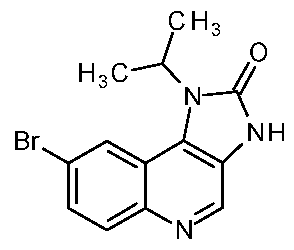
Triethylamine (45.3 mL, 332.06 mmol) was added to 6-bromo-4- (isopropylamino)quinoline-3-carboxylic acid (34.22 g, 110.69 mmol) in DMF (342 mL) at ambient temperature. After stirring at ambient temperature for 30 minutes, diphenyl phosphorazidate (26.2 mL, 121.76 mmol) was added and the resulting mixture stirred at 60 °C for 2 h. The reaction mixture was poured into water (1500 mL); the precipitate collected by filtration, washed with water (2 x 700 mL) and dried under vacuum at 50°C to afford the desired material as a beige solid (29.6 g, 87 ), which was used without further purification.
NMR Spectrum: lH NMR (500MHz, CDC13) δ 1.64 (6H, d), 5.06 - 5.21 (1H, m), 7.75 (1H, d), 7.98 (1H, d), 8.43 (1H, s), 8.69 (1H, s), 11.57 (1H, s).
Mass Spectrum: m/z (ES+)[M+H]+ = 306 6-Bromo-4-(isopropylamino)quinoline-3-carboxylic acid
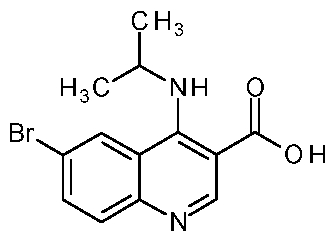
Ethyl 6-bromo-4-(isopropylamino)quinoline-3-carboxylate (38.0 g, 112.69 mmol) was suspended in methanol (800 mL) and water (200 mL). 10M sodium hydroxide solution (33.8 mL, 338.07 mmol) was added and the mixture stirred at ambient temperature for 1 h. THF (200 mL) was added and the resultant mixture stirred for 16 h. Water (400 mL) was added and the organics removed under reduced pressure. The resulting aqueous solution was acidified to pH 4-5 with 2M HC1 and the precipitate collected by filtration, washed with water and dried under vacuum to afford the desired material as a white solid (34.7 g, 100 %). NMR Spectrum: ΧΗ NMR (500MHz, DMSO-d6) δ 1.33 (6H, d), 4.39 (1H, s), 7.78 (1H, d), 7.92 (1H, dd), 8.38 (1H, d), 8.88 (1H, s). Mass Spectrum: m/z (ES+)[M+H]+ = 309.
Ethyl 6-bromo-4-(isopropylamino uinoline-3-carboxylate

Propan-2-amine (11.00 ml, 128.02 mmol) was added to a suspension of ethyl 6- bromo-4-chloroquinoline-3-carboxylate (36.61 g, 116.38 mmol) and potassium carbonate (32.2 g, 232.77 mmol) in acetonitrile (250 mL) at 0°C. The mixture was stirred at 54 °C under reflux for 3 h. Further potassium carbonate (10.7 g, 77.6 mmol) and propan-2-amine (3.6 ml, 42.7 mmol) were added and stirring continued at 48 °C for a further 16 h. The solvents were removed in vacuo and the resulting residue partitioned between DCM (400 mL) and water (500 mL). The aqueous layer was re-extracted with DCM (2 x 200 mL); the combined organic layers were passed through a phase separating paper and concentrated under reduced pressure to afford the desired material as a beige solid (38.6 g, 98 %).
NMR Spectrum: lH NMR (500MHz, CDC13) δ 1.40 (6H, d), 1.43 (3H, t), 4.32 - 4.37 (1H, m), 4.40 (2H, q), 7.72 (1H, dd), 7.81 (1H, d), 8.29 (1H, d), 8.95 (1H, d), 9.10 (1H, s). Mass Spectrum: m/z (ES+)[M+H]+ = 337.
Ethyl 6-bromo-4-chloroquinoline-3-carboxylate

DMF (0.119mL, 1.54mmol) was added to ethyl 6-bromo-l-[(4- methoxyphenyl)methyl]-4-oxoquinoline-3-carboxylate (160g, 384.37mmol) in thionyl chloride (800mL) at ambient temperature under air. The resulting mixture was stirred at 75°C for 16 h then the solvent removed under reduced pressure. The resulting mixture was azeotroped twice with toluene then w-hexane (500mL) added. The precipitate was collected by filtration, washed with w-hexane (200mL) and dried under vacuum to afford the desired material (lOOg, 83%) as a brown solid. NMR Spectrum: lH NMR (400MHz, CDCI3) δ 1.47 (3H, t), 4.51 (2H, q), 7.95 (1H, dd), 8.11 (1H, d), 8.60 (1H, d), 9.24 (1H, s). Mass Spectrum: m/z (ES+)[M+H]+ = 314, 316.
On a larger scale, ethyl 6-bromo-l-[(4-methoxyphenyl)methyl]-4-oxoquinoline-3- carboxylate (5765 g, 13.85 mol) was charged to the vessel with thionyl chloride (28.8 L). An exotherm from 20-26°C was observed. DMF (4.4 mL) was added with no observed exotherm and the batch heated to 75°C and stirred for 17 h. HPLC showed 1.3% starting material remained with 98.0% product. The reaction was concentrated in vacuo and the residue azeotroped with toluene (25 L). The resulting solid was then slurried in heptane (18.5 L) for 2.5 h, filtered and washed with heptane (3 x 4 L). The solid was dried under vacuum at 35°C to give 4077 g of the desired material (93% crude yield) which contained -5% of ethyl 6-bromo-l-[(4- methoxyphenyl)methyl]-4-oxoquinoline-3-carboxylate in addition to -4% hydrolysis product by HPLC (90% pure). The crude material (4077 g) was returned to the vessel and reprocessed with thionyl chloride (14.5 L) and DMF (2.2 mL). The mixture was heated to 75°C for 40 h. The thionyl chloride was removed in vacuo and the residue azeotroped with toluene (10 L). The residue was slurried in heptane (18 L) for -16 h at 20°C. The solid was collected by filtration, one portion being filtered under nitrogen and washed with heptane (3 L) to yield 2196 g of desired material (90% NMR assay, 99% by HPLC). The remainder of the batch was filtered under air and washed with heptane (3 L) to yield 1905 g of the desired material (88% NMR assay, 99% by HPLC). The yellow solids were combined for further processing (4101 g, 3653 g active, 83% yield, 99% by HPLC).
Ethyl 6-bromo-l-[(4-methoxyphenyl)methyl]-4-oxoquinoline-3-carboxylate

l,8-Diazabicyclo[5.4.0]undec-7-ene (102mL, 679.62mmol) was added drop-wise to ethyl 2-(5-bromo-2-fluorobenzoyl)-3-[(4-methoxyphenyl)methylamino]prop-2- enoate (296.5g, 679.62mmol), in acetone (1.2 L) at ambient temperature over a period of 2 minutes. The resulting solution was stirred for 16 h then the solid removed by filtration and washed with MTBE to afford the desired material (180g,
64%) as light yellow solid. NMR Spectrum: XH NMR (400MHz, DMSO-d6) δ 1.30 (3H ,t), 3.71 (3H, s), 4.25 (2H ,q), 5.60 ( 2H, s), 6.90-6.95 (2H, m), 7.12-7.25 (2H, m), 7.67 (1H, d), 7.80-7.90 (1H, m), 8.30 (1H, d), 8.92 (1H, s). Mass Spectrum: m/z (ES+)[M+H]+ = 418.
On a larger scale, ethyl 2-(5-bromo-2-fluorobenzoyl)-3-[(4- methoxyphenyl)methylamino]prop-2-enoate (8434 g, (7730 g assumed active), 17.71 mol) was charged to the vessel with acetone (23.2 L) at 15°C. 1,8- Diazabicyclo[5.4.0]undec-7-ene (2.8 L, 18.72 mol) was added over 25 minutes with an observed exotherm from 18-23°C over the addition. A precipitate formed after -25 minutes and the batch continued to exotherm reaching a maximum of 37 °C after 1 h. The reaction was stirred at 20°C for 16.5 h at which point HPLC indicated consumption of starting material and 96.5% product. The resulting precipitate was collected by filtration washing with MTBE (4x 3.4 L). The solid was then dried under vacuum at 40°C to give 6033 g of the desired material as a white solid (81.6% yield over 3 steps, 99.8% purity by HPLC). Analytical data was consistent with that obtained on previous batches.
Ethyl 2-(5-bromo-2-fluorobenzoyl)-3-[(4-methoxyphenyl)methylamino]prop-2- enoate

(E)-Ethyl 3-(dimethylamino)acrylate (98 g, 685.00 mmol) was added portion- wise to 5-bromo-2-fluorobenzoyl chloride (163 g, 685 mmol) and DIPEA (120 mL, 685.00 mmol) in toluene (800 mL) at 10°C over a period of 10 minutes. The resulting solution was stirred at 70°C for 16 h then allowed to cool. (4-
Methoxyphenyl)methanamine (94 g, 685 mmol) was added to the mixture over a period of 20 minutes at ambient temperature. The resulting solution was stirred for 3 h then the reaction mixture diluted with DCM (4 L), and washed with water (3 x 1L). The organic phase was dried over Na2S04, filtered and evaporated to give the
desired material (300 g, 100%) as brown oil, which was used immediately in the subsequent reaction without further purification. Mass Spectrum: m/z
(ES+)[M+H]+ = 436.
On a larger scale, 5-bromo-2-fluorobenzoyl chloride (4318 g, 4205 g active, 17.71 mol) was charged to the vessel as a solution in toluene (7.5 L). DIPEA (3150 mL, 18.08 mol) was added with no observed exotherm. Ethyl-3- (dimethylamino)acrylate (2532 g, 17.71 mol) was added portionwise over 30 minutes maintaining a batch temperature <40°C. An exotherm from 21-24°C was noted over the 30 minute addition with a further slow rise to 38°C over 1 h. The reaction was stirred at 20-30°C for 16.5 h. 4-Methoxybenzylamine (2439 g, 17.78 mol) was added portionwise over 30 mins maintaining a batch temperature <40°C. An exotherm of 25-30°C was observed over the addition with cooling provided by a reduced jacket temperature of 15°C. The reaction was stirred for 4 h at 20-30°C after which HPLC indicated 93.2% of desired material. The batch was split for workup with each half of the mixture diluted with DCM (28.6 L) and washed with water (3 x 7.8 L). The organics were dried over MgS04 (-550 g) and filtered, washing with DCM (4 L). The combined organics were then concentrated to give 8444 g of the desired material as an oil (8434 g, 106% yield, 94.7% purity by HPLC). Analytical data was consistent with that obtained from previous batches.
5-Bromo-2-fluorobenzoyl chloride

Thionyl chloride (75.0mL, 1027.36mmol) was added drop- wise to 5-bromo-2- fluorobenzoic acid (150g, 684.91mmol), in toluene (1.2 L) and DMF (12mL) at ambient temperature over a period of 1 h. The resulting mixture was stirred at 70°C for 16 h then the mixture allowed to cool and concentrated in vacuo to afford the desired material (160g, 98%) as light yellow oil, which was used without further purification. NMR Spectrum: lH NMR (400MHz, DMSO-d6) δ 7.26 - 7.31 (1H, m), 7.83 (1H, dd), 8.02 (1H, d).
On a larger scale, 3-bromo-6-fluorobenzoic acid (3888 g, 17.75 mol) was charged to the vessel at 20°C followed by toluene (29.2 L). Thionyl chloride (1950 ml, 26.88 mol) was added, followed by DMF (310 mL) with no observed exotherm. The mixture was heated to 65-75°C (solution obtained above ~45°C) with no observed exotherm and slight gas evolution. The reaction was stirred for 40 h at this temperature at which point HPLC analysis showed 87.6% product, 3.4% starting material. The reaction was concentrated in vacuo and azeotroped with toluene (18 L) to give 4328 g of the desired material (103% yield, 87.3% by HPLC).
BIOLOGICAL ASSAYS
The following assays were used to measure the effects of the compounds of the present invention: a) ATM cellular potency assay; b) PI3K cellular potency assay; c) mTOR cellular potency assay; d) ATR cellular potency assay; e): DNAPK cellular potency assay. During the description of the assays, generally:
i. The following abbreviations have been used: 4NQO = 4-Nitroquinoline N- oxide; Ab = Antibody; BSA = Bovine Serum Albumin; C02 = Carbon Dioxide; DMEM = Dulbecco's Modified Eagle Medium; DMSO =Dimethyl Sulphoxide; EDTA = Ethylenediaminetetraacetic Acid; EGTA = Ethylene Glycol Tetraacetic Acid; ELISA = Enzyme-linked Immunosorbent Assay; EMEM = Eagle's Minimal Essential Medium; FBS = Foetal Bovine Serum; h = hour(s); HRP = Horseradish Peroxidase; i.p. = intraperitoneal; PBS = Phosphate buffered saline; PBST = Phosphate buffered saline / Tween; TRIS = Tris(Hydroxymethyl)aminomethane; MTS reagent: [3-(4,5- dimethylthiazol-2-yl)-5-(3-carboxymethoxyphenyl)-2-(4-sulfophenyl)-2H- tetrazolium, inner salt, and an electron coupling reagent (phenazine methosulfate) PMS; s.c. sub-cutaneously.
ii. IC50 values were calculated using a smart fitting model in Genedata. The IC50 value was the concentration of test compound that inhibited 50% of biological activity.
Assay a): ATM Cellular Potency Rationale:
Cellular irradiation induces DNA double strand breaks and rapid
intermolecular autophosphorylation of serine 1981 that causes dimer dissociation and initiates cellular ATM kinase activity. Most ATM molecules in the cell are rapidly phosphorylated on this site after doses of radiation as low as 0.5 Gy, and binding of a phosphospecific antibody is detectable after the introduction of only a few DNA double-strand breaks in the cell.
The rationale of the pATM assay is to identify inhibitors of ATM in cells. HT29 cells are incubated with test compounds for lhr prior to X-ray-irradiation, lh later the cells are fixed and stained for pATM (Serl981). The fluorescence is read on the arrayscan imaging platform.
Method details:
HT29 cells (ECACC #85061109) were seeded into 384 well assay plates (Costar #3712) at a density of 3500 cells / well in 40μ1 EMEM medium containing 1% L glutamine and 10% FBS and allowed to adhere overnight. The following morning compounds of Formula (I) in 100% DMSO were added to assay plates by acoustic dispensing. After lh incubation at 37°C and 5% C02, plates (up to 6 at a time) were irradiated using the X-RAD 320 instrument (PXi) with equivalent to ~600cGy. Plates were returned to the incubator for a further lh. Then cells were fixed by adding 20μ1 of 3.7% formaldehyde in PBS solution and incubating for 20 minutes at r.t. before being washed with 50μ1 / well PBS, using a Biotek EL405 plate washer. Then 20μ1 of 0.1% Triton X100 in PBS was added and incubated for 20 minutes at r.t., to permeabalise cells. Then the plates were washed once with 50μ1 / well PBS, using a Biotek EL405 plate washer.
Phospho-ATM Serl981 antibody (Millipore #MAB3806) was diluted 10000 fold in PBS containing 0.05% polysorbate/Tween and 3% BSA and 20μ1 was added to each well and incubated over night at r.t. The next morning plates were washed three times with 50μ1 / well PBS, using a Biotek EL405 plate washer, and then 20μ1 of secondary Ab solution, containing 500 fold diluted Alexa Fluor® 488 Goat anti-
rabbit IgG (Life Technologies, A11001) and 0.002mg/ml Hoeschst dye (Life technologies #H-3570), in PBS containing 0.05% polysorbate/Tween and 3% BSA, was added. After lh incubation at r.t, the plates were washed three times with 50μ1 / well PBS, using a Biotek EL405 plate washer, and plates were sealed and kept in PBS at 4°C until read. Plates were read using an ArrayScan VTI instrument, using an XF53 filter with 10X objective. A two laser set up was used to analyse nuclear staining with Hoeschst (405nm) and secondary antibody staining of pSerl981 (488nm).
Assay b): ATR Cellular Potency Rationale:
ATR is a PI 3-kinase-related kinase which phosphorylates multiple substrates on serine or threonine residues in response to DNA damage during or replication blocks. Chkl, a downstream protein kinase of ATR, plays a key role in DNA damage checkpoint control. Activation of Chkl involves phosphorylation of Ser317 and Ser345 (the latter regarded as the preferential target for
phosphorylation/activation by ATR). This was a cell based assay to measure inhibition of ATR kinase, by measuring a decrease in phosphorylation of Chkl (Ser 345) in HT29 cells, following treatment with compound of Formula (I) and the UV mimetic 4NQO (Sigma #N8141).
Method details:
HT29 cells (ECACC #85061109) were seeded into 384 well assay plates (Costar #3712) at a density of 6000 cells / well in 40μ1 EMEM medium containing 1% L glutamine and 10% FBS and allowed to adhere overnight. The following morning compound of Formula (I) in 100% DMSO were added to assay plates by acoustic dispensing. After lh incubation at 37°C and 5% C02, 40nl of 3mM 4NQO in 100% DMSO was added to all wells by acoustic dispensing, except minimum control wells which were left untreated with 4NQO to generate a null response control. Plates were returned to the incubator for a further lh. Then cells were fixed by adding 20μ1 of 3.7% formaldehyde in PBS solution and incubating for 20 mins
at r.t. Then 20μ1 of 0.1% Triton X100 in PBS was added and incubated for 10 minutes at r.t., to permeabalise cells. Then the plates were washed once with 50μ1 / well PBS, using a Biotek EL405 plate washer.
Phospho-Chkl Ser 345 antibody (Cell Signalling Technology #2348) was diluted 150 fold in PBS containing 0.05% polysorbate/Tween and 15μ1 was added to each well and incubated over night at r.t. The next morning plates were washed three times with 50μ1 / well PBS, using a Biotek EL405 plate washer, and then 20μ1 of secondary Ab solution, containing 500 fold diluted Alexa Fluor 488 Goat anti- rabbit IgG (Molecular Probes #A- 11008) and 0.002mg/ml Hoeschst dye (Molecular Probes #H-3570), in PBST, was added. After 2h incubation at r.t., the plates were washed three times with 50μ1 / well PBS, using a Biotek EL405 plate washer, and plates were then sealed with black plate seals until read. Plates were read using an ArrayScan VTI instrument, using an XF53 filter with 10X objective. A two laser set up was used to analyse nuclear staining with Hoeschst (405nm) and secondary antibody staining of pChkl (488nm).
Assay c): PI3K Cellular Potency
Rationale:
This assay was used to measure PI3K-a inhibition in cells. PDKl was identified as the upstream activation loop kinase of protein kinase B (Aktl), which is essential for the activation of PKB. Activation of the lipid kinase
phosphoinositide 3 kinase (PI3K) is critical for the activation of PKB by PDKl.
Following ligand stimulation of receptor tyrosine kinases, PI3K is activated, which converts PIP2 to PIP3, which is bound by the PH domain of PDKl resulting in recruitment of PDKl to the plasma membrane where it phosphorylates AKT at Thr308 in the activation loop.
The aim of this cell-based mode of action assay is to identify compounds that inhibit PDK activity or recruitment of PDKl to membrane by inhibiting PI3K activity. Phosphorylation of phospho-Akt (T308) in BT474c cells following treatment with compounds for 2h is a direct measure of PDKl and indirect measure of PDK activity.
Method details:
BT474 cells (human breast ductal carcinoma, ATCC HTB-20) were seeded into black 384 well plates (Costar, #3712) at a density of 5600 cells / well in DMEM containing 10% FBS and 1% glutamine and allowed to adhere overnight.
The following morning compounds in 100% DMSO were added to assay plates by acoustic dispensing. After a 2h incubation at 37°C and 5% C02, the medium was aspirated and the cells were lysed with a buffer containing 25mM Tris, 3mM EDTA, 3mM EGTA, 50mM sodium fluoride, 2mM Sodium orthovanadate,
0.27M sucrose, lOmM β-glycerophosphate, 5mM sodium pyrophosphate, 0.5% Triton X-100 and complete protease inhibitor cocktail tablets (Roche #04 693 116
001, used 1 tab per 50ml lysis buffer).
After 20 minutes, the cell lysates were transferred into ELISA plates (Greiner # 781077) which had been pre-coated with an anti total- AKT antibody in PBS buffer and non-specific binding was blocked with 1% BSA in PBS containing 0.05% Tween 20. Plates were incubated over night at 4°C. The next day the plates were washed with PBS buffer containing 0.05% Tween 20 and further incubated with a mouse monoclonal anti-phospho AKT T308 for 2h. Plates were washed again as above before addition of a horse anti-mouse-HRP conjugated secondary antibody. Following a 2h incubation at r.t, plates were washed and QuantaBlu substrate working solution (Thermo Scientific #15169, prepared according to provider's instructions) was added to each well. The developed fluorescent product was stopped after 60 minutes by addition of Stop solution to the wells. Plates were read using a Tecan Safire plate reader using 325nm excitation and 420nm emission wavelengths respectively. Except where specified, reagents contained in the Path Scan Phospho AKT (Thr308) sandwich ELISA kit from Cell Signalling (#7144) were used in this ELISA assay.
Assay d): mTOR Cellular Potency Rationale:
The phospho-AKTser473 cell assay was performed in the MDA-MB-468 cell line, a PTEN null breast adenocarcinoma human cell line. As a consequence of the lack of PTEN, pAKT is constitutively activated which eliminates the requirement for stimulation to induce phosphorylation.
Method details:
MDA-MB-468 cells were cultured in cell media composed of DMEM (Dulbecco's modified Eagle's medium #D6546)), 10% (v/v) Foetal Calf Serum and 1% (v/v) L-Glutamine. After harvesting, cells were dispensed into black, 384- well Costar plates (#3712, Corning) to give 1500 cells per well in a total volume of 40μ1 cell media, and were incubated overnight at 37°C, 90% relative humidity and 5% C02 in a rotating incubator. Compounds were then tested by one of two assay protocols A or B:
Protocol A:
The cell plates were then incubated for 2 h at 37 °C before being fixed by the addition of 20μ1 3.7% formaldehyde in PBS/A (1.2% final concentration), followed by a 40 minute room temperature incubation, and then a 2x wash with 150μ1 PBS/A (phosphate buffered saline) using a BioTek ELx406 platewasher. Cells were permeabilised and blocked with 20μ1 of assay buffer (0.5% Tween 20 in PBS/A + 1% milk powder) for lh at room temperature, and then washed lx with 50μ1 PBS/A. Primary phospho-AKT (Ser473) 736E11 rabbit monoclonal antibody (#3787, Cell Signaling Technology) was diluted 1:500 in assay buffer, 20μ1 added per well, and plates were incubated at 4°C overnight. Cell plates were washed 3x with 200μ1 PBS/T (phosphate buffered saline containing 0.05% Tween-20), then 20μ1 1: 1000 dilution in assay buffer of Alexa Fluor® 488 goat anti-rabbit IgG secondary antibody (#A11008, Molecular Probes, Life Technologies), with a 1:5000 dilution of Hoechst 33342, was added per well. Following a 2 h incubation
at room temperature, plates were washed 3x with 200μ1 PBS/T, and 40μ1 PBS/A was added per well.
Stained cell plates were covered with black seals, and then read on the Acumen (TTP Labtech) plate reader. The primary channel (green fluorescence, 488nm) is used to set the intensity settings for the max/min cut off to allow for weekly variation in staining and the ΆΚΤ+: No of objects (No)' data is used for the analysis. Data was analysed and IC50's were calculated using Genedata Screener® software.
Protocol B:
The cell plates were then incubated for 2 h at 37 °C before being fixed by the addition of 20μ1 3.7% formaldehyde in PBS/A (1.2% final concentration), followed by a 30 minute room temperature incubation, and then a 2x wash with 150μ1 PBS/A using a BioTek ELx406 platewasher. Cells were permeabilised and blocked with 20μ1 of assay buffer (0.1% Triton X-100 in PBS/A + 1% BSA) for lh at room temperature, and then washed lx with 50μ1 PBS/A. Primary phospho-AKT
(Ser473) D9E XP® rabbit monoclonal antibody (#4060, Cell Signaling
Technology) was diluted 1:200 in assay buffer, 20μ1 added per well, and plates were incubated at 4°C overnight. Cell plates were washed 3x with 200μ1 PBS/T, then 20μ1 1:750 dilution in assay buffer of Alexa Fluor® 488 goat anti-rabbit IgG secondary antibody (#A11008, Molecular Probes, Life Technologies), with a 1:5000 dilution of Hoechst 33342, was added per well. Following a 1 h incubation at room temperature, plates were washed 3x with 200μ1 PBS/T, and 40μ1 PBS w/o Ca, Mg and Na Bicarb (Gibco #14190-094) was added per well.
Stained cell plates were covered with black seals, and then read on the Cell Insight imaging platform (Thermo Scientific), with a lOx objective. The primary channel (Hoechst blue fluorescence 405nM, BGRFR_386_23) is used to Autofocus and to count number of events (this will provide information about cytotoxicity of the compounds tested). The secondary channel (Green 488nM, BGRFR_485_20) measures pAKT staining. Data was analysed and IC50's were calculated using Genedata Screener® software.
Assay e): DNAPK Cellular Potency
Compound Handling:
All compounds or DMSO (dimethyl sulphoxide) for the DNAPK cell ELISA assay were dispensed from source plates containing compounds at lOmM in 100% (v/v) DMSO or 100% DMSO, directly into assay plates using an Echo 555 Acoustic dispenser (Labcyte Inc™). lOmM compound stocks were diluted 1 : 100 using a fixed-tip 96-head Agilent VPrep liquid handler (Agilent Technologies, Santa Clara, CA) to give four intermediate dilutions (lOmM, ΙΟΟμΜ, ΙμΜ, ΙΟηΜ). This intermediate plate was used by the Echo to dispense compounds and DMSO directly into the cell plates with a 12 point dose range (30, 10, 3.125, 1.25, 0.3, 0.1, 0.03125, 0.0125, 0.003, 0.001, 0.0003125, 0.00003μΜ) in order to calculate compound IC50, with a total DMSO concentration in the assay of 0.3%.
Method details:
The DNA-PK cell ELISA assay was performed in the HT29 colorectal carcinoma cell line. HT29 cells were cultured in cell media composed of MEM (Minimum Essential Medium Eagle Sigma #M2279), 10% (v/v) Foetal Calf Serum and 1% (v/v) 200 mM L-Glutamine. After harvesting, cells were dispensed into black, 384-well Costar plates (#3712, Corning) to give 15,000 cells per well in a total volume of 40 ul cell media, and were incubated overnight at 37°C, 90% relative humidity and 5% CO2 in a rotating incubator. Greiner 781077 all-black high-bind 384-well ELISA plates were coated with 0.5 μ§/πι1 DNA-PK antibody (Abeam #abl832) in PBS overnight at 4°C. The following day the Greiner ELISA plates were washed 3x with PBS-T and blocked with 3% BSA/PBS for ~2h, before a further 3x wash with PBS-T. Test compounds and reference controls were dosed directly into the cell plates using a Labcyte Echo 555 acoustic dispenser. The cell plates were then incubated for 1 h at 37°C before receiving a radiation dose of 8 Gy (XRAD 320, table height 65). The cells were incubated for a further 1 h before removal of cell media. Lysis buffer (in-house preparation with addition of protease inhibitor cocktail tablets, Roche # 04 693 116 001) was dispensed at 25μ1Λνε11 and plates were incubated at 4°C for 15-20 min. Cell lysates (20μ1Λνε11) were
transferred to the DNA-PK antibody-coated ELISA plates using a CyBio Felix liquid handling platform, and ELISA plates were incubated at 4°C overnight. The following day, ELISA plates were washed 3x with PBS-T and dispensed with in- house pS2056-DNA-PK antibody (O^g/ml in 3% BSA/PBS) at 20μ1Λνε11. Plates were incubated with antibody for 1.5 h at room temperature (RT) before 3x wash with PBS-T. Goat anti-rabbit HRP secondary antibody (1:2000 dilution in 3% BSA/PBS; Cell Signaling #7074) was dispensed at 20 μΐ/well and plates were incubated at room temperature for 1 h before 3x wash with PBS-T. QuantaBlu Working Substrate Solution (Thermo Scientific #15169, prepared according to manufacturer's instructions) was dispensed at 20 μΐ/well and plates were incubated at room temperature for 1 h before a further 20 μΐ/well dispense with QuantaBlu Stop Solution provided within kit (Thermo Scientific #15169). The fluorescence intensity of individual wells was determined using a PerkinElmer En Vision plate reader. Data was analysed and IC50's were calculated using Genedata Screener® software.
Table 4: Potency Data for Examples 1 - 12 in Assays a) - e)
Assay e)
Assay a) Assay b) Assay c) Assay d)
DNAPK
Example ATM Cell ATR Cell PBKa Cell mTOR Cell
Cell ICso ICso ^M) ICso ^M) ICso OiM) ICso OiM)
(μΜ)
1 0.000115 13.5 1.16 >8.08 4.63
2 0.000805 >22.1 0.955 >1.25 2.08
3 0.00027 >19.6 0.77 2.03
Table 5 shows comparative data for certain Compounds of CN102399218A and CN102372711A in Assays a) to e).
Table 5: Potency Data for Certain Compounds of CN102399218A and
CN102372711A in Assays a) - e)
Assay d) Assay e)
Assay a) Assay b) Assay c)
Reference mTOR DNAPK
ATM Cell ATR Cell PBKa Cell
Compound Cell ICso Cell ICso
ICso ^M) ICso ^M) ICso ^M)
(μΜ) (μΜ)
CN102372711A
0.125 0.281 0.188 0.237
Compound 1
CN102372711A
0.0112 0.125 0.102 0.0729 0.171 Compound 4
CN102372711A
0.0265 0.0644 0.153 0.113 0.314 Compound 5
CN102399218A
0.212 0.052 2.31 0.101 Compound 59
CN102399218A
1.76 0.419 4.67 2.31
Compound 60
CN102399218A
3.46 1.48 1.73 0.177 2.03 Compound 61
CN102399218A
0.135 0.0553 0.149 0.0155 0.0432 Compound 62
CN102399218A
0.216 0.162 0.247 0.287 0.531 Compound 64
CN102399218A
0.494 0.0129 0.0804 0.0414 0.0637 Compound 94
CN102399218A
0.0741 0.0686 0.0131 0.0469 0.0337 Compound 114
Claims
1. A compound of Formula (I):

(I)
or a pharmaceutically acceptable salt thereof, where:
R1 is 4-fluoropiperidin- l-yl or 3-fluoropyrrolidin-l-yl; and R2 is methyl or hydro.
2. The compound of Formula (I), or a pharmaceutically acceptable salt thereof, as claimed in claim 1, where R1 is 4-fluoropiperidin- l-yl.
3. The compound of Formula (I), or a pharmaceutically acceptable salt thereof, as claimed in claim 1, where R1 is 3-fluoropyrrolidin-l-yl.
4. The compound of Formula (I), or a pharmaceutically acceptable salt thereof, as claimed in claim 1, where R1 is (S)-3-fluoropyrrolidin- l-yl.
5. The compound of Formula (I), or a pharmaceutically acceptable salt thereof, as claimed in claim 1, where R1 is (R)-3-fluoropyrrolidin-l-yl.
6. The compound of Formula (I), or a pharmaceutically acceptable salt thereof, as claimed in any one of claims 1 to 5, where R2 is methyl.
7. The compound of Formula (I), or a pharmaceutically acceptable salt thereof as claimed in any one of claims 1 to 5, where R2 is hydro.
8. The compound of Formula (I), or a pharmaceutically acceptable salt thereof, as claimed in claim 1, where the compound is selected from:
8-(6-(3-(4-Fluoropiperidin- l-yl)propoxy)pyridin-3-yl)-l-isopropyl-3- methyl- l,3-dihydro-2H-imidazo[4,5-c]quinolin-2-one;
(5,)-8-(6-(3-(3-Fluoropyrrolidin-l-yl)propoxy)pyridin-3-yl)-l-isopropyl-3- methyl- l,3-dihydro-2H-imidazo[4,5-c]quinolin-2-one; and
(R)-8-(6-(3-(3-Fluoropyrrolidin- l-yl)propoxy)pyridin-3-yl)- l-isopropyl-3- methyl- l,3-dihydro-2H-imidazo[4,5-c]quinolin-2-one.
9. A pharmaceutical composition which comprises a compound of Formula (I), or a pharmaceutically acceptable salt thereof, as claimed in any one of claims 1 to 8, and at least one pharmaceutically acceptable excipient.
10. A compound of Formula (I), or a pharmaceutically acceptable salt thereof, as
claimed in any one of claims 1 to 8, for use in therapy.
11. A compound of Formula (I), or a pharmaceutically acceptable salt thereof, as
claimed in any one of claims 1 to 8, for use in the treatment of cancer.
12. A compound of Formula (I), or a pharmaceutically acceptable salt thereof, for use in the treatment of cancer according to claim 11, where the compound of Formula (I) is administered simultaneously, separately or sequentially with radiotherapy.
13. A compound of Formula (I), or a pharmaceutically acceptable salt thereof, for use in the treatment of cancer according to claim 11, where the compound of Formula (I) is administered simultaneously, separately or sequentially with at least one additional anti-tumour substance selected from cisplatin, oxaliplatin, carboplatin, valrubicin, idarubicin, doxorubicin, pirarubicin, irinotecan, topotecan, amrubicin, epirubicin, etoposide, mitomycin, bendamustine, chlorambucil, cyclophosphamide, ifosfamide, carmustine, melphalan, bleomycin, olaparib, MED 14736, AZD1775 and AZD6738.
14. Use of a compound of Formula (I), or a pharmaceutically acceptable salt thereof, as claimed in any one of claims 1 to 8, in the manufacture of a medicament for the treatment of cancer.
15. A method for treating cancer in a warm-blooded animal in need of such treatment, which comprises administering to said warm-blooded animal a therapeutically effective amount of a compound of Formula (I), or a pharmaceutically acceptable salt thereof, as claimed in any one of claims 1 to 8.
Applications Claiming Priority (2)
| Application Number | Priority Date | Filing Date | Title |
|---|---|---|---|
| GBGB1608227.3A GB201608227D0 (en) | 2016-05-11 | 2016-05-11 | Imidazo[4,5-c]quinolin-2-one compounds and their use in treating cancer |
| GB1608227.3 | 2016-05-11 |
Publications (1)
| Publication Number | Publication Date |
|---|---|
| WO2017194632A1 true WO2017194632A1 (en) | 2017-11-16 |
Family
ID=56297492
Family Applications (1)
| Application Number | Title | Priority Date | Filing Date |
|---|---|---|---|
| PCT/EP2017/061229 Ceased WO2017194632A1 (en) | 2016-05-11 | 2017-05-10 | Imidazo[4,5-c]quinolin-2-one compounds and their use in treating cancer |
Country Status (4)
| Country | Link |
|---|---|
| AR (1) | AR108461A1 (en) |
| GB (1) | GB201608227D0 (en) |
| TW (1) | TW201805284A (en) |
| WO (1) | WO2017194632A1 (en) |
Cited By (12)
| Publication number | Priority date | Publication date | Assignee | Title |
|---|---|---|---|---|
| WO2019201283A1 (en) * | 2018-04-20 | 2019-10-24 | Xrad Therapeutics, Inc. | Dual atm and dna-pk inhibitors for use in anti-tumor therapy |
| WO2020063855A1 (en) * | 2018-09-30 | 2020-04-02 | 南京明德新药研发有限公司 | Quinolino-pyrrolidin-2-one derivative and application thereof |
| CN112469720A (en) * | 2018-04-20 | 2021-03-09 | 艾科思莱德制药公司 | Dual ATM and DNA-PK inhibitors for use in antitumor therapy |
| WO2021098734A1 (en) * | 2019-11-19 | 2021-05-27 | 南京明德新药研发有限公司 | Substituted quinolinopyrrolidone compound as atm inhibitor and application thereof |
| KR20210061337A (en) * | 2018-09-14 | 2021-05-27 | 수저우 잔롱 파마 리미티드 | 1-isopropyl-3-methyl-8-(pyridin-3-yl)-1,3-dihydro-2H-imidazo[4,5- as a selective modulator of telangiectasia mutant (ATM) kinase c]cinnolin-2-one and uses thereof |
| WO2021139814A1 (en) * | 2020-01-09 | 2021-07-15 | 南京明德新药研发有限公司 | Quinoline imidazole compound and application thereof |
| WO2021197339A1 (en) * | 2020-03-30 | 2021-10-07 | 南京明德新药研发有限公司 | Crystal form of quinopyrrolidine-2-one compound serving as atm inhibitor and use thereof |
| WO2021260580A1 (en) | 2020-06-24 | 2021-12-30 | Astrazeneca Uk Limited | Combination of antibody-drug conjugate and atm inhibitor |
| EP3992191A1 (en) | 2020-11-03 | 2022-05-04 | Deutsches Krebsforschungszentrum | Imidazo[4,5-c]quinoline compounds and their use as atm kinase inhibitors |
| CN115778962A (en) * | 2022-11-28 | 2023-03-14 | 中国医学科学院肿瘤医院 | Medicine for treating male esophageal cancer patient and related application thereof |
| WO2023143282A1 (en) * | 2022-01-26 | 2023-08-03 | 正大天晴药业集团股份有限公司 | Hydrazino group-containing compound |
| WO2026120558A1 (en) | 2024-12-06 | 2026-06-11 | Sun Pharma Advanced Research Company Limited | Macrocyclic compounds as atm inhibitors |
Citations (8)
| Publication number | Priority date | Publication date | Assignee | Title |
|---|---|---|---|---|
| WO1997022596A1 (en) | 1995-12-18 | 1997-06-26 | Zeneca Limited | Quinazoline derivatives |
| WO1997030035A1 (en) | 1996-02-13 | 1997-08-21 | Zeneca Limited | Quinazoline derivatives as vegf inhibitors |
| WO1997032856A1 (en) | 1996-03-05 | 1997-09-12 | Zeneca Limited | 4-anilinoquinazoline derivatives |
| WO1998013354A1 (en) | 1996-09-25 | 1998-04-02 | Zeneca Limited | Quinazoline derivatives and pharmaceutical compositions containing them |
| CN102372711A (en) | 2010-08-18 | 2012-03-14 | 山东轩竹医药科技有限公司 | Imidazo quinoline PI3K and mTOR (mammalian target of rapamycin) dual inhibitor |
| CN102399218A (en) | 2010-09-16 | 2012-04-04 | 和记黄埔医药(上海)有限公司 | Triheterocyclic compounds and their use as PI3K inhibitors |
| WO2015170081A1 (en) * | 2014-05-08 | 2015-11-12 | Astrazeneca Ab | Imidazo[4,5-c]quinolin-2-one compounds and their use in treating cancer |
| WO2017046216A1 (en) * | 2015-09-17 | 2017-03-23 | Astrazeneca Ab | 8-[6-[3-(amino)propoxy]-3-pyridyl]-1 -isopropyl-imidazo[4,5-c]quinolin-2-one derivatives as selective modulators of ataxia telangiectasia mutated (atm) kinase for the treatment of cancer |
-
2016
- 2016-05-11 GB GBGB1608227.3A patent/GB201608227D0/en not_active Ceased
-
2017
- 2017-05-10 TW TW106115396A patent/TW201805284A/en unknown
- 2017-05-10 WO PCT/EP2017/061229 patent/WO2017194632A1/en not_active Ceased
- 2017-05-11 AR ARP170101261A patent/AR108461A1/en unknown
Patent Citations (8)
| Publication number | Priority date | Publication date | Assignee | Title |
|---|---|---|---|---|
| WO1997022596A1 (en) | 1995-12-18 | 1997-06-26 | Zeneca Limited | Quinazoline derivatives |
| WO1997030035A1 (en) | 1996-02-13 | 1997-08-21 | Zeneca Limited | Quinazoline derivatives as vegf inhibitors |
| WO1997032856A1 (en) | 1996-03-05 | 1997-09-12 | Zeneca Limited | 4-anilinoquinazoline derivatives |
| WO1998013354A1 (en) | 1996-09-25 | 1998-04-02 | Zeneca Limited | Quinazoline derivatives and pharmaceutical compositions containing them |
| CN102372711A (en) | 2010-08-18 | 2012-03-14 | 山东轩竹医药科技有限公司 | Imidazo quinoline PI3K and mTOR (mammalian target of rapamycin) dual inhibitor |
| CN102399218A (en) | 2010-09-16 | 2012-04-04 | 和记黄埔医药(上海)有限公司 | Triheterocyclic compounds and their use as PI3K inhibitors |
| WO2015170081A1 (en) * | 2014-05-08 | 2015-11-12 | Astrazeneca Ab | Imidazo[4,5-c]quinolin-2-one compounds and their use in treating cancer |
| WO2017046216A1 (en) * | 2015-09-17 | 2017-03-23 | Astrazeneca Ab | 8-[6-[3-(amino)propoxy]-3-pyridyl]-1 -isopropyl-imidazo[4,5-c]quinolin-2-one derivatives as selective modulators of ataxia telangiectasia mutated (atm) kinase for the treatment of cancer |
Non-Patent Citations (9)
| Title |
|---|
| "Handbook of Pharmaceutical Salts: Properties, Selection and Use", 2002, WEINHEIM/ZIIRICHIWILEY-VCH/VHCA |
| BAKKENIST ET AL., NATURE, 2003, pages 499 - 506 |
| BUNN, C.W.: "Chemical Crystallography", 1948, CLARENDON PRESS |
| CREMONA ET AL., ONCOGENE, 2013, pages 3351 - 3360 |
| JENKINS, R; SNYDER, R.L: "Introduction to X-Ray Powder Diffractometry", 1996, JOHN WILEY & SONS |
| KLUG, H. P.; ALEXANDER, L. E., X-RAY DIFFRACTION PROCEDURES, 1974 |
| KURZ; LEES MILLER, DNA REPAIR, 2004, pages 889 - 900 |
| LAVIN, M. F., REV. MOL. CELL BIOL., 2008, pages 759 - 769 |
| MATSUOKA ET AL., SCIENCE, 2007, pages 1160 - 1166 |
Cited By (32)
| Publication number | Priority date | Publication date | Assignee | Title |
|---|---|---|---|---|
| WO2019201283A1 (en) * | 2018-04-20 | 2019-10-24 | Xrad Therapeutics, Inc. | Dual atm and dna-pk inhibitors for use in anti-tumor therapy |
| CN112469720B (en) * | 2018-04-20 | 2024-03-29 | 艾科思莱德制药公司 | Dual ATM and DNA-PK inhibitors for use in anti-tumor therapy |
| CN112469720A (en) * | 2018-04-20 | 2021-03-09 | 艾科思莱德制药公司 | Dual ATM and DNA-PK inhibitors for use in antitumor therapy |
| US12187742B2 (en) | 2018-04-20 | 2025-01-07 | Xrad Therapeutics, Inc. | Dual ATM and DNA-PK inhibitors for use in anti-tumor therapy |
| JP2022500428A (en) * | 2018-09-14 | 2022-01-04 | スゾウ、ザンロン、ファーマ、リミテッドSuzhou Zanrong Pharma Limited | 1-Isopropyl-3-methyl-8- (pyridin-3-yl) -1,3-dihydro-2H-imidazole as a selective regulator of ataxia-telangiectosis mutation (ATM) kinase [4,5 -C] Cinnoline-2-one and its use |
| JP7706585B2 (en) | 2018-09-14 | 2025-07-11 | スゾウ、ザンロン、ファーマ、リミテッド | 1-isopropyl-3-methyl-8-(pyridin-3-yl)-1,3-dihydro-2H-imidazo[4,5-c]cinnolin-2-one and its uses as selective modulators of ataxia telangiectasia mutated (atm) kinase - Patents.com |
| KR20210061337A (en) * | 2018-09-14 | 2021-05-27 | 수저우 잔롱 파마 리미티드 | 1-isopropyl-3-methyl-8-(pyridin-3-yl)-1,3-dihydro-2H-imidazo[4,5- as a selective modulator of telangiectasia mutant (ATM) kinase c]cinnolin-2-one and uses thereof |
| JP2024054247A (en) * | 2018-09-14 | 2024-04-16 | スゾウ、ザンロン、ファーマ、リミテッド | 1-isopropyl-3-methyl-8-(pyridin-3-yl)-1,3-dihydro-2H-imidazo[4,5-c]cinnolin-2-one and its uses as selective modulators of ataxia telangiectasia mutated (atm) kinase - Patents.com |
| KR102813324B1 (en) | 2018-09-14 | 2025-05-26 | 수저우 잔롱 파마 리미티드 | 1-Isopropyl-3-methyl-8-(pyridin-3-yl)-1,3-dihydro-2H-imidazo[4,5-c]cinnolin-2-one as a selective modulator of ataxia-telangiectasia mutated (ATM) kinase and uses thereof |
| JP7436465B2 (en) | 2018-09-14 | 2024-02-21 | スゾウ、ザンロン、ファーマ、リミテッド | 1-isopropyl-3-methyl-8-(pyridin-3-yl)-1,3-dihydro-2H-imidazo[4,5] as a selective modulator of ataxia telangiectasia mutated (ATM) kinase -c] Cinnolin-2-one and its use |
| JP6997358B2 (en) | 2018-09-30 | 2022-01-17 | メッドシャイン ディスカバリー インコーポレイテッド | Kinolinopyrrolidine-2-one-based inducing compounds and their use |
| RU2771314C1 (en) * | 2018-09-30 | 2022-04-29 | Медшайн Дискавери Инк. | Derivatives of quinoline-pyrrolidine-2-one and application thereof |
| JP2021529214A (en) * | 2018-09-30 | 2021-10-28 | メッドシャイン ディスカバリー インコーポレイテッド | Kinolinopyrrolidine-2-one-based inducing compounds and their use |
| WO2020063855A1 (en) * | 2018-09-30 | 2020-04-02 | 南京明德新药研发有限公司 | Quinolino-pyrrolidin-2-one derivative and application thereof |
| US11230549B2 (en) | 2018-09-30 | 2022-01-25 | Medshine Discovery Inc. | Quinolino-pyrrolidin-2-one derivative and application thereof |
| AU2019348132B2 (en) * | 2018-09-30 | 2022-03-31 | Medshine Discovery Inc. | Quinolino-pyrrolidin-2-one derivative and application thereof |
| CN112771045B (en) * | 2018-09-30 | 2022-04-19 | 南京明德新药研发有限公司 | Quinopyrrolopyrrolidine-2-one derivatives and use thereof |
| KR102345208B1 (en) | 2018-09-30 | 2021-12-30 | 메드샤인 디스커버리 아이엔씨. | Quinolino-pyrrolidin-2-one derivatives and their applications |
| KR20210060613A (en) * | 2018-09-30 | 2021-05-26 | 메드샤인 디스커버리 아이엔씨. | Quinolino-pyrrolidin-2-one derivatives and applications thereof |
| CN112771045A (en) * | 2018-09-30 | 2021-05-07 | 南京明德新药研发有限公司 | Quinopyrrolopyrrolidine-2-one derivatives and use thereof |
| CN114746421A (en) * | 2019-11-19 | 2022-07-12 | 南京明德新药研发有限公司 | Substituted quinolinopyrrolones as ATM inhibitors and uses thereof |
| WO2021098734A1 (en) * | 2019-11-19 | 2021-05-27 | 南京明德新药研发有限公司 | Substituted quinolinopyrrolidone compound as atm inhibitor and application thereof |
| CN115003672A (en) * | 2020-01-09 | 2022-09-02 | 南京明德新药研发有限公司 | Quinoline imidazole compound and application thereof |
| WO2021139814A1 (en) * | 2020-01-09 | 2021-07-15 | 南京明德新药研发有限公司 | Quinoline imidazole compound and application thereof |
| WO2021197339A1 (en) * | 2020-03-30 | 2021-10-07 | 南京明德新药研发有限公司 | Crystal form of quinopyrrolidine-2-one compound serving as atm inhibitor and use thereof |
| CN115380031A (en) * | 2020-03-30 | 2022-11-22 | 南京明德新药研发有限公司 | Crystal form of quinoline pyrrolidine-2-ketone compound as ATM inhibitor and application thereof |
| WO2021260580A1 (en) | 2020-06-24 | 2021-12-30 | Astrazeneca Uk Limited | Combination of antibody-drug conjugate and atm inhibitor |
| WO2022096361A1 (en) | 2020-11-03 | 2022-05-12 | Deutsches Krebsforschungszentrum | Imidazo[4,5-c]quinoline compounds and their use as atm kinase inhibitors |
| EP3992191A1 (en) | 2020-11-03 | 2022-05-04 | Deutsches Krebsforschungszentrum | Imidazo[4,5-c]quinoline compounds and their use as atm kinase inhibitors |
| WO2023143282A1 (en) * | 2022-01-26 | 2023-08-03 | 正大天晴药业集团股份有限公司 | Hydrazino group-containing compound |
| CN115778962A (en) * | 2022-11-28 | 2023-03-14 | 中国医学科学院肿瘤医院 | Medicine for treating male esophageal cancer patient and related application thereof |
| WO2026120558A1 (en) | 2024-12-06 | 2026-06-11 | Sun Pharma Advanced Research Company Limited | Macrocyclic compounds as atm inhibitors |
Also Published As
| Publication number | Publication date |
|---|---|
| GB201608227D0 (en) | 2016-06-22 |
| AR108461A1 (en) | 2018-08-22 |
| TW201805284A (en) | 2018-02-16 |
Similar Documents
| Publication | Publication Date | Title |
|---|---|---|
| US20230286981A1 (en) | Imidazo[4,5-c]quinolin-2-one Compounds and Their Use in Treating Cancer | |
| TW201805284A (en) | Imidazo[4,5-C]quinolin-2-one compounds and their use in treating cancer | |
| AU2018234985B2 (en) | Deuterated imidazo[4,5-c]quinolin-2-one compounds and their use in treating cancer | |
| EP3371183A1 (en) | Imidazo[4,5-c]quinolin-2-one compounds and their use in treating cancer | |
| JP2018531226A6 (en) | 8- [6- [3- (Amino) propoxy] -3-pyridyl] -1-isopropyl-imidazo [4,5 as a selective modulator of vasodilator ataxia mutation (ATM) kinase for the treatment of cancer -C] quinolin-2-one derivatives | |
| WO2017153578A1 (en) | Imidazo[4,5-c]quinolin-2-one compounds and their use in treating cancer | |
| WO2019057757A1 (en) | 1,3-dihydroimidazo[4,5-c]cinnolin-2-one compounds and their use in treating cancer | |
| US20190099421A1 (en) | Cinnolin-4-amine compounds and their use in treating cancer | |
| WO2017174446A1 (en) | N,n-dimethyl-3-[[5-(3-methyl-2-oxo-1-tetrahydropyran-4-yl-imidazo[4,5-c]quinolin-8-yl)-2-pyridyl]oxy]propan-1-amine oxide as atm (ataxia telangiectasia mutated) kinase modulator for treating cancer | |
| HK1257413B (en) | 8-[6-[3-(amino)propoxy]-3-pyridyl]-1-isopropyl-imidazo[4,5-c]quinolin-2-one derivatives as selective modulators of ataxia telangiectasia mutated (atm) kinase for the treatment of cancer | |
| HK40016607A (en) | Deuterated imidazo[4,5-c]quinolin-2-one compounds and their use in treating cancer |
Legal Events
| Date | Code | Title | Description |
|---|---|---|---|
| NENP | Non-entry into the national phase |
Ref country code: DE |
|
| 121 | Ep: the epo has been informed by wipo that ep was designated in this application |
Ref document number: 17722777 Country of ref document: EP Kind code of ref document: A1 |
|
| 122 | Ep: pct application non-entry in european phase |
Ref document number: 17722777 Country of ref document: EP Kind code of ref document: A1 |