WO2017191444A1 - Anti-tuberculous polymersomes - Google Patents
Anti-tuberculous polymersomes Download PDFInfo
- Publication number
- WO2017191444A1 WO2017191444A1 PCT/GB2017/051226 GB2017051226W WO2017191444A1 WO 2017191444 A1 WO2017191444 A1 WO 2017191444A1 GB 2017051226 W GB2017051226 W GB 2017051226W WO 2017191444 A1 WO2017191444 A1 WO 2017191444A1
- Authority
- WO
- WIPO (PCT)
- Prior art keywords
- polymersome
- tuberculous
- polymersomes
- tuberculosis
- drug
- Prior art date
- Legal status (The legal status is an assumption and is not a legal conclusion. Google has not performed a legal analysis and makes no representation as to the accuracy of the status listed.)
- Ceased
Links
Classifications
-
- A—HUMAN NECESSITIES
- A61—MEDICAL OR VETERINARY SCIENCE; HYGIENE
- A61K—PREPARATIONS FOR MEDICAL, DENTAL OR TOILETRY PURPOSES
- A61K9/00—Medicinal preparations characterised by special physical form
- A61K9/10—Dispersions; Emulsions
- A61K9/127—Synthetic bilayered vehicles, e.g. liposomes or liposomes with cholesterol as the only non-phosphatidyl surfactant
- A61K9/1271—Non-conventional liposomes, e.g. PEGylated liposomes or liposomes coated or grafted with polymers
- A61K9/1273—Polymersomes; Liposomes with polymerisable or polymerised bilayer-forming substances
-
- A—HUMAN NECESSITIES
- A61—MEDICAL OR VETERINARY SCIENCE; HYGIENE
- A61K—PREPARATIONS FOR MEDICAL, DENTAL OR TOILETRY PURPOSES
- A61K31/00—Medicinal preparations containing organic active ingredients
- A61K31/33—Heterocyclic compounds
- A61K31/395—Heterocyclic compounds having nitrogen as a ring hetero atom, e.g. guanethidine or rifamycins
- A61K31/435—Heterocyclic compounds having nitrogen as a ring hetero atom, e.g. guanethidine or rifamycins having six-membered rings with one nitrogen as the only ring hetero atom
- A61K31/44—Non condensed pyridines; Hydrogenated derivatives thereof
- A61K31/4409—Non condensed pyridines; Hydrogenated derivatives thereof only substituted in position 4, e.g. isoniazid, iproniazid
-
- A—HUMAN NECESSITIES
- A61—MEDICAL OR VETERINARY SCIENCE; HYGIENE
- A61K—PREPARATIONS FOR MEDICAL, DENTAL OR TOILETRY PURPOSES
- A61K31/00—Medicinal preparations containing organic active ingredients
- A61K31/33—Heterocyclic compounds
- A61K31/395—Heterocyclic compounds having nitrogen as a ring hetero atom, e.g. guanethidine or rifamycins
- A61K31/495—Heterocyclic compounds having nitrogen as a ring hetero atom, e.g. guanethidine or rifamycins having six-membered rings with two or more nitrogen atoms as the only ring heteroatoms, e.g. piperazine or tetrazines
- A61K31/496—Non-condensed piperazines containing further heterocyclic rings, e.g. rifampin, thiothixene or sparfloxacin
-
- A—HUMAN NECESSITIES
- A61—MEDICAL OR VETERINARY SCIENCE; HYGIENE
- A61K—PREPARATIONS FOR MEDICAL, DENTAL OR TOILETRY PURPOSES
- A61K47/00—Medicinal preparations characterised by the non-active ingredients used, e.g. carriers or inert additives; Targeting or modifying agents chemically bound to the active ingredient
- A61K47/30—Macromolecular organic or inorganic compounds, e.g. inorganic polyphosphates
- A61K47/34—Macromolecular compounds obtained otherwise than by reactions only involving carbon-to-carbon unsaturated bonds, e.g. polyesters, polyamino acids, polysiloxanes, polyphosphazines, copolymers of polyalkylene glycol or poloxamers
-
- A—HUMAN NECESSITIES
- A61—MEDICAL OR VETERINARY SCIENCE; HYGIENE
- A61K—PREPARATIONS FOR MEDICAL, DENTAL OR TOILETRY PURPOSES
- A61K9/00—Medicinal preparations characterised by special physical form
- A61K9/0012—Galenical forms characterised by the site of application
- A61K9/0019—Injectable compositions; Intramuscular, intravenous, arterial, subcutaneous administration; Compositions to be administered through the skin in an invasive manner
-
- A—HUMAN NECESSITIES
- A61—MEDICAL OR VETERINARY SCIENCE; HYGIENE
- A61P—SPECIFIC THERAPEUTIC ACTIVITY OF CHEMICAL COMPOUNDS OR MEDICINAL PREPARATIONS
- A61P31/00—Antiinfectives, i.e. antibiotics, antiseptics, chemotherapeutics
- A61P31/04—Antibacterial agents
- A61P31/06—Antibacterial agents for tuberculosis
Definitions
- the present invention relates to therapeutic polymersomes.
- the polymersomes contain an anti-tuberculous drug and can be used to treat tuberculosis, including active and latent tuberculosis.
- Mycobacterium tuberculosis the microorganism causing tuberculosis in humans, is considered the first killer among all bacteria causing infectious diseases.
- the infection cycle starts with the inhalation ofM tuberculosis-contaminated aerosol droplets (expelled by an infected person).
- M tuberculosis-contaminated aerosol droplets expelled by an infected person.
- the microorganisms reach the lung, they are immediately taken up by local tissue resident macrophages. These become the predominant host cells where most of the M. tuberculosis lifecycle takes place. This host- pathogen interaction is one of the most studied in the field of infection and immunity.
- M. tuberculosis inhibits the phago-lysosome fusion, so that the bacteria-containing vacuoles do not undergo the acidification process useful for the final clearance.
- the bacteria have been also demonstrated to create a breach in the phagosome membrane, thus gaining access to the cell cytosol.
- the uptake process triggers a series of cascade events leading to the release of pro-inflammatory chemokines (including several chemotactic molecules).
- the final result is the recruitment of other immune cells (neutrophils) in the site of infection, and the formation of a granuloma: a means by which the body tries to contain the uncontrolled spreading of the bacilli by confining them in a small sclerotic space inside the lung.
- M. tuberculosis can survive in this environment for years. The eventual rupture of the granuloma will then lead the bacilli to spread further away from the original site of infection, and to start another cycle of infection. The process of granuloma
- latent TB a pathological status afflicting a third of the entire world population.
- Particularly desirable would be the development of medicaments that demonstrate improved tissue penetration in vivo, such as an improved ability to permeate within the granuloma of patients infected with M. tuberculosis.
- Methods of treating not only active tuberculosis but also latent tuberculosis, in which the M tuberculosis bacilli are substantially confined within granuloma, are required.
- the present invention addresses these problems via the provision of an anti-tuberculous polymersome that comprises: (a) a polymersome; and (b) an anti-tuberculous drug encapsulated within the polymersome.
- Polymersomes (vesicles formed from amphiphilic block copolymers) are examples of polymersomes.
- tuberculosis can be effectively treated using polymersomes that contain an encapsulated anti-tuberculous drug.
- the polymersomes demonstrate excellent tissue penetration in vivo, for example they may surprisingly be able to permeate within the granuloma of patients infected withM tuberculosis. This excellent tissue penetration provides for more effective access by the anti-tuberculous drug in vivo to the M.
- tuberculosis bacilli in turn providing for such beneficial effects as reducing dosage amounts, administration periods and/or the effectiveness of the treatment in eliminating not just M tuberculosis bacilli associated with active tuberculosis, but also bacilli confined in granulomas and associated with latent tuberculosis.
- the techniques of the invention can thus be applied both to the treatment of active tuberculosis and latent tuberculosis.
- the present invention also provides a pharmaceutical composition
- a pharmaceutical composition comprising: a plurality of the anti-tuberculous polymersomes as defined herein; and one or more pharmaceutically acceptable excipients or diluents
- the invention also provides an anti-tuberculous polymersome as defined herein, for use as a medicament.
- the invention further provides an anti-tuberculous polymersome as defined herein, for use in a method for the treatment of tuberculosis. Also provided is a method of treating
- tuberculosis the method comprising administering a therapeutically effective amount of an anti-tuberculous polymersome as defined herein.
- the invention also provides use of an anti- tuberculous polymersome as defined herein in the manufacture of a medicament for use in the treatment of tuberculosis.
- Figure 1 shows, as described in more detail in Example 1 :
- CFUs Colony Forming Units
- Figure 3 shows, as described in more detail in Example 1, confocal uptake analyses of rhodamine-labeled polymersomes injected in D. rerio (zebrafish) embryos. Measures have been carried out after 10 minutes (A), 30 minutes (B), 1 day (C), and 3 days (D) post injections.
- A-D are GFP-macrophages and in (E) there are GFP-neutrophils embryos.
- F Bacterial burden upon treatments with both polymersomes-encapsulated and free drugs.
- FIG. 4 shows, as described in more detail in Example 2, bioavailability of polymersomes, with the panels (a) to (f) corresponding to:
- Figure 5 shows, as described in more detail in Example 3, quantification of mCherry expressing M marinum bacterial burden in zebrafish embryos treated with empty
- Polymersomes are synthetic vesicles formed from amphiphilic block copolymers. Over the last fifteen years they have attracted significant research attention as versatile carriers because of their colloidal stability, tuneable membrane properties and ability in encapsulating or integrating other molecules (for one representative review article, see J Control Release 2012 161(2) 473-83, the contents of which are herein incorporated by reference in their entirety).
- the polymersome used in the present invention is typically a self -assembled structure.
- the polymersome comprises an amphiphilic block copolymer.
- the amphiphilic block copolymer comprises a hydrophilic block and a hydrophobic block.
- Such polymersomes are able to mimic biological phospholipids.
- Molecular weights of these polymers are at least 5 times higher than naturally-occurring phospholipid-based surfactants such that they can assemble into more entangled membranes (J. Am. Chem. Soc. 2005, 127, 8757, the contents of which are herein incorporated by reference in their entirety), providing a final structure with improved mechanical properties and colloidal stability.
- the flexible nature of the copolymer synthesis allows the application of different compositions and functionalities over a wide range of molecular weights and consequently of membrane thicknesses.
- the use of these block copolymers as delivery vehicles offers significant advantages.
- Polymersomes are often substantially spherical.
- Polymersomes typically comprise a bilayered membrane.
- the bilayer is generally formed from two layers of amphiphilic molecules, which align to form an enclosed core with hydrophilic head groups facing the core and the exterior of the vesicle, and hydrophilic tail groups forming the interior of the membrane.
- a typical (largest) diameter of a polymersome is in the range 50 to 50,000 nm (for instance 50 to 5000 nm). More typically, the diameter is in the range 50 to 1000 nm.
- Polymersomes having a diameter in this range are normally termed “nanopolymersomes" or “nanovesicles”.
- the nanopolymersomes are preferably substantially spherical in shape.
- the nanopolymersomes have a number average diameter of less than 300 nm, preferably less than 250 nm, most preferably less than 200 nm or 150 nm.
- the thickness of the bilayer is generally between 2 to 50 nm, more typically between 5 and 20 nm.
- TEM Transmission Electron Microscopy
- SAXS Small Angle X-ray Scattering
- the polymersome is capable of dissociating and releasing the anti-tuberculous drug after it has been internalised within a cell (e.g. an immune cell).
- Dissociation may be promoted by a variety of mechanisms, but is typically promoted by pH sensitivity of the block copolymer.
- the hydrophilic or the hydrophobic block of the amphiphilic copolymer preferably the hydrophobic block, has a pendant group with a pKa in the range 3.0 to 6.9.
- the process of endocytosis induces a reduction in the local pH experienced by the polymersome from around pH 7.4 to around pH 5-6. This pH drop is sufficient to trigger disintegration of the polymersome and release of internalised content (e.g., the anti-tuberculous drug).
- pKa is meant the pH where half of the pendant (side) groups are ionised.
- pKa can be determined by a variety of methods including pH titration followed by potentiometric titration, UV spectroscopy and Dynamic Light Scattering (DLS). An appropriate method should be selected to measure the pKa according to the copolymer which is being analysed and its solubility in the test media.
- DLS is a particularly preferred method for measuring pKa.
- the DLS signal from a copolymer such as PMPC25-&-PDPA20 copolymer, in water varies with pH. At a certain pH the signal rapidly increases as the copolymer undergoes a transition from being molecularly deassociated to associated. The pKa is taken as the pH of the mid-point of this rapid increase.
- the pKa of a group in a polymer is determined on the basis of a polymer system (and not assumed to be the same as the pKas of similar moieties in non-polymeric systems). It is preferred that the hydrophobic block of the polymersome comprises pendant cationisable moieties as pendant groups. Cationisable moieties are, for instance, primary, secondary or tertiary amines, capable of being protonated at pHs below a value in the range 3 to 6.9.
- the group may be a phosphine.
- the pKa of the pendant groups is in the range 4.0 to 6.9, more preferably 5.5 to 6.9.
- the polymersomes are correspondingly capable of disassociating in such pH ranges.
- the hydrophobic block of the polymersome has a degree of polymerisation of at least 50, more preferably at least 70.
- the degree of polymerisation of the hydrophobic block is no more than 250, even more preferably, no more than 200.
- the degree of polymerisation of the hydrophilic block is at least 15, more preferably at least 20. It is preferred that the ratio of the degree of polymerisation of the hydrophilic to hydrophobic block is in the range 1 :2.5 to 1 :8. All of these limitations promote polymersome, rather than micelle formation.
- the hydrophilic block may be based on condensation polymers, such as polyesters, polyamides, polyanhydrides, polyurethanes, polyethers (including polyalkylene glycols, especially PEG), polyimines, polypeptides, polypeptoids, polyureas, polyacetals and polysaccharides, but preferably the hydrophilic block is based on a radical polymerised addition polymer of ethylenically unsaturated monomers.
- the hydrophilic block may have zwitterionic pendant groups, in which case the zwitterionic pendant groups may be present in the monomers and remain unchanged in the polymerisation process. It is alternatively possible to derivatise a functional pendant group of a monomer to render it zwitterionic after polymerisation.
- the hydrophilic block is formed from ethylenically-unsaturated zwitterionic monomers.
- ethylenically unsaturated zwitterionic monomers have the general formula (I)
- H 2 C CR-C 6 H 4 -A 1 -
- H 2 C CR-CH 2 -A 2 -
- R 2 0-CO-CR CR-CO-0-
- RCH CH-CO-0-
- RCH C(COOR 2 )CH 2 -CO-0-
- A is -O- or R 1 ;
- a 1 is selected from a bond, (CH 2 )LA 2 and (CH 2 )LS03 " in which L is 1 to 12;
- a 2 is selected from a bond, -0-, -0-CO-, -CO-O, -CO- R 1 -, - R ⁇ CO-, -O-CO- R 1 - and - R ! -CO-O-;
- R is hydrogen or Ci-4 alkyl
- R 1 is hydrogen, Ci-4 alkyl or BX;
- R 2 is hydrogen or Ci-4 alkyl
- B is a bond, or a straight or branched alkanediyl, alkylene oxaalkylene, or alkylene
- X is a zwitterionic group.
- X is an ammonium, phosphonium, or sulphonium phosphate or phosphonate ester zwitterionic group, more preferably a group of the general formula (II)
- the moieties A 3 and A 4 which are the same or different, are -0-, -S-, - H- or a valence bond, preferably -0-, and W + is a group comprising an ammonium, phosphonium or sulphonium cationic group and a group linking the anionic and cationic moieties which is preferably a Ci-i 2 -alkanediyl group.
- W + is a group of formula -W ⁇ N + R ⁇ , -W ⁇ P + R ⁇ , -W ⁇ S + R ⁇ or -W ⁇ Het* in which: W 1 is alkanediyl of 1 or more, preferably 2-6 carbon atoms optionally containing one or more ethylenically unsaturated double or triple bonds, disubstituted-aryl (arylene), alkylene arylene, arylene alkylene, or alkylene aryl alkylene, cycloalkanediyl, alkylene cycloalkyl, cycloalkyl alkylene or alkylene cycloalkyl alkylene, which group W 1 optionally contains one or more fluorine substituents and/or one or more functional groups; the groups R 3 are the same or different and each is hydrogen or alkyl of 1 to 4 carbon atoms, preferably methyl, or aryl, such as phenyl, or two of the groups R 3 together with the nitrogen
- Het is an aromatic nitrogen-, phosphorus- or sulphur-, preferably nitrogen-, containing ring, for example pyridine.
- Monomers in which X is of the general formula in which W + is W 1 N R 3 3 may be made as described in WO-A-9301221, the contents of which are herein incorporated by reference in their entirety.
- Phosphonium and sulphonium analogues are described in WO-A-9520407 and WO-A-9416749, the contents of both of which are herein incorporated by reference in their entirety.
- groups R 5 are the same or different and each is hydrogen or Ci-4 alkyl, and m is from 1 to 4.
- the groups R 5 are preferably the same, for example they are preferably all methyl.
- X may have the general formula (IV) ⁇
- a 5 is a bond, -0-, -S- or -NH- (preferably -0-);
- R 6 is a bond or alkanediyl, -C(0)-alkanediyl- or -C(0) H-alkanediyl- (wherein R 6 is preferably alkanediyl; and wherein alkanediyl is preferably Ci-6 alkanediyl);
- W 2 is SR 7 , PR 7 2 or R 7 2 , wherein the or each group R 7 is hydrogen or alkyl of 1 to 4 carbon atoms or the two groups R 7 together with the heteroatom to which they are attached form a heterocyclic ring of 5 to 7 atoms;
- R 8 is alkanediyl of 1 to 20, preferably 1 to 10, more preferably 1 to 6 carbon atoms;
- a 6 is a bond, NH, S or O, preferably O;
- R 9 is a hydroxyl, Ci-12 alkyl, Ci-12 alkoxy, C7-18 aralkyl, C7-18 aralkoxy, C 6 -i8 aryl or C 6 -i8 aryloxy group.
- Monomers comprising a group of the general formula IV may be made by methods as described in JP-B-03-031718, the content of which is herein incorporated by reference in its entirety, in which an amino substituted monomer is reacted with a phospholane.
- a 5 is a bond
- R 6 is a C2-6 alkanediyl
- W 2 is NR 7 2 : each R 7 is CM alkyl
- R 8 is C2-6 alkanediyl
- a 6 is O
- R 9 is Ci-4 alkoxy.
- X may be a zwitterion in which the anion comprises a sulphate, sulphonate or carboxylate group.
- sulphobetaine group of the general formula (V) R 10
- R 10 where the groups R are the same or different and each is hydrogen or Ci-4 alkyl and s is from 2 to 4.
- the groups R 10 are the same. It is also preferable that at least one of the groups R 10 is methyl, and more preferable that the groups R 10 are both methyl.
- s is 2 or 3, more preferably 3.
- a zwitterionic group having a carboxylate group is an amino acid moiety in which the alpha carbon atom (to which an amine group and the carboxylic acid group are attached) is joined through a linker group to the backbone of the biocompatible polymer.
- Such groups may, for example, be represented by the general formula (VI)
- a 7 is a bond, -0-, -S- or - H- (preferably -0-); R 11 is a bond or alkanediyl,
- alkanediyl is preferably Ci-6 alkanediyl; wherein R 11 is preferably alkanediyl); and the groups R 12 are the same or different and each is hydrogen or alkyl of 1 to 4 carbon atoms, preferably methyl, or two or three of the groups R 12 , together with the nitrogen to which they are attached, form a heterocyclic ring of from 5 to 7 atoms, or the three group R 12 together with the nitrogen atom to which they are attached form a fused ring heterocyclic structure containing from 5 to 7 atoms in each ring.
- Another example of a zwitterion having a carboxylate group is a carboxy betaine
- R 13 -N + (R 13 )2(CH2)rCOO " in which the R 13 groups are the same or different and each is hydrogen or Ri-4 alkyl and r is 2 to 6, preferably 2 or 3.
- Such acrylic moieties are preferably methacrylic, that is in which R is methyl, or acrylic, in which R is hydrogen.
- the compounds may be (meth)acrylamido compounds (in which A is NR 1 ), in which case R 1 is preferably hydrogen, or less preferably, methyl, most preferably the compounds are esters, that is in which A is O.
- B is most preferably an alkanediyl group. Whilst some of the hydrogen atoms of such group may be substituted by fluorine atoms, preferably B is an unsubstituted alkanediyl group, most preferably a straight chain group having 2 to 6 carbon atoms.
- a particularly preferred zwitterionic monomer is 2-methacryloyloxyethyl-phosphorylcholine (MPC). Mixtures of zwitterionic monomers each having the above general formula may be used, as can mixtures of other hydrophilic monomers described herein.
- MPC 2-methacryloyloxyethyl-phosphorylcholine
- the hydrophilic block is formed from ethylenically- unsaturated monomers that comprise a polyalkylene glycol side chain (e.g., a PEG side chain).
- a polyalkylene glycol side chain e.g., a PEG side chain
- the ethylenically-unsaturated monomers may have the general formula (I)
- H 2 C CR-C 6 H 4 -A 1 -
- H 2 C CR-CH 2 -A 2 -
- R 2 0-CO-CR CR-CO-0-
- RCH CH-CO-0-
- RCH C(COOR 2 )CH 2 -CO-0-
- A is -O- or R 1 ;
- a 1 is selected from a bond, (CH 2 ) L A 2 and (CH 2 ) L S03 " in which L is 1 to 12;
- a 2 is selected from a bond, -0-, -0-CO-, -CO-O, -CO- R 1 -, - R ⁇ CO-, -O-CO- R 1 - and - R ! -CO-O-;
- R is hydrogen or Ci
- R 1 is hydrogen, C1-4 alkyl or BX;
- R 2 is hydrogen or C1-4 alkyl
- B is a bond, or a straight or branched alkanediyl, alkylene oxaalkylene, or alkylene
- X is a polyalkylene glycol side chain.
- the polyalkylene glycol side chain may have the formula -[0(CH2) n ] P OR24 in which n is from 1 to 6, p is from 1 to 100 and R24 is hydrogen or Ci-6 alkyl.
- n is 2 (i.e., the side chain is a polyethylene glycol side chain).
- p is from 1 to 50, more preferably from 5 to 20.
- R24 is hydrogen or methyl, most preferably hydrogen.
- Typical number average molecular weights of the monomers may be in the range 25 to 1000, preferably 50 to 800.
- the number molecular average molecular weight of the monomers may be from 200 to 800.
- a particularly preferred hydrophilic block of this nature is formed from oligo(ethylene glycol) methacrylate
- OEGMA (OEGMA) monomers.
- the hydrophilic block comprises a phosphorylcholine polymer.
- a phosphorylcholine polymer is a polymer that comprises one or more phosphorylcholine groups.
- a polymersome comprising such a hydrophilic block is capable of selectively targeting scavenger receptor Bl highly expressed by macrophages and other immune cells; in particular it enables the polymersome to enter such cells. Release of encapsulated drug may thus typically occur, at least in part, after the polymersome has been internalised within an immune cell.
- the present invention also provides for release of encapsulated drug in the vicinity of an immune cell (i.e. a targeted immune cell).
- a polymersome that comprises a phosphorylcholine polymer is regarded as being a polymersome that comprises a targeting moiety on the external surface of the polymersome, the targeting moiety being adapted to enable the polymersome to bind to an immune cell (i.e., the phosphorylcholine constitutes such a targeting moiety).
- Alternative and additional targeting moieties are discussed in more detail below.
- the hydrophilic block comprises a phosphorylcholine polymer and the hydrophobic block comprises a pendant group with a pKa in the range 3.0 to 6.9.
- the hydrophobic block may be formed of polymers such as polyethers (including
- polyalkylene glycols polyesters, polyamides, polyanhydrides, polyurethanes, poiyimines, polypeptides, polypeptoids, polyureas, polyacetals, or polysiloxanes.
- a suitable hydrophobic block is polyalkylene oxide, usually polypropylene oxide, that is the same type of block as has been used in the well-studied Pluronic/Poloxamer based systems.
- One type of highly hydrophobic block is poly(dimethylsiloxane).
- the type of polymer forming the hydrophobic block is the same as that forming the hydrophilic block.
- the polymer is formed by radical polymerisation of ethylenically unsaturated monomers.
- Suitable monomers from which the hydrophobic block may be formed have the general formula (VII)
- R 14 CH C(COOR 16 )CH 2 -CO-0-
- a 8 is -O- or - R -;
- a 9 is selected from a bond, (CH 2 ) q A 10 and (CH 2 ) q S03 " in which q is 1 to 12;
- a 10 is selected from a bond, -0-, -0-CO-, -CO-0-, -CO- R 15 -, - R 15 -CO-,
- R 14 is hydrogen or C1-4 alkyl
- R 15 is hydrogen, C1-4 alkyl or 1 Q;
- R 16 is hydrogen or C1-4 alkyl
- B 1 is a bond, or a straight or branched alkanediyl, alkylene oxaalkylene, or alkylene
- Q is a cationic or cationisable group of the formula - R 17 P , -PR 17 P and SR 17 r , in which p is 2 or 3, r is 1 or 2, the groups R 17 are the same or different and each is selected from the group consisting of hydrogen, C 1-24 alkyl and aryl, or two of the groups R 17 together with the heteroatom to which they are attached from a 5 to 7 membered heterocyclic ring or three R 17 groups together with the heteroatom to which they are attached form a 5 to 7 membered heteroaromatic ring, either of which rings may be fused to another 5 to 7 membered saturated or unsaturated ring, and any of the R 17 groups may be substituted by amino or hydroxyl groups or halogen atoms; wherein if p is 3, at least one of the groups R 17 is hydrogen.
- Preferred groups B 1 are alkanediyl, usually with linear alkyl chains and preferably having 2 to 12 carbon atoms, such as 2 or 3 carbon atoms.
- Q is R 17 2 where R 17 is Ci-i 2 -alkyl.
- R 17 is Ci-i 2 -alkyl.
- both R 17 s are the same.
- Particularly useful results have been achieved where the groups R 17 are Ci-4 alkyl, especially ethyl, methyl or isopropyl.
- Either or both the hydrophobic and hydrophilic blocks may include comonomers, for instance to provide functionality, control over hydrophobicity, control over pH sensitivity, pKa or pKb as the case may be, control over temperature sensitivity or as general diluents.
- comonomers providing functionality may be useful to provide conjugation of pendant groups following polymerisation and/or polymersome formation, to targeting moieties, or to provide for conjugation between the biologically active molecule and the polymer.
- functional groups may allow for crosslinking of the polymer following polymersome formation, to confer increased stability on the polymersome structure.
- suitable comonomers are compounds of the general formula (VIII) in which
- R 18 is selected from hydrogen, halogen, C1-4 alkyl and groups COOR 22 in which R 22 is hydrogen or C 1-4 alkyl;
- R 19 is selected from hydrogen, halogen and C1-4 alkyl
- R 20 is selected from hydrogen, halogen, C1-4 alkyl and groups COOR 22 provided that R 18 and R 20 are not both COOR 22 ;
- R 21 is a Ci-10 alkyl, a Ci-20 alkoxycarbonyl, a mono-or di-(Ci-io alkyl)amino carbonyl, a C6-20 aryl (including alkaryl) a C7-20 aralkyl, a C6-20 aryloxycarbonyl, a
- R 18 , R 19 , R 20 and R 21 are halogen or, more preferably, hydrogen atoms.
- R 18 and R 19 are both hydrogen atoms.
- compound of general formula VIII is a styrene or acrylic compound.
- R 21 represents an aryl group, especially a substituted aryl group in which the substituent is an amino alkyl group, a carboxylate or a sulphonate group.
- the comonomer is an acrylic type compound
- R 21 is an alkoxycarbonyl, an alkyl amino carbonyl, or an aryloxy carbonyl group.
- R 21 is a C1-20- alkoxy carbonyl group, optionally having a hydroxy substituent.
- Acrylic compounds are generally methacrylic in which case R 20 is methyl.
- the comonomer is a non-ionic comonomer, such as a C 1-24 alkyl(alk)-acrylate or - acrylamide, mono- or di- hydroxy-Ci-6-alkyl(alk)-acrylate, or acrylamide, oligo(C2-3 alkoxy) C2-i8-alkyl (alk)-acrylate, or -acrylamide, styrene, vinylacetate or N-vinyllactam.
- a non-ionic comonomer such as a C 1-24 alkyl(alk)-acrylate or - acrylamide, mono- or di- hydroxy-Ci-6-alkyl(alk)-acrylate, or acrylamide, oligo(C2-3 alkoxy) C2-i8-alkyl
- the block copolymers should have controlled molecular weights. It is preferable for each of the blocks to have molecular weight controlled within a narrow band, that is, to have a narrow polydispersity.
- the polydispersity of molecular weight should, for instance, be preferably less than 2.0, more preferably less than 1.5, for instance in the range 1.1 to 1.4.
- the blocks should be selected so that they have the requisite pKa value.
- the monomer from which the hydrophobic block is formed is 2-(diisopropylamino)ethyl methacrylate (DP A) or 2-(diethylamino)ethyl methacrylate (DEA).
- the hydrophilic block is PMPC or poly(oligo (ethylene glycol) methacrylate) (POEGMA).
- the copolymer is a PMPC-6-PDPA block copolymer or a POEGMA-PDPA block copolymer.
- the block copolymer has general formula PMPC m -£-PDPA n or POEGMA m - PDPAn, wherein m is in the range from 2 to 500, or from 15 to 30 (for instance 25), and n is from 6 to 2000 or from 70 to 180, preferably from 100 to 160, more preferably from 120 to 160.
- the block copolymer may have the general formula POEGMA m -PDPA n where m is from 15 to 30 and n is from 100 to 160 (i.e. a block copolymer comprising a block derived from m OEGMA monomers joined to a block derived from n DPA monomers).
- the hydrophobic block is not formed from 2-(dimethyl)ethyl methacrylate (DMA) monomers.
- the block copolymer may be a simple A-B block copolymer, or may be an A-B-A or B-A-B block linear triblock copolymer or a (A) 2 B or A(B) 2 star copolymers (where A is the hydrophilic block and B is the hydrophobic block). It may also be an A-B-C, A-C-B or B-A- C block linear triblock copolymers or a ABC star copolymers (blocks linked together by the same end), where C is a different type of block.
- C blocks may, for instance, comprise functional, e.g. cross-linking or ionic groups, to allow for reactions of the copolymer, for instance in the novel compositions.
- Crosslinking reactions especially of A-C-B type copolymers may confer useful stability on polymersomes.
- Cross-linking may be covalent, or sometimes, electrostatic in nature.
- Cross-linking may involve addition of a separate reagent to link functional groups, such as using a difunctional alkylating agent to link two amino groups.
- the block copolymer may alternatively be a star type molecule with hydrophilic or hydrophobic core, or may be a comb polymer having a hydrophilic backbone (block) and hydrophobic pendant blocks or vice versa.
- Such polymers may be formed for instance by the random copolymerisation of monounsaturated macromers and monomers.
- Living radical polymerisation process has been found to provide polymers of monomers having a polydispersity (of molecular weight) of less than 1.5, as judged by gel permeation chromatography. Polydispersities in the range 1.2 to 1.4 for the or each block are preferred.
- An advantage of the present invention where the hydrophobic block is pH sensitive is that the polymersomes may be loaded using a pH change system. In such a process, polymer is dispersed in aqueous liquid in ionised form, in which it solubilises at relatively high concentrations without forming polymersomes. Subsequently the pH is changed such that some or all of the ionised groups become deprotonated so that they are in non-ionic form. At the second pH, the hydrophobicity of the block increases and polymersomes are formed spontaneously.
- the method of forming polymersomes with anti-tuberculous drug encapsulated in the core wherein one of the blocks is pH-sensitive may involve the following steps: (i) dispersing the amphiphilic copolymer in an aqueous medium; (ii) acidifying the composition formed in step (i); (iii) adding the anti-tuberculous drug to the acidified composition; and (iv) raising the pH to around neutral to encapsulate the anti-tuberculous drug.
- This method preferably comprises a preliminary step wherein the amphiphilic copolymer is dispersed in an organic solvent in a reaction vessel and the solvent is then evaporated to form a film on the inside of the reaction vessel.
- pH-sensitive is meant that one of the blocks has a group that becomes
- one of the blocks, and typically the hydrophobic block comprises pendant groups which have a pKa in the range 3.0 to 6.9, for instance, 4.0 to 6.9.
- Step (ii) of acidifying the composition typically reduces the pH to a value below the pKa of the pendant group.
- polymersomes are typically prepared by dissolving copolymer in an organic solvent, such as a 2: 1 chloroform:methanol mix in a glass container. Solvent can be evaporated under vacuum leaving a copolymeric film deposited on the walls of the container. The film is then re-hydrated with an aqueous solution, for instance using phosphate buffer saline.
- the pH of the resultant suspension is decreased to a pH of around 2, to solubilise the film, and then increased slowly to a pH or around 6. Once the pH has reached this value, anti- tuberculous drug is typically added. The pH is then increased to around neutral, to
- An alternative method for forming polymersomes with encapsulated anti-tuberculous drug may involve simple equilibration of the anti-tuberculous drug and polymer vesicles in water. For instance anti-tuberculous drug may be contacted in solid form with an aqueous dispersion of polymer vesicles and incubated, optionally with shaking, to solubilise the active in the dispersed vesicles.
- anti-tuberculous drug dissolved in organic solvent may be emulsified into an aqueous dispersion of polymer vesicles, whereby solvent and anti-tuberculous drug become incorporated into the core of the vesicles, followed by evaporation of solvent from the system.
- Another method of forming polymersomes encapsulating drugs involves the use film rehydration.
- the drug is solubilised in phosphate buffered saline (PBS) and placed in contact with the polymeric film obtained as described above. Over time the swelling of the polymeric film in the PBS/drug solution generates loaded polymersomes.
- electroporation can be used to encapsulate the drug. In this case, pre-formed polymersomes are mixed with the drug and the solution is exposed to an electric filed. This temporarily creates pores on the polymersome membranes allowing the encapsulation of the drug.
- the polymersomes used in the invention may be formed from two or more different block copolymers. For instance, they may be formed from a block copolymer comprising a mixture of two or more of a polyalkylene oxide hydrophilic block, a block copolymer which has a hydrophilic block comprising a zwitterionic monomer, and a poly oligo (ethylene glycol) methacrylate.
- a mixture of the two or more block copolymers is used in the method of forming polymersomes.
- One suitable mixture would be, for instance, a 75:25 ratio by weight of PMPC-PDPA and PEO-PDPA.
- 0.01% to 10% (w/w) of anti-tuberculous drug is mixed with copolymer in the methods described above.
- the anti-tuberculous drug is the anti-tuberculous drug
- the anti-tuberculous drug can in principle be selected from any compound that is known to have anti-tuberculous properties.
- the anti-tuberculous drug may comprise either one such compound or any mixture of such compounds.
- references herein to "an anti- tuberculous drug" should be construed as providing for the presence of either one active agent or a mixture of active agents, unless context dictates otherwise.
- Non-limiting examples of suitable anti-tuberculous drugs include Isoniazid, Rifampin, Ethambutol, Pyrazinamide, Soniazid, Rifapentine, Rifabutin, Ethambutol, Cycloserine, Ethionamide, Prothionamide, Levofloxacin, Ciprofloxacin, Ofloxacin, Sparfloxacin,
- Moxifloxacin Sitafloxacin, Gatifloxacin, p-Aminosalicylic acid, Streptomycin, Amikacin, Kanamycin, Capreomycin, Viomycin, Enviomycin, Amoxicillin-Clavulanate, Claritomycin, Azithromycin, Bedaquiline, Pretomanid, Delamanid, Terizidone, Clarithromycin, Linezolid, Thioacetazone, Thioridazine, Arginine, Vitamin D, BM212, SQ109 and any mixture thereof.
- the anti-tuberculous drug is optionally selected from Isoniazid, Rifampin, Ethambutol, Pyrazinamide, Streptomycin and any mixture thereof (these drugs being well known "first line” anti-tuberculous drugs).
- the anti-tuberculous drug is selected from Isoniazid, Rifampin and a mixture thereof.
- the targeting moiety is selected from the group consisting of the amino acids.
- the anti-tuberculous polymersome preferably comprises a targeting moiety on its external surface.
- a targeting moiety is located such that it is able to interact with its target (as opposed to being located at an inaccessible position that precludes interaction with the target, for example by encapsulated within the polymersome).
- the targeting moiety binds specifically to the target.
- the targeting moiety can be included separately in the polymersome or as part of the polymer which forms the polymersome.
- the polymersome may comprise (i) a copolymer comprising a hydrophobic block as defined herein, a hydrophilic block as defined herein and a targeting moiety as defined herein or (ii) a copolymer comprising a hydrophobic block as defined herein and a hydrophilic block as defined herein, wherein at least one of the blocks has a targeting moiety as defined herein in its structure.
- the targeting moiety is adapted to enable the polymersome to bind to an immune cell.
- the immune cell is a macrophage, which is the dominant host cell in which the lifecycle ofM tuberculosis takes place. It has been found that provision of a polymersome that features a targeting moiety that targets immune cells (e.g. macrophages) enables efficient and effective delivery of anti-tuberculous drug to tissues harbouring M tuberculosis.
- Suitable targeting can, for example, be achieved by use of a targeting moiety that targets scavenger receptor B 1.
- Scavenger receptor B 1 is known to be over-expressed by
- the targeting moiety can be any moiety that binds specifically to the target (e.g. scavenger receptor Bl).
- a wide range of substances can be used as targeting moieties.
- suitable targeting moieties include small molecules, antibodies, antibody fragments, aptamers, oligonucleotides, peptides and carbohydrates. Any such moiety can be used as a targeting moiety in the present invention.
- the suitability of any given moiety to target any given target (e.g. scavenger receptor Bl) can be determined using routine assay methods, involving testing for the ability of the moiety to bind specifically to the target (e.g. scavenger receptor Bl).
- the targeting moiety is a small molecule, for example phosphorylcholine.
- Phosphorylcholine is capable of selectively targeting scavenger receptor Bl, and thus can target macrophages.
- Phosphorylcholine can easily be incorporated into the polymersomes of the invention by utilizing phosphorylcholine-containing monomers in the preparation of the polymer that constitutes the polymersome.
- a targeting moiety can be attached to the external surface of the polymersome using routine techniques, for example by adapting well known methods for attaching targeting moieties to polymers, drugs, nucleic acids, antibodies and other substances.
- the attachment may be non-covalent (e.g. electrostatic) or covalent, though it is preferably covalent.
- the targeting moiety can be attached by reacting a suitable functional group on the targeting moiety (including but not limited to an amine group, a carboxyl group and a thiol group) with a corresponding functional group on the copolymer that forms, or will form, the polymersome.
- the attachment can be effected either before the polymersome structure is formed from the copolymer, or after the polymersomes have been formed.
- a peptide targeting moiety may be activated by adding a reactive species to one of its termini, such as a cysteine moiety (whose thiol group is well known to react readily with functional groups such as the widely used maleimide moiety).
- the copolymer can be activated by functionalising it with a reactive species (e.g. a maleimide moiety when the targeting moiety carries a thiol group).
- the copolymer may be provided with such a reactive species either by functionalisation of the copolymer itself, or by providing suitable monomers prior to the polymerisation that forms the copolymer, or by providing a suitable initiator for the polymerisation.
- the targeting moiety may be attached directly to the external surface of the polymersome or it may be attached via a chemical spacer.
- An exemplary anti-tuberculous polymersome of the present invention comprises: (a) a polymersome; and (b) an anti-tuberculous drug encapsulated within the polymersome;
- polymersome comprises an amphiphilic block copolymer that comprises a hydrophilic block and a hydrophobic block, wherein the hydrophilic block comprises a phosphorylcholine polymer and the hydrophobic block comprises a pendant group with a pKa in the range 3.0 to 6.9.
- Such an anti-tuberculous polymersome is able: (i) to encapsulate efficiently both hydrophilic and hydrophobic anti-tuberculous drugs of diverse molecular sizes (including large proteins); (ii) to respond very quickly to environmental changes such as pH, thus facilitating its degradation at the site of therapeutic interest to release the drug payload; (iii) to penetrate tissues such as granulomas; and (iv) to selectively target macrophages, which as described already harbour bacilli in tuberculosis patients.
- Formulations based on the polymersomes of the invention can therefore be substantially more effective than previously known
- formulations of the same anti-tuberculous drug e.g. on the basis of effectiveness in reducing the amount of M.tuberculosis bacilli in vivo more rapidly and/or at lower doses and/or to a greater extent than the known formulation.
- compositions of the present invention can be formulated as a pharmaceutical composition using routine techniques known in the art. For example, pharmaceutical compositions already utilised for the formulation of polymersomes or drug- containing liposomes.
- the pharmaceutical composition comprises a plurality of the anti-tuberculous polymersomes. It also comprises one or more pharmaceutically acceptable excipients or diluents.
- the one or more pharmaceutically acceptable excipients or diluents may be any suitable excipients or diluents.
- the pharmaceutical composition is typically aqueous, i.e. it contains water (in particular sterile water).
- a typical pH of the aqueous pharmaceutical composition is 7.0 to 7.6, preferably 7.2 to 7.4.
- Pharmaceutically acceptable buffers may be used to achieve the required pH.
- the pharmaceutical composition may be in the form of a sterile, aqueous, isotonic saline solutions.
- the pharmaceutical composition is an injectable composition, e.g. it is suitable for intravenous delivery, for example it is suitable for infusion.
- the anti-tuberculous polymersomes of the present invention are useful for treating tuberculosis.
- the tuberculosis may be latent tuberculosis or active tuberculosis.
- compositions of the present invention are surprisingly effective at penetrating tissues, such as granulomas associated with latent tuberculosis, the techniques of the present invention can be particularly effective, compared with existing treatments, for addressing latent tuberculosis.
- the tuberculosis may be any form of tuberculosis, including non-drug resistant tuberculosis, drug resistant tuberculosis (DR-tuberculosis) and multiple drug resistant tuberculosis (MDR- tuberculosis). It will be readily understood that a suitable choice of anti-tuberculous drug should be made depending on the specific form of tuberculosis to be treated.
- DR-tuberculosis drug resistant tuberculosis
- MDR- tuberculosis multiple drug resistant tuberculosis
- treatment as defined herein in the context of treatment of latent tuberculosis includes prevention of the recurrence of active tuberculosis.
- a therapeutically effective amount of the anti-tuberculous polymersome is administered to a patient.
- a typical dose is from 0.0001 to 1000 mg, measured as a weight of the anti- tuberculous drug, according to the activity of the specific anti-tuberculous drug, the age, weight and conditions of the subject to be treated, the type and severity of the disease and the frequency and route of administration. This dose may for instance be administered once daily.
- daily dosage levels are from 0.0001 mg to 4000 mg. If more than one anti-tuberculous drug is contained within the polymersomes then the typical dosages identified here apply to each such anti-tuberculous drug.
- From 0.0001 to 1000 mg/kg, in total, of the anti-tuberculous drug may be administered.
- the anti-tuberculous drug may be administered.
- the anti-tuberculous drug may be administered. These are typically daily doses of the anti-tuberculous drug.
- the system studied was based on the use of polymersomes made by the diblock copolymer poly((2-methacryloyl)ethyl phosphorylcholine)-poly(2-(diisopropylamino)ethyl methacrylate) (PMPC-PDPA).
- the vesicular nature combined with the synthetic nature of its building block makes polymersomes able to (i) encapsulate both hydrophilic (including large proteins) and hydrophobic molecules, (ii) respond very quickly to environmental changes such as pH, degradation to release their cargo and (iii) have the physicochemical properties to enhance tissue penetration and cellular endocytosis.
- the PMPC bestows the ability of targeting macrophages and the PDPA block confers a pH-sensitive behaviour, so that the polymersomes disassemble when there is an environmental decrease of pH below values of 6.3 (e.g., upon endocytosis).
- Fig. 1 A shows a TEM picture
- DLS Dynamic Light Scattering
- the polymersomes encapsulated with rifampicin, isoniazid, and a combination of both were then prepared. These polymersomes were tested on Bacilli of Calmette Guerin(BCG)- infected TFIP-1 cells. After 72h incubation time, it was possible to completely eradicate BCG from infected macrophages upon treatment with polymersomes loaded with a combination of rifampicin and isoniazid (Fig. 2, left). The loaded polymersomes were much more effective than the free drugs used at the same final concentration. Further studies were then performed on M. tuberculosis-infected macrophages, and also in this case it was found that
- polymersomes-encapuslated drugs were more effective comparing to the same amount of free drugs (Fig. 2, right).
- D. rerio i.e. zebrafish embryos infected with M. marinum were used. Unlike mice, this model organism shares a similar mechanism of pathology
- Nanoparticles were found to be uptaken by macrophages even after 10 minutes of injection time (Fig. 3 A), and to be retained for several days after the injection (3 days post injection, Fig. 3B-D). After 3 days post infection, zebrafish embryos undergo granuloma formation. It was demonstrated that the nanoparticles were thus able to access this environment, while standard drugs are not able to permeate it.
- mice inflammatory attributes
- non-classical sub-set 50% of the whole monocyte population (in mice).
- liver resident macrophage Kupffer cells whose origin is mostly embryonic, and which have a critical role in cleaning the blood from pathogens and particulate materials.
- the selective uptake of polymersomes in liver resident macrophage Kupffer cells was seen in as little as lOmin after i.v. injection (Fig. 4e), and completely saturated after 24hr.
- the tissues were extracted 24h after administration and cells analysed by flow cytometry.
- Rifampicin-encapsulated polymersomes significantly reduced the M. marinum burden in vivo, compared to the same concentration of free drug (Fig. 5).
- the data show the efficacy of the formulation on the in vivo model.
- Each single point on the graph represents one zebrafish, so for example the rifampicin polymersomes have the highest efficacy, as can be seen by looking at the error bar.
Landscapes
- Health & Medical Sciences (AREA)
- Chemical & Material Sciences (AREA)
- Life Sciences & Earth Sciences (AREA)
- Public Health (AREA)
- Veterinary Medicine (AREA)
- Medicinal Chemistry (AREA)
- Pharmacology & Pharmacy (AREA)
- Animal Behavior & Ethology (AREA)
- General Health & Medical Sciences (AREA)
- Epidemiology (AREA)
- Dispersion Chemistry (AREA)
- Dermatology (AREA)
- Pulmonology (AREA)
- Communicable Diseases (AREA)
- Oncology (AREA)
- Chemical Kinetics & Catalysis (AREA)
- General Chemical & Material Sciences (AREA)
- Nuclear Medicine, Radiotherapy & Molecular Imaging (AREA)
- Organic Chemistry (AREA)
- Proteomics, Peptides & Aminoacids (AREA)
- Inorganic Chemistry (AREA)
- Medicinal Preparation (AREA)
Abstract
The present invention relates to therapeutic polymersomes. The polymersomes contain an anti-tuberculous drug and can be used to treat tuberculosis, including active and latent tuberculosis.
Description
ANTI- TUBERCULOUS POLYMERSOMES
FIELD OF THE INVENTION
The present invention relates to therapeutic polymersomes. The polymersomes contain an anti-tuberculous drug and can be used to treat tuberculosis, including active and latent tuberculosis.
BACKGROUND OF THE INVENTION
Mycobacterium tuberculosis, the microorganism causing tuberculosis in humans, is considered the first killer among all bacteria causing infectious diseases. A recent
WHO investigation confirmed that there are eight million new cases of active disease annually, including one and a half million fatalities (the average killing rate of tuberculosis is approximate three people every minute).
The infection cycle starts with the inhalation ofM tuberculosis-contaminated aerosol droplets (expelled by an infected person). When the microorganisms reach the lung, they are immediately taken up by local tissue resident macrophages. These become the predominant host cells where most of the M. tuberculosis lifecycle takes place. This host- pathogen interaction is one of the most studied in the field of infection and immunity.
Even though a complete mechanism of bacterial survival within macrophages is still lacking, a common proposal is that M. tuberculosis inhibits the phago-lysosome fusion, so that the bacteria-containing vacuoles do not undergo the acidification process useful for the final clearance. Occasionally, the bacteria have been also demonstrated to create a breach in the phagosome membrane, thus gaining access to the cell cytosol.
Despite this survival ability, the uptake process triggers a series of cascade events leading to the release of pro-inflammatory chemokines (including several chemotactic molecules). The final result is the recruitment of other immune cells (neutrophils) in the site of infection, and the formation of a granuloma: a means by which the body tries to contain the uncontrolled spreading of the bacilli by confining them in a small sclerotic space inside the lung.
However, M. tuberculosis can survive in this environment for years. The eventual rupture of the granuloma will then lead the bacilli to spread further away from the original site of infection, and to start another cycle of infection. The process of granuloma
formation and spreading is defined as latent TB, a pathological status afflicting a third of
the entire world population.
Being a form of sealed inaccessible environment (due to the highly fibrotic structure characterised by necrotic cells, together with external DNA and proteins), even small molecules such as antibiotics are not able to easily permeate within the granuloma. This is a primary reason for the long period of therapy required for treating tuberculosis. The treatment is usually based on a massive combination of rifampicin and isoniazid (the frontline defence against M. tuberculosis infections) for a period of at least 6 months. It is self-evident that such approach is drastically invasive, as the human body has to face high amounts of toxic compounds over a long period of time.
Additionally, the rise in resistance phenomena is further pushing tuberculosis in the direction of being one of the most serious health problem worldwide. Few drugs have been demonstrated to be active against M tuberculosis, meaning that a simple acquisition of resistance against rifampicin and/or isoniazid is considered to be a serious risk to a patient's life.
In view of the foregoing there is a pressing need to develop new and effective treatments for tuberculosis, which avoid some of the confounding problems experienced to date.
Particularly desirable would be the development of medicaments that demonstrate improved tissue penetration in vivo, such as an improved ability to permeate within the granuloma of patients infected with M. tuberculosis. Methods of treating not only active tuberculosis but also latent tuberculosis, in which the M tuberculosis bacilli are substantially confined within granuloma, are required. Also beneficial would be treatments that enable existing anti- tuberculous drugs to be delivered in reduced dosages and/or over shorted timescales, without compromising their therapeutic efficacy.
SUMMARY OF THE INVENTION
The present invention addresses these problems via the provision of an anti-tuberculous polymersome that comprises: (a) a polymersome; and (b) an anti-tuberculous drug encapsulated within the polymersome.
Polymersomes (vesicles formed from amphiphilic block copolymers) are
the polymeric equivalent of liposomes. They are known to be much more robust and stable than their lipid counterparts due to their macromolecular nature. In addition, their macromolecular nature also allows a very effective tuning of the membrane thickness.
Polymersomes that are sensitive to pH have previously been developed and shown to be capable of delivering certain types of molecules to the cell cytosol.
It has now been found that tuberculosis can be effectively treated using polymersomes that contain an encapsulated anti-tuberculous drug. Furthermore, the polymersomes demonstrate excellent tissue penetration in vivo, for example they may surprisingly be able to permeate within the granuloma of patients infected withM tuberculosis. This excellent tissue penetration provides for more effective access by the anti-tuberculous drug in vivo to the M. tuberculosis bacilli, in turn providing for such beneficial effects as reducing dosage amounts, administration periods and/or the effectiveness of the treatment in eliminating not just M tuberculosis bacilli associated with active tuberculosis, but also bacilli confined in granulomas and associated with latent tuberculosis. The techniques of the invention can thus be applied both to the treatment of active tuberculosis and latent tuberculosis.
The present invention also provides a pharmaceutical composition comprising: a plurality of the anti-tuberculous polymersomes as defined herein; and one or more pharmaceutically acceptable excipients or diluents
The invention also provides an anti-tuberculous polymersome as defined herein, for use as a medicament.
The invention further provides an anti-tuberculous polymersome as defined herein, for use in a method for the treatment of tuberculosis. Also provided is a method of treating
tuberculosis, the method comprising administering a therapeutically effective amount of an anti-tuberculous polymersome as defined herein. The invention also provides use of an anti- tuberculous polymersome as defined herein in the manufacture of a medicament for use in the treatment of tuberculosis.
BRIEF DESCRIPTION OF THE FIGURES
Figure 1 shows, as described in more detail in Example 1 : (A) Confocal analyses of polymersomes uptake by monocytes-derived macrophages (TFIP-1 cells) after 72h of incubation time (1) calcein staining of viable cells and (2) rhodamine polymersomes uptake, (3) merged images of 1 and 2; and (B) FIPLC quantification of polymersomes uptake.
Figure 2 shows, as described in more detail in Example 1, Colony Forming Units (CFUs) experiments for assessing the antibacterial activity of polymersomes encapsulated with
rifampicin (RTF) and isoniazid (INH) against BCG (left) and M. tuberculosis (right side). Both microorganisms have been treated with the different formulations for 24 (black histograms) and 48 hours (white patterned histograms). POs = polymersomes. INH and RTF were kept at a constant final concentration of 0.03 mg/mL and 0.3 mg/mL respectively, both as encapsulated or as free drugs.
Figure 3 shows, as described in more detail in Example 1, confocal uptake analyses of rhodamine-labeled polymersomes injected in D. rerio (zebrafish) embryos. Measures have been carried out after 10 minutes (A), 30 minutes (B), 1 day (C), and 3 days (D) post injections. (A-D) are GFP-macrophages and in (E) there are GFP-neutrophils embryos. (F) Bacterial burden upon treatments with both polymersomes-encapsulated and free drugs.
Figure 4 shows, as described in more detail in Example 2, bioavailability of polymersomes, with the panels (a) to (f) corresponding to:
(a) Plasma concentration of the PMPC-PDPA polymersomes as a function of time after i.v. injection. The data are fitted using a one-phase decay Cp(t) = C0e~ t (dotted line) and a two- phase decay (Cp(t) = C1e(_ li) + C2e^~xl' t^ (solid line) corresponding to one- and two- compartment pharmacokinetic models, respectively;
(b) Blood cells uptake of PMPC-PDPA polymersomes measured by flow cytometry;
(c) Flow cytometry analysis of the interaction between PMPC-PDPA polymersomes and classical and non-classical monocytes;
(d) Ex vivo analyses of PMPC-PDPA polymersome distribution in different organs at different times after i.v. injections. The data are showed as percentage of the total measured fluorescence (across all excised organs);
(e) Flow cytometry analysis of the interaction between PMPC-PDPA polymersomes and liver resident macrophage Kupffer cells;
(f) Cell counts using markers for alveolar macrophage (M0), dendritic cells (DC), and other cells, of both bronco-alveolar lavage and lung tissue 24hr after polymersome intra-tracheal instillation in mice
Figure 5 shows, as described in more detail in Example 3, quantification of mCherry expressing M marinum bacterial burden in zebrafish embryos treated with empty
polymersomes, free drugs, and polymersomes loaded with rifampicin, isoniazid, and their combination. (ANOVA test comparison with *p < 0.05).
DETAILED DESCRIPTION OF THE INVENTION
Polymersome
Polymersomes are synthetic vesicles formed from amphiphilic block copolymers. Over the last fifteen years they have attracted significant research attention as versatile carriers because of their colloidal stability, tuneable membrane properties and ability in encapsulating or integrating other molecules (for one representative review article, see J Control Release 2012 161(2) 473-83, the contents of which are herein incorporated by reference in their entirety).
The polymersome used in the present invention is typically a self -assembled structure. The polymersome comprises an amphiphilic block copolymer. The amphiphilic block copolymer comprises a hydrophilic block and a hydrophobic block. Such polymersomes are able to mimic biological phospholipids. Molecular weights of these polymers are at least 5 times higher than naturally-occurring phospholipid-based surfactants such that they can assemble into more entangled membranes (J. Am. Chem. Soc. 2005, 127, 8757, the contents of which are herein incorporated by reference in their entirety), providing a final structure with improved mechanical properties and colloidal stability. Furthermore, the flexible nature of the copolymer synthesis allows the application of different compositions and functionalities over a wide range of molecular weights and consequently of membrane thicknesses. Thus the use of these block copolymers as delivery vehicles offers significant advantages.
Polymersomes are often substantially spherical. Polymersomes typically comprise a bilayered membrane. The bilayer is generally formed from two layers of amphiphilic molecules, which align to form an enclosed core with hydrophilic head groups facing the core and the exterior of the vesicle, and hydrophilic tail groups forming the interior of the membrane.
A typical (largest) diameter of a polymersome is in the range 50 to 50,000 nm (for instance 50 to 5000 nm). More typically, the diameter is in the range 50 to 1000 nm. Polymersomes having a diameter in this range are normally termed "nanopolymersomes" or "nanovesicles". The nanopolymersomes are preferably substantially spherical in shape. Typically, the nanopolymersomes have a number average diameter of less than 300 nm, preferably less than 250 nm, most preferably less than 200 nm or 150 nm. The thickness of the bilayer is generally between 2 to 50 nm, more typically between 5 and 20 nm. These dimensions can routinely be measured, for example by using Transmission Electron Microscopy (TEM) and/or and Small Angle X-ray Scattering (SAXS) (see, for example, J. Am. Chem. Soc. 127 8757 2005, the contents of which are herein incorporated by reference in their entirety).
In aqueous solution, normally an equilibrium exists between different types of structures, for instance between polymersomes and micelles. It is preferred that at least 80%, more preferably at least 90% or 95% by weight and most preferably all of the structures in solution are present as polymersomes. This can be achieved using the methods outlined herein.
Preferably the polymersome is capable of dissociating and releasing the anti-tuberculous drug after it has been internalised within a cell (e.g. an immune cell). Dissociation may be promoted by a variety of mechanisms, but is typically promoted by pH sensitivity of the block copolymer. It is thus preferred that the hydrophilic or the hydrophobic block of the amphiphilic copolymer, preferably the hydrophobic block, has a pendant group with a pKa in the range 3.0 to 6.9. The process of endocytosis induces a reduction in the local pH experienced by the polymersome from around pH 7.4 to around pH 5-6. This pH drop is sufficient to trigger disintegration of the polymersome and release of internalised content (e.g., the anti-tuberculous drug).
By pKa, is meant the pH where half of the pendant (side) groups are ionised. pKa can be determined by a variety of methods including pH titration followed by potentiometric titration, UV spectroscopy and Dynamic Light Scattering (DLS). An appropriate method should be selected to measure the pKa according to the copolymer which is being analysed and its solubility in the test media.
DLS is a particularly preferred method for measuring pKa. As indicated in J. Am. Chem. Soc 2005 127 17982-17983, the contents of which are herein incorporated by reference in their entirety, the DLS signal from a copolymer, such as PMPC25-&-PDPA20 copolymer, in water varies with pH. At a certain pH the signal rapidly increases as the copolymer undergoes a transition from being molecularly deassociated to associated. The pKa is taken as the pH of the mid-point of this rapid increase. These experiments are described further in
Biomacromolecules 2006, 7, 817-828, the contents of which are herein incorporated by reference in their entirety. In this reference, the experiments are performed on micelles of PMPC-&-PDPA block copolymer, but the techniques may also be applied when the phase transition involves polymersome formation.
The pKa of a group in a polymer is determined on the basis of a polymer system (and not assumed to be the same as the pKas of similar moieties in non-polymeric systems).
It is preferred that the hydrophobic block of the polymersome comprises pendant cationisable moieties as pendant groups. Cationisable moieties are, for instance, primary, secondary or tertiary amines, capable of being protonated at pHs below a value in the range 3 to 6.9.
Alternatively the group may be a phosphine.
Preferably, the pKa of the pendant groups is in the range 4.0 to 6.9, more preferably 5.5 to 6.9. The polymersomes are correspondingly capable of disassociating in such pH ranges.
Preferably, the hydrophobic block of the polymersome has a degree of polymerisation of at least 50, more preferably at least 70. Preferably, the degree of polymerisation of the hydrophobic block is no more than 250, even more preferably, no more than 200. Typically, the degree of polymerisation of the hydrophilic block is at least 15, more preferably at least 20. It is preferred that the ratio of the degree of polymerisation of the hydrophilic to hydrophobic block is in the range 1 :2.5 to 1 :8. All of these limitations promote polymersome, rather than micelle formation.
The hydrophilic block may be based on condensation polymers, such as polyesters, polyamides, polyanhydrides, polyurethanes, polyethers (including polyalkylene glycols, especially PEG), polyimines, polypeptides, polypeptoids, polyureas, polyacetals and polysaccharides, but preferably the hydrophilic block is based on a radical polymerised addition polymer of ethylenically unsaturated monomers. The hydrophilic block may have zwitterionic pendant groups, in which case the zwitterionic pendant groups may be present in the monomers and remain unchanged in the polymerisation process. It is alternatively possible to derivatise a functional pendant group of a monomer to render it zwitterionic after polymerisation.
In one embodiment, the hydrophilic block is formed from ethylenically-unsaturated zwitterionic monomers. Non-limiting suitable ethylenically unsaturated zwitterionic monomers have the general formula (I)
YBX (I), in which:
Y is an ethylenically unsaturated group selected from H2C=CR-CO-A-,
H2C=CR-C6H4-A1-, H2C=CR-CH2-A2-, R20-CO-CR=CR-CO-0-, RCH=CH-CO-0-, RCH=C(COOR2)CH2-CO-0-,

A is -O- or R1;
A1 is selected from a bond, (CH2)LA2 and (CH2)LS03" in which L is 1 to 12;
A2 is selected from a bond, -0-, -0-CO-, -CO-O, -CO- R1-, - R^CO-, -O-CO- R1- and - R!-CO-O-;
R is hydrogen or Ci-4 alkyl;
R1 is hydrogen, Ci-4 alkyl or BX;
R2 is hydrogen or Ci-4 alkyl;
B is a bond, or a straight or branched alkanediyl, alkylene oxaalkylene, or alkylene
(oligooxalkylene) group, optionally containing one or more fluorine substituents; and
X is a zwitterionic group.
Preferably X is an ammonium, phosphonium, or sulphonium phosphate or phosphonate ester zwitterionic group, more preferably a group of the general formula (II)
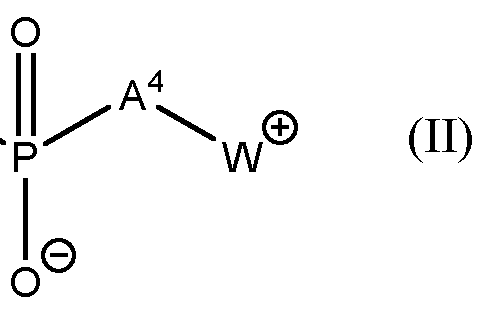
Preferably W+ is a group of formula -W^N+R^, -W^P+R^, -W^S+R^ or -W^Het* in which:
W1 is alkanediyl of 1 or more, preferably 2-6 carbon atoms optionally containing one or more ethylenically unsaturated double or triple bonds, disubstituted-aryl (arylene), alkylene arylene, arylene alkylene, or alkylene aryl alkylene, cycloalkanediyl, alkylene cycloalkyl, cycloalkyl alkylene or alkylene cycloalkyl alkylene, which group W1 optionally contains one or more fluorine substituents and/or one or more functional groups; the groups R3 are the same or different and each is hydrogen or alkyl of 1 to 4 carbon atoms, preferably methyl, or aryl, such as phenyl, or two of the groups R3 together with the nitrogen atom to which they are attached form an aliphatic heterocyclic ring containing from 5 to 7 atoms, or two or more of the groups R3 together with the nitrogen atom to which they are attached form a heteroaromatic ring having 5 to 7 atoms, either of which rings may be fused with another saturated or unsaturated ring to form a fused ring structure containing from 5 to 7 atoms in each ring, and optionally one or more of the groups R3 is substituted by a hydrophilic functional group; the groups R4 are the same or different and each is R3 or a group OR3,
Het is an aromatic nitrogen-, phosphorus- or sulphur-, preferably nitrogen-, containing ring, for example pyridine.
Monomers in which X is of the general formula in which W+ is W1N R3 3 may be made as described in WO-A-9301221, the contents of which are herein incorporated by reference in their entirety. Phosphonium and sulphonium analogues are described in WO-A-9520407 and WO-A-9416749, the contents of both of which are herein incorporated by reference in their entirety.
The group of the formula II has a preferred general formula (III)

In phosphobetaine based groups, X may have the general formula (IV)
Θ
Θ
—A5 R6— W2 R8 A6 P R9 (IV)
in which:
A5 is a bond, -0-, -S- or -NH- (preferably -0-);
R6 is a bond or alkanediyl, -C(0)-alkanediyl- or -C(0) H-alkanediyl- (wherein R6 is preferably alkanediyl; and wherein alkanediyl is preferably Ci-6 alkanediyl);
W2 is SR7, PR72 or R7 2, wherein the or each group R7 is hydrogen or alkyl of 1 to 4 carbon atoms or the two groups R7 together with the heteroatom to which they are attached form a heterocyclic ring of 5 to 7 atoms;
R8 is alkanediyl of 1 to 20, preferably 1 to 10, more preferably 1 to 6 carbon atoms; A6 is a bond, NH, S or O, preferably O; and
R9 is a hydroxyl, Ci-12 alkyl, Ci-12 alkoxy, C7-18 aralkyl, C7-18 aralkoxy, C6-i8 aryl or C6-i8 aryloxy group.
Monomers comprising a group of the general formula IV may be made by methods as described in JP-B-03-031718, the content of which is herein incorporated by reference in its entirety, in which an amino substituted monomer is reacted with a phospholane.
In compounds comprising a group of the general formula IV, it is preferred that: A5 is a bond; R6 is a C2-6 alkanediyl; W2 is NR7 2: each R7 is CM alkyl; R8 is C2-6 alkanediyl; A6 is O; and R9 is Ci-4 alkoxy.
Alternatively, X may be a zwitterion in which the anion comprises a sulphate, sulphonate or carboxylate group.
One example of such a group is a sulphobetaine group, of the general formula (V)
R 10
© Θ
N (CH2)sS03 (V)
R 10 where the groups R are the same or different and each is hydrogen or Ci-4 alkyl and s is from 2 to 4. Preferably the groups R10 are the same. It is also preferable that at least one of the groups R10 is methyl, and more preferable that the groups R10 are both methyl. Preferably s is 2 or 3, more preferably 3.
Another example of a zwitterionic group having a carboxylate group is an amino acid moiety in which the alpha carbon atom (to which an amine group and the carboxylic acid group are attached) is joined through a linker group to the backbone of the biocompatible polymer. Such groups may, for example, be represented by the general formula (VI)

-C(0)alkanediyl- or -C(0) Halkanediyl- (wherein alkanediyl is preferably Ci-6 alkanediyl; wherein R11 is preferably alkanediyl); and the groups R12 are the same or different and each is hydrogen or alkyl of 1 to 4 carbon atoms, preferably methyl, or two or three of the groups R12, together with the nitrogen to which they are attached, form a heterocyclic ring of from 5 to 7 atoms, or the three group R12 together with the nitrogen atom to which they are attached form a fused ring heterocyclic structure containing from 5 to 7 atoms in each ring.
Another example of a zwitterion having a carboxylate group is a carboxy betaine
-N+(R13)2(CH2)rCOO" in which the R13 groups are the same or different and each is hydrogen or Ri-4 alkyl and r is 2 to 6, preferably 2 or 3.
In the zwitterionic monomer of the general formula (I) it is preferred that the ethylenic unsaturated group Y is H2C=CR-CO-A-. Such acrylic moieties are preferably methacrylic, that is in which R is methyl, or acrylic, in which R is hydrogen. Whilst the compounds may be (meth)acrylamido compounds (in which A is NR1), in which case R1 is preferably
hydrogen, or less preferably, methyl, most preferably the compounds are esters, that is in which A is O.
In monomers of the general formula (I), especially where Y is the preferred (alk)acrylic group, B is most preferably an alkanediyl group. Whilst some of the hydrogen atoms of such group may be substituted by fluorine atoms, preferably B is an unsubstituted alkanediyl group, most preferably a straight chain group having 2 to 6 carbon atoms.
A particularly preferred zwitterionic monomer is 2-methacryloyloxyethyl-phosphorylcholine (MPC). Mixtures of zwitterionic monomers each having the above general formula may be used, as can mixtures of other hydrophilic monomers described herein.
In another preferred embodiment, the hydrophilic block is formed from ethylenically- unsaturated monomers that comprise a polyalkylene glycol side chain (e.g., a PEG side chain).
For instance, the ethylenically-unsaturated monomers may have the general formula (I)
YBX (I), in which:
Y is an ethylenically unsaturated group selected from H2C=CR-CO-A-,
H2C=CR-C6H4-A1-, H2C=CR-CH2-A2-, R20-CO-CR=CR-CO-0-, RCH=CH-CO-0-, RCH=C(COOR2)CH2-CO-0-,

A is -O- or R1;
A1 is selected from a bond, (CH2)LA2 and (CH2)LS03" in which L is 1 to 12;
A2 is selected from a bond, -0-, -0-CO-, -CO-O, -CO- R1-, - R^CO-, -O-CO- R1- and - R!-CO-O-;
R is hydrogen or Ci
R1 is hydrogen, C1-4 alkyl or BX;
R2 is hydrogen or C1-4 alkyl;
B is a bond, or a straight or branched alkanediyl, alkylene oxaalkylene, or alkylene
(oligooxalkylene) group, optionally containing one or more fluorine substituents; and
X is a polyalkylene glycol side chain.
For example, such monomers may comprise an ethylenic unsaturated group H2C=CR-CO- that is attached to the polyalkylene glycol side chain. The polyalkylene glycol side chain may have the formula -[0(CH2)n]POR24 in which n is from 1 to 6, p is from 1 to 100 and R24 is hydrogen or Ci-6 alkyl. Preferably n is 2 (i.e., the side chain is a polyethylene glycol side chain). Preferably p is from 1 to 50, more preferably from 5 to 20. Preferably R24 is hydrogen or methyl, most preferably hydrogen. It will be understood that individual molecules within such a monomer compound may have a distribution of molecular weights owing to a distribution in the extent of polymerisation in the side chain (i.e., a distribution in the value of p). Typical number average molecular weights of the monomers may be in the range 25 to 1000, preferably 50 to 800. For example, the number molecular average molecular weight of the monomers may be from 200 to 800. A particularly preferred hydrophilic block of this nature is formed from oligo(ethylene glycol) methacrylate
(OEGMA) monomers. The OEGMA monomers may have the formula H2C=CR-CO- [0(CH2)2]pOCH3 where p is from 2 to 20.
In one particularly preferred aspect of the present disclosure, the hydrophilic block comprises a phosphorylcholine polymer. A phosphorylcholine polymer is a polymer that comprises one or more phosphorylcholine groups. A polymersome comprising such a hydrophilic block is capable of selectively targeting scavenger receptor Bl highly expressed by macrophages and other immune cells; in particular it enables the polymersome to enter such cells. Release of encapsulated drug may thus typically occur, at least in part, after the polymersome has been internalised within an immune cell. However, the present invention also provides for release of encapsulated drug in the vicinity of an immune cell (i.e. a targeted immune cell). Thus, for example, the phosphorylcholine polymer is optionally formed from monomers of the above general formula (I), in which X is a group of the above general formula (III) (m=2, R5=CH3).
For the avoidance of doubt, a polymersome that comprises a phosphorylcholine polymer is regarded as being a polymersome that comprises a targeting moiety on the external surface of the polymersome, the targeting moiety being adapted to enable the polymersome to bind to an immune cell (i.e., the phosphorylcholine constitutes such a targeting moiety). Alternative and additional targeting moieties are discussed in more detail below.
In a preferred embodiment, the hydrophilic block comprises a phosphorylcholine polymer and the hydrophobic block comprises a pendant group with a pKa in the range 3.0 to 6.9.
The hydrophobic block may be formed of polymers such as polyethers (including
polyalkylene glycols), polyesters, polyamides, polyanhydrides, polyurethanes, poiyimines, polypeptides, polypeptoids, polyureas, polyacetals, or polysiloxanes. One example of a suitable hydrophobic block is polyalkylene oxide, usually polypropylene oxide, that is the same type of block as has been used in the well-studied Pluronic/Poloxamer based systems. One type of highly hydrophobic block is poly(dimethylsiloxane). In one preferred
embodiment the type of polymer forming the hydrophobic block is the same as that forming the hydrophilic block. Preferably the polymer is formed by radical polymerisation of ethylenically unsaturated monomers.
Suitable monomers from which the hydrophobic block may be formed have the general formula (VII)
Y^Q (VII), in which Y1 is selected from H2C=CR14-CO-A8-, H2C=CR14-C6H4-A9-,
H2C=CR14-CH2-A10-, R160-CO-CR14=CR14-CO-0-, R14CH=CH-CO-0-,
R14CH=C(COOR16)CH2-CO-0-,

A8 is -O- or - R -;
A9 is selected from a bond, (CH2)qA10 and (CH2)qS03" in which q is 1 to 12;
A10 is selected from a bond, -0-, -0-CO-, -CO-0-, -CO- R15-, - R15-CO-,
-O-CO- R15-, - R15-CO-0-;
R14 is hydrogen or C1-4 alkyl;
R15 is hydrogen, C1-4 alkyl or 1Q;
R16 is hydrogen or C1-4 alkyl;
B1 is a bond, or a straight or branched alkanediyl, alkylene oxaalkylene, or alkylene
(oligooxalkylene) group, optionally containing one or more fluorine substituents; and
Q is a cationic or cationisable group of the formula - R17 P, -PR17 P and SR17 r, in which p is 2 or 3, r is 1 or 2, the groups R17 are the same or different and each is selected from the group consisting of hydrogen, C1-24 alkyl and aryl, or two of the groups R17 together with the heteroatom to which they are attached from a 5 to 7 membered heterocyclic ring or three R17 groups together with the heteroatom to which they are attached form a 5 to 7 membered heteroaromatic ring, either of which rings may be fused to another 5 to 7 membered saturated or unsaturated ring, and any of the R17 groups may be substituted by amino or hydroxyl groups or halogen atoms; wherein if p is 3, at least one of the groups R17 is hydrogen.
Preferably Y1 is H2C=CR14-CO-A8- where R14 is H or methyl and A8 is O or H. Preferred groups B1 are alkanediyl, usually with linear alkyl chains and preferably having 2 to 12 carbon atoms, such as 2 or 3 carbon atoms.
Preferably Q is R17 2 where R17 is Ci-i2-alkyl. Preferably both R17s are the same. Particularly useful results have been achieved where the groups R17 are Ci-4 alkyl, especially ethyl, methyl or isopropyl.
Either or both the hydrophobic and hydrophilic blocks may include comonomers, for instance to provide functionality, control over hydrophobicity, control over pH sensitivity, pKa or pKb as the case may be, control over temperature sensitivity or as general diluents. For instance comonomers providing functionality may be useful to provide conjugation of pendant groups following polymerisation and/or polymersome formation, to targeting moieties, or to provide for conjugation between the biologically active molecule and the polymer. Alternatively, functional groups may allow for crosslinking of the polymer following polymersome formation, to confer increased stability on the polymersome structure. Examples of suitable comonomers are compounds of the general formula (VIII)
 in which
R18 is selected from hydrogen, halogen, C1-4 alkyl and groups COOR22 in which R22 is hydrogen or C 1-4 alkyl;
R19 is selected from hydrogen, halogen and C1-4 alkyl;
R20 is selected from hydrogen, halogen, C1-4 alkyl and groups COOR22 provided that R18 and R20 are not both COOR22; and
R21 is a Ci-10 alkyl, a Ci-20 alkoxycarbonyl, a mono-or di-(Ci-io alkyl)amino carbonyl, a C6-20 aryl (including alkaryl) a C7-20 aralkyl, a C6-20 aryloxycarbonyl, a
Ci-20-aralkyloxy carbonyl, a C6-2o arylamino carbonyl, a C7-20 aralkyl-amino, a hydroxyl or a C2-10 acyloxy group, any of which may have one or more substituents selected from halogen atoms, alkoxy, oligo-alkoxy, aryloxy, acyloxy, acylamino, amine (including mono and di- alkyl amino and thalkylammonium in which the alkyl groups may be substituted), carboxyl, sulphonyl, phosphoryl, phosphino, (including mono- and di-alkyl phosphine and tri- alkylphosphonium), zwitterionic, hydroxyl groups, vinyloxycarbonyl and other vinylic or allylic substituents, and reactive silyl or silyloxy groups, such as trialkoxysilyl groups; or R21 and R20 or R21 and R19 may together form -CO R23CO in which R23 is a Ci-20 alkyl group.
It is preferred for at least two of the groups R18, R19, R20 and R21 to be halogen or, more preferably, hydrogen atoms. Preferably R18 and R19 are both hydrogen atoms. It is particularly preferred that compound of general formula VIII is a styrene or acrylic compound. In styrene compounds R21 represents an aryl group, especially a substituted aryl group in which the substituent is an amino alkyl group, a carboxylate or a sulphonate group. Where the comonomer is an acrylic type compound, R21 is an alkoxycarbonyl, an alkyl amino carbonyl, or an aryloxy carbonyl group. Most preferably in such compounds R21 is a C1-20- alkoxy carbonyl group, optionally having a hydroxy substituent. Acrylic compounds are generally methacrylic in which case R20 is methyl.
Preferably the comonomer is a non-ionic comonomer, such as a C1-24 alkyl(alk)-acrylate or - acrylamide, mono- or di- hydroxy-Ci-6-alkyl(alk)-acrylate, or acrylamide, oligo(C2-3 alkoxy) C2-i8-alkyl (alk)-acrylate, or -acrylamide, styrene, vinylacetate or N-vinyllactam.
For optimum nanovesicle formation, the block copolymers should have controlled molecular weights. It is preferable for each of the blocks to have molecular weight controlled within a narrow band, that is, to have a narrow polydispersity. The polydispersity of molecular weight should, for instance, be preferably less than 2.0, more preferably less than 1.5, for instance in the range 1.1 to 1.4. Of course, in the preferred embodiment wherein one of the blocks has a pKa in the range 3.0 to 6.9, the blocks should be selected so that they have the requisite pKa value.
In one embodiment of this invention, the monomer from which the hydrophobic block is formed is 2-(diisopropylamino)ethyl methacrylate (DP A) or 2-(diethylamino)ethyl methacrylate (DEA). In another embodiment, the hydrophilic block is PMPC or poly(oligo (ethylene glycol) methacrylate) (POEGMA). Preferably, the copolymer is a PMPC-6-PDPA block copolymer or a POEGMA-PDPA block copolymer.
Preferably, the block copolymer has general formula PMPCm-£-PDPAn or POEGMAm- PDPAn, wherein m is in the range from 2 to 500, or from 15 to 30 (for instance 25), and n is from 6 to 2000 or from 70 to 180, preferably from 100 to 160, more preferably from 120 to 160. For instance, the block copolymer may have the general formula POEGMAm-PDPAn where m is from 15 to 30 and n is from 100 to 160 (i.e. a block copolymer comprising a block derived from m OEGMA monomers joined to a block derived from n DPA monomers).
Typically, the hydrophobic block is not formed from 2-(dimethyl)ethyl methacrylate (DMA) monomers.
The block copolymer may be a simple A-B block copolymer, or may be an A-B-A or B-A-B block linear triblock copolymer or a (A)2B or A(B)2 star copolymers (where A is the hydrophilic block and B is the hydrophobic block). It may also be an A-B-C, A-C-B or B-A- C block linear triblock copolymers or a ABC star copolymers (blocks linked together by the same end), where C is a different type of block. C blocks may, for instance, comprise functional, e.g. cross-linking or ionic groups, to allow for reactions of the copolymer, for instance in the novel compositions. Crosslinking reactions especially of A-C-B type copolymers, may confer useful stability on polymersomes. Cross-linking may be covalent, or
sometimes, electrostatic in nature. Cross-linking may involve addition of a separate reagent to link functional groups, such as using a difunctional alkylating agent to link two amino groups. The block copolymer may alternatively be a star type molecule with hydrophilic or hydrophobic core, or may be a comb polymer having a hydrophilic backbone (block) and hydrophobic pendant blocks or vice versa. Such polymers may be formed for instance by the random copolymerisation of monounsaturated macromers and monomers.
Further details of a suitable process for polymerising the monomers are to be found in WO 03/074090, the contents of which are herein incorporated by reference in their entirety.
Living radical polymerisation process has been found to provide polymers of monomers having a polydispersity (of molecular weight) of less than 1.5, as judged by gel permeation chromatography. Polydispersities in the range 1.2 to 1.4 for the or each block are preferred. An advantage of the present invention where the hydrophobic block is pH sensitive, is that the polymersomes may be loaded using a pH change system. In such a process, polymer is dispersed in aqueous liquid in ionised form, in which it solubilises at relatively high concentrations without forming polymersomes. Subsequently the pH is changed such that some or all of the ionised groups become deprotonated so that they are in non-ionic form. At the second pH, the hydrophobicity of the block increases and polymersomes are formed spontaneously.
The method of forming polymersomes with anti-tuberculous drug encapsulated in the core wherein one of the blocks is pH-sensitive, may involve the following steps: (i) dispersing the amphiphilic copolymer in an aqueous medium; (ii) acidifying the composition formed in step (i); (iii) adding the anti-tuberculous drug to the acidified composition; and (iv) raising the pH to around neutral to encapsulate the anti-tuberculous drug.
This method preferably comprises a preliminary step wherein the amphiphilic copolymer is dispersed in an organic solvent in a reaction vessel and the solvent is then evaporated to form a film on the inside of the reaction vessel.
By "pH-sensitive" is meant that one of the blocks has a group that becomes
protonated/deprotonated at a particular pH. Preferably, one of the blocks, and typically the hydrophobic block comprises pendant groups which have a pKa in the range 3.0 to 6.9, for instance, 4.0 to 6.9. Step (ii), of acidifying the composition, typically reduces the pH to a value below the pKa of the pendant group.
In more detail, polymersomes are typically prepared by dissolving copolymer in an organic solvent, such as a 2: 1 chloroform:methanol mix in a glass container. Solvent can be evaporated under vacuum leaving a copolymeric film deposited on the walls of the container. The film is then re-hydrated with an aqueous solution, for instance using phosphate buffer saline. The pH of the resultant suspension is decreased to a pH of around 2, to solubilise the film, and then increased slowly to a pH or around 6. Once the pH has reached this value, anti- tuberculous drug is typically added. The pH is then increased to around neutral, to
encapsulate the anti-tuberculous drug. The dispersion may then be sonicated and extruded, for instance using a bench top extruder. UV spectroscopy and HPLC may be used to calculate the encapsulation efficiency, using techniques well known in the art. An alternative method for forming polymersomes with encapsulated anti-tuberculous drug may involve simple equilibration of the anti-tuberculous drug and polymer vesicles in water. For instance anti-tuberculous drug may be contacted in solid form with an aqueous dispersion of polymer vesicles and incubated, optionally with shaking, to solubilise the active in the dispersed vesicles. Alternatively, anti-tuberculous drug dissolved in organic solvent may be emulsified into an aqueous dispersion of polymer vesicles, whereby solvent and anti-tuberculous drug become incorporated into the core of the vesicles, followed by evaporation of solvent from the system. Another method of forming polymersomes encapsulating drugs involves the use film rehydration. For instance, the drug is solubilised in phosphate buffered saline (PBS) and placed in contact with the polymeric film obtained as described above. Over time the swelling of the polymeric film in the PBS/drug solution generates loaded polymersomes. Alternatively, electroporation can be used to encapsulate the drug. In this case, pre-formed polymersomes are mixed with the drug and the solution is exposed to an electric filed. This temporarily creates pores on the polymersome membranes allowing the encapsulation of the drug.
The polymersomes used in the invention may be formed from two or more different block copolymers. For instance, they may be formed from a block copolymer comprising a mixture of two or more of a polyalkylene oxide hydrophilic block, a block copolymer which has a hydrophilic block comprising a zwitterionic monomer, and a poly oligo (ethylene glycol) methacrylate. In this embodiment, in the method of forming polymersomes, a mixture of the two or more block copolymers is used. One suitable mixture would be, for instance, a 75:25 ratio by weight of PMPC-PDPA and PEO-PDPA.
For example, 0.01% to 10% (w/w) of anti-tuberculous drug is mixed with copolymer in the methods described above.
The anti-tuberculous drug
The anti-tuberculous drug can in principle be selected from any compound that is known to have anti-tuberculous properties. The anti-tuberculous drug may comprise either one such compound or any mixture of such compounds. Thus, references herein to "an anti- tuberculous drug" should be construed as providing for the presence of either one active agent or a mixture of active agents, unless context dictates otherwise.
Non-limiting examples of suitable anti-tuberculous drugs include Isoniazid, Rifampin, Ethambutol, Pyrazinamide, Soniazid, Rifapentine, Rifabutin, Ethambutol, Cycloserine, Ethionamide, Prothionamide, Levofloxacin, Ciprofloxacin, Ofloxacin, Sparfloxacin,
Moxifloxacin, Sitafloxacin, Gatifloxacin, p-Aminosalicylic acid, Streptomycin, Amikacin, Kanamycin, Capreomycin, Viomycin, Enviomycin, Amoxicillin-Clavulanate, Claritomycin, Azithromycin, Bedaquiline, Pretomanid, Delamanid, Terizidone, Clarithromycin, Linezolid, Thioacetazone, Thioridazine, Arginine, Vitamin D, BM212, SQ109 and any mixture thereof. For example, the anti-tuberculous drug is optionally selected from Isoniazid, Rifampin, Ethambutol, Pyrazinamide, Streptomycin and any mixture thereof (these drugs being well known "first line" anti-tuberculous drugs). In one preferred embodiment, the anti-tuberculous drug is selected from Isoniazid, Rifampin and a mixture thereof.
The targeting moiety
The anti-tuberculous polymersome preferably comprises a targeting moiety on its external surface. By on its external surface is meant that the targeting moiety is located such that it is able to interact with its target (as opposed to being located at an inaccessible position that precludes interaction with the target, for example by encapsulated within the polymersome). Typically the targeting moiety binds specifically to the target.
The targeting moiety can be included separately in the polymersome or as part of the polymer which forms the polymersome. For instance, the polymersome may comprise (i) a copolymer comprising a hydrophobic block as defined herein, a hydrophilic block as defined herein and a targeting moiety as defined herein or (ii) a copolymer comprising a hydrophobic block as defined herein and a hydrophilic block as defined herein, wherein at least one of the blocks has a targeting moiety as defined herein in its structure.
The targeting moiety is adapted to enable the polymersome to bind to an immune cell.
Typically the immune cell is a macrophage, which is the dominant host cell in which the lifecycle ofM tuberculosis takes place. It has been found that provision of a polymersome that features a targeting moiety that targets immune cells (e.g. macrophages) enables efficient and effective delivery of anti-tuberculous drug to tissues harbouring M tuberculosis.
Suitable targeting can, for example, be achieved by use of a targeting moiety that targets scavenger receptor B 1. Scavenger receptor B 1 is known to be over-expressed by
macrophages and other immune cells.
The targeting moiety can be any moiety that binds specifically to the target (e.g. scavenger receptor Bl). As is well known in the art, for example from the well developed field of bioconjugates, a wide range of substances can be used as targeting moieties. Examples of suitable targeting moieties include small molecules, antibodies, antibody fragments, aptamers, oligonucleotides, peptides and carbohydrates. Any such moiety can be used as a targeting moiety in the present invention. The suitability of any given moiety to target any given target (e.g. scavenger receptor Bl) can be determined using routine assay methods, involving testing for the ability of the moiety to bind specifically to the target (e.g. scavenger receptor Bl).
In one currently preferred embodiment, the targeting moiety is a small molecule, for example phosphorylcholine. Phosphorylcholine is capable of selectively targeting scavenger receptor Bl, and thus can target macrophages. Phosphorylcholine can easily be incorporated into the polymersomes of the invention by utilizing phosphorylcholine-containing monomers in the preparation of the polymer that constitutes the polymersome.
More generally, a targeting moiety can be attached to the external surface of the polymersome using routine techniques, for example by adapting well known methods for attaching targeting moieties to polymers, drugs, nucleic acids, antibodies and other substances. The attachment may be non-covalent (e.g. electrostatic) or covalent, though it is preferably covalent. For example, the targeting moiety can be attached by reacting a suitable functional group on the targeting moiety (including but not limited to an amine group, a carboxyl group and a thiol group) with a corresponding functional group on the copolymer that forms, or will form, the polymersome. The attachment can be effected either before the polymersome structure is formed from the copolymer, or after the polymersomes have been formed.
It also possible to provide for attachment of the targeting moiety to the copolymer by first chemically activating either or both of the targeting moiety and the copolymer. For example, a peptide targeting moiety may be activated by adding a reactive species to one of its termini, such as a cysteine moiety (whose thiol group is well known to react readily with functional groups such as the widely used maleimide moiety). Similarly, the copolymer can be activated by functionalising it with a reactive species (e.g. a maleimide moiety when the targeting moiety carries a thiol group). The copolymer may be provided with such a reactive species either by functionalisation of the copolymer itself, or by providing suitable monomers prior to the polymerisation that forms the copolymer, or by providing a suitable initiator for the polymerisation.
The targeting moiety may be attached directly to the external surface of the polymersome or it may be attached via a chemical spacer.
Exemplary anti-tuberculous polymersome
An exemplary anti-tuberculous polymersome of the present invention comprises: (a) a polymersome; and (b) an anti-tuberculous drug encapsulated within the polymersome;
wherein the polymersome comprises an amphiphilic block copolymer that comprises a hydrophilic block and a hydrophobic block, wherein the hydrophilic block comprises a phosphorylcholine polymer and the hydrophobic block comprises a pendant group with a pKa in the range 3.0 to 6.9.
Such an anti-tuberculous polymersome is able: (i) to encapsulate efficiently both hydrophilic and hydrophobic anti-tuberculous drugs of diverse molecular sizes (including large proteins); (ii) to respond very quickly to environmental changes such as pH, thus facilitating its degradation at the site of therapeutic interest to release the drug payload; (iii) to penetrate tissues such as granulomas; and (iv) to selectively target macrophages, which as described already harbour bacilli in tuberculosis patients. Formulations based on the polymersomes of the invention can therefore be substantially more effective than previously known
formulations of the same anti-tuberculous drug (e.g. on the basis of effectiveness in reducing the amount of M.tuberculosis bacilli in vivo more rapidly and/or at lower doses and/or to a greater extent than the known formulation).
Pharmaceutical composition
The anti-tuberculous polymersomes of the present invention can be formulated as a pharmaceutical composition using routine techniques known in the art. For example, pharmaceutical compositions already utilised for the formulation of polymersomes or drug- containing liposomes.
The pharmaceutical composition comprises a plurality of the anti-tuberculous polymersomes. It also comprises one or more pharmaceutically acceptable excipients or diluents. The one or more pharmaceutically acceptable excipients or diluents may be any suitable excipients or diluents. The pharmaceutical composition is typically aqueous, i.e. it contains water (in particular sterile water).
A typical pH of the aqueous pharmaceutical composition is 7.0 to 7.6, preferably 7.2 to 7.4. Pharmaceutically acceptable buffers may be used to achieve the required pH. The pharmaceutical composition may be in the form of a sterile, aqueous, isotonic saline solutions.
Typically the pharmaceutical composition is an injectable composition, e.g. it is suitable for intravenous delivery, for example it is suitable for infusion.
Medical use of the polymersomes
The anti-tuberculous polymersomes of the present invention are useful for treating tuberculosis.
The tuberculosis may be latent tuberculosis or active tuberculosis. As the compositions of the present invention are surprisingly effective at penetrating tissues, such as granulomas associated with latent tuberculosis, the techniques of the present invention can be particularly effective, compared with existing treatments, for addressing latent tuberculosis.
The tuberculosis may be any form of tuberculosis, including non-drug resistant tuberculosis, drug resistant tuberculosis (DR-tuberculosis) and multiple drug resistant tuberculosis (MDR- tuberculosis). It will be readily understood that a suitable choice of anti-tuberculous drug should be made depending on the specific form of tuberculosis to be treated.
For the avoidance of doubt, treatment as defined herein in the context of treatment of latent tuberculosis includes prevention of the recurrence of active tuberculosis.
A therapeutically effective amount of the anti-tuberculous polymersome is administered to a patient. A typical dose is from 0.0001 to 1000 mg, measured as a weight of the anti- tuberculous drug, according to the activity of the specific anti-tuberculous drug, the age, weight and conditions of the subject to be treated, the type and severity of the disease and the frequency and route of administration. This dose may for instance be administered once daily. Preferably, measured as a weight of the anti-tuberculous drug, daily dosage levels are from 0.0001 mg to 4000 mg. If more than one anti-tuberculous drug is contained within the polymersomes then the typical dosages identified here apply to each such anti-tuberculous drug.
From 0.0001 to 1000 mg/kg, in total, of the anti-tuberculous drug may be administered.
Typically, from 0.01 to 100 mg/kg of the anti-tuberculous drug may be administered.
Preferably, from 0.01 to 50 mg/kg or from 1.0 to 20 mg/kg of the anti-tuberculous drug may administered. These are typically daily doses of the anti-tuberculous drug.
EXAMPLES
Example 1
The system studied was based on the use of polymersomes made by the diblock copolymer poly((2-methacryloyl)ethyl phosphorylcholine)-poly(2-(diisopropylamino)ethyl methacrylate) (PMPC-PDPA). The vesicular nature combined with the synthetic nature of its building block makes polymersomes able to (i) encapsulate both hydrophilic (including large proteins) and hydrophobic molecules, (ii) respond very quickly to environmental changes such as pH, degradation to release their cargo and (iii) have the physicochemical properties to enhance tissue penetration and cellular endocytosis. In PMPC-PDPA polymersomes the PMPC bestows the ability of targeting macrophages and the PDPA block confers a pH-sensitive behaviour, so that the polymersomes disassemble when there is an environmental decrease of pH below values of 6.3 (e.g., upon endocytosis).
Fig. 1 A shows a TEM picture, and (B) a Dynamic Light Scattering (DLS) characterisation of the polymersomes which were used. Several experiments were carried out to determine whether these polymeric systems would be suitable for the treatment of TB.
First, the uptake level of monocytes-derived human macrophages (THP-1 cells) was analysed. The confocal investigations in Fig. 1C demonstrated that polymersomes were effectively up taken by THP-1 cells just after 8h of incubation time, and they lasted even for 72h., while
HPLC quantifications (Fig. ID) showed an uptake peak after 24h of incubation with polymersomes. Viability assays (MTT) further confirmed the biocompatibility of the system, as no cytotoxicity was observed after either 24h or 72h incubation times.
The polymersomes encapsulated with rifampicin, isoniazid, and a combination of both were then prepared. These polymersomes were tested on Bacilli of Calmette Guerin(BCG)- infected TFIP-1 cells. After 72h incubation time, it was possible to completely eradicate BCG from infected macrophages upon treatment with polymersomes loaded with a combination of rifampicin and isoniazid (Fig. 2, left). The loaded polymersomes were much more effective than the free drugs used at the same final concentration. Further studies were then performed on M. tuberculosis-infected macrophages, and also in this case it was found that
polymersomes-encapuslated drugs were more effective comparing to the same amount of free drugs (Fig. 2, right).
The behaviour of the nanoparticles was then further explored directly with in vivo
experiments. To do this, D. rerio (i.e. zebrafish) embryos infected with M. marinum were used. Unlike mice, this model organism shares a similar mechanism of pathology
development with humans. In particular, the infection with M. marinum leads to the formation of granulomas throughout the body, which are very similar to those developed in the human lung. Hence, these structures are almost impermeable to drugs.
First the in vivo distribution of the polymersomes was investigated. Nanoparticles were found to be uptaken by macrophages even after 10 minutes of injection time (Fig. 3 A), and to be retained for several days after the injection (3 days post injection, Fig. 3B-D). After 3 days post infection, zebrafish embryos undergo granuloma formation. It was demonstrated that the nanoparticles were thus able to access this environment, while standard drugs are not able to permeate it.
On the other hand, very few monocytes underwent nanoparticles uptake (Fig. 3E), thus confirming the high specificity of targeting towards macrophages. In addition, co-localisation experiments confirmed that polymersomes perfectly co-localised in vivo with M. marinum. It was then investigated whether rifampicin and isoniazid-loaded polymersomes were also effective in reducing the bacterial burden in vivo. Also in this case it was found that the polymersomes had an enhanced ability to significantly reduce bacterial infection, comparing to the free drugs, which corroborated the in vitro data (Fig 3F).
Example 2: Polymersomes in vivo enhanced phagocytes affinity
In vitro results demonstrated that the subject polymersomes target and enter phagocytes through the scavenger receptor. The inherent affinity of polymersomes towards phagocytes was explored in vivo using mice as model organism.
Upon intravenous (i.v.) tail injection the plasma polymersomes concentration Cp was measured as a function of time (Fig. 4a). The plasma concentration decayed according to two phases,
(Cp (t) = Qe^i^ + C2e(-A^ ) where about 84.5% of the polymersomes were quickly eliminated from the plasma with a fast half-life of τ— 1/2 = λ1- = 0.4hr = 25min, and the remaining amount was with half-life of τ— 1/2 = ^ λ2 = 20.5hr.
While these can be interpreted using compartmental pharmacokinetic models ascribing the biphasic decay to a combination of fast distribution and slower excretion, it was opted here to factor the interaction with the blood cells, and the immune cells in particular, leaving more complex pharmacokinetic evaluation for future work.
As a first assessment, white and red blood cells were counted at different times after i.v. polymersomes injections to check for any unwanted effects caused by polymersomes to blood cells. No significant difference was detected in cell counts. Thus the uptake of polymersomes was measured in the different blood cell types by flow cytometry and a remarkable selectivity was observed of PMPC-PDPA polymersomes for monocytes (Ly6C+ cells) with over 98% of these positive only 5min after i.v. injection (Fig. 4b). This is in contrast to about 12% of B cells, 7%) of T cells and 6% of neutrophils while red blood cells did not show any detectable level of polymersomes uptake. These were considered remarkable results considering monocytes make up only about 2% of the total blood cell population, strongly supporting the ability of PMPC-PDPA polymersomes to selectively target monocytes.
The ability of polymersomes to distinguish sub-classes of monocytes including classical
monocytes (Ly6C high) and non-classical monocytes (Ly6C low) was assessed. Classical monocytes internalised polymersomes more efficiently at early time points (after 10 minutes post injection, Fig. 4c). However, 24 hours post injection, the non-classical monocytes more readily took up polymersomes (Fig. 4c). This shows w can target both types of monocytes ca be targeted, even though we it cannot be excluded that some of the polymersomes can be carried within monocytes during their transition from a classical (i.e., not having
inflammatory attributes) to non-classical (pro-inflammatory) sub-set. These latter constitute 50% of the whole monocyte population (in mice).
Such a strong interaction with monocytes suggests that polymersome distribution into other tissues can follow two routes, one direct from the blood and one piggy-backing in monocytes. To further assess this, organs excised at different time points were measured post injection and imaged after careful blood depletion by perfusion. There is a strong accumulation of polymersomes within the gastrointestinal (GI) tract and the liver (about 40% of the total fluorescence each) (Fig. 4d). The spleen, kidneys, and lungs followed, while the other organs have an equal distribution among them. Two regimes of distribution could be identified: (i) in the GI tract, liver, spleen, kidneys, lungs, and heart, the polymersome concentration peaks around the time (between 1 and 2 hrs) where 90% of the polymersomes are depleted from the blood plasma (Fig. 4a), (ii) in bone marrow, muscle, testis, thymus, spinal cord, and brain, the concentration, albeit quite low overall, rises steadily with time suggesting a very delayed distribution. The first group of organs has higher expression of SR-Bl, and the data match the plasma circulation indeed, suggesting a fast diffusion from the blood to the tissues. In the other organs, particularly the poorly perfused, the steady rise in polymersome concentration could be explained by monocyte/macrophage penetration into tissues over time.
In addition to the interaction between polymersomes and blood cells, the potential uptake by tissue resident macrophages was also studied. In particular, it was chosen to study the uptake in liver resident Kupffer cells, whose origin is mostly embryonic, and which have a critical role in cleaning the blood from pathogens and particulate materials. The selective uptake of polymersomes in liver resident macrophage Kupffer cells was seen in as little as lOmin after i.v. injection (Fig. 4e), and completely saturated after 24hr.
Finally, it was checked whether local phagocytes could be targeted by topical delivery, using intratracheal instillation to deliver rhodamine-labelled polymersomes directly to the lungs.
The tissues were extracted 24h after administration and cells analysed by flow cytometry.
Considerable targeting toward phagocytes was observed, where over 90% of dendritic cells
and macrophages in bronco alveolar lavage, and 60% of macrophages and 15% of dendritic cells in the lung tissues, were positive for polymersome uptake (Fig. 4f).
Example 3 - Anti-TB polymerases efficacy
The efficacy of polymersomes delivering rifampicin was assessed by using the M. marinum infected zebrafish model of TB. In this case, mCherry-expressing fluorescent bacteria were microinjected, and 24 hours later an injection of the polymersomes-encapsulated drugs (or controls) was performed.
Rifampicin-encapsulated polymersomes significantly reduced the M. marinum burden in vivo, compared to the same concentration of free drug (Fig. 5). The data show the efficacy of the formulation on the in vivo model. Each single point on the graph represents one zebrafish, so for example the rifampicin polymersomes have the highest efficacy, as can be seen by looking at the error bar.
Claims
1. An anti-tuberculous polymersome that comprises:
(a) a polymersome; and
(b) an anti-tuberculous drug encapsulated within the polymersome.
2. The anti-tuberculous polymersome of claim 1, wherein the anti-tuberculous drug is selected from Isoniazid, Rifampin, Ethambutol, Pyrazinamide, Soniazid, Rifapentine, Rifabutin, Ethambutol, Cycloserine, Ethionamide, Prothionamide, Levofloxacin, Ciprofloxacin, Ofloxacin, Sparfloxacin, Moxifloxacin, Sitafloxacin, Gatifloxacin, p- Aminosalicylic acid, Streptomycin, Amikacin, Kanamycin, Capreomycin, Viomycin, Enviomycin, Amoxicillin-Clavulanate, Claritomycin, Azithromycin, Bedaquiline, Pretomanid, Delamanid, Terizidone, Clarithromycin, Linezolid, Thioacetazone, Thioridazine, Arginine, Vitamin D, BM212, SQ109 and any mixture thereof.
3. The anti-tuberculous polymersome of claim 2, wherein the anti-tuberculous drug is selected from Isoniazid, Rifampin and a mixture thereof.
4. The anti-tuberculous polymersome of any one of claims 1 to 3, wherein the anti- tuberculous polymersome comprises:
(c) a targeting moiety on the external surface of the polymersome, the targeting moiety being adapted to enable the polymersome to bind to an immune cell.
5. The anti-tuberculous polymersome of claim 4, wherein the targeting moiety is a small molecule, an antibody or antibody fragment, a peptide, an aptamer, a vitamin or a carbohydrate that is attached to the external surface of the polymersome.
6. The anti-tuberculous polymersome of claim 4, wherein the targeting moiety is
phosphorylcholine.
7. The anti-tuberculous polymersome of any one of claims 1 to 6, wherein the
polymersome comprises an amphiphilic block copolymer that comprises a hydrophilic block and a hydrophobic block.
8. The anti-tuberculous polymersome of claim 7, wherein the hydrophilic block
comprises a phosphorylcholine polymer.
9. The anti-tuberculous polymersome of claim 7 or 8, wherein the hydrophobic block comprises a pendant group with a pKa in the range 3.0 to 6.9.
10. A pharmaceutical composition comprising: a plurality of the anti-tuberculous
polymersomes of any one of claims 1 to 9; and one or more pharmaceutically acceptable excipients or diluents
11 The anti-tuberculous polymersome of any one of claims 1 to 9, for use as a
medicament.
12. The anti-tuberculous polymersome of any one of claims 1 to 9, for use in a method for the treatment of tuberculosis.
13. A method of treating tuberculosis, the method comprising administering a
therapeutically effective amount of the anti-tuberculous polymersome of any one of claims 1 to 9 to the subject.
14. Use of an anti-tuberculous polymersome of any one of claims 1 to 9 in the
manufacture of a medicament for use in the treatment of tuberculosis.
15. The anti-tuberculous polymersome for use of claim 12, the method of claim 13 or the use of claim 14, wherein the tuberculosis is active tuberculosis.
16. The anti-tuberculous polymersome for use of claim 12, the method of claim 13 or the use of claim 14, wherein the tuberculosis is latent tuberculosis.
Applications Claiming Priority (2)
| Application Number | Priority Date | Filing Date | Title |
|---|---|---|---|
| GB1607865.1 | 2016-05-05 | ||
| GBGB1607865.1A GB201607865D0 (en) | 2016-05-05 | 2016-05-05 | Anti-tuberculous polymersomes |
Publications (1)
| Publication Number | Publication Date |
|---|---|
| WO2017191444A1 true WO2017191444A1 (en) | 2017-11-09 |
Family
ID=56297202
Family Applications (1)
| Application Number | Title | Priority Date | Filing Date |
|---|---|---|---|
| PCT/GB2017/051226 Ceased WO2017191444A1 (en) | 2016-05-05 | 2017-05-02 | Anti-tuberculous polymersomes |
Country Status (2)
| Country | Link |
|---|---|
| GB (1) | GB201607865D0 (en) |
| WO (1) | WO2017191444A1 (en) |
Cited By (12)
| Publication number | Priority date | Publication date | Assignee | Title |
|---|---|---|---|---|
| WO2019197834A1 (en) * | 2018-04-13 | 2019-10-17 | Ucl Business Plc. | Metabolisable ph sensitive polymersomes |
| WO2020144467A1 (en) | 2019-01-07 | 2020-07-16 | Ucl Business Ltd | Polymersomes functionalised with multiple ligands |
| WO2020225538A1 (en) | 2019-05-03 | 2020-11-12 | Ucl Business Ltd | Production of nanoparticles and microparticles |
| US10874611B2 (en) | 2016-02-25 | 2020-12-29 | Ucl Business Ltd | Chemotactic, drug-containing polymersomes |
| US10881613B2 (en) | 2016-03-17 | 2021-01-05 | Ucl Business Ltd | Fumarate polymersomes |
| CN114732818A (en) * | 2022-04-29 | 2022-07-12 | 首都医科大学附属北京胸科医院 | Application of an anti-idiopathic pulmonary fibrosis drug nintedanib in the treatment of tuberculosis |
| CN115252778A (en) * | 2022-06-22 | 2022-11-01 | 南方医科大学皮肤病医院(广东省皮肤病医院、广东省皮肤性病防治中心、中国麻风防治研究中心) | Bionic vesicle compound based on pre-activated macrophage membrane and preparation method and application thereof |
| WO2023094810A1 (en) | 2021-11-24 | 2023-06-01 | Ucl Business Ltd | Polymersomes for clearance of amyloid beta and/or tau proteins |
| CN117137918A (en) * | 2023-09-28 | 2023-12-01 | 深圳国家感染性疾病临床医学研究中心 | Pharmaceutical composition and application thereof |
| WO2024147020A1 (en) | 2023-01-06 | 2024-07-11 | Vianautis Bio Limited | Polymersomes for delivery of nucleic acid cargoes |
| WO2026037959A1 (en) | 2024-08-16 | 2026-02-19 | Vianautis Bio Limited | Polymersomes comprising peg-pla or poegma-pla copolymers |
| WO2026037960A1 (en) | 2024-08-16 | 2026-02-19 | Vianautis Bio Limited | Copolymer for preparing polymersomes having improved electrostatic properties |
Citations (1)
| Publication number | Priority date | Publication date | Assignee | Title |
|---|---|---|---|---|
| US20110150941A1 (en) * | 2008-05-15 | 2011-06-23 | Biocompatibles Uk Limited | Epithelial delivery |
-
2016
- 2016-05-05 GB GBGB1607865.1A patent/GB201607865D0/en not_active Ceased
-
2017
- 2017-05-02 WO PCT/GB2017/051226 patent/WO2017191444A1/en not_active Ceased
Patent Citations (1)
| Publication number | Priority date | Publication date | Assignee | Title |
|---|---|---|---|---|
| US20110150941A1 (en) * | 2008-05-15 | 2011-06-23 | Biocompatibles Uk Limited | Epithelial delivery |
Non-Patent Citations (3)
| Title |
|---|
| FENGHUA MENG ET AL: "Stimuli-Responsive Polymersomes for Programmed Drug Delivery", BIOMACROMOLECULES, AMERICAN CHEMICAL SOCIETY, vol. 10, no. 2, 9 February 2009 (2009-02-09), pages 197 - 209, XP002636920, ISSN: 1525-7797, [retrieved on 20090105], DOI: 10.1021/BM801127D * |
| SHARMA ANIL K ET AL: "Nanocarriers as Promising Drug Vehicles for the Management of Tuberculosis", BIONANOSCIENCE, SPRINGER US, BOSTON, vol. 3, no. 2, 12 April 2013 (2013-04-12), pages 102 - 111, XP035366590, ISSN: 2191-1630, [retrieved on 20130412], DOI: 10.1007/S12668-013-0084-7 * |
| XIAOFENG SUI ET AL: "Robust formation of biodegradable polymersomes by direct hydration", POLYMER CHEMISTRY, vol. 6, no. 5, 1 January 2015 (2015-01-01), GB, pages 691 - 696, XP055344493, ISSN: 1759-9954, DOI: 10.1039/C4PY01288G * |
Cited By (16)
| Publication number | Priority date | Publication date | Assignee | Title |
|---|---|---|---|---|
| US10874611B2 (en) | 2016-02-25 | 2020-12-29 | Ucl Business Ltd | Chemotactic, drug-containing polymersomes |
| US10881613B2 (en) | 2016-03-17 | 2021-01-05 | Ucl Business Ltd | Fumarate polymersomes |
| AU2019251178B2 (en) * | 2018-04-13 | 2025-01-30 | Ucl Business Ltd | Metabolisable pH sensitive polymersomes |
| US12544334B2 (en) | 2018-04-13 | 2026-02-10 | Ucl Business Ltd | Metabolisable pH sensitive polymersomes |
| WO2019197834A1 (en) * | 2018-04-13 | 2019-10-17 | Ucl Business Plc. | Metabolisable ph sensitive polymersomes |
| CN112638366A (en) * | 2018-04-13 | 2021-04-09 | Ucl商业有限公司 | Metabolizable pH-sensitive polymersome |
| US12257344B2 (en) | 2019-01-07 | 2025-03-25 | Ucl Business Ltd | Polymersomes functionalised with multiple ligands |
| WO2020144467A1 (en) | 2019-01-07 | 2020-07-16 | Ucl Business Ltd | Polymersomes functionalised with multiple ligands |
| WO2020225538A1 (en) | 2019-05-03 | 2020-11-12 | Ucl Business Ltd | Production of nanoparticles and microparticles |
| WO2023094810A1 (en) | 2021-11-24 | 2023-06-01 | Ucl Business Ltd | Polymersomes for clearance of amyloid beta and/or tau proteins |
| CN114732818A (en) * | 2022-04-29 | 2022-07-12 | 首都医科大学附属北京胸科医院 | Application of an anti-idiopathic pulmonary fibrosis drug nintedanib in the treatment of tuberculosis |
| CN115252778A (en) * | 2022-06-22 | 2022-11-01 | 南方医科大学皮肤病医院(广东省皮肤病医院、广东省皮肤性病防治中心、中国麻风防治研究中心) | Bionic vesicle compound based on pre-activated macrophage membrane and preparation method and application thereof |
| WO2024147020A1 (en) | 2023-01-06 | 2024-07-11 | Vianautis Bio Limited | Polymersomes for delivery of nucleic acid cargoes |
| CN117137918A (en) * | 2023-09-28 | 2023-12-01 | 深圳国家感染性疾病临床医学研究中心 | Pharmaceutical composition and application thereof |
| WO2026037959A1 (en) | 2024-08-16 | 2026-02-19 | Vianautis Bio Limited | Polymersomes comprising peg-pla or poegma-pla copolymers |
| WO2026037960A1 (en) | 2024-08-16 | 2026-02-19 | Vianautis Bio Limited | Copolymer for preparing polymersomes having improved electrostatic properties |
Also Published As
| Publication number | Publication date |
|---|---|
| GB201607865D0 (en) | 2016-06-22 |
Similar Documents
| Publication | Publication Date | Title |
|---|---|---|
| WO2017191444A1 (en) | Anti-tuberculous polymersomes | |
| JP5021160B2 (en) | pH-sensitive polymer | |
| Zhang et al. | pH and reduction dual-bioresponsive polymersomes for efficient intracellular protein delivery | |
| Foss et al. | Development of acrylic-based copolymers for oral insulin delivery | |
| Onzi et al. | Passive targeting and the enhanced permeability and retention (EPR) effect | |
| US10874611B2 (en) | Chemotactic, drug-containing polymersomes | |
| AU2020205473B2 (en) | Polymersomes functionalised with multiple ligands | |
| US12544334B2 (en) | Metabolisable pH sensitive polymersomes | |
| Zhang et al. | Amphiphilic polypeptoids rupture vesicle bilayers to form peptoid–lipid fragments effective in enhancing hydrophobic drug delivery | |
| Sala et al. | Collaborative membrane activity and receptor-dependent tumor cell targeting for precise nanoparticle delivery in CXCR4+ colorectal cancer | |
| Liu et al. | Controlled release and capture of aldehydes by dynamic imine chemistry in nanoemulsions: From delivery to detoxification | |
| Lozoya-Agullo et al. | Ion-pair approach coupled with nanoparticle formation to increase bioavailability of a low permeability charged drug | |
| Talevi et al. | Personalized medicine and drug metabolism | |
| Mastrotto et al. | Novel pH-responsive nanovectors for controlled release of ionisable drugs | |
| CA3238273A1 (en) | Polymersomes for clearance of amyloid beta and/or tau proteins | |
| Gazzi et al. | Pharmaceutical Nanocarriers | |
| Cerpa et al. | Pharmacogenomics: Basis and milestones | |
| Ibarra et al. | Physiologically based pharmacokinetic (PBPK) modeling: model development and evaluation | |
| Quiñones et al. | Pharmacogenomics: Challenges and future perspectives | |
| Palma | Clinically Approved Nanotherapeutics | |
| Ibarra et al. | Physiologically based pharmacokinetic modeling: Definition and history | |
| Gazzi et al. | Pharmaceutical nanocarrier characterization | |
| Martínez et al. | Pharmacokinetic Polymorphisms | |
| Dalla Costa et al. | Pharmaceutical nanocarriers: disposition | |
| de Lima | Polymersomes for Targeted Drug and Gene |
Legal Events
| Date | Code | Title | Description |
|---|---|---|---|
| NENP | Non-entry into the national phase |
Ref country code: DE |
|
| 121 | Ep: the epo has been informed by wipo that ep was designated in this application |
Ref document number: 17723465 Country of ref document: EP Kind code of ref document: A1 |
|
| 122 | Ep: pct application non-entry in european phase |
Ref document number: 17723465 Country of ref document: EP Kind code of ref document: A1 |