WO2017191117A1 - V1a receptor antagonists for use in the treatment of renal diseases - Google Patents
V1a receptor antagonists for use in the treatment of renal diseases Download PDFInfo
- Publication number
- WO2017191117A1 WO2017191117A1 PCT/EP2017/060386 EP2017060386W WO2017191117A1 WO 2017191117 A1 WO2017191117 A1 WO 2017191117A1 EP 2017060386 W EP2017060386 W EP 2017060386W WO 2017191117 A1 WO2017191117 A1 WO 2017191117A1
- Authority
- WO
- WIPO (PCT)
- Prior art keywords
- triazol
- subject
- copeptin
- receptor antagonist
- chlorophenyl
- Prior art date
- Legal status (The legal status is an assumption and is not a legal conclusion. Google has not performed a legal analysis and makes no representation as to the accuracy of the status listed.)
- Ceased
Links
- 0 *CC(C(F)(F)F)=O Chemical compound *CC(C(F)(F)F)=O 0.000 description 7
- IBWNUWSYEJOUAH-UHFFFAOYSA-N CCC(C(F)(F)F)O Chemical compound CCC(C(F)(F)F)O IBWNUWSYEJOUAH-UHFFFAOYSA-N 0.000 description 2
Classifications
-
- A—HUMAN NECESSITIES
- A61—MEDICAL OR VETERINARY SCIENCE; HYGIENE
- A61K—PREPARATIONS FOR MEDICAL, DENTAL OR TOILETRY PURPOSES
- A61K31/00—Medicinal preparations containing organic active ingredients
- A61K31/33—Heterocyclic compounds
- A61K31/395—Heterocyclic compounds having nitrogen as a ring hetero atom, e.g. guanethidine or rifamycins
- A61K31/40—Heterocyclic compounds having nitrogen as a ring hetero atom, e.g. guanethidine or rifamycins having five-membered rings with one nitrogen as the only ring hetero atom, e.g. sulpiride, succinimide, tolmetin, buflomedil
- A61K31/403—Heterocyclic compounds having nitrogen as a ring hetero atom, e.g. guanethidine or rifamycins having five-membered rings with one nitrogen as the only ring hetero atom, e.g. sulpiride, succinimide, tolmetin, buflomedil condensed with carbocyclic rings, e.g. carbazole
-
- A—HUMAN NECESSITIES
- A61—MEDICAL OR VETERINARY SCIENCE; HYGIENE
- A61K—PREPARATIONS FOR MEDICAL, DENTAL OR TOILETRY PURPOSES
- A61K31/00—Medicinal preparations containing organic active ingredients
- A61K31/33—Heterocyclic compounds
- A61K31/395—Heterocyclic compounds having nitrogen as a ring hetero atom, e.g. guanethidine or rifamycins
- A61K31/40—Heterocyclic compounds having nitrogen as a ring hetero atom, e.g. guanethidine or rifamycins having five-membered rings with one nitrogen as the only ring hetero atom, e.g. sulpiride, succinimide, tolmetin, buflomedil
- A61K31/403—Heterocyclic compounds having nitrogen as a ring hetero atom, e.g. guanethidine or rifamycins having five-membered rings with one nitrogen as the only ring hetero atom, e.g. sulpiride, succinimide, tolmetin, buflomedil condensed with carbocyclic rings, e.g. carbazole
- A61K31/404—Indoles, e.g. pindolol
-
- A—HUMAN NECESSITIES
- A61—MEDICAL OR VETERINARY SCIENCE; HYGIENE
- A61K—PREPARATIONS FOR MEDICAL, DENTAL OR TOILETRY PURPOSES
- A61K31/00—Medicinal preparations containing organic active ingredients
- A61K31/33—Heterocyclic compounds
- A61K31/395—Heterocyclic compounds having nitrogen as a ring hetero atom, e.g. guanethidine or rifamycins
- A61K31/41—Heterocyclic compounds having nitrogen as a ring hetero atom, e.g. guanethidine or rifamycins having five-membered rings with two or more ring hetero atoms, at least one of which being nitrogen, e.g. tetrazole
- A61K31/4196—1,2,4-Triazoles
-
- A—HUMAN NECESSITIES
- A61—MEDICAL OR VETERINARY SCIENCE; HYGIENE
- A61K—PREPARATIONS FOR MEDICAL, DENTAL OR TOILETRY PURPOSES
- A61K31/00—Medicinal preparations containing organic active ingredients
- A61K31/33—Heterocyclic compounds
- A61K31/395—Heterocyclic compounds having nitrogen as a ring hetero atom, e.g. guanethidine or rifamycins
- A61K31/41—Heterocyclic compounds having nitrogen as a ring hetero atom, e.g. guanethidine or rifamycins having five-membered rings with two or more ring hetero atoms, at least one of which being nitrogen, e.g. tetrazole
- A61K31/42—Oxazoles
- A61K31/422—Oxazoles not condensed and containing further heterocyclic rings
-
- A—HUMAN NECESSITIES
- A61—MEDICAL OR VETERINARY SCIENCE; HYGIENE
- A61K—PREPARATIONS FOR MEDICAL, DENTAL OR TOILETRY PURPOSES
- A61K31/00—Medicinal preparations containing organic active ingredients
- A61K31/33—Heterocyclic compounds
- A61K31/395—Heterocyclic compounds having nitrogen as a ring hetero atom, e.g. guanethidine or rifamycins
- A61K31/435—Heterocyclic compounds having nitrogen as a ring hetero atom, e.g. guanethidine or rifamycins having six-membered rings with one nitrogen as the only ring hetero atom
- A61K31/44—Non condensed pyridines; Hydrogenated derivatives thereof
- A61K31/4427—Non condensed pyridines; Hydrogenated derivatives thereof containing further heterocyclic ring systems
- A61K31/4439—Non condensed pyridines; Hydrogenated derivatives thereof containing further heterocyclic ring systems containing a five-membered ring with nitrogen as a ring hetero atom, e.g. omeprazole
-
- A—HUMAN NECESSITIES
- A61—MEDICAL OR VETERINARY SCIENCE; HYGIENE
- A61K—PREPARATIONS FOR MEDICAL, DENTAL OR TOILETRY PURPOSES
- A61K31/00—Medicinal preparations containing organic active ingredients
- A61K31/33—Heterocyclic compounds
- A61K31/395—Heterocyclic compounds having nitrogen as a ring hetero atom, e.g. guanethidine or rifamycins
- A61K31/55—Heterocyclic compounds having nitrogen as a ring hetero atom, e.g. guanethidine or rifamycins having seven-membered rings, e.g. azelastine, pentylenetetrazole
-
- A—HUMAN NECESSITIES
- A61—MEDICAL OR VETERINARY SCIENCE; HYGIENE
- A61K—PREPARATIONS FOR MEDICAL, DENTAL OR TOILETRY PURPOSES
- A61K31/00—Medicinal preparations containing organic active ingredients
- A61K31/33—Heterocyclic compounds
- A61K31/395—Heterocyclic compounds having nitrogen as a ring hetero atom, e.g. guanethidine or rifamycins
- A61K31/55—Heterocyclic compounds having nitrogen as a ring hetero atom, e.g. guanethidine or rifamycins having seven-membered rings, e.g. azelastine, pentylenetetrazole
- A61K31/551—Heterocyclic compounds having nitrogen as a ring hetero atom, e.g. guanethidine or rifamycins having seven-membered rings, e.g. azelastine, pentylenetetrazole having two nitrogen atoms, e.g. dilazep
-
- A—HUMAN NECESSITIES
- A61—MEDICAL OR VETERINARY SCIENCE; HYGIENE
- A61P—SPECIFIC THERAPEUTIC ACTIVITY OF CHEMICAL COMPOUNDS OR MEDICINAL PREPARATIONS
- A61P13/00—Drugs for disorders of the urinary system
- A61P13/12—Drugs for disorders of the urinary system of the kidneys
Definitions
- the present invention relates to Via receptor antagonists for use in the treatment and/or prevention of a renal disease, in particular of acute and chronic kidney disease.
- the invention furthermore relates to the use of arginine vasopressin (AVP) level and/or copeptin as biological markers to detect a renal disease or emerging onset of renal impairment in a patient and also to select patients for treatment options with a Via antagonist.
- AVP arginine vasopressin
- kidney disease AKI
- CKD chronic kidney disease
- CKD is defined as a gradual and permanent loss of kidney function that usually happens over months or years, potentially resulting in ESRD (end stage renal disease). Multiple ethiologies can lead to CKD and the condition is associated to several potential complications that may each require specific therapy.
- CKD is usually characterized by reduction in GFR (glomerular filtration rate) and increase in proteinuria, which are the main criteria used to follow progression of the disease. It leads to a variety of metabolic disturbances and symptoms that can greatly affect quality of life even before reaching ESRD.
- GFR glomerular filtration rate
- GFR glomerular filtration rate
- CKD has been classified into five stages, as follows:
- CKD is clearly associated to adverse outcomes: mortality from any cause, the rate of cardiovascular events and the rate hospitalization all increase as GFR declines. The large majority of patients will die, most of them from cardiovascular complications, before reaching ES D and before RRT (renal replacement therapy: dialysis or transplantation) will become necessary. In most patients with CKD stages 1 to 3 FR declines slowly. However, the rate of decline varies among individuals, and many factors appear to impact progression. Because CKD stages 1 and 2 usually progress asymptomatically, detection of early- stage CKD requires laboratory testing.
- Kidney Disease Improving Global Outcomes (KDIGO) recommends screening of all patients with hypertension, diabetes, or cardiovascular disease.
- the American Diabetes Association recommends annual screening of all adults with diabetes, based on "expert consensus or clinical experience”.
- the Joint National Committee on Prevention, Detection, Evaluation, and Treatment of High Blood Pressure (JNC7) recommends annual screening of all patients with combined hypertension and diabetes.
- JNC7 Joint National Committee on Prevention, Detection, Evaluation, and Treatment of High Blood Pressure
- the National Kidney Foundation sponsors free CKD screening for all adults with hypertension, diabetes, or a primary relative with a history of kidney disease, hypertension, or diabetes. Also monitoring for changes in kidney function or damage in patients with CKD has been recommended.
- Kidney Disease Outcomes Quality Initiative recommends at least annual estimated GFR measurement in adults with CKD in order to predict onset of ESRD and evaluate the effect of CKD treatments.
- JNC7 recommends annual quantitative measurement of albuminuria in all patients with "kidney disease”.
- KDOQI also recommends more frequent monitoring of CKD patients with worsening kidney function.
- Angiotensin -Converting-Enzyme- (ACE-) inhibitors and Angiotensin-II-Receptor- Blockers (ARBs) are used to slow down or halt the progression of CKD to ESRD in patients with hypertension and albumin creatinine ratio (ACR) > 30 mg/mmol.
- ACR albumin creatinine ratio
- the beneficial effects appear to be in addition to their antiproteinuric effects and their reductions in blood pressure.
- these drugs represent the current standard of care for patients with CKD, patients progressively lose kidney function while they are on these medications at a rate that is significantly faster than normal age-related decline. No new disease modifying treatments for chronic kidney disease have been approved by the FDA in the last decade.
- CKD is a major health problem in today's society and available treatments are only partially effective. There is therefore a great need for new medicines to treat CKD.
- Vasopressin is a neurohormone which basically regulates water homeostasis and vascular tone. It is produced in specialized endocrine neurons in the Nucleus supraopticus and N. paraventricularis in the wall of the third ventricle (hypothalamus) and is transported from there along the neural processes into the posterior lobes of the hypophysis (neurohypophysis).
- the hormone is released into the bloodstream in response to different physiological and pathophysiological stimuli together with the stoichiometrically formed polypeptides copeptin and neurophysin, which are also constituents of the vasopressin (A VP) gene.
- a disturbed neurohormonal regulation essentially manifests itself in an elevation of the sympathetic tone and inappropriate activation of the renin- angiotensin-aldosterone system (RAAS). While the inhibition of these components by beta- receptor blockers on the one hand and by ACE inhibitors or angiotensin-receptor blockers on the other is now an inherent part of the pharmacological treatment of cardiovascular diseases, the inappropriate elevation of vasopressin secretion is at present still not adequately treatable.
- Vasopressin exerts its action mainly via binding to three receptors, which are classified as Via (AVPRla), Vlb (AVPRlb) and V2 (AVPR2) receptors and which belong to the family of G protein-coupled receptors.
- AVPRla Via
- Vlb Vlb
- AVPR2 V2 receptors
- V2 receptors are located in the distal tubular epithelium and the epithelium of the collecting tubules in the kidney. Their activation renders these epithelia permeable to water. This phenomenon is due to the incorporation of aquaporins (special water channels) in the luminal membrane of the epithelial cells. Consequently, pharmacological inhibition of the action of vasopressin on the V2 receptor results in increased urine excretion. Hence, drugs with V2 antagonistic activity appear particularly suitable for the treatment of all disease conditions which are associated with an overloading of the body with water.
- Vlb receptors are mainly detectable in the central nervous system. Together with corticotropin-releasing hormone (CRH), vasopressin regulates the basal and stress - induced secretion of adr eno corticotropi c hormone (ACTH) via the Vlb receptor.
- CHL corticotropin-releasing hormone
- ACTH adr eno corticotropi c hormone
- Via receptors are mainly located on vascular smooth muscle cells (VSMC) but also on cardiomyocytes, fibroblasts and specialized renal cells like glomerular mesangial cells or cells of the macula densa which control the release of renin [Wasilewski MA, Myers VD, Recchia FA, Feldman AM, Tilley IX i. Cell Signal, 28(3), 224-233, (2016)].
- VSMC Via receptor by vasopressin gives rise to intracellular calcium release and according vasoconstriction. Therefore, stimulation of VSMC Via receptors causes increased vascular resistance and increased cardiac afterload. Cardiac output is adversely affected by Vla-mediated vasoconstriction.
- Via receptor is also expressed in the renal cortical and medullary vasculature, where it mediates vasoconstriction of renal vessels and affecting overall renal blood flow.
- the activation of Via receptor can decrease renal medullary blood flow inducing further pathological processes as tissue hypoxia, reduced oxygen and accordingly energy supply for tubular transport processes as well as direct damages of mesangial and macula densa cells. It has been demonstrated that mesangial Via receptor activation mediates TGF signaling and causes an increase in production of collagen IV.
- Via receptors are also expressed on human platelets and in the liver.
- the meaning of platelet Via receptors is not fully understood although vasopressin induces aggregation of human platelets via Via receptor at high concentrations ex vivo. Therefore, inhibition of vasopres sin-indue ed platelet aggregation by Via receptor antagonists is a useful pharmacological ex vivo assay making use of human tissue endogenously expressing the Via receptor [Thibonnier M. Roberts JM, J Clin Invest., 76, 1857-1864, (1985)].
- Vasopressin stimulates gluconeogenesis and glycogenolysis via activation of the hepatic Via receptor.
- Animal studies have shown that vasopressin impairs glucose tolerance which could be inhibited by a Via receptor antagonist thereby providing a link of vasopressin receptor Via to diabetes mellitus.
- vasopressin also seems to play a causal role in the development of preeclampsia.
- Chronic infusion of vasopressin during pregnancy in mice is sufficient to induce all of the major maternal and fetal phenotypes associated with human preeclampsia, including pregnancy-specific hypertension [Santillan MK, Santillan DA, Scroggins SM, Min JY, Sandgren JA, Pearson NA, Leslie KK, Hunter SK, Zamba GK, Gibson-Corley KN, Grobe .1 L.
- Vasopressin in preeclampsia a novel very early human pregnancy biomarker and clinically relevant mouse model. Hypertension. 64(4), 852-859, (2014)].
- Vasopressin levels can be elevated in women with dysmenorrhoea (a gynecological disorder which is characterised by cyclical cramping pelvic pain) during menstruation, which appear to increase myometrial smooth muscle contraction. It was found recently that a selective vasopressin Via receptor antagonist (relcovaptan/SR-49059) can reduce intrauterine contractions elicited by vasopressin.
- Vasopressin and copeptin are derived from a pre -pro -hormone synthesized in the hypothalamus in a one-to-one molar ratio. Vasopressin has a very short half-life (ca. 20 min) in the circulation while copeptin is much more stable and relatively easy to measure. Therefore, it has gained a popular surrogate measure for vasopressin secretion.
- Copeptin levels were associated with the development of microalbuminuria in a large prospective population based cohort [Kidney International, 2010, 77, 29-36].
- albumin/creatinine values the measure for albuminuria, i.e. kidney injury
- eGFR estimated glomerular filtration rate, the measure for renal function
- the present invention therefore aims at identifying and providing new options for the treatment and/or prevention of renal diseases, in particular for patient groups suffering from CKD.
- Vasopressin Via receptor antagonists can be used for the treatment of patients who suffer from a renal disease.
- Successful Via receptor antagonism in any of the clinical settings (e.g., CKD, progression to CKD) described herein will be a major advance for renal disease therapy.
- the inventors have made the surprising discovery that there is an association between renal disorders and the level of arginine vasopressin (A VP) and/or copeptin, as well as the predictive clinical value of these markers for response to a Via receptor antagonist.
- the genetic identification, biochemical identification, or combination thereof, of one of these markers, in a sample from a subject may be useful in predicting whether the subject will respond to treatment with a Via receptor antagonist, screening subject for eligibility for a clinical trial, stratifying randomization of subjects for a clinical trial, or stratifying analysis of a clinical trial.
- the ability to target populations expected to show the highest clinical benefit, based on the marker profile, may improve the utilization of a drug for the benefit of a subject.
- the invention pertains to the use of Via receptor antagonists in the treatment and/or prevention of a renal disease in a subject.
- the invention further pertains to the use of VI a receptor antagonists for the preparation of a medicament for the treatment and/or prevention a renal disease in a subject.
- the invention further pertains to a Via receptor antagonist for use in the treatment and/or prevention a renal disease in a subject.
- the invention further pertains to a method for the treatment and/or prevention of a renal disease in a subject using a therapeutically effective amount of a Via receptor antagonist.
- the invention further pertains to a method for determining whether a subject is a suitable candidate for the treatment with a Via receptor antagonist.
- the invention further pertains to a method for monitoring a subject's response to treatment with a Vi a antagonist.
- the invention further pertains to identify subjects who are at risk to develop a renal disease or progress to further loss of renal function.
- treatment includes inhibiting, delaying, relieving, mitigating, arresting, reducing, or causing the regression of a disease, disorder, condition, or state, the development and/or progression thereof, and/or the symptoms thereof.
- prevention includes reducing the risk of having, contracting, or experiencing a disease, disorder, condition, or state, the development and/or progression thereof, and/or the symptoms thereof.
- prevention includes prophylaxis. Treatment or prevention of a disorder, disease, condition, or state may be partial or complete.
- kidney disease summarizes conditions in which the kidneys fail to filter and remove waste products from the blood in an organism, e.g. a human being.
- the present invention pertains to the treatment and/or prevention of a renal disease, in particular of acute and chronic kidney disease.
- Treatment and/or prevention of a renal disease includes, but is not limited to, treatment and/or prevention of sequelae of acute kidney injury arising from multiple insults such as ischemia- reperfusion injury, radiocontrast administration, cardiopulmonary bypass surgery, shock and sepsis.
- renal failure or renal insufficiency comprises both acute and chronic manifestations of renal insufficiency, as well as underlying or related kidney diseases such as renal hypoperfusion, intradialytic hypotension, obstructive uropathy, glomerulopathies, IgA nephropathy, glomerulonephritis, acute glomerulonephritis, glomerulosclerosis, tubulointerstitial diseases, nephropathic diseases such as primary and congenital kidney disease, nephritis, Alport syndrome, kidney inflammation, immunological kidney diseases such as kidney transplant rejection, immune complex-induced kidney diseases, nephropathy induced by toxic substances, contrast medium-induced nephropathy; minimal change glomerulonephritis (lipoid); Membranous glomerulonephritis ; focal segmental glomerulosclerosis (FSGS); hemolytic uremic syndrome (HUS), amyloidosis, Goodpasture's syndrome, Wegener's
- kidney diseases such as renal hypoperfusion
- the present invention also comprises the treatment and/or prevention of sequelae of renal insufficiency, for example pulmonary edema, heart failure, uraemia, anaemia, electrolyte disturbances (e.g. hyperkalaemia, hyponatraemia) and disturbances in bone and carbohydrate metabolism.
- the present invention also comprises the treatment and/or prevention of polycystic kidney disease (PCKD) and of the syndrome of inadequate ADH secretion ( SIADH ).
- PCKD polycystic kidney disease
- SIADH syndrome of inadequate ADH secretion
- the present invention further comprises treatment and/or prevention of the cardiorenal syndrome (CRS) and its various subtypes. This term embraces certain disorders of the heart and kidneys whereby acute or chronic dysfunction in one organ may induce acute or chronic dysfunction of the other.
- the present invention further comprises the treatment and/or prevention of liver cirrhosis, ascites, diabetes mellitus and diabetic complications such as, for example, neuropathy and nephropathy.
- Nephrotic syndrome collectively comprises a group of symptoms that include very high albuminuria (in the urine) and hypalbuminemia (low blood protein levels in the blood), and as compensatory consequences oedema (which is generalized and also known as anasarca or dropsy in these patients) and hyperlipidemia (high cholesterol and triglyceride levels).
- Nephrotic syndrome has many causes and may either be the result of a glomerular disease that can be either limited to the kidney, called primary nephrotic syndrome, or a condition that affects several parts of the body including the kidney, called secondary nephrotic syndrome.
- the nephrotic syndrome can occur from cancer, diabetes, systemic lupus erythematosus, multiple myeloma, amyloidosis, genetic and immune disorders, infections and use of certain drugs like non-steroidal antiinflammtory drugs.
- the nephrotic syndrome therefore is to be distinguished from the etiology and pathophysiology of a renal disease within the context of the present invention, such as exemplary and preferably acute and chronic kidney disease or diabetic nephropathy.
- a preferred embodiment of the present invention is the treatment and/or prevention of acute and chronic kidney diseases (including diabetic nephropathy).
- the renal disease is chronic kidney disease stage 2 to 5d (CKD-2 to CKD-5d) according to Kidney Disease Improving Global Outcomes (KDIGO) Clinical Practice Guidelines in Nephrology.
- vasopressin Via receptor antagonist or “Via receptor antagonist” refers to a compound that functions by inhibiting (partially or completely) or blocking the vasopressin Via receptor, thereby preventing activation of the receptor by vasopressin.
- Vasopressin Via receptor antagonist refers to any compound capable of binding directly or indirectly to a Via receptor so as to modulate the receptor mediated activity.
- Vasopressin Via receptor antagonists as used herein include Via receptor antagonists which were tested in clinical trials as well as Via receptor antagonists which are currently tested in clinical trials or already admitted to the market. Various Via receptor antagonists have been described in the literature and tested in clinical trials.
- Via receptor antagonists for use in the methods described herein include, but are not limited to, a small molecule antagonist, an antibody antagonist, a peptide antagonist and an oligonucleotide antagonist.
- the Via antagonist is a small molecule.
- a vasopressin Via receptor antagonist according to the present invention may be a Via receptor antagonist which also shows activity at other vasopressin receptors, such as the Vlb and/or V2 subtypes.
- the Via receptor antagonist is a dual antagonist of the vasopressin Via receptor and V2 receptor ("dual Vla V2 antagonist").
- dual Vla/V2 antagonist is Ribuvaptan (BAY 86-8050).
- selective Via antagonist refers to selectivity of Via over other vasopressin receptors, such as the Vlb and/or V2 subtypes.
- SR 49059 Relcovaptan
- the Via receptor antagonist is a selective Via antagonist.
- Possible Via antagonists may be identified in binding assays known to the skilled person by identifying their IC» values, e.g. the biological assays described in section B.
- a Via receptor antagonist described herein may be at least 10-fold selective for the Via receptor compared to the V2 receptor as determined according to the study in B-l.
- a Via receptor antagonist described herein may be at least 15 -fold selective for the Via receptor compared to the V2 receptor as determined according to the study in B-l.
- a Via receptor antagonist described herein may be at least 20-fold selective for the Via receptor compared to the V2 receptor as determined according to the study in B- l . In another preferred embodiment, a Via receptor antagonist described herein may be at least 30-fold selective for the Via receptor compared to the V2 receptor as determined according to the study in B-l . in another preferred embodiment, a Via receptor antagonist described herein may be at least 40-fold selective for the Via receptor compared to the V2 receptor as determined according to the study in B-l.
- the Via receptor antagonist is a small molecule.
- Exemplary small molecules that inhibit the Via receptor include, but are not limited to the vasopressin antagonists disclosed in WO2007/134862, WO2010/063402, WO2010/105770, WO2010/105750, WO2011/104322, WO2011/023703, WO2012/028644, WO2012/035075, WO 2016/071212, WO 2015/091411, WO 2015/024819, WO 2011/120877, WO 2011/131596, WO 2010/054961, WO 2010/057795, WO 2010/060836, WO 2011/128265, WO 2011/141396, WO 2015/082370, WO 2015/091411, WO 2015/124541, WO 2016/075181.
- the Via receptor antagonist is selected from the group consisting of Conivaptan (YM 087), YM 218, Relcovaptan ( SR 49059), Ribuvaptan (BAY 86-8050), R 7314, RG 7713, RO 5028442, RWJ 676070, SRX 246, SRX 251, VA 111913, PF 00738245 and PF 184563.
- the Via receptor antagonist is a small molecule that selectively inhibits the Via receptor.
- Exemplary small molecules that selectively inhibit the Via receptor include, but are not limited to Relcovaptan ( SR 49059), RG 7314, RWJ 676070, SRX 246, PF 184563.
- a selective Via antagonist is particularly useful as a treatment option for patients who have no signs of congestion (which is mostly the case for CKD stage 1-3) to prevent forced diuresis and potentially causing plasma electrolyte disorders (e.g. hypernatremia) and aggravating thirst via V2 antagonistic activity.
- the Via receptor antagonist is a compound of the general formula (I)
- R represents a group of the formula
- R represents a group of the formula
- R 3 represents a group selected from a hydrogen atom and methyl
- any phenyl group and any 5- or 6-membered heteroaryl group are each optionally substituted, identically or differently, with one or two groups selected from a halogen atom, nitro, cyano, (G-C4)-alkyl, (Ci-C4)-alkoxy, (C i -C4)-alkylsulfanyl, (Ci-C- -alkoxycarbonyl, aminocarbonyl and
- said (G-C4)-alkyl group, said (G-C4)-alkoxy group and said (C1-C4)- alkylsulfanyl group are each optionally substituted with up to three fluorine atoms, or a pharmaceutically acceptable salt, hydrate and/or solvate thereof.
- 5- to 6-membered heteroaryl means a monovalent, monocyclic aromatic ring having 5 or 6 ring atoms, which contains at least one ring heteroatom and optionally one, two or three further ring heteroatoms from a nitrogen atom and a sulfur atom, and which is bound via a ring carbon atom or optionally via a ring nitrogen atom (if allowed by valency).
- Said heteroaryl group can be a 5-membered heteroaryl group, such as, for example, thienyl, furanyl, pyrrolyl, oxazolyl, thiazolyl, imidazolyl, pyrazolyl, isoxazolyl, isothiazolyl, oxadiazolyl, triazolyl, thiadiazolyl or tetrazolyl; or a 6-membered heteroaryl group, such as, for example, pyridinyl, pyridazinyl, pyrimidinyl, pyrazinyl or triazinyl.
- a 5-membered heteroaryl group such as, for example, thienyl, furanyl, pyrrolyl, oxazolyl, thiazolyl, imidazolyl, pyrazolyl, isoxazolyl, isothiazolyl, oxadiazolyl, triazolyl, thiadiazolyl
- the heteroaryl or heteroarylene groups include all possible isomeric forms thereof, e.g. : tautomers and positional isomers with respect to the point of linkage to the rest of the molecule.
- the term pyridinyl includes pyridin-2-yl, pyridin-3-yl and pyridin-4-yl; or the term thienyl includes thien-2-yl and thien-3-yl.
- the heteroaryl group in substituent Ar in the general formula (I), supra is a pyridinyl group.
- halogen atom means a fluorine, chlorine, bromine or iodine atom, particularly a fluorine, or chlorine atom.
- C1-C4 as used in the present text, e.g. in the context of the definition of "Ci-C4-alkyl", “Ci-C4-alkoxy”, “ or "Ci-C4-alkylsulfanyl”, means an alkyl group having a finite number of carbon atoms of 1 to 4, i.e. 1 , 2, 3, or 4 carbon atoms.
- Ci-C4-alkyl means a linear or branched, saturated, monovalent hydrocarbon group having 1 , 2, 3, or 4 carbon atoms, e.g. a methyl, ethyl, propyl, isopropyl, butyl, sec -butyl, isobutyl, ferf-butyl, or an isomer thereof. Particularly, said group has 1 , 2, 3 or 4 carbon atoms (“Ci-C4-alkyl”), e.g.
- Ci-C3-alkyl a methyl, ethyl, propyl, isopropyl, butyl, sec-butyl isobutyl, or teri-butyl group, more particularly 1 , 2 or 3 carbon atoms
- Ci-C3-alkyl e.g. a methyl, ethyl, n -propyl or isopropyl group, even more particularly a methyl group.
- C 1 -C4-alkylsulfanyl means a linear or branched, saturated, monovalent group of formula (Ci-C4-alkyl)-S-, in which the term "Ci-C4-alkyl" is as defined supra, e.g.
- Ci-C4-alkoxy means a linear or branched, saturated, monovalent group of formula (C 1 -C4 -alkyl )-0-, in which the term "Ci-C4-alkyl” is as defined supra, e.g. a methoxy, ethoxy, n-propoxy, isopropoxy, n-butoxy, sec-butoxy, isobutoxy, iert-butoxy, or an isomer thereof.
- Compounds according to the invention are the compounds of the formula (I) and their salts, solvates and solvates of the salts, the compounds included in the formula (I) of the formulae mentioned in the following and their salts, solvates and solvates of the salts, and the compounds included in the formula (I) and mentioned in the following as process products and/or embodiment examples and their salts, solvates and solvates of the salts, where the compounds included in the formula (I) and mentioned in the following are not already salts, solvates and solvates of the salts.
- Salts for the purposes of the present invention are preferably pharmaceutically acceptable salts of the compounds according to the invention (for example, see S. M. Berge et ah, "Pharmaceutical Salts", J. Pharm. Sci. 1977, 66, 1-19). Salts which are not themselves suitable for pharmaceutical uses but can be used, for example, for isolation, purification or storage of the compounds according to the invention are also included.
- Solvates in the context of the invention are designated as those forms of the compounds according to the invention which form a complex in the solid or liquid state by stoichiometric coordination with solvent molecules. Hydrates are a specific form of solvates, in which the coordination takes place with water. Hydrates are preferred solvates in the context of the present invention.
- the compounds of this invention may, either by nature of asymmetric centers or by restricted rotation, be present in the form of isomers (enantiomers, diastereomers). Any isomer may be present in which the asymmetric center is in the (i?)-, (5)-, or (R,S)-configuration. It will also be appreciated that when two or more asymmetric centers are present in the compounds of the invention, several diastereomers and enantiomers of the exemplified structures will often be possible, and that pure diastereomers and pure enantiomers represent preferred embodiments. It is intended that pure stereoisomers, pure diastereomers, pure enantiomers, and mixtures thereof, are within the scope of the invention.
- the Via receptor antagonist is selected from the group consisting of 5-(4- chlorophenyl)-2-( ⁇ l-(3-fluorophenyl)-5-[(lR ⁇
- the Via receptor antagonist is a compound of the general formula (I-A)
- R 1 represents a group of the formula
- #' represents the point of attachment to the nitrogen atom
- Ar represents a group of the formula
- # 3 represents the point of attachment to the nitrogen atom
- R 4 represents a group selected from a chlorine atom, trifluoromethyl, and ethoxycarbonyl,
- the Via receptor antagonist is a compound of the general formula (I-A), supra, wherein
- R ! represents a group of the formula
- #' represents the point of attachment to the nitrogen atom
- Ar represents a group of the formula in which # 3 represents the point of attachment to the nitrogen atom
- the Via receptor antagonist is a compound of the general formula (I-A), supra, wherein
- R 1 represents a group of the formula
- #' represents the point of attachment to the nitrogen atom
- # 3 represents the point of attachment to the nitrogen atom
- R 4A represents a group selected from a chlorine atom, trifluoromethyl and trifluoromethoxy
- R 4C represents a group selected from trifluoromethyl and trifluoromethoxy
- Therapeutically effective amount means an amount of a Via receptor antagonist that, when administered to a subject for treating a disease state, is sufficient to effect such treatment for the disease state.
- the “therapeutically effective amount” will vary depending on the compound, disease state being treated, the severity or the disease treated, the age and relative health of the subject, the route and form of administration, the judgment of the attending medical or veterinary practitioner, and other factors.
- the Via receptor antagonists can be used for the treatment of a patient suffering from a renal disease described herein showing an elevated arginine vasopressin (A VP) level and/or an elevated copeptin level.
- a VP arginine vasopressin
- the neuropeptide arginine vasopressin (also denoted as vasopressin, vasopressin argipressin or antidiuretic hormone (ADH)) is a nonapeptide which is produced in the paraventricular nucleus of the hypothalamus and the supraoptic nucleus.
- Patients showing elevated arginine vasopressin levels as used herein include patients showing an increased gene activity of the gene coding for A VP.
- patients showing elevated A VP levels as used herein may include patients showing a combination of the presence or absence of at least one polymorphic variant of genes coding for the arginine vasopressin receptors (AVPPv), in particular for the arginine vasopressin receptor Via (AVPR1A), with the presence or absence of at least one polymorphic variant in the patient's genome excluding the AVPR ! A gene.
- Patients showing elevated arginine vasopressin levels also include patients showing elevated levels of A VP in serum, plasma or urine.
- the present invention relates to a Via receptor antagonist for use as described herein, wherein an elevated A VP level in said patient is determined by means of A VP or copeptin or neurophysin-2 measurement.
- the measurement of AVP or copeptin or neurophysin-2 may be performed in a sample of blood of said patient.
- Methods for determination of AVP or copeptin or neurophysin-2 levels in a sample of blood of a patient are known in the art and include immunoassays, e.g. radioimmunoassay or Time Resolved Amplified Cryptate Emission (TRACE) immunoassay, or Enzyme Linked Immunosorbent Assay (ELISA).
- Copeptin (also denoted as C -terminal proAVP) is a glycopeptide of a length of 39 amino acids which is produced from the C-terminal part of the AVP precursor. AVP and copeptin are released from the AVP precursor in an equimolar amount. Since copeptin is stable in blood (i.e. blood plasma, blood serum and/or whole blood) it provides the advantage that it may be used as surrogate marker for AVP levels in the blood plasma, blood serum and/or whole blood.
- blood i.e. blood plasma, blood serum and/or whole blood
- the present invention thus relates to a Via receptor antagonist for use as described herein, wherein an elevated copeptin level in said patient is determined by means of copeptin measurement.
- Methods for determination of co e tin levels in a blood sample derived from a patient are known in the art and include immunoassays, e.g. sandwich immunoassays. Examples of such immunoassays are the Copeptin EI A Kit provided by BioSupply UK and the ⁇ ! ⁇ I'M'S copeptin Kryptor assay provided by ThermoScientific.
- Copeptin may be measured in plasma or serum by use of the established Time Resolved Amplified Cryptate Emission (TRACE) immunocomplex energy transfer assay (Thermo Scientific B s R*A e H e M e S Kryptor compact PLUS).
- TRACE Time Resolved Amplified Cryptate Emission
- the A VP level and/or copeptin level of the renal di ease patient is determined by means of an immunoassay, optionally by means of a radioimmunoassay or Time Resolved Amplified Cryptate Emission (TRACE) immunoassay, or Enzyme Linked Immunosorbent Assay (ELISA).
- the copeptin level is determined in a blood sample of the patient as defined herein.
- blood sample relates to whole blood, blood serum and/or blood plasma.
- the blood sample can be obtained from the patient by any method known in the art, e.g. with a sterile needle.
- the copeptin level is determined in the blood plasma derived from the blood sample of said patient. It is known in the art that blood plasma may be obtained by centrifugation of a blood sample to which an anti-coagulant has been added.
- an elevated copeptin level denotes any copeptin level higher than the mean copeptin level measured in blood samples of healthy individuals.
- an elevated copeptin level and therefore also an elevated A VP level in a patient with a renal disease is indicated by a copeptin blood concentration of at least 5 pmol/1, at least 6 pmol/1, at least 7 pmol/1, at least 8 pmol/1, at least 9 pmol/1, at least 10 pmol/1, at least 20 pmol/1, at least 30 pmol/1, at least 40 pmol/1, at least 50 pmol/1, at least 60 pmol 1, at least 70 pmol/1, at least 80 pmol/1, at least 90 pmol/1 or at least 100 pmol/1.
- Elevated copeptin levels and therefore also elevated A VP levels may be indicated by a copeptin blood concentration in the range from 5 to 200 pmol/1, optionally in the range from 5 to 100 pmol/1.
- the elevated copeptin level is at least 8.0 pmol/1 for a male subject or at least 6.0 pmol/1 for a female subject.
- copeptin is surprisingly significantly elevated in patients characterized by mild impairment of renal function (This mild or mild-to-moderate renal impairment is categorized as chronic kidney disease (CKD) grades CKD-1, CKD-2, and CKD-3a according to the classification published by Kidney Disease Improving Global Outcomes (KDIGO) 2012 Clinical Practice Guideline for the Evaluation and Management of the International Society of Nephrology.
- CKD chronic kidney disease
- KDIGO Kidney Disease Improving Global Outcomes
- vasopressin that are concomitant with increased levels of copeptin, act in a vasoconstrictive mode of renal cortical or medullary vasculature thus reducing renal blood flow and subsequently impair renal functions.
- the vaso - constri ctive action of vasopressin resulting in loss of organ functions is being documented [Meijer e, Boertien W E, Zietse R. Gansevoort R T, Potential deleterious effects of vasopressin in chronic kidney disease and particularly autosomal dominant polycystic kidney disease, Kidney Blood Press Res 2011, 34:235-244].
- a V R l a function blocking medications in particular to those patients of initial emerge of signs of loss of renal function, who are characterized by symptomatically elevated copeptin, or vasopressin, or neurophysin levels may be beneficial and of therapeutic relevance.
- the invention may also involve comparing the level of AVP and/or copeptin for the individual with a predetermined value.
- Predetermined cutoff and predetermined level refer generally to an assay cutoff value that is used to assess diagnostic/prognostic/therapeutic efficacy results by comparing the assay results against the predetermined cutoff/level, where the predetermined cutoff/level already has been linked or associated with various clinical parameters (e.g., severity of disease, progression/nonprogression/improvement, etc.).
- the present disclosure provides exemplary predetermined levels.
- cutoff values may vary depending on the nature of the immunoassay (e.g., antibodies employed, etc.).
- the predetermined cutoff/level may vary between assays, the correlations as described herein should be generally applicable.
- the predetermined value can vary among particular populations selected, depending on their habits, ethnicity, genetics etc. For example, an apparently healthy, non-smoker population (no detectable disease, particularly no diabetes mellitus) might have a different 'normal' range of markers than a smoking population or a population the members of which have diabetes mellitus. Accordingly, the predetermined values selected may take into account the category in which an individual falls.
- the use of said level of arginine vasopressin pro -hormone or fragments thereof comprises comparing said the level of AVP and/or copeptin to a threshold level, whereby, when said the level of A VP and/or copeptin exceeds said threshold level, a renal disease is predicted in a subject or a subject having an enhanced risk for getting a renal disease is identified.
- the predetermined value can take a variety of forms. It can be single cut-off value, such as for instance a median or mean or the 60th, 65th, 70th, 75th, 90th, 95th or 99th percentile of a population. It can be established based upon comparative groups, such as where the risk in one defined group is double the risk in another defined group. It can be a range, for example, where the tested population is divided equally (or unequally) into groups, such as a low-risk group, a medium-risk group and a high-risk group, or into quartiles, the lowest quartile being individuals with the lowest risk and the highest quartile being individuals with the highest risk.
- cut-off values are for instance the 90th, 95th or 99th percentile of a normal population.
- a higher percentile than the 75th percentile one reduces the number of false positive subjects identified, but one might miss to identify subjects, who are at moderate, albeit still increased risk.
- a copeptin level of 5.0 pmol/L (i.e. exceeding the median concentration of a reference population of apparently healthy subjects) or above, preferably above 8.0 pmol/L (i.e. the Q3/Q4 border concentration of a reference population of apparently healthy subjects) in the sample may be indicative for an elevated risk of the patient to contract a renal disease or being at risk for progression of a renal disease.
- Ql, Q2, Q3 and Q4 herein refer to quartiles of a reference population of apparently healthy subjects.
- a VP and/or copeptin as marker may indicate that the subject is a suitable candidate for treatment with a Via antagonist.
- the marker may be present at a level greater than about the 60 th percentile, particularly greater than about the 65 th , 70 th , 75 th , 80 th , 85 th , 90 th , or 95 th percentile, of the distribution of the marker in a normal subject sample.
- the copeptin level may be at least 5 pmol/1, in particular at least 8.0 pmol/1 for a male subject or at least 6.0 pmol/1 for a female subject.
- Healthy subject denotes any person not suffering from a renal disease as defined herein, in a particular embodiment said subject does not have any acute or chronic observable other disease.
- the methods as described herein may be applied to a method for the treatment and/or prevention of a renal disease in a subject using a therapeutically effective amount of a Via receptor antagonist, said method comprising the steps of:
- the methods as described herein may be applied to a method for determining whether a subject is a suitable candidate for the treatment with a Via receptor antagonist and treating a subject identified as a suitable candidate for said treatment, the method comprising the steps of:
- the subject has a renal disease
- an elevated A VP level and/or an elevated copeptin level in particular at a level above about the 60th percentile of the distribution of the marker in a normal subject sample, in said subject indicates that the subject is a suitable candidate for treatment with a Via antagonist and
- step (c) treating a subject that is identified as a suitable candidate in step (b) with a Via antagonist.
- the methods as described herein may be applied to screen subjects for eligibility for a clinical trial and/or stratify groups of subjects for a clinical trial.
- the methods as described herein may be applied to a method for for monitoring a subject's response to treatment with a Via antagonist, comprising
- the subject has a renal disease; and wherein a change in the A VP level and/or an copeptin level as compared to a baseline, indicates that the Via receptor antagonist is useful for treating the subject;
- step (c) continuing or discontinuing treatment with the Via receptor antagonist in the subject based on the change in the level of the marker as compared to baseline detected in step (b).
- Via antagonists according to the present invention may be administered as the sole pharmaceutical agent or in combination with one or more additional therapeutic agents as long as this combination does not lead to undesirable and/or unacceptable side effects.
- Such combination therapy includes administration of a single pharmaceutical dosage formulation, e.g. which contains a compound of formula (I), as defined above, and one or more additional therapeutic agents, as well as administration e.g. of a compound of formula (I) and each additional therapeutic agent in its own separate pharmaceutical dosage formulation.
- a compound of formula (I) and a therapeutic agent may be administered to the patient together in a single (fixed) oral dosage composition such as a tablet or capsule, or each agent may be administered in separate dosage formulations.
- the compound of formula (I) and one or more additional therapeutic agents may be administered at essentially the same time (i.e., concurrently) or at separately staggered times (i.e., sequentially).
- the inventors have surprisingly found that a substantial proportion of chronic kidney disease patients have elevated copeptin levels despite the fact that they are under continuous standard of care treatment regimes like angiotensin receptor blocker (ARB) and/or angiotensin converting enzyme inhibitor (ACEi), and/or calcium antagonist applications. It is even more surprising, that additional diuretic therapies on top of these anti -hyp ertensive therapies by application of thiazides or loop diuretics do not reduce this proportion of patients characterized by elevated copeptin levels. This observation holds true even for mildly to moderately affected CKD-3 patients. As a consequence of this finding, blocking of Via receptor activity in these patients is expected to be beneficial for ameliorating renal functions.
- ARB angiotensin receptor blocker
- ACEi angiotensin converting enzyme inhibitor
- Via antagonists according to the present invention may be used in fixed or separate combination with
- antithrombotic agents for example and preferably from the group of platelet aggregation inhi- bitors, anticoagulants and pro fibrinolytic substances;
- blood pressure lowering agents for example and preferably from the group of calcium antagonists, angiotensin All antagonists, ACE inhibitors, vasopeptidase inhibitors, endothelin antagonists, renin inhibitors, alpha-blockers, beta-blockers, mineralocorticoid receptor antagonists and diuretics; • antidiabetic agents (hypoglycemic or antihyp ergly cemic agents), such as for example and preferably insulin and derivatives, sulfonylureas, biguanides, thiazolidinediones, acarbose, DPP4 inhibitors, GLP-1 analogues, or SGLT inhibitors (gliflozins).
- antidiabetic agents hyperoglycemic or antihyp ergly cemic agents
- organic nitrates and NO-donors for example sodium nitroprusside, nitroglycerin, isosorbide mononitrate, isosorbide dinitrate, molsidomine or SIN-1, and inhalational NO;
- cGMP cyclic guanosine monophosphate
- PDE phosphodiesterases
- ⁇ positive -inotropic agents such as for example cardiac glycosides (digoxin) and beta-adrenergic and dopaminergic agonists such as isoproterenol, adrenalin, noradrenalin, dopamine or dobut- amine;
- natriuretic peptides such as for example atrial natriuretic peptide (ANP, anaritide), B-type natriuretic peptide or brain natriuretic peptide ( BN , nesiritide), C-type natriuretic peptide (CNP) or urodilatin;
- sGC soluble guanylate cyclase
- sGC guanylate cyclase
- HNE human neutrophil elastase
- ⁇ compounds influencing the energy metabolism of the heart such as for example and preferably etomoxir, dichloroacetate, ranolazine or trimetazidine, or full or partial adenosine Al receptor agonists as GS-9667 (previously known as CVT-3619), capadenoson and BAY 1067197;
- anti-inflammatory drugs such as non-steroidal anti-inflammatory drugs (NSAIDs) including acetylsalicylic acid (aspirin), ibuprofen and naproxen, glucocorticoids, 5 -aminosalicylic acid derivatives, leukotriene antagonists, TNF-alpha inhibitors and chemokine receptor antagonists such as CCR1 , 2 and/or 5 inhibitors;
- NSAIDs non-steroidal anti-inflammatory drugs
- acetylsalicylic acid aspirin
- ibuprofen and naproxen glucocorticoids
- 5 -aminosalicylic acid derivatives 5 -aminosalicylic acid derivatives
- leukotriene antagonists such as TNF-alpha inhibitors
- chemokine receptor antagonists such as CCR1 , 2 and/or 5 inhibitors
- fat metabolism altering agents for example and preferably from the group of thyroid receptor agonists, cholesterol synthesis inhibitors, such as for example and preferably HMG-CoA- reductase or squalene synthesis inhibitors, AC AT inhibitors, CETP inhibitors, MTP inhibitors, PPAR-alpha, PPAR-gamma and/or PPAR-delta agonists, cholesterol absorption inhibitors, lipase inhibitors, polymeric bile acid adsorbers, bile acid reabsorption inhibitors and lipoprotein ⁇ ) antagonists.
- cholesterol synthesis inhibitors such as for example and preferably HMG-CoA- reductase or squalene synthesis inhibitors, AC AT inhibitors, CETP inhibitors, MTP inhibitors, PPAR-alpha, PPAR-gamma and/or PPAR-delta agonists, cholesterol absorption inhibitors, lipase inhibitors, polymeric bile acid adsorbers, bile acid reabsorption inhibitors and lip
- Antithrombotic agents are preferably to be understood as compounds from the group of platelet aggregation inhibitors, anticoagulants and profibrinolytic substances.
- Via antagonists according to the invention are administered in combination with a platelet aggregation inhibitor, for example and preferably aspirin, clopidogrel, ticlopidine or dipyridamole.
- Via antagonists according to the invention are administered in combination with a thrombin inhibitor, for example and preferably ximelagatran, dabigatran, melagatran, bivalirudin or enoxaparin.
- Via antagonists according to the invention are administered in combination with a ( iPl lb Il ia antagonist, for example and preferably tirofiban or abcixi- mab.
- Via antagonists according to the invention are administered in combination with a factor Xa inhibitor, for example and preferably rivaroxaban, apixaban, otamixaban, fidexaban, razaxaban, fondaparinux, idraparinux, DU-176b, PMD-3112, YM-I50, K FA- 1982, EMD-503982, MCM-17, MLN-1021, DX 9065a, DPC 906, JTV 803, SSR- 126512 or SSR-128428.
- a factor Xa inhibitor for example and preferably rivaroxaban, apixaban, otamixaban, fidexaban, razaxaban, fondaparinux, idraparinux, DU-176b, PMD-3112, YM-I50, K FA- 1982, EMD-503982, MCM-17, MLN-1021, DX 9065a, DPC 906, JTV 80
- Via antagonists according to the invention are administered in combination with heparin or a low molecular weight (LMW) heparin derivative.
- Via antagonists according to the invention are administered in combination with a vitamin K antagonist, for example and preferably coumarin.
- Blood pressure lowering agents are preferably to be understood as compounds from the group of calcium antagonists, angiotensin Al l antagonists, ACE inhibitors, vasopeptidase inhibitors, endothelin antagonists, renin inhibitors, alpha-blockers, beta-blockers, mineralocorticoid receptor antagonists and diuretics.
- Via antagonists according to the invention are administered in combination with a calcium antagonist, for example and preferably nifedipine, amlodipine, verapamil or diltiazem.
- Via antagonists according to the invention are administered in combination with an alpha- 1 -receptor blocker, for example and preferably prazosin or tamsulosin.
- Via antagonists according to the invention are administered in combination with a beta-blocker, for example and preferably propranolol, atenolol, timolol, pindolol, alprenolol, oxprenolol, penbutolol, bupranolol, metipranolol, nadolol, mepindolol, carazolol, sotalol, metoprolol, betaxolol, celiprolol, bisoprolol, carteolol, esmolol, labetalol, carve - dilol, adaprolol, landiolol, nebivolol, epanolol or bucindolol.
- a beta-blocker for example and preferably propranolol, atenolol, timolol, pindolol,
- Via antagonists according to the invention are administered in combination with an angiotensin Ai l receptor antagonist, for example and preferably losartan, candesartan, valsartan, telmisartan, irbesartan, olmesartan, eprosartan or azilsartan.
- angiotensin Ai l receptor antagonist for example and preferably losartan, candesartan, valsartan, telmisartan, irbesartan, olmesartan, eprosartan or azilsartan.
- Via antagonists according to the invention are administered in combination with a vasopeptidase inhibitor or inhibitor of neutral endopeptidase (NEP), such as for example and preferably sacubitril, omapatrilat or AVE-7688.
- NEP neutral endopeptidase
- Via antagonists according to the invention are administered in combination with a dual angiotensin Al l receptor antagonist/NEP inhibitor (ARNI), for example and preferably LCZ696.
- ARNI angiotensin Al l receptor antagonist/NEP inhibitor
- Via antagonists according to the invention are administered in combination with an ACE inhibitor, for example and preferably enalapril, captopril, lisinopril, ramipril, delapril, fosinopril, quinopril, perindopril or trandopril.
- Via antagonists according to the invention are administered in combination with an endothelin antagonist, for example and preferably bosentan, darusentan, ambrisentan, tezosentan, sitaxsentan or atrasentan.
- an endothelin antagonist for example and preferably bosentan, darusentan, ambrisentan, tezosentan, sitaxsentan or atrasentan.
- Via antagonists according to the invention are administered in combination with a renin inhibitor, for example and preferably aliskiren, SPP-600 or SPP-800.
- Via antagonists according to the invention are administered in combination with a mineralocorticoid receptor antagonist, for example and preferably finerenone, spironolactone, canrenone, potassium canrenoate, eplerenone, CS-3150, or MT-3995.
- a mineralocorticoid receptor antagonist for example and preferably finerenone, spironolactone, canrenone, potassium canrenoate, eplerenone, CS-3150, or MT-3995.
- Via antagonists according to the invention are administered in combination with a diuretic, such as for example and preferably furosemide, bumetanide, piretanide, torsemide, bendroflumethiazide, chlorothiazide, hydrochlorothiazide, xipamide, indapamide, hydroflumethiazide, methyclothiazide, polythiazide, trichloromethiazide, chlorothalidone, metolazone, quinethazone, acetazolamide, dichlorophenamide, methazolamide, glycerine, isosorbide, mannitol, amiloride or triamterene.
- a diuretic such as for example and preferably furosemide, bumetanide, piretanide, torsemide, bendroflumethiazide, chlorothiazide, hydrochlorothiazide, xipamide, indap
- Fat metabolism altering agents are preferably to be understood as compounds from the group of CETP inhibitors, thyroid receptor agonists, cholesterol synthesis inhibitors such as HMG-CoA-reductase or squalene synthesis inhibitors, AC AT inhibitors, MTP inhibitors, PPAR-alpha, PPAR-gamma and/or PPAR-delta agonists, cholesterol absorption inhibitors, polymeric bile acid adsorbers, bile acid reabsorption inhibitors, lipase inhibitors and lipoprotein(a) antagonists.
- cholesterol synthesis inhibitors such as HMG-CoA-reductase or squalene synthesis inhibitors
- AC AT inhibitors AC AT inhibitors
- MTP inhibitors PPAR-alpha, PPAR-gamma and/or PPAR-delta agonists
- cholesterol absorption inhibitors polymeric bile acid adsorbers
- bile acid reabsorption inhibitors lipase inhibitors and lipoprotein(a) antagonists
- Via antagonists according to the invention are administered in combination with a CETP inhibitor, for example and preferably dalcetrapib, anacetrapib, BAY 60- 5521 or CETP-vaccine (Avant).
- a CETP inhibitor for example and preferably dalcetrapib, anacetrapib, BAY 60- 5521 or CETP-vaccine (Avant).
- Via antagonists according to the invention are administered in combination with a thyroid receptor agonist, for example and preferably D-thyroxin, 3,5,3'-triiodothyronin (T3), CGS 23425 or axitirome (CGS 26214).
- Via antagonists according to the invention are administered in combination with an HMG-CoA-reductase inhibitor from the class of statins, for example and preferably lovastatin, simvastatin, pravastatin, fiuvastatin, atorvastatin, rosuvastatin or pitavastatin.
- an HMG-CoA-reductase inhibitor from the class of statins, for example and preferably lovastatin, simvastatin, pravastatin, fiuvastatin, atorvastatin, rosuvastatin or pitavastatin.
- Via antagonists according to the invention are administered in combination with a squalene synthesis inhibitor, for example and preferably BMS-188494 or TAK-475.
- Via antagonists according to the invention are administered in combination with an AC AT inhibitor, for example and preferably avasimibe, melinamide, pactimibe, eflucimibe or SMP-797.
- Via antagonists according to the invention are administered in combination with an MTP inhibitor, for example and preferably implitapide, R- ! 03757, BMS- 201038 or JTT- 130.
- Via antagonists according to the invention are administered in combination with a PPAR-gamma agonist, for example and preferably pioglitazone or rosiglitazone.
- Via antagonists according to the invention are administered in combination with a PPAR-delta agonist, for example and preferably GW 501516 or BAY 68-5042.
- Via antagonists according to the invention are administered in combination with a cholesterol absorption inhibitor, for example and preferably ezetimibe, tiqueside or pamaqueside.
- Via antagonists according to the invention are administered in combination with a lipase inhibitor, for example and preferably orlistat.
- Via antagonists according to the invention are administered in combination with a polymeric bile acid adsorber, for example and preferably cholestyr- amine, colestipol, colesolvam, CholestaGel or colestimide.
- Via antagonists according to the invention are administered in combination with a lipoprotein(a) antagonist, for example and preferably gemcabene calcium (CI- 1027) or nicotinic acid.
- Via antagonists according to the invention are administered in combination with antidiabetics (hypoglycemic or antihyperglycemic agents), such as for example and preferably insulin and derivatives, sulfonylureas such as tolbutamide, carbutamide, acetohexamide, chlorpropamide, glipizide, gliclazide, glibenclamide, glyburide, glibornuride, gliquidone, glisoxepide, glyclopyramide, glimepiride, JB253 and JB558, meglitinides such as repaglinide and nateglinide, biguanides such as metformin and buformin, thiazolidinediones such
- Via antagonists of the present invention are administered in combination with one or more additional therapeutic agents selected from the group consisting of diuretics, angiotensin Al l antagonists, ACE inhibitors, beta-receptor blockers, mineralocorticoid receptor antagonists, antidiabetics, organic nitrates and NO donors, activators and stimulators of the soluble guanylate cyclase (sGC), and positive-inotropic agents.
- additional therapeutic agents selected from the group consisting of diuretics, angiotensin Al l antagonists, ACE inhibitors, beta-receptor blockers, mineralocorticoid receptor antagonists, antidiabetics, organic nitrates and NO donors, activators and stimulators of the soluble guanylate cyclase (sGC), and positive-inotropic agents.
- the present invention relates to pharmaceutical compositions comprising at least one Via antagonist according to the invention and one or more additional therapeutic agents for the treatment and/or prevention of renal diseases, especially of the aforementioned diseases.
- Via antagonists of the present invention may be utilized, as such or in compositions, in research and diagnostics, or as analytical reference standards and the like, which are well known in the art.
- the Via antagonists of the present invention are administered as pharmaceuticals, to humans and other mammals, they can be given per se or as a pharmaceutical composition containing, for example, 0.1 % to 99.5% (more preferably, 0.5%) to 90%o) of active ingredient in combination with one or more pharmaceutically acceptable excipients.
- the present invention relates to pharmaceutical compositions comprising at least one Via antagonist according to the invention, conventionally together with one or more inert, nontoxic, pharmaceutically suitable excipients, and to the use thereof for the treatment and/ or prevention of renal diseases, especially of the aforementioned diseases.
- the Via antagonists according to the invention can act systemically and/or locally.
- they can be administered in a suitable way such as, for example, by the oral, parenteral, pulmonary, nasal, lingual, sublingual, buccal, rectal, dermal, transdermal, conjunctival, otic or topical route, or as an implant or stent.
- the Via antagonists of the invention can be administered in suitable application forms.
- Suitable for oral administration are application forms which function according to the state of the art and deliver the compounds according to the invention rapidly and or in modified fashion, and which contain the compounds according to the invention in crystalline, amorphous and/or dissolved form, such as, for example, tablets (uncoated or coated tablets, for example having enteric coatings or coatings which are insoluble or dissolve with a delay and control the release of the compound according to the invention), tablets which disintegrate rapidly in the mouth, or films/ wafers, films/lyophilisates, capsules (e.g. hard or soft gelatin capsules), sugar-coated tablets, granules, pellets, powders, emulsions, suspensions, aerosols or solutions.
- tablets uncoated or coated tablets, for example having enteric coatings or coatings which are insoluble or dissolve with a delay and control the release of the compound according to the invention
- tablets which disintegrate rapidly in the mouth or films/ wafers, films/lyophilisates
- capsules e.g. hard or soft gelatin
- Parenteral application can be carried out with avoidance of an absorption step (intravenously, intraarterially, intracardially, intraspinally or intralumbarly) or with inclusion of an absorption (intramuscularly, subcutaneously, intracutaneously, percutaneously or intraperitoneally).
- Suitable parenteral application forms include injection and infusion preparations in the form of solutions, suspensions, emulsions, lyophilisates and sterile powders.
- Forms suitable for other application routes include, for example, inhalatory pharmaceutical forms (e.g. powder inhalers, nebulizers), nasal drops, solutions or sprays, tablets or capsules to be administered lingually, sublingually or buccally (e.g.
- the pharmaceutical composition comprising a Via antagonist as defined above is provided in a form suitable for oral administration.
- the pharmaceutical composition comprising a Via antagonist as defined above is provided in a form suitable for intravenous administration.
- Via antagonists according to the invention can be converted into the recited application forms in a manner known per se by mixing with inert, non-toxic, pharmaceutically suitable excipients.
- excipients include, inter alia, carriers (e.g. microcrystalline cellulose, lactose, mannitol), solvents (e.g. liquid polyethylene glycols), emulsifiers (e.g. sodium dodecyl sulfate), surfactants (e.g. polyoxysorbitan oleate), dispersants (e.g. polyvinylpyrrolidone), synthetic and natural polymers (e.g. albumin), stabilizers (e.g. antioxidants such as, for example, ascorbic acid), colorants (e.g. inorganic pigments such as, for example, iron oxides), and flavour and/or odour masking agents.
- carriers e.g. microcrystalline cellulose, lactose, mannitol
- solvents e.g. liquid poly
- a preferred dose of Vi a antagonists of the present invention is the maximum that a patient can tolerate and not develop serious side effects.
- the compound of the present invention may be administered parenterally at a dose of about 0.001 mg/kg to about 10 nig kg, preferably of about 0.01 mg/kg to about 1 mg kg of body weight.
- an exemplary dose range is about 0.01 to 100 mg/kg, preferably about 0.01 to 20 mg/kg, and more preferably about 0.1 to 10 mg/kg of body weight. Ranges intermediate to the above -recited values are also intended to be part of the invention.
- actual dosage levels and time course of administration of the active ingredients in the pharmaceutical compositions of the invention may be varied so as to obtain an amount of the active ingredient which is effective to achieve the desired therapeutic response for a particular patient, composition and mode of administration, without being toxic to the patient.
- Treatment can be initiated with smaller dosages, which are less than the optimum dose of the compound. Thereafter, the dosage may be increased by small increments until the optimum effect under the circumstances is reached. For convenience, the total daily dosage may be divided and administered in individual portions spread over the day.
- Figure 1-1 Induction of mRNA formation of pro-fibrotic genes PAI- I and osteopontin by exposure of renal NRK-49F cells to 1 nM Arg-vasopressin for 5 hours.
- FIG. 1 Copeptin quantification in serum samples of unilaterally nephrectomized Spraque- Dawley rats (Sham) demonstrate elevated copeptin levels in rats that are additionally affected by ischemia reperfusion injury (Placebo).
- FIG. 1 Receiver operating characteristic (ROC) curves of copeptin in C D-3 patients.
- Figure 3-4 Gender effect on copeptin levels in diabetic C D patients.
- NMR peak forms are stated as they appear in the spectra, possible higher order effects have not been considered.
- Chemical names were generated using the ACD/Name software from ACD/Labs. in some cases generally accepted names of commercially available reagents were used in place of ACD/Name generated names.
- NMR nuclear magnetic resonance spectroscopy chemical shifts ( ⁇ ) are given in ppm. The chemical shifts were corrected by setting the DM SO signal to 2.50 ppm unless otherwise stated.
- the compounds and intermediates produced according to the methods of the invention may require purification. Purification of organic compounds is well known to the person skilled in the art and there may be several ways of purifying the same compound. In some cases, no purification may be necessary. In some cases, the compounds may be purified by crystallization. In some cases, impurities may be stirred out using a suitable solvent. In some cases, the compounds may be purified by chromatography, particularly flash column chromatography, using for example prepacked silica gel cartridges, e.g.
- the compounds may be purified by preparative HPLC using for example a Waters autopurifier equipped with a diode array detector and/or on-line electrospray ionization mass spectrometer in combination with a suitable prepacked reverse phase column and eluents such as gradients of water and acetonitrile which may contain additives such as trifluoroacetic acid, formic acid or aqueous ammonia.
- purification methods as described above can provide those compounds of the present invention which possess a sufficiently basic or acidic functionality in the form of a salt, such as, in the case of a compound of the present invention which is sufficiently basic, a trifluoroacetate or formate salt for example, or, in the case of a compound of the present invention which is sufficiently acidic, an ammonium salt for example.
- a salt of this type can either be transformed into its free base or free acid form, respectively, by various methods known to the person skilled in the art, or be used as salts in subsequent biological assays. It is to be understood that the specific form (e.g. salt, free base etc.) of a compound of the present invention as isolated and as described herein is not necessarily the only form in which said compound can be applied to a biological assay in order to quantify the specific biological activity.
- Instrument MS Thermo Scientific FT-MS; Instrument type UHPLC+: Thermo Scientific UltiMate 3000; Column: Waters, H SST3. 2.1 x 75 mm, C18 1.8 ⁇ ; eluent A: 1 I, water + 0.01% formic acid; eluent B: 1 L acetonitrile + 0.01 % formic acid; gradient: 0.0 min 10% B ⁇ 2.5 min 95% B ⁇ 3.5 min 95% B; oven: 50°C; flow rate: 0.90 ml/min; UV detection: 210 nm/ optimum integration path 210-300 nm.
- the resulting mixture was heated under reflux for 3 h and then cooled down to room temperature.
- the reaction mixture was then diluted with I N hydrochloric acid (70 ml).
- the organic phase was washed twice with IN hydrochloric acid.
- the aqueous phase was extracted twice with ethyl acetate.
- the combined organic phases were evaporated.
- the residue was retaken in methanol (22.5 ml) and the resulting suspension was heated to 60°C until the solid was completely dissolved.
- I N hydrochloric acid (22.5 ml) was added and the resulting suspension was heated at 78°C for 10 min and then cooled down to room temperature. The solid was filtered off and dried under vacuum.
- the resulting solution was treated at 5 °C with 52.8 g (438 mmol) of 2,2-dimethylpropanoylchloride over 15 minutes and the resulting mixture was stirred at room temperature for 2.5 hours.
- 183 ml of 28 > aqueous ammonia solution was added over 1 h while the solution temperature was kept between 10 °C and 20 °C and at the resulting mixture then stirred at 5 °C for an additional time period of 1 h.
- 500 ml methyl tert- butyl ether and 300 ml 20%o aqueous citric acid were then added while keeping the internal temperature between 10 °C and 20 °C.
- the phases were the separated and the organic phase was washed with 300 ml of 20%> aqueous citric acid followed by 300 ml saturated aqueous sodium hydrogencarbonate solution and finally with 300 ml of 10%> aqueous sodium chloride solution.
- the organic phase was evaporated at 60 °C under reduced pressure until an oily residue was obtained.
- 300 ml THF was then added and the solution was evaporated again until an oily solution was obtained. This operation was repeated a second time.
- the oil residue was retaken in 360 ml THF and treated with 172 g (820 mmol) trifluoroacetic acid anhydride over 20 min at a temperature between 10 °C and 20 °C. The resulting solution was then stirred at room temperature for 1 h.
- the formed suspension was cooled to 20 °C and a solid formed which was filtered off and washed with 200 ml n-heptane and then dried under reduced pressure (50°C, 30 mbar) affording 88 g (93 % of th.) of ⁇ 3-(4-chlorophenyl)-5-oxo-4-[(2.S)-3,3,3-trifluoro-2-hydroxypropyl]-4,5-dihydro-l /-l,2,4-triazol- l-yl ⁇ acetonitrile as a solid.
- Example 12A A mixture of 142 mg (0.25 mmol) of Example 12A in an ammonia solution (7N in methanol, 2 ml, 14 mmol) was stirred overnight at room temperature and the mixture was then evaporated. The obtained residue was purified by preparative HPLC (Chromatorex CI 8, 10 ⁇ , 125 x 30 mm, water/ac etonitrile-gradient 0.1 % formic acid) affording 107 mg (74% of th.) of the title compound.
- the precipitate was filtered off and washed with water, which afforded 3.5 g of crude product.
- the aqueous phase was extraced with ethyl acetate.
- the organic phase was dried over magnesium sulfate, filtered and the solvent was removed in vacuo.
- the crude product was purified by flash chromatography (silica gel, dichloromethane/methanol, 97/3), affording 4.00 g (81 % of th.) of the title compound as a solid.
- Example 16 A dihydro-lH-l,2,4-triazol-l-yl ⁇ methyl)-l-[3-(trifluoromethoxy)pyridin-2-yl]-lH-l,2,4-triazole- carboxylate (Example 16 A, 84 ⁇ ) was dissolved in 5.0 mL of an ammonia solution (7N in methanol, 35.0 mmol). The resulting mixture was stirred for 1 h at room temperature. The solvent was removed in vacuo and the crude product was purified by preparative HPLC (Method 5). Lyophilisation of the product containing fractions afforded 44.2 mg (89% of th.) of the title compound as a solid.
- Example 18A (84 ⁇ ) was dissolved in 1 .25 mL of an ammonia solution (7N in methanol, 0.175 mmol). The resulting mixture was stirred for 1 h at room temperature. The solvent was removed in vacuo and the crude product was purified by preparative HPLC (Method 5). Lyophilisation of the product containing fractions afforded 27.8 mg (57% of th.) of the title compound as a solid.
- Example 19A (0.179 mmol) was dissolved in 1.0 mL of an ammonia solution (7N in methanol, 7.09 mmol). The resulting mixture was stirred for 16 h at room temperature. The solvent was removed in vacuo and the crude product was purified by preparative HPLC (Method 5). Lyophilisation of the product containing fractions afforded 76.7 mg (79% of th.) of the title compound as a solid.
- Example 20A (0.133mmol) was dissolved in 8.0 mL of an ammonia solution (7N in methanol, 1.14 mmol). The resulting mixture was stirred for 1 h at room temperature. The solvent was removed in vacuo and the crude product was purified by preparative HPLC (Method 5). Lyophilisation of the product containing fractions afforded 49.7 mg (77% of th.) of the title compound as a solid.
- Example 21A (151 ⁇ ) was dissolved in 1.0 mL NIL in EtOH (2.00 mmol, 2 N). The resulting mixture was stirred for 16 h at room temperature and another 1.0 mL of an ammonia solution (7N in methanol, 2.00 mmol) was added and stirring was continued for 16 h at room temperature. The solvent was removed in vacuo and the crude product was purified by preparative HPLC (Method 5). Lyophilisation of the product containing fractions afforded 46.0 mg (49% of th.) of the title compound as a solid.
- Example 18A (134 ⁇ ) was dissolved in 10 mL of an ammonia solution (7N in methanol, 70.0 mmol). The resulting mixture was stirred for 10 min at 70 °C, solvent was removed in vacuo and the residue was dissolved 10 mL of an ammonia solution (7N in methanol, 70.0 mmol) stirred for 3 h at 120 °C in the microwave. The solvent was removed in vacuo and the crude product was purified by preparative HPLC (Method 5). Lyophilisation of the product containing fractions afforded 22.0 mg (28% of th.) of the title compound as a solid.
- Example 22 A (0.197 mmol) was dissolved in 1.0 mL of an ammonia solution (7N in methanol, 7.09 mmol). The resulting mixture was stirred for 1 h at room temperature. The solvent was removed in vacuo and the crude product was purified by preparative HPLC (Method 5). Lyophilisation of the product containing fractions afforded 92.0 mg (86%o of th.) of the title compound as a solid.
- Example 23A (270 ⁇ ) was dissolved in 5.0 liiL of an ammonia solution (7N in methanol, 2.00 mmol). The resulting mixture was stirred for 1.5 h at room temperature. The solvent was removed in vacuo and the crude product was purified by preparative HPLC (Method 5). Lyophilisation of the product containing fractions afforded 162.1 mg (quant.) of the title compound as a solid.
- Example 24 A (21 1 ⁇ ) was dissolved in 5.0 mL of an ammonia solution (7N in methanol, 35.0 mmol). The resulting mixture was stirred for 1 h at room temperature. The solvent was removed in vacuo and the crude product was purified by preparative HPLC (Method 5). Lyophilisation of the product containing fractions afforded 1 1 1 mg (97% of th.) of the title compound as a solid.
- Example 2 A (199 ⁇ ) was dissolved in 5.0 mL of an ammonia solution (7N in methanol, 2.00 mmol). The resulting mixture was stirred for 20 min at room temperature. The solvent was removed in vacuo and the crude product was purified by preparative HPLC (Method 5). Lyophilisation of the product containing fractions afforded 99.5 mg (87% of th.) of the title compound as a solid.
- PAI-1 Plasminogen activator inhibitor- 1
- Demonstration of the activity of the Via antagonists of the present invention and the impact on response-to-treatment by raised vasopressin or copeptin may be accomplished through in vitro, ex vivo, and in vivo assays, and diagnostic means to quantify vasopressin or copeptin that are well known in the art. For example, the following assays may be used.
- Example B-l Cellular in vitro assay for determining vasopressin receptor activity
- the identification of agonists and antagonists of the Via and V2 vasopressin receptors from humans, rats and dogs as well as the quantification of the activity of the compounds of the invention is carried out using recombinant cell lines. These cell lines originally derive from a hamster's ovary epithelial cell (Chinese Hamster Ovary, CHO Kl, ATCC: American Type Culture Collection, Manassas, VA 20108, USA). The test cell lines constitutively express the human, rat or dog Via or V2 receptors.
- cells are also stably transfected with a modified form of the calcium-sensitive photoproteins aequorin (human and rat Via) or obe- lin (dog Via), which, after reconstitution with the cofactor coelenterazine, emit light when there are increases in free calcium concentrations [Rizzuto R. Simpson AW, Brini M, Pozzan T, Nature 358. 325-327 (1992); Illarionov HA, Bondar VS, Illarionova VA, Vysotski ES, Gene 153 (2), 273- 274 (1995)].
- aequorin human and rat Via
- obe- lin dog Via
- the resulting vasopressin receptor cells react to stimulation of the recombinantly expressed Via receptors by intracellular release of calcium ions, which can be quantified by the resulting photoprotein luminescence.
- the G s -coupled V2 receptors are stably transfected into cell lines expressing the gene for firefly luciferase under control of a C RE -responsible promoter. Acti- vation of V2 receptors induces the activation of the C E -responsive promoter via cAMP increase, thereby inducing the expression of firefly luciferase.
- the light emitted by photoproteins of Via cell lines as well as the light emitted by firefly luciferase of V2 cell lines corresponds to the activation or inhibition of the respective vasopressin receptor.
- the bioluminescence of the cell lines is detected using a suitable luminometer [Milligan G, Marshall F, Rees S, Trends in Pharmacological Sciences 17, 235-237 (1996)].
- the cells are plated out in culture medium (DMEM/F12, 2% PC ' S, 2 mM glutamine, 10 mM H E PES. 5 ⁇ g/ml coelenterazine) in 384-well microtiter plates and kept in a cell incubator (96% humidity, 5% v/v CO -. 37°C).
- culture medium DMEM/F12, 2% PC ' S, 2 mM glutamine, 10 mM H E PES. 5 ⁇ g/ml coelenterazine
- test compounds in various concentrations are placed for 10 minutes in the wells of the microtiter plate before the agonist [ Arg 8 ] - vasopres sin at EC50 concentration is added. The resulting light signal is measured immediately in a luminometer.
- Vasopressin V2 receptor cell lines are vascularlypressin V2 receptor cell lines.
- the cells are plated out in culture medium (DMEM/F12, 2% FCS, 2 mM glutamine, 10 mM H E PES) in 384-well microtiter plates and kept in a cell incubator (96% humidity, 5% v/v CO2, 37°C).
- test compounds in various concentrations and the agonist [Arg 8 ]-vasopressin at EC50 concentration are added together to the wells, and plates are incubated for 3 hours in a c ell incubator.
- TritonTM and the substrate luciferin luminescence of firefly luciferase is measured in a luminometer.
- Table 1A lists individual IC50 values for the compounds of general formula (I) (including racemic mixtures as well as separated enantiomers) that were obtained from cell lines transfected with the human Via or V2 receptor:
- IC and i values can be determined in radioactive binding assays using membrane fractions of recombinant human embryonic kidney cell line 293 (HEK293) or CHO-K1 cell lines expressing the respective human vasopressin Via and V2 receptors.
- Human recombinant vasopressin Via receptors expressed in HEK293 cells are used in 50 mM Tris-HCl buffer, pH 7.4, 5 mM MgCb, 0.1% BSA using standard techniques. Aliquots of prepared membranes are incubated with test compounds in various concentrations in duplicates and 0.03nM [ 125 I]Phenylacetyl-D-Tyr(Me)-Phe-Gln-Asn-Arg-Pro-Arg-Tyr-NH 2 for 120 minutes at 25°C. Nonspecific binding is estimated in the presence of 1 ⁇ [Arg 8 ]Vasopressin.
- Receptors are filtered and washed, the filters are then counted to determine [ !25 I]Phenylacetyl-D-Tyr(Me)-Phe-Gln-Asn-Arg- Pro-Arg-Tyr-Nl h specifically bound.
- CHO- 1 cells stably transfected with a plasmid encoding human vasopressin V2 receptor are used to prepare membranes in 50 mM Tris-HCl buffer, pH 7.4, 10 mM MgCh, 0.1% BSA using standard techniques. Aliquots of prepared membrane are incubated with test compounds in various concentrations in duplicates and 4 nM [ 3 H](Arg 8 )- Vasopressin for 120 minutes at 25°C.
- Non-specific binding is estimated in the presence of 1 mM (Arg 8 )- vasopressin.
- Membranes are filtered and washed 3 times and the filters are counted to determine [ 3 H](Arg 8 )-Vasopressin specifically bound.
- IC50 values are determined by a non-linear, least squares regression analysis using MathlQTM (ID Business Solutions Ltd., UK).
- the inhibition constant K is calculated using the equation of Cheng and Prusoff (Cheng, Y., Prusoff, W.H.. Biochem. Pharmacol. 22:3099-3108, 1973).
- Example C-l Tissue culture testing of a compound which antagonizes AVPRla activity in vasopressin exposed renal cells
- a method to demonstrate the prevention of deleterious fibrotic gene expression in vasopressin exposed renal NRK-49F cells by use of compounds blocking AV R I a dependent cellular processes is being conducted as follows.
- Rat renal NRK-49F cells [(ATCC CRL 1 570. American Type Culture Collection Manassas, VA 20108 USA, www.atcc.org] which express native AVPRla at a high level and diminishing amounts of AVPR2 are being seeded in 6 -well microtiter plates for cell culture, at a cell density of 50.000 cells/well, in 2.0 ml of Opti-MEM medium (Cat. No. 31985070, Thermo Fisher Scientific Inc). Cells are being cultured in a cell incubator (96% humidity, 8% v/v carbon dioxide, 37°C).
- vasopressin solution [Arg8 ] -vasopressin acetate, Sigma, Cat. No. V9879
- additional test substances dissolved in vehicle: water with 20% by volume ethanol
- vasopressin solution is regularly 5.0 nM if not indicated differently.
- the test substance solution is added to the cell culture in small volumes (5 ⁇ /well), in order to keep a final concentration of ethanol below 0.03% vol/vol.
- AVPRla antagonists are being added to wells at concentrations spanning a range of 1.0 nM to 1000 nM final concentration.
- the culture supernatant is separated by suction for protein quantification by enzyme linked immune sorbent assays (ELISA).
- ELISA enzyme linked immune sorbent assays
- the adherent cells are lysed in 350 ⁇ of RLT buffer (Qiagen, Ratingen, Cat. No. 79216), and the RNA is isolated from this lysate using the RNeasy kit (Qiagen, Cat. No. 74104). This is followed by DNAse digestion (Invitrogen, Cat. No. 18068-015), cDNA synthesis (Promaga, ImProm-Ii Reverse Transcription System, Cat. No. A3800) and RTPCR (pPCR MasterMix RT-QP2X-03-075 from Eurogentec, Seraing, Belgium).
- the primer sets for the RTPCR are selected on the basis of published mRNA gene sequences (NCBI Genbank Entrez Nucleotide Data Base) using the Prim er3 Plus program.
- the RTPC for determining the relative mRNA expression in the cells of the various assay batches is carried out using 6-FAM TAMRA-labelied probes (manufactured by Sigma-Aldrich Co. LLC) and read-out by the Applied Biosystems ABi Prism 7900HT Sequence Detector in 384-well microtiter plate format in accordance with the instrument operating instructions.
- the relative gene expression is represented by the delta-delta Ct value [Applied Biosystems, User Bulletin No.
- Fig. 1-1 shows the induction of in RNA formation of pro-fibrotic genes PAI- 1 and osteopontin by exposure of renal NRK-49F cells to 1 nM Arg-vasopressin for 5 hours.
- This gene induction is dose dependently attenuated in the presence of AVPRla antagonists.
- the selective AVPRV2 antagonist Satavaptan does not inhibit the induction of these genes.
- AVPRla antagonists prevent decrease of renal function in kidney ischemia reperfusion injury model in unilaterally nephrectomized copeptin-prone Spraque-Dawley rats (SD UNX IRI rat model)
- Spraque-Dawley rats may benefit from treatment by AVPR l a antagonist after ischemia reperfusion injury due to raised vasopressin levels.
- the beneficial effect of Via antagonists on kidney function is being investigated in a kidney ischemia-reperfusion injury model in rats as follows. Laboratory bred male 6-8 weeks old Sprague Dawley® rats are obtained from Charles River. Rats are maintained under standard laboratory conditions, 12 hour light-dark cycles with access to normal chow and drinking water at libitum. For the ischemia reperfusion injury model a total of 10- 12 rats is used in each control and experimental group. Animals are anesthetized with continuous inhaled isoflurane.
- Right nephrectomy is performed through a right flank incision 7 days before the ischemic procedures in the contralateral kidneys.
- a left flank incision is made. Renal vessels are exposed by dissection of the left renal pedicle.
- Non-traumatic vascular clamps are used to stop blood flow (artery and vein) during 45 min of ischemia. Reperfusion is established by removing the clamps.
- the abdominal wall (muscular layer and skin) is closed with 5.0 polypropylene sutures. Temgesic® (Buprenorphin, 0.025 mg/kg s.c.) is applied as an analgesic.
- Copeptin in rat serum samples is being quantified using an ELISA kit manufactured by Peninsula Laboratories International, Inc. San Carlos, ( A 94070, USA.
- the copeptin ELISA is conducted according to the assay protocol provided by the manufacturer.
- Fig. 2-1 shows a typical copeptin assay result showing elevated serum copeptin levels in unilaterally nephrectomized Spraque-Dawley rats with (Placebo) and without ischemia reperfusion injury (Sham).
- Urine of each animal is collected in metabolic cages over night before sacrifice at 24h post ischemia. Upon sacrifice, blood samples are obtained under terminal anesthesia. After centrifugation of the blood samples, serum is isolated. Both serum creatinine and serum urea are measured via clinical biochemistry analyzer (Pentra 400). Both urinary creatinine and albumin are measured to determine Albuminuria (albumin/creatinine ratio, ACR) via clinical biochemistry analyzer (Cobas Integra).
- ACR albumin/creatinine ratio
- Fig. 2-2 shows the reduction of serum creatinine (A) and serum urea (B) after treatment with different doses of a Via receptor antagonist (Relcovaptan, grey bars) in comparison to placebo treated (white bar) and sham operated animals (black bar).
- a Via receptor antagonist Relcovaptan, grey bars
- Fig. 2-3 shows the increase of ACR (urinary creatinin/ albumin ratio) in unilaterally nephrectomized Spraque-Dawley rats with (white bar) and without ischemia reperfusion injury (black bar ). Treatment with a Via receptor antagonist (Relcovaptan) in ischemic rats reduces ACR (grey bars).
- ACR urinary creatinin/ albumin ratio
- RNA is isolated from kidneys. Left kidneys are snap-frozen in liquid nitrogen at sacrifice. Kidney tissue is then homogenized and RNA is obtained. Total R A is transcribed to cDNA. Using TaqMan real-time PC R renal Nephrin and Podocin mRNA expression is analyzed in whole kidney tissue.
- Copeptin is being measured in plasma or serum of subjects by use of a Time Resolved Amplified Cryptate Emission (TRACE) immunocomplex energy transfer assay (Thermo Scientific B'RrA'H'M'S Kryptor compact PLUS, Heringsdorf, Germany). Plasma or serum copeptin levels were investigated by epidemiological studies including healthy control subjects and patient cohorts representing diabetic patients, heart failure patients, hypertensive patients or patients suffering from different kinds of kidney disease. These study results reveal, that elevated copeptin levels can be detected even in mildly affected kidney disease patients or otherwise asymptomatic individuals. These individuals are supposed being at risk to develop kidney disease or to be exposed to accelerated decrease of kidney function due to the known deleterious action of excessive AVPRla activation.
- TRACE Time Resolved Amplified Cryptate Emission
- Example C-3.1; Fig. 3-1 Receiver operating characteristic (ROC) cu rves of copeptin in CKD- 3 patients
- copeptin levels which are exceeding a concentration that is defined by the mean copeptin level of a healthy age and gender matched control cohort plus the addition of the standard deviation of the assay results of that reference cohort are being strongly correlated with indicators for renal disease.
- Copeptin, cystatin C and NGAL plasma levels of CKD-3 patients are being analyzed by the receiver operating characteristic test to rank test results for specificity and sensitivity versus the healthy control group.
- the Area (A) under the curves indicates the discriminatory power of the analyzed biomarkers.
- Figs. 3-2 and 3-3 show copeptin plasma levels of healthy subjects together with copeptin levels which were found in patients who are affected by a mild degree of renal impairment, i.e. KDK iO grades Gl and Al - A3, or G2 and Al - A3, or G3a and Al - A2, commonly referred to as CKD1 , CKD2, or CKD-3a. It was found by the inventors, that a substantial proportion of these mildly affected CKD patients have elevated copeptin levels exceeding 8.0 pmol/L.
- KDK iO grades Gl and Al - A3, or G2 and Al - A3, or G3a and Al - A2, commonly referred to as CKD1 , CKD2, or CKD-3a commonly referred to as CKD1 , CKD2, or CKD-3a. It was found by the inventors, that a substantial proportion of these mildly affected CKD patients have elevated copeptin levels exceeding 8.0 pmol/L
- the graphical plots of the copeptin data clearly show that a sizable proportion of patients can be identified even in the groups of low grade kidney disease, who are characterized by copeptin concentrations exceeding 8.0 pmol/L, and therefore qualify particularly for treatment by a AVPR l a antagonist.
- CKD classification CKD-3b, CKD-4, and CKD-5 frequency of elevated copeptin levels increases in these patients as well as the conc entration of the copeptin levels found in these patients.
- Copeptin plasma levels shown in Fig. 3-2 were measured in diabetic CKD patients and healthy controls: Copeptin concentrations in healthy subjects (Controls) and diabetic patients of non- impaired renal function (Diabetics) and diabetic nephropathy patients representing the sub-group classifications of chronic kidney disease CKD-1, CKD-2, CKD-3a, CKD-3b, CKD-4, CKD-5, and CKD5d according to KDK iO criteria.
- the numbers shown in the top line enumerate the number of individuals per group. Each circle assigns the copeptin concentration of an individual in the given sub-group. Group differences according to two-sided t-tests versus the Controls are presented by p values.
- the dashed line dissects individual copeptin values above and below a concentration of 8.0 pmol/L.
- a substantial proprotion of CKD-2 and CKD-3 patients show elevated copeptin levels above 8.0 pmol/L. All patients show cop ep tin levels above 8.0 pmol/L at advanced degrees of CKD-4 and CKD-5 in this study.
- Copeptin plasma levels shown in Fig. 3-3 were measured in non-diabetic CKD patients and healthy controls: Copeptin concentrations in healthy subjects (Controls) and non-diabetic nephropathy patients representing the sub-group classifications of chronic kidney disease CKD-3, CKD-4, CKD-5, and CKD5d according to KDIGO criteria.
- the numbers shown in the top line enumerate the number of individuals per group. Each circle assigns the copeptin concentration of an individual in the given sub-group.
- the dashed line assigns the concentration of 8.0 pmol/L. More than one third of mild-to-moderate non-diabetic CKD-3 patients show elevated copeptin levels above 8.0 pmol/L. All patients show copeptin levels above 8.0 pmol/L at advanced degrees of CKD-4 and CKD-5 in this study.
- Example C-2 As outlined by preclinical study results of Example C-2 it can be assumed that individuals characterized by abnormally increased copeptin level will most likely benefit from treatment regimes using an AVPRla antagonistic compound.
- Figs. 3-4 shows a detailed plasma copeptin quantification which shows in particular, for one cohort of diabetic mild to moderate CKD patients, that these abnormal high copeptin levels were determined to be at 8.0 pmol/L for males and for females.
- Copeptin mean values of the sub-groups are presented in the top line. Gender differences of copeptin leves for male and female subgroups are presented by p values of a two-sided t-test.
- Chronic kidney disease patients of grade CKD-3 show no difference of mean copeptin levels with or without additional treatment by loop diuretics or thiazides.
- the patients are being characterized by elevated copeptin levels despite standard of care treatment of these patients by angiotensin converting enzyme inhibitor and/or angiotensin receptor blocker and/or calcium antagonist.
- the top line enumerates the number of patients per group and the mean copeptin level of the group.
Landscapes
- Health & Medical Sciences (AREA)
- Veterinary Medicine (AREA)
- Chemical & Material Sciences (AREA)
- Medicinal Chemistry (AREA)
- Pharmacology & Pharmacy (AREA)
- Life Sciences & Earth Sciences (AREA)
- Animal Behavior & Ethology (AREA)
- General Health & Medical Sciences (AREA)
- Public Health (AREA)
- Epidemiology (AREA)
- Engineering & Computer Science (AREA)
- Bioinformatics & Cheminformatics (AREA)
- Urology & Nephrology (AREA)
- Chemical Kinetics & Catalysis (AREA)
- General Chemical & Material Sciences (AREA)
- Nuclear Medicine, Radiotherapy & Molecular Imaging (AREA)
- Organic Chemistry (AREA)
- Medicines That Contain Protein Lipid Enzymes And Other Medicines (AREA)
- Pharmaceuticals Containing Other Organic And Inorganic Compounds (AREA)
Abstract
The present invention relates to V1a receptor antagonists for use in the treatment and/or prevention of a renal disease, in particular of acute and chronic kidney disease. The invention furthermore relates to the use of arginine vasopressin (AVP) level and/or copeptin as biological markers to detect a renal disease or emerging onset of renal impairment in a patient and also to select patients for treatment options with a V1a antagonist.
Description
VIA RECEPTOR ANTAGONISTS
FOR USE IN THE TREATMENT OF RENAL DISEASES
The present invention relates to Via receptor antagonists for use in the treatment and/or prevention of a renal disease, in particular of acute and chronic kidney disease. The invention furthermore relates to the use of arginine vasopressin (AVP) level and/or copeptin as biological markers to detect a renal disease or emerging onset of renal impairment in a patient and also to select patients for treatment options with a Via antagonist.
The general terms 'renal disease' or 'kidney disease' describe a class of conditions in which the kidneys fail to filter and remove waste products from the blood. There are two major forms of kidney disease: acute kidney disease (acute kidney injury, AKI) and chronic kidney disease (CKD). CKD is usually asymptomatic, except in its most advanced state. Consequently, blood and/or urine tests generally are required to make a diagnosis.
CKD is defined as a gradual and permanent loss of kidney function that usually happens over months or years, potentially resulting in ESRD (end stage renal disease). Multiple ethiologies can lead to CKD and the condition is associated to several potential complications that may each require specific therapy.
CKD is usually characterized by reduction in GFR (glomerular filtration rate) and increase in proteinuria, which are the main criteria used to follow progression of the disease. It leads to a variety of metabolic disturbances and symptoms that can greatly affect quality of life even before reaching ESRD.
All individuals with a glomerular filtration rate (GFR) <60 ml/min/1.73 m2 for 3 months are classified as having chronic kidney disease, irrespective of the presence or absence of kidney damage.
CKD has been classified into five stages, as follows:
CKD stage GFR (ml/min/1.73 m2) Description
Stage 1 GFR >90 Normal renal function but other evidence of organ damage
Stage 2 GFR 60-89 Mild reductions in renal function with other evidence of organ damage
Stage 3 GFR 30-59 Moderately reduced GFR, sub-stages: Stage 3a (GFR 59-45) and
Stage 3b (GFR 45-30).
Stage 4 GFR 15-29 Severely reduced GFR
Stage 5 GFR <15 End stage, or approaching, end stage renal failure.
CKD is clearly associated to adverse outcomes: mortality from any cause, the rate of cardiovascular events and the rate hospitalization all increase as GFR declines. The large majority
of patients will die, most of them from cardiovascular complications, before reaching ES D and before RRT (renal replacement therapy: dialysis or transplantation) will become necessary. In most patients with CKD stages 1 to 3 FR declines slowly. However, the rate of decline varies among individuals, and many factors appear to impact progression. Because CKD stages 1 and 2 usually progress asymptomatically, detection of early- stage CKD requires laboratory testing.
Some organizations already recommend CKD screening in selected populations. Kidney Disease: Improving Global Outcomes (KDIGO) recommends screening of all patients with hypertension, diabetes, or cardiovascular disease. The American Diabetes Association recommends annual screening of all adults with diabetes, based on "expert consensus or clinical experience". The Joint National Committee on Prevention, Detection, Evaluation, and Treatment of High Blood Pressure (JNC7) recommends annual screening of all patients with combined hypertension and diabetes. Also advocating selected screening, the National Kidney Foundation sponsors free CKD screening for all adults with hypertension, diabetes, or a primary relative with a history of kidney disease, hypertension, or diabetes. Also monitoring for changes in kidney function or damage in patients with CKD has been recommended. For example, the Kidney Disease Outcomes Quality Initiative (KDOQI) recommends at least annual estimated GFR measurement in adults with CKD in order to predict onset of ESRD and evaluate the effect of CKD treatments. JNC7 recommends annual quantitative measurement of albuminuria in all patients with "kidney disease". KDOQI also recommends more frequent monitoring of CKD patients with worsening kidney function.
Despite the importance of measuring clinical parameters for a renal disease and CKD in serum or urine, there are few diagnostic tests to detect early stage CKD and monitor the progression of this disease. Measurement of GFR is not sufficiently sensitive for early detection of kidney disease, while the measurement of urinary protein is not specific for kidney disease, nor is it suitable for monitoring the progression of the disease. Therefore, there is a requirement for a specific and sensitive clinical marker or combination of markers for the diagnosis of early CKD and staging of kidney disease.
At present, Angiotensin -Converting-Enzyme- (ACE-) inhibitors and Angiotensin-II-Receptor- Blockers (ARBs) are used to slow down or halt the progression of CKD to ESRD in patients with hypertension and albumin creatinine ratio (ACR) > 30 mg/mmol. The beneficial effects appear to be in addition to their antiproteinuric effects and their reductions in blood pressure. However, although these drugs represent the current standard of care for patients with CKD, patients progressively lose kidney function while they are on these medications at a rate that is significantly faster than normal age-related decline. No new disease modifying treatments for chronic kidney disease have been approved by the FDA in the last decade. CKD is a major health problem in today's society and available treatments are only partially effective. There is therefore a great need for new medicines to treat CKD.
Vasopressin is a neurohormone which basically regulates water homeostasis and vascular tone. It is produced in specialized endocrine neurons in the Nucleus supraopticus and N. paraventricularis in the wall of the third ventricle (hypothalamus) and is transported from there along the neural processes into the posterior lobes of the hypophysis (neurohypophysis). There, the hormone is released into the bloodstream in response to different physiological and pathophysiological stimuli together with the stoichiometrically formed polypeptides copeptin and neurophysin, which are also constituents of the vasopressin (A VP) gene. A disturbed neurohormonal regulation essentially manifests itself in an elevation of the sympathetic tone and inappropriate activation of the renin- angiotensin-aldosterone system (RAAS). While the inhibition of these components by beta- receptor blockers on the one hand and by ACE inhibitors or angiotensin-receptor blockers on the other is now an inherent part of the pharmacological treatment of cardiovascular diseases, the inappropriate elevation of vasopressin secretion is at present still not adequately treatable.
Typically not all subjects who have a disorder respond similarly well to a therapy. Similarly not all patients suffering from a renal disease might be treated favorably with the same therapy or under the same treatment regime. This potentially delays when a subject will receive effective treatment, thereby increasing morbidity risk and decreasing quality of life. Health care can be improved by methods that enable matching a subject with a therapy to which the subject is most likely to respond. Accordingly, there remains a need to identify one or more biological markers, that can help identifying patients that are more likely to respond favorably to a given therapy and selecting the appropriate and optimal therapy for a patient suffering from a renal disease.
Vasopressin exerts its action mainly via binding to three receptors, which are classified as Via (AVPRla), Vlb (AVPRlb) and V2 (AVPR2) receptors and which belong to the family of G protein-coupled receptors.
V2 receptors are located in the distal tubular epithelium and the epithelium of the collecting tubules in the kidney. Their activation renders these epithelia permeable to water. This phenomenon is due to the incorporation of aquaporins (special water channels) in the luminal membrane of the epithelial cells. Consequently, pharmacological inhibition of the action of vasopressin on the V2 receptor results in increased urine excretion. Hence, drugs with V2 antagonistic activity appear particularly suitable for the treatment of all disease conditions which are associated with an overloading of the body with water.
Vlb receptors (also named V3 receptors) are mainly detectable in the central nervous system. Together with corticotropin-releasing hormone (CRH), vasopressin regulates the basal and stress - induced secretion of adr eno corticotropi c hormone (ACTH) via the Vlb receptor.
Via receptors are mainly located on vascular smooth muscle cells (VSMC) but also on cardiomyocytes, fibroblasts and specialized renal cells like glomerular mesangial cells or cells of the macula densa which control the release of renin [Wasilewski MA, Myers VD, Recchia FA,
Feldman AM, Tilley IX i. Cell Signal, 28(3), 224-233, (2016)]. The activation of VSMC Via receptor by vasopressin gives rise to intracellular calcium release and according vasoconstriction. Therefore, stimulation of VSMC Via receptors causes increased vascular resistance and increased cardiac afterload. Cardiac output is adversely affected by Vla-mediated vasoconstriction. The increase in afterload and direct stimulation of Via receptors on cardiomyocytes can lead to cardiac hypertrophy and remodeling including fibrosis. Mice with cardiac-specific overexpression of Via receptor develop cardiac hypertrophy leading to dilation and left ventricular dysfunction, suggesting an essential role for Via receptor in the development of heart failure [Li X, Chan TO, Myers V, Chowdhury I, Zhang XQ. Song J, Zhang J. Andrei J, Funakoshi H, Robbins J, Koch WJ, Hyslop T, Cheung JY, Feldman AM. Circulation:, 124, 572-581 (2011)].
Via receptor is also expressed in the renal cortical and medullary vasculature, where it mediates vasoconstriction of renal vessels and affecting overall renal blood flow. Thus, the activation of Via receptor can decrease renal medullary blood flow inducing further pathological processes as tissue hypoxia, reduced oxygen and accordingly energy supply for tubular transport processes as well as direct damages of mesangial and macula densa cells. It has been demonstrated that mesangial Via receptor activation mediates TGF signaling and causes an increase in production of collagen IV. While this signaling contributes to extracellular matrix accumulation and remodeling in the kidney, similar signaling pathways are believed to occur in cardiac cells especially after myocardial infarction, which emphasizes the central role of Via receptor in the development of hypertrophic and fibrotic processes in response to pathophysiological elevated vasopressin levels [Wasilewski MA, Myers VD, Recchia FA, Feldman AM, Tilley IX I . Arginine vasopressin receptor signaling and functional outcomes in heart failure. Cell Signal., 28(3). 224-233 (2016)].
Since Via receptors are mainly expressed on VSMCs and thus participating in vascular function, a link to vascular diseases as peripheral arterial disease (PAD) including claudication and critical limb ischemia as well as coronary microvascular dysfunction (CMD) is conceivable.
Apart from this, Via receptors are also expressed on human platelets and in the liver. The meaning of platelet Via receptors is not fully understood although vasopressin induces aggregation of human platelets via Via receptor at high concentrations ex vivo. Therefore, inhibition of vasopres sin-indue ed platelet aggregation by Via receptor antagonists is a useful pharmacological ex vivo assay making use of human tissue endogenously expressing the Via receptor [Thibonnier M. Roberts JM, J Clin Invest., 76, 1857-1864, (1985)].
Vasopressin stimulates gluconeogenesis and glycogenolysis via activation of the hepatic Via receptor. Animal studies have shown that vasopressin impairs glucose tolerance which could be inhibited by a Via receptor antagonist thereby providing a link of vasopressin receptor Via to diabetes mellitus. [Taveau C, Chollet C, Waeckel L, Desposito D, Bichet IX i, Arthus MF, Magnan C, Philippe E, Paradis V, Foufelle F, Hainault I, Enhorning S, Velho G, Roussel R, Bankir L,
Melander O, Bouby N. Vasopressin and hydration play a major role in the development of glucose intolerance and hepatic steatosis in obese rats. Diabetologia., 58(5), 1081-1090, (2015)]. Vasopressin was shown to contribute to the development of albuminuria and to diabetes-induced nephropathy in animal models which is consistent with epidemiological findings in humans.
It was found recently that vasopressin also seems to play a causal role in the development of preeclampsia. Chronic infusion of vasopressin during pregnancy in mice is sufficient to induce all of the major maternal and fetal phenotypes associated with human preeclampsia, including pregnancy-specific hypertension [Santillan MK, Santillan DA, Scroggins SM, Min JY, Sandgren JA, Pearson NA, Leslie KK, Hunter SK, Zamba GK, Gibson-Corley KN, Grobe .1 L. Vasopressin in preeclampsia: a novel very early human pregnancy biomarker and clinically relevant mouse model. Hypertension. 64(4), 852-859, (2014)].
Vasopressin levels can be elevated in women with dysmenorrhoea (a gynecological disorder which is characterised by cyclical cramping pelvic pain) during menstruation, which appear to increase myometrial smooth muscle contraction. It was found recently that a selective vasopressin Via receptor antagonist (relcovaptan/SR-49059) can reduce intrauterine contractions elicited by vasopressin.
Vasopressin and copeptin are derived from a pre -pro -hormone synthesized in the hypothalamus in a one-to-one molar ratio. Vasopressin has a very short half-life (ca. 20 min) in the circulation while copeptin is much more stable and relatively easy to measure. Therefore, it has gained a popular surrogate measure for vasopressin secretion.
In recent epidemiological studies plasma copeptin (i.e. a measure of plasma vasopressin concentrations) has been proposed as a prognostic biomarker of renal pathologies:
• Copeptin levels were associated with the development of microalbuminuria in a large prospective population based cohort [Kidney International, 2010, 77, 29-36].
· In patients with diabetes a higher baseline copeptin was significantly associated with
higher baseline albumin/creatinine values (the measure for albuminuria, i.e. kidney injury) and with a decline in eGFR (estimated glomerular filtration rate, the measure for renal function) [Diabetologia, 2013, 56. 1680-1688].
• Copeptin levels correlated with the development of diabetes and microalbuminuria in a prospective cohort [International Journal of Obesity, 2013, 37, 598-603].
• High plasma copeptin was strongly associated with the risk of severe renal outcomes
(doubling of plasma creatinine concentration and/or ESRD (end-stage renal disease)) in patients with T2DM (Type 2 Diabetes Mellitus) and albuminuria [Diabetes Care, 2013, 36,
3639-3645].
• Increased levels of co eptin independently predicted a decline in eGFR and greater risk of new-onset C D [Am J Nephrol., 2016, 44, 22-28].
The precise mechanism of kidney damage (acute or chronic) mediated by vasopressin has not been elucidated yet. A potential role of the V2 receptor has been discussed, since vasopressin release is most importantly triggered by plasma osmolality which is modulated via V2 stimulation and according water retention (which eventually determines plasma osmolality) [JASN, June 2014, vol. 25, no. 6, 1 140-1 147]. Accordingly, a treatment of these patients with a selective V2 receptor antagonist might be straightforward in order to counteract the V2 -mediated water retention. However, this treatment option will ultimately lead to a forced diuresis even in those patients which have no signs of congestion (e.g. CKD stage 1 -3) potentially causing plasma electrolyte disorders (e.g. hypernatremia) and aggravating thirst by such otherwise unwanted induced diuresis.
The present invention therefore aims at identifying and providing new options for the treatment and/or prevention of renal diseases, in particular for patient groups suffering from CKD.
It was surprisingly found by the inventors that Vasopressin Via receptor antagonists can be used for the treatment of patients who suffer from a renal disease. Successful Via receptor antagonism in any of the clinical settings (e.g., CKD, progression to CKD) described herein will be a major advance for renal disease therapy. The inventors have made the surprising discovery that there is an association between renal disorders and the level of arginine vasopressin (A VP) and/or copeptin, as well as the predictive clinical value of these markers for response to a Via receptor antagonist. The genetic identification, biochemical identification, or combination thereof, of one of these markers, in a sample from a subject may be useful in predicting whether the subject will respond to treatment with a Via receptor antagonist, screening subject for eligibility for a clinical trial, stratifying randomization of subjects for a clinical trial, or stratifying analysis of a clinical trial. The ability to target populations expected to show the highest clinical benefit, based on the marker profile, may improve the utilization of a drug for the benefit of a subject.
The invention is illustrated in detail hereinafter. Various embodiments can be combined here with one another as desired, unless the opposite is apparent to the person skilled in the art from the context.
The invention pertains to the use of Via receptor antagonists in the treatment and/or prevention of a renal disease in a subject. The invention further pertains to the use of VI a receptor antagonists for the preparation of a medicament for the treatment and/or prevention a renal disease in a subject. The invention further pertains to a Via receptor antagonist for use in the treatment and/or prevention a renal disease in a subject. The invention further pertains to a method for the treatment and/or prevention of a renal disease in a subject using a therapeutically effective amount of a Via receptor antagonist. The invention further pertains to a method for determining whether a subject is
a suitable candidate for the treatment with a Via receptor antagonist. The invention further pertains to a method for monitoring a subject's response to treatment with a Vi a antagonist. The invention further pertains to identify subjects who are at risk to develop a renal disease or progress to further loss of renal function.
As used herein the terms "comprise", "comprising", "include" and "including" are intended to be open, non-limiting terms including "consisting of, unless the contrary is expressly indicated.
The use of the term "about" to qualify a numerical range, qualifies all numbers within the range, unless the context indicates otherwise.
If within the present text any item is referred to as "as mentioned herein", it means that it may be mentioned anywhere in the present text.
Throughout this document, for the sake of simplicity, the use of singular language is given preference over plural language, but is generally meant to include the plural language if not otherwise stated. For example, the expression "A method of treating a disease in a patient, comprising administering to a patient an effective amount of a pharmaceutical agent" is meant to include the simultaneous treatment of more than one disease as well as the administration of more than one pharmaceutical agent.
In the context of the present invention, the term "treatment" or "treating" includes inhibiting, delaying, relieving, mitigating, arresting, reducing, or causing the regression of a disease, disorder, condition, or state, the development and/or progression thereof, and/or the symptoms thereof. The term "prevention" or "preventing" includes reducing the risk of having, contracting, or experiencing a disease, disorder, condition, or state, the development and/or progression thereof, and/or the symptoms thereof. The term prevention includes prophylaxis. Treatment or prevention of a disorder, disease, condition, or state may be partial or complete.
The term "renal disease" summarizes conditions in which the kidneys fail to filter and remove waste products from the blood in an organism, e.g. a human being.
In one aspect the present invention pertains to the treatment and/or prevention of a renal disease, in particular of acute and chronic kidney disease.
Treatment and/or prevention of a renal disease includes, but is not limited to, treatment and/or prevention of sequelae of acute kidney injury arising from multiple insults such as ischemia- reperfusion injury, radiocontrast administration, cardiopulmonary bypass surgery, shock and sepsis. In the sense of the present invention, the term renal failure or renal insufficiency comprises both acute and chronic manifestations of renal insufficiency, as well as underlying or related kidney diseases such as renal hypoperfusion, intradialytic hypotension, obstructive uropathy, glomerulopathies, IgA nephropathy, glomerulonephritis, acute glomerulonephritis, glomerulosclerosis, tubulointerstitial diseases, nephropathic diseases such as primary and congenital kidney disease,
nephritis, Alport syndrome, kidney inflammation, immunological kidney diseases such as kidney transplant rejection, immune complex-induced kidney diseases, nephropathy induced by toxic substances, contrast medium-induced nephropathy; minimal change glomerulonephritis (lipoid); Membranous glomerulonephritis ; focal segmental glomerulosclerosis (FSGS); hemolytic uremic syndrome (HUS), amyloidosis, Goodpasture's syndrome, Wegener's granulomatosis, Purpura Schonlein-Henoch, diabetic and non-diabetic nephropathy, pyelonephritis, renal cysts, nephrosclerosis, hypertensive nephrosclerosis and nephrotic syndrome, which can be characterized diagnostically, for example, by abnormally reduced creatinine and/or water excretion, abnormally increased blood concentrations of urea, nitrogen, potassium and/or creatinine, altered activity of renal enzymes such as, for example, glutamyl synthetase, altered urine osmolality or urine volume, increased microalbuminuria, macroalbuminuria, lesions of glomeruli and arterioles, tubular dilatation, hyperphosphataemia and/or the need for dialysis. The present invention also comprises the treatment and/or prevention of sequelae of renal insufficiency, for example pulmonary edema, heart failure, uraemia, anaemia, electrolyte disturbances (e.g. hyperkalaemia, hyponatraemia) and disturbances in bone and carbohydrate metabolism. The present invention also comprises the treatment and/or prevention of polycystic kidney disease (PCKD) and of the syndrome of inadequate ADH secretion ( SIADH ). The present invention further comprises treatment and/or prevention of the cardiorenal syndrome (CRS) and its various subtypes. This term embraces certain disorders of the heart and kidneys whereby acute or chronic dysfunction in one organ may induce acute or chronic dysfunction of the other. Additionally, the present invention further comprises the treatment and/or prevention of liver cirrhosis, ascites, diabetes mellitus and diabetic complications such as, for example, neuropathy and nephropathy.
The term 'Nephrotic syndrome' collectively comprises a group of symptoms that include very high albuminuria (in the urine) and hypalbuminemia (low blood protein levels in the blood), and as compensatory consequences oedema (which is generalized and also known as anasarca or dropsy in these patients) and hyperlipidemia (high cholesterol and triglyceride levels). Nephrotic syndrome has many causes and may either be the result of a glomerular disease that can be either limited to the kidney, called primary nephrotic syndrome, or a condition that affects several parts of the body including the kidney, called secondary nephrotic syndrome. The nephrotic syndrome can occur from cancer, diabetes, systemic lupus erythematosus, multiple myeloma, amyloidosis, genetic and immune disorders, infections and use of certain drugs like non-steroidal antiinflammtory drugs. The nephrotic syndrome therefore is to be distinguished from the etiology and pathophysiology of a renal disease within the context of the present invention, such as exemplary and preferably acute and chronic kidney disease or diabetic nephropathy.
A preferred embodiment of the present invention is the treatment and/or prevention of acute and chronic kidney diseases (including diabetic nephropathy). In a particular aspect of the present
invention the renal disease is chronic kidney disease stage 2 to 5d (CKD-2 to CKD-5d) according to Kidney Disease Improving Global Outcomes (KDIGO) Clinical Practice Guidelines in Nephrology.
The diseases mentioned above have been well characterized in humans, but also exist with a com- parable etiology in other mammals, and may be treated in those with the compounds and methods of the present invention.
As used herein, the term "vasopressin Via receptor antagonist" or "Via receptor antagonist" refers to a compound that functions by inhibiting (partially or completely) or blocking the vasopressin Via receptor, thereby preventing activation of the receptor by vasopressin. Vasopressin Via receptor antagonist as used herein refers to any compound capable of binding directly or indirectly to a Via receptor so as to modulate the receptor mediated activity. Vasopressin Via receptor antagonists as used herein include Via receptor antagonists which were tested in clinical trials as well as Via receptor antagonists which are currently tested in clinical trials or already admitted to the market. Various Via receptor antagonists have been described in the literature and tested in clinical trials. Exemplary Via receptor antagonists for use in the methods described herein include, but are not limited to, a small molecule antagonist, an antibody antagonist, a peptide antagonist and an oligonucleotide antagonist. In a preferred embodiment according to the present invention the Via antagonist is a small molecule.
A vasopressin Via receptor antagonist according to the present invention may be a Via receptor antagonist which also shows activity at other vasopressin receptors, such as the Vlb and/or V2 subtypes. In one embodiment the Via receptor antagonist is a dual antagonist of the vasopressin Via receptor and V2 receptor ("dual Vla V2 antagonist"). One example for a dual Vla/V2 antagonist is Ribuvaptan (BAY 86-8050). The term "selective Via antagonist" refers to selectivity of Via over other vasopressin receptors, such as the Vlb and/or V2 subtypes. One example for a selective Via antagonist is Relcovaptan (SR 49059).
In a preferred embodiment according to the present invention the Via receptor antagonist is a selective Via antagonist. Possible Via antagonists may be identified in binding assays known to the skilled person by identifying their IC» values, e.g. the biological assays described in section B. In one embodiment, a Via receptor antagonist described herein may be at least 10-fold selective for the Via receptor compared to the V2 receptor as determined according to the study in B-l. In another embodiment, a Via receptor antagonist described herein may be at least 15 -fold selective for the Via receptor compared to the V2 receptor as determined according to the study in B-l. In a preferred embodiment, a Via receptor antagonist described herein may be at least 20-fold selective for the Via receptor compared to the V2 receptor as determined according to the study in B- l . In another preferred embodiment, a Via receptor antagonist described herein may be at least 30-fold selective for the Via receptor compared to the V2 receptor as determined according to the study in
B-l . in another preferred embodiment, a Via receptor antagonist described herein may be at least 40-fold selective for the Via receptor compared to the V2 receptor as determined according to the study in B-l.
In some embodiments, the Via receptor antagonist is a small molecule. Exemplary small molecules that inhibit the Via receptor include, but are not limited to the vasopressin antagonists disclosed in WO2007/134862, WO2010/063402, WO2010/105770, WO2010/105750, WO2011/104322, WO2011/023703, WO2012/028644, WO2012/035075, WO 2016/071212, WO 2015/091411, WO 2015/024819, WO 2011/120877, WO 2011/131596, WO 2010/054961, WO 2010/057795, WO 2010/060836, WO 2011/128265, WO 2011/141396, WO 2015/082370, WO 2015/091411, WO 2015/124541, WO 2016/075181.
In some embodiments, the Via receptor antagonist is selected from the group consisting of Conivaptan (YM 087), YM 218, Relcovaptan ( SR 49059), Ribuvaptan (BAY 86-8050), R 7314, RG 7713, RO 5028442, RWJ 676070, SRX 246, SRX 251, VA 111913, PF 00738245 and PF 184563.
In a further embodiment the Via receptor antagonist is a small molecule that selectively inhibits the Via receptor. Exemplary small molecules that selectively inhibit the Via receptor include, but are not limited to Relcovaptan ( SR 49059), RG 7314, RWJ 676070, SRX 246, PF 184563.
A selective Via antagonist is particularly useful as a treatment option for patients who have no signs of congestion (which is mostly the case for CKD stage 1-3) to prevent forced diuresis and potentially causing plasma electrolyte disorders (e.g. hypernatremia) and aggravating thirst via V2 antagonistic activity.
In one aspect, the Via receptor antagonist is a compound of the general formula (I)

in which
R represents a group of the formula

in which
# represents the point of attachment to the nitrogen atom,
R represents a group of the formula

in which
represents the point of attachment to the rest of the molecule,
R3 represents a group selected from a hydrogen atom and methyl,
represents a phenyl group or a 5- or 6-membered heteroaryl group attached via a ring carbon atom having one or two ring heteroatoms selected from a nitrogen atom and a sulfur atom, wherein any phenyl group and any 5- or 6-membered heteroaryl group are each optionally substituted, identically or differently, with one or two groups selected from a halogen atom, nitro, cyano, (G-C4)-alkyl, (Ci-C4)-alkoxy, (C i -C4)-alkylsulfanyl, (Ci-C- -alkoxycarbonyl, aminocarbonyl and

wherein said (G-C4)-alkyl group, said (G-C4)-alkoxy group and said (C1-C4)- alkylsulfanyl group are each optionally substituted with up to three fluorine atoms, or a pharmaceutically acceptable salt, hydrate and/or solvate thereof.
The terms as mentioned in the present text have the following meanings:
The term "5- to 6-membered heteroaryl" means a monovalent, monocyclic aromatic ring having 5 or 6 ring atoms, which contains at least one ring heteroatom and optionally one, two or three further ring heteroatoms from a nitrogen atom and a sulfur atom, and which is bound via a ring carbon atom or optionally via a ring nitrogen atom (if allowed by valency). Said heteroaryl group can be a 5-membered heteroaryl group, such as, for example, thienyl, furanyl, pyrrolyl, oxazolyl, thiazolyl, imidazolyl, pyrazolyl, isoxazolyl, isothiazolyl, oxadiazolyl, triazolyl, thiadiazolyl or tetrazolyl; or a 6-membered heteroaryl group, such as, for example, pyridinyl, pyridazinyl, pyrimidinyl, pyrazinyl or triazinyl. In general, and unless otherwise mentioned, the heteroaryl or heteroarylene groups include all possible isomeric forms thereof, e.g. : tautomers and positional isomers with respect to the point of linkage to the rest of the molecule. Thus, for some illustrative non-restricting examples, the term pyridinyl includes pyridin-2-yl, pyridin-3-yl and pyridin-4-yl; or the term thienyl includes thien-2-yl and thien-3-yl. Particularly, the heteroaryl group in substituent Ar in the general formula (I), supra, is a pyridinyl group.
The term "halogen atom" means a fluorine, chlorine, bromine or iodine atom, particularly a fluorine, or chlorine atom.
The term "C1-C4", as used in the present text, e.g. in the context of the definition of "Ci-C4-alkyl", "Ci-C4-alkoxy", " or "Ci-C4-alkylsulfanyl", means an alkyl group having a finite number of carbon atoms of 1 to 4, i.e. 1 , 2, 3, or 4 carbon atoms. The term "Ci-C4-alkyl" means a linear or branched, saturated, monovalent hydrocarbon group having 1 , 2, 3, or 4 carbon atoms, e.g. a methyl, ethyl, propyl, isopropyl, butyl, sec -butyl, isobutyl, ferf-butyl, or an isomer thereof. Particularly, said group has 1 , 2, 3 or 4 carbon atoms ("Ci-C4-alkyl"), e.g. a methyl, ethyl, propyl, isopropyl, butyl, sec-butyl isobutyl, or teri-butyl group, more particularly 1 , 2 or 3 carbon atoms ("Ci-C3-alkyl"), e.g. a methyl, ethyl, n -propyl or isopropyl group, even more particularly a methyl group. The term "C 1 -C4-alkylsulfanyl" means a linear or branched, saturated, monovalent group of formula (Ci-C4-alkyl)-S-, in which the term "Ci-C4-alkyl" is as defined supra, e.g. a methylsulfanyl, ethylsulfanyl, propylsulfanyl, isopropylsulfanyl, butylsulfanyl, sec-butylsulfanyl, isobutylsulfanyl, iert-butylsulfanyl group. The term "Ci-C4-alkoxy" means a linear or branched, saturated, monovalent group of formula (C1-C4 -alkyl )-0-, in which the term "Ci-C4-alkyl" is as defined supra, e.g. a methoxy, ethoxy, n-propoxy, isopropoxy, n-butoxy, sec-butoxy, isobutoxy, iert-butoxy, or an isomer thereof.
Compounds according to the invention are the compounds of the formula (I) and their salts, solvates and solvates of the salts, the compounds included in the formula (I) of the formulae mentioned in the following and their salts, solvates and solvates of the salts, and the compounds included in the formula (I) and mentioned in the following as process products and/or embodiment examples and their salts, solvates and solvates of the salts, where the compounds included in the formula (I) and mentioned in the following are not already salts, solvates and solvates of the salts.
Salts for the purposes of the present invention are preferably pharmaceutically acceptable salts of the compounds according to the invention (for example, see S. M. Berge et ah, "Pharmaceutical Salts", J. Pharm. Sci. 1977, 66, 1-19). Salts which are not themselves suitable for pharmaceutical uses but can be used, for example, for isolation, purification or storage of the compounds according to the invention are also included. Solvates in the context of the invention are designated as those forms of the compounds according to the invention which form a complex in the solid or liquid state by stoichiometric coordination with solvent molecules. Hydrates are a specific form of solvates, in which the coordination takes place with water. Hydrates are preferred solvates in the context of the present invention. In particular, the 3 , 3 ,3 -tri fluoro -2 -oxopropyl derivatives of the formula (I-B) according to the invention (ketone form) may also be present in the 3,3,3-trifluoro-2,2- dihydroxypropyl form (I-B)' {hydrate form) (see Scheme 1 below); both forms are expressly embraced by the present invention.
Scheme 1

The compounds of this invention may, either by nature of asymmetric centers or by restricted rotation, be present in the form of isomers (enantiomers, diastereomers). Any isomer may be present in which the asymmetric center is in the (i?)-, (5)-, or (R,S)-configuration. It will also be appreciated that when two or more asymmetric centers are present in the compounds of the invention, several diastereomers and enantiomers of the exemplified structures will often be possible, and that pure diastereomers and pure enantiomers represent preferred embodiments. It is intended that pure stereoisomers, pure diastereomers, pure enantiomers, and mixtures thereof, are within the scope of the invention.
in one aspect the Via receptor antagonist is selected from the group consisting of 5-(4- chlorophenyl)-2-( { l-(3-fluorophenyl)-5-[(lR^
[(25)-3,3,3 rifluoro-2-hydroxypropyl]-2,4-dihydro-3//-l,2,4-triazol-3-one, 5-(4-chlorophenyl)-2- ({l 3-fluorophenyl)-5-[(15) -hydroxyethyl] / ,2,4-triazol-3-yl}methyl)-4-[(21S)-3,3,3- trifluoro-2-hydroxypropyl] -2,4-dihydro-3//- 1 ,2,4-triazol-3 -one, 5-(4-chlorophenyl)-2-({ l -(3- chlorophenyl)-5-[(lR¾ -hydroxyethyl]^
hydroxypropyl]-2,4-dihydro-3 /-l ,2,4-triazol-3-one, 5-(4-chlorophenyl)-2-( { 1 -(3-chlorophenyl)-5- [(15) -hydroxyethyl] // ,2,4-triazol-3-yl}methyl)-4-[(2¾-3,3,3-trifluoro-2-hydroxyprop dihydro-3/7-l,2,4-triazol-3-one, 5-(4-chlorophenyl)-2-( { l-(2-chlorophenyl)-5-[(lR5)-l -hydro xy- ethyl] -1/7-1 ,2,4-triazol-3 -yl}methyl)-4-[(21S)-3,3,3-trifluoro-2-hydroxypropyl] -2.4-dihydro-3//-
1 ,2,4-triazol-3 -one and 5-(4-chlorophenyl)-2-( { 1 -(2-chlorophenyl)-5-[( 15)-1 -hydro xyethyl]- 1 II- l ,2,4-triazol-3-yl}methyl)-4-[(2.S)-3,3,3-triflTO
3 -one or a pharmaceutically acceptable salt, hydrate and/or solvate thereof, disclosed in WO 2016/071212 as examples 75, 76, 78, 79, 81 and 82.
In a preferred embodiment the Via receptor antagonist is a compound of the general formula (I-A)

wherein
R1 represents a group of the formula

in which
#' represents the point of attachment to the nitrogen atom,
Ar represents a group of the formula

in which
#3 represents the point of attachment to the nitrogen atom,
R4A represents a group selected from a chlorine atom, a bromine atom, trifluoromethyl, trifluoromethoxy, ethoxycarbonyl and -C(=0)NH;,
R4 represents a group selected from a chlorine atom, trifluoromethyl, and ethoxycarbonyl,
R4C represents a group selected from trifluoromethyl, trifluoromethoxy, ethoxy, -C(=0)N(H)CH3 and -S(=0)2CH3,
or a pharmaceutically acceptable salt, hydrate and/or solvate thereof.
In a further preferred embodiment the Via receptor antagonist is a compound of the general formula (I-A), supra, wherein
R! represents a group of the formula
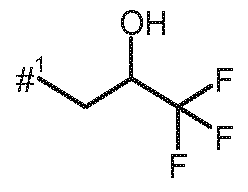
in which
#' represents the point of attachment to the nitrogen atom,
Ar represents a group of the formula
 in which
#3 represents the point of attachment to the nitrogen atom,
in which
#3 represents the point of attachment to the nitrogen atom,
R4A represents a group selected from a chlorine atom, a bromine atom, trifluoromethyl, trifluoromethoxy, ethoxycarbonyl and -C( =0)NH;.
R4C represents a group selected from trifluoromethyl, trifluoromethoxy, ethoxy, -C(=0)N(H)CH3 and -S(=0)2CH3.
or a pharmaceutically acceptable salt, hydrate and/or solvate thereof.
In a particularly preferred embodiment, the Via receptor antagonist is a compound of the general formula (I-A), supra, wherein
R 1 represents a group of the formula

in which
#' represents the point of attachment to the nitrogen atom,
represents a group of the formula
 in which
#3 represents the point of attachment to the nitrogen atom,
R4A represents a group selected from a chlorine atom, trifluoromethyl and trifluoromethoxy,
R4C represents a group selected from trifluoromethyl and trifluoromethoxy,
or a pharmaceutically acceptable salt, hydrate and/or solvate thereof.
The preparation of the compounds of general formula (I) may be illustrated by means of the following synthesis schemes. Detailed procedures and literature references are further listed in the Experimental Part.
Scheme 2

[cf. WO 2010/105770-A1]
TFAA: trifluoroacetic acid anhydride
Scheme 3

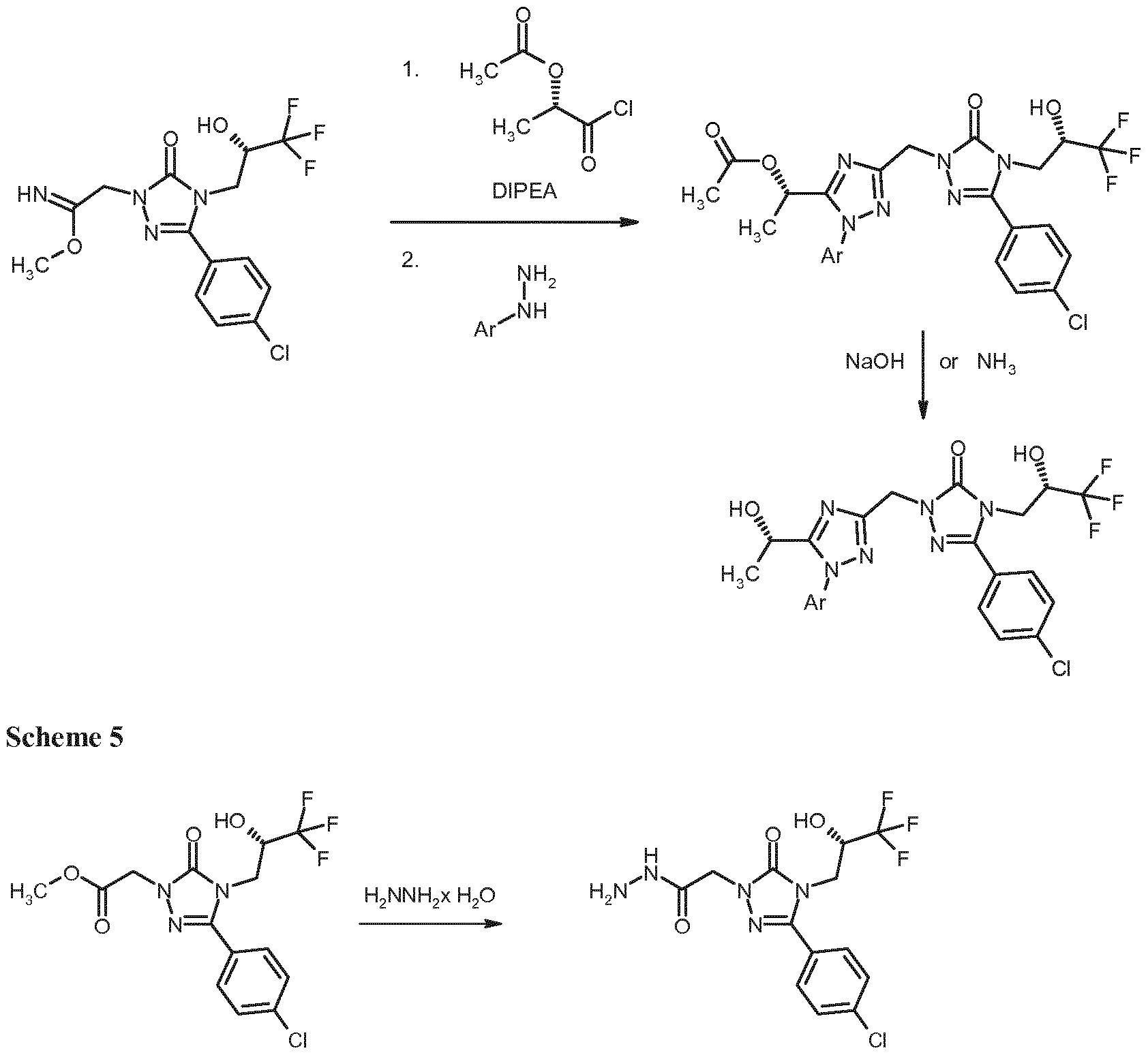
[cf. WO 2011/104322-A1]

 "Therapeutically effective amount" means an amount of a Via receptor antagonist that, when administered to a subject for treating a disease state, is sufficient to effect such treatment for the disease state. The "therapeutically effective amount" will vary depending on the compound, disease state being treated, the severity or the disease treated, the age and relative health of the subject, the route and form of administration, the judgment of the attending medical or veterinary practitioner, and other factors.
Also, the Via receptor antagonists can be used for the treatment of a patient suffering from a renal disease described herein showing an elevated arginine vasopressin (A VP) level and/or an elevated copeptin level.
The neuropeptide arginine vasopressin (also denoted as vasopressin, vasopressin argipressin or antidiuretic hormone (ADH)) is a nonapeptide which is produced in the paraventricular nucleus of the hypothalamus and the supraoptic nucleus.
Patients showing elevated arginine vasopressin levels as used herein include patients showing an increased gene activity of the gene coding for A VP. In addition or alternatively, patients showing elevated A VP levels as used herein may include patients showing a combination of the presence or absence of at least one polymorphic variant of genes coding for the arginine vasopressin receptors (AVPPv), in particular for the arginine vasopressin receptor Via (AVPR1A), with the presence or absence of at least one polymorphic variant in the patient's genome excluding the AVPR ! A gene. Patients showing elevated arginine vasopressin levels also include patients showing elevated levels of A VP in serum, plasma or urine. In one embodiment the present invention relates to a Via receptor antagonist for use as described herein, wherein an elevated A VP level in said patient is determined by means of A VP or copeptin or neurophysin-2 measurement. The measurement of AVP or copeptin or neurophysin-2 may be performed in a sample of blood of said patient. Methods for determination of AVP or copeptin or neurophysin-2 levels in a sample of blood of a patient are known in the art and include immunoassays, e.g. radioimmunoassay or Time Resolved Amplified Cryptate Emission (TRACE) immunoassay, or Enzyme Linked Immunosorbent Assay (ELISA).
Copeptin (also denoted as C -terminal proAVP) is a glycopeptide of a length of 39 amino acids which is produced from the C-terminal part of the AVP precursor. AVP and copeptin are released from the AVP precursor in an equimolar amount. Since copeptin is stable in blood (i.e. blood plasma, blood serum and/or whole blood) it provides the advantage that it may be used as surrogate marker for AVP levels in the blood plasma, blood serum and/or whole blood.
In a further embodiment the present invention thus relates to a Via receptor antagonist for use as described herein, wherein an elevated copeptin level in said patient is determined by means of copeptin measurement.
Methods for determination of co e tin levels in a blood sample derived from a patient are known in the art and include immunoassays, e.g. sandwich immunoassays. Examples of such immunoassays are the Copeptin EI A Kit provided by BioSupply UK and the Β·! ·Α·Ι I'M'S copeptin Kryptor assay provided by ThermoScientific. Copeptin may be measured in plasma or serum by use of the established Time Resolved Amplified Cryptate Emission (TRACE) immunocomplex energy transfer assay (Thermo Scientific BsR*AeHeMeS Kryptor compact PLUS).
Hence, in another embodiment of the invention, the A VP level and/or copeptin level of the renal di ease patient is determined by means of an immunoassay, optionally by means of a radioimmunoassay or Time Resolved Amplified Cryptate Emission (TRACE) immunoassay, or Enzyme Linked Immunosorbent Assay (ELISA). In another of its embodiments, the copeptin level is determined in a blood sample of the patient as defined herein. As used herein, "blood sample" relates to whole blood, blood serum and/or blood plasma. The blood sample can be obtained from the patient by any method known in the art, e.g. with a sterile needle. In a specific embodiment of the invention, the copeptin level is determined in the blood plasma derived from the blood sample of said patient. It is known in the art that blood plasma may be obtained by centrifugation of a blood sample to which an anti-coagulant has been added.
As used herein, an elevated copeptin level denotes any copeptin level higher than the mean copeptin level measured in blood samples of healthy individuals. Specifically, an elevated copeptin level and therefore also an elevated A VP level in a patient with a renal disease is indicated by a copeptin blood concentration of at least 5 pmol/1, at least 6 pmol/1, at least 7 pmol/1, at least 8 pmol/1, at least 9 pmol/1, at least 10 pmol/1, at least 20 pmol/1, at least 30 pmol/1, at least 40 pmol/1, at least 50 pmol/1, at least 60 pmol 1, at least 70 pmol/1, at least 80 pmol/1, at least 90 pmol/1 or at least 100 pmol/1. Elevated copeptin levels and therefore also elevated A VP levels may be indicated by a copeptin blood concentration in the range from 5 to 200 pmol/1, optionally in the range from 5 to 100 pmol/1.
In a particularly preferred embodiment of the present invention the elevated copeptin level is at least 8.0 pmol/1 for a male subject or at least 6.0 pmol/1 for a female subject.
It has been found by the present inventors that copeptin is surprisingly significantly elevated in patients characterized by mild impairment of renal function (This mild or mild-to-moderate renal impairment is categorized as chronic kidney disease (CKD) grades CKD-1, CKD-2, and CKD-3a according to the classification published by Kidney Disease Improving Global Outcomes (KDIGO) 2012 Clinical Practice Guideline for the Evaluation and Management of the International Society of Nephrology. The unexpected finding that elevated copeptin levels in otherwise asymptomatic individuals affected by low-grade renal impairment lays the ground for selection of patients to be treated by a Via antagonist. These individuals presumably will respond to this treatment by beneficial improvements of renal function and cardiovascular health.
In line with this observation, preclinical studies employing the renal cell line NR -49F demonstrate, that at increased arginine-vasopressin (AVP) levels, application of Via antagonists prevent the vasopressin -dependent induction of fibrotic tissue remodeling gene expression, in particular the expression of osteopontin, transforming growth factor beta-1 (TGFbl), tenascin C, serpine-1, or connective tissue growth factor. Excessive inductions of these genes triggering fibrotic processes in kidneys are being implicated in deleterious tissue degeneration and successive loss of renal function [Duffield J S, Cellular and molecular mechanisms in kidney fibrosis, J Clin Invest. 2014;124(6):2299-2306]. Without being bound to any theory, it is also conceivable, that increased levels of vasopressin that are concomitant with increased levels of copeptin, act in a vasoconstrictive mode of renal cortical or medullary vasculature thus reducing renal blood flow and subsequently impair renal functions. The vaso - constri ctive action of vasopressin resulting in loss of organ functions is being documented [Meijer e, Boertien W E, Zietse R. Gansevoort R T, Potential deleterious effects of vasopressin in chronic kidney disease and particularly autosomal dominant polycystic kidney disease, Kidney Blood Press Res 2011, 34:235-244]. Therefore, the application of A V R l a function blocking medications in particular to those patients of initial emerge of signs of loss of renal function, who are characterized by symptomatically elevated copeptin, or vasopressin, or neurophysin levels may be beneficial and of therapeutic relevance.
The invention may also involve comparing the level of AVP and/or copeptin for the individual with a predetermined value. "Predetermined cutoff and "predetermined level" refer generally to an assay cutoff value that is used to assess diagnostic/prognostic/therapeutic efficacy results by comparing the assay results against the predetermined cutoff/level, where the predetermined cutoff/level already has been linked or associated with various clinical parameters (e.g., severity of disease, progression/nonprogression/improvement, etc.). The present disclosure provides exemplary predetermined levels. However, it is well-known that cutoff values may vary depending on the nature of the immunoassay (e.g., antibodies employed, etc.). It further is well within the ordinary skill of one in the art to adapt the disclosure herein for other immunoassays to obtain immunoas say-specific cutoff values for those other immunoassays based on this disclosure. Whereas the precise value of the predetermined cutoff/level may vary between assays, the correlations as described herein should be generally applicable. The predetermined value can vary among particular populations selected, depending on their habits, ethnicity, genetics etc. For example, an apparently healthy, non-smoker population (no detectable disease, particularly no diabetes mellitus) might have a different 'normal' range of markers than a smoking population or a population the members of which have diabetes mellitus. Accordingly, the predetermined values selected may take into account the category in which an individual falls. Appropriate ranges and categories can be selected with no more than routine experimentation by those of ordinary skill in the art. In a specific embodiment of the method according to the invention the use of said level of arginine vasopressin pro -hormone or fragments thereof comprises comparing said the level of AVP
and/or copeptin to a threshold level, whereby, when said the level of A VP and/or copeptin exceeds said threshold level, a renal disease is predicted in a subject or a subject having an enhanced risk for getting a renal disease is identified.
The predetermined value can take a variety of forms. It can be single cut-off value, such as for instance a median or mean or the 60th, 65th, 70th, 75th, 90th, 95th or 99th percentile of a population. It can be established based upon comparative groups, such as where the risk in one defined group is double the risk in another defined group. It can be a range, for example, where the tested population is divided equally (or unequally) into groups, such as a low-risk group, a medium-risk group and a high-risk group, or into quartiles, the lowest quartile being individuals with the lowest risk and the highest quartile being individuals with the highest risk. Other preferred cut-off values are for instance the 90th, 95th or 99th percentile of a normal population. By using a higher percentile than the 75th percentile, one reduces the number of false positive subjects identified, but one might miss to identify subjects, who are at moderate, albeit still increased risk. Thus, one might adopt the cut-off value depending on whether it is considered more appropriate to identify most of the subjects at risk at the expense of also identifying "false positives", or whether it is considered more appropriate to identify mainly the subjects at high risk at the expense of missing several subjects at moderate risk. Other mathematical possibilities to calculate an individual's risk by using the individual's copeptin value and other prognostic laboratory and clinical parameters are for instance based on Cox regression analysis or are the RI (Net Reclassification Index) or the IDI (Integrated Discrimination Index). The indices can be calculated according to Pencina (Pencina MJ, et al.: Evaluating the added predictive ability of a new marker: from area under the ROC curve to reclassification and beyond. Stat Med. 2008;27:157-172).
For instance a copeptin level of 5.0 pmol/L (i.e. exceeding the median concentration of a reference population of apparently healthy subjects) or above, preferably above 8.0 pmol/L (i.e. the Q3/Q4 border concentration of a reference population of apparently healthy subjects) in the sample may be indicative for an elevated risk of the patient to contract a renal disease or being at risk for progression of a renal disease. Ql, Q2, Q3 and Q4 herein refer to quartiles of a reference population of apparently healthy subjects.
The presence of A VP and/or copeptin as marker may indicate that the subject is a suitable candidate for treatment with a Via antagonist. The marker may be present at a level greater than about the 60th percentile, particularly greater than about the 65th, 70th, 75th, 80th, 85th, 90th, or 95th percentile, of the distribution of the marker in a normal subject sample. The copeptin level may be at least 5 pmol/1, in particular at least 8.0 pmol/1 for a male subject or at least 6.0 pmol/1 for a female subject.
"Healthy subject" as used herein, denotes any person not suffering from a renal disease as defined herein, in a particular embodiment said subject does not have any acute or chronic observable other disease.
in one aspect, the methods as described herein may be applied to a method for the treatment and/or prevention of a renal disease in a subject using a therapeutically effective amount of a Via receptor antagonist, said method comprising the steps of:
(a) providing a biological sample from the subject; and
(b) detecting the arginine vasopressin (A VP) level and/or the copeptin level in the biological sample; and
(c) administering a therapeutically effective amount of a Via receptor antagonist.
In a further aspect, the methods as described herein may be applied to a method for determining whether a subject is a suitable candidate for the treatment with a Via receptor antagonist and treating a subject identified as a suitable candidate for said treatment, the method comprising the steps of:
(a) providing a biological sample from the subject; and
(b) detecting the arginine vasopressin (A VP) level and/or the copeptin level in the biological sample;
wherein the subject has a renal disease;
wherein the presence of an elevated A VP level and/or an elevated copeptin level, in particular at a level above about the 60th percentile of the distribution of the marker in a normal subject sample, in said subject indicates that the subject is a suitable candidate for treatment with a Via antagonist and
(c) treating a subject that is identified as a suitable candidate in step (b) with a Via antagonist.
In a further aspect, the methods as described herein may be applied to screen subjects for eligibility for a clinical trial and/or stratify groups of subjects for a clinical trial.
In a further aspect, the methods as described herein may be applied to a method for for monitoring a subject's response to treatment with a Via antagonist, comprising
(a) providing a biological sample from the subject; and
(b) detecting the arginine vasopressin (AVP) level and/or the copeptin level in the biological sample;
wherein the subject has a renal disease;
and wherein a change in the A VP level and/or an copeptin level as compared to a baseline, indicates that the Via receptor antagonist is useful for treating the subject; and
(c) continuing or discontinuing treatment with the Via receptor antagonist in the subject based on the change in the level of the marker as compared to baseline detected in step (b).
Via antagonists according to the present invention may be administered as the sole pharmaceutical agent or in combination with one or more additional therapeutic agents as long as this combination does not lead to undesirable and/or unacceptable side effects. Such combination therapy includes administration of a single pharmaceutical dosage formulation, e.g. which contains a compound of formula (I), as defined above, and one or more additional therapeutic agents, as well as administration e.g. of a compound of formula (I) and each additional therapeutic agent in its own separate pharmaceutical dosage formulation. For example, e.g. a compound of formula (I) and a therapeutic agent may be administered to the patient together in a single (fixed) oral dosage composition such as a tablet or capsule, or each agent may be administered in separate dosage formulations. Where separate dosage formulations are used, e.g. the compound of formula (I) and one or more additional therapeutic agents may be administered at essentially the same time (i.e., concurrently) or at separately staggered times (i.e., sequentially).
The inventors have surprisingly found that a substantial proportion of chronic kidney disease patients have elevated copeptin levels despite the fact that they are under continuous standard of care treatment regimes like angiotensin receptor blocker (ARB) and/or angiotensin converting enzyme inhibitor (ACEi), and/or calcium antagonist applications. It is even more surprising, that additional diuretic therapies on top of these anti -hyp ertensive therapies by application of thiazides or loop diuretics do not reduce this proportion of patients characterized by elevated copeptin levels. This observation holds true even for mildly to moderately affected CKD-3 patients. As a consequence of this finding, blocking of Via receptor activity in these patients is expected to be beneficial for ameliorating renal functions.
In particular, Via antagonists according to the present invention may be used in fixed or separate combination with
• antithrombotic agents, for example and preferably from the group of platelet aggregation inhi- bitors, anticoagulants and pro fibrinolytic substances;
• blood pressure lowering agents, for example and preferably from the group of calcium antagonists, angiotensin All antagonists, ACE inhibitors, vasopeptidase inhibitors, endothelin antagonists, renin inhibitors, alpha-blockers, beta-blockers, mineralocorticoid receptor antagonists and diuretics;
• antidiabetic agents (hypoglycemic or antihyp ergly cemic agents), such as for example and preferably insulin and derivatives, sulfonylureas, biguanides, thiazolidinediones, acarbose, DPP4 inhibitors, GLP-1 analogues, or SGLT inhibitors (gliflozins).
• organic nitrates and NO-donors, for example sodium nitroprusside, nitroglycerin, isosorbide mononitrate, isosorbide dinitrate, molsidomine or SIN-1, and inhalational NO;
• compounds that inhibit the degradation of cyclic guanosine monophosphate (cGMP), for example inhibitors of phosphodiesterases (PDE) 1 , 2, 5 and/or 9, in particular PDE-5 inhibitors such as sildenafil, vardenafil, tadalafil, udenafil, dasantafil, avanafil, mirodenafil, lodenafil or PF-00489791 ;
· positive -inotropic agents, such as for example cardiac glycosides (digoxin) and beta-adrenergic and dopaminergic agonists such as isoproterenol, adrenalin, noradrenalin, dopamine or dobut- amine;
• natriuretic peptides, such as for example atrial natriuretic peptide (ANP, anaritide), B-type natriuretic peptide or brain natriuretic peptide ( BN , nesiritide), C-type natriuretic peptide (CNP) or urodilatin;
• calcium sensitizers, such as for example and preferably levosimendan;
• NO- and heme-independent activators of soluble guanylate cyclase (sGC), such as in particular cinaciguat and also the compounds described in WO 01/19355, WO 01/19776, WO 01/19778, WO 01/19780, WO 02/070462 and WO 02/070510;
· NO-independent, but heme-dependent stimulators of guanylate cyclase (sGC), such as in particular riociguat, vericiguat and also the compounds described in WO 00/06568, WO 00/06569, WO 02/42301, WO 03/095451 , WO 201 1/147809, WO 2012/004258, WO 2012/028647 and WO 2012/059549;
• inhibitors of human neutrophil elastase (HNE), such as for example sivelestat or DX-890 (reltran);
• compounds inhibiting the signal transduction cascade, in particular tyrosine and or serin e threo- nine kinase inhibitors, such as for example nintedanib, dasatinib, nilotinib, bosutinib, regora- fenib, sorafenib, sunitinib, cediranib, axitinib, telatinib, imatinib, brivanib, pazopanib, vatalanib, gefitinib, erlotinib, lapatinib, canertinib, lestaurtinib, pelitinib, semaxanib or tandutinib;
· compounds influencing the energy metabolism of the heart, such as for example and preferably etomoxir, dichloroacetate, ranolazine or trimetazidine, or full or partial adenosine Al receptor agonists as GS-9667 (previously known as CVT-3619), capadenoson and BAY 1067197;
• compounds influencing the heart rate, such as for example and preferably ivabradine;
• cardiac myosin activators, such as for example and preferably omecamtiv mecarbil (CK- 1827452);
• anti-inflammatory drugs such as non-steroidal anti-inflammatory drugs (NSAIDs) including acetylsalicylic acid (aspirin), ibuprofen and naproxen, glucocorticoids, 5 -aminosalicylic acid derivatives, leukotriene antagonists, TNF-alpha inhibitors and chemokine receptor antagonists such as CCR1 , 2 and/or 5 inhibitors;
• fat metabolism altering agents, for example and preferably from the group of thyroid receptor agonists, cholesterol synthesis inhibitors, such as for example and preferably HMG-CoA- reductase or squalene synthesis inhibitors, AC AT inhibitors, CETP inhibitors, MTP inhibitors, PPAR-alpha, PPAR-gamma and/or PPAR-delta agonists, cholesterol absorption inhibitors, lipase inhibitors, polymeric bile acid adsorbers, bile acid reabsorption inhibitors and lipoprotein^) antagonists.
Antithrombotic agents are preferably to be understood as compounds from the group of platelet aggregation inhibitors, anticoagulants and profibrinolytic substances.
In a preferred embodiment of the invention, Via antagonists according to the invention are administered in combination with a platelet aggregation inhibitor, for example and preferably aspirin, clopidogrel, ticlopidine or dipyridamole. In a preferred embodiment of the invention, Via antagonists according to the invention are administered in combination with a thrombin inhibitor, for example and preferably ximelagatran, dabigatran, melagatran, bivalirudin or enoxaparin. In a preferred embodiment of the invention, Via antagonists according to the invention are administered in combination with a ( iPl lb Il ia antagonist, for example and preferably tirofiban or abcixi- mab. In a preferred embodiment of the invention, Via antagonists according to the invention are administered in combination with a factor Xa inhibitor, for example and preferably rivaroxaban, apixaban, otamixaban, fidexaban, razaxaban, fondaparinux, idraparinux, DU-176b, PMD-3112, YM-I50, K FA- 1982, EMD-503982, MCM-17, MLN-1021, DX 9065a, DPC 906, JTV 803, SSR- 126512 or SSR-128428. In a preferred embodiment of the invention, Via antagonists according to the invention are administered in combination with heparin or a low molecular weight (LMW) heparin derivative. In a preferred embodiment of the invention, Via antagonists according to the invention are administered in combination with a vitamin K antagonist, for example and preferably coumarin. Blood pressure lowering agents are preferably to be understood as compounds from the group of calcium antagonists, angiotensin Al l antagonists, ACE inhibitors, vasopeptidase inhibitors, endothelin antagonists, renin inhibitors, alpha-blockers, beta-blockers, mineralocorticoid receptor antagonists and diuretics. In a preferred embodiment of the invention, Via antagonists according to the invention are administered in combination with a calcium antagonist, for example and preferably nifedipine, amlodipine, verapamil or diltiazem. In a preferred embodiment of the invention, Via antagonists according to the invention are administered in combination with an
alpha- 1 -receptor blocker, for example and preferably prazosin or tamsulosin. In a preferred embodiment of the invention, Via antagonists according to the invention are administered in combination with a beta-blocker, for example and preferably propranolol, atenolol, timolol, pindolol, alprenolol, oxprenolol, penbutolol, bupranolol, metipranolol, nadolol, mepindolol, carazolol, sotalol, metoprolol, betaxolol, celiprolol, bisoprolol, carteolol, esmolol, labetalol, carve - dilol, adaprolol, landiolol, nebivolol, epanolol or bucindolol. In a preferred embodiment of the invention, Via antagonists according to the invention are administered in combination with an angiotensin Ai l receptor antagonist, for example and preferably losartan, candesartan, valsartan, telmisartan, irbesartan, olmesartan, eprosartan or azilsartan. In a preferred embodiment of the invention, Via antagonists according to the invention are administered in combination with a vasopeptidase inhibitor or inhibitor of neutral endopeptidase (NEP), such as for example and preferably sacubitril, omapatrilat or AVE-7688. In a preferred embodiment of the invention, Via antagonists according to the invention are administered in combination with a dual angiotensin Al l receptor antagonist/NEP inhibitor (ARNI), for example and preferably LCZ696. In a preferred embodiment of the invention, Via antagonists according to the invention are administered in combination with an ACE inhibitor, for example and preferably enalapril, captopril, lisinopril, ramipril, delapril, fosinopril, quinopril, perindopril or trandopril. In a preferred embodiment of the invention, Via antagonists according to the invention are administered in combination with an endothelin antagonist, for example and preferably bosentan, darusentan, ambrisentan, tezosentan, sitaxsentan or atrasentan. In a preferred embodiment of the invention, Via antagonists according to the invention are administered in combination with a renin inhibitor, for example and preferably aliskiren, SPP-600 or SPP-800. In a preferred embodiment of the invention, Via antagonists according to the invention are administered in combination with a mineralocorticoid receptor antagonist, for example and preferably finerenone, spironolactone, canrenone, potassium canrenoate, eplerenone, CS-3150, or MT-3995. In a preferred embodiment of the invention, Via antagonists according to the invention are administered in combination with a diuretic, such as for example and preferably furosemide, bumetanide, piretanide, torsemide, bendroflumethiazide, chlorothiazide, hydrochlorothiazide, xipamide, indapamide, hydroflumethiazide, methyclothiazide, polythiazide, trichloromethiazide, chlorothalidone, metolazone, quinethazone, acetazolamide, dichlorophenamide, methazolamide, glycerine, isosorbide, mannitol, amiloride or triamterene. Fat metabolism altering agents are preferably to be understood as compounds from the group of CETP inhibitors, thyroid receptor agonists, cholesterol synthesis inhibitors such as HMG-CoA-reductase or squalene synthesis inhibitors, AC AT inhibitors, MTP inhibitors, PPAR-alpha, PPAR-gamma and/or PPAR-delta agonists, cholesterol absorption inhibitors, polymeric bile acid adsorbers, bile acid reabsorption inhibitors, lipase inhibitors and lipoprotein(a) antagonists. In a preferred embodiment of the invention, Via antagonists according to the invention are administered in combination with a CETP inhibitor, for example and preferably dalcetrapib, anacetrapib, BAY 60-
5521 or CETP-vaccine (Avant). In a preferred embodiment of the invention, Via antagonists according to the invention are administered in combination with a thyroid receptor agonist, for example and preferably D-thyroxin, 3,5,3'-triiodothyronin (T3), CGS 23425 or axitirome (CGS 26214). In a preferred embodiment of the invention, Via antagonists according to the invention are administered in combination with an HMG-CoA-reductase inhibitor from the class of statins, for example and preferably lovastatin, simvastatin, pravastatin, fiuvastatin, atorvastatin, rosuvastatin or pitavastatin. In a preferred embodiment of the invention, Via antagonists according to the invention are administered in combination with a squalene synthesis inhibitor, for example and preferably BMS-188494 or TAK-475. In a preferred embodiment of the invention, Via antagonists according to the invention are administered in combination with an AC AT inhibitor, for example and preferably avasimibe, melinamide, pactimibe, eflucimibe or SMP-797. In a preferred embodiment of the invention, Via antagonists according to the invention are administered in combination with an MTP inhibitor, for example and preferably implitapide, R- ! 03757, BMS- 201038 or JTT- 130. In a preferred embodiment of the invention, Via antagonists according to the invention are administered in combination with a PPAR-gamma agonist, for example and preferably pioglitazone or rosiglitazone. In a preferred embodiment of the invention, Via antagonists according to the invention are administered in combination with a PPAR-delta agonist, for example and preferably GW 501516 or BAY 68-5042. In a preferred embodiment of the invention, Via antagonists according to the invention are administered in combination with a cholesterol absorption inhibitor, for example and preferably ezetimibe, tiqueside or pamaqueside. In a preferred embodiment of the invention, Via antagonists according to the invention are administered in combination with a lipase inhibitor, for example and preferably orlistat. In a preferred embodiment of the invention, Via antagonists according to the invention are administered in combination with a polymeric bile acid adsorber, for example and preferably cholestyr- amine, colestipol, colesolvam, CholestaGel or colestimide. In a preferred embodiment of the invention, Via antagonists according to the invention are administered in combination with a bile acid reab sorption inhibitor, for example and preferably ASBT (= I B AT) inhibitors such as AZD- 7806, S-8921, AK-105, BARI- 1 741. SC-435 or SC-635. In a preferred embodiment of the invention, Via antagonists according to the invention are administered in combination with a lipoprotein(a) antagonist, for example and preferably gemcabene calcium (CI- 1027) or nicotinic acid. In a preferred embodiment of the invention, Via antagonists according to the invention are administered in combination with antidiabetics (hypoglycemic or antihyperglycemic agents), such as for example and preferably insulin and derivatives, sulfonylureas such as tolbutamide, carbutamide, acetohexamide, chlorpropamide, glipizide, gliclazide, glibenclamide, glyburide, glibornuride, gliquidone, glisoxepide, glyclopyramide, glimepiride, JB253 and JB558, meglitinides such as repaglinide and nateglinide, biguanides such as metformin and buformin, thiazolidinediones such as rosiglitazone and pioglitazone, alpha-glucosidase inhibitors such as
miglitol, acarbose and voglibose, DPP4 inhibitors such as vildagliptin, sitagliptin, saxagliptin, linagliptin, alogliptin, septagliptin and teneligliptin, GLP-1 analogues such as exenatide (also exendin-4, liraglutide, lixisenatide and taspoglutide, or SGLT inhibitors (gliflozins) such as canagliflozin, dapagliflozin and empagliflozin. In a particularly preferred embodiment, Via antagonists of the present invention are administered in combination with one or more additional therapeutic agents selected from the group consisting of diuretics, angiotensin Al l antagonists, ACE inhibitors, beta-receptor blockers, mineralocorticoid receptor antagonists, antidiabetics, organic nitrates and NO donors, activators and stimulators of the soluble guanylate cyclase (sGC), and positive-inotropic agents.
Thus, in a further embodiment, the present invention relates to pharmaceutical compositions comprising at least one Via antagonist according to the invention and one or more additional therapeutic agents for the treatment and/or prevention of renal diseases, especially of the aforementioned diseases. Furthermore, Via antagonists of the present invention may be utilized, as such or in compositions, in research and diagnostics, or as analytical reference standards and the like, which are well known in the art. When the Via antagonists of the present invention are administered as pharmaceuticals, to humans and other mammals, they can be given per se or as a pharmaceutical composition containing, for example, 0.1 % to 99.5% (more preferably, 0.5%) to 90%o) of active ingredient in combination with one or more pharmaceutically acceptable excipients. Thus, in another aspect, the present invention relates to pharmaceutical compositions comprising at least one Via antagonist according to the invention, conventionally together with one or more inert, nontoxic, pharmaceutically suitable excipients, and to the use thereof for the treatment and/ or prevention of renal diseases, especially of the aforementioned diseases.
The Via antagonists according to the invention can act systemically and/or locally. For this purpose, they can be administered in a suitable way such as, for example, by the oral, parenteral, pulmonary, nasal, lingual, sublingual, buccal, rectal, dermal, transdermal, conjunctival, otic or topical route, or as an implant or stent. For these administration routes, the Via antagonists of the invention can be administered in suitable application forms. Suitable for oral administration are application forms which function according to the state of the art and deliver the compounds according to the invention rapidly and or in modified fashion, and which contain the compounds according to the invention in crystalline, amorphous and/or dissolved form, such as, for example, tablets (uncoated or coated tablets, for example having enteric coatings or coatings which are insoluble or dissolve with a delay and control the release of the compound according to the invention), tablets which disintegrate rapidly in the mouth, or films/ wafers, films/lyophilisates, capsules (e.g. hard or soft gelatin capsules), sugar-coated tablets, granules, pellets, powders, emulsions, suspensions, aerosols or solutions. Parenteral application can be carried out with avoidance of an absorption step (intravenously, intraarterially, intracardially, intraspinally or
intralumbarly) or with inclusion of an absorption (intramuscularly, subcutaneously, intracutaneously, percutaneously or intraperitoneally). Suitable parenteral application forms include injection and infusion preparations in the form of solutions, suspensions, emulsions, lyophilisates and sterile powders. Forms suitable for other application routes include, for example, inhalatory pharmaceutical forms (e.g. powder inhalers, nebulizers), nasal drops, solutions or sprays, tablets or capsules to be administered lingually, sublingually or buccally (e.g. troches, lozenges), suppositories, ear and eye preparations (e.g. drops, ointments), vaginal capsules, aqueous suspensions (lotions, shaking mixtures), lipophilic suspensions, ointments, creams, milks, pastes, foams, dusting powders, transdermal therapeutic systems (e.g. patches), implants and stents. In a preferred embodiment, the pharmaceutical composition comprising a Via antagonist as defined above is provided in a form suitable for oral administration. In another preferred embodiment, the pharmaceutical composition comprising a Via antagonist as defined above is provided in a form suitable for intravenous administration.
The Via antagonists according to the invention can be converted into the recited application forms in a manner known per se by mixing with inert, non-toxic, pharmaceutically suitable excipients. These excipients include, inter alia, carriers (e.g. microcrystalline cellulose, lactose, mannitol), solvents (e.g. liquid polyethylene glycols), emulsifiers (e.g. sodium dodecyl sulfate), surfactants (e.g. polyoxysorbitan oleate), dispersants (e.g. polyvinylpyrrolidone), synthetic and natural polymers (e.g. albumin), stabilizers (e.g. antioxidants such as, for example, ascorbic acid), colorants (e.g. inorganic pigments such as, for example, iron oxides), and flavour and/or odour masking agents.
A preferred dose of Vi a antagonists of the present invention is the maximum that a patient can tolerate and not develop serious side effects. Illustratively, the compound of the present invention may be administered parenterally at a dose of about 0.001 mg/kg to about 10 nig kg, preferably of about 0.01 mg/kg to about 1 mg kg of body weight. In oral administration, an exemplary dose range is about 0.01 to 100 mg/kg, preferably about 0.01 to 20 mg/kg, and more preferably about 0.1 to 10 mg/kg of body weight. Ranges intermediate to the above -recited values are also intended to be part of the invention. Nevertheless, actual dosage levels and time course of administration of the active ingredients in the pharmaceutical compositions of the invention may be varied so as to obtain an amount of the active ingredient which is effective to achieve the desired therapeutic response for a particular patient, composition and mode of administration, without being toxic to the patient. It may therefore be necessary where appropriate to deviate from the stated amounts, in particular as a function of age, gender, body weight, diet and general health status of the patient, the bioavailability and pharmacodynamic characteristics of the particular compound and its mode and route of administration, the time or interval over which administration takes place, the dose regimen selected, the response of the individual patient to the active ingredient, the specific disease
involved, the degree of or the involvement or severity of the disease, the kind of concurrent treatment (i.e., the interaction of a Via antagonist with other co-administered therapeutics), and other relevant circumstances. Thus, it may be satisfactory in some cases to manage with less than the aforementioned minimum amount, whereas in other cases the stated upper limit must be exceeded. Treatment can be initiated with smaller dosages, which are less than the optimum dose of the compound. Thereafter, the dosage may be increased by small increments until the optimum effect under the circumstances is reached. For convenience, the total daily dosage may be divided and administered in individual portions spread over the day.
Figures
Figure 1-1 Induction of mRNA formation of pro-fibrotic genes PAI- I and osteopontin by exposure of renal NRK-49F cells to 1 nM Arg-vasopressin for 5 hours.
Figure 2- 1 Copeptin quantification in serum samples of unilaterally nephrectomized Spraque- Dawley rats (Sham) demonstrate elevated copeptin levels in rats that are additionally affected by ischemia reperfusion injury (Placebo).
Figure 2-2 Reduction of serum creatinine and serum urea in ischemic rats after treatment with a
Via receptor antagonist (Relcovaptan).
Figure 2-3 Reduction of AC R (urinary creatinin/ albumin ratio) in ischemic rats after treatment with a Via receptor antagonist (Relcovaptan).
Figure 3-1 Receiver operating characteristic (ROC) curves of copeptin in C D-3 patients.
Figure 3-2 Copeptin levels in diabetic CKD patients and healthy controls.
Figure 3-3 Copeptin levels in non-diabetic CKD patients and healthy controls.
Figure 3-4 Gender effect on copeptin levels in diabetic C D patients.
Figure 3-5 Copeptin levels in CKD-3 patients under different treatment regimes.
Although the invention has been disclosed with reference to specific embodiments, it is apparent that other embodiments and variations of the invention may be devised by others skilled in the art without departing from the true spirit and scope of the invention. The claims are intended to be construed to include all such embodiments and equivalent variations.
Additional embodiments and features are set forth in part in the description that follows, and in part will become apparent to those skilled in the art upon examination of the specification or may be learned by the practice of the invention. This invention is further illustrated by the following examples which should not be construed as limiting.
The percentages in the following tests and examples are, unless stated otherwise, by weight; parts are by weight. Solvent ratios, dilution ratios and concentrations reported for liquid/liquid solutions are each based on volume.
A. EXPERIMENTAL SECTION
NMR peak forms are stated as they appear in the spectra, possible higher order effects have not been considered. Chemical names were generated using the ACD/Name software from ACD/Labs. in some cases generally accepted names of commercially available reagents were used in place of ACD/Name generated names.
The following table 1 lists the abbreviations used in this paragraph and in the Examples section as far as they are not explained within the text body. Other abbreviations have their meanings customary per se to the skilled person.
TaMe 1: Abbreviations
Abbreviation Meaning
br broad (Ή-NMR signal)
cone. concentrated
CI chemical ionisation
d doublet
DAD diode array detector
DCM dichloromethane
dd double-doublet
DM SO dimethylsulfoxide
ESI electrospray (ES) ionisation
h hour(s)
HPLC high performance liquid chromatography
LC-MS liquid chromatography mass spectrometry
m multiplet
min minute(s)
MS mass spectrometry
NMR nuclear magnetic resonance spectroscopy: chemical shifts (δ) are given in ppm. The chemical shifts were corrected by setting the DM SO signal to 2.50 ppm unless otherwise stated.
PDA Photo Diode Array
Rt retention time (as measured either with H LC or UPLC ) in minutes
s singlet
SQD Single-Quadrupole-Detector
t triplet
THF tetrahydrofuran
UPLC ultra performance liquid chromatography
The various aspects of the invention described in this application are illustrated by the following examples which are not meant to limit the invention in any way.
The example testing experiments described herein serve to illustrate the present invention and the invention is not limited to the examples given.
All reagents, for which the synthesis is not described in the experimental part, are either commercially available, or are known compounds or may be formed from known compounds by known methods by a person skilled in the art.
The compounds and intermediates produced according to the methods of the invention may require purification. Purification of organic compounds is well known to the person skilled in the art and there may be several ways of purifying the same compound. In some cases, no purification may be necessary. In some cases, the compounds may be purified by crystallization. In some cases, impurities may be stirred out using a suitable solvent. In some cases, the compounds may be purified by chromatography, particularly flash column chromatography, using for example prepacked silica gel cartridges, e.g. Biotage SNA cartidges KP-Sil® or KP-NH® in combination with a Biotage autopurifier system (SP4® or Isolera Four®) and eluents such as gradients of hexane/ethyl acetate or DCM/methanol. in some cases, the compounds may be purified by preparative HPLC using for example a Waters autopurifier equipped with a diode array detector and/or on-line electrospray ionization mass spectrometer in combination with a suitable prepacked reverse phase column and eluents such as gradients of water and acetonitrile which may contain additives such as trifluoroacetic acid, formic acid or aqueous ammonia.
In some cases, purification methods as described above can provide those compounds of the present invention which possess a sufficiently basic or acidic functionality in the form of a salt, such as, in the case of a compound of the present invention which is sufficiently basic, a trifluoroacetate or formate salt for example, or, in the case of a compound of the present invention which is sufficiently acidic, an ammonium salt for example. A salt of this type can either be transformed into its free base or free acid form, respectively, by various methods known to the person skilled in the art, or be used as salts in subsequent biological assays. It is to be understood that the specific form (e.g. salt, free base etc.) of a compound of the present invention as isolated and as described herein is not necessarily the only form in which said compound can be applied to a biological assay in order to quantify the specific biological activity.
UPLC-MS Standard Procedures
Method 1 (LC/MS):
Instrument: Waters ACQUITY SQD UPLC System; Column: Waters Acquity UPLC HSS T3 1.8 μ 50 x 1 mm; eluent A: 1 L water + 0.25 ml 99% formic acid, eluent B: 1 L acetonitrile + 0.25 ml
99% formic acid; gradient: 0.0 min 90% A→ 1.2 min 5% A→ 2.0 min 5% A; oven: 50°C; flow rate: 0.40 ml/min; UV detection: 208-400 nm.
Method 2 (LC/MS):
Instrument MS: Thermo Scientific FT-MS; Instrument type UHPLC+: Thermo Scientific UltiMate 3000; Column: Waters, H SST3. 2.1 x 75 mm, C18 1.8 μηι; eluent A: 1 I, water + 0.01% formic acid; eluent B: 1 L acetonitrile + 0.01 % formic acid; gradient: 0.0 min 10% B→ 2.5 min 95% B→ 3.5 min 95% B; oven: 50°C; flow rate: 0.90 ml/min; UV detection: 210 nm/ optimum integration path 210-300 nm.
Method 3 (LC/MS):
Instrument: Waters ACQUITY SQD UPLC System; Column: Waters Acquity UPLC HSS T3 1.8 μ 50 x 1 mm; eluent A: 1 L water + 0.25 ml 99% formic acid, Eluent B: I L acetonitrile + 0.25 ml 99% formic acid; gradient: 0.0 min 95% A→ 6.0 min 5% A→ 7.5 min 5% A; oven: 50°C; flow rate: 0.35 ml/min; UV detection: 210-400 nm.
Method 4 (preparative UPLC):
Column: Chromatorex or Reprosil C18 10 μιη; 1 25 x 30 mm, Flow: 75 ml/min, Run time: 20 min, Detection at 210 nm, Eluent A: water + 0.1%) formic acid, Eluent B: acetonitrile + 0.1 % formic acid; Gradient: 3 min 10% B; 17.5 min : 95% B; 19.5 min 100% B, 20 min 10% B.
STARTING MATERIALS AND INTERMEDIATES
Example 1
5-(4-Chlorophenyl)-4-[(2i?)-3,3,3-trifluoro-2-hydroxypropyl]-2,4-dihydro-3//-l ,2,4-triazol-3-one

A solution of 5-(4-chlorophenyl)-4-(3,3,3-trifluoro-2,2-dihydroxypropyl)-2,4-dihydro-3H-l,2,4- triazol-3-one (synthesis described as Example 3A in WO 2010/105770-Al) (10.0 g, 30.9 mmol), N-[(li?,2i?)-2-amino-I ,2-diphenylethyl]-4-methylbenzenesulfonamide (56.6 mg, 154 μηιοΐ) and 1 - methyl-4-(propan-2-yl)benzene dichlororuthenium (1 : 1) (47.3 mg, 77.2 μπιοΐ) in ethyl acetate was treated with triethylamine (8.6 ml, 62 mmol) followed by addition of formic acid (5.8 ml, 150 mmol). The resulting mixture was heated under reflux for 3 h and then cooled down to room
temperature. The reaction mixture was then diluted with I N hydrochloric acid (70 ml). The organic phase was washed twice with IN hydrochloric acid. The aqueous phase was extracted twice with ethyl acetate. The combined organic phases were evaporated. The residue was retaken in methanol (22.5 ml) and the resulting suspension was heated to 60°C until the solid was completely dissolved. I N hydrochloric acid (22.5 ml) was added and the resulting suspension was heated at 78°C for 10 min and then cooled down to room temperature. The solid was filtered off and dried under vacuum. The solid was retaken in IN hydrochloric acid (30 ml), heated at 35 C . The resulting suspension was treated with methanol (30 ml), heated 4 h at 35°C and filtered off at 35°C. The filtrate solution was evaporated affording 4.9 g (ee = 99.6%, 51 % of th.) of 5-(4-Chlorophenyl)-4-[(2R)-3,3,3- trifluoro-2-hydroxypropyl]-2,4-dihydro-3H-l ,2,4-triazol-3-one.
LC-MS (Method 2): Rt = 1.40 min; MS (ESIpos): m/z = 308 [M+Hf
'H-NMR (400MHz, DMSO): δ [ppm] = 12.10 (s, 1H), 7.52 - 7.79 (m, 411 ). 6.84 (d, 1H), 3.54 - 4.52 (m, 3H).
Example 2 A
{3-(4-Chlorophenyl)-5-oxo-4-[(25)-3,3,3-trifluoro^
l-yl}acetonitrile

In a 2 L reaction vessel, 100 g (273 mmol) of {3-(4-chlorophenyl)-5-oxo-4-[(25)-3,3,3-trifluoro-2- hydroxypropyl]-4,5-dihydro-l//-l ,2,4-triazol-l -yljacetic acid (synthesis described as Example 8A in WO 2010/105770-A1), 43.3 g (547 mmol) of pyridine and 33 mg (0.3 mmol) of 4-dimethyl- aminopyridine were dissolved in 300 ml THF. The resulting solution was treated at 5 °C with 52.8 g (438 mmol) of 2,2-dimethylpropanoylchloride over 15 minutes and the resulting mixture was stirred at room temperature for 2.5 hours. After cooling to 0 °C, 183 ml of 28 > aqueous ammonia solution was added over 1 h while the solution temperature was kept between 10 °C and 20 °C and at the resulting mixture then stirred at 5 °C for an additional time period of 1 h. 500 ml methyl tert- butyl ether and 300 ml 20%o aqueous citric acid were then added while keeping the internal temperature between 10 °C and 20 °C. The phases were the separated and the organic phase was washed with 300 ml of 20%> aqueous citric acid followed by 300 ml saturated aqueous sodium hydrogencarbonate solution and finally with 300 ml of 10%> aqueous sodium chloride solution. The organic phase was evaporated at 60 °C under reduced pressure until an oily residue was obtained.
300 ml THF was then added and the solution was evaporated again until an oily solution was obtained. This operation was repeated a second time. The oil residue was retaken in 360 ml THF and treated with 172 g (820 mmol) trifluoroacetic acid anhydride over 20 min at a temperature between 10 °C and 20 °C. The resulting solution was then stirred at room temperature for 1 h. 720 ml 4-methyl-2-pentanone and 650 ml 7.5% aqueous sodium hydroxide solution were added at a temperature between 10 °C and 20 °C. Finally the pH-value was adjusted to pH = 9.5 using 7.5% aqueous sodium hydroxide solution. After phase separation, the organic phase was washed twice with 450 ml 10% aqueous sodium chloride solution. The organic phase was evaporated at a temperature of 80 °C under reduced pressure while 1200 ml n-heptane was added. The formed suspension was cooled to 20 °C and a solid formed which was filtered off and washed with 200 ml n-heptane and then dried under reduced pressure (50°C, 30 mbar) affording 88 g (93 % of th.) of {3-(4-chlorophenyl)-5-oxo-4-[(2.S)-3,3,3-trifluoro-2-hydroxypropyl]-4,5-dihydro-l /-l,2,4-triazol- l-yl}acetonitrile as a solid.
1H-NMR (400 MHz, DMSO-d6): δ [ppm] = 7.78 (d, 2H), 7.55 (d, 2H), 6.91 (d, 1H), 5.17 (s, 2 H), 4.34-4.23 (m, 1 H), 3.98 (dd, 1H), 3.81 (dd, 1H).
Example 3A
{3-(4-Chlorophenyl)-5-oxo-4-[(2R)-3,3,3-trifluoro-2^
l-yl}acetonitrile

Example 4 A
Methyl-2-{3-(4-chlorophmyl)-5-oxo
1 ,2,4-triazol- 1 -yl } ethanimidate

In a 4 I, reaction vessel, 200 g (576.9 mmol) of {3-(4-chloiOphenyl)-5-oxo-4-[(25)-3,3,3-trifluoro- 2-hydroxypropyl] -4,5-dihydro- 177- 1 ,2,4-triazol- 1 -yl jacetonitrile (Example 2A) in 1600 ml methanol was treated with 5.2 g (28 mmol) sodium methanolate (30% in methanol) and the resulting mixture was stirred at 50 °C for 2.5 hours. The solution was then evaporated at 50 °C under reduced pressure until an oily solution was obtained. 2000 ml methyl tert-butylether was added and the solution was concentrated until a volume of 800 ml was achieved. 3000 ml n- heptane was then added and a suspension was formed. After cooling at 20 °C, the solid was filtered and washed with 500 ml n-heptane and then dried under reduced pressure (50°C, 30 mbar) affording 175 g (80 % of th.) of methyl 2-{3-(4-chlorophenyl)-5-oxo-4-[(2S)-3,3,3-trifluoro-2- hydroxypropyl]-4,5-dihydro-lH-l ,2,4-triazol-l -yl} ethanimidate as a solid.
1H-NMR (400 MHz, DMSO-d6): δ [ppm] = 8.01 (s, 1H), 7.78 (d, 2H), 7.62 (d, 2H), 6.93 (br. s, 1H), 4.50 (s, 2 H), 4.35-4.23 (m, 1 H), 3.96 (dd, 1H), 3.81 (dd, 1H), 3.67 (s, 3 H)..
Example 5A
Methyl-2-{3-(4-chlorophenyi)-5-oxo-4-[(2R)-3,3,3-trifluor-2-hydroxypropyl]-4,5-dihydro-lH- 1 ,2,4-triazol- 1 -yl } ethanimidate

A solution of 8.58 g (24.7 mmol) of {3-(4-chlorophenyl)-5-oxo-4-[(27?)-3,3,3-trifluoro-2 -hydroxy- propyl] -4,5 -dihydro- 177- 1 ,2,4-triazol- 1 -yl } acetonitrile (Example 3A) in methanol (43 ml) was
treated with 229 μΐ (1.24 mmol) of a sodium methoxide solution (30% in methanol). The resulting mixture was stirred overnight at room temperature and then evaporated affording 9.31 g (99% of th.) of the title compound.
'H NMR (DMSO-de, 400 MHz): δ [ppm] = 8.01 (s, 1H), 7.81-7.58 (m, 4H ). 7.00-6.84 (m, 1H), 4.50 (s, 2H), 4.40-4.23 (m, 1H), 4.04-3.74 (m, 2 H ). 3.66 (s, 3H).
Example 6 A
Methyl 3-( {3-(4-chlorophenyl)-5-oxo-4-[(2S)-3,3,3-trifluoro-2-hydroxypropyl]-4,5-dihydro-lH- 1 ,2,4-triazol- 1 -yl Jmethyl)- 1 - [2-(trifluoromethyl)phenyl]-l H- 1 ,2,4-triazol e-5-carboxylate

3.3.3 - trifluor-2-hydroxypropyl] -4,5-dihydro- 1 H- 1 ,2,4-triazol- 1 -yl } ethanimidate (Example 4A) in 3 ml anhydrous TH F was treated at 0°C with 75 μΐ (0.44 mmol) N,N-diisopropylethylamine and 40 μΐ (0.44 mmol) methyl chlorooxoacetate and the mixture was then stirred at 0°C for 30 min. 93 mg (0.44 mmol) of [2-(trifluoromethyl)phenyl]hydrazine were then added, followed by 145 μΐ (0.83 mmol) of NN-dii sopropy lethylamine . The resulting mixture was stirred for 2 h at room temperature, followed by 1 h at 120°C in the microwave and then evaporated. The obtained residue was purified by preparative HPLC (Method 4) affording 75 mg (32 % of th.) of the title compound.
LC-MS (Method 2): R, = 2.01 min; MS(ESipos): m/z = 591 .1 [M+H]+
'H NMR (DMSO-de, 400 MHz): δ [ppm] = 8.07-7.56 (m, 8H), 6.91 (d, 1H), 5.17 (d, 2H), 4.37- 4.2 1 (m, 1H), 4.09-3.80 (m, 2H), 3.74 (s, 3H).
Example 7 A
Methyl 3-({3-(4-chlorophenyi)-5-oxo-4-[(2R)-3,3,3-trifluoro-2-hydroxypropyl]-4,5-dihydro-lH-
1.2.4- triazol- 1 -yl jmethyl)- 1 - [2-(trifluoromethyl)phenyl]-l I I- 1 ,2,4-triazol e-5-carboxylate

LC-MS (Method 2): R, = 1.97 min; MS(ESIpos): m/z = 591.1 [M+H]+
'H NMR (DMSO-de, 400 MHz): δ [ppm] = 8.03-7.57 (m, 8H), 6.91 (d, 1H), 5.17 (d, 2H), 4.38- 3.80 (m, 3H), 3.74 (s, 3H).
Example 8 A
Methyl 3-({3-(4-chlorophenyl)-5-oxo-4-[(2S)-3,3,3-trifluoro-2-hydroxypropyl]-4,5-dihydro-lH- 1 ,2,4-triazol- 1 -yl Jmethyl)- 1 - [2-(trifluoromethoxy)phenyl] - 1 H- 1 ,2,4-triazole-5-carboxylate

Under argon, a solution of 150 mg (0.40 mmol) of methyl-2-{3-(4-chlorophenyl)-5-oxo-4-[(2S)- 3,3 ,3 -trifluor-2-hydroxypropyl] -4,5-dihydro- 1 H- 1 ,2,4-triazol- 1 -yl } ethanimidate (Example 4A) in 3 ml anhydrous THF was treated at 0°C with 75 μΐ (0.44 mmol) AyV-diisopropylethylamine and 40 μΐ (0.44 mmol) methyl chlorooxoacetate and the mixture was then stirred at 0°C for 30 min. 100 mg (0.44 mmol) of [2-(trifluoromethoxy)phenyl]hydrazine hydrochloride were then added, followed by 145 μΐ (0.83 mmol) of N^-diisopropylethylamine. The resulting mixture was stirred for 1.5 h at room temperature, followed by 1 h at 120°C in the microwave and evaporated. The obtained residue was purified by preparative HPLC (Method 4) affording 129 mg (51 % of th.) of the title compound.
LC-MS (Method 2): Rt = 2.03 min; MS(ESIpos): m/z = 607.1 [M+H]+
'H NMR (DMSO-de, 400 MHz): δ [ppm] = 7.86-7.52 (m, 8H), 6.91 (d, 1H), 5.18 (d, 2H), 4.40- 4.21 (m, 1H), 4.09-3.81 (m, 2H), 3.77 (s, 3H).
Example 9 A
Methyl 3-( {3-(4-chlorophenyl)-5-oxo-4-[(2S)-3,3,3-trifluoro-2-hydroxypropyl]-4,5-dihydro-lH-
1 ,2,4-triazol- 1 -yl Jmethyl)- 1 - [2-(trifluoromethoxy)phenyl] - 1 H- 1 ,2,4-triazol e-5-carboxylate

LC-MS (Method 2): R; = 2.02 min; MS(ESipos): m/z = 607.1 [M+H] "
'H NMR (DMSO-de, 400 MHz): δ [ppm] 7.85-7.46 (m, 8H), 6.91 (d, 1H), 5.18 (m, 211 ). 4.36-3.79 (m, 3H), 3.77 (s, 3H).
Example 10A
Methyl 3-( {3-(4-chlorophenyl)-5-oxo-4-[(2S)-3,3,3-trifluoro-2-hydroxypropyl]-4,5-dihydro-lH- l,2,4-triazol-l -yl}methyl)-l-(2-ethoxyphenyl)-lH-l,2,4-triazole-5-carboxylate

Under argon, a solution of 150 mg (0.40 mmol) of methyl-2-{3-(4-chlorophenyl)-5-oxo-4-[(2S)- 3,3 ,3 -trifluor-2-hydroxypropyl] -4,5-dihydro- 1 H- 1 ,2,4-triazol- 1 -yl } ethanimidate (Example 4A) in 3 ml anhydrous THF was treated at 0°C with 75 μΐ (0.44 mmol) Ar,N-diisopropylethylamine and 40 μί (0.44 mmol) methyl chlorooxoacetate and the mixture was then stirred at 0°C for 30 min. 82 mg
(0.44 mmol) of [2-(ethyloxy)phenyl]hydrazine hydrochloride were then added, followed by 145 μΐ (0.83 mmol) of Ar,N-diisopropylethyiamine. The resulting mixture was stirred for 2 h at room temperature, followed by lh at 120°C in the microwave and then evaporated. The obtained residue was purified by preparative HPLC (Method 4) affording 75 mg (33 % of th.) of the title compound. LC-MS (Method 1): Rt = 1.09 min; MS(ESIpos): m/z = 567.1 [M+Hf
'H NMR (DMSO-de, 400 MHz): δ [ppm] = 7.81-7.44 (m, 6H), 7.24-7.05 (m, 2H), 6.91 (d, 1H), 5. 1 5 (s, 2H), 4.31 (br d, 1H), 4.06-3.71 (m, 7H), 1.13 (t, 3H).
Example 1 1 A
Methyl 3-( {3-(4-chlorophenyl)-5-oxo-4-[(2S)-3,3,3-trifluoro-2-hydroxypropyl]-4,5-dihydro-lH- 1 ,2,4-triazol- 1 -yl Jmethyl)- 1 - [2-(methylcarbamoyl)phenyl]-l H- 1 ,2,4-triazole-5-carboxylate

Under argon, a solution of 315 mg (0.83 mmol) of methyl-2-{3-(4-chlorophenyl)-5-oxo-4-[(2S)-
3.3.3 - trifluor-2-hydroxypropyl] -4,5-dihydro- 1 H- 1 ,2,4-triazol- 1 -yl } ethanimidate (Example 4A) in 6.5 ml anhydrous THF was treated at 0°C with 290 μΐ (1.66 mmol) iV,iV-diisopropylethylamine and I 22 μΐ (1.66 mmol) methyl chlorooxoacetate and the mixture was then stirred at 0°C for 30 min. 360 mg (0.91 mmol) of 2 -hydrazinyl -N-methylb enzamide (synthesis described in Journal of Heterocyclic Chemistry, 1979, 76(7), 1411) were then added, followed by 290 μΐ (1.66 mmol) of N,N-diisopropylethylamine. The resulting mixture was stirred 1.5 h at room temperature, followed by lh at 120°C in the microwave and then evaporated. The obtained residue was purified by preparative HPLC (Method 4) affording 100 mg (70% purity, 69 % ofth.) of the title compound.
LC-MS (Method 3): Rt = 2.71 min; MS(ESIpos): m/z = 580.3 [M+Hf
Example 12 A
Methyl 3-( {3-(4-chlorophenyl)-5-oxo-4-[(2S)-3,3,3-trifluoro-2-hydroxypropyl]-4,5-dihydro-lH-
1.2.4- triazol- 1 -yl Jmethyl)- 1 - [2-(methylsulfanyl)phenyl]-l H- 1 ,2,4-triazol e-5 -carboxylate

Under argon, a solution of 300 mg (0.79 mmol) of methyl-2-{3-(4-chlorophenyl)-5-oxo-4-[(2S)- 3,3 ,3 -trifluor-2-hydroxypropyl] -4,5-dihydro- 1 H- 1 ,2,4-triazol- 1 -yl } ethanimidate (Example 4A) in 6 ml anhydrous THF was treated at 0°C with 151 μΐ (0.44 mmol) iVyV-diisopropylethylamine and 80 μΐ (0.87 mmol) methyl chlorooxoacetate and the mixture was then stirred at 0°C for 30 min. 134 mg (0.87 mmol) of [2-(methylsulfanyl)phenyl]hydrazine was added, followed by 289 μΐ (1.66 mmol) of NN-diisopropylethylamine. The resulting mixture was stirred for 1.5 h at room temperature, followed by 1 h at 120°C in the microwave and then evaporated. The obtained residue was purified by preparative HPLC (Method 4) affording 325 mg (68 % of th.) of the title compound.
LC-MS (Method 2): Rt = 1.97 min; MS(ESIpos): m/z = 569.1 [M+H]+
'Ή NMR (DMSOde, 400 MHz): δ [ppm] = 7.88-7.25 (m, 8H), 6.92 (d, 1H), 5.16 (s, 2H), 4.41 -4.15 (m, 1H), 4.09-3.79 (m, 2H), 3.74 (s, 3H), 2.37 (s, 3H).
Example 13 A
3-({3-(4-Chiorophenyl)-5-oxo-4-[(2S)-3,3,3-trifluoro-2-hydroxypropyl]-4,5-dihydro-lH-l,2,4- triazol- 1 -yl Jmethyl)- 1 -[2-(methylsulfanyl)phenyl] - 1 H- 1 ,2,4-triazole-5-carboxamide

A mixture of 142 mg (0.25 mmol) of Example 12A in an ammonia solution (7N in methanol, 2 ml, 14 mmol) was stirred overnight at room temperature and the mixture was then evaporated. The obtained residue was purified by preparative HPLC (Chromatorex CI 8, 10 μιη, 125 x 30 mm, water/ac etonitrile-gradient 0.1 % formic acid) affording 107 mg (74% of th.) of the title compound.
LC-MS (Method 2): Rt = 1.72 min; MS(ESIpos): m/z = 554.1 [ r H] "
¾ NMR (DMSO-de, 400 MHz): δ [ppm] = 8.15 (s, 1H), 7.88-7.16 (m, 9H), 6.90 (d, 1H), 5.13 (d, 2H), 4.40-4.19 (m, 1H), 4.08-3.75 (m, 2H), 2.35 (s, 3H).
Example 14 A
Methyl 3-( {3-(4-chlorophenyl)-5-oxo-4-[(2S)-3,3,3-trifluoro-2-hydroxypropyl]-4,5-dihydro-lH- 1 ,2,4-triazol- 1 -yl Jmethyl)- 1-(3 -chloropyridin-2-yl)- 1 H- 1 ,2,4-triazole-5-caxboxylate

LC-MS (Method 3): Rt = 1.82 min; MS(ESIpos): m/z = 558.1 [M+H
5 I I NMR (DMSO-de, 400 MHz): δ = 8.70-8.24 (m, 211 ). 7.89-7.56 (m, 5H), 6.92 (d, 1H), 5.22 (s, 2H), 4.46-4.20 (m, 1H), 3.79 (s, 5H ).
Example 15 A
Methyl 3-( {3-(4-chlorophenyl)-5-oxo-4-[(2S)-3,3,3-trifluoro-2-hydroxypropyl]-4,5-dihydro-lH- 1 ,2,4-triazol- 1 -yl Jmethyl)- 1 - [3 -(trifluoromethyl)pyridin-2-yl] - 1 H- 1 ,2,4-triazole-5-carboxylate

A solution of 1.0 g of methyl-2-{3-(4-chlorophenyl)-5-oxo-4-[(2S)-3,3,3-trifluor-2 -hydroxy- propyl] -4,5 -dihydro- 1 H- 1 ,2,4-triazol- 1 -yl } ethanimidate (Example 4A) (2.64 mmol) in 20 ml 1 ,4- dioxane was cooled to 10 °C and then treated with 388 mg (3.17 mmol) methyl chlorooxoacetate and 0.55 mL (3.18 mmol) Ν,Ν-diisopropylethylamine. The resulting mixture was then stirred for
30 min. A pre stirred solution of 1.10 g (3.17 mmol) 2-hydrazino-3-(trifluoromethyl)pyridine (4- methylbenzenesulfonate salt 1 : 1), 0.65 mL (3.72 mmol) Ν,Ν-diisopropylethylamine and 506 mg (3.19 mmol) anhydrous copper(II) sulfate in 10 mL 1 ,4-dioxane were added to the reaction mixture and the resulting mixture was then stirred overnight at room temperature. Water was then added and the aqueous phase was extracted with ethyl acetate, the combined organic phases were washed with aqueous sodium chloride solution, dried over magnesium sulfate and evaporated in vacuo affording 777 mg (50% of th.) of the title compound as a solid.
LC-MS (Method 2): R, = 1.00 min; MS(ESipos): m/z = 592.6 [M+Hf
'H NMR (DMSOde, 400 MHz): δ = 8.93 (d, 1H), 8.60 (dd, 1H), 7.98 (dd, 1H), 7.75 (d, 2H), 7.67- 7.57 (m, 2H), 6.91 (d, 1H), 5.22 (s, 2H), 4.37-4.22 (m, 1H), 4.10-3.97 (m, 1H), 3.85 (dd, 1H), 3.77 (s, 3H).
Example 16 A
Methyl 3-( {3-(4-chlorophenyl)-5-oxo-4-[(2S)-3,3,3-trifluoro-2-hydroxypropyl]-4,5-dihydro-lH- 1 ,2,4-triazol- 1 -yl Jmethyl)- 1 - [3 -(trifluoromethoxy)pyridin-2-yl] - 1 H- 1 ,2,4-triazole-5-carboxylate

A solution of 150 mg of methyl-2-{3-(4-chlorophenyl)-5-oxo-4-[(2S)-3,3,3-trifluor-2- hydroxypropyl]-4,5-dihydro-lH-l ,2,4-triazol-l -yl}ethanimidate (Example 4A) (0.40 mmol) in 3 ml TH F was cooled to 0 °C and treated with 58 mg (0.48 mmol) methyl chlorooxoacetate and 275 μΕ (1.58 mmol) Ν,Ν-diisopropyiethylamine. The resulting mixture was warmed up to room temperature and then stirred for 1 h and thereafter cooled again to 0 °C. 159 mg (0.44 mmol) 2- hydrazino-3-(trifluoromethoxy)pyridine (4-methylbenzenesulfonate salt 1 : 1) were then added and the reaction mixture was then warmed up to room temperature and stirred for 1 h, followed by 1 h at 120 °C in a sealed vial under microwave irradiation. The crude product was purified by preparative HPLC (Method 5). Lyophilisation of the product containing fractions afforded 5 1 .5 mg (21% of th.) of the title compound as a solid.
LC-MS (Method 2): Rt = 1.02 min; MS(ESIpos): m/z = 608.1 [M+Hf.
Example 17 A
Methyl 1 -(3-bromopyridin-2-yl)-3-( {3-(4-chlorophenyl)-5-oxo-4-[(2S)-3,3,3-trifluoro-2 -hydroxy- propyl] -4.5 -dihydro- 1 11- 1 ,2,4-triazol- 1 -yl } methyl)- 1 H- l ,2,4-triazole-5 -carboxylate

A solution of 1.0 g of methyl-2-{3-(4-chlorophenyl)-5-oxo-4-[(2S)-3,3,3-trifluor-2- hydToxypropyl]-4,5-dihydro-lH-l,2,4-triazol-l-yl}ethanimidate (Example 4A) (2.64 mmol) in 20 ml 1,4-dioxane was cooled to 10 °C and then treated with 388 mg (3.17 mmol) methyl chlorooxoacetate and 0.55 mL (3.18 mmol) Ν,Ν-diisopropylethylamine. The resulting mixture was stirred for 30 min. A prestirred solution of 595 mg (3.17 mmol) 3 -bromo-2-hydrazinopyridine and 506 mg (3.19 mmol) anhydrous copper(II) sulfate in 10 mL of 1,4-dioxane was then added to the reaction mixture and the resulting mixture was stirred overnight at room temperature. Water was then added and the aqueous phase was extracted with ethyl acetate, the combined organic phases were washed with aqueous sodium chloride solution, dried over magnesium sulfate and evaporated in vacuo. The crude product was purified by column chromatography (silica gel, cyclohexane/EtOAc 12%→ 100%), affording 696 mg (44% ofth.) of the title compound.
LC-MS (Method 3): Rt = 1.82 min; MS(ESIpos): m/z = 602.0 [M+Hf.
'H NMR (DMSO-de, 400 MHz): δ = 8.63 (dd, 1H), 8.45 (dd, 1H), 7.76 (d, 2H ). 7.66 (dd, 1H), 7.62 (d, 2H), 6.92 (d, 1H), 5.22 (s, 2H), 4.38-4.25 (m, 1H), 4.09-3.96 (m, 1H), 3.85 (dd, 1H), 3.79 (s, 311 ).
Example 18 A
Ethyl 2-[3-( {3-(4-chlorophenyl)-5-oxo-4-[(2S)-3,3,3-trifluoro-2-hydroxypropyl]-4,5-dihydro-lH- 1 ,2,4-triazol- 1 -yl }methyl)-5-(methoxycarbonyl)- 1 H- 1 ,2,4-triazol- 1 -yljnicotinate

A solution of 2.35 g of methyl-2-{3-(4-chlorophenyl)-5-oxo-4-[(2S)-3,3,3-trifluor-2- hydroxypropyl]-4,5-dihydro-lH-l,2,4-triazol-l-yl}ethanimidate (Example 4A) (26.19 mmol) in 47 ml 1,4-dioxane was cooled to 10 °C and then treated with 910 mg (7.41 mmol) methyl chlorooxoacetate and 1.20 mL (7.41 mmol) Ν,Ν-diisopropylethylamine. The resulting mixture was then stirred for 30 min. A prestirred solution of 1.87 g (7.41 mmol) ethyl 2-hydrazinonicotinate and
1 .45 mg (9.10 mmol) anhydrous copper(II) sulfate in 23 m L 1 ,4-dioxane was then added to the reaction mixture and the resulting mixture was stirred for 96 h at room temperature. The solvent was removed in vacuo and the crude product was purified by column chromatography (silica gel, dichloromethane/methanol, 92/8), affording 833 mg (23% of th.) of the title compound as a solid. LC-MS (Method 2): R, = 0.98 min; MS(ESIpos): m/z = 596.1 [M+H]+
¾ NMR (DMSO-de, 400 MHz): δ = 8.82 (dd, 1H), 8.51 (dd, 1H), 7.85 (dd, 1H), 7.75 (d, 2H), 7.65-7.57 (m, 211 ), 6.91 (d, 1H), 5.17 (s, 2H), 4.38-4.24 (m, 1H), 4.13-3.96 (m, 3H), 3.85 (dd, 1H), 3.77 (s, 3H), 0.97 (t, 3H).
Example 19A
Methyl 3-({3-(4-chlorophenyl)-5-oxo-4-[(2S)-3,3,3-trifluoro-2-hydroxypropyl]-4,5-dihydro-lH- 1 ,2,4-triazol- 1 -yl Jmethyl)- 1 -(4-chloropyridin-3 -yl)-l H- 1 ,2,4-triazole-5-carboxylate

A solution of 1.0 g of methyl-2-{3-(4-chlorophenyl)-5-oxo-4-[(2S)-3,3,3-trifSuor-2- hydroxypropyl]-4,5-dihydro-iH-l,2,4-triazol-l-yl}ethanimidate (Example 4A) (2.64 mmol) in 18 ml THF was cooled to 0 °C and treated with 388 mg (3.17 mmol) methyl chlorooxoacetate and 1.06 mL (6.07 mmol) N,N-diisopropylethylamine. The resulting mixture was warmed up to room temperature and then stirred for 1 h and cooled again to 0 °C. 523 mg (2.90 mmol) 4-chloro-3- hydrazinopyridine (hydrochloride salt 1 :1) was added and the reaction mixture was warmed up to room temperature and then stirred for 1 h, followed by 1 h at 120 °C in a sealed vial under microwave irradiation. The crude product was purified by column chromatography (silica gel, cyclohexane/EtOAc, gradient), affording 1.03 g (66% of th.) of the title compound as a solid.
LC-MS (Method 2): R, = 1.00 min; MS(ESIpos): m/z = 558.2 [M+Hf
¾ NMR (DMSO-de, 400 MHz): δ = 9.00-8.62 (m, 2H), 7.96-7.55 (m, 5H), 6.91 (d, 1H), 5.21 (s, 2H), 4.42-4.21 (m, 1H), 4.11-3.66 (m, 5H).
Example 20A
Methyl 3-({3-(4-chloiOphenyl)-5-oxo-4-[(2S)-3,3,3-trifluoro-2-hydroxypropyl]-4,5-dihydro-lH- 1 ,2,4-triazol- 1 -yl Jmethyl)- 1 - [4-(trifluorom ethyl )pyridin-3 -yl] - 1 H- 1 ,2,4-triazole-5-carboxylate
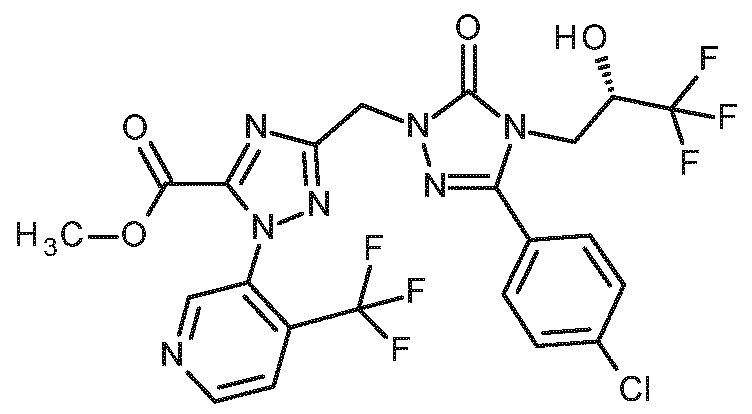
A solution of 150 mg of methyl-2-{3-(4-chlorophenyl)-5-oxo-4-[(2S)-3,3,3-trifluor-2- hydroxypropyl]-4,5-dihydiO-lH-l,2,4-triazol-l-yl}ethanimidate (Example 4A) (0.40 mmol) in 3 ml THF was cooled to 0 °C and treated with 53 mg (0.44 mmol) methyl chlorooxoacetate and 75 μΐ. (0.44 mmol) Ν,Ν-diisopropylethylamine. The resulting mixture was stirred for 30 min at 0 °C. 77 mg (0.44 mmol) 3-hydrazino-4-(trifluoromethyl)pyridine was added and the reaction mixture was then warmed up to room temperature and stirred for 1 h, followed by 1 h at 100 °C in a sealed vial under microwave irradiation. The crude product was purified by preparative HPLC (Method 5). Lyophilisation of the product containing fractions afforded 104 mg (41% of th.) of the title compound as a solid
I. -MS (Method 3): R, = 1.84 min; MS(ESIpos): m/z = 592.1 [M+H]+
Ή NMR (DMSO-de, 400 MHz): δ = 9.12-9.04 (m, 2H), 8.07 (d, 1H), 7.75 (d, 2H), 7.63 (d, 2H), 6.91 (d, 1H), 5.20 (d, 2H), 4.30 (br d, 1H), 4.05-3.98 (m, 1H), 3.86 (dd, 1H), 3.77 (s, 3H).
Example 21 A
Ethyl 3-[3-({3-(4-chlorophenyl)-5-oxo-4-[(2S)-3,3,3-trifluoro-2-hydroxypropyl]-4,5-dihydro-lH- 1 ,2,4-triazol- 1 -yl }methyl)-5-(methoxycarbonyl)- 1 H- 1 ,2,4-triazol- 1 -yljisonicotinate

A solution of 500 mg of methyl-2-{3-(4-chlorophenyl)-5-oxo-4-[(2S)-3,3,3-trifluor-2- hydroxypropyl]-4,5-dihydro-lH-l,2,4-triazol-l-yl}ethanimidate (Example 4A) (1.32 mmol) in 10 ml THF was cooled to 0 °C and treated with 178 mg (1.45 mmol) methyl chlorooxoacetate and 252 (1.45 mmol) N,N-diisopropylethylamine. The resulting mixture was stirred for 30 min at 0 °C. 309 mg (1.45 mmol) ethyl 3 -hydrazinoisonicotinate were then added and the reaction mixture was warmed up to room temperature and then stirred for 16 h, followed by heating to reflux for 16 h. The crude product was purified by preparative HPLC (Method 5). Lyophilisation of the product containing fractions afforded 416 mg (26% of th.) of the title compound.
LC-MS (Method 3): R, = 1.83 min; MS(ESIpos): m/z = 596.1 [M+H]+
'H NMR (DMSO-de, 400 MHz): δ = 9.00-8.90 (m, 2H ). 7.96 (d, 1H), 7.75 (d, 2H ). 7.67-7.60 (m, 2H), 6.91 (d, 1H), 5.17 (s, 2H), 4.37-4.22 (m, 1H), 4.09-3.97 (m, 3H), 3.86 (dd, 1H), 3.76 (s, 3H),
0.93 (t, 3H).
Example 22 A
Methyl 3-({3-(4-chlorophenyl)-5-oxo-4-[(2R)-3,3,3-trifluoro-2-hydroxypropyl]-4,5-dihydro-lH- 1 ,2,4-triazol- 1 -yl}methyl)- 1-(3 -chloropyridin-2-yl)- 1 I I- 1 ,2,4-triazol e-5-carboxylate

A solution of 546 mg of methyl-2-{3-(4-chlorophenyl)-5-oxo-4-[(2R)-3,3,3-trifluor-2- hydroxypropyl]-4,5-dihydro-lH-l ,2,4-triazol-l -yl}ethanimidate (Example 5A) (1.44 mmol) in 10 ml TH F was cooled to 0 °C and treated with 194 mg (1.59 mmol) methyl chlorooxoacetate and 277 μΐ (1.59 mmol) N,N-diisopropylethylamine. The resulting mixture was stirred for 30 min at 0 °C. 227 mg (1.59 mmol) 3-chloro-2-hydrazinopyridine were then added and the reaction mixture was warmed up to room temperature and then stirred for 1 h, followed by 1 h at 120 °C in a sealed vial under microwave irradiation and further 3 h at room temperature. The reaction mixture was then treated with Methanol/water and purified by preparative HPLC (Method 5). Lyophilisation of the product containing fractions afforded 121 mg (14% of th.) of the title compound as a solid.
LC-MS (Method 3): Rt = 1.85 min; MS(ESipos): m/z = 558.1 [M+H]+
Tl NMR (DMSO-de, 400 MHz): δ = 8.81 -8.18 (m, 2H), 7.92-7.48 (m, 5H), 6.91 (d, 1H), 5.22 (s, 2H), 4.44-4.1 (m, 1H), 3.79 (s, 5H).
Example 23 A
Methyl 3-({3-(4-chlorophenyl)-5-oxo-4-[(2R)-3,3,3-trifluoro-2-hydroxypropyl]-4,5-dihydro-iH- 1 ,2,4-triazol- 1 -yljmethyl)- 1 - [3 -(trifluoromethyl)pyridin-2-yl] - I H- l ,2,4-triazole-5-carboxylate

LC-MS (Method 3): R- = 1.88 min; MS(ESIpos): m/z = 592.1 [M+H]+
¾ NMR (DMSO-de, 400 MHz): δ = 8.93 (d, 1H), 8.60 (dd, 1H), 7.98 (dd, 1H), 7.80-7.67 (m, 2H), 7.67-7.58 (m, 2H), 6.91 (d, 1H), 5.28-5.13 (m, 2H ). 4.37-4.24 (m, 1H), 4.06-3.95 (m, 1H), 3.85 (dd, 1H), 3.77 (s, 3H ).
Example 24A
Methyl 3-({3-(4-chlorophenyl)-5-oxo-4-[(2R)-3,3,3-trifluoro-2-hydroxypropyl]-4,5-dihydro-lH- 1 ,2,4-triazol- 1 -yl Jmethyl)- 1 -(4-chloropyridin-3 -yl)-l H- 1 ,2,4-triazole-5-carboxylate

A solution of 330 mg of methyl-2-{3-(4-chlorophenyl)-5-oxo-4-[(2R)-3,3,3-trifluor-2- hydroxypropyl]-4,5-dihydro-lH-l,2,4-triazol-l-yl}ethanimidate (Example 5A) (871 μηιοΐ) in 6.6 ml THF was cooled to 0 °C and treated with 117 mg (958 μτηοΐ) methyl chlorooxoacetate and 166 μΐ, (958 μτηοΐ) Ν,Ν-diisopropylethylamine. The resulting mixture was then stirred for 30 min. at 0 °C. 166 (958 μτηοΐ) Ν,Ν-diisopropylethylamine and 172 mg (958 μιηοΐ) 4-chloro-3- hydrazinopyridine (hydrochloride salt 1 :1) was added and the resulting reaction mixture was warmed up to room temperature and then stirred for 16 h,. followed by further 1 h at 100 °C in a sealed vial under microwave irradiation The crude product was purified by preparative HPLC
(Method 5). Lyophilisation of the product containing fractions afforded 126 mg (26% of th.) of the title compound as a solid
LC-MS (Method 3): R, = 1.75 min; MS(ESIpos): m/z = 558.1 [M+Hf
!H NMR (DMSO-de, 400 MHz): δ = 8.86 (s, 1H), 8.75 (d, 1H), 7.89 (d, 1H), 7.80-7.73 (m, 2H), 7.65-7.60 (m, 2 H ). 6.91 (d, 1H), 5.2 1 (s, 2H), 4.36-4.24 (m, 1H), 4.08-3.99 (m, 1H), 3.86 (dd, 1H), 3.79 (s, 3H).
Example 25A
Methyl 3-({3-(4-chlorophenyl)-5-oxo-4-[(2R)-3,3,3-trifluoro-2-hydroxypropyl]-4,5-dihydro-lH-
1 ,2,4-triazol- 1 -yl Jmethyl)- 1 - [4-(trifluorom ethyl )pyridin-3 -yl] - 1 H- 1 ,2,4-triazole-5-carboxylate

A solution of 350 mg of methyl-2-{3-(4-chlorophenyl)-5-oxo-4-[(2R)-3,3,3-trifluor-2- hydroxypropyl]-4,5-dihydro-lH-l ,2,4-triazol-l -yl}ethanimidate (Example 5A) (0.924 mmol) in 7.0 ml THF was cooled to 0 °C and treated with 124 mg (1.02 mmol) methyl chlorooxoacetate and 177iL (1.102 mmol) N,N-diisopropylethylamine. The resulting mixture was stirred for 30 min at 0 °C. 180 mg (1.02 mmol) 3-hydrazino-4-(trifluoromethyl)pyridine was added and the reaction mixture was warmed up to room temperature and stirred for 16 h, followed by 1 h at 100 °C in a sealed vial under microwave irradiation The crude product was purified by preparative HPLC (Method 5). Lyophilisation of the product containing fractions afforded 1 25 mg (23% of th.) of the title compound as a solid
LC-MS (Method 3): Rt = 1.85 min; MS(ESIpos): m/z = 592.1 [M+H]+
Ή NMR (DMSO-de, 400 MHz): δ = 9.09 (d, 1H), 9.07 (s, 1H), 8.07 (d, 1H), 7.77-7.73 (m, 2H ). 7.65-7.61 (m, 2H ). 6.91 (d, 1H), 5.20 (d, 2H), 4.30 (br d, 1H), 4.04-3.98 (m, 1H), 3.86 (dd, 1H), 3.77 (s, 311 ).
Example 26 A
Methyl 1 -(2-chlorophenyl)-3 -( {3-(4-chlorophenyl)-5-oxo-4-[(2R)-3 ,3, 3-trifluoro-2 -hydroxy - propyl] -4.5 -dihydro- 1 11- 1 ,2,4-triazol- 1 -yl } methyl)- 1 H- l ,2,4-triazole-5 -carboxylate

Under argon, a solution of methyl 2-{3-(4-chlorophenyl)-5-oxo-4-[(2S)-3,3,3-trifluoro-2- hydroxypropyl]-4,5-dihydro-lH-l,2,4-triazol-l-yl}ethanimidate (Example A, 744 mg, 1.97 mmol) in 15 ml anhydrous THF was treated at 0°C with 0.75 ml (4.3 mmol) NN- diisopropylethylamine and 0.38 ml (1.1 mmol) methyl chlorooxoacetate and stirred at 0°C for 30 min. 387 mg (2.2 mmol) of (2-chlorophenyl)hydrazine hydrochloride was added, followed by 0.38 ml (1.1 mmol) of iV,N-diisopropylethylamine. The resulting mixture was stirred 1 h at room temperature, followed by lh at 120°C in the microwave and evaporated. The residue was retaken in ethyl acetate and washed with water. The aqueous phase was extracted with ethyl acetate. The combined organic layers were washed with a saturated sodium chloride solution, dried over magnesium sulfate and purified by flash chromatography (silica gel, cyclohexane ethyl acetate eluent) affording 734 mg (60 % of th.) of the title compound.
LC-MS (Method 3): Rt = 1.36 min; MS(ESIpos): m/z = 557.1 (M+H)+
Ή NMR (DMSO-de, 400 MHz): δ [ppm] = 7.87-7.44 (m, 8H), 6.91 (d, 1H), 5.18 (s, 2H), 4.43-3.66 (m, 6H).
Example 27 A
(lR)-l-[3-({3-(4-Chlorophenyl)-5-oxo-4-[(2S)-3,3,3-trifluoro-2-hydroxypropyl]-4,5-dihydro-lH- 1 ,2,4-triazol- 1 -yl Jmethyl)- 1 -(4-chloropyridin-3 -yl)-l II- 1 ,2,4-triazol-5-yl]ethyl acetate

Ή- MR (500 MHz, DMSO-d6) δ [ppm]: 8.94-8.68 (m, 2H), 8.02-7.52 (m, 5H), 6.89 (d, 1H), 5.88-5.61 (m, 1H), 5.13 (m, 2H), 4.48-4.17 (m, 1H), 4.08-3.77 (m, 2H ). 1.79 (s, 3H), 1.55 (d, 3H).
Example 28A
(lR)-l-[3-({3-(4-Chlorophenyl)-5-oxo-4-[(2S)
1 ,2,4-triazol- 1 -yl Jmethyl)- 1-(3 -chloropyridin-2-yl)- 1 I I- 1 ,2,4-triazol-5-yl]ethyl acetate
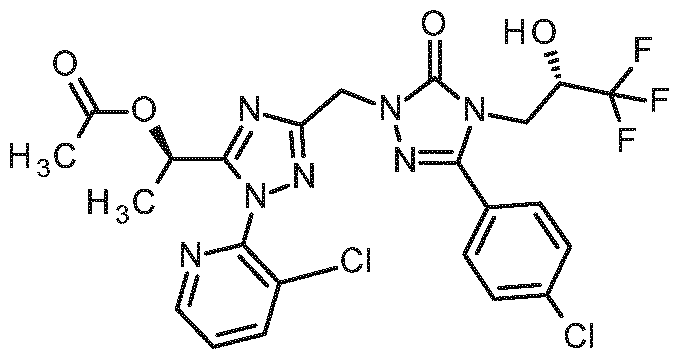
Under argon, a solution of methyl 2-{3-(4-chlorophenyl)-5-oxo-4-[(2S)-3,3,3-trifluoro-2- hydroxypropyl]-4,5-dihydro-lH-l,2,4-triazol-l-yl}ethanimidate (Example 4A, 500 mg, 1.32 mmol) in (5.0 ml) THF was treated at 0°C with N,N-diisopropylethylamine (690 μΐ, 4.0 mmol) and (2R)- 1 -chloro- 1 -oxopropan-2-yl acetate (55 μΐ, 1.5 mmol) and stirred at 0°C for 30 min. A solution of 3 -chloro-2-hydrazinylpyridine (208 mg, 1.45 mmol) in (2.0 μΐ) THF and (1.0 μΐ) dioxane was then added and the resulting mixture was stirred overnight at room temperature, followed by 2 h at 150°C in the microwave and evaporated. The residue was purified by preparative HPLC (Method 4) affording 85.2 mg (11 % of Th.) of the title compound.
LC-MS (Method 1): Rt = 1.02 min; MS (ESIpos): m/z = 586 [M+H]+
Ή-NMR (400 MHz, DMSO-d6) δ [ppm]: 8.59 (dd, 1H), 8.32 (dd, 1H), 7.86-7.49 (m, 5H), 6.89 (d, 1H), 5.87 (q, I H), 5.12 (m, 2H), 4.42-4.18 (m, 1H), 4.07-3.75 (m, 2H), 1.75 (s, 3H), 1.56 (d, 3H).
Example 29 A
(l S)-l-[3-({3-(4-Chlorophmyl)-5-oxo-4-[(2S)-3,3,3-trifluoro-2-hydroxypropyl]-4,5-dihydro-lH- l,2,4-triazol-l-yl}methyl)-l-(l,3-thiazol-2-yl)-lH-l,2,4-triazol-5-yl]ethyl acetate
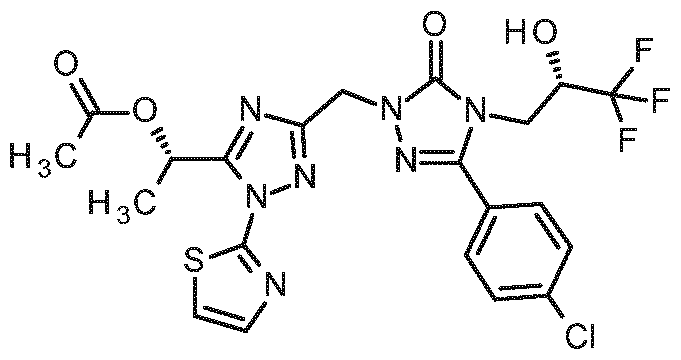
Under argon, a solution of methyl 2-{3-(4-chlorophenyl)-5-oxo-4-[(2S)-3,3,3-trifluoro-2- hydroxypropyl]-4,5-dihydro-lH-l,2,4-triazol-l-yl}ethanimidate (Example 4A, 150 mg, 396 μιηοΐ) in THF (1.5 ml) was treated at 0°C with N,N-diisopropylethylamine (210 μΐ, 1.2 mmol) and (2S)-1-
chloro- 1 -oxopropan-2-yl acetate (55 μΐ, 440 μηιοΐ) and stirred at 0°C for 30 min. 2-Hydrazinyl-l,3- thiazole hydrochloride (1 : 1) (66.1 mg, 436 μιηοΐ) was then added and the resulting mixture was stirred 2 h at room temperature, followed by 3 h at 150°C in the microwave and evaporated. The residue was purified by preparative HPLC (Method 4) affording 61.3 mg (28 % of Th.) of the title compound.
LC-MS (Method 1): R, = 1.02 min; MS (ESIpos): m/z = 558 [M+Hf
Ή- MR (400 MHz, DMSO-d6) δ [ppm] = 7.85-7.52 (m, 6H), 6.90 (d, 1H), 6.50 (q, 1H), 5.11 (m, 2H), 4.29 (m, 1H), 4.08-3.78 (m, 211 ). 1.96 (s, 3H), 1.61 (d, 3H).
Example 30A
(lR)-l-{3-({3-(4-Chlorophenyl)-5-oxo-4-[(2S)-3,3,3-trifluoro-2-hydroxypropyl]-4,5-dihydro-iH- 1 ,2,4-triazol- 1 -yl Jmethyl)- 1 - [3 -(trifluoromethoxy)pyridin-2-yl] - 1 H- 1 ,2,4-triazol-5-yl } ethyl acetate

Under argon, a solution of methyl 2-{3-(4-chlorophenyl)-5-oxo-4-[(2S)-3,3,3-trifluoro-2- hydroxypropyl]-4,5-dihydro-lH-l,2,4-triazol-l-yl}ethanimidate (Example 4A, 250 mg, 660 μπιοί) in THF (5.0 ml) was treated at 0°C with N,N-diisopropylethylamine (460 μί, 2.6 mmol) and (2R)- 1 -chloro- 1 -oxopropan-2-yl acetate (92 μί, 730 μmol) and stirred at 0°C for 30 min. 2-hydrazinyl-3- (trifluoromethoxy)pyridine 4-methylbenzenesulfonate (1 :1) (265 mg, 726 μmol) was then added and the resulting mixture was stirred 5 h at room temperature, followed by 3 h at 120°C in the microwave and evaporated. The residue was purified by preparative HPLC (Method 4) affording 199 mg (47 % of Th.) of the title compound.
LC-MS (Method 1): Rt = 1.08 min; MS (ESIpos): m/z = 636 [M+H]+
Ή- MR (400 MHz, DMSOd6) δ [ppm] 8.62 (dd, 1H), 8.27 (d, 1H), 7.99-7.55 (m, 5H), 6.89 (d, 1H), 5.99 (q, 1H), 5.25-5.01 (m, 2H), 4.41-4.18 (m, 1H), 4.05-3.78 (m, 2H), 1.74 (s, 3H), 1.58 (d, 3H).
EXAMPLES
Example 1
3-( {3-(4-Chlorophenyl)-5-oxo-4-[(2S)-3,3,3-trifluoro-2-hydroxypropyl]-4,5-dihydro-lH-l,2,4- triazol- 1 -yl Jmethyl)- 1 - [2-(trifluoromethyl)phenyl] - 1 H- 1 ,2,4-triazol e-5-carboxamide

A mixture of 55 mg (0.093 mmol) of methyl 3-({3-(4-chlorophenyl)-5-oxo-4-[(2S)-3,3,3-trifluoro-
2- hydroxypropyl]-4,5-dihydro-l I I- 1 ,2,4-triazol- 1 -yl} methyl)- 1 -[2-(trifluoromethyl)phenyl] - 1 H- l,2,4-triazole-5-carboxylate (Example 6A) in an ammonia solution (7N in methanol, 0.8 ml, 5.6 mmol) was stirred overnight at room temperature and the mixture was then evaporated. The obtained residue was purified by preparative HPLC (Method 4) affording 55 mg (quant.) of the title compound.
LC-MS (Method 2): Rt = 1.77 min; MS(ESIpos): m/z = 576.1 [M+H]+
Ή NMR (DMSO-de, 400 MHz): δ [ppm] = 8.23 (s, 1H), 8.00-7.55 (m, 9H), 6.90 (d, 1H), 5.22-5.01 (m, 2H), 4.40-4.18 (m, 1H), 4.10-3.76 (m, 2H).
Example 2
3- ( {3-(4-Chlorophenyl)-5-oxo-4-[(2R)-3,3,3-trifluoro-2-hydroxypropyl]-4,5-dihydro-lH-l ,2,4- triazol- 1 -yl Jmethyl)- 1 - [2-(trifluoromethyl)phenyl] - 1 H- 1 ,2,4-triazol e-5-carboxamide

LC-MS (Method 2): Rt = 1.76 min; MS(ESIpos): m/z = 576.1 [M+Hf
!H NMR (DMSO-de, 400 MHz): δ [ppm] = 8.23 (s, 1H), 7.99-7.55 (m, 9H), 6.90 (d, 1H), 5.24-5.05 (m, 2H), 4.43-3.75 (m, 3H).
Example 3
3-( {3-(4-Chlorophenyl)-5-oxo-4-[(2S)-3,3,3-trifluoro-2-hydroxypropyl]-4,5-dihydro-lH- triazol- 1 -yl Jmethyl)- 1 -[2-(trifluoromethoxy)phenyl] - 1 H- 1 ,2,4-triazole-5-carboxamide

A mixture of 121 mg (0.20 mmol) of methyl 3-({3-(4-chlorophenyl)-5-oxo-4-[(2S)-3,3,3-trifluoro- 2-hydroxypropyl] -4,5-dihydro-l H- 1 ,2,4-triazol- 1 -yl} methyl)- 1 -[2-(trifluoromethoxy)phenyl] - I H- l ,2,4-triazole-5-carboxylate (Example 8A) in an ammonia solution (7N in methanol, 1.7 ml, 1 1.9 mmol) was stirred overnight at room temperature and the mixture was then evaporated. The obtained residue was purified by preparative HPLC (Method 4) affording 101 mg (86% of th.) of the title compound.
LC-MS (Method 2): Rt = 1.82 min; MS(ESIpos): m/z = 592.1 [M+Hf
Ή NMR (DMSO-de, 400 MHz): δ [ppm] = 8.28 (s, 1H), 7.93 (s, 1H), 7.80-7.44 (m, 8H), 6.90 (d, 1H), 5.25-4.97 (m, 2H), 4.44-4. 19 (m, 1H), 4.07-3.76 (m, 2H).
Example 4
3-( {3-(4-Chlorophenyl)-5-oxo-4-[(2R)-3,3,3-trifluoro-2-hydroxypropyl]-4,5-dihydro-lH-l ,2,4- triazol- 1 -yl Jmethyl)- 1 - [2-(trifluoromethoxy)phenyl] - 1 H- 1 ,2,4-triazole-5 -carboxamide

A mixture of 500 mg (0.82 mmol) of methyl 3-({3-(4-chlorophenyl)-5-oxo-4-[(2S)-3,3,3-trifluoro- 2-hydroxypropyl] -4,5-dihydro-l H- 1 ,2,4-triazol- 1 -yl} methyl)- 1 -[2-(trifluoromethoxy)phenyl] - 1 H- 1 ,2,4-triazole-5-carboxylate (Example 9A) in an ammonia solution (7N in methanol, 10 ml, 70 mmol) was stirred 2.5 h at room temperature and the mixture was then evaporated affording 479 mg (97% of th.) of the title compound.
LC-MS (Method 2): R, = 1.80 min; MS(ESIpos): m/z = 592.1 [M+Hf
] H NMR (DMSO-de, 400 MHz): δ [ppm] = 8.28 (s, 1H), 7.93 (s, 1H), 7.80-7.46 (m, 8H), 6.90 (d, 1H), 5.29-5.03 (m, 2H), 4.41-3.76 (m, 3H).
Examp!e 5
3-({3-(4-Chlorophenyl)-5-oxo-4-[(2S)
triazol- 1 -yl Jmethyl)- 1 -(2-ethoxyphenyl)- 1 H- 1 ,2,4-triazole-5-carboxamide

A mixture of 170 ing (0.30 mmol) of methyl 3-({3-(4-chlorophenyl)-5-oxo-4-[(2S)-3,3,3-trifluoro-
2- hydroxypropyl] -4,5-dihydro-l H- 1 ,2,4-triazol- 1 -yl} methyl)- 1 -(2-ethoxyphenyl)- 1 H- 1 ,2,4- triazole-5 -carboxylate (Example 10A) in an ammonia solution (7N in methanol, 3.2 ml, 22.4 mmol) was stirred overnight at room temperature and the mixture was then evaporated. The obtained residue was purified by preparative HPLC (Method 4) affording 60 mg (36% of th.) of the title compound.
LC-MS (Method 2): R, = 1.76 min; MS(ESIpos): m/z = 552.1 [M+Hf
'H NMR (DMSO-de, 400 MHz): δ [ppm] = 8.12 (s, 1H), 7.89-6.81 (m, 10H), 5.11 (d, 2H), 4.30 (br d, 1H), 4.08-3.75 (m, 4H), 1.16 (t, 3H).
Example 6
3- ({3-(4-Chlorophenyl)-5-oxo-4-[(2S)-3,3,3-trifluoro-2-hydroxypropyl]-4,5-dihydro-lH-l,2,4- triazol- 1 -yl jmethyl)- 1 -[2-(methylcarbamoyl)phenyl]- 1 H- 1 ,2,4-triazol e-5-carboxamide

A mixture of 40 mg (70%, 0.05 mmol) of methyl 3-({3-(4-chlorophenyl)-5-oxo-4-[(2S)-3,3,3- trifluoro-2-hydroxypropyl] -4,5-dihydro- 1 H- l ,2,4-triazol- 1 -yl} methyl)- 1 -[2-(m ethyl carbamoyl)- phenyl] - 1 H- 1 ,2,4-triazole-5 -carboxylate (Example 11A) in an ammonia solution (7N in methanol, 4 ml, 28 mmol) was stirred overnight at room temperature and the mixture was then evaporated. The obtained residue was purified by preparative HPLC (Method 4) affording 11 mg (43%o of th.) of the title compound.
LC-MS (Method 2): R, = 1.47 min; MS(ESIpos): m/z = 565.1 [M+H]+
Ή NMR (DMSO-de, 400 MHz): δ [ppm] = 8.33-7.34 (m, 1 1H), 6.92 (d, 1H), 5.08 (s, 2H), 4.48- 3.79 (m, 3H), 2.54 (s, 3H).
Example 7
3-( {3-(4-Chlorophenyl)-5-oxo-4-[(2S)-3,3,3-trifluoro-2-hydroxypropyl]-4,5-dihydro-lH-l ,2,4- triazol- 1 -yl Jmethyl)- 1 -[2-(methylsulfonyl)phenyl] - 1 H- 1 ,2,4-triazole-5-carboxamide

At 0°C, a solution of 52 mg (0.20 mmol) of methyl 3-( {3-(4-chlorophenyl)-5-oxo-4-[(2S)-3,3,3- trifluoro-2-hydroxypropyl] -4,5-dihydro- 1 1 1- 1 ,2,4-triazol- 1 -yl} methyl)- 1 -[2-(methylsulfanyl)- phenyl] - 1 H- 1 ,2,4-triazole-5 -caxboxylate (Example 13 A) in 1 ml dichloromethane was treated with 69 mg (purity 70%, 0.28 mmol) of 3 -chloroperbenzoic acid and thereafter stirred overnight at room temperature. The reaction mixture was combined with a fraction obtained from a 20 mg test run and the mixture was then evaporated. The obtained residue was purified by preparative HPLC (Method 4) affording 60 mg (77% of th.) of the title compound.
LC-MS (Method 2): R, = 1.59 min; MS(ESIpos): m/z = 586.1 [M+Hf
!H NMR (DMSO-de, 400 MHz): δ [ppm] = 8.27-7.56 (m, 10H), 6.88 (d, 1H), 5.16 (d, 2H), 4.37- 4. 1 2 (m, 1H), 4.07-3.73 (m, 2H ). 3.07 (s, 3H).
Example 8
3-{ [3-(4-chlorophenyl)-5-oxo-4-(3,3,3-trifluoro-2-oxopropyl)-4,5-dihydro-lH-l,2,4-triazol-i - yl]methyl}-l -[2-(trifluoromethyl)phenyl]-lH-l,2,4-triazole-5-carboxamide (ketone form) or 3-{[3- (4-chlorophenyl)-5-oxo-4-(3,3,3-trifluoro-2,2-dihydroxypropyl)-4,5-dihydro-lH-l ,2,4-triazol-l- yl]methyl } - 1 - [2-(trifluoromethyl)phenyl] - 1 H- 1 ,2,4-triazole-5 -carboxamide (hydrate form)

LC-MS (Method 2): Rt = 1.78 min; MS(ESIpos): m/z = 574.1 [M+H]+ (ketone form)
!H NMR (DMSO-de, 400 MHz): δ [ppm] = 8.24 (s, 1H), 7.96-7.53 (m, 9H), 7.44 (s, 2H), 5.27-4.96 (m, 2H), 4.05 (s, 2H ). (hydrate form).
Example 9
3-{[3-(4-chlorophenyl)-5-oxo-4-(3,3,3-trifluoro-2-oxopropyl)-4,5-dihydro-lH-l,2,4-triazol-l - yljmethyl } - 1 - [2-(trifluoromethoxy)phenyl] - 1 H- 1 ,2,4-triazole-5 -carboxamide (ketone form) or 3- { [3-(4-chlorophenyl)-5-oxo-4-(3 ,3,3 -trifluoro-2,2-dihydroxypropyl)-4,5-dihydro- 1 H- 1 ,2,4-triazol- 1 -yljmethyl } - 1 -[2-(trifluoromethoxy)phenyl] - 1 H- 1 ,2,4-triazol e-5-carboxamide (hydrate form)
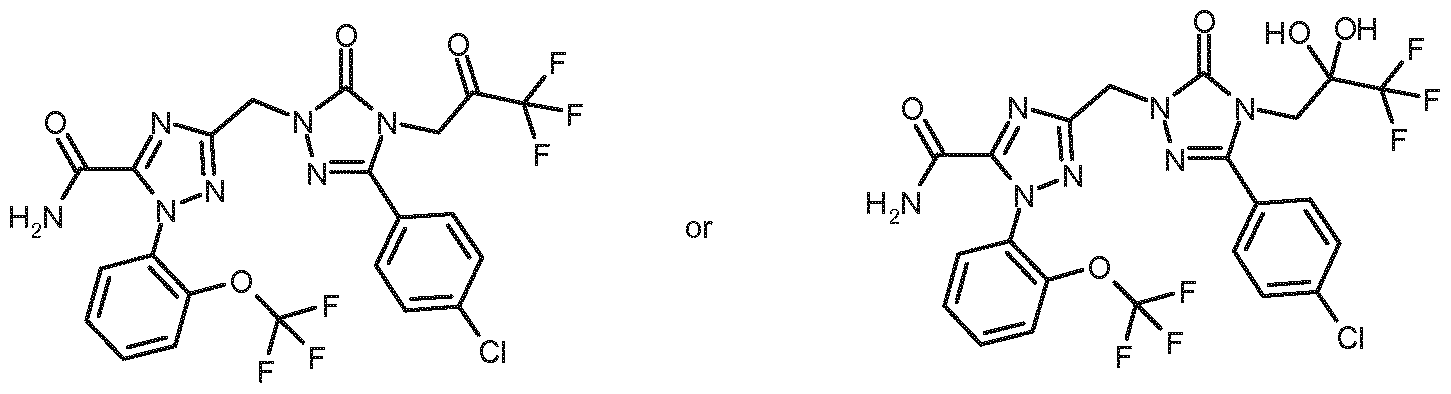
At 0°C, a solution of 150 mg (0.26 mmol) of 3-( {3-(4-Chlorophenyl)-5-oxo-4-[(2R)-3,3,3- trifluoro-2-hydroxypropyl] -4,5-dihydro- 1 H- l ,2,4-triazol- 1 -yljmethyl)- 1 -[2-(trifluoromethoxy)- phenyl] - 1 H- 1 ,2,4-triazole-5 -carboxamide (Example 4) in 2.8 ml of dichloromethane was treated with 165 mg (0.39 mmol) of Dess-Martin periodinane. The resulting mixture was stirred 1 h at 0°C and then a further 45 min at room temperature. 2 ml of saturated sodium thiosulfate solution and 2 ml of a saturated sodium hydrogen carbonate solution were then added and the resulting mixture was stirred for 10 min at room temperature. The reaction mixture was extracted with dichloromethane (four times repeated). The combined organic layers were then evaporated and the obtained residue purified by flash chromatography (silica gel, eluent cyclohexane/ethyl acetate) affording 66 mg (44 % of th.) of the title compound.
LC-MS (Method 2): R, = 1.80 min; MS(ESIpos): m/z = 590 [M+H]+ (ketone form)
] H NMR (DMSO-de, 400 MHz): δ [ppm] = 8.29 (s, 1H), 7.93 (s, 1H), 7.76-7.48 (m, 8H), 7.44 (s, 2H ). 5.16 (s, 2H ), 4.05 (s, 21 ! ) (hydrate form).
Example 10
3-( {3-(4-Chiorophenyl)-5-oxo-4-[(2S)-3,3,3-trifluoro-2-hydroxypropyl]-4,5-dihydro-lH-l ,2,4- triazol- 1 -yl Jmethyl)- 1 -(3-chloropyridin-2-yl)- 1 H- l ,2,4-triazole-5-carboxamide

5. 1 g methyl 3-({3-(4-chlorophenyl)-5-oxo-4-[(2S)-3,3,3-trifluoro-2-hydroxypropyl]-4,5-dihydro- 1 H- 1 ,2,4-triazol- 1 -yljmethyl)- 1 -(3-chloropyridin-2-yl)-lH- 1 ,2,4-triazole-5-carboxylate (Example 14 A, 9.134 mmol) was dissolved in 42.5 mL of an ammonia solution (7N in methanol, 297 mmol). The resulting mixture was stirred for 2 h at room temperature. The solution was then poured on ice and the mixture stirred for 10 min. The precipitate was filtered off and washed with water, which afforded 3.5 g of crude product. The aqueous phase was extraced with ethyl acetate. The organic phase was dried over magnesium sulfate, filtered and the solvent was removed in vacuo. The crude product was purified by flash chromatography (silica gel, dichloromethane/methanol, 97/3), affording 4.00 g (81 % of th.) of the title compound as a solid.
LC-MS (Method 3): Rt = 1.62 min; MS(ESIpos): m/z = 543. 1 [M+H]+
Ή NMR (DMSO-de, 400 MHz): δ = 8.55 (dd, 1H), 8.39 (s, 1H), 8.25 (dd, 1H), 8.00 (s, 1H), 7.76 (d, 2H), 7.69 (dd, 1H), 7.62 (d, 2H ). 6.90 (d, 1H), 5.18 (d, 2H), 4.36-4.23 (m, 1H), 4.06-3.97 (m, 1H), 3.85 (dd, 1H).
Example 1 1
3-( {3-(4-Chlorophenyl)-5-oxo-4-[(2S)-3,3,3-trifluoro-2-hydroxypropyl]-4,5-dihydro-lH-l ,2,4- triazol- 1 -yl Jmethyl)- 1 - [3 -(trifluoromethyl)pyridin-2-yl] - 1 H- l ,2,4-triazole-5-carboxamide

LC-MS (Method 1): R, = 1.20 min; MS(ESIpos): m/z = 577 [M+H]+
'H NMR (DMSO-de, 400 MHz): δ =8.87 (d, 1H), 8.51 (d, 1H), 8.39 (s, 1H), 7.99 (s, 1H), 7.90 (dd, 1H), 7.82-7.68 (m, 2H), 7.63 (d, 2H), 6.90 (s, 1H), 5.22-5.07 (m, 2H), 4.29 (br s, 1H), 4.16-3.94 (m, 1H), 3.85 (dd, 1H).
Example 12
3-({3-(4-Chlorophenyl)-5-oxo-4-[(2S)-3,3,3-trifluoro-2-hydroxypropyl]-4,5-dihydro-lH-i,2,4- triazol- 1 -yl Jmethyl)- 1 -[3-(trifluoromethoxy)pyridin-2-yl] - I H- l ,2,4-triazoie-5-carboxamide
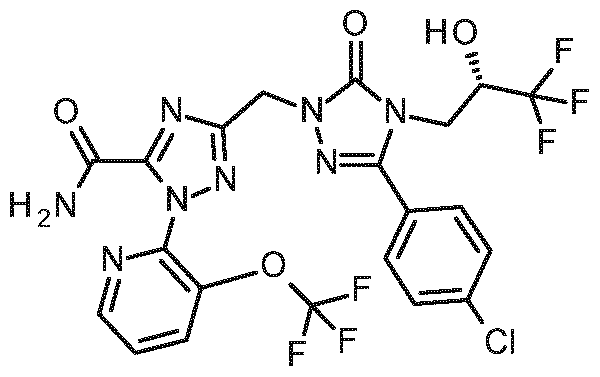
51.0 mg Methyl 3-({3-(4-chlorophenyl)-5oxo-4-[(2S)-3,3,3-trifluoro
dihydro-lH-l,2,4-triazol-l-yl}methyl)-l-[3-(trifluoromethoxy)pyridin-2-yl]-lH-l,2,4-triazole- carboxylate (Example 16 A, 84 μιηοΐ) was dissolved in 5.0 mL of an ammonia solution (7N in methanol, 35.0 mmol). The resulting mixture was stirred for 1 h at room temperature. The solvent was removed in vacuo and the crude product was purified by preparative HPLC (Method 5). Lyophilisation of the product containing fractions afforded 44.2 mg (89% of th.) of the title compound as a solid.
LC-MS (Method 3): Rt = 1.69 min; MS(ESIpos): m/z = 593.1 [M+Hf
'H NMR (DMSO-de, 400 MHz): δ = 8.71-7.53 (m, 9H), 6.90 (d, 1H), 5.17 (d, 2H), 4.42-4.17 (m, 1H), 4.08-3.73 (m, 2H).
Example 13
l-(3-Bromopyridin-2-yl)-3-({3-(4-chlorophenyl)-5-oxo-4-[(2S)-3,3,3-trifluoro-2-hydroxypropyl]- 4,5-dihydro-l H- 1 ,2,4-triazol- 1 -yl} methyl)- 1 H- l ,2,4-triazol e-5 -carboxamide

100 mg methyl l-(3-bromopyridin-2-yl)-3-( {3-(4-chlorophenyl)-5-oxo-4-[(2S)-3,3,3-trifluoro-2- hydroxypropyl]-4,5-dihydro- lH-1 ,2,4-triazol- 1 -yl} methyl)- lH-1 ,2,4-triazole-5-carboxylate (Example 17 A, 0.166 mmol) was dissolved in 10.0 mL of an ammonia solution (7N in methanol, 70.0 mmol). The resulting mixture was stirred for 1 h at room temperature. The solvent was removed in vacuo and the crude product was purified by preparative I I LC (Method 5). Lyophilisation of the product containing fractions afforded 83.1 mg (85% of th.) of the title compound as a solid.
LC-MS (Method 2): Rt = 0.91 min; MS(ESIpos): m/z = 587.0 [M r H j "
'H NMR (DMSO-de, 400 MHz): δ = 8.57 (dd, 1H), 8.36 (dd, 2H), 7.98 (s, 1H), 7.80-7.73 (m, 2H ). 7.62 (d, 2H ). 7.60-7.56 (m, 1H), 6.92 (d, 1H), 5.17 (d, 2H ). 4.41-4.19 (m, 1H), 4.1 1-3.95 (m, 1H), 3.85 (dd, 1H).
Example 14
Ethyl 2-[5-carbamoyl-3-({3-(4-chlorophenyl)-5-oxo-4-[(2S)-3,3,3-trifluoro-2-hydroxypropyl]-4,5- dihydro-1 H- 1 ,2,4-triazol- 1 -yl} methyl)- lH-1 ,2,4-triazol- 1 -yljnicotinate

50.0 mg Example 18A (84 μιηοΐ) was dissolved in 1 .25 mL of an ammonia solution (7N in methanol, 0.175 mmol). The resulting mixture was stirred for 1 h at room temperature. The solvent was removed in vacuo and the crude product was purified by preparative HPLC (Method 5). Lyophilisation of the product containing fractions afforded 27.8 mg (57% of th.) of the title compound as a solid.
LC-MS (Method 1 ): Rt = 1.16 min; MS(ESIpos): m/z = 581.0 [M+H]+
Ή NMR (DMSO-de, 400 MHz): δ =8.76 (dd, 1H), 8.46 (dd, 1H), 8.29 (s, 1H), 7.90 (s, 1H), 7.83- 7.77 (m, 1H), 7.77-7.70 (m, 2H), 7.68-7.57 (m, 2H), 6.90 (d, 1H), 5. 14 (s, 2H), 4.35-4.23 (m, 1H), 4.06-3.97 (m, 3H), 3.85 (dd, 1H), 0.97 (t, 3H).
Example 15
3-({3-(4-Chlorophenyl)-5-oxo-4-[(2S)-3,3,3-trifluoro-2-hydroxypropyl]-4,5-dihydr<
triazol- 1 -yl Jmethyl)- 1 -(4-chloropyridin-3 -yl)-lH-l ,2,4-triazole-5 -carboxamide

LC-MS (Method 3): Rt = 1.55 min; MS(ESIpos): m/z = 543.1 [M+Hj "
'H NMR (DMSO-de, 400 MHz): δ = 8.91-7.52 (m, 9H), 6.90 (d, 1H), 5.17 (d, 2H), 4.40-4.18 (m, 1H), 4.07-3.72 (m, 2H).
Example 16
3-({3-(4-Chlorophenyl)-5-oxo-4-[(2S)-3,3,3-trifluoro-2-hydroxypropyl]-4,5-dihydro-lH-l,2,4- triazol- 1 -yl Jmethyl)- 1 - [4-(trifluoromethyl)pyridin-3 -yl] - 1 H- 1 ,2,4-triazole-5-carboxamide

78.5 mg Example 20A (0.133mmol) was dissolved in 8.0 mL of an ammonia solution (7N in methanol, 1.14 mmol). The resulting mixture was stirred for 1 h at room temperature. The solvent was removed in vacuo and the crude product was purified by preparative HPLC (Method 5). Lyophilisation of the product containing fractions afforded 49.7 mg (77% of th.) of the title compound as a solid.
LC-MS (Method 2): Rt = 0.93 min; MS(ESIpos): m/z = 577.1 [M+H]
] H NMR (DMSO-de, 400 MHz): δ =9.03 (d, 1H), 8.97 (s, 1H), 8.36 (s, 1H), 8.00 (d, 2H), 7.86-7.70 (m, 2H), 7.69-7.58 (m, 2H ). 6.90 (d, 1H), 5.17 (d, 2H ). 4.29 (br d, 1H), 4.06-3.94 (m, 1H), 3.86 (dd, 1H).
Example 17
Ethyl 3-[5-carbamoyl-3-({3-(4-chlorophenyl)-5-oxo-4-[(2S)-3,3,3-trifluoro-2-hydroxypropyl]-4,5- dihydro- 1 H- 1 ,2,4-triazol- 1 -yl} methyl)- 1 H- 1 ,2,4-triazol- 1 -yljisonicotinate

100 mg Example 21A (151 μηιοΐ) was dissolved in 1.0 mL NIL in EtOH (2.00 mmol, 2 N). The resulting mixture was stirred for 16 h at room temperature and another 1.0 mL of an ammonia solution (7N in methanol, 2.00 mmol) was added and stirring was continued for 16 h at room temperature. The solvent was removed in vacuo and the crude product was purified by preparative HPLC (Method 5). Lyophilisation of the product containing fractions afforded 46.0 mg (49% of th.) of the title compound as a solid.
1.C-MS (Method 3): Rt = 1.63 min; MS(ESipos): m/z = 581.1 [M+Hf
¾ NMR (DMSO-de, 400 MHz): δ =8.89 (d, 1H), 8.83 (s, 1H), 8.28 (s, 1H), 7.94 (s, 1H), 7.90 (d, 1H), 7.78-7.72 (m, 2H), 7.69-7.58 (m, 2H), 6.89 (d, 1H), 5.14 (d, 2H), 4.40-4.24 (m, 1H), 4.10-3.96 (m, 3H), 3.86 (dd, 1H), 0.95 (t, 3H).
Example 18
2-[5-carbamoyl-3-({3-(4-chlorophenyl)-5-oxo-4-[(2S)-3,3,3-trifluoro-2-hydroxypropyl]-4,5- dihydro -1 H- 1 ,2,4-triazol- 1 -yl} methyl)- lH-1 ,2,4-triazol- 1 -yl jnicotinamide

80 mg Example 18A (134 μιηοΐ) was dissolved in 10 mL of an ammonia solution (7N in methanol, 70.0 mmol). The resulting mixture was stirred for 10 min at 70 °C, solvent was removed in vacuo and the residue was dissolved 10 mL of an ammonia solution (7N in methanol, 70.0 mmol) stirred
for 3 h at 120 °C in the microwave. The solvent was removed in vacuo and the crude product was purified by preparative HPLC (Method 5). Lyophilisation of the product containing fractions afforded 22.0 mg (28% of th.) of the title compound as a solid.
LC-MS (Method 3): Rt = 1.31 min; MS(ESIpos): m/z = 552.1 [M+Hf
Ή NMR (DMSO-de, 400 MHz): δ = 8.61 (dd, 1H), 8.24-8.14 (m, 2H), 7.90-7.83 (m, I H), 7.86 (br d, 1H), 7.79-7.74 (m, 2H), 7.69 (dd, 1H), 7.65-7.60 (m, 2H), 7.49 (s, 1H), 6.92 (d, 1H), 5.10 (d, 2H), 4.31 (br d, 1H), 4.06-3.93 (m, 1H), 3.84 (dd, 1H).
Example 19
3-( {3-(4-Chlorophenyl)-5-oxo-4-[(2R)-3,3,3-trifluoro-2-hydroxypropyl]-4,5-dihydro-lH-l,2,4- triazol- 1 -yljmethyl)- 1 -(3-chloropyridin-2-yl)- 1 H- l ,2,4-triazole-5-carboxamide

110 mg Example 22 A (0.197 mmol) was dissolved in 1.0 mL of an ammonia solution (7N in methanol, 7.09 mmol). The resulting mixture was stirred for 1 h at room temperature. The solvent was removed in vacuo and the crude product was purified by preparative HPLC (Method 5). Lyophilisation of the product containing fractions afforded 92.0 mg (86%o of th.) of the title compound as a solid.
LC-MS (Method 3): Rt = 1.60 min; MS(ESIpos): m/z = 543.1 [M+Hf
!H NMR (DMSO-de, 400 MHz): δ = 8.69-7.48 (m, 9H), 6.90 (d, 1H), 5.18 (d, 211 ). 4.47-4.16 (m, 1H), 4.08-3.71 (m, 2H).
Example 20
3-({3-(4-Chlorophenyl)-5-oxo-4-[(2R)-3,3,3-trifluoro-2-hydroxypropyl]-4,5-dihydro-lH-l,2,4- triazol- 1 -yl }methyl)- 1 -[3-(trifluoromethyl)pyridin-2-yl] - 1 H- l ,2,4-triazole-5-carboxamide

LC-MS (Method 4): Rt = 2.73 min; MS(ESIpos): m/z = 577.3 [M+H]+
!H NMR (DMSO-de, 400 MHz): δ = 8.90-8.81 (m, 1H), 8.51 (dd, 1H), 8.39 (s, 1H), 7.99 (s, 1H), 7.90 (dd, 1H), 7.80-7.70 (m, 2H), 7.66-7.59 (m, 2H), 6.90 (d, 1H), 5.25-5. 1 2 (m, 2H), 4.29 (br d, 1H), 4.03-3.96 (m, 1H), 3.85 (dd, 1H).
Example 2 1
3-( {3-(4-Chlorophenyl)-5-oxo-4-[(2R)-3,3,3-trifluoro-2-hydroxypropyl]-4,5-dihydro-lH-l ,2,4- triazol- 1 -yl Jmethyl)- 1 -(4-chloropyridin-3 -yl)-lH-l ,2,4-triazole-5 -carboxamide

1 18 mg Example 24 A (21 1 μτηοΐ) was dissolved in 5.0 mL of an ammonia solution (7N in methanol, 35.0 mmol). The resulting mixture was stirred for 1 h at room temperature. The solvent was removed in vacuo and the crude product was purified by preparative HPLC (Method 5). Lyophilisation of the product containing fractions afforded 1 1 1 mg (97% of th.) of the title compound as a solid.
LC-MS (Method 3): R, = 1.53 min; MS(ESIpos): m/z = 543.1 [M+Hf
!H NMR (DMSO-de, 400 MHz): δ = 8.78 (s, 1H), 8.69 (d, 1H), 8.35 (s, 1H), 8.01 (s, 1H), 7.82 (d, 1H), 7.79-7.73 (m, 2H), 7.66-7.58 (m, 2H), 6.90 (d, 1H), 5.17 (d, 2H), 4.29 (br s, 1H), 4.07-3.95 (m, 1H), 3.85 (dd, 1H).
Example 22
3-( {3-(4-Chlorophenyl)-5-oxo-4-[(2R)-3,3,3-trifluoro-2-hydroxypropyl]-4,5-dihydro-lH-i ,2,4- triazol- 1 -yl Jmethyl)- 1 - [4-(trifluoromethyl)pyridin-3 -yl] - 1 H- 1 ,2,4-triazole-5-carboxamide

118 mg Example 2 A (199 μχηοΐ) was dissolved in 5.0 mL of an ammonia solution (7N in methanol, 2.00 mmol). The resulting mixture was stirred for 20 min at room temperature. The solvent was removed in vacuo and the crude product was purified by preparative HPLC (Method 5). Lyophilisation of the product containing fractions afforded 99.5 mg (87% of th.) of the title compound as a solid.
LC-MS (Method 3): Rt = 1.63 min; MS(ESIpos): m/z = 577.1 [M+H]+
Ή NMR (DMSO-de, 400 MHz): δ = 9.03 (d, 1H), 8.96 (s, 1H), 8.36 (s, 1H), 8.00 (d, 2H), 7.77- 7.70 (m, 2H ). 7.68-7.59 (m, 2H), 6.89 (d, 1H), 5.28-5.05 (m, 2H), 4.29 (br d, 1H), 4.05-3.96 (m, 1H), 3.85 (dd, 1H).
Example 23
3-{[3-(4-Chlorophenyl)-5-oxo-4-(3,3,3-trifluoro-2-oxopropyl)-4,5-dihydro-lH-l ,2,4-triazol-l - yl]methyl}-l -(3-chloropyridin-2-yl)-lH-l,2,4-triazole-5-carboxamide (ketone form) or 3-{[3-(4- chlorophenyl)-5-oxo-4-(3,3 ,3 -trifluoro-2,2-dihydroxypropyl)-4,5-dihydro- 1 H- l ,2,4-triazol- 1 - yljmethyl} - 1 -[2-(trifluoromethyl)phenyl] - 1 H- 1 ,2,4-triazole-5-carboxamide (hydrate form)

A solution of 250 mg of example 10 (460 μτηοΐ) in 5.0 ml dichloromethane was cooled to 0 °C and 780 mg (1.84 mmol) of Dess-Martin periodinane and 9.0
 (506 mmol) water were added. The resulting mixture was stirred for 1 h.at room temperature. To the reaction mixture 5 mL of saturated aqueous sodium thiosulfate solution and 5 mL of saturated aqueous sodium bicarbonate solution were added and the resulting mixture was stirred for 10 min. The phases were separated and the aqueous layer was extracted with ethyl acetate (10 mL, three times repeated), the combined organic phases were dried over magnesium sulfate and evaporated. The crude product was purified by preparative HPLC (Method 5). Lyophilisation of the product containing fractions afforded 230 mg (87% of th.) of the title compound as a solid
LC-MS (Method 3): R, = 1.57 min; MS(ESIpos): m/z = 541.0 [M+H]+ (ketone form).
(506 mmol) water were added. The resulting mixture was stirred for 1 h.at room temperature. To the reaction mixture 5 mL of saturated aqueous sodium thiosulfate solution and 5 mL of saturated aqueous sodium bicarbonate solution were added and the resulting mixture was stirred for 10 min. The phases were separated and the aqueous layer was extracted with ethyl acetate (10 mL, three times repeated), the combined organic phases were dried over magnesium sulfate and evaporated. The crude product was purified by preparative HPLC (Method 5). Lyophilisation of the product containing fractions afforded 230 mg (87% of th.) of the title compound as a solid
LC-MS (Method 3): R, = 1.57 min; MS(ESIpos): m/z = 541.0 [M+H]+ (ketone form).
'H NMR (DMSO-de, 400 MHz): δ = 8.54 (dd, 1H), 8.40 (s, 1H), 8.25 (dd, 1H), 8.00 (s, 1H), 7.76- 7.63 (m, 3H), 7.62-7.53 (m, 2H), 7.44 (s, 21 1 ). 5.19 (s, 2H), 4.05 (s, 2H) ) (hydrate form).
Example 24
l-(3-Bromopyridin-2-yl)-3-{[3-(4-chlorophenyl)-5-oxo-4-(3,3,3-trifluoro-2-oxopropyl)-4,5- dihydro-lH-l,2,4-triazol-l-yl]methyl}-lH-l ,2,4-triazole-5-carboxamide (ketone form) or l-(3- Bromopyridin-2-yl)-3-{[3-(4-chlorophenyl)-5-oxo-4-(3,3,3-trifluoro-2,2-dihydroxypropyl)-4,5- dihydro-1 H - 1 ,2,4-triazol- 1 -yljmethyl}- 1 1 1 - 1 ,2,4-triazole-5-carboxamide (hydrate form)

A solution of 68.0 mg of example 13 (1 16 μτηοΐ) in 1.3 ml dichloromethane was cooled to 0 °C and 196 mg (463 mmol) of Dess-Martin periodinane and 2.3 μΐ. (127 mmol) water were added. The resulting mixture was warmed to room temperature and then stirred for 1 h. To the reaction mixture 1.3 mL of saturated aqueous sodium thiosulfate solution and 1.3 mL of saturated aqueous sodium bicarbonate solution were added and the mixture was stirred for 10 min. The phases were separated and the aqueous layer was extracted with ethyl acetate (3 x 10 mL), the combined organic phases were then dried over magnesium sulfate and evaporated. The crude product was purified by preparative HPLC (Method 5). Lyophilisation of the product containing fractions afforded 30.1 mg (42% of th.) of the title compound as a solid
LC-MS (Method 3): R, = 1.58 min; MS(ESipos): m/z = 585.0 [M+H]+ (ketone form).
'H NMR (DMSO-de, 400 MHz): δ = 8.57 (dd, 1H), 8.40-8.34 (m, 2H), 7.98 (s, 1H), 7.72 (s, 1H), 7.70 (s, 1H), 7.58 (d, 3H), 7.44 (s, 2H), 5.20-5.16 (m, 2H), 4.05 (s, 2H) (hydrate form).
Example 25
3-{[3-(4-Chlorophenyl)-5-oxo-4-(3,3,3-trifluoro-2-oxopropyl)-4,5-dihydi -lH-l ,2,4-triazol-l - yljmethyl} -l -(4-chloropyridin-3-yl)-lH-l,2,4-triazole-5-carboxamide (ketone form) or 3-{[3-(4- Chlorophenyl)-5-oxo-4-(3,3,3-trifluoro-2,2-dihydroxypropyl)-4,5-dihydro-l H- 1 ,2,4-triazol- 1 -yl] - methyl} -l -(4-chloropyridin-3-yl)-lH-l,2,4-triazole-5-carboxamide (hydrate form)

A solution of 120 mg of example 1 5 (221 μιηοΐ) and 4.3
 (243 mmol) water in 2.4 ml dichloromethane was cooled to 0 °C and 140.5 mg (331 mmol) Dess-Martin periodinane were then added. The resulting mixture was warmed to room temperature and then stirred for 2 h. To the suspension 5 mL THF was added and stirring was prolonged for 72 h at 4 °C followed by further 3 h at room temperature. To the reaction mixture 2 mL saturated aqueous sodium thiosulfate solution and 2 mL saturated aqueous sodium bicarbonate solution were added and the mixture was then stirred for 10 min. The phases were separated and the aqueous layer was extracted with dichloromethane (10 mL, four times repeated), the combined organic phases were washed with water and aqueous saturated sodium chloride solution, dried over magnesium sulfate and evaporated. The crude product was purified by flash chromatography (silica gel, cyclohexane/ethyl acetate 1 : 1 -> ethyl acetate). Evaporating of the product containing fractions afforded 8.0 mg (7% of th.) of the title compound as a solid
LC-MS (Method 4): Rt = 2.43 min; MS(ESIpos): m/z = 541.2 [M+Hf (ketone form).
'H NMR (DMSO-de, 400 MHz): δ = 8.78 (s, 1H), 8.69 (d, 1H), 8.36 (s, 1H), 8.00 (s, 1H), 7.82 (d, 1H), 7.71 (d, 2H), 7.58 (d, 2H), 7.43 (s, 2H), 5.19 (s, 2H ). 4.06 (s, 2H ) (hydrate form).
Example 26
3-{[3-(4-Chlorophenyl)-5-oxo-4-(3,3,3-trifluoro-2-oxopropyl)-4,5-dihydro-iH-l ,2,4-triazol-i - yl]methyl}-l -[3-(trifluoromethyl)pyridin-2-yl]-lH-l ,2,4-triazole-5-carboxamide (ketone form) or 3-{[3-(4-Chlorophenyl)-5-oxo-4-(3,3,3-trifluoro-2,2-dihydroxypropyl)-4,5-dihydro-lH-l ,2,4- triazol- 1 -yl]methyl } - 1 - [3 -(trifluoromethyl)pyridin-2-yl] - 1 H- 1 ,2,4-triazole-5-carboxamide (hydrate form)

A solution of 100 mg of example 1 1 (173 μιηοΐ) in 1.9 ml dichloromethane was cooled to 0 °C and 294 mg (693 mmol) Dess-Martin periodinane and 3.5 (191 mmol) water were then added. The resulting mixture was warmed to room temperature and then stirred for 1 h. To the reaction mixture 2 mL saturated aqueous sodium thiosulfate solution and 2 mL saturated aqueous sodium
bicarbonate solution were added and the resulting mixture then stirred for 10 min. The aqueous layer was extracted with dichloromethane (10 mL, four times repeated), the combined organic phases were washed with water and aqueous saturated sodium chloride solution, dried over magnesium sulfate and evaporated. The crude product was purified by preparative HPLC (Method 5). Lyophilisation of the product containing fractions afforded 18.4 mg (19% of th.) of the title compound as a solid
LC-MS (Method 3): R, = 1.64 min; MS(ESIpos): m/z = 575.0 [M+Hf (ketone form).
¾ NMR (DMSO-de, 400 MHz): δ = 8.88-8.85 (m, 1H), 8.51 (dd, 1H), 8.40 (s, 1H), 7.98 (s, 1H), 7.90 (dd, 1H), 7.73-7.67 (m, 2H), 7.58 (d, 2H), 7.43 (s, 2i i ). 5.18 (s, 2H), 4.05 (s, 2H) (hydrate form).
Example 27
l-(2-ChloiOphenyl)-3-( {3-(4-chlorophenyl)-5-oxo-4-[(2R)-3,3,3-trifluoro-2-hydroxypropyl]-4,5- dihydro-1 I I- 1 ,2,4-triazol- 1 -yl} methyl)- lH-1 ,2,4-triazole-5-carboxamide

LC-MS (Method 1): R, = 0.94 min; MS(ESIpos): m/z = 542.2 (M+H)
'Ή NMR (DMSO-de, 400 MHz): δ [ppm] = 8.25 (s, l H), 7.91 (s, 1H), 7.81-7.44 (m, 8H), 6.90 (d, 1H), 5.15 (d, 2H), 4.29 (br m, 1H), 4.08-3.75 (m, 2H).
Example 28
5-(4-Chlorophenyl)-2-( { 1 -(4-chloropyridin-3 -yl)-5- [( 1 R)- 1 -hydroxyethyl] - 1 H- 1 ,2,4-triazol-3 - yl}methyl)-4-[(2S)-3,3,3-trifluoro-2-hydroxypropyl]-2,4-dihydro-3H-i,2,4-triazol-3-one

A solution of (lR)-l-[3-({3-(4-chlorophenyl)-5-oxo-4-[(2S)-3,3,3-trifluoro-2-hydroxypropyl]-4,5- dihydro- 1 H- 1 ,2,4-triazol- 1 -yl} methyl) -1 -(4-chloropyridin-3 -yl)-l H- 1 ,2,4-triazol-5-yl] ethyl acetate (Example 27 A, 168 mg, 287 μmol) in methanol (1.7 ml) was treated with an aqueous sodium hydroxide solution (290 μΐ, 1.0 M, 290 μηιοΐ) and stirred for 1.5 h at room temperature. 0.5 g of activated ion exchange resin (Dowex 50WX8, 200-400 mesh) were added and the resulting mixture was stirred at room temperature for 15 min. The resin was filtered off and washed with methanol. The filtrate was evaporated affording 103 mg (65 % of Th.) of the title compound.
LC-MS (Method 1): Rt = 0.87 min; MS (ESIpos): m/z = 544 [M+Hf
'H-NMR (400 MHz, DMSO-A) δ [ppm] = 8.82-8.64 (m, 2H), 7.92-7.56 (m, 5H), 7.01-6.78 (m, 1H), 5.50 (br. s, 1H), 5.08 (m, 2H), 4.72 (q, 1H), 4.30 (m, 1H), 4.08-3.76 (m, 2H), 1.41 (d, 3H).
Example 29
5-(4-Chlorophenyl)-2-( { 1 -(3 -chloropyridin-2-yl)-5-[(l R)-l -hydroxyethyl] - 1 H- 1 ,2,4-triazoi-3 - yl}methyl)-4-[(2S)-3,3,3-trifluoro-2-hydroxypropyl]-2,4-dihydro-3H-l,2,4-triazol-3-one

At 0°C, a solution of (lR)-l-[3-({3-(4-chlorophenyl)-5-oxo-4-[(2S)-3,3,3-trifluoro-2- hy dro xypropyl]-4,5 -dihydro - 1 H- l ,2,4-triazol- 1 -yl} methyl)- 1 -(3 -chloropyridin-2-yl)- 1 H- 1 ,2,4- triazol-5-yl]ethyl acetate (Example 28A, 253 mg, 431 μηιοΐ) in methanol (2.6 ml) was treated with an aqueous sodium hydroxide solution (430 μί, 1.0 M, 430 μιηοΐ) and stirred 30 min at room temperature. 0.5 g of activated ion exchange resin (Dowex 50WX8, 200-400 mesh) were added and the resulting mixture was stirred at room temperature for 15 min. The resin was filtered off and washed with methanol. The filtrate was evaporated affording 234 mg (84 % of Th.) of the title compound.
LC-MS (Method 1): Rt = 0.90 min; MS (ESIpos): m/z = 544 [M+H]+
Ή-NMR (400 MHz, DMSO-A) δ [ppm] = 8.57 (dd, 1H), 8.25 (dd, 1H), 7.80-7.57 (m, 5H), 6.90 (d, 1H), 5.50 (d, 1H), 5.07 (m, 2 H ). 4.83 (quin, 1H), 4.30 (m, 1H), 4.09-3.78 (m, 2H ). 1.43 (d, 3H).
Example 30
5-(4-Chlorophenyl)-2-( {5-[(l S)-l -hydroxye%
yl}methyl)-4-[(2S)-3,3,3-trifluoro-2-h^
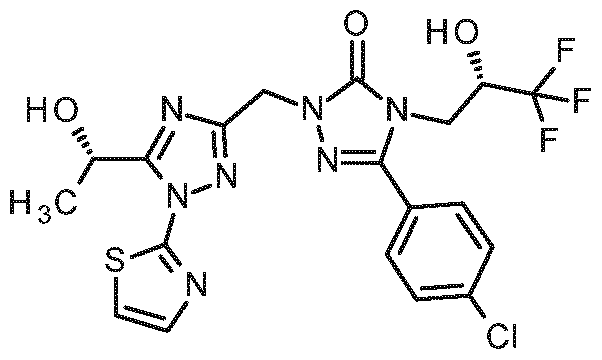
At 0°C, a solution of (l S)-l-[3-({3-(4-chlorophenyl)-5-oxo-4-[(2S)-3,3,3-trifluoro-2- hydroxypropyl]-4,5-dihydro-lH-l ,2,4-triazol-l -yl} methyl)- 1 -(1 ,3-thiazol-2-yl)-lH-l,2,4-triazol-5- yl] ethyl acetate (Example 2 A, 53.0 mg, 95.0 μπιοΐ) in methanol (560 μΐ) was treated with an aqueous sodium hydroxide solution (95 μΐ, 1.0 M, 95 μmol) and stirred 2.5 h at room temperature. 0.5 g of activated ion exchange resin (Dowex 50WX8, 200-400 mesh) were added and the resulting mixture was stirred at room temperature for ! 5 min. The resin was filtered off and washed with methanol. The filtrate was evaporated affording 48.6 mg (quant.) of the title compound.
LC-MS (Method 1): Rt = 0.93 min; MS (ESIpos): m z = 516 [M+H]+
'H-NMR (400 MHz, DMSO-A) δ [ppm] = 7.82-7.54 (m, 6H), 6.90 (d, 1H), 5.71 -5.48 (m, 2H), 5.19-5.01 (m, 2H), 4.38-4.18 (m, 1H), 4.08-3.80 (m, 2H), 1.48 (d, 3H).
Example 31
5-(4-Chlorophenyl)-2-( {5-[(lR)-l-hydroxyethyl]-l-[3-(trifluoromethoxy)pyridin-2-yl]-lH-l,2,4- triazol-3-yl}methyl)-4-[(2S)-3,3,3-trifluoro-2-hydroxypropyl]-2,4-dihydro-3H-l,2,4-triazol-3-on^

A solution of (lR)-l -{3-( {3-(4-chlorophenyl)-5-oxo-4-[(2S)-3,3,3-trifluoro-2-hydroxypropyl]-4,5- dihydro-lH-l,2,4-triazol-l-yl}methyl)-l-[3-(trifluoromethoxy)pyridin-2-yl]-iH-l ,2,4-triazol-5- yl} ethyl acetate (Example 30A, 190 mg, 299 μηιοΐ) in (600 μΐ, 1.0 M, 600 μιηοΐ) was treated with an aqueous sodium hydroxide solution methanol (4.6 ml) and stirred 1 h at room temperature. 50% aqueous formic acid (68 μΐ) was added and the resulting mixture was purified via preparative
HPLC (Reprosil; C18; 10 μηι; 125 x 30 mm; water/aceionitrile-gradient 0.1 % formic acid) affording 162 mg (87 % of Th.) of the title compound.
LC-MS (Method 2): R, = 1.23 min; MS (ESIpos): m/z = 594 [M+Hf
'H-NMR (400 MHz, DMSO-d) δ [ppm] = 8.61 (dd, IH), 8.19 (dt, IH), 7.83-7.56 (m, 5H), 6.90 (d, IH), 5.49 (d, IH), 5.14-5.01 (m, 2H), 4.92 (quin, IH), 4.30 (br d, IH), 4.04-3.78 (m, 2H), 1.44 (d, 3H).
BIOLOGICAL ASSAYS
Abbreviations and Acronyms:
Abbreviation Meaning
Acc. No. accession number
AVP arginine vasopressin
Arg Arginine
AVPRla Vasopressin receptor Via
BSA bovine serum albumin
cAMP cyclic adenosine monophosphate
Cat. No. catalogue number
cDNA complementary deoxyribonucleic acid
(" HO Chinese hamster ovary
CKD Chronic kidney disease
CRE cAMP response element
Ct cycle threshold
DMEM/F12 Dulbecco's modified Eagle's medium / Ham's F 1 2 medium (1 : 1)
DMA deoxyribonucleic acid
DM SO dimethylsulfoxide
DTT dithiothreitol
ECso half-maximal effective concentration
EOT A ethylenediamine-tetraacetic acid
FAM carboxyfluorescein succinimidyl ester
FCS fetal calf serum
HE PES 4-(2 -hydro xyethyl)piperazine- 1 -ethanesulfonic acid
ICso half-maximal inhibitory concentration
IRI Ischemia re-perfusion injury
¾ dissociation constant
KDIGO Kidney Disease Improving Global Outcomes
¾ dissociation constant of an inhibitor
KIM-1 Kidney injury molecule- 1
mRNA messenger ribonucleic acid
OPN Osteopontin
Opti-MEM Optimized Improved Minimal Essential Medium
PAI-1 Plasminogen activator inhibitor- 1
R LT RNeasy lysis buffer for tissue culture by Qiagen.com
RNA ribonucleic acid
ROC Receiver operating characteristic
RTPCR real-time polymerase chain reaction
SD Spraque-Dawley
Sppl secreted phosphoprotein 1 (synonym osteopontin)
TAMRA carboxvtetramethylrhodamine
TRIS; Tris 2-amino-2-hydroxymethylpropane- 1 ,3-diol
UNX Unilaterally nephrectomized
vol volume
Demonstration of the activity of the Via antagonists of the present invention and the impact on response-to-treatment by raised vasopressin or copeptin may be accomplished through in vitro, ex vivo, and in vivo assays, and diagnostic means to quantify vasopressin or copeptin that are well known in the art. For example, the following assays may be used.
B. Biological Assays for testing t he activity and selectivity of Vi antagonists
Example B-l. Cellular in vitro assay for determining vasopressin receptor activity
The identification of agonists and antagonists of the Via and V2 vasopressin receptors from humans, rats and dogs as well as the quantification of the activity of the compounds of the invention is carried out using recombinant cell lines. These cell lines originally derive from a hamster's ovary epithelial cell (Chinese Hamster Ovary, CHO Kl, ATCC: American Type Culture Collection, Manassas, VA 20108, USA). The test cell lines constitutively express the human, rat or dog Via or V2 receptors. In case of the Gaq-coupled Via receptors, cells are also stably transfected with a modified form of the calcium-sensitive photoproteins aequorin (human and rat Via) or obe- lin (dog Via), which, after reconstitution with the cofactor coelenterazine, emit light when there are increases in free calcium concentrations [Rizzuto R. Simpson AW, Brini M, Pozzan T, Nature 358. 325-327 (1992); Illarionov HA, Bondar VS, Illarionova VA, Vysotski ES, Gene 153 (2), 273- 274 (1995)]. The resulting vasopressin receptor cells react to stimulation of the recombinantly expressed Via receptors by intracellular release of calcium ions, which can be quantified by the resulting photoprotein luminescence. The Gs-coupled V2 receptors are stably transfected into cell lines expressing the gene for firefly luciferase under control of a C RE -responsible promoter. Acti-
vation of V2 receptors induces the activation of the C E -responsive promoter via cAMP increase, thereby inducing the expression of firefly luciferase. The light emitted by photoproteins of Via cell lines as well as the light emitted by firefly luciferase of V2 cell lines corresponds to the activation or inhibition of the respective vasopressin receptor. The bioluminescence of the cell lines is detected using a suitable luminometer [Milligan G, Marshall F, Rees S, Trends in Pharmacological Sciences 17, 235-237 (1996)].
Vasopressin Via receptor cell lines:
On the day before the assay, the cells are plated out in culture medium (DMEM/F12, 2% PC'S, 2 mM glutamine, 10 mM H E PES. 5 μg/ml coelenterazine) in 384-well microtiter plates and kept in a cell incubator (96% humidity, 5% v/v CO -. 37°C). On the day of the assay, test compounds in various concentrations are placed for 10 minutes in the wells of the microtiter plate before the agonist [ Arg8 ] - vasopres sin at EC50 concentration is added. The resulting light signal is measured immediately in a luminometer.
Vasopressin V2 receptor cell lines:
On the day before the assay, the cells are plated out in culture medium (DMEM/F12, 2% FCS, 2 mM glutamine, 10 mM H E PES) in 384-well microtiter plates and kept in a cell incubator (96% humidity, 5% v/v CO2, 37°C). On the day of the assay, test compounds in various concentrations and the agonist [Arg8]-vasopressin at EC50 concentration are added together to the wells, and plates are incubated for 3 hours in a c ell incubator. Upon addition of the cell lysis reagent Triton™ and the substrate luciferin, luminescence of firefly luciferase is measured in a luminometer.
Table 1A below lists individual IC50 values for the compounds of general formula (I) (including racemic mixtures as well as separated enantiomers) that were obtained from cell lines transfected with the human Via or V2 receptor:
Table 1A
Example ICso hVla IC50 h\ 2 ratio IC50
No. l. .MI l. M I h\ 2/h\ l a
1 0.00058 0.02390 41.4
2 0.00235 0.17500 74.5
3 0.00125 0.07550 60.4
4 0.00965 0.66500 68.9
5 0.00160 0.03850 24.1
6 0.01290 0.97500 75.6
7 0.01750 0.71250 40.7
8 0.00185 0.03367 18.2
9 0.00895 0.10650 11.9
10 0.00102 0.03900 38.2
11 0.00120 0.16966 141.0
12 0.01600 0.87500 54.7
13 0.00123 0.08933 72.6
14 0.01450 1.24500 85.9
15 0.00057 0.02500 43.9
16 0.00250 0.29333 117.3
17 0.02550 0.89250 35.0
18 0.07500 2.25000 30.0
19 0.00680 0.79000 116.2
20 0.00310 0.61000 196.8
21 0.00345 0.86000 249.3
22 0.00160 0.69000 431.3
23 0.00520 0.10375 20.0
24 0.01350 0.63667 47.2
25 0.00140 0.07500 53.6
26 0.00530 0.35000 66.0
27 0.00380 0.08750 23.0
28 0.00049 0.01595 32.6
29 0.00135 0.02700 20.0
30 0.00425 0.10500 24.7
31 0.01300 0.38667 29.7
The IC50 data listed in Table 1A demonstrate that compounds of general formula (I) within the scope of the present invention are acting as potent vasopressin Via receptor antagonists.
Example B-2. Radioactive binding assay
IC» and i values can be determined in radioactive binding assays using membrane fractions of recombinant human embryonic kidney cell line 293 (HEK293) or CHO-K1 cell lines expressing the respective human vasopressin Via and V2 receptors.
Human recombinant vasopressin Via receptors expressed in HEK293 cells are used in 50 mM Tris-HCl buffer, pH 7.4, 5 mM MgCb, 0.1% BSA using standard techniques. Aliquots of prepared membranes are incubated with test compounds in various concentrations in duplicates and 0.03nM [125I]Phenylacetyl-D-Tyr(Me)-Phe-Gln-Asn-Arg-Pro-Arg-Tyr-NH2 for 120 minutes at 25°C. Nonspecific binding is estimated in the presence of 1 μΜ [Arg8]Vasopressin. Receptors are filtered and washed, the filters are then counted to determine [!25I]Phenylacetyl-D-Tyr(Me)-Phe-Gln-Asn-Arg- Pro-Arg-Tyr-Nl h specifically bound. CHO- 1 cells stably transfected with a plasmid encoding human vasopressin V2 receptor are used to prepare membranes in 50 mM Tris-HCl buffer, pH 7.4, 10 mM MgCh, 0.1% BSA using standard techniques. Aliquots of prepared membrane are incubated with test compounds in various concentrations in duplicates and 4 nM [3H](Arg8)- Vasopressin for 120 minutes at 25°C. Non-specific binding is estimated in the presence of 1 mM (Arg8)- vasopressin. Membranes are filtered and washed 3 times and the filters are counted to determine [3H](Arg8)-Vasopressin specifically bound.
IC50 values are determined by a non-linear, least squares regression analysis using MathlQTM (ID Business Solutions Ltd., UK). The inhibition constant K; is calculated using the equation of Cheng and Prusoff (Cheng, Y., Prusoff, W.H.. Biochem. Pharmacol. 22:3099-3108, 1973).
C. Pharmacological activity
Example C-l Tissue culture testing of a compound which antagonizes AVPRla activity in vasopressin exposed renal cells
A method to demonstrate the prevention of deleterious fibrotic gene expression in vasopressin exposed renal NRK-49F cells by use of compounds blocking AV R I a dependent cellular processes is being conducted as follows.
Rat renal NRK-49F cells [(ATCC CRL 1 570. American Type Culture Collection Manassas, VA 20108 USA, www.atcc.org] which express native AVPRla at a high level and diminishing amounts of AVPR2 are being seeded in 6 -well microtiter plates for cell culture, at a cell density of 50.000 cells/well, in 2.0 ml of Opti-MEM medium (Cat. No. 31985070, Thermo Fisher Scientific Inc). Cells are being cultured in a cell incubator (96% humidity, 8% v/v carbon dioxide, 37°C). After 24 hours, sets of three wells (triplicate) are charged with vehicle solution (negative control), vasopressin solution ( [Arg8 ] -vasopressin acetate, Sigma, Cat. No. V9879) or additional test substances (dissolved in vehicle: water with 20% by volume ethanol) and vasopressin solution. In the cell culture, the final vasopressin concentration is regularly 5.0 nM if not indicated differently.
The test substance solution is added to the cell culture in small volumes (5 μΐ/well), in order to keep a final concentration of ethanol below 0.03% vol/vol. Usually, AVPRla antagonists are being added to wells at concentrations spanning a range of 1.0 nM to 1000 nM final concentration. After an incubation time of 16 hours, the culture supernatant is separated by suction for protein quantification by enzyme linked immune sorbent assays (ELISA). The adherent cells are lysed in 350 μΐ of RLT buffer (Qiagen, Ratingen, Cat. No. 79216), and the RNA is isolated from this lysate using the RNeasy kit (Qiagen, Cat. No. 74104). This is followed by DNAse digestion (Invitrogen, Cat. No. 18068-015), cDNA synthesis (Promaga, ImProm-Ii Reverse Transcription System, Cat. No. A3800) and RTPCR (pPCR MasterMix RT-QP2X-03-075 from Eurogentec, Seraing, Belgium). All procedures take place in accordance with the working protocols of the test reagents' manufacturers. The primer sets for the RTPCR are selected on the basis of published mRNA gene sequences (NCBI Genbank Entrez Nucleotide Data Base) using the Prim er3 Plus program. The RTPC for determining the relative mRNA expression in the cells of the various assay batches is carried out using 6-FAM TAMRA-labelied probes (manufactured by Sigma-Aldrich Co. LLC) and read-out by the Applied Biosystems ABi Prism 7900HT Sequence Detector in 384-well microtiter plate format in accordance with the instrument operating instructions. The relative gene expression is represented by the delta-delta Ct value [Applied Biosystems, User Bulletin No. 2 ABi Prism 7700 SDS December 1 1, 1997 (updated 10/2001)] with reference to the level of expression of the ribosomal protein 1.- 2 gene (Genbank Acc. No. NM_013226) and the threshold Ct value of Ct = 35. Protein quantification of expressed genes in the supernatants of the cell culture test sets is conducted by using commercially available ELISA kits according to the manuals provided by the manufacturer of the kits. For quantification of PA I- 1 Rat ELISA Kit abeam, Cat. No. abl98509 is used, and for osteopontin rodent ELISA R&D Systems Inc. Cat. no. MOST00 is used.
Fig. 1-1 shows the induction of in RNA formation of pro-fibrotic genes PAI- 1 and osteopontin by exposure of renal NRK-49F cells to 1 nM Arg-vasopressin for 5 hours. This gene induction is dose dependently attenuated in the presence of AVPRla antagonists. The selective AVPRV2 antagonist Satavaptan does not inhibit the induction of these genes.
Example C-2 in vivo testing of AVPRla antagonist to demonstrate organ protective effects
AVPRla antagonists prevent decrease of renal function in kidney ischemia reperfusion injury model in unilaterally nephrectomized copeptin-prone Spraque-Dawley rats (SD UNX IRI rat model)
Unilaterally nephrectomized Spraque-Dawley rats may benefit from treatment by AVPR l a antagonist after ischemia reperfusion injury due to raised vasopressin levels. The beneficial effect of Via antagonists on kidney function is being investigated in a kidney ischemia-reperfusion injury model in rats as follows.
Laboratory bred male 6-8 weeks old Sprague Dawley® rats are obtained from Charles River. Rats are maintained under standard laboratory conditions, 12 hour light-dark cycles with access to normal chow and drinking water at libitum. For the ischemia reperfusion injury model a total of 10- 12 rats is used in each control and experimental group. Animals are anesthetized with continuous inhaled isoflurane. Right nephrectomy is performed through a right flank incision 7 days before the ischemic procedures in the contralateral kidneys. For renal ischemia a left flank incision is made. Renal vessels are exposed by dissection of the left renal pedicle. Non-traumatic vascular clamps are used to stop blood flow (artery and vein) during 45 min of ischemia. Reperfusion is established by removing the clamps. The abdominal wall (muscular layer and skin) is closed with 5.0 polypropylene sutures. Temgesic® (Buprenorphin, 0.025 mg/kg s.c.) is applied as an analgesic.
Copeptin in rat serum samples is being quantified using an ELISA kit manufactured by Peninsula Laboratories International, Inc. San Carlos, ( A 94070, USA. The copeptin ELISA is conducted according to the assay protocol provided by the manufacturer.
Fig. 2-1 shows a typical copeptin assay result showing elevated serum copeptin levels in unilaterally nephrectomized Spraque-Dawley rats with (Placebo) and without ischemia reperfusion injury (Sham).
Urine of each animal is collected in metabolic cages over night before sacrifice at 24h post ischemia. Upon sacrifice, blood samples are obtained under terminal anesthesia. After centrifugation of the blood samples, serum is isolated. Both serum creatinine and serum urea are measured via clinical biochemistry analyzer (Pentra 400). Both urinary creatinine and albumin are measured to determine Albuminuria (albumin/creatinine ratio, ACR) via clinical biochemistry analyzer (Cobas Integra).
Fig. 2-2 shows the reduction of serum creatinine (A) and serum urea (B) after treatment with different doses of a Via receptor antagonist (Relcovaptan, grey bars) in comparison to placebo treated (white bar) and sham operated animals (black bar).
Fig. 2-3 shows the increase of ACR (urinary creatinin/ albumin ratio) in unilaterally nephrectomized Spraque-Dawley rats with (white bar) and without ischemia reperfusion injury (black bar ). Treatment with a Via receptor antagonist (Relcovaptan) in ischemic rats reduces ACR (grey bars).
Total RNA is isolated from kidneys. Left kidneys are snap-frozen in liquid nitrogen at sacrifice. Kidney tissue is then homogenized and RNA is obtained. Total R A is transcribed to cDNA. Using TaqMan real-time PC R renal Nephrin and Podocin mRNA expression is analyzed in whole kidney tissue.
Figure 2-4 Ischemia reperfusion injury down regulated the RNA expression of podocyte markers Nephrin (A) and Podocin (B) in placebo treated rats (white bars). This reduction was prevented by treatment with Via receptor antagonist (grey bars).
Data are expressed as means ± SD. Differences between groups are analyzed by one-way A NOV A with Dunnett's corrections for multiple comparisons vs. placebo. Statistical significance is defined as p < 0.05. All statistical analyses are done using GraphPad Prism 6.
It has been found by the present inventors that animals affected by mild-to-moderately impaired kidney function at abnormally increased cop ep tin levels, show a response to treatment by Via selective antagonists thus ameliorating signs of kidney disease. The therapeutic mode of action of a Via antagonist results in the recovery of renal functions as indicated by the decrease of proteinuria, serum creatinine and increase of glomerular filtration capabilities.
Example C-3 Stratification of patients for treatment by AVPRl antagonist based on copeptin level
Copeptin plasma levels can be quantified for selection of mildly affected kidney disease patients and other often asymptomatic appearing patients characterized by elevated copeptin levels for treatment with a compound which antagonizes AVPRl a
Copeptin is being measured in plasma or serum of subjects by use of a Time Resolved Amplified Cryptate Emission (TRACE) immunocomplex energy transfer assay (Thermo Scientific B'RrA'H'M'S Kryptor compact PLUS, Heringsdorf, Germany). Plasma or serum copeptin levels were investigated by epidemiological studies including healthy control subjects and patient cohorts representing diabetic patients, heart failure patients, hypertensive patients or patients suffering from different kinds of kidney disease. These study results reveal, that elevated copeptin levels can be detected even in mildly affected kidney disease patients or otherwise asymptomatic individuals. These individuals are supposed being at risk to develop kidney disease or to be exposed to accelerated decrease of kidney function due to the known deleterious action of excessive AVPRla activation. Disproportionate or excessive signaling of AVPRla ultimately results in impaired blood flow in kidneys or other organs and in up-regulation of adverse fibrotic gene expression. It is therefore conceivable, that in subjects characterized by an elevated copeptin level which indicates abnormal high vasopressin release, treatment with A V R l a antagonists may be most beneficial. Epidemiological studies with CKD patients were conducted to define copeptin levels which can be regarded as "abnormal high copeptin levels".
Example C-3.1; Fig. 3-1 : Receiver operating characteristic (ROC) cu rves of copeptin in CKD- 3 patients
It was found by the inventors that copeptin levels which are exceeding a concentration that is defined by the mean copeptin level of a healthy age and gender matched control cohort plus the
addition of the standard deviation of the assay results of that reference cohort are being strongly correlated with indicators for renal disease.
In particular, it was found, that sensitivity and specificity of copeptin levels are highly correlated with comprehensively established biomarkers indicating kidney diseases like serum cystatin-C or NC iAL. This finding can be visualized by calculation of receiver operating characteristic (ROC) curves of these biomarkers.
Fig. 3-1 shows ROC curves for comparison of these three biomarkers measured in mildly to moderately affected CKD-3 patients demonstrating, that the area (A) under the curve for copeptin, cystatin-C, and NGAL lies within a quite similar range of A = 0.71 through A = 0.76 relative area units. Copeptin, cystatin C and NGAL plasma levels of CKD-3 patients are being analyzed by the receiver operating characteristic test to rank test results for specificity and sensitivity versus the healthy control group. The Area (A) under the curves indicates the discriminatory power of the analyzed biomarkers.
Examples C-3.2 and C-3.3; Figs. 3-2 and 3-3: Copeptin levels in diabetic and non-diabetic chronic kidney disease patients
Figs. 3-2 and 3-3 show copeptin plasma levels of healthy subjects together with copeptin levels which were found in patients who are affected by a mild degree of renal impairment, i.e. KDK iO grades Gl and Al - A3, or G2 and Al - A3, or G3a and Al - A2, commonly referred to as CKD1 , CKD2, or CKD-3a. It was found by the inventors, that a substantial proportion of these mildly affected CKD patients have elevated copeptin levels exceeding 8.0 pmol/L.
The graphical plots of the copeptin data clearly show that a sizable proportion of patients can be identified even in the groups of low grade kidney disease, who are characterized by copeptin concentrations exceeding 8.0 pmol/L, and therefore qualify particularly for treatment by a AVPR l a antagonist. At higher degrees of chronic kidney disease, i.e. CKD classification CKD-3b, CKD-4, and CKD-5, frequency of elevated copeptin levels increases in these patients as well as the conc entration of the copeptin levels found in these patients.
Copeptin plasma levels shown in Fig. 3-2 were measured in diabetic CKD patients and healthy controls: Copeptin concentrations in healthy subjects (Controls) and diabetic patients of non- impaired renal function (Diabetics) and diabetic nephropathy patients representing the sub-group classifications of chronic kidney disease CKD-1, CKD-2, CKD-3a, CKD-3b, CKD-4, CKD-5, and CKD5d according to KDK iO criteria. The numbers shown in the top line enumerate the number of individuals per group. Each circle assigns the copeptin concentration of an individual in the given sub-group. Group differences according to two-sided t-tests versus the Controls are presented by p values. The dashed line dissects individual copeptin values above and below a concentration of 8.0 pmol/L. A substantial proprotion of CKD-2 and CKD-3 patients show elevated copeptin levels
above 8.0 pmol/L. All patients show cop ep tin levels above 8.0 pmol/L at advanced degrees of CKD-4 and CKD-5 in this study.
Copeptin plasma levels shown in Fig. 3-3 were measured in non-diabetic CKD patients and healthy controls: Copeptin concentrations in healthy subjects (Controls) and non-diabetic nephropathy patients representing the sub-group classifications of chronic kidney disease CKD-3, CKD-4, CKD-5, and CKD5d according to KDIGO criteria. The numbers shown in the top line enumerate the number of individuals per group. Each circle assigns the copeptin concentration of an individual in the given sub-group. The dashed line assigns the concentration of 8.0 pmol/L. More than one third of mild-to-moderate non-diabetic CKD-3 patients show elevated copeptin levels above 8.0 pmol/L. All patients show copeptin levels above 8.0 pmol/L at advanced degrees of CKD-4 and CKD-5 in this study.
Examples C-3.4; Figs. 3-4: Gender effect on copeptin levels in diabetic and chronic kidney disease patients
As outlined by preclinical study results of Example C-2 it can be assumed that individuals characterized by abnormally increased copeptin level will most likely benefit from treatment regimes using an AVPRla antagonistic compound.
Figs. 3-4 shows a detailed plasma copeptin quantification which shows in particular, for one cohort of diabetic mild to moderate CKD patients, that these abnormal high copeptin levels were determined to be at 8.0 pmol/L for males and for females.
Copeptin plasma concentrations shown in Fig 3-4 separated for male and female in healthy subjects (Controls) and diabetic patients of non-impaired renal function (Diabetics) and diabetic CKD patients representing the sub-group classifications of chronic kidney disease CKD-1 , CKD-2, CKD-3a, C D-3 b. CKD-4, CKD-5, and CKD5d according to KDIGO criteria. Copeptin mean values of the sub-groups are presented in the top line. Gender differences of copeptin leves for male and female subgroups are presented by p values of a two-sided t-test.
Example C-3.5; Fig 3-5: Copeptin levels are elevated in CKD-3 patients regardless of treatment regimes
Chronic kidney disease patients of grade CKD-3 show no difference of mean copeptin levels with or without additional treatment by loop diuretics or thiazides. The patients are being characterized by elevated copeptin levels despite standard of care treatment of these patients by angiotensin converting enzyme inhibitor and/or angiotensin receptor blocker and/or calcium antagonist.
The top line enumerates the number of patients per group and the mean copeptin level of the group.
Claims
Use of a Via receptor antagonist in the treatment and/or prevention of a renal disease in a subject.
Use of a Via receptor antagonist according to claim 1 wherein the renal disease is selected from the group consisting of acute kidney disease and chronic kidney disease.
Use of a Via receptor antagonist according to claim 2, wherein the renal disease is chronic kidney disease stage 2 to 5d (CKD-2 to CKD-5d).
Use of a Via receptor antagonist according to any one of claims 1 to 3, wherein the subject is characterized by an elevated arginine vasopressin (AVP) level and/or an elevated copeptin level.
Use of a Via receptor antagonist according to any one of claims 1 to 4, wherein the copeptin is plasma copeptin as determined by use of an immunoassay format.
Use of a Via receptor antagonist according to any one of claims 1 to 5, wherein the elevated copeptin level is at least 5 pmol/1.
Use of a Via receptor antagonist according to claim 6, wherein the elevated copeptin level is at least 8.0 pmol/1 for a male subject or at least 6.0 pmol/1 for a female subject.
Use of a Via receptor antagonist according to any one of claims 1 to 7, wherein the Via receptor antagonist is a selective Via receptor antagonist.
Use of a Via receptor antagonist according to any one of claims 1 to 7, wherein the Via receptor antagonist is selected from the group consisting of Conivaptan (YM 087), YM 218, Relcovaptan (SR 49059), Ribuvaptan (BAY 86-8050), RG 7314, RG 7713, RO 5028442, RWJ 676070, SR 246, SRX 251, VA 111913, PF 00738245 and PF 184563.
Use of a Via receptor antagonist according to any one of claims 1 to 7, wherein the Via receptor antagonist is selected from the group consisting of 5-(4-chlorophenyl)-2-( { 1 -(3- fluorophenyi)-5-[(li?5)-l-hydroxyethyl]-l/ -l,2,4-triazol-3-yl}methyl)-4-[(25)-3,3,3- trifluoro-2-hydroxypropyl]-2,4-dihydro-3i7-l,2,4-triazol-3-one, 5-(4-chlorophenyl)-2-( { 1 -(3- fluorophenyl)-5-[(15)-l-hydroxyethyl]-l//-l,2,4-triazol-3-yl}methyl)-4-[(25)-3,3,3-trifluoro- 2-hydroxypropyl]-2,4-dihydro-3i7-i,2,4-triazol-3-one, 5-(4-chlorophenyl)-2-( { 1 -(3-chloro- phenyl)-5-[(li?5)-l-hydroxyethyl]-li?-l,2,4-triazol-3-yl}methyl)-4-[(2¾-3,3,3-trifluoro-2- hydroxypropyl]-2,4-dihydro-3i/-l,2,4-triazoi-3-one, 5-(4-chlorophenyl)-2-( { 1 -(3-chloro- phenyl)-5-[(15)-l-hydroxyethyl]-lf/-l,2,4-triazol-3-yl}methyl)-4-[(25)-3,3,3-trifluoro-2- hydroxypropyl]-2,4-dihydro-3i7-l,2,4-triazol-3-one, 5-(4-chlorophenyl)-2-( { 1 -(2-chloro- phenyl)-5-[(li?5)-l-hydroxyethyl]-li/-l,2,4-triazol-3-yl}methyl)-4-[(25)-3,3,3-trifluoro-2- hydroxypropyl]-2,4-dihydro-3if-l,2,4-triazol-3-one and 5-(4-chlorophenyl)-2-( { 1 -(2-chloro-
phenyl)-5-[(15>l-hydroxye ^
hydroxypropyl]-2,4-dihydro-3/ -l ,2,4-triazol-3-one.
11. Use of a Via receptor antagonist according to any one of claims 1 to 8, wherein the Via receptor antagonist is a compound of the general formula (I-A)

wherein
R! represents a group of the formula

in which
#' represents the point of attachment to the nitrogen atom,
Ar represents a group of the formula

in which
#3 represents the point of attachment to the nitrogen atom,
R4A represents a group selected from a chlorine atom, a bromine atom, trifluoromethyl, trifluoromethoxy, ethoxycarbonyl and -C( =0)NH.\
R4B represents a group selected from a chlorine atom, trifluoromethyl, and ethoxycarbonyl,
R" represents a group selected from trifluoromethyl, trifluoromethoxy, ethoxy, -C(=0)N(H)C¾ and -S(=0)2CH3,
or a pharmaceutically acceptable salt, hydrate and/or solvate thereof.
Method for determining whether a subject is a suitable candidate for the treatment with a Via receptor antagonist according to any one of claims 1 to 11 and treating a subject identified as a suitable candidate for said treatment, the method comprising the steps of:
(a) providing a biological sample from the subject; and
(b) detecting the arginine vasopressin (AVP) level and/or the copeptin level in the biological sample;
wherein the subject has a renal disease;
wherein the presence of an elevated AVP level and/or an elevated copeptin level in said indicates that the subject is a suitable candidate for treatment with a Via antagonist and
(c) treating a subject that is identified as a suitable candidate in step (b) with a Via antagonist.
13. Method for determining whether a subject is a suitable candidate for the treatment with a Via receptor antagonist according to any one of claims 1 to 12 and treating a subject identified as a suitable candidate for said treatment, the method comprising the steps of:
(a) providing a biological sample from the subject; and
(b) detecting the arginine vasopressin (AVP) level and/or the copeptin level in the biological sample;
wherein the subject has a renal disease;
wherein if AVP and/or copeptin is present at a level above about the 60th percentile of the distribution of the marker in a normal subject sample, the subject is a suitable candidate for treatment with a Via antagonist; and
(c) treating a subject that is identified as a suitable candidate in step (b) with a Via antagonist.
The method according to any one of claims 12 or 13, wherein the method is used to screen subjects for eligibility for a clinical trial and/or to stratify groups of subjects for a clinical trial.
Method for monitoring a subject's response to treatment with a Via antagonist according to any one of claims 1 to 12, comprising
(a) providing a biological sample from the subject; and
(b) detecting the arginine vasopressin (AVP) level and/or the copeptin level in the biological sample;
wherein the subject has a renal disease;
and wherein a change in the AVP level and/or an copeptin level as compared to a baseline, indicates that the Via receptor antagonist is useful for treating the subject; and
(c) continuing or discontinuing treatment with the Via receptor antagonist in the subject based on the change in the level of the marker as compared to baseline detected in step (b).
A method to identify subjects who are at risk to develop a renal disease or progress to further loss of renal function, comprising
(a) providing a biological sample from the subject; and
(b) detecting the copeptin level in the biological sample;
(c) determining the copeptin level in a biological sample obtained from the subject, wherein the level of copeptin level is at least 5 pmol/1.
Applications Claiming Priority (12)
| Application Number | Priority Date | Filing Date | Title |
|---|---|---|---|
| EP16168166 | 2016-05-03 | ||
| EP16168169.7 | 2016-05-03 | ||
| EP16168169 | 2016-05-03 | ||
| EP16168172.1 | 2016-05-03 | ||
| EP16168163 | 2016-05-03 | ||
| EP16168172 | 2016-05-03 | ||
| EP16168165 | 2016-05-03 | ||
| EP16168166.3 | 2016-05-03 | ||
| EP16168165.5 | 2016-05-03 | ||
| EP16168163.0 | 2016-05-03 | ||
| EP16186839.3 | 2016-09-01 | ||
| EP16186839 | 2016-09-01 |
Publications (1)
| Publication Number | Publication Date |
|---|---|
| WO2017191117A1 true WO2017191117A1 (en) | 2017-11-09 |
Family
ID=58640902
Family Applications (1)
| Application Number | Title | Priority Date | Filing Date |
|---|---|---|---|
| PCT/EP2017/060386 Ceased WO2017191117A1 (en) | 2016-05-03 | 2017-05-02 | V1a receptor antagonists for use in the treatment of renal diseases |
Country Status (1)
| Country | Link |
|---|---|
| WO (1) | WO2017191117A1 (en) |
Citations (36)
| Publication number | Priority date | Publication date | Assignee | Title |
|---|---|---|---|---|
| WO2000006569A1 (en) | 1998-07-29 | 2000-02-10 | Bayer Aktiengesellschaft | Substituted pyrazole derivatives condensed with six-membered heterocyclic rings |
| WO2000006568A1 (en) | 1998-07-29 | 2000-02-10 | Bayer Aktiengesellschaft | Substituted pyrazole derivatives |
| WO2001019778A1 (en) | 1999-09-13 | 2001-03-22 | Bayer Aktiengesellschaft | Novel dicarboxylic acid derivatives with pharmaceutical properties |
| WO2001019776A2 (en) | 1999-09-13 | 2001-03-22 | Bayer Aktiengesellschaft | Novel derivatives of dicarboxylic acid having pharmaceutical properties |
| WO2001019780A2 (en) | 1999-09-13 | 2001-03-22 | Bayer Aktiengesellschaft | Novel derivatives of dicarboxylic acid having pharmaceutical properties |
| WO2001019355A2 (en) | 1999-09-13 | 2001-03-22 | Bayer Aktiengesellschaft | Novel dicarboxylic acid derivatives with pharmaceutical properties |
| WO2002042301A1 (en) | 2000-11-22 | 2002-05-30 | Bayer Aktiengesellschaft | Novel pyridine-substituted pyrazolopyridine derivatives |
| WO2002070462A1 (en) | 2001-03-07 | 2002-09-12 | Bayer Aktiengesellschaft | Substituted amino dicarboxylic acid derivatives |
| WO2002070510A2 (en) | 2001-03-07 | 2002-09-12 | Bayer Aktiengesellschaft | Amino dicarboxylic acid derivatives with pharmaceutical properties |
| WO2003095451A1 (en) | 2002-05-08 | 2003-11-20 | Bayer Healthcare Ag | Carbamate-substituted pyrazolopyridines |
| WO2007134862A1 (en) | 2006-05-23 | 2007-11-29 | Bayer Healthcare Ag | Substituted arylimidaz0l0ne and triaz0l0ne as inhibitors of vasopressin receptors |
| WO2009045309A2 (en) * | 2007-09-28 | 2009-04-09 | Ferring B.V. | Use of v2 receptor antagonists in combination with vasopressinergic agonists |
| WO2010054961A1 (en) | 2008-11-13 | 2010-05-20 | F. Hoffmann-La Roche Ag | Spiro-5,6-dihydro-4h-2,3,5,10b-tetraaza-benzo[e]azulenes |
| WO2010057795A1 (en) | 2008-11-18 | 2010-05-27 | F. Hoffmann-La Roche Ag | Alkylcyclohexylethers of dihydrotetraazabenzoazulenes |
| WO2010060836A1 (en) | 2008-11-28 | 2010-06-03 | F. Hoffmann-La Roche Ag | Arylcyclohexylethers of dihydrotetraazabenzoazulenes for use as vasopressin via receptor antagonists |
| WO2010063402A1 (en) | 2008-12-06 | 2010-06-10 | Bayer Schering Pharma Aktiengesellschaft | Substituted benzyl and phenylsulfonyl triazolones, and use thereof |
| WO2010105770A1 (en) | 2009-03-18 | 2010-09-23 | Bayer Schering Pharma Aktiengesellschaft | Substituted 2-acetamido-5-aryl-1,2,4-triazolones and use thereof |
| WO2010105750A1 (en) | 2009-03-18 | 2010-09-23 | Bayer Schering Pharma Aktiengesellschaft | Triazole derivatives as vasopressin-receptor inhibitors for treating cardiac insufficiency |
| WO2011023703A1 (en) | 2009-08-27 | 2011-03-03 | Bayer Schering Pharma Aktiengesellschaft | Heterocyclic-substituted 2-acetamido-5-aryl-1,2,4-triazolones and use thereof |
| WO2011104322A1 (en) | 2010-02-27 | 2011-09-01 | Bayer Pharma Aktiengesellschaft | Bisaryl-bonded aryltriazolones and use thereof |
| WO2011120877A1 (en) | 2010-03-31 | 2011-10-06 | F. Hoffmann-La Roche Ag | Aryl-cyclohexyl-tetraazabenzo[e]azulenes |
| WO2011128265A1 (en) | 2010-04-13 | 2011-10-20 | F. Hoffmann-La Roche Ag | Aryl - /heteroaryl - cyclohexenyl - tetraazabenzo [e] azulenes as vasopressin antagonists |
| WO2011131596A1 (en) | 2010-04-21 | 2011-10-27 | F. Hoffmann-La Roche Ag | Heteroaryl-cyclohexyl-tetraazabenzo[e]azulenes as vasopressin v1a receptor antagonists |
| WO2011141396A1 (en) | 2010-05-10 | 2011-11-17 | F. Hoffmann-La Roche Ag | Heteroaryl-cyclohexyl-tetraazabenzo[e]azulenes |
| WO2011147809A1 (en) | 2010-05-26 | 2011-12-01 | Bayer Pharma Aktiengesellschaft | Substituted 5-fluoro-1h-pyrazolopyridines and use thereof |
| WO2012004258A1 (en) | 2010-07-09 | 2012-01-12 | Bayer Pharma Aktiengesellschaft | Ring-fused pyrimidines and triazines and use thereof for the treatment and/or prophylaxis of cardiovascular diseases |
| WO2012028647A1 (en) | 2010-09-03 | 2012-03-08 | Bayer Pharma Aktiengesellschaft | Bicyclic aza heterocycles, and use thereof |
| WO2012028644A1 (en) | 2010-09-02 | 2012-03-08 | Bayer Pharma Aktiengesellschaft | Substituted n-phenethyltriazoloneacetamides and use thereof |
| WO2012035075A1 (en) | 2010-09-16 | 2012-03-22 | Bayer Pharma Aktiengesellschaft | Substituted phenylacetate and phenylpropane amides and use thereof |
| WO2012059549A1 (en) | 2010-11-04 | 2012-05-10 | Bayer Pharma Aktiengesellschaft | Substituted 6-fluoro-1h-pyrazolo[4,3-b]pyridines and use thereof |
| WO2015024819A1 (en) | 2013-08-19 | 2015-02-26 | F. Hoffmann-La Roche Ag | V1a antagonists to treat phase shift sleep disorders |
| WO2015082370A1 (en) | 2013-12-05 | 2015-06-11 | F. Hoffmann-La Roche Ag | Synthesis of trans-8-chloro-5-methyl-1 -[4-(pyridin-2-yloxy)-cyclohexyl]-5,6-dihydro-4h-2,3,5,10b-tetraaza-benzo[e]azulene and crytalline forms thereof |
| WO2015091411A1 (en) | 2013-12-19 | 2015-06-25 | F. Hoffmann-La Roche Ag | Spiro-oxazolones |
| WO2015124541A1 (en) | 2014-02-20 | 2015-08-27 | F. Hoffmann-La Roche Ag | Spiro-oxazolones |
| WO2016071212A1 (en) | 2014-11-03 | 2016-05-12 | Bayer Pharma Aktiengesellschaft | Hydroxyalkyl-substituted phenyltriazole derivatives and uses thereof |
| WO2016075181A1 (en) | 2014-11-14 | 2016-05-19 | F. Hoffmann-La Roche Ag | Spiro-thiazolones |
-
2017
- 2017-05-02 WO PCT/EP2017/060386 patent/WO2017191117A1/en not_active Ceased
Patent Citations (37)
| Publication number | Priority date | Publication date | Assignee | Title |
|---|---|---|---|---|
| WO2000006569A1 (en) | 1998-07-29 | 2000-02-10 | Bayer Aktiengesellschaft | Substituted pyrazole derivatives condensed with six-membered heterocyclic rings |
| WO2000006568A1 (en) | 1998-07-29 | 2000-02-10 | Bayer Aktiengesellschaft | Substituted pyrazole derivatives |
| WO2001019778A1 (en) | 1999-09-13 | 2001-03-22 | Bayer Aktiengesellschaft | Novel dicarboxylic acid derivatives with pharmaceutical properties |
| WO2001019776A2 (en) | 1999-09-13 | 2001-03-22 | Bayer Aktiengesellschaft | Novel derivatives of dicarboxylic acid having pharmaceutical properties |
| WO2001019780A2 (en) | 1999-09-13 | 2001-03-22 | Bayer Aktiengesellschaft | Novel derivatives of dicarboxylic acid having pharmaceutical properties |
| WO2001019355A2 (en) | 1999-09-13 | 2001-03-22 | Bayer Aktiengesellschaft | Novel dicarboxylic acid derivatives with pharmaceutical properties |
| WO2002042301A1 (en) | 2000-11-22 | 2002-05-30 | Bayer Aktiengesellschaft | Novel pyridine-substituted pyrazolopyridine derivatives |
| WO2002070462A1 (en) | 2001-03-07 | 2002-09-12 | Bayer Aktiengesellschaft | Substituted amino dicarboxylic acid derivatives |
| WO2002070510A2 (en) | 2001-03-07 | 2002-09-12 | Bayer Aktiengesellschaft | Amino dicarboxylic acid derivatives with pharmaceutical properties |
| WO2003095451A1 (en) | 2002-05-08 | 2003-11-20 | Bayer Healthcare Ag | Carbamate-substituted pyrazolopyridines |
| WO2007134862A1 (en) | 2006-05-23 | 2007-11-29 | Bayer Healthcare Ag | Substituted arylimidaz0l0ne and triaz0l0ne as inhibitors of vasopressin receptors |
| WO2009045309A2 (en) * | 2007-09-28 | 2009-04-09 | Ferring B.V. | Use of v2 receptor antagonists in combination with vasopressinergic agonists |
| WO2010054961A1 (en) | 2008-11-13 | 2010-05-20 | F. Hoffmann-La Roche Ag | Spiro-5,6-dihydro-4h-2,3,5,10b-tetraaza-benzo[e]azulenes |
| WO2010057795A1 (en) | 2008-11-18 | 2010-05-27 | F. Hoffmann-La Roche Ag | Alkylcyclohexylethers of dihydrotetraazabenzoazulenes |
| WO2010060836A1 (en) | 2008-11-28 | 2010-06-03 | F. Hoffmann-La Roche Ag | Arylcyclohexylethers of dihydrotetraazabenzoazulenes for use as vasopressin via receptor antagonists |
| WO2010063402A1 (en) | 2008-12-06 | 2010-06-10 | Bayer Schering Pharma Aktiengesellschaft | Substituted benzyl and phenylsulfonyl triazolones, and use thereof |
| WO2010105770A1 (en) | 2009-03-18 | 2010-09-23 | Bayer Schering Pharma Aktiengesellschaft | Substituted 2-acetamido-5-aryl-1,2,4-triazolones and use thereof |
| WO2010105750A1 (en) | 2009-03-18 | 2010-09-23 | Bayer Schering Pharma Aktiengesellschaft | Triazole derivatives as vasopressin-receptor inhibitors for treating cardiac insufficiency |
| WO2011023703A1 (en) | 2009-08-27 | 2011-03-03 | Bayer Schering Pharma Aktiengesellschaft | Heterocyclic-substituted 2-acetamido-5-aryl-1,2,4-triazolones and use thereof |
| WO2011104322A1 (en) | 2010-02-27 | 2011-09-01 | Bayer Pharma Aktiengesellschaft | Bisaryl-bonded aryltriazolones and use thereof |
| US20130190330A1 (en) * | 2010-02-27 | 2013-07-25 | Bayer Intellectual Property Gmbh | Bisaryl-bonded aryltriazolones and use thereof |
| WO2011120877A1 (en) | 2010-03-31 | 2011-10-06 | F. Hoffmann-La Roche Ag | Aryl-cyclohexyl-tetraazabenzo[e]azulenes |
| WO2011128265A1 (en) | 2010-04-13 | 2011-10-20 | F. Hoffmann-La Roche Ag | Aryl - /heteroaryl - cyclohexenyl - tetraazabenzo [e] azulenes as vasopressin antagonists |
| WO2011131596A1 (en) | 2010-04-21 | 2011-10-27 | F. Hoffmann-La Roche Ag | Heteroaryl-cyclohexyl-tetraazabenzo[e]azulenes as vasopressin v1a receptor antagonists |
| WO2011141396A1 (en) | 2010-05-10 | 2011-11-17 | F. Hoffmann-La Roche Ag | Heteroaryl-cyclohexyl-tetraazabenzo[e]azulenes |
| WO2011147809A1 (en) | 2010-05-26 | 2011-12-01 | Bayer Pharma Aktiengesellschaft | Substituted 5-fluoro-1h-pyrazolopyridines and use thereof |
| WO2012004258A1 (en) | 2010-07-09 | 2012-01-12 | Bayer Pharma Aktiengesellschaft | Ring-fused pyrimidines and triazines and use thereof for the treatment and/or prophylaxis of cardiovascular diseases |
| WO2012028644A1 (en) | 2010-09-02 | 2012-03-08 | Bayer Pharma Aktiengesellschaft | Substituted n-phenethyltriazoloneacetamides and use thereof |
| WO2012028647A1 (en) | 2010-09-03 | 2012-03-08 | Bayer Pharma Aktiengesellschaft | Bicyclic aza heterocycles, and use thereof |
| WO2012035075A1 (en) | 2010-09-16 | 2012-03-22 | Bayer Pharma Aktiengesellschaft | Substituted phenylacetate and phenylpropane amides and use thereof |
| WO2012059549A1 (en) | 2010-11-04 | 2012-05-10 | Bayer Pharma Aktiengesellschaft | Substituted 6-fluoro-1h-pyrazolo[4,3-b]pyridines and use thereof |
| WO2015024819A1 (en) | 2013-08-19 | 2015-02-26 | F. Hoffmann-La Roche Ag | V1a antagonists to treat phase shift sleep disorders |
| WO2015082370A1 (en) | 2013-12-05 | 2015-06-11 | F. Hoffmann-La Roche Ag | Synthesis of trans-8-chloro-5-methyl-1 -[4-(pyridin-2-yloxy)-cyclohexyl]-5,6-dihydro-4h-2,3,5,10b-tetraaza-benzo[e]azulene and crytalline forms thereof |
| WO2015091411A1 (en) | 2013-12-19 | 2015-06-25 | F. Hoffmann-La Roche Ag | Spiro-oxazolones |
| WO2015124541A1 (en) | 2014-02-20 | 2015-08-27 | F. Hoffmann-La Roche Ag | Spiro-oxazolones |
| WO2016071212A1 (en) | 2014-11-03 | 2016-05-12 | Bayer Pharma Aktiengesellschaft | Hydroxyalkyl-substituted phenyltriazole derivatives and uses thereof |
| WO2016075181A1 (en) | 2014-11-14 | 2016-05-19 | F. Hoffmann-La Roche Ag | Spiro-thiazolones |
Non-Patent Citations (30)
| Title |
|---|
| AM J NEPHROL., vol. 44, 2016, pages 22 - 28 |
| BJORNSTAD PETTER ET AL: "Elevated copeptin is associated with atherosclerosis and diabetic kidney disease in adults with type 1 diabetes", JOURNAL OF DIABETES AND ITS COMPLICATIONS, ELSEVIER SCIENCE, NEW YORK, NY, US, vol. 30, no. 6, 19 April 2016 (2016-04-19), pages 1093 - 1096, XP029640460, ISSN: 1056-8727, DOI: 10.1016/J.JDIACOMP.2016.04.012 * |
| BOERTIEN W E ET AL: "Copeptin, a surrogate marker for arginine vasopressin, is associated with declining glomerular filtration in patients with diabetes mellitus (ZODIAC-33).", DIABETOLOGIA AUG 2013, vol. 56, no. 8, August 2013 (2013-08-01), pages 1680 - 1688, XP002766765, ISSN: 1432-0428 * |
| BOLIGNANO D ET AL: "Vasopressin beyond water: Implications for renal diseases", CURRENT OPINION IN NEPHROLOGY AND HYPERTENSION 2010 LIPPINCOTT WILLIAMS AND WILKINS GBR, vol. 19, no. 5, September 2010 (2010-09-01), pages 499 - 504, ISSN: 1062-4821 * |
| CHENG, Y.; PRUSOFF, W.H., BIOCHEM. PHARMACOL., vol. 22, 1973, pages 3099 - 3108 |
| DATABASE EMBASE [online] ELSEVIER SCIENCE PUBLISHERS, AMSTERDAM, NL; September 2010 (2010-09-01), BOLIGNANO D ET AL: "Vasopressin beyond water: Implications for renal diseases", XP002766767, Database accession no. EMB-2010457739 * |
| DIABETES CARE, vol. 36, 2013, pages 3639 - 3645 |
| DIABETOLOGIA, vol. 56, 2013, pages 1680 - 1688 |
| DUFFIELD J S: "Cellular and molecular mechanisms in kidney fibrosis", J CLIN INVEST., vol. 124, no. 6, 2014, pages 2299 - 2306 |
| ILLARIONOV BA; BONDAR VS; ILLARIONOVA VA; VYSOTSKI ES, GENE, vol. 153, no. 2, 1995, pages 273 - 274 |
| INTERNATIONAL JOURNAL OF OBESITY, vol. 37, 2013, pages 598 - 603 |
| JASN, vol. 25, no. 6, 2014, pages 1140 - 1147 |
| JOURNAL OF HETEROCYCLIC CHEMISTRY, vol. 76, no. 7, 1979, pages 1411 |
| KIDNEY INTERNATIONAL, vol. 77, 2010, pages 29 - 36 |
| LI X; CHAN TO; MYERS V; CHOWDHURY I; ZHANG XQ; SONG J; ZHANG J; ANDREI J; FUNAKOSHI H; ROBBINS J, CIRCULATION, vol. 124, 2011, pages 572 - 581 |
| MEIJER E; BOERTIEN W E; ZIETSE R; GANSEVOORT R T: "Potential deleterious effects of vasopressin in chronic kidney disease and particularly autosomal dominant polycystic kidney disease", KIDNEY BLOOD PRESS RES, vol. 34, 2011, pages 235 - 244 |
| MILLIGAN G; MARSHALL F; REES S, TRENDS IN PHARMACOLOGICAL SCIENCES, vol. 17, 1996, pages 235 - 237 |
| MORGENTHALER NILS G: "Copeptin: a biomarker of cardiovascular and renal function.", CONGESTIVE HEART FAILURE (GREENWICH, CONN.) JUL 2010, vol. 16 Suppl 1, July 2010 (2010-07-01), pages S37 - S44, XP002766766, ISSN: 1751-7133 * |
| NORBERTO PERICO ET AL: "V1/V2 Vasopressin receptor antagonism potentiates the renoprotection of renin-angiotensin system inhibition in rats with renal mass reduction", KIDNEY INTERNATIONAL, vol. 76, no. 9, 1 November 2009 (2009-11-01), LONDON, GB, pages 960 - 967, XP055342004, ISSN: 0085-2538, DOI: 10.1038/ki.2009.267 * |
| PENCINA MJ ET AL.: "Evaluating the added predictive ability of a new marker: from area under the ROC curve to reclassification and beyond", STAT MED, vol. 27, 2008, pages 157 - 172, XP055399798, DOI: doi:10.1002/sim.2929 |
| PORNPIMOL RIANTHAVORN ET AL: "Use of conivaptan to allow aggressive hydration to prevent tumor lysis syndrome in a pediatric patient with large-cell lymphoma and SIADH", PEDIATRIC NEPHROLOGY ; JOURNAL OF THE INTERNATIONAL PEDIATRIC NEPHROLOGY ASSOCIATION, SPRINGER, BERLIN, DE, vol. 23, no. 8, 24 April 2008 (2008-04-24), pages 1367 - 1370, XP019631977, ISSN: 1432-198X * |
| RIZZUTO R; SIMPSON AW; BRINI M; POZZAN T, NATURE, vol. 358, 1992, pages 325 - 327 |
| S. M. BERGE ET AL.: "Pharmaceutical Salts", J. PHARM. SCI., vol. 66, 1977, pages 1 - 19, XP002675560, DOI: doi:10.1002/jps.2600660104 |
| SANTILLAN MK; SANTILLAN DA; SCROGGINS SM; MIN JY; SANDGREN JA; PEARSON NA; LESLIE KK; HUNTER SK; ZAMBA GK; GIBSON-CORLEY KN: "Vasopressin in preeclampsia: a novel very early human pregnancy biomarker and clinically relevant mouse model", HYPERTENSION, vol. 64, no. 4, 2014, pages 852 - 859 |
| TAHARA A ET AL: "Effects of YM218, a nonpeptide vasopressin V"1"A receptor-selective antagonist, on human vasopressin and oxytocin receptors", PHARMACOLOGICAL RESEARCH, ACADEMIC PRESS, LONDON, GB, vol. 51, no. 3, 1 March 2005 (2005-03-01), pages 275 - 281, XP004715283, ISSN: 1043-6618, DOI: 10.1016/J.PHRS.2004.09.006 * |
| TASEVSKA IRINA ET AL: "Increased Levels of Copeptin, a Surrogate Marker of Arginine Vasopressin, Are Associated with an Increased Risk of Chronic Kidney Disease in a General Population.", AMERICAN JOURNAL OF NEPHROLOGY 2016, vol. 44, no. 1, 28 June 2016 (2016-06-28), pages 22 - 28, XP002766764, ISSN: 1421-9670 * |
| TAVEAU C; CHOLLET C; WAECKEL L; DESPOSITO D; BICHET DG; ARTHUS MF; MAGNAN C; PHILIPPE E; PARADIS V; FOUFELLE F: "Vasopressin and hydration play a major role in the development of glucose intolerance and hepatic steatosis in obese rats", DIABETOLOGIA, vol. 58, no. 5, 2015, pages 1081 - 1090, XP035479142, DOI: doi:10.1007/s00125-015-3496-9 |
| THIBONNIER M; ROBERTS JM, J CLIN INVEST, vol. 76, 1985, pages 1857 - 1864 |
| WASILEWSKI MA; MYERS VD; RECCHIA FA; FELDMAN AM; TILLEY DG, CELL SIGNAL., vol. 28, no. 3, 2016, pages 224 - 233 |
| WASILEWSKI MA; MYERS VD; RECCHIA FA; FELDMAN AM; TILLEY DG: "Arginine vasopressin receptor signaling andfunctional outcomes in heart failure", CELL SIGNAL., vol. 28, no. 3, 2016, pages 224 - 233, XP029388858, DOI: doi:10.1016/j.cellsig.2015.07.021 |
Similar Documents
| Publication | Publication Date | Title |
|---|---|---|
| US11091463B2 (en) | Amide-substituted pyridinyltriazole derivatives and uses thereof | |
| EP3215498B1 (en) | Hydroxyalkyl-substituted phenyltriazole derivatives and uses thereof | |
| EP3452457B1 (en) | Oxoalkyl-substituted phenyltriazole derivatives and uses thereof | |
| US10525041B2 (en) | Fluoroalkyl-substituted aryltriazole derivatives and uses thereof | |
| US10526314B2 (en) | Hydroxyalkyl-substituted heteroaryltriazole derivatives and uses thereof | |
| US10815205B2 (en) | Amide-substituted phenyltriazole derivatives and uses thereof | |
| US10927098B2 (en) | Hydroxyalkyl-substituted triazole derivatives and uses thereof | |
| US20190119251A1 (en) | Amide-substituted aryltriazole derivatives and uses thereof | |
| US20210253557A1 (en) | Substituted triazole derivatives and uses thereof | |
| US11331314B2 (en) | Amine substituted triazole derivatives and uses thereof | |
| US11230540B2 (en) | Substituted triazole derivatives and uses thereof | |
| WO2017191117A1 (en) | V1a receptor antagonists for use in the treatment of renal diseases | |
| HK1240931B (en) | Hydroxyalkyl-substituted phenyltriazole derivatives and uses thereof |
Legal Events
| Date | Code | Title | Description |
|---|---|---|---|
| NENP | Non-entry into the national phase |
Ref country code: DE |
|
| 121 | Ep: the epo has been informed by wipo that ep was designated in this application |
Ref document number: 17720149 Country of ref document: EP Kind code of ref document: A1 |
|
| 122 | Ep: pct application non-entry in european phase |
Ref document number: 17720149 Country of ref document: EP Kind code of ref document: A1 |