WO2017190613A1 - 空调器控制方法及装置 - Google Patents
空调器控制方法及装置 Download PDFInfo
- Publication number
- WO2017190613A1 WO2017190613A1 PCT/CN2017/081934 CN2017081934W WO2017190613A1 WO 2017190613 A1 WO2017190613 A1 WO 2017190613A1 CN 2017081934 W CN2017081934 W CN 2017081934W WO 2017190613 A1 WO2017190613 A1 WO 2017190613A1
- Authority
- WO
- WIPO (PCT)
- Prior art keywords
- air conditioner
- compressor
- way valve
- operating frequency
- preset
- Prior art date
- Legal status (The legal status is an assumption and is not a legal conclusion. Google has not performed a legal analysis and makes no representation as to the accuracy of the status listed.)
- Ceased
Links
Images


Classifications
-
- F—MECHANICAL ENGINEERING; LIGHTING; HEATING; WEAPONS; BLASTING
- F24—HEATING; RANGES; VENTILATING
- F24F—AIR-CONDITIONING; AIR-HUMIDIFICATION; VENTILATION; USE OF AIR CURRENTS FOR SCREENING
- F24F11/00—Control or safety arrangements
-
- F—MECHANICAL ENGINEERING; LIGHTING; HEATING; WEAPONS; BLASTING
- F25—REFRIGERATION OR COOLING; COMBINED HEATING AND REFRIGERATION SYSTEMS; HEAT PUMP SYSTEMS; MANUFACTURE OR STORAGE OF ICE; LIQUEFACTION SOLIDIFICATION OF GASES
- F25B—REFRIGERATION MACHINES, PLANTS OR SYSTEMS; COMBINED HEATING AND REFRIGERATION SYSTEMS; HEAT PUMP SYSTEMS
- F25B13/00—Compression machines, plants or systems, with reversible cycle
Definitions
- the present invention relates to the field of air conditioning technology, and in particular, to an air conditioner control method and apparatus.
- the existing cold and warm air conditioners adopt the four-way valve commutation mode switching.
- the pressure difference between the two ends of the four-way valve is relatively large, and the slider is changed.
- the sound of the impact on the refrigerant is also relatively large. If the compressor is suddenly reversed under high-speed operation, the noise of the four-way valve body will increase the noise of the outdoor unit. Because the noise is sudden and short-lived, if the environment of the outdoor unit is quiet, the sound insulation of the room will be poor. Reduce the satisfaction of users using air conditioners.
- a primary object of the present invention is to provide an air conditioner control method and apparatus for reducing noise generated when a four-way valve is reversed.
- an air conditioner control method including:
- the air conditioner receives the shutdown command or the mode switching instruction, controlling the compressor of the air conditioner to stop working, and controlling the internal slider of the four-way valve of the air conditioner to perform the reversing action after the first preset time delay To weaken the pressure difference between the two ends of the four-way valve when commutating.
- whether the detecting air conditioner receives the shutdown command or the mode switching instruction includes:
- the air conditioner receives the shutdown command or the mode switching instruction, acquiring an operating frequency of the inverter compressor of the air conditioner, and controlling the inverter compressor to stop working;
- the internal slider of the four-way valve of the air conditioner is controlled to perform a reversing action after being delayed for a second preset time, and the second preset time is less than the second A preset time.
- the first preset time is 5 seconds to 30 seconds.
- controlling the compressor of the air conditioner to stop working, and controlling the internal slider of the four-way valve of the air conditioner to delay after the first preset time Performing the reversing action includes:
- the air conditioner receives the shutdown command or the mode switching instruction, controlling the compressor of the air conditioner to stop working, triggering the timer to start timing;
- the internal slider of the four-way valve of the air conditioner is controlled to perform a reversing action.
- the present invention also provides an air conditioner control apparatus, including:
- a detecting module configured to detect whether the air conditioner receives a shutdown command or a mode switching instruction
- a first control module configured to: if the air conditioner receives a shutdown command or a mode switching instruction, control a compressor of the air conditioner to stop working, and control an internal slider of the four-way valve of the air conditioner to delay a first pre- After the time is set, the reversing action is performed to weaken the pressure difference between the two ends of the four-way valve during commutation.
- the air conditioner control device further includes:
- a second control module configured to: if the air conditioner receives a shutdown command or a mode switching instruction, acquire an operating frequency of the inverter compressor of the air conditioner, and control the inverter compressor to stop working; when the frequency conversion compression
- the internal slider of the four-way valve of the air conditioner is controlled to delay the second preset time to perform a reversing action, and the second preset time is less than the first preset time.
- the first preset time is 5 seconds to 30 seconds.
- the first control module includes:
- a timing unit configured to: if the air conditioner receives a shutdown command or a mode switching instruction, control a compressor of the air conditioner to stop working, and trigger a timer to start timing;
- control unit configured to: after the timeout period of the timer reaches a first preset time, the control center The inner slide of the four-way valve of the air conditioner performs a reversing action.
- the air conditioner controls the compressor to stop working, and controls the four-way valve to delay the first preset time to perform the reversing action.
- the time for performing the reversing action by delaying the four-way valve weakens the pressure difference between the two ends of the four-way valve during commutation, reduces the noise generated when the four-way valve is reversed, and reduces the noise reduction when the four-way valve is reversed. cost.
- the present invention also provides an air conditioner control method, including:
- the four-way valve of the air conditioner receives the reversing command, detecting an operating frequency of the compressor of the air conditioner;
- the inner slide of the four-way valve is controlled to perform a reversing action to weaken the pressure difference between the two ends of the four-way valve during commutation.
- adjusting the operating frequency of the compressor according to a magnitude relationship between an operating frequency of the compressor and a preset frequency includes:
- the compressor is controlled to maintain a current operating frequency when the operating frequency of the compressor is less than or equal to the predetermined frequency.
- the preset frequency is 30 Hz to 40 Hz.
- controlling the internal slider of the four-way valve to perform a reversing action comprises:
- the present invention also provides an air conditioner control apparatus, including:
- a detecting module configured to detect whether the four-way valve of the air conditioner receives the reversing command
- a detecting module configured to detect an operating frequency of a compressor of the air conditioner if the four-way valve of the air conditioner receives a reversing command
- An adjustment module configured to adjust an operating frequency of the compressor according to a magnitude relationship between an operating frequency of the compressor and a preset frequency
- a control module configured to control the internal slider of the four-way valve to perform a reversing action to weaken a pressure difference between the two ends of the four-way valve during commutation.
- the adjusting module is further configured to: when an operating frequency of the compressor is greater than the preset frequency, reduce an operating frequency of the compressor to the preset frequency; when the compressor is When the operating frequency is less than or equal to the preset frequency, the compressor is controlled to maintain the current operating frequency.
- the preset frequency is 30 Hz to 40 Hz.
- control module is further configured to: after controlling the internal slider of the four-way valve to delay the preset time, perform a reversing action.
- the four-way valve of the air conditioner of the embodiment of the invention adjusts the operating frequency of the compressor according to the magnitude relationship between the operating frequency of the compressor and the preset frequency, when the operating frequency is greater than the preset frequency , reduce the operating frequency of the compressor, and then control the four-way valve to perform the reversing action.
- the operating frequency of the compressor it is determined whether it is necessary to first reduce the operating frequency of the compressor and then perform the four-way valve reversing action, thereby weakening the pressure difference between the two ends of the four-way valve during commutation, and reducing the occurrence of the four-way valve reversing. Noise, while reducing the cost of noise reduction when the four-way valve is reversed.
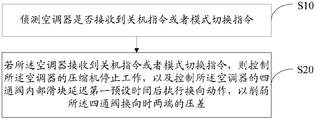
- FIG. 1 is a schematic flow chart of an embodiment of an air conditioner control method according to the present invention.
- FIG. 2 is a schematic diagram of functional modules of an embodiment of an air conditioner control device according to the present invention.
- FIG. 3 is a schematic flow chart of still another embodiment of an air conditioner control method according to the present invention.
- FIG. 4 is a schematic diagram of functional modules of still another embodiment of an air conditioner control device according to the present invention.
- the air conditioner control method of this embodiment includes:
- Step S10 detecting whether the air conditioner receives the shutdown command or the mode switching instruction
- Step S20 if the air conditioner receives the shutdown command or the mode switching instruction, controlling the compressor of the air conditioner to stop working, and controlling the internal slider of the four-way valve of the air conditioner to be delayed after the first preset time
- the reversing action is to weaken the pressure difference between the two ends of the four-way valve when commutating.
- the air conditioner may include an indoor unit and an outdoor unit, and the indoor unit may be provided with an indoor heat exchanger component and an electronic expansion valve; the outdoor unit may be provided with a compressor, a four-way valve, and an outdoor heat exchanger. , low-pressure liquid storage tanks, solenoid valves, capillary tubes, throttling components for outdoor units, and throttling components for outdoor units.
- the compressor, the four-way valve, the indoor heat exchanger component, the outdoor heat exchanger, and the outdoor throttle component are connected by a pipeline to form a refrigeration/heating cycle.
- the mode is switched to a switch between the two modes of the heating mode, the cooling mode, the dehumidification mode, and the air supply mode.
- the air conditioner receives the shutdown command or the mode switching command
- the compressor of the outdoor unit of the air conditioner is stopped.
- the four-way valve of the outdoor unit of the air conditioner receives the command of the reversing action.
- the current moving direction moves in the opposite direction to complete the replacement of the four-way valve. To the action.
- the inner slider of the four-way valve maintains the current operating state, and after the first preset time, the four-way valve is powered off, and the reversing action is performed.
- the first preset time can be set to 5 seconds to 30 seconds, and can also be flexibly set according to specific conditions. Therefore, the four-way valve reversing action is delayed during the operation of the compressor without affecting the normal use of the user, and the pressure difference between the two ends of the four-way valve is reduced, and the sound of the refrigerant impact during the reversing of the slider is also reduced. small.
- the air conditioner does not receive the shutdown command or the mode switching command, the compressor and the four-way valve maintain the current working state.
- the outdoor unit noise value is 55.7 decibels.
- the noise value increases by 10.1 decibels and becomes 65.8 decibels due to the reversal of the four-way valve.
- the noise is very large. Affect the comfort of the user using the air conditioner.
- the four-way valve does not immediately reverse direction when the air conditioner is powered off or the mode is switched. After the delay of 10 seconds, the inner slider of the four-way valve moves from the current moving direction to the opposite direction to complete the reversal of the four-way valve.
- the noise value is only 1.1 decibels, which becomes 11.2 decibels, which reduces the pressure difference across the four-way valve, which weakens the noise value caused by the four-way valve reversing.
- the air conditioner controls the compressor to stop working, and controls the four-way valve to delay the first preset time to perform the reversing action.
- the time for performing the reversing action by delaying the four-way valve weakens the pressure difference between the two ends of the four-way valve during commutation, reduces the noise generated when the four-way valve is reversed, and improves the user's satisfaction.
- the reversing action is performed with respect to detecting the pressure difference between the two ends of the four-way valve, thereby reducing the cost of noise reduction when the four-way valve is reversed.
- a second embodiment of the air conditioner control method of the present invention is proposed.
- the compressor of the air conditioner is an inverter compressor
- the air conditioner receives the shutdown command or the mode switching instruction, acquiring an operating frequency of the inverter compressor of the air conditioner, and controlling the inverter compressor to stop working;
- the four-way valve of the air conditioner is controlled to delay the second preset time to perform a reversing action, and the second preset time is less than the first preset time.
- the compressor of the air conditioner when the compressor of the air conditioner is an inverter compressor, when the air conditioner receives the shutdown command or the mode switching command, the four-way valve of the outdoor unit of the air conditioner receives the command of the reversing action, and simultaneously detects the frequency conversion compression.
- the operating frequency of the machine, the inverter compressor began to stop working.
- the air conditioner judges whether the operating frequency of the inverter compressor is less than the preset operating frequency value, and the preset operating frequency value can be set to 30 Hz, and can also be flexibly set according to specific conditions.
- the four-way valve is delayed by the current moving direction to the opposite direction after the second preset time of the four-way valve is delayed according to the received reversing action command. Move to complete the reversing action of the four-way valve.
- the second preset time is less than the first preset time described above, and the time for the four-way valve to delay the reversing action after the inverter compressor is stopped is shortened.
- the four-way valve is delayed by the current moving direction after the first predetermined time is delayed according to the received reversing action command. The direction of movement completes the reversing action of the four-way valve, and the first preset time coincides with the first preset time mentioned above.
- the compressor of the air conditioner is an inverter compressor
- the time for the four-way valve to delay the execution of the reversing action is controlled according to the operating frequency of the inverter compressor, and the frequency conversion is performed.
- the delay time is shortened. The reliability of the four-way valve delaying the reversing action is improved, and the noise generated when the four-way valve is reversed is reduced.
- the step S20 includes: if the air conditioner receives a shutdown command or a mode switching instruction, Then controlling the compressor of the air conditioner to stop working, triggering the timer to start timing;
- the internal slider of the four-way valve of the air conditioner is controlled to perform a reversing action.
- the air conditioner may include a timer or a preset timing module for collecting the four links.
- the method for obtaining the delay time may include: mode 1, when the air conditioner is in operation, when receiving the shutdown command or the mode switching instruction, the trigger timer starts counting, and the delay time is fed back to the air conditioner after the preset time is reached.
- the terminal In the second mode, the terminal is connected to the air conditioner, and the type of the terminal can be set according to actual needs. For example, when the air conditioner receives the shutdown command or the mode switching command, the communication device transmits a start timing command to the terminal, and the terminal receives the start timing command sent by the air conditioner, and then performs timing.
- the timing is stopped, and the delay time is returned to the air conditioner, so that the air conditioner performs the corresponding operation according to the returned delay time.
- the manner of obtaining the delay time is only an enumeration of the specific implementation manner, and other manners for obtaining the delay time proposed by those skilled in the art are within the protection scope of the present invention.
- the air conditioner when the air conditioner receives the shutdown command or the mode switching instruction, the compressor of the outdoor unit of the air conditioner is stopped.
- the trigger timer starts timing, and when the timer time reaches the first preset time, feedback is performed, and the four-way valve of the outdoor unit of the air conditioner receives the instruction of the reversing action, and the internal slider of the four-way valve is currently
- the moving direction moves in the opposite direction to complete the reversing action of the four-way valve.
- the first preset time is consistent with the preset time mentioned above.
- the air conditioner of the embodiment delays the four-way valve reversing action during the operation of the compressor without affecting the normal use of the user, and reduces the two ends of the inner slider of the four-way valve.
- the pressure difference reduces the noise generated when the four-way valve is reversed, which improves user satisfaction.
- the air conditioner control device of this embodiment includes:
- the detecting module 100 is configured to detect whether the air conditioner receives a shutdown command or a mode switching instruction
- the first control module 200 is configured to: if the air conditioner receives the shutdown command or the mode switching instruction, control the compressor of the air conditioner to stop working, and control the internal slider of the four-way valve of the air conditioner to delay the first The reversing action is performed after the preset time to weaken the pressure difference between the two ends of the four-way valve during commutation.
- the air conditioner may include an indoor unit and an outdoor unit, and the indoor unit may be provided with an indoor heat exchanger component and an electronic expansion valve; the outdoor unit may be provided with a compressor, a four-way valve, and an outdoor heat exchanger. , low-pressure liquid storage tanks, solenoid valves, capillary tubes, throttling components for outdoor units, and throttling components for outdoor units.
- the compressor, the four-way valve, the indoor heat exchanger component, the outdoor heat exchanger, and the outdoor throttle component are connected by a pipeline to form a refrigeration/heating cycle.
- the mode is switched to a switch between the two modes of the heating mode, the cooling mode, the dehumidification mode, and the air supply mode.
- the detecting module 100 detects whether the air conditioner receives the shutdown command or the mode switching command.
- the first control module 200 controls the compressor of the outdoor unit of the air conditioner to stop.
- the four-way valve of the outdoor unit of the air conditioner receives the instruction of the reversing action.
- the first control module 200 controls the internal slider of the four-way valve to be delayed by the first moving time, and then moves from the current moving direction to the opposite direction. Complete the reversing action of the four-way valve.
- the inner slider of the four-way valve maintains the current operating state, and after the first preset time, the four-way valve is powered off, and the reversing action is performed.
- the first preset time can be set to 5 seconds to 30 seconds, and can also be flexibly set according to specific conditions. Therefore, the four-way valve reversing action is delayed during the operation of the compressor without affecting the normal use of the user, and the pressure difference between the two ends of the four-way valve is reduced, and the sound of the refrigerant impact during the reversing of the slider is also reduced. small.
- the air conditioner does not receive the shutdown command or the mode switching command, the compressor and the four-way valve maintain the current working state.
- the outdoor unit noise value is 55.7 decibels.
- the noise value increases by 10.1 decibels and becomes 65.8 decibels due to the reversal of the four-way valve.
- the noise is very large. Affect the comfort of the user using the air conditioner.
- the four-way valve does not immediately reverse direction when the air conditioner is powered off or the mode is switched. After the delay of 10 seconds, the inner slider of the four-way valve moves from the current moving direction to the opposite direction to complete the reversal of the four-way valve.
- the noise value is only 1.1 decibels, which becomes 11.2 decibels, which reduces the pressure difference across the four-way valve, which weakens the noise value caused by the four-way valve reversing.
- the air conditioner controls the compressor to stop working, and controls the four-way valve to delay the first preset time to perform the reversing action.
- the time for performing the reversing action by delaying the four-way valve weakens the pressure difference between the two ends of the four-way valve during commutation, reduces the noise generated when the four-way valve is reversed, and improves the user's satisfaction.
- the reversing action is performed with respect to detecting the pressure difference between the two ends of the four-way valve, thereby reducing the cost of noise reduction when the four-way valve is reversed.
- the air conditioner control device when the compressor of the air conditioner is an inverter compressor, the air conditioner control device also includes:
- a second control module configured to: if the air conditioner receives a shutdown command or a mode switching instruction, acquire an operating frequency of the inverter compressor of the air conditioner, and control the inverter compressor to stop working; when the frequency conversion compression
- the internal slider of the four-way valve of the air conditioner is controlled to delay the second preset time to perform a reversing action, and the second preset time is less than the first preset time.
- the compressor of the air conditioner when the compressor of the air conditioner is an inverter compressor, when the air conditioner receives the shutdown command or the mode switching command, the four-way valve of the outdoor unit of the air conditioner receives the command of the reversing action, and the second control The module detects the operating frequency of the inverter compressor and the inverter compressor starts to stop working. At this time, the second control module determines whether the operating frequency of the inverter compressor is less than a preset operating frequency value, and the preset operating frequency value can be set to 30 Hz, and can also be flexibly set according to specific conditions.
- the second control module controls the four-way valve according to the received reversing action command, and the four-way valve internal slider is delayed by the second predetermined time after the current movement
- the direction moves in the opposite direction to complete the reversing action of the four-way valve.
- the second preset time is less than the first preset time described above, and the time for the four-way valve to delay the reversing action after the inverter compressor is stopped is shortened. If the operating frequency of the inverter compressor is greater than or equal to the preset operating frequency value, the four-way valve is delayed by the current moving direction after the first predetermined time is delayed according to the received reversing action command. The direction of movement completes the reversing action of the four-way valve, and the first preset time coincides with the first preset time mentioned above.
- the compressor of the air conditioner is an inverter compressor
- the time for the four-way valve to delay the execution of the reversing action is controlled according to the operating frequency of the inverter compressor, and the frequency conversion is performed.
- the delay time is shortened. The reliability of the four-way valve delaying the reversing action is improved, and the noise generated when the four-way valve is reversed is reduced.
- the first control module 200 includes:
- a timing unit configured to: if the air conditioner receives a shutdown command or a mode switching instruction, control a compressor of the air conditioner to stop working, and trigger a timer to start timing;
- a control unit configured to control a four-way valve internal slider of the air conditioner to perform a reversing action after the chronograph time of the timer reaches a first preset time.
- the air conditioner may include a timer or a preset timing module for collecting the time when the four-way valve delays performing the reversing action.
- the method for obtaining the delay time may include: mode 1, when the air conditioner is in operation, when receiving the shutdown command or the mode switching instruction, the trigger timer starts counting, and the delay time is fed back to the air conditioner after the preset time is reached.
- the terminal In the second mode, the terminal is connected to the air conditioner, and the type of the terminal can be set according to actual needs. For example, when the air conditioner receives the shutdown command or the mode switching command, the communication device transmits a start timing command to the terminal, and the terminal receives the start timing command sent by the air conditioner, and then performs timing.
- the timing is stopped, and the delay time is returned to the air conditioner, so that the air conditioner performs the corresponding operation according to the returned delay time.
- the manner of obtaining the delay time is only an enumeration of the specific implementation manner, and other manners for obtaining the delay time proposed by those skilled in the art are within the protection scope of the present invention.
- the air conditioner when the air conditioner receives the shutdown command or the mode switching instruction, the compressor of the outdoor unit of the air conditioner is stopped.
- the timing unit triggers the timer to start timing, and when the timing of the timer reaches the first preset time, feedback is performed, and the four-way valve of the outdoor unit of the air conditioner receives the instruction of the reversing action, and the control unit controls the four-way valve at this time.
- the inner slider moves in the opposite direction from the current moving direction to complete the reversing action of the four-way valve.
- the first preset time is consistent with the preset time mentioned above.
- the air conditioner of the embodiment delays the four-way valve reversing action during the operation of the compressor without affecting the normal use of the user, and reduces the two ends of the inner slider of the four-way valve.
- the pressure difference reduces the noise generated when the four-way valve is reversed, which improves user satisfaction.
- the air conditioner control method of this embodiment includes:
- Step S310 detecting whether the four-way valve of the air conditioner receives the reversing command
- Step S320 if the four-way valve of the air conditioner receives the reversing command, detecting the operating frequency of the compressor of the air conditioner;
- the air conditioner may include an indoor unit and an outdoor unit, and the indoor unit may be provided with an indoor heat exchanger component and an electronic expansion valve; the outdoor unit may be provided with a compressor, a four-way valve, and an outdoor heat exchanger. , low-pressure liquid storage tanks, solenoid valves, capillary tubes, throttling components for outdoor units, and throttling components for outdoor units.
- the compressor, the four-way valve, the indoor heat exchanger component, the outdoor heat exchanger, and the outdoor throttle component are connected by a pipeline to form a refrigeration/heating cycle.
- the air conditioner monitors whether the four-way valve receives the reversing command, for example, when the air conditioner performs switching between the heating mode, the cooling mode, the dehumidification mode, the air supply mode, or the like, or when the shutdown is performed, The four-way valve will receive the commutation command.
- the air conditioner can also detect whether the four-way valve receives the power-off command or the power-on command.
- the four-way valve When the four-way valve receives the power-off command or the power-on command, the four-way valve receives the commutation command, that is, the switch
- the instruction includes a power down command and a power up command.
- the air conditioner maintains the current operating state.
- Step S330 adjusting an operating frequency of the compressor according to a magnitude relationship between an operating frequency of the compressor and a preset frequency
- the operating frequency of the compressor is compared with a preset frequency, and it is determined that the operating frequency of the compressor is greater than the preset frequency.
- the operating frequency of the compressor is lowered by a preset value, which may be set according to the operating frequency of the compressor.
- the preset time is delayed, and after the running frequency of the compressor is stabilized, the reversing action of the four-way valve is performed.
- the preset time can be set to 5 seconds or set according to the actual situation.
- the amplitude of the operating frequency of the compressor is adjusted to be zero, that is, the compressor maintains the current operating frequency.
- the preset frequency can be set from 30 Hz to 40 Hz, and can also be flexibly set according to specific conditions.
- Step S340 controlling the internal slider of the four-way valve to perform a reversing action to weaken the pressure difference between the two ends of the four-way valve during commutation.
- the four-way valve can be controlled to perform the reversing action.
- the inner slider of the four-way valve moves in the opposite direction from the current moving direction to complete the reversing action of the four-way valve. That is, when the four-way valve receives the reversing command, it simultaneously detects the operating frequency of the compressor, and performs the four-way valve reversing action after adjusting according to the detected operating frequency. Therefore, when the compressor is running, when the operating frequency is higher than the preset frequency, the running frequency is lowered, and the inside of the four-way valve is not affected. The pressure difference across the slider is reduced, and the sound of the refrigerant impact is reduced when the slider is reversed.
- the operating frequency of the compressor is lowered, which helps to reduce the noise generated by the outdoor unit and improves the comfort of the user using the air conditioner. Therefore, assuming that the preset frequency is set to 30 Hz, during the operation of the air conditioner, when the four-way valve receives the commutation command, it detects that the operating frequency of the compressor is 80 Hz, which is greater than the preset frequency. The operating frequency of the compressor is reduced to 30 Hz, and then the internal slider of the four-way valve is controlled to move from the current moving direction to the opposite direction to complete the reversing action of the four-way valve, thereby weakening the pressure difference between the two ends of the four-way valve during reversing. Reduced noise.
- the four-way valve of the air conditioner of the embodiment of the invention adjusts the operating frequency of the compressor according to the magnitude relationship between the operating frequency of the compressor and the preset frequency, when the operating frequency is greater than the preset frequency , reduce the operating frequency of the compressor, and then control the four-way valve to perform the reversing action.
- the operating frequency of the compressor it is determined whether it is necessary to first reduce the operating frequency of the compressor and then perform the four-way valve reversing action, thereby weakening the pressure difference between the two ends of the four-way valve during commutation, and reducing the occurrence of the four-way valve reversing. Noise, while reducing the cost of noise reduction when the four-way valve is reversed.
- the step S330 includes: when the operating frequency of the compressor is greater than the preset frequency, lowering the operating frequency of the compressor Up to the preset frequency; controlling the compressor to maintain a current operating frequency when an operating frequency of the compressor is less than or equal to the predetermined frequency.
- the running frequency of the compressor is compared with the preset frequency, and the magnitude relationship between the operating frequency of the compressor and the preset frequency is determined.
- the preset frequency can be set from 30 Hz to 40 Hz, and can also be flexibly set according to specific conditions. When the operating frequency of the compressor is greater than the preset frequency, it indicates that the current operating frequency of the compressor is relatively high, and the pressure difference between the two ends of the four-way valve is large.
- the operating frequency of the compressor is reduced to the preset frequency, so that the four-way The pressure difference between the two ends of the inner slider of the valve is reduced, and the sound of the refrigerant impact when the slider is reversed is weakened, thereby achieving the purpose of reducing noise.
- the compressor can also be used when the operating frequency of the compressor is greater than the preset frequency.
- the running frequency is lowered by a preset value, which can be flexibly set according to the specific situation.
- the set time may be delayed first, and after the compressor is stably operated according to the adjusted operating frequency, the reversing action of the four-way valve is performed.
- the set time can be set to 5 seconds, or the greater the setting of the lowering of the operating frequency, the longer the setting time, of course, can also be set according to the actual situation.
- the operating frequency of the compressor When the operating frequency of the compressor is less than or equal to the preset frequency, it indicates that the operating frequency of the compressor is low, and the pressure difference between the two ends of the four-way valve is also low. At this time, it is not necessary to adjust the operating frequency of the compressor. That is, the compressor maintains the current operating frequency, and the sound of the refrigerant impact is weaker when the slider is reversed, and the generated noise is low. Therefore, at this time, the amplitude of the operating frequency of the compressor is adjusted to zero, and the reversing action of the four-way valve is performed.
- the commutation action of the four-way valve is performed to the preset frequency, so that the four-way valve is executed when the operating frequency of the compressor is not greater than the preset frequency.
- the action reduces the pressure difference across the inner slider of the four-way valve, reduces the noise generated when the four-way valve is reversed, and improves user satisfaction.
- the operating frequency of the compressor is less than or equal to the preset frequency, the operating frequency of the compressor is adjusted to a zero amplitude, which not only reduces the noise generated when the four-way valve is reversed, but also increases the delay of the four-way valve to perform the reversing action. reliability.
- the step S340 includes: controlling the internal slider of the four-way valve to delay the preset time, and then performing the reversing action.
- the internal slider of the four-way valve is controlled to delay the preset time, and then the reversing action is performed.
- the preset time may be flexibly set according to a specific situation.
- the preset time may be set to a first preset time and a second preset time according to a relationship between a running frequency of the compressor and a preset frequency. The first preset time is greater than the second preset time.
- the operating frequency of the compressor is reduced to a preset frequency, and the preset frequency is consistent with the preset frequency.
- the current moving direction moves in the opposite direction to complete the reversing action of the four-way valve. If the speed of the compressor is less than or equal to the preset frequency, the compressor maintains the current operating frequency, and at the same time, after controlling the internal slider of the four-way valve to delay for a second predetermined time, the current moving direction moves in the opposite direction to complete The reversing action of the four-way valve.
- the specific values of the first preset time and the second preset time may be set according to actual conditions.
- the time for the four-way valve to delay the reversing action is further achieved, thereby further reducing the pressure difference between the two ends of the reversing valve slider and reducing the commutation noise value.
- the time for the four-way valve to delay the execution of the reversing action is controlled, and when the rotational speed of the compressor is less than or equal to the preset rotational frequency value, the delay time is shortened.
- the reliability of the four-way valve delaying the reversing action is improved, the noise generated when the four-way valve is reversed is reduced, the comfort of the user using the air conditioner is improved, and the cost of noise reduction when the four-way valve is reversed is reduced.
- the air conditioner control device of this embodiment includes:
- the detecting module 410 is configured to detect whether the four-way valve of the air conditioner receives the reversing command
- the detecting module 420 is configured to detect an operating frequency of the compressor of the air conditioner if the four-way valve of the air conditioner receives a reversing command;
- the air conditioner may include an indoor unit and an outdoor unit, and the indoor unit may be provided with an indoor heat exchanger component and an electronic expansion valve; the outdoor unit may be provided with a compressor, a four-way valve, and an outdoor heat exchanger. , low-pressure liquid storage tanks, solenoid valves, capillary tubes, throttling components for outdoor units, and throttling components for outdoor units.
- the compressor, the four-way valve, the indoor heat exchanger component, the outdoor heat exchanger, and the outdoor throttle component are connected by a pipeline to form a refrigeration/heating cycle.
- the air conditioner call detection module 410 monitors whether the four-way valve receives the commutation command, for example, the air conditioner performs switching between the heating mode, the cooling mode, the dehumidification mode, and the air supply mode. Or when the shutdown is performed, the four-way valve will receive the reversing command.
- the detecting module 420 detects the operating frequency of the compressor of the air conditioner, so as to determine whether it is necessary to first reduce the operating frequency of the compressor and then perform the four-way valve changing according to the operating frequency of the compressor. To the action.
- the air conditioner can also detect whether the four-way valve receives the power-off command or the power-on command.
- the four-way valve When the four-way valve receives the power-off command or the power-on command, the four-way valve receives the commutation command, that is, the switch
- the instruction includes a power down command and a power up command.
- the air conditioner maintains the current operating state.
- the adjusting module 430 is configured to adjust an operating frequency of the compressor according to a magnitude relationship between an operating frequency of the compressor and a preset frequency;
- the adjusting module 430 compares the operating frequency of the compressor with the preset frequency, and determines that the operating frequency of the compressor is greater than the preset frequency.
- the adjustment module 430 lowers the operating frequency of the compressor by a preset value, which may be set according to the operating frequency of the compressor.
- the preset time is delayed, and after the running frequency of the compressor is stabilized, the reversing action of the four-way valve is performed.
- the preset time can be set to 5 seconds or set according to the actual situation.
- the adjustment module 430 adjusts the operating frequency of the compressor to a zero amplitude, that is, the compressor maintains the current operating frequency.
- the preset frequency can be set from 30 Hz to 40 Hz, and can also be flexibly set according to specific conditions.
- the control module 440 is configured to control the internal slider of the four-way valve to perform a reversing action to weaken a pressure difference between the two ends of the four-way valve during commutation.
- the control module 440 can control the four-way valve to perform the reversing action. Specifically, the inner slider of the four-way valve moves in the opposite direction from the current moving direction to complete the reversing action of the four-way valve. That is, when the four-way valve receives the reversing command, it simultaneously detects the operating frequency of the compressor, and performs the four-way valve reversing action after adjusting according to the detected operating frequency.
- the operating frequency of the compressor is lowered, which helps to reduce the noise generated by the outdoor unit and improves the comfort of the user using the air conditioner. Therefore, assuming that the preset frequency is set to 30 Hz, during the operation of the air conditioner, when the four-way valve receives the commutation command, it detects that the operating frequency of the compressor is 80 Hz, which is greater than the preset frequency. The operating frequency of the compressor is reduced to 30 Hz, and then the internal slider of the four-way valve is controlled to move from the current moving direction to the opposite direction to complete the reversing action of the four-way valve, thereby weakening the pressure difference between the two ends of the four-way valve during reversing. Reduced noise.
- the four-way valve of the air conditioner of the embodiment of the invention adjusts the operating frequency of the compressor according to the magnitude relationship between the operating frequency of the compressor and the preset frequency, when the operating frequency When it is greater than the preset frequency, the operating frequency of the compressor is lowered, and then the four-way valve is controlled to perform the reversing action.
- the operating frequency of the compressor By detecting the operating frequency of the compressor, it is determined whether it is necessary to first reduce the operating frequency of the compressor and then perform the four-way valve reversing action, thereby weakening the pressure difference between the two ends of the four-way valve during commutation, and reducing the occurrence of the four-way valve reversing. Noise, while reducing the cost of noise reduction when the four-way valve is reversed.
- the adjustment module 430 is further configured to: when the operating frequency of the compressor is greater than the preset frequency, The operating frequency is reduced to the preset frequency; when the operating frequency of the compressor is less than or equal to the predetermined frequency, the compressor is controlled to maintain a current operating frequency.
- the adjusting module 430 compares the operating frequency of the compressor with the preset frequency, and determines the magnitude relationship between the operating frequency of the compressor and the preset frequency.
- the preset frequency can be set from 30 Hz to 40 Hz, and can also be flexibly set according to specific conditions. When the operating frequency of the compressor is greater than the preset frequency, it indicates that the current operating frequency of the compressor is relatively high, and the pressure difference between the two ends of the four-way valve is large. At this time, the adjusting module 430 reduces the operating frequency of the compressor to the preset frequency.
- the pressure difference between the two ends of the inner slider of the four-way valve is reduced, and the sound of the refrigerant impact when the slider is reversed is weakened, thereby achieving the purpose of reducing noise.
- the operating frequency of the compressor when the operating frequency of the compressor is greater than the preset frequency, the operating frequency of the compressor can also be lowered by a preset value, which can be flexibly set according to specific conditions.
- the set time after the operating frequency of the compressor is lowered, the set time may be delayed first, and after the compressor is stably operated according to the adjusted operating frequency, the reversing action of the four-way valve is performed.
- the set time can be set to 5 seconds, or the greater the setting of the lowering of the operating frequency, the longer the setting time, of course, can also be set according to the actual situation.
- the regulating module 430 does not need to operate the compressor.
- the frequency is adjusted, that is, the compressor maintains the current operating frequency, and the sound of the refrigerant impact is weaker when the slider is reversed, and the generated noise is low. Therefore, at this time, the amplitude of the operating frequency of the compressor is adjusted to zero, and the reversing action of the four-way valve is performed.
- the commutation action of the four-way valve is performed to the preset frequency, so that the four-way valve is executed when the operating frequency of the compressor is not greater than the preset frequency.
- the action reduces the pressure difference across the inner slider of the four-way valve, reduces the noise generated when the four-way valve is reversed, and improves user satisfaction.
- the operating frequency of the compressor is less than or equal to the preset frequency, the operating frequency of the compressor is adjusted to a zero amplitude, which not only reduces the commutation of the four-way valve The noise generated, and the reliability of the four-way valve delaying the reversing action is improved.
- control module 440 is further configured to perform a reversing action after the internal slider of the four-way valve is delayed for a preset time.
- the control module 440 controls the internal slider of the four-way valve to delay the preset time and then performs the reversing action.
- the preset time may be flexibly set according to a specific situation.
- the preset time may be set to a first preset time and a second preset time according to a relationship between a running frequency of the compressor and a preset frequency. The first preset time is greater than the second preset time.
- the control module 440 controls the internal slider of the four-way valve to delay the first predetermined time, and then moves from the current moving direction to the opposite direction to complete the reversing action of the four-way valve. If the rotational speed of the compressor is less than or equal to the preset frequency, the compressor maintains the current operating frequency, and at the same time, the control module 440 controls the internal slider of the four-way valve to delay the second predetermined time, and then moves from the current moving direction to the opposite direction.
- the specific values of the first preset time and the second preset time may be set according to actual conditions, and the time for delaying the reversing action of the four-way valve is realized, thereby further weakening the pressure difference between the two ends of the reversing valve slider and reducing the commutation The purpose of the noise value.
- the time for the four-way valve to delay the execution of the reversing action is controlled, and when the rotational speed of the compressor is less than or equal to the preset rotational frequency value, the delay time is shortened.
- the reliability of the four-way valve delaying the reversing action is improved, the noise generated when the four-way valve is reversed is reduced, the comfort of the user using the air conditioner is improved, and the cost of noise reduction when the four-way valve is reversed is reduced.
Landscapes
- Engineering & Computer Science (AREA)
- Mechanical Engineering (AREA)
- General Engineering & Computer Science (AREA)
- Chemical & Material Sciences (AREA)
- Combustion & Propulsion (AREA)
- Physics & Mathematics (AREA)
- Thermal Sciences (AREA)
- Air Conditioning Control Device (AREA)
Abstract
Description
Claims (16)
- 一种空调器控制方法,其特征在于,所述空调器控制方法包括以下步骤:侦测空调器是否接收到关机指令或者模式切换指令;若所述空调器接收到关机指令或者模式切换指令,则控制所述空调器的压缩机停止工作,以及控制所述空调器的四通阀内部滑块延迟第一预设时间后执行换向动作,以削弱所述四通阀换向时两端的压差。
- 如权利要求1所述的空调器控制方法,其特征在于,当所述空调器的压缩机为变频压缩机时,所述侦测空调器是否接收到关机指令或者模式切换指令之后包括:若所述空调器接收到关机指令或者模式切换指令,则获取所述空调器的变频压缩机的运行频率,并控制所述变频压缩机停止工作;当所述变频压缩机的运行频率小于预设运行频率值时,控制所述空调器的四通阀内部滑块延迟第二预设时间后执行换向动作,所述第二预设时间小于第一预设时间。
- 如权利要求1或2所述的空调器控制方法,其特征在于,所述第一预设时间为5秒~30秒。
- 如权利要求3所述的空调器控制方法,其特征在于,若所述空调器接收到关机指令或者模式切换指令,则控制所述空调器的压缩机停止工作,以及控制所述空调器的四通阀内部滑块延迟第一预设时间后执行换向动作包括:若所述空调器接收到关机指令或者模式切换指令,则控制所述空调器的压缩机停止工作,触发计时器开始计时;当所述计时器的计时时间达到第一预设时间后,控制所述空调器的四通阀内部滑块执行换向动作。
- 一种空调器控制装置,其特征在于,所述空调器控制装置包括:侦测模块,用于侦测空调器是否接收到关机指令或者模式切换指令;第一控制模块,用于若所述空调器接收到关机指令或者模式切换指令,则控制所述空调器的压缩机停止工作,以及控制所述空调器的四通阀内部滑块延迟第一预设时间后执行换向动作,以削弱所述四通阀换向时两端的压差。
- 如权利要求5所述的空调器控制装置,其特征在于,当所述空调器的压缩机为变频压缩机时,所述空调器控制装置还包括:第二控制模块,用于若所述空调器接收到关机指令或者模式切换指令,则获取所述空调器的变频压缩机的运行频率,并控制所述变频压缩机停止工作;当所述变频压缩机的运行频率小于预设运行频率值时,控制所述空调器的四通阀内部滑块延迟第二预设时间后执行换向动作,所述第二预设时间小于第一预设时间。
- 如权利要求5或6所述的空调器控制装置,其特征在于,所述第一预设时间为5秒~30秒。
- 如权利要求7所述的空调器控制装置,其特征在于,所述第一控制模块包括:计时单元,用于若所述空调器接收到关机指令或者模式切换指令,则控制所述空调器的压缩机停止工作,触发计时器开始计时;控制单元,用于当所述计时器的计时时间达到第一预设时间后,控制所述空调器的四通阀内部滑块执行换向动作。
- 一种空调器控制方法,其特征在于,所述空调器控制方法包括以下步骤:侦测空调器的四通阀是否接收到换向指令;若所述空调器的四通阀接收到换向指令,则检测所述空调器的压缩机的运行频率;根据所述压缩机的运行频率与预设频率之间的大小关系,对所述压缩机 的运行频率进行调节;控制所述四通阀内部滑块执行换向动作,以削弱所述四通阀换向时两端的压差。
- 如权利要求9所述的空调器控制方法,其特征在于,所述根据所述压缩机的运行频率与预设频率之间的大小关系,对所述压缩机的运行频率进行调节包括:当所述压缩机的运行频率大于所述预设频率时,将所述压缩机的运行频率降低至所述预设频率;当所述压缩机的运行频率小于或等于所述预设频率时,控制所述压缩机维持当前的运行频率。
- 如权利要求9或10所述的空调器控制方法,其特征在于,所述预设频率为30Hz~40Hz。
- 如权利要求9或10所述的空调器控制方法,其特征在于,所述控制所述四通阀内部滑块执行换向动作包括:控制所述四通阀内部滑块延迟预设时间后,执行换向动作。
- 一种空调器控制装置,其特征在于,所述空调器控制装置包括:侦测模块,用于侦测空调器的四通阀是否接收到换向指令;检测模块,用于若所述空调器的四通阀接收到换向指令,则检测所述空调器的压缩机的运行频率;调节模块,用于根据所述压缩机的运行频率与预设频率之间的大小关系,对所述压缩机的运行频率进行调节;控制模块,用于控制所述四通阀内部滑块执行换向动作,以削弱所述四通阀换向时两端的压差。
- 如权利要求13所述的空调器控制装置,其特征在于,所述调节模块还用于,当所述压缩机的运行频率大于所述预设频率时,将所述压缩机的运 行频率降低至所述预设频率;当所述压缩机的运行频率小于或等于所述预设频率时,控制所述压缩机维持当前的运行频率。
- 如权利要求13或14所述的空调器控制装置,其特征在于,所述预设频率为30Hz~40Hz。
- 如权利要求13或14所述的空调器控制装置,其特征在于,所述控制模块还用于,控制所述四通阀内部滑块延迟预设时间后,执行换向动作。
Applications Claiming Priority (4)
| Application Number | Priority Date | Filing Date | Title |
|---|---|---|---|
| CN201610297539.7A CN105972850B (zh) | 2016-05-05 | 2016-05-05 | 空调器控制方法及装置 |
| CN201610297539.7 | 2016-05-05 | ||
| CN201610297538.2A CN105805977A (zh) | 2016-05-05 | 2016-05-05 | 空调器控制方法及装置 |
| CN201610297538.2 | 2016-05-05 |
Publications (1)
| Publication Number | Publication Date |
|---|---|
| WO2017190613A1 true WO2017190613A1 (zh) | 2017-11-09 |
Family
ID=60202734
Family Applications (1)
| Application Number | Title | Priority Date | Filing Date |
|---|---|---|---|
| PCT/CN2017/081934 Ceased WO2017190613A1 (zh) | 2016-05-05 | 2017-04-25 | 空调器控制方法及装置 |
Country Status (1)
| Country | Link |
|---|---|
| WO (1) | WO2017190613A1 (zh) |
Cited By (4)
| Publication number | Priority date | Publication date | Assignee | Title |
|---|---|---|---|---|
| CN112728849A (zh) * | 2021-02-01 | 2021-04-30 | 珠海格力电器股份有限公司 | 一种冷冻冷藏装置及其控制方法和控制装置 |
| CN114383287A (zh) * | 2021-12-21 | 2022-04-22 | 青岛海尔空调器有限总公司 | 空调控制方法、空调、电子设备及存储介质 |
| CN115095952A (zh) * | 2022-06-30 | 2022-09-23 | 北京小米移动软件有限公司 | 空调器的停机控制方法及装置 |
| CN115479390A (zh) * | 2022-10-12 | 2022-12-16 | 广东美的制冷设备有限公司 | 空调器及其静音控制方法和计算机可读存储介质 |
Citations (7)
| Publication number | Priority date | Publication date | Assignee | Title |
|---|---|---|---|---|
| JPH10253205A (ja) * | 1997-03-12 | 1998-09-25 | Matsushita Electric Ind Co Ltd | 冷凍サイクル制御装置 |
| KR20080001308A (ko) * | 2006-06-29 | 2008-01-03 | 주식회사 대우일렉트로닉스 | 히트펌프 공기조화기의 제상운전 방법 |
| CN103968494A (zh) * | 2013-01-25 | 2014-08-06 | 珠海格力电器股份有限公司 | 空调系统的控制方法及空调系统 |
| CN104930637A (zh) * | 2014-03-18 | 2015-09-23 | 珠海格力电器股份有限公司 | 四通阀换向控制方法、装置及空调系统 |
| CN105066540A (zh) * | 2015-07-20 | 2015-11-18 | 广东美的暖通设备有限公司 | 变频空调启动控制方法、控制系统及其空调器 |
| CN105805977A (zh) * | 2016-05-05 | 2016-07-27 | 广东美的制冷设备有限公司 | 空调器控制方法及装置 |
| CN105972850A (zh) * | 2016-05-05 | 2016-09-28 | 广东美的制冷设备有限公司 | 空调器控制方法及装置 |
-
2017
- 2017-04-25 WO PCT/CN2017/081934 patent/WO2017190613A1/zh not_active Ceased
Patent Citations (7)
| Publication number | Priority date | Publication date | Assignee | Title |
|---|---|---|---|---|
| JPH10253205A (ja) * | 1997-03-12 | 1998-09-25 | Matsushita Electric Ind Co Ltd | 冷凍サイクル制御装置 |
| KR20080001308A (ko) * | 2006-06-29 | 2008-01-03 | 주식회사 대우일렉트로닉스 | 히트펌프 공기조화기의 제상운전 방법 |
| CN103968494A (zh) * | 2013-01-25 | 2014-08-06 | 珠海格力电器股份有限公司 | 空调系统的控制方法及空调系统 |
| CN104930637A (zh) * | 2014-03-18 | 2015-09-23 | 珠海格力电器股份有限公司 | 四通阀换向控制方法、装置及空调系统 |
| CN105066540A (zh) * | 2015-07-20 | 2015-11-18 | 广东美的暖通设备有限公司 | 变频空调启动控制方法、控制系统及其空调器 |
| CN105805977A (zh) * | 2016-05-05 | 2016-07-27 | 广东美的制冷设备有限公司 | 空调器控制方法及装置 |
| CN105972850A (zh) * | 2016-05-05 | 2016-09-28 | 广东美的制冷设备有限公司 | 空调器控制方法及装置 |
Cited By (5)
| Publication number | Priority date | Publication date | Assignee | Title |
|---|---|---|---|---|
| CN112728849A (zh) * | 2021-02-01 | 2021-04-30 | 珠海格力电器股份有限公司 | 一种冷冻冷藏装置及其控制方法和控制装置 |
| CN112728849B (zh) * | 2021-02-01 | 2024-08-09 | 珠海格力电器股份有限公司 | 一种冷冻冷藏装置及其控制方法和控制装置 |
| CN114383287A (zh) * | 2021-12-21 | 2022-04-22 | 青岛海尔空调器有限总公司 | 空调控制方法、空调、电子设备及存储介质 |
| CN115095952A (zh) * | 2022-06-30 | 2022-09-23 | 北京小米移动软件有限公司 | 空调器的停机控制方法及装置 |
| CN115479390A (zh) * | 2022-10-12 | 2022-12-16 | 广东美的制冷设备有限公司 | 空调器及其静音控制方法和计算机可读存储介质 |
Similar Documents
| Publication | Publication Date | Title |
|---|---|---|
| CN105805977A (zh) | 空调器控制方法及装置 | |
| CN104101054B (zh) | 多联机空调器的控制方法和控制系统 | |
| WO2017190613A1 (zh) | 空调器控制方法及装置 | |
| WO2018068531A1 (zh) | 一种空调器的停机控制方法、控制装置以及空调器 | |
| EP4592604A1 (en) | Air conditioning system, and control method therefor | |
| JP5522134B2 (ja) | 空気調和機 | |
| CN106091271B (zh) | 空调器异音消除方法及装置 | |
| JP2018071886A (ja) | 空調機 | |
| CN107131617B (zh) | 空调器的控制方法、装置及计算机可读存储介质 | |
| CN105972850B (zh) | 空调器控制方法及装置 | |
| CN112484239A (zh) | 空调除霜方法以及空调器 | |
| CN105444327B (zh) | 一种空调运行控制方法 | |
| CN107152767A (zh) | 空调器的控制方法、装置及计算机可读存储介质 | |
| CN105091231A (zh) | 一种空调器及其从制冷模式向恒温除湿模式的切换方法 | |
| CN106152414B (zh) | 一拖二空调器控制方法及装置 | |
| EP3647680A1 (en) | Method and device for controlling expansion valve | |
| CN108278723A (zh) | 空调的控制方法 | |
| CN106288207A (zh) | 移动空调送风温度的控制方法及装置 | |
| CN106369740A (zh) | 空调蒸发器自清洁的控制方法及装置 | |
| CN106839332A (zh) | 联动控制方法、联动控制装置和多联式空调器 | |
| CN112178887A (zh) | 一种四通阀切换控制方法及装置 | |
| WO2020073488A1 (zh) | 一种控制压缩机切缸的方法、装置及机组、空调系统 | |
| CN111609520A (zh) | 变频空调的控制方法 | |
| US20080245084A1 (en) | Apparatus and method for controlling stop operation of air conditioner | |
| CN113028576B (zh) | 一种空调器控制方法、控制装置以及空调器 |
Legal Events
| Date | Code | Title | Description |
|---|---|---|---|
| NENP | Non-entry into the national phase |
Ref country code: DE |
|
| 121 | Ep: the epo has been informed by wipo that ep was designated in this application |
Ref document number: 17792439 Country of ref document: EP Kind code of ref document: A1 |
|
| 122 | Ep: pct application non-entry in european phase |
Ref document number: 17792439 Country of ref document: EP Kind code of ref document: A1 |
|
| 32PN | Ep: public notification in the ep bulletin as address of the adressee cannot be established |
Free format text: NOTING OF LOSS OF RIGHTS PURSUANT TO RULE 112(1) EPC (EPO FORM 1205A DATED 20/05/2019) |
|
| 122 | Ep: pct application non-entry in european phase |
Ref document number: 17792439 Country of ref document: EP Kind code of ref document: A1 |