WO2017189958A1 - Phenylquinoline compositions for treatment of ocular disorders and conditions - Google Patents
Phenylquinoline compositions for treatment of ocular disorders and conditions Download PDFInfo
- Publication number
- WO2017189958A1 WO2017189958A1 PCT/US2017/030053 US2017030053W WO2017189958A1 WO 2017189958 A1 WO2017189958 A1 WO 2017189958A1 US 2017030053 W US2017030053 W US 2017030053W WO 2017189958 A1 WO2017189958 A1 WO 2017189958A1
- Authority
- WO
- WIPO (PCT)
- Prior art keywords
- rio
- compound
- substituted
- carboxylic acid
- unsubstituted
- Prior art date
- Legal status (The legal status is an assumption and is not a legal conclusion. Google has not performed a legal analysis and makes no representation as to the accuracy of the status listed.)
- Ceased
Links
Classifications
-
- A—HUMAN NECESSITIES
- A61—MEDICAL OR VETERINARY SCIENCE; HYGIENE
- A61K—PREPARATIONS FOR MEDICAL, DENTAL OR TOILETRY PURPOSES
- A61K31/00—Medicinal preparations containing organic active ingredients
- A61K31/33—Heterocyclic compounds
- A61K31/395—Heterocyclic compounds having nitrogen as a ring hetero atom, e.g. guanethidine or rifamycins
- A61K31/435—Heterocyclic compounds having nitrogen as a ring hetero atom, e.g. guanethidine or rifamycins having six-membered rings with one nitrogen as the only ring hetero atom
- A61K31/47—Quinolines; Isoquinolines
-
- A—HUMAN NECESSITIES
- A61—MEDICAL OR VETERINARY SCIENCE; HYGIENE
- A61K—PREPARATIONS FOR MEDICAL, DENTAL OR TOILETRY PURPOSES
- A61K31/00—Medicinal preparations containing organic active ingredients
- A61K31/33—Heterocyclic compounds
- A61K31/395—Heterocyclic compounds having nitrogen as a ring hetero atom, e.g. guanethidine or rifamycins
- A61K31/435—Heterocyclic compounds having nitrogen as a ring hetero atom, e.g. guanethidine or rifamycins having six-membered rings with one nitrogen as the only ring hetero atom
- A61K31/47—Quinolines; Isoquinolines
- A61K31/4709—Non-condensed quinolines and containing further heterocyclic rings
-
- A—HUMAN NECESSITIES
- A61—MEDICAL OR VETERINARY SCIENCE; HYGIENE
- A61K—PREPARATIONS FOR MEDICAL, DENTAL OR TOILETRY PURPOSES
- A61K9/00—Medicinal preparations characterised by special physical form
- A61K9/0012—Galenical forms characterised by the site of application
- A61K9/0048—Eye, e.g. artificial tears
-
- A—HUMAN NECESSITIES
- A61—MEDICAL OR VETERINARY SCIENCE; HYGIENE
- A61P—SPECIFIC THERAPEUTIC ACTIVITY OF CHEMICAL COMPOUNDS OR MEDICINAL PREPARATIONS
- A61P27/00—Drugs for disorders of the senses
- A61P27/02—Ophthalmic agents
-
- C—CHEMISTRY; METALLURGY
- C07—ORGANIC CHEMISTRY
- C07D—HETEROCYCLIC COMPOUNDS
- C07D215/00—Heterocyclic compounds containing quinoline or hydrogenated quinoline ring systems
- C07D215/02—Heterocyclic compounds containing quinoline or hydrogenated quinoline ring systems having no bond between the ring nitrogen atom and a non-ring member or having only hydrogen atoms or carbon atoms directly attached to the ring nitrogen atom
- C07D215/16—Heterocyclic compounds containing quinoline or hydrogenated quinoline ring systems having no bond between the ring nitrogen atom and a non-ring member or having only hydrogen atoms or carbon atoms directly attached to the ring nitrogen atom with hetero atoms or with carbon atoms having three bonds to hetero atoms with at the most one bond to halogen, e.g. ester or nitrile radicals, directly attached to ring carbon atoms
- C07D215/48—Carbon atoms having three bonds to hetero atoms with at the most one bond to halogen
-
- C—CHEMISTRY; METALLURGY
- C07—ORGANIC CHEMISTRY
- C07D—HETEROCYCLIC COMPOUNDS
- C07D215/00—Heterocyclic compounds containing quinoline or hydrogenated quinoline ring systems
- C07D215/02—Heterocyclic compounds containing quinoline or hydrogenated quinoline ring systems having no bond between the ring nitrogen atom and a non-ring member or having only hydrogen atoms or carbon atoms directly attached to the ring nitrogen atom
- C07D215/16—Heterocyclic compounds containing quinoline or hydrogenated quinoline ring systems having no bond between the ring nitrogen atom and a non-ring member or having only hydrogen atoms or carbon atoms directly attached to the ring nitrogen atom with hetero atoms or with carbon atoms having three bonds to hetero atoms with at the most one bond to halogen, e.g. ester or nitrile radicals, directly attached to ring carbon atoms
- C07D215/48—Carbon atoms having three bonds to hetero atoms with at the most one bond to halogen
- C07D215/50—Carbon atoms having three bonds to hetero atoms with at the most one bond to halogen attached in position 4
- C07D215/52—Carbon atoms having three bonds to hetero atoms with at the most one bond to halogen attached in position 4 with aryl radicals attached in position 2
-
- C—CHEMISTRY; METALLURGY
- C07—ORGANIC CHEMISTRY
- C07D—HETEROCYCLIC COMPOUNDS
- C07D405/00—Heterocyclic compounds containing both one or more hetero rings having oxygen atoms as the only ring hetero atoms, and one or more rings having nitrogen as the only ring hetero atom
- C07D405/02—Heterocyclic compounds containing both one or more hetero rings having oxygen atoms as the only ring hetero atoms, and one or more rings having nitrogen as the only ring hetero atom containing two hetero rings
- C07D405/04—Heterocyclic compounds containing both one or more hetero rings having oxygen atoms as the only ring hetero atoms, and one or more rings having nitrogen as the only ring hetero atom containing two hetero rings directly linked by a ring-member-to-ring-member bond
-
- C—CHEMISTRY; METALLURGY
- C07—ORGANIC CHEMISTRY
- C07D—HETEROCYCLIC COMPOUNDS
- C07D413/00—Heterocyclic compounds containing two or more hetero rings, at least one ring having nitrogen and oxygen atoms as the only ring hetero atoms
- C07D413/02—Heterocyclic compounds containing two or more hetero rings, at least one ring having nitrogen and oxygen atoms as the only ring hetero atoms containing two hetero rings
- C07D413/12—Heterocyclic compounds containing two or more hetero rings, at least one ring having nitrogen and oxygen atoms as the only ring hetero atoms containing two hetero rings linked by a chain containing hetero atoms as chain links
Definitions
- NV retinal vascular leakage
- AMD age-related macular degeneration
- DME Diabetic macular edema
- TNF-a tumor necrosis factor-alpha
- ICM-1 intercellular adhesion molecule- 1
- VEGF vascular endothelial growth factor
- the peroxisome proliferator-activated receptors are a family of nuclear hormone-activated receptors and transcription factors.
- the PPAR family includes three members, PPAR alpha (PPARa), PPAR beta (PPARP), and PPAR gamma (PPARy). Although these three PPAR members share significant sequence homology, they have different tissue distributions and diverse functions. While PPARy is primarily expressed in adipose tissue, PPARa is expressed in cells with high mitochondrial activities including the liver, vascular endothelial cells (ECs), smooth muscle cells, kidney and heart. Preliminary studies have shown that PPARa is abundantly expressed in the retina.
- PPARa Upon activation by endogenous or exogenous synthetic agonists, PPARa forms a heterodimer with retinoid x receptor (RXR) and binds to the PPAR responsive element (PPRE) in the promoter of its target genes and, activating target gene transcription.
- RXR retinoid x receptor
- PPRE PPAR responsive element
- PPARa indirectly regulates other genes by interfering with their transcriptional regulation.
- PPARa has been shown to regulate a large number of genes involved in lipid metabolism and vascular inflammation such as nuclear factor kappa-light-chain-enhancer of activated B cells (NF- ⁇ ), ICAM-1 and interleukin-6 (IL-6).
- NF- ⁇ nuclear factor kappa-light-chain-enhancer of activated B cells
- ICAM-1 interleukin-6
- IL-6 interleukin-6
- PPARa has been shown to regulate oxidation and angiogenesis.
- PPARa The role of PPARa in DR was unrecognized until exciting findings from the FIELD and ACCORD clinical trials demonstrated that the PPARa agonist fenofibrate (a derivative of fenofibric acid) had a robust and unanticipated therapeutic effect on DR, reducing its by 32-40% in type 2 diabetic patients. Previous studies have demonstrated that PPARa levels are decreased in the retinae of both type 1 and type 2 diabetic animal models. Furthermore, activation of PPARa by fenofibrate effectively reduced retinal leukostasis and vascular leakage in diabetic models and ameliorates ischemia-induced retinal NV.
- Fenofibrate was originally recognized for its ability to lower cholesterol and triglyceride levels and has thus been widely used clinically for the treatment of hyperlipidemia for more than 30 years.
- Fenofibrate is the first low-cost and safe oral drug for DR with clinically proven efficacy against NV and DME in DR patients and is thus of great interest to clinicians, basic scientists and pharmaceutical companies interested in the development of novel DR therapeutics. It has been reported that the protective effects of fenofibrate on retinal NV and DME are not correlated with its lipid-lowering activity, but the mechanism underlying its protective effects against DR is otherwise unknown.
- Fenofibrate thus has significant therapeutic potential in the treatment of DR and AMD, but has a relatively low binding affinity for PPARa, and has off-target nephrotoxic effects and other potential side effects.
- Development of higher affinity agonists of PPARa to further improve the treatment for DR and other inflammatory and angiogenic disorders of the eye is desirable and is the goal to which the present work is directed.
- FIG. 1 shows the effect on PPARa transcriptional activity of Fenofibric acid (Feno-FA), NCI8 and compounds 1 -9 of the present disclosure.
- the PPARa reporter Combo cells were treated with the indicated compounds at concentrations of 50 ⁇ for 36 h, and then luciferase activities were measured.
- FIG. 2 shows the effect on PPARa transcriptional activity of Feno-FA, NCI8 and compounds 2 and 10-13 of the present disclosure.
- the PPARa reporter Combo cells were treated with indicated compounds at concentrations of 50 ⁇ for 36 h, and then luciferase activities were measured.
- FIG. 3 shows the dose dependent effect on PPARa transcriptional activity PPARa reporter Combo cells after treatment by various concentrations of NCI8 and compounds 2, 8, 10, and 13 up to 100 ⁇ for 36 h, after which luciferase activities were measured.
- FIG. 4 shows the effect on PPARa transcriptional activity of Feno-FA in PPARa reporter Combo cells.
- FIG. 5 shows the effect on PPARa transcriptional activity of NCI8 in PPARa reporter Combo cells.
- FIG. 6 shows the effect on PPARa transcriptional activity of compound 2 in PPARa reporter Combo cells.
- FIG. 7 shows the effect on PPARa transcriptional activity of compound 8 in PPARa reporter Combo cells.
- retinal inflammation and neovascularization are major causes of vision loss in a number of ocular disorders such as retinopathy of prematurity, diabetic retinopathy, and age-related macular degeneration.
- fenofibrate an agonist of PPARa
- PPARa PPARa agonist of PPARa
- compositions of the present disclosure may be used in treatments for ocular disorder or conditions such as, but not limited to, retinal inflammation, retinal neovascularization (NV), retinal vascular leakage, retinopathy of prematurity (ROP), diabetic retinopathy (DR), age-related macular degeneration (AMD), and diabetic macular edema (DME).
- ocular disorder or conditions such as, but not limited to, retinal inflammation, retinal neovascularization (NV), retinal vascular leakage, retinopathy of prematurity (ROP), diabetic retinopathy (DR), age-related macular degeneration (AMD), and diabetic macular edema (DME).
- At least one may extend up to 100 or 1000 or more, depending on the term to which it is attached; in addition, the quantities of 100/1000 are not to be considered limiting, as higher limits may also produce satisfactory results.
- the use of the term "at least one of X, Y and Z" will be understood to include X alone, Y alone, and Z alone, as well as any combination of X, Y and Z.
- Reference to a range of 1 -50 therefore includes 1 , 2, 3, 4, 5, 6, 7, 8, 9, 10, 1 1 , 12, 13, 14, 15, 16, 17, 18, 19, 20, etc., up to and including 50, as well as 1.1 , 1.2, 1.3, 1.4, 1.5, etc., 2.1 , 2.2, 2.3, 2.4, 2.5, etc., and so forth.
- Reference to a series of ranges includes ranges which combine the values of the boundaries of different ranges within the series.
- ranges for example, of 1 -10, 10-20, 20-30, 30-40, 40-50, 50-60, 60-75, 75- 100, 100-1 50, 150-200, 200-250, 250-300, 300-400, 400-500, 500-750, 750- 1 ,000, includes ranges of 1 -20, 10-50, 50- 100, 1 00-500, and 500-1 ,000, for example.
- the term "about” is used to indicate that a value includes the inherent variation of error for the composition, the method used to administer the composition, or the variation that exists among the study subjects.
- the qualifiers "about” or “approximately” are intended to include not only the exact value, amount, degree, orientation, or other qualified characteristic or value, but are intended to include some slight variations due to measuring error, manufacturing tolerances, stress exerted on various parts or components, observer error, wear and tear, and combinations thereof, for example.
- the term "substantially” means that the subsequently described event or circumstance occurs at least 75% of the time, or at least 80% of the time, or at least 90% of the time, or at least 95% of the time, or at least 98%> of the time.
- any reference to "one embodiment” or “an embodiment” means that a particular element, feature, structure, or characteristic described in connection with the embodiment is included in at least one embodiment and may be included in other embodiments.
- the appearances of the phrase “in one embodiment” in various places in the specification are not necessarily all referring to the same embodiment and are not necessarily limited to a single or particular embodiment.
- pharmaceutically acceptable refers to compounds and compositions which are suitable for administration to humans and/or animals without undue adverse side effects such as toxicity, irritation and/or allergic response commensurate with a reasonable benefit/risk ratio.
- the compounds of the present disclosure may be combined with one or more pharmaceutically-acceptable excipients, including carriers, vehicles, diluents, and adj matrics which may improve solubility, deliverability, dispersion, stability, and/or conformational integrity of the compounds or conjugates thereof.
- pure or substantially pure means an object species is the predominant species present (i.e., on a molar basis it is more abundant than any other object species in the composition thereof), and particularly a substantially purified fraction is a composition wherein the object species comprises at least about 50 percent (on a molar basis) of all macromolecular species present.
- a substantially pure composition will comprise more than about 80%) of all macromolecular species present in the composition, more particularly more than about 85%, more than about 90%, more than about 95%>, or more than about 99%.
- pure or “substantially pure” also refers to preparations where the object species is at least 60% (w/w) pure, or at least 70% (w/w) pure, or at least 75%) (w/w) pure, or at least 80%o (w/w) pure, or at least 85% (w/w) pure, or at least 90% (w/w) pure, or at least 92% (w/w) pure, or at least 95% (w/w) pure, or at least 96%) (w/w) pure, or at least 97% (w/w) pure, or at least 98%o (w/w) pure, or at least 99%> (w/w) pure, or 100% (w/w) pure.
- Non-limiting examples of animals within the scope and meaning of this term include dogs, cats, rats, mice, guinea pigs, chinchillas, horses, goats, cattle, sheep, zoo animals, Old and New World monkeys, non-human primates, and humans.
- Treatment refers to therapeutic treatments.
- prevention refers to prophylactic or preventative treatment measures or reducing the onset of a condition or disease.
- treating refers to administering the composition to a subject for therapeutic purposes and/or for prevention.
- modes of administration include oral, topical, retrobulbar, subconjunctival, transdermal, parenteral, subcutaneous, intranasal, intramuscular, intraperitoneal, intravitreal, and intravenous routes, including both local and systemic applications.
- the compositions of the present disclosure may be designed to provide delayed, controlled, extended, and/or sustained release using formulation techniques which are well known in the art.
- topical is used herein to define a mode of administration through an epithelial surface, such as but not limited to, a material that is administered by being applied externally to the eye.
- topical administration is through the use of eyedrops.
- compositions of the present disclosure may be designed to provide delayed, controlled, extended, and/or sustained release using formulation techniques which are well known in the art.
- the term "effective amount” refers to an amount of a phenylquinoline derivative which is sufficient to exhibit a detectable therapeutic or treatment effect in a subject without excessive adverse side effects (such as substantial toxicity, irritation and allergic response) commensurate with a reasonable benefit/risk ratio when used in the manner of the present disclosure.
- the effective amount for a subject will depend upon the subject's type, size and health, the nature and severity of the condition to be treated, the method of administration, the duration of treatment, the nature of concurrent therapy (if any), the specific formulations employed, and the like. Thus, it is not possible to specify an exact effective amount in advance. However, the effective amount for a given situation can be determined by one of ordinary skill in the art using routine experimentation based on the information provided herein.
- the term "activity-enhancing amount” refers to an amount of a phenylquinoline derivative which is sufficient to increase PPARa activity in a cell or subject.
- Ameliorate means a detectable or measurable improvement in a subject's condition or or symptom thereof.
- a detectable or measurable improvement includes a subjective or objective decrease, reduction, inhibition, suppression, limit or control in the occurrence, frequency, severity, progression, or duration of the condition, or an improvement in a symptom or an underlying cause or a consequence of the condition, or a reversal of the condition.
- a successful treatment outcome can lead to a "therapeutic effect,” or “benefit” of ameliorating, decreasing, reducing, inhibiting, suppressing, limiting, controlling or preventing the occurrence, frequency, severity, progression, or duration of a condition, or consequences of the condition in a subject.
- a decrease or reduction in worsening, such as stabilizing the condition is also a successful treatment outcome.
- a therapeutic benefit therefore need not be complete ablation or reversal of the condition, or any one, most or all adverse symptoms, complications, consequences or underlying causes associated with the condition.
- a satisfactory endpoint may be achieved when there is an incremental improvement such as a partial decrease, reduction, inhibition, suppression, limit, control or prevention in the occurrence, frequency, severity, progression, or duration, or inhibition or reversal of the condition (e.g. , stabilizing), over a short or long duration of time (e.g., seconds, minutes, hours).
- alkyls, alkoxyls, alkenyls, and alkynyls are generally intended to comprise 1 , 2, 3, 4, 5, 6, 7, 8, 9, or 10 carbons, unless otherwise designated.
- the present disclosure includes compositions and methods of treating ocular disorders and conditions, and particularly retinal conditions and disorders, which in certain non-limiting embodiments, include retinal inflammation, retinal neovascularization, retinal vascular leakage, retinopathy of prematurity (ROP), diabetic retinopathy (DR), age-related macular degeneration (AMD), and diabetic macular edema (DME) (or others disorders or conditions described elsewhere herein) using a phenylquinoline derivative compound having the chemical structure I:
- the Ri-Rn substituents of chemical structure I are from, but not limited to, the group consisting of hydrogen (H), chlorine (CI), fluorine (F), bromine (Br), iodine (I), cyano (CN), amino (NH 2 ), nitro (N0 2 ), alkoxy (e.g., OCH3 or OCH2CH3), haloalkyl (e.g., CF3), haloalkoxyl (e.g., OCF3), substituted or unsubstituted alkyl, substituted or unsubstituted alkenyl, substituted or unsubstituted alkynyl, substituted or unsubstituted carbocycle, substituted or unsubstituted heterocycle, substituted or unsubstituted arene, substituted or unsubstituted heteroarene, SO3H, an amide, thioamide, ester, thioester, a sulfon
- R7-R8, Rs- R9, R9-R10, or R10-R11 may optionally comprise a dioxolane substituent in each compound.
- R 4 or R5 comprises a carboxylic acid or carboxylic acid isostere as described in further detail below.
- substituents which can comprise the Ri-Rn functional groups of chemical structure I include, but not limited to, the following:
- X H, F, CI, Br, I, CN, NH 2 , N0 2 , OCH 3 , OCH2CH3, CF 3 , or OCF 3 ; (2) a substituted or unsubstituted alkyl:
- X NH 2 , NHalkyl, or N-dialkyl.
- two consecutive substituents of R 7 - Ri i may each comprise an oxygen (O), wherein the two O are linked by a carbon (C) forming a dioxolane substituent on the benzene ring such as indicated below:
- one of R 4 or R 5 (but not both of R4 and R 5 ) comprises a substituent selected from the group consisting of carboxylic acid, and carboxylic acid isosteres including hydroxamic acid, hydroxamic ester, phosphonic acid, phosphinic acid, sulfonic acid, sulfmic acid, sulfonamide, acyl sulfonamide, sulfonylurea, acylurea, tetrazole, thiazolidine dione, oxazolidine dione, oxadiazol-5(4H)-one, thiadiazol-5(4H)-one, oxathiadiazole-2-oxide, oxadiazol-5(4H)-thione, isoxazole, tetramic acid, cyclopentane 1,3-diones, cyclopentane 1 ,2-diones
- the phenylquinoline derivative compound used in the presently disclosed methods is NCI8, having chemical structure I wherein Ri is a methyl group, R 2 is CI, Rs is a carboxylic acid (COOH), and R 3 , R4, R6, R7, Rs, R9, Rio, and Rn are H (chemical name: 7-chloro-8-methyl-2-phenylquinoline-4-carboxylic acid).
- the present disclosure includes and uses a composition that does not comprise NCI8 (7-chloro-8-methyl-2-phenylquinoline-4-carboxylic acid).
- the compound has structure I, wherein Ri is H or alkyl; R2 and R3 are independently selected from H, CI, F, Br, and I; one of R 4 and R5 is carboxylic acid and one of R 4 and R5 is H; Re is selected from H, CI, F, Br, and I; and R7, Rs, R9, Rio, and Rn are indendently selected from H, CI, F, Br, OH, and alkoxy.
- the compound has structure I, wherein Ri , R 2 and R3 are independently selected from H, CI, F, Br, I, and alkyl; R 4 is H; R5 is carboxylic acid; R 6 is selected from H, CI, F, Br, and I; and R7, Rs, R9, Rio, and Ri 1 are indendently selected from H, CI, F, Br, OH, and alkoxy.
- the compound has structure I, wherein Ri, R 2 and R 3 are independently selected from H, CI, F, Br, and I; R 4 is H; Rs is carboxylic acid; R 6 is selected from H, CI, F, Br, and I; and R7, Rs, R9, Rio, and Rn are indendently selected from H, OH, and methoxy.
- the compound has structure 1, wherein Ri , R 2 , R3 and R 4 are H; Rs is carboxylic acid; R 6 is H; and R7, Rs, R9, Rio, and Rn are selected from H, OH, and methoxy, wherein at least one of R7, Rs, R9, Rio, and Ri 1 is OH.
- the compound has structure I, wherein Ri , R 2 , R3 and R 4 are H; Rs is carboxylic acid; R 6 is H; and R7, Rs, R9, Rio, and Rn are selected from H, OH, and methoxy, wherein at least one of R7 and Rn is OH.
- the compound has structure I, wherein Ri, R 2 , R3 and R 4 are H; R5 is carboxylic acid; R 6 is H; and R7, Rs, R9, Rio, and Ri i are selected from H and OH, wherein one of R 7 and Ri i is OH and one of R7 and Rn is H.
- the compound has structure I, wherein Ri , R 2 , R3 and R 4 are H; R5 is carboxylic acid; R 6 is H; and R7, Rs, R9, Rio, and Rn are selected from H, OH, and methoxy, wherein at least one of R 7 , Rs, R9, Rio, and Rn is methoxy.
- the compound has structure I, wherein Ri , R2, R3 and R 4 are H; R5 is carboxylic acid; R 6 is H; R 7 and Rn are H; and Rs, R9, and Rio are selected from H and methoxy.
- the compound has structure I, wherein Ri , Ri, R3 and R 4 are H; R 5 is carboxylic acid; R 6 is H; R? and Rn are H; and Rs, R9, and Rio are selected from H and methoxy, and Rs and R9 are methoxy and Rio is H, or Rs is H and R9 and Rio are methoxy.
- NCI8 and compounds 1 -13 are shown below:
- compositions that include at least one pharmaceutically acceptable carrier in combination with one or more phenylquinoline derivatives described herein (such as but are not limited to 7-chloro-8-methyl-2-phenylquinoline-4-carboxylic acid, compound 2: 2-(3,4- dimethoxyphenyl) quinoline-4-carboxylic acid, and compound 8: 2-(2-hydroxyphenyl) quinoline-4-carboxylic acid) that are agonists of PPARa and have anti-inflammatory and anti-angiogenic activities in the eye, particularly in the retina and macula.
- phenylquinoline derivatives described herein such as but are not limited to 7-chloro-8-methyl-2-phenylquinoline-4-carboxylic acid, compound 2: 2-(3,4- dimethoxyphenyl) quinoline-4-carboxylic acid, and compound 8: 2-(2-hydroxyphenyl) quinoline-4-carboxylic acid
- compositions formulated in accordance with the present disclosure include: (a) a pharmaceutical composition comprising a phenylquinoline derivative PPARa agonist in combination with at least one pharmaceutically acceptable carrier; and (b) a phenylquinoline derivative PPARa agonist in combination with at least one other therapeutically active agent, and at least one pharmaceutically acceptable carrier.
- the phenylquinoline derivatives of the present disclosure may be present in the pharmaceutical compositions at any concentration that allows the pharmaceutical composition to function in accordance with the present disclosure; for example, but not by way of limitation, the compound(s) may be present in a range having a lower level selected from 0.0001 %, 0.005%, 0.001 %, 0.005%, 0.01 %, 0.05%, 0.1 %, 0.2%, 0.3%, 0.4%, 0.5%, 0.6%, 0.7%. 0.8%, 0.9%, 1 .0%. 1 .1 %, 1.2%, 1 .3%, 1 .4%, 1.5%, 1 .6%, 1 .7%, 1 .8%, 1.9% and 2.0%; and an upper level selected from 3%.
- Non-limiting examples of particular ranges include a range of from about 0.0001 %) to about 95%, a range of from about 0.001 %) to about 75%; a range of from about 0.005%> to about 50%; a range of from about 0.01% to about 40%o; a range of from about 0.05% to about 35%o; a range of from about 0.1 % to about 30%; a range of from about 0.1 %) to about 25%>; a range of from about 0.1 % to about 20%; a range of from about 1 % to about 15%>; a range of from about 2% to about 12%; a range of from about 5%o to about 10%; and the like. Any other range that includes a lower level selected from the above-listed lower level concentrations and an upper level selected from the above-listed upper level concentrations also falls within the scope of the present disclosure.
- Suitable carriers, vehicles, and other components that may be included in the formulation are described, for example, in Remington: The Science and Practice of Pharmacy, 21 st Ed. and 22 nd Ed.
- pharmaceutically acceptable means that the carrier is a non-toxic material that does not interfere with the effectiveness of the biological activity of the active agent. The characteristics of the carrier will depend on various factors, including but not limited to, the route of administration.
- the phenylquinoline derivatives may be dissolved in a physiologically acceptable pharmaceutical carrier or diluent and administered as either a solution or a suspension.
- suitable pharmaceutically acceptable carriers include water, saline, dextrose solutions, fructose solutions, ethanol, or oils of animal, vegetative, or synthetic origin, or any combination thereof.
- a sterile diluent which may contain materials generally recognized for approximating physiological conditions and/or as required by governmental regulations, may be employed as the pharmaceutically acceptable carrier.
- the sterile diluent may contain a buffering agent to obtain a physiologically acceptable pH, such as (but not limited to) sodium chloride, saline, phosphate-buffered saline, and/or other substances which are physiologically acceptable and/or safe for use.
- a physiologically acceptable pH such as (but not limited to) sodium chloride, saline, phosphate-buffered saline, and/or other substances which are physiologically acceptable and/or safe for use.
- the pharmaceutical compositions may also contain one or more additional components in addition to the phenylquinoline derivatives and pharmaceutically acceptable carrier(s) (and other additional therapeutically active agent(s), if present).
- additional components include, but are not limited to, diluents, fillers, salts, buffers, preservatives, stabilizers, solubilizers, and other materials well known in the art.
- Another particular non-limiting example of an additional component that may be present in the pharmaceutical composition is a delivery agent, as discussed in further detail herein below.
- compositions of the present disclosure may include the incorporation or entrapment of the therapeutic compound(s) in various types of drug delivery systems that function to provide targeted delivery, controlled release, and/or increased half-life to the therapeutic compound(s).
- various types of drug delivery systems that function to provide targeted delivery, controlled release, and/or increased half-life to the therapeutic compound(s).
- therapeutic compound(s) in macroemulsions or colloidal drug delivery systems (such as but not limited to, liposomes, albumin microspheres, microemulsions, nanoparticles, nanocapsules, and the like).
- macroemulsions or colloidal drug delivery systems such as but not limited to, liposomes, albumin microspheres, microemulsions, nanoparticles, nanocapsules, and the like.
- the pharmaceutical composition may include a liposome in which the phenylquinoline derivative PPARa agonist is disposed.
- the liposome may contain amphipathic agents such as lipids which exist in an aggregated form as micelles, insoluble monolayers, liquid crystals, or lamellar layers in aqueous solution.
- amphipathic agents such as lipids which exist in an aggregated form as micelles, insoluble monolayers, liquid crystals, or lamellar layers in aqueous solution.
- Suitable lipids for liposomal formulation include, but are not limited to, monoglycerides, diglycerides, sulfatides, lysolecithin, phospholipids, saponin, bile acids, combinations thereof, and the like.
- compositions of the present disclosure may be incorporated into particles of one or more polymeric materials, as this type of incorporation can be useful in controlling the duration of action of the therapeutic compounds by allowing for controlled release from the preparations, thus increasing the half- life thereof.
- Non-limiting examples of polymeric materials that may be utilized in this manner include polyesters, polyamides, polyamino acids, hydrogels, poly(lactic acid), ethylene vinylacetate copolymers, copolymer micelles of, for example, PEG and poly(l- aspartamide), and combinations thereof.
- the pharmaceutical composition containing the phenylquinoline derivatives may be in the form of an ophthalmic composition for topical application to an eye of a subject.
- ophthalmic composition as used herein will be understood to refer to any composition specifically formulated for direct and local administration to an eye of a patient. Said composition may be formulated for topical administration to the eye or for injection into the eye (i.e., intravitreal or intraocular injection).
- the ophthalmic composition may be provided in any formulation that allows for local administration thereof to the eye and allows the therapeutic compounds to function in accordance with the present disclosure.
- the ophthalmic composition may be provided in the form of a solution, drops, a mist/spray, plasters and pressure sensitive adhesives, an ointment, a lotion, a cream, a gel, lyophilized/spray-dried forms, and the like.
- the ophthalmic composition is provided in a form for topical application, such as but not limited to, an eyedrop formulation.
- the ophthalmic compositions of the present disclosure may vary according to the particular active agent(s) used, the desired drug release profile, the condition being treated, and/or the medical history of the patient.
- the ophthalmic compositions of the present disclosure may be designed to provide delayed, controlled, extended, and/or sustained release using formulation techniques which are well known in the art, and as explained elsewhere herein.
- compositions described or otherwise contemplated herein may further comprise at least one delivery agent that assists in delivery of the phenylquinoline derivative(s) to a desired site of delivery; for example but not by way of limitation, at least one delivery agent may be included in an ophthalmic composition to assist in the penetration of a surface of an eye; in certain embodiments, the delivery agent may assist in delivery to a retina of the eye.
- the composition may need to be able to penetrate the surface of the eye so that it can travel to the desired tissue. This may include penetrating the conjunctiva and/or the cornea.
- the composition may be in the form of a pyrogen- free, aqueous solution or suspension.
- Suitable carriers include, but are not limited to, biocompatible and pharmaceutically acceptable phosphate buffered saline solutions, which are particularly isotonic.
- a particular ophthalmic composition may contain, in addition to the therapeutic compound(s), an isotonic vehicle such as Sodium Chloride Injection, Ringer's Injection, Dextrose Injection, Dextrose and Sodium Chloride Injection, Lactated Ringer's Injection, or other vehicles as known in the art.
- an isotonic vehicle such as Sodium Chloride Injection, Ringer's Injection, Dextrose Injection, Dextrose and Sodium Chloride Injection, Lactated Ringer's Injection, or other vehicles as known in the art.
- an isotonic vehicle such as Sodium Chloride Injection, Ringer's Injection, Dextrose Injection, Dextrose and Sodium Chloride Injection, Lactated Ringer's Injection, or other vehicles as known in the art.
- the material for intravenous injection in humans should conform to regulations established by the US Food and Drug Administration, which are available to those in the field.
- the therapeutic compositions of the present disclosure may be formulated for administration by any other method known or otherwise contemplated in the art, as long as the route of administration allows for delivery of the therapeutic compounds so that the compounds can function in accordance with the present disclosure, i.e., as a PPARa agonist.
- routes of administration include, but are not limited to, oral, topical, retrobulbar, subconjunctival, transdermal, parenteral, subcutaneous, intranasal, intramuscular, intraperitoneal, intravitreal, and intravenous routes, including both local and systemic application routes.
- kits that contain one or more of any of the pharmaceutical compositions described or otherwise contemplated herein.
- the kit may further contain a second agent as described herein above for use concurrently with the pharmaceutical composition(s).
- the kit may further contain a pharmaceutically (e.g., ophthalmically) acceptable carrier, vehicle, diluent, or other agent for mixing with the therapeutic compound(s) for preparation of the pharmaceutical composition.
- the kit including the composition and/or other reagents may also be packaged with instructions packaged for administration and/or dosing of the compositions contained in the kit.
- the instructions may be fixed in any tangible medium, such as printed paper, or a computer-readable magnetic or optical medium, or instructions to reference a remote computer data source such as a worldwide web page accessible via the internet.
- the kit may contain single or multiple doses of the pharmaceutical composition(s). When multiple doses are present, the doses may be disposed in bulk within a single container, or the multiple doses may be disposed individually within the kit; that is, the pharmaceutical compositions may be present in the kit in unit dosage forms to facilitate accurate dosing.
- unit dosage forms refers to physically discrete units suitable as unitary dosages for human subjects and other mammals; each unit contains a predetermined quantity of active material calculated to produce the desired therapeutic effect, in association with a suitable pharmaceutical excipient.
- Typical unit dosage forms of liquid compositions include prefilled, premeasured ampules or syringes; for solid compositions, typical unit dosage forms include pills, tablets, capsules, or the like.
- the therapeutic compound(s) may sometimes be a minor component (from about 0.1 to about 50% by weight, such as but not limited to, from about 1 to about 40% by weight) with the remainder being various vehicles or carriers and processing aids helpful for forming the desired dosing form.
- the therapeutic phenylquinoline derivatives of the present disclosure function as PPARa agonists for the treatment, inhibition, mitigation, and/or prevention of degenerative retinal disorders.
- certain non-limiting embodiments of the present disclosure include methods of treating, inhibiting, and/or reducing the occurrence of retinal degeneration due to retinal inflammation and neovascularization.
- One particular but non-limiting embodiment includes a method of treating, inhibiting, and/or reducing the occurrence of one or more pathologic ocular conditions associated with reduced PPARa activity in a subject.
- one or more of any of the pharmaceutical compositions described or otherwise contemplated herein is administered to a subject (such as, but not limited to, a mammal) that is experiencing retinal or macular degeneration or that is predisposed to developing retinal or macular degeneration, or other ocular condition or disorder.
- the pharmaceutical composition(s) is administered to the subject in an amount effective to have PPARa agonistic activity in the retina of at least one eye of the subject.
- the pathologic ocular condition may be any of the conditions described herein above, and the pathologic ocular condition may be characterized by retinal and/or macular degeneration.
- the pharmaceutical composition may be administered topically to an eye of the subject (such as, but not limited to, as an eyedrop).
- the pharmaceutical composition may be administered by ocular injection, or systemically.
- the amount of the therapeutic composition that is effective in the treatment described herein can be determined by the attending diagnostician, as one of ordinary skill in the art, by the use of conventional techniques and by observing results obtained under analogous circumstances.
- a therapeutically effective amount of a pharaiaceutical composition of the present disclosure also refers to an amount of the therapeutic compound which is effective in controlling and/or reducing the retinal or macular degeneration.
- the therapeutically effective amount of a phenylquinoline derivative used in the present disclosure will generally contain sufficient active ingredient to deliver in a range of from about 0.01 tg/ g to about 10 mg/kg (weight of active ingredient/body weight of patient).
- the composition will deliver about 0.1 /ig/kg to about 5 mg/kg, and more particularly about 1 fig/kg to about 1 mg/kg.
- Practice of the method of the present disclosure may include administering to a subject a therapeutically effective amount of the pharmaceutical composition (containing the phenylquinoline derivative(s)) in any suitable systemic and/or local formulation, in an amount effective to deliver the dosages listed above.
- the dosage can be administered, for example, but not by way of limitation, on a one-time basis, or administered at multiple times (for example, but not by way of limitation, from one to five times per day, or once or twice per week).
- the pharmaceutical composition may be administered either alone or in combination with other therapies, in accordance with the inventive concepts disclosed herein.
- NCI8 (10 mg/kg/day) and the same volume of vehicle were intraperitoneally injected daily from P12 to PI 6.
- PI 7 retinal inflammation was examined using leukostasis assay, and retinal levels of inflammatory factors were measured by Western blotting. Student's T-test was used for statistical analysis.
- NCI8 activated PPARa transcriptional activity in a concentration-dependent manner (with EC50 of 49.89 ⁇ compared to 53.01 ⁇ of fenofibrate).
- HRCEC migration and tube formation were significantly inhibited.
- the compound also showed a protective effect against palmitate-induced apoptosis of human retinal Miiller cells and retinal precursor cells.
- retinal levels of ICAM-1, monocyte chemoattractant protein- 1 (MCP-1) and T F-a were downregulated by this compound.
- NCI8 inhibited expression of VEGF, endothelial cell migration and tube formation with potencies similar to or higher than fenofibrate. Injection of NCI8 also ameliorated retinal capillary degeneration and pericyte loss in a diabetic model. Taken together, these in vivo results indicate that NCI8 has a robust anti-inflammatory and therapeutic effects in both OIR and diabetic models. [0079] Particularly, NCI8 displayed the following effects to support its use as a therapeutic treatment for DR and AMD:
- HRCEC human retinal capillary endothelial cells
- FIG. 1 shows the effect on PPARa transcriptional activity of NCI8 and compounds 1 -9. Cells were treated with various compounds at concentrations of 50 ⁇ for 36 h, after which luciferase activities were measured.
- FIG. 2 shows the effect on PPARa transcriptional activity of NCI8 and compounds 2 and 10-13. Cells were treated with various compounds at concentrations of 50 ⁇ for 36 h, after which luciferase activities were measured. Compounds 2 and 8 had the highest agonistic activity.
- FIG. 3 shows the dose dependent effect on PPARa transcriptional activity of various concentrations of NCI8 and compounds 2, 8, 10, and 13 up to 100 ⁇ for 36 h, after which luciferase activities were measured.
- the present disclosure is directed, in at least some embodiments, to the following:
- a method of increasing peroxisome proliferator-activated receptor a (PPARa) activity in a retinal cell comprising:
- PPARa peroxisome proliferator-activated receptor a
- Ri, R 2 , R 3 , and R 6 are independently selected from the group consisting of
- R7, R8, R9, Rio, and Rn are independently selected from the group consisting of
- (iii) is a dioxolane formed from only one of the pairs R7-R8, Rs-Rs>, R9-
- R 4 and R5 are selected from the group consisting of (i), (ii), and (iv), wherein
- (iv) consists of carboxylic acid, hydroxamic acid, hydroxamic ester, phosphonic acid, phosphinic acid, sulfonic acid, sulfonamide, a sulfmic acid, acyl sulfonamide, sulfonylurea, acylurea, tetrazole, thiazolidine dione, oxazolidine dione, oxadiazol-5(4H)-one, thiadiazol-5(4H)-one, oxathiadiazole-2-oxide, oxadiazol-5(4H)-thione, isoxazole, tetramic acid, cyclopentane 1 ,3-diones, cyclopentane 1 ,2-diones, a squaric acid, a substituted phenol, heteroarene, amidine, hydroxyamide, alkyl hydroxyamidine, and salts of the above; and with the proviso
- Clause 1 1. The method of clause 1 , wherein in the compound: Ri, R2, R3 and R 4 are H; R5 is carboxylic acid; R 6 is H; R 7 and Rn are H; and Rs, R9, and Rio are selected from H and alkoxy, wherein at least one of Rs, R9, and Rio is an alkoxy.
- a method of treating an ocular disorder or condition in a subject in need of such therapy comprising:
- composition comprising a phenylquinoline derivative compound having peroxisome proliferator- activated receptor a (PPARa) agonistic activity, the compound having the chemical structure I:
- Ri , R 2 , R 3 , and R 6 are independently selected from the group consisting of
- R7, 8, R9, Rio, and Rn are independently selected from the group consisting of
- (iii) is a dioxoiane formed from only one of the group of pairs consisting of R7-R8, R8-R9, R9-R10, and R10-R11 ;
- R 4 and R5 are selected from the group consisting of (i), (ii), and (iv), wherein
- (iv) consists of carboxylic acid, hydroxamic acid, hydroxamic ester, phosphonic acid, phosphinic acid, sulfonic acid, sulfonamide, a sulfmic acid, acyl sulfonamide, sulfonylurea, acylurea, tetrazole, thiazolidine dione, oxazolidine dione, oxadiazol-5(4H)-one, thiadiazol-5(4H)-one, oxathiadiazole-2-oxide, oxadiazol-5(4H)-thione, isoxazole, tetramic acid, cyclopentane 1 ,3-diones, cyclopentane 1 ,2-diones, a squaric acid, a substituted phenol, heteroarene, amidine, hydroxyamide, alkyl hydroxyamidine, and salts of the above; and with the proviso
- R5 is a carboxylic acid
- R 6 , R7 and Ri 1 are H
- R 8 and R9 are methoxy and Rio is H, or R 8 is
- Clause 23 The method of any one of clauses 12-22, wherein the ocular disorder or condition is selected from the group consisting of retinal inflammation, retinal neovascularization, retinal vascular leakage, retinopathy of prematurity (ROP), diabetic retinopathy (DR), age-related macular degeneration (AMD), and diabetic macular edema (DME).
- ROP retinal inflammation
- DR retinal vascular leakage
- ROP retinal nopathy of prematurity
- DR diabetic retinopathy
- AMD age-related macular degeneration
- DME diabetic macular edema
- An ophthalmic composition comprising a pharmaceutically-acceptable carrier, vehicle, or diluent; and a phenylquinoline derivative compound having peroxisome proliferator-activated receptor a (PPARa) agonistic activity and having the chemical structure I:
- Ri, R2, R3, and R 6 are independently selected from the group consisting of
- R7, Rs, R9, Rio, and Rn are independently selected from the group consisting of
- (iii) is a dioxolane formed from only one of the pairs R7-R8, R8-R9, Rg-Rio,
- R 4 and R5 are selected from the group consisting of (i), (ii), and (iv), wherein
- (iv) consists of carboxylic acid, hydroxamic acid, hydroxamic ester, phosphonic acid, phosphinic acid, sulfonic acid, sulfonamide, a sulfmic acid, acyl sulfonamide, sulfonylurea, acylurea, tetrazole, thiazolidine dione, oxazolidine dione, oxadiazol-5(4H)-one, thiadiazol-5(4H)-one, oxathiadiazole-2-oxide, oxadiazol-5(4H)-thione, isoxazole, tetramic acid, cyclopentane 1 ,3-diones, cyclopentane 1,2-diones, a squaric acid, a substituted phenol, heteroarene, amidine, hydroxyamide, alkyl hydroxyamidine, and salts of the above; and with the proviso that one
- Ri is H or alkyl
- R 2 and R3 are independently selected from H, CI, F, Br, and I
- one of R 4 and R5 is carboxylic acid and one of R4 and R5 is H
- Re is selected from H, CI, F, Br, and I
- R 7 , Rg, R9, Rio, and Rn are indendently selected from H, CI, F, Br, OH, and alkoxy.
- Clause 35 The ophthalmic composition of any one of clauses 24-34 for use in a treatment of an ocular disorder or condition in a subject in need of such therapy, wherein the ocular disorder or condition is selected from the group consisting of retinal inflammation, retinal neovascularization, retinal vascular leakage, retinopathy of prematurity (ROP), diabetic retinopathy (DR), age-related macular degeneration (AMD), and diabetic macular edema (DME).
- ROP retinal inflammation
- DR diabetic retinopathy
- AMD age-related macular degeneration
- DME diabetic macular edema
- kits comprising the ophthalmic composition of any one of clauses 24-34, and instructions for use thereof in a treatment of an ocular disorder or condition in a subject in need of such therapy, wherein the ocular disorder or condition is selected from the group consisting of retinal inflammation, retinal neovascularization, retinal vascular leakage, retinopathy of prematurity (ROP), diabetic retinopathy (DR), age-related macular degeneration (AMD), and diabetic macular edema (DME).
- ROP retinal inflammation
- DR diabetic retinopathy
- AMD age-related macular degeneration
- DME diabetic macular edema
- kits for use in any one of method claims 1 -23 the kit comprising the phenylquinoline derivative compound of any one of clauses 24-34, and instructions for use thereof in the method.
Landscapes
- Health & Medical Sciences (AREA)
- Chemical & Material Sciences (AREA)
- Organic Chemistry (AREA)
- General Health & Medical Sciences (AREA)
- Veterinary Medicine (AREA)
- Pharmacology & Pharmacy (AREA)
- Life Sciences & Earth Sciences (AREA)
- Animal Behavior & Ethology (AREA)
- Medicinal Chemistry (AREA)
- Public Health (AREA)
- Epidemiology (AREA)
- Ophthalmology & Optometry (AREA)
- Engineering & Computer Science (AREA)
- Bioinformatics & Cheminformatics (AREA)
- Chemical Kinetics & Catalysis (AREA)
- General Chemical & Material Sciences (AREA)
- Nuclear Medicine, Radiotherapy & Molecular Imaging (AREA)
- Pharmaceuticals Containing Other Organic And Inorganic Compounds (AREA)
Abstract
Compositions containing a phenylquinoline derivative compound having peroxisome proliferator-activated receptor a (PPARα) agonistic activity, and methods of their use in enhancing PPARα activity in retinal cells, and in treating ocular disorders or conditions, such as but not limited to retinal inflammation, retinal neovascularization, retinal vascular leakage, retinopathy of prematurity, diabetic retinopathy, age-related macular degeneration, and diabetic macular edema are disclosed.
Description
PHENYLQUINOLINE COMPOSITIONS FOR
TREATMENT OF OCULAR DISORDERS AND CONDITIONS
BACKGROUND
[0001] Retinal inflammation and resultant neovascularization (NV) are major causes of vision loss in a number of ocular disorders such as retinopathy of prematurity (ROP), diabetic retinopathy (DR) and age-related macular degeneration (AMD). Diabetic macular edema (DME) is caused by retinal vascular leakage and is the primary cause of vision loss in diabetic eye disease. Accumulating evidence suggests that DR is a chronic inflammatory disorder, as multiple inflammatory factors such as tumor necrosis factor-alpha (TNF-a), intercellular adhesion molecule- 1 (ICAM-1), and vascular endothelial growth factor (VEGF) are over-expressed in the diabetic retina. Inflammation plays a causative role in impaired retinal vascular endothelial function, vascular leakage and later retinal NV.
[0002] The peroxisome proliferator-activated receptors (PPARs) are a family of nuclear hormone-activated receptors and transcription factors. The PPAR family includes three members, PPAR alpha (PPARa), PPAR beta (PPARP), and PPAR gamma (PPARy). Although these three PPAR members share significant sequence homology, they have different tissue distributions and diverse functions. While PPARy is primarily expressed in adipose tissue, PPARa is expressed in cells with high mitochondrial activities including the liver, vascular endothelial cells (ECs), smooth muscle cells, kidney and heart. Preliminary studies have shown that PPARa is abundantly expressed in the retina. Upon activation by endogenous or exogenous synthetic agonists, PPARa forms a heterodimer with retinoid x receptor (RXR) and binds to the PPAR responsive element (PPRE) in the promoter of its target genes and, activating target gene transcription. In addition, PPARa indirectly regulates other genes by interfering with their transcriptional regulation. PPARa has been shown to regulate a large number of genes involved in lipid metabolism and vascular inflammation such as nuclear factor kappa-light-chain-enhancer of activated B cells (NF-κΒ), ICAM-1 and interleukin-6 (IL-6). Furthermore, PPARa has been shown to regulate oxidation and angiogenesis. However, the function of PPARa in the retina is poorly understood. The role of PPARa in DR was unrecognized until exciting findings from the FIELD and ACCORD clinical trials demonstrated that the PPARa agonist fenofibrate (a derivative of fenofibric acid) had a robust and unanticipated therapeutic effect on DR, reducing its by 32-40% in type 2 diabetic patients. Previous studies have demonstrated that PPARa levels are decreased in the retinae of both type 1 and type 2 diabetic animal models. Furthermore, activation of
PPARa by fenofibrate effectively reduced retinal leukostasis and vascular leakage in diabetic models and ameliorates ischemia-induced retinal NV.
[0003] Fenofibrate was originally recognized for its ability to lower cholesterol and triglyceride levels and has thus been widely used clinically for the treatment of hyperlipidemia for more than 30 years. Fenofibrate is the first low-cost and safe oral drug for DR with clinically proven efficacy against NV and DME in DR patients and is thus of great interest to clinicians, basic scientists and pharmaceutical companies interested in the development of novel DR therapeutics. It has been reported that the protective effects of fenofibrate on retinal NV and DME are not correlated with its lipid-lowering activity, but the mechanism underlying its protective effects against DR is otherwise unknown. Fenofibrate thus has significant therapeutic potential in the treatment of DR and AMD, but has a relatively low binding affinity for PPARa, and has off-target nephrotoxic effects and other potential side effects. Development of higher affinity agonists of PPARa to further improve the treatment for DR and other inflammatory and angiogenic disorders of the eye is desirable and is the goal to which the present work is directed.
BRIEF DESCRIPTION OF THE DRAWINGS
[0004] FIG. 1 shows the effect on PPARa transcriptional activity of Fenofibric acid (Feno-FA), NCI8 and compounds 1 -9 of the present disclosure. The PPARa reporter Combo cells were treated with the indicated compounds at concentrations of 50 μΜ for 36 h, and then luciferase activities were measured.
[0005] FIG. 2 shows the effect on PPARa transcriptional activity of Feno-FA, NCI8 and compounds 2 and 10-13 of the present disclosure. The PPARa reporter Combo cells were treated with indicated compounds at concentrations of 50 μΜ for 36 h, and then luciferase activities were measured.
[0006] FIG. 3 shows the dose dependent effect on PPARa transcriptional activity PPARa reporter Combo cells after treatment by various concentrations of NCI8 and compounds 2, 8, 10, and 13 up to 100 μΜ for 36 h, after which luciferase activities were measured.
[0007] FIG. 4 shows the effect on PPARa transcriptional activity of Feno-FA in PPARa reporter Combo cells.
[0008] FIG. 5 shows the effect on PPARa transcriptional activity of NCI8 in PPARa reporter Combo cells.
[0009] FIG. 6 shows the effect on PPARa transcriptional activity of compound 2 in PPARa reporter Combo cells.
[0010] FIG. 7 shows the effect on PPARa transcriptional activity of compound 8 in PPARa reporter Combo cells.
DETAILED DESCRIPTION
[0011] As noted above, retinal inflammation and neovascularization are major causes of vision loss in a number of ocular disorders such as retinopathy of prematurity, diabetic retinopathy, and age-related macular degeneration. Two large, prospective clinical studies have reported fenofibrate, an agonist of PPARa, has robust therapeutic effects in DR. Disclosed herein is a new class of phenylqumolone derivatives, with a structure distinct from that of fenofibrate and Feno-FA, which due to PPARa agonistic activity, has an effect on retinal endothelial dysfunction, angiogenesis and inflammation, indicating a therapeutic effect in, for example, DR and AMD. The compositions of the present disclosure may be used in treatments for ocular disorder or conditions such as, but not limited to, retinal inflammation, retinal neovascularization (NV), retinal vascular leakage, retinopathy of prematurity (ROP), diabetic retinopathy (DR), age-related macular degeneration (AMD), and diabetic macular edema (DME).
[0012] Before further describing various embodiments of the compounds, compositions and methods of the present disclosure in more detail by way of exemplary description, examples, and results, it is to be understood that the compounds, compositions, and methods of present disclosure are not limited in application to the details of specific embodiments and examples as set forth in the following description. The description provided herein is intended for purposes of illustration only and is not intended to be construed in a limiting sense. As such, the language used herein is intended to be given the broadest possible scope and meaning; and the embodiments and examples are meant to be exemplary, not exhaustive. Also, it is to be understood that the phraseology and terminology employed herein is for the purpose of description and should not be regarded as limiting unless otherwise indicated as so. Moreover, in the following detailed description, numerous specific details are set forth in order to provide a more thorough understanding of the present disclosure. However, it will be apparent to a person having ordinary skill in the art that the present disclosure may be practiced without these specific details. In other instances, features which are well known to persons of ordinary skill in the art have not been described in detail to avoid unnecessary complication of the description. It is intended that all alternatives, substitutions, modifications and equivalents apparent to those having ordinary skill in the art are included within the scope of the present disclosure. All of the compounds, compositions, and methods of
production and application and use thereof disclosed herein can be made and executed without undue experimentation in light of the present disclosure. Thus, while the compounds, compositions, and methods of the present disclosure have been described in terms of particular embodiments, it will be apparent to those of skill in the art that variations may be applied to the compounds, compositions and/or methods and in the steps or in the sequence of steps of the methods described herein without departing from the concept, spirit, and scope of the inventive concepts described herein.
[0013] All patents, published patent applications, and non-patent publications mentioned in the specification or referenced in any portion of this application are herein expressly incorporated by reference in their entirety to the same extent as if each individual patent or publication was specifically and individually indicated to be incorporated by reference.
[0014] Unless otherwise defined herein, scientific and technical terms used in connection with the present disclosure shall have the meanings that are commonly understood by those having ordinary skill in the art. Further, unless otherwise required by context, singular terms shall include pluralities and plural terms shall include the singular.
[0015] As utilized in accordance with the methods and compositions of the present disclosure, the following terms, unless otherwise indicated, shall be understood to have the following meanings:
[0016] The use of the word "a" or "an" when used in conjunction with the term "comprising" in the claims and/or the specification may mean "one," but it is also consistent with the meaning of "one or more," "at least one," and "one or more than one." The use of the term "or" in the claims is used to mean "and/or" unless explicitly indicated to refer to alternatives only or when the alternatives are mutually exclusive, although the disclosure supports a definition that refers to only alternatives and "and/or." The use of the term "at least one" will be understood to include one as well as any quantity more than one, including but not limited to, 2, 3, 4, 5, 6, 7, 8, 9, 10, 15, 20, 30, 40, 50, 100, or any integer inclusive therein. The term "at least one" may extend up to 100 or 1000 or more, depending on the term to which it is attached; in addition, the quantities of 100/1000 are not to be considered limiting, as higher limits may also produce satisfactory results. In addition, the use of the term "at least one of X, Y and Z" will be understood to include X alone, Y alone, and Z alone, as well as any combination of X, Y and Z.
[0017] As used herein, all numerical values or ranges include fractions of the values and integers within such ranges and fractions of the integers within such ranges unless the context clearly indicates otherwise. Thus, to illustrate, reference to a numerical range, such as 1-10
includes 1 , 2, 3, 4, 5, 6, 7, 8, 9, 10, as well as 1.1 , 1 .2, 1 .3, 1.4, 1 .5, etc., and so forth. Reference to a range of 1 -50 therefore includes 1 , 2, 3, 4, 5, 6, 7, 8, 9, 10, 1 1 , 12, 13, 14, 15, 16, 17, 18, 19, 20, etc., up to and including 50, as well as 1.1 , 1.2, 1.3, 1.4, 1.5, etc., 2.1 , 2.2, 2.3, 2.4, 2.5, etc., and so forth. Reference to a series of ranges includes ranges which combine the values of the boundaries of different ranges within the series. Thus, to illustrate reference to a series of ranges, for example, of 1 -10, 10-20, 20-30, 30-40, 40-50, 50-60, 60-75, 75- 100, 100-1 50, 150-200, 200-250, 250-300, 300-400, 400-500, 500-750, 750- 1 ,000, includes ranges of 1 -20, 10-50, 50- 100, 1 00-500, and 500-1 ,000, for example.
[0018] As used in this specification and claims, the words "comprising" (and any form of comprising, such as "comprise" and "comprises"), "having" (and any form of having, such as "have" and "has"), "including" (and any form of including, such as "includes" and "include") or "containing" (and any form of containing, such as "contains" and "contain") are inclusive or open-ended and do not exclude additional, unrecited elements or method steps.
[0019] The term "or combinations thereof as used herein refers to all permutations and combinations of the listed items preceding the term. For example, "A, B, C, or combinations thereof is intended to include at least one of: A, B, C, AB, AC, BC, or ABC, and if order is important in a particular context, also BA, CA, CB, CBA, BCA, ACB, BAC, or CAB. Continuing with this example, expressly included are combinations that contain repeats of one or more item or term, such as BB, AAA, AAB, BBC, AAABCCCC, CBBAAA, CABABB, and so forth. The skilled artisan will understand that typically there is no limit on the number of items or terms in any combination, unless otherwise apparent from the context.
[0020] Throughout this application, the term "about" is used to indicate that a value includes the inherent variation of error for the composition, the method used to administer the composition, or the variation that exists among the study subjects. As used herein the qualifiers "about" or "approximately" are intended to include not only the exact value, amount, degree, orientation, or other qualified characteristic or value, but are intended to include some slight variations due to measuring error, manufacturing tolerances, stress exerted on various parts or components, observer error, wear and tear, and combinations thereof, for example. The term "about" or "approximately", where used herein when referring to a measurable value such as an amount, a temporal duration, and the like, is meant to encompass, for example, variations of ± 20%, or ± 15%, or ± 10%, or ± 5%, or ± 1 %, or ± 0.1 %) from the specified value, as such variations are appropriate to perform the disclosed methods and as understood by persons having ordinary skill in the art. As used herein, the term "substantially" means that the subsequently described event or circumstance completely
occurs or that the subsequently described event or circumstance occurs to a great extent or degree. For example, the term "substantially" means that the subsequently described event or circumstance occurs at least 75% of the time, or at least 80% of the time, or at least 90% of the time, or at least 95% of the time, or at least 98%> of the time.
[0021] As used herein any reference to "one embodiment" or "an embodiment" means that a particular element, feature, structure, or characteristic described in connection with the embodiment is included in at least one embodiment and may be included in other embodiments. The appearances of the phrase "in one embodiment" in various places in the specification are not necessarily all referring to the same embodiment and are not necessarily limited to a single or particular embodiment.
[0022] The term "pharmaceutically acceptable" refers to compounds and compositions which are suitable for administration to humans and/or animals without undue adverse side effects such as toxicity, irritation and/or allergic response commensurate with a reasonable benefit/risk ratio. The compounds of the present disclosure may be combined with one or more pharmaceutically-acceptable excipients, including carriers, vehicles, diluents, and adj uvents which may improve solubility, deliverability, dispersion, stability, and/or conformational integrity of the compounds or conjugates thereof.
[0023] As used herein, "pure," or "substantially pure" means an object species is the predominant species present (i.e., on a molar basis it is more abundant than any other object species in the composition thereof), and particularly a substantially purified fraction is a composition wherein the object species comprises at least about 50 percent (on a molar basis) of all macromolecular species present. Generally, a substantially pure composition will comprise more than about 80%) of all macromolecular species present in the composition, more particularly more than about 85%, more than about 90%, more than about 95%>, or more than about 99%. The term "pure" or "substantially pure" also refers to preparations where the object species is at least 60% (w/w) pure, or at least 70% (w/w) pure, or at least 75%) (w/w) pure, or at least 80%o (w/w) pure, or at least 85% (w/w) pure, or at least 90% (w/w) pure, or at least 92% (w/w) pure, or at least 95% (w/w) pure, or at least 96%) (w/w) pure, or at least 97% (w/w) pure, or at least 98%o (w/w) pure, or at least 99%> (w/w) pure, or 100% (w/w) pure.
[0024] Non-limiting examples of animals within the scope and meaning of this term include dogs, cats, rats, mice, guinea pigs, chinchillas, horses, goats, cattle, sheep, zoo animals, Old and New World monkeys, non-human primates, and humans.
[0025] "Treatment" refers to therapeutic treatments. "Prevention" refers to prophylactic or preventative treatment measures or reducing the onset of a condition or disease. The term
"treating" refers to administering the composition to a subject for therapeutic purposes and/or for prevention. Non-limiting examples of modes of administration include oral, topical, retrobulbar, subconjunctival, transdermal, parenteral, subcutaneous, intranasal, intramuscular, intraperitoneal, intravitreal, and intravenous routes, including both local and systemic applications. In addition, the compositions of the present disclosure may be designed to provide delayed, controlled, extended, and/or sustained release using formulation techniques which are well known in the art.
[0026] The term "topical" is used herein to define a mode of administration through an epithelial surface, such as but not limited to, a material that is administered by being applied externally to the eye. A non-limiting example of topical administration is through the use of eyedrops.
[0027] The terms "therapeutic composition" and "pharmaceutical composition" refer to a phenylquinoline derivative-containing composition that may be administered to a subject by any method known in the art or otherwise contemplated herein, wherein administration of the composition brings about a therapeutic effect as described elsewhere herein. In addition, the compositions of the present disclosure may be designed to provide delayed, controlled, extended, and/or sustained release using formulation techniques which are well known in the art.
[0028] The term "effective amount" refers to an amount of a phenylquinoline derivative which is sufficient to exhibit a detectable therapeutic or treatment effect in a subject without excessive adverse side effects (such as substantial toxicity, irritation and allergic response) commensurate with a reasonable benefit/risk ratio when used in the manner of the present disclosure. The effective amount for a subject will depend upon the subject's type, size and health, the nature and severity of the condition to be treated, the method of administration, the duration of treatment, the nature of concurrent therapy (if any), the specific formulations employed, and the like. Thus, it is not possible to specify an exact effective amount in advance. However, the effective amount for a given situation can be determined by one of ordinary skill in the art using routine experimentation based on the information provided herein. The term "activity-enhancing amount" refers to an amount of a phenylquinoline derivative which is sufficient to increase PPARa activity in a cell or subject.
[0029] The term "ameliorate" means a detectable or measurable improvement in a subject's condition or or symptom thereof. A detectable or measurable improvement includes a subjective or objective decrease, reduction, inhibition, suppression, limit or control in the occurrence, frequency, severity, progression, or duration of the condition, or an
improvement in a symptom or an underlying cause or a consequence of the condition, or a reversal of the condition. A successful treatment outcome can lead to a "therapeutic effect," or "benefit" of ameliorating, decreasing, reducing, inhibiting, suppressing, limiting, controlling or preventing the occurrence, frequency, severity, progression, or duration of a condition, or consequences of the condition in a subject.
[0030] A decrease or reduction in worsening, such as stabilizing the condition, is also a successful treatment outcome. A therapeutic benefit therefore need not be complete ablation or reversal of the condition, or any one, most or all adverse symptoms, complications, consequences or underlying causes associated with the condition. Thus, a satisfactory endpoint may be achieved when there is an incremental improvement such as a partial decrease, reduction, inhibition, suppression, limit, control or prevention in the occurrence, frequency, severity, progression, or duration, or inhibition or reversal of the condition (e.g. , stabilizing), over a short or long duration of time (e.g., seconds, minutes, hours).
[0031] Where used herein alkyls, alkoxyls, alkenyls, and alkynyls are generally intended to comprise 1 , 2, 3, 4, 5, 6, 7, 8, 9, or 10 carbons, unless otherwise designated.
[0032] In at least certain embodiments, the present disclosure includes compositions and methods of treating ocular disorders and conditions, and particularly retinal conditions and disorders, which in certain non-limiting embodiments, include retinal inflammation, retinal neovascularization, retinal vascular leakage, retinopathy of prematurity (ROP), diabetic retinopathy (DR), age-related macular degeneration (AMD), and diabetic macular edema (DME) (or others disorders or conditions described elsewhere herein) using a phenylquinoline derivative compound having the chemical structure I:

I
In at least certain embodiments, the Ri-Rn substituents of chemical structure I are from, but not limited to, the group consisting of hydrogen (H), chlorine (CI), fluorine
(F), bromine (Br), iodine (I), cyano (CN), amino (NH2), nitro (N02), alkoxy (e.g., OCH3 or OCH2CH3), haloalkyl (e.g., CF3), haloalkoxyl (e.g., OCF3), substituted or unsubstituted alkyl, substituted or unsubstituted alkenyl, substituted or unsubstituted alkynyl, substituted or unsubstituted carbocycle, substituted or unsubstituted heterocycle, substituted or unsubstituted arene, substituted or unsubstituted heteroarene, SO3H, an amide, thioamide, ester, thioester, a sulfonamide, a sulfmic acid, a sulfmamide, SORa, and S02Rb, wherein Ra and Rb are each selected from H, substituted or unsubstituted alkyl, substituted or unsubstituted arene, and substituted or unsubstituted heteroarene. Further, one of R7-R8, Rs- R9, R9-R10, or R10-R11 may optionally comprise a dioxolane substituent in each compound. One of R4 or R5 comprises a carboxylic acid or carboxylic acid isostere as described in further detail below.
[0034] More particularly, examples substituents which can comprise the Ri-Rn functional groups of chemical structure I include, but not limited to, the following:
(1)
X wherein X = H, F, CI, Br, I, CN, NH2, N02, OCH3, OCH2CH3, CF3, or OCF3; (2) a substituted or unsubstituted alkyl:

wherein W, X, Y, or Z = H, or X≠ H;
(3) a haloalkyl:
 wherein X = F, CI, Br, or I;
(4) a substituted or unsubstituted alkenyl:

wherein X, Y, and Z
(5) a substituted or unsubstituted alkynyl:
X
wherein X = H, or X≠ H;
a substituted or unsubstituted carbocycle or heterocycle

wherein Y = CH2, O, NH, or S (at any position in the ring), and X = H or X≠ H; (7) a substituted or unsubstituted arene or heteroarene:

wherein Y = CH or N (at any position in the ring), and X = H or X≠ H;
(8) an amide, ester, or thioester:
(S)Ck , X wherein X = OH, NH2, OCH3, NHalkyl, N-dialkyl, or SCH3;
(9) a sulfonamide:
0 0
S NHX
wherein X = H, or X≠ H;
(10) a sulfuric acid or sulfinamide:
O I I wherein X = OH, NH2, NHalkyl, or N-dialkyl; and
(1 1) a thioamide:
O NHX
wherein X = NH2, NHalkyl, or N-dialkyl.
[0035] As noted, in certain non-limiting embodiments, two consecutive substituents of R7- Ri i (i.e., R7-R8, R8-R9, R9-R10, or R10-R1 1) may each comprise an oxygen (O), wherein the two O are linked by a carbon (C) forming a dioxolane substituent on the benzene ring such as indicated below:

[0036] As noted above, in the presently disclosed compounds having chemical structure I, one of R4 or R5 (but not both of R4 and R5) comprises a substituent selected from the group consisting of carboxylic acid, and carboxylic acid isosteres including hydroxamic acid, hydroxamic ester, phosphonic acid, phosphinic acid, sulfonic acid, sulfmic acid, sulfonamide, acyl sulfonamide, sulfonylurea, acylurea, tetrazole, thiazolidine dione, oxazolidine dione, oxadiazol-5(4H)-one, thiadiazol-5(4H)-one, oxathiadiazole-2-oxide, oxadiazol-5(4H)-thione, isoxazole, tetramic acid, cyclopentane 1,3-diones, cyclopentane 1 ,2-diones, squaric acid derivatives, substituted phenols, heteroarene, amidine, hydroxyamide, alkyl hydroxyamidine, and salts of any of the above. Non-limiting examples of such substituents for R4 and R5 are further described below in Table 1 .
[0037] Table 1. Examples of R4 or Rs substituents.

0
N H
Os H
Phosphonic acid
0, O
Phosphinic acid H H
° P
Sulfonic acid ^H 1 ' nS OH
0
Sulfinic acid
P- P
Sulfonamide H
¾' o
0 o o
Acyl
sulfonamide 0 Q^
0 O o
Sulfonylurea
H H
0 O
Acylurea
H H
N-
Tetrazole 11 N
n H
Thiazolidine dione
Oxazolidine dione

Oxadiazol-5(4H)-one
n H
N'S
Thiadiazol-5(4H)-one
N'O
Oxathiadiazole-2-oxide
1 'n H
N'O
Oxadiazole-5(4H)-thione
n H
Isoxazole
Tetramic acid
n H

Amidine ^ H2
R.4 or Rs Example Structure (n = 0-4)
H0"N
Hydroxyamide
H0"N
Alkyl hydroxyamidine
n H
[0038] In at least one embodiment, the phenylquinoline derivative compound used in the presently disclosed methods is NCI8, having chemical structure I wherein Ri is a methyl group, R2 is CI, Rs is a carboxylic acid (COOH), and R3, R4, R6, R7, Rs, R9, Rio, and Rn are H (chemical name: 7-chloro-8-methyl-2-phenylquinoline-4-carboxylic acid).
[0039] In at least embodiment the present disclosure includes and uses a composition that does not comprise NCI8 (7-chloro-8-methyl-2-phenylquinoline-4-carboxylic acid).
[0040] In certain non-limiting embodiments of the present disclosure, the compound has structure I, wherein Ri is H or alkyl; R2 and R3 are independently selected from H, CI, F, Br, and I; one of R4 and R5 is carboxylic acid and one of R4 and R5 is H; Re is selected from H, CI, F, Br, and I; and R7, Rs, R9, Rio, and Rn are indendently selected from H, CI, F, Br, OH, and alkoxy.
[0041 ] In certain non-limiting embodiments of the present disclosure, the compound has structure I, wherein Ri , R2 and R3 are independently selected from H, CI, F, Br, I, and alkyl; R4 is H; R5 is carboxylic acid; R6 is selected from H, CI, F, Br, and I; and R7, Rs, R9, Rio, and Ri 1 are indendently selected from H, CI, F, Br, OH, and alkoxy.
[0042] In certain non-limiting embodiments of the present disclosure, the compound has structure I, wherein Ri, R2 and R3 are independently selected from H, CI, F, Br, and I; R4 is H; Rs is carboxylic acid; R6 is selected from H, CI, F, Br, and I; and R7, Rs, R9, Rio, and Rn are indendently selected from H, OH, and methoxy.
[0043] In certain non-limiting embodiments of the present disclosure, the compound has structure 1, wherein Ri , R2, R3 and R4 are H; Rs is carboxylic acid; R6 is H; and R7, Rs, R9, Rio, and Rn are selected from H, OH, and methoxy, wherein at least one of R7, Rs, R9, Rio, and Ri 1 is OH.
[0044] In certain non-limiting embodiments of the present disclosure, the compound has structure I, wherein Ri , R2, R3 and R4 are H; Rs is carboxylic acid; R6 is H; and R7, Rs, R9, Rio, and Rn are selected from H, OH, and methoxy, wherein at least one of R7 and Rn is OH.
[0045] In certain non-limiting embodiments of the present disclosure, the compound has structure I, wherein Ri, R2, R3 and R4 are H; R5 is carboxylic acid; R6 is H; and R7, Rs, R9,
Rio, and Ri i are selected from H and OH, wherein one of R7 and Ri i is OH and one of R7 and Rn is H.
[0046] In certain non-limiting embodiments of the present disclosure, the compound has structure I, wherein Ri , R2, R3 and R4 are H; R5 is carboxylic acid; R6 is H; and R7, Rs, R9, Rio, and Rn are selected from H, OH, and methoxy, wherein at least one of R7, Rs, R9, Rio, and Rn is methoxy.
[0047] In certain non-limiting embodiments of the present disclosure, the compound has structure I, wherein Ri , R2, R3 and R4 are H; R5 is carboxylic acid; R6 is H; R7 and Rn are H; and Rs, R9, and Rio are selected from H and methoxy.
[0048] In certain non-limiting embodiments of the present disclosure, the compound has structure I, wherein Ri , Ri, R3 and R4 are H; R5 is carboxylic acid; R6 is H; R? and Rn are H; and Rs, R9, and Rio are selected from H and methoxy, and Rs and R9 are methoxy and Rio is H, or Rs is H and R9 and Rio are methoxy.
[0049] More particularly, some non-limiting examples of compounds of the present disclosure (NCI8 and compounds 1 -13) are shown below:

NCI8 1 2

3 4 5

6 7 8

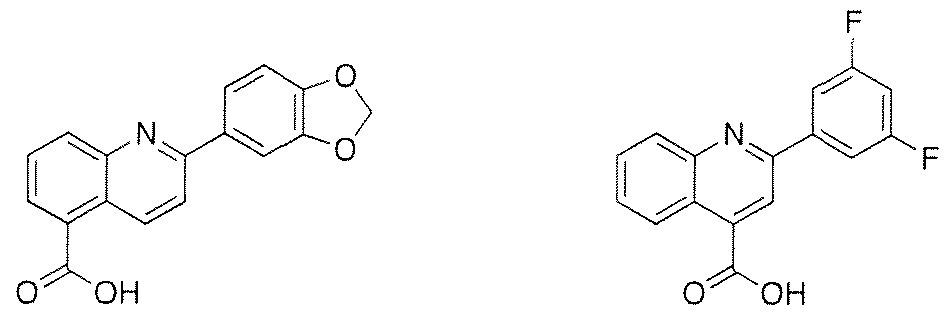
[0050] Other non-limiting examples of compounds in accordance with the present disclosure are shown below in Table 2.
[0051] Table 2. Examples of 2-Phenylquinoline Derivatives based on Chemical Structure 1.


form a dioxolane; 4- Rio and Rn together form a dioxolane.
[0052] Certain non-limiting embodiments of the present disclosure include pharmaceutical compositions that include at least one pharmaceutically acceptable carrier in combination with one or more phenylquinoline derivatives described herein (such as but are not limited to 7-chloro-8-methyl-2-phenylquinoline-4-carboxylic acid, compound 2: 2-(3,4- dimethoxyphenyl) quinoline-4-carboxylic acid, and compound 8: 2-(2-hydroxyphenyl) quinoline-4-carboxylic acid) that are agonists of PPARa and have anti-inflammatory and anti-angiogenic activities in the eye, particularly in the retina and macula. Particular non- limiting examples of pharmaceutical (therapeutic) compositions formulated in accordance with the present disclosure include: (a) a pharmaceutical composition comprising a phenylquinoline derivative PPARa agonist in combination with at least one pharmaceutically acceptable carrier; and (b) a phenylquinoline derivative PPARa agonist in combination with
at least one other therapeutically active agent, and at least one pharmaceutically acceptable carrier.
[0053] The phenylquinoline derivatives of the present disclosure may be present in the pharmaceutical compositions at any concentration that allows the pharmaceutical composition to function in accordance with the present disclosure; for example, but not by way of limitation, the compound(s) may be present in a range having a lower level selected from 0.0001 %, 0.005%, 0.001 %, 0.005%, 0.01 %, 0.05%, 0.1 %, 0.2%, 0.3%, 0.4%, 0.5%, 0.6%, 0.7%. 0.8%, 0.9%, 1 .0%. 1 .1 %, 1.2%, 1 .3%, 1 .4%, 1.5%, 1 .6%, 1 .7%, 1 .8%, 1.9% and 2.0%; and an upper level selected from 3%. 3.5%, 4%, 4.5%, 5%, 5.5%, 6%, 6.5%, 7%, 7.5%, 8%, 8.5%, 9%, 9.5%, 1 0%, 1 1 %, 12%, 13 %, 14%, 15%, 16%, 17%, 18%, 19%, 20%, 25%, 30%, 35%, 40%, 45%, 50%, 55%, 60%, 65%, 70%, 75%, 80%, 85%, 90%, and 95%. Non-limiting examples of particular ranges include a range of from about 0.0001 %) to about 95%, a range of from about 0.001 %) to about 75%; a range of from about 0.005%> to about 50%; a range of from about 0.01% to about 40%o; a range of from about 0.05% to about 35%o; a range of from about 0.1 % to about 30%; a range of from about 0.1 %) to about 25%>; a range of from about 0.1 % to about 20%; a range of from about 1 % to about 15%>; a range of from about 2% to about 12%; a range of from about 5%o to about 10%; and the like. Any other range that includes a lower level selected from the above-listed lower level concentrations and an upper level selected from the above-listed upper level concentrations also falls within the scope of the present disclosure.
[0054] Suitable carriers, vehicles, and other components that may be included in the formulation are described, for example, in Remington: The Science and Practice of Pharmacy, 21st Ed. and 22nd Ed. The term "pharmaceutically acceptable" means that the carrier is a non-toxic material that does not interfere with the effectiveness of the biological activity of the active agent. The characteristics of the carrier will depend on various factors, including but not limited to, the route of administration.
[0055] For example, but not by way of limitation, the phenylquinoline derivatives may be dissolved in a physiologically acceptable pharmaceutical carrier or diluent and administered as either a solution or a suspension. Non-limiting examples of suitable pharmaceutically acceptable carriers include water, saline, dextrose solutions, fructose solutions, ethanol, or oils of animal, vegetative, or synthetic origin, or any combination thereof. A sterile diluent, which may contain materials generally recognized for approximating physiological conditions and/or as required by governmental regulations, may be employed as the pharmaceutically acceptable carrier. In this respect, the sterile diluent may contain a
buffering agent to obtain a physiologically acceptable pH, such as (but not limited to) sodium chloride, saline, phosphate-buffered saline, and/or other substances which are physiologically acceptable and/or safe for use.
[0056] The pharmaceutical compositions may also contain one or more additional components in addition to the phenylquinoline derivatives and pharmaceutically acceptable carrier(s) (and other additional therapeutically active agent(s), if present). Examples of additional components that may be present include, but are not limited to, diluents, fillers, salts, buffers, preservatives, stabilizers, solubilizers, and other materials well known in the art. Another particular non-limiting example of an additional component that may be present in the pharmaceutical composition is a delivery agent, as discussed in further detail herein below.
[0057] Other embodiments of the pharmaceutical compositions of the present disclosure may include the incorporation or entrapment of the therapeutic compound(s) in various types of drug delivery systems that function to provide targeted delivery, controlled release, and/or increased half-life to the therapeutic compound(s). For example, but not by way of limitation, it is possible to entrap the therapeutic compound(s) in microcapsules prepared by coacervation techniques or by interfacial polymerization (for example, hydroxymethylcellulose or gelatin-microcapsules and poly-(methylmethacylate) microcapsules, respectively). It is also possible to entrap the therapeutic compound(s) in macroemulsions or colloidal drug delivery systems (such as but not limited to, liposomes, albumin microspheres, microemulsions, nanoparticles, nanocapsules, and the like). Such techniques are well known to persons having ordinary skill in the art, and thus no further description thereof is deemed necessary.
[0058] In one particular, non-limiting example, the pharmaceutical composition may include a liposome in which the phenylquinoline derivative PPARa agonist is disposed. In addition to other pharmaceutically acceptable carrier(s), the liposome may contain amphipathic agents such as lipids which exist in an aggregated form as micelles, insoluble monolayers, liquid crystals, or lamellar layers in aqueous solution. Suitable lipids for liposomal formulation include, but are not limited to, monoglycerides, diglycerides, sulfatides, lysolecithin, phospholipids, saponin, bile acids, combinations thereof, and the like. Preparation of such liposomal formulations is well within the level of ordinary skill in the art, as disclosed, for example, in U.S. Patent No. 4,235,871 ; U.S. Patent No. 4,501,728; U.S. Patent No. 4,837,028; and U.S. Patent No. 4,737,323; the entire contents of each of which are incorporated herein by reference.
[0059] In other non-limiting examples, the pharmaceutical compositions of the present disclosure may be incorporated into particles of one or more polymeric materials, as this type of incorporation can be useful in controlling the duration of action of the therapeutic compounds by allowing for controlled release from the preparations, thus increasing the half- life thereof. Non-limiting examples of polymeric materials that may be utilized in this manner include polyesters, polyamides, polyamino acids, hydrogels, poly(lactic acid), ethylene vinylacetate copolymers, copolymer micelles of, for example, PEG and poly(l- aspartamide), and combinations thereof.
[0060] In certain non-limiting embodiments, the pharmaceutical composition containing the phenylquinoline derivatives may be in the form of an ophthalmic composition for topical application to an eye of a subject. The term "ophthalmic composition" as used herein will be understood to refer to any composition specifically formulated for direct and local administration to an eye of a patient. Said composition may be formulated for topical administration to the eye or for injection into the eye (i.e., intravitreal or intraocular injection). The ophthalmic composition may be provided in any formulation that allows for local administration thereof to the eye and allows the therapeutic compounds to function in accordance with the present disclosure. For example, but not by way of limitation, the ophthalmic composition may be provided in the form of a solution, drops, a mist/spray, plasters and pressure sensitive adhesives, an ointment, a lotion, a cream, a gel, lyophilized/spray-dried forms, and the like. In one particular non-limiting embodiment, the ophthalmic composition is provided in a form for topical application, such as but not limited to, an eyedrop formulation. The ophthalmic compositions of the present disclosure may vary according to the particular active agent(s) used, the desired drug release profile, the condition being treated, and/or the medical history of the patient. In addition, the ophthalmic compositions of the present disclosure may be designed to provide delayed, controlled, extended, and/or sustained release using formulation techniques which are well known in the art, and as explained elsewhere herein.
[0061] The pharmaceutical compositions described or otherwise contemplated herein may further comprise at least one delivery agent that assists in delivery of the phenylquinoline derivative(s) to a desired site of delivery; for example but not by way of limitation, at least one delivery agent may be included in an ophthalmic composition to assist in the penetration of a surface of an eye; in certain embodiments, the delivery agent may assist in delivery to a retina of the eye. For example, in order for a topical application to be effective, the
composition may need to be able to penetrate the surface of the eye so that it can travel to the desired tissue. This may include penetrating the conjunctiva and/or the cornea.
[0062] When the ophthalmic composition containing the phenylquinoline derivative(s) is formulated for administration by injection, the composition may be in the form of a pyrogen- free, aqueous solution or suspension. The preparation of such solutions, having due regard to pH, isotonicity, stability, and the like, is well within the skill of one of ordinary skill in the art. Suitable carriers include, but are not limited to, biocompatible and pharmaceutically acceptable phosphate buffered saline solutions, which are particularly isotonic. For example, but not by way of limitation, a particular ophthalmic composition may contain, in addition to the therapeutic compound(s), an isotonic vehicle such as Sodium Chloride Injection, Ringer's Injection, Dextrose Injection, Dextrose and Sodium Chloride Injection, Lactated Ringer's Injection, or other vehicles as known in the art. In general, the material for intravenous injection in humans should conform to regulations established by the US Food and Drug Administration, which are available to those in the field.
[0063] In addition to the ophthalmic administrations discussed in detail herein above, the therapeutic compositions of the present disclosure may be formulated for administration by any other method known or otherwise contemplated in the art, as long as the route of administration allows for delivery of the therapeutic compounds so that the compounds can function in accordance with the present disclosure, i.e., as a PPARa agonist. Examples of other routes of administration include, but are not limited to, oral, topical, retrobulbar, subconjunctival, transdermal, parenteral, subcutaneous, intranasal, intramuscular, intraperitoneal, intravitreal, and intravenous routes, including both local and systemic application routes.
[0064] Another non-limiting embodiment of the present disclosure is directed to a kit that contain one or more of any of the pharmaceutical compositions described or otherwise contemplated herein. The kit may further contain a second agent as described herein above for use concurrently with the pharmaceutical composition(s). If the composition present in the kit is not provided in the form in which it is to be delivered, the kit may further contain a pharmaceutically (e.g., ophthalmically) acceptable carrier, vehicle, diluent, or other agent for mixing with the therapeutic compound(s) for preparation of the pharmaceutical composition. The kit including the composition and/or other reagents may also be packaged with instructions packaged for administration and/or dosing of the compositions contained in the kit. The instructions may be fixed in any tangible medium, such as printed paper, or a
computer-readable magnetic or optical medium, or instructions to reference a remote computer data source such as a worldwide web page accessible via the internet.
[0065] The kit may contain single or multiple doses of the pharmaceutical composition(s). When multiple doses are present, the doses may be disposed in bulk within a single container, or the multiple doses may be disposed individually within the kit; that is, the pharmaceutical compositions may be present in the kit in unit dosage forms to facilitate accurate dosing. The term "unit dosage forms" as used herein refers to physically discrete units suitable as unitary dosages for human subjects and other mammals; each unit contains a predetermined quantity of active material calculated to produce the desired therapeutic effect, in association with a suitable pharmaceutical excipient. Typical unit dosage forms of liquid compositions include prefilled, premeasured ampules or syringes; for solid compositions, typical unit dosage forms include pills, tablets, capsules, or the like. In such compositions, the therapeutic compound(s) may sometimes be a minor component (from about 0.1 to about 50% by weight, such as but not limited to, from about 1 to about 40% by weight) with the remainder being various vehicles or carriers and processing aids helpful for forming the desired dosing form.
[0066] As is evident from the above, the therapeutic phenylquinoline derivatives of the present disclosure function as PPARa agonists for the treatment, inhibition, mitigation, and/or prevention of degenerative retinal disorders. Thus, certain non-limiting embodiments of the present disclosure include methods of treating, inhibiting, and/or reducing the occurrence of retinal degeneration due to retinal inflammation and neovascularization. One particular but non-limiting embodiment includes a method of treating, inhibiting, and/or reducing the occurrence of one or more pathologic ocular conditions associated with reduced PPARa activity in a subject. In the method, one or more of any of the pharmaceutical compositions described or otherwise contemplated herein is administered to a subject (such as, but not limited to, a mammal) that is experiencing retinal or macular degeneration or that is predisposed to developing retinal or macular degeneration, or other ocular condition or disorder. The pharmaceutical composition(s) is administered to the subject in an amount effective to have PPARa agonistic activity in the retina of at least one eye of the subject.
[0067] The pathologic ocular condition may be any of the conditions described herein above, and the pathologic ocular condition may be characterized by retinal and/or macular degeneration. In one embodiment, the pharmaceutical composition may be administered topically to an eye of the subject (such as, but not limited to, as an eyedrop). In an alternative embodiment, the pharmaceutical composition may be administered by ocular injection, or systemically.
[0068] The amount of the therapeutic composition that is effective in the treatment described herein can be determined by the attending diagnostician, as one of ordinary skill in the art, by the use of conventional techniques and by observing results obtained under analogous circumstances. In determining the therapeutically effective dose, a number of factors may be considered by the attending diagnostician, including, but not limited to: the species of the subject; its size, age, and general health; the specific retinal and/or ocular disease or other condition involved; the degree, involvement, and/or severity of the retinal degeneration; the response of the individual subject; the particular therapeutic compound(s) administered; the mode of administration; the bioavailability characteristics of the preparation administered; the dose regimen selected; the use of concomitant medication; and other relevant circumstances. A therapeutically effective amount of a pharaiaceutical composition of the present disclosure also refers to an amount of the therapeutic compound which is effective in controlling and/or reducing the retinal or macular degeneration.
[0069] For example, but not by way of limitation, the therapeutically effective amount of a phenylquinoline derivative used in the present disclosure will generally contain sufficient active ingredient to deliver in a range of from about 0.01 tg/ g to about 10 mg/kg (weight of active ingredient/body weight of patient). For example, but not by way of limitation, the composition will deliver about 0.1 /ig/kg to about 5 mg/kg, and more particularly about 1 fig/kg to about 1 mg/kg.
[0070] Practice of the method of the present disclosure may include administering to a subject a therapeutically effective amount of the pharmaceutical composition (containing the phenylquinoline derivative(s)) in any suitable systemic and/or local formulation, in an amount effective to deliver the dosages listed above. The dosage can be administered, for example, but not by way of limitation, on a one-time basis, or administered at multiple times (for example, but not by way of limitation, from one to five times per day, or once or twice per week). The pharmaceutical composition may be administered either alone or in combination with other therapies, in accordance with the inventive concepts disclosed herein.
[0071] Certain novel embodiments of the present disclosure, having now been generally described, will be more readily understood by reference to the following examples, which are included merely for purposes of illustration of certain aspects and embodiments of the present disclosure, and are not intended to be limiting. The following detailed examples are to be construed, as noted above, only as illustrative, and not as limiting of the present disclosure in any way whatsoever. Those skilled in the art will promptly recognize appropriate variations from the various compositions, structures, components, procedures and methods.
[0072] EXAMPLES
[0073] The anti-inflammatory and anti-angiogenic activities of the phenylquinoline derivative 7-chloro-8-methyl-2-phenylquinoline-4-carboxylic acid (also referred to herein also as NCI8) and others disclosed herein were investigated in vitro and in animal models. Prior to the present work NCI8, which is distinct in structure from the known PPARa agonist fenofibrate, had not been reported to have PPARa agonist activity.
[0074] Example 1
[0075] Methods
[0076] The activation of PPARa by NCI8 was measured by luciferase-based promoter assay. The effect of NCI8 on endothelial cell migration and tube formation was evaluated using human retinal capillary endothelial cells (HRCEC). TUNEL was used to evaluate the effect on apoptosis in human retinal Miiller cells (MIO-M1) and retinal precursor cells (R28) exposed to palmitate. C57BL/6 mice were exposed to 75% oxygen from postnatal day 7 (P7) to PI 2, followed by exposure to room air from PI 2 to PI 7 to generate oxygen-induced retinopathy (OIR). NCI8 (10 mg/kg/day) and the same volume of vehicle were intraperitoneally injected daily from P12 to PI 6. At PI 7, retinal inflammation was examined using leukostasis assay, and retinal levels of inflammatory factors were measured by Western blotting. Student's T-test was used for statistical analysis.
[0077] Results
[0078] NCI8 activated PPARa transcriptional activity in a concentration-dependent manner (with EC50 of 49.89 μΜ compared to 53.01 μΜ of fenofibrate). HRCEC migration and tube formation were significantly inhibited. The compound also showed a protective effect against palmitate-induced apoptosis of human retinal Miiller cells and retinal precursor cells. In the OIR model, the number of adherent leukocytes was decreased in the retinal vasculature of the mice treated with the compound compared to vehicle group (n=5, P < 0.05). In addition, retinal levels of ICAM-1, monocyte chemoattractant protein- 1 (MCP-1) and T F-a were downregulated by this compound. NCI8 inhibited expression of VEGF, endothelial cell migration and tube formation with potencies similar to or higher than fenofibrate. Injection of NCI8 also ameliorated retinal capillary degeneration and pericyte loss in a diabetic model. Taken together, these in vivo results indicate that NCI8 has a robust anti-inflammatory and therapeutic effects in both OIR and diabetic models.
[0079] Particularly, NCI8 displayed the following effects to support its use as a therapeutic treatment for DR and AMD:
1. Potent effects in enhancing transcriptional activities of PPARa.
2. In human retinal capillary endothelial cells (HRCEC), inhibition of endothelial cell migration in a concentration-dependent manner in the range of 50-200 μΜ.
3. In HRCEC, inhibition of tube formation with a higher potency than fenofibric acid.
4. In ARPE19 cells, protection of RPE cells from cell death induced by palmitate, a commonly used diabetic stressor.
5. In the OIR model, daily intraperitoneal 10 mg/kg/day injections from postnatal day 12 (PI 2) to PI 6 significantly reduced retinal leukostasis.
6. Injection into mice with OIR significantly down-regulated MCP-1 , ICAM-1 and TNF-a expression in the retina.
7. Treatment of streptozotocin-induced diabetic rats (i.p., 10 mg/kg/day, 3 weeks) decreased numbers of acel ilar capillaries in the retina, indicating a protective effect against diabetes-induced capillary degeneration.
8. Treatment of diabetic rats (i.p., 10 mg/kg/day, 3 weeks) significantly increased pericyte numbers, indicating a pericyte protective effect.
[0080] In summary, the in vitro and in vivo data of this example demonstrate that NCI8 has potent effects on activation of PPARa and robust anti-inflammatory and anti-angiogenic activities.
[0081] Example 2
[0082] Various phenylquinoline derivatives of the present disclosure were tested for their effects on PPARa transcriptional activity in PPARa reporter Combo cells, including NCI8 and compounds 1-13 as disclosed herein, as measured against the effect of Feno-FA.
[0083] FIG. 1 shows the effect on PPARa transcriptional activity of NCI8 and compounds 1 -9. Cells were treated with various compounds at concentrations of 50 μΜ for 36 h, after which luciferase activities were measured. FIG. 2 shows the effect on PPARa transcriptional activity of NCI8 and compounds 2 and 10-13. Cells were treated with various compounds at concentrations of 50 μΜ for 36 h, after which luciferase activities were measured. Compounds 2 and 8 had the highest agonistic activity. FIG. 3 shows the dose dependent effect on PPARa transcriptional activity of various concentrations of NCI8 and compounds 2, 8, 10, and 13 up to 100 μΜ for 36 h, after which luciferase activities were measured.
Compounds 2 and 8 had then greatest activity, replicating the results of FIG. 1. The experiments were repeated as various increasing concentrations comparing the effects of Feno-FA (FIG. 4), NCI8 (FIG. 5), compound 2 (FIG. 6), and compound 8 (FIG. 7). The results of FIG. 1 were substantially replicated, with compound 2 showing the greatest agonistic activity on PPARa transcription.
[0084] These studies demonstrate therapeutic use of ophthalmic compositions comprising this new class of phenylquinolme compounds for the treatment of ocular disorders and conditions such as but not limited to retinal inflammation, retinal neovascularization, retinal vascular leakage, retinopathy of prematurity, diabetic retinopathy, age-related macular degeneration, and diabetic macular edema.
[0085] In accordance with the foregoing, the present disclosure is directed, in at least some embodiments, to the following:
Clause 1. A method of increasing peroxisome proliferator-activated receptor a (PPARa) activity in a retinal cell, comprising:
administering to the retinal cell an activity-enhancing amount of a phenylquinolme derivative compound having peroxisome proliferator-activated receptor a (PPARa) agonistic activity, the compound having the chemical structure I:

I wherein:
(1) Ri, R2, R3, and R6, are independently selected from the group consisting of
(i) hydrogen (FI), chlorine (CI), fluorine (F), bromine (Br), iodine (I), cyano (CN), amino (NH2), nitro (N02), alkoxy, haloalkyl, haloalkoxyl, substituted or unsubstituted alkyl, substituted or unsubstituted alkenyl, substituted or unsubstituted alkynyl, substituted or unsubstituted carbocycle, substituted or unsubstituted heterocycle, substituted or unsubstituted arene,
substituted or unsubstituted heteroarene, SO3H, an amide, thioamide, ester, thioester, a sulfonamide, a sulfmic acid, a sulfinamide, and
(ii) SORa, and S02Rb, wherein Ra and Rb are each selected from H, substituted or unsubstituted alkyl, substituted or unsubstituted arene, and substituted or unsubstituted heteroarene;
(2) R7, R8, R9, Rio, and Rn are independently selected from the group consisting of
(i), (ii), and (iii), wherein
(iii) is a dioxolane formed from only one of the pairs R7-R8, Rs-Rs>, R9-

(3) R4 and R5 are selected from the group consisting of (i), (ii), and (iv), wherein
(iv) consists of carboxylic acid, hydroxamic acid, hydroxamic ester, phosphonic acid, phosphinic acid, sulfonic acid, sulfonamide, a sulfmic acid, acyl sulfonamide, sulfonylurea, acylurea, tetrazole, thiazolidine dione, oxazolidine dione, oxadiazol-5(4H)-one, thiadiazol-5(4H)-one, oxathiadiazole-2-oxide, oxadiazol-5(4H)-thione, isoxazole, tetramic acid, cyclopentane 1 ,3-diones, cyclopentane 1 ,2-diones, a squaric acid, a substituted phenol, heteroarene, amidine, hydroxyamide, alkyl hydroxyamidine, and salts of the above; and with the proviso that one of R4 and R5 is selected from (i) and (ii), and one of R4 and R5 is selected from (iv).
Clause 2. The method of clause 1 , wherein in the compound: Ri , R2, R3 and R4 are H; R5 is a carboxylic acid; R6, R7 and Ri 1 are H; and R& and R9 are methoxy and Rio is H, or Rs is H and R9 and Rio are methoxy.
Clause 3. The method of clause 1, wherein in the compound: Ri , R2, R3, R4 R6, Rs, R9, and Rio are are H; R5 is a carboxylic acid; and R7 and Rn are selected from H and OH with the provisio that at least one of R7 and Ri 1 is OH.
Clause 4. The method of clause 1 , wherein in the compound: Ri is CH3, R2 is CI, R5 is a carboxylic acid group, and R3, R4, R6, R7, s. R9, Rio, and Rn are H.
Clause 5. The method of clause 1 , wherein in the compound: Ri is H or alkyl; R2 and R3 are independently selected from H, CI, F, Br, and 1; one of R4 and R5 is carboxylic acid and one of R4 and R5 is H; R6 is selected from H, CI, F, Br, and I; and R7, Rs, R9, Rio, and Rn are indendently selected from H, CI, F, Br, OH, and alkoxy.
Clause 6. The method of clause 1 , wherein in the compound: Ri, R2 and R3 are independently selected from H, CI, F, Br, I, and alkyl; R4 is H; R5 is carboxylic acid; R6 is
selected from H, CI, F, Br, and I; and R7, Rs, R9, Rio, and Rn are indendently selected from H, CI, F, Br, OFI, and alkoxy.
Clause 7. The method of clause 1, wherein in the compound: Ri, R2 and R3 are independently selected from H, CI, F, Br, and I; R4 is H; R5 is carboxylic acid; R6 is selected from H, CI, F, Br, and I; and R7, Rs, R9, Rio, and Rn are indendently selected from H, OH, and methoxy.
Clause 8. The method of clause 1 , wherein in the compound: Ri, R2, R3 and R4 are H; R5 is carboxylic acid; R6 is H; and R7, Rs, R9, Rio, and Rn are selected from H, OH, and methoxy, wherein at least one of R7, Rs, R9, Rio, and Rn is OH.
Clause 9. The method of clause 1 , wherein in the compound: Ri, R2, R3 and R4 are H; R5 is carboxylic acid; R6 is H; and R7, Rs, R9, Rio, and Rn are selected from H and OH, wherein one of R7 and Rn is OH and one of R7 and Rn is H.
Clause 10. The method of clause 1 , wherein in the compound: Ri, R2, R3 and R4 are H; R5 is carboxylic acid; R6 is H; and R7, Rs, R9, Rio, and Rn are selected from H, OH, and methoxy, wherein at least one of R7, Rs, R9, Rio, and Rn is methoxy.
Clause 1 1. The method of clause 1 , wherein in the compound: Ri, R2, R3 and R4 are H; R5 is carboxylic acid; R6 is H; R7 and Rn are H; and Rs, R9, and Rio are selected from H and alkoxy, wherein at least one of Rs, R9, and Rio is an alkoxy.
Clause 12. A method of treating an ocular disorder or condition in a subject in need of such therapy, comprising:
administering to the subject an effective amount of a composition comprising a phenylquinoline derivative compound having peroxisome proliferator- activated receptor a (PPARa) agonistic activity, the compound having the chemical structure I:

(1) Ri , R2, R3, and R6, are independently selected from the group consisting of
(i) hydrogen (H), chlorine (CI), fluorine (F), bromine (Br), iodine (I), cyano (CN), amino (NH2), nitro (N02), alkoxy, haloalkyl, haloalkoxyl, substituted or unsubstituted alkyl, substituted or unsubstituted alkenyl, substituted or unsubstituted alkynyl, substituted or unsubstituted carbocycle, substituted or unsubstituted heterocycle, substituted or unsubstituted arene, substituted or unsubstituted heteroarene, S03H, an amide, thioamide, ester, thioester, a sulfonamide, a sulfuric acid, a sulfmamide, and
(ii) SORa, and S02Rb, wherein Ra and Rb are each selected from H, substituted or unsubstituted alkyl, substituted or unsubstituted arene, and substituted or unsubstituted heteroarene;
(2) R7, 8, R9, Rio, and Rn are independently selected from the group consisting of
(i), (ii), and (iii), wherein
(iii) is a dioxoiane formed from only one of the group of pairs consisting of R7-R8, R8-R9, R9-R10, and R10-R11 ; and
(3) R4 and R5 are selected from the group consisting of (i), (ii), and (iv), wherein
(iv) consists of carboxylic acid, hydroxamic acid, hydroxamic ester, phosphonic acid, phosphinic acid, sulfonic acid, sulfonamide, a sulfmic acid, acyl sulfonamide, sulfonylurea, acylurea, tetrazole, thiazolidine dione, oxazolidine dione, oxadiazol-5(4H)-one, thiadiazol-5(4H)-one, oxathiadiazole-2-oxide, oxadiazol-5(4H)-thione, isoxazole, tetramic acid, cyclopentane 1 ,3-diones, cyclopentane 1 ,2-diones, a squaric acid, a substituted phenol, heteroarene, amidine, hydroxyamide, alkyl hydroxyamidine, and salts of the above; and with the proviso that one of R4 and R5 is selected from (i) and (ii), and one of R4 and R5 is selected from (iv).
Clause 13. The method of clause 12, wherein in the compound: Ri , R2, R3 and R4 are H;
R5 is a carboxylic acid; R6, R7 and Ri 1 are H; and R8 and R9 are methoxy and Rio is H, or R8 is
H and R9 and Rio are methoxy.
Clause 14. The method of clause 12, wherein in the compound: Ri , R2, R3, R4 R6, Rs, R9, and Ri o are are H; R5 is a carboxylic acid; and R7 and Rn are selected from H and OH with the provisio that at least one of R7 and Ri 1 is OH.
Clause 15. The method of clause 12, wherein in the compound: Ri is CH3, R2 is CI, R5 is a carboxylic acid group, and R3, R4, R6, R7, Rs, R9, Rio, and Rn are H.
Clause 16. The method of clause 12, wherein in the compound: Ri is H or alkyl; R2 and R3 are independently selected from H, CI, F, Br, and I; one of R4 and R5 is carboxylic acid and one of R4 and R5 is H; R6 is selected from H, CI, F, Br, and I; and R7, R8, R9, Rio, and Ri 1 are indendently selected from H, CI, F, Br, OH, and alkoxy.
Clause 17. The method of clause 12, wherein in the compound: Ri, R2 and R3 are independently selected from H, CI, F, Br, I, and alkyl; R4 is H; R5 is carboxylic acid; R6 is selected from H, CI, F, Br, and I; and R7, Rs, R9, Rio, and Rn are indendently selected from H, CI, F, Br, OH, and alkoxy.
Clause 18. The method of clause 12, wherein in the compound: Ri, R2 and R3 are independently selected from H, CI, F, Br, and I; R4 is H; R5 is carboxylic acid; R6 is selected from H, CI, F, Br, and I; and R7, Rs, R9, Rio, and Rn are indendently selected from H, OH, and methoxy.
Clause 19. The method of clause 12, wherein in the compound: Ri, R2, R3 and R4 are H; R is carboxylic acid; f, is H; and R7, Rs, R9, Rio, and Rn are selected from H, OH, and methoxy, wherein at least one of R7, Rs, R9, Rio, and Rn is OH.
Clause 20. The method of clause 12, wherein in the compound: Ri, R2, R3 and R4 are H; Rs is carboxylic acid; R6 is H; and R7, Rs, R9, Rio, and Rn are selected from H and OH, wherein one of R7 and Ri 1 is OH and one of R7 and Ri 1 is H.
Clause 21. The method of clause 12, wherein in the compound: Ri, R2, R3 and R4 are H; Rs is carboxylic acid; R6 is H; and R7, Rg, R9, Rio, and Rn are selected from H, OH, and methoxy, wherein at least one of R7, Rs, R9, Rio, and Rn is methoxy.
Clause 22. The method of clause 12, wherein in the compound: Ri, R2, R3 and R4 are H; R5 is carboxylic acid; R6 is H; R7 and Rn are H; and R8, R9, and Rio are selected from H and alkoxy, wherein at least one of Rs, R9, and Rio is an alkoxy.
Clause 23. The method of any one of clauses 12-22, wherein the ocular disorder or condition is selected from the group consisting of retinal inflammation, retinal neovascularization, retinal vascular leakage, retinopathy of prematurity (ROP), diabetic retinopathy (DR), age-related macular degeneration (AMD), and diabetic macular edema (DME).
Clause 24. An ophthalmic composition, comprising a pharmaceutically-acceptable carrier, vehicle, or diluent; and a phenylquinoline derivative compound having peroxisome proliferator-activated receptor a (PPARa) agonistic activity and having the chemical structure I:

I wherein:
( 1 ) Ri, R2, R3, and R6, are independently selected from the group consisting of
(i) hydrogen (H), chlorine (CI), fluorine (F), bromine (Br), iodine (I), cyano (CN), amino (NH2), nitro (NO2), alkoxy, haloalkyl, haloalkoxyl, substituted or unsubstituted alkyl, substituted or unsubstituted alkenyl, substituted or unsubstituted alkynyl, substituted or unsubstituted carbocycle, substituted or unsubstituted heterocycle, substituted or unsubstituted arene, substituted or unsubstituted heteroarene, SO3H, an amide, thioamide, ester, thioester, a sulfonamide, a sulfmic acid, a sulfanamide, and
(ii) SORa, and S02Rb, wherein Ra and Rb are each selected from H, substituted or unsubstituted alkyl, substituted or unsubstituted arene, and substituted or unsubstituted heteroarene;
(2) R7, Rs, R9, Rio, and Rn are independently selected from the group consisting of
(i), (ii), and (iii), wherein
(iii) is a dioxolane formed from only one of the pairs R7-R8, R8-R9, Rg-Rio,

(3) R4 and R5 are selected from the group consisting of (i), (ii), and (iv), wherein
(iv) consists of carboxylic acid, hydroxamic acid, hydroxamic ester, phosphonic acid, phosphinic acid, sulfonic acid, sulfonamide, a sulfmic acid, acyl sulfonamide, sulfonylurea, acylurea, tetrazole, thiazolidine dione,
oxazolidine dione, oxadiazol-5(4H)-one, thiadiazol-5(4H)-one, oxathiadiazole-2-oxide, oxadiazol-5(4H)-thione, isoxazole, tetramic acid, cyclopentane 1 ,3-diones, cyclopentane 1,2-diones, a squaric acid, a substituted phenol, heteroarene, amidine, hydroxyamide, alkyl hydroxyamidine, and salts of the above; and with the proviso that one of R4 and R5 is selected from (i) and (ii), and one of R4 and R5 is selected from (iv).
Clause 25. The ophthalmic composition of clause 24, wherein in the compound: Ri, R2, R3 and R4 are H; R5 is a carboxylic acid; R6. R7 and Ri 1 are H; and Rg and R9 are methoxy and Rio is H, or Rg is H and R9 and Rio are methoxy.
Clause 26. The ophthalmic composition of clause 24, wherein in the compound: Ri, R2, R3, R4 R6, Rs, R9, and Rio are are H; R5 is a carboxylic acid; and R7 and Rn are selected from H and OH with the provisio that at least one of R7 and Ri 1 is OH.
Clause 27. The ophthalmic composition of clause 24, wherein in the compound: Ri is CH3, R2 is CI, R5 is a carboxylic acid group, and R3, R4, R6, R7, Rs, R9, Rio, and Rn are H. Clause 28. The ophthalmic composition of clause 24, wherein in the compound: Ri is H or alkyl; R2 and R3 are independently selected from H, CI, F, Br, and I; one of R4 and R5 is carboxylic acid and one of R4 and R5 is H; Re is selected from H, CI, F, Br, and I; and R7, Rg, R9, Rio, and Rn are indendently selected from H, CI, F, Br, OH, and alkoxy.
Clause 29. The ophthalmic composition of clause 24, wherein in the compound: Ri, R2 and R3 are independently selected from H, CI, F, Br, I, and alkyl; R4 is H; R5 is carboxylic acid; R<, is selected from H, CI. F, Br, and I; and R7. Rg, R9, Rio, and Rn are indendently selected from FI, CI, F, Br, OH, and alkoxy.
Clause 30. The ophthalmic composition of clause 24, wherein in the compound: Ri, R2 and R3 are independently selected from H, CI, F, Br, and I; R4 is H; R5 is carboxylic acid; R6 is selected from H, CI, F, Br, and I; and R7, Rs, R9, Rio, and Rn are indendently selected from H, OH, and methoxy.
Clause 31. The ophthalmic composition of clause 24, wherein in the compound: Ri, R2, R3 and R4 are H; R5 is carboxylic acid; R6 is H; and R7, Rs, R9, Rio, and Ri 1 are selected from H, OH, and methoxy, wherein at least one of R7, Rs, R9, Rio, and Rn is OH.
Clause 32. The ophthalmic composition of clause 24, wherein in the compound: Ri, R2, R3 and R4 are H; R5 is carboxylic acid; R6 is H; and R7, Rs, R9, Rio, and Ri 1 are selected from H and OH, wherein one of R7 and Ri 1 is OH and one of R7 and Rn is H.
Clause 33. The ophthalmic composition of clause 24, wherein in the compound: Ri, R2, R3 and R4 are H; R5 is carboxylic acid; R6 is H; and R7, R8, R9, Rio, and Ri 1 are selected from H, OH, and methoxy, wherein at least one of R7, R8, R9, Rio, and Rn is methoxy.
Clause 34. The ophthalmic composition of clause 24, wherein in the compound: Ri, R2, R3 and R4 are H; R5 is carboxylic acid; R6 is H; R7 and Rn are H; and Rs, R9, and Rio are selected from H and alkoxy, wherein at least one of Rs, R9, and Rio is an alkoxy.
Clause 35. The ophthalmic composition of any one of clauses 24-34 for use in a treatment of an ocular disorder or condition in a subject in need of such therapy, wherein the ocular disorder or condition is selected from the group consisting of retinal inflammation, retinal neovascularization, retinal vascular leakage, retinopathy of prematurity (ROP), diabetic retinopathy (DR), age-related macular degeneration (AMD), and diabetic macular edema (DME).
Clause 36. An ophthalmic composition comprising the phenylquinoline derivative compound of any one of clauses 24-34.
Clause 37. The ophthalmic composition of clause 36 for use in any one of method claims 1 -23.
Clause 38. A kit, comprising the ophthalmic composition of any one of clauses 24-34, and instructions for use thereof in a treatment of an ocular disorder or condition in a subject in need of such therapy, wherein the ocular disorder or condition is selected from the group consisting of retinal inflammation, retinal neovascularization, retinal vascular leakage, retinopathy of prematurity (ROP), diabetic retinopathy (DR), age-related macular degeneration (AMD), and diabetic macular edema (DME).
Clause 39. A kit for use in any one of method claims 1 -23, the kit comprising the phenylquinoline derivative compound of any one of clauses 24-34, and instructions for use thereof in the method.
[0086] While the present disclosure has been described herein in connection with certain embodiments so that aspects thereof may be more fully understood and appreciated, it is not intended that the present disclosure be limited to these particular embodiments. On the contrary, it is intended that all alternatives, modifications and equivalents are included within the scope of the present disclosure as defined herein. Thus the examples described above, which include particular embodiments, will serve to illustrate the practice of the inventive concepts of the present disclosure, it being understood that the particulars shown are by way of example and for purposes of illustrative discussion of particular embodiments only and are
presented in the cause of providing what is believed to be the most useful and readily understood description of procedures as well as of the principles and conceptual aspects of the present disclosure. Changes may be made in the formulation of the various compositions described herein, the methods described herein or in the steps or the sequence of steps of the methods described herein without departing from the spirit and scope of the present disclosure. Further, while various embodiments of the present disclosure have been described in claims herein below, it is not intended that the present disclosure be limited to these particular claims. Applicants reserve the right to amend, add to, or replace the claims indicated herein below in subsequent patent applications.
Claims
What is claimed is:
A method of increasing peroxisome proliferator-activated receptor a (PPARa) activity a retinal cell, comprising:
administering to the retinal cell an activity-enhancing amount of a phenylquinoline derivative compound having peroxisome proliferator-activated receptor a (PPARa) agonistic activity, the compound having the chemical structure I:

I wherein:
(1) R] , R2, R3, and R6, are independently selected from the group consisting of
(i) hydrogen (H), chlorine (CI), fluorine (F), bromine (Br), iodine (I), cyano (CN), amino (NH2), nitro (N02), alkoxy, haloalkyl, haloalkoxyl. substituted or unsubstituted alkyl, substituted or unsubstituted alkenyl, substituted or unsubstituted alkynyl, substituted or unsubstituted carbocycle, substituted or unsubstituted heterocycle, substituted or unsubstituted arene, substituted or unsubstituted heteroarene, SO3H, an amide, thioamide, ester, thioester, a sulfonamide, a sulfmic acid, a sulfmamide, and
(ii) SORa, and S02Rb, wherein Ra and Rb are each selected from H, substituted or unsubstituted alkyl, substituted or unsubstituted arene, and substituted or unsubstituted heteroarene;
(2) R7, Rs, R9, Rio, and Rn are independently selected from the group consisting of
(i), (ii), and (iii), wherein
(iii) is a dioxolane formed from only one of the pairs R7-R8, R8-R9, R9-
 (3) R.4 and R5 are selected from the group consisting of (i), (ii), and (iv), wherein
(iv) consists of carboxylic acid, hydroxamic acid, hydroxamic ester, phosphonic acid, phosphinic acid, sulfonic acid, sulfonamide, a sulfinic acid, acyl sulfonamide, sulfonylurea, acylurea, tetrazole, thiazolidine dione, oxazolidine dione, oxadiazol-5(4H)-one, thiadiazol-5(4H)-one, oxathiadiazole-2-oxide. oxadiazol-5(4H)-thione, isoxazole, tetramic acid, cyclopentane 1 ,3-diones, cyclopentane 1 ,2-diones, a squaric acid, a substituted phenol, heteroarene, amidine, hydroxyamide, alkyl hydroxyamidine, and salts of the above; and with the proviso that one of R4 and R5 is selected from (i) and (ii), and one of R4 and R5 is selected from (iv).
2. The method of claim 1 , wherein in the compound: Ri, R2, R3 and R4 are H; R5 is a carboxylic acid; R6, R7 and Ri 1 are H; and Rs and R9 are methoxy and Rio is H, or Rs is H and R9 and Rio are methoxy.
3. The method of claim 1, wherein in the compound: Ri , R2, R3, R4 R6, Rs, R9, and Rio are are H; R5 is a carboxylic acid; and R7 and Rn are selected from H and OH with the provisio that at least one of R7 and Ri 1 is OH.
4. The method of claim 1 , wherein in the compound: Ri is CH3, R2 is CI, R5 is a carboxylic acid group, and R3, R4, R0, R7, Rs, R9, Rio, and Rn are H.
5. The method of claim 1 , wherein in the compound: Ri is H or alkyl; R2 and R3 are independently selected from H, CI, F, Br, and I; one of R4 and R5 is carboxylic acid and one of R4 and R5 is H; R6 is selected from H, CI, F, Br, and I; and R7, Rs, R9, Rio, and Rn are indendently selected from H, CI, F, Br, OH, and alkoxy.
6. The method of claim 1 , wherein in the compound: Ri, R2 and R3 are independently selected from H, CI, F, Br, I, and alkyl; R4 is H; R5 is carboxylic acid; R6 is selected from H, CI, F, Br, and I; and R7, Rs, R9, Rio, and Rn are indendently selected from H, CI, F, Br, OH, and alkoxy.
7. The method of claim 1 , wherein in the compound: Ri, R2 and R3 are independently selected from H, CI, F, Br, and I; R4 is FI; R5 is carboxylic acid; R6 is selected from H, CI, F, Br, and I; and R7, Rs, R9, Rio, and Ri 1 are indendently selected from FI, OH, and methoxy.
8. The method of claim 1 , wherein in the compound: Ri, R2, R3 and R4 are H; R5 is carboxylic acid; R6 is H; and R7, Rs, R , Rio, and Rn are selected from H, OH, and methoxy, wherein at least one of R7, Rs, R9, Rio, and Rn is OH.
9. The method of claim 1, wherein in the compound: Ri, R2, R3 and R4 are H; R5 is carboxylic acid; R6 is H; and R7, Rs, R9, Rio, and Rn are selected from H and OH, wherein one of R7 and Ri 1 is OH and one of R7 and Ri 1 is H.
10. The method of claim 1, wherein in the compound: Ri, R2, R3 and R4 are H; R5 is carboxylic acid; R6 is H; and R7, R8, Rg, Rio, and Rn are selected from H, OH, and methoxy, wherein at least one of R7, Rs, R9, Rio, and Rn is methoxy.
1 1. The method of claim 1 , wherein in the compound: Ri, R2, R3 and R4 are H; R5 is carboxylic acid; R6 is H; R7 and R are H; and R8, R9, and Rio are selected from H and alkoxy, wherein at least one of Rs, R9, and Rio is an alkoxy.
12. A method of treating an ocular disorder or condition in a subject in need of such therapy, comprising:
administering to the subject an effective amount of a composition comprising a phenylquinoline derivative compound having peroxisome proliferator- activated receptor a (PPARa) agonistic activity, the compound having the chemical structure I:

I wherein:
(1 ) Ri, R2, R3, and R6, are independently selected from the group consisting of
(i) hydrogen (H), chlorine (CI), fluorine (F), bromine (Br), iodine (I), cyano (CN), amino (NH2), nitro (NO?), alkoxy, haloalkyl, haloalkoxyl,
substituted or unsubstituted alkyl, substituted or unsubstituted alkenyl, substituted or unsubstituted alkynyl, substituted or unsubstituted carbocycle, substituted or unsubstituted heterocycle, substituted or unsubstituted arene, substituted or unsubstituted heteroarene, SO3H, an amide, thioamide, ester, thioester, a sulfonamide, a sulfmic acid, a sulfmamide, and
(ii) SORa, and SOaRb, wherein Ra and Rb are each selected from H, substituted or unsubstituted alkyl, substituted or unsubstituted arene, and substituted or unsubstituted heteroarene;
(2) R7, Rs, R9, Rio, and Rn are independently selected from the group consisting of
(i), (ii), and (iii), wherein
(iii) is a dioxolane formed from only one of the group of pairs consisting of R7-R8, R8-R9, R9-R10, and R10-R1 1 ; and
(3) R4 and R5 are selected from the group consisting of (i), (ii), and (iv), wherein
(iv) consists of carboxylic acid, hydroxamic acid, hydroxamic ester, phosphonic acid, phosphinic acid, sulfonic acid, sulfonamide, a sulfmic acid, acyl sulfonamide, sulfonylurea, acylurea, tetrazole, thiazolidine dione, oxazolidine dione, oxadiazol-5(4H)-one, thiadiazol-5(4H)-one, oxathiadiazole-2-oxide, oxadiazol-5(4H)-thione, isoxazole, tetramic acid, cyclopentane 1 ,3-diones, cyclopentane 1 ,2-diones, a squaric acid, a substituted phenol, heteroarene, amidine, hydroxyamide, alkyl hydroxyamidine, and salts of the above; and with the proviso that one of R4 and R5 is selected from (i) and (ii), and one of R4 and R5 is selected from (iv).
13. The method of claim 12, wherein the ocular disorder or condition is selected from the group consisting of retinal inflammation, retinal neovascularization, retinal vascular leakage, retinopathy of prematurity (ROP), diabetic retinopathy (DR), age-related macular degeneration (AMD), and diabetic macular edema (DME).
14. The method of claim 12, wherein in the compound: Ri, R2, R3 and R4 are H; R5 is a carboxylic acid; R6, R7 and Ri 1 are H; and Rs and R9 are methoxy and Rio is H, or Rs is H and R9 and Rio are methoxy.
15. The method of claim 12, wherein in the compound: Ri, R2, R3, R4 R6, Rs, R9, and Rio are are H; R5 is a carboxylic acid; and R7 and Ri 1 are selected from H and OH with the provisio that at least one of R7 andRn is OH.
16. The method of claim 12, wherein in the compound: Ri is CH3, R2 is CI, R5 is a carboxylic acid group, and R3, R4, R6, R7, Rs, R9, Rio, and Rn are H.
17. The method of claim 12, wherein in the compound: Ri is H or alkyl; R2 and R3 are independently selected from H, CI, F, Br, and I; one of R4 and R5 is carboxylic acid and one of R4 and R5 is H; Re is selected from H, CI, F, Br, and I; and R7, Rg, R9, Rio, and Ri i are indendently selected from H, CI, F, Br, OH, and alkoxy.
18. The method of claim 12, wherein in the compound: Ri, R2 and R3 are independently selected from H, CI, F, Br, I, and alkyl; R4 is H; R5 is carboxylic acid; R6 is selected from H, CI, F, Br, and I; and R7, Rg, R9, Rio, and Rn are indendently selected from H, CI, F, Br, OH, and alkoxy.
19. The method of claim 12, wherein in the compound: Ri, R2 and R3 are independently selected from H, CI, F, Br, and I; R4 is H; R5 is carboxylic acid; R6 is selected from H, CI, F, Br, and I; and R7, Rg, R9, Rio, and Ri 1 are indendently selected from H, OH, and methoxy.
20. The method of claim 12, wherein in the compound: Ri, R2, R3 and R4 are H; R5 is carboxylic acid; R6 is H; and R7, Rg, R9, Rio, and Rn are selected from H, OH, and methoxy, wherein at least one of R7, Rg, R9, Rio, and Rn is OH.
21. The method of claim 12, wherein in the compound: Ri, R2, R3 and R4 are H; R5 is carboxylic acid; R6 is H; and R7, Rg, R9, Rio, and Rn are selected from H and OFI, wherein one of R7 and Rj 1 is OH and one of R7 and Ri 1 is H.
22. The method of claim 12, wherein in the compound: Ri, R2, R3 and R4 are H; R5 is carboxylic acid; Re is H; and R7, Rs, R9, Rio, and Rn are selected from H, OH, and methoxy, wherein at least one of R7, Rg, R9, Rio, and Rn is methoxy.
23. The method of claim 12, wherein in the compound: Ri, R2, R3 and R4 are H; R5 is carboxylic acid; R6 is H; R7 and Rn are H; and Rs, R9, and Rio are selected from H and alkoxy, wherein at least one of Rg, R9, and Rio is an alkoxy.
24. An ophthalmic composition, comprising a pharmaceutically-acceptable carrier, vehicle, or diluent; and a phenylquinoline derivative compound having peroxisome proliferator-activated receptor a (PPARa) agonistic activity and having the chemical structure I:

wherein:
(1) Ri, R2, R3, and R6, are independently selected from the group consisting of
(i) hydrogen (H), chlorine (CI), fluorine (F), bromine (Br), iodine (I), cyano (CN), amino (NH2), nitro (NO2), alkoxy, haloalkyl, haloalkoxyl, substituted or unsubstituted alkyl, substituted or unsubstituted alkenyl, substituted or unsubstituted alkynyl, substituted or unsubstituted carbocycle, substituted or unsubstituted heterocycle, substituted or unsubstituted arene, substituted or unsubstituted heteroarene, SO3H, an amide, thioamide, ester, thioester, a sulfonamide, a sulfmic acid, a sulfmamide, and
(ii) SORa, and SCbRb, wherein Ra and Rb are each selected from H, substituted or unsubstituted alkyl, substituted or unsubstituted arene, and substituted or unsubstituted heteroarene;
(2) R7, R8, R9, Rio, and Rn are independently selected from the group consisting of
(i), (ii), and (iii), wherein
(iii) is a dioxolane formed from only one of the pairs R7-R8, R8-R9, R9-R10,

(3) R4 and R5 are selected from the group consisting of (i), (ii), and (iv), wherein
(iv) consists of carboxylic acid, hydroxamic acid, hydroxamic ester, phosphonic acid, phosphinic acid, sulfonic acid, sulfonamide, a sulfmic acid, acyl sulfonamide, sulfonylurea, acylurea, tetrazole, thiazolidine dione, oxazolidine dione, oxadiazol-5(4H)-one, thiadiazol-5(4H)-one, oxathiadiazole-2-oxide, oxadiazol-5(4H)-thione, isoxazole, tetramic acid, cyclopentane 1,3-diones, cyclopentane 1 ,2-diones, a squaric acid, a substituted phenol, heteroarene, amidine, hydroxyamide, alkyl
hydroxyamidine, and salts of the above; and with the proviso that one of R.4 and R5 is selected from (i) and (ii), and one of R4 and R5 is selected from (iv).
25. The ophthalmic composition of claim 24, wherein in the compound: Ri, R2, R3 and R4 are H; Rs is a carboxylic acid; R6, R7 and Ri 1 are H; and Rs and R9 are methoxy and Rio is H, or R8 is H and R9 and Rio are methoxy.
26. The ophthalmic composition of claim 24, wherein in the compound: Ri, R2, R3, R4 R6, Rs, R9, and Rio are are H; R5 is a carboxylic acid; and R7 and Rn are selected from H and OH with the provisio that at least one of R7 and Ri 1 is OH.
27. The ophthalmic composition of claim 24, wherein in the compound: Ri is CH3, R2 is CI, R5 is a carboxylic acid group, and R3, R4, R6, R7, Rs, R9, Rio, and Ri 1 are H.
28. The ophthalmic composition of claim 24, wherein in the compound: Ri is H or alkyl; R2 and R3 are independently selected from H, CI, F, Br, and I; one of R and R5 is carboxylic acid and one of R4 and R5 is H; R6 is selected from H, CI, F, Br, and I; and R7, Rs, R9, Rio, and Rn are indendently selected from H, CI, F, Br, OH, and alkoxy.
29. The ophthalmic composition of claim 24, wherein in the compound: Ri , R2 and R3 are independently selected from H, CI, F, Br, I, and alkyl; R4 is H; R5 is carboxylic acid; R6 is selected from H, CI, F, Br, and I; and R7, Rs, R9, Rio, and Rn are indendently selected from H, CI, F, Br, OH, and alkoxy.
30. The ophthalmic composition of claim 24, wherein in the compound: Ri , R2 and R3 are independently selected from H, CI, F, Br, and I; R4 is H; R5 is carboxylic acid; R6 is selected from H, CI, F, Br, and I; and R7, Rs, R9, Rio, and Rn are indendently selected from H, OFI, and methoxy.
31. The ophthalmic composition of claim 24, wherein in the compound: Ri, R2, R3 and R4 are H; R5 is carboxylic acid; R6 is H; and R7, Rs, R9, Rio, and Rn are selected from H, OH, and methoxy, wherein at least one of R7, Rs, R9, Rio, and Rn is OH.
32. The ophthalmic composition of claim 24, wherein in the compound: Ri, R2, R3 and R4 are H; R5 is carboxylic acid; R6 is H; and R7, Rs, R9, Rio, and R are selected from H and OH, wherein one of R7 and Rn is OH and one of R7 and Rn is H.
33. The ophthalmic composition of claim 24, wherein in the compound: Rj, R2, R3 and R4 are H; R5 is carboxylic acid; R6 is H; and R7, Rs, R9, Rio, and Rn are selected from H, OH, and methoxy, wherein at least one of R7, Rs, R9, Rio, andRn is methoxy.
34. The ophthalmic composition of claim 24, wherein in the compound: Ri, R2, R3 and R4 are H; R5 is carboxylic acid; R6 is H; R7 and Rn are H; and R8, R9, and Rio are selected from H and alkoxy, wherein at least one of Rs, R9, and Rio is an alkoxy.
35. The ophthalmic composition of any one of claims 24-34 for use in a treatment of an ocular disorder or condition in a subject in need of such therapy, wherein the ocular disorder or condition is selected from the group consisting of retinal inflammation, retinal neovascularization, retinal vascular leakage, retinopathy of prematurity (ROP), diabetic retinopathy (DR), age-related macular degeneration (AMD), and diabetic macular edema (DME).
36. A kit, comprising the ophthalmic composition of claim 24, and instructions for use thereof in a treatment of an ocular disorder or condition in a subject in need of such therapy, wherein the ocular disorder or condition is selected from the group consisting of retinal inflammation, retinal neovascularization, retinal vascular leakage, retinopathy of prematurity (ROP), diabetic retinopathy (DR), age-related macular degeneration (AMD), and diabetic macular edema (DME).
Priority Applications (1)
| Application Number | Priority Date | Filing Date | Title |
|---|---|---|---|
| US16/097,353 US11337968B2 (en) | 2016-04-29 | 2017-04-28 | Phenylquinoline compositions for treatment of ocular disorders and conditions |
Applications Claiming Priority (2)
| Application Number | Priority Date | Filing Date | Title |
|---|---|---|---|
| US201662329543P | 2016-04-29 | 2016-04-29 | |
| US62/329,543 | 2016-04-29 |
Publications (1)
| Publication Number | Publication Date |
|---|---|
| WO2017189958A1 true WO2017189958A1 (en) | 2017-11-02 |
Family
ID=60161108
Family Applications (1)
| Application Number | Title | Priority Date | Filing Date |
|---|---|---|---|
| PCT/US2017/030053 Ceased WO2017189958A1 (en) | 2016-04-29 | 2017-04-28 | Phenylquinoline compositions for treatment of ocular disorders and conditions |
Country Status (2)
| Country | Link |
|---|---|
| US (1) | US11337968B2 (en) |
| WO (1) | WO2017189958A1 (en) |
Cited By (2)
| Publication number | Priority date | Publication date | Assignee | Title |
|---|---|---|---|---|
| JP2024096788A (en) * | 2018-03-16 | 2024-07-17 | ザ ボード オブ リージェンツ オブ ザ ユニヴァーシティ オブ オクラホマ | Peroxisome proliferator-activated receptor alpha agonists and methods of use - Patents.com |
| KR20250053496A (en) * | 2023-10-13 | 2025-04-22 | 재단법인 대구경북첨단의료산업진흥재단 | Eye disease medicine |
Citations (1)
| Publication number | Priority date | Publication date | Assignee | Title |
|---|---|---|---|---|
| US20030212100A1 (en) * | 2000-03-21 | 2003-11-13 | Hidetoshi Tsunoda | Quinoline derivatives and medicinal use thereof |
Family Cites Families (4)
| Publication number | Priority date | Publication date | Assignee | Title |
|---|---|---|---|---|
| EP1339438B1 (en) * | 2000-11-29 | 2005-10-19 | Allergan Inc. | Preventing transplant rejection in the eye |
| JP2007522079A (en) * | 2003-10-31 | 2007-08-09 | エラン ファーマ インターナショナル リミテッド | Nimesulide composition |
| WO2006014484A2 (en) * | 2004-07-02 | 2006-02-09 | Surmodics, Inc. | Methods and devices for the treatment of ocular conditions |
| EP1856099A2 (en) * | 2005-03-03 | 2007-11-21 | Sirtris Pharmaceuticals, Inc. | Acridine and quinoline derivatives as sirtuin modulators |
-
2017
- 2017-04-28 US US16/097,353 patent/US11337968B2/en active Active
- 2017-04-28 WO PCT/US2017/030053 patent/WO2017189958A1/en not_active Ceased
Patent Citations (1)
| Publication number | Priority date | Publication date | Assignee | Title |
|---|---|---|---|---|
| US20030212100A1 (en) * | 2000-03-21 | 2003-11-13 | Hidetoshi Tsunoda | Quinoline derivatives and medicinal use thereof |
Non-Patent Citations (2)
| Title |
|---|
| DATABASE PubChem Compound [O] 26 March 2005 (2005-03-26), XP055438495, Database accession no. 8593 * |
| HU ET AL.: "Pathogenic role of diabetes-induced PPAR- down-regulation in microvascular dysfunction", PNAS, vol. 110, no. 38, 2013, pages 15401 - 15406, XP055438493 * |
Cited By (4)
| Publication number | Priority date | Publication date | Assignee | Title |
|---|---|---|---|---|
| JP2024096788A (en) * | 2018-03-16 | 2024-07-17 | ザ ボード オブ リージェンツ オブ ザ ユニヴァーシティ オブ オクラホマ | Peroxisome proliferator-activated receptor alpha agonists and methods of use - Patents.com |
| JP7846159B2 (en) | 2018-03-16 | 2026-04-14 | ザ ボード オブ リージェンツ オブ ザ ユニヴァーシティ オブ オクラホマ | Peroxisome proliferator-activated receptor alpha agonist and method of use |
| KR20250053496A (en) * | 2023-10-13 | 2025-04-22 | 재단법인 대구경북첨단의료산업진흥재단 | Eye disease medicine |
| KR102925647B1 (en) | 2023-10-13 | 2026-02-11 | 재단법인 대구경북첨단의료산업진흥재단 | Eye disease medicine |
Also Published As
| Publication number | Publication date |
|---|---|
| US20190336491A1 (en) | 2019-11-07 |
| US11337968B2 (en) | 2022-05-24 |
Similar Documents
| Publication | Publication Date | Title |
|---|---|---|
| AU2018203357B2 (en) | New methods | |
| JP7846159B2 (en) | Peroxisome proliferator-activated receptor alpha agonist and method of use | |
| AU2017225019B2 (en) | Pharmaceutical compositions comprising the PPAR agonist INT-131 and Nrf2 activators | |
| US20110060045A1 (en) | Anti-diabetic cataract compounds and their uses | |
| US20220296579A1 (en) | Compositions and methods for providing cardioprotective effects | |
| US11337968B2 (en) | Phenylquinoline compositions for treatment of ocular disorders and conditions | |
| US20150133507A1 (en) | Pharmaceutical compositions comprising glitazones and nrf2 activators | |
| Thumann et al. | Tolbutamide eye drops increase aqueous humor outflow and lower intraocular pressure: a proof of concept for glaucoma treatment | |
| US12319708B2 (en) | Agonists of peroxisome proliferator-activated receptor alpha (PPARα) and methods of use | |
| US20250352500A1 (en) | Use of phenolic acids derivatives in treating ischemic stroke | |
| EP4561586A1 (en) | Agonists of peroxisome proliferator-activated receptor alpha (ppara) and methods of use | |
| KR20200140384A (en) | Pharmaceutical compositions comprising glitazones and nrf2 activators |
Legal Events
| Date | Code | Title | Description |
|---|---|---|---|
| NENP | Non-entry into the national phase |
Ref country code: DE |
|
| 121 | Ep: the epo has been informed by wipo that ep was designated in this application |
Ref document number: 17790504 Country of ref document: EP Kind code of ref document: A1 |
|
| 122 | Ep: pct application non-entry in european phase |
Ref document number: 17790504 Country of ref document: EP Kind code of ref document: A1 |