WO2017182983A1 - Methods of manufacture of 2-aryl-3,3-bis(hydroxyaryl)phthalimidines - Google Patents
Methods of manufacture of 2-aryl-3,3-bis(hydroxyaryl)phthalimidines Download PDFInfo
- Publication number
- WO2017182983A1 WO2017182983A1 PCT/IB2017/052287 IB2017052287W WO2017182983A1 WO 2017182983 A1 WO2017182983 A1 WO 2017182983A1 IB 2017052287 W IB2017052287 W IB 2017052287W WO 2017182983 A1 WO2017182983 A1 WO 2017182983A1
- Authority
- WO
- WIPO (PCT)
- Prior art keywords
- formula
- bis
- phthalimidine
- aryl
- alkyl
- Prior art date
- Legal status (The legal status is an assumption and is not a legal conclusion. Google has not performed a legal analysis and makes no representation as to the accuracy of the status listed.)
- Ceased
Links
- 0 CI1=CC=C(C(C2=CC=*=CC=C22)(c3ccccc3)OC2=O)C=C1 Chemical compound CI1=CC=C(C(C2=CC=*=CC=C22)(c3ccccc3)OC2=O)C=C1 0.000 description 1
- UHOVQNZJYSORNB-UHFFFAOYSA-N c1ccccc1 Chemical compound c1ccccc1 UHOVQNZJYSORNB-UHFFFAOYSA-N 0.000 description 1
Classifications
-
- C—CHEMISTRY; METALLURGY
- C07—ORGANIC CHEMISTRY
- C07D—HETEROCYCLIC COMPOUNDS
- C07D209/00—Heterocyclic compounds containing five-membered rings, condensed with other rings, with one nitrogen atom as the only ring hetero atom
- C07D209/02—Heterocyclic compounds containing five-membered rings, condensed with other rings, with one nitrogen atom as the only ring hetero atom condensed with one carbocyclic ring
- C07D209/44—Iso-indoles; Hydrogenated iso-indoles
- C07D209/46—Iso-indoles; Hydrogenated iso-indoles with an oxygen atom in position 1
Definitions
- each occurrence of R 1 is independently a phenyl or a Ci-25 hydrocarbyl, preferably a phenyl or a C 1-6 alkyl, more preferably a C1-3 alkyl
- each occurrence of R 2 and R 3 is independently a Ci-25 hydrocarbyl or halogen, preferably a C 1-6 alkyl, more preferably a Ci-3 alkyl
- r, p, and q are each independently an integer of 0 to 4, more preferably 0 or 1, preferably 0 is provided.
- a 2-aryl-3,3-bis(4-hydroxyaryl) phthalimidine composition comprising an as- synthesized phthalimidine of formula (I)
- each occurrence of R is independently a phenyl or a Ci-25 hydrocarbyl, preferably a phenyl or C 1-6 alkyl, more preferably a C1-3 alkyl
- each occurrence of R 2 and R 3 is independently a Ci-25 hydrocarbyl or halogen, preferably a C 1-6 alkyl, more preferably a C1-3 alkyl
- r, p, and q are each independently 0 to 4, more preferably 0 or 1, preferably 0; zero to 100 parts per million of an aminophenol, or zero to 50 parts per million of an aminophenol, or zero to 20 parts per million of an aminophenol, or zero to 5 parts per million of an aminophenol; or zero to 500 parts per million, or zero to 50 parts per million of the precursor phenolphthalein of formula (II) is provided.
- a method for the manufacture of a polycarbonate comprising manufacturing the 2- aryl-3,3-bis(4-hydroxyaryl) phthalimidine of formula (I) by the described method;
- the dihydrophenolphthalein is conveniently obtained by reduction of a precursor phenolphthalein that is commonly used in the manufacture of phthalimidines. Formation of the dihydrophenolphthalein is followed by activation, amide formation, and oxidation to provide the product phthalimidine.
- no detectable aminophenol is present in the product, and 50 ppm or less of the starting phenolphthalein is formed.
- the method can thus advantageously reduce or eliminate the need for a separate purification step to remove the aminophenol.
- this method can avoid or minimize aminophenol impurity formation, thereby reducing or eliminating the existing downstream purification required using activated carbon/acidic ion exchange resin as an adsorbent for removing the aminophenol impurity.
- the method is further described in detail below.
- the 2-aryl-3,3-bis(4-hydroxyaryl)phthalimidines produced in accordance with these methods can be used in the manufacture of polycarbonates and other polymers.
- each occurrence of R is independently a phenyl or a Ci-25 hydrocarbyl, preferably a phenyl or C 1-6 alkyl, more preferably a C1-3 alkyl
- each occurrence of R 2 and R 3 is independently a Ci-25 hydrocarbyl or halogen, preferably a C 1-6 alkyl, more preferably a C1-3 alkyl
- r, p, and q are each independently an integer of 0 to 4, more preferably 0 or 1, preferably 0.
- R 1 is a C1-3 alkyl group
- R 2 is hydrogen, a C1-3 alkyl group, or a halogen
- q is 0.
- a preferred 2-aryl-3,3-bis(4-hydroxyaryl)phthalimidine is of formula (la)
- R 1 is a C1-3 alkyl
- R 3 is a C1-3 alkyl
- q is 0 or 1
- r is 0 or 1; preferably wherein each of p and r is zero.
- a preferred 2-aryl-3,3-bis(4-hydroxyaryl)phthalimidine is 2-phenyl- 3,3-bis(4- hydroxyphenyl)phthalimidine .
- reaction Scheme (I) shows generally a method for the manufacture of 2-aryl-3,3-bis(4-hydroxaryl)phthalimidine (I).
- each occurrence of R is independently a phenyl or a Ci-25 hydrocarbyl, preferably a phenyl or a Ci-6 alkyl; each occurrence of R 2 and R 3 is independently a Ci-25 hydrocarbyl or halogen, preferably a Ci-6 alkyl, more preferably a C1-3 alkyl, and r, p, and q are each independently an integer of 0 to 4, more preferably 0 or 1, preferably 0.
- each occurrence of R 1 is independently a Ci-6 alkyl; each occurrence of R 2 and R 3 is independently a phenyl or Ci-6 alkyl, more preferably a C1-3 alkyl, and r, p, and q are each independently 0 or 1, preferably 0.
- the activated compound phenolphthalein precursor (IV) can be isolated, or can be used in the method as prepared without separate isolation.
- the following reaction Scheme (II) shows generally a method for the manufacture a preferred 2-aryl-3,3-bis(4-hydroxyphenyl)phthalimidine (la). cheme II
- each occurrence of R 1 is independently a phenyl or a Ci-25 hydrocarbyl, preferably a phenyl or Ci-6 alkyl; each occurrence of R 3 is independently a Ci-25 hydrocarbyl or halogen, preferably a Ci-6 alkyl, more preferably a C1-3 alkyl, and r, p, and q are each independently 0 to 4, more preferably 0 or 1, preferably 0.
- each occurrence of R 1 is independently a C 1-6 alkyl; each occurrence of R 2 and R 3 is independently a phenyl or C 1-6 alkyl, more preferably a C1-3 alkyl, and r, p, and q are each independently and integer of 0 or 1, preferably 0.
- the reaction proceeds by hydrolysis of a phenolphthalein precursor, followed by amide formation and cyclization.
- the reaction of the dihydrophenolphthalein of formula (III) to form an activated phenolphthalein precursor of formula (IV) can proceed by an esterification reaction in the presence of an activating agent.
- activating agents include N-hydroxysuccinimide, N- hydroxybenzotriazole (HOBt), N-hydroxy-5-norbornene-endo-2,3-dicarboximide (HONB), 4- dimethylaminopyridine (DMAP), and the sulfo-derivative of N-hydroxysuccinimide.
- Exemplary coupling agents include water soluble carbodiimides, including l-ethyl-2-(3- dimethylaminopropyl)carbodiimide, or carbodiimides soluble in an organic solvent, such as dicyclohexylcarbodiimide, diisopropylcarbodiimide, or carbonyldiimidazole.
- carbodiimides e.g., diethylcarbodiimides, N,N'-carbonyl-di(2-methylimidazole), benzotriazole, 1- hydroxybenzotriazole (HOBt)-6-sulfonamidomethyl resin ⁇ HC1, hydroxy-3,4-dihydro-4-oxo- l,2,3- benzotriazine (HOOBt), l-hydroxy-7-aza- lH-benzotriazole (HO At), ethyl 2-cyano-2- (hydroximino)acetate (Oxyma Pure Novabiochem®), benzotriazol- l-yloxy-tris(dimethylamino)- phosphonium hexafluorophosphate (BOP), benzotriazol-l-yloxy-tripyrrolidino- phosphoniumhexafluorophosphate (PyBOP), bromo-tripyrrolidino-phosphonium hex
- Tetramethylfluoroformamidinium hexafluorophosphate THFH
- pentamethyleneketene-N-cyclohexylimine diphenylketene-N-cyclohexylimine
- alkoxyacetylenes 1-alkoxy- l-chloroethylenes
- tetraalkyl phosphites isopropyl polyphosphate, phosphorus oxychloride, phosphorus trichloride, thionyl chloride, oxalyl chloride, and triphenyl phosphines can also be used as coupling agents.
- the reducing agent can be zinc, or other reducing agents such as alkali or alkaline earth and transition metals (Li, K, Ca, Na, Mg, Mn, Fe, Ni etc.).
- the base can be sodium hydroxide, alkali metal and alkaline earth hydroxides, an amine, or other base.
- the reaction can proceed under atmospheric conditions or an inert atmosphere.
- the reaction can proceed at any useful temperature, for example at a temperature of 25 to 90°C, preferably 25 to 45°C, more preferably 25 to 30°C.
- the activating agent can be present in a concentration from 0.02 moles to 0.08 moles, preferably 0.04 moles to 0.06 moles.
- the coupling agent can be present in a concentration of 0.02 moles to 0.1 moles, preferably 0.04 moles to 0.07 moles, more preferably 0.034 moles to 0.036 moles.
- the reaction of the activated phenolphthalein of formula (IV) to form a benzamide phenolphthalein of formula (VI) can proceed by an amide formation reaction in the presence of the primary aryl amine (VI).
- exemplary primary aryl amines include aniline.
- the primary aryl amine is present at a concentration of 3.0-5.0 molar equivalents of the precursor phenolphthalein of formula (II).
- the benzamide phenolphthalein of formula (VI) can be oxidized, to form the 2-aryl- 3,3-bis(hydroxyaryl)phthalimidine of formula (I).
- exemplary oxidizing agents include 2,3- dichloro-5,6-dicyanobenzoquinone (DDQ), p-chloranil, other dehydrogenating agents known in literature such as the transition metal oxides/chlorides, e.g., ferric chloride, silver oxide, vanadium oxide, and others known in the art.
- the oxidizing agent can be present at a concentration of 0.5 moles to 1 moles, preferably 0.5 to 0.75 moles.
- the as- synthesized 2-aryl-3,3-bis(hydroxyaryl)phthalimidine of formula (I) comprises zero to 100 parts per million of an aminophenol.
- the as- synthesized 2-aryl-3,3- bis(hydroxyaryl)phthalimidine of formula (I) comprises zero to 100 parts per million of an aminophenol, for example an aminophenol of the formula
- the as- synthesized 2-aryl-3,3-bis(hydroxyaryl)phthalimidine of formula (I) can comprise zero to 500 parts per million, or zero to 50 parts per million of the precursor
- the as- synthesized 2-aryl-3,3- bis(hydroxyaryl)phthalimidine of formula (I) can comprise less than 500 parts per million, or less than 50 parts per million of the precursor phenolphthalein of formula (II).
- the purified 2-hydrocarbyl-3,3-bis(hydroxyaryl)phthalimidine of formula (I) can comprise zero to 50 parts per million of an aminophenol, preferably zero to 5 parts per million of an aminophenol; or zero to 500 parts per million, preferably from zero to 50 parts per million of the precursor phenolphthalein of formula (II).
- the purified 2-hydrocarbyl-3,3-bis(hydroxyaryl)phthalimidine of formula (I) can comprise less than 50 parts per million of an aminophenol, preferably less than 5 parts per million of an aminophenol; or less than 500 parts per million, preferably less than 50 parts per million of the precursor
- a polymer comprising structural units derived from the 2-aryl-3,3-bis(4- hydroxyaryl) phthalimidine manufactured by the methods described herein is also provided.
- the polymer can be a polycarbonate, preferably wherein the polymer is a copolycarbonate comprising units derived from the 2-aryl-3,3-bis(4-hydroxyaryl) phthalimidine of formula (I) and units derived from bisphenol A.
- a method for the manufacture of a polycarbonate includes manufacturing the 2-aryl-3,3-bis(4-hydroxyaryl) phthalimidine of formula (I) in accordance with a method described herein; and polymerizing the 2-aryl-3,3-bis(4-hydroxyaryl) phthalimidine of formula (I) in the presence of a carbonate source
- the 2-aryl-3,3-bis(4-hydroxyaryl)phthalimidines including the exemplary 2-phenyl- 3,3-bis(4-hydroxyphenyl)phthalimidine (PPPBP), are commercially valuable monomers or comonomers for producing a variety of polymers formed by reactions of the phenolic OH groups of the 2-aryl-3,3-bis(4-hydroxyaryl)phthalimidines.
- PPPBP 2-phenyl- 3,3-bis(4-hydroxyphenyl)phthalimidine
- Exemplary polymers that can be produced include homopolymers and copolymers of a polycarbonate, a polyestercarbonate, a polyester, a polyesteramide, a polyimide, a polyetherimide, a polyamideimide, a polyether, a polyethersulfone, a polycarbonate-polyorganosiloxane block copolymer, a copolymer comprising aromatic ester, ester carbonate, and carbonate repeat units, and a polyetherketone.
- a copolymer comprising aromatic ester, estercarbonate, and carbonate repeat units is the copolymer produced by the reaction of a hydroxy-terminated polyester, such as the product of reaction of isophthaloyl chloride and terephthaloyl chloride with resorcinol, with phosgene and an aromatic dihydroxy compound, such as bisphenol A.
- a hydroxy-terminated polyester such as the product of reaction of isophthaloyl chloride and terephthaloyl chloride with resorcinol, with phosgene and an aromatic dihydroxy compound, such as bisphenol A.
- polycarbonates having low color properties are synthesized, wherein the polycarbonates include structural units of formula (Va):
- polycarbonates are copolycarbonates having structural units derived from a phthalimidine compound of formula (I) and a dihydroxy compound of the formula HO-R ⁇ OH, in particular of formula (Via)
- each of A 1 and A 2 is a monocyclic divalent aromatic group and Y 1 is a single bond or a bridging group having one or more atoms that separate A 1 from A 2 .
- one atom separates A 1 from A 2 .
- each R 1 can be derived from a dihydroxy aromatic compound of formula (VII):
- R a and R b each represent a halogen or Ci-12 alkyl group and can be the same or different; and p and q are each independently integers of 0 to 4.
- X a represents a single bond or a bridging group connecting the two hydroxy-substituted aromatic groups, where the single bond or the bridging group and the hydroxy substituent of each C 6 arylene group are disposed ortho, meta, or para (specifically para) to each other on the C 6 arylene group.
- the bridging group X a is -0-, -S-, -S(O)-, -S(0) 2 -, -C(O)-, or a CMS organic group.
- the CMS organic group can be cyclic or acyclic, aromatic or non-aromatic, and can further comprise heteroatoms such as halogens, oxygen, nitrogen, sulfur, silicon, or phosphorous.
- the CMS organic group can be disposed such that the C 6 arylene groups connected thereto are each connected to a common alkylidene carbon or to different carbons of the CMS organic group.
- p and q is each 1
- R a and R b are each a C1-3 alkyl group, specifically methyl, disposed meta to the hydroxy group on each arylene group.
- Exemplary groups of this type include methylene, cyclohexylmethylene, ethylidene, neopentylidene, and isopropylidene, as well as 2-[2.2.1]-bicycloheptylidene, cyclohexylidene, cyclopentylidene, cyclododecylidene, and adamantylidene.
- X A is a CMS alkylene group, a C3-18 cycloalkylene group, a fused C 6 -i8 cycloalkylene group, or a group of the formula -E ⁇ -W-B 2 - wherein B 1 and B 2 are the same or different Ci-6 alkylene group and W is a C3-12 cycloalkylidene group or a C 6 -i6 arylene group.
- each R h is independently a halogen atom, a Ci-10 hydrocarbyl such as a Ci-10 alkyl group, a halogen-substituted Ci-10 alkyl group, a C 6 -io aryl group, or a halogen-substituted C6-10 aryl group, and n is 0 to 4.
- the halogen is usually bromine.
- aromatic dihydroxy compounds include the following: 4,4'-dihydroxybiphenyl, 1,6-dihydroxynaphthalene, 2,6-dihydroxynaphthalene, bis(4- hydroxyphenyl)methane, bis(4-hydroxyphenyl)diphenylmethane, bis(4-hydroxyphenyl)-l- naphthylmethane, l,2-bis(4-hydroxyphenyl)ethane, l, l-bis(4-hydroxyphenyl)-l-phenylethane, 2- (4-hydroxyphenyl)-2-(3-hydroxyphenyl)propane, bis(4-hydroxyphenyl)phenylmethane, 2,2-bis(4- hydroxy-3-bromophenyl)propane, 1,1 -bis (hydroxyphenyl)cyclopentane, l, l-bis(4- hydroxyphenyl)cyclohexane, 1 , 1
- substituted hydroquinones such as 2-methyl hydroquinone, 2-ethyl hydroquinone, 2-propyl hydroquinone, 2-butyl hydroquinone, 2-t-butyl hydroquinone, 2-phenyl hydroquinone, 2-cumyl hydroquinone, 2,3,5, 6-tetramethyl hydroquinone, 2,3,5,6-tetra-t-butyl hydroquinone, 2,3,5,6- tetrafluoro hydroquinone, 2,3,5, 6-tetrabromo hydroquinone, or the like, or combinations
- bisphenol compounds of formula (VII) include l,l-bis(4- hydroxyphenyl) methane, l,l-bis(4-hydroxyphenyl) ethane, 2,2-bis(4-hydroxyphenyl) propane (hereinafter "bisphenol A” or "BPA”), 2,2-bis(4-hydroxyphenyl) butane, 2,2-bis(4-hydroxyphenyl) octane, l,l-bis(4-hydroxyphenyl) propane, l,l-bis(4-hydroxyphenyl) n-butane, 2,2-bis(4-hydroxy- 2-methylphenyl) propane, l,l-bis(4-hydroxy-t-butylphenyl) propane, 3,3-bis(4-hydroxyphenyl) phthalimidine, and l,l-bis(4-hydroxy-3-methylphenyl)cyclohexane (DMBPC).
- BPA 2,2-bisphenol A
- BPA 2,2-bis(4-hydroxyphenyl) but
- the polycarbonate is a linear homopolymer derived from bisphenol A, in which each of Al and A2 is p-phenylene and Yl is isopropylidene in formula (3).
- Exemplary carbonic acid diesters useful in the formation of the polycarbonates in a melt transesterification process are of formula (IX):
- each Z is independently an unsubstituted or substituted Ci-12 alkyl radical, or an
- carbonic acid diesters include, but are not limited to, ditolyl carbonate, m-cresyl carbonate, dinaphthyl carbonate, diphenyl carbonate, diethyl carbonate, dimethyl carbonate, dibutyl carbonate, dicyclohexyl carbonate, and combinations thereof.
- Diphenyl carbonate is widely used as a carbonic acid diester due to its low cost and ready availability on a commercial scale. Use of activated aromatic carbonates that are more reactive than diphenyl carbonate is also contemplated.
- activated aromatic carbonates include bis(o-methoxycarbonylphenyl)carbonate, bis(o-chlorophenyl)carbonate, bis(o- nitrophenyl)carbonate, bis(o-acetylphenyl)carbonate, bis(o-phenylketonephenyl)carbonate, bis(o- formylphenyl)carbonate. Unsymmetrical combinations of these structures are also contemplated.
- Exemplary ester-substituted diaryl carbonates include, but are not limited to,
- BMSC bis(methylsalicyl)carbonate
- CAS Registry No. 82091-12-1 also known as BMSC or bis(o- methoxycarbonylphenyl)carbonate
- bis(ethyl salicyl)carbonate bis(propyl salicyl) carbonate, bis(butylsalicyl) carbonate, bis(benzyl salicyl)carbonate, bis(methyl 4-chlorosalicyl)carbonate, and the like.
- BMSC is used in the melt transesterification process.
- the melt transesterification process is generally carried out by combining a catalyst, the carbonic acid diester of formula (IX), the phthalimidine compound of formula (I), and optionally a dihydroxy comonomer; and mixing the reaction mixture under reactive conditions for a time period effective to produce the polycarbonate product.
- exemplary melt transesterification catalysts include alkali metal compounds, alkaline earth metal compounds, tetraorganoammonium compounds, tetraorganophosphonium compounds, and combinations comprising at least one of the foregoing catalysts.
- alkali metal compounds or alkaline earth metal compounds include, but are not limited to, sodium hydroxide, potassium hydroxide, calcium hydroxide, magnesium hydroxide, sodium bicarbonate, potassium bicarbonate, sodium carbonate, potassium carbonate, lithium carbonate, sodium acetate, potassium acetate, sodium stearate, potassium stearate, sodium hydroxyborate, sodium phenoxyborate, sodium benzoate, potassium benzoate, lithium benzoate, disodium hydrogen phosphate, dipotassium hydrogen phosphate, dilithium hydrogen phosphate, disodium salts, dipotassium salts, and dilithium salts of bisphenol A, and sodium salts, potassium salts, lithium salts of phenol, and the like.
- Specific examples of tetraorganoammonium compounds and tetraorganophosphonium compounds include, but are not limited to tetramethylammonium hydroxide, tetrabutylammonium hydroxide,
- the catalyst is tetrabutylphosphonium acetate.
- the catalyst comprises a mixture of an alkali metal salt or alkaline earth metal salt with at least one quaternary ammonium compound, at least one quaternary phosphonium compound, or a mixture thereof.
- the catalyst can be a mixture of sodium hydroxide and tetrabutylphosphonium acetate.
- the catalyst is a mixture of sodium hydroxide and tetramethylammonium hydroxide.
- the catalyst comprises the salt of a non-volatile inorganic acid, for example alkali metal salts of phosphites; alkaline earth metal salts of phosphites; alkali metal salts of phosphates; and alkaline earth metal salts of phosphates, including but not limited to NaH 2 P03, NaH 2 P0 4 , Na 2 H 2 P0 3 , KH 2 P0 4 , CsH 2 P0 4 , Cs 2 H 2 P0 4 , or a mixture thereof.
- the transesterification catalyst comprises both the salt of a non- volatile acid and a basic co-catalyst such as an alkali metal hydroxide. This concept is exemplified by the use of a combination of NaH 2 P0 4 and sodium hydroxide as the transesterification catalyst.
- any of the catalysts disclosed above can be used as combinations of two or more substances.
- the catalyst can be added in a variety of forms.
- the catalyst can be added as a solid as a powder, or it can be dissolved in a solvent, for example, in water or alcohol.
- the total catalyst composition can be about 1 X 10 "7 to about 2 X 10 "3 moles, and in other embodiments, about 1 X 10 "6 to about 4 X 10 "4 moles, for each mole of the combination of, for example, the purified PPPBP and the aromatic dihydroxy comonomer.
- the progress of the polymerization reaction can be monitored by measuring the melt viscosity or the weight average molecular weight of the reaction mixture using techniques known in the art such as gel permeation chromatography. These properties can be measured by taking discreet samples or can be measured on-line. After the desired melt viscosity or molecular weight is reached, the final polycarbonate product can be isolated from the reactor in a solid or molten form.
- the method of making polycarbonates as described in the preceding sections can be made in a batch or a continuous process.
- the melt-polymerized polycarbonate is prepared in an extruder in the presence of one or more catalysts.
- the reactants for the polymerization reaction can be fed to the extruder in powder or molten form. In some embodiments, the reactants are dry blended prior to addition to the extruder.
- the extruder can be equipped with pressure reducing devices (e.g., vents) that serve to remove the activated phenol byproduct and thus drive the polymerization reaction toward completion.
- the molecular weight of the polycarbonate product can be manipulated by controlling, among other factors, the feed rate of the reactants, the type of extruder, the extruder screw design and configuration, the residence time in the extruder, the reaction temperature, and the pressure reducing techniques present on the extruder.
- the molecular weight of the polycarbonate product can also depend upon the structures of the reactants and the catalyst employed. Many different screw designs and extruder configurations are commercially available that use single screws, double screws, vents, back flight and forward flight zones, seals, side-streams, and sizes.
- the polycarbonates can be prepared by an interfacial polymerization process.
- an exemplary process generally involves dissolving or dispersing a dihydric phenol reactant in aqueous caustic soda or potash, adding the resulting mixture to a water- immiscible solvent medium, and contacting the reactants with a carbonate precursor in the presence of a catalyst such as triethylamine or a phase transfer catalyst, under controlled pH conditions, e.g., about 8 to about 12.
- a catalyst such as triethylamine or a phase transfer catalyst
- Exemplary carbonate precursors for interfacial polymerization include a carbonyl halide such as carbonyl bromide or carbonyl chloride, or a haloformate such as a bishaloformates of a dihydric phenol (e.g., the bischloroformates of bisphenol A, hydroquinone, or the like) or a glycol (e.g., the bishaloformate of ethylene glycol, neopentyl glycol, polyethylene glycol, or the like). Combinations comprising at least one of the foregoing types of carbonate precursors can also be used.
- an interfacial polymerization reaction to form carbonate linkages uses phosgene as a carbonate precursor, and is referred to as a phosgenation reaction.
- Exemplary phase transfer catalysts include, for example, [CH 3 (CH 2 ) 3 ] 4 NX, [CH 3 (CH 2 ) 3 ] 4 PX, [CH 3 (CH 2 ) 5 ] 4 NX, [CH 3 (CH 2 ) 6 ] 4 NX, [CH 3 (CH 2 ) 4 ] 4 NX, CH 3 [CH 3 (CH 2 ) 3 ] 3 NX, and CH 3 [CH 3 (CH 2 ) 2 ] 3 NX, wherein X is C1-, Br-, a C 1-8 alkoxy group or a C 6 -is aryloxy group.
- An effective amount of a phase transfer catalyst can be about 0.1 to about 10 wt% based on the weight of bisphenol in the phosgenation mixture. In another embodiment an effective amount of phase transfer catalyst can be about 0.5 to about 2 wt% based on the weight of bisphenol in the phosgenation mixture.
- Branched polycarbonate blocks can be prepared by adding a branching agent during polymerization.
- a chain stopper also referred to as a capping agent
- the chain stopper limits molecular weight growth rate, and so controls molecular weight in the polycarbonate.
- Exemplary chain stoppers include certain mono- phenolic compounds, mono-carboxylic acid chlorides, or mono-chloroformates.
- the interfacial method described above can be suitably adapted to produce polycarbonates through the intermediate formation of 2-aryl-3,3-bis(4-hydroxyaryl)phthalimidine bischloroformate.
- This method is sometimes called the bischloroformate polymerization method.
- the method comprises reacting a 2-aryl-3,3-bis(4-hydroxyaryl)phthalimidine with phosgene in an organic solvent, and then reacting the bischloroformate either with a 2-aryl- 3,3-bis(4-hydroxyaryl)phthalimidine, or an aromatic dihydroxy compound in the presence of an acid acceptor and an aqueous base to form the polycarbonate.
- the interfacial polymerization method and the bischloroformate polymerization method can be carried in a batch or a continuous mode using one or more reactor systems.
- one or more continuous reactors such as for example, a tubular reactor can be used.
- the continuous method comprises introducing into a tubular reactor system phosgene, at least one solvent (example, methylene chloride), at least one bisphenol, aqueous base, and optionally one or more catalysts (example, a trialkylamine) to form a flowing reaction mixture.
- phosgene at least one solvent
- aqueous base at least one bisphenol
- aqueous base at least one bisphenol
- aqueous base e.g., aqueous base
- catalysts example, a trialkylamine
- the continuous method comprises introducing into a tubular reactor system phosgene, at least one solvent (example, methylene chloride), at least one bisphenol, aqueous base, and optionally one or more catalysts (example, a trialkylamine) to form a flowing reaction mixture.
- the flowing mixture is then passed through the tubular reactor system until substantially all of the phosgene has been consumed.
- the resulting mixture is next treated with
- the processes disclosed herein can advantageously be used to prepare, for example, PPPBP homopolycarbonate and copolycarbonates having a weight average molecular weight (Mw) of about 3,000 to about 150,000 Daltons and a glass transition temperature (Tg) of about 80°C to about 300°C.
- Mw weight average molecular weight
- Tg glass transition temperature
- Mn number average molecular weights of the homopolycarbonate and copolycarbonates can be from about 1,500 to about 75,000 Daltons.
- Polymers comprising structural units derived from the phthalimidines, in particular PPPBP can be used to manufacture polymer blends comprising the polymer and at least one other thermoplastic polymer.
- the at least one other thermoplastic polymer includes vinyl polymers, acrylic polymers, polyacrylonitrile, polystyrenes, polyolefins, polyesters, polyurethanes, polyamides, polysulfones, polyimides, polyetherimides, polyphenylene ethers, polyphenylene sulfides, polyether ketones, polyether ether ketones, ABS polymers, polyethersulfones,
- poly(alkenylaromatic) polymers polybutadiene, polyacetals, polycarbonates, polyphenylene ethers, ethylene-vinyl acetate copolymers, polyvinyl acetate, liquid crystal polymers, ethylene- tetrafluoroethylene copolymer, aromatic polyesters, polyvinyl fluoride, polyvinylidene fluoride, polyvinylidene chloride, tetrafluoroethylene, polycarbonate-polyorganosiloxane block copolymers, copolymers comprising aromatic ester, estercarbonate, and carbonate repeat units, and
- an article comprises a polymer comprising structural units derived from a 2-aryl-3,3-bis(4-hydroxyaryl)phthalimidine of formula (I) prepared by following the process described above.
- the polycarbonate homopolymers and copolymers have high glass transition temperatures of higher than or equal to about 180°C.
- One of the unique properties of these polycarbonates, especially those that have glass transition temperatures of greater than or equal to about 180°C is that during melt processing they exhibit a shear-thinning behavior. That is, the polymers have the ability to flow under an applied shear. Therefore, standard melt processing equipment used for BPA polycarbonates can advantageously be used for producing articles.
- the polycarbonates can also have high transparency, as measured by percent light transmission, of greater than or equal to about 85 percent.
- thermoplastic compositions comprising the polymers can include various additives ordinarily incorporated into polymer compositions of this type, with the proviso that the additive(s) are selected so as to not significantly adversely affect the desired properties of the thermoplastic composition, in particular low color.
- additives can be mixed at a suitable time during the mixing of the components for forming the composition.
- the additive can be soluble or non-soluble in polycarbonate.
- the additive composition can include an impact modifier, flow modifier, filler (e.g., a particulate polytetrafluoroethylene (PTFE), glass, carbon, mineral, or metal), reinforcing agent (e.g., glass fibers), antioxidant, heat stabilizer, light stabilizer, ultraviolet (UV) light stabilizer, UV absorbing additive, plasticizer, lubricant, release agent (such as a mold release agent), antistatic agent, anti-fog agent, antimicrobial agent, colorant (e.g., a dye or pigment), surface effect additive, radiation stabilizer, flame retardant, anti-drip agent (e.g., a PTFE- encapsulated styrene-acrylonitrile copolymer (TSAN)), or a combination comprising at least one or more of the foregoing.
- filler e.g., a particulate polytetrafluoroethylene (PTFE), glass, carbon, mineral, or metal
- reinforcing agent e.g., glass fibers
- the additives are used in the amounts generally known to be effective.
- the total amount of the additive composition (other than any impact modifier, filler, or reinforcing agent) can be 0.001 to 10.0 wt%, or 0.01 to 5 wt%, each based on the total weight of the polymer in the composition.
- reaction Scheme (III) shows generally a method for the manufacture of 2-phenyl-3,3-bis(4-hydroxyphenyl)-2-phthalimidine (lb).
- Embodiment 1 A method for the manufacture of a 2-aryl-3,3- bis(hydroxyaryl)phthalimidine of formula (I)
- each occurrence of R 1 is independently a phenyl or a Ci-25 hydrocarbyl, preferably a phenyl or a Ci- 6 alkyl, more preferably a C1-3 alkyl, each occurrence of R 2 and R 3 is independently a Ci-25 hydrocarbyl or halogen, preferably a Ci-6 alkyl, more preferably a C1-3 alkyl, and r, p, and q are each independently an integer of 0 to 4, more preferably 0 or 1, preferably 0.
- Embodiment 2 The method of Embodiment 1, wherein the reducing agent is zinc.
- Embodiment 3 The method of any one of more of Embodiments 1 or 2, further comprising isolating, washing, and then acidifying the product of the reducing to provide the dihydrophenolphthalein of formula (III).
- Embodiment 4 The method of any one of more of Embodiments 1 to 3, wherein the activating agent is N-hydroxysuccinimide.
- Embodiment 5 The method of any one of more of Embodiments 1 to 4, wherein the coupling agent is dicyclohexylcarbodiimide.
- Embodiment 6 The method of any one of more of Embodiments 1 to 5, wherein the primary aryl amine is aniline.
- Embodiment 7 The method of any one of more of Embodiments 1 to 6, further comprising isolating and washing the activated phenolphthalein precursor of formula (IV) before the reacting with the primary aryl amine of formula (V).
- Embodiment 8 The method of any one of more of Embodiments 1 to 7, wherein the reacting with the primary aryl amine of formula (V) is at 25 to 50°C, preferably 30 to 40°C.
- Embodiment 9 The method of any one of more of Embodiments 1 to 8, wherein the oxidizing agent is dichlorodicyanoquinone.
- Embodiment 10 The method of any one of more of Embodiments 1 to 9, further comprising isolating and washing the product of the oxidizing to obtain an as- synthesized 2-aryl-3,3- bis(hydroxyaryl)phthalimidine of formula (I), which comprises zero to 100 parts per million of an aminophenol, or zero to 50 parts per million of an aminophenol, or zero to 20 parts per million of an aminophenol, or zero to 5 parts per million of an aminophenol; or zero to 500 parts per million, or zero to 50 parts per million of the precursor phenolphthalein of formula (II).
- formula (I) which comprises zero to 100 parts per million of an aminophenol, or zero to 50 parts per million of an aminophenol, or zero to 20 parts per million of an aminophenol, or zero to 5 parts per million of an aminophenol; or zero to 500 parts per million, or zero to 50 parts per million of the precursor phenolphthalein of formula (II).
- Embodiment 11 The method of any one of more of Embodiments 1 to 10, further comprising purifying the 2-aryl-3,3-bis(hydroxyaryl)phthalimidine of formula (I).
- Embodiment 12 The method of any one of more of Embodiments 1 to 11, wherein the purifying comprises dissolving the 2-aryl-3,3-bis(hydroxyaryl)phthalimidine of formula (I) in an aqueous base to form a solution, and extracting the solution with an organic solvent; contacting the extracted aqueous solution with charcoal, and removing the charcoal to provide a decolorized solution; and neutralizing the decolorized aqueous solution to provide a precipitate comprising the 2-aryl-3,3-bis(hydroxyaryl)phthalimidine of formula (I); and optionally, triturating the precipitate to provide the purified the 2-aryl-3,3-bis(hydroxyaryl)phthalimidine of formula (I).
- Embodiment 13 The method of any one of more of Embodiments 1 to 12, wherein the purified 2-hydrocarbyl-3,3-bis(hydroxyaryl)phthalimidine of formula (I) comprises zero to 50 parts per million of an aminophenol, preferably zero to 5 parts per million of an aminophenol; or zero to 500 parts per million, preferably from zero to 50 parts per million of the precursor phenolphthalein of formula (II).
- Embodiment 14 The method of Embodiments 11 to 13, wherein the purified 2- hydrocarbyl-3,3-bis(hydroxyaryl)phthalimidine of formula (I) comprises less than 0.1% by weight of impurities other than an aminophenol or precursor phenolphthalein of formula (II); less than 3 ppm of iron; less than 50 ppm of methanol; and an APHA color of less than 40.
- Embodiment 15 The method of any one of more of Embodiments 1 to 14, wherein the 2-aryl-3,3-bis(hydroxyaryl)phthalimidine of formula (I) is of formula (la)
- Embodiment 16 The method of any one or more of Embodiments 1 to 15, wherein
- the precursor phenolphthalein is , wherein p is 0, each occurrence is a Ci-3 alkyl, and q is 1, the reducing agent is zinc, the activating agent is N-hydroxysuccinimide, the coupling agent is dicyclohexylcarbodiimide, the primary aryl amine is aniline, the oxidizing agent is dichlorodicyanoquinone.
- Embodiment 17 A 2-aryl-3,3-bis(4-hydroxyaryl) phthalimidine composition, comprising an as- synthesized phthalimidine of formula (I) (I), wherein each occurrence of R 1 is independently a phenyl or a Ci-25 hydrocarbyl, preferably a phenyl or a C 1-6 alkyl, more preferably a C1-3 alkyl, each occurrence of R 2 and R 3 is independently a Ci-25 hydrocarbyl or halogen, preferably a C 1-6 alkyl, more preferably a C1-3 alkyl, and r, p, and q are each independently 0 to 4, more preferably 0 or 1, preferably 0; zero to 100 parts per million of an aminophenol, or zero to 50 parts per million of an aminophenol, or zero to 20 parts per million of an aminophenol, or zero to 5 parts per million of an aminophenol; or zero to 500 parts per million, or zero to 50 parts per million of the precursor
- each occurrence of R 1 is independently a phenyl or a Ci-25 hydrocarbyl, preferably a phenyl or a C 1-6 alkyl, more preferably a Ci-3 alkyl
- each occurrence of R 2 and R 3 is independently a Ci-25 hydrocarbyl or halogen, preferably a C 1-6 alkyl, more preferably a C1-3 alkyl
- r, p, and q are each independently 0 to 4, more preferably 0 or 1, preferably 0.
- Embodiment 18 A method for the manufacture of a polycarbonate, comprising manufacturing the 2-aryl-3,3-bis(4-hydroxyaryl) phthalimidine of formula (I) in accordance with any one or more of Embodiments 1 to 16; and polymerizing the 2-aryl-3,3-bis(4-hydroxyaryl) phthalimidine of formula (I) in the presence of a carbonate source to form a polycarbonate.
- hydrocarbyl is defined herein as a monovalent moiety formed by removing a hydrogen atom from a hydrocarbon.
- Representative hydrocarbyls are alkyl groups having 1 to 25 carbon atoms, such as, for example, methyl, ethyl, propyl, butyl, pentyl, hexyl, heptyl, octyl, nonyl, undecyl, decyl, dodecyl, octadecyl, nonadecyl, eicosyl, heneicosyl, docosyl, tricosyl, and the isomeric forms thereof; aryl groups having 6 to 25 carbon atoms, such as ring- substituted and ring-unsubstituted forms of phenyl, tolyl, xylyl, naphthyl, biphenyl, tetraphenyl, and the like; arylalkyl groups having 7 to 25 carbon atoms
- aryl refers to various forms of aryl groups that have been described hereinabove for the "hydrocarbyl” group.
- Alkyl refers to a straight or branched chain, saturated monovalent hydrocarbon group. Unless otherwise indicated, each of the foregoing groups can be unsubstituted or substituted, provided that the substitution does not significantly adversely affect synthesis, stability, or use of the compound.
- substituents and/or variables are permissible provided that the substitutions do not significantly adversely affect synthesis or use of the compound.
- substituents and/or variables include, but are not limited to, cyano; hydroxyl; nitro; azido; alkanoyl (such as a C2-6 alkanoyl group such as acyl); carboxamido; C 1-6 or C1-3 alkyl, cycloalkyl, alkenyl, and alkynyl (including groups having at least one unsaturated linkages and from 2 to 8, or 2 to 6 carbon atoms); C 1-6 or C1-3 alkoxys; C 6 -io aryloxy such as phenoxy; C 1-6 alkylthio; C 1-6 or C1-3
- alkylsulfinyl C 1-6 or C1-3 alkylsulfonyl; aminodi(Ci-6 or Ci-3)alkyl; Ce-n aryl having at least one aromatic rings (e.g., phenyl, biphenyl, naphthyl, or the like, each ring either substituted or unsubstituted aromatic); C-7-19 arylalkyl having 1 to 3 separate or fused rings and from 6 to 18 ring carbon atoms; or arylalkoxy having 1 to 3 separate or fused rings and from 6 to 18 ring carbon atoms, with benzyloxy being an exemplary arylalkoxy.
Landscapes
- Chemical & Material Sciences (AREA)
- Organic Chemistry (AREA)
- Polyesters Or Polycarbonates (AREA)
Abstract
A synthetic route for producing a 2-phenyl-3,3-bis(4-hydroxyphenyl)phthalimidine, using a dihydrophenolphthalein intermediate is provided. The dihydrophenolphthalein can be obtained by reduction of a precursor phenolphthalein that is commonly used in the manufacture of phthalimidines. Formation of the dihydrophenolphthalein is followed by activation, amide formation, and oxidation to provide the product phthalimidine
Description
METHODS OF MANUFACTURE OF 2- ARYL- 3 , 3 -B IS (H YDROX Y ARYL)PHTH ALIMIDINES
BACKGROUND
[0001] There is a need for methods for the production of 2-phenyl-3,3-bis(4- hydroxyphenyl)phthalimidine (also known as N-phenyl phenolphthalein bisphenol (PPPBP) or 3,3- bis(4-hydroxyphenyl)-2-phenylisoindolin-l-one)) wherein the as- synthesized product contains reduced amounts of an aminophenol, or no aminophenol, and wherein the as- synthesized product contains reduced amounts of phenolphthalein, or no phenolphthalein.
SUMMARY
[0002] A method for the manufacture of a 2-aryl-3,3-bis(hydroxyaryl)phthalimidine of formula (I)

the method comprising: reducing a precursor phenolphthalein of formula (II)

with a reducing agent in the presence of a base and a solvent to form a dihydrophenolphthalein of formula (III)


reacting the activated phenolphthalein precursor of formula (IV) with a primary aryl amine of formula (V)

to provide a benzamide phenolphthalein of formula (VI)

oxidizing the benzamide phenolphthalein of formula (VI) with an oxidizing agent in the presence of a solvent to form the 2-aryl-3,3-bis(hydroxyaryl)phthalimidine of formula (I); wherein in formulas (I), (II), (III), (IV), (V), and (VI), each occurrence of R1 is independently a phenyl or a Ci-25 hydrocarbyl, preferably a phenyl or a C1-6 alkyl, more preferably a C1-3 alkyl, each occurrence of R2 and R3 is independently a Ci-25 hydrocarbyl or halogen, preferably a C1-6 alkyl, more preferably a Ci-3 alkyl, and r, p, and q are each independently an integer of 0 to 4, more preferably 0 or 1, preferably 0 is provided.
[0003] A 2-aryl-3,3-bis(4-hydroxyaryl) phthalimidine composition, comprising an as- synthesized phthalimidine of formula (I)

wherein each occurrence of R is independently a phenyl or a Ci-25 hydrocarbyl, preferably a phenyl or C1-6 alkyl, more preferably a C1-3 alkyl, each occurrence of R2 and R3 is independently a Ci-25 hydrocarbyl or halogen, preferably a C1-6 alkyl, more preferably a C1-3 alkyl, and r, p, and q are each independently 0 to 4, more preferably 0 or 1, preferably 0; zero to 100 parts per million of an aminophenol, or zero to 50 parts per million of an aminophenol, or zero to 20 parts per million of an aminophenol, or zero to 5 parts per million of an aminophenol; or zero to 500 parts per million, or zero to 50 parts per million of the precursor phenolphthalein of formula (II) is provided.
[0004] A method for the manufacture of a polycarbonate, comprising manufacturing the 2- aryl-3,3-bis(4-hydroxyaryl) phthalimidine of formula (I) by the described method; and
polymerizing the 2-aryl-3,3-bis(4-hydroxyaryl) phthalimidine of formula (I) in the presence of a carbonate source to form a polycarbonate, is provided.
[0005] The above described and other features are exemplified by the following detailed description.
DETAILED DESCRIPTION
[0006] Provided is a synthetic route for producing a 2-aryl-3,3-bis(4- hydroxyaryl)phthalimidine, preferably 2-phenyl-3,3-bis(4-hydroxyphenyl)phthalimidine (PPPBP), using a dihydrophenolphthalein intermediate. The dihydrophenolphthalein is conveniently obtained by reduction of a precursor phenolphthalein that is commonly used in the manufacture of phthalimidines. Formation of the dihydrophenolphthalein is followed by activation, amide formation, and oxidation to provide the product phthalimidine. In a highly advantageous feature, in an embodiment, no detectable aminophenol is present in the product, and 50 ppm or less of the starting phenolphthalein is formed. The method can thus advantageously reduce or eliminate the need for a separate purification step to remove the aminophenol. For example this method can avoid or minimize aminophenol impurity formation, thereby reducing or eliminating the existing downstream purification required using activated carbon/acidic ion exchange resin as an adsorbent for removing the aminophenol impurity. The method is further described in detail below.
[0007] The 2-aryl-3,3-bis(4-hydroxyaryl)phthalimidines produced in accordance with these methods can be used in the manufacture of polycarbonates and other polymers.
[0008] The 2-aryl-3,3-bis(4-hydroxyaryl)phthalimidines produced in accordance with this disclosure are of formula (I):
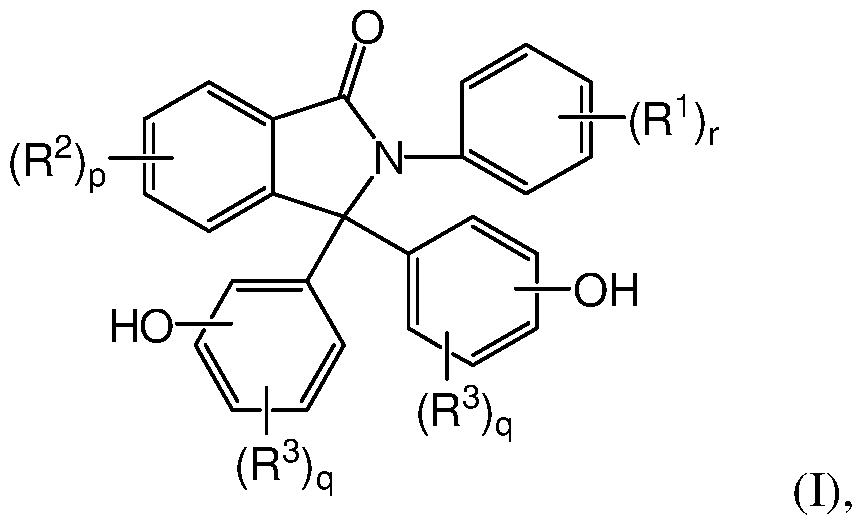
wherein each occurrence of R is independently a phenyl or a Ci-25 hydrocarbyl, preferably a phenyl or C1-6 alkyl, more preferably a C1-3 alkyl, each occurrence of R2 and R3 is independently a Ci-25 hydrocarbyl or halogen, preferably a C1-6 alkyl, more preferably a C1-3 alkyl, and r, p, and q are each independently an integer of 0 to 4, more preferably 0 or 1, preferably 0. In some embodiments, R1 is a C1-3 alkyl group, and R2 is hydrogen, a C1-3 alkyl group, or a halogen, and q is 0.
[0009] A preferred 2-aryl-3,3-bis(4-hydroxyaryl)phthalimidine is of formula (la)
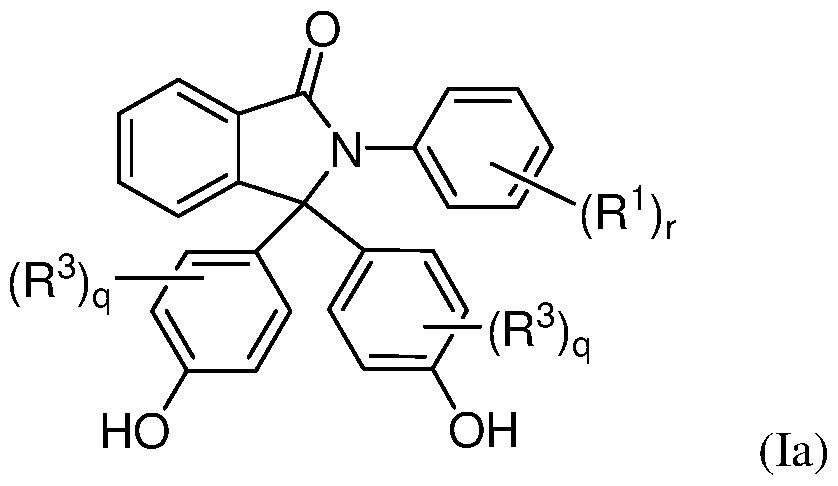
wherein R1 is a C1-3 alkyl, R3 is a C1-3 alkyl, q is 0 or 1, and r is 0 or 1; preferably wherein each of p and r is zero. A preferred 2-aryl-3,3-bis(4-hydroxyaryl)phthalimidine is 2-phenyl- 3,3-bis(4- hydroxyphenyl)phthalimidine .
[0010] The following reaction Scheme (I) shows generally a method for the manufacture of 2-aryl-3,3-bis(4-hydroxaryl)phthalimidine (I).
Scheme I

[0011] In Scheme I, each occurrence of R is independently a phenyl or a Ci-25 hydrocarbyl, preferably a phenyl or a Ci-6 alkyl; each occurrence of R2 and R3 is independently a Ci-25 hydrocarbyl or halogen, preferably a Ci-6 alkyl, more preferably a C1-3 alkyl, and r, p, and q are each independently an integer of 0 to 4, more preferably 0 or 1, preferably 0.
[0012] Preferably in Scheme I, each occurrence of R1 is independently a Ci-6 alkyl; each occurrence of R2 and R3 is independently a phenyl or Ci-6 alkyl, more preferably a C1-3 alkyl, and r, p, and q are each independently 0 or 1, preferably 0.
[0013] The activated compound phenolphthalein precursor (IV) can be isolated, or can be used in the method as prepared without separate isolation.
[0014] The following reaction Scheme (II) shows generally a method for the manufacture a preferred 2-aryl-3,3-bis(4-hydroxyphenyl)phthalimidine (la). cheme II

(la)
[0015] In Scheme II, each occurrence of R1 is independently a phenyl or a Ci-25 hydrocarbyl, preferably a phenyl or Ci-6 alkyl; each occurrence of R3 is independently a Ci-25 hydrocarbyl or halogen, preferably a Ci-6 alkyl, more preferably a C1-3 alkyl, and r, p, and q are each independently 0 to 4, more preferably 0 or 1, preferably 0.
[0016] Preferably in Scheme II, each occurrence of R1 is independently a C1-6 alkyl; each occurrence of R2 and R3 is independently a phenyl or C1-6 alkyl, more preferably a C1-3 alkyl, and r, p, and q are each independently and integer of 0 or 1, preferably 0. The reaction proceeds by hydrolysis of a phenolphthalein precursor, followed by amide formation and cyclization.
[0017] The reaction of the dihydrophenolphthalein of formula (III) to form an activated phenolphthalein precursor of formula (IV) can proceed by an esterification reaction in the presence of an activating agent. Exemplary activating agents include N-hydroxysuccinimide, N- hydroxybenzotriazole (HOBt), N-hydroxy-5-norbornene-endo-2,3-dicarboximide (HONB), 4- dimethylaminopyridine (DMAP), and the sulfo-derivative of N-hydroxysuccinimide. Exemplary coupling agents include water soluble carbodiimides, including l-ethyl-2-(3- dimethylaminopropyl)carbodiimide, or carbodiimides soluble in an organic solvent, such as dicyclohexylcarbodiimide, diisopropylcarbodiimide, or carbonyldiimidazole. Other carbodiimides, e.g., diethylcarbodiimides, N,N'-carbonyl-di(2-methylimidazole), benzotriazole, 1- hydroxybenzotriazole (HOBt)-6-sulfonamidomethyl resin · HC1, hydroxy-3,4-dihydro-4-oxo- l,2,3- benzotriazine (HOOBt), l-hydroxy-7-aza- lH-benzotriazole (HO At), ethyl 2-cyano-2- (hydroximino)acetate (Oxyma Pure Novabiochem®), benzotriazol- l-yloxy-tris(dimethylamino)- phosphonium hexafluorophosphate (BOP), benzotriazol-l-yloxy-tripyrrolidino- phosphoniumhexafluorophosphate (PyBOP), bromo-tripyrrolidino-phosphonium hexafluoro phosphate (PyBrOP), 7-aza-benzotriazol- l-yloxy-tripyrrolidino-phosphonium hexafluorophosphate (PyAOP), ethyl cyano(hydroxyimino)acetato-02)tri-(l-pyrrolidinyl)-phosphonium
hexafluorophosphate) (PyOxim) , 3-(diethoxy-phosphoryloxy)-l,2,3-benzo[d]-triazine-4(3H)-one (DEPBT), other aminium/uronium-imonium reagents including N,N,N',N'-tetramethyl-0- (benzotriazol-l-yl)uronium tetrafluoroborate (TBTU BF4"), N,N,N',N'-tetramethyl-0-(lH- benzotriazol- l-yl)uronium hexafluorophosphate (HBTU PF6"), N,N,N',N'-tetramethyl-0-(6-chloro- lH-benzotriazol-l-yl)uronium hexafluorophosphate (HCTU), N,N,N',N'-tetramethyl-0-(6-chloro- lH-benzotriazol-l-yl)uronium hexafluorophosphate (HDMC), 2-(7-aza-lH-benzotriazol-l-yl)- Ν,Ν,Ν',Ν'-tetramethylaminiumhexafluorophosphate (HATU), l-[l-(cyano-2-ethoxy-2- oxoethylideneaminooxy)-dimethylamino-morpholino)-uronium hexafluorophosphate (COMU), 2- ( 1 -oxy-pyridin-2-yl)- 1 , 1 ,3 ,3-tetramethylisothiouronium tetrafluoroborate (TOTT),
Tetramethylfluoroformamidinium hexafluorophosphate (TFFH) and similar compounds, pentamethyleneketene-N-cyclohexylimine, diphenylketene-N-cyclohexylimine, alkoxyacetylenes , 1-alkoxy- l-chloroethylenes, tetraalkyl phosphites, isopropyl polyphosphate, phosphorus oxychloride, phosphorus trichloride, thionyl chloride, oxalyl chloride, and triphenyl phosphines can also be used as coupling agents.
[0018] The reducing agent can be zinc, or other reducing agents such as alkali or alkaline earth and transition metals (Li, K, Ca, Na, Mg, Mn, Fe, Ni etc.). The base can be sodium hydroxide, alkali metal and alkaline earth hydroxides, an amine, or other base.
[0019] The reaction can proceed under atmospheric conditions or an inert atmosphere. The reaction can proceed at any useful temperature, for example at a temperature of 25 to 90°C, preferably 25 to 45°C, more preferably 25 to 30°C. In an embodiment, the activating agent can be present in a concentration from 0.02 moles to 0.08 moles, preferably 0.04 moles to 0.06 moles. In an embodiment, the coupling agent can be present in a concentration of 0.02 moles to 0.1 moles, preferably 0.04 moles to 0.07 moles, more preferably 0.034 moles to 0.036 moles.
[0020] The reaction of the activated phenolphthalein of formula (IV) to form a benzamide phenolphthalein of formula (VI) can proceed by an amide formation reaction in the presence of the primary aryl amine (VI). Exemplary primary aryl amines include aniline. In some embodiments, the primary aryl amine is present at a concentration of 3.0-5.0 molar equivalents of the precursor phenolphthalein of formula (II).
[0021] The benzamide phenolphthalein of formula (VI) can be oxidized, to form the 2-aryl- 3,3-bis(hydroxyaryl)phthalimidine of formula (I). Exemplary oxidizing agents include 2,3- dichloro-5,6-dicyanobenzoquinone (DDQ), p-chloranil, other dehydrogenating agents known in literature such as the transition metal oxides/chlorides, e.g., ferric chloride, silver oxide, vanadium oxide, and others known in the art. The oxidizing agent can be present at a concentration of 0.5 moles to 1 moles, preferably 0.5 to 0.75 moles.
[0022] The as- synthesized 2-aryl-3,3-bis(hydroxyaryl)phthalimidine of formula (I) comprises zero to 100 parts per million of an aminophenol. The as- synthesized 2-aryl-3,3- bis(hydroxyaryl)phthalimidine of formula (I) comprises zero to 100 parts per million of an aminophenol, for example an aminophenol of the formula

or zero to 50 parts per million of an aminophenol, or zero to 20 parts per million of an
aminophenol, or zero to 5 parts per million of an aminophenol before any additional purification, where the variables are as defined above.
[0023] The as- synthesized 2-aryl-3,3-bis(hydroxyaryl)phthalimidine of formula (I) can comprise zero to 500 parts per million, or zero to 50 parts per million of the precursor
phenolphthalein of formula (II). In an embodiment, the as- synthesized 2-aryl-3,3- bis(hydroxyaryl)phthalimidine of formula (I) can comprise less than 500 parts per million, or less than 50 parts per million of the precursor phenolphthalein of formula (II).
[0024] After purification, the purified 2-hydrocarbyl-3,3-bis(hydroxyaryl)phthalimidine of formula (I) can comprise zero to 50 parts per million of an aminophenol, preferably zero to 5 parts per million of an aminophenol; or zero to 500 parts per million, preferably from zero to 50 parts per million of the precursor phenolphthalein of formula (II). In an embodiment, after purification, the purified 2-hydrocarbyl-3,3-bis(hydroxyaryl)phthalimidine of formula (I) can comprise less than 50 parts per million of an aminophenol, preferably less than 5 parts per million of an aminophenol; or less than 500 parts per million, preferably less than 50 parts per million of the precursor
phenolphthalein of formula (II).
[0025] A polymer comprising structural units derived from the 2-aryl-3,3-bis(4- hydroxyaryl) phthalimidine manufactured by the methods described herein is also provided. The polymer can be a polycarbonate, preferably wherein the polymer is a copolycarbonate comprising units derived from the 2-aryl-3,3-bis(4-hydroxyaryl) phthalimidine of formula (I) and units derived from bisphenol A. A method for the manufacture of a polycarbonate, includes manufacturing the 2-aryl-3,3-bis(4-hydroxyaryl) phthalimidine of formula (I) in accordance with a method described herein; and polymerizing the 2-aryl-3,3-bis(4-hydroxyaryl) phthalimidine of formula (I) in the presence of a carbonate source
[0026] The 2-aryl-3,3-bis(4-hydroxyaryl)phthalimidines, including the exemplary 2-phenyl- 3,3-bis(4-hydroxyphenyl)phthalimidine (PPPBP), are commercially valuable monomers or comonomers for producing a variety of polymers formed by reactions of the phenolic OH groups of the 2-aryl-3,3-bis(4-hydroxyaryl)phthalimidines. Exemplary polymers that can be produced include homopolymers and copolymers of a polycarbonate, a polyestercarbonate, a polyester, a polyesteramide, a polyimide, a polyetherimide, a polyamideimide, a polyether, a polyethersulfone, a polycarbonate-polyorganosiloxane block copolymer, a copolymer comprising aromatic ester, ester carbonate, and carbonate repeat units, and a polyetherketone. An example of a copolymer comprising aromatic ester, estercarbonate, and carbonate repeat units is the copolymer produced by the reaction of a hydroxy-terminated polyester, such as the product of reaction of isophthaloyl chloride and terephthaloyl chloride with resorcinol, with phosgene and an aromatic dihydroxy compound, such as bisphenol A.
[0027] In some embodiments, polycarbonates having low color properties are synthesized, wherein the polycarbonates include structural units of formula (Va):

which are derived from a 2-aryl-3,3-bis(4-hydroxyaryl)phthalimidine of formula (I), wherein R1 and R2 are as described previously; and the C=0 structural units are derived from a C=0 donor such as a carbonic acid diester in a melt transesterification process, or phosgene in an interfacial process.
[0028] Specific polycarbonates are copolycarbonates having structural units derived from a phthalimidine compound of formula (I) and a dihydroxy compound of the formula HO-R^OH, in particular of formula (Via)
HO-A^Y^-OH (Via)
wherein each of A1 and A2 is a monocyclic divalent aromatic group and Y1 is a single bond or a bridging group having one or more atoms that separate A1 from A2. In an exemplary embodiment, one atom separates A1 from A2. Specifically, each R1 can be derived from a dihydroxy aromatic compound of formula (VII):

wherein Ra and Rb each represent a halogen or Ci-12 alkyl group and can be the same or different; and p and q are each independently integers of 0 to 4. Xa represents a single bond or a bridging group connecting the two hydroxy-substituted aromatic groups, where the single bond or the bridging group and the hydroxy substituent of each C6 arylene group are disposed ortho, meta, or para (specifically para) to each other on the C6 arylene group. In an embodiment, the bridging group Xa is -0-, -S-, -S(O)-, -S(0)2-, -C(O)-, or a CMS organic group. The CMS organic group can be cyclic or acyclic, aromatic or non-aromatic, and can further comprise heteroatoms such as halogens, oxygen, nitrogen, sulfur, silicon, or phosphorous. The CMS organic group can be disposed such that the C6 arylene groups connected thereto are each connected to a common alkylidene carbon or to different carbons of the CMS organic group. In some embodiments, p and q is each 1, and Ra and Rb are each a C1-3 alkyl group, specifically methyl, disposed meta to the hydroxy group on each arylene group.
[0029] In an embodiment, XA is a substituted or unsubstituted C3-18 cycloalkylidene, a Ci-25 alkylidene of formula -C(Rc)(Rd) - wherein Rc and Rd are each independently hydrogen, Ci-12 alkyl, Ci-12 cycloalkyl, C7-12 arylalkyl, Ci-12 heteroalkyl, or cyclic C7-12 heteroarylalkyl, or a group of the formula -C(=Re)- wherein Re is a divalent Ci-12 hydrocarbon group. Exemplary groups of this type include methylene, cyclohexylmethylene, ethylidene, neopentylidene, and isopropylidene, as well as 2-[2.2.1]-bicycloheptylidene, cyclohexylidene, cyclopentylidene, cyclododecylidene, and adamantylidene. In another embodiment, XA is a CMS alkylene group, a C3-18 cycloalkylene group, a fused C6-i8 cycloalkylene group, or a group of the formula -E^-W-B2- wherein B1 and B2 are the same or different Ci-6 alkylene group and W is a C3-12 cycloalkylidene group or a C6-i6 arylene group.
[0030] Other useful aromatic dihydroxy compounds of the formula HO-R^OH include compounds of formula (VIII):

wherein each Rh is independently a halogen atom, a Ci-10 hydrocarbyl such as a Ci-10 alkyl group, a halogen-substituted Ci-10 alkyl group, a C6-io aryl group, or a halogen-substituted C6-10 aryl group, and n is 0 to 4. The halogen is usually bromine.
[0031] Some illustrative examples of specific aromatic dihydroxy compounds include the following: 4,4'-dihydroxybiphenyl, 1,6-dihydroxynaphthalene, 2,6-dihydroxynaphthalene, bis(4- hydroxyphenyl)methane, bis(4-hydroxyphenyl)diphenylmethane, bis(4-hydroxyphenyl)-l- naphthylmethane, l,2-bis(4-hydroxyphenyl)ethane, l, l-bis(4-hydroxyphenyl)-l-phenylethane, 2- (4-hydroxyphenyl)-2-(3-hydroxyphenyl)propane, bis(4-hydroxyphenyl)phenylmethane, 2,2-bis(4- hydroxy-3-bromophenyl)propane, 1,1 -bis (hydroxyphenyl)cyclopentane, l, l-bis(4- hydroxyphenyl)cyclohexane, 1 , 1 -bis(4-hydroxyphenyl)isobutene, 1 , 1 -bis(4- hydroxyphenyl)cyclododecane, trans-2,3-bis(4-hydroxyphenyl)-2-butene, 2,2-bis(4- hydroxyphenyl)adamantane, alpha, alpha'-bis(4-hydroxyphenyl)toluene, bis(4- hydroxyphenyl)acetonitrile, 2,2-bis(3-methyl-4-hydroxyphenyl)propane, 2,2-bis(3-ethyl-4- hydroxyphenyl)propane, 2,2-bis(3-n-propyl-4-hydroxyphenyl)propane, 2,2-bis(3-isopropyl-4- hydroxyphenyl)propane, 2,2-bis(3-sec-butyl-4-hydroxyphenyl)propane, 2,2-bis(3-t-butyl-4- hydroxyphenyl)propane, 2,2-bis(3-cyclohexyl-4-hydroxyphenyl)propane, 2,2-bis(3-allyl-4- hydroxyphenyl)propane, 2,2-bis(3-methoxy-4-hydroxyphenyl)propane, 2,2-bis(4- hydroxyphenyl)hexafluoropropane, 1 , 1 -dichloro-2,2-bis(4-hydroxyphenyl)ethylene, 1 , 1 -dibromo- 2,2-bis(4-hydroxyphenyl)ethylene, l,l-dichloro-2,2-bis(5-phenoxy-4-hydroxyphenyl)ethylene, 4,4'-
dihydroxybenzophenone, 3,3-bis(4-hydroxyphenyl)-2-butanone, l,6-bis(4-hydroxyphenyl)-l,6- hexanedione, ethylene glycol bis(4-hydroxyphenyl)ether, bis(4-hydroxyphenyl)ether, bis(4- hydroxyphenyl) sulfide, bis(4-hydroxyphenyl)sulfoxide, bis(4-hydroxyphenyl)sulfone, 9,9-bis(4- hydroxyphenyl)fluorine, 2,7-dihydroxypyrene, 6,6'-dihydroxy-3,3,3',3'- tetramethylspiro(bis)indane ("spirobiindane bisphenol"), 3,3-bis(4-hydroxyphenyl)phthalimide, 2,6-dihydroxydibenzo-p-dioxin, 2,6-dihydroxythianthrene, 2,7-dihydroxyphenoxathin, 2,7-dihydroxy-9,10-dimethylphenazine, 3,6- dihydroxydibenzofuran, 3,6-dihydroxydibenzothiophene, and 2,7-dihydroxycarbazole, resorcinol, substituted resorcinol compounds such as 5-methyl resorcinol, 5-ethyl resorcinol, 5-propyl resorcinol, 5-butyl resorcinol, 5-t-butyl resorcinol, 5-phenyl resorcinol, 5-cumyl resorcinol, 2,4,5,6- tetrafluoro resorcinol, 2,4,5, 6-tetrabromo resorcinol, or the like; catechol; hydroquinone;
substituted hydroquinones such as 2-methyl hydroquinone, 2-ethyl hydroquinone, 2-propyl hydroquinone, 2-butyl hydroquinone, 2-t-butyl hydroquinone, 2-phenyl hydroquinone, 2-cumyl hydroquinone, 2,3,5, 6-tetramethyl hydroquinone, 2,3,5,6-tetra-t-butyl hydroquinone, 2,3,5,6- tetrafluoro hydroquinone, 2,3,5, 6-tetrabromo hydroquinone, or the like, or combinations
comprising at least one of the foregoing dihydroxy compounds.
[0032] Specific examples of bisphenol compounds of formula (VII) include l,l-bis(4- hydroxyphenyl) methane, l,l-bis(4-hydroxyphenyl) ethane, 2,2-bis(4-hydroxyphenyl) propane (hereinafter "bisphenol A" or "BPA"), 2,2-bis(4-hydroxyphenyl) butane, 2,2-bis(4-hydroxyphenyl) octane, l,l-bis(4-hydroxyphenyl) propane, l,l-bis(4-hydroxyphenyl) n-butane, 2,2-bis(4-hydroxy- 2-methylphenyl) propane, l,l-bis(4-hydroxy-t-butylphenyl) propane, 3,3-bis(4-hydroxyphenyl) phthalimidine, and l,l-bis(4-hydroxy-3-methylphenyl)cyclohexane (DMBPC). Combinations comprising at least one of the foregoing dihydroxy compounds can also be used. In one specific embodiment, the polycarbonate is a linear homopolymer derived from bisphenol A, in which each of Al and A2 is p-phenylene and Yl is isopropylidene in formula (3).
[0033] Exemplary carbonic acid diesters useful in the formation of the polycarbonates in a melt transesterification process are of formula (IX):
(ZO)2C=0 (IX)
wherein each Z is independently an unsubstituted or substituted Ci-12 alkyl radical, or an
unsubstituted or substituted C6-22 aryl radical. Examples of carbonic acid diesters include, but are not limited to, ditolyl carbonate, m-cresyl carbonate, dinaphthyl carbonate, diphenyl carbonate, diethyl carbonate, dimethyl carbonate, dibutyl carbonate, dicyclohexyl carbonate, and combinations thereof. Diphenyl carbonate is widely used as a carbonic acid diester due to its low cost and ready availability on a commercial scale. Use of activated aromatic carbonates that are more reactive than diphenyl carbonate is also contemplated. Specific non-limiting examples of activated aromatic
carbonates include bis(o-methoxycarbonylphenyl)carbonate, bis(o-chlorophenyl)carbonate, bis(o- nitrophenyl)carbonate, bis(o-acetylphenyl)carbonate, bis(o-phenylketonephenyl)carbonate, bis(o- formylphenyl)carbonate. Unsymmetrical combinations of these structures are also contemplated. Exemplary ester-substituted diaryl carbonates include, but are not limited to,
bis(methylsalicyl)carbonate (CAS Registry No. 82091-12-1) (also known as BMSC or bis(o- methoxycarbonylphenyl)carbonate), bis(ethyl salicyl)carbonate, bis(propyl salicyl) carbonate, bis(butylsalicyl) carbonate, bis(benzyl salicyl)carbonate, bis(methyl 4-chlorosalicyl)carbonate, and the like. In some embodiments, BMSC is used in the melt transesterification process.
[0034] The melt transesterification process is generally carried out by combining a catalyst, the carbonic acid diester of formula (IX), the phthalimidine compound of formula (I), and optionally a dihydroxy comonomer; and mixing the reaction mixture under reactive conditions for a time period effective to produce the polycarbonate product. Exemplary melt transesterification catalysts include alkali metal compounds, alkaline earth metal compounds, tetraorganoammonium compounds, tetraorganophosphonium compounds, and combinations comprising at least one of the foregoing catalysts. Specific examples of alkali metal compounds or alkaline earth metal compounds include, but are not limited to, sodium hydroxide, potassium hydroxide, calcium hydroxide, magnesium hydroxide, sodium bicarbonate, potassium bicarbonate, sodium carbonate, potassium carbonate, lithium carbonate, sodium acetate, potassium acetate, sodium stearate, potassium stearate, sodium hydroxyborate, sodium phenoxyborate, sodium benzoate, potassium benzoate, lithium benzoate, disodium hydrogen phosphate, dipotassium hydrogen phosphate, dilithium hydrogen phosphate, disodium salts, dipotassium salts, and dilithium salts of bisphenol A, and sodium salts, potassium salts, lithium salts of phenol, and the like. Specific examples of tetraorganoammonium compounds and tetraorganophosphonium compounds include, but are not limited to tetramethylammonium hydroxide, tetrabutylammonium hydroxide,
tetraethylphosphonium hydroxide, tetrabutylphosphonium acetate, tetrabutylphosphonium hydroxide, and the like.
[0035] In some embodiments, the catalyst is tetrabutylphosphonium acetate. In an alternative embodiment, the catalyst comprises a mixture of an alkali metal salt or alkaline earth metal salt with at least one quaternary ammonium compound, at least one quaternary phosphonium compound, or a mixture thereof. For example, the catalyst can be a mixture of sodium hydroxide and tetrabutylphosphonium acetate. In another embodiment, the catalyst is a mixture of sodium hydroxide and tetramethylammonium hydroxide. In yet another embodiment, the catalyst comprises the salt of a non-volatile inorganic acid, for example alkali metal salts of phosphites; alkaline earth metal salts of phosphites; alkali metal salts of phosphates; and alkaline earth metal
salts of phosphates, including but not limited to NaH2P03, NaH2P04, Na2H2P03, KH2P04, CsH2P04, Cs2H2P04, or a mixture thereof. In some embodiments, the transesterification catalyst comprises both the salt of a non- volatile acid and a basic co-catalyst such as an alkali metal hydroxide. This concept is exemplified by the use of a combination of NaH2P04 and sodium hydroxide as the transesterification catalyst.
[0036] Any of the catalysts disclosed above can be used as combinations of two or more substances. Moreover, the catalyst can be added in a variety of forms. For example, the catalyst can be added as a solid as a powder, or it can be dissolved in a solvent, for example, in water or alcohol. The total catalyst composition can be about 1 X 10"7 to about 2 X 10"3 moles, and in other embodiments, about 1 X 10"6 to about 4 X 10"4 moles, for each mole of the combination of, for example, the purified PPPBP and the aromatic dihydroxy comonomer.
[0037] The progress of the polymerization reaction can be monitored by measuring the melt viscosity or the weight average molecular weight of the reaction mixture using techniques known in the art such as gel permeation chromatography. These properties can be measured by taking discreet samples or can be measured on-line. After the desired melt viscosity or molecular weight is reached, the final polycarbonate product can be isolated from the reactor in a solid or molten form. The method of making polycarbonates as described in the preceding sections can be made in a batch or a continuous process.
[0038] In some embodiments, the melt-polymerized polycarbonate is prepared in an extruder in the presence of one or more catalysts. The reactants for the polymerization reaction can be fed to the extruder in powder or molten form. In some embodiments, the reactants are dry blended prior to addition to the extruder. The extruder can be equipped with pressure reducing devices (e.g., vents) that serve to remove the activated phenol byproduct and thus drive the polymerization reaction toward completion. The molecular weight of the polycarbonate product can be manipulated by controlling, among other factors, the feed rate of the reactants, the type of extruder, the extruder screw design and configuration, the residence time in the extruder, the reaction temperature, and the pressure reducing techniques present on the extruder. The molecular weight of the polycarbonate product can also depend upon the structures of the reactants and the catalyst employed. Many different screw designs and extruder configurations are commercially available that use single screws, double screws, vents, back flight and forward flight zones, seals, side-streams, and sizes.
[0039] Alternatively, the polycarbonates can be prepared by an interfacial polymerization process. Although the reaction conditions for interfacial polymerization can vary, an exemplary process generally involves dissolving or dispersing a dihydric phenol reactant in aqueous caustic
soda or potash, adding the resulting mixture to a water- immiscible solvent medium, and contacting the reactants with a carbonate precursor in the presence of a catalyst such as triethylamine or a phase transfer catalyst, under controlled pH conditions, e.g., about 8 to about 12. The most commonly used water immiscible solvents include methylene chloride, 1,2-dichloroethane, chlorobenzene, toluene, and the like.
[0040] Exemplary carbonate precursors for interfacial polymerization include a carbonyl halide such as carbonyl bromide or carbonyl chloride, or a haloformate such as a bishaloformates of a dihydric phenol (e.g., the bischloroformates of bisphenol A, hydroquinone, or the like) or a glycol (e.g., the bishaloformate of ethylene glycol, neopentyl glycol, polyethylene glycol, or the like). Combinations comprising at least one of the foregoing types of carbonate precursors can also be used. In an exemplary embodiment, an interfacial polymerization reaction to form carbonate linkages uses phosgene as a carbonate precursor, and is referred to as a phosgenation reaction.
[0041] Among the phase transfer catalysts that can be used for interfacial polymerization are tetraorgano ammonium compounds and tetraorganophosphonium compounds of the formula (R3)4Q+X, wherein each R3 is independently a Ci-io alkyl group; Q is a nitrogen or phosphorus atom; and X is a halogen atom or a C1-8 alkoxy group or C6-18 aryloxy group. Exemplary phase transfer catalysts include, for example, [CH3(CH2)3]4NX, [CH3(CH2)3]4PX, [CH3(CH2)5]4NX, [CH3(CH2)6]4NX, [CH3(CH2)4]4NX, CH3[CH3(CH2)3]3NX, and CH3[CH3(CH2)2]3NX, wherein X is C1-, Br-, a C1-8 alkoxy group or a C6-is aryloxy group. An effective amount of a phase transfer catalyst can be about 0.1 to about 10 wt% based on the weight of bisphenol in the phosgenation mixture. In another embodiment an effective amount of phase transfer catalyst can be about 0.5 to about 2 wt% based on the weight of bisphenol in the phosgenation mixture.
[0042] All types of polycarbonate end groups are contemplated as being useful in the polycarbonate composition, provided that such end groups do not significantly adversely affect desired properties of the compositions. Branched polycarbonate blocks can be prepared by adding a branching agent during polymerization. A chain stopper (also referred to as a capping agent) can be included during polymerization. The chain stopper limits molecular weight growth rate, and so controls molecular weight in the polycarbonate. Exemplary chain stoppers include certain mono- phenolic compounds, mono-carboxylic acid chlorides, or mono-chloroformates.
[0043] The interfacial method described above can be suitably adapted to produce polycarbonates through the intermediate formation of 2-aryl-3,3-bis(4-hydroxyaryl)phthalimidine bischloroformate. This method is sometimes called the bischloroformate polymerization method. In some embodiments, the method comprises reacting a 2-aryl-3,3-bis(4-hydroxyaryl)phthalimidine with phosgene in an organic solvent, and then reacting the bischloroformate either with a 2-aryl-
3,3-bis(4-hydroxyaryl)phthalimidine, or an aromatic dihydroxy compound in the presence of an acid acceptor and an aqueous base to form the polycarbonate. The interfacial polymerization method and the bischloroformate polymerization method can be carried in a batch or a continuous mode using one or more reactor systems. To carry out the process in a continuous mode, one or more continuous reactors, such as for example, a tubular reactor can be used. In some
embodiments, the continuous method comprises introducing into a tubular reactor system phosgene, at least one solvent (example, methylene chloride), at least one bisphenol, aqueous base, and optionally one or more catalysts (example, a trialkylamine) to form a flowing reaction mixture. The flowing mixture is then passed through the tubular reactor system until substantially all of the phosgene has been consumed. The resulting mixture is next treated with a mixture comprising an aqueous base, at least one endcapping agent, optionally one or more solvents, and at least one catalyst. The endcapped polycarbonate thus formed is continuously removed from the tubular reactor system.
[0044] The processes disclosed herein can advantageously be used to prepare, for example, PPPBP homopolycarbonate and copolycarbonates having a weight average molecular weight (Mw) of about 3,000 to about 150,000 Daltons and a glass transition temperature (Tg) of about 80°C to about 300°C. The number average molecular weights (Mn) of the homopolycarbonate and copolycarbonates can be from about 1,500 to about 75,000 Daltons.
[0045] Polymers comprising structural units derived from the phthalimidines, in particular PPPBP can be used to manufacture polymer blends comprising the polymer and at least one other thermoplastic polymer. The at least one other thermoplastic polymer includes vinyl polymers, acrylic polymers, polyacrylonitrile, polystyrenes, polyolefins, polyesters, polyurethanes, polyamides, polysulfones, polyimides, polyetherimides, polyphenylene ethers, polyphenylene sulfides, polyether ketones, polyether ether ketones, ABS polymers, polyethersulfones,
poly(alkenylaromatic) polymers, polybutadiene, polyacetals, polycarbonates, polyphenylene ethers, ethylene-vinyl acetate copolymers, polyvinyl acetate, liquid crystal polymers, ethylene- tetrafluoroethylene copolymer, aromatic polyesters, polyvinyl fluoride, polyvinylidene fluoride, polyvinylidene chloride, tetrafluoroethylene, polycarbonate-polyorganosiloxane block copolymers, copolymers comprising aromatic ester, estercarbonate, and carbonate repeat units, and
combinations comprising at least one of the foregoing polymers.
[0046] The polymers and polymer blends described hereinabove are valuable for producing articles. In some embodiments, an article comprises a polymer comprising structural units derived from a 2-aryl-3,3-bis(4-hydroxyaryl)phthalimidine of formula (I) prepared by following the process described above.
[0047] Polymers, particularly polycarbonate homopolymers and copolymers comprising structural units derived from the high purity 2-aryl-3,3-bis(4-hydroxyaryl)phthalimidine in general, and PPPBP in particular exhibit lower visual coloration. As such, these polycarbonate polymers are useful for producing articles having a number of useful properties, including lower visual color, among others. The polycarbonate homopolymers and copolymers have high glass transition temperatures of higher than or equal to about 180°C. One of the unique properties of these polycarbonates, especially those that have glass transition temperatures of greater than or equal to about 180°C is that during melt processing they exhibit a shear-thinning behavior. That is, the polymers have the ability to flow under an applied shear. Therefore, standard melt processing equipment used for BPA polycarbonates can advantageously be used for producing articles. The polycarbonates can also have high transparency, as measured by percent light transmission, of greater than or equal to about 85 percent.
[0048] In addition to the polymer, the thermoplastic compositions comprising the polymers can include various additives ordinarily incorporated into polymer compositions of this type, with the proviso that the additive(s) are selected so as to not significantly adversely affect the desired properties of the thermoplastic composition, in particular low color. Such additives can be mixed at a suitable time during the mixing of the components for forming the composition. The additive can be soluble or non-soluble in polycarbonate. The additive composition can include an impact modifier, flow modifier, filler (e.g., a particulate polytetrafluoroethylene (PTFE), glass, carbon, mineral, or metal), reinforcing agent (e.g., glass fibers), antioxidant, heat stabilizer, light stabilizer, ultraviolet (UV) light stabilizer, UV absorbing additive, plasticizer, lubricant, release agent (such as a mold release agent), antistatic agent, anti-fog agent, antimicrobial agent, colorant (e.g., a dye or pigment), surface effect additive, radiation stabilizer, flame retardant, anti-drip agent (e.g., a PTFE- encapsulated styrene-acrylonitrile copolymer (TSAN)), or a combination comprising at least one or more of the foregoing. For example, a combination of a heat stabilizer, mold release agent, and ultraviolet light stabilizer can be used. In general, the additives are used in the amounts generally known to be effective. For example, the total amount of the additive composition (other than any impact modifier, filler, or reinforcing agent) can be 0.001 to 10.0 wt%, or 0.01 to 5 wt%, each based on the total weight of the polymer in the composition.
[0049] The disclosure is further illustrated by the following non-limiting examples.
EXAMPLES
[0050] The following reaction Scheme (III) shows generally a method for the manufacture of 2-phenyl-3,3-bis(4-hydroxyphenyl)-2-phthalimidine (lb).
Scheme III.

(lb)
Preparation of dihydrophenolphthalein (Illb)
[0051] First, 20.0 grams (g) (0.06283 moles) phenolphthalein (lib), 28.42 g (0.71060 moles) solid NaOH, and 200 milliliters (mL) of distilled water were charged into a round bottom flask, fitted with an overhead stirrer and stirred for 30 minutes. To the dark purple color solution formed, zinc dust (22.9 g, 0.3380 moles) was added. The reaction mixture was stirred at room temperature for 1 hour (hr), then heated to 60°C and maintained at this temperature until a gray suspension (due to unreacted Zn dust) formed. The suspension was filtered while hot and washed with water (about 20 mL). The filtrate was acidified with 33% aqueous hydrochloric acid (65 g, 1.780 moles) to pH 3. The resulting off-white precipitate was filtered and washed with 50 mL water. The off-white solid was dried in vacuum to yield 26.3 g (HPLC purity about 95% and LC purity 97%) of dihydrophenolphthalein (Illb) as an off-white solid.
[0052] The product was confirmed by LC-Ms, found M/Z: 320.0; M+l peak: 321.34, Molecular weight (Mol. wt): 320.34 grams/mole. IR spectroscopy: FTIR (cm"1): 1658 (C=0), 1497 (quaternary carbon), 1600 (aromatic), 1547-1610 and 1386-1441 (COOH/COO ), 3353 (Ar- OH).
Preparation of Activated Phenolphthalein Precursor of Formula (IVb)
[0053] To a solution of the dihydrophenolphthalein (Illb) (10 g, 0.03122 moles) in anhydrous dimethylformamide (DMF) (100 mL), were added N-hydroxysuccinimide (NHS) (5.38 g, 0.04683 moles) and dicyclohexylcarbodiimide (DCC) (7.07 g, 0.03435 moles). The reaction mixture was a clear light yellow solution. Then the whole reaction mixture was stirred at room temperature for 12 hr. After 12 hours, the resulting reaction mixture was filtered and the filter cake was washed with 10 mL dichloromethane to provide a filtrate comprising the activated intermediate 2,5-dioxopyrrolidin-l-yl 2-(bis(4-hydroxyphenyl)methyl)benzoate (IVb).
Preparation of 2-(bis (4-hydroxyphenyl) methyl)-N-phenylbenzamide (VIb)
[0054] The obtained filtrate comprising the activated intermediate (IVb) was back-charged into a round bottom flask, aniline (37.79 g, 0.40586 moles) was added, and the mixture was stirred for 24 hr at 40°C. The resulting mixture was concentrated under rotoevaporator to yield 45 g of crude compound (VIb). From the obtained crude compound, unreacted aniline was removed using distillation. 12.0 g light brown semi solid (LC purity about 82% and HPLC purity about 88%) was obtained. Product was confirmed by LC-Ms, found M/Z: 395.0; M+l peak: 396.5, Mol. wt.:
395.46 grams/mole.
Preparation of As-Synthesized 2-Phenyl-3,3-Bis(4-Hydroxyphenyl) Phthalimidine (lb)
[0055] The obtained 2-(bis (4-hydroxyphenyl)methyl)-N-phenylbenzamide (VIb) (10 g, 0.02528 moles) was dissolved in methanol (60 mL) and dichlorodicyanoquinone (DDQ, 17.11 g, 0.7584 moles) was added to the solution at 0°C. The reaction was stirred for 18 hours at room temperature. Progress of the reaction was monitored by TLC (thin layer chromatography). The reaction was quenched using saturated brine solution. A light grey color solid was precipitated. The obtained solid was filtered and washed with chilled methanol (10 ml).
Purification of 2-Phenyl-3,3-Bis(4-Hydroxyphenyl) Phthalimidine (lb)
[0056] The grey-colored solid was back-charged into a round bottom flask, NaOH (6.0 g, 0.15 moles), and 50 milliliters of water were added, and stirred until a clear solution was observed.
The aqueous solution was extracted with dichloromethane for removal of impurities. To the resultant aqueous extract, 0.5 g of charcoal was added and the mixture was stirred for 30 mins, filtered and the resultant filtrate was neutralized with aqueous HC1 (8 grams, 0.18 moles).
[0057] After neutralization, the product precipitated. The product was filtered and further purified by methanol trituration. The product (PPPBP) was isolated (2.9 g) as a white solid.
Product was confirmed by lH NMR and analyzed by HPLC. The PPPBP purity was about 99.93 weight percent, Phenolphthalein (PP) and aminophenol impurity were nondetectable (ND) by HPLC. An unknown impurity was seen at 0.0665%.
[0058] Product was confirmed by LC-Ms, found M/Z: 393.0; M+2 peak: 395.4, Mol. wt: 393.44 grams/mole. Ή NMR (400 MHz, DMSO): d = 6.67 (d, 4 H), 7.01 (t, 6H), 7.18-7.28 (m, 4 H), 7.49-7.68 (m, 2 H), 7.90 (d, 1 H), 9.54 (s, 2 H).
[0059] The methods and polymers are further illustrated by the following embodiments, which are non-limiting.
[0060] Embodiment 1: A method for the manufacture of a 2-aryl-3,3- bis(hydroxyaryl)phthalimidine of formula (I)

phenolphthalein of formula (II)


phenolphthalein precursor of formula (IV)
 (IV); and reacting the activated phenolphthalein precursor of formula
(IV) with a primary aryl amine of formula (V)
a benzamide phenolphthalein of formula (VI)

[0061] Embodiment 2: The method of Embodiment 1, wherein the reducing agent is zinc.
[0062] Embodiment 3: The method of any one of more of Embodiments 1 or 2, further comprising isolating, washing, and then acidifying the product of the reducing to provide the dihydrophenolphthalein of formula (III).
[0063] Embodiment 4: The method of any one of more of Embodiments 1 to 3, wherein the activating agent is N-hydroxysuccinimide.
[0064] Embodiment 5: The method of any one of more of Embodiments 1 to 4, wherein the coupling agent is dicyclohexylcarbodiimide.
[0065] Embodiment 6: The method of any one of more of Embodiments 1 to 5, wherein the primary aryl amine is aniline.
[0066] Embodiment 7: The method of any one of more of Embodiments 1 to 6, further comprising isolating and washing the activated phenolphthalein precursor of formula (IV) before the reacting with the primary aryl amine of formula (V).
[0067] Embodiment 8: The method of any one of more of Embodiments 1 to 7, wherein the reacting with the primary aryl amine of formula (V) is at 25 to 50°C, preferably 30 to 40°C.
[0068] Embodiment 9: The method of any one of more of Embodiments 1 to 8, wherein the oxidizing agent is dichlorodicyanoquinone.
Embodiment 10: The method of any one of more of Embodiments 1 to 9, further comprising isolating and washing the product of the oxidizing to obtain an as- synthesized 2-aryl-3,3- bis(hydroxyaryl)phthalimidine of formula (I), which comprises zero to 100 parts per million of an aminophenol, or zero to 50 parts per million of an aminophenol, or zero to 20 parts per million of an aminophenol, or zero to 5 parts per million of an aminophenol; or zero to 500 parts per million, or zero to 50 parts per million of the precursor phenolphthalein of formula (II).
[0069] Embodiment 11: The method of any one of more of Embodiments 1 to 10, further comprising purifying the 2-aryl-3,3-bis(hydroxyaryl)phthalimidine of formula (I).
[0070] Embodiment 12: The method of any one of more of Embodiments 1 to 11, wherein the purifying comprises dissolving the 2-aryl-3,3-bis(hydroxyaryl)phthalimidine of formula (I) in an aqueous base to form a solution, and extracting the solution with an organic solvent; contacting the extracted aqueous solution with charcoal, and removing the charcoal to provide a decolorized solution; and neutralizing the decolorized aqueous solution to provide a precipitate comprising the 2-aryl-3,3-bis(hydroxyaryl)phthalimidine of formula (I); and optionally, triturating the precipitate to provide the purified the 2-aryl-3,3-bis(hydroxyaryl)phthalimidine of formula (I).
[0071] Embodiment 13: The method of any one of more of Embodiments 1 to 12, wherein the purified 2-hydrocarbyl-3,3-bis(hydroxyaryl)phthalimidine of formula (I) comprises zero to 50 parts per million of an aminophenol, preferably zero to 5 parts per million of an aminophenol; or zero to 500 parts per million, preferably from zero to 50 parts per million of the precursor phenolphthalein of formula (II).
[0072] Embodiment 14: The method of Embodiments 11 to 13, wherein the purified 2- hydrocarbyl-3,3-bis(hydroxyaryl)phthalimidine of formula (I) comprises less than 0.1% by weight of impurities other than an aminophenol or precursor phenolphthalein of formula (II); less than 3 ppm of iron; less than 50 ppm of methanol; and an APHA color of less than 40.
[0073] Embodiment 15: The method of any one of more of Embodiments 1 to 14, wherein the 2-aryl-3,3-bis(hydroxyaryl)phthalimidine of formula (I) is of formula (la)

[0074] Embodiment 16: The method of any one or more of Embodiments 1 to 15, wherein
the precursor phenolphthalein is
 , wherein p is 0, each occurrence is a Ci-3 alkyl, and q is 1, the reducing agent is zinc, the activating agent is N-hydroxysuccinimide, the coupling agent is dicyclohexylcarbodiimide, the primary aryl amine is aniline, the oxidizing agent is dichlorodicyanoquinone.
[0075] Embodiment 17: A 2-aryl-3,3-bis(4-hydroxyaryl) phthalimidine composition, comprising an as- synthesized phthalimidine of formula (I)
 (I), wherein each occurrence of R1 is independently a phenyl or a Ci-25 hydrocarbyl, preferably a phenyl or a C1-6 alkyl, more preferably a C1-3 alkyl, each occurrence of R2 and R3 is independently a Ci-25 hydrocarbyl or halogen, preferably a C1-6 alkyl, more preferably a C1-3 alkyl, and r, p, and q are each independently 0 to 4, more preferably 0 or 1, preferably 0; zero to 100 parts per million of an aminophenol, or zero to 50 parts per million
of an aminophenol, or zero to 20 parts per million of an aminophenol, or zero to 5 parts per million of an aminophenol; or zero to 500 parts per million, or zero to 50 parts per million of the precursor
(I), wherein each occurrence of R1 is independently a phenyl or a Ci-25 hydrocarbyl, preferably a phenyl or a C1-6 alkyl, more preferably a C1-3 alkyl, each occurrence of R2 and R3 is independently a Ci-25 hydrocarbyl or halogen, preferably a C1-6 alkyl, more preferably a C1-3 alkyl, and r, p, and q are each independently 0 to 4, more preferably 0 or 1, preferably 0; zero to 100 parts per million of an aminophenol, or zero to 50 parts per million
of an aminophenol, or zero to 20 parts per million of an aminophenol, or zero to 5 parts per million of an aminophenol; or zero to 500 parts per million, or zero to 50 parts per million of the precursor
phenolphthalein of formula (II)
 (II) wherein each occurrence of R 1 is independently a phenyl or a Ci-25 hydrocarbyl, preferably a phenyl or a C1-6 alkyl, more preferably a Ci-3 alkyl, each occurrence of R2 and R3 is independently a Ci-25 hydrocarbyl or halogen, preferably a C1-6 alkyl, more preferably a C1-3 alkyl, and r, p, and q are each independently 0 to 4, more preferably 0 or 1, preferably 0.
[0076] Embodiment 18: A method for the manufacture of a polycarbonate, comprising manufacturing the 2-aryl-3,3-bis(4-hydroxyaryl) phthalimidine of formula (I) in accordance with any one or more of Embodiments 1 to 16; and polymerizing the 2-aryl-3,3-bis(4-hydroxyaryl) phthalimidine of formula (I) in the presence of a carbonate source to form a polycarbonate.
[0077] The term "hydrocarbyl" is defined herein as a monovalent moiety formed by removing a hydrogen atom from a hydrocarbon. Representative hydrocarbyls are alkyl groups having 1 to 25 carbon atoms, such as, for example, methyl, ethyl, propyl, butyl, pentyl, hexyl, heptyl, octyl, nonyl, undecyl, decyl, dodecyl, octadecyl, nonadecyl, eicosyl, heneicosyl, docosyl, tricosyl, and the isomeric forms thereof; aryl groups having 6 to 25 carbon atoms, such as ring- substituted and ring-unsubstituted forms of phenyl, tolyl, xylyl, naphthyl, biphenyl, tetraphenyl, and the like; arylalkyl groups having 7 to 25 carbon atoms, such as ring-substituted and ring- unsubstituted forms of benzyl, phenethyl, phenpropyl, phenbutyl, naphthoctyl, and the like; and cycloalkyl groups, such as cyclopropyl, cyclobutyl, cyclopentyl, cyclohexyl, cycloheptyl, cyclooctyl, and the like. The term "aryl" as used herein refers to various forms of aryl groups that have been described hereinabove for the "hydrocarbyl" group. "Alkyl" refers to a straight or branched chain, saturated monovalent hydrocarbon group. Unless otherwise indicated, each of the foregoing groups can be unsubstituted or substituted, provided that the substitution does not significantly adversely affect synthesis, stability, or use of the compound. The term "substituted" as used herein means that at least one hydrogen on the designated atom or group is replaced with another group, provided that the designated atom's normal valence is not exceeded. When the substituent is oxo (i.e., =0), then two hydrogens on the atom are replaced. Combinations of substituents and/or variables are permissible provided that the substitutions do not significantly
adversely affect synthesis or use of the compound. Exemplary groups that can be present on a "substituted" position include, but are not limited to, cyano; hydroxyl; nitro; azido; alkanoyl (such as a C2-6 alkanoyl group such as acyl); carboxamido; C1-6 or C1-3 alkyl, cycloalkyl, alkenyl, and alkynyl (including groups having at least one unsaturated linkages and from 2 to 8, or 2 to 6 carbon atoms); C1-6 or C1-3 alkoxys; C6-io aryloxy such as phenoxy; C1-6 alkylthio; C1-6 or C1-3
alkylsulfinyl; C1-6 or C1-3 alkylsulfonyl; aminodi(Ci-6 or Ci-3)alkyl; Ce-n aryl having at least one aromatic rings (e.g., phenyl, biphenyl, naphthyl, or the like, each ring either substituted or unsubstituted aromatic); C-7-19 arylalkyl having 1 to 3 separate or fused rings and from 6 to 18 ring carbon atoms; or arylalkoxy having 1 to 3 separate or fused rings and from 6 to 18 ring carbon atoms, with benzyloxy being an exemplary arylalkoxy.
[0078] The singular forms "a," "an," and "the" include plural referents unless the context clearly dictates otherwise. "Or" means "and/or." The modifier "about" used in connection with a quantity is inclusive of the stated value and has the meaning dictated by the context (e.g., includes the degree of error associated with measurement of the particular quantity).
[0079] The endpoints of all ranges directed to the same component or property are inclusive and independently combinable (e.g., ranges of "less than or equal to 25 wt%, or 5 wt% to 20 wt%," is inclusive of the endpoints and all intermediate values of the ranges of "5 wt% to 25 wt%," etc.). Disclosure of a narrower range or more specific group in addition to a broader range is not a disclaimer of the broader range or larger group. "Optional" or "optionally" means that the subsequently described event or circumstance may or may not occur, and that the description includes instances where the event occurs and instances where it does not. Unless defined otherwise, technical and scientific terms used herein have the same meaning as is commonly understood by one of skill in the art to which this invention belongs. A "combination" is inclusive of blends, mixtures, alloys, reaction products, and the like.
[0080] All publications, patents, and patent applications cited in this specification are herein incorporated by reference, and for any and all purposes, as if each individual publication, patent or patent application were specifically and individually indicated to be incorporated by reference. In the case of inconsistencies, the present disclosure will prevail.
[0081] While typical embodiments have been set forth for the purpose of illustration, the foregoing descriptions should not be deemed to be a limitation on the scope herein. Accordingly, various modifications, adaptations, and alternatives can occur to one skilled in the art without departing from the spirit and scope herein.
Claims
What is claimed is:
1. A method for the manufacture of a 2-aryl-3,3-bis(hydroxyaryl)phthalimidine of formula (I)

the method comprising:
reducing a precursor phenolphthalein of formula (II)

with a reducing agent in the presence of a base and a solvent to form a dihydrophenolphthalein of formula (III)

reacting the dihydrophenolphthalein of formula (III) with an activating agent in the presence of a coupling agent in a solvent to form an activated phenolphthalein precursor of formula (IV)


to provide a benzamide phenolphthalein of formula (VI)

oxidizing the benzamide phenolphthalein of formula (VI) with an oxidizing agent in the presence of a solvent to form the 2-aryl-3,3-bis(hydroxyaryl)phthalimidine of formula (I);
wherein in formulas (I), (II), (III), (IV), (V), and (VI)
each occurrence of R1 is independently is independently a phenyl or a C i-25 hydrocarbyl, preferably a phenyl or a C1-6 alkyl, more preferably a C 1-3 alkyl,
each occurrence of R2 and R3 is independently a C i-25 hydrocarbyl or halogen, preferably a C1-6 alkyl, more preferably a C 1-3 alkyl, and
r, p, and q are each independently an integer of 0 to 4, more preferably 0 or 1, preferably 0.
2. The method of claim 1, wherein the reducing agent is zinc.
3. The method of any one or more of the preceding claims, further comprising isolating, washing, and then acidifying the product of the reducing to provide the
dihydrophenolphthalein of formula (III).
4. The method of any one or more of the preceding claims, wherein the activating agent is N-hydroxysuccinimide.
5. The method of any one or more of the preceding claims, wherein the coupling agent is dicyclohexylcarbodiimide.
6. The method of any one or more of the preceding claims, wherein the primary aryl amine is aniline.
7. The method of any one or more of the preceding claims, further comprising isolating and washing the activated phenolphthalein precursor of formula (IV) before the reacting with the primary aryl amine of formula (V).
8. The method of any one or more of the preceding claims, wherein the reacting with the primary aryl amine of formula (V) is at 25 to 50°C, preferably 30 to 40°C.
9. The method of any one or more of the preceding claims, wherein the oxidizing agent is dichlorodicyanoquinone.
10. The method of any one or more of the preceding claims, further comprising isolating and washing the product of the oxidizing to obtain an as-synthesized 2-aryl-3,3- bis(hydroxyaryl)phthalimidine of formula (I), which comprises
zero to 100 parts per million of an aminophenol, or zero to 50 parts per million of an aminophenol, or zero to 20 parts per million of an aminophenol, or zero to 5 parts per million of an aminophenol; or
zero to 500 parts per million, or zero to 50 parts per million of the precursor
phenolphthalein of formula (II).
11. The method of any one or more of any one or more of the preceding claims, further comprising purifying the 2-aryl-3,3-bis(hydroxyaryl)phthalimidine of formula (I).
12. The method of claim 11, wherein the purifying comprises
dissolving the 2-aryl-3,3-bis(hydroxyaryl)phthalimidine of formula (I) in an aqueous base to form a solution, and extracting the solution with an organic solvent;
contacting the extracted aqueous solution with charcoal, and removing the charcoal to provide a decolorized solution; and
neutralizing the decolorized aqueous solution to provide a precipitate comprising the 2-aryl- 3,3-bis(hydroxyaryl)phthalimidine of formula (I); and
optionally, triturating the precipitate to provide the purified the 2-aryl-3,3- bis(hydroxyaryl)phthalimidine of formula (I).
13. The method of claim 11 or 12, wherein the purified 2-hydrocarbyl-3,3- bis(hydroxyaryl)phthalimidine of formula (I) comprises
zero to 50 parts per million of an aminophenol, preferably zero to 5 parts per million of an aminophenol; or
zero to 500 parts per million, preferably from zero to 50 parts per million of the precursor phenolphthalein of formula (II).
14. The method of claim 11 to 13, wherein the purified 2-hydrocarbyl-3,3- bis(hydroxyaryl)phthalimidine of formula (I) comprises
less than 0.1% by weight of organic impurities other than an aminophenol or the precursor phenolphthalein of formula (II);
less than 3 ppm of iron;
less than 50 ppm of methanol; and
an APHA color of less than 40.
15. The method of any one or more of the preceding claims, wherein
the 2-aryl-3,3-bis(hydroxyaryl)phthalimidine of formula (I) is of formula (la)

wherein R is a C 1-3 alkyl, R3 is a Ci-3 alkyl, q is 0 or 1, and r is 0 or 1;
preferably wherein each of q and r is zero, and the 2-aryl-3,3-bis(hydroxyaryl)phthalimidine of formula (I) is 2-phenyl-3,3-bis(4-hydroxyphenyl)phthalimidine.
16. The method of any one or more of the preceding claims, wherein the precursor
phenolphthalein is
 , wherein p is 0, each occurrence of R3 is
Ci-3 alkyl, and q is 1, the reducing agent is zinc, the activating agent is N- hydroxysuccinimide, the coupling agent is dicyclohexylcarbodiimide, the primary aryl amine is aniline, the oxidizing agent is dichlorodicyanoquinone.
A 2-aryl-3,3-bis(4-hydroxyaryl)phthalimidine composition, comprising
an as-synthesized phthalimidine of formula (I)

wherein
each occurrence of R1 is independently a phenyl or a Ci-25 hydrocarbyl, preferably a phenyl or a C1-6 alkyl, more preferably a C1-3 alkyl,
each occurrence of R2 and R3 is independently a Ci-25 hydrocarbyl or halogen, preferably a C1-6 alkyl, more preferably a C1-3 alkyl, and
r, p, and q are each independently 0 to 4, more preferably 0 or 1, preferably 0; zero to 100 parts per million of an aminophenol, or zero to 50 parts per million of an aminophenol, or zero to 20 parts per million of an aminophenol, or zero to 5 parts per million of an aminophenol; or
zero to 500 parts per million, or zero to 50 parts per million of a precursor phenolphthalein of formula (II)

wherein
each occurrence of R1 is independently a phenyl or a Ci-25 hydrocarbyl, preferably a phenyl or a C1-6 alkyl, more preferably a C1-3 alkyl,
each occurrence of R2 and R3 is independently a Ci-25 hydrocarbyl or halogen, preferably a C1-6 alkyl, more preferably a C1-3 alkyl, and
r, p, and q are each independently 0 to 4, more preferably 0 or 1, preferably 0.
18. A method for the manufacture of a polycarbonate, comprising
manufacturing the 2-aryl-3,3-bis(4-hydroxyaryl) phthalimidine of formula (I) in accordance with any one or more of claims 1 to 16; and
polymerizing the 2-aryl-3,3-bis(4-hydroxyaryl) phthalimidine of formula (I) in the presence of a carbonate source to form a polycarbonate.
Applications Claiming Priority (2)
| Application Number | Priority Date | Filing Date | Title |
|---|---|---|---|
| IN201611014026 | 2016-04-22 | ||
| IN201611014026 | 2016-04-22 |
Publications (1)
| Publication Number | Publication Date |
|---|---|
| WO2017182983A1 true WO2017182983A1 (en) | 2017-10-26 |
Family
ID=58745285
Family Applications (1)
| Application Number | Title | Priority Date | Filing Date |
|---|---|---|---|
| PCT/IB2017/052287 Ceased WO2017182983A1 (en) | 2016-04-22 | 2017-04-20 | Methods of manufacture of 2-aryl-3,3-bis(hydroxyaryl)phthalimidines |
Country Status (1)
| Country | Link |
|---|---|
| WO (1) | WO2017182983A1 (en) |
Cited By (3)
| Publication number | Priority date | Publication date | Assignee | Title |
|---|---|---|---|---|
| US11492365B2 (en) | 2020-02-07 | 2022-11-08 | Gasherbrum Bio, Inc. | Heterocyclic GLP-1 agonists |
| US12291529B2 (en) | 2023-02-16 | 2025-05-06 | Gasherbrum Bio, Inc. | Heterocyclic GLP-1 agonists |
| US12595264B2 (en) | 2020-09-10 | 2026-04-07 | Gasherbrum Bio, Inc. | Heterocyclic GLP-1 agonists |
Citations (1)
| Publication number | Priority date | Publication date | Assignee | Title |
|---|---|---|---|---|
| WO2015162564A1 (en) * | 2014-04-23 | 2015-10-29 | Sabic Global Technologies B.V. | Methods for purifying 2-aryl-3,3-bis(hydroxyaryl)phthalimidines |
-
2017
- 2017-04-20 WO PCT/IB2017/052287 patent/WO2017182983A1/en not_active Ceased
Patent Citations (1)
| Publication number | Priority date | Publication date | Assignee | Title |
|---|---|---|---|---|
| WO2015162564A1 (en) * | 2014-04-23 | 2015-10-29 | Sabic Global Technologies B.V. | Methods for purifying 2-aryl-3,3-bis(hydroxyaryl)phthalimidines |
Non-Patent Citations (4)
| Title |
|---|
| ADAMCZYK MACIEJ ET AL: "A PRACTICAL METHOD FOR THE SYNTHESIS OF PHENOLPHTHALEIN SPIROLACTAMS", ORGANIC PREPARATIONS AND PROCEDURES INTERNATIONAL: THE NEW JOURNAL FOR ORGANIC SYNTH, ORGANIC PREPARATION AND PROCEDURES CO., NEWTON HIGHLANDS, MA, US, vol. 33, no. 1, 1 January 2001 (2001-01-01), pages 95 - 100, XP009083715, ISSN: 0030-4948 * |
| JOSHUA R. DUNETZ ET AL: "Large-Scale Applications of Amide Coupling Reagents for the Synthesis of Pharmaceuticals", ORGANIC PROCESS RESEARCH AND DEVELOPMENT, vol. 20, no. 2, 15 November 2015 (2015-11-15), US, pages 140 - 177, XP055321730, ISSN: 1083-6160, DOI: 10.1021/op500305s * |
| MONTALBETTI C A G N ET AL: "Amide bond formation and peptide coupling", TETRAHEDRON, ELSEVIER SCIENCE PUBLISHERS, AMSTERDAM, NL, vol. 61, no. 46, 14 November 2005 (2005-11-14), pages 10827 - 10852, XP027861438, ISSN: 0040-4020, [retrieved on 20051114] * |
| ZHENG JIFU ET AL: "Synthesis of novel cardo poly(arylene ether sulfone)s with bulky and rigid side chains for direct methanol fuel cells", JOURNAL OF POWER SOURCES, ELSEVIER SA, CH, vol. 245, 20 July 2013 (2013-07-20), pages 1005 - 1013, XP028704523, ISSN: 0378-7753, DOI: 10.1016/J.JPOWSOUR.2013.07.061 * |
Cited By (4)
| Publication number | Priority date | Publication date | Assignee | Title |
|---|---|---|---|---|
| US11492365B2 (en) | 2020-02-07 | 2022-11-08 | Gasherbrum Bio, Inc. | Heterocyclic GLP-1 agonists |
| US11926643B2 (en) | 2020-02-07 | 2024-03-12 | Gasherbrum Bio, Inc. | Heterocyclic GLP-1 agonists |
| US12595264B2 (en) | 2020-09-10 | 2026-04-07 | Gasherbrum Bio, Inc. | Heterocyclic GLP-1 agonists |
| US12291529B2 (en) | 2023-02-16 | 2025-05-06 | Gasherbrum Bio, Inc. | Heterocyclic GLP-1 agonists |
Similar Documents
| Publication | Publication Date | Title |
|---|---|---|
| US8247523B2 (en) | Methods for producing and purifying 2-aryl-3,3-bis(4-hydroxyaryl)phthalimidine compounds, the purified monomers, and polymers derived therefrom | |
| US10662154B2 (en) | Methods of manufacture of 2-aryl-3,3-bis(4-hydroxyaryl)phthalimidines, and polymers derived therefrom | |
| CN1976900B (en) | Process for preparing and refining 2-hydrocarbyl-3,3-bis(4-hydroxyaryl)benzopyrrolone monomer and polycarbonate obtained therefrom | |
| KR101565917B1 (en) | Manufacture of dihydroxy aromatic compounds by alcoholysis of polycarbonate-containing compositions | |
| EP2692766B1 (en) | Continuous process for the production of melt polycarbonate | |
| KR101591277B1 (en) | Method for alcoholysis of polycarbonate compositions containing flame retardant or acrylonitrile-butadiene-styrene | |
| WO2017182983A1 (en) | Methods of manufacture of 2-aryl-3,3-bis(hydroxyaryl)phthalimidines | |
| WO2017182986A1 (en) | Methods of manufacture of 2-aryl-3,3-bis(hydroxyaryl)phthalimidines | |
| US10544096B2 (en) | Continuous methods of manufacture of 2-aryl-3,3-BIS(4-hydroxyaryl)phthalimidines, and polymers derived therefrom | |
| WO2018011702A1 (en) | Methods of purification of 2-aryl-3,3-bis(4- hydroxyaryl)phthalimidines, and polymers derived therefrom | |
| KR102096507B1 (en) | Melt polymerization polycarbonate quenching | |
| US11078212B2 (en) | 2-hydrocarbyl-3-(dihydroxyfluoresceinyl)phthalimidine monomers, methods of manufacture, and copolymers derived therefrom | |
| US20200024232A1 (en) | Methods of purification of 2-aryl-3,3-bis(4-hydroxyaryl)phthalimidines, and polymers derived therefrom |
Legal Events
| Date | Code | Title | Description |
|---|---|---|---|
| NENP | Non-entry into the national phase |
Ref country code: DE |
|
| 121 | Ep: the epo has been informed by wipo that ep was designated in this application |
Ref document number: 17724907 Country of ref document: EP Kind code of ref document: A1 |
|
| 122 | Ep: pct application non-entry in european phase |
Ref document number: 17724907 Country of ref document: EP Kind code of ref document: A1 |