WO2017179488A1 - 超伝導線材、液体水素用液面センサ素子、及び液体水素用液面計 - Google Patents
超伝導線材、液体水素用液面センサ素子、及び液体水素用液面計 Download PDFInfo
- Publication number
- WO2017179488A1 WO2017179488A1 PCT/JP2017/014396 JP2017014396W WO2017179488A1 WO 2017179488 A1 WO2017179488 A1 WO 2017179488A1 JP 2017014396 W JP2017014396 W JP 2017014396W WO 2017179488 A1 WO2017179488 A1 WO 2017179488A1
- Authority
- WO
- WIPO (PCT)
- Prior art keywords
- liquid level
- superconducting wire
- liquid
- superconducting
- liquid hydrogen
- Prior art date
- Legal status (The legal status is an assumption and is not a legal conclusion. Google has not performed a legal analysis and makes no representation as to the accuracy of the status listed.)
- Ceased
Links
Images



Classifications
-
- C—CHEMISTRY; METALLURGY
- C01—INORGANIC CHEMISTRY
- C01G—COMPOUNDS CONTAINING METALS NOT COVERED BY SUBCLASSES C01D OR C01F
- C01G1/00—Methods of preparing compounds of metals not covered by subclasses C01B, C01C, C01D, or C01F, in general
-
- C—CHEMISTRY; METALLURGY
- C22—METALLURGY; FERROUS OR NON-FERROUS ALLOYS; TREATMENT OF ALLOYS OR NON-FERROUS METALS
- C22C—ALLOYS
- C22C30/00—Alloys containing less than 50% by weight of each constituent
-
- G—PHYSICS
- G01—MEASURING; TESTING
- G01F—MEASURING VOLUME, VOLUME FLOW, MASS FLOW OR LIQUID LEVEL; METERING BY VOLUME
- G01F23/00—Indicating or measuring liquid level or level of fluent solid material, e.g. indicating in terms of volume or indicating by means of an alarm
- G01F23/22—Indicating or measuring liquid level or level of fluent solid material, e.g. indicating in terms of volume or indicating by means of an alarm by measuring physical variables, other than linear dimensions, pressure or weight, dependent on the level to be measured, e.g. by difference of heat transfer of steam or water
-
- H—ELECTRICITY
- H01—ELECTRIC ELEMENTS
- H01B—CABLES; CONDUCTORS; INSULATORS; SELECTION OF MATERIALS FOR THEIR CONDUCTIVE, INSULATING OR DIELECTRIC PROPERTIES
- H01B12/00—Superconductive or hyperconductive conductors, cables, or transmission lines
- H01B12/02—Superconductive or hyperconductive conductors, cables, or transmission lines characterised by their form
- H01B12/04—Single wire
-
- Y—GENERAL TAGGING OF NEW TECHNOLOGICAL DEVELOPMENTS; GENERAL TAGGING OF CROSS-SECTIONAL TECHNOLOGIES SPANNING OVER SEVERAL SECTIONS OF THE IPC; TECHNICAL SUBJECTS COVERED BY FORMER USPC CROSS-REFERENCE ART COLLECTIONS [XRACs] AND DIGESTS
- Y02—TECHNOLOGIES OR APPLICATIONS FOR MITIGATION OR ADAPTATION AGAINST CLIMATE CHANGE
- Y02E—REDUCTION OF GREENHOUSE GAS [GHG] EMISSIONS, RELATED TO ENERGY GENERATION, TRANSMISSION OR DISTRIBUTION
- Y02E40/00—Technologies for an efficient electrical power generation, transmission or distribution
- Y02E40/60—Superconducting electric elements or equipment; Power systems integrating superconducting elements or equipment
Definitions
- the present invention relates to a superconducting wire suitable for a liquid hydrogen level gauge that measures the liquid level of liquid hydrogen with high accuracy, a liquid level sensor element for liquid hydrogen provided with the superconducting wire, and a liquid level gauge for liquid hydrogen.
- liquid hydrogen is one of effective utilization forms because of its high storage density.
- a liquid level sensor element and a liquid level gauge that can measure the liquid level in the container are required from the viewpoint of grasping the liquid amount and safety management.
- MgB 2 is a superconductor with having a critical temperature of 39K, you can express superconducting state at the liquid hydrogen having a boiling point of about 20K at atmospheric pressure.
- Patent Literature a liquid hydrogen level gauge that can measure the amount of liquid hydrogen in a storage container from the outside using an MgB 2 -based superconductor as a liquid hydrogen level sensor element has been proposed (Patent Literature). 1 and 2).
- patent document 1 it is a liquid level sensor for detecting the liquid level of liquid hydrogen, Comprising: The liquid level sensor provided with the superconducting wire which will be in a superconducting state with the boiling point of liquid hydrogen, and the sheath which coat
- LSCO La 2-x Sr x CuO 4
- the sheath covers the superconducting wire and is formed of a material having a lower thermal conductivity than the superconducting wire.
- the sheath is formed of ceramics and / or stainless steel.
- Patent Documents 3 and 4 Non-Patent Documents 1 and 2.
- Both documents are characterized by the application of high magnetic field generating magnets and having excellent critical current characteristics.
- Patent Document 3 there is a manufacturing method that realizes excellent critical current characteristics for a so-called 122 series superconductor whose composition is represented by (Ba, K) Fe 2 As 2 or (Sr, K) Fe 2 As 2. It is disclosed.
- (Ba, K) Fe 2 As 2 or (Sr, K) Fe 2 As 2 is a 122-based compound having a ThCr 2 Si 2 type crystal structure exhibiting a Tc of about 38K at the maximum. It is explained.
- Patent Document 4 provides an iron-based superconducting material in which the critical current density has a small magnetic field angle dependency, a superconducting layer using the same, and a wire rod that can be used at a low temperature and a high magnetic field including the superconducting layer. It is intended.
- Patent Document 4 discloses an iron superconductor having a crystal structure of ThCr 2 Si 2 and a particle size represented by BaXO 3 (X represents one or more of Zr, Sn, Hf, and Ti).
- X represents one or more of Zr, Sn, Hf, and Ti.
- There is disclosed an iron-based superconducting material having nanoparticles of 30 nm or less and in which the nanoparticles are dispersed at a volume density of 1 ⁇ 10 21 m ⁇ 3 or more.
- Non-Patent Document 1 reports on the discovery that BaFe 1.8 Co 0.2 As 2 transitions to a superconducting state at 22K.
- Non-Patent Document 2 reports that the superconducting critical temperature of Ba (Fe 1-x Co x ) 2 As 2 varies in the range of 0 to 25 K depending on the value of Co concentration x contained. .
- the superconducting wire serving as the liquid level sensor element has the following three conditions.
- (Condition 1) The critical temperature for transition to the superconducting state (electrical resistance becomes zero) is close to the liquid hydrogen temperature of 20K.
- (Condition 2) The difference between the temperature at which the electrical resistance starts to drop and the critical temperature (hereinafter referred to as the transition width) is small.
- (Condition 3) The temperature dependence of the electrical resistance in the normal conduction state is small.
- the conventional MgB 2 hydrogen level gauge has the following problems (1) to (4).
- (2) is added and the MgB 2 C and Al, it is also possible to adjust the critical temperature to 20 ⁇ 25K, transition width becomes large, the measurement accuracy decreases.
- the present invention is intended to solve these problems, and the present invention provides a superconducting wire suitable for a liquid level sensor element capable of measuring the liquid level height of liquid hydrogen with high accuracy. With the goal.
- Another object of the present invention is to provide a liquid level sensor element for liquid hydrogen provided with the superconducting wire, and a liquid level gauge for liquid hydrogen provided with the liquid level sensor element.
- the present invention has the following features in order to achieve the above object.
- the present invention is a superconducting wire having a superconducting portion, wherein the superconducting portion has a composition represented by the chemical formula Ba (Fe 1-x Co x ) 2 As 2 , and x is 0.06 or more.
- the transition width which is the difference between the critical temperature and the temperature at which the electrical resistance starts to decrease toward the critical temperature, with the critical temperature at which the electrical resistance becomes zero being 20 K or higher and 25 K or lower in the range of 0.10 or lower Is 2K or less.
- the temperature dependence value of the electrical resistivity in the normal state is 0.5 or less.
- the superconducting wire according to (1) or (2) the superconducting wire has a diameter of 2 mm or less.
- the superconducting wire according to any one of (1) to (3) is used for a liquid level sensor element for liquid hydrogen.
- the present invention is a liquid level sensor element for liquid hydrogen, comprising the superconducting wire according to any one of (1) to (3).
- the present invention is a liquid hydrogen level gauge for measuring the level of liquid hydrogen, and the liquid hydrogen liquid comprising the superconducting wire described in any one of (1) to (3). It is composed of a surface sensor element, a current source, and a voltmeter, and is characterized in that the liquid level is obtained based on the measured voltage.
- a liquid level sensor element capable of measuring the liquid level height of liquid hydrogen with high accuracy is realized, and a heating device is not required. Can be provided.
- the superconductor Ba (Fe 1-x Co x ) 2 As 2 constituting the superconducting wire changes its superconducting critical temperature depending on the Co content x, so the Co content is controlled.
- the critical temperature can be adjusted to an arbitrary temperature of 20 to 25K.
- the maximum value of the critical temperature of the superconductor constituting the superconducting wire of the present invention is about 25K, the transition width is very small as 2K or less in the range of 20 to 25K.
- the superconducting wire of the present invention has a smaller temperature dependency of the electrical resistance in the normal conduction state than MgB 2 . Therefore, since the superconducting wire of the present invention satisfies the three conditions required for the superconducting wire for the liquid hydrogen liquid level sensor element at the same time, a liquid hydrogen level gauge with a high accuracy and a simple design can be obtained.
- the superconducting wire of the present invention it is not necessary to perform heating with a heater, and measurement is possible with a small energization current, so that evaporation of hydrogen during measurement can be suppressed.
- the temperature dependence of the electrical resistance in the normal conduction state can be further reduced by performing a heat treatment or the like.
- a value of 1- ( ⁇ (30K) / ⁇ (300K)) was 0.5 or less.
- the present inventor conducted research and development focusing on an iron-based superconductor as a superconductor suitable for a liquid level gauge using a superconducting wire, and obtained a superconducting wire having excellent characteristics for a liquid level gauge. It is a thing.
- Ba (Fe 1-x Co x ) 2 As 2 known as an example of a 122 series compound has a superconducting critical temperature in the vicinity of 20K.
- Ba (Fe 1-x Co x ) 2 As 2 has a critical temperature that varies depending on the Co content x, but its maximum value is about 25K, so that the transition width is 0.7K in the range of 20 to 25K. Like 0.8K, it is 0.5-2K and becomes very small.
- this substance group has a smaller temperature dependency of the electrical resistance in the normal conduction state than MgB 2 .
- FIG. 1 shows a ThCr 2 Si 2 type crystal structure of a superconducting wire as a premise of the present invention.
- FIG. 1 shows the arrangement of Ba, Fe, and As. In Ba (Fe 1 ⁇ x Co x ) 2 As 2 , a part of Fe is replaced with Co.
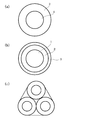
- FIG. 2 shows the structure of the superconducting wire constituting the liquid level sensor element.
- the superconducting wire includes at least a long rod-shaped core 1 made of a superconductor and a metal (Ag, An Ag—Sn alloy or the like).
- FIG. 2A shows an example in which a superconducting wire is composed of a superconductor core 1 and a sheath tube 2.
- FIG. 2B shows an example in which a reinforcing covering layer 3 (Fe, SUS (stainless steel) or the like) is disposed outside a metal sheath tube.
- FIG. 2C shows an example in which a plurality of superconductive wires are bundled to form a stranded wire. Moreover, you may carry out insulation integral molding with resin etc.
- the structure of the superconducting wire of this embodiment may be a structure in which an iron-based superconducting material is filled as a superconducting core in a metal sheath as shown in FIG.
- An iron-based superconducting tape wire in which an iron-based superconducting layer is formed on the material may be used.
- the metal tape substrate a material known as a normal superconducting wire substrate can be used, and an iron-based superconducting layer is formed on the metal tape substrate via an intermediate layer by pulsed laser deposition (PLD). Method).
- a metal tape substrate such as Ni-based alloy
- prevent interfacial reaction layer bed layer, Y 2 O 3, etc.
- a layer for improving the crystal orientation of the film orientation layer, MgO, etc.
- a superconducting layer is formed, and a stabilizing layer for overcurrent protection and chemical reaction suppression is suitably provided on the superconducting layer.
- the diameter of the superconducting wire in this embodiment is preferably 2 mm or less. As the diameter is reduced, the required energization current can be suppressed, and the heat capacity is reduced, so that the response is improved.
- the thickness is 0.5 mm-2 mm, but it may be 0.5 mm or less. Moreover, from a viewpoint of the intensity
- FIG. 3 is a schematic view of a liquid level gauge.
- the liquid level gauge according to the present embodiment includes a liquid level sensor element 10 for liquid hydrogen, a power source for supplying a current to the liquid level sensor element, and substantially both ends of the liquid level sensor element (the liquid level height to be measured is determined).
- the liquid level sensor element 10 is composed of the superconducting wire of the present invention.
- the liquid level sensor element is installed in a container in which liquid hydrogen is stored.
- the resistance value of the liquid level sensor element 10 is different between the portion in the liquid hydrogen 12 (superconducting state) and the portion outside the liquid hydrogen (ideally the normal conducting state). It is a thing.
- the level 11 of the liquid level is detected by measuring the voltage when a current is passed through the liquid level sensor element 10 partially immersed in the liquid hydrogen 12 with a voltmeter. Since the length of the region where the superconducting wire is in the superconducting state and the region in the normal conducting state differ depending on the liquid level, the liquid level can be detected by detecting the voltage of the wire and detecting the electrical resistance. The level can be measured.
- Ba (Fe 1-x Co x ) 2 As 2 polycrystals having a Co content x in the range of 0.05 to 0.11 were prepared.
- an inert gas nitrogen, argon, etc.
- the superconducting wire can be manufactured by various methods, and is not limited to a specific manufacturing method.
- the production method by the powder in tube method is illustrated below.
- Ba (Fe 1-x Co x ) 2 As 2 polycrystal powder is packed in a metal pipe such as silver (eg, silver sheath), drawn by rolling or swaging, and heat-treated.
- a silver sheath it is more preferable because there is no reaction between the sheath and Ba (Fe 1-x Co x ) 2 As 2 during heat treatment.
- a reinforcing coating layer can be further provided outside the silver sheath.
- a plurality of wires may be bundled to form a stranded wire, or may be integrally formed with resin or the like.
- the dimensions of the silver sheath before processing are, for example, an outer diameter of 6 mm and an inner diameter of 4 mm.
- a wire having a cross-sectional diameter of 0.5 mm-2 mm and a length of 1000 mm or more is obtained. Thereafter, this is subjected to a heat treatment at 800 ° C. to 900 ° C. for 10 to 20 hours to obtain a desired superconducting wire.
- FIG. 4 is a diagram showing a measurement result of electrical resistance in the vicinity of the superconducting transition of the superconducting wire.
- K temperature in the range of approximately 19 to 26.5. It was shown that the resistance is zero or about 0.28 to 0.40 m ⁇ .
- FIG. 5 is a diagram showing the Co content dependency of the critical temperature in the superconducting wire of the present embodiment.
- the dotted line in the figure is a line indicating the liquid hydrogen temperature (approximately 20K).
- x 0.06 or more and 0.10 or less
- the critical temperature exceeds the liquid hydrogen temperature.
- Tc 1- ( ⁇ (30K) / ⁇ (300K)) in the normal state, which will be described later, becomes smaller.
- the Tc is less than 20K, and it does not transition to the superconducting state even in liquid hydrogen. It cannot be used as a total.
- the transition width was in the range of 0.5K-2K, and showed a very sharp superconducting transition as compared with the conventional MgB 2 wire. Moreover, when it measured about the several different location of a long wire, a significant difference was not seen in critical temperature and transition width, and it was able to obtain a highly homogeneous wire.
- a superconducting wire using a silver sheath has a small change in electrical resistance between a normal conduction state and a superconducting state, and is not accurate as a liquid level gauge.
- heat treatment is appropriately performed.
- the temperature dependence of the resistance in the normal conduction state can be further reduced.
- the temperature dependence of the normal resistance is defined as “1- ( ⁇ (30K) / ⁇ (300K))”, the value is 0.5 or less.
- a liquid level gauge for liquid hydrogen is manufactured by soldering a current lead wire and a measurement line to a liquid level sensor element made of a long superconducting wire of about 200 mm to 500 mm and connecting it to a current power source and a voltmeter. did. There are no heaters installed.
- FIG. 7 shows the relationship between the visually read liquid surface (mm) and the standardized electrical resistance measurement value as a comparison result.
- an ideal characteristic line is indicated by a dotted line.
- the superconducting wire of the present invention is suitable for a superconducting liquid level sensor that measures the liquid level of liquid hydrogen, and has a highly accurate measurement performance and can realize a liquid level gauge with a simple structure. Therefore, for example, it can be widely applied to containers (stationary liquid hydrogen tanks, liquid hydrogen transport lorries, ships, etc.) used during the production, storage, and transportation of liquid hydrogen, and is industrially useful.
Landscapes
- Chemical & Material Sciences (AREA)
- Organic Chemistry (AREA)
- Physics & Mathematics (AREA)
- Inorganic Chemistry (AREA)
- Metallurgy (AREA)
- Mechanical Engineering (AREA)
- Materials Engineering (AREA)
- Engineering & Computer Science (AREA)
- Thermal Sciences (AREA)
- Fluid Mechanics (AREA)
- General Physics & Mathematics (AREA)
- Measurement Of Levels Of Liquids Or Fluent Solid Materials (AREA)
- Superconductors And Manufacturing Methods Therefor (AREA)
Abstract
液体水素用の液面高さを高精度で測定可能な超伝導線材を実現し、該超伝導線材を備える液面センサ素子、及び高精度な液面計を提供する。超伝導部を備える超伝導線材であって、超伝導部は、組成が化学式Ba(Fe1-xCox)2As2で表され、xが0.06以上で0.10以下の範囲にあり、電気抵抗がゼロとなる臨界温度が20K以上25K以下であり、電気抵抗が臨界温度に向けて下がり始める時の温度と臨界温度との差である遷移幅が2K以下である。前記超伝導線材を備える液体水素用液面センサ素子と、電流源と、電圧計とで、液体水素の液面を計測する液体水素用液面計を構成し、測定された電圧に基づいて液面の高さを求める。
Description
本発明は、高精度に液体水素の液面高さを計測する液体水素液面計に適する超伝導線材、該超伝導線材を備える液体水素用液面センサ素子及び液体水素用液面計に関する。
近年、クリーンエネルギー導入の観点から水素燃料が注目されている。水素の貯蔵方法としては、貯蔵密度が大きいことから、液体水素とすることは有効な利用形態の一つである。液体水素を貯蔵・運搬する際、液量の把握及び安全管理の面から、容器内の液面を計測できる液面センサ素子及び液面計が必要である。
超伝導体であるMgB2は39Kの臨界温度を有するため、大気圧下で約20Kの沸点を有する液体水素中で超伝導状態を発現できる。そこで、これまでに、MgB2系超伝導体を液体水素用液面センサ素子として用い、貯蔵容器内における液体水素の量を外部から計測できる液体水素用液面計が提案されている(特許文献1、2参照)。特許文献1では、液体水素の液面を検出するための液面センサであって、液体水素の沸点で超伝導状態となる超伝導線材と、超伝導線材を被覆するシースとを備える液面センサが示され、超伝導線材としてMgB2が挙げられている。その他にLSCO(La2-xSrxCuO4)が挙げられている。特許文献1では、シースは、超伝導線材を被覆し、超伝導線材よりも熱伝導率が低い材料で形成される。例えば、シースがセラミックス及び/又はステンレス鋼で形成される。
本願に関連した先行技術文献調査によれば、鉄系超伝導体(超伝導材料および超伝導線材)に関して、次のような文献が公知である(特許文献3、4、非特許文献1、2参照)。いずれの文献も、高磁場発生マグネット応用を課題とし、優れた臨界電流特性を有することを特徴としている。
特許文献3では、組成が(Ba,K)Fe2As2または(Sr,K)Fe2As2で代表される、いわゆる122系超伝導体に関し、優れた臨界電流特性を実現する製造方法が開示されている。特許文献3では、組成が(Ba,K)Fe2As2または(Sr,K)Fe2As2は、最高で38K程度のTcを示すThCr2Si2型結晶構造をもつ122系化合物であると説明されている。
特許文献4は、臨界電流密度の磁場角度依存性が小さい、鉄系超伝導材料、及びこれを用いた超伝導層や、当該超伝導層を備えた低温、高磁場で利用可能な線材の提供を目的とするものである。特許文献4には、ThCr2Si2の結晶構造を持つ鉄系超伝導体と、BaXO3(XはZr、Sn、Hf、Tiのうち1種又は2種以上を表す)で示される粒径30nm以下のナノ粒子とを有し、前記ナノ粒子が1×10²¹m-3以上の体積密度で分散している鉄系超伝導材料が開示されている。
非特許文献1には、BaFe1.8Co0.2As2が22Kにおいて超伝導状態に遷移することの発見に関して報告されている。非特許文献2には、Ba(Fe1-xCox)2As2の超伝導臨界温度が、含有されるCo濃度xの値により0~25Kの範囲で変化すること等に関して報告されている。
"Superconductivity at 22 K in Co-Doped BaFe2As2 Crystals", Phys. Rev. Lett. 101, 117004, 2008.
"Effects of Co substitution on thermodynamic and transport properties and anisotropic Hc2 in Ba(Fe1-xCox)2Asx single crystals" Phys. Rev. B 78, 214515, 2008.
近年、液体水素の液面高さを高精度で計測することが望まれている。高精度な液体水素用液面計を提供するためには、液面センサ素子となる超伝導線材が、次の3条件を兼ね備えることが望ましい。
(条件1) 超伝導状態に遷移する(電気抵抗がゼロになる)臨界温度が液体水素の温度20Kに近いこと。
(条件2) 電気抵抗が下がり始める温度と臨界温度の差(以下、遷移幅という。)が小さいこと。
(条件3) 常伝導状態における電気抵抗の温度依存性が小さいこと。
(条件1) 超伝導状態に遷移する(電気抵抗がゼロになる)臨界温度が液体水素の温度20Kに近いこと。
(条件2) 電気抵抗が下がり始める温度と臨界温度の差(以下、遷移幅という。)が小さいこと。
(条件3) 常伝導状態における電気抵抗の温度依存性が小さいこと。
しかしながら、従来のMgB2系水素液面計では、次の(1)~(4)の問題がある。
(1) 超伝導臨界温度が液体水素の沸点20Kに対して高過ぎて(例えば25Kを超える)、液体水素に浸かっていない部分(非浸漬部)まで超伝導化してしまうため、液面を実際よりも高く見積もってしまう。測定精度を向上させるため、ヒーター等により非浸漬部を加熱するなどして完全に常伝導化する必要がある。
(2) MgB2にCやAlなどを添加することにより、臨界温度を20~25Kに調整することも可能であるが、遷移幅が大きくなってしまい、測定精度が低下する。
(3) 添加したCやAlの濃度が同じ場合でも、超伝導線材の臨界温度や遷移幅が圧延加工過程(例えば加工後の線材の直径)に依存し、再現性が低下する。
(4) 常伝導状態の電気抵抗の温度依存性が比較的大きく、気体中の温度分布により非浸漬部の電気抵抗が変化するため、測定精度が低下する。
(1) 超伝導臨界温度が液体水素の沸点20Kに対して高過ぎて(例えば25Kを超える)、液体水素に浸かっていない部分(非浸漬部)まで超伝導化してしまうため、液面を実際よりも高く見積もってしまう。測定精度を向上させるため、ヒーター等により非浸漬部を加熱するなどして完全に常伝導化する必要がある。
(2) MgB2にCやAlなどを添加することにより、臨界温度を20~25Kに調整することも可能であるが、遷移幅が大きくなってしまい、測定精度が低下する。
(3) 添加したCやAlの濃度が同じ場合でも、超伝導線材の臨界温度や遷移幅が圧延加工過程(例えば加工後の線材の直径)に依存し、再現性が低下する。
(4) 常伝導状態の電気抵抗の温度依存性が比較的大きく、気体中の温度分布により非浸漬部の電気抵抗が変化するため、測定精度が低下する。
本発明は、これらの問題を解決しようとするものであり、本発明は、液体水素の液面高さを高精度で計測することができる液面センサ素子に適する超伝導線材を、提供することを目的とする。また、本発明は、前記超伝導線材を備える液体水素用液面センサ素子、及び該液面センサ素子を備える液体水素用液面計を提供することを目的とする。
本発明は、前記目的を達成するために、以下の特徴を有するものである。
(1) 本発明は、超伝導部を備える超伝導線材であって、前記超伝導部は、組成が化学式Ba(Fe1-xCox)2As2で表され、xが0.06以上で0.10以下の範囲にあり、電気抵抗がゼロとなる臨界温度が20K以上で25K以下であり、電気抵抗が臨界温度に向けて下がり始める時の温度と臨界温度との差である遷移幅が2K以下であることを特徴とする。
(2) 前記(1)に記載の超伝導線材において、温度300Kでの電気抵抗率をρ(300K)、温度30Kでの電気抵抗率をρ(30K)とするとき、1-(ρ(30K)/ρ(300K))で表される常伝導状態での電気抵抗率の温度依存性の値が0.5以下であることを特徴とする。
(3) 前記(1)又は(2)に記載の超伝導線材において、前記超伝導線材は、直径が2mm以下であることを特徴とする。
(4) 前記(1)乃至(3)のいずれか1に記載の超伝導線材は、液体水素用液面センサ素子用であることを特徴とする。
(5) 本発明は、液体水素用液面センサ素子であって、前記(1)乃至(3)のいずれか1に記載の超伝導線材を備える。
(6) 本発明は、液体水素の液面を計測する液体水素用液面計であって、前記(1)乃至(3)のいずれか1に記載された超伝導線材を備える液体水素用液面センサ素子と、電流源と、電圧計とで構成され、測定された電圧に基づいて液面の高さを求めることを特徴とする。
(2) 前記(1)に記載の超伝導線材において、温度300Kでの電気抵抗率をρ(300K)、温度30Kでの電気抵抗率をρ(30K)とするとき、1-(ρ(30K)/ρ(300K))で表される常伝導状態での電気抵抗率の温度依存性の値が0.5以下であることを特徴とする。
(3) 前記(1)又は(2)に記載の超伝導線材において、前記超伝導線材は、直径が2mm以下であることを特徴とする。
(4) 前記(1)乃至(3)のいずれか1に記載の超伝導線材は、液体水素用液面センサ素子用であることを特徴とする。
(5) 本発明は、液体水素用液面センサ素子であって、前記(1)乃至(3)のいずれか1に記載の超伝導線材を備える。
(6) 本発明は、液体水素の液面を計測する液体水素用液面計であって、前記(1)乃至(3)のいずれか1に記載された超伝導線材を備える液体水素用液面センサ素子と、電流源と、電圧計とで構成され、測定された電圧に基づいて液面の高さを求めることを特徴とする。
本発明の超伝導線材によれば、液体水素の液面高さを高精度で測定することができる液面センサ素子を実現し、かつ、加熱装置を必要としないので、より小型で簡単な構造の液面計を提供できる。
本発明によれば、超伝導線材を構成する超伝導体Ba(Fe1-xCox)2As2は、Coの含有量xにより超伝導臨界温度が変化するので、Coの含有量を制御することにより、臨界温度を20~25Kの任意の温度に調整することができる。また、本発明の超伝導線材を構成する超伝導体は、臨界温度の最大値が25K程度であるため、20~25Kの範囲では、遷移幅が2K以下と非常に小さい。
また、本発明の超伝導線材は、MgB2に比べて常伝導状態の電気抵抗の温度依存性が小さい。よって、本発明の超伝導線材は、液体水素液面センサ素子用超伝導線材に求められる3つの条件を同時に満たすので、高精度かつ簡便な設計の液体水素液面計が得られる。
また、本発明の超伝導線材によれば、ヒーター加熱を行う必要がなく、また少ない通電電流で計測可能であるため、測定時の水素の蒸発を押さえられる。
また、本発明の超伝導線材において、熱処理等を施して、常伝導状態における電気抵抗の温度依存性をさらに小さくすることもできる。例えば、1-(ρ(30K)/ρ(300K))の値で0.5以下を達成することができた。
実際に、液体水素を用いた性能検証を実施したところ、超伝導体Ba(Fe1-xCox)2As2の特性を反映して、ヒーターによる非浸漬部の過熱を行わなくても、電圧と液面高さに再現性の良い直線比例関係が得られ、特にx=0.09の組成では1:1対応が得られた。
本発明の実施の形態について以下説明する。
本発明者は、超伝導線材を用いる液面計に適する超伝導体として鉄系超伝導体に着目して研究開発を行い、液面計用に優れた特性を有する超伝導線材を得るに到ったものである。
122系化合物の一例として知られるBa(Fe1-xCox)2As2は、超伝導臨界温度が20K近傍にある。Ba(Fe1-xCox)2As2は、Coの含有量xにより臨界温度が変化するが、その最大値が25K程度であるため、20~25Kの範囲では遷移幅が0.7Kや0.8Kのように、0.5~2Kであり非常に小さくなる。また、この物質群はMgB2に比べて常伝導状態の電気抵抗の温度依存性が小さい。従って、鉄系超伝導体Ba(Fe1-xCox)2As2を超伝導部の超伝導材料に採用することにより、液体水素液面センサ素子用超伝導線材に求められる3つの要件を、同時に満たす。
図1に、本発明の前提とする超伝導線材のThCr2Si2型結晶構造を示す。図1に、Ba、Fe、Asの配置を示したが、Ba(Fe1-xCox)2As2では、Feの一部がCoで置換される。
図2に、液面センサ素子を構成する超伝導線材の構造を示す。図2の(a)(b)(c)に示すように、超伝導線材は、少なくとも、超伝導体からなる長尺の棒状体のコア1と、該コア1を被覆する金属製(Ag、Ag-Sn合金等)のシース管2とからなる。図2(a)は、超伝導線材を、超伝導体のコア1と、シース管2とで構成した例である。図2(b)は、金属製のシース管の外側に補強用被覆層3(FeやSUS(ステンレス鋼)等)を配置した例である。図2(c)は、超導電性線材を複数本束ねて撚り線とした例である。また、樹脂等で絶縁一体成形してもよい。
本実施形態の超伝導線材の構造は、図2に示すような、金属シース中に鉄系超伝導材料が超伝導コアとして充填された構造であってもよいし、図示しないが、金属テープ基材上に鉄系超伝導層が形成された鉄系超伝導テープ線材でもよい。金属テープ基材は、通常の超伝導線材の基材として知られているものを用いることができ、金属テープ基材上に、中間層を介して鉄系超伝導層をパルスレーザー堆積法(PLD法)等により形成する。例えば、Ni系合金等の金属テープ基材上に、界面反応を防ぐ層(ベッド層、Y2O3等)や薄膜の結晶配向性を改善する層(配向層、MgO等)を中間層として設けた後、超伝導層を形成し、該超伝導層上に、過電流保護や化学反応抑制のための安定化層を適宜設けるとよい。
本実施形態における超伝導線材は、直径が2mm以下であることが好ましい。直径を細くするほど必要な通電電流を抑えることができ、また熱容量も小さくなるので応答が良くなる。後述する実施形態では、0.5mm-2mmで作製したが、0.5mm以下であってもよい。また、線材の強度の観点からは、0.1mm以上が好ましい。
超伝導線材を用いる液面センサ素子及び液面計について、図3を参照して説明する。図3は、液面計の概略図である。本実施の形態の液面計は、液体水素用の液面センサ素子10と、前記液面センサ素子に電流を流す電源と、前記液面センサ素子の略両端(計測対象の液面高さを測定可能な長さで決定される)における電圧を測定する電圧計を備える。液面センサ素子10は、本発明の超伝導線材から構成される。液面センサ素子を、液体水素が貯蔵された容器内に設置する。液面センサ素子10のうち、液体水素12中にある部分(超伝導状態)と、液体水素外にある部分(理想的には常伝導状態)とで、抵抗値が異なることを原理的に利用したものである。液体水素12に一部浸漬した状態の液面センサ素子10に、電流を流した際の電圧を電圧計で測定することにより、液面11レベルを検出する。超伝導線材が超伝導状態になる領域と、常伝導状態にある領域との長さが、液面レベルに応じて異なるので、線材の電圧を検出して電気抵抗を検出することにより、液面レベルが測定できる。
(第1の実施の形態)
本実施の形態では、超伝導線材としてBa(Fe1-xCox)2As2を用いる場合を、図4、5、6、7を参照して説明する。
本実施の形態では、超伝導線材としてBa(Fe1-xCox)2As2を用いる場合を、図4、5、6、7を参照して説明する。
[Ba(Fe1-xCox)2As2多結晶体の作製]
Co含有量xが0.05-0.11の範囲であるBa(Fe1-xCox)2As2多結晶体を作製した。原料試薬(Ba、Fe、Co、As)をBa:Fe:Co:As=1:(2-2x):2x:2の比で混合し、900℃、48~72時間で焼成してBa(Fe1-xCox)2As2多結晶体を作製する。または、前駆体BaAs、Fe2As、Co2Asをあらかじめ作製した後、BaAs:Fe2As:Co2As=1:(1-x):xの比で混合し、900℃で48~72時間で焼成してもよい。BaAs、Fe2As、Co2Asは、それぞれBa:As=1:1、Fe:As=2:1、Co:As=2:1の比で混合し、それぞれ650℃、800℃、850℃で焼成することで得られる。いずれの場合も、焼成の際には、石英管に真空封入するか、不活性ガス(窒素、アルゴン等)中で金属管内に封入する。
Co含有量xが0.05-0.11の範囲であるBa(Fe1-xCox)2As2多結晶体を作製した。原料試薬(Ba、Fe、Co、As)をBa:Fe:Co:As=1:(2-2x):2x:2の比で混合し、900℃、48~72時間で焼成してBa(Fe1-xCox)2As2多結晶体を作製する。または、前駆体BaAs、Fe2As、Co2Asをあらかじめ作製した後、BaAs:Fe2As:Co2As=1:(1-x):xの比で混合し、900℃で48~72時間で焼成してもよい。BaAs、Fe2As、Co2Asは、それぞれBa:As=1:1、Fe:As=2:1、Co:As=2:1の比で混合し、それぞれ650℃、800℃、850℃で焼成することで得られる。いずれの場合も、焼成の際には、石英管に真空封入するか、不活性ガス(窒素、アルゴン等)中で金属管内に封入する。
[超伝導線材の作製]
超伝導線材は種々の方法により製造することができ、特定の製造方法に限定されない。以下にパウダーインチューブ法による製造方法を例示する。
Ba(Fe1-xCox)2As2多結晶体粉末を銀等の金属製パイプ(例、銀シース)に詰めて、圧延やスエージング等により伸線加工し、熱処理を行う。銀シースを使用する場合は、熱処理の際にシースとBa(Fe1-xCox)2As2との反応がないので、より好ましい。また、必要に応じて、銀シースの外側にさらに補強用被覆層を設けることもできる。また、線材を複数本束ねて撚り線としたり、樹脂等で絶縁一体成形してもよい。
加工前の銀シースの寸法は、例えば外径6mm、内径4mmである。これを段階的に伸線加工することにより、断面の直径が0.5mm-2mm、長さ1000mm以上の線材を得る。その後、これに800℃~900℃の熱処理を10時間~20時間施すことにより、所望の超伝導線材が得られる。
超伝導線材は種々の方法により製造することができ、特定の製造方法に限定されない。以下にパウダーインチューブ法による製造方法を例示する。
Ba(Fe1-xCox)2As2多結晶体粉末を銀等の金属製パイプ(例、銀シース)に詰めて、圧延やスエージング等により伸線加工し、熱処理を行う。銀シースを使用する場合は、熱処理の際にシースとBa(Fe1-xCox)2As2との反応がないので、より好ましい。また、必要に応じて、銀シースの外側にさらに補強用被覆層を設けることもできる。また、線材を複数本束ねて撚り線としたり、樹脂等で絶縁一体成形してもよい。
加工前の銀シースの寸法は、例えば外径6mm、内径4mmである。これを段階的に伸線加工することにより、断面の直径が0.5mm-2mm、長さ1000mm以上の線材を得る。その後、これに800℃~900℃の熱処理を10時間~20時間施すことにより、所望の超伝導線材が得られる。
[超伝導線材の超伝導特性の評価]
Co含有量xが0.05-0.11の範囲で異なるBa(Fe1-xCox)2As2からなる超伝導線材を、評価のために4cm程度に切断・短尺化し、四端子法を用いた電気抵抗測定を行った。図4は、超伝導線材の超伝導転移近傍における電気抵抗の測定結果を示す図である。図に、Co含有量xの代表的値として0.07、0.08、0.09、0.10のそれぞれの場合において、およそ19から26.5の範囲の温度(K)に対応して、抵抗がゼロあるいは0.28-0.40mΩ程度の値をとることを示した。Co含有量を0.06以上0.10以下に調整することより、臨界温度Tcを20K-25Kの任意の温度に調整することが可能であることがわかる。
図5は、本実施の形態の超伝導線材における臨界温度のCo含有量依存性を示す図である。図中の点線は、液体水素温度(略20K)を示す線である。図からもわかるように、xが0.06以上0.10以下で、臨界温度が液体水素温度を超える。また、x=0.06では21K程度である。ただし、x=0.07以下では、低濃度側に向かって、Tcが大きく低下するため、x=0.07以上の組成でTcを調整する場合よりも、精密な組成制御が必要になる。低濃度側では、Tcの調整は難しくなるが、後述する、常伝導状態における1-(ρ(30K)/ρ(300K))が、より小さくなるという利点がある。
0.06以上0.10以下の範囲以外の場合(x<0.06、0.10<x)では、Tcが20Kを下回り、液体水素中においても超伝導状態に遷移しないため、水素液面計として用いることはできない。遷移幅は、0.5K-2Kの範囲内であり、従来のMgB2線材に比べ非常に鋭い超伝導転移を示した。
また、長尺線材の複数の異なる箇所について測定したところ、臨界温度や遷移幅に有意な差は見られず、均質性の高い線材を得ることができた。
Co含有量xが0.05-0.11の範囲で異なるBa(Fe1-xCox)2As2からなる超伝導線材を、評価のために4cm程度に切断・短尺化し、四端子法を用いた電気抵抗測定を行った。図4は、超伝導線材の超伝導転移近傍における電気抵抗の測定結果を示す図である。図に、Co含有量xの代表的値として0.07、0.08、0.09、0.10のそれぞれの場合において、およそ19から26.5の範囲の温度(K)に対応して、抵抗がゼロあるいは0.28-0.40mΩ程度の値をとることを示した。Co含有量を0.06以上0.10以下に調整することより、臨界温度Tcを20K-25Kの任意の温度に調整することが可能であることがわかる。
図5は、本実施の形態の超伝導線材における臨界温度のCo含有量依存性を示す図である。図中の点線は、液体水素温度(略20K)を示す線である。図からもわかるように、xが0.06以上0.10以下で、臨界温度が液体水素温度を超える。また、x=0.06では21K程度である。ただし、x=0.07以下では、低濃度側に向かって、Tcが大きく低下するため、x=0.07以上の組成でTcを調整する場合よりも、精密な組成制御が必要になる。低濃度側では、Tcの調整は難しくなるが、後述する、常伝導状態における1-(ρ(30K)/ρ(300K))が、より小さくなるという利点がある。
0.06以上0.10以下の範囲以外の場合(x<0.06、0.10<x)では、Tcが20Kを下回り、液体水素中においても超伝導状態に遷移しないため、水素液面計として用いることはできない。遷移幅は、0.5K-2Kの範囲内であり、従来のMgB2線材に比べ非常に鋭い超伝導転移を示した。
また、長尺線材の複数の異なる箇所について測定したところ、臨界温度や遷移幅に有意な差は見られず、均質性の高い線材を得ることができた。
[超伝導線材の常伝導特性の評価]
例えば、銀シースを用いる場合は次のように考えられる。銀シースとBa(Fe1-xCox)2As2超伝導体コアからなる超伝導線材では、常伝導状態のBa(Fe1-xCox)2As2の電気抵抗率は、銀と比較して約100倍大きいため、常伝導状態で超伝導線材の電気抵抗を測定すれば、銀の特性を反映すると考えられる。銀の電気抵抗は低温で非常に小さくなる。このように、銀シースを使用した超伝導線材は、常伝導状態と超伝導状態の電気抵抗の変化が小さくなり、液面計としては精度が出ないことが予想される。
本発明の実施の形態では、超伝導線材を伸線加工した後、適宜熱処理を施している。熱処理温度を850℃以上とすることにより、常伝導状態の抵抗の温度依存性をより小さくすることができる。
図6に、Co含有量x=0.09の場合の、約10(K)から300(K)の範囲における抵抗値を示す。常伝導抵抗の温度依存の程度を「1-(ρ(30K)/ρ(300K))」と定義するとき、その値が0.5以下になる。
例えば、銀シースを用いる場合は次のように考えられる。銀シースとBa(Fe1-xCox)2As2超伝導体コアからなる超伝導線材では、常伝導状態のBa(Fe1-xCox)2As2の電気抵抗率は、銀と比較して約100倍大きいため、常伝導状態で超伝導線材の電気抵抗を測定すれば、銀の特性を反映すると考えられる。銀の電気抵抗は低温で非常に小さくなる。このように、銀シースを使用した超伝導線材は、常伝導状態と超伝導状態の電気抵抗の変化が小さくなり、液面計としては精度が出ないことが予想される。
本発明の実施の形態では、超伝導線材を伸線加工した後、適宜熱処理を施している。熱処理温度を850℃以上とすることにより、常伝導状態の抵抗の温度依存性をより小さくすることができる。
図6に、Co含有量x=0.09の場合の、約10(K)から300(K)の範囲における抵抗値を示す。常伝導抵抗の温度依存の程度を「1-(ρ(30K)/ρ(300K))」と定義するとき、その値が0.5以下になる。
[長尺超伝導線材を用いた液体水素用の液面計の作製]
200mm-500mm程度の長尺の超伝導線材からなる液面センサ素子に、電流リード線および測定線を半田付け等して、電流電源及び電圧計と接続して、液体水素用液面計を作製した。ヒーター等は設置していない。
200mm-500mm程度の長尺の超伝導線材からなる液面センサ素子に、電流リード線および測定線を半田付け等して、電流電源及び電圧計と接続して、液体水素用液面計を作製した。ヒーター等は設置していない。
[液体水素用の液面計の性能検証]
作製した液面計を、液体水素中に入れ、液面センサ素子の電気抵抗(出力電圧)と、スケールを用いた実際の液面高さとを比較した。図7に、比較結果の、目視による読み取り液面(mm)と規格化した電気抵抗測定値との関係を示す。図中、x=0.09の組成の場合を黒丸印で示し、x=0.08の組成の場合を白丸印で示し、理想的な特性線を点線で示す。x=0.09でTcが21.6Kの線材では、実際の液面の位置と電気抵抗を液面位置に換算した値が良く一致した。また、x=0.08のTcが23.5Kでは、40%程度(例えば実際の液面位置が100mmの場合、液面計は140mmを指示する)過大評価することがわかった。x=0.08の場合も電気抵抗が液面位置に対して直線的に変化しているので、簡単な較正により使用できる。このことから、本実施形態の超伝導線材の場合は、従来必要としたヒーターを使用せずに、高精度で液面が検知できることがわかる。
作製した液面計を、液体水素中に入れ、液面センサ素子の電気抵抗(出力電圧)と、スケールを用いた実際の液面高さとを比較した。図7に、比較結果の、目視による読み取り液面(mm)と規格化した電気抵抗測定値との関係を示す。図中、x=0.09の組成の場合を黒丸印で示し、x=0.08の組成の場合を白丸印で示し、理想的な特性線を点線で示す。x=0.09でTcが21.6Kの線材では、実際の液面の位置と電気抵抗を液面位置に換算した値が良く一致した。また、x=0.08のTcが23.5Kでは、40%程度(例えば実際の液面位置が100mmの場合、液面計は140mmを指示する)過大評価することがわかった。x=0.08の場合も電気抵抗が液面位置に対して直線的に変化しているので、簡単な較正により使用できる。このことから、本実施形態の超伝導線材の場合は、従来必要としたヒーターを使用せずに、高精度で液面が検知できることがわかる。
超伝導線材のCo含有量xが0.07~0.10の場合の、臨界温度、遷移幅、常伝導抵抗の温度依存の程度「1-(ρ(30K)/ρ(300K))」について調べた結果を表1にまとめて示す。

なお、上記実施の形態等で示した例は、発明を理解しやすくするために記載したものであり、この形態に限定されるものではない。
本発明の超伝導線材は、液体水素の液面高さを測定する超伝導式の液面センサに適し、高精度の測定性能を有するとともに、簡単な構造の液面計を実現できる。よって、例えば、液体水素の製造・貯蔵・輸送時に使用される容器(定置式液体水素タンク、液体水素輸送用ローリー車・船舶等)に広く適用でき、産業上有用である。
1 超伝導コア
2 シース管
3 補強用被覆層
10 液体水素用液面センサ素子
11 液面
12 液体水素
2 シース管
3 補強用被覆層
10 液体水素用液面センサ素子
11 液面
12 液体水素
Claims (6)
- 超伝導部を備える超伝導線材であって、
前記超伝導部は、組成が化学式Ba(Fe1-xCox)2As2で表され、xが0.06以上で0.10以下の範囲にあり、電気抵抗がゼロとなる臨界温度が20K以上で25K以下であり、電気抵抗が臨界温度に向けて下がり始める時の温度と臨界温度との差である遷移幅が2K以下であることを特徴とする、超伝導線材。 - 前記超伝導線材は、温度300Kでの電気抵抗率をρ(300K)、温度30Kでの電気抵抗率をρ(30K)とするとき、1-(ρ(30K)/ρ(300K))で表される常伝導状態での電気抵抗率の温度依存性の値が0.5以下であることを特徴とする請求項1記載の超伝導線材。
- 前記超伝導線材は、直径が2mm以下であることを特徴とする請求項1又は2記載の超伝導線材。
- 液体水素用液面センサ素子用であることを特徴とする請求項1乃至3のいずれか1項記載の超伝導線材。
- 請求項1乃至3のいずれか1項記載の超伝導線材を備える液体水素用液面センサ素子。
- 液体水素の液面を計測する液体水素用液面計であって、請求項1乃至3のいずれか1項に記載された超伝導線材を備える液体水素用液面センサ素子と、電流源と、電圧計とで構成され、測定された電圧に基づいて液面の高さを求めることを特徴とする液体水素用液面計。
Priority Applications (1)
| Application Number | Priority Date | Filing Date | Title |
|---|---|---|---|
| JP2018511980A JP6839394B2 (ja) | 2016-04-14 | 2017-04-06 | 超伝導線材、液体水素用液面センサ素子、及び液体水素用液面計 |
Applications Claiming Priority (2)
| Application Number | Priority Date | Filing Date | Title |
|---|---|---|---|
| JP2016-081394 | 2016-04-14 | ||
| JP2016081394 | 2016-04-14 |
Publications (1)
| Publication Number | Publication Date |
|---|---|
| WO2017179488A1 true WO2017179488A1 (ja) | 2017-10-19 |
Family
ID=60042440
Family Applications (1)
| Application Number | Title | Priority Date | Filing Date |
|---|---|---|---|
| PCT/JP2017/014396 Ceased WO2017179488A1 (ja) | 2016-04-14 | 2017-04-06 | 超伝導線材、液体水素用液面センサ素子、及び液体水素用液面計 |
Country Status (2)
| Country | Link |
|---|---|
| JP (1) | JP6839394B2 (ja) |
| WO (1) | WO2017179488A1 (ja) |
Cited By (2)
| Publication number | Priority date | Publication date | Assignee | Title |
|---|---|---|---|---|
| CN108707805A (zh) * | 2018-05-03 | 2018-10-26 | 北京科技大学 | 一种基于定向凝固技术的铁基超导材料制备方法 |
| CN112504386A (zh) * | 2020-11-17 | 2021-03-16 | 北京航天试验技术研究所 | 一种液氢超导液位计及标定方法 |
Citations (1)
| Publication number | Priority date | Publication date | Assignee | Title |
|---|---|---|---|---|
| JP2007304074A (ja) * | 2006-05-15 | 2007-11-22 | National Institute For Materials Science | 液化ガス液面センサー素子 |
-
2017
- 2017-04-06 WO PCT/JP2017/014396 patent/WO2017179488A1/ja not_active Ceased
- 2017-04-06 JP JP2018511980A patent/JP6839394B2/ja active Active
Patent Citations (1)
| Publication number | Priority date | Publication date | Assignee | Title |
|---|---|---|---|---|
| JP2007304074A (ja) * | 2006-05-15 | 2007-11-22 | National Institute For Materials Science | 液化ガス液面センサー素子 |
Non-Patent Citations (1)
| Title |
|---|
| TSUYOSHI TAMEGAI ET AL.: "Ba (Fe, Co)2As2PIT Senzai no Kyojiba Rinkai Denryu Tokusei", NENJI HOKOKUSHO 2011 NENDO, 12 October 2012 (2012-10-12), Retrieved from the Internet <URL:http://www.hflsm.imr.tohoku.ac.jp/files/0102-11H0008-tamegai.pdf> [retrieved on 20170421] * |
Cited By (2)
| Publication number | Priority date | Publication date | Assignee | Title |
|---|---|---|---|---|
| CN108707805A (zh) * | 2018-05-03 | 2018-10-26 | 北京科技大学 | 一种基于定向凝固技术的铁基超导材料制备方法 |
| CN112504386A (zh) * | 2020-11-17 | 2021-03-16 | 北京航天试验技术研究所 | 一种液氢超导液位计及标定方法 |
Also Published As
| Publication number | Publication date |
|---|---|
| JP6839394B2 (ja) | 2021-03-10 |
| JPWO2017179488A1 (ja) | 2019-03-28 |
Similar Documents
| Publication | Publication Date | Title |
|---|---|---|
| Kofstad et al. | On the defect structure of ZrO2 and HfO2 | |
| Li et al. | Giant Electron-Electron Scattering in the Fermi-Liquid State of N a 0.7 C o O 2 | |
| Soltanian et al. | High-transport critical current density above 30 K in pure Fe-clad MgB2 tape | |
| Heremans et al. | Thermal and electronic properties of rare-earth Ba 2 Cu 3 O x superconductors | |
| McConville et al. | Ginzburg-Landau parameters of type-II superconductors | |
| Cheng et al. | Chemical stability and superconductivity in Ag-sheathed CaKFe4As4 superconducting tapes | |
| Serquis et al. | Large field generation with a hot isostatically pressed powder-in-tube MgB2 coil at 25 K | |
| Li et al. | Transport Critical Current Densities and $ n $-Values of Multifilamentary $\hbox {MgB} _ {2} $ Wires at Various Temperatures and Magnetic Fields | |
| JP6839394B2 (ja) | 超伝導線材、液体水素用液面センサ素子、及び液体水素用液面計 | |
| Fu et al. | High critical current density in Ti-doped MgB 2/Ta/Cu tape by powder-in-tube process | |
| Gajda et al. | Indication of the measuring method for accurately determining the critical current and n value in superconducting wires and tapes used in superconducting coils | |
| JP7681363B2 (ja) | 超電導体、超電導体の製造方法、液体水素用液面センサー、及び液体水素用液面計 | |
| Li et al. | Thermopower and thermal conductivity of superconducting perovskite MgCNi 3 | |
| Vedeneev et al. | Metal-to-insulator crossover and pseudogap in single-layer Bi 2+ x Sr 2− x Cu 1+ y O 6+ δ single crystals in high magnetic fields | |
| Silva et al. | Excess conductivity of overdoped Bi 2 Sr 2 CaCu 2 O 8+ x crystals well above T c | |
| US10128024B2 (en) | MgB2-based superconducting wire for a liquid hydrogen level sensor, a liquid hydrogen level sensor, and a liquid hydrogen level gauge | |
| Zhukov et al. | Microwave surface resistance of MgB 2 | |
| Grasso et al. | Correlation between the normal state resistivity and the critical current density of Ag sheathed Bi (2223) tapes | |
| JP5158633B2 (ja) | 液体水素用液面センサ及び液体水素用液面計 | |
| Lan et al. | Construction and characterization of NTC thermistors at low temperature | |
| Nizhankovskiy et al. | BKT transition observed in magnetic and electric properties of YBa 2 Cu 3 O 7− δ single crystals | |
| Senatore et al. | Enhanced Connectivity and Percolation in Binary and Doped In Situ ${\rm MgB} _ {2} $ Wires After Cold High Pressure Densification | |
| JP7736363B1 (ja) | 超電導体、超電導体の製造方法、液体水素用液面センサー、及び液体水素用液面計 | |
| Khadzhay et al. | Degradation of the electric transport characteristics of the FeSe superconductor after a long-term storage | |
| WO2025074897A1 (ja) | 超電導体、超電導体の製造方法、液体水素用液面センサー、及び液体水素用液面計 |
Legal Events
| Date | Code | Title | Description |
|---|---|---|---|
| ENP | Entry into the national phase |
Ref document number: 2018511980 Country of ref document: JP Kind code of ref document: A |
|
| NENP | Non-entry into the national phase |
Ref country code: DE |
|
| 121 | Ep: the epo has been informed by wipo that ep was designated in this application |
Ref document number: 17782304 Country of ref document: EP Kind code of ref document: A1 |
|
| 122 | Ep: pct application non-entry in european phase |
Ref document number: 17782304 Country of ref document: EP Kind code of ref document: A1 |