WO2017178281A1 - A coffee machine and a capsule suitable to be used in coffee machines - Google Patents
A coffee machine and a capsule suitable to be used in coffee machines Download PDFInfo
- Publication number
- WO2017178281A1 WO2017178281A1 PCT/EP2017/057951 EP2017057951W WO2017178281A1 WO 2017178281 A1 WO2017178281 A1 WO 2017178281A1 EP 2017057951 W EP2017057951 W EP 2017057951W WO 2017178281 A1 WO2017178281 A1 WO 2017178281A1
- Authority
- WO
- WIPO (PCT)
- Prior art keywords
- capsule
- detection means
- coffee machine
- coffee
- lug
- Prior art date
- Legal status (The legal status is an assumption and is not a legal conclusion. Google has not performed a legal analysis and makes no representation as to the accuracy of the status listed.)
- Ceased
Links
Images



Classifications
-
- A—HUMAN NECESSITIES
- A47—FURNITURE; DOMESTIC ARTICLES OR APPLIANCES; COFFEE MILLS; SPICE MILLS; SUCTION CLEANERS IN GENERAL
- A47J—KITCHEN EQUIPMENT; COFFEE MILLS; SPICE MILLS; APPARATUS FOR MAKING BEVERAGES
- A47J31/00—Apparatus for making beverages
- A47J31/24—Coffee-making apparatus in which hot water is passed through the filter under pressure, i.e. in which the coffee grounds are extracted under pressure
- A47J31/34—Coffee-making apparatus in which hot water is passed through the filter under pressure, i.e. in which the coffee grounds are extracted under pressure with hot water under liquid pressure
- A47J31/36—Coffee-making apparatus in which hot water is passed through the filter under pressure, i.e. in which the coffee grounds are extracted under pressure with hot water under liquid pressure with mechanical pressure-producing means
- A47J31/3604—Coffee-making apparatus in which hot water is passed through the filter under pressure, i.e. in which the coffee grounds are extracted under pressure with hot water under liquid pressure with mechanical pressure-producing means with a mechanism arranged to move the brewing chamber between loading, infusing and ejecting stations
- A47J31/3623—Cartridges being employed
-
- B—PERFORMING OPERATIONS; TRANSPORTING
- B65—CONVEYING; PACKING; STORING; HANDLING THIN OR FILAMENTARY MATERIAL
- B65D—CONTAINERS FOR STORAGE OR TRANSPORT OF ARTICLES OR MATERIALS, e.g. BAGS, BARRELS, BOTTLES, BOXES, CANS, CARTONS, CRATES, DRUMS, JARS, TANKS, HOPPERS, FORWARDING CONTAINERS; ACCESSORIES, CLOSURES, OR FITTINGS THEREFOR; PACKAGING ELEMENTS; PACKAGES
- B65D85/00—Containers, packaging elements or packages, specially adapted for particular articles or materials
- B65D85/70—Containers, packaging elements or packages, specially adapted for particular articles or materials for materials not otherwise provided for
- B65D85/804—Disposable containers or packages with contents which are mixed, infused or dissolved in situ, i.e. without having been previously removed from the package
- B65D85/8043—Packages adapted to allow liquid to pass through the contents
-
- A—HUMAN NECESSITIES
- A47—FURNITURE; DOMESTIC ARTICLES OR APPLIANCES; COFFEE MILLS; SPICE MILLS; SUCTION CLEANERS IN GENERAL
- A47J—KITCHEN EQUIPMENT; COFFEE MILLS; SPICE MILLS; APPARATUS FOR MAKING BEVERAGES
- A47J31/00—Apparatus for making beverages
- A47J31/18—Apparatus in which ground coffee or tea-leaves are immersed in the hot liquid in the beverage container
-
- A—HUMAN NECESSITIES
- A47—FURNITURE; DOMESTIC ARTICLES OR APPLIANCES; COFFEE MILLS; SPICE MILLS; SUCTION CLEANERS IN GENERAL
- A47J—KITCHEN EQUIPMENT; COFFEE MILLS; SPICE MILLS; APPARATUS FOR MAKING BEVERAGES
- A47J31/00—Apparatus for making beverages
- A47J31/44—Parts or details or accessories of beverage-making apparatus
- A47J31/4403—Constructional details
-
- A—HUMAN NECESSITIES
- A47—FURNITURE; DOMESTIC ARTICLES OR APPLIANCES; COFFEE MILLS; SPICE MILLS; SUCTION CLEANERS IN GENERAL
- A47J—KITCHEN EQUIPMENT; COFFEE MILLS; SPICE MILLS; APPARATUS FOR MAKING BEVERAGES
- A47J31/00—Apparatus for making beverages
- A47J31/44—Parts or details or accessories of beverage-making apparatus
- A47J31/4492—Means to read code provided on ingredient pod or cartridge
Definitions
- the present invention relates to a capsule wherein the coffee raw material is stored and a coffee machine that is suitable for use with the capsule.
- the usage of the single use capsule wherein the coffee raw material is stored is known.
- the user starts the brewing process by placing the capsule into the coffee machine and the coffee is prepared by passing pressurized hot war over the capsule or by transferring the coffee in the capsule into a cooking pot.
- the used capsule should be replaced with a new capsule.
- hot water is prepared instead of coffee and the user satisfaction decreases. Therefore, detecting the presence of the capsule in the coffee machine is of utmost importance.
- the type of the capsule should also be detected.
- the aim of the present invention is the realization of a coffee machine wherein the presence and the type of the capsule placed therein are detected and of a capsule suitable to be used in the coffee machine of the present invention.
- the capsule realized in order to attain the aim of the present invention, explicated in the claims, comprises a gap that is arranged on the frame surrounding the opening through which the coffee is loaded and/or emptied and that aligns with the detection means, preferably in form of a switch, on the coffee machine, the capsule further comprising a lug that covers the gap so as to provide the detection of the presence of the capsule.
- the capsule comprises the lug that is folded by contacting the detection means or the coffee machine when the capsule is placed into the coffee machine and the folio covering the opening is opened.
- the capsule comprises a plurality of gaps that are successively arranged on the frame and at least one lug that fills in at least one gap so as to provide the detection of the type of the capsule.
- the capsule comprises a cavity that is arranged on the frame and that enables the capsule to be placed into the coffee machine in a correct manner.
- the coffee machine realized in order to attain the aim of the present invention, explicated in the claims comprises the detection means in a number matching the number of gaps, that are disposed on the capsule housing wherein the capsule is placed and that provide the detection of the gaps and the lugs.
- the detection means generates a signal with the contact of the lug.
- the detection means optically detects the lug.
- the coffee machine comprises a control unit that enables the brewing process to be started depending on the information received from the detection means.
- control unit enables the user to be warned if no signal is transmitted by the detection means, in other words if there is no capsule in the coffee machine or if there is a used capsule in the coffee machine.
- control unit determines the brewing parameters such as water temperature, brewing time, water amount, brewing temperature, etc. according to the information received from the detection means, in other words according to the type of the capsule.
- the coffee machine comprises a protrusion that is arranged on the capsule housing and that enables the capsule to be placed into the capsule housing in the correct direction.
- the presence of the capsule in the coffee machine is detected in a cost efficient manner. Moreover, with the combination of the lugs filling the gaps, capsule with different features are tagged.
- the coffee machine starts the brewing process by means of the control unit according to the data received from the detection means and controls the brewing parameters.
- Figure 1 – is the perspective view of the coffee machine and a capsule placed therein.
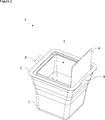
- Figure 2 – is the perspective view of a capsule when the cover is open.
- Figure 3 – is the top schematic view of a capsule.
- Figure 4 - is the cross-sectional view of the capsule when placed into the capsule housing related to an embodiment of the present invention.
- the capsule (1) is suitable for being used in coffee machines (11) comprising a detection means (11), and comprises a receptacle (2) wherein the coffee to be brewed is stored, an opening (3) arranged on a surface of the receptacle (2) and that allows the pouring of the coffee, a foil (4) that covers the opening (3), and a frame (5) that is disposed around the opening (3), that is formed as one piece with the receptacle or fixed onto the receptacle (2) and to which the folio (4) is attached.
- the folio (4) is preferably produced from aluminum or tin.
- the housing (2) can be in form of a cylinder or quadrangular prism.
- the coffee in the housing (2) can be particularly Turkish coffee or instant coffee.
- the foil (4) is attached on the frame (5) surrounding the opening (3) of the housing (2).
- the capsule (1) opens as the opening apparatus (not shown in the figures) on the coffee machine (9) cuts the folio (4) when force is applied on the housing (2).
- the capsule (1) moves downwards for a certain amount as force is applied on the housing (2) and the coffee in the housing (2) is emptied into the coffee machine (9) as the folio (4) is cut by the opening apparatus.
- the capsule (1) of the present invention comprises a lug (6) that is disposed on the frame (5) and that provides the detection of the capsule (1) by communicating with the detection means (11) that detects if the capsule (1) is placed into the coffee machine (9) when the capsule (1) is placed into the coffee machine (9).
- the lug (6) on the frame (5) preferably aligns with the detection means (11).
- the detection means (11) detects the lug (6) and generates a signal, thus detects the presence of the capsule (1).
- the detection means (11) does not generate a signal if the user starts the coffee brewing process without placing the capsule (1) into the coffee machine (9).
- the lug (6) is folded by contacting the detection means (11) or the coffee machine (9) when the folio (4) is opened and the coffee in the receptacle (2) is transferred, in other words when force is applied on the housing (2) and the capsule (1) moves downwards, thus the lug (6) preventing the used capsule (1) from misleading the detection means (11).
- the lug (6) is fixed to the frame in a configuration so as to be folded under pressure. Thus, if the capsule (1) is used, the lug (6) contacts the detection means (11) or the coffee machine (9) and is folded.
- the detection means (11) cannot generate a signal since the lug (6) is not folded. If the used capsule (1) is forgotten in the coffee machine (9), the coffee machine (9) enables the user to be warned that there is no capsule in the capsule housing (10) since no signal is received from the detection means (11).
- the capsule (1) comprises a plurality of gaps (7) that are successively arranged on the frame (5) and at least one lug (6) that fills in at least one gap (7) so as to provide the detection of the type of the capsule (1).
- the capsules (1) with different features are enabled to be tagged by means of providing the gaps (7) on the frame (5) and filling in at least one of the gaps (7) with the lugs (6) in different combinations.
- the capsule (1) with three gaps (7) three combinations are obtained by filling any one gap (7) with one lug (6), three combinations are obtained by filling any two gaps (7) with two lugs (6) and one combination is obtained by filling in three gaps (7) with the lugs (6), thus the capsule (1) with seven different features can be tagged.
- the capsule (1) comprising four gaps (7) fifteen different combinations are obtained and fifteen different types of capsules (1) can be tagged.
- the capsule (1) is preferably produced by plastic injection method, and during the production, the portion of the frame (5) corresponding to the detection means (11) is cut out, thus the gaps (7) are formed. Then, the lug (6) is joined with the frame (5) by plastic welding, and the gap (7) is filled. By forming the gap (7) on the frame (5) and then filling the gap (7) with the lug (6), the detection means (11) is enabled to detect the welding tracks.
- the capsules (1) used are enabled to be original capsules (1).
- the lug (6) is produced from a material different from the material used for producing the frame (5).
- the lug (6) can be produced from metal material.
- the detection means (11) is a sensor that can detect metals.
- the detection means (11) that aligns with the gaps (7) when the capsule (1) is placed into the coffee machine (9) determines the type of the capsule (1) depending on whether the gaps (7) are filled with the lugs (6), at least one lug (6) contacts the detection means (11) or the coffee machine (9) and is folded. Thus, the user is warned if the same capsule (1) is forgotten in the coffee machine (9) and is desired to be used again.
- the capsule (1) comprises a cavity (8) that is arranged on the frame (5) and that is positioned so as to align with an orientation protrusion (13) on the coffee machine (9) and to provide the correct placement of the capsule (1) when the capsule (1) is placed into the coffee machine (9).
- the lugs (6) are enabled to align with the detection means (11).
- the detection means (11) is prevented from making detection errors due to the incorrect placement of the capsule (1).
- the coffee machine (9) of the present invention is suitable for using therein a capsule (1) as disclosed above and comprises a capsule housing (10) wherein the capsule (1) is placed and a detection means (11) that is disposed on the capsule housing (10), that works as a switch and that remains under the lug (6) when the capsule (1) is placed.
- the detection means (11) works as a switch that generates a signal upon detecting the lug (6) on the capsule (1) and that does not generate a signal when the lug (6) is not detected.
- the detection means (11) does not generate a signal.
- the detection means (11) is positioned in the coffee machine (9) so as to align with the gaps (7) on the capsule (1), in other words, the detection means (11) are provided in a number matching the number of gaps (7).
- the detection means (11) on the capsule housing (10) in a number matching the number of the gaps (7) on the capsule (1), the presence of the capsule (1) on the coffee machine (9) and the type of the capsule (1) are detected.
- the detection means (11) under a gap (7) that is not filled with the lug (6) does not generate a signal, but the detection means (11) under the gap (7) filled with the lug (6) generates a signal.
- any one detection means (11) generates a signal with any one of the gaps (7) being filled with a lug (6), the presence of the capsule (1) is detected, and the type of the capsule (1) is detected depending on whether the gaps (7) are open or closed with the lugs (6).
- the detection means (11) generates a signal with the contact of the lugs (6) on the capsule (1).
- the lug (6) contacts the detection means (11) and the detection means (11) generates a signal with the effect of the contact.
- the detection means (11) As the lug (6) presses on the detection means (11), the presence of the capsule in the capsule housing (10) of the coffee machine (9) is detected.
- the detection means (11) generates a signal by optically detecting the lugs (6) on the capsule (1).
- the detection means (11) optically detects the lug (6) and generates a signal.
- the detection means (11) cannot detect the lug (6) and hence cannot generate a signal.
- the coffee machine (9) comprises a control unit (12) that enables the brewing process to be started depending on the information received from the detection means (11).
- the control unit (12) decides that the capsule (1) is in the capsule housing (10) when the detection means (11) generates a signal, in other words when the lug (6) on the capsule (1) is detected, and then starts the brewing process, and if the detection means (11) does not generate a signal, the control unit (12) does not start the brewing process even if the start brewing command has been given.
- the control unit (12) does not start the brewing process even if the start brewing command has been given.
- control unit (12) enables the user to be warned upon deciding that there is no capsule (1) in the capsule housing (10) according to the information received from the detection means (11).
- control unit (12) enables the user to be warned if no signal can be received from the detection means (11), thus the user is reminded to check the capsule housing (10).
- the control unit (12) determines the brewing parameters according to the information received from the detection means (11).
- the capsules (1) can contain different coffee types or additional sweeteners such as sugar, cream, milk powder, etc. Moreover, the user can request that the coffee be stronger or weaker, hotter or colder.
- the capsules (1) in the same form can be tagged in different numbers.
- the coffee machine (9) comprises three detection means (11) and the control unit (12) determines the type of the capsule (1) depending on the signal data received from the detection means (11) according to the combinations of three gaps (7) filled with the lug(s) (6).
- the producer saves the brewing parameters desired for the capsule (1) having a certain combination into the memory of the control unit (12).
- the control unit (12) provides the brewing of the coffee by applying the brewing parameters such as heater temperature, water amount, brewing time, etc. according to the signal data received from the detection means (11).
- the coffee machine (9) comprises a protrusion (13) that is arranged on the capsule housing (10) and whereon the cavity (8) on the capsule (1) is fitted as the capsule (1) is placed into the capsule housing (10).
- the lug (6) provided on the capsule (1) By means of the lug (6) provided on the capsule (1), the presence of the capsule (1) in the coffee machine (9) is easily detected. Moreover, by means of a plurality of gaps (7) disposed on the frame (5) and the lugs (6) that closes the gaps (7) according to the content of the capsule (1) as per the combinations determined by the producer, the type of the capsule (1) can be easily determined. The presence and the type of the capsule (1) is detected by means of the detection means (11) provided on the coffee machine (9). Moreover, the cavity (8)-protrusion (13) pair enables the capsule (1) to be correctly placed.
Landscapes
- Engineering & Computer Science (AREA)
- Food Science & Technology (AREA)
- Mechanical Engineering (AREA)
- Apparatus For Making Beverages (AREA)
Abstract
The present invention relates to a capsule (1) suitable for being used in coffee machines (11) comprising a detection means (11), comprising a receptacle (2) wherein the coffee to be brewed is stored, an opening (3) arranged on a surface of the receptacle (2) and that allows the pouring of the coffee, a foil (4) that covers the opening (3), and a frame (5) that is disposed around the opening (3), that is formed as one piece with the receptacle or fixed onto the receptacle (2) and to which the folio (4) is attached.
Description
The present invention relates to a capsule wherein the coffee raw material is stored and a coffee machine that is suitable for use with the capsule.
In coffee machines, the usage of the single use capsule wherein the coffee raw material is stored is known. The user starts the brewing process by placing the capsule into the coffee machine and the coffee is prepared by passing pressurized hot war over the capsule or by transferring the coffee in the capsule into a cooking pot. In the subsequent uses, the used capsule should be replaced with a new capsule. However, if the brewing process is started in case there is no capsule in the coffee machine or a new capsule is not placed into the coffee machine, hot water is prepared instead of coffee and the user satisfaction decreases. Therefore, detecting the presence of the capsule in the coffee machine is of utmost importance. Moreover, in embodiments wherein capsules with different features are used, the type of the capsule should also be detected. In the state of the art, the detection of the presence and the type of the capsule by means of barcodes applied on the capsule is known. However, with these embodiments, it is not possible to detect the presence of the capsule that is used and forgotten in the coffee machine, and due to the costs of the barcode technology, the production costs of the coffee machine and the capsule increase.
In the state of the art International Patent Application No. WO2014001564, a capsule having marks for recognition purposes is disclosed.
In the state of the art United States Patent Application No. US2013236609, a capsule having an optical code is disclosed.
The aim of the present invention is the realization of a coffee machine wherein the presence and the type of the capsule placed therein are detected and of a capsule suitable to be used in the coffee machine of the present invention.
The capsule realized in order to attain the aim of the present invention, explicated in the claims, comprises a gap that is arranged on the frame surrounding the opening through which the coffee is loaded and/or emptied and that aligns with the detection means, preferably in form of a switch, on the coffee machine, the capsule further comprising a lug that covers the gap so as to provide the detection of the presence of the capsule.
In an embodiment of the present invention, the capsule comprises the lug that is folded by contacting the detection means or the coffee machine when the capsule is placed into the coffee machine and the folio covering the opening is opened.
In another embodiment of the present invention, the capsule comprises a plurality of gaps that are successively arranged on the frame and at least one lug that fills in at least one gap so as to provide the detection of the type of the capsule.
In another embodiment of the present invention, the capsule comprises a cavity that is arranged on the frame and that enables the capsule to be placed into the coffee machine in a correct manner.
The coffee machine realized in order to attain the aim of the present invention, explicated in the claims comprises the detection means in a number matching the number of gaps, that are disposed on the capsule housing wherein the capsule is placed and that provide the detection of the gaps and the lugs.
In a version of this embodiment, the detection means generates a signal with the contact of the lug.
In another version of this embodiment, the detection means optically detects the lug.
In another embodiment of the present invention, the coffee machine comprises a control unit that enables the brewing process to be started depending on the information received from the detection means.
In another embodiment of the present invention, the control unit enables the user to be warned if no signal is transmitted by the detection means, in other words if there is no capsule in the coffee machine or if there is a used capsule in the coffee machine.
In another embodiment of the present invention, the control unit determines the brewing parameters such as water temperature, brewing time, water amount, brewing temperature, etc. according to the information received from the detection means, in other words according to the type of the capsule.
In another embodiment of the present invention, the coffee machine comprises a protrusion that is arranged on the capsule housing and that enables the capsule to be placed into the capsule housing in the correct direction.
By means of the gaps and lugs disposed on the capsule, the presence of the capsule in the coffee machine is detected in a cost efficient manner. Moreover, with the combination of the lugs filling the gaps, capsule with different features are tagged. The coffee machine starts the brewing process by means of the control unit according to the data received from the detection means and controls the brewing parameters.
The capsule realized in order to attain the aim of the present invention is illustrated in the attached figures, where:
Figure 1 – is the perspective view of the coffee machine and a capsule placed therein.
Figure 2 – is the perspective view of a capsule when the cover is open.
Figure 3 – is the top schematic view of a capsule.
Figure 4 - is the cross-sectional view of the capsule when placed into the capsule housing related to an embodiment of the present invention.
The elements illustrated in the figures are numbered as follows:
- Capsule
- Receptacle
- Opening
- Folio
- Frame
- Lug
- Gap
- Cavity
- Coffee machine
- Capsule housing
- Detection means
- Control unit
- Protrusion
The capsule (1) is suitable for being used in coffee machines (11) comprising a detection means (11), and comprises a receptacle (2) wherein the coffee to be brewed is stored, an opening (3) arranged on a surface of the receptacle (2) and that allows the pouring of the coffee, a foil (4) that covers the opening (3), and a frame (5) that is disposed around the opening (3), that is formed as one piece with the receptacle or fixed onto the receptacle (2) and to which the folio (4) is attached. The folio (4) is preferably produced from aluminum or tin. The housing (2) can be in form of a cylinder or quadrangular prism. The coffee in the housing (2) can be particularly Turkish coffee or instant coffee. The foil (4) is attached on the frame (5) surrounding the opening (3) of the housing (2). The capsule (1) opens as the opening apparatus (not shown in the figures) on the coffee machine (9) cuts the folio (4) when force is applied on the housing (2). The capsule (1) moves downwards for a certain amount as force is applied on the housing (2) and the coffee in the housing (2) is emptied into the coffee machine (9) as the folio (4) is cut by the opening apparatus.
The capsule (1) of the present invention comprises a lug (6) that is disposed on the frame (5) and that provides the detection of the capsule (1) by communicating with the detection means (11) that detects if the capsule (1) is placed into the coffee machine (9) when the capsule (1) is placed into the coffee machine (9). When the capsule (1) is placed into the coffee machine (9), the lug (6) on the frame (5) preferably aligns with the detection means (11). The detection means (11) detects the lug (6) and generates a signal, thus detects the presence of the capsule (1). The detection means (11) does not generate a signal if the user starts the coffee brewing process without placing the capsule (1) into the coffee machine (9).
In an embodiment of the present invention, the lug (6) is folded by contacting the detection means (11) or the coffee machine (9) when the folio (4) is opened and the coffee in the receptacle (2) is transferred, in other words when force is applied on the housing (2) and the capsule (1) moves downwards, thus the lug (6) preventing the used capsule (1) from misleading the detection means (11). In this embodiment, the lug (6) is fixed to the frame in a configuration so as to be folded under pressure. Thus, if the capsule (1) is used, the lug (6) contacts the detection means (11) or the coffee machine (9) and is folded. Thus, if it is desired to brew coffee again when the used capsule (1) is not taken out of the coffee machine (9), the detection means (11) cannot generate a signal since the lug (6) is not folded. If the used capsule (1) is forgotten in the coffee machine (9), the coffee machine (9) enables the user to be warned that there is no capsule in the capsule housing (10) since no signal is received from the detection means (11).
In another embodiment of the present invention, the capsule (1) comprises a plurality of gaps (7) that are successively arranged on the frame (5) and at least one lug (6) that fills in at least one gap (7) so as to provide the detection of the type of the capsule (1). In this embodiment, the capsules (1) with different features are enabled to be tagged by means of providing the gaps (7) on the frame (5) and filling in at least one of the gaps (7) with the lugs (6) in different combinations. For example, on the capsule (1) with three gaps (7), three combinations are obtained by filling any one gap (7) with one lug (6), three combinations are obtained by filling any two gaps (7) with two lugs (6) and one combination is obtained by filling in three gaps (7) with the lugs (6), thus the capsule (1) with seven different features can be tagged. Similarly, in the capsule (1) comprising four gaps (7), fifteen different combinations are obtained and fifteen different types of capsules (1) can be tagged. The capsule (1) is preferably produced by plastic injection method, and during the production, the portion of the frame (5) corresponding to the detection means (11) is cut out, thus the gaps (7) are formed. Then, the lug (6) is joined with the frame (5) by plastic welding, and the gap (7) is filled. By forming the gap (7) on the frame (5) and then filling the gap (7) with the lug (6), the detection means (11) is enabled to detect the welding tracks. Thus, the capsules (1) used are enabled to be original capsules (1).
In a version of this embodiment, the lug (6) is produced from a material different from the material used for producing the frame (5). For example, the lug (6) can be produced from metal material. In this case, the detection means (11) is a sensor that can detect metals.
In a version of this embodiment, after the detection means (11), that aligns with the gaps (7) when the capsule (1) is placed into the coffee machine (9), determines the type of the capsule (1) depending on whether the gaps (7) are filled with the lugs (6), at least one lug (6) contacts the detection means (11) or the coffee machine (9) and is folded. Thus, the user is warned if the same capsule (1) is forgotten in the coffee machine (9) and is desired to be used again.
In another embodiment of the present invention, the capsule (1) comprises a cavity (8) that is arranged on the frame (5) and that is positioned so as to align with an orientation protrusion (13) on the coffee machine (9) and to provide the correct placement of the capsule (1) when the capsule (1) is placed into the coffee machine (9). By means of this embodiment, when the capsule (1) is placed into the coffee machine (9), the lugs (6) are enabled to align with the detection means (11). When the cavity (8) on the capsule (1) does not align with the protrusion (13) on the coffee machine (9), the capsule (1) cannot be properly placed and the user is enabled to detect the incorrect placement. Thus, the detection means (11) is prevented from making detection errors due to the incorrect placement of the capsule (1).
The coffee machine (9) of the present invention is suitable for using therein a capsule (1) as disclosed above and comprises a capsule housing (10) wherein the capsule (1) is placed and a detection means (11) that is disposed on the capsule housing (10), that works as a switch and that remains under the lug (6) when the capsule (1) is placed. The detection means (11) works as a switch that generates a signal upon detecting the lug (6) on the capsule (1) and that does not generate a signal when the lug (6) is not detected. Thus, when there is no capsule (1) in the coffee machine (9) or when the capsule (1) that is used and that has a folded lug (6) is on the coffee machine (9), the detection means (11) does not generate a signal.
In another embodiment of the present invention, the detection means (11) is positioned in the coffee machine (9) so as to align with the gaps (7) on the capsule (1), in other words, the detection means (11) are provided in a number matching the number of gaps (7). By providing the detection means (11) on the capsule housing (10) in a number matching the number of the gaps (7) on the capsule (1), the presence of the capsule (1) on the coffee machine (9) and the type of the capsule (1) are detected. The detection means (11) under a gap (7) that is not filled with the lug (6) does not generate a signal, but the detection means (11) under the gap (7) filled with the lug (6) generates a signal. As any one detection means (11) generates a signal with any one of the gaps (7) being filled with a lug (6), the presence of the capsule (1) is detected, and the type of the capsule (1) is detected depending on whether the gaps (7) are open or closed with the lugs (6).
In another embodiment of the present invention, the detection means (11) generates a signal with the contact of the lugs (6) on the capsule (1). In this embodiment, when the capsule (1) is placed into the capsule housing (10) or when the folio (4) is opened to use the capsule (1), in other words when force is applied on the capsule (1), the lug (6) contacts the detection means (11) and the detection means (11) generates a signal with the effect of the contact. As the lug (6) presses on the detection means (11), the presence of the capsule in the capsule housing (10) of the coffee machine (9) is detected.
In another embodiment of the present invention, the detection means (11) generates a signal by optically detecting the lugs (6) on the capsule (1). In this embodiment, as the capsule (1) is placed into the capsule housing (10), the detection means (11) optically detects the lug (6) and generates a signal. As the lug (6) is folded so as to open the gap (7) in embodiments wherein the lug (6) is folded, the detection means (11) cannot detect the lug (6) and hence cannot generate a signal.
In another embodiment of the present invention, the coffee machine (9) comprises a control unit (12) that enables the brewing process to be started depending on the information received from the detection means (11). In this embodiment, when the user gives the start brewing command, the control unit (12) decides that the capsule (1) is in the capsule housing (10) when the detection means (11) generates a signal, in other words when the lug (6) on the capsule (1) is detected, and then starts the brewing process, and if the detection means (11) does not generate a signal, the control unit (12) does not start the brewing process even if the start brewing command has been given. Thus, the user is prevented from obtaining hot water instead of water if the capsule (1) is not placed into the coffee machine (9), thus the user satisfaction is increased.
In another embodiment of the present invention, the control unit (12) enables the user to be warned upon deciding that there is no capsule (1) in the capsule housing (10) according to the information received from the detection means (11). In this embodiment, the control unit (12) enables the user to be warned if no signal can be received from the detection means (11), thus the user is reminded to check the capsule housing (10).
In another embodiment of the present invention, the control unit (12) determines the brewing parameters according to the information received from the detection means (11). The capsules (1) can contain different coffee types or additional sweeteners such as sugar, cream, milk powder, etc. Moreover, the user can request that the coffee be stronger or weaker, hotter or colder. By filling the gaps (7) in the capsule (1) with the lugs (6) in different combinations, the capsules (1) in the same form can be tagged in different numbers. For example, for a capsule (1) with different gaps (7), the coffee machine (9) comprises three detection means (11) and the control unit (12) determines the type of the capsule (1) depending on the signal data received from the detection means (11) according to the combinations of three gaps (7) filled with the lug(s) (6). The producer saves the brewing parameters desired for the capsule (1) having a certain combination into the memory of the control unit (12). Thus, the control unit (12) provides the brewing of the coffee by applying the brewing parameters such as heater temperature, water amount, brewing time, etc. according to the signal data received from the detection means (11).
In another embodiment of the present invention, the coffee machine (9) comprises a protrusion (13) that is arranged on the capsule housing (10) and whereon the cavity (8) on the capsule (1) is fitted as the capsule (1) is placed into the capsule housing (10).
By means of the lug (6) provided on the capsule (1), the presence of the capsule (1) in the coffee machine (9) is easily detected. Moreover, by means of a plurality of gaps (7) disposed on the frame (5) and the lugs (6) that closes the gaps (7) according to the content of the capsule (1) as per the combinations determined by the producer, the type of the capsule (1) can be easily determined. The presence and the type of the capsule (1) is detected by means of the detection means (11) provided on the coffee machine (9). Moreover, the cavity (8)-protrusion (13) pair enables the capsule (1) to be correctly placed.
Claims (12)
- A capsule (1) suitable for being used in coffee machines (9) comprising a detection means (11), comprising a receptacle (2) wherein the coffee to be brewed is stored, an opening (3) arranged on a surface of the receptacle (2) and that allows the pouring of the coffee, a foil (4) that covers the opening (3), and a frame (5) that is disposed around the opening (3) and to which the folio (4) is attached, characterized by a lug (6) that is disposed on the frame (5) and that communicates with the detection means (11) when the capsule (1) is placed into the coffee machine (9) so as to detect the presence of the capsule (1).
- A capsule (1) as in Claim 1, characterized by the lug (6) that is folded by contacting the detection means (11) or the coffee machine (9) when the folio (4) is opened and the coffee in the receptacle (2) is transferred, and that prevents the used capsule (1) from misleading the detection means (11).
- A capsule (1) as in any one of the above claims, characterized by a plurality of gaps (7) that are successively arranged on the frame (5) and at least one lug (6) that provides the detection of the type of the capsule (1) by covering at least one of the gaps (7).
- A capsule (1) as in any one of the above claims, characterized by a cavity (8) that is arranged on the frame (5) and that enables the capsule (1) to be properly placed by being positioned so as to align with an orientation protrusion (13) on the coffee machine (9) while the capsule (1) is being placed into the coffee machine (9).
- A coffee machine (9) suitable for using therein a capsule (1) as in any one of the above claims and comprising a capsule housing (10) wherein the capsule (1) is placed, characterized by a detection means (11) that is disposed on the capsule housing (10) and that remains under the lug (6) when the capsule (1) is placed.
- A coffee machine (9) as in Claim 5, characterized by a plurality of detection means (11) that are positioned so as to correspond to the gaps (7) on the capsule (1) disclosed in Claim 3.
- A coffee machine (9) as in Claim 5 or 6, characterized by the detection means (11) that generates a signal with the contact of the lugs (6) disposed on the capsule (1).
- A coffee machine (9) as in Claim 5 or 6, characterized by the detection means (11) that generates a signal by optically detecting the lugs (6) disposed on the capsule (1).
- A coffee machine (9) as in any one of the Claims 5 to 8, characterized by a control unit (12) that enables the brewing process to be started depending on the information received from the detection means (11).
- A coffee machine (9) as in Claim 9, characterized by the control unit (12) that enables the user to be warned if there is no capsule (1) in the capsule housing (10) depending on the information received from the detection means (11).
- A coffee machine (9) as in Claim 9 or 10, characterized by the control unit (12) that determines the brewing parameters depending on the information received from the detection means (11).
- A coffee machine (9) as in any one of the claims 5 to 11, characterized by a protrusion (13) that is disposed on the capsule housing (10) and whereon the cavity (8) on the capsule (1) disclosed in Claim 4 is seated when the capsule (1) is placed into the capsule housing (10).
Applications Claiming Priority (2)
| Application Number | Priority Date | Filing Date | Title |
|---|---|---|---|
| TR2016/04694A TR201604694A2 (en) | 2016-04-12 | 2016-04-12 | A COFFEE MACHINE AND A CAPSULE SUITABLE FOR USE IN A COFFEE MACHINE |
| TRA2016/04694 | 2016-04-12 |
Publications (1)
| Publication Number | Publication Date |
|---|---|
| WO2017178281A1 true WO2017178281A1 (en) | 2017-10-19 |
Family
ID=58632346
Family Applications (1)
| Application Number | Title | Priority Date | Filing Date |
|---|---|---|---|
| PCT/EP2017/057951 Ceased WO2017178281A1 (en) | 2016-04-12 | 2017-04-04 | A coffee machine and a capsule suitable to be used in coffee machines |
Country Status (2)
| Country | Link |
|---|---|
| TR (1) | TR201604694A2 (en) |
| WO (1) | WO2017178281A1 (en) |
Cited By (1)
| Publication number | Priority date | Publication date | Assignee | Title |
|---|---|---|---|---|
| CN115581388A (en) * | 2022-10-27 | 2023-01-10 | 广东新宝电器股份有限公司 | Coffee machine |
Citations (7)
| Publication number | Priority date | Publication date | Assignee | Title |
|---|---|---|---|---|
| WO2002028241A1 (en) * | 2000-10-06 | 2002-04-11 | Boyd Coffee Company | Encoded coffee packet |
| US20080302251A1 (en) * | 2005-12-21 | 2008-12-11 | Koninklijke Philips Electronics, N.V. | Cartridge, Machine and System for Preparing Beverages |
| US20120055342A1 (en) * | 2010-09-07 | 2012-03-08 | Dr. Helmut Traitler | Dispensing System and Method |
| US20130236609A1 (en) | 2010-11-11 | 2013-09-12 | Ines Magniet | Capsule, beverage production machine and system for the preparation of a nutritional product |
| WO2014001564A1 (en) | 2012-06-29 | 2014-01-03 | K-Fee System Gmbh | Portion capsule comprising a plastic film provided with a machine-detectable identification |
| WO2014029803A1 (en) * | 2012-08-24 | 2014-02-27 | Nestec S.A. | A capsule for use in a food preparation machine |
| WO2015068059A1 (en) * | 2013-11-08 | 2015-05-14 | Mac Design S.R.L. | A device for preparing a beverage from an at least partially water-soluble food powder |
-
2016
- 2016-04-12 TR TR2016/04694A patent/TR201604694A2/en unknown
-
2017
- 2017-04-04 WO PCT/EP2017/057951 patent/WO2017178281A1/en not_active Ceased
Patent Citations (7)
| Publication number | Priority date | Publication date | Assignee | Title |
|---|---|---|---|---|
| WO2002028241A1 (en) * | 2000-10-06 | 2002-04-11 | Boyd Coffee Company | Encoded coffee packet |
| US20080302251A1 (en) * | 2005-12-21 | 2008-12-11 | Koninklijke Philips Electronics, N.V. | Cartridge, Machine and System for Preparing Beverages |
| US20120055342A1 (en) * | 2010-09-07 | 2012-03-08 | Dr. Helmut Traitler | Dispensing System and Method |
| US20130236609A1 (en) | 2010-11-11 | 2013-09-12 | Ines Magniet | Capsule, beverage production machine and system for the preparation of a nutritional product |
| WO2014001564A1 (en) | 2012-06-29 | 2014-01-03 | K-Fee System Gmbh | Portion capsule comprising a plastic film provided with a machine-detectable identification |
| WO2014029803A1 (en) * | 2012-08-24 | 2014-02-27 | Nestec S.A. | A capsule for use in a food preparation machine |
| WO2015068059A1 (en) * | 2013-11-08 | 2015-05-14 | Mac Design S.R.L. | A device for preparing a beverage from an at least partially water-soluble food powder |
Cited By (1)
| Publication number | Priority date | Publication date | Assignee | Title |
|---|---|---|---|---|
| CN115581388A (en) * | 2022-10-27 | 2023-01-10 | 广东新宝电器股份有限公司 | Coffee machine |
Also Published As
| Publication number | Publication date |
|---|---|
| TR201604694A2 (en) | 2017-10-23 |
Similar Documents
| Publication | Publication Date | Title |
|---|---|---|
| AU2019373665B2 (en) | Capsule system with recognition means and adaptable opening and injection mechanism | |
| EP2587973B1 (en) | Programming connector for beverage capsules | |
| CA2675560C (en) | Identification of beverage ingredient containing capsules | |
| US20220112024A1 (en) | Portion capsule having an identifier | |
| RU2613773C2 (en) | User interface for a beverage preparing device | |
| RU2671695C1 (en) | Set capsules for application in device for cooking | |
| CN114615913A (en) | Device for making a beverage using a capsule containing a food substance | |
| JP2008259851A (en) | System comprising beverage machine and comprising portion capsule | |
| JP6159404B2 (en) | Capsules for use in food preparation machines | |
| CN105188491A (en) | Capsule provided with a code and automated beverage preparation system | |
| CA3227038A1 (en) | Beverage preparation device | |
| EP2179943B1 (en) | Capsule for infusion products | |
| US20230363579A1 (en) | Beverage preparation machine with control based on deformation of an extraction head frame structure and method to control the machine based on said deformation | |
| TR201604694A2 (en) | A COFFEE MACHINE AND A CAPSULE SUITABLE FOR USE IN A COFFEE MACHINE | |
| HK40075202A (en) | Apparatus for making a beverage using a capsule containing a food substance |
Legal Events
| Date | Code | Title | Description |
|---|---|---|---|
| NENP | Non-entry into the national phase |
Ref country code: DE |
|
| 121 | Ep: the epo has been informed by wipo that ep was designated in this application |
Ref document number: 17719175 Country of ref document: EP Kind code of ref document: A1 |
|
| 122 | Ep: pct application non-entry in european phase |
Ref document number: 17719175 Country of ref document: EP Kind code of ref document: A1 |