WO2017176841A1 - Compounds for organic light emitting diode materials - Google Patents
Compounds for organic light emitting diode materials Download PDFInfo
- Publication number
- WO2017176841A1 WO2017176841A1 PCT/US2017/026071 US2017026071W WO2017176841A1 WO 2017176841 A1 WO2017176841 A1 WO 2017176841A1 US 2017026071 W US2017026071 W US 2017026071W WO 2017176841 A1 WO2017176841 A1 WO 2017176841A1
- Authority
- WO
- WIPO (PCT)
- Prior art keywords
- molecule
- moiety
- rings
- alkyl
- phenyl
- Prior art date
- Legal status (The legal status is an assumption and is not a legal conclusion. Google has not performed a legal analysis and makes no representation as to the accuracy of the status listed.)
- Ceased
Links
- 0 CC1CC2C(CCCCCC3)C3*C(CCCC3)[C@@]3C(*CCCCCC3)=C3**C2CCCC1 Chemical compound CC1CC2C(CCCCCC3)C3*C(CCCC3)[C@@]3C(*CCCCCC3)=C3**C2CCCC1 0.000 description 6
- ZNZCCNXXIBIJNB-UHFFFAOYSA-N C1CC2C3C=CCNC3NC2CC1 Chemical compound C1CC2C3C=CCNC3NC2CC1 ZNZCCNXXIBIJNB-UHFFFAOYSA-N 0.000 description 1
- OMHKWYXBWHDVSV-UHFFFAOYSA-N CS12C(CCCC3)=C3[U]C1CC=C=C2 Chemical compound CS12C(CCCC3)=C3[U]C1CC=C=C2 OMHKWYXBWHDVSV-UHFFFAOYSA-N 0.000 description 1
Classifications
-
- C—CHEMISTRY; METALLURGY
- C09—DYES; PAINTS; POLISHES; NATURAL RESINS; ADHESIVES; COMPOSITIONS NOT OTHERWISE PROVIDED FOR; APPLICATIONS OF MATERIALS NOT OTHERWISE PROVIDED FOR
- C09B—ORGANIC DYES OR CLOSELY-RELATED COMPOUNDS FOR PRODUCING DYES, e.g. PIGMENTS; MORDANTS; LAKES
- C09B57/00—Other synthetic dyes of known constitution
-
- H—ELECTRICITY
- H10—SEMICONDUCTOR DEVICES; ELECTRIC SOLID-STATE DEVICES NOT OTHERWISE PROVIDED FOR
- H10K—ORGANIC ELECTRIC SOLID-STATE DEVICES
- H10K85/00—Organic materials used in the body or electrodes of devices covered by this subclass
- H10K85/60—Organic compounds having low molecular weight
- H10K85/649—Aromatic compounds comprising a hetero atom
- H10K85/657—Polycyclic condensed heteroaromatic hydrocarbons
- H10K85/6572—Polycyclic condensed heteroaromatic hydrocarbons comprising only nitrogen in the heteroaromatic polycondensed ring system, e.g. phenanthroline or carbazole
-
- C—CHEMISTRY; METALLURGY
- C07—ORGANIC CHEMISTRY
- C07D—HETEROCYCLIC COMPOUNDS
- C07D221/00—Heterocyclic compounds containing six-membered rings having one nitrogen atom as the only ring hetero atom, not provided for by groups C07D211/00 - C07D219/00
- C07D221/02—Heterocyclic compounds containing six-membered rings having one nitrogen atom as the only ring hetero atom, not provided for by groups C07D211/00 - C07D219/00 condensed with carbocyclic rings or ring systems
- C07D221/20—Spiro-condensed ring systems
-
- C—CHEMISTRY; METALLURGY
- C07—ORGANIC CHEMISTRY
- C07D—HETEROCYCLIC COMPOUNDS
- C07D471/00—Heterocyclic compounds containing nitrogen atoms as the only ring hetero atoms in the condensed system, at least one ring being a six-membered ring with one nitrogen atom, not provided for by groups C07D451/00 - C07D463/00
- C07D471/02—Heterocyclic compounds containing nitrogen atoms as the only ring hetero atoms in the condensed system, at least one ring being a six-membered ring with one nitrogen atom, not provided for by groups C07D451/00 - C07D463/00 in which the condensed system contains two hetero rings
- C07D471/04—Ortho-condensed systems
-
- C—CHEMISTRY; METALLURGY
- C07—ORGANIC CHEMISTRY
- C07D—HETEROCYCLIC COMPOUNDS
- C07D471/00—Heterocyclic compounds containing nitrogen atoms as the only ring hetero atoms in the condensed system, at least one ring being a six-membered ring with one nitrogen atom, not provided for by groups C07D451/00 - C07D463/00
- C07D471/02—Heterocyclic compounds containing nitrogen atoms as the only ring hetero atoms in the condensed system, at least one ring being a six-membered ring with one nitrogen atom, not provided for by groups C07D451/00 - C07D463/00 in which the condensed system contains two hetero rings
- C07D471/10—Spiro-condensed systems
-
- C—CHEMISTRY; METALLURGY
- C07—ORGANIC CHEMISTRY
- C07D—HETEROCYCLIC COMPOUNDS
- C07D471/00—Heterocyclic compounds containing nitrogen atoms as the only ring hetero atoms in the condensed system, at least one ring being a six-membered ring with one nitrogen atom, not provided for by groups C07D451/00 - C07D463/00
- C07D471/12—Heterocyclic compounds containing nitrogen atoms as the only ring hetero atoms in the condensed system, at least one ring being a six-membered ring with one nitrogen atom, not provided for by groups C07D451/00 - C07D463/00 in which the condensed system contains three hetero rings
- C07D471/14—Ortho-condensed systems
-
- C—CHEMISTRY; METALLURGY
- C07—ORGANIC CHEMISTRY
- C07D—HETEROCYCLIC COMPOUNDS
- C07D471/00—Heterocyclic compounds containing nitrogen atoms as the only ring hetero atoms in the condensed system, at least one ring being a six-membered ring with one nitrogen atom, not provided for by groups C07D451/00 - C07D463/00
- C07D471/12—Heterocyclic compounds containing nitrogen atoms as the only ring hetero atoms in the condensed system, at least one ring being a six-membered ring with one nitrogen atom, not provided for by groups C07D451/00 - C07D463/00 in which the condensed system contains three hetero rings
- C07D471/20—Spiro-condensed systems
-
- C—CHEMISTRY; METALLURGY
- C07—ORGANIC CHEMISTRY
- C07D—HETEROCYCLIC COMPOUNDS
- C07D471/00—Heterocyclic compounds containing nitrogen atoms as the only ring hetero atoms in the condensed system, at least one ring being a six-membered ring with one nitrogen atom, not provided for by groups C07D451/00 - C07D463/00
- C07D471/22—Heterocyclic compounds containing nitrogen atoms as the only ring hetero atoms in the condensed system, at least one ring being a six-membered ring with one nitrogen atom, not provided for by groups C07D451/00 - C07D463/00 in which the condensed systems contains four or more hetero rings
-
- C—CHEMISTRY; METALLURGY
- C07—ORGANIC CHEMISTRY
- C07D—HETEROCYCLIC COMPOUNDS
- C07D493/00—Heterocyclic compounds containing oxygen atoms as the only ring hetero atoms in the condensed system
- C07D493/02—Heterocyclic compounds containing oxygen atoms as the only ring hetero atoms in the condensed system in which the condensed system contains two hetero rings
- C07D493/10—Spiro-condensed systems
-
- C—CHEMISTRY; METALLURGY
- C07—ORGANIC CHEMISTRY
- C07D—HETEROCYCLIC COMPOUNDS
- C07D493/00—Heterocyclic compounds containing oxygen atoms as the only ring hetero atoms in the condensed system
- C07D493/12—Heterocyclic compounds containing oxygen atoms as the only ring hetero atoms in the condensed system in which the condensed system contains three hetero rings
- C07D493/20—Spiro-condensed systems
-
- C—CHEMISTRY; METALLURGY
- C07—ORGANIC CHEMISTRY
- C07D—HETEROCYCLIC COMPOUNDS
- C07D493/00—Heterocyclic compounds containing oxygen atoms as the only ring hetero atoms in the condensed system
- C07D493/22—Heterocyclic compounds containing oxygen atoms as the only ring hetero atoms in the condensed system in which the condensed system contains four or more hetero rings
-
- C—CHEMISTRY; METALLURGY
- C07—ORGANIC CHEMISTRY
- C07D—HETEROCYCLIC COMPOUNDS
- C07D495/00—Heterocyclic compounds containing in the condensed system at least one hetero ring having sulfur atoms as the only ring hetero atoms
- C07D495/12—Heterocyclic compounds containing in the condensed system at least one hetero ring having sulfur atoms as the only ring hetero atoms in which the condensed system contains three hetero rings
- C07D495/20—Spiro-condensed systems
-
- C—CHEMISTRY; METALLURGY
- C07—ORGANIC CHEMISTRY
- C07D—HETEROCYCLIC COMPOUNDS
- C07D495/00—Heterocyclic compounds containing in the condensed system at least one hetero ring having sulfur atoms as the only ring hetero atoms
- C07D495/22—Heterocyclic compounds containing in the condensed system at least one hetero ring having sulfur atoms as the only ring hetero atoms in which the condensed system contains four or more hetero rings
-
- C—CHEMISTRY; METALLURGY
- C07—ORGANIC CHEMISTRY
- C07F—ACYCLIC, CARBOCYCLIC OR HETEROCYCLIC COMPOUNDS CONTAINING ELEMENTS OTHER THAN CARBON, HYDROGEN, HALOGEN, OXYGEN, NITROGEN, SULFUR, SELENIUM OR TELLURIUM
- C07F5/00—Compounds containing elements of Groups 3 or 13 of the Periodic Table
- C07F5/02—Boron compounds
- C07F5/027—Organoboranes and organoborohydrides
-
- C—CHEMISTRY; METALLURGY
- C07—ORGANIC CHEMISTRY
- C07F—ACYCLIC, CARBOCYCLIC OR HETEROCYCLIC COMPOUNDS CONTAINING ELEMENTS OTHER THAN CARBON, HYDROGEN, HALOGEN, OXYGEN, NITROGEN, SULFUR, SELENIUM OR TELLURIUM
- C07F7/00—Compounds containing elements of Groups 4 or 14 of the Periodic Table
- C07F7/02—Silicon compounds
- C07F7/08—Compounds having one or more C—Si linkages
- C07F7/0803—Compounds with Si-C or Si-Si linkages
- C07F7/081—Compounds with Si-C or Si-Si linkages comprising at least one atom selected from the elements N, O, halogen, S, Se or Te
- C07F7/0812—Compounds with Si-C or Si-Si linkages comprising at least one atom selected from the elements N, O, halogen, S, Se or Te comprising a heterocyclic ring
- C07F7/0816—Compounds with Si-C or Si-Si linkages comprising at least one atom selected from the elements N, O, halogen, S, Se or Te comprising a heterocyclic ring said ring comprising Si as a ring atom
-
- C—CHEMISTRY; METALLURGY
- C07—ORGANIC CHEMISTRY
- C07F—ACYCLIC, CARBOCYCLIC OR HETEROCYCLIC COMPOUNDS CONTAINING ELEMENTS OTHER THAN CARBON, HYDROGEN, HALOGEN, OXYGEN, NITROGEN, SULFUR, SELENIUM OR TELLURIUM
- C07F7/00—Compounds containing elements of Groups 4 or 14 of the Periodic Table
- C07F7/02—Silicon compounds
- C07F7/08—Compounds having one or more C—Si linkages
- C07F7/0896—Compounds with a Si-H linkage
-
- C—CHEMISTRY; METALLURGY
- C09—DYES; PAINTS; POLISHES; NATURAL RESINS; ADHESIVES; COMPOSITIONS NOT OTHERWISE PROVIDED FOR; APPLICATIONS OF MATERIALS NOT OTHERWISE PROVIDED FOR
- C09K—MATERIALS FOR MISCELLANEOUS APPLICATIONS, NOT PROVIDED FOR ELSEWHERE
- C09K11/00—Luminescent materials, e.g. electroluminescent or chemiluminescent
- C09K11/06—Luminescent materials, e.g. electroluminescent or chemiluminescent containing organic luminescent materials
-
- H—ELECTRICITY
- H10—SEMICONDUCTOR DEVICES; ELECTRIC SOLID-STATE DEVICES NOT OTHERWISE PROVIDED FOR
- H10K—ORGANIC ELECTRIC SOLID-STATE DEVICES
- H10K85/00—Organic materials used in the body or electrodes of devices covered by this subclass
- H10K85/40—Organosilicon compounds, e.g. TIPS pentacene
-
- H—ELECTRICITY
- H10—SEMICONDUCTOR DEVICES; ELECTRIC SOLID-STATE DEVICES NOT OTHERWISE PROVIDED FOR
- H10K—ORGANIC ELECTRIC SOLID-STATE DEVICES
- H10K85/00—Organic materials used in the body or electrodes of devices covered by this subclass
- H10K85/60—Organic compounds having low molecular weight
- H10K85/649—Aromatic compounds comprising a hetero atom
- H10K85/657—Polycyclic condensed heteroaromatic hydrocarbons
-
- C—CHEMISTRY; METALLURGY
- C09—DYES; PAINTS; POLISHES; NATURAL RESINS; ADHESIVES; COMPOSITIONS NOT OTHERWISE PROVIDED FOR; APPLICATIONS OF MATERIALS NOT OTHERWISE PROVIDED FOR
- C09K—MATERIALS FOR MISCELLANEOUS APPLICATIONS, NOT PROVIDED FOR ELSEWHERE
- C09K2211/00—Chemical nature of organic luminescent or tenebrescent compounds
- C09K2211/10—Non-macromolecular compounds
- C09K2211/1018—Heterocyclic compounds
-
- H—ELECTRICITY
- H10—SEMICONDUCTOR DEVICES; ELECTRIC SOLID-STATE DEVICES NOT OTHERWISE PROVIDED FOR
- H10K—ORGANIC ELECTRIC SOLID-STATE DEVICES
- H10K2101/00—Properties of the organic materials covered by group H10K85/00
- H10K2101/10—Triplet emission
-
- H—ELECTRICITY
- H10—SEMICONDUCTOR DEVICES; ELECTRIC SOLID-STATE DEVICES NOT OTHERWISE PROVIDED FOR
- H10K—ORGANIC ELECTRIC SOLID-STATE DEVICES
- H10K50/00—Organic light-emitting devices
- H10K50/10—OLEDs or polymer light-emitting diodes [PLED]
- H10K50/11—OLEDs or polymer light-emitting diodes [PLED] characterised by the electroluminescent [EL] layers
Definitions
- OLED organic light emitting diode
- LED light-emitting diode
- a problem inherent in OLED displays is the limited lifetime of the organic materials. OLEDs which emit blue light, in particular, degrade at a significantly increased rate as compared to green or red OLEDs.
- OLED materials rely on the radiative decay of molecular excited states (excitons) generated by recombination of electrons and holes in a host transport material.
- excitons molecular excited states
- the nature of excitation results in interactions between electrons and holes that split the excited states into bright singlets (with a total spin of 0) and dark triplets (with a total spin of 1). Since the recombination of electrons and holes affords a statistical mixture of four spin states (one singlet and three triplet sublevels), conventional OLEDs have a maximum theoretical efficiency of 25%.
- OLED material design has focused on harvesting the remaining energy from the normally dark triplets into an emissive state.
- Recent work to create efficient phosphors, which emit light from the normally dark triplet state have resulted in green and red OLEDs.
- Other colors, such as blue, however, require higher energy excited states which enhance the degradation process of the OLED.
- the fundamental limiting factor to the triplet-singlet transition rate is a value of the parameter ⁇ HrJA ⁇ 2 , where ⁇ is the coupling energy due to hyperfine or spin-orbit interactions, and ⁇ is the energetic splitting between singlet and triplet states.
- Traditional phosphorescent OLEDs rely on the mixing of smglet and triplet states due to spin-orbital (SO) interaction, increasing Hn and affording a lowest emissive state shared between a heavy metal atom and an organic ligand. This results in energy harvesting from ail higher singlet and triplet states, followed by phosphorescence (relatively short-lived emission from the excited triplet). The shortened triplet lifetime reduces triplet exciton annihilation by charges and other excitons. Recent work by others suggests that the limit to the performance of phosphorescent materials has been reached.
- thermally activated delayed fluorescence which relies on minimization of ⁇ as opposed to maximization of H can transfer population between singlet levels and triplet sublevels in a relevant timescale, such as, for example, 1 ! Ous.
- TADF thermally activated delayed fluorescence
- the compounds described herein are capable of fluorescing or phosphorescing at higher energy excitation states than compounds previously described.
- the present invention is a molecule represented by the following structural formula:
- X 1 and X 2 are independently selected from O, S, C(O), CR a R b , SiR a R b , NR C , BR C , or a bond.
- Rings A, B, C, and D are, each independently, optionally substituted aromatic or heteroaromatic rings. In some embodiments, at least one of rings A, B, C, and D contains at least one N.
- R a , R b , and R c is independently selected from H, a Ci-Ce alkyl, a C3-C18 cycloalkyl, a Ce-Cis aryl, a 5-20 atom heteroaryl, halo, or -CN.
- the present invention is a molecule represented by the following structural formula:
- X ! and X 2 are independently selected from O, S, C(O), CR a R b , SiR. a R b , NR C , BR C , or a bond.
- Rings A, B, C, and D are, each independently, optionally substituted aromatic or heteroaromatic rings. In some embodiments, at least one of rings A, B, C, and D contains at least one N.
- R a , R , and R c is independently selected from H, a Ci-Ce alkyl, a C3-C18 cycloalkyl, a Ce-Cis aryi, a 5-20 atom heteroaiyl, halo, or -CN.
- the present invention is a molecule represented by one of the structural formulas in Table 1.
- the present invention is represented by one of the structural formulas in Table 1, wherein any substitutable carbon is optionally substituted with R°, and eac h R d is independently selected from H, a G-Ce alkyl, a C3-C 18 cycloalkyl, a Ce-Cis aiyl, a 5-20 atom heteroaiyl, halo, or -CN.
- the present invention is an organic light-emitting device comprising a first electrode, a second electrode, and an organic layer between the first electrode and the second electrode.
- the organic layer comprises at least one light-emitting molecule selected from structural formulas (I) or (II), or from, the structural formulas in Table 1.
- the present invention is a molecule represented by one of the following structural formulas:
- the compound is a molecule represented by one of the above structural formulas, wherein any substitutable carbon is optionally substituted with R d , and each R d is independently selected from H, a Ci-Ce alkyl, a C3-C18 cycloaikyi, a Ce-Cie aryl, a 5-20 atom, heteroary!, halo, or -CN.
- FIGs. 1 to 33 represent Table 1 which lists example embodiments of the present invention.
- the present invention relates to chemical molecules that represente :
- fragments and ⁇ are not identical. In other examples, fragments a and ⁇ are the same.
- fragments a and ⁇ can be the same or different.
- X 1 and X 2 are independently selected from O, S, C(O), CR a R b , SiR a R b , NR C , BR C , or a bond.
- Each of A, B, C, and D is, independently, an optional ly substituted six-membered aromatic or heteroaromatic ring, wherein at least one of rings A, B, C, and D contains at least one Nitrogen atom.
- R a , R b , and R c is independently selected from H, a Ci-C& alkyl, a C3-C18 cycloalkyl, a Ce-Cis aryl, a 5-20 atom heteroaryl, halo, or -CN.
- At least one of X 1 and X 2 is not CH2.
- the molecule of formula (I) is not group symmetric. In some embodiments, the molecule of formula (I) is group symmetric. [0022] In some embodiments, ring A, B, C, or D is substituted with one or more substituents selected from a Ci-Ce alkyl, a C3-C18 cycloalkyl, a Ce-Cis ar l, a 5-20 atom heteroaryl, halo, or -CN .
- At least one of rings A, B, C, and D contains at least one N. In some embodiments, at least two of rings A, B, C, and D contain at least one N. In some embodiments, at least three of rings A, B, C, and D contain at least one N. In some embodiments, each of rings A, B, C, and D contains at least one N.
- At least one of rings A, B, C, and D is a six-membered ring. In some embodiments, at least two of rings A, B, C, and D are six-membered rings. In some embodiments, at least three of nngs A, B, C, and D are six-membered nngs. In some embodiments, each of rings A, B, C, and D is a six-membered ring.
- each of rings A, B, C, and D contains 0, 1 , or 2 Nitrogens. In some embodiments, each of rings A, B, C, and D contains 0 or 1 Nitrogen.
- Each atom E la , E 2a , E 3a , E 4a , E !b , E 2 , E 3b , E 4b , E ic , E 2c , E 3c , E 4c , E ld , E 2d , E 3d , and E 4d is independently selected from CR d or N.
- R d is independently selected from H, a Ci-Ce alkyl, a C3-C18 cycloalkyl, a Ce-Cis aryl, a 5-20 atom heteroaryl, halo, or -CN.
- X ! is SiR 3 R b , BR C , (), or S.
- X 1 is SiR a R b or BR C .
- each instance of R a , R b , and R c is independently selected from H, phenyl, and C1-3 alkyl.
- each instance of R d is H or C1-C3 alkyl.
- Xi is B-phenyl and X2 is (), S, N-phenyl,
- Xi is N-phenyl and X2 is O, C(O), B-phenyl, dimethylmethylene, dimethylsilicon, methylene, dihydrosilicon, or a bond.
- Xi is C(O) and X2 is N-phenyl, B-phenyl, O, S, or a bond.
- Xi is O or S and X2 is B-phenyl or C(O).
- the present invention may be represented as consisting of fragments a
- fragments a and ⁇ are not identical.
- the molecule consisting of fragments a and ⁇ can be represented by the following structural formula:
- X ! and X 2 are independently selected from O, S, C(O), CR a R b , SiR a R , NR C , BR C , or a bond.
- Each of A, B, C, and D is, independently, an optionally substituted six-membered aromatic or heteroaromatic ring, wherein at least one of rings A, B, C, and D contains at least one Nitrogen atom.
- R a , R b , and R c is independently selected from H, a Ci-Ce alkyl, a C3-C 18 cycloalkyl, a Ce-Cis and, a 5-20 atom heteroaryl, halo, or -CN.
- at least one of X 1 and X 2 is not CH2.
- the molecule of formula (II) is not group symmetric. In some embodiments, the molecule of formula (II) is group symmetric.
- ring A, B, C, or D is substituted with one or more substituents selected from a Ci-Ce alkyl, a Cn-Cis cycloalkyl, a Ce-Cis aryl, a 5-20 atom heteroaryl, halo, or -CN.
- At least one of rings A, B, C, and D contains at least one N. In some embodiments, at least two of rings A, B, C, and D contain at least one N. In some embodiments, at least three of rings A, B, C, and D contain at least one N. In some embodiments, each of rings A, B, C, and D contams at least one N.
- At least one of rings A, B, C, and D is a six-membered ring. In some embodiments, at least two of rings A, B, C, and D are six-membered rings. In some embodiments, at least three of rings A, B, C, and D are six-membered rings. In some embodiments, each of rings A, B, C, and D is a six-membered ring.
- each of rings A, B, C, and D contains 0, 1, or 2 Nitrogens. In some embodiments, each of rings A, B, C, and D contains 0 or 1 Nitrogen.
- Each atom E !a , E 2a , E 3a , E 4a , E lb , E 2b , E 3b , E b , E ic , E 2c , E 3c , E 4c , E ld , E 2d , E 3d , and E 4d is independently selected from CR d or N.
- R d is independently selected from H, a Ci-Ce alkyl, a C3 -C 18 cycloalkyl, a C6-C 18 aryl, a 5-20 atom heteroaryl, halo, or -CN.
- X 1 is SiR a R b , BR C , O, or S. In some embodiments, X 1 is
- each instance of R a , R b , and R c is independently selected from H, phenyl, and C1 alkyl.
- each instance of R a is H or C1 -C3 alkyl.
- Xi is B -phenyl and X2 is O, S, N -phenyl,
- Xi is N-phenyl and X2 is O, C(0), B-phenyl,
- Xi is C(O) and X2 is N-phenyl, B-phenyl, O, S, or a bond.
- Xi is O or S and X2 is B-phenyl or C(O).
- the present invention is one of the compounds shown in
- the present invention is an organic light-emitting device comprising a first electrode, a second electrode, and an organic layer between the first electrode and the second electrode.
- the organic layer comprises at least one light-emitting molecule selected from structural formulas (IA), (IB), (IC), or from the structural formulas in Table 1.
- alkyl refers to a saturated aliphatic branched or straight-chain monovalent hydrocarbon radical having the specified total number of carbon atoms.
- Ci-Ce alkyl means a radical having from 1 -6 carbon atoms, inclusive of any substituents, in a linear or branched arrangement.
- Ci-Ce alkyl examples include n- propyl, /-propyl, «-butyl, /-butyl, sec-butyl, /-butyl, w-pentyl, -hexyl, 2-methyibutyl, 2- methylpentyl, 2-ethylbutyl, 3-methylpentyl, and 4-methylpentyl.
- An alkyl can be optionally substituted with halogen, -OH, Ci-Ce alky], C2-C6 alkenyl, C2-C6 alkynyl, Ci-Ce a!koxy, - NO2, -CN, and -N(R ] )(R 2 ) wherein R 1 and R 2 are each independently selected from -H and C1-C3 alkyl.
- alkenyl refers to a straight-chain or branched alkyl group having one or more carbon-carbon double bonds and having the specified total number of carbon atoms.
- C2-C6 alkenyl means a radical having 2-6 carbon atoms, inclusive of any substituents, in a linear or branched arrangement having one or more double bonds.
- Examples of “C2-C6 alkenyl” include ethenyl, propenyl, butenyl, pentenyl, hexenyl, butadienyl, pentadienyl, and liexadienyl.
- An alkenyl can be optionally substituted with the substituents listed above with respect to alkyl.
- alkynyl refers to a straight-chain or branched alkyl group having one or more carbon-carbon triple bonds.
- ( * '-( ' ⁇ . alkynyl” means a radical having 2-6 carbon atoms, inclusive of any substituents, in a linear or branched arrangement having one or more triple bonds.
- Examples of Cj-Ce "alkynyl” include ethynyl, propynyl, butynyl, pentynyl, and hexynyl.
- An alkynyl can be optionally substituted with the substituents listed above with respect to alky] ,
- cycloalkvi refers to a saturated monocyclic or fused polycyclic ring system containing from 3-12 carbon ring atoms.
- Saturated monocyclic cycloaikyl rings include, for example, cyclopropyl, cyclobutyl, cyclopentyl, cyclohexyl, and cyclooctyl.
- Saturated bicyclic and polycyclic cycloaikyl rings include, for example, norbornane, [2.2.2jbicyciooctane, decahydronaphthalene and adamantane.
- a cycloaikyl can be optionally substituted with the substituents listed above with respect to alkyl.
- amino means an "-NHb,” an “NHR p ,” or an "NRPRV group, wherein RP and R , each independently, can be C 1-C12 alkyl, C2-C12 alkenyl, C2-C12 alkynyl, C2-C12 alkoxy, cycloaikyl, Ce-Cis aryi, or 5-20 atom heieroaryl. Aminos may be primary (NH2), secondary (NHRp) or tertiary (NRpRq).
- alkylamino refers to an "NHRp,” or an “NRpRq” group, wherein Rp and Rq can be alkyl, alkenyl, alkynyl, alkoxy, or cycloaikyl.
- dialkylamino refers to an "NRpRq” group, wherein R P and Rq can be alkyl, alkenyl, alkynyl, alkoxy, or cycloaikyl.
- alkoxy refers to an "alkyl-O-" group, wherein alkyl is defined above.
- alkoxy group include methoxy or ethoxy groups.
- alkyl portion of alkoxy can be optionally substituted as described above with respect to alkyl.
- Ce-Cis aryi is a monocylic or polycyclic ring sy stem containing from 6 to 18 carbon atoms.
- aryi groups include phenyl, indenyl, naphthyl, azulenyl, heptalenyl, biphenyl, indacenyl, acenaphthylenyl, fluorenyl, phenalenyl, phenanthrenyl, anthracenyl, cyclopentacyclooctenyl or benzocyclooctenyl.
- An aryi can be optionally substituted with halogen, -OH, Ci-Ce alkyl, C2-C6 alkenyl, C2-C6 alkynyl, Ci-C& ha!oalkyl, Ci-Ce alkoxy, Ce-Cis aryi, C&-Ci8 haloaryl, (5-20 atom) heteroaryl, -C(0)Ci-C 3 haloalkyl, -C(0)-(Ce-Ci8 aryi), -S(0) 2 -, -NO2, -CN, and oxo.
- halogen -OH, Ci-Ce alkyl, C2-C6 alkenyl, C2-C6 alkynyl, Ci-C& ha!oalkyl, Ci-Ce alkoxy, Ce-Cis aryi, C&-Ci8 haloaryl, (5-20 atom) heteroaryl, -C(0)Ci-C 3 haloalkyl, -C(0)-(
- an aryl is substituted with Ce-Cis aryl, Ce-Cis haloaryl, or (5-20 atom) heteroaryl, those substituents are not themselves substituted with Ce-Cis aryl, Ce-Cis haloaryl, or (5-20 atom) heteroaryl.
- halogen or '"halo
- fluorine refers to fluorine, chlorine, bromine, or iodine.
- heteroaryl refers a monocyclic or fused polycyclic aromatic ring containing one or more heteroatoms, such as oxygen, nitrogen, or sulfur.
- a heteroaryl can be a "5-20 atom heteroaryl,” which means a 5 to 20 membered monocyclic or fused polycyclic aromatic ring containing at least one heteroatom.
- heteroaryl groups include pyridmyl, pyridazinyl, imidazolvl, pyrimidinyl, pvrazolyl, triazo!yl, pvrazinyi, quinolyl, isoquinolyl, tetrazolyi, furyl, thienvl, isoxazolyi, thiazolyl, oxazolyl, isothiazolyl, pyrrolyl, quinolinyl, isoquinolinyl, indolyl, benzimidazolyl, benzofuranyl, cinnolinyl, indazolyl, indolizinyl, phthalazinyl, pyridazinyl, triazinyl, isoindolyl, purinyl, oxadiazolyl, thiazolyl, thiadiazolyl, furazanyl, benzofurazanyl,
- benzothiophenyl benzotriazolyl, benzothiazolyl, benzoxazolyl, quinazolinyl, quinoxalinyl, naphthyridinyl, dihydroquinolyl, tetrahydroquinolyl, dihydroisoquinolyl,
- tetraliydroisoquinolvl benzoiuryl, furopyridinyi, pyrolopyrimidinyl, and azaindolvl.
- a heteroaryl can be optionally substituted with the same substituents listed above with respect to aryl.
- a "5-20 member heteroaryl” refers to a fused polycyclic ring system, wherein aromatic rings are fused to a heterocycle.
- heteroaryls include:
- haloalkyl includes an alkyl substituted with one or more of F, CI, Br, or I, wherein alkyl is defined above.
- alkyl portion of haloalkyl can be optionally substituted as described above with respect to alkyl.
- haloaryl includes an aryl substituted with one or more of F, CI, Br, or I, wherein aiyl is defined above.
- aryl portion of haloaryl can be optionally substituted as described above with respect to aryl.
- nitro refers to -NO2.
- symmetrical molecule refers to molecules that are group symmetric or synthetic symmetric.
- group symmetric refers to molecules that have symmetry according to the group theory of molecular symmetry.
- synthetic symmetric refers to molecules that are selected such that no regioselective synthetic strategy is required.
- donor refers to a molecular fragment that can be used in organic light emitting diodes and is likely to donate electrons from its highest occupied molecular orbital to an acceptor upon excitation .
- donors have an ionization potential greater than or equal to -6.5 eV.
- acceptor refers to a molecular fragment that can be used in organic light emitting diodes and is likely to accept electrons into its lowest unoccupied molecular orbital from a donor that has been subject to excitation .
- acceptors have an electron affinity less than or equal to -0.5 eV.
- bridge refers to a ⁇ -conjugated molecular fragment that can be included in a molecule which is covIERly linked between acceptor and donor moieties.
- the bridge can, for example, be further conjugated to the acceptor moiety, the donor moiety, or both. Without being bound to any particular theory, it is believed that the bridge moiety can sterically restrict the acceptor and donor moieties into a specific configuration, thereby preventing the overlap between the conjugated ⁇ system of donor and acceptor moieties.
- suitable bridge moieties include phenyl, ethenyl, and ethynyl.
- acceptor is applied to fragments of a single molecule based on their relative electronic properties.
- a molecular fragment can be a donor in one molecule, but an acceptor in another molecule.
- multivalent refers to a molecular fragment that is connected to at least two other molecular fragments.
- a bridge moiety is multivalent.
- OLEDs are typically composed of a layer of organic materials or compounds between two electrodes, an anode and a cathode.
- the organic molecules are electrically conductive as a result of derealization of ⁇ electronics caused by conjugation over part or all of the molecule.
- HOMO highest occupied molecular orbital
- LUMO lowest unoccupied molecular orbital
- Removal of electrons from the HOMO is also referred to as inserting electron holes into the HOMO.
- Electrostatic forces bring the electrons and the holes towards each other until they recombine and form an exciton (which is the bound state of the electron and the hole).
- an exciton which is the bound state of the electron and the hole.
- radiation is emitted having a frequency in the visible spectrum. Tire frequency of this radiation depends on the band gap of the material, which is the difference in energy between the HOMO and the LUMO.
- an exciton may either be in a singlet state or a tri plet state depending on how the spins of the electron and hole have been combined. Statistically, three triplet excitons will be formed for each singlet exciton. Decay from triplet states is spin forbidden, which results in increases in the timescale of the transition and limits the internal efficiency of fluorescent devices.
- Phosphorescent organic light-emitting diodes make use of spin-orbit interactions to facilitate intersystem crossing between singlet and triplet states, thus obtaining emission from both singlet and triplet states and improving the internal efficiency.
- the prototypical phosphorescent material is iridium. tris(2-phenylpyridine) (Ir(ppy)3) in which the excited state is a charge transfer from the Ir atom to the organic ligand.
- Ir(ppy)3 tris(2-phenylpyridine)
- Such approaches have reduced the triplet lifetime to about ⁇ is, several orders of magnitude slower than the radiative lifetimes of fully-allowed transitions such as fluorescence.
- Ir-based phosphors have proven to be acceptable for many display applications, but losses due to large triplet densities still prevent the application of OLEDs to solid-state lighting at higher brightness.
- thermally activated delayed fluorescence seeks to minimize energetic splitting between singlet and triplet states ( ⁇ ).
- TADF thermally activated delayed fluorescence
- the reduction in exchange splitting from typical values of 0.4-0.7 eV to a gap of the order of the thermal energy means that thermal agitation can transfer population between singlet levels and triplet sublevels in a relevant timescale even if the coupling between states is small.
- Example TADF molecules consist of donor and acceptor moieties connected directly by a covalent bond or via a conjugated linker (or "bridge”).
- a "donor” rnoiety is likely to transfer electrons from its HOMO upon excitation to the "acceptor” moiety.
- An “acceptor” moiety is likely to accept the electrons from the "donor” moiety into its LUMO.
- the donor-acceptor nature of TADF molecules results in low-lying excited states with charge-transfer character that exhibit very low ⁇ .
- the molecules of the present invention when excited via thermal or electronic means, can produce light in the blue or green region of the visible spectrum.
- the molecules comprise molecular fragments including at least one donor moiety, at least one acceptor rnoiety, and optionally, a bridge moiety.
- Electronic properties of the example molecules of the present invention can be computed using known ab initio quantum mechanical computations. By scanning a library of small chemical compounds for specific quantum properties, molecules can be constructed which exhibit the desired spin-orbit/thermally activated delayed fluorescence (SO/TADF) properties described above.
- SO/TADF spin-orbit/thermally activated delayed fluorescence
- a donor moiety i " 'D" can be selected because it has a HOMO energy (e.g., an ionization potential) of greater than or equal to -6.5 eV.
- An acceptor moiety (“A”) can be selected because it has, for example, a LUMO energy (e.g., an electron affinity) of less than or equal to -0.5 eV.
- the bridge moiety (“B”) can be a rigid conjugated system, which can, for example, stencally restrict the acceptor and donor moieties into a specific configuration, thereby preventing the overlap between the conjugated ⁇ system of donor and acceptor moieties.
- the present invention is a molecule comprising at least one acceptor moiety A, at least one donor moiety D, and optionally, one or more bridge moieties B.
- the moiety D for each occurrence independently, is a monocyclic or fused polycyclic aryl or heteroaryl having between 5 and 20 atoms, optionally substituted with one or more substituents.
- the moiety A for each occurrence independently, is -CF3, -CN, or a monocyclic or fused polycyclic aryl or heteroaryl having between 5 and 20 atoms, optionally substituted with one or more substituents.
- the moiety B for each occurrence independently, is phenyl optionally substituted with one to four substituents.
- each moiety A is covalently attached to either the moiety B or the moiety D
- each moiety D is covalently attached to either the moiety B or the moiety A
- each moiety B is covalently attached to at least one moiety A and at least one moiety D.
- each moiety A is bonded either to moiety B or moiety D
- each moiety B is bonded either to moiety A, moiety D, or a second moiety B
- each moiety D is bonded either to moiety A or moiety B.
- the moieties A are different than the moieties D.
- the present invention is a molecule comprising at least one acceptor moiety A, at least one donor moiety D, and optionally, one or more bridge moieties B, wherein A, D, and B are defined above with respect to the first aspect of the present invention.
- the moiety D can be - N(C6-C:saryl)2.
- the moiety A can be -S(0)2-.
- the moiety B can be Ci-C alkenyi, CVCe alkynyl, or C5-C12 cycloalkyl optionally substituted with one to four substituents.
- the present invention is a molecule defined by the structural formula (V)
- the moiety D for each occurrence independently, is optionally substituted with one or more substituents each independently selected from C Ce alkyl, Ci-Ce alkenyi, C -Ce alkynyl, Ce-Cis aryi, (5-20 atom) heteroary!, Ci-Ce alkoxy, amino, C1-C3 alkyiamino, C1-C3 dialkylamino, or oxo;
- the moiety A for each occurrence independently, is optionally substituted with one or more substituents independently selected from Ci-Ce alkyl, C Ce alkenyi, C2-C6 alkynyl, Ce-Ci8 aryl, (5-20 atom) heteroaryl, Ci-Ce alkoxy, -C(0)Ci-C3 haloaikyl, -S(02)H, -NO2,, - CN, oxo, halogen, or Ce-Cis haloaryl;
- the moiety B for each occurrence independently, is optionally substituted with one to four substituents, each independently selected from CI-CG alkyl, C2-C6 alkenyi, CVCe alkynyl, C5-C18 aryl, or (5-20 atom) heteroaryl;
- n is an integer greater than 1 :
- p is an integer greater than 1 ;
- 1 is either 0 or an integer greater than one. In an example embodiment, 1 is greater than 1. In another example embodiment, 1 is 0, 1 , or 2.
- the present invention is a molecule defined by the structural formula (V)
- A, B, and D are defined above with respect to the first or second aspects of the present invention, and the moiety D, for each occurrence independently, is optionally substituted, in addition to the substituents described above with respect to the third aspect of the present invention, with -N(C6-Ci8 aryl)2;
- n is an integer greater than 1 ;
- p is an integer greater than 1 ;
- 1 is either 0 or an integer greater than one. In an example embodiment, 1 is greater than 1 , In another example embodiment, 1 is 0, 1, or 2,
- the present invention is molecule defined by the structural formula (V)
- the moiety D for each occurrence independently, is optionally substituted as described above with respect to the third and fourth aspects, and further wherein, each alkyl, alkenyl, alkynyl, aryi, and heteroaiyl optionally further substituted with one or more substituents selected from Ci ⁇ Ce alkyl, 5-20 atom heteroaiyl, or -N(C&-Ci8aryi)2;
- n is an integer greater than 1 ;
- p is an integer greater than 1 ;
- 3 is either 0 or an integer greater than one. In an example embodiment, 1 is greater than 1 . In another example embodiment, 1 is 0, 1, or 2.
- Structural formula (V) above can be linear or it can be branched.
- Example molecules of the present invention having desirable properties, such as color of visible emission, can be constructed from the acceptor, donor, and bridge moieties described above using a combinatorial process described below. While only a few example compounds are illustrated below, it is understood that different combinations of different moieties can be used to create a combinatorial librar - of compounds. The example moieties below are intended only to illustrate the concepts herein, and are not intended to be limiting.
- a library of chemical moieties are screened for their abilities to function as acceptor or donor moieties.
- Example properties examined include desirable quantum mechanical computations such as the ionization potential of the highest occupied molecular orbital (i.e., a "donor” moiety) and the electron affinity of the lowest unoccupied molecular orbital (i.e., an "acceptor” moiety), in an example embodiment, a donor moiety can be selected if it is calculated that it has an ionization potential of greater than or equal to -6.5 e V . In another example embodiment, an acceptor moiety can be selected if it is calculated that it has an electron affinity of less than or equal to -0.5 eV.
- An example donor moiety selected after screening could be:
- (*) represents a point of attachment for the donor and acceptor moieties either to each other or to a bridge moiety.
- the selected donor and/or acceptor is "multi-site,” the multi-site donor moiety is combined with a single-site bridge moiety, and/or the multi- site acceptor moiety is combined with a single-site bridge moiety. If the donor and/or acceptor moieties are "single-site" moieties, then multi-site bridge moieties can be combined with the selected moieties.
- the number of “sites” refers to how many potentially different moieties can be attached. For example, the moiety below has one "site”:
- the nitrogen atom in the molecule is "multi-site.”
- both moieties are single-site.
- An example "multi-site" bridge could be:
- the second step can be repeated to continuously add bridge moieties to the molecule.
- the only limitation is the size of final molecules that are going to be generated.
- the bridge molecules can be added at position Y or Z, indicated above, and can be the same bridge moiety, or a different bridge moiety.
- the number of bridge moieties can be limited to a number between 0 and 3. in another example, the number of donor moieties and acceptor moieties, or the total molecular weight of the molecule can be hmrted.
- the molecules are symmetrical. The symmetry can be used to limit the molecules in the combinatorial process to those that are stable. Therefore, for example, an additional bridge moiety added to the moieties from step two could be:
- the unattached point on the bridge moieties only combine with either (I) a donor moiety or an acceptor moiety that does not have a bridge moiety attached; or (2) otlier bridge moieties that is attached to either an acceptor moiety or a donor moiety such that the size limitation in step three is not violated, and that each molecule comprises at least one donor moiety and one acceptor moiety.
- the combined potential donors, acceptors, and bridges can be screened based on quantum mechanical computations such as desired HOMO and LUMO values, as well as vertical absorption (the energy required to excite the molecule from the ground state to the excited state), rate of decay (S I to SO oscillator strength, e.g., how fast and/or how bright the molecule's emission after excitation), estimated color of visible light emission in nanometers, and the singlet-triplet gap (the energy difference between the lowest smglet excited state, SI, the lowest triplet excited state, Tl). Examples of the results of such calculations obtained for the molecules exemplified in the present application are provided in Table 1.
- substituents and substitution patterns on the compounds of the invention can be selected by one of ordinaiy skill in the art to provide compounds that are chemically stable and that can be readily synthesized by techniques known in the art, as well as those methods set forth in Theophil Eicher, et al. , The Chemistry ofHeterocycles: Structures, Reactions, Synthesis, and Applications, which is incorporated herein by reference in its entirety.
- n-BuLi 1.6 M in hexane, 14.6 mL, 23.3 mmol
- 2-bromotriphenylamine 7.54 g, 23.3 mmol
- dry " FHF 180 mL
- Anthraquinone 4.3 g, 21.2 mmol
- the reaction mixture is extracted into chloroform. The organic layer is dried over MgS0 4 , filtered, and concentrated in vacuo, then purified by column chromatography.
- reaction product (3.21 g, 7.09 mmol), acetic acid (55 mmol), and HC1 (5.5 mL) are stirred for 4 hours under reflux.
- the reaction mixture is filtered, and the product is extracted into chloroform.
- the organic layer is dried over MgS0 4 , filtered, and concentrated in vacuo, then purified by column
Landscapes
- Chemical & Material Sciences (AREA)
- Organic Chemistry (AREA)
- Engineering & Computer Science (AREA)
- Materials Engineering (AREA)
- Physics & Mathematics (AREA)
- Spectroscopy & Molecular Physics (AREA)
- Electroluminescent Light Sources (AREA)
Abstract
Described herein are molecules for use in organic light emitting diodes. Example compounds include molecules represented by structural formula (I). Values and example value of in the structural formula (I) are defined herein.
Description
COMPOUNDS FOR ORGANIC LIGHT EMITTING DIODE MATERIALS
RELATED APPLICATION
[0001] This application claims the benefit of U.S. Provisional Application No.
62/318,531 , which was filed on April 5, 2016. The entire teachings of this application are incorporated herein by reference.
BACKGROUND OF THE INVENTION
[0002] An organic light emitting diode (OLED) is a light-emitting diode (LED) in which a film of organic compounds is placed between two conductors and emits light in response to excitation, such as an electric current. OLEDs are useful in displays such as television screen, computer monitors, mobile phones, and tablets. A problem inherent in OLED displays is the limited lifetime of the organic materials. OLEDs which emit blue light, in particular, degrade at a significantly increased rate as compared to green or red OLEDs.
[0003] OLED materials rely on the radiative decay of molecular excited states (excitons) generated by recombination of electrons and holes in a host transport material. The nature of excitation results in interactions between electrons and holes that split the excited states into bright singlets (with a total spin of 0) and dark triplets (with a total spin of 1). Since the recombination of electrons and holes affords a statistical mixture of four spin states (one singlet and three triplet sublevels), conventional OLEDs have a maximum theoretical efficiency of 25%.
[0004] To date, OLED material design has focused on harvesting the remaining energy from the normally dark triplets into an emissive state. Recent work to create efficient phosphors, which emit light from the normally dark triplet state, have resulted in green and red OLEDs. Other colors, such as blue, however, require higher energy excited states which enhance the degradation process of the OLED.
|0Θ05] The fundamental limiting factor to the triplet-singlet transition rate is a value of the parameter \HrJA\2, where ΗΆ is the coupling energy due to hyperfine or spin-orbit interactions, and Δ is the energetic splitting between singlet and triplet states. Traditional phosphorescent OLEDs rely on the mixing of smglet and triplet states due to spin-orbital (SO) interaction, increasing Hn and affording a lowest emissive state shared between a heavy metal atom and an organic ligand. This results in energy harvesting from ail higher singlet and triplet states, followed by phosphorescence (relatively short-lived emission from the
excited triplet). The shortened triplet lifetime reduces triplet exciton annihilation by charges and other excitons. Recent work by others suggests that the limit to the performance of phosphorescent materials has been reached.
SUMMARY OF THE INVENTION
[0006] Thus, a need exists for OLEDs which can reach higher excitation states without rapid degradation. It has now been discovered that thermally activated delayed fluorescence (TADF), which relies on minimization of Δ as opposed to maximization of H can transfer population between singlet levels and triplet sublevels in a relevant timescale, such as, for example, 1 ! Ous. The compounds described herein are capable of fluorescing or phosphorescing at higher energy excitation states than compounds previously described.
[0007] Accordingly, in some embodiments, the present invention is a molecule represented by the following structural formula:

In structural formula (I) of the present invention:
X1 and X2 are independently selected from O, S, C(O), CRaRb, SiRaRb, NRC, BRC, or a bond. Rings A, B, C, and D are, each independently, optionally substituted aromatic or heteroaromatic rings. In some embodiments, at least one of rings A, B, C, and D contains at least one N.
Each instance of Ra, Rb, and Rc is independently selected from H, a Ci-Ce alkyl, a C3-C18 cycloalkyl, a Ce-Cis aryl, a 5-20 atom heteroaryl, halo, or -CN.
[0008] Accordingly, in some embodiments, the present invention is a molecule represented by the following structural formula:

In structural formula (II) of the present invention:
X! and X2 are independently selected from O, S, C(O), CRaRb, SiR.aRb, NRC, BRC, or a bond. Rings A, B, C, and D are, each independently, optionally substituted aromatic or heteroaromatic rings. In some embodiments, at least one of rings A, B, C, and D contains at least one N.
Each instance of Ra, R , and Rc is independently selected from H, a Ci-Ce alkyl, a C3-C18 cycloalkyl, a Ce-Cis aryi, a 5-20 atom heteroaiyl, halo, or -CN.
|0009] In some embodiments, the present invention is a molecule represented by one of the structural formulas in Table 1. In some embodiments, the present invention is represented by one of the structural formulas in Table 1, wherein any substitutable carbon is optionally substituted with R°, and eac h Rd is independently selected from H, a G-Ce alkyl, a C3-C 18 cycloalkyl, a Ce-Cis aiyl, a 5-20 atom heteroaiyl, halo, or -CN.
[0010] In some embodiments, the present invention is an organic light-emitting device comprising a first electrode, a second electrode, and an organic layer between the first electrode and the second electrode. The organic layer comprises at least one light-emitting molecule selected from structural formulas (I) or (II), or from, the structural formulas in Table 1.
[0011] In a fourth embodiment, the present invention is a molecule represented by one of the following structural formulas:


-8-


-11-

In some embodiments, the compound is a molecule represented by one of the above structural formulas, wherein any substitutable carbon is optionally substituted with Rd, and each Rd is independently selected from H, a Ci-Ce alkyl, a C3-C18 cycloaikyi, a Ce-Cie aryl, a 5-20 atom, heteroary!, halo, or -CN.
BRIEF DESCRIPTION OF THE DRAWINGS
Θ012] The patent or application file contains at least one drawing executed in color. Copies of this patent or patent application publication with color drawings will be provided by the Office upon request and payment of the necessary fee.
[0013] The foregoing will be apparent from the following more particular description of example embodiments of the invention, as illustrated in the accompanying drawings in which like reference characters refer to the same parts throughout the different views. The drawings are not necessarily to scale, emphasis instead being placed upon illustrating embodiments of the present invention.
[0014] FIGs. 1 to 33 represent Table 1 which lists example embodiments of the present invention.
DETAILED DESCRIPTION OF THE INVENTION
[0015] A description of example embodiments of the invention follows.
16] In some embodiments, the present invention relates to chemical molecules that represente :

[0017] In example embodiments, fragments and β are not identical. In other examples, fragments a and β are the same.
[0018] In various example embodiments, described below, fragments a and β can be the same or different.
[0019] For example, the molecules of the invention are represented by the following structural formula:

In structural formula (I) of the present invention:
X1 and X2 are independently selected from O, S, C(O), CRaRb, SiRaRb, NRC, BRC, or a bond. Each of A, B, C, and D is, independently, an optional ly substituted six-membered aromatic or heteroaromatic ring, wherein at least one of rings A, B, C, and D contains at least one Nitrogen atom.
Each instance of Ra, Rb, and Rc is independently selected from H, a Ci-C& alkyl, a C3-C18 cycloalkyl, a Ce-Cis aryl, a 5-20 atom heteroaryl, halo, or -CN.
[0020] In some embodiments at least one of X1 and X2 is not CH2.
[0021] In some embodiments, the molecule of formula (I) is not group symmetric. In some embodiments, the molecule of formula (I) is group symmetric.
[0022] In some embodiments, ring A, B, C, or D is substituted with one or more substituents selected from a Ci-Ce alkyl, a C3-C18 cycloalkyl, a Ce-Cis ar l, a 5-20 atom heteroaryl, halo, or -CN .
Θ023] In some embodiments, at least one of rings A, B, C, and D contains at least one N. In some embodiments, at least two of rings A, B, C, and D contain at least one N. In some embodiments, at least three of rings A, B, C, and D contain at least one N. In some embodiments, each of rings A, B, C, and D contains at least one N.
[0024] In some embodiments, at least one of rings A, B, C, and D is a six-membered ring. In some embodiments, at least two of rings A, B, C, and D are six-membered rings. In some embodiments, at least three of nngs A, B, C, and D are six-membered nngs. In some embodiments, each of rings A, B, C, and D is a six-membered ring.
Θ025] In some embodiments, each of rings A, B, C, and D contains 0, 1 , or 2 Nitrogens. In some embodiments, each of rings A, B, C, and D contains 0 or 1 Nitrogen.
[0026] In some embodiments, the structure of formula (I) can be represented by the following structural formula:

(la)
In the structure of formula (la):
Each atom Ela, E2a, E3a, E4a, E!b, E2 , E3b, E4b, Eic, E2c, E3c, E4c, Eld, E2d, E3d, and E4d is independently selected from CRd or N.
Each instance of Rd is independently selected from H, a Ci-Ce alkyl, a C3-C18 cycloalkyl, a Ce-Cis aryl, a 5-20 atom heteroaryl, halo, or -CN.
[0027] In some embodiments, X! is SiR3Rb, BRC, (), or S. In some embodiments, X1 is SiRaRb or BRC.
[0028] In some embodiments, each instance of Ra, Rb, and Rc is independently selected from H, phenyl, and C1-3 alkyl.
[0029] In some embodiments, each instance of Rd is H or C1-C3 alkyl.
[0030] In some embodiments, Xi is B-phenyl and X2 is (), S, N-phenyl,
dimethylmethylene, dimethylsilicon, methylene, dihydrosilicon, or a bond.
[0031 ] In some embodiments, Xi is N-phenyl and X2 is O, C(O), B-phenyl, dimethylmethylene, dimethylsilicon, methylene, dihydrosilicon, or a bond.
[0032] In some embodiments, Xi is C(O) and X2 is N-phenyl, B-phenyl, O, S, or a bond.
[0033] In some embodiments, Xi is O or S and X2 is B-phenyl or C(O).
[0034] In some embodiments, the present invention may be represented as consisting of fragments a

[0035] In some embodiments, fragments a and β are not identical.
[0036] In some embodiments, the molecule consisting of fragments a and β can be represented by the following structural formula:

(II)
In the structure of formula (II):
X! and X2 are independently selected from O, S, C(O), CRaRb, SiRaR , NRC, BRC, or a bond. Each of A, B, C, and D is, independently, an optionally substituted six-membered aromatic or heteroaromatic ring, wherein at least one of rings A, B, C, and D contains at least one Nitrogen atom.
Each instance of Ra, Rb, and Rc is independently selected from H, a Ci-Ce alkyl, a C3-C 18 cycloalkyl, a Ce-Cis and, a 5-20 atom heteroaryl, halo, or -CN.
[0037] In some embodiments at least one of X1 and X2 is not CH2.
[0038] In some embodiments, the molecule of formula (II) is not group symmetric. In some embodiments, the molecule of formula (II) is group symmetric.
[0039] In some embodiments, ring A, B, C, or D is substituted with one or more substituents selected from a Ci-Ce alkyl, a Cn-Cis cycloalkyl, a Ce-Cis aryl, a 5-20 atom heteroaryl, halo, or -CN.
[0040] In some embodiments, at least one of rings A, B, C, and D contains at least one N. In some embodiments, at least two of rings A, B, C, and D contain at least one N. In some embodiments, at least three of rings A, B, C, and D contain at least one N. In some embodiments, each of rings A, B, C, and D contams at least one N.
[0041] In some embodiments, at least one of rings A, B, C, and D is a six-membered ring. In some embodiments, at least two of rings A, B, C, and D are six-membered rings. In some embodiments, at least three of rings A, B, C, and D are six-membered rings. In some embodiments, each of rings A, B, C, and D is a six-membered ring.
[0042] In some embodiments, each of rings A, B, C, and D contains 0, 1, or 2 Nitrogens. In some embodiments, each of rings A, B, C, and D contains 0 or 1 Nitrogen.
[0043] In some embodiments, the structure of formula (I) can be represented by the following structural formula:

(Ha.)
In the structure of formula (Ha):
Each atom E!a, E2a, E3a, E4a, Elb, E2b, E3b, E b, Eic, E2c, E3c, E4c, Eld, E2d, E3d, and E4d is independently selected from CRd or N.
Each instance of Rd is independently selected from H, a Ci-Ce alkyl, a C3 -C 18 cycloalkyl, a C6-C 18 aryl, a 5-20 atom heteroaryl, halo, or -CN.
[0044] In some embodiments, X1 is SiRaRb, BRC, O, or S. In some embodiments, X1 is

[0045] In some embodiments, each instance of Ra, Rb, and Rc is independently selected from H, phenyl, and C1 alkyl.
[0Θ46] In some embodiments, each instance of Ra is H or C1 -C3 alkyl.
[0047] In some embodiments, Xi is B -phenyl and X2 is O, S, N -phenyl,
dimethylmethylene, dimethylsilicon, methylene, dihydrosilicon, or a bond.
[0048] In some embodiments, Xi is N-phenyl and X2 is O, C(0), B-phenyl,
dimethylmethylene, dimethylsilicon, methylene, dihydrosilicon, or a bond.
[0049] In some embodiments, Xi is C(O) and X2 is N-phenyl, B-phenyl, O, S, or a bond.
[0050] In some embodiments, Xi is O or S and X2 is B-phenyl or C(O).
[0051 ] In some embodiments, the present invention is one of the compounds shown in
Table 1.
[0052] In some embodiments, the present invention is an organic light-emitting device comprising a first electrode, a second electrode, and an organic layer between the first electrode and the second electrode. The organic layer comprises at least one light-emitting molecule selected from structural formulas (IA), (IB), (IC), or from the structural formulas in Table 1.
Glossary
[0053] The term "alkyl," as used herein, refers to a saturated aliphatic branched or straight-chain monovalent hydrocarbon radical having the specified total number of carbon atoms. Thus, "Ci-Ce alkyl" means a radical having from 1 -6 carbon atoms, inclusive of any substituents, in a linear or branched arrangement. Examples of "Ci-Ce alkyl" include n- propyl, /-propyl, «-butyl, /-butyl, sec-butyl, /-butyl, w-pentyl, -hexyl, 2-methyibutyl, 2- methylpentyl, 2-ethylbutyl, 3-methylpentyl, and 4-methylpentyl. An alkyl can be optionally substituted with halogen, -OH, Ci-Ce alky], C2-C6 alkenyl, C2-C6 alkynyl, Ci-Ce a!koxy, - NO2, -CN, and -N(R])(R2) wherein R1 and R2 are each independently selected from -H and C1-C3 alkyl.
[0054] The tenn "alkenyl," as used herein, refers to a straight-chain or branched alkyl group having one or more carbon-carbon double bonds and having the specified total number of carbon atoms. Thus, "C2-C6 alkenyl" means a radical having 2-6 carbon atoms, inclusive of any substituents, in a linear or branched arrangement having one or more double bonds. Examples of "C2-C6 alkenyl" include ethenyl, propenyl, butenyl, pentenyl, hexenyl,
butadienyl, pentadienyl, and liexadienyl. An alkenyl can be optionally substituted with the substituents listed above with respect to alkyl.
[0055] The term "alkynyl," as used herein, refers to a straight-chain or branched alkyl group having one or more carbon-carbon triple bonds. Thus, "(* '-( '<. alkynyl" means a radical having 2-6 carbon atoms, inclusive of any substituents, in a linear or branched arrangement having one or more triple bonds. Examples of Cj-Ce "alkynyl" include ethynyl, propynyl, butynyl, pentynyl, and hexynyl. An alkynyl can be optionally substituted with the substituents listed above with respect to alky] ,
[0056] The term "cycloalkvi," as used herein, refers to a saturated monocyclic or fused polycyclic ring system containing from 3-12 carbon ring atoms. Saturated monocyclic cycloaikyl rings include, for example, cyclopropyl, cyclobutyl, cyclopentyl, cyclohexyl, and cyclooctyl. Saturated bicyclic and polycyclic cycloaikyl rings include, for example, norbornane, [2.2.2jbicyciooctane, decahydronaphthalene and adamantane. A cycloaikyl can be optionally substituted with the substituents listed above with respect to alkyl.
[0057] The tenn "amino," as used herein, means an "-NHb," an "NHRp," or an "NRPRV group, wherein RP and R , each independently, can be C 1-C12 alkyl, C2-C12 alkenyl, C2-C12 alkynyl, C2-C12 alkoxy, cycloaikyl, Ce-Cis aryi, or 5-20 atom heieroaryl. Aminos may be primary (NH2), secondary (NHRp) or tertiary (NRpRq).
Θ058] The term "alkylamino," as used herein, refers to an "NHRp," or an "NRpRq" group, wherein Rp and Rq can be alkyl, alkenyl, alkynyl, alkoxy, or cycloaikyl. The tenn "dialkylamino," as used herein, refers to an "NRpRq" group, wherein RP and Rq can be alkyl, alkenyl, alkynyl, alkoxy, or cycloaikyl.
[0059] The term "alkoxy", as used herein, refers to an "alkyl-O-" group, wherein alkyl is defined above. Examples of alkoxy group include methoxy or ethoxy groups. The "alkyl" portion of alkoxy can be optionally substituted as described above with respect to alkyl.
[0060] The term "and," as used herein, refers to an aromatic monocyclic or polycyclic ring system consisting of carbon atoms. Thus, "Ce-Cis aryi" is a monocylic or polycyclic ring sy stem containing from 6 to 18 carbon atoms. Examples of aryi groups include phenyl, indenyl, naphthyl, azulenyl, heptalenyl, biphenyl, indacenyl, acenaphthylenyl, fluorenyl, phenalenyl, phenanthrenyl, anthracenyl, cyclopentacyclooctenyl or benzocyclooctenyl. An aryi can be optionally substituted with halogen, -OH, Ci-Ce alkyl, C2-C6 alkenyl, C2-C6 alkynyl, Ci-C& ha!oalkyl, Ci-Ce alkoxy, Ce-Cis aryi, C&-Ci8 haloaryl, (5-20 atom) heteroaryl, -C(0)Ci-C3 haloalkyl, -C(0)-(Ce-Ci8 aryi), -S(0)2-, -NO2, -CN, and oxo. In an example
embodiment, if an aryl is substituted with Ce-Cis aryl, Ce-Cis haloaryl, or (5-20 atom) heteroaryl, those substituents are not themselves substituted with Ce-Cis aryl, Ce-Cis haloaryl, or (5-20 atom) heteroaryl.
[0061 ] The terms "halogen," or '"halo," as used herein, refer to fluorine, chlorine, bromine, or iodine.
[0062] The term "heteroaryl," as used herein, refers a monocyclic or fused polycyclic aromatic ring containing one or more heteroatoms, such as oxygen, nitrogen, or sulfur. For example, a heteroaryl can be a "5-20 atom heteroaryl," which means a 5 to 20 membered monocyclic or fused polycyclic aromatic ring containing at least one heteroatom. Examples of heteroaryl groups include pyridmyl, pyridazinyl, imidazolvl, pyrimidinyl, pvrazolyl, triazo!yl, pvrazinyi, quinolyl, isoquinolyl, tetrazolyi, furyl, thienvl, isoxazolyi, thiazolyl, oxazolyl, isothiazolyl, pyrrolyl, quinolinyl, isoquinolinyl, indolyl, benzimidazolyl, benzofuranyl, cinnolinyl, indazolyl, indolizinyl, phthalazinyl, pyridazinyl, triazinyl, isoindolyl, purinyl, oxadiazolyl, thiazolyl, thiadiazolyl, furazanyl, benzofurazanyl,
benzothiophenyl, benzotriazolyl, benzothiazolyl, benzoxazolyl, quinazolinyl, quinoxalinyl, naphthyridinyl, dihydroquinolyl, tetrahydroquinolyl, dihydroisoquinolyl,
tetraliydroisoquinolvl, benzoiuryl, furopyridinyi, pyrolopyrimidinyl, and azaindolvl. A heteroaryl can be optionally substituted with the same substituents listed above with respect to aryl.
[0063] In other embodiments, a "5-20 member heteroaryl" refers to a fused polycyclic ring system, wherein aromatic rings are fused to a heterocycle. Examples of these heteroaryls include:


[0064] The term "haloalkyl," as used herein, includes an alkyl substituted with one or more of F, CI, Br, or I, wherein alkyl is defined above. The "alkyl" portion of haloalkyl can be optionally substituted as described above with respect to alkyl.
[0065] The term "haloaryl," as used herein, includes an aryl substituted with one or more of F, CI, Br, or I, wherein aiyl is defined above. The "aryl" portion of haloaryl can be optionally substituted as described above with respect to aryl.
[0066] The term "oxo," as used herein, refers to =0.
[0067] The term "nitro," as used herein, refers to -NO2.
[0068] The term "symmetrical molecule," as used herein, refers to molecules that are group symmetric or synthetic symmetric. The term "group symmetric," as used herein, refers to molecules that have symmetry according to the group theory of molecular symmetry. The term "synthetic symmetric," as used herein, refers to molecules that are selected such that no regioselective synthetic strategy is required.
[0069] The term "donor," as used herein, refers to a molecular fragment that can be used in organic light emitting diodes and is likely to donate electrons from its highest occupied molecular orbital to an acceptor upon excitation . In an example embodiment, donors have an ionization potential greater than or equal to -6.5 eV.
[0070] The term "acceptor," as used herein, refers to a molecular fragment that can be used in organic light emitting diodes and is likely to accept electrons into its lowest unoccupied molecular orbital from a donor that has been subject to excitation . In an example embodiment, acceptors have an electron affinity less than or equal to -0.5 eV.
[0071] The term "bridge," as used herein, refers to a π-conjugated molecular fragment that can be included in a molecule which is covaiently linked between acceptor and donor moieties. The bridge can, for example, be further conjugated to the acceptor moiety, the donor moiety, or both. Without being bound to any particular theory, it is believed that the bridge moiety can sterically restrict the acceptor and donor moieties into a specific configuration, thereby preventing the overlap between the conjugated π system of donor and acceptor moieties. Examples of suitable bridge moieties include phenyl, ethenyl, and ethynyl.
[0072] The terms "acceptor", "donor" and "bridge" are applied to fragments of a single molecule based on their relative electronic properties. A molecular fragment can be a donor in one molecule, but an acceptor in another molecule.
[0073] The term "multivalent," as used herein, refers to a molecular fragment that is connected to at least two other molecular fragments. For example, a bridge moiety is multivalent.
[0074] "·~>~ " as used herein, refers to a point of attachment between two atoms. Principles ofOLED
[0075] OLEDs are typically composed of a layer of organic materials or compounds between two electrodes, an anode and a cathode. The organic molecules are electrically conductive as a result of derealization of π electronics caused by conjugation over part or all
of the molecule. When voltage is applied, electrons from the highest occupied molecular orbital (HOMO) present at the anode flow into the lowest unoccupied molecular orbital (LUMO) of the organic molecules present at the cathode. Removal of electrons from the HOMO is also referred to as inserting electron holes into the HOMO. Electrostatic forces bring the electrons and the holes towards each other until they recombine and form an exciton (which is the bound state of the electron and the hole). As the excited state decays and the energy levels of the electrons relax, radiation is emitted having a frequency in the visible spectrum. Tire frequency of this radiation depends on the band gap of the material, which is the difference in energy between the HOMO and the LUMO.
[0076] As electrons and holes are fermions with half integer spin, an exciton may either be in a singlet state or a tri plet state depending on how the spins of the electron and hole have been combined. Statistically, three triplet excitons will be formed for each singlet exciton. Decay from triplet states is spin forbidden, which results in increases in the timescale of the transition and limits the internal efficiency of fluorescent devices.
Phosphorescent organic light-emitting diodes make use of spin-orbit interactions to facilitate intersystem crossing between singlet and triplet states, thus obtaining emission from both singlet and triplet states and improving the internal efficiency.
[0077] The prototypical phosphorescent material is iridium. tris(2-phenylpyridine) (Ir(ppy)3) in which the excited state is a charge transfer from the Ir atom to the organic ligand. Such approaches have reduced the triplet lifetime to about \ is, several orders of magnitude slower than the radiative lifetimes of fully-allowed transitions such as fluorescence. Ir-based phosphors have proven to be acceptable for many display applications, but losses due to large triplet densities still prevent the application of OLEDs to solid-state lighting at higher brightness.
[0078] Further, recent research suggests that traditional Iridium based OLEDs may have reached a physical performance limit. The brightness of an OLED will decrease as the time of decay increases. Since the highest energy triplet state is the origin of the luminescent transition in Ir-based materials, increasing the zero-field splitting through additional spin- orbit coupling will eventually lengthen the effective lifetime of the other two triplets. It is believed that this effect is responsible for the asymptote empirically observed at about Ιμβ.
[0079] The recently developed thermally activated delayed fluorescence (TADF) seeks to minimize energetic splitting between singlet and triplet states (Δ). The reduction in exchange splitting from typical values of 0.4-0.7 eV to a gap of the order of the thermal
energy (proportional to ! BT, where .½ represents the Boltzmann constant, and T represents temperature) means that thermal agitation can transfer population between singlet levels and triplet sublevels in a relevant timescale even if the coupling between states is small.
[0080] Example TADF molecules consist of donor and acceptor moieties connected directly by a covalent bond or via a conjugated linker (or "bridge"). A "donor" rnoiety is likely to transfer electrons from its HOMO upon excitation to the "acceptor" moiety. An "acceptor" moiety is likely to accept the electrons from the "donor" moiety into its LUMO. The donor-acceptor nature of TADF molecules results in low-lying excited states with charge-transfer character that exhibit very low Δ. Since thermal molecular motions can randomly vary the optical properties of donor-acceptor sy stems, a rigid three-dimensional arrangement of donor and acceptor moieties can be used to limit the non-radiative decay of the charge-transfer state by internal conversion during the lifetime of the excitation.
[0081] It is beneficial, therefore, to decrease energetic splitting between singlet and triplet states (Δ), and to create a system with increased reversed intersystem crossing (RISC) capable of exploiting triplet excitons. Such a system, it is believed, will result in decreased emission lifetimes. Systems with these features will be capable of emitting blue light without being subject to the rapid degradation prevalent in blue OLEDs known today .
Compounds of the Invention
[0082] The molecules of the present invention, when excited via thermal or electronic means, can produce light in the blue or green region of the visible spectrum. The molecules comprise molecular fragments including at least one donor moiety, at least one acceptor rnoiety, and optionally, a bridge moiety.
[0083] Electronic properties of the example molecules of the present invention can be computed using known ab initio quantum mechanical computations. By scanning a library of small chemical compounds for specific quantum properties, molecules can be constructed which exhibit the desired spin-orbit/thermally activated delayed fluorescence (SO/TADF) properties described above.
[0084] it could be beneficial, for example, to build molecules of the present invention using molecular fragments with a calculated triplet state above 2.75 eV. Therefore, using a time-dependent density functional theory using, as a basis set, the set of functions known as 6-31G* and a Becke, 3 -parameter, Lee-Yang-Pars- hybrid functional to solve Hartree-Fock equations (TD-DFT/B3LYP/6-31G*), molecular fragments (moieties) can be screened which
have HOMOs above a specific threshold and LUMOs below a specific threshold, and wherein the calculated triplet state of the moieties is above 2.75 eV.
[0085] Therefore, for example, a donor moiety i"'D") can be selected because it has a HOMO energy (e.g., an ionization potential) of greater than or equal to -6.5 eV. An acceptor moiety ("A") can be selected because it has, for example, a LUMO energy (e.g., an electron affinity) of less than or equal to -0.5 eV. The bridge moiety ("B") can be a rigid conjugated system, which can, for example, stencally restrict the acceptor and donor moieties into a specific configuration, thereby preventing the overlap between the conjugated π system of donor and acceptor moieties.
[0086] Accordingly, in a first aspect, the present invention is a molecule comprising at least one acceptor moiety A, at least one donor moiety D, and optionally, one or more bridge moieties B. The moiety D, for each occurrence independently, is a monocyclic or fused polycyclic aryl or heteroaryl having between 5 and 20 atoms, optionally substituted with one or more substituents. The moiety A, for each occurrence independently, is -CF3, -CN, or a monocyclic or fused polycyclic aryl or heteroaryl having between 5 and 20 atoms, optionally substituted with one or more substituents. The moiety B, for each occurrence independently, is phenyl optionally substituted with one to four substituents. Each moiety A is covalently attached to either the moiety B or the moiety D, each moiety D is covalently attached to either the moiety B or the moiety A, and each moiety B is covalently attached to at least one moiety A and at least one moiety D. In an example embodiment of the first aspect, each moiety A is bonded either to moiety B or moiety D, each moiety B is bonded either to moiety A, moiety D, or a second moiety B, and each moiety D is bonded either to moiety A or moiety B. In another example embodiment of the first aspect, the moieties A are different than the moieties D.
[0087] The foregoing rales of connection mean that the moiety A cannot be connected to another moiety A, the moiety D cannot be connected to another moiety D, and that each moiety B is multivalent, and therefore must be connected to at least two other moieties, either a moiety A, a moiety D, or a second moiety B. It is understood that within a molecule no molecular fragment represented by A is the same as any molecular fragment represented by D.
[0088] In a second aspect, the present invention is a molecule comprising at least one acceptor moiety A, at least one donor moiety D, and optionally, one or more bridge moieties B, wherein A, D, and B are defined above with respect to the first aspect of the present
invention. In addition to the moieties recited above in the first aspect, the moiety D can be - N(C6-C:saryl)2. In addition to the moieties recited above with respect to the first aspect, the moiety A, can be -S(0)2-. In addition to the moieties recited above with respect to the first aspect, the moiety B can be Ci-C alkenyi, CVCe alkynyl, or C5-C12 cycloalkyl optionally substituted with one to four substituents.
|0089] In a third aspect, the present invention is a molecule defined by the structural formula (V)

(D)p (V)
wherein A, B, and D are defined above with respect to the first and second aspects, and
the moiety D, for each occurrence independently, is optionally substituted with one or more substituents each independently selected from C Ce alkyl, Ci-Ce alkenyi, C -Ce alkynyl, Ce-Cis aryi, (5-20 atom) heteroary!, Ci-Ce alkoxy, amino, C1-C3 alkyiamino, C1-C3 dialkylamino, or oxo;
the moiety A, for each occurrence independently, is optionally substituted with one or more substituents independently selected from Ci-Ce alkyl, C Ce alkenyi, C2-C6 alkynyl, Ce-Ci8 aryl, (5-20 atom) heteroaryl, Ci-Ce alkoxy, -C(0)Ci-C3 haloaikyl, -S(02)H, -NO2,, - CN, oxo, halogen, or Ce-Cis haloaryl;
the moiety B, for each occurrence independently, is optionally substituted with one to four substituents, each independently selected from CI-CG alkyl, C2-C6 alkenyi, CVCe alkynyl, C5-C18 aryl, or (5-20 atom) heteroaryl;
m is an integer greater than 1 :
p is an integer greater than 1 ; and
1 is either 0 or an integer greater than one. In an example embodiment, 1 is greater than 1. In another example embodiment, 1 is 0, 1 , or 2.
|0Θ90] In a fourth aspect, the present invention is a molecule defined by the structural formula (V)

(D)p (V)
wherein A, B, and D are defined above with respect to the first or second aspects of the present invention, and
the moiety D, for each occurrence independently, is optionally substituted, in addition to the substituents described above with respect to the third aspect of the present invention, with -N(C6-Ci8 aryl)2;
the moiety A, for each occurrence independently, is optionally substituted as described above with respect to the third aspect of the present invention;
the moiety B, for each occurrence independently, is optionally substituted as described above with respect to the third aspect of the present invention;
m is an integer greater than 1 ;
p is an integer greater than 1 ; and
1 is either 0 or an integer greater than one. In an example embodiment, 1 is greater than 1 , In another example embodiment, 1 is 0, 1, or 2,
Θ091] In a fifth aspect, the present invention is molecule defined by the structural formula (V)

(D)p (V)
wherein A, B, and D are defined above with respect to the first and second aspects of the present invention, and
the moiety D, for each occurrence independently, is optionally substituted as described above with respect to the third and fourth aspects, and further wherein, each alkyl, alkenyl, alkynyl, aryi, and heteroaiyl optionally further substituted with one or more substituents selected from Ci~Ce alkyl, 5-20 atom heteroaiyl, or -N(C&-Ci8aryi)2;
the moiety A, for each occurrence independently, is optionally substituted as described above with respect to the third aspect of the present invention;
the moiety B, for each occurrence independently, is optionally substituted as described above with respect to the third aspect of the present invention;
m is an integer greater than 1 ;
p is an integer greater than 1 ; and
3 is either 0 or an integer greater than one. In an example embodiment, 1 is greater than 1 . In another example embodiment, 1 is 0, 1, or 2.
[0092] Structural formula (V) above can be linear or it can be branched.
Combinatorial Assembly and Screening
[0093] Example molecules of the present invention having desirable properties, such as color of visible emission, can be constructed from the acceptor, donor, and bridge moieties described above using a combinatorial process described below. While only a few example compounds are illustrated below, it is understood that different combinations of different moieties can be used to create a combinatorial librar - of compounds. The example moieties below are intended only to illustrate the concepts herein, and are not intended to be limiting.
[0094] in the first step, a library of chemical moieties are screened for their abilities to function as acceptor or donor moieties. Example properties examined include desirable quantum mechanical computations such as the ionization potential of the highest occupied molecular orbital (i.e., a "donor" moiety) and the electron affinity of the lowest unoccupied molecular orbital (i.e., an "acceptor" moiety), in an example embodiment, a donor moiety can be selected if it is calculated that it has an ionization potential of greater than or equal to -6.5 e V . In another example embodiment, an acceptor moiety can be selected if it is calculated that it has an electron affinity of less than or equal to -0.5 eV. An example donor moiety selected after screening could be:

and an example acceptor moiety selected after screening could be:

wherein (*) represents a point of attachment for the donor and acceptor moieties either to each other or to a bridge moiety.
[0095] In a second, optional, step, if the selected donor and/or acceptor is "multi-site," the multi-site donor moiety is combined with a single-site bridge moiety, and/or the multi- site acceptor moiety is combined with a single-site bridge moiety. If the donor and/or acceptor moieties are "single-site" moieties, then multi-site bridge moieties can be combined with the selected moieties. For the purposes of the combinatorial assembly, the number of
"sites" refers to how many potentially different moieties can be attached. For example, the moiety below has one "site":

because all moieties attached at the position labeled Q must be the same. Similarly, the moiety below has two "sites" because Q and M can be the same or different:

Thus, the nitrogen atom in the molecule is "multi-site."
[0096] In the example moieties from the first step, both moieties are single-site. An example "multi-site" bridge could be:

wherein the moieties attached at Y and Z are different. If the donor moiety combines with a bridge, and the acceptor combines with a bridge, the following moieties are created:

[0097] In a third step, the second step can be repeated to continuously add bridge moieties to the molecule. The only limitation is the size of final molecules that are going to be generated. The bridge molecules can be added at position Y or Z, indicated above, and can be the same bridge moiety, or a different bridge moiety. In one example embodiment, the number of bridge moieties can be limited to a number between 0 and 3. in another example, the number of donor moieties and acceptor moieties, or the total molecular weight
of the molecule can be hmrted. In an example embodiment, the molecules are symmetrical. The symmetry can be used to limit the molecules in the combinatorial process to those that are stable. Therefore, for example, an additional bridge moiety added to the moieties from step two could be:

[0098] In a fourth step, the unattached point on the bridge moieties only combine with either (I) a donor moiety or an acceptor moiety that does not have a bridge moiety attached; or (2) otlier bridge moieties that is attached to either an acceptor moiety or a donor moiety such that the size limitation in step three is not violated, and that each molecule comprises at least one donor moiety and one acceptor moiety.
[0099] Using the example moieties and the rules described above, the following example molecules can be created:


[00100] In the fifth step, the combined potential donors, acceptors, and bridges can be screened based on quantum mechanical computations such as desired HOMO and LUMO values, as well as vertical absorption (the energy required to excite the molecule from the ground state to the excited state), rate of decay (S I to SO oscillator strength, e.g., how fast and/or how bright the molecule's emission after excitation), estimated color of visible light emission in nanometers, and the singlet-triplet gap (the energy difference between the lowest smglet excited state, SI, the lowest triplet excited state, Tl). Examples of the results of such calculations obtained for the molecules exemplified in the present application are provided in Table 1.
Exemplification
[00101] it is understood that substituents and substitution patterns on the compounds of the invention can be selected by one of ordinaiy skill in the art to provide compounds that are chemically stable and that can be readily synthesized by techniques known in the art, as well as those methods set forth in Theophil Eicher, et al. , The Chemistry ofHeterocycles: Structures, Reactions, Synthesis, and Applications, which is incorporated herein by reference in its entirety.
[001
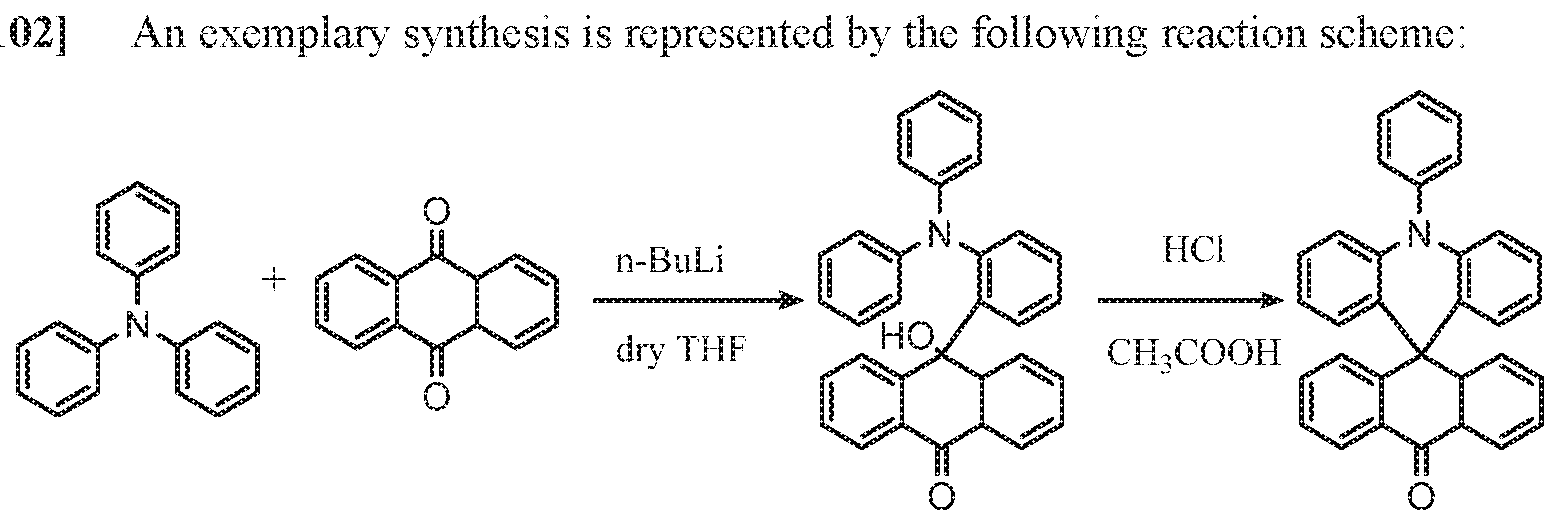
[00103] In this exemplary synthesis, n-BuLi ( 1.6 M in hexane, 14.6 mL, 23.3 mmol) is added to a solution of of 2-bromotriphenylamine (7.54 g, 23.3 mmol) in dry "FHF (180 mL) at -78°C. That mixture is stirred for 1.5 hours at -78°C. Anthraquinone (4.3 g, 21.2 mmol) is added to the reaction solution, which is then stirred for 1 day at 0°C. The reaction mixture is extracted into chloroform. The organic layer is dried over MgS04, filtered, and concentrated in vacuo, then purified by column chromatography. The reaction product (3.21 g, 7.09 mmol), acetic acid (55 mmol), and HC1 (5.5 mL) are stirred for 4 hours under reflux. The reaction mixture is filtered, and the product is extracted into chloroform. The organic layer is dried over MgS04, filtered, and concentrated in vacuo, then purified by column
chromatography .
[00104] The teachings of all patents, published applications and references cited herein are incorporated by reference in their entirety.
[00105] While this invention has been particularly shown and described with references to example embodiments thereof, it will be understood by those skilled in the art that various changes in form and details may be made therein without departing from the scope of the invention encompassed by the appended claims.
Claims
What is claimed is:
1. A molecule represented b the following structural formula:

wherein:
X1 and X2 are independently selected from O, S, C(O), CRaRb, SiRaRb, NRC, BRC, or a bond, wherein at least one of X1 and X2 is not CH2;
each of rings A, B, C, and D is, independently, an optionally substituted six- membered aromatic or heteroaromatic ring, wherein at least one of rings A, B, C, and D contains at least one nitrogen atom ; and
each instance of Ra, Rb, and Rc is independently selected from H, a Ci-Ce alkyi, a C3-C18 cycloalkyl, a Ce-Cis aiyl, a 5-20 atom heteroaryl, halo, or -CN.
The molecule of claim 1 , represented by the following structural formula:

wherein:
each atom E!a, E2a, E3a, E4a, El , E2b, E3b, E4b, Elc, E2c, E3c, E4c, E]d, E2d, E3d, and E4d is independently selected from CR° or N, provided that each ring A, B, C, and D contains 0, 1, or 2 nitrogen atoms; and
each instance of Rd is independently selected from H, a Ci-Ce alkyl, a C3-C18 cycloalkyl, a Ce-Cis aryl, a 5-20 atom heteroaryl, halo, or -CN.
3. llie molecule of any one of claims 1 or 2, wherein X1 is SiRaRb, BRC, O, or S.
4. The molecule of any one of claims 1 -3, wherein X1 is SiRaRb or BRC.
5. The molecule of any one of clamis 1-4, wherein each instance of Ra, Rb, and Rc is independently selected from H, phenyl, and C1-3 alkyl.
6. The molecule of any one of claims 1-5, wherein each instance of Rd is H or C1-C3 alkyl ,
7. The molecule of any one of claims 1 -6, wherein each of rings A, B, C, and D contains no more than one nitrogen atom.
8. The molecule of any one of claims 1-7, wherein at least two of rings A, B, C, and D contain at least one nitrogen atom.
9. The molecule of any one of claims 1 -8, wherein at least three of rings A, B, C, and D contain at least one nitrogen atom.
10. The molecule of any one of claims 1-9, wherein each of rings A, B, C, and D contains at least one nitrogen atom.
1 1. The molecule of any one of claims 1-10, wherein Xi is B-phenyl and X2 is O, S, N- plienyl, -C(CH )2-, -Si(CH )2-, -CH2-, -S1H2-, or a bond.
12. The molecule of any one of claims 1-10, wherem Xi is N-phenyl and Xi is O, C(O), B- phenyl, -€(0¾)2-, -Si(Ci¾)2-, -CH2-, -Sift.-, or a bond.
13. The molecule of any one of claims 1- 10, wherein Xi is C(O) and X2 is N-phenyl, B- phenyl, O, S, or a bond.
14. The molecule of any one of claims 1- 10, wherem Xi is O or S and X2 is B-phenyl or C(O).
15. A molecule represented by the following structural formula:

(II)
wherein:
X1 and X2 are independently selected from 0, S, C(O), CRaRb, SiRaR , NRC, BRC, or a bond, wherem at least one of X1 and X2 is not CH2;
each of A, B, C, and D is, independently, an optionally substituted six-membered aromatic or heteroaromatic ring, wherein at least one of rings A, B, C, and D contains at least one Nitrogen atom;
each instance of Ra, Rb, and Rc is independently selected from H, a Ci-Ce alkyl, a CV Ci8 cycloalkyl, a Ce-Cis aryl, a 5-2.0 atom heteroaryl, halo, or -CN.
16. A molecule represented by any one structural formula as shown in Table I .
17. An organic light-emitting device containing:
a first electrode;
a second electrode; and
an organic layer disposed between the first electrode and the second electrode, wherein the organic layer comprises at least one molecule as defined by any one of claims 1 to 16.
Priority Applications (1)
| Application Number | Priority Date | Filing Date | Title |
|---|---|---|---|
| US16/091,844 US20190088884A1 (en) | 2016-04-05 | 2017-04-05 | Compounds for organic light emitting diode materials |
Applications Claiming Priority (2)
| Application Number | Priority Date | Filing Date | Title |
|---|---|---|---|
| US201662318531P | 2016-04-05 | 2016-04-05 | |
| US62/318,531 | 2016-04-05 |
Publications (1)
| Publication Number | Publication Date |
|---|---|
| WO2017176841A1 true WO2017176841A1 (en) | 2017-10-12 |
Family
ID=58610009
Family Applications (1)
| Application Number | Title | Priority Date | Filing Date |
|---|---|---|---|
| PCT/US2017/026071 Ceased WO2017176841A1 (en) | 2016-04-05 | 2017-04-05 | Compounds for organic light emitting diode materials |
Country Status (2)
| Country | Link |
|---|---|
| US (1) | US20190088884A1 (en) |
| WO (1) | WO2017176841A1 (en) |
Cited By (5)
| Publication number | Priority date | Publication date | Assignee | Title |
|---|---|---|---|---|
| CN110218221A (en) * | 2019-06-28 | 2019-09-10 | 武汉天马微电子有限公司 | Compound, display panel and display device |
| CN110386946A (en) * | 2018-04-19 | 2019-10-29 | 江苏三月光电科技有限公司 | A kind of compound with ketone as the core and its preparation method and application |
| CN110627789A (en) * | 2019-08-27 | 2019-12-31 | 武汉华星光电半导体显示技术有限公司 | Thermal activation delay fluorescent material, preparation method thereof and electroluminescent device |
| KR20200007111A (en) * | 2018-07-11 | 2020-01-22 | 삼성디스플레이 주식회사 | Organic electroluminescence device and polycyclic compound for organic electroluminescence device |
| CN110845393A (en) * | 2018-08-21 | 2020-02-28 | 江苏三月光电科技有限公司 | Compound with spirofluorene anthrone as core and application thereof in organic electroluminescent device |
Families Citing this family (2)
| Publication number | Priority date | Publication date | Assignee | Title |
|---|---|---|---|---|
| CN110204567B (en) * | 2019-06-04 | 2020-12-04 | 武汉华星光电半导体显示技术有限公司 | Organic compound, application thereof and organic light-emitting diode electroluminescent device |
| CN111732601B (en) * | 2020-06-30 | 2023-01-24 | 武汉天马微电子有限公司 | Compound, display panel and display device |
Citations (4)
| Publication number | Priority date | Publication date | Assignee | Title |
|---|---|---|---|---|
| US20030235713A1 (en) * | 2001-09-03 | 2003-12-25 | Canon Kabushiki Kaisha | Organic luminescence device |
| US20100019658A1 (en) * | 2008-07-22 | 2010-01-28 | Industrial Technology Research Institute | Organic compound and organic electroluminescence device employing the same |
| WO2015049030A2 (en) * | 2013-10-02 | 2015-04-09 | Merck Patent Gmbh | Boron-containing compounds |
| CN104860884A (en) * | 2015-05-19 | 2015-08-26 | 苏州大学 | Triphenylethylene-like derivatives and uses thereof |
-
2017
- 2017-04-05 US US16/091,844 patent/US20190088884A1/en not_active Abandoned
- 2017-04-05 WO PCT/US2017/026071 patent/WO2017176841A1/en not_active Ceased
Patent Citations (4)
| Publication number | Priority date | Publication date | Assignee | Title |
|---|---|---|---|---|
| US20030235713A1 (en) * | 2001-09-03 | 2003-12-25 | Canon Kabushiki Kaisha | Organic luminescence device |
| US20100019658A1 (en) * | 2008-07-22 | 2010-01-28 | Industrial Technology Research Institute | Organic compound and organic electroluminescence device employing the same |
| WO2015049030A2 (en) * | 2013-10-02 | 2015-04-09 | Merck Patent Gmbh | Boron-containing compounds |
| CN104860884A (en) * | 2015-05-19 | 2015-08-26 | 苏州大学 | Triphenylethylene-like derivatives and uses thereof |
Non-Patent Citations (1)
| Title |
|---|
| THEOPHIL EICHER ET AL., THE CHEMISTRY OF HETEROCYCLES: STRUCTURES, REACTIONS, SYNTHESIS, AND APPLICATIONS |
Cited By (8)
| Publication number | Priority date | Publication date | Assignee | Title |
|---|---|---|---|---|
| CN110386946A (en) * | 2018-04-19 | 2019-10-29 | 江苏三月光电科技有限公司 | A kind of compound with ketone as the core and its preparation method and application |
| KR20200007111A (en) * | 2018-07-11 | 2020-01-22 | 삼성디스플레이 주식회사 | Organic electroluminescence device and polycyclic compound for organic electroluminescence device |
| US11393985B2 (en) | 2018-07-11 | 2022-07-19 | Samsung Display Co., Ltd. | Organic electroluminescence device and polycyclic compound for organic electroluminescence device |
| KR102706953B1 (en) * | 2018-07-11 | 2024-09-19 | 삼성디스플레이 주식회사 | Organic electroluminescence device and polycyclic compound for organic electroluminescence device |
| CN110845393A (en) * | 2018-08-21 | 2020-02-28 | 江苏三月光电科技有限公司 | Compound with spirofluorene anthrone as core and application thereof in organic electroluminescent device |
| CN110218221A (en) * | 2019-06-28 | 2019-09-10 | 武汉天马微电子有限公司 | Compound, display panel and display device |
| CN110218221B (en) * | 2019-06-28 | 2022-03-08 | 武汉天马微电子有限公司 | Compound, display panel and display device |
| CN110627789A (en) * | 2019-08-27 | 2019-12-31 | 武汉华星光电半导体显示技术有限公司 | Thermal activation delay fluorescent material, preparation method thereof and electroluminescent device |
Also Published As
| Publication number | Publication date |
|---|---|
| US20190088884A1 (en) | 2019-03-21 |
Similar Documents
| Publication | Publication Date | Title |
|---|---|---|
| JP6927497B2 (en) | Delayed fluorescent organic electroluminescent device | |
| JP6919104B2 (en) | Organic electroluminescent device | |
| Li et al. | Thermally activated delayed fluorescence carbonyl derivatives for organic light-emitting diodes with extremely narrow full width at half-maximum | |
| KR102633065B1 (en) | polycyclic aromatic compounds | |
| KR102633060B1 (en) | organic electroluminescent device | |
| Tang et al. | Efficient deep blue electroluminescence with an external quantum efficiency of 6.8% and CIE y< 0.08 based on a phenanthroimidazole–sulfone hybrid donor–acceptor molecule | |
| JP6633637B2 (en) | Organic electroluminescent device | |
| Jayakumar et al. | Pyridine-carbonitrile–carbazole-based delayed fluorescence materials with highly congested structures and excellent OLED performance | |
| KR102128702B1 (en) | Novel organic electroluminescence compounds and organic electroluminescence device containing the same | |
| JP2020132636A (en) | Polycyclic aromatic compound and multimer thereof | |
| CN101952389B (en) | Luminescent element material and luminescent element | |
| KR20160035062A (en) | Compound, light-emitting material, and organic light-emitting element | |
| KR102438956B1 (en) | Polyaromatic Amino Compounds | |
| KR20190114998A (en) | Organic electroluminescent element | |
| JPWO2013161437A1 (en) | Luminescent material and organic light emitting device | |
| WO2015102118A1 (en) | Polycyclic aromatic compound | |
| US11189803B2 (en) | Organic electroluminescent element and electronic device containing the organic electroluminescent element | |
| WO2017205425A1 (en) | Compounds for organic light emitting diode materials | |
| KR102856013B1 (en) | Organic electroluminescent devices and electronic devices | |
| US20190088884A1 (en) | Compounds for organic light emitting diode materials | |
| KR20190114999A (en) | Organic electroluminescent element | |
| JP2021061262A (en) | Organic electroluminescent element using light emitting material of polycyclic aromatic compound | |
| JP2020136284A (en) | Organic electroluminescent element | |
| JP6215674B2 (en) | Organic electroluminescence device and electronic device | |
| KR20220010514A (en) | Organic electroluminescent devices, compounds and electronic devices |
Legal Events
| Date | Code | Title | Description |
|---|---|---|---|
| NENP | Non-entry into the national phase |
Ref country code: DE |
|
| 121 | Ep: the epo has been informed by wipo that ep was designated in this application |
Ref document number: 17719090 Country of ref document: EP Kind code of ref document: A1 |
|
| 122 | Ep: pct application non-entry in european phase |
Ref document number: 17719090 Country of ref document: EP Kind code of ref document: A1 |