WO2017167638A1 - Non-aqueous electrolytes and uses thereof - Google Patents
Non-aqueous electrolytes and uses thereof Download PDFInfo
- Publication number
- WO2017167638A1 WO2017167638A1 PCT/EP2017/056932 EP2017056932W WO2017167638A1 WO 2017167638 A1 WO2017167638 A1 WO 2017167638A1 EP 2017056932 W EP2017056932 W EP 2017056932W WO 2017167638 A1 WO2017167638 A1 WO 2017167638A1
- Authority
- WO
- WIPO (PCT)
- Prior art keywords
- alkyl
- aryl
- halogenated
- heteroaryl
- cycloalkyl
- Prior art date
- Legal status (The legal status is an assumption and is not a legal conclusion. Google has not performed a legal analysis and makes no representation as to the accuracy of the status listed.)
- Ceased
Links
Classifications
-
- H—ELECTRICITY
- H01—ELECTRIC ELEMENTS
- H01M—PROCESSES OR MEANS, e.g. BATTERIES, FOR THE DIRECT CONVERSION OF CHEMICAL ENERGY INTO ELECTRICAL ENERGY
- H01M10/00—Secondary cells; Manufacture thereof
- H01M10/05—Accumulators with non-aqueous electrolyte
- H01M10/056—Accumulators with non-aqueous electrolyte characterised by the materials used as electrolytes, e.g. mixed inorganic/organic electrolytes
- H01M10/0564—Accumulators with non-aqueous electrolyte characterised by the materials used as electrolytes, e.g. mixed inorganic/organic electrolytes the electrolyte being constituted of organic materials only
- H01M10/0566—Liquid materials
- H01M10/0567—Liquid materials characterised by the additives
-
- H—ELECTRICITY
- H01—ELECTRIC ELEMENTS
- H01M—PROCESSES OR MEANS, e.g. BATTERIES, FOR THE DIRECT CONVERSION OF CHEMICAL ENERGY INTO ELECTRICAL ENERGY
- H01M10/00—Secondary cells; Manufacture thereof
- H01M10/05—Accumulators with non-aqueous electrolyte
- H01M10/052—Li-accumulators
- H01M10/0525—Rocking-chair batteries, i.e. batteries with lithium insertion or intercalation in both electrodes; Lithium-ion batteries
-
- Y—GENERAL TAGGING OF NEW TECHNOLOGICAL DEVELOPMENTS; GENERAL TAGGING OF CROSS-SECTIONAL TECHNOLOGIES SPANNING OVER SEVERAL SECTIONS OF THE IPC; TECHNICAL SUBJECTS COVERED BY FORMER USPC CROSS-REFERENCE ART COLLECTIONS [XRACs] AND DIGESTS
- Y02—TECHNOLOGIES OR APPLICATIONS FOR MITIGATION OR ADAPTATION AGAINST CLIMATE CHANGE
- Y02E—REDUCTION OF GREENHOUSE GAS [GHG] EMISSIONS, RELATED TO ENERGY GENERATION, TRANSMISSION OR DISTRIBUTION
- Y02E60/00—Enabling technologies; Technologies with a potential or indirect contribution to GHG emissions mitigation
- Y02E60/10—Energy storage using batteries
Definitions
- the field of the DISCLOSURE lies in materials for secondary batteries.
- the present application relates to non-aqueous electrolytes for secondary batteries and their uses in electrochemical devices or electric devices.
- the present disclosure relates to a secondary battery that includes the non-aqueous electrolyte.
- the present disclosure relates to an electric device that includes the secondary battery.
- a secondary battery attachably and detachably mounted on the electronic apparatuses or the like, an electric vehicle such as an electric automobile, an electric power storage system such as a home electric power server, and an electric power tool such as an electric drill.
- a secondary battery includes a cathode, an anode, and electrolytic solution.
- the electrolytic solution includes a solvent and an electrolyte salt.
- a composition of the electrolytic solution that serves as a medium for charge and discharge reactions largely influences the performance of the secondary battery. Various considerations are therefore made on the composition of the electrolytic solution.
- a thiophene -based organic compound and/or Schiff base organic compound is used as an additive to the electrolyte, according to the present disclosure.
- the present disclosure provides a non-aqueous electrolyte for secondary batteries including:
- the present disclosure provides the use of the non-aqueous electrolyte according to the present disclosure in
- a secondary battery or a super capacitor such as, but not limited to, a secondary battery or a super capacitor
- a battery pack such as, but not limited to, a battery pack, an electric vehicle, an electric power storage system, an electric power tool, an electronic apparatus.
- the present disclosure provides a secondary battery including:
- the present disclosure provides an electric device including a secondary battery according to the present disclosure.
- Figure 1 is a cross-sectional view illustrating a configuration of a secondary battery (of a cylindrical type) that uses the non-aqueous electrolyte of an embodiment of the disclosure.
- Figure 2 is a cross-sectional view illustrating an enlarged part of a spirally wound electrode body illustrated in Figure 1.
- Figure 3 is a perspective view illustrating a configuration of another secondary battery (of a laminated film type) that uses the non-aqueous electrolytic solution of an embodiment of the disclosure.
- Figure 4 is a cross-sectional view of a spirally wound electrode body taken along a line IV-IV illustrated in Figure 3.
- Figure 5 is a block diagram illustrating a configuration of an application example (a battery pack) of the secondary battery.
- the battery pack may include a control section 61, an electric power source 62, a switch section 63, a current measurement section 64, a temperature detection section 65, a voltage detection section 66, a switch control section 67, a memory 68, a temperature detection device 69, a current detection resistance 70, a cathode terminal 71, and an anode terminal 72 in a housing 60.
- the housing 60 may be made, for example, of a plastic material or the like.
- FIG. 6 is a block diagram illustrating a configuration of an application example (an electric vehicle) of the secondary battery.
- the electric vehicle may include a control section 74, an engine 75, an electric power source 76, a driving motor 77, a differential 78, an electric generator 79, a transmission 80, a clutch 81, inverters 82 and 83, and various sensors 84 in a housing 73 made of metal.
- the electric vehicle may include, for example, a front drive shaft 85 and a front tire 86 that are connected to the differential 78 and the transmission 80, a rear drive shaft 87, and a rear tire 88.
- Figure 7 is a block diagram illustrating a configuration of an application example (an electric power storage system) of the secondary battery.
- the electric power storage system may include a control section 90, an electric power source 91, a smart meter 92, and a power hub 93 inside a house 89 such as a general residence and a commercial building.
- Figure 8 is a block diagram illustrating a configuration of an application example (an electric power tool) of the secondary battery.
- the electric power tool may be an electric drill, and may include a control section 99 and an electric power source 100 in a tool body 98 made of a plastic material and/or the like.
- a drill section 101 as a movable section may be attached to the tool body 98 in an operable (rotatable) manner.
- the present disclosure provides a non-aqueous electrolyte.
- the non-aqueous electrolyte for secondary batteries according to the present disclosure includes:
- the content of the additive(s) is from 0.001 weight percent to about 10 weight percent related to the total amount of electrolyte, preferably between about 0.01 weight percent to about 5 weight percent, more preferably about 0.1 weight percent to about 5 weight percent.
- the at least one organic thiophene-based additive is selected from monothiophenes, oligothiophenes and fused thiophenes.
- mixtures of different organic thiophene-based additives are used, such as two, three or more different organic thiophene-based additives.
- the at least one organic thiophene-based additive is selected from compounds represented by the general formula I, II, III, IV or V.
- the at least one organic thiophene-based additive is selected from compounds represented by the gener formula I
- Xi, X 2 , X3 and X4 may be equal or different under the proviso that at least one of Xi, X 2 , X3 and X 4 is different from H;
- n is an integer from 1 to 20; preferably 1 to 12;
- R is selected from, but not limited to, alkyl, cycloalkyl, aryl, alkyl-substituted aryl, heteroaryl, or substituted alkyl or aryl residues comprising halogen, nitrile, nitro, sulfonyl (-S0 2 R'), sulfone (-S0 2 R' 2 ), sulfonate (-S0 2 OR'), phosphonate (-P0 2 OR') groups;
- R' is selected from, but not limited to, alkyl, cycloalkyl, aryl, alkyl-substituted aryl, heteroaryl.
- the at least one organic thiophene-based additive is a compound of general formula I which is selected from equally substituted thiophenes at 2,5 position with general formula I-l
- non-symmetrically substituted thiophenes having two or three identical substituents in positions X ls X 2 , X 3 or X4.
- non-symmetrically substituted thiophenes can be compounds with general formulas 1-2, 1-3, 1-4, 1-5 or 1-6:
- the at least one organic thiophene-based additive is selected from compounds represented by the general formula II
- k is an integer from 2 to 6;
- n is an integer from 1 to 20; preferably 1 to 12;
- R is selected from, but not limited to, alkyl, cycloalkyl, aryl, alkyl-substituted aryl, heteroaryl, or substituted alkyl or aryl residues comprising halogen, nitrile, nitro, sulfonyl (-S0 2 R'), sulfone (-S0 2 R' 2 ), sulfonate (-S0 2 OR'), phosphonate (-P0 2 OR') groups;
- R' is selected from, but not limited to, alkyl, cycloalkyl, aryl, alkyl-substituted aryl, heteroaryl.
- the at least one organic thiophene-based additive is selected from compounds represented by the general formula III, IV or V
- n is an integer from 1 to 20; preferably 1 to 12;
- R is selected from, but not limited to, alkyl, cycloalkyl, aryl, alkyl-substituted aryl, heteroaryl, or substituted alkyl or aryl residues comprising halogen, nitrile, nitro, sulfonyl (-S0 2 R') 5 sulfone (-S0 2 R' 2 ), sulfonate (-S0 2 OR'), phosphonate (-P0 2 OR') groups;
- R' is selected from, but not limited to, alkyl, cycloalkyl, aryl, alkyl-substituted aryl, heteroaryl.
- the at least one organic thiophene-based additive is selected from compounds with a polycyclic fused ring structure, where more than two thiophene rings are fused to each other.
- organic thiophene-based additives of the present disclosure are provided under the following provisions (1) to (3):
- At least one of X 2 or X 3 is different from H.
- At least one of X 2 or X 3 is different from H.
- At least one of of Xi, X 2 , X3 and X4 is different from H.
- the organic thiophene-based additives of the present disclosure are provided under the provision that any one of a compound according to (1) to (3) above is provided as an additive in a mixture with further organic thiophene-based additive(s) of the present disclosure or in a mixture with at least one organic Schiff base additive of the present disclosure.
- the at least one organic thiophene-based additive is a monothiophene, a compound with general formula I selected from:
- the at least one organic thiophene-based additive is an oligothiophene, a compound with general formula II selected from:
- the at least one organic thiophene-based additive is an fused thiophene, a compound with general formula III selected from: thieno [2,3 -3 ⁇ 4]thiophene
- the at least one organic thiophene-based additive is an fused thiophene, a compound with general formula IV selected from: thieno [3 ,2-5]thiophene
- the at least one organic thiophene-based additive is an fused thiophene, a compound with general formula V selected from: thieno [3 ,4-b]thiophene
- the at least one organic Schiffbase additive is a compound represented by general formula VI
- R is selected from alkyl, cycloalkyl, aryl, alkyl-substituted aryl, heteroaryl, or substituted alkyl or aryl residues comprising halogen, nitrile, nitro, sulfonyl (-S0 2 R'), sulfone ( ⁇ S0 2 R' 2 ), sulfonate (-S0 2 OR') 5 phosphonate (-P0 2 OR') groups;
- R' is selected from alkyl, cycloalkyl, aryl, alkyl-substituted aryl, heteroaryl.
- R 1 and R 2 can be equal or different, selected from the list above.
- Ri, R 2 , and R3 can be equal or different, selected from the list above.
- mixtures of different organic Schiff base additives are used, such as two, three or more different organic Schiff base additives.
- the at least one organic Schiff base additive is selected from cyclic-type and open-cycle type compounds.
- the at least one organic Schiff base additive is selected from compounds represented by the general formula VII, VIII, IX, X and XI.
- the at least one organic Schiff base additive is selected from compounds represented by the general formula VII
- the at least one organic Schiff base additive is selected from compounds represented by the general formula VIII
- the at least one organic Schiff base additive is selected from compounds represented by the general formula IX
- the at least one organic Schiff base additive is selected from compounds represented by the general formula X
- the at least one organic Schiff base additive is selected from compounds represented by the general formula XI
- Z, Zi and Z 2 are each independently selected from H, CN, alkyl, cyclic alkyl, aryl, heterocycle, such as, but not limited to,
- X and Y are, at each occurrence, independently selected from H, alkyl, aryl, heterocycle, halogenated allcyl, halogenated aryl, hydroxylated alkyl, hydroxylated aryl, nitrile, aromatic cycle/aryl substituted with carboxylic ester, fluorinated carboxylic ester, nitriles,
- X and Y can be equal or different, selected from the list above.
- the at least one Schiff base additive is a cyclic-type compound, a compound with general formula VI selected from
- the at least one Schiff base additive is a cyclic-type compound, a compound with general formula VII selected from pyrazine dicarbonitrile,
- the at least one Schiff base additive is an open cycle compound, a compound with general formula VIII to XI selected from
- the at least one Schiff base additive is a cyclic-type compound, a compound with general formula VI selected from
- mixtures of organic thiophene-based and Schiffbase additives as disclosed in the present disclosure are included in an electrolyte of the present disclosure: mixtures of different organic thiophene-based additives as disclosed in the present disclosure;
- the total content of the additives is from 0.001 weight percent to about 10 weight percent related to the total amount of electrolyte, preferably between about 0.01 weight percent to about 5 weight percent, more preferably about 0.1 weight percent to about 5 weight percent.
- one of the additives is in a range of from about 0.001 weight percent to about 9.999 weight percent and the other additive is in a range from about 9.999 weight percent to about 0.001 weight percent related to the total amount of electrolyte.
- the polar ion-conductive medium is a polar aprotic solvent which is preferably selected from
- ethylene carbonate EC
- propylene carbonate PC
- chain ester carbonate s
- DMC dimethyl carbonate
- diethyl carbonate diethyl carbonate
- the electrolyte salt may contain, for example, one or more of salts such as lithium salt. However, the electrolyte salt may contain, for example, salt other than the lithium salt. Examples of "salt other than the lithium salt” may include light metal salt other than lithium salt.
- the alkali metal salt is one or more lithium salts (Li salt).
- lithium salt may include lithium hexafluorophosphate (LiPF 6 ), lithium tetrafluoroborate (LiBF 4 ), lithium perchlorate (LiC10 4 ).
- LiPF 6 lithium hexafluorophosphate
- LiBF 4 lithium tetrafluoroborate
- LiC10 4 lithium perchlorate
- specific examples of the lithium salt are not limited to the compounds described above.
- the present disclosure provides the use of the non-aqueous electrolyte in an electrochemical device
- a secondary battery such as a secondary Li-ion battery
- a super capacitor such as, but not limited to, a secondary battery (such as a secondary Li-ion battery), a super capacitor.
- the present disclosure provides the use of the non-aqueous electrolyte in an electric device
- a battery pack such as, but not limited to, a battery pack, an electric vehicle, an electric power storage system, an electric power tool, an electronic apparatus.
- the at least one organic thiophene-based additive and/or at least one organic Schiff base additive of the non-aqueous electrolyte - according to the present disclosure stabilizes the electrode(s) by
- the present disclosure provides a secondary battery.
- a secondary battery according to the present disclosure includes:
- the secondary battery according to the present disclosure is a secondary Li-ion battery.
- the cathode is an intercalation type cathode including one or more kinds of active cathode material which is capable of reversible inserting and extrancing Li ions,
- transition metal oxide(s) such as, but not limited to, metal(s) selected from Co, Ni, Mn, V, Fe and combinations thereof.
- the cathode material may be preferably a lithium-containing compound, because high energy density is obtained thereby.
- the lithium-containing compound may include a lithium-transition-metal composite oxide and a lithium-transition-metal-phosphate compound.
- the lithium-transition-metal composite oxide is an oxide containing lithium and one or more transition metal elements as constituent elements.
- the lithium-transition-metal- phosphate compound is a phosphate compound containing lithium and one or more transition metal elements as constituent elements.
- the transition metal element may be preferably one or more of cobalt (Co), nickel (Ni), manganese (Mn), iron (Fe), and the like, because a higher voltage is obtained thereby.
- the chemical formula thereof may be expressed, for example, by Li x M10 2 or by Li y M2P0 4 .
- Ml and M2 represent one or more transition metal elements.
- Values of x and y vary according to the charge and discharge state, but may be generally in the range of 0.05. ⁇ x. ⁇ 1.10 and 0.05 ⁇ y ⁇ 1.10.
- lithium-transition-metal composite oxide may include LiCo0 2 , LiNi0 2 , and a lithium-nickel-based composite oxide represented by the formula:
- lithium-transition-metal-phosphate compound may include LiFeP0 4 and LiFe 1-u Mn u P0 (u ⁇ l), because a high battery capacity is thereby obtained and superior cycle characteristics are also obtained.
- M is one or more of cobalt, manganese, iron, aluminum, vanadium (V), tin (Sn), magnesium (Mg), titanium (Ti), strontium (Sr), calcium (Ca), zirconium (Zr), molybdenum (Mo), technetium (Tc), ruthenium (Ru), tantalum (Ta), tungsten (W), rhenium (Re), ytterbium (Yb), copper, zinc (Zn), barium (Ba), boron (B), chromium (Cr), silicon (Si), gallium (Ga), phosphorus (P), antimony (Sb), and niobium (Nb). z satisfies 0.005 ⁇ z ⁇ 0.5.)
- the anode is an intercalation type anode including one or more kinds of active anode material which is capable of reversible inserting and extrancing Li ions, such as, but not limited to, graphitizable carbon, non-graphitizable carbon, graphite, Li-metal, Si, Si oxide, Sn, Sn oxide, LiTi 2 0 5 , Si alloy, Sn alloy.
- active anode material such as, but not limited to, graphitizable carbon, non-graphitizable carbon, graphite, Li-metal, Si, Si oxide, Sn, Sn oxide, LiTi 2 0 5 , Si alloy, Sn alloy.
- Examples of the carbon material may include graphitizable carbon, non-graphitizable carbon, and graphite.
- the spacing of (002) plane in the non-graphitizable carbon may be preferably equal to or greater than 0.37 nm
- the spacing of (002) plane in graphite may be preferably equal to or smaller than 0.34 nm.
- examples of the carbon material may include pyrolytic carbons, cokes, glassy carbon fiber, an organic polymer compound fired body, activated carbon, and carbon blacks.
- Examples of the cokes may include pitch coke, needle coke, and petroleum coke.
- the organic polymer compound fired body is obtained by firing (carbonizing) a polymer compound such as phenol resin and furan resin at appropriate temperature.
- the carbon material may be low crystalline carbon heat-treated at temperature of about 1000 °C or less, or may be amorphous carbon. It is to be noted that the shape of the carbon material may be any of a fibrous shape, a spherical shape, a granular shape, and a scale-like shape.
- the anode material may be, for example, a material (a metal-based material) containing one or more of metal elements and metalloid elements as constituent elements, because high energy density is thereby achieved.
- the metal-based material may be a simple substance, alloy, or a compound, may be two or more thereof, or may have one or more phases thereof in part or all thereof.
- “Alloy” includes a material containing one or more metal elements and one or more metalloid elements, in addition to a material configured of two or more metal elements. Further, the "alloy” may contain a nonmetallic element. Examples of the structure thereof may include a solid solution, a eutectic crystal (eutectic mixture), an intermetallic compound, and a structure in which two or more thereof coexist.
- Examples of the foregoing metal elements and the foregoing metalloid elements may include one or more of metal elements and metalloid elements capable of forming alloy with lithium. Specific examples thereof may include magnesium, boron, aluminum, gallium, indium (In), silicon, germanium (Ge), tin (Sn), lead (Pb), bismuth (Bi), cadmium (Cd), silver (Ag), zinc, hafnium (Hi), zirconium, yttrium (Y), palladium (Pd), and platinum (Pt).
- metal elements and metalloid elements capable of forming alloy with lithium. Specific examples thereof may include magnesium, boron, aluminum, gallium, indium (In), silicon, germanium (Ge), tin (Sn), lead (Pb), bismuth (Bi), cadmium (Cd), silver (Ag), zinc, hafnium (Hi), zirconium, yttrium (Y), palladium (Pd), and platinum (Pt).
- silicon, tin, or both may be preferable, because silicon and tin have superior ability of inserting and extracting lithium, and therefore achieve high energy density.
- a material containing silicon, tin, or both as constituent elements may be any of a simple substance, alloy, and a compound of silicon, may be any of a simple substance, alloy, and a compound of tin, may be two or more thereof, or may have one or more phases thereof in part or all thereof.
- "simple substance” described herein merely refers to a simple substance in a general sense (a small amount of impurity may be therein contained), and does not necessarily refer to a purity 100% simple substance.
- the alloys of silicon may contain, for example, one or more of elements such as tin, nickel, copper, iron, cobalt, manganese, zinc, indium, silver, titanium, germanium, bismuth, antimony, and chromium, as a constituent element other than silicon.
- the compounds of silicon may contain, for example, one or more of carbon (C), oxygen (O), and the like as constituent elements other than Si. It is to be noted that the compounds of silicon may contain, for example, one or more of the series of elements described for the alloys of silicon, as constituent elements other than silicon.
- alloys of silicon and the compounds of silicon may include SiB 4 , SiB 6 , Mg 2 Si, Ni 2 Si, TiSi 2 , MoSi 2 , CoSi 2 , NiSi 2 , CaSi 2 , CrSi 2 , Cu 5 Si, FeSi 2 , MnSi 2 , NbSi 2 , TaSi 2 , VSi 2 , WSi 2 , ZnSi 2 , SiC, Si 3 N 4 , Si 2 N 2 0, SiO v (0 ⁇ v. ⁇ 2), and LiSiO.
- v in SiO v may be in a range of 0.2 ⁇ v ⁇ l .4.
- the alloys of tin may contain, for example, one or more of elements such as silicon, nickel, copper, iron, cobalt, manganese, zinc, indium, silver, titanium, germanium, bismuth, antimony, and chromium, as constituent elements other than tin.
- the compounds of tin may contain, for example, one or more of elements such as carbon and oxygen as constituent elements other than tin. It is to be noted that the compounds of tin may contain, for example, one or more of the series of elements described for the alloys of tin, as constituent elements other than tin.
- Figure 1 and Figure 2 each illustrate a cross-sectional configuration of a secondary battery of an embodiment of the present application (in particular a cylindrical type battery).
- Figure 2 illustrates an enlarged part of a spirally wound electrode body 20 illustrated in Figure 1.
- the secondary battery described here as an embodiment is a lithium secondary battery (a lithium ion secondary battery) in which a capacity of an anode 22 is obtained by insertion and extraction of lithium as an electrode reactant.
- the secondary battery may be, for example, a secondary battery of a so-called cylindrical type.
- the secondary battery may contain a pair of insulating plates 12 and 13 and a spirally wound electrode body 20 inside a battery can 11 in the shape of a substantially- hollow cylinder.
- a cathode 21 and the anode 22 are laminated with a separator 23 in between and are spirally wound.
- the battery can 11 may have a hollow structure in which one end of the battery can 11 is closed and the other end of the battery can 11 is opened.
- the battery can 11 may be made, for example, of iron (Fe), aluminum (Al), alloy thereof, or the like.
- the surface of the battery can 11 may be plated with nickel (Ni) or the like.
- a battery cover 14 At the open end of the battery can 11, a battery cover 14, a safety valve mechanism 15, and a positive temperature coefficient device (PTC device) 16 are attached by being swaged with a gasket 17. Thereby, the battery can 11 is hermetically sealed.
- the battery cover 14 At the open end of the battery can 11, a battery cover 14, a safety valve mechanism 15, and a positive temperature coefficient device (PTC device) 16 are attached by being swaged with a gasket 17. Thereby, the battery can 11 is hermetically sealed.
- the battery cover 14 At the open end of the battery can 11, a battery cover 14, a safety valve mechanism 15, and a positive temperature coefficient device (PTC device) 16 are attached by being swaged with a gasket 17. Thereby, the battery can 11 is hermetically sealed.
- the safety valve mechanism 15 and the PTC device 16 are provided inside the battery cover 14.
- the safety valve mechanism 15 is electrically connected to the battery cover 14 via the PTC device 16.
- a disk plate 15 A inverts to cut electric connection between the battery cover 14 and the spirally wound electrode body 20.
- the PTC device 16 prevents abnormal heat generation resulting from a large current. As temperature rises, resistance of the PTC device 16 is increased accordingly.
- the gasket 17 may be made, for example, of an insulating material. The surface of the gasket 17 may be coated with asphalt.
- a center pin 24 may be inserted in the center of the spirally wound electrode body 20.
- a cathode lead 25 made of a conductive material such as aluminum may be connected to the cathode 21.
- an anode lead 26 made of a conductive material such as nickel may be connected to the anode 22.
- the cathode lead 25 may be attached to the safety valve mechanism 15 by welding or the like, and may be electrically connected to the battery cover 14.
- the anode lead 26 may be attached to the battery can 11 by welding or the like, and may be electrically connected to the battery can 11.
- the cathode 21 has a cathode active material layer 2 IB on a single surface or both surfaces of a cathode current collector 21 A.
- the cathode current collector 21 A may be made, for example, of a conductive material such as aluminum, nickel, or stainless steel.
- the cathode active material layer 2 IB contains, as a cathode active material, one or more of cathode materials capable of inserting and extracting lithium. It is to be noted that the cathode active material layer 21 B may further contain one or more of other materials such as a cathode binder and a cathode electric conductor.
- the anode 22 has an anode active material layer 22B on a single surface or both surfaces of an anode current collector 22A.
- Figure 3 illustrates an exploded perspective configuration of another secondary battery of an embodiment of the present application.
- Figure 4 illustrates an enlarged cross- section taken along a line TV-TV of a spirally wound electrode body 30 illustrated in Figure 3.
- the elements of the cylindrical-type secondary battery described above will be used where appropriate.
- the secondary battery described here is a so-called laminated-film-type lithium ion secondary battery.
- the secondary battery contains the spirally wound electrode body 30 in a film-like outer package member 40.
- a cathode 33 and an anode 34 are laminated with a separator 35 and an electrolyte layer 36 in between and are spirally wound.
- a cathode lead 31 is attached to the cathode 33, and an anode lead 32 is attached to the anode 34.
- the outermost periphery of the spirally wound electrode body 30 is protected by a protective tape 37.
- the cathode lead 31 and the anode lead 32 may be, for example, led out from inside to outside of the outer package member 40 in the same direction.
- the cathode lead 31 may be made, for example, of an electrically-conductive material such as aluminum
- the anode lead 32 may be made, for example, of an electrically-conducive material such as copper, nickel, and stainless steel.
- These electrically-conductive materials may be in the shape of, for example, a thin plate or mesh.
- the outer package member 40 may be a laminated film in which, for example, a fusion bonding layer, a metal layer, and a surface protective layer are laminated in this order.
- a fusion bonding layer In the laminated film, outer edges of the two film- shaped fusion bonding layers are fusion bonded so that the fusion bonding layers are opposed to the spirally wound electrode body 30.
- the two films may be bonded to each other by an adhesive, or the like.
- the fusion bonding layer may include a film made of one or more of polyethylene,
- polypropylene and the like.
- the metal layer may include an aluminum foil.
- Examples of the surface protective layer may include a film made of one or more of nylon, polyethylene terephthalate, and the like.
- the outer package member 40 may be preferably an aluminum laminated film in which a polyethylene film, an aluminum foil, and a nylon film are laminated in this order.
- the outer package member 40 may be a laminated film having other laminated structure, a polymer film such as polypropylene, or a metal film.
- a close-attachment film 41 to prevent outside air intrusion may be inserted between the outer package member 40 and the cathode lead 31 and between the outer package member 40 and the anode lead 32.
- the close-attachment film 41 is made of a material having close-attachment characteristics with respect to the cathode lead 31 and the anode lead 32.
- the material having close-attachment characteristics may include polyolefin resin that may include one or more of polyethylene, polypropylene, modified polyethylene, and modified polypropylene.
- the cathode 33 may have, for example, a cathode active material layer 33B on one surface or both surfaces of a cathode current collector 33A.
- the anode 34 may have, for example, an anode active material layer 34B on one surface or both surfaces of an anode current collector 34A.
- the configurations of the cathode current collector 33 A, the cathode active material layer 33B, the anode current collector 34A, and the anode active material layer 34B are similar to the configurations of the cathode current collector 21 A, the cathode active material layer 2 IB, the anode current collector 22 A, and the anode active material layer 22B, respectively.
- the configuration of the separator 35 may be, for example, similar to the configuration of the separator 23.
- the electrolyte layer 36 includes electrolytic solution and a polymer compound, and the electrolytic solution is held by the polymer compound.
- the electrolyte layer 36 is a so-called gel electrolyte, because thereby, high ion conductivity (for example, 1 mS/cm or more at room temperature) is obtained and liquid leakage of the electrolytic solution is prevented.
- the electrolyte layer 36 may further contain other material such as an additive as necessary.
- the polymer compound may include, for example, one or more of polyacrylonitrile, polyvinylidene fluoride, polytetrafluoroethylene, polyhexafluoropropylene, polyethylene oxide, polypropylene oxide, polyphosphazene, polysiloxane, polyvinyl fluoride, polyvinyl acetate, polyvinyl alcohol, polymethacrylic acid methyl, polyacrylic acid, polymethacrylic acid, styrene-butadiene rubber, nitrile-butadiene rubber, polystyrene, polycarbonate, a copolymer of vinylidene fluoride and hexafluoropropyrene, and the like.
- polyvinylidene fluoride or the copolymer of vinylidene fluoride and hexafluoro propylene may be preferable, and polyvinylidene fluoride may be more preferable, because such a polymer compound is electrochemically stable.
- the configuration of the electrolytic solution may be similar to the configuration of the electrolytic solution of the cylindrical-type secondary battery.
- the solvent of the electrolytic solution refers to a wide concept including not only a liquid solvent but also a material having ion conductivity capable of dissociating the electrolyte salt. Therefore, in the case where a polymer compound having ion conductivity is used, the polymer compound is also included in the solvent.
- the electrolytic solution may be used as it is instead of the gel electrolyte layer 36.
- the spirally wound electrode body 30 is impregnated with the electrolytic solution.
- the present disclosure provides an electric device including a secondary battery of the present disclosure.
- the electric device is a battery pack, an electric vehicle, an electric power storage system, an electric power tool or an electronic apparatus
- Figure 5 is a block diagram illustrating a battery pack.
- Figure 6 is a block diagram illustrating an electric vehicle.
- Figure 7 is a block diagram illustrating an electric power storage system.
- Figure 8 is a block diagram illustrating an electric power tool.
- a non-aqueous electrolyte for secondary batteries including:
- X 1? X 2 , X 3 and X4 may be equal or different under the proviso that at least one of Xi, X 2 , X 3 and X4 is different from H;
- n is an integer from 1 to 20; preferably 1 to 12;
- R is selected from alkyl, cycloalkyl, aryl, alkyl-substituted aryl, heteroaryl, or substituted alkyl or aryl residues comprising halogen, nitrile, nitro, sulfonyl (-S0 2 R'), sulfone (-S0 2 R' 2 ), sulfonate (-S0 2 OR'), phosphonate (-P0 2 OR') groups;
- R' is selected from alkyl, cycloalkyl, aryl, alkyl-substituted aryl, heteroaryl;
- X 1? X 2 , X3 and X4 may be equal or different under the proviso that at least one of Xi, X 2 , X 3 and X4 is different from H;
- k is an integer from 2 to 6;
- n is an integer from 1 to 20; preferably 1 to 12;
- R is selected from alkyl, cycloalkyl, aryl, alkyl- substituted aryl, heteroaryl, or substituted alkyl or aryl residues comprising halogen, nitrile, nitro, sulfonyl (-S0 2 R'), sulfone (-S0 2 R' 2 ), sulfonate (-S0 2 OR'), phosphonate (-P0 2 OR') groups;
- R' is selected from alkyl, cycloalkyl, aryl, alkyl-substituted aryl, heteroaryl;
- Xi, X 2 , X3 and X4 may be equal or different under the proviso that at least one of Xi, X 2 , X3 and X4 is different from H;
- n is an integer from 1 to 20; preferably 1 to 12;
- R is selected from alkyl, cycloalkyl, aryl, alkyl-substituted aryl, heteroaryl, or substituted alkyl or aryl residues comprising halogen, nitrile, nitro, sulfonyl (-S0 2 R'), sulfone (-S0 2 R' 2 ), sulfonate (-S0 2 OR'), phosphonate (-P0 2 OR') groups;
- R' is selected from alkyl, cycloalkyl, aryl, alkyl-substituted aryl, heteroaryl; or the at least one organic thiophene-based additive is selected from compounds with a polycyclic fused ring structure, where more than two thiophene rings are fused to each other in ortho- position.
- the at least one organic thiophene-based additive of general formula I is selected from equally substituted thiophenes at 2,5 position with general formula 1-1
- At least one of Xi, X 2 , X3 and X4 is different from H; or under the provision that any one of a compound according to (1) to (3) is provided as an additive in a mixture with further organic thiophene-based additive(s) or in a mixture with at least one organic Schiff base additive,
- R is selected from alkyl, cycloalkyl, aryl, alkyl-substituted aryl, heteroaryl, or substituted alkyl or aryl residues comprising halogen, nitrile, nitro, sulfonyl (-SO2R'), sulfone (-S0 2 R'2), sulfonate (-S0 2 OR'), phosphonate (-PO2OR') groups;
- R' is selected from alkyl, cycloalkyl, aryl, alkyl-substituted aryl, heteroaryl.
- Z, Zi and Z 2 are each independently selected from H, CN, alkyl, cyclic alkyl, aryl, heterocycle,
- X and Y are, at each occurrence, independently selected from H, alkyl, aryl, heterocycle, halogenated alkyl, halogenated aryl, hydroxylated alkyl, hydroxylated aryl, nitrile, aromatic cycle substituted with carboxylic ester, fluorinated carboxylic ester, nitriles, such as, but not limited to,
- an electrochemical device such as, but not limited to, a secondary battery, a super capacitor, an electric device,
- a battery pack such as, but not limited to, a battery pack, an electric vehicle, an electric power storage system, an electric power tool, an electronic apparatus.
- a secondary battery including :
- an non-aqueous electrolyte according to any one of embodiments (1) to (9), which is preferably a secondary Li-ion battery.
- the anode is an intercalation type anode including one or more kinds of active anode material which is capable of reversible inserting and extrancing Li ions,
- graphitizable carbon such as, but not limited to, graphitizable carbon, non-graphitizable carbon, graphite, Li-metal, Si, Si oxide, Sn, Sn oxide, LiT ⁇ Os, Si alloy, Sn alloy.
- An electric device including a secondary battery of any one of embodiments (11) or (12),
- the electric device is a battery pack, an electric vehicle, an electric power storage system, an electric power tool or an electronic apparatus.
- thiophene-based compound or additive refers to a molecule in which at least a thiophene or a thiophene derivative is present in the molecular structure.
- electrolyte refers to a liquid electrolyte, which contains a Li-ion salt, an organic additive, and is in a direct contact with the anode and the cathode of a battery to ensure ionic movement between the anode and cathode during charge and/or discharge process.
- polar ion-conductive medium and “polar aprotic solvent” are used interchangeably and preferably refer to cyclic ester carbonate(s), chain ester carbonate(s), lactone(s), chain carboxylic ester(s), and further polar aprotic solvents.
- secondary battery refers to a battery that can be electrically recharged after use to its original pre-discharge condition, by passing current through the circuit in the opposite direction to the current during discharge.
- the charging voltage surpasses a specific upper cut-off voltage value (e.g. > 4.3 V for LCO battery ) the reactivity of the electrodes exceeds the electrochemical stability window of the electrolyte.
- the electrolye begins to decompose at the electrode surfaces, undergoing reduction at anode and/or oxidaiton at cathode. By this process the characteristics of the battery are deteriorated - i.e. electrode and battery capacity, cycle life, storage life.
- the present disclosure follows the approach to increase the electrolyte stability by using additives to the liquid electrolyte. These additives degrade at lower voltage than the carbon ester electrolyte during the first charging cycle. [00118] In sight of the increasing demand to Li-Ion batteries for high voltage, fast charging and higher capacity, there is a need:
- the present disclosure aims to provide for a new additive material which is capable to undergo a irreversible change (oxidation, polymerization) at the electrode.
- an electrolyte including at least one thiophene- based additive and/or at least one Schiff base additive fulfills said requirements.
- Oxidative stability of the additive at the cathode can be achieved by tuning of the higher occupied molecular orbital (HOMO) energy of the additive molecule e.g. by introducing electron deficient / electron- withdrawing substituents.
- HOMO occupied molecular orbital
- Oligomerization/polymerization can be controlled via introducing different number of substituents or via selective blocking of reactive sites in the thiophene core by the substituents.
- Oxidative stability of the additive at the cathode can be achieved by tuning of the HOMO level and the electronic distribution of the additive molecule e.g. by introducing electron deficient / electron- withdrawing substituents.
- Charge/Discharge condition Four concecutive cycles with C/D rates 0.1C/0.1C (1 st ) 0.2/0.2C (2 nd ) ⁇ 0.2/0.5C (3 rd ) ⁇ 0.2/1 C (4 th ) were performed.
Landscapes
- Chemical & Material Sciences (AREA)
- Engineering & Computer Science (AREA)
- Manufacturing & Machinery (AREA)
- Chemical Kinetics & Catalysis (AREA)
- Electrochemistry (AREA)
- General Chemical & Material Sciences (AREA)
- Physics & Mathematics (AREA)
- Condensed Matter Physics & Semiconductors (AREA)
- General Physics & Mathematics (AREA)
- Inorganic Chemistry (AREA)
- Materials Engineering (AREA)
- Secondary Cells (AREA)
Abstract
The field of the DISCLOSURE lies in materials for secondary batteries. The present application relates to non-aqueous electrolytes for secondary batteries and their uses in electrochemical devices or electric devices. The present disclosure relates to a secondary battery that includes the non-aqueous electrolyte. Moreover, the present disclosure relates to an electric device that includes the secondary battery.
Description
NON-AQUEOUS ELECTROLYTES AND USES THEREOF
BACKGROUND
[0001] The field of the DISCLOSURE lies in materials for secondary batteries.
[0002] The present application relates to non-aqueous electrolytes for secondary batteries and their uses in electrochemical devices or electric devices.
[0003] The present disclosure relates to a secondary battery that includes the non-aqueous electrolyte.
[0004] Moreover, the present disclosure relates to an electric device that includes the secondary battery.
DESCRIPTION OF THE RELATED ART
[0005] The "background" description provided herein is for the purpose of generally presenting the context of the disclosure. Work of the presently named inventors, to the extent it is described in this background section, as well as aspects of the description which may not otherwise qualify as prior art at the time of filing, are neither expressly or impliedly admitted as prior art against the present disclosure.
[0006] In recent years, various electronic apparatuses such as a mobile phone and a mobile information terminal device (a PDA) have been widely used, and it has been demanded to further reduce the size and the weight of the electronic apparatuses and to achieve their longer life. Accordingly, as an electric power source, a battery, in particular, a small and light-weight secondary battery capable of providing high energy density has been developed.
[0007] In these days, it has been considered to apply a secondary battery to various other applications in addition to the foregoing electronic apparatuses. Examples of such other applications may include a battery pack attachably and detachably mounted on the electronic apparatuses or the like, an electric vehicle such as an electric automobile, an electric power storage system such as a home electric power server, and an electric power tool such as an electric drill.
[0008] There have been proposed secondary batteries that utilize various charge and discharge principles in order to obtain battery capacity. In particular, attention has been paid to a secondary battery that obtains battery capacity utilizing insertion and extraction or precipitation and dissolution of an electrode reactant. One reason for this is because higher
energy density is achieved in such secondary batteries than in a lead battery, a nickel- cadmium battery, etc.
[0009] A secondary battery includes a cathode, an anode, and electrolytic solution. The electrolytic solution includes a solvent and an electrolyte salt. A composition of the electrolytic solution that serves as a medium for charge and discharge reactions largely influences the performance of the secondary battery. Various considerations are therefore made on the composition of the electrolytic solution.
[0010] Specifically, in order to improve cyclic characteristics, etc., a thiophene -based organic compound and/or Schiff base organic compound is used as an additive to the electrolyte, according to the present disclosure.
SUMMARY
[0011] The present disclosure provides a non-aqueous electrolyte for secondary batteries including:
a polar aprotic solvent;
an alkali metal salt; and
at least one organic thiophene-based additive or at least one organic Schiff base additive,
or a mixture of at least one organic thiophene-based additive and at least one organic Schiff base additive.
[0012] The present disclosure provides the use of the non-aqueous electrolyte according to the present disclosure in
an electrochemical device,
such as, but not limited to, a secondary battery or a super capacitor,
an electric device,
such as, but not limited to, a battery pack, an electric vehicle, an electric power storage system, an electric power tool, an electronic apparatus.
[0013] The present disclosure provides a secondary battery including:
a cathode,
an anode, and
a non-aqueous electrolyte according to the present disclosure.
[0014] The present disclosure provides an electric device including a secondary battery according to the present disclosure.
[0015] The foregoing paragraphs have been provided by way of general introduction, and are not intended to limit the scope of the following claims. The described embodiments, together with further advantages, will be best understood by reference to the following detailed description taken in conjunction with the accompanying drawings.
BRIEF DESCRIPTION OF THE DRAWINGS
[0016] A more complete appreciation of the disclosure and many of the attendant advantages thereof will be readily obtained as the same becomes better understood by reference to the following detailed description when considered in connection with the accompanying drawings, wherein:
[0017] Figure 1 is a cross-sectional view illustrating a configuration of a secondary battery (of a cylindrical type) that uses the non-aqueous electrolyte of an embodiment of the disclosure.
[0018] Figure 2 is a cross-sectional view illustrating an enlarged part of a spirally wound electrode body illustrated in Figure 1.
[0019] Figure 3 is a perspective view illustrating a configuration of another secondary battery (of a laminated film type) that uses the non-aqueous electrolytic solution of an embodiment of the disclosure.
[0020] Figure 4 is a cross-sectional view of a spirally wound electrode body taken along a line IV-IV illustrated in Figure 3.
[0021] Figure 5 is a block diagram illustrating a configuration of an application example (a battery pack) of the secondary battery.
For example, the battery pack may include a control section 61, an electric power source 62, a switch section 63, a current measurement section 64, a temperature detection section 65, a voltage detection section 66, a switch control section 67, a memory 68, a temperature detection device 69, a current detection resistance 70, a cathode terminal 71, and an anode terminal 72 in a housing 60. The housing 60 may be made, for example, of a plastic material or the like.
[0022] Figure 6 is a block diagram illustrating a configuration of an application example (an electric vehicle) of the secondary battery.
For example, the electric vehicle may include a control section 74, an engine 75, an electric power source 76, a driving motor 77, a differential 78, an electric generator 79, a transmission 80, a clutch 81, inverters 82 and 83, and various sensors 84 in a housing 73 made of metal. In addition thereto, the electric vehicle may include, for example, a front drive shaft 85 and a front tire 86 that are connected to the differential 78 and the transmission 80, a rear drive shaft 87, and a rear tire 88.
[0023] Figure 7 is a block diagram illustrating a configuration of an application example (an electric power storage system) of the secondary battery.
For example, the electric power storage system may include a control section 90, an electric power source 91, a smart meter 92, and a power hub 93 inside a house 89 such as a general residence and a commercial building.
[0024] Figure 8 is a block diagram illustrating a configuration of an application example (an electric power tool) of the secondary battery.
For example, the electric power tool may be an electric drill, and may include a control section 99 and an electric power source 100 in a tool body 98 made of a plastic material and/or the like. For example, a drill section 101 as a movable section may be attached to the tool body 98 in an operable (rotatable) manner.
DETAILED DESCRIPTION OF THE EMBODIMENTS
[0025] As discussed above, the present disclosure provides a non-aqueous electrolyte.
[0026] The non-aqueous electrolyte for secondary batteries according to the present disclosure includes:
a polar aprotic solvent;
an alkali metal salt; and
at least one organic thiophene-based additive or at least one organic Schiff base additive,
or a mixture of at least one organic thiophene-based additive and at least one organic Schiff base additive.
[0027] In an embodiment, the content of the additive(s) is from 0.001 weight percent to about 10 weight percent related to the total amount of electrolyte, preferably between about 0.01
weight percent to about 5 weight percent, more preferably about 0.1 weight percent to about 5 weight percent.
[0028] In an embodiment, the at least one organic thiophene-based additive is selected from monothiophenes, oligothiophenes and fused thiophenes.
[0029] In an embodiment, mixtures of different organic thiophene-based additives are used, such as two, three or more different organic thiophene-based additives.
[0030] In an embodiment, the at least one organic thiophene-based additive is selected from compounds represented by the general formula I, II, III, IV or V.
[0031] In an embodiment, the at least one organic thiophene-based additive is selected from compounds represented by the gener formula I

I
wherein
Xi, X2, X3 and X4 are each independently selected from H; alkyl (-CJHbn+i), cycloalkyl, alkenyl (CnH2n), aryl, alkyl-substituted aryl, heteroaryl, halogenated alkyl ((-C„X2n+i ) or (-C¾-CnX2n+i)), halogenated cycloalkyl ((-C„X2n ) or (-C¾-CnX2n)), halogenated alkenyl (CnXn), halogenated aryl, halogenated heteroaryl with X= CI, Br, F, I, ether (-OR), aryloxy (-OAr), heteroaryloxy, halogenated aryloxy, carbonyl (- COH, -COR), carboxy (-COOH), carboxy ester (-OCOR'), halogen (-F, -CI, -Br, -I); nitrile (-CN); sulfonyl (-S02R'); sulfonate (- S02OR'); phosphonate, (-P02OR'), nitro (-N02);
wherein Xi, X2, X3 and X4 may be equal or different under the proviso that at least one of Xi, X2, X3 and X4 is different from H; wherein
n is an integer from 1 to 20; preferably 1 to 12;
R is selected from, but not limited to, alkyl, cycloalkyl, aryl, alkyl-substituted aryl, heteroaryl, or substituted alkyl or aryl residues comprising halogen, nitrile, nitro, sulfonyl (-S02R'), sulfone (-S02R'2), sulfonate (-S02OR'), phosphonate (-P02OR') groups;
R' is selected from, but not limited to, alkyl, cycloalkyl, aryl, alkyl-substituted aryl, heteroaryl.
Mono-, di-, tri-, and tetra- substitution of the thiophene-based additive described by formula I is possible.
[0032] In an embodiment, the at least one organic thiophene-based additive is a compound of general formula I which is selected from equally substituted thiophenes at 2,5 position with general formula I-l

I-l wherein X with the same indices, namely Xls means that in these positions are the same substituents which are not H;
or
non-symmetrically substituted thiophenes, having two or three identical substituents in positions Xls X2, X3 or X4.
For example, non-symmetrically substituted thiophenes can be compounds with general formulas 1-2, 1-3, 1-4, 1-5 or 1-6:

1-2 1-3

1-4 1-5

1-6 wherein X with the same indices, namely
two times Xi in 1-2, 1-3 or 1-4;
three times i in 1-5 and 1-6;
means that in these positions are the same substituents which are not H.
[0033] In an embodiment, the at least one organic thiophene-based additive is selected from compounds represented by the general formula II

II
wherein
Xi, X2, X3 and X4 are each independently selected from H; alkyl (-CnH2n+1), cycloalkyl, alkenyl (CnH2n), aryl, alkyl-substituted aryl, heteroaryl, halogenated alkyl ((-CnX2n+i ) or (-CH2-CnX2n+1)), halogenated cycloalkyl ((-CnX2n ) or (-CH2-CnX2n)), halogenated alkenyl (CnXn), halogenated aryl, halogenated heteroaryl with X= CI, Br, F, I, ether (-OR), aryloxy (-OAr), heteroaryloxy, halogenated aryloxy, carbonyl (- COH, -COR), carboxy (-COOH), carboxy ester (-OCOR'), halogen (-F, -CI, -Br, -I); nitrile (-CN); sulfonyl (-S02R'); sulfonate (- S02OR'); phosphonate, (-P02OR'), nitro (-N02);
wherein Xi, X2, X3 and X4 may be equal or different under the proviso that at least one of Xi, X2, X3 and X4 is different from H; wherein
k is an integer from 2 to 6;
n is an integer from 1 to 20; preferably 1 to 12;
R is selected from, but not limited to, alkyl, cycloalkyl, aryl, alkyl-substituted aryl, heteroaryl, or substituted alkyl or aryl residues comprising halogen, nitrile, nitro, sulfonyl (-S02R'), sulfone (-S02R'2), sulfonate (-S02OR'), phosphonate (-P02OR') groups;
R' is selected from, but not limited to, alkyl, cycloalkyl, aryl, alkyl-substituted aryl, heteroaryl.
Mono-, di-, tri-, and tetra- substitution of the thiophene-based additive described by formula II is possible.
[0034] In an embodiment, the at least one organic thiophene-based additive is selected from compounds represented by the general formula III, IV or V

Xi, X2, X3 and X4 are each independently selected from H; alkyl (-CnH2n+1), cycloalkyl, alkenyl (CnH2n), aryl, alkyl-substituted aryl, heteroaryl, halogenated alkyl ((-CnX2n+1 ) or (-CH2-CnX2n+i)), halogenated cycloalkyl ((-CnX2n ) or (-CH2-CnX2n)), halogenated alkenyl (CnXn), halogenated aryl, halogenated heteroaryl with X= CI, Br, F, I, ether (-OR), aryloxy (~OAr), heteroaryloxy, halogenated aryloxy, carbonyl (-
COH, -COR), carboxy (-COOH), carboxy ester (-OCOR'), halogen (-F, -CI, -Br, -I); nitrile (-CN); sulfonyl (-S02R'); sulfonate (- S02OR'); phosphonate, (-P02OR'), nitro wherein Xi, X2, X3 and X4 may be equal or different under the proviso that at least one of Xi, X2, X3 and X4 is different from H; wherein
n is an integer from 1 to 20; preferably 1 to 12;
R is selected from, but not limited to, alkyl, cycloalkyl, aryl, alkyl-substituted aryl, heteroaryl, or substituted alkyl or aryl residues comprising halogen, nitrile, nitro, sulfonyl (-S02R')5 sulfone (-S02R'2), sulfonate (-S02OR'), phosphonate (-P02OR') groups;
R' is selected from, but not limited to, alkyl, cycloalkyl, aryl, alkyl-substituted aryl, heteroaryl.
Mono-, di-, tri-, and tetra- substitution is possible.
[0035] In an embodiment, the at least one organic thiophene-based additive is selected from compounds with a polycyclic fused ring structure, where more than two thiophene rings are fused to each other.
Examples for fused polycyclic thiophenes:

[0036] Disclaimer
The organic thiophene-based additives of the present disclosure are provided under the following provisions (1) to (3):
(1) In case of a compound with general formula I, where
Xi = X4 = carboxy ester (-OCOR') and/or
Xi = carboxy ester (-OCOR') and X4 = H
then at least one of X2 or X3 is different from H. More particularly:
In case of a compound with general formula I, in particular formula 1-1 (i.e. an equally 2,5-substituted thiophene) where Xi = carboxy ester (-OCOR) with R being selected from, but not limited to, alkyl, cycloalkyl, aryl, alkyl-substituted aryl, heteroaryl, or substituted alkyl or aryl residues comprising halogen, nitrile, nitro, sulfonyl (-S02R'), sulfone (-S02R'2), sulfonate (-S02OR'), phosphonate (-P02OR') groups; R' being selected from, but not limited to, alkyl, cycloalkyl, aryl, alkyl- substituted aryl, heteroaryl;
then at least one of X2 or X3 is different from H.
In case of a compound with general formula I, in particular a non-symmetric thiophene, where X = H and X1 = carboxy ester (-OCOR) with R being selected from, but not limited to, alkyl, cycloalkyl, aryl, alkyl-substituted aryl, heteroaryl, or substituted alkyl or aryl residues comprising halogen, nitrile, nitro, sulfonyl (~S02R'), sulfone (-S02R'2), sulfonate (-S02OR'), phosphonate (-P02OR') groups; R' being selected from, but not limited to, alkyl, cycloalkyl, aryl, alkyl-substituted aryl, heteroaryl;
then at least one of X2 or X3 is different from H.
(2) In case of a compound with general formula I, wherein one of Χχ, X2, X3 and X4 is selected from alkyl, alkenyl and halogen,
then at least two of Χχ, X2, X3 and X4 are different from H;
(3) In case of a compound with general formula III or IV or V
then at least one of of Xi, X2, X3 and X4 is different from H.
Or the organic thiophene-based additives of the present disclosure are provided under the provision that any one of a compound according to (1) to (3) above is provided as an additive in a mixture with further organic thiophene-based additive(s) of the present disclosure or in a mixture with at least one organic Schiff base additive of the present disclosure.
[0037] In an embodiment, the at least one organic thiophene-based additive is a monothiophene, a compound with general formula I selected from:
- methylthiophene,
e.g. 2 -methylthiophene

- dimethylthiophene,
e.g. 2, 5 -dimethylthiophene
- trimethylthiophene,
e.g. 2,3,5-trimethylthiophene
- fluorothiophene,
e.g. 2 -fluorothiophene
e.g. 3 -fluorothiophene
- difluorothiophene,
e.g. 3,4-difluorothiophene
e.g. 2,3 -difluorothiophene
e.g. 2, 5 -difluorothiophene
 - perfluorothiophene
- (trifluoromethyl)thiophene,
e.g. 2-(trifluoromethyl)thiophene
e.g. 3-(trifluoromethyl)thiophene
- bis(trifluoromethyl)thiopliene,
e . g. 2 , 5 - (trifluor omethy l)thiophene
- methyl thiophene carboxylate
e.g. methyl thiophene 2-carboxylate
e.g. methyl thiophene 3-carboxylate
- dimethyl thiophene carboxylate
e.g. dimethyl thiophene 2,3-carboxylate
e.g. dimethyl thiophene 2,5-carboxylate

- methyl fluorothiophene carboxylate e.g. methyl 5-fluorothiophene 2-carboxylate
,g. methyl 5-fluoi thiophene 3-carboxylate
thiophene carbonitrile,
.g. thiophene 2-carbonitrile
.g. thiophene 3 -carbonitrile
thiophene dicarbonitrile,
.g. thiophene 2,5-dicarbonitrile fluorothiophene carbonitrile
.g. 5-fluorothiophene-2-carbonitrile
.g. 5-fluorothiophene-3 -carbonitrile
- (trifluoromethyl)thiophene carbonitrile e.g. 5 - (trifluoromethyl)thiophene-3 - carbonitrile e.g. 5 -(trifluoromethyl)thiophene-3 - carbonitrile
- nitrothiophene
e.g. 2-nitrothiophene

e.g. methyl thiophene 2-sulfonate e.g. methyl thiophene 3-sulfonate
- dimethyl thiophene disulfonate
e.g. dimethyl thiophene 2,5-sulfonate
- (methylsulfonyl) thiophene
e.g. 2-(methylsulfonyl) thiophene
e.g. 3 -(methylsulfonyl) thiophene
- bis(methylsulfonyl) thiophene
e.g. 2,5-bis(methylsulfonyl) thiophene
- thiophene carbaldehyde
e.g. thiophene-2-carbaldehyde
e.g. thiophene-3 -carbaldehyde
 - thiophene dicarbaldehyde
e.g. thiophene-2,5-dicarbaldehyde
- thiophenyl-ethanone
e.g. 1 -(thiophen-2-yl)ethan- 1 -one
e.g. 1 -(thiophen-3-yl)ethan-l-one
e.g. 1 , 1 '-(thiophen-2,5-diyl)bis(ethan-l-one)
- thiophene carbonyl chloride
e.g. thiophene-2-carbonyl chloride
e.g. thiophene-3 -carbonyl chloride
e.g. thiophene-2,5-dicarbonyl chloride
- thiophene alkylene nitrile
e.g. 2,2'-(2,5 -thiophenediyldimethylidyne) bis-propanedinitrile e.g. 2,2'-(2,5-thiophenediyl)
bis-ethenetricarbonitrile

bis-propanedinitrile

[0038] In an embodiment, the at least one organic thiophene-based additive is an oligothiophene, a compound with general formula II selected from:
2,3'-bithiophene

- dimethyl bithiophene
e.g. 5,5'-dimethyl-2,2'-bithiophene
- difluoro bithiophene
e . g. 5 , 5 '-difluoro-2,2 ' -bithiophene
5'-(trifluoromethyl)-[2,2'-bithiophene]-5- carbonitrile
5,5'-bis(trifluoromethyl)-2,2'-bithiophene
[2,2'-bithiophene]-5,5'-dicarbonitrile
dimethyl [2,2'-bithiophene]-5,5'
dicarboxylate

methyl 5 '-fluoro- [2,2'-bithiophene] -5- carboxylate

[0039] In an embodiment, the at least one organic thiophene-based additive is an fused thiophene, a compound with general formula III selected from: thieno [2,3 -¾]thiophene
thieno [2,3 -b]thiophene-2, 5 -dicarbonitrile
dimethyl thieno[2,3-b]thiophene-2,5- dicarboxylate
2,5-bis(trifluoromethyl)thieno[2,3- b]thiophene
methyl 5-fluorothieno[2,3-b]thiophene-2- carboxylate

5 -fluorothieno [2,3 -b]thiophene-2-carbonitrile

 methyl 5 -(trifluoromethyl)thieno [2,3 - b]thiophene-2-carboxylate

[0040] In an embodiment, the at least one organic thiophene-based additive is an fused thiophene, a compound with general formula IV selected from: thieno [3 ,2-5]thiophene
methyl 5-fluorothieno[3,2-b]thiophene-2- carboxylate

2,5-difluorothieno[3,2-b]thiophene
 methyl 5 -(trifluoromethyl)thieno [3 ,2- b]thiophene-2-carboxylate


5 -fluorothieno [3 ,2-b]thiophene-2- carbonitrile
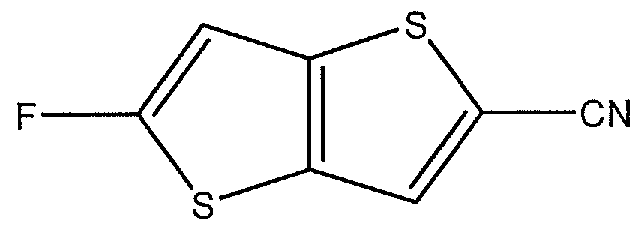
[0041] In an embodiment, the at least one organic thiophene-based additive is an fused thiophene, a compound with general formula V selected from: thieno [3 ,4-b]thiophene
2,4,6-trifluorothieno [3 ,4-b]thiophene
thieno [3 ,4-b]thiophene-2,4,6-tricarbonitrile
trimethyl thieno [3, 4~b]thiophen
tricarboxylate
 2,4,6-tris(trifluoromethyl)thieno [3 ,4- bjthiophene
4 , 6-difluorothieno [3 ,4-b]thiophene-2- carbonitrile
2-fluorothieno[3,4-b]thiophene-4,6- dicarbonitrile
dimethyl 2-cyanothieno [3 ,4-b]thiophene-4,6- dicarboxylate
4,6-bis(trifluoromethyl)thieno [3 ,4- b]thiophene-2-carbonitrile
methyl 4,6-difluorothieno [3 ,4-b]thiophene-2' carboxylate
methyl 4,6-dicyanothieno[3,4-b]thiophene-2- carboxylate
dimethyl 2-fluorothieno[3 ,4-b]thiophene-4,6 dicarboxylate
methyl 4,6-bis(trifluoromethyl)thieno [3 ,4- b]thiophene-2-carboxylate
 4,6-difluoro-2-(trifluoroniethyl)thieno [3,4- b]thiophene
2-(trifluoromethyl)thieno[3,4-b]thiophene- 4,6-dicarbonitrile
dimethyl 2-(trifluoromethyl)thieno [3 ,4- b]thiophene-4,6-dicarboxylate
2-fluoro-4,6-bis(trifluoromethyl)thieno[3,4- bjthiophene

[0042] In an embodiment, the at least one organic Schiffbase additive is a compound represented by general formula VI

VI
wherein
Ri and R2, are, at each occurrence, independently selected from alkyl (- CnH2n+ , cycloalkyl (CnH2n), alkenyl (CnH2n), aryl, alkyl-substituted aryl, heteroaryl, halogenated alkyl ((-CnX2n+i ) or (-CH2-CnX2n+i)), halogenated cycloalkyl ((-CnX2n ) or (-CH2-CnX2n)), halogenated alkenyl (CnXn), halogenated aryl, halogenated heteroaryl with X= F, CI, Br, I), ether (-OR), carbonyl (-COH, -COR), carboxy (-COOH), carboxy ester (-OCOR'), halogen (-F, -CI, -Br); nitrile (-CN); sulfonyl (-S02R'); sulfonate (-S02ORr); phosphonate, (-P02OR'), nitro (-N02);
R3 is selected from alkyl (-CnH2n+1), cycloalkyl (CnH2n), alkenyl (CnH2n), aryl, allcyl-substituted aryl, heteroaryl, halogenated alkyl ((-CnX2n+1 ) or (-CH2-CnX2n+i)),
halogenated cycloalkyl ((-CnX2n ) or (-C]¾-CnX2n)), halogenated alkenyl (CnXn), halogenated aryl, halogenated heteroaryl with X= F, CI, Br, I,
R is selected from alkyl, cycloalkyl, aryl, alkyl-substituted aryl, heteroaryl, or substituted alkyl or aryl residues comprising halogen, nitrile, nitro, sulfonyl (-S02R'), sulfone (~S02R'2), sulfonate (-S02OR')5 phosphonate (-P02OR') groups;
R' is selected from alkyl, cycloalkyl, aryl, alkyl-substituted aryl, heteroaryl.
R1 and R2 can be equal or different, selected from the list above.
Ri, R2, and R3 can be equal or different, selected from the list above.
[0043] In an embodiment, mixtures of different organic Schiff base additives are used, such as two, three or more different organic Schiff base additives.
[0044] In an embodiment, the at least one organic Schiff base additive is selected from cyclic-type and open-cycle type compounds.
[0045] In an embodiment, the at least one organic Schiff base additive is selected from compounds represented by the general formula VII, VIII, IX, X and XI.
[0046] In an embodiment, the at least one organic Schiff base additive is selected from compounds represented by the general formula VII

VII
[0047] In an embodiment, the at least one organic Schiff base additive is selected from compounds represented by the general formula VIII

VIII
[0048] In an embodiment, the at least one organic Schiff base additive is selected from compounds represented by the general formula IX

IX
[0049] In an embodiment, the at least one organic Schiff base additive is selected from compounds represented by the general formula X

[0050] In an embodiment, the at least one organic Schiff base additive is selected from compounds represented by the general formula XI

In each of general formulas VII, VIII, IX, X and XI:
Z, Zi and Z2 are each independently selected from H, CN, alkyl, cyclic alkyl, aryl, heterocycle,
such as, but not limited to,

X and Y are, at each occurrence, independently selected from H, alkyl, aryl, heterocycle, halogenated allcyl, halogenated aryl, hydroxylated alkyl, hydroxylated aryl, nitrile, aromatic cycle/aryl substituted with carboxylic ester, fluorinated carboxylic ester, nitriles,
such as, but not limited to,

X and Y can be equal or different, selected from the list above.
[0051] In an embodiment, the at least one Schiff base additive is a cyclic-type compound, a compound with general formula VI selected from
2- S alicylideneaminophenol
N-(salicylidene)-cyclohexyl
Salicylideneamino-2-thiophenol
4-Fluoro-N-salicylideneaniline
N- S alicylideneaniline
8-Hydroxy- 1 -(salicylideneamino)
naphthalene-3,6-disulfonic acid
monosodium salt

[0052] In an embodiment, the at least one Schiff base additive is a cyclic-type compound, a compound with general formula VII selected from
pyrazine dicarbonitrile,
e.g. pyrazine-2,3 -dicarbonitrile
methyl pyrazine dicarbonitrile,
e . g . 5 -methylpyr azine-2, 3 -dicarbonitrile
ethyl pyrazine dicarbonitrile,
e.g. 5 -ethy lpyrazine-2 , 3 -dicarbonitrile
dimethyl diazepine dicarbonitrile,
e.g. 5,7-dimethyl-6H-l ,4-diazepine-2,3- dicarbonitrile
dimethyl pyrazine dicarbonitrile,
e.g. 5,6-dimethylpyrazine-2,3-dicarbonitrile diethyl pyrazine dicarbonitrile,
e.g. 5,6-diethylpyrazine-2,3-dicarbonitrile
tert-butyl pyrazine dicarbonitrile.
e.g. 5-(tert-butyl)pyrazine-2,3-dicarbonitrile
pyrazine tetracarbonitrile,
e.g. pyrazine-2,3, 5, 6-tetracarbonitrile
 methyl phenylpyrazine dicarbonitrile,
e.g. 5-methyl-6-phenylpyrazine-2,3- dicarbonitrile quinoxaline dicarbonitrile,
e.g. quinoxaline-2 , 3 -dicarbonitrile

[0053] In an embodiment, the at least one Schiff base additive is an open cycle compound, a compound with general formula VIII to XI selected from
(lE,rE)-N,N'-(ethane-l,2-diyl)bis(l-(2- fluorophenyl)metanimine)


N,N'-Bis(salicylidene)- 1 ,2-propanediamine


2,2'-((lE,l'E)-(ethane-l,2- diylbis(azanylylidene))bis(methanylylidene))
Diphenol
(1 E, 1 'E)-N,N'-(ethane- 1 ,2-diyl)bis(l -(2- methoxyphenyl)methanimine)
 2,2'-((lE,l'E)-(etliane-l,2- diylbis(azanylylidene))bis(methanyl- ylidene))dibenzonitrile

4,4'-((lE,rE)-(ethane-l,2- diylbis(azanylylidene))bis(methanyl- ylidene))dibenzonitrile

(IE, 1 'E)-N,N'-(ethane- 1 ,2-diyl)bis(l -(4- fluorophenyl)methanimine)
2-Naphthalenol, 1,Γ-[1,2- cyclohexanediylbis(nitrilo- methylidyne)]bis-
(1 E, 1 'E)-N,N'-(ethane- 1 ,2-diyl)bis( 1 - (pyridin-2-yl)methanimine)
(lE, E)-N,N'-(ethane-l,2-diyl)bis(l- (pyridin-3 -yl)methanimine)
Bis(salicylidene)ethylenediamine
(R,R)-(-)-N,N'-Bis(3,5-di-tert- butylsalicylidene)- 1 ,2-cyclohexane- diamine
 2,3-bis(((E)-2,2-dimethylpropylidene) amino) maleonitrile
2,3-bis(((E)-2-methoxyethylidene)
amino) maleonitrile

2,3 -bis(((E)-3 -methoxypropylidene)
amino) maleonitrile
2,3-bis((E)-benzylideneamino)
Maleonitrile
2,3-bis((E)-(4-(dibutylamino)-2- hydroxybenzylidene)amino)
Maleonitrile
2,2'-([2,2,-bipyridine]-6,6'-diyl)diphenol
N,N'-Bis(salicylidene)- 1 ,2-phenylene- diamine


(lE,rE)-N,N'-(3,6-difluoro-l,2- phenylene)bis( 1 -p enylmethanimine)
(lE,rE)-N,N'-(ethane-l,2-diyl)bis(l-(3,5- difluorophenyl)methanimine)
(IE, 1 'E)-N,N'-(ethane- 1 ,2-diyl)bis(l -(2- (trifluoromethyl)plienyl)methanimme)
(lE,rE)-N,N'-(ethane-l,2-diyl)bis(l-(2,4,6- trifluorophenyl)methanimine)
(lE,rE)-N,N'-(ethane-l ,2-diyl)b
trifluorophenyl)methanimine)
(IE, 1 'E)-N,N'~(ethane-l ,2-diyl)bis(l -(2,4,6- tris(trifluoromethyl)phenyl)methanimine)
(lE,rE)-N,N'-(ethane-l,2-diyl)bis(l-(2,4- difluorophenyl)methanimine)
 (lE,rE)-N,N'-(ethane-l,2-diyl)bis(l-(3,5- bis(trifluoromethyl)phenyl)methanimine
(1 E, 1 'E)-N,N'-(ethane- 1 ,2-diyl)bis( 1 -(2,4- bis(trifluoromethyl)phenyl)methanimine)

((lE,l'E)-(ethane-l,2- diylbis(azanylylidene))bis(methanylyl- idene))bis(2, 1 -phenylene) diacetate


((lE,l'E)-(ethane-l,2- diylbis(azanylylidene))bis
(methanylylidene))bis(4, 1 -phenylene) diacetate

bis(trifluoromethyl) 4,4'-((lE, 1 Έ)- (ethane- 1 ,2-diylbis(azanylylidene))
bis(methanylylidene))dibenzoate

dimethyl 4,4'-((lE,rE)-(ethane-l,2- diylbis(azanylylidene))bis(methanyl- ylidene))dibenzoate (1 :1 :1:1:1:1)
 dimethyl 3 ,3 '-((1 E, 1 'E)-(ethane- 1 ,2- diylbis(azanylylidene))bis
(methanylylidene))dibenzoate
( 1 E, 1 'E)-N,N'-(ethane- 1 ,2-diyl)bis( 1 - (thiophen-2-yl)methanimine)


X - F, CNS CF3
[0054] In an embodiment, the at least one Schiff base additive is a cyclic-type compound, a compound with general formula VI selected from
(IE, 1 Έ)- 1 , 1 '-(pyridine-2,6-diyl)bis(N- phenylmethanimine)
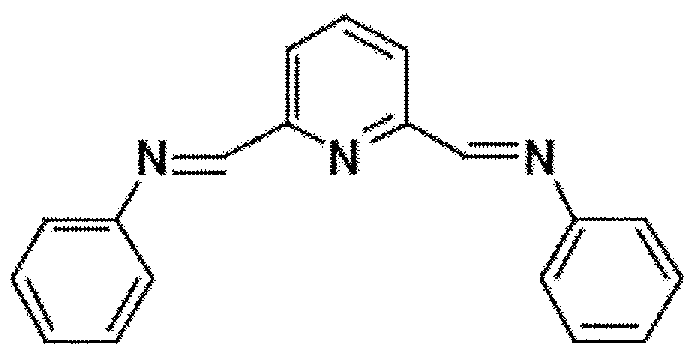
(IE, rE)-N,N'-(pyridine-2,6-diyl)bis(l - phenylmethanimine) (1:1)
 [0055] In an embodiment, mixtures of organic thiophene-based and Schiffbase additives as disclosed in the present disclosure are included in an electrolyte of the present disclosure: mixtures of different organic thiophene-based additives as disclosed in the present disclosure;
such as two, three or more different thiophene-based additives,
- mixtures of different organic Schiffbase additives as disclosed in the present
disclosure;
such as two, three or more different Schiffbase additives, mixtures of organic thiophene-based additive(s) and organic Schiff base additive(s) as disclosed in the present disclosure,
such as
o one thiophene-based additive and one Schiffbase additive,
o more than one (two, three or more different) thiophene-based additives and one Schiffbase additive,
o one thiophene-based additive and more than one (two, three or more different)
Schiffbase additives,
o more than one (two, three or more different) thiophene-based additives and more than one (two, three or more different) Schiffbase additives.
[0056] In an embodiment of said mixtures, the total content of the additives is from 0.001 weight percent to about 10 weight percent related to the total amount of electrolyte, preferably between about 0.01 weight percent to about 5 weight percent, more preferably about 0.1 weight percent to about 5 weight percent.
[0057] For example, in a mixture of two additives, one of the additives is in a range of from about 0.001 weight percent to about 9.999 weight percent and the other additive is in a range from about 9.999 weight percent to about 0.001 weight percent related to the total amount of electrolyte.
[0058] In an embodiment, the polar ion-conductive medium is a polar aprotic solvent which is preferably selected from
cyclic ester carbonate(s),
such as, but not limited to, ethylene carbonate (EC), propylene carbonate (PC),
chain ester carbonate(s),
such as, but not limited to, dimethyl carbonate (DMC), diethyl carbonate
(DEC), ethyl methyl carbonate (EMC),
lactone(s),
chain carboxylic ester(s),
and further polar aprotic solvents.
[0059] The electrolyte salt may contain, for example, one or more of salts such as lithium salt. However, the electrolyte salt may contain, for example, salt other than the lithium salt. Examples of "salt other than the lithium salt" may include light metal salt other than lithium salt.
[0060] In an embodiment, the alkali metal salt is one or more lithium salts (Li salt).
[0061] Examples of the lithium salt may include lithium hexafluorophosphate (LiPF6), lithium tetrafluoroborate (LiBF4), lithium perchlorate (LiC104). However, specific examples of the lithium salt are not limited to the compounds described above.
[0062] As discussed above, the present disclosure provides the use of the non-aqueous electrolyte in an electrochemical device,
such as, but not limited to, a secondary battery (such as a secondary Li-ion battery), a super capacitor.
[0063] As discussed above, the present disclosure provides the use of the non-aqueous electrolyte in an electric device,
such as, but not limited to, a battery pack, an electric vehicle, an electric power storage system, an electric power tool, an electronic apparatus.
[0064] The at least one organic thiophene-based additive and/or at least one organic Schiff base additive of the non-aqueous electrolyte - according to the present disclosure - stabilizes the electrode(s) by
undergoing an (irreversible) change at the cathode and/or anode
such as via oxidation or reduction, complexation, oligomerization or polymerization,
providing a mean for complex formation with the transition metal ions (M = Co, Ni, Mn, V, Fe) potentially escaping from the cathode during charge/discharge process, as for examp forming structures like below:

[0065] Other mechanism of electrode/electrolyte stabilization may exist, beside the described functions of the additive.
[0066] As discussed above, the present disclosure provides a secondary battery.
[0067] A secondary battery according to the present disclosure includes:
a cathode,
an anode, and
an electrolyte according to the present disclosure.
[0068] In an embodiment, the secondary battery according to the present disclosure is a secondary Li-ion battery.
[0069] In an embodiment, the cathode is an intercalation type cathode including one or more kinds of active cathode material which is capable of reversible inserting and extrancing Li ions,
preferably including layered transition metal oxide(s), such as, but not limited to, metal(s) selected from Co, Ni, Mn, V, Fe and combinations thereof.
[0070] The cathode material may be preferably a lithium-containing compound, because high energy density is obtained thereby. Examples of the lithium-containing compound may include a lithium-transition-metal composite oxide and a lithium-transition-metal-phosphate compound. The lithium-transition-metal composite oxide is an oxide containing lithium and one or more transition metal elements as constituent elements. The lithium-transition-metal- phosphate compound is a phosphate compound containing lithium and one or more transition metal elements as constituent elements. In particular, the transition metal element may be
preferably one or more of cobalt (Co), nickel (Ni), manganese (Mn), iron (Fe), and the like, because a higher voltage is obtained thereby. The chemical formula thereof may be expressed, for example, by LixM102 or by LiyM2P04. In the formulas, Ml and M2 represent one or more transition metal elements. Values of x and y vary according to the charge and discharge state, but may be generally in the range of 0.05.<x.<1.10 and 0.05<y<1.10.
[0071] Examples of the lithium-transition-metal composite oxide may include LiCo02, LiNi02, and a lithium-nickel-based composite oxide represented by the formula:
LiNii-zMz02.
[0072] Specific examples of the lithium-transition-metal-phosphate compound may include LiFeP04 and LiFe1-uMnuP0 (u<l), because a high battery capacity is thereby obtained and superior cycle characteristics are also obtained.
[0073] (M is one or more of cobalt, manganese, iron, aluminum, vanadium (V), tin (Sn), magnesium (Mg), titanium (Ti), strontium (Sr), calcium (Ca), zirconium (Zr), molybdenum (Mo), technetium (Tc), ruthenium (Ru), tantalum (Ta), tungsten (W), rhenium (Re), ytterbium (Yb), copper, zinc (Zn), barium (Ba), boron (B), chromium (Cr), silicon (Si), gallium (Ga), phosphorus (P), antimony (Sb), and niobium (Nb). z satisfies 0.005<z<0.5.)
[0074] In an embodiment, the anode is an intercalation type anode including one or more kinds of active anode material which is capable of reversible inserting and extrancing Li ions, such as, but not limited to, graphitizable carbon, non-graphitizable carbon, graphite, Li-metal, Si, Si oxide, Sn, Sn oxide, LiTi205, Si alloy, Sn alloy.
[0075] Examples of the carbon material may include graphitizable carbon, non-graphitizable carbon, and graphite. However, the spacing of (002) plane in the non-graphitizable carbon may be preferably equal to or greater than 0.37 nm, and the spacing of (002) plane in graphite may be preferably equal to or smaller than 0.34 nm. More specifically, examples of the carbon material may include pyrolytic carbons, cokes, glassy carbon fiber, an organic polymer compound fired body, activated carbon, and carbon blacks. Examples of the cokes may include pitch coke, needle coke, and petroleum coke. The organic polymer compound fired body is obtained by firing (carbonizing) a polymer compound such as phenol resin and furan resin at appropriate temperature. In addition thereto, the carbon material may be low crystalline carbon heat-treated at temperature of about 1000 °C or less, or may be amorphous carbon. It is to be noted that the shape of the carbon material may be any of a fibrous shape, a spherical shape, a granular shape, and a scale-like shape.
[0076] Moreover, the anode material may be, for example, a material (a metal-based material) containing one or more of metal elements and metalloid elements as constituent elements, because high energy density is thereby achieved.
[0077] The metal-based material may be a simple substance, alloy, or a compound, may be two or more thereof, or may have one or more phases thereof in part or all thereof. "Alloy" includes a material containing one or more metal elements and one or more metalloid elements, in addition to a material configured of two or more metal elements. Further, the "alloy" may contain a nonmetallic element. Examples of the structure thereof may include a solid solution, a eutectic crystal (eutectic mixture), an intermetallic compound, and a structure in which two or more thereof coexist.
[0078] Examples of the foregoing metal elements and the foregoing metalloid elements may include one or more of metal elements and metalloid elements capable of forming alloy with lithium. Specific examples thereof may include magnesium, boron, aluminum, gallium, indium (In), silicon, germanium (Ge), tin (Sn), lead (Pb), bismuth (Bi), cadmium (Cd), silver (Ag), zinc, hafnium (Hi), zirconium, yttrium (Y), palladium (Pd), and platinum (Pt).
[0079] In particular, silicon, tin, or both may be preferable, because silicon and tin have superior ability of inserting and extracting lithium, and therefore achieve high energy density.
[0080] A material containing silicon, tin, or both as constituent elements may be any of a simple substance, alloy, and a compound of silicon, may be any of a simple substance, alloy, and a compound of tin, may be two or more thereof, or may have one or more phases thereof in part or all thereof. It is to be noted that "simple substance" described herein merely refers to a simple substance in a general sense (a small amount of impurity may be therein contained), and does not necessarily refer to a purity 100% simple substance.
[0081] The alloys of silicon may contain, for example, one or more of elements such as tin, nickel, copper, iron, cobalt, manganese, zinc, indium, silver, titanium, germanium, bismuth, antimony, and chromium, as a constituent element other than silicon. The compounds of silicon may contain, for example, one or more of carbon (C), oxygen (O), and the like as constituent elements other than Si. It is to be noted that the compounds of silicon may contain, for example, one or more of the series of elements described for the alloys of silicon, as constituent elements other than silicon.
[0082] Specific examples of the alloys of silicon and the compounds of silicon may include SiB4, SiB6, Mg2Si, Ni2Si, TiSi2, MoSi2, CoSi2, NiSi2, CaSi2, CrSi2, Cu5Si, FeSi2, MnSi2, NbSi2, TaSi2, VSi2, WSi2, ZnSi2, SiC, Si3N4, Si2N20, SiOv (0<v.<2), and LiSiO. v in SiOv may be in a range of 0.2<v<l .4.
[0083] The alloys of tin may contain, for example, one or more of elements such as silicon, nickel, copper, iron, cobalt, manganese, zinc, indium, silver, titanium, germanium, bismuth, antimony, and chromium, as constituent elements other than tin. The compounds of tin may contain, for example, one or more of elements such as carbon and oxygen as constituent elements other than tin. It is to be noted that the compounds of tin may contain, for example, one or more of the series of elements described for the alloys of tin, as constituent elements other than tin.
[0084] Figure 1 and Figure 2 each illustrate a cross-sectional configuration of a secondary battery of an embodiment of the present application (in particular a cylindrical type battery). Figure 2 illustrates an enlarged part of a spirally wound electrode body 20 illustrated in Figure 1.
[0085] The secondary battery described here as an embodiment is a lithium secondary battery (a lithium ion secondary battery) in which a capacity of an anode 22 is obtained by insertion and extraction of lithium as an electrode reactant.
[0086] The secondary battery may be, for example, a secondary battery of a so-called cylindrical type. The secondary battery may contain a pair of insulating plates 12 and 13 and a spirally wound electrode body 20 inside a battery can 11 in the shape of a substantially- hollow cylinder. In the spirally wound electrode body 20, for example, a cathode 21 and the anode 22 are laminated with a separator 23 in between and are spirally wound.
[0087] The battery can 11 may have a hollow structure in which one end of the battery can 11 is closed and the other end of the battery can 11 is opened. The battery can 11 may be made, for example, of iron (Fe), aluminum (Al), alloy thereof, or the like. The surface of the battery can 11 may be plated with nickel (Ni) or the like. The pair of insulating plates 12 and
13 is arranged to sandwich the spirally wound electrode body 20 in between, and to extend perpendicularly to the spirally wound periphery surface of the spirally wound electrode body 20.
[0088] At the open end of the battery can 11, a battery cover 14, a safety valve mechanism 15, and a positive temperature coefficient device (PTC device) 16 are attached by being swaged with a gasket 17. Thereby, the battery can 11 is hermetically sealed. The battery cover
14 may be made, for example, of a material similar to that of the battery can 11. The safety valve mechanism 15 and the PTC device 16 are provided inside the battery cover 14. The safety valve mechanism 15 is electrically connected to the battery cover 14 via the PTC device 16. In the safety valve mechanism 15, in the case where the internal pressure becomes
a certain level or higher by internal short circuit, external heating, or the like, a disk plate 15 A inverts to cut electric connection between the battery cover 14 and the spirally wound electrode body 20. The PTC device 16 prevents abnormal heat generation resulting from a large current. As temperature rises, resistance of the PTC device 16 is increased accordingly. The gasket 17 may be made, for example, of an insulating material. The surface of the gasket 17 may be coated with asphalt.
[0089] In the center of the spirally wound electrode body 20, for example, a center pin 24 may be inserted. However, the center pin 24 may not be inserted in the center of the spirally wound electrode body 20. For example, a cathode lead 25 made of a conductive material such as aluminum may be connected to the cathode 21. For example, an anode lead 26 made of a conductive material such as nickel may be connected to the anode 22. For example, the cathode lead 25 may be attached to the safety valve mechanism 15 by welding or the like, and may be electrically connected to the battery cover 14. For example, the anode lead 26 may be attached to the battery can 11 by welding or the like, and may be electrically connected to the battery can 11.
[0090] The cathode 21 has a cathode active material layer 2 IB on a single surface or both surfaces of a cathode current collector 21 A. The cathode current collector 21 A may be made, for example, of a conductive material such as aluminum, nickel, or stainless steel. The cathode active material layer 2 IB contains, as a cathode active material, one or more of cathode materials capable of inserting and extracting lithium. It is to be noted that the cathode active material layer 21 B may further contain one or more of other materials such as a cathode binder and a cathode electric conductor.
[0091] The anode 22 has an anode active material layer 22B on a single surface or both surfaces of an anode current collector 22A.
[0092] Figure 3 illustrates an exploded perspective configuration of another secondary battery of an embodiment of the present application. Figure 4 illustrates an enlarged cross- section taken along a line TV-TV of a spirally wound electrode body 30 illustrated in Figure 3. In the following description, the elements of the cylindrical-type secondary battery described above will be used where appropriate.
[0093] The secondary battery described here is a so-called laminated-film-type lithium ion secondary battery. The secondary battery contains the spirally wound electrode body 30 in a film-like outer package member 40. In the spirally wound electrode body 30, a cathode 33 and an anode 34 are laminated with a separator 35 and an electrolyte layer 36 in between and are
spirally wound. A cathode lead 31 is attached to the cathode 33, and an anode lead 32 is attached to the anode 34. The outermost periphery of the spirally wound electrode body 30 is protected by a protective tape 37.
[0094] The cathode lead 31 and the anode lead 32 may be, for example, led out from inside to outside of the outer package member 40 in the same direction. The cathode lead 31 may be made, for example, of an electrically-conductive material such as aluminum, and the anode lead 32 may be made, for example, of an electrically-conducive material such as copper, nickel, and stainless steel. These electrically-conductive materials may be in the shape of, for example, a thin plate or mesh.
[0095] The outer package member 40 may be a laminated film in which, for example, a fusion bonding layer, a metal layer, and a surface protective layer are laminated in this order. In the laminated film, outer edges of the two film- shaped fusion bonding layers are fusion bonded so that the fusion bonding layers are opposed to the spirally wound electrode body 30. However, the two films may be bonded to each other by an adhesive, or the like. Examples of the fusion bonding layer may include a film made of one or more of polyethylene,
polypropylene, and the like. Examples of the metal layer may include an aluminum foil.
Examples of the surface protective layer may include a film made of one or more of nylon, polyethylene terephthalate, and the like.
[0096] In particular, the outer package member 40 may be preferably an aluminum laminated film in which a polyethylene film, an aluminum foil, and a nylon film are laminated in this order. However, the outer package member 40 may be a laminated film having other laminated structure, a polymer film such as polypropylene, or a metal film.
[0097] For example, a close-attachment film 41 to prevent outside air intrusion may be inserted between the outer package member 40 and the cathode lead 31 and between the outer package member 40 and the anode lead 32. The close-attachment film 41 is made of a material having close-attachment characteristics with respect to the cathode lead 31 and the anode lead 32. Examples of the material having close-attachment characteristics may include polyolefin resin that may include one or more of polyethylene, polypropylene, modified polyethylene, and modified polypropylene.
[0098] The cathode 33 may have, for example, a cathode active material layer 33B on one surface or both surfaces of a cathode current collector 33A. The anode 34 may have, for example, an anode active material layer 34B on one surface or both surfaces of an anode current collector 34A. The configurations of the cathode current collector 33 A, the cathode active material layer 33B, the anode current collector 34A, and the anode active material layer
34B are similar to the configurations of the cathode current collector 21 A, the cathode active material layer 2 IB, the anode current collector 22 A, and the anode active material layer 22B, respectively. The configuration of the separator 35 may be, for example, similar to the configuration of the separator 23.
[0099] The electrolyte layer 36 includes electrolytic solution and a polymer compound, and the electrolytic solution is held by the polymer compound. The electrolyte layer 36 is a so- called gel electrolyte, because thereby, high ion conductivity (for example, 1 mS/cm or more at room temperature) is obtained and liquid leakage of the electrolytic solution is prevented. The electrolyte layer 36 may further contain other material such as an additive as necessary.
[00100] The polymer compound may include, for example, one or more of polyacrylonitrile, polyvinylidene fluoride, polytetrafluoroethylene, polyhexafluoropropylene, polyethylene oxide, polypropylene oxide, polyphosphazene, polysiloxane, polyvinyl fluoride, polyvinyl acetate, polyvinyl alcohol, polymethacrylic acid methyl, polyacrylic acid, polymethacrylic acid, styrene-butadiene rubber, nitrile-butadiene rubber, polystyrene, polycarbonate, a copolymer of vinylidene fluoride and hexafluoropropyrene, and the like. In particular, polyvinylidene fluoride or the copolymer of vinylidene fluoride and hexafluoro propylene may be preferable, and polyvinylidene fluoride may be more preferable, because such a polymer compound is electrochemically stable.
[00101] For example, the configuration of the electrolytic solution may be similar to the configuration of the electrolytic solution of the cylindrical-type secondary battery. However, in the electrolyte layer 36 as a gel electrolyte, the solvent of the electrolytic solution refers to a wide concept including not only a liquid solvent but also a material having ion conductivity capable of dissociating the electrolyte salt. Therefore, in the case where a polymer compound having ion conductivity is used, the polymer compound is also included in the solvent.
[00102] It is to be noted that the electrolytic solution may be used as it is instead of the gel electrolyte layer 36. In this case, the spirally wound electrode body 30 is impregnated with the electrolytic solution.
[00103] As discussed above, the present disclosure provides an electric device including a secondary battery of the present disclosure.
[00104] The electric device is a battery pack, an electric vehicle, an electric power storage system, an electric power tool or an electronic apparatus
[00105] Figure 5 is a block diagram illustrating a battery pack.
[00106] Figure 6 is a block diagram illustrating an electric vehicle.
[00107] Figure 7 is a block diagram illustrating an electric power storage system.
[00108] Figure 8 is a block diagram illustrating an electric power tool.
[00109] Note that the present technology can also be configured as described below.
(1) A non-aqueous electrolyte for secondary batteries including:
a polar aprotic solvent;
an alkali metal salt; and
at least one organic thiophene-based additive or at least one organic Schiff base additive,
or a mixture of at least one organic thiophene-based additive and at least one organic Schiff base additive.
(2) The non-aqueous electrolyte of embodiment (1), wherein the content of the additive(s) is from 0.001 weight percent to about 10 weight percent related to the total amount of electrolyte, preferably between about 0.01 weight percent to about 5 weight percent, more preferably about 0.1 weight percent to about 5 weight percent.
(3) The non-aqueous electrolyte of embodiment (1) or (2), wherein the at least one organic thiophene-based additive is selected from compounds with general formula I, II, III, IV or V:

I
wherein
Xi, X2, X3 and Xj are each independently selected from H; alkyl (-CnH2n+1), cycloalkyl, alkenyl (CnH2n), aryl, alkyl-substituted aryl, heteroaryl, halogenated alkyl ((-CnX2n+1 ) or (-CH2-CnX2n+1)), halogenated cycloalkyl ((-C„X2n ) or (-CH2-CnX2n)), halogenated alkenyl (CnXn), halogenated aryl, halogenated heteroaryl with X= CI, Br, F, I, ether (-OR), aryloxy (-OAr), heteroaryloxy, halogenated aryloxy, carbonyl (-
COH, -COR), carboxy (-COOH), carboxy ester (-OCOR'), halogen (-F, -CI, -Br, -I); nitrile (-CN); sulfonyl (-S02R'); sulfonate (- S02OR'); phosphonate, (-P02OR'), nitro (-N02);
wherein X1? X2, X3 and X4 may be equal or different under the proviso that at least one of Xi, X2, X3 and X4 is different from H; wherein
n is an integer from 1 to 20; preferably 1 to 12;
R is selected from alkyl, cycloalkyl, aryl, alkyl-substituted aryl, heteroaryl, or substituted alkyl or aryl residues comprising halogen, nitrile, nitro, sulfonyl (-S02R'), sulfone (-S02R'2), sulfonate (-S02OR'), phosphonate (-P02OR') groups;
R' is selected from alkyl, cycloalkyl, aryl, alkyl-substituted aryl, heteroaryl;

II
wherein
Xl5 X2, X3 and X are each independently selected from H; alkyl (-CnH2n+i), cycloalkyl, alkenyl (CnH2n), aryl, alkyl-substituted aryl, heteroaryl, halogenated alkyl ((-CnX2n+i ) or (-CH2-CnX2n+1)), halogenated cycloalkyl ((-CnX2n ) or (-CH2-CnX2n)), halogenated alkenyl (CnXn), halogenated aryl, halogenated heteroaryl with X= CI, Br, F, I, ether (-OR), aryloxy (~OAr), heteroaryloxy, halogenated aryloxy, carbonyl (- COH, -COR), carboxy (-COOH), carboxy ester (-OCOR'), halogen (-F, -CI, -Br, -I); nitrile (-CN); sulfonyl (-S02R'); sulfonate (- S02OR'); phosphonate, (-P02OR'), nitro (-N02);
wherein X1? X2, X3 and X4 may be equal or different under the proviso that at least one of Xi, X2, X3 and X4 is different from H; wherein
k is an integer from 2 to 6;
n is an integer from 1 to 20; preferably 1 to 12;
R is selected from alkyl, cycloalkyl, aryl, alkyl- substituted aryl, heteroaryl, or substituted alkyl or aryl residues comprising halogen, nitrile, nitro, sulfonyl (-S02R'), sulfone (-S02R'2), sulfonate (-S02OR'), phosphonate (-P02OR') groups;
R' is selected from alkyl, cycloalkyl, aryl, alkyl-substituted aryl, heteroaryl;

III IV V wherein
Xi, X2, X3 and X4 are each independently selected from H; alkyl (-CnH^n+i), cycloalkyl, alkenyl (CnH2n), aryl, alkyl-substituted aryl, heteroaryl, halogenated alkyl ((-CnX2n+i ) or (-CH2-CnX2n+1)), halogenated cycloalkyl ((-CnX2n ) or (-C¾-CnX2n)), halogenated alkenyl (CnXn), halogenated aryl, halogenated heteroaryl with X= CI, Br, F, I, ether (-OR), aryloxy (-OAr), heteroaryloxy, halogenated aryloxy, carbonyl (- COH, -COR), carboxy (-COOH), carboxy ester (-OCOR'), halogen (-F, -CI, -Br, -I); nitrile (-CN); sulfonyl (-S02R'); sulfonate (- S02OR'); phosphonate, (-P02OR')5 nitro (-N02);
wherein Xi, X2, X3 and X4 may be equal or different under the proviso that at least one of Xi, X2, X3 and X4 is different from H; wherein
n is an integer from 1 to 20; preferably 1 to 12;
R is selected from alkyl, cycloalkyl, aryl, alkyl-substituted aryl, heteroaryl, or substituted alkyl or aryl residues comprising halogen, nitrile, nitro, sulfonyl (-S02R'), sulfone (-S02R'2), sulfonate (-S02OR'), phosphonate (-P02OR') groups;
R' is selected from alkyl, cycloalkyl, aryl, alkyl-substituted aryl, heteroaryl; or the at least one organic thiophene-based additive is selected from compounds with a polycyclic fused ring structure, where more than two thiophene rings are fused to each other in ortho- position.
(4) The non-aqueous electrolyte of embodiment embodiment (3), wherein the at least one organic thiophene-based additive of general formula I is selected from equally substituted thiophenes at 2,5 position with general formula 1-1

1-1
wherein X with the same indices, namely Xl5 means that in these positions are the same substituents which are not H.
(5) The non-aqueous electrolyte of embodiment (3) or (4), wherein
(1) in case of a compound with general formula I, where
Xi = 4 = carboxy ester (-OCOR') and/or
Xi = carboxy ester (-OCOR') and X4 = H
then at least one of X2 or X3 is different from H;
(2) in case of a compound with general formula I, wherein one of Xj, X2, X3 and X4 is selected from alkyl, alkenyl and halogen,
then two of X1? X2, X3 and X4 are different from H;
(3) in case of a compound with general formula III, IV or V
then at least one of Xi, X2, X3 and X4 is different from H; or under the provision that any one of a compound according to (1) to (3) is provided as an additive in a mixture with further organic thiophene-based additive(s) or in a mixture with at least one organic Schiff base additive,
(6) The non-aqueous electrolyte of any one of embodiments (1) to (5), wherein at least one organic Schiff base additive is a compound with general formula VI

wherein
¾ and R2, are, at each occurrence, independently selected from alkyl (- CnH2n+1), cycloalkyl (CnH2n), alkenyl (CnH2n), aryl, alkyl- substituted aryl, heteroaryl, halogenated alkyl ((-CnX2n+1 ) or (-CH2-CnX2n+i)), halogenated cycloalkyl ((-CnX2n ) or (-CH2-CnX2n)), halogenated alkenyl (CnXn), halogenated aryl, halogenated heteroaryl with X= F, CI, Br, I), ether (-OR), carbonyl (-COH, -COR), carboxy (-COOH), carboxy ester (-OCORr), halogen (-F, -CI, -Br); nitrile (-CN); sulfonyl (-S02R'); sulfonate (-S02OR'); phosphonate, (-P02OR'), nitro (-N02);
R3 is selected from alkyl (-CnH2n+i), cycloalkyl (CnH2n), alkenyl (CnH2n), aryl, alkyl-substituted aryl, heteroaryl, halogenated alkyl ((-CnX2n+i ) or (-CH2-CnX2n+1))s halogenated cycloalkyl ((-CnX2n ) or (-CH2-CnX2n)), halogenated alkenyl (CnXn), halogenated aryl, halogenated heteroaryl with X= F, CI, Br, I,
R is selected from alkyl, cycloalkyl, aryl, alkyl-substituted aryl, heteroaryl, or substituted alkyl or aryl residues comprising halogen, nitrile, nitro, sulfonyl (-SO2R'), sulfone (-S02R'2), sulfonate (-S02OR'), phosphonate (-PO2OR') groups;
R' is selected from alkyl, cycloalkyl, aryl, alkyl-substituted aryl, heteroaryl.
(7) The non-aqueous electrolyte of embodiment (6), wherein the at least one organic Schiff base additive is a compound with general formula VI selected from compounds with general formula VII, VIII, IX, X and XI:


Z, Zi and Z2 are each independently selected from H, CN, alkyl, cyclic alkyl, aryl, heterocycle,
such as, but not limited to,

X and Y are, at each occurrence, independently selected from H, alkyl, aryl, heterocycle, halogenated alkyl, halogenated aryl, hydroxylated alkyl, hydroxylated aryl, nitrile, aromatic cycle substituted with carboxylic ester, fluorinated carboxylic ester, nitriles, such as, but not limited to,

(8) The non-aqueous electrolyte of any one of embodiments (1) to (7), wherein the polar aprotic solvent is selected from
cyclic ester carbonate(s), chain ester carbonate(s), lactone(s), chain carboxylic ester(s), and further polar aprotic solvents.
(9) The non-aqueous electrolyte of any one of embodiments (1) to (8), wherein the alkali metal salt is one or more Li salts.
(10) Use of the non-aqueous electrolyte of any one of embodiments (1) to (9), in
an electrochemical device,
such as, but not limited to, a secondary battery, a super capacitor, an electric device,
such as, but not limited to, a battery pack, an electric vehicle, an electric power storage system, an electric power tool, an electronic apparatus.
(11) A secondary battery including :
a cathode,
an anode, and
an non-aqueous electrolyte according to any one of embodiments (1) to (9), which is preferably a secondary Li-ion battery.
(12) The secondary battery of embodiment (11), wherein the cathode is an intercalation type cathode including one or more kinds of active cathode material which is capable of reversible inserting and extrancing Li ions,
preferably including layered transition metal oxide(s), such as, but not limited to, metal(s) selected from Co, , Mn, V, Fe and combinations thereof; and/or wherein the anode is an intercalation type anode including one or more kinds of active anode material which is capable of reversible inserting and extrancing Li ions,
such as, but not limited to, graphitizable carbon, non-graphitizable carbon, graphite, Li-metal, Si, Si oxide, Sn, Sn oxide, LiT^Os, Si alloy, Sn alloy.
(13) An electric device including a secondary battery of any one of embodiments (11) or (12),
wherein the electric device is a battery pack, an electric vehicle, an electric power storage system, an electric power tool or an electronic apparatus.
[00110] The term "thiophene-based" compound or additive, as used herein, refers to a molecule in which at least a thiophene or a thiophene derivative is present in the molecular structure.
[00111] The term "Schiff base", as used herein, refers to an imine bearing a hydrocarbyl group on the nitrogen atom: R R2C=NR3 (R3≠ H).
[00112] In accordance with the present disclosure, the term "electrolyte" refers to a liquid electrolyte, which contains a Li-ion salt, an organic additive, and is in a direct contact with the anode and the cathode of a battery to ensure ionic movement between the anode and cathode during charge and/or discharge process.
[00113] In accordance with the present disclosure, the terms "polar ion-conductive medium" and "polar aprotic solvent" are used interchangeably and preferably refer to cyclic ester carbonate(s), chain ester carbonate(s), lactone(s), chain carboxylic ester(s), and further polar aprotic solvents.
[00114] In accordance with the present disclosure, the term "secondary battery" refers to a battery that can be electrically recharged after use to its original pre-discharge condition, by passing current through the circuit in the opposite direction to the current during discharge.
[00115] During charging, Li-ions are transfered from the cathode to the anode, respectively being de-intercalated at the cathode and intercalated at the anode. By this process, the electrical potential vs. Li+/Li of the cathode is getting more positive i.e. the oxidative power of the cathode material is increasing; while the electric potential of the anode is getting more negative, i.e. the reducing power of the anode is increasing.
[00116] When the charging voltage surpasses a specific upper cut-off voltage value (e.g. > 4.3 V for LCO battery ) the reactivity of the electrodes exceeds the electrochemical stability window of the electrolyte. The electrolye begins to decompose at the electrode surfaces, undergoing reduction at anode and/or oxidaiton at cathode. By this process the characteristics of the battery are deteriorated - i.e. electrode and battery capacity, cycle life, storage life.
[00117] The present disclosure follows the approach to increase the electrolyte stability by using additives to the liquid electrolyte. These additives degrade at lower voltage than the carbon ester electrolyte during the first charging cycle.
[00118] In sight of the increasing demand to Li-Ion batteries for high voltage, fast charging and higher capacity, there is a need:
■ to further improve the stability of the battery upon charging at high cutoff voltages,
■ to provide for the stabilization of the electrolyte against cathodic oxidation at high cathode potential,
■ to provide for the stabilization of the cathode active material against degradation in the highly reactive charged state.
[00119] The present disclosure aims to provide for a new additive material which is capable to undergo a irreversible change (oxidation, polymerization) at the electrode.
[00120] To solve the above problems, small organic molecules as additives to a non-aqueous electrolyte are proposed by the present disclosure.
[00121] The present inventors have found that an electrolyte including at least one thiophene- based additive and/or at least one Schiff base additive fulfills said requirements.
[00122] The advantages of the thiophene-based additives of the present disclosure are:
Oxidative stability of the additive at the cathode can be achieved by tuning of the higher occupied molecular orbital (HOMO) energy of the additive molecule e.g. by introducing electron deficient / electron- withdrawing substituents.
- Oligomerization/polymerization can be controlled via introducing different number of substituents or via selective blocking of reactive sites in the thiophene core by the substituents.
Good solubility of the additive in the carbonate electrolyte can be achieved by introducing polar substituents.
[00123] The advantages of the Schiff base additives of the present disclosure are:
Oxidative stability of the additive at the cathode can be achieved by tuning of the HOMO level and the electronic distribution of the additive molecule e.g. by introducing electron deficient / electron- withdrawing substituents.
Good solubility of the additive in the carbonate electrolyte can be achieved by introducing polar substituents.
providing a mean for complex formation with the transition metal ions (M = Co, Ni, Mn, V, Fe) potentially escaping from the cathode during charge/discharge process, as for example forming structures like below:

[00124] The advantages of the disclosure are
good solubility of the additive(s) in the basic carbonate ester electrolyte;
improvement of charge/discharge capacity and coulomb efficiency of battery in presence of additives;
enhancement of electrolyte stability by using single additives or additive mixture; increase of capacity retention of battery during rate-dependent charging;
increase of capacity retention of battery by cycling at high charging voltage.
EXAMPLES
[00125] Function of thiophene-based and Schiff base electrolyte additives is demonstrated by the following examples. Following cells were prepared and characterized in order to examine the influence of additives on the battery characteristics.
EXAMPLE 1: Thiophene-based additives
[00126] Cell:
o Battery type: Coin cell CR2016
o Anode active material: Li-metal
o Cathode active material: LiCo02
o Electrolyte: 1 M LiPF6 in EC/EMC (50/50w)
o Upper limit voltage 4.45V
[00127] Initial coulomb efficiency and capacity at Is charge/discharge cycle
Table 1. Initial coulomb efficiency:
Compound name Formula Content of Initial Coulomb efficiency additive (% wt) in 1st Charge/Discharge cycle, (%)
Tniophene-2- 1 92.2 carbonitrile NC methyl 3- 1 91.9 fluorothiophene-
2-carboxylate
2,5-bis(trifluoro- 1 92.4 methyl) thiophene
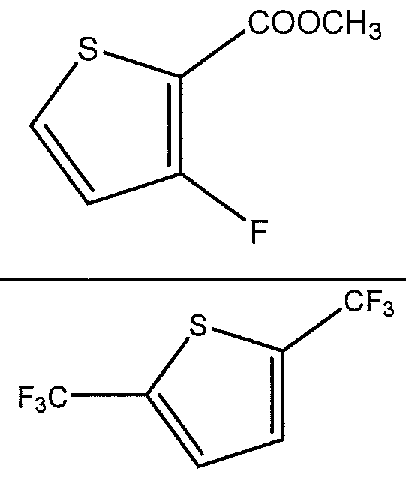
No additive Blank electrolyte 0 91.3
EXAMPLE 2: Thiophene-based additives
[00128] Cell:
o Battery type: Coin cell CR2016
o Anode active material: Graphite
o Cathode active material: LiCo02
o Electrolyte: 1 M LiPF6 in EC/EMC (1 : 1 wt)
o Amount of additive: 1% wt
o Upper limit voltage 4.45V
[00129] Capacity retention during rate-dependent cycling
Charge/Discharge condition: Four concecutive cycles with C/D rates 0.1C/0.1C (1st) 0.2/0.2C (2nd)→ 0.2/0.5C (3rd)→ 0.2/1 C (4th) were performed.
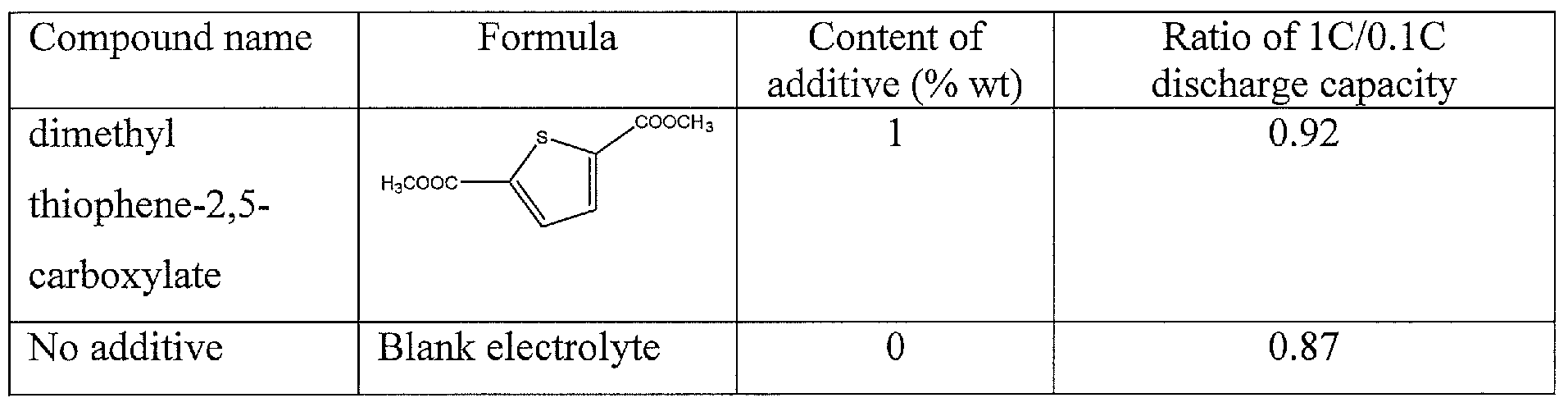
[00131] Capacity retention during charge/discharge cycling.
Conditions:
o Upper-limit voltage: 4.45 V
o Lower-limit voltage: 3.0 V
o Charge/Discharge rate: 0.5C/0.5C
o Temperature: 23°C (room temperature)

[00132] Improvement of the cycling performance was observed in presence of 1 %wt of the selected additive 2,5-bis(fluoromethlyl) thiophene.
EXAMPLE 3: Schiff base additives
[00133] Cell:
o Battery type: Coin cell CR2016
o Anode active material: Graphite
o Cathode active material: LiCo02
o Electrolyte: 1 M LiPF6 in EC/EMC (1 : 1 wt)
o Amount of additive: 1% wt
o Upper limit voltage 4.45V
[00134] Capacity retention during rate-dependent cycling
Charge/Discharge condition: Four concecutive cycles with C/D rates 0.1C/0.1C (Is ) 0.2/0.2C (2nd)→ 0.2/0.5C (3rd)→ 0.2/1 C (4th) were performed.

[00135] Improvement of the discharge capacity retention upon rate-dependent charging was observed in presence of l%wt of the selected additive (lE, E)-N,N'-(ethane-l,2-diyl)bis(l- (4-fluorophenyl) methanimine).
[00136] Capacity retention during charge/discharge cycling.
Conditions:
o Upper-limit voltage: 4.45 V
o Lower-limit voltage: 3.0 V
o Charge/Discharge rate: 0.5C/0.5C,
o Temperature: 23 °C (room temperature)

[00137] Improvement of the cycling performance was observed in presence of l%wt of the selected additive 2(lE,rE)-N,N'-(ethane-l,2-diyl)bis(l-(4-fluorophenyl) methanimine).
Claims
1. A non-aqueous electrolyte for secondary batteries comprising:
a polar aprotic solvent;
an alkali metal salt; and
at least one organic thiophene-based additive or at least one organic Schiff base additive,
or a mixture of at least one organic thiophene-based additive and at least one organic Schiff base additive.
2. The non-aqueous electrolyte of claim 1, wherein the content of the additive(s) is from 0.001 weight percent to about 10 weight percent related to the total amount of electrolyte, particularly between about 0.01 weight percent to about 5 weight percent, more particularly about 0.1 weight percent to about 5 weight percent.
3. The non-aqueous electrolyte of claim 1 , wherein the at least one organic thiophene- based additive is selected from compounds with general formula I, II, III, IV or V:

I
wherein
Xi, X2, X3 and X4 are each independently selected from H; alkyl (-CnH2n+i), cycloallcyl, alkenyl (CnH2n), aryl, alkyl-substituted aryl, heteroaryl, halogenated alkyl ((-CnX2n+1 ) or (-CH2-CnX2n+1)), halogenated cycloalkyl ((-CnX2n ) or (-CH2-CnX2n)), halogenated alkenyl (CnXn), halogenated aryl, halogenated heteroaryl with X= CI, Br, F, I, ether (-OR), aryloxy (~OAr), heteroaryloxy, halogenated aryloxy, carbonyl (- COH, -COR), carboxy (-COOH), carboxy ester (-OCOR'), halogen (-F, -CI, -Br, -I); nitrile (-CN); sulfonyl (-S02R'); sulfonate (- S02OR'); phosphonate, (-P02OR'), nitro (-NO2);
wherein Xi, X2, X3 and X4 may be equal or different under the proviso that at least one of Xi, X2, X3 and X4 is different from H; wherein
n is an integer from 1 to 20; particularly 1 to 12;
R is selected from alkyl, cycloalkyl, aryl, alkyl-substituted aryl, heteroaryl, or substituted alkyl or aryl residues comprising halogen, nitrile, nitro, sulfonyl (-S02R'), sulfone (-S02R'2), sulfonate (-SO2OR'), phosphonate (-P02OR') groups;
R' is selected from alkyl, cycloalkyl, aryl, alkyl-substituted aryl, heteroaryl;

II
wherein
Xi, X2, X3 and X4 are each independently selected from H; alkyl (-CnH2n+i), cycloalkyl, alkenyl (CnH2n), aryl, alkyl-substituted aryl, heteroaryl, halogenated alkyl ((-C„X2n+I ) or (-CH2-CnX2n+ ), halogenated cycloalkyl ((-CnX2n ) or (-CH2-CnX2n)), halogenated alkenyl (CnXn), halogenated aryl, halogenated heteroaryl with X= CI, Br, F, I, ether (-OR), aryloxy (-OAr), heteroaryloxy, halogenated aryloxy, carbonyl (- COH, -COR), carboxy (-COOH), carboxy ester (-OCOR'), halogen (-F, -CI, -Br, -I); nitrile (-CN); sulfonyl (-S02R'); sulfonate (- S02OR'); phosphonate, (-P02OR'), nitro (-N02);
wherein Xl5 X2, X3 and X4 may be equal or different under the proviso that at least one of Xi, X2, X3 and X4 is different from H; wherein
k is an integer from 2 to 6;
n is an integer from 1 to 20; particularly 1 to 12;
R is selected from alkyl, cycloalkyl, aryl, alkyl-substituted aryl, heteroaryl, or substituted alkyl or aryl residues comprising halogen, nitrile, nitro, sulfonyl (-S02R'), sulfone (-S02R'2), sulfonate (-S02OR'), phosphonate (-P02OR') groups;
R' is selected from alkyl, cycloalkyl, aryl, alkyl-substituted aryl, heteroaryl;

III IV wherein
Xi, X2, X3 and X4 are each independently selected from H; alkyl (-CnH2n+i), cycloalkyl, alkenyl (CnH2n), aryl, alkyl-substituted aryl, heteroaryl, halogenated alkyl ((-C„X2n+i ) or (-CH2-CnX2n+i)), halogenated cycloalkyl ((-CnX2n ) or (-CH2-CnX2n)), halogenated alkenyl (CnXn), halogenated aryl, halogenated heteroaryl with X= CI, Br, F, I, ether (-OR), aryloxy (-OAr), heteroaryloxy, halogenated aryloxy, carbonyl (- COH, -COR), carboxy (-COOH), carboxy ester (-OCOR'), halogen (-F, -CI, -Br, -I); nitrile (-CN); sulfonyl (-S02R'); sulfonate (- S02OR'); phosphonate, (-P02OR')5 nitro (-NO2);
wherein Xl5 X2, X3 and X4 may be equal or different under the proviso that at least one of Xi, X2, X3 and X4 is different from H; wherein
n is an integer from 1 to 20; particularly 1 to 12;
R is selected from alkyl, cycloalkyl, aryl, alkyl-substituted aryl, heteroaryl, or substituted alkyl or aryl residues comprising halogen, nitrile, nitro, sulfonyl (-S02R'), sulfone (-S02R'2), sulfonate (-S02OR'), phosphonate (-P02OR') groups;
R' is selected from alkyl, cycloalkyl, aryl, alkyl-substituted aryl, heteroaryl; or the at least one organic thiophene-based additive is selected from compounds with a polycyclic fused ring structure, where more than two thiophene rings are fused to each other,
4. The non-aqueous electrolyte of claim 3, wherein the at least one organic thiophene- based additive of general formula I is selected from equally substituted thiophenes at 2,
5 position with general formula 1-1

I-l
wherein X with the same indices, namely Xi, means that in these positions are the same substituents which are not H.
The non-aqueous electrolyte of claim 3 or 4, wherein
in case of a compound with general formula I, where
Xi = X4 = carboxy ester (-OCOR') and/or
Xi = carboxy ester (-OCOR') and X4 = H
at least one of X2 or X3 is different from H;
(2) in case of a compound with general formula I, wherein one of X1? X2, X3 and X4 is selected from alkyl, alkenyl and halogen,
then two of Xj, X2, X3 and X4 are different from H;
(3) in case of a compound with general formula III, IV or V
then at least one of Xi, X2, X3 and X4 is different from H; or under the provision that any one of a compound according to (1) to (3) is provided as an additive in a mixture with further organic thiophene-based additive(s) or in a mixture with at least one organic Schiff base additive.
6. The non-aqueous electrolyte of claim 1 , wherein at least one organic Schiff base additive is a compound with general formula VI
 wherein
Ri and R2, are, at each occurrence, independently selected from alkyl (- CnHbn+i), cycloalkyl (CnH2n), alkenyl (CnH2n), aryl, alkyl-substituted aryl, heteroaryl, halogenated alkyl ((-CnX2n+1 ) or (-CH2-CnX2n+i)), halogenated cycloalkyl ((-CnX2ll ) or
(-CH2-CnX2n)), halogenated alkenyl (CnXn), halogenated aryl, halogenated heteroaryl with X= F, CI, Br, I), ether (-OR), carbonyl (-COH, -COR), carboxy (-COOH), carboxy ester (-OCOR'), halogen (-F, -CI, -Br); nitrile (-CN); sulfonyl (-S02R'); sulfonate (-S02OR'); phosphonate, (-P02OR'), nitro (-N02);
R3 is selected from alkyl (-CnH2n+i), cycloalkyl (CnH2n), alkenyl (CnH2n), aryl, alkyl- substituted aryl, heteroaryl, halogenated alkyl ((-CnX2n+i ) or (-CH -CnX n+i)), halogenated cycloalkyl ((-CnX2n ) or (-CH2-CnX2n)), halogenated alkenyl (CnXn), halogenated aryl, halogenated heteroaryl with X= F, CI, Br, I,
R is selected from alkyl, cycloalkyl, aryl, alkyl-substituted aryl, heteroaryl, or substituted alkyl or aryl residues comprising halogen, nitrile, nitro, sulfonyl (-S02R'), sulfone (-S02R'2), sulfonate (-S02OR'), phosphonate (-P02OR') groups;
R' is selected from alkyl, cycloalkyl, aryl, alkyl-substituted aryl, heteroaryl.
7. The non-aqueous electrolyte of claim 6, wherein the at least one organic Schiff base additive is a compound with general formula VI selected from compounds with general formula VII, VIII, IX, X and XI:

VII VIII IX
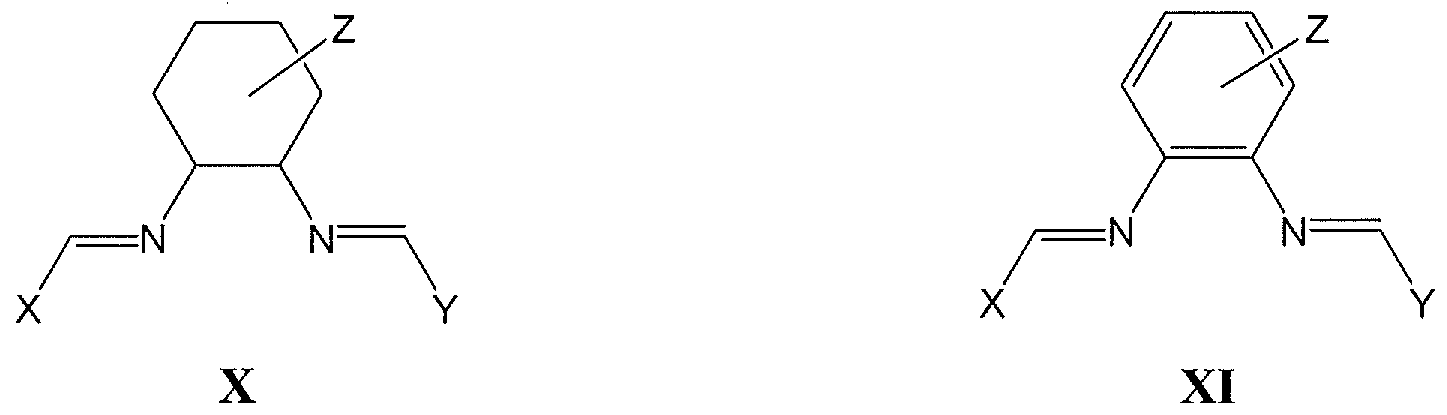
Z, Zi and Z2 are each independently selected from H, CN, alkyl, cyclic alkyl, aryl, heterocycle,
such as, but not limited to,

X and Y are, at each occurrence, independently selected from H, alkyl, aryl, heterocycle, halogenated alkyl, halogenated aryl, hydroxylated alkyl, hydroxylated aryl, nitrile, aromatic cycle substituted with carboxylic ester, fluorinated carboxylic ester, nitriles, such as, but not limited to,

8. The non-aqueous electrolyte of claim 1 , wherein the polar aprotic solvent is particularly selected from
cyclic ester carbonate(s), chain ester carbonate(s), lactone(s), chain carboxylic ester(s), and further polar aprotic solvents.
9. The non-aqueous electrolyte of claim 1, wherein the alkali metal salt is one or more Li salts.
10. Use of the non-aqueous electrolyte of claim 1, in
an electrochemical device,
such as, but not limited to, a secondary battery, a super capacitor, - an electric device,
such as, but not limited to, a battery pack, an electric vehicle, an electric power storage system, an electric power tool, an electronic apparatus.
11. A secondary battery comprising:
a cathode,
an anode, and
an non-aqueous electrolyte according to claim 1, which is particularly a secondary Li-ion battery.
12. The secondary battery of claim 11, wherein the cathode is an intercalation type cathode comprising one or more kinds of active cathode material which is capable of reversible inserting and extrancing Li ions,
particularly comprising layered transition metal oxide(s), such as, but not limited to, metal(s) selected from Co, Ni, Mn, V, Fe and combinations thereof; and/or wherein the anode is an intercalation type anode comprising one or more kinds of active anode material which is capable of reversible inserting and extrancing Li ions, such as, but not limited to, graphitizable carbon, non-graphitizable carbon, graphite, Li-metal, Si, Si oxide, Sn, Sn oxide, LiTi205, Si alloy, Sn alloy.
13. An electric device comprising a secondary battery of claim 11 or 12, wherein the electric device is a battery pack, an electric vehicle, an electric power storage system, an electric power tool or an electronic apparatus.
Applications Claiming Priority (2)
| Application Number | Priority Date | Filing Date | Title |
|---|---|---|---|
| EP16163377.1 | 2016-03-31 | ||
| EP16163377 | 2016-03-31 |
Publications (1)
| Publication Number | Publication Date |
|---|---|
| WO2017167638A1 true WO2017167638A1 (en) | 2017-10-05 |
Family
ID=55701739
Family Applications (1)
| Application Number | Title | Priority Date | Filing Date |
|---|---|---|---|
| PCT/EP2017/056932 Ceased WO2017167638A1 (en) | 2016-03-31 | 2017-03-23 | Non-aqueous electrolytes and uses thereof |
Country Status (1)
| Country | Link |
|---|---|
| WO (1) | WO2017167638A1 (en) |
Cited By (10)
| Publication number | Priority date | Publication date | Assignee | Title |
|---|---|---|---|---|
| CN110931872A (en) * | 2019-12-11 | 2020-03-27 | 多氟多新能源科技有限公司 | A kind of lithium ion battery electrolyte additive and lithium ion battery electrolyte |
| CN111477959A (en) * | 2020-05-29 | 2020-07-31 | 珠海市赛纬电子材料股份有限公司 | Electrolyte additive, electrolyte containing additive and lithium ion battery |
| CN111952667A (en) * | 2020-08-31 | 2020-11-17 | 珠海市赛纬电子材料股份有限公司 | Electrolyte additive, electrolyte containing additive and lithium ion battery |
| CN113381066A (en) * | 2020-03-09 | 2021-09-10 | 多氟多新材料股份有限公司 | High-performance lithium ion battery electrolyte, preparation method thereof and lithium ion battery |
| JPWO2023032799A1 (en) * | 2021-08-30 | 2023-03-09 | ||
| WO2023164770A1 (en) * | 2022-03-04 | 2023-09-07 | Institut National De La Recherche Scientifique | Additive combination for secondary battery electrolytes |
| CN118156611A (en) * | 2024-03-05 | 2024-06-07 | 内蒙古民族大学 | Application of p-trifluoromethyl-phenylketimine as lithium-sulfur battery electrolyte additive |
| CN119029338A (en) * | 2024-10-28 | 2024-11-26 | 浙江晶科储能有限公司 | Secondary battery and method for preparing the same |
| EP4294812A4 (en) * | 2021-02-21 | 2025-03-26 | Ramino-Bio Ltd. | THIOPHENE-BASED COMPOUNDS AND THEIR USE AS BCKDK INHIBITORS |
| WO2026014485A1 (en) * | 2024-07-12 | 2026-01-15 | パナソニックIpマネジメント株式会社 | Nonaqueous electrolyte for nonaqueous electrolyte cell, and nonaqueous electrolyte cell |
Citations (6)
| Publication number | Priority date | Publication date | Assignee | Title |
|---|---|---|---|---|
| US5731106A (en) * | 1996-01-25 | 1998-03-24 | Fujitsu Limited | Electrolytic solution for lithium secondary battery and lithium secondary battery using the same |
| US20020018940A1 (en) * | 2000-04-18 | 2002-02-14 | Takao Nirasawa | Nonaqueous electrolyte secondary battery |
| US6576373B1 (en) * | 2000-01-26 | 2003-06-10 | Matsushita Electric Industrial Co., Ltd. | Non-aqueous electrochemical apparatus and electrolyte thereof |
| US20120100439A1 (en) * | 2010-10-25 | 2012-04-26 | Samsung Electronics Co., Ltd. | Electrolyte solution for secondary lithium battery and secondary lithium battery including the electrolyte solution |
| US20140342242A1 (en) * | 2013-05-15 | 2014-11-20 | Samsung Sdi Co., Ltd. | Organic electrolyte solution and lithium battery comprising the same |
| US20140349176A1 (en) * | 2013-05-21 | 2014-11-27 | Samsung Sdi Co., Ltd. | Additive for electrolyte, electrolyte and rechargeable lithium battery |
-
2017
- 2017-03-23 WO PCT/EP2017/056932 patent/WO2017167638A1/en not_active Ceased
Patent Citations (6)
| Publication number | Priority date | Publication date | Assignee | Title |
|---|---|---|---|---|
| US5731106A (en) * | 1996-01-25 | 1998-03-24 | Fujitsu Limited | Electrolytic solution for lithium secondary battery and lithium secondary battery using the same |
| US6576373B1 (en) * | 2000-01-26 | 2003-06-10 | Matsushita Electric Industrial Co., Ltd. | Non-aqueous electrochemical apparatus and electrolyte thereof |
| US20020018940A1 (en) * | 2000-04-18 | 2002-02-14 | Takao Nirasawa | Nonaqueous electrolyte secondary battery |
| US20120100439A1 (en) * | 2010-10-25 | 2012-04-26 | Samsung Electronics Co., Ltd. | Electrolyte solution for secondary lithium battery and secondary lithium battery including the electrolyte solution |
| US20140342242A1 (en) * | 2013-05-15 | 2014-11-20 | Samsung Sdi Co., Ltd. | Organic electrolyte solution and lithium battery comprising the same |
| US20140349176A1 (en) * | 2013-05-21 | 2014-11-27 | Samsung Sdi Co., Ltd. | Additive for electrolyte, electrolyte and rechargeable lithium battery |
Cited By (13)
| Publication number | Priority date | Publication date | Assignee | Title |
|---|---|---|---|---|
| CN110931872A (en) * | 2019-12-11 | 2020-03-27 | 多氟多新能源科技有限公司 | A kind of lithium ion battery electrolyte additive and lithium ion battery electrolyte |
| CN113381066A (en) * | 2020-03-09 | 2021-09-10 | 多氟多新材料股份有限公司 | High-performance lithium ion battery electrolyte, preparation method thereof and lithium ion battery |
| CN111477959A (en) * | 2020-05-29 | 2020-07-31 | 珠海市赛纬电子材料股份有限公司 | Electrolyte additive, electrolyte containing additive and lithium ion battery |
| CN111952667A (en) * | 2020-08-31 | 2020-11-17 | 珠海市赛纬电子材料股份有限公司 | Electrolyte additive, electrolyte containing additive and lithium ion battery |
| CN111952667B (en) * | 2020-08-31 | 2021-11-05 | 珠海市赛纬电子材料股份有限公司 | Electrolyte additive, electrolyte containing additive and lithium ion battery |
| EP4294812A4 (en) * | 2021-02-21 | 2025-03-26 | Ramino-Bio Ltd. | THIOPHENE-BASED COMPOUNDS AND THEIR USE AS BCKDK INHIBITORS |
| JPWO2023032799A1 (en) * | 2021-08-30 | 2023-03-09 | ||
| EP4398364A4 (en) * | 2021-08-30 | 2025-05-07 | Panasonic Intellectual Property Management Co., Ltd. | NONAQUEOUS ELECTROLYTE BATTERY AND NONAQUEOUS ELECTROLYTE USED THEREIN |
| WO2023164770A1 (en) * | 2022-03-04 | 2023-09-07 | Institut National De La Recherche Scientifique | Additive combination for secondary battery electrolytes |
| CN118156611A (en) * | 2024-03-05 | 2024-06-07 | 内蒙古民族大学 | Application of p-trifluoromethyl-phenylketimine as lithium-sulfur battery electrolyte additive |
| CN118156611B (en) * | 2024-03-05 | 2025-09-05 | 内蒙古民族大学 | Application of trifluoromethylbenzophenone imine as an electrolyte additive for lithium-sulfur batteries |
| WO2026014485A1 (en) * | 2024-07-12 | 2026-01-15 | パナソニックIpマネジメント株式会社 | Nonaqueous electrolyte for nonaqueous electrolyte cell, and nonaqueous electrolyte cell |
| CN119029338A (en) * | 2024-10-28 | 2024-11-26 | 浙江晶科储能有限公司 | Secondary battery and method for preparing the same |
Similar Documents
| Publication | Publication Date | Title |
|---|---|---|
| WO2017167638A1 (en) | Non-aqueous electrolytes and uses thereof | |
| KR102385977B1 (en) | High capacity polymer cathode and high energy density rechargeable cell comprising the cathode | |
| JP4022889B2 (en) | Electrolyte and battery | |
| JP4543085B2 (en) | Additive for lithium secondary battery | |
| RU2313861C1 (en) | Nonaqueous lithium storage battery designed for cyclic and/or highly reliable operation at high temperatures | |
| US9640838B2 (en) | Organic electrolyte solution including thiophene-based compound and nitrile-based compound and lithium battery comprising the same | |
| KR20230165830A (en) | Electrochemical cell with solid ion-conducting polymer material | |
| US20180006329A1 (en) | Electrochemical cells that include lewis acid: lewis base complex electrolyte additives | |
| US8530086B2 (en) | Non-aqueous electrolyte secondary battery | |
| US20080014496A1 (en) | Non-aqueous electrolyte secondary batteries and devices using the same | |
| JP5907682B2 (en) | Composition for positive electrode protective film of lithium secondary battery, lithium secondary battery including the positive electrode protective film, and method for producing the same | |
| JP6424436B2 (en) | Electrolyte and secondary battery using the same | |
| WO2008140271A1 (en) | Additives for non-aqueous electrolyte and secondary battery using the same | |
| JP2011060577A (en) | Nonaqueous electrolyte battery | |
| CN101443933A (en) | Electricity storage device | |
| US20220407113A1 (en) | Organic electrolytic solution and lithium battery including the same | |
| CN105409034A (en) | Positive electrode material for secondary batteries, method for producing positive electrode material for secondary batteries, and secondary battery | |
| KR20150106883A (en) | Active material for secondary batteries, electrode for secondary batteries, secondary battery, battery pack, electric vehicle, electrical energy storage system, electric tool, and electronic device | |
| Li et al. | Polymer-based electrolytes for solid-state lithium batteries with a wide operating temperature range | |
| WO2018169112A1 (en) | Electrolyte additive for lithium secondary battery and method for preparing same, electrolyte comprising additive and method for preparing same, and lithium secondary battery comprising additive | |
| US20220407114A1 (en) | Organic electrolytic solution and lithium battery including the same | |
| US20220407054A1 (en) | Lithium battery | |
| CN108352572A (en) | Additive for non-aqueous electrolyte, non-aqueous electrolyte, and power storage device | |
| JP4527690B2 (en) | Organic electrolyte and lithium battery using the same | |
| WO2019005216A1 (en) | Substituted imidazole and benzimidazole lithium salts |
Legal Events
| Date | Code | Title | Description |
|---|---|---|---|
| NENP | Non-entry into the national phase |
Ref country code: DE |
|
| 121 | Ep: the epo has been informed by wipo that ep was designated in this application |
Ref document number: 17711689 Country of ref document: EP Kind code of ref document: A1 |
|
| 122 | Ep: pct application non-entry in european phase |
Ref document number: 17711689 Country of ref document: EP Kind code of ref document: A1 |