WO2017163263A1 - Indole derivatives, preparation and use thereof - Google Patents
Indole derivatives, preparation and use thereof Download PDFInfo
- Publication number
- WO2017163263A1 WO2017163263A1 PCT/IN2017/050102 IN2017050102W WO2017163263A1 WO 2017163263 A1 WO2017163263 A1 WO 2017163263A1 IN 2017050102 W IN2017050102 W IN 2017050102W WO 2017163263 A1 WO2017163263 A1 WO 2017163263A1
- Authority
- WO
- WIPO (PCT)
- Prior art keywords
- indole
- azido
- formula
- compound
- reaction mixture
- Prior art date
- Legal status (The legal status is an assumption and is not a legal conclusion. Google has not performed a legal analysis and makes no representation as to the accuracy of the status listed.)
- Ceased
Links
- 0 CC[C@@](C1)C2C1([C@@](*)C*)[C@](*)C*2 Chemical compound CC[C@@](C1)C2C1([C@@](*)C*)[C@](*)C*2 0.000 description 4
Classifications
-
- C—CHEMISTRY; METALLURGY
- C07—ORGANIC CHEMISTRY
- C07D—HETEROCYCLIC COMPOUNDS
- C07D209/00—Heterocyclic compounds containing five-membered rings, condensed with other rings, with one nitrogen atom as the only ring hetero atom
- C07D209/02—Heterocyclic compounds containing five-membered rings, condensed with other rings, with one nitrogen atom as the only ring hetero atom condensed with one carbocyclic ring
- C07D209/04—Indoles; Hydrogenated indoles
- C07D209/30—Indoles; Hydrogenated indoles with hetero atoms or with carbon atoms having three bonds to hetero atoms with at the most one bond to halogen, directly attached to carbon atoms of the hetero ring
- C07D209/40—Nitrogen atoms, not forming part of a nitro radical, e.g. isatin semicarbazone
-
- C—CHEMISTRY; METALLURGY
- C07—ORGANIC CHEMISTRY
- C07D—HETEROCYCLIC COMPOUNDS
- C07D231/00—Heterocyclic compounds containing 1,2-diazole or hydrogenated 1,2-diazole rings
- C07D231/54—Heterocyclic compounds containing 1,2-diazole or hydrogenated 1,2-diazole rings condensed with carbocyclic rings or ring systems
- C07D231/56—Benzopyrazoles; Hydrogenated benzopyrazoles
-
- C—CHEMISTRY; METALLURGY
- C07—ORGANIC CHEMISTRY
- C07D—HETEROCYCLIC COMPOUNDS
- C07D403/00—Heterocyclic compounds containing two or more hetero rings, having nitrogen atoms as the only ring hetero atoms, not provided for by group C07D401/00
- C07D403/02—Heterocyclic compounds containing two or more hetero rings, having nitrogen atoms as the only ring hetero atoms, not provided for by group C07D401/00 containing two hetero rings
- C07D403/04—Heterocyclic compounds containing two or more hetero rings, having nitrogen atoms as the only ring hetero atoms, not provided for by group C07D401/00 containing two hetero rings directly linked by a ring-member-to-ring-member bond
Definitions
- the present invention relates to novel indole derivatives, its preparation and use thereof.
- Indole is one of the most popular heterocyclic scaffolds in nature.
- the challenging molecular architectures of polycyclic, naturally occurring indolyl compounds constitute a continuous stimulus for development in organic synthesis.
- the field had a daunting boom across the new millennium when catalysis started revolutionizing the chemistry of indole, providing always more sustainable solutions to the selective functionalization of this pharmacophore.
- Amines are commonly used as starting substrates for the synthesis of indoles.
- An amine at position 3 may be diazotized with N2C1 and then reacted to form an azide, but such an amine is not known, though amine at position 2 or 5 is known.
- WO 2001081306 A2 provides a method of making a compound of formula (II):
- R2 is R20, - OR20, -SR20, -NR20R20', -C(O)OR20, or -C(O)R20;
- R3, R4, R5, R6 and R7 are each individually H, halogen, R, -OR, -SR, -NRR', -C(0)R, -C(0)OR, -S(0)R or - S(0)2R; provided that at least one of R4 and R5 is not H; each R, RIO and R20 is individually alkyl, alkenyl, alkynyl, aryl or heterocyclic radical; and each R' and R20' is individually H, alkyl, alkenyl, alkynyl, aryl or heterocyclic radical.
- R 1 is hydrogen, halo, methyl, ethyl or methoxy
- R 2 is hydrogen, halo, methyl, ethyl or methoxy
- R 3 is a halo group, lower alkyl, lower alkenyl, lower alkynyl, alkoxy, trifluoromethyl, nitro, cyano, trifluoromethoxy, C(0)R 7 , or S(0) n R 7 where n is 0, 1 or 2 and R 7 is an alkyl group
- R 4 is a halo, trifluoromethyl, methylthio, methoxy, trifluoromethoxy or lower alkyl, lower alkenyl or lower alkynyl or COR 8 where R 8 is lower alkyl
- R 6 is hydrogen, halo, lower alkyl, lower alkenyl, lower alkynyl or COR 9 where R 9 is lower alkyl; provided that when R 1 is hydrogen, halo or methoxy, R 2 is hydrogen, hal
- L represents lower alkylene, lower alkenylene,— O-lower alkylene, lower alkylene-0— or a bond, in which each of the groups may be substituted by aryl(s);
- Raaa represents an aryl, cycloalkyl or heterocyclic group ;
- Raaa which is the same or different, represents hydrogen, lower alkyl, halogen, cyano, lower alkenyl, halogen- substituted lower alkyl, lower alkyl-0— , cyano lower alkyl-0— , halogen-substituted lower alkyl-0— , aryl, heteroaryl, aryl-0— , heteroaryl-0— , aryl lower alkyl, acyl- O— , acyl, heteroaryl lower alkyl-0— , lower alkylthio, lower alkylsulfonyl, oxo, nitro, amino, mono-lower alkylamino, di-lower alkylamino, acylamino or arylamino, in which the aryl, the heteroaryl, and the aryl and the heteroaryl moieties of each of the
- indolyl C-3 guanidines are known to bind with a putative 13 receptor (a 3rd imidazoline binding site distinct from two imidazoline receptors II and 12) in pancreatic ⁇ -cells and thereby regulate insulin secretion (Fig. A).
- Fig. A Biologically active indolyl C-3 guanidines.
- the main object of the present invention is to provide novel indole derivatives.
- Another object of the present invention is to provide a process for the preparation of novel indole derivatives.
- Yet another object of the present invention is to provide novel indole derivatives which can be used for the synthesis of anti-diabetic drugs.
- the present invention provides novel indole derivatives, preparation and use thereof.
- the present invention provides novel indole derivatives of formula
- R, R 1 and R 2 is independently selected from halo, nitro, methoxy, alkyl, thiomethyl, alkyl, aryl, substituted aryl, cyano, cycloalkyl, -COO, amide; and X is selected from N or S.
- the present invention provides a one pot, single step room temperature process for the preparation of novel indole derivatives of formula (I) with more than 85% yield.
- step (b) Quenching, extracting the reaction mixture of step (b) followed by purification to obtain 3-azidoindole derivatives of formula Ia-n.
- the present invention provides a process for the reduction of indoles of formula I comprising the steps of:
- step (a) Extracting and purifying the reaction mixture of step (a) to afford 3 -amino indoles (IV).
- the present invention provides a process for synthesis of trizolecompound of formula (VI),
- step (a) Extracting and purifying the reaction mixture of step (a) to give pure triazole
- the present invention provides novel indole derivatives, preparation and use thereof.
- R, R x and R 2 is independently selected from halo, nitro, methoxy, alkyl, thiomethyl, alkyl, aryl, substituted aryl, cyano, cycloalkyl, -COO, amide;andX is selected from N or S.
- the present invention provides a one pot, room temperature, transition metal-free process for the preparation of novel indole derivatives of formula I with more than 85% yield.
- the present invention provides a process for the synthesis of compounds of formula Ia-n comprising the steps of: d. Adding I 2 and Et 3 N to a solution of indole compounds of formula Ila-n to obtain a mixture;
- step (b) Quenching, extracting the reaction mixture of step (b) followed by purification to obtain 3-azidoindole derivatives of formula Ia-n.
- the present invention provides a process for the reduction of indoles of formula I comprising the steps of:
- the present invention provides a process for synthesis of trizolecompound of formula (VI),
- step (a) Extracting and purifying the reaction mixture of step (a) to give pure triazole VI.
- compound of formula Ila-n is selected from the following:
- the present invention provides compound of formula I which is used for the synthesis of anti-diabetic drugs selected from Rapalexin A.
- the cited prior art WO 2001081306 A2 provides a method of making a compound of formula:
- morpholino ester compound which can acts as an ester type prodrug which is highly bioavailable upon oral administration.
- the present invention provides novel compounds of formula I, its preparation and use for the synthesis of synthesis of anti-diabetic drugs. Examples: Following examples are given by way of illustration therefore should not be construed to limit the scope of the invention.
- Novel compounds which is used for synthesis of anti-diabetic drugs b. Novel azido indoles which can be used for the synthesis of biologically active molecules like RapalaxinA, Rapalexin B, Isocyalexin A, etc. having anti- carcinogenic properties.
Landscapes
- Chemical & Material Sciences (AREA)
- Organic Chemistry (AREA)
- Indole Compounds (AREA)
- Pharmaceuticals Containing Other Organic And Inorganic Compounds (AREA)
Abstract
The present invention provides novel indole derivatives of formula (I), I Wherein, R, R1 and R2 is independently selected from halo, nitro, methoxy, alkyl, thiomethyl, alkyl, aryl, substituted aryl, cyano, cycloalkyl, -COO, amide; and X is selected from N or S; a one pot, room temperature process for the preparation of novel indole derivatives of formula (I) with high yields and use of compounds of formula I for the synthesis of anti-diabetic drugs.
Description
INDOLE DERIVATIVES, PREPARATION AND USE THEREOF
The following specification particularly describes the invention and the manner in which it is to be performed:
FIELD OF THE INVENTION:
The present invention relates to novel indole derivatives, its preparation and use thereof. BACKGROUND AND PRIOR ART OF THE INVENTION:
Indole is one of the most popular heterocyclic scaffolds in nature. The challenging molecular architectures of polycyclic, naturally occurring indolyl compounds constitute a continuous stimulus for development in organic synthesis. The field had a formidable boom across the new millennium when catalysis started revolutionizing the chemistry of indole, providing always more sustainable solutions to the selective functionalization of this pharmacophore.
However, in nature, it is common to encounter indolyl-containing species featuring specific interatomic connections that would be difficult to be obtained via "conventional" indole reactivity. In this direction, the availability of efficient synthetic methodologies for the treatment of "electrophilic" indoles will allow to significantly improve the current synthetic portfolio for indole manipulation.
Amines are commonly used as starting substrates for the synthesis of indoles. An amine at position 3 may be diazotized with N2C1 and then reacted to form an azide, but such an amine is not known, though amine at position 2 or 5 is known.
WO 2001081306 A2 provides a method of making a compound of formula (II):

an intermediate in the synthesis of a compound of formula (X) ; wherein R2 is R20, - OR20, -SR20, -NR20R20', -C(O)OR20, or -C(O)R20; R3, R4, R5, R6 and R7 are each individually H, halogen, R, -OR, -SR, -NRR', -C(0)R, -C(0)OR, -S(0)R or -
S(0)2R; provided that at least one of R4 and R5 is not H; each R, RIO and R20 is individually alkyl, alkenyl, alkynyl, aryl or heterocyclic radical; and each R' and R20' is individually H, alkyl, alkenyl, alkynyl, aryl or heterocyclic radical.
Book Titled, "Nitrogenation Strategy for the Synthesis of N-containing Compounds" edited by Ning Jiao published by springer reports the following reaction Scheme:

Scheme: A
US 6984657 B 1 discloses a compo ,

US 20090181960 Al discloses a compound or a pharmaceutically acceptable salt thereof,

Wherein, L represents lower alkylene, lower alkenylene,— O-lower alkylene, lower alkylene-0— or a bond, in which each of the groups may be substituted by aryl(s);

represents an aryl, cycloalkyl or heterocyclic group ;Raaa, which is the same or different, represents hydrogen, lower alkyl, halogen, cyano, lower alkenyl, halogen- substituted lower alkyl, lower alkyl-0— , cyano lower alkyl-0— , halogen-substituted lower alkyl-0— , aryl, heteroaryl, aryl-0— , heteroaryl-0— , aryl lower alkyl, acyl- O— , acyl, heteroaryl lower alkyl-0— , lower alkylthio, lower alkylsulfonyl, oxo, nitro, amino, mono-lower alkylamino, di-lower alkylamino, acylamino or arylamino, in which the aryl, the heteroaryl, and the aryl and the heteroaryl moieties of each of the aryl-0— , heteroaryl-0— , heteroaryl lower alkyl-0— , aryl lower alkyl and arylamino in the Raaa may be substituted by lower alkyl(s), lower alkyl-O-(s), halogen(s) or halogen-substituted lower alkyl(s);Rul, R222, R333, R444, R555 and R666 represent hydrogen or an appropriate substituent, in which at least one of the R111, R222, R333, R444, R555 and R666 represents carboxy, carboxy-substituted lower alkyl or carboxy-substituted lower alkenyl, and any adjacent two groups of R333, R444, R555 and R666 together may form a lower alkylene dioxy group ;a double line of a solid line and a dotted line represents a single bond or a double bond; and p represents an integer of
1 to 15.
Article titled, "A facile approach to spirocyclic 2-azido indolines via azidation of indoles with eerie ammonium nitrate" by Jing Li et. al in Org. Biomol. Chem., 2014,12, 9769-9772 reports a process for azidation of indoles with NaN3 and eerie
ammonium nitrate (CAN) to obtain spirocyclic 2-azido indolines in good yields and moderate diastereoselectivities.

Scheme: B
Article titled, "Radical Azidonation of Aldehydes" by L. Marinescu, J. Thinggaard, I. B. Thomsen, M. Bols in J. Org. Chem. , 2003, 68 (24), pp 9453-9455 reports Aliphatic and aromatic aldehydes can be converted to acyl azides by treatment with iodine azide. If the reaction is performed at reflux, Curtius rearrangement occurs and carbamoyl azides are obtained directly from the aldehyde in good yield.
0 2 eq. I N, °
U — Jl 3 eq NaN ;, 2 eq. l CI -^H MeCN , 25°C , 2.5 h R N3 MeCN , 0°C , ~ 1 0 m in
Scheme: C
Article titled, "Regiospecific Azidoiodination of Alkenes with Sodium Periodate,
Potassium Iodide, and Sodium Azide: A High- Yield Synthesis of β-Iodoazides" by P.
V. Chouthaiwale, P. U. Karabal, G. Suryavanshi, A. Sudalai in Synthesis, 2010, 3879-
3882 reports the combination of sodium periodate, potassium iodide, and sodium azide is an efficient, simple, and inexpensive reagent system for azidoiodination of alkenes. The regiospecific 1,2-azidoiodination proceeds in an anti-Markovnikov fashion to produce β-iodoazides in excellent yields.
1 eq. KI . 3 eq. NaN,
1 eq. N al04 " I
R ^¾
AcOH , 25°C , 2 h ^ JL N
" 3 : Ar, a kyl
Scheme: D
From activity point of view, indolyl C-3 guanidines are known to bind with a putative 13 receptor (a 3rd imidazoline binding site distinct from two imidazoline receptors II and 12) in pancreatic β-cells and thereby regulate insulin secretion (Fig. A).

27 28 29
rapalexln A
Fig. A: Biologically active indolyl C-3 guanidines.
Therefore, it is the need to develop novel indole derivatives which can be used for the synthesis of anti-diabetic drugs.
OBJECTS OF THE INVENTION:
The main object of the present invention is to provide novel indole derivatives.
Another object of the present invention is to provide a process for the preparation of novel indole derivatives.
Yet another object of the present invention is to provide novel indole derivatives which can be used for the synthesis of anti-diabetic drugs.
SUMMARY OF THE INVENTION:
Accordingly, the present invention provides novel indole derivatives, preparation and use thereof. In an embodiment the present invention provides novel indole derivatives of formula
(I),

I
Wherein, R, R1 and R2 is independently selected from halo, nitro, methoxy, alkyl, thiomethyl, alkyl, aryl, substituted aryl, cyano, cycloalkyl, -COO, amide; and X is selected from N or S.
In another embodiment the present invention provides a one pot, single step room temperature process for the preparation of novel indole derivatives of formula (I) with more than 85% yield.
In a preferred embodiment the present invention provides a process for the synthesis of compounds of formula Ia-n comprising the steps of:
a. Adding and Et3N to a solution of indole compounds of formula Ila-n to obtain a mixture;
b. Adding NaN3 to the mixture of step (a) to obtain the reaction mixture;
c. Quenching, extracting the reaction mixture of step (b) followed by purification to obtain 3-azidoindole derivatives of formula Ia-n.
In yet another embodiment, the present invention provides a process for the reduction of indoles of formula I comprising the steps of:
a. Adding Pd/C to a solution of indoles (I) to obtain the reaction mixture;
b. Extracting and purifying the reaction mixture of step (a) to afford 3 -amino indoles (IV).
In still another embodiment, the present invention provides a process for synthesis of trizolecompound of formula (VI),

from indole compound of formula (la),
 and compound of formula (V),
 comprising the steps of:
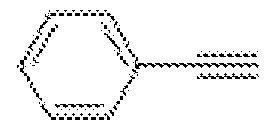
a. Adding phenylacetylene (V) to a solution of CuS04.5H20 and Na ascorbate in 'BuOH: H20 followed by the addition of azido indole la to obtain the reaction mixture;
b. Extracting and purifying the reaction mixture of step (a) to give pure triazole
VI.
DETAILED DESCRIPTION OF THE INVENTION:
The invention will now be described in detail in connection with certain preferred and optional embodiments, so that various aspects thereof may be more fully understood and appreciated.
In view of above, the present invention provides novel indole derivatives, preparation and use thereof.
In an embodiment the present invention rovides indole derivatives of formula (I),

I
Wherein, R, Rxand R2 is independently selected from halo, nitro, methoxy, alkyl, thiomethyl, alkyl, aryl, substituted aryl, cyano, cycloalkyl, -COO, amide;andX is selected from N or S.
In another embodiment the present invention provides a one pot, room temperature, transition metal-free process for the preparation of novel indole derivatives of formula I with more than 85% yield.
In a preferred embodiment the present invention provides a process for the synthesis of compounds of formula Ia-n comprising the steps of:
d. Adding I2 and Et3N to a solution of indole compounds of formula Ila-n to obtain a mixture;
e. Adding NaN3 to the mixture of step (a) to obtain the reaction mixture;
f. Quenching, extracting the reaction mixture of step (b) followed by purification to obtain 3-azidoindole derivatives of formula Ia-n.
The above process is shown below in Scheme 1:

Ila-n la-n
Scheme: 1
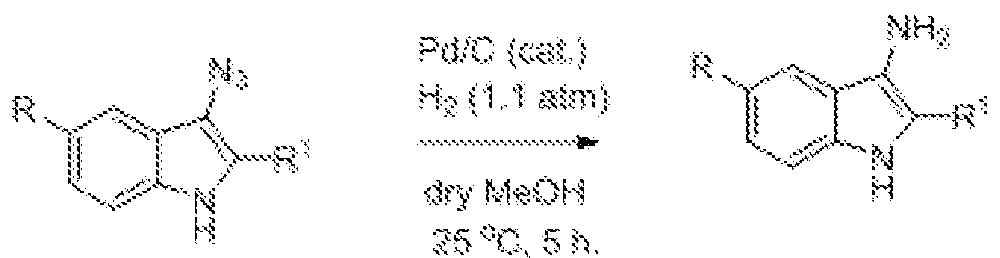
In yet another embodiment, the present invention provides a process for the reduction of indoles of formula I comprising the steps of:
c. Adding Pd/C to a solution of indoles (I) to obtain the reaction mixture;
d. Extracting and purifying the reaction mixture of step (a) to afford 3 -amino indoles (IV).
The above process is shown below in Scheme 2:
IV
Scheme: 2
In still another embodiment, the present invention provides a process for synthesis of trizolecompound of formula (VI),

from indole compound of formula (Ia),
 and compound of formula (V),
 comprising the steps of:
a. Adding phenylacetylene (V) to a solution of CuS04.5H20 and Na ascorbate in 'BuOH: H20 followed by the addition of azido indole (Ia) to obtain the reaction mixture;
b. Extracting and purifying the reaction mixture of step (a) to give pure triazole VI.
The above process is shown below in Scheme 3:

Scheme: 3 aspect, compound of formula Ia-n is selected from the following
3-Azido- lH-indole (Ia);
3-Azido-5-methyl-lH-indole (lb);
3-Azido-5-methoxy- lH-indole (Ic);
3-Azido-5-bromo-lH-indole (Id);
3-Azido-5-chloro-lH-indole (Ie);
3-Azido-5-nitro-lH- indole (If);
3-Azido- lH-indol-5-yl acetate (Ig);
3-Azido-2-methyl-lH-indole (Hi);
3-Azido-4-bromo-lH- indole (Ii);
3-Azido-2-phenyl- lH-indole (Ij);
Ethyl 3-azido-lH-indole-2-carboxylate (Ik);
3 -Azido- 1 -methyl- lH-indole (II);
1- Benzylindoline-2,3-dione (Im);
3-azido-5-nitro-lH-indazole (In).
In another aspect, compound of formula Ila-n is selected from the following
lH-indole (Da);
5-methyl- lH-indole (lib);
5-methoxy-lH- indole (lie);
5-bromo- lH-indole (IId);
5-chloro- lH- indole (He);
5-nitro- lH-indole (IK);
lH-indol-5-yl acetate (Ilg);
2- methyl- lH-indole (Ilh);
4-bromo- lH-indole (IIi);
2-phenyl-lH-indole (Ilj);
Ethyl- lH-indole-2-carboxylate (Ilk);
1 -methyl- lH-indole (III) ;
1 -Benzylindole(IIm) ;
5-nitro- lH-indazole (Iln).
In another aspect, the present invention provides compound of formula I which is used for the synthesis of anti-diabetic drugs selected from Rapalexin A.
The cited prior art WO 2001081306 A2 provides a method of making a compound of formula:

and its use further to obtain morpholino ester compound, which can acts as an ester type prodrug which is highly bioavailable upon oral administration.
But, the present invention provides novel compounds of formula I, its preparation and use for the synthesis of synthesis of anti-diabetic drugs. Examples: Following examples are given by way of illustration therefore should not be construed to limit the scope of the invention.
Example: 1
General experimental procedure for the preparation of compounds Ia-n:
To a stirred solution of indole compounds Ila-n (3 mmol) in dry DMSO (25 mL) at 0 °C was added I2 (3 mmol) and Et3N (3 mmol) dropwise. After 5 min, NaN3 (3.6 mmol) was added portionwise. The reaction mixture was then stirred at 25 °C under an inert atmosphere for 6-8 h. After completion of the reaction (as monitored by TLC), it was quenched with H20 (20 mL) at 0 °C. It was then extracted with EtOAc (3 x 50 mL) followed by washing with brine (3 x 50 mL) and the combined organic layers were dried over anhydrous Na2S04. Concentration of organic solvent under reduced pressure gave the crude product, which was further purified by column chromatography over silica gel using Pet. ethenEtOAc (9:1) as eluent to obtain 3- azidoindole derivatives Ia-n in high purity.
Example 2
3-Azido-lH-indole (la)

Example 3
3-Azido-5-methyl-lH-indole (lb)

Yield: 95% (0.490 g); orange colored solid; mp: 30 °C (decomposes); IR (DMSO-d6, cm"1): Vmax767, 821 , 1024, 1468, 1654, 2123, 2252, 3426; ¾ NMR (400 MHz, DMSO-d6): δ 2.24 (s, 3H), 6.88 (s, 1H), 7. 12-7.18 (m, 1H), 7.37 (d, = 6.8 Hz, 1H), 7.40-7.45 (m, 1H), 10.95 (s, 1H); 13C NMR (100 MHz, DMSO-d6): δ 21.5, 92.4, 109.2, 123.7, 123.9, 124.1, 127.3, 131.8, 142.8; MALDI-MS: calcd for C9H8N4Na+ [M + Na+ ] 195.0641 , found 195.0644.
Example 4
3- Azido-5-methoxy-lH- indole (Ic)

Yield: 92% (0.520 g); colorless solid; mp: 30 °C (decomposes); IR (DMSO-d6, cm"1): Vmax762, 824, 1026, 1206, 1490, 1658, 1737, 2125, 2251 , 3425; lH NMR (200 MHz, DMSO- ): δ 3.43 (s, 3H), 6.76-6.89 (m, 2H), 7.26-7.38 (m, 1H), 7.48 (d, = 2.7 Hz, 1H), 11.31 (br. s., 1H); 13C NMR (50 MHz, DMSO-d6): δ 55.3, 88.3, 99.1, 1 12.7, 113.0, 125.1, 126.4, 130.4, 154.1 ; MALDI-MS: calcd for C9H8N4ONa+ [M + Na+ ] 211.0590, found 211.0588.
Example 5
3-Azido-5-bromo-lH-indole (Id)

Yield: 96% (0.680 g); red colored solid; mp: 30 °C (decomposes); IR (DMSO-d6, cm"1): Vmax624, 760, 822, 1028, 1248, 1659, 2123, 2250, 3438; lH NMR (200 MHz, DMSO- ): δ 7.29 (dd, J = 8.6, 1.9 Hz, 1H), 7.41 (d, J = 8.6 Hz, 1H), 7.62 (d, J = 2.5 Hz, 1H), 7.54 (d, / = 1.8 Hz, 1H), 11.68 (br. s., 1H); 13C NMR (50 MHz, DMSO-d6): δ 87.8, 1 12.4, 1 14.2, 120.1, 124.8, 126.5, 127.9, 134.1 ; MALDI-MS: calcd for C8H5N4BrNa+ [M + Na+ ] 258.9590, found 258.9592.
Example 6
3-Azido-5-chloro-lH-indole (Ie)

Yield: 91% (0.525 g); yellow colored solid; mp: 30 °C (decomposes); IR (DMSO-d6, cm"1): vmax624, 760, 822, 1027, 1659, 2124, 2250, 3438; lH NMR (400 MHz, DMSO- d6): δ 7.16-7.21 (m, 1H), 7.40 (s, 1H), 7.46 (d, = 8.2 Hz, 1H), 7.59-7.71 (m, 1H), 11.69 (br. s., 1H); 13C NMR (50 MHz, DMSC fc): δ 88.0, 1 13.8, 1 17.0, 122.3, 124.6, 126.7, 127.2, 133.9; MALDI-MS: calcd for C8H5ClN4Na+ [M + Na+ ] 215.0095, found 215.0097. Example 7
3-Azido-5-nitro-lH-indole (If)

Yield: 89% (0.540 g); red colored solid; mp: 30 °C (decomposes); IR (DMSO-d6, cm"1): Vmax763, 825, 1025, 1338, 1531, 1658, 1733, 2127, 2254, 3424; ¾ NMR (400 MHz, DMSC fc) δ 7.60-7.67 (m, 1H), 7.87 (d, = 1.4 Hz, 1H), 8.03-8.12 (m, 1H),
8.28-8.38 (m, 1H), 12.21 (br. s., 1H); 13C NMR (100 MHz, DMSC fc): δ 91.0, 1 13.0, 115.0, 117.5, 125.7, 129.1, 138.6, 141.4; MALDI-MS: calcd for C8H5N5C>2Na+ [M + Na+] 226.0335, found 226.0336.
Example 8
3-Azido-lH-indol-5-yl acetate (Ig)

Yield: 90% (0.582 g); colorless solid; mp: 30 °C (decomposes); IR (DMSO-d6, cm"1): Vmax766, 823, 1021, 1650, 1733, 2121, 2252, 3429; lH NMR (200 MHz, DMSO-d6): δ 2.32 (s, 3H), 6.98 (s, 1H), 7.12 (m, 2H), 7.44 (d, = 2.6 Hz, 1H); 13C NMR (50 MHz, DMSC fc): δ 21.1, 91.2, 109.3, 1 1 1.5, 1 19.1, 123.8, 126.9, 135.6, 145.2, 169.2; MALDI-MS: calcd for CioH8N402Na + [M + Na+ ] 239.0539, found 239.0537.
Example 9
3-Azido-2-methvl-lH-indole (Ih)

Yield: 88% (0.455 g); colorless solid; mp: 30 °C (decomposes); IR (DMSO-d6, cm"1): Vmax761 , 822, 1021, 1463, 1651, 2125, 2251, 3427; lH NMR (200 MHz, DMSO-d6): δ 2.28 (s, 3H), 7.12-7.26 (m, 2H), 7.37-7.56 (m, 2H); 13C NMR (100 MHz, DMSO- d6): δ 20.3, 91.7, 109.5, 123.3, 123.6, 124.5, 127.1, 131.6, 142.1 ; MALDI-MS: calcd for C9H8N4Na + [M + Na+ ] 195.0641, found 195.0640.
Example 10:
3-Azido-4-bromo-lH-indole (Ii):

Yield: 81% (195 mg), colorless solid, mp: 60 °C decomposed; ¾ NMR (200 MHz, DMSO-4) δ 1 1.85 (br. s., 1H), 7.66 (d, = 2.7 Hz, 1H), 7.48 (d, = 8.1 Hz, 1H), 7.27
(d, = 6.8 Hz, 1H), 6.99 - 7.11 (m, 1H); 13C NMR (50 MHz, DMSO-d6) δ 136.7, 127.6, 124.4, 123.2, 122.3, 112.3, 112.1, 87.7; HRMS (ESI): [M+H]+ calcd for [C8H5BrN4+H]+: 236.9776; found: 236.9771.
Example 11:
3-Azido-2- henyl-lH-indole (Ij):

Yield: 87% (210 mg), brown solid, mp: 60°C decomposed; ¾ NMR (200 MHz, DMSO- ) δ 1 1.87 (s, 1H), 7.85-7.93 (m, 2H), 7.51-7.60 (m, 2H), 7.41-7.48 (m, 3H), 7.09-7.27 (m, 2H);13C NMR (50 MHz, DMSC fc) δ 134.7, 133.4, 130.3, 127.9, 127.5, 126.9, 122.2, 119.5, 117.6, 111.1, 86.8, 38.7; HRMS (ESI): [M+H]+ calcd for [Ci4HioN4+H]+: 235.0984; found: 235.0986.
Example 12:
Eth l 3-azido-lH-indole-2-carboxylate (Ik):

Yield: 89% (216 mg), colorless solid, mp: 60°C decomposed; lH NMR (400 MHz, MeOH-d4) δ 7.93 (d, = 8.2 Hz, 1H), 7.85 (d, = 8.7 Hz, 1H), 7.71 (t, = 7.8 Hz, 1H), 7.46-7.61 (m, 1H), 4.77 (q, = 7.0 Hz, 2H), 1.78 (t, = 7.1 Hz, 3H);13C NMR (100 MHz, MeOH-d4) δ 161.9, 137.5, 128.8, 127.4, 125.6, 122.5, 121.7, 1 14.1, 97.8, 62.3, 40.0, 15.1 ; HRMS (ESI): [M+H]+ calcd for [CiiHioN402+H]+: 231.0882; found: 231.0885.
Example 13:
3-Azido-l-methyl-lH-indole (II):

[M+H]+ calcd for [C9H8N4+H]+: 173.0827; found: 173.0831.
Example 14:
l-Benzylindoline-2,3-dione (Im):

Yield: 60% (142 mg), orange solid, mp. 135-136 °C; ¾ NMR (200 MHz,CDCl3) δ 7.60-7.66 (m, 1H), 7.44-7.55 (m, 1H), 7.31-7.38 (m, 5H), 7.12 (d, = 8.2 Hz, 1H), 6.78 (d, = 8.0 Hz, 1H), 4.95 (s, 2H);13C NMR (100 MHz, CDC13) δ 183.2, 158.3, 150.7, 138.3, 134.5, 129.1, 128.2, 127.4, 125.4, 123.9, 117.7, 110.9, 44.1; HRMS (ESI): [M+H]+ calcd for [Ci5HnN02+H]+: 238.0868; found: 238.0872.
Example 15:
3-azido-5-nitro- lH-indazole (In) :

Yield: 60% (135 mg), colorless solid, mp: 60 °C decomposed; ¾ NMR (400 MHz, DMSO-4) δ 8.46 (d, = 1.8 Hz, 1H), 8.25 (dd, = 9.2, 1.8 Hz, 1H), 7.77 (d, = 9.2 Hz, 1H);13C NMR (100 MHz, DMSC fc) δ 142.9, 142.3, 123.7, 122.3, 121.5, 117.1, 112.2; HRMS (ESI): [M+H]+ calcd for [C7H4N602H+]+: 205.0474; found: 205.0469. Example 16:
Procedure for the reduction of azido indoles:
To a stirred solution of azido indoles If and Ij (1 mmol) in degassed MeOH (6 mL), was added Pd/C (10 wt %) at 25 °C and the reaction mixture was then stirred at 25 °C under H2 (1 atm) atmosphere for 5 h. After completion of the reaction (as monitored by TLC), the reaction mixture was filtered over celite bed, washed with methanol (25 mL). Concentration of organic solvent under reduced pressure gave the crude product,
which was purified by column chromatography over silica gel using pet. ether /EtOAc (7:3) as eluent to afford 3-amino indoles IVf and IVj in high purity.
Example 17:
5-nitro-lH-indol-3-amine (IVf):
Yield: 92% (200 mg), brown sticky gum; ¾ NMR (200 MHz, CDC13) δ 10.83-11.03 (m, 1H), 7.56 (br. s., 1H), 7.40-7.50 (m, 1H), 7.28 (br. s., 1H), 7.09 (br. s., 1H), 6.35- 6.45 (m, 2H);13C NMR (50 MHz, CDCI3) δ 133.6, 126.7, 125.5, 122.9, 114.2, 112.3, 111.2, 100.1, 38.6; HRMS (ESI): [M+H]+ calcd for [C8H8N302H+]+: 178.0617; found: 178.0620.
Example 18:
2-phenyl-lH-indol-3-amine (IVj):
Yield: 92% (198 mg), gum; ¾ NMR (400 MHz, DMSO-d6) δ 6.69 (t, = 7.6 Hz, 1H), 6.93-7.03 (m, 2H), 7.27-7.39 (m, 2H), 7.46 (t, = 7.6 Hz, 3H), 7.64-7.70 (m, 2H), 11.18 (s, 1H);13C NMR (100 MHz, DMSC fc) δ 136.1, 134.4, 133.1, 128.8, 128.7, 128.2, 127.3, 121.2, 119.2, 118.5, 111.1, 110.8; HRMS (ESI): [M+H]+ calcd for [Ci4Hi2N2+H]+: 209.1079 ; found: 209.1084.
Example 19:
Procedure for synthesis of trizole from azido indole:
To a stirred solution of CuS04.5H20 (5 mol %), Na ascorbate (20 mol %) in T3uOH: H20 (1: 1), was added phenylacetylene (V) (1 mmol) followed by the addition of azido indole (la) (1 mmol) at 25 °C. The reaction mixture was then stirred at room temperature in open air for 6 h. After completion of the reaction (6 h), the reaction mixture was concentrated under reduced pressure to remove ¾uOH. The aqueous layer was then extracted with EtOAc (3 x 20 mL) followed by washing with brine (3 x 20 mL) and the combined organic layers were dried over anhydrous Na2S04. Concentration of EtOAc under reduced pressure gave the crude product which was purified by column chromatography with pet. ether: ethyl acetate (7:3) as eluent to give pure triazole VI in 78% yield.
Example 20:
3-(4-phenyl-lH-l,2,3-triazol-l-yl)-lH-indole (VI):
Yield: 92% (245 mg), amber colored gum; ¾ NMR (400 MHz, CDC13) δ 8.28 (br. s., 2H), 8.02 (d, = 7.8 Hz, IH), 7.65 (d, = 8.2 Hz, IH), 7.37-7.48 (m, 4H), 7.24-7.34 (m, 4H), 7.10-7.21 (m, 3H), 6.80 (d, = 1.8 Hz, IH); 13C NMR (100 MHz, CDCI3) δ 136.5, 136.1, 133.2, 129.5, 125.4, 122.9, 121.4, 121.4, 120.8, 119.9, 119.9, 111.5, 110.5, 99.4; HRMS (ESI): [M+H]+ calcd for [Ci6Hi2N4H+]+: 261.1140; found: 261.1146.
Example 21:
Rapalexin A (29)
IR (KBr, cm-1! max: 3399, 2072, 1592, 1508, 1280, 1100, 1075, 774, 729.
*H NMR (500 MHz, CDCI3) δ 7.94 (IH, s), 7.27 (IH, s), 7.16 (IH, dd, J = 8, 8 Hz), 7.07
(IH, d, J = 3 Hz), 6.94 (IH, d, J = 8 Hz), 6.57 (IH, d, J = 8 Hz), 3.98 (3H, s).
Advantages of the invention:
a. Novel compounds which is used for synthesis of anti-diabetic drugs b. Novel azido indoles which can be used for the synthesis of biologically active molecules like RapalaxinA, Rapalexin B, Isocyalexin A, etc. having anti- carcinogenic properties.
c. A one pot, room temperature metal free synthesis process.
Claims
The claims:
1. Compound of formula I,

Wherein, R, Rxand R2 is independently selected from halo, nitro, methoxy, alkyl, thiomethyl, alkyl, aryl, substituted aryl, cyano, cycloalkyl, -COO, amide; and
X is selected from N or S .
The compound of formula I as claimed in claim 1, wherein said compound of formula I is selected from the following:
3-Azido- lH-indole (la);
3-Azido-5-methyl-lH-indole (lb);
3-Azido-5-methoxy- lH-indole (Ic);
3-Azido-5-bromo-lH- indole (Id);
3-Azido-5-chloro-lH-indole (Ie);
3-Azido-5-nitro-lH- indole (If);
3-Azido- lH-indol-5-yl acetate (Ig);
3-Azido-2-methyl-lH-indole (Hi);
3-Azido-4-bromo-lH- indole (Ii);
3-Azido-2-phenyl- lH-indole (Ij);
Ethyl 3-azido-lH-indole-2-carboxylate (Ik);
3 -Azido- 1 -methyl- lH-indole (II);
l-Benzylindoline-2,3-dione (Im);
3 - azido- 5 -nitro- 1 H-indazole (In) .
A one-pot process for the synthesis of compound of formula I as claimed in claim 1, wherein said process comprises the steps of:
a. adding 12 and Et3N to a solution of compounds of formula II,

Wherein, R, Rxand R2 is independently selected from halo, nitro, methoxy, alkyl, thiomethyl, alkyl, aryl, substituted aryl, cyano, cycloalkyl, -COO, amide;
to obtain a mixture;
b. adding NaN3 to the mixture of step (a) to obtain the reaction mixture; c. quenching, extracting the reaction mixture of step (b) followed by purification to obtain compounds of formula I.
4. The process as claimed in claim 1, wherein the yield of compounds of formula I is more than 85%.
5. A process for the synthesis of compound IV,

IV
from compounds of formula I as claimed in claim 1, wherein said process comprises the steps of:
a. Adding Pd/C to a solution of compound of formula I to obtain the reaction mixture;
b. Extracting and purifying the reaction mixture of step (a) to afford
compound of formula IV.
6. A process for the synthesis of compound of formula VI,

from compound of formula la,

is.
claimed in claim 1, wherein said process comprises the steps of:
a. Adding phenylacetylene to a solution of CuS04.5H20 and Na ascorbate in ¾uOH: H20 followed by the addition of azido indole of formula la to obtain the reaction mixture;
b. Extracting and purifying the reaction mixture of step (a) to give pure compound of formula VI.
Applications Claiming Priority (2)
| Application Number | Priority Date | Filing Date | Title |
|---|---|---|---|
| IN201611009898 | 2016-03-22 | ||
| IN201611009898 | 2016-03-22 |
Publications (1)
| Publication Number | Publication Date |
|---|---|
| WO2017163263A1 true WO2017163263A1 (en) | 2017-09-28 |
Family
ID=58772611
Family Applications (1)
| Application Number | Title | Priority Date | Filing Date |
|---|---|---|---|
| PCT/IN2017/050102 Ceased WO2017163263A1 (en) | 2016-03-22 | 2017-03-21 | Indole derivatives, preparation and use thereof |
Country Status (1)
| Country | Link |
|---|---|
| WO (1) | WO2017163263A1 (en) |
Cited By (1)
| Publication number | Priority date | Publication date | Assignee | Title |
|---|---|---|---|---|
| CN115160208A (en) * | 2022-07-14 | 2022-10-11 | 江西师范大学 | Method for direct amination of C-3 position of indole compound |
Citations (3)
| Publication number | Priority date | Publication date | Assignee | Title |
|---|---|---|---|---|
| WO2001081306A2 (en) | 2000-04-19 | 2001-11-01 | Eli Lilly And Company | Azide cyclization-based synthesis and intermediates for spla2 inhibitors |
| US6984657B1 (en) | 2000-01-13 | 2006-01-10 | Astrazeneca Ab | Indole derivatives as MCP-1 receptor antagonists |
| US20090181960A1 (en) | 2006-03-02 | 2009-07-16 | Tatsuya Niimi | 17BetaHSD TYPE 5 INHIBITOR |
-
2017
- 2017-03-21 WO PCT/IN2017/050102 patent/WO2017163263A1/en not_active Ceased
Patent Citations (3)
| Publication number | Priority date | Publication date | Assignee | Title |
|---|---|---|---|---|
| US6984657B1 (en) | 2000-01-13 | 2006-01-10 | Astrazeneca Ab | Indole derivatives as MCP-1 receptor antagonists |
| WO2001081306A2 (en) | 2000-04-19 | 2001-11-01 | Eli Lilly And Company | Azide cyclization-based synthesis and intermediates for spla2 inhibitors |
| US20090181960A1 (en) | 2006-03-02 | 2009-07-16 | Tatsuya Niimi | 17BetaHSD TYPE 5 INHIBITOR |
Non-Patent Citations (7)
| Title |
|---|
| "Nitrogenation Strategy for the Synthesis of N-containing Compounds", SPRINGER |
| BAHEKAR ET AL: "Design, synthesis, and biological evaluation of substituted-N-(thieno[2,3-b]pyridin-3-yl)-guanidines, N-(1H-pyrrolo[2,3-b]pyridin-3-yl)-guanidines, and N-(1H-indol-3-yl)-guanidines", BIOORGANIC & MEDICINAL CHEMISTRY, PERGAMON, GB, vol. 15, no. 9, 29 March 2007 (2007-03-29), pages 3248 - 3265, XP022006414, ISSN: 0968-0896, DOI: 10.1016/J.BMC.2007.02.029 * |
| JING LI: "A facile approach to spirocyclic 2-azido indolines via azidation of indoles with ceric ammonium nitrate", ORG. BIOMOL. CHEM., vol. 12, 2014, pages 9769 - 9772 |
| L. MARINESCU; J. THINGGAARD; I. B. THOMSEN; M. BOLS: "Radical Azidonation of Aldehydes", J. ORG. CHEM., vol. 68, no. 24, 2003, pages 9453 - 9455 |
| M. SOLEDADE C. PEDRAS ET AL: "The first isocyanide of plant origin expands functional group diversity in cruciferous phytoalexins: synthesis, structure and bioactivity of isocyalexin A", ORGANIC & BIOMOLECULAR CHEMISTRY, vol. 10, no. 18, 1 January 2012 (2012-01-01), GB, pages 3613, XP055387828, ISSN: 1477-0520, DOI: 10.1039/c2ob25492a * |
| P. V. CHOUTHAIWALE; P. U. KARABAL; G. SURYAVANSHI; A. SUDALAI: "Regiospecific Azidoiodination of Alkenes with Sodium Periodate, Potassium Iodide, arid Sodium Azide: A High-Yield Synthesis of ?-Iodoazides", SYNTHESIS, 2010, pages 3879 - 3882 |
| PRAGATI K. PRASAD ET AL: "I 2 -mediated regioselective C-3 azidation of indoles", ORGANIC & BIOMOLECULAR CHEMISTRY, vol. 14, no. 11, 18 February 2016 (2016-02-18), GB, pages 3027 - 3030, XP055387935, ISSN: 1477-0520, DOI: 10.1039/C6OB00295A * |
Cited By (1)
| Publication number | Priority date | Publication date | Assignee | Title |
|---|---|---|---|---|
| CN115160208A (en) * | 2022-07-14 | 2022-10-11 | 江西师范大学 | Method for direct amination of C-3 position of indole compound |
Similar Documents
| Publication | Publication Date | Title |
|---|---|---|
| Yan et al. | An efficient one-pot synthesis of heterocycle-fused 1, 2, 3-triazole derivatives as anti-cancer agents | |
| KR102189066B1 (en) | Dna alkylating agents | |
| CN109665968B (en) | Cyclic compound and its preparation method and use | |
| JP6441861B2 (en) | Pyrimidine derivatives as FAK inhibitors | |
| ES2217406T3 (en) | 2,3-BENZODIAZEPIN-4-SUBSTITUTED WAVES AND ITS USE. | |
| JP2005504752A5 (en) | ||
| JP4620464B2 (en) | Imidazole derivatives as peripherally selective inhibitors of dopamine-beta-hydroxylase and their use | |
| KR100245138B1 (en) | Quinoxaline, preparation method thereof and pharmaceutical composition containing same | |
| MC2010A1 (en) | SUBSTITUTED PYRROLES | |
| CN102574837B (en) | New 5-Fluorouracil Derivatives | |
| CA2936871A1 (en) | Dihydropteridinone derivatives and uses thereof | |
| KR20050122210A (en) | Histone deacetylase inhibitors | |
| JP2010533694A (en) | DNA-PK inhibitor | |
| WO2005065681A1 (en) | N- hydroxy-3-(3-(1h-imidazol-2-yl)-phenyl)-acrylamide derivatives and related compounds as histone deacetylase (hdac) inhibitors for the treatment of cancer | |
| FR2796644A1 (en) | NOVEL BETA-CARBOLINE DERIVATIVES, PROCESS FOR THEIR PREPARATION AND PHARMACEUTICAL COMPOSITIONS CONTAINING THEM | |
| EP3233836A1 (en) | Indazole sulfonamide derivatives as inverse agonists of retinoid-related orphan receptor gamma (ror gamma (t)) | |
| IE42109B1 (en) | 5(6)-substituted benzimidazole-2-carbamate derivatives having anthelmintic activity | |
| CZ280018B6 (en) | 4-alkyl-2-propyl-1-/(2'(1h-tetrazol-5-yl)biphenyl-4-yl)methyl/ imidazole-5-carboxaldehydes and 5-carboxy acids and pharmaceutical preparation containing thereof | |
| EP2848619A1 (en) | Method for producing sepiapterin and tetrahydrolactoylpterin | |
| JP2025500545A (en) | Process for preparing benzimidazole derivatives | |
| JP3210665B2 (en) | New benzopyran derivatives | |
| JPH10101650A (en) | New isoquinoline derivative | |
| EP0657166B1 (en) | Combination containing a quinoxaline and a nucleoside | |
| AU2003253776A1 (en) | Cck-1 receptor modulators | |
| US6645983B1 (en) | Pharmaceutical compositions comprising 4-quinolones for treating cancers |
Legal Events
| Date | Code | Title | Description |
|---|---|---|---|
| NENP | Non-entry into the national phase |
Ref country code: DE |
|
| 121 | Ep: the epo has been informed by wipo that ep was designated in this application |
Ref document number: 17725783 Country of ref document: EP Kind code of ref document: A1 |
|
| 122 | Ep: pct application non-entry in european phase |
Ref document number: 17725783 Country of ref document: EP Kind code of ref document: A1 |