WO2017156454A1 - Anti-cancer and splce modulating compounds and methods - Google Patents
Anti-cancer and splce modulating compounds and methods Download PDFInfo
- Publication number
- WO2017156454A1 WO2017156454A1 PCT/US2017/021897 US2017021897W WO2017156454A1 WO 2017156454 A1 WO2017156454 A1 WO 2017156454A1 US 2017021897 W US2017021897 W US 2017021897W WO 2017156454 A1 WO2017156454 A1 WO 2017156454A1
- Authority
- WO
- WIPO (PCT)
- Prior art keywords
- membered
- unsubstituted
- substituted
- och
- hydrogen
- Prior art date
- Legal status (The legal status is an assumption and is not a legal conclusion. Google has not performed a legal analysis and makes no representation as to the accuracy of the status listed.)
- Ceased
Links
- 0 CC[C@@]([C@@](C)C1C(*)(*)C1C(*)(*)C(*)(*)C=CC=C(C)[C@@]1OC(*)C(*)C(*)C1*)OC Chemical compound CC[C@@]([C@@](C)C1C(*)(*)C1C(*)(*)C(*)(*)C=CC=C(C)[C@@]1OC(*)C(*)C(*)C1*)OC 0.000 description 5
- RYKYVEQAMFJJRN-SJBQDUBNSA-N CC[C@@H]([C@@H](C)[C@@H](C1)O[C@@]1([C@@H](C)/C=C/C=C(\C)/[C@H]([C@H](C([C@H]1OC)/C=[O]\C)OC)O[C@@H]1OC)O)OC Chemical compound CC[C@@H]([C@@H](C)[C@@H](C1)O[C@@]1([C@@H](C)/C=C/C=C(\C)/[C@H]([C@H](C([C@H]1OC)/C=[O]\C)OC)O[C@@H]1OC)O)OC RYKYVEQAMFJJRN-SJBQDUBNSA-N 0.000 description 1
- LCTCQPSPLWRJOY-FXAINCCUSA-N C[C@@H]1C=C(C[C@@H](CN)NC(C)=O)C2=C[C@H]2C1 Chemical compound C[C@@H]1C=C(C[C@@H](CN)NC(C)=O)C2=C[C@H]2C1 LCTCQPSPLWRJOY-FXAINCCUSA-N 0.000 description 1
Classifications
-
- C—CHEMISTRY; METALLURGY
- C07—ORGANIC CHEMISTRY
- C07D—HETEROCYCLIC COMPOUNDS
- C07D407/00—Heterocyclic compounds containing two or more hetero rings, at least one ring having oxygen atoms as the only ring hetero atoms, not provided for by group C07D405/00
- C07D407/02—Heterocyclic compounds containing two or more hetero rings, at least one ring having oxygen atoms as the only ring hetero atoms, not provided for by group C07D405/00 containing two hetero rings
- C07D407/06—Heterocyclic compounds containing two or more hetero rings, at least one ring having oxygen atoms as the only ring hetero atoms, not provided for by group C07D405/00 containing two hetero rings linked by a carbon chain containing only aliphatic carbon atoms
-
- C—CHEMISTRY; METALLURGY
- C07—ORGANIC CHEMISTRY
- C07D—HETEROCYCLIC COMPOUNDS
- C07D405/00—Heterocyclic compounds containing both one or more hetero rings having oxygen atoms as the only ring hetero atoms, and one or more rings having nitrogen as the only ring hetero atom
- C07D405/02—Heterocyclic compounds containing both one or more hetero rings having oxygen atoms as the only ring hetero atoms, and one or more rings having nitrogen as the only ring hetero atom containing two hetero rings
- C07D405/06—Heterocyclic compounds containing both one or more hetero rings having oxygen atoms as the only ring hetero atoms, and one or more rings having nitrogen as the only ring hetero atom containing two hetero rings linked by a carbon chain containing only aliphatic carbon atoms
-
- C—CHEMISTRY; METALLURGY
- C07—ORGANIC CHEMISTRY
- C07D—HETEROCYCLIC COMPOUNDS
- C07D309/00—Heterocyclic compounds containing six-membered rings having one oxygen atom as the only ring hetero atom, not condensed with other rings
- C07D309/02—Heterocyclic compounds containing six-membered rings having one oxygen atom as the only ring hetero atom, not condensed with other rings having no double bonds between ring members or between ring members and non-ring members
- C07D309/08—Heterocyclic compounds containing six-membered rings having one oxygen atom as the only ring hetero atom, not condensed with other rings having no double bonds between ring members or between ring members and non-ring members with hetero atoms or with carbon atoms having three bonds to hetero atoms with at the most one bond to halogen, e.g. ester or nitrile radicals, directly attached to ring carbon atoms
- C07D309/10—Oxygen atoms
-
- C—CHEMISTRY; METALLURGY
- C07—ORGANIC CHEMISTRY
- C07F—ACYCLIC, CARBOCYCLIC OR HETEROCYCLIC COMPOUNDS CONTAINING ELEMENTS OTHER THAN CARBON, HYDROGEN, HALOGEN, OXYGEN, NITROGEN, SULFUR, SELENIUM OR TELLURIUM
- C07F7/00—Compounds containing elements of Groups 4 or 14 of the Periodic Table
- C07F7/02—Silicon compounds
- C07F7/08—Compounds having one or more C—Si linkages
- C07F7/18—Compounds having one or more C—Si linkages as well as one or more C—O—Si linkages
- C07F7/1804—Compounds having Si-O-C linkages
-
- C—CHEMISTRY; METALLURGY
- C07—ORGANIC CHEMISTRY
- C07H—SUGARS; DERIVATIVES THEREOF; NUCLEOSIDES; NUCLEOTIDES; NUCLEIC ACIDS
- C07H7/00—Compounds containing non-saccharide radicals linked to saccharide radicals by a carbon-to-carbon bond
- C07H7/02—Acyclic radicals
-
- C—CHEMISTRY; METALLURGY
- C12—BIOCHEMISTRY; BEER; SPIRITS; WINE; VINEGAR; MICROBIOLOGY; ENZYMOLOGY; MUTATION OR GENETIC ENGINEERING
- C12Q—MEASURING OR TESTING PROCESSES INVOLVING ENZYMES, NUCLEIC ACIDS OR MICROORGANISMS; COMPOSITIONS OR TEST PAPERS THEREFOR; PROCESSES OF PREPARING SUCH COMPOSITIONS; CONDITION-RESPONSIVE CONTROL IN MICROBIOLOGICAL OR ENZYMOLOGICAL PROCESSES
- C12Q1/00—Measuring or testing processes involving enzymes, nucleic acids or microorganisms; Compositions therefor; Processes of preparing such compositions
- C12Q1/68—Measuring or testing processes involving enzymes, nucleic acids or microorganisms; Compositions therefor; Processes of preparing such compositions involving nucleic acids
- C12Q1/6876—Nucleic acid products used in the analysis of nucleic acids, e.g. primers or probes
-
- G—PHYSICS
- G01—MEASURING; TESTING
- G01N—INVESTIGATING OR ANALYSING MATERIALS BY DETERMINING THEIR CHEMICAL OR PHYSICAL PROPERTIES
- G01N33/00—Investigating or analysing materials by specific methods not covered by groups G01N1/00 - G01N31/00
- G01N33/48—Biological material, e.g. blood, urine; Haemocytometers
- G01N33/50—Chemical analysis of biological material, e.g. blood, urine; Testing involving biospecific ligand binding methods; Immunological testing
- G01N33/5005—Chemical analysis of biological material, e.g. blood, urine; Testing involving biospecific ligand binding methods; Immunological testing involving human or animal cells
- G01N33/5008—Chemical analysis of biological material, e.g. blood, urine; Testing involving biospecific ligand binding methods; Immunological testing involving human or animal cells for testing or evaluating the effect of chemical or biological compounds, e.g. drugs, cosmetics
- G01N33/502—Chemical analysis of biological material, e.g. blood, urine; Testing involving biospecific ligand binding methods; Immunological testing involving human or animal cells for testing or evaluating the effect of chemical or biological compounds, e.g. drugs, cosmetics for testing non-proliferative effects
Definitions
- Splicing modulators are recognized as a new lead for the treatment of a number of diseases including cancer. There is provided herein preparation of a stable splice modulator with improved pharmacological properties. These new analogs provide benefits over known natural products (e.g., FD-895) based splice modulators including spliceostatins, pladienolides, and herboxadiene as well as the current synthetic derivatives sudemycins and pladienolide analogs (i.e., E7107 or 6-deoxypladienolide B).
- Solutions to the problems inter alia of enhanced biological activity and stability are provided herein.
- X is -O- or -C(R )(R )-.
- R is hydrogen, halogen, substituted or unsubstituted alkyl, substituted or unsubstituted aryl, -OR 28 , -OC(0)R 28 , -OC(0)OR 28 , or -OC(0) R 28 R 29 .
- R 27 is hydrogen, halogen, substituted or unsubstituted alkyl, substituted or unsubstituted aryl, -OR 30 , - OC(0)R 30 , -OC(0)OR 30 , or -OC(O) R 30 R 31 .
- R 1 is hydrogen, substituted or unsubstituted alkyl, -C(0)R u , or -C(0)OR u .
- R 2 is hydrogen, halogen, substituted or unsubstituted
- R 3 is hydrogen, halogen, substituted or unsubstituted alkyl, -OR 14 , -OC(0)R 14 , -OC(0)OR 14 , or -OC(0) R 14 R 15 .
- R 4 is hydrogen, halogen, substituted or unsubstituted alkyl, -OR 16 , -OC(0)R 16 , -OC(0)OR 16 , or -OC(0) R 16 R 17 .
- R 5 is hydrogen, halogen, substituted or unsubstituted alkyl, -OR 18 , -OC(0)R 18 , -OC(0)OR 18 , or - OC(0) R 18 R 19 .
- R 6 is hydrogen, -OR 20 , -C(0)R 20 , -C(0)OR 20 , -OC(0)R 20 , or -OC(0)OR 20 .
- R 7 is hydrogen, -OR 21 , -C(0)R 21 , -C(0)OR 21 , -OC(0)R 21 , or -OC(0)OR 21 .
- R 8 is hydrogen, - OR 22 , -C(0)R 22 , -C(0)OR 22 , -OC(0)R 22 , or -OC(0)OR 22 .
- R 9 is hydrogen, -
- R 10 is hydrogen, substituted or unsubstituted alkyl, -OR 24 , -OC(0)R 24 , -OC(0)OR 24 , or -OC(0) R 24 R 25 .
- R 11 , R 12 , R 13 , R 14 , R 15 , R 16 , R 17 , R 18 , R 19 , R 20 , R 21 , R 22 , R 23 , R 24 , R 25 , R 28 , R 29 , R 30 , and R 31 are independently hydrogen, substituted or unsubstituted alkyl, substituted or unsubstituted heteroalkyl, substituted or unsubstituted cycloalkyl, substituted or unsubstituted heterocycloalkyl, substituted or
- R 1 is hydrogen or -CH 3 ; and R 10 is hydrogen or -CH 3.
- X is -C(R 26 )(R 27 )-; R 1 is hydrogen or unsubstituted C 1 -C4 alkyl; and R 10 is hydrogen or unsubstituted C 1 -C 4 alkyl.
- R 1 is hydrogen or -CH 3 ; and R 1 is h drogen or -CH 3.
- one of R 4 and R 5 is hydrogen and the other one of R 4 and R 5 is -OH.
- a chiral carbon where R 4 and R 5 are attached has (S) stereochemistry.
- a chiral carbon where R 4 and R 5 are attached has (R) stereochemistry.
- one of R 2 and R 3 is hydrogen and the other one of R 2 and R 3 is -CH 3 .
- a chiral carbon where R 2 and R 3 are attached has (S) stereochemistry.
- a chiral carbon where R 2 and R 3 are attached has (R) stereochemistry.
- R 6 is hydrogen, -OR 20 or -C(0)OR 20 ;
- R 7 is hydrogen, -OR 21 or -C(0)OR 21 ;
- R 8 is hydrogen, -OR 22 or -C(0)OR 22 ;
- R 9 is hydrogen, -OR 23 or -C(0)OR 23 ; and
- R 20 21 22 are each independently hydrogen or unsubstituted C 1 -C4 alkyl.
- R , R , R , and R are each independently hydrogen or -CH 3 .
- at least one of R 6 , R 7 , R 8 , and R 9 is -OCH3.
- at least two of R 6 , R 7 , R 8 , and R 9 are -OCH 3 .
- R 6 , R 7 , R 8 and R 9 are -OCH 3.
- R 6 is -OCH 3 ;
- R 7 is hydrogen;
- R 8 is hydrogen; and R 9 is-OCH 3 .
- a pharmaceutical composition comprising a compound described herein, or pharmaceutically acceptable salt thereof, and a pharmaceutically acceptable excipient.
- the method includes administering to a subject in need thereof a therapeutically effective amount of a compound of described herein.
- the cancer is leukemia, lymphoma, metastatic cancer, or bone cancer.
- the cancer is chronic lymphocytic leukemia (CLL).
- a method of detecting splicesome inhibition with a test compound as described herein includes (i) contacting a cell with a test compound; (ii) extracting an mRNA from said cell thereby producing an extracted mRNA; (iii) reverse transcribing said extracted mRNA using intron-specific primers thereby forming an intron cDNA; (iv) amplifying said intron cDNA thereby forming a plurality of amplified intron cDNAs; and (v) detecting the presence of said amplified intron cDNAs thereby detecting spliceosome inhibition with said test compound.
- the cell is derived from a patient.
- the cell is a cancer cell.
- the extracting in the method includes lysing the cell.
- FIG. 1 depicts structures of FD-895 (la), pladienolide B (lb), and herboxidiene (lc) and carbohydrate-derived splicing modulator 2.
- Compound 2 contains the terminus of la, the epoxide and diene of la, and a core derived from lc.
- FIGS. 2A-2E Models of FD-895 (la), herboxadiene (lc) and carbohydrate-derived analog 2.
- FIG. 2A A derived solution structure of the FD-895 core motif as determined by evaluation of 1H coupling constants and NOE interactions. NOE interactions were observed both on the top face and bottom face. Data shown was collected from 1H, 1H NOESY spectral data of la in CDC1 3 and C 6 D 6 at 23 °C.
- FIG. 2B Model depicting the structure of la superimposed on the surface of lc.
- FIG. 2C Model depicting the structure of lc superimposed on the surface of la.
- FIG. 2D Models depicting the structure of la superimposed on the surface of2.
- FIG. 2E Model depicting the structure of2 superimposed on the surface of la.
- the structure of the core motif in la was determined via NMR spectroscopy. Structures of lb and lc were modeled by energy minimization [17].
- FIGS. 3A-3D Stereoselectivity of the C12-C13 epoxidation.
- FIG. 3A An expanded LC-MS trace via UV monitoring at 288 nm depicting the reaction product from treatment of 19 with VO(acac)2/tBuOOH.
- FIG. 3B Comparable LC-MS trace depicting the formation of two isomers by w-CBPA epoxidation.
- FIG. 3C An expansion of the 1H NMR spectra of epoxide 2 from VO(acac) 2 /tBuOOH in CDC1 3 .
- FIG. 3D An expansion of the 1H NMR spectra of epoxide
- FIG. 4 Coupling constant analyses. NMR analysis in C 6 D 6 provided a coupling pattern at C12-C13 in 2 that matched that from the corresponding FD-895 analog le (green) but not analogs la, If, or lg (black) [6a, 15b].
- FIG. 5 Compound 2 induces splice modulation via intron retention (IR) comparable to FD-895 (la) and pladienolide B (lb) in CLL-B cells.
- Genes GAPDH and RNU6A were used as unspliced and loading controls, respectively.
- Complementary qRT-PCR data has been provided in FIG. 8.
- FIG. 6 Compound 2 modulates alternate splicing (AS) in CLL-B cells, which is comparable to FD-895 (la) and pladienolide B (lb).
- H2A gene was used as unspliced loading control as depicted.
- S and L denote short and long isoforms, respectively.
- FIGS. 7A-7B CLL-B cells cultured either alone or with stromal cell support were treated with la, lb, 2, 19, or F-ara-A for 48 h at 37 °C followed by flow cytometric analysis and determination of the % SIA, as described in the experimental section. Analyses were derived from two CLL patients as indicated in the plots of FIG. 7 A and FIG. 7B.
- FIG. 8 The figure depicts histograms of qRT-PCR data associated with the RT-PCR data from selected genes depicted in FIG. 5.
- X-axis bins (left to right): control, 10 nM, 100 nM, 1000 nM.
- Ordering (left to right, top to bottom): DNAJB1, ARF4, PRPF4, SF3A1, U1AF2, RIOK3.
- alkyl by itself or as part of another substituent, means, unless otherwise stated, a straight (i.e., unbranched) or branched carbon chain (or carbon), or combination thereof, which may be fully saturated, mono- or polyunsaturated and can include di- and multivalent radicals, having the number of carbon atoms designated (i.e., Ci-Cio means one to ten carbons). Alkyl is not cyclized.
- saturated hydrocarbon radicals include, but are not limited to, groups such as methyl, ethyl, n-propyl, isopropyl, n-butyl, t-butyl, isobutyl, sec-butyl, homologs and isomers of, for example, n-pentyl, n-hexyl, n-heptyl, n-octyl, and the like.
- An unsaturated alkyl group is one having one or more double bonds or triple bonds (e.g. alkene, alkyne).
- Examples of unsaturated alkyl groups include, but are not limited to, vinyl, 2-propenyl, crotyl, 2- isopentenyl, 2-(butadienyl), 2,4-pentadienyl, 3-(l,4-pentadienyl), ethynyl, 1- and 3-propynyl, 3- butynyl, and the higher homologs and isomers.
- An alkoxy is an alkyl attached to the remainder of the molecule via an oxygen linker (-0-).
- An alkyl moiety may be an alkenyl moiety.
- An alkyl moiety may be an alkynyl moiety.
- An alkyl moiety may be fully saturated.
- alkylene by itself or as part of another substituent, means, unless otherwise stated, a divalent radical derived from an alkyl, as exemplified, but not limited by,
- alkyl (or alkylene) group will have from 1 to 24 carbon atoms, with those groups having 10 or fewer carbon atoms being preferred in the present invention.
- a “lower alkyl” or “lower alkylene” is a shorter chain alkyl or alkylene group, generally having eight or fewer carbon atoms.
- alkenylene by itself or as part of another substituent, means, unless otherwise stated, a divalent radical derived from an alkene.
- heteroalkyl by itself or in combination with another term, means, unless otherwise stated, a stable straight or branched chain, or combinations thereof, including at least one carbon atom and at least one heteroatom (e.g., O, N, P, Si, or S), and wherein the nitrogen and sulfur atoms may optionally be oxidized, and the nitrogen heteroatom may optionally be quaternized.
- the heteroatom(s) e.g., O, N, P, S, B, As, or Si
- Heteroalkyl is an uncyclized chain.
- a heteroalkyl moiety may include one heteroatom (e.g., O, N, S, Si, or P).
- a heteroalkyl moiety may include two optionally different heteroatoms (e.g., O, N, S, Si, or P).
- a heteroalkyl moiety may include three optionally different heteroatoms (e.g., O, N, S, Si, or P).
- a heteroalkyl moiety may include four optionally different heteroatoms (e.g., O, N, S, Si, or P).
- a heteroalkyl moiety may include five optionally different heteroatoms (e.g., O, N, S, Si, or P).
- a heteroalkyl moiety may include up to
- heteroatoms e.g., O, N, S, Si, or P.
- heteroalkylene by itself or as part of another substituent, means, unless otherwise stated, a divalent radical derived from heteroalkyl, as exemplified, but not limited by, -CH 2 -CH 2 -S-CH 2 -CH 2 - and -CH 2 -S-CH 2 -CH 2 - H-CH 2 -.
- heteroatoms can also occupy either or both of the chain termini (e.g., alkyleneoxy, alkylenedioxy, alkyleneamino, alkylenediamino, and the like).
- heteroalkyl groups include those groups that are attached to the remainder of the molecule through a heteroatom, such as -C(0)R, -C(0) R', - R'R", -OR, -SR, and/or -S0 2 R.
- heteroalkyl is recited, followed by recitations of specific heteroalkyl groups, such as -NR'R” or the like, it will be understood that the terms heteroalkyl and -NR'R" are not redundant or mutually exclusive. Rather, the specific heteroalkyl groups are recited to add clarity. Thus, the term “heteroalkyl” should not be interpreted herein as excluding specific heteroalkyl groups, such as -NR'R" or the like.
- cycloalkyl and “heterocycloalkyl,” by themselves or in combination with other terms, mean, unless otherwise stated, non-aromatic cyclic versions of “alkyl” and
- heteroalkyl respectively, wherein the carbons making up the ring or rings do not necessarily need to be bonded to a hydrogen due to all carbon valencies participating in bonds with non- hydrogen atoms. Additionally, for heterocycloalkyl, a heteroatom can occupy the position at which the heterocycle is attached to the remainder of the molecule.
- cycloalkyl examples include, but are not limited to, cyclopropyl, cyclobutyl, cyclopentyl, cyclohexyl, 1-cyclohexenyl, 3-cyclohexenyl, cycloheptyl, 3-hydroxy-cyclobut-3-enyl-l,2, dione, lH-l,2,4-triazolyl-5(4H)- one, 4H-l,2,4-triazolyl, and the like.
- heterocycloalkyl examples include, but are not limited to, l-(l,2,5,6-tetrahydropyridyl), 1-piperidinyl, 2-piperidinyl, 3-piperidinyl, 4-morpholinyl, 3- morpholinyl, tetrahydrofuran-2-yl, tetrahydrofuran-3-yl, tetrahydrothien-2-yl, tetrahydrothien-3 - yl, 1-piperazinyl, 2-piperazinyl, and the like.
- a “cycloalkyl ene” and a “heterocycloalkyl ene,” alone or as part of another substituent, means a divalent radical derived from a cycloalkyl and heterocycloalkyl, respectively.
- a heterocycloalkyl moiety may include one ring heteroatom (e.g., O, N, S, Si, or P).
- a heterocycloalkyl moiety may include two optionally different ring heteroatoms (e.g., O, N, S, Si, or P).
- a heterocycloalkyl moiety may include three optionally different ring heteroatoms (e.g., O, N, S, Si, or P).
- a heterocycloalkyl moiety may include four optionally different ring heteroatoms (e.g., O, N, S, Si, or P).
- a heterocycloalkyl moiety may include five optionally different ring heteroatoms (e.g., O, N, S, Si, or P).
- a heterocycloalkyl moiety may include up to 8 optionally different ring heteroatoms (e.g., O, N, S, Si, or P).
- halo or halogen
- haloalkyl by themselves or as part of another substituent, mean, unless otherwise stated, a fluorine, chlorine, bromine, or iodine atom.
- terms such as “haloalkyl” are meant to include monohaloalkyl and polyhaloalkyl.
- halo(Ci-C 4 )alkyl includes, but is not limited to, fluoromethyl, difluoromethyl, trifluoromethyl, 2,2,2-trifluoroethyl, 4-chlorobutyl, 3-bromopropyl, and the like.
- acyl means, unless otherwise stated, -C(0)R where R is a substituted or unsubstituted alkyl, substituted or unsubstituted cycloalkyl, substituted or unsubstituted heteroalkyl, substituted or unsubstituted heterocycloalkyl, substituted or unsubstituted aryl, or substituted or unsubstituted heteroaryl.
- aryl means, unless otherwise stated, a polyunsaturated, aromatic, hydrocarbon substituent, which can be a single ring or multiple rings (preferably from 1 to 3 rings) that are fused together (i.e., a fused ring aryl) or linked covalently.
- a fused ring aryl refers to multiple rings fused together wherein at least one of the fused rings is an aryl ring.
- heteroaryl refers to aryl groups (or rings) that contain at least one heteroatom such as N, O, or S, wherein the nitrogen and sulfur atoms are optionally oxidized, and the nitrogen atom(s) are optionally quaternized.
- heteroaryl includes fused ring heteroaryl groups (i.e., multiple rings fused together wherein at least one of the fused rings is a heteroaromatic ring).
- a 5,6-fused ring heteroarylene refers to two rings fused together, wherein one ring has 5 members and the other ring has 6 members, and wherein at least one ring is a heteroaryl ring.
- a 6,6-fused ring heteroarylene refers to two rings fused together, wherein one ring has 6 members and the other ring has 6 members, and wherein at least one ring is a heteroaryl ring.
- a 6,5- fused ring heteroarylene refers to two rings fused together, wherein one ring has 6 members and the other ring has 5 members, and wherein at least one ring is a heteroaryl ring.
- a heteroaryl group can be attached to the remainder of the molecule through a carbon or heteroatom.
- Non- limiting examples of aryl and heteroaryl groups include phenyl, 1-naphthyl, 2-naphthyl, 4- biphenyl, 1 -pyrrol yl, 2-pyrrolyl, 3 -pyrrol yl, 3-pyrazolyl, 2-imidazolyl, 4-imidazolyl, pyrazinyl, 2- oxazolyl, 4-oxazolyl, 2-phenyl-4-oxazolyl, 5-oxazolyl, 3-isoxazolyl, 4-isoxazolyl, 5-isoxazolyl, 2-thiazolyl, 4-thiazolyl, 5-thiazolyl, 2-furyl, 3-furyl, 2-thienyl, 3-thienyl, 2-pyridyl, 3-pyridyl, 4- pyridyl, 2-pyrimidyl, 4-pyrimidyl, 5-benzothiazolyl, purinyl, 2-benzimidazolyl, 5-indo
- aryl and heteroaryl ring systems are selected from the group of acceptable substituents described below.
- Non-limiting examples of aryl and heteroaryl groups include pyridinyl,
- a heteroaryl moiety may include one ring heteroatom (e.g., O, N, or S).
- a heteroaryl moiety may include two optionally different ring heteroatoms (e.g., O, N, or S).
- a heteroaryl moiety may include three optionally different ring heteroatoms (e.g., O, N, or S).
- a heteroaryl moiety may include four optionally different ring heteroatoms (e.g., O, N, or S).
- a heteroaryl moiety may include five optionally different ring heteroatoms (e.g., O, N, or S).
- An aryl moiety may have a single ring.
- An aryl moiety may have two optionally different rings.
- An aryl moiety may have three optionally different rings.
- An aryl moiety may have four optionally different rings.
- a heteroaryl moiety may have one ring.
- a heteroaryl moiety may have two optionally different rings.
- a heteroaryl moiety may have three optionally different rings.
- a heteroaryl moiety may have four optionally different rings.
- a heteroaryl moiety may have five optionally different rings.
- a fused ring heterocyloalkyl-aryl is an aryl fused to a heterocycloalkyl.
- a fused ring heterocycloalkyl -heteroaryl is a heteroaryl fused to a heterocycloalkyl.
- a fused ring heterocyloalkyl-aryl is an aryl fused to a heterocycloalkyl.
- a fused ring heterocycloalkyl -heteroaryl is a heteroaryl fused to a heterocycloalkyl.
- heterocycloalkyl-cycloalkyl is a heterocycloalkyl fused to a cycloalkyl.
- heterocycloalkyl-heterocycloalkyl is a heterocycloalkyl fused to another heterocycloalkyl.
- Fused ring heterocycloalkyl-aryl, fused ring heterocycloalkyl-heteroaryl, fused ring heterocycloalkyl- cycloalkyl, or fused ring heterocycloalkyl-heterocycloalkyl may each independently be unsubstituted or substituted with one or more of the substituents described herein.
- alkylsulfonyl means a moiety having the formula -S(0 2 )-R', where R' is a substituted or unsubstituted alkyl group as defined above. R may have a specified number of carbons (e.g., "C 1 -C 4 alkylsulfonyl”).
- aryl and “heteroaryl” includes both substituted and unsubstituted forms of the indicated radical.
- R, R", R", and R" each preferably independently refer to hydrogen, substituted or unsubstituted heteroalkyl, substituted or unsubstituted cycloalkyl, substituted or unsubstituted heterocycloalkyl, substituted or unsubstituted aryl (e.g., aryl substituted with 1-3 halogens), substituted or unsubstituted alkyl, alkoxy, or thioalkoxy groups, or arylalkyl groups.
- each of the R groups is independently selected as are each R, R", R", and R"" group when more than one of these groups is present.
- R and R" When R and R" are attached to the same nitrogen atom, they can be combined with the nitrogen atom to form a 4-, 5-, 6-, or 7-membered ring.
- -NR'R includes, but is not limited to, 1-pyrrolidinyl and 4-morpholinyl.
- alkyl is meant to include groups including carbon atoms bound to groups other than hydrogen groups, such as haloalkyl (e.g., -CF 3 and -CH 2 CF 3 ) and acyl (e.g., -C(0)CH 3 , -C(0)CF 3 , -C(0)CH 2 OCH 3 , and the like).
- substituents for the aryl and heteroaryl groups are varied and are selected from, for example: -OR, -NR'R", -SR, -halogen, - SiRR'R", -OC(0)R, -C(0)R, -C0 2 R, -CONR'R", -OC(0)NR'R", -NR"C(0)R, -NR'-
- each of the R groups is independently selected as are each R, R", R", and R"" groups when more than one of these groups is present.
- R- substituted the group may be referred to as "R- substituted."
- R- substituted the moiety is substituted with at least one R substituent and each R substituent is optionally different.
- R 1A -substituted or unsubstituted alkyl a plurality of R 1A substituents may be attached to the alkyl moiety wherein each R 1A substituent is optionally different.
- each of the R-substituents may be differentiated herein using a prime symbol (') such as R, R", etc.
- R a prime symbol
- R 1A -substituted or unsubstituted alkyl and the moiety is substituted with a plurality of R 1A substituents
- the plurality of R 1A substituents may be differentiated as R 1A
- the plurality of R substituents is 3.
- the plurality of R substituents is 2.
- a compound as described herein may include multiple instances of R 1 , R 2 , and/or other substituents and variables.
- each variable may optional be different and be appropriately labeled to distinguish each group for greater clarity.
- R 6A where each R 6A is different, they may be referred to, for example, as R 6A ⁇ , R 6A 2 , R 6A 3 , or R 6A 4 , respectively, wherein the definition of R 6A is assumed by R 6A R 6A 2 , R 6A 3 , and/or R 6A 4 .
- the variables used within a definition of R 1 , R 2 , and/or other variables that appear at multiple instances and are different may similarly be appropriately labeled to distinguish each group for greater clarity.
- Two or more substituents may optionally be joined to form aryl, heteroaryl, cycloalkyl, or heterocycloalkyl groups.
- Such so-called ring-forming substituents are typically, though not necessarily, found attached to a cyclic base structure.
- the ring-forming substituents are attached to adjacent members of the base structure.
- two ring-forming substituents attached to adjacent members of a cyclic base structure create a fused ring structure.
- the ring-forming substituents are attached to a single member of the base structure.
- two ring-forming substituents attached to a single member of a cyclic base structure create a spirocyclic structure.
- the ring-forming substituents are attached to non-adjacent members of the base structure.
- Two of the substituents on adjacent atoms of the aryl or heteroaryl ring may optionally form a ring of the formula -T-C(0)-(CRR') q -U-, wherein T and U are independently - R-, -0-, -CRR-, or a single bond, and q is an integer of from 0 to 3.
- two of the substituents on adjacent atoms of the aryl or heteroaryl ring may optionally be replaced with a substituent of the formula -A-(CH 2 ) r -B-, wherein A and B are independently -CRR-, -0-, - R-, -S-, -S(O) -, -S(0) 2 -, -S(0) 2 NR'-, or a single bond, and r is an integer of from 1 to 4.
- One of the single bonds of the new ring so formed may optionally be replaced with a double bond.
- two of the substituents on adjacent atoms of the aryl or heteroaryl ring may optionally be replaced with a substituent of the formula -(CRR') S -X'- (C"R"R"') d -, where variables s and d are independently integers of from 0 to 3, and X' is -0-, - R'-, -S-, -S(O)-, -S(0) 2 -, or -S(0) 2 R'-.
- R, R, R", and R" are preferably independently selected from hydrogen, substituted or unsubstituted alkyl, substituted or unsubstituted heteroalkyl, substituted or unsubstituted cycloalkyl, substituted or unsubstituted heterocycloalkyl, substituted or unsubstituted aryl, and substituted or unsubstituted heteroaryl.
- heteroatom or "ring heteroatom” are meant to include, oxygen (O), nitrogen (N), sulfur (S), phosphorus (P), and silicon (Si).
- a "substituent group,” as used herein, means a group selected from the following moieties:
- a "size-limited substituent” or " size-limited substituent group,” as used herein, means a group selected from all of the substituents described above for a "substituent group,” wherein each substituted or unsubstituted alkyl is a substituted or unsubstituted Ci-C 2 o alkyl, each substituted or unsubstituted heteroalkyl is a substituted or unsubstituted 2 to 20 membered heteroalkyl, each substituted or unsubstituted cycloalkyl is a substituted or unsubstituted C 3 -C 8 cycloalkyl, each substituted or unsubstituted heterocycloalkyl is a substituted or unsubstituted 3 to 8 membered heterocycloalkyl, each substituted or unsubstituted aryl is a substituted or unsubstituted C 6 -Cio aryl, and each substituted or unsubstituted hetero
- a "lower substituent” or " lower substituent group,” as used herein, means a group selected from all of the substituents described above for a "substituent group,” wherein each substituted or unsubstituted alkyl is a substituted or unsubstituted Ci-C 8 alkyl, each substituted or unsubstituted heteroalkyl is a substituted or unsubstituted 2 to 8 membered heteroalkyl, each substituted or unsubstituted cycloalkyl is a substituted or unsubstituted C 3 -C 7 cycloalkyl, each substituted or unsubstituted heterocycloalkyl is a substituted or unsubstituted 3 to 7 membered heterocycloalkyl, each substituted or unsubstituted aryl is a substituted or unsubstituted C 6 -Cio aryl, and each substituted or unsubstituted heteroaryl is a
- each substituted group described in the compounds herein is substituted with at least one substituent group. More specifically, in embodiments, each substituted alkyl, substituted heteroalkyl, substituted cycloalkyl, substituted heterocycloalkyl, substituted aryl, substituted heteroaryl, substituted alkylene, substituted heteroalkylene, substituted cycloalkylene, substituted heterocycloalkylene, substituted arylene, and/or substituted heteroarylene described in the compounds herein are substituted with at least one substituent group. In other embodiments, at least one or all of these groups are substituted with at least one size-limited substituent group. In other embodiments, at least one or all of these groups are substituted with at least one lower substituent group.
- each substituted or unsubstituted alkyl may be a substituted or unsubstituted Ci-C 2 o alkyl
- each substituted or unsubstituted heteroalkyl is a substituted or unsubstituted 2 to 20 membered heteroalkyl
- each substituted or unsubstituted cycloalkyl is a substituted or unsubstituted C 3 -C 8 cycloalkyl
- each substituted or unsubstituted heterocycloalkyl is a substituted or unsubstituted 3 to 8 membered heterocycloalkyl
- each substituted or unsubstituted aryl is a substituted or unsubstituted C 6 -Cio aryl
- each substituted or unsubstituted heteroaryl is a substituted or unsubstituted 5 to 10 membered heteroaryl.
- each substituted or unsubstituted alkylene is a substituted or unsubstituted Ci-C 2 o alkylene
- each substituted or unsubstituted heteroalkyl ene is a substituted or unsubstituted 2 to 20 membered heteroalkylene
- each substituted or unsubstituted cycloalkylene is a substituted or unsubstituted C 3 -C 8 cycloalkylene
- each substituted or unsubstituted heterocycloalkyl ene is a substituted or unsubstituted 3 to 8 membered heterocycloalkyl ene
- each substituted or unsubstituted arylene is a substituted or unsubstituted C 6 -Cio arylene
- each substituted or unsubstituted heteroarylene is a substituted or unsubstituted 5 to 10 membered heteroaryl ene.
- each substituted or unsubstituted alkyl is a substituted or unsubstituted Ci-C 8 alkyl
- each substituted or unsubstituted heteroalkyl is a substituted or unsubstituted 2 to 8 membered heteroalkyl
- each substituted or unsubstituted cycloalkyl is a substituted or unsubstituted C 3 -C 7 cycloalkyl
- each substituted or unsubstituted heterocycloalkyl is a substituted or unsubstituted 3 to 7 membered heterocycloalkyl
- each substituted or unsubstituted aryl is a substituted or unsubstituted C 6 -Cio aryl
- each substituted or unsubstituted heteroaryl is a substituted or unsubstituted 5 to 9 membered heteroaryl.
- each substituted or unsubstituted alkylene is a substituted or unsubstituted Ci-C 8 alkylene
- each substituted or unsubstituted heteroalkylene is a substituted or unsubstituted 2 to 8 membered heteroalkylene
- each substituted or unsubstituted cycloalkylene is a substituted or unsubstituted C 3 -C 7
- each substituted or unsubstituted heterocycloalkylene is a substituted or unsubstituted 3 to 7 membered heterocycloalkylene
- each substituted or unsubstituted arylene is a substituted or unsubstituted C 6 -Ci 0 arylene, and/or each substituted or unsubstituted
- heteroarylene is a substituted or unsubstituted 5 to 9 membered heteroarylene.
- the compound is a chemical species set forth in the Examples section below.
- pharmaceutically acceptable salts is meant to include salts of the active compounds that are prepared with relatively nontoxic acids or bases, depending on the particular substituents found on the compounds described herein. When compounds of the present invention contain relatively acidic functionalities, base addition salts can be obtained by contacting the neutral form of such compounds with a sufficient amount of the desired base, either neat or in a suitable inert solvent. Examples of pharmaceutically acceptable base addition salts include sodium, potassium, calcium, ammonium, organic amino, or magnesium salt, or a similar salt.
- acid addition salts can be obtained by contacting the neutral form of such compounds with a sufficient amount of the desired acid, either neat or in a suitable inert solvent.
- suitable inert solvent examples include those derived from inorganic acids like hydrochloric, hydrobromic, nitric, carbonic, monohydrogencarbonic, phosphoric,
- Certain specific compounds of the present invention contain both basic and acidic functionalities that allow the compounds to be converted into either base or acid addition salts.
- Other pharmaceutically acceptable carriers known to those of skill in the art are suitable for the present invention. Salts tend to be more soluble in aqueous or other protonic solvents that are the corresponding free base forms.
- the preparation may be a lyophilized powder in 1 mM-50 mM histidine, 0.1%-2% sucrose, 2%-7% mannitol at a pH range of 4.5 to 5.5, that is combined with buffer prior to use.
- the compounds of the present invention may exist as salts, such as with pharmaceutically acceptable acids.
- the present invention includes such salts.
- examples of such salts include hydrochlorides, hydrobromides, sulfates, methanesulfonates, nitrates, maleates, acetates, citrates, fumarates, tartrates (e.g., (+)-tartrates, (-)-tartrates, or mixtures thereof including racemic mixtures), succinates, benzoates, and salts with amino acids such as glutamic acid.
- These salts may be prepared by methods known to those skilled in the art.
- the neutral forms of the compounds are preferably regenerated by contacting the salt with a base or acid and isolating the parent compound in the conventional manner.
- the parent form of the compound differs from the various salt forms in certain physical properties, such as solubility in polar solvents.
- agents e.g. compounds, drugs, therapeutic agents
- Prodrugs of the compounds described herein are those compounds that readily undergo chemical changes under select physiological conditions to provide the final agents (e.g. compounds, drugs, therapeutic agents). Additionally, prodrugs can be converted to agents (e.g. compounds, drugs, therapeutic agents) by chemical or biochemical methods in an ex vivo environment.
- Prodrugs described herein include compounds that readily undergo chemical changes under select physiological conditions to provide agents (e.g. compounds, drugs, therapeutic agents) to a biological system (e.g. in a subject, in a cell, in the extracellular space near a cell).
- agents e.g. compounds, drugs, therapeutic agents
- a biological system e.g. in a subject, in a cell, in the extracellular space near a cell.
- Certain compounds of the present invention can exist in unsolvated forms as well as solvated forms, including hydrated forms. In general, the solvated forms are equivalent to unsolvated forms and are encompassed within the scope of the present invention. Certain compounds of the present invention may exist in multiple crystalline or amorphous forms. In general, all physical forms are equivalent for the uses contemplated by the present invention and are intended to be within the scope of the present invention.
- salt refers to acid or base salts of the compounds used in the methods of the present invention.
- acceptable salts are mineral acid (hydrochloric acid, hydrobromic acid, phosphoric acid, and the like) salts, organic acid (acetic acid, propionic acid, glutamic acid, citric acid and the like) salts, quaternary ammonium (methyl iodide, ethyl iodide, and the like) salts.
- Certain compounds of the present invention possess asymmetric carbon atoms (optical or chiral centers) or double bonds; the enantiomers, racemates, diastereomers, tautomers, geometric isomers, stereoisometric forms that may be defined, in terms of absolute
- stereochemistry as (R)-or (S)- or, as (D)- or (L)- for amino acids, and individual isomers are encompassed within the scope of the present invention.
- the compounds of the present invention do not include those which are known in art to be too unstable to synthesize and/or isolate.
- the present invention is meant to include compounds in racemic and optically pure forms.
- Optically active (R)- and (S)-, or (D)- and (L)-isomers may be prepared using chiral synthons or chiral reagents, or resolved using conventional techniques. When the compounds described herein contain olefinic bonds or other centers of geometric asymmetry, and unless specified otherwise, it is intended that the compounds include both E and Z geometric isomers.
- isomers refers to compounds having the same number and kind of atoms, and hence the same molecular weight, but differing in respect to the structural arrangement or configuration of the atoms.
- tautomer refers to one of two or more structural isomers which exist in equilibrium and which are readily converted from one isomeric form to another.
- structures depicted herein are also meant to include all stereochemical forms of the structure; i.e., the R and S configurations for each asymmetric center. Therefore, single stereochemical isomers as well as enantiomeric and diastereomeric mixtures of the present compounds are within the scope of the invention.
- structures depicted herein are also meant to include compounds which differ only in the presence of one or more isotopically enriched atoms. For example, compounds having the present structures except for the replacement of a hydrogen by a deuterium or tritium, or the replacement of a carbon by 13 C- or 14 C-enriched carbon are within the scope of this invention.
- the compounds of the present invention may also contain unnatural proportions of atomic isotopes at one or more of the atoms that constitute such compounds.
- the compounds may be radiolabeled with radioactive isotopes, such as for example tritium ( 3 H), iodine-125 ( 125 I), or carbon-14 ( 14 C). All isotopic variations of the compounds of the present invention, whether radioactive or not, are encompassed within the scope of the present invention.
- the symbol "JW" denotes the point of attachment of a chemical moiety to the remainder of a molecule or chemical formula.
- treating refers to any indicia of success in the therapy or amelioration of an injury, disease, pathology or condition, including any objective or subjective parameter such as abatement; remission; diminishing of symptoms or making the injury, pathology or condition more tolerable to the patient; slowing in the rate of degeneration or decline; making the final point of degeneration less debilitating; improving a patient's physical or mental well-being.
- the treatment or amelioration of symptoms can be based on objective or subjective parameters; including the results of a physical examination, neuropsychiatric exams, and/or a psychiatric evaluation.
- the term "treating" and conjugations thereof, may include prevention of an injury, pathology, condition, or disease.
- treating is preventing.
- treating does not include preventing.
- an “effective amount” is an amount sufficient for a compound to accomplish a stated purpose relative to the absence of the compound (e.g. achieve the effect for which it is administered, treat a disease, reduce enzyme activity, increase enzyme activity, reduce a signaling pathway, or reduce one or more symptoms of a disease or condition).
- An example of an “therapeutically effective amount” is an amount sufficient to contribute to the treatment, prevention, or reduction of a symptom or symptoms of a disease, which could also be referred to as a “therapeutically effective amount.”
- a “reduction” of a symptom or symptoms means decreasing of the severity or frequency of the symptom(s), or elimination of the symptom(s).
- a disease e.g. infectious disease, hyperproliferative disease, cancer
- a symptom of the disease is caused by (in whole or in part) the substance or substance activity or function.
- an agent e.g. compound as described herein
- cancer refers to all types of cancer, neoplasm, or malignant tumors found in mammals, including leukemia, carcinomas and sarcomas.
- exemplary cancers include cancer of the brain, breast, cervix, colon, head & neck, liver, kidney, lung, non-small cell lung, melanoma, mesothelioma, ovary, sarcoma, stomach, uterus and Medulloblastoma.
- Additional examples include, metastatic bone cancer, Hodgkin's Disease, Non-Hodgkin's Lymphoma, multiple myeloma, neuroblastoma, ovarian cancer, rhabdomyosarcoma, primary thrombocytosis, primary macroglobulinemia, primary brain tumors, cancer, malignant pancreatic insulanoma, malignant carcinoid, urinary bladder cancer, premalignant skin lesions, testicular cancer, lymphomas, thyroid cancer, neuroblastoma, esophageal cancer, genitourinary tract cancer, malignant hypercalcemia, endometrial cancer, adrenal cortical cancer, neoplasms of the endocrine and exocrine pancreas, and prostate cancer.
- leukemia refers broadly to progressive, malignant diseases of the blood- forming organs and is generally characterized by a distorted proliferation and development of leukocytes and their precursors in the blood and bone marrow. Leukemia is generally clinically classified on the basis of (1) the duration and character of the disease-acute or chronic; (2) the type of cell involved; myeloid (myelogenous), lymphoid (lymphogenous), or monocytic; and (3) the increase or non-increase in the number abnormal cells in the blood-leukemic or aleukemic
- leukemias that may be treated with a compound or method provided herein include, for example, acute nonlymphocytic leukemia, chronic lymphocytic leukemia, acute granulocytic leukemia, chronic granulocytic leukemia, acute promyelocytic leukemia, adult
- T-cell leukemia aleukemic leukemia, a leukocythemic leukemia, basophylic leukemia, blast cell leukemia, bovine leukemia, chronic myelocytic leukemia, leukemia cutis, embryonal leukemia, eosinophilic leukemia, Gross' leukemia, hairy-cell leukemia, hemoblastic leukemia,
- hemocytoblastic leukemia histiocytic leukemia, stem cell leukemia, acute monocytic leukemia, leukopenic leukemia, lymphatic leukemia, lymphoblastic leukemia, lymphocytic leukemia, lymphogenous leukemia, lymphoid leukemia, lymphosarcoma cell leukemia, mast cell leukemia, megakaryocyte leukemia, micromyeloblastic leukemia, monocytic leukemia, myeloblastic leukemia, myelocytic leukemia, myeloid granulocytic leukemia, myelomonocytic leukemia, Naegeli leukemia, plasma cell leukemia, multiple myeloma, plasmacytic leukemia,
- lymphocytes e.g. natural killer cells (NK cells), T cells, and B cells. Lymphoma is typically classified into Hodgkin's lymphomas (HL) and the non-Hodgkin lymphomas (NHL) or based on whether it develops in B-lymphocytes (B-cells) or T-lymphocytes (T-cells).
- HL Hodgkin's lymphomas
- NHL non-Hodgkin lymphomas
- B-cells B-lymphocytes
- T-cells T-lymphocytes
- Exemplary lymphomas that may be treated with a compound or method provided herein include, for example, nodular-sclerosis classical Hodgkin lymphoma, mixed cellularity classical Hodgkin lymphoma, lymphocyte-rich classical Hodgkin lymphoma, lymphocyte-depleted classical Hodgkin lymphoma, aggressive NHL, transformed NHL, indolent NHL, relapsed NHL, refractory NHL, low grade non-Hodgkin's Lymphoma, follicular lymphoma, large cell lymphoma, B-cell lymphoma, T-cell lymphoma, Mantle cell lymphoma, Burkitt's lymphoma, NK cell lymphoma, diffuse large B-cell lymphoma, and acute lymphoblastic lymphoma.
- nodular-sclerosis classical Hodgkin lymphoma mixed cellularity classical Hodgkin lymphoma
- lymphocyte-rich classical Hodgkin lymphoma lymphocyte-depleted classical
- Control or "control experiment” is used in accordance with its plain ordinary meaning and refers to an experiment in which the subjects or reagents of the experiment are treated as in a parallel experiment except for omission of a procedure, reagent, or variable of the experiment. In some instances, the control is used as a standard of comparison in evaluating experimental effects. In some embodiments, a control is the measurement of the activity of a protein in the absence of a compound as described herein (including embodiments and examples). [0071] The terms "DNA” and "RNA” refer to deoxyribonucleic acid and ribonucleic acid, respectively.
- amplifying refers to a process in which the nucleic acid is exposed to at least one round of extension, replication, or transcription in order to increase (e.g., exponentially increase) the number of copies (including complimentary copies) of the nucleic acid.
- the process can be iterative including multiple rounds of extension, replication, or transcription.
- Various nucleic acid amplification techniques are known in the art, such as PCR amplification or rolling circle amplification.
- a "primer” as used herein refers to a nucleic acid that is capable of hybridizing to a complimentary nucleic acid sequence in order to facilitate enzymatic extension, replication or transcription.
- complementary refers to the ability of a nucleic acid in a polynucleotide to form a base pair with another nucleic acid in a second polynucleotide.
- sequence 3'-A-G-T-C-5' is complementary to the sequence 3'-G-A-C-T-5' .
- Complementarity may be partial, in which only some of the nucleic acids match according to base pairing, or complete, where all the nucleic acids match according to base pairing.
- nucleic acids refer to two or more sequences or subsequences that are the same or have a specified percentage of nucleotides that are the same (i.e., about 60% identity, preferably 65%, 70%, 75%, 80%, 85%, 90%, 91%, 92%, 93%, 94%, 95%, 96%, 97%, 98%, 99%, or higher identity over a specified region, when compared and aligned for maximum correspondence over a comparison window or designated region) as measured using a BLAST or BLAST 2.0 sequence comparison algorithms with default parameters described below, or by manual alignment and visual inspection.
- sequences are then said to be "substantially identical.”
- This definition also refers to, or may be applied to, the compliment of a test sequence.
- the definition also includes sequences that have deletions and/or additions, as well as those that have substitutions.
- the preferred algorithms can account for gaps and the like.
- identity exists over a region that is at least about 25 amino acids or nucleotides in length, or more preferably over a region that is 50-100 amino acids or nucleotides in length.
- the sensitivity of the hybridization assays may be enhanced through use of a nucleic acid amplification system that multiplies the target nucleic acid being detected.
- Amplification can also be used for direct detection techniques. Examples of such systems include the polymerase chain reaction (PCR) system and the ligase chain reaction (LCR) system.
- PCR polymerase chain reaction
- LCR ligase chain reaction
- Other methods include the nucleic acid sequence based amplification (NASBA, Cangene, Mississauga, Ontario) and Q Beta Replicase systems. These systems can be used to directly identify mutants where the PCR or LCR primers are designed to be extended or ligated only when a selected sequence is present.
- the selected sequences can be generally amplified using, for example, nonspecific PCR primers and the amplified target region later probed for a specific sequence indicative of a mutation. It is understood that various detection probes, including Taqman® and molecular beacon probes can be used to monitor amplification reaction products in real time.
- detection probes including Taqman® and molecular beacon probes can be used to monitor amplification reaction products in real time.
- the terms "spliceosome” or “spliceosomal” are used according to their common and ordinary meaning and refer to the component or complex in a cell involved in removal of introns from transcribed pre-mRNA.
- a spliceosome may include a complex of small nuclear RNA (snRNA) and protein subunits.
- splicing is used according to its common and ordinary meaning and refer to a process in a cell involved in removal of introns from transcribed pre-mRNA. During the splicing, the removal of introns and joining of exons from nascent pre-mRNA occur
- Splicing plays an important role in human biology and its relevance in developing and proliferation of cancer cells.
- inhibition means negatively affecting (e.g., decreasing) the activity or function of the protein relative to the activity or function of the protein in the absence of the inhibitor.
- inhibition refers to reduction of a disease or symptoms of disease.
- inhibition refers to a reduction in the activity of a particular protein or nucleic acid target.
- inhibition of the invention refers to an inhibition upon a splicing process in a cell, preferably in a cancer cell, using an inhibitor (e.g., antagonist, antibodies, RNAi molecules or small molecules).
- inhibition includes, at least in part, partially or totally blocking stimulation, decreasing, preventing, or delaying activation, or inactivating, desensitizing, or down-regulating signal transduction or enzymatic activity or the amount of a protein or protein complex (e.g. spliceosome).
- a "test compound” as used herein refers to an experimental compound as described herein that can be used in a screening process to identify activity, non-activity, or other modulation of a particularized biological target or pathway.
- modulation means modulation, modulate, or modulator.
- Modulator refers to a composition that increases or decreases the level of a target molecule or the function of a target molecule or the physical state of the target of the molecule. “Modulation” refers to the process of changing or varying one or more properties. For example, as applied to the effects of a modulator on a biological target, to modulate means to change by increasing or decreasing a property or function of the biological target or the amount of the biological target.
- Contacting is used in accordance with its plain ordinary meaning and refers to the process of allowing at least two distinct species (e.g. chemical compounds including
- the resulting reaction product can be produced directly from a reaction between the added reagents or from an intermediate from one or more of the added reagents which can be produced in the reaction mixture.
- contacting may include allowing two species to react, interact, or physically touch, wherein the two species may be a compound as described herein and a protein or enzyme. In some embodiments contacting includes allowing a compound described herein to interact with a protein or enzyme that is involved in a signaling pathway.
- biomolecule is used in its customary sense and refers to a molecule found in nature or derivatives thereof, including macromolecules such as proteins, carbohydrates, lipids, and nucleic acids, as well as small molecules such as primary metabolites, secondary metabolites, and natural products.
- a biomolecule may be present as a moiety attached to the remainder of a compound.
- a biomolecule includes but is not limited to nucleic acids (e.g. DNA and RNA), peptide nucleic acids, sugars, peptides, proteins, antibodies, lipids, small molecule affinity ligands e.g. inhibitors, biotin and haptens.
- carbohydrate is used in its customary sense and refers to a molecule found in nature or derivatives thereof, which comprises carbon (C), hydrogen (H) and oxygen (O) atoms and typically containing polyhydroxy aldehydes, ketones, alcohols, acids, simple derivatives thereof and polymeric forms from monomeric units (monosaccharides).
- monosaccharide is used in its customary sense and refers to a basic building block of
- the monosaccharide can have either linear form or cyclic (ring) form and contains at least three carbons, at least four carbons, at least five carbons, or at least six carbons.
- the monosaccharide as used in the invention can have a 5 to 7 membered, or preferably, 6-membered ring structure.
- the monosaccharide may be chemically modified, for example, by removing or adding hydrogen, oxo, halogen, -OH, - H 2 , -COOH, -CO H 2 , substituted or unsubstituted alkyl (e.g., Ci-C 8 , Ci- C 6 , C 1 -C4, or Ci-C 2 ), substituted or unsubstituted heteroalkyl (e.g., 2 to 8 membered, 2 to 6 membered, 4 to 6 membered, 2 to 3 membered, or 4 to 5 membered), substituted or unsubstituted cycloalkyl (e.g., C 3 -C 8 , C 3 -C 6 , C 4 -C 6 , or C 5 -C 6 ), substituted or unsubstituted heterocycloalkyl (e.g., 3 to 8 membered, 3 to 6 membered, 4 to 6 membered, 4 to 5 membere
- “Pharmaceutically acceptable excipient” and “pharmaceutically acceptable carrier” refer to a substance that aids the administration of an active agent to and absorption by a subject and can be included in the compositions of the present invention without causing a significant adverse toxicological effect on the patient.
- Non-limiting examples of pharmaceutically acceptable excipients include water, NaCl, normal saline solutions, lactated Ringer's, normal sucrose, normal glucose, binders, fillers, disintegrants, lubricants, coatings, sweeteners, flavors, salt solutions (such as Ringer's solution), alcohols, oils, gelatins, carbohydrates such as lactose, amylose or starch, fatty acid esters, hydroxymethycellulose, polyvinyl pyrrolidine, and colors, and the like.
- Such preparations can be sterilized and, if desired, mixed with auxiliary agents such as lubricants, preservatives, stabilizers, wetting agents, emulsifiers, salts for influencing osmotic pressure, buffers, coloring, and/or aromatic substances and the like that do not deleteriously react with the compounds of the invention.
- auxiliary agents such as lubricants, preservatives, stabilizers, wetting agents, emulsifiers, salts for influencing osmotic pressure, buffers, coloring, and/or aromatic substances and the like that do not deleteriously react with the compounds of the invention.
- preparation is intended to include the formulation of the active compound with encapsulating material as a carrier providing a capsule in which the active component with or without other carriers, is surrounded by a carrier, which is thus in association with it.
- administering means oral administration, administration as a suppository, topical contact, intravenous, parenteral, intraperitoneal, intramuscular, intralesional, intrathecal, intranasal or subcutaneous administration, or the implantation of a slow-release device, e.g., a mini-osmotic pump, to a subject.
- a slow-release device e.g., a mini-osmotic pump
- Parenteral administration is by any route, including parenteral and transmucosal (e.g., buccal, sublingual, palatal, gingival, nasal, vaginal, rectal, or transdermal).
- Parenteral administration includes, e.g., intravenous, intramuscular, intra-arteriole, intradermal, subcutaneous, intraperitoneal, intraventricular, and intracranial.
- Other modes of delivery include, but are not limited to, the use of liposomal formulations, intravenous infusion, transdermal patches, etc.
- co-administer it is meant that a composition described herein is administered at the same time, just prior to, or just after the administration of one or more additional therapies.
- the compound of the invention can be administered alone or can be co-administered to the patient.
- Co-administration is meant to include simultaneous or sequential administration of the compound individually or in combination (more than one compound or agent).
- the preparations can also be combined, when desired, with other active substances (e.g. to reduce metabolic degradation).
- compositions disclosed herein can be delivered by transdermally, by a topical route, formulated as applicator sticks, solutions, suspensions, emulsions, gels, creams, ointments, pastes, jellies, paints, powders, and aerosols.
- Oral preparations include tablets, pills, powder, dragees, capsules, liquids, lozenges, cachets, gels, syrups, slurries, suspensions, etc., suitable for ingestion by the patient.
- Solid form preparations include powders, tablets, pills, capsules, cachets, suppositories, and dispersible granules.
- Liquid form preparations include solutions, suspensions, and emulsions, for example, water or water/propylene glycol solutions.
- the compositions of the present invention may additionally include components to provide sustained release and/or comfort.
- Such components include high molecular weight, anionic mucomimetic polymers, gelling polysaccharides and finely-divided drug carrier substrates. These components are discussed in greater detail in U.S. Pat. Nos. 4,911,920; 5,403,841; 5,212, 162; and 4,861,760. The entire contents of these patents are incorporated herein by reference in their entirety for all purposes.
- the compositions disclosed herein can also be delivered as microspheres for slow release in the body.
- microspheres can be administered via intradermal injection of drug-containing microspheres, which slowly release subcutaneously (see Rao, J. Biomater Sci. Polym. Ed. 7:623-645, 1995; as biodegradable and injectable gel formulations (see, e.g., Gao Pharm. Res. 12:857-863, 1995); or, as microspheres for oral administration (see, e.g., Eyles, J. Pharm. Pharmacol. 49:669-674, 1997).
- the formulations of the compositions of the present invention can be delivered by the use of liposomes which fuse with the cellular membrane or are endocytosed, i.e., by employing receptor ligands attached to the liposome, that bind to surface membrane protein receptors of the cell resulting in endocytosis.
- liposomes particularly where the liposome surface carries receptor ligands specific for target cells, or are otherwise preferentially directed to a specific organ, one can focus the delivery of the compositions of the present invention into the target cells in vivo.
- compositions can also be delivered as nanoparticles.
- compositions may include compositions wherein the active ingredient (e.g. compounds described herein, including embodiments or examples) is contained in a therapeutically effective amount, i.e., in an amount effective to achieve its intended purpose.
- the active ingredient e.g. compounds described herein, including embodiments or examples
- the actual amount effective for a particular application will depend, inter alia, on the condition being treated.
- such compositions When administered in methods to treat a disease, such compositions will contain an amount of active ingredient effective to achieve the desired result, e.g., modulating the activity of a target molecule, and/or reducing, eliminating, or slowing the progression of disease symptoms.
- the dosage and frequency (single or multiple doses) administered to a mammal can vary depending upon a variety of factors, for example, whether the mammal suffers from another disease, and its route of administration; size, age, sex, health, body weight, body mass index, and diet of the recipient; nature and extent of symptoms of the disease being treated, kind of concurrent treatment, complications from the disease being treated or other health-related problems.
- Other therapeutic regimens or agents can be used in conjunction with the methods and compounds of Applicants' invention. Adjustment and manipulation of established dosages (e.g., frequency and duration) are well within the ability of those skilled in the art.
- the therapeutically effective amount can be initially determined from cell culture assays.
- Target concentrations will be those concentrations of active compound(s) that are capable of achieving the methods described herein, as measured using the methods described herein or known in the art.
- therapeutically effective amounts for use in humans can also be determined from animal models.
- a dose for humans can be formulated to achieve a concentration that has been found to be effective in animals.
- the dosage in humans can be adjusted by monitoring compounds effectiveness and adjusting the dosage upwards or downwards, as described above. Adjusting the dose to achieve maximal efficacy in humans based on the methods described above and other methods is well within the capabilities of the ordinarily skilled artisan.
- Dosages may be varied depending upon the requirements of the patient and the compound being employed. The dose administered to a patient, in the context of the present invention should be sufficient to effect a beneficial therapeutic response in the patient over time.
- the size of the dose also will be determined by the existence, nature, and extent of any adverse side-effects. Determination of the proper dosage for a particular situation is within the skill of the practitioner. Generally, treatment is initiated with smaller dosages which are less than the optimum dose of the compound. Thereafter, the dosage is increased by small increments until the optimum effect under circumstances is reached. Dosage amounts and intervals can be adjusted individually to provide levels of the administered compound effective for the particular clinical indication being treated. This will provide a therapeutic regimen that is commensurate with the severity of the individual's disease state.
- an "agonist,” as used herein, refers to a compound capable of detectably increasing the expression or activity of a given protein or receptor.
- the agonist can increase expression or activity 10%, 20%, 30%, 40%, 50%, 60%, 70%, 80%, 90%, 100% or more in comparison to a control in the absence of the agonist.
- expression or activity is 1.5-fold, 2-fold, 3-fold, 4-fold, 5-fold, 10-fold or more higher than the expression or activity in the absence of the agonist.
- the term "antagonist” refers to a substance capable of detectably lowering expression or activity of a given protein.
- the antagonist can inhibit expression or activity 10%, 20%, 30%, 40%, 50%, 60%, 70%, 80%, 90%, 100% or less in comparison to a control in the absence of the antagonist. In embodiments, the inhibition is 1.5-fold, 2-fold, 3-fold, 4-fold, 5-fold, 10-fold, or more than the expression or activity in the absence of the antagonist.
- nucleic acid refers to deoxyribonucleotides or ribonucleotides and polymers thereof in either single-, double- or multiple-stranded form, or complements thereof.
- polynucleotide refers to a linear sequence of nucleotides.
- nucleotide typically refers to a single unit of a polynucleotide, i.e., a monomer. Nucleotides can be ribonucleotides, deoxyribonucleotides, or modified versions thereof.
- nucleic acids can be linear or branched.
- nucleic acids can be a linear chain of nucleotides or the nucleic acids can be branched, e.g., such that the nucleic acids comprise one or more arms or branches of nucleotides.
- the branched nucleic acids are repetitively branched to form higher ordered structures such as dendrimers and the like.
- Nucleic acids including nucleic acids with a phosphothioate backbone can include one or more reactive moieties.
- the term reactive moiety includes any group capable of reacting with another molecule, e.g., a nucleic acid or polypeptide through covalent, non- covalent or other interactions.
- the nucleic acid can include an amino acid reactive moiety that reacts with an amio acid on a protein or polypeptide through a covalent, non- covalent or other interaction.
- nucleic acids containing known nucleotide analogs or modified backbone residues or linkages which are synthetic, naturally occurring, and non- naturally occurring, which have similar binding properties as the reference nucleic acid, and which are metabolized in a manner similar to the reference nucleotides.
- Examples of such analogs include, without limitation, phosphodiester derivatives including, e.g., phosphoramidate, phosphorodiamidate, phosphorothioate (also known as phosphothioate), phosphorodithioate, phosphonocarboxylic acids, phosphonocarboxylates, phosphonoacetic acid, phosphonoformic acid, methyl phosphonate, boron phosphonate, or O-methylphosphoroamidite linkages (see
- nucleic acid backbones and linkages include those with positive backbones; non-ionic backbones, modified sugars, and non-ribose backbones (e.g. phosphorodiamidate morpholino oligos or locked nucleic acids (LNA)), including those described in U.S. Patent Nos. 5,235,033 and 5,034,506, and Chapters 6 and 7, ASC Symposium Series 580, Carbohydrate Modifications in Antisense Research, Sanghui & Cook, eds.
- LNA locked nucleic acids
- Nucleic acids containing one or more carbocyclic sugars are also included within one definition of nucleic acids. Modifications of the ribose-phosphate backbone may be done for a variety of reasons, e.g., to increase the stability and half-life of such molecules in physiological
- the internucleotide linkages in DNA are phosphodiester, phosphodiester derivatives, or a combination of both.
- a "labeled nucleic acid or oligonucleotide” is one that is bound, either covalently, through a linker or a chemical bond, or noncovalently, through ionic, van der Waals,
- a method using high affinity interactions may achieve the same results where one of a pair of binding partners binds to the other, e.g., biotin, streptavidin.
- the other e.g., biotin, streptavidin.
- phosphorothioate nucleic acid or phosphorothioate polymer includes a detectable label, as disclosed herein and generally known in the art.
- expression or “expressed” as used herein in reference to a gene means the transcriptional and/or translational product of that gene.
- the level of expression of a DNA molecule in a cell may be determined on the basis of either the amount of corresponding mRNA that is present within the cell or the amount of protein encoded by that DNA produced by the cell.
- the level of expression of non-coding nucleic acid molecules e.g., siRNA
- recombinant when used with reference, e.g., to a cell, or nucleic acid, protein, or vector, indicates that the cell, nucleic acid, protein or vector, has been modified by the introduction of a heterologous nucleic acid or protein or the alteration of a native nucleic acid or protein, or that the cell is derived from a cell so modified.
- recombinant cells express genes that are not found within the native (non-recombinant) form of the cell or express native genes that are otherwise abnormally expressed, under expressed or not expressed at all.
- Transgenic cells and plants are those that express a heterologous gene or coding sequence, typically as a result of recombinant methods.
- a or “an,” as used in herein means one or more.
- substituted with a[n] means the specified group may be substituted with one or more of any or all of the named substituents.
- a group such as an alkyl or heteroaryl group
- the group may contain one or more unsubstituted Ci-C 20 alkyls, and/or one or more unsubstituted 2 to 20 membered heteroalkyls.
- X is -O- or -C(R )(R )-.
- R is hydrogen, halogen, substituted or unsubstituted alkyl, substituted or unsubstituted aryl, -OR 28 , -OC(0)R 28 , -OC(0)OR 28 , or -OC(0) R 28 R 29 .
- R 27 is hydrogen, halogen, substituted or unsubstituted alkyl, substituted or unsubstituted aryl, -OR 30 , - OC(0)R 30 , -OC(0)OR 30 , or -OC(O) R 30 R 31 .
- R 1 is hydrogen, substituted or unsubstituted alkyl, -C(0)R u , or -C(0)OR u .
- R 2 is hydrogen, halogen, substituted or unsubstituted
- R 3 is hydrogen, halogen, substituted or unsubstituted alkyl, -OR 14 , -OC(0)R 14 , -OC(0)OR 14 , or -OC(0) R 14 R 15 .
- R 4 is hydrogen, halogen, substituted or unsubstituted alkyl, -OR 16 , -OC(0)R 16 , -OC(0)OR 16 , or -OC(0) R 16 R 17 .
- R 5 is hydrogen, halogen, substituted or unsubstituted alkyl, -OR 18 , -OC(0)R 18 , -OC(0)OR 18 , or - OC(0) R 18 R 19 .
- R 6 is hydrogen, -OR 20 , -C(0)R 20 , -C(0)OR 20 , -OC(0)R 20 , or -OC(0)OR 20 .
- R 7 is hydrogen, -OR 21 , -C(0)R 21 , -C(0)OR 21 , -OC(0)R 21 , or -OC(0)OR 21 .
- R 8 is hydrogen, - OR 22 , -C(0)R 22 , -C(0)OR 22 , -OC(0)R 22 , or -OC(0)OR 22 .
- R 9 is hydrogen, - OR 23 , -C(0)R 23 , -C(0)OR 23 , -OC(0)R 23 , or -OC(0)OR 23 .
- R 10 is hydrogen, substituted or unsubstituted alkyl, -OR 24 , -OC(0)R 24 , -OC(0)OR 24 , or -OC(0) R 24 R 25 .
- R 11 , R 12 , R 13 , R 14 , R 15 , R 16 , R 17 , R 18 , R 19 , R 20 , R 21 , R 22 , R 23 , R 24 , R 25 , R 28 , R 29 , R 30 , and R 31 are independently hydrogen, substituted or unsubstituted alkyl, substituted or unsubstituted heteroalkyl, substituted or unsubstituted cycloalkyl, substituted or unsubstituted heterocycloalkyl, substituted or
- the 6-membered ring structure in the compound may be a
- the monosaccharide has a structure
- the compound is derived or synthesized from a monosaccharide having a 6-membered ring structure such as hexose sugar ( € 6 ⁇ !2 0 6 ) including, but not limited thereto, allose, maltose, glucose, mannose, gulose, galactose, talose and iodose.
- the compound is derived or synthesized from a monosaccharide having a 6-membered ring structure such as a deoxy sugar lacking a hydroxyl group or oxygen at least one hydroxy position of the hexose sugar or the monosaccharide.
- the deoxy sugar examples include, but not limited to, deoxygalactose, deoxyglucose, deoxymannose, fucose, rhamnose and derivatives thereof.
- the compound is derived or synthesized from an acidic monosaccharide having a 6-membered ring structure, such as an acidic sugar containing at least one acidic group (e.g. carboxyl group) at least one hydroxy position of the hexose sugar or the monosaccharide.
- the acidic sugar include, but not limited to, uronic acid, glucuronic acid and derivatives thereof.
- the moiety in the compound has (D) or (L) configuration, which may be originated from
- the monosaccharide used for modification or synthesis thereof used for modification or synthesis thereof.
- the monosaccharide used for modification or synthesis thereof used for modification or synthesis thereof.
- moiety in the compound has (D) configuration.
- moiety in the compound has (L) configuration.
- X is -0-.
- X together with the atoms attached thereto forms "oxirane-di l" which refers in the usual and customar sense to a divalent moiet with
- X is -C(R 26 )(R 27 )-.
- X is -C(R 26 )(R 27 )-, wherein R 26 and R 27 are independently hydrogen, or substituted or unsubstituted alkyl, wherein R 26 and R 27 are independently hydrogen, or substituted or unsubstituted C 1 -C 4 alkyl, wherein R 26 and R 27 are independently hydrogen or -CH 3 , or R 26 and R 27 are hydrogen.
- X is -CH 2 -.
- R 1 is hydrogen, substituted or unsubstituted alkyl (e.g., Ci-C 8 , Ci-C 6 ,
- R 1 is hydrogen, substituted or unsubstituted C 1 -C 4 alkyl, -OH,-OCH 3 , -C(0)H, -C(0)CH 3 , -C(0)OH, or -C(0)OCH 3 .
- R 1 is hydrogen, unsubstituted C 1 -C 4 alkyl, -OH,- OCH 3 , -C(0)H, -C(0)CH 3 , -C(0)OH, or -C(0)OCH 3 .
- R 1 is hydrogen, -CH 3 , -
- R 1 is hydrogen, -CH 3 , -CH 2 CH 3 , -OH, or -OCH 3 . In embodiments, R 1 is hydrogen, -CH 3 or -CH 2 CH 3 .
- R 1 is hydrogen. In embodiments, R 1 is -CH 3 . In embodiments, R 1 is -CH 2 CH 3 .
- a chiral carbon where -OR 1 is attached has (S) stereochemistry. In embodiments, a chiral carbon where -OR 1 is attached has (R) stereochemistry.
- R 10 is hydrogen, substituted or unsubstituted alkyl (e.g., Ci-C 8 , Ci-C 6 , C 1 -C 4 , or C 1 -C 2 ), -OR 24 , -OC(0)R 24 , -OC(0)OR 24 , or -OC(0) R 24 R 25 .
- R 10 is hydrogen, substituted or unsubstituted Ci-C 6 alkyl, OH,-
- R 10 is hydrogen, substituted or unsubstituted C 1 -C 4 alkyl, -OH,-
- R 10 is hydrogen, unsubstituted C 1 -C 4 alkyl, -OH,-OCH 3 , -OC(0)H, -OC(0)CH 3 , -OC(0)OH, or -OC(0)OCH 3 .
- R 10 is hydrogen, unsubstituted C 1 -C 4 alkyl, -OH,-OCH 3 , -OC(0)H,
- R 10 is hydrogen, -CH 3 , -CH 2 CH 3 , -OH, or -OCH 3 .
- R 10 is hydrogen, -CH 3 , or -CH 2 CH 3 .
- R 10 is hydrogen.
- R 10 is -CH 3 .
- R 10 is -CH 2 CH 3 .
- R 10 when R 10 is not hydrogen, a chiral carbon where R 10 is attached has (S) stereochemistry. In embodiments, when R 10 is not hydrogen, a chiral carbon where R 10 is attached has (R) stereochemistry.
- X is -0-; R 1 is hydrogen or unsubstituted C 1 -C 4 alkyl; and R 10 is hydrogen or unsubstituted C 1 -C 4 alkyl In embodiments, X is -0-; R 1 is hydrogen, -CH 3 , or - CH 2 CH 3 ; and R 10 is hydrogen, -CH 3 , or -CH 2 CH 3 In embodiments, X is -0-; R 1 is hydrogen or - CH 3 ; and R 10 is hydrogen or -CH 3.
- X is -0-; R 1 is hydrogen; and R 10 is hydrogen. In embodiments, X is -0-; R 1 is hydrogen; and R 10 is -CH 3 . In embodiments, X is - 0-; R 1 is -CH 3 ; and R 10 is hydrogen. In embodiments, X is -0-; R 1 is -CH 3 ; and R 10 is -CH 3 . In embodiments, the compound has a structure of Formula (II):
- the compounds of Formula (II) may have chiral centers denoted by a "*" in the following structure, where stereochemical modification or variation can be made:
- the compound has a structure of Formula (IIA) or Formula (IIB).
- the compound has the structure of Formula (IIA). In embodiments, the compound has the structure of Formula (IIB).
- the compound has a structure of Formula (IIA-1) or Formula (IIA-2).
- the compound has a structure of Formula (IIA-1). In embodiments, the compound has a structure of Formula (IIA-2).
- the compound has a structure of Formula (IIB-1) or Formula (IIB-2).
- the compound has a structure of Formula (IIB-1). In embodiments, the compound has a structure of Formula (IIB-2). [0122] In embodiments, X is -C(R 26 )(R 27 )-; R 1 is hydrogen or unsubstituted C 1 -C4 alkyl; and
- R is hydrogen or unsubstituted Ci-C 4 alkyl .
- X is -C(R )(R )-; R is hydrogen, -CH 3 , or -CH 2 CH 3 ; and R 10 is hydrogen, -CH 3 , or -CH 2 CH 3 In embodiments, X is -
- X is - C(R 26 )(R 27 )-; R is hydrogen or -CH 3 ; and R is hydrogen or -CH 3
- X is - C(R 26 )(R 27 )-; R 1 is hydrogen; and R 10 is hydrogen.
- X is -C(R 26 )(R 27 )-; R 1 is hydrogen; and R 10 is -CH 3 .
- X is -C(R 26 )(R 27 )-; R 1 is -CH 3 ; and R 10 is hydrogen.
- X is -C(R 26 )(R 27 )-; R 1 is -CH 3 ; and R 10 is -CH 3 .
- the compound has a structure of Formula (III),
- the compounds of Formula (III) may have chiral centers denoted by a "*" in the following structure, where stereochemical modification or variation can be made:
- the compound has a structure of Formula (IIIA) or Formula (IIIB).
- the compound has the structure of Formula (IIIA). In embodiments, the compound has the structure of Formula ( ⁇ ).
- the compound has a structure of Formula (IIIA-1) or Formula (IIIA-2).
- the compound has a structure of Formula (IIIA-1). In embodiments, the compound has a structure of Formula (IIIA-2).
- the compound has a structure of Formula (IIIB-1) or Formula (IIIB-2).
- the compound has a structure of Formula (IIIB-1). In embodiments, the compound has a structure of Formula (IIIB-2).
- R 26 is hydrogen, halogen (e.g. -F, -CI, or -Br), substituted or unsubstituted Ci-C 6 alkyl, substituted or unsubstituted aryl (e.g. phenyl), -OH, -OCH 3 , -OC(0)H, -OC(0)CH 3 , -OC(0)OH, -OC(0)OCH 3 , -OC(0)NH 2 , or -OC(0) HCH 3 .
- R 26 is hydrogen, halogen (e.g.
- R 26 is hydrogen, halogen (e.g. -F, -CI, or -Br), substituted or unsubstituted C 1 -C 4 alkyl, -OH, -OCH 3 , - OC(0)H, -OC(0)CH 3 , -OC(0)OH, -OC(0)OCH 3 , -OC(0) H 2 , or -OC(0) HCH 3 .
- R 26 is hydrogen, halogen (e.g. -F, -CI, or -Br), substituted or unsubstituted C 1 -C 4 alkyl, -OH, or -OCH 3 .
- R 26 is hydrogen, halogen (e.g.
- R 26 is hydrogen, halogen (e.g. -F, - CI, or -Br), -CH 3 , -CH 2 CH 3 , -OH, or -OCH 3 .
- R 26 is hydrogen.
- R 26 is-F, -CI, or -Br.
- R 26 is -CH 3 or -CH 2 CH 3 .
- R 26 is -OH, or - OCH 3 .
- R 27 is hydrogen, halogen (e.g. -F, -CI, or -Br), substituted or unsubstituted Ci-C 6 alkyl, substituted or unsubstituted aryl (e.g. phenyl), -OH, -OCH 3 , -OC(0)H, -OC(0)CH 3 , -OC(0)OH, -OC(0)OCH 3 , -OC(0)NH 2 , or -OC(0) HCH 3 .
- R 27 is hydrogen, halogen (e.g.
- R 27 is hydrogen, halogen (e.g. -F, -CI, or -Br), substituted or unsubstituted C 1 -C4 alkyl, -OH, -OCH 3 , - OC(0)H, -OC(0)CH 3 , -OC(0)OH, -OC(0)OCH 3 , -OC(0) H 2 , or -OC(0) HCH 3 .
- R 27 is hydrogen, halogen (e.g. -F, -CI, or -Br), substituted or unsubstituted C 1 -C4 alkyl, -OH, or -OCH 3 .
- R 27 is hydrogen, halogen (e.g.
- R 27 is hydrogen, halogen (e.g. -F, - CI, or -Br), -CH 3 , -CH 2 CH 3 , -OH, or -OCH 3 .
- R 27 is hydrogen.
- R 27 is-F, -CI, or -Br.
- R 27 is -CH 3 or -CH 2 CH 3 .
- R 27 is -OH, or - OCH 3 .
- the chiral carbon where R 26 and R 27 are attached has (S)
- the chiral carbon where R 26 and R 27 are attached has (R) stereochemistry.
- R 4 and R 5 are hydrogen and the other one of R 4 and R 5 is not hydrogen.
- R 4 is hydrogen and R 5 is substituted or unsubstituted alkyl (e.g., Ci- C 8 , Ci-C 6 , C 1 -C 4 , or Ci-C 2 ), -OR 18 , -OC(0)R 18 , -OC(0)OR 18 , or -OC(0) R 18 R 19 (e.g. -OH, - OCH 3 , -OCH 2 CH 3 , -OC(0)H, -OC(0)CH 3 , -OC(0)OH, -OC(0)OCH 3 , -OC(0) H 2 or - OC(0) HCH 3 ).
- R 4 is hydrogen and R 5 is substituted or unsubstituted Ci-C 6 alkyl, or -OR 18 . In embodiments, R 4 is hydrogen and R 5 is substituted or unsubstituted C 1 -C 4 alkyl, or -OH, -OCH 3 , -OCH 2 CH 3 . In embodiments, R 4 is hydrogen and R 5 is -CH 3 , -OH, - OCH 3 , or -OCH 2 CH 3 . In embodiments, R 4 is hydrogen and R 5 is -CH 3 or -OH. In embodiments, R 4 is hydrogen and R 5 is-OH.
- R 5 is hydrogen and R 4 is substituted or unsubstituted alkyl (e.g., Ci- C 8 , Ci-C 6 , C1-C4, or C1-C2), -OR 16 , -OC(0)R 16 , -OC(0)OR 16 , or -OC(0) R 16 R 17 (e.g. -OH, - OCH 3 , -OCH 2 CH 3 , -OC(0)H, -OC(0)CH 3 , -OC(0)OH, -OC(0)OCH 3 , -OC(0) H 2 or - OC(0) HCH 3 ).
- alkyl e.g., Ci- C 8 , Ci-C 6 , C1-C4, or C1-C2
- R 16 R 17 e.g. -OH, - OCH 3 , -OCH 2 CH 3 , -OC(0)H, -OC(0)CH 3 , -OC(0)OH, -OC(0)OCH 3 , -OC(0) H 2 or
- R 5 is hydrogen and R 4 is substituted or unsubstituted Ci-C 6 alkyl, or -OR 16 . In embodiments, R 5 is hydrogen and R 4 is substituted or unsubstituted C 1 -C 4 alkyl, or -OH, -OCH 3 , -OCH 2 CH 3 . In embodiments, R 5 is hydrogen and R 4 is -CH 3 , -OH, -
- R 5 is hydrogen and R 4 is -CH 3 or -OH. In embodiments, R 5 is hydrogen and R 4 is-OH. In embodiments, R 5 is hydrogen and R 4 is -CH 3 .
- the chiral carbon where R 4 and R 5 are attached has (S)
- the chiral carbon where R 4 and R 5 are attached has (R) stereochemistry.
- R 2 and R 3 are hydrogen and the other one of R 2 and R 3 is not hydrogen.
- R 2 is hydrogen and R 3 is substituted or unsubstituted alkyl (e.g., Ci- C 8 , Ci-C 6 , Ci-C 4 , or C 1 -C 2 ), -OR 14 , -OC(0)R 14 , -OC(0)OR 14 , or -OC(0) R 14 R 15 (e.g. -OH, - OCH 3 , -OCH 2 CH 3 , -OC(0)H, -OC(0)CH 3 , -OC(0)OH, -OC(0)OCH 3 , -OC(0) H 2 or - OC(0) HCH 3 ).
- R 2 is hydrogen and R 3 is substituted or unsubstituted Ci-C 6 alkyl, or -OR 14 (e.g. -OH, -OCH 3 , or -OCH 2 CH 3 ). In embodiments, R 2 is hydrogen and R 3 is C 1 -C 4 unsubstituted alkyl. In embodiments, R 2 is hydrogen and R 3 is -CH 3 or -CH 2 CH 3 . In embodiments, R 2 is hydrogen and R 3 is -CH 3 .
- R 3 is hydrogen and R 2 is substituted or unsubstituted alkyl (e.g., Ci- C 8 , Ci-C 6 , C 1 -C 4 , or C 1 -C 2 ), -OR 12 , -OC(0)R 12 , -OC(0)OR 12 , or -OC(0) R 12 R 13 (e.g. -OH, - OCH 3 , -OCH 2 CH 3 , -OC(0)H, -OC(0)CH 3 , -OC(0)OH, -OC(0)OCH 3 , -OC(0) H 2 or - OC(0) HCH 3 ).
- alkyl e.g., Ci- C 8 , Ci-C 6 , C 1 -C 4 , or C 1 -C 2
- R 12 R 13 e.g. -OH, - OCH 3 , -OCH 2 CH 3 , -OC(0)H, -OC(0)CH 3 , -OC(0)OH, -OC(0)OCH 3
- R 3 is hydrogen and R 2 is substituted or unsubstituted Ci-C 6 alkyl, or -OR 12 (e.g. -OH, -OCH 3 , or -OCH 2 CH 3 ). In embodiments, R 3 is hydrogen and R 2 is C 1 -C 4 unsubstituted alkyl. In embodiments, R 3 is hydrogen and R 2 is -CH 3 or -CH 2 CH 3 . In embodiments, R 3 is hydrogen and R 2 is -CH 3 .
- the chiral carbon where R 2 and R 3 are attached has (S)
- the chiral carbon where R 2 and R 3 are attached has (R) stereochemistry.
- R 6 is hydrogen, -OR 20 , -C(0)R 20 , -C(0)OR 20 , -OC(0)R 20 ,
- R 6 is hydrogen, -OR 20 , -C(0)R 20 , or -C(0)OR 20 . In embodiments, R is hydrogen, -OR , or -C(0)OR . In embodiments, R is hydrogen. In embodiments, R 6 is -OR 20 . In embodiments, R 6 is -C(0)OR 20 .
- R 20 is independently hydrogen, substituted or unsubstituted Ci-C 6 alkyl, substituted or unsubstituted 2 to 6 membered heteroalkyl, substituted or unsubstituted C 3 - C 6 cycloalkyl, substituted or unsubstituted 3 to 6 membered heterocycloalkyl, substituted or unsubstituted phenyl, or substituted or unsubstituted 5 to 6 membered heteroaryl.
- R 20 is independently hydrogen, substituted or unsubstituted C 1 -C 4 alkyl, substituted or unsubstituted 2 to 6 membered heteroalkyl, substituted or unsubstituted C3-C6 cycloalkyl, or substituted or unsubstituted 3 to 6 membered heterocycloalkyl.
- R 20 is independently hydrogen, substituted or unsubstituted C 1 -C 4 alkyl, or substituted or unsubstituted 2 to 6 membered heteroalkyl.
- R 20 is independently hydrogen, or substituted or unsubstituted C 1 -C 4 alkyl.
- R 20 is substituted or unsubstituted Ci-
- R 20 is unsubstituted Ci-C 2 alkyl. In embodiments, R 20 is -CH 3 or -
- R 20 is hydrogen.
- R 6 is hydrogen, -OH, -OCH 3 , -
- R 6 is hydrogen, -OH, -OCH 3 , - OCH 2 CH 3 , -C(0)H, -C(0)CH 3 , -C(0)OH, -C(0)OCH 3 , -OC(0)OH or -OC(0)OCH 3 .
- R 6 is hydrogen, -OH, -OCH 3 , - OCH 2 CH 3 , -C(0)H, -C(0)CH 3 , -C(0)OH, -C(0)OCH 3 , -OC(0)H, or -OC(0)CH 3 .
- R 6 is hydrogen, -OH, -OCH 3 , -OCH 2 CH 3 , -C(0)H, -C(0)CH 3 , -C(0)OH, or -C(0)OCH 3 .
- R 6 is hydrogen, -OH, -OCH 3 , -OCH 2 CH 3 , -C(0)H, or -C(0)CH 3 .
- R 6 is hydrogen, -OH, or -OCH 3 .
- R 6 is hydrogen.
- R 6 is -OH.
- R 6 is -OCH 3 .
- R 6 is -C(0)H.
- R 6 is -C(0)CH 3 .
- R 6 is -C(0)OH.
- R 6 is -C(0)OH.
- R 6 is -C(0)OCH 3 .
- the chiral carbon where R 6 is attached has (S) stereochemistry. In embodiments, the chiral carbon where R 6 is attached has (R) stereochemistry.
- R 7 is hydrogen, -OR 21 , -C(0)R 21 , -C(0)OR 21 , -OC(0)R 21 ,
- R 7 is hydrogen, -OR 21 , - -C(0)R 21 , or -C(0)OR 21 .
- R is hydrogen, -OR , or -C(0)OR . In embodiments, R is hydrogen. In embodiments, R 7 is -OR 21 . In embodiments, R 7 is -C(0)OR 21 .
- R 21 is independently hydrogen, substituted or unsubstituted Ci-C 6 alkyl, substituted or unsubstituted 2 to 6 membered heteroalkyl, substituted or unsubstituted C 3 - C 6 cycloalkyl, substituted or unsubstituted 3 to 6 membered heterocycloalkyl, substituted or unsubstituted phenyl, or substituted or unsubstituted 5 to 6 membered heteroaryl.
- R 21 is independently hydrogen, substituted or unsubstituted C 1 -C4 alkyl, substituted or unsubstituted 2 to 6 membered heteroalkyl, substituted or unsubstituted C 3 -C 6 cycloalkyl, or substituted or unsubstituted 3 to 6 membered heterocycloalkyl.
- R 21 is independently hydrogen, substituted or unsubstituted C 1 -C4 alkyl, or substituted or unsubstituted 2 to 6 membered heteroalkyl.
- R 21 is independently hydrogen, or substituted or unsubstituted C 1 -C 4 alkyl.
- R 21 is substituted or unsubstituted Ci-
- R 21 is unsubstituted C 1 -C 2 alkyl. In embodiments, R 21 is -CH 3 or -
- R 21 is hydrogen
- R 7 is hydrogen, -OH, -OCH 3 , - OCH 2 CH 3 , -C(0)H, -C(0)CH 3 , -C(0)OH, -C(0)OCH 3 , -OC(0)H, -OC(0)CH 3 , -OC(0)OH or -OC(0)OCH 3 .
- R 7 is hydrogen, -OH, -OCH 3 , - OCH 2 CH 3 , -C(0)H, -C(0)CH 3 , -C(0)OH, -C(0)OCH 3 , -OC(0)H, or -OC(0)CH 3 .
- R 7 is hydrogen, -OH, -OCH 3 , -OCH 2 CH 3 , -C(0)H, -C(0)CH 3 , -C(0)OH, or -C(0)OCH 3 .
- R 7 is hydrogen, -OH, -OCH 3 , -OCH 2 CH 3 , -C(0)H, or -C(0)CH 3 .
- R 7 is hydrogen, -OH, or -OCH 3 .
- R 7 is hydrogen.
- R 7 is -OH.
- R 7 is -OCH 3 .
- R 7 is -C(0)H.
- R 7 is -C(0)CH 3 .
- R 7 is -C(0)OH.
- R 7 is -C(0)OH.
- R 7 is -C(0)OCH 3 .
- the chiral carbon where R 7 is attached has (S) stereochemistry. In embodiments, the chiral carbon where R 7 is attached has (R) stereochemistry.
- R 8 is hydrogen, -OR 22 , -C(0)R 22 , -C(0)OR 22 , -OC(0)R 22 ,
- R 8 is hydrogen, -OR 22 , - -C(0)R 22 , or -C(0)OR 22 .
- R is hydrogen, -OR , or -C(0)OR . In embodiments, R is hydrogen. In embodiments, R 8 is -OR 22 . In embodiments, R 8 is -C(0)OR 22 . [0145] In embodiments, R 22 is independently hydrogen, substituted or unsubstituted Ci-C 6 alkyl, substituted or unsubstituted 2 to 6 membered heteroalkyl, substituted or unsubstituted C 3 - C 6 cycloalkyl, substituted or unsubstituted 3 to 6 membered heterocycloalkyl, substituted or unsubstituted phenyl, or substituted or unsubstituted 5 to 6 membered heteroaryl. In
- R 22 is independently hydrogen, substituted or unsubstituted C 1 -C4 alkyl, substituted or unsubstituted 2 to 6 membered heteroalkyl, substituted or unsubstituted C 3 -C 6 cycloalkyl, or substituted or unsubstituted 3 to 6 membered heterocycloalkyl.
- R 22 is independently hydrogen, substituted or unsubstituted C 1 -C 4 alkyl, or substituted or unsubstituted 2 to 6 membered heteroalkyl.
- R 22 is independently hydrogen, or substituted or unsubstituted C 1 -C 4 alkyl.
- R 22 is substituted or unsubstituted Ci- C 2 alkyl. In embodiments, R 22 is unsubstituted Ci-C 2 alkyl. In embodiments, R 22 is -CH 3 or - CH 2 CH 3 . In embodiments, R 22 is hydrogen.
- R 8 is hydrogen, -OH, -OCH 3 , -
- R 8 is hydrogen, -OH, -OCH 3 , - OCH 2 CH 3 , -C(0)H, -C(0)CH 3 , -C(0)OH, -C(0)OCH 3 , -OC(0)H, or -OC(0)CH 3 .
- R 8 is hydrogen, -OH, -OCH 3 , -OCH 2 CH 3 , -C(0)H, -C(0)CH 3 , -C(0)OH, or -C(0)OCH 3 .
- R 8 is hydrogen, -OH, -OCH 3 , -OCH 2 CH 3 , -C(0)H, or - C(0)CH 3 .
- R 8 is hydrogen, -OH, or -OCH 3 .
- R 8 is hydrogen.
- R 8 is -OH.
- R 8 is -OCH 3 .
- R 8 is -C(0)H.
- R 8 is -C(0)CH 3 .
- R 8 is -C(0)OH.
- R 8 is -C(0)OCH 3 .
- the chiral carbon where R 8 is attached has (S) stereochemistry. In embodiments, the chiral carbon where R 8 is attached has (R) stereochemistry. [0148] In embodiments, R 9 is hydrogen, -OR 23 , -C(0)R 23 , -C(0)OR 23 , -OC(0)R 23 ,
- R 9 is hydrogen, -OR 23 , - -C(0)R 23 , or -C(0)OR 23 .
- R is hydrogen, -OR , or -C(0)OR . In embodiments, R is hydrogen. In embodiments, R 9 is -OR 23 . In embodiments, R 9 is -C(0)OR 23 .
- R 23 is independently hydrogen, substituted or unsubstituted Ci-C 6 alkyl, substituted or unsubstituted 2 to 6 membered heteroalkyl, substituted or unsubstituted C 3 - C 6 cycloalkyl, substituted or unsubstituted 3 to 6 membered heterocycloalkyl, substituted or unsubstituted phenyl, or substituted or unsubstituted 5 to 6 membered heteroaryl.
- R 23 is independently hydrogen, substituted or unsubstituted C 1 -C4 alkyl, substituted or unsubstituted 2 to 6 membered heteroalkyl, substituted or unsubstituted C 3 -C 6 cycloalkyl, or substituted or unsubstituted 3 to 6 membered heterocycloalkyl.
- R 23 is independently hydrogen, substituted or unsubstituted Ci-C 4 alkyl, or substituted or unsubstituted 2 to 6 membered heteroalkyl.
- R 23 is independently hydrogen, or substituted or unsubstituted Ci-C 4 alkyl.
- R 23 is substituted or unsubstituted Ci- C 2 alkyl. In embodiments, R 23 is unsubstituted Ci-C 2 alkyl. In embodiments, R 23 is -CH 3 or - CH 2 CH 3 . In embodiments, R 23 is hydrogen.
- R 9 is hydrogen, -OH, -OCH 3 , -
- R 9 is hydrogen, -OH, -OCH 3 , - OCH 2 CH 3 , -C(0)H, -C(0)CH 3 , -C(0)OH, -C(0)OCH 3 , -OC(0)OH or -OC(0)OCH 3 .
- R 9 is hydrogen, -OH, -OCH 3 , - OCH 2 CH 3 , -C(0)H, -C(0)CH 3 , -C(0)OH, -C(0)OCH 3 , -OC(0)H, or -OC(0)CH 3 .
- R 9 is hydrogen, -OH, -OCH 3 , -OCH 2 CH 3 , -C(0)H, -C(0)CH 3 , -C(0)OH, or -C(0)OCH 3 .
- R 9 is hydrogen, -OH, -OCH 3 , -OCH 2 CH 3 , -C(0)H, or -C(0)CH 3 .
- R 9 is hydrogen, -OH, or -OCH 3 .
- R 9 is hydrogen.
- R 9 is -OH.
- R 9 is -OCH 3 .
- R 9 is -C(0)H.
- R 9 is -C(0)CH 3 .
- R 9 is -C(0)OH.
- R 9 is -C(0)OCH 3 .
- the chiral carbon where R 9 is attached has (S) stereochemistry. In embodiments, the chiral carbon where R 9 is attached has (R) stereochemistry.
- R , R , R , and R are each independently hydrogen, substituted or unsubstituted Ci-C 6 alkyl, substituted or unsubstituted 2 to 6 membered heteroalkyl, substituted or unsubstituted C 3 -C 6 cycloalkyl, substituted or unsubstituted 3 to 6 membered heterocycloalkyl, substituted or unsubstituted phenyl, or substituted or unsubstituted 5 to 6 membered heteroaryl.
- R , R , R , and R are each independently hydrogen, or substituted or
- R , R , R , and R are each independently
- R , R , R , and R are
- R 20 21 22 each independently hydrogen or unsubstituted C 1 -C4 alkyl.
- R , R , R , and R are independently hydrogen or unsubstituted C 1 -C4 alkyl.
- R are each independently hydrogen or unsubstituted C 1 -C 2 alkyl.
- R , R , R 22 , and R 23 are each independently hydrogen, -CH 3 or -CH 2 CH 3 .
- R 20 , R 21 , R 22 , and R 23 are independently hydrogen, -CH 3 or -CH 2 CH 3 .
- 20 21 22 23 and R are each independently hydrogen, or -CH 3 .
- R , R , R , and R are hydrogen.
- R 20 , R 21 , R 22 , and R 23 are -CH 3 .
- R°, R , R e , and R y is -OCH 3 .
- R°, R' and R 8 are hydrogen and R 9 is -OCH 3 .
- R 6 , R 7 and R 9 are hydrogen and R 8 is -
- R , R and R are hydrogen and R is -OCH 3 .
- R , R and R 9 are hydrogen and R 6 is-OCH 3 .
- at least one of R 6 , R 7 , R 8 , and R 9 is hydrogen.
- R 6 , R 7 and R 8 are -OCH 3 and R 9 is hydrogen.
- R 6 , R 6 , R 7 and R 8 are -OCH 3 and R 9 is hydrogen.
- R and R are -OCH 3 and R is hydrogen. In embodiments, R , R and R are -OCH 3 and R is hydrogen. In embodiments, R 7 , R 8 and R 9 are -OCH 3 and R 6 is hydrogen. In embodiments, at least two of R 6 , R 7 , R 8 , and R 9 are hydrogen. In embodiments, R 6 and R 7 are -OCH 3 and R 8 and R 9 are hydrogen. In embodiments, R 6 and R 8 are -OCH 3 and R 7 and R 9 are hydrogen. In embodiments, R 6 and R 8 are -OCH 3 and R 7 and R 9 are hydrogen. In
- R and R are -OCH 3 and R' and R ° are hydrogen. In embodiments, R and R are -OCH 3 and R 6 and R 9 are hydrogen. In embodiments, R 8 and R 9 are -OCH 3 and R 6 and R 7 are hydrogen. In embodiments, R 6 , R 7 , R 8 and R 9 are -OCH 3. In embodiments, R 6 , R 7 , R 8 and R 9 are hydrogen . In embodiments, at least one of R 6 , R 7 , R 8 and R 9 is -OH. In embodiments, at least two of R 6 , R 7 , R 8 and R 9 are -OH. In embodiments, at least one of R 6 , R 7 , R 8 and R 9 is hydrogen. In embodiments, at least two of R 6 , R 7 , R 8 and R 9 are hydrogen. In embodiments, at least two of R 6 , R 7 , R 8 and R 9 are hydrogen. In embodiments, at least two of R 6 , R 7 , R 8 and R 9
- R 1 is hydrogen, R 1A -substituted or unsubstituted alkyl (e.g., Ci-C 8 , Ci-
- R 1 is hydrogen, R 1A -substituted or unsubstituted Ci-C 6 alkyl, -C(0)R u , or -C(0)OR u (e.g. -C(0)H, -C(0)CH 3 , -C(0)OH, or -C(0)OCH 3 ).
- R 1 is hydrogen, R 1A -substituted or unsubstituted C 1 -C 4
- R 1 is hydrogen, unsubstituted C 1 -C4 alkyl, -C(0)H, -C(0)CH 3 , -C(0)OH, or -C(0)OCH 3 .
- X 1A is independently -F, -CI, -Br, or -I.
- R 1A is independently oxo, halogen, -CF 3 , -CHF 2 , -CH 2 F, -CC1 3 , - CHC1 2 , -CH 2 C1, -CBr 3 , -CHBr 2 , -CH 2 Br, -CI 3 , -CHI 2 , -CH 2 I, -CN, -OH, -NH 2 , -COOH, -CONH 2 , -N0 2 , -SH, -S0 3 H, -SO 4 H, -S0 2 NH 2 , -NHNH 2 , -ONH 2 , -NHC (0)NHNH 2 ,
- R 1A is independently oxo, halogen, - CF 3 , -CHF 2 , -CH 2 F, -CCI 3 , -CHCI 2 , -CH 2 CI, -CBr 3 , -CHBr 2 , -CH 2 Br, -CI 3 , -CHI 2 , - CH 2 I, -CN, -OH, -NH 2 , -COOH, -CONH 2 , -N0 2 , -SH, -S0 3 H, -SO 4 H, -S0 2 NH 2 , -NHNH 2 , -O H 2 , - HC(0) HNH 2 , - HC(0) H 2 , - HS0 2 H, - HC(0)H, - HC(0)OH, - HOH, - OCF 3 , -OCCI 3 , -OCBr 3 , -OCI 3 , -OCHF 2 ,
- R 2 is hydrogen, halogen (e.g. -F, -CI, -Br, or -I), R 2A -substituted or unsubstituted alkyl (e.g., Ci-C 8 , Ci-C 6 , C 1 -C4, or C 1 -C 2 ), -OR 12 , -OC(0)R 12 , -OC(0)OR 12 , or - OC(0) R 12 R 13 (e.g. -OH, -OCH 3 , -OCH 2 CH 3 , -OC(0)H, -OC(0)CH 3 , -OC(0)OH,
- halogen e.g. -F, -CI, -Br, or -I
- R 2A -substituted or unsubstituted alkyl e.g., Ci-C 8 , Ci-C 6 , C 1 -C4, or C 1 -C 2
- -OR 12 e.g. -
- R 2 is hydrogen, halogen (e.g. - F, -CI, -Br, or -I), unsubstituted alkyl (e.g., Ci-C 8 , Ci-C 6 , C 1 -C4, or Ci-C 2 ), -OR 12 , -OC(0)R 12 , -OC(0)OR 12 , or -OC(0) R 12 R 13 (e.g.
- R 2 is hydrogen, halogen, R 2A - substituted or unsubstituted Ci-C 6 alkyl, -OR 12 , -OC(0)R 12 , -OC(0)OR 12 , or - OC(0) R 12 R 13 (e.g. -OH, -OCH 3 , -OCH 2 CH 3 , -OC(0)H, -OC(0)CH 3 , -OC(0)OH,
- R 2 is hydrogen, halogen (e.g. - F, -CI, -Br, or -I), R 2A - substituted or unsubstituted C 1 -C4 alkyl, -OH, -OCH 3 , -OCH 2 CH 3 , - OC(0)H, -OC(0)CH 3 , -OC(0)OH, -OC(0)OCH 3 , -OC(0) H 2 or -OC(0) HCH 3 .
- halogen e.g. - F, -CI, -Br, or -I
- R 2A substituted or unsubstituted C 1 -C4 alkyl, -OH, -OCH 3 , -OCH 2 CH 3 , - OC(0)H, -OC(0)CH 3 , -OC(0)OH, -OC(0)OCH 3 , -OC(0) H 2 or -OC(0) HCH 3 .
- R 2 is hydrogen, halogen (e.g. -F, -CI, -Br, or -I), unsubstituted C 1 -C 4 alkyl, -OH, - OCH 3 , -OCH 2 CH 3 , -OC(0)H, -OC(0)CH 3 , -OC(0)OH, -OC(0)OCH 3 , -OC(0)NH 2 or - OC(0) HCH 3 .
- halogen e.g. -F, -CI, -Br, or -I
- X 2A is independently -F, -CI, -Br, or -I.
- R 2A is independently oxo, halogen, -CF 3 , -CHF 2 , -CH 2 F, -CC1 3 , -
- R 2A is independently oxo, halogen, - CF 3 , -CHF2, -CFI2F, -CC1 3 , -CHCI2, -CH2CI, -CBr 3 , -CHBr 2 , -CH 2 Br, -CI 3 , -CHI 2 , -
- R 3 is hydrogen, halogen (e.g. -F, -CI, -Br, or -I), R 3A -substituted or unsubstituted alkyl (e.g., Ci-C 8 , Ci-C 6 , C1-C4, or Ci-C 2 ), -OR 14 , -OC(0)R 14 , -OC(0)OR 14 , or - OC(0)NR 14 R 15 (e.g. -OH, -OCH 3 , -OCH 2 CH 3 , -OC(0)H, -OC(0)CH 3 , -OC(0)OH,
- halogen e.g. -F, -CI, -Br, or -I
- R 3A -substituted or unsubstituted alkyl e.g., Ci-C 8 , Ci-C 6 , C1-C4, or Ci-C 2
- -OR 14 e.g. -OC(0)R 14 ,
- R 3 is hydrogen, halogen (e.g. - F, -CI, -Br, or -I), unsubstituted alkyl (e.g., Ci-C 8 , Ci-C 6 , C1-C4, or C 1 -C 2 ), -OR 14 , -OC(0)R 14 , -OC(0)OR 14 , or -OC(0)NR 14 R 15 (e.g.
- R 3 is hydrogen, halogen (e.g. -F, -CI, -Br, or -I), R 3A -substituted or unsubstituted Ci-C 6 alkyl, -OR 14 ,
- -OC(0)R 14 e.g. -OH, -OCH 3 , -OCH 2 CH 3 , -OC(0)H, -
- R 3 is hydrogen, halogen (e.g. -F, -CI, -Br, or -I), R 3A -substituted or unsubstituted C 1 -C4 alkyl, -OH, - OCH 3 , -OCH 2 CH 3 , -OC(0)H, -OC(0)CH 3 , -OC(0)OH, -OC(0)OCH 3 , -OC(0)NH 2 or - OC(0)NHCH 3 .
- R 3 is hydrogen, halogen (e.g.
- X 3A is independently -F, -CI, -Br, or -I.
- -NHC (O)H, -NHC(0)-OH, -NHOH, unsubstituted alkyl (e.g., Ci-C 8 , Ci-C 6 , C 1 -C4, or Ci-C 2 ), unsubstituted heteroalkyl (e.g., 2 to 8 membered, 2 to 6 membered, 4 to 6 membered, 2 to 3 membered, or 4 to 5 membered), unsubstituted cycloalkyl (e.g., C 3 -C 8 , C 3 -C 6 , C 4 -C 6 , or C 5 - C 6 ), unsubstituted heterocycloalkyl (e.g., 3 to 8 membered, 3 to 6 membered, 4 to 6 membered, 4 to 5 membered, or 5 to 6 membered), unsubstituted aryl (e.g., C 6 -Ci 2 , C5-C 10 ), unsubstit
- R 3A is independently oxo, halogen, -CF 3 , -CHF 2 , -CH 2 F, -CC1 3 , - CHC1 2 , -CH 2 C1, -CBr 3 , -CHBr 2 , -CH 2 Br, -CI 3 , -CHI 2 , -CH 2 I, -CN, -OH, -NH 2 , -COOH, -CONH 2 , -N0 2 , -SH, -S0 3 H, -S0 4 H, -S0 2 NH 2 , -NHNH 2 , -ONH 2 , -NHC (0)NHNH 2 ,
- R 3A is independently oxo, halogen, - CF 3 , -CHF 2 , -CH 2 F, -CC1 3 , -CHC1 2 , -CH 2 C1, -CBr 3 , -CHBr 2 , -CH 2 Br, -CI 3 , -CHI 2 , - CH 2 I, -CN, -OH, -NH 2 , -COOH, -CONH 2 , -N0 2 , -SH, -S0 3 H, -S0 4 H, -S0 2 NH 2 , -NHNH 2 , -ONH 2 , -NHC(0)NHNH 2 , -NHC(0)NH 2 , -NHS0 2 H, -NHC(0)H, -NHC(0)OH, -NHOH, - OCF 3 , -OCCl 3 , -OCBr 3 , -OCI 3 , -OCHF 2
- R 4 is hydrogen, halogen (e.g. -F, -CI, -Br, or -I), R 4A -substituted or unsubstituted alkyl (e.g., Ci-C 8 , Ci-C 6 , Ci-C 4 , or Ci-C 2 ), -OR 16 , -OC(0)R 16 , -OC(0)OR 16 , or - OC(0) R 16 R 17 (e.g. -OH, -OCH 3 , -OCH 2 CH 3 , -OC(0)H, -
- halogen e.g. -F, -CI, -Br, or -I
- R 4A -substituted or unsubstituted alkyl e.g., Ci-C 8 , Ci-C 6 , Ci-C 4 , or Ci-C 2
- -OR 16 e.g. -OC(0)R 16 , -OC(0)OR 16 , or
- R 4 is hydrogen, halogen (e.g. -F, -CI, -Br, or -I), unsubstituted alkyl (e.g., Ci-C 8 , Ci-C 6 , C 1 -C 4 , or Ci- C 2 ), -OR 16 , -OC(0)R 16 , -OC(0)OR 16 , or -OC(0) R 16 R 17 (e.g.
- R 4 is hydrogen, halogen (e.g. -F, -CI, -Br, or -I), R 4A -substituted or unsubstituted Ci-C 6 alkyl, -OR 16 , -OC(0)R 16 , -OC(0)OR 16 , or -OC(0) R 16 R 17 (e.g.
- R 4 is hydrogen, halogen (e.g. -F, -CI, -Br, or -I), R 4A -substituted or unsubstituted C 1 -C 4 alkyl, -OH, -OCH 3 , -OCH 2 CH 3 , -OC(0)H, -OC(0)CH 3 , -OC(0)OH, -OC(0)OCH 3 , -OC(0) H 2 or -OC(0) HCH 3 ).
- R 4 is hydrogen, halogen (e.g. -F, -CI, -Br, or -I), R 4A -substituted or unsubstituted C 1 -C 4 alkyl, -OH, -OCH 3 , -OCH 2 CH 3 , -OC(0)H, -OC(0)CH 3 , -OC(0)OH, -OC(0)OCH 3 , -
- R 4 is hydrogen, halogen (e.g. -F, -CI, -Br, or -I), unsubstituted C 1 -C4 alkyl, -OH, -OCH 3 , -OCH 2 CH 3 , -OC(0)H, - OC(0)CH 3 , -OC(0)OH, -OC(0)OCH 3 , -OC(0) H 2 or -OC(0) HCH 3 .
- halogen e.g. -F, -CI, -Br, or -I
- unsubstituted aryl e.g., C 6 -C 12 , C 6 -Cio, or phenyl
- unsubstituted heteroaryl e.g., 5 to 12 membered, 5 to 10 membered, 5 to 9 membered, or 5 to 6 membered.
- R 4A is independently oxo, halogen, -CF 3 , -CHF 2 , -CH 2 F, -CC1 3 , -CHC1 2 , -CH 2 C1, -CBr 3 , - CHBr 2 , -CH 2 Br, -CI 3 , -CHI 2 , -CH 2 I, -CN, -OH, - H 2 , -COOH, -CO H 2 , -N0 2 , -SH, -S0 3 H, - S0 4 H, -S0 2 H 2 , - HNH 2 , -O H 2 , - HC (0) HNH 2 , - HC(0) H 2 , - HS0 2 H, - HC(0)H, - HC(0)OH, - HOH, -OCF 3 , -OCCl 3 , -OCBr 3 , -OCI 3 , -OCHF 2
- R 4A is independently oxo, halogen, -CF 3 , -CHF 2 , -CH 2 F, -CC1 3 , - CHC1 2 , -CH 2 C1, -CBr 3 , -CHBr 2 , -CH 2 Br ,-CI 3 , -CHI 2 , - CH 2 I, -CN, -OH, -NH 2 , -COOH, -CONH 2 , -N0 2 , -SH, -S0 3 H, -SO 4 H, -S0 2 NH 2 , -NHNH 2 , -ONH 2 , -NHC(0)NHNH 2 , -NHC(0)NH 2 , -NHS0 2 H, -NHC(0)H, -NHC(0)OH, -NHOH, - OCF 3 , -OCCl 3 , -OCBr 3 , -OCI 3 , -OCHF 2 ,
- R 5 is hydrogen, halogen (e.g. -F, -CI, -Br, or -I), R 5A -substituted or unsubstituted alkyl (e.g., d-C 8 , Ci-C 6 , C 1 -C4, or C 1 -C 2 ), -OR 18 , -OC(0)R 18 , -OC(0)OR 18 , or - OC(0)NR 18 R 19 (e.g. -OH, -OCH 3 , -OCH 2 CH 3 , -OC(0)H, -
- halogen e.g. -F, -CI, -Br, or -I
- R 5A -substituted or unsubstituted alkyl e.g., d-C 8 , Ci-C 6 , C 1 -C4, or C 1 -C 2
- -OR 18 e.g. -OC(0)R 18 , -OC(0)
- R 5 is hydrogen, halogen (e.g. -F, -CI, -Br, or -I), unsubstituted alkyl (e.g., Ci-C 8 , C 1 -C5, C 1 -C4, or Ci-
- R 5 is hydrogen, halogen (e.g. -F, -CI, -Br, or -I), R 5A -substituted or unsubstituted
- Ci-C 6 alkyl, -OR 18 , -OC(0)R 18 , -OC(0)OR 18 , or -OC(0)NR 18 R 19 (e.g. -OH, -OCH 3 , -OCH 2 CH 3 , -OC(0)H, -OC(0)CH 3 , -OC(0)OH, -OC(0)OCH 3 , -OC(0)NH 2 or -OC(0)NHCH 3 ).
- R 5 is hydrogen, halogen (e.g. -F, -CI, -Br, or -I), R 5A -substituted or unsubstituted
- R 5 is hydrogen, halogen (e.g. -F, -CI, -Br, or -
- R 5A is independently oxo, halogen, -CX 5A 3 , -CHX 5A 2 , -CH 2 X 5A , -OCX 5A 3 , -OCH 2 X 5A ,
- R 5A is independently oxo, halogen, -CF 3 , - CHF 2 , -CH 2 F, -CC1 3 , -CHC1 2 , -CH 2 C1, -CBr 3 , -CHBr 2 , -CH 2 Br, -CI 3 , -CHI 2 , - CH 2 I, -CN, -OH, -NH 2 , -COOH, -CONH 2 , -N0 2 , -SH, -S0 3 H, -S0 4 H, -S0 2 NH 2 , -NHNH 2 , -ONH 2 , -NHC(0)NHNH 2 , -NHC(0)NH 2 , -NHS0 2 H, -NHC(0)H, -NHC(0)OH, -NHOH, - OCF 3 , -OCCl 3 , -OCBr 3 , -OCI 3 , -OCHF 2
- R 10 is independently hydrogen, R 10A -substituted or unsubstituted alkyl (e.g., Ci-Ce, Ci-C 6 , Ci-C 4 , or C1-C2), -OR 24 , -OC(0)R 24 , -OC(0)OR 24 , or -OC(0) R 24 R 25 (e.g. - OH,-OCH 3 , -OC(0)H, -OC(0)CH 3 , -OC(0)OH, -OC(0)OCH 3 , -OC(0) H 2 , or - OC(0) HCH 3 ).
- R 10 is independently hydrogen, R 10A -substituted or
- Ci-C 6 alkyl unsubstituted Ci-C 6 alkyl, -OR 24 , -OC(0)R 24 , -OC(0)OR 24 , or -OC(0) R 24 R 25 (e.g. -OH, - OCH 3 , -OC(0)H, -OC(0)CH 3 , -OC(0)OH, -OC(0)OCH 3 , -OC(0)NH 2 , or -OC(0) HCH 3 ).
- R 10 is independently hydrogen, R 10A -substituted or unsubstituted C 1 -C 4 alkyl, OH,- OCH 3 , -C(0)H, -C(0)CH 3 , -C(0)OH, -C(0)OCH 3 , -OC(0)H ,-OC(0)CH 3 , -OC(0) H 2 , or - OC(0) HCH 3 ).
- R 10 is independently hydrogen, unsubstituted C 1 -C 4 alkyl, - OH,-OCH 3 , -OC(0)H, -OC(0)CH 3 , -OC(0)OH, -OC(0)OCH 3 , -OC(0) H 2 , or -OC(0) HCH 3 .
- R 10A is independently oxo, halogen, -CX 10A 3 , -CHX 10A 2 , -CH 2 X 10A , -OCX 10A 3 ,
- X 10A is independently -F, -CI, -Br, or -I.
- R 10A is independently oxo, halogen, -CX 10A 3 , -CHX 10A 2 , -CH 2 X 10A , -OCX 10A 3 , -OCH 2 X 10A , -OCHX 10A 2 , -CN,
- R 10A is independently oxo, halogen, -CF 3 , -CHF 2 , -CH 2 F, -CCI3, -CHC1 2 , -CH 2 C1, -CBr 3 , - CHBr 2 , -CH 2 Br, -CI 3 , -CHI 2 , -CH 2 I, -CN, -OH, -NH 2 , -COOH, -CONH 2 , -N0 2 , -SH, -S0 3 H, - S0 4 H, -SO2 H2, - HNH2, -O H2, - HC(0) HNH 2 , - HC(0) H 2 , - HS0 2 H, - HC(0)H, - HC(0)OH, - HOH, -OCF3, -OCCI3, -OCBr 3 , -OCI 3 , -OCHF 2 , -OCHCl 2 , -OCHBr 2
- R 10A is independently oxo, halogen, -CF 3 , -CHF 2 , -CH 2 F, -CC1 3 , - CHCI 2 , -CH 2 CI, -CBr 3 , -CHBr 2 , -CH 2 Br, -CI 3 ,-CHI 2 , -
- R 11 is independently hydrogen, R 11A -substituted or unsubstituted alkyl (e.g., Ci-C 8 , Ci-C 6 , C1-C4, or C1-C2), R 11A -substituted or unsubstituted heteroalkyl (e.g., 2 to 8 membered, 2 to 6 membered, 4 to 6 membered, 2 to 3 membered, or 4 to 5 membered), R 11A - substituted or unsubstituted cycloalkyl (e.g., C 3 -C 8 , C 3 -C 6 , C 4 -C 6 , or C 5 -C 6 ), R 11A -substituted or unsubstituted heterocycloalkyl (e.g., 3 to 8 membered, 3 to 6 membered, 4 to 6 membered, 4 to 5 membered, or 5 to 6 membered), R 11A -substituted or
- R 11 is independently hydrogen, unsubstituted alkyl (e.g., Ci-C 8 , Ci-C 6 , C 1 -C4, or Ci-C 2 ), unsubstituted heteroalkyl (e.g., 2 to 8 membered, 2 to 6 membered, 4 to 6 membered, 2 to 3 membered, or 4 to 5 membered), unsubstituted cycloalkyl (e.g., C 3 -C 8 , C 3 -C 6 , C 4 -C 6 , or C5-C 6 ), unsubstituted heterocycloalkyl (e.g., 3 to 8 membered, 3 to 6 membered, 4 to 6 membered, 4 to 5 membered, or 5 to 6 membered), unsubstituted aryl (e.g., C 6 -Ci 2 , C 6 -Ci 0 , or phenyl), or unsubstituted heteroaryl (e
- R 11 is independently hydrogen, R 11A -substituted or unsubstituted Ci-C 6 alkyl, R 11A -substituted or unsubstituted 2 to 6 membered heteroalkyl, R 11A -substituted or unsubstituted
- R 11 is independently hydrogen, unsubstituted Ci-C 6 alkyl, unsubstituted 2 to 6 membered heteroalkyl, unsubstituted C 3 -C 6 cycloalkyl, unsubstituted 3 to 6 membered heterocycloalkyl, unsubstituted phenyl, or unsubstituted 5 to 6 membered heteroaryl.
- R 11A is independently oxo, halogen, -CX 11A 3 , -CHX 11A 2 , -CH 2 X 11A , -OCX 11A 3 ,
- X 11A is independently -F, -CI, -Br, or -I.
- R 11A is independently oxo, halogen, -CX 11A 3 , -CHX 11A 2 , -CH 2 X 11A , -OCX 11A 3 , -OCH 2 X 11A , -OCHX 11A 2 , -CN,
- R 11A is independently oxo, halogen, -CF 3 , -CHF 2 , -CH 2 F, -CC1 3 , -CHC1 2 , -CH 2 C1, -CBr 3 , - CHBr 2 , -CH 2 Br, -CI 3 , -CHI 2 , -CH 2 I, -CN, -OH, -NH 2 , -COOH, -CONH 2 , -N0 2 , -SH, -S0 3 H, - S0 4 H, -S0 2 NH 2 , -NHNH 2 , -ONH 2 , -NHC (0)NHNH 2 , -NHC(0)NH 2 , -NHS0 2 H, -NHC(0)H, - NHC(0)OH, -NHOH, -OCF 3 , -OCCl 3 , -OCBr 3 , -OCI 3 , -OCHF 2
- R 11A is independently oxo, halogen, -CF 3 , -CHF 2 , -CH 2 F, -CC1 3 , - CHC1 2 , -CH 2 C1, -CBr 3 , -CHBr 2 , -CH 2 Br, -CI 3 ,-CHI 2 , -
- R 12 is independently hydrogen, R 12A -substituted or unsubstituted alkyl (e.g., Ci-C 8 , Ci-C 6 , C1-C4, or C1-C2), R 12A -substituted or unsubstituted heteroalkyl (e.g., 2 to 8 membered, 2 to 6 membered, 4 to 6 membered, 2 to 3 membered, or 4 to 5 membered), R 12A - substituted or unsubstituted cycloalkyl (e.g., C 3 -C 8 , C 3 -C 6 , C 4 -C 6 , or C 5 -C 6 ), R 12A -substituted or unsubstituted heterocycloalkyl (e.g., 3 to 8 membered, 3 to 6 membered, 4 to 6 membered, 4 to 5 membered, or 5 to 6 membered), R 12A -substituted or
- R 12 is independently hydrogen, unsubstituted alkyl (e.g., Ci-C 8 , Ci-C 6 , C 1 -C4, or Ci-C 2 ), unsubstituted heteroalkyl (e.g., 2 to 8 membered, 2 to 6 membered, 4 to 6 membered, 2 to 3 membered, or 4 to 5 membered), unsubstituted cycloalkyl (e.g., C 3 -C 8 , C 3 -C 6 , C 4 -C 6 , or C5-C 6 ), unsubstituted heterocycloalkyl (e.g., 3 to 8 membered, 3 to 6 membered, 4 to 6 membered, 4 to 5 membered, or 5 to 6 membered), unsubstituted aryl (e.g., C 6 -Ci 2 , C 6 -Ci 0 , or phenyl), or unsubstituted heteroaryl (e
- R 12 is independently hydrogen, R 12A -substituted or unsubstituted Ci-C 6 alkyl, R 12A -substituted or unsubstituted 2 to 6 membered heteroalkyl, R 12A -substituted or unsubstituted C 3 -C 6 cycloalkyl, R 12A -substituted or unsubstituted 3 to 6 membered heterocycloalkyl, R 12A - substituted or unsubstituted phenyl, or R 12A -substituted or unsubstituted 5 to 6 membered heteroaryl.
- R 12 is independently hydrogen, unsubstituted Ci-C 6 alkyl, unsubstituted 2 to 6 membered heteroalkyl, unsubstituted C 3 -C 6 cycloalkyl, unsubstituted 3 to 6 membered heterocycloalkyl, unsubstituted phenyl, or unsubstituted 5 to 6 membered heteroaryl.
- R 12A is independently oxo, halogen, -CX 12A 3 , -CHX 12A 2 , -CH 2 X 12A , -OCX 12A 3 ,
- R 12B -substituted or unsubstituted heteroalkyl e.g., 2 to 8 membered, 2 to 6 membered, 4 to 6 membered, 2 to 3 membered, or 4 to 5 membered
- R 12B - substituted or unsubstituted cycloalkyl e.g., C 3 -C 8 , C 3 -C 6 , C 4 -C 6 , or C5-C 6
- R 12B -substituted or unsubstituted heterocycloalkyl e.g., 3 to
- R 12B substituted or unsubstituted aryl (e.g., C 6 -Ci 2 , C 6 -Ci 0 , or phenyl), or R 12B -substituted or unsubstituted heteroaryl (e.g., 5 to 12 membered, 5 to 10 membered, 5 to 9 membered, or 5 to 6 membered).
- X 12A is independently -F, -CI, -Br, or -I.
- R 12A is independently oxo, halogen, -CX 12A 3 , -CHX 12A 2 , -CH 2 X 12A , -OCX 12A 3 , -OCH 2 X 12A , -OCHX 12A 2 , -CN, -OH, - H 2 , -COOH, -CO H 2 , -NO 2 , -SH, -SO 3 H, -SO 4 H, -S0 2 NH 2 , - HNH 2 , -O H 2 ,
- R 12A is independently oxo, halogen, -CF 3 , -CHF 2 , -CH 2 F, -CC1 3 , -CHC1 2 , -CH 2 C1, -CBr 3 , - CHBr 2 , -CH 2 Br, -CI 3 , -CHI 2 , -CH 2 I, -CN, -OH, - H 2 , -COOH, -CO H 2 , -N0 2 , -SH, -S0 3 H, - SO 4 H, -S0 2 H 2 , - HNH 2 , -O H 2 , -NHC (0) HNH 2 , - HC(0) H 2 , - HS0 2 H, - HC(0)H, - HC(0)OH, -NHOH, -OCF 3 , -OCCl 3 , -OCBr 3 , -OCI 3 , -OCHF 2 ,
- R -substituted or unsubstituted 2 to 6 membered heteroalkyl R -substituted or unsubstituted C 3 -C 6 cycloalkyl, R 12B -substituted or unsubstituted 3 to 6 membered heterocycloalkyl, R 12B - substituted or unsubstituted phenyl, or R 12B -substituted or unsubstituted 5 to 6 membered heteroaryl.
- R 12A is independently oxo, halogen, -CF 3 , -CHF 2 , -CH 2 F, -CC1 3 , - CHC1 2 , -CH 2 C1, -CBr 3 , -CHBr 2 , -CH 2 Br, -CI 3 , -CHI 2 , -
- R 13 is independently hydrogen, R 13A -substituted or unsubstituted alkyl (e.g., Ci-C 8 , Ci-C 6 , C 1 -C 4 , or Ci-C 2 ), R 13A -substituted or unsubstituted heteroalkyl (e.g., 2 to 8 membered, 2 to 6 membered, 4 to 6 membered, 2 to 3 membered, or 4 to 5 membered), R 13A - substituted or unsubstituted cycloalkyl (e.g., C 3 -C 8 , C 3 -C 6 , C 4 -C6, or C5-C5), R 13A -substituted or unsubstituted heterocycloalkyl (e.g., 3 to 8 membered, 3 to 6 membered, 4 to 6 membered, 4 to 5 membered, or 5 to 6 membered), R 13A -substituted or un
- R 13 is independently hydrogen, unsubstituted alkyl (e.g., Ci-C 8 , Ci-C 6 , C 1 -C4, or Ci-C 2 ), unsubstituted heteroalkyl (e.g., 2 to 8 membered, 2 to 6 membered, 4 to 6 membered, 2 to 3 membered, or 4 to 5 membered), unsubstituted cycloalkyl (e.g., C 3 -C 8 , C 3 -C 6 , C 4 -C 6 , or C 5 -C 6 ), unsubstituted heterocycloalkyl (e.g., 3 to 8 membered, 3 to 6 membered, 4 to 6 membered, 4 to 5 membered, or 5 to 6 membered), unsubstituted aryl (e.g., C 6 -C 12 , C 6 -C 10 , or phenyl), or unsubstituted heteroaryl (
- R 13 is independently hydrogen, R 13A -substituted or unsubstituted Ci-C 6 alkyl, R 13A -substituted or unsubstituted 2 to 6 membered heteroalkyl, R 13A -substituted or unsubstituted C 3 -C 6 cycloalkyl, R 13A -substituted or unsubstituted 3 to 6 membered heterocycloalkyl, R 13A - substituted or unsubstituted phenyl, or R 13A -substituted or unsubstituted 5 to 6 membered heteroaryl.
- R 13 is independently hydrogen, unsubstituted Ci-C 6 alkyl, unsubstituted 2 to 6 membered heteroalkyl, unsubstituted C 3 -C 6 cycloalkyl, unsubstituted 3 to 6 membered heterocycloalkyl, unsubstituted phenyl, or unsubstituted 5 to 6 membered heteroaryl.
- R 13A is independently oxo, halogen, -CX 13A 3 , -CHX 13A 2 , -CH 2 X 13A , -OCX 13A 3 ,
- X 13A is independently -F, -CI, -Br, or -I.
- R 13A is independently oxo, halogen, -CX 13A 3 , -CHX 13A 2 , -CH 2 X 13A , -OCX 13A 3 , -OCH 2 X 13A , -OCHX 13A 2 , -CN,
- R 13A is independently oxo, halogen, -CF 3 , -CHF 2 , -CH 2 F, -CC1 3 , -CHC1 2 , -CH 2 C1, -CBr 3 , -
- R 13A is independently oxo, halogen, -CF 3 , -CHF 2 , -CH 2 F, -CC1 3 , - CHC1 2 , -CH2CI, -CBr 3 , -CHBr 2 , -CH 2 Br, -CI 3 , -CHI 2 , -
- R 14 is independently hydrogen, R 14A -substituted or unsubstituted alkyl (e.g., Ci-C 8 , Ci-C 6 , C 1 -C 4 , or Ci-C 2 ), R 14A -substituted or unsubstituted heteroalkyl (e.g., 2 to 8 membered, 2 to 6 membered, 4 to 6 membered, 2 to 3 membered, or 4 to 5 membered), R 14A - substituted or unsubstituted cycloalkyl (e.g., C 3 -C 8 , C 3 -C 6 , C 4 -C6, or C5-C 6 ), R 14A -substituted or unsubstituted heterocycloalkyl (e.g., 3 to 8 membered, 3 to 6 membered, 4 to 6 membered, 4 to 5 membered, or 5 to 6 membered), R 14A -substituted or
- R 14 is independently hydrogen, unsubstituted alkyl (e.g., Ci-C 8 , Ci-C 6 , C 1 -C 4 , or Ci-C 2 ), unsubstituted heteroalkyl (e.g., 2 to 8 membered, 2 to 6 membered, 4 to 6 membered, 2 to 3 membered, or 4 to 5 membered), unsubstituted cycloalkyl (e.g., C 3 -C 8 , C 3 -C 6 , C 4 -C 6 , or C 5 -C 6 ), unsubstituted heterocycloalkyl (e.g., 3 to 8 membered, 3 to 6 membered, 4 to 6 membered, 4 to 5 membered, or 5 to 6 membered), unsubstituted aryl (e.g., C 6 -Ci 2 , C 6 -Cio, or phenyl), or unsubstituted heteroalkyl
- R 14 is independently hydrogen, R 14A -substituted or unsubstituted Ci-C 6 alkyl, R 14A -substituted or unsubstituted 2 to 6 membered heteroalkyl, R 14A -substituted or unsubstituted C 3 -C 6 cycloalkyl, R 14A -substituted or unsubstituted 3 to 6 membered heterocycloalkyl, R 14A - substituted or unsubstituted phenyl, or R 14A -substituted or unsubstituted 5 to 6 membered heteroaryl.
- R 14 is independently hydrogen, unsubstituted Ci-C 6 alkyl, unsubstituted 2 to 6 membered heteroalkyl, unsubstituted C 3 -C 6 cycloalkyl, unsubstituted 3 to 6 membered heterocycloalkyl, unsubstituted phenyl, or unsubstituted 5 to 6 membered heteroaryl.
- R 14A is independently oxo, halogen, -CX 14A 3 , -CHX 14A 2 , -CH 2 X 14A , -OCX 14A 3 ,
- X 14A is independently -F, -CI, -Br, or -I.
- R 14A is independently oxo, halogen, -CX 14A 3 , -CHX 14A 2 , -CH 2 X 14A , -OCX 14A 3 , -OCH 2 X 14A , -OCHX 14A 2 , -CN,
- R 14A is independently oxo, halogen, -CF 3 , -CHF 2 , -CH 2 F, -CCI 3 , -CHC1 2 , -CH 2 C1, -CBr 3 , - CHBr 2 , -CH 2 Br, -CI 3 , -CHI 2 , -CH 2 I, -CN, -OH, -NH 2 , -COOH, -CONH 2 , -N0 2 , -SH, -S0 3 H, - SO 4 H, -SO 2 NH 2 , -NHNH 2 , -ONH 2 , -NHC (0)NHNH 2 , -NHC(0)NH 2 , -NHS0 2 H, -NHC(0)H, - NHC(0)OH, -NHOH, -OCF 3 , -OCCl 3 , -OCBr 3 , -OCI 3 , -OCHF 2 ,
- R 14A is independently oxo, halogen, -CF 3 , -CHF 2 , -CH 2 F, -CC1 3 , - CHCI 2 , -CH 2 CI, -CBr 3 , -CHBr 2 , -CH 2 Br, -CI 3 , -CHI 2 , -
- R 15 is independently hydrogen, R 15A -substituted or unsubstituted alkyl
- R 15A -substituted or unsubstituted heteroalkyl e.g., 2 to 8 membered, 2 to 6 membered, 4 to 6 membered, 2 to 3 membered, or 4 to 5 membered
- R 15A - substituted or unsubstituted cycloalkyl e.g., C 3 -C 8 , C 3 -C 6 , C4-C6, or C5-C 6
- R 15A -substituted or unsubstituted heterocycloalkyl e.g., 3 to 8 membered, 3 to 6 membered, 4 to 6 membered, 4 to 5 membered, or 5 to 6 membered
- R 15A -substituted or unsubstituted aryl e.g., C 6 -Ci 2 , C 6 -Ci
- R 15 is independently hydrogen, unsubstituted alkyl (e.g., Ci-C 8 , Ci-C 6 , C 1 -C4, or Ci-C 2 ), unsubstituted heteroalkyl (e.g., 2 to 8 membered, 2 to 6 membered, 4 to 6 membered, 2 to 3 membered, or 4 to 5 membered), unsubstituted cycloalkyl (e.g., C 3 -C 8 , C 3 -C 6 , C 4 -C 6 , or C 5 -C 6 ), unsubstituted heterocycloalkyl (e.g., 3 to 8 membered, 3 to 6 membered, 4 to 6 membered, 4 to 5 membered, or 5 to 6 membered), unsubstituted aryl (e.g., C 6 -Ci 2 , C 6 -Cio, or phenyl), or unsubstituted heteroaryl
- R 15A -substituted or unsubstituted 2 to 6 membered heteroalkyl R 15A -substituted or unsubstituted C 3 -C 6 cycloalkyl, R 15A -substituted or unsubstituted 3 to 6 membered heterocycloalkyl, R 15A - substituted or unsubstituted phenyl, or R 15A -substituted or unsubstituted 5 to 6 membered heteroaryl.
- R 15 is independently hydrogen, unsubstituted Ci-C 6 alkyl, unsubstituted 2 to 6 membered heteroalkyl, unsubstituted C 3 -C 6 cycloalkyl, unsubstituted 3 to 6 membered heterocycloalkyl, unsubstituted phenyl, or unsubstituted 5 to 6 membered heteroaryl.
- R 15A is independently oxo, halogen, -CX 15A 3 , -CHX 15A 2 , -CH 2 X 15A , -OCX 15A 3 ,
- X 15A is independently -F, -CI, -Br, or -I.
- R 15A is independently oxo, halogen, -CX 15A 3 , -CHX 15A 2 , -CH 2 X 15A , -OCX 15A 3 , -OCH 2 X 15A , -OCHX 15A 2 , -CN,
- R 15A is independently oxo, halogen, -CF 3 , -CHF 2 , -CH 2 F, -CC1 3 , -CHC1 2 , -CH 2 C1, -CBr 3 , - CHBr 2 , -CH 2 Br, -CI 3 , -CHI 2 , -CH 2 I, -CN, -OH, - H 2 , -COOH, -CO H 2 , -N0 2 , -SH, -S0 3 H, - SO 4 H, -S0 2 H 2 , - HNH 2 , -O H 2 , - HC(0) HNH 2 , - HC(0) H 2 , - HS0 2 H, - HC(0)H, - HC(0)OH, - HOH, -OCF 3 , -OCCl 3 , -OCBr 3 , -OCI 3 , -OCHF 2 ,
- OCHI 2 OCHI 2 , -OCH 2 F, -OCH 2 Cl, -OCH 2 Br, -OCH 2 I, R 15B -substituted or unsubstituted Ci-C 6 alkyl, R 15B -substituted or unsubstituted 2 to 6 membered heteroalkyl, R 15B -substituted or unsubstituted C 3 -C 6 cycloalkyl, R 15B -substituted or unsubstituted 3 to 6 membered heterocycloalkyl, R 15B - substituted or unsubstituted phenyl, or R 15B -substituted or unsubstituted 5 to 6 membered heteroaryl.
- R 15A is independently oxo, halogen, -CF 3 , -CHF 2 , -CH 2 F, -CC1 3 , - CHC1 2 , -CH 2 C1, -CBr 3 , -CHBr 2 , -CH 2 Br, -CI 3 , -CHI 2 , -
- R 16 is independently hydrogen, R 16A -substituted or unsubstituted alkyl (e.g., Ci-C 8 , Ci-C 6 , C 1 -C4, or Ci-C 2 ), R 16A -substituted or unsubstituted heteroalkyl (e.g., 2 to 8 membered, 2 to 6 membered, 4 to 6 membered, 2 to 3 membered, or 4 to 5 membered), R 16A - substituted or unsubstituted cycloalkyl (e.g., C 3 -C 8 , C 3 -C 6 , C 4 -C 6 , or C 5 -C 6 ), R 16A -substituted or unsubstituted heterocycloalkyl (e.g., 3 to 8 membered, 3 to 6 membered, 4 to 6 membered, 4 to 5 membered, or 5 to 6 membered), R 16A
- unsubstituted cycloalkyl e.g., C 3 -C 8 , C 3 -C 6 , C4-C6, or C5-C 6
- unsubstituted heterocycloalkyl e.g., 3 to 8 membered, 3 to 6 membered, 4 to 6 membered, 4 to 5 membered, or 5 to 6 membered
- unsubstituted aryl e.g., C 6 -Ci 2 , C 6 -Ci 0 , or phenyl
- unsubstituted heteroaryl e.g., 5 to 12 membered, 5 to 10 membered, 5 to 9 membered, or 5 to 6 membered.
- R 16 is independently hydrogen, R 16A -substituted or unsubstituted Ci-C 6 alkyl, R 16A -substituted or unsubstituted 2 to 6 membered heteroalkyl, R 16A -substituted or unsubstituted C3-C6 cycloalkyl, R 16A -substituted or unsubstituted 3 to 6 membered heterocycloalkyl, R 16A - substituted or unsubstituted phenyl, or R 16A -substituted or unsubstituted 5 to 6 membered heteroaryl.
- R 16 is independently hydrogen, unsubstituted Ci-C 6 alkyl, unsubstituted 2 to 6 membered heteroalkyl, unsubstituted C 3 -C 6 cycloalkyl, unsubstituted 3 to 6 membered heterocycloalkyl, unsubstituted phenyl, or unsubstituted 5 to 6 membered heteroaryl.
- R 16A is independently oxo, halogen, -CX 16A 3 , -CHX 16A 2 , -CH 2 X 16A , -OCX 16A 3 ,
- X 16A is independently -F, -CI, -Br, or -I.
- R 16A is independently oxo, halogen, -CX 16A 3 , -CHX 16A 2 , -CH 2 X 16A , -OCX 16A 3 , -OCH 2 X 16A , -OCHX 16A 2 , -CN,
- R 16A is independently oxo, halogen, -CF 3 , -CHF 2 , -CH 2 F, -CCI3, -CHC1 2 , -CH 2 C1, -CBr 3 , - CHBr 2 , -CH 2 Br, -CI 3 , -CHI 2 , -CH 2 I, -CN, -OH, -NH 2 , -COOH, -CONH 2 , -N0 2 , -SH, -S0 3 H, -
- R 16B -substituted or unsubstituted 2 to 6 membered heteroalkyl, R 16B -substituted or unsubstituted C 3 -C 6 cycloalkyl, R 16B -substituted or unsubstituted 3 to 6 membered heterocycloalkyl, R 16B - substituted or unsubstituted phenyl, or R 16B -substituted or unsubstituted 5 to 6 membered heteroaryl.
- R 16A is independently oxo, halogen, -CF 3 , -CHF 2 , -CH 2 F, -CC1 3 , -
- R 17 is independently hydrogen, R 17A -substituted or unsubstituted alkyl (e.g., Ci-C 8 , Ci-C 6 , C 1 -C4, or Ci-C 2 ), R 17A -substituted or unsubstituted heteroalkyl (e.g., 2 to 8 membered, 2 to 6 membered, 4 to 6 membered, 2 to 3 membered, or 4 to 5 membered), R 17A - substituted or unsubstituted cycloalkyl (e.g., C 3 -C 8 , C 3 -C 6 , C 4 -C 6 , or C 5 -C 6 ), R 17A -substituted or unsubstituted heterocycloalkyl (e.g., 3 to 8 membered, 3 to 6 membered, 4 to 6 membered, 4 to 5 membered, or 5 to 6 membered), R 17A
- R 17 is independently hydrogen, unsubstituted alkyl (e.g., Ci-C 8 , Ci-C 6 , C 1 -C 4 , or Ci-C 2 ), unsubstituted heteroalkyl (e.g., 2 to 8 membered, 2 to 6 membered, 4 to 6 membered, 2 to 3 membered, or 4 to 5 membered), unsubstituted cycloalkyl (e.g., C 3 -C 8 , C 3 -C 6 , C 4 -C 6 , or C5-C 6 ), unsubstituted heterocycloalkyl (e.g., 3 to 8 membered, 3 to 6 membered, 4 to 6 membered, 4 to 5 membered, or 5 to 6 membered), unsubstituted aryl (e.g., C 6 -Ci 2 , C 6 -Ci 0 , or phenyl), or unsubstituted
- R 17 is independently hydrogen, R 17A -substituted or unsubstituted Ci-C 6 alkyl, R 17A -substituted or unsubstituted 2 to 6 membered heteroalkyl, R 17A -substituted or unsubstituted C 3 -C 6 cycloalkyl, R 17A -substituted or unsubstituted 3 to 6 membered heterocycloalkyl, R 17A - substituted or unsubstituted phenyl, or R 17A -substituted or unsubstituted 5 to 6 membered heteroaryl.
- R 17 is independently hydrogen, unsubstituted Ci-C 6 alkyl, unsubstituted 2 to 6 membered heteroalkyl, unsubstituted C 3 -C 6 cycloalkyl, unsubstituted 3 to 6 membered heterocycloalkyl, unsubstituted phenyl, or unsubstituted 5 to 6 membered heteroaryl.
- R 17A is independently oxo, halogen, -CX 17A 3 , -CHX 17A 2 , -CH 2 X 17A , -OCX 17A 3 ,
- X 17A is independently -F, -CI, -Br, or -I.
- R 17A is independently oxo, halogen, -CX 17A 3 , -CHX 17A 2 , -CH 2 X 17A , -OCX 17A 3 , -OCH 2 X 17A , -OCHX 17A 2 , -CN,
- R 17A is independently oxo, halogen, -CF 3 , -CHF 2 , -CH 2 F, -CC1 3 , -CHC1 2 , -CH 2 C1, -CBr 3 , - CHBr 2 , -CH 2 Br, -CI 3 , -CHI 2 , -CH 2 I, -CN, -OH, -NH 2 , -COOH, -CONH 2 , -N0 2 , -SH, -S0 3 H, - SO 4 H, -S0 2 NH 2 , -NHNH 2 , -ONH 2 , -NHC (0)NHNH 2 , -NHC(0)NH 2 , -NHS0 2 H, -NHC(0)H, - NHC(0)OH, -NHOH, -OCF 3 , -OCCl 3 , -OCBr 3 , -OCI 3 , -OCHF 2
- R 17A is independently oxo, halogen, -CF 3 , -CHF 2 , -CH 2 F, -CC1 3 , - CHC1 2 , -CH 2 C1, -CBr 3 , -CHBr 2 , -CH 2 Br, -CI 3 , -CHI 2 , -
- R 18 is independently hydrogen, R 18A -substituted or unsubstituted alkyl
- R 18A -substituted or unsubstituted heteroalkyl e.g., 2 to 8 membered, 2 to 6 membered, 4 to 6 membered, 2 to 3 membered, or 4 to 5 membered
- R 18A - substituted or unsubstituted cycloalkyl e.g., C 3 -C 8 , C 3 -C 6 , C 4 -C 6 , or C 5 -C 6
- R 18A -substituted or unsubstituted heterocycloalkyl e.g., 3 to 8 membered, 3 to 6 membered, 4 to 6 membered, 4 to 5 membered, or 5 to 6 membered
- R 18A -substituted or unsubstituted aryl e.g., C 6 -C 12 , C 6
- R 18 is independently hydrogen, unsubstituted alkyl (e.g., Ci-C 8 , Ci-C 6 , Ci-C 4 , or Ci-C 2 ), unsubstituted heteroalkyl (e.g., 2 to 8 membered, 2 to 6 membered, 4 to 6 membered, 2 to 3 membered, or 4 to 5 membered), unsubstituted cycloalkyl (e.g., C 3 -C 8 , C 3 -C 6 , C 4 -C 6 , or C5-C 6 ), unsubstituted heterocycloalkyl (e.g., 3 to 8 membered, 3 to 6 membered, 4 to 6 membered, 4 to 5 membered, or 5 to 6 membered), unsubstituted aryl (e.g., C 6 -Ci 2 , C 6 -Ci 0 , or phenyl), or unsubstituted heteroaryl (e
- R 18 is independently hydrogen, unsubstituted Ci-C 6 alkyl, unsubstituted 2 to 6 membered heteroalkyl, unsubstituted C 3 -C 6 cycloalkyl, unsubstituted 3 to 6 membered heterocycloalkyl, unsubstituted phenyl, or unsubstituted 5 to 6 membered heteroaryl.
- R 18A is independently oxo, halogen, -CX 18A 3 , -CHX 18A 2 , -CH 2 X 18A , -OCX 18A 3 ,
- X 18A is independently -F, -CI, -Br, or -I.
- R 18A is independently oxo, halogen, -CX 18A 3 , -CHX 18A 2 , -CH 2 X 18A , -OCX 18A 3 , -OCH 2 X 18A , -OCHX 18A 2 , -CN,
- R 18A is independently oxo, halogen, -CF 3 , -CHF 2 , -CH 2 F, -CC1 3 , -CHC1 2 , -CH 2 C1, -CBr 3 , - CHBr 2 , -CH 2 Br, -CI 3 , -CHI 2 , -CH 2 I, -CN, -OH, - H 2 , -COOH, -CO H 2 , -N0 2 , -SH, -S0 3 H, - S0 4 H, -S0 2 H 2 , - HNH 2 , -O H 2 , - HC(0) HNH 2 , - HC(0) H 2 , - HS0 2 H, - HC(0)H, - HC(0)OH, - HOH, -OCF 3 , -OCCl 3 , -OCBr 3 , -OCI 3 , -OCHF 2 ,
- R 18A is independently oxo, halogen, -CF 3 , -CHF 2 , -CH 2 F, -CC1 3 , - CHC1 2 , -CH 2 C1, -CBr 3 , -CHBr 2 , -CH 2 Br, -CI 3 , -CHI 2 , -
- R 19 is independently hydrogen, R 19A -substituted or unsubstituted alkyl (e.g., Ci-C 8 , Ci-C 6 , C 1 -C4, or Ci-C 2 ), R 19A -substituted or unsubstituted heteroalkyl (e.g., 2 to 8 membered, 2 to 6 membered, 4 to 6 membered, 2 to 3 membered, or 4 to 5 membered), R 19A - substituted or unsubstituted cycloalkyl (e.g., C 3 -C 8 , C 3 -C 6 , C 4 -C 6 , or C 5 -C 6 ), R 19A -substituted or unsubstituted heterocycloalkyl (e.g., 3 to 8 membered, 3 to 6 membered, 4 to 6 membered, 4 to 5 membered, or 5 to 6 membered), R 19A
- R 19 is independently hydrogen, unsubstituted alkyl (e.g., Ci-C 8 , Ci-C 6 , C 1 -C4, or Ci-C 2 ), unsubstituted heteroalkyl (e.g., 2 to 8 membered, 2 to 6 membered, 4 to 6 membered, 2 to 3 membered, or 4 to 5 membered), unsubstituted cycloalkyl (e.g., C 3 -C 8 , C 3 -C 6 , C 4 -C 6 , or C5-C 6 ), unsubstituted heterocycloalkyl (e.g., 3 to 8 membered, 3 to 6 membered, 4 to 6 membered, 4 to 5 membered, or
- unsubstituted aryl e.g., C 6 -Ci 2 , C 6 -Ci 0 , or phenyl
- unsubstituted heteroaryl e.g., C 6 -Ci 0 , or phenyl
- R 19 is independently hydrogen, R 19A -substituted or unsubstituted Ci-C 6 alkyl, R 19 A - substituted or unsubstituted 2 to 6 membered heteroalkyl, R 19A -substituted or unsubstituted C 3 -C 6 cycloalkyl, R 19A -substituted or unsubstituted 3 to 6 membered heterocycloalkyl, R 19A - substituted or unsubstituted phenyl, or R 19A -substituted or unsubstituted 5 to 6 membered heteroaryl.
- R 19 is independently hydrogen, unsubstituted Ci-C 6 alkyl, unsubstituted 2 to 6 membered heteroalkyl, unsubstituted C 3 -C 6 cycloalkyl, unsubstituted 3 to 6 membered heterocycloalkyl, unsubstituted phenyl, or unsubstituted 5 to 6 membered heteroaryl.
- R 19A is independently oxo, halogen, -CX 19A 3 , -CHX 19A 2 , -CH 2 X 19A , -OCX 19A 3 ,
- X 19A is independently -F, -CI, -Br, or -I.
- R 19A is independently oxo, halogen, -CX 19A 3 , -CHX 19A 2 , -CH 2 X 19A , -OCX 19A 3 , -OCH 2 X 19A , -OCHX 19A 2 , -CN,
- R 19A is independently oxo, halogen, -CF 3 , -CHF 2 , -CH 2 F, -CC1 3 , -CHC1 2 , -CH 2 C1, -CBr 3 , - CHBr 2 , -CH 2 Br, -CI 3 , -CHI 2 , -CH 2 I, -CN, -OH, -NH 2 , -COOH, -CONH 2 , -N0 2 , -SH, -S0 3 H, - S0 4 H, -S0 2 NH 2 , -NHNH 2 , -ONH 2 , -NHC (0)NHNH 2 , -NHC(0)NH 2 , -NHS0 2 H, -NHC(0)H, - NHC(0)OH, -NHOH, -OCF 3 , -OCCl 3 , -OCBr 3 , -OCI 3 , -OCHF 2
- R 19A is independently oxo, halogen, -CF 3 , -CHF 2 , -CH 2 F, -CC1 3 , - CHC1 2 , -CH 2 C1, -CBr 3 , -CHBr 2 , -CH 2 Br, -CI 3 , -CHI 2 , - CH 2 I, -CN, -OH, - H 2 , -COOH, -CO H 2 , -N0 2 , -SH, -S0 3 H, -S0 4 H, -S0 2 H 2 , - H H 2 ,
- R 20 is independently hydrogen, R 20A - substituted or unsubstituted alkyl (e.g., Ci-C 8 , Ci-C 6 , Ci-C 4 , or Ci-C 2 ), R 20A -substituted or unsubstituted heteroalkyl (e.g., 2 to 8 membered, 2 to 6 membered, 4 to 6 membered, 2 to 3 membered, or 4 to 5 membered), R 20A - substituted or unsubstituted cycloalkyl (e.g., C 3 -C 8 , C 3 -C 6 , C 4 -C 6 , or C5-C 6 ), R 20A -substituted or unsubstituted heterocycloalkyl (e.g., 3 to 8 membered, 3 to 6 membered, 4 to 6 membered, 4 to 5 membered, or 5 to 6 membered), R 20A -substituted alkyl (
- R 20 is independently hydrogen, unsubstituted alkyl (e.g., Ci-C 8 , Ci-C 6 , Ci-C 4 , or Ci-C 2 ), unsubstituted heteroalkyl (e.g., 2 to 8 membered, 2 to 6 membered, 4 to 6 membered, 2 to 3 membered, or 4 to 5 membered), unsubstituted cycloalkyl (e.g., C 3 -C 8 , C 3 -C 6 , C 4 -C 6 , or C 5 -C 6 ), unsubstituted heterocycloalkyl (e.g., 3 to 8 membered, 3 to 6 membered, 4 to 6 membered, 4 to 5 membered, or 5 to 6 membered), unsubstituted aryl (e.g., C 6 -Ci 2 , C 6 -Cio, or phenyl), or unsubstituted heteroaryl
- R 20 is independently hydrogen, R 20A -substituted or unsubstituted Ci-C 6 alkyl, R 20A - substituted or unsubstituted 2 to 6 membered heteroalkyl, R 20A -substituted or unsubstituted C 3 -C 6 cycloalkyl, R 20A -substituted or unsubstituted 3 to 6 membered heterocycloalkyl, R 20A - substituted or unsubstituted phenyl, or R 20A -substituted or unsubstituted 5 to 6 membered heteroaryl.
- R 20 is independently hydrogen, unsubstituted Ci-C 6 alkyl, unsubstituted 2 to 6 membered heteroalkyl, unsubstituted C 3 -C 6 cycloalkyl, unsubstituted 3 to 6 membered heterocycloalkyl, unsubstituted phenyl, or unsubstituted 5 to 6 membered heteroaryl.
- R 20A is independently oxo, halogen, -CX 20A 3 , -CHX 20A 2 , -CH 2 X 20A , -OCX 20A 3 ,
- X 20A is independently -F, -CI, -Br, or -I.
- R 20A is independently oxo, halogen, -CX 20A 3 , -CHX 20A 2 , -CH 2 X 20A , -OCX 20A 3 , -OCH 2 X 20A , -OCHX 20A 2 , -CN,
- R 20A is independently oxo, halogen, -CF 3 , -CHF 2 , -CH 2 F, -CC1 3 , -CHC1 2 , -CH 2 C1, -CBr 3 , - CHBr 2 , -CH 2 Br, -CI 3 , -CHI 2 , -CH 2 I, -CN, -OH, -NH 2 , -COOH, -CONH 2 , -N0 2 , -SH, -S0 3 H, - S0 4 H, -S0 2 NH 2 , -NHNH 2 , -ONH 2 , -NHC (0)NHNH 2 , -NHC(0)NH 2 , -NHS0 2 H, -NHC(0)H, - NHC(0)OH, -NHOH, -OCF 3 , -OCCl 3 , -OCBr 3 , -OCI 3 , -OCHF 2
- R 20B 20B C 3 -C 6 cycloalkyl, R -substituted or unsubstituted 3 to 6 membered heterocycloalkyl, R - substituted or unsubstituted phenyl, or R 20B -substituted or unsubstituted 5 to 6 membered heteroaryl.
- R 20A is independently oxo, halogen, -CF 3 , -CHF 2 , -CH 2 F, -CC1 3 , - CHC1 2 , -CH 2 C1, -CBr 3 , -CHBr 2 , -CH 2 Br, -CI 3 , -CHI 2 , -
- R 21 is independently hydrogen, R 21A - substituted or unsubstituted alkyl
- R 21A -substituted or unsubstituted heteroalkyl e.g., 2 to 8 membered, 2 to 6 membered, 4 to 6 membered, 2 to 3 membered, or 4 to 5 membered
- R 21A - substituted or unsubstituted cycloalkyl e.g., C 3 -C 8 , C 3 -C 6 , C 4 -C 6 , or C 5 -C 6
- R 21A -substituted or unsubstituted heterocycloalkyl e.g., 3 to 8 membered, 3 to 6 membered, 4 to 6 membered, 4 to 5 membered, or 5 to 6 membered
- R 21A -substituted or unsubstituted aryl e.g., C 6 -Ci 2 , C 6
- unsubstituted cycloalkyl e.g., C 3 -C 8 , C 3 -C 6 , C 4 -C 6 , or C 5 -C 6
- unsubstituted heterocycloalkyl e.g., 3 to 8 membered, 3 to 6 membered, 4 to 6 membered, 4 to 5 membered, or
- unsubstituted aryl e.g., C 6 -Ci 2 , C 6 -Ci 0 , or phenyl
- unsubstituted heteroaryl e.g., C 6 -Ci 0 , or phenyl
- R 21 is independently hydrogen, R 21A -substituted or unsubstituted Ci-C 6 alkyl, R 21A -substituted or unsubstituted 2 to 6 membered heteroalkyl, R 21A -substituted or unsubstituted C 3 -C 6 cycloalkyl, R 21A -substituted or unsubstituted 3 to 6 membered heterocycloalkyl, R 21A - substituted or unsubstituted phenyl, or R 21A -substituted or unsubstituted 5 to 6 membered heteroaryl.
- R 21 is independently hydrogen, unsubstituted Ci-C 6 alkyl, unsubstituted 2 to 6 membered heteroalkyl, unsubstituted C 3 -C 6 cycloalkyl, unsubstituted 3 to 6 membered heterocycloalkyl, unsubstituted phenyl, or unsubstituted 5 to 6 membered heteroaryl.
- R 21A is independently oxo, halogen, -CX 21A 3 , -CHX 21A 2 , -CH 2 X 21A , -OCX 21A 3 ,
- X 21A is independently -F, -CI, -Br, or -I.
- R 21A is independently oxo, halogen, -CX 21A 3 , -CHX 21A 2 , -CH 2 X 21A , -OCX 21A 3 , -OCH 2 X 21A , -OCHX 21A 2 , -CN,
- unsubstituted aryl e.g., C 6 -Ci 2 , C 6 -Cio, or phenyl
- unsubstituted heteroaryl e.g., 5 to 12 membered, 5 to 10 membered, 5 to 9 membered, or 5 to 6 membered.
- R 21A is independently oxo, halogen, -CF 3 , -CHF 2 , -CH 2 F, -CC1 3 , -CHC1 2 , -CH 2 C1, -CBr 3 , - CHBr 2 , -CH 2 Br, -CI 3 , -CHI 2 , -CH 2 I, -CN, -OH, - H 2 , -COOH, -CO H 2 , -N0 2 , -SH, -S0 3 H, - S0 4 H, -S0 2 H 2 , - HNH 2 , -O H 2 , - HC(0) HNH 2 , - HC(0) H 2 , - HS0 2 H, - HC(0)H, - HC(0)OH, - HOH, -OCF 3 , -OCCl 3 , -OCBr 3 , -OCI 3 , -OCHF 2 ,
- R 21A is independently oxo, halogen, -CF 3 , -CHF 2 , -CH 2 F, -CC1 3 , - CHC1 2 , -CH 2 C1, -CBr 3 , -CHBr 2 , -CH 2 Br, -CI 3 , -CHI 2 , -
- R 22 is independently hydrogen, R 22A - substituted or unsubstituted alkyl (e.g., Ci-C 8 , Ci-C 6 , C 1 -C4, or Ci-C 2 ), R 22A -substituted or unsubstituted heteroalkyl (e.g., 2 to 8 membered, 2 to 6 membered, 4 to 6 membered, 2 to 3 membered, or 4 to 5 membered), R 22A - substituted or unsubstituted cycloalkyl (e.g., C 3 -C 8 , C 3 -C 6 , C4-C6, or C5-C5), R 22A -substituted or unsubstituted heterocycloalkyl (e.g., 3 to 8 membered, 3 to 6 membered, 4 to 6 membered, 4 to 5 membered, or 5 to 6 membered), R 22A -substituted or
- R 22 is independently hydrogen, unsubstituted alkyl (e.g., Ci-C 8 , Ci-C 6 , C 1 -C4, or Ci-C 2 ), unsubstituted heteroalkyl (e.g., 2 to 8 membered, 2 to 6 membered, 4 to 6 membered, 2 to 3 membered, or 4 to 5 membered), unsubstituted cycloalkyl (e.g., C 3 -C 8 , C 3 -C 6 , C 4 -C 6 , or C 5 -C 6 ), unsubstituted heterocycloalkyl (e.g., 3 to 8 membered, 3 to 6 membered, 4 to 6 membered, 4 to 5 membered, or 5 to 6 membered), unsubstituted aryl (e.g., C 6 -Ci 2 , C 6 -Cio, or phenyl), or unsubstituted heteroaryl
- R 22 is independently hydrogen, unsubstituted Ci-C 6 alkyl, unsubstituted 2 to 6 membered heteroalkyl, unsubstituted C 3 -C 6 cycloalkyl, unsubstituted 3 to 6 membered heterocycloalkyl, unsubstituted phenyl, or unsubstituted 5 to 6 membered heteroaryl.
- R 22A is independently oxo, halogen, -CX 22A 3 , -CHX 22A 2 , -CH 2 X 22A , -OCX 22A 3 ,
- X is independently -F, -CI, -Br, or -I.
- R is independently oxo, halogen, -CX 22A 3 , -CHX 22A 2 , -CH 2 X 22A , -OCX 22A 3 , -OCH 2 X 22A , -OCHX 22A 2 , -CN,
- R 22A is independently oxo, halogen, -CF 3 , -CHF 2 , -CH 2 F, -CC1 3 , -CHC1 2 , -CH 2 C1, -CBr 3 , - CHBr 2 , -CH 2 Br, -CI 3 , -CHI 2 , -CH 2 I, -CN, -OH, -NH 2 , -COOH, -CONH 2 , -N0 2 , -SH, -S0 3 H, - S0 4 H, -S0 2 NH 2 , -NHNH 2 , -ONH 2 , -NHC (0)NHNH 2 , -NHC(0)NH 2 , -NHS0 2 H, -NHC(0)H, - NHC(0)OH, -NHOH, -OCF 3 , -OCCl 3 , -OCBr 3 , -OCI 3 , -OCHF 2
- R 22A is independently oxo, halogen, -CF 3 , -CHF 2 , -CH 2 F, -CC1 3 , - CHC1 2 , -CH 2 C1, -CBr 3 , -CHBr 2 , -CH 2 Br, -CI 3 , -CHI 2 , -
- OCH 2 Br, -OCH 2 I unsubstituted Ci-C 6 alkyl, unsubstituted 2 to 6 membered heteroalkyl, unsubstituted C 3 -C 6 cycloalkyl, unsubstituted 3 to 6 membered heterocycloalkyl, unsubstituted phenyl, or unsubstituted 5 to 6 membered heteroaryl.
- R 23 is independently hydrogen, R 23A -substituted or unsubstituted alkyl (e.g., Ci-C 8 , Ci-C 6 , C 1 -C4, or Ci-C 2 ), R 23A -substituted or unsubstituted heteroalkyl (e.g., 2 to 8 membered, 2 to 6 membered, 4 to 6 membered, 2 to 3 membered, or 4 to 5 membered), R 23A - substituted or unsubstituted cycloalkyl (e.g., C 3 -C 8 , C 3 -C 6 , C4-C6, or C5-C 6 ), R 23A -substituted or unsubstituted heterocycloalkyl (e.g., 3 to 8 membered, 3 to 6 membered, 4 to 6 membered, 4 to 5 membered, or 5 to 6 membered), R 23A -substituted or unsubsti
- R 23 is independently hydrogen, unsubstituted alkyl (e.g., Ci-C 8 , Ci-C 6 , C 1 -C4, or Ci-C 2 ), unsubstituted heteroalkyl (e.g., 2 to 8 membered, 2 to 6 membered, 4 to 6 membered, 2 to 3 membered, or 4 to 5 membered), unsubstituted cycloalkyl (e.g., C 3 -C 8 , C 3 -C 6 , C 4 -C 6 , or C 5 -C 6 ), unsubstituted heterocycloalkyl (e.g., 3 to 8 membered, 3 to 6 membered, 4 to 6 membered, 4 to 5 membered, or 5 to 6 membered), unsubstituted aryl (e.g., C 6 -Ci 2 , C 6 -Cio, or phenyl), or unsubstituted heteroaryl
- R 23 is independently hydrogen, unsubstituted Ci-C 6 alkyl, unsubstituted 2 to 6 membered heteroalkyl, unsubstituted C 3 -C 6 cycloalkyl, unsubstituted 3 to 6 membered heterocycloalkyl, unsubstituted phenyl, or unsubstituted 5 to 6 membered heteroaryl.
- R 23A is independently oxo, halogen, -CX 23A 3 , -CHX 23A 2 , -CH 2 X 23A , -OCX 23A 3 ,
- R 23B -substituted or unsubstituted heterocycloalkyl e.g., 3 to
- R 23B substituted or unsubstituted aryl (e.g., C 6 -C 12 , C 6 -Cio, or phenyl), or R 23B - substituted or unsubstituted heteroaryl (e.g., 5 to 12 membered, 5 to 10 membered, 5 to 9 membered, or 5 to 6 membered).
- X 23A is independently -F, -CI, -Br, or -I.
- R 23A is independently oxo, halogen, -CX 23A 3 , -CHX 23A 2 , -CH 2 X 23A , -OCX 23A 3 , -OCH 2 X 23A , -OCHX 23A 2 , -CN,
- R 23A is independently oxo, halogen, -CF 3 , -CHF 2 , -CH 2 F, -CC1 3 , -CHC1 2 , -CH 2 C1, -CBr 3 , - CHBr 2 , -CH 2 Br, -CI 3 , -CHI 2 , -CH 2 I, -CN, -OH, -NH 2 , -COOH, -CONH 2 , -N0 2 , -SH, -S0 3 H, - S0 4 H, -S0 2 NH 2 , -NHNH 2 , -ONH 2 , -NHC (0)NHNH 2 , -NHC(0)NH 2 , -NHS0 2 H, -NHC(0)H, - NHC(0)OH, -NHOH, -OCF 3 , -OCCl 3 , -OCBr 3 , -OCI 3 , -OCHF 2
- R 23A is independently oxo, halogen, -CF 3 , -CHF 2 , -CH 2 F, -CC1 3 , - CHC1 2 , -CH 2 C1, -CBr 3 , -CHBr 2 , -CH 2 Br, -CI 3 , -CHI 2 , -
- R 24 is independently hydrogen, R 24A - substituted or unsubstituted alkyl
- R 24A -substituted or unsubstituted heteroalkyl e.g., 2 to 8 membered, 2 to 6 membered, 4 to 6 membered, 2 to 3 membered, or 4 to 5 membered
- R 24A - substituted or unsubstituted cycloalkyl e.g., C 3 -C 8 , C 3 -C 6 , C 4 -C 6 , or C 5 -C 6
- R 24A -substituted or unsubstituted heterocycloalkyl e.g., 3 to 8 membered, 3 to 6 membered, 4 to 6 membered, 4 to 5 membered, or 5 to 6 membered
- R 24A -substituted or unsubstituted aryl e.g., C 6 -Ci 2 , C 6
- R 24 is independently hydrogen, unsubstituted alkyl (e.g., Ci-C 8 , Ci-C 6 , C 1 -C4, or Ci-C 2 ), unsubstituted heteroalkyl (e.g., 2 to 8 membered, 2 to 6 membered, 4 to 6 membered, 2 to 3 membered, or 4 to 5 membered), unsubstituted cycloalkyl (e.g., C 3 -C 8 , C 3 -C 6 , C 4 -C 6 , or C 5 -C 6 ), unsubstituted heterocycloalkyl (e.g., 3 to 8 membered, 3 to 6 membered, 4 to 6 membered, 4 to 5 membered, or 5 to 6 membered), unsubstituted aryl (e.g., C 6 -C 12 , C 6 -Cio, or phenyl), or unsubstituted heteroaryl (
- R 24 is independently hydrogen, R 24A -substituted or unsubstituted Ci-C 6 alkyl, R 24A - substituted or unsubstituted 2 to 6 membered heteroalkyl, R 24A -substituted or unsubstituted C 3 -C 6 cycloalkyl, R 24A -substituted or unsubstituted 3 to 6 membered heterocycloalkyl, R 24A - substituted or unsubstituted phenyl, or R 24A -substituted or unsubstituted 5 to 6 membered heteroaryl.
- R 24 is independently hydrogen, unsubstituted Ci-C 6 alkyl, unsubstituted 2 to 6 membered heteroalkyl, unsubstituted C 3 -C 6 cycloalkyl, unsubstituted 3 to 6 membered heterocycloalkyl, unsubstituted phenyl, or unsubstituted 5 to 6 membered heteroaryl.
- R 24A is independently oxo, halogen, -CX 24A 3 , -CHX 24A 2 , -CH 2 X 24A , -OCX 24A 3 ,
- X 24A is independently -F, -CI, -Br, or -I.
- R 24A is independently oxo, halogen, -CX 24A 3 , -CHX 24A 2 , -CH 2 X 24A , -OCX 24A 3 , -OCH 2 X 24A , -OCHX 24A 2 , -CN,
- R 24A is independently oxo, halogen, -CF 3 , -CHF 2 , -CH 2 F, -CC1 3 , -CHC1 2 , -CH 2 C1, -CBr 3 , -
- R 24A is independently oxo, halogen, -CF 3 , -CHF 2 , -CH 2 F, -CC1 3 , - CHC1 2 , -CH 2 C1, -CBr 3 , -CHBr 2 , -CH 2 Br, -CI 3 , -CHI 2 , -
- R 25 is independently hydrogen, R 25A -substituted or unsubstituted alkyl (e.g., Ci-C 8 , Ci-C 6 , Ci-C 4 , or Ci-C 2 ), R 25A -substituted or unsubstituted heteroalkyl (e.g., 2 to 8 membered, 2 to 6 membered, 4 to 6 membered, 2 to 3 membered, or 4 to 5 membered), R 25A - substituted or unsubstituted cycloalkyl (e.g., C 3 -C 8 , C 3 -C 6 , C 4 -C 6 , or C 5 -C 6 ), R 25A -substituted or unsubstituted heterocycloalkyl (e.g., 3 to 8 membered, 3 to 6 membered, 4 to 6 membered, 4 to 5 membered, or 5 to 6 membered), R 25A
- R 25 is independently hydrogen, unsubstituted alkyl (e.g., Ci-C 8 , Ci-C 6 , Ci-C 4 , or Ci-C 2 ), unsubstituted heteroalkyl (e.g., 2 to 8 membered, 2 to 6 membered, 4 to 6 membered, 2 to 3 membered, or 4 to 5 membered), unsubstituted cycloalkyl (e.g., C 3 -C 8 , C 3 -C 6 , C 4 -C 6 , or C5-C 6 ), unsubstituted heterocycloalkyl (e.g., 3 to 8 membered, 3 to 6 membered, 4 to 6 membered, 4 to 5 membered, or 5 to 6 membered), unsubstituted aryl (e.g., C 6 -Ci 2 , C 6 -Ci 0 , or phenyl), or unsubstituted heteroaryl (e
- R 25 is independently hydrogen, R 25A -substituted or unsubstituted Ci-C 6 alkyl, R 25A -substituted or unsubstituted 2 to 6 membered heteroalkyl, R 25A -substituted or unsubstituted C 3 -C 6 cycloalkyl, R 25A -substituted or unsubstituted 3 to 6 membered heterocycloalkyl, R 25A - substituted or unsubstituted phenyl, or R 25A -substituted or unsubstituted 5 to 6 membered heteroaryl.
- R 25 is independently hydrogen, unsubstituted Ci-C 6 alkyl, unsubstituted 2 to 6 membered heteroalkyl, unsubstituted C 3 -C 6 cycloalkyl, unsubstituted 3 to 6 membered heterocycloalkyl, unsubstituted phenyl, or unsubstituted 5 to 6 membered heteroaryl.
- R 25A is independently oxo, halogen, -CX 25A 3 , -CHX 25A 2 , -CH 2 X 25A , -OCX 25A 3 ,
- X 25A is independently -F, -CI, -Br, or -I.
- R 25A is independently oxo, halogen, -CX 25A 3 , -CHX 25A 2 , -CH 2 X 25A , -OCX 25A 3 , -OCH 2 X 25A , -OCHX 25A 2 , -CN,
- R 25A is independently oxo, halogen, -CF 3 , -CHF 2 , -CH 2 F, -CC1 3 , -CHC1 2 , -CH 2 C1, -CBr 3 , - CHBr 2 , -CH 2 Br, -CI 3 , -CHI 2 , -CH 2 I, -CN, -OH, -NH 2 , -COOH, -CONH 2 , -N0 2 , -SH, -S0 3 H, - S0 4 H, -S0 2 NH 2 , -NHNH 2 , -ONH 2 , -NHC (0)NHNH 2 , -NHC(0)NH 2 , -NHS0 2 H, -NHC(0)H, - NHC(0)OH, -NHOH, -OCF 3 , -OCCl 3 , -OCBr 3 , -OCI 3 , -OCHF 2
- R 25A is independently oxo, halogen, -CF 3 , -CHF 2 , -CH 2 F, -CC1 3 , - CHC1 2 , -CH 2 C1, -CBr 3 , -CHBr 2 , -CH 2 Br, -CI 3 , -CHI 2 , -
- R 26 is independently hydrogen, halogen (e.g. -F, -CI, -Br, or -I), R 26A - substituted or unsubstituted alkyl (e.g., Ci-C 8 , Ci-C 6 , C1-C4, or C1-C2), R 26A -substituted or unsubstituted aryl (e.g., C 6 -Ci 2 , C 6 -Ci 0 , or phenyl), -OR 28 , -OC(0)R 28 , -OC(0)OR 28 ,
- halogen e.g. -F, -CI, -Br, or -I
- R 26A - substituted or unsubstituted alkyl e.g., Ci-C 8 , Ci-C 6 , C1-C4, or C1-C2
- R 26A -substituted or unsubstituted aryl e.g.
- R 28 R 29 (e.g. -OH, -OCH 3 , -OCH 2 CH 3 , -OC(0)H, -OC(0)CH 3 , -OC(0)OH,
- R 26 is independently hydrogen, halogen (e.g. -F, -CI, -Br, or -I), unsubstituted alkyl (e.g., Ci-C 8 , Ci-C 6 , C 1 -C 4 , or Ci-C 2 ), unsubstituted aryl (e.g., C 6 -Ci 2 , C 6 -Ci 0 , or phenyl), -OR 28 , -OC(0)R 28 , -OC(0)OR 28 ,
- R 28 R 29 (e.g. -OH, -OCH 3 , -OCH 2 CH 3 , -OC(0)H, -OC(0)CH 3 , -OC(0)OH,
- R 26 is independently hydrogen, halogen (e.g. -F, -CI, -Br, or -I), R 26A - substituted or unsubstituted Ci-C 6 alkyl, R 26A -substituted or unsubstituted phenyl, -OR 28 , -OC(0)R 28 , -OC(0)OR 28 , or -OC(0) R 28 R 29 (e.g.
- R 26 is independently hydrogen, halogen (e.g.
- R 26A is independently oxo, halogen, -CX 26A 3 , -CHX 26A 2 , -CH 2 X 26A , -OCX 26A 3 ,
- X 26A is independently -F, -CI, -Br, or -I.
- R 26A is independently oxo, halogen, -CX 26A 3 , -CHX 26A 2 , -CH 2 X 26A , -OCX 26A 3 , -OCH 2 X 26A , -OCHX 26A 2 , -CN,
- R 26A is independently oxo, halogen, -CF 3 , -CHF 2 , -CH 2 F, -CC1 3 , -CHC1 2 , -CH 2 C1, -CBr 3 , - CHBr 2 , -CH 2 Br, -CI 3 , -CHI 2 , -CH 2 I, -CN, -OH, - H 2 , -COOH, -CO H 2 , -N0 2 , -SH, -S0 3 H, - S0 4 H, -S0 2 H 2 , - HNH 2 , -O H 2 , - HC(0) HNH 2 , - HC(0) H 2 , - HS0 2 H, - HC(0)H, - HC(0)OH, - HOH, -OCF 3 , -OCCl 3 , -OCBr 3 , -OCI 3 , -OCHF 2 ,
- R 26A is independently oxo, halogen, -CF 3 , -CHF 2 , -CH 2 F, -CC1 3 , - CHC1 2 , -CH 2 C1, -CBr 3 , -CHBr 2 , -CH 2 Br, -CI 3 , -CHI 2 , -
- R 27 is independently hydrogen, halogen (e.g. -F, -CI, -Br, or -I), R 27A - substituted or unsubstituted alkyl (e.g., Ci-C 8 , Ci-C 6 , C 1 -C 4 , or Ci-C 2 ), R 27A -substituted or unsubstituted aryl (e.g., C 6 -Ci 2 , C 6 -Ci 0 , or phenyl), -OR 30 , -OC(0)R 3 °, -OC(0)OR 3 °,
- halogen e.g. -F, -CI, -Br, or -I
- R 27A - substituted or unsubstituted alkyl e.g., Ci-C 8 , Ci-C 6 , C 1 -C 4 , or Ci-C 2
- -OC(O)NR 30 R 31 e.g. -OH, -OCH 3 , -OCH 2 CH 3 , -OC(0)H, -OC(0)CH 3 , -OC(0)OH,
- R 27 is independently hydrogen, halogen (e.g. -F, -CI, -Br, or -I), unsubstituted alkyl (e.g., Ci-C 8 , Ci-C 6 , C 1 -C 4 , or Ci-C 2 ), unsubstituted aryl (e.g., C 6 -Ci 2 , C 6 -Ci 0 , or phenyl), -OR 30 , -OC(0)R 3 °, -OC(0)OR 3 °,
- -OC(O)NR 30 R 31 e.g. -OH, -OCH 3 , -OCH 2 CH 3 , -OC(0)H, -OC(0)CH 3 , -OC(0)OH,
- R 27 is independently hydrogen
- halogen e.g. -F, -CI, -Br, or -I
- R -substituted or unsubstituted Ci-C 6 alkyl R -substituted or unsubstituted phenyl, -OR 30 , -OC(0)R 3 °, -OC(0)OR 3 °, or -OC(O)NR 30 R 31 (e.g. -OH, -OCH 3 , -OCH 2 CH 3 , -OC(0)H, -OC(0)CH 3 , -OC(0)OH, -OC(0)OCH 3 , -OC(0)NH 2 or -OC(0)NHCH 3 ).
- R 27 is independently hydrogen, halogen (e.g.
- R 27A is independently oxo, halogen, -CX 27A 3 , -CHX 27A 2 , -CH 2 X 27A , -OCX 27A 3 ,
- X is independently -F, -CI, -Br, or -I.
- R is independently oxo, halogen, -CX 27A 3 , -CHX 27A 2 , -CH 2 X 27A , -OCX 27A 3 , -OCH 2 X 27A , -OCHX 27A 2 , -CN,
- R 27A is independently oxo, halogen, -CF 3 , -CHF 2 , -CH 2 F, -CC1 3 , -CHC1 2 , -CH 2 C1, -CBr 3 , - CHBr 2 , -CH 2 Br, -CI 3 , -CHI 2 , -CH 2 I, -CN, -OH, -NH 2 , -COOH, -CONH 2 , -N0 2 , -SH, -S0 3 H, - S0 4 H, -S0 2 NH 2 , -NHNH 2 , -ONH 2 , -NHC (0)NHNH 2 , -NHC(0)NH 2 , -NHS0 2 H, -NHC(0)H, - NHC(0)OH, -NHOH, -OCF 3 , -OCCl 3 , -OCBr 3 , -OCI 3 , -OCHF 2
- R 27A is independently oxo, halogen, -CF 3 , -CHF 2 , -CH 2 F, -CC1 3 , - CHC1 2 , -CH 2 C1, -CBr 3 , -CHBr 2 , -CH 2 Br, -CI 3 , -CHI 2 , -
- R 28 is independently hydrogen, R 28A -substituted or unsubstituted alkyl (e.g., Ci-C 8 , Ci-C 6 , C1-C4, or C1-C2), R 28A -substituted or unsubstituted heteroalkyl (e.g., 2 to 8 membered, 2 to 6 membered, 4 to 6 membered, 2 to 3 membered, or 4 to 5 membered), R 28A - substituted or unsubstituted cycloalkyl (e.g., C 3 -C 8 , C 3 -C 6 , C 4 -C 6 , or C 5 -C 6 ), R 28A -substituted or unsubstituted heterocycloalkyl (e.g., 3 to 8 membered, 3 to 6 membered, 4 to 6 membered, 4 to 5 membered, or 5 to 6 membered), R 28A -substituted or
- R 28 is independently hydrogen, unsubstituted alkyl (e.g., Ci-C 8 , Ci-C 6 , C 1 -C4, or Ci-C 2 ), unsubstituted heteroalkyl (e.g., 2 to 8 membered, 2 to 6 membered, 4 to 6 membered, 2 to 3 membered, or 4 to 5 membered), unsubstituted cycloalkyl (e.g., C 3 -C 8 , C 3 -C 6 , C 4 -C 6 , or C5-C 6 ), unsubstituted heterocycloalkyl (e.g., 3 to 8 membered, 3 to 6 membered, 4 to 6 membered, 4 to 5 membered, or 5 to 6 membered), unsubstituted aryl (e.g., C 6 -Ci 2 , C 6 -Ci 0 , or phenyl), or unsubstituted heteroaryl (e
- R 28 is independently hydrogen, unsubstituted Ci-C 6 alkyl, unsubstituted 2 to 6 membered heteroalkyl, unsubstituted C 3 -C 6 cycloalkyl, unsubstituted 3 to 6 membered heterocycloalkyl, unsubstituted phenyl, or unsubstituted 5 to 6 membered heteroaryl.
- R 28A is independently oxo, halogen, -CX 28A 3 , -CHX 28A 2 , -CH 2 X 28A , -OCX 28A 3 ,
- X 28A is independently -F, -CI, -Br, or -I.
- R 28A is independently oxo, halogen, -CX 28A 3 , -CHX 28A 2 , -CH 2 X 28A , -OCX 28A 3 , -OCH 2 X 28A , -OCHX 28A 2 , -CN, -OH, - H 2 , -COOH, -CO H 2 , -NO 2 , -SH, -SO 3 H, -SO 4 H, -S0 2 NH 2 , - HNH 2 , -O H 2 ,
- R 28A is independently oxo, halogen, -CF 3 , -CHF 2 , -CH 2 F, -CC1 3 , -CHC1 2 , -CH 2 C1, -CBr 3 , - CHBr 2 , -CH 2 Br, -CI 3 , -CHI 2 , -CH 2 I, -CN, -OH, - H 2 , -COOH, -CO H 2 , -N0 2 , -SH, -S0 3 H, - SO 4 H, -S0 2 H 2 , - HNH 2 , -O H 2 , -NHC (0) HNH 2 , - HC(0) H 2 , - HS0 2 H, - HC(0)H, - HC(0)OH, -NHOH, -OCF 3 , -OCCl 3 , -OCBr 3 , -OCI 3 , -OCHF 2 ,
- R -substituted or unsubstituted 2 to 6 membered heteroalkyl R -substituted or unsubstituted C 3 -C 6 cycloalkyl, R 28B -substituted or unsubstituted 3 to 6 membered heterocycloalkyl, R 28B - substituted or unsubstituted phenyl, or R 28B -substituted or unsubstituted 5 to 6 membered heteroaryl.
- R 28A is independently oxo, halogen, -CF 3 , -CHF 2 , -CH 2 F, -CC1 3 , - CHC1 2 , -CH 2 C1, -CBr 3 , -CHBr 2 , -CH 2 Br, -CI 3 , -CHI 2 , -
- R 29 is independently hydrogen, R 29A -substituted or unsubstituted alkyl (e.g., Ci-C 8 , Ci-C 6 , C 1 -C 4 , or Ci-C 2 ), R 29A -substituted or unsubstituted heteroalkyl (e.g., 2 to 8 membered, 2 to 6 membered, 4 to 6 membered, 2 to 3 membered, or 4 to 5 membered), R 29A - substituted or unsubstituted cycloalkyl (e.g., C 3 -C 8 , C 3 -C 6 , C 4 -C6, or C5-C5), R 29A -substituted or unsubstituted heterocycloalkyl (e.g., 3 to 8 membered, 3 to 6 membered, 4 to 6 membered, 4 to 5 membered, or 5 to 6 membered), R 29A -substituted or un
- R 29 is independently hydrogen, unsubstituted alkyl (e.g., Ci-C 8 , Ci-C 6 , C 1 -C4, or Ci-C 2 ), unsubstituted heteroalkyl (e.g., 2 to 8 membered, 2 to 6 membered, 4 to 6 membered, 2 to 3 membered, or 4 to 5 membered), unsubstituted cycloalkyl (e.g., C 3 -C 8 , C 3 -C 6 , C 4 -C 6 , or C 5 -C 6 ), unsubstituted heterocycloalkyl (e.g., 3 to 8 membered, 3 to 6 membered, 4 to 6 membered, 4 to 5 membered, or 5 to 6 membered), unsubstituted aryl (e.g., C 6 -C 12 , C 6 -C 10 , or phenyl), or unsubstituted heteroaryl (
- R 29 is independently hydrogen, R 29A -substituted or unsubstituted Ci-C 6 alkyl, R 29A -substituted or unsubstituted 2 to 6 membered heteroalkyl, R 29A -substituted or unsubstituted C 3 -C 6 cycloalkyl, R 29A -substituted or unsubstituted 3 to 6 membered heterocycloalkyl, R 29A - substituted or unsubstituted phenyl, or R 29A -substituted or unsubstituted 5 to 6 membered heteroaryl.
- R 29 is independently hydrogen, unsubstituted Ci-C 6 alkyl, unsubstituted 2 to 6 membered heteroalkyl, unsubstituted C 3 -C 6 cycloalkyl, unsubstituted 3 to 6 membered heterocycloalkyl, unsubstituted phenyl, or unsubstituted 5 to 6 membered heteroaryl.
- R 29A is independently oxo, halogen, -CX 29A 3 , -CHX 29A 2 , -CH 2 X 29A , -OCX 29A 3 ,
- X 29A is independently -F, -CI, -Br, or -I.
- R 29A is independently oxo, halogen, -CX 29A 3 , -CHX 29A 2 , -CH 2 X 29A , -OCX 29A 3 , -OCH 2 X 29A , -OCHX 29A 2 , -CN,
- R 29A is independently oxo, halogen, -CF 3 , -CHF 2 , -CH 2 F, -CC1 3 , -CHC1 2 , -CH 2 C1, -CBr 3 , -
- R -substituted or unsubstituted 2 to 6 membered heteroalkyl R -substituted or unsubstituted C 3 -C 6 cycloalkyl, R -substituted or unsubstituted 3 to 6 membered heterocycloalkyl, R - substituted or unsubstituted phenyl, or R 29B -substituted or unsubstituted 5 to 6 membered heteroaryl.
- R 29A is independently oxo, halogen, -CF 3 , -CHF 2 , -CH 2 F, -CC1 3 , - CHC1 2 , -CH2CI, -CBr 3 , -CHBr 2 , -CH 2 Br, -CI 3 , -CHI 2 , -
- R 30 is independently hydrogen, R 30A -substituted or unsubstituted alkyl (e.g., Ci-C 8 , Ci-C 6 , C 1 -C 4 , or Ci-C 2 ), R 30A -substituted or unsubstituted heteroalkyl (e.g., 2 to 8 membered, 2 to 6 membered, 4 to 6 membered, 2 to 3 membered, or 4 to 5 membered), R 30A - substituted or unsubstituted cycloalkyl (e.g., C 3 -C 8 , C 3 -C 6 , C 4 -C6, or C5-C 6 ), R 30A -substituted or unsubstituted heterocycloalkyl (e.g., 3 to 8 membered, 3 to 6 membered, 4 to 6 membered, 4 to 5 membered, or 5 to 6 membered), R 30A -substituted or
- R 30 is independently hydrogen, unsubstituted alkyl (e.g., Ci-C 8 , Ci-C 6 , C 1 -C 4 , or Ci-C 2 ), unsubstituted heteroalkyl (e.g., 2 to 8 membered, 2 to 6 membered, 4 to 6 membered, 2 to 3 membered, or 4 to 5 membered), unsubstituted cycloalkyl (e.g., C 3 -C 8 , C 3 -C 6 , C 4 -C 6 , or C 5 -C 6 ), unsubstituted heterocycloalkyl (e.g., 3 to 8 membered, 3 to 6 membered, 4 to 6 membered, 4 to 5 membered, or 5 to 6 membered), unsubstituted aryl (e.g., C 6 -Ci 2 , C 6 -Cio, or phenyl), or unsubstituted heteroalkyl
- R 30 is independently hydrogen, R 30A -substituted or unsubstituted Ci-C 6 alkyl, R 30A -substituted or unsubstituted 2 to 6 membered heteroalkyl, R 30A -substituted or unsubstituted C 3 -C 6 cycloalkyl, R 30A -substituted or unsubstituted 3 to 6 membered heterocycloalkyl, R 30A - substituted or unsubstituted phenyl, or R 30A -substituted or unsubstituted 5 to 6 membered heteroaryl.
- R 30 is independently hydrogen, unsubstituted Ci-C 6 alkyl, unsubstituted 2 to 6 membered heteroalkyl, unsubstituted C 3 -C 6 cycloalkyl, unsubstituted 3 to 6 membered heterocycloalkyl, unsubstituted phenyl, or unsubstituted 5 to 6 membered heteroaryl.
- R 30A is independently oxo, halogen, -CX 30A 3 , -CHX 30A 2 , -CH 2 X 30A , -OCX 30A 3 ,
- X 30A is independently -F, -CI, -Br, or -I.
- R 30A is independently oxo, halogen, -CX 30A 3 , -CHX 30A 2 , -CH 2 X 30A , -OCX 30A 3 , -OCH 2 X 30A , -OCHX 30A 2 , -CN,
- R 30A is independently oxo, halogen, -CF 3 , -CHF 2 , -CH 2 F, -CCI 3 , -CHC1 2 , -CH 2 C1, -CBr 3 , - CHBr 2 , -CH 2 Br, -CI 3 , -CHI 2 , -CH 2 I, -CN, -OH, -NH 2 , -COOH, -CONH 2 , -N0 2 , -SH, -S0 3 H, - SO 4 H, -SO 2 NH 2 , -NHNH 2 , -ONH 2 , -NHC (0)NHNH 2 , -NHC(0)NH 2 , -NHS0 2 H, -NHC(0)H, - NHC(0)OH, -NHOH, -OCF 3 , -OCCl 3 , -OCBr 3 , -OCI 3 , -OCHF 2 ,
- R 30B 30B C 3 -C 6 cycloalkyl, R -substituted or unsubstituted 3 to 6 membered heterocycloalkyl, R - substituted or unsubstituted phenyl, or R 30B -substituted or unsubstituted 5 to 6 membered heteroaryl.
- R 30A is independently oxo, halogen, -CF 3 , -CHF 2 , -CH 2 F, -CC1 3 , - CHCI 2 , -CH 2 CI, -CBr 3 , -CHBr 2 , -CH 2 Br, -CI 3 , -CHI 2 , -
- R 31 is independently hydrogen, R 31A - substituted or unsubstituted alkyl
- R 31A -substituted or unsubstituted heteroalkyl e.g., 2 to 8 membered, 2 to 6 membered, 4 to 6 membered, 2 to 3 membered, or 4 to 5 membered
- R 31A - substituted or unsubstituted cycloalkyl e.g., C 3 -C 8 , C 3 -C 6 , C4-C6, or C5-C 6
- R 31A -substituted or unsubstituted heterocycloalkyl e.g., 3 to 8 membered, 3 to 6 membered, 4 to 6 membered, 4 to 5 membered, or 5 to 6 membered
- R 31A -substituted or unsubstituted aryl e.g., C 6 -Ci 2 , C 6 -Ci
- R 31 is independently hydrogen, unsubstituted alkyl (e.g., Ci-C 8 , Ci-C 6 , C 1 -C4, or Ci-C 2 ), unsubstituted heteroalkyl (e.g., 2 to 8 membered, 2 to 6 membered, 4 to 6 membered, 2 to 3 membered, or 4 to 5 membered), unsubstituted cycloalkyl (e.g., C 3 -C 8 , C 3 -C 6 , C 4 -C 6 , or C 5 -C 6 ), unsubstituted heterocycloalkyl (e.g., 3 to 8 membered, 3 to 6 membered, 4 to 6 membered, 4 to 5 membered, or 5 to 6 membered), unsubstituted aryl (e.g., C 6 -Ci 2 , C 6 -Cio, or phenyl), or unsubstituted heteroaryl
- R 31A -substituted or unsubstituted 2 to 6 membered heteroalkyl R 31A -substituted or unsubstituted C 3 -C 6 cycloalkyl, R 31A -substituted or unsubstituted 3 to 6 membered heterocycloalkyl, R 31A - substituted or unsubstituted phenyl, or R 31A -substituted or unsubstituted 5 to 6 membered heteroaryl.
- R 31 is independently hydrogen, unsubstituted Ci-C 6 alkyl, unsubstituted 2 to 6 membered heteroalkyl, unsubstituted C 3 -C 6 cycloalkyl, unsubstituted 3 to 6 membered heterocycloalkyl, unsubstituted phenyl, or unsubstituted 5 to 6 membered heteroaryl.
- R 31A is independently oxo, halogen, -CX 31A 3 , -CHX 31A 2 , -CH 2 X 31A , -OCX 31A 3 ,
- X 31A is independently -F, -CI, -Br, or -I.
- R 31A is independently oxo, halogen, -CX 31A 3 , -CHX 31A 2 , -CH 2 X 31A , -OCX 31A 3 , -OCH 2 X 31A , -OCHX 31A 2 , -CN,
- R 31A is independently oxo, halogen, -CF 3 , -CHF 2 , -CH 2 F, -CC1 3 , -CHC1 2 , -CH 2 C1, -CBr 3 , - CHBr 2 , -CH 2 Br, -CI 3 , -CHI 2 , -CH 2 I, -CN, -OH, - H 2 , -COOH, -CO H 2 , -N0 2 , -SH, -S0 3 H, - SO 4 H, -S0 2 H 2 , - HNH 2 , -O H 2 , - HC(0) HNH 2 , - HC(0) H 2 , - HS0 2 H, - HC(0)H, - HC(0)OH, - HOH, -OCF 3 , -OCCl 3 , -OCBr 3 , -OCI 3 , -OCHF 2 ,
- R 31A is independently oxo, halogen, -CF 3 , -CHF 2 , -CH 2 F, -CC1 3 , - CHC1 2 , -CH 2 C1, -CBr 3 , -CHBr 2 , -CH 2 Br, -CI 3 , -CHI 2 , -
- R , R , R , R , R , R , R , R , R , R , and R are independently oxo, halogen, -CF 3 , -CHF 2 , -CH 2 F, -CC1 3 , -CHC1 2 , -CH 2 C1, -CBr 3 , -CHBr 2 , -CH 2 Br, -CI 3 , -CHI 2 , -
- OCH 2 Br, -OCH 2 I unsubstituted alkyl (e.g., Ci-C 8 , Ci-C 6 , C 1 -C4, or C C 2 ), unsubstituted heteroalkyl (e.g., 2 to 8 membered, 2 to 6 membered, 4 to 6 membered, 2 to 3 membered, or 4 to
- unsubstituted cycloalkyl e.g., C 3 -C 8 , C 3 -C 6 , C4-C6, or C5-C 6
- unsubstituted heterocycloalkyl e.g., 3 to 8 membered, 3 to 6 membered, 4 to 6 membered, 4 to 5 membered, or
- unsubstituted aryl e.g., C 6 -Ci 2 , C 6 -Ci 0 , or phenyl
- unsubstituted heteroaryl e.g., C 6 -Ci 0 , or phenyl
- R 1B , R 2B , R 3B , R 4B , R 5B , R 10B , R 11B , R 12B , R 13B , R 14B , R 15B , R 16B , R 17B , R 18B , R 19B , R 20B , R 21B , R 22B , R 23B , R 24B , R 25B , R 26B , R 27B , R 28B , R 29B , R 30B , and R 31B are independently oxo, halogen, -CF 3 , -CHF 2 , -CH 2 F, -CC1 3 , -CHC1 2 , -CH 2 C1, -CBr 3 , -CHBr 2 , -CH 2 Br, -CI 3 , -CHI
- the compound is selected from:
- the compound is selected from:
- the compound is selected from:
- the compound is selected from:
- the compound is a compound described herein (e.g., in an aspect, embodiment, example, table, figure, scheme, appendix, or claim).
- the pharmaceutical formulation includes a compound (e.g. Formulae (I), (II), (IIA), (IIB), (IIA-1), (IIA-2), (IIB-1), (IIB-2), (III), (IIIA), (IIIB), (IIIA-1), (IIIA-2), (IIIB-1) and (IIIB-2)) described above (including all embodiments thereof) and a pharmaceutically acceptable excipient.
- a compound e.g. Formulae (I), (II), (IIA), (IIB), (IIA-1), (IIA-2), (IIB-1), (IIB-2), (III), (IIIA), (IIIA-2), (IIIB-1) and (IIIB-2)
- the pharmaceutical composition may contain a dosage of the compound in a therapeutically effective amount.
- compositions may be prepared and administered in a wide variety of dosage formulations.
- Compounds described herein e.g., having a structure of Formula (I), (II), (IIA), (IIB), (IIA-1), (IIA-2), (IIB-1), (IIB-2), (III), (IIIA), (IIIB), (IIIA-1), (IIIA-2), (IIIB-1), or (IIIB-2)
- intramuscularly intracutaneously, subcutaneously, intraduodenally, or intraperitoneally.
- compositions from compounds described herein (e.g., having a structure of Formula (I), (II), (IIA), (IIB), (IIA-1), (IIA-2), (IIB-1), (IIB-2), (III), (IIIA), (IIIB), (IIIA-1), (IIIA-2), (IIIB-1), or (IIIB-2)), pharmaceutically acceptable carriers can be either solid or liquid.
- Solid form preparations include powders, tablets, pills, capsules, cachets, suppositories, and dispersible granules.
- a solid carrier may be one or more substance that may also act as diluents, flavoring agents, binders, preservatives, tablet disintegrating agents, or an encapsulating material.
- the carrier may be a finely divided solid in a mixture with the finely divided active component.
- the active component may be mixed with the carrier having the necessary binding properties in suitable proportions and compacted in the shape and size desired.
- the powders and tablets preferably contain from 5% to 70% of the active compound.
- Suitable carriers are magnesium carbonate, magnesium stearate, talc, sugar, lactose, pectin, dextrin, starch, gelatin, tragacanth, methylcellulose, sodium carboxymethylcellulose, a low melting wax, cocoa butter, and the like.
- the term "preparation” is intended to include the formulation of the active compound with encapsulating material as a carrier providing a capsule in which the active component with or without other carriers, is surrounded by a carrier, which is thus in association with it. Similarly, cachets and lozenges are included.
- Tablets, powders, capsules, pills, cachets, and lozenges can be used as solid dosage forms suitable for oral administration.
- a low melting wax such as a mixture of fatty acid glycerides or cocoa butter
- the active component is dispersed homogeneously therein, as by stirring.
- the molten homogeneous mixture is then poured into convenient sized molds, allowed to cool, and thereby to solidify.
- Liquid form preparations include solutions, suspensions, and emulsions, for example, water or water/propylene glycol solutions.
- liquid preparations can be formulated in solution in aqueous polyethylene glycol solution.
- Aqueous solutions suitable for oral use can be prepared by dissolving the active component in water and adding suitable colorants, flavors, stabilizers, and thickening agents as desired.
- Aqueous suspensions suitable for oral use can be made by dispersing the finely divided active component in water with viscous material, such as natural or synthetic gums, resins, methylcellulose, sodium carboxymethylcellulose, and other well-known suspending agents.
- solid form preparations that are intended to be converted, shortly before use, to liquid form preparations for oral administration.
- liquid forms include solutions, suspensions, and emulsions.
- These preparations may contain, in addition to the active component, colorants, flavors, stabilizers, buffers, artificial and natural sweeteners, dispersants, thickeners, solubilizing agents, and the like.
- the pharmaceutical preparation is preferably in unit dosage form.
- the preparation is subdivided into unit doses containing appropriate quantities of the active component.
- the unit dosage form can be a packaged preparation, the package containing discrete quantities of preparation, such as packeted tablets, capsules, and powders in vials or ampoules.
- the unit dosage form can be a capsule, tablet, cachet, or lozenge itself, or it can be the appropriate number of any of these in packaged form.
- the quantity of active component in a unit dose preparation may be varied or adjusted from 0.1 mg to 10000 mg according to the particular application and the potency of the active component.
- the composition can, if desired, also contain other compatible therapeutic agents.
- Some compounds may have limited solubility in water and therefore may require a surfactant or other appropriate co-solvent in the composition.
- Such co-solvents include:
- co-solvents are typically employed at a level between about 0.01 % and about 2% by weight. Viscosity greater than that of simple aqueous solutions may be desirable to decrease variability in dispensing the formulations, to decrease physical separation of components of a suspension or emulsion of formulation, and/or otherwise to improve the formulation.
- Such viscosity building agents include, for example, polyvinyl alcohol, polyvinyl pyrrolidone, methyl cellulose, hydroxy propyl methylcellulose, hydroxyethyl cellulose, carboxymethyl cellulose, hydroxy propyl cellulose, chondroitin sulfate and salts thereof, hyaluronic acid and salts thereof, and combinations of the foregoing. Such agents are typically employed at a level between about 0.01% and about 2% by weight.
- the pharmaceutical compositions may additionally include components to provide sustained release and/or comfort. Such components include high molecular weight, anionic mucomimetic polymers, gelling polysaccharides, and finely-divided drug carrier substrates. These components are discussed in greater detail in U.S. Pat. Nos. 4,911,920; 5,403,841; 5,212,162; and 4,861,760. The entire contents of these patents are incorporated herein by reference in their entirety for all purposes.
- the pharmaceutic composition may be intended for intravenous use.
- pharmaceutically acceptable excipient can include buffers to adjust the pH to a desirable range for intravenous use.
- buffers including salts of inorganic acids such as phosphate, borate, and sulfate are known.
- the pharmaceutical composition may include compositions wherein the active ingredient is contained in a therapeutically effective amount, i.e., in an amount effective to achieve its intended purpose.
- a therapeutically effective amount i.e., in an amount effective to achieve its intended purpose.
- the actual amount effective for a particular application will depend, inter alia, on the condition being treated.
- leukemia e.g., chronic lymphocytic leukemia
- such compositions will contain amounts of active ingredients effective to achieve the desired result (e.g. increasing the extent of cancer cell death in the patient).
- the dosage and frequency (single or multiple doses) of compounds administered can vary depending upon a variety of factors, including route of administration; size, age, sex, health, body weight, body mass index, and diet of the recipient; nature and extent of symptoms of the disease being treated; presence of other diseases or other health-related problems; kind of concurrent treatment; and complications from any disease or treatment regimen.
- Other therapeutic regimens or agents can be used in conjunction with the methods and compounds disclosed herein.
- Dosages may be varied depending upon the requirements of the subject and the compound being employed.
- the dose administered to a subject in the context of the
- compositions presented herein should be sufficient to effect a beneficial therapeutic response in the subject over time.
- the size of the dose also will be determined by the existence, nature, and extent of any adverse side effects. Generally, treatment is initiated with smaller dosages, which are less than the optimum dose of the compound. Thereafter, the dosage is increased by small increments until the optimum effect under circumstances is reached.
- Dosage amounts and intervals can be adjusted individually to provide levels of the administered compounds effective for the particular clinical indication being treated. This will provide a therapeutic regimen that is commensurate with the severity of the individual's disease state.
- an effective prophylactic or therapeutic treatment regimen can be planned that does not cause substantial toxicity and yet is entirely effective to treat the clinical symptoms demonstrated by the particular patient. This planning should involve the careful choice of active compound by considering factors such as compound potency, relative bioavailability, patient body weight, presence and severity of adverse side effects, preferred mode of administration, and the toxicity profile of the selected agent.
- the ratio between toxicity and therapeutic effect for a particular compound is its therapeutic index and can be expressed as the ratio between LD 50 (the amount of compound lethal in 50% of the population) and ED 50 (the amount of compound effective in 50% of the population).
- LD 50 the amount of compound lethal in 50% of the population
- ED 50 the amount of compound effective in 50% of the population.
- Therapeutic index data obtained from cell culture assays and/or animal studies can be used in formulating a range of dosages for use in humans.
- the dosage of such compounds preferably lies within a range of plasma concentrations that include the ED 50 with little or no toxicity.
- the dosage may vary within this range depending upon the dosage form employed and the route of administration utilized. See, e.g. Fingl et al, In: THE PHARMACOLOGICAL BASIS OF THERAPEUTICS, Ch.
- compositions included in the pharmaceutical composition may be injectable, sterile solutions, oily or aqueous solutions, as well as suspensions, emulsions, or implants, including suppositories.
- carriers for parenteral administration include aqueous solutions of dextrose, saline, pure water, ethanol, glycerol, propylene glycol, peanut oil, sesame oil, polyoxyethylene-block polymers, and the like. Ampoules are convenient unit dosages.
- compositions presented herein may include those described, for example, in Pharmaceutical Sciences (19th Ed., Mack Pub. Co., Easton, PA) and WO 96/05309, the teachings of both of which are hereby incorporated by reference.
- a method of treating cancer includes administering to a subject in need thereof, a therapeutically effective amount of a compound (e.g. Formulae (I), (II), (IIA), (IIB), (IIA-1), (IIA-2), (IIB-1), (IIB-2), (III), (IIIA), (IIIB), (IIIA-1), (IIIA-2), (IIIB-1) and (IIIB-2)) described above (including all embodiments thereof).
- the compound may be co-administered with a pharmaceutically acceptable excipient, as addressed in previous sections.
- the cancer may be leukemia, lymphoma, metastatic cancer or bone cancer.
- the cancer may be leukemia or lymphoma.
- the cancer may be chronic lymphocytic leukemia (CLL).
- a method of detecting spliceosome inhibition using a test compound e.g. Formulae (I), (II), (IIA), ( ⁇ ), (IIA-1), (IIA-2), (IIB-1), (IIB-2), (III), (IIIA), (IIIB), (IIIA-1), (IIIA-2), (IIIB-1) and (IIIB-2)) described above (including all embodiments thereof).
- a test compound e.g. Formulae (I), (II), (IIA), ( ⁇ ), (IIA-1), (IIA-2), (IIB-1), (IIB-2), (III), (IIIA), (IIIB), (IIIA-1), (IIIA-2), (IIIB-1) and (IIIB-2)
- the method includes contacting a cell with the test compound, extracting an mRNA from the cell to produce an extracted mRNA, reverse transcribing the mRNA using intron-specific primers to form an intron cDNA, amplifying the intron cDNA to form a plurality of amplified intron cDNA's, and detecting the presence of the amplified intron cDNAs to detect spliceosome inhibition resulting from the test compound.
- a method of inhibiting a spliceosome includes contacting a spliceosome with a compound provided herein (e.g. Formulae (I), (II),
- the spliceosome is within a subject, such as a human subject or a cancer subject. In related embodiments, where the spliceosome is within a subject, the compound is provided in an amount effective to inhibit the spliceosome. In related embodiments, where the spliceosome is within a subject, the compound is provided in an amount effective to inhibit the spliceosome.
- the compound is provided in an amount effective to treat cancer.
- the method is performed in vitro.
- Embodiments contemplated herein include embodiments PI to P4 following. 0253] Embodiment PI .
- R 2b is hydrogen, halogen, substituted or unsubstituted alkyl, substituted or unsubstituted aryl, -OR , - OC(0)R 28 , -OC(0)OR 28 , or -OC(0) R 28 R 29 ;
- R 27 is hydrogen, halogen, substituted or unsubstituted alkyl, substituted or unsubstituted aryl, -OR 30 , -OC(0)R 3 °, -OC(0)OR 3 °, or -OC(O) R 30 R 31 ;
- R 1 is hydrogen, substituted or unsubstituted alkyl, -C(0)R u , or -C(0)OR 1
- R 2 is hydrogen, halogen, substituted or unsubstituted alkyl, -OR 12 , -OC(0)R 12 , -OC(0)OR 12 , or - OC(0) R
- R 4 is hydrogen, halogen, substituted or unsubstituted alkyl, -OR 16 , -OC(0)R 16 , -OC(0)OR 16 , or -OC(0) R 16 R 17 ;
- R 5 is hydrogen, halogen, substituted or unsubstituted alkyl, -OR 18 , -OC(0)R 18 , -OC(0)OR 18 , or -OC(0) R 18 R 19 ;
- R 6 is hydrogen, -OR 20 , -C(0)R 20 , -C(0)OR 20 , -OC(0)R 20 , or -OC(0)OR 20 ;
- R 7 is hydrogen, - OR 21 , -C(0)R 21 , -C(0)OR 21 , -OC(0)R 21 , or -OC(0)OR 21 ;
- R 8 is hydrogen, - OR 22 , -C(0)R 22 ,
- Embodiment P2 The compound of embodiment PI with structure of Compound (2):
- Embodiment P3 A pharmaceutical composition comprising a compound according to embodiment PI and a pharmaceutically acceptable excipient.
- Embodiment P4 A method of treating cancer comprising administering to a subject in need thereof a therapeutically effective amount of a compound of embodiment PI .
- Embodiments contemplated herein include embodiments Ql to Q12 following.
- Embodiment Ql The compound of embodiment Ql with structure of the following compound:
- Embodiment Q2 The compound of embodiment Q2 with stmcture of the following compound:
- Embodiment Q3 The compound of embodiment Q3 with structure of the following compound:
- Embodiment Q4 The compound of embodiment Q4 with structure of the following compound:
- Embodiment Q5 The compound of embodiment Q5 with structure of the following compound:
- Embodiment Q6 The compound of embodiment Q6 with structure of the following compound:
- Embodiment Q7 The compound of embodiment Q7 with structure of the following compound:
- Embodiment Q8 The compound of embodiment Q8 with structure of the following compound:
- Embodiment Q9 The compound of embodiment Q9 with structure of the following compound:
- Embodiment Q10 The compound of embodiment Q10 with structure of the following compound:
- Embodiment Ql A pharmaceutical composition comprising a compound according to embodiments Q1-Q10 and a pharmaceutically acceptable excipient.
- Embodiment Q12 A method of treating cancer comprising administering to a subject in need thereof a therapeutically effective amount of a compound of embodiments of Q1-Q10.
- Example 1 A Carbohydrate-Derived Splice Modulator
- glycoside 2 offered a functional map that lay between the core sizes of la and lc (FIGS. 2A-2E).
- the C2, C3, and C4 methoxy groups in 2 provided an improved fit to la relative to herboxadiene (FIGS. 2B-2C).
- the C2 methoxy group of 2 filled the space taken by the C24 methyl group in la.
- the C3 methoxy of 2 was able to partially fill the space of the C29-C30 acetate, a region that was already shown to tolerate functional modifications [20]. With this support, we turned our attention to the synthesis and biological evaluation analog 2.
- ester 7 was reduced with DIBAL-H to afford core unit 8, which could be stored for months at -20 °C without decomposition. Overall, this process provides access to 8 in 66% in 5 steps from 3 (36% in 8 steps from a-methyl-D-glucopyranoside).
- Epoxide 2 displays potent activity in primary CLL-B cells in contrast to its precursor alkene 19. We then screened the activity of 19 and 2 in primary CLL-B cells obtained from two CLL patients, that displayed potent in vitro cytotoxic activity (FIGS.
- Compound 2 modulates splicing.
- unspliced RNU6A and unmodulated GAPDH top, FIG. 5
- IR intron retention
- alkene precursor 19 was inactive for all six genes (FIG. 5), indicating that the epoxide in 2 is essential for activity.
- Deuterated MR solvents were purchased from Cambridge Isotope Laboratories. All reactions were conducted with rigorously dried anhydrous solvents that were obtained by passing through a solvent column composed of activated Al alumina. Anhydrous N,N-dimethylformamide was obtained by passage over activated molecular sieves and a subsequent NaOCN column to remove traces of dimethylamine. Triethylamine (Et 3 N) was dried over Na and freshly distilled. Ethyl-
- N,N-diisopropylamine (EtN/ ' Pr 2 ) was distilled from ninhydrin, then from potassium hydroxide.
- Electrospray (ESI) mass spectrometric analyses were performed using a ThermoFinnigan LCQ Deca spectrometer, and high-resolution analyses were conducted using a ThermoFinnigan MAT900XL mass spectrometer with electron impact (EI) ionization.
- a Thermo Scientific LTQ Orbitrap XL mass spectrometer was used for high-resolution electrospray ionization mass spectrometry analysis (HR-ESI-MS).
- FTIR spectra were obtained on a Nicolet magna 550 series II spectrometer as thin films on either KBr or NaCl discs, and peaks are reported in wavenumbers (cm "1 ).
- Optical rotations [a] D were measured using a Perkin-Elmer Model 241 polarimeter with the specified solvent and concentration and are quoted in units of deg cm 2 g "1 . Spectral data were collected for all new compounds.
- Component 8 was prepared in 8 steps in 36% overall yield from a-methyl-D- glucopyranoside (SI) as shown in Scheme 1 (above) and Scheme SI (below).
- SI a-methyl-D- glucopyranoside
- Preparation of 6- trityl-a-methyl-a-D-glucopyranoside S2 was achieved by modification of methods developed by Crich, as described below. The following section provides a complete description of the synthetic procedures and spectroscopic properties of intermediated S2-S3, 3-8 and 19.
- Scheme SI depicts the synthesis of core component 8. Preparation of 8 required three chromatographic purifications as the crude products of S2, 3, 4, and 6 could be used without additional purification. Flash chromatography was required to purify intermediates S3, 5, and 7.
- Aldehyde 19 was prepared immediately before the component coupling process as described in Scheme 3 and Scheme S3 following.
- Trityl ether S2 (10.1 g, 23.2 mmol), prepared from a-methyl-D-glucopyranoside (S I) according to the DABCO method of Gadakh, SI was suspended in DMF (1 10 mL), placed under a strict Ar atmosphere and cooled to 0 °C. NaH (4.82 g, 120.4 mmol) was added in four portions over the period of 15 min.
- Alcohol 5 was prepared through a back-to-back two-step procedure without purification of intermediate aldehyde 4.
- Alcohol 3 (2.21 g, 9.4 mmol) was dissolved in EtOAc (120 mL).
- IBX (5.57 g, 20.6 mmol) was added as a solid and the mixture was brought to reflux with vigorous stirring. After 4 h, the mixture was cooled to 0 °C and flushed through a pad Si0 2 (200 g) washing with EtOAc (400 mL).
- Ethyl (E)-3-((2R,3R,4S,5R,6S)-3,4,5,6-tetramethoxytetrahydro-2H-pyran-2-yl)but- 2-enoate (7) NaH (400 mg, 60% w/w in oil, 10.0 mmol) was suspended in THF (30 mL) and cooled to 0 °C. Triethyl phosphonoacetate (2.51 g, 11.2 mmol) was added in a drop wise fashion to the suspension of NaH. After stirring for 1.5 h, crude ketone 5 (992.0 mg, 4.0 mmol) dissolved in THF (10 mL) was added. The mixture was warmed to rt.
- Crimmins auxiliary 1 1 (2.28 g, 8.6 mmol) was dissolved in CH 2 C1 2 (70 mL) and cooled 0 °C. TiCl 4 (0.99 mL, 9.0 mmol) was added in a drop wise fashion. After 5 min at 0 °C,
- EtN'Pr 2 (1.64 mL, 9.4 mmol) was added in a drop wise fashion. The mixture was stirred at 0 °C for 30 min and then cooled to -78 °C. Aldehyde 10 (1.12, 7.2 mmol) was dissolved in CH 2 C1 2 (25 mL) and added in a drop wise fashion. The mixture was stirred at -78 °C for 2.5 h then slowly warmed over 1.5 h to 0 °C. After 15 min at 0 °C, satd. H 4 C1 (50 mL) was added.
- Pure sulfide 15 (1.24 g, 82%) was obtained by flash chromatography eluting with a gradient of hexanes to 2: 1 hexanes/EtOAc.
- Pure sulfone 16 (1.82 g, 87%) was obtained by flash chromatography eluting with a gradient of hexanes to 2: 1 hexanes/EtOAc. The remainder of the material was either the sulfide 15 (R f higher than 16), the corresponding sulfoxide (R f higher than 16) or a mixture of both. These materials were readily resubmitted to the oxidation procedure to provide additional samples of 16.
- Epoxide 2 (22.8 mg, 52%) was obtained by flash chromatography eluting with a gradient of hexanes to 1 : 1 hexanes/EtOAc, followed by pTLC in a tank containing 2: 1 hexanes/EtOAc.
- CLL Primary chronic lymphocytic leukemia
- PBMC Peripheral blood mononuclear cells
- CRC CLL Research Consortium
- IRB institutional review board
- Blood samples were taken from two CLL patients after written informed consent for blood sample collection and confirmation of diagnosis for CLL diseases, The PBMCs were separated from heparinized venous blood by density gradient centrifugation using Ficoll-Hypaque media (GE Healthcare). The samples with >95% positivity for leukemic B cells was confirmed by staining for CD5 and CD 19 followed by assessment using flow cytometry.
- CLL-B cells were maintained in RPMI 1640 medium supplemented with 10% FBS, 2 mM L-glutamine, and 100 U/mL of penicillin and 100 ⁇ g/mL of streptomycin at 37 °C in an atmosphere containing 5% C0 2 .
- FBS Fludarabine
- Fludarabine (F-ara-A) dosed at 10 ⁇ was used as a control.
- % SIA [(compound induced apoptosis - media only spontaneous apoptosis) / (100 - media only spontaneous apoptosis)] x 100.
- the dose-response curves were plotted to determine IC 50 values using the GraphPad Prism version 6.0c software.
- RT-PCR Reverse transcriptase PCR analyses: CLL-B (5 10 6 cells/well) were treated with a given dose of compound from a DMSO stock solution over 4 h. RNA isolation and cDNA preparation, PCR reaction was performed in 20 of reaction volume as described previously.
- PCR conditions give by incubation at 94 °C for 3 min; 35 cycles of 94 °C for 30 s, 55-60 °C (annealing temperature: 55 °C for GAPDH, 53.6 °C for RNU6A, 58 °C ior DNAJBl, 54 °C for SF3A1, 55 °C for PRPF4, 55 °C for ARF4, and 55 °C for U2AF2) for 30 s, and 72 °C for 1 min; followed by 72 °C for 5 min.
- PCR products were separated on a 2% agarose gel and stained with ethidium bromide. Details of the primers used for RT-PCR are provided in Table 1.
- Quantitative reverse transcription-PCR cDNA was prepared using identical methods as used for RT-PCR analysis. The amount of unspliced RNA for different genes was determined using Power SYBR Green PCR master mix (Applied Biosystems) by qRT-PCR
- PCR using specific primers designed for detection of the intron of each gene (Table 2).
- the qPCR was performed using 5 pM of each primer on 20 ng of the obtained cDNA.
- PCR conditions were as follows: one cycle of 50 °C for 2 min (UDG Incubation), one cycle of 95 °C for 10 min (UDG Inactivation), followed by 95 °C for 15 sec; 60 °C for 30 s for 40 cycles and adding a step for dissociation using a 7900 HT Fast Real Time PCR System (Applied
- Unspliced RNA levels were calculated using 2-AACT method. GAPDH was used as a control for normalization.
- RT-PCR forward (FP) and reverse (FP) primers as defined by the exon, sequence and annealing temperature (Ta).
- Protons and carbons at 18 and 20 were assigned by H, C HMBC data.
- Protons and carbons at 19 and 21 were assigned by 1H, 13 C HMBC data. However, they could not be unambiguously established due to the close proximity of C2 and C4.
- b The assignment of the protons and carbons at 25 was further confirmed by the fact that the chemical shifts of protons and carbons at 18, 19, 20 and 21 were comparable to that in precursors such as allylic alcohol 8.
- Salient examples of this family also include spliceostatin A, FR901465, meayamycin, and herboxadiene (GEX1A, lc), as de-scribed within the following: (a) Miller- Wideman, M.; Makkar, N.; Tran, M.; Isaac, B.; Biest, N.; Stonard, R. J.
Landscapes
- Chemical & Material Sciences (AREA)
- Organic Chemistry (AREA)
- Health & Medical Sciences (AREA)
- Life Sciences & Earth Sciences (AREA)
- Engineering & Computer Science (AREA)
- Immunology (AREA)
- Molecular Biology (AREA)
- Proteomics, Peptides & Aminoacids (AREA)
- Biomedical Technology (AREA)
- Analytical Chemistry (AREA)
- Biochemistry (AREA)
- Biotechnology (AREA)
- General Health & Medical Sciences (AREA)
- Physics & Mathematics (AREA)
- Hematology (AREA)
- Urology & Nephrology (AREA)
- Zoology (AREA)
- Wood Science & Technology (AREA)
- Microbiology (AREA)
- Bioinformatics & Cheminformatics (AREA)
- Genetics & Genomics (AREA)
- General Physics & Mathematics (AREA)
- Medicinal Chemistry (AREA)
- Cell Biology (AREA)
- Pathology (AREA)
- Toxicology (AREA)
- Biophysics (AREA)
- Tropical Medicine & Parasitology (AREA)
- Food Science & Technology (AREA)
- General Engineering & Computer Science (AREA)
- Pharmaceuticals Containing Other Organic And Inorganic Compounds (AREA)
Abstract
There are provided inter alia stable anti-cancer compounds and splice modulators and methods of synthesis and use thereof.
Description
ANTI-CANCER AND SPLCE MODULATING COMPOUNDS AND
METHODS
CROSS-REFERENCES TO RELATED APPLICATIONS [0001] This application claims the benefit of U.S. Provisional Application No. 62/306,562, filed March 10, 2016, the contents of which is incorporated herein in its entirety and for all purposes.
REFERENCE TO A "SEQUENCE LISTING," A TABLE, OR A COMPUTER PROGRAM
LISTING APPENDIX SUBMITTED AS AN ASCII TEXT FILE
[0002] The Sequence Listing written in file 48537-572001WO_ST25.TXT, created on March 1, 2017, 6,280 bytes, machine format IBM-PC, MS-Windows operating system, is hereby incorporated by reference.
STATEMENT AS TO RIGHTS TO INVENTIONS MADE UNDER FEDERALLY SPONSORED RESEARCH AND DEVELOPMENT
[0003] This invention was made with Government support under grant numbers NIH P01- CA081534 and NIH IRACDA K12 GM068524, awarded by National Institutes of Health. The Government has certain rights in this invention.
BACKGROUND
[0004] Splicing modulators are recognized as a new lead for the treatment of a number of diseases including cancer. There is provided herein preparation of a stable splice modulator with improved pharmacological properties. These new analogs provide benefits over known natural products (e.g., FD-895) based splice modulators including spliceostatins, pladienolides, and herboxadiene as well as the current synthetic derivatives sudemycins and pladienolide analogs (i.e., E7107 or 6-deoxypladienolide B).
[0005] Solutions to the problems inter alia of enhanced biological activity and stability are provided herein.
SUMMARY
[0006] Herein are provided, inter alia, compounds capable of modulating or inhibiting splicing and methods of using the same.
[0007] In an aspect is provided a compound with structure of Formula (I):

26 27" 26
X is -O- or -C(R )(R )-. R is hydrogen, halogen, substituted or unsubstituted alkyl, substituted or unsubstituted aryl, -OR28, -OC(0)R28, -OC(0)OR28, or -OC(0) R28R29. R27 is hydrogen, halogen, substituted or unsubstituted alkyl, substituted or unsubstituted aryl, -OR30, - OC(0)R30, -OC(0)OR30, or -OC(O) R30R31. R1 is hydrogen, substituted or unsubstituted alkyl, -C(0)Ru, or -C(0)ORu. R2 is hydrogen, halogen, substituted or unsubstituted
alkyl, -OR12, -OC(0)R12, -OC(0)OR12, or -OC(0) R12R13. R3 is hydrogen, halogen, substituted or unsubstituted alkyl, -OR14, -OC(0)R14, -OC(0)OR14, or -OC(0) R14R15. R4 is hydrogen, halogen, substituted or unsubstituted alkyl, -OR16, -OC(0)R16, -OC(0)OR16, or -OC(0) R16R17. R5 is hydrogen, halogen, substituted or unsubstituted alkyl, -OR18, -OC(0)R18, -OC(0)OR18, or - OC(0) R18R19. R6 is hydrogen, -OR20, -C(0)R20, -C(0)OR20, -OC(0)R20, or -OC(0)OR20. R7 is hydrogen, -OR21, -C(0)R21, -C(0)OR21, -OC(0)R21, or -OC(0)OR21. R8 is hydrogen, - OR22, -C(0)R22, -C(0)OR22, -OC(0)R22, or -OC(0)OR22. R9 is hydrogen, -
OR23, -C(0)R23, -C(0)OR23, -OC(0)R23, or -OC(0)OR23. R10 is hydrogen, substituted or unsubstituted alkyl, -OR24, -OC(0)R24, -OC(0)OR24, or -OC(0) R24R25. R11, R12, R13, R14, R15, R16, R17, R18, R19, R20, R21, R22, R23, R24, R25, R28, R29, R30, and R31 are independently hydrogen, substituted or unsubstituted alkyl, substituted or unsubstituted heteroalkyl, substituted or unsubstituted cycloalkyl, substituted or unsubstituted heterocycloalkyl, substituted or
unsubstituted aryl, or substituted or unsubstituted heteroaryl.
[0008] In embodiments, X is -0-; R1 is hydrogen or unsubstituted C1-C4 alkyl; and R10 is hydrogen or unsubstituted C1-C4 alkyl. In embodiments, R1 is hydrogen or -CH3; and R10 is hydrogen or -CH3. In embodiments, the compound having a structure of Formula (IIA):
 IIA). In embodiments, the compound having a
structure of Formula (IIB):
 (IIB).
[0009] In embodiments, X is -C(R26)(R27)-; R1 is hydrogen or unsubstituted C1-C4 alkyl; and R10 is hydrogen or unsubstituted C1-C4 alkyl. In embodiments, R1 is hydrogen or -CH3; and R1 is h drogen or -CH3. In embodiments, the compound having a structure of Formula (IIIA):

structure of Formula (IIIB):
 (IIIB).
[0010] In embodiments, one of R4 and R5 is hydrogen and the other one of R4 and R5 is -OH. In embodiments, a chiral carbon where R4 and R5 are attached has (S) stereochemistry. In embodiments, a chiral carbon where R4 and R5 are attached has (R) stereochemistry. In embodiments, one of R2 and R3 is hydrogen and the other one of R2 and R3 is -CH3. In embodiments, a chiral carbon where R2 and R3 are attached has (S) stereochemistry. In embodiments, a chiral carbon where R2 and R3 are attached has (R) stereochemistry. In embodiments, R6 is hydrogen, -OR20 or -C(0)OR20; R7 is hydrogen, -OR21 or -C(0)OR21; R8 is hydrogen, -OR22 or -C(0)OR22; R9 is hydrogen, -OR23 or -C(0)OR23; and R20, R21, R22, and R23
20 21 22 are each independently hydrogen or unsubstituted C1-C4 alkyl. In embodiments, R , R , R , and R are each independently hydrogen or -CH3. In embodiments, at least one of R6, R7, R8, and R9 is -OCH3. In embodiments, at least two of R6, R7, R8, and R9 are -OCH3. In embodiments, R6, R7, R8 and R9 are -OCH3. In embodiments,R6 is -OCH3; R7 is hydrogen; R8 is hydrogen; and R9 is-OCH3.
[0011] In another aspect provided is a pharmaceutical composition comprising a compound described herein, or pharmaceutically acceptable salt thereof, and a pharmaceutically acceptable excipient.
[0012] In another aspect provided is a method of treating cancer. The method includes administering to a subject in need thereof a therapeutically effective amount of a compound of described herein. In embodiments, the cancer is leukemia, lymphoma, metastatic cancer, or bone cancer. In embodiments, the cancer is chronic lymphocytic leukemia (CLL).
[0013] In another aspect provided is a method of detecting splicesome inhibition with a test compound as described herein. The method includes (i) contacting a cell with a test compound; (ii) extracting an mRNA from said cell thereby producing an extracted mRNA; (iii) reverse transcribing said extracted mRNA using intron-specific primers thereby forming an intron cDNA; (iv) amplifying said intron cDNA thereby forming a plurality of amplified intron cDNAs; and (v) detecting the presence of said amplified intron cDNAs thereby detecting spliceosome inhibition with said test compound. In embodiments, the cell is derived from a patient. In embodiments, the cell is a cancer cell. In embodiments, the extracting in the method includes lysing the cell.
BRIEF DESCRIPTION OF THE DRAWINGS
[0014] FIG. 1 depicts structures of FD-895 (la), pladienolide B (lb), and herboxidiene (lc) and carbohydrate-derived splicing modulator 2. Compound 2 contains the terminus of la, the epoxide and diene of la, and a core derived from lc.
[0015] FIGS. 2A-2E. Models of FD-895 (la), herboxadiene (lc) and carbohydrate-derived analog 2. FIG. 2A) A derived solution structure of the FD-895 core motif as determined by evaluation of 1H coupling constants and NOE interactions. NOE interactions were observed both on the top face and bottom face. Data shown was collected from 1H, 1H NOESY spectral data of la in CDC13 and C6D6 at 23 °C. FIG. 2B) Model depicting the structure of la superimposed on the surface of lc. FIG. 2C) Model depicting the structure of lc superimposed on the surface of la. FIG. 2D) Models depicting the structure of la superimposed on the surface of2. FIG. 2E) Model depicting the structure of2 superimposed on the surface of la. The structure of the core motif in la was determined via NMR spectroscopy. Structures of lb and lc were modeled by energy minimization [17].
[0016] FIGS. 3A-3D. Stereoselectivity of the C12-C13 epoxidation. FIG. 3A) An expanded LC-MS trace via UV monitoring at 288 nm depicting the reaction product from treatment of 19 with VO(acac)2/tBuOOH. FIG. 3B) Comparable LC-MS trace depicting the formation of two
isomers by w-CBPA epoxidation. FIG. 3C) An expansion of the 1H NMR spectra of epoxide 2 from VO(acac)2/tBuOOH in CDC13. FIG. 3D) An expansion of the 1H NMR spectra of epoxide
20 in CDCI3 from m-CBPA. Traces of 2 denoted by an asterisk could not be completely removed from 20, due to close retention times. [0017] FIG. 4. Coupling constant analyses. NMR analysis in C6D6 provided a coupling pattern at C12-C13 in 2 that matched that from the corresponding FD-895 analog le (green) but not analogs la, If, or lg (black) [6a, 15b].
[0018] FIG. 5. Compound 2 induces splice modulation via intron retention (IR) comparable to FD-895 (la) and pladienolide B (lb) in CLL-B cells. The alkene precursor 19, which was shown inactive in screening assays, did not induce IR. Genes GAPDH and RNU6A were used as unspliced and loading controls, respectively. Complementary qRT-PCR data has been provided in FIG. 8.
[0019] FIG. 6. Compound 2 modulates alternate splicing (AS) in CLL-B cells, which is comparable to FD-895 (la) and pladienolide B (lb). The alkene precursor 19, which was shown inactive in screening assays, did not induce AS. H2A gene was used as unspliced loading control as depicted. S and L denote short and long isoforms, respectively.
[0020] FIGS. 7A-7B. CLL-B cells cultured either alone or with stromal cell support were treated with la, lb, 2, 19, or F-ara-A for 48 h at 37 °C followed by flow cytometric analysis and determination of the % SIA, as described in the experimental section. Analyses were derived from two CLL patients as indicated in the plots of FIG. 7 A and FIG. 7B.
[0021] FIG. 8. The figure depicts histograms of qRT-PCR data associated with the RT-PCR data from selected genes depicted in FIG. 5. X-axis bins (left to right): control, 10 nM, 100 nM, 1000 nM. Ordering (left to right, top to bottom): DNAJB1, ARF4, PRPF4, SF3A1, U1AF2, RIOK3. DETAILED DESCRIPTION
[0022] I. Definitions
[0023] The abbreviations used herein have their conventional meaning within the chemical and biological arts. The chemical structures and formulae set forth herein are constructed according to the standard rules of chemical valency known in the chemical arts. [0024] Where substituent groups are specified by their conventional chemical formulae, written from left to right, they equally encompass the chemically identical substituents that would result from writing the structure from right to left, e.g., -CH20- is equivalent to -OCH2-.
[0025] The term "alkyl," by itself or as part of another substituent, means, unless otherwise stated, a straight (i.e., unbranched) or branched carbon chain (or carbon), or combination thereof, which may be fully saturated, mono- or polyunsaturated and can include di- and multivalent radicals, having the number of carbon atoms designated (i.e., Ci-Cio means one to ten carbons). Alkyl is not cyclized. Examples of saturated hydrocarbon radicals include, but are not limited to, groups such as methyl, ethyl, n-propyl, isopropyl, n-butyl, t-butyl, isobutyl, sec-butyl, homologs and isomers of, for example, n-pentyl, n-hexyl, n-heptyl, n-octyl, and the like. An unsaturated alkyl group is one having one or more double bonds or triple bonds (e.g. alkene, alkyne).
Examples of unsaturated alkyl groups include, but are not limited to, vinyl, 2-propenyl, crotyl, 2- isopentenyl, 2-(butadienyl), 2,4-pentadienyl, 3-(l,4-pentadienyl), ethynyl, 1- and 3-propynyl, 3- butynyl, and the higher homologs and isomers. An alkoxy is an alkyl attached to the remainder of the molecule via an oxygen linker (-0-). An alkyl moiety may be an alkenyl moiety. An alkyl moiety may be an alkynyl moiety. An alkyl moiety may be fully saturated.
[0026] The term "alkylene," by itself or as part of another substituent, means, unless otherwise stated, a divalent radical derived from an alkyl, as exemplified, but not limited by,
-CH2CH2CH2CH2-. Typically, an alkyl (or alkylene) group will have from 1 to 24 carbon atoms, with those groups having 10 or fewer carbon atoms being preferred in the present invention. A "lower alkyl" or "lower alkylene" is a shorter chain alkyl or alkylene group, generally having eight or fewer carbon atoms. The term "alkenylene," by itself or as part of another substituent, means, unless otherwise stated, a divalent radical derived from an alkene.
[0027] The term "heteroalkyl," by itself or in combination with another term, means, unless otherwise stated, a stable straight or branched chain, or combinations thereof, including at least one carbon atom and at least one heteroatom (e.g., O, N, P, Si, or S), and wherein the nitrogen and sulfur atoms may optionally be oxidized, and the nitrogen heteroatom may optionally be quaternized. The heteroatom(s) (e.g., O, N, P, S, B, As, or Si) may be placed at any interior position of the heteroalkyl group or at the position at which the alkyl group is attached to the remainder of the molecule. Heteroalkyl is an uncyclized chain. Examples include, but are not limited to: -CH2-CH2-0-CH3, -CH2-CH2- H-CH3, -CH2-CH2-N(CH3)-CH3, -CH2-S-CH2-CH3, - CH2-CH2, -S(0)-CH3, -CH2-CH2-S(0)2-CH3, -CH=CH-0-CH3, -Si(CH3)3, -CH2-CH=N-OCH3, - CH=CH-N(CH3)-CH3, -0-CH3, -0-CH2-CH3, and -CN. Up to two or three heteroatoms may be consecutive, such as, for example, -CH2- H-OCH3 and -CH2-0-Si(CH3)3. A heteroalkyl moiety may include one heteroatom (e.g., O, N, S, Si, or P). A heteroalkyl moiety may include two optionally different heteroatoms (e.g., O, N, S, Si, or P). A heteroalkyl moiety may include three optionally different heteroatoms (e.g., O, N, S, Si, or P). A heteroalkyl moiety may include four optionally different heteroatoms (e.g., O, N, S, Si, or P). A heteroalkyl moiety may include five
optionally different heteroatoms (e.g., O, N, S, Si, or P). A heteroalkyl moiety may include up to
8 optionally different heteroatoms (e.g., O, N, S, Si, or P).
[0028] Similarly, the term "heteroalkylene," by itself or as part of another substituent, means, unless otherwise stated, a divalent radical derived from heteroalkyl, as exemplified, but not limited by, -CH2-CH2-S-CH2-CH2- and -CH2-S-CH2-CH2- H-CH2-. For heteroalkylene groups, heteroatoms can also occupy either or both of the chain termini (e.g., alkyleneoxy, alkylenedioxy, alkyleneamino, alkylenediamino, and the like). Still further, for alkylene and heteroalkylene linking groups, no orientation of the linking group is implied by the direction in which the formula of the linking group is written. For example, the formula -C(0)2R'- represents both - C(0)2R'- and -R'C(0)2-. As described above, heteroalkyl groups, as used herein, include those groups that are attached to the remainder of the molecule through a heteroatom, such as -C(0)R, -C(0) R', - R'R", -OR, -SR, and/or -S02R. Where "heteroalkyl" is recited, followed by recitations of specific heteroalkyl groups, such as -NR'R" or the like, it will be understood that the terms heteroalkyl and -NR'R" are not redundant or mutually exclusive. Rather, the specific heteroalkyl groups are recited to add clarity. Thus, the term "heteroalkyl" should not be interpreted herein as excluding specific heteroalkyl groups, such as -NR'R" or the like.
[0029] The terms "cycloalkyl" and "heterocycloalkyl," by themselves or in combination with other terms, mean, unless otherwise stated, non-aromatic cyclic versions of "alkyl" and
"heteroalkyl," respectively, wherein the carbons making up the ring or rings do not necessarily need to be bonded to a hydrogen due to all carbon valencies participating in bonds with non- hydrogen atoms. Additionally, for heterocycloalkyl, a heteroatom can occupy the position at which the heterocycle is attached to the remainder of the molecule. Examples of cycloalkyl include, but are not limited to, cyclopropyl, cyclobutyl, cyclopentyl, cyclohexyl, 1-cyclohexenyl, 3-cyclohexenyl, cycloheptyl, 3-hydroxy-cyclobut-3-enyl-l,2, dione, lH-l,2,4-triazolyl-5(4H)- one, 4H-l,2,4-triazolyl, and the like. Examples of heterocycloalkyl include, but are not limited to, l-(l,2,5,6-tetrahydropyridyl), 1-piperidinyl, 2-piperidinyl, 3-piperidinyl, 4-morpholinyl, 3- morpholinyl, tetrahydrofuran-2-yl, tetrahydrofuran-3-yl, tetrahydrothien-2-yl, tetrahydrothien-3 - yl, 1-piperazinyl, 2-piperazinyl, and the like. A "cycloalkyl ene" and a "heterocycloalkyl ene," alone or as part of another substituent, means a divalent radical derived from a cycloalkyl and heterocycloalkyl, respectively. A heterocycloalkyl moiety may include one ring heteroatom (e.g., O, N, S, Si, or P). A heterocycloalkyl moiety may include two optionally different ring heteroatoms (e.g., O, N, S, Si, or P). A heterocycloalkyl moiety may include three optionally different ring heteroatoms (e.g., O, N, S, Si, or P). A heterocycloalkyl moiety may include four optionally different ring heteroatoms (e.g., O, N, S, Si, or P). A heterocycloalkyl moiety may
include five optionally different ring heteroatoms (e.g., O, N, S, Si, or P). A heterocycloalkyl moiety may include up to 8 optionally different ring heteroatoms (e.g., O, N, S, Si, or P).
[0030] The terms "halo" or "halogen," by themselves or as part of another substituent, mean, unless otherwise stated, a fluorine, chlorine, bromine, or iodine atom. Additionally, terms such as "haloalkyl" are meant to include monohaloalkyl and polyhaloalkyl. For example, the term "halo(Ci-C4)alkyl" includes, but is not limited to, fluoromethyl, difluoromethyl, trifluoromethyl, 2,2,2-trifluoroethyl, 4-chlorobutyl, 3-bromopropyl, and the like.
[0031] The term "acyl" means, unless otherwise stated, -C(0)R where R is a substituted or unsubstituted alkyl, substituted or unsubstituted cycloalkyl, substituted or unsubstituted heteroalkyl, substituted or unsubstituted heterocycloalkyl, substituted or unsubstituted aryl, or substituted or unsubstituted heteroaryl.
[0032] The term "aryl" means, unless otherwise stated, a polyunsaturated, aromatic, hydrocarbon substituent, which can be a single ring or multiple rings (preferably from 1 to 3 rings) that are fused together (i.e., a fused ring aryl) or linked covalently. A fused ring aryl refers to multiple rings fused together wherein at least one of the fused rings is an aryl ring. The term "heteroaryl" refers to aryl groups (or rings) that contain at least one heteroatom such as N, O, or S, wherein the nitrogen and sulfur atoms are optionally oxidized, and the nitrogen atom(s) are optionally quaternized. Thus, the term "heteroaryl" includes fused ring heteroaryl groups (i.e., multiple rings fused together wherein at least one of the fused rings is a heteroaromatic ring). A 5,6-fused ring heteroarylene refers to two rings fused together, wherein one ring has 5 members and the other ring has 6 members, and wherein at least one ring is a heteroaryl ring. Likewise, a 6,6-fused ring heteroarylene refers to two rings fused together, wherein one ring has 6 members and the other ring has 6 members, and wherein at least one ring is a heteroaryl ring. And a 6,5- fused ring heteroarylene refers to two rings fused together, wherein one ring has 6 members and the other ring has 5 members, and wherein at least one ring is a heteroaryl ring. A heteroaryl group can be attached to the remainder of the molecule through a carbon or heteroatom. Non- limiting examples of aryl and heteroaryl groups include phenyl, 1-naphthyl, 2-naphthyl, 4- biphenyl, 1 -pyrrol yl, 2-pyrrolyl, 3 -pyrrol yl, 3-pyrazolyl, 2-imidazolyl, 4-imidazolyl, pyrazinyl, 2- oxazolyl, 4-oxazolyl, 2-phenyl-4-oxazolyl, 5-oxazolyl, 3-isoxazolyl, 4-isoxazolyl, 5-isoxazolyl, 2-thiazolyl, 4-thiazolyl, 5-thiazolyl, 2-furyl, 3-furyl, 2-thienyl, 3-thienyl, 2-pyridyl, 3-pyridyl, 4- pyridyl, 2-pyrimidyl, 4-pyrimidyl, 5-benzothiazolyl, purinyl, 2-benzimidazolyl, 5-indolyl, 1- isoquinolyl, 5-isoquinolyl, 2-quinoxalinyl, 5-quinoxalinyl, 3-quinolyl, and 6-quinolyl.
Substituents for each of the above noted aryl and heteroaryl ring systems are selected from the group of acceptable substituents described below. An "arylene" and a "heteroarylene," alone or
as part of another substituent, mean a divalent radical derived from an aryl and heteroaryl, respectively. Non-limiting examples of aryl and heteroaryl groups include pyridinyl,
pyrimidinyl, thiophenyl, thienyl, furanyl, indolyl, benzoxadiazolyl, benzodioxolyl,
benzodioxanyl, thianaphthanyl, pyrrolopyridinyl, indazolyl, quinolinyl, quinoxalinyl,
pyridopyrazinyl, quinazolinonyl, benzoisoxazolyl, imidazopyridinyl, benzofuranyl, benzothienyl, benzothiophenyl, phenyl, naphthyl, biphenyl, pyrrolyl, pyrazolyl, imidazolyl, pyrazinyl, oxazolyl, isoxazolyl, thiazolyl, furylthienyl, pyridyl, pyrimidyl, benzothiazolyl, purinyl, benzimidazolyl, isoquinolyl, thiadiazolyl, oxadiazolyl, pyrrolyl, diazolyl, triazolyl, tetrazolyl, benzothiadiazolyl, isothiazolyl, pyrazolopyrimidinyl, pyrrolopyrimidinyl, benzotriazolyl, benzoxazolyl, or quinolyl. The examples above may be substituted or unsubstituted and divalent radicals of each heteroaryl example above are non-limiting examples of heteroaryl ene. A heteroaryl moiety may include one ring heteroatom (e.g., O, N, or S). A heteroaryl moiety may include two optionally different ring heteroatoms (e.g., O, N, or S). A heteroaryl moiety may include three optionally different ring heteroatoms (e.g., O, N, or S). A heteroaryl moiety may include four optionally different ring heteroatoms (e.g., O, N, or S). A heteroaryl moiety may include five optionally different ring heteroatoms (e.g., O, N, or S). An aryl moiety may have a single ring. An aryl moiety may have two optionally different rings. An aryl moiety may have three optionally different rings. An aryl moiety may have four optionally different rings. A heteroaryl moiety may have one ring. A heteroaryl moiety may have two optionally different rings. A heteroaryl moiety may have three optionally different rings. A heteroaryl moiety may have four optionally different rings. A heteroaryl moiety may have five optionally different rings.
[0033] A fused ring heterocyloalkyl-aryl is an aryl fused to a heterocycloalkyl. A fused ring heterocycloalkyl -heteroaryl is a heteroaryl fused to a heterocycloalkyl. A fused ring
heterocycloalkyl-cycloalkyl is a heterocycloalkyl fused to a cycloalkyl. A fused ring
heterocycloalkyl-heterocycloalkyl is a heterocycloalkyl fused to another heterocycloalkyl. Fused ring heterocycloalkyl-aryl, fused ring heterocycloalkyl-heteroaryl, fused ring heterocycloalkyl- cycloalkyl, or fused ring heterocycloalkyl-heterocycloalkyl may each independently be unsubstituted or substituted with one or more of the substituents described herein. [0034] The term "oxo," as used herein, means an oxygen that is double bonded ("=0") to a carbon atom.
[0035] The term "alkylsulfonyl," as used herein, means a moiety having the formula -S(02)-R', where R' is a substituted or unsubstituted alkyl group as defined above. R may have a specified number of carbons (e.g., "C1-C4 alkylsulfonyl").
[0036] Each of the above terms (e.g., "alkyl," "heteroalkyl,", "cycloalkyl", "heterocycloalkyl",
"aryl," and "heteroaryl") includes both substituted and unsubstituted forms of the indicated radical.
[0037] Substituents for the alkyl and heteroalkyl radicals (including those groups often referred to as alkylene, alkenyl, heteroalkylene, heteroalkenyl, alkynyl, cycloalkyl, heterocycloalkyl, cycloalkenyl, and heterocycloalkenyl) can be one or more of a variety of groups selected from, but not limited to, -OR', =0, = R', =N-OR, - R'R", -SR, -halogen, -SiRR'R", -OC(0)R, - C(0)R, -C02R, -CO R'R", -OC(0) R'R", - R"C(0)R, - R'-C(0) R"R", - R"C(0)2R, -NR- C( R'R")= R"', -S(0)R, -S(0)2R, -S(0)2N(R)('R"- RS02R), -CN, and -N02 in a number ranging from zero to (2m'+l), where m' is the total number of carbon atoms in such radical. R, R", R", and R"" each preferably independently refer to hydrogen, substituted or unsubstituted heteroalkyl, substituted or unsubstituted cycloalkyl, substituted or unsubstituted heterocycloalkyl, substituted or unsubstituted aryl (e.g., aryl substituted with 1-3 halogens), substituted or unsubstituted alkyl, alkoxy, or thioalkoxy groups, or arylalkyl groups. When a compound of the invention includes more than one R group, for example, each of the R groups is independently selected as are each R, R", R", and R"" group when more than one of these groups is present. When R and R" are attached to the same nitrogen atom, they can be combined with the nitrogen atom to form a 4-, 5-, 6-, or 7-membered ring. For example, -NR'R" includes, but is not limited to, 1-pyrrolidinyl and 4-morpholinyl. From the above discussion of substituents, one of skill in the art will understand that the term "alkyl" is meant to include groups including carbon atoms bound to groups other than hydrogen groups, such as haloalkyl (e.g., -CF3 and -CH2CF3) and acyl (e.g., -C(0)CH3, -C(0)CF3, -C(0)CH2OCH3, and the like).
[0038] Similar to the substituents described for the alkyl radical, substituents for the aryl and heteroaryl groups are varied and are selected from, for example: -OR, -NR'R", -SR, -halogen, - SiRR'R", -OC(0)R, -C(0)R, -C02R, -CONR'R", -OC(0)NR'R", -NR"C(0)R, -NR'-
C(0)NR"R", NR"C(0)2R, NRC(NR'R")=NR"', S(0)R, -S(0)2R, -S(0)2N(R')(R", -NRS02R), - CN, -N02, -R, -N3, -CH(Ph)2, fluoro(Ci-C4)alkoxy, and fluoro(Ci-C4)alkyl, in a number ranging from zero to the total number of open valences on the aromatic ring system; and where R, R", R", and R"" are preferably independently selected from hydrogen, substituted or unsubstituted alkyl, substituted or unsubstituted heteroalkyl, substituted or unsubstituted cycloalkyl, substituted or unsubstituted heterocycloalkyl, substituted or unsubstituted aryl, and substituted or
unsubstituted heteroaryl. When a compound of the invention includes more than one R group, for example, each of the R groups is independently selected as are each R, R", R", and R"" groups when more than one of these groups is present.
[0039] Where a moiety is substituted with an R substituent, the group may be referred to as "R- substituted." Where a moiety is R- substituted, the moiety is substituted with at least one R substituent and each R substituent is optionally different. For example, where a moiety herein is R1A-substituted or unsubstituted alkyl, a plurality of R1A substituents may be attached to the alkyl moiety wherein each R1A substituent is optionally different. Where an R-substituted moiety is substituted with a plurality R substituents, each of the R-substituents may be differentiated herein using a prime symbol (') such as R, R", etc. For example, where a moiety is R1A-substituted or unsubstituted alkyl, and the moiety is substituted with a plurality of R1A substituents, the plurality of R1A substituents may be differentiated as R1A|, R1A", R1A|", etc. In some embodiments, the plurality of R substituents is 3. In some embodiments, the plurality of R substituents is 2.
[0040] In embodiments, a compound as described herein may include multiple instances of R1, R2, and/or other substituents and variables. In such embodiments, each variable may optional be different and be appropriately labeled to distinguish each group for greater clarity. For example, where each R6A is different, they may be referred to, for example, as R6A Λ, R6A 2, R6A 3, or R6A 4, respectively, wherein the definition of R6A is assumed by R6A R6A 2, R6A 3, and/or R6A 4. The variables used within a definition of R1, R2, and/or other variables that appear at multiple instances and are different may similarly be appropriately labeled to distinguish each group for greater clarity.
[0041] Two or more substituents may optionally be joined to form aryl, heteroaryl, cycloalkyl, or heterocycloalkyl groups. Such so-called ring-forming substituents are typically, though not necessarily, found attached to a cyclic base structure. In one embodiment, the ring-forming substituents are attached to adjacent members of the base structure. For example, two ring- forming substituents attached to adjacent members of a cyclic base structure create a fused ring structure. In embodiments, the ring-forming substituents are attached to a single member of the base structure. For example, two ring-forming substituents attached to a single member of a cyclic base structure create a spirocyclic structure. In yet another embodiment, the ring-forming substituents are attached to non-adjacent members of the base structure.
[0042] Two of the substituents on adjacent atoms of the aryl or heteroaryl ring may optionally form a ring of the formula -T-C(0)-(CRR')q-U-, wherein T and U are independently - R-, -0-, -CRR-, or a single bond, and q is an integer of from 0 to 3. Alternatively, two of the substituents on adjacent atoms of the aryl or heteroaryl ring may optionally be replaced with a substituent of the formula -A-(CH2)r-B-, wherein A and B are independently -CRR-, -0-, - R-, -S-, -S(O) -, -S(0)2-, -S(0)2NR'-, or a single bond, and r is an integer of from 1 to 4. One of the single bonds of the new ring so formed may optionally be replaced with a double bond. Alternatively, two of
the substituents on adjacent atoms of the aryl or heteroaryl ring may optionally be replaced with a substituent of the formula -(CRR')S-X'- (C"R"R"')d-, where variables s and d are independently integers of from 0 to 3, and X' is -0-, - R'-, -S-, -S(O)-, -S(0)2-, or -S(0)2 R'-. The substituents
R, R, R", and R" are preferably independently selected from hydrogen, substituted or unsubstituted alkyl, substituted or unsubstituted heteroalkyl, substituted or unsubstituted cycloalkyl, substituted or unsubstituted heterocycloalkyl, substituted or unsubstituted aryl, and substituted or unsubstituted heteroaryl.
[0043] As used herein, the terms "heteroatom" or "ring heteroatom" are meant to include, oxygen (O), nitrogen (N), sulfur (S), phosphorus (P), and silicon (Si). [0044] A "substituent group," as used herein, means a group selected from the following moieties:
(A) oxo, halogen, -CF3, -CHF2, -CH2F, -CC13, -CHC12, -CH2C1, -CBr3, -CHBr2, -CH2Br, - CI3, -CHI2, -CH2I, -CN, -OH, - H2, -COOH, -CO H2, -N02,
-SH, -S03H, -SO4H, -S02 H2, - HNH2, -O H2, - HC=(0)NHNH2, - HC=(0) H2, - HS02H, - HC= (O)H, - HC(0)-OH, - HOH, -OCF3, -OCHF2, unsubstituted alkyl, unsubstituted heteroalkyl, unsubstituted cycloalkyl, unsubstituted heterocycloalkyl, unsubstituted aryl, unsubstituted heteroaryl, and
(B) alkyl, heteroalkyl, cycloalkyl, heterocycloalkyl, aryl, heteroaryl, substituted with at least one substituent selected from: (i) oxo, halogen, -CF3, -CHF2, -CH2F, -CC13, -CHC12, -CH2C1, -CBr3, -CHBr2, -
CH2Br, -CI3, -CHI2, -CH2I, -CN, -OH, -NH2, -COOH, -CONH2, -N02,
-SH, -S03H, -SO4H, -S02NH2, -NHNH2, -ONH2, -NHC=(0)NHNH2, -NHC=(0) NH2, -NHS02H, -NHC= (O)H, -NHC(0)-OH, -NHOH, -OCF3, -OCHF2, unsubstituted alkyl, unsubstituted heteroalkyl, unsubstituted cycloalkyl, unsubstituted heterocycloalkyl, unsubstituted aryl, unsubstituted heteroaryl, and
(ii) alkyl, heteroalkyl, cycloalkyl, heterocycloalkyl, aryl, heteroaryl, substituted with at least one substituent selected from:
(a) oxo, halogen, -CF3, -CHF2, -CH2F, -CC13, -CHC12, -CH2C1, -CBr3, -CHBr2, - CH2Br, -CI3, -CHI2, -CH2I, -CN, -OH, -NH2, -COOH, -CONH2, -N02, -SH, -S03H, -SO4H, -S02NH2, -NHNH2, -ONH2, -NHC (0)NHNH2, -NHC(0)NH2, -NHS02H, -
NHC(0)H, -NHC(0)OH, -NHOH, -OCF3, -OCCl3, -OCBr3, -OCI3, -OCHF2, - OCHCl2, -OCHBr2, -OCHI2, -OCH2F, -OCH2Cl, -OCH2Br, -OCH2I, unsubstituted
alkyl, unsubstituted heteroalkyl, unsubstituted cycloalkyl, unsubstituted heterocycloalkyl, unsubstituted aryl, unsubstituted heteroaryl, and
(b) alkyl, heteroalkyl, cycloalkyl, heterocycloalkyl, aryl, heteroaryl, substituted with at least one substituent selected from: oxo, halogen, -CF3, -CHF2, -CH2F, -CC13, -CHC12, -CH2C1, -CBr3, - CHBr2, -CH2Br, -CI3, -CHI2, -CH2I, -CN, -OH, - H2, -COOH, -CO H2, -N02, -SH, -S03H, - S04H, -S02 H2, - HNH2, -O H2, - HC(0) HNH2, - HC(0) H2, - HS02H, - HC(0)H, - HC(0)OH, - HOH, -OCF3, -OCCl3, -OCBr3, -OCI3, -OCHF2, -OCHCl2, -OCHBr2, - OCHI2, -OCH2F, -OCH2Cl, -OCH2Br, -OCH2I, unsubstituted alkyl, unsubstituted heteroalkyl, unsubstituted cycloalkyl, unsubstituted heterocycloalkyl, unsubstituted aryl, unsubstituted heteroaryl.
[0045] A "size-limited substituent" or " size-limited substituent group," as used herein, means a group selected from all of the substituents described above for a "substituent group," wherein each substituted or unsubstituted alkyl is a substituted or unsubstituted Ci-C2o alkyl, each substituted or unsubstituted heteroalkyl is a substituted or unsubstituted 2 to 20 membered heteroalkyl, each substituted or unsubstituted cycloalkyl is a substituted or unsubstituted C3-C8 cycloalkyl, each substituted or unsubstituted heterocycloalkyl is a substituted or unsubstituted 3 to 8 membered heterocycloalkyl, each substituted or unsubstituted aryl is a substituted or unsubstituted C6-Cio aryl, and each substituted or unsubstituted heteroaryl is a substituted or unsubstituted 5 to 10 membered heteroaryl. [0046] A "lower substituent" or " lower substituent group," as used herein, means a group selected from all of the substituents described above for a "substituent group," wherein each substituted or unsubstituted alkyl is a substituted or unsubstituted Ci-C8 alkyl, each substituted or unsubstituted heteroalkyl is a substituted or unsubstituted 2 to 8 membered heteroalkyl, each substituted or unsubstituted cycloalkyl is a substituted or unsubstituted C3-C7 cycloalkyl, each substituted or unsubstituted heterocycloalkyl is a substituted or unsubstituted 3 to 7 membered heterocycloalkyl, each substituted or unsubstituted aryl is a substituted or unsubstituted C6-Cio aryl, and each substituted or unsubstituted heteroaryl is a substituted or unsubstituted 5 to 9 membered heteroaryl.
[0047] In embodiments, each substituted group described in the compounds herein is substituted with at least one substituent group. More specifically, In embodiments, each substituted alkyl, substituted heteroalkyl, substituted cycloalkyl, substituted heterocycloalkyl, substituted aryl, substituted heteroaryl, substituted alkylene, substituted heteroalkylene, substituted cycloalkylene, substituted heterocycloalkylene, substituted arylene, and/or substituted heteroarylene described in the compounds herein are substituted with at least one substituent
group. In other embodiments, at least one or all of these groups are substituted with at least one size-limited substituent group. In other embodiments, at least one or all of these groups are substituted with at least one lower substituent group.
[0048] In embodiments of the compounds herein, each substituted or unsubstituted alkyl may be a substituted or unsubstituted Ci-C2o alkyl, each substituted or unsubstituted heteroalkyl is a substituted or unsubstituted 2 to 20 membered heteroalkyl, each substituted or unsubstituted cycloalkyl is a substituted or unsubstituted C3-C8 cycloalkyl, each substituted or unsubstituted heterocycloalkyl is a substituted or unsubstituted 3 to 8 membered heterocycloalkyl, each substituted or unsubstituted aryl is a substituted or unsubstituted C6-Cio aryl, and/or each substituted or unsubstituted heteroaryl is a substituted or unsubstituted 5 to 10 membered heteroaryl. In embodiments herein, each substituted or unsubstituted alkylene is a substituted or unsubstituted Ci-C2o alkylene, each substituted or unsubstituted heteroalkyl ene is a substituted or unsubstituted 2 to 20 membered heteroalkylene, each substituted or unsubstituted cycloalkylene is a substituted or unsubstituted C3-C8 cycloalkylene, each substituted or unsubstituted heterocycloalkyl ene is a substituted or unsubstituted 3 to 8 membered heterocycloalkyl ene, each substituted or unsubstituted arylene is a substituted or unsubstituted C6-Cio arylene, and/or each substituted or unsubstituted heteroarylene is a substituted or unsubstituted 5 to 10 membered heteroaryl ene.
[0049] In embodiments, each substituted or unsubstituted alkyl is a substituted or unsubstituted Ci-C8 alkyl, each substituted or unsubstituted heteroalkyl is a substituted or unsubstituted 2 to 8 membered heteroalkyl, each substituted or unsubstituted cycloalkyl is a substituted or unsubstituted C3-C7 cycloalkyl, each substituted or unsubstituted heterocycloalkyl is a substituted or unsubstituted 3 to 7 membered heterocycloalkyl, each substituted or unsubstituted aryl is a substituted or unsubstituted C6-Cio aryl, and/or each substituted or unsubstituted heteroaryl is a substituted or unsubstituted 5 to 9 membered heteroaryl. In embodiments, each substituted or unsubstituted alkylene is a substituted or unsubstituted Ci-C8 alkylene, each substituted or unsubstituted heteroalkylene is a substituted or unsubstituted 2 to 8 membered heteroalkylene, each substituted or unsubstituted cycloalkylene is a substituted or unsubstituted C3-C7
cycloalkylene, each substituted or unsubstituted heterocycloalkylene is a substituted or unsubstituted 3 to 7 membered heterocycloalkylene, each substituted or unsubstituted arylene is a substituted or unsubstituted C6-Ci0 arylene, and/or each substituted or unsubstituted
heteroarylene is a substituted or unsubstituted 5 to 9 membered heteroarylene. In embodiments, the compound is a chemical species set forth in the Examples section below.
[0050] The term "pharmaceutically acceptable salts" is meant to include salts of the active compounds that are prepared with relatively nontoxic acids or bases, depending on the particular substituents found on the compounds described herein. When compounds of the present invention contain relatively acidic functionalities, base addition salts can be obtained by contacting the neutral form of such compounds with a sufficient amount of the desired base, either neat or in a suitable inert solvent. Examples of pharmaceutically acceptable base addition salts include sodium, potassium, calcium, ammonium, organic amino, or magnesium salt, or a similar salt. When compounds of the present invention contain relatively basic functionalities, acid addition salts can be obtained by contacting the neutral form of such compounds with a sufficient amount of the desired acid, either neat or in a suitable inert solvent. Examples of pharmaceutically acceptable acid addition salts include those derived from inorganic acids like hydrochloric, hydrobromic, nitric, carbonic, monohydrogencarbonic, phosphoric,
monohydrogenphosphoric, dihydrogenphosphoric, sulfuric, monohydrogensulfuric, hydriodic, or phosphorous acids and the like, as well as the salts derived from relatively nontoxic organic acids like acetic, propionic, isobutyric, maleic, malonic, benzoic, succinic, suberic, fumaric, lactic, mandelic, phthalic, benzenesulfonic, p-tolyl sulfonic, citric, tartaric, methanesulfonic, and the like. Also included are salts of amino acids such as arginate and the like, and salts of organic acids like glucuronic or galactunoric acids and the like (see, e.g., Berge et al, Journal of
Pharmaceutical Science 66: 1-19 (1977)). Certain specific compounds of the present invention contain both basic and acidic functionalities that allow the compounds to be converted into either base or acid addition salts. Other pharmaceutically acceptable carriers known to those of skill in the art are suitable for the present invention. Salts tend to be more soluble in aqueous or other protonic solvents that are the corresponding free base forms. In other cases, the preparation may be a lyophilized powder in 1 mM-50 mM histidine, 0.1%-2% sucrose, 2%-7% mannitol at a pH range of 4.5 to 5.5, that is combined with buffer prior to use.
[0051] Thus, the compounds of the present invention may exist as salts, such as with pharmaceutically acceptable acids. The present invention includes such salts. Examples of such salts include hydrochlorides, hydrobromides, sulfates, methanesulfonates, nitrates, maleates, acetates, citrates, fumarates, tartrates (e.g., (+)-tartrates, (-)-tartrates, or mixtures thereof including racemic mixtures), succinates, benzoates, and salts with amino acids such as glutamic acid. These salts may be prepared by methods known to those skilled in the art.
[0052] The neutral forms of the compounds are preferably regenerated by contacting the salt with a base or acid and isolating the parent compound in the conventional manner. The parent form of the compound differs from the various salt forms in certain physical properties, such as solubility in polar solvents.
[0053] Provided herein are agents (e.g. compounds, drugs, therapeutic agents) that may be in a prodrug form. Prodrugs of the compounds described herein are those compounds that readily undergo chemical changes under select physiological conditions to provide the final agents (e.g. compounds, drugs, therapeutic agents). Additionally, prodrugs can be converted to agents (e.g. compounds, drugs, therapeutic agents) by chemical or biochemical methods in an ex vivo environment. Prodrugs described herein include compounds that readily undergo chemical changes under select physiological conditions to provide agents (e.g. compounds, drugs, therapeutic agents) to a biological system (e.g. in a subject, in a cell, in the extracellular space near a cell). [0054] Certain compounds of the present invention can exist in unsolvated forms as well as solvated forms, including hydrated forms. In general, the solvated forms are equivalent to unsolvated forms and are encompassed within the scope of the present invention. Certain compounds of the present invention may exist in multiple crystalline or amorphous forms. In general, all physical forms are equivalent for the uses contemplated by the present invention and are intended to be within the scope of the present invention.
[0055] As used herein, the term "salt" refers to acid or base salts of the compounds used in the methods of the present invention. Illustrative examples of acceptable salts are mineral acid (hydrochloric acid, hydrobromic acid, phosphoric acid, and the like) salts, organic acid (acetic acid, propionic acid, glutamic acid, citric acid and the like) salts, quaternary ammonium (methyl iodide, ethyl iodide, and the like) salts.
[0056] Certain compounds of the present invention possess asymmetric carbon atoms (optical or chiral centers) or double bonds; the enantiomers, racemates, diastereomers, tautomers, geometric isomers, stereoisometric forms that may be defined, in terms of absolute
stereochemistry, as (R)-or (S)- or, as (D)- or (L)- for amino acids, and individual isomers are encompassed within the scope of the present invention. The compounds of the present invention do not include those which are known in art to be too unstable to synthesize and/or isolate. The present invention is meant to include compounds in racemic and optically pure forms. Optically active (R)- and (S)-, or (D)- and (L)-isomers may be prepared using chiral synthons or chiral reagents, or resolved using conventional techniques. When the compounds described herein contain olefinic bonds or other centers of geometric asymmetry, and unless specified otherwise, it is intended that the compounds include both E and Z geometric isomers.
[0057] As used herein, the term "isomers" refers to compounds having the same number and kind of atoms, and hence the same molecular weight, but differing in respect to the structural arrangement or configuration of the atoms.
[0058] The term "tautomer," as used herein, refers to one of two or more structural isomers which exist in equilibrium and which are readily converted from one isomeric form to another.
[0059] It will be apparent to one skilled in the art that certain compounds of this invention may exist in tautomeric forms, all such tautomeric forms of the compounds being within the scope of the invention.
[0060] Unless otherwise stated, structures depicted herein are also meant to include all stereochemical forms of the structure; i.e., the R and S configurations for each asymmetric center. Therefore, single stereochemical isomers as well as enantiomeric and diastereomeric mixtures of the present compounds are within the scope of the invention. [0061] Unless otherwise stated, structures depicted herein are also meant to include compounds which differ only in the presence of one or more isotopically enriched atoms. For example, compounds having the present structures except for the replacement of a hydrogen by a deuterium or tritium, or the replacement of a carbon by 13C- or 14C-enriched carbon are within the scope of this invention. [0062] The compounds of the present invention may also contain unnatural proportions of atomic isotopes at one or more of the atoms that constitute such compounds. For example, the compounds may be radiolabeled with radioactive isotopes, such as for example tritium (3H), iodine-125 (125I), or carbon-14 (14C). All isotopic variations of the compounds of the present invention, whether radioactive or not, are encompassed within the scope of the present invention. [0063] The symbol "JW" denotes the point of attachment of a chemical moiety to the remainder of a molecule or chemical formula.
[0064] The terms "treating", or "treatment" refers to any indicia of success in the therapy or amelioration of an injury, disease, pathology or condition, including any objective or subjective parameter such as abatement; remission; diminishing of symptoms or making the injury, pathology or condition more tolerable to the patient; slowing in the rate of degeneration or decline; making the final point of degeneration less debilitating; improving a patient's physical or mental well-being. The treatment or amelioration of symptoms can be based on objective or subjective parameters; including the results of a physical examination, neuropsychiatric exams, and/or a psychiatric evaluation. The term "treating" and conjugations thereof, may include prevention of an injury, pathology, condition, or disease. In embodiments, treating is preventing. In embodiments, treating does not include preventing.
[0065] An "effective amount" is an amount sufficient for a compound to accomplish a stated purpose relative to the absence of the compound (e.g. achieve the effect for which it is
administered, treat a disease, reduce enzyme activity, increase enzyme activity, reduce a signaling pathway, or reduce one or more symptoms of a disease or condition). An example of an "therapeutically effective amount" is an amount sufficient to contribute to the treatment, prevention, or reduction of a symptom or symptoms of a disease, which could also be referred to as a "therapeutically effective amount." A "reduction" of a symptom or symptoms (and grammatical equivalents of this phrase) means decreasing of the severity or frequency of the symptom(s), or elimination of the symptom(s). The exact amounts will depend on the purpose of the treatment, and will be ascertainable by one skilled in the art using known techniques (see, e.g., Lieberman, Pharmaceutical Dosage Forms (vols. 1-3, 1992); Lloyd, The Art, Science and Technology of Pharmaceutical Compounding (1999); Pickar, Dosage Calculations (1999); and Remington: The Science and Practice of Pharmacy, 20th Edition, 2003, Gennaro, Ed.,
Lippincott, Williams & Wilkins).
[0066] The term "associated" or "associated with" in the context of a substance or substance activity or function associated with a disease (e.g. infectious disease, hyperproliferative disease, cancer) means that the disease is caused by (in whole or in part), or a symptom of the disease is caused by (in whole or in part) the substance or substance activity or function. As used herein, what is described as being associated with a disease, if a causative agent, could be a target for treatment of the disease. For example, a disease associated with infection may be treated with an agent (e.g. compound as described herein) effective as an antibiotic. [0067] As used herein, the term "cancer" refers to all types of cancer, neoplasm, or malignant tumors found in mammals, including leukemia, carcinomas and sarcomas. Exemplary cancers include cancer of the brain, breast, cervix, colon, head & neck, liver, kidney, lung, non-small cell lung, melanoma, mesothelioma, ovary, sarcoma, stomach, uterus and Medulloblastoma.
Additional examples include, metastatic bone cancer, Hodgkin's Disease, Non-Hodgkin's Lymphoma, multiple myeloma, neuroblastoma, ovarian cancer, rhabdomyosarcoma, primary thrombocytosis, primary macroglobulinemia, primary brain tumors, cancer, malignant pancreatic insulanoma, malignant carcinoid, urinary bladder cancer, premalignant skin lesions, testicular cancer, lymphomas, thyroid cancer, neuroblastoma, esophageal cancer, genitourinary tract cancer, malignant hypercalcemia, endometrial cancer, adrenal cortical cancer, neoplasms of the endocrine and exocrine pancreas, and prostate cancer.
[0068] The term "leukemia" refers broadly to progressive, malignant diseases of the blood- forming organs and is generally characterized by a distorted proliferation and development of leukocytes and their precursors in the blood and bone marrow. Leukemia is generally clinically classified on the basis of (1) the duration and character of the disease-acute or chronic; (2) the
type of cell involved; myeloid (myelogenous), lymphoid (lymphogenous), or monocytic; and (3) the increase or non-increase in the number abnormal cells in the blood-leukemic or aleukemic
(subleukemic). Exemplary leukemias that may be treated with a compound or method provided herein include, for example, acute nonlymphocytic leukemia, chronic lymphocytic leukemia, acute granulocytic leukemia, chronic granulocytic leukemia, acute promyelocytic leukemia, adult
T-cell leukemia, aleukemic leukemia, a leukocythemic leukemia, basophylic leukemia, blast cell leukemia, bovine leukemia, chronic myelocytic leukemia, leukemia cutis, embryonal leukemia, eosinophilic leukemia, Gross' leukemia, hairy-cell leukemia, hemoblastic leukemia,
hemocytoblastic leukemia, histiocytic leukemia, stem cell leukemia, acute monocytic leukemia, leukopenic leukemia, lymphatic leukemia, lymphoblastic leukemia, lymphocytic leukemia, lymphogenous leukemia, lymphoid leukemia, lymphosarcoma cell leukemia, mast cell leukemia, megakaryocyte leukemia, micromyeloblastic leukemia, monocytic leukemia, myeloblastic leukemia, myelocytic leukemia, myeloid granulocytic leukemia, myelomonocytic leukemia, Naegeli leukemia, plasma cell leukemia, multiple myeloma, plasmacytic leukemia,
promyelocytic leukemia, Rieder cell leukemia, Schilling's leukemia, stem cell leukemia, subleukemic leukemia, or undifferentiated cell leukemia.
[0069] The term "lymphoma" refers broadly to a group of blood cell tumors that develop from cells of the immune system found in lymph, i.e. lymphocytes (e.g. natural killer cells (NK cells), T cells, and B cells). Lymphoma is typically classified into Hodgkin's lymphomas (HL) and the non-Hodgkin lymphomas (NHL) or based on whether it develops in B-lymphocytes (B-cells) or T-lymphocytes (T-cells). Exemplary lymphomas (Hodgkin's lymphomas and non- Hodgkin's lymphomas) that may be treated with a compound or method provided herein include, for example, nodular-sclerosis classical Hodgkin lymphoma, mixed cellularity classical Hodgkin lymphoma, lymphocyte-rich classical Hodgkin lymphoma, lymphocyte-depleted classical Hodgkin lymphoma, aggressive NHL, transformed NHL, indolent NHL, relapsed NHL, refractory NHL, low grade non-Hodgkin's Lymphoma, follicular lymphoma, large cell lymphoma, B-cell lymphoma, T-cell lymphoma, Mantle cell lymphoma, Burkitt's lymphoma, NK cell lymphoma, diffuse large B-cell lymphoma, and acute lymphoblastic lymphoma.
[0070] "Control" or "control experiment" is used in accordance with its plain ordinary meaning and refers to an experiment in which the subjects or reagents of the experiment are treated as in a parallel experiment except for omission of a procedure, reagent, or variable of the experiment. In some instances, the control is used as a standard of comparison in evaluating experimental effects. In some embodiments, a control is the measurement of the activity of a protein in the absence of a compound as described herein (including embodiments and examples).
[0071] The terms "DNA" and "RNA" refer to deoxyribonucleic acid and ribonucleic acid, respectively.
[0072] Where a method disclosed herein refers to "amplifying" a nucleic acid, the term
"amplifying" refers to a process in which the nucleic acid is exposed to at least one round of extension, replication, or transcription in order to increase (e.g., exponentially increase) the number of copies (including complimentary copies) of the nucleic acid. The process can be iterative including multiple rounds of extension, replication, or transcription. Various nucleic acid amplification techniques are known in the art, such as PCR amplification or rolling circle amplification. [0073] A "primer" as used herein refers to a nucleic acid that is capable of hybridizing to a complimentary nucleic acid sequence in order to facilitate enzymatic extension, replication or transcription.
[0074] The words "complementary" or "complementarity" refer to the ability of a nucleic acid in a polynucleotide to form a base pair with another nucleic acid in a second polynucleotide. For example, the sequence 3'-A-G-T-C-5' is complementary to the sequence 3'-G-A-C-T-5' .
Complementarity may be partial, in which only some of the nucleic acids match according to base pairing, or complete, where all the nucleic acids match according to base pairing.
[0075] The terms "identical" or percent "identity," in the context of two or more nucleic acids, refer to two or more sequences or subsequences that are the same or have a specified percentage of nucleotides that are the same (i.e., about 60% identity, preferably 65%, 70%, 75%, 80%, 85%, 90%, 91%, 92%, 93%, 94%, 95%, 96%, 97%, 98%, 99%, or higher identity over a specified region, when compared and aligned for maximum correspondence over a comparison window or designated region) as measured using a BLAST or BLAST 2.0 sequence comparison algorithms with default parameters described below, or by manual alignment and visual inspection. See e.g., the NCBI web site at ncbi.nlm.nih.gov/BLAST. Such sequences are then said to be "substantially identical." This definition also refers to, or may be applied to, the compliment of a test sequence. The definition also includes sequences that have deletions and/or additions, as well as those that have substitutions. As described below, the preferred algorithms can account for gaps and the like. Preferably, identity exists over a region that is at least about 25 amino acids or nucleotides in length, or more preferably over a region that is 50-100 amino acids or nucleotides in length.
[0076] A variety of methods of specific DNA and RNA measurements that use nucleic acid hybridization techniques are known to those of skill in the art {see, Sambrook, Id.). Some methods involve electrophoretic separation {e.g., Southern blot for detecting DNA, and Northern
blot for detecting RNA), but measurement of DNA and RNA can also be carried out in the absence of electrophoretic separation (e.g., quantitative PCR, dot blot, or array).
[0077] The sensitivity of the hybridization assays may be enhanced through use of a nucleic acid amplification system that multiplies the target nucleic acid being detected. Amplification can also be used for direct detection techniques. Examples of such systems include the polymerase chain reaction (PCR) system and the ligase chain reaction (LCR) system. Other methods include the nucleic acid sequence based amplification (NASBA, Cangene, Mississauga, Ontario) and Q Beta Replicase systems. These systems can be used to directly identify mutants where the PCR or LCR primers are designed to be extended or ligated only when a selected sequence is present. Alternatively, the selected sequences can be generally amplified using, for example, nonspecific PCR primers and the amplified target region later probed for a specific sequence indicative of a mutation. It is understood that various detection probes, including Taqman® and molecular beacon probes can be used to monitor amplification reaction products in real time. [0078] The terms "spliceosome" or "spliceosomal" are used according to their common and ordinary meaning and refer to the component or complex in a cell involved in removal of introns from transcribed pre-mRNA. A spliceosome may include a complex of small nuclear RNA (snRNA) and protein subunits.
[0079] The term "splicing" is used according to its common and ordinary meaning and refer to a process in a cell involved in removal of introns from transcribed pre-mRNA. During the splicing, the removal of introns and joining of exons from nascent pre-mRNA occur
simultaneously or sequentially. Splicing plays an important role in human biology and its relevance in developing and proliferation of cancer cells.
[0080] As defined herein, the term "inhibition", "inhibit", "inhibiting" and the like in reference to a protein-inhibitor interaction means negatively affecting (e.g., decreasing) the activity or function of the protein relative to the activity or function of the protein in the absence of the inhibitor. In some embodiments, inhibition refers to reduction of a disease or symptoms of disease. In some embodiments, inhibition refers to a reduction in the activity of a particular protein or nucleic acid target. In some embodiment, inhibition of the invention refers to an inhibition upon a splicing process in a cell, preferably in a cancer cell, using an inhibitor (e.g., antagonist, antibodies, RNAi molecules or small molecules). Thus, inhibition includes, at least in part, partially or totally blocking stimulation, decreasing, preventing, or delaying activation, or inactivating, desensitizing, or down-regulating signal transduction or enzymatic activity or the amount of a protein or protein complex (e.g. spliceosome).
[0081] A "test compound" as used herein refers to an experimental compound as described herein that can be used in a screening process to identify activity, non-activity, or other modulation of a particularized biological target or pathway.
[0082] The term "modulation", "modulate", or "modulator" are used in accordance with their plain ordinary meaning and refer to the act of changing or varying one or more properties.
"Modulator" refers to a composition that increases or decreases the level of a target molecule or the function of a target molecule or the physical state of the target of the molecule. "Modulation" refers to the process of changing or varying one or more properties. For example, as applied to the effects of a modulator on a biological target, to modulate means to change by increasing or decreasing a property or function of the biological target or the amount of the biological target.
[0083] "Contacting" is used in accordance with its plain ordinary meaning and refers to the process of allowing at least two distinct species (e.g. chemical compounds including
biomolecules or cells) to become sufficiently proximal to react, interact or physically touch. It should be appreciated; however, the resulting reaction product can be produced directly from a reaction between the added reagents or from an intermediate from one or more of the added reagents which can be produced in the reaction mixture.
[0084] The term "contacting" may include allowing two species to react, interact, or physically touch, wherein the two species may be a compound as described herein and a protein or enzyme. In some embodiments contacting includes allowing a compound described herein to interact with a protein or enzyme that is involved in a signaling pathway.
[0085] As used herein, "biomolecule" is used in its customary sense and refers to a molecule found in nature or derivatives thereof, including macromolecules such as proteins, carbohydrates, lipids, and nucleic acids, as well as small molecules such as primary metabolites, secondary metabolites, and natural products. A biomolecule may be present as a moiety attached to the remainder of a compound. A biomolecule includes but is not limited to nucleic acids (e.g. DNA and RNA), peptide nucleic acids, sugars, peptides, proteins, antibodies, lipids, small molecule affinity ligands e.g. inhibitors, biotin and haptens.
[0086] As used herein, "carbohydrate" is used in its customary sense and refers to a molecule found in nature or derivatives thereof, which comprises carbon (C), hydrogen (H) and oxygen (O) atoms and typically containing polyhydroxy aldehydes, ketones, alcohols, acids, simple derivatives thereof and polymeric forms from monomeric units (monosaccharides). A
monosaccharide is used in its customary sense and refers to a basic building block of
carbohydrates or disaccharide containing two units of the monosaccharides. The monosaccharide can have either linear form or cyclic (ring) form and contains at least three carbons, at least four
carbons, at least five carbons, or at least six carbons. The monosaccharide as used in the invention can have a 5 to 7 membered, or preferably, 6-membered ring structure. In addition, the monosaccharide may be chemically modified, for example, by removing or adding hydrogen, oxo, halogen, -OH, - H2, -COOH, -CO H2, substituted or unsubstituted alkyl (e.g., Ci-C8, Ci- C6, C1-C4, or Ci-C2), substituted or unsubstituted heteroalkyl (e.g., 2 to 8 membered, 2 to 6 membered, 4 to 6 membered, 2 to 3 membered, or 4 to 5 membered), substituted or unsubstituted cycloalkyl (e.g., C3-C8, C3-C6, C4-C6, or C5-C6), substituted or unsubstituted heterocycloalkyl (e.g., 3 to 8 membered, 3 to 6 membered, 4 to 6 membered, 4 to 5 membered, or 5 to 6 membered), substituted or unsubstituted aryl (e.g., C6-Ci2, C6-Cio, or phenyl), or substituted or unsubstituted heteroaryl (e.g., 5 to 12 membered, 5 to 10 membered, 5 to 9 membered, or 5 to 6 membered).
[0087] "Pharmaceutically acceptable excipient" and "pharmaceutically acceptable carrier" refer to a substance that aids the administration of an active agent to and absorption by a subject and can be included in the compositions of the present invention without causing a significant adverse toxicological effect on the patient. Non-limiting examples of pharmaceutically acceptable excipients include water, NaCl, normal saline solutions, lactated Ringer's, normal sucrose, normal glucose, binders, fillers, disintegrants, lubricants, coatings, sweeteners, flavors, salt solutions (such as Ringer's solution), alcohols, oils, gelatins, carbohydrates such as lactose, amylose or starch, fatty acid esters, hydroxymethycellulose, polyvinyl pyrrolidine, and colors, and the like. Such preparations can be sterilized and, if desired, mixed with auxiliary agents such as lubricants, preservatives, stabilizers, wetting agents, emulsifiers, salts for influencing osmotic pressure, buffers, coloring, and/or aromatic substances and the like that do not deleteriously react with the compounds of the invention. One of skill in the art will recognize that other
pharmaceutical excipients are useful in the present invention. [0088] The term "preparation" is intended to include the formulation of the active compound with encapsulating material as a carrier providing a capsule in which the active component with or without other carriers, is surrounded by a carrier, which is thus in association with it.
Similarly, cachets and lozenges are included. Tablets, powders, capsules, pills, cachets, and lozenges can be used as solid dosage forms suitable for oral administration. [0089] As used herein, the term "administering" means oral administration, administration as a suppository, topical contact, intravenous, parenteral, intraperitoneal, intramuscular, intralesional, intrathecal, intranasal or subcutaneous administration, or the implantation of a slow-release device, e.g., a mini-osmotic pump, to a subject. Administration is by any route, including parenteral and transmucosal (e.g., buccal, sublingual, palatal, gingival, nasal, vaginal, rectal, or
transdermal). Parenteral administration includes, e.g., intravenous, intramuscular, intra-arteriole, intradermal, subcutaneous, intraperitoneal, intraventricular, and intracranial. Other modes of delivery include, but are not limited to, the use of liposomal formulations, intravenous infusion, transdermal patches, etc. [0090] By "co-administer" it is meant that a composition described herein is administered at the same time, just prior to, or just after the administration of one or more additional therapies. The compound of the invention can be administered alone or can be co-administered to the patient. Co-administration is meant to include simultaneous or sequential administration of the compound individually or in combination (more than one compound or agent). Thus, the preparations can also be combined, when desired, with other active substances (e.g. to reduce metabolic degradation).
[0091] The compositions disclosed herein can be delivered by transdermally, by a topical route, formulated as applicator sticks, solutions, suspensions, emulsions, gels, creams, ointments, pastes, jellies, paints, powders, and aerosols. Oral preparations include tablets, pills, powder, dragees, capsules, liquids, lozenges, cachets, gels, syrups, slurries, suspensions, etc., suitable for ingestion by the patient. Solid form preparations include powders, tablets, pills, capsules, cachets, suppositories, and dispersible granules. Liquid form preparations include solutions, suspensions, and emulsions, for example, water or water/propylene glycol solutions. The compositions of the present invention may additionally include components to provide sustained release and/or comfort. Such components include high molecular weight, anionic mucomimetic polymers, gelling polysaccharides and finely-divided drug carrier substrates. These components are discussed in greater detail in U.S. Pat. Nos. 4,911,920; 5,403,841; 5,212, 162; and 4,861,760. The entire contents of these patents are incorporated herein by reference in their entirety for all purposes. The compositions disclosed herein can also be delivered as microspheres for slow release in the body. For example, microspheres can be administered via intradermal injection of drug-containing microspheres, which slowly release subcutaneously (see Rao, J. Biomater Sci. Polym. Ed. 7:623-645, 1995; as biodegradable and injectable gel formulations (see, e.g., Gao Pharm. Res. 12:857-863, 1995); or, as microspheres for oral administration (see, e.g., Eyles, J. Pharm. Pharmacol. 49:669-674, 1997). In another embodiment, the formulations of the compositions of the present invention can be delivered by the use of liposomes which fuse with the cellular membrane or are endocytosed, i.e., by employing receptor ligands attached to the liposome, that bind to surface membrane protein receptors of the cell resulting in endocytosis.
By using liposomes, particularly where the liposome surface carries receptor ligands specific for target cells, or are otherwise preferentially directed to a specific organ, one can focus the delivery of the compositions of the present invention into the target cells in vivo. (See, e.g., Al-
Muhammed, J Microencapsul. 13 :293-306, 1996; Chonn, Curr. Opin. Biotechnol. 6:698-708,
1995; Ostro, Am. J. Hosp. Pharm. 46: 1576-1587, 1989). The compositions can also be delivered as nanoparticles.
[0092] Pharmaceutical compositions may include compositions wherein the active ingredient (e.g. compounds described herein, including embodiments or examples) is contained in a therapeutically effective amount, i.e., in an amount effective to achieve its intended purpose. The actual amount effective for a particular application will depend, inter alia, on the condition being treated. When administered in methods to treat a disease, such compositions will contain an amount of active ingredient effective to achieve the desired result, e.g., modulating the activity of a target molecule, and/or reducing, eliminating, or slowing the progression of disease symptoms.
[0093] The dosage and frequency (single or multiple doses) administered to a mammal can vary depending upon a variety of factors, for example, whether the mammal suffers from another disease, and its route of administration; size, age, sex, health, body weight, body mass index, and diet of the recipient; nature and extent of symptoms of the disease being treated, kind of concurrent treatment, complications from the disease being treated or other health-related problems. Other therapeutic regimens or agents can be used in conjunction with the methods and compounds of Applicants' invention. Adjustment and manipulation of established dosages (e.g., frequency and duration) are well within the ability of those skilled in the art.
[0094] For any compound described herein, the therapeutically effective amount can be initially determined from cell culture assays. Target concentrations will be those concentrations of active compound(s) that are capable of achieving the methods described herein, as measured using the methods described herein or known in the art.
[0095] As is well known in the art, therapeutically effective amounts for use in humans can also be determined from animal models. For example, a dose for humans can be formulated to achieve a concentration that has been found to be effective in animals. The dosage in humans can be adjusted by monitoring compounds effectiveness and adjusting the dosage upwards or downwards, as described above. Adjusting the dose to achieve maximal efficacy in humans based on the methods described above and other methods is well within the capabilities of the ordinarily skilled artisan. [0096] Dosages may be varied depending upon the requirements of the patient and the compound being employed. The dose administered to a patient, in the context of the present invention should be sufficient to effect a beneficial therapeutic response in the patient over time. The size of the dose also will be determined by the existence, nature, and extent of any adverse side-effects. Determination of the proper dosage for a particular situation is within the skill of
the practitioner. Generally, treatment is initiated with smaller dosages which are less than the optimum dose of the compound. Thereafter, the dosage is increased by small increments until the optimum effect under circumstances is reached. Dosage amounts and intervals can be adjusted individually to provide levels of the administered compound effective for the particular clinical indication being treated. This will provide a therapeutic regimen that is commensurate with the severity of the individual's disease state.
[0097] An "agonist," as used herein, refers to a compound capable of detectably increasing the expression or activity of a given protein or receptor. The agonist can increase expression or activity 10%, 20%, 30%, 40%, 50%, 60%, 70%, 80%, 90%, 100% or more in comparison to a control in the absence of the agonist. In embodiments, expression or activity is 1.5-fold, 2-fold, 3-fold, 4-fold, 5-fold, 10-fold or more higher than the expression or activity in the absence of the agonist.
[0098] The term "antagonist" refers to a substance capable of detectably lowering expression or activity of a given protein. The antagonist can inhibit expression or activity 10%, 20%, 30%, 40%, 50%, 60%, 70%, 80%, 90%, 100% or less in comparison to a control in the absence of the antagonist. In embodiments, the inhibition is 1.5-fold, 2-fold, 3-fold, 4-fold, 5-fold, 10-fold, or more than the expression or activity in the absence of the antagonist.
[0099] The term "nucleic acid" refers to deoxyribonucleotides or ribonucleotides and polymers thereof in either single-, double- or multiple-stranded form, or complements thereof. The term "polynucleotide" refers to a linear sequence of nucleotides. The term "nucleotide" typically refers to a single unit of a polynucleotide, i.e., a monomer. Nucleotides can be ribonucleotides, deoxyribonucleotides, or modified versions thereof. Examples of polynucleotides contemplated herein include single and double stranded DNA, single and double stranded RNA (including siRNA), and hybrid molecules having mixtures of single and double stranded DNA and RNA. Nucleic acids can be linear or branched. For example, nucleic acids can be a linear chain of nucleotides or the nucleic acids can be branched, e.g., such that the nucleic acids comprise one or more arms or branches of nucleotides. Optionally, the branched nucleic acids are repetitively branched to form higher ordered structures such as dendrimers and the like.
[0100] Nucleic acids, including nucleic acids with a phosphothioate backbone can include one or more reactive moieties. As used herein, the term reactive moiety includes any group capable of reacting with another molecule, e.g., a nucleic acid or polypeptide through covalent, non- covalent or other interactions. By way of example, the nucleic acid can include an amino acid reactive moiety that reacts with an amio acid on a protein or polypeptide through a covalent, non- covalent or other interaction.
[0101] The terms also encompass nucleic acids containing known nucleotide analogs or modified backbone residues or linkages, which are synthetic, naturally occurring, and non- naturally occurring, which have similar binding properties as the reference nucleic acid, and which are metabolized in a manner similar to the reference nucleotides. Examples of such analogs include, without limitation, phosphodiester derivatives including, e.g., phosphoramidate, phosphorodiamidate, phosphorothioate (also known as phosphothioate), phosphorodithioate, phosphonocarboxylic acids, phosphonocarboxylates, phosphonoacetic acid, phosphonoformic acid, methyl phosphonate, boron phosphonate, or O-methylphosphoroamidite linkages (see
Eckstein, OLIGONUCLEOTIDES AND ANALOGUES: A PRACTICAL APPROACH, Oxford University Press); and peptide nucleic acid backbones and linkages. Other analog nucleic acids include those with positive backbones; non-ionic backbones, modified sugars, and non-ribose backbones (e.g. phosphorodiamidate morpholino oligos or locked nucleic acids (LNA)), including those described in U.S. Patent Nos. 5,235,033 and 5,034,506, and Chapters 6 and 7, ASC Symposium Series 580, Carbohydrate Modifications in Antisense Research, Sanghui & Cook, eds. Nucleic acids containing one or more carbocyclic sugars are also included within one definition of nucleic acids. Modifications of the ribose-phosphate backbone may be done for a variety of reasons, e.g., to increase the stability and half-life of such molecules in physiological
environments or as probes on a biochip. Mixtures of naturally occurring nucleic acids and analogs can be made; alternatively, mixtures of different nucleic acid analogs, and mixtures of naturally occurring nucleic acids and analogs may be made. In embodiments, the internucleotide linkages in DNA are phosphodiester, phosphodiester derivatives, or a combination of both.
[0102] A "labeled nucleic acid or oligonucleotide" is one that is bound, either covalently, through a linker or a chemical bond, or noncovalently, through ionic, van der Waals,
electrostatic, or hydrogen bonds to a label such that the presence of the nucleic acid may be detected by detecting the presence of the detectable label bound to the nucleic acid. Alternatively, a method using high affinity interactions may achieve the same results where one of a pair of binding partners binds to the other, e.g., biotin, streptavidin. In embodiments, the
phosphorothioate nucleic acid or phosphorothioate polymer includes a detectable label, as disclosed herein and generally known in the art. [0103] The word "expression" or "expressed" as used herein in reference to a gene means the transcriptional and/or translational product of that gene. The level of expression of a DNA molecule in a cell may be determined on the basis of either the amount of corresponding mRNA that is present within the cell or the amount of protein encoded by that DNA produced by the cell. The level of expression of non-coding nucleic acid molecules (e.g., siRNA) may be
detected by standard PCR or Northern blot methods well known in the art. See, Sambrook et al., 1989 Molecular Cloning: A Laboratory Manual, 18.1-18.88.
[0104] The term "recombinant" when used with reference, e.g., to a cell, or nucleic acid, protein, or vector, indicates that the cell, nucleic acid, protein or vector, has been modified by the introduction of a heterologous nucleic acid or protein or the alteration of a native nucleic acid or protein, or that the cell is derived from a cell so modified. Thus, for example, recombinant cells express genes that are not found within the native (non-recombinant) form of the cell or express native genes that are otherwise abnormally expressed, under expressed or not expressed at all. Transgenic cells and plants are those that express a heterologous gene or coding sequence, typically as a result of recombinant methods.
[0105] The terms "a" or "an," as used in herein means one or more. In addition, the phrase "substituted with a[n]," as used herein, means the specified group may be substituted with one or more of any or all of the named substituents. For example, where a group, such as an alkyl or heteroaryl group, is "substituted with an unsubstituted Ci-C2o alkyl, or unsubstituted 2 to 20 membered heteroalkyl," the group may contain one or more unsubstituted Ci-C20 alkyls, and/or one or more unsubstituted 2 to 20 membered heteroalkyls.
[0106] Descriptions of compounds of the present invention are limited by principles of chemical bonding known to those skilled in the art. Accordingly, where a group may be substituted by one or more of a number of substituents, such substitutions are selected so as to comply with principles of chemical bonding and to give compounds which are not inherently unstable and/or would be known to one of ordinary skill in the art as likely to be unstable under ambient conditions, such as aqueous, neutral, and several known physiological conditions. For example, a heterocycloalkyl or heteroaryl is attached to the remainder of the molecule via a ring heteroatom in compliance with principles of chemical bonding known to those skilled in the art thereby avoiding inherently unstable compounds.
[0107] II. Compounds
[0108] In one aspect, provided is a compound with structure of Formula (I):

alkyl, -OR12, -OC(0)R12, -OC(0)OR12, or -OC(0) R12R13. R3 is hydrogen, halogen, substituted or unsubstituted alkyl, -OR14, -OC(0)R14, -OC(0)OR14, or -OC(0) R14R15. R4 is hydrogen, halogen, substituted or unsubstituted alkyl, -OR16, -OC(0)R16, -OC(0)OR16, or -OC(0) R16R17. R5 is hydrogen, halogen, substituted or unsubstituted alkyl, -OR18, -OC(0)R18, -OC(0)OR18, or - OC(0) R18R19. R6 is hydrogen, -OR20, -C(0)R20, -C(0)OR20, -OC(0)R20, or -OC(0)OR20. R7 is hydrogen, -OR21, -C(0)R21, -C(0)OR21, -OC(0)R21, or -OC(0)OR21. R8 is hydrogen, - OR22, -C(0)R22, -C(0)OR22, -OC(0)R22, or -OC(0)OR22. R9 is hydrogen, - OR23, -C(0)R23, -C(0)OR23, -OC(0)R23, or -OC(0)OR23. R10 is hydrogen, substituted or unsubstituted alkyl, -OR24, -OC(0)R24, -OC(0)OR24, or -OC(0) R24R25. R11, R12, R13, R14, R15, R16, R17, R18, R19, R20, R21, R22, R23, R24, R25, R28, R29, R30, and R31 are independently hydrogen, substituted or unsubstituted alkyl, substituted or unsubstituted heteroalkyl, substituted or unsubstituted cycloalkyl, substituted or unsubstituted heterocycloalkyl, substituted or
unsubstituted aryl, or substituted or unsubstituted heteroaryl.
[0109] In embodiments, the 6-membered ring structure in the compound may be a
monosaccharide or a derivative thereof. In embodiments, the monosaccharide has a structure,
which is represented
 In embodiments, the compound is derived or synthesized from a monosaccharide having a 6-membered ring structure such as hexose sugar (€6Η!206) including, but not limited thereto, allose, maltose, glucose, mannose, gulose, galactose, talose and iodose. In embodiments, the compound is derived or synthesized from a monosaccharide having a 6-membered ring structure such as a deoxy sugar lacking a hydroxyl group or oxygen at least one hydroxy position of the hexose sugar or the monosaccharide.
Examples of the deoxy sugar include, but not limited to, deoxygalactose, deoxyglucose, deoxymannose, fucose, rhamnose and derivatives thereof. In embodiments, the compound is derived or synthesized from an acidic monosaccharide having a 6-membered ring structure, such as an acidic sugar containing at least one acidic group (e.g. carboxyl group) at least one hydroxy position of the hexose sugar or the monosaccharide. Examples of the acidic sugar include, but not limited to, uronic acid, glucuronic acid and derivatives thereof. In embodiments, the
 moiety in the compound has (D) or (L) configuration, which may be originated from
the monosaccharide used for modification or synthesis thereof. In embodiments, the

moiety in the compound has (D) configuration. In embodiments, the
 moiety in the compound has (L) configuration.
[0110] In embodiments, X is -0-. In embodiments, X together with the atoms attached thereto forms "oxirane-di l" which refers in the usual and customar sense to a divalent moiet with

em o ment, X toget er w t t e atoms attac e t ereto orms [0111] In embodiments, X is -C(R26)(R27)-. In embodiments, X is -C(R26)(R27)-, wherein R26 and R 27 are independently hydrogen, or substituted or unsubstituted alkyl, wherein R 26 and R 27 are independently hydrogen, or substituted or unsubstituted C 1 -C 4 alkyl, wherein R 26 and R 27 are independently hydrogen or -CH3, or R26 and R27 are hydrogen. In embodiments, X is -CH2-.
[0112] In embodiments, X together with the atoms attached thereto forms substituted or
unsubstituted "cyclopropane", to a divalent moiety with structure:
 . In embodiments, X
27 p27 together with the atoms attached thereto forms P° , or P° . In embodiments, X together with the atoms attached thereto forms . In embodiment, X together with the atoms attached thereto forms
[0113] In embodiments, R1 is hydrogen, substituted or unsubstituted alkyl (e.g., Ci-C8, Ci-C6,
C1-C4, or C1-C2), -C(0)Ru, or -C(0)ORu. In embodiments, R1 is hydrogen, substituted or unsubstituted C1-C4 alkyl, -OH,-OCH3, -C(0)H, -C(0)CH3, -C(0)OH, or -C(0)OCH3. In embodiments, R1 is hydrogen, unsubstituted C1-C4 alkyl, -OH,- OCH3, -C(0)H, -C(0)CH3, -C(0)OH, or -C(0)OCH3. In embodiments, R1 is hydrogen, -CH3, -
CH2CH3, -OH,-OCH3, -C(0)H, -C(0)CH3, -C(0)OH, or -C(0)OCH3. In embodiments, R1 is hydrogen, -CH3, -CH2CH3, -OH, or -OCH3. In embodiments, R1 is hydrogen, -CH3 or -CH2CH3.
In embodiments, R1 is hydrogen. In embodiments, R1 is -CH3. In embodiments, R1 is -CH2CH3.
[0114] In embodiments, a chiral carbon where -OR1 is attached has (S) stereochemistry. In embodiments, a chiral carbon where -OR1 is attached has (R) stereochemistry.
[0115] In embodiments, R10 is hydrogen, substituted or unsubstituted alkyl (e.g., Ci-C8, Ci-C6, C1-C4, or C1-C2), -OR24, -OC(0)R24, -OC(0)OR24, or -OC(0) R24R25. In embodiments, R10 is hydrogen, substituted or unsubstituted Ci-C6 alkyl, OH,-
OCH3, -OC(0)H, -OC(0)CH3, -OC(0)OH, -OC(0)OCH3, -OC(0)NH2, or -OC(0) HCH3. In embodiments, R10 is hydrogen, substituted or unsubstituted C1-C4 alkyl, -OH,-
OCH3, -OC(0)H, -OC(0)CH3, -OC(0)OH, or -OC(0)OCH3. In embodiments, R10 is hydrogen, unsubstituted C1-C4 alkyl, -OH,-OCH3, -OC(0)H, -OC(0)CH3, -OC(0)OH, or -OC(0)OCH3. In embodiments, R10 is hydrogen, unsubstituted C1-C4 alkyl, -OH,-OCH3, -OC(0)H,
or -OC(0)CH3,. In embodiments, R10 is hydrogen, -CH3, -CH2CH3, -OH, or -OCH3. In embodiments, R10 is hydrogen, -CH3, or -CH2CH3. In embodiments, R10 is hydrogen. In embodiments, R10 is -CH3. In embodiments, R10 is -CH2CH3.
[0116] In embodiments, when R10 is not hydrogen, a chiral carbon where R10 is attached has (S) stereochemistry. In embodiments, when R10 is not hydrogen, a chiral carbon where R10 is attached has (R) stereochemistry. [0117] In embodiments, X is -0-; R1 is hydrogen or unsubstituted C1-C4 alkyl; and R10 is hydrogen or unsubstituted C1-C4 alkyl In embodiments, X is -0-; R1 is hydrogen, -CH3, or - CH2CH3; and R10 is hydrogen, -CH3, or -CH2CH3 In embodiments, X is -0-; R1 is hydrogen or - CH3; and R10 is hydrogen or -CH3. In embodiments, X is -0-; R1 is hydrogen; and R10 is hydrogen. In embodiments, X is -0-; R1 is hydrogen; and R10 is -CH3. In embodiments, X is - 0-; R1 is -CH3; and R10 is hydrogen. In embodiments, X is -0-; R1 is -CH3; and R10 is -CH3. In embodiments, the compound has a structure of Formula (II):

[0118] In embodiments, the compounds of Formula (II) may have chiral centers denoted by a "*" in the following structure, where stereochemical modification or variation can be made:

[0119] In embodiments, the compound has a structure of Formula (IIA) or Formula (IIB).

In embodiments, the compound has the structure of Formula (IIA). In embodiments, the compound has the structure of Formula (IIB).
[0120] In embodiments, the compound has a structure of Formula (IIA-1) or Formula (IIA-2).

In embodiments, the compound has a structure of Formula (IIA-1). In embodiments, the compound has a structure of Formula (IIA-2).
[0121] In embodiments, the compound has a structure of Formula (IIB-1) or Formula (IIB-2).

In embodiments, the compound has a structure of Formula (IIB-1). In embodiments, the compound has a structure of Formula (IIB-2). [0122] In embodiments, X is -C(R26)(R27)-; R1 is hydrogen or unsubstituted C1-C4 alkyl; and
10 26 27 1
R is hydrogen or unsubstituted Ci-C4 alkyl. In embodiments, X is -C(R )(R )-; R is hydrogen, -CH3, or -CH2CH3; and R10 is hydrogen, -CH3, or -CH2CH3 In embodiments, X is -
26 2V 1 10
C(R )(R )-; R is hydrogen or -CH3; and R is hydrogen or -CH3 In embodiments, X is - C(R26)(R27)-; R1 is hydrogen; and R10 is hydrogen. In embodiments, X is -C(R26)(R27)-; R1 is hydrogen; and R10 is -CH3. In embodiments, X is -C(R26)(R27)-; R1 is -CH3; and R10 is hydrogen. In embodiments, X is -C(R26)(R27)-; R1 is -CH3; and R10 is -CH3.
[0123] In embodiments, the compound has a structure of Formula (III),


[0124] In embodiments, the compound has a structure of Formula (IIIA) or Formula (IIIB).

In embodiments, the compound has the structure of Formula (IIIA). In embodiments, the compound has the structure of Formula (ΙΠΒ).
[0125] In embodiments, the compound has a structure of Formula (IIIA-1) or Formula (IIIA-2).

In embodiments, the compound has a structure of Formula (IIIA-1). In embodiments, the compound has a structure of Formula (IIIA-2).
[0126] In embodiments, the compound has a structure of Formula (IIIB-1) or Formula (IIIB-2).

In embodiments, the compound has a structure of Formula (IIIB-1). In embodiments, the compound has a structure of Formula (IIIB-2).
[0127] In embodiments, R26 is hydrogen, halogen (e.g. -F, -CI, or -Br), substituted or unsubstituted Ci-C6 alkyl, substituted or unsubstituted aryl (e.g. phenyl), -OH, -OCH3, -OC(0)H, -OC(0)CH3, -OC(0)OH, -OC(0)OCH3, -OC(0)NH2, or -OC(0) HCH3. In embodiments, R26 is
hydrogen, halogen (e.g. -F, -CI, or -Br), substituted or unsubstituted C1-C4 alkyl, -OH, -OCH3, - OC(0)H, -OC(0)CH3, -OC(0)OH, -OC(0)OCH3, -OC(0) H2, or -OC(0) HCH3. In embodiments, R26 is hydrogen, halogen (e.g. -F, -CI, or -Br), substituted or unsubstituted C1-C4 alkyl, -OH, or -OCH3. In embodiments, R26 is hydrogen, halogen (e.g. -F, -CI, or -Br), unsubstituted C1-C4 alkyl, -OH, or -OCH3. In embodiments, R26 is hydrogen, halogen (e.g. -F, - CI, or -Br), -CH3, -CH2CH3, -OH, or -OCH3. In embodiments, R26 is hydrogen. In embodiments, R26 is-F, -CI, or -Br. In embodiments, R26 is -CH3 or -CH2CH3. In embodiments, R26 is -OH, or - OCH3.
[0128] In embodiments, R27 is hydrogen, halogen (e.g. -F, -CI, or -Br), substituted or unsubstituted Ci-C6 alkyl, substituted or unsubstituted aryl (e.g. phenyl), -OH, -OCH3, -OC(0)H, -OC(0)CH3, -OC(0)OH, -OC(0)OCH3, -OC(0)NH2, or -OC(0) HCH3. In embodiments, R27 is hydrogen, halogen (e.g. -F, -CI, or -Br), substituted or unsubstituted C1-C4 alkyl, -OH, -OCH3, - OC(0)H, -OC(0)CH3, -OC(0)OH, -OC(0)OCH3, -OC(0) H2, or -OC(0) HCH3. In embodiments, R27 is hydrogen, halogen (e.g. -F, -CI, or -Br), substituted or unsubstituted C1-C4 alkyl, -OH, or -OCH3. In embodiments, R27 is hydrogen, halogen (e.g. -F, -CI, or -Br), unsubstituted C1-C4 alkyl, -OH, or -OCH3. In embodiments, R27 is hydrogen, halogen (e.g. -F, - CI, or -Br), -CH3, -CH2CH3, -OH, or -OCH3. In embodiments, R27 is hydrogen. In embodiments, R27 is-F, -CI, or -Br. In embodiments, R27 is -CH3 or -CH2CH3. In embodiments, R27 is -OH, or - OCH3. [0129] In embodiments, the chiral carbon where R26and R27 are attached has (S)
stereochemistry. In embodiments, the chiral carbon where R26 and R27 are attached has (R) stereochemistry.
[0130] In embodiments, one of R4 and R5 is hydrogen and the other one of R4 and R5 is not hydrogen. In embodiments, R4 is hydrogen and R5 is substituted or unsubstituted alkyl (e.g., Ci- C8, Ci-C6, C1-C4, or Ci-C2), -OR18, -OC(0)R18, -OC(0)OR18, or -OC(0) R18R19 (e.g. -OH, - OCH3, -OCH2CH3, -OC(0)H, -OC(0)CH3, -OC(0)OH, -OC(0)OCH3, -OC(0) H2 or - OC(0) HCH3). In embodiments, R4 is hydrogen and R5 is substituted or unsubstituted Ci-C6 alkyl, or -OR18. In embodiments, R4 is hydrogen and R5 is substituted or unsubstituted C1-C4 alkyl, or -OH, -OCH3, -OCH2CH3. In embodiments, R4 is hydrogen and R5 is -CH3, -OH, - OCH3, or -OCH2CH3. In embodiments, R4 is hydrogen and R5 is -CH3 or -OH. In embodiments, R4 is hydrogen and R5 is-OH.
[0131] In embodiments, R5 is hydrogen and R4 is substituted or unsubstituted alkyl (e.g., Ci- C8, Ci-C6, C1-C4, or C1-C2), -OR16, -OC(0)R16, -OC(0)OR16, or -OC(0) R16R17 (e.g. -OH, - OCH3, -OCH2CH3, -OC(0)H, -OC(0)CH3, -OC(0)OH, -OC(0)OCH3, -OC(0) H2 or -
OC(0) HCH3). In embodiments, R5 is hydrogen and R4 is substituted or unsubstituted Ci-C6 alkyl, or -OR16. In embodiments, R5 is hydrogen and R4 is substituted or unsubstituted C1-C4 alkyl, or -OH, -OCH3, -OCH2CH3. In embodiments, R5 is hydrogen and R4 is -CH3, -OH, -
OCH3, or -OCH2CH3. In embodiments, R5 is hydrogen and R4 is -CH3 or -OH. In embodiments, R5 is hydrogen and R4 is-OH. In embodiments, R5 is hydrogen and R4 is -CH3.
[0132] In embodiments, the chiral carbon where R4 and R5 are attached has (S)
stereochemistry. In embodiments, the chiral carbon where R4 and R5 are attached has (R) stereochemistry.
[0133] In embodiments, one of R2 and R3 is hydrogen and the other one of R2 and R3 is not hydrogen. In embodiments, R2 is hydrogen and R3 is substituted or unsubstituted alkyl (e.g., Ci- C8, Ci-C6, Ci-C4, or C1-C2), -OR14, -OC(0)R14, -OC(0)OR14, or -OC(0) R14R15 (e.g. -OH, - OCH3, -OCH2CH3, -OC(0)H, -OC(0)CH3, -OC(0)OH, -OC(0)OCH3, -OC(0) H2 or - OC(0) HCH3). In embodiments, R2 is hydrogen and R3 is substituted or unsubstituted Ci-C6 alkyl, or -OR14 (e.g. -OH, -OCH3, or -OCH2CH3). In embodiments, R2 is hydrogen and R3 is C1-C4 unsubstituted alkyl. In embodiments, R2 is hydrogen and R3 is -CH3 or -CH2CH3. In embodiments, R2 is hydrogen and R3 is -CH3.
[0134] In embodiments, R3 is hydrogen and R2 is substituted or unsubstituted alkyl (e.g., Ci- C8, Ci-C6, C1-C4, or C1-C2), -OR12, -OC(0)R12, -OC(0)OR12, or -OC(0) R12R13 (e.g. -OH, - OCH3, -OCH2CH3, -OC(0)H, -OC(0)CH3, -OC(0)OH, -OC(0)OCH3, -OC(0) H2 or - OC(0) HCH3). In embodiments, R3 is hydrogen and R2 is substituted or unsubstituted Ci-C6 alkyl, or -OR12 (e.g. -OH, -OCH3, or -OCH2CH3). In embodiments, R3 is hydrogen and R2 is C1-C4 unsubstituted alkyl. In embodiments, R3 is hydrogen and R2 is -CH3 or -CH2CH3. In embodiments, R3 is hydrogen and R2 is -CH3.
[0135] In embodiments, the chiral carbon where R2 and R3 are attached has (S)
stereochemistry. In embodiments, the chiral carbon where R2 and R3 are attached has (R) stereochemistry.
[0136] In embodiments, R6 is hydrogen, -OR20, -C(0)R20, -C(0)OR20, -OC(0)R20,
or -OC(0)OR20. In embodiments, R6 is hydrogen, -OR20, -C(0)R20, or -C(0)OR20. In embodiments, R is hydrogen, -OR , or -C(0)OR . In embodiments, R is hydrogen. In embodiments, R6 is -OR20. In embodiments, R6 is -C(0)OR20.
[0137] In embodiments, R20 is independently hydrogen, substituted or unsubstituted Ci-C6 alkyl, substituted or unsubstituted 2 to 6 membered heteroalkyl, substituted or unsubstituted C3- C6 cycloalkyl, substituted or unsubstituted 3 to 6 membered heterocycloalkyl, substituted or
unsubstituted phenyl, or substituted or unsubstituted 5 to 6 membered heteroaryl. In embodiments, R20 is independently hydrogen, substituted or unsubstituted C1-C4 alkyl, substituted or unsubstituted 2 to 6 membered heteroalkyl, substituted or unsubstituted C3-C6 cycloalkyl, or substituted or unsubstituted 3 to 6 membered heterocycloalkyl. In embodiments, R20 is independently hydrogen, substituted or unsubstituted C1-C4 alkyl, or substituted or unsubstituted 2 to 6 membered heteroalkyl. In embodiments, R20 is independently hydrogen, or substituted or unsubstituted C1-C4 alkyl. In embodiments, R20 is substituted or unsubstituted Ci-
C2 alkyl. In embodiments, R20 is unsubstituted Ci-C2 alkyl. In embodiments, R20 is -CH3 or -
CH2CH3. In embodiments, R20 is hydrogen. [0138] In embodiments, R6 is hydrogen, -OH, -OCH3, -
OCH2CH3, -C(0)H, -C(0)CH3, -C(0)OH, -C(0)OCH3, -OC(0)H, -OC(0)CH3, -OC(0)OH or -OC(0)OCH3. In embodiments, R6 is hydrogen, -OH, -OCH3, - OCH2CH3, -C(0)H, -C(0)CH3, -C(0)OH, -C(0)OCH3, -OC(0)H, or -OC(0)CH3. In embodiments, R6 is hydrogen, -OH, -OCH3, -OCH2CH3, -C(0)H, -C(0)CH3, -C(0)OH, or -C(0)OCH3. In embodiments, R6 is hydrogen, -OH, -OCH3, -OCH2CH3, -C(0)H, or -C(0)CH3. In embodiments, R6 is hydrogen, -OH, or -OCH3. In embodiments, R6 is hydrogen. In embodiments, R6 is -OH. In embodiments, R6 is -OCH3. In embodiments, R6 is -C(0)H. In embodiments, R6 is -C(0)CH3. In embodiments, R6 is -C(0)OH. In
embodiments, R6 is -C(0)OCH3. [0139] In embodiments, the chiral carbon where R6 is attached has (S) stereochemistry. In embodiments, the chiral carbon where R6 is attached has (R) stereochemistry.
[0140] In embodiments, R7 is hydrogen, -OR21, -C(0)R21, -C(0)OR21, -OC(0)R21,
or -OC(0)OR21. In embodiments, R7 is hydrogen, -OR21, - -C(0)R21, or -C(0)OR21. In
1 21 21 1
embodiments, R is hydrogen, -OR , or -C(0)OR . In embodiments, R is hydrogen. In embodiments, R7 is -OR21. In embodiments, R7 is -C(0)OR21.
[0141] In embodiments, R21 is independently hydrogen, substituted or unsubstituted Ci-C6 alkyl, substituted or unsubstituted 2 to 6 membered heteroalkyl, substituted or unsubstituted C3- C6 cycloalkyl, substituted or unsubstituted 3 to 6 membered heterocycloalkyl, substituted or unsubstituted phenyl, or substituted or unsubstituted 5 to 6 membered heteroaryl. In
embodiments, R21 is independently hydrogen, substituted or unsubstituted C1-C4 alkyl, substituted or unsubstituted 2 to 6 membered heteroalkyl, substituted or unsubstituted C3-C6 cycloalkyl, or substituted or unsubstituted 3 to 6 membered heterocycloalkyl. In embodiments, R21 is independently hydrogen, substituted or unsubstituted C1-C4 alkyl, or substituted or unsubstituted 2 to 6 membered heteroalkyl. In embodiments, R21 is independently hydrogen, or
substituted or unsubstituted C1-C4 alkyl. In embodiments, R21 is substituted or unsubstituted Ci-
C2 alkyl. In embodiments, R21 is unsubstituted C1-C2 alkyl. In embodiments, R21 is -CH3 or -
CH2CH3. In embodiments, R21 is hydrogen.
[0142] In embodiments, R7 is hydrogen, -OH, -OCH3, - OCH2CH3, -C(0)H, -C(0)CH3, -C(0)OH, -C(0)OCH3, -OC(0)H, -OC(0)CH3, -OC(0)OH or -OC(0)OCH3. In embodiments, R7 is hydrogen, -OH, -OCH3, - OCH2CH3, -C(0)H, -C(0)CH3, -C(0)OH, -C(0)OCH3, -OC(0)H, or -OC(0)CH3. In embodiments, R7 is hydrogen, -OH, -OCH3, -OCH2CH3, -C(0)H, -C(0)CH3, -C(0)OH, or -C(0)OCH3. In embodiments, R7 is hydrogen, -OH, -OCH3, -OCH2CH3, -C(0)H, or -C(0)CH3. In embodiments, R7 is hydrogen, -OH, or -OCH3. In embodiments, R7 is hydrogen. In embodiments, R7 is -OH. In embodiments, R7 is -OCH3. In embodiments, R7 is -C(0)H. In embodiments, R7 is -C(0)CH3. In embodiments, R7 is -C(0)OH. In
embodiments, R7 is -C(0)OCH3.
[0143] In embodiments, the chiral carbon where R7 is attached has (S) stereochemistry. In embodiments, the chiral carbon where R7 is attached has (R) stereochemistry.
[0144] In embodiments, R8 is hydrogen, -OR22, -C(0)R22, -C(0)OR22, -OC(0)R22,
or -OC(0)OR22. In embodiments, R8 is hydrogen, -OR22, - -C(0)R22, or -C(0)OR22. In
8 22 22 8
embodiments, R is hydrogen, -OR , or -C(0)OR . In embodiments, R is hydrogen. In embodiments, R8 is -OR22. In embodiments, R8 is -C(0)OR22. [0145] In embodiments, R22 is independently hydrogen, substituted or unsubstituted Ci-C6 alkyl, substituted or unsubstituted 2 to 6 membered heteroalkyl, substituted or unsubstituted C3- C6 cycloalkyl, substituted or unsubstituted 3 to 6 membered heterocycloalkyl, substituted or unsubstituted phenyl, or substituted or unsubstituted 5 to 6 membered heteroaryl. In
embodiments, R22 is independently hydrogen, substituted or unsubstituted C1-C4 alkyl, substituted or unsubstituted 2 to 6 membered heteroalkyl, substituted or unsubstituted C3-C6 cycloalkyl, or substituted or unsubstituted 3 to 6 membered heterocycloalkyl. In embodiments, R22 is independently hydrogen, substituted or unsubstituted C1-C4 alkyl, or substituted or unsubstituted 2 to 6 membered heteroalkyl. In embodiments, R22 is independently hydrogen, or substituted or unsubstituted C1-C4 alkyl. In embodiments, R22 is substituted or unsubstituted Ci- C2 alkyl. In embodiments, R22 is unsubstituted Ci-C2 alkyl. In embodiments, R22 is -CH3 or - CH2CH3. In embodiments, R22 is hydrogen.
[0146] In embodiments, R8 is hydrogen, -OH, -OCH3, -
OCH2CH3, -C(0)H, -C(0)CH3, -C(0)OH, -C(0)OCH3, -OC(0)H, -OC(0)CH3, -OC(0)OH or -OC(0)OCH3. In embodiments, R8 is hydrogen, -OH, -OCH3, -
OCH2CH3, -C(0)H, -C(0)CH3, -C(0)OH, -C(0)OCH3, -OC(0)H, or -OC(0)CH3. In embodiments, R8 is hydrogen, -OH, -OCH3, -OCH2CH3, -C(0)H, -C(0)CH3, -C(0)OH, or -C(0)OCH3. In embodiments, R8 is hydrogen, -OH, -OCH3, -OCH2CH3, -C(0)H, or - C(0)CH3. In embodiments, R8 is hydrogen, -OH, or -OCH3. In embodiments, R8 is hydrogen. In embodiments, R8 is -OH. In embodiments, R8 is -OCH3. In embodiments, R8 is -C(0)H. In embodiments, R8 is -C(0)CH3. In embodiments, R8 is -C(0)OH. In
embodiments, R8 is -C(0)OCH3.
[0147] In embodiments, the chiral carbon where R8 is attached has (S) stereochemistry. In embodiments, the chiral carbon where R8 is attached has (R) stereochemistry. [0148] In embodiments, R9 is hydrogen, -OR23, -C(0)R23, -C(0)OR23, -OC(0)R23,
or -OC(0)OR23. In embodiments, R9 is hydrogen, -OR23, - -C(0)R23, or -C(0)OR23. In
9 23 23 9
embodiments, R is hydrogen, -OR , or -C(0)OR . In embodiments, R is hydrogen. In embodiments, R9 is -OR23. In embodiments, R9 is -C(0)OR23.
[0149] In embodiments, R23 is independently hydrogen, substituted or unsubstituted Ci-C6 alkyl, substituted or unsubstituted 2 to 6 membered heteroalkyl, substituted or unsubstituted C3- C6 cycloalkyl, substituted or unsubstituted 3 to 6 membered heterocycloalkyl, substituted or unsubstituted phenyl, or substituted or unsubstituted 5 to 6 membered heteroaryl. In
embodiments, R23 is independently hydrogen, substituted or unsubstituted C1-C4 alkyl, substituted or unsubstituted 2 to 6 membered heteroalkyl, substituted or unsubstituted C3-C6 cycloalkyl, or substituted or unsubstituted 3 to 6 membered heterocycloalkyl. In embodiments, R23 is independently hydrogen, substituted or unsubstituted Ci-C4 alkyl, or substituted or unsubstituted 2 to 6 membered heteroalkyl. In embodiments, R23 is independently hydrogen, or substituted or unsubstituted Ci-C4 alkyl. In embodiments, R23 is substituted or unsubstituted Ci- C2 alkyl. In embodiments, R23 is unsubstituted Ci-C2 alkyl. In embodiments, R23 is -CH3 or - CH2CH3. In embodiments, R23 is hydrogen.
[0150] In embodiments, R9 is hydrogen, -OH, -OCH3, -
OCH2CH3, -C(0)H, -C(0)CH3, -C(0)OH, -C(0)OCH3, -OC(0)H, -OC(0)CH3, -OC(0)OH or -OC(0)OCH3. In embodiments, R9 is hydrogen, -OH, -OCH3, - OCH2CH3, -C(0)H, -C(0)CH3, -C(0)OH, -C(0)OCH3, -OC(0)H, or -OC(0)CH3. In embodiments, R9 is hydrogen, -OH, -OCH3, -OCH2CH3, -C(0)H, -C(0)CH3, -C(0)OH, or -C(0)OCH3. In embodiments, R9 is hydrogen, -OH, -OCH3, -OCH2CH3, -C(0)H, or -C(0)CH3. In embodiments, R9 is hydrogen, -OH, or -OCH3. In embodiments, R9 is hydrogen. In embodiments, R9 is -OH. In embodiments, R9 is -OCH3. In embodiments, R9
is -C(0)H. In embodiments, R9 is -C(0)CH3. In embodiments, R9 is -C(0)OH. In embodiments, R9 is -C(0)OCH3.
[0151] In embodiments, the chiral carbon where R9 is attached has (S) stereochemistry. In embodiments, the chiral carbon where R9 is attached has (R) stereochemistry.
20 21 22 23
[0152] In embodiments, R , R , R , and R are each independently hydrogen, substituted or unsubstituted Ci-C6 alkyl, substituted or unsubstituted 2 to 6 membered heteroalkyl, substituted or unsubstituted C3-C6 cycloalkyl, substituted or unsubstituted 3 to 6 membered heterocycloalkyl, substituted or unsubstituted phenyl, or substituted or unsubstituted 5 to 6 membered heteroaryl.
20 21 22 23
In embodiments, R , R , R , and R are each independently hydrogen, or substituted or
20 21 22 23
unsubstituted Ci-C6 alkyl. In embodiments, R , R , R , and R are each independently
20 21 22 23 hydrogen or substituted or unsubstituted C1-C4 alkyl. In embodiments, R , R , R , and R are
20 21 22 each independently hydrogen or unsubstituted C1-C4 alkyl. In embodiments, R , R , R , and
23 20 21
R are each independently hydrogen or unsubstituted C1-C2 alkyl. In embodiments, R , R , R22, and R23 are each independently hydrogen, -CH3 or -CH2CH3. In embodiments, R20, R21, R22,
23 20 21 22 23 and R are each independently hydrogen, or -CH3. In embodiments, R , R , R , and R are hydrogen. In embodiments, R20, R21, R22, and R23 are -CH3.
6 V 8 9 6 7
[0153] In embodiments, at least one of R°, R , Re, and Ry is -OCH3. In embodiments, R°, R' and R8 are hydrogen and R9 is -OCH3. In embodiments, R6, R7 and R9 are hydrogen and R8 is -
6 8 9 7 7 8
OCH3. In embodiments, R , R and R are hydrogen and R is -OCH3. In embodiments, R , R and R9 are hydrogen and R6 is-OCH3. In embodiments, at least one of R6, R7, R8, and R9 is hydrogen. In embodiments, R6, R7 and R8 are -OCH3 and R9 is hydrogen. In embodiments, R6,
7 9 8 6 8 9 7
R and R are -OCH3 and R is hydrogen. In embodiments, R , R and R are -OCH3 and R is hydrogen. In embodiments, R7, R8 and R9 are -OCH3 and R6 is hydrogen. In embodiments, at least two of R6, R7, R8, and R9 are hydrogen. In embodiments, R6 and R7 are -OCH3 and R8 and R9 are hydrogen. In embodiments, R6 and R8 are -OCH3 and R7 and R9 are hydrogen. In
6 9 7 8 7 8 embodiments, R and R are -OCH3 and R' and R ° are hydrogen. In embodiments, R and R are -OCH3 and R6 and R9 are hydrogen. In embodiments, R8 and R9 are -OCH3 and R6 and R7 are hydrogen. In embodiments, R6, R7, R8 and R9 are -OCH3. In embodiments, R6, R7, R8 and R9 are hydrogen. In embodiments, at least one of R6, R7, R8 and R9 is -OH. In embodiments, at least two of R6, R7, R8 and R9 are -OH. In embodiments, at least one of R6, R7, R8 and R9 is hydrogen. In embodiments, at least two of R6, R7, R8 and R9 are hydrogen.
[0154] In embodiments, R1 is hydrogen, R1A -substituted or unsubstituted alkyl (e.g., Ci-C8, Ci-
C6, C1-C4, or C1-C2), -C(0)Ru, or -C(0)ORu, (e.g. -C(0)H, -C(0)CH3, -C(0)OH,
or -C(0)OCH3). In embodiments, R1 is hydrogen, R1A -substituted or unsubstituted Ci-C6
alkyl, -C(0)Ru, or -C(0)ORu (e.g. -C(0)H, -C(0)CH3, -C(0)OH, or -C(0)OCH3). In embodiments, R1 is hydrogen, R1A -substituted or unsubstituted C1-C4
alkyl, -C(0)H, -C(0)CH3, -C(0)OH, or -C(0)OCH3. In embodiments, R1 is hydrogen, unsubstituted C1-C4 alkyl, -C(0)H, -C(0)CH3, -C(0)OH, or -C(0)OCH3. [0155] R1A is independently oxo, halogen, -CX1A 3, -CHX1A 2, -CH2X1A, -OCX1A 3, -OCH2X1A, -OCHX1A 2, -CN, -OH, - H2, -COOH, -CO H2, -N02, -SH, -S03H, -S04H, -S02 H2, - HNH2, -O H2, - HC=(0)NHNH2, - HC=(0) H2, - HS02H, - HC=(0)H, -NHC(0)-OH, -NHOH, R1B- substituted or unsubstituted alkyl (e.g., Ci-C8, Ci-C6, Ci-C4, or Ci-C2), R1B-substituted or unsubstituted heteroalkyl (e.g., 2 to 8 membered, 2 to 6 membered, 4 to 6 membered, 2 to 3 membered, or 4 to 5 membered), R1B-substituted or unsubstituted cycloalkyl (e.g., C3-C8, C3-C6, C4-C6, or C5-C6), R1B-substituted or unsubstituted heterocycloalkyl (e.g., 3 to 8 membered, 3 to 6 membered, 4 to 6 membered, 4 to 5 membered, or 5 to 6 membered), R1B-substituted or unsubstituted aryl (e.g., C6-Ci2, C6-Ci0, or phenyl), or R1B- substituted or unsubstituted heteroaryl (e.g., 5 to 12 membered, 5 to 10 membered, 5 to 9 membered, or 5 to 6 membered). X1A is independently -F, -CI, -Br, or -I. In embodiments, R1A is independently oxo, halogen, -CX1A 3, -CHX1A 2, -CH2X1A, -OCX1A 3, -OCH2X1A, -OCHX1A 2, -CN, -OH, -NH2, -COOH, -CONH2, -N02, -SH, -S03H, -SO4H, -S02NH2, -NHNH2, -ONH2, -NHC=(0)NHNH2, -NHC=(0) NH2, - NHS02H, -NHC= (O)H, -NHC(0)-OH, -NHOH, unsubstituted alkyl (e.g., C C8, Ci-C6, C1-C4, or C1-C2), unsubstituted heteroalkyl (e.g., 2 to 8 membered, 2 to 6 membered, 4 to 6 membered, 2 to 3 membered, or 4 to 5 membered), unsubstituted cycloalkyl (e.g., C3-C8, C3-C6, C4-C6, or C5- C6), unsubstituted heterocycloalkyl (e.g., 3 to 8 membered, 3 to 6 membered, 4 to 6 membered, 4 to 5 membered, or 5 to 6 membered), unsubstituted aryl (e.g., C6-C12, C6-C10, or phenyl), or unsubstituted heteroaryl (e.g., 5 to 12 membered, 5 to 10 membered, 5 to 9 membered, or 5 to 6 membered). In embodiments, R1A is independently oxo, halogen, -CF3, -CHF2, -CH2F, -CC13, - CHC12, -CH2C1, -CBr3, -CHBr2, -CH2Br, -CI3, -CHI2, -CH2I, -CN, -OH, -NH2, -COOH, -CONH2, -N02, -SH, -S03H, -SO4H, -S02NH2, -NHNH2, -ONH2, -NHC (0)NHNH2 ,
-NHC(0)NH2, -NHS02H, -NHC(0)H, -NHC(0)OH, -NHOH, -OCF3, -OCCl3, -OCBr3, -OCI3, -OCHF2, -OCHCl2, -OCHBr2, -OCHI2, -OCH2F, -OCH2Cl, -OCH2Br, -OCH2I, R1B- substituted or unsubstituted Ci-C6 alkyl, R1B-substituted or unsubstituted 2 to 6 membered heteroalkyl, R1B-substituted or unsubstituted C3-C6 cycloalkyl, R1B-substituted or unsubstituted 3 to 6 membered heterocycloalkyl, R1B-substituted or unsubstituted phenyl, or R1B-substituted or unsubstituted 5 to 6 membered heteroaryl. In embodiments, R1A is independently oxo, halogen, - CF3, -CHF2, -CH2F, -CCI3, -CHCI2, -CH2CI, -CBr3, -CHBr2, -CH2Br, -CI3, -CHI2, - CH2I, -CN, -OH, -NH2, -COOH, -CONH2, -N02, -SH, -S03H, -SO4H, -S02NH2, -NHNH2,
-O H2, - HC(0) HNH2, - HC(0) H2, - HS02H, - HC(0)H, - HC(0)OH, - HOH, - OCF3, -OCCI3, -OCBr3, -OCI3, -OCHF2, -OCHCl2, -OCHBr2, -OCHI2, -OCH2F, -OCH2Cl, - OCH2Br, -OCH2I, unsubstituted Ci-C6 alkyl, unsubstituted 2 to 6 membered heteroalkyl, unsubstituted C3-C6 cycloalkyl, unsubstituted 3 to 6 membered heterocycloalkyl, unsubstituted phenyl, or unsubstituted 5 to 6 membered heteroaryl.
[0156] In embodiments, R2 is hydrogen, halogen (e.g. -F, -CI, -Br, or -I), R2A-substituted or unsubstituted alkyl (e.g., Ci-C8, Ci-C6, C1-C4, or C1-C2), -OR12, -OC(0)R12, -OC(0)OR12, or - OC(0) R12R13 (e.g. -OH, -OCH3, -OCH2CH3, -OC(0)H, -OC(0)CH3, -OC(0)OH,
-OC(0)OCH3, -OC(0) H2 or -OC(0) HCH3). In embodiments, R2 is hydrogen, halogen (e.g. - F, -CI, -Br, or -I), unsubstituted alkyl (e.g., Ci-C8, Ci-C6, C1-C4, or Ci-C2), -OR12, -OC(0)R12, -OC(0)OR12, or -OC(0) R12R13 (e.g. -OH, -OCH3, -OCH2CH3, -OC(0)H, -OC(0)CH3, -OC(0)OH, -OC(0)OCH3, -OC(0) H2 or -OC(0) HCH3). In embodiments, R2 is hydrogen, halogen, R2A- substituted or unsubstituted Ci-C6 alkyl, -OR12, -OC(0)R12, -OC(0)OR12, or - OC(0) R12R13 (e.g. -OH, -OCH3, -OCH2CH3, -OC(0)H, -OC(0)CH3, -OC(0)OH,
-OC(0)OCH3, -OC(0) H2 or -OC(0) HCH3). In embodiments, R2 is hydrogen, halogen (e.g. - F, -CI, -Br, or -I), R2A- substituted or unsubstituted C1-C4 alkyl, -OH, -OCH3, -OCH2CH3, - OC(0)H, -OC(0)CH3, -OC(0)OH, -OC(0)OCH3, -OC(0) H2 or -OC(0) HCH3. In
embodiments, R2 is hydrogen, halogen (e.g. -F, -CI, -Br, or -I), unsubstituted C1-C4 alkyl, -OH, - OCH3, -OCH2CH3, -OC(0)H, -OC(0)CH3, -OC(0)OH, -OC(0)OCH3, -OC(0)NH2 or - OC(0) HCH3.
[0157] R2A is independently oxo, halogen, -CX2A 3, -CHX2A 2, -CH2X2A, -OCX2A 3, -OCH2X2A, -OCHX2A 2, -CN, -OH, - H2, -COOH, -CO H2, -N02, -SH, -S03H, -SO4H, -S02 H2, - HNH2, -O H2, - HC=(0)NHNH2, - HC=(0) H2, - HS02H, - HC=(0)H, -NHC(0)-OH, -NHOH, R2B- substituted or unsubstituted alkyl (e.g., Ci-C8, C1-C5, C1-C4, or Ci-C2), R2B-substituted or unsubstituted heteroalkyl (e.g., 2 to 8 membered, 2 to 6 membered, 4 to 6 membered, 2 to 3 membered, or 4 to 5 membered), R2B-substituted or unsubstituted cycloalkyl (e.g., C3-C8, C3-C6, C4-C6, or C5-C6), R2B- substituted or unsubstituted heterocycloalkyl (e.g., 3 to 8 membered, 3 to 6 membered, 4 to 6 membered, 4 to 5 membered, or 5 to 6 membered), R2B-substituted or unsubstituted aryl (e.g., C6-C12, C6-Cio, or phenyl), or R2B- substituted or unsubstituted heteroaryl (e.g., 5 to 12 membered, 5 to 10 membered, 5 to 9 membered, or 5 to 6 membered). X2A is independently -F, -CI, -Br, or -I. In embodiments, R2A is independently oxo, halogen, -CX2A 3, -CHX2A 2, -CH2X2A, -OCX2A 3, -OCH2X2A, -OCHX2A 2, -CN, -OH, -NH2, -COOH, -CONH2, -N02, -SH, -S03H, -SO4H, -S02NH2, -NHNH2, -ONH2, -NHC=(0)NHNH2, -NHC=(0) NH2, - NHS02H, -NHC= (O)H, -NHC(0)-OH, -NHOH, unsubstituted alkyl (e.g., Ci-C8, Ci-C6, C1-C4,
or Ci-C2), unsubstituted heteroalkyl (e.g., 2 to 8 membered, 2 to 6 membered, 4 to 6 membered, 2 to 3 membered, or 4 to 5 membered), unsubstituted cycloalkyl (e.g., C3-C8, C3-C6, C4-C6, or C5-
C6), unsubstituted heterocycloalkyl (e.g., 3 to 8 membered, 3 to 6 membered, 4 to 6 membered, 4 to 5 membered, or 5 to 6 membered), unsubstituted aryl (e.g., C6-Ci2, C6-Cio, or phenyl), or unsubstituted heteroaryl (e.g., 5 to 12 membered, 5 to 10 membered, 5 to 9 membered, or 5 to 6 membered). In embodiments, R2A is independently oxo, halogen, -CF3, -CHF2, -CH2F, -CC13, -
CHCI2, -CH2CI, -CBr3, -CHBr2, -CH2Br, -CI3, -CHI2, -CH2I, -CN, -OH, - H2, -COOH,
-CO H2, -NO2, -SH, -S03H, -SO4H, -SO2 H2, - HNH2, -O H2, - HC(0) HNH2,
- HC(0) H2, - HSO2H, - HC(0)H, - HC(0)OH, - HOH, -OCF3, -OCCl3, -OCBr3, -OCI3, -OCHF2, -OCHCI2, -OCHBr2, -OCHI2, -OCH2F, -OCH2CI, -OCH2Br, -OCH2I, R2B- substituted or unsubstituted Ci-C6 alkyl, R2B-substituted or unsubstituted 2 to 6 membered heteroalkyl, R2B-substituted or unsubstituted C3-C6 cycloalkyl, R2B-substituted or unsubstituted 3 to 6 membered heterocycloalkyl, R2B-substituted or unsubstituted phenyl, or R2B-substituted or unsubstituted 5 to 6 membered heteroaryl. In embodiments, R2A is independently oxo, halogen, - CF3, -CHF2, -CFI2F, -CC13, -CHCI2, -CH2CI, -CBr3, -CHBr2, -CH2Br, -CI3, -CHI2, -
CH2I, -CN, -OH, -NH2, -COOH, -CONH2, -N02, -SH, -S03H, -SO4H, -S02NH2, -NHNH2, -ONH2, -NHC(0)NHNH2, -NHC(0)NH2, -NHS02H, -NHC(0)H, -NHC(0)OH, -NHOH, - OCF3, -OCCl3, -OCBr3, -OCI3, -OCHF2, -OCHCl2, -OCHBr2, -OCHI2, -OCH2F, -OCH2Cl, - OCH2Br, -OCH2I, unsubstituted Ci-C6 alkyl, unsubstituted 2 to 6 membered heteroalkyl, unsubstituted C3-C6 cycloalkyl, unsubstituted 3 to 6 membered heterocycloalkyl, unsubstituted phenyl, or unsubstituted 5 to 6 membered heteroaryl.
[0158] In embodiments, R3 is hydrogen, halogen (e.g. -F, -CI, -Br, or -I), R3A-substituted or unsubstituted alkyl (e.g., Ci-C8, Ci-C6, C1-C4, or Ci-C2), -OR14, -OC(0)R14, -OC(0)OR14, or - OC(0)NR14R15 (e.g. -OH, -OCH3, -OCH2CH3, -OC(0)H, -OC(0)CH3, -OC(0)OH,
-OC(0)OCH3, -OC(0)NH2 or -OC(0)NHCH3). In embodiments, R3 is hydrogen, halogen (e.g. - F, -CI, -Br, or -I), unsubstituted alkyl (e.g., Ci-C8, Ci-C6, C1-C4, or C1-C2), -OR14, -OC(0)R14, -OC(0)OR14, or -OC(0)NR14R15 (e.g. -OH, -OCH3, -OCH2CH3, -OC(0)H, -OC(0)CH3, -OC(0)OH, -OC(0)OCH3, -OC(0)NH2 or -OC(0)NHCH3). In embodiments, R3 is hydrogen, halogen (e.g. -F, -CI, -Br, or -I), R3A-substituted or unsubstituted Ci-C6 alkyl, -OR14,
-OC(0)R14, -OC(0)OR14, or -OC(0)NR14R15 (e.g. -OH, -OCH3, -OCH2CH3, -OC(0)H, -
OC(0)CH3, -OC(0)OH, -OC(0)OCH3, -OC(0)NH2 or -OC(0)NHCH3). In embodiments, R3 is hydrogen, halogen (e.g. -F, -CI, -Br, or -I), R3A-substituted or unsubstituted C1-C4 alkyl, -OH, - OCH3, -OCH2CH3, -OC(0)H, -OC(0)CH3, -OC(0)OH, -OC(0)OCH3, -OC(0)NH2 or - OC(0)NHCH3. In embodiments, R3 is hydrogen, halogen (e.g. -F, -CI, -Br, or -I), unsubstituted
C1-C4 alkyl, -OH, -OCH3, -OCH2CH3, -OC(0)H, -OC(0)CH3, -OC(0)OH, -OC(0)OCH3, - OC(0) H2 or -OC(0) HCH3.
[0159] R3A is independently oxo, halogen, -CX3A 3, -CHX3A 2, -CH2X3A, -OCX3A 3, -OCH2X3A, -OCHX3A 2, -CN, -OH, - H2, -COOH, -CO H2, -N02, -SH, -S03H, -SO4H, -S02 H2, - HNH2, -O H2, - HC=(0)NHNH2, - HC=(0) H2, - HS02H, - HC=(0)H, -NHC(0)-OH, -NHOH, R3B- substituted or unsubstituted alkyl (e.g., Ci-C8, Ci-C6, C1-C4, or Ci-C2), R3B-substituted or unsubstituted heteroalkyl (e.g., 2 to 8 membered, 2 to 6 membered, 4 to 6 membered, 2 to 3 membered, or 4 to 5 membered), R3B-substituted or unsubstituted cycloalkyl (e.g., C3-C8, C3-C6, C4-C6, or C5-C6), R3B- substituted or unsubstituted heterocycloalkyl (e.g., 3 to 8 membered, 3 to 6 membered, 4 to 6 membered, 4 to 5 membered, or 5 to 6 membered), R3B-substituted or unsubstituted aryl (e.g., C6-Ci2, C6-Cio, or phenyl), or R3B- substituted or unsubstituted heteroaryl (e.g., 5 to 12 membered, 5 to 10 membered, 5 to 9 membered, or 5 to 6 membered). X3Ais independently -F, -CI, -Br, or -I. In embodiments, R3A is independently oxo, halogen, -CX3A 3, -CHX3A 2, -CH2X3A, -OCX3A 3, -OCH2X3A, -OCHX3A 2, -CN, -OH, -NH2, -COOH, -CONH2, -N02, -SH, -S03H, -SO4H, -S02NH2, -NHNH2, -ONH2, -NHC=(0)NHNH2, -NHC=(0) NH2, -
NHS02H, -NHC= (O)H, -NHC(0)-OH, -NHOH, unsubstituted alkyl (e.g., Ci-C8, Ci-C6, C1-C4, or Ci-C2), unsubstituted heteroalkyl (e.g., 2 to 8 membered, 2 to 6 membered, 4 to 6 membered, 2 to 3 membered, or 4 to 5 membered), unsubstituted cycloalkyl (e.g., C3-C8, C3-C6, C4-C6, or C5- C6), unsubstituted heterocycloalkyl (e.g., 3 to 8 membered, 3 to 6 membered, 4 to 6 membered, 4 to 5 membered, or 5 to 6 membered), unsubstituted aryl (e.g., C6-Ci2, C5-C10, or phenyl), or unsubstituted heteroaryl (e.g., 5 to 12 membered, 5 to 10 membered, 5 to 9 membered, or 5 to 6 membered). In embodiments, R3Ais independently oxo, halogen, -CF3, -CHF2, -CH2F, -CC13, - CHC12, -CH2C1, -CBr3, -CHBr2, -CH2Br, -CI3, -CHI2, -CH2I, -CN, -OH, -NH2, -COOH, -CONH2, -N02, -SH, -S03H, -S04H, -S02NH2, -NHNH2, -ONH2, -NHC (0)NHNH2 ,
-NHC(0)NH2, -NHS02H, -NHC(0)H, -NHC(0)OH, -NHOH, -OCF3, -OCCl3, -OCBr3, -OCI3, -OCHF2, -OCHCl2, -OCHBr2, -OCHI2, -OCH2F, -OCH2Cl, -OCH2Br, -OCH2I, R3B- substituted or unsubstituted Ci-C6 alkyl, R3B-substituted or unsubstituted 2 to 6 membered heteroalkyl, R3B-substituted or unsubstituted C3-C6 cycloalkyl, R3B-substituted or unsubstituted 3 to 6 membered heterocycloalkyl, R3B-substituted or unsubstituted phenyl, or R3B-substituted or unsubstituted 5 to 6 membered heteroaryl. In embodiments, R3A is independently oxo, halogen, - CF3, -CHF2, -CH2F, -CC13, -CHC12, -CH2C1, -CBr3, -CHBr2, -CH2Br, -CI3, -CHI2, - CH2I, -CN, -OH, -NH2, -COOH, -CONH2, -N02, -SH, -S03H, -S04H, -S02NH2, -NHNH2, -ONH2, -NHC(0)NHNH2, -NHC(0)NH2, -NHS02H, -NHC(0)H, -NHC(0)OH, -NHOH, - OCF3, -OCCl3, -OCBr3, -OCI3, -OCHF2, -OCHCl2, -OCHBr2, -OCHI2, -OCH2F, -OCH2Cl, -
OCH2Br, -OCH2I, unsubstituted Ci-C6 alkyl, unsubstituted 2 to 6 membered heteroalkyl, unsubstituted C3-C6 cycloalkyl, unsubstituted 3 to 6 membered heterocycloalkyl, unsubstituted phenyl, or unsubstituted 5 to 6 membered heteroaryl.
[0160] In embodiments, R4 is hydrogen, halogen (e.g. -F, -CI, -Br, or -I), R4A-substituted or unsubstituted alkyl (e.g., Ci-C8, Ci-C6, Ci-C4, or Ci-C2), -OR16, -OC(0)R16, -OC(0)OR16, or - OC(0) R16R17 (e.g. -OH, -OCH3, -OCH2CH3, -OC(0)H, -
OC(0)CH3, -OC(0)OH, -OC(0)OCH3, -OC(0) H2 or -OC(0) HCH3). In embodiments, R4 is hydrogen, halogen (e.g. -F, -CI, -Br, or -I), unsubstituted alkyl (e.g., Ci-C8, Ci-C6, C1-C4, or Ci- C2), -OR16, -OC(0)R16, -OC(0)OR16, or -OC(0) R16R17 (e.g. -OH, -OCH3, -OCH2CH3, - OC(0)H, -OC(0)CH3, -OC(0)OH, -OC(0)OCH3, -OC(0) H2 or -OC(0) HCH3). In embodiments, R4 is hydrogen, halogen (e.g. -F, -CI, -Br, or -I), R4A-substituted or unsubstituted Ci-C6 alkyl, -OR16, -OC(0)R16, -OC(0)OR16, or -OC(0) R16R17 (e.g. -OH, -OCH3, -OCH2CH3, -OC(0)H, -OC(0)CH3, -OC(0)OH, -OC(0)OCH3, -OC(0) H2 or -OC(0) HCH3). In embodiments, R4 is hydrogen, halogen (e.g. -F, -CI, -Br, or -I), R4A-substituted or unsubstituted C1-C4 alkyl, -OH, -OCH3, -OCH2CH3, -OC(0)H, -OC(0)CH3, -OC(0)OH, -OC(0)OCH3, -
OC(0) H2 or -OC(0) HCH3. In embodiments, R4 is hydrogen, halogen (e.g. -F, -CI, -Br, or -I), unsubstituted C1-C4 alkyl, -OH, -OCH3, -OCH2CH3, -OC(0)H, - OC(0)CH3, -OC(0)OH, -OC(0)OCH3, -OC(0) H2 or -OC(0) HCH3.
[0161] R4A is independently oxo, halogen, -CX4A 3, -CHX4A 2, -CH2X4A, -OCX4A 3, -OCH2X4A, -OCHX4A 2, -CN, -OH, - H2, -COOH, -CO H2, -N02, -SH, -S03H, -SO4H, -S02 H2, - HNH2, -O H2, - HC=(0)NHNH2, - HC=(0) H2, - HS02H, - HC=(0)H, -NHC(0)-OH, - HOH, R4B- substituted or unsubstituted alkyl (e.g., Ci-C8, Ci-C6, C1-C4, or Ci-C2), R4B-substituted or unsubstituted heteroalkyl (e.g., 2 to 8 membered, 2 to 6 membered, 4 to 6 membered, 2 to 3 membered, or 4 to 5 membered), R4B-substituted or unsubstituted cycloalkyl (e.g., C3-C8, C3-C6, C4-C6, or C5-C6), R4B- substituted or unsubstituted heterocycloalkyl (e.g., 3 to 8 membered, 3 to 6 membered, 4 to 6 membered, 4 to 5 membered, or 5 to 6 membered), R4B-substituted or unsubstituted aryl (e.g., C6-Ci2, C6-Cio, or phenyl), or R4B- substituted or unsubstituted heteroaryl (e.g., 5 to 12 membered, 5 to 10 membered, 5 to 9 membered, or 5 to 6 membered). X4A is independently -F, -CI, -Br, or -I. In embodiments, R4A is independently oxo,
halogen, -CX4A 3, -CHX4A 2, -CH2X4A, -OCX4A 3, -OCH2X4A, -OCHX4A 2, -CN,
-OH, -NH2, -COOH, -CONH2, -N02, -SH, -S03H, -S04H, -S02NH2, -NHNH2, -ONH2, -NHC=(0)NHNH2, -NHC=(0) NH2, -NHS02H, -NHC= (O)H, -NHC(0)-OH, -NHOH, unsubstituted alkyl (e.g., Ci-C8, Ci-C6, C1-C4, or Ci-C2), unsubstituted heteroalkyl (e.g., 2 to 8 membered, 2 to 6 membered, 4 to 6 membered, 2 to 3 membered, or 4 to 5 membered),
unsubstituted cycloalkyl (e.g., C3-C8, C3-C6, C4-C6, or C5-C6), unsubstituted heterocycloalkyl
(e.g., 3 to 8 membered, 3 to 6 membered, 4 to 6 membered, 4 to 5 membered, or 5 to 6 membered), unsubstituted aryl (e.g., C6-C12, C6-Cio, or phenyl), or unsubstituted heteroaryl (e.g., 5 to 12 membered, 5 to 10 membered, 5 to 9 membered, or 5 to 6 membered). In embodiments, R4A is independently oxo, halogen, -CF3, -CHF2, -CH2F, -CC13, -CHC12, -CH2C1, -CBr3, - CHBr2, -CH2Br, -CI3, -CHI2, -CH2I, -CN, -OH, - H2, -COOH, -CO H2, -N02, -SH, -S03H, - S04H, -S02 H2, - HNH2, -O H2, - HC (0) HNH2 , - HC(0) H2, - HS02H, - HC(0)H, - HC(0)OH, - HOH, -OCF3, -OCCl3, -OCBr3, -OCI3, -OCHF2, -OCHCl2, -OCHBr2, - OCHI2, -OCH2F, -OCH2Cl, -OCH2Br, -OCH2I, R4B-substituted or unsubstituted Ci-C6 alkyl, R4B- substituted or unsubstituted 2 to 6 membered heteroalkyl, R4B-substituted or unsubstituted C3-C6 cycloalkyl, R4B-substituted or unsubstituted 3 to 6 membered heterocycloalkyl, R4B- substituted or unsubstituted phenyl, or R4B-substituted or unsubstituted 5 to 6 membered heteroaryl. In embodiments, R4A is independently oxo, halogen, -CF3, -CHF2, -CH2F, -CC13, - CHC12, -CH2C1, -CBr3, -CHBr2, -CH2Br ,-CI3, -CHI2, - CH2I, -CN, -OH, -NH2, -COOH, -CONH2, -N02, -SH, -S03H, -SO4H, -S02NH2, -NHNH2, -ONH2, -NHC(0)NHNH2, -NHC(0)NH2, -NHS02H, -NHC(0)H, -NHC(0)OH, -NHOH, - OCF3, -OCCl3, -OCBr3, -OCI3, -OCHF2, -OCHCl2, -OCHBr2, -OCHI2, -OCH2F, -OCH2Cl, - OCH2Br, -OCH2I, unsubstituted Ci-C6 alkyl, unsubstituted 2 to 6 membered heteroalkyl, unsubstituted C3-C6 cycloalkyl, unsubstituted 3 to 6 membered heterocycloalkyl, unsubstituted phenyl, or unsubstituted 5 to 6 membered heteroaryl.
[0162] In embodiments, R5 is hydrogen, halogen (e.g. -F, -CI, -Br, or -I), R5A-substituted or unsubstituted alkyl (e.g., d-C8, Ci-C6, C1-C4, or C1-C2), -OR18, -OC(0)R18, -OC(0)OR18, or - OC(0)NR18R19 (e.g. -OH, -OCH3, -OCH2CH3, -OC(0)H, -
OC(0)CH3, -OC(0)OH, -OC(0)OCH3, -OC(0)NH2 or -OC(0)NHCH3). In embodiments, R5 is hydrogen, halogen (e.g. -F, -CI, -Br, or -I), unsubstituted alkyl (e.g., Ci-C8, C1-C5, C1-C4, or Ci-
C2), -OR18, -OC(0)R18, -OC(0)OR18, or -OC(0)NR18R19 (e.g. -OH, -OCH3, -OCH2CH3, -
OC(0)H, -OC(0)CH3, -OC(0)OH, -OC(0)OCH3, -OC(0)NH2 or -OC(0)NHCH3). In embodiments, R5 is hydrogen, halogen (e.g. -F, -CI, -Br, or -I), R5A-substituted or unsubstituted
Ci-C6 alkyl, -OR18, -OC(0)R18, -OC(0)OR18, or -OC(0)NR18R19 (e.g. -OH, -OCH3, -OCH2CH3, -OC(0)H, -OC(0)CH3, -OC(0)OH, -OC(0)OCH3, -OC(0)NH2 or -OC(0)NHCH3). In embodiments, R5 is hydrogen, halogen (e.g. -F, -CI, -Br, or -I), R5A-substituted or unsubstituted
C1-C4 alkyl, -OH, -OCH3, -OCH2CH3, -OC(0)H, -OC(0)CH3, -OC(0)OH, -OC(0)OCH3, -
OC(0)NH2 or -OC(0)NHCH3. In embodiments, R5 is hydrogen, halogen (e.g. -F, -CI, -Br, or -
I), unsubstituted C1-C4 alkyl, -OH, -OCH3, -OCH2CH3, -OC(0)H, - OC(0)CH3, -OC(0)OH, -OC(0)OCH3, -OC(0)NH2 or -OC(0)NHCH3.
[0163] R5A is independently oxo, halogen, -CX5A 3, -CHX5A 2, -CH2X5A, -OCX5A 3, -OCH2X5A,
-OCHX5A2, -CN, -OH, - H2, -COOH, -CO H2, -N02, -SH, -S03H, -S04H, -S02 H2, - HNH2, -O H2, - HC=(0)NHNH2, - HC=(0) H2, - HS02H, - HC=(0)H, -NHC(0)-OH, - HOH, R5B- substituted or unsubstituted alkyl (e.g., Ci-C8, Ci-C6, Ci-C4, or Ci-C2), R5B-substituted or unsubstituted heteroalkyl (e.g., 2 to 8 membered, 2 to 6 membered, 4 to 6 membered, 2 to 3 membered, or 4 to 5 membered), R5B-substituted or unsubstituted cycloalkyl (e.g., C3-C8, C3-C6, C4-C6, or C5-C6), R5B- substituted or unsubstituted heterocycloalkyl (e.g., 3 to 8 membered, 3 to 6 membered, 4 to 6 membered, 4 to 5 membered, or 5 to 6 membered), R5B-substituted or unsubstituted aryl (e.g., C6-Ci2, C6-Ci0, or phenyl), or R5B- substituted or unsubstituted heteroaryl (e.g., 5 to 12 membered, 5 to 10 membered, 5 to 9 membered, or 5 to 6 membered). X5A is independently -F, -CI, -Br, or -I. In embodiments, R5A is independently oxo,
halogen, -CX5A 3, -CHX5A 2, -CH2X5A, -OCX5A 3, -OCH2X5A, -OCHX5A 2, -CN, -OH, -NH2, -COO H, -CONH2, -N02, -SH, -S03H, -S04H, -S02NH2, -NHNH2, -ONH2, -NHC=(0)NHNH2, -NHC=(0) NH2, -NHS02H, -NHC= (O)H, -NHC(0)-OH, -NHOH, unsubstituted alkyl (e.g., Ci- C8, Ci-C6, Ci-C4, or Ci-C2), unsubstituted heteroalkyl (e.g., 2 to 8 membered, 2 to 6 membered, 4 to 6 membered, 2 to 3 membered, or 4 to 5 membered), unsubstituted cycloalkyl (e.g., C3-C8, C3- C6, C -C6, or C5-C6), unsubstituted heterocycloalkyl (e.g., 3 to 8 membered, 3 to 6 membered, 4 to 6 membered, 4 to 5 membered, or 5 to 6 membered), unsubstituted aryl (e.g., C6-Ci2, C6-Cio, or phenyl), or unsubstituted heteroaryl (e.g., 5 to 12 membered, 5 to 10 membered, 5 to 9 membered, or 5 to 6 membered). In embodiments, R5A is independently oxo, halogen, -CF3, - CHF2, -CH2F, -CC13, -CHC12, -CH2C1, -CBr3, -CHBr2, -CH2Br, -CI3, -CHI2, - CH2I, -CN, -OH, -NH2, -COOH, -CONH2, -N02, -SH, -S03H, -S04H, -S02NH2, -NHNH2, -ONH2, -NHC(0)NHNH2, -NHC(0)NH2, -NHS02H, -NHC(0)H, -NHC(0)OH, -NHOH, - OCF3, -OCCl3, -OCBr3, -OCI3, -OCHF2, -OCHCl2, -OCHBr2, -OCHI2, -OCH2F, -OCH2Cl, - OCH2Br, -OCH2I, R5B-substituted or unsubstituted Ci-C6 alkyl, R5B- substituted or unsubstituted 2 to 6 membered heteroalkyl, R5B-substituted or unsubstituted C3-C6 cycloalkyl, R5B-substituted or unsubstituted 3 to 6 membered heterocycloalkyl, R5B-substituted or unsubstituted phenyl, or R5B- substituted or unsubstituted 5 to 6 membered heteroaryl. In embodiments, R5A is
independently oxo, halogen, -CF3, -CHF2, -CH2F, -CC13, -CHC12, -CH2C1, -CBr3, -CHBr2, - CH2Br ,-CI3, -CHI2, -CH2I, -CN, -OH,
-NH2, -COOH, -CONH2, -N02, -SH, -S03H, -S04H, -S02NH2, -NHNH2, -ONH2,
-NHC (0)NHNH2, -NHC(0)NH2, -NHS02H, -NHC(0)H, -NHC(0)OH, -NHOH, -OCF3, - OCCl3, -OCBr3, -OCI3, -OCHF2, -OCHCl2, -OCHBr2, -OCHI2, -OCH2F, -OCH2Cl, - OCH2Br, -OCH2I, unsubstituted Ci-C6 alkyl, unsubstituted 2 to 6 membered heteroalkyl,
unsubstituted C3-C6 cycloalkyl, unsubstituted 3 to 6 membered heterocycloalkyl, unsubstituted phenyl, or unsubstituted 5 to 6 membered heteroaryl.
[0164] In embodiments, R10 is independently hydrogen, R10A-substituted or unsubstituted alkyl (e.g., Ci-Ce, Ci-C6, Ci-C4, or C1-C2), -OR24, -OC(0)R24, -OC(0)OR24, or -OC(0) R24R25 (e.g. - OH,-OCH3, -OC(0)H, -OC(0)CH3, -OC(0)OH, -OC(0)OCH3, -OC(0) H2, or - OC(0) HCH3). In embodiments, R10 is independently hydrogen, R10A-substituted or
unsubstituted Ci-C6 alkyl, -OR24, -OC(0)R24, -OC(0)OR24, or -OC(0) R24R25 (e.g. -OH, - OCH3, -OC(0)H, -OC(0)CH3, -OC(0)OH, -OC(0)OCH3, -OC(0)NH2, or -OC(0) HCH3). In embodiments, R10 is independently hydrogen, R10A-substituted or unsubstituted C1-C4 alkyl, OH,- OCH3, -C(0)H, -C(0)CH3, -C(0)OH, -C(0)OCH3, -OC(0)H ,-OC(0)CH3, -OC(0) H2, or - OC(0) HCH3). In embodiments, R10 is independently hydrogen, unsubstituted C1-C4 alkyl, - OH,-OCH3, -OC(0)H, -OC(0)CH3, -OC(0)OH, -OC(0)OCH3, -OC(0) H2, or -OC(0) HCH3.
[0165] R10A is independently oxo, halogen, -CX10A 3, -CHX10A 2, -CH2X10A, -OCX10A 3,
-OCH2X10A, -OCHX10A 2, -CN, -OH, - H2, -COOH, -CO H2, -N02, -SH, -S03H, -SO4H, - S02 H2, - HNH2, -O H2, - HC=(0) HNH2, - HC=(0) H2, - HS02H, - HC=(0)H, - HC(0)-OH, - HOH, R10B-substituted or unsubstituted alkyl (e.g., Ci-C8, Ci-C6, C1-C4, or C C2), R10B-substituted or unsubstituted heteroalkyl (e.g., 2 to 8 membered, 2 to 6 membered, 4 to 6 membered, 2 to 3 membered, or 4 to 5 membered), R10B- substituted or unsubstituted cycloalkyl (e.g., C3-C8, C3-C6, C4-C6, or C5-C6), R10B-substituted or unsubstituted heterocycloalkyl (e.g., 3 to 8 membered, 3 to 6 membered, 4 to 6 membered, 4 to 5 membered, or 5 to 6 membered), R10B- substituted or unsubstituted aryl (e.g., C6-C12, C6-Cio, or phenyl), or R10B-substituted or unsubstituted heteroaryl (e.g., 5 to 12 membered, 5 to 10 membered, 5 to 9 membered, or 5 to 6 membered). X10Ais independently -F, -CI, -Br, or -I. In embodiments, R10A is independently oxo, halogen, -CX10A 3, -CHX10A 2, -CH2X10A, -OCX10A 3, -OCH2X10A, -OCHX10A 2, -CN,
-OH, -NH2, -COOH, -CONH2, -N02, -SH, -S03H, -S04H, -S02NH2, -NHNH2, -ONH2, -NHC=(0)NHNH2, -NHC=(0) NH2, -NHS02H, -NHC= (O)H, -NHC(0)-OH, -NHOH, unsubstituted alkyl (e.g., Ci-C8, Ci-C6, C1-C4, or Ci-C2), unsubstituted heteroalkyl (e.g., 2 to 8 membered, 2 to 6 membered, 4 to 6 membered, 2 to 3 membered, or 4 to 5 membered), unsubstituted cycloalkyl (e.g., C3-C8, C3-C6, C4-C5, or C5-C6), unsubstituted heterocycloalkyl (e.g., 3 to 8 membered, 3 to 6 membered, 4 to 6 membered, 4 to 5 membered, or 5 to 6 membered), unsubstituted aryl (e.g., C6-C12, C6-C10, or phenyl), or unsubstituted heteroaryl (e.g., 5 to 12 membered, 5 to 10 membered, 5 to 9 membered, or 5 to 6 membered). In embodiments, R10Ais independently oxo, halogen, -CF3, -CHF2, -CH2F, -CCI3, -CHC12, -CH2C1, -CBr3, - CHBr2, -CH2Br, -CI3, -CHI2, -CH2I, -CN, -OH, -NH2, -COOH, -CONH2, -N02, -SH, -S03H, -
S04H, -SO2 H2, - HNH2, -O H2, - HC(0) HNH2, - HC(0) H2, - HS02H, - HC(0)H, - HC(0)OH, - HOH, -OCF3, -OCCI3, -OCBr3, -OCI3, -OCHF2, -OCHCl2, -OCHBr2, - OCHI2, -OCH2F, -OCH2CI, -OCH2B1-, -OCH2I, R10B-substituted or unsubstituted Ci-C6 alkyl,
10B 10B
R -substituted or unsubstituted 2 to 6 membered heteroalkyl, R -substituted or unsubstituted
10B 10B C3-C6 cycloalkyl, R -substituted or unsubstituted 3 to 6 membered heterocycloalkyl, R - substituted or unsubstituted phenyl, or R10B-substituted or unsubstituted 5 to 6 membered heteroaryl. In embodiments, R10Ais independently oxo, halogen, -CF3, -CHF2, -CH2F, -CC13, - CHCI2, -CH2CI, -CBr3, -CHBr2, -CH2Br, -CI3,-CHI2, -
CH2I, -CN, -OH, - H2, -COOH, -CO H2, -N02, -SH, -S03H, -SO4H, -S02 H2, - H H2, -O H2, - HC(0) HNH2, - HC(0) H2, - HS02H, - HC(0)H, - HC(0)OH, -NHOH, -
OCF3, -OCCl3, -OCBr3, -OCI3, -OCHF2, -OCHCl2, -OCHBr2, -OCHI2, -OCH2F, -OCH2Cl, - OCH2Br, -OCH2I, unsubstituted Ci-C6 alkyl, unsubstituted 2 to 6 membered heteroalkyl, unsubstituted C3-C6 cycloalkyl, unsubstituted 3 to 6 membered heterocycloalkyl, unsubstituted phenyl, or unsubstituted 5 to 6 membered heteroaryl. [0166] In embodiments, R11 is independently hydrogen, R11A-substituted or unsubstituted alkyl (e.g., Ci-C8, Ci-C6, C1-C4, or C1-C2), R11A-substituted or unsubstituted heteroalkyl (e.g., 2 to 8 membered, 2 to 6 membered, 4 to 6 membered, 2 to 3 membered, or 4 to 5 membered), R11A- substituted or unsubstituted cycloalkyl (e.g., C3-C8, C3-C6, C4-C6, or C5-C6), R11A-substituted or unsubstituted heterocycloalkyl (e.g., 3 to 8 membered, 3 to 6 membered, 4 to 6 membered, 4 to 5 membered, or 5 to 6 membered), R11A-substituted or unsubstituted aryl (e.g., C6-Ci2, C6-Cio, or phenyl), or R11A-substituted or unsubstituted heteroaryl (e.g., 5 to 12 membered, 5 to 10 membered, 5 to 9 membered, or 5 to 6 membered). In embodiments, R11 is independently hydrogen, unsubstituted alkyl (e.g., Ci-C8, Ci-C6, C1-C4, or Ci-C2), unsubstituted heteroalkyl (e.g., 2 to 8 membered, 2 to 6 membered, 4 to 6 membered, 2 to 3 membered, or 4 to 5 membered), unsubstituted cycloalkyl (e.g., C3-C8, C3-C6, C4-C6, or C5-C6), unsubstituted heterocycloalkyl (e.g., 3 to 8 membered, 3 to 6 membered, 4 to 6 membered, 4 to 5 membered, or 5 to 6 membered), unsubstituted aryl (e.g., C6-Ci2, C6-Ci0, or phenyl), or unsubstituted heteroaryl (e.g., 5 to 12 membered, 5 to 10 membered, 5 to 9 membered, or 5 to 6 membered). In embodiments, R11 is independently hydrogen, R11A-substituted or unsubstituted Ci-C6 alkyl, R11A-substituted or unsubstituted 2 to 6 membered heteroalkyl, R11A-substituted or unsubstituted
C3-C6 cycloalkyl, R11A-substituted or unsubstituted 3 to 6 membered heterocycloalkyl, R11A- substituted or unsubstituted phenyl, or R11A-substituted or unsubstituted 5 to 6 membered heteroaryl. In embodiments, R11 is independently hydrogen, unsubstituted Ci-C6 alkyl, unsubstituted 2 to 6 membered heteroalkyl, unsubstituted C3-C6 cycloalkyl, unsubstituted 3 to 6 membered heterocycloalkyl, unsubstituted phenyl, or unsubstituted 5 to 6 membered heteroaryl.
[0167] R11A is independently oxo, halogen, -CX11A 3, -CHX11A 2, -CH2X11A, -OCX11A 3,
-OCH2X11A, -OCHX1 1A2, -CN, -OH, - H2, -COOH, -CO H2, -N02, -SH, -S03H, -S04H, - S02 H2, - HNH2, -O H2, - HC=(0) HNH2, - HC=(0) H2, - HS02H, - HC=(0)H, - HC(0)-OH, - HOH, R11B-substituted or unsubstituted alkyl (e.g., C C8, Ci-C6, Ci-C4, or C C2), R11B-substituted or unsubstituted heteroalkyl (e.g., 2 to 8 membered, 2 to 6 membered, 4 to 6 membered, 2 to 3 membered, or 4 to 5 membered), R11B- substituted or unsubstituted cycloalkyl (e.g., C3-C8, C3-C6, C4-C6, or C5-C6), R11B- substituted or unsubstituted heterocycloalkyl (e.g., 3 to 8 membered, 3 to 6 membered, 4 to 6 membered, 4 to 5 membered, or 5 to 6 membered), R11B- substituted or unsubstituted aryl (e.g., C6-C12, C6-Cio, or phenyl), or R11B-substituted or unsubstituted heteroaryl (e.g., 5 to 12 membered, 5 to 10 membered, 5 to 9 membered, or 5 to 6 membered). X11A is independently -F, -CI, -Br, or -I. In embodiments, R11A is independently oxo, halogen, -CX11A 3, -CHX11A 2, -CH2X11A, -OCX11A 3, -OCH2X11A, -OCHX11A 2, -CN,
-OH, -NH2, -COOH, -CONH2, -N02, -SH, -S03H, -S04H, -S02NH2, -NHNH2, -ONH2, -NHC=(0)NHNH2, -NHC=(0) NH2, -NHS02H, -NHC= (O)H, -NHC(0)-OH, -NHOH, unsubstituted alkyl (e.g., Ci-C8, Ci-C6, Ci-C , or Ci-C2), unsubstituted heteroalkyl (e.g., 2 to 8 membered, 2 to 6 membered, 4 to 6 membered, 2 to 3 membered, or 4 to 5 membered), unsubstituted cycloalkyl (e.g., C3-C8, C3-C6, C4-C6, or C5-C6), unsubstituted heterocycloalkyl (e.g., 3 to 8 membered, 3 to 6 membered, 4 to 6 membered, 4 to 5 membered, or 5 to 6 membered), unsubstituted aryl (e.g., C6-Ci2, C6-Ci0, or phenyl), or unsubstituted heteroaryl (e.g., 5 to 12 membered, 5 to 10 membered, 5 to 9 membered, or 5 to 6 membered). In embodiments, R11A is independently oxo, halogen, -CF3, -CHF2, -CH2F, -CC13, -CHC12, -CH2C1, -CBr3, - CHBr2, -CH2Br, -CI3, -CHI2, -CH2I, -CN, -OH, -NH2, -COOH, -CONH2, -N02, -SH, -S03H, - S04H, -S02NH2, -NHNH2, -ONH2, -NHC (0)NHNH2 , -NHC(0)NH2, -NHS02H, -NHC(0)H, - NHC(0)OH, -NHOH, -OCF3, -OCCl3, -OCBr3, -OCI3, -OCHF2, -OCHCl2, -OCHBr2, - OCHI2, -OCH2F, -OCH2Cl, -OCH2Br, -OCH2I, R11B-substituted or unsubstituted Ci-C6 alkyl, R11B-substituted or unsubstituted 2 to 6 membered heteroalkyl, R11B-substituted or unsubstituted C3-C6 cycloalkyl, R11B-substituted or unsubstituted 3 to 6 membered heterocycloalkyl, R11B- substituted or unsubstituted phenyl, or R11B-substituted or unsubstituted 5 to 6 membered heteroaryl. In embodiments, R11A is independently oxo, halogen, -CF3, -CHF2, -CH2F, -CC13, - CHC12, -CH2C1, -CBr3, -CHBr2, -CH2Br, -CI3,-CHI2, -
CH2I, -CN, -OH, -NH2, -COOH, -CONH2, -N02, -SH, -S03H, -S04H, -S02NH2, -NHNH2, -ONH2, -NHC(0)NHNH2, -NHC(0)NH2, -NHS02H, -NHC(0)H, -NHC(0)OH, -NHOH, - OCF3, -OCCl3, -OCBr3, -OCI3, -OCHF2, -OCHCl2, -OCHBr2, -OCHI2, -OCH2F, -OCH2Cl, - OCH2Br, -OCH2I, unsubstituted Ci-C6 alkyl, unsubstituted 2 to 6 membered heteroalkyl,
unsubstituted C3-C6 cycloalkyl, unsubstituted 3 to 6 membered heterocycloalkyl, unsubstituted phenyl, or unsubstituted 5 to 6 membered heteroaryl.
[0168] In embodiments, R12 is independently hydrogen, R12A-substituted or unsubstituted alkyl (e.g., Ci-C8, Ci-C6, C1-C4, or C1-C2), R12A-substituted or unsubstituted heteroalkyl (e.g., 2 to 8 membered, 2 to 6 membered, 4 to 6 membered, 2 to 3 membered, or 4 to 5 membered), R12A- substituted or unsubstituted cycloalkyl (e.g., C3-C8, C3-C6, C4-C6, or C5-C6), R12A-substituted or unsubstituted heterocycloalkyl (e.g., 3 to 8 membered, 3 to 6 membered, 4 to 6 membered, 4 to 5 membered, or 5 to 6 membered), R12A-substituted or unsubstituted aryl (e.g., C6-Ci2, C6-Cio, or phenyl), or R12A-substituted or unsubstituted heteroaryl (e.g., 5 to 12 membered, 5 to 10 membered, 5 to 9 membered, or 5 to 6 membered). In embodiments, R12 is independently hydrogen, unsubstituted alkyl (e.g., Ci-C8, Ci-C6, C1-C4, or Ci-C2), unsubstituted heteroalkyl (e.g., 2 to 8 membered, 2 to 6 membered, 4 to 6 membered, 2 to 3 membered, or 4 to 5 membered), unsubstituted cycloalkyl (e.g., C3-C8, C3-C6, C4-C6, or C5-C6), unsubstituted heterocycloalkyl (e.g., 3 to 8 membered, 3 to 6 membered, 4 to 6 membered, 4 to 5 membered, or 5 to 6 membered), unsubstituted aryl (e.g., C6-Ci2, C6-Ci0, or phenyl), or unsubstituted heteroaryl (e.g., 5 to 12 membered, 5 to 10 membered, 5 to 9 membered, or 5 to 6 membered). In embodiments, R12 is independently hydrogen, R12A-substituted or unsubstituted Ci-C6 alkyl, R12A-substituted or unsubstituted 2 to 6 membered heteroalkyl, R12A-substituted or unsubstituted C3-C6 cycloalkyl, R12A-substituted or unsubstituted 3 to 6 membered heterocycloalkyl, R12A- substituted or unsubstituted phenyl, or R12A-substituted or unsubstituted 5 to 6 membered heteroaryl. In embodiments, R12 is independently hydrogen, unsubstituted Ci-C6 alkyl, unsubstituted 2 to 6 membered heteroalkyl, unsubstituted C3-C6 cycloalkyl, unsubstituted 3 to 6 membered heterocycloalkyl, unsubstituted phenyl, or unsubstituted 5 to 6 membered heteroaryl.
[0169] R12A is independently oxo, halogen, -CX12A 3, -CHX12A 2, -CH2X12A, -OCX12A 3,
-OCH2X12A, -OCHX12A 2, -CN, -OH, - H2, -COOH, -CO H2, -N02, -SH, -S03H, -SO4H, -
S02 H2, - HNH2, -O H2, - HC=(0) HNH2, - HC=(0) H2, - HS02H, - HC=(0)H, - HC(0)-OH, - HOH, R12B-substituted or unsubstituted alkyl (e.g., Ci-C8, Ci-C6, C1-C4, or Ci-
C2), R12B-substituted or unsubstituted heteroalkyl (e.g., 2 to 8 membered, 2 to 6 membered, 4 to 6 membered, 2 to 3 membered, or 4 to 5 membered), R12B- substituted or unsubstituted cycloalkyl (e.g., C3-C8, C3-C6, C4-C6, or C5-C6), R12B-substituted or unsubstituted heterocycloalkyl (e.g., 3 to
8 membered, 3 to 6 membered, 4 to 6 membered, 4 to 5 membered, or 5 to 6 membered), R12B- substituted or unsubstituted aryl (e.g., C6-Ci2, C6-Ci0, or phenyl), or R12B-substituted or unsubstituted heteroaryl (e.g., 5 to 12 membered, 5 to 10 membered, 5 to 9 membered, or 5 to 6 membered). X12Ais independently -F, -CI, -Br, or -I. In embodiments, R12A is independently oxo, halogen, -CX12A 3, -CHX12A 2, -CH2X12A, -OCX12A 3, -OCH2X12A, -OCHX12A 2, -CN,
-OH, - H2, -COOH, -CO H2, -NO2, -SH, -SO3H, -SO4H, -S02NH2, - HNH2, -O H2,
- HC=(0) HNH2, - HC=(0) NH2, - HS02H, - HC= (O)H, - HC(0)-OH, -NHOH, unsubstituted alkyl (e.g., Ci-C8, Ci-C6, C1-C4, or Ci-C2), unsubstituted heteroalkyl (e.g., 2 to 8 membered, 2 to 6 membered, 4 to 6 membered, 2 to 3 membered, or 4 to 5 membered), unsubstituted cycloalkyl (e.g., C3-C8, C3-C6, C4-C6, or C5-C6), unsubstituted heterocycloalkyl (e.g., 3 to 8 membered, 3 to 6 membered, 4 to 6 membered, 4 to 5 membered, or 5 to 6 membered), unsubstituted aryl (e.g., C6-Ci2, C6-Cio, or phenyl), or unsubstituted heteroaryl (e.g., 5 to 12 membered, 5 to 10 membered, 5 to 9 membered, or 5 to 6 membered). In embodiments, R12Ais independently oxo, halogen, -CF3, -CHF2, -CH2F, -CC13, -CHC12, -CH2C1, -CBr3, - CHBr2, -CH2Br, -CI3, -CHI2, -CH2I, -CN, -OH, - H2, -COOH, -CO H2, -N02, -SH, -S03H, - SO4H, -S02 H2, - HNH2, -O H2, -NHC (0) HNH2 , - HC(0) H2, - HS02H, - HC(0)H, - HC(0)OH, -NHOH, -OCF3, -OCCl3, -OCBr3, -OCI3, -OCHF2, -OCHCl2, -OCHBr2, - OCHI2, -OCH2F, -OCH2Cl, -OCH2Br, -OCH2I, R12B-substituted or unsubstituted Ci-C6 alkyl,
12B 12B
R -substituted or unsubstituted 2 to 6 membered heteroalkyl, R -substituted or unsubstituted C3-C6 cycloalkyl, R 12B -substituted or unsubstituted 3 to 6 membered heterocycloalkyl, R 12B - substituted or unsubstituted phenyl, or R12B-substituted or unsubstituted 5 to 6 membered heteroaryl. In embodiments, R12Ais independently oxo, halogen, -CF3, -CHF2, -CH2F, -CC13, - CHC12, -CH2C1, -CBr3, -CHBr2, -CH2Br, -CI3, -CHI2, -
CH2I, -CN, -OH, -NH2, -COOH, -CONH2, -N02, -SH, -S03H, -SO4H, -S02NH2, -NHNH2, -ONH2, -NHC(0)NHNH2, -NHC(0)NH2, -NHS02H, -NHC(0)H, -NHC(0)OH, -NHOH, -
OCF3, -OCCl3, -OCBr3, -OCI3, -OCHF2, -OCHCl2, -OCHBr2, -OCHI2, -OCH2F, -OCH2Cl, - OCH2Br, -OCH2I, unsubstituted Ci-C6 alkyl, unsubstituted 2 to 6 membered heteroalkyl, unsubstituted C3-C6 cycloalkyl, unsubstituted 3 to 6 membered heterocycloalkyl, unsubstituted phenyl, or unsubstituted 5 to 6 membered heteroaryl. [0170] In embodiments, R13 is independently hydrogen, R13A-substituted or unsubstituted alkyl (e.g., Ci-C8, Ci-C6, C1-C4, or Ci-C2), R13A-substituted or unsubstituted heteroalkyl (e.g., 2 to 8 membered, 2 to 6 membered, 4 to 6 membered, 2 to 3 membered, or 4 to 5 membered), R13A- substituted or unsubstituted cycloalkyl (e.g., C3-C8, C3-C6, C4-C6, or C5-C5), R13A-substituted or unsubstituted heterocycloalkyl (e.g., 3 to 8 membered, 3 to 6 membered, 4 to 6 membered, 4 to 5 membered, or 5 to 6 membered), R13A-substituted or unsubstituted aryl (e.g., C6-Ci2, C6-Ci0, or phenyl), or R13A-substituted or unsubstituted heteroaryl (e.g., 5 to 12 membered, 5 to 10 membered, 5 to 9 membered, or 5 to 6 membered). In embodiments, R13 is independently hydrogen, unsubstituted alkyl (e.g., Ci-C8, Ci-C6, C1-C4, or Ci-C2), unsubstituted heteroalkyl (e.g., 2 to 8 membered, 2 to 6 membered, 4 to 6 membered, 2 to 3 membered, or 4 to 5 membered), unsubstituted cycloalkyl (e.g., C3-C8, C3-C6, C4-C6, or C5-C6), unsubstituted
heterocycloalkyl (e.g., 3 to 8 membered, 3 to 6 membered, 4 to 6 membered, 4 to 5 membered, or 5 to 6 membered), unsubstituted aryl (e.g., C6-C12, C6-C10, or phenyl), or unsubstituted heteroaryl (e.g., 5 to 12 membered, 5 to 10 membered, 5 to 9 membered, or 5 to 6 membered). In embodiments, R13 is independently hydrogen, R13A-substituted or unsubstituted Ci-C6 alkyl, R13A-substituted or unsubstituted 2 to 6 membered heteroalkyl, R13A-substituted or unsubstituted C3-C6 cycloalkyl, R13A-substituted or unsubstituted 3 to 6 membered heterocycloalkyl, R13A- substituted or unsubstituted phenyl, or R13A-substituted or unsubstituted 5 to 6 membered heteroaryl. In embodiments, R13 is independently hydrogen, unsubstituted Ci-C6 alkyl, unsubstituted 2 to 6 membered heteroalkyl, unsubstituted C3-C6 cycloalkyl, unsubstituted 3 to 6 membered heterocycloalkyl, unsubstituted phenyl, or unsubstituted 5 to 6 membered heteroaryl.
[0171] R13A is independently oxo, halogen, -CX13A 3, -CHX13A 2, -CH2X13A, -OCX13A 3,
-OCH2X13A, -OCHX13A2, -CN, -OH, - H2, -COOH, -CO H2, -N02, -SH, -S03H, -S04H, - S02 H2, - HNH2, -O H2, - HC=(0) HNH2, - HC=(0) H2, - HS02H, - HC=(0)H, - HC(0)-OH, - HOH, R13B-substituted or unsubstituted alkyl (e.g., Ci-C8, Ci-C6, Ci-C4, or Ci- C2), R13B-substituted or unsubstituted heteroalkyl (e.g., 2 to 8 membered, 2 to 6 membered, 4 to 6 membered, 2 to 3 membered, or 4 to 5 membered), R13B-substituted or unsubstituted cycloalkyl (e.g., C3-C8, C3-C6, C4-C6, or C5-C6), R13B- substituted or unsubstituted heterocycloalkyl (e.g., 3 to 8 membered, 3 to 6 membered, 4 to 6 membered, 4 to 5 membered, or 5 to 6 membered), R13B- substituted or unsubstituted aryl (e.g., C6-C12, C6-C10, or phenyl), or R13B-substituted or unsubstituted heteroaryl (e.g., 5 to 12 membered, 5 to 10 membered, 5 to 9 membered, or 5 to 6 membered). X13A is independently -F, -CI, -Br, or -I. In embodiments, R13A is independently oxo, halogen, -CX13A 3, -CHX13A 2, -CH2X13A, -OCX13A 3, -OCH2X13A, -OCHX13A 2, -CN,
-OH, -NH2, -COOH, -CONH2, -N02, -SH, -S03H, -S04H, -S02NH2, -NHNH2, -ONH2, -NHC=(0)NHNH2, -NHC=(0) NH2, -NHS02H, -NHC= (O)H, -NHC(0)-OH, -NHOH, unsubstituted alkyl (e.g., Ci-C8, Ci-C6, Ci-C4, or Ci-C2), unsubstituted heteroalkyl (e.g., 2 to 8 membered, 2 to 6 membered, 4 to 6 membered, 2 to 3 membered, or 4 to 5 membered), unsubstituted cycloalkyl (e.g., C3-C8, C3-C6, C -C6, or C5-C6), unsubstituted heterocycloalkyl (e.g., 3 to 8 membered, 3 to 6 membered, 4 to 6 membered, 4 to 5 membered, or 5 to 6 membered), unsubstituted aryl (e.g., C6-C12, C6-Cio, or phenyl), or unsubstituted heteroaryl (e.g., 5 to 12 membered, 5 to 10 membered, 5 to 9 membered, or 5 to 6 membered). In embodiments,
R13A is independently oxo, halogen, -CF3, -CHF2, -CH2F, -CC13, -CHC12, -CH2C1, -CBr3, -
CHBr2, -CH2Br, -CI3, -CHI2, -CH2I, -CN, -OH, -NH2, -COOH, -CONH2, -N02, -SH, -S03H, -
S04H, -S02NH2, -NHNH2, -ONH2, -NHC (0)NHNH2 , -NHC(0)NH2, -NHS02H, -NHC(0)H, -
NHC(0)OH, -NHOH, -OCF3, -OCCl3, -OCBr3, -OCI3, -OCHF2, -OCHCl2, -OCHBr2, - OCHI2, -OCH2F, -OCH2Cl, -OCH2Br, -OCH2I, R13B-substituted or unsubstituted Ci-C6 alkyl,
13B 13B
R -substituted or unsubstituted 2 to 6 membered heteroalkyl, R -substituted or unsubstituted
13B 13B
C3-C6 cycloalkyl, R -substituted or unsubstituted 3 to 6 membered heterocycloalkyl, R - substituted or unsubstituted phenyl, or R13B-substituted or unsubstituted 5 to 6 membered heteroaryl. In embodiments, R13Ais independently oxo, halogen, -CF3, -CHF2, -CH2F, -CC13, - CHC12, -CH2CI, -CBr3, -CHBr2, -CH2Br, -CI3, -CHI2, -
CH2I, -CN, -OH, - H2, -COOH, -CO H2, -N02, -SH, -S03H, -SO4H, -S02 H2, - HNH2, -O H2, - HC(0) HNH2, - HC(0) H2, - HS02H, - HC(0)H, - HC(0)OH, - HOH, - OCF3, -OCCl3, -OCBr3, -OCI3, -OCHF2, -OCHCl2, -OCHBr2, -OCHI2, -OCH2F, -OCH2Cl, - OCH2Br, -OCH2I, unsubstituted Ci-C6 alkyl, unsubstituted 2 to 6 membered heteroalkyl, unsubstituted C3-C6 cycloalkyl, unsubstituted 3 to 6 membered heterocycloalkyl, unsubstituted phenyl, or unsubstituted 5 to 6 membered heteroaryl.
[0172] In embodiments, R14 is independently hydrogen, R14A-substituted or unsubstituted alkyl (e.g., Ci-C8, Ci-C6, C1-C4, or Ci-C2), R14A-substituted or unsubstituted heteroalkyl (e.g., 2 to 8 membered, 2 to 6 membered, 4 to 6 membered, 2 to 3 membered, or 4 to 5 membered), R14A- substituted or unsubstituted cycloalkyl (e.g., C3-C8, C3-C6, C4-C6, or C5-C6), R14A-substituted or unsubstituted heterocycloalkyl (e.g., 3 to 8 membered, 3 to 6 membered, 4 to 6 membered, 4 to 5 membered, or 5 to 6 membered), R14A-substituted or unsubstituted aryl (e.g., C6-Ci2, C6-Ci0, or phenyl), or R14A-substituted or unsubstituted heteroaryl (e.g., 5 to 12 membered, 5 to 10 membered, 5 to 9 membered, or 5 to 6 membered). In embodiments, R14 is independently hydrogen, unsubstituted alkyl (e.g., Ci-C8, Ci-C6, C1-C4, or Ci-C2), unsubstituted heteroalkyl (e.g., 2 to 8 membered, 2 to 6 membered, 4 to 6 membered, 2 to 3 membered, or 4 to 5 membered), unsubstituted cycloalkyl (e.g., C3-C8, C3-C6, C4-C6, or C5-C6), unsubstituted heterocycloalkyl (e.g., 3 to 8 membered, 3 to 6 membered, 4 to 6 membered, 4 to 5 membered, or 5 to 6 membered), unsubstituted aryl (e.g., C6-Ci2, C6-Cio, or phenyl), or unsubstituted heteroaryl (e.g., 5 to 12 membered, 5 to 10 membered, 5 to 9 membered, or 5 to 6 membered). In embodiments, R14 is independently hydrogen, R14A-substituted or unsubstituted Ci-C6 alkyl, R14A-substituted or unsubstituted 2 to 6 membered heteroalkyl, R14A-substituted or unsubstituted C3-C6 cycloalkyl, R14A-substituted or unsubstituted 3 to 6 membered heterocycloalkyl, R14A- substituted or unsubstituted phenyl, or R14A-substituted or unsubstituted 5 to 6 membered heteroaryl. In embodiments, R14 is independently hydrogen, unsubstituted Ci-C6 alkyl, unsubstituted 2 to 6 membered heteroalkyl, unsubstituted C3-C6 cycloalkyl, unsubstituted 3 to 6 membered heterocycloalkyl, unsubstituted phenyl, or unsubstituted 5 to 6 membered heteroaryl.
[0173] R14A is independently oxo, halogen, -CX14A 3, -CHX14A 2, -CH2X14A, -OCX14A 3,
-OCH2X14A, -OCHX14A 2, -CN, -OH, -NH2, -COOH, -CONH2, -N02, -SH, -S03H, -S04H, -
SO2 H2, - HNH2, -O H2, - HC=(0) HNH2, - HC=(0) H2, - HS02H, - HC=(0)H, - HC(0)-OH, - HOH, R14B-substituted or unsubstituted alkyl (e.g., Ci-C8, Ci-C6, C1-C4, or Ci- C2), R14B-substituted or unsubstituted heteroalkyl (e.g., 2 to 8 membered, 2 to 6 membered, 4 to 6 membered, 2 to 3 membered, or 4 to 5 membered), R14B- substituted or unsubstituted cycloalkyl (e.g., C3-C8, C3-C6, C4-C6, or C5-C6), R14B-substituted or unsubstituted heterocycloalkyl (e.g., 3 to 8 membered, 3 to 6 membered, 4 to 6 membered, 4 to 5 membered, or 5 to 6 membered), R14B- substituted or unsubstituted aryl (e.g., C6-C12, C6-C10, or phenyl), or R14B-substituted or unsubstituted heteroaryl (e.g., 5 to 12 membered, 5 to 10 membered, 5 to 9 membered, or 5 to 6 membered). X14A is independently -F, -CI, -Br, or -I. In embodiments, R14A is independently oxo, halogen, -CX14A 3, -CHX14A 2, -CH2X14A, -OCX14A 3, -OCH2X14A, -OCHX14A 2, -CN,
-OH, - H2, -COOH, -CO H2, -NO2, -SH, -S03H, -SO4H, -S02NH2, - HNH2, -O H2, - HC=(0) HNH2, - HC=(0) NH2, - HS02H, - HC= (O)H, - HC(0)-OH, -NHOH, unsubstituted alkyl (e.g., Ci-C8, Ci-C6, C1-C4, or C1-C2), unsubstituted heteroalkyl (e.g., 2 to 8 membered, 2 to 6 membered, 4 to 6 membered, 2 to 3 membered, or 4 to 5 membered), unsubstituted cycloalkyl (e.g., C3-C8, C3-C6, C4-C6, or C5-C6), unsubstituted heterocycloalkyl (e.g., 3 to 8 membered, 3 to 6 membered, 4 to 6 membered, 4 to 5 membered, or 5 to 6 membered), unsubstituted aryl (e.g., C6-C12, C6-Cio, or phenyl), or unsubstituted heteroaryl (e.g., 5 to 12 membered, 5 to 10 membered, 5 to 9 membered, or 5 to 6 membered). In embodiments, R14A is independently oxo, halogen, -CF3, -CHF2, -CH2F, -CCI3, -CHC12, -CH2C1, -CBr3, - CHBr2, -CH2Br, -CI3, -CHI2, -CH2I, -CN, -OH, -NH2, -COOH, -CONH2, -N02, -SH, -S03H, - SO4H, -SO2NH2, -NHNH2, -ONH2, -NHC (0)NHNH2 , -NHC(0)NH2, -NHS02H, -NHC(0)H, - NHC(0)OH, -NHOH, -OCF3, -OCCl3, -OCBr3, -OCI3, -OCHF2, -OCHCl2, -OCHBr2, - OCHI2, -OCH2F, -OCH2CI, -OCH2Br, -OCH2I, R14B-substituted or unsubstituted Ci-C6 alkyl,
14B 14B
R -substituted or unsubstituted 2 to 6 membered heteroalkyl, R -substituted or unsubstituted
14B 14B C3-C6 cycloalkyl, R -substituted or unsubstituted 3 to 6 membered heterocycloalkyl, R - substituted or unsubstituted phenyl, or R14B-substituted or unsubstituted 5 to 6 membered heteroaryl. In embodiments, R14A is independently oxo, halogen, -CF3, -CHF2, -CH2F, -CC13, - CHCI2, -CH2CI, -CBr3, -CHBr2, -CH2Br, -CI3, -CHI2, -
CH2I, -CN, -OH, -NH2, -COOH, -CONH2, -N02, -SH, -S03H, -S04H, -S02NH2, -NHNH2, -ONH2, -NHC(0)NHNH2, -NHC(0)NH2, -NHS02H, -NHC(0)H, -NHC(0)OH, -NHOH, -
OCF3, -OCCl3, -OCBr3, -OCI3, -OCHF2, -OCHCl2, -OCHBr2, -OCHI2, -OCH2F, -OCH2Cl, - OCH2Br, -OCH2I, unsubstituted Ci-C6 alkyl, unsubstituted 2 to 6 membered heteroalkyl, unsubstituted C3-C6 cycloalkyl, unsubstituted 3 to 6 membered heterocycloalkyl, unsubstituted phenyl, or unsubstituted 5 to 6 membered heteroaryl.
[0174] In embodiments, R15 is independently hydrogen, R15A-substituted or unsubstituted alkyl
(e.g., Ci-C8, Ci-C6, C1-C4, or Ci-C2), R15A-substituted or unsubstituted heteroalkyl (e.g., 2 to 8 membered, 2 to 6 membered, 4 to 6 membered, 2 to 3 membered, or 4 to 5 membered), R15A- substituted or unsubstituted cycloalkyl (e.g., C3-C8, C3-C6, C4-C6, or C5-C6), R15A-substituted or unsubstituted heterocycloalkyl (e.g., 3 to 8 membered, 3 to 6 membered, 4 to 6 membered, 4 to 5 membered, or 5 to 6 membered), R15A-substituted or unsubstituted aryl (e.g., C6-Ci2, C6-Ci0, or phenyl), or R15A-substituted or unsubstituted heteroaryl (e.g., 5 to 12 membered, 5 to 10 membered, 5 to 9 membered, or 5 to 6 membered). In embodiments, R15 is independently hydrogen, unsubstituted alkyl (e.g., Ci-C8, Ci-C6, C1-C4, or Ci-C2), unsubstituted heteroalkyl (e.g., 2 to 8 membered, 2 to 6 membered, 4 to 6 membered, 2 to 3 membered, or 4 to 5 membered), unsubstituted cycloalkyl (e.g., C3-C8, C3-C6, C4-C6, or C5-C6), unsubstituted heterocycloalkyl (e.g., 3 to 8 membered, 3 to 6 membered, 4 to 6 membered, 4 to 5 membered, or 5 to 6 membered), unsubstituted aryl (e.g., C6-Ci2, C6-Cio, or phenyl), or unsubstituted heteroaryl (e.g., 5 to 12 membered, 5 to 10 membered, 5 to 9 membered, or 5 to 6 membered). In embodiments, R15 is independently hydrogen, R15A-substituted or unsubstituted Ci-C6 alkyl,
R15A-substituted or unsubstituted 2 to 6 membered heteroalkyl, R15A-substituted or unsubstituted C3-C6 cycloalkyl, R15A-substituted or unsubstituted 3 to 6 membered heterocycloalkyl, R15A- substituted or unsubstituted phenyl, or R15A-substituted or unsubstituted 5 to 6 membered heteroaryl. In embodiments, R15 is independently hydrogen, unsubstituted Ci-C6 alkyl, unsubstituted 2 to 6 membered heteroalkyl, unsubstituted C3-C6 cycloalkyl, unsubstituted 3 to 6 membered heterocycloalkyl, unsubstituted phenyl, or unsubstituted 5 to 6 membered heteroaryl.
[0175] R15A is independently oxo, halogen, -CX15A 3, -CHX15A 2, -CH2X15A, -OCX15A 3,
-OCH2X15A, -OCHX15A 2, -CN, -OH, - H2, -COOH, -CO H2, -N02, -SH, -S03H, -SO4H, - S02 H2, - HNH2, -O H2, - HC=(0) HNH2, - HC=(0) H2, - HS02H, - HC=(0)H, - HC(0)-OH, - HOH, R15B-substituted or unsubstituted alkyl (e.g., Ci-C8, Ci-C6, C1-C4, or Ci- C2), R15B-substituted or unsubstituted heteroalkyl (e.g., 2 to 8 membered, 2 to 6 membered, 4 to 6 membered, 2 to 3 membered, or 4 to 5 membered), R15B-substituted or unsubstituted cycloalkyl (e.g., C3-C8, C3-C6, C4-C6, or C5-C6), R15B- substituted or unsubstituted heterocycloalkyl (e.g., 3 to 8 membered, 3 to 6 membered, 4 to 6 membered, 4 to 5 membered, or 5 to 6 membered), R15B- substituted or unsubstituted aryl (e.g., C6-Ci2, C6-Cio, or phenyl), or R15B-substituted or unsubstituted heteroaryl (e.g., 5 to 12 membered, 5 to 10 membered, 5 to 9 membered, or 5 to 6 membered). X15Ais independently -F, -CI, -Br, or -I. In embodiments, R15A is independently oxo, halogen, -CX15A 3, -CHX15A 2, -CH2X15A, -OCX15A 3, -OCH2X15A, -OCHX15A 2, -CN,
-OH, -NH2, -COOH, -CONH2, -N02, -SH, -S03H, -S04H, -S02NH2, -NHNH2, -ONH2, -NHC=(0)NHNH2, -NHC=(0) NH2, -NHS02H, -NHC= (O)H, -NHC(0)-OH, -NHOH,
unsubstituted alkyl (e.g., Ci-C8, Ci-C6, C1-C4, or Ci-C2), unsubstituted heteroalkyl (e.g., 2 to 8 membered, 2 to 6 membered, 4 to 6 membered, 2 to 3 membered, or 4 to 5 membered), unsubstituted cycloalkyl (e.g., C3-C8, C3-C6, C4-C6, or C5-C6), unsubstituted heterocycloalkyl (e.g., 3 to 8 membered, 3 to 6 membered, 4 to 6 membered, 4 to 5 membered, or 5 to 6 membered), unsubstituted aryl (e.g., C6-Ci2, C6-Ci0, or phenyl), or unsubstituted heteroaryl (e.g., 5 to 12 membered, 5 to 10 membered, 5 to 9 membered, or 5 to 6 membered). In embodiments, R15Ais independently oxo, halogen, -CF3, -CHF2, -CH2F, -CC13, -CHC12, -CH2C1, -CBr3, - CHBr2, -CH2Br, -CI3, -CHI2, -CH2I, -CN, -OH, - H2, -COOH, -CO H2, -N02, -SH, -S03H, - SO4H, -S02 H2, - HNH2, -O H2, - HC(0) HNH2, - HC(0) H2, - HS02H, - HC(0)H, - HC(0)OH, - HOH, -OCF3, -OCCl3, -OCBr3, -OCI3, -OCHF2, -OCHCl2, -OCHBr2, -
OCHI2, -OCH2F, -OCH2Cl, -OCH2Br, -OCH2I, R15B-substituted or unsubstituted Ci-C6 alkyl, R15B-substituted or unsubstituted 2 to 6 membered heteroalkyl, R15B-substituted or unsubstituted C3-C6 cycloalkyl, R15B-substituted or unsubstituted 3 to 6 membered heterocycloalkyl, R15B- substituted or unsubstituted phenyl, or R15B-substituted or unsubstituted 5 to 6 membered heteroaryl. In embodiments, R15Ais independently oxo, halogen, -CF3, -CHF2, -CH2F, -CC13, - CHC12, -CH2C1, -CBr3, -CHBr2, -CH2Br, -CI3, -CHI2, -
CH2I, -CN, -OH, -NH2, -COOH, -CONH2, -N02, -SH, -S03H, -SO4H, -S02NH2, -NHNH2, -ONH2, -NHC(0)NHNH2, -NHC(0)NH2, -NHS02H, -NHC(0)H, -NHC(0)OH, -NHOH, - OCF3, -OCCl3, -OCBr3, -OCI3, -OCHF2, -OCHCl2, -OCHBr2, -OCHI2, -OCH2F, -OCH2Cl, - OCH2Br, -OCH2I, unsubstituted Ci-C6 alkyl, unsubstituted 2 to 6 membered heteroalkyl, unsubstituted C3-C6 cycloalkyl, unsubstituted 3 to 6 membered heterocycloalkyl, unsubstituted phenyl, or unsubstituted 5 to 6 membered heteroaryl.
[0176] In embodiments, R16 is independently hydrogen, R16A-substituted or unsubstituted alkyl (e.g., Ci-C8, Ci-C6, C1-C4, or Ci-C2), R16A-substituted or unsubstituted heteroalkyl (e.g., 2 to 8 membered, 2 to 6 membered, 4 to 6 membered, 2 to 3 membered, or 4 to 5 membered), R16A- substituted or unsubstituted cycloalkyl (e.g., C3-C8, C3-C6, C4-C6, or C5-C6), R16A-substituted or unsubstituted heterocycloalkyl (e.g., 3 to 8 membered, 3 to 6 membered, 4 to 6 membered, 4 to 5 membered, or 5 to 6 membered), R16A-substituted or unsubstituted aryl (e.g., C6-Ci2, C6-Cio, or phenyl), or R16A-substituted or unsubstituted heteroaryl (e.g., 5 to 12 membered, 5 to 10 membered, 5 to 9 membered, or 5 to 6 membered). In embodiments, R16 is independently hydrogen, unsubstituted alkyl (e.g., Ci-C8, Ci-C6, C1-C4, or Ci-C2), unsubstituted heteroalkyl
(e.g., 2 to 8 membered, 2 to 6 membered, 4 to 6 membered, 2 to 3 membered, or 4 to 5 membered), unsubstituted cycloalkyl (e.g., C3-C8, C3-C6, C4-C6, or C5-C6), unsubstituted heterocycloalkyl (e.g., 3 to 8 membered, 3 to 6 membered, 4 to 6 membered, 4 to 5 membered, or 5 to 6 membered), unsubstituted aryl (e.g., C6-Ci2, C6-Ci0, or phenyl), or unsubstituted heteroaryl
(e.g., 5 to 12 membered, 5 to 10 membered, 5 to 9 membered, or 5 to 6 membered). In embodiments, R16 is independently hydrogen, R16A-substituted or unsubstituted Ci-C6 alkyl, R16A-substituted or unsubstituted 2 to 6 membered heteroalkyl, R16A-substituted or unsubstituted C3-C6 cycloalkyl, R16A-substituted or unsubstituted 3 to 6 membered heterocycloalkyl, R16A- substituted or unsubstituted phenyl, or R16A-substituted or unsubstituted 5 to 6 membered heteroaryl. In embodiments, R16 is independently hydrogen, unsubstituted Ci-C6 alkyl, unsubstituted 2 to 6 membered heteroalkyl, unsubstituted C3-C6 cycloalkyl, unsubstituted 3 to 6 membered heterocycloalkyl, unsubstituted phenyl, or unsubstituted 5 to 6 membered heteroaryl.
[0177] R16A is independently oxo, halogen, -CX16A 3, -CHX16A 2, -CH2X16A, -OCX16A 3,
-OCH2X16A, -OCHX16A 2, -CN, -OH, - H2, -COOH, -CO H2, -N02, -SH, -S03H, -SO4H, - S02 H2, - HNH2, -O H2, - HC=(0) HNH2, - HC=(0) H2, - HS02H, - HC=(0)H, - HC(0)-OH, - HOH, R16B-substituted or unsubstituted alkyl (e.g., Ci-C8, Ci-C6, C1-C4, or C C2), R16B-substituted or unsubstituted heteroalkyl (e.g., 2 to 8 membered, 2 to 6 membered, 4 to 6 membered, 2 to 3 membered, or 4 to 5 membered), R16B- substituted or unsubstituted cycloalkyl (e.g., C3-C8, C3-C6, C4-C6, or C5-C6), R16B-substituted or unsubstituted heterocycloalkyl (e.g., 3 to 8 membered, 3 to 6 membered, 4 to 6 membered, 4 to 5 membered, or 5 to 6 membered), R16B- substituted or unsubstituted aryl (e.g., C6-C12, C6-Cio, or phenyl), or R16B-substituted or unsubstituted heteroaryl (e.g., 5 to 12 membered, 5 to 10 membered, 5 to 9 membered, or 5 to 6 membered). X16Ais independently -F, -CI, -Br, or -I. In embodiments, R16A is independently oxo, halogen, -CX16A 3, -CHX16A 2, -CH2X16A, -OCX16A 3, -OCH2X16A, -OCHX16A 2, -CN,
-OH, -NH2, -COOH, -CONH2, -N02, -SH, -S03H, -SO4H, -S02NH2, -NHNH2, -ONH2, -NHC=(0)NHNH2, -NHC=(0) NH2, -NHS02H, -NHC= (O)H, -NHC(0)-OH, -NHOH, unsubstituted alkyl (e.g., Ci-C8, Ci-C6, C1-C4, or Ci-C2), unsubstituted heteroalkyl (e.g., 2 to 8 membered, 2 to 6 membered, 4 to 6 membered, 2 to 3 membered, or 4 to 5 membered), unsubstituted cycloalkyl (e.g., C3-C8, C3-C6, C4-C5, or C5-C6), unsubstituted heterocycloalkyl (e.g., 3 to 8 membered, 3 to 6 membered, 4 to 6 membered, 4 to 5 membered, or 5 to 6 membered), unsubstituted aryl (e.g., C6-C12, C6-C10, or phenyl), or unsubstituted heteroaryl (e.g., 5 to 12 membered, 5 to 10 membered, 5 to 9 membered, or 5 to 6 membered). In embodiments, R16Ais independently oxo, halogen, -CF3, -CHF2, -CH2F, -CCI3, -CHC12, -CH2C1, -CBr3, - CHBr2, -CH2Br, -CI3, -CHI2, -CH2I, -CN, -OH, -NH2, -COOH, -CONH2, -N02, -SH, -S03H, -
SO4H, -S02NH2, -NHNH2, -ONH2, -NHC (0)NHNH2 , -NHC(0)NH2, -NHS02H, -NHC(0)H, -
NHC(0)OH, -NHOH, -OCF3, -OCCl3, -OCBr3, -OCI3, -OCHF2, -OCHCl2, -OCHBr2, -
OCHI2, -OCH2F, -OCH2Cl, -OCH2Br, -OCH2I, R16B-substituted or unsubstituted Ci-C6 alkyl,
R16B-substituted or unsubstituted 2 to 6 membered heteroalkyl, R16B-substituted or unsubstituted C3-C6 cycloalkyl, R16B-substituted or unsubstituted 3 to 6 membered heterocycloalkyl, R16B-
substituted or unsubstituted phenyl, or R16B-substituted or unsubstituted 5 to 6 membered heteroaryl. In embodiments, R16A is independently oxo, halogen, -CF3, -CHF2, -CH2F, -CC13, -
CHC12, -CH2CI, -CBr3, -CHBr2, -CH2Br, -CI3, -CHI2, -
CH2I, -CN, -OH, - H2, -COOH, -CO H2, -N02, -SH, -S03H, -SO4H, -S02 H2, - H H2, -O H2, - HC(0) HNH2, - HC(0) H2, - HS02H, - HC(0)H, - HC(0)OH, - HOH, - OCF3, -OCCl3, -OCBr3, -OCI3, -OCHF2, -OCHCl2, -OCHBr2, -OCHI2, -OCH2F, -OCH2Cl, - OCH2Br, -OCH2I, unsubstituted Ci-C6 alkyl, unsubstituted 2 to 6 membered heteroalkyl, unsubstituted C3-C6 cycloalkyl, unsubstituted 3 to 6 membered heterocycloalkyl, unsubstituted phenyl, or unsubstituted 5 to 6 membered heteroaryl. [0178] In embodiments, R17 is independently hydrogen, R17A-substituted or unsubstituted alkyl (e.g., Ci-C8, Ci-C6, C1-C4, or Ci-C2), R17A-substituted or unsubstituted heteroalkyl (e.g., 2 to 8 membered, 2 to 6 membered, 4 to 6 membered, 2 to 3 membered, or 4 to 5 membered), R17A- substituted or unsubstituted cycloalkyl (e.g., C3-C8, C3-C6, C4-C6, or C5-C6), R17A-substituted or unsubstituted heterocycloalkyl (e.g., 3 to 8 membered, 3 to 6 membered, 4 to 6 membered, 4 to 5 membered, or 5 to 6 membered), R17A-substituted or unsubstituted aryl (e.g., C6-Ci2, C6-Cio, or phenyl), or R17A-substituted or unsubstituted heteroaryl (e.g., 5 to 12 membered, 5 to 10 membered, 5 to 9 membered, or 5 to 6 membered). In embodiments, R17 is independently hydrogen, unsubstituted alkyl (e.g., Ci-C8, Ci-C6, C1-C4, or Ci-C2), unsubstituted heteroalkyl (e.g., 2 to 8 membered, 2 to 6 membered, 4 to 6 membered, 2 to 3 membered, or 4 to 5 membered), unsubstituted cycloalkyl (e.g., C3-C8, C3-C6, C4-C6, or C5-C6), unsubstituted heterocycloalkyl (e.g., 3 to 8 membered, 3 to 6 membered, 4 to 6 membered, 4 to 5 membered, or 5 to 6 membered), unsubstituted aryl (e.g., C6-Ci2, C6-Ci0, or phenyl), or unsubstituted heteroaryl (e.g., 5 to 12 membered, 5 to 10 membered, 5 to 9 membered, or 5 to 6 membered). In embodiments, R17 is independently hydrogen, R17A-substituted or unsubstituted Ci-C6 alkyl, R17A-substituted or unsubstituted 2 to 6 membered heteroalkyl, R17A-substituted or unsubstituted C3-C6 cycloalkyl, R17A-substituted or unsubstituted 3 to 6 membered heterocycloalkyl, R17A- substituted or unsubstituted phenyl, or R17A-substituted or unsubstituted 5 to 6 membered heteroaryl. In embodiments, R17 is independently hydrogen, unsubstituted Ci-C6 alkyl, unsubstituted 2 to 6 membered heteroalkyl, unsubstituted C3-C6 cycloalkyl, unsubstituted 3 to 6 membered heterocycloalkyl, unsubstituted phenyl, or unsubstituted 5 to 6 membered heteroaryl.
[0179] R17A is independently oxo, halogen, -CX17A 3, -CHX17A 2, -CH2X17A, -OCX17A 3,
-OCH2X17A, -OCHX17A 2, -CN, -OH, -NH2, -COOH, -CONH2, -N02, -SH, -S03H, -SO4H, - S02NH2, -NHNH2, -ONH2, -NHC=(0)NHNH2, -NHC=(0)NH2, -NHS02H, -NHC=(0)H, - NHC(0)-OH, -NHOH, R17B-substituted or unsubstituted alkyl (e.g., Ci-C8, Ci-C6, C1-C4, or Ci-
C2), R17B-substituted or unsubstituted heteroalkyl (e.g., 2 to 8 membered, 2 to 6 membered, 4 to 6 membered, 2 to 3 membered, or 4 to 5 membered), R17B- substituted or unsubstituted cycloalkyl (e.g., C3-C8, C3-C6, C4-C6, or C5-C6), R17B-substituted or unsubstituted heterocycloalkyl (e.g., 3 to 8 membered, 3 to 6 membered, 4 to 6 membered, 4 to 5 membered, or 5 to 6 membered), R17B- substituted or unsubstituted aryl (e.g., C6-Ci2, C6-Ci0, or phenyl), or R17B-substituted or unsubstituted heteroaryl (e.g., 5 to 12 membered, 5 to 10 membered, 5 to 9 membered, or 5 to 6 membered). X17Ais independently -F, -CI, -Br, or -I. In embodiments, R17A is independently oxo, halogen, -CX17A 3, -CHX17A 2, -CH2X17A, -OCX17A 3, -OCH2X17A, -OCHX17A 2, -CN,
-OH, - H2, -COOH, -CO H2, -N02, -SH, -S03H, -SO4H, -S02NH2, - HNH2, -O H2, - HC=(0) HNH2, - HC=(0) NH2, - HS02H, - HC= (O)H, - HC(0)-OH, -NHOH, unsubstituted alkyl (e.g., Ci-C8, Ci-C6, C1-C4, or Ci-C2), unsubstituted heteroalkyl (e.g., 2 to 8 membered, 2 to 6 membered, 4 to 6 membered, 2 to 3 membered, or 4 to 5 membered), unsubstituted cycloalkyl (e.g., C3-C8, C3-C6, C4-C6, or C5-C6), unsubstituted heterocycloalkyl (e.g., 3 to 8 membered, 3 to 6 membered, 4 to 6 membered, 4 to 5 membered, or 5 to 6 membered), unsubstituted aryl (e.g., C6-Ci2, C6-Cio, or phenyl), or unsubstituted heteroaryl (e.g., 5 to 12 membered, 5 to 10 membered, 5 to 9 membered, or 5 to 6 membered). In embodiments, R17Ais independently oxo, halogen, -CF3, -CHF2, -CH2F, -CC13, -CHC12, -CH2C1, -CBr3, - CHBr2, -CH2Br, -CI3, -CHI2, -CH2I, -CN, -OH, -NH2, -COOH, -CONH2, -N02, -SH, -S03H, - SO4H, -S02NH2, -NHNH2, -ONH2, -NHC (0)NHNH2 , -NHC(0)NH2, -NHS02H, -NHC(0)H, - NHC(0)OH, -NHOH, -OCF3, -OCCl3, -OCBr3, -OCI3, -OCHF2, -OCHCl2, -OCHBr2, -
OCHI2, -OCH2F, -OCH2Cl, -OCH2Br, -OCH2I, R17B-substituted or unsubstituted Ci-C6 alkyl,
17B 17B
R -substituted or unsubstituted 2 to 6 membered heteroalkyl, R -substituted or unsubstituted
17B 17B
C3-C6 cycloalkyl, R -substituted or unsubstituted 3 to 6 membered heterocycloalkyl, R - substituted or unsubstituted phenyl, or R17B-substituted or unsubstituted 5 to 6 membered heteroaryl. In embodiments, R17Ais independently oxo, halogen, -CF3, -CHF2, -CH2F, -CC13, - CHC12, -CH2C1, -CBr3, -CHBr2, -CH2Br, -CI3, -CHI2, -
CH2I, -CN, -OH, -NH2, -COOH, -CONH2, -N02, -SH, -S03H, -S04H, -S02NH2, -NHNH2, -ONH2, -NHC(0)NHNH2, -NHC(0)NH2, -NHS02H, -NHC(0)H, -NHC(0)OH, -NHOH, - OCF3, -OCCl3, -OCBr3, -OCI3, -OCHF2, -OCHCl2, -OCHBr2, -OCHI2, -OCH2F, -OCH2Cl, - OCH2Br, -OCH2I, unsubstituted Ci-C6 alkyl, unsubstituted 2 to 6 membered heteroalkyl, unsubstituted C3-C6 cycloalkyl, unsubstituted 3 to 6 membered heterocycloalkyl, unsubstituted phenyl, or unsubstituted 5 to 6 membered heteroaryl.
[0180] In embodiments, R18 is independently hydrogen, R18A-substituted or unsubstituted alkyl
(e.g., Ci-C8, Ci-C6, C1-C4, or Ci-C2), R18A-substituted or unsubstituted heteroalkyl (e.g., 2 to 8 membered, 2 to 6 membered, 4 to 6 membered, 2 to 3 membered, or 4 to 5 membered), R18A-
substituted or unsubstituted cycloalkyl (e.g., C3-C8, C3-C6, C4-C6, or C5-C6), R18A-substituted or unsubstituted heterocycloalkyl (e.g., 3 to 8 membered, 3 to 6 membered, 4 to 6 membered, 4 to 5 membered, or 5 to 6 membered), R18A-substituted or unsubstituted aryl (e.g., C6-C12, C6-Cio, or phenyl), or R18A-substituted or unsubstituted heteroaryl (e.g., 5 to 12 membered, 5 to 10 membered, 5 to 9 membered, or 5 to 6 membered). In embodiments, R18 is independently hydrogen, unsubstituted alkyl (e.g., Ci-C8, Ci-C6, Ci-C4, or Ci-C2), unsubstituted heteroalkyl (e.g., 2 to 8 membered, 2 to 6 membered, 4 to 6 membered, 2 to 3 membered, or 4 to 5 membered), unsubstituted cycloalkyl (e.g., C3-C8, C3-C6, C4-C6, or C5-C6), unsubstituted heterocycloalkyl (e.g., 3 to 8 membered, 3 to 6 membered, 4 to 6 membered, 4 to 5 membered, or 5 to 6 membered), unsubstituted aryl (e.g., C6-Ci2, C6-Ci0, or phenyl), or unsubstituted heteroaryl (e.g., 5 to 12 membered, 5 to 10 membered, 5 to 9 membered, or 5 to 6 membered). In embodiments, R18 is independently hydrogen, R18A-substituted or unsubstituted Ci-C6 alkyl,
18A 18A
R -substituted or unsubstituted 2 to 6 membered heteroalkyl, R -substituted or unsubstituted
18A 18A
C3-C6 cycloalkyl, R -substituted or unsubstituted 3 to 6 membered heterocycloalkyl, R - substituted or unsubstituted phenyl, or R18A-substituted or unsubstituted 5 to 6 membered heteroaryl. In embodiments, R18 is independently hydrogen, unsubstituted Ci-C6 alkyl, unsubstituted 2 to 6 membered heteroalkyl, unsubstituted C3-C6 cycloalkyl, unsubstituted 3 to 6 membered heterocycloalkyl, unsubstituted phenyl, or unsubstituted 5 to 6 membered heteroaryl.
[0181] R18A is independently oxo, halogen, -CX18A 3, -CHX18A 2, -CH2X18A, -OCX18A 3,
-OCH2X18A, -OCHX18A2, -CN, -OH, - H2, -COOH, -CO H2, -N02, -SH, -S03H, -S04H, - S02 H2, - HNH2, -O H2, - HC=(0) HNH2, - HC=(0) H2, - HS02H, - HC=(0)H, - HC(0)-OH, - HOH, R18B-substituted or unsubstituted alkyl (e.g., Ci-C8, Ci-C6, Ci-C4, or Ci- C2), R18B-substituted or unsubstituted heteroalkyl (e.g., 2 to 8 membered, 2 to 6 membered, 4 to 6 membered, 2 to 3 membered, or 4 to 5 membered), R18B-substituted or unsubstituted cycloalkyl (e.g., C3-C8, C3-C6, C4-C6, or C5-C6), R18B- substituted or unsubstituted heterocycloalkyl (e.g., 3 to 8 membered, 3 to 6 membered, 4 to 6 membered, 4 to 5 membered, or 5 to 6 membered), R18B- substituted or unsubstituted aryl (e.g., C6-Ci2, C6-Cio, or phenyl), or R18B-substituted or unsubstituted heteroaryl (e.g., 5 to 12 membered, 5 to 10 membered, 5 to 9 membered, or 5 to 6 membered). X 18A is independently -F, -CI, -Br, or -I. In embodiments, R 18A is independently oxo, halogen, -CX18A 3, -CHX18A 2, -CH2X18A, -OCX18A 3, -OCH2X18A, -OCHX18A 2, -CN,
-OH, -NH2, -COOH, -CONH2, -N02, -SH, -S03H, -S04H, -S02NH2, -NHNH2, -ONH2,
-NHC=(0)NHNH2, -NHC=(0) NH2, -NHS02H, -NHC= (O)H, -NHC(0)-OH, -NHOH, unsubstituted alkyl (e.g., Ci-C8, Ci-C6, Ci-C4, or Ci-C2), unsubstituted heteroalkyl (e.g., 2 to 8 membered, 2 to 6 membered, 4 to 6 membered, 2 to 3 membered, or 4 to 5 membered), unsubstituted cycloalkyl (e.g., C3-C8, C3-C6, C -C6, or C5-C6), unsubstituted heterocycloalkyl
(e.g., 3 to 8 membered, 3 to 6 membered, 4 to 6 membered, 4 to 5 membered, or 5 to 6 membered), unsubstituted aryl (e.g., C6-C12, C6-C10, or phenyl), or unsubstituted heteroaryl (e.g., 5 to 12 membered, 5 to 10 membered, 5 to 9 membered, or 5 to 6 membered). In embodiments, R18Ais independently oxo, halogen, -CF3, -CHF2, -CH2F, -CC13, -CHC12, -CH2C1, -CBr3, - CHBr2, -CH2Br, -CI3, -CHI2, -CH2I, -CN, -OH, - H2, -COOH, -CO H2, -N02, -SH, -S03H, - S04H, -S02 H2, - HNH2, -O H2, - HC(0) HNH2, - HC(0) H2, - HS02H, - HC(0)H, - HC(0)OH, - HOH, -OCF3, -OCCl3, -OCBr3, -OCI3, -OCHF2, -OCHCl2, -OCHBr2, - OCHI2, -OCH2F, -OCH2Cl, -OCH2Br, -OCH2I, R18B-substituted or unsubstituted Ci-C6 alkyl,
18B 18B
R -substituted or unsubstituted 2 to 6 membered heteroalkyl, R -substituted or unsubstituted
18B 18B C3-C6 cycloalkyl, R -substituted or unsubstituted 3 to 6 membered heterocycloalkyl, R - substituted or unsubstituted phenyl, or R18B-substituted or unsubstituted 5 to 6 membered heteroaryl. In embodiments, R18Ais independently oxo, halogen, -CF3, -CHF2, -CH2F, -CC13, - CHC12, -CH2C1, -CBr3, -CHBr2, -CH2Br, -CI3, -CHI2, -
CH2I, -CN, -OH, -NH2, -COOH, -CONH2, -N02, -SH, -S03H, -SO4H, -S02NH2, -NHNH2, -ONH2, -NHC(0)NHNH2, -NHC(0)NH2, -NHS02H, -NHC(0)H, -NHC(0)OH, -NHOH, -
OCF3, -OCCl3, -OCBr3, -OCI3, -OCHF2, -OCHCl2, -OCHBr2, -OCHI2, -OCH2F, -OCH2Cl, - OCH2Br, -OCH2I, unsubstituted Ci-C6 alkyl, unsubstituted 2 to 6 membered heteroalkyl, unsubstituted C3-C6 cycloalkyl, unsubstituted 3 to 6 membered heterocycloalkyl, unsubstituted phenyl, or unsubstituted 5 to 6 membered heteroaryl. [0182] In embodiments, R19 is independently hydrogen, R19A-substituted or unsubstituted alkyl (e.g., Ci-C8, Ci-C6, C1-C4, or Ci-C2), R19A-substituted or unsubstituted heteroalkyl (e.g., 2 to 8 membered, 2 to 6 membered, 4 to 6 membered, 2 to 3 membered, or 4 to 5 membered), R19A- substituted or unsubstituted cycloalkyl (e.g., C3-C8, C3-C6, C4-C6, or C5-C6), R19A-substituted or unsubstituted heterocycloalkyl (e.g., 3 to 8 membered, 3 to 6 membered, 4 to 6 membered, 4 to 5 membered, or 5 to 6 membered), R19A-substituted or unsubstituted aryl (e.g., C6-Ci2, C6-Cio, or phenyl), or R19A-substituted or unsubstituted heteroaryl (e.g., 5 to 12 membered, 5 to 10 membered, 5 to 9 membered, or 5 to 6 membered). In embodiments, R19 is independently hydrogen, unsubstituted alkyl (e.g., Ci-C8, Ci-C6, C1-C4, or Ci-C2), unsubstituted heteroalkyl (e.g., 2 to 8 membered, 2 to 6 membered, 4 to 6 membered, 2 to 3 membered, or 4 to 5 membered), unsubstituted cycloalkyl (e.g., C3-C8, C3-C6, C4-C6, or C5-C6), unsubstituted heterocycloalkyl (e.g., 3 to 8 membered, 3 to 6 membered, 4 to 6 membered, 4 to 5 membered, or
5 to 6 membered), unsubstituted aryl (e.g., C6-Ci2, C6-Ci0, or phenyl), or unsubstituted heteroaryl
(e.g., 5 to 12 membered, 5 to 10 membered, 5 to 9 membered, or 5 to 6 membered). In embodiments, R19 is independently hydrogen, R19A-substituted or unsubstituted Ci-C6 alkyl, R19 A- substituted or unsubstituted 2 to 6 membered heteroalkyl, R19A-substituted or unsubstituted
C3-C6 cycloalkyl, R19A-substituted or unsubstituted 3 to 6 membered heterocycloalkyl, R19A- substituted or unsubstituted phenyl, or R19A-substituted or unsubstituted 5 to 6 membered heteroaryl. In embodiments, R19 is independently hydrogen, unsubstituted Ci-C6 alkyl, unsubstituted 2 to 6 membered heteroalkyl, unsubstituted C3-C6 cycloalkyl, unsubstituted 3 to 6 membered heterocycloalkyl, unsubstituted phenyl, or unsubstituted 5 to 6 membered heteroaryl.
[0183] R19A is independently oxo, halogen, -CX19A 3, -CHX19A 2, -CH2X19A, -OCX19A 3,
-OCH2X19A, -OCHX19A2, -CN, -OH, - H2, -COOH, -CO H2, -N02, -SH, -S03H, -S04H, - S02 H2, - HNH2, -O H2, - HC=(0) HNH2, - HC=(0) H2, - HS02H, - HC=(0)H, - HC(0)-OH, - HOH, R19B-substituted or unsubstituted alkyl (e.g., Ci-C8, Ci-C6, Ci-C4, or Ci- C2), R19B-substituted or unsubstituted heteroalkyl (e.g., 2 to 8 membered, 2 to 6 membered, 4 to 6 membered, 2 to 3 membered, or 4 to 5 membered), R19B-substituted or unsubstituted cycloalkyl (e.g., C3-C8, C3-C6, C4-C6, or C5-C6), R19B- substituted or unsubstituted heterocycloalkyl (e.g., 3 to 8 membered, 3 to 6 membered, 4 to 6 membered, 4 to 5 membered, or 5 to 6 membered), R19B- substituted or unsubstituted aryl (e.g., C6-C12, C6-Cio, or phenyl), or R19B-substituted or unsubstituted heteroaryl (e.g., 5 to 12 membered, 5 to 10 membered, 5 to 9 membered, or 5 to 6 membered). X19A is independently -F, -CI, -Br, or -I. In embodiments, R19A is independently oxo, halogen, -CX19A 3, -CHX19A 2, -CH2X19A, -OCX19A 3, -OCH2X19A, -OCHX19A 2, -CN,
-OH, -NH2, -COOH, -CONH2, -N02, -SH, -S03H, -S04H, -S02NH2, -NHNH2, -ONH2, -NHC=(0)NHNH2, -NHC=(0) NH2, -NHS02H, -NHC= (O)H, -NHC(0)-OH, -NHOH, unsubstituted alkyl (e.g., Ci-C8, Ci-C6, Ci-C4, or Ci-C2), unsubstituted heteroalkyl (e.g., 2 to 8 membered, 2 to 6 membered, 4 to 6 membered, 2 to 3 membered, or 4 to 5 membered), unsubstituted cycloalkyl (e.g., C3-C8, C3-C6, C -C6, or C5-C6), unsubstituted heterocycloalkyl (e.g., 3 to 8 membered, 3 to 6 membered, 4 to 6 membered, 4 to 5 membered, or 5 to 6 membered), unsubstituted aryl (e.g., C6-Ci2, C6-Cio, or phenyl), or unsubstituted heteroaryl (e.g., 5 to 12 membered, 5 to 10 membered, 5 to 9 membered, or 5 to 6 membered). In embodiments, R19A is independently oxo, halogen, -CF3, -CHF2, -CH2F, -CC13, -CHC12, -CH2C1, -CBr3, - CHBr2, -CH2Br, -CI3, -CHI2, -CH2I, -CN, -OH, -NH2, -COOH, -CONH2, -N02, -SH, -S03H, - S04H, -S02NH2, -NHNH2, -ONH2, -NHC (0)NHNH2 , -NHC(0)NH2, -NHS02H, -NHC(0)H, - NHC(0)OH, -NHOH, -OCF3, -OCCl3, -OCBr3, -OCI3, -OCHF2, -OCHCl2, -OCHBr2, - OCHI2, -OCH2F, -OCH2Cl, -OCH2Br, -OCH2I, R19B-substituted or unsubstituted Ci-C6 alkyl,
19B 19B
R -substituted or unsubstituted 2 to 6 membered heteroalkyl, R -substituted or unsubstituted
19B 19B
C3-C6 cycloalkyl, R -substituted or unsubstituted 3 to 6 membered heterocycloalkyl, R - substituted or unsubstituted phenyl, or R19B-substituted or unsubstituted 5 to 6 membered heteroaryl. In embodiments, R19A is independently oxo, halogen, -CF3, -CHF2, -CH2F, -CC13, - CHC12, -CH2C1, -CBr3, -CHBr2, -CH2Br, -CI3, -CHI2, -
CH2I, -CN, -OH, - H2, -COOH, -CO H2, -N02, -SH, -S03H, -S04H, -S02 H2, - H H2,
-O H2, - HC(0) HNH2, - HC(0) H2, - HS02H, - HC(0)H, - HC(0)OH, - HOH, - OCF3, -OCCl3, -OCBr3, -OCI3, -OCHF2, -OCHCl2, -OCHBr2, -OCHI2, -OCH2F, -OCH2Cl, - OCH2Br, -OCH2I, unsubstituted Ci-C6 alkyl, unsubstituted 2 to 6 membered heteroalkyl, unsubstituted C3-C6 cycloalkyl, unsubstituted 3 to 6 membered heterocycloalkyl, unsubstituted phenyl, or unsubstituted 5 to 6 membered heteroaryl.
[0184] In embodiments, R20 is independently hydrogen, R20A- substituted or unsubstituted alkyl (e.g., Ci-C8, Ci-C6, Ci-C4, or Ci-C2), R20A-substituted or unsubstituted heteroalkyl (e.g., 2 to 8 membered, 2 to 6 membered, 4 to 6 membered, 2 to 3 membered, or 4 to 5 membered), R20A- substituted or unsubstituted cycloalkyl (e.g., C3-C8, C3-C6, C4-C6, or C5-C6), R20A-substituted or unsubstituted heterocycloalkyl (e.g., 3 to 8 membered, 3 to 6 membered, 4 to 6 membered, 4 to 5 membered, or 5 to 6 membered), R20A-substituted or unsubstituted aryl (e.g., C6-Ci2, C6-Cio, or phenyl), or R20A- substituted or unsubstituted heteroaryl (e.g., 5 to 12 membered, 5 to 10 membered, 5 to 9 membered, or 5 to 6 membered). In embodiments, R20 is independently hydrogen, unsubstituted alkyl (e.g., Ci-C8, Ci-C6, Ci-C4, or Ci-C2), unsubstituted heteroalkyl (e.g., 2 to 8 membered, 2 to 6 membered, 4 to 6 membered, 2 to 3 membered, or 4 to 5 membered), unsubstituted cycloalkyl (e.g., C3-C8, C3-C6, C4-C6, or C5-C6), unsubstituted heterocycloalkyl (e.g., 3 to 8 membered, 3 to 6 membered, 4 to 6 membered, 4 to 5 membered, or 5 to 6 membered), unsubstituted aryl (e.g., C6-Ci2, C6-Cio, or phenyl), or unsubstituted heteroaryl (e.g., 5 to 12 membered, 5 to 10 membered, 5 to 9 membered, or 5 to 6 membered). In embodiments, R20 is independently hydrogen, R20A-substituted or unsubstituted Ci-C6 alkyl, R20A- substituted or unsubstituted 2 to 6 membered heteroalkyl, R20A-substituted or unsubstituted C3-C6 cycloalkyl, R20A-substituted or unsubstituted 3 to 6 membered heterocycloalkyl, R20A- substituted or unsubstituted phenyl, or R20A-substituted or unsubstituted 5 to 6 membered heteroaryl. In embodiments, R20 is independently hydrogen, unsubstituted Ci-C6 alkyl, unsubstituted 2 to 6 membered heteroalkyl, unsubstituted C3-C6 cycloalkyl, unsubstituted 3 to 6 membered heterocycloalkyl, unsubstituted phenyl, or unsubstituted 5 to 6 membered heteroaryl.
[0185] R20A is independently oxo, halogen, -CX20A 3, -CHX20A 2, -CH2X20A, -OCX20A 3,
-OCH2X20A, -OCHX20A2, -CN, -OH, -NH2, -COOH, -CONH2, -N02, -SH, -S03H, -S04H, - S02NH2, -NHNH2, -ONH2, -NHC=(0)NHNH2, -NHC=(0)NH2, -NHS02H, -NHC=(0)H, - NHC(0)-OH, -NHOH, R20B-substituted or unsubstituted alkyl (e.g., C C8, Ci-C6, C C4, or C C2), R20B-substituted or unsubstituted heteroalkyl (e.g., 2 to 8 membered, 2 to 6 membered, 4 to 6 membered, 2 to 3 membered, or 4 to 5 membered), R20B- substituted or unsubstituted cycloalkyl (e.g., C3-C8, C3-C6, C4-C6, or C5-C6), R20B- substituted or unsubstituted heterocycloalkyl (e.g., 3 to
8 membered, 3 to 6 membered, 4 to 6 membered, 4 to 5 membered, or 5 to 6 membered), R20B- substituted or unsubstituted aryl (e.g., C6-C12, C6-C10, or phenyl), or R20B- substituted or unsubstituted heteroaryl (e.g., 5 to 12 membered, 5 to 10 membered, 5 to 9 membered, or 5 to 6 membered). X20Ais independently -F, -CI, -Br, or -I. In embodiments, R20A is independently oxo, halogen, -CX20A 3, -CHX20A 2, -CH2X20A, -OCX20A 3, -OCH2X20A, -OCHX20A 2, -CN,
-OH, - H2, -COOH, -CO H2, -N02, -SH, -S03H, -S04H, -S02NH2, - HNH2, -O H2, - HC=(0) HNH2, - HC=(0) NH2, - HS02H, - HC= (O)H, - HC(0)-OH, -NHOH, unsubstituted alkyl (e.g., Ci-C8, Ci-C6, C1-C4, or Ci-C2), unsubstituted heteroalkyl (e.g., 2 to 8 membered, 2 to 6 membered, 4 to 6 membered, 2 to 3 membered, or 4 to 5 membered), unsubstituted cycloalkyl (e.g., C3-C8, C3-C6, C4-C6, or C5-C6), unsubstituted heterocycloalkyl (e.g., 3 to 8 membered, 3 to 6 membered, 4 to 6 membered, 4 to 5 membered, or 5 to 6 membered), unsubstituted aryl (e.g., C6-C12, C6-Cio, or phenyl), or unsubstituted heteroaryl (e.g., 5 to 12 membered, 5 to 10 membered, 5 to 9 membered, or 5 to 6 membered). In embodiments, R20Ais independently oxo, halogen, -CF3, -CHF2, -CH2F, -CC13, -CHC12, -CH2C1, -CBr3, - CHBr2, -CH2Br, -CI3, -CHI2, -CH2I, -CN, -OH, -NH2, -COOH, -CONH2, -N02, -SH, -S03H, - S04H, -S02NH2, -NHNH2, -ONH2, -NHC (0)NHNH2 , -NHC(0)NH2, -NHS02H, -NHC(0)H, - NHC(0)OH, -NHOH, -OCF3, -OCCl3, -OCBr3, -OCI3, -OCHF2, -OCHCl2, -OCHBr2, - OCHI2, -OCH2F, -OCH2Cl, -OCH2Br, -OCH2I, R20B- substituted or unsubstituted Ci-C6 alkyl,
20B 20B
R -substituted or unsubstituted 2 to 6 membered heteroalkyl, R -substituted or unsubstituted
20B 20B C3-C6 cycloalkyl, R -substituted or unsubstituted 3 to 6 membered heterocycloalkyl, R - substituted or unsubstituted phenyl, or R20B-substituted or unsubstituted 5 to 6 membered heteroaryl. In embodiments, R20Ais independently oxo, halogen, -CF3, -CHF2, -CH2F, -CC13, - CHC12, -CH2C1, -CBr3, -CHBr2, -CH2Br, -CI3, -CHI2, -
CH2I, -CN, -OH, -NH2, -COOH, -CONH2, -N02, -SH, -S03H, -SO4H, -S02NH2, -NHNH2, -ONH2, -NHC(0)NHNH2, -NHC(0)NH2, -NHS02H, -NHC(0)H, -NHC(0)OH, -NHOH, -
OCF3, -OCCl3, -OCBr3, -OCI3, -OCHF2, -OCHCl2, -OCHBr2, -OCHI2, -OCH2F, -OCH2Cl, - OCH2Br, -OCH2I, unsubstituted Ci-C6 alkyl, unsubstituted 2 to 6 membered heteroalkyl, unsubstituted C3-C6 cycloalkyl, unsubstituted 3 to 6 membered heterocycloalkyl, unsubstituted phenyl, or unsubstituted 5 to 6 membered heteroaryl. [0186] In embodiments, R21 is independently hydrogen, R21A- substituted or unsubstituted alkyl
(e.g., Ci-C8, Ci-C6, C1-C4, or Ci-C2), R21A-substituted or unsubstituted heteroalkyl (e.g., 2 to 8 membered, 2 to 6 membered, 4 to 6 membered, 2 to 3 membered, or 4 to 5 membered), R21A- substituted or unsubstituted cycloalkyl (e.g., C3-C8, C3-C6, C4-C6, or C5-C6), R21A-substituted or unsubstituted heterocycloalkyl (e.g., 3 to 8 membered, 3 to 6 membered, 4 to 6 membered, 4 to 5 membered, or 5 to 6 membered), R21A-substituted or unsubstituted aryl (e.g., C6-Ci2, C6-Ci0, or
phenyl), or R21A-substituted or unsubstituted heteroaryl (e.g., 5 to 12 membered, 5 to 10 membered, 5 to 9 membered, or 5 to 6 membered). In embodiments, R21 is independently hydrogen, unsubstituted alkyl (e.g., Ci-C8, Ci-C6, C1-C4, or C1-C2), unsubstituted heteroalkyl
(e.g., 2 to 8 membered, 2 to 6 membered, 4 to 6 membered, 2 to 3 membered, or 4 to 5 membered), unsubstituted cycloalkyl (e.g., C3-C8, C3-C6, C4-C6, or C5-C6), unsubstituted heterocycloalkyl (e.g., 3 to 8 membered, 3 to 6 membered, 4 to 6 membered, 4 to 5 membered, or
5 to 6 membered), unsubstituted aryl (e.g., C6-Ci2, C6-Ci0, or phenyl), or unsubstituted heteroaryl
(e.g., 5 to 12 membered, 5 to 10 membered, 5 to 9 membered, or 5 to 6 membered). In embodiments, R21 is independently hydrogen, R21A-substituted or unsubstituted Ci-C6 alkyl, R21A-substituted or unsubstituted 2 to 6 membered heteroalkyl, R21A-substituted or unsubstituted C3-C6 cycloalkyl, R21A-substituted or unsubstituted 3 to 6 membered heterocycloalkyl, R21A- substituted or unsubstituted phenyl, or R21A-substituted or unsubstituted 5 to 6 membered heteroaryl. In embodiments, R21 is independently hydrogen, unsubstituted Ci-C6 alkyl, unsubstituted 2 to 6 membered heteroalkyl, unsubstituted C3-C6 cycloalkyl, unsubstituted 3 to 6 membered heterocycloalkyl, unsubstituted phenyl, or unsubstituted 5 to 6 membered heteroaryl.
[0187] R21A is independently oxo, halogen, -CX21A 3, -CHX21A 2, -CH2X21A, -OCX21A 3,
-OCH2X21A, -OCHX21A 2, -CN, -OH, - H2, -COOH, -CO H2, -N02, -SH, -S03H, -SO4H, - S02 H2, - HNH2, -O H2, - HC=(0) HNH2, - HC=(0) H2, - HS02H, - HC=(0)H, - HC(0)-OH, - HOH, R21B-substituted or unsubstituted alkyl (e.g., C C8, Ci-C6, C1-C4, or C C2), R21B-substituted or unsubstituted heteroalkyl (e.g., 2 to 8 membered, 2 to 6 membered, 4 to 6 membered, 2 to 3 membered, or 4 to 5 membered), R21B- substituted or unsubstituted cycloalkyl (e.g., C3-C8, C3-C6, C4-C6, or C5-C6), R21B- substituted or unsubstituted heterocycloalkyl (e.g., 3 to 8 membered, 3 to 6 membered, 4 to 6 membered, 4 to 5 membered, or 5 to 6 membered), R21B- substituted or unsubstituted aryl (e.g., C6-Ci2, C6-Ci0, or phenyl), or R21B- substituted or unsubstituted heteroaryl (e.g., 5 to 12 membered, 5 to 10 membered, 5 to 9 membered, or 5 to 6 membered). X21Ais independently -F, -CI, -Br, or -I. In embodiments, R21A is independently oxo, halogen, -CX21A 3, -CHX21A 2, -CH2X21A, -OCX21A 3, -OCH2X21A, -OCHX21A 2, -CN,
-OH, -NH2, -COOH, -CONH2, -N02, -SH, -S03H, -SO4H, -S02NH2, -NHNH2, -ONH2, -NHC=(0)NHNH2, -NHC=(0) NH2, -NHS02H, -NHC= (O)H, -NHC(0)-OH, -NHOH, unsubstituted alkyl (e.g., Ci-C8, Ci-C6, C1-C4, or Ci-C2), unsubstituted heteroalkyl (e.g., 2 to 8 membered, 2 to 6 membered, 4 to 6 membered, 2 to 3 membered, or 4 to 5 membered), unsubstituted cycloalkyl (e.g., C3-C8, C3-C6, C4-C6, or C5-C6), unsubstituted heterocycloalkyl
(e.g., 3 to 8 membered, 3 to 6 membered, 4 to 6 membered, 4 to 5 membered, or 5 to 6 membered), unsubstituted aryl (e.g., C6-Ci2, C6-Cio, or phenyl), or unsubstituted heteroaryl (e.g., 5 to 12 membered, 5 to 10 membered, 5 to 9 membered, or 5 to 6 membered). In embodiments,
R21Ais independently oxo, halogen, -CF3, -CHF2, -CH2F, -CC13, -CHC12, -CH2C1, -CBr3, - CHBr2, -CH2Br, -CI3, -CHI2, -CH2I, -CN, -OH, - H2, -COOH, -CO H2, -N02, -SH, -S03H, - S04H, -S02 H2, - HNH2, -O H2, - HC(0) HNH2, - HC(0) H2, - HS02H, - HC(0)H, - HC(0)OH, - HOH, -OCF3, -OCCl3, -OCBr3, -OCI3, -OCHF2, -OCHCl2, -OCHBr2, - OCHI2, -OCH2F, -OCH2Cl, -OCH2Br, -OCH2I, R21B- substituted or unsubstituted Ci-C6 alkyl,
2 IB 2 IB
R -substituted or unsubstituted 2 to 6 membered heteroalkyl, R -substituted or unsubstituted
2 IB 2 IB
C3-C6 cycloalkyl, R -substituted or unsubstituted 3 to 6 membered heterocycloalkyl, R - substituted or unsubstituted phenyl, or R21B-substituted or unsubstituted 5 to 6 membered heteroaryl. In embodiments, R21Ais independently oxo, halogen, -CF3, -CHF2, -CH2F, -CC13, - CHC12, -CH2C1, -CBr3, -CHBr2, -CH2Br, -CI3, -CHI2, -
CH2I, -CN, -OH, -NH2, -COOH, -CONH2, -N02, -SH, -S03H, -SO4H, -S02NH2, -NHNH2, -ONH2, -NHC(0)NHNH2, -NHC(0)NH2, -NHS02H, -NHC(0)H, -NHC(0)OH, -NHOH, - OCF3, -OCCl3, -OCBr3, -OCI3, -OCHF2, -OCHCl2, -OCHBr2, -OCHI2, -OCH2F, -OCH2Cl, - OCH2Br, -OCH2I, unsubstituted Ci-C6 alkyl, unsubstituted 2 to 6 membered heteroalkyl, unsubstituted C3-C6 cycloalkyl, unsubstituted 3 to 6 membered heterocycloalkyl, unsubstituted phenyl, or unsubstituted 5 to 6 membered heteroaryl.
[0188] In embodiments, R22 is independently hydrogen, R22A- substituted or unsubstituted alkyl (e.g., Ci-C8, Ci-C6, C1-C4, or Ci-C2), R22A-substituted or unsubstituted heteroalkyl (e.g., 2 to 8 membered, 2 to 6 membered, 4 to 6 membered, 2 to 3 membered, or 4 to 5 membered), R22A- substituted or unsubstituted cycloalkyl (e.g., C3-C8, C3-C6, C4-C6, or C5-C5), R22A-substituted or unsubstituted heterocycloalkyl (e.g., 3 to 8 membered, 3 to 6 membered, 4 to 6 membered, 4 to 5 membered, or 5 to 6 membered), R22A-substituted or unsubstituted aryl (e.g., C6-Ci2, C6-Ci0, or phenyl), or R22A- substituted or unsubstituted heteroaryl (e.g., 5 to 12 membered, 5 to 10 membered, 5 to 9 membered, or 5 to 6 membered). In embodiments, R22 is independently hydrogen, unsubstituted alkyl (e.g., Ci-C8, Ci-C6, C1-C4, or Ci-C2), unsubstituted heteroalkyl (e.g., 2 to 8 membered, 2 to 6 membered, 4 to 6 membered, 2 to 3 membered, or 4 to 5 membered), unsubstituted cycloalkyl (e.g., C3-C8, C3-C6, C4-C6, or C5-C6), unsubstituted heterocycloalkyl (e.g., 3 to 8 membered, 3 to 6 membered, 4 to 6 membered, 4 to 5 membered, or 5 to 6 membered), unsubstituted aryl (e.g., C6-Ci2, C6-Cio, or phenyl), or unsubstituted heteroaryl (e.g., 5 to 12 membered, 5 to 10 membered, 5 to 9 membered, or 5 to 6 membered). In embodiments, R22 is independently hydrogen, R22A-substituted or unsubstituted Ci-C6 alkyl,
22 22A
R -substituted or unsubstituted 2 to 6 membered heteroalkyl, R -substituted or unsubstituted
22 22A
C3-C6 cycloalkyl, R -substituted or unsubstituted 3 to 6 membered heterocycloalkyl, R - substituted or unsubstituted phenyl, or R22A-substituted or unsubstituted 5 to 6 membered heteroaryl. In embodiments, R22 is independently hydrogen, unsubstituted Ci-C6 alkyl,
unsubstituted 2 to 6 membered heteroalkyl, unsubstituted C3-C6 cycloalkyl, unsubstituted 3 to 6 membered heterocycloalkyl, unsubstituted phenyl, or unsubstituted 5 to 6 membered heteroaryl.
[0189] R22A is independently oxo, halogen, -CX22A 3, -CHX22A 2, -CH2X22A, -OCX22A 3,
-OCH2X22A, -OCHX22A2, -CN, -OH, - H2, -COOH, -CO H2, -N02, -SH, -S03H, -S04H, - S02 H2, - HNH2, -O H2, - HC=(0) HNH2, - HC=(0) H2, - HS02H, - HC=(0)H, - HC(0)-OH, - HOH, R22B-substituted or unsubstituted alkyl (e.g., Ci-C8, Ci-C6, Ci-C4, or Ci- C2), R22B-substituted or unsubstituted heteroalkyl (e.g., 2 to 8 membered, 2 to 6 membered, 4 to 6 membered, 2 to 3 membered, or 4 to 5 membered), R22B- substituted or unsubstituted cycloalkyl (e.g., C3-C8, C3-C6, C4-C6, or C5-C6), R22B- substituted or unsubstituted heterocycloalkyl (e.g., 3 to 8 membered, 3 to 6 membered, 4 to 6 membered, 4 to 5 membered, or 5 to 6 membered), R22B- substituted or unsubstituted aryl (e.g., C6-C12, C6-C10, or phenyl), or R22B- substituted or unsubstituted heteroaryl (e.g., 5 to 12 membered, 5 to 10 membered, 5 to 9 membered, or 5 to 6
22 22A
membered). X is independently -F, -CI, -Br, or -I. In embodiments, R is independently oxo, halogen, -CX22A 3, -CHX22A 2, -CH2X22A, -OCX22A 3, -OCH2X22A, -OCHX22A 2, -CN,
-OH, -NH2, -COOH, -CONH2, -N02, -SH, -S03H, -S04H, -S02NH2, -NHNH2, -ONH2, -NHC=(0)NHNH2, -NHC=(0) NH2, -NHS02H, -NHC= (O)H, -NHC(0)-OH, -NHOH, unsubstituted alkyl (e.g., Ci-C8, Ci-C6, Ci-C4, or Ci-C2), unsubstituted heteroalkyl (e.g., 2 to 8 membered, 2 to 6 membered, 4 to 6 membered, 2 to 3 membered, or 4 to 5 membered), unsubstituted cycloalkyl (e.g., C3-C8, C3-C6, C -C6, or C5-C6), unsubstituted heterocycloalkyl (e.g., 3 to 8 membered, 3 to 6 membered, 4 to 6 membered, 4 to 5 membered, or 5 to 6 membered), unsubstituted aryl (e.g., C6-C12, C6-Cio, or phenyl), or unsubstituted heteroaryl (e.g., 5 to 12 membered, 5 to 10 membered, 5 to 9 membered, or 5 to 6 membered). In embodiments, R22Ais independently oxo, halogen, -CF3, -CHF2, -CH2F, -CC13, -CHC12, -CH2C1, -CBr3, - CHBr2, -CH2Br, -CI3, -CHI2, -CH2I, -CN, -OH, -NH2, -COOH, -CONH2, -N02, -SH, -S03H, - S04H, -S02NH2, -NHNH2, -ONH2, -NHC (0)NHNH2 , -NHC(0)NH2, -NHS02H, -NHC(0)H, - NHC(0)OH, -NHOH, -OCF3, -OCCl3, -OCBr3, -OCI3, -OCHF2, -OCHCl2, -OCHBr2, - OCHI2, -OCH2F, -OCH2Cl, -OCH2Br, -OCH2I, R22B- substituted or unsubstituted Ci-C6 alkyl,
22B 22B
R -substituted or unsubstituted 2 to 6 membered heteroalkyl, R -substituted or unsubstituted
22B 22B
C3-C6 cycloalkyl, R -substituted or unsubstituted 3 to 6 membered heterocycloalkyl, R - substituted or unsubstituted phenyl, or R22B-substituted or unsubstituted 5 to 6 membered heteroaryl. In embodiments, R22Ais independently oxo, halogen, -CF3, -CHF2, -CH2F, -CC13, - CHC12, -CH2C1, -CBr3, -CHBr2, -CH2Br, -CI3, -CHI2, -
CH2I, -CN, -OH, -NH2, -COOH, -CONH2, -N02, -SH, -S03H, -S04H, -S02NH2, -NHNH2, -ONH2, -NHC(0)NHNH2, -NHC(0)NH2, -NHS02H, -NHC(0)H, -NHC(0)OH, -NHOH, -
OCF3, -OCCI3, -OCBr3, -OCI3, -OCHF2, -OCHCl2, -OCHBr2, -OCHI2, -OCH2F, -OCH2Cl, -
OCH2Br, -OCH2I, unsubstituted Ci-C6 alkyl, unsubstituted 2 to 6 membered heteroalkyl, unsubstituted C3-C6 cycloalkyl, unsubstituted 3 to 6 membered heterocycloalkyl, unsubstituted phenyl, or unsubstituted 5 to 6 membered heteroaryl. [0190] In embodiments, R23 is independently hydrogen, R23A-substituted or unsubstituted alkyl (e.g., Ci-C8, Ci-C6, C1-C4, or Ci-C2), R23A-substituted or unsubstituted heteroalkyl (e.g., 2 to 8 membered, 2 to 6 membered, 4 to 6 membered, 2 to 3 membered, or 4 to 5 membered), R23A- substituted or unsubstituted cycloalkyl (e.g., C3-C8, C3-C6, C4-C6, or C5-C6), R23A-substituted or unsubstituted heterocycloalkyl (e.g., 3 to 8 membered, 3 to 6 membered, 4 to 6 membered, 4 to 5 membered, or 5 to 6 membered), R23A-substituted or unsubstituted aryl (e.g., C6-Ci2, C6-Ci0, or phenyl), or R23A-substituted or unsubstituted heteroaryl (e.g., 5 to 12 membered, 5 to 10 membered, 5 to 9 membered, or 5 to 6 membered). In embodiments, R23 is independently hydrogen, unsubstituted alkyl (e.g., Ci-C8, Ci-C6, C1-C4, or Ci-C2), unsubstituted heteroalkyl (e.g., 2 to 8 membered, 2 to 6 membered, 4 to 6 membered, 2 to 3 membered, or 4 to 5 membered), unsubstituted cycloalkyl (e.g., C3-C8, C3-C6, C4-C6, or C5-C6), unsubstituted heterocycloalkyl (e.g., 3 to 8 membered, 3 to 6 membered, 4 to 6 membered, 4 to 5 membered, or 5 to 6 membered), unsubstituted aryl (e.g., C6-Ci2, C6-Cio, or phenyl), or unsubstituted heteroaryl (e.g., 5 to 12 membered, 5 to 10 membered, 5 to 9 membered, or 5 to 6 membered). In embodiments, R23 is independently hydrogen, R23A-substituted or unsubstituted Ci-C6 alkyl,
23A 23A
R -substituted or unsubstituted 2 to 6 membered heteroalkyl, R -substituted or unsubstituted
23A 23A
C3-C6 cycloalkyl, R -substituted or unsubstituted 3 to 6 membered heterocycloalkyl, R - substituted or unsubstituted phenyl, or R23A-substituted or unsubstituted 5 to 6 membered heteroaryl. In embodiments, R23 is independently hydrogen, unsubstituted Ci-C6 alkyl, unsubstituted 2 to 6 membered heteroalkyl, unsubstituted C3-C6 cycloalkyl, unsubstituted 3 to 6 membered heterocycloalkyl, unsubstituted phenyl, or unsubstituted 5 to 6 membered heteroaryl.
[0191] R23A is independently oxo, halogen, -CX23A 3, -CHX23A 2, -CH2X23A, -OCX23A 3,
-OCH2X23A, -OCHX23A 2, -CN, -OH, - H2, -COOH, -CO H2, -N02, -SH, -S03H, -SO4H, -
S02 H2, - HNH2, -O H2, - HC=(0) HNH2, - HC=(0) H2, - HS02H, - HC=(0)H, - HC(0)-OH, - HOH, R23B-substituted or unsubstituted alkyl (e.g., C C8, Ci-C6, C1-C4, or C C2), R23B-substituted or unsubstituted heteroalkyl (e.g., 2 to 8 membered, 2 to 6 membered, 4 to 6 membered, 2 to 3 membered, or 4 to 5 membered), R23B- substituted or unsubstituted cycloalkyl
(e.g., C3-C8, C3-C6, C4-C6, or C5-C6), R23B-substituted or unsubstituted heterocycloalkyl (e.g., 3 to
8 membered, 3 to 6 membered, 4 to 6 membered, 4 to 5 membered, or 5 to 6 membered), R23B- substituted or unsubstituted aryl (e.g., C6-C12, C6-Cio, or phenyl), or R23B- substituted or unsubstituted heteroaryl (e.g., 5 to 12 membered, 5 to 10 membered, 5 to 9 membered, or 5 to 6
membered). X 23A is independently -F, -CI, -Br, or -I. In embodiments, R 23A is independently oxo, halogen, -CX23A 3, -CHX23A 2, -CH2X23A, -OCX23A 3, -OCH2X23A, -OCHX23A 2, -CN,
-OH, - H2, -COOH, -CO H2, -N02, -SH, -S03H, -S04H, -S02NH2, - HNH2, -O H2, - HC=(0) HNH2, - HC=(0) NH2, - HS02H, - HC= (O)H, - HC(0)-OH, -NHOH, unsubstituted alkyl (e.g., Ci-C8, Ci-C6, Ci-C4, or Ci-C2), unsubstituted heteroalkyl (e.g., 2 to 8 membered, 2 to 6 membered, 4 to 6 membered, 2 to 3 membered, or 4 to 5 membered), unsubstituted cycloalkyl (e.g., C3-C8, C3-C6, C4-C6, or C5-C6), unsubstituted heterocycloalkyl (e.g., 3 to 8 membered, 3 to 6 membered, 4 to 6 membered, 4 to 5 membered, or 5 to 6 membered), unsubstituted aryl (e.g., C6-Ci2, C6-Ci0, or phenyl), or unsubstituted heteroaryl (e.g., 5 to 12 membered, 5 to 10 membered, 5 to 9 membered, or 5 to 6 membered). In embodiments, R23Ais independently oxo, halogen, -CF3, -CHF2, -CH2F, -CC13, -CHC12, -CH2C1, -CBr3, - CHBr2, -CH2Br, -CI3, -CHI2, -CH2I, -CN, -OH, -NH2, -COOH, -CONH2, -N02, -SH, -S03H, - S04H, -S02NH2, -NHNH2, -ONH2, -NHC (0)NHNH2 , -NHC(0)NH2, -NHS02H, -NHC(0)H, - NHC(0)OH, -NHOH, -OCF3, -OCCl3, -OCBr3, -OCI3, -OCHF2, -OCHCl2, -OCHBr2, - OCHI2, -OCH2F, -OCH2Cl, -OCH2Br, -OCH2I, R23B- substituted or unsubstituted Ci-C6 alkyl, R -substituted or unsubstituted 2 to 6 membered heteroalkyl, R -substituted or unsubstituted
23B 23B
C3-C6 cycloalkyl, R -substituted or unsubstituted 3 to 6 membered heterocycloalkyl, R - substituted or unsubstituted phenyl, or R23B-substituted or unsubstituted 5 to 6 membered heteroaryl. In embodiments, R23Ais independently oxo, halogen, -CF3, -CHF2, -CH2F, -CC13, - CHC12, -CH2C1, -CBr3, -CHBr2, -CH2Br, -CI3, -CHI2, -
CH2I, -CN, -OH, -NH2, -COOH, -CONH2, -N02, -SH, -S03H, -SO4H, -S02NH2, -NHNH2, -ONH2, -NHC(0)NHNH2, -NHC(0)NH2, -NHS02H, -NHC(0)H, -NHC(0)OH, -NHOH, - OCF3, -OCCl3, -OCBr3, -OCI3, -OCHF2, -OCHCl2, -OCHBr2, -OCHI2, -OCH2F, -OCH2Cl, - OCH2Br, -OCH2I, unsubstituted Ci-C6 alkyl, unsubstituted 2 to 6 membered heteroalkyl, unsubstituted C3-C6 cycloalkyl, unsubstituted 3 to 6 membered heterocycloalkyl, unsubstituted phenyl, or unsubstituted 5 to 6 membered heteroaryl.
[0192] In embodiments, R24 is independently hydrogen, R24A- substituted or unsubstituted alkyl
(e.g., Ci-C8, Ci-C6, C1-C4, or Ci-C2), R24A-substituted or unsubstituted heteroalkyl (e.g., 2 to 8 membered, 2 to 6 membered, 4 to 6 membered, 2 to 3 membered, or 4 to 5 membered), R24A- substituted or unsubstituted cycloalkyl (e.g., C3-C8, C3-C6, C4-C6, or C5-C6), R24A-substituted or unsubstituted heterocycloalkyl (e.g., 3 to 8 membered, 3 to 6 membered, 4 to 6 membered, 4 to 5 membered, or 5 to 6 membered), R24A-substituted or unsubstituted aryl (e.g., C6-Ci2, C6-Cio, or phenyl), or R24A- substituted or unsubstituted heteroaryl (e.g., 5 to 12 membered, 5 to 10 membered, 5 to 9 membered, or 5 to 6 membered). In embodiments, R24 is independently hydrogen, unsubstituted alkyl (e.g., Ci-C8, Ci-C6, C1-C4, or Ci-C2), unsubstituted heteroalkyl
(e.g., 2 to 8 membered, 2 to 6 membered, 4 to 6 membered, 2 to 3 membered, or 4 to 5 membered), unsubstituted cycloalkyl (e.g., C3-C8, C3-C6, C4-C6, or C5-C6), unsubstituted heterocycloalkyl (e.g., 3 to 8 membered, 3 to 6 membered, 4 to 6 membered, 4 to 5 membered, or 5 to 6 membered), unsubstituted aryl (e.g., C6-C12, C6-Cio, or phenyl), or unsubstituted heteroaryl (e.g., 5 to 12 membered, 5 to 10 membered, 5 to 9 membered, or 5 to 6 membered). In embodiments, R24 is independently hydrogen, R24A-substituted or unsubstituted Ci-C6 alkyl, R24A- substituted or unsubstituted 2 to 6 membered heteroalkyl, R24A-substituted or unsubstituted C3-C6 cycloalkyl, R24A-substituted or unsubstituted 3 to 6 membered heterocycloalkyl, R24A- substituted or unsubstituted phenyl, or R24A-substituted or unsubstituted 5 to 6 membered heteroaryl. In embodiments, R24 is independently hydrogen, unsubstituted Ci-C6 alkyl, unsubstituted 2 to 6 membered heteroalkyl, unsubstituted C3-C6 cycloalkyl, unsubstituted 3 to 6 membered heterocycloalkyl, unsubstituted phenyl, or unsubstituted 5 to 6 membered heteroaryl.
[0193] R24A is independently oxo, halogen, -CX24A 3, -CHX24A 2, -CH2X24A, -OCX24A 3,
-OCH2X24A, -OCHX24A2, -CN, -OH, - H2, -COOH, -CO H2, -N02, -SH, -S03H, -S04H, - S02 H2, - HNH2, -O H2, - HC=(0) HNH2, - HC=(0) H2, - HS02H, - HC=(0)H, - HC(0)-OH, - HOH, R24B-substituted or unsubstituted alkyl (e.g., C C8, Ci-C6, C C4, or C C2), R24B-substituted or unsubstituted heteroalkyl (e.g., 2 to 8 membered, 2 to 6 membered, 4 to 6 membered, 2 to 3 membered, or 4 to 5 membered), R24B- substituted or unsubstituted cycloalkyl (e.g., C3-C8, C3-C6, C -C6, or C5-C6), R24B- substituted or unsubstituted heterocycloalkyl (e.g., 3 to 8 membered, 3 to 6 membered, 4 to 6 membered, 4 to 5 membered, or 5 to 6 membered), R24B- substituted or unsubstituted aryl (e.g., C6-Ci2, C6-Cio, or phenyl), or R24B- substituted or unsubstituted heteroaryl (e.g., 5 to 12 membered, 5 to 10 membered, 5 to 9 membered, or 5 to 6 membered). X24A is independently -F, -CI, -Br, or -I. In embodiments, R24A is independently oxo, halogen, -CX24A 3, -CHX24A 2, -CH2X24A, -OCX24A 3, -OCH2X24A, -OCHX24A 2, -CN,
-OH, -NH2, -COOH, -CONH2, -N02, -SH, -S03H, -S04H, -S02NH2, -NHNH2, -ONH2, -NHC=(0)NHNH2, -NHC=(0) NH2, -NHS02H, -NHC= (O)H, -NHC(0)-OH, -NHOH, unsubstituted alkyl (e.g., Ci-C8, Ci-C6, Ci-C , or Ci-C2), unsubstituted heteroalkyl (e.g., 2 to 8 membered, 2 to 6 membered, 4 to 6 membered, 2 to 3 membered, or 4 to 5 membered), unsubstituted cycloalkyl (e.g., C3-C8, C3-C6, C4-C6, or C5-C6), unsubstituted heterocycloalkyl (e.g., 3 to 8 membered, 3 to 6 membered, 4 to 6 membered, 4 to 5 membered, or 5 to 6 membered), unsubstituted aryl (e.g., C6-Ci2, C6-Ci0, or phenyl), or unsubstituted heteroaryl (e.g.,
5 to 12 membered, 5 to 10 membered, 5 to 9 membered, or 5 to 6 membered). In embodiments,
R24A is independently oxo, halogen, -CF3, -CHF2, -CH2F, -CC13, -CHC12, -CH2C1, -CBr3, -
CHBr2, -CH2Br, -CI3, -CHI2, -CH2I, -CN, -OH, -NH2, -COOH, -CONH2, -N02, -SH, -S03H, - S04H, -S02NH2, -NHNH2, -ONH2, -NHC (0)NHNH2 , -NHC(0)NH2, -NHS02H, -NHC(0)H, -
HC(0)OH, - HOH, -OCF3, -OCCl3, -OCBr3, -OCI3, -OCHF2, -OCHCl2, -OCHBr2, - OCHI2, -OCH2F, -OCH2Cl, -OCH2Br, -OCH2I, R24B- substituted or unsubstituted Ci-C6 alkyl, R -substituted or unsubstituted 2 to 6 membered heteroalkyl, R -substituted or unsubstituted C3-C6 cycloalkyl, R -substituted or unsubstituted 3 to 6 membered heterocycloalkyl, R - substituted or unsubstituted phenyl, or R24B-substituted or unsubstituted 5 to 6 membered heteroaryl. In embodiments, R24Ais independently oxo, halogen, -CF3, -CHF2, -CH2F, -CC13, - CHC12, -CH2C1, -CBr3, -CHBr2, -CH2Br, -CI3, -CHI2, -
CH2I, -CN, -OH, - H2, -COOH, -CO H2, -N02, -SH, -S03H, -S04H, -S02 H2, - HNH2, -O H2, - HC(0) HNH2, - HC(0) H2, - HS02H, - HC(0)H, - HC(0)OH, -NHOH, - OCF3, -OCCl3, -OCBr3, -OCI3, -OCHF2, -OCHCl2, -OCHBr2, -OCHI2, -OCH2F, -OCH2Cl, - OCH2Br, -OCH2I, unsubstituted Ci-C6 alkyl, unsubstituted 2 to 6 membered heteroalkyl, unsubstituted C3-C6 cycloalkyl, unsubstituted 3 to 6 membered heterocycloalkyl, unsubstituted phenyl, or unsubstituted 5 to 6 membered heteroaryl.
[0194] In embodiments, R25 is independently hydrogen, R25A-substituted or unsubstituted alkyl (e.g., Ci-C8, Ci-C6, Ci-C4, or Ci-C2), R25A-substituted or unsubstituted heteroalkyl (e.g., 2 to 8 membered, 2 to 6 membered, 4 to 6 membered, 2 to 3 membered, or 4 to 5 membered), R25A- substituted or unsubstituted cycloalkyl (e.g., C3-C8, C3-C6, C4-C6, or C5-C6), R25A-substituted or unsubstituted heterocycloalkyl (e.g., 3 to 8 membered, 3 to 6 membered, 4 to 6 membered, 4 to 5 membered, or 5 to 6 membered), R25A-substituted or unsubstituted aryl (e.g., C6-Ci2, C6-Cio, or phenyl), or R25A-substituted or unsubstituted heteroaryl (e.g., 5 to 12 membered, 5 to 10 membered, 5 to 9 membered, or 5 to 6 membered). In embodiments, R25 is independently hydrogen, unsubstituted alkyl (e.g., Ci-C8, Ci-C6, Ci-C4, or Ci-C2), unsubstituted heteroalkyl (e.g., 2 to 8 membered, 2 to 6 membered, 4 to 6 membered, 2 to 3 membered, or 4 to 5 membered), unsubstituted cycloalkyl (e.g., C3-C8, C3-C6, C4-C6, or C5-C6), unsubstituted heterocycloalkyl (e.g., 3 to 8 membered, 3 to 6 membered, 4 to 6 membered, 4 to 5 membered, or 5 to 6 membered), unsubstituted aryl (e.g., C6-Ci2, C6-Ci0, or phenyl), or unsubstituted heteroaryl (e.g., 5 to 12 membered, 5 to 10 membered, 5 to 9 membered, or 5 to 6 membered). In embodiments, R25 is independently hydrogen, R25A-substituted or unsubstituted Ci-C6 alkyl, R25A-substituted or unsubstituted 2 to 6 membered heteroalkyl, R25A-substituted or unsubstituted C3-C6 cycloalkyl, R25A-substituted or unsubstituted 3 to 6 membered heterocycloalkyl, R25A- substituted or unsubstituted phenyl, or R25A-substituted or unsubstituted 5 to 6 membered heteroaryl. In embodiments, R25 is independently hydrogen, unsubstituted Ci-C6 alkyl, unsubstituted 2 to 6 membered heteroalkyl, unsubstituted C3-C6 cycloalkyl, unsubstituted 3 to 6 membered heterocycloalkyl, unsubstituted phenyl, or unsubstituted 5 to 6 membered heteroaryl.
[0195] R25A is independently oxo, halogen, -CX25A 3, -CHX25A 2, -CH2X25A, -OCX25A 3,
-OCH2X25A, -OCHX25A2, -CN, -OH, - H2, -COOH, -CO H2, -N02, -SH, -S03H, -S04H, - S02 H2, - HNH2, -O H2, - HC=(0) HNH2, - HC=(0) H2, - HS02H, - HC=(0)H, - HC(0)-OH, - HOH, R25B-substituted or unsubstituted alkyl (e.g., C C8, Ci-C6, Ci-C4, or C C2), R25B-substituted or unsubstituted heteroalkyl (e.g., 2 to 8 membered, 2 to 6 membered, 4 to 6 membered, 2 to 3 membered, or 4 to 5 membered), R25B- substituted or unsubstituted cycloalkyl (e.g., C3-C8, C3-C6, C4-C6, or C5-C6), R25B-substituted or unsubstituted heterocycloalkyl (e.g., 3 to 8 membered, 3 to 6 membered, 4 to 6 membered, 4 to 5 membered, or 5 to 6 membered), R25B- substituted or unsubstituted aryl (e.g., C6-C12, C6-Cio, or phenyl), or R25B- substituted or unsubstituted heteroaryl (e.g., 5 to 12 membered, 5 to 10 membered, 5 to 9 membered, or 5 to 6 membered). X25A is independently -F, -CI, -Br, or -I. In embodiments, R25A is independently oxo, halogen, -CX25A 3, -CHX25A 2, -CH2X25A, -OCX25A 3, -OCH2X25A, -OCHX25A 2, -CN,
-OH, -NH2, -COOH, -CONH2, -N02, -SH, -S03H, -S04H, -S02NH2, -NHNH2, -ONH2, -NHC=(0)NHNH2, -NHC=(0) NH2, -NHS02H, -NHC= (O)H, -NHC(0)-OH, -NHOH, unsubstituted alkyl (e.g., Ci-C8, Ci-C6, Ci-C , or Ci-C2), unsubstituted heteroalkyl (e.g., 2 to 8 membered, 2 to 6 membered, 4 to 6 membered, 2 to 3 membered, or 4 to 5 membered), unsubstituted cycloalkyl (e.g., C3-C8, C3-C6, C4-C6, or C5-C6), unsubstituted heterocycloalkyl (e.g., 3 to 8 membered, 3 to 6 membered, 4 to 6 membered, 4 to 5 membered, or 5 to 6 membered), unsubstituted aryl (e.g., C6-Ci2, C6-Ci0, or phenyl), or unsubstituted heteroaryl (e.g., 5 to 12 membered, 5 to 10 membered, 5 to 9 membered, or 5 to 6 membered). In embodiments, R25A is independently oxo, halogen, -CF3, -CHF2, -CH2F, -CC13, -CHC12, -CH2C1, -CBr3, - CHBr2, -CH2Br, -CI3, -CHI2, -CH2I, -CN, -OH, -NH2, -COOH, -CONH2, -N02, -SH, -S03H, - S04H, -S02NH2, -NHNH2, -ONH2, -NHC (0)NHNH2 , -NHC(0)NH2, -NHS02H, -NHC(0)H, - NHC(0)OH, -NHOH, -OCF3, -OCCl3, -OCBr3, -OCI3, -OCHF2, -OCHCl2, -OCHBr2, - OCHI2, -OCH2F, -OCH2Cl, -OCH2Br, -OCH2I, R25B- substituted or unsubstituted Ci-C6 alkyl,
25B 25B
R -substituted or unsubstituted 2 to 6 membered heteroalkyl, R -substituted or unsubstituted
25B 25B
C3-C6 cycloalkyl, R -substituted or unsubstituted 3 to 6 membered heterocycloalkyl, R - substituted or unsubstituted phenyl, or R25B-substituted or unsubstituted 5 to 6 membered heteroaryl. In embodiments, R25A is independently oxo, halogen, -CF3, -CHF2, -CH2F, -CC13, - CHC12, -CH2C1, -CBr3, -CHBr2, -CH2Br, -CI3, -CHI2, -
CH2I, -CN, -OH, -NH2, -COOH, -CONH2, -N02, -SH, -S03H, -S04H, -S02NH2, -NHNH2, -ONH2, -NHC(0)NHNH2, -NHC(0)NH2, -NHS02H, -NHC(0)H, -NHC(0)OH, -NHOH, - OCF3, -OCCl3, -OCBr3, -OCI3, -OCHF2, -OCHCl2, -OCHBr2, -OCHI2, -OCH2F, -OCH2Cl, - OCH2Br, -OCH2I, unsubstituted Ci-C6 alkyl, unsubstituted 2 to 6 membered heteroalkyl,
unsubstituted C3-C6 cycloalkyl, unsubstituted 3 to 6 membered heterocycloalkyl, unsubstituted phenyl, or unsubstituted 5 to 6 membered heteroaryl.
[0196] In embodiments, R26 is independently hydrogen, halogen (e.g. -F, -CI, -Br, or -I), R26A- substituted or unsubstituted alkyl (e.g., Ci-C8, Ci-C6, C1-C4, or C1-C2), R26A-substituted or unsubstituted aryl (e.g., C6-Ci2, C6-Ci0, or phenyl), -OR28, -OC(0)R28, -OC(0)OR28,
or -OC(0) R28R29 (e.g. -OH, -OCH3, -OCH2CH3, -OC(0)H, -OC(0)CH3, -OC(0)OH,
-OC(0)OCH3, -OC(0) H2 or -OC(0) HCH3). In embodiments, R26 is independently hydrogen, halogen (e.g. -F, -CI, -Br, or -I), unsubstituted alkyl (e.g., Ci-C8, Ci-C6, C1-C4, or Ci-C2), unsubstituted aryl (e.g., C6-Ci2, C6-Ci0, or phenyl), -OR28, -OC(0)R28, -OC(0)OR28,
or -OC(0) R28R29 (e.g. -OH, -OCH3, -OCH2CH3, -OC(0)H, -OC(0)CH3, -OC(0)OH,
-OC(0)OCH3, -OC(0) H2 or -OC(0) HCH3). In embodiments, R26 is independently hydrogen, halogen (e.g. -F, -CI, -Br, or -I), R26A- substituted or unsubstituted Ci-C6 alkyl, R26A-substituted or unsubstituted phenyl, -OR28, -OC(0)R28, -OC(0)OR28, or -OC(0) R28R29 (e.g. -OH, -OCH3, -OCH2CH3, -OC(0)H, -OC(0)CH3, -OC(0)OH, -OC(0)OCH3, -OC(0)NH2 or -OC(0) HCH3). In embodiments, R26 is independently hydrogen, halogen (e.g. -F, -CI, -Br, or -I), unsubstituted C1-C4 alkyl, unsubstituted phenyl, -OH, -OCH3, -OCH2CH3, -OC(0)H, -OC(0)CH3, -OC(0)OH, -OC(0)OCH3, -OC(0) H2 or -OC(0) HCH3.
[0197] R26A is independently oxo, halogen, -CX26A 3, -CHX26A 2, -CH2X26A, -OCX26A 3,
-OCH2X26A, -OCHX26A 2, -CN, -OH, - H2, -COOH, -CO H2, -N02, -SH, -S03H, -SO4H, - S02 H2, - HNH2, -O H2, - HC=(0) HNH2, - HC=(0) H2, - HS02H, - HC=(0)H, - HC(0)-OH, - HOH, R26B-substituted or unsubstituted alkyl (e.g., Ci-C8, Ci-C6, C1-C4, or Ci- C2), R26B-substituted or unsubstituted heteroalkyl (e.g., 2 to 8 membered, 2 to 6 membered, 4 to 6 membered, 2 to 3 membered, or 4 to 5 membered), R26B- substituted or unsubstituted cycloalkyl (e.g., C3-C8, C3-C6, C4-C5, or C5-C6), R26B- substituted or unsubstituted heterocycloalkyl (e.g., 3 to 8 membered, 3 to 6 membered, 4 to 6 membered, 4 to 5 membered, or 5 to 6 membered), R26B- substituted or unsubstituted aryl (e.g., C6-Ci2, C5-C10, or phenyl), or R26B- substituted or unsubstituted heteroaryl (e.g., 5 to 12 membered, 5 to 10 membered, 5 to 9 membered, or 5 to 6 membered). X26A is independently -F, -CI, -Br, or -I. In embodiments, R26A is independently oxo, halogen, -CX26A 3, -CHX26A 2, -CH2X26A, -OCX26A 3, -OCH2X26A, -OCHX26A 2, -CN,
-OH, -NH2, -COOH, -CONH2, -N02, -SH, -S03H, -S04H, -S02NH2, -NHNH2, -ONH2,
-NHC=(0)NHNH2, -NHC=(0) NH2, -NHS02H, -NHC= (O)H, -NHC(0)-OH, -NHOH, unsubstituted alkyl (e.g., Ci-C8, Ci-C6, C1-C4, or Ci-C2), unsubstituted heteroalkyl (e.g., 2 to 8 membered, 2 to 6 membered, 4 to 6 membered, 2 to 3 membered, or 4 to 5 membered), unsubstituted cycloalkyl (e.g., C3-C8, C3-C6, C4-C5, or C5-C6), unsubstituted heterocycloalkyl
(e.g., 3 to 8 membered, 3 to 6 membered, 4 to 6 membered, 4 to 5 membered, or 5 to 6 membered), unsubstituted aryl (e.g., C6-C12, C6-C10, or phenyl), or unsubstituted heteroaryl (e.g., 5 to 12 membered, 5 to 10 membered, 5 to 9 membered, or 5 to 6 membered). In embodiments, R26A is independently oxo, halogen, -CF3, -CHF2, -CH2F, -CC13, -CHC12, -CH2C1, -CBr3, - CHBr2, -CH2Br, -CI3, -CHI2, -CH2I, -CN, -OH, - H2, -COOH, -CO H2, -N02, -SH, -S03H, - S04H, -S02 H2, - HNH2, -O H2, - HC(0) HNH2, - HC(0) H2, - HS02H, - HC(0)H, - HC(0)OH, - HOH, -OCF3, -OCCl3, -OCBr3, -OCI3, -OCHF2, -OCHCl2, -OCHBr2, - OCHI2, -OCH2F, -OCH2Cl, -OCH2Br, -OCH2I, R26B- substituted or unsubstituted Ci-C6 alkyl, R -substituted or unsubstituted 2 to 6 membered heteroalkyl, R -substituted or unsubstituted C3-C6 cycloalkyl, R -substituted or unsubstituted 3 to 6 membered heterocycloalkyl, R - substituted or unsubstituted phenyl, or R26B-substituted or unsubstituted 5 to 6 membered heteroaryl. In embodiments, R26A is independently oxo, halogen, -CF3, -CHF2, -CH2F, -CC13, - CHC12, -CH2C1, -CBr3, -CHBr2, -CH2Br, -CI3, -CHI2, -
CH2I, -CN, -OH, -NH2, -COOH, -CONH2, -N02, -SH, -S03H, -SO4H, -S02NH2, -NHNH2, -ONH2, -NHC(0)NHNH2, -NHC(0)NH2, -NHS02H, -NHC(0)H, -NHC(0)OH, -NHOH, -
OCF3, -OCCl3, -OCBr3, -OCI3, -OCHF2, -OCHCl2, -OCHBr2, -OCHI2, -OCH2F, -OCH2Cl, - OCH2Br, -OCH2I, unsubstituted Ci-C6 alkyl, unsubstituted 2 to 6 membered heteroalkyl, unsubstituted C3-C6 cycloalkyl, unsubstituted 3 to 6 membered heterocycloalkyl, unsubstituted phenyl, or unsubstituted 5 to 6 membered heteroaryl. [0198] In embodiments, R27 is independently hydrogen, halogen (e.g. -F, -CI, -Br, or -I), R27A- substituted or unsubstituted alkyl (e.g., Ci-C8, Ci-C6, C1-C4, or Ci-C2), R27A-substituted or unsubstituted aryl (e.g., C6-Ci2, C6-Ci0, or phenyl), -OR30, -OC(0)R3°, -OC(0)OR3°,
or -OC(O)NR30R31 (e.g. -OH, -OCH3, -OCH2CH3, -OC(0)H, -OC(0)CH3, -OC(0)OH,
-OC(0)OCH3, -OC(0)NH2 or -OC(0)NHCH3). In embodiments, R27 is independently hydrogen, halogen (e.g. -F, -CI, -Br, or -I), unsubstituted alkyl (e.g., Ci-C8, Ci-C6, C1-C4, or Ci-C2), unsubstituted aryl (e.g., C6-Ci2, C6-Ci0, or phenyl), -OR30, -OC(0)R3°, -OC(0)OR3°,
or -OC(O)NR30R31 (e.g. -OH, -OCH3, -OCH2CH3, -OC(0)H, -OC(0)CH3, -OC(0)OH,
-OC(0)OCH3, -OC(0)NH2 or -OC(0)NHCH3). In embodiments, R27 is independently hydrogen,
2 27A
halogen (e.g. -F, -CI, -Br, or -I), R -substituted or unsubstituted Ci-C6 alkyl, R -substituted or unsubstituted phenyl, -OR30, -OC(0)R3°, -OC(0)OR3°, or -OC(O)NR30R31 (e.g. -OH, -OCH3, -OCH2CH3, -OC(0)H, -OC(0)CH3, -OC(0)OH, -OC(0)OCH3, -OC(0)NH2 or -OC(0)NHCH3). In embodiments, R27 is independently hydrogen, halogen (e.g. -F, -CI, -Br, or -I), unsubstituted C1-C4 alkyl, unsubstituted phenyl, -OH, -OCH3, -OCH2CH3, -OC(0)H, -OC(0)CH3, -OC(0)OH, -OC(0)OCH3, -OC(0)NH2 or -OC(0)NHCH3.
[0199] R27A is independently oxo, halogen, -CX27A 3, -CHX27A 2, -CH2X27A, -OCX27A 3,
-OCH2X27A, -OCHX27A2, -CN, -OH, - H2, -COOH, -CO H2, -N02, -SH, -S03H, -S04H, - S02 H2, - HNH2, -O H2, - HC=(0) HNH2, - HC=(0) H2, - HS02H, - HC=(0)H, - HC(0)-OH, - HOH, R27B-substituted or unsubstituted alkyl (e.g., C C8, Ci-C6, Ci-C4, or C C2), R27B-substituted or unsubstituted heteroalkyl (e.g., 2 to 8 membered, 2 to 6 membered, 4 to 6 membered, 2 to 3 membered, or 4 to 5 membered), R27B- substituted or unsubstituted cycloalkyl (e.g., C3-C8, C3-C6, C4-C6, or C5-C6), R27B- substituted or unsubstituted heterocycloalkyl (e.g., 3 to 8 membered, 3 to 6 membered, 4 to 6 membered, 4 to 5 membered, or 5 to 6 membered), R27B- substituted or unsubstituted aryl (e.g., C6-C12, C6-Cio, or phenyl), or R27B- substituted or unsubstituted heteroaryl (e.g., 5 to 12 membered, 5 to 10 membered, 5 to 9 membered, or 5 to 6
2 27A
membered). X is independently -F, -CI, -Br, or -I. In embodiments, R is independently oxo, halogen, -CX27A 3, -CHX27A 2, -CH2X27A, -OCX27A 3, -OCH2X27A, -OCHX27A 2, -CN,
-OH, -NH2, -COOH, -CONH2, -N02, -SH, -S03H, -S04H, -S02NH2, -NHNH2, -ONH2, -NHC=(0)NHNH2, -NHC=(0) NH2, -NHS02H, -NHC= (O)H, -NHC(0)-OH, -NHOH, unsubstituted alkyl (e.g., Ci-C8, Ci-C6, Ci-C , or Ci-C2), unsubstituted heteroalkyl (e.g., 2 to 8 membered, 2 to 6 membered, 4 to 6 membered, 2 to 3 membered, or 4 to 5 membered), unsubstituted cycloalkyl (e.g., C3-C8, C3-C6, C4-C6, or C5-C6), unsubstituted heterocycloalkyl (e.g., 3 to 8 membered, 3 to 6 membered, 4 to 6 membered, 4 to 5 membered, or 5 to 6 membered), unsubstituted aryl (e.g., C6-Ci2, C6-Ci0, or phenyl), or unsubstituted heteroaryl (e.g., 5 to 12 membered, 5 to 10 membered, 5 to 9 membered, or 5 to 6 membered). In embodiments, R27Ais independently oxo, halogen, -CF3, -CHF2, -CH2F, -CC13, -CHC12, -CH2C1, -CBr3, - CHBr2, -CH2Br, -CI3, -CHI2, -CH2I, -CN, -OH, -NH2, -COOH, -CONH2, -N02, -SH, -S03H, - S04H, -S02NH2, -NHNH2, -ONH2, -NHC (0)NHNH2 , -NHC(0)NH2, -NHS02H, -NHC(0)H, - NHC(0)OH, -NHOH, -OCF3, -OCCl3, -OCBr3, -OCI3, -OCHF2, -OCHCl2, -OCHBr2, - OCHI2, -OCH2F, -OCH2Cl, -OCH2Br, -OCH2I, R27B- substituted or unsubstituted Ci-C6 alkyl,
27B 27B
R -substituted or unsubstituted 2 to 6 membered heteroalkyl, R -substituted or unsubstituted
27B 27B
C3-C6 cycloalkyl, R -substituted or unsubstituted 3 to 6 membered heterocycloalkyl, R - substituted or unsubstituted phenyl, or R27B-substituted or unsubstituted 5 to 6 membered heteroaryl. In embodiments, R27Ais independently oxo, halogen, -CF3, -CHF2, -CH2F, -CC13, - CHC12, -CH2C1, -CBr3, -CHBr2, -CH2Br, -CI3, -CHI2, -
CH2I, -CN, -OH, -NH2, -COOH, -CONH2, -N02, -SH, -S03H, -S04H, -S02NH2, -NHNH2, -ONH2, -NHC(0)NHNH2, -NHC(0)NH2, -NHS02H, -NHC(0)H, -NHC(0)OH, -NHOH, - OCF3, -OCCl3, -OCBr3, -OCI3, -OCHF2, -OCHCl2, -OCHBr2, -OCHI2, -OCH2F, -OCH2Cl, - OCH2Br, -OCH2I, unsubstituted Ci-C6 alkyl, unsubstituted 2 to 6 membered heteroalkyl,
unsubstituted C3-C6 cycloalkyl, unsubstituted 3 to 6 membered heterocycloalkyl, unsubstituted phenyl, or unsubstituted 5 to 6 membered heteroaryl.
[0200] In embodiments, R28 is independently hydrogen, R28A-substituted or unsubstituted alkyl (e.g., Ci-C8, Ci-C6, C1-C4, or C1-C2), R28A-substituted or unsubstituted heteroalkyl (e.g., 2 to 8 membered, 2 to 6 membered, 4 to 6 membered, 2 to 3 membered, or 4 to 5 membered), R28A- substituted or unsubstituted cycloalkyl (e.g., C3-C8, C3-C6, C4-C6, or C5-C6), R28A-substituted or unsubstituted heterocycloalkyl (e.g., 3 to 8 membered, 3 to 6 membered, 4 to 6 membered, 4 to 5 membered, or 5 to 6 membered), R28A-substituted or unsubstituted aryl (e.g., C6-Ci2, C6-Cio, or phenyl), or R28A-substituted or unsubstituted heteroaryl (e.g., 5 to 12 membered, 5 to 10 membered, 5 to 9 membered, or 5 to 6 membered). In embodiments, R28 is independently hydrogen, unsubstituted alkyl (e.g., Ci-C8, Ci-C6, C1-C4, or Ci-C2), unsubstituted heteroalkyl (e.g., 2 to 8 membered, 2 to 6 membered, 4 to 6 membered, 2 to 3 membered, or 4 to 5 membered), unsubstituted cycloalkyl (e.g., C3-C8, C3-C6, C4-C6, or C5-C6), unsubstituted heterocycloalkyl (e.g., 3 to 8 membered, 3 to 6 membered, 4 to 6 membered, 4 to 5 membered, or 5 to 6 membered), unsubstituted aryl (e.g., C6-Ci2, C6-Ci0, or phenyl), or unsubstituted heteroaryl (e.g., 5 to 12 membered, 5 to 10 membered, 5 to 9 membered, or 5 to 6 membered). In embodiments, R28 is independently hydrogen, R28A-substituted or unsubstituted Ci-C6 alkyl,
28A 28A
R -substituted or unsubstituted 2 to 6 membered heteroalkyl, R -substituted or unsubstituted
28A 28A
C3-C6 cycloalkyl, R -substituted or unsubstituted 3 to 6 membered heterocycloalkyl, R - substituted or unsubstituted phenyl, or R28A-substituted or unsubstituted 5 to 6 membered heteroaryl. In embodiments, R28 is independently hydrogen, unsubstituted Ci-C6 alkyl, unsubstituted 2 to 6 membered heteroalkyl, unsubstituted C3-C6 cycloalkyl, unsubstituted 3 to 6 membered heterocycloalkyl, unsubstituted phenyl, or unsubstituted 5 to 6 membered heteroaryl.
[0201] R28A is independently oxo, halogen, -CX28A 3, -CHX28A 2, -CH2X28A, -OCX28A 3,
-OCH2X28A, -OCHX28A 2, -CN, -OH, - H2, -COOH, -CO H2, -N02, -SH, -S03H, -SO4H, - S02 H2, - HNH2, -O H2, - HC=(0) HNH2, - HC=(0) H2, - HS02H, - HC=(0)H, - HC(0)-OH, - HOH, R28B-substituted or unsubstituted alkyl (e.g., Ci-C8, Ci-C6, C1-C4, or Ci- C2), R28B-substituted or unsubstituted heteroalkyl (e.g., 2 to 8 membered, 2 to 6 membered, 4 to 6 membered, 2 to 3 membered, or 4 to 5 membered), R28B- substituted or unsubstituted cycloalkyl (e.g., C3-C8, C3-C6, C4-C6, or C5-C6), R28B-substituted or unsubstituted heterocycloalkyl (e.g., 3 to 8 membered, 3 to 6 membered, 4 to 6 membered, 4 to 5 membered, or 5 to 6 membered), R28B- substituted or unsubstituted aryl (e.g., C6-Ci2, C6-Ci0, or phenyl), or R28B- substituted or unsubstituted heteroaryl (e.g., 5 to 12 membered, 5 to 10 membered, 5 to 9 membered, or 5 to 6 membered). X 28A is independently -F, -CI, -Br, or -I. In embodiments, R 28A is independently oxo, halogen, -CX28A 3, -CHX28A 2, -CH2X28A, -OCX28A 3, -OCH2X28A, -OCHX28A 2, -CN,
-OH, - H2, -COOH, -CO H2, -NO2, -SH, -SO3H, -SO4H, -S02NH2, - HNH2, -O H2,
- HC=(0) HNH2, - HC=(0) NH2, - HS02H, - HC= (O)H, - HC(0)-OH, -NHOH, unsubstituted alkyl (e.g., Ci-C8, Ci-C6, C1-C4, or Ci-C2), unsubstituted heteroalkyl (e.g., 2 to 8 membered, 2 to 6 membered, 4 to 6 membered, 2 to 3 membered, or 4 to 5 membered), unsubstituted cycloalkyl (e.g., C3-C8, C3-C6, C4-C6, or C5-C6), unsubstituted heterocycloalkyl (e.g., 3 to 8 membered, 3 to 6 membered, 4 to 6 membered, 4 to 5 membered, or 5 to 6 membered), unsubstituted aryl (e.g., C6-Ci2, C6-Cio, or phenyl), or unsubstituted heteroaryl (e.g., 5 to 12 membered, 5 to 10 membered, 5 to 9 membered, or 5 to 6 membered). In embodiments, R28Ais independently oxo, halogen, -CF3, -CHF2, -CH2F, -CC13, -CHC12, -CH2C1, -CBr3, - CHBr2, -CH2Br, -CI3, -CHI2, -CH2I, -CN, -OH, - H2, -COOH, -CO H2, -N02, -SH, -S03H, - SO4H, -S02 H2, - HNH2, -O H2, -NHC (0) HNH2 , - HC(0) H2, - HS02H, - HC(0)H, - HC(0)OH, -NHOH, -OCF3, -OCCl3, -OCBr3, -OCI3, -OCHF2, -OCHCl2, -OCHBr2, - OCHI2, -OCH2F, -OCH2Cl, -OCH2Br, -OCH2I, R28B- substituted or unsubstituted Ci-C6 alkyl,
28B 28B
R -substituted or unsubstituted 2 to 6 membered heteroalkyl, R -substituted or unsubstituted C3-C6 cycloalkyl, R 28B -substituted or unsubstituted 3 to 6 membered heterocycloalkyl, R 28B - substituted or unsubstituted phenyl, or R28B-substituted or unsubstituted 5 to 6 membered heteroaryl. In embodiments, R28Ais independently oxo, halogen, -CF3, -CHF2, -CH2F, -CC13, - CHC12, -CH2C1, -CBr3, -CHBr2, -CH2Br, -CI3, -CHI2, -
CH2I, -CN, -OH, -NH2, -COOH, -CONH2, -N02, -SH, -S03H, -SO4H, -S02NH2, -NHNH2, -ONH2, -NHC(0)NHNH2, -NHC(0)NH2, -NHS02H, -NHC(0)H, -NHC(0)OH, -NHOH, -
OCF3, -OCCl3, -OCBr3, -OCI3, -OCHF2, -OCHCl2, -OCHBr2, -OCHI2, -OCH2F, -OCH2Cl, - OCH2Br, -OCH2I, unsubstituted Ci-C6 alkyl, unsubstituted 2 to 6 membered heteroalkyl, unsubstituted C3-C6 cycloalkyl, unsubstituted 3 to 6 membered heterocycloalkyl, unsubstituted phenyl, or unsubstituted 5 to 6 membered heteroaryl. [0202] In embodiments, R29 is independently hydrogen, R29A-substituted or unsubstituted alkyl (e.g., Ci-C8, Ci-C6, C1-C4, or Ci-C2), R29A-substituted or unsubstituted heteroalkyl (e.g., 2 to 8 membered, 2 to 6 membered, 4 to 6 membered, 2 to 3 membered, or 4 to 5 membered), R29A- substituted or unsubstituted cycloalkyl (e.g., C3-C8, C3-C6, C4-C6, or C5-C5), R29A-substituted or unsubstituted heterocycloalkyl (e.g., 3 to 8 membered, 3 to 6 membered, 4 to 6 membered, 4 to 5 membered, or 5 to 6 membered), R29A-substituted or unsubstituted aryl (e.g., C6-Ci2, C6-Ci0, or phenyl), or R29A-substituted or unsubstituted heteroaryl (e.g., 5 to 12 membered, 5 to 10 membered, 5 to 9 membered, or 5 to 6 membered). In embodiments, R29 is independently hydrogen, unsubstituted alkyl (e.g., Ci-C8, Ci-C6, C1-C4, or Ci-C2), unsubstituted heteroalkyl (e.g., 2 to 8 membered, 2 to 6 membered, 4 to 6 membered, 2 to 3 membered, or 4 to 5 membered), unsubstituted cycloalkyl (e.g., C3-C8, C3-C6, C4-C6, or C5-C6), unsubstituted
heterocycloalkyl (e.g., 3 to 8 membered, 3 to 6 membered, 4 to 6 membered, 4 to 5 membered, or 5 to 6 membered), unsubstituted aryl (e.g., C6-C12, C6-C10, or phenyl), or unsubstituted heteroaryl (e.g., 5 to 12 membered, 5 to 10 membered, 5 to 9 membered, or 5 to 6 membered). In embodiments, R29 is independently hydrogen, R29A-substituted or unsubstituted Ci-C6 alkyl, R29A-substituted or unsubstituted 2 to 6 membered heteroalkyl, R29A-substituted or unsubstituted C3-C6 cycloalkyl, R29A-substituted or unsubstituted 3 to 6 membered heterocycloalkyl, R29A- substituted or unsubstituted phenyl, or R29A-substituted or unsubstituted 5 to 6 membered heteroaryl. In embodiments, R29 is independently hydrogen, unsubstituted Ci-C6 alkyl, unsubstituted 2 to 6 membered heteroalkyl, unsubstituted C3-C6 cycloalkyl, unsubstituted 3 to 6 membered heterocycloalkyl, unsubstituted phenyl, or unsubstituted 5 to 6 membered heteroaryl.
[0203] R29A is independently oxo, halogen, -CX29A 3, -CHX29A 2, -CH2X29A, -OCX29A 3,
-OCH2X29A, -OCHX29A2, -CN, -OH, - H2, -COOH, -CO H2, -N02, -SH, -S03H, -S04H, - S02 H2, - HNH2, -O H2, - HC=(0) HNH2, - HC=(0) H2, - HS02H, - HC=(0)H, - HC(0)-OH, - HOH, R29B-substituted or unsubstituted alkyl (e.g., Ci-C8, Ci-C6, Ci-C4, or Ci- C2), R29B-substituted or unsubstituted heteroalkyl (e.g., 2 to 8 membered, 2 to 6 membered, 4 to 6 membered, 2 to 3 membered, or 4 to 5 membered), R29B- substituted or unsubstituted cycloalkyl (e.g., C3-C8, C3-C6, C4-C6, or C5-C6), R29B-substituted or unsubstituted heterocycloalkyl (e.g., 3 to 8 membered, 3 to 6 membered, 4 to 6 membered, 4 to 5 membered, or 5 to 6 membered), R29B- substituted or unsubstituted aryl (e.g., C6-C12, C6-C10, or phenyl), or R29B- substituted or unsubstituted heteroaryl (e.g., 5 to 12 membered, 5 to 10 membered, 5 to 9 membered, or 5 to 6 membered). X29A is independently -F, -CI, -Br, or -I. In embodiments, R29A is independently oxo, halogen, -CX29A 3, -CHX29A 2, -CH2X29A, -OCX29A 3, -OCH2X29A, -OCHX29A 2, -CN,
-OH, -NH2, -COOH, -CONH2, -N02, -SH, -S03H, -S04H, -S02NH2, -NHNH2, -ONH2, -NHC=(0)NHNH2, -NHC=(0) NH2, -NHS02H, -NHC= (O)H, -NHC(0)-OH, -NHOH, unsubstituted alkyl (e.g., Ci-C8, Ci-C6, Ci-C4, or Ci-C2), unsubstituted heteroalkyl (e.g., 2 to 8 membered, 2 to 6 membered, 4 to 6 membered, 2 to 3 membered, or 4 to 5 membered), unsubstituted cycloalkyl (e.g., C3-C8, C3-C6, C -C6, or C5-C6), unsubstituted heterocycloalkyl (e.g., 3 to 8 membered, 3 to 6 membered, 4 to 6 membered, 4 to 5 membered, or 5 to 6 membered), unsubstituted aryl (e.g., C6-C12, C6-Cio, or phenyl), or unsubstituted heteroaryl (e.g., 5 to 12 membered, 5 to 10 membered, 5 to 9 membered, or 5 to 6 membered). In embodiments,
R29A is independently oxo, halogen, -CF3, -CHF2, -CH2F, -CC13, -CHC12, -CH2C1, -CBr3, -
CHBr2, -CH2Br, -CI3, -CHI2, -CH2I, -CN, -OH, -NH2, -COOH, -CONH2, -N02, -SH, -S03H, -
S04H, -S02NH2, -NHNH2, -ONH2, -NHC (0)NHNH2 , -NHC(0)NH2, -NHS02H, -NHC(0)H, -
NHC(0)OH, -NHOH, -OCF3, -OCCl3, -OCBr3, -OCI3, -OCHF2, -OCHCl2, -OCHBr2, - OCHI2, -OCH2F, -OCH2Cl, -OCH2Br, -OCH2I, R29B- substituted or unsubstituted Ci-C6 alkyl,
29B 29B
R -substituted or unsubstituted 2 to 6 membered heteroalkyl, R -substituted or unsubstituted C3-C6 cycloalkyl, R -substituted or unsubstituted 3 to 6 membered heterocycloalkyl, R - substituted or unsubstituted phenyl, or R29B-substituted or unsubstituted 5 to 6 membered heteroaryl. In embodiments, R29Ais independently oxo, halogen, -CF3, -CHF2, -CH2F, -CC13, - CHC12, -CH2CI, -CBr3, -CHBr2, -CH2Br, -CI3, -CHI2, -
CH2I, -CN, -OH, - H2, -COOH, -CO H2, -N02, -SH, -S03H, -SO4H, -S02 H2, - HNH2, -O H2, - HC(0) HNH2, - HC(0) H2, - HS02H, - HC(0)H, - HC(0)OH, - HOH, - OCF3, -OCCl3, -OCBr3, -OCI3, -OCHF2, -OCHCl2, -OCHBr2, -OCHI2, -OCH2F, -OCH2Cl, - OCH2Br, -OCH2I, unsubstituted Ci-C6 alkyl, unsubstituted 2 to 6 membered heteroalkyl, unsubstituted C3-C6 cycloalkyl, unsubstituted 3 to 6 membered heterocycloalkyl, unsubstituted phenyl, or unsubstituted 5 to 6 membered heteroaryl.
[0204] In embodiments, R30 is independently hydrogen, R30A-substituted or unsubstituted alkyl (e.g., Ci-C8, Ci-C6, C1-C4, or Ci-C2), R30A-substituted or unsubstituted heteroalkyl (e.g., 2 to 8 membered, 2 to 6 membered, 4 to 6 membered, 2 to 3 membered, or 4 to 5 membered), R30A- substituted or unsubstituted cycloalkyl (e.g., C3-C8, C3-C6, C4-C6, or C5-C6), R30A-substituted or unsubstituted heterocycloalkyl (e.g., 3 to 8 membered, 3 to 6 membered, 4 to 6 membered, 4 to 5 membered, or 5 to 6 membered), R30A-substituted or unsubstituted aryl (e.g., C6-Ci2, C6-Ci0, or phenyl), or R30A-substituted or unsubstituted heteroaryl (e.g., 5 to 12 membered, 5 to 10 membered, 5 to 9 membered, or 5 to 6 membered). In embodiments, R30 is independently hydrogen, unsubstituted alkyl (e.g., Ci-C8, Ci-C6, C1-C4, or Ci-C2), unsubstituted heteroalkyl (e.g., 2 to 8 membered, 2 to 6 membered, 4 to 6 membered, 2 to 3 membered, or 4 to 5 membered), unsubstituted cycloalkyl (e.g., C3-C8, C3-C6, C4-C6, or C5-C6), unsubstituted heterocycloalkyl (e.g., 3 to 8 membered, 3 to 6 membered, 4 to 6 membered, 4 to 5 membered, or 5 to 6 membered), unsubstituted aryl (e.g., C6-Ci2, C6-Cio, or phenyl), or unsubstituted heteroaryl (e.g., 5 to 12 membered, 5 to 10 membered, 5 to 9 membered, or 5 to 6 membered). In embodiments, R30 is independently hydrogen, R30A-substituted or unsubstituted Ci-C6 alkyl, R30A-substituted or unsubstituted 2 to 6 membered heteroalkyl, R30A-substituted or unsubstituted C3-C6 cycloalkyl, R30A-substituted or unsubstituted 3 to 6 membered heterocycloalkyl, R30A- substituted or unsubstituted phenyl, or R30A-substituted or unsubstituted 5 to 6 membered heteroaryl. In embodiments, R30 is independently hydrogen, unsubstituted Ci-C6 alkyl, unsubstituted 2 to 6 membered heteroalkyl, unsubstituted C3-C6 cycloalkyl, unsubstituted 3 to 6 membered heterocycloalkyl, unsubstituted phenyl, or unsubstituted 5 to 6 membered heteroaryl.
[0205] R30A is independently oxo, halogen, -CX30A 3, -CHX30A 2, -CH2X30A, -OCX30A 3,
-OCH2X30A, -OCHX30A2, -CN, -OH, -NH2, -COOH, -CONH2, -N02, -SH, -S03H, -S04H, -
SO2 H2, - HNH2, -O H2, - HC=(0) HNH2, - HC=(0) H2, - HS02H, - HC=(0)H, - HC(0)-OH, - HOH, R30B-substituted or unsubstituted alkyl (e.g., Ci-C8, Ci-C6, C1-C4, or Ci- C2), R30B-substituted or unsubstituted heteroalkyl (e.g., 2 to 8 membered, 2 to 6 membered, 4 to 6 membered, 2 to 3 membered, or 4 to 5 membered), R30B- substituted or unsubstituted cycloalkyl (e.g., C3-C8, C3-C6, C4-C6, or C5-C6), R30B-substituted or unsubstituted heterocycloalkyl (e.g., 3 to 8 membered, 3 to 6 membered, 4 to 6 membered, 4 to 5 membered, or 5 to 6 membered), R30B- substituted or unsubstituted aryl (e.g., C6-C12, C6-C10, or phenyl), or R30B- substituted or unsubstituted heteroaryl (e.g., 5 to 12 membered, 5 to 10 membered, 5 to 9 membered, or 5 to 6 membered). X30A is independently -F, -CI, -Br, or -I. In embodiments, R30A is independently oxo, halogen, -CX30A 3, -CHX30A 2, -CH2X30A, -OCX30A 3, -OCH2X30A, -OCHX30A 2, -CN,
-OH, - H2, -COOH, -CO H2, -NO2, -SH, -S03H, -SO4H, -S02NH2, - HNH2, -O H2, - HC=(0) HNH2, - HC=(0) NH2, - HS02H, - HC= (O)H, - HC(0)-OH, -NHOH, unsubstituted alkyl (e.g., Ci-C8, Ci-C6, C1-C4, or C1-C2), unsubstituted heteroalkyl (e.g., 2 to 8 membered, 2 to 6 membered, 4 to 6 membered, 2 to 3 membered, or 4 to 5 membered), unsubstituted cycloalkyl (e.g., C3-C8, C3-C6, C4-C6, or C5-C6), unsubstituted heterocycloalkyl (e.g., 3 to 8 membered, 3 to 6 membered, 4 to 6 membered, 4 to 5 membered, or 5 to 6 membered), unsubstituted aryl (e.g., C6-C12, C6-Cio, or phenyl), or unsubstituted heteroaryl (e.g., 5 to 12 membered, 5 to 10 membered, 5 to 9 membered, or 5 to 6 membered). In embodiments, R30A is independently oxo, halogen, -CF3, -CHF2, -CH2F, -CCI3, -CHC12, -CH2C1, -CBr3, - CHBr2, -CH2Br, -CI3, -CHI2, -CH2I, -CN, -OH, -NH2, -COOH, -CONH2, -N02, -SH, -S03H, - SO4H, -SO2NH2, -NHNH2, -ONH2, -NHC (0)NHNH2 , -NHC(0)NH2, -NHS02H, -NHC(0)H, - NHC(0)OH, -NHOH, -OCF3, -OCCl3, -OCBr3, -OCI3, -OCHF2, -OCHCl2, -OCHBr2, - OCHI2, -OCH2F, -OCH2CI, -OCH2Br, -OCH2I, R30B-substituted or unsubstituted Ci-C6 alkyl, R -substituted or unsubstituted 2 to 6 membered heteroalkyl, R -substituted or unsubstituted
30B 30B C3-C6 cycloalkyl, R -substituted or unsubstituted 3 to 6 membered heterocycloalkyl, R - substituted or unsubstituted phenyl, or R30B-substituted or unsubstituted 5 to 6 membered heteroaryl. In embodiments, R30A is independently oxo, halogen, -CF3, -CHF2, -CH2F, -CC13, - CHCI2, -CH2CI, -CBr3, -CHBr2, -CH2Br, -CI3, -CHI2, -
CH2I, -CN, -OH, -NH2, -COOH, -CONH2, -N02, -SH, -S03H, -S04H, -S02NH2, -NHNH2, -ONH2, -NHC(0)NHNH2, -NHC(0)NH2, -NHS02H, -NHC(0)H, -NHC(0)OH, -NHOH, -
OCF3, -OCCl3, -OCBr3, -OCI3, -OCHF2, -OCHCl2, -OCHBr2, -OCHI2, -OCH2F, -OCH2Cl, - OCH2Br, -OCH2I, unsubstituted Ci-C6 alkyl, unsubstituted 2 to 6 membered heteroalkyl, unsubstituted C3-C6 cycloalkyl, unsubstituted 3 to 6 membered heterocycloalkyl, unsubstituted phenyl, or unsubstituted 5 to 6 membered heteroaryl.
[0206] In embodiments, R31 is independently hydrogen, R31A- substituted or unsubstituted alkyl
(e.g., Ci-C8, Ci-C6, C1-C4, or Ci-C2), R31A-substituted or unsubstituted heteroalkyl (e.g., 2 to 8 membered, 2 to 6 membered, 4 to 6 membered, 2 to 3 membered, or 4 to 5 membered), R31A- substituted or unsubstituted cycloalkyl (e.g., C3-C8, C3-C6, C4-C6, or C5-C6), R31A-substituted or unsubstituted heterocycloalkyl (e.g., 3 to 8 membered, 3 to 6 membered, 4 to 6 membered, 4 to 5 membered, or 5 to 6 membered), R31A-substituted or unsubstituted aryl (e.g., C6-Ci2, C6-Ci0, or phenyl), or R31A-substituted or unsubstituted heteroaryl (e.g., 5 to 12 membered, 5 to 10 membered, 5 to 9 membered, or 5 to 6 membered). In embodiments, R31 is independently hydrogen, unsubstituted alkyl (e.g., Ci-C8, Ci-C6, C1-C4, or Ci-C2), unsubstituted heteroalkyl (e.g., 2 to 8 membered, 2 to 6 membered, 4 to 6 membered, 2 to 3 membered, or 4 to 5 membered), unsubstituted cycloalkyl (e.g., C3-C8, C3-C6, C4-C6, or C5-C6), unsubstituted heterocycloalkyl (e.g., 3 to 8 membered, 3 to 6 membered, 4 to 6 membered, 4 to 5 membered, or 5 to 6 membered), unsubstituted aryl (e.g., C6-Ci2, C6-Cio, or phenyl), or unsubstituted heteroaryl (e.g., 5 to 12 membered, 5 to 10 membered, 5 to 9 membered, or 5 to 6 membered). In embodiments, R31 is independently hydrogen, R31A-substituted or unsubstituted Ci-C6 alkyl,
R31A-substituted or unsubstituted 2 to 6 membered heteroalkyl, R31A-substituted or unsubstituted C3-C6 cycloalkyl, R31A-substituted or unsubstituted 3 to 6 membered heterocycloalkyl, R31A- substituted or unsubstituted phenyl, or R31A-substituted or unsubstituted 5 to 6 membered heteroaryl. In embodiments, R31 is independently hydrogen, unsubstituted Ci-C6 alkyl, unsubstituted 2 to 6 membered heteroalkyl, unsubstituted C3-C6 cycloalkyl, unsubstituted 3 to 6 membered heterocycloalkyl, unsubstituted phenyl, or unsubstituted 5 to 6 membered heteroaryl.
[0207] R31A is independently oxo, halogen, -CX31A 3, -CHX31A 2, -CH2X31A, -OCX31A 3,
-OCH2X31A, -OCHX31A 2, -CN, -OH, - H2, -COOH, -CO H2, -N02, -SH, -S03H, -SO4H, - S02 H2, - HNH2, -O H2, - HC=(0) HNH2, - HC=(0) H2, - HS02H, - HC=(0)H, - HC(0)-OH, - HOH, R31B-substituted or unsubstituted alkyl (e.g., Ci-C8, Ci-C6, C1-C4, or Ci- C2), R31B-substituted or unsubstituted heteroalkyl (e.g., 2 to 8 membered, 2 to 6 membered, 4 to 6 membered, 2 to 3 membered, or 4 to 5 membered), R31B- substituted or unsubstituted cycloalkyl (e.g., C3-C8, C3-C6, C4-C6, or C5-C6), R31B- substituted or unsubstituted heterocycloalkyl (e.g., 3 to 8 membered, 3 to 6 membered, 4 to 6 membered, 4 to 5 membered, or 5 to 6 membered), R31B- substituted or unsubstituted aryl (e.g., C6-Ci2, C6-Cio, or phenyl), or R31B- substituted or unsubstituted heteroaryl (e.g., 5 to 12 membered, 5 to 10 membered, 5 to 9 membered, or 5 to 6 membered). X31Ais independently -F, -CI, -Br, or -I. In embodiments, R31A is independently oxo, halogen, -CX31A 3, -CHX31A 2, -CH2X31A, -OCX31A 3, -OCH2X31A, -OCHX31A 2, -CN,
-OH, -NH2, -COOH, -CONH2, -N02, -SH, -S03H, -S04H, -S02NH2, -NHNH2, -ONH2, -NHC=(0)NHNH2, -NHC=(0) NH2, -NHS02H, -NHC= (O)H, -NHC(0)-OH, -NHOH,
unsubstituted alkyl (e.g., Ci-C8, Ci-C6, C1-C4, or Ci-C2), unsubstituted heteroalkyl (e.g., 2 to 8 membered, 2 to 6 membered, 4 to 6 membered, 2 to 3 membered, or 4 to 5 membered), unsubstituted cycloalkyl (e.g., C3-C8, C3-C6, C4-C6, or C5-C6), unsubstituted heterocycloalkyl (e.g., 3 to 8 membered, 3 to 6 membered, 4 to 6 membered, 4 to 5 membered, or 5 to 6 membered), unsubstituted aryl (e.g., C6-Ci2, C6-Ci0, or phenyl), or unsubstituted heteroaryl (e.g., 5 to 12 membered, 5 to 10 membered, 5 to 9 membered, or 5 to 6 membered). In embodiments, R31Ais independently oxo, halogen, -CF3, -CHF2, -CH2F, -CC13, -CHC12, -CH2C1, -CBr3, - CHBr2, -CH2Br, -CI3, -CHI2, -CH2I, -CN, -OH, - H2, -COOH, -CO H2, -N02, -SH, -S03H, - SO4H, -S02 H2, - HNH2, -O H2, - HC(0) HNH2, - HC(0) H2, - HS02H, - HC(0)H, - HC(0)OH, - HOH, -OCF3, -OCCl3, -OCBr3, -OCI3, -OCHF2, -OCHCl2, -OCHBr2, -
OCHI2, -OCH2F, -OCH2Cl, -OCH2Br, -OCH2I, R31B- substituted or unsubstituted Ci-C6 alkyl,
3 IB 3 IB
R -substituted or unsubstituted 2 to 6 membered heteroalkyl, R -substituted or unsubstituted
3 IB 3 IB
C3-C6 cycloalkyl, R -substituted or unsubstituted 3 to 6 membered heterocycloalkyl, R - substituted or unsubstituted phenyl, or R31B-substituted or unsubstituted 5 to 6 membered heteroaryl. In embodiments, R31Ais independently oxo, halogen, -CF3, -CHF2, -CH2F, -CC13, - CHC12, -CH2C1, -CBr3, -CHBr2, -CH2Br, -CI3, -CHI2, -
CH2I, -CN, -OH, -NH2, -COOH, -CONH2, -N02, -SH, -S03H, -SO4H, -S02NH2, -NHNH2, -ONH2, -NHC(0)NHNH2, -NHC(0)NH2, -NHS02H, -NHC(0)H, -NHC(0)OH, -NHOH, - OCF3, -OCCl3, -OCBr3, -OCI3, -OCHF2, -OCHCl2, -OCHBr2, -OCHI2, -OCH2F, -OCH2Cl, - OCH2Br, -OCH2I, unsubstituted Ci-C6 alkyl, unsubstituted 2 to 6 membered heteroalkyl, unsubstituted C3-C6 cycloalkyl, unsubstituted 3 to 6 membered heterocycloalkyl, unsubstituted phenyl, or unsubstituted 5 to 6 membered heteroaryl.
[0208] R1B R2B R3B R4B R5B R10B R11B R12B R13B R14B R15B R16B R17B R18B R19B R20B R21B
Π 22Β T, 23B T, 24B Π 25Β Π 26Β τ> 27Β Π 28Β Π 29Β η 30Β J T> 31B · Ι Ι , Ι Ι Ι
R , R , R , R , R , R , R , R , R , and R are independently oxo, halogen, -CF3, -CHF2, -CH2F, -CC13, -CHC12, -CH2C1, -CBr3, -CHBr2, -CH2Br, -CI3, -CHI2, -
CH2I, -CN, -OH, -NH2, -COOH, -CONH2, -N02, -SH, -S03H, -S04H, -S02NH2, -NHNH2,
-ONH2, -NHC(0)NHNH2, -NHC(0)NH2, -NHS02H, -NHC(0)H, -NHC(0)OH, -NHOH, -
OCF3, -OCCl3, -OCBr3, -OCI3, -OCHF2, -OCHCl2, -OCHBr2, -OCHI2, -OCH2F, -OCH2Cl, -
OCH2Br, -OCH2I, unsubstituted alkyl (e.g., Ci-C8, Ci-C6, C1-C4, or C C2), unsubstituted heteroalkyl (e.g., 2 to 8 membered, 2 to 6 membered, 4 to 6 membered, 2 to 3 membered, or 4 to
5 membered), unsubstituted cycloalkyl (e.g., C3-C8, C3-C6, C4-C6, or C5-C6), unsubstituted heterocycloalkyl (e.g., 3 to 8 membered, 3 to 6 membered, 4 to 6 membered, 4 to 5 membered, or
5 to 6 membered), unsubstituted aryl (e.g., C6-Ci2, C6-Ci0, or phenyl), or unsubstituted heteroaryl
(e.g., 5 to 12 membered, 5 to 10 membered, 5 to 9 membered, or 5 to 6 membered). In embodiments, R1B, R2B, R3B, R4B, R5B, R10B, R11B, R12B, R13B, R14B, R15B, R16B, R17B, R18B, R19B,
R20B, R21B, R22B, R23B, R24B, R25B, R26B, R27B, R28B, R29B, R30B, and R31B are independently oxo, halogen, -CF3, -CHF2, -CH2F, -CC13, -CHC12, -CH2C1, -CBr3, -CHBr2, -CH2Br, -CI3, -CHI2, -CH2I, -CN, -OH, - H2, -COOH, -CO H2, -N02, -SH, -S03H, -S04H, -S02 H2, - HNH2, -O H2, - HC(0) HNH2, - HC(0) H2, - HS02H, - HC(0)H, - HC(0)OH, - HOH, - OCF3, -OCCl3, -OCBr3, -OCI3, -OCHF2, -OCHCl2, -OCHBr2, -OCHI2, -OCH2F, -OCH2Cl, - OCH2Br, -OCH2I, unsubstituted Ci-C6 alkyl, unsubstituted 2 to 6 membered heteroalkyl, unsubstituted C3-C6 cycloalkyl, unsubstituted 3 to 6 membered heterocycloalkyl, unsubstituted phenyl, or unsubstituted 5 to 6 membered heteroaryl.
[0209] In embodiments, the compound is selected from:


[0213] In embodiments, the compound is selected from:

88


90

91

[0218] In embodiments, the compound is a compound described herein (e.g., in an aspect, embodiment, example, table, figure, scheme, appendix, or claim).
[0219] III. Pharmaceutical Compositions
[0220] Also provided herein are pharmaceutical formulations. In embodiments, the pharmaceutical formulation includes a compound (e.g. Formulae (I), (II), (IIA), (IIB), (IIA-1), (IIA-2), (IIB-1), (IIB-2), (III), (IIIA), (IIIB), (IIIA-1), (IIIA-2), (IIIB-1) and (IIIB-2)) described above (including all embodiments thereof) and a pharmaceutically acceptable excipient.
[0221] The pharmaceutical composition may contain a dosage of the compound in a therapeutically effective amount.
[0222] 1. Formulations
[0223] The pharmaceutical composition may be prepared and administered in a wide variety of dosage formulations. Compounds described herein (e.g., having a structure of Formula (I), (II), (IIA), (IIB), (IIA-1), (IIA-2), (IIB-1), (IIB-2), (III), (IIIA), (IIIB), (IIIA-1), (IIIA-2), (IIIB-1), or (IIIB-2)) may be administered orally, rectally, or by injection (e.g. intravenously,
intramuscularly, intracutaneously, subcutaneously, intraduodenally, or intraperitoneally).
[0224] For preparing pharmaceutical compositions from compounds described herein (e.g., having a structure of Formula (I), (II), (IIA), (IIB), (IIA-1), (IIA-2), (IIB-1), (IIB-2), (III), (IIIA), (IIIB), (IIIA-1), (IIIA-2), (IIIB-1), or (IIIB-2)), pharmaceutically acceptable carriers can be either solid or liquid. Solid form preparations include powders, tablets, pills, capsules, cachets, suppositories, and dispersible granules. A solid carrier may be one or more substance that may also act as diluents, flavoring agents, binders, preservatives, tablet disintegrating agents, or an encapsulating material.
[0225] In powders, the carrier may be a finely divided solid in a mixture with the finely divided active component. In tablets, the active component may be mixed with the carrier having the necessary binding properties in suitable proportions and compacted in the shape and size desired.
[0226] The powders and tablets preferably contain from 5% to 70% of the active compound. Suitable carriers are magnesium carbonate, magnesium stearate, talc, sugar, lactose, pectin, dextrin, starch, gelatin, tragacanth, methylcellulose, sodium carboxymethylcellulose, a low melting wax, cocoa butter, and the like. The term "preparation" is intended to include the formulation of the active compound with encapsulating material as a carrier providing a capsule in which the active component with or without other carriers, is surrounded by a carrier, which is thus in association with it. Similarly, cachets and lozenges are included. Tablets, powders, capsules, pills, cachets, and lozenges can be used as solid dosage forms suitable for oral administration. [0227] For preparing suppositories, a low melting wax, such as a mixture of fatty acid glycerides or cocoa butter, is first melted and the active component is dispersed homogeneously therein, as by stirring. The molten homogeneous mixture is then poured into convenient sized molds, allowed to cool, and thereby to solidify.
[0228] Liquid form preparations include solutions, suspensions, and emulsions, for example, water or water/propylene glycol solutions. For parenteral injection, liquid preparations can be formulated in solution in aqueous polyethylene glycol solution.
[0229] Aqueous solutions suitable for oral use can be prepared by dissolving the active component in water and adding suitable colorants, flavors, stabilizers, and thickening agents as
desired. Aqueous suspensions suitable for oral use can be made by dispersing the finely divided active component in water with viscous material, such as natural or synthetic gums, resins, methylcellulose, sodium carboxymethylcellulose, and other well-known suspending agents.
[0230] Also included are solid form preparations that are intended to be converted, shortly before use, to liquid form preparations for oral administration. Such liquid forms include solutions, suspensions, and emulsions. These preparations may contain, in addition to the active component, colorants, flavors, stabilizers, buffers, artificial and natural sweeteners, dispersants, thickeners, solubilizing agents, and the like.
[0231] The pharmaceutical preparation is preferably in unit dosage form. In such form the preparation is subdivided into unit doses containing appropriate quantities of the active component. The unit dosage form can be a packaged preparation, the package containing discrete quantities of preparation, such as packeted tablets, capsules, and powders in vials or ampoules. Also, the unit dosage form can be a capsule, tablet, cachet, or lozenge itself, or it can be the appropriate number of any of these in packaged form. [0232] The quantity of active component in a unit dose preparation may be varied or adjusted from 0.1 mg to 10000 mg according to the particular application and the potency of the active component. The composition can, if desired, also contain other compatible therapeutic agents.
[0233] Some compounds may have limited solubility in water and therefore may require a surfactant or other appropriate co-solvent in the composition. Such co-solvents include:
Polysorbate 20, 60, and 80; Pluronic F-68, F-84, and P-103; cyclodextrin; and polyoxyl 35 castor oil. Such co-solvents are typically employed at a level between about 0.01 % and about 2% by weight. Viscosity greater than that of simple aqueous solutions may be desirable to decrease variability in dispensing the formulations, to decrease physical separation of components of a suspension or emulsion of formulation, and/or otherwise to improve the formulation. Such viscosity building agents include, for example, polyvinyl alcohol, polyvinyl pyrrolidone, methyl cellulose, hydroxy propyl methylcellulose, hydroxyethyl cellulose, carboxymethyl cellulose, hydroxy propyl cellulose, chondroitin sulfate and salts thereof, hyaluronic acid and salts thereof, and combinations of the foregoing. Such agents are typically employed at a level between about 0.01% and about 2% by weight. [0234] The pharmaceutical compositions may additionally include components to provide sustained release and/or comfort. Such components include high molecular weight, anionic mucomimetic polymers, gelling polysaccharides, and finely-divided drug carrier substrates. These components are discussed in greater detail in U.S. Pat. Nos. 4,911,920; 5,403,841;
5,212,162; and 4,861,760. The entire contents of these patents are incorporated herein by reference in their entirety for all purposes.
[0235] The pharmaceutic composition may be intended for intravenous use. The
pharmaceutically acceptable excipient can include buffers to adjust the pH to a desirable range for intravenous use. Many buffers including salts of inorganic acids such as phosphate, borate, and sulfate are known.
[0236] 2. Effective Dosages
[0237] The pharmaceutical composition may include compositions wherein the active ingredient is contained in a therapeutically effective amount, i.e., in an amount effective to achieve its intended purpose. The actual amount effective for a particular application will depend, inter alia, on the condition being treated. For example, when administered in methods to treat leukemia (e.g., chronic lymphocytic leukemia), such compositions will contain amounts of active ingredients effective to achieve the desired result (e.g. increasing the extent of cancer cell death in the patient). [0238] The dosage and frequency (single or multiple doses) of compounds administered can vary depending upon a variety of factors, including route of administration; size, age, sex, health, body weight, body mass index, and diet of the recipient; nature and extent of symptoms of the disease being treated; presence of other diseases or other health-related problems; kind of concurrent treatment; and complications from any disease or treatment regimen. Other therapeutic regimens or agents can be used in conjunction with the methods and compounds disclosed herein.
[0239] Dosages may be varied depending upon the requirements of the subject and the compound being employed. The dose administered to a subject, in the context of the
pharmaceutical compositions presented herein, should be sufficient to effect a beneficial therapeutic response in the subject over time. The size of the dose also will be determined by the existence, nature, and extent of any adverse side effects. Generally, treatment is initiated with smaller dosages, which are less than the optimum dose of the compound. Thereafter, the dosage is increased by small increments until the optimum effect under circumstances is reached.
[0240] Dosage amounts and intervals can be adjusted individually to provide levels of the administered compounds effective for the particular clinical indication being treated. This will provide a therapeutic regimen that is commensurate with the severity of the individual's disease state.
[0241] Utilizing the teachings provided herein, an effective prophylactic or therapeutic treatment regimen can be planned that does not cause substantial toxicity and yet is entirely effective to treat the clinical symptoms demonstrated by the particular patient. This planning should involve the careful choice of active compound by considering factors such as compound potency, relative bioavailability, patient body weight, presence and severity of adverse side effects, preferred mode of administration, and the toxicity profile of the selected agent.
[0242] 3. Toxicity
[0243] The ratio between toxicity and therapeutic effect for a particular compound is its therapeutic index and can be expressed as the ratio between LD50 (the amount of compound lethal in 50% of the population) and ED50 (the amount of compound effective in 50% of the population). Compounds that exhibit high therapeutic indices are preferred. Therapeutic index data obtained from cell culture assays and/or animal studies can be used in formulating a range of dosages for use in humans. The dosage of such compounds preferably lies within a range of plasma concentrations that include the ED50 with little or no toxicity. The dosage may vary within this range depending upon the dosage form employed and the route of administration utilized. See, e.g. Fingl et al, In: THE PHARMACOLOGICAL BASIS OF THERAPEUTICS, Ch. l, p.l, 1975. The exact formulation, route of administration, and dosage can be chosen by the individual physician in view of the patient's condition and the particular method in which the compound is used. [0244] When parenteral application is needed or desired, particularly suitable admixtures for the compounds included in the pharmaceutical composition may be injectable, sterile solutions, oily or aqueous solutions, as well as suspensions, emulsions, or implants, including suppositories. In particular, carriers for parenteral administration include aqueous solutions of dextrose, saline, pure water, ethanol, glycerol, propylene glycol, peanut oil, sesame oil, polyoxyethylene-block polymers, and the like. Ampoules are convenient unit dosages. Pharmaceutical admixtures suitable for use in the pharmaceutical compositions presented herein may include those described, for example, in Pharmaceutical Sciences (19th Ed., Mack Pub. Co., Easton, PA) and WO 96/05309, the teachings of both of which are hereby incorporated by reference.
[0245] IV. Methods [0246] 1. Methods of Treating Cancer
[0247] In another aspect a method of treating cancer is provided. In embodiments, the method includes administering to a subject in need thereof, a therapeutically effective amount of a compound (e.g. Formulae (I), (II), (IIA), (IIB), (IIA-1), (IIA-2), (IIB-1), (IIB-2), (III), (IIIA),
(IIIB), (IIIA-1), (IIIA-2), (IIIB-1) and (IIIB-2)) described above (including all embodiments thereof). The compound may be co-administered with a pharmaceutically acceptable excipient, as addressed in previous sections. The cancer may be leukemia, lymphoma, metastatic cancer or bone cancer. The cancer may be leukemia or lymphoma. The cancer may be chronic lymphocytic leukemia (CLL).
[0248] 2. Methods of Detecting Spliceosome Inhibition
[0249] In another aspect, provided is a method of detecting spliceosome inhibition using a test compound (e.g. Formulae (I), (II), (IIA), (ΠΒ), (IIA-1), (IIA-2), (IIB-1), (IIB-2), (III), (IIIA), (IIIB), (IIIA-1), (IIIA-2), (IIIB-1) and (IIIB-2)) described above (including all embodiments thereof). In embodiments, the method includes contacting a cell with the test compound, extracting an mRNA from the cell to produce an extracted mRNA, reverse transcribing the mRNA using intron-specific primers to form an intron cDNA, amplifying the intron cDNA to form a plurality of amplified intron cDNA's, and detecting the presence of the amplified intron cDNAs to detect spliceosome inhibition resulting from the test compound. [0250] In another aspect, provided is a method of inhibiting a spliceosome. The method includes contacting a spliceosome with a compound provided herein (e.g. Formulae (I), (II),
(IIA), (ΠΒ), (IIA-1), (IIA-2), (IIB-1), (IIB-2), (III), (IIIA), (IIIB), (IIIA-1), (IIIA-2), (IIIB-1) and
(IIIB-2)). In embodiments, the spliceosome is within a subject, such as a human subject or a cancer subject. In related embodiments, where the spliceosome is within a subject, the compound is provided in an amount effective to inhibit the spliceosome. In related
embodiments, where the spliceosome is within a subject, the compound is provided in an amount effective to treat cancer. In other embodiments, the method is performed in vitro.
[0251] V. Embodiments
[0252] Embodiments contemplated herein include embodiments PI to P4 following. 0253] Embodiment PI . A compound with structure of Formula (I):

alkyl, -OR14, -OC(0)R14, -OC(0)OR14, or -OC(0) R14R15; R4 is hydrogen, halogen, substituted or unsubstituted alkyl, -OR16, -OC(0)R16, -OC(0)OR16, or -OC(0) R16R17; R5 is hydrogen, halogen, substituted or unsubstituted alkyl, -OR18, -OC(0)R18, -OC(0)OR18, or -OC(0) R18R19; R6 is hydrogen, -OR20, -C(0)R20, -C(0)OR20, -OC(0)R20, or -OC(0)OR20; R7 is hydrogen, - OR21, -C(0)R21, -C(0)OR21, -OC(0)R21, or -OC(0)OR21; R8 is hydrogen, - OR22, -C(0)R22, -C(0)OR22, -OC(0)R22, or -OC(0)OR22; R9 is hydrogen, - OR23, -C(0)R23, -C(0)OR23, -OC(0)R23, or -OC(0)OR23; R10 is hydrogen, substituted or unsubstituted alkyl, -OR24, -OC(0)R24, -OC(0)OR24, or -OC(0) R24R25; and R11, R12, R13, R14, R15, R16, R17, R18, R19, R20, R21, R22, R23, R24, R25, R28, R29, R30, and R31 are independently hydrogen, substituted or unsubstituted alkyl, substituted or unsubstituted heteroalkyl, substituted or unsubstituted cycloalkyl, substituted or unsubstituted heterocycloalkyl, substituted or unsubstituted aryl, or substituted or unsubstituted heteroaryl.
[0254] Embodiment P2. The compound of embodiment PI with structure of Compound (2):

[0255] Embodiment P3. A pharmaceutical composition comprising a compound according to embodiment PI and a pharmaceutically acceptable excipient.
[0256] Embodiment P4. A method of treating cancer comprising administering to a subject in need thereof a therapeutically effective amount of a compound of embodiment PI .
[0257] Embodiments contemplated herein include embodiments Ql to Q12 following.
[0258] Embodiment Ql The compound of embodiment Ql with structure of the following compound:


[0260] Embodiment Q3 The compound of embodiment Q3 with structure of the following compound:

[0261] Embodiment Q4 The compound of embodiment Q4 with structure of the following compound:

[0262] Embodiment Q5 The compound of embodiment Q5 with structure of the following compound:

[0263] Embodiment Q6 The compound of embodiment Q6 with structure of the following compound:

[0264] Embodiment Q7 The compound of embodiment Q7 with structure of the following compound:

[0265] Embodiment Q8 The compound of embodiment Q8 with structure of the following compound:

[0266] Embodiment Q9 The compound of embodiment Q9 with structure of the following compound:

[0267] Embodiment Q10 The compound of embodiment Q10 with structure of the following compound:
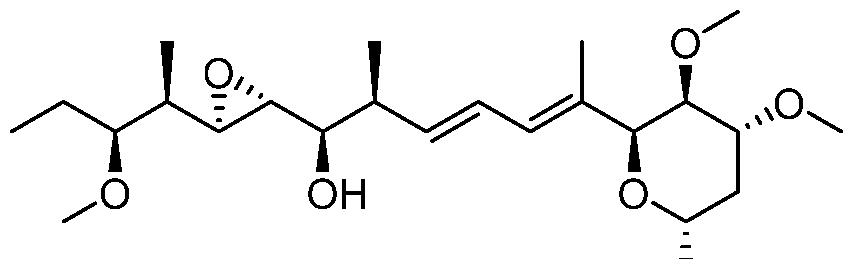
[0268] Embodiment Ql 1. A pharmaceutical composition comprising a compound according to embodiments Q1-Q10 and a pharmaceutically acceptable excipient.
[0269] Embodiment Q12. A method of treating cancer comprising administering to a subject in need thereof a therapeutically effective amount of a compound of embodiments of Q1-Q10.
[0270] VI. Examples
[0271] Example 1 - A Carbohydrate-Derived Splice Modulator
[0272] Abstract Small molecule splice modulators have recently been recognized for their clinical potential for diverse cancers. This combined with their use as tools to study the importance of splice-regulated events and their association with disease continues to fuel the discovery of new splice modulators. One of the key challenges found in the current class of
materials arises from their instability, where rapid metabolic degradation can lead to off-target responses. We now describe the preparation of bench-stable splice modulators by adapting carbohydrate motifs as a central scaffold to provide rapid access to potent splice modulators.
[0273] Introduction [0274] In 2007, two Japanese teams revealed the importance of targeting the SF3b unit of the spliceosome for anti -tumor therapy [1,2]. These breakthroughs not only forwarded the spliceosome as an important target for cancer [2], but also identified two key families of polyketide spliceosome modulators (FIG. 1), including FD-895 (la)[2], pladienolide B (lb)[3] and herboxidiene (lc) [4]. Since these discoveries, the development of splicing assays has been instrumental in the advance of next generation splice modulators. The success of these discoveries was further marked by the translation of an analog of pladienolide D, E7101, into phase I clinical trials[5]. However, many of these natural products are subject to low stability and/or poor pharmacological properties[6]. To this end, our laboratory has been a part of a growing medicinal chemistry effort to identify next generation splice modulators with improved pharmacological properties.
[0275] An attractive proposal suggested a method of analog development through the use of a consensus motif [7]. Pursuing this approach, their team has advanced the sudemycins [8] and a pladienolide-herboxidiene hybrid [9] as next generation leads. This, along with efforts at the Eisai Co. Ltd [10], H3 Biomedicine [11], Pfizer [12], Ghosh- Jurica laboratories [13], Koide laboratory [14], and our laboratories [15], have provided a strong foundation for achieving analogs with improved pharmacological properties. We now report on an advanced new class of splice modulators that are more potent, stable and rapidly accessible analogs.
[0276] In addition to carbohydrates being ubiquitous biological scaffolds, they are also derived from the natural chiral pool, making them ideal scaffolds for medicinal chemical optimization [16]. To expand on this hypothesis, we designed and prepared carbohydrate-derived compound, i.e. an analog of FD-895 whose core was derived from D-glucose.
[0277] Results
[0278] Our design began with FD-895 (la) due to the fact that earlier medicinal chemistry efforts in our laboratory provided derivatives with improved pharmacological properties [6a]. From these studies, we determined that manipulation of the stereochemistry at the C16-C19 diad (FIG. 1) provided an effective means to improve activity. From these data, we targeted a side chain that contained the exact terminus (FIG. 1), epoxide (FIG. 1), and diene groups (FIG. 1) as
one of our more active analogs of FD-895 [6a]. Here, we incorporated already known SAR data to improve activity by selecting an improved C16-C19 stereodiad (shown in 2, FIG. 1).
[0279] Clues obtained from the solution structure analysis of FD-895 (la). While structural information on the eukaryotic spliceosome has recently been published [18], representation of the binding of a splice modulator with SF3b has yet to be established. We began by exploring the solution structure of the macrolide core of FD-895 (la). Using multiple solvents (CDC13 and C6D6) for data acquisition, we identified a series of NOE interactions that, along with coupling constant data, allowed assignment of the solution structure of the macrolide core (FIG. 2A). [0280] Design of a carbohydrate core motif. Using this structure and analyzing its spacefilling model, we began to search for motifs that accurately represented the macrolide core. Our goal was to find a structural unit that offered an improved synthetic entry and diverse means of tailoring, while also addressing previous pharmacological issues (stability and solubility). We began by inspecting the overlap between the small herboxidiene (lc) and large FD-895 (la) cores. While a clear overlay existed, it was evident that space occupied by the C4-C7 unit within la may not be a requirement for activity. We realized that simple monosaccharides such as D- glucose or D-galactose could provide a strong overlap with these cores. After evaluating several structures, we turned our attention to explore a-methyl-2,3,4-trimethoxy-D-glucopyranoside (3) as a core mimetic [19]. [0281] Structurally, glycoside 2 offered a functional map that lay between the core sizes of la and lc (FIGS. 2A-2E). As illustrated in FIGS. 2D-2E, the C2, C3, and C4 methoxy groups in 2 provided an improved fit to la relative to herboxadiene (FIGS. 2B-2C). Specifically, the C2 methoxy group of 2 filled the space taken by the C24 methyl group in la. Likewise, the C3 methoxy of 2 was able to partially fill the space of the C29-C30 acetate, a region that was already shown to tolerate functional modifications [20]. With this support, we turned our attention to the synthesis and biological evaluation analog 2.
[0282] Synthetic plan. Our plan focused on using a late-stage Julia-Kocienski olefination to couple a side chain derived from FD-895 to the monosaccharide core (see Scheme A). Here, we envisioned that we could leverage the extensive efforts from our own laboratory for development of pladienolide/FD-895 side chain [6a, 15b] as a means to probe the structure-activity
relationships (SARs) of side chain incorporating analogs. We therefore set out towards preparation of core component 8 (Scheme 1) and side chain component 16 (Scheme 2).
Scheme A.

Scheme 1. Synthesis of core compound 8.

prepared
MeLi.THF from D-glucose 83%
-78 °C

Scheme 2. Synthesis of side chain component 16

TBSOTi
12 R-H
2,6-!utidine ~
CHiC , 97

[0283] Synthesis of a carbohydrate core component 8. Synthesis of 8 was accomplished in 5 steps from 3, a monosaccharide derivative that in turn was prepared in 3 steps (54% yield) from a-methyl-D-glucopyranoside [19]. We began by oxidizing to aldehyde 4. Advantageously, we were able to reduce chromatographic purification efforts by using a combination of an IBX oxidation followed by solvent-dependent filtration through a pad of Si02. The addition of MeLi to crude 4 occurred with minimal by-product formation providing alcohol 5 in 82% yield from 3.
[0284] Repetition of the IBX oxidation procedure provided ketone 6, which could be rapidly purified by passage through a Si02 plug. While small samples of 6 were purified for
characterization, the crude product was readily subjected to a Horner-Wadsworth-Emmons olefination to afford ester 7. We were able to convert 5 to 7 in two steps and 80% yield with a single purification. Finally, ester 7 was reduced with DIBAL-H to afford core unit 8, which could be stored for months at -20 °C without decomposition. Overall, this process provides access to 8 in 66% in 5 steps from 3 (36% in 8 steps from a-methyl-D-glucopyranoside).
[0285] Synthesis of the side chain component 16. The synthesis of the side chain component began with allylic alcohol 9, an intermediate that was prepared at >10 g scale for the synthesis of FD-895 (la) [6a]. Allylic oxidation with Mn02 provided aldehyde 10, which was purified through a Si02 plug and directly submitted to a Crimmins aldol condensation with auxiliary 11,
to afford adduct 12 in 87% yield over two steps. NMR analyses on the crude product indicated that this reaction occurred without detectable formation of other isomeric products.
[0286] With 12 in hand, the carbinol was protected as TBS ether 13, and the auxiliary was removed by NaBH4 reduction. Optimization studies indicated that a 5 : 1 ratio of THF:CH3OH provided a reproducibly high yield of 14. Completion of this component was accomplished by a two-step installation of the 1 -phenyl -lH-tetrazol- 5 -yl (PT) sulfone. While Mitsunobu conditions were effective at producing sulfone 15 in 82% yield at gram scales, oxidation often provided significant quantities of the corresponding sulfoxides (incomplete oxidation by-products).
Typically, samples of these sulfoxides were collected after chromatographic purification and resubmitted to the oxidation conditions to afford a combined yield of 89% of component 16. To date, we have completed the synthesis of gram quantities of 16 in 6 steps and 58% overall yield from 9 and 12 steps and 21% overall yield from auxiliary 11.
Scheme 3. Component assembly


[0287] Component assembly and completion of the synthesis of 2. With components 8 and 16 in hand, the component coupling began by oxidizing allylic alcohol 8 to the corresponding aldehyde 19. Purification via dry column vacuum chromatography using Geduran 60 silica gel was sufficient to afford pure 19 for coupling. After initial screening, we found the optimum yield (68%)) of 18 was obtained when applying 1.05 eq. NaHMDS to 1.0 eq. of sulfone 8 and following
this by addition of 1.1 eq. of aldehyde 19. The yield of this reaction also included recovery of 8% of sulfone 16 and 11% of the chromatographically separable cz's-isomer of 18 (structure not shown). With samples of pure 18 at hand, deprotection with TBAF afforded alcohol 19.
[0288] Next, we turned to the stereoselective VO(acac)2 catalyzed epoxidation of allylic alcohols21 to install the C12-C13 epoxide. As shown in FIG. 3A, treatment of 19 with 4.5 eq. of tBuOOH and 3 eq. of VO(acac)2 at -20 °C for 6 h provided the desired stereoisomer with -4: 1 diastereoselectivity. While this was the major product, over warming or not starting the reaction at -78 °C resulted in epoxidation at C8-C9. This product was not stable as the CI 1 carbinol was capable of attacking the C8 center of the epoxide forming the corresponding furan analog (structure not shown). While additional optimization efforts will be required, the current conditions returned 2 in 52% yield with only traces of the undesired C8-C9 epoxidation (5-10% yield).
[0289] Validation of the structural assignment of 2. While the mechanism of the
VO(acac)2/tBuOOH epoxidation suggests delivery of the correct stereochemical outcome, we wanted to gain further confirmation that the product was indeed 2. We began by exploring other epoxidation conditions to prepare samples of the other isomer. Treatment of 19 with 1.2 eq. of m- CPBA at -78 °C in NaHC03 buffered CH2C12 followed by slow warming to room temperature afforded a -1 : 1 mixture of both epoxides (FIG. 3B) in 62% yield. After chromatographic purification, we were able to obtain samples of both isomers. [0290] Comparative NMR analyses on the epoxides from VO(acac)2/tBuOOH and w-CPBA provided a solution (FIG. 3C). Using 2D NMR data set (see Supporting Information), we were able to fully assign the proton assignments in this product. First, we identified that the chemical shift and coupling patterns of the epoxide protons at C12-C13 provided the closest match to the configuration of the corresponding C16-C19 isomer le (FIG. 4), with comparable chemical shifts and coupling constants.
[0291] Stability and solubility of 2. Early studies indicate that 2 was more soluble and stable in aqueous buffers than FD-895 (la). Using capillary NMR and solvent 13C-satellites (QSCS) as a means of quantitation [22], we found that 2 was soluble up to 95±5 mM D20/DMSO-i¾ (10: 1) at 23 °C, while FD-895 (la) was limited to 15±5 mM under the same conditions. Additionally, we used NMR monitoring to show that while la had a half-life of -70 h in D20/DMSO-<f6 (10: 1) at 37 °C [6a], carbohydrate-analog 2 showed no signs of decomposition even after 744 h (1 month) under the same conditions. While detailed partitioning, permeability, and metabolic stability analyses are ongoing, this initial evidence suggests that 2 offers the potential to improve pharmacological properties of this class of splice modulator.
[0292] Epoxide 2 displays potent activity in primary CLL-B cells in contrast to its precursor alkene 19. We then screened the activity of 19 and 2 in primary CLL-B cells obtained from two CLL patients, that displayed potent in vitro cytotoxic activity (FIGS. 7A-7B) measured in form of specific induced apoptosis (% SIA) of la (IC50 value of 54.1±7.5 nM) and lb (IC50 value of 84.4±1.2 nM). Interestingly, these studies indicated that alkene 19 did not display any activity (IC50 value >50 μΜ in both sets of cells). Epoxide 2, on the other hand, was active (IC50 value of 153.0±11.8 nM) with ~3-fold loss of activity when compared to FD-895 (la).
[0293] Compound 2 modulates splicing. We then turned to RT-PCR analysis to determine if the activity of 2 also included a comparable splice response as la and lb in CLL-B cells. Using unspliced RNU6A and unmodulated GAPDH (top, FIG. 5) as controls, we were able to obtain complementary splice modulation in all six genes selected from our prior studies to provide a diversity of intron retention (IR) response.153 This included comparable modification of IR in DNAJBI, ARF4, PRPF4, RIOK3, SF3A1, and U2AF2 (FIG. 4 and FIG. 8) from primary CLL-B cells. In contrast, alkene precursor 19 was inactive for all six genes (FIG. 5), indicating that the epoxide in 2 is essential for activity.
[0294] Additionally, we were able to confirm that compound 2 also induced alternate splicing (AS) events. As shown in FIG. 6, treatment of CLL-B cells with la, lb and 2 resulted in a decrease in the long (anti-apoptotic) form and increased the expression of short (pro-apoptotic) form oiMCLL Similarly, BCL-X demonstrates comparable AS events (FIG. 6). This indicates that cell death induced by la, lb and 2 is not exclusively derived through AS of MCL1 but may also include other players. This fact is further supported by RNAseq analyses [15a], which implicates the involvement of other pathways. Efforts are now underway to explore the roles of IR and AS events as well as to identify structural motifs that enrich specific events.
[0295] Experimental Section [0296] A. General experimental methods.
[0297] Chemical reagents were purchased from Acros, Fluka, Sigma-Aldrich, or TCI.
Deuterated MR solvents were purchased from Cambridge Isotope Laboratories. All reactions were conducted with rigorously dried anhydrous solvents that were obtained by passing through a solvent column composed of activated Al alumina. Anhydrous N,N-dimethylformamide was obtained by passage over activated molecular sieves and a subsequent NaOCN column to remove traces of dimethylamine. Triethylamine (Et3N) was dried over Na and freshly distilled. Ethyl-
N,N-diisopropylamine (EtN/'Pr2) was distilled from ninhydrin, then from potassium hydroxide.
Anhydrous CH3CN was obtained by distillation from CaH2. All reactions were performed under positive pressure of Ar in oven-dried glassware sealed with septa, with stirring from a Teflon
coated stir bars using an IKAMAG RCT-basic mechanical stirrer (IKA GmbH). Solutions were heated using either a sand or silicon oil bath. Analytical Thin Layer Chromatography (TLC) was performed on Silica Gel 60 F254 precoated glass plates (EM Sciences). Preparative TLC (pTLC) was conducted on Silica Gel 60 plates (EM Sciences). Visualization was achieved with UV light and/or an appropriate stain (I2 on Si02, KMn04, bromocresol green, dinitrophenylhydrazine, ninhydrin, and eerie ammonium molybdate). Flash chromatography was carried out Geduran Silica Gel 60 (40-63 mesh) from EM Biosciences. Yields and characterization data correspond to isolated, chromatographically and spectroscopically homogeneous materials. 1H MR spectra were recorded on Varian Mercury 300, Varian Mercury 400 spectrometers, Varian Mercury Plus 400, a JEOL ECA500, or a Varian VX500 spectrometer. A majority of the 13C MR spectra were recorded at 125 MHz on a Varian VX500 spectrometer equipped with an Xsens Cold probe. The remaining spectra were either collected at 125 MHz on a JEOL ECA 500, 100 MHz on a Varian Mercury 400 or 100 MHz on a Varian Mercury Plus 400 spectrometer. Chemical shifts for 1H NMR and 13C NMR analyses were referenced to the reported values of Gottlieb,1 using the signal from the residual solvent for 1H spectra, or to the 13C signal from the deuterated solvent. Chemical shift δ values for 1H and 13C spectra are reported in parts per million (ppm) relative to these referenced values, and multiplicities are abbreviated as s = singlet, d = doublet, t = triplet, q = quartet, m = multiplet, br = broad. All 13C NMR spectra were recorded with complete proton decoupling. FID files were processed using MestraNova 6.0.2. (MestreLab Research).
Electrospray (ESI) mass spectrometric analyses were performed using a ThermoFinnigan LCQ Deca spectrometer, and high-resolution analyses were conducted using a ThermoFinnigan MAT900XL mass spectrometer with electron impact (EI) ionization. A Thermo Scientific LTQ Orbitrap XL mass spectrometer was used for high-resolution electrospray ionization mass spectrometry analysis (HR-ESI-MS). FTIR spectra were obtained on a Nicolet magna 550 series II spectrometer as thin films on either KBr or NaCl discs, and peaks are reported in wavenumbers (cm"1). Optical rotations [a]D were measured using a Perkin-Elmer Model 241 polarimeter with the specified solvent and concentration and are quoted in units of deg cm2 g"1. Spectral data were collected for all new compounds.
[0298] B. Synthesis of core chain component 8.
[0299] Component 8 was prepared in 8 steps in 36% overall yield from a-methyl-D- glucopyranoside (SI) as shown in Scheme 1 (above) and Scheme SI (below). Preparation of 6- trityl-a-methyl-a-D-glucopyranoside S2 was achieved by modification of methods developed by Crich, as described below. The following section provides a complete description of the synthetic procedures and spectroscopic properties of intermediated S2-S3, 3-8 and 19.
[0300] Scheme SI depicts the synthesis of core component 8. Preparation of 8 required three chromatographic purifications as the crude products of S2, 3, 4, and 6 could be used without additional purification. Flash chromatography was required to purify intermediates S3, 5, and 7.
The final materials were stored. Aldehyde 19 was prepared immediately before the component coupling process as described in Scheme 3 and Scheme S3 following.
Scheme SI.

[0301] (2S,3R,4S,5R,6R)-2,3,4,5-tetramethoxy-6-((trityloxy)methyl)tetrahydro-2H-pyran (S3). Trityl ether S2 (10.1 g, 23.2 mmol), prepared from a-methyl-D-glucopyranoside (S I) according to the DABCO method of Gadakh, SI was suspended in DMF (1 10 mL), placed under a strict Ar atmosphere and cooled to 0 °C. NaH (4.82 g, 120.4 mmol) was added in four portions over the period of 15 min. After stirring at 0 °C for 1.5 h, Mel (11.53 mL, 185.2 mmol) was added in a drop wise fashion. The reaction was then slowly warmed to rt and stirred at rt for 12 h. In order to optimize yield, the mixture was retreated prior to work up by cooling the flask to 0 °C and adding an additional aliquot of NaH (2.41, 60.2 mmol). After 30 min, a second aliquot of Mel (5.7 mL, 92.6 mmol) was added and the mixture was warmed to rt. After 7 h at rt, satd. NH4C1 (200 mL) was added in a drop wise fashion. The mixture was extracted with EtOAc (3 χ 200 mL), washed with H20 (200 mL) and satd. NH4C1 (200 mL), dried over Na2S04 and concentrated on a rotary evaporator. Pure S3 (9.13 g, 82%) was obtained by flash
chromatography eluting with a gradient of hexanes to EtOAc.
[0302] Intermediate S3: TLC (1 : 1 hexanes/EtOAc): Rf = 0.67; 1H NMR (CDC13, 500 MHz) δ 7.49 (m, 6H), 7.29 (m, 6H), 7.24 (m, 3H), 4.92 (d, J= 3.6 Hz, 1H), 3.62 (s, 3H), 3.60 (m, 1H), 3.56 (s, 3H), 3.48 (t, J= 9.2 Hz, 1H), 3.44 (s, 3H). 3.39 (dd, J= 2.0, 10.0 Hz, 1H), 3.30 (m, 2H),
3.27 (s, 3H), 3.11 (dd, 7= 4.3, 10.0 Hz, 1H); 13C MR (CDC13, 125 MHz) δ 144.1, 128.9, 127.9, 127.1, 97.4, 86.3, 83.8, 82.0, 80.0, 70.2, 62.5, 61.1, 60.6, 59.2, 55.1; HR-ESI-MS m/z calcd. for C29H3406 [M+Na]+: 501.2248, found 501.2249.
[0303] (2R,3R,4S,5R,6S)-3,4,5,6-tetramethoxytetrahydro-2H-pyran-2-yl)methanol (3). Intermediate S3 (8.78 g, 18.4 mmol) was dissolved in CH2C12 (180 mL). Et3SiH (5.86 mL, 36.7 mmol) was added neat followed by the addition of TBSOTf (0.04 mL, 0.2 mmol). An immediate yellow color appeared. If the CH2Cl2 is not sufficiently dry additional amounts of TBSOTf will be required. After 2 h, the yellow color disappeared and TLC analysis indicated that the reaction was complete. Satd. NaHC03 solution (0.1 mL) was added and the mixture was dried with Na2S04 and concentrated on a rotary evaporator. Pure S3 (9.13 g, 83%) was obtained by extraction between hexanes and CH3CN. Briefly, the crude product was dissolved in CH3CN (100 mL) and washed with hexanes (3 x 200 mL). The CH3CN was collected and dried via rotary evaporation to afford pure 3 (4.34 g, 77%) as a white solid.
[0304] Alcohol 3: TLC (1 : 1 hexanes/EtOAc): Rf = 0.13; 1H NMR (CD3OD, 500 MHz) δ 4.83 (d, 7= 3.6 Hz, 1H), 3.74 (dd, 7= 2.2, 11.9 Hz, 1H), 3.65 (dd, 7= 4.6, 11.9 Hz, 1H), 3.58 (s, 3H), 3.53 (s, 3H), 3.47 (s, 3H), 3.45 (m, 2H), 3.38 (s, 3H), 3.18 (dd, 7= 3.6, 9.6 Hz, 1H), 3.12 (dd, 7 = 8.9, 10.0 Hz, 1H); 13C NMR (CDC13, 125 MHz) δ 98.4, 84.7, 83.0, 80.6, 72.5, 61.9, 61.0, 60.8. 58.8, 55.4; HR-ESI-MS m/z calcd. for Ci0H20O6 [M+Na]+: 259.1152, found 259.1155.
[0305] l-((2S,3S,4S,5R,6S)-3,4,5,6-tetramethoxytetrahydro-2H-pyran-2-yl)ethan-l-one (5). Alcohol 5 was prepared through a back-to-back two-step procedure without purification of intermediate aldehyde 4. Alcohol 3 (2.21 g, 9.4 mmol) was dissolved in EtOAc (120 mL). IBX (5.57 g, 20.6 mmol) was added as a solid and the mixture was brought to reflux with vigorous stirring. After 4 h, the mixture was cooled to 0 °C and flushed through a pad Si02 (200 g) washing with EtOAc (400 mL). The combined fractions were dried and submitted immediately for the next step. Aldehyde 4 (2.19 g, 9.4 mmol) was dried by azeotropic removal of toluene (3 x 200 mL). The resulting wax was dissolved in THF (100 mL) and cooled to -80 °C. A 1.6 M solution of MeLi in ether (23.4 mL, 37.4 mmol) was added slowly to this solution. After 15 min at -80 °C, the mixture was warmed to rt over 2 h and stirred at rt for an additional 1 h. Satd. NH4C1 (100 mL) was added slowly. The mixture was extracted with EtOAc (3 χ 50 mL), washed with brine (200 mL), dried over Na2S04 and concentrated on a rotary evaporator. Pure 5 (1.95 g, 83%)) was obtained as a ~2: 1 mixtures of isomers by flash chromatography eluting with a gradient of hexanes to EtOAc.
[0306] Alcohol 5: TLC (1 : 1 hexanes/EtOAc): Rf = 0.16; 1H NMR (CDC13, 500 MHz) δ 4.82 (d, 7= 3.6 Hz, 1H, minor), 4.78 (d, 7= 3.6 Hz, 1H, major), 3.98 (m, 1H, both), 3.62 (s, 3H,
minor), 3.61 (s, 3H, major), 3.58 (s, 3H, both), 3.55 (m, 1H, both), 3.51 (s, 3H, minor), 3.51 (s,
3H, major), 3.46 (m, 2H, both), 3.40 (s, 3H, major), 3.38 (s, 3H, minor), 3.30 (dd, J= 1.6, 9.9 Hz, 1H, minor), 3.24 (dd, J= 8.6, 9.2 Hz 1H, minor), 3.16 (dd, J= 3.6, 9.6 Hz, 1H, both), 3.09 (dd, J= 8.8, 9.9 Hz, 1H, major), 2.75 (d, J= 4.7 Hz, OH, 1H, major), 1.77 (d, J= 9.7 Hz, OH, 1H, minor), 1.29 (d, J = 6.6 Hz, 3H, minor), 1.23 (d, J= 6.5 Hz, 3H, major);13C NMR (CDC13, 125 MHz) δ 97.6, 97.3, 83.9, 83.9, 82.5, 82.2, 82.0, 79.9, 72.9, 72.1, 68.8, 65.5, 61.0, 60.9, 60.8, 60.4, 59.2, 59.1, 55.2, 55.2, 20.4, 18.3; HR-ESI-MS m/z calcd. for CiiH2206 [M+Na]+: 273.1309, found 273.1308.
[0307] l-((2S,3S,4S,5R,6S)-3,4,5,6-tetramethoxytetrahydro-2H-pyran-2-yl)ethan-l-one (6). Alcohol 5 (1.0 g, 4.0 mmol) was dissolved in EtOAc (50 mL). fflX (3.36 g, 12.0 mmol) was added as a solid and the mixture was brought to reflux with vigorous stirring. After 4 h, a second aliquot of IBX (3.36 g, 12.0 mmol) was added and the mixture was continued to stir at reflux for an additional 4 h. The mixture was cooled to 0 °C and flushed through a pad Si02 (200 g) washing with EtOAc (400 mL). The combined fractions were dried and used immediately as a crude product 6 (992.3 mg, 99%). Samples of pure ketone were obtained by flash
chromatography eluting with a gradient of hexanes to EtOAc.
[0308] Ketone 6: TLC (1 : 1 hexanes/EtOAc): Rf = 0.40; 1H NMR (CDC13, 500 MHz) δ 4.85 (d, J= 3.5 Hz, 1H), 4.00 (d, J= 10 Hz, 1H), 3.61 (s, 3H), 3.53 (t, J= 9.2 Hz, 1H), 3.51 (s, 3H), 3.49 (s, 3H), 3.43 (s, 3H), 3.22 (t, J= 9.8 Hz, 1H), 3.20 (dd, J= 3.6, 9.7 Hz, 1H), 2.27 (s, 3H); 13C NMR (CDC13, 125 MHz) δ 205.0, 98.0, 83.5, 81.4, 80.8, 74.1, 61.2, 60.6, 59.3, 55.8, 28.3; HR- ESI-MS m/z calcd. for CnH20O6 [M+Na]+: 271.1152, found 271.1149.
[0309] Ethyl (E)-3-((2R,3R,4S,5R,6S)-3,4,5,6-tetramethoxytetrahydro-2H-pyran-2-yl)but- 2-enoate (7). NaH (400 mg, 60% w/w in oil, 10.0 mmol) was suspended in THF (30 mL) and cooled to 0 °C. Triethyl phosphonoacetate (2.51 g, 11.2 mmol) was added in a drop wise fashion to the suspension of NaH. After stirring for 1.5 h, crude ketone 5 (992.0 mg, 4.0 mmol) dissolved in THF (10 mL) was added. The mixture was warmed to rt. TLC analysis indicated that the reaction was complete after 3 h. Satd. NH4C1 (50 mL) was added slowly. The mixture was extracted with EtOAc (3 χ 100 mL), washed with brine (200 mL), dried over Na2S04 and concentrated on a rotary evaporator. Pure 7 (0.982 g, 81%) was obtained by flash
chromatography eluting with a gradient of hexanes to 1 : 1 hexanes/EtOAc.
[0310] Ester 7: TLC (1 : 1 hexanes/EtOAc): Rf = 0.59; 1H NMR (CDC13, 500 MHz) δ 5.94 (dd, J= 0.7, 1.5 Hz, 1H), 4.80 (d, J= 3.6 Hz, 1H), 4.16 (dq, J= 1.2, 7.2 Hz, 1H), 3.89 (d, J= 9.8 Hz, 1H), 3.61 (s, 3H), 3.52 (s, 3H), 3.50 (dd, J= 8.8, 9.6 Hz, 1H), 3.42 (s, 3H), 3.38 (s, 3H), 3.20 (dd, J= 3.6, 9.6 Hz, 1H), 3.04, (dd, J= 8.7, 9.8 Hz, 1H), 2.20 (d, J= 2.2 Hz, 1H), 1.28 (t, J = 7.1 Hz,
1H); 13C NMR (CDC13, 125 MHz) δ 166.3, 153.9, 1 19.7, 97.6, 83.2, 82.5, 81.5, 75.1, 61.1, 60.5,
59.9, 59.1, 55.3, 15.0, 14.3; HR-ESI-MS m/z calcd. for Ci5H2607 [M+Na]+: 341.1574, found 341.1571.
[0311] Ethyl (E)-3-((2R,3R,4S,5R,6S)-3,4,5,6-tetramethoxytetrahydro-2H-pyran-2-yl)but- 2-enoate (8). Ester 7 (981.0 mg, 3.1 mmol) was dissolved in CH2C12 (40 mL) and cooled to -78 °C. A 1.0 M solution of DIBAL-H in toluene (9.3 mL, 9.3 mmol) was added drop wise. After 20 min, the reaction mixture was slowly warmed to rt over 2 h and then stirred at rt for 1 h. The mixture was recooled to -78 °C and EtOAc (5 mL) was added, followed by a satd. Solution of Rochelle's salt (100 mL). The mixture was warmed to rt and stirred at rt for 5 h until the mixture provided two clear phases. The crude product was recovered by extraction EtOAc (3 χ 100 mL), washed with brine (100 mL), drying over Na2S04 and concentration on a rotary evaporator. Pure 8 (0.845 g, 99%) was obtained by flash chromatography eluting with a gradient of hexanes to 1 :2 hexanes/EtOAc.
[0312] Allylic alcohol 8: TLC (1 : 1 hexanes/EtOAc): Rf = 0.09; 1H NMR (CDC13, 500 MHz) δ 5.76 (dt, J= 2.1, 6.8 Hz, 1H), 4.79 (d J = 3.6 Hz, 1H), 4.25 (dq, J= 6.3, 13.1 Hz, 1H), 3.86 (d, J = 9.8 Hz, 1H), 3.62 (s, 3H), 3.52 (s, 3H), 3.50 (m, 1H), 3.44 (s, 3H), 3.39 (s, 3H), 3.19 (dd, J = 3.6, 9.6 Hz, 1H), 3.05 (dd, J= 8.8, 9.8 Hz, 1H), 1.73 (s, 3H); 13C NMR (CDC13, 125 MHz) δ 134.9, 130.0, 97.6, 83.3, 81.8, 81.6, 75.6, 61.2, 60.3, 59.4, 59.2, 55.4, 12.5; HR-ESI-MS m/z calcd. for Ci3H2406 [M+Na]+: 299.1465, found 299.1463. [0313] C. Synthesis of side chain component 16.
[0314] Sulfone 16 was prepared in 6 steps in 58% overall yield from allylic alcohol 9, as shown in Scheme 2 (in the manuscript) and Scheme S2 (below). Gram scaled preparation of allylic alcohol 9 was accomplished in 1 1 steps and 27% overall yield from L-Phe. The bulk of s 1 the effort in preparing 9 arose from the preparation of auxiliary 11, which was readily recycled. The following section provides a complete description of the synthetic procedures and spectroscopic properties of intermediated 10, 12, 13, and 14-16.
[0315] (2R,3S,6S,7S,E)-l-((S)-4-Benzyl-2-thioxothiazolidin-3-yl)-3-hydroxy-7-methoxy-
2,6-dimethylnon-4-en-l-one (12). Allylic alcohol 9 [2] (1.12 g, 7.1 mmol) was dissolved in
CH2C12 (50 mL) and Mn02 (9.31 g, 107.2 mmol) was added as a powder. The slurry was vigorously stirred at rt until TLC indicated complete conversion, typically 24-36 h. The mixture was applied to a DCVC column containing 150 g Si02. The column was washed with EtOAc (3 x 100 mL) and dried via rotary evaporation. The resulting product, aldehyde 10 (1.12 g, 99% yield) was further dried via toluene azeotrope (3 x 10 mL) and used immediately without further purification. Crimmins auxiliary 1 1 (2.28 g, 8.6 mmol) was dissolved in CH2C12 (70 mL) and
cooled 0 °C. TiCl4 (0.99 mL, 9.0 mmol) was added in a drop wise fashion. After 5 min at 0 °C,
EtN'Pr2 (1.64 mL, 9.4 mmol) was added in a drop wise fashion. The mixture was stirred at 0 °C for 30 min and then cooled to -78 °C. Aldehyde 10 (1.12, 7.2 mmol) was dissolved in CH2C12 (25 mL) and added in a drop wise fashion. The mixture was stirred at -78 °C for 2.5 h then slowly warmed over 1.5 h to 0 °C. After 15 min at 0 °C, satd. H4C1 (50 mL) was added. The mixture was extracted with EtOAc (3 χ 100 mL), washed with brine (50 mL), dried over Na2S04 and concentrated on a rotary evaporator. Pure adduct 12 (2.65 g, 87%) was obtained by flash chromatography eluting with a gradient of hexanes to 1 : 1 hexanes/EtOAc.
[0316] Adduct 12: TLC (3 : 1 hexanes/EtOAc): Rf = 0.39; 1H NMR (CDC13, 500 MHz) δ 7.34 (m, 2H), 7.28 (m, 3H), 5.73 (ddd, J= 1.3, 7.8, 15.6 Hz, 1H), 5.51 (ddd, J= 1.1, 5.8, 15.6 Hz, 1H), 5.38 (ddd, J= 4.0, 7.3, 11.3 Hz, 1H), 4.79 (dq, J= 3.2, 7.0 Hz, 1H), 4.60 (m, 1H), 3.38 (dd, J= 4.6, 11.8 Hz, 1H), 3.35 (s, 3H), 3.24 (dd, J= 4.0, 13.2 Hz, 1H), 3.04 (dd, J= 10.4, 13.2 Hz, 1H), 2.92 (m, 1H), 2.89 (d, J= 11.6 Hz, 1H), 2.42 (td, J= 6.8, 12.1 Hz, 1H), 1.59 (s, OH, 1H), 1.53 (dqd, J= 4.3, 7.5, 14.9 Hz, 1H), 1.41 (td, J= 7.1, 14.1 Hz, 1H), 1.18 (d, J= 7.0 Hz, 1H),
I .03 (d, J= 6.8 Hz, 1H), 0.89 (t, J= 7.4 Hz, 1H); 13C NMR (CDC13, 125 MHz) δ 201.8, 197.7, 136.5, 135.4, 129.6, 129.1, 128.7, 127.4, 86.3, 72.2, 69.1, 57.8, 43.4, 39.5, 37.1, 31.9, 23.8, 16.2,
I I .4, 9.8; HR-ESI-MS m/z calcd. for C22H31NO3S2 [M+Na]+: 444.1638, found 444.1639.
Scheme S2. Synthesis of side chain component 16. Preparation of 16 required four chromatographic purifications as the crude products of 10 and 13 could be used without additional purification. Flash chromatography was required to purify intermediates 12, 14, 15 and 16. The materials was stored at 16, and used as described in Scheme 3 and Scheme S3.

2, ™6-!u∞iRline ( 1Λ~2 R-H
P.TS¾
NaBKi
CH3OH 37¾:

16 15 1
[0317] (2R,3S,6S,7S,E)-l-((S)-4-benzyl-2-thioxothiazolidin-3-yl)-3-((tert- butyldimethylsilyl)oxy)-7-methoxy-2,6-dimethylnon-4-en-l-one (13) Adduct 12 (3 22 g, 7 64
mmol) and 2,6-lutidine (2.65 mL, 22.9 mmol) were dissolved in CH2CI2 (125 mL) and cooled 0
°C. TBSOTf (3.50 mL, 15.3 mmol) was added in a drop wise fashion. After 15 min at 0 °C, the mixture was warmed to 10 °C over 2 h. After 15 min at 10 °C, satd. NaHC03 (0.5 mL) was added and the mixture was stirred at rt for 30 min. The mixture was applied to a DCVC column containing 200 g Si02. The column was washed with EtOAc (3 x 200 mL) and dried via rotary evaporation. The resulting product 10 (3.98 g, 97% yield) was further dried via toluene azeotrope
(3 x 50 mL) and used as is. Pure samples of 13 were obtained for spectroscopic analyses via flash chromatography eluting with a gradient of hexanes to 1 : 1 hexanes/EtOAc.
[0318] Adduct 13: TLC (3 : 1 hexanes/EtOAc): Rf = 0.75; 1H NMR (CDC13, 500 MHz) δ 7.34 (m, 2H), 7.28 (m, 3H), 5.59 (d, J= 6.9 Hz, 1H), 5.57 (d, J= 6.1 Hz, 1H), 5.33 (dddd, J= 1.2, 3.5, 7.4, 10.8 Hz, 1H), 4.80 (t, J = 6.6 Hz, 1H), 4.51 (t, J= 6.5 Hz, 1H), 3.35 (m, 1H), 3.31 (m, 1H), 3.30 (s, 3H), 3.19 (dd, J= 3.4, 13.1 Hz, 1H), 2.99 (dd, J= 11.0, 13.2 Hz, 1H), 2.87 (dd, J= 4.3, 6.7 Hz, 1H), 2.84 (d, J= 11.6 Hz, 1H), 2.33 (h, J= 6.7, 1H), 1.67 (m, 1H), 1.50 (ttd, J= 3.6, 7.5, 14.8 Hz, 1H), 1.38 (pq, 7.1, 14.1 Hz, 1H), 1.26 (dd, J = 6.5, 4.27 Hz, 1H), 1.21 (d, J= 6.8 Hz, 3H), 1.00 (d, J= 6.8 Hz, 3H), 0.90 (s, 9H), 0.84 (t, J= 7.5 Hz, 3H), 0.06 (s, 3H), 0.03 (s, 3H);
13C NMR (CDC13, 125 MHz) δ 201.2, 196.3, 136.8, 135.1, 131.1, 129.5, 129.1, 127.3, 86.2, 75.2, 69.3, 57.6, 45.2, 39.4, 37.2, 31.6, 26.1, 25.9, 23.8, 18.4, 16.0, 14.2, 9.7, -3.7, -4.2; HR-ESI-MS m/z calcd. for C28H45N03S2Si [M+Na]+: 558.2502, found 558.2503.
[0319] (2S^S,6S,7S,E)-3-((tert-butyldimethylsilyl)oxy)-7-methoxy-2,6-dimethylnon-4-en- l-ol (14). Adduct 13 (1.33 g, 2.5 mmol) was dissolved in a mixture of THF (53 mL) and CH3OH (13 mL) and cooled to 0 °C. NaBH4 (159.0 mg, 19.9 mmol) was added in 3 portions over 5 min. The mixture was stirred at 0 °C for 1.5 h. If not complete via TLC analysis additional NaBH4 could be added to complete the reaction. If complete, satd. NH4C1 (25 mL) was added. The resulting mixture was extracted with EtOAc (3 x 100 mL), washed with brine (50 mL), dried over Na2S04 and concentrated on a rotary evaporator. Pure alcohol 14 (802.0 mg, 97%) was obtained by flash chromatography eluting with a gradient of hexanes to 1 : 1 hexanes/EtOAc.
[0320] Alcohol 14: TLC (3 : 1 hexanes/EtOAc): Rf = 0.55; 1H NMR (CDC13, 500 MHz) δ 5.51 (m, 2H), 4.13 (m, 2H), 3.62 (ddd, J= 2.8, 8.6, 11.2 Hz, 1H), 3.46 (ddd, 4.2, 7.4, 11.2 Hz, 1H), 3.34 (s, 3H), 3.03 (bs, 1H), 2.89 (ddd, J = 4.1, 6.1, 7.4 Hz, 1H), 2.41 (m, 1H), 1.95 (m, 1H), 1.76 (bs, 1H), 1.53 (dtd, J= 4.3, 7.5, 14.8 Hz, 1H), 1.38 (ddt, J= 6.7, 7.7, 13.5 Hz, 1H), 1.01 (d, J = 6.9 Hz, 3H), 0.90 (t, J= 7.4 Hz, 3H), 0.88 (s, 9H), 0.78 (dd, J= 7.1 Hz, 3H), 0.06 (s, 3H), 0.02 (s, 3H); 13C NMR (CDC13, 125 MHz) δ 134.9, 129.9, 86.4, 78.2, 65.9, 57.6, 41.5, 39.4, 25.9, 23.5, 18.2, 16.2, 13.0, 9.8, -4.0, -4.9; HR-ESI-MS m/z calcd. for Ci8H38N03Si [M+Na]+:
353.2482, found 353.2485.
[0321] 5-(((2R,3S,6S,7S,E)-3-((tert-butyldimethylsilyl)oxy)-7-methoxy-2,6-dimethylnon-4- en-l-yl)thio)-l-phenyl-lH-tetrazole (15). Alcohol 14 (1.01 g, 3.1 mmol), 1 -phenyl- 1H- tetrazole-5-thiol (819.5 mg, 4.6 mmol) and PPh3 (1.20 g, 4.6 mmol) were dissolved in THF (50 mL). The solution was cooled to 0 °C. DEAD (720.0 μΐ., 4.6 mmol) was added in a drop wise fashion until a yellow color persists. Additional DEAD up to 1.2 mmol could be added if needed if the color does not persist. After 30 min, the solution was allowed to warm to rt over 30 min.
After 4 h at rt, H20 (20 mL) was added. The resulting mixture was extracted with EtOAc (3 x 50 mL), washed with brine (25 mL), dried over Na2S04 and concentrated on a rotary evaporator.
Pure sulfide 15 (1.24 g, 82%) was obtained by flash chromatography eluting with a gradient of hexanes to 2: 1 hexanes/EtOAc.
[0322] Sulfide 15: TLC (3 : 1 hexanes/EtOAc): Rf = 0.70; 1H NMR (CDC13, 500 MHz) δ 7.56 (m, 5H), 5.55 (ddd, J = 0.8, 7.7, 15.5 Hz, 1H), 5.43 (ddd, J= 1.0, 7.7, 15.5 Hz, 1H), 4.13 (dd, J = 0.9, 4.1, 6.9 Hz, 1H), 3.51 (dd, J= 6.5, 12.7 Hz, 1H), 3.33 (s, 3H), 3.25 (dd, J= 7.3, 12.7 Hz, 1H), 2.89 (ddd, J= 4.3, 6.1, 7.0 Hz, 1H), 2.38 (h, J= 6.9 Hz, 1H), 2.03 (dh, J= 4.1, 6.8 Hz, 1H), 1.51 (dqd, J= 4.3, 7.5, 14.9 Hz, 1H), 1.38 (pd, J= 7.3, 14.4 Hz, 1H), 1.01 (d, J= 6.9 Hz, 1H), 1.00 (d, J= 6.8 Hz, 1H), 0.88 (s, 9H), 0.88 (t, J= 7.4 Hz, 1H), 0.03 (s, 3H), 0.00 (s, 3H); 13C NMR (CDC13, 125 MHz) δ 155.0, 135.0, 133.9, 130.4, 130.1, 129.9, 124.0, 86.3, 76.1, 57.7, 40.1, 39.3, 36.8, 26.0, 23.7, 18.3, 15.9, 14.6, 9.7, -3.8, -4.7; HR-ESI-MS m/z calcd. for
C25H42N4O2SS1 [M+Na]+: 513.2690, found 513.2693. [0323] 5-(((2R,3S,6S,7S,E)-3-((tert-Butyldimethylsilyl)oxy)-7-methoxy-2,6-dimethylnon-4- en-l-yl)sulfonyl)-l-phenyl-lH-tetrazole (16). Sulfide 15 (1.95 g, 4.0 mmol) was dissolved in EtOH (40 mL) and cooled to 0 °C. In a vial, a 30% v/v solution of H202 (3.6 mL) was added to solid (ΝΗ4)6Μθ7θ24·4Η20 (2.45 g, 20.0 mmol) and shaken until the bubbling ceased (~ 5 min). This solution was then added to the cooled solution of 15 in EtOH via glass pipette. After 20 min, the mixture was warmed to rt and stirred overnight. The resulting mixture was diluted with H20 (50 mL), extracted with EtOAc (3 x 50 mL), washed with brine (25 mL), dried over Na2S04 and concentrated on a rotary evaporator. Pure sulfone 16 (1.82 g, 87%) was obtained by flash chromatography eluting with a gradient of hexanes to 2: 1 hexanes/EtOAc. The remainder of the material was either the sulfide 15 (Rf higher than 16), the corresponding sulfoxide (Rf higher than 16) or a mixture of both. These materials were readily resubmitted to the oxidation procedure to provide additional samples of 16.
[0324] Sulfone 16: TLC (3 : 1 hexanes/EtOAc): Rf = 0.66; 1H NMR (CDC13, 500 MHz) δ 7.68 (m, 2H), 7.61 (m, 3H), 5.61 (ddd, J= 1.1, 7.9, 15.6 Hz, 1H), 5.36 (ddd, J= 1.1, 7.0, 15.6 Hz, 1H), 4.18 (dd, J = 4.3, 6.7 Hz, 1H), 4.07 (dd, J= 3.4, 14.4 Hz, 1H), 3.46 (dd, J= 9.1, 14.4 Hz,
1H), 3.34 (s, 3H), 2.90 (ddd, J= 4.4, 6.0, 7.0 Hz, 1H), 2.43 (m, 1H), 2.40 (tt, J= 6.5, 13.6 Hz,
1H), 1.51 (m, 1H), 1.39 (pq, J= 7.3, 14.4 Hz, 1H), 1.11 (d, J= 6.9 Hz, 3H), 1.02 (d, J= 6.8 Hz, 3H), 0.90 (t, J= 7.4 Hz, 3H), 0.89 (t, 9H), 0.06 (s, 3H), 0.03 (s, 3H); 13C NMR (CDC13, 125 MHz) δ 154.2, 136.2, 133.3, 131.6, 129.8, 128.9, 125.3, 86.2, 75.8. 58.5, 57.7, 39.3, 35.3, 26.0, 23.7, 18.3, 15.9, 15.3, 9.8, -4.0, -4.8; HR-ESI-MS m/z calcd. for C25H42N4 O4SS1 [M+Na]+:
545.2588, found 545.2587.
[0325] D. Procedures for the component coupling to alkene 19.
[0326] A two-step procedure was used to prepare alkene 18 from side chain component 16 and core component 9, as shown in Scheme 3 (in the manuscript) and Scheme S3 (below). The following section provides a complete description of the synthetic procedures and spectroscopic properties of intermediates 19-18.
Scheme S3. Synthesis of epoxide 2. Preparation of 16 required 3 chromatographic purifications as the crude product 19 as shown in Scheme SI could be used without additional purification.

[0327] (E)-3-((2R,3R,4S,5R,6S)-3,4,5,6-Tetramethoxytetrahydro-2H-pyran-2-yl)but-2-enal (19). Allylic alcohol 8 (468.2 mg, 1.7 mmol) was dissolved in CH2C12 (20 mL) and Mn02 (2.21 g, 25.4 mmol) was added as a powder. The slurry was vigorously stirred at rt until TLC indicated complete conversion, typically 20-24 h. The mixture was applied to a DCVC column containing 80 g Si02. The column was washed with EtOAc (3 x 50 mL) and dried via rotary evaporation. The resulting product, aldehyde 19 (459.2 mg, 99% yield) was further dried via toluene azeotrope (3 x 10 mL) and used as is.
[0328] Aldehyde 19: TLC (1 : 1 hexanes/EtOAc): Rf = 0.38; 1H NMR (CDC13, 500 MHz) δ 10.11 (d, J= 7.8 Hz, 1H), 6.12 (d, J= 7.1 Hz, 1H), 4.83 (d, J= 3.6 Hz, 1H), 4.00 (d, J= 9.8 Hz, 1H), 3.64 (s, 3H), 3.54 (s, 3H), 3.53 (m, 1H), 3.45 (s, 3H), 3.41 (s, 3H), 3.22 (dd, J= 3.6, 9.7 Hz, 1H), 3.06 (dd, J= 8.8, 9.8 Hz, 1H); 2.23 (d, J= 1.4 Hz, 3H); 13C NMR (CDC13, 125 MHz) δ
191.2, 157.9, 129.5, 97.9, 83.5, 82.8, 81.8, 74.5, 61.2, 60.7, 59.3, 55.6, 14.3; HR-ESI-MS m/z calcd. for Ci3H2206 [M+Ma]+: 297.1309, found 297.1306.
[0329] tert-Butyl(((2E,4E,6S,7S,8E,10S,HS)-ll-methoxy-6,10-dimethyl-2- ((2R,3R,4S,5R,6S)-3,4,5,6-tetramethoxytetrahydro-2H-pyran-2-yl)trideca-2,4,8-trien-7- yl)oxy)dimethylsilane (18). Highly dry THF for this procedure was required and was distilled fresh from Na benzophenone ketyl prior to use. Sulfone 16 (568.4 mg, 1.09 mmol) was dissolved in freshly distilled THF (30 mL) and cooled to -78 °C. A 2 M solution of NaHMDS in THF (572.0 mL, 1.14 mmol) was added in a drop wise fashion. After 1 h at -78°C, freshly prepared and dried aldehyde 19 (328.2 mg, 1.19 mmol) was added in THF (15 mL). The solution was warmed to rt over 1.5 h and stirred overnight. The resulting mixture was diluted with satd. H4C1 (50 mL), extracted with EtOAc (3 200 mL), washed with brine (25 mL), dried over Na2S04 and concentrated on a rotary evaporator. Pure alkene 18 (423.1 mg, 68%) was obtained by flash chromatography eluting with a gradient of hexanes to 1 : 1 hexanes/EtOAc. This was accompanied by ~11% of the chromatographically isolable cz's-C8,C9 isomer of 18 indicating that the reaction occurred with ~6: 1 ratio of trans : cis.
[0330] Alkene 18: TLC (1 : 1 hexanes/EtOAc): Rf = 0.62; 1H NMR (CDC13, 500 MHz) δ 6.22 (ddd, J= 1.2, 10.8, 15.8 Hz, 1H), 6.08 (dd, J= 1.5, 10.7 Hz, 1H), 5.69 (dd, J= 7.6, 15.2 Hz, 1H), 5.38 (m, 2H), 4.79 (d, J = 3.6 Hz, 1H), 3.90 (dd, J= 5.5, 6.4 Hz, 1H), 3.85 (d, J= 9.8 Hz, 1H), 3.62 (s, 3H), 3.52 (s, 3H), 3.49 (m, 1H), 3.41 (s, 3H), 3.39 (s, 3H), 3.33 (s, 3H), 3.19 (dd, J= 3.6, 9.6 Hz, 1H), 3.07 (dd, J= 8.8, 9.8 Hz, 1H), 2.86 (dt, J= 4.3, 6.7 Hz, 1H), 2.31 (m, 2H), 1.79 (d, J = 1.3 Hz, 3H), 1.52 (m, 1H), 1.38 (pd, J= 7.4, 14.2 Hz, 1H), 1.00 (d, J= 6.8 Hz, 6H), 0.88 (s, 9H), 0.87 (t, J= 7.4 Hz, 3H), 0.02 (s, 3H), -0.01 (s, 3H); 13C NMR (CDC13, 125 MHz) δ 138.7, 134.1, 131.8, 131.3, 130.5, 125.4, 97.6, 86.3, 83.4, 82.0, 81.9, 77.8, 76.2, 61.2, 60.2, 59.2, 57.7, 55.2, 44.2, 39.7, 26.0, 23.7, 18.4, 16.4, 15.5, 12.7, 9.4, -3.9, -4.6; HR-ESI-MS m/z calcd. for C3iH5807Si [M+Na]+: 593.3844, found 593.3846.
[0331] E. Procedures for synthesis of epoxides 2 and 20.
[0332] A two-step procedure was used to convert alkene 19 to the targeted epoxide 2 or 20. The following section provides a complete description of the synthetic procedures and spectroscopic properties of intermediates 19 and epoxide 2, and the corresponding epoxide isomer 20.
[0333] (2E,4E,6S,7S,8E,10S,llS)-ll-methoxy-6,10-dimethyl-2-((2R,3R,4S,5R,6S)-3,4,5,6- tetramethoxytetrahydro-2H-pyran-2-yl)trideca-2,4,8-trien-7-ol (19). Alkene 18 (79.2 mg, 0.14 mmol) was dissolved in wet THF (8 mL) in an Oakridge 15 mL Teflon tube (Nalgene). Solid TBAF (108.8 mg, 0.41 mmol) was added and the mixture was stirred at rt until TLC
analysis showed complete conversion (typically 5-6 h). H4C1 (5 mL) was added and the resulting mixture was extracted with EtOAc (3 x 25 mL). The combined organic phases were washed with brine (10 mL), dried over Na2S04 and concentrated on a rotary evaporator. Pure alkene 19 (54.2 mg, 86%) was obtained by flash chromatography eluting with a gradient of hexanes to 1 : 1 hexanes/EtOAc.
[0334] Alcohol 19: TLC (1 : 1 hexanes/EtOAc): Rf = 0.41; 1H NMR (CDC13, 500 MHz) δ 6.33 (ddd, J= l . l, 10.9, 15.2 Hz, 1H), 6.10 (dd, J= 1.6, 10.7 Hz, 1H), 5.64 (dd, 7= 8.2, 15.2 Hz, 1H), 5.58 (dd, 7= 7.9, 15.5 Hz, 1H), 5.45 (dd, 7= 6.9, 15.5 Hz, 1H), 4.79 (d, 7 = 3.6 Hz, 1H), 3.97 (m, 2H), 3.85 (d, 7= 9.8 Hz, 1H), 3.62 (s, 3H), 3.52 (s, 3H), 3.49 (m, 1H), 3.41 (s, 3H), 3.38 (s, 3H), 3.34 (s, 3H), 3.19 (dd, 7= 3.6, 9.6 Hz, 1H), 3.08 (dd, 7= 8.8, 9.8 Hz, 1H), 2.89 (dt, 7= 4.1, 6.6 Hz, 1H), 2.43 (m, 1H), 2.37 (m, 1H), 1.80 (d, 7= 1.3 Hz, 1H), 1.52 (dqd, 7 = 4.1, 7.4, 14.8 Hz, 1H), 1.38 (pd, 7= 7.3, 14.4 Hz, 1H), 1.03 (d, 7= 6.8 Hz, 3H), 1.01 (d, 7= 6.8 Hz, 3H), 0.88 (t, 7 = 7.4 Hz, 3H); 13C MR (CDC13, 125 MHz) δ 136.9, 135.4, 132.5, 130.2, 130.0, 127.0, 97.6, 86.3, 83.4, 82.0, 81.9, 76.4, 76.1, 61.1, 60.3, 59.2, 57.7, 55.3, 43.5, 39.5, 23.7, 16.3, 15.8, 12.8, 9.6; HR-ESI-MS m/z calcd. for C25H44O7 [M+Na]+: 479.2979, found 479.2981.
[0335] (lR,2S,3E,5E)-l-((2R,3R)-3-((2R,3S)-3-methoxypentan-2-yl)oxiran-2-yl)-2-methyl- 6-((2R,3R,4S,5R,6S)-3,4,5,6-tetramethoxytetrahydro-2H-pyran-2-yl)hepta-3,5-dien-l-ol (2).
Alkene 18 (42.1 mg, 73.8 μιηοΐ) was dissolved in CH2C12 (2 mL) in a 2 dram vial equipped with a Teflon cap. Solid VO(acac)2 (58.7 mg, 221.4 μιηοΐ) was added and the mixture was cooled to - 78 °C. A solution of 5.5 M solution t-BuOOH in hexanes (58.7 μί, 332.0 μιηοΐ) was added and the mixture was warmed for 2 h over -20 °C. The flask was then stored at -20 °C for 6 h at which point dimethylsulfide (100 μΕ) was added. After 15 min at -20 °C, the mixture was warmed to rt and stirred for an additional 30 min. The resulting contents were flushed through a pad of Si02 (10 g) flushing with EtOAc (20 mL), and concentrated on a rotary evaporator. Epoxide 2 (22.8 mg, 52%) was obtained by flash chromatography eluting with a gradient of hexanes to 1 : 1 hexanes/EtOAc, followed by pTLC in a tank containing 2: 1 hexanes/EtOAc.
[0336] Epoxide 2: TLC (1 : 1 hexanes/EtOAc): Rf = 0.39; 1H NMR (C6D6, 500 MHz) δ 6.45 (ddd, 7= l . l, 10.9, 15.1 Hz, 1H), 6.30 (dd, 7= 1.1, 11.0 Hz, 1H), 5.66 (dd, 7= 8.5, 15.1 Hz, 1H), 4.68 (d, 7= 3.6 Hz, 1H), 4.16 (d, 7= 9.7 Hz, 1H), 3.84 (dd, 7= 8.7, 9.6 Hz, 1H), 3.62 (s, 3H), 3.36 (s, 3H), 3.26 (s, 3H), 3.21 (m, 3H), 3.15 (s, 3H), 3.11 (s, 3H), 2.89 (dd, 7= 2.3, 6.8 Hz, 1H), 2.85 (dd, 7= 2.3, 4.6 Hz, 1H), 2.82 (td, J = 4.8, 7.4 Hz, 1H), 2.42 (h, 7= 7.6 Hz 1H), 1.85 (d, 7 = 1.3 Hz, 3H), 1.74 (bs, 1H), 1.55 (dt, 7= 4.3, 6.9 Hz, 1H), 1.48 (qd, 7= 7.3, 14.6 Hz, 1H), 1.36 (m, 1H), 1.14 (d, 7 = 6.9 Hz, 3H), 1.00 (d, 7= 6.8 Hz, 3H), 0.84 (t, 7= 7.4 Hz, 3H); 13C NMR (C6D6, 125 MHz) δ 136.3, 133.2, 129.4, 126.6, 97.7, 83.5, 83.4, 82.2, 82.2, 76.2, 71.7, 60.6, 59.7,
58.8, 57.7, 57.2, 56.7, 54.6, 41.7, 38.7, 23.5, 16.2, 12.4, 10.4, 9.6; HR-ESI-MS m/z calcd. for
C25H4408 [M+Na]+: 495.2928, found 495.2926. [0337] F. Biological Assays and Screens.
[0338] Primary chronic lymphocytic leukemia (CLL) cells sampling and cell culture. Peripheral blood mononuclear cells (PBMC) from CLL patients were obtained from the CLL Research Consortium (CRC) tissue bank. This protocol was approved by the institutional review board (IRB) of the University of California, San Diego. Blood samples were taken from two CLL patients after written informed consent for blood sample collection and confirmation of diagnosis for CLL diseases, The PBMCs were separated from heparinized venous blood by density gradient centrifugation using Ficoll-Hypaque media (GE Healthcare). The samples with >95% positivity for leukemic B cells was confirmed by staining for CD5 and CD 19 followed by assessment using flow cytometry. CLL-B cells were maintained in RPMI 1640 medium supplemented with 10% FBS, 2 mM L-glutamine, and 100 U/mL of penicillin and 100 μg/mL of streptomycin at 37 °C in an atmosphere containing 5% C02. [0339] In vitro cytotoxicity analyses. The CLL-B cells (3 x 10⁵ cells) were treated for 48 h with 10, 100, 300, and 1000 nM of la, lb, 2 or 19 at 37 °C in an atmosphere containing 5% C02. Fludarabine (F-ara-A) dosed at 10 μΜ was used as a control. The cells were centrifuged and labeled with CD19/CD5/DiOC6 and subjected to flow cytometry. The data was analyzed using FlowJo software. In order to discriminate the compound specific-induced apoptosis versus background spontaneous cell death from in vitro culture conditions, we calculated the percentage of specific induced apoptosis (% SIA) using the following formula: % SIA = [(compound induced apoptosis - media only spontaneous apoptosis) / (100 - media only spontaneous apoptosis)] x 100. The dose-response curves were plotted to determine IC50 values using the GraphPad Prism version 6.0c software. [0340] Reverse transcriptase PCR (RT-PCR) analyses: CLL-B (5 106 cells/well) were treated with a given dose of compound from a DMSO stock solution over 4 h. RNA isolation and cDNA preparation, PCR reaction was performed in 20
 of reaction volume as described previously. PCR conditions give by incubation at 94 °C for 3 min; 35 cycles of 94 °C for 30 s, 55-60 °C (annealing temperature: 55 °C for GAPDH, 53.6 °C for RNU6A, 58 °C ior DNAJBl, 54 °C for SF3A1, 55 °C for PRPF4, 55 °C for ARF4, and 55 °C for U2AF2) for 30 s, and 72 °C for 1 min; followed by 72 °C for 5 min. PCR products were separated on a 2% agarose gel and stained with ethidium bromide. Details of the primers used for RT-PCR are provided in Table 1.
[0341] Quantitative reverse transcription-PCR (qRT-PCR): cDNA was prepared using identical methods as used for RT-PCR analysis. The amount of unspliced RNA for different
genes was determined using Power SYBR Green PCR master mix (Applied Biosystems) by qRT-
PCR using specific primers designed for detection of the intron of each gene (Table 2). The qPCR was performed using 5 pM of each primer on 20 ng of the obtained cDNA. PCR conditions were as follows: one cycle of 50 °C for 2 min (UDG Incubation), one cycle of 95 °C for 10 min (UDG Inactivation), followed by 95 °C for 15 sec; 60 °C for 30 s for 40 cycles and adding a step for dissociation using a 7900 HT Fast Real Time PCR System (Applied
Biosystems). Unspliced RNA levels were calculated using 2-AACT method. GAPDH was used as a control for normalization.
Table 1. RT-PCR forward (FP) and reverse (FP) primers as defined by the exon, sequence and annealing temperature (Ta).


Table 3. NMR data (1H 500 MHz, 13C 100 MHz, CDC13) for alkene 18


3' 0.88 s 26.0, CH3
Protons and carbons at 18 and 20 were assigned by H, C HMBC data. b Protons and carbons at 19 and 21 were assigned by 1H,13C HMBC data. However, they could not be unambiguously established due to the close proximity of C2 and C4. b The assignment of the protons and carbons at 25 was further confirmed by the fact that the chemical shifts of protons and carbons at 18, 19, 20 and 21 were comparable to that in precursors such as allylic alcohol 8.
Table 4. NMR data (1H 500 MHz, 13C 100 MHz, CDC13) for alcohol 19


a Protons at carbons at 18, 19, 20 and 21 were assignee I by ¾ C HM BC data. b The assignment of the protons and carbons at 25 was further confirmed by the fact that the chemical shifts of protons and carbons at 18, 19, 20 and 21 were comparable to that in precursors such as allylic alcohol 8.
Table 5. NMR data (1H 500 MHz, 13C 100 MHz, C6D6) for epoxide 2


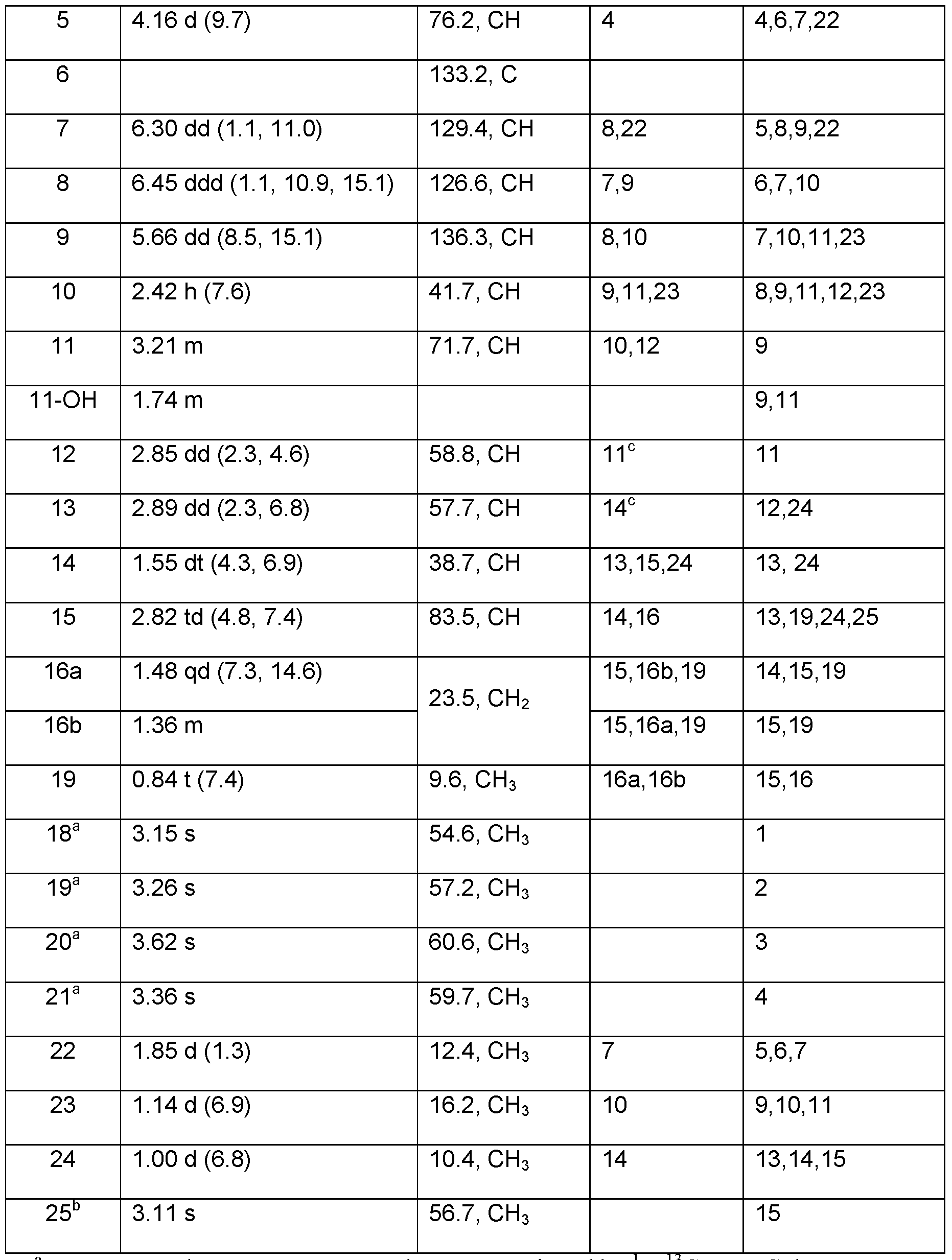
a Protons at carbons at 18, 19, 20 and 21 were assignee I by ¾ C HM \BC data. b Protons at carbons 2 and 4 were assigned by 1H,13C HMBC data. c The gCOSY peak for 12,13 was not identified due to the proximity of protons at C12 and C13. Conclusion
[0344] We describe herein the preparation of a carbohydrate-derived spliceosome inhibitor 2 in a total of 22 steps, including 12 longest linear steps from common building blocks (auxiliary 11, D-glucose and propionaldehyde). Complete in vitro and in vivo pharmacological analyses can be conducted, and this improved stability along with its improved solubility in aqueous buffers suggests an important advance in optimization of splice modulators.
[0345] Overall, this development offers several medicinal chemical benefits. First, it demonstrates that the pyran or macrolide core commonly associated with the known spliceosome inhibitors can be replaced with materials directly available from monosaccharides in the chiral pool. Second, it provides a means to prepare highly stable materials that lack rapid degradation and/or metabolic instability. Third, the use of a carbohydrate motif offers ready access to explore the SAR contained within the core unit (macrolide of la-lb or pyran in lc, FIG. 1). Here, one can envision application of the described route to provide derivatives with expanded functionality at the anomeric CI center, stereoisomers at C1-C4 positions, as well as explore the use of deoxygenated materials and alternative ethers at C1-C4. While to date there has been no structural information on the complex of any established splice modulator with the Sf3b component of the spliceosome, the subsequent integration of a rational design could deliver a carbohydrate-derived splice modulator with enhanced binding and reduced pharmacological risk.
[0346] References
[0347] [1] (a) Kotake, Y.; Sagane, K.; Owa, T.; Mimori-Kiyosue, Y.; Shimizu, H.; Uesugi, M; Ishihama, Y.; Iwata, M; Mizui Y. Nat. Chem. Biol. 2007, 3, 570; (b) Kaida, D.; Motoyoshi,
H.; Tashiro, E.; Nojima, T.; Hagiwara, M.; Ishigami, K.; Watanabe, H.; Kitahara, T.; Yoshida,
T.; Nakajima, H.; Tani, T.; Horinouchi, S.; Yoshida M. Nat. Chem. Biol. 2007, 3, 576; (c)
Hasegawa, M.; Miura, T.; Kuzuya, K.; Inoue, A.; Won, K. S.; Horinouchi, S.; Yoshida, T.;
Kunoh, T.; Koseki, K.; Mino, K.; Sasaki, R.; Yoshida, M.; Mizukami, T. ACS Chem. Biol. 2011, 6, 229; (d) Bonnal, S.; Vigevani, L.; Valcarcel, J. Nat. Rev. Drug Discovery 2012, 11, 847; [2]
Seki-Asano, M.; Okazaki, T.; Yamagishi, M.; Sakai, N.; Taka-yama, Y.; Hanada, K.; Morimoto,
S.; Takatsuki, A.; Mizoue K. J. Antibiot. (Tokyo). 1994, 47, 1395; [3] (a) Mizui, Y.; Sakai, T.;
Iwata, M.; Uenaka, T.; Okamoto, K.; Shimizu, H.; Yamori, T.; Yoshimatsu, K.; Asada, M. J.
Antibiot (To-kyo). 2004, 57, 188. (b) Asai, N.; Kotake, Y.; Niijima, J.; Fukuda, Y.; Uehara, T.; Sakai, T. J. Antibiot (Tokyo). 2007, 60, 364; [4] Salient examples of this family also include spliceostatin A, FR901465, meayamycin, and herboxadiene (GEX1A, lc), as de-scribed within the following: (a) Miller- Wideman, M.; Makkar, N.; Tran, M.; Isaac, B.; Biest, N.; Stonard, R. J.
Antibiot (Tokyo). 1992, 45, 914. (b) Sakai, .Y; Yoshida, T., Ochiai, K.; Uosaki, Y., Saitoh, Y.;
Tanaka, F.; Akiyama, T.; Akinaga, S.; Mizukami, T. J. Antibiot (Tokyo). 2002, 55, 855. (c) Liu,
X.; Biswas, S.; Berg, M. G.; Antapli, C. M; Xie, F.; Wang, Q.; Tang, M. C; Tang, G. L.; Zhang,
L.; Dreyfuss, G; Cheng, Y. Q. J. Nat. Prod. 2013, 76, 685; (d) Nakajima, H.; Sato, B.; Fujita, T.;
Takase, S.; Terano, H.; Okuhara M. J. Antibiot (Tokyo). 1996, 49, 1196-203; (e) Meng, F.;
McGrath, K. P.; Hoveyda, A. H. Nature 2014, 513, 367; [5] For reports on the clinical trials on E7101, consult: (a) Hong, D. S., Kurzrock, R.; Naing, A.; Wheler, J. J.; Falchook, G. S.;
Schiffman, J. S.; Faulkner, N.; Pilat, M. J.; O'Brien, J.; LoRusso, P. Invest. New Drugs. 2014, 32,
436; (b) Dehm, S. M. Clin. Cancer Res. 2013, 19, 6064; [6] The instability of many of the natural product splicing inhibitor, see: (a) Villa, R.; Kashyap, M. K.; Kumar, D.; Kipps, T. J.; Castro, J.
E.; La Clair, J. J.; Burkart, M. D. J. Med. Chem. 2013, 56, 6576. (b) Lagisetti, C; Palacios, G.; Goronga, T.; Freeman, B.; Caufield, W.; Webb, T. R. J. Med. Chem. 2013, 56, 10033; (c) Albert,
B. J.; Sivaramakrishnan, A.; Naka, T.; Czaicki, N. L.; Koide, K. J. Am. Chem. Soc. 2007, 129,
2648; [7] Lagisetti, C; Pourpak, A.; Jiang, Q.; Cui, X.; Goronga, T.; Morris, S. W.; Webb, T. R.
J. Med. Chem. 2008, 51, 6220; [8] (a) Convertini, P.; Shen, M.; Potter, P. M.; Palacios, G;
Lagisetti, C; de la Grange, P.; Horbinski, C; Fondufe-Mittendorf, Y. N; Webb, T. R.; Stamm, S. Nucleic Acids Res. 2014, 42, 4947. (b) Webb, T. R.; Joyner, A. S.; Potter, P. M. Drug Discov.
Today. 2013, 18, 43. (c) Fan, L.; Lagisetti, C; Edwards, C. C; Webb, T. R.; Potter, P. M. ACS
Chem. Biol. 2011, 6, 582-9. (d) Lagisetti, C; Palacios, G.; Goronga, T.; Freeman, B.; Caufield,
W.; Webb, T. R. J. Med. Chem. 2013, 56, 10033; [9] Lagisetti, C; Yermolina, M. V.; Sharma, L.
K.; Palacios, G; Prigaro, B. J.; Webb, T. R. ACS Chem. Biol. 2014, 9, 643; [10] Kanada, R. M.; Itoh, D.; Nagai, M.; Niijima, J.; Asai, N.; Mi-zui, Y.; Abe, S.; Kotake, Y. Angew. Chem. Int. Ed.
Engl. 2007, 46, 4350; [11] Arai, K.; Buonamici, S.; Chan, B.; Corson, L.; Endo, A.; Gerard, B.;
Hao, M. H.; Karr, C; Kira, K.; Lee, L.; Liu, X.; Lowe, J. . T.; Luo, T.; Marcaurelle, L. A.; Mizui,
Y.; Nevalainen, M.; O'Shea, M. W.; Park, E. S.; Perino, S. A.; Prajapati, S.; Shan, M.; Smith, P.
G; Tivitmahaisoon, P.; Wang, J. Y.; Warmuth, M.; Wu, K. M.; Yu, L.; Zhang, H.; Zheng, G. Z.; Keaney, G. F. Org. Lett. 2014, 16, 5560; [12] (a) He, H.; Ratnayake, A. S.; Janso, J. E.; He, M.;
Yang, H. Y.; Loganzo, F.; Shor, B.; O'Donnell, C. J.; Koehn, F. E. J. Nat. Prod. 2014, 77, 1864-
70. (b) Eustaquio, A. S.; Janso, J. E.; Ratnayake, A. S.; O'Donnell, C. J.; Koehn, F. E. Proc. Natl.
Acad. Sci. U S A. 2014 1 11, E3376; [13] (a) Ghosh, A. K.; Veitschegger, A. M.; Sheri, V. R.;
Effen-berger, K. A.; Prichard, B. E.; Jurica, M. S. Org. Lett. 2014, 16, 6200. (b) Ghosh, A. K.; Chen, Z. H.; Effenberger, K. A.; Jurica, M. S. J. Org. Chem. 2014, 79, 5697. (c) Ghosh, A. K.;
Ma, N.; Effenberger, K. A.; Jurica, M. S. Org. Lett. 2014, 16, 3154-7. (d) Effenberger, K. A.;
Anderson, D. D.; Bray, W. M.; Prichard, B. E.; Ma, N.; Adams, M. S.; Ghosh, A. K.; Jurica, M.
S. J. Biol. Chem. 2014, 289, 1938; [14] (a) Larrayoz, M.; Blakemore, S. J.; Dobson, R. C; Blunt,
M. D.; Rose-Zerilli, M. J.; Walewska, R.; Duncombe, A.; Oscier, D.; Koide, K.; Forconi, F.; Packham, G; Yoshida, M.; Cragg, M. S.; Strefford, J. C; Steele, A. J. Leukemia. 2016, 30, 351.
(b) Schreiber, C. A.; Sakuma, T.; Izumiya, Y.; Holditch, S. J.; Hickey, R. D.; Bres-sin, R. K.;
Basu, U.; Koide, K.; Asokan, A.; Ikeda, Y. PLoS Pathog. 2015, 11, el005082. (c) Gao, Y.;
Trivedi, S.; Ferris, R. L.; Koide K. Sci. Rep. 2014, 4, 6098. (d) Gao, Y.; Koide, K. ACS Chem.
Biol. 2013, 8, 895; (e) Gao, Y.; Vogt, A; Forsyth, C. J.; Koide, K. Chembi-ochem. 2013, 14, 49; (f) Visconte, V.; Rogers, H. J.; Singh, J.; Bar-nard, J.; Bupathi, M.; Traina, F.; McMahon, J.;
Makishima, H.; Szpurka, H.; Jankowska, A.; Jerez, A.; Sekeres, M. A.; Sauntharara-jah, Y.;
Advani, A .S.; Copelan, E.; Koseki, H.; Isono, K.; Padgett, R. A.; Osman, S.; Koide, K.; O'Keefe,
C; Maciejewski, J. P.; Tiu, R. V. Blood. 2012, 120, 3193; (g) Osman, S.; Albert, B. J.; Wang,
Y.; Li, M; Czaicki, N. L.; Koide K. Chemistry 2011, 19, 895. (h) Albert, B. J.; McPherson , P. A.; O'Brien, K.; Czaicki, N. L.; Destefino, V.; Osman, S.; Li, M.; Day, B. W.; Grabowski, P. J.;
Moore, M. J.; Vogt, A.; Koide K. Mol. Cancer Ther. 2009, 8, 2308; [15] (a) Kashyap, M. K.;
Kumar, D.; Villa, R.; La Clair, J. J.; Ben-ner, C; Sasik, R.; Jones, H.; Ghia, E. M.; Rassenti, L.
Z.; Kipps, T. J.; Burkart, M. D.; Castro, J. E. Haematologica. 2015, 100, 945. (b) Villa, R.;
Mandel, A. L.; Jones, B. D.; La Clair, J. J.; Burkart, M. D. Org. Lett. 2012, 14, 5396; [16] (a) Ernst, B.; Magnani, J. L. Nat. Rev. Drug Discov. 2009 , 8, 661. (b) Jensen, K. J.; Brask, J.
Biopolymers 2005, 80, 747. (c) Schweizer, F. Angew. Chem. Int. Ed. Engl. 2002, 41, 231; [19]
Structures were generated by positioning the atoms within the molecule using the known NOE correlations and minimizing with MM2 energy minimization. Efforts are now underway to complete a detailed solution structure of la, lb and 2; [18] Yan, C; Hang, J.; Wan, R.; Huang, M.; Wong, C. C; Shi, Y; Science 2015, 349, 1182; [19] (a) Noel, A.; Delpech, B.; Crich, D. Org.
Lett. 2012, 14, 4138. (b) Collins, D. J.; Hibberd, A. I; Skelton, B. W.; White, A. H. Aust. J.
Chem., 1998, 51, 671. (b) Molina P. I; Bueno M. M.; Galbis, J. A. Carbohydr. Res., 2003, 338,
549. (c) Matwiejuk, M.; Thiem, J. Chem. Comm., 2011, 47, 8379; [20] For instance, the first clinical lead, E-7101, bears a carbamate in place of the C29-C30 acetate, see: Eskens, F. A.; Ramos, F. J.; Burger, H.; O'Brien, J. P.; Piera, A.; de Jonge, M. J.; Mizui, Y.; Wiemer, E. A.;
Carreras, M. J.; Baselga, J.; Tabernero J. Clin. Cancer Res. 2013, 19, 6296; [21] (a) Nunes, C. D.;
Vaz, P. D.; Felix, V.; Veiros, L. F.; Moniz, T.; Rangel, M.; Realista, S.; Mourato, A. C;
Calhorda, M. J. Dalton Trans. 2015, 44, 5125. (b) Rodriguez-Berrios, R. R.; Torres, G; Prieto, J.
A. Tetrahedron. 2011, 67, 830; [22] Dalisay, D. S.; Molinski, T. F. J. Nat. Prod. 2009, 72, 739; [SI] Noel, A.; Delpech, B.; Crich, D. Org. Lett. 2012, 14, 4138; [S2] Villa, R.; Mandel, A. L.;
Jones, B. D.; La Clair, J. J.; Burkart, M. D. Org. Lett. 2012, 14, 5396; [S3] Kashyap, M. K.;
Kumar, D.; Villa, R.; La Clair, J. J.; Benner, C; Sasik, R.; Jones, H.; Ghia, E. M.; Rassenti, L. Z.;
Kipps, T. J.; Burkart, M. D.; Castro, J. E. Haematologica. 2015, 100, 945; [S4] Livak, K.J.,
Schmittgen, T.D. Methods. 2001, 25,402.
[0348] Example 2 - Synthesis of Carbohydrate-Derived Splice Modulators 01-010
[0349] Compounds in Embodiments Q1-Q10 were synthesized in similar manner as described above (e.g., Schemes 1-3) and confirmed by proton and carbon NMR and high-resolution mass spectrometry.
Claims
WHAT IS CLAIMED IS :
1. A compound with structure of Formula (I):

wherein, X is -O- or -C(R26)(R27)-; R26 is hydrogen, halogen, substituted or unsubstituted alkyl, substituted or unsubstituted aryl, -OR28, -OC(0)R28, -OC(0)OR28, or -OC(0) R28R29; R27 is hydrogen, halogen, substituted or unsubstituted alkyl, substituted or unsubstituted aryl, -OR30, -OC(0)R3°, -OC(0)OR3°, or -OC(O) R30R31; R1 is hydrogen, substituted or unsubstituted alkyl, -C(0)Ru, or -C(0)ORu; R2 is hydrogen, halogen, substituted or unsubstituted
alkyl, -OR12, -OC(0)R12, -OC(0)OR12, or -OC(0) R12R13; R3 is hydrogen, halogen, substituted or unsubstituted
alkyl, -OR14, -OC(0)R14, -OC(0)OR14, or -OC(0) R14R15; R4 is hydrogen, halogen, substituted or unsubstituted
alkyl, -OR16, -OC(0)R16, -OC(0)OR16, or -OC(0) R16R17; R5 is hydrogen, halogen, substituted or unsubstituted
alkyl, -OR18, -OC(0)R18, -OC(0)OR18, or -OC(0) R18R19; R6 is hydrogen, -OR20, -C(0)R20, -C(0)OR20, -OC(0)R20, or -OC(0)OR20; R7 is hydrogen, -OR21, -C(0)R21, -C(0)OR21, -OC(0)R21, or -OC(0)OR21; R8 is hydrogen, -OR22, -C(0)R22, -C(0)OR22, -OC(0)R22, or -OC(0)OR22; R9 is hydrogen, -OR23, -C(0)R23, -C(0)OR23, -OC(0)R23, or -OC(0)OR23; R10 is hydrogen, substituted or unsubstituted
alkyl, -OR24, -OC(0)R24, -OC(0)OR24, or -OC(0) R24R25; and
? ς R ll R 12 R 13 R 14 R 15 R 16 R 17 R 18 R 19 R 20 R 21 R 22 R 23 R 24 R 25 R 28 R 29 R 30
ZJ
26 and R31 are independently hydrogen, substituted or unsubstituted alkyl, substituted or
27 unsubstituted heteroalkyl, substituted or unsubstituted cycloalkyl, substituted or unsubstituted
28 heterocycloalkyl, substituted or unsubstituted aryl, or substituted or unsubstituted heteroaryl.
29
1 2. The compound of claim 1, wherein:
2 X is -0-;
3 R1 is hydrogen or unsubstituted C1-C4 alkyl; and
4 R10 is hydrogen or unsubstituted C1-C4 alkyl. 1
1 3. The compound of claim 2, wherein:
2 R1 is hydrogen or -CH3; and
3 R10 is hydrogen or -CH3.
1 4. The compound of claim 3, the compound having a structure of Formula
2 (II A):

1 5. The compound of claim 3, the compound having a structure of Formula
2 (IIB):

1 6. The compound of claim 1, wherein:
2 X is -C(R26)(R27)-;
3 R1 is hydrogen or unsubstituted C1-C4 alkyl; and
4 R10 is hydrogen or unsubstituted C1-C4 alkyl.
7. The compound of claim 6, wherein: R1 is hydrogen or -CH3; and
R10 is hydrogen or -CH3.
8. The compound of claim 7, the compound having a structure of Formula (III A):

9. The compound of claim 7, the compound having a structure of Formula (IIIB):

10. The compound of any one of claims 1-9, wherein: one of R4 and R5 is hydrogen and the other one of R4 and R5 is -OH.
11. The compound of claim 10, wherein a chiral carbon where R4 and R5 are attached has (S) stereochemistry.
12. The compound of claim 10, wherein a chiral carbon where R4 and R5 are attached has (R) stereochemistry.
13. The compound of claim 10, wherein one of R2 and R3 is hydrogen and the other one of R2 and R3 is -CH3.
14. The compound of claim 13, wherein a chiral carbon where R2 and R3 are attached has (S) stereochemistry. 15. The compound of claim 13, wherein a chiral carbon where R2 and R3 are attached has (R) stereochemistry. 16. The compound of claim 13, wherein: R6 is hydrogen, -OR20 or -C(0)OR20; R7 is hydrogen, -OR21 or -C(0)OR21; R8 is hydrogen, -OR22 or -C(0)OR22; R9 is hydrogen, -OR23 or -C(0)OR23; and
20 21 22 23
R , R , R , and R" are each independently hydrogen or unsubstituted C1-C4 alkyl.
17. The compound of claim 16, wherein R 20 , R 21 , R 22 , and R 23 are each independently hydrogen or -CH3. 18. The compound of claim 16, wherein at least one of R6, R7, R8, and R9 is - OCH3. 19. The compound of claim 18, wherein at least two of R6, R7, R8, and R9 are -OCH3. 20. The compound of claim 18, wherein R6, R7, R8 and R9 are -OCH3. 21. The compound of claim 18, wherein: R6 is -OCH3; R7 is hydrogen; R8 is hydrogen; and R9 is-OCH3. 22. The compound of claim 4, wherein the compound is selected from:


140

141

31. A pharmaceutical composition comprising a compound of any one of claims 1-30 and a pharmaceutically acceptable excipient. 32. A method of treating cancer, the method comprising administering to a subject in need thereof a therapeutically effective amount of a compound of any one of claims 1- 30. 33. The method of claim 32, wherein the cancer is leukemia, lymphoma, metastatic cancer, or bone cancer. 34. The method of any one of claims 32-33, wherein the cancer is chronic lymphocytic leukemia (CLL).
35. A method of detecting splicesome inhibition with a test compound, the method comprising: (i) contacting a cell with a test compound; (ii) extracting an mRNA from said cell thereby producing an extracted mRNA; (iii) reverse transcribing said extracted mRNA using intron-specific primers thereby forming an intron cDNA; (iv) amplifying said intron cDNA thereby forming a plurality of amplified intron cDNAs; and (v) detecting the presence of said amplified intron cDNAs thereby detecting spliceosome inhibition with said test compound. 36. The method of claim 35, wherein said cell is derived from a patient. 37. The method of any one of claims 35-36, wherein said cell is a cancer cell. 38. The method of any one of claims 35-37, wherein said extracting comprises lysing said cell.
Priority Applications (1)
| Application Number | Priority Date | Filing Date | Title |
|---|---|---|---|
| US16/083,419 US11203588B2 (en) | 2016-03-10 | 2017-03-10 | Anti-cancer and splice modulating compounds and methods |
Applications Claiming Priority (2)
| Application Number | Priority Date | Filing Date | Title |
|---|---|---|---|
| US201662306562P | 2016-03-10 | 2016-03-10 | |
| US62/306,562 | 2016-03-10 |
Publications (1)
| Publication Number | Publication Date |
|---|---|
| WO2017156454A1 true WO2017156454A1 (en) | 2017-09-14 |
Family
ID=59790818
Family Applications (1)
| Application Number | Title | Priority Date | Filing Date |
|---|---|---|---|
| PCT/US2017/021897 Ceased WO2017156454A1 (en) | 2016-03-10 | 2017-03-10 | Anti-cancer and splce modulating compounds and methods |
Country Status (2)
| Country | Link |
|---|---|
| US (1) | US11203588B2 (en) |
| WO (1) | WO2017156454A1 (en) |
Cited By (3)
| Publication number | Priority date | Publication date | Assignee | Title |
|---|---|---|---|---|
| WO2020123836A3 (en) * | 2018-12-13 | 2020-07-23 | Eisai R&D Management Co., Ltd. | Herboxidiene splicing modulator antibody-drug conjugates and methods of use |
| WO2021026273A1 (en) * | 2019-08-06 | 2021-02-11 | The Regents Of The University Of California | Scaleable preparation of polyketides |
| RU2820607C2 (en) * | 2018-12-13 | 2024-06-06 | Эйсай Ар Энд Ди Менеджмент Ко., Лтд. | Antibody-drug conjugates containing herboxydiene-based splicing modulator, and methods of use thereof |
Families Citing this family (4)
| Publication number | Priority date | Publication date | Assignee | Title |
|---|---|---|---|---|
| WO2020092528A1 (en) | 2018-10-31 | 2020-05-07 | Gilead Sciences, Inc. | Substituted 6-azabenzimidazole compounds having hpk1 inhibitory activity |
| US11203591B2 (en) | 2018-10-31 | 2021-12-21 | Gilead Sciences, Inc. | Substituted 6-azabenzimidazole compounds |
| EP3972695A1 (en) | 2019-05-23 | 2022-03-30 | Gilead Sciences, Inc. | Substituted exo-methylene-oxindoles which are hpk1/map4k1 inhibitors |
| CN119925346B (en) * | 2025-04-10 | 2025-07-01 | 中国人民解放军军事科学院军事医学研究院 | New application of compound Pladienolide B in anti-abrinia toxin |
Citations (3)
| Publication number | Priority date | Publication date | Assignee | Title |
|---|---|---|---|---|
| US20110086909A1 (en) * | 2006-09-08 | 2011-04-14 | University Of Pittsburgh-- Of The Commonwealth System Of Higher Education | Synthesis of fr901464 and analogs with antitumor activity |
| US20140134193A1 (en) * | 2012-11-05 | 2014-05-15 | Pfizer Inc. | Spliceostatin analogs and methods for their preparation |
| US20150133535A1 (en) * | 2012-03-26 | 2015-05-14 | The Regents Of The University Of California | Anti-cancer polyketide compounds |
-
2017
- 2017-03-10 WO PCT/US2017/021897 patent/WO2017156454A1/en not_active Ceased
- 2017-03-10 US US16/083,419 patent/US11203588B2/en active Active
Patent Citations (3)
| Publication number | Priority date | Publication date | Assignee | Title |
|---|---|---|---|---|
| US20110086909A1 (en) * | 2006-09-08 | 2011-04-14 | University Of Pittsburgh-- Of The Commonwealth System Of Higher Education | Synthesis of fr901464 and analogs with antitumor activity |
| US20150133535A1 (en) * | 2012-03-26 | 2015-05-14 | The Regents Of The University Of California | Anti-cancer polyketide compounds |
| US20140134193A1 (en) * | 2012-11-05 | 2014-05-15 | Pfizer Inc. | Spliceostatin analogs and methods for their preparation |
Cited By (9)
| Publication number | Priority date | Publication date | Assignee | Title |
|---|---|---|---|---|
| WO2020123836A3 (en) * | 2018-12-13 | 2020-07-23 | Eisai R&D Management Co., Ltd. | Herboxidiene splicing modulator antibody-drug conjugates and methods of use |
| CN113271981A (en) * | 2018-12-13 | 2021-08-17 | 卫材R&D管理有限公司 | Hobertadiene antibody-drug conjugates and methods of use |
| JP2022512401A (en) * | 2018-12-13 | 2022-02-03 | エーザイ・アール・アンド・ディー・マネジメント株式会社 | Harboxy Diene Splicing Regulatory Antibodies-Drug Conjugates and Their Usage |
| US20220031859A1 (en) * | 2018-12-13 | 2022-02-03 | Eisai R&D Management Co., Ltd. | Herboxidiene antibody-drug conjugates and methods of use |
| RU2820607C2 (en) * | 2018-12-13 | 2024-06-06 | Эйсай Ар Энд Ди Менеджмент Ко., Лтд. | Antibody-drug conjugates containing herboxydiene-based splicing modulator, and methods of use thereof |
| TWI853863B (en) * | 2018-12-13 | 2024-09-01 | 日商衛材R&D企管股份有限公司 | Herboxidiene splicing modulator antibody-drug conjugates and methods of use |
| JP7570329B2 (en) | 2018-12-13 | 2024-10-21 | エーザイ・アール・アンド・ディー・マネジメント株式会社 | Herboxidien splicing regulator antibody-drug conjugates and methods of use thereof |
| US12514928B2 (en) * | 2018-12-13 | 2026-01-06 | Eisai R&D Management Co., Ltd. | Herboxidiene antibody-drug conjugates and methods of use |
| WO2021026273A1 (en) * | 2019-08-06 | 2021-02-11 | The Regents Of The University Of California | Scaleable preparation of polyketides |
Also Published As
| Publication number | Publication date |
|---|---|
| US11203588B2 (en) | 2021-12-21 |
| US20200299279A1 (en) | 2020-09-24 |
Similar Documents
| Publication | Publication Date | Title |
|---|---|---|
| US11203588B2 (en) | Anti-cancer and splice modulating compounds and methods | |
| US9604973B2 (en) | Anti-cancer polyketide compounds | |
| KR101835253B1 (en) | Synthesis of resorcylic acid lactones useful as therapeutic agents | |
| CN110770234B (en) | Substituted aryl ether compound, preparation method thereof, medicinal composition and application thereof | |
| JP2018513145A (en) | Imidazoisoindole derivatives, process for producing the same and pharmaceutical use thereof | |
| JP2019189644A (en) | Anti-cancer agents and preparation methods thereof | |
| WO2014018919A1 (en) | Seriniquinones, melanoma-specific anticancer agents | |
| Xiao et al. | Novel panaxadiol triazole derivatives induce apoptosis in HepG-2 cells through the mitochondrial pathway | |
| Li et al. | Synthesis, antitumor activity evaluation and mechanistic study of novel hederacolchiside A1 derivatives bearing an aryl triazole moiety | |
| KR102238012B1 (en) | Carboline derivatives, bromodomain inhibitors | |
| CN114437109A (en) | Halogenated derivative of staurosporine, preparation method and application thereof | |
| US12172988B2 (en) | Anticancer and antifungal splice modulators | |
| WO2023178302A1 (en) | Parthenolide derivatives and use thereof | |
| JP7765835B2 (en) | Anti-SARS-CoV-2 drug | |
| WO2016086008A1 (en) | Small molecule aldehyde dehydrogenase inhibitors and methods of use thereof | |
| US12084456B2 (en) | Isocarbostyril alkaloids and functionalization thereof | |
| CN112125914B (en) | 5-substituted berbamine derivatives, preparation method and application thereof | |
| WO2010080817A2 (en) | Carbohydrate-cyclopamine conjugates as anticancer agents | |
| CN114302721B (en) | Scalable preparation of polyketones | |
| JP7093410B2 (en) | Bis (hydroxymethyl) pyrroloftalazine hybrid, preparation method and its uses | |
| CN116143625B (en) | Design of griifolin prodrugs and their application in inhibiting DNMT1 gene | |
| CN116789530B (en) | Perilla alcohol phenol derivative and preparation method and application thereof | |
| AU2020325035B2 (en) | Scaleable preparation of polyketides | |
| Sung et al. | Synthesis and Evaluation of Dapagliflozin Ester Prodrugs with Improved Hygroscopicity and Thermal Stability | |
| CN115611897A (en) | Compounds as RSK2 inhibitors and uses thereof |
Legal Events
| Date | Code | Title | Description |
|---|---|---|---|
| NENP | Non-entry into the national phase |
Ref country code: DE |
|
| 121 | Ep: the epo has been informed by wipo that ep was designated in this application |
Ref document number: 17764227 Country of ref document: EP Kind code of ref document: A1 |
|
| 122 | Ep: pct application non-entry in european phase |
Ref document number: 17764227 Country of ref document: EP Kind code of ref document: A1 |