WO2017152032A1 - Novel oxazole and thiazole compounds as β-catenin modulators and uses thereof - Google Patents
Novel oxazole and thiazole compounds as β-catenin modulators and uses thereof Download PDFInfo
- Publication number
- WO2017152032A1 WO2017152032A1 PCT/US2017/020631 US2017020631W WO2017152032A1 WO 2017152032 A1 WO2017152032 A1 WO 2017152032A1 US 2017020631 W US2017020631 W US 2017020631W WO 2017152032 A1 WO2017152032 A1 WO 2017152032A1
- Authority
- WO
- WIPO (PCT)
- Prior art keywords
- substituted
- unsubstituted
- compound
- alkyl
- cancer
- Prior art date
- Legal status (The legal status is an assumption and is not a legal conclusion. Google has not performed a legal analysis and makes no representation as to the accuracy of the status listed.)
- Ceased
Links
- 0 BC1=C(*)N=C(*)*1 Chemical compound BC1=C(*)N=C(*)*1 0.000 description 15
- USYVASPSSSUBEM-UHFFFAOYSA-N CCOC(c([s]1)c(C)nc1Br)=C Chemical compound CCOC(c([s]1)c(C)nc1Br)=C USYVASPSSSUBEM-UHFFFAOYSA-N 0.000 description 1
- VRHCKBIBFDYJKC-UHFFFAOYSA-N CCc(cc1)ccc1-c1nc(C)c(C(OCC)=O)[s]1 Chemical compound CCc(cc1)ccc1-c1nc(C)c(C(OCC)=O)[s]1 VRHCKBIBFDYJKC-UHFFFAOYSA-N 0.000 description 1
- CLEMXYFGIYXANE-UHFFFAOYSA-N CCc(cc1)ccc1-c1nc(C)c(CCC(OC)=O)[s]1 Chemical compound CCc(cc1)ccc1-c1nc(C)c(CCC(OC)=O)[s]1 CLEMXYFGIYXANE-UHFFFAOYSA-N 0.000 description 1
- PBMFSQRYOILNGV-UHFFFAOYSA-N c1ccnnc1 Chemical compound c1ccnnc1 PBMFSQRYOILNGV-UHFFFAOYSA-N 0.000 description 1
- KYQCOXFCLRTKLS-UHFFFAOYSA-N c1cnccn1 Chemical compound c1cnccn1 KYQCOXFCLRTKLS-UHFFFAOYSA-N 0.000 description 1
- CZPWVGJYEJSRLH-UHFFFAOYSA-N c1cncnc1 Chemical compound c1cncnc1 CZPWVGJYEJSRLH-UHFFFAOYSA-N 0.000 description 1
Classifications
-
- A—HUMAN NECESSITIES
- A61—MEDICAL OR VETERINARY SCIENCE; HYGIENE
- A61P—SPECIFIC THERAPEUTIC ACTIVITY OF CHEMICAL COMPOUNDS OR MEDICINAL PREPARATIONS
- A61P35/00—Antineoplastic agents
-
- C—CHEMISTRY; METALLURGY
- C07—ORGANIC CHEMISTRY
- C07D—HETEROCYCLIC COMPOUNDS
- C07D263/00—Heterocyclic compounds containing 1,3-oxazole or hydrogenated 1,3-oxazole rings
- C07D263/02—Heterocyclic compounds containing 1,3-oxazole or hydrogenated 1,3-oxazole rings not condensed with other rings
- C07D263/30—Heterocyclic compounds containing 1,3-oxazole or hydrogenated 1,3-oxazole rings not condensed with other rings having two or three double bonds between ring members or between ring members and non-ring members
- C07D263/32—Heterocyclic compounds containing 1,3-oxazole or hydrogenated 1,3-oxazole rings not condensed with other rings having two or three double bonds between ring members or between ring members and non-ring members with only hydrogen atoms, hydrocarbon or substituted hydrocarbon radicals, directly attached to ring carbon atoms
-
- C—CHEMISTRY; METALLURGY
- C07—ORGANIC CHEMISTRY
- C07D—HETEROCYCLIC COMPOUNDS
- C07D277/00—Heterocyclic compounds containing 1,3-thiazole or hydrogenated 1,3-thiazole rings
- C07D277/02—Heterocyclic compounds containing 1,3-thiazole or hydrogenated 1,3-thiazole rings not condensed with other rings
- C07D277/20—Heterocyclic compounds containing 1,3-thiazole or hydrogenated 1,3-thiazole rings not condensed with other rings having two or three double bonds between ring members or between ring members and non-ring members
- C07D277/22—Heterocyclic compounds containing 1,3-thiazole or hydrogenated 1,3-thiazole rings not condensed with other rings having two or three double bonds between ring members or between ring members and non-ring members with only hydrogen atoms, hydrocarbon or substituted hydrocarbon radicals, directly attached to ring carbon atoms
- C07D277/24—Radicals substituted by oxygen atoms
-
- C—CHEMISTRY; METALLURGY
- C07—ORGANIC CHEMISTRY
- C07D—HETEROCYCLIC COMPOUNDS
- C07D277/00—Heterocyclic compounds containing 1,3-thiazole or hydrogenated 1,3-thiazole rings
- C07D277/02—Heterocyclic compounds containing 1,3-thiazole or hydrogenated 1,3-thiazole rings not condensed with other rings
- C07D277/20—Heterocyclic compounds containing 1,3-thiazole or hydrogenated 1,3-thiazole rings not condensed with other rings having two or three double bonds between ring members or between ring members and non-ring members
- C07D277/22—Heterocyclic compounds containing 1,3-thiazole or hydrogenated 1,3-thiazole rings not condensed with other rings having two or three double bonds between ring members or between ring members and non-ring members with only hydrogen atoms, hydrocarbon or substituted hydrocarbon radicals, directly attached to ring carbon atoms
- C07D277/26—Radicals substituted by sulfur atoms
-
- C—CHEMISTRY; METALLURGY
- C07—ORGANIC CHEMISTRY
- C07D—HETEROCYCLIC COMPOUNDS
- C07D277/00—Heterocyclic compounds containing 1,3-thiazole or hydrogenated 1,3-thiazole rings
- C07D277/02—Heterocyclic compounds containing 1,3-thiazole or hydrogenated 1,3-thiazole rings not condensed with other rings
- C07D277/20—Heterocyclic compounds containing 1,3-thiazole or hydrogenated 1,3-thiazole rings not condensed with other rings having two or three double bonds between ring members or between ring members and non-ring members
- C07D277/22—Heterocyclic compounds containing 1,3-thiazole or hydrogenated 1,3-thiazole rings not condensed with other rings having two or three double bonds between ring members or between ring members and non-ring members with only hydrogen atoms, hydrocarbon or substituted hydrocarbon radicals, directly attached to ring carbon atoms
- C07D277/28—Radicals substituted by nitrogen atoms
-
- C—CHEMISTRY; METALLURGY
- C07—ORGANIC CHEMISTRY
- C07D—HETEROCYCLIC COMPOUNDS
- C07D277/00—Heterocyclic compounds containing 1,3-thiazole or hydrogenated 1,3-thiazole rings
- C07D277/02—Heterocyclic compounds containing 1,3-thiazole or hydrogenated 1,3-thiazole rings not condensed with other rings
- C07D277/20—Heterocyclic compounds containing 1,3-thiazole or hydrogenated 1,3-thiazole rings not condensed with other rings having two or three double bonds between ring members or between ring members and non-ring members
- C07D277/22—Heterocyclic compounds containing 1,3-thiazole or hydrogenated 1,3-thiazole rings not condensed with other rings having two or three double bonds between ring members or between ring members and non-ring members with only hydrogen atoms, hydrocarbon or substituted hydrocarbon radicals, directly attached to ring carbon atoms
- C07D277/30—Radicals substituted by carbon atoms having three bonds to hetero atoms with at the most one bond to halogen, e.g. ester or nitrile radicals
-
- C—CHEMISTRY; METALLURGY
- C07—ORGANIC CHEMISTRY
- C07D—HETEROCYCLIC COMPOUNDS
- C07D417/00—Heterocyclic compounds containing two or more hetero rings, at least one ring having nitrogen and sulfur atoms as the only ring hetero atoms, not provided for by group C07D415/00
- C07D417/02—Heterocyclic compounds containing two or more hetero rings, at least one ring having nitrogen and sulfur atoms as the only ring hetero atoms, not provided for by group C07D415/00 containing two hetero rings
- C07D417/04—Heterocyclic compounds containing two or more hetero rings, at least one ring having nitrogen and sulfur atoms as the only ring hetero atoms, not provided for by group C07D415/00 containing two hetero rings directly linked by a ring-member-to-ring-member bond
-
- C—CHEMISTRY; METALLURGY
- C07—ORGANIC CHEMISTRY
- C07D—HETEROCYCLIC COMPOUNDS
- C07D417/00—Heterocyclic compounds containing two or more hetero rings, at least one ring having nitrogen and sulfur atoms as the only ring hetero atoms, not provided for by group C07D415/00
- C07D417/02—Heterocyclic compounds containing two or more hetero rings, at least one ring having nitrogen and sulfur atoms as the only ring hetero atoms, not provided for by group C07D415/00 containing two hetero rings
- C07D417/12—Heterocyclic compounds containing two or more hetero rings, at least one ring having nitrogen and sulfur atoms as the only ring hetero atoms, not provided for by group C07D415/00 containing two hetero rings linked by a chain containing hetero atoms as chain links
-
- C—CHEMISTRY; METALLURGY
- C07—ORGANIC CHEMISTRY
- C07D—HETEROCYCLIC COMPOUNDS
- C07D417/00—Heterocyclic compounds containing two or more hetero rings, at least one ring having nitrogen and sulfur atoms as the only ring hetero atoms, not provided for by group C07D415/00
- C07D417/14—Heterocyclic compounds containing two or more hetero rings, at least one ring having nitrogen and sulfur atoms as the only ring hetero atoms, not provided for by group C07D415/00 containing three or more hetero rings
Definitions
- This invention relates to oxazole and thiazole compounds capable of modulating ⁇ -catenin activity and uses of such compounds to modulate the activity of the W t/wingless (wg) signaling pathway.
- nts/wingless are a family of conserved signaling molecules that have been shown to regulate a plethora of fundamental developmental and cell biological processes, including cell proliferation, differentiation and cell polarity [Miller et al. Oncogene 18, 7860-72
- the main function of the canonical Wnt pathway is to stabilize the cytoplasmic pool of a key mediator, B-catenin (R-cat)l armadillo (arm), which is otherwise degraded by the proteosome pathway (See Fig. 1).
- R-cat/arm is also known to act as a transcription factor by forming a complex with the LEF/TCF (Lymphoid Enhancer Factor/T Cell Factor) family of HMG-box (High mobility group) transcription factors.
- LEF/TCF Lymphoid Enhancer Factor/T Cell Factor
- HMG-box High mobility group
- CRT Catenin responsive transcription
- Wnt/wg signaling can also activate an alternative "non-canonical" pathway that may lead to PKC (Protein Kinase C) and JNK (c-Jun N-terminal Kinase) activation resulting in calcium release and cytoskeletal rearrangements [Miller et al. supra (1999)].
- PKC Protein Kinase C
- JNK c-Jun N-terminal Kinase
- LRP5, KP6/arrow a co-receptor encoded by LDL-related-protein-5, 6
- GSK-3B is known to phosphorylate B-cat/arw, which marks it for ubiquitination and subsequent proteosome-mediated degradation.
- Activation of the receptor/co-receptor complex upon Wnt binding initiates a signal transduction cascade, which results in phosphorylation and subsequent inactivation of GSK-3B24.
- U.S. Patent No. 8,252,823 discloses substituted mercaptomethyl-oxazole compounds as B-catenin modulators.
- the present invention provides a method for preventing, treating or ameliorating in a mammal a disease or condition that is causally related to the aberrant activity of the Wnt pathway in vivo, which comprises administering to the mammal an effective disease- treating or condition-treating amount of a compound according to formula I:
- Y is -S-, -S(O)- or -S(0) 2 -, one of A or B is -L 1 -X-L 2 -C(0)-NR 2a R 2b or - ⁇ ⁇ - ⁇ ⁇ )- OR 2a , and the other is R 1 ;
- Y is -0-
- B is -L 1 -X-L 2 -C(0)-NR 2a R 2b or -L 1 -X-L 2 -C(0)-OR 2a
- A is R 1 ;
- X is a single bond, -C(R 4a R 4b )-, -0-, -S-, -S(O)- or -S(0) 2 -;
- Cy is substituted or unsubstituted aryl or substituted or unsubstituted heteroaryl
- each of L 1 and L 2 is independently substituted or unsubstituted C 1 -C7 alkylene or heteroalkylene;
- R 1 is hydrogen, halo, or substituted or unsubstituted C 1 -C5 alkyl
- each R 2a and R 2b is independently selected from H, substituted or unsubstituted alkyl, substituted or unsubstituted cycloalkyl, substituted or unsubstituted aryl, and substituted or unsubstituted heteroaryl; or R 2a and R 2b are joined together to form a substituted or unsubstituted heterocycloalkyl or a heteroaryl ring;
- each R 4a and R 4b is independently selected from H, substituted or unsubstituted alkyl, and halo;
- the present invention provides a composition of a compound according to formula I, or a pharmaceutically acceptable salt, solvate or prodrug thereof; or stereoisomers, isotopic variants or tautomers thereof.
- the present invention provides a composition of a compound according to formula I, provided that:
- 5-oxazolebutanoic acid 2-(2-methoxyphenyl)-4-methyl-, methyl ester; or 5-thiazolebutanoic acid, 4-methyl-P-oxo-2 -phenyl-, ethyl ester; or a pharmaceutically acceptable salt, solvate or prodrug thereof;
- R 1 is substituted or unsubstituted alkyl or halo.
- R 1 is Me, Et, i-Pr, n-Pr, n-Bu, F, CI, Br, or I.
- R 1 is Me.
- the present invention provides a composition of a compound according to formula IVa, IVb, IVc, IVd, IVe, or IVf
- R 1 , R 2a , and R 2b are as in claim 1 ; n is 1, 2, 3, 4, or 5; and
- each R 3c is independently selected from H, alkyl, substituted alkyl, acyl, substituted acyl, substituted or unsubstituted acylamino, substituted or unsubstituted alkylamino, substituted or unsubstituted alkythio, substituted or unsubstituted alkoxy, alkoxycarbonyl, substituted alkoxycarbonyl, substituted or unsubstituted alkylarylamino, arylalkyloxy, substituted arylalkyloxy, amino, aryl, substituted aryl, arylalkyl, substituted or unsubstituted sulfonyl, substituted or unsubstituted sulfinyl, substituted or unsubstituted sulfanyl, substituted or unsubstituted aminosulfonyl, substituted or unsubstituted arylsulfonyl, azido, carboxy, substituted or un
- the present invention provides pharmaceutical compositions comprising a oxazole and/or thiazole compound of the invention, and a pharmaceutically acceptable carrier, excipient or diluent.
- the pharmaceutical composition can comprise one or more of the compounds described herein.
- the compounds of the present invention useful in the pharmaceutical compositions and treatment methods disclosed herein are all pharmaceutically acceptable as prepared and used.
- this invention provides the compounds of the invention and other agents for use in the treatment of mammals susceptible to or afflicted with a condition from those listed herein, and particularly, such conditions as may be associated with alterations or aberrations in Wnt/wg- pathway signaling.
- the present invention extends to the use of any of the compounds of the invention for the preparation of medicaments that may be administered for such treatments, as well as to such compounds for the treatments disclosed and specified.
- a further aspect and object of the invention is to provide a method of treating a mammal susceptible to or afflicted with a condition from among those listed herein, and particularly, such condition as may be associated with e.g. altered Wnt/wg pathway signaling, by administering to such mammal an effective disease-treating or condition-treating amount of a compound or composition of the invention.
- Such conditions include, without limitation ⁇ variety of hyperproliferative disorders, fibrotic diseases (e.g., pulmonary fibrosis), and cancers, including prostate cancer, colorectal cancer, breast cancer, skin cancer (e.g., melanoma), hepatic cancer (e.g., hepatocellular cancer and hepatoblastoma), head and neck cancer, lung cancer (e.g., non- small cell lung cancer), gastric cancer, mesothelioma, Barrett's esophagus, synovial sarcoma, cervical cancer, endometrial ovarian cancer, Wilm's tumor, bladder cancer and leukemia.
- fibrotic diseases e.g., pulmonary fibrosis
- cancers including prostate cancer, colorectal cancer, breast cancer, skin cancer (e.g., melanoma), hepatic cancer (e.g., hepatocellular cancer and hepatoblastoma), head and neck cancer, lung cancer (e.
- Figure 1 shows a plasmid map of Super 8X Topflash.
- Figure 2 shows a plasmid map of pPGK-mWnt3 A.
- FIG. 3 is a graph showing dose dependent inhibition of the Wnt reporter by
- Figure 4 depicts a graph showing dose dependent inhibition of the Wnt reporter by iCRT3 analog A45 in FEK293 cells stimulated with either exogenous (STF) or endogenous Wnt 3a (STF3a).
- Compound A45 is Example 1 (Table 1).
- Figure 5 depicts a graph showing dose dependent inhibition of the Wnt reporter by iCRT3 analog, A48 in FEK293 cells stimulated with either exogenous (STF) or endogenous Wnt 3a (STF3a).
- Compound A48 is Example 2 (Table 1).
- Figure 6 shows a histogram depicting iCRT3 mediated inhibition of proliferation of HCT116 colorectal cells.
- CCD-I8C0 cells control cell line for normal colon cells
- the Wnt pathway is one of a core set of evolutionarily conserved signaling pathways that regulates many aspects of metazoan development. Misregulation or aberrant regulation of the Wnt pathway can lead to adverse effects as demonstrated by the causal relationship identified between mutations in several components of the pathway and
- CRT catenin responsive transcription
- the family of compounds disclosed herein comprises inhibitors that specifically target the activity of the signaling pool of B-catenin.
- Wnt signaling has been linked to or causally related with a variety of cancers, including: prostate cancer, colon cancer, rectal cancer, breast cancer, skin cancer (e.g., melanoma), liver cancer (e.g., hepatocellular cancer and hepatoblastoma), head and neck cancer, lung cancer (e.g., non-small cell lung cancer), gastric cancer, mesothelioma, Barrett's esophagus, synovial sarcoma, cervical cancer, endometrial ovarian cancer, Wilm's tumor, bladder cancer and leukemia. See, for example, Luu et al.
- a breakthrough in understanding recurring, resistant disease was the finding that prostate cancer cells become addicted to the AR pathway, and up-regulation of the AR is the major determinate in aggressive castration-resistant prostate cancer [Chen et al, Nat Med, 2004. 10(1): 33-39].
- recent studies show that even under conditions of androgen ablation therapy, prostate cancer cells are able to synthesize androgens locally, through upregulation of androgen synthetic enzymes that direct de novo androgen synthesis or convert adrenal androgens to higher affinity ligands, testosterone and dihydrotestosterone [Titus et al, Clin Cancer Res, 2005. 11(13): 4653-7;
- treatment approaches to develop more effective drugs include agents that block androgen binding to the AR (AR antagonists) such as the MDV3100 compound [Tran et al, Science, 2009. 324(5928): 787-90; Scher et al, Lancet, 2010. 375(9724): 1437-46] or inhibit synthetic enzymes in the androgen synthesis pathway such as abiraterone acetate [Attard et al, Cancer Res, 2009. 69(12): 4937-40].
- AR antagonists such as the MDV3100 compound [Tran et al, Science, 2009. 324(5928): 787-90; Scher et al, Lancet, 2010. 375(9724): 1437-46] or inhibit synthetic enzymes in the androgen synthesis pathway such as abiraterone acetate [Attard et al, Cancer Res, 2009. 69(12): 4937-40].
- the present inventors have investigated further the role of the Wnt signaling pathway in prostate cancer by testing small molecule inhibitors of nuclear ⁇ -catenin to evaluate to evaluate their ability to repress prostate cancer growth by inhibiting AR function.
- this approach takes advantage of the fact that the AR interacts with, and is transcriptionally regulated by ⁇ -catenin.
- ⁇ -catenin is an effector of the Wnt family of proteins, an evolutionarily conserved group of signaling molecules that regulates developmental and biological processes [Wodarz et al, Annu Rev Cell Dev Biol, 1998. 14: 59-88; Miller et al, Oncogene, 1999.
- Wnt signaling results in stabilization and activation of ⁇ -catenin, which translocates to the nucleus and together with the T-cell Factor (TCF) family of transcription factors, regulates expression of target genes.
- TCF T-cell Factor
- Aberrant Wnt/ ⁇ -catenin signaling has been linked to a number of human cancers [Miyoshi et al, Breast Cancer Res, 2003. 5(2): 63- 8; Moon et al, Nat Rev Genet, 2004. 5(9): 691-701] including prostate cancer [Wang et al, Cancer Res, 2008. 68(23): 9918-27; Beildeck et al, Exp Cell Res, 2010. 316(11): 1763-72; Yu et al, Prostate, 2009. 69(3): 249-62].
- the AR gene itself is a target of nuclear ⁇ -catenin action through TCF binding sites in the AR promoter [Yang et al, Oncogene, 2006. 25(24): 3436-44]. Further, crosstalk between the AR and ⁇ -catenin pathways occurs in castration-resistant prostate cancer [Wang et al, Cancer Res, 2008. 68(23): 9918-27]. Therefore, in theory, ⁇ -catenin inhibitors would modulate AR and its target genes as well as direct targets of ⁇ -catenin such as c-myc [He et al, Science, 1998. 281(5382): 1509-12], which acts as an oncogene in prostate cancer [Ellwood-Yen et al, Cancer Cell, 2003. 4(3): 223- 38; Zhang et al, Prostate, 2000. 43(4): 278-85; Koh et al, Am J Pathol, 2011. 178(4): 1824-34].
- cancer stem cells small subpopulations of cancer cells, termed “cancer stem cells (CSCs)” or “tumor-initiating cells” based on their ability to self-renew as well as differentiate to a daughter cell type, play a critical role in both initiation and maintenance of tumors. It has been suggested that these cells are resistant to conventional chemotherapy and radiation, making it important to develop new therapeutic approaches to selectively target them [Chandler et al, Stem Cell Res Ther, 2010. 1(2): p. 13; Korkaya et al, Nat Cell Biol, 2010.
- an analogue means one analogue or more than one analogue.
- 'Acyl' or 'Alkanoyl' refers to a radical -C(0)R 20 , where R 20 is hydrogen, Ci-C 8 alkyl, C3-C10 cycloalkyl, C3-C10 cycloalkylmethyl, 4-10 membered heterocycloalkyl, aryl, arylalkyl, 5-10 membered heteroaryl or heteroarylalkyl as defined herein.
- Representative examples include, but are not limited to, formyl, acetyl, cyclohexylcarbonyl,
- cyclohexylmethylcarbonyl benzoyl and benzylcarbonyl.
- exemplary 'acyl' groups are -C(0)H, -C(0)-Ci-C 8 alkyl, -C(0)-(CH 2 ) t (C 6 -Cio aryl), -C(O)-(CH 2 ) t (5-10 membered heteroaryl), - C(0)-(CH 2 ) t (C 3 -Cio cycloalkyl), and -C(O)-(CH 2 ) t (4-10 membered heterocycloalkyl), wherein t is an integer from 0 to 4.
- Substituted Acyl' or ' Substituted Alkanoyl' refers to a radical -C(0)R 21 , wherein
- R 21 is independently
- Ci-C 8 alkyl substituted with halo or hydroxy
- 'Acylamino' refers to a radical - R 22 C(0)R 23 , where R 22 is hydrogen, Ci-C 8 alkyl, C3-C10 cycloalkyl, 4-10 membered heterocycloalkyl, C 6 -Cio aryl, arylalkyl, 5-10 memberd heteroaryl or heteroarylalkyl and R 23 is hydrogen, Ci-C 8 alkyl, C3-C10 cycloalkyl, 4-10 membered heterocycloalkyl, C 6 -Cio aryl, arylalkyl, 5-10 membered heteroaryl or heteroarylalkyl, as defined herein.
- Exemplary 'acylamino' include, but are not limited to, formylamino, acetylamino, cyclohexylcarbonylamino, cyclohexylmethyl-carbonylamino, benzoylamino and benzylcarbonylamino.
- Particular exemplary 'acylamino' groups are - R 24 C(0)-Ci-C 8 alkyl, - R 24 C(0)-(CH 2 ) t (C 6 -Cio aryl), - R 24 C(O)-(CH 2 ) t (5-10 membered heteroaryl), - R 24 C(0)- (CH 2 ) t (C 3 -Cio cycloalkyl), and - R 24 C(O)-(CH 2 ) t (4-10 membered heterocycloalkyl), wherein t is an integer from 0 to 4, and each R 24 independently represents H or Ci-C 8 alkyl.
- Substituted Acylamino' refers to a radical - R 25 C(0)R 26 , wherein:
- R 25 is independently
- R 26 is independently
- R 25 and R 26 is other than H.
- 'Acyloxy' refers to a radical -OC(0)R 27 , where R 27 is hydrogen, Ci-C 8 alkyl, C 3 -
- Representative examples include, but are not limited to, formyl, acetyl, cyclohexylcarbonyl, cyclohexylmethylcarbonyl, benzoyl and benzylcarbonyl.
- Exemplary 'acyl' groups are -C(0)H, -C(0)-Ci-C 8 alkyl, -C(0)-(CH 2 ) t (C 6 -Cio aryl), -C(O)-(CH 2 ) t (5-10 membered heteroaryl), -C(O)-(CH 2 ) t (C 3 -Ci 0 cycloalkyl), and -C(O)- (CH 2 ) t (4-10 membered heterocycloalkyl), wherein t is an integer from 0 to 4.
- 'Substituted Acyloxy' refers to a radical -OC(0)R 28 , wherein R 28 is independently
- Ci-C 8 alkyl substituted with halo or hydroxy
- alkoxy' refers to the group -OR 29 where R 29 is Ci-C 8 alkyl.
- Particular alkoxy groups are methoxy, ethoxy, n-propoxy, isopropoxy, n-butoxy, tert-butoxy, see-but oxy, n- pentoxy, n-hexoxy, and 1,2-dimethylbutoxy.
- Particular alkoxy groups are lower alkoxy, i.e. with between 1 and 6 carbon atoms. Further particular alkoxy groups have between 1 and 4 carbon atoms.
- Substituted alkoxy' refers to an alkoxy group substituted with one or more of those groups recited in the definition of "substituted” herein, and particularly refers to an alkoxy group having 1 or more substituents, for instance from 1 to 5 substituents, and particularly from 1 to 3 substituents, in particular 1 substituent, selected from the group consisting of amino, substituted amino, C 6 -Cio aryl, aryloxy, carboxyl, cyano, C3-C10 cycloalkyl, 4-10 membered heterocycloalkyl, halogen, 5-10 membered heteroaryl, hydroxyl, nitro, thioalkoxy, thioaryloxy, thiol, alkyl-S(O)-, aryl-S(O)-, alkyl-S(0) 2 - and aryl-S(0) 2 -.
- Exemplary 'substituted alkoxy' groups are -0-(CH 2 ) t (C 6 -Cio aryl), -O-(CH 2 ) t (5-10 membered heteroaryl), -0-(CH 2 ) t (C 3 -Cio cycloalkyl), and -O-(CH 2 ) t (4-10 membered heterocycloalkyl), wherein t is an integer from 0 to 4 and any aryl, heteroaryl, cycloalkyl or heterocycloalkyl groups present, may themselves be substituted by unsubstituted C1-C4 alkyl, halo, unsubstituted C1-C4 alkoxy, unsubstituted C1-C4 haloalkyl, unsubstituted C1-C4 hydroxyalkyl, or unsubstituted C1-C4 haloalkoxy or hydroxy.
- Particular exemplary 'substituted alkoxy' groups are OCF 3 , OCH 2 CF 3 , OCH 2 Ph, OCH 2 - cyclopropyl, OCH 2 CH 2 OH, and OCH 2 CH 2 Me 2 .
- 'Alkoxycarbonyl' refers to a radical -C(0)-OR 30 where R 30 represents an Ci-C 8 alkyl, C 3 -Cio cycloalkyl, C 3 -Cio cycloalkylalkyl, 4-10 membered heterocycloalkylalkyl, aralkyl, or 5-10 membered heteroarylalkyl as defined herein.
- alkoxycarbonyl groups are C(0)0-Ci-C 8 alkyl, -C(0)0-(CH 2 ) t (C 6 -Cio aryl), -C(O)O-(CH 2 ) t (5-10 membered heteroaryl), - C(0)0-(CH 2 ) t (C 3 -Cio cycloalkyl), and -C(O)O-(CH 2 ) t (4-10 membered heterocycloalkyl), wherein t is an integer from 1 to 4.
- Substituted Alkoxycarbonyl' refers to a radical -C(0)-OR 31 where R 31 represents:
- heterocycloalkylalkyl each of which is substituted with halo, substituted or unsubstituted amino, or hydroxy; or
- Aryloxycarbonyl' refers to a radical -C(0)-OR 32 where R 32 represents an C 6 -Cio aryl, as defined herein.
- R 32 represents an C 6 -Cio aryl, as defined herein.
- aryloxycarbonyl groups is -C(0)0-(C6-Cio aryl).
- Substituted Aryloxycarbonyl' refers to a radical -C(0)-OR 33 where R 33 represents
- Heteroaryloxycarbonyl' refers to a radical -C(0)-OR 34 where R 34 represents a 5-
- aryloxycarbonyl is -C(0)0- (5-10 membered heteroaryl).
- Substituted Heteroaryloxycarbonyl' refers to a radical -C(0)-OR where R represents:
- Alkoxycarbonylamino refers to the group - R 36 C(0)OR 37 , where R 36 is hydrogen, Ci-C 8 alkyl, C 3 -C10 cycloalkyl, C 3 -C10 cycloalkylmethyl, 4-10 membered
- R 37 is Ci-C 8 alkyl, C 3 -C10 cycloalkyl, C 3 -C10 cycloalkylmethyl, 4-10 membered
- heterocycloalkyl aryl, arylalkyl, 5-10 membered heteroaryl or heteroarylalkyl as defined herein.
- 'Alkyl' means straight or branched aliphatic hydrocarbon having 1 to 20 carbon atoms. Particular alkyl has 1 to 12 carbon atoms. More particular is lower alkyl which has 1 to 6 carbon atoms. A further particular group has 1 to 4 carbon atoms.
- Exemplary straight chained groups include methyl, ethyl n-propyl, and n-butyl. Branched means that one or more lower alkyl groups such as methyl, ethyl, propyl or butyl is attached to a linear alkyl chain, exemplary branched chain groups include isopropyl, iso-butyl, t-butyl and isoamyl.
- Substituted alkyl' refers to an alkyl group as defined above substituted with one or more of those groups recited in the definition of "substituted” herein, and particularly refers to an alkyl group having 1 or more substituents, for instance from 1 to 5 substituents, and particularly from 1 to 3 substituents, in particular 1 substituent, selected from the group consisting of acyl, acylamino, acyloxy (-O-acyl or -OC(0)R 20 ), alkoxy, alkoxycarbonyl, alkoxycarbonylamino (- R -alkoxycarbonyl or -NH-C(0)-OR 27 ), amino, substituted amino, aminocarbonyl (carbamoyl or amido or -C(0)- R 2 ), aminocarbonylamino (- R -C(0)- R 2 ), aminocarbonyloxy (-O-C(O)- R 2) , aminosulfonyl, sulfonyla
- each R " is independently selected from H, Ci-C 8 alkyl, -(CH 2 ) t (C 6 -Cio aryl), -(CH 2 ) t (5-10 membered heteroaryl), - (CH 2 ) t (C 3 -Cio cycloalkyl), and -(CH 2 ) t (4-10 membered heterocycloalkyl), wherein t is an integer from 0 to 4 and any aryl, heteroaryl, cycloalkyl or heterocycloalkyl groups present, may themselves be substituted by
- Alkylene refers to divalent saturated alkene radical groups having 1 to 1 1 carbon atoms and more particularly 1 to 6 carbon atoms which can be straight-chained or branched. This term is exemplified by groups such as methylene (-CH 2 -), ethylene (-CH 2 CH 2 -), the propylene isomers (e.g., -CH 2 CH 2 CH 2 - and -CH(CH 3 )CH 2 -) and the like.
- Substituted alkylene refers to those groups recited in the definition of
- substituted herein, and particularly refers to an alkylene group having 1 or more substituents, for instance from 1 to 5 substituents, and particularly from 1 to 3 substituents, selected from the group consisting of acyl, acylamino, acyloxy, alkoxy, substituted alkoxy, alkoxycarbonyl, alkoxycarbonylamino, amino, substituted amino, aminocarbonyl, amino-carbonylamino, aminocarbonyloxy, aryl, aryloxy, azido, carboxyl, cyano, halogen, hydroxyl, keto, nitro, thioalkoxy, substituted thioalkoxy, thioaryloxy, thioketo, thiol, alkyl-S(O)-, aryl-S(O)-, alkyl- S(0) 2 - and aryl-S(0) 2 -.
- substituents for instance from 1 to 5 substituents, and particularly from 1 to 3 substituents, selected from the group consist
- alkenyl refers to monovalent olefinically unsaturated hydrocarbyl groups preferably having 2 to 1 1 carbon atoms, particularly, from 2 to 8 carbon atoms, and more particularly, from 2 to 6 carbon atoms, which can be straight-chained or branched and having at least 1 and particularly from 1 to 2 sites of olefinic unsaturation.
- substituted herein, and particularly refers to an alkenyl group having 1 or more substituents, for instance from 1 to 5 substituents, and particularly from 1 to 3 substituents, selected from the group consisting of acyl, acylamino, acyloxy, alkoxy, substituted alkoxy, alkoxycarbonyl, alkoxycarbonylamino, amino, substituted amino, aminocarbonyl, aminocarbonylamino, aminocarbonyloxy, aryl, aryloxy, azido, carboxyl, cyano, cycloalkyl, substituted cycloalkyl, halogen, hydroxyl, keto, nitro, thioalkoxy, substituted thioalkoxy, thioaryloxy, thioketo, thiol, alkyl-S(O)-, aryl-S(O)-, alkyl-S(0) 2 - and aryl-S(0) 2 -.
- Alkynyl refers to acetylenically or alkynically unsaturated hydrocarbyl groups particularly having 2 to 11 carbon atoms, and more particularly 2 to 6 carbon atoms which can be straight-chained or branched and having at least 1 and particularly from 1 to 2 sites of alkynyl unsaturation.
- alkynyl groups include acetylenic, ethynyl (- C ⁇ CH), propargyl (-CH 2 C ⁇ CH), and the like.
- substituted herein, and particularly refers to an alkynyl group having 1 or more substituents, for instance from 1 to 5 substituents, and particularly from 1 to 3 substituents, selected from the group consisting of acyl, acylamino, acyloxy, alkoxy, substituted alkoxy, alkoxycarbonyl, alkoxycarbonylamino, amino, substituted amino, aminocarbonyl, aminocarbonylamino, aminocarbonyloxy, aryl, aryloxy, azido, carboxyl, cyano, cycloalkyl, substituted cycloalkyl, halogen, hydroxyl, keto, nitro, thioalkoxy, substituted thioalkoxy, thioaryloxy, thioketo, thiol, alkyl-S(O)-, aryl-S(O)-, alkyl-S(0) 2 - and aryl-S(0) 2 -.
- 'Amino' refers to the radical - H 2 .
- Substituted amino' refers to an amino group substituted with one or more of those groups recited in the definition of 'substituted' herein, and particularly refers to the group - N(R 38 ) 2 where each R 38 is independently selected from:
- heterocycloalkyl or C3-C 10 cycloalkyl
- Ci-C 8 alkyl substituted with halo or hydroxy
- R 38 groups When both R 38 groups are hydrogen, -N(R 38 ) 2 is an amino group.
- exemplary ' substituted amino' groups are - R 39 -Ci-C 8 alkyl, - R 39 -(CH 2 ) t (C 6 -Cio aryl), - R 39 -(CH 2 ) t (5-10 membered heteroaryl), - R 39 -(CH 2 ) t (C 3 -Ci 0 cycloalkyl), and - R 39 -(CH 2 ) t (4-10 membered
- heterocycloalkyl wherein t is an integer from 0 to 4, each R 39 independently represents H or Ci- C 8 alkyl; and any alkyl groups present, may themselves be substituted by halo, substituted or unsubstituted amino, or hydroxy; and any aryl, heteroaryl, cycloalkyl or heterocycloalkyl groups present, may themselves be substituted by unsubstituted C 1 -C 4 alkyl, halo, unsubstituted C 1 -C 4 alkoxy, unsubstituted C 1 -C 4 haloalkyl, unsubstituted C 1 -C 4 hydroxyalkyl, or unsubstituted C 1 -C 4 haloalkoxy or hydroxy.
- substituted amino includes the groups alkylamino, substituted alkylamino, alkylarylamino, substituted alkylarylamino, arylamino, substituted arylamino, dialkylamino and substituted dialkylamino as defined below.
- Alkylamino' refers to the group - HR 40 , wherein R 40 is Ci-C 8 alkyl;
- Substituted Alkylamino' refers to the group -NHR 41 , wherein R 41 is Ci-C 8 alkyl; and the alkyl group is substituted with halo, substituted or unsubstituted amino, hydroxy, C 3 -C 10 cycloalkyl, 4-10 membered heterocycloalkyl, C 6 -Cio aryl, 5-10 membered heteroaryl, aralkyl or heteroaralkyl; and any aryl, heteroaryl, cycloalkyl or heterocycloalkyl groups present, may themselves be substituted by unsubstituted C 1 -C 4 alkyl, halo, unsubstituted C 1 -C 4 alkoxy, unsubstituted C 1 -C 4 haloalkyl, unsubstituted C 1 -C 4 hydroxyalkyl, or unsubstituted C 1 -C 4 haloalkoxy or hydroxy.
- Alkylarylamino' refers to the group -NR 42 R 43 , wherein R 42 is aryl and R 43 is Ci-
- Substituted Alkylarylamino' refers to the group -NR 44 R 45 , wherein R 44 is aryl and
- R 45 is Ci-C 8 alkyl; and the alkyl group is substituted with halo, substituted or unsubstituted amino, hydroxy, C 3 -C 10 cycloalkyl, 4-10 membered heterocycloalkyl, C 6 -Cio aryl, 5-10 membered heteroaryl, aralkyl or heteroaralkyl; and any aryl, heteroaryl, cycloalkyl or heterocycloalkyl groups present, may themselves be substituted by unsubstituted C 1 -C 4 alkyl, halo, cyano, unsubstituted C 1 -C 4 alkoxy, unsubstituted C 1 -C 4 haloalkyl, unsubstituted C 1 -C 4 hydroxyalkyl, or unsubstituted C 1 -C 4 haloalkoxy or hydroxy.
- 'Arylamino' means a radical -NHR 46 where R 46 is selected from C 6 -Cio aryl and
- Substituted Arylamino' refers to the group -NHR 47 , wherein R 47 is
- any aryl or heteroaryl groups present may themselves be substituted by unsubstituted C 1 -C 4 alkyl, halo, cyano, unsubstituted C 1 -C 4 alkoxy, unsubstituted C 1 -C 4 haloalkyl, unsubstituted C 1 -C 4 hydroxyalkyl, or unsubstituted C 1 -C 4 haloalkoxy or hydroxy.
- 'Dialkylamino' refers to the group -NR 48 R 49 , wherein each of R 48 and R 49 are independently selected from Ci-C 8 alkyl.
- Dialkylamino refers to the group -NR 50 R 51 , wherein each of R 59 and
- R 51 are independently selected from Ci-C 8 alkyl; and at least one of the alkyl groups is independently substituted with halo, hydroxy, C 3 -C 10 cycloalkyl, 4-10 membered
- heterocycloalkyl C 6 -Cio aryl, 5-10 membered heteroaryl, aralkyl or heteroaralkyl; and any aryl, heteroaryl, cycloalkyl or heterocycloalkyl groups present, may themselves be substituted by unsubstituted C1-C4 alkyl, halo, unsubstituted C1-C4 alkoxy, unsubstituted C1-4 haloalkyl, unsubstituted C1-C4 hydroxyalkyl, or unsubstituted C1-C4 haloalkoxy or hydroxy.
- 'Diarylamino' refers to the group - R 52 R 53 , wherein each of R 52 and R 53 are independently selected from C 6 -Cio aryl.
- Aminosulfonyl or “Sulfonamide” refers to the radical -S(0 2 ) H 2 .
- Substituted aminosulfonyl or “substituted sulfonamide” refers to a radical such as -S(0 2 )N(R 54 ) 2 wherein each R 548 is independently selected from:
- Ci-C 8 alkyl C3-C10 cycloalkyl, 4-10 membered heterocycloalkyl, C 6 -Cio aryl, aralkyl, 5-10 membered heteroaryl, and heteroaralkyl; or
- heteroaryl or heteroaralkyl, each of which is substituted by unsubstituted C1-C4 alkyl, halo, unsubstituted C1-C4 alkoxy, unsubstituted C1-C4 haloalkyl, unsubstituted C1-C4 hydroxyalkyl, or unsubstituted C1-C4 haloalkoxy or hydroxy; provided that at least one R 54 is other than H.
- 'Aralkyl' or 'arylalkyl' refers to an alkyl group, as defined above, substituted with one or more aryl groups, as defined above. Particular aralkyl or arylalkyl groups are alkyl groups substituted with one aryl group.
- 'Substituted Aralkyl' or 'substituted arylalkyl' refers to an alkyl group, as defined above, substituted with one or more aryl groups; and at least one of the aryl groups present, may themselves be substituted by unsubstituted C1-C4 alkyl, halo, cyano, unsubstituted C1-C4 alkoxy, unsubstituted C1-C4 haloalkyl, unsubstituted C1-C4 hydroxyalkyl, or unsubstituted C1-C4 haloalkoxy or hydroxy.
- 'Aryl' refers to a monovalent aromatic hydrocarbon group derived by the removal of one hydrogen atom from a single carbon atom of a parent aromatic ring system.
- aryl refers to an aromatic ring structure, mono-cyclic or poly-cyclic that includes from 5 to 12 ring members, more usually 6 to 10. Where the aryl group is a monocyclic ring system it preferentially contains 6 carbon atoms.
- Typical aryl groups include, but are not limited to, groups derived from aceanthrylene, acenaphthylene, acephenanthrylene, anthracene, azulene, benzene, chrysene, coronene, fluoranthene, fluorene, hexacene, hexaphene, hexalene, as-indacene, s-indacene, indane, indene, naphthalene, octacene, octaphene, octalene, ovalene, penta-2,4-diene, pentacene, pentalene, pentaphene, perylene, phenalene, phenanthrene, picene, pleiadene, pyrene, pyranthrene, rubicene, triphenylene and trinaphthalene.
- Particularly aryl groups include phenyl
- 'Substituted Aryl' refers to an aryl group substituted with one or more of those groups recited in the definition of 'substituted' herein, and particularly refers to an aryl group that may optionally be substituted with 1 or more substituents, for instance from 1 to 5 substituents, particularly 1 to 3 substituents, in particular 1 substituent.
- 'Substituted Aryl' refers to an aryl group substituted with one or more of groups selected from halo, Ci-C 8 alkyl, Ci-C 8 haloalkyl, cyano, hydroxy, Ci-C 8 alkoxy, and amino.
- one of R and R may be hydrogen and at least one of R and
- R 57 is each independently selected from Ci-C 8 alkyl, Ci-C 8 haloalkyl, 4-10 membered
- heterocycloalkyl alkanoyl, Ci-C 8 alkoxy, heteroaryloxy, alkylamino, arylamino,
- R 60 , and R 61 are independently hydrogen, Ci-C 8 alkyl, C 1 -C4 haloalkyl, C3-C 10 cycloalkyl, 4-10 membered heterocycloalkyl, C 6 -Cio aryl, substituted aryl, 5-10 membered heteroaryl.
- Fused Aryl refers to an aryl having two of its ring carbon in common with a second aryl ring or with an aliphatic ring.
- 'Arylalkyloxy' refers to an -O-alkylaryl radical where alkylaryl is as defined herein.
- Substituted Arylalkyloxy' refers to an -O-alkylaryl radical where alkylaryl is as defined herein; and any aryl groups present, may themselves be substituted by unsubstituted Ci- C 4 alkyl, halo, cyano, unsubstituted Ci-C 4 alkoxy, unsubstituted Ci- 4 haloalkyl, unsubstituted Ci-
- 'Azido' refers to the radical -N 3 .
- Carbamoyl or amido' refers to the radical -C(0)NH 2 .
- Substituted Carbamoyl or substituted amido' refers to the radical -C(0)N(R 62 ) 2 wherein each R 62 is independently
- Ci-Cg alkyl C3-C10 cycloalkyl, 4-10 membered heterocycloalkyl, C 6 -Cio aryl, aralkyl, 5-10 membered heteroaryl, and heteroaralkyl; or
- heteroaryl or heteroaralkyl, each of which is substituted by unsubstituted Ci-C 4 alkyl, halo, unsubstituted Ci-C 4 alkoxy, unsubstituted Ci-C 4 haloalkyl, unsubstituted Ci-C 4 hydroxyalkyl, or unsubstituted Ci-C 4 haloalkoxy or hydroxy; provided that at least one R 62 is other than H.
- Exemplary ' Substituted Carbamoyl' groups are -C(O) R 64 -Ci-C 8 alkyl, -C(0) R 64 -(CH 2 ) t (C 6 - C10 aryl), -C(O)N 64 -(CH 2 ) t (5-10 membered heteroaryl), -C(0) R 64 -(CH 2 ) t (C 3 -Cio cycloalkyl), and -C(O) R 64 -(CH 2 ) t (4-10 membered heterocycloalkyl), wherein t is an integer from 0 to 4, each R 64 independently represents H or Ci-C 8 alkyl and any aryl, heteroaryl, cycloalkyl or heterocycloalkyl groups present, may themselves be substituted by unsubstituted Ci-C 4 alkyl, halo, unsubstituted Ci-C 4 alkoxy, unsubstituted Ci-C 4 haloalky
- 'Cycloalkyl' refers to cyclic non-aromatic hydrocarbyl groups having from 3 to 10 carbon atoms.
- Such cycloalkyl groups include, by way of example, single ring structures such as cyclopropyl, cyclobutyl, cyclopentyl, and cyclooctyl.
- Substituted cycloalkyl' refers to a cycloalkyl group as defined above substituted with one or more of those groups recited in the definition of 'substituted' herein, and particularly refers to a cycloalkyl group having 1 or more substituents, for instance from 1 to 5 substituents, and particularly from 1 to 3 substituents, in particular 1 substituent
- 'Halo' or 'halogen' refers to fluoro (F), chloro (CI), bromo (Br) and iodo (I).
- halo groups are either fluoro or chloro.
- Hetero when used to describe a compound or a group present on a compound means that one or more carbon atoms in the compound or group have been replaced by a nitrogen, oxygen, or sulfur heteroatom. Hetero may be applied to any of the hydrocarbyl groups described above such as alkyl, e.g. heteroalkyl, cycloalkyl, e.g. heterocycloalkyl, aryl, e.g.
- cycloalkenyl e.g. cycloheteroalkenyl, and the like having from 1 to 5, and
- Heteroaryl' means an aromatic ring structure, mono-cyclic or polycyclic, that includes one or more heteroatoms and 5 to 12 ring members, more usually 5 to 10 ring members.
- the heteroaryl group can be, for example, a five membered or six membered monocyclic ring or a bicyclic structure formed from fused five and six membered rings or two fused six membered rings or, by way of a further example, two fused five membered rings.
- Each ring may contain up to four heteroatoms typically selected from nitrogen, sulphur and oxygen.
- the heteroaryl ring will contain up to 4 heteroatoms, more typically up to 3 heteroatoms, more usually up to 2, for example a single heteroatom.
- the heteroaryl ring contains at least one ring nitrogen atom.
- the nitrogen atoms in the heteroaryl rings can be basic, as in the case of an imidazole or pyridine, or essentially non-basic as in the case of an indole or pyrrole nitrogen. In general the number of basic nitrogen atoms present in the heteroaryl group, including any amino group substituents of the ring, will be less than five.
- Examples of five membered monocyclic heteroaryl groups include but are not limited to pyrrole, furan, thiophene, imidazole, furazan, oxazole, oxadiazole, oxatriazole, isoxazole, thiazole, isothiazole, pyrazole, triazole and tetrazole groups.
- Examples of six membered monocyclic heteroaryl groups include but are not limited to pyridine, pyrazine, pyridazine, pyrimidine and triazine.
- bicyclic heteroaryl groups containing a five membered ring fused to another five membered ring include but are not limited to imidazothiazole and imidazoimidazole.
- bicyclic heteroaryl groups containing a six membered ring fused to a five membered ring include but are not limited to benzfuran, benzthiophene, benzimidazole, benzoxazole, isobenzoxazole, benzisoxazole, benzthiazole, benzisothiazole, isobenzofuran, indole, isoindole, isoindolone, indolizine, indoline, isoindoline, purine (e.g., adenine, guanine), indazole, pyrazolopyrimidine, triazolopyrimidine, benzodioxole and pyrazolopyridine groups.
- bicyclic heteroaryl groups containing two fused six membered rings include but are not limited to quinoline, isoquinoline, chroman, thiochroman, chromene, isochromene, chroman, isochroman, benzodioxan, quinolizine, benzoxazine, benzodiazine, pyridopyridine, quinoxaline, quinazoline, cinnoline, phthalazine, naphthyridine and pteridine groups.
- Particular heteroaryl groups are those derived from thiophene, pyrrole, benzothiophene, benzofuran, indole, pyridine, quinoline, imidazole, oxazole and pyrazine.
- each Y is selected from carbonyl, N, NR , O and S; and R is independently hydrogen, Ci-Cg alkyl, C3-C10 cycloalkyl, 4-10 membered heterocycloalkyl, C 6 -Cio aryl, and 5-10 membered heteroaryl.
- each W is selected from C(R ) 2 , NR , O and S; and each Y is selected from carbonyl, NR 66 , O and S; and R 66 is independently hydrogen, Ci-C 8 alkyl, C3-C10 cycloalkyl, 4-10 membered heterocycloalkyl, C 6 -Cio aryl, and 5-10 membered heteroaryl.
- heterocycloalkyl refers to a 4-10 membered, stable heterocyclic non-aromatic ring and/or including rings containing one or more heteroatoms independently selected from N, O and S, fused thereto.
- a fused heterocyclic ring system may include carbocyclic rings and need only include one heterocyclic ring.
- heterocyclic rings include, but are not limited to, morpholine, piperidine (e.g. 1-piperidinyl, 2-piperidinyl, 3- piperidinyl and 4-piperidinyl), pyrrolidine (e.g.
- thiomorpholine and its S-oxide and S,S-dioxide particularly thiomorpholine
- Still further examples include azetidine, piperidone, piperazone, and N-alkyl piperidines such as N- methyl piperidine.
- heterocycloalkyl groups are shown in the following illustrative examples:
- each W is selected from CR , C(R ) 2 , NR , O and S; and each Y is selected from
- R 67 O and S; and R 67 is independently hydrogen, Ci-C 8 alkyl, C 3 -C 10 cycloalkyl, 4-10 membered heterocycloalkyl, C 6 -Cio aryl, 5-10 membered heteroaryl,
- These heterocycloalkyl rings may be optionally substituted with one or more groups selected from the group consisting of acyl, acylamino, acyloxy, alkoxy, alkoxycarbonyl, alkoxycarbonylamino, amino, substituted amino, aminocarbonyl (carbamoyl or amido), aminocarbonylamino, aminosulfonyl,
- Substituting groups include carbonyl or thiocarbonyl which provide, for example, lactam and urea derivatives.
- 'Nitro' refers to the radical -N0 2 .
- 'Substituted' refers to a group in which one or more hydrogen atoms are each independently replaced with the same or different substituent(s).
- Typical substituents may be selected from the group consisting of:
- R 68 , R 69 , R 70 and R 71 are independently:
- heterocycloalkyl 5-10 membered heteroaryl, heteroarylalkyl; or
- heterocycloalkyl each of which is substituted by unsubstituted C 1 -C4 alkyl, halo, unsubstituted C 1 -C 4 alkoxy, unsubstituted C 1 -C 4 haloalkyl, unsubstituted C 1 -C 4 hydroxyalkyl, or unsubstituted C 1 -C 4 haloalkoxy or hydroxy.
- substituted groups are substituted with one or more substituents, particularly with 1 to 3 substituents, in particular with one substituent group.
- substituent group or groups are selected from halo, cyano, nitro, trifluoromethyl, trifluoromethoxy, azido, -NR 72 S0 2 R 73 , -S0 2 R 73 R 72 , -C(0)R 73 , - C(0)OR 73 , -OC(0)R 73 , - R 72 C(0)R 73 , -C(0) R 73 R 72 , - R 73 R 72 , -(CR 72 R 72 ) m OR 72 , wherein, each R 73 is independently selected from H, Ci-C 8 alkyl, -(CH 2 ) t (C 6 -Cio aryl), -(CH 2 ) t (5-10 membered heteroaryl), -(CH 2 ) t (C 3 -Cio cycloalkyl), and -(CH 2 ) t (4-10 membered
- heterocycloalkyl wherein t is an integer from 0 to 4.
- any aryl, heteroaryl, cycloalkyl or heterocycloalkyl groups present may themselves be substituted by unsubstituted C 1 -C 4 alkyl, halo, unsubstituted C 1 -C 4 alkoxy, unsubstituted C 1 -C 4 haloalkyl, unsubstituted C 1 -C 4 hydroxyalkyl, or unsubstituted Ci- C 4 haloalkoxy or hydroxy.
- Each R independently represents H or Ci-Cealkyl.
- Substituted sulfanyl refers to the group -SR 74 , wherein R 74 is selected from:
- Ci-C 8 alkyl C 3 -C 10 cycloalkyl, 4-10 membered heterocycloalkyl, C 6 -Cio aryl, aralkyl, 5-10 membered heteroaryl, and heteroaralkyl; or
- heteroaryl or heteroaralkyl, each of which is substituted by unsubstituted C 1 -C 4 alkyl, halo, unsubstituted C 1 -C 4 alkoxy, unsubstituted C 1 -C 4 haloalkyl, unsubstituted C 1 -C 4 hydroxyalkyl, or unsubstituted C 1 -C 4 haloalkoxy or hydroxy.
- Exemplary 'substituted sulfanyl' groups are -S-(Ci-C 8 alkyl) and -S-(C 3 -Cio cycloalkyl), -S-(CH 2 ) t (C 6 -Cio aryl), -S-(CH 2 ) t (5-10 membered heteroaryl), -S-(CH 2 ) t (C 3 -Cio cycloalkyl), and -S-(CH 2 ) t (4-10 membered heterocycloalkyl), wherein t is an integer from 0 to 4 and any aryl, heteroaryl, cycloalkyl or heterocycloalkyl groups present, may themselves be substituted by unsubstituted C 1 -C 4 alkyl, halo, unsubstituted C 1 -C 4 alkoxy, unsubstituted C 1 -C 4 haloalkyl, unsubstituted C
- 'substituted sulfanyl' includes the groups 'alkylsulfanyl' or 'alkylthio', 'substituted alkylthio' or 'substituted alkylsulfanyl', 'cycloalkylsulfanyl' or 'cycloalkylthio', 'substituted cycloalkylsulfanyl' or 'substituted cycloalkylthio', 'arylsulfanyl' or 'arylthio' and
- 'heteroarylsulfanyl' or 'heteroarylthio' refers to a radical -SR" where R is a Ci-C 8 alkyl or group as defined herein. Representative examples include, but are not limited to, methylthio, ethylthio, propylthio and butylthio.
- 'Substituted Alkylthio Or 'substituted alkylsulfanyl' refers to the group -SR 76 where R 76 is a Ci-C 8 alkyl, substituted with halo, substituted or unsubstituted amino, or hydroxy.
- 'Cycloalkylthio' or 'Cycloalkylsulfanyl' refers to a radical -SR 77 where R 77 is a
- Representative examples include, but are not limited to, cyclopropylthio, cyclohexylthio, and cyclopentylthio.
- R 78 is a C 3 -C 10 cycloalkyl, substituted with halo, substituted or unsubstituted amino, or hydroxy.
- Arylthio' or 'Arylsulfanyl' refers to a radical -SR 79 where R 79 is a C 6 -Ci 0 aryl group as defined herein.
- 'Heteroarylthio' or 'Heteroarylsulfanyl' refers to a radical -SR 80 where R 80 is a 5-
- Substituted sulfinyl' refers to the group -S(0)R 81 , wherein R 81 is selected from:
- Ci-C 8 alkyl C 3 -C 10 cycloalkyl, 4-10 membered heterocycloalkyl, C 6 -Cio aryl, aralkyl, 5-10 membered heteroaryl, and heteroaralkyl; or
- heteroaryl or heteroaralkyl, each of which is substituted by unsubstituted C 1 -C 4 alkyl, halo, unsubstituted C 1 -C 4 alkoxy, unsubstituted C 1 -C 4 haloalkyl, unsubstituted C 1 -C 4 hydroxyalkyl, or unsubstituted C 1 -C 4 haloalkoxy or hydroxy.
- Exemplary 'substituted sulfinyl' groups are -S(0)-(Ci-C 8 alkyl) and -S(0)-(C 3 -
- C 10 cycloalkyl C 10 cycloalkyl), -S(0)-(CH 2 ) t (C 6 -Cio aryl), -S(O)-(CH 2 ) t (5-10 membered heteroaryl), -S(O)- (CH 2 ) t (C 3 -Cio cycloalkyl), and -S(O)-(CH 2 ) t (4-10 membered heterocycloalkyl), wherein t is an integer from 0 to 4 and any aryl, heteroaryl, cycloalkyl or heterocycloalkyl groups present, may themselves be substituted by unsubstituted C 1 -C 4 alkyl, halo, unsubstituted C 1 -C 4 alkoxy, unsubstituted C 1 -C 4 haloalkyl, unsubstituted C 1 -C 4 hydroxyalkyl, or unsubstituted C 1 -C 4 haloal
- substituted sulfinyl includes the groups 'alkyl sulfinyl', 'substituted alkylsulfinyl', 'cycloalkylsulfinyl', 'substituted cycloalkylsulfinyl', 'arylsulfinyl' and 'heteroarylsulfinyl' as defined herein.
- 'Alkylsulfinyl' refers to a radical -S(0)R s where is a Ci-C 8 alkyl group as defined herein. Representative examples include, but are not limited to, methyl sulfinyl, ethylsulfinyl, propyl sulfinyl and butylsulfinyl.
- Substituted Alkylsulfinyl refers to a radical -S(0)R 83 where R 83 is a Ci-C 8 alkyl group as defined herein, substituted with halo, substituted or unsubstituted amino, or hydroxy.
- 'Cycloalkylsulfinyl' refers to a radical -S(0)R 84 where R 84 is a C3-C10 cycloalkyl or group as defined herein. Representative examples include, but are not limited to,
- cyclopropylsulfinyl cyclohexylsulfinyl, and cyclopentylsulfinyl.
- exemplary 'cycloalkylsulfinyl' groups are S(0)-C 3 -Cio cycloalkyl.
- Substituted cycloalkylsulfinyl' refers to the group -S(0)R 85 where R 85 is a C 3 -Ci 0 cycloalkyl, substituted with halo, substituted or unsubstituted amino, or hydroxy.
- Aryl sulfinyl' refers to a radical -S(0)R 86 where R 86 is a C 6 -Cio aryl group as defined herein.
- Heteroarylsulfinyl' refers to a radical -S(0)R 87 where R 87 is a 5-10 membered heteroaryl group as defined herein.
- Substituted sulfonyl' refers to the group -S(0) 2 R 88 , wherein R 88 is selected from:
- Ci-C 8 alkyl C 3 -Cio cycloalkyl, 4-10 membered heterocycloalkyl, C 6 -Cio aryl, aralkyl, 5-10 membered heteroaryl, and heteroaralkyl; or
- heteroaryl or heteroaralkyl, each of which is substituted by unsubstituted C1-C4 alkyl, halo, unsubstituted C1-C4 alkoxy, unsubstituted C1-C4 haloalkyl, unsubstituted C1-C4 hydroxyalkyl, or unsubstituted C1-C4 haloalkoxy or hydroxy.
- Exemplary ' substituted sulfonyl' groups are -S(0) 2 -(Ci-C 8 alkyl) and -S(0) 2 -(C 3 -
- substituted sulfonyl includes the groups alkylsulfonyl, substituted alkylsulfonyl, cycloalkylsulfonyl, substituted cycloalkylsulfonyl, arylsulfonyl and heteroarylsulfonyl.
- 'Alkylsulfonyl' refers to a radical -S(0) 2 R where R 9 is an Ci-C 8 alkyl group as defined herein. Representative examples include, but are not limited to, methylsulfonyl, ethylsulfonyl, propylsulfonyl and butylsulfonyl.
- Substituted Alkylsulfonyl refers to a radical -S(0) 2 R 90 where R 90 is an Ci-C 8 alkyl group as defined herein, substituted with halo, substituted or unsubstituted amino, or hydroxy.
- 'Cycloalkylsulfonyl' refers to a radical -S(0) 2 R 91 where R 91 is a C3-C10 cycloalkyl or group as defined herein.
- Representative examples include, but are not limited to, cyclopropylsulfonyl, cyclohexylsulfonyl, and cyclopentylsulfonyl.
- Substituted cycloalkylsulfonyl' refers to the group -S(0) 2 R 92 where R 92 is a C 3 -
- Cio cycloalkyl substituted with halo, substituted or unsubstituted amino, or hydroxy.
- 'Arylsulfonyl' refers to a radical -S(0) 2 R 93 where R 93 is an C 6 -Cio aryl group as defined herein.
- Heteroarylsulfonyl' refers to a radical -S(0) 2 R 94 where R 94 is an 5-10 membered heteroaryl group as defined herein.
- 'Sulfo' or 'sulfonic acid' refers to a radical such as -S0 3 H.
- 'Substituted sulfo' or 'sulfonic acid ester' refers to the group -S(0) 2 OR 95 , wherein
- R 95 is selected from:
- Ci-C 8 alkyl C 3 -Cio cycloalkyl, 4-10 membered heterocycloalkyl, C 6 -Cio aryl, aralkyl, 5-10 membered heteroaryl, and heteroaralkyl; or
- heteroaryl or heteroaralkyl, each of which is substituted by unsubstituted C1-C4 alkyl, halo, unsubstituted C1-C4 alkoxy, unsubstituted C1-C4 haloalkyl, unsubstituted C1-C4 hydroxyalkyl, or unsubstituted C1-C4 haloalkoxy or hydroxy.
- Exemplary 'Substituted sulfo' or 'sulfonic acid ester' groups are -S(0) 2 -0-(Ci-C 8 alkyl) and -S(O) 2 -O-(C 3 -Ci 0 cycloalkyl), -S(0) 2 -0-(CH 2 ) t (C 6 -Cio aryl), -S(O) 2 -O-(CH 2 ) t (5-10 membered heteroaryl), -S(O) 2 -O-(CH 2 ) t (C 3 -Ci 0 cycloalkyl), and -S(O) 2 -O-(CH 2 ) t (4-10 membered heterocycloalkyl), wherein t is an integer from 0 to 4 and any aryl, heteroaryl, cycloalkyl or heterocycloalkyl groups present, may themselves be substituted by unsubstituted C1-C4 alkyl
- 'Thiol' refers to the group -SH.
- 'Aminocarbonylamino' refers to the group -NR C(0)NR R where each R yb is independently hydrogen Ci-C 8 alkyl, C3-C10 cycloalkyl, 4-10 membered heterocycloalkyl, C 6 -Cio aryl, aralkyl, 5-10 membered heteroaryl, and heteroaralkyl, as defined herein; or where two R 96 groups, when attached to the same N, are joined to form an alkylene group.
- 'Bicycloaryl' refers to a monovalent aromatic hydrocarbon group derived by the removal of one hydrogen atom from a single carbon atom of a parent bicycloaromatic ring system.
- Typical bicycloaryl groups include, but are not limited to, groups derived from indane, indene, naphthalene, tetrahydronaphthalene, and the like.
- an aryl group comprises from 8 to 11 carbon atoms.
- 'Bicycloheteroaryl' refers to a monovalent bicycloheteroaromatic group derived by the removal of one hydrogen atom from a single atom of a parent bicycloheteroaromatic ring system.
- Typical bicycloheteroaryl groups include, but are not limited to, groups derived from benzofuran, benzimidazole, benzindazole, benzdioxane, chromene, chromane, cinnoline, phthalazine, indole, indoline, indolizine, isobenzofuran, isochromene, isoindole, isoindoline, isoquinoline, benzothiazole, benzoxazole, naphthyridine, benzoxadiazole, pteridine, purine, benzopyran, benzpyrazine, pyridopyrimidine, quinazoline, quinoline, quinolizine, quinoxaline, benzomorphan, tetrahydroisoquinoline, tetrahydroquinoline, and the like.
- the bicycloheteroaryl group is between 9-11 membered bicycloheteroaryl, with 5-10 membered heteroaryl being particularly preferred.
- Particular bicycloheteroaryl groups are those derived from benzothiophene, benzofuran, benzothiazole, indole, quinoline, isoquinoline, benzimidazole, benzoxazole and benzdioxane.
- 'Cycloalkylalkyl refers to a radical in which a cycloalkyl group is substituted for a hydrogen atom of an alkyl group.
- Typical cycloalkylalkyl groups include, but are not limited to, cyclopropylmethyl, cyclobutylmethyl, cyclopentylmethyl, cyclohexylmethyl, cycloheptylmethyl, cyclooctylmethyl, cyclopropylethyl, cyclobutylethyl, cyclopentylethyl, cyclohexylethyl, cycloheptylethyl, and cyclooctylethyl, and the like.
- Heterocycloalkylalkyl refers to a radical in which a heterocycloalkyl group is substituted for a hydrogen atom of an alkyl group.
- Typical heterocycloalkylalkyl groups include, but are not limited to, pyrrolidinylmethyl, piperidinylmethyl, piperazinylmethyl,
- morpholinylmethyl pyrrolidinylethyl, piperidinylethyl, piperazinylethyl, morpholinylethyl, and the like.
- 'Cycloalkenyl' refers to cyclic hydrocarbyl groups having from 3 to 10 carbon atoms and having a single cyclic ring or multiple condensed rings, including fused and bridged ring systems and having at least one and particularly from 1 to 2 sites of olefinic unsaturation.
- Such cycloalkenyl groups include, by way of example, single ring structures such as
- substituted herein, and particularly refers to a cycloalkenyl group having 1 or more
- substituents for instance from 1 to 5 substituents, and particularly from 1 to 3 substituents, selected from the group consisting of acyl, acylamino, acyloxy, alkoxy, substituted alkoxy, alkoxycarbonyl, alkoxycarbonylamino, amino, substituted amino, aminocarbonyl,
- Cycloalkenyl' refers to a cycloalkenyl having two of its ring carbon atoms in common with a second aliphatic or aromatic ring and having its olefinic unsaturation located to impart aromaticity to the cycloalkenyl ring.
- 'Ethylene' refers to substituted or unsubstituted -(C-C)-.
- 'Hydrogen bond donor' group refers to a group containg O-H, or N-H
- Examples of 'hydrogen bond donor' groups include -OH, - H 2 , and - H-R 97 and wherein R 97 is alkyl, acyl, cycloalkyl, aryl, or heteroaryl.
- 'Dihydroxyphosphoryl' refers to the radical -PO(OH) 2 .
- Substituted dihydroxyphosphoryl refers to those groups recited in the definition of "substituted” herein, and particularly refers to a dihydroxyphosphoryl radical wherein one or both of the hydroxyl groups are substituted. Suitable substituents are described in detail below.
- 'Aminohydroxyphosphoryl' refers to the radical -PO(OH) H 2 .
- 'Substituted aminohydroxyphosphoryl' refers to those groups recited in the definition of "substituted” herein, and particularly refers to an aminohydroxyphosphoryl wherein the amino group is substituted with one or two substituents. Suitable substituents are described in detail below. In certain embodiments, the hydroxyl group can also be substituted.
- 'Nitrogen-Containing Heterocycloalkyl' group means a 4 to 7 membered non- aromatic cyclic group containing at least one nitrogen atom, for example, but without limitation, morpholine, piperidine (e.g. 2-piperidinyl, 3-piperidinyl and 4-piperidinyl), pyrrolidine (e.g.
- 2- pyrrolidinyl and 3-pyrrolidinyl azetidine, pyrrolidone, imidazoline, imidazolidinone, 2- pyrazoline, pyrazolidine, piperazine, and N-alkyl piperazines such as N-methyl piperazine.
- Particular examples include azetidine, piperidone and piperazone.
- heterocyclic ring may have one to four heteroatoms so long as the heteroaromatic ring is chemically feasible and stable.
- 'Pharmaceutically acceptable means approved or approvable by a regulatory agency of the Federal or a state government or the corresponding agency in countries other than the United States, or that is listed in the U.S. Pharmacopoeia or other generally recognized pharmacopoeia for use in animals, and more particularly, in humans.
- 'Pharmaceutically acceptable salt' refers to a salt of a compound of the invention that is pharmaceutically acceptable and that possesses the desired pharmacological activity of the parent compound.
- such salts are non-toxic may be inorganic or organic acid addition salts and base addition salts.
- such salts include: (1) acid addition salts, formed with inorganic acids such as hydrochloric acid, hydrobromic acid, sulfuric acid, nitric acid, phosphoric acid, and the like; or formed with organic acids such as acetic acid, propionic acid, hexanoic acid, cyclopentanepropionic acid, glycolic acid, pyruvic acid, lactic acid, malonic acid, succinic acid, malic acid, maleic acid, fumaric acid, tartaric acid, citric acid, benzoic acid, 3-(4-hydroxybenzoyl) benzoic acid, cinnamic acid, mandelic acid, methanesulfonic acid, ethanesulfonic acid, 1,2-ethane-disulfonic acid, 2-hydroxyethanesulfonic acid, benzenesulfonic acid, 4-chlorobenzenesulfonic acid, 2-naphthalenesulfonic acid, 4-toluenesulfonic acid
- Salts further include, by way of example only, sodium, potassium, calcium, magnesium, ammonium, tetraalkylammonium, and the like; and when the compound contains a basic functionality, salts of non toxic organic or inorganic acids, such as hydrochloride, hydrobromide, tartrate, mesylate, acetate, maleate, oxalate and the like.
- pharmaceutically acceptable cation refers to an acceptable cationic counter-ion of an acidic functional group. Such cations are exemplified by sodium, potassium, calcium, magnesium, ammonium, tetraalkylammonium cations, and the like.
- 'Pharmaceutically acceptable vehicle refers to a diluent, adjuvant, excipient or carrier with which a compound of the invention is administered.
- Prodrugs' refers to compounds, including derivatives of the compounds of the invention, which have cleavable groups and become by solvolysis or under physiological conditions the compounds of the invention which are pharmaceutically active in vivo.
- Such examples include, but are not limited to, choline ester derivatives and the like, N- alkylmorpholine esters and the like.
- 'Solvate' refers to forms of the compound that are associated with a solvent, usually by a solvolysis reaction. This physical association includes hydrogen bonding.
- solvents include water, ethanol, acetic acid and the like.
- the compounds of the invention may be prepared e.g. in crystalline form and may be solvated or hydrated.
- Suitable solvates include pharmaceutically acceptable solvates, such as hydrates, and further include both stoichiometric solvates and non-stoichiometric solvates.
- the solvate will be capable of isolation, for example when one or more solvent molecules are incorporated in the crystal lattice of the crystalline solid.
- 'Solvate' encompasses both solution-phase and isolable solvates.
- Representative solvates include hydrates, ethanolates and methanolates.
- 'Subject' includes humans.
- the terms 'human', 'patient' and 'subject' are used interchangeably herein.
- 'Therapeutically effective amount means the amount of a compound that, when administered to a subject for treating a disease, is sufficient to effect such treatment for the disease.
- the "therapeutically effective amount” can vary depending on the compound, the disease and its severity, and the age, weight, etc., of the subject to be treated.
- 'Preventing' or 'prevention' refers to a reduction in risk of acquiring or developing a disease or disorder (i.e., causing at least one of the clinical symptoms of the disease not to develop in a subject that may be exposed to a disease-causing agent, or predisposed to the disease in advance of disease onset.
- 'prophylaxis' is related to 'prevention', and refers to a measure or procedure the purpose of which is to prevent, rather than to treat or cure a disease.
- prophylactic measures may include the administration of vaccines; the
- 'Treating' or 'treatment' of any disease or disorder refers, in one embodiment, to ameliorating the disease or disorder (i.e., arresting the disease or reducing the manifestation, extent or severity of at least one of the clinical symptoms thereof).
- 'treating' or 'treatment' refers to ameliorating at least one physical parameter, which may not be discernible by the subject.
- 'treating' or 'treatment' refers to modulating the disease or disorder, either physically, (e.g., stabilization of a discernible symptom), physiologically, (e.g., stabilization of a physical parameter), or both.
- "treating" or "treatment” relates to slowing the progression of the disease.
- cancer refers to any cellular malignancy characterized by unregulated proliferation, lack of differentiation or dedifferentiation and the ability to invade local tissues and metastasize. Cancer can develop in any tissue of any organ. More specifically, cancer is intended to include, without limitation, prostate cancer, colon cancer, rectal cancer, breast cancer, skin cancer (e.g., melanoma), liver cancer (e.g., hepatocellular cancer and hepatoblastoma), head and neck cancer, lung cancer (e.g., non-small cell lung cancer), gastric cancer, mesothelioma, Barrett's esophagus, synovial sarcoma, cervical cancer, endometrial ovarian cancer, Wilm's tumor, bladder cancer and leukemia.
- prostate cancer colon cancer
- rectal cancer breast cancer
- breast cancer e.g., melanoma
- liver cancer e.g., hepatocellular cancer and hepatoblastoma
- head and neck cancer e.g., non-
- Prostate cancer is used herein to refer to an uncontrolled (malignant) growth of cells in the prostate gland, which is located at the base of the urinary bladder and is responsible for forming part of the semen. Prostate cancer is typically classified by a Gleason score, a histological analysis of the grade or severity of the cancer.
- metastasis is used herein to refer to a cancer that has spread beyond the tissue of origin, for example, the prostate. "Metastasis” is also intended to mean the process by which cancer spreads from one part of the body to another, the way it travels from the place at which it first arose as a primary tumor to distant locations in the body.
- Prodrugs include acid derivatives well know to practitioners of the art, such as, for example, esters prepared by reaction of the parent acid with a suitable alcohol, or amides prepared by reaction of the parent acid compound with a substituted or unsubstituted amine, or acid anhydrides, or mixed anhydrides.
- Simple aliphatic or aromatic esters, amides and anhydrides derived from acidic groups pendant on the compounds of this invention are particular prodrugs.
- double ester type prodrugs such as (acyloxy)alkyl esters or
- ((alkoxycarbonyl)oxy)alkylesters Particularly the Ci to C 8 alkyl, C 2 -C 8 alkenyl, aryl, C 7 -Ci 2 substituted aryl, and C 7 -Ci 2 arylalkyl esters of the compounds of the invention.
- the term 'isotopic variant' refers to a compound that contains unnatural proportions of isotopes at one or more of the atoms that constitute such compound.
- an 'isotopic variant' of a compound can contain one or more non-radioactive isotopes, such as for example, deuterium ( 2 H or D), carbon- 13 ( 13 C), nitrogen- 15 ( 15 N), or the like.
- the following atoms, where present, may vary, so that for example, any hydrogen may be 2 H/D, any carbon may be 13 C, or any nitrogen may be 15 N, and that the presence and placement of such atoms may be determined within the skill of the art.
- the invention may include the preparation of isotopic variants with radioisotopes, in the instance for example, where the resulting compounds may be used for drug and/or substrate tissue distribution studies.
- the radioactive isotopes tritium, i.e. 3 H, and carbon- 14, i.e. 14 C, are particularly useful for this purpose in view of their ease of incorporation and ready means of detection.
- compounds may be prepared that are substituted with positron emitting isotopes, such as U C, 18 F, 15 0 and 13 N, and would be useful in Positron Emission Topography (PET) studies for examining substrate receptor occupancy.
- PET Positron Emission Topography
- 'diastereomers' and those that are non-superimposable mirror images of each other are termed 'enantiomers'.
- a compound has an asymmetric center, for example, it is bonded to four different groups, a pair of enantiomers is possible.
- An enantiomer can be characterized by the absolute configuration of its asymmetric center and is described by the R- and S-sequencing rules of Cahn and Prelog, or by the manner in which the molecule rotates the plane of polarized light and designated as dextrorotatory or levorotatory (i.e., as (+) or (-)-isomers respectively).
- a chiral compound can exist as either individual enantiomer or as a mixture thereof. A mixture containing equal proportions of the enantiomers is called a 'racemic mixture'.
- 'Tautomers' refer to compounds that are interchangeable forms of a particular compound structure, and that vary in the displacement of hydrogen atoms and electrons. Thus, two structures may be in equilibrium through the movement of ⁇ electrons and an atom (usually H).
- enols and ketones are tautomers because they are rapidly interconverted by treatment with either acid or base.
- Another example of tautomerism is the aci- and nitro- forms of phenylnitromethane, that are likewise formed by treatment with acid or base.
- Tautomeric forms may be relevant to the attainment of the optimal chemical reactivity and biological activity of a compound of interest.
- a pure enantiomeric compound is substantially free from other enantiomers or stereoisomers of the compound (i.e., in enantiomeric excess).
- an "S” form of the compound is substantially free from the "R” form of the compound and is, thus, in enantiomeric excess of the "R” form.
- enantiomerically pure or “pure enantiomer” denotes that the compound comprises more than 75% by weight, more than 80%> by weight, more than 85%o by weight, more than 90%> by weight, more than 91%> by weight, more than 92%> by weight, more than 93%> by weight, more than 94%> by weight, more than 95%> by weight, more than 96%o by weight, more than 97%> by weight, more than 98%> by weight, more than 98.5%> by weight, more than 99%> by weight, more than 99.2%> by weight, more than 99.5%> by weight, more than 99.6%> by weight, more than 99.7%> by weight, more than 99.8%> by weight or more than 99.9%o by weight, of the enantiomer.
- the weights are based upon total weight of all enantiomers or stereoisomers of the compound.
- the term “enantiomerically pure R- compound” refers to at least about 80%> by weight R-compound and at most about 20% by weight S-compound, at least about 90%> by weight R-compound and at most about 10%> by weight S-compound, at least about 95% by weight R-compound and at most about 5% by weight S-compound, at least about 99% by weight R-compound and at most about 1% by weight S- compound, at least about 99.9% by weight R-compound or at most about 0.1% by weight S- compound.
- the weights are based upon total weight of compound.
- the term “enantiomerically pure S- compound” or “S-compound” refers to at least about 80% by weight S-compound and at most about 20%) by weight R-compound, at least about 90% by weight S-compound and at most about 10%) by weight R-compound, at least about 95% by weight S-compound and at most about 5% by weight R-compound, at least about 99% by weight S-compound and at most about 1% by weight R-compound or at least about 99.9% by weight S-compound and at most about 0.1% by weight R-compound.
- the weights are based upon total weight of compound.
- an enantiomerically pure compound or a pharmaceutically acceptable salt, solvate, hydrate or prodrug thereof can be present with other active or inactive ingredients.
- a pharmaceutical composition comprising enantiomerically pure R-compound can comprise, for example, about 90% excipient and about 10%) enantiomerically pure R-compound.
- the enantiomerically pure R- compound in such compositions can, for example, comprise, at least about 95% by weight R- compound and at most about 5% by weight S-compound, by total weight of the compound.
- a pharmaceutical composition comprising enantiomerically pure S-compound can comprise, for example, about 90% excipient and about 10% enantiomerically pure S-compound.
- the enantiomerically pure S-compound in such compositions can, for example, comprise, at least about 95% by weight S-compound and at most about 5% by weight R-compound, by total weight of the compound.
- the active ingredient can be formulated with little or no excipient or carrier.
- the compounds of this invention may possess one or more asymmetric centers; such compounds can therefore be produced as individual (R)- or (S)- stereoisomers or as mixtures thereof.
- the present invention provides a method for preventing, treating or ameliorating in a mammal a disease or condition that is causally related to the aberrant activity of the Wnt signaling pathway in vivo, which comprises administering to the mammal an effective disease- treating or condition-treating amount of a compound according to formula I:
- Y is -S-, -S(O)- or -S(0) 2 -, one of A or B is -L 1 -X-L 2 -C(0)-NR 2a R 2b or - ⁇ ⁇ - ⁇ ⁇ ( ⁇ )- OR 2a , and the other is R 1 ;
- Y is -0-
- B is -L 1 -X-L 2 -C(0)-NR 2a R 2b or -L 1 -X-L 2 -C(0)-OR 2a
- A is R 1 ;
- X is a single bond, -C(R 4a R 4b )-, -0-, -S-, -S(O)- or -S(0) 2 -;
- Cy is substituted or unsubstituted aryl or substituted or unsubstituted heteroaryl
- each of L 1 and L 2 is independently substituted or unsubstituted C 1 -C7 alkylene or heteroalkylene;
- R 1 is hydrogen, halo, or substituted or unsubstituted C 1 -C5 alkyl
- each R 2a and R 2b is independently selected from H, substituted or unsubstituted alkyl, substituted or unsubstituted cycloalkyl, substituted or unsubstituted aryl, and substituted or unsubstituted heteroaryl; or R 2a and R 2b are joined together to form a substituted or unsubstituted heterocycloalkyl or a heteroaryl ring;
- each R 4a and R 4b is independently selected from H, substituted or unsubstituted alkyl, and halo;
- the present invention provides a composition of a compound according to formula I, or a pharmaceutically acceptable salt, solvate or prodrug thereof; or stereoisomers, isotopic variants or tautomers thereof.
- the present invention provides a composition of a compound according to formula I, provided that:
- Y is -S-, -S(O)- or -S(0) 2 -, one of A or B is -L ⁇ X-L ⁇ QC - R ⁇ R 215 or - ⁇ ⁇ - ⁇ ⁇ )- OR 2a , and the other is R 1 ;
- Y is -0-
- B is -L 1 -X-L 2 -C(0)-NR 2a R 2b or -L 1 -X-L 2 -C(0)-OR 2a
- A is R 1 ;
- X is a single bond, -C(R 4a R 4b )-, -0-, -S-, -S(O)- or -S(0) 2 -;
- Cy is substituted or unsubstituted aryl or substituted or unsubstituted heteroaryl
- each of L 1 and L 2 is independently substituted or unsubstituted C1-C7 alkylene or heteroalkylene;
- R 1 is hydrogen, halo, or substituted or unsubstituted C1-C5 alkyl
- each R 2a and R 2b is independently selected from H, substituted or unsubstituted alkyl, substituted or unsubstituted cycloalkyl, substituted or unsubstituted aryl, and substituted or unsubstituted heteroaryl; or R 2a and R 2b are joined together to form a substituted or unsubstituted heterocycloalkyl or a heteroaryl ring;
- each R 4a and R 4b is independently selected from H, substituted or unsubstituted alkyl, and halo;
- R 1 is substituted or unsubstituted alkyl or halo.
- R 1 is Me, Et, i-Pr, n-Pr, n-Bu, F, CI, Br, or I.
- R 1 is Me.
- the present invention provides a composition of a compound according to formula I, or a pharmaceutically acceptable salt, solvate or prodrug thereof; or stereoisomers, isotopic variants or tautomers thereof.
- Y is -0-.
- Y is -S-, -S(O)- or -S(0) 2 -.
- Y is -S-.
- the compound is according to formula Ila or lib:
- A is R 1 ; and B is - ⁇ ⁇ - ⁇ ⁇ - ⁇ 2 ⁇ or - ⁇ ⁇ - ⁇ ⁇ ( ⁇ )-
- the compound is according to formula Ilia, Illb, IIIc, Hid,
- L 1 is methylene, ethylene, propylene, or butylene, each of which unsubstituted or substituted with one or more groups selected from C 1 -C 4 alkyl, halo, and hydroxyl.
- L 1 is -CH 2 -, -CH 2 -CH 2 -, -CH 2 -CH 2 -CH 2 -, or -CH 2 -CH 2 -
- L 1 is -CH 2 -, -C(H)Me-, or C(Me) 2 -.
- L 2 is methylene, ethylene, propylene, or butylene, each of which unsubstituted or substituted with one or more groups selected from C 1 -C 4 alkyl, halo, and hydroxyl.
- L 2 is -CH 2 -, -CH 2 -CH 2 -, -CH 2 -CH 2 -CH 2 -, or -CH 2 -CH 2 - CH 2 -CH 2
- L 2 is -CH 2 -, -C(H)Me-, or C(Me) 2 -.
- each L 1 and L 2 is -CH 2 -.
- Cy is unsubstituted aryl.
- Cy is unsubstituted phenyl.
- Cy is unsubstituted naphthyl.
- Cy is unsubstituted heteroaryl.
- Cy is unsubstituted pyridyl.
- Cy is unsubstituted pyrimidinyl.
- Cy is substituted aryl.
- Cy is substituted phenyl.
- Cy is substituted naphthyl.
- Cy is substituted heteroaryl.
- Cy is substituted pyridyl.
- Cy is substituted pyrimidinyl.
- the substitution is independently selected from one to three alkyl, alkoxy, haloalkyl, halo and cyano.
- the substitution is independently selected from one to three Me, Et, i-Pr, t-Bu, OMe, OEt, O-i-Pr, CN, Br, CI, or F.
- the compound is according to formula IVa, IVb, IVc,
- R 1 , R 2a , and R 2b are as described for formula I; n is 1, 2, 3, 4, or 5; and each R 3c is independently selected from H, alkyl, substituted alkyl, acyl, substituted acyl, substituted or unsubstituted acylamino, substituted or unsubstituted alkylamino, substituted or unsubstituted alkythio, substituted or unsubstituted alkoxy, alkoxycarbonyl, substituted alkoxycarbonyl, substituted or unsubstituted alkylarylamino, arylalkyloxy, substituted arylalkyloxy, amino, aryl, substituted aryl, arylalkyl, substituted or unsubstituted sulfonyl, substituted or unsubstituted sulfinyl, substituted or unsubstituted sulfanyl, substituted or unsubstituted amino
- 5-thiazolebutanoic acid 4-methyl-P-oxo-2 -phenyl-, ethyl ester.
- R 1 is H or substituted or unsubstituted Ci-C 6 alkyl.
- R 1 is halo
- R 1 is Me.
- the compound is according to formula Va, Vb, Vc, Vd,
- each of R 3c is H.
- n is 1; and R 3c is alkyl, alkoxy, haloalkyl, or halo.
- n is 1 or 2; and each R 3c is independently Me, Et, i-Pr, t-
- n is 1 or 2; and each R 3c is independently Me, CF 3 , OMe, or Et.
- n 1; and R 3c is Et.
- n is 1; and R 3c is i-Pr.
- n is 1; and R 3c is t-Bu.
- n is 1; and R 3c is CF 3 .
- the compound is according to formula Via, VIb, Vic,
- R 2b is H. In certain embodiments, R 2b is Me.
- each of R 2a and R 2b is H.
- the compound is according to formula Vila, Vllb, VIIc,
- R 3c is substituted or unsubstituted alkyl, substituted or unsubstituted alkoxy, haloalkyl, substituted or unsubstituted acyl,or halo.
- R 3c is Me, Et, i-Pr, t-Bu, OMe, OEt, O-i-Pr, CN, -
- R 3c is Me, CF 3 , OMe, or Et.
- R 3c is Me.
- R 3c is Et.
- R 3c is i-Pr.
- R 3c is t-Bu.
- R 3c is CF 3 .
- R 2a is H.
- R 2a is substituted or unsubstituted alkyl.
- R 2a is substituted or unsubstituted aryl.
- R 2a is substituted or unsubstituted phenyl.
- R 2a is substituted or unsubstituted benzyl.
- R 2a is substituted or unsubstituted phenethyl.
- R 2a is substituted or unsubstituted phenylpropyl.
- R 2a is substituted or unsubstituted cycloalkyl.
- R 2a is cyclopropyl, cyclopentyl or cyclobutyl.
- R 2a is substituted or unsubstituted heteroaryl.
- R 2a is substituted or unsubstituted pyridyl, pyrimidyl, or pyrazinyl.
- R 2a is substituted or unsubstituted heterocycloalkyl.
- R 2a is substituted or unsubstituted pyrrolidinyl, piperidinyl, morpholinyl, or piperazinyl.
- R 2a is alkyl substituted with aryl, heteroaryl, cycloalkyl or heterocycloalkyl.
- R 2a is methyl, ethyl, or n-propyl substituted with phenyl, pyridyl, cycloalkyl or heterocycloalkyl.
- R 2a is methyl, ethyl, or n-propyl each of which substituted with substituted or unsubstituted phenyl, substituted or unsubstituted pyridyl, substituted or unsubstituted cyclopropyl, substituted or unsubstituted cyclohexyl, substituted or unsubstituted cyclopentyl, substituted or unsubstituted cyclobutyl, substituted or unsubstituted piperidinyl, substituted or unsubstituted morphlinyl or substituted or unsubstituted piperazinyl.
- R a is substituted or unsubstituted phenylmethyl, substituted or unsubstituted pyridylmethyl, substituted or unsubstituted cyclopropylmethyl, substituted or unsubstituted cyclohexylmethyl, substituted or unsubstituted cyclopentylmethyl, substituted or unsubstituted cyclobutylmethyl, substituted or unsubstituted piperidinylmethyl, substituted or unsubstituted morphlinylmethyl, or substituted or unsubstituted piperazinylmethyl.
- R 2a is substituted or unsubstituted phenylethyl, substituted or unsubstituted pyridylethyl, substituted or unsubstituted cyclopropylethyl, substituted or unsubstituted cyclohexylethyl, substituted or unsubstituted cyclopentylethyl, substituted or unsubstituted cyclobutylethyl, substituted or unsubstituted piperidinylethyl, substituted or unsubstituted morphlinylethyl, or substituted or unsubstituted piperazinylethyl.
- R 2a is substituted or unsubstituted phenylpropyl, substituted or unsubstituted pyridylpropyl, substituted or unsubstituted cyclopropylpropyl, substituted or unsubstituted cyclohexylpropyl, substituted or unsubstituted cyclopentylpropyl, substituted or unsubstituted cyclobutylpropyl, substituted or unsubstituted piperidinylpropyl, substituted or unsubstituted morphlinylpropyl, or substituted or unsubstituted piperazinylpropyl.
- the substitution is independently selected from one to three alkyl, alkoxy, haloalkyl, halo and cyano.
- the substitution is selected from one to three Me, Et, i-Pr, t-Bu, OMe, OEt, O-i-Pr, CN, Br, CI, or F.
- R 2a is substituted or unsubstituted pyridyl, or pyrimidinyl.
- R 2a is substituted or unsubstituted pyridylmethyl, or pyrimidinylmethyl.
- R 2a is substituted or unsubstituted pyridylethyl, or pyrimidinylethyl.
- R 2a is phenyl, benzyl, phenethyl, or phenpropyl each unsubstituted or substituted with halo, alkyl, haloalkyl, or cyano.
- R 2a is phenyl, benzyl, phenethyl, or phenpropyl each unsubstituted or substituted with CI, Br, F, Me, Et, CF 3 , or cyano.
- R 2a is pyridyl, pyridylmethyl, or pyridylethyl each unsubstituted or substituted with halo, alkyl, haloalkyl, or cyano.
- R 2a is pyridyl, pyridylmethyl, or pyridylethyl each unsubstituted or substituted with CI, Br, F, Me, Et, CF 3 , or cyano.
- R 2a is pyrimidinyl, pyrimidinylmethyl, or
- R a is pyrimidinyl, pyrimidinylmethyl, or
- pyrimidinylethyl each unsubstituted or substituted with CI, Br, F, Me, Et, CF 3 , or cyano.
- R 2a is phenyl, benzyl, 4-fluorophenyl, pyrid-3-yl ethyl, cyclopropyl, cyclopentyl, cyclohexylethyl, 2-chloro-5-pyridyl, 2-fluoro-5-pyridyl, 2-methyl-5- pyridyl, phenylpropyl, 4-fluorobenzyl, 4-fluorophenethyl, 2-(pyrrolidin-l-yl)ethyl, or 2- (morpholin- 1 -yl)ethyl.
- R 2a and R 2b join together to form a heterocycloalkyl or a heteroaryl ring.
- R 2a R 2b is:
- R 2c isH or alkyl
- X is -0-.
- X is -S-, -S(O)-, -S(0) 2 -.
- X is -S-.
- X is -CH 2 -.
- each of R 3c is H.
- R 3c is substituted or unsubstituted alkyl, substituted or unsubstituted alkoxy, haloalkyl, or halo.
- R 3c is Me, Et, i-Pr, t-Bu, OMe, OEt, O-i-Pr, CN, CI, or F
- R 3c is Me, CF 3 , OMe, SMe, or Et.
- R 3c is Me.
- R 3c is Et.
- R 3c is i-Pr.
- R 3c is t-Bu.
- R 3c is CF 3 .
- the compound is according to formula Villa, VHIb, VIIIc, VHId, or Vllle:
- the compound is according to formula IXa, IXb, IXc, IXd, IXe, or IXf:
- each R 4 is independently selected from H, alkyl, substituted alkyl, acyl, substituted acyl, substituted or unsubstituted acylamino, substituted or unsubstituted alkylamino, substituted or unsubstituted alkythio, substituted or unsubstituted alkoxy, alkoxycarbonyl, substituted alkoxycarbonyl, substituted or unsubstituted alkylarylamino, arylalkyloxy, substituted arylalkyloxy, amino, aryl, substituted aryl, arylalkyl, substituted or unsubstituted sulfonyl, substituted or unsubstituted sulfinyl, substituted or unsubstituted sulfanyl, substituted or unsubstituted aminosulfonyl, substituted or unsubstituted arylsulfonyl, azido, carboxy, substituted or unsub
- the compound is according to formula Xa, Xb, Xc, Xd, Xe, or Xf:
- each R 4 is independently selected from H, alkyl, substituted alkyl, acyl, substituted acyl, substituted or unsubstituted acylamino, substituted or unsubstituted alkylamino, substituted or unsubstituted alkythio, substituted or unsubstituted alkoxy, alkoxycarbonyl, substituted alkoxycarbonyl, substituted or unsubstituted alkylarylamino, arylalkyloxy, substituted arylalkyloxy, amino, aryl, substituted aryl, arylalkyl, substituted or unsubstituted sulfonyl, substituted or unsubstituted sulfinyl, substituted or unsubstituted sulfanyl, substituted or unsubstituted aminosulfonyl, substituted or unsubstituted arylsulfonyl, azido, carboxy, substituted or unsub
- m is 1 or 2; and each R 4 is independently Me, Et, i-Pr, OMe,
- each R 4 is H.
- m is 1 ; and R 4 is Me, Et, i-Pr, OMe, OEt, O-i-Pr, CN, CI, or F.
- m is 1 ; and R 4 is 4-Cl, or 4-F.
- the compound is according to formula XIa, Xlb, or Xlc:
- each R 4 is independently selected from H, alkyl, substituted alkyl, acyl, substituted acyl, substituted or unsubstituted acylamino, substituted or unsubstituted alkylamino, substituted or unsubstituted alkythio, substituted or unsubstituted alkoxy, alkoxycarbonyl, substituted alkoxycarbonyl, substituted or unsubstituted alkylarylamino, arylalkyloxy, substituted arylalkyloxy, amino, aryl, substituted aryl, arylalkyl, substituted or unsubstituted sulfonyl, substituted or unsubstituted sulfinyl, substituted or unsubstituted sulfanyl, substituted or unsubstituted aminosulfonyl, substituted or unsubstituted arylsulfonyl, azido, carboxy, substituted or unsub
- the compound is according to formula Xlla, Xllb, or XIIc:
- each R 4 is independently selected from H, alkyl, substituted alkyl, acyl, substituted acyl, substituted or unsubstituted acylamino, substituted or unsubstituted alkylamino, substituted or unsubstituted alkythio, substituted or unsubstituted alkoxy, alkoxycarbonyl, substituted alkoxycarbonyl, substituted or unsubstituted alkylarylamino, arylalkyloxy, substituted arylalkyloxy, amino, aryl, substituted aryl, arylalkyl, substituted or unsubstituted sulfonyl, substituted or unsubstituted sulfinyl, substituted or unsubstituted sulfanyl, substituted or unsubstituted aminosulfonyl, substituted or unsubstituted arylsulfonyl, azido, carboxy, substituted or unsub
- the compound is according to formula XHIa, XHIb, or XIIIc:
- each R 4 is independently selected from H, alkyl, substituted alkyl, acyl, substituted acyl, substituted or unsubstituted acylamino, substituted or unsubstituted alkylamino, substituted or unsubstituted alkythio, substituted or unsubstituted alkoxy, alkoxycarbonyl, substituted alkoxycarbonyl, substituted or unsubstituted alkylarylamino, arylalkyloxy, substituted arylalkyloxy, amino, aryl, substituted aryl, arylalkyl, substituted or unsubstituted sulfonyl, substituted or unsubstituted sulfinyl, substituted or unsubstituted sulfanyl, substituted or unsubstituted aminosulfonyl, substituted or unsubstituted arylsulfonyl, azido, carboxy, substituted or unsub
- the compound is according to formula XlVa, XlVb, or XIVc:
- each R 4 is independently selected from H, alkyl, substituted alkyl, acyl, substituted acyl, substituted or unsubstituted acylamino, substituted or unsubstituted alkylamino, substituted or unsubstituted alkythio, substituted or unsubstituted alkoxy, alkoxycarbonyl, substituted alkoxycarbonyl, substituted or unsubstituted alkylarylamino, arylalkyloxy, substituted arylalkyloxy, amino, aryl, substituted aryl, arylalkyl, substituted or unsubstituted sulfonyl, substituted or unsubstituted sulfinyl, substituted or unsubstituted sulfanyl, substituted or unsubstituted aminosulfonyl, substituted or unsubstituted arylsulfonyl, azido, carboxy, substituted or unsub
- the compound is according to formula XVa, XVb, XVc, XVd, XVe, XVf, XVg, or XVh:
- the compound is according to formula XVIa, XVIb, XVIc, XVId, XVIe, or XVIf:
- each R 4 is independently selected from H, alkyl, substituted alkyl, acyl, substituted acyl, substituted or unsubstituted acylamino, substituted or unsubstituted alkylamino, substituted or unsubstituted alkythio, substituted or unsubstituted alkoxy, alkoxycarbonyl, substituted alkoxycarbonyl, substituted or unsubstituted alkylarylamino, arylalkyloxy, substituted arylalkyloxy, amino, aryl, substituted aryl, arylalkyl, substituted or unsubstituted sulfonyl, substituted or unsubstituted sulfinyl, substituted or unsubstituted sulfanyl, substituted or unsubstituted aminosulfonyl, substituted or unsubstituted arylsulfonyl, azido, carboxy, substituted or unsub
- m is 1 or 2; and each R 4 is independently Me, Et, i-Pr, OMe,
- each R 4 is H.
- m is 1 ; and R 4 is Me, Et, i-Pr, OMe, OEt, O-i-Pr, CN, CI, or F.
- X is -0-.
- X is -CH 2 -.
- X is -S-, -S(O)-, -S(0) 2 -.
- m is 1 and R 4 is 4-F or 4-CF 3 .
- n is 1 and R 4 is 4-F. In another particular embodiment, m is 1 and R 4 is 4-CF 3 .
- R 3c is substituted or unsubstituted alkyl, substituted or unsubstituted alkoxy, haloalkyl, substituted or unsubstituted acyl, or halo.
- R 3c is Me, Et, i-Pr, t-Bu, OMe, OEt, O-i-Pr, CN, -C(0)Me, CF 3 , -C(OH)HMe, -C(Me) 2 OH, - OC(H)F 2 , CI, or F.
- R 3c is Me, CF 3 , OMe, SMe, or Et.
- R 3c is Me.
- R 3c is Et.
- R 3c is i-Pr.
- R 3c is t-Bu.
- R 3c is CF 3 .
- the present invention provides a composition of a compound according to formula I-XVIf.
- the present invention provides a composition of a compound according to formula IVa-XVIf.
- the present invention provides a composition of a compound according to formula
- R 1 , R 2a , R 3c , L 1 , L 2 , and n are as described herein;
- R 1 is substituted or unsubstituted alkyl, haloalkyl, substituted or unsubstituted alkoxy, or halo.
- R 1 is H.
- R 3c is substituted or unsubstituted alkyl, substituted or unsubstituted alkoxy, haloalkyl, substituted or unsubstituted acyl, or halo.
- R 3c is
- R 3c is
- R 3c is
- R 3c is
- R 3c is i-
- R 3c is t-
- R 3c is
- R 3c is
- R 3c is
- R 3c is at 3- position. In another embodiment, R 3c is at 4-position.
- L 1 and L 2 is independently -CH 2 -, -C(H)Me-, or -C(Me) 2 -. In one embodiment, one of L 1 and L 2 is -C(H)Me- and the other is -CH 2 -. In another embodiment, one of L 1 and L 2 is -C(Me) 2 - and the other is -CH 2 -. In a particular embodiment, each of L 1 and L 2 is -CH 2 -.
- X is -S-. In a particular embodiment, X is -0-.
- R 2a is H or substituted or unsubstituted alkyl. In a particular embodiment, R 2a is H.
- the compound is selected from:
- the compound is selected from Table 1.
- the present invention provides prodrugs and derivatives of the compounds according to the formulae above.
- Prodrugs are derivatives of the compounds of the invention, which have metabolically cleavable groups and become by solvolysis or under physiological conditions the compounds of the invention, which are pharmaceutically active, in vivo.
- Such examples include, but are not limited to, choline ester derivatives and the like, N- alkylmorp/zo/z ' we esters and the like.
- Prodrugs include acid derivatives well know to practitioners of the art, such as, for example, esters prepared by reaction of the parent acid with a suitable alcohol, or amides prepared by reaction of the parent acid compound with a substituted or unsubstituted amine, or acid anhydrides, or mixed anhydrides.
- Simple aliphatic or aromatic esters, amides and anhydrides derived from acidic groups pendant on the compounds of this invention are preferred prodrugs.
- double ester type prodrugs such as (acyloxy)alkyl esters or ((alkoxycarbonyl)oxy)alkylesters.
- Preferred are the Ci to C 8 alkyl, C 2 -C 8 alkenyl, aryl, C 7 -Ci 2 substituted aryl, and C 7 -Ci 2 arylalkyl esters of the compounds of the invention.
- compositions When employed as pharmaceuticals, the compounds of this invention are typically administered in the form of a pharmaceutical composition.
- Such compositions can be prepared in a manner well known in the pharmaceutical art and comprise at least one active compound.
- the compounds of this invention are administered in a pharmaceutically effective amount.
- the amount of the compound actually administered will typically be determined by a physician, in the light of the relevant circumstances, including the condition to be treated, the chosen route of administration, the actual compound -administered, the age, weight, and response of the individual patient, the severity of the patient's symptoms, and the like.
- compositions of this invention can be administered by a variety of routes including oral, rectal, transdermal, subcutaneous, intravenous, intramuscular, and intranasal.
- routes including oral, rectal, transdermal, subcutaneous, intravenous, intramuscular, and intranasal.
- the compounds of this invention are preferably formulated as either injectable or oral compositions or as salves, as lotions or as patches all for transdermal administration.
- compositions for oral administration can take the form of bulk liquid solutions or suspensions, or bulk powders. More commonly, however, the compositions are presented in unit dosage forms to facilitate accurate dosing.
- unit dosage forms refers to physically discrete units suitable as unitary dosages for human subjects and other mammals, each unit containing a predetermined quantity of active material calculated to produce the desired therapeutic effect, in association with a suitable pharmaceutical excipient.
- Typical unit dosage forms include prefilled, premeasured ampules or syringes of the liquid compositions or pills, tablets, capsules or the like in the case of solid compositions.
- the furansulfonic acid compound is usually a minor component (from about 0.1 to about 50% by weight or preferably from about 1 to about 40% by weight) with the remainder being various vehicles or carriers and processing aids helpful for forming the desired dosing form.
- Liquid forms suitable for oral administration may include a suitable aqueous or nonaqueous vehicle with buffers, suspending and dispensing agents, colorants, flavors and the like.
- Solid forms may include, for example, any of the following ingredients, or compounds of a similar nature: a binder such as microcrystalline cellulose, gum tragacanth or gelatin; an excipient such as starch or lactose, a disintegrating agent such as alginic acid, Primogel, or corn starch; a lubricant such as magnesium stearate; a glidant such as colloidal silicon dioxide; a sweetening agent such as sucrose or saccharin; or a flavoring agent such as peppermint, methyl salicylate, or orange flavoring.
- a binder such as microcrystalline cellulose, gum tragacanth or gelatin
- an excipient such as starch or lactose, a disintegrating agent such as alginic acid, Primogel, or corn starch
- Injectable compositions are typically based upon injectable sterile saline or phosphate-buffered saline or other injectable carriers known in the art.
- the active compound in such compositions is typically a minor component, often being from about 0.05 to 10%) by weight with the remainder being the injectable carrier and the like.
- Transdermal compositions are typically formulated as a topical ointment or cream containing the active ingredient(s), generally in an amount ranging from about 0.01 to about 20% by weight, preferably from about 0.1 to about 20% by weight, preferably from about 0.1 to about 10%) by weight, and more preferably from about 0.5 to about 15% by weight.
- the active ingredients When formulated as a ointment, the active ingredients will typically be combined with either a paraffinic or a water-miscible ointment base. Alternatively, the active ingredients may be formulated in a cream with, for example an oil-in-water cream base.
- Such transdermal formulations are well-known in the art and generally include additional ingredients to enhance the dermal penetration of stability of the active ingredients or the formulation. All such known transdermal formulations and ingredients are included within the scope of this invention.
- transdermal administration can be accomplished using a patch either of the reservoir or porous membrane type, or of a solid matrix variety.
- a compound of the invention may be admixed as a dry powder with a dry gelatin binder in an approximate 1 :2 weight ratio. A minor amount of magnesium stearate is added as a lubricant. The mixture is formed into 240-270 mg tablets (80-90 mg of active amide compound per tablet) in a tablet press.
- a compound of the invention may be admixed as a dry powder with a starch diluent in an approximate 1 : 1 weight ratio. The mixture is filled into 250 mg capsules (125 mg of active amide compound per capsule).
- a compound of the invention (125 mg), sucrose (1.75 g) and xanthan gum (4 mg) may be blended, passed through a No. 10 mesh U.S. sieve, and then mixed with a previously made solution of microcrystalline cellulose and sodium carboxymethyl cellulose (11 :89, 50 mg) in water.
- Sodium benzoate (10 mg) flavor, and color would then be diluted with water and added with stirring. Sufficient water is then added to produce a total volume of 5 mL.
- a compound of the invention may be admixed as a dry powder with a dry gelatin binder in an approximate 1 :2 weight ratio.
- a minor amount of magnesium stearate is added as a lubricant.
- the mixture is formed into 450-900 mg tablets (150-300 mg of active amide compound) in a tablet press.
- a compound of the invention may be dissolved or suspended in a buffered sterile saline injectable aqueous medium to a concentration of approximately 5 mg/ml.
- Stearyl alcohol (250 g) and a white petrolatum (250 g) may be melted at about 75°C and then a mixture of a compound of the invention (50 g) methylparaben (0.25 g), propylparaben (0.15 g), sodium lauryl sulfate (10 g), and propylene glycol (120 g) dissolved in water (about 370 g) is added and the resulting mixture is stirred until it congeals.
- the present compounds are used as therapeutic agents for the treatment of conditions in mammals that are causally related or attributable to aberrant activity of the Wnt/wg signaling pathway. Accordingly, the compounds and pharmaceutical compositions of this invention find use as therapeutics for preventing and/or treating a variety of cancers,
- the present invention includes within its scope, and extends to, the recited methods of treatment, as well as to the compounds for use in such methods, and for the preparation of medicaments useful for such methods.
- this invention provides a method of treating a mammal susceptible to or afflicted with a condition associated with cancer and/or a
- hyperproliferative disorder which method comprises administering an effective amount of one or more of the pharmaceutical compositions just described.
- this invention provides a method of treating a mammal susceptible to or afflicted with a condition that gives rise to increased cellular proliferation or a transformed phenotype, or that relates to dysregulation of Wnt/wg signaling.
- the present oxazoles and thiazoles have use as anti-proliferative agents that reduce proliferative levels (potentially to normal levels for a particular cell type), and/or anti-transformed phenotype agents that restore, at least in part, normal phenotypic properties of a particular cell type.
- the present oxazoles and thiazoles have use for the treatment of cancers and hyperproliferative disorders relating to aberrant Wnt/wg signaling.
- this invention provides methods of treating a mammal susceptible to or afflicted with a cancer causally related or attributable to aberrant activity of the Wnt/wg signaling pathway.
- cancers include, without limitation, those of the prostate cancer, colon cancer, rectal cancer, breast cancer, skin cancer (e.g., melanoma), liver cancer (e.g., hepatocellular cancer and hepatoblastoma), head and neck cancer, lung cancer (e.g., non-small cell lung cancer), gastric cancer, mesothelioma, Barrett's esophagus, synovial sarcoma, cervical cancer, endometrial ovarian cancer, Wilm's tumor, bladder cancer and leukemia.
- Such methods comprise administering an effective condition-treating or condition- preventing amount of one or more of the pharmaceutical compositions just described.
- compounds and compositions thereof and methods described herein are also envisioned as useful for targeting cancerous prostate cells that remain following radical prostatectomy, including micrometastases and thus, are useful for treating prostate cancer patients following surgical intervention.
- compounds and compositions thereof and methods described herein are envisioned as being useful in advance of surgical intervention to delay or prevent the need for surgery.
- direct delivery of the compounds or compositions thereof to the prostate tumor or in the vicinity of the tumor is envisioned as a particular delivery mode suitable for such an application.
- combination therapies that comprise administration of one or more of the oxazole and/or thiazole compounds described herein, or a composition thereof, in conjunction with therapeutic regimens (e.g., local and/or systemic therapeutic modalities) implemented for treating patients afflicted with diseases or conditions that are causally related to the aberrant activity of the Wnt pathway in vivo.
- therapeutic regimens e.g., local and/or systemic therapeutic modalities
- Such diseases include, without limitation, pulmonary fibrosis; and cancers, including: without limitation, prostate cancer, colon cancer, rectal cancer, breast cancer, skin cancer (e.g., melanoma), liver cancer (e.g., hepatocellular cancer and hepatoblastoma), head and neck cancer, lung cancer (e.g., non-small cell lung cancer), gastric cancer, mesothelioma, Barrett's esophagus, synovial sarcoma, cervical cancer, endometrial ovarian cancer, Wilm's tumor, bladder cancer and leukemia.
- prostate cancer e.g., melanoma
- liver cancer e.g., hepatocellular cancer and hepatoblastoma
- head and neck cancer e.g., lung cancer (e.g., non-small cell lung cancer)
- gastric cancer mesothelioma, Barrett's esophagus, synovial sarcoma, cervical cancer,
- Such combination therapies can boost the therapeutic activity of each of the therapeutic modalities with the potential for synergistic therapeutic benefit.
- Combination therapy furthermore, has the potential to improve therapeutic benefit with no significant increase in morbidity relative to that typically achieved using the individual therapeutic modalities (monotherapies) separately. Under some circumstances, the doses of each of the individual therapeutic modalities can be reduced, which may result in an overall decrease in morbidity when combination therapy is implemented.
- combination therapies may involve administration of one or more of the oxazole and/or thiazole compounds described herein, or a composition thereof, at the same time, before, and/or after a second therapeutic modality of the combination therapy.
- the timing of administration of the, e.g., first and second therapeutic modalities of a combination therapy may be determined based on the experience of the attending physician and the manner in which therapeutic modalities known in the art are typically administered.
- a combination therapy comprises administration of one or more of the oxazole and/or thiazole compounds described herein, or a composition thereof, in conjunction with a systemic therapeutic modality, such as, for example, one or more of a systemic inhibitor of immune system down regulation, such as anti-CTLA-4 (including but not limited to ipilimumab and tremelimumab), PD-1, and PD-L1 antibodies.
- a systemic therapeutic modality such as, for example, one or more of a systemic inhibitor of immune system down regulation, such as anti-CTLA-4 (including but not limited to ipilimumab and tremelimumab), PD-1, and PD-L1 antibodies.
- combination therapy may comprise administration of one or more of the oxazole and/or thiazole compounds described herein, or a composition thereof, in conjunction with one or more of a systemic immune upregulating agent, including: non-specific cytokines, such as interleukin-1, -2, or -6 (IL-1, IL-2 or IL-6) and aldesleukin; interferon-alpha or gamma (IFN-a and IFN- ⁇ ), interferon alfa-2b and pegylated interferon (including pegylated interferon alfa-2a and pegylated interferon alfa-2b); granulocyte macrophage colony stimulating factor (GM-CSF, molgramostim or sargramostim); dendritic cell vaccines and other allogeneic or autologous therapeutic cancer vaccines, including intralesional vaccines containing an oncolytic herpes virus encoding GM-CSF (ONCOVEX®) or
- combination therapy may comprise administration of one or more of the oxazole and/or thiazole compounds described herein, or a composition thereof, in conjunction with one or more systemic targeted therapy agent, including: drugs that target protein kinases and the receptors that activate them, including but not limited to afatinib (BIBW 2992), bevacizumab, cetuximab, dasatinib, E7080, erlotinib, gefitinib, imatinib, lapatinib, nilotinib, panitumumab, pazopanib, pegaptanib, ranibizumab, sorafenib, sunitinib, trastuzumab and vandetanib; serine/threonine-selective protein kinase inhibitors, including but not limited to those targeting the B-Raf/MEKIERK pathway, such as vemurafenib (also known
- COX-2 inhibitors including but not limited to celecoxib, valdecoxib and rofecoxib
- angiogenesis blockers including IFN-a, IL-12, suramin, and thrombospondin (including thrombospondin 1, ABT-510 and ABT-898)
- immune cell therapy including but not limited to adoptive T-cell transfer and autologous immune cell therapy.
- a combination therapy comprises administration of one or more of the oxazole and/or thiazole compounds described herein, or a composition thereof, in conjunction with a local therapeutic modality, such as, for example, a local immunomodulative therapy: including, but not limited to, intralesional (IL) chemoablation using an IL chemoablative agent consisting primarily of rose bengal (4,5,6,7-tetrachloro-2',4',5',7'-tetraiodofluorescein) or another halogenated xanthene, including erythrosin B, phloxine B, 4,5,6,7-tetrabromo-2',4',5',7'- tetraiodofluorescein, 2',4,5,6,7-pentachloro-4',5',7'-triiodofluorescein, 4,4',5,6,7-pentachloro- 2'
- a physiologically acceptable salt of the halogenated xanthene may be used in this composition.
- the aforementioned local immunomodulative therapies are known in the art and are described in, for example, U.S. 2015/0290318 and U.S. Application Ser. No. 12/315,781, the entire content of each of which is incorporated herein by reference.
- a combination therapy comprises administration of one or more of the oxazole and/or thiazole compounds described herein, or a composition thereof, in conjunction with intralesional (IL) chemoablation with PV-10 or another halogenated xanthene agent.
- IL intralesional
- IL chemoablation using a specific class of agent can elicit not only highly specific ablation of the injected lesion but also an antitumor immune response (“bystander effect") that augments local efficacy in the injected tumor and leads to spontaneous regression of uninjected tumors.
- PV-10 is, for example, undergoing clinical testing for treatment of metastatic melanoma, breast carcinoma and hepatocellular carcinoma.
- IL chemoablation can lead to rapid reduction in tumor burden, thereby reducing the potential for tumor-induced immune suppression and potentially minimizing the extent and severity of the disease. Chemoablation of entire tumors or
- substantially all of the tumors, and especially chemoablation of multiple tumors, enhances exposure of the patient's immune system to distinct clonal subpopulations of tumor cells that may be present, and thus maximizes overall immune response to the tumor .
- combination therapy can be heightened by repeated administration. Since IL chemoablation is well suited to repeat treatment, continued therapeutic intervention by ongoing administration of the oxazole and/or thiazole compounds described herein, or a composition thereof, alongside repeated IL chemoablation is envisioned.
- the timing of administration may be varied and combination therapy may be performed with concurrent administration of either therapy, or delayed administration of one or another of the therapies.
- IL chemoablative agent use of additional complementary therapeutic modalities may offer additive or synergistic benefit, particularly when they promote immunologic stimulation (i. e., immunodulation).
- Complementary immunomodulative therapies may be used to advantage to promote additive or synergistic immunologic interactions that allow one or multiple therapies to be used at reduced doses relative to those used when administered individually as monotherapies, while retaining high efficacy and potentially reducing undesirable adverse effects.
- immunomodulative therapies elicit immune system upregulation or counter tumor-induced immune system down regulation.
- Monotherapy dose schedules are set by determining the maximum tolerated dose (MTD) in early-stage clinical trials.
- MTD maximum tolerated dose
- the MTD (or a close variation thereof) is then applied to later-stage clinical trials that optimize efficacy and further assess issues pertaining to safety.
- Examplary dosing schedules for a number of systemic agents that may be combined with administration of one or more of the oxazole and/or thiazole compounds described herein, or a composition thereof, are provided in Table 7.
- thronibospondm (ABT-51 if ) J 20 mg daily to 100 mg twice daily
- the combination therapies and methods for treatment described herein will generally permit administration of a systemic agent at a level at or below the typical dose schedule for the systemic agent when used as a monotherapy (as described in Table 7). This may also apply to dosing parameters for the oxazole and/or thiazole compounds described herein or a composition thereof. Lower doses of the oxazole and/or thiazole compounds described herein, or a composition thereof, may confer benefit when used in combination with either systemic or a local therapeutic modality, such as, for example, a local immunomodulative therapy.
- combination therapies that comprise administration of one or more of the oxazole and/or thiazole compounds described herein, or a composition thereof, in conjunction with therapeutic regimens directed to promoting immune responses are envisioned.
- Such therapeutic regimens may be directed to promoting immune responses systemically and/or in a localized manner.
- effective systemic immunotherapeutic approaches have been developed and implemented for the treatment of a variety of cancers, including melanoma, lung cancer, and prostate cancer. These approaches include blockade of immune-inhibitory receptors on activated T cells.
- Monoclonal antibodies against CTLA-4, PD-1, and PD-L1, for example, have been used to advantage to promote immune responses. See, for example, Kaufman et al.
- combination therapy comprising administration of one or more of the oxazole and/or thiazole compounds described herein, or a composition thereof, in conjunction with at least one of antibodies against CTLA-4, PD-1, and/or PD-L1 is envisioned herein.
- combination therapies comprise administration of one or more of the oxazole and/or thiazole compounds described herein, or a composition thereof, in conjunction with a therapeutic regimen used for the treatment of a cancer, such as those understood in the art and listed, for example, herein below.
- Cancer drugs approved by the Food and Drug Administration (FDA) for treating breast cancer include, without limitation: Abitrexate (Methotrexate), Abraxane (Paclitaxel Albumin- stabilized Nanoparticle Formulation) Ado-Trastuzumab Emtansine, Adrucil
- Emtansine Lapatinib Ditosylate, Letrozole, Megace (Megestrol Acetate), Megestrol Acetate, Methotrexate, Methotrexate LPF (Methotrexate), Mexate (Methotrexate), Mexate-AQ
- Neosar (Cyclophosphamide), Nolvadex (Tamoxifen Citrate), Paclitaxel,
- Paclitaxel Albumin-stabilized Nanoparticle Formulation Palbociclib, Pamidronate Disodium, Perjeta (Pertuzumab), Pertuzumab, Tamoxifen Citrate, Taxol (Paclitaxel), Taxotere (Docetaxel), Thiotepa, Toremifene, Trastuzumab, Tykerb (Lapatinib Ditosylate), Velban (Vinblastine
- Velsar Vinblastine Sulfate
- Vinblastine Sulfate Vinblastine Sulfate
- Xeloda Capecitabine
- Zoladex Goserelin Acetate
- Drug combinations used for treating breast include, without limitation: AC:
- Doxorubicin Hydrochloride (Adriamycin) (A); and Cyclophosphamide (C); AC-T: Doxorubicin Hydrochloride (Adriamycin) (A); Cyclophosphamide (C); Paclitaxel (Taxol) (T); CAF:
- Cancer drugs approved by the FDA for treating prostate cancer include, without limitation: Abiraterone Acetate; Bicalutamide; Cabazitaxel; Casodex (Bicalutamide); Degarelix; Docetaxel; Enzalutamide; Goserelin Acetate; Jevtana (Cabazitaxel); Leuprolide Acetate; Lupron (Leuprolide Acetate); Lupron Depot (Leuprolide Acetate); Lupron Depot-3 Month (Leuprolide Acetate); Lupron Depot-4 Month (Leuprolide Acetate); Lupron Depot-Ped (Leuprolide Acetate); Mitoxantrone Hydrochloride; Prednisone; Provenge (Sipuleucel-T); Radium 223 Dichloride; Sipuleucel-T; Taxotere (Docetaxel); Viadur (Leuprolide Acetate); Xofigo (Radium 223
- Cancer drugs approved by the FDA for treating colon cancer include, without limitation: Adrucil (Fluorouracil); Avastin (Bevacizumab); Bevacizumab; Camptosar (Irinotecan Hydrochloride); Capecitabine; Cetuximab; Cyramza (Ramucirumab); Efudex (Fluorouracil); Eloxatin (Oxaliplatin); Erbitux (Cetuximab); 5-FU (Fluorouracil); Fluoroplex (Fluorouracil); Fluorouracil; Irinotecan Hydrochloride; Leucovorin Calcium; Lonsurf (Trifluridine and Tipiracil Hydrochloride); Oxaliplatin; Panitumumab; Ramucirumab; Regorafenib; Stivarga (Regorafenib); Trifluridine and Tipiracil Hydrochloride; Vectibix (Panitumumab).
- Drug combinations used for treating colon cancer include, without limitation:
- CAPOX Capecitabine (CAP); Oxaliplatin (OX); FOLFIRI: Leucovorin Calcium (Folinic Acid) (FOL); Fluorouracil (F); Irinotecan Hydrochloride (IRI); FOLFIRI-BEVACIZUMAB: Leucovorin Calcium (Folinic Acid) (FOL); Fluorouracil (F); Irinotecan Hydrochloride (IRI); Bevacizumab; FOLFIRI-CETUXIMAB: Leucovorin Calcium (Folinic Acid) (FOL);
- Fluorouracil F
- IRI Irinotecan Hydrochloride
- Cetuximab FOLFOX: Leucovorin Calcium (Folinic Acid) (FOL); Fluorouracil (F); Oxaliplatin (OX); FU-LV: Fluorouracil (FU);
- LV Leucovorin Calcium
- XELIRI Capecitabine (Xeloda) (XEL); Irinotecan
- Cancer drugs approved by the FDA for treating rectal cancer include, without limitation: Adrucil (Fluorouracil); Avastin (Bevacizumab); Bevacizumab; Camptosar (Irinotecan Hydrochloride); Capecitabine; Cetuximab; Cyramza (Ramucirumab); Efudex (Fluorouracil); Eloxatin (Oxaliplatin); Erbitux (Cetuximab); 5-FU (Fluorouracil); Fluoroplex (Fluorouracil); Fluorouracil; Irinotecan Hydrochloride; Leucovorin Calcium; Lonsurf (Trifluridine and Tipiracil Hydrochloride); Oxaliplatin; Panitumumab; Ramucirumab; Regorafenib; Stivarga (Regorafenib); Trifluridine and Tipiracil Hydrochloride; Vectibix (Panitumumumum
- Drug combinations used for treating rectal cancer include, without limitation:
- CAPOX Capecitabine (CAP); Oxaliplatin (OX); FOLFIRI: Leucovorin Calcium (Folinic Acid) (FOL); Fluorouracil (F); Irinotecan Hydrochloride (IRI); FOLFIRI-BEVACIZUMAB: Leucovorin Calcium (Folinic Acid) (FOL); Fluorouracil (F); Irinotecan Hydrochloride (IRI); Bevacizumab; FOLFIRI-CETUXIMAB: Leucovorin Calcium (Folinic Acid) (FOL);
- Fluorouracil F
- IRI Irinotecan Hydrochloride
- Cetuximab FOLFOX: Leucovorin Calcium (Folinic Acid) (FOL); Fluorouracil (F); Oxaliplatin (OX); FU-LV: Fluorouracil (FU);
- LV Leucovorin Calcium
- XELIRI Capecitabine (Xeloda) (XEL); Irinotecan Hydrochloride (IRI); XELOX: Capecitabine (Xeloda) (XEL); and Oxaliplatin (OX).
- Cancer drugs approved by the FDA for treating gastroenteropancreatic neuroendocrine tumors include, without limitation: Lanreotide Acetate; and Somatuline Depot (Lanreotide Acetate).
- Cancer drugs approved by the FDA for treating ovarian cancer, fallopian tube cancer, and primary peritoneal cancer include, without limitation: Avastin (Bevacizumab);
- Bevacizumab Carboplatin; Clafen; (Cyclophosphamide); Cisplatin; Cyclophosphamide; Cytoxan (Cyclophosphamide); Doxorubicin Hydrochloride; Dox-SL (Doxorubicin Hydrochloride Liposome); DOXIL (Doxorubicin Hydrochloride Liposome); Doxorubicin Hydrochloride Liposome; Evacet (Doxorubicin Hydrochloride Liposome); Gemcitabine Hydrochloride; Gemzar (Gemcitabine Hydrochloride); Hycamtin (Topotecan Hydrochloride); LipoDox (Doxorubicin Hydrochloride Liposome); Lynparza (Olaparib); Neosar (Cyclophosphamide); Olaparib;
- Paclitaxel Paraplat (Carboplatin); Paraplatin (Carboplatin); Platinol (Cisplatin); Platinol-AQ (Cisplatin); Taxol (Paclitaxel); Thiotepa; and Topotecan Hydrochloride.
- Drug combinations used for treating ovarian cancer, fallopian tube cancer, and primary peritoneal cancer include, without limitation: BEP: Bleomycin (B); Etoposide (E); Cisplatin (Platinol) (P); Carboplatin-Taxol: Carboplatin (C); Paclitaxel (Taxol); Gemcitabine- Cisplatin: Gemcitabine Hydrochloride, Cisplatin; and VelP: Vinblastine Sulfate (Velban) (Ve); Ifosfamide (I); Cisplatin (Platinol).
- Cancer drugs approved by the FDA for treating liver cancer include, without limitation: Nexavar (Sorafenib Tosylate); and Sorafenib Tosylate.
- Cancer drugs approved by the FDA for treating cancer that arises in the head or neck region include, without limitation: Abitrexate (Methotrexate); Adrucil (Fluorouracil); Blenoxane (Bleomycin); Bleomycin; Cetuximab; Cisplatin; Docetaxel; Efudex (Fluorouracil); Erbitux (Cetuximab); 5-FU (Fluorouracil); Fluoroplex (Fluorouracil); Fluorouracil; Folex
- Taxotere Docetaxel
- Drug combinations used for treating head and neck cancer include, without limitation: TPF: Docetaxel (Taxotere) (T); Cisplatin (Platinol) (P); and Fluorouracil (F).
- Cancer drugs approved by the FDA for treating acute lymphoblastic leukemia include, without limitation: Abitrexate (Methotrexate); Arranon (Nelarabine);
- Drug combinations used for treating ALL include, without limitation: Hyper-
- CVAD Cyclophosphamide (C); Vincristine Sulfate (V); and Doxorubicin Hydrochloride (Adriamycin).
- Cancer drugs approved by the FDA for treating acute myeloid leukemia include, without limitation: Arsenic Trioxide; Cerubidine (Daunorubicin Hydrochloride); Clafen (Cyclophosphamide); Cyclophosphamide; Cytarabine; Cytosar-U (Cytarabine); Cytoxan
- Drug combinations used for treating AML include, without limitation: ADE:
- Cytarabine (Ara-C); Daunorubicin Hydrochloride (D); and Etoposide (E).
- CLL include, without limitation: Alemtuzumab; Ambochlorin (Chlorambucil); Amboclorin (Chlorambucil); Arzerra (Ofatumumab); Bendamustine Hydrochloride; Campath
- Linfolizin Chlorambucil
- Mechlorethamine Hydrochloride Mustargen (Mechlorethamine Hydrochloride); Neosar (Cyclophosphamide); Obinutuzumab; Ofatumumab; Prednisone; Rituxan (Rituximab); Rituximab; Treanda (Bendamustine Hydrochloride); and Zydelig (Idelalisib).
- Drug combinations used for treating CLL include, without limitation:
- Chlorambucil-Prednisone; and CVP Cyclophosphamide (C); Vincristine Sulfate (V); and Prednisone (P).
- CML include, without limitation: Bosulif (Bosutinib); Bosutinib; Busulfan; Busulfex
- Cancer drugs approved by the FDA for treating hairy cell leukemia include, without limitation: Intron A (Recombinant Interferon Alfa-2b); and Recombinant Interferon Alfa-2b.
- Cancer drugs approved by the FDA for treating meningeal leukemia include, without limitation: Cytarabine; Cytosar-U (Cytarabine); and Tarabine PFS (Cytarabine).
- Cancer drugs approved by the FDA for treating non-small cell lung cancer include, without limitation: Abitrexate (Methotrexate); Abraxane (Paclitaxel Albumin-stabilized Nanoparticle Formulation); Afatinib Dimaleate; Alimta (Pemetrexed Disodium); Avastin (Bevacizumab); Bevacizumab; Carboplatin; Ceritinib; Cisplatin; Crizotinib; Cyramza
- Mexate-AQ Metalhotrexate
- Mustargen Mechanism of the Mexate
- Pembrolizumab Pemetrexed Disodium
- Platinol Ciplatin
- Platinol-AQ Ciplatin
- Ramucirumab ; Tarceva (Erlotinib Hydrochloride); Taxol (Paclitaxel); Taxotere (Docetaxel); Vinorelbine Tartrate; Xalkori (Crizotinib); and Zykadia (Ceritinib).
- Drug combinations used for treating non-small cell lung cancer include, without limitation: Carboplatin-Taxol and Gemcitabine-Cisplatin.
- Cancer drugs approved by the FDA for treating small cell lung cancer include, without limitation: Abitrexate (Methotrexate); Doxorubicin Hydrochloride; Etopophos
- Etoposide Phosphate Etoposide; Etoposide Phosphate; Folex (Methotrexate); Folex PFS (Methotrexate); Hycamtin (Topotecan Hydrochloride); Mechlorethamine Hydrochloride;
- Methotrexate Methotrexate; Methotrexate LPF (Methotrexate); Mexate (Methotrexate); Mexate-AQ
- Cancer drugs approved by the FDA for treating basal cell carcinoma include, without limitation: Adrucil (Fluorouracil); Aldara (Imiquimod); Efudex (Fluorouracil); Erivedge (Vismodegib); 5-FU (Fluorouracil); Fluoroplex (Fluorouracil); Fluorouracil; Imiquimod;
- Cancer drugs approved by the FDA for treating melanoma include, without limitation: Aldesleukin; Dabrafenib; dacarbazine; DTIC-Dome (Dacarbazine); IL-2
- Aldesleukin Imlygic (Talimogene Laherparepvec); Interleukin-2 (Aldesleukin); Intron A (Recombinant Interferon Alfa-2b); Ipilimumab; Keytruda (Pembrolizumab); Mekinist (Trametinib); Nivolumab; Opdivo (Nivolumab); Peginterferon Alfa-2b; Pembrolizumab;
- Proleukin (Aldesleukin); Recombinant Interferon Alfa-2; Sylatron (Peginterferon Alfa-2b);
- Tafinlar (Dabrafenib); Talimogene Laherparepvec; Trametinib; Vemurafenib; Yervoy
- Cancer drugs approved by the FDA for treating melanoma include, without limitation: Adrucil (Fluorouracil); Cyramza (Ramucirumab); Docetaxel; Doxorubicin
- Drug combinations used for treating gastric cancer include, without limitation:
- Cancer drugs approved by the FDA for treating malignant mesothelioma include, without limitation: Alimta (Pemetrexed Disodium); Cisplatin; Pemetrexed Disodium; Platinol (Cisplatin); and Platinol- AQ (Cisplatin).
- Drug combinations used for treating malignant mesothelioma include, without limitation: GEMCITABINE-CISPLATIN.
- Cancer drugs approved by the FDA for treating esophageal cancer include, without limitation: Cyramza (Ramucirumab); Docetaxel; Herceptin (Trastuzumab);
- Drug combinations used for treating malignant esophageal cancer include, without limitation: FU-LV and XELIRI.
- Drug combinations used for treating synovial sarcoma include, without limitation:
- Doxorubicin and/or Ifosfamide are administered to synovial sarcoma.
- the primary treatment for synovial sarcoma is surgical resection, preferably with clear margins.
- Cancer drugs approved by the FDA for treating cervical cancer include, without limitation: Avastin (Bevacizumab); Bevacizumab; Blenoxane (Bleomycin); Bleomycin;
- Drug combinations used for treating cervical cancer include, without limitation:
- Cancer drugs approved by the FDA for treating bladder cancer include, without limitation: Cisplatin; Doxorubicin Hydrochloride; Platinol (Cisplatin); Platinol-AQ (Cisplatin); and Thiotepa.
- Drug combinations used for treating bladder cancer include, without limitation:
- Drugs used for treating Wilms Tumor include, without limitation: actinomycin D, vincristine, doxorubicin, cyclophosphamide, etoposide, carboplatin, mesna (to protect the bladder from the effects of the cyclophosphamide), and irinotecan, and combinations thereof.
- oxazole and/or thiazole compounds described herein, or a composition thereof may be administered in conjunction with a therapeutic regimen that calls for radiation and/or surgery.
- a therapeutic regimen that calls for radiation and/or surgery.
- oxazole and/or thiazole compounds described herein, or a composition thereof may, for example, be
- Idiopathic pulmonary fibrosis is a progressive disease with a high mortality rate.
- Dysregulation of the Wnt/p-catenin pathway has been implicated in lung fibrosis. See, for example, Lam et al, (2014, Am J Resp Crit Care Med 190: 185); Selman et al. (2008, PLoS Med 5:e62); Henderson et al.
- combination therapies for the treatment of IPF comprise administration of at least one of the present oxazole and/or thiazoles in combination with a therapeutic regimen currently applied to the care of patients suffering from pulmonary fibrosis.
- Guidelines for the care of IPF are known in the art and provided by the American Thoracic Society, European Respiratory Society, Japanese Respiratory Society, and the Latin American Thoracic Association.
- nintedanib a tyrosine kinase inhibitor that targets multiple tyrosine kinases, including vascular endothelial growth factor, fibroblast growth factor, and PDGF receptors
- pirfenidone a tyrosine kinase inhibitor that targets multiple tyrosine kinases, including vascular endothelial growth factor, fibroblast growth factor, and PDGF receptors
- pirfenidone pirfenidone
- antacid therapy even in patients without symptoms of gastroesophageal reflux (GER), are conditionally recommended.
- Pirfenidone Esbriet
- Oxidanib available from Boehringer Ingelheim GmbH, received FDA approval for treating IPF in 2014.
- the guidelines also provide a conditional recommendation against using N-acetylcysteine monotherapy, sildenafil, macitentan, and bosentan.
- the guidelines further recommend against the use of anticoagulation agents (warfarin); imatinib, a selective tyrosine kinase inhibitor against platelet-derived growth factor (PDGF) receptors; combination prednisone, azathioprine, and N-acetylcysteine; and selective endothelin receptor antagonist (ambrisentan).
- the combination therapy encompassed herein may comprise administration of at least one of the present oxazole and/or thiazoles in combination with a corticosteroid alone or in combination with an
- Combination therapy encompassed herein may also comprise administration of at least one of the present oxazole and/or thiazoles in combination with oxygen therapy, pulmonary rehabilitation, and/or surgery. All of the above therapeutic interventions are known in the art to be implemented for treating pulmonary fibrosis and are described in various websites, including that provided by the Mayo Clinic.
- the present compounds for use as a pharmaceutical especially in the treatment or prevention of the aforementioned conditions and diseases. Also provided herein is the use of the present compounds in the manufacture of a medicament for the treatment or prevention of one of the aforementioned conditions and diseases.
- Injection dose levels range from about 0.1 mg/kg/hour to at least 10 mg/kg/hour, all for from about 1 to about 120 hours and especially 24 to 96 hours.
- a preloading bolus of from about 0.1 mg/kg to about 10 mg/kg or more may also be administered to achieve adequate steady state levels.
- the maximum total dose is not expected to exceed about 2 g/day for a 40 to 80 kg human patient.
- the regimen for treatment usually stretches over many months or years so oral dosing is preferred for patient convenience and tolerance. Psoriasis, for example, has been linked to Wnt signaling.
- each dose provides from about 0.01 to about 20 mg/kg of the compound of the invention, with preferred doses each providing from about 0.1 to about 10 mg/kg and especially about 1 to about 5 mg/kg.
- Transdermal doses are generally selected to provide similar or lower blood levels than are achieved using injection doses.
- the compounds of this invention When used to prevent the onset of a hyperproliferative condition, the compounds of this invention will be administered to a patient at risk for developing the condition, typically on the advice and under the supervision of a physician, at the dosage levels described above.
- Patients at risk for developing a particular condition generally include those that have a family history of the condition, or those who have been identified by genetic testing or screening to be particularly susceptible to developing the condition.
- the compounds of this invention can be administered as the sole active agent or they can be administered in combination with other agents, including other compounds that demonstrate the same or a similar therapeutic activity, and that are determined to safe and efficacious for such combined administration.
- the compounds of this invention may be purchased from various commercial sources or can be prepared from readily available starting materials using the following general methods and procedures. It will be appreciated that where typical or preferred process conditions (i.e., reaction temperatures, times, mole ratios of reactants, solvents, pressures, etc.) are given, other process conditions can also be used unless otherwise stated. Optimum reaction conditions may vary with the particular reactants or solvent used, but such conditions can be determined by one skilled in the art by routine optimization procedures.
- Thiazoles and oxazoles of the invention may be prepared according to Scheme 1.
- Ketones 1 containing the appropriate A and B substituents may be transformed into 2 containing a suitable leaving group E, such as a halide or sulfonate, in the a-position, which may be further transformed directly into compounds of formula I by treatment with an appropriately
- certain compounds of the invention may be prepared according to Scheme 4.
- Thiazoles or oxazoles of structure 13 may be coupled with the appropriate partner 14 to provide 15.
- Compounds of structure 15 may also be prepared by coupling halide-substituted heterocycles 16 with the appropriate partner 17.
- M is a functional group capable of coupling, such as a boronic acid ester or a trialkylstannane. Coupling may also be carried out between 16 and an appropriate alkyne to provide 18.
- Intermediates 15 and 18 may be reduced to provide compounds 19, which may also be made directly from 13 by treatment with a strong base, such as «-butyllithium, and reaction with an appropriate alkylating agent. In certain cases, protection of the carbonyl-containing functionality may be necessary.
- intermediates 20 may be transformed into thiazoles 21.
- the residue obtained was partitioned between water (250 mL) and ethyl acetate (250 mL), and the organic layer was separated, dried over sodium sulfate and concentrated under reduced pressure to obtain the crude compound as a brownish solid.
- the crude product obtained was purified by silica gel (230-400) column chromatography (10% ethyl acetate in hexane) to obtain ethyl 2-bromo-4-methylthiazole- 5-carboxylate (800 mg, 59%) as a yellow solid.
- the crude product obtained was purified by silica gel (230- 400) column chromatography (10% ethyl acetate in hexane) to obtain pure ethyl 2-(4- ethylphenyl)-4-methylthiazole-5-carboxylate (275 mg, 55%) as an off-white solid.
- the separated ethyl acetate layer was dried over anhydrous sodium sulfate and concentrated under reduced pressure to obtain the crude product as a pale brown solid.
- the crude product obtained was purified by silica gel (230-400) column chromatography (10% ethyl acetate in hexane) to obtain pure 5-(chloromethyl)-2-(4-ethylphenyl)-4-methylthiazole (1.2 g, 75%) as an off-white solid.
- reaction mixture was diluted with water (250 mL), extracted with ethyl acetate (2 x 150 mL), and the combined ethyl acetate layers were dried over anhydrous sodium sulfate and concentrated under reduced pressure to obtain ethyl 2-((2-(4-ethylphenyl)-4-methylthiazol-5-yl)methylthio)acetate (1.2 g, 56%) as an off-white solid.
- the solid obtained from filtration was dissolved in water, acidified to pH 1 with aqueous HC1 (1.5N), and extracted with ethyl acetate (200 mL). The combined ethyl acetate layers were separated, dried over anhydrous sodium sulfate and concentrated under reduced pressure to obtain 2-((2-(4-ethylphenyl)-4-methylthiazol- 5-yl)methylthio)acetic acid (1.6 g, 87 %) as a white solid.
- the organic layers were washed with aqueous sodium bicarbonate solution (10%, 50 mL), aqueous HCl (1.5N, 50 mL), dried over sodium sulfate and concentrated under reduced pressure to obtain the crude product as a white solid.
- the crude product obtained was purified by silica gel (230-400) column chromatography (30% ethyl acetate in hexane) to obtain the title compound (500 mg, 48%) as an off-white solid.
- Example 1 Step 4 (50 mg, 0.214 mmol, 1 eq) in DMF (2 mL) was added sodium hydride (60% in mineral oil) (12.8 mg, 0.32 mmol, 1.5 eq) at 0 °C, and the reaction mixture was stirred at the same temperature for 5 min. To the resulting suspension was added bromoacetic acid tert-butyl ester (50 mg, 0.25 mmol, 1.2 eq) at 0 °C, and the reaction mixture was stirred at 25 °C for 1 h. The reaction mixture was quenched with aqueous ammonium chloride solution (10%) and extracted with ethyl acetate (50 mL).
- the organic layer was dried over anhydrous sodium sulfate and concentrated under reduced pressure to obtain the crude product.
- the crude product obtained was purified by silica gel (230-400) column chromatography (40% ethyl acetate in hexane) to obtain pure tert-butyl 2-((2-(4-ethylphenyl)-4-methylthiazol-5-yl)methoxy)acetate (32 mg, 43%) as an off-white solid.
- reaction mixture was evaporated under reduced pressure to remove formic acid, and the residue was dissolved in ethyl acetate (200 mL), washed with water (100 mL), dried over anhydrous sodium sulfate and concentrated under reduced pressure to obtain 2-((2-(4-ethylphenyl)-4-methylthiazol-5-yl)methoxy)acetic acid (300 mg, 71%) as a white solid.
- the resulting reaction mixture was diluted with water (50 mL), extracted with ethyl acetate, and the ethyl acetate layer was washed with aqueous sodium bicarbonate solution (10%, 50 mL) and aqueous HC1 (1.5N, 50 mL), and then dried over sodium sulfate and concentrated under reduced pressure to obtain the crude product.
- the crude product obtained was purified by silica gel (230-400) column chromatography (40% ethyl acetate in hexane) to obtain the title compound (35 mg, 33%) as an off-white solid.
Landscapes
- Chemical & Material Sciences (AREA)
- Organic Chemistry (AREA)
- Health & Medical Sciences (AREA)
- Chemical Kinetics & Catalysis (AREA)
- General Chemical & Material Sciences (AREA)
- Medicinal Chemistry (AREA)
- Nuclear Medicine, Radiotherapy & Molecular Imaging (AREA)
- Pharmacology & Pharmacy (AREA)
- Life Sciences & Earth Sciences (AREA)
- Animal Behavior & Ethology (AREA)
- General Health & Medical Sciences (AREA)
- Public Health (AREA)
- Veterinary Medicine (AREA)
- Pharmaceuticals Containing Other Organic And Inorganic Compounds (AREA)
Abstract
Heterocyclic compounds according to formula I: wherein A, B, Y, and Cy are as described herein, are provided as inhibitors of the Wnt pathway that specifically target the activity of the stabilized pool of B-cat. The compounds may be prepared as pharmaceutical compositions, and may be used for the prevention and treatment of a variety of conditions in mammals including humans, including by way of non-limiting example, cancer, and other conditions related to Wnt pathway dysfunction, including various cancers and pulmonary fibrosis.
Description
NOVEL OXAZOLE AND THIAZOLE COMPOUNDS AS β-CATENIN MODULATORS
AND USES THEREOF
CROSS REFERENCE TO RELATED APPLICATION
[0001] This application claims priority under 35 USC §119(e) from U.S Provisional
Application Serial No. 62/303,427, filed March 4, 2016, which application is herein specifically incorporated by reference in its entirety.
FIELD OF THE INVENTION
[0002] This invention relates to oxazole and thiazole compounds capable of modulating β-catenin activity and uses of such compounds to modulate the activity of the W t/wingless (wg) signaling pathway.
BACKGROUND OF THE INVENTION
[0003] nts/wingless (wg) are a family of conserved signaling molecules that have been shown to regulate a plethora of fundamental developmental and cell biological processes, including cell proliferation, differentiation and cell polarity [Miller et al. Oncogene 18, 7860-72
(1999) ; Polakis. Genes Dev 14, 1837-51 (2000); Wodarz et al. Annu Rev Cell Dev Biol 14, 59- 88 (1998)]. Mutations in the Wnt genes or in those genes encoding regulators of the Wnt/wg signaling pathway can cause devastating birth defects, including debilitating abnormalities of the central nervous system, axial skeleton, limbs, and occasionally other organs [Ciruna et al. Nature 439, 220-4 (2006); Grove et al. Development 125, 2315-25 (1998); Jiang et al. Dev Dyn 235, 1152-66 (2006); Kokubu et al. Development 131, 5469-80 (2004); Miyoshi et al. Breast Cancer Res 5, 63-8 (2003); Shu et al. Development 129, 4831-42 (2002); Staal et al. Hematol J 1, 3-6
(2000) ] . Aberrant Wnt signaling has also been linked to human disease, such as hepatic, colorectal, breast and skin cancers [Miyoshi et al. supra (2003); Miyoshi et al. Oncogene 21, 5548-56 (2002); Moon et al. Nat Rev Genet 5, 691-701 (2004)].
[0004] Wnts/wg- encode secreted glycoproteins that activate receptor-mediated pathways leading to numerous transcriptional and cellular responses [Wodarz et al. supra (1998); Moon et al. supra (2004); Nusse. Trends Genet 15, 1-3 (1999)]. The main function of the canonical Wnt pathway is to stabilize the cytoplasmic pool of a key mediator, B-catenin (R-cat)l armadillo (arm), which is otherwise degraded by the proteosome pathway (See Fig. 1). Initially identified as a key player in stabilizing cell-cell adherens junctions, R-cat/arm is also known to act as a transcription factor by forming a complex with the LEF/TCF (Lymphoid Enhancer Factor/T Cell Factor) family of HMG-box (High mobility group) transcription factors. Upon Wnt stimulation, stabilized R-cat/arm translocates to the nucleus, wherein together with LEF/TCF transcription factors, it activates downstream target genes [Miller et al. supra (1999); Staal et al. supra (2000);
Nusse. supra (1999); Schweizer et al. Proc Natl Acad Sci U S A 100, 5846-51 (2003)]. Catenin responsive transcription (CRT), which is the activation of transcriptional targets of B-cat, has been shown to regulate many aspects of cell growth, proliferation, differentiation and death. The Wnt/wg- pathway can also be activated by inhibiting negative regulators such as GSK-3B
(Glycogen Synthase Kinase-3B), APC (Adenomatous Polyposis Coli) and Axin that promote B- cat/arm degradation, or by introducing activating mutations in B-cat that render it incapable of interacting with the degradation complex, thus stabilizing its cytosolic pool [Logan et al. Annu Rev Cell Dev Biol 20, 781-810 (2004); Nusse et al. Cell Res 15, 28-32 (2005)]. Wnt/wg signaling can also activate an alternative "non-canonical" pathway that may lead to PKC (Protein Kinase C) and JNK (c-Jun N-terminal Kinase) activation resulting in calcium release and cytoskeletal rearrangements [Miller et al. supra (1999)].
[0005] At the plasma membrane, Wnt proteins bind to their receptor, belonging to the
Frizzled family of proteins and the co-receptor encoded by LDL-related-protein-5, 6 (LRP5, KP6)/arrow (arr, in Drosophila) [Schweizer et al. BMC Cell Biol 4, 4 (2003); Tamai et al. Mol Cell 13, 149-56 (2004)]. In the absence of the Wnt stimulus, GSK-3B is known to phosphorylate B-cat/arw, which marks it for ubiquitination and subsequent proteosome-mediated degradation. Activation of the receptor/co-receptor complex upon Wnt binding initiates a signal transduction cascade, which results in phosphorylation and subsequent inactivation of GSK-3B24.
[0006] Recent evidence has uncovered a new branch in the canonical Wnt/wg pathway whereby R-cat/arm can be stabilized in a GSK-3B independent fashion suggesting that regulated degradation of R-cat/arm (by GSK-3B) is not necessary for Wnt/wg signaling [Tolwinski et al. Dev Cell 4, 407-18 (2003); Tolwinski et al. Trends Genet 20, 177-81 (2004)]. Specifically, upon Wg binding, Arr directly recruits Axin (a scaffold protein which acts as a negative regulator) to the plasma membrane and causes its degradation. As a consequence, Arm no longer binds Axin or the degradation complex, resulting in nuclear accumulation and signaling by B-cat/ Arm42.
[0007] U.S. Patent No. 8,252,823, discloses substituted mercaptomethyl-oxazole compounds as B-catenin modulators.
[0008] In view of the above, a need exists for therapeutic agents, and corresponding pharmaceutical compositions and related methods of treatment that address conditions causally related to aberrant Wnt pathway activity and CRT activity, and it is toward the fulfillment and satisfaction of that need, that the present invention is directed.
SUMMARY OF THE INVENTION
[0009] Accordingly, the present invention provides a method for preventing, treating or ameliorating in a mammal a disease or condition that is causally related to the aberrant activity of
the Wnt pathway in vivo, which comprises administering to the mammal an effective disease- treating or condition-treating amount of a compound according to formula I:

I
wherein
Y is -S-, -S(O)- or -S(0)2-, one of A or B is -L1-X-L2-C(0)-NR2aR2b or -ΐ Χ-ΐ ^Ο)- OR2a, and the other is R1;
or
Y is -0-, B is -L1-X-L2-C(0)-NR2aR2b or -L1-X-L2-C(0)-OR2a, and A is R1;
X is a single bond, -C(R4aR4b)-, -0-, -S-, -S(O)- or -S(0)2-;
Cy is substituted or unsubstituted aryl or substituted or unsubstituted heteroaryl;
each of L1 and L2 is independently substituted or unsubstituted C1-C7 alkylene or heteroalkylene;
R1 is hydrogen, halo, or substituted or unsubstituted C1-C5 alkyl;
each R2a and R2b is independently selected from H, substituted or unsubstituted alkyl, substituted or unsubstituted cycloalkyl, substituted or unsubstituted aryl, and substituted or unsubstituted heteroaryl; or R2a and R2b are joined together to form a substituted or unsubstituted heterocycloalkyl or a heteroaryl ring;
each R4a and R4b is independently selected from H, substituted or unsubstituted alkyl, and halo;
or a pharmaceutically acceptable salt, solvate or prodrug thereof;
or stereoisomers, isotopic variants or tautomers thereof.
[0010] In certain aspects, the present invention provides a composition of a compound according to formula I, or a pharmaceutically acceptable salt, solvate or prodrug thereof; or stereoisomers, isotopic variants or tautomers thereof.
[0011] In certain aspects, the present invention provides a composition of a compound according to formula I, provided that:
i) when Y is O, A is R1, B is -L1-X-L2-C(0)-NR2aR2b, X is CR4aR4b, and each L1 and L2 is -CH2-, then Cy is substituted phenyl or substituted or unsubstituted heteroaryl;
ii) when Y is S, A is R1, B is -L1-X-L2-C(0)-NR2aR2b, X is S, and each L1 and L2 is - CH2-, then Cy is substituted phenyl or substituted or unsubstituted heteroaryl;
iii) ) when Y is O or S, A is R1, B is -L1-X-L2-C(0)-OR2a, X is CR4aR4b, and each L1 and L2 is -CH2-, then R1 is Me;
iv) when Y is S, B is R1, A is -L^X-L^-QC - R^R215, X is S or CR4aR4b, and each L1 and L2 is -CH2-, then R1 is Me;
v) when Y is S, B is R1, A is -L1-X-L2-C(0)-OR2a, X is S or CR4aR4b, and each L1 and L2 is -CH2-, then R1 is Me; and
vi) the compound is other than
(5-oxazolebutanoic acid, 2-(2-hydroxyphenyl)-4-methyl-;
5-oxazolebutanoic acid, 2-(2-hydroxyphenyl)-4-methyl-, methyl ester;
5-oxazolebutanoic acid, 2-(2-methoxyphenyl)-4-methyl-, methyl ester; or 5-thiazolebutanoic acid, 4-methyl-P-oxo-2 -phenyl-, ethyl ester; or a pharmaceutically acceptable salt, solvate or prodrug thereof;
or stereoisomers, isotopic variants or tautomers thereof.
[0012] In one particular embodiment, R1 is substituted or unsubstituted alkyl or halo.
[0013] In another particular embodiment, R1 is Me, Et, i-Pr, n-Pr, n-Bu, F, CI, Br, or I.
[0014] In a more particular embodiment, R1 is Me.
[0015] In certain aspects, the present invention provides a composition of a compound according to formula IVa, IVb, IVc, IVd, IVe, or IVf


and wherein R1, R2a, and R2b are as in claim 1 ; n is 1, 2, 3, 4, or 5; and
each R3c is independently selected from H, alkyl, substituted alkyl, acyl, substituted acyl, substituted or unsubstituted acylamino, substituted or unsubstituted alkylamino, substituted or unsubstituted alkythio, substituted or unsubstituted alkoxy, alkoxycarbonyl, substituted alkoxycarbonyl, substituted or unsubstituted alkylarylamino, arylalkyloxy, substituted arylalkyloxy, amino, aryl, substituted aryl, arylalkyl, substituted or unsubstituted sulfonyl, substituted or unsubstituted sulfinyl, substituted or unsubstituted sulfanyl, substituted or unsubstituted aminosulfonyl, substituted or unsubstituted arylsulfonyl, azido, carboxy, substituted or unsubstituted carbamoyl, cyano, substituted or unsubstituted cycloalkyl, substituted or unsubstituted cycloheteroalkyl, substituted or unsubstituted dialkylamino, halo, heteroaryloxy, substituted or unsubstituted heteroaryl, substituted or unsubstituted heteroalkyl, hydroxy, nitro, and thiol;
provided that
i) when the compound is according to formula IVa, and X is CR4aR4b then R3c is other than H;
ii) when the compound is according to formula IVb and X is S then R3c is other than H;
iii) when the compound is according to formula IVc, IVd, or IVe, and X is CR aR then R1 is Me;
iv) when the compound is according to formula IVe and X is S, then R1 is Me;
v) when the compound is according to formula IVf , then R1 is Me; and
vi) the compound is other than
(5-oxazolebutanoic acid, 2-(2-hydroxyphenyl)-4-methyl-;
5-oxazolebutanoic acid, 2-(2-hydroxyphenyl)-4-methyl-, methyl ester;
5-oxazolebutanoic acid, 2-(2-methoxyphenyl)-4-methyl-, methyl ester; or
5-thiazolebutanoic acid, 4-methyl-P-oxo-2 -phenyl-, ethyl ester
or a pharmaceutically acceptable salt, solvate or prodrug thereof;
or stereoisomers, isotopic variants or tautomers thereof.
[0016] In a further aspect, the present invention provides pharmaceutical compositions comprising a oxazole and/or thiazole compound of the invention, and a pharmaceutically acceptable carrier, excipient or diluent. In this aspect of the invention, the pharmaceutical composition can comprise one or more of the compounds described herein. Moreover, the compounds of the present invention useful in the pharmaceutical compositions and treatment methods disclosed herein are all pharmaceutically acceptable as prepared and used.
[0017] In a further aspect, this invention provides the compounds of the invention and other agents for use in the treatment of mammals susceptible to or afflicted with a condition from those listed herein, and particularly, such conditions as may be associated with alterations or aberrations in Wnt/wg- pathway signaling.
[0018] In addition to the methods of treatment set forth above, the present invention extends to the use of any of the compounds of the invention for the preparation of medicaments that may be administered for such treatments, as well as to such compounds for the treatments disclosed and specified.
[0019] A further aspect and object of the invention, is to provide a method of treating a mammal susceptible to or afflicted with a condition from among those listed herein, and particularly, such condition as may be associated with e.g. altered Wnt/wg pathway signaling, by administering to such mammal an effective disease-treating or condition-treating amount of a compound or composition of the invention. Such conditions include, without limitation^ variety of hyperproliferative disorders, fibrotic diseases (e.g., pulmonary fibrosis), and cancers, including prostate cancer, colorectal cancer, breast cancer, skin cancer (e.g., melanoma), hepatic cancer (e.g., hepatocellular cancer and hepatoblastoma), head and neck cancer, lung cancer (e.g., non- small cell lung cancer), gastric cancer, mesothelioma, Barrett's esophagus, synovial sarcoma,
cervical cancer, endometrial ovarian cancer, Wilm's tumor, bladder cancer and leukemia.
Additional support for this aspect of the invention is presented by the fact that most cancers of the skin, intestine, and breast epithelial tissue are a result of increased levels of the
activated/signaling pool of B-catenin. Further to the above, evidence for the correlation between increased beta-catenin signaling and disease progression in prostate cancer is evident in the findings that over 20% of advanced prostate cancer, 77% of prostatic lymph node metastases and 85%) of prostatic skeletal metastases are reported to have increased nuclear beta-catenin, as shown by immunohistochemistry [Chen et al., Cancer 101, 1345 (2004)]. The enhanced crosstalk between AR and beta-catenin pathways has, moreover, been shown in an in vivo model of castrate-resistant prostate cancer [Wang et al., Cancer Res 68, 9918 (2008)]. A number of birth defects are also associated with altered Wnt/wg pathway signaling, including debilitating abnormalities of the central nervous system, axial skeleton, limbs, and occasionally other organs.
[0020] Other objects and advantages will become apparent to those skilled in the art from a consideration of the ensuing detailed description, which proceeds with reference to the following illustrative drawings.
BRIEF DESCRIPTION OF THE DRAWINGS
[0021] Figure 1 shows a plasmid map of Super 8X Topflash.
[0022] Figure 2 shows a plasmid map of pPGK-mWnt3 A.
[0023] Figure 3 is a graph showing dose dependent inhibition of the Wnt reporter by
Compound iCRT3 in HEK293 cells stimulated with either exogenous (STF) or endogenous Wnt 3a (STF3a). Compound iCRT3 is a reference compound.
[0024] Figure 4 depicts a graph showing dose dependent inhibition of the Wnt reporter by iCRT3 analog A45 in FEK293 cells stimulated with either exogenous (STF) or endogenous Wnt 3a (STF3a). Compound A45 is Example 1 (Table 1).
[0025] Figure 5 depicts a graph showing dose dependent inhibition of the Wnt reporter by iCRT3 analog, A48 in FEK293 cells stimulated with either exogenous (STF) or endogenous Wnt 3a (STF3a). Compound A48 is Example 2 (Table 1).
[0026] Figure 6 shows a histogram depicting iCRT3 mediated inhibition of proliferation of HCT116 colorectal cells. CCD-I8C0 cells (control cell line for normal colon cells) are relatively insensitive to the effects of iCRT3.
DETAILED DESCRIPTION OF THE INVENTION
General Introduction
[0027] The Wnt pathway is one of a core set of evolutionarily conserved signaling pathways that regulates many aspects of metazoan development. Misregulation or aberrant
regulation of the Wnt pathway can lead to adverse effects as demonstrated by the causal relationship identified between mutations in several components of the pathway and
tumorigenesis of the liver, colon, breast and the skin [Wang et al, Cancer Res, 2008. 68(23): 9918-27; Beildeck et al, Exp Cell Res, 2010. 316(11): 1763-72; Yu et al, Prostate, 2009. 69(3): 249-62]. Activating mutations of beta-catenin have also been found in around 5% of prostate cancer [Chesire et al, The Prostate 45, 323 (2000); Voeller et al., Cancer research 58, 2520 (1998)]. Mutation of APC, for example, has been found in 14% of prostate cancer in one study [Gerstein et al., Genes, chromosomes & cancer 34, 9 (2002)] and 3% of prostate cancer in another [Watanabe et al, Japanese journal of clinical oncology 26, 77 (1996)]. One of the most important effectors of the Wnt pathway is encoded by β-catenin (R-cat)/armadillo (arm).
Induction by Wnt ligands leads to stabilization of cytosolic B-cat, which subsequently
translocates into the nucleus to activate target genes that regulate many aspects of cell proliferation, growth, differentiation and death.
[0028] Since catenin responsive transcription (CRT) has been implicated in the genesis of many cancers, this effector step of the pathway provides a good target for developing
therapeutics that could modulate Wnt pathway activity, and more particularly, the nuclear activity of B-cat. Notably, the family of compounds disclosed herein comprises inhibitors that specifically target the activity of the signaling pool of B-catenin.
[0029] Further to the above, aberrant activation of Wnt signaling has been linked to or causally related with a variety of cancers, including: prostate cancer, colon cancer, rectal cancer, breast cancer, skin cancer (e.g., melanoma), liver cancer (e.g., hepatocellular cancer and hepatoblastoma), head and neck cancer, lung cancer (e.g., non-small cell lung cancer), gastric cancer, mesothelioma, Barrett's esophagus, synovial sarcoma, cervical cancer, endometrial ovarian cancer, Wilm's tumor, bladder cancer and leukemia. See, for example, Luu et al. (2004, Current Cancer Drug Targets 4:653), Lepourcelet et al. (2004, Cancer Cell 5:91), Barker and Clevers (2006, Nature Reviews Drug Discovery 5:997), and Watanabe and Dai (2011, Proc Natl Acad Sci 108:5929), the entire content of each of which is incorporated herein by reference.
[0030] In that a strong link has not been established between mutations in the Wnt pathway and prostate cancer, it is informative to review certain aspects of prostate development and prostate cancer development, progression, and treatment to provide insight as to various signaling pathways known to impact this organ. During development, androgens act through the Androgen Receptor (AR) to promote both prostate growth and differentiation. Indeed, maintenance of the prostate organ requires continuous AR and androgen signaling, without which, the prostate regresses. For this reason, aggressive prostate cancer is typically treated with
agents that separately block androgen synthesis and inhibit the action of the androgen receptor. However, despite initial regression many cancers recur, making the treatment of what is then called castration-resistant prostate cancer the major challenge in the field. A breakthrough in understanding recurring, resistant disease was the finding that prostate cancer cells become addicted to the AR pathway, and up-regulation of the AR is the major determinate in aggressive castration-resistant prostate cancer [Chen et al, Nat Med, 2004. 10(1): 33-39]. In addition, recent studies show that even under conditions of androgen ablation therapy, prostate cancer cells are able to synthesize androgens locally, through upregulation of androgen synthetic enzymes that direct de novo androgen synthesis or convert adrenal androgens to higher affinity ligands, testosterone and dihydrotestosterone [Titus et al, Clin Cancer Res, 2005. 11(13): 4653-7;
Stanbrough et al, Cancer Res, 2006. 66(5): 2815-25; Locke et al, Cancer Res, 2008. 68(15): 6407-15; Montgomery et al, Cancer Res, 2008. 68(11): 4447-54]. The versatility of prostate cancer in evading normal growth controls through altered AR function also encompasses additional mechanisms including generation of novel androgen regulated fusion proteins such as TMPRSS2/ERG [Tomlins et al, Science, 2005. 310(5748): 644-8], production of constitutively active AR splice variants [Dehm et al, Cancer Res, 2008. 68(13): 5469-77] and selection for activating mutations in AR in response to treatment [Steinkamp et al, Cancer Res, 2009. 69(10): 4434-42]. Thus, treatment approaches to develop more effective drugs include agents that block androgen binding to the AR (AR antagonists) such as the MDV3100 compound [Tran et al, Science, 2009. 324(5928): 787-90; Scher et al, Lancet, 2010. 375(9724): 1437-46] or inhibit synthetic enzymes in the androgen synthesis pathway such as abiraterone acetate [Attard et al, Cancer Res, 2009. 69(12): 4937-40]. An additional promising compound blocks the N-terminal transcriptional regulatory domain of the AR [Andersen et al, Cancer Cell, 2010. 17(6): 535-46]. Despite the promise of these and other reagents, they extend life by only by 4-5 months [de Bono et al, N Engl J Med, 2011. 364(21): 1995-2005] and looking forward, the hope is that a variety of agents can be used synergistically or consecutively to further improve life expectancy.
[0031] In the interest of transforming this hope into reality, the present inventors have investigated further the role of the Wnt signaling pathway in prostate cancer by testing small molecule inhibitors of nuclear β-catenin to evaluate to evaluate their ability to repress prostate cancer growth by inhibiting AR function. As described herein, this approach takes advantage of the fact that the AR interacts with, and is transcriptionally regulated by β-catenin. As described herein, β-catenin is an effector of the Wnt family of proteins, an evolutionarily conserved group of signaling molecules that regulates developmental and biological processes [Wodarz et al, Annu Rev Cell Dev Biol, 1998. 14: 59-88; Miller et al, Oncogene, 1999. 18(55): 7860-72;
Polakis, Genes Dev, 2000. 14(15): 1837-51]. Wnt signaling results in stabilization and activation of β-catenin, which translocates to the nucleus and together with the T-cell Factor (TCF) family of transcription factors, regulates expression of target genes. Aberrant Wnt/ β-catenin signaling has been linked to a number of human cancers [Miyoshi et al, Breast Cancer Res, 2003. 5(2): 63- 8; Moon et al, Nat Rev Genet, 2004. 5(9): 691-701] including prostate cancer [Wang et al, Cancer Res, 2008. 68(23): 9918-27; Beildeck et al, Exp Cell Res, 2010. 316(11): 1763-72; Yu et al, Prostate, 2009. 69(3): 249-62].
[0032] Seeking to take advantage of the synergy between the AR and β-catenin pathways, the therapeutic efficacy of β-catenin inhibitors as putative prostate cancer agents was investigated. The synergy of these pathways occurs via direct and indirect interactions. In sum, the AR binds β-catenin directly to stimulate AR mediated gene transcription [Song et al, J Biol Chem, 2005. 280(45): 37853-67], and androgen causes nuclear translocation of β-catenin in cells that express AR [Mulholland et al, J Biol Chem, 2002. 277(20): 17933-43]. Importantly, the AR gene itself is a target of nuclear β-catenin action through TCF binding sites in the AR promoter [Yang et al, Oncogene, 2006. 25(24): 3436-44]. Further, crosstalk between the AR and β-catenin pathways occurs in castration-resistant prostate cancer [Wang et al, Cancer Res, 2008. 68(23): 9918-27]. Therefore, in theory, β-catenin inhibitors would modulate AR and its target genes as well as direct targets of β-catenin such as c-myc [He et al, Science, 1998. 281(5382): 1509-12], which acts as an oncogene in prostate cancer [Ellwood-Yen et al, Cancer Cell, 2003. 4(3): 223- 38; Zhang et al, Prostate, 2000. 43(4): 278-85; Koh et al, Am J Pathol, 2011. 178(4): 1824-34].
[0033] The effects of iCRT3, iCRT5 and iCRT14 on prostate cancer cell growth were evaluated with more extensive analysis performed with iCRT3 due to its specific and dramatic inhibition of prostate cancer cell growth. See, for example, U.S. Patent No. 9, 173,871, the entire content of which is incorporated herein by reference. As shown therein, treatment of prostate cancer cells with iCRT3 (C3) resulted in growth inhibition, diminished AR protein levels, and decreased transcription of AR target genes important in progression of androgen independent cells through the cell cycle [Wang et al, Cell, 2009. 138(2): 245-56]. C3 treatment also led to diminished levels of the c-myc oncogene, a well-characterized Wnt target and prostate cancer oncogene.
[0034] Further to the above, the physical and functional interaction of AR and β-catenin has been described in a number of reports [Song et al, J Biol Chem, 2005. 280(45): 37853-67; Mulholland et al, J Biol Chem, 2002. 277(20): 17933-43; Pawlowski et al, J Biol Chem, 2002. 277(23): 20702-10; Yang et al, J Biol Chem, 2002. 277(13): 11336-44] along with
characterization of the interaction of β-catenin, TIF2/GRIP1 and AR [Song et al, J Biol Chem, 2005. 280(45): 37853-67; Li et al, J Biol Chem, 2004. 279(6): 4212-20]. It is noteworthy that C3 was also shown to interfere with AR and β-catenin interaction. See U.S. Patent Application Serial No. 13/448,737. In sum, these results demonstrated that C3 and, by extension, analogs thereof present important new leads in the development of prostate cancer therapeutics.
[0035] An additional important aspect of the use of CRT inhibitors is their potential to target cancer stem cells. Recent studies have shown that small subpopulations of cancer cells, termed "cancer stem cells (CSCs)" or "tumor-initiating cells" based on their ability to self-renew as well as differentiate to a daughter cell type, play a critical role in both initiation and maintenance of tumors. It has been suggested that these cells are resistant to conventional chemotherapy and radiation, making it important to develop new therapeutic approaches to selectively target them [Chandler et al, Stem Cell Res Ther, 2010. 1(2): p. 13; Korkaya et al, Nat Cell Biol, 2010. 12(5): 419-21], perhaps by interfering with cell specific signaling pathways that regulate self-renewal. In prostate cancer, it is possible that CSCs survive after androgen ablation therapy, causing castration-resistant disease [Lawson et al, J Clin Invest, 2007. 117(8): 2044-50]. Growing evidence shows that Wnt/p-catenin signaling is highly active in CSCs, suggesting an important role in stem cell self-renewal [Bisson et al, Cell Res, 2009. 19(6): 683- 97; Korkaya et al, PLoS Biol, 2009. 7(6): el000121]. Together, these data suggest that small molecules such as C3 may target cancer stem cells or tumor initiating cells to inhibit tumor growth.
Definitions
[0036] The following terms are intended to have the meanings presented therewith below and are useful in understanding the description and intended scope of the present invention.
[0037] When describing the invention, which may include compounds, pharmaceutical compositions containing such compounds and methods of using such compounds and compositions, the following terms, if present, have the following meanings unless otherwise indicated. It should also be understood that when described herein any of the moieties defined forth below may be substituted with a variety of substituents, and that the respective definitions are intended to include such substituted moieties within their scope as set out below. Unless otherwise stated, the term "substituted" is to be defined as set out below. It should be further understood that the terms "groups" and "radicals" can be considered interchangeable when used herein.
[0038] The articles "a" and "an" may be used herein to refer to one or to more than one
(i.e. at least one) of the grammatical objects of the article. By way of example "an analogue" means one analogue or more than one analogue.
[0039] 'Acyl' or 'Alkanoyl' refers to a radical -C(0)R20, where R20 is hydrogen, Ci-C8 alkyl, C3-C10 cycloalkyl, C3-C10 cycloalkylmethyl, 4-10 membered heterocycloalkyl, aryl, arylalkyl, 5-10 membered heteroaryl or heteroarylalkyl as defined herein. Representative examples include, but are not limited to, formyl, acetyl, cyclohexylcarbonyl,
cyclohexylmethylcarbonyl, benzoyl and benzylcarbonyl. Exemplary 'acyl' groups are -C(0)H, -C(0)-Ci-C8 alkyl, -C(0)-(CH2)t(C6-Cio aryl), -C(O)-(CH2)t(5-10 membered heteroaryl), - C(0)-(CH2)t(C3-Cio cycloalkyl), and -C(O)-(CH2)t(4-10 membered heterocycloalkyl), wherein t is an integer from 0 to 4.
[0040] ' Substituted Acyl' or ' Substituted Alkanoyl' refers to a radical -C(0)R21, wherein
R21 is independently
• Ci-C8 alkyl, substituted with halo or hydroxy; or
• C3-C10 cycloalkyl, 4-10 membered heterocycloalkyl, C6-Cio aryl, arylalkyl, 5-10 membered heteroaryl or heteroarylalkyl, each of which is substituted with unsubstituted C1-C4 alkyl, halo, unsubstituted C1-C4 alkoxy, unsubstituted C1-C4 haloalkyl, unsubstituted C1-C4 hydroxyalkyl, or unsubstituted C1-C4 haloalkoxy or hydroxy.
[0041] 'Acylamino' refers to a radical - R22C(0)R23, where R22 is hydrogen, Ci-C8 alkyl, C3-C10 cycloalkyl, 4-10 membered heterocycloalkyl, C6-Cio aryl, arylalkyl, 5-10 memberd heteroaryl or heteroarylalkyl and R23 is hydrogen, Ci-C8 alkyl, C3-C10 cycloalkyl, 4-10 membered heterocycloalkyl, C6-Cio aryl, arylalkyl, 5-10 membered heteroaryl or heteroarylalkyl, as defined herein. Exemplary 'acylamino' include, but are not limited to, formylamino, acetylamino, cyclohexylcarbonylamino, cyclohexylmethyl-carbonylamino, benzoylamino and benzylcarbonylamino. Particular exemplary 'acylamino' groups are - R24C(0)-Ci-C8 alkyl, - R24C(0)-(CH2)t(C6-Cio aryl), - R24C(O)-(CH2)t(5-10 membered heteroaryl), - R24C(0)- (CH2)t(C3-Cio cycloalkyl), and - R24C(O)-(CH2)t(4-10 membered heterocycloalkyl), wherein t is an integer from 0 to 4, and each R24 independently represents H or Ci-C8 alkyl.
[0042] ' Substituted Acylamino' refers to a radical - R25C(0)R26, wherein:
R25 is independently
• H, Ci-C8 alkyl, substituted with halo or hydroxy; or
• C3-C10 cycloalkyl, 4-10 membered heterocycloalkyl, C6-Cio aryl, arylalkyl, 5- 10 membered heteroaryl or heteroarylalkyl, each of which is substituted with
unsubstituted C1-C4 alkyl, halo, unsubstituted C1-C4 alkoxy, unsubstituted Ci- C4 haloalkyl, unsubstituted C1-C4 hydroxyalkyl, or unsubstituted C1-C4 haloalkoxy or hydroxy; and
R26 is independently
• H, Ci-C8 alkyl, substituted with halo or hydroxy; or
• C3-C10 cycloalkyl, 4-10 membered heterocycloalkyl, C6-Cio aryl, arylalkyl, 5- 10 membered heteroaryl or heteroarylalkyl, each of which is substituted with unsubstituted C1-C4 alkyl, halo, unsubstituted C1-C4 alkoxy, unsubstituted Ci- C4 haloalkyl, unsubstituted C1-C4 hydroxyalkyl, or unsubstituted C1-C4 haloalkoxy or hydroxyl;
provided at least one of R25 and R26 is other than H.
[0043] 'Acyloxy' refers to a radical -OC(0)R27, where R27 is hydrogen, Ci-C8 alkyl, C3-
C10 cycloalkyl, C3-Cio cycloalkylmethyl, 4-10 membered heterocycloalkyl, aryl, arylalkyl, 5-10 membered heteroaryl or heteroarylalkyl as defined herein. Representative examples include, but are not limited to, formyl, acetyl, cyclohexylcarbonyl, cyclohexylmethylcarbonyl, benzoyl and benzylcarbonyl. Exemplary 'acyl' groups are -C(0)H, -C(0)-Ci-C8 alkyl, -C(0)-(CH2)t(C6-Cio aryl), -C(O)-(CH2)t(5-10 membered heteroaryl), -C(O)-(CH2)t(C3-Ci0 cycloalkyl), and -C(O)- (CH2)t(4-10 membered heterocycloalkyl), wherein t is an integer from 0 to 4.
[0044] 'Substituted Acyloxy' refers to a radical -OC(0)R28, wherein R28 is independently
• Ci-C8 alkyl, substituted with halo or hydroxy; or
• C3-Cio cycloalkyl, 4-10 membered heterocycloalkyl, C6-Cio aryl, arylalkyl, 5-10 membered heteroaryl or heteroarylalkyl, each of which is substituted with unsubstituted C1-C4 alkyl, halo, unsubstituted C1-C4 alkoxy, unsubstituted C1-C4 haloalkyl, unsubstituted C1-C4 hydroxyalkyl, or unsubstituted C1-C4 haloalkoxy or hydroxy.
[0045] 'Alkoxy' refers to the group -OR29 where R29 is Ci-C8 alkyl. Particular alkoxy groups are methoxy, ethoxy, n-propoxy, isopropoxy, n-butoxy, tert-butoxy, see-but oxy, n- pentoxy, n-hexoxy, and 1,2-dimethylbutoxy. Particular alkoxy groups are lower alkoxy, i.e. with between 1 and 6 carbon atoms. Further particular alkoxy groups have between 1 and 4 carbon atoms.
[0046] 'Substituted alkoxy' refers to an alkoxy group substituted with one or more of those groups recited in the definition of "substituted" herein, and particularly refers to an alkoxy group having 1 or more substituents, for instance from 1 to 5 substituents, and particularly from 1 to 3 substituents, in particular 1 substituent, selected from the group consisting of amino,
substituted amino, C6-Cio aryl, aryloxy, carboxyl, cyano, C3-C10 cycloalkyl, 4-10 membered heterocycloalkyl, halogen, 5-10 membered heteroaryl, hydroxyl, nitro, thioalkoxy, thioaryloxy, thiol, alkyl-S(O)-, aryl-S(O)-, alkyl-S(0)2- and aryl-S(0)2-. Exemplary 'substituted alkoxy' groups are -0-(CH2)t(C6-Cio aryl), -O-(CH2)t(5-10 membered heteroaryl), -0-(CH2)t(C3-Cio cycloalkyl), and -O-(CH2)t(4-10 membered heterocycloalkyl), wherein t is an integer from 0 to 4 and any aryl, heteroaryl, cycloalkyl or heterocycloalkyl groups present, may themselves be substituted by unsubstituted C1-C4 alkyl, halo, unsubstituted C1-C4 alkoxy, unsubstituted C1-C4 haloalkyl, unsubstituted C1-C4 hydroxyalkyl, or unsubstituted C1-C4 haloalkoxy or hydroxy. Particular exemplary 'substituted alkoxy' groups are OCF3, OCH2CF3, OCH2Ph, OCH2- cyclopropyl, OCH2CH2OH, and OCH2CH2 Me2.
[0047] 'Alkoxycarbonyl' refers to a radical -C(0)-OR30 where R30 represents an Ci-C8 alkyl, C3-Cio cycloalkyl, C3-Cio cycloalkylalkyl, 4-10 membered heterocycloalkylalkyl, aralkyl, or 5-10 membered heteroarylalkyl as defined herein. Exemplary "alkoxycarbonyl" groups are C(0)0-Ci-C8 alkyl, -C(0)0-(CH2)t(C6-Cio aryl), -C(O)O-(CH2)t(5-10 membered heteroaryl), - C(0)0-(CH2)t(C3-Cio cycloalkyl), and -C(O)O-(CH2)t(4-10 membered heterocycloalkyl), wherein t is an integer from 1 to 4.
[0048] ' Substituted Alkoxycarbonyl' refers to a radical -C(0)-OR31 where R31 represents:
• Ci-C8 alkyl, C3-Cio cycloalkyl, C3-Cio cycloalkylalkyl, or 4-10 membered
heterocycloalkylalkyl, each of which is substituted with halo, substituted or unsubstituted amino, or hydroxy; or
• C6-Cio aralkyl, or 5-10 membered heteroarylalkyl, each of which is substituted with unsubstituted C1-C4 alkyl, halo, unsubstituted C1-C4 alkoxy, unsubstituted C1-C4 haloalkyl, unsubstituted C1-C4 hydroxyalkyl, or unsubstituted C1-C4 haloalkoxy or hydroxyl.
[0049] 'Aryloxycarbonyl' refers to a radical -C(0)-OR32 where R32 represents an C6-Cio aryl, as defined herein. Exemplary "aryloxycarbonyl" groups is -C(0)0-(C6-Cio aryl).
[0050] ' Substituted Aryloxycarbonyl' refers to a radical -C(0)-OR33 where R33 represents
• C6-Cio aryl, substituted with unsubstituted C1-C4 alkyl, halo, unsubstituted C1-C4 alkoxy, unsubstituted C1-C4 haloalkyl, unsubstituted C1-C4 hydroxyalkyl, or unsubstituted C1-C4 haloalkoxy or hydroxyl.
[0051] 'Heteroaryloxycarbonyl' refers to a radical -C(0)-OR34 where R34 represents a 5-
10 membered heteroaryl, as defined herein. An exemplary "aryloxycarbonyl" group is -C(0)0- (5-10 membered heteroaryl).
[0052] ' Substituted Heteroaryloxycarbonyl' refers to a radical -C(0)-OR where R represents:
• 5-10 membered heteroaryl, substituted with unsubstituted C1-C4 alkyl, halo,
unsubstituted Ci-C4 alkoxy, unsubstituted Ci-C4 haloalkyl, unsubstituted Ci-C4 hydroxyalkyl, or unsubstituted Ci-C4 haloalkoxy or hydroxyl.
[0053] "Alkoxycarbonylamino" refers to the group - R36C(0)OR37, where R36 is hydrogen, Ci-C8 alkyl, C3-C10 cycloalkyl, C3-C10 cycloalkylmethyl, 4-10 membered
heterocycloalkyl, aryl, arylalkyl, 5-10 membered heteroaryl or heteroarylalkyl as defined herein, and R37 is Ci-C8 alkyl, C3-C10 cycloalkyl, C3-C10 cycloalkylmethyl, 4-10 membered
heterocycloalkyl, aryl, arylalkyl, 5-10 membered heteroaryl or heteroarylalkyl as defined herein.
[0054] 'Alkyl' means straight or branched aliphatic hydrocarbon having 1 to 20 carbon atoms. Particular alkyl has 1 to 12 carbon atoms. More particular is lower alkyl which has 1 to 6 carbon atoms. A further particular group has 1 to 4 carbon atoms. Exemplary straight chained groups include methyl, ethyl n-propyl, and n-butyl. Branched means that one or more lower alkyl groups such as methyl, ethyl, propyl or butyl is attached to a linear alkyl chain, exemplary branched chain groups include isopropyl, iso-butyl, t-butyl and isoamyl.
[0055] ' Substituted alkyl' refers to an alkyl group as defined above substituted with one or more of those groups recited in the definition of "substituted" herein, and particularly refers to an alkyl group having 1 or more substituents, for instance from 1 to 5 substituents, and particularly from 1 to 3 substituents, in particular 1 substituent, selected from the group consisting of acyl, acylamino, acyloxy (-O-acyl or -OC(0)R20), alkoxy, alkoxycarbonyl, alkoxycarbonylamino (- R -alkoxycarbonyl or -NH-C(0)-OR27), amino, substituted amino, aminocarbonyl (carbamoyl or amido or -C(0)- R 2), aminocarbonylamino (- R -C(0)- R 2), aminocarbonyloxy (-O-C(O)- R 2), aminosulfonyl, sulfonylamino, aryl, aryloxy, azido, carboxyl, cyano, cycloalkyl, halogen, hydroxy, heteroaryl, nitro, thiol, -S-alkyl, -S-aryl, -S(O)- alkyl,-S(0)-aryl, -S(0)2-alkyl, and -S(0)2-aryl. In a particular embodiment 'substituted alkyl' refers to a Ci-C8 alkyl group substituted with halo, cyano, nitro, trifluoromethyl,
trifluoromethoxy, azido, - R "S02R", -S02 R"R ", -C(0)R", -C(0)0R", -0C(0)R", - R "C(0)R", -C(0) R"R "', - R 'R "', or -(CR " R"")mOR"; wherein each R" is independently selected from H, Ci-C8 alkyl, -(CH2)t(C6-Cio aryl), -(CH2)t(5-10 membered heteroaryl), - (CH2)t(C3-Cio cycloalkyl), and -(CH2)t(4-10 membered heterocycloalkyl), wherein t is an integer from 0 to 4 and any aryl, heteroaryl, cycloalkyl or heterocycloalkyl groups present, may themselves be substituted by unsubstituted Ci-C4 alkyl, halo, unsubstituted Ci-C4 alkoxy,
unsubstituted C1-C4 haloalkyl, unsubstituted C1-C4 hydroxyalkyl, or unsubstituted C1-C4 haloalkoxy or hydroxy. Each of R and R independently represents H or Ci-C8 alkyl.
[0056] "Alkylene" refers to divalent saturated alkene radical groups having 1 to 1 1 carbon atoms and more particularly 1 to 6 carbon atoms which can be straight-chained or branched. This term is exemplified by groups such as methylene (-CH2-), ethylene (-CH2CH2-), the propylene isomers (e.g., -CH2CH2CH2- and -CH(CH3)CH2-) and the like.
[0057] ' Substituted alkylene' refers to those groups recited in the definition of
"substituted" herein, and particularly refers to an alkylene group having 1 or more substituents, for instance from 1 to 5 substituents, and particularly from 1 to 3 substituents, selected from the group consisting of acyl, acylamino, acyloxy, alkoxy, substituted alkoxy, alkoxycarbonyl, alkoxycarbonylamino, amino, substituted amino, aminocarbonyl, amino-carbonylamino, aminocarbonyloxy, aryl, aryloxy, azido, carboxyl, cyano, halogen, hydroxyl, keto, nitro, thioalkoxy, substituted thioalkoxy, thioaryloxy, thioketo, thiol, alkyl-S(O)-, aryl-S(O)-, alkyl- S(0)2- and aryl-S(0)2-.
[0058] "Alkenyl" refers to monovalent olefinically unsaturated hydrocarbyl groups preferably having 2 to 1 1 carbon atoms, particularly, from 2 to 8 carbon atoms, and more particularly, from 2 to 6 carbon atoms, which can be straight-chained or branched and having at least 1 and particularly from 1 to 2 sites of olefinic unsaturation. Particular alkenyl groups include ethenyl (-CH=CH2), «-propenyl (-CH2CH=CH2), isopropenyl (-C(CH3)=CH2), vinyl and substituted vinyl, and the like.
[0059] "Substituted alkenyl" refers to those groups recited in the definition of
"substituted" herein, and particularly refers to an alkenyl group having 1 or more substituents, for instance from 1 to 5 substituents, and particularly from 1 to 3 substituents, selected from the group consisting of acyl, acylamino, acyloxy, alkoxy, substituted alkoxy, alkoxycarbonyl, alkoxycarbonylamino, amino, substituted amino, aminocarbonyl, aminocarbonylamino, aminocarbonyloxy, aryl, aryloxy, azido, carboxyl, cyano, cycloalkyl, substituted cycloalkyl, halogen, hydroxyl, keto, nitro, thioalkoxy, substituted thioalkoxy, thioaryloxy, thioketo, thiol, alkyl-S(O)-, aryl-S(O)-, alkyl-S(0)2- and aryl-S(0)2-.
[0060] "Alkenylene" refers to divalent olefinically unsaturated hydrocarbyl groups particularly having up to about 1 1 carbon atoms and more particularly 2 to 6 carbon atoms which can be straight-chained or branched and having at least 1 and particularly from 1 to 2 sites of olefinic unsaturation. This term is exemplified by groups such as ethenylene (-CH=CH-), the propenylene isomers (e.g., -CH=CHCH2- and -C(CH3)=CH- and -CH=C(CH3)-) and the like.
[0061] "Alkynyl" refers to acetylenically or alkynically unsaturated hydrocarbyl groups particularly having 2 to 11 carbon atoms, and more particularly 2 to 6 carbon atoms which can be straight-chained or branched and having at least 1 and particularly from 1 to 2 sites of alkynyl unsaturation. Particular non-limiting examples of alkynyl groups include acetylenic, ethynyl (- C≡CH), propargyl (-CH2C≡CH), and the like.
[0062] "Substituted alkynyl" refers to those groups recited in the definition of
"substituted" herein, and particularly refers to an alkynyl group having 1 or more substituents, for instance from 1 to 5 substituents, and particularly from 1 to 3 substituents, selected from the group consisting of acyl, acylamino, acyloxy, alkoxy, substituted alkoxy, alkoxycarbonyl, alkoxycarbonylamino, amino, substituted amino, aminocarbonyl, aminocarbonylamino, aminocarbonyloxy, aryl, aryloxy, azido, carboxyl, cyano, cycloalkyl, substituted cycloalkyl, halogen, hydroxyl, keto, nitro, thioalkoxy, substituted thioalkoxy, thioaryloxy, thioketo, thiol, alkyl-S(O)-, aryl-S(O)-, alkyl-S(0)2- and aryl-S(0)2-.
[0063] 'Amino' refers to the radical - H2.
[0064] ' Substituted amino' refers to an amino group substituted with one or more of those groups recited in the definition of 'substituted' herein, and particularly refers to the group - N(R38)2 where each R38 is independently selected from:
• hydrogen, Ci-C8 alkyl, C6-Cio aryl, 5-10 membered heteroaryl, 4-10 membered
heterocycloalkyl, or C3-C10 cycloalkyl; or
• Ci-C8 alkyl, substituted with halo or hydroxy; or
• -(CH2)t(C6-Cio aryl), -(CH2)t(5-10 membered heteroaryl), -(CH2)t(C3-Cio cycloalkyl) or -(CH2)t(4-10 membered heterocycloalkyl) wherein t is an integer between 0 and 8, each of which is substituted by unsubstituted C1-C4 alkyl, halo, unsubstituted C1-C4 alkoxy, unsubstituted C1-C4 haloalkyl, unsubstituted C1-C4 hydroxyalkyl, or unsubstituted C1-C4 haloalkoxy or hydroxy; or
• both R38 groups are joined to form an alkylene group.
When both R38 groups are hydrogen, -N(R38)2 is an amino group. Exemplary ' substituted amino' groups are - R39-Ci-C8 alkyl, - R39-(CH2)t(C6-Cio aryl), - R39-(CH2)t(5-10 membered heteroaryl), - R39-(CH2)t(C3-Ci0 cycloalkyl), and - R39-(CH2)t(4-10 membered
heterocycloalkyl), wherein t is an integer from 0 to 4, each R39 independently represents H or Ci- C8 alkyl; and any alkyl groups present, may themselves be substituted by halo, substituted or unsubstituted amino, or hydroxy; and any aryl, heteroaryl, cycloalkyl or heterocycloalkyl groups present, may themselves be substituted by unsubstituted C1-C4 alkyl, halo, unsubstituted C1-C4 alkoxy, unsubstituted C1-C4 haloalkyl, unsubstituted C1-C4 hydroxyalkyl, or unsubstituted C1-C4
haloalkoxy or hydroxy. For the avoidance of doubt the term "substituted amino" includes the groups alkylamino, substituted alkylamino, alkylarylamino, substituted alkylarylamino, arylamino, substituted arylamino, dialkylamino and substituted dialkylamino as defined below.
[0065] 'Alkylamino' refers to the group - HR40, wherein R40 is Ci-C8 alkyl;
[0066] 'Substituted Alkylamino' refers to the group -NHR41, wherein R41 is Ci-C8 alkyl; and the alkyl group is substituted with halo, substituted or unsubstituted amino, hydroxy, C3-C10 cycloalkyl, 4-10 membered heterocycloalkyl, C6-Cio aryl, 5-10 membered heteroaryl, aralkyl or heteroaralkyl; and any aryl, heteroaryl, cycloalkyl or heterocycloalkyl groups present, may themselves be substituted by unsubstituted C1-C4 alkyl, halo, unsubstituted C1-C4 alkoxy, unsubstituted C1-C4 haloalkyl, unsubstituted C1-C4 hydroxyalkyl, or unsubstituted C1-C4 haloalkoxy or hydroxy.
[0067] 'Alkylarylamino' refers to the group -NR42R43, wherein R42 is aryl and R43 is Ci-
C8 alkyl.
[0068] 'Substituted Alkylarylamino' refers to the group -NR44R45, wherein R44 is aryl and
R45 is Ci-C8 alkyl; and the alkyl group is substituted with halo, substituted or unsubstituted amino, hydroxy, C3-C10 cycloalkyl, 4-10 membered heterocycloalkyl, C6-Cio aryl, 5-10 membered heteroaryl, aralkyl or heteroaralkyl; and any aryl, heteroaryl, cycloalkyl or heterocycloalkyl groups present, may themselves be substituted by unsubstituted C1-C4 alkyl, halo, cyano, unsubstituted C1-C4 alkoxy, unsubstituted C1-C4 haloalkyl, unsubstituted C1-C4 hydroxyalkyl, or unsubstituted C1-C4 haloalkoxy or hydroxy.
[0069] 'Arylamino' means a radical -NHR46 where R46 is selected from C6-Cio aryl and
5-10 membered heteroaryl as defined herein.
[0070] 'Substituted Arylamino' refers to the group -NHR47, wherein R47 is
independently selected from C6-Cio aryl and 5-10 membered heteroaryl; and any aryl or heteroaryl groups present, may themselves be substituted by unsubstituted C1-C4 alkyl, halo, cyano, unsubstituted C1-C4 alkoxy, unsubstituted C1-C4 haloalkyl, unsubstituted C1-C4 hydroxyalkyl, or unsubstituted C1-C4 haloalkoxy or hydroxy.
[0071] 'Dialkylamino' refers to the group -NR48R49, wherein each of R48 and R49 are independently selected from Ci-C8 alkyl.
[0072] 'Substituted Dialkylamino' refers to the group -NR50R51, wherein each of R59 and
R51 are independently selected from Ci-C8 alkyl; and at least one of the alkyl groups is independently substituted with halo, hydroxy, C3-C10 cycloalkyl, 4-10 membered
heterocycloalkyl, C6-Cio aryl, 5-10 membered heteroaryl, aralkyl or heteroaralkyl; and any aryl, heteroaryl, cycloalkyl or heterocycloalkyl groups present, may themselves be substituted by
unsubstituted C1-C4 alkyl, halo, unsubstituted C1-C4 alkoxy, unsubstituted C1-4 haloalkyl, unsubstituted C1-C4 hydroxyalkyl, or unsubstituted C1-C4 haloalkoxy or hydroxy.
[0073] 'Diarylamino' refers to the group - R 52 R 53 , wherein each of R 52 and R 53 are independently selected from C6-Cio aryl.
[0074] "Aminosulfonyl" or "Sulfonamide" refers to the radical -S(02) H2.
[0075] "Substituted aminosulfonyl" or "substituted sulfonamide" refers to a radical such as -S(02)N(R54)2 wherein each R548 is independently selected from:
• H, Ci-C8 alkyl, C3-C10 cycloalkyl, 4-10 membered heterocycloalkyl, C6-Cio aryl, aralkyl, 5-10 membered heteroaryl, and heteroaralkyl; or
• Ci-C8 alkyl substituted with halo or hydroxy; or
• C3-C10 cycloalkyl, 4-10 membered heterocycloalkyl, C6-Cio aryl, aralkyl, 5-10
membered heteroaryl, or heteroaralkyl, each of which is substituted by unsubstituted C1-C4 alkyl, halo, unsubstituted C1-C4 alkoxy, unsubstituted C1-C4 haloalkyl, unsubstituted C1-C4 hydroxyalkyl, or unsubstituted C1-C4 haloalkoxy or hydroxy; provided that at least one R54 is other than H.
[0076] Exemplary 'substituted aminosulfonyl' or 'substituted sulfonamide' groups are -
S(02)N(R55)-Ci-C8 alkyl, -S(O2)N(R55)-(CH2)t(C6-Ci0 aryl), -S(O2)N(R55)-(CH2)t(5-10 membered heteroaryl), -S(02)N(R55)-(CH2)t(C3-Cio cycloalkyl), and -S(O2)N(R55)-(CH2)t(4-10 membered heterocycloalkyl), wherein t is an integer from 0 to 4; each R55 independently represents H or Ci-C8 alkyl; and any aryl, heteroaryl, cycloalkyl or heterocycloalkyl groups present, may themselves be substituted by unsubstituted C1-C4 alkyl, halo, unsubstituted C1-C4 alkoxy, unsubstituted C1-C4 haloalkyl, unsubstituted C1-C4 hydroxyalkyl, or unsubstituted C1-C4 haloalkoxy or hydroxy.
[0077] 'Aralkyl' or 'arylalkyl' refers to an alkyl group, as defined above, substituted with one or more aryl groups, as defined above. Particular aralkyl or arylalkyl groups are alkyl groups substituted with one aryl group.
[0078] 'Substituted Aralkyl' or 'substituted arylalkyl' refers to an alkyl group, as defined above, substituted with one or more aryl groups; and at least one of the aryl groups present, may themselves be substituted by unsubstituted C1-C4 alkyl, halo, cyano, unsubstituted C1-C4 alkoxy, unsubstituted C1-C4 haloalkyl, unsubstituted C1-C4 hydroxyalkyl, or unsubstituted C1-C4 haloalkoxy or hydroxy.
[0079] 'Aryl' refers to a monovalent aromatic hydrocarbon group derived by the removal of one hydrogen atom from a single carbon atom of a parent aromatic ring system. In particular aryl refers to an aromatic ring structure, mono-cyclic or poly-cyclic that includes from 5 to 12
ring members, more usually 6 to 10. Where the aryl group is a monocyclic ring system it preferentially contains 6 carbon atoms. Typical aryl groups include, but are not limited to, groups derived from aceanthrylene, acenaphthylene, acephenanthrylene, anthracene, azulene, benzene, chrysene, coronene, fluoranthene, fluorene, hexacene, hexaphene, hexalene, as-indacene, s-indacene, indane, indene, naphthalene, octacene, octaphene, octalene, ovalene, penta-2,4-diene, pentacene, pentalene, pentaphene, perylene, phenalene, phenanthrene, picene, pleiadene, pyrene, pyranthrene, rubicene, triphenylene and trinaphthalene. Particularly aryl groups include phenyl, naphthyl, indenyl, and tetrahydronaphthyl.
[0080] 'Substituted Aryl' refers to an aryl group substituted with one or more of those groups recited in the definition of 'substituted' herein, and particularly refers to an aryl group that may optionally be substituted with 1 or more substituents, for instance from 1 to 5 substituents, particularly 1 to 3 substituents, in particular 1 substituent. Particularly, 'Substituted Aryl' refers to an aryl group substituted with one or more of groups selected from halo, Ci-C8 alkyl, Ci-C8 haloalkyl, cyano, hydroxy, Ci-C8 alkoxy, and amino.
[0081] Examples of representative substituted aryls include the following

[0082] In these formulae one of R and R may be hydrogen and at least one of R and
R57 is each independently selected from Ci-C8 alkyl, Ci-C8 haloalkyl, 4-10 membered
heterocycloalkyl, alkanoyl, Ci-C8 alkoxy, heteroaryloxy, alkylamino, arylamino,
heteroarylamino, R58COR59, R58SOR59 R58S02R59, COOalkyl, COOaryl, CO R58R59, CO R58OR59, R58R59, S02 R58R59, S-alkyl, SOalkyl, S02alkyl, Saryl, SOaryl, S02aryl; or R56 and R57 may be joined to form a cyclic ring (saturated or unsaturated) from 5 to 8 atoms, optionally containing one or more heteroatoms selected from the group N, O or S. R60, and R61 are independently hydrogen, Ci-C8 alkyl, C1-C4 haloalkyl, C3-C10 cycloalkyl, 4-10 membered heterocycloalkyl, C6-Cio aryl, substituted aryl, 5-10 membered heteroaryl.
[0083] "Fused Aryl" refers to an aryl having two of its ring carbon in common with a second aryl ring or with an aliphatic ring.
[0084] 'Arylalkyloxy' refers to an -O-alkylaryl radical where alkylaryl is as defined herein.
[0085] 'Substituted Arylalkyloxy' refers to an -O-alkylaryl radical where alkylaryl is as defined herein; and any aryl groups present, may themselves be substituted by unsubstituted Ci-
C4 alkyl, halo, cyano, unsubstituted Ci-C4 alkoxy, unsubstituted Ci-4 haloalkyl, unsubstituted Ci-
C4 hydroxyalkyl, or unsubstituted Ci-C4 haloalkoxy or hydroxy.
[0086] 'Azido' refers to the radical -N3.
[0087] 'Carbamoyl or amido' refers to the radical -C(0)NH2.
[0088] ' Substituted Carbamoyl or substituted amido' refers to the radical -C(0)N(R62)2 wherein each R62 is independently
• H, Ci-Cg alkyl, C3-C10 cycloalkyl, 4-10 membered heterocycloalkyl, C6-Cio aryl, aralkyl, 5-10 membered heteroaryl, and heteroaralkyl; or
• Ci-Cg alkyl substituted with halo or hydroxy; or
• C3-C10 cycloalkyl, 4-10 membered heterocycloalkyl, C6-Cio aryl, aralkyl, 5-10
membered heteroaryl, or heteroaralkyl, each of which is substituted by unsubstituted Ci-C4 alkyl, halo, unsubstituted Ci-C4 alkoxy, unsubstituted Ci-C4 haloalkyl, unsubstituted Ci-C4 hydroxyalkyl, or unsubstituted Ci-C4 haloalkoxy or hydroxy; provided that at least one R62 is other than H.
Exemplary ' Substituted Carbamoyl' groups are -C(O) R64-Ci-C8 alkyl, -C(0) R64-(CH2)t(C6- C10 aryl), -C(O)N64-(CH2)t(5-10 membered heteroaryl), -C(0) R64-(CH2)t(C3-Cio cycloalkyl), and -C(O) R64-(CH2)t(4-10 membered heterocycloalkyl), wherein t is an integer from 0 to 4, each R64 independently represents H or Ci-C8 alkyl and any aryl, heteroaryl, cycloalkyl or heterocycloalkyl groups present, may themselves be substituted by unsubstituted Ci-C4 alkyl, halo, unsubstituted Ci-C4 alkoxy, unsubstituted Ci-C4 haloalkyl, unsubstituted Ci-C4
hydroxyalkyl, or unsubstituted Ci-C4 haloalkoxy or hydroxy.
[0089] 'Carboxy' refers to the radical -C(0)OH.
[0090] 'Cycloalkyl' refers to cyclic non-aromatic hydrocarbyl groups having from 3 to 10 carbon atoms. Such cycloalkyl groups include, by way of example, single ring structures such as cyclopropyl, cyclobutyl, cyclopentyl, and cyclooctyl.
[0091] ' Substituted cycloalkyl' refers to a cycloalkyl group as defined above substituted with one or more of those groups recited in the definition of 'substituted' herein, and particularly refers to a cycloalkyl group having 1 or more substituents, for instance from 1 to 5 substituents, and particularly from 1 to 3 substituents, in particular 1 substituent
[0092] 'Cyano' refers to the radical -CN.
[0093] 'Halo' or 'halogen' refers to fluoro (F), chloro (CI), bromo (Br) and iodo (I).
Particular halo groups are either fluoro or chloro.
[0094] 'Hetero' when used to describe a compound or a group present on a compound means that one or more carbon atoms in the compound or group have been replaced by a
nitrogen, oxygen, or sulfur heteroatom. Hetero may be applied to any of the hydrocarbyl groups described above such as alkyl, e.g. heteroalkyl, cycloalkyl, e.g. heterocycloalkyl, aryl, e.g.
heteroaryl, cycloalkenyl, e.g. cycloheteroalkenyl, and the like having from 1 to 5, and
particularly from 1 to 3 heteroatoms.
[0095] 'Heteroaryl' means an aromatic ring structure, mono-cyclic or polycyclic, that includes one or more heteroatoms and 5 to 12 ring members, more usually 5 to 10 ring members. The heteroaryl group can be, for example, a five membered or six membered monocyclic ring or a bicyclic structure formed from fused five and six membered rings or two fused six membered rings or, by way of a further example, two fused five membered rings. Each ring may contain up to four heteroatoms typically selected from nitrogen, sulphur and oxygen. Typically the heteroaryl ring will contain up to 4 heteroatoms, more typically up to 3 heteroatoms, more usually up to 2, for example a single heteroatom. In one embodiment, the heteroaryl ring contains at least one ring nitrogen atom. The nitrogen atoms in the heteroaryl rings can be basic, as in the case of an imidazole or pyridine, or essentially non-basic as in the case of an indole or pyrrole nitrogen. In general the number of basic nitrogen atoms present in the heteroaryl group, including any amino group substituents of the ring, will be less than five. Examples of five membered monocyclic heteroaryl groups include but are not limited to pyrrole, furan, thiophene, imidazole, furazan, oxazole, oxadiazole, oxatriazole, isoxazole, thiazole, isothiazole, pyrazole, triazole and tetrazole groups. Examples of six membered monocyclic heteroaryl groups include but are not limited to pyridine, pyrazine, pyridazine, pyrimidine and triazine. Particular examples of bicyclic heteroaryl groups containing a five membered ring fused to another five membered ring include but are not limited to imidazothiazole and imidazoimidazole. Particular examples of bicyclic heteroaryl groups containing a six membered ring fused to a five membered ring include but are not limited to benzfuran, benzthiophene, benzimidazole, benzoxazole, isobenzoxazole, benzisoxazole, benzthiazole, benzisothiazole, isobenzofuran, indole, isoindole, isoindolone, indolizine, indoline, isoindoline, purine (e.g., adenine, guanine), indazole, pyrazolopyrimidine, triazolopyrimidine, benzodioxole and pyrazolopyridine groups. Particular examples of bicyclic heteroaryl groups containing two fused six membered rings include but are not limited to quinoline, isoquinoline, chroman, thiochroman, chromene, isochromene, chroman, isochroman, benzodioxan, quinolizine, benzoxazine, benzodiazine, pyridopyridine, quinoxaline, quinazoline, cinnoline, phthalazine, naphthyridine and pteridine groups. Particular heteroaryl groups are those derived from thiophene, pyrrole, benzothiophene, benzofuran, indole, pyridine, quinoline, imidazole, oxazole and pyrazine.
[0096] Examples of representative heteroaryls include the following:


wherein each Y is selected from carbonyl, N, NR , O and S; and R is independently hydrogen, Ci-Cg alkyl, C3-C10 cycloalkyl, 4-10 membered heterocycloalkyl, C6-Cio aryl, and 5-10 membered heteroaryl.
[0097] Examples of representative aryl having hetero atoms containing substitution include the followin :

wherein each W is selected from C(R )2, NR , O and S; and each Y is selected from carbonyl, NR66, O and S; and R66 is independently hydrogen, Ci-C8 alkyl, C3-C10 cycloalkyl, 4-10 membered heterocycloalkyl, C6-Cio aryl, and 5-10 membered heteroaryl.
[0098] As used herein, the term 'heterocycloalkyl' refers to a 4-10 membered, stable heterocyclic non-aromatic ring and/or including rings containing one or more heteroatoms independently selected from N, O and S, fused thereto. A fused heterocyclic ring system may include carbocyclic rings and need only include one heterocyclic ring. Examples of heterocyclic rings include, but are not limited to, morpholine, piperidine (e.g. 1-piperidinyl, 2-piperidinyl, 3- piperidinyl and 4-piperidinyl), pyrrolidine (e.g. 1-pyrrolidinyl, 2-pyrrolidinyl and 3-pyrrolidinyl), pyrrolidone, pyran (2H-pyran or 4H-pyran), dihydrothiophene, dihydropyran, dihydrofuran, dihydrothiazole, tetrahydrofuran, tetrahydrothiophene, dioxane, tetrahydropyran (e.g. 4- tetrahydro pyranyl), imidazoline, imidazolidinone, oxazoline, thiazoline, 2-pyrazoline, pyrazolidine, piperazine, and N-alkyl piperazines such as N-methyl piperazine. Further examples include thiomorpholine and its S-oxide and S,S-dioxide (particularly thiomorpholine). Still further examples include azetidine, piperidone, piperazone, and N-alkyl piperidines such as N-
methyl piperidine. Particular examples of heterocycloalkyl groups are shown in the following illustrative examples:

wherein each W is selected from CR , C(R )2, NR , O and S; and each Y is selected from
R67, O and S; and R67 is independently hydrogen, Ci-C8 alkyl, C3-C10 cycloalkyl, 4-10 membered heterocycloalkyl, C6-Cio aryl, 5-10 membered heteroaryl, These heterocycloalkyl rings may be optionally substituted with one or more groups selected from the group consisting of acyl, acylamino, acyloxy, alkoxy, alkoxycarbonyl, alkoxycarbonylamino, amino, substituted amino, aminocarbonyl (carbamoyl or amido), aminocarbonylamino, aminosulfonyl,
sulfonylamino, aryl, aryloxy, azido, carboxyl, cyano, cycloalkyl, halogen, hydroxy, keto, nitro, thiol, -S-alkyl, -S-aryl, -S(0)-alkyl ,-S(0)-aryl, -S(0)2-alkyl, and -S(0)2-aryl. Substituting groups include carbonyl or thiocarbonyl which provide, for example, lactam and urea derivatives.
[0099] 'Hydroxy' refers to the radical -OH.
[00100] 'Nitro' refers to the radical -N02.
[00101] 'Substituted' refers to a group in which one or more hydrogen atoms are each independently replaced with the same or different substituent(s). Typical substituents may be selected from the group consisting of:
halogen, -R68, -O", =0, -OR68, -SR68, -S", =S, -NR68R69, =NR68, -CCI3, -CF3, -CN, -OCN, - SCN, -NO, -NO2, =N2, -N3, -S(0)20", -S(0)2OH, -S(0)2R68, -OS(02)0", -OS(0)2R68, - P(0)(0")2, -P(0)(OR68)(0 ), -OP(0)(OR68)(OR69), -C(0)R68, -C(S)R68, -C(0)OR68, - C(0)NR68R69, -C(0)0", -C(S)OR68, -NR70C(O)NR68R69, -NR70C(S)NR68R69, - NR71C(NR70)NR68R69 and -C(NR70)NR68R69;
wherein each R68, R69, R70 and R71 are independently:
• hydrogen, Ci-C8 alkyl, C6-Cio aryl, arylalkyl, C3-Cio cycloalkyl, 4-10 membered
heterocycloalkyl, 5-10 membered heteroaryl, heteroarylalkyl; or
• Ci-C8 alkyl substituted with halo or hydroxy; or
• C6-Cio aryl, 5-10 membered heteroaryl, C6-Cio cycloalkyl or 4-10 membered
heterocycloalkyl each of which is substituted by unsubstituted C1-C4 alkyl, halo,
unsubstituted C1-C4 alkoxy, unsubstituted C1-C4 haloalkyl, unsubstituted C1-C4 hydroxyalkyl, or unsubstituted C1-C4 haloalkoxy or hydroxy.
In a particular embodiment, substituted groups are substituted with one or more substituents, particularly with 1 to 3 substituents, in particular with one substituent group.
In a further particular embodiment the substituent group or groups are selected from halo, cyano, nitro, trifluoromethyl, trifluoromethoxy, azido, -NR72S02R73, -S02 R73R72, -C(0)R73, - C(0)OR73, -OC(0)R73, - R72C(0)R73, -C(0) R73R72, - R73R72, -(CR72R72)mOR72, wherein, each R73 is independently selected from H, Ci-C8 alkyl, -(CH2)t(C6-Cio aryl), -(CH2)t(5-10 membered heteroaryl), -(CH2)t(C3-Cio cycloalkyl), and -(CH2)t(4-10 membered
heterocycloalkyl), wherein t is an integer from 0 to 4; and
• any alkyl groups present, may themselves be substituted by halo or hydroxy; and
• any aryl, heteroaryl, cycloalkyl or heterocycloalkyl groups present, may themselves be substituted by unsubstituted C1-C4 alkyl, halo, unsubstituted C1-C4 alkoxy, unsubstituted C1-C4 haloalkyl, unsubstituted C1-C4 hydroxyalkyl, or unsubstituted Ci- C4 haloalkoxy or hydroxy. Each R independently represents H or Ci-Cealkyl.
[00102] 'Substituted sulfanyl' refers to the group -SR74, wherein R74 is selected from:
• Ci-C8 alkyl, C3-C10 cycloalkyl, 4-10 membered heterocycloalkyl, C6-Cio aryl, aralkyl, 5-10 membered heteroaryl, and heteroaralkyl; or
• Ci-C8 alkyl substituted with halo, substituted or unsubstituted amino, or hydroxy; or
• C3-C10 cycloalkyl, 4-10 membered heterocycloalkyl, C6-Cio aryl, aralkyl, 5-10
membered heteroaryl, or heteroaralkyl, each of which is substituted by unsubstituted C1-C4 alkyl, halo, unsubstituted C1-C4 alkoxy, unsubstituted C1-C4 haloalkyl, unsubstituted C1-C4 hydroxyalkyl, or unsubstituted C1-C4 haloalkoxy or hydroxy.
[00103] Exemplary 'substituted sulfanyl' groups are -S-(Ci-C8 alkyl) and -S-(C3-Cio cycloalkyl), -S-(CH2)t(C6-Cio aryl), -S-(CH2)t(5-10 membered heteroaryl), -S-(CH2)t(C3-Cio cycloalkyl), and -S-(CH2)t(4-10 membered heterocycloalkyl), wherein t is an integer from 0 to 4 and any aryl, heteroaryl, cycloalkyl or heterocycloalkyl groups present, may themselves be substituted by unsubstituted C1-C4 alkyl, halo, unsubstituted C1-C4 alkoxy, unsubstituted C1-C4 haloalkyl, unsubstituted C1-C4 hydroxyalkyl, or unsubstituted C1-C4 haloalkoxy or hydroxy. The term 'substituted sulfanyl' includes the groups 'alkylsulfanyl' or 'alkylthio', 'substituted alkylthio' or 'substituted alkylsulfanyl', 'cycloalkylsulfanyl' or 'cycloalkylthio', 'substituted cycloalkylsulfanyl' or 'substituted cycloalkylthio', 'arylsulfanyl' or 'arylthio' and
'heteroarylsulfanyl' or 'heteroarylthio' as defined below.
[00104] 'Alkylthio' or 'Alkylsulfanyl' refers to a radical -SR" where R is a Ci-C8 alkyl or group as defined herein. Representative examples include, but are not limited to, methylthio, ethylthio, propylthio and butylthio.
[00105] 'Substituted Alkylthio Or 'substituted alkylsulfanyl' refers to the group -SR76 where R76 is a Ci-C8 alkyl, substituted with halo, substituted or unsubstituted amino, or hydroxy.
[00106] 'Cycloalkylthio' or 'Cycloalkylsulfanyl' refers to a radical -SR77 where R77 is a
C3-C10 cycloalkyl or group as defined herein. Representative examples include, but are not limited to, cyclopropylthio, cyclohexylthio, and cyclopentylthio.
[00107] 'Substituted cycloalkylthio' or 'substituted cycloalkylsulfanyl' refers to the group
-SR78 where R78 is a C3-C10 cycloalkyl, substituted with halo, substituted or unsubstituted amino, or hydroxy.
[00108] ' Arylthio' or 'Arylsulfanyl' refers to a radical -SR79 where R79 is a C6-Ci0 aryl group as defined herein.
[00109] 'Heteroarylthio' or 'Heteroarylsulfanyl' refers to a radical -SR80 where R80 is a 5-
10 membered heteroaryl group as defined herein.
[00110] 'Substituted sulfinyl' refers to the group -S(0)R81, wherein R81 is selected from:
• Ci-C8 alkyl, C3-C10 cycloalkyl, 4-10 membered heterocycloalkyl, C6-Cio aryl, aralkyl, 5-10 membered heteroaryl, and heteroaralkyl; or
• Ci-C8 alkyl substituted with halo, substituted or unsubstituted amino, or hydroxy; or
• C3-C10 cycloalkyl, 4-10 membered heterocycloalkyl, C6-Cio aryl, aralkyl, 5-10
membered heteroaryl, or heteroaralkyl, each of which is substituted by unsubstituted C1-C4 alkyl, halo, unsubstituted C1-C4 alkoxy, unsubstituted C1-C4 haloalkyl, unsubstituted C1-C4 hydroxyalkyl, or unsubstituted C1-C4 haloalkoxy or hydroxy.
[00111] Exemplary 'substituted sulfinyl' groups are -S(0)-(Ci-C8 alkyl) and -S(0)-(C3-
C10 cycloalkyl), -S(0)-(CH2)t(C6-Cio aryl), -S(O)-(CH2)t(5-10 membered heteroaryl), -S(O)- (CH2)t(C3-Cio cycloalkyl), and -S(O)-(CH2)t(4-10 membered heterocycloalkyl), wherein t is an integer from 0 to 4 and any aryl, heteroaryl, cycloalkyl or heterocycloalkyl groups present, may themselves be substituted by unsubstituted C1-C4 alkyl, halo, unsubstituted C1-C4 alkoxy, unsubstituted C1-C4 haloalkyl, unsubstituted C1-C4 hydroxyalkyl, or unsubstituted C1-C4 haloalkoxy or hydroxy. The term substituted sulfinyl includes the groups 'alkyl sulfinyl', 'substituted alkylsulfinyl', 'cycloalkylsulfinyl', 'substituted cycloalkylsulfinyl', 'arylsulfinyl' and 'heteroarylsulfinyl' as defined herein.
[00112] 'Alkylsulfinyl' refers to a radical -S(0)Rs where is a Ci-C8 alkyl group as defined herein. Representative examples include, but are not limited to, methyl sulfinyl, ethylsulfinyl, propyl sulfinyl and butylsulfinyl.
[00113] ' Substituted Alkylsulfinyl' refers to a radical -S(0)R83 where R83 is a Ci-C8 alkyl group as defined herein, substituted with halo, substituted or unsubstituted amino, or hydroxy.
[00114] 'Cycloalkylsulfinyl' refers to a radical -S(0)R84 where R84 is a C3-C10 cycloalkyl or group as defined herein. Representative examples include, but are not limited to,
cyclopropylsulfinyl, cyclohexylsulfinyl, and cyclopentylsulfinyl. Exemplary 'cycloalkylsulfinyl' groups are S(0)-C3-Cio cycloalkyl.
[00115] ' Substituted cycloalkylsulfinyl' refers to the group -S(0)R85 where R85 is a C3-Ci0 cycloalkyl, substituted with halo, substituted or unsubstituted amino, or hydroxy.
[00116] 'Aryl sulfinyl' refers to a radical -S(0)R86 where R86 is a C6-Cio aryl group as defined herein.
[00117] 'Heteroarylsulfinyl' refers to a radical -S(0)R87 where R87 is a 5-10 membered heteroaryl group as defined herein.
[00118] ' Substituted sulfonyl' refers to the group -S(0)2R88, wherein R88 is selected from:
• Ci-C8 alkyl, C3-Cio cycloalkyl, 4-10 membered heterocycloalkyl, C6-Cio aryl, aralkyl, 5-10 membered heteroaryl, and heteroaralkyl; or
• Ci-C8 alkyl substituted with halo, substituted or unsubstituted amino, or hydroxy; or
• C3-Cio cycloalkyl, 4-10 membered heterocycloalkyl, C6-Cio aryl, aralkyl, 5-10
membered heteroaryl, or heteroaralkyl, each of which is substituted by unsubstituted C1-C4 alkyl, halo, unsubstituted C1-C4 alkoxy, unsubstituted C1-C4 haloalkyl, unsubstituted C1-C4 hydroxyalkyl, or unsubstituted C1-C4 haloalkoxy or hydroxy.
[00119] Exemplary ' substituted sulfonyl' groups are -S(0)2-(Ci-C8 alkyl) and -S(0)2-(C3-
C10 cycloalkyl), -S(0)2-(CH2)t(C6-Cio aryl), -S(O)2-(CH2)t(5-10 membered heteroaryl), -S(0)2- (CH2)t(C3-Cio cycloalkyl), and -S(O)2-(CH2)t(4-10 membered heterocycloalkyl), wherein t is an integer from 0 to 4 and any aryl, heteroaryl, cycloalkyl or heterocycloalkyl groups present, may themselves be substituted by unsubstituted C1-C4 alkyl, halo, unsubstituted C1-C4 alkoxy, unsubstituted C1-C4 haloalkyl, unsubstituted C1-C4 hydroxyalkyl, or unsubstituted C1-C4 haloalkoxy or hydroxy. The term substituted sulfonyl includes the groups alkylsulfonyl, substituted alkylsulfonyl, cycloalkylsulfonyl, substituted cycloalkylsulfonyl, arylsulfonyl and heteroarylsulfonyl.
[00120] 'Alkylsulfonyl' refers to a radical -S(0)2R where R 9 is an Ci-C8 alkyl group as defined herein. Representative examples include, but are not limited to, methylsulfonyl, ethylsulfonyl, propylsulfonyl and butylsulfonyl.
[00121] ' Substituted Alkylsulfonyl' refers to a radical -S(0)2R90 where R90 is an Ci-C8 alkyl group as defined herein, substituted with halo, substituted or unsubstituted amino, or hydroxy.
[00122] 'Cycloalkylsulfonyl' refers to a radical -S(0)2R91 where R91 is a C3-C10 cycloalkyl or group as defined herein. Representative examples include, but are not limited to, cyclopropylsulfonyl, cyclohexylsulfonyl, and cyclopentylsulfonyl.
[00123] ' Substituted cycloalkylsulfonyl' refers to the group -S(0)2R92 where R92 is a C3-
Cio cycloalkyl, substituted with halo, substituted or unsubstituted amino, or hydroxy.
[00124] 'Arylsulfonyl' refers to a radical -S(0)2R93 where R93 is an C6-Cio aryl group as defined herein.
[00125] 'Heteroarylsulfonyl' refers to a radical -S(0)2R94 where R94 is an 5-10 membered heteroaryl group as defined herein.
[00126] 'Sulfo' or 'sulfonic acid' refers to a radical such as -S03H.
[00127] 'Substituted sulfo' or 'sulfonic acid ester' refers to the group -S(0)2OR95, wherein
R95 is selected from:
• Ci-C8 alkyl, C3-Cio cycloalkyl, 4-10 membered heterocycloalkyl, C6-Cio aryl, aralkyl, 5-10 membered heteroaryl, and heteroaralkyl; or
• Ci-C8 alkyl substituted with halo, substituted or unsubstituted amino, or hydroxy; or
• C3-Cio cycloalkyl, 4-10 membered heterocycloalkyl, C6-Cio aryl, aralkyl, 5-10
membered heteroaryl, or heteroaralkyl, each of which is substituted by unsubstituted C1-C4 alkyl, halo, unsubstituted C1-C4 alkoxy, unsubstituted C1-C4 haloalkyl, unsubstituted C1-C4 hydroxyalkyl, or unsubstituted C1-C4 haloalkoxy or hydroxy.
[00128] Exemplary 'Substituted sulfo' or 'sulfonic acid ester' groups are -S(0)2-0-(Ci-C8 alkyl) and -S(O)2-O-(C3-Ci0 cycloalkyl), -S(0)2-0-(CH2)t(C6-Cio aryl), -S(O)2-O-(CH2)t(5-10 membered heteroaryl), -S(O)2-O-(CH2)t(C3-Ci0 cycloalkyl), and -S(O)2-O-(CH2)t(4-10 membered heterocycloalkyl), wherein t is an integer from 0 to 4 and any aryl, heteroaryl, cycloalkyl or heterocycloalkyl groups present, may themselves be substituted by unsubstituted C1-C4 alkyl, halo, unsubstituted C1-C4 alkoxy, unsubstituted C1-C4 haloalkyl, unsubstituted C1-C4 hydroxyalkyl, or unsubstituted C1-C4 haloalkoxy or hydroxy.
[00129] 'Thiol' refers to the group -SH.
[00130] 'Aminocarbonylamino' refers to the group -NR C(0)NR R where each Ryb is independently hydrogen Ci-C8 alkyl, C3-C10 cycloalkyl, 4-10 membered heterocycloalkyl, C6-Cio aryl, aralkyl, 5-10 membered heteroaryl, and heteroaralkyl, as defined herein; or where two R96 groups, when attached to the same N, are joined to form an alkylene group.
[00131] 'Bicycloaryl' refers to a monovalent aromatic hydrocarbon group derived by the removal of one hydrogen atom from a single carbon atom of a parent bicycloaromatic ring system. Typical bicycloaryl groups include, but are not limited to, groups derived from indane, indene, naphthalene, tetrahydronaphthalene, and the like. Particularly, an aryl group comprises from 8 to 11 carbon atoms.
[00132] 'Bicycloheteroaryl' refers to a monovalent bicycloheteroaromatic group derived by the removal of one hydrogen atom from a single atom of a parent bicycloheteroaromatic ring system. Typical bicycloheteroaryl groups include, but are not limited to, groups derived from benzofuran, benzimidazole, benzindazole, benzdioxane, chromene, chromane, cinnoline, phthalazine, indole, indoline, indolizine, isobenzofuran, isochromene, isoindole, isoindoline, isoquinoline, benzothiazole, benzoxazole, naphthyridine, benzoxadiazole, pteridine, purine, benzopyran, benzpyrazine, pyridopyrimidine, quinazoline, quinoline, quinolizine, quinoxaline, benzomorphan, tetrahydroisoquinoline, tetrahydroquinoline, and the like. Preferably, the bicycloheteroaryl group is between 9-11 membered bicycloheteroaryl, with 5-10 membered heteroaryl being particularly preferred. Particular bicycloheteroaryl groups are those derived from benzothiophene, benzofuran, benzothiazole, indole, quinoline, isoquinoline, benzimidazole, benzoxazole and benzdioxane.
[00133] 'Compounds of the present invention', and equivalent expressions, are meant to embrace the compounds as hereinbefore described, in particular compounds according to any of the formulae herein recited and/or described, which expression includes the prodrugs, the pharmaceutically acceptable salts, and the solvates, e.g., hydrates, where the context so permits. Similarly, reference to intermediates, whether or not they themselves are claimed, is meant to embrace their salts, and solvates, where the context so permits.
[00134] 'Cycloalkylalkyl' refers to a radical in which a cycloalkyl group is substituted for a hydrogen atom of an alkyl group. Typical cycloalkylalkyl groups include, but are not limited to, cyclopropylmethyl, cyclobutylmethyl, cyclopentylmethyl, cyclohexylmethyl, cycloheptylmethyl, cyclooctylmethyl, cyclopropylethyl, cyclobutylethyl, cyclopentylethyl, cyclohexylethyl, cycloheptylethyl, and cyclooctylethyl, and the like.
[00135] 'Heterocycloalkylalkyl' refers to a radical in which a heterocycloalkyl group is substituted for a hydrogen atom of an alkyl group. Typical heterocycloalkylalkyl groups include,
but are not limited to, pyrrolidinylmethyl, piperidinylmethyl, piperazinylmethyl,
morpholinylmethyl, pyrrolidinylethyl, piperidinylethyl, piperazinylethyl, morpholinylethyl, and the like.
[00136] 'Cycloalkenyl' refers to cyclic hydrocarbyl groups having from 3 to 10 carbon atoms and having a single cyclic ring or multiple condensed rings, including fused and bridged ring systems and having at least one and particularly from 1 to 2 sites of olefinic unsaturation. Such cycloalkenyl groups include, by way of example, single ring structures such as
cyclohexenyl, cyclopentenyl, cyclopropenyl, and the like.
[00137] 'Substituted cycloalkenyl' refers to those groups recited in the definition of
"substituted" herein, and particularly refers to a cycloalkenyl group having 1 or more
substituents, for instance from 1 to 5 substituents, and particularly from 1 to 3 substituents, selected from the group consisting of acyl, acylamino, acyloxy, alkoxy, substituted alkoxy, alkoxycarbonyl, alkoxycarbonylamino, amino, substituted amino, aminocarbonyl,
aminocarbonylamino, aminocarbonyloxy, aryl, aryloxy, azido, carboxyl, cyano, cycloalkyl, substituted cycloalkyl, halogen, hydroxyl, keto, nitro, thioalkoxy, substituted thioalkoxy, thioaryloxy, thioketo, thiol, alkyl-S(O)-, aryl-S(O)-, alkyl-S(0)2- and aryl-S(0)2-.
[00138] 'Fused Cycloalkenyl' refers to a cycloalkenyl having two of its ring carbon atoms in common with a second aliphatic or aromatic ring and having its olefinic unsaturation located to impart aromaticity to the cycloalkenyl ring.
[00139] 'Ethenyl' refers to substituted or unsubstituted -(C=C)-.
[00140] 'Ethylene' refers to substituted or unsubstituted -(C-C)-.
[00141] 'Ethynyl' refers to -(C≡C)-.
[00142] 'Hydrogen bond donor' group refers to a group containg O-H, or N-H
functionality. Examples of 'hydrogen bond donor' groups include -OH, - H2, and - H-R97 and wherein R97 is alkyl, acyl, cycloalkyl, aryl, or heteroaryl.
[00143] 'Dihydroxyphosphoryl' refers to the radical -PO(OH)2.
[00144] 'Substituted dihydroxyphosphoryl' refers to those groups recited in the definition of "substituted" herein, and particularly refers to a dihydroxyphosphoryl radical wherein one or both of the hydroxyl groups are substituted. Suitable substituents are described in detail below.
[00145] 'Aminohydroxyphosphoryl' refers to the radical -PO(OH) H2.
[00146] 'Substituted aminohydroxyphosphoryl' refers to those groups recited in the definition of "substituted" herein, and particularly refers to an aminohydroxyphosphoryl wherein the amino group is substituted with one or two substituents. Suitable substituents are described in detail below. In certain embodiments, the hydroxyl group can also be substituted.
[00147] 'Nitrogen-Containing Heterocycloalkyl' group means a 4 to 7 membered non- aromatic cyclic group containing at least one nitrogen atom, for example, but without limitation, morpholine, piperidine (e.g. 2-piperidinyl, 3-piperidinyl and 4-piperidinyl), pyrrolidine (e.g. 2- pyrrolidinyl and 3-pyrrolidinyl), azetidine, pyrrolidone, imidazoline, imidazolidinone, 2- pyrazoline, pyrazolidine, piperazine, and N-alkyl piperazines such as N-methyl piperazine.
Particular examples include azetidine, piperidone and piperazone.
[00148] 'Thioketo' refers to the group =S.
[00149] One having ordinary skill in the art of organic synthesis will recognize that the maximum number of heteroatoms in a stable, chemically feasible heterocyclic ring, whether it is aromatic or non aromatic, is determined by the size of the ring, the degree of unsaturation and the valence of the heteroatoms. In general, a heterocyclic ring may have one to four heteroatoms so long as the heteroaromatic ring is chemically feasible and stable.
[00150] 'Pharmaceutically acceptable' means approved or approvable by a regulatory agency of the Federal or a state government or the corresponding agency in countries other than the United States, or that is listed in the U.S. Pharmacopoeia or other generally recognized pharmacopoeia for use in animals, and more particularly, in humans.
[00151] 'Pharmaceutically acceptable salt' refers to a salt of a compound of the invention that is pharmaceutically acceptable and that possesses the desired pharmacological activity of the parent compound. In particular, such salts are non-toxic may be inorganic or organic acid addition salts and base addition salts. Specifically, such salts include: (1) acid addition salts, formed with inorganic acids such as hydrochloric acid, hydrobromic acid, sulfuric acid, nitric acid, phosphoric acid, and the like; or formed with organic acids such as acetic acid, propionic acid, hexanoic acid, cyclopentanepropionic acid, glycolic acid, pyruvic acid, lactic acid, malonic acid, succinic acid, malic acid, maleic acid, fumaric acid, tartaric acid, citric acid, benzoic acid, 3-(4-hydroxybenzoyl) benzoic acid, cinnamic acid, mandelic acid, methanesulfonic acid, ethanesulfonic acid, 1,2-ethane-disulfonic acid, 2-hydroxyethanesulfonic acid, benzenesulfonic acid, 4-chlorobenzenesulfonic acid, 2-naphthalenesulfonic acid, 4-toluenesulfonic acid, camphorsulfonic acid, 4-methylbicyclo[2.2.2]-oct-2-ene-l-carboxylic acid, glucoheptonic acid, 3-phenylpropionic acid, trimethylacetic acid, tertiary butylacetic acid, lauryl sulfuric acid, gluconic acid, glutamic acid, hydroxynaphthoic acid, salicylic acid, stearic acid, muconic acid, and the like; or (2) salts formed when an acidic proton present in the parent compound either is replaced by a metal ion, e.g., an alkali metal ion, an alkaline earth ion, or an aluminum ion; or coordinates with an organic base such as ethanolamine, diethanolamine, triethanolamine, N- methylglucamine and the like. Salts further include, by way of example only, sodium,
potassium, calcium, magnesium, ammonium, tetraalkylammonium, and the like; and when the compound contains a basic functionality, salts of non toxic organic or inorganic acids, such as hydrochloride, hydrobromide, tartrate, mesylate, acetate, maleate, oxalate and the like. The term "pharmaceutically acceptable cation" refers to an acceptable cationic counter-ion of an acidic functional group. Such cations are exemplified by sodium, potassium, calcium, magnesium, ammonium, tetraalkylammonium cations, and the like.
[00152] 'Pharmaceutically acceptable vehicle' refers to a diluent, adjuvant, excipient or carrier with which a compound of the invention is administered.
[00153] 'Prodrugs' refers to compounds, including derivatives of the compounds of the invention, which have cleavable groups and become by solvolysis or under physiological conditions the compounds of the invention which are pharmaceutically active in vivo. Such examples include, but are not limited to, choline ester derivatives and the like, N- alkylmorpholine esters and the like.
[00154] 'Solvate' refers to forms of the compound that are associated with a solvent, usually by a solvolysis reaction. This physical association includes hydrogen bonding.
Conventional solvents include water, ethanol, acetic acid and the like. The compounds of the invention may be prepared e.g. in crystalline form and may be solvated or hydrated. Suitable solvates include pharmaceutically acceptable solvates, such as hydrates, and further include both stoichiometric solvates and non-stoichiometric solvates. In certain instances the solvate will be capable of isolation, for example when one or more solvent molecules are incorporated in the crystal lattice of the crystalline solid. 'Solvate' encompasses both solution-phase and isolable solvates. Representative solvates include hydrates, ethanolates and methanolates.
[00155] 'Subject' includes humans. The terms 'human', 'patient' and 'subject' are used interchangeably herein.
[00156] 'Therapeutically effective amount' means the amount of a compound that, when administered to a subject for treating a disease, is sufficient to effect such treatment for the disease. The "therapeutically effective amount" can vary depending on the compound, the disease and its severity, and the age, weight, etc., of the subject to be treated.
[00157] 'Preventing' or 'prevention' refers to a reduction in risk of acquiring or developing a disease or disorder (i.e., causing at least one of the clinical symptoms of the disease not to develop in a subject that may be exposed to a disease-causing agent, or predisposed to the disease in advance of disease onset.
[00158] The term 'prophylaxis' is related to 'prevention', and refers to a measure or procedure the purpose of which is to prevent, rather than to treat or cure a disease. Non-limiting
examples of prophylactic measures may include the administration of vaccines; the
administration of low molecular weight heparin to hospital patients at risk for thrombosis due, for example, to immobilization; and the administration of an anti-malarial agent such as chloroquine, in advance of a visit to a geographical region where malaria is endemic or the risk of contracting malaria is high.
[00159] 'Treating' or 'treatment' of any disease or disorder refers, in one embodiment, to ameliorating the disease or disorder (i.e., arresting the disease or reducing the manifestation, extent or severity of at least one of the clinical symptoms thereof). In another embodiment 'treating' or 'treatment' refers to ameliorating at least one physical parameter, which may not be discernible by the subject. In yet another embodiment, 'treating' or 'treatment' refers to modulating the disease or disorder, either physically, (e.g., stabilization of a discernible symptom), physiologically, (e.g., stabilization of a physical parameter), or both. In a further embodiment, "treating" or "treatment" relates to slowing the progression of the disease.
[00160] The term "cancer" is used herein refer to any cellular malignancy characterized by unregulated proliferation, lack of differentiation or dedifferentiation and the ability to invade local tissues and metastasize. Cancer can develop in any tissue of any organ. More specifically, cancer is intended to include, without limitation, prostate cancer, colon cancer, rectal cancer, breast cancer, skin cancer (e.g., melanoma), liver cancer (e.g., hepatocellular cancer and hepatoblastoma), head and neck cancer, lung cancer (e.g., non-small cell lung cancer), gastric cancer, mesothelioma, Barrett's esophagus, synovial sarcoma, cervical cancer, endometrial ovarian cancer, Wilm's tumor, bladder cancer and leukemia.
[00161] The term "prostate cancer" is used herein to refer to an uncontrolled (malignant) growth of cells in the prostate gland, which is located at the base of the urinary bladder and is responsible for forming part of the semen. Prostate cancer is typically classified by a Gleason score, a histological analysis of the grade or severity of the cancer.
[00162] The term "metastasis" is used herein to refer to a cancer that has spread beyond the tissue of origin, for example, the prostate. "Metastasis" is also intended to mean the process by which cancer spreads from one part of the body to another, the way it travels from the place at which it first arose as a primary tumor to distant locations in the body.
[00163] 'Compounds of the present invention', and equivalent expressions, are meant to embrace compounds of the Formula(e) as hereinbefore described, which expression includes the prodrugs, the pharmaceutically acceptable salts, and the solvates, e.g., hydrates, where the context so permits. Similarly, reference to intermediates, whether or not they themselves are claimed, is meant to embrace their salts, and solvates, where the context so permits.
[00164] When ranges are referred to herein, for example but without limitation, Ci-C8 alkyl, the citation of a range should be considered a representation of each member of said range.
[00165] Other derivatives of the compounds of this invention have activity in both their acid and acid derivative forms, but in the acid sensitive form often offers advantages of solubility, tissue compatibility, or delayed release in the mammalian organism (see, Bundgard, H., Design of Prodrugs, pp. 7-9, 21-24, Elsevier, Amsterdam 1985). Prodrugs include acid derivatives well know to practitioners of the art, such as, for example, esters prepared by reaction of the parent acid with a suitable alcohol, or amides prepared by reaction of the parent acid compound with a substituted or unsubstituted amine, or acid anhydrides, or mixed anhydrides. Simple aliphatic or aromatic esters, amides and anhydrides derived from acidic groups pendant on the compounds of this invention are particular prodrugs. In some cases it is desirable to prepare double ester type prodrugs such as (acyloxy)alkyl esters or
((alkoxycarbonyl)oxy)alkylesters. Particularly the Ci to C8 alkyl, C2-C8 alkenyl, aryl, C7-Ci2 substituted aryl, and C7-Ci2 arylalkyl esters of the compounds of the invention.
[00166] As used herein, the term 'isotopic variant' refers to a compound that contains unnatural proportions of isotopes at one or more of the atoms that constitute such compound. For example, an 'isotopic variant' of a compound can contain one or more non-radioactive isotopes, such as for example, deuterium (2H or D), carbon- 13 (13C), nitrogen- 15 (15N), or the like. It will be understood that, in a compound where such isotopic substitution is made, the following atoms, where present, may vary, so that for example, any hydrogen may be 2H/D, any carbon may be 13C, or any nitrogen may be 15N, and that the presence and placement of such atoms may be determined within the skill of the art. Likewise, the invention may include the preparation of isotopic variants with radioisotopes, in the instance for example, where the resulting compounds may be used for drug and/or substrate tissue distribution studies. The radioactive isotopes tritium, i.e. 3H, and carbon- 14, i.e. 14C, are particularly useful for this purpose in view of their ease of incorporation and ready means of detection. Further, compounds may be prepared that are substituted with positron emitting isotopes, such as UC, 18F, 150 and 13N, and would be useful in Positron Emission Topography (PET) studies for examining substrate receptor occupancy.
[00167] All isotopic variants of the compounds provided herein, radioactive or not, are intended to be encompassed within the scope of the invention.
[00168] It is also to be understood that compounds that have the same molecular formula but differ in the nature or sequence of bonding of their atoms or the arrangement of their atoms in
space are termed 'isomers'. Isomers that differ in the arrangement of their atoms in space are termed 'stereoisomers'.
[00169] Stereoisomers that are not mirror images of one another are termed
'diastereomers' and those that are non-superimposable mirror images of each other are termed 'enantiomers'. When a compound has an asymmetric center, for example, it is bonded to four different groups, a pair of enantiomers is possible. An enantiomer can be characterized by the absolute configuration of its asymmetric center and is described by the R- and S-sequencing rules of Cahn and Prelog, or by the manner in which the molecule rotates the plane of polarized light and designated as dextrorotatory or levorotatory (i.e., as (+) or (-)-isomers respectively). A chiral compound can exist as either individual enantiomer or as a mixture thereof. A mixture containing equal proportions of the enantiomers is called a 'racemic mixture'.
[00170] 'Tautomers' refer to compounds that are interchangeable forms of a particular compound structure, and that vary in the displacement of hydrogen atoms and electrons. Thus, two structures may be in equilibrium through the movement of π electrons and an atom (usually H). For example, enols and ketones are tautomers because they are rapidly interconverted by treatment with either acid or base. Another example of tautomerism is the aci- and nitro- forms of phenylnitromethane, that are likewise formed by treatment with acid or base.
[00171] Tautomeric forms may be relevant to the attainment of the optimal chemical reactivity and biological activity of a compound of interest.
[00172] As used herein a pure enantiomeric compound is substantially free from other enantiomers or stereoisomers of the compound (i.e., in enantiomeric excess). In other words, an "S" form of the compound is substantially free from the "R" form of the compound and is, thus, in enantiomeric excess of the "R" form. The term "enantiomerically pure" or "pure enantiomer" denotes that the compound comprises more than 75% by weight, more than 80%> by weight, more than 85%o by weight, more than 90%> by weight, more than 91%> by weight, more than 92%> by weight, more than 93%> by weight, more than 94%> by weight, more than 95%> by weight, more than 96%o by weight, more than 97%> by weight, more than 98%> by weight, more than 98.5%> by weight, more than 99%> by weight, more than 99.2%> by weight, more than 99.5%> by weight, more than 99.6%> by weight, more than 99.7%> by weight, more than 99.8%> by weight or more than 99.9%o by weight, of the enantiomer. In certain embodiments, the weights are based upon total weight of all enantiomers or stereoisomers of the compound.
[00173] As used herein and unless otherwise indicated, the term "enantiomerically pure R- compound" refers to at least about 80%> by weight R-compound and at most about 20% by weight S-compound, at least about 90%> by weight R-compound and at most about 10%> by
weight S-compound, at least about 95% by weight R-compound and at most about 5% by weight S-compound, at least about 99% by weight R-compound and at most about 1% by weight S- compound, at least about 99.9% by weight R-compound or at most about 0.1% by weight S- compound. In certain embodiments, the weights are based upon total weight of compound.
[00174] As used herein and unless otherwise indicated, the term "enantiomerically pure S- compound" or "S-compound" refers to at least about 80% by weight S-compound and at most about 20%) by weight R-compound, at least about 90% by weight S-compound and at most about 10%) by weight R-compound, at least about 95% by weight S-compound and at most about 5% by weight R-compound, at least about 99% by weight S-compound and at most about 1% by weight R-compound or at least about 99.9% by weight S-compound and at most about 0.1% by weight R-compound. In certain embodiments, the weights are based upon total weight of compound.
[00175] In the compositions provided herein, an enantiomerically pure compound or a pharmaceutically acceptable salt, solvate, hydrate or prodrug thereof can be present with other active or inactive ingredients. For example, a pharmaceutical composition comprising enantiomerically pure R-compound can comprise, for example, about 90% excipient and about 10%) enantiomerically pure R-compound. In certain embodiments, the enantiomerically pure R- compound in such compositions can, for example, comprise, at least about 95% by weight R- compound and at most about 5% by weight S-compound, by total weight of the compound. For example, a pharmaceutical composition comprising enantiomerically pure S-compound can comprise, for example, about 90% excipient and about 10% enantiomerically pure S-compound. In certain embodiments, the enantiomerically pure S-compound in such compositions can, for example, comprise, at least about 95% by weight S-compound and at most about 5% by weight R-compound, by total weight of the compound. In certain embodiments, the active ingredient can be formulated with little or no excipient or carrier.
[00176] The compounds of this invention may possess one or more asymmetric centers; such compounds can therefore be produced as individual (R)- or (S)- stereoisomers or as mixtures thereof.
[00177] Unless indicated otherwise, the description or naming of a particular compound in the specification and claims is intended to include both individual enantiomers and mixtures, racemic or otherwise, thereof. The methods for the determination of stereochemistry and the separation of stereoisomers are well-known in the art.
THE COMPOUNDS
[00178] The present invention provides a method for preventing, treating or ameliorating in a mammal a disease or condition that is causally related to the aberrant activity of the Wnt signaling pathway in vivo, which comprises administering to the mammal an effective disease- treating or condition-treating amount of a compound according to formula I:

I
wherein
Y is -S-, -S(O)- or -S(0)2-, one of A or B is -L1-X-L2-C(0)-NR2aR2b or -ΐ Χ-ΐ θ(Ο)- OR2a, and the other is R1;
or
Y is -0-, B is -L1-X-L2-C(0)-NR2aR2b or -L1-X-L2-C(0)-OR2a, and A is R1;
X is a single bond, -C(R4aR4b)-, -0-, -S-, -S(O)- or -S(0)2-;
Cy is substituted or unsubstituted aryl or substituted or unsubstituted heteroaryl;
each of L1 and L2 is independently substituted or unsubstituted C1-C7 alkylene or heteroalkylene;
R1 is hydrogen, halo, or substituted or unsubstituted C1-C5 alkyl;
each R2a and R2b is independently selected from H, substituted or unsubstituted alkyl, substituted or unsubstituted cycloalkyl, substituted or unsubstituted aryl, and substituted or unsubstituted heteroaryl; or R2a and R2b are joined together to form a substituted or unsubstituted heterocycloalkyl or a heteroaryl ring;
each R4a and R4b is independently selected from H, substituted or unsubstituted alkyl, and halo;
or a pharmaceutically acceptable salt, solvate or prodrug thereof;
or stereoisomers, isotopic variants or tautomers thereof.
[00179] In certain aspects, the present invention provides a composition of a compound according to formula I, or a pharmaceutically acceptable salt, solvate or prodrug thereof; or stereoisomers, isotopic variants or tautomers thereof.
[00180] In certain aspects, the present invention provides a composition of a compound according to formula I, provided that:

I
wherein
Y is -S-, -S(O)- or -S(0)2-, one of A or B is -L^X-L^QC - R^R215 or -ΐ Χ-ΐ ^Ο)- OR2a, and the other is R1;
or
Y is -0-, B is -L1-X-L2-C(0)-NR2aR2b or -L1-X-L2-C(0)-OR2a, and A is R1;
X is a single bond, -C(R4aR4b)-, -0-, -S-, -S(O)- or -S(0)2-;
Cy is substituted or unsubstituted aryl or substituted or unsubstituted heteroaryl;
each of L1 and L2 is independently substituted or unsubstituted C1-C7 alkylene or heteroalkylene;
R1 is hydrogen, halo, or substituted or unsubstituted C1-C5 alkyl;
each R2a and R2b is independently selected from H, substituted or unsubstituted alkyl, substituted or unsubstituted cycloalkyl, substituted or unsubstituted aryl, and substituted or unsubstituted heteroaryl; or R2a and R2b are joined together to form a substituted or unsubstituted heterocycloalkyl or a heteroaryl ring;
each R4a and R4b is independently selected from H, substituted or unsubstituted alkyl, and halo;
provided that
i) when Y is O, A is R1, B is -L^X-L^QC - R^R215, X is CR4aR4b, and each L1 and L2 is -CH2-, then Cy is substituted phenyl or substituted or unsubstituted heteroaryl;
ii) when Y is S, A is R1, B is -L^X-L^QC - R^R215, X is S, and each L1 and L2 is - CH2-, then Cy is substituted phenyl or substituted or unsubstituted heteroaryl;
iii) ) when Y is O or S, A is R1, B is -L1-X-L2-C(0)-OR2a, X is CR4aR4b, and each L1 and L2 is -CH2-, then R1 is Me;
iv) when Y is S, B is R1, A is -ΐ Χ-ΐ ^ΰ - Ι2^, X is S or CR4aR4b, and each L1 and L2 is -CH2-, then R1 is Me;
v) when Y is S, B is R1, A is -L1-X-L2-C(0)-OR2a, X is S or CR4aR4b, and each L1 and L2 is -CH2-, then R1 is Me
vi) the compound is other than
(5-oxazolebutanoic acid, 2-(2-hydroxyphenyl)-4-methyl-;
5-oxazolebutanoic acid, 2-(2-hydroxyphenyl)-4-methyl-, methyl ester;
5-oxazolebutanoic acid, 2-(2-methoxyphenyl)-4-methyl-, methyl ester; or
5-thiazolebutanoic acid, 4-methyl-P-oxo-2 -phenyl-, ethyl ester,
or a pharmaceutically acceptable salt, solvate or prodrug thereof;
or stereoisomers, isotopic variants or tautomers thereof.
[00181] In one particular embodiment, R1 is substituted or unsubstituted alkyl or halo.
[00182] In another particular embodiment, R1 is Me, Et, i-Pr, n-Pr, n-Bu, F, CI, Br, or I.
[00183] In a more particular embodiment, R1 is Me.
[00184] In certain aspects, the present invention provides a composition of a compound according to formula I, or a pharmaceutically acceptable salt, solvate or prodrug thereof; or stereoisomers, isotopic variants or tautomers thereof.
[00185] In one embodiment, Y is -0-.
[00186] In another embodiment, Y is -S-, -S(O)- or -S(0)2-.
[00187] In a particular embodiment, Y is -S-.
[00188] In certain embodiments, the compound is according to formula Ila or lib:

I la or l i b
wherein Cy, A, and B are as described for formula I.
[00189] In one embodiment, A is R1; and B is -ΐ Χ-ΐ ^Ο - Ι2^ or -ΐ Χ-ΐ θ(Ο)-
2a
OR
[00190] In certain embodiments, the compound is according to formula Ilia, Illb, IIIc, Hid,
Hie, or Illf


I l le or I l lf
> 2b
wherein Cy, X, L1, L2, X, R2a, and R2b are as described for formula I.
[00191] In certain embodiments, L1 is methylene, ethylene, propylene, or butylene, each of which unsubstituted or substituted with one or more groups selected from C1-C4 alkyl, halo, and hydroxyl.
[00192] In certain embodiments, L1 is -CH2-, -CH2-CH2-, -CH2-CH2-CH2-, or -CH2-CH2-
CH2-CH2-.
[00193] In certain embodiments, L1 is -CH2-, -C(H)Me-, or C(Me)2-.
[00194] In certain embodiments, L2 is methylene, ethylene, propylene, or butylene, each of which unsubstituted or substituted with one or more groups selected from C1-C4 alkyl, halo, and hydroxyl.
[00195] In certain embodiments, L2 is -CH2-, -CH2-CH2-, -CH2-CH2-CH2-, or -CH2-CH2- CH2-CH2
[00196] In certain embodiments, L2 is -CH2-, -C(H)Me-, or C(Me)2-.
[00197] In certain embodiments, each L1 and L2 is -CH2-.
[00198] In certain embodiments, Cy is unsubstituted aryl.
[00199] In certain embodiments, Cy is unsubstituted phenyl.
[00200] In certain embodiments, Cy is unsubstituted naphthyl.
[00201] In certain embodiments, Cy is unsubstituted heteroaryl.
[00202] In certain embodiments, Cy is unsubstituted pyridyl.
[00203] In certain embodiments, Cy is unsubstituted pyrimidinyl.
[00204] In certain embodiments, Cy is substituted aryl.
[00205] In certain embodiments, Cy is substituted phenyl.
[00206] In certain embodiments, Cy is substituted naphthyl.
[00207] In certain embodiments, Cy is substituted heteroaryl.
[00208] In certain embodiments, Cy is substituted pyridyl.
[00209] In certain embodiments, Cy is substituted pyrimidinyl.
[00210] In certain embodiments, the substitution is independently selected from one to three alkyl, alkoxy, haloalkyl, halo and cyano.
[00211] In certain embodiments, the substitution is independently selected from one to three Me, Et, i-Pr, t-Bu, OMe, OEt, O-i-Pr, CN, Br, CI, or F.
[00212] In certain embodiments, the compound is according to formula IVa, IVb, IVc,
IVd, IVe, or IVf


IVe
or IVf and wherein R1, R2a, and R2b are as described for formula I; n is 1, 2, 3, 4, or 5; and
each R3c is independently selected from H, alkyl, substituted alkyl, acyl, substituted acyl, substituted or unsubstituted acylamino, substituted or unsubstituted alkylamino, substituted or unsubstituted alkythio, substituted or unsubstituted alkoxy, alkoxycarbonyl, substituted alkoxycarbonyl, substituted or unsubstituted alkylarylamino, arylalkyloxy, substituted arylalkyloxy, amino, aryl, substituted aryl, arylalkyl, substituted or unsubstituted sulfonyl, substituted or unsubstituted sulfinyl, substituted or unsubstituted sulfanyl, substituted or unsubstituted amino sulfonyl, substituted or unsubstituted arylsulfonyl, azido, carboxy, substituted or unsubstituted carbamoyl, cyano, substituted or unsubstituted cycloalkyl, substituted or unsubstituted cycloheteroalkyl, substituted or unsubstituted dialkylamino, halo, heteroaryloxy, substituted or unsubstituted heteroaryl, substituted or unsubstituted heteroalkyl, hydroxy, nitro, and thiol;
provided that
i) when the compound is according to formula IVa, and X is CR4aR4b then R3c is other than H;
ii) when the compound is according to formula IVb and X is S then R3c is other than H; iii) when the compound is according to formula IVc, IVd, or IVe, and X is CR4aR4b then R1 is Me;
iv) when the compound is according to formula IVe and X is S, then R1 is Me;
v) when the compound is according to formula IVf , then R1 is Me; and
vi) the compound is other than
(5-oxazolebutanoic acid, 2-(2-hydroxyphenyl)-4-methyl-;
5-oxazolebutanoic acid, 2-(2-hydroxyphenyl)-4-methyl-, methyl ester;
5-oxazolebutanoic acid, 2-(2-methoxyphenyl)-4-methyl-, methyl ester; or
5-thiazolebutanoic acid, 4-methyl-P-oxo-2 -phenyl-, ethyl ester.
[00213] In certain embodiments, R1 is H or substituted or unsubstituted Ci-C6 alkyl.
[00214] In certain embodiments, R1 is halo.
[00215] In certain embodiments, R1 is Me.
[00216] In certain embodiments, the compound is according to formula Va, Vb, Vc, Vd,
Ve, or Vf:


wherein X, R2a and R2b as described for formula I; and n and R3c are as described herein.
[00217] In certain embodiments, each of R3c is H.
[00218] In certain embodiments, n is 1; and R3c is alkyl, alkoxy, haloalkyl, or halo.
[00219] In certain embodiments, n is 1 or 2; and each R3c is independently Me, Et, i-Pr, t-
Bu, OMe, OEt, O-i-Pr, CN, CI, or F.
[00220] In certain embodiments, n is 1 or 2; and each R3c is independently Me, CF3, OMe, or Et.
[00221] In certain embodiments, n is 1; and R3c is Me.
[00222] In certain embodiments, n is 1; and R3c is Et.
[00223] In certain embodiments, n is 1; and R3c is i-Pr.
[00224] In certain embodiments, n is 1; and R3c is t-Bu.
[00225] In certain embodiments, n is 1; and R3c is CF3.
[00226] In certain embodiments, the compound is according to formula Via, VIb, Vic,
VId, Vie, or Vlf


[00227] In certain embodiments, R2b is H. In certain embodiments, R2b is Me.
[00228] In certain embodiments, each of R2a and R2b is H.
[00229] In certain embodiments, the compound is according to formula Vila, Vllb, VIIc,
Vlld, or Vile:
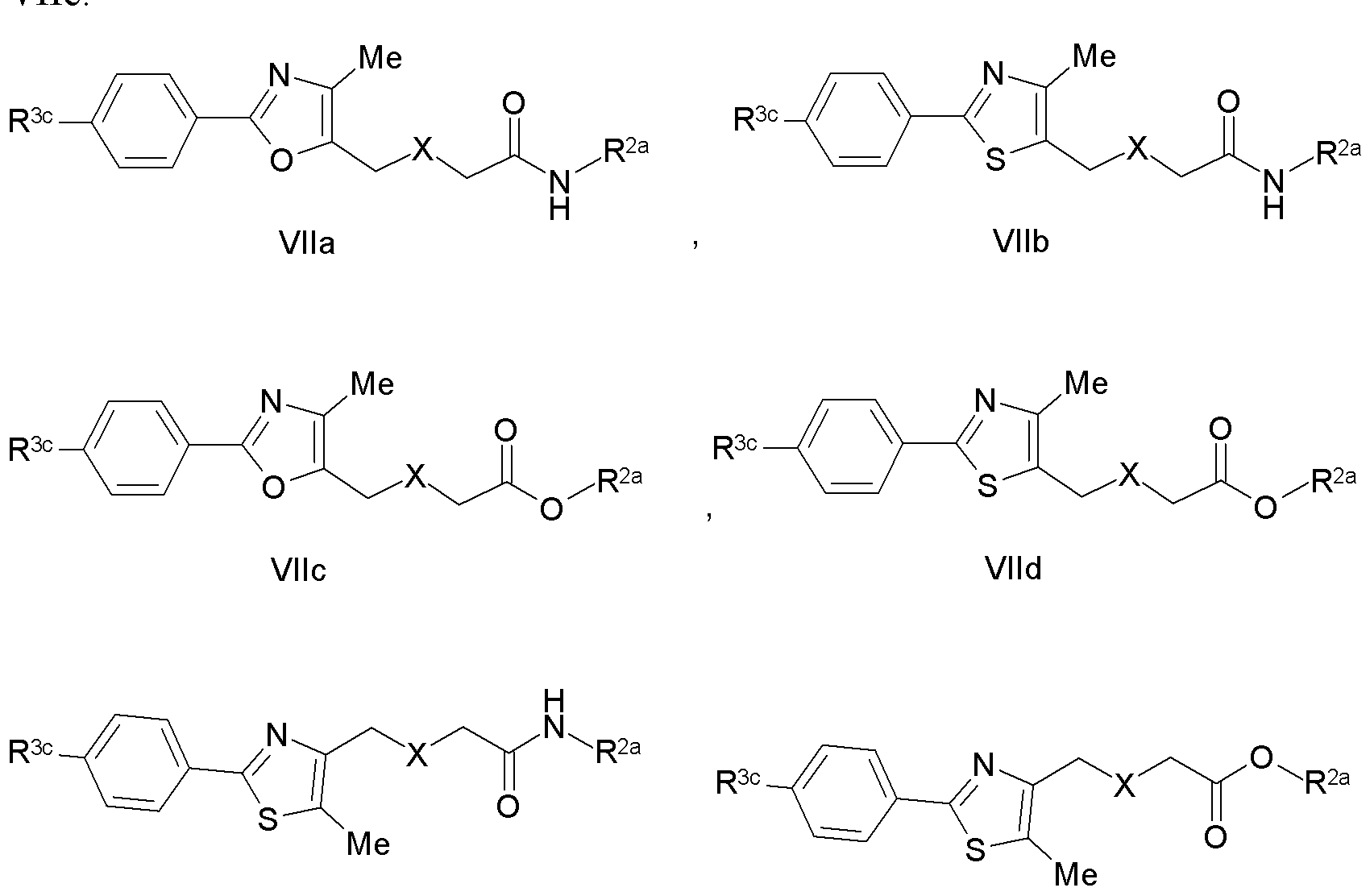
Vile or
Vllf
wherein X, and R2a are as described for formula I; and R3c is as described herein.
[00230] In certain embodiments, R3c is substituted or unsubstituted alkyl, substituted or unsubstituted alkoxy, haloalkyl, substituted or unsubstituted acyl,or halo.
[00231] In certain embodiments, R3c is Me, Et, i-Pr, t-Bu, OMe, OEt, O-i-Pr, CN, -
C(0)Me, CF3, -C(OH)HMe, -C(Me)2OH, -OC(H)F2, CI, or F.
[00232] In certain embodiments, R3c is Me, CF3, OMe, or Et.
[00233] In certain embodiments, R3c is Me.
[00234] In certain embodiments, R3c is Et.
[00235] In certain embodiments, R3c is i-Pr.
[00236] In certain embodiments, R3c is t-Bu.
[00237] In certain embodiments, R3c is CF3.
[00238] In certain embodiments, R2a is H.
[00239] In certain embodiments, R2a is substituted or unsubstituted alkyl.
[00240] In certain embodiments, R2a is substituted or unsubstituted aryl.
[00241] In certain embodiments, R2a is substituted or unsubstituted phenyl.
[00242] In certain embodiments, R2a is substituted or unsubstituted benzyl.
[00243] In certain embodiments, R2a is substituted or unsubstituted phenethyl.
[00244] In certain embodiments, R2a is substituted or unsubstituted phenylpropyl.
[00245] In certain embodiments, R2a is substituted or unsubstituted cycloalkyl.
[00246] In certain embodiments, R2a is cyclopropyl, cyclopentyl or cyclobutyl.
[00247] In certain embodiments, R2a is substituted or unsubstituted heteroaryl.
[00248] In certain embodiments, R2a is substituted or unsubstituted pyridyl, pyrimidyl, or pyrazinyl.
[00249] In certain embodiments, R2a is substituted or unsubstituted heterocycloalkyl.
[00250] In certain embodiments, R2a is substituted or unsubstituted pyrrolidinyl, piperidinyl, morpholinyl, or piperazinyl.
[00251] In certain embodiments, R2a is alkyl substituted with aryl, heteroaryl, cycloalkyl or heterocycloalkyl.
[00252] In certain embodiments, R2a is methyl, ethyl, or n-propyl substituted with phenyl, pyridyl, cycloalkyl or heterocycloalkyl.
[00253] In certain embodiments, R2a is methyl, ethyl, or n-propyl each of which substituted with substituted or unsubstituted phenyl, substituted or unsubstituted pyridyl, substituted or unsubstituted cyclopropyl, substituted or unsubstituted cyclohexyl, substituted or unsubstituted cyclopentyl, substituted or unsubstituted cyclobutyl, substituted or unsubstituted piperidinyl, substituted or unsubstituted morphlinyl or substituted or unsubstituted piperazinyl.
[00254] In certain embodiments, R a is substituted or unsubstituted phenylmethyl, substituted or unsubstituted pyridylmethyl, substituted or unsubstituted cyclopropylmethyl, substituted or unsubstituted cyclohexylmethyl, substituted or unsubstituted cyclopentylmethyl, substituted or unsubstituted cyclobutylmethyl, substituted or unsubstituted piperidinylmethyl, substituted or unsubstituted morphlinylmethyl, or substituted or unsubstituted piperazinylmethyl.
[00255] In certain embodiments, R2a is substituted or unsubstituted phenylethyl, substituted or unsubstituted pyridylethyl, substituted or unsubstituted cyclopropylethyl, substituted or unsubstituted cyclohexylethyl, substituted or unsubstituted cyclopentylethyl, substituted or unsubstituted cyclobutylethyl, substituted or unsubstituted piperidinylethyl, substituted or unsubstituted morphlinylethyl, or substituted or unsubstituted piperazinylethyl.
[00256] In certain embodiments, R2a is substituted or unsubstituted phenylpropyl, substituted or unsubstituted pyridylpropyl, substituted or unsubstituted cyclopropylpropyl, substituted or unsubstituted cyclohexylpropyl, substituted or unsubstituted cyclopentylpropyl, substituted or unsubstituted cyclobutylpropyl, substituted or unsubstituted piperidinylpropyl, substituted or unsubstituted morphlinylpropyl, or substituted or unsubstituted piperazinylpropyl.
[00257] In certain embodiments, the substitution is independently selected from one to three alkyl, alkoxy, haloalkyl, halo and cyano.
[00258] In certain embodiments, the substitution is selected from one to three Me, Et, i-Pr, t-Bu, OMe, OEt, O-i-Pr, CN, Br, CI, or F.
[00259] In certain embodiments, R2a is substituted or unsubstituted pyridyl, or pyrimidinyl.
[00260] In certain embodiments, R2a is substituted or unsubstituted pyridylmethyl, or pyrimidinylmethyl.
[00261] In certain embodiments, R2a is substituted or unsubstituted pyridylethyl, or pyrimidinylethyl.
[00262] In certain embodiments, R2a is phenyl, benzyl, phenethyl, or phenpropyl each unsubstituted or substituted with halo, alkyl, haloalkyl, or cyano.
[00263] In certain embodiments, R2a is phenyl, benzyl, phenethyl, or phenpropyl each unsubstituted or substituted with CI, Br, F, Me, Et, CF3, or cyano.
[00264] In certain embodiments, R2a is pyridyl, pyridylmethyl, or pyridylethyl each unsubstituted or substituted with halo, alkyl, haloalkyl, or cyano.
[00265] In certain embodiments, R2a is pyridyl, pyridylmethyl, or pyridylethyl each unsubstituted or substituted with CI, Br, F, Me, Et, CF3, or cyano.
[00266] In certain embodiments, R2a is pyrimidinyl, pyrimidinylmethyl, or
pyrimidinylethyl each unsubstituted or substituted with halo, alkyl, haloalkyl, or cyano.
[00267] In certain embodiments, R a is pyrimidinyl, pyrimidinylmethyl, or
pyrimidinylethyl each unsubstituted or substituted with CI, Br, F, Me, Et, CF3, or cyano.
[00268] In certain embodiments, R2a is phenyl, benzyl, 4-fluorophenyl, pyrid-3-yl ethyl, cyclopropyl, cyclopentyl, cyclohexylethyl, 2-chloro-5-pyridyl, 2-fluoro-5-pyridyl, 2-methyl-5- pyridyl, phenylpropyl, 4-fluorobenzyl, 4-fluorophenethyl, 2-(pyrrolidin-l-yl)ethyl, or 2- (morpholin- 1 -yl)ethyl.
[00269] In certain embodiments, R2a and R2b join together to form a heterocycloalkyl or a heteroaryl ring.
[00270] In certain embodiments - R2aR2b is:

and wherein R2c isH or alkyl.
[00271] In certain embodiments, X is -0-.
[00272] In certain embodiments, X is -S-, -S(O)-, -S(0)2-.
[00273] In certain embodiments, X is -S-.
[00274] In certain embodiments, X is -CH2-.
[00275] In certain embodiments, each of R3c is H.
[00276] In certain embodiments, R3c is substituted or unsubstituted alkyl, substituted or unsubstituted alkoxy, haloalkyl, or halo.
[00277] In certain embodiments, R3c is Me, Et, i-Pr, t-Bu, OMe, OEt, O-i-Pr, CN, CI, or F
[00278] In certain embodiments, R3c is Me, CF3, OMe, SMe, or Et.
[00279] In certain embodiments, R3c is Me.
[00280] In certain embodiments, R3c is Et.
[00281] In certain embodiments, R3c is i-Pr.
[00282] In certain embodiments, R3c is t-Bu.
[00283] In certain embodiments, R3c is CF3.
[00284] In one particular embodiment, with respect to compounds of formula I, the compound is according to formula Villa, VHIb, VIIIc, VHId, or Vllle:

Villa Vlllb

Vlllc Vllld

Vllle or
Vlllf
and wherein X is as described for formula I.
[00285] In one particular embodiment, with respect to compounds of formula I, the compound is according to formula IXa, IXb, IXc, IXd, IXe, or IXf:


IXf wherein X is as described for formula I; m is 1, 2, 3, 4, or 5; and
each R4 is independently selected from H, alkyl, substituted alkyl, acyl, substituted acyl, substituted or unsubstituted acylamino, substituted or unsubstituted alkylamino, substituted or unsubstituted alkythio, substituted or unsubstituted alkoxy, alkoxycarbonyl, substituted alkoxycarbonyl, substituted or unsubstituted alkylarylamino, arylalkyloxy, substituted arylalkyloxy, amino, aryl, substituted aryl, arylalkyl, substituted or unsubstituted sulfonyl, substituted or unsubstituted sulfinyl, substituted or unsubstituted sulfanyl, substituted or unsubstituted aminosulfonyl, substituted or unsubstituted arylsulfonyl, azido, carboxy, substituted or unsubstituted carbamoyl, cyano, substituted or unsubstituted cycloalkyl, substituted or unsubstituted heterocycloalkyl, substituted or unsubstituted dialkylamino, halo, heteroaryloxy, substituted or unsubstituted heteroaryl, substituted or unsubstituted heteroalkyl, hydroxy, nitro, and thiol.
[00286] In one particular embodiment, with respect to compounds of formula I, the compound is according to formula Xa, Xb, Xc, Xd, Xe, or Xf:


Xf wherein X is as described for formula I; m is 1, 2, 3, 4, or 5; and
each R4 is independently selected from H, alkyl, substituted alkyl, acyl, substituted acyl, substituted or unsubstituted acylamino, substituted or unsubstituted alkylamino, substituted or unsubstituted alkythio, substituted or unsubstituted alkoxy, alkoxycarbonyl, substituted alkoxycarbonyl, substituted or unsubstituted alkylarylamino, arylalkyloxy, substituted arylalkyloxy, amino, aryl, substituted aryl, arylalkyl, substituted or unsubstituted sulfonyl, substituted or unsubstituted sulfinyl, substituted or unsubstituted sulfanyl, substituted or unsubstituted aminosulfonyl, substituted or unsubstituted arylsulfonyl, azido, carboxy, substituted or unsubstituted carbamoyl, cyano, substituted or unsubstituted cycloalkyl, substituted or unsubstituted heterocycloalkyl, substituted or unsubstituted dialkylamino, halo, heteroaryloxy, substituted or unsubstituted heteroaryl, substituted or unsubstituted heteroalkyl, hydroxy, nitro, and thiol.
[00287] In one embodiment, m is 1 or 2; and each R4 is independently Me, Et, i-Pr, OMe,
OEt, O-i-Pr, CN, CI, or F.
[00288] In another embodiment, each R4 is H.
[00289] In another embodiment, m is 1 ; and R4 is Me, Et, i-Pr, OMe, OEt, O-i-Pr, CN, CI, or F.
[00290] In another embodiment, m is 1 ; and R4 is 4-Cl, or 4-F.
[00291] In one particular embodiment, with respect to compounds of formula I, the compound is according to formula XIa, Xlb, or Xlc:
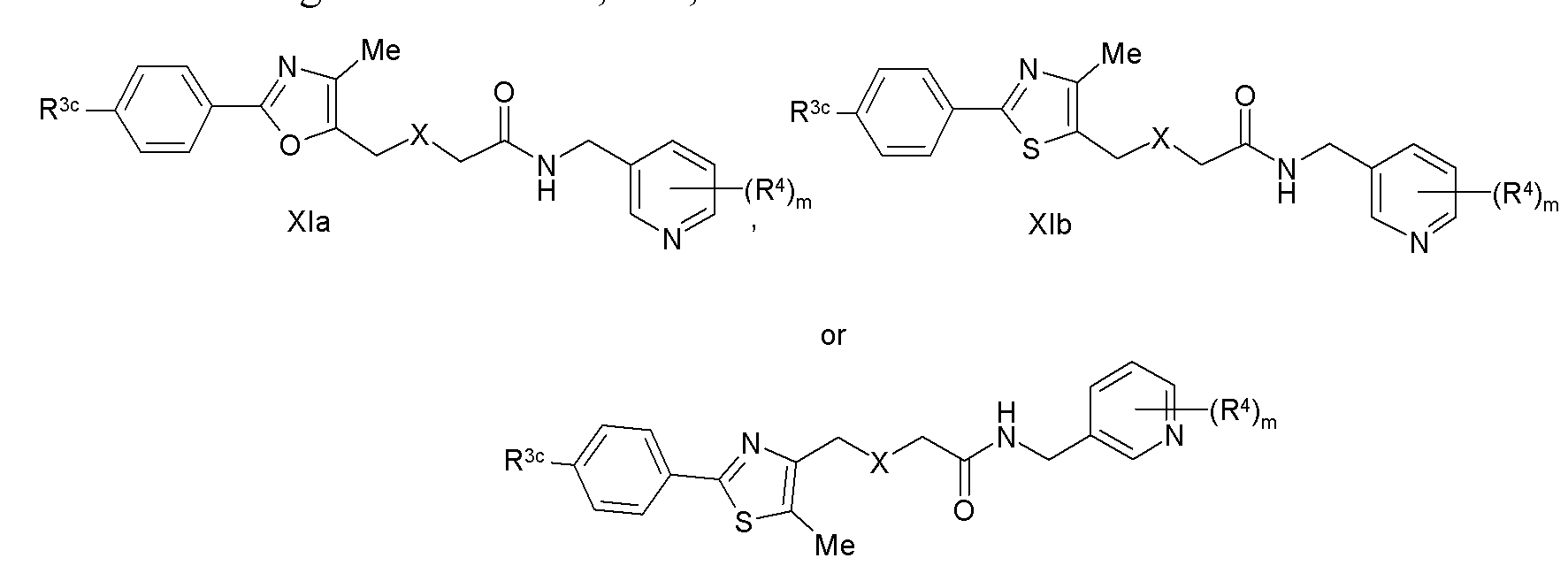
each R4 is independently selected from H, alkyl, substituted alkyl, acyl, substituted acyl, substituted or unsubstituted acylamino, substituted or unsubstituted alkylamino, substituted or unsubstituted alkythio, substituted or unsubstituted alkoxy, alkoxycarbonyl, substituted alkoxycarbonyl, substituted or unsubstituted alkylarylamino, arylalkyloxy, substituted arylalkyloxy, amino, aryl, substituted aryl, arylalkyl, substituted or unsubstituted sulfonyl, substituted or unsubstituted sulfinyl, substituted or unsubstituted sulfanyl, substituted or unsubstituted aminosulfonyl, substituted or unsubstituted arylsulfonyl, azido, carboxy, substituted or unsubstituted carbamoyl, cyano, substituted or unsubstituted cycloalkyl, substituted or unsubstituted heterocycloalkyl, substituted or unsubstituted dialkylamino, halo, heteroaryloxy, substituted or unsubstituted heteroaryl, substituted or unsubstituted heteroalkyl, hydroxy, nitro, and thiol.
[00292] In one particular embodiment, with respect to compounds of formula I, the compound is according to formula Xlla, Xllb, or XIIc:


Xllc
wherein X is as described for formula I; m is 1, 2, 3, or 4; and
each R4 is independently selected from H, alkyl, substituted alkyl, acyl, substituted acyl, substituted or unsubstituted acylamino, substituted or unsubstituted alkylamino, substituted or unsubstituted alkythio, substituted or unsubstituted alkoxy, alkoxycarbonyl, substituted alkoxycarbonyl, substituted or unsubstituted alkylarylamino, arylalkyloxy, substituted arylalkyloxy, amino, aryl, substituted aryl, arylalkyl, substituted or unsubstituted sulfonyl, substituted or unsubstituted sulfinyl, substituted or unsubstituted sulfanyl, substituted or unsubstituted aminosulfonyl, substituted or unsubstituted arylsulfonyl, azido, carboxy, substituted or unsubstituted carbamoyl, cyano, substituted or unsubstituted cycloalkyl, substituted or unsubstituted heterocycloalkyl, substituted or unsubstituted dialkylamino, halo, heteroaryloxy, substituted or unsubstituted heteroaryl, substituted or unsubstituted heteroalkyl, hydroxy, nitro, and thiol.
[00293] In one particular embodiment, with respect to compounds of formula I, the compound is according to formula XHIa, XHIb, or XIIIc:

Xlllc
wherein X is as described for formula I; m is 1, 2, 3, or 4; and
each R4 is independently selected from H, alkyl, substituted alkyl, acyl, substituted acyl, substituted or unsubstituted acylamino, substituted or unsubstituted alkylamino,
substituted or unsubstituted alkythio, substituted or unsubstituted alkoxy, alkoxycarbonyl, substituted alkoxycarbonyl, substituted or unsubstituted alkylarylamino, arylalkyloxy, substituted arylalkyloxy, amino, aryl, substituted aryl, arylalkyl, substituted or unsubstituted sulfonyl, substituted or unsubstituted sulfinyl, substituted or unsubstituted sulfanyl, substituted or unsubstituted aminosulfonyl, substituted or unsubstituted arylsulfonyl, azido, carboxy, substituted or unsubstituted carbamoyl, cyano, substituted or unsubstituted cycloalkyl, substituted or unsubstituted heterocycloalkyl, substituted or unsubstituted dialkylamino, halo, heteroaryloxy, substituted or unsubstituted heteroaryl, substituted or unsubstituted heteroalkyl, hydroxy, nitro, and thiol.
[00294] In one particular embodiment, with respect to compounds of formula I, the compound is according to formula XlVa, XlVb, or XIVc:

XIVc
wherein X is as described for formula I; m is 1, 2, 3, or 4; and
each R4 is independently selected from H, alkyl, substituted alkyl, acyl, substituted acyl, substituted or unsubstituted acylamino, substituted or unsubstituted alkylamino, substituted or unsubstituted alkythio, substituted or unsubstituted alkoxy, alkoxycarbonyl, substituted alkoxycarbonyl, substituted or unsubstituted alkylarylamino, arylalkyloxy, substituted arylalkyloxy, amino, aryl, substituted aryl, arylalkyl, substituted or unsubstituted sulfonyl, substituted or unsubstituted sulfinyl, substituted or unsubstituted sulfanyl, substituted or unsubstituted aminosulfonyl, substituted or unsubstituted arylsulfonyl, azido, carboxy, substituted or unsubstituted carbamoyl, cyano, substituted or unsubstituted cycloalkyl, substituted or unsubstituted heterocycloalkyl, substituted or unsubstituted dialkylamino, halo, heteroaryloxy, substituted or unsubstituted heteroaryl, substituted or unsubstituted heteroalkyl, hydroxy, nitro, and thiol.
[00295] In one particular embodiment, with respect to compounds of formula I, the compound is according to formula XVa, XVb, XVc, XVd, XVe, XVf, XVg, or XVh:

XVa XVb


[00296] In one particular embodiment, with respect to compounds of formula I, the compound is according to formula XVIa, XVIb, XVIc, XVId, XVIe, or XVIf:


XVIf
wherein X is as described for formula I; m is 1, 2, 3, or 4; and
each R4 is independently selected from H, alkyl, substituted alkyl, acyl, substituted acyl, substituted or unsubstituted acylamino, substituted or unsubstituted alkylamino, substituted or unsubstituted alkythio, substituted or unsubstituted alkoxy, alkoxycarbonyl, substituted alkoxycarbonyl, substituted or unsubstituted alkylarylamino, arylalkyloxy, substituted arylalkyloxy, amino, aryl, substituted aryl, arylalkyl, substituted or unsubstituted sulfonyl, substituted or unsubstituted sulfinyl, substituted or unsubstituted sulfanyl, substituted or unsubstituted aminosulfonyl, substituted or unsubstituted arylsulfonyl, azido, carboxy, substituted or unsubstituted carbamoyl, cyano, substituted or unsubstituted cycloalkyl, substituted or unsubstituted heterocycloalkyl, substituted or unsubstituted dialkylamino, halo, heteroaryloxy, substituted or unsubstituted heteroaryl, substituted or unsubstituted heteroalkyl, hydroxy, nitro, and thiol.
[00297] In one embodiment, m is 1 or 2; and each R4 is independently Me, Et, i-Pr, OMe,
OEt, O-i-Pr, CN, CI, or F.
[00298] In another embodiment, each R4 is H.
[00299] In another embodiment, m is 1 ; and R4 is Me, Et, i-Pr, OMe, OEt, O-i-Pr, CN, CI, or F.
[00300] In one embodiment, X is -0-.
[00301] In another embodiment, X is -CH2-.
[00302] In another embodiment, X is -S-, -S(O)-, -S(0)2-.
[00303] In one particular embodiment, m is 1 and R4 is 4-F or 4-CF3.
[00304] In one particular embodiment, m is 1 and R4 is 4-F. In another particular embodiment, m is 1 and R4 is 4-CF3.
[00305] In certain embodiments, with respect to the compounds of formula Vllla-XVIf,
R3c is substituted or unsubstituted alkyl, substituted or unsubstituted alkoxy, haloalkyl, substituted or unsubstituted acyl, or halo.
[00306] In certain embodiments, with respect to the compounds of formula Vllla-XVIf,
R3c is Me, Et, i-Pr, t-Bu, OMe, OEt, O-i-Pr, CN, -C(0)Me, CF3, -C(OH)HMe, -C(Me)2OH, - OC(H)F2, CI, or F.
[00307] In certain embodiments, with respect to the compounds of formula Vllla-XVIf,
R3c is Me, CF3, OMe, SMe, or Et.
[00308] In certain embodiments, with respect to the compounds of formula Vllla-XVIf,
R3c is Me.
[00309] In certain embodiments, with respect to the compounds of formula Vllla-XVIf,
R3c is Et.
[00310] In certain embodiments, with respect to the compounds of formula Vllla-XVIf,
R3c is i-Pr.
[00311] In certain embodiments, with respect to the compounds of formula Vllla-XVIf,
R3c is t-Bu.
[00312] In certain embodiments, with respect to the compounds of formula Vllla-XVIf,
R3c is CF3.
[00313] In a particular aspect, the present invention provides a composition of a compound according to formula I-XVIf.
[00314] In another particular aspect, the present invention provides a composition of a compound according to formula IVa-XVIf.
[00315] In a further particular aspect, the present invention provides a composition of a compound according to formula

XVI I
wherein R1, R2a, R3c, L1, L2, and n are as described herein;
or a pharmaceutically acceptable salt, solvate or prodrug thereof;
and stereoisomers, isotopic variants and tautomers thereof.
[00316] In one embodiment, with respect to the compounds of formula XVII, R1 is substituted or unsubstituted alkyl, haloalkyl, substituted or unsubstituted alkoxy, or halo.
[00317] In another embodiment, with respect to the compounds of formula XVII, R1 is
Me, Et, i-Pr, t-Bu, CI, F, OMe, OCF3, CHF2, or CF3.
[00318] In a particular embodiment, with respect to the compounds of formula XVII, R1 is
Me. In another embodiment, R1 is H.
[00319] In certain embodiments, with respect to the compounds of formula XVII, R3c is substituted or unsubstituted alkyl, substituted or unsubstituted alkoxy, haloalkyl, substituted or unsubstituted acyl, or halo.
[00320] In certain embodiments, with respect to the compounds of formula XVII, R3c is
Me, Et, i-Pr, t-Bu, OMe, OEt, O-i-Pr, CN, -C(0)Me, CF3, -C(OH)HMe, -C(Me)2OH, -OC(H)F2, CI, or F.
[00321] In certain embodiments, with respect to the compounds of formula XVII, R3c is
Me, CF3, OMe, SMe, or Et.
[00322] In certain embodiments, with respect to the compounds of formula XVII, R3c is
Me.
[00323] In certain embodiments, with respect to the compounds of formula XVII, R3c is
Et.
[00324] In certain embodiments, with respect to the compounds of formula XVII, R3c is i-
Pr.
[00325] In certain embodiments, with respect to the compounds of formula XVII, R3c is t-
Bu.
[00326] In certain embodiments, with respect to the compounds of formula XVII, R3c is
CF3.
[00327] In certain embodiments, with respect to the compounds of formula XVII, R3c is
CHF2.
[00328] In certain embodiments, with respect to the compounds of formula XVII, R3c is
OCF3.
[00329] In one embodiment, with respect to the compounds of formula XVII, R3c is at 3- position. In another embodiment, R3c is at 4-position.
[00330] In certain embodiments, with respect to the compounds of formula XVII, each of
L1 and L2 is independently -CH2-, -C(H)Me-, or -C(Me)2-. In one embodiment, one of L1 and L2 is -C(H)Me- and the other is -CH2-. In another embodiment, one of L1 and L2 is -C(Me)2- and the other is -CH2-. In a particular embodiment, each of L1 and L2 is -CH2-.
[00331] In certain embodiments, with respect to the compounds of formula XVII, X is -
CH2-. In another embodiment, X is -S-. In a particular embodiment, X is -0-.
[00332] In certain embodiments, with respect to the compounds of formula XVII, R2a is H or substituted or unsubstituted alkyl. In a particular embodiment, R2a is H.
[00333] In one particular embodiment,the compound is selected from:


or a pharmaceutically acceptable salt, solvate or prodrug thereof; and stereoisomers, isotopic variants and tautomers thereof.
[00334] In one particular embodiment, with respect to compounds of formula I, the compound is selected from Table 1.
[00335] In certain aspects, the present invention provides prodrugs and derivatives of the compounds according to the formulae above. Prodrugs are derivatives of the compounds of the invention, which have metabolically cleavable groups and become by solvolysis or under physiological conditions the compounds of the invention, which are pharmaceutically active, in vivo. Such examples include, but are not limited to, choline ester derivatives and the like, N- alkylmorp/zo/z'we esters and the like.
[00336] Other derivatives of the compounds of this invention have activity in both their acid and acid derivative forms, but the acid sensitive form often offers advantages of solubility, tissue compatibility, or delayed release in the mammalian organism (see, Bundgard, H., Design of Prodrugs, pp. 7-9, 21-24, Elsevier, Amsterdam 1985). Prodrugs include acid derivatives well know to practitioners of the art, such as, for example, esters prepared by reaction of the parent acid with a suitable alcohol, or amides prepared by reaction of the parent acid compound with a substituted or unsubstituted amine, or acid anhydrides, or mixed anhydrides. Simple aliphatic or aromatic esters, amides and anhydrides derived from acidic groups pendant on the compounds of this invention are preferred prodrugs. In some cases it is desirable to prepare double ester type prodrugs such as (acyloxy)alkyl esters or ((alkoxycarbonyl)oxy)alkylesters. Preferred are the Ci to C8 alkyl, C2-C8 alkenyl, aryl, C7-Ci2 substituted aryl, and C7-Ci2 arylalkyl esters of the compounds of the invention.
PHARMACEUTICAL COMPOSITIONS
[00337] When employed as pharmaceuticals, the compounds of this invention are typically administered in the form of a pharmaceutical composition. Such compositions can be prepared in a manner well known in the pharmaceutical art and comprise at least one active compound.
[00338] Generally, the compounds of this invention are administered in a pharmaceutically effective amount. The amount of the compound actually administered will typically be determined by a physician, in the light of the relevant circumstances, including the condition to be treated, the chosen route of administration, the actual compound -administered, the age, weight, and response of the individual patient, the severity of the patient's symptoms, and the like.
[00339] The pharmaceutical compositions of this invention can be administered by a variety of routes including oral, rectal, transdermal, subcutaneous, intravenous, intramuscular, and intranasal. Depending on the intended route of delivery, the compounds of this invention are preferably formulated as either injectable or oral compositions or as salves, as lotions or as patches all for transdermal administration.
[00340] The compositions for oral administration can take the form of bulk liquid solutions or suspensions, or bulk powders. More commonly, however, the compositions are presented in unit dosage forms to facilitate accurate dosing. The term "unit dosage forms" refers to physically discrete units suitable as unitary dosages for human subjects and other mammals, each unit containing a predetermined quantity of active material calculated to produce the desired therapeutic effect, in association with a suitable pharmaceutical excipient. Typical unit dosage forms include prefilled, premeasured ampules or syringes of the liquid compositions or pills,
tablets, capsules or the like in the case of solid compositions. In such compositions, the furansulfonic acid compound is usually a minor component (from about 0.1 to about 50% by weight or preferably from about 1 to about 40% by weight) with the remainder being various vehicles or carriers and processing aids helpful for forming the desired dosing form.
[00341] Liquid forms suitable for oral administration may include a suitable aqueous or nonaqueous vehicle with buffers, suspending and dispensing agents, colorants, flavors and the like. Solid forms may include, for example, any of the following ingredients, or compounds of a similar nature: a binder such as microcrystalline cellulose, gum tragacanth or gelatin; an excipient such as starch or lactose, a disintegrating agent such as alginic acid, Primogel, or corn starch; a lubricant such as magnesium stearate; a glidant such as colloidal silicon dioxide; a sweetening agent such as sucrose or saccharin; or a flavoring agent such as peppermint, methyl salicylate, or orange flavoring.
[00342] Injectable compositions are typically based upon injectable sterile saline or phosphate-buffered saline or other injectable carriers known in the art. As before, the active compound in such compositions is typically a minor component, often being from about 0.05 to 10%) by weight with the remainder being the injectable carrier and the like.
[00343] Transdermal compositions are typically formulated as a topical ointment or cream containing the active ingredient(s), generally in an amount ranging from about 0.01 to about 20% by weight, preferably from about 0.1 to about 20% by weight, preferably from about 0.1 to about 10%) by weight, and more preferably from about 0.5 to about 15% by weight. When formulated as a ointment, the active ingredients will typically be combined with either a paraffinic or a water-miscible ointment base. Alternatively, the active ingredients may be formulated in a cream with, for example an oil-in-water cream base. Such transdermal formulations are well-known in the art and generally include additional ingredients to enhance the dermal penetration of stability of the active ingredients or the formulation. All such known transdermal formulations and ingredients are included within the scope of this invention.
[00344] The compounds of this invention can also be administered by a transdermal device. Accordingly, transdermal administration can be accomplished using a patch either of the reservoir or porous membrane type, or of a solid matrix variety.
[00345] The above-described components for orally administrable, injectable or topically administrable compositions are merely representative. Other materials as well as processing techniques and the like are set forth in Part 8 of Remington's Pharmaceutical Sciences, 17th edition, 1985, Mack Publishing Company, Easton, Pennsylvania, which is incorporated herein by reference.
[00346] The compounds of this invention can also be administered in sustained release forms or from sustained release drug delivery systems. A description of representative sustained release materials can be found in Remington's Pharmaceutical Sciences.
[00347] The following formulation examples illustrate representative pharmaceutical compositions that may be prepared in accordance with this invention. The present invention, however, is not limited to the following pharmaceutical compositions.
Formulation 1 - Tablets
[00348] A compound of the invention may be admixed as a dry powder with a dry gelatin binder in an approximate 1 :2 weight ratio. A minor amount of magnesium stearate is added as a lubricant. The mixture is formed into 240-270 mg tablets (80-90 mg of active amide compound per tablet) in a tablet press.
Formulation 2 - Capsules
[00349] A compound of the invention may be admixed as a dry powder with a starch diluent in an approximate 1 : 1 weight ratio. The mixture is filled into 250 mg capsules (125 mg of active amide compound per capsule).
Formulation 3 - Liquid
[00350] A compound of the invention (125 mg), sucrose (1.75 g) and xanthan gum (4 mg) may be blended, passed through a No. 10 mesh U.S. sieve, and then mixed with a previously made solution of microcrystalline cellulose and sodium carboxymethyl cellulose (11 :89, 50 mg) in water. Sodium benzoate (10 mg), flavor, and color would then be diluted with water and added with stirring. Sufficient water is then added to produce a total volume of 5 mL.
Formulation 4 - Tablets
[00351] A compound of the invention may be admixed as a dry powder with a dry gelatin binder in an approximate 1 :2 weight ratio. A minor amount of magnesium stearate is added as a lubricant. The mixture is formed into 450-900 mg tablets (150-300 mg of active amide compound) in a tablet press.
Formulation 5 - Injection
[00352] A compound of the invention may be dissolved or suspended in a buffered sterile saline injectable aqueous medium to a concentration of approximately 5 mg/ml.
Formulation 6 - Topical
[00353] Stearyl alcohol (250 g) and a white petrolatum (250 g) may be melted at about 75°C and then a mixture of a compound of the invention (50 g) methylparaben (0.25 g), propylparaben (0.15 g), sodium lauryl sulfate (10 g), and propylene glycol (120 g) dissolved in water (about 370 g) is added and the resulting mixture is stirred until it congeals.
METHODS OF TREATMENT
[00354] The present compounds are used as therapeutic agents for the treatment of conditions in mammals that are causally related or attributable to aberrant activity of the Wnt/wg signaling pathway. Accordingly, the compounds and pharmaceutical compositions of this invention find use as therapeutics for preventing and/or treating a variety of cancers,
hyperproliferative conditions, and fibrotic diseases in mammals, including humans. Thus, and as stated earlier, the present invention includes within its scope, and extends to, the recited methods of treatment, as well as to the compounds for use in such methods, and for the preparation of medicaments useful for such methods.
[00355] In a method of treatment aspect, this invention provides a method of treating a mammal susceptible to or afflicted with a condition associated with cancer and/or a
hyperproliferative disorder, which method comprises administering an effective amount of one or more of the pharmaceutical compositions just described.
[00356] In yet another method of treatment aspect, this invention provides a method of treating a mammal susceptible to or afflicted with a condition that gives rise to increased cellular proliferation or a transformed phenotype, or that relates to dysregulation of Wnt/wg signaling. The present oxazoles and thiazoles have use as anti-proliferative agents that reduce proliferative levels (potentially to normal levels for a particular cell type), and/or anti-transformed phenotype agents that restore, at least in part, normal phenotypic properties of a particular cell type.
Accordingly, the present oxazoles and thiazoles have use for the treatment of cancers and hyperproliferative disorders relating to aberrant Wnt/wg signaling.
[00357] In additional method of treatment aspects, this invention provides methods of treating a mammal susceptible to or afflicted with a cancer causally related or attributable to aberrant activity of the Wnt/wg signaling pathway. Such cancers include, without limitation, those of the prostate cancer, colon cancer, rectal cancer, breast cancer, skin cancer (e.g., melanoma), liver cancer (e.g., hepatocellular cancer and hepatoblastoma), head and neck cancer, lung cancer (e.g., non-small cell lung cancer), gastric cancer, mesothelioma, Barrett's esophagus, synovial sarcoma, cervical cancer, endometrial ovarian cancer, Wilm's tumor, bladder cancer and leukemia. Such methods comprise administering an effective condition-treating or condition- preventing amount of one or more of the pharmaceutical compositions just described.
[00358] With respect to prostate cancer, for example, compounds and compositions thereof and methods described herein are also envisioned as useful for targeting cancerous prostate cells that remain following radical prostatectomy, including micrometastases and thus, are useful for treating prostate cancer patients following surgical intervention. In addition,
compounds and compositions thereof and methods described herein are envisioned as being useful in advance of surgical intervention to delay or prevent the need for surgery. For such purposes, direct delivery of the compounds or compositions thereof to the prostate tumor or in the vicinity of the tumor is envisioned as a particular delivery mode suitable for such an application.
[00359] Also envisioned herein are combination therapies that comprise administration of one or more of the oxazole and/or thiazole compounds described herein, or a composition thereof, in conjunction with therapeutic regimens (e.g., local and/or systemic therapeutic modalities) implemented for treating patients afflicted with diseases or conditions that are causally related to the aberrant activity of the Wnt pathway in vivo. Such diseases include, without limitation, pulmonary fibrosis; and cancers, including: without limitation, prostate cancer, colon cancer, rectal cancer, breast cancer, skin cancer (e.g., melanoma), liver cancer (e.g., hepatocellular cancer and hepatoblastoma), head and neck cancer, lung cancer (e.g., non-small cell lung cancer), gastric cancer, mesothelioma, Barrett's esophagus, synovial sarcoma, cervical cancer, endometrial ovarian cancer, Wilm's tumor, bladder cancer and leukemia.
[00360] Such combination therapies can boost the therapeutic activity of each of the therapeutic modalities with the potential for synergistic therapeutic benefit. Combination therapy, furthermore, has the potential to improve therapeutic benefit with no significant increase in morbidity relative to that typically achieved using the individual therapeutic modalities (monotherapies) separately. Under some circumstances, the doses of each of the individual therapeutic modalities can be reduced, which may result in an overall decrease in morbidity when combination therapy is implemented.
[00361] It will be appreciated that combination therapies may involve administration of one or more of the oxazole and/or thiazole compounds described herein, or a composition thereof, at the same time, before, and/or after a second therapeutic modality of the combination therapy. The timing of administration of the, e.g., first and second therapeutic modalities of a combination therapy may be determined based on the experience of the attending physician and the manner in which therapeutic modalities known in the art are typically administered.
[00362] In a particular aspect, a combination therapy comprises administration of one or more of the oxazole and/or thiazole compounds described herein, or a composition thereof, in conjunction with a systemic therapeutic modality, such as, for example, one or more of a systemic inhibitor of immune system down regulation, such as anti-CTLA-4 (including but not limited to ipilimumab and tremelimumab), PD-1, and PD-L1 antibodies.
[00363] In another aspect, combination therapy may comprise administration of one or more of the oxazole and/or thiazole compounds described herein, or a composition thereof, in conjunction with one or more of a systemic immune upregulating agent, including: non-specific cytokines, such as interleukin-1, -2, or -6 (IL-1, IL-2 or IL-6) and aldesleukin; interferon-alpha or gamma (IFN-a and IFN-γ), interferon alfa-2b and pegylated interferon (including pegylated interferon alfa-2a and pegylated interferon alfa-2b); granulocyte macrophage colony stimulating factor (GM-CSF, molgramostim or sargramostim); dendritic cell vaccines and other allogeneic or autologous therapeutic cancer vaccines, including intralesional vaccines containing an oncolytic herpes virus encoding GM-CSF (ONCOVEX®) or a plasmid encoding human leukocyte antigen- B7 and beta-2 microglobulin agent designed to express allogeneic MHC class I antigens
(ALLOVECTIN-7®); and antibodies against specific tumor antigens.
[00364] In yet another aspect, combination therapy may comprise administration of one or more of the oxazole and/or thiazole compounds described herein, or a composition thereof, in conjunction with one or more systemic targeted therapy agent, including: drugs that target protein kinases and the receptors that activate them, including but not limited to afatinib (BIBW 2992), bevacizumab, cetuximab, dasatinib, E7080, erlotinib, gefitinib, imatinib, lapatinib, nilotinib, panitumumab, pazopanib, pegaptanib, ranibizumab, sorafenib, sunitinib, trastuzumab and vandetanib; serine/threonine-selective protein kinase inhibitors, including but not limited to those targeting the B-Raf/MEKIERK pathway, such as vemurafenib (also known as PLX4032, RG7204 or R05185426), GSK2118436 and GSK1 120212; aromatase inhibitors, including but not limited to aminoglutethimide, anastrozole, exemestane, fadrozole, formestane, letrozole, testolactone and vorozole; estrogen receptor antagonists, including but not limited to
lasofoxifene, raloxifene, tamoxifen and toremifene; COX-2 inhibitors, including but not limited to celecoxib, valdecoxib and rofecoxib; angiogenesis blockers, including IFN-a, IL-12, suramin, and thrombospondin (including thrombospondin 1, ABT-510 and ABT-898); and immune cell therapy, including but not limited to adoptive T-cell transfer and autologous immune cell therapy.
[00365] The aforementioned systemic therapeutic modalities are known in the art and are described in, for example, U.S. 2015/0290318, the entire content of which is incorporated herein by reference.
[00366] In a further aspect, a combination therapy comprises administration of one or more of the oxazole and/or thiazole compounds described herein, or a composition thereof, in conjunction with a local therapeutic modality, such as, for example, a local immunomodulative therapy: including, but not limited to, intralesional (IL) chemoablation using an IL chemoablative
agent consisting primarily of rose bengal (4,5,6,7-tetrachloro-2',4',5',7'-tetraiodofluorescein) or another halogenated xanthene, including erythrosin B, phloxine B, 4,5,6,7-tetrabromo-2',4',5',7'- tetraiodofluorescein, 2',4,5,6,7-pentachloro-4',5',7'-triiodofluorescein, 4,4',5,6,7-pentachloro- 2',5',7'-triiodofluorescein, 2',4,5,6,7,7'-hexachloro-4',5'-diiodofluorescein, 4,4',5,5',6,7- hexachloro-2',7'-diiodofluorescein, 2',4,5,5',6,7-hexachloro-4',7'-diiodofluorescein, 4,5,6,7- tetrachloro-2',4', 5 '-triiodofluorescein, 4, 5 , 6, 7-tetrachloro-2',4', 7'-triiodofluorescein, 4,5,6,7- tetrabromo-2',4',5'-triiodofluorescein, and 4,5,6,7-tetrabromo-2',4',7'-triiodofluorescein in an appropriate pharmaceutical composition, including a 0.1% (w/v) or higher concentration aqueous solution of rose bengal (i.e., PV-10) or equivalent solution of another halogenated xanthene or mixtures thereof. A physiologically acceptable salt of the halogenated xanthene may be used in this composition. The aforementioned local immunomodulative therapies are known in the art and are described in, for example, U.S. 2015/0290318 and U.S. Application Ser. No. 12/315,781, the entire content of each of which is incorporated herein by reference.
[00367] In a more particular aspect, a combination therapy comprises administration of one or more of the oxazole and/or thiazole compounds described herein, or a composition thereof, in conjunction with intralesional (IL) chemoablation with PV-10 or another halogenated xanthene agent. As described in, for example, U.S. 2015/0290318 (the entire content of which is incorporated herein by reference), IL chemoablation using a specific class of agent (for example certain formulations of certain halogenated xanthenes, as exemplified by a 10% (w/v) solution of rose bengal disodium in saline, termed "PV-10") can elicit not only highly specific ablation of the injected lesion but also an antitumor immune response ("bystander effect") that augments local efficacy in the injected tumor and leads to spontaneous regression of uninjected tumors. PV-10 is, for example, undergoing clinical testing for treatment of metastatic melanoma, breast carcinoma and hepatocellular carcinoma. IL chemoablation can lead to rapid reduction in tumor burden, thereby reducing the potential for tumor-induced immune suppression and potentially minimizing the extent and severity of the disease. Chemoablation of entire tumors or
substantially all of the tumors, and especially chemoablation of multiple tumors, enhances exposure of the patient's immune system to distinct clonal subpopulations of tumor cells that may be present, and thus maximizes overall immune response to the tumor .
[00368] The effects of combination therapy can be heightened by repeated administration. Since IL chemoablation is well suited to repeat treatment, continued therapeutic intervention by ongoing administration of the oxazole and/or thiazole compounds described herein, or a composition thereof, alongside repeated IL chemoablation is envisioned. The timing of
administration may be varied and combination therapy may be performed with concurrent administration of either therapy, or delayed administration of one or another of the therapies.
[00369] Under circumstances wherein disease is rapidly proliferating, widely
disseminated, or presents in a form difficult to infiltrate fully with the IL chemoablative agent, use of additional complementary therapeutic modalities may offer additive or synergistic benefit, particularly when they promote immunologic stimulation (i. e., immunodulation).
Complementary immunomodulative therapies may be used to advantage to promote additive or synergistic immunologic interactions that allow one or multiple therapies to be used at reduced doses relative to those used when administered individually as monotherapies, while retaining high efficacy and potentially reducing undesirable adverse effects. Exemplary
immunomodulative therapies elicit immune system upregulation or counter tumor-induced immune system down regulation.
[00370] Monotherapy dose schedules are set by determining the maximum tolerated dose (MTD) in early-stage clinical trials. The MTD (or a close variation thereof) is then applied to later-stage clinical trials that optimize efficacy and further assess issues pertaining to safety. Examplary dosing schedules for a number of systemic agents that may be combined with administration of one or more of the oxazole and/or thiazole compounds described herein, or a composition thereof, are provided in Table 7.
Table 7. Exemplary systemic immunomodulatory or targeted anticancer agents

tolerated or disease progresses) j
La atinib 1250 mg daily for 21 day cycle
Niiotinib | 400 mg twice daily
Panitumumab 6 mg/kg qI4d
Pazopanib 800 nig daily 1
-Pegaptanib 0.3 m g qd v ks
Raiii izumab 0.5 mg q4 ks !
Soraferdb 400 mg twice daily
Simitmib 50 ag daily for 4 weeks followed by 2 week recovery
Trastuzu ab 4 mg/kg followed by weekly maintenance at 2 mg/kg
Vandstanib 200-300 mg daily
I Vemirafenib (PLX4032) 960 mg twice daiiy
| GSK211843 a 150 mg twice daily
GS I 120212 " 2 mg daily
arnmogl utethimide 250 mg q6h
Anastrozole 1 mg daily
Exe-mestane 25 tug dail
Fadrozole 1 mg twice daily
Formestane 250 mg daily
Letrozole 2.5 mg daily
Vorozole 2.5 mg daiiy
Raloxifene i 60 ma dailv
Tamoxifen j 20-40 mg daily
Toremifeae i 60 mg daily
Celecoxib j 200-400 mg twice daily
Rofecoxib j 20-25 mg daily
Suramin j I g qwk
thronibospondm (ABT-51 if) J 20 mg daily to 100 mg twice daily
[00371] Due to additive or synergistic effects of the monotherapies used in combination, the combination therapies and methods for treatment described herein will generally permit administration of a systemic agent at a level at or below the typical dose schedule for the systemic agent when used as a monotherapy (as described in Table 7). This may also apply to
dosing parameters for the oxazole and/or thiazole compounds described herein or a composition thereof. Lower doses of the oxazole and/or thiazole compounds described herein, or a composition thereof, may confer benefit when used in combination with either systemic or a local therapeutic modality, such as, for example, a local immunomodulative therapy.
[00372] Further to the above, combination therapies that comprise administration of one or more of the oxazole and/or thiazole compounds described herein, or a composition thereof, in conjunction with therapeutic regimens directed to promoting immune responses are envisioned. Such therapeutic regimens may be directed to promoting immune responses systemically and/or in a localized manner. As indicated herein above, effective systemic immunotherapeutic approaches have been developed and implemented for the treatment of a variety of cancers, including melanoma, lung cancer, and prostate cancer. These approaches include blockade of immune-inhibitory receptors on activated T cells. Monoclonal antibodies against CTLA-4, PD-1, and PD-L1, for example, have been used to advantage to promote immune responses. See, for example, Kaufman et al. (2013, Nature Rev Clin Oncol 10:588); Mellman et al. (2011, Nature 480:480); Wolchok et al. (2013, N Engl J Med 369: 122); Topalian et al. (2014, J Cin Oncol 32: 1020); and Hodi et al. (2010, N Engl J Med 363 :711), the entire content of each of which is incorporated herein by reference. Combination therapy comprising inhibitors of Wnt/p-catenin pathways and antibodies against CTLA-4, PD-1, and/or PD-L1 have been proposed as having potential for the treatment of, for example, melanoma. Without being bound by theory, it is thought that inhibitors of Wnt/p-catenin pathways enhance the efficacy of the immunotherapy. See, for example, Spranger et al. (2015, Nature 523 :231); Hanks et al. (2015, J Clin Oncol 33 :suppl. abstr 3054); Sweis et al. (2015, J Clin Oncol 33 :suppl. abstr 4511); Spranger et al. (2015, J Clin Oncol 33 :suppl. abstr 9014), the entire content of which each of which is incorporated herein by reference. Accordingly, combination therapy comprising administration of one or more of the oxazole and/or thiazole compounds described herein, or a composition thereof, in conjunction with at least one of antibodies against CTLA-4, PD-1, and/or PD-L1 is envisioned herein.
[00373] Various types of cancers are listed herein and are envisioned for treatment using the combination therapies described herein. Such combination therapies comprise administration of one or more of the oxazole and/or thiazole compounds described herein, or a composition thereof, in conjunction with a therapeutic regimen used for the treatment of a cancer, such as those understood in the art and listed, for example, herein below.
[00374] Breast Cancer
[00375] Cancer drugs approved by the Food and Drug Administration (FDA) for treating breast cancer include, without limitation: Abitrexate (Methotrexate), Abraxane (Paclitaxel Albumin- stabilized Nanoparticle Formulation) Ado-Trastuzumab Emtansine, Adrucil
(Fluorouracil), Afinitor (Everolimus), Anastrozole, Aredia (Pamidronate Disodium), Arimidex (Anastrozole), Aromasin (Exemestane), Capecitabine, Clafen (Cyclophosphamide),
Cyclophosphamide, Cytoxan (Cyclophosphamide), Docetaxel, Doxorubicin Hydrochloride, Efudex (Fluorouracil), Ellence (Epirubicin Hydrochloride), Epirubicin Hydrochloride, Eribulin Mesylate, Everolimus, Exemestane, 5-FU (Fluorouracil), Fareston (Toremifene), Faslodex (Fulvestrant), Femara (Letrozole), Fluoroplex (Fluorouracil), Fluorouracil, Folex (Methotrexate), Folex PFS (Methotrexate), Fulvestrant, Gemcitabine Hydrochloride, Gemzar (Gemcitabine Hydrochloride), Goserelin Acetate, Halaven (Eribulin Mesylate), Herceptin (Trastuzumab), Ibrance (Palbociclib), Ixabepilone, Ixempra (Ixabepilone), Kadcyla (Ado-Trastuzumab
Emtansine), Lapatinib Ditosylate, Letrozole, Megace (Megestrol Acetate), Megestrol Acetate, Methotrexate, Methotrexate LPF (Methotrexate), Mexate (Methotrexate), Mexate-AQ
(Methotrexate), Neosar (Cyclophosphamide), Nolvadex (Tamoxifen Citrate), Paclitaxel,
Paclitaxel Albumin-stabilized Nanoparticle Formulation, Palbociclib, Pamidronate Disodium, Perjeta (Pertuzumab), Pertuzumab, Tamoxifen Citrate, Taxol (Paclitaxel), Taxotere (Docetaxel), Thiotepa, Toremifene, Trastuzumab, Tykerb (Lapatinib Ditosylate), Velban (Vinblastine
Sulfate), Velsar (Vinblastine Sulfate), Vinblastine Sulfate, Xeloda (Capecitabine), and Zoladex (Goserelin Acetate).
[00376] Drug combinations used for treating breast include, without limitation: AC:
Doxorubicin Hydrochloride (Adriamycin) (A); and Cyclophosphamide (C); AC-T: Doxorubicin Hydrochloride (Adriamycin) (A); Cyclophosphamide (C); Paclitaxel (Taxol) (T); CAF:
Cyclophosphamide (C); Doxorubicin Hydrochloride (Adriamycin) (A) ; and Fluorouracil (F); CMF: Cyclophosphamide (C); Methotrexate (M); and Fluorouracil (F); FEC: Fluorouracil (F); Epirubicin Hydrochloride (E); Cyclophosphamide (C); TAC: Docetaxel (Taxotere) (T);
Doxorubicin Hydrochloride (Adriamycin) (A); and Cyclophosphamide (C).
[00377] Additional information pertaining to monotherapies and drug combinations used for treating breast cancer are known in the art and can be accessed via a variety websites on the worldwide web, including those provided by the National Cancer Institute.
[00378] Prostate Cancer
[00379] Cancer drugs approved by the FDA for treating prostate cancer include, without limitation: Abiraterone Acetate; Bicalutamide; Cabazitaxel; Casodex (Bicalutamide); Degarelix; Docetaxel; Enzalutamide; Goserelin Acetate; Jevtana (Cabazitaxel); Leuprolide Acetate; Lupron
(Leuprolide Acetate); Lupron Depot (Leuprolide Acetate); Lupron Depot-3 Month (Leuprolide Acetate); Lupron Depot-4 Month (Leuprolide Acetate); Lupron Depot-Ped (Leuprolide Acetate); Mitoxantrone Hydrochloride; Prednisone; Provenge (Sipuleucel-T); Radium 223 Dichloride; Sipuleucel-T; Taxotere (Docetaxel); Viadur (Leuprolide Acetate); Xofigo (Radium 223
Dichloride); Xtandi (Enzalutamide); Zoladex (Goserelin Acetate); and Zytiga (Abiraterone Acetate).
[00380] Additional information pertaining to monotherapies and drug combinations used for treating prostate cancer are known in the art and can be accessed via a variety websites on the worldwide web, including those provided by the National Cancer Institute.
[00381] Colon Cancer
[00382] Cancer drugs approved by the FDA for treating colon cancer include, without limitation: Adrucil (Fluorouracil); Avastin (Bevacizumab); Bevacizumab; Camptosar (Irinotecan Hydrochloride); Capecitabine; Cetuximab; Cyramza (Ramucirumab); Efudex (Fluorouracil); Eloxatin (Oxaliplatin); Erbitux (Cetuximab); 5-FU (Fluorouracil); Fluoroplex (Fluorouracil); Fluorouracil; Irinotecan Hydrochloride; Leucovorin Calcium; Lonsurf (Trifluridine and Tipiracil Hydrochloride); Oxaliplatin; Panitumumab; Ramucirumab; Regorafenib; Stivarga (Regorafenib); Trifluridine and Tipiracil Hydrochloride; Vectibix (Panitumumab); Wellcovorin (Leucovorin Calcium); Xeloda (Capecitabine); Zaltrap (Ziv-Aflibercept); and Ziv-Aflibercept.
[00383] Drug combinations used for treating colon cancer include, without limitation:
CAPOX: Capecitabine (CAP); Oxaliplatin (OX); FOLFIRI: Leucovorin Calcium (Folinic Acid) (FOL); Fluorouracil (F); Irinotecan Hydrochloride (IRI); FOLFIRI-BEVACIZUMAB: Leucovorin Calcium (Folinic Acid) (FOL); Fluorouracil (F); Irinotecan Hydrochloride (IRI); Bevacizumab; FOLFIRI-CETUXIMAB: Leucovorin Calcium (Folinic Acid) (FOL);
Fluorouracil (F); Irinotecan Hydrochloride (IRI); Cetuximab; FOLFOX: Leucovorin Calcium (Folinic Acid) (FOL); Fluorouracil (F); Oxaliplatin (OX); FU-LV: Fluorouracil (FU);
Leucovorin Calcium (LV); and XELIRI: Capecitabine (Xeloda) (XEL); Irinotecan
Hydrochloride (IRI); XELOX: Capecitabine (Xeloda) (XEL); Oxaliplatin (OX).
[00384] Rectal Cancer
[00385] Cancer drugs approved by the FDA for treating rectal cancer include, without limitation: Adrucil (Fluorouracil); Avastin (Bevacizumab); Bevacizumab; Camptosar (Irinotecan Hydrochloride); Capecitabine; Cetuximab; Cyramza (Ramucirumab); Efudex (Fluorouracil); Eloxatin (Oxaliplatin); Erbitux (Cetuximab); 5-FU (Fluorouracil); Fluoroplex (Fluorouracil); Fluorouracil; Irinotecan Hydrochloride; Leucovorin Calcium; Lonsurf (Trifluridine and Tipiracil Hydrochloride); Oxaliplatin; Panitumumab; Ramucirumab; Regorafenib; Stivarga (Regorafenib);
Trifluridine and Tipiracil Hydrochloride; Vectibix (Panitumumab); Wellcovorin (Leucovorin Calcium); Xeloda (Capecitabine); Zaltrap (Ziv-Aflibercept); and Ziv-Aflibercept.
[00386] Drug combinations used for treating rectal cancer include, without limitation:
CAPOX: Capecitabine (CAP); Oxaliplatin (OX); FOLFIRI: Leucovorin Calcium (Folinic Acid) (FOL); Fluorouracil (F); Irinotecan Hydrochloride (IRI); FOLFIRI-BEVACIZUMAB: Leucovorin Calcium (Folinic Acid) (FOL); Fluorouracil (F); Irinotecan Hydrochloride (IRI); Bevacizumab; FOLFIRI-CETUXIMAB: Leucovorin Calcium (Folinic Acid) (FOL);
Fluorouracil (F); Irinotecan Hydrochloride (IRI); Cetuximab; FOLFOX: Leucovorin Calcium (Folinic Acid) (FOL); Fluorouracil (F); Oxaliplatin (OX); FU-LV: Fluorouracil (FU);
Leucovorin Calcium (LV); XELIRI: Capecitabine (Xeloda) (XEL); Irinotecan Hydrochloride (IRI); XELOX: Capecitabine (Xeloda) (XEL); and Oxaliplatin (OX).
[00387] Gastroenteropancreatic Neuroendocrine Tumors
[00388] Cancer drugs approved by the FDA for treating gastroenteropancreatic neuroendocrine tumors include, without limitation: Lanreotide Acetate; and Somatuline Depot (Lanreotide Acetate).
[00389] Additional information pertaining to monotherapies and drug combinations used for treating colon cancer, rectal cancer, and gastrenteropancreatic neuroendocrine tumors are known in the art and can be accessed via a variety websites on the worldwide web, including those provided by the National Cancer Institute.
[00390] Ovarian Cancer, Fallopian Tube Cancer, and Primary Peritoneal Cancer
[00391] Cancer drugs approved by the FDA for treating ovarian cancer, fallopian tube cancer, and primary peritoneal cancer include, without limitation: Avastin (Bevacizumab);
Bevacizumab; Carboplatin; Clafen; (Cyclophosphamide); Cisplatin; Cyclophosphamide; Cytoxan (Cyclophosphamide); Doxorubicin Hydrochloride; Dox-SL (Doxorubicin Hydrochloride Liposome); DOXIL (Doxorubicin Hydrochloride Liposome); Doxorubicin Hydrochloride Liposome; Evacet (Doxorubicin Hydrochloride Liposome); Gemcitabine Hydrochloride; Gemzar (Gemcitabine Hydrochloride); Hycamtin (Topotecan Hydrochloride); LipoDox (Doxorubicin Hydrochloride Liposome); Lynparza (Olaparib); Neosar (Cyclophosphamide); Olaparib;
Paclitaxel; Paraplat (Carboplatin); Paraplatin (Carboplatin); Platinol (Cisplatin); Platinol-AQ (Cisplatin); Taxol (Paclitaxel); Thiotepa; and Topotecan Hydrochloride.
[00392] Drug combinations used for treating ovarian cancer, fallopian tube cancer, and primary peritoneal cancer include, without limitation: BEP: Bleomycin (B); Etoposide (E); Cisplatin (Platinol) (P); Carboplatin-Taxol: Carboplatin (C); Paclitaxel (Taxol); Gemcitabine-
Cisplatin: Gemcitabine Hydrochloride, Cisplatin; and VelP: Vinblastine Sulfate (Velban) (Ve); Ifosfamide (I); Cisplatin (Platinol).
[00393] Liver Cancer
[00394] Cancer drugs approved by the FDA for treating liver cancer include, without limitation: Nexavar (Sorafenib Tosylate); and Sorafenib Tosylate.
[00395] Head and Neck Cancer
[00396] Cancer drugs approved by the FDA for treating cancer that arises in the head or neck region (in the nasal cavity, sinuses, lips, mouth, salivary glands, throat, or larynx [voice box]) include, without limitation: Abitrexate (Methotrexate); Adrucil (Fluorouracil); Blenoxane (Bleomycin); Bleomycin; Cetuximab; Cisplatin; Docetaxel; Efudex (Fluorouracil); Erbitux (Cetuximab); 5-FU (Fluorouracil); Fluoroplex (Fluorouracil); Fluorouracil; Folex
(Methotrexate); Folex PFS (Methotrexate); Methotrexate; Methotrexate LPF (Methotrexate); Mexate (Methotrexate); Mexate-AQ (Methotrexate); Platinol (Cisplatin); Platinol-AQ
(Cisplatin); and Taxotere (Docetaxel).
[00397] Drug combinations used for treating head and neck cancer include, without limitation: TPF: Docetaxel (Taxotere) (T); Cisplatin (Platinol) (P); and Fluorouracil (F).
[00398] Leukemia
[00399] Cancer drugs approved by the FDA for treating acute lymphoblastic leukemia (ALL) include, without limitation: Abitrexate (Methotrexate); Arranon (Nelarabine);
Asparaginase Erwinia chrysanthemi; Blinatumomab; Blincyto (Blinatumomab); Cerubidine (Daunorubicin Hydrochloride); Clafen (Cyclophosphamide); Clofarabine; Clofarex
(Clofarabine); Clolar (Clofarabine); Cyclophosphamide; Cytarabine; Cytosar-U (Cytarabine); Cytoxan (Cyclophosphamide); Dasatinib; Daunorubicin Hydrochloride; Doxorubicin
Hydrochloride; Erwinaze (Asparaginase Erwinia Chrysanthemi); Folex (Methotrexate); Folex PFS (Methotrexate); Gleevec (Imatinib Mesylate); Iclusig (Ponatinib Hydrochloride); Imatinib Mesylate; Marqibo (Vincristine Sulfate Liposome); Mercaptopurine; Methotrexate; Methotrexate LPF (Methorexate); Mexate (Methotrexate); Mexate-AQ (Methotrexate); Nelarabine; Neosar (Cyclophosphamide); Oncaspar (Pegaspargase); Pegaspargase; Ponatinib Hydrochloride;
Prednisone; Purinethol (Mercaptopurine); Purixan (Mercaptopurine); Rubidomycin
(Daunorubicin Hydrochloride); Sprycel (Dasatinib); Tarabine PFS (Cytarabine); Vincasar PFS (Vincristine Sulfate); Vincristine Sulfate; and Vincristine Sulfate Liposome.
[00400] Drug combinations used for treating ALL include, without limitation: Hyper-
CVAD: Cyclophosphamide (C); Vincristine Sulfate (V); and Doxorubicin Hydrochloride (Adriamycin).
[00401] Cancer drugs approved by the FDA for treating acute myeloid leukemia (AML) include, without limitation: Arsenic Trioxide; Cerubidine (Daunorubicin Hydrochloride); Clafen (Cyclophosphamide); Cyclophosphamide; Cytarabine; Cytosar-U (Cytarabine); Cytoxan
(Cyclophosphamide); Daunorubicin Hydrochloride; Doxorubicin Hydrochloride; Idamycin (Idarubicin Hydrochloride); Idarubicin Hydrochloride; Mitoxantrone Hydrochloride; Neosar (Cyclophosphamide); Rubidomycin (Daunorubicin Hydrochloride); Tabloid (Thioguanine); Tarabine PFS (Cytarabine); Thioguanine; Trisenox (Arsenic Trioxide); Vincasar PFS
(Vincristine Sulfate); and Vincristine Sulfate.
[00402] Drug combinations used for treating AML include, without limitation: ADE:
Cytarabine (Ara-C); Daunorubicin Hydrochloride (D); and Etoposide (E).
[00403] Cancer drugs approved by the FDA for treating chronic lymphocytic leukemia
(CLL) include, without limitation: Alemtuzumab; Ambochlorin (Chlorambucil); Amboclorin (Chlorambucil); Arzerra (Ofatumumab); Bendamustine Hydrochloride; Campath
(Alemtuzumab); Chlorambucil; Clafen (Cyclophosphamide); Cyclophosphamide; Cytoxan (Cyclophosphamide); Fludara (Fludarabine Phosphate); Fludarabine Phosphate; Gazyva
(Obinutuzumab); Ibrutinib; Idelalisib; Imbruvica (Ibrutinib); Leukeran (Chlorambucil);
Linfolizin (Chlorambucil); Mechlorethamine Hydrochloride; Mustargen (Mechlorethamine Hydrochloride); Neosar (Cyclophosphamide); Obinutuzumab; Ofatumumab; Prednisone; Rituxan (Rituximab); Rituximab; Treanda (Bendamustine Hydrochloride); and Zydelig (Idelalisib).
[00404] Drug combinations used for treating CLL include, without limitation:
Chlorambucil-Prednisone; and CVP: Cyclophosphamide (C); Vincristine Sulfate (V); and Prednisone (P).
[00405] Cancer drugs approved by the FDA for treating chronic myelogenous leukemia
(CML) include, without limitation: Bosulif (Bosutinib); Bosutinib; Busulfan; Busulfex
(Busulfan); Clafen (Cyclophosphamide); Cyclophosphamide; Cytarabine; Cytosar-U
(Cytarabine); Cytoxan (Cyclophosphamide); Dasatinib; Gleevec (Imatinib Mesylate); Iclusig (Ponatinib Hydrochloride); Imatinib Mesylate; Mechlorethamine Hydrochloride; Mustargen (Mechlorethamine Hydrochloride); Myleran (Busulfan); Neosar (Cyclophosphamide); Nilotinib; Omacetaxine Mepesuccinate; Ponatinib Hydrochloride; Sprycel (Dasatinib); Synribo
(Omacetaxine Mepesuccinate); Tarabine PFS (Cytarabine); and Tasigna (Nilotinib).
[00406] Cancer drugs approved by the FDA for treating hairy cell leukemia include, without limitation: Intron A (Recombinant Interferon Alfa-2b); and Recombinant Interferon Alfa-2b.
[00407] Cancer drugs approved by the FDA for treating meningeal leukemia include, without limitation: Cytarabine; Cytosar-U (Cytarabine); and Tarabine PFS (Cytarabine).
[00408] Lung Cancer
[00409] Cancer drugs approved by the FDA for treating non-small cell lung cancer include, without limitation: Abitrexate (Methotrexate); Abraxane (Paclitaxel Albumin-stabilized Nanoparticle Formulation); Afatinib Dimaleate; Alimta (Pemetrexed Disodium); Avastin (Bevacizumab); Bevacizumab; Carboplatin; Ceritinib; Cisplatin; Crizotinib; Cyramza
(Ramucirumab); Docetaxel; Erlotinib Hydrochloride; Folex (Methotrexate); Folex PFS
(Methotrexate); Gefitinib; Gilotrif (Afatinib Dimaleate); Gemcitabine Hydrochloride; Gemzar (Gemcitabine Hydrochloride); Iressa (Gefitinib); Keytruda (Pembrolizumab); Mechlorethamine Hydrochloride; Methotrexate; Methotrexate LPF (Methotrexate); Mexate (Methotrexate);
Mexate-AQ (Methotrexate); Mustargen (Mechlorethamine Hydrochloride); Navelbine
(Vinorelbine Tartrate); Nivolumab; Opdivo (Nivolumab); Paclitaxel; Paclitaxel Albumin- stabilized Nanoparticle Formulation; Paraplat (Carboplatin); Paraplatin (Carboplatin);
Pembrolizumab; Pemetrexed Disodium; Platinol (Cisplatin); Platinol-AQ (Cisplatin);
Ramucirumab; Tarceva (Erlotinib Hydrochloride); Taxol (Paclitaxel); Taxotere (Docetaxel); Vinorelbine Tartrate; Xalkori (Crizotinib); and Zykadia (Ceritinib).
[00410] Drug combinations used for treating non-small cell lung cancer include, without limitation: Carboplatin-Taxol and Gemcitabine-Cisplatin.
[00411] Cancer drugs approved by the FDA for treating small cell lung cancer include, without limitation: Abitrexate (Methotrexate); Doxorubicin Hydrochloride; Etopophos
(Etoposide Phosphate); Etoposide; Etoposide Phosphate; Folex (Methotrexate); Folex PFS (Methotrexate); Hycamtin (Topotecan Hydrochloride); Mechlorethamine Hydrochloride;
Methotrexate; Methotrexate LPF (Methotrexate); Mexate (Methotrexate); Mexate-AQ
(Methotrexate); Mustargen (Mechlorethamine Hydrochloride); Toposar (Etoposide); Topotecan Hydrochloride; and VePesid (Etoposide).
[00412] Skin Cancer
[00413] Cancer drugs approved by the FDA for treating basal cell carcinoma include, without limitation: Adrucil (Fluorouracil); Aldara (Imiquimod); Efudex (Fluorouracil); Erivedge (Vismodegib); 5-FU (Fluorouracil); Fluoroplex (Fluorouracil); Fluorouracil; Imiquimod;
Odomzo (Sonidegib); Sonidegib; and Vismodegib.
[00414] Cancer drugs approved by the FDA for treating melanoma include, without limitation: Aldesleukin; Dabrafenib; Dacarbazine; DTIC-Dome (Dacarbazine); IL-2
(Aldesleukin); Imlygic (Talimogene Laherparepvec); Interleukin-2 (Aldesleukin); Intron A
(Recombinant Interferon Alfa-2b); Ipilimumab; Keytruda (Pembrolizumab); Mekinist (Trametinib); Nivolumab; Opdivo (Nivolumab); Peginterferon Alfa-2b; Pembrolizumab;
Proleukin (Aldesleukin); Recombinant Interferon Alfa-2; Sylatron (Peginterferon Alfa-2b);
Tafinlar (Dabrafenib); Talimogene Laherparepvec; Trametinib; Vemurafenib; Yervoy
(Ipilimumab); and Zelboraf (Vemurafenib).
[00415] Gastric (Stomach) Cancer
[00416] Cancer drugs approved by the FDA for treating melanoma include, without limitation: Adrucil (Fluorouracil); Cyramza (Ramucirumab); Docetaxel; Doxorubicin
Hydrochloride; Efudex (Fluorouracil); 5-FU (Fluorouracil); Fluoroplex (Fluorouracil);
Fluorouracil; Herceptin (Trastuzumab); Mitomycin C; Mitozytrex (Mitomycin C); Mutamycin
(Mitomycin C); Ramucirumab; Taxotere (Docetaxel); and Trastuzumab.
[00417] Drug combinations used for treating gastric cancer include, without limitation:
FU-LV; TPF; and XELIRI.
[00418] Malignant Mesothelioma
[00419] Cancer drugs approved by the FDA for treating malignant mesothelioma include, without limitation: Alimta (Pemetrexed Disodium); Cisplatin; Pemetrexed Disodium; Platinol (Cisplatin); and Platinol- AQ (Cisplatin).
[00420] Drug combinations used for treating malignant mesothelioma include, without limitation: GEMCITABINE-CISPLATIN.
[00421] Esophageal Cancer
[00422] Cancer drugs approved by the FDA for treating esophageal cancer include, without limitation: Cyramza (Ramucirumab); Docetaxel; Herceptin (Trastuzumab);
Ramucirumab; Taxotere (Docetaxel); and Trastuzumab.
[00423] Drug combinations used for treating malignant esophageal cancer include, without limitation: FU-LV and XELIRI.
[00424] Synovial Sarcoma
[00425] Drug combinations used for treating synovial sarcoma include, without limitation:
Doxorubicin and/or Ifosfamide. The primary treatment for synovial sarcoma is surgical resection, preferably with clear margins.
[00426] Cervical Cancer
[00427] Cancer drugs approved by the FDA for treating cervical cancer include, without limitation: Avastin (Bevacizumab); Bevacizumab; Blenoxane (Bleomycin); Bleomycin;
Cisplatin; Hycamtin (Topotecan Hydrochloride); Platinol (Cisplatin); Platinol- AQ (Cisplatin); and Topotecan Hydrochloride.
[00428] Drug combinations used for treating cervical cancer include, without limitation:
Gemcitabine-Cisplatin.
[00429] Bladder Cancer
[00430] Cancer drugs approved by the FDA for treating bladder cancer include, without limitation: Cisplatin; Doxorubicin Hydrochloride; Platinol (Cisplatin); Platinol-AQ (Cisplatin); and Thiotepa.
[00431] Drug combinations used for treating bladder cancer include, without limitation:
Gemcitabine-Cisplatin.
[00432] Wilms Tumor
[00433] Drugs used for treating Wilms Tumor include, without limitation: actinomycin D, vincristine, doxorubicin, cyclophosphamide, etoposide, carboplatin, mesna (to protect the bladder from the effects of the cyclophosphamide), and irinotecan, and combinations thereof.
[00434] It is, moreover, understood that the oxazole and/or thiazole compounds described herein, or a composition thereof, may be administered in conjunction with a therapeutic regimen that calls for radiation and/or surgery. The order in which combination therapies are
administered may vary depending on, for example, the cancer to be treated, the stage of the cancer, and the general health of the patient afflicted with the cancer. The oxazole and/or thiazole compounds described herein, or a composition thereof, may, for example, be
administered alone or in a combination therapy to shrink a tumor in advance of surgical resection and/or may be administered after surgical resection to minimize or ablate residual disease.
[00435] In further method of treatment aspects, methods are presented for treating a mammal susceptible to or afflicted with pulmonary fibrosis, wherein such methods comprise administering an effective condition-treating or condition-preventing amount of one or more of the pharmaceutical compositions just described. Idiopathic pulmonary fibrosis (IPF) is a progressive disease with a high mortality rate. Dysregulation of the Wnt/p-catenin pathway has been implicated in lung fibrosis. See, for example, Lam et al, (2014, Am J Resp Crit Care Med 190: 185); Selman et al. (2008, PLoS Med 5:e62); Henderson et al. (2010, Proc Natl Acad Sci USA 107: 14309); Ulsamer et al. ( 2012, J Biol Chem 287:5164); Akhmetshina et al. (2012, Nat Commun 3 :735); and Konigshoff et al. (2009, J Clin Invest 119:772); the entire content of each of which is incorporated herein by reference.
[00436] Also envisioned herein are combination therapies for the treatment of IPF. Such combination therapies comprise administration of at least one of the present oxazole and/or thiazoles in combination with a therapeutic regimen currently applied to the care of patients suffering from pulmonary fibrosis. Guidelines for the care of IPF are known in the art and
provided by the American Thoracic Society, European Respiratory Society, Japanese Respiratory Society, and the Latin American Thoracic Association. The salient points regarding guidelines for therapeutic intervention are as follows: use of nintedanib, a tyrosine kinase inhibitor that targets multiple tyrosine kinases, including vascular endothelial growth factor, fibroblast growth factor, and PDGF receptors; pirfenidone; and antacid therapy, even in patients without symptoms of gastroesophageal reflux (GER), are conditionally recommended. Pirfenidone (Esbriet), available from Roche Holding AG, and nintedanib (Ofev), available from Boehringer Ingelheim GmbH, received FDA approval for treating IPF in 2014. The guidelines also provide a conditional recommendation against using N-acetylcysteine monotherapy, sildenafil, macitentan, and bosentan. The guidelines further recommend against the use of anticoagulation agents (warfarin); imatinib, a selective tyrosine kinase inhibitor against platelet-derived growth factor (PDGF) receptors; combination prednisone, azathioprine, and N-acetylcysteine; and selective endothelin receptor antagonist (ambrisentan). As is understood in the art, people who are diagnosed with pulmonary fibrosis may initially be treated with a corticosteroid (e.g., prednisone), sometimes in combination with other drugs that suppress the immune system (e.g., methotrexate or cyclosporine). Adding acetylcysteine, a derivative of a natural amino acid, to prednisone may slow the disease in some people. Accordingly, the combination therapy encompassed herein may comprise administration of at least one of the present oxazole and/or thiazoles in combination with a corticosteroid alone or in combination with an
immunosuppressant such as methotrexate or cyclosporine. Combination therapy encompassed herein may also comprise administration of at least one of the present oxazole and/or thiazoles in combination with oxygen therapy, pulmonary rehabilitation, and/or surgery. All of the above therapeutic interventions are known in the art to be implemented for treating pulmonary fibrosis and are described in various websites, including that provided by the Mayo Clinic.
[00437] As a further aspect of the invention there is provided the present compounds for use as a pharmaceutical especially in the treatment or prevention of the aforementioned conditions and diseases. Also provided herein is the use of the present compounds in the manufacture of a medicament for the treatment or prevention of one of the aforementioned conditions and diseases.
[00438] Injection dose levels range from about 0.1 mg/kg/hour to at least 10 mg/kg/hour, all for from about 1 to about 120 hours and especially 24 to 96 hours. A preloading bolus of from about 0.1 mg/kg to about 10 mg/kg or more may also be administered to achieve adequate steady state levels. The maximum total dose is not expected to exceed about 2 g/day for a 40 to 80 kg human patient.
[00439] For the prevention and/or treatment of long-term conditions, such as psoriasis, the regimen for treatment usually stretches over many months or years so oral dosing is preferred for patient convenience and tolerance. Psoriasis, for example, has been linked to Wnt signaling. Several basic and clinical studies using patient samples revealed an increase in nuclear β-catenin staining in many psoriatic samples. It has been suggested that a sustained low-level increase in Wnt/B-catenin signaling could be responsible for skin psoriatic lesions. With oral dosing, one to five and especially two to four and typically three oral doses per day are representative regimens. Using these dosing patterns, each dose provides from about 0.01 to about 20 mg/kg of the compound of the invention, with preferred doses each providing from about 0.1 to about 10 mg/kg and especially about 1 to about 5 mg/kg.
[00440] Transdermal doses are generally selected to provide similar or lower blood levels than are achieved using injection doses.
[00441] When used to prevent the onset of a hyperproliferative condition, the compounds of this invention will be administered to a patient at risk for developing the condition, typically on the advice and under the supervision of a physician, at the dosage levels described above. Patients at risk for developing a particular condition generally include those that have a family history of the condition, or those who have been identified by genetic testing or screening to be particularly susceptible to developing the condition.
[00442] The compounds of this invention can be administered as the sole active agent or they can be administered in combination with other agents, including other compounds that demonstrate the same or a similar therapeutic activity, and that are determined to safe and efficacious for such combined administration.
GENERAL SYNTHETIC PROCEDURES
[00443] The compounds of this invention may be purchased from various commercial sources or can be prepared from readily available starting materials using the following general methods and procedures. It will be appreciated that where typical or preferred process conditions (i.e., reaction temperatures, times, mole ratios of reactants, solvents, pressures, etc.) are given, other process conditions can also be used unless otherwise stated. Optimum reaction conditions may vary with the particular reactants or solvent used, but such conditions can be determined by one skilled in the art by routine optimization procedures.
[00444] Additionally, as will be apparent to those skilled in the art, conventional protecting groups may be necessary to prevent certain functional groups from undergoing undesired reactions. The choice of a suitable protecting group for a particular functional group as well as suitable conditions for protection and deprotection are well known in the art. For
example, numerous protecting groups, and their introduction and removal, are described in T. W. Greene and P. G. M. Wuts, Protecting Groups in Organic Synthesis, Second Edition, Wiley, New York, 1991, and references cited therein.
[00445] The following schemes are presented with details as to the preparation of representative compounds that have been listed hereinabove. The compounds of the invention may be prepared from known or commercially available starting materials and reagents by one skilled in the art of organic synthesis.
[00446] Thiazoles and oxazoles of the invention may be prepared according to Scheme 1. Ketones 1 containing the appropriate A and B substituents may be transformed into 2 containing a suitable leaving group E, such as a halide or sulfonate, in the a-position, which may be further transformed directly into compounds of formula I by treatment with an appropriately
functionalized amide (Y = O) or thioamide (Y = S). Alternatively, 2 may be reacted with a urea (Y = O) or thiourea (Y = S) to give the amino-substituted heterocycles 3. Intermediates 3 may be transformed into the corresponding halides 4, which when coupled with an appropriate reagent, such as an aryl or heteroaryl stannane or boron-containing group, may provide compounds of formula I.
Scheme 1

[00447] In an alternative approach (Scheme 2), compounds 5 containing an ester group, prepared by methods similar to those described in Scheme 1, may be transformed by methods known to those skilled in the art to alcohols 6. Alternatively, esters 5 may be transformed into the appropriate carbonyl-containing intermediates 7, which may be further reacted to provide alcohols 6. Compounds of the invention 8 where X = O may be prepared directly from 6 by reaction with an appropriately substituted alkylating intermediate in the presence of a strong base such as sodium hydride. For compounds 8 where X = S, alcohols 6 may be transformed into the alkylating intermediates 9, which when treated with the appropriate thiol, may provide the
corresponding compounds of the invention. Alternatively, alcohols 6 may be transformed into the corresponding thiol and reacted with an alkylating agent to provide 8 (X = S); or, the appropriate alcohol may be reacted with intermediates 9 to provide 8 (X = O).
Scheme 2

X = O or S
[00448] Compounds of the invention where X = SO, S02 may be readily prepared as shown in Scheme 3. Sulfide-containing intermediates 10 may be partially oxidized to the sulfoxides 11 using one equivalent of an oxidizing agent, such as weto-chloroperoxybenzoic acid, or transformed directly into the sulfones 12 through the use of an excess of an oxidizing reagent. Isolated sulfoxides 11 may also be transformed into the corresponding sulfones 12.
Scheme 3

[00449] In an alternative approach, certain compounds of the invention may be prepared according to Scheme 4. Thiazoles or oxazoles of structure 13 may be coupled with the appropriate partner 14 to provide 15. Compounds of structure 15 may also be prepared by coupling halide-substituted heterocycles 16 with the appropriate partner 17. In these cases, M is a functional group capable of coupling, such as a boronic acid ester or a trialkylstannane. Coupling may also be carried out between 16 and an appropriate alkyne to provide 18. Intermediates 15 and 18 may be reduced to provide compounds 19, which may also be made directly from 13 by
treatment with a strong base, such as «-butyllithium, and reaction with an appropriate alkylating agent. In certain cases, protection of the carbonyl-containing functionality may be necessary.
Scheme 4

X = bond or -C(R4aR4t>)-
[00450] Using methods similar to those outlined in Schemes 2-4, intermediates 20 may be transformed into thiazoles 21.

Example 1
[00451] Preparation of 2-((2-(4-ethylphenyl)-4-methylthiazol-5-yl)methylthio)-N-(4- fluorophenethyl)acetamide:

Step 1
Preparation of ethyl 2-amino-4-methylthiazole-5-carboxylate:
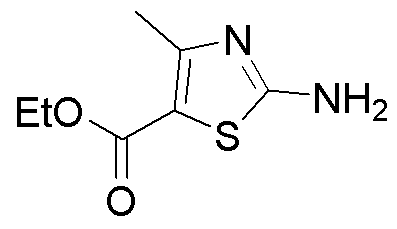 [00452] To a solution of 2-chloro-3-oxo-butyric acid ethyl ester (5 g, 0.030 mol, 1 eq) in ethanol (25 mL) was added thiourea (2.55 g, 0.033 mmol, 1.1 eq) at 25 °C, and the reaction mixture was heated at reflux for 3 h. Then reaction mixture was gradually cooled to 25 °C with stirring to precipitate the product as a white solid. The precipitated solid was collected by filtration using a Buckner funnel and dried under vacuum to obtain ethyl 2-amino-4- methylthiazole-5-carboxylate (4.8 g, 64%) as a fine white powder.
Step 2
Preparation of ethyl 2-bromo-4-methylthiazole-5-carboxylate:

[00453] To a suspension of ethyl 2-amino-4-methylthiazole-5-carboxylate (1 g, 5.36 mmol, 1 eq) and CuBr2 (1.19 g, 5.36 mol, 1 eq) in acetonitrile (25 mL) was added isoamyl nitrite (2.16 mL, 16.08 mmol, 3 eq) dropwise at 25 °C, and the reaction mixture was stirred at 80 °C for 4 h. The resulting reaction mixture was gradually cooled to 25 °C and concentrated under reduced pressure to remove excess isoamyl nitrite and acetonitrile. The residue obtained was partitioned between water (250 mL) and ethyl acetate (250 mL), and the organic layer was separated, dried over sodium sulfate and concentrated under reduced pressure to obtain the crude compound as a brownish solid. The crude product obtained was purified by silica gel (230-400) column chromatography (10% ethyl acetate in hexane) to obtain ethyl 2-bromo-4-methylthiazole- 5-carboxylate (800 mg, 59%) as a yellow solid.
Step 3
Preparation of ethyl 2-(4-ethylphenyl)-4-methylthiazole-5-carboxylate:

[00454] To a solution ethyl 2-bromo-4-methylthiazole-5-carboxylate (0.5 g, 2.0 mmol, 1 eq) in a mixture of DMF, H20, and EtOH (1 : 1 : 1) (10 mL) was added 4-ethylphenylboronic acid (0.3 g, 2.0 mmol, 1.0 eq) and sodium bicarbonate (504 mg, 6.0 mmol, 3 eq) at 25 °C. The reaction mixture was degassed for 10 min with nitrogen. To the resulting suspension was added Pd(dppf)2Cl2 (0.32 g, 0.4 mmol, 0.2 eq) at 25 °C, and the reaction mixture was stirred at 100 °C for 16 h. The resulting dark-colored reaction mixture was cooled to 25 °C, diluted with ethyl
acetate (250 mL), and filtered through a bed of Celite. The filtrate obtained was washed with water, dried over anhydrous sodium sulfate and concentrated under reduced pressure to obtain the crude product as a brown solid. The crude product obtained was purified by silica gel (230- 400) column chromatography (10% ethyl acetate in hexane) to obtain pure ethyl 2-(4- ethylphenyl)-4-methylthiazole-5-carboxylate (275 mg, 55%) as an off-white solid.
Step 4
Preparation of (2-(4-ethylphenyl)- -methylthiazol-5-yl)methanol:

[00455] To a suspension of lithium aluminum hydride (55 mg, 1.45 mmol, 4 eq) in THF
(10 mL) at -20 °C was added a solution of ethyl 2-(4-ethylphenyl)-4-methylthiazole-5- carboxylate (0.1 g, 0.36 mmol, 1 eq ) in THF (3 mL) dropwise, and the reaction mixture was allowed to stir at 25 °C for 30 min. The resulting reaction mixture was quenched with aqueous ammonium chloride (10%, 3 mL) at 0 °C and diluted with ethyl acetate (150 mL). The resulting suspension was filtered through a bed of Celite, and the ethyl acetate layer was separated, dried over anhydrous sodium sulfate and concentrated under reduced pressure to obtain (2-(4- ethylphenyl)-4-methylthiazol-5-yl)methanol (60 mg, 71%) as a white solid.
Step 5
Preparation of 5-(chloromethyl)-2- -ethylphenyl)-4-methylthiazole:

[00456] To a solution of (2-(4-ethylphenyl)-4-methylthiazol-5-yl)methanol (1.5 g, 6.4 mmol, 1 eq) in DCM (15 mL) at 0 °C was added thionyl chloride (0.94 mL, 1.2 mmol, 2 eq) dropwise and the reaction mixture was stirred at 25 °C for 30 min. The reaction mixture was diluted with ethyl acetate (250 mL), washed with water (150 mL), aqueous sodium bicarbonate (10%), 150 mL). The separated ethyl acetate layer was dried over anhydrous sodium sulfate and concentrated under reduced pressure to obtain the crude product as a pale brown solid. The crude product obtained was purified by silica gel (230-400) column chromatography (10% ethyl acetate in hexane) to obtain pure 5-(chloromethyl)-2-(4-ethylphenyl)-4-methylthiazole (1.2 g, 75%) as an off-white solid.
Step 6
Preparation of ethyl 2-((2-(4-ethylphenyl)-4-methylthiazol-5-yl)methylthio)acetate:

[00457] To a solution of 5-(chloromethyl)-2-(4-ethylphenyl)-4-methylthiazole (1.5 g, 5.95 mmol, 1 eq) in DMF (15 mL) was added potassium carbonate (2.1 g, 14.8 mmol, 2.5 eq), DMAP (catalytic amount) and mercaptoacetic acid ethyl ester (1.072 mL, 0.54 mol, 1.4 eq) at 25°C, and the reaction mixture was stirred for 1 h at the same temperature. The reaction mixture was diluted with water (250 mL), extracted with ethyl acetate (2 x 150 mL), and the combined ethyl acetate layers were dried over anhydrous sodium sulfate and concentrated under reduced pressure to obtain ethyl 2-((2-(4-ethylphenyl)-4-methylthiazol-5-yl)methylthio)acetate (1.2 g, 56%) as an off-white solid.
Step 7
Preparation of 2-((2-(4-ethylphenyl)-4-methylthiazol-5-yl)methylthio)acetic acid:

[00458] To a solution of ethyl 2-((2-(4-ethylphenyl)-4-methylthiazol-5- yl)methylthio)acetate (2.0 g, 5.9 mmol, 1 eq) in methanol (15 mL) at 25 °C was added an aqueous solution of sodium hydroxide (prepared from 0.95 g NaOH in 5 mL H20), and the reaction mixture was stirred for 30 min at the same temperature. The resulting reaction mixture was concentrated under reduced pressure to remove methanol, and the residue obtained was suspended in ether and filtered through a Buckner funnel. The solid obtained from filtration was dissolved in water, acidified to pH 1 with aqueous HC1 (1.5N), and extracted with ethyl acetate (200 mL). The combined ethyl acetate layers were separated, dried over anhydrous sodium sulfate and concentrated under reduced pressure to obtain 2-((2-(4-ethylphenyl)-4-methylthiazol- 5-yl)methylthio)acetic acid (1.6 g, 87 %) as a white solid.
Step 8
Preparation of 2-((2-(4-ethylphenyl)-4-methylthiazol-5-yl)methylthio)-N-(4- fluorophenethyl)acetamide:
 [00459] To a solution of 2-((2-(4-ethylphenyl)-4-methylthiazol-5-yl)methylthio)acetic acid
9 (750 mg, 2.44 mmol, 1 eq) in DMF (5 mL) was added DIPEA (1.06 mL, 6.1 mmol, 2.5 eq), EDCI (700 mg, 3.66 mmol, 1.5 eq), and HOBt (67 mg, 0.48 mmol, 0.2 eq) at 0 °C and stirred for 5 min. To the reaction mixture was added 2-(4-fluorophenyl)-ethylamine (340 mg, 2.45 mmol, 1 eq) and stirring was continued for 30 min at room temperature. The reaction mixture was diluted with water (200 mL) and extracted with ethyl acetate (150 mL x 2). The organic layers were washed with aqueous sodium bicarbonate solution (10%, 50 mL), aqueous HCl (1.5N, 50 mL), dried over sodium sulfate and concentrated under reduced pressure to obtain the crude product as a white solid. The crude product obtained was purified by silica gel (230-400) column chromatography (30% ethyl acetate in hexane) to obtain the title compound (500 mg, 48%) as an off-white solid.
MS (ESI) m/z 429.6 (M + H)+
1H MR (300 MHz, DMSO- 6) δ 8.05 (br s, 1H), 7.77 (d, J= 8.1 Hz, 2H), 7.30 (d, J= 8.1 Hz, 2H), 7.22 (dd, J= 5.7, 10.1 Hz, 2H), 7.08 (t, J= 8.9 Hz, 2H), 3.99 (s, 2H), 3.31 - 3.22 (m, 2H), 3.09 (s, 2H), 2.70 - 2.59 (m, 4H), 2.31 (s, 3H), 1.19 (t, J= 7.5 Hz, 3H).
[00460] The following compounds were prepared according to the procedures in Example
1 using the appropriate starting materials and reagents.


-y et anone

- - -et yp eny - -met yt azo- -y met yt o acetam e

- -met y - - -et y p eny t azo - -y met y t o acet c ac
Example 24
Preparation of 2-((2-(4-ethylphenyl)-4-methylthiazol-5-yl)methylsulfinyl)-N-(4- fluorophenethyl)acetamide:

[00461] To a solution of the Example 1 compound (100 mg, 0.233 mmol, leq) in DCM
(10 mL) was added weto-chloroperoxybenzoic acid (70%) (57 mg, 0.233 mmol, 1 eq) at 0 °C, and the reaction mixture was stirred at room temperature for 30 min. The reaction mixture was diluted with DCM (100 mL), washed with aqueous sodium bicarbonate solution (10%, 50 mL) and water (75 mL), and then dried over sodium sulfate and concentrated under reduced pressure to obtain the crude compound as a white solid. The crude product obtained was purified by silica gel (230-400) column chromatography (40% ethyl acetate in hexane) to obtain the title compound (30 mg, 28%) as an off-white solid.
MS (ESI) m/z 445.6 (M + H)+
1H MR (300 MHz, DMSO- 6) δ 8.36 (br s, 1H), 7.81 (d, J= 7.2 Hz, 2H), 7.32 (d, J= 7.2 Hz, 2H), 7.24 (t, J= 6.3 Hz, 2H), 7.08 (t, J= 8.3 Hz, 2H), 4.47 (d, J= 14 Hz, 1H), 4.32 (d, J= 14 Hz, 1H), 3.71 (d, J= 13 Hz, 1H), 3.49 (d, J= 13 Hz, 1H), 3.33 - 3.25 (m, 2H), 2.73 - 2.60 (m, 4H), 2.37 (s, 3H), 1.19 (t, J= 7.5 Hz, 3H).
[00462] The following compound was prepared according to the procedures in Example
24 using the appropriate starting materials and reagents.

(pyridin-3 -yl)ethyl)acetamide
Example 26
Preparation of 2-((2-(4-ethylphenyl)-4-methylthiazol-5-yl)methylsulfonyl)-N-(4- fluorophenethyl)acetamide:

[00463] To a solution of the Example 1 compound (100 mg, 0.233 mmol, 1 eq) in DCM
(10 mL) was added weto-chloroperoxybenzoic acid (70%) (125 mg, 0.51 mmol, 2.2 eq) at 0 °C, and the reaction mixture was stirred at room temperature for 30 min. The reaction mixture was diluted with DCM (100 mL), washed with aqueous sodium bicarbonate solution (10%, 50 mL) and water (75 mL), and then dried over sodium sulfate and concentrated under reduced pressure to obtain the crude compound as a white solid. The crude product obtained was purified by silica gel (230-400) column chromatography (40% ethyl acetate in hexane) to obtain the title compound (30 mg, 28%) as an off-white solid.
1H MR (300 MHz, DMSO- 6) δ 8.48 (br s, 1H), 7.82 (d, J= 8.1 Hz, 2H), 7.35 - 7.26 (m, 4H), 7.10 (t, J= 8.9 Hz, 2H), 4.93 (s, 2H), 4.11 (s, 2H), 3.38 - 3.31 (m, 2H), 2.76 - 2.60 (m, 4H), 2.41 (s, 3H), 1.19 (t, J= 7.5 Hz, 3H).
[00464] The following compound was prepared according to the procedures in Example
26 using the appropriate starting materials and reagents.

(pyridin-3 -yl)ethyl)acetamide
Example 28
Preparation of 2-((2-(4-ethylphenyl)-4-methylthiazol-5-yl)methoxy)-N-(4- fluorophenethyl)acetamide:

Step 1
Preparation of tert-butyl 2-(( -(4-ethylphenyl)-4-methylthiazol-5-yl)methoxy)acetate:

[00465] To a solution of (2-(4-ethylphenyl)-4-methylthiazol-5-yl)methanol prepared in
Example 1 Step 4 (50 mg, 0.214 mmol, 1 eq) in DMF (2 mL) was added sodium hydride (60% in mineral oil) (12.8 mg, 0.32 mmol, 1.5 eq) at 0 °C, and the reaction mixture was stirred at the same temperature for 5 min. To the resulting suspension was added bromoacetic acid tert-butyl ester (50 mg, 0.25 mmol, 1.2 eq) at 0 °C, and the reaction mixture was stirred at 25 °C for 1 h. The reaction mixture was quenched with aqueous ammonium chloride solution (10%) and extracted with ethyl acetate (50 mL). The organic layer was dried over anhydrous sodium sulfate and concentrated under reduced pressure to obtain the crude product. The crude product obtained was purified by silica gel (230-400) column chromatography (40% ethyl acetate in hexane) to obtain pure tert-butyl 2-((2-(4-ethylphenyl)-4-methylthiazol-5-yl)methoxy)acetate (32 mg, 43%) as an off-white solid.
Step 2
Preparation of 2-((2-(4-ethylphenyl)-4-methylthiazol-5-yl)methoxy)acetic acid:
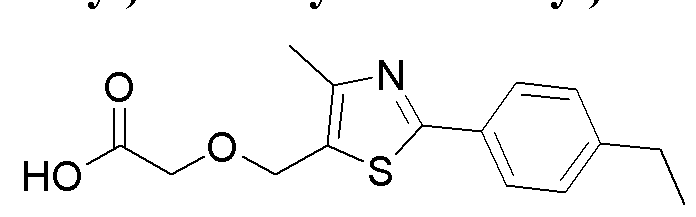
[00466] To a solution of formic acid (5.0 mL, 95%) was added tert-butyl 2-((2-(4- ethylphenyl)-4-methylthiazol-5-yl)methoxy)acetate (500 mg, 1.44 mmol, 1 eq) at 25 °C, and the reaction mixture was stirred for 3 h. The reaction mixture was evaporated under reduced pressure to remove formic acid, and the residue was dissolved in ethyl acetate (200 mL), washed with water (100 mL), dried over anhydrous sodium sulfate and concentrated under reduced pressure to
obtain 2-((2-(4-ethylphenyl)-4-methylthiazol-5-yl)methoxy)acetic acid (300 mg, 71%) as a white solid.
Step 3
Preparation of 2-((2-(4-ethylphenyl)-4-methylthiazol-5-yl)methoxy)-N-(4- fluorophenethyl)acetamide:

[00467] To a solution of 2-((2-(4-ethylphenyl)-4-methylthiazol-5-yl)methoxy)acetic acid
(75 mg, 0.257 mmol, 1 eq) in DMF (5 mL) was added DIPEA (0.11 mL, 0.64 mmol, 2.5 eq), EDCI (74 mg, 0.38 mmol, 1.5 eq), and HOBt (7.0 mg, 0.05 mmol, 0.2 eq) at 0 °C, and the reaction mixture was stirred for 5 min at the same temperature. To the resulting suspension was added 2-(4-fluorophenyl)-ethylamine (35 mg, 0.257 mmol, 1 eq) at 0 °C, and the reaction mixture was stirred for 30 min at room temperature. The resulting reaction mixture was diluted with water (50 mL), extracted with ethyl acetate, and the ethyl acetate layer was washed with aqueous sodium bicarbonate solution (10%, 50 mL) and aqueous HC1 (1.5N, 50 mL), and then dried over sodium sulfate and concentrated under reduced pressure to obtain the crude product. The crude product obtained was purified by silica gel (230-400) column chromatography (40% ethyl acetate in hexane) to obtain the title compound (35 mg, 33%) as an off-white solid.
MS (ESI) m/z: 292.1 (M + H)+
1H MR (300 MHz, DMSO- 6) δ 7.83 - 7.77 (m, 3H), 7.32 (d, J= 8.1 Hz, 2H), 7.22 (dd, J = 6.0, 8.4 Hz, 2H), 7.08 (t, J= 8.7 Hz, 2H), 4.67 (s, 2H), 3.89 (s, 2H), 3.36 - 3.27 (m, 2H), 2.75 - 2.59 (m, 4H), 2.34 (s, 3H), 1.19 (t, J= 7.5 Hz, 3H).
[00468] The following compounds were prepared according to the procedures in Example
28 using the appropriate starting materials and reagents.

3 -yl)ethyl)acetamide
31 319.2
2-((2-(4-tert-butylphenyl)-4-methylthiazol-5-yl)methoxy)acetamide
Example 32
Preparation of 2-((2-(4-ethylphenyl)-4-methylthiazol-5-yl)methoxy)acetic acid:

Step 1
Preparation of 5-(chloromethyl)-2- -ethylphenyl)-4-methylthiazole:

[00469] To a solution of (2-(4-ethylphenyl)-4-methylthiazol-5-yl)methanol prepared in
Example 1, Step 4 (700 mg, 3.0 mmol) in DCM (20 mL) was added SOCl2 (714 mg, 6.0 mmol) at 0 °C, and the reaction mixture was stirred at room temperature for 1 h. The reaction mixture was diluted with water (40 mL) and extracted with ethyl acetate (20 mL χ 3). The combined organic layers were concentrated and dried to provide 5-(chloromethyl)-2-(4-ethylphenyl)-4- methylthiazole (720 mg, 96%) as a yellow solid which was used directly in the next step.
Step 2
Preparation of ethyl 2-((2-(4-ethylphenyl)-4-methylthiazol-5-yl)methoxy)acetate:

[00470] A solution of 5-(chloromethyl)-2-(4-ethylphenyl)-4-methylthiazole (500 mg, 2.0 mmol), ethyl 2-hydroxyacetate (310 mg, 3.0 mmol), DMAP (240 mg, 2.0 mmol) and Cs2C03 (1.3 g, 4.0 mmol) in DMF (10 mL) was stirred at room temperature for 16 h. The reaction mixture was diluted with water (50 mL) and extracted with ethyl acetate (50 mL x 3). The combined organic layers were concentrated and purified by silica gel column chromatography with petroleum ether/ethyl acetate (3 : 1) to provide ethyl 2-((2-(4-ethylphenyl)-4-methylthiazol-5- yl)methoxy)acetate (250 mg, 39%) as a white solid.
MS (ESI) m/z: 320.1 (M + H)+
Step 3
Preparation of 2-((2-(4-ethylphenyl)-4-methylthiazol-5-yl)methoxy)acetic acid:

[00471] A solution of ethyl 2-((2-(4-ethylphenyl)-4-methylthiazol-5-yl)methoxy)acetate
(250 mg, 0.78 mmol) and 5M aqueous NaOH solution (1.0 mL) in a mixture of MeOH (1.0 mL) and THF (1.0 mL) was stirred at room temperature for 1 h. The reaction mixture was adjusted to pH 2 by adding 2M aqueous HCl solution, and the resulting mixture was extracted with ethyl acetate (30 mL χ 3). The combined organic layers were concentrated and purified by preparative HPLC (Gemini CI 8 column, 150 x 21.2 mm, 5 μπι; mobile phase A: acetonitrile, mobile phase B: water containing 0.1% formic acid; flow rate: 20 mL/min; gradient: 2% - 45% A over 0.3 min, hold at 45% A for 1.7 min, 45% - 53% A over 8.0 min, 53% - 95% A over 0.5 min, hold at 95%) A for 2.0 min) to provide the title compound (120 mg, 53%>) as a white solid.
MS (ESI) m/z: 292.1 (M + H)+
1H MR (400 MHz, CDC13) δ 7.81 (d, J= 8.1 Hz, 2H), 7.25 (d, J= 6.6 Hz, 2H), 4.80 (s, 2H), 4.18 (s, 2H), 2.68 (q, J= 7.6 Hz, 2H), 2.47 (s, 3H), 1.26 (t, J= 7.6 Hz, 3H).
Example 33
Preparation of 2-((2-(4-ethylphenyl)-4-methylthiazol-5-yl)methoxy)acetamide:

[00472] A solution of 2-((2-(4-ethylphenyl)-4-methylthiazol-5-yl)methoxy)acetic acid prepared in Example 32 (50 mg, 0.17 mmol), H4C1 (30 mg, 0.51 mmol), EDCI (50 mg, 0.26 mmol), HOBt (35 mg, 0.26 mmol) and DIPEA (109 mg, 0.85 mmol) in DMF (2 mL) was stirred at room temperature for 16 h. The reaction mixture was diluted with water (20 mL) and extracted with ethyl acetate (10 mL x 3). The combined organic layers were concentrated and purified by preparative HPLC (Gemini CI 8 column, 150 x 21.2 mm, 5 μπι; mobile phase A: acetonitrile, mobile phase B: water containing 0.1%> formic acid; flow rate: 20 mL/min; gradient: 2%> - 45%> A over 0.3 min, hold at 45% A for 1.7 min, 45% - 53% A over 8.0 min, 53% - 95% A over 0.5 min, hold at 95% A for 2.0 min) to provide the title compound (30 mg, 61%) as a white solid. MS (ESI) m/z: 291.1 (M + H)+
1H MR (400 MHz, CDC13) δ 7.82 (d, J= 8.2 Hz, 2H), 7.26 (d, J= 8.2 Hz, 2H), 6.47 (br s, 1H), 5.56 (br s, 1H), 4.73 (s, 2H), 4.03 (s, 2H), 2.69 (q, J = 7.6 Hz, 2H), 2.47 (s, 3H), 1.26 (t, J = 7.6 Hz, 3H).
Example 34
Preparation of 2-((2-(4-isopropylphenyl)-4-methylthiazol-5-yl)methoxy)acetic acid:

Step 1
Preparation of (2-bromo-4-methylthiazol-5-yl)methanol:

[00473] To a solution of ethyl 2-bromo-4-methylthiazole-5-carboxylate prepared in
Example 1 Step 2 (8.0 g, 32 mmol) in ethanol (60 mL) and water (10 mL) was added NaBH4 (3.0 g, 80 mmol) at 0 °C, and the reaction mixture was stirred at room temperature for 16 h. The reaction mixture was diluted with water (100 mL) and extracted with ethyl acetate (100 mL x 3). The combined organic layers were concentrated and purified by silica gel column
chromatography with petroleum ether/ethyl acetate (2: 1) to provide (2-bromo-4-methylthiazol-5- yl)methanol (3.8 g, 58%) as a yellow oil.
MS (ESI) m/z: 208.1, 210.1 (M + H)+
Step 2
Preparation of ethyl 2-((2-bromo- -methylthiazol-5-yl)methoxy)acetate:

[00474] To a solution of (2-bromo-4-methylthiazol-5-yl)methanol (1.0 g, 4.8 mmol) and ethyl 2-chloroacetate (876 mg, 7.2 mmol) in DMF (15 mL) was added NaH (300 mg, 60 wt. % in mineral oil, 7.2 mmol) at 0 °C, and the reaction mixture was stirred at room temperature for 1.5 h. The reaction mixture was quenched with water (50 mL) and extracted with ethyl acetate (50 mL x 3). The combined organic layers were concentrated and purified by silica gel column chromatography with petroleum ether/ethyl acetate (8: 1) to provide ethyl 2-((2-bromo-4- methylthiazol-5-yl)methoxy)acetate (1.1 g, 78%) as a colorless oil.
MS (ESI) m/z: 294.1, 296.1 (M + H)
Step 3
Preparation of ethyl 2-((2-(4-isopropylphenyl)-4-methylthiazol-5-yl)methoxy)acetate:

[00475] A mixture of ethyl 2-((2-bromo-4-methylthiazol-5-yl)methoxy)acetate (100 mg,
0.34 mmol), 4-isopropylphenylboronic acid (67 mg, 0.41 mmol), Pd(dppf)Cl2 (15 mg, 0.02 mmol) and K3PO4 (180 mg, 0.85 mmol) in a mixture of dioxane (2 mL) and water (0.2 mL) was stirred in a sealed tube at 100 °C under N2 for 16 h. The reaction mixture was concentrated and purified by preparative TLC with petroleum ether/ethyl acetate (5: 1) to provide ethyl 2-((2-(4- isopropylphenyl)-4-methylthiazol-5-yl)methoxy)acetate (80 mg, 71%) as a colorless oil.
MS (ESI) m/z: 334.1 (M + H)+
Step 4
Preparation of 2-((2-(4-isopropylphenyl)-4-methylthiazol-5-yl)methoxy)acetic acid:

[00476] Ethyl 2-((2-(4-isopropylphenyl)-4-methylthiazol-5-yl)methoxy)acetate (80 mg,
0.24 mmol) was reacted according to the procedure in Example 32 Step 3 and purified by preparative HPLC (Gemini CI 8 column, 150 x 21.2 mm, 5 μπι; mobile phase A: acetonitrile, mobile phase B: water containing 0.1% formic acid; flow rate: 20 mL/min; gradient: 2% - 50% A over 0.3 min, hold at 50% A for 1.7 min, 50% - 63% A over 8.0 min, 63% - 95% A over 0.5 min, hold at 95% A for 2.0 min) to provide the title compound (35 mg, 48%) as a white solid. MS (ESI) m/z: 306.1 (M + H)+
1H MR (400 MHz, CDC13) δ 7.83 (d, J= 8.2 Hz, 2H), 7.28 (d, J= 8.2 Hz, 2H), 4.81 (s, 2H), 4.18 (s, 2H), 2.96 - 2.91 (m, 1H), 2.48 (s, 3H), 1.27 (d, J= 6.9 Hz, 6H).
[00477] The following compounds were prepared according to the procedures in Example
34 using the appropriate starting materials and reagents.


y met oxyacetc ac
Example 54
Preparation of 2-((2-(4-chlorophenyl)-4-methylthiazol-5-yl)methylthio)-N-(2-(pyridin-3- yl)ethyl)acetamide:

Step 1
Preparation of a mixture of 2-chloro-5-(chloromethyl)-4-methylthiazole and 2-bromo-5- (chloromethyl)-4-methylthiazole:

[00478] (2-Bromo-4-methylthiazol-5-yl)methanol (1.5 g, 7.2 mmol) was reacted according to the procedure in Example 32 Step 1 to provide a 3 : 1 mixture of 2-chloro-5-(chloromethyl)-4- methylthiazole and 2-bromo-5-(chloromethyl)-4-methylthiazole (2 g, 95%) as a colorless oil. MS (ESI) m/z: 182.1, 184.1 (M + H)+ [CI component], 226.1, 228.1 (M + H)+ [Br component]. Step 2
Preparation of a mixture of 2-((2-chloro-4-methylthiazol-5-yl)methylthio)acetic acid and 2- ((2-bromo-4-methylthiazol-5-yl)methylthio)acetic acid :

[00479] To a solution of a mixture of 2-chloro-5-(chloromethyl)-4-methylthiazole and 2- bromo-5-(chloromethyl)-4-methylthiazole (2 g, 8.8 mmol) and ethyl 2-mercaptoacetate (1.48 g, 12.3 mmol) in DMF (15 mL) was added K2C03 (2.68 g, 19.36 mmol) and DMAP (0.1 g, 0.88 mmol) at 0 °C, and the reaction mixture was stirred at room temperature for 45 min. The reaction mixture was diluted with water (30 mL) and extracted with ethyl acetate (50 mL x 3). The combined organic layers were concentrated to provide a mixture of the crude esters. The mixture of the crude esters and 5M aqueous NaOH solution (10 mL) in a mixture of MeOH (15 mL) and THF (15 mL) was stirred at room temperature for 1 h. The reaction mixture was adjusted to pH 2 by adding 2M aqueous HCl solution, and the resulting mixture was extracted with ethyl acetate (50 mL x 3). The combined organic layers were concentrated to provide a mixture of 2-((2- chloro-4-methylthiazol-5-yl)methylthio)acetic acid and 2-((2-bromo-4-methylthiazol-5- yl)methylthio)acetic acid (2 g, 99%) as a colorless oil.
MS (ESI) m/z: 238.1, 240.1 (M + H)+ [CI component], 282.1, 284.1 (M + H)+ [Br component]. Step 3
Preparation of a mixture of 2-((2-chloro-4-methylthiazol-5-yl)methylthio)-N-(2-(pyridin-3- yl)ethyl)acetamide and 2-((2-bromo-4-methylthiazol-5-yl)methylthio)-N-(2-(pyridin-3- yl)ethyl)acetamide:

[00480] A solution of a mixture of 2-((2-chloro-4-methylthiazol-5-yl)methylthio)acetic acid and 2-((2-bromo-4-methylthiazol-5-yl)methylthio)acetic acid (0.1 g, 0.34 mmol), 2-(pyridin- 3-yl)ethanamine (0.49 g, 4.04 mmol), EDCI (0.77 g, 4.04 mmol), HOBt (0.54 g, 4.04 mmol) and DIPEA (1.3 g, 10.08 mmol) in DMF (5 mL) was stirred at room temperature for 16 h. The reaction mixture was diluted with water (20 mL) and extracted with ethyl acetate (25 mL x 3). The combined organic layers were concentrated to provide a mixture of 2-((2-chloro-4- methylthiazol-5-yl)methylthio)-N-(2-(pyridin-3-yl)ethyl)acetamide and 2-((2-bromo-4- methylthiazol-5-yl)methylthio)-N-(2-(pyridin-3-yl)ethyl)acetamide (0.8 g, 61.5%) as a white solid.
MS (ESI) m/z: 342.1, 344.1 (M + H)+ [CI component], 386.1, 388.1 (M + H)+ [Br component]. Step 4
Preparation of 2-((2-(4-chlorophenyl)-4-methylthiazol-5-yl)methylthio)-N-(2-(pyridin-3- yl)ethyl)acetamide:

[00481] A mixture of 2-((2-chloro-4-methylthiazol-5-yl)methylthio)-N-(2-(pyridin-3- yl)ethyl)acetamide and 2-((2-bromo-4-methylthiazol-5-yl)methylthio)-N-(2-(pyridin-3- yl)ethyl)acetamide (100 mg, 0.26 mmol), 4-chlorophenylboronic acid (40.5 mg, 0.28 mmol), Pd(dppf)Cl2 (19 mg, 0.026 mmol) and K3PO4 (137 mg, 0.65 mmol) in a mixture of dioxane (2 mL) and water (0.2 mL) was stirred in a sealed tube at 90 °C under N2 for 16 h. The reaction mixture was concentrated and purified by preparative HPLC (Gemini CI 8 column, 150 x 21.2 mm, 5 μπι; mobile phase A: acetonitrile, mobile phase B: water containing 0.1% formic acid; flow rate: 20 mL/min; gradient: 2% - 53% A over 0.3 min, hold at 53% A for 1.7 min, 53% -
65% A over 8.0 min, 65% - 95% A over 0.5 min, hold at 95% A for 2.0 min) to provide the title compound (40 mg, 37%) as a white solid.
MS (ESI) m/z: 418.1, 420.1 (M + H)+
1H MR (400 MHz, CDC13) δ 8.49 (br s, 2H), 7.81 (d, J= 8.4 Hz, 2H), 7.56 (d, J= 7.6 Hz, 1H), 7.39 (d, J= 8.4 Hz, 2H), 7.27 (s, 1H), 6.64 (s, 1H), 3.84 (s, 1H), 3.53 (d, J= 6.0 Hz, 2H), 3.19 (s, 2H), 2.85 (t, J= 6.6 Hz, 2H), 2.37 (s, 3H).
[00482] The following compounds were prepared according to the procedures in Example
54 using the appropriate starting materials and reagents.

Example 58
Preparation of 2-((2-(4-methoxyphenyl)-4-methylthiazol-5-yl)methylthio)-N-(4- fluorophenethyl)acetamide:

Step 1
Preparation of a mixture of 2-((2-chloro-4-methylthiazol-5-yl)methylthio)-N-(4- fluorophenethyl)acetamide and 2-((2-bromo-4-methylthiazol-5-yl)methylthio)-N-(4- fluorophenethyl)acetamide:

[00483] A mixture of 2-((2-chloro-4-methylthiazol-5-yl)methylthio)acetic acid and 2-((2- bromo-4-methylthiazol-5-yl)methylthio)acetic acid prepared in Example 54 Step 2 (100 mg, 0.42 mmol) and 2-(4-fluorophenyl)ethanamine (74 mg, 0.53 mmol) were reacted according to the procedure in Example 54 Step 3 and purified by silica gel column chromatography with petroleum ether/ethyl acetate (5: 1) to provide a mixture of 2-((2-chloro-4-methylthiazol-5- yl)methylthio)-N-(4-fluorophenethyl)acetamide and 2-((2-bromo-4-methylthiazol-5- yl)methylthio)-N-(4-fluorophenethyl)acetamide (100 mg, 67%) as a light yellow solid.
MS (ESI) m/z: 359.1, 361.1 (M + H)+ [CI component], 403.1, 405.1 (M + H)+ [Br component]. Step 2
Preparation of 2-((2-(4-methoxyphenyl)-4-methylthiazol-5-yl)methylthio)-N-(4- fluorophenethyl)acetamide:

[00484] A mixture of 2-((2-chloro-4-methylthiazol-5-yl)methylthio)-N-(4- fluorophenethyl)acetamide and 2-((2-bromo-4-methylthiazol-5-yl)methylthio)-N-(4- fluorophenethyl)acetamide (100 mg, 0.28 mmol) and 4-methoxyphenylboronic acid (53 mg, 0.35 mmol) were reacted according to the procedure in Example 34 Step 3 and purified by
preparative HPLC (Gemini CI 8 column, 150 x 21.2 mm, 5 μπι; mobile phase A: acetonitrile, mobile phase B: water containing 0.1% formic acid; flow rate: 20 mL/min; gradient: 2% - 55% A over 0.3 min, hold at 55% A for 1.7 min, 55% - 65% A over 8.0 min, 65% - 95% A over 0.5 min, hold at 95% A for 2.0 min) provide the title compound (36 mg, 30%) as a white solid.
MS (ESI) m/z: 431.1 (M + H)+
1H MR (400 MHz, CDC13) δ 7.81 (d, J= 8.6 Hz, 2H), 7.14 - 7.11 (m, 2H), 7.00 - 6.92 (m, 4H), 6.61 (s, 1H), 3.85 (s, 3H), 3.81 (s, 2H), 3.46 (m, 2H), 2.78 (t, J= 8.0 Hz, 2H), 2.35 (s, 3H).
[00485] The following compounds were prepared according to the procedures in Example
58 using the appropriate starting materials and reagents.

uorop enet y acetam e
Example 62
Preparation of 2-((2-(4-ethylphen l)thiazol-5-yl)methylthio)acetic acid:

Step 1
Preparation of ethyl 2-(4-ethylphen l)thiazole-5-carboxylate:

[00486] Ethyl 2-bromothiazole-5-carboxylate (2 g, 8.47 mmol) and 4-ethylphenylboronic acid (1.39 g, 9.32 mmol) were reacted according to the procedure in Example 34 Step 3 and purified by silica gel column chromatography with petroleum ether/ethyl acetate (4: 1) to provide ethyl 2-(4-ethylphenyl)thiazole-5-carboxylate (0.9 g, 41%) as a white solid.
MS (ESI) m/z: 262.1 (M + H)+
Step 2
Preparation of (2-(4-ethylphenyl)thiazol-5- l)methanol:
 [00487] To a solution of ethyl 2-(4-ethylphenyl)thiazole-5-carboxylate (0.1 g, 0.38 mmol) in THF (15 mL) at 0 °C under N2 was added DIBAL-H (0.12 g, 0.84 mmol), and the reaction mixture was stirred at room temperature for 5 h. The reaction mixture was quenched with 15% aqueous NaOH solution. After being stirred at room temperature for 15 min, the solid was removed by filtration, and the filtrate was concentrated and purified by silica gel column chromatography with petroleum ether/ethyl acetate (2: 1) to provide (2-(4-ethylphenyl)thiazol-5- yl)methanol (50 mg, 60%) as a colorless oil.
MS (ESI) m/z: 220.1 (M + H)+.
Step 3
Preparation of 5-(chloromethyl)-2- 4-ethylphenyl)thiazole:

[00488] (2-(4-Ethylphenyl)thiazol-5-yl)methanol (0.35 g, 0.6 mmol) was reacted according to the procedure in Example 32 Step 1 to provide 5-(chloromethyl)-2-(4- ethylphenyl)thiazole (0.3 g, 79%) as a colorless oil.
MS (ESI) m/z: 238.3, 240.3 (M + H)+.
Step 4
Preparation of ethyl 2-((2-(4-eth lphenyl)thiazol-5-yl)methylthio)acetate:
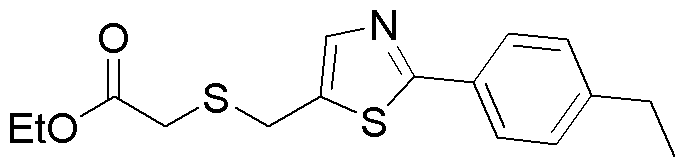
[00489] A solution of 5 -(chloromethyl)-2-(4-ethylphenyl)thiazole (0.38 g, 1.6 mmol), ethyl 2-mercaptoacetate (0.29 g, 2.24 mmol), K2C03 (0.49 g, 3.52 mmol) and DMAP (0.02 g, 0.16 mmol) in DMF (15 mL) was stirred at room temperature for 45 min. The reaction mixture was diluted with water (20 mL) and extracted with ethyl acetate (25 mL χ 3). The combined organic layers were concentrated to provide ethyl 2-((2-(4-ethylphenyl)thiazol-5- yl)methylthio)acetate (0.5 g, 97%) as a white solid.
MS (ESI) m/z: 322.1 (M + H)+
Step 5
Preparation of 2-((2-(4-ethylphenyl)thiazol-5-yl)methylthio)acetic acid:
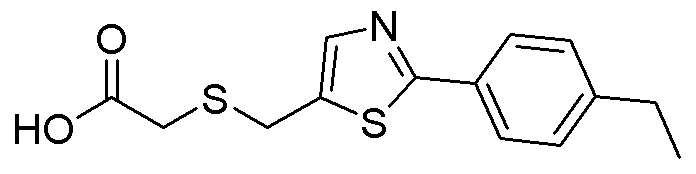
[00490] Ethyl 2-((2-(4-ethylphenyl)thiazol-5-yl)methylthio)acetate (0.52 g, 1.62 mmol) was reacted according to the procedure in Example 32 Step 3 and purified by silica gel column chromatography with petroleum ether/ethyl acetate (1 : 1) to provide the title compound (0.4 g, 84%) as a white solid.
MS (ESI) m/z: 294.1 (M + H)+
1H NMR (400 MHz, CDC13) δ 7.80 (d, J= 8.2 Hz, 2H), 7.72 (s, 1H), 7.23 (d, J= 8.2 Hz, 2H), 4.10 (s, 2H), 3.22 (s, 2H), 2.68 (q, J= 7.6 Hz, 2H), 1.26 (t, J= 7.6 Hz, 3H).
Example 63
Preparation of 2-((2-(4-ethylphenyl)thiazol-5-yl)methylthio)-N-(2-(pyridin-3- yl)ethyl)acetamide:

[00491] To a solution of 2-((2-(4-ethylphenyl)thiazol-5-yl)methylthio)acetic acid prepared in Example 62 (0.1 g, 0.34 mmol), 2-(pyridin-3-yl)ethanamine (0.046 g, 0.37 mmol), EDCI (0.098g, 0.51 mmol) and HOBt (0.069 g, 0.51 mmol) in DCM (25 mL) was added DIPEA (0.13 g, 1.02 mmol) at room temperature under N¾ and the reaction mixture was stirred at room temperature for 12 h. Then reaction mixture was diluted with water (20 mL) and extracted with ethyl acetate (25 mL χ 3). The combined organic layers were concentrated and purified by preparative HPLC (Gemini CI 8 column, 150 x 21.2 mm, 5 μπι; mobile phase A: acetonitrile, mobile phase B: water containing 0.1% formic acid; flow rate: 20 mL/min; gradient: 2% - 50% A over 0.3 min, hold at 50% A for 1.7 min, 52% - 65% A over 8.0 min, 65% - 95% A over 0.5 min, hold at 95% A for 2.0 min) to provide the title compound (40 mg, 30%) as a white solid. MS (ESI) m/z: 398.1 (M + H) +
1H NMR (400 MHz, CDC13) δ 8.49 (d, J= 3.4 Hz, 1H), 8.45 (s, 1H), 7.81 (d, J= 8.2 Hz, 2H), 7.57 (s, 1H), 7.51 (d, J= 7.9 Hz, 1H), 7.27 - 7.24 (m, 3H), 6.58 (br s, 1H), 3.88 (s, 2H), 3.54 (q, J= 6.2 Hz, 2H), 3.20 (s, 2H), 2.82 (t, J= 7.1 Hz, 2H), 2.69 (q, J= 7.6 Hz, 2H), 1.26 (t, J= 7.6 Hz, 3H).
[00492] The following compound was prepared according to the procedures in Example
63 using the appropriate starting materials and reagents.

uorop enet y acetam e
Example 65
Preparation of 3-(2-(4-ethylphenyl)-4-methylthiazol-5-yl)propanoic acid:

Step 1
Preparation of 2-(4-ethylphenyl)- -methylthiazole-5-carboxylic acid:

[00493] Ethyl 2-(4-ethylphenyl)-4-methylthiazole-5-carboxylate prepared in Example 1
Step 3 (2.0 g, 7.2 mmol) was reacted according to the procedure in Example 32 Step 3 to provide 2-(4-ethylphenyl)-4-methylthiazole-5-carboxylic acid (1.7 g, 96%) as a white solid.
MS (ESI) m/z: 248.1 (M + H)+
Step 2
Preparation of 2-(4-ethylphenyl)-4-methylthiazole:
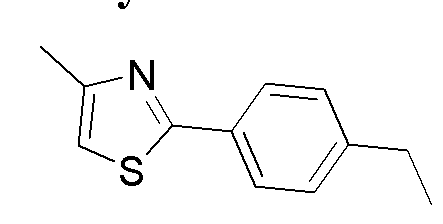
[00494] A mixture of 2-(4-ethylphenyl)-4-methylthiazole-5-carboxylic acid (2) (1.8 g, 7.2 mmol), Ag2C03 (200 mg, 0.72 mmol) and HOAc (22 mg, 0.36 mmol) in DMSO (20 mL) was stirred at 120 °C under N2 for 16 h. The reaction mixture was filtered, and the filtrate was diluted with water (100 mL) then extracted with ethyl acetate (30 mL x 3). The combined organic layers were concentrated to provide 2-(4-ethylphenyl)-4-methylthiazole (1.2 g, 82%) as a colorless oil. MS (ESI) m/z: 204.1 (M + H)+
Step 3
Preparation of 5-bromo-2-(4-ethylphenyl)-4-methylthiazole:

[00495] A solution of 2-(4-ethylphenyl)-4-methylthiazole (1.2 g, 5.9 mmol) and BS (1.1 g, 6.2 mmol) in CH3CN (20 mL) was stirred at room temperature for 16 h. The reaction mixture was concentrated and purified by silica gel column chromatography with petroleum ether/ethyl acetate (20: 1) to provide 5-bromo-2-(4-ethylphenyl)-4-methylthiazole (1.5 g, 91%) as a yellow oil.
MS (ESI) m/z: 282.1, 284.1 (M + H)+.
Step 4
Preparation of (E)-methyl 3-(2- -ethylphenyl)-4-methylthiazol-5-yl)acrylate:

[00496] A mixture of 5-bromo-2-(4-ethylphenyl)-4-methylthiazole (300 mg, 1.1 mmol), methyl acrylate (180 mg, 2.1 mmol), Pd(OAc)2 (22 mg, 0.1 mmol) and Et3N (160 mg, 1.6 mmol) in DMF (5 mL) was stirred in a sealed tube at 1 15 °C under N2 for 24 h. Then reaction mixture was diluted with water (30 mL) then extracted with ethyl acetate (20 mL χ 3). The combined organic layers were concentrated and purified by preparative TLC with petroleum ether/ethyl acetate (5 : 1) to provide (E)-methyl 3-(2-(4-ethylphenyl)-4-methylthiazol-5-yl)acrylate (60 mg, 19%) as a yellow solid.
MS (ESI) m/z: 288.1 (M + H)+
Step 5
Preparation of methyl 3-(2-(4-ethylphenyl)-4-methylthiazol-5-yl)propanoate:

[00497] A mixture of (E)-methyl 3-(2-(4-ethylphenyl)-4-methylthiazol-5-yl)acrylate (50 mg, 0.17 mmol) and 10% Pd/C (10 mg) in CH3OH (5 mL) was stirred at room temperature under
1 atm of H2 for 3 h. The reaction mixture was filtered and the filtrate was concentrated to provide methyl 3-(2-(4-ethylphenyl)-4-methylthiazol-5-yl)propanoate (50 mg, 91%) as a yellow solid. MS (ESI) m/z: 290.1 (M + H)+
Step 6
Preparation of 3-(2-(4-ethylphenyl)-4-methylthiazol-5-yl)propanoic acid:

[00498] Methyl 3-(2-(4-ethylphenyl)-4-methylthiazol-5-yl)propanoate (50 mg, 0.17 mmol) was reacted according to the procedure in Example 32 Step 3 and purified by preparative HPLC (Gemini CI 8 column, 150 x 21.2 mm, 5 μπι; mobile phase A: acetonitrile, mobile phase B: water containing 0.1% formic acid; flow rate: 20 mL/min; gradient: 2% - 50% A over 0.3 min, hold at 50% A for 1.7 min, 50% - 60% A over 8.0 min, 60% - 95% A over 0.5 min, hold at 95% A for 2.0 min) to provide the title compound (21 mg, 45%) as a white solid.
MS (ESI) m/z: 276.2 (M + H)+
1H MR (400 MHz, CDC13) δ 7.77 (d, J= 8.2 Hz, 2H), 7.24 (d, J= 8.2 Hz, 2H), 3.10 (t, J= 7.5 Hz, 2H), 2.70 (t, J= 7.5 Hz, 2H), 2.67 (q, J= 7.6 Hz, 2H), 2.41 (s, 3H), 1.25 (t, J= 7.6 Hz, 3H).
Example 66
Preparation of 4-(2-(4-ethylphenyl)-4-methylthiazol-5-yl)butanoic acid:
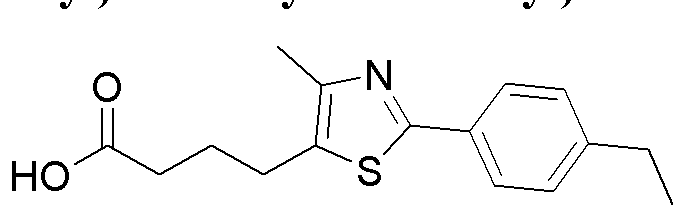
Step 1
Preparation of methyl 6-oxoheptanoate:

[00499] A solution of 6-oxoheptanoic acid (4.0 g, 30 mmol) and concentrated H2S04 (0.1 mL) in MeOH (40.0 mL) was heated under reflux for 3 h. The reaction mixture was diluted with ethyl acetate (100 mL), and washed with saturated aqueous NaHC03 solution (50 mL χ 2). The combined organic layers were concentrated to provide methyl 6-oxoheptanoate (4.0 g, 84%) as a colorless oil.
MS (ESI) m/z: 159.1 (M + H)+
Step 2
Preparation of methyl 5-bromo-6-oxoheptanoate:

[00500] To a mixture of methyl 6-oxoheptanoate (500 mg, 3.2 mmol) in CH3CN (20 mL) was added a solution of TMSBr (487 mg, 3.2 mmol) in CH3CN (2 mL) at 0 °C under N2. Then, a solution of DMSO (246 mg, 3.2 mmol) in CH3CN (2 mL) was added to the reaction mixture at 0 °C . After stirring at room temperature for 16 h, the reaction mixture was diluted with water (100 mL) and extracted with ethyl acetate (30 mL χ 3). The combined organic layers were
concentrated to provide methyl 5-bromo-6-oxoheptanoate (600 mg, 79%) as a yellow oil.
MS (ESI) m/z: 259.1, 261.1 (M + Na)+
Step 3
Preparation of methyl 4-(2-amin -4-methylthiazol-5-yl)butanoate:

[00501] A solution of methyl 5-bromo-6-oxoheptanoate (600 mg, 2.5 mmol) and thiourea
(193 mg, 2.5 mmol) in EtOH (20 mL) was stirred at 90 °C for 4 h. The pH value of the mixture was adjusted to 8 by the addition of saturated aqueous NaHC03 solution, and the resulting mixture was extracted with ethyl acetate (30 mL x 3). The combined organic layers were concentrated to provide methyl 4-(2-amino-4-methylthiazol-5-yl)butanoate (400 mg, 75%) as a yellow solid.
MS (ESI) m/z: 215.1 (M + H)+
Step 4
Preparation of methyl 4-(2-brom -4-methylthiazol-5-yl)butanoate:

[00502] To a mixture of methyl isobutyl nitrite (443 mg, 4.3 mmol) in CH3CN (16 mL) was added TMSBr (658 mg, 4.3 mmol) at 0 °C under N2. Then, a solution of methyl 4-(2-amino- 4-methylthiazol-5-yl)butanoate (400 mg, 1.9 mmol) in a mixture of CH3CN (12 mL) and ethyl
acetate (4 mL) was added to the reaction mixture at 0 °C . The reaction mixture was stirred at room temperature for 3 h, diluted with water (100 mL) and extracted with ethyl acetate (30 mL x
3). The combined organic layers were concentrated and purified by preparative TLC with petroleum ether/ethyl acetate (4: 1) to provide methyl 4-(2-bromo-4-methylthiazol-5-yl)butanoate
(97 mg, 18%) as a yellow oil.
MS (ESI) m/z: 278.1, 280.1 (M + H)+
Step 5
Preparation of methyl 4-(2-(4-ethylphenyl)-4-methylthiazol-5-yl)butanoate:

[00503] A mixture of methyl 4-(2-bromo-4-methylthiazol-5-yl)butanoate (97 mg, 0.35 mmol), 4-ethylphenylboronic acid (63 mg, 0.42 mmol), Pd(dppf)Cl2 (25 mg, 0.04 mmol) and K3PO4 (186 mg, 0.88 mmol) in a mixture of dioxane (5 mL) and water (0.5 mL) was stirred in a sealed tube at 80 °C under N2 for 16 h. Then reaction mixture was concentrated and purified by preparative TLC with petroleum ether/ethyl acetate (5: 1) to provide methyl 4-(2-(4-ethylphenyl)- 4-methylthiazol-5-yl)butanoate (65 mg, 61%) as a colorless oil.
MS (ESI) m/z: 304.1 (M + H)+
Step 6
Preparation of 4-(2-(4-ethylphenyl)-4-methylthiazol-5-yl)butanoic acid:

[00504] Methyl 4-(2-(4-ethylphenyl)-4-methylthiazol-5-yl)butanoate (60 mg, 0.2 mmol) was reacted according to the procedure in Example 32 Step 3 and purified by preparative HPLC (Gemini CI 8 column, 150 x 21.2 mm, 5 μπι; mobile phase A: acetonitrile, mobile phase B: water containing 0.1% formic acid; flow rate: 20 mL/min; gradient: 2% - 55% A over 0.3 min, hold at 55% A for 1.7 min, 55% - 65% A over 8.0 min, 65% - 95% A over 0.5 min, hold at 95% A for 2.0 min) to provide the title compound (20 mg, 34%) as a white solid.
MS (ESI) m/z: 290.1 (M + H)+
1H MR (400 MHz, CDC13) δ 7.80 (d, J= 8.1 Hz, 2H), 7.24 (d, J= 8.1 Hz, 2H), 2.84 (t, J= 7.5 Hz, 2H), 2.67 (q, J= 7.6 Hz, 2H), 2.44 (t, J= 7.3 Hz, 2H), 2.40 (s, 3H), 2.06 - 1.92 (m, 2H), 1.25 (t, 7= 7.6 Hz, 3H).
I l l
Example 67
Preparation of 5-(2-(4-ethylphenyl)-4-methylthiazol-5-yl)pentanoic acid:

Step 1
Preparation of 2-(4-ethylphenyl)-4-methylthiazole-5-carbaldehyde:

[00505] To a solution of (2-(4-ethylphenyl)-4-methylthiazol-5-yl)methanol prepared in
Example 1 Step 4 (0.8 g, 3.4 mmol) in toluene (20 mL) was added Mn02 (3.0 g, 34.5 mmol) at room temperature, and the reaction mixture was stirred at 60 °C for 16 h. Then reaction mixture was filtered and the filtrate was concentrated to provide 2-(4-ethylphenyl)-4-methylthiazole-5- carbaldehyde (0.75 g, 95%) as a yellow solid.
MS (ESI) m/z: 232.1 (M + H)+.
Step 2
Preparation of (£)-ethyl 3-(2-(4-ethylphenyl)-4-methylthiazol-5-yl)acrylate:

[00506] To a solution of 2-(4-ethylphenyl)-4-methylthiazole-5-carbaldehyde (0.75 g, 3.2 mmol) in DCM (15 mL) was added (ethoxycarbonylmethylene)triphenylphosphorane (1.7 g, 4.9 mmol) and the reaction mixture was stirred at room temperature for 16 h. The reaction mixture was diluted with water (20 mL) and extracted with ethyl acetate (30 mL χ 3). The combined organic layers were concentrated and purified by silica gel column chromatography with petroleum ether/ethyl acetate (3 : 1) to provide (£)-ethyl 3-(2-(4-ethylphenyl)-4-methylthiazol-5- yl)acrylate (0.7 g, 73%) as a yellow solid.
MS (ESI) m/z: 302.1 (M + H)+
Step 3
Preparation of ethyl 3-(2-(4-ethylphenyl)-4-methylthiazol-5-yl)propanoate:

[00507] (£)-Ethyl 3-(2-(4-ethylphenyl)-4-methylthiazol-5-yl)acrylate (0.7 g, 2.3 was reacted according to the procedure in Example 65 Step 5 to provide ethyl 3-(2-(4- ethylphenyl)-4-methylthiazol-5-yl)propanoate (0.7 g, 95%) as a yellow solid.
MS (ESI) m/z: 304.1 (M + H)+
Step 4
Preparation of 3-(2-(4-ethylphenyl)-4-methylthiazol-5-yl)propan-l-ol:

[00508] To a solution of ethyl 3-(2-(4-ethylphenyl)-4-methylthiazol-5-yl)propanoate (0.7 g, 2.3 mmol) in THF (15 mL) at 0 °C was added LiAlH4 (0.3 g, 8.05 mmol). The reaction mixture was stirred at room temperature for 4 h. Then reaction mixture was quenched with water (20 mL) and extracted with ethyl acetate (30 mL x 3). The combined organic layers were concentrated to provide 3-(2-(4-ethylphenyl)-4-methylthiazol-5-yl)propan-l-ol (0.6 g, 99%) as a yellow solid.
MS (ESI) m/z: 262.1 (M + H)+.
Step 5
Preparation of 3-(2-(4-ethylphenyl)-4-methylthiazol-5-yl)propanal:

[00509] To a solution of 3-(2-(4-ethylphenyl)-4-methylthiazol-5-yl)propan-l-ol (5) (0.2 g,
0.77 mmol) in DCM (10 mL) was added Dess-Martin periodinane (0.49 g, 1.15 mmol) and the reaction mixture was stirred at room temperature for 2 h. The reaction mixture was diluted with water (20 mL) and extracted with ethyl acetate (25 mL χ 3). The combined organic layers were concentrated to provide 3-(2-(4-ethylphenyl)-4-methylthiazol-5-yl)propanal (0.15 g, 75%) as a yellow solid.
MS (ESI) m/z: 260.1 (M + H)+.
Step 6
Preparation of (E)-ethyl 5-(2- -ethylphenyl)-4-methylthiazol-5-yl)pent-2-enoate:

[00510] 3-(2-(4-Ethylphenyl)-4-methylthiazol-5-yl)propanal (0.15 g, 0.58 mmol) was reacted according to the procedure in Step 2 and purified by silica gel column chromatography with petroleum ether/ethyl acetate (3 : 1) to provide (£)-ethyl 5-(2-(4-ethylphenyl)-4- methylthiazol-5-yl)pent-2-enoate (0.15 g, 79%) as a yellow solid.
MS (ESI) m/z: 330.1 (M + H)+
Step 7
Preparation of ethyl 5-(2-(4-ethylphenyl)-4-methylthiazol-5-yl)pentanoate:

[00511] (£)-Ethyl 5-(2-(4-ethylphenyl)-4-methylthiazol-5-yl)pent-2-enoate (0.15 g, 0.45 mmol) was reacted according to the procedure in Example 65 Step 5 to provide ethyl 5-(2-(4- ethylphenyl)-4-methylthiazol-5-yl)pentanoate (0.1 g, 67%) as a yellow solid.
MS (ESI) m/z: 332.1 (M + H)+
Step 8
Preparation of 5-(2-(4-ethylphenyl)-4-methylthiazol-5-yl)pentanoic acid:

[00512] Ethyl 5-(2-(4-ethylphenyl)-4-methylthiazol-5-yl)pentanoate (0.1 g, 0.3 mmol) was reacted according to the procedure in Example 32 Step 3 and purified by preparative HPLC (Gemini CI 8 column, 150 x 21.2 mm, 5 μπι; mobile phase A: acetonitrile, mobile phase B: water containing 0.1% formic acid; flow rate: 20 mL/min; gradient: 2% - 50% A over 0.3 min, hold at 50% A for 1.7 min, 50% - 65% A over 8.0 min, 65% - 95% A over 0.5 min, hold at 95% A for 2.0 min) to provide the title compound (60 mg, 66%) as a white solid.
MS (ESI) m/z: 304.2 (M + H)+
1H MR (400 MHz, CDC13) δ 7.79 (d, J= 8.2 Hz, 2H), 7.23 (d, J= 8.3 Hz, 2H), 2.78 (t, J= 6.9 Hz, 2H), 2.67 (q, J= 7.6 Hz, 2H), 2.45 - 2.36 (m, 5H), 1.78 - 1.67 (m, 4H), 1.25 (t, J= 7.6 Hz, 3H).
Example 68
Preparation of 2-((2-(4-ethylphenyl)-4-methylthiazol-5-yl)methoxy)propanoic acid:

Step 1
Preparation of ethyl 2-((2-(4-ethylphenyl)-4-methylthiazol-5-yl)methoxy)propanoate:

[00513] To a solution of ethyl 2-hydroxypropanoate (57 mg, 0.48 mmol) in THF (10 mL) was added NaH (32 mg, 60 wt. % in mineral oil, 0.8 mmol) at 0 °C and the reaction mixture was stirred at 0 °C for 0.5 h. A solution of 5-(chloromethyl)-2-(4-ethylphenyl)-4-methylthiazole prepared in Example 32 Step 1 (100 mg, 0.4 mmol) in THF (2 mL) was added and the reaction mixture was stirred at room temperature for 1 h. The reaction mixture was quenched with water (30 mL) and extracted with ethyl acetate (30 mL x 3). The combined organic layers were concentrated and purified by silica gel column chromatography with petroleum ether/ethyl acetate (5: 1) to provide ethyl 2-((2-(4-ethylphenyl)-4-methylthiazol-5-yl)methoxy)propanoate (80 mg, 60%) as a colorless oil.
MS (ESI) m/z: 334.1 (M + H)+
Step 2
Preparation of 2-((2-(4-ethylphenyl)-4-methylthiazol-5-yl)methoxy)propanoic acid:

[00514] Ethyl 2-((2-(4-ethylphenyl)-4-methylthiazol-5-yl)methoxy)propanoate (80 mg,
0.24 mmol) was reacted according to the procedure in Example 32 Step 3 and purified by preparative HPLC (Gemini CI 8 column, 150 x 21.2 mm, 5 μπι; mobile phase A: acetonitrile, mobile phase B: water containing 0.1% formic acid; flow rate: 20 mL/min; gradient: 2% - 50%
A over 0.3 min, hold at 50% A for 1.7 min, 50% - 60% A over 8.0 min, 60% - 95% A over 0.5 min, hold at 95% A for 2.0 min) to provide the title compound (20 mg, 27%) as a white solid. MS (ESI) m/z: 306.1 (M + H)+
1H MR (400 MHz, CDC13) δ 7.81 (d, J= 8.2 Hz, 2H), 7.23 (d, J = 8.2 Hz, 2H), 4.83 (d, J = 12.4 Hz, 1H), 4.71 (d, J= 12.4 Hz, 1H), 4.15 (q, J= 6.9 Hz, 1H), 2.68 (q, J = 7.6 Hz, 2H), 2.46 (s, 3H), 1.50 (d, J = 6.9 Hz, 3H), 1.26 (t, J = 7.6 Hz, 3H).
[00515] The following compound was prepared according to the procedures in Example
68 using the appropriate starting materials and reagents.

methylpropanoic acid
Example 70
Preparation of 2-(l-(2-(4-ethylphenyl)-4-methylthiazol-5-yl)ethoxy)acetic acid:

Step 1
Preparation of l-(2-(4-ethylpheny -4-methylthiazol-5-yl)ethanol:

[00516] To a solution of 2-(4-ethylphenyl)-4-methylthiazole-5-carbaldehyde prepared in
Example 67 Step 1 (340 mg, 1.47 mmol) in THF (15 mL) was added methylmagnesium chloride (0.54 mL, 3M in THF, 1.6 mmol) at 0 °C and the reaction mixture was stirred at 0 °C for 2 h. The reaction mixture was quenched with water (30 mL) and extracted with ethyl acetate (30 mL x 3). The combined organic layers were concentrated to provide l-(2-(4-ethylphenyl)-4-methylthiazol- 5-yl)ethanol (200 mg, 55%) as a yellow solid.
MS (ESI) m/z: 248.1 (M + H)+
Step 2
Preparation of ethyl 2-(l-(2-(4-ethylphenyl)-4-methylthiazol-5-yl)ethoxy)acetate:

[00517] To a solution of l-(2-(4-ethylphenyl)-4-methylthiazol-5-yl)ethanol (100 mg, 0.4 mmol) in DMF (5 mL) was added NaH (32 mg, 60 wt. % in mineral oil, 0.8 mmol) at 0 °C and the reaction mixture was stirred at 0 °C for 0.5 h. Ethyl 2-chloroacetate (81 mg, 0.8 mmol) was added and the reaction mixture was stirred at room temperature for 16 h. The reaction mixture was quenched with water (30 mL) and extracted with ethyl acetate (30 mL x 3). The combined organic layers were concentrated and purified by silica gel column chromatography with petroleum ether/ethyl acetate (3 : 1) to provide ethyl 2-(l-(2-(4-ethylphenyl)-4-methylthiazol-5- yl)ethoxy)acetate (80 mg, 60%) as a colorless oil.
MS (ESI) m/z: 334.1 (M + H)+.
Step 3
Preparation of 2-(l-(2-(4-ethylphenyl)-4-methylthiazol-5-yl)ethoxy)acetic acid:

[00518] Ethyl 2-(l-(2-(4-ethylphenyl)-4-methylthiazol-5-yl)ethoxy)acetate (50 mg, 0.15 mmol) was reacted according to the procedure in Example 32 Step 3 and purified by preparative HPLC (Gemini CI 8 column, 150 x 21.2 mm, 5 μπι; mobile phase A: acetonitrile, mobile phase B: water containing 0.1% formic acid; flow rate: 20 mL/min; gradient: 2% - 55% A over 0.3 min, hold at 55% A for 1.7 min, 55% - 60% A over 8.0 min, 60% - 95% A over 0.5 min, hold at 95%) A for 2.0 min) to provide the title compound (15 mg, 33%) as a white solid.
MS (ESI) m/z: 306.1 (M + H)+
1H MR (400 MHz, CDC13) δ 7.82 (d, J= 8.2 Hz, 2H), 7.26 (d, J= 8.2 Hz, 2H), 4.97 (q, J= 6.4 Hz, 1H), 4.12 (d, J= 17 Hz, 1H), 4.03 (d, J= 17 Hz, 1H), 2.69 (q, J= 7.6 Hz, 2H), 2.45 (s, 3H), 1.63 (d, J= 6.4 Hz, 3H), 1.26 (t, J= 7.6 Hz, 3H).
Example 71
Preparation of 2-((2-(4-chlorophenyl)-4-methylthiazol-5-yl)methylthio)acetic acid:

[00519] A solution of 2-((2-(4-chlorophenyl)-4-methylthiazol-5-yl)methylthio)-N-(4- fluorophenethyl)
acetamide prepared in Example 63 (50 mg, 0.12 mmol) in concentrated hydrochloric acid (5 mL) was stirred in a sealed tube at 100 °C for 16 h. The reaction mixture was concentrated and purified by preparative HPLC (Gemini CI 8 column, 150 x 21.2 mm, 5 μπι; mobile phase A: acetonitrile, mobile phase B: water containing 0.1% formic acid; flow rate: 20 mL/min; gradient: 2% - 55% A over 0.3 min, hold at 55% A for 1.7 min, 55% - 62% A over 8.0 min, 62% - 95% A over 0.5 min, hold at 95% A for 2.0 min) to provide the title compound (18 mg, 47%) as a white solid.
MS (ESI) m/z: 314.1, 316.1 (M + H)+
1H MR (400 MHz, DMSO- 6) δ 12.7 (br s, 1H), 7.89 (d, J= 8.5 Hz, 2H), 7.54 (d, J= 8.5 Hz, 2H), 4.08 (s, 2H), 3.26 (s, 2H), 2.36 (s, 3H).
[00520] The following compounds were prepared according to the procedures in Example
71 using the appropriate starting materials and reagents.

iCRT3 analogs testing assay protocol

iCRT3
Methods and Materials
Cell lines and culture:
[00521] STF and STF3A cells were cultured in DMEM, 4500 mg/L glucose supplemented with 10% fetal bovine serum, 2 mM L-glutamine, 110 mg/L sodium pyruvate and
penicillin/ streptomycin.
[00522] STF cells are HEK293 cells stably expressing the Super 8X Topflash M50 (which can be accessed via the worldwide web site for addgene.org/12456/; the entire content of which is incorporated herein by reference) reporter. STF3 A cells are FEK293 cells stably expressing both Super 8X Topflash reporter and pPGK-mWnt3 A. The above cell lines are a gift from David Virshup.
[00523] L-Wnt3 A cells were cultured in DMEM, 4500 mg/L glucose supplemented with
10%) fetal bovine serum and 2mM L-glutamine and 110 mg/L sodium pyruvate and
Penicillin/Streptomycin. Wnt3 A-conditioned media was prepared with L-Wnt3 A cells cultured according to recommended protocols from ATCC (http://www.atcc.org/products/all/CRL- 2647. aspx#culturemethod) .
[00524] Unless otherwise indicated, all experiments described herein that call for supplemental Wnt3a utilize Wnt3 a-conditioned media prepared by harvesting media from L-cells stably transfected with a Wnt3a coding construct (available from ATCC #CRL-2647). The cells are cultured in DMEM containing 10%> fetal bovine serum (FBS). The medium, harvested from adherent cells cultured to about 80%> confluency over 4 days, is purified through a 0.2 μπι filter and stored at 4 °C over several months without an appreciable loss in activity [Willert et al. Nature 423, 448-52 (2003)].
ICjn assay:
[00525] STF and STF3A cells were seeded in 96-well plates, with 20,000 cells in 100 media per well. Following 16 hours incubation, 50 of media per well containing STF cells were replaced with the same volume of Wnt3A-Conditioned media.
[00526] iCRT3 and analogs were tested in triplicate over a concentration range of 50 μΜ -
0.00013 μΜ, at 5-fold dilutions. Cells were incubated with the compounds for 24 hours.
[00527] Cell viability was measured after incubation with 100 μΐ. of PrestoBlue® Cell Viability Reagent in DMEM (1 :9) for 30 minutes. Following fluoresence measurements, media containing PrestoBlue reagents was aspirated. Cells were lysed in 60 μΐ. of Dual-Glo® Reagent from the Dual-Glo® Luciferase Assay System. Luciferase activity was quantified with a luminometer after 10 minutes of incubation at room temperature.
Data processing:
[00528] Background subtracted luminiscence readings (RLU) from the Dual-Glo®
Luciferase assay were normalized against background subtracted fluoresence values (RFU) from the PrestoBlue® Cell Viability assay.
[00529] The RLU/RFU values were plotted using GraphPad Prism (which can be accessed via the worldwide web site for graphpad.com). The curve was fitted with a three-parameter curve fitting equation: Y = Min value + (Max value - Min value) / [1 + 10 Λ (X - lg IC50)].
Results
[00530] Cell lines tested include STF, which are FIEK293 cells expressing firefly luciferase under the control of the TCF promoter, and STF3 A, which are the same as STF but also express Wnt3a constitutively. Testing of the iCRT3 analogs revealed a significant improvement in the IC50S of the analogs, from the 14-30 μΜ range for parent iCRT3 to 0.2-2 μΜ range for A45 and A48. See, for example, Figs. 3-5. The data also suggests that replacement of oxazole with thiazole may lead to improved activity, and that the replacement with 4- fluorophenyl, 4-chlorophenyl or pyridin-3-yl groups retained or improved activity.
[00531] Results presented herein also reveal that iCRT3 inhibits proliferation HCT116 colorectal cells. See, for example, Fig. 6. The HCT116 colorectal cell line is a commercially available colorectal cell line that is an accepted in vitro model system for evaluating the activity of potential therapeutic agents for efficacy against human colorectal cancer. Results presented herein also reveal that iCRT3 demonstrates specificity for cancer cells relative to normal colon cells, as exemplified by the relative lack of response of CCD-I8C0 cells (control cell line for normal colon cells) to the anti-proliferative effects of iCRT3. See, for example, Fig. 6.
[00532] Protocol
[00533] Day 0 - Seed cells in 96-well plates (20,000 cells per well)
[00534] Day 1 - Add compounds. For STF cells, half of the medium was also changed to
Wnt3a conditioned medium.
[00535] Day 2 - Measure PrestoBlue (cell viability) and Dual-Glo luciferase (TCF promoter activity).
[00536] The concentration range for iCRT3 and 1-1 was 10 μΜ - 0.0000001 μΜ. All other compounds were tested over a concentration range of 10 μΜ - 0.000026 μΜ.
Exemplary Compounds of the Invention
[00537] The following compounds, as exemplified in Tables 1-6, have been prepared, or can be prepared according to the synthetic schemes described herein, or can be prepared according to the synthetic methods known to one skilled in the art or can be purchased from a commercial source.
[00538] Table 1: Thiazole amides


[00539] Table 2: Thiazole amides (R


4-thiazolyl]methyl]thio]-
MW
ID STRUCTURE Chemical Name
(Calcd)
Benzamide, 4- [ [2- [ [[2-(2-chlorophenyl)--21 417.94
4-thiazolyl] methyljthio] acetyl] amino] -
Propanamide, N-(2, 6-dichlorophenyl)-2--22 423.39
[ [(2-phenyl-4-thiazolyl)methyl]thio] -
Acetamide, N-(2, 3 -dichlorophenyl)-2--23 439.39 [ [ [2-(4-methoxyphenyl)-4-

thiazolyl] methyl]thio] -
Propanamide, N-(3 ,4-difluorophenyl)-2--24 390.48
[ [(2-phenyl-4-thiazolyl)methyl]thio] -
Acetamide, N-(2, 6-difluorophenyl)-2--25 406.48 [ [ [2-(3 -methoxyphenyl)-4- thiazolyl] methyl]thio] -
Acetamide, N-(3 -bromophenyl)-2- [ [ [2-(4--26 449.39
methoxyphenyl)-4-thiazolyl]methyl]thio]-
WY Propanamide, N-(2-chlorophenyl)-2- [ [(2--27 388.94
phenyl-4-thiazolyl)methyl]thio]-
Acetamide, N-(5-chloro-2--28 404.94 methoxyphenyl)-2- [ [(2-phenyl-4- thiazolyl)methyl]thio] -
Propanamide, N-(4-chlorophenyl)-2- [ [(2--29 420.94
phenyl-4-thiazolyl)methyl] sulfonyl] -
-

(trifluoromethyl)phenyl] -

thiazolyl] methyl] sulfonyl]-
MW
ID STRUCTURE Chemical Name
(Calcd)
Acetamide, N-(3 -acetylphenyl)-2- [ [(2--48 382.51
phenyl-4-thiazolyl)methyl]thio]-
Acetamide, N- 1 , 3 -benzodioxol-5 -yl-2--49 414.51 [ [ [2-(4-methoxyphenyl)-4- thiazolyl] methyljthio] -
Acetamide, N-(2-bromo-4--50 463.42 methylphenyl)-2- [ [ [2-(4-methoxyphenyl)- 4-thiazolyl] methyljthio] -
Acetamide, N-(4-bromophenyl)-2- [ [ [2--51 479.42 (3,4-dimethoxyphenyl)-4- thiazolyl] methyljthio] -
Acetamide, N-(2-chloro-4,6--52 402.97 dimethylphenyl)-2- [ [(2-phenyl-4- thiazolyl)methyl]thio] -
Propanamide, N-(2-chlorophenyl)-2- [ [ [2--53 418.97 (4-methoxyphenyl)-4- thiazolyl] methyljthio] -
T,L vy Acetamide, N-(5-chloro-2--54 j:r 434.97 methoxyphenyl)-2- [ [ [2-(4- methoxyphenyl)-4-thiazolyl] methyljthio] - loro-4--55 CVii°,, Propanamide, N-(3-ch
450.97 methoxyphenyl)-2- [ [(2-phenyl-4- thiazolyl)methyl]sulfonyl]-
Acetamide, N-(3 -fluoro-4-methylphenyl)--56 418.51 2- [ [ [2-(4-methylphenyl)-4- thiazolyl] methyl] sulfonyl]-
-

(trifluoromethyl)phenyl] -

N-(2-methoxy-5-methylphenyl)-

methyl-
MW
ID STRUCTURE Chemical Name
(Calcd)
Acetamide, N-(2-ethyl-6-methylphenyl)--84 ¾ ·¾ 382.55
2- [ [(2-phenyl-4-thiazolyl)methyl]thio] -
Acetamide, 2-[[[2-(4-ethoxyphenyl)-4--85 Ό. 398.55 thiazolyl]methyl]thio]-N-(4- methylphenyl)-
Acetamide, 2-[[[2-(4-ethoxyphenyl)-4--86 0. 430.55 thiazolyl] methyl] sulfonyl] -N-(4- methylphenyl)-
Acetamide, 2-[[[2-(4-ethoxy-3--87 446.55 methoxyphenyl)-4-

thiazolyl] methyl] sulfonyl] -N-phenyl-
Propanamide, 2-[[[2-(4-ethoxyphenyl)-4--88 466.55 thiazolyl] methyl]thio] -N- [2- (trifluoromethyl)phenyl] -
Propanamide, N-(2, 6-difluorophenyl)-2--89 432.56 [ [ [2-[4-( 1 -methylethyl)phenyl] -4- thiazolyl] methyl]thio] -
Propanamide, 2-[[[2-(5-bromo-2--90 491.47 methoxyphenyl)-4-thiazolyl]methyl]thio]-
N-(2,6-dimethylphenyl)-
Propanamide, N-(4-chlorophenyl)-2- [ [ [2--91 495.02 (4-ethoxy-3 -methoxyphenyl)-4- thiazolyl] methyl] sulfonyl] -
Acetamide, N- [4-(4-morpholinyl)phenyl] --92 425.58
2 - [ [(2-pheny 1-4-thiazoly l)methy l]thio] -
MW
ID STRUCTURE Chemical Name
(Calcd)
e, N-[3-(4--93 o x Acetamid
489.64 morpholinylsulfonyl)phenyl] -2- [ [(2- phenyl-4-thiazolyl)methyl]thio]-
Acetamide, N-[2-methyl-6-(l--94 396.58 methylethyl)phenyl] -2- [ [(2-phenyl-4- thiazolyl)methyl]thio] -
Propanamide, N-(2-methoxy-5--95 412.58 methylphenyl)-2- [ [ [2-(4-methylphenyl)- 4-thiazolyl]methyl]thio]-
Propanamide, 2-[[[2-(4-ethoxyphenyl)-4--96 460.57 thiazolyl] methyl] sulfonyl] -N-(2- methoxyphenyl)-
Acetamide, 2-[[[2-(4-ethoxy-3- methoxyphenyl)-4--97 476.57
thiazolyl] methyl] sulfonyl] -N-(2- methoxyphenyl)-
Benzamide, N-cyclopropyl-3 - [ [2- [ [ [2-(4--98 453.59 methoxyphenyl)-4- thiazolyl] methyl]thio] acetyl] amino] -
Benzamide, N-cyclopropyl-3 - [ [2- [ [ [2-(4--99 485.58 methoxyphenyl)-4-

thiazolyl] methyl] sulfonyl] acetyl] amino] -
Propanamide, N-(4-acetylphenyl)-2- [ [ [2--100 440.59 (4-ethoxyphenyl)-4- thiazolyl] methyl]thio] -
Propanamide, N-(2,3-dihydro-l,4- benzodioxin-6-yl)-2-[[[2-(3,4--101 472.59
dimethoxyphenyl)-4- thiazolyl] methyl]thio] -
MW
ID STRUCTURE Chemical Name
(Calcd)
Acetamide, 2- [[ [2-(3 -methoxyphenyl)-4--102 0 ¾,0, 455.60 thiazolyl] methyl]thio] -N- [4-(4- morpholinyl)phenyl] -
Benzamide, 4-[[2-[[[2-(3,4- dimethoxyphenyl)-4--103 471.60
thiazolyl] methyljthio] acetyl] amino] -N,N- dimethyl-
Propanamide, N-(2, 6-dimethylphenyl)-2--104 426.60 [[[2-(4-ethoxyphenyl)-4- thiazolyl] methyljthio] -
Propanamide, 2-[[[2-(4-ethoxyphenyl)-4--105 458.60 thiazolyl] methyl] sulfonyl]-N-(4- ethylphenyl)-
Propanamide, 2-[[[2-(4-ethoxy-3- methoxyphenyl)-4--106 490.60
thiazolyl] methyl] sulfonyl]-N-(4- methoxyphenyl)-
Acetamide, 2-[[[2-(4-ethoxyphenyl)-4--107 0 469.63 thiazolyl] methyl]thio] -N- [4-(4- morpholinyl)phenyl] -
Acetamide, 2-[[[2-(3,4- dimethoxyphenyl)-4--108 485.63
thiazolyl] methyl]thio] -N- [4-(4- morpholinyl)phenyl] -
Benzamide, N-cyclopropyl-3 - [ [2- [ [ [2- [4--109 ¾X 465.64 (l-methylethyl)phenyl]-4- thiazolyl] methyljthio] acetyl] amino] -
MW
ID STRUCTURE Chemical Name
(Calcd)
Propanamide, 2-[[[2-(2,4- o HN""^|^^ dimethoxyphenyl)-4--110 486.66
thiazolyl] methyl] sulfinyl] -N- [4-( 1 , 1 - dimethylethyl)phenyl]-
Propanamide, 2-[[[2-(4-ethoxy-3- methoxyphenyl)-4--111 488.63
thiazolyl] methyl] sulfonyl]-N-(4- ethylphenyl)-
Acetamide, 2-[[(2-phenyl-4--112 414.55 thiazolyl)methyl]sulfonyl]-N-(2,4,6- trimethylphenyl)-
Acetamide, 2-[[[2-(4-ethoxy-3- methoxyphenyl)-4--113 488.63
thiazolyl] methyl] sulfonyl]-N- [3 -(1 - methylethyl)phenyl]-
Propanamide, 2-[[[2-(4-ethoxyphenyl)-4--114 448.54 thiazolyl] methyl] sulfonyl]-N-(2-

fluorophenyl)-
Acetamide, N-(2,6-dimethylphenyl)-2--115 v¾ £¾ 430.55 [ [ [2-(4-methoxyphenyl)-4- thiazolyl] methyl] sulfonyl]-
Propanamide, 2-[[[2-(4-ethoxy-3- methoxyphenyl)-4--116 490.60
thiazolyl] methyl] sulfonyl]-N-(2- methoxyphenyl)-
Propanamide, N-(4-methoxyphenyl)-2--117 430.55 [ [ [2-(4-methylphenyl)-4- thiazolyl] methyl] sulfonyl]-


thiazolyl] methyl]thio] -
 MW
MW
ID STRUCTURE Chemical Name
(Calcd)
Acetamide, N-(2,6-dimethylphenyl)-2--145 384.52
[ [(2-phenyl-4-thiazolyl)methyl] sulfinyl] -
Acetamide, 2- [[ [2-(3 -methoxyphenyl)-4--146 384.52 thiazolyl]methyl]thio]-N-(4- methylphenyl)-
Acetamide, 2-[[[2-(3,4- dimethoxyphenyl)-4--147 428.58
thiazolyl]methyl]thio]-N-(2,4- dimethylphenyl)-
Acetamide, 2-[[[2-(4-ethoxyphenyl)-4--148 414.55 thiazolyl]methyl]thio]-N-(3- methoxyphenyl)-
Acetamide, N-(3 -methoxyphenyl)-2- [ [ [2--149 384.52 (4-methylphenyl)-4- thiazolyl] methyljthio] -
Benzamide, N,N-diethy 1-4 - [ [2- [ [(2--150 ■a/.. 439.60 phenyl-4- thiazolyl)methyl]thio] acetyl] amino] -
Benzoic acid, 4-[[2-[[[2-(3- methoxyphenyl)-4--151 428.53
thiazolyl] methyl]thio] acetyl] amino] -, methyl ester
Acetamide, 2-[[[2-(4-ethoxyphenyl)-4--152 440.63 thiazolyl]methyl]thio]-N-[2-methyl-6-(l- methylethyl)phenyl]-
Propanamide, 2- [ [[2-(4-fluorophenyl)-4--153 402.51 thiazolyl]methyl]thio]-N-(4- methoxyphenyl)-
MW
ID STRUCTURE Chemical Name
(Calcd)
Propanamide, 2-[[[2-(4-ethoxyphenyl)-4--154 398.55
thiazolyl] methyljthio] -N-phenyl-
Propanamide, N-(4-methoxyphenyl)-2--155 414.55 [ [ [2-(3 -methoxyphenyl)-4- thiazolyl] methyljthio] -
Propanamide, N-(4-acetylphenyl)-2- [ [ [2--156 456.59 (3,4-dimethoxyphenyl)-4- thiazolyl] methyljthio] -
Acetamide, N-(2,4-dimethoxyphenyl)-2--157 442.60 [ [ [2-[4-( 1 -methylethyl)phenyl] -4- thiazolyl] methyljthio] -
Acetamide, 2-[[[2-(4-methoxyphenyl)-4--158 426.60 thiazolyl] methyljthio] -N-[2-methyl-6-( 1 - methylethyl)phenyl]-
Propanamide, 2- [ [[2-(3 -methoxyphenyl)--159 398.55 4-thiazolyl]methyl]thio]-N-(3-

methylphenyl)-
Acetamide, N-(2, 5 -dimethoxyphenyl)-2--160 xr 430.55 [ [ [2-(3 -methoxyphenyl)-4- thiazolyl] methyljthio] -
Propanamide, 2- [ [[2-(4-fluorophenyl)-4--161 386.51 thiazolyl] methyljthio] -N-(3- methylphenyl)-
Acetamide, 2-[[[2-(3,4- dimethoxyphenyl)-4--162 442.60
thiazolyl] methyljthio] -N-(2-ethyl-6- methylphenyl)-

thiazolyl] methyljthio] -

methyl ester
 MW
MW
ID STRUCTURE Chemical Name
(Calcd)
Acetamide, N-(3,4-dimethylphenyl)-2--189 398.55 [ [ [2-(4-methylphenyl)-4- thiazolyl] methyl] sulfinyl] -
Acetamide, N-(2,5-dimethylphenyl)-2--190 Xf 398.55 [ [ [2-(4-methoxyphenyl)-4- thiazolyl] methyljthio] - anamide, N-(2,5-difluorophenyl)-2--191 ( X"JX , Prop
XX 390.48
[ [(2-phenyl-4-thiazolyl)methyl]thioJ -
Acetamide, 2-[[[2-(4-methoxyphenyl)-4--192 412.58 thiazolyl]methyl]thio]-N-(2,4,6- trimethylphenyl)-
Acetamide, N- [4-(acetylamino)phenyl] -2--193 411.55 [ [ [2-(4-methylphenyl)-4- thiazolyl] methyljthio] -
Acetamide, N-(2,6-dimethylphenyl)-2--194 382.55 [ [ [2-(4-methylphenyl)-4-

thiazolyl] methyljthio] -
Propanamide, N-(2, 6-dimethylphenyl)-2--195 382.55
[ [(2-phenyl-4-thiazolyl)methyl]thioJ -
Propanamide, N-(2, 6-dimethylphenyl)-2--196 412.58 [ [ [2-(4-methoxyphenyl)-4- thiazolyl] methyljthio] -
Viii Acetamide, N- 1 , 3 -benzodioxol-5 -yl-2--197 398.51 [ [ [2-(4-methylphenyl)-4- thiazolyl] methyljthio] -
MW
ID STRUCTURE Chemical Name
(Calcd)
Acetamide, N-(3 -acetylphenyl)-2- [ [ [2-(4--198 396.53
methylphenyl)-4-thiazolyl] methyljthio] -
Acetamide, N-(2,5-dimethylphenyl)-2--199 368.52
XX [ [(2-phenyl-4-thiazolyl)methyl]thio] -
Acetamide, N-(2-methoxy-5--200 JO' 414.55 methylphenyl)-2- [ [ [2-(4-methoxyphenyl)- 4-thiazolyl] methyljthio] -
Acetamide, N-(2, 5 -dimethoxyphenyl)-2--201 ,;o - 414.55 [ [ [2-(4-methylphenyl)-4- thiazolyl] methyljthio] -
Propanamide, N-(2, 6-difluorophenyl)-2--202 390.48
,ύ [ [(2-phenyl-4-thiazolyl)methyl]thioJ -
Acetamide, N-(2-methoxy-5--203 JO' 384.52 methylphenyl)-2- [ [(2-phenyl-4- thiazolyl)methyl]thio] -
Acetamide, 2- [[ [2-(4-ethylphenyl)-4--204 386.51 thiazolyl] methyljthio] -N-(2- fluorophenyl)-
Acetamide, N-(2-fluorophenyl)-2- [ [ [2-(4--205 388.49
methoxyphenyl)-4-thiazolyl] methyljthio] -
Acetamide, 2- [[ [2-(4-ethylphenyl)-4--206 412.58 thiazolyl] methyljthio] -N-(2-methoxy-5 -

methylphenyl)-


trimethylphenyl)-

thiazolyl] methyljthio] -
[00540] ZD = benzyl)


phenylethyl)-
MW
ID STRUCTURE Chemical Name
(Calcd)
Acetamide, N- [(2-fluorophenyl)methyl] -
III- 13 404.49 2-[[(2-phenyl-4-
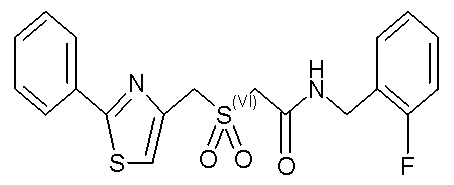
thiazolyl)methyl] sulfonyl]-
Acetamide, 2-[[[2-(4-methoxyphenyl)-4-
III- 14 384.52
s— ' o thiazolyl] methyljthio] -N-(phenylmethyl)-
Acetamide, N-[l-(2-
III- 15 s— ' 0 1 428.58 methoxyphenyl)ethyl] -2- [ [ [2-(4- methoxyphenyl)-4-thiazolyl] methyljthio] -
Acetamide, 2- [[ [2-(3 -methoxyphenyl)-4-
III- 16 384.52
s— ' o thiazolyl] methyljthio] -N-(phenylmethyl)- vX Acetamide, N- [ 1 -(2, 3 -dihydro- 1,4-
III- 17 426.56 benzodioxin-6-yl)ethyl] -2- [ [(2-phenyl-4- thiazolyl)methyl]thio] -
Acetamide, N- [ 1 -(2, 3 -dihydro- 1,4-
III- 18 470.61 benzodioxin-6-yl)ethyl] -2- [ [ [2-(4- ethoxyphenyl)-4-thiazolyl] methyljthio] -
Propanamide, N-[(4-
III- 19 404.50 fluorophenyl)methyl] -2- [ [ [2-(4-
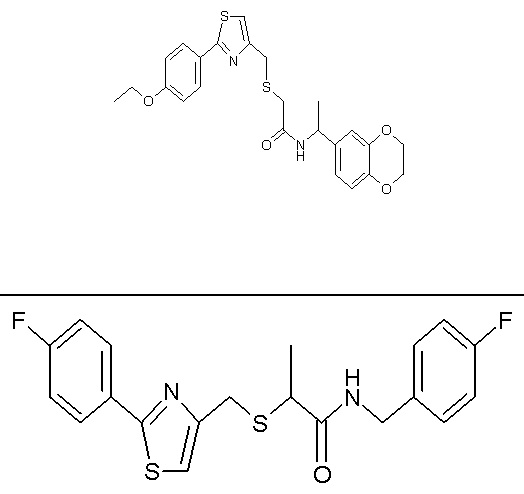
fluorophenyl)-4-thiazolyl] methyljthio] -
Acetamide, N-[l-(2-
111-20 412.58 methoxyphenyl)ethyl] -2- [ [ [2-(4- methylphenyl)-4-thiazolyl] methyljthio] -
Propanamide, 2-[[[2-(3,4- dimethoxyphenyl)-4-
111-21 446.57
thiazolyl] methyljthio] -N- [(4- fluorophenyl)methyl] -
MW
ID STRUCTURE Chemical Name
(Calcd)
Acetamide, N-(phenylmethyl)-2-[[(2-
111-22 354.50
s— ' O phenyl-4-thiazolyl)methyl]thio]-
Acetamide, 2- [[ [2-(4-methylphenyl)-4-
111-23 398.55 thiazolyl] methyl] sulfinyl] -N-( 1 -

phenylethyl)-
Acetamide, 2- [[ [2-(4-fluorophenyl)-4-
111-24 372.49
s— ' o thiazolyl] methyljthio] -N-(phenylmethyl)-
Acetamide, N- [(4-fluorophenyl)methyl] -
111-25 402.51 2- [ [ [2-(4-methoxyphenyl)-4-

thiazolyl] methyljthio] -
Acetamide, N- [ 1 -(2, 3 -dihydro- 1,4-
111-26 440.59 benzodioxin-6-yl)ethyl] -2- [ [ [2-(4- methylphenyl)-4-thiazolyl] methyljthio] -
Acetamide, N- [(4-fluorophenyl)methyl] -
111-27 390.48 2-[[[2-(4-fluorophenyl)-4-

thiazolyl] methyljthio] -
Propanamide, 2-[[[2-(4-ethoxyphenyl)-4-
111-28 430.57 thiazolyl]methyl]thio]-N-[(4-

fluorophenyl)methyl] -
Acetamide, N-(l,3-benzodioxol-5-
111-29 398.51 ylmethyl)-2- [ [(2-phenyl-4- thiazolyl)methyl]thio] -
Propanamide, N-[(4-
111-30 400.54 fluorophenyl)methyl] -2- [ [ [2-(4-

methylphenyl)-4-thiazolyl] methyl]thio] -
[00541] Table 4: Thiazole amides (R = phenethyl)


methoxyphenyl)ethyl] -

[00542] Table 5: Thiazole amides (X


thiazolyl] methyljthio] -
-yl)-
1 -
- -
-

piperidinyl)-
- 1 -


morpholinyl)-
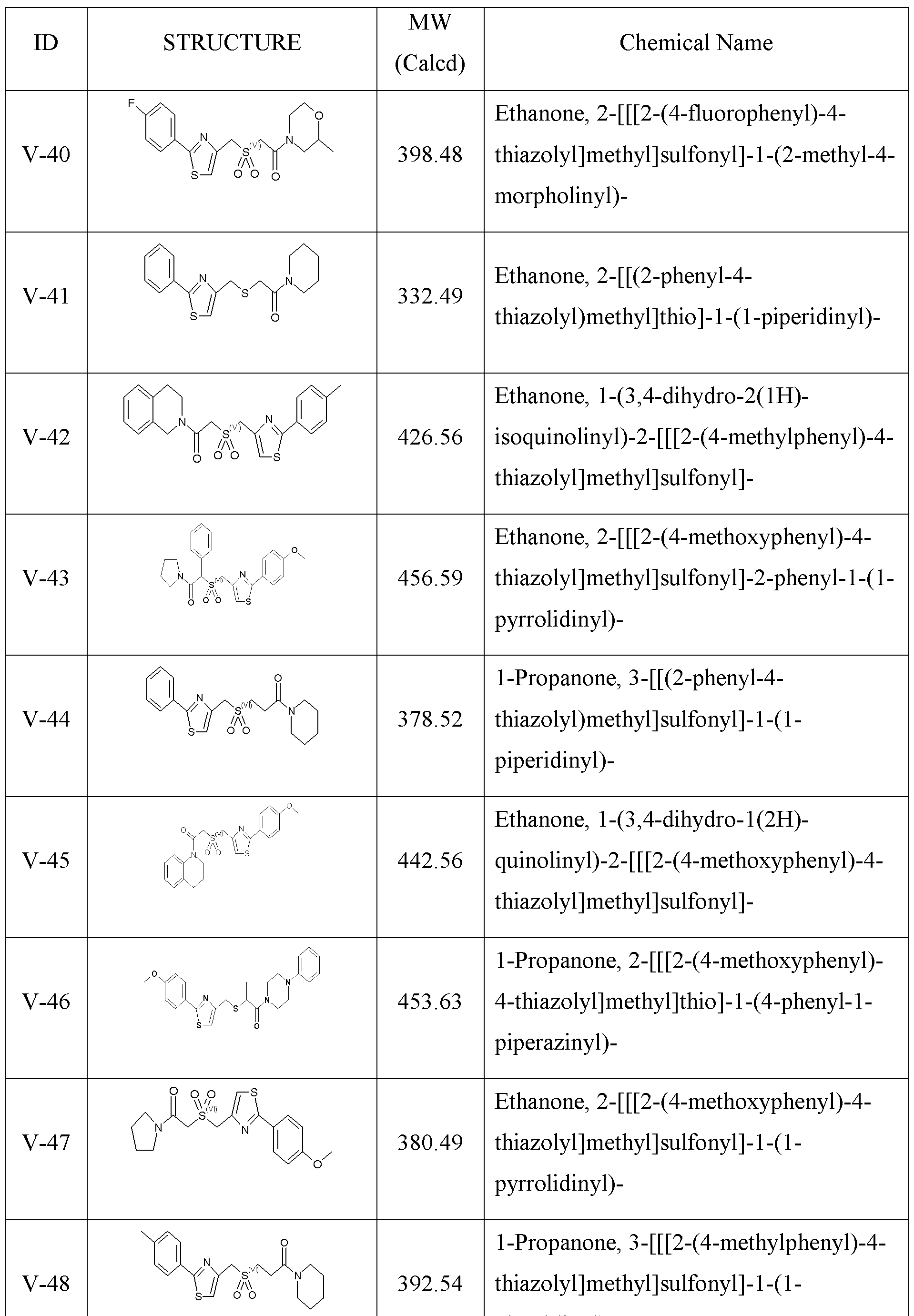
piperidinyl)-
MW
ID STRUCTURE Chemical Name
(Calcd)
1 -Propanone, 1 -(2-ethyl- 1 -piperidinyl)-2-
V-49 436.60 [ [ [2-(4-methoxyphenyl)-4- thiazolyl] methyl] sulfonyl]-
Ethanone, 1 -( 1 -azetidinyl)-2- [ [(2-phenyl-
V-50 336.43
4-thiazolyl)methyl]sulfbnyl]-
Ethanone, 1 -(2, 3 -dihydro- 1 H-indol- 1 -yl)-
V-51 380.53 2- [ [ [2-(4-methylphenyl)-4-

thiazolyl] methyljthio] -
Ethanone, 1 -(2-ethyl- 1 -piperidinyl)-2-
V-52 392.54
[[(2-phenyl-4-thiazolyl)methyl]sulfonylJ-
Ethanone, 2-[[[2-(4-ethoxyphenyl)-4-
V-53 483.66 thiazolyl] methyl]thio] - 1 - [4-(4- methoxyphenyl)- 1 -piperazinyl] -
Ethanone, 1 - [4-(4-methoxyphenyl)- 1 -
V-54 469.63 piperazinyl] -2- [ [ [2-(4-methoxyphenyl)-4- thiazolyl] methyljthio] -
1 -Propanone, 2- [[ [2-(4-fluorophenyl)-4-
V-55 441.59 thiazolyl] methyljthio] - 1 -(4-phenyl- 1 - piperazinyl)-
Ethanone, 2-[[[2-(4-ethoxyphenyl)-4-
V-56 392.54 thiazolyl] methyljthio] -l-(2-methyl-4-

morpholinyl)-
Ethanone, 1 -( 1 - azetidiny l)-2 - [ [ [2-(4-
V-57 350.46 methylphenyl)-4-

thiazolyl] methyl] sulfonyl]-

lH-azepin-l-yl)-

thiazolyl)methyl]thio] acetyl] -
 Additional Exemplary Compounds of the Invention
[00543] The following compounds, as exemplified in Table 6, have been prepared according to the synthetic schemes described herein, or can be prepared according to the synthetic methods known to one skilled in the art. The activity of the comounds was tested as described above and the activity of each compound is expressed as follows:
+ compound exhibited IC50 >10 uM
++ compound exhibited IC50 1-10 uM
+++ compound exhibited IC50 0.1-1 uM
++++ compound exhibited IC50 <0.1 uM
[00544] Table 6: Activity data of Exemplary Compounds of the invention


[00545] From the foregoing description, various modifications and changes in the compositions and methods of this invention will occur to those skilled in the art. All such modifications coming within the scope of the appended claims are intended to be included therein.
[00546] All publications, including but not limited to patents and patent applications, cited in this specification are herein incorporated by reference as if each individual publication were specifically and individually indicated to be incorporated by reference herein as though fully set forth.
[00547] At least some of the chemical names of compounds of the invention as given and set forth in this application, may have been generated on an automated basis by use of a commercially available chemical naming software program, and have not been independently verified. Representative programs performing this function include the Lexichem naming tool sold by Open Eye Software, Inc., the Autonom Software tool sold by MDL, Inc. and the
structure-to-name tool in the ChemDraw software sold by PerkinElmer, Inc. In the instance where the indicated chemical name and the depicted structure differ, the depicted structure will control.
[00548] Chemical structures shown herein were prepared using either ChemDraw® or
ISIS® /DRAW. Any open valency appearing on a carbon, oxygen or nitrogen atom in the structures herein indicates the presence of a hydrogen atom. Where a chiral center exists in a structure but no specific stereochemistry is shown for the chiral center, both enantiomers associated with the chiral structure are encompassed by the structure.
Claims
WHAT IS CLAIMED IS:
1. A compound according to formula I:

I
wherein
Y is -S-, -S(O)- or -S(0)2-, one of A or B is -L1-X-L2-C(0)-NR2aR2b or -ΐ Χ-ΐ θ(Ο)- OR2a, and the other is R1;
or
Y is -0-, B is -L1-X-L2-C(0)-NR2aR2b or -L1-X-L2-C(0)-OR2a, and A is R1;
X is a single bond, -C(R4aR4b)-, -0-, -S-, -S(O)- or -S(0)2-;
Cy is substituted or unsubstituted aryl or substituted or unsubstituted heteroaryl;
each of L1 and L2 is independently substituted or unsubstituted C1-C7 alkylene or heteroalkylene;
R1 is hydrogen, halo, or substituted or unsubstituted C1-C5 alkyl;
each R2a and R2b is independently selected from H, substituted or unsubstituted alkyl, substituted or unsubstituted cycloalkyl, substituted or unsubstituted aryl, and substituted or unsubstituted heteroaryl; or R2a and R2b are joined together to form a substituted or unsubstituted heterocycloalkyl or a heteroaryl ring;
each R4a and R4b is independently selected from H, substituted or unsubstituted alkyl, and halo;
provided that
i) when Y is O, A is R1, B is -L1-X-L2-C(0)-NR2aR2b, X is CR4aR4b, and each L1 and L2 is -CH2-, then Cy is substituted phenyl or substituted or unsubstituted heteroaryl;
ii) when Y is S, A is R1, B is -L1-X-L2-C(0)-NR2aR2b, X is S, and each L1 and L2 is - CH2-, then Cy is substituted phenyl or substituted or unsubstituted heteroaryl;
iii) ) when Y is O or S, A is R1, B is -L1-X-L2-C(0)-OR2a, X is CR4aR4b, and each L1 and L2 is -CH2-, then R1 is Me;
iv) when Y is S, B is R1, A is -L^X-^-C^-NR2^, X is S or CR4aR4b, and each L1 and L2 is -CH2-, then R1 is Me;
v) when Y is S, B is R1, A is -L1-X-L2-C(0)-OR2a, X is S or CR4aR4b, and each L1 and L2 is -CH2-, then R1 is Me; and
vi) the compound is other than
(5-oxazolebutanoic acid, 2-(2-hydroxyphenyl)-4-methyl-;
5-oxazolebutanoic acid, 2-(2-hydroxyphenyl)-4-methyl-, methyl ester;
5-oxazolebutanoic acid, 2-(2-methoxyphenyl)-4-methyl-, methyl ester; or
5-thiazolebutanoic acid, 4-methyl-P-oxo-2 -phenyl-, ethyl ester;
or a pharmaceutically acceptable salt, solvate or prodrug thereof;
and stereoisomers, isotopic variants and tautomers thereof.
2. A method for preventing, treating or ameliorating in a mammal a disease or condition that is causally related to the aberrant activity of the Wnt signaling pathway in vivo, which comprises administering to the mammal an effective disease-treating or condition-treating amount of a compound according to formula I:

I
wherein
Y is -S-, -S(O)- or -S(0)2-, one of A or B is -L1-X-L2-C(0)-NR2aR2b or -ΐ Χ-ΐ θ(Ο)- OR2a, and the other is R1;
or
Y is -0-, B is -L1-X-L2-C(0)-NR2aR2b or -L1-X-L2-C(0)-OR2a, and A is R1;
X is a single bond, -C(R4aR4b)-, -0-, -S-, -S(O)- or -S(0)2-;
Cy is substituted or unsubstituted aryl or substituted or unsubstituted heteroaryl;
each of L1 and L2 is independently substituted or unsubstituted C1-C7 alkylene or heteroalkylene;
R1 is hydrogen, halo, or substituted or unsubstituted C1-C5 alkyl;
each R2a and R2b is independently selected from H, substituted or unsubstituted alkyl, substituted or unsubstituted cycloalkyl, substituted or unsubstituted aryl, and substituted or unsubstituted heteroaryl; or R2a and R2b are joined together to form a substituted or unsubstituted heterocycloalkyl or a heteroaryl ring;
each R4a and R4b is independently selected from H, substituted or unsubstituted alkyl, and halo;
or a pharmaceutically acceptable salt, solvate or prodrug thereof;
and stereoisomers, isotopic variants and tautomers thereof.
The compound according to Claim 1 or the method according to Claim 2, wherein Y is -0-.
The compound according to Claim 1 or the method according to Claim 2, wherein Y is -S-, -S(O)- or -S(0)2-.
The compound according to Claim 1 or the method according to Claim 2, wherein the compound is according to formula Ila or lib:

I la or l i b
wherein Cy, A, and B are as in claim 1.
The compound or the method according to any one of claims 1-5, wherein A is R1; and B is -L1-X-L2-C(0)-NR2aR2b or -L1-X-L2-C(0)-OR2a.
The compound or the method according to any one of claims 1-5, wherein the com ound is accordin to formula Ilia, Illb, IIIc, Hid, Hie, or Illf


8. The compound or the method according to any one of claims 1-7, wherein L1 is methylene, ethylene, propylene, or butylene, each of which unsubstituted or substituted with one or more groups selected from C1-C4 alkyl, halo, and hydroxyl.
9. The compound or the method according to any one of claims 1-7, wherein L1 is -CH2- , -CH2-CH2-, -CH2-CH2-CH2-, or -CH2-CH2-CH2-CH2-.
10. The compound or the method according to any one of claims 1-7, wherein L1 is -CH2- , -C(H)Me-, or C(Me)2-.
11. The compound or the method according to any one of claims 1-10, wherein L2 is methylene, ethylene, propylene, or butylene, each of which unsubstituted or substituted with one or more groups selected from Ci-C4 alkyl, halo, and hydroxyl.
12. The compound or the method according to any one of claims 1-10, wherein L2 is - CH2-, -CH2-CH2-, -CH2-CH2-CH2-, or -CH2-CH2-CH2-CH2-.
13. The compound or the method according to any one of claims 1-10, wherein L2 is - CH2-, -C(H)Me-, or C(Me)2-.
14. The compound or the method according to any one of claims 1-7, wherein each of L1 and L2 is -CH2-.
15. The compound or the method according to any one of claims 1-14, wherein Cy is unsubstituted aryl.
16. The compound or the method according to any one of claims 1-14, wherein Cy is unsubstituted phenyl.
17. The compound or the method according to any one of claims 1-14, wherein Cy is unsubstituted naphthyl.
18. The compound or the method according to any one of claims 1-14, wherein Cy is unsubstituted heteroaryl.
19. The compound or the method according to any one of claims 1-14, wherein Cy is unsubstituted pyridyl.
20. The compound or the method according to any one of claims 1-14, wherein Cy is unsubstituted pyrimidinyl.
21. The compound or the method according to any one of claims 1-14, wherein Cy is substituted aryl.
22. The compound or the method according to any one of claims 1-14, wherein Cy is substituted phenyl.
23. The compound or the method according to any one of claims 1-14, wherein Cy is substituted naphthyl.
24. The compound or the method according to any one of claims 1-14, wherein Cy is substituted heteroaryl.
25. The compound or the method according to any one of claims 1-14, wherein Cy is substituted pyridyl.
26. The compound or the method according to any one of claims 1-14, wherein Cy is substituted pyrimidinyl.
27. The compound or the method according to any one of claims 21-26, wherein the substitution is independently selected from one to three alkyl, alkoxy, haloalkyl, halo and cyano.
28. The compound or the method according to any one of claims 21-26, wherein the substitution is independently selected from one to three Me, Et, i-Pr, t-Bu, OMe, OEt, O-i-Pr, CN, Br, CI, or F.
29. The compound according to Claim 1 or the method according to Claim 2, wherein the compound is according to formula IVa, IVb, IVc, IVd, IVe, or IVf:


each R3c is independently selected from H, alkyl, substituted alkyl, acyl, substituted acyl, substituted or unsubstituted acylamino, substituted or unsubstituted alkylamino, substituted or unsubstituted alkythio, substituted or unsubstituted alkoxy, alkoxycarbonyl, substituted alkoxycarbonyl, substituted or unsubstituted alkylarylamino, arylalkyloxy, substituted arylalkyloxy, amino, aryl, substituted aryl, arylalkyl, substituted or
unsubstituted sulfonyl, substituted or unsubstituted sulfinyl, substituted or unsubstituted sulfanyl, substituted or unsubstituted aminosulfonyl, substituted or unsubstituted arylsulfonyl, azido, carboxy, substituted or unsubstituted carbamoyl, cyano, substituted or unsubstituted cycloalkyl, substituted or unsubstituted cycloheteroalkyl, substituted or unsubstituted dialkylamino, halo, heteroaryloxy, substituted or unsubstituted heteroaryl, substituted or unsubstituted heteroalkyl, hydroxy, nitro, and thiol;
provided that
i) when the compound is according to formula IVa, and X is CR4aR4b then R3c is other than H;
ii) when the compound is according to formula IVb and X is S then R3c is other than H; iii) when the compound is according to formula IVc, IVd, or IVe, and X is CR4aR4b then R1 is Me;
iv) when the compound is according to formula IVe and X is S, then R1 is Me;
v) when the compound is according to formula IVf , then R1 is Me; and
vi) the compound is other than
(5-oxazolebutanoic acid, 2-(2-hydroxyphenyl)-4-methyl-;
5-oxazolebutanoic acid, 2-(2-hydroxyphenyl)-4-methyl-, methyl ester; 5-oxazolebutanoic acid, 2-(2-methoxyphenyl)-4-methyl-, methyl ester; or 5-thiazolebutanoic acid, 4-methyl-P-oxo-2 -phenyl-, ethyl ester.
30. The compound or the method according to any one of claims 1-29, wherein R1 is H or substituted or unsubstituted Ci-C6 alkyl.
31. The compound or the method according to any one of claims 1-29, wherein R1 is halo.
32. The compound or the method according to any one of claims 1-29, wherein R1 is Me.
33. The compound according to Claim 1 or the method according to Claim 2, wherein the compound is according to formula Va, Vb, Vc, Vd, Ve, or Vf:


wherein X, R2a and R2b as in claim 1 ; and n and R3c are as in claim 29.
34. The compound or the method according to any one of claims 29-33, wherein each of R3c is H.
35. The compound or the method according to any one of claims 29-33, wherein n is 1; and R3c is alkyl, alkoxy, haloalkyl, or halo.
36. The compound or the method according to any one of claims 29-33, wherein n is 1 or 2; and each R3c is independently Me, Et, i-Pr, t-Bu, OMe, OEt, O-i-Pr, CN, CI, or F.
37. The compound or the method according to any one of claims 29-33, wherein n is 1 or 2; and each R3c is independently Me, CF3, OMe, or Et.
38. The compound or the method according to any one of claims 29-33, wherein n is 1; and R3c is Me.
39. The compound or the method according to any one of claims 29-33, wherein n is 1; and R3c is Et.
40. The compound or the method according to any one of claims 29-33, wherein n is 1; and R3c is i-Pr.
41. The compound or the method according to any one of claims 29-33, wherein n is 1; and R3c is t-Bu.
42. The compound or the method according to any one of claims 29-33, wherein n is 1; and R3c is CF3.
The compound according to Claim 1 or the method according to Claim 2, wherein the compound is according to formula Via, VIb, Vic, VId, Vie, or Vlf


Vie or V|f wherein X, R2a and R2b as in claim 1 ; and R3c is as in claim 29.
44. The compound or the method according to any one of claims 1-43, wherein R2b is H or Me.
45. The compound or the method according to any one of claims 1-43, wherein each of R2a and R2b is H.
46. The compound according to Claim 1 or the method according to Claim 2, wherein the compound is according to formula Vila, VQb, VIIc, Vlld, or Vile:


Vile or
Vllf
wherein X, and R2a are as in claim 1 ; and R3c is as in claim 29.
47. The method or the compound according to claim 46, wherein R3c is substituted or unsubstituted alkyl, substituted or unsubstituted alkoxy, haloalkyl, substituted or unsubstituted acyl, or halo.
48. The method or the compound according to claim 46, wherein R3c is Me, Et, i-Pr, t-Bu, OMe, OEt, O-i-Pr, CN, -C(0)Me, CF3, -C(OH)HMe, -C(Me)2OH, -OC(H)F2, CI, or F.
49. The method or the compound according to claim 46, wherein R3c is Me, CF3, OMe, or
Et.
50. The method or the compound according to claim 46, wherein R3c is Me.
51. The method or the compound according to claim 46, wherein R3c is Et.
52. The method or the compound according to claim 46, wherein R3c is i-Pr.
53. The method or the compound according to claim 46, wherein R3c is t-Bu.
54. The method or the compound according to claim 46, wherein R3c is CF3.
55. The compound or the method according to any one of claims 1-54, wherein R2a is H.
56. The compound or the method according to any one of claims 1-54, wherein R2a is substituted or unsubstituted alkyl.
57. The compound or the method according to any one of claims 1-54, wherein R2a is substituted or unsubstituted aryl.
58. The compound or the method according to any one of claims 1-54, wherein R2a is substituted or unsubstituted phenyl.
59. The compound or the method according to any one of claims 1-54, wherein R2a is substituted or unsubstituted benzyl.
60. The compound or the method according to any one of claims 1-54, wherein R2a is substituted or unsubstituted phenethyl.
61. The compound or the method according to any one of claims 1-54, wherein R2a is substituted or unsubstituted phenylpropyl.
62. The compound or the method according to any one of claims 1-54, wherein R2a is substituted or unsubstituted cycloalkyl.
63. The compound or the method according to any one of claims 1-54, wherein R2a is cyclopropyl, cyclopentyl or cyclobutyl.
64. The compound or the method according to any one of claims 1-54, wherein R2a is substituted or unsubstituted heteroaryl.
65. The compound or the method according to any one of claims 1-54, wherein R2a is substituted or unsubstituted pyridyl, pyrimidyl, or pyrazinyl.
66. The compound or the method according to any one of claims 1-54, wherein R2a is substituted or unsubstituted heterocycloalkyl.
67. The compound or the method according to any one of claims 1-54, wherein R2a is substituted or unsubstituted pyrrolidinyl, piperidinyl, morpholinyl, or piperazinyl.
68. The compound or the method according to any one of claims 1-54, wherein R2a is alkyl substituted with aryl, heteroaryl, cycloalkyl or heterocycloalkyl.
69. The compound or the method according to any one of claims 1-54, wherein R2a is methyl, ethyl, or n-propyl substituted with phenyl, pyridyl, cycloalkyl or
heterocycloalkyl.
70. The compound or the method according to any one of claims 1-54, wherein R2a is methyl, ethyl, or n-propyl each of which substituted with substituted or unsubstituted phenyl, substituted or unsubstituted pyridyl, substituted or unsubstituted cyclopropyl, substituted or unsubstituted cyclohexyl, substituted or unsubstituted cyclopentyl, substituted or unsubstituted cyclobutyl, substituted or unsubstituted piperidinyl, substituted or unsubstituted morphlinyl or substituted or unsubstituted piperazinyl.
71. The compound or the method according to any one of claims 1-54, wherein R2a is substituted or unsubstituted phenylmethyl, substituted or unsubstituted pyridylmethyl, substituted or unsubstituted cyclopropylmethyl, substituted or unsubstituted
cyclohexylmethyl, substituted or unsubstituted cyclopentylmethyl, substituted or unsubstituted cyclobutylmethyl, substituted or unsubstituted piperidinylmethyl, substituted or unsubstituted morphlinylmethyl, or substituted or unsubstituted piperazinylmethyl.
72. The compound or the method according to any one of claims 1-54, wherein R2a is substituted or unsubstituted phenylethyl, substituted or unsubstituted pyridylethyl, substituted or unsubstituted cyclopropylethyl, substituted or unsubstituted cyclohexylethyl, substituted or unsubstituted cyclopentylethyl, substituted or unsubstituted cyclobutylethyl, substituted or unsubstituted piperidinylethyl, substituted or unsubstituted morphlinylethyl, or substituted or unsubstituted piperazinylethyl.
73. The compound or the method according to any one of claims 1-54, wherein R2a is substituted or unsubstituted phenylpropyl, substituted or unsubstituted pyridylpropyl, substituted or unsubstituted cyclopropylpropyl, substituted or unsubstituted cyclohexylpropyl, substituted or unsubstituted cyclopentylpropyl, substituted or unsubstituted cyclobutylpropyl, substituted or unsubstituted piperidinylpropyl, substituted or unsubstituted morphlinylpropyl, or substituted or unsubstituted piperazinylpropyl .
74. The compound or the method according to any one of claims 56-72, wherein the substitution is independently selected from one to three alkyl, alkoxy, haloalkyl, halo and cyano.
75. The compound or the method according to any one of claims 56-72, wherein the substitution is selected from one to three Me, Et, i-Pr, t-Bu, OMe, OEt, O-i-Pr, CN, Br, CI, or F.
76. The compound or the method according to any one of claims 1-54, wherein R2a is substituted or unsubstituted pyridyl, or pyrimidinyl.
77. The compound or the method according to any one of claims 1-54, wherein R2a is substituted or unsubstituted pyridylmethyl, or pyrimidinylmethyl.
78. The compound or the method according to any one of claims 1-54, wherein R2a is substituted or unsubstituted pyridylethyl, or pyrimidinylethyl.
79. The compound or the method according to any one of claims 1-54, wherein R2a is phenyl, benzyl, phenethyl, or phenpropyl each unsubstituted or substituted with halo, alkyl, haloalkyl, or cyano.
80. The compound or the method according to any one of claims 1-54, wherein R a is phenyl, benzyl, phenethyl, or phenpropyl each unsubstituted or substituted with CI, Br, F, Me, Et, CF3, or cyano.
81. The compound or the method according to any one of claims 1-54, wherein R2a is phenyl, benzyl, phenethyl, or phenpropyl each unsubstituted or substituted with CI.
82. The compound or the method according to any one of claims 1-54, wherein R2a is pyridyl, pyridylmethyl, or pyridylethyl each unsubstituted or substituted with halo, alkyl, haloalkyl, or cyano.
83. The compound or the method according to any one of claims 1-54, R2a is pyridyl, pyridylmethyl, or pyridylethyl each unsubstituted or substituted with CI, Br, F, Me, Et, CF3, or cyano.
84. The compound or the method according to any one of claims 1-54, wherein R2a is pyrimidinyl, pyrimidinylmethyl, or pyrimidinylethyl each unsubstituted or substituted with halo, alkyl, haloalkyl, or cyano.
85. The compound or the method according to any one of claims 1-54, wherein R2a is pyrimidinyl, pyrimidinylmethyl, or pyrimidinylethyl each unsubstituted or substituted with CI, Br, F, Me, Et, CF3, or cyano.
86. The compound or the method according to any one of claims 1-54, wherein R2a is phenyl, benzyl, 4-fluorophenyl, pyrid-3-yl ethyl, cyclopropyl, cyclopentyl, cyclohexylethyl, 2-chloro-5-pyridyl, 2-fluoro-5-pyridyl, 2-methyl-5-pyridyl, phenylpropyl, 4-fluorobenzyl, 4-fluorophenethyl, 2-(pyrrolidin-l-yl)ethyl, or 2- (morpholin- 1 -yl)ethyl.
The compound or the method according to any one of claims 1-43, wherein R2a and
R2b join together to form a heterocycloalkyl or a heteroaryl ring.
88. The compound or the method according to any one of claims 1-43, wherein - R2aR2b is:

and wherein R2c isH or alkyl.
The compound according to Claim 1 or the method according to Claim 2, wherein the com ound is accordin to formula Villa, Vlllb, VIIIc, Vllld, or Vllle:



and wherein X is as described for formula I.
90. The compound according to Claim 1 or the method according to Claim 2, wherein the compound is according to formula IXa, IXb, IXc, IXd, IXe, or IXf


IXf wherein X is as described for formula I; m is 1, 2, 3, 4, or 5; and
each R4 is independently selected from H, alkyl, substituted alkyl, acyl, substituted acyl, substituted or unsubstituted acylamino, substituted or unsubstituted alkylamino, substituted or unsubstituted alkythio, substituted or unsubstituted alkoxy,
alkoxycarbonyl, substituted alkoxycarbonyl, substituted or unsubstituted
alkylarylamino, arylalkyloxy, substituted arylalkyloxy, amino, aryl, substituted aryl, arylalkyl, substituted or unsubstituted sulfonyl, substituted or unsubstituted sulfinyl, substituted or unsubstituted sulfanyl, substituted or unsubstituted aminosulfonyl, substituted or unsubstituted arylsulfonyl, azido, carboxy, substituted or unsubstituted carbamoyl, cyano, substituted or unsubstituted cycloalkyl, substituted or unsubstituted heterocycloalkyl, substituted or unsubstituted dialkylamino, halo, heteroaryloxy, substituted or unsubstituted heteroaryl, substituted or unsubstituted heteroalkyl, hydroxy, nitro, and thiol.
The compound according to Claim 1 or the method according to Claim 2, wherein the compound is according to formula Xa, Xb, Xc, Xd, Xe, or Xf:


Xf wherein X is as described for formula I; m is 1, 2, 3, 4, or 5; and
each R4 is independently selected from H, alkyl, substituted alkyl, acyl, substituted acyl, substituted or unsubstituted acylamino, substituted or unsubstituted alkylamino, substituted or unsubstituted alkythio, substituted or unsubstituted alkoxy, alkoxycarbonyl, substituted alkoxycarbonyl, substituted or unsubstituted alkylarylamino, arylalkyloxy, substituted arylalkyloxy, amino, aryl, substituted aryl, arylalkyl, substituted or unsubstituted sulfonyl, substituted or unsubstituted sulfinyl, substituted or unsubstituted sulfanyl, substituted or unsubstituted aminosulfonyl, substituted or unsubstituted arylsulfonyl, azido, carboxy, substituted or unsubstituted carbamoyl, cyano, substituted or unsubstituted cycloalkyl, substituted or unsubstituted heterocycloalkyl, substituted or unsubstituted dialkylamino, halo, heteroaryloxy, substituted or unsubstituted heteroaryl, substituted or unsubstituted heteroalkyl, hydroxy, nitro, and thiol.
92. The compound or the method according to any one of claims 90-91, wherein m is 1 or 2; and each R4 is independently Me, Et, i-Pr, OMe, OEt, O-i-Pr, CN, CI, or F.
93. The compound or the method according to any one of claims 90-92, wherein each R4 is H.
94. The compound or the method according to any one of claims 90-91, wherein m is 1 ; and R4 is Me, Et, i-Pr, OMe, OEt, O-i-Pr, CN, CI, or F.
The compound or the method according to any one of claims 90-91, wherein m is 1 ; and R4 is 4-Cl, or 4-F.
The compound according to Claim 1 or the method according to Claim 2, wherein the compound is according to formula XIa, Xlb, or Xlc:

wherein X is as described for formula I; m is 1, 2, 3, or 4; and
each R4 is independently selected from H, alkyl, substituted alkyl, acyl, substituted acyl, substituted or unsubstituted acylamino, substituted or unsubstituted alkylamino, substituted or unsubstituted alkythio, substituted or unsubstituted alkoxy,
alkoxycarbonyl, substituted alkoxycarbonyl, substituted or unsubstituted
alkylarylamino, arylalkyloxy, substituted arylalkyloxy, amino, aryl, substituted aryl, arylalkyl, substituted or unsubstituted sulfonyl, substituted or unsubstituted sulfinyl, substituted or unsubstituted sulfanyl, substituted or unsubstituted aminosulfonyl, substituted or unsubstituted arylsulfonyl, azido, carboxy, substituted or unsubstituted carbamoyl, cyano, substituted or unsubstituted cycloalkyl, substituted or unsubstituted heterocycloalkyl, substituted or unsubstituted dialkylamino, halo, heteroaryloxy, substituted or unsubstituted heteroaryl, substituted or unsubstituted heteroalkyl, hydroxy, nitro, and thiol.
The compound according to Claim 1 or the method according to Claim 2, wherein the compound is according to formula Xlla, XQb, or XIIc:


Xllc wherein X is as described for formula I; m is 1, 2, 3, or 4; and
each R4 is independently selected from H, alkyl, substituted alkyl, acyl, substituted acyl, substituted or unsubstituted acylamino, substituted or unsubstituted alkylamino, substituted or unsubstituted alkythio, substituted or unsubstituted alkoxy,
alkoxycarbonyl, substituted alkoxycarbonyl, substituted or unsubstituted
alkylarylamino, arylalkyloxy, substituted arylalkyloxy, amino, aryl, substituted aryl, arylalkyl, substituted or unsubstituted sulfonyl, substituted or unsubstituted sulfinyl, substituted or unsubstituted sulfanyl, substituted or unsubstituted aminosulfonyl, substituted or unsubstituted arylsulfonyl, azido, carboxy, substituted or unsubstituted carbamoyl, cyano, substituted or unsubstituted cycloalkyl, substituted or unsubstituted heterocycloalkyl, substituted or unsubstituted dialkylamino, halo, heteroaryloxy, substituted or unsubstituted heteroaryl, substituted or unsubstituted heteroalkyl, hydroxy, nitro, and thiol.
The compound according to Claim 1 or the method according to Claim 2, wherein the compound is according to formula XHIa, XHIb, or XIIIc:

Xlllc wherein X is as described for formula I; m is 1, 2, 3, or 4; and
each R4 is independently selected from H, alkyl, substituted alkyl, acyl, substituted acyl, substituted or unsubstituted acylamino, substituted or unsubstituted alkylamino, substituted or unsubstituted alkythio, substituted or unsubstituted alkoxy,
alkoxycarbonyl, substituted alkoxycarbonyl, substituted or unsubstituted
alkylarylamino, arylalkyloxy, substituted arylalkyloxy, amino, aryl, substituted aryl, arylalkyl, substituted or unsubstituted sulfonyl, substituted or unsubstituted sulfinyl, substituted or unsubstituted sulfanyl, substituted or unsubstituted aminosulfonyl, substituted or unsubstituted arylsulfonyl, azido, carboxy, substituted or unsubstituted carbamoyl, cyano, substituted or unsubstituted cycloalkyl, substituted or unsubstituted heterocycloalkyl, substituted or unsubstituted dialkylamino, halo, heteroaryloxy, substituted or unsubstituted heteroaryl, substituted or unsubstituted heteroalkyl, hydroxy, nitro, and thiol.
The compound according to Claim 1 or the method according to Claim 2, wherein the compound is according to formula XlVa, XlVb, or XIVc:

XIVc
wherein X is as described for formula I; m is 1, 2, 3, or 4; and
each R4 is independently selected from H, alkyl, substituted alkyl, acyl, substituted acyl, substituted or unsubstituted acylamino, substituted or unsubstituted alkylamino, substituted or unsubstituted alkythio, substituted or unsubstituted alkoxy,
alkoxycarbonyl, substituted alkoxycarbonyl, substituted or unsubstituted
alkylarylamino, arylalkyloxy, substituted arylalkyloxy, amino, aryl, substituted aryl, arylalkyl, substituted or unsubstituted sulfonyl, substituted or unsubstituted sulfinyl, substituted or unsubstituted sulfanyl, substituted or unsubstituted aminosulfonyl, substituted or unsubstituted arylsulfonyl, azido, carboxy, substituted or unsubstituted carbamoyl, cyano, substituted or unsubstituted cycloalkyl, substituted or unsubstituted heterocycloalkyl, substituted or unsubstituted dialkylamino, halo, heteroaryloxy,
substituted or unsubstituted heteroaryl, substituted or unsubstituted heteroalkyl, hydroxy, nitro, and thiol.
100. The compound or the method according to any one of claims 90-99, wherein m is 1 or 2; and each R4 is independently Me, Et, i-Pr, OMe, OEt, O-i-Pr, CN, CI, or F.
101. The compound or the method according to any one of claims 90-99, wherein each R4 is H.
102. The compound or the method according to any one of claims 90-99, wherein m is 1 ; and R4 is Me, Et, i-Pr, OMe, OEt, O-i-Pr, CN, CI, or F.
103. In one particular embodiment, m is 1 and R4 is 4-F or 4-CF3.
104. The compound or the method according to any one of claims 90-99, wherein m is 1 and R4 is 4-F.
105. The compound or the method according to any one of claims 90-99, wherein m is 1 and R4 is 4-CF3.
106. The compound or the method according to any one of claims 1-105, wherein X is -O-
107. The compound or the method according to any one of claims 1-105, wherein X is -S-, -S(O)-, -S(0)2-.
108. The compound or the method according to any one of claims 1-105, wherein X is -S-.
109. The compound or the method according to any one of claims 1-105, wherein X is - CH2-.
110. The compound according to Claim 1 or the method according to Claim 2, wherein the compound is according to formula XVa, XVb, XVc, XVd, XVe, XVf, XVg, or XVh:

XVa XVb


wherein R3c is as in claim 29.
111. The compound according to Claim 1 or the method according to Claim 2, wherein the compound is according to formula XVIa, XVIb, XVIc, XVId, XVIe, or XVIf:


XVIf wherein X is as described for formula I; m is 1, 2, 3, or 4; and
each R4 is independently selected from H, alkyl, substituted alkyl, acyl, substituted acyl, substituted or unsubstituted acylamino, substituted or unsubstituted alkylamino, substituted or unsubstituted alkythio, substituted or unsubstituted alkoxy,
alkoxycarbonyl, substituted alkoxycarbonyl, substituted or unsubstituted
alkylarylamino, arylalkyloxy, substituted arylalkyloxy, amino, aryl, substituted aryl, arylalkyl, substituted or unsubstituted sulfonyl, substituted or unsubstituted sulfinyl, substituted or unsubstituted sulfanyl, substituted or unsubstituted aminosulfonyl, substituted or unsubstituted arylsulfonyl, azido, carboxy, substituted or unsubstituted carbamoyl, cyano, substituted or unsubstituted cycloalkyl, substituted or unsubstituted heterocycloalkyl, substituted or unsubstituted dialkylamino, halo, heteroaryloxy, substituted or unsubstituted heteroaryl, substituted or unsubstituted heteroalkyl, hydroxy, nitro, and thiol.
The compound or the method according to any one of claims 55-111, wherein each of R3c is H.
113. The compound or the method according to any one of claims 55-111, wherein R3c is substituted or unsubstituted alkyl, substituted or unsubstituted alkoxy, haloalkyl, substituted or unsubstituted acyl, or halo.
114. The compound or the method according to any one of claims 55-111, wherein R3c is Me, Et, i-Pr, t-Bu, OMe, OEt, O-i-Pr, CN, -C(0)Me, CF3, -C(OH)HMe, -C(Me)2OH, -OC(H)F2, CI, or F.
115. The compound or the method according to any one of claims 55-111, wherein R3c is Me, CF3, OMe, SMe, or Et.
116. The compound or the method according to any one of claims 55-111, wherein R3c is Me.
117. The compound or the method according to any one of claims 55-111, wherein R3c is Et.
118. The compound or the method according to any one of claims 55-111, wherein R3c is i- Pr.
119. The compound or the method according to any one of claims 55-111, wherein R3c is t- Bu.
120. The compound or the method according to any one of claims 55-111, wherein R3c is CF3.
121. A compound selected from


or a pharmaceutically acceptable salt, solvate or prodrug thereof; and stereoisomers, isotopic variants and tautomers thereof.
122. The method of any one of claims 2-121, wherein the disease or condition is cancer or pulmonary fibrosis.
123. The method of Claim 122, wherein the cancer is hepatic cancer, colon cancer, rectal cancer, breast cancer, prostate cancer, skin cancer, head and neck cancer, lung cancer,
gastric cancer, mesothelioma, Barrett's esophagus, synovial sarcoma, cervical cancer, endometrial ovarian cancer, Wilm's tumor, bladder cancer or leukemia.
124. A pharmaceutical composition comprising a pharmaceutically acceptable carrier and a pharmaceutically effective amount of a compound of any of claims 1-121.
125. The pharmaceutical composition of Claim 124, wherein the carrier is a parenteral carrier, oral or topical carrier.
126. Use of a compound set forth in any of claims 1-121 for the preparation of a
medicament for the treatment of a disease or condition that is causally related to the aberrant activity of the Wnt signaling pathway in vivo.
127 '. Use according to Claim 126, wherein the disease or condition is cancer or pulmonary fibrosis.
128. Use according to Claim 126, wherein the cancer is hepatic cancer, colon cancer, rectal cancer, breast cancer, prostate cancer, skin cancer, head and neck cancer, lung cancer, gastric cancer, mesothelioma, Barrett's esophagus, synovial sarcoma, cervical cancer, endometrial ovarian cancer, Wilm's tumor, bladder cancer or leukemia.
129. Use according to Claim 128, wherein the skin cancer is melanoma, the liver cancer is hepatocellular cancer or hepatoblastoma, and/or the lung cancer is non-small cell lung cancer.
130. Use according to Claim 127, wherein the disease or condition is pulmonary fibrosis.
131. A compound as set forth in any one of Claims 1 and 3-121 for use in the treatment of a disease or condition that is causally related to the aberrant activity of the Wnt signaling pathway in vivo.
Applications Claiming Priority (2)
| Application Number | Priority Date | Filing Date | Title |
|---|---|---|---|
| US201662303427P | 2016-03-04 | 2016-03-04 | |
| US62/303,427 | 2016-03-04 |
Publications (1)
| Publication Number | Publication Date |
|---|---|
| WO2017152032A1 true WO2017152032A1 (en) | 2017-09-08 |
Family
ID=59743278
Family Applications (1)
| Application Number | Title | Priority Date | Filing Date |
|---|---|---|---|
| PCT/US2017/020631 Ceased WO2017152032A1 (en) | 2016-03-04 | 2017-03-03 | Novel oxazole and thiazole compounds as β-catenin modulators and uses thereof |
Country Status (1)
| Country | Link |
|---|---|
| WO (1) | WO2017152032A1 (en) |
Cited By (3)
| Publication number | Priority date | Publication date | Assignee | Title |
|---|---|---|---|---|
| CN115785018A (en) * | 2022-12-26 | 2023-03-14 | 湖北广济药业股份有限公司 | Preparation method of febuxostat decarboxylated impurities |
| US11680054B2 (en) | 2018-07-06 | 2023-06-20 | Arcede Pharma Ab | Bronchodilating hetero-linked amides |
| WO2023120452A1 (en) * | 2021-12-20 | 2023-06-29 | 国立大学法人筑波大学 | Srebp-1 inhibitor and pharmaceutical composition for treating hypertriglyceridemia |
Citations (4)
| Publication number | Priority date | Publication date | Assignee | Title |
|---|---|---|---|---|
| US20110251103A1 (en) * | 2008-09-10 | 2011-10-13 | Ramanuj Dasgupta | Targeted chemical high-throughput screening method |
| US20110251144A1 (en) * | 2008-09-16 | 2011-10-13 | Massachusetts Institute Of Technology | Molecular modulators of the wnt/beta-catenin pathway |
| US8252823B2 (en) * | 2008-01-28 | 2012-08-28 | New York University | Oxazole and thiazole compounds as beta-catenin modulators and uses thereof |
| WO2016081451A1 (en) * | 2014-11-17 | 2016-05-26 | New York University | NOVEL OXAZOLE COMPOUNDS AS β-CATENIN MODULATORS AND USES THEREOF |
-
2017
- 2017-03-03 WO PCT/US2017/020631 patent/WO2017152032A1/en not_active Ceased
Patent Citations (4)
| Publication number | Priority date | Publication date | Assignee | Title |
|---|---|---|---|---|
| US8252823B2 (en) * | 2008-01-28 | 2012-08-28 | New York University | Oxazole and thiazole compounds as beta-catenin modulators and uses thereof |
| US20110251103A1 (en) * | 2008-09-10 | 2011-10-13 | Ramanuj Dasgupta | Targeted chemical high-throughput screening method |
| US20110251144A1 (en) * | 2008-09-16 | 2011-10-13 | Massachusetts Institute Of Technology | Molecular modulators of the wnt/beta-catenin pathway |
| WO2016081451A1 (en) * | 2014-11-17 | 2016-05-26 | New York University | NOVEL OXAZOLE COMPOUNDS AS β-CATENIN MODULATORS AND USES THEREOF |
Cited By (3)
| Publication number | Priority date | Publication date | Assignee | Title |
|---|---|---|---|---|
| US11680054B2 (en) | 2018-07-06 | 2023-06-20 | Arcede Pharma Ab | Bronchodilating hetero-linked amides |
| WO2023120452A1 (en) * | 2021-12-20 | 2023-06-29 | 国立大学法人筑波大学 | Srebp-1 inhibitor and pharmaceutical composition for treating hypertriglyceridemia |
| CN115785018A (en) * | 2022-12-26 | 2023-03-14 | 湖北广济药业股份有限公司 | Preparation method of febuxostat decarboxylated impurities |
Similar Documents
| Publication | Publication Date | Title |
|---|---|---|
| AU2023202592B2 (en) | Modulators of the integrated stress pathway | |
| US12109219B2 (en) | Cannabinoid receptor modulators | |
| US11771695B2 (en) | Cannabinoid receptor modulators | |
| KR102512049B1 (en) | Modulators of integrated stress pathways | |
| JP6391076B2 (en) | Androgen receptor modulators and uses thereof | |
| EP2809655B1 (en) | Benziimidazole and imidazopyridine derivatives as sodium channel modulators | |
| DK2152692T3 (en) | EXTERNAL anti-cancer activity | |
| CN106715415B (en) | 3-Amino-1,5,6,7-tetrahydro-4H-indol-4-one | |
| JP2017082011A (en) | Certain chemical entity, composition, and method | |
| WO2009097113A2 (en) | Oxazole and thiazole compounds as b-catenin modulators and uses thereof | |
| RU2741000C2 (en) | 1,4-disubstituted imidazole derivative | |
| CN101460463A (en) | Monocyclic and bicyclic himbacine derivatives useful as thrombin receptor antagonists | |
| WO2017218960A1 (en) | Hemoglobin modifier compounds and uses thereof | |
| KR20160012197A (en) | Pyrazolo-pyrrolidin-4-one derivatives and their use in the treatment of disease | |
| WO2012174312A2 (en) | Benzimidazole derivatives as antiviral agents | |
| CN105793254B (en) | Azaquinazoline Carboxamide Derivatives | |
| CN118201896A (en) | PI3K-α inhibitors and methods of use thereof | |
| CA3217380A1 (en) | Nampt inhibitors and uses thereof | |
| CA2955872A1 (en) | Glucose transport inhibitors | |
| WO2017152032A1 (en) | Novel oxazole and thiazole compounds as β-catenin modulators and uses thereof | |
| US20170355686A1 (en) | Novel oxazole compounds as beta catenin modulators and uses thereof | |
| TWI912295B (en) | Phd inhibitor compounds, compositions, and methods of use | |
| CN105878243B (en) | Application of the pirfenidone derivative in pharmacy | |
| CA2861713C (en) | Heteroarylamide derivatives having antiandrogenic properties | |
| HK1244804B (en) | 4h-pyrrolo[3,2-c]pyridin-4-one derivatives |
Legal Events
| Date | Code | Title | Description |
|---|---|---|---|
| NENP | Non-entry into the national phase |
Ref country code: DE |
|
| 121 | Ep: the epo has been informed by wipo that ep was designated in this application |
Ref document number: 17760886 Country of ref document: EP Kind code of ref document: A1 |
|
| 32PN | Ep: public notification in the ep bulletin as address of the adressee cannot be established |
Free format text: NOTING OF LOSS OF RIGHTS PURSUANT TO RULE 112(1) EPC (EPO FORM 1205N DATED 28-02-2019) |
|
| 122 | Ep: pct application non-entry in european phase |
Ref document number: 17760886 Country of ref document: EP Kind code of ref document: A1 |