WO2017141237A1 - Matrices incorporating nanocrystals and uses thereof - Google Patents
Matrices incorporating nanocrystals and uses thereof Download PDFInfo
- Publication number
- WO2017141237A1 WO2017141237A1 PCT/IL2017/050185 IL2017050185W WO2017141237A1 WO 2017141237 A1 WO2017141237 A1 WO 2017141237A1 IL 2017050185 W IL2017050185 W IL 2017050185W WO 2017141237 A1 WO2017141237 A1 WO 2017141237A1
- Authority
- WO
- WIPO (PCT)
- Prior art keywords
- composition
- matrix
- nanocrystals
- ligand
- substituted
- Prior art date
- Legal status (The legal status is an assumption and is not a legal conclusion. Google has not performed a legal analysis and makes no representation as to the accuracy of the status listed.)
- Ceased
Links
Classifications
-
- H—ELECTRICITY
- H10—SEMICONDUCTOR DEVICES; ELECTRIC SOLID-STATE DEVICES NOT OTHERWISE PROVIDED FOR
- H10H—INORGANIC LIGHT-EMITTING SEMICONDUCTOR DEVICES HAVING POTENTIAL BARRIERS
- H10H20/00—Individual inorganic light-emitting semiconductor devices having potential barriers, e.g. light-emitting diodes [LED]
- H10H20/80—Constructional details
- H10H20/85—Packages
- H10H20/851—Wavelength conversion means
- H10H20/8511—Wavelength conversion means characterised by their material, e.g. binder
- H10H20/8512—Wavelength conversion materials
-
- H—ELECTRICITY
- H10—SEMICONDUCTOR DEVICES; ELECTRIC SOLID-STATE DEVICES NOT OTHERWISE PROVIDED FOR
- H10H—INORGANIC LIGHT-EMITTING SEMICONDUCTOR DEVICES HAVING POTENTIAL BARRIERS
- H10H20/00—Individual inorganic light-emitting semiconductor devices having potential barriers, e.g. light-emitting diodes [LED]
- H10H20/80—Constructional details
- H10H20/81—Bodies
- H10H20/822—Materials of the light-emitting regions
-
- H—ELECTRICITY
- H10—SEMICONDUCTOR DEVICES; ELECTRIC SOLID-STATE DEVICES NOT OTHERWISE PROVIDED FOR
- H10K—ORGANIC ELECTRIC SOLID-STATE DEVICES
- H10K30/00—Organic devices sensitive to infrared radiation, light, electromagnetic radiation of shorter wavelength or corpuscular radiation
- H10K30/30—Organic devices sensitive to infrared radiation, light, electromagnetic radiation of shorter wavelength or corpuscular radiation comprising bulk heterojunctions, e.g. interpenetrating networks of donor and acceptor material domains
- H10K30/35—Organic devices sensitive to infrared radiation, light, electromagnetic radiation of shorter wavelength or corpuscular radiation comprising bulk heterojunctions, e.g. interpenetrating networks of donor and acceptor material domains comprising inorganic nanostructures, e.g. CdSe nanoparticles
-
- H—ELECTRICITY
- H10—SEMICONDUCTOR DEVICES; ELECTRIC SOLID-STATE DEVICES NOT OTHERWISE PROVIDED FOR
- H10K—ORGANIC ELECTRIC SOLID-STATE DEVICES
- H10K50/00—Organic light-emitting devices
- H10K50/10—OLEDs or polymer light-emitting diodes [PLED]
- H10K50/11—OLEDs or polymer light-emitting diodes [PLED] characterised by the electroluminescent [EL] layers
- H10K50/115—OLEDs or polymer light-emitting diodes [PLED] characterised by the electroluminescent [EL] layers comprising active inorganic nanostructures, e.g. luminescent quantum dots
-
- B—PERFORMING OPERATIONS; TRANSPORTING
- B82—NANOTECHNOLOGY
- B82Y—SPECIFIC USES OR APPLICATIONS OF NANOSTRUCTURES; MEASUREMENT OR ANALYSIS OF NANOSTRUCTURES; MANUFACTURE OR TREATMENT OF NANOSTRUCTURES
- B82Y20/00—Nanooptics, e.g. quantum optics or photonic crystals
-
- B—PERFORMING OPERATIONS; TRANSPORTING
- B82—NANOTECHNOLOGY
- B82Y—SPECIFIC USES OR APPLICATIONS OF NANOSTRUCTURES; MEASUREMENT OR ANALYSIS OF NANOSTRUCTURES; MANUFACTURE OR TREATMENT OF NANOSTRUCTURES
- B82Y30/00—Nanotechnology for materials or surface science, e.g. nanocomposites
-
- H—ELECTRICITY
- H10—SEMICONDUCTOR DEVICES; ELECTRIC SOLID-STATE DEVICES NOT OTHERWISE PROVIDED FOR
- H10H—INORGANIC LIGHT-EMITTING SEMICONDUCTOR DEVICES HAVING POTENTIAL BARRIERS
- H10H20/00—Individual inorganic light-emitting semiconductor devices having potential barriers, e.g. light-emitting diodes [LED]
- H10H20/80—Constructional details
- H10H20/85—Packages
- H10H20/851—Wavelength conversion means
- H10H20/8511—Wavelength conversion means characterised by their material, e.g. binder
-
- H—ELECTRICITY
- H10—SEMICONDUCTOR DEVICES; ELECTRIC SOLID-STATE DEVICES NOT OTHERWISE PROVIDED FOR
- H10K—ORGANIC ELECTRIC SOLID-STATE DEVICES
- H10K30/00—Organic devices sensitive to infrared radiation, light, electromagnetic radiation of shorter wavelength or corpuscular radiation
- H10K30/50—Photovoltaic [PV] devices
-
- Y—GENERAL TAGGING OF NEW TECHNOLOGICAL DEVELOPMENTS; GENERAL TAGGING OF CROSS-SECTIONAL TECHNOLOGIES SPANNING OVER SEVERAL SECTIONS OF THE IPC; TECHNICAL SUBJECTS COVERED BY FORMER USPC CROSS-REFERENCE ART COLLECTIONS [XRACs] AND DIGESTS
- Y02—TECHNOLOGIES OR APPLICATIONS FOR MITIGATION OR ADAPTATION AGAINST CLIMATE CHANGE
- Y02E—REDUCTION OF GREENHOUSE GAS [GHG] EMISSIONS, RELATED TO ENERGY GENERATION, TRANSMISSION OR DISTRIBUTION
- Y02E10/00—Energy generation through renewable energy sources
- Y02E10/50—Photovoltaic [PV] energy
- Y02E10/549—Organic PV cells
Definitions
- the present invention in some embodiments thereof, relates to material science and, more particularly, but not exclusively, to a novel methodology for incorporating nanocrystals in matrices such as polymeric matrices, to matrices formed thereby and to uses of these matrices in, for example, optical devices.
- Nanoscale inorganic materials display unique size-, shape- and composition- dependent electronic and optical properties. Nanocrystals are nanoparticles that exhibit the most unique spectral and/or semi-conductive characteristics. As many unique properties result from quantum mechanical effects at nanoscale dimensions, such materials are also referred to as quantum dots and/or rods.
- the physical, chemical and mechanical properties of a nanoparticle can be finely controlled as it grows in size and varies in morphology. For example, by finely controlling the size and surface of a nanocrystal, properties such as the band-gap, conductivity, crystal lattice and symmetry and melting temperature, can be tuned.
- nanocrystals have been implemented in nanocrystal (NQ based devices made of a single component [Piliego et al., Energy & Environmental Science 3:159 (2013); Yaacobi-Gross et al., Nat Mater 10:974- 979 (2011)], as a combination of different nanocrystals or compositions [Yaacobi- Gross et al., ACS Nano 6:3128-3133 (2012)], or in hybrid organic-inorganic devices where nanocrystals were interfaced with semiconducting polymers [Colvin et al., Nature 370:354-357 (1994); Tessler et al., Science 295:1506-1508 (2002); Coe et al., Nature 420:800-803 (2002); Steckel et al., Advanced Materials 15:1862-1866 (2003); Koktysh et al., Chemphyschem 5:1435-1438 (2004); McDonald et al., Nature Materials 4:1
- NCs that operate in the telecommunication wavelengths of 1300- 1600 nra or the biologically transparent window of 700-1100 nm [Abel et al., Chemistry of Materials 20:3794-3796 (2008)] .
- ligands such as acetates, pyridines, trioctylphosphine (TOP) and hexadecylamine (HDA), which bind to surfaces of nanocrystals, can increase photoluminescence of the nanocrystals, and the photoluminescence may decline upon purification of nanocrystals or dilution of nanocrystal solutions due to surface ligand loss [Kalyuzhny & Murray, The Journal of Physical Chemistry B 109:7012-7021 (2005)].
- trioctylphosphine as a ligand has been reported to result in photostable and photoluminescent PbS nanocrystals with quantum yields (in solution) of up to about 80 % at wavelengths of 1100-1300 nm and between 25-40 % at wavelengths of 1300-1600 nm [Abel et al., Chemistry of Materials 20:3794-3796 (2008)].
- Nanocrystal properties may be modified by ligand exchange, by adding the nanocrystals with one ligand to a solution containing an excess of the modifying ligand (or vice versa) [Yaacobi-Gross et al., Nat Mater 10:974-979 (2011); Soreni- Harari et al., Advanced Functional Materials 20:1005-1010 (2010)].
- NIR near infrared
- Panzer et al. [Journal of Display Technology 6:90-93 (2010)] describe an ink comprising infrared-emitting PbS/CdS core/shell quantum dots mixed with polyisobutylene in suspension. Panzer et al. state that the printed ink is expected to exhibit a reduced quantum yield due to aggregation of quantum dots and energy transfer.
- composition comprising a solid or semi-solid matrix, the matrix having incorporated therein a plurality of nanocrystals, and at least one ligand capable of binding to a surface of the nanocrystals,
- a total concentration of the at least one ligand in the matrix is at least three times a maximal concentration of the at least one ligand capable of being bound to the nanocrystals.
- a process for preparing the composition described herein comprising mixing the nanocrystals and the at least one ligand with at least one substance which forms the matrix, to thereby form the matrix.
- an optical device comprising the composition described herein.
- a laser system comprising the composition described herein.
- a display system comprising the composition described herein.
- an optical communication system comprising the composition described herein.
- an illumination system comprising the composition described herein.
- an optical connector comprising the composition described herein.
- a solar cell system comprising the composition described herein.
- an imaging system comprising the composition described herein.
- an optical memory system comprising the composition described herein.
- a touchscreen comprising the composition described herein.
- a molar ratio of the at least one ligand in the matrix to atoms at a surface of the nanocrystals is at least 5: 1.
- a molar ratio of the at least one ligand in the matrix to total atoms of the nanocrystals is at least 3/R.NC(nm): l, wherein RNC(nm) is the average radius of the nanoparticles in nanometer units.
- the nanocrystals comprise a semiconductor substance.
- the nanocrystals consist essentially of a single substance.
- the nanocrystals comprise a core and at least one shell, said core and said shell comprising different materials.
- the nanocrystal comprises a metal chalcogenide and/or a metal pnictide.
- the metal chalcogenide and/or metal pnictogenide comprises a Group II metal, a Group III metal, and/or a Group IV metal.
- the metal is selected from the group consisting of Mg, Zn, Cd, Hg, Al, Ga, In, Tl, Sn and Pb.
- the nanocrystal comprises
- the ligand is soluble in the matrix.
- a solubility of the ligand in an organic solvent is different from a solubility of the matrix in the organic solvent by no more than 10 %.
- the ligand is selected from the group consisting of a heteroaromatic compound, an alcohol, an ether, a carboxylic acid, a thiol, a thioether, a sulfoxide, a sulfone, a selenol, a selenoether, a selenoxide, an amine, an amine oxide, a phosphine, a phosphine oxide, a phosphine selenide, a phosphonic acid, an arsine, an arsine oxide, a metal chalcogenide complex and an inorganic anion.
- the at least one ligand comprises a trialkylphosphine.
- the matrix comprises at least one substance selected from the group consisting of a polymeric or copolymeric substance, a semiconducting substance and a conducting substance.
- the polymeric or copolymeric substance is selected from the group consisting of a polystyrene, a polyacrylate, a polymethacrylate, a poly(methyl methacrylate), a polyimide, a semiconducting polymer, a conducting polymer, and a copolymer of any two or more of the foregoing.
- the semiconducting substance is selected from the group consisting of a substituted or non-substituted poly(phenylene-vinylene), a substituted or non-substituted polyfluorene, a substituted or non-substituted polythiophene, a substituted or non-substituted poly[naphthalene- l,4,5,8-bis(dicarboximide)-2,6-diyl-(3/i-bithiophene], a substituted or non-substituted fullerene, a substituted or non-substituted copper phthalocyanine, and a substituted or non-substituted tris(8-hydroxyquinolinato)aluminum.
- the conducting substance is selected from the group consisting of a substituted or non-substituted polyaniline, a substituted or non-substituted poly(3,4-dioxythiophene), and copolymers thereof.
- a concentration of 0 2 in the matrix is no more than 10 ppm.
- a concentration of H 2 0 in the matrix is no more than 10 ppm.
- the nanocrystals in the composition emit photoluminescence at a wavelength in a range of from 400 nm to 3000 nm.
- a quantum yield of the photoluminescence is at least 20 % higher than a quantum yield of photoluminescence of nanocrystals in a corresponding composition comprising the matrix having incorporated therein the plurality of nanocrystals without the at least one ligand.
- a quantum yield of photoluminescence at a wavelength of at least 1100 nm is at least 12 % and/or a quantum yield of photoluminescence at a wavelength of at least 1500 nm is at least 8 %.
- the matrix is substantially transparent to an excitation wavelength and/or an emission wavelength of the photoluminescence.
- the mixing in the process described herein is effected in a solvent, the process further comprising evaporating the solvent subsequent to the mixing.
- solubility of the at least one ligand in the solvent is different from a solubility of the substance which forms the matrix in the solvent by no more than 10 %.
- forming the matrix is effected in an environment comprising no more than 10 ppm 0 2 .
- forming the matrix is effected in an environment comprising no more than 10 ppm H 2 0.
- the process described herein comprises contacting a matrix which incorporates the nanocrystals with at least one ligand under conditions which allow diffusion of the at least one ligand into the matrix.
- the device described herein is selected from the group consisting of light emitting diodes, lasers, photovoltaic cells, photo-transistors, transistors, detectors and modulators.
- FIGs. 1A and IB each present an absorption spectrum (dashed line, optical density units) and an emission spectrum (full line, arbitrary units) for one of two different batches of PbS nanocrystals in toluene (FIG. 1A shows an emission peak at about 1100 nm and a quantum efficiency of 45 %, and FIG. IB shows an emission peak at about 1500 nm and a quantum efficiency of 20 %).
- FIGs. 2A and 2B present an absorption spectrum (dashed line, optical density units) and an emission spectrum (full line, arbitrary units) for PbS nanocrystals in a poly(methyl methacrylate) (PMMA) solid film matrix, with (full circles) and without (hollow circles) trioctylphosphine (TOP) added to the PMMA and nanocrystals prior to film casting (the PMMA film of FIG. 2A incorporates nanocrystals from the batch of FIG. 1A, and the PMMA film of FIG. 2B incorporates nanocrystals from the batch of FIG. IB).
- PMMA poly(methyl methacrylate)
- TOP trioctylphosphine
- FIG. 3 presents an emission spectrum of PbS nanocrystals (from the batch of FIG. 1A) in a PMMA solid film matrix, with trioctylphosphine (TOP) or a 50:50 mixture of TOP and aniline added the PMMA and nanocrystals prior to film casting.
- TOP trioctylphosphine
- FIG. 4 schematically depicts a device and/or system according to some embodiments of the invention. DESCRIPTION OF SPECIFIC EMBODIMENTS OF THE INVENTION
- the present invention in some embodiments thereof, relates to material science and, more particularly, but not exclusively, to a novel methodology for incorporating nanocrystals in matrices such as polymeric matrices, to matrices formed thereby and to uses of these matrices in, for example, optical devices.
- the present inventors have assumed that the addition of excess ligands to the matrix promotes attachment of ligands to the surface of the incorporated nanocrystals and thereby decreases or circumvents the reduction in photoluminescence.
- FIGs. 2A and 2B show that addition of an excess of an exemplary ligand to a matrix considerably enhances the photoluminescence of nanocrystals in the matrix, and also results in absorption and emission spectra similar in shape to the spectra of the same nanocrystals in solution (as exemplified in FIGs. 1A and IB).
- FIG. 3 shows that enhanced photoluminescence is obtained also when a mixture of two ligands in added to the matrix.
- composition comprising a matrix, preferably a solid or semi-solid matrix, the matrix having incorporated therein a plurality of nanocrystals, and at least one ligand capable of binding to a surface of said nanocrystals.
- a total concentration of the ligand(s) is in excess of a maximal concentration of the ligand(s) capable of being bound to the nanocrystals.
- composition-of-matter the composition according to any of the respective embodiments described herein may also be referred to interchangeably as a "composition-of-matter”.
- a “total concentration” or “total amount” of ligand(s) in a matrix refers to a concentration or amount which includes both ligands bound to nanocrystals incorporated within the matrix and ligands incorporated within the matrix without being bound to nanocrystals (e.g., free ligand molecules).
- each ligand in the composition will be bound to nanocrystals and a remaining portion of each ligand will be free (i.e., not bound to nanocrystals).
- a "maximal concentration" of ligand(s) capable of being bound to the nanocrystals refers to a maximal amount of ligand(s) capable of being bound to the nanocrystals (e.g., when the surface of the nanocrystals is saturated with ligand(s)), divided by the volume of the matrix in which nanocrystals are incorporated.
- a maximal amount of ligand(s) capable of being bound to the nanocrystals may optionally be determined experimentally, optionally using any suitable technique for measuring binding of a ligand to a target. For example, an amount of ligand(s) bound to the nanocrystals may be determined at different ligand concentrations (optionally in solution), and plotted as a function of ligand concentration such that the amount of bound ligand(s) asymptotically approaches the maximal amount of ligand(s) capable of being bound to the nanocrystals, as ligand concentration increases.
- a total concentration of the ligand(s) in the matrix is at least 3 times a maximal concentration of the ligand(s) capable of being bound to the nanocrystals. In some embodiments, a total concentration of the ligand(s) in the matrix is at least 5 times, or at least 10 times, or at least 20 times, or at least 50 times, or at least 100 times, or at least 200 times, or at least 500 times, or at least 1,000 times, or at least 2,000 times, or at least 5,000 times, or at least 10,000 times, of a maximal concentration of the ligand(s) capable of being bound to the nanocrystals. Higher values are also contemplated.
- a molar ratio of the (total amount of) ligand(s) in the matrix to atoms at a surface of the nanocrystals is at least 5: 1 (ligand molecules: atom at nanocrystal surface). In some embodiments, a molar ratio of the ligand(s) in the matrix to atoms at a surface of the nanocrystals is at least 10: 1, or at least 20: 1, or at least 50: 1, or at least 100: 1, or at least 200:1, or at least 500: 1, or at least 1,000: 1, or at least 2,000: 1, or at least 5,000: 1, or at least 10,000: 1. Higher ratios are also contemplated.
- an excess of ligand may be calculated based on a radius of the nanocrystals (e.g., an average radius) and a molar ratio of ligand(s) to nanocrystal atoms (e.g., a ratio of the number of all ligand molecules in the matrix to the number of all atoms in the nanocrystals in the matrix).
- a molar ratio of ligand ligand(s) to nanocrystal atoms is at least 3/RNC(nm): 1 (ligand:nanocrystal atom), wherein RNC(nm) is the average radius (a weight average radius) of the nanocrystals in nanometer units.
- the molar ratio of ligand ligand(s) to nanocrystal atoms is at least 5/RNC(nm): l, or at least 10/RNC(nm): l, or at least 20/RNC(nm):l, or at least 50/RNC(nm): l, or at least 100/RNC(nm): l, or at least 500/RNC(nm):l, or at least 1000/RNC(nm): l, or at least 2000/RNC(nm): l, or at least 5000/RNC(nm):l, or at least 10000/RNC(nm): l. Higher ratios are also contemplated.
- RNC(nm) may optionally be determined experimentally, using any suitable technique known in the art for evaluating an average radius of nanoparticles.
- the nanocrystal comprises a semiconductor substance.
- the semiconductor substance may optionally be, for example, an elemental substance (e.g., silicon and/or germanium), an inorganic compound, such as silicon carbide or a metal chalcogenide and/or metal pnictide (e.g., according to any of the respective embodiments described herein) and/or an organic compound.
- an elemental substance e.g., silicon and/or germanium
- an inorganic compound such as silicon carbide or a metal chalcogenide and/or metal pnictide (e.g., according to any of the respective embodiments described herein) and/or an organic compound.
- the nanocrystals consist essentially of a single substance, and in some embodiments, it is a semiconductor substance.
- the nanocrystals comprise more than one substance, for example, in the form of a composite material.
- the nanocrystals comprise a core and at least one shell (which substantially surrounds the core), and the compositions of the core and at least one shell are distinct, e.g., the core and shell are of different chemical composition (comprise different materials).
- the nanocrystal comprises a graded composition.
- the nanocrystal as a whole is a graded composition.
- a core and/or a shell of the nanocrystal comprise a graded composition.
- the phrase "graded composition” refers to a composition comprising a plurality of substances, with a gradient in the concentration of one or more substances.
- a portion of the composition may be enriched in a first substance (and optionally consist essentially of the first substance), another portion of the composition (e.g., an outer portion) may be enriched in a second substance (and optionally consist essentially of the second substance), with concentrations of each of the first and second substances gradually change (forming concentration gradients) between the two portions of the composition.
- a core- shell structure may optionally enhance optical properties of nanocrystals.
- core-shell type NCs may be more difficult to prepare, and as exemplified herein, the methodology described herein allows for excellent optical properties to be obtained even with simple nanocrystals consisting essentially of a single substance, which may be prepared in a relatively simple and convenient manner.
- the nanocrystal comprises a metal chalcogenide and/or a metal pnictide.
- the metal chalcogenide and/or metal pnictide is a semiconductor.
- metal chalcogenide refers to a compound formed from one or more metal (i.e., metallic element) and at least one chalcogen (i.e., an element belonging to Group 16 of the periodic table).
- the chalcogen is O, S, Se and/or Te (e.g., the chalcogenide is an oxide, sulfide, selenide and/or telluride).
- the chalcogen is S, Se and/or Te.
- the chalcogen is S and/or Se.
- metal pnictide refers to a compound formed from one or more metal (i.e., metallic element) and at least one pnictogen (i.e., an element belonging to Group 15 of the periodic table).
- the pnictogen is N, P, As and/or Sb (e.g., the pnictide is a nitride, phosphide, arsenide and/or antimonide).
- the pnictogen is P, As and/or Sb.
- At least 50 weight percents, or at least 60 weight percents, or at least 70 weight percents, or at least 80 weight percents, or at least 90 weight percents of the nanocrystals, including any intermediate value or subrange between 50 and 100 weight percents are a metal chalcogenide and/or a metal pnictide (according to any of the respective embodiments described herein).
- the nanocrystals consist essentially of a metal chalcogenide and/or a metal pnictide (according to any of the respective embodiments described herein).
- the nanocrystal comprises at least one metal which is a Group II element (a Group 2 or Group 12 element), a Group III element (a Group 3 or Group 13 element), and/or a Group IV element (a Group 4 or Group 14 element).
- the metal(s) is a Group 2 element (e.g., Mg), Group 12 element (e.g., Zn, Cd and/or Hg), Group 13 element (e.g., Al, Ga, In and/or Tl, optionally Ga, In and/or Tl) and/or Group 14 element (e.g., Sn and/or Pb).
- a metal chalcogenide (according to any of the respective embodiments described herein) comprises at least one metal which is a Group II element (optionally a Group 12 element) and/or a Group IV element (optionally a Group 14 element), according to any of the respective embodiments described herein.
- a metal pnictide (according to any of the respective embodiments described herein) comprises at least one metal which is a Group III element (optionally a Group 13 element), according to any of the respective embodiments described herein.
- suitable metal chalcogenides include, without limitation, MgO, MgS, MgSe, MgTe, ZnO, ZnS, ZnSe, ZnTe, CdO, CdS, CdSe, CdTe, HgO, HgS, HgSe, HgTe, SnS, SnSe, SnAs, SnTe, PbS, PbSe and PbTe.
- PbS is an exemplary metal chalcogenide.
- suitable metal pnictides include, without limitation, A1N, A1P, AlAs, AlSb, GaN, GaP, GaAs, GaSb, InN, InP, InAs, InSb, TIN, TIP, TIAs and TISb.
- a ligand is a heteroaromatic compound, an alcohol, an ether, a carboxyhc acid, a thiol, a thioether, a sulfoxide, a sulfone, a selenol, a selenoether, a selenoxide, an amine, an amine oxide, a phosphine, a phosphine oxide, a phosphine selenide, a phosphonic acid, an arsine, an arsine oxide, a metal chalcogenide complex or an inorganic anion, as these terms are defined herein.
- the ligand is a heteroaromatic compound, a carboxyhc acid, a thiol, an amine, a phosphine, a phosphine oxide, a phosphine selenide, a phosphonic acid a metal chalcogenide complex or an inorganic anion.
- the ligand(s) include at least one phosphine.
- the ligand(s) include at least one alkyl phosphine, including dialkylphosphine and trialkylphosphine.
- the ligand(s) include at least one trialkylphosphine.
- a trialkylphosphine is a non-limiting example of a suitable phosphine, which may optionally bind, for example, a chalcogen (e.g., S) and/or a metal pnictide (e.g., InAs) on a surface of a nanocrystal.
- Trioctylphosphine (TOP) is an exemplary phosphine.
- a trialkylphosphine oxide is a non-limiting example of a suitable phosphine oxide, which may optionally bind, for example, a metal (e.g., Cd) and/or a chalcogen (e.g., Se) on a surface of a nanocrystal.
- a metal e.g., Cd
- a chalcogen e.g., Se
- Trioctylphosphine oxide is a non- limiting example of a suitable trialkylphosphine oxide.
- a trialkylphosphine selenide is a non-limiting example of a suitable phosphine selenide, which may optionally bind, for example, a metal (e.g., Cd) and/or a chalcogen (e.g., Se) on a surface of a nanocrystal.
- a metal e.g., Cd
- a chalcogen e.g., Se
- Trioctylphosphine selenide is a non-limiting example of a suitable trialkylphosphine selenide.
- An alkylphosphonic acid is a non-limiting example of a suitable phosphonic acid, which may optionally bind, for example, a metal chalcogenide (e.g., CdSe) on a surface of a nanocrystal.
- a metal chalcogenide e.g., CdSe
- Octadecylphosphonic acid is a non-limiting example of a suitable alkylphosphonic acid.
- a substituted or non-substituted pyridine is a non-limiting example of a suitable heteroaromatic compound, which may optionally bind, for example, a metal chalcogenide (e.g., CdSe) on a surface of a nanocrystal.
- Monoalkylamines and monoarylamines are non-limiting example of suitable amines, which may optionally bind, for example, a chalcogen (e.g., Se) and/or a metal pnictide (e.g., InAs) on a surface of a nanocrystal.
- a chalcogen e.g., Se
- a metal pnictide e.g., InAs
- Hexadecylamine and octylamine are non-limiting examples of suitable monoalkylamines.
- Aniline and p-methylaniline are non-limiting examples of suitable monoarylamines.
- Suitable thiols include alkylthiols and arylthiols, which may optionally bind a metal chalcogenide (e.g., CdSe, HgTe, PbS) and/or metal pnictide (e.g., InAs) on a surface of a nanocrystal.
- a metal chalcogenide e.g., CdSe, HgTe, PbS
- metal pnictide e.g., InAs
- 1,2-Ethanedithiol and 1-dodecanethiol are non-limiting examples of suitable alkylthiols.
- Benzenedithiol, methoxythiophenol, methylthiophenol and nitrothiophenol are non-limiting examples of suitable arylthiols.
- Carboxylic acids may optionally bind, for example, a metal (e.g., Cd, Zn, Pb) on a surface of a nanocrystal.
- a metal e.g., Cd, Zn, Pb
- Oleic acid, acetic acid and salts thereof are non-limiting examples of suitable carboxylic acids.
- Suitable metal chalcogenide complexes include, without limitation, non-ionic and anionic complexes comprising one or two metal atoms (e.g., Sn, In, Ga, Cu, Zn, Hg, Sb) and at least one chalcogen atom (e.g., Se and/or Te), which may bind, for example to a metal (e.g., Cd) on a surface of a nanocrystal.
- metal atoms e.g., Sn, In, Ga, Cu, Zn, Hg, Sb
- chalcogen atom e.g., Se and/or Te
- non-ionic complexes examples include, without limitation, In 2 Te3, Ga 2 Se 3 , CuInSe 3 , ZnTe, and Sb 2 Se 3 .
- anionic complexes examples include, without limitation, Sn 2 Se 6 4" , In 2 Se 4 2" and HgSe 2 2" .
- Halide anions e.g., CI “ , Br “ and ⁇
- chalcogenide anions anions consisting of one or more chalcogen atom
- hydrochalcogenide anions anions consisting of one or more chalcogen atom and one or more hydrogen atom
- NH 2 " , N 3 " , N0 3 " and SCN “ are non-limiting examples of inorganic anions, which may bind, for example a metal (e.g., Cd, Pb, Au, Pd) on a surface of a nanocrystal.
- Suitable halide ions include, Br " and ⁇ , which may optionally bind, for example, a metal (e.g., Cd or Pb) on a surface of a nanocrystal.
- S0 4 2" , S 2" , Se 2" , Te 2" , and TeS 3 2 ⁇ are non-limiting examples of suitable chalcogenide anions.
- HS0 4 " , HS “ , HSe “ , HTe “ and OH " are non-limiting examples of suitable hydrochalcogenide anions.
- the ligand in the composition is optionally an alkali metal salt (e.g., a sodium and/or potassium salt) which dissociates to form the anionic form.
- an alkali metal salt e.g., a sodium and/or potassium salt
- a ligand as described herein comprises at least one alkyl
- the alkyl is a medium or high alkyl, having at least 4 carbons atoms, or at least 6 carbon atoms, or at least 8 carbons atoms, or more carbon atoms.
- Exemplary such alkyls include, but are not limited to, butyl, isobutyl, pentyl, hexyl, heptyl, octyl, nonyl, decyl, undecyl, dodecyl, hexadecyl, and octadecyl.
- the type of ligand(s) is selected to be specifically suitable for binding to a substance present in a nanocrystal surface.
- the nanocrystals comprise chalcogen atoms, optionally in the form of a metal chalcogenide
- the ligand(s) comprise a phosphine (e.g., alkyl phosphine such as a trialkyl phosphine), a phosphine oxide, a phosphine selenide or an amine (including a monoalkylamine, a dialkylamine and a trialkylamine), according to any of the respective embodiments described herein.
- the nanocrystals comprise selenium (Se) atoms, optionally in the form of a metal selenide, and the ligand(s) comprise a phosphine oxide, a phosphine selenide or an amine
- the nanocrystals comprise sulfur (S) atoms, optionally in the form of a metal sulfide, and the ligand(s) comprise a phosphine according to any of the respective embodiments described herein.
- the nanocrystals comprise Group II metal atoms, optionally in the form of a metal chalcogenide, and the ligand(s) comprise a phosphine, a phosphine oxide, a phosphine selenide, a phosphonic acid, an amine, a heteroaromatic compound, a carboxylic acid, or a thiol, according to any of the respective embodiments described herein.
- the ligand(s) comprises a phosphine oxide or a phosphine selenide.
- the metal comprises Cd.
- the nanocrystals comprise Group IV metal atoms, optionally in the form of a metal chalcogenide, and the ligand(s) comprise a phosphine, an amine, a carboxylic acid, or a thiol, according to any of the respective embodiments described herein.
- the ligand(s) comprises a carboxylic acid.
- the metal comprises Pb.
- the nanocrystals comprise Group III metal atoms, optionally in the form of a metal pnictide (e.g., a metal arsenide), and the ligand(s) comprise a phosphine, an amine (optionally a monoarylamine), or a thiol (optionally an arylthiol), according to any of the respective embodiments described herein.
- the metal comprises In.
- a first ligand is selected as being suitable for a metal atom in a nanocrystal (according to any of the respective embodiments described herein), and a second ligand is selected as being suitable for a non-metal atom in a nanocrystal, such as a chalcogen (according to any of the respective embodiments described herein).
- the combination of first ligand and second ligand may optionally provide a greater amount of ligand bound to nanocrystals than would be obtained with a single species of ligand.
- the ligand(s) and matrix according to any of the respective embodiments described herein are selected such that the ligand(s) is soluble in the matrix (at the total concentration present in the matrix, according to any of the respective embodiments described herein).
- ligand solubility facilitates diffusion of the ligand through the matrix to nanocrystal surfaces so as to advantageously affect the nanocrystals.
- the ligand(s) and matrix according to any of the respective embodiments described herein are selected so as to exhibit substantially the same solubility.
- substantially the same solubility it is meant that a solubility constant of the matrix and a solubility constant of the at least one ligand in a certain solvent is substantially the same.
- a solubility constant of the ligand(s) differs from the solubility constant of the matrix in a solvent by no more than 20 %, or no more than 15 %, or no more than 10 %, or no more than 8 %, or more than 5 % or no more than 3 %.
- a solubility constant is measured, in its simplified form, as the ratio between the concentration of a compound in its dissolved form (as a solute) and the concentration of the compound in its undissolved form (e.g., as a solid).
- the solubility constant of various substances is typically temperature-dependent and may depend on other factors as well.
- the solubility constant represents an equilibrium state between the solute and solid states of a compound, and hence represents a saturated solution.
- Determining the solubility constant can be performed by methods known in the art. For example, a mixture of a compound and a solvent is brought to equilibrium and the concentration of a species in the solution phase can be determined by chemical analysis upon separating the solid and solution phases.
- the phrase "solubility constant" is as defined at room temperature.
- the solvent is an organic solvent.
- the selected ligand(s) and matrix exhibit substantially the same solubility (as defined herein) in at least one solvent which is suitable for preparing the matrix in the presence of the ligand(s) and nanocrystals, for example, a solvent which can be removed from a reaction mixture comprising the ligand(s), matrix, nanocrystals and solvent at conditions which do not affect the ligand, matrix and nanocrystals.
- Volatile solvents which can be removed from a reaction mixture (under atmospheric pressure and/or reduced pressure) at room temperature and/or mild heating (e.g., no more than 100 °C, no more than 60 °C), preferably in no more than 6 hours of drying, are non-limiting examples of solvents suitable for preparing the matrix.
- the matrix may optionally include any substances suitable for forming a solid or semi- solid material.
- solid refers to a substance or material which can support its own weight and retain its shape (at ambient temperature), but which exhibits an ability to flow upon application of pressure.
- semi- solids include, without limitation, gels comprising one or more fluid phase (e.g., hydrogels, organogels, xerogels, aerogels, and/or some emulsions and colloids); single -phase gels such as polymeric dispersions; and/or substances in a form of a highly viscous liquid phase (e.g., at least 100 Pa*second, or at least 1,000 Pa* second).
- fluid phase e.g., hydrogels, organogels, xerogels, aerogels, and/or some emulsions and colloids
- single -phase gels such as polymeric dispersions
- substances in a form of a highly viscous liquid phase e.g., at least 100 Pa*second, or at least 1,000 Pa* second.
- the matrix comprises at least one substance which is a polymeric substance, a copolymeric substance, a semiconductor substance (which may optionally be polymeric, copolymeric or non-polymeric) and/or conductor substance (which may optionally be polymeric, copolymeric or non-polymeric).
- At least 10 weight percents of the total weight of the matrix is a polymeric substance, a copolymeric substance, a semiconductor substance and/or a conductor substance.
- at least 20, or at least 30, or at least 40, or at least 50, or at least 60, or at least 70, or at least 80, or at least 90, or at least 95 weight percents of the matrix, including any intermediate value or subrange between 10 and 100 weight percents is a polymeric substance, a copolymeric substance, a semiconductor substance and/or a conductor substance.
- the matrix consists essentially of a polymeric substance, a copolymeric substance, a semiconductor substance and/or a conductor substance.
- suitable polymeric substances include, without limitation, a substituted or non- substituted polystyrene, a substituted or non-substituted polyacrylate (e.g., a polyacrylate ester such as poly(methyl acrylate) and/or poly(ethyl acrylate)), a substituted or non- substituted polymethacrylate (e.g., a polymethacrylate ester such as poly(methyl methacrylate) and/or poly(ethyl methacrylate)), a polyimide, a semiconductor polymer (optionally an n-type or p-type semiconductor) and a conductor polymer.
- a substituted or non- substituted polystyrene e.g., a substituted or non-substituted polyacrylate (e.g., a polyacrylate ester such as poly(methyl acrylate) and/or poly(ethyl acrylate)), a substituted or non- substituted polymethacrylate (e
- suitable co-polymeric substances include, without limitation, a copolymer of any one or more of the abovementioned polymeric substances, and optionally any two or more of the abovementioned polymeric substances .
- the copolymer can comprise a combination of monomeric units of two or more of the abovementioned polymeric substances, arranged in any order in the co-polymer.
- semiconductor polymers include, without limitation, a substituted or non-substituted polyacetylene, a substituted or non-substituted poly(phenylene- vinylene) (PPV) (optionally poly( ?-phenylene-vinylene), a substituted or non- substituted polyfluorene, a substituted or non- substituted polythiophene (optionally a substituted or non- substituted poly(3-alkylthiophene-2,5-diyl), e.g., poly(3- hexylthiophene-2,5-diyl) (P3HT)), and a substituted or non-substituted poly[naphthalene- l,4,5,8-bis(dicarboximide)-2,6-diyl-(3/i-bithiophene (optionally a substituted poly [naphthalene- 1,4,5, 8-bis(dicarboximide)-2,6-diylene
- suitable semiconductor substances include, without limitation, a substituted or non-substituted fullerene, optionally a substituted C60 and/or C70 fullerene, and optionally a methanofullerene (i.e., a fullerene in which an carbon-carbon unsaturated bond of the fullerene is substituted by a substituted or non- substituted methylene group to form a saturated cyclopropane ring), e.g., [6,6]-phenyl- C6i-butyric acid methyl ester [6,6]-phenyl-C7i-butyric acid methyl ester (PCBM)); a substituted or non-substituted copper phthalocyanine (CuPc); and a substituted or non- substituted tris(8-hydroxyquinolinato)aluminum (Alq3).
- a substituted or non-substituted fullerene optionally a substituted C60 and/or C70 fulleren
- conductor polymers include, without limitation, a substituted or non-substituted polyaniline; a substituted or non-substituted poly(3,4-dioxythiophene), optionally an alkyl or alkylene substituted poly(3,4-dioxythiophene, e.g., poly(3,4- ethylenedioxythiophene) (PEDOT); and copolymers thereof.
- a substituted or non-substituted polyaniline a substituted or non-substituted poly(3,4-dioxythiophene), optionally an alkyl or alkylene substituted poly(3,4-dioxythiophene, e.g., poly(3,4- ethylenedioxythiophene) (PEDOT); and copolymers thereof.
- PEDOT poly(3,4- ethylenedioxythiophene)
- the matrix is substantially transparent to at least one wavelength (or range of wavelengths) in a visible range (e.g., between 400 and 800 nm) and/or infrared range, for example, at least one wavelength in a range of from 400 nm to 3000 nm, or at least one wavelength in a range of from 400 nm to 2000 nm, or at least one wavelength in a range of from 400 nm to 1500 nm.
- a visible range e.g., between 400 and 800 nm
- infrared range for example, at least one wavelength in a range of from 400 nm to 3000 nm, or at least one wavelength in a range of from 400 nm to 2000 nm, or at least one wavelength in a range of from 400 nm to 1500 nm.
- the matrix is substantially transparent to a wavelength of 400 nm, or 500 nm, or 600 nm, or 700 nm, or 8000 nm, or 1000 nm, or 1100 nm, or 1200 nm, or 1300 nm, or 1400 nm, or 1500 nm, or 1600 nm, or 2000 nm, and/or 3000 nm.
- substantially transparent means that the matrix exhibits transmittance of at least 50 % at a given wavelength or an average transmittance of at least 50 % over a range of wavelengths (in the absence of nanocrystals in the matrix).
- the matrix is substantially transparent to wavelengths over a range of from 400 nm to 3000 nm, or wavelengths over a range of from 400 nm to 2000 nm, or wavelengths over a range of from 400 nm to 1500 nm, or wavelengths over any other subrange within the range of 400 nm to 3000 nm.
- the matrix exhibits a transmittance (or average transmittance), at a wavelength or wavelength range according to any of the respective embodiments described herein, of at least 60 % or of at least 70 %, or of at least 80 %, or of at least 90 %, or of at least 95 %, including any intermediate value or subranges between 60 to 100 %.
- a concentration of 0 2 in the matrix is no more than 10 ppm (parts per million by weight).
- a concentration of O2 in the matrix is no more than 3 ppm, or no more than 1 ppm, or no more than 0.3 ppm, or no more than 0.1 ppm, or no more than 0.03 ppm, or no more than 0.01 ppm. Lower values are also contemplated.
- a concentration of H 2 0 in the matrix is no more than 10 ppm (parts per million by weight). In some embodiments, a concentration of H 2 0 in the matrix is no more than 3 ppm, or no more than 1 ppm, or no more than 0.3 ppm, or no more than 0.1 ppm, or no more than 0.03 ppm, or no more than 0.01 ppm. Lower values are also contemplated.
- a concentration of O2 in the matrix and a concentration of H2O in the matrix are each no more than 10 ppm (parts per million by weight). In some embodiments, a concentration of O2 in the matrix and a concentration of H2O in the matrix are each no more than 3 ppm, or no more than 1 ppm, or no more than 0.3 ppm, or no more than 0.1 ppm, or no more than 0.03 ppm, or no more than 0.01 ppm.
- 0 2 and H 2 0 may interfere with the interactions between the ligand and the nanocrystals.
- a low concentration of O2 and/or H2O was surprisingly shown to be associated with enhanced quantum yield.
- low concentrations of O2 and/or H2O in a matrix may be obtained, for example, by preparing the matrix under controlled conditions in which O2 and/or H2O concentrations are particularly low.
- photoluminescence describes emission of light by a substance (e.g., a composition as described herein and/or the nanocrystals therein) after absorption of one or more photons by the substance.
- the absorption of one or more photons (which is usually at a wavelength shorter than the wavelength of emission) is also referred to as "photoexcitation”.
- the wavelength of photoluminescence of nanocrystals can optionally be controlled by a variety of factors known to the skilled person, for example, by controlling the size of the nanocrystals.
- nanocrystals in the composition emit photoluminescence at a visible wavelength (e.g., between 400 and 800 nm) and/or infrared wavelength (e.g., at least 800 nm), for example, a wavelength in a range of from 400 nm to 3000 nm.
- a visible wavelength e.g., between 400 and 800 nm
- infrared wavelength e.g., at least 800 nm
- the photoluminescence is at a wavelength in a range of from 800 nm to 3000 nm (e.g., an infrared wavelength), or a range of from 1000 nm to 3000 nm, or a range of from 1200 nm to 3000 nm, or a range of from 1500 nm to 3000 nm, or any other subrange within the range of 400 nm to 3000 nm.
- the photoluminescence is initiated by photoexcitation at a wavelength in a range of from 200 nm to 3000 nm, for example, a wavelength which is equal to or shorter than the wavelength of emission.
- nanocrystals in the composition emit photoluminescence at a wavelength of no more than 2000 nm, for example, in a range of from 400 nm to 2000 nm, or at a wavelength in a range of from 800 nm to 2000 nm, or a range of from 1000 nm to 2000 nm, or a range of from 1200 nm to 2000 nm, or a range of from 1500 nm to 2000 nm.
- the photoluminescence is initiated by photoexcitation at a wavelength in a range of from 200 nm to 2000 nm, for example, a wavelength which is equal to or shorter than the wavelength of emission.
- photoluminescence at infrared wavelengths of up to 3000 nm, and especially up to 2000 nm are particularly useful in applications such as those relating to telecommunications and to image intensifiers and night vision devices. It is further believed that emission at infrared wavelengths, and especially at wavelengths which are not close to the visible range (e.g., wavelengths of at least 1000 nm, at least 1200 nm or 1500 nm), is relatively difficult to achieve in an effective manner using conventional technologies such as fluorescence or phosphorescence of simple compounds.
- particularly efficient photoluminescence may be obtained at wavelengths of up to 1500 nm.
- nanocrystals in the composition emit photoluminescence at a wavelength in a range of from 400 nm to 1500 nm, or at a wavelength in a range of from 800 nm to 1500 nm, or a range of from 1000 nm to 1500 nm, or a range of from 1200 nm to 1500 nm.
- the photoluminescence is initiated by photoexcitation at a wavelength in a range of from 200 nm to 1500 nm, for example, a wavelength which is equal to or shorter than the wavelength of emission.
- the photoluminescence of nanocrystals may be conveniently characterized based on an emission peak wavelength, that is, a wavelength at which photoluminescence is greater than photoluminescence at marginally higher and marginally lower wavelengths following the same photoexcitation.
- nanocrystals in the composition emit photoluminescence characterized by an emission peak at a visible and/or infrared wavelength, for example, in a range of from 400 nm to 3000 nm.
- the emission peak is at a wavelength in a range of from 800 nm to 3000 nm (e.g., an infrared wavelength), or a range of from 1000 nm to 3000 nm, or a range of from 1200 nm to 3000 nm, or a range of from 1500 nm to 3000 nm, or any other subrange within the range of 400 nm to 3000 nm.
- the photoluminescence is initiated by photoexcitation at a wavelength in a range of from 200 nm to 3000 nm, for example, a wavelength which is equal to or shorter than the emission peak wavelength.
- nanocrystals in the composition emit photoluminescence characterized by an emission peak at a wavelength in a range of from 400 nm to 2000 nm.
- the emission peak is at a wavelength in a range of from 800 nm to 2000 nm (e.g., an infrared wavelength), or a range of from 1000 nm to 2000 nm, or a range of from 1200 nm to 2000 nm, or a range of from 1500 nm to 2000 nm.
- the photoluminescence is initiated by photoexcitation at a wavelength in a range of from 200 nm to 2000 nm, for example, a wavelength which is equal to or shorter than the emission peak wavelength.
- nanocrystals in the composition emit photoluminescence characterized by an emission peak at a wavelength in a range of from 400 nm to 1500 nm.
- the emission peak is at a wavelength in a range of from 800 nm to 1500 nm (e.g., an infrared wavelength), or a range of from 1000 nm to 1500 nm, or a range of from 1200 nm to 1500 nm.
- the photoluminescence is initiated by photoexcitation at a wavelength in a range of from 200 nm to 1500 nm, for example, a wavelength which is equal to or shorter than the emission peak wavelength.
- Photoluminescence by nanocrystals may optionally be determined using suitable techniques known in the art, for example, fluorometry.
- a control composition lacking nanocrystals may optionally be used to control for any "background" luminescence associated with components other than the nanocrystals.
- a quantum yield of photoluminescence (e.g., at a wavelength range described herein) by nanocrystals in the composition is at least 20 % higher than a quantum yield of photoluminescence of nanocrystals in a corresponding composition comprising the same matrix having incorporated therein the same nanocrystals but without the ligand(s) incorporated into the matrix.
- a quantum yield of photoluminescence (e.g., at a wavelength range described herein) by nanocrystals in the composition is at least 50 % higher than a quantum yield of photoluminescence of nanocrystals in such a corresponding composition.
- a quantum yield of photoluminescence (e.g., at a wavelength range described herein) by nanocrystals in the composition is at least 100 % higher than (i.e., two-fold) a quantum yield of photoluminescence of nanocrystals in such a corresponding composition, or at least three-fold, or at least four-fold, or at least five-fold, or at least ten-fold a quantum yield of photoluminescence of nanocrystals in such a corresponding composition. Higher values are also contemplated.
- the phrase "quantum yield” refers to the ratio of a number of photons emitted to a number of photons absorbed by a substance (e.g., by nanocrystals), and may be expressed as a number in a range of from 0 to 1 or as a corresponding percentage in a range of from 0 to 100 %.
- the quantum yield for each composition may optionally be determined upon photoexcitation at a wavelength (e.g., a wavelength in a range of from 200 nm to 3000 nm, or any other range indicated herein) which is optimal for that composition, e.g., results in the highest quantum yield for the composition.
- a wavelength e.g., a wavelength in a range of from 200 nm to 3000 nm, or any other range indicated herein
- nanocrystals in the composition emit photoluminescence at a wavelength of at least 1000 nm (e.g., in a range of from 1000 nm to 1500 nm) upon irradiation of the composition (e.g., at a wavelength shorter than the emission wavelength, optionally in a range of from 400 nm to 1000 nm) and a quantum yield of photoluminescence at the aforementioned wavelength of at least 1000 nm is at least 12 %.
- the quantum yield is at least 13 %, or at least 14 %, or at least 15 %, or at least 16 %, or at least 17 %, or at least 18 %, or at least 19 %, or at least 20 %, or at least 21 %, or at least 22 %, or at least 23 %, or at least 24 %, or at least 25 %. Higher values are also contemplated.
- nanocrystals in the composition emit photoluminescence at a wavelength of at least 1500 nm (e.g., in a range of from 1500 nm to 2000 nm) upon irradiation of the composition (e.g., at a wavelength shorter than the emission wavelength, optionally in a range of from 400 nm to 1500 nm) and a quantum yield of photoluminescence at the aforementioned wavelength of at least 1500 nm is at least 8 %.
- the quantum yield is at least 9 %, or at least 10 %, or at least 11 %, or at least 12 %. Higher values are also contemplated.
- nanocrystals in the composition emit photoluminescence at a wavelength of at least 1000 nm (e.g., in a range of from 1000 nm to 1500 nm) as well as at a wavelength of at least 1500 nm (e.g., in a range of from 1500 nm to 2000 nm) upon irradiation of the composition upon irradiation of the composition (e.g., at a wavelength shorter than the emission wavelengths) and a quantum yield of photoluminescence at the aforementioned wavelength of at least 1000 nm is at least 12 % (according to any of the respective embodiments described herein) and a quantum yield of photoluminescence at the aforementioned wavelength of at least 1500 nm is at least 8 %, according to any of the respective embodiments described herein.
- the maximal amplitude of the photoluminescence is at a wavelength of at least 1100 nm or at least 1500 nm, although a calculation of quantum yield may optionally include some photoluminescence at wavelengths shorter than 1000 nm or 1500 nm (e.g., tails of an emission peak).
- the matrix is substantially transparent (as defined herein) to the wavelength (or range of wavelengths) of photoluminescence (emission) and/or to the wavelength (or range of wavelengths) of photoexcitation.
- the matrix exhibits a transmittance (or average transmittance), at a wavelength (or range of wavelengths) of photoluminescence (emission) and/or photoexcitation, of at least 60 % or of at least 70 %, or of at least 80 %, or of at least 90 %, or of at least 95 %, including any intermediate value or subranges between 60 to 100 %.
- compositions as described herein may optionally be prepared according to any suitable technique known in the art for forming a matrix incorporating substances therein.
- a process of preparing a composition according to any one of the embodiments described herein comprises mixing nanocrystals as described herein in any of the respective embodiments, at least one ligand as described herein in any of the respective embodiments, and at least one substance which forms a matrix as described herein in any of the respective embodiments.
- the phrase "at least one substance which forms a matrix” encompasses substances included in the matrix, as described herein in any of the respective embodiments (e.g., polymeric or co-polymeric substances), or substances which form the matrix upon a chemical reaction (for example, monomers or oligomers which polymerize to form the polymeric or co-polymeric substances comprised in the matrix).
- the process comprises mixing nanocrystals as described herein in any of the respective embodiments, at least one ligand as described herein in any of the respective embodiments, and a matrix as described herein in any of the respective embodiments.
- the process comprises mixing nanocrystals as described herein in any of the respective embodiments, at least one ligand as described herein in any of the respective embodiments, and at least one substance which forms a matrix as described herein in any of the respective embodiments upon a chemical reaction (e.g., polymerization).
- a chemical reaction e.g., polymerization
- the mixing is effected in a solvent, and the process further comprises evaporating the solvent subsequent to the mixing.
- the matrix e.g., a substance comprised by a matrix according to any of the respective embodiments described herein
- the solvent is an organic solvent.
- a solvent may optionally be selected such that the matrix substance(s) is soluble therein.
- one or more substances comprised by a matrix may be selected as being soluble in the solvent.
- one or more additional substances comprised by a matrix may be selected as being soluble in the aforementioned solvent, thereby facilitating formation of a matrix comprising a mixture of the substances.
- the process further comprises effecting a chemical reaction which forms a matrix as described herein in any of the respective embodiments, for example, polymerizing at least one monomer to form a polymeric or copolymeric substance (e.g., according to any of the embodiments described herein relating to a polymeric or copolymeric substance in a matrix) in a presence of nanocrystals and ligand(s).
- the substance which forms a matrix may be regarded as comprising the monomer(s).
- the chemical reaction optionally a polymerization reaction, is effected in a solvent, optionally a solvent in which the monomer(s) in a polymerization reaction is soluble.
- the solvent is selected such that the ligand(s) and matrix exhibit substantially the same solubility (as defined herein) in the solvent.
- the solvent is selected to be suitable for preparing the matrix in the presence of the ligand(s) and nanocrystals, for example, the solvent being removable from a reaction mixture comprising the ligand(s), matrix, nanocrystals and solvent at conditions which do not affect the ligand, matrix and nanocrystals.
- Volatile solvents which can be removed from a reaction mixture (under atmospheric pressure and/or a vacuum) at room temperature and/or mild heating (e.g., no more than 100 °C, no more than 60 °C), preferably in no more than 6 hours of drying, are non-limiting examples of solvents suitable for preparing the matrix.
- a volatile solvent is characterized by a boiling point of no more than 200 °C, optionally no more than 150 °C, and optionally no more than 100 °C.
- the solvent is an organic solvent.
- organic solvents which are also sufficiently volatile to be readily removed from a reaction mixture, without limitation, aliphatic hydrocarbons such as pentane, hexane, isooctane, cyclopentane and cyclohexane; petrol ether; aromatic hydrocarbons such as benzene, toluene and xylene; chlorinated hydrocarbons such as dichloromethane, chloroform, carbon tetrachloride, ethylene dichloride and tetrachloroethylene; ethers such as diethyl ether, tetrahydrofuran and 1,4-dioxane; alcohols such as methanol, ethanol, propanol, isopropanol and butanol; esters such as methyl acetate and ethyl acetate; ketones such as acetone and methyl isobutyl ketone; carboxylic
- the solvent is selected such that the ligand(s) and matrix exhibit substantially the same solubility (according to any of the respective embodiments described herein) in the solvent.
- substantially the same solubility it is meant that a solubility constant of the matrix and a solubility constant of the at least one ligand in a certain solvent is substantially the same.
- a process of preparing a composition as described herein is effected by introducing a ligand as described herein to a matrix which already incorporates the nanocrystals.
- a process for preparing a composition according to any one of the embodiments described herein which comprises contacting a matrix which incorporates nanocrystals, as described herein in any of the respective embodiments of the matrix and nanocrystals, with at least one ligand as described herein in any of the respective embodiments, under conditions which allow diffusion of the ligand(s) into the matrix.
- the conditions which allow diffusion of the ligand(s) into the matrix comprise contacting the matrix incorporating the nanocrystals with a solution comprising the ligand(s), optionally a solution comprising a solvent according to any of the respective embodiments described herein.
- the matrix may be devoid of the ligand(s) prior to contact with the solution, or the matrix may have a lower concentration of ligand(s) than in the solution, such that a concentration gradient promotes diffusion of the ligand(s) into the matrix.
- the solution is selected such that the matrix swells upon contact with the solution (e.g., the solution is absorbed by the matrix).
- the solution is selected such that the matrix is not soluble therein.
- the solution comprises, in part, a liquid in which the matrix is soluble, the amount of such a liquid being sufficiently low to avoid significant dissolution of the matrix.
- a liquid may optionally facilitate swelling of the matrix upon contact with the solution.
- the matrix which incorporates nanocrystals is formed by mixing nanocrystals as described herein in any of the respective embodiments, and at least one substance which forms a matrix as described herein in any of the respective embodiments.
- the matrix can be prepared by mixing substances comprised in the matrix and the nanocrystals, optionally in a solvent as described herein, followed by removal of the solvent, if present, or by mixing a substance which forms the matric upon a chemical reaction (e.g., polymerization) in the presence of the nanocrystals, and optionally in the presence of a solvent, followed by removal of the solvent, if present.
- the matrix can be prepared according to any of the respective embodiments described herein, without the addition of the ligand.
- forming the matrix is effected in an environment (e.g., a surrounding atmosphere) which is dry or inert, and optionally both dry and inert.
- an environment e.g., a surrounding atmosphere
- an "inert" environment refers to an environment (e.g., a surrounding atmosphere) comprising no more than 10 ppm (parts per million by weight) 0 2 .
- a concentration of 0 2 in the inert environment is no more than 3 ppm, or no more than 1 ppm, or no more than 0.3 ppm, or no more than 0.1 ppm, or no more than 0.03 ppm, or no more than 0.01 ppm. Lower values are also contemplated.
- An inert environment may comprise, for example, nitrogen and/or argon gas.
- a "dry" environment refers to an environment (e.g., in a surrounding atmosphere) comprising no more than 10 ppm (parts per million by weight) H 2 0.
- a concentration of H 2 0 in the dry environment is no more than 3 ppm, or no more than 1 ppm, or no more than 0.3 ppm, or no more than 0.1 ppm, or no more than 0.03 ppm, or no more than 0.01 ppm. Lower values are also contemplated.
- an optical (e.g., electro-optical) device comprising the composition according to any of the respective embodiments described herein.
- the device comprises a photodiode.
- the photodiode comprises the composition according to any of the respective embodiments described herein.
- optical (e.g., electro-optical) devices include, without limitation, light emitting diodes, lasers, photovoltaic cells, photo-transistors, transistors, detectors and modulators.
- a light emitting diode may include a composition according to any of the respective embodiments described herein configured to emit light upon electrical stimulation (e.g., application of a suitable voltage), for example, wherein the composition is present at a p-n junction, optionally being sandwiched between a p-type semiconductor and an n-type semiconductor.
- electrical stimulation e.g., application of a suitable voltage
- a light emitting diode includes a composition according to any of the respective embodiments described herein configured to emit light (e.g., at a desired wavelength, optionally an infrared wavelength) upon photo -excitation by a light source (e.g., a light source which emits shorter wavelengths, such as blue and/or UV light), for example, wherein light is emitted by a first diode (e.g., any light emitting diode known in the art, and/or a composition according to any of the respective embodiments described herein configured to emit light upon electrical stimulation) and absorbed by the composition described herein (which optionally coats and/or surrounds the first diode), and then re-emitted by the composition at a desired wavelength.
- a first diode e.g., any light emitting diode known in the art, and/or a composition according to any of the respective embodiments described herein configured to emit light upon electrical stimulation
- the composition described herein which optionally coats and/or surrounds
- a device which can convert light to an electric current may include a composition according to any of the respective embodiments described herein contacting one or more current collectors.
- a photo-detector may be further configured to form an image, for example, using a suitable aperture, such as an aperture comprising one or more lenses.
- a suitable aperture such as an aperture comprising one or more lenses.
- a composition sensitive to infrared wavelengths according to any of the respective embodiments described herein may be included in a device for thermal imaging.
- electrical contacts are attached to at least one surface of the composition.
- electrical contacts are attached to opposite surfaces of the composition, e.g., to facilitate current through the composition.
- electrical contacts on at least one side comprise an electron injecting material, for example, Ca, Al, Li, Na, K and/or alloys thereof.
- At least one surface of a composition according to any of the respective embodiments described herein is contacted with a transparent conducting film (optionally comprising indium tin oxide (ITO)), deposited on glass and/or a transparent polymeric material, the film being configured to serve as an electrical contact (e.g., to facilitate collection of an electric current and/or application of an electric current), without substantially interfering with emission and/or absorption of light by the composition.
- a transparent conducting film optionally comprising indium tin oxide (ITO)
- ITO indium tin oxide
- the device comprises one or more optical waveguides (e.g., composed of glass or a polymeric or copolymeric substance).
- the optical waveguide is coated by a composition according to any of the respective embodiments described herein.
- the matrix comprises a semiconductor substance (according to any of the respective embodiments described herein) selected to form a p-n junction or PIN junction with the nanocrystals (e.g., wherein the nanocrystals represent one type of semiconductor and the matrix comprises another type of semiconductor).
- the matrix comprises a nanoparticle substance (according to any of the respective embodiments described herein) selected to form a memory element which could be read electrically, optically, or by other suitable method.
- the composition and/or device according to any of the respective embodiments described herein forms a part of a system, for example, a laser system, a display system, an optical communication system, and illumination system, an optical connector, a solar cell system, an imaging system, an optical memory system, an electronic memory system, and/or a touchscreen.
- FIG. 4 schematically depicts a device and/or system 100 according to some embodiments of the invention, comprising a composition 110 according to any of the respective embodiments described herein, composition 110 comprising a plurality of nanocrystals 120 incorporated within a matrix 130.
- Matrix 130 further has incorporated therein at least one ligand (not shown) capable of binding to a surface of nanocrystals 120.
- the dimensions of the device or system 100, composition 110, matrix 130 and nanocrystals 120 are illustrative and are not to be regarded as limiting.
- composition 110 can form a smaller or larger portion of device or system 100, depending on the type of the device or the system.
- nanocrystal and ligands capable of binding to nanocrystals
- compositions, process, method or structure may include additional ingredients, steps and/or parts, but only if the additional ingredients, steps and/or parts do not materially alter the basic and novel characteristics of the claimed composition, process, method or structure.
- a compound or “at least one compound” may include a plurality of compounds, including mixtures thereof.
- range format is merely for convenience and brevity and should not be construed as an inflexible limitation on the scope of the invention. Accordingly, the description of a range should be considered to have specifically disclosed all the possible subranges as well as individual numerical values within that range. For example, description of a range such as from 1 to 6 should be considered to have specifically disclosed subranges such as from 1 to 3, from 1 to 4, from 1 to 5, from 2 to 4, from 2 to 6, from 3 to 6 etc., as well as individual numbers within that range, for example, 1, 2, 3, 4, 5, and 6. This applies regardless of the breadth of the range.
- process and “method” refer to manners, means, techniques and procedures for accomplishing a given task including, but not limited to, those manners, means, techniques and procedures either known to, or readily developed from known manners, means, techniques and procedures by practitioners of the chemical, physical, pharmacological, biological, biochemical and medical arts.
- alkyl refers to any saturated aliphatic hydrocarbon including straight chain and branched chain groups.
- the alkyl group has 1 to 20 carbon atoms. Whenever a numerical range; e.g., "1-20", is stated herein, it implies that the group, in this case the alkyl group, may contain 1 carbon atom, 2 carbon atoms, 3 carbon atoms, etc., up to and including 20 carbon atoms. More preferably, the alkyl is a medium size alkyl having 1 to 10 carbon atoms. Most preferably, unless otherwise indicated, the alkyl is a lower alkyl having 1 to 4 carbon atoms.
- the alkyl group may be substituted or non-substituted.
- the substituent group can be, for example, cycloalkyl, aryl, heteroaryl, heteroalicyclic, halo, hydroxy, alkoxy, aryloxy, thiohydroxy, thioalkoxy, thioaryloxy, sulfinyl, sulfonyl, cyano, nitro, azide, phosphonyl, phosphinyl, oxo, carbonyl, thiocarbonyl, urea, thiourea, O-carbamyl, N-carbamyl, O-thiocarbamyl, N- thiocarbamyl, C-amido, N-amido, C-carboxy, O-carboxy, sulfonamido, and amino, as these terms are defined herein.
- alkenyl describes an unsaturated aliphatic hydrocarbon comprise at least one carbon-carbon double bond, including straight chain and branched chain groups.
- the alkenyl group has 2 to 20 carbon atoms. More preferably, the alkenyl is a medium size alkenyl having 2 to 10 carbon atoms. Most preferably, unless otherwise indicated, the alkenyl is a lower alkenyl having 2 to 4 carbon atoms.
- the alkenyl group may be substituted or non-substituted.
- Substituted alkenyl may have one or more substituents, whereby each substituent group can independently be, for example, cycloalkyl, alkynyl, aryl, heteroaryl, heteroalicyclic, halo, hydroxy, alkoxy, aryloxy, thiohydroxy, thioalkoxy, thioaryloxy, sulfinyl, sulfonyl, cyano, nitro, azide, phosphonyl, phosphinyl, oxo, carbonyl, thiocarbonyl, urea, thiourea, O-carbamyl, N-carbamyl, O-thiocarbamyl, N-thiocarbamyl, C-amido, N-amido, C-carboxy, O-carboxy, sulfonamido, and amino.
- substituent group can independently be, for example, cycloalkyl, alkynyl, aryl,
- alkynyl describes an unsaturated aliphatic hydrocarbon comprise at least one carbon-carbon triple bond, including straight chain and branched chain groups.
- the alkynyl group has 2 to 20 carbon atoms. More preferably, the alkynyl is a medium size alkynyl having 2 to 10 carbon atoms. Most preferably, unless otherwise indicated, the alkynyl is a lower alkynyl having 2 to 4 carbon atoms.
- the alkynyl group may be substituted or non-substituted.
- Substituted alkynyl may have one or more substituents, whereby each substituent group can independently be, for example, cycloalkyl, alkenyl, aryl, heteroaryl, heteroalicyclic, halo, hydroxy, alkoxy, aryloxy, thiohydroxy, thioalkoxy, thioaryloxy, sulfinyl, sulfonyl, cyano, nitro, azide, phosphonyl, phosphinyl, oxo, carbonyl, thiocarbonyl, urea, thiourea, O-carbamyl, N-carbamyl, O-thiocarbamyl, N-thiocarbamyl, C-amido, N-amido, C-carboxy, O-carboxy, sulfonamido, and amino.
- substituent group can independently be, for example, cycloalkyl, alkenyl, aryl, hetero
- a "cycloalkyl” group refers to a saturated on unsaturated all -carbon monocyclic or fused ring (i.e., rings which share an adjacent pair of carbon atoms) group wherein one of more of the rings does not have a completely conjugated pi- electron system.
- Examples, without limitation, of cycloalkyl groups are cyclopropane, cyclobutane, cyclopentane, cyclopentene, cyclohexane, cyclohexadiene, cycloheptane, cycloheptatriene, and adamantane.
- a cycloalkyl group may be substituted or non-substituted.
- the substituent group can be, for example, alkyl, alkenyl, alkynyl, cycloalkyl, aryl, heteroaryl, heteroalicyclic, halo, hydroxy, alkoxy, aryloxy, thiohydroxy, thioalkoxy, thioaryloxy, sulfinyl, sulfonyl, cyano, nitro, azide, phosphonyl, phosphinyl, oxo, carbonyl, thiocarbonyl, urea, thiourea, O-carbamyl, N-carbamyl, O-thiocarbamyl, N-thiocarbamyl, C-amido, N- amido, C-carboxy, O-carboxy, sulfonamido, and amino, as these terms are defined herein.
- a cycloalkyl group When a cycloalkyl group is unsaturated, it may comprise at least one carbon-
- aryl group refers to an all-carbon monocyclic or fused-ring polycyclic (i.e., rings which share adjacent pairs of carbon atoms) groups having a completely conjugated pi-electron system. Examples, without limitation, of aryl groups are phenyl, naphthalenyl and anthracenyl. The aryl group may be substituted or non- substituted.
- the substituent group can be, for example, alkyl, alkenyl, alkynyl, cycloalkyl, aryl, heteroaryl, heteroalicyclic, halo, hydroxy, alkoxy, aryloxy, thiohydroxy, thioalkoxy, thioaryloxy, sulfinyl, sulfonyl, cyano, nitro, azide, phosphonyl, phosphinyl, oxo, carbonyl, thiocarbonyl, urea, thiourea, O-carbamyl, N- carbamyl, O-thiocarbamyl, N-thiocarbamyl, C-amido, N-amido, C-carboxy, O- carboxy, sulfonamido, and amino, as these terms are defined herein.
- heteroaryl group refers to a monocyclic or fused ring (i.e., rings which share an adjacent pair of atoms) group having in the ring(s) one or more atoms, such as, for example, nitrogen, oxygen and sulfur and, in addition, having a completely conjugated pi-electron system.
- heteroaryl groups include pyrrole, furan, thiophene, imidazole, oxazole, thiazole, pyrazole, pyridine, pyrimidine, quinoline, isoquinoline and purine.
- the heteroaryl group may be substituted or non-substituted.
- the substituent group can be, for example, alkyl, alkenyl, alkynyl, cycloalkyl, aryl, heteroaryl, heteroalicyclic, halo, hydroxy, alkoxy, aryloxy, thiohydroxy, thioalkoxy, thioaryloxy, sulfinyl, sulfonyl, cyano, nitro, azide, phosphonyl, phosphinyl, oxo, carbonyl, thiocarbonyl, urea, thiourea, O-carbamyl, N-carbamyl, O-thiocarbamyl, N-thiocarbamyl, C-amido, N- amido, C-carboxy, O-carboxy, sulfonamido, and amino, as these terms are defined herein.
- heteroaryl compound refers to a compound comprising one or more heteroaryl groups (optionally one heteroaryl group), as defined herein.
- heteroalicyclic group refers to a monocyclic or fused ring group having in the ring(s) one or more atoms such as nitrogen, oxygen and sulfur.
- the rings may also have one or more double bonds. However, the rings do not have a completely conjugated pi-electron system.
- the heteroalicyclic may be substituted or non- substituted.
- the substituted group can be, for example, alkyl, alkenyl, alkynyl, cycloalkyl, aryl, heteroaryl, heteroalicyclic, halo, hydroxy, alkoxy, aryloxy, thiohydroxy, thioalkoxy, thioaryloxy, sulfinyl, sulfonyl, cyano, nitro, azide, phosphonyl, phosphinyl, oxo, carbonyl, thiocarbonyl, urea, thiourea, O-carbamyl, N- carbamyl, O-thiocarbamyl, N-thiocarbamyl, C-amido, N-amido, C-carboxy, O- carboxy, sulfonamido, and amino, as these terms are defined herein.
- Representative examples are piperidine, piperazine, tetrahydrofuran, tetrahydropyran, morph
- a “nitro” group refers to an -NO2 group.
- a “cyano” group refers to a -C ⁇ N group.
- halo or halide refers to fluorine, chlorine, bromine or iodine.
- amino refers to a -NR'R" group, wherein R' and R" are each hydrogen, or a substituted or non-substituted alkyl, alkenyl, alkynyl, cycloalkyl, heteroalicyclic, aryl or heteroaryl (as defined herein).
- amine refers to compound having the general formula R'"- NR'R" (i.e., R'" attached to an amino group as defined herein), wherein R' and R" are as defined herein, and R'" is defined as defined for R' and R".
- R', R" and R'" are hydrogen or alkyl comprising 1 to 20 carbon atoms.
- R', R" or R'" is not hydrogen
- the nitrogen atom of the amino group or amine compound is preferably attached to a carbon atom of said R', R" or R'".
- the carbon atom of an R', R" or R'" which is bound to the nitrogen atom of the amino/amine is preferably not substituted by oxo, such that R', R" and R'" are not (for example) carbonyl, C-carboxy or amide, as these groups are defined herein, except where indicated otherwise.
- the term "monoalkylamine” refers to an amine, as defined herein, wherein exactly one of R', R" and R"" is alkyl, alkenyl, alkynyl, cycloalkyl or heteroalicyclic.
- R' is alkyl and R" and R'" are each hydrogen.
- dialkylamine refers to an amine, as defined herein, wherein exactly two of R', R" and R"" are alkyl, alkenyl, alkynyl, cycloalkyl or heteroalicyclic.
- R' and R" are alkyl and R'" is hydrogen.
- Trialkylamine refers to an amine, as defined herein, wherein each of R', R" and R"" are alkyl, alkenyl, alkynyl, cycloalkyl or heteroalicyclic.
- arylamine refers to an amine, as defined herein, wherein exactly one of R', R" and R"" is aryl or heteroaryl.
- R' is aryl or heteroaryl and R" and R'" are each hydrogen.
- amine oxide refers to compound having the general formula O-N + R'R"R"' (i.e., an amine compound with an additional oxygen atom), wherein R', R" and R"" are as defined herein.
- R' is as defined herein. In some embodiments, R' is not hydrogen.
- a “hydroxyl” or “hydroxy” group refers to a -OH group.
- ether refers to a compound having a general formula R'-O-R", wherein R' and R" are each as defined herein, and neither R' nor R" is hydrogen.
- alkoxy group encompasses an -O-alkyl group, an -O-alkenyl group, and
- aryloxy refers to both an -O-aryl and an -O-heteroaryl group, as defined herein.
- a “thiol” refers to a compound having a general formula R'-SH, wherein R' is as defined herein. In some embodiments, R' is not hydrogen.
- alkylthiol refers to a compound having a general formula R'-SH, wherein R' is alkyl, alkenyl, alkynyl, cycloalkyl or heteroalicyclic, optionally alkyl.
- arylthiol refers to a compound having a general formula R'-SH, wherein R' is aryl or heteroaryl.
- a "thiohydroxy" or group refers to a -SH group.
- a “thioether” refers to a compound having a general formula R'-S-R", wherein R' and R" are each as defined herein, and neither R' nor R" is hydrogen.
- a “thioalkoxy” group encompasses an -S-alkyl group, an -S-alkenyl group, and -S-alkynyl group, an -S-cycloalkyl group and an -S -heteroalicyclic group (wherein a carbon atom of the heteroalicyclic is attached to the S atom), as defined herein.
- a "thioaryloxy” group refers to both an -S-aryl and an -S-heteroaryl group, as defined herein.
- a “selenol” refers to a compound having a general formula R'-OH, wherein R' is as defined herein. In some embodiments, R' is not hydrogen.
- a “selenoether” refers to a compound having a general formula R'-Se-R", wherein R' and R" are each as defined herein, and neither R' nor R" is hydrogen.
- phosphine refers to compound having the general formula R"'-PR'R", wherein R', R" and R'" are as defined herein.
- alkylphosphine refers to a phosphine, as defined herein, wherein at least one of R', R" and R'" is alkyl, alkenyl, alkynyl, cycloalkyl or heteroalicyclic.
- dialkylphosphine refers to a phosphine, as defined herein, wherein exactly two of R', R" and R'" are alkyl, alkenyl, alkynyl, cycloalkyl or heteroalicyclic. Optionally, R' and R" are each alkyl, and R'" is hydrogen.
- phosphine refers to a phosphine, as defined herein, wherein each of R', R" and R'" are alkyl, alkenyl, alkynyl, cycloalkyl or heteroalicyclic, optionally alkyl.
- phosphinyl describes a -PR'R" group, with each of R' and R" as defined hereinabove.
- Trialkylphosphine oxide refers to a phosphine oxide, as defined herein, wherein each of R', R" and R'" are alkyl, alkenyl, alkynyl, cycloalkyl or heteroalicyclic, optionally alkyl.
- Trialkylphosphine selenide refers to a phosphine selenide, as defined herein, wherein each of R', R" and R'" are alkyl, alkenyl, alkynyl, cycloalkyl or heteroalicyclic, optionally alkyl.
- R" is hydrogen.
- alkylphosphonic acid refers to a phosphonic acid, as defined herein, wherein R' is alkyl, alkenyl, alkynyl, cycloalkyl or heteroalicyclic, optionally alkyl.
- aromatic refers to compound having the general formula R'"- AsR"R"', wherein R', R" and R"" are as defined herein.
- a “sulfonamide” or “sulfonamide” group encompasses both S-sulfonamido and N-sulfonamido groups, as defined herein.
- a “carboxyl”, “carboxylic” or “carboxylate” refers to both “C-carboxy” and "O-carboxy”.
- a “carbamyl” or “carbamate” group encompasses O-carbamyl and N-carbamyl groups.
- a “thiocarbamyl” or “thiocarbamate” group encompasses O-thiocarbamyl and N-thiocarbamyl groups.
- Toluene (anhydrous) was obtained from Aldrich.
- Poly(methyl methacrylate) was obtained from Aldrich.
- TOP Trioctylphosphine
- N Colloidal lead sulfide (PbS) nanocrystals (series C (SCR)), as solutions in toluene, were obtained from CAN GmbH.
- Absorption spectra were determined using a UV - 3101 PC spectrophotometer (Shimadzu Scientific Instruments, Inc.) in the 700-1700 nm region. Toluene solutions were placed in a 1 mm quartz cuvette.
- Photoluminescence (PL) and photoluminescence quantum efficiency (PL QE) measurements were performed using an integrated system, based on an FS920 fluorimeter (Edinburgh Instruments Ltd., U.K.), equipped by a liquid nitrogen cooled germanium photo-detector with lock-in amplification and an integrating sphere (Labsphere, Inc., IS-040-SL with UV-VIS-NIR reflectance coating).
- the sphere was fiber coupled to the FS920 fluorimeter and excited by light from a monochromatic xenon lamp (450 W) at 886 nm.
- the entire system response was normalized by a calibrated detector (Newport 818 IR) and a multi-function optical meter (Newport 1835C) in the 800-1700 nm region.
- the PL QE was performed following the procedure described in deMello et al. [Adv. Mater. 9:230-232 (1997)].
- NC solutions in toluene were characterized by measuring absorption and emission spectra in a near-infrared (NIR) - visible light range (700-1700 nm).
- NIR near-infrared
- the first excitonic peak of absorption was at about 1000 nm for one sample of NCs (FIG. 1A), and at about 1400 nm for another sample of NCs (FIG. IB), and the photoluminescence emission peak was at a wavelength of about 100 nm higher than the wavelength of first excitonic absorption peak (i.e., at about 1100 nm in one sample and about 1500 nm in the other sample).
- the photoluminescence quantum efficiencies (QE) were 45 % and 20 % for the samples with 1100 nm and 1500 nm emission peaks, respectively.
- the excitonic peak of absorption of NCs in the polymeric matrix was broader and less pronounced than the corresponding peak of NCs in solution, and the emission spectrum of NCs in the matrix was red shifted in comparison to NCs in solution.
- the photoluminescence quantum efficiencies (QE) were 10 % and 6 % for the PMMA -based films with 1100 nm and 1500 nm emission peaks, respectively.
- a PMMA-based film with 1100 nm emission peaks was prepared as described in Example 1, except that a 50:50 mix of TOP:aniline was used as added ligand instead of TOP per se (i.e., TOP without aniline).
- the obtained film exhibited improved properties (greater uniformity) in comparison with a film prepared with TOP per se (as described in Example 1).
- the photoluminescence quantum efficiency (QE) was 20 % for the PMMA- based film with added TOP:aniline, as compared to 25 % for films with added TOP per se.
- TOP is a suitable ligand for inclusion in solid matrices comprising PbS nanocrystals.
- a PMMA-based film is prepared as described in Example 1, except that hexadecylamine is used as ligand instead of TOP.
- the properties of the obtained film are determined as described hereinabove.
- a fraction of the nanocrystal atoms which are at the surface (also referred to herein as the "outer atoms") is assumed to equal the fraction of the nanocrystal volume which is included in a one-atom thick shell of the nanocrystal.
- the volume of the nanocrystal is estimated based on the volume of a sphere, namely:
- RNC represents the radius of the nanocrystal.
- the volume of the outer atoms is accordingly estimated as:
- V 2 47t/3[R N c 3 - (RNC - 2R at ) 3 ]
- R a t represents the radius of the typical outer atom and 2R a t represents the diameter thereof.
- the fraction of nanocrystal atoms which are at the surface is as follows:
- the average atomic radii of various types of nanocrystal (which may be regarded as half of the bond length between two elements, when the surface of the nanocrystal is substantially composed of two elements) are generally somewhat similar, e.g., in a range of about 0.9- 1.4 A. Using an approximated value of 1.25 A (0.125 nm), the fraction is estimated as:
- RNC(nm) is the value of RNC in nm units.
- each ligand molecule binds to one atom, and that a ligand can bound to only half of the outer atoms (e.g., atoms of one element in a nanocrystal composed of equimolar amounts of two elements), the maximal amount of ligand capable of being bound to nanocrystals is estimated as the total number of nanocrystal atoms multiplied by 0.375/RNC(nm).
- the maximal amount of ligand capable of being bound to nanocrystals is estimated as the total number of nanocrystal atoms multiplied by
- a molar ratio of ligand to nanocrystal atoms is significantly more than 0.375/RNC(nm), and especially when the molar ratio is more than 0.75/RNC(nm), it is determined that an excess of ligand is present.
Landscapes
- Chemical & Material Sciences (AREA)
- Engineering & Computer Science (AREA)
- Crystallography & Structural Chemistry (AREA)
- Inorganic Chemistry (AREA)
- Nanotechnology (AREA)
- Physics & Mathematics (AREA)
- Electromagnetism (AREA)
- Optics & Photonics (AREA)
- Luminescent Compositions (AREA)
Abstract
Compositions comprising a solid or semi-solid matrix, processes for preparing the compositions, and optical devices and system comprising the compositions are provided. The matrix has incorporated therein a plurality of nanocrystals, and at least one ligand capable of binding to a surface of the nanocrystals, wherein a total concentration of the at least one ligand in the matrix is at least three times a maximal concentration of the at least one ligand capable of being bound to the nanocrystals.
Description
Title: MATRICES INCORPORATING NANOCRYSTALS AND USES
THEREOF FIELD AND BACKGROUND OF THE INVENTION
The present invention, in some embodiments thereof, relates to material science and, more particularly, but not exclusively, to a novel methodology for incorporating nanocrystals in matrices such as polymeric matrices, to matrices formed thereby and to uses of these matrices in, for example, optical devices.
Nanoscale inorganic materials display unique size-, shape- and composition- dependent electronic and optical properties. Nanocrystals are nanoparticles that exhibit the most unique spectral and/or semi-conductive characteristics. As many unique properties result from quantum mechanical effects at nanoscale dimensions, such materials are also referred to as quantum dots and/or rods.
The physical, chemical and mechanical properties of a nanoparticle can be finely controlled as it grows in size and varies in morphology. For example, by finely controlling the size and surface of a nanocrystal, properties such as the band-gap, conductivity, crystal lattice and symmetry and melting temperature, can be tuned.
The tunable properties of nanocrystals have been implemented in nanocrystal (NQ based devices made of a single component [Piliego et al., Energy & Environmental Science 6:3054-3059 (2013); Yaacobi-Gross et al., Nat Mater 10:974- 979 (2011)], as a combination of different nanocrystals or compositions [Yaacobi- Gross et al., ACS Nano 6:3128-3133 (2012)], or in hybrid organic-inorganic devices where nanocrystals were interfaced with semiconducting polymers [Colvin et al., Nature 370:354-357 (1994); Tessler et al., Science 295:1506-1508 (2002); Coe et al., Nature 420:800-803 (2002); Steckel et al., Advanced Materials 15:1862-1866 (2003); Koktysh et al., Chemphyschem 5:1435-1438 (2004); McDonald et al., Nature Materials 4:138-142 (2005); Soreni-Harari et al., Nano Lett. 8:678-684 (2008)]. Of particular interest are NCs that operate in the telecommunication wavelengths of 1300- 1600 nra or the biologically transparent window of 700-1100 nm [Abel et al., Chemistry of Materials 20:3794-3796 (2008)] .
Addition of ligands such as acetates, pyridines, trioctylphosphine (TOP) and hexadecylamine (HDA), which bind to surfaces of nanocrystals, can increase photoluminescence of the nanocrystals, and the photoluminescence may decline upon purification of nanocrystals or dilution of nanocrystal solutions due to surface ligand loss [Kalyuzhny & Murray, The Journal of Physical Chemistry B 109:7012-7021 (2005)].
Use of trioctylphosphine as a ligand has been reported to result in photostable and photoluminescent PbS nanocrystals with quantum yields (in solution) of up to about 80 % at wavelengths of 1100-1300 nm and between 25-40 % at wavelengths of 1300-1600 nm [Abel et al., Chemistry of Materials 20:3794-3796 (2008)].
Nanocrystal properties may be modified by ligand exchange, by adding the nanocrystals with one ligand to a solution containing an excess of the modifying ligand (or vice versa) [Yaacobi-Gross et al., Nat Mater 10:974-979 (2011); Soreni- Harari et al., Advanced Functional Materials 20:1005-1010 (2010)].
Despite the progress made in many aspects of nanocrystal synthesis and preparation of devices made therefrom, some obstacles remain to various applications of such nanocrystals, and particularly in applications where the nanocrystals are combined with solid matrices.
For example, while photoluminescence of near infrared (NIR) -emitting nanocrystals may have a quantum efficiency of 20 % or more, the quantum efficiency for nanocrystal photoluminescence in solid films is considerably lower, frequently about 1 % or less [Steckel et al., Advanced Materials 15: 1862-1866 (2003)].
Moroz et al. [Chemistry of Materials 26:4256-4264 (2014)] describe infrared- emitting PbS NCs encapsulated into crystalline CdS matrices reported as having a quantum yield of 3.7 %, which is described therein as being unprecedented for inorganically encapsulated PbS NCs.
Panzer et al. [Journal of Display Technology 6:90-93 (2010)] describe an ink comprising infrared-emitting PbS/CdS core/shell quantum dots mixed with polyisobutylene in suspension. Panzer et al. state that the printed ink is expected to exhibit a reduced quantum yield due to aggregation of quantum dots and energy transfer.
Additional background art includes Kippeny et al. [The Journal of Chemical Physics 128:084713 (2008)]; and Ihly et al. [ACS Nano 5:8175-8186 (2011)].
SUMMARY OF THE INVENTION
According to an aspect of some embodiments of the invention, there is provided a composition comprising a solid or semi-solid matrix, the matrix having incorporated therein a plurality of nanocrystals, and at least one ligand capable of binding to a surface of the nanocrystals,
wherein a total concentration of the at least one ligand in the matrix is at least three times a maximal concentration of the at least one ligand capable of being bound to the nanocrystals.
According to an aspect of some embodiments of the invention, there is provided a process for preparing the composition described herein, the process comprising mixing the nanocrystals and the at least one ligand with at least one substance which forms the matrix, to thereby form the matrix.
According to an aspect of some embodiments of the invention, there is provided an optical device comprising the composition described herein.
According to an aspect of some embodiments of the invention, there is provided a laser system comprising the composition described herein.
According to an aspect of some embodiments of the invention, there is provided a display system comprising the composition described herein.
According to an aspect of some embodiments of the invention, there is provided an optical communication system comprising the composition described herein.
According to an aspect of some embodiments of the invention, there is provided an illumination system comprising the composition described herein.
According to an aspect of some embodiments of the invention, there is provided an optical connector comprising the composition described herein.
According to an aspect of some embodiments of the invention, there is provided a solar cell system comprising the composition described herein.
According to an aspect of some embodiments of the invention, there is provided an imaging system comprising the composition described herein.
According to an aspect of some embodiments of the invention, there is provided an optical memory system comprising the composition described herein.
According to an aspect of some embodiments of the invention, there is provided a touchscreen comprising the composition described herein.
According to some embodiments of the invention, a molar ratio of the at least one ligand in the matrix to atoms at a surface of the nanocrystals is at least 5: 1.
According to some embodiments of the invention, a molar ratio of the at least one ligand in the matrix to total atoms of the nanocrystals is at least 3/R.NC(nm): l, wherein RNC(nm) is the average radius of the nanoparticles in nanometer units.
According to some embodiments of the invention, the nanocrystals comprise a semiconductor substance.
According to some embodiments of the invention, the nanocrystals consist essentially of a single substance.
According to some embodiments of the invention, the nanocrystals comprise a core and at least one shell, said core and said shell comprising different materials.
According to some embodiments of the invention, the nanocrystal comprises a metal chalcogenide and/or a metal pnictide.
According to some embodiments of the invention, the metal chalcogenide and/or metal pnictogenide comprises a Group II metal, a Group III metal, and/or a Group IV metal.
According to some embodiments of the invention, the metal is selected from the group consisting of Mg, Zn, Cd, Hg, Al, Ga, In, Tl, Sn and Pb.
According to some embodiments of the invention, the nanocrystal comprises
PbS.
According to some embodiments of the invention, the ligand is soluble in the matrix.
According to some embodiments of the invention, a solubility of the ligand in an organic solvent is different from a solubility of the matrix in the organic solvent by no more than 10 %.
According to some embodiments of the invention, the ligand is selected from the group consisting of a heteroaromatic compound, an alcohol, an ether, a carboxylic acid, a thiol, a thioether, a sulfoxide, a sulfone, a selenol, a selenoether, a selenoxide, an amine, an amine oxide, a phosphine, a phosphine oxide, a phosphine selenide, a phosphonic acid, an arsine, an arsine oxide, a metal chalcogenide complex and an inorganic anion.
According to some embodiments of the invention, the at least one ligand comprises a trialkylphosphine.
According to some embodiments of the invention, the matrix comprises at least one substance selected from the group consisting of a polymeric or copolymeric substance, a semiconducting substance and a conducting substance.
According to some embodiments of the invention, the polymeric or copolymeric substance is selected from the group consisting of a polystyrene, a polyacrylate, a polymethacrylate, a poly(methyl methacrylate), a polyimide, a semiconducting polymer, a conducting polymer, and a copolymer of any two or more of the foregoing.
According to some embodiments of the invention, the semiconducting substance is selected from the group consisting of a substituted or non-substituted poly(phenylene-vinylene), a substituted or non-substituted polyfluorene, a substituted or non-substituted polythiophene, a substituted or non-substituted poly[naphthalene- l,4,5,8-bis(dicarboximide)-2,6-diyl-(3/i-bithiophene], a substituted or non-substituted fullerene, a substituted or non-substituted copper phthalocyanine, and a substituted or non-substituted tris(8-hydroxyquinolinato)aluminum.
According to some embodiments of the invention, the conducting substance is selected from the group consisting of a substituted or non-substituted polyaniline, a substituted or non-substituted poly(3,4-dioxythiophene), and copolymers thereof.
According to some embodiments of the invention, a concentration of 02 in the matrix is no more than 10 ppm.
According to some embodiments of the invention, a concentration of H20 in the matrix is no more than 10 ppm.
According to some embodiments of the invention, the nanocrystals in the composition emit photoluminescence at a wavelength in a range of from 400 nm to 3000 nm.
According to some embodiments of the invention, a quantum yield of the photoluminescence is at least 20 % higher than a quantum yield of photoluminescence of nanocrystals in a corresponding composition comprising the matrix having incorporated therein the plurality of nanocrystals without the at least one ligand.
According to some embodiments of the invention, a quantum yield of photoluminescence at a wavelength of at least 1100 nm is at least 12 % and/or a
quantum yield of photoluminescence at a wavelength of at least 1500 nm is at least 8 %.
According to some embodiments of the invention, the matrix is substantially transparent to an excitation wavelength and/or an emission wavelength of the photoluminescence.
According to some embodiments of the invention, the mixing in the process described herein is effected in a solvent, the process further comprising evaporating the solvent subsequent to the mixing.
According to some embodiments of the invention, solubility of the at least one ligand in the solvent is different from a solubility of the substance which forms the matrix in the solvent by no more than 10 %.
According to some embodiments of the invention, forming the matrix is effected in an environment comprising no more than 10 ppm 02.
According to some embodiments of the invention, forming the matrix is effected in an environment comprising no more than 10 ppm H20.
According to some embodiments of the invention, the process described herein comprises contacting a matrix which incorporates the nanocrystals with at least one ligand under conditions which allow diffusion of the at least one ligand into the matrix.
According to some embodiments of the invention, the device described herein is selected from the group consisting of light emitting diodes, lasers, photovoltaic cells, photo-transistors, transistors, detectors and modulators.
Unless otherwise defined, all technical and/or scientific terms used herein have the same meaning as commonly understood by one of ordinary skill in the art to which the invention pertains. Although methods and materials similar or equivalent to those described herein can be used in the practice or testing of embodiments of the invention, exemplary methods and/or materials are described below. In case of conflict, the patent specification, including definitions, will control. In addition, the materials, methods, and examples are illustrative only and are not intended to be necessarily limiting.
BRIEF DESCRIPTION OF THE DRAWINGS
The patent or application file contains at least one drawing executed in color. Copies of this patent or patent application publication with color drawing(s) will be provided by the Office upon request and payment of the necessary fee.
Some embodiments of the invention are herein described, by way of example only, with reference to the accompanying drawings. With specific reference now to the drawings in detail, it is stressed that the particulars shown are by way of example and for purposes of illustrative discussion of embodiments of the invention. In this regard, the description taken with the drawings makes apparent to those skilled in the art how embodiments of the invention may be practiced.
In the drawings:
FIGs. 1A and IB each present an absorption spectrum (dashed line, optical density units) and an emission spectrum (full line, arbitrary units) for one of two different batches of PbS nanocrystals in toluene (FIG. 1A shows an emission peak at about 1100 nm and a quantum efficiency of 45 %, and FIG. IB shows an emission peak at about 1500 nm and a quantum efficiency of 20 %).
FIGs. 2A and 2B present an absorption spectrum (dashed line, optical density units) and an emission spectrum (full line, arbitrary units) for PbS nanocrystals in a poly(methyl methacrylate) (PMMA) solid film matrix, with (full circles) and without (hollow circles) trioctylphosphine (TOP) added to the PMMA and nanocrystals prior to film casting (the PMMA film of FIG. 2A incorporates nanocrystals from the batch of FIG. 1A, and the PMMA film of FIG. 2B incorporates nanocrystals from the batch of FIG. IB).
FIG. 3 presents an emission spectrum of PbS nanocrystals (from the batch of FIG. 1A) in a PMMA solid film matrix, with trioctylphosphine (TOP) or a 50:50 mixture of TOP and aniline added the PMMA and nanocrystals prior to film casting.
FIG. 4 schematically depicts a device and/or system according to some embodiments of the invention. DESCRIPTION OF SPECIFIC EMBODIMENTS OF THE INVENTION
The present invention, in some embodiments thereof, relates to material science and, more particularly, but not exclusively, to a novel methodology for
incorporating nanocrystals in matrices such as polymeric matrices, to matrices formed thereby and to uses of these matrices in, for example, optical devices.
Before explaining at least one embodiment of the invention in detail, it is to be understood that the invention is not necessarily limited in its application to the details set forth in the following description or exemplified by the Examples. The invention is capable of other embodiments or of being practiced or carried out in various ways.
In a search for a solution to the reduction in photoluminescence of nanocrystals upon being incorporated within a matrix, which substantially limits the utilization of the exceptional electro-optical properties of nanocrystals, the present inventors have uncovered that addition of excess ligands to the matrix results in a considerable enhancement of photoluminescence efficiency.
Without being bound by any particular theory, the present inventors have assumed that the addition of excess ligands to the matrix promotes attachment of ligands to the surface of the incorporated nanocrystals and thereby decreases or circumvents the reduction in photoluminescence.
Referring now to the drawings, FIGs. 2A and 2B show that addition of an excess of an exemplary ligand to a matrix considerably enhances the photoluminescence of nanocrystals in the matrix, and also results in absorption and emission spectra similar in shape to the spectra of the same nanocrystals in solution (as exemplified in FIGs. 1A and IB). FIG. 3 shows that enhanced photoluminescence is obtained also when a mixture of two ligands in added to the matrix.
According to an aspect of some embodiments of the invention, there is provided a composition comprising a matrix, preferably a solid or semi-solid matrix, the matrix having incorporated therein a plurality of nanocrystals, and at least one ligand capable of binding to a surface of said nanocrystals.
In some of any of the embodiments described herein, a total concentration of the ligand(s) is in excess of a maximal concentration of the ligand(s) capable of being bound to the nanocrystals.
The skilled person will appreciate that the abovementioned excess of ligand(s) in the matrix cannot be provided for merely by incorporating nanocrystals coated with ligand(s) into the matrix. Rather, another source of ligand(s) must be provided in order to achieve such an excess of ligand(s).
Herein, the composition according to any of the respective embodiments described herein may also be referred to interchangeably as a "composition-of-matter".
Herein, a "total concentration" or "total amount" of ligand(s) in a matrix refers to a concentration or amount which includes both ligands bound to nanocrystals incorporated within the matrix and ligands incorporated within the matrix without being bound to nanocrystals (e.g., free ligand molecules).
Without being bound by any particular theory, it is believed that a portion of each ligand in the composition will be bound to nanocrystals and a remaining portion of each ligand will be free (i.e., not bound to nanocrystals).
Ligand amount:
Herein, a "maximal concentration" of ligand(s) capable of being bound to the nanocrystals refers to a maximal amount of ligand(s) capable of being bound to the nanocrystals (e.g., when the surface of the nanocrystals is saturated with ligand(s)), divided by the volume of the matrix in which nanocrystals are incorporated.
A maximal amount of ligand(s) capable of being bound to the nanocrystals may optionally be determined experimentally, optionally using any suitable technique for measuring binding of a ligand to a target. For example, an amount of ligand(s) bound to the nanocrystals may be determined at different ligand concentrations (optionally in solution), and plotted as a function of ligand concentration such that the amount of bound ligand(s) asymptotically approaches the maximal amount of ligand(s) capable of being bound to the nanocrystals, as ligand concentration increases.
In some embodiments of any of the embodiments described herein, a total concentration of the ligand(s) in the matrix is at least 3 times a maximal concentration of the ligand(s) capable of being bound to the nanocrystals. In some embodiments, a total concentration of the ligand(s) in the matrix is at least 5 times, or at least 10 times, or at least 20 times, or at least 50 times, or at least 100 times, or at least 200 times, or at least 500 times, or at least 1,000 times, or at least 2,000 times, or at least 5,000 times, or at least 10,000 times, of a maximal concentration of the ligand(s) capable of being bound to the nanocrystals. Higher values are also contemplated.
In some embodiments of any of the embodiments described herein, a molar ratio of the (total amount of) ligand(s) in the matrix to atoms at a surface of the nanocrystals is at least 5: 1 (ligand molecules: atom at nanocrystal surface). In some embodiments, a molar ratio of the ligand(s) in the matrix to atoms at a surface of the
nanocrystals is at least 10: 1, or at least 20: 1, or at least 50: 1, or at least 100: 1, or at least 200:1, or at least 500: 1, or at least 1,000: 1, or at least 2,000: 1, or at least 5,000: 1, or at least 10,000: 1. Higher ratios are also contemplated.
As exemplified in the Examples section, an excess of ligand may be calculated based on a radius of the nanocrystals (e.g., an average radius) and a molar ratio of ligand(s) to nanocrystal atoms (e.g., a ratio of the number of all ligand molecules in the matrix to the number of all atoms in the nanocrystals in the matrix).
In some embodiments of any of the embodiments described herein, a molar ratio of ligand ligand(s) to nanocrystal atoms is at least 3/RNC(nm): 1 (ligand:nanocrystal atom), wherein RNC(nm) is the average radius (a weight average radius) of the nanocrystals in nanometer units. In some embodiments, the molar ratio of ligand ligand(s) to nanocrystal atoms is at least 5/RNC(nm): l, or at least 10/RNC(nm): l, or at least 20/RNC(nm):l, or at least 50/RNC(nm): l, or at least 100/RNC(nm): l, or at least 500/RNC(nm):l, or at least 1000/RNC(nm): l, or at least 2000/RNC(nm): l, or at least 5000/RNC(nm):l, or at least 10000/RNC(nm): l. Higher ratios are also contemplated.
RNC(nm) may optionally be determined experimentally, using any suitable technique known in the art for evaluating an average radius of nanoparticles.
Nanocrystals:
In some embodiments of any of the embodiments described herein, the nanocrystal comprises a semiconductor substance. The semiconductor substance may optionally be, for example, an elemental substance (e.g., silicon and/or germanium), an inorganic compound, such as silicon carbide or a metal chalcogenide and/or metal pnictide (e.g., according to any of the respective embodiments described herein) and/or an organic compound.
In some embodiments of any of the embodiments described herein, the nanocrystals consist essentially of a single substance, and in some embodiments, it is a semiconductor substance.
In some embodiments of any of the embodiments described herein, the nanocrystals comprise more than one substance, for example, in the form of a composite material. In some embodiments, the nanocrystals comprise a core and at least one shell (which substantially surrounds the core), and the compositions of the core and at least one shell are distinct, e.g., the core and shell are of different chemical composition (comprise different materials).
In some embodiments of any of the embodiments described herein wherein a nanocrystal comprises more than one substance, the nanocrystal comprises a graded composition. Optionally, the nanocrystal as a whole is a graded composition. Alternatively or additionally, a core and/or a shell of the nanocrystal comprise a graded composition.
Herein, the phrase "graded composition" refers to a composition comprising a plurality of substances, with a gradient in the concentration of one or more substances.
For example, a portion of the composition (e.g., an inner portion) may be enriched in a first substance (and optionally consist essentially of the first substance), another portion of the composition (e.g., an outer portion) may be enriched in a second substance (and optionally consist essentially of the second substance), with concentrations of each of the first and second substances gradually change (forming concentration gradients) between the two portions of the composition.
A core- shell structure may optionally enhance optical properties of nanocrystals. On the other hand, core-shell type NCs may be more difficult to prepare, and as exemplified herein, the methodology described herein allows for excellent optical properties to be obtained even with simple nanocrystals consisting essentially of a single substance, which may be prepared in a relatively simple and convenient manner.
In some embodiments of any of the embodiments described herein, the nanocrystal comprises a metal chalcogenide and/or a metal pnictide. In some embodiments, the metal chalcogenide and/or metal pnictide is a semiconductor.
Herein, the term "metal chalcogenide" refers to a compound formed from one or more metal (i.e., metallic element) and at least one chalcogen (i.e., an element belonging to Group 16 of the periodic table).
In some embodiments of any of the embodiments described herein relating to a metal chalcogenide, the chalcogen is O, S, Se and/or Te (e.g., the chalcogenide is an oxide, sulfide, selenide and/or telluride). In some embodiments, the chalcogen is S, Se and/or Te. In some embodiments, the chalcogen is S and/or Se.
Herein, the term "metal pnictide" refers to a compound formed from one or more metal (i.e., metallic element) and at least one pnictogen (i.e., an element belonging to Group 15 of the periodic table).
In some embodiments of any of the embodiments described herein relating to a metal pnictide, the pnictogen is N, P, As and/or Sb (e.g., the pnictide is a nitride, phosphide, arsenide and/or antimonide). In some embodiments, the pnictogen is P, As and/or Sb.
In some embodiments of any of the embodiments described herein, at least 50 weight percents, or at least 60 weight percents, or at least 70 weight percents, or at least 80 weight percents, or at least 90 weight percents of the nanocrystals, including any intermediate value or subrange between 50 and 100 weight percents, are a metal chalcogenide and/or a metal pnictide (according to any of the respective embodiments described herein). In some embodiments, the nanocrystals consist essentially of a metal chalcogenide and/or a metal pnictide (according to any of the respective embodiments described herein).
In some embodiments of any of the embodiments described herein, the nanocrystal comprises at least one metal which is a Group II element (a Group 2 or Group 12 element), a Group III element (a Group 3 or Group 13 element), and/or a Group IV element (a Group 4 or Group 14 element). In some embodiments, the metal(s) is a Group 2 element (e.g., Mg), Group 12 element (e.g., Zn, Cd and/or Hg), Group 13 element (e.g., Al, Ga, In and/or Tl, optionally Ga, In and/or Tl) and/or Group 14 element (e.g., Sn and/or Pb).
In some embodiments of any of the embodiments described herein, a metal chalcogenide (according to any of the respective embodiments described herein) comprises at least one metal which is a Group II element (optionally a Group 12 element) and/or a Group IV element (optionally a Group 14 element), according to any of the respective embodiments described herein.
In some embodiments of any of the embodiments described herein, a metal pnictide (according to any of the respective embodiments described herein) comprises at least one metal which is a Group III element (optionally a Group 13 element), according to any of the respective embodiments described herein.
Examples of suitable metal chalcogenides include, without limitation, MgO, MgS, MgSe, MgTe, ZnO, ZnS, ZnSe, ZnTe, CdO, CdS, CdSe, CdTe, HgO, HgS, HgSe, HgTe, SnS, SnSe, SnAs, SnTe, PbS, PbSe and PbTe. PbS is an exemplary metal chalcogenide.
Examples of suitable metal pnictides include, without limitation, A1N, A1P, AlAs, AlSb, GaN, GaP, GaAs, GaSb, InN, InP, InAs, InSb, TIN, TIP, TIAs and TISb.
Ligands:
In some embodiments of any of the embodiments described herein, a ligand (according to any of the respective embodiments described herein) is a heteroaromatic compound, an alcohol, an ether, a carboxyhc acid, a thiol, a thioether, a sulfoxide, a sulfone, a selenol, a selenoether, a selenoxide, an amine, an amine oxide, a phosphine, a phosphine oxide, a phosphine selenide, a phosphonic acid, an arsine, an arsine oxide, a metal chalcogenide complex or an inorganic anion, as these terms are defined herein. In some embodiments, the ligand is a heteroaromatic compound, a carboxyhc acid, a thiol, an amine, a phosphine, a phosphine oxide, a phosphine selenide, a phosphonic acid a metal chalcogenide complex or an inorganic anion.
In some embodiments, the ligand(s) include at least one phosphine.
In some embodiments, the ligand(s) include at least one alkyl phosphine, including dialkylphosphine and trialkylphosphine.
In some embodiments, the ligand(s) include at least one trialkylphosphine. A trialkylphosphine is a non-limiting example of a suitable phosphine, which may optionally bind, for example, a chalcogen (e.g., S) and/or a metal pnictide (e.g., InAs) on a surface of a nanocrystal. Trioctylphosphine (TOP) is an exemplary phosphine.
A trialkylphosphine oxide is a non-limiting example of a suitable phosphine oxide, which may optionally bind, for example, a metal (e.g., Cd) and/or a chalcogen (e.g., Se) on a surface of a nanocrystal. Trioctylphosphine oxide (TOPO) is a non- limiting example of a suitable trialkylphosphine oxide.
A trialkylphosphine selenide is a non-limiting example of a suitable phosphine selenide, which may optionally bind, for example, a metal (e.g., Cd) and/or a chalcogen (e.g., Se) on a surface of a nanocrystal. Trioctylphosphine selenide (TOPSe) is a non-limiting example of a suitable trialkylphosphine selenide.
An alkylphosphonic acid is a non-limiting example of a suitable phosphonic acid, which may optionally bind, for example, a metal chalcogenide (e.g., CdSe) on a surface of a nanocrystal. Octadecylphosphonic acid is a non-limiting example of a suitable alkylphosphonic acid.
A substituted or non-substituted pyridine is a non-limiting example of a suitable heteroaromatic compound, which may optionally bind, for example, a metal chalcogenide (e.g., CdSe) on a surface of a nanocrystal.
Monoalkylamines and monoarylamines are non-limiting example of suitable amines, which may optionally bind, for example, a chalcogen (e.g., Se) and/or a metal pnictide (e.g., InAs) on a surface of a nanocrystal. Hexadecylamine and octylamine are non-limiting examples of suitable monoalkylamines. Aniline and p-methylaniline are non-limiting examples of suitable monoarylamines.
Suitable thiols include alkylthiols and arylthiols, which may optionally bind a metal chalcogenide (e.g., CdSe, HgTe, PbS) and/or metal pnictide (e.g., InAs) on a surface of a nanocrystal. 1,2-Ethanedithiol and 1-dodecanethiol are non-limiting examples of suitable alkylthiols. Benzenedithiol, methoxythiophenol, methylthiophenol and nitrothiophenol (each being optionally para-substituted) are non-limiting examples of suitable arylthiols.
Carboxylic acids (including salts thereof) may optionally bind, for example, a metal (e.g., Cd, Zn, Pb) on a surface of a nanocrystal. Oleic acid, acetic acid and salts thereof are non-limiting examples of suitable carboxylic acids.
Suitable metal chalcogenide complexes include, without limitation, non-ionic and anionic complexes comprising one or two metal atoms (e.g., Sn, In, Ga, Cu, Zn, Hg, Sb) and at least one chalcogen atom (e.g., Se and/or Te), which may bind, for example to a metal (e.g., Cd) on a surface of a nanocrystal.
Examples of suitable non-ionic complexes include, without limitation, In2Te3, Ga2Se3, CuInSe3, ZnTe, and Sb2Se3.
Examples of suitable anionic complexes include, without limitation, Sn2Se6 4", In2Se4 2" and HgSe2 2".
Halide anions (e.g., CI", Br" and Γ), chalcogenide anions (anions consisting of one or more chalcogen atom), hydrochalcogenide anions (anions consisting of one or more chalcogen atom and one or more hydrogen atom), NH2 ", N3 ", N03 " and SCN" are non-limiting examples of inorganic anions, which may bind, for example a metal (e.g., Cd, Pb, Au, Pd) on a surface of a nanocrystal.
Suitable halide ions include, Br" and Γ, which may optionally bind, for example, a metal (e.g., Cd or Pb) on a surface of a nanocrystal.
S04 2", S2", Se2", Te2", and TeS3 2~ are non-limiting examples of suitable chalcogenide anions.
HS04 ", HS", HSe", HTe" and OH" are non-limiting examples of suitable hydrochalcogenide anions.
In some one any of the embodiments described herein relating to a ligand having an anionic form, the ligand in the composition is optionally an alkali metal salt (e.g., a sodium and/or potassium salt) which dissociates to form the anionic form.
In some one any of the embodiments described herein, whenever a ligand as described herein comprises at least one alkyl, the alkyl is a medium or high alkyl, having at least 4 carbons atoms, or at least 6 carbon atoms, or at least 8 carbons atoms, or more carbon atoms. Exemplary such alkyls include, but are not limited to, butyl, isobutyl, pentyl, hexyl, heptyl, octyl, nonyl, decyl, undecyl, dodecyl, hexadecyl, and octadecyl.
In some embodiments of any of the embodiments described herein, the type of ligand(s) is selected to be specifically suitable for binding to a substance present in a nanocrystal surface.
In some embodiments of any of the embodiments described herein, the nanocrystals comprise chalcogen atoms, optionally in the form of a metal chalcogenide, and the ligand(s) comprise a phosphine (e.g., alkyl phosphine such as a trialkyl phosphine), a phosphine oxide, a phosphine selenide or an amine (including a monoalkylamine, a dialkylamine and a trialkylamine), according to any of the respective embodiments described herein.
In some embodiments of any of the embodiments described herein, the nanocrystals comprise selenium (Se) atoms, optionally in the form of a metal selenide, and the ligand(s) comprise a phosphine oxide, a phosphine selenide or an amine
(optionally a monoalkylamine), according to any of the respective embodiments described herein.
In some embodiments of any of the embodiments described herein, the nanocrystals comprise sulfur (S) atoms, optionally in the form of a metal sulfide, and the ligand(s) comprise a phosphine according to any of the respective embodiments described herein.
In some embodiments of any of the embodiments described herein, the nanocrystals comprise Group II metal atoms, optionally in the form of a metal
chalcogenide, and the ligand(s) comprise a phosphine, a phosphine oxide, a phosphine selenide, a phosphonic acid, an amine, a heteroaromatic compound, a carboxylic acid, or a thiol, according to any of the respective embodiments described herein. In some embodiments, the ligand(s) comprises a phosphine oxide or a phosphine selenide. In some of the aforementioned embodiments, the metal comprises Cd.
In some embodiments of any of the embodiments described herein, the nanocrystals comprise Group IV metal atoms, optionally in the form of a metal chalcogenide, and the ligand(s) comprise a phosphine, an amine, a carboxylic acid, or a thiol, according to any of the respective embodiments described herein. In some embodiments, the ligand(s) comprises a carboxylic acid. In some of the aforementioned embodiments, the metal comprises Pb.
In some embodiments of any of the embodiments described herein, the nanocrystals comprise Group III metal atoms, optionally in the form of a metal pnictide (e.g., a metal arsenide), and the ligand(s) comprise a phosphine, an amine (optionally a monoarylamine), or a thiol (optionally an arylthiol), according to any of the respective embodiments described herein. In some of the aforementioned embodiments, the metal comprises In.
In some embodiments of any of the embodiments described herein, a first ligand is selected as being suitable for a metal atom in a nanocrystal (according to any of the respective embodiments described herein), and a second ligand is selected as being suitable for a non-metal atom in a nanocrystal, such as a chalcogen (according to any of the respective embodiments described herein). The combination of first ligand and second ligand may optionally provide a greater amount of ligand bound to nanocrystals than would be obtained with a single species of ligand.
In some embodiments of any of the embodiments described herein, the ligand(s) and matrix according to any of the respective embodiments described herein are selected such that the ligand(s) is soluble in the matrix (at the total concentration present in the matrix, according to any of the respective embodiments described herein).
Without being bound by any particular theory, it is believed that ligand solubility facilitates diffusion of the ligand through the matrix to nanocrystal surfaces so as to advantageously affect the nanocrystals.
In some embodiments of any of the embodiments described herein, the ligand(s) and matrix according to any of the respective embodiments described herein are selected so as to exhibit substantially the same solubility.
By "substantially the same solubility" it is meant that a solubility constant of the matrix and a solubility constant of the at least one ligand in a certain solvent is substantially the same.
In some embodiments, a solubility constant of the ligand(s) differs from the solubility constant of the matrix in a solvent by no more than 20 %, or no more than 15 %, or no more than 10 %, or no more than 8 %, or more than 5 % or no more than 3 %.
A solubility constant is measured, in its simplified form, as the ratio between the concentration of a compound in its dissolved form (as a solute) and the concentration of the compound in its undissolved form (e.g., as a solid). The solubility constant of various substances is typically temperature-dependent and may depend on other factors as well.
The solubility constant represents an equilibrium state between the solute and solid states of a compound, and hence represents a saturated solution.
Determining the solubility constant can be performed by methods known in the art. For example, a mixture of a compound and a solvent is brought to equilibrium and the concentration of a species in the solution phase can be determined by chemical analysis upon separating the solid and solution phases.
In some of these embodiments, the phrase "solubility constant" is as defined at room temperature.
In some of these embodiments, the solvent is an organic solvent.
In some embodiments, the selected ligand(s) and matrix exhibit substantially the same solubility (as defined herein) in at least one solvent which is suitable for preparing the matrix in the presence of the ligand(s) and nanocrystals, for example, a solvent which can be removed from a reaction mixture comprising the ligand(s), matrix, nanocrystals and solvent at conditions which do not affect the ligand, matrix and nanocrystals.
Volatile solvents which can be removed from a reaction mixture (under atmospheric pressure and/or reduced pressure) at room temperature and/or mild heating (e.g., no more than 100 °C, no more than 60 °C), preferably in no more than 6
hours of drying, are non-limiting examples of solvents suitable for preparing the matrix.
Matrix:
The matrix may optionally include any substances suitable for forming a solid or semi- solid material.
Herein, the term "semi-solid" refers to a substance or material which can support its own weight and retain its shape (at ambient temperature), but which exhibits an ability to flow upon application of pressure.
Examples of semi- solids include, without limitation, gels comprising one or more fluid phase (e.g., hydrogels, organogels, xerogels, aerogels, and/or some emulsions and colloids); single -phase gels such as polymeric dispersions; and/or substances in a form of a highly viscous liquid phase (e.g., at least 100 Pa*second, or at least 1,000 Pa* second).
In some embodiments of any of the embodiments described herein, the matrix comprises at least one substance which is a polymeric substance, a copolymeric substance, a semiconductor substance (which may optionally be polymeric, copolymeric or non-polymeric) and/or conductor substance (which may optionally be polymeric, copolymeric or non-polymeric).
In some embodiments, at least 10 weight percents of the total weight of the matrix (not including weight of incorporated ligand(s) and nanocrystals) is a polymeric substance, a copolymeric substance, a semiconductor substance and/or a conductor substance. In some embodiments, at least 20, or at least 30, or at least 40, or at least 50, or at least 60, or at least 70, or at least 80, or at least 90, or at least 95 weight percents of the matrix, including any intermediate value or subrange between 10 and 100 weight percents, is a polymeric substance, a copolymeric substance, a semiconductor substance and/or a conductor substance. In some embodiments, the matrix consists essentially of a polymeric substance, a copolymeric substance, a semiconductor substance and/or a conductor substance.
Examples of suitable polymeric substances include, without limitation, a substituted or non- substituted polystyrene, a substituted or non-substituted polyacrylate (e.g., a polyacrylate ester such as poly(methyl acrylate) and/or poly(ethyl acrylate)), a substituted or non- substituted polymethacrylate (e.g., a polymethacrylate ester such as poly(methyl methacrylate) and/or poly(ethyl methacrylate)), a polyimide,
a semiconductor polymer (optionally an n-type or p-type semiconductor) and a conductor polymer.
Examples of suitable co-polymeric substances include, without limitation, a copolymer of any one or more of the abovementioned polymeric substances, and optionally any two or more of the abovementioned polymeric substances . The copolymer can comprise a combination of monomeric units of two or more of the abovementioned polymeric substances, arranged in any order in the co-polymer.
Examples of semiconductor polymers include, without limitation, a substituted or non-substituted polyacetylene, a substituted or non-substituted poly(phenylene- vinylene) (PPV) (optionally poly( ?-phenylene-vinylene), a substituted or non- substituted polyfluorene, a substituted or non- substituted polythiophene (optionally a substituted or non- substituted poly(3-alkylthiophene-2,5-diyl), e.g., poly(3- hexylthiophene-2,5-diyl) (P3HT)), and a substituted or non-substituted poly[naphthalene- l,4,5,8-bis(dicarboximide)-2,6-diyl-(3/i-bithiophene (optionally a substituted poly [naphthalene- 1,4,5, 8-bis(dicarboximide)-2,6-diyl-<2/i-5,5'-(2,2'- bithiophene), e.g., poly[N,N'-bis(2-octyldodecyl)-naphthalene-l,4,5,8- bis(dicarboximide)-2,6-diyl-a/i-5,5'-(2,2'-bithiophene)] (PNDI20D-T2)).
Additional examples of suitable semiconductor substances include, without limitation, a substituted or non-substituted fullerene, optionally a substituted C60 and/or C70 fullerene, and optionally a methanofullerene (i.e., a fullerene in which an carbon-carbon unsaturated bond of the fullerene is substituted by a substituted or non- substituted methylene group to form a saturated cyclopropane ring), e.g., [6,6]-phenyl- C6i-butyric acid methyl ester [6,6]-phenyl-C7i-butyric acid methyl ester (PCBM)); a substituted or non-substituted copper phthalocyanine (CuPc); and a substituted or non- substituted tris(8-hydroxyquinolinato)aluminum (Alq3).
Examples of conductor polymers include, without limitation, a substituted or non-substituted polyaniline; a substituted or non-substituted poly(3,4-dioxythiophene), optionally an alkyl or alkylene substituted poly(3,4-dioxythiophene, e.g., poly(3,4- ethylenedioxythiophene) (PEDOT); and copolymers thereof.
In some embodiments of any of the embodiments described herein, the matrix is substantially transparent to at least one wavelength (or range of wavelengths) in a visible range (e.g., between 400 and 800 nm) and/or infrared range, for example, at least one wavelength in a range of from 400 nm to 3000 nm, or at least one
wavelength in a range of from 400 nm to 2000 nm, or at least one wavelength in a range of from 400 nm to 1500 nm. In some embodiments of any of the embodiments described herein, the matrix is substantially transparent to a wavelength of 400 nm, or 500 nm, or 600 nm, or 700 nm, or 8000 nm, or 1000 nm, or 1100 nm, or 1200 nm, or 1300 nm, or 1400 nm, or 1500 nm, or 1600 nm, or 2000 nm, and/or 3000 nm.
Herein, the term "substantially transparent" means that the matrix exhibits transmittance of at least 50 % at a given wavelength or an average transmittance of at least 50 % over a range of wavelengths (in the absence of nanocrystals in the matrix).
In some embodiments of any of the embodiments described herein, the matrix is substantially transparent to wavelengths over a range of from 400 nm to 3000 nm, or wavelengths over a range of from 400 nm to 2000 nm, or wavelengths over a range of from 400 nm to 1500 nm, or wavelengths over any other subrange within the range of 400 nm to 3000 nm.
In some embodiments of any of the embodiments described herein, the matrix exhibits a transmittance (or average transmittance), at a wavelength or wavelength range according to any of the respective embodiments described herein, of at least 60 % or of at least 70 %, or of at least 80 %, or of at least 90 %, or of at least 95 %, including any intermediate value or subranges between 60 to 100 %.
In some embodiments of any of the embodiments described herein, a concentration of 02 in the matrix is no more than 10 ppm (parts per million by weight). In some embodiments, a concentration of O2 in the matrix is no more than 3 ppm, or no more than 1 ppm, or no more than 0.3 ppm, or no more than 0.1 ppm, or no more than 0.03 ppm, or no more than 0.01 ppm. Lower values are also contemplated.
In some embodiments of any of the embodiments described herein, a concentration of H20 in the matrix is no more than 10 ppm (parts per million by weight). In some embodiments, a concentration of H20 in the matrix is no more than 3 ppm, or no more than 1 ppm, or no more than 0.3 ppm, or no more than 0.1 ppm, or no more than 0.03 ppm, or no more than 0.01 ppm. Lower values are also contemplated.
In some embodiments of any of the embodiments described herein, a concentration of O2 in the matrix and a concentration of H2O in the matrix are each no more than 10 ppm (parts per million by weight). In some embodiments, a concentration of O2 in the matrix and a concentration of H2O in the matrix are each no
more than 3 ppm, or no more than 1 ppm, or no more than 0.3 ppm, or no more than 0.1 ppm, or no more than 0.03 ppm, or no more than 0.01 ppm.
Without being bound to any particular theory, it is assumed that 02 and H20 may interfere with the interactions between the ligand and the nanocrystals. As demonstrated in the Examples section herein below, a low concentration of O2 and/or H2O was surprisingly shown to be associated with enhanced quantum yield. As further exemplified herein, low concentrations of O2 and/or H2O in a matrix may be obtained, for example, by preparing the matrix under controlled conditions in which O2 and/or H2O concentrations are particularly low.
Photoluminescence:
Herein and in the art, the term "photoluminescence" describes emission of light by a substance (e.g., a composition as described herein and/or the nanocrystals therein) after absorption of one or more photons by the substance. The absorption of one or more photons (which is usually at a wavelength shorter than the wavelength of emission) is also referred to as "photoexcitation".
The wavelength of photoluminescence of nanocrystals can optionally be controlled by a variety of factors known to the skilled person, for example, by controlling the size of the nanocrystals.
In some embodiments of any of the embodiments described herein, nanocrystals in the composition emit photoluminescence at a visible wavelength (e.g., between 400 and 800 nm) and/or infrared wavelength (e.g., at least 800 nm), for example, a wavelength in a range of from 400 nm to 3000 nm. In some embodiments, the photoluminescence is at a wavelength in a range of from 800 nm to 3000 nm (e.g., an infrared wavelength), or a range of from 1000 nm to 3000 nm, or a range of from 1200 nm to 3000 nm, or a range of from 1500 nm to 3000 nm, or any other subrange within the range of 400 nm to 3000 nm. In some embodiments, the photoluminescence is initiated by photoexcitation at a wavelength in a range of from 200 nm to 3000 nm, for example, a wavelength which is equal to or shorter than the wavelength of emission.
In some embodiments of any of the embodiments described herein, nanocrystals in the composition emit photoluminescence at a wavelength of no more than 2000 nm, for example, in a range of from 400 nm to 2000 nm, or at a wavelength in a range of from 800 nm to 2000 nm, or a range of from 1000 nm to 2000 nm, or a
range of from 1200 nm to 2000 nm, or a range of from 1500 nm to 2000 nm. In some embodiments, the photoluminescence is initiated by photoexcitation at a wavelength in a range of from 200 nm to 2000 nm, for example, a wavelength which is equal to or shorter than the wavelength of emission.
Many useful applications of photoluminescence of visible light and infrared will be apparent to the skilled person.
Without being bound by any particular theory, it is believed that photoluminescence at infrared wavelengths of up to 3000 nm, and especially up to 2000 nm, are particularly useful in applications such as those relating to telecommunications and to image intensifiers and night vision devices. It is further believed that emission at infrared wavelengths, and especially at wavelengths which are not close to the visible range (e.g., wavelengths of at least 1000 nm, at least 1200 nm or 1500 nm), is relatively difficult to achieve in an effective manner using conventional technologies such as fluorescence or phosphorescence of simple compounds.
As exemplified herein, particularly efficient photoluminescence may be obtained at wavelengths of up to 1500 nm.
In some embodiments of any of the embodiments described herein, nanocrystals in the composition emit photoluminescence at a wavelength in a range of from 400 nm to 1500 nm, or at a wavelength in a range of from 800 nm to 1500 nm, or a range of from 1000 nm to 1500 nm, or a range of from 1200 nm to 1500 nm. In some embodiments, the photoluminescence is initiated by photoexcitation at a wavelength in a range of from 200 nm to 1500 nm, for example, a wavelength which is equal to or shorter than the wavelength of emission.
The photoluminescence of nanocrystals may be conveniently characterized based on an emission peak wavelength, that is, a wavelength at which photoluminescence is greater than photoluminescence at marginally higher and marginally lower wavelengths following the same photoexcitation.
In some embodiments of any of the embodiments described herein, nanocrystals in the composition emit photoluminescence characterized by an emission peak at a visible and/or infrared wavelength, for example, in a range of from 400 nm to 3000 nm. In some embodiments, the emission peak is at a wavelength in a range of from 800 nm to 3000 nm (e.g., an infrared wavelength), or a range of from 1000 nm to
3000 nm, or a range of from 1200 nm to 3000 nm, or a range of from 1500 nm to 3000 nm, or any other subrange within the range of 400 nm to 3000 nm. In some embodiments, the photoluminescence is initiated by photoexcitation at a wavelength in a range of from 200 nm to 3000 nm, for example, a wavelength which is equal to or shorter than the emission peak wavelength.
In some embodiments of any of the embodiments described herein, nanocrystals in the composition emit photoluminescence characterized by an emission peak at a wavelength in a range of from 400 nm to 2000 nm. In some embodiments, the emission peak is at a wavelength in a range of from 800 nm to 2000 nm (e.g., an infrared wavelength), or a range of from 1000 nm to 2000 nm, or a range of from 1200 nm to 2000 nm, or a range of from 1500 nm to 2000 nm. In some embodiments, the photoluminescence is initiated by photoexcitation at a wavelength in a range of from 200 nm to 2000 nm, for example, a wavelength which is equal to or shorter than the emission peak wavelength.
In some embodiments of any of the embodiments described herein, nanocrystals in the composition emit photoluminescence characterized by an emission peak at a wavelength in a range of from 400 nm to 1500 nm. In some embodiments, the emission peak is at a wavelength in a range of from 800 nm to 1500 nm (e.g., an infrared wavelength), or a range of from 1000 nm to 1500 nm, or a range of from 1200 nm to 1500 nm. In some embodiments, the photoluminescence is initiated by photoexcitation at a wavelength in a range of from 200 nm to 1500 nm, for example, a wavelength which is equal to or shorter than the emission peak wavelength.
Photoluminescence by nanocrystals may optionally be determined using suitable techniques known in the art, for example, fluorometry. A control composition lacking nanocrystals (but including other components of the composition described herein) may optionally be used to control for any "background" luminescence associated with components other than the nanocrystals.
In some embodiments of any of the embodiments described herein, a quantum yield of photoluminescence (e.g., at a wavelength range described herein) by nanocrystals in the composition (according to any of the respective embodiments described herein) is at least 20 % higher than a quantum yield of photoluminescence of nanocrystals in a corresponding composition comprising the same matrix having incorporated therein the same nanocrystals but without the ligand(s) incorporated into
the matrix. In some embodiments, a quantum yield of photoluminescence (e.g., at a wavelength range described herein) by nanocrystals in the composition is at least 50 % higher than a quantum yield of photoluminescence of nanocrystals in such a corresponding composition. In some embodiments, a quantum yield of photoluminescence (e.g., at a wavelength range described herein) by nanocrystals in the composition is at least 100 % higher than (i.e., two-fold) a quantum yield of photoluminescence of nanocrystals in such a corresponding composition, or at least three-fold, or at least four-fold, or at least five-fold, or at least ten-fold a quantum yield of photoluminescence of nanocrystals in such a corresponding composition. Higher values are also contemplated.
Herein, the phrase "quantum yield" refers to the ratio of a number of photons emitted to a number of photons absorbed by a substance (e.g., by nanocrystals), and may be expressed as a number in a range of from 0 to 1 or as a corresponding percentage in a range of from 0 to 100 %.
Herein, the quantum yield for each composition may optionally be determined upon photoexcitation at a wavelength (e.g., a wavelength in a range of from 200 nm to 3000 nm, or any other range indicated herein) which is optimal for that composition, e.g., results in the highest quantum yield for the composition.
It is to be appreciated that in the context of photoluminescence, the phrases "quantum yield" and "quantum efficiency" effectively have the same meaning and are used herein interchangeably.
In some embodiments of any of the embodiments described herein, nanocrystals in the composition emit photoluminescence at a wavelength of at least 1000 nm (e.g., in a range of from 1000 nm to 1500 nm) upon irradiation of the composition (e.g., at a wavelength shorter than the emission wavelength, optionally in a range of from 400 nm to 1000 nm) and a quantum yield of photoluminescence at the aforementioned wavelength of at least 1000 nm is at least 12 %. In some embodiments, the quantum yield is at least 13 %, or at least 14 %, or at least 15 %, or at least 16 %, or at least 17 %, or at least 18 %, or at least 19 %, or at least 20 %, or at least 21 %, or at least 22 %, or at least 23 %, or at least 24 %, or at least 25 %. Higher values are also contemplated.
In some embodiments of any of the embodiments described herein, nanocrystals in the composition emit photoluminescence at a wavelength of at least
1500 nm (e.g., in a range of from 1500 nm to 2000 nm) upon irradiation of the composition (e.g., at a wavelength shorter than the emission wavelength, optionally in a range of from 400 nm to 1500 nm) and a quantum yield of photoluminescence at the aforementioned wavelength of at least 1500 nm is at least 8 %. In some embodiments, the quantum yield is at least 9 %, or at least 10 %, or at least 11 %, or at least 12 %. Higher values are also contemplated.
In some embodiments of any of the embodiments described herein, nanocrystals in the composition emit photoluminescence at a wavelength of at least 1000 nm (e.g., in a range of from 1000 nm to 1500 nm) as well as at a wavelength of at least 1500 nm (e.g., in a range of from 1500 nm to 2000 nm) upon irradiation of the composition upon irradiation of the composition (e.g., at a wavelength shorter than the emission wavelengths) and a quantum yield of photoluminescence at the aforementioned wavelength of at least 1000 nm is at least 12 % (according to any of the respective embodiments described herein) and a quantum yield of photoluminescence at the aforementioned wavelength of at least 1500 nm is at least 8 %, according to any of the respective embodiments described herein.
In some embodiments of any of the embodiments relating to photoluminescence at a wavelength of at least 1000 nm or at least 1500 nm, the maximal amplitude of the photoluminescence is at a wavelength of at least 1100 nm or at least 1500 nm, although a calculation of quantum yield may optionally include some photoluminescence at wavelengths shorter than 1000 nm or 1500 nm (e.g., tails of an emission peak).
In some embodiments of any of the embodiments described herein relating to a wavelength of photoluminescence (emission) and/or a wavelength of photoexcitation, the matrix is substantially transparent (as defined herein) to the wavelength (or range of wavelengths) of photoluminescence (emission) and/or to the wavelength (or range of wavelengths) of photoexcitation.
In some embodiments of any of the embodiments described herein, the matrix exhibits a transmittance (or average transmittance), at a wavelength (or range of wavelengths) of photoluminescence (emission) and/or photoexcitation, of at least 60 % or of at least 70 %, or of at least 80 %, or of at least 90 %, or of at least 95 %, including any intermediate value or subranges between 60 to 100 %.
Process:
The compositions as described herein may optionally be prepared according to any suitable technique known in the art for forming a matrix incorporating substances therein.
According to an aspect of some embodiments of the invention, there is provided a process of preparing a composition according to any one of the embodiments described herein. According to some embodiments of this aspect of the present invention, the process comprises mixing nanocrystals as described herein in any of the respective embodiments, at least one ligand as described herein in any of the respective embodiments, and at least one substance which forms a matrix as described herein in any of the respective embodiments.
Herein, the phrase "at least one substance which forms a matrix" encompasses substances included in the matrix, as described herein in any of the respective embodiments (e.g., polymeric or co-polymeric substances), or substances which form the matrix upon a chemical reaction (for example, monomers or oligomers which polymerize to form the polymeric or co-polymeric substances comprised in the matrix).
According to some embodiments of this aspect of the present invention, the process comprises mixing nanocrystals as described herein in any of the respective embodiments, at least one ligand as described herein in any of the respective embodiments, and a matrix as described herein in any of the respective embodiments.
According to some embodiments of this aspect of the present invention, the process comprises mixing nanocrystals as described herein in any of the respective embodiments, at least one ligand as described herein in any of the respective embodiments, and at least one substance which forms a matrix as described herein in any of the respective embodiments upon a chemical reaction (e.g., polymerization).
In some embodiments, the mixing is effected in a solvent, and the process further comprises evaporating the solvent subsequent to the mixing.
In some of these embodiments, the matrix (e.g., a substance comprised by a matrix according to any of the respective embodiments described herein) is soluble in the solvent. In some embodiments, the solvent is an organic solvent.
For any a given substance(s) comprised by a matrix, a solvent may optionally be selected such that the matrix substance(s) is soluble therein.
Alternatively or additionally, for a given solvent, one or more substances comprised by a matrix may be selected as being soluble in the solvent. For example, upon selecting a solvent such that a particular substance comprised by a matrix is soluble therein, one or more additional substances comprised by a matrix may be selected as being soluble in the aforementioned solvent, thereby facilitating formation of a matrix comprising a mixture of the substances.
Alternatively or additionally, the process further comprises effecting a chemical reaction which forms a matrix as described herein in any of the respective embodiments, for example, polymerizing at least one monomer to form a polymeric or copolymeric substance (e.g., according to any of the embodiments described herein relating to a polymeric or copolymeric substance in a matrix) in a presence of nanocrystals and ligand(s). In such embodiments, the substance which forms a matrix may be regarded as comprising the monomer(s). In some such embodiments, the chemical reaction, optionally a polymerization reaction, is effected in a solvent, optionally a solvent in which the monomer(s) in a polymerization reaction is soluble.
In some embodiments of any of the embodiments described herein, the solvent is selected such that the ligand(s) and matrix exhibit substantially the same solubility (as defined herein) in the solvent.
In some embodiments of any of the embodiments described herein, the solvent is selected to be suitable for preparing the matrix in the presence of the ligand(s) and nanocrystals, for example, the solvent being removable from a reaction mixture comprising the ligand(s), matrix, nanocrystals and solvent at conditions which do not affect the ligand, matrix and nanocrystals.
Volatile solvents which can be removed from a reaction mixture (under atmospheric pressure and/or a vacuum) at room temperature and/or mild heating (e.g., no more than 100 °C, no more than 60 °C), preferably in no more than 6 hours of drying, are non-limiting examples of solvents suitable for preparing the matrix.
In some embodiments, a volatile solvent is characterized by a boiling point of no more than 200 °C, optionally no more than 150 °C, and optionally no more than 100 °C.
In some embodiments of any of the embodiments described herein, the solvent is an organic solvent.
Examples of organic solvents which are also sufficiently volatile to be readily removed from a reaction mixture, without limitation, aliphatic hydrocarbons such as pentane, hexane, isooctane, cyclopentane and cyclohexane; petrol ether; aromatic hydrocarbons such as benzene, toluene and xylene; chlorinated hydrocarbons such as dichloromethane, chloroform, carbon tetrachloride, ethylene dichloride and tetrachloroethylene; ethers such as diethyl ether, tetrahydrofuran and 1,4-dioxane; alcohols such as methanol, ethanol, propanol, isopropanol and butanol; esters such as methyl acetate and ethyl acetate; ketones such as acetone and methyl isobutyl ketone; carboxylic acids such as formic acid and acetic acid; turpentine; carbon disulfide; pyridine; acetonitrile; and nitromethane.
In some embodiments of any of the embodiments described herein, the solvent is selected such that the ligand(s) and matrix exhibit substantially the same solubility (according to any of the respective embodiments described herein) in the solvent.
By "substantially the same solubility" it is meant that a solubility constant of the matrix and a solubility constant of the at least one ligand in a certain solvent is substantially the same.
Alternatively, a process of preparing a composition as described herein is effected by introducing a ligand as described herein to a matrix which already incorporates the nanocrystals.
According to an aspect of some embodiments of the invention, there is provided a process for preparing a composition according to any one of the embodiments described herein, which comprises contacting a matrix which incorporates nanocrystals, as described herein in any of the respective embodiments of the matrix and nanocrystals, with at least one ligand as described herein in any of the respective embodiments, under conditions which allow diffusion of the ligand(s) into the matrix.
In some embodiments, the conditions which allow diffusion of the ligand(s) into the matrix comprise contacting the matrix incorporating the nanocrystals with a solution comprising the ligand(s), optionally a solution comprising a solvent according to any of the respective embodiments described herein. The matrix may be devoid of the ligand(s) prior to contact with the solution, or the matrix may have a lower concentration of ligand(s) than in the solution, such that a concentration gradient promotes diffusion of the ligand(s) into the matrix.
In some embodiments, the solution is selected such that the matrix swells upon contact with the solution (e.g., the solution is absorbed by the matrix).
In some embodiments, the solution is selected such that the matrix is not soluble therein. In some embodiments, the solution comprises, in part, a liquid in which the matrix is soluble, the amount of such a liquid being sufficiently low to avoid significant dissolution of the matrix. Such a liquid may optionally facilitate swelling of the matrix upon contact with the solution.
In some embodiments, the matrix which incorporates nanocrystals is formed by mixing nanocrystals as described herein in any of the respective embodiments, and at least one substance which forms a matrix as described herein in any of the respective embodiments. The matrix can be prepared by mixing substances comprised in the matrix and the nanocrystals, optionally in a solvent as described herein, followed by removal of the solvent, if present, or by mixing a substance which forms the matric upon a chemical reaction (e.g., polymerization) in the presence of the nanocrystals, and optionally in the presence of a solvent, followed by removal of the solvent, if present. The matrix can be prepared according to any of the respective embodiments described herein, without the addition of the ligand.
In some embodiments of any of the embodiments described herein, forming the matrix is effected in an environment (e.g., a surrounding atmosphere) which is dry or inert, and optionally both dry and inert.
Herein, an "inert" environment refers to an environment (e.g., a surrounding atmosphere) comprising no more than 10 ppm (parts per million by weight) 02. In some embodiments, a concentration of 02 in the inert environment is no more than 3 ppm, or no more than 1 ppm, or no more than 0.3 ppm, or no more than 0.1 ppm, or no more than 0.03 ppm, or no more than 0.01 ppm. Lower values are also contemplated. An inert environment may comprise, for example, nitrogen and/or argon gas.
Herein, a "dry" environment refers to an environment (e.g., in a surrounding atmosphere) comprising no more than 10 ppm (parts per million by weight) H20. In some embodiments, a concentration of H20 in the dry environment is no more than 3 ppm, or no more than 1 ppm, or no more than 0.3 ppm, or no more than 0.1 ppm, or no more than 0.03 ppm, or no more than 0.01 ppm. Lower values are also contemplated.
Devices:
According to another aspect of some embodiments of the invention, there is provided an optical (e.g., electro-optical) device comprising the composition according to any of the respective embodiments described herein.
In some embodiments of any of the embodiment described herein relating to a device, the device comprises a photodiode. In some embodiments, the photodiode comprises the composition according to any of the respective embodiments described herein.
Examples of optical (e.g., electro-optical) devices according to some embodiments include, without limitation, light emitting diodes, lasers, photovoltaic cells, photo-transistors, transistors, detectors and modulators.
Methodologies for constructing the abovementioned devices from compositions having properties such as described herein will be known to the skilled person.
A light emitting diode according to some embodiments of the invention may include a composition according to any of the respective embodiments described herein configured to emit light upon electrical stimulation (e.g., application of a suitable voltage), for example, wherein the composition is present at a p-n junction, optionally being sandwiched between a p-type semiconductor and an n-type semiconductor.
Alternatively or additionally, a light emitting diode according to some embodiments of the invention includes a composition according to any of the respective embodiments described herein configured to emit light (e.g., at a desired wavelength, optionally an infrared wavelength) upon photo -excitation by a light source (e.g., a light source which emits shorter wavelengths, such as blue and/or UV light), for example, wherein light is emitted by a first diode (e.g., any light emitting diode known in the art, and/or a composition according to any of the respective embodiments described herein configured to emit light upon electrical stimulation) and absorbed by the composition described herein (which optionally coats and/or surrounds the first diode), and then re-emitted by the composition at a desired wavelength.
A device which can convert light to an electric current (e.g., a photovoltaic cell, a photo-transistor, a photo-detector) according to some embodiments of the
invention may include a composition according to any of the respective embodiments described herein contacting one or more current collectors.
A photo-detector may be further configured to form an image, for example, using a suitable aperture, such as an aperture comprising one or more lenses. For example, a composition sensitive to infrared wavelengths according to any of the respective embodiments described herein may be included in a device for thermal imaging.
In some embodiments of any of the embodiment described herein, electrical contacts are attached to at least one surface of the composition. In some embodiments, electrical contacts are attached to opposite surfaces of the composition, e.g., to facilitate current through the composition. In some embodiments, electrical contacts on at least one side comprise an electron injecting material, for example, Ca, Al, Li, Na, K and/or alloys thereof.
In some embodiments of any of the embodiment described herein, at least one surface of a composition according to any of the respective embodiments described herein is contacted with a transparent conducting film (optionally comprising indium tin oxide (ITO)), deposited on glass and/or a transparent polymeric material, the film being configured to serve as an electrical contact (e.g., to facilitate collection of an electric current and/or application of an electric current), without substantially interfering with emission and/or absorption of light by the composition.
In some embodiments of any of the embodiment described herein, the device comprises one or more optical waveguides (e.g., composed of glass or a polymeric or copolymeric substance). In some embodiments, the optical waveguide is coated by a composition according to any of the respective embodiments described herein.
In some embodiments of any of the embodiment described herein, the matrix comprises a semiconductor substance (according to any of the respective embodiments described herein) selected to form a p-n junction or PIN junction with the nanocrystals (e.g., wherein the nanocrystals represent one type of semiconductor and the matrix comprises another type of semiconductor).
In some embodiments of any of the embodiment described herein, the matrix comprises a nanoparticle substance (according to any of the respective embodiments described herein) selected to form a memory element which could be read electrically, optically, or by other suitable method.
In some embodiments of any of the embodiment described herein, the composition and/or device according to any of the respective embodiments described herein forms a part of a system, for example, a laser system, a display system, an optical communication system, and illumination system, an optical connector, a solar cell system, an imaging system, an optical memory system, an electronic memory system, and/or a touchscreen.
FIG. 4 schematically depicts a device and/or system 100 according to some embodiments of the invention, comprising a composition 110 according to any of the respective embodiments described herein, composition 110 comprising a plurality of nanocrystals 120 incorporated within a matrix 130. Matrix 130 further has incorporated therein at least one ligand (not shown) capable of binding to a surface of nanocrystals 120. The dimensions of the device or system 100, composition 110, matrix 130 and nanocrystals 120 are illustrative and are not to be regarded as limiting. Thus, for example, composition 110 can form a smaller or larger portion of device or system 100, depending on the type of the device or the system.
It is expected that during the life of a patent maturing from this application many relevant nanocrystals and ligands capable of binding to nanocrystals will be developed and the scopes of the terms "nanocrystal" and "ligand" are intended to include all such new technologies a priori.
As used herein the term "about" refers to ± 10 %.
The terms "comprises", "comprising", "includes", "including", "having" and their conjugates mean "including but not limited to".
The term "consisting of means "including and limited to".
The term "consisting essentially of" means that the composition, process, method or structure may include additional ingredients, steps and/or parts, but only if the additional ingredients, steps and/or parts do not materially alter the basic and novel characteristics of the claimed composition, process, method or structure.
As used herein, the singular form "a", "an" and "the" include plural references unless the context clearly dictates otherwise. For example, the term "a compound" or "at least one compound" may include a plurality of compounds, including mixtures thereof.
Throughout this application, various embodiments of this invention may be presented in a range format. It should be understood that the description in range
format is merely for convenience and brevity and should not be construed as an inflexible limitation on the scope of the invention. Accordingly, the description of a range should be considered to have specifically disclosed all the possible subranges as well as individual numerical values within that range. For example, description of a range such as from 1 to 6 should be considered to have specifically disclosed subranges such as from 1 to 3, from 1 to 4, from 1 to 5, from 2 to 4, from 2 to 6, from 3 to 6 etc., as well as individual numbers within that range, for example, 1, 2, 3, 4, 5, and 6. This applies regardless of the breadth of the range.
Whenever a numerical range is indicated herein, it is meant to include any cited numeral (fractional or integral) within the indicated range. The phrases "ranging/ranges between" a first indicate number and a second indicate number and "ranging/ranges from" a first indicate number "to" a second indicate number are used herein interchangeably and are meant to include the first and second indicated numbers and all the fractional and integral numerals therebetween.
As used herein the terms "process" and "method" refer to manners, means, techniques and procedures for accomplishing a given task including, but not limited to, those manners, means, techniques and procedures either known to, or readily developed from known manners, means, techniques and procedures by practitioners of the chemical, physical, pharmacological, biological, biochemical and medical arts.
As used herein throughout, the term "alkyl" refers to any saturated aliphatic hydrocarbon including straight chain and branched chain groups. Preferably, the alkyl group has 1 to 20 carbon atoms. Whenever a numerical range; e.g., "1-20", is stated herein, it implies that the group, in this case the alkyl group, may contain 1 carbon atom, 2 carbon atoms, 3 carbon atoms, etc., up to and including 20 carbon atoms. More preferably, the alkyl is a medium size alkyl having 1 to 10 carbon atoms. Most preferably, unless otherwise indicated, the alkyl is a lower alkyl having 1 to 4 carbon atoms. The alkyl group may be substituted or non-substituted. When substituted, the substituent group can be, for example, cycloalkyl, aryl, heteroaryl, heteroalicyclic, halo, hydroxy, alkoxy, aryloxy, thiohydroxy, thioalkoxy, thioaryloxy, sulfinyl, sulfonyl, cyano, nitro, azide, phosphonyl, phosphinyl, oxo, carbonyl, thiocarbonyl, urea, thiourea, O-carbamyl, N-carbamyl, O-thiocarbamyl, N- thiocarbamyl, C-amido, N-amido, C-carboxy, O-carboxy, sulfonamido, and amino, as these terms are defined herein.
Herein, the term "alkenyl" describes an unsaturated aliphatic hydrocarbon comprise at least one carbon-carbon double bond, including straight chain and branched chain groups. Preferably, the alkenyl group has 2 to 20 carbon atoms. More preferably, the alkenyl is a medium size alkenyl having 2 to 10 carbon atoms. Most preferably, unless otherwise indicated, the alkenyl is a lower alkenyl having 2 to 4 carbon atoms. The alkenyl group may be substituted or non-substituted. Substituted alkenyl may have one or more substituents, whereby each substituent group can independently be, for example, cycloalkyl, alkynyl, aryl, heteroaryl, heteroalicyclic, halo, hydroxy, alkoxy, aryloxy, thiohydroxy, thioalkoxy, thioaryloxy, sulfinyl, sulfonyl, cyano, nitro, azide, phosphonyl, phosphinyl, oxo, carbonyl, thiocarbonyl, urea, thiourea, O-carbamyl, N-carbamyl, O-thiocarbamyl, N-thiocarbamyl, C-amido, N-amido, C-carboxy, O-carboxy, sulfonamido, and amino.
Herein, the term "alkynyl" describes an unsaturated aliphatic hydrocarbon comprise at least one carbon-carbon triple bond, including straight chain and branched chain groups. Preferably, the alkynyl group has 2 to 20 carbon atoms. More preferably, the alkynyl is a medium size alkynyl having 2 to 10 carbon atoms. Most preferably, unless otherwise indicated, the alkynyl is a lower alkynyl having 2 to 4 carbon atoms. The alkynyl group may be substituted or non-substituted. Substituted alkynyl may have one or more substituents, whereby each substituent group can independently be, for example, cycloalkyl, alkenyl, aryl, heteroaryl, heteroalicyclic, halo, hydroxy, alkoxy, aryloxy, thiohydroxy, thioalkoxy, thioaryloxy, sulfinyl, sulfonyl, cyano, nitro, azide, phosphonyl, phosphinyl, oxo, carbonyl, thiocarbonyl, urea, thiourea, O-carbamyl, N-carbamyl, O-thiocarbamyl, N-thiocarbamyl, C-amido, N-amido, C-carboxy, O-carboxy, sulfonamido, and amino.
A "cycloalkyl" group refers to a saturated on unsaturated all -carbon monocyclic or fused ring (i.e., rings which share an adjacent pair of carbon atoms) group wherein one of more of the rings does not have a completely conjugated pi- electron system. Examples, without limitation, of cycloalkyl groups are cyclopropane, cyclobutane, cyclopentane, cyclopentene, cyclohexane, cyclohexadiene, cycloheptane, cycloheptatriene, and adamantane. A cycloalkyl group may be substituted or non-substituted. When substituted, the substituent group can be, for example, alkyl, alkenyl, alkynyl, cycloalkyl, aryl, heteroaryl, heteroalicyclic, halo, hydroxy, alkoxy, aryloxy, thiohydroxy, thioalkoxy, thioaryloxy, sulfinyl, sulfonyl,
cyano, nitro, azide, phosphonyl, phosphinyl, oxo, carbonyl, thiocarbonyl, urea, thiourea, O-carbamyl, N-carbamyl, O-thiocarbamyl, N-thiocarbamyl, C-amido, N- amido, C-carboxy, O-carboxy, sulfonamido, and amino, as these terms are defined herein. When a cycloalkyl group is unsaturated, it may comprise at least one carbon- carbon double bond and/or at least one carbon-carbon triple bond.
An "aryl" group refers to an all-carbon monocyclic or fused-ring polycyclic (i.e., rings which share adjacent pairs of carbon atoms) groups having a completely conjugated pi-electron system. Examples, without limitation, of aryl groups are phenyl, naphthalenyl and anthracenyl. The aryl group may be substituted or non- substituted. When substituted, the substituent group can be, for example, alkyl, alkenyl, alkynyl, cycloalkyl, aryl, heteroaryl, heteroalicyclic, halo, hydroxy, alkoxy, aryloxy, thiohydroxy, thioalkoxy, thioaryloxy, sulfinyl, sulfonyl, cyano, nitro, azide, phosphonyl, phosphinyl, oxo, carbonyl, thiocarbonyl, urea, thiourea, O-carbamyl, N- carbamyl, O-thiocarbamyl, N-thiocarbamyl, C-amido, N-amido, C-carboxy, O- carboxy, sulfonamido, and amino, as these terms are defined herein.
A "heteroaryl" group refers to a monocyclic or fused ring (i.e., rings which share an adjacent pair of atoms) group having in the ring(s) one or more atoms, such as, for example, nitrogen, oxygen and sulfur and, in addition, having a completely conjugated pi-electron system. Examples, without limitation, of heteroaryl groups include pyrrole, furan, thiophene, imidazole, oxazole, thiazole, pyrazole, pyridine, pyrimidine, quinoline, isoquinoline and purine. The heteroaryl group may be substituted or non-substituted. When substituted, the substituent group can be, for example, alkyl, alkenyl, alkynyl, cycloalkyl, aryl, heteroaryl, heteroalicyclic, halo, hydroxy, alkoxy, aryloxy, thiohydroxy, thioalkoxy, thioaryloxy, sulfinyl, sulfonyl, cyano, nitro, azide, phosphonyl, phosphinyl, oxo, carbonyl, thiocarbonyl, urea, thiourea, O-carbamyl, N-carbamyl, O-thiocarbamyl, N-thiocarbamyl, C-amido, N- amido, C-carboxy, O-carboxy, sulfonamido, and amino, as these terms are defined herein.
A "heteroaromatic compound" refers to a compound comprising one or more heteroaryl groups (optionally one heteroaryl group), as defined herein.
A "heteroalicyclic" group refers to a monocyclic or fused ring group having in the ring(s) one or more atoms such as nitrogen, oxygen and sulfur. The rings may also have one or more double bonds. However, the rings do not have a completely
conjugated pi-electron system. The heteroalicyclic may be substituted or non- substituted. When substituted, the substituted group can be, for example, alkyl, alkenyl, alkynyl, cycloalkyl, aryl, heteroaryl, heteroalicyclic, halo, hydroxy, alkoxy, aryloxy, thiohydroxy, thioalkoxy, thioaryloxy, sulfinyl, sulfonyl, cyano, nitro, azide, phosphonyl, phosphinyl, oxo, carbonyl, thiocarbonyl, urea, thiourea, O-carbamyl, N- carbamyl, O-thiocarbamyl, N-thiocarbamyl, C-amido, N-amido, C-carboxy, O- carboxy, sulfonamido, and amino, as these terms are defined herein. Representative examples are piperidine, piperazine, tetrahydrofuran, tetrahydropyran, morpholine and the like.
An "azide" group refers to a -N=N+=N" group.
An "oxo" group refers to a =0 group.
A "nitro" group refers to an -NO2 group.
A "cyano" group refers to a -C≡N group.
A "halo" or "halide" refers to fluorine, chlorine, bromine or iodine.
Herein, the term "amino" refers to a -NR'R" group, wherein R' and R" are each hydrogen, or a substituted or non-substituted alkyl, alkenyl, alkynyl, cycloalkyl, heteroalicyclic, aryl or heteroaryl (as defined herein).
Herein, the term "amine" refers to compound having the general formula R'"- NR'R" (i.e., R'" attached to an amino group as defined herein), wherein R' and R" are as defined herein, and R'" is defined as defined for R' and R".
Optionally, R', R" and R'" are hydrogen or alkyl comprising 1 to 20 carbon atoms.
When R', R" or R'" is not hydrogen, the nitrogen atom of the amino group or amine compound is preferably attached to a carbon atom of said R', R" or R'". When substituted, the carbon atom of an R', R" or R'" which is bound to the nitrogen atom of the amino/amine is preferably not substituted by oxo, such that R', R" and R'" are not (for example) carbonyl, C-carboxy or amide, as these groups are defined herein, except where indicated otherwise.
Herein, the term "monoalkylamine" refers to an amine, as defined herein, wherein exactly one of R', R" and R"" is alkyl, alkenyl, alkynyl, cycloalkyl or heteroalicyclic. Optionally, R' is alkyl and R" and R'" are each hydrogen.
Herein, the term "dialkylamine" refers to an amine, as defined herein, wherein exactly two of R', R" and R"" are alkyl, alkenyl, alkynyl, cycloalkyl or heteroalicyclic. Optionally, R' and R" are alkyl and R'" is hydrogen.
Herein, the term "trialkylamine" refers to an amine, as defined herein, wherein each of R', R" and R"" are alkyl, alkenyl, alkynyl, cycloalkyl or heteroalicyclic.
Herein, the term "monoarylamine" refers to an amine, as defined herein, wherein exactly one of R', R" and R"" is aryl or heteroaryl. Optionally, R' is aryl or heteroaryl and R" and R'" are each hydrogen.
Herein, the term "amine oxide" refers to compound having the general formula O-N+R'R"R"' (i.e., an amine compound with an additional oxygen atom), wherein R', R" and R"" are as defined herein.
A "carboxylic acid" refers to a compound having a general formula R'- C(=0)OH, including the deprotonated ionic form and any salts thereof, wherein R' is as defined herein.
An "alcohol" refers to a compound having a general formula R'-OH, wherein
R' is as defined herein. In some embodiments, R' is not hydrogen.
A "hydroxyl" or "hydroxy" group refers to a -OH group.
An "ether" refers to a compound having a general formula R'-O-R", wherein R' and R" are each as defined herein, and neither R' nor R" is hydrogen.
An "alkoxy" group encompasses an -O-alkyl group, an -O-alkenyl group, and
-O-alkynyl group, an -O-cycloalkyl group and an -O-heteroalicyclic group (wherein a carbon atom of the heteroalicyclic is attached to the O atom), as defined herein.
An "aryloxy" group refers to both an -O-aryl and an -O-heteroaryl group, as defined herein.
A "thiol" refers to a compound having a general formula R'-SH, wherein R' is as defined herein. In some embodiments, R' is not hydrogen.
An "alkylthiol" refers to a compound having a general formula R'-SH, wherein R' is alkyl, alkenyl, alkynyl, cycloalkyl or heteroalicyclic, optionally alkyl.
An "arylthiol" refers to a compound having a general formula R'-SH, wherein R' is aryl or heteroaryl.
A "thiohydroxy" or group refers to a -SH group.
A "thioether" refers to a compound having a general formula R'-S-R", wherein R' and R" are each as defined herein, and neither R' nor R" is hydrogen.
A "thioalkoxy" group encompasses an -S-alkyl group, an -S-alkenyl group, and -S-alkynyl group, an -S-cycloalkyl group and an -S -heteroalicyclic group (wherein a carbon atom of the heteroalicyclic is attached to the S atom), as defined herein.
A "thioaryloxy" group refers to both an -S-aryl and an -S-heteroaryl group, as defined herein.
A "sulfoxide" refers to a compound having a general formula R'-S(=0)-R", wherein R' and R" are each as defined herein. In some embodiments, neither R' nor R" is hydrogen.
A "sulfinyl" group refers to an -S(=0)-R' group, where R' is as defined herein.
A "sulfone" refers to a compound having a general formula R'-S(=0)2-R", wherein R' and R" are each as defined herein. In some embodiments, neither R' nor R" is hydrogen.
A "sulfonyl" group refers to an -S(=0)2-R' group, where R' is as defined herein.
A "selenol" refers to a compound having a general formula R'-OH, wherein R' is as defined herein. In some embodiments, R' is not hydrogen.
A "selenoether" refers to a compound having a general formula R'-Se-R", wherein R' and R" are each as defined herein, and neither R' nor R" is hydrogen.
A "selenoxide" refers to a compound having a general formula R'-Se(=0)-R", wherein R' and R" are each as defined herein. In some embodiments, neither R' nor R" is hydrogen.
Herein, the term "phosphine" refers to compound having the general formula R"'-PR'R", wherein R', R" and R'" are as defined herein.
Herein, the term "alkylphosphine" refers to a phosphine, as defined herein, wherein at least one of R', R" and R'" is alkyl, alkenyl, alkynyl, cycloalkyl or heteroalicyclic.
Herein, the term "dialkylphosphine" refers to a phosphine, as defined herein, wherein exactly two of R', R" and R'" are alkyl, alkenyl, alkynyl, cycloalkyl or heteroalicyclic. Optionally, R' and R" are each alkyl, and R'" is hydrogen.
Herein, the term "trialkylphosphine" refers to a phosphine, as defined herein, wherein each of R', R" and R'" are alkyl, alkenyl, alkynyl, cycloalkyl or heteroalicyclic, optionally alkyl.
The term "phosphinyl" describes a -PR'R" group, with each of R' and R" as defined hereinabove.
Herein, the term "phosphine oxide" refers to compound having the general formula R"'-P(=0)(R")(R"') (i.e., a phosphine compound with an additional oxygen atom), wherein R', R" and R'" are as defined herein.
Herein, the term "trialkylphosphine oxide" refers to a phosphine oxide, as defined herein, wherein each of R', R" and R'" are alkyl, alkenyl, alkynyl, cycloalkyl or heteroalicyclic, optionally alkyl.
Herein, the term "phosphine selenide" refers to compound having the general formula R"'-P(=Se)(R")(R"') (i.e., a phosphine compound with an additional selenium atom), wherein R', R" and R'" are as defined herein.
Herein, the term "trialkylphosphine selenide" refers to a phosphine selenide, as defined herein, wherein each of R', R" and R'" are alkyl, alkenyl, alkynyl, cycloalkyl or heteroalicyclic, optionally alkyl.
Herein, the term "phosphonic acid" refers to a compound having a general formula R'-P(=0)(OH)(OR"), wherein R' and R" are as defined herein, including deprotonated ionic forms and any salts thereof. In some embodiments, R" is hydrogen.
Herein, the term "alkylphosphonic acid" refers to a phosphonic acid, as defined herein, wherein R' is alkyl, alkenyl, alkynyl, cycloalkyl or heteroalicyclic, optionally alkyl.
The term "phosphonyl" or "phosphonate" describes a -P(=0)(OR')(OR") group, with R' and R" as defined hereinabove.
The term "phosphate" describes an -0-P(=0)(OR')(OR") group, with each of R' and R" as defined hereinabove.
Herein, the term "arsine" refers to compound having the general formula R'"- AsR"R"', wherein R', R" and R"" are as defined herein.
Herein, the term "arsine oxide" refers to compound having the general formula R"'-As(=0)(R")(R"') (i.e., an arsine compound with an additional oxygen atom), wherein R', R" and R"" are as defined herein.
A "sulfonate" group refers to an -S(=0)2-0-R' group, where R' is as defined herein.
A "sulfate" group refers to an -0-S(=0)2-0-R' group, where R' is as defined as herein.
A "sulfonamide" or "sulfonamide" group encompasses both S-sulfonamido and N-sulfonamido groups, as defined herein.
An "S-sulfonamido" group refers to a -S(=0)2-NR'R" group, with each of R' and R" as defined herein.
An "N-sulfonamido" group refers to an R'-S(=0)2-NR"- group, where each of R' and R" is as defined herein.
A "carbonyl" group refers to a -C(=0)-R' group, where R' is defined as hereinabove.
A "thiocarbonyl" group refers to a -C(=S)-R' group, where R' is as defined herein.
A "carboxyl", "carboxylic" or "carboxylate" refers to both "C-carboxy" and "O-carboxy".
A "C-carboxy" group refers to a -C(=0)-0-R' groups, where R' is as defined herein.
An "O-carboxy" group refers to an R'C(=0)-0- group, where R' is as defined herein.
A "thiocarboxy" or "thiocarboxylate" group refers to both -C(=S)-0-R' and - 0-C(=S)R' groups.
An "O-carbamyl" group refers to an -OC(=0)-NR'R" group, where each of R' and R" is as defined herein.
An "N-carbamyl" group refers to an R'OC(=0)-NR"- group, where each of R' and R" is as defined herein.
A "carbamyl" or "carbamate" group encompasses O-carbamyl and N-carbamyl groups.
An "O-thiocarbamyl" group refers to an -OC(=S)-NR'R" group, where each of R' and R" is as defined herein.
An "N-thiocarbamyl" group refers to an R'OC(=S)NR"- group, where each of R' and R" is as defined herein.
A "thiocarbamyl" or "thiocarbamate" group encompasses O-thiocarbamyl and N-thiocarbamyl groups.
A "C-amido" group refers to a -C(=0)-NR'R" group, where each of R' and R" is as defined herein.
An "N-amido" group refers to an R'C(=0)-NR"- group, where each of R' and R" is as defined herein.
A "urea" group refers to an -N(R')-C(=0)-NR"R"' group, where each of R', R" and R'" is as defined herein.
The term "thiourea" describes a -N(R')-C(=S)-NR"R group, where each of R', R" and R'" is as defined herein.
It is appreciated that certain features of the invention, which are, for clarity, described in the context of separate embodiments, may also be provided in combination in a single embodiment. Conversely, various features of the invention, which are, for brevity, described in the context of a single embodiment, may also be provided separately or in any suitable sub-combination or as suitable in any other described embodiment of the invention. Certain features described in the context of various embodiments are not to be considered essential features of those embodiments, unless the embodiment is inoperative without those elements.
Various embodiments and aspects of the present invention as delineated hereinabove and as claimed in the claims section below find experimental and calculated support in the following examples.
EXAMPLES
Reference is now made to the following examples, which together with the above descriptions illustrate some embodiments of the invention in a non-limiting fashion.
MATERIALS AND METHODS
Materials:
Toluene (anhydrous) was obtained from Aldrich.
Poly(methyl methacrylate) was obtained from Aldrich.
Trioctylphosphine (TOP) and aniline were obtained from Aldrich.
Colloidal lead sulfide (PbS) nanocrystals (series C (SCR)), as solutions in toluene, were obtained from CAN GmbH. The nanocrystals (NCs) size distribution
was slightly improved through size selection procedures carried out by the manufacturer.
Absorption spectrometry:
Absorption spectra were determined using a UV - 3101 PC spectrophotometer (Shimadzu Scientific Instruments, Inc.) in the 700-1700 nm region. Toluene solutions were placed in a 1 mm quartz cuvette.
Photoluminescence measurements:
Photoluminescence (PL) and photoluminescence quantum efficiency (PL QE) measurements were performed using an integrated system, based on an FS920 fluorimeter (Edinburgh Instruments Ltd., U.K.), equipped by a liquid nitrogen cooled germanium photo-detector with lock-in amplification and an integrating sphere (Labsphere, Inc., IS-040-SL with UV-VIS-NIR reflectance coating). The sphere was fiber coupled to the FS920 fluorimeter and excited by light from a monochromatic xenon lamp (450 W) at 886 nm. The entire system response was normalized by a calibrated detector (Newport 818 IR) and a multi-function optical meter (Newport 1835C) in the 800-1700 nm region. The PL QE was performed following the procedure described in deMello et al. [Adv. Mater. 9:230-232 (1997)].
EXAMPLE 1
Effect of added ligand on nanocrystal photoluminescence in solid matrix
The as received nanocrystal (NC) solutions in toluene were characterized by measuring absorption and emission spectra in a near-infrared (NIR) - visible light range (700-1700 nm).
As shown in FIGs. 1A and IB, the first excitonic peak of absorption was at about 1000 nm for one sample of NCs (FIG. 1A), and at about 1400 nm for another sample of NCs (FIG. IB), and the photoluminescence emission peak was at a wavelength of about 100 nm higher than the wavelength of first excitonic absorption peak (i.e., at about 1100 nm in one sample and about 1500 nm in the other sample).
The photoluminescence quantum efficiencies (QE) were 45 % and 20 % for the samples with 1100 nm and 1500 nm emission peaks, respectively.
The effect of embedding NCs in a polymer matrix on the absorption and photoluminescence properties of the NCs was then examined. In order to avoid effects of oxygen on the NC surface and resultant ligand desorption, all film
preparations were carried out inside an inert glove box (<1 ppm 02 and H20). Free films were produced from blends of poly(methyl methacrylate) (PMMA) solution in toluene (60 mg/ml) with about 4 weight percents (about 1 volume percent) of NCs. The blend was prepared in a small glass vial and stirred for one hour using a magnetic stirrer. The blend was casted to a 20 mm diameter Petri dish and kept inside the glove box during the solvent evaporation. Once dry, the film was easily removed from the glass Petri dish and finally dried for 3 hours in the vacuum oven at 60 °C. Thicknesses of prepared films were in the range 0.2-0.3 mm and 20 mm in diameter.
As shown in FIGs. 2A and 2B, the excitonic peak of absorption of NCs in the polymeric matrix was broader and less pronounced than the corresponding peak of NCs in solution, and the emission spectrum of NCs in the matrix was red shifted in comparison to NCs in solution.
The photoluminescence quantum efficiencies (QE) were 10 % and 6 % for the PMMA -based films with 1100 nm and 1500 nm emission peaks, respectively.
As the abovementioned quantum efficiencies are quite high for simple nanocrystals in a solid matrix, these results indicate that preparation of the matrix under inert conditions (low O2 and/or H20 concentrations) considerably enhances the photoluminescence of nanocrystals in a solid matrix.
It was hypothesized that the roughly 4-fold reduction in QE, together with the smearing of the excitonic peak and its red shift, may be due to damage to the surface of the nanocrystals and/or aggregate formation (despite the low volume fraction), associated with desorption of labile ligands, as corroborated by other reports (see, the Background section hereinabove). In order to test this hypothesis, the film preparation procedure described hereinabove was repeated with 5 volume percents of trioctylphosphine (TOP) being added to the NC-PMMA solution.
As further shown in FIGs. 2A and 2B, both the absorption and the emission characteristics of NCs were largely recovered upon incorporation of TOP in the matrix.
In addition, the photoluminescence quantum efficiencies (QE) were 25 % and 12 % for the TOP-containing PMMA-based films with 1100 nm and 1500 nm emission peaks, respectively. It is believed that such quantum efficiencies for emission (at the abovementioned near infrared wavelengths) by NCs in a solid matrix are unprecedented.
These results indicate that incorporation of excess ligands in a solid matrix considerably enhances the photoluminescence properties of NCs in the solid matrix, and is assumed, without being bound to a particular theory, to facilitate re-adsorption of ligands onto surfaces of NCs.
EXAMPLE 2
Nanocrystal photoluminescence in matrix with ligand mixture
While adding TOP resulted in improved optical properties (as described in Example 1), it was noticed that addition of TOP resulted in the film being less uniform, with vertical phase segregation.
A PMMA-based film with 1100 nm emission peaks was prepared as described in Example 1, except that a 50:50 mix of TOP:aniline was used as added ligand instead of TOP per se (i.e., TOP without aniline). The obtained film exhibited improved properties (greater uniformity) in comparison with a film prepared with TOP per se (as described in Example 1).
As shown in FIG. 3, the addition of a 50:50 mix of TOP:aniline enhanced the optical properties of the nanocrystals.
The photoluminescence quantum efficiency (QE) was 20 % for the PMMA- based film with added TOP:aniline, as compared to 25 % for films with added TOP per se.
These results demonstrate that TOP is a suitable ligand for inclusion in solid matrices comprising PbS nanocrystals.
EXAMPLE 3
Nanocrystal photoluminescence in matrix with hexadecylamine ligand
A PMMA-based film is prepared as described in Example 1, except that hexadecylamine is used as ligand instead of TOP. The properties of the obtained film are determined as described hereinabove.
Similar experiments are conducted also with a TOP/hexadecylamine mixture and with an aniline/hexadecylamine mixture.
The effect of other ligands and ligand mixtures of two or more ligands on the photoluminescence of PMMA-based films incorporating PbS nanocrystals is similarly tested and determined.
EXAMPE 4
Calculated maximal amount of ligand capable of being bound to nanocrystals
To calculate a maximal amount of ligand capable of being bound to nanocrystals as a molar ratio of ligand to atoms in the nanocrystals, a fraction of the nanocrystal atoms which are at the surface (also referred to herein as the "outer atoms") is assumed to equal the fraction of the nanocrystal volume which is included in a one-atom thick shell of the nanocrystal.
The volume of the nanocrystal is estimated based on the volume of a sphere, namely:

wherein RNC represents the radius of the nanocrystal.
The volume of the outer atoms is accordingly estimated as:
V2 = 47t/3[RNc3 - (RNC - 2Rat)3]
= 47t/3[6RNc2Rat - 12RNCRat2 + 8Rat 3]
wherein Rat represents the radius of the typical outer atom and 2Rat represents the diameter thereof.
By dividing the above volume of the outer atoms by the above nanocrystal volume, the fraction of nanocrystal atoms which are at the surface is as follows:
6(Rat/RNc) - 12(Rat/RNc)2 + 8(Rat/RNc)3
As the ratio Rat/RNC is typically relatively small, the above fraction may be approximated as:
6(Rat/RNc) - 12(Rat/RNc)2 + 8(Rat/RNc)3 « 6(Rat/RNc)
In addition, the average atomic radii of various types of nanocrystal (which may be regarded as half of the bond length between two elements, when the surface of the nanocrystal is substantially composed of two elements) are generally somewhat similar, e.g., in a range of about 0.9- 1.4 A. Using an approximated value of 1.25 A (0.125 nm), the fraction is estimated as:
6(Rat/RNc) « 0.75/RNC( nm)
wherein RNC(nm) is the value of RNC in nm units.
If it is assumed that each ligand molecule binds to one atom, and that a ligand can bound to only half of the outer atoms (e.g., atoms of one element in a nanocrystal composed of equimolar amounts of two elements), the maximal amount of ligand
capable of being bound to nanocrystals is estimated as the total number of nanocrystal atoms multiplied by 0.375/RNC(nm).
Alternatively, if it is assumed that each outer atom of the nanocrystal can bind one ligand molecule, then the maximal amount of ligand capable of being bound to nanocrystals is estimated as the total number of nanocrystal atoms multiplied by
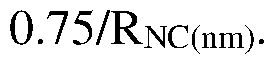
Thus, when a molar ratio of ligand to nanocrystal atoms is significantly more than 0.375/RNC(nm), and especially when the molar ratio is more than 0.75/RNC(nm), it is determined that an excess of ligand is present.
Although the invention has been described in conjunction with specific embodiments thereof, it is evident that many alternatives, modifications and variations will be apparent to those skilled in the art. Accordingly, it is intended to embrace all such alternatives, modifications and variations that fall within the spirit and broad scope of the appended claims.
All publications, patents and patent applications mentioned in this specification are herein incorporated in their entirety by reference into the specification, to the same extent as if each individual publication, patent or patent application was specifically and individually indicated to be incorporated herein by reference. In addition, citation or identification of any reference in this application shall not be construed as an admission that such reference is available as prior art to the present invention. To the extent that section headings are used, they should not be construed as necessarily limiting.
Claims
1. A composition comprising a solid or semi-solid matrix, said matrix having incorporated therein a plurality of nanocrystals, and at least one ligand capable of binding to a surface of said nanocrystals,
wherein a total concentration of said at least one ligand in said matrix is at least three times a maximal concentration of said at least one ligand capable of being bound to said nanocrystals.
2. The composition of claim 1, wherein a molar ratio of said at least one ligand in said matrix to atoms at a surface of said nanocrystals is at least 5: 1.
3. The composition of any one of claims 1 to 2, wherein a molar ratio of said at least one ligand in said matrix to total atoms of said nanocrystals is at least 3/R.NC(nm): l, wherein RNC(nm) is the average radius of said nanoparticles in nanometer units.
4. The composition of any one of claims 1 to 3, wherein said nanocrystals comprise a semiconductor substance.
5. The composition of any one of claims 1 to 4, wherein said nanocrystals consist essentially of a single substance.
6. The composition of any one of claims 1 to 4, wherein said nanocrystals comprise a core and at least one shell, said core and said shell comprising different materials.
7. The composition of any one of claims 1 to 6, wherein said nanocrystal comprises a metal chalcogenide and/or a metal pnictide.
8. The composition of claim 7, wherein said metal chalcogenide and/or metal pnictogenide comprises a Group II metal, a Group III metal, and/or a Group IV metal.
9. The composition of claim 8, wherein said metal is selected from the group consisting of Mg, Zn, Cd, Hg, Al, Ga, In, Tl, Sn and Pb.
10. The composition of claim 9, wherein said nanocrystal comprises PbS.
11. The composition of any one of claims 1 to 10, wherein said ligand is soluble in said matrix.
12. The composition of any one of claims 1 to 11, wherein a solubility of said ligand in an organic solvent is different from a solubility of said matrix in said organic solvent by no more than 10 %.
13. The composition of any one of claims 1 to 12, wherein said ligand is selected from the group consisting of a heteroaromatic compound, an alcohol, an ether, a carboxylic acid, a thiol, a thioether, a sulfoxide, a sulfone, a selenol, a selenoether, a selenoxide, an amine, an amine oxide, a phosphine, a phosphine oxide, a phosphine selenide, a phosphonic acid, an arsine, an arsine oxide, a metal chalcogenide complex and an inorganic anion.
14. The composition of claim 13, wherein said at least one ligand comprises a trialkylphosphine.
15. The composition of any one of claims 1 to 14, wherein said matrix comprises at least one substance selected from the group consisting of a polymeric or copolymeric substance, a semiconducting substance and a conducting substance.
16. The composition of claim 15, wherein said polymeric or copolymeric substance is selected from the group consisting of a polystyrene, a polyacrylate, a polymethacrylate, a poly(methyl methacrylate), a polyimide, a semiconducting polymer, a conducting polymer, and a copolymer of any two or more of the foregoing.
17. The composition of any one of claims 15 to 16, wherein said semiconducting substance is selected from the group consisting of a substituted or non-substituted poly(phenylene-vinylene), a substituted or non-substituted polyfluorene, a substituted or non-substituted polythiophene, a substituted or non- substituted poly[naphthalene-l,4,5,8-bis(dicarboximide)-2,6-diyl-(3/i-bithiophene], a substituted or non- substituted fullerene, a substituted or non-substituted copper phthalocyanine, and a substituted or non-substituted tris(8- hydroxyquinolinato)aluminum.
18. The composition of any one of claims 15 to 17, wherein said conducting substance is selected from the group consisting of a substituted or non- substituted polyaniline, a substituted or non-substituted poly(3,4-dioxythiophene), and copolymers thereof.
19. The composition of any one of claims 1 to 18, wherein a concentration of 02 in said matrix is no more than 10 ppm.
20. The composition of any one of claims 1 to 19, wherein a concentration of H2O in said matrix is no more than 10 ppm.
21. The composition of any one of claims 1 to 20, wherein said nanocrystals in the composition emit photoluminescence at a wavelength in a range of from 400 nm to 3000 nm.
22. The composition of claim 21 wherein a quantum yield of said photoluminescence is at least 20 % higher than a quantum yield of photoluminescence of nanocrystals in a corresponding composition comprising said matrix having incorporated therein said plurality of nanocrystals without said at least one ligand.
23. The composition of claim 21 or 22, wherein a quantum yield of photoluminescence at a wavelength of at least 1100 nm is at least 12 % and/or a quantum yield of photoluminescence at a wavelength of at least 1500 nm is at least 8 %.
24. The composition of any one of claims 21 to 23, wherein said matrix is substantially transparent to an excitation wavelength and/or an emission wavelength of said photoluminescence.
25. A process for preparing the composition of any one of claims 1 to 24, the process comprising mixing said nanocrystals and said at least one ligand with at least one substance which forms said matrix, to thereby form said matrix.
26. The process of claim 25, wherein said mixing is effected in a solvent, the process further comprising evaporating said solvent subsequent to said mixing.
27. The process of claim 26, wherein solubility of said at least one ligand in said solvent is different from a solubility of said substance which forms said matrix in said solvent by no more than 10 %.
28. The process of any one of claims 25 to 27, wherein forming said matrix is effected in an environment comprising no more than 10 ppm 02.
29. The process of any one of claims 25 to 28, wherein forming said matrix is effected in an environment comprising no more than 10 ppm H20.
30. A process for preparing the composition of any one of claims 1 to 24, the process comprising contacting a matrix which incorporates said nanocrystals with said at least one ligand under conditions which allow diffusion of said at least one ligand into said matrix.
31. An optical device comprising the composition of any one of claims 1 to
24.
32. The device of claim 31, being selected from the group consisting of light emitting diodes, lasers, photovoltaic cells, photo-transistors, transistors, detectors and modulators.
33. A laser system, comprising the composition of any one of claims 1 to
24.
34. A display system, comprising the composition of any one of claims 1 to
24.
35. An optical communication system, comprising the composition of any one of claims 1 to 24.
36. An illumination system, comprising the light emitting diode of any one of claims 1 to 24.
37. An optical connector, comprising the composition of any one of claims
1 to 24.
38. A solar cell system, comprising the composition of any one of claims 1 to 24.
39. An imaging system comprising the composition of any one of claims 1 to 24.
40. An optical memory system comprising the composition of any one of claims 1 to 24.
41. A touchscreen comprising the composition of any one of claims 1 to 24.
Applications Claiming Priority (2)
| Application Number | Priority Date | Filing Date | Title |
|---|---|---|---|
| IL244145 | 2016-02-15 | ||
| IL244145A IL244145A0 (en) | 2016-02-15 | 2016-02-15 | Matrices incorporating nanocrystals and uses thereof |
Publications (1)
| Publication Number | Publication Date |
|---|---|
| WO2017141237A1 true WO2017141237A1 (en) | 2017-08-24 |
Family
ID=56082883
Family Applications (1)
| Application Number | Title | Priority Date | Filing Date |
|---|---|---|---|
| PCT/IL2017/050185 Ceased WO2017141237A1 (en) | 2016-02-15 | 2017-02-14 | Matrices incorporating nanocrystals and uses thereof |
Country Status (2)
| Country | Link |
|---|---|
| IL (1) | IL244145A0 (en) |
| WO (1) | WO2017141237A1 (en) |
Cited By (2)
| Publication number | Priority date | Publication date | Assignee | Title |
|---|---|---|---|---|
| WO2025088660A1 (en) * | 2023-10-23 | 2025-05-01 | シャープディスプレイテクノロジー株式会社 | Light-emitting element, display device, and method for manufacturing light-emitting element |
| WO2025088661A1 (en) * | 2023-10-23 | 2025-05-01 | シャープディスプレイテクノロジー株式会社 | Light-emitting element, display device, and method for manufacturing light-emitting element |
-
2016
- 2016-02-15 IL IL244145A patent/IL244145A0/en unknown
-
2017
- 2017-02-14 WO PCT/IL2017/050185 patent/WO2017141237A1/en not_active Ceased
Non-Patent Citations (5)
| Title |
|---|
| ABEL, KEITH A. ET AL.: "Highly photoluminescent PbS nanocrystals: the beneficial effect of trioctylphosphine", CHEMISTRY OF MATERIALS, vol. 20.12, 29 May 2008 (2008-05-29), pages 3794 - 3796, XP055409732 * |
| KALYUZHNY, GREGORY ET AL.: "Ligand effects on optical properties of CdSe nanocrystals", THE JOURNAL OF PHYSICAL CHEMISTRY B, vol. 109.15, 22 March 2005 (2005-03-22), pages 7012 - 7021, XP055409734 * |
| MOROZ, PAVEL ET AL.: "Infrared emitting PbS nanocrystal solids through matrix encapsulation", CHEMISTRY OF MATERIALS, vol. 26.14, 24 June 2014 (2014-06-24), pages 4256 - 4264, XP055409731 * |
| YAACOBI-GROSS, NIR ET AL.: "Combining ligand-induced quantum-confined stark effect with type II heterojunction bilayer structure in CdTe and CdSe nanocrystal-based solar cells", ACS NANO, vol. 6, no. 4, 31 December 2012 (2012-12-31), pages 3128 - 3133, XP055409721 * |
| YAACOBI-GROSS, NIR ET AL.: "Molecular control of quantum-dot internal electric field and its application to CdSe-based solar cells", NATURE MATERIALS, vol. 10.12, 31 December 2011 (2011-12-31), pages 974 - 979, XP055409717 * |
Cited By (2)
| Publication number | Priority date | Publication date | Assignee | Title |
|---|---|---|---|---|
| WO2025088660A1 (en) * | 2023-10-23 | 2025-05-01 | シャープディスプレイテクノロジー株式会社 | Light-emitting element, display device, and method for manufacturing light-emitting element |
| WO2025088661A1 (en) * | 2023-10-23 | 2025-05-01 | シャープディスプレイテクノロジー株式会社 | Light-emitting element, display device, and method for manufacturing light-emitting element |
Also Published As
| Publication number | Publication date |
|---|---|
| IL244145A0 (en) | 2016-04-21 |
Similar Documents
| Publication | Publication Date | Title |
|---|---|---|
| Huang et al. | Novel fluorescence sensor based on all-inorganic perovskite quantum dots coated with molecularly imprinted polymers for highly selective and sensitive detection of omethoate | |
| Ananthakumar et al. | Cesium lead halide (CsPbX 3, X= Cl, Br, I) perovskite quantum dots-synthesis, properties, and applications: a review of their present status | |
| Tian et al. | Chemical vapor deposition method grown all-inorganic perovskite microcrystals for self-powered photodetectors | |
| Hoang et al. | Surface treatment of inorganic CsPbI3 nanocrystals with guanidinium iodide for efficient perovskite light-emitting diodes with high brightness | |
| Stroyuk et al. | Inherently broadband photoluminescence in Ag–In–S/ZnS quantum dots observed in ensemble and single-particle studies | |
| Pathak et al. | Perovskite crystals for tunable white light emission | |
| Hamdeh et al. | Solution-processed BiI3 thin films for photovoltaic applications: improved carrier collection via solvent annealing | |
| Li et al. | Simple approach to improving the amplified spontaneous emission properties of perovskite films | |
| US11111432B2 (en) | Triangular carbon quantum dots and compositions and uses thereof | |
| Jancik Prochazkova et al. | Proteinogenic amino acid assisted preparation of highly luminescent hybrid perovskite nanoparticles | |
| Tang et al. | Imaging the moisture-induced degradation process of 2D organolead halide perovskites | |
| Zhang et al. | Stable ultra-fast broad-bandwidth photodetectors based on α-CsPbI 3 perovskite and NaYF 4: Yb, Er quantum dots | |
| Bai et al. | Turning self‐trapped exciton emission to near‐infrared region in thermochromism zero‐dimensional hybrid metal halides | |
| Suhail et al. | Tunable optoelectronic properties of CsPbBr3 perovskite nanocrystals for photodetectors applications | |
| TW201906984A (en) | Composition, film, laminated structure, light-emitting device, and display | |
| Agada et al. | A step forward toward quantum dots based perovskite solar cells in an ambient environment | |
| Kim et al. | Enhanced colloidal stability of perovskite quantum dots via split-ligand re-precipitation for efficient bi-functional interlayer in photovoltaic application | |
| Vijila et al. | Stokes shift engineered, stable core-shell perovskite nanoparticle–Poly (methyl methacrylate) composites with high photoluminescence quantum yield | |
| Delmas et al. | Modulating charge carrier dynamics and transfer via surface modifications in organometallic halide perovskite quantum dots | |
| Hu et al. | Monodisperse bismuth-halide double perovskite nanocrystals confined in mesoporous silica templates | |
| Sanz-Velasco et al. | Controlling aggregation-induced emission by supramolecular interactions and colloidal stability in ionic emitters for light-emitting electrochemical cells | |
| Singha et al. | Surfactant-Assisted Förster Resonance Energy Transfer from a Quantum Dot Complex for Highly Stable White Light Emission | |
| US12305096B2 (en) | Low-pH nanoparticles and ligands | |
| Yu et al. | Stable and eco-friendly Ag–In–S/Zn–S quantum dots for an efficient and optically transparent luminescent solar concentrator-organic photovoltaic system | |
| Mohan et al. | Spectral heterogeneity of hybrid lead halide perovskites demystified by spatially resolved emission |
Legal Events
| Date | Code | Title | Description |
|---|---|---|---|
| 121 | Ep: the epo has been informed by wipo that ep was designated in this application |
Ref document number: 17752795 Country of ref document: EP Kind code of ref document: A1 |
|
| NENP | Non-entry into the national phase |
Ref country code: DE |
|
| 122 | Ep: pct application non-entry in european phase |
Ref document number: 17752795 Country of ref document: EP Kind code of ref document: A1 |