WO2017129300A1 - Hair shaping composition - Google Patents
Hair shaping composition Download PDFInfo
- Publication number
- WO2017129300A1 WO2017129300A1 PCT/EP2016/080042 EP2016080042W WO2017129300A1 WO 2017129300 A1 WO2017129300 A1 WO 2017129300A1 EP 2016080042 W EP2016080042 W EP 2016080042W WO 2017129300 A1 WO2017129300 A1 WO 2017129300A1
- Authority
- WO
- WIPO (PCT)
- Prior art keywords
- hair
- composition
- shaping
- mechanically
- malic acid
- Prior art date
- Legal status (The legal status is an assumption and is not a legal conclusion. Google has not performed a legal analysis and makes no representation as to the accuracy of the status listed.)
- Ceased
Links
Classifications
-
- A—HUMAN NECESSITIES
- A61—MEDICAL OR VETERINARY SCIENCE; HYGIENE
- A61Q—SPECIFIC USE OF COSMETICS OR SIMILAR TOILETRY PREPARATIONS
- A61Q5/00—Preparations for care of the hair
- A61Q5/04—Preparations for permanent waving or straightening the hair
-
- A—HUMAN NECESSITIES
- A61—MEDICAL OR VETERINARY SCIENCE; HYGIENE
- A61K—PREPARATIONS FOR MEDICAL, DENTAL OR TOILETRY PURPOSES
- A61K8/00—Cosmetics or similar toiletry preparations
- A61K8/18—Cosmetics or similar toiletry preparations characterised by the composition
- A61K8/30—Cosmetics or similar toiletry preparations characterised by the composition containing organic compounds
- A61K8/33—Cosmetics or similar toiletry preparations characterised by the composition containing organic compounds containing oxygen
- A61K8/36—Carboxylic acids; Salts or anhydrides thereof
- A61K8/365—Hydroxycarboxylic acids; Ketocarboxylic acids
Definitions
- This invention relates to a hair shaping composition, and more particularly a hair shaping composition which does not require the breakage of hair disulfide bonds.
- Permanent hair straightening compositions that are on the market are based on chemical treatment of the hair in a two-step process using reducing agents to break hair disulfide bonds, followed by a neutralisation or oxidation step to re-establish new disulfide bonds in the desired configuration.
- Such systems have various negatives associated with them.
- the process itself is difficult to conduct, and in many instances it is undertaken by a qualified hairdresser in a professional salon.
- the straightening process damages the hair, has an unpleasant odour and can cause irritation to the scalp.
- hair can be shaped without causing the chemical damage which is traditionally associated with permanent hair straightening processes involving breakage of the hair disulfide bonds.
- the method of the invention can be accomplished by a consumer without intervention of a professional hairdresser. Furthermore, hair shaped with the method of the invention remains shaped even after subsequent washing.
- the present invention provides a method for shaping hair comprising the following steps: (i) treating the hair by topical application of a hair shaping composition, followed by (ii) mechanically shaping the treated hair; the hair shaping composition having a pH of 4 or less and comprising, in an aqueous continuous phase, at least 0.5% malic acid (by weight based on the total weight of the composition).
- a hair shaping composition for use in the invention will generally comprise at least 60%, preferably at least 70% and more preferably at least 80% water (by weight based on the total weight of th e composition). Preferably, the composition comprises no more than 99% and more preferably no more than 98% water (by weight based on the total weight of the composition).
- Other organic solvents may also be present, such as lower alkyl alcohols and polyhydric alcohols. Examples of lower alkyl alcohols include Ci to C6 monohydric alcohols such as ethanol and isopropanol. Examples of polyhydric alcohols include propylene glycol, hexylene glycol, glycerin, and propanediol. Mixtures of any of the above described organic solvents may also be used.
- the hair shaping composition for use in the invention comprises at least 0.5% malic acid (by weight based on the total weight of the composition).
- the level of malic acid preferably ranges from 0.5 to 6%, more preferably from 1 to 3% and most preferably from 1 .5 to 2.5% by weight based on the total weight of the composition.
- the hair shaping composition for use in the invention does not require the incorporation of reducing agents, and a hair shaping composition for use in the invention is generally substantially free of such materials.
- substantially free in the context of this invention means that reducing agents are absent or included in trace quantities only, such as no more than 0.1 %, preferably no more than 0.01 %, and more preferably from 0 to 0.001 % by weight based on the total weight of the composition.
- reducing agent in the context of this invention means an agent which is effective to break hair disulfide bonds when applied to hair for a period ranging from about 3 to 15 minutes and at a temperature ranging from about 20 to 30°C.
- reducing agents examples include ammonium thioglycolate (in a solution having a pH of between about 7 and 10.5), glyceryl monothioglycolate (employed at a pH of less than 7), thioglycolic acid, dithioglycolic acid, mercaptoethyl amine, mercaptopropionic acid, dithioglycolate and alkali metal or ammonium sulfites or bisulfites.
- ammonium thioglycolate in a solution having a pH of between about 7 and 10.5
- glyceryl monothioglycolate employed at a pH of less than 7
- thioglycolic acid dithioglycolic acid
- mercaptoethyl amine mercaptopropionic acid
- dithioglycolate alkali metal or ammonium sulfites or bisulfites.
- a hair shaping composition for use in the invention may suitably have a conditioning gel phase, which may be generally characterized as a gel ( ⁇ _ ⁇ ) surfactant mesophase consisting of surfactant bilayers.
- a conditioning gel phase may be formed from a cationic surfactant, a high melting point fatty alcohol and an aqueous carrier. Typically these components are heated to form a mixture, which is cooled under shear to room temperature. The mixture undergoes a number of phase transitions during cooling, normally resulting in a gel ( ⁇ _ ⁇ ) surfactant mesophase consisting of surfactant bilayers.
- Suitable cationic surfactants which are useful for forming the conditioning gel phase include quaternary ammonium cationic surfactants corresponding to the following general formula: [N(R 1 )(R 2 )(R 3 )(R 4 )] + (X)- in which R 1 , R 2 , R 3 , and R 4 are each independently selected from (a) an aliphatic group of from 1 to 22 carbon atoms, or (b) an aromatic, alkoxy, polyoxyalkylene, alkylamido, hydroxyalkyl, aryl or alkylaryl group having up to 22 carbon atoms; and X is a salt- forming anion such as those selected from halide, (e.g.
- the aliphatic groups can contain, in addition to carbon and hydrogen atoms, ether linkages, and other groups such as amino groups.
- the longer chain aliphatic groups e.g., those of about 12 carbons, or higher, can be saturated or unsaturated.
- quaternary ammonium cationic surfactants of the above general formula are cetyltrimethylammonium chloride, behenyltrimethylammonium chloride (BTAC), cetylpyridinium chloride, tetramethylammonium chloride,
- dodecyltrimethylammonium chloride hexadecyltrimethylammonium chloride, octyldimethylbenzylammonium chloride, decyldimethylbenzylammonium chloride, stearyldimethylbenzylammonium chloride, didodecyldimethylammonium chloride, dioctadecyldimethylammonium chloride, tallowtrimethylammonium chloride,
- cocotrimethylammonium chloride dipalmitoylethyldimethylammonium chloride, PEG-2 oleylammonium chloride and salts of these, where the chloride is replaced by other halide (e.g., bromide), acetate, citrate, lactate, glycolate, phosphate nitrate, sulphate, or alkylsulphate.
- halide e.g., bromide
- R 1 is a Ci6 to C22 saturated or unsaturated, preferably saturated, alkyl chain and R 2 , R 3 and R 4 are each independently selected from CH3 and CH2CH2OH, preferably CH3.
- CTAC cetyltrimethylammonium chloride
- BTAC behenyltrimethylammonium chloride
- the level of cationic surfactant suitably ranges from 0.1 to 10%, preferably from 0.2 to 5% and more preferably from 0.25 to 4% (by total weight of cationic surfactant based on the total weight of the composition).
- high melting point in the context of this invention is generally meant a melting point of 25°C or higher. Generally the melting point ranges from 25°C up to 90°C, preferably from 40°C up to 70° C and more preferably from 50°C up to about 65°C.
- the high melting point fatty alcohol can be used as a single compound or as a blend or mixture of at least two high melting point fatty alcohols. When a blend or mixture of fatty alcohols is used, the melting point means the melting point of the blend or mixture.
- Suitable fatty alcohols of this type have the general formula R-OH, where R is an aliphatic carbon chain.
- R is a saturated aliphatic carbon chain comprising from 8 to 30 carbon atoms, more preferably from 14 to 30 carbon atoms and most preferably from 16 to 22 carbon atoms.
- R can contain, in addition to carbon and hydrogen atoms, ether linkages, and other groups such as amino groups.
- the fatty alcohol has the general formula CH3(CH2)n OH, where n is an integer from 7 to 29, preferably from 15 to 21.
- suitable fatty alcohols are cetyl alcohol, stearyl alcohol, behenyl alcohol, and mixtures thereof. Cetyl alcohol, stearyl alcohol and mixtures thereof are particularly preferred.
- the level of fatty alcohol suitably ranges from 0.01 to 10%, preferably from 0.1 to 8%, more preferably from 0.2 to 7% and most preferably from 0.3 to 6% (by weight based on the total weight of the composition).
- the weight ratio of cationic surfactant to fatty alcohol is suitably from 1 :1 to 1 :10, preferably from 1 :1.5 to 1 :8, optimally from 1 :2 to 1 :5.
- a hair shaping composition for use in the invention may also incorporate other optional ingredients to enhance performance and/or consumer acceptability. Suitable optional ingredients include: preservatives, colouring agents, chelating agents, antioxidants, fragrances, antimicrobials, antidandruff agents, cationic conditioning polymers, styling ingredients, sunscreens, proteins and hydrolysed proteins.
- the pH of the hair shaping composition for use in the invention is 4 or less, and preferably ranges from 1.5 to 3.8, more preferably from 2.0 to 3.5 and most preferably from 2.5 to 3.0.
- the hair shaping composition for use in the invention is a single dose composition.
- the term "single dose" in the context of this invention means that the composition is to be topically applied to the hair in one go.
- the hair shaping composition for use in the invention is suitable for topical application to hair for improved hair volume-down.
- the term "volume-down" in the context of this invention generally means reduced visible bulkiness of the hair.
- improved hair volume-down provides a number of associated benefits, such as improved straightness, smoothness, manageability and style retention.
- the hair shaping composition for use in the invention is preferably topically applied to the hair at a temperature from 15 to 40°C, and more preferably at a temperature from 20 to 30°C.
- the composition is applied to dry hair.
- dry hair in the context of this invention generally means hair from which free water (i.e. water disposed as a film or droplets on the cuticle surface) has been substantially removed. Hair may be dried by exposure to air, by use of a heated hair drying appliance, by rubbing with a water- absorbent article, or by a combination of any of these methods.
- the dry hair will not have been washed or actively wetted, (such as by shampooing, conditioning, rinsing or otherwise treating with an aqueous composition) in the preceding 2 hours and more preferably in the preceding 3 hours prior to topical application of the composition, and will have been permitted to acclimatise to atmospheric conditions.
- a suitable indicator of dry hair in the context of this invention would be a hair fibre whose calculated water content does not exceed 25% by weight based on the total weight of the hair fibre.
- the hair shaping composition is allowed to remain in contact with the hair without rinsing. More preferably, the hair shaping composition is allowed to remain in contact with the hair without rinsing until the hair thus treated is dry.
- the hair thus treated may be dried naturally by exposure to air, by use of a heated hair drying appliance, by rubbing with a water-absorbent article, or by a combination of any of these methods.
- the hair shaping composition may thus remain in contact with the hair after topical application for a period of at least about 3 minutes up to 3 hours or more if the hair is allowed to dry naturally.
- the treated hair is mechanically shaped.
- Mechanical shaping of the hair in the method of the invention can be accomplished by such means as the fingertips, a plastic hair pick or the tail of a comb, the shaping being performed on portions of the hair comprising strands of hair in various numbers. Using such means the hair may be pulled, combed, smoothed, pressed or flattened into a straightened configuration; or shaped gently into bends, waves or curls.
- the hair is mechanically shaped by mechanically straightening it.
- the hair may be pulled, combed, smoothed, pressed or flattened into a straightened configuration.
- a hot tool such as an electrically heated flat hair iron or hand-held hair dryer, may be used in the mechanical shaping step.
- Such tools apply high levels of heat directly to the hair, and are usually employed at temperature settings of at least 50°C, with an upper limit dependent on the particular tool.
- the hair is mechanically shaped in step (ii) of the method of the invention by mechanically straightening it with an electrically heated flat hair iron.
- Electrically heated flat hair irons are usually employed at a temperature of at least 120°C and can reach temperatures as high as 230°C.
- the method of this invention also gives good results at significantly lower operating temperatures than this (e.g. around 170 to 200°C). This is particularly advantageous for minimizing damage to hair.
- the hair shaping composition is topically applied to dry hair and the hair thus treated is combed straight at a temperature from 15 to 40°C, preferably at a temperature from 20 to 30°C.
- the treated, combed hair is dried (or allowed to dry) without rinsing the composition from the hair.
- the dry hair is then mechanically shaped by mechanically straightening it with a hot tool (preferably an electrically heated flat hair iron) at an operating temperature from 120 to 220°C, preferably from 150 to 210°C, and more preferably from 170 to 200°C.
- the hair shaping composition may then be rinsed from the hair at the next wash.
- the inventors have found that the improved "volume-down" provided by the hair shaping composition in accordance with the invention is capable of persisting after washing.
- the invention also provides a method for shaping hair comprising the following further steps:
- the rinsing step (iii) is typically conducted after a period of about 24 to 72 hours following the initial application of the composition in step (i).
- the rinsing step (iii) may be conducted with water alone or with shampoo.
- the hair is preferably re-shaped in step (iv) by combing it into a
- Method steps (i) to (iv) as described above may also be repeated over one or more (e.g. two or three) cycles.
- Example 1 Aqueous solution, 2% malic acid
- Example A Aqueous solution, 2% malonic acid
- Example B Aqueous solution, 2% L-tartaric acid
- Control switches were soaked in water.
- switches were removed and were left to dry at 20°C and 50%RH. When dry the switches were combed and the volume of the switches measured. They were then straightened with straightening irons (5 passes at an operating temperature of approximately 170°C).
- the switches were subsequently washed a number of times and images of the switches were captured when dry and after combing.
- the volumes of the switches were measured using an image analysis kit.
- the volume of the switches shows the volume-down (straightness) benefits of the treatment (here volume refers to the projection of the switch image on to the screen and is given in mm 2 ).
- the percentage benefit i.e. decrease in volume
- control water
- Example 1 provides a superior straightening benefit to either of the Examples A and B.
- the switches treated with Example 1 maintain their superior straightness after multiple washes.
- the superiority of Example 1 is particularly pronounced when heat styling at 170°C is performed.
- Example 2 Aqueous solution, 2% malic acid, adjusted to pH 2
- Example C Aqueous solution, 2% malic acid, adjusted to pH 5
- Example D Aqueous solution, 2% malic acid, adjusted to pH 8
- switches were removed and were left to dry at 20°C and 50%RH. They were then straightened with straightening irons (5 passes at an operating temperature of approximately 170°C) and left overnight. They were subsequently washed once and images of the switches were captured when dry and after combing.
- the results after one wash show that the switch treated with Example 2 has the lowest volume.
- the switch treated with Example C has a 31 % bigger volume compared to the switch treated with Example 2.
- the switch treated with Example D has a 53% bigger volume than the switch treated with Example 2.
- the following formulation illustrates a hair shaping composition for use in the method of the invention.
Landscapes
- Health & Medical Sciences (AREA)
- Life Sciences & Earth Sciences (AREA)
- Animal Behavior & Ethology (AREA)
- General Health & Medical Sciences (AREA)
- Public Health (AREA)
- Veterinary Medicine (AREA)
- Emergency Medicine (AREA)
- Birds (AREA)
- Epidemiology (AREA)
- Cosmetics (AREA)
Abstract
The invention provides a method for shaping hair comprising the following steps: (i) treating the hair by topical application of a hair shaping composition, followed by (ii) mechanically shaping the treated hair; the hair shaping composition having a pH of 4 or less and comprising, in an aqueous continuous phase, at least 0.5% malic acid (by weight based on the total weight of the composition).
Description
HAIR SHAPING COMPOSITION
Field of the Invention
This invention relates to a hair shaping composition, and more particularly a hair shaping composition which does not require the breakage of hair disulfide bonds.
Background and Prior Art
Many people with naturally kinky, curly, or even wavy hair often desire to straighten their hair. Permanent hair straightening compositions that are on the market are based on chemical treatment of the hair in a two-step process using reducing agents to break hair disulfide bonds, followed by a neutralisation or oxidation step to re-establish new disulfide bonds in the desired configuration. Such systems have various negatives associated with them. The process itself is difficult to conduct, and in many instances it is undertaken by a qualified hairdresser in a professional salon. Furthermore the straightening process damages the hair, has an unpleasant odour and can cause irritation to the scalp.
Surprisingly we have found that hair can be shaped without causing the chemical damage which is traditionally associated with permanent hair straightening processes involving breakage of the hair disulfide bonds.
Advantageously the method of the invention can be accomplished by a consumer without intervention of a professional hairdresser. Furthermore, hair shaped with the method of the invention remains shaped even after subsequent washing.
Summary of the Invention
The present invention provides a method for shaping hair comprising the following steps: (i) treating the hair by topical application of a hair shaping composition, followed by (ii) mechanically shaping the treated hair; the hair shaping composition having a pH of 4 or less and comprising, in an aqueous continuous phase, at least 0.5% malic acid (by weight based on the total weight of the composition).
Detailed Description and Preferred Embodiments
All molecular weights as used herein are weight average molecular weights, unless otherwise specified.
By "aqueous continuous phase" is meant a continuous phase which has water as its basis. A hair shaping composition for use in the invention will generally comprise at least 60%, preferably at least 70% and more preferably at least 80% water (by weight based on the total weight of th e composition). Preferably, the composition comprises no more than 99% and more preferably no more than 98% water (by weight based on the total weight of the composition). Other organic solvents may also be present, such as lower alkyl alcohols and polyhydric alcohols. Examples of lower alkyl alcohols include Ci to C6 monohydric alcohols such as ethanol and isopropanol. Examples of polyhydric alcohols include propylene glycol, hexylene glycol, glycerin, and propanediol. Mixtures of any of the above described organic solvents may also be used.
The hair shaping composition for use in the invention comprises at least 0.5% malic acid (by weight based on the total weight of the composition).
Malic acid (2-hydroxybutanedioic acid) has the following formula:

Malic acid has two stereoisomeric forms (D- and L- enantiomers)
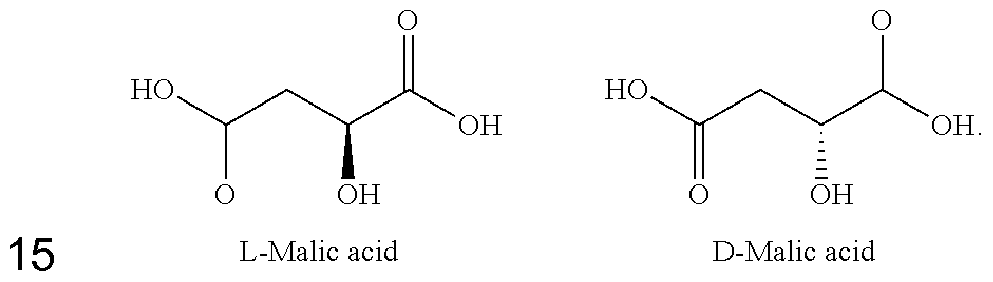
In nature, essentially all malic acid is produced in the L- form (the exception being a few micro-organisms which produce D-malic acid). L-malic acid may be produced commercially using a fermentation process. Commercial synthetic malic acid is a racemic mixture of the D- and L- enantiomers, and is usually made by hydrating maleic and fumaric acids and separating the malic acid from the equilibrium mixture. Any of these forms, or a mixture of any of these forms, is suitable for use in the invention. In the hair shaping composition for use in the invention, the level of malic acid preferably ranges from 0.5 to 6%, more preferably from 1 to 3% and most preferably from 1 .5 to 2.5% by weight based on the total weight of the composition.
Advantageously, the hair shaping composition for use in the invention does not require the incorporation of reducing agents, and a hair shaping composition for use in the invention is generally substantially free of such materials.
The term "substantially free" in the context of this invention means that reducing agents are absent or included in trace quantities only, such as no more than 0.1 %, preferably no more than 0.01 %, and more preferably from 0 to 0.001 % by weight based on the total weight of the composition. The term "reducing agent" in the context of this invention means an agent which is effective to break hair disulfide bonds when applied to hair for a period ranging from about 3 to 15 minutes and at a temperature ranging from about 20 to 30°C. Examples of such reducing agents are ammonium thioglycolate (in a solution having a pH of between about 7 and 10.5), glyceryl monothioglycolate (employed at a pH of less than 7), thioglycolic acid, dithioglycolic acid, mercaptoethyl amine, mercaptopropionic acid, dithioglycolate and alkali metal or ammonium sulfites or bisulfites.
A hair shaping composition for use in the invention may suitably have a conditioning gel phase, which may be generally characterized as a gel (Ι_β) surfactant mesophase consisting of surfactant bilayers. Such a conditioning gel phase may be formed from a cationic surfactant, a high melting point fatty alcohol and an aqueous carrier. Typically these components are heated to form a mixture, which is cooled under shear to room temperature. The mixture undergoes a number of phase transitions during cooling, normally resulting in a gel (Ι_β) surfactant mesophase consisting of surfactant bilayers.
Examples of suitable cationic surfactants which are useful for forming the conditioning gel phase include quaternary ammonium cationic surfactants corresponding to the following general formula: [N(R1)(R2)(R3)(R4)]+ (X)- in which R1, R2, R3, and R4 are each independently selected from (a) an aliphatic group of from 1 to 22 carbon atoms, or (b) an aromatic, alkoxy, polyoxyalkylene, alkylamido, hydroxyalkyl, aryl or alkylaryl group having up to 22 carbon atoms; and X is a salt- forming anion such as those selected from halide, (e.g. chloride, bromide), acetate, citrate, lactate, glycolate, phosphate nitrate, sulphate, and alkylsulphate radicals.
The aliphatic groups can contain, in addition to carbon and hydrogen atoms, ether linkages, and other groups such as amino groups. The longer chain aliphatic groups, e.g., those of about 12 carbons, or higher, can be saturated or unsaturated.
Specific examples of such quaternary ammonium cationic surfactants of the above general formula are cetyltrimethylammonium chloride, behenyltrimethylammonium chloride (BTAC), cetylpyridinium chloride, tetramethylammonium chloride,
tetraethylammonium chloride, octyltrimethylammonium chloride,
dodecyltrimethylammonium chloride, hexadecyltrimethylammonium chloride, octyldimethylbenzylammonium chloride, decyldimethylbenzylammonium chloride, stearyldimethylbenzylammonium chloride, didodecyldimethylammonium chloride, dioctadecyldimethylammonium chloride, tallowtrimethylammonium chloride,
cocotrimethylammonium chloride, dipalmitoylethyldimethylammonium chloride, PEG-2 oleylammonium chloride and salts of these, where the chloride is replaced by other halide (e.g., bromide), acetate, citrate, lactate, glycolate, phosphate nitrate, sulphate, or alkylsulphate.
In a preferred class of cationic surfactant of the above general formula, R1 is a Ci6 to C22 saturated or unsaturated, preferably saturated, alkyl chain and R2, R3 and R4 are each independently selected from CH3 and CH2CH2OH, preferably CH3.
Specific examples of such preferred quaternary ammonium cationic surfactants for use in forming the conditioning gel phase are cetyltrimethylammonium chloride (CTAC), behenyltrimethylammonium chloride (BTAC) and mixtures thereof.
Mixtures of any of the above-described cationic surfactants may also be suitable. The level of cationic surfactant suitably ranges from 0.1 to 10%, preferably from 0.2 to 5% and more preferably from 0.25 to 4% (by total weight of cationic surfactant based on the total weight of the composition).
By "high melting point" in the context of this invention is generally meant a melting point of 25°C or higher. Generally the melting point ranges from 25°C up to 90°C, preferably from 40°C up to 70° C and more preferably from 50°C up to about 65°C.
The high melting point fatty alcohol can be used as a single compound or as a blend or mixture of at least two high melting point fatty alcohols. When a blend or mixture of fatty alcohols is used, the melting point means the melting point of the blend or mixture.
Suitable fatty alcohols of this type have the general formula R-OH, where R is an aliphatic carbon chain. Preferably R is a saturated aliphatic carbon chain comprising from 8 to 30 carbon atoms, more preferably from 14 to 30 carbon atoms and most preferably from 16 to 22 carbon atoms.
R can contain, in addition to carbon and hydrogen atoms, ether linkages, and other groups such as amino groups.
Most preferably, the fatty alcohol has the general formula CH3(CH2)n OH, where n is an integer from 7 to 29, preferably from 15 to 21. Specific examples of suitable fatty alcohols are cetyl alcohol, stearyl alcohol, behenyl alcohol, and mixtures thereof. Cetyl alcohol, stearyl alcohol and mixtures thereof are particularly preferred.
Mixtures of any of the above-described fatty alcohols may also be suitable.
The level of fatty alcohol suitably ranges from 0.01 to 10%, preferably from 0.1 to 8%, more preferably from 0.2 to 7% and most preferably from 0.3 to 6% (by weight based on the total weight of the composition). The weight ratio of cationic surfactant to fatty alcohol is suitably from 1 :1 to 1 :10, preferably from 1 :1.5 to 1 :8, optimally from 1 :2 to 1 :5.
A hair shaping composition for use in the invention may also incorporate other optional ingredients to enhance performance and/or consumer acceptability. Suitable optional ingredients include: preservatives, colouring agents, chelating agents, antioxidants, fragrances, antimicrobials, antidandruff agents, cationic conditioning polymers, styling ingredients, sunscreens, proteins and hydrolysed proteins.
The pH of the hair shaping composition for use in the invention is 4 or less, and preferably ranges from 1.5 to 3.8, more preferably from 2.0 to 3.5 and most preferably from 2.5 to 3.0. Preferably, the hair shaping composition for use in the invention is a single dose composition. The term "single dose" in the context of this invention means that the composition is to be topically applied to the hair in one go.
The hair shaping composition for use in the invention is suitable for topical application to hair for improved hair volume-down. The term "volume-down" in the context of this invention generally means reduced visible bulkiness of the hair. For many consumers, improved hair volume-down provides a number of associated benefits, such as improved straightness, smoothness, manageability and style retention. The hair shaping composition for use in the invention is preferably topically applied to the hair at a temperature from 15 to 40°C, and more preferably at a temperature from 20 to 30°C.
Preferably, the composition is applied to dry hair. The term "dry hair" in the context of this invention generally means hair from which free water (i.e. water disposed as a film or droplets on the cuticle surface) has been substantially removed. Hair may be dried by exposure to air, by use of a heated hair drying appliance, by rubbing with a water- absorbent article, or by a combination of any of these methods. Preferably, the dry hair will not have been washed or actively wetted, (such as by shampooing, conditioning, rinsing or otherwise treating with an aqueous composition) in the preceding 2 hours and more preferably in the preceding 3 hours prior to topical application of the composition, and will have been permitted to acclimatise to atmospheric conditions. In such circumstances there is substantially no free water present which interferes with the adsorption of the composition on application. A suitable indicator of dry hair in the context of this invention would be a hair fibre whose calculated water content does not exceed 25% by weight based on the total weight of the hair fibre.
After topical application to the hair, it is preferred that the hair shaping composition is allowed to remain in contact with the hair without rinsing. More preferably, the hair shaping composition is allowed to remain in contact with the hair without rinsing until the hair thus treated is dry. The hair thus treated may be dried naturally by exposure to air, by use of a heated hair drying appliance, by rubbing with a water-absorbent article, or by a combination of any of these methods.
The hair shaping composition may thus remain in contact with the hair after topical application for a period of at least about 3 minutes up to 3 hours or more if the hair is allowed to dry naturally.
In step (ii) of the method of the invention, the treated hair is mechanically shaped. Mechanical shaping of the hair in the method of the invention can be accomplished by such means as the fingertips, a plastic hair pick or the tail of a comb, the shaping being performed on portions of the hair comprising strands of hair in various numbers. Using such means the hair may be pulled, combed, smoothed, pressed or flattened into a straightened configuration; or shaped gently into bends, waves or curls.
Preferably in step (ii) of the method of the invention, the hair is mechanically shaped by mechanically straightening it. For example, the hair may be pulled, combed, smoothed, pressed or flattened into a straightened configuration. A hot tool, such as an electrically heated flat hair iron or hand-held hair dryer, may be used in the mechanical shaping step. Such tools apply high levels of heat directly to the hair, and are usually employed at temperature settings of at least 50°C, with an upper limit dependent on the particular tool. Preferably the hair is mechanically shaped in step (ii) of the method of the invention by mechanically straightening it with an electrically heated flat hair iron. Electrically heated flat hair irons are usually employed at a temperature of at least 120°C and can
reach temperatures as high as 230°C. However, the method of this invention also gives good results at significantly lower operating temperatures than this (e.g. around 170 to 200°C). This is particularly advantageous for minimizing damage to hair.
In a typical method for shaping hair according to the invention, the hair shaping composition is topically applied to dry hair and the hair thus treated is combed straight at a temperature from 15 to 40°C, preferably at a temperature from 20 to 30°C. The treated, combed hair is dried (or allowed to dry) without rinsing the composition from the hair. The dry hair is then mechanically shaped by mechanically straightening it with a hot tool (preferably an electrically heated flat hair iron) at an operating temperature from 120 to 220°C, preferably from 150 to 210°C, and more preferably from 170 to 200°C.
The hair shaping composition may then be rinsed from the hair at the next wash.
Surprisingly, the inventors have found that the improved "volume-down" provided by the hair shaping composition in accordance with the invention is capable of persisting after washing.
Accordingly the invention also provides a method for shaping hair comprising the following further steps:
(iii) rinsing the shaped hair, and then
(iv) mechanically re-shaping the rinsed hair.
The rinsing step (iii) is typically conducted after a period of about 24 to 72 hours following the initial application of the composition in step (i). The rinsing step (iii) may be conducted with water alone or with shampoo.
The use of hot tools is not essential in the re-shaping step (iv). This is especially advantageous for consumers who wish to reduce or avoid the exposure of their hair to high temperatures, for example if their hair is fragile or overprocessed from previous chemical treatments such as bleaching and perming.
Accordingly the hair is preferably re-shaped in step (iv) by combing it into a
straightened configuration at a temperature from 15 to 40°C, more preferably at a temperature from 20 to 30°C.
Method steps (i) to (iv) as described above may also be repeated over one or more (e.g. two or three) cycles.
The invention is further illustrated with reference to the following, non-limiting
Examples. In the Examples, all ingredients are expressed by weight percent of the total formulation, and as level of active ingredient. A letter indicates Comparative Examples (not according to the invention). A number indicates Examples according to the invention.
EXAMPLES
Example 1 and (Comparative) Examples A and B Dark brown European wavy#6 switches of length 25 cm and weight 2gms were soaked in the following test solutions:
Example 1 : Aqueous solution, 2% malic acid
Example A: Aqueous solution, 2% malonic acid
Example B Aqueous solution, 2% L-tartaric acid
Control switches were soaked in water.
After 30 minutes, the switches were removed and were left to dry at 20°C and 50%RH. When dry the switches were combed and the volume of the switches measured. They were then straightened with straightening irons (5 passes at an operating temperature of approximately 170°C).
The switches were subsequently washed a number of times and images of the switches were captured when dry and after combing.
The volumes of the switches were measured using an image analysis kit. The volume of the switches shows the volume-down (straightness) benefits of the treatment (here volume refers to the projection of the switch image on to the screen and is given in mm2). The percentage benefit (i.e. decrease in volume) with respect to control (water) was also measured.
The results are shown in Table 1.
Table 1
Volumes of treated hair switches in mm2 after a single heat treatment and subsequent two washes.

From the table it can be seen that Example 1 provides a superior straightening benefit to either of the Examples A and B. The switches treated with Example 1 maintain their superior straightness after multiple washes. The superiority of Example 1 is particularly pronounced when heat styling at 170°C is performed.
Example 2 and (Comparative) Examples C and D
Dark brown European wavy#6 switches of length 25 cm and weight 2gms were soaked in the following test solutions: Example 2: Aqueous solution, 2% malic acid, adjusted to pH 2
Example C: Aqueous solution, 2% malic acid, adjusted to pH 5
Example D Aqueous solution, 2% malic acid, adjusted to pH 8
After 30 minutes, the switches were removed and were left to dry at 20°C and 50%RH. They were then straightened with straightening irons (5 passes at an operating temperature of approximately 170°C) and left overnight. They were subsequently washed once and images of the switches were captured when dry and after combing.
The results after one wash show that the switch treated with Example 2 has the lowest volume. The switch treated with Example C has a 31 % bigger volume compared to the switch treated with Example 2. The switch treated with Example D has a 53% bigger volume than the switch treated with Example 2.
It is evident from the above results that pH has an effect on the volume-down
(straightness) benefits of the treatment.
Example 3
The following formulation illustrates a hair shaping composition for use in the method of the invention.
Ingredient % activity %w/w raw material
Behentrimonium chloride 70 1.1429
Cetearyl alcohol 100 3.0
Perfume 100 0.60
Preservative 100 0.2
Dimethicone emulsion 70 1.429
Malic acid 100 2.0
Water, minors 100 To 100% pH = 2.7
Claims
A method for shaping hair comprising the following steps:
(i) treating the hair by topical application of a hair shaping composition, followed by
(ii) mechanically shaping the treated hair; the hair shaping composition having a pH of 4 or less and comprising, in an aqueous continuous phase, at least 0.5% malic acid (by weight based on the total weight of the composition).
A method according to claim 1 , in which the level of malic acid ranges from 1.5 to 2.5% by weight based on the total weight of the composition.
A method according to claim 1 or claim 2, in which the treated hair is mechanically shaped by mechanically straightening it with a hot tool at an operating temperature from 170 to 200°C.
A method according to any one of claims 1 to 3, in which the hair shaping composition is topically applied to dry hair.
A method according to any one of claims 1 to 4, comprising the further steps of:
(iii) rinsing the shaped hair, and then
(iv) mechanically re-shaping the rinsed hair.
Applications Claiming Priority (2)
| Application Number | Priority Date | Filing Date | Title |
|---|---|---|---|
| EP16153070 | 2016-01-28 | ||
| EP16153070.4 | 2016-01-28 |
Publications (1)
| Publication Number | Publication Date |
|---|---|
| WO2017129300A1 true WO2017129300A1 (en) | 2017-08-03 |
Family
ID=55237602
Family Applications (1)
| Application Number | Title | Priority Date | Filing Date |
|---|---|---|---|
| PCT/EP2016/080042 Ceased WO2017129300A1 (en) | 2016-01-28 | 2016-12-07 | Hair shaping composition |
Country Status (1)
| Country | Link |
|---|---|
| WO (1) | WO2017129300A1 (en) |
Cited By (4)
| Publication number | Priority date | Publication date | Assignee | Title |
|---|---|---|---|---|
| WO2019195900A1 (en) * | 2018-04-09 | 2019-10-17 | L'oreal | Hair treatment compositions comprising reducing agents |
| WO2019197852A1 (en) * | 2018-04-09 | 2019-10-17 | L'oreal | Hair treatment compositions comprising reducing agents |
| WO2025073624A1 (en) | 2023-10-05 | 2025-04-10 | Unilever Ip Holdings B.V. | Hair straightening compositions and methods of using thereof |
| WO2025168722A1 (en) | 2024-02-09 | 2025-08-14 | Unilever Ip Holdings B.V. | Smoothing hair treatment composition |
Citations (2)
| Publication number | Priority date | Publication date | Assignee | Title |
|---|---|---|---|---|
| WO2013174575A1 (en) * | 2012-05-21 | 2013-11-28 | Unilever Plc | Method of treating hair |
| WO2015074846A1 (en) * | 2013-11-21 | 2015-05-28 | Unilever Plc | Method of shaping hair |
-
2016
- 2016-12-07 WO PCT/EP2016/080042 patent/WO2017129300A1/en not_active Ceased
Patent Citations (2)
| Publication number | Priority date | Publication date | Assignee | Title |
|---|---|---|---|---|
| WO2013174575A1 (en) * | 2012-05-21 | 2013-11-28 | Unilever Plc | Method of treating hair |
| WO2015074846A1 (en) * | 2013-11-21 | 2015-05-28 | Unilever Plc | Method of shaping hair |
Cited By (4)
| Publication number | Priority date | Publication date | Assignee | Title |
|---|---|---|---|---|
| WO2019195900A1 (en) * | 2018-04-09 | 2019-10-17 | L'oreal | Hair treatment compositions comprising reducing agents |
| WO2019197852A1 (en) * | 2018-04-09 | 2019-10-17 | L'oreal | Hair treatment compositions comprising reducing agents |
| WO2025073624A1 (en) | 2023-10-05 | 2025-04-10 | Unilever Ip Holdings B.V. | Hair straightening compositions and methods of using thereof |
| WO2025168722A1 (en) | 2024-02-09 | 2025-08-14 | Unilever Ip Holdings B.V. | Smoothing hair treatment composition |
Similar Documents
| Publication | Publication Date | Title |
|---|---|---|
| EP3071297B1 (en) | Method of shaping hair | |
| EP3325102B1 (en) | Hair shaping composition | |
| JP6732740B2 (en) | How to improve hair volume | |
| WO2017129300A1 (en) | Hair shaping composition | |
| US20190060203A1 (en) | Hair shaping composition | |
| EP3220880B1 (en) | Hair shaping composition | |
| EP3217955B1 (en) | Hair shaping composition | |
| US10449136B2 (en) | Hair shaping composition | |
| EP3128990B1 (en) | Method of shaping hair | |
| WO2015074969A2 (en) | Method of shaping hair | |
| WO2015074970A1 (en) | Method of shaping hair |
Legal Events
| Date | Code | Title | Description |
|---|---|---|---|
| 121 | Ep: the epo has been informed by wipo that ep was designated in this application |
Ref document number: 16810298 Country of ref document: EP Kind code of ref document: A1 |
|
| NENP | Non-entry into the national phase |
Ref country code: DE |
|
| 122 | Ep: pct application non-entry in european phase |
Ref document number: 16810298 Country of ref document: EP Kind code of ref document: A1 |