WO2017116807A1 - Liquid nutritional products comprising lutein with low off-color development - Google Patents
Liquid nutritional products comprising lutein with low off-color development Download PDFInfo
- Publication number
- WO2017116807A1 WO2017116807A1 PCT/US2016/067562 US2016067562W WO2017116807A1 WO 2017116807 A1 WO2017116807 A1 WO 2017116807A1 US 2016067562 W US2016067562 W US 2016067562W WO 2017116807 A1 WO2017116807 A1 WO 2017116807A1
- Authority
- WO
- WIPO (PCT)
- Prior art keywords
- lutein
- nutritional composition
- per
- liquid
- nutritional
- Prior art date
- Legal status (The legal status is an assumption and is not a legal conclusion. Google has not performed a legal analysis and makes no representation as to the accuracy of the status listed.)
- Ceased
Links
Classifications
-
- A—HUMAN NECESSITIES
- A23—FOODS OR FOODSTUFFS; TREATMENT THEREOF, NOT COVERED BY OTHER CLASSES
- A23L—FOODS, FOODSTUFFS OR NON-ALCOHOLIC BEVERAGES, NOT OTHERWISE PROVIDED FOR; PREPARATION OR TREATMENT THEREOF
- A23L33/00—Modifying nutritive qualities of foods; Dietetic products; Preparation or treatment thereof
- A23L33/40—Complete food formulations for specific consumer groups or specific purposes, e.g. infant formula
-
- A—HUMAN NECESSITIES
- A23—FOODS OR FOODSTUFFS; TREATMENT THEREOF, NOT COVERED BY OTHER CLASSES
- A23D—EDIBLE OILS OR FATS, e.g. MARGARINES, SHORTENINGS OR COOKING OILS
- A23D7/00—Edible oil or fat compositions containing an aqueous phase, e.g. margarines
- A23D7/005—Edible oil or fat compositions containing an aqueous phase, e.g. margarines characterised by ingredients other than fatty acid triglycerides
- A23D7/0053—Compositions other than spreads
-
- A—HUMAN NECESSITIES
- A23—FOODS OR FOODSTUFFS; TREATMENT THEREOF, NOT COVERED BY OTHER CLASSES
- A23D—EDIBLE OILS OR FATS, e.g. MARGARINES, SHORTENINGS OR COOKING OILS
- A23D7/00—Edible oil or fat compositions containing an aqueous phase, e.g. margarines
- A23D7/01—Other fatty acid esters, e.g. phosphatides
- A23D7/011—Compositions other than spreads
-
- A—HUMAN NECESSITIES
- A23—FOODS OR FOODSTUFFS; TREATMENT THEREOF, NOT COVERED BY OTHER CLASSES
- A23L—FOODS, FOODSTUFFS OR NON-ALCOHOLIC BEVERAGES, NOT OTHERWISE PROVIDED FOR; PREPARATION OR TREATMENT THEREOF
- A23L29/00—Foods or foodstuffs containing additives; Preparation or treatment thereof
- A23L29/10—Foods or foodstuffs containing additives; Preparation or treatment thereof containing emulsifiers
-
- A—HUMAN NECESSITIES
- A23—FOODS OR FOODSTUFFS; TREATMENT THEREOF, NOT COVERED BY OTHER CLASSES
- A23L—FOODS, FOODSTUFFS OR NON-ALCOHOLIC BEVERAGES, NOT OTHERWISE PROVIDED FOR; PREPARATION OR TREATMENT THEREOF
- A23L33/00—Modifying nutritive qualities of foods; Dietetic products; Preparation or treatment thereof
- A23L33/10—Modifying nutritive qualities of foods; Dietetic products; Preparation or treatment thereof using additives
- A23L33/105—Plant extracts, their artificial duplicates or their derivatives
-
- A—HUMAN NECESSITIES
- A23—FOODS OR FOODSTUFFS; TREATMENT THEREOF, NOT COVERED BY OTHER CLASSES
- A23L—FOODS, FOODSTUFFS OR NON-ALCOHOLIC BEVERAGES, NOT OTHERWISE PROVIDED FOR; PREPARATION OR TREATMENT THEREOF
- A23L5/00—Preparation or treatment of foods or foodstuffs, in general; Food or foodstuffs obtained thereby; Materials therefor
- A23L5/40—Colouring or decolouring of foods
- A23L5/42—Addition of dyes or pigments, e.g. in combination with optical brighteners
- A23L5/43—Addition of dyes or pigments, e.g. in combination with optical brighteners using naturally occurring organic dyes or pigments, their artificial duplicates or their derivatives
- A23L5/44—Addition of dyes or pigments, e.g. in combination with optical brighteners using naturally occurring organic dyes or pigments, their artificial duplicates or their derivatives using carotenoids or xanthophylls
-
- A—HUMAN NECESSITIES
- A61—MEDICAL OR VETERINARY SCIENCE; HYGIENE
- A61K—PREPARATIONS FOR MEDICAL, DENTAL OR TOILETRY PURPOSES
- A61K31/00—Medicinal preparations containing organic active ingredients
- A61K31/045—Hydroxy compounds, e.g. alcohols; Salts thereof, e.g. alcoholates
- A61K31/07—Retinol compounds, e.g. vitamin A
-
- A—HUMAN NECESSITIES
- A23—FOODS OR FOODSTUFFS; TREATMENT THEREOF, NOT COVERED BY OTHER CLASSES
- A23V—INDEXING SCHEME RELATING TO FOODS, FOODSTUFFS OR NON-ALCOHOLIC BEVERAGES AND LACTIC OR PROPIONIC ACID BACTERIA USED IN FOODSTUFFS OR FOOD PREPARATION
- A23V2002/00—Food compositions, function of food ingredients or processes for food or foodstuffs
-
- A—HUMAN NECESSITIES
- A23—FOODS OR FOODSTUFFS; TREATMENT THEREOF, NOT COVERED BY OTHER CLASSES
- A23V—INDEXING SCHEME RELATING TO FOODS, FOODSTUFFS OR NON-ALCOHOLIC BEVERAGES AND LACTIC OR PROPIONIC ACID BACTERIA USED IN FOODSTUFFS OR FOOD PREPARATION
- A23V2200/00—Function of food ingredients
Definitions
- the present disclosure relates to liquid nutritional compositions. More particularly, the disclosure relates to liquid nutritional compositions comprising significant amounts of lutein.
- Liquid nutritional compositions typically include balanced amounts of macronutrients (proteins, carbohydrates, and fats), as well as micronutrients and flavorings.
- nutrition shakes i.e., non-carbonated liquid nutritional compositions which are intended for oral consumption and therefore have the consistency, flavor, and overall desirable sensory characteristics of common milk shakes, are widely-available consumer products. Examples include the Ensure ® , Glucerna ® , Myoplex ® , and PediaSure ® lines of nutrition shakes available from Abbott Nutrition of Columbus, Ohio. Generally, these nutrition shakes are made up in the form of oil-in-water emulsions having the consistency of common milk shakes.
- balanced nutritional beverages available to consumers, many are formulated as ready-to-feed liquids in aseptically processed or retort packaged single use cans, bottles, or other containers. These packaged beverages are formulated with an emphasis on delivering stable, balanced nutritional s that taste good and appeal to a broad range of consumer tastes. To appeal to a variety of consumer tastes, these beverages are often flavored with one or more common flavors such as vanilla, chocolate, caramel, fruit, berry, butter pecan, and so forth.
- these flavored beverages are formulated so that the selected flavor matches that of the chosen color.
- banana flavored beverages should be yellow
- chocolate flavored beverages should be beige or brown
- vanilla flavored beverages should be white, and so forth.
- Matching flavors and colors can be a
- the general inventive concepts are directed to liquid nutritional compositions comprising lutein.
- Applicants have discovered that it is possible to formulate a flavored beverage comprising fat, protein, carbohydrates, and minerals, wherein the beverage develops little or no undesired color during formulation, processing, and storage. It is also desirable to prepare such a beverage wherein the flavor and color of the beverage are accurately matched or otherwise minimally affected by any undesirable color development to deliver the consumer experience that consumers have come to expect in a liquid nutritional beverage.
- a liquid nutritional composition comprises fat in an amount of 4 mg to 105 mg per mL and lutein in an amount of 0.4 ug to 63 ⁇ g per mL.
- the lutein comprises at least 50% trans lutein.
- a liquid nutritional composition comprises fat in an amount of 8 mg to 42 mg per mL and lutein in an amount of 2.1 ug to 51 ug per mL.
- the lutein comprises at least 50% trans lutein.
- a liquid nutritional composition comprises at least one of protein and carbohydrate; fat in an amount of 4 mg to 42 mg per mL; and a ratio of lutein (mg) to fat (g) of 0.004: 1 to 15 : 1.
- the lutein comprises 50% to 100% trans lutein.
- a liquid nutritional composition comprises protein; carbohydrate; fat in an amount of 8 mg to 42 mg per mL; and lutein.
- the lutein is characterized by a ratio of trans lutein to cis lutein of greater than 4:1.
- the nutritional compositions according to the general inventive concepts provide the nutrient lutein in amounts above those found in conventional nutritional compositions, while the color of the nutritional compositions are unaffected or are only minimally affected by undesirable color development due to lutein.
- Figure 1 shows the percentage of trans lutein in nutritional compositions when varying the lutein to fat concentration.
- nutritional compositions can be formulated with amounts of lutein that surpass that of conventional liquid nutritional compositions, while avoiding or otherwise reducing the color- altering effects normally associated with such concentrations of lutein.
- the term "nutritional composition” refers to nutritional liquids, nutritional solids
- nutritional powders which may be reconstituted to form a nutritional liquid, nutritional puddings, nutritional gels, nutritional bars, and other nutritional products all of which comprise one or more of protein, carbohydrate, and fat, and are suitable for oral consumption by a human.
- the nutritional liquid may also be formulated as a suspension, an emulsion, a solution, and so forth.
- nutritional compositions in flowable or scoopable form that can be reconstituted with water or another aqueous liquid prior to consumption and includes both spray dried and drymixed/dryblended powders.
- Some semi-solid examples include puddings, yogurts, gels, gelatins, and doughs.
- serving refers to an amount which is intended to be consumed by an individual in one sitting or within one hour or less.
- shelf stable refers to a liquid nutritional composition that remains commercially viable after being packaged and then stored at 18-24 °C for at least 3 months. Shelf stability may be measured by any suitable indicia of stability including, but not limited to, consumer acceptance panel, sedimentation, etc. Commercially viable relates to consumer acceptance and may be measured by well known hedonic or organoleptic testing.
- the nutritional compositions described herein include a nutritionally significant quantity of lutein. Lutein has been shown to provide oxidative protection, as well as to enhance brain development.
- the lutein present in the inventive nutritional compositions may be provided as a part of a mixture of carotenoids or by itself.
- the term “lutein” is intended to refer to all isomers of the compound.
- the nutritional compositions contain trans-lutein.
- trans-lutein refers to a compound having the following structure:
- the nutritional composition includes trans-lutein
- the nutritional composition can contain only trans-lutein or trans-lutein in combination with other lutein forms.
- the nutritional composition comprises at least 50% trans lutein (i.e., 50% to 100% trans lutein).
- the nutritional composition comprises at least 75% trans-lutein (i.e., 75% to 100% trans lutein).
- the nutritional composition comprises at least 80% trans lutein (i.e., 80% to 100% trans lutein).
- the nutritional composition comprises at least 90% trans-lutein (i.e., 80% to 100% trans lutein), including greater than 95% trans-lutein.
- the lutein may be provided in a variety of forms and is available from manufacturers known to those in the art. One particular form of lutein is 20% FloraGLO lutein in Safflower oil, available from DSM N.V., the Netherlands.
- the amount of lutein present in the nutritional compositions can vary depending on the individual, the intended use, or both. In certain exemplary embodiments, lutein is present in an amount of at least 100 ug per 8 oz. serving of the liquid nutritional composition (i.e., at least 12.5 ug per oz.). In certain exemplary embodiments, lutein is present in an amount of at least 500 ⁇ g per 8 oz. serving of the liquid nutritional composition (i.e., at least 62.5 ug per oz.). In certain exemplary embodiments, lutein is present in an amount of 100 ug to 15 mg per 8 oz. serving of the liquid nutritional composition (i.e., 12.5 ⁇ g to 1.9 mg per oz).
- lutein is present in an amount of 500 ug to 12 mg per 8 oz. serving of the liquid nutritional composition (i.e., 62.5 ug to 1.5 mg per oz). In certain exemplary embodiments, lutein is present in an amount of 500 ug to 10 mg per 8 oz. serving of the liquid nutritional composition (i.e., 62.5 ⁇ g to 1.25 mg per oz). In certain exemplary embodiments, lutein is present in an amount of 500 ug to 8 mg per 8 oz. serving of the liquid nutritional composition (i.e., 62.5 ug to 1 mg per oz). In certain exemplary embodiments, lutein is present in an amount of 5 mg to 8 mg per 8 oz. serving of the liquid nutritional composition (i.e., 625 ug to 1 mg per oz).
- An alternative way to express the amount of lutein in a nutritional composition is to refer to the amount of lutein per mL of the nutritional liquid.
- lutein is present in an amount of at least 0.4 ug per mL of the liquid nutritional composition.
- lutein is present in an amount of at least 2.1 ⁇ g per mL of the liquid nutritional composition.
- lutein is present in an amount of 0.4 ug to 63 ug per mL of the liquid nutritional composition.
- lutein is present in an amount of 2.1 ug to 51 ⁇ g per mL of the liquid nutritional composition.
- lutein is present in an amount of 2.1 ⁇ g to 42 ⁇ g per mL of the liquid nutritional composition. In certain exemplary embodiments, lutein is present in an amount of 2.1 ug to 34 ug per mL of the liquid nutritional composition. In certain exemplary embodiments, lutein is present in an amount of 21 ug to 34 ug per mL of the liquid nutritional composition.
- the amount of lutein may also be expressed as a ratio of the amount of lutein relative to the total fat in the nutritional composition.
- the ratio of lutein (mg) to fat (g) is 0.004:1 to 15:1.
- the ratio of lutein (mg) to fat (g) is 0.004:1 to 12:1.
- the ratio of lutein (mg) to fat (g) is 0.004:1 to 6:1.
- the ratio of lutein (mg) to fat (g) is 0.05:1 to 16:1.
- the ratio of lutein (mg) to fat (g) is 0.05:1 to 12:1. In certain exemplary embodiments, the ratio of lutein (mg) to fat (g) is 0.05:1 to 6:1. In certain exemplary embodiments, the ratio of lutein (mg) to fat (g) is 0.05:1 to 3:1. In certain exemplary embodiments, the ratio of lutein (mg) to fat (g) is 0.1 : 1 to 3 : 1. In certain exemplary embodiments, the ratio of lutein (mg) to fat (g) is 0.1 : 1 to 1 : 1. In certain exemplary embodiments, the ratio of lutein (mg) to fat (g) is 0.25:1 to 3:1.
- the ratio of lutein (mg) to fat (g) is 0.5:1 to 3:1. In certain exemplary embodiments, the ratio of lutein (mg) to fat (g) is 1 : 1 to 3 : 1.
- the nutritional compositions include one or more additional carotenoids such as beta-carotene, zeaxanthin, lycopene, and combinations thereof. It should be understood that any combination of beta-carotene, zeaxanthin, and lycopene can be included along with lutein in the nutritional compositions of the present disclosure.
- the nutritional compositions described herein include fat and at least one of protein and carbohydrate.
- the nutritional compositions according to the general inventive concepts include protein, fat, and carbohydrate.
- total concentrations or amounts of the protein, fat, and carbohydrate may vary depending upon the product type (i.e., dietary supplement, medical food, human milk fortifier, infant formula, toddler formula, etc.), product form (i.e., nutritional solid, powder, ready-to-feed liquid or concentrated liquid, nutritional bar), and targeted dietary needs of the intended user, such concentrations or amounts most typically fall within one of the following embodied ranges, inclusive of any other essential protein, fat, and/or carbohydrate ingredients as described herein.
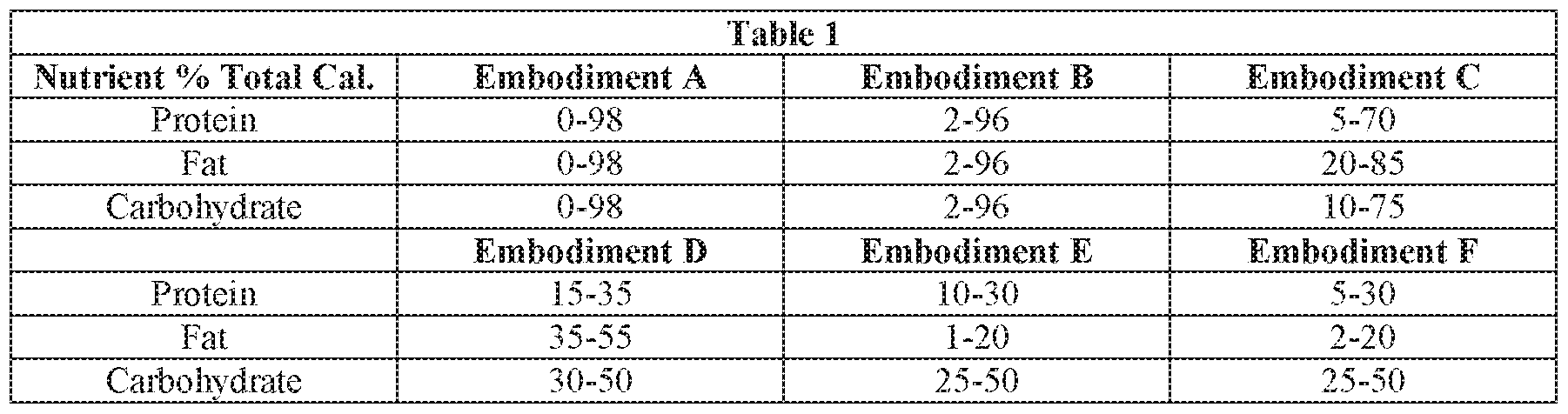
- each macronutrient in any of the liquid nutritional compositions described herein may also be characterized in addition to, or in the alternative, as a percentage of total calories in the liquid nutritional composition as set forth in the following table.
- These macronutrients for liquid nutritional compositions of the present disclosure are most typically formulated within any of the caloric ranges (embodiments A-F) described in the following table.
- the nutritional compositions described herein include a source or sources of fat.
- Suitable sources of fat for use herein include any fat or fat source that is suitable for use in an oral liquid nutritional composition and is compatible with the essential elements and features of such compositions.
- the amount of fat present in the nutritional composition can vary widely and may be based on the particular needs of the intended consumer or the intended product form. Any fat or source thereof that is suitable for use in oral nutritional products and is compatible with the other ingredients of the inventive compositions can be used.
- Non-limiting examples of suitable fats or sources thereof for use in the nutritional compositions described herein include coconut oil, fractionated coconut oil, soy oil, corn oil, olive oil, safflower oil, high oleic safflower oil, MCT (medium chain triglycerides) oil, sunflower oil, high oleic sunflower oil, palm and palm kernel oils, palm olein, canola oil, high oleic canola oil, marine oils, fish oils, fungal oils, algae oils, cottonseed oils, and combinations thereof.
- coconut oil fractionated coconut oil, soy oil, corn oil, olive oil, safflower oil, high oleic safflower oil, MCT (medium chain triglycerides) oil, sunflower oil, high oleic sunflower oil, palm and palm kernel oils, palm olein, canola oil, high oleic canola oil, marine oils, fish oils, fungal oils, algae oils, cottonseed oils, and combinations thereof.
- fat is present in an amount of 1 g to 25 g per serving (e.g., approximately 8 oz. or 237 mL in some instances) of the liquid nutritional composition. In certain exemplary embodiments, fat is present in an amount of 2 g to 25 g per serving of the liquid nutritional composition. In certain exemplary embodiments, fat is present in an amount of 5 g to 25 g per serving of the liquid nutritional composition. In certain exemplary embodiments, fat is present in an amount of 5 g to 15 g per serving of the liquid nutritional composition. [0034] An alternative way to express the amount of fat in a nutritional composition is to refer to the amount of fat per mL of the nutritional liquid.
- fat is present in an amount of 4 mg to 105 mg per mL of the liquid nutritional composition. In certain exemplary embodiments, fat is present in an amount of 8 mg to 105 mg per mL of the liquid nutritional composition. In certain exemplary embodiments, fat is present in an amount of 20 mg to 105 mg per mL of the liquid nutritional composition. In certain exemplary embodiments, fat is present in an amount of 20 mg to 63 mg per mL of the liquid nutritional composition.
- the nutritional compositions described herein include a source or sources of protein. Any protein source that is suitable for use in oral liquid nutritional compositions and is compatible with the essential elements and features of such compositions is suitable for use herein.
- the amount of protein present in the nutritional composition can vary widely and may be based on the particular needs of the intended consumer or the intended product form.
- suitable proteins or sources thereof for use in the nutritional can vary widely and may be based on the particular needs of the intended consumer or the intended product form.
- compositions include hydrolyzed, partially hydrolyzed, or non-hydrolyzed proteins or protein sources, which may be derived from any known or otherwise suitable source such as milk (e.g., casein, whey), animal (e.g., meat, fish), cereal (e.g., rice, corn), vegetable (e.g., soy, pea), or combinations thereof.
- milk e.g., casein, whey
- animal e.g., meat, fish
- cereal e.g., rice, corn
- vegetable e.g., soy, pea
- milk protein isolates e.g., milk protein concentrates, casein protein isolates, extensively hydrolyzed casein, sodium or calcium caseinates, whey protein, whey protein concentrates, whey protein isolate, whey protein hydrolysate, whole cow milk, partially or completely defatted milk, soy protein isolates, and soy protein concentrates.
- protein is present in an amount of 1 g to 25 g per serving (e.g., approximately 8 oz. or 237 mL in some instances) of the liquid nutritional composition. In certain exemplary embodiments, protein is present in an amount of 5 g to 20 g per serving of the liquid nutritional composition. In certain exemplary embodiments, protein is present in an amount of 5 g to 15 g per serving of the liquid nutritional composition. In certain exemplary embodiments, protein is present in an amount of 6 g to 15 g per serving of the liquid nutritional composition. In certain exemplary embodiments, protein is present in an amount of 7 g to 10 g per serving of the liquid nutritional
- An alternative way to express the amount of protein in a nutritional composition is to refer to the amount of protein per mL of the nutritional liquid.
- protein is present in an amount of 4 mg to 105 mg per mL of the liquid nutritional composition.
- protein is present in an amount of 21 mg to 84 mg per mL of the liquid nutritional composition.
- protein is present in an amount of 21 mg to 63 mg per mL of the liquid nutritional composition.
- protein is present in an amount of 25 mg to 63 mg per mL of the liquid nutritional composition.
- protein is present in an amount of 30 mg to 42 mg per mL of the liquid nutritional composition.
- the nutritional compositions described herein include a source or sources of carbohydrate. Any carbohydrate source that is suitable for use in oral liquid nutritional compositions and is compatible with the essential elements and features of such compositions is suitable for use herein.
- the amount of carbohydrate present in the nutritional composition can vary widely and may be based on the particular needs of the intended consumer or the intended product form. Any carbohydrate or source thereof that is suitable for use in oral nutritional products and is compatible with the other ingredients of the inventive compositions can be used as the carbohydrate in the nutritional compositions.
- Non-limiting examples of a source of carbohydrate suitable for use in the nutritional compositions described herein include maltodextrin, hydrolyzed or modified starch or cornstarch, glucose polymers, corn syrup, corn syrup solids, rice-derived carbohydrates, sucrose, glucose, fructose, lactose, high fructose corn syrup, honey, sugar alcohols (e.g., maltitol, erythritol, sorbitol), isomaltulose, sucromalt, pullulan, potato starch, slowly-digested carbohydrates, dietary fibers (e.g., oat fiber, soy fiber, gum arabic, sodium carboxymethylcellulose, methylcellulose, guar gum, gellan gum, locust bean gum, konjac flour, hydroxypropyl methylcellulose, tragacanth gum, karaya gum, gum acacia, chitosan, arabinogalactans, glucomannan, xanthan gum, alginate, pect
- carbohydrate is present in an amount of 15 g to 50 g per serving (e.g., approximately 8 oz. or 237 mL in some instances) of the liquid nutritional composition. In certain exemplary embodiments, carbohydrate is present in an amount of 15 g to 40 g per serving of the liquid nutritional composition. In certain exemplary
- carbohydrate is present in an amount of 25 g to 40 g per serving of the liquid nutritional composition.
- An alternative way to express the amount of carbohydrate in a nutritional composition is to refer to the amount of carbohydrate per mL of the nutritional liquid.
- carbohydrate is present in an amount of 63 mg to 210 mg per mL of the liquid nutritional composition.
- carbohydrate is present in an amount of 63 mg to 170 mg per mL of the liquid nutritional composition.
- carbohydrate is present in an amount of 105 mg to 210 mg per mL of the liquid nutritional composition.
- the nutritional composition may further comprise other optional ingredients that may modify its physical, chemical, hedonic, or processing characteristics or serve as pharmaceutical or additional nutritional components when used in the targeted population.
- optional ingredients are known or otherwise suitable for use in other nutritional compositions and may also be used in the nutritional compositions described herein, provided that such optional ingredients are safe and effective for oral administration and are compatible with the essential and other ingredients in the selected product form.
- the nutritional composition further comprises any of a variety of vitamins or related nutrients, non-limiting examples of which include vitamin A, vitamin D, vitamin E, vitamin K, thiamine, riboflavin, vitamin B6, vitamin B12, niacin, folic acid, pantothenic acid, biotin, vitamin C, choline, inositol, salts and derivatives thereof, and combinations thereof.
- vitamins or related nutrients include vitamin A, vitamin D, vitamin E, vitamin K, thiamine, riboflavin, vitamin B6, vitamin B12, niacin, folic acid, pantothenic acid, biotin, vitamin C, choline, inositol, salts and derivatives thereof, and combinations thereof.
- the nutritional composition further comprises any of a variety of minerals, non-limiting examples of which include phosphorus, magnesium, calcium, manganese, sodium, potassium, molybdenum, chromium, selenium, chloride, iodide, and combinations thereof.
- the nutritional composition may be an "excellent source of (as defined by the U.S. Food and Drug Administration) at least one of the following: calcium, riboflavin, vitamin B6, folate, pantothenic acid, phosphorous, iodine, selenium, manganese, chromium, molybdenum, and combinations thereof.
- the nutritional composition may be a "good source of (as defined by the U.S. Food and Drug Administration) at least one of the following: vitamin A, vitamin C, vitamin E, thiamin, niacin, biotin, and combinations thereof.
- Non-limiting examples of other optional ingredients include fiber, preservatives, and
- antioxidants emulsifying agents, buffers, colorants, flavors, probiotics, prebiotics, thickening agents and stabilizers, and so forth.
- the nutritional composition comprises at least one sweetening agent.
- the at least one sweetening agent is a sugar alcohol such as maltitol, erythritol, sorbitol, xylitol, mannitol, isolmalt, lactitol, and combinations thereof, or at least one artificial or high potency sweetener such as acesulfame K, aspartame, sucralose, saccharin, stevia, tagatose, monk fruit, and combinations thereof.
- the sweetening agents especially as a combination of a sugar alcohol and an artificial sweetener, may be especially useful in formulating nutritional compositions having a desirable flavor profile.
- the nutritional composition may comprise at least one sugar alcohol with a concentration of from at least 0.01%, including from 0.1% to 10%, and also including from 1% to 6% by weight of the nutritional composition.
- the nutritional composition may comprise at least one artificial sweetener with a concentration of from 0.01% to 5%, including from 0.05% to 3%, and also including from 0.1% to 1% by weight of the nutritional composition.
- the nutritional composition comprises a stabilizer.
- any stabilizer that is known or otherwise suitable for use in a nutritional composition may be suitable for use herein, some non-limiting examples of which include gums such as carrageenan and xanthan gum.
- the stabilizer may represent from 0.1% to 5%, including from 0.5% to 3%, and including from 0.7% to 1.5%, by weight of the nutritional composition.
- the nutritional composition comprises one or more masking agents to reduce or otherwise obscure the effects of any bitter flavors and after taste that may develop in the nutritional composition over time.
- Suitable masking agents include natural and artificial sweeteners, sodium sources such as sodium chloride, and combinations thereof.
- the amount of masking agent added to the nutritional composition may vary depending upon the particular masking agent selected, other ingredients in the formulation, and other formulation or product target variables. Such amounts, however, can range from 0.1% to 3%, including from 0.15% to 3%, and also including from 0.2% to 2.5%, by weight of the nutritional composition.
- compositions disclosed herein, as well as other embodiments contemplated by the general inventive concepts may be prepared by any process or suitable method (now known or known in the future) for making a selected product form, such as a nutritional liquid, a nutritional solid, or a nutritional powder. Many such techniques are known for any given product form and can easily be applied by one of ordinary skill in the art to the various embodiments presented herein.
- the nutritional composition is formulated as, and intended for consumption in, any known or otherwise suitable oral product form.
- Any solid, liquid, semi-solid, semi-liquid, or powder product form, including combinations or variations thereof, are suitable for use herein, provided that such forms allow for safe and effective oral delivery to the individual via oral consumption of the ingredients as also defined herein.
- the nutritional composition is a nutritional liquid.
- Non-limiting examples of nutritional liquids include snack and meal replacement products, hot or cold beverages, carbonated or non-carbonated beverages, juices or other acidified beverages, milk or soy-based beverages, shakes, coffees, teas, compositions for
- the nutritional liquids are formulated as suspensions or emulsions, but the nutritional liquids can also be formulated in other suitable forms such as clear liquids, solutions, liquid gels, liquid yogurts, and so forth.
- a serving of the nutritional liquid is within a range of 30 mL to 500 mL (-1 fl. oz. to -17 fl. oz.). In certain exemplary embodiments, the serving is 177 mL to 417 mL ( ⁇ 6 fl. oz. to -14 fl. oz.), including 207 mL to 266 mL (-7 fl. oz. to -9 fl. oz.). In certain exemplary embodiments, the serving is 237 mL (-8 fl. oz.). In certain exemplary embodiments, where the nutritional composition is administered as a liquid, one serving to four servings of the nutritional composition may be administered to the individual per day.
- the nutritional compositions disclosed herein are useful to provide sole, primary, or supplemental sources of nutrition, as well as providing one or more of the benefits as described herein.
- the nutritional composition provides up to 1,000 kcal of energy per serving or dose, including from 20 kcal to 900 kcal, from 40 kcal to 700 kcal, from 50 kcal to 500 kcal, from 150 kcal to 475 kcal, from 200 kcal to 450 kcal, or from 200 kcal to 350 kcal per serving.
- the nutritional compositions may be manufactured by any known or otherwise suitable method.
- Inventive nutritional compositions in liquid form may be suitably sterilized, for example, by aseptic sterilization or retort sterilization.
- the nutritional compositions may be prepared by any of the well known methods of formulating such compositions by way of retort, aseptic packaging, or hot fill processing methods.
- emulsion at least three separate slurries are prepared, including a protein-in-fat (PIF) slurry, a carbohydrate-mineral (CHO-MIN) slurry, and a protein-in-water (PIW) slurry.
- PIF protein-in-fat
- CHO-MIN carbohydrate-mineral
- PIW protein-in-water
- the PIF slurry is formed by heating and mixing the oil (e.g., canola oil, corn oil, DHA) and then adding an emulsifier (e.g., lecithin), fat soluble vitamins, and a portion of the total protein with continued heat and agitation.
- an emulsifier e.g., lecithin
- the CHO-MIN slurry is formed by adding with heated agitation to water: minerals (e.g., HMB, potassium citrate, dipotassium phosphate, sodium citrate), trace and ultra trace minerals (TM/UTM premix), and thickening or suspending agents.
- minerals e.g., HMB, potassium citrate, dipotassium phosphate, sodium citrate
- TM/UTM premix trace and ultra trace minerals
- the resulting CHO-MIN slurry is held for 10 minutes with continued heat and agitation before adding additional minerals (e.g., potassium chloride, magnesium carbonate, potassium iodide) and/or carbohydrates (e.g., sucrose, corn syrup).
- additional minerals e.g., potassium chloride, magnesium carbonate, potassium iodide
- carbohydrates e.g., sucrose, corn syrup.
- the PIW slurry is then formed by mixing with heat and agitation the remaining protein, if any.
- the protein is mixed into the PIW s
- the resulting slurries are then blended together with heated agitation and the pH adjusted to 6.9-7.1, after which the composition is subjected to ultra high temperature (UHT) processing during which the composition is heat treated, emulsified, and homogenized and then allowed to cool.
- UHT ultra high temperature
- Water soluble vitamins and ascorbic acid are added, the pH is adjusted to the desired range if necessary, flavors are added, and water is added to achieve the desired total solid level.
- the composition may then be aseptically packaged to form an aseptically packaged nutritional emulsion.
- Table 2 is an exemplary bill of materials for a nutritional composition in the form of a nutritional emulsion.
- the nutritional liquid is formulated as an aseptic liquid comprising 6 mg of lutein per 8 oz. serving, 6 g of fat per 8 oz. serving, 9 g of protein per 8 oz. serving, and 11 g of carbohydrate per 8 oz. serving.
- Table 3 is an exemplary bill of materials for a nutritional composition in the form of a nutritional emulsion.
- the nutritional liquid is formulated as an aseptic liquid comprising 6 mg of lutein per 8 oz. serving, 3 g of fat per 8 oz. serving, 9 g of protein per 8 oz. serving, and 11 g of carbohydrate per 8 oz. serving.
- Table 4 is an exemplary bill of materials for a nutritional composition in the form of a nutritional emulsion.
- the nutritional liquid is formulated as an aseptic liquid comprising 6 mg of lutein per 8 oz. serving, 3 g of fat per 8 oz. serving, 9 g of protein per 8 oz. serving, and 14 g of carbohydrate per 8 oz. serving.
- Table 5 shows the results of measurements of the relative amounts of trans, cis, and cis' isomers of lutein in nutritional compositions after formulation and processing.
- Lutein powder showed consistent % isomerization, independent of dose, whereas lutein in oil had lower isomerization at higher lutein doses. While not wishing to be bound by theory, Applicants believe that the solubility of lutein in oil provides resistance to isomerization that is seen in the data below.
- Table 6 and Figure 1 show the relationship between lutein concentration in fat and the percentage of trans lutein isomer. There is a correlation between the concentration of lutein in oil (4 th row) and trans lutein % (5 th row).
- the various embodiments of the nutritional composition of the present disclosure may also be substantially free of any ingredient or feature described herein, provided that the remaining nutritional composition still contains all of the required ingredients or features as described herein.
- the term "substantially free” means that the selected composition contains less than a functional amount of the optional ingredient, typically less than 1%, including less than 0.5%, including less than 0.1%, and also including zero percent, by weight of such optional ingredient.
Landscapes
- Life Sciences & Earth Sciences (AREA)
- Chemical & Material Sciences (AREA)
- Health & Medical Sciences (AREA)
- Engineering & Computer Science (AREA)
- Food Science & Technology (AREA)
- Polymers & Plastics (AREA)
- Nutrition Science (AREA)
- Mycology (AREA)
- Oil, Petroleum & Natural Gas (AREA)
- Medicinal Chemistry (AREA)
- Pediatric Medicine (AREA)
- Pharmacology & Pharmacy (AREA)
- Epidemiology (AREA)
- Animal Behavior & Ethology (AREA)
- General Health & Medical Sciences (AREA)
- Public Health (AREA)
- Veterinary Medicine (AREA)
- Botany (AREA)
- Coloring Foods And Improving Nutritive Qualities (AREA)
- Acyclic And Carbocyclic Compounds In Medicinal Compositions (AREA)
Abstract
Disclosed are liquid nutritional compositions that include functional ingredients such as lutein and display reduced development of off-colors from lutein. The lutein is incorporated into the nutritional composition in such a way that it does not adversely affect the desirable properties of the nutritional composition such as, for example, color, stability, solubility, taste, and color-flavor matching as expected by consumers.
Description
LIQUID NUTRITIONAL PRODUCTS COMPRISING LUTEIN
WITH LOW OFF-COLOR DEVELOPMENT
FIELD
[001] The present disclosure relates to liquid nutritional compositions. More particularly, the disclosure relates to liquid nutritional compositions comprising significant amounts of lutein.
BACKGROUND
[002] Liquid nutritional compositions typically include balanced amounts of macronutrients (proteins, carbohydrates, and fats), as well as micronutrients and flavorings. For example, nutrition shakes, i.e., non-carbonated liquid nutritional compositions which are intended for oral consumption and therefore have the consistency, flavor, and overall desirable sensory characteristics of common milk shakes, are widely-available consumer products. Examples include the Ensure®, Glucerna®, Myoplex®, and PediaSure® lines of nutrition shakes available from Abbott Nutrition of Columbus, Ohio. Generally, these nutrition shakes are made up in the form of oil-in-water emulsions having the consistency of common milk shakes.
[003] Among such balanced nutritional beverages available to consumers, many are formulated as ready-to-feed liquids in aseptically processed or retort packaged single use cans, bottles, or other containers. These packaged beverages are formulated with an emphasis on delivering stable, balanced nutritional s that taste good and appeal to a broad range of consumer tastes. To appeal to a variety of consumer tastes, these beverages are often flavored with one or more common flavors such as vanilla, chocolate, caramel, fruit, berry, butter pecan, and so forth.
[004] In order to meet customer expectations, these flavored beverages are formulated so that the selected flavor matches that of the chosen color. For example, banana flavored beverages should be yellow, chocolate flavored beverages should be beige or brown, vanilla flavored beverages should be white, and so forth. Matching flavors and colors, however, can be a
1
challenge for many milk-based beverages. These beverages contain a variety of nutrients that potentially interact during formulation, processing, and storage. These interactions can distort the color of the beverage with unwanted colors, thus affecting the desired match between product flavor and color and affecting consumer satisfaction. Manufacturers faced with a mismatch of color and flavor are often forced to restrict if not altogether exclude, certain color-impacting nutrients from beverages with flavors that do not match the color profile of the nutrient in question.
SUMMARY
[005] The general inventive concepts are directed to liquid nutritional compositions comprising lutein. Applicants have discovered that it is possible to formulate a flavored beverage comprising fat, protein, carbohydrates, and minerals, wherein the beverage develops little or no undesired color during formulation, processing, and storage. It is also desirable to prepare such a beverage wherein the flavor and color of the beverage are accurately matched or otherwise minimally affected by any undesirable color development to deliver the consumer experience that consumers have come to expect in a liquid nutritional beverage.
[006] In a first exemplary embodiment, a liquid nutritional composition is provided. The liquid nutritional composition comprises fat in an amount of 4 mg to 105 mg per mL and lutein in an amount of 0.4 ug to 63 μg per mL. The lutein comprises at least 50% trans lutein.
[007] In a second exemplary embodiment, a liquid nutritional composition is provided. The liquid nutritional composition comprises fat in an amount of 8 mg to 42 mg per mL and lutein in an amount of 2.1 ug to 51 ug per mL. The lutein comprises at least 50% trans lutein.
[008] In a third exemplary embodiment, a liquid nutritional composition is provided. The liquid nutritional composition comprises at least one of protein and carbohydrate; fat in an amount of 4 mg to 42 mg per mL; and a ratio of lutein (mg) to fat (g) of 0.004: 1 to 15 : 1. The lutein comprises 50% to 100% trans lutein.
[009] In a fourth exemplary embodiment, a liquid nutritional composition is provided. The liquid nutritional composition comprises protein; carbohydrate; fat in an amount of 8 mg to
42 mg per mL; and lutein. The lutein is characterized by a ratio of trans lutein to cis lutein of greater than 4:1.
[0010] The nutritional compositions according to the general inventive concepts provide the nutrient lutein in amounts above those found in conventional nutritional compositions, while the color of the nutritional compositions are unaffected or are only minimally affected by undesirable color development due to lutein.
BRIEF DESCRIPTION OF THE DRAWINGS
[0011] Figure 1 shows the percentage of trans lutein in nutritional compositions when varying the lutein to fat concentration.
DETAILED DESCRIPTION
[0012] Much is known about the nutritional benefits of lutein. However, inclusion of lutein in nutritional compositions, especially liquid nutritional compositions, has proved difficult in the past as lutein can impart a strong (and often undesirable) color to the compositions.
[0013] In accordance with the general inventive concepts, it has been found that liquid
nutritional compositions can be formulated with amounts of lutein that surpass that of conventional liquid nutritional compositions, while avoiding or otherwise reducing the color- altering effects normally associated with such concentrations of lutein.
[0014] For the purposes of this disclosure, the following terms have the following meanings unless context dictates otherwise:
[0015] The term "nutritional composition" refers to nutritional liquids, nutritional solids
including nutritional powders which may be reconstituted to form a nutritional liquid, nutritional puddings, nutritional gels, nutritional bars, and other nutritional products all of which comprise one or more of protein, carbohydrate, and fat, and are suitable for oral consumption by a human.
[0016] The terms "nutritional liquid" and "liquid nutritional composition" as used herein, unless otherwise specified, refer to nutritional compositions in ready-to-drink liquid form, concentrated liquid form, and nutritional liquids made by reconstituting nutritional powders
described herein prior to use. The nutritional liquid may also be formulated as a suspension, an emulsion, a solution, and so forth.
[0017] The term "nutritional powder" as used herein, unless otherwise specified, refers to
nutritional compositions in flowable or scoopable form that can be reconstituted with water or another aqueous liquid prior to consumption and includes both spray dried and drymixed/dryblended powders.
[0018] The term "nutritional semi-solid" as used herein, unless otherwise specified, refers to nutritional compositions that are intermediate in properties, such as rigidity, between solids and liquids. Some semi-solid examples include puddings, yogurts, gels, gelatins, and doughs.
[0019] The term "nutritional semi-liquid" as used herein, unless otherwise specified, refers to nutritional compositions that are intermediate in properties, such as flow properties, between liquids and solids. Some semi-liquid examples include thick shakes, liquid yogurts, and liquid gels.
[0020] The term "serving" as used herein, unless otherwise specified, refers to an amount which is intended to be consumed by an individual in one sitting or within one hour or less.
[0021] The term "shelf stable" as used herein, unless otherwise specified, refers to a liquid nutritional composition that remains commercially viable after being packaged and then stored at 18-24 °C for at least 3 months. Shelf stability may be measured by any suitable indicia of stability including, but not limited to, consumer acceptance panel, sedimentation, etc. Commercially viable relates to consumer acceptance and may be measured by well known hedonic or organoleptic testing.
Lutein
[0022] The nutritional compositions described herein include a nutritionally significant quantity of lutein. Lutein has been shown to provide oxidative protection, as well as to enhance brain development. The lutein present in the inventive nutritional compositions may be provided as a part of a mixture of carotenoids or by itself. As used herein, the term "lutein" is intended
to refer to all isomers of the compound. In certain exemplary embodiments, the nutritional compositions contain trans-lutein. As used herein, "trans-lutein" refers to a compound having the following structure:

[0023] In those embodiments where the nutritional composition includes trans-lutein, the
nutritional composition can contain only trans-lutein or trans-lutein in combination with other lutein forms. In certain exemplary embodiments, the nutritional composition comprises at least 50% trans lutein (i.e., 50% to 100% trans lutein). In certain exemplary embodiments, the nutritional composition comprises at least 75% trans-lutein (i.e., 75% to 100% trans lutein). In certain exemplary embodiments, the nutritional composition comprises at least 80% trans lutein (i.e., 80% to 100% trans lutein). In certain exemplary embodiments, the nutritional composition comprises at least 90% trans-lutein (i.e., 80% to 100% trans lutein), including greater than 95% trans-lutein. The lutein may be provided in a variety of forms and is available from manufacturers known to those in the art. One particular form of lutein is 20% FloraGLO lutein in Safflower oil, available from DSM N.V., the Netherlands.
[0024] The amount of lutein present in the nutritional compositions can vary depending on the individual, the intended use, or both. In certain exemplary embodiments, lutein is present in an amount of at least 100 ug per 8 oz. serving of the liquid nutritional composition (i.e., at least 12.5 ug per oz.). In certain exemplary embodiments, lutein is present in an amount of at least 500 μg per 8 oz. serving of the liquid nutritional composition (i.e., at least 62.5 ug per oz.). In certain exemplary embodiments, lutein is present in an amount of 100 ug to 15 mg per 8 oz. serving of the liquid nutritional composition (i.e., 12.5 μg to 1.9 mg per oz). In certain exemplary embodiments, lutein is present in an amount of 500 ug to 12 mg per 8 oz. serving of the liquid nutritional composition (i.e., 62.5 ug to 1.5 mg per oz). In certain exemplary embodiments, lutein is present in an amount of 500 ug to 10 mg per 8 oz. serving of the liquid nutritional composition (i.e., 62.5 μg to 1.25 mg per oz). In certain exemplary embodiments, lutein is present in an amount of 500 ug to 8 mg per 8 oz. serving of the liquid
nutritional composition (i.e., 62.5 ug to 1 mg per oz). In certain exemplary embodiments, lutein is present in an amount of 5 mg to 8 mg per 8 oz. serving of the liquid nutritional composition (i.e., 625 ug to 1 mg per oz).
[0025] An alternative way to express the amount of lutein in a nutritional composition is to refer to the amount of lutein per mL of the nutritional liquid. In certain exemplary embodiments, lutein is present in an amount of at least 0.4 ug per mL of the liquid nutritional composition. In certain exemplary embodiments, lutein is present in an amount of at least 2.1 μg per mL of the liquid nutritional composition. In certain exemplary embodiments, lutein is present in an amount of 0.4 ug to 63 ug per mL of the liquid nutritional composition. In certain exemplary embodiments, lutein is present in an amount of 2.1 ug to 51 μg per mL of the liquid nutritional composition. In certain exemplary embodiments, lutein is present in an amount of 2.1 μg to 42 μg per mL of the liquid nutritional composition. In certain exemplary embodiments, lutein is present in an amount of 2.1 ug to 34 ug per mL of the liquid nutritional composition. In certain exemplary embodiments, lutein is present in an amount of 21 ug to 34 ug per mL of the liquid nutritional composition.
[0026] The amount of lutein may also be expressed as a ratio of the amount of lutein relative to the total fat in the nutritional composition. In certain exemplary embodiments, the ratio of lutein (mg) to fat (g) is 0.004:1 to 15:1. In certain exemplary embodiments, the ratio of lutein (mg) to fat (g) is 0.004:1 to 12:1. In certain exemplary embodiments, the ratio of lutein (mg) to fat (g) is 0.004:1 to 6:1. In certain exemplary embodiments, the ratio of lutein (mg) to fat (g) is 0.05:1 to 16:1. In certain exemplary embodiments, the ratio of lutein (mg) to fat (g) is 0.05:1 to 12:1. In certain exemplary embodiments, the ratio of lutein (mg) to fat (g) is 0.05:1 to 6:1. In certain exemplary embodiments, the ratio of lutein (mg) to fat (g) is 0.05:1 to 3:1. In certain exemplary embodiments, the ratio of lutein (mg) to fat (g) is 0.1 : 1 to 3 : 1. In certain exemplary embodiments, the ratio of lutein (mg) to fat (g) is 0.1 : 1 to 1 : 1. In certain exemplary embodiments, the ratio of lutein (mg) to fat (g) is 0.25:1 to 3:1. In certain exemplary embodiments, the ratio of lutein (mg) to fat (g) is 0.5:1 to 3:1. In certain exemplary embodiments, the ratio of lutein (mg) to fat (g) is 1 : 1 to 3 : 1.
[0027] In certain exemplary embodiments, the nutritional compositions include one or more additional carotenoids such as beta-carotene, zeaxanthin, lycopene, and combinations thereof. It should be understood that any combination of beta-carotene, zeaxanthin, and lycopene can be included along with lutein in the nutritional compositions of the present disclosure.
Macronutrients
[0028] The nutritional compositions described herein include fat and at least one of protein and carbohydrate. In certain exemplary embodiments, the nutritional compositions according to the general inventive concepts include protein, fat, and carbohydrate.
[0029] Although total concentrations or amounts of the protein, fat, and carbohydrate may vary depending upon the product type (i.e., dietary supplement, medical food, human milk fortifier, infant formula, toddler formula, etc.), product form (i.e., nutritional solid, powder, ready-to-feed liquid or concentrated liquid, nutritional bar), and targeted dietary needs of the intended user, such concentrations or amounts most typically fall within one of the following embodied ranges, inclusive of any other essential protein, fat, and/or carbohydrate ingredients as described herein.
[0030] The amount of each macronutrient in any of the liquid nutritional compositions described herein may also be characterized in addition to, or in the alternative, as a percentage of total calories in the liquid nutritional composition as set forth in the following table. These macronutrients for liquid nutritional compositions of the present disclosure are most typically formulated within any of the caloric ranges (embodiments A-F) described in the following table.
Fat
[0031] In certain exemplary embodiments, the nutritional compositions described herein include a source or sources of fat. Suitable sources of fat for use herein include any fat or fat source that is suitable for use in an oral liquid nutritional composition and is compatible with the essential elements and features of such compositions.
[0032] The amount of fat present in the nutritional composition can vary widely and may be based on the particular needs of the intended consumer or the intended product form. Any fat or source thereof that is suitable for use in oral nutritional products and is compatible with the other ingredients of the inventive compositions can be used. Non-limiting examples of suitable fats or sources thereof for use in the nutritional compositions described herein include coconut oil, fractionated coconut oil, soy oil, corn oil, olive oil, safflower oil, high oleic safflower oil, MCT (medium chain triglycerides) oil, sunflower oil, high oleic sunflower oil, palm and palm kernel oils, palm olein, canola oil, high oleic canola oil, marine oils, fish oils, fungal oils, algae oils, cottonseed oils, and combinations thereof.
[0033] In certain exemplary embodiments, fat is present in an amount of 1 g to 25 g per serving (e.g., approximately 8 oz. or 237 mL in some instances) of the liquid nutritional composition. In certain exemplary embodiments, fat is present in an amount of 2 g to 25 g per serving of the liquid nutritional composition. In certain exemplary embodiments, fat is present in an amount of 5 g to 25 g per serving of the liquid nutritional composition. In certain exemplary embodiments, fat is present in an amount of 5 g to 15 g per serving of the liquid nutritional composition.
[0034] An alternative way to express the amount of fat in a nutritional composition is to refer to the amount of fat per mL of the nutritional liquid. In certain exemplary embodiments, fat is present in an amount of 4 mg to 105 mg per mL of the liquid nutritional composition. In certain exemplary embodiments, fat is present in an amount of 8 mg to 105 mg per mL of the liquid nutritional composition. In certain exemplary embodiments, fat is present in an amount of 20 mg to 105 mg per mL of the liquid nutritional composition. In certain exemplary embodiments, fat is present in an amount of 20 mg to 63 mg per mL of the liquid nutritional composition.
Protein
[0035] In certain exemplary embodiments, the nutritional compositions described herein include a source or sources of protein. Any protein source that is suitable for use in oral liquid nutritional compositions and is compatible with the essential elements and features of such compositions is suitable for use herein.
[0036] The amount of protein present in the nutritional composition can vary widely and may be based on the particular needs of the intended consumer or the intended product form. Non- limiting examples of suitable proteins or sources thereof for use in the nutritional
compositions include hydrolyzed, partially hydrolyzed, or non-hydrolyzed proteins or protein sources, which may be derived from any known or otherwise suitable source such as milk (e.g., casein, whey), animal (e.g., meat, fish), cereal (e.g., rice, corn), vegetable (e.g., soy, pea), or combinations thereof. Non-limiting examples of such proteins include milk protein isolates, milk protein concentrates, casein protein isolates, extensively hydrolyzed casein, sodium or calcium caseinates, whey protein, whey protein concentrates, whey protein isolate, whey protein hydrolysate, whole cow milk, partially or completely defatted milk, soy protein isolates, and soy protein concentrates.
[0037] In certain exemplary embodiments, protein is present in an amount of 1 g to 25 g per serving (e.g., approximately 8 oz. or 237 mL in some instances) of the liquid nutritional composition. In certain exemplary embodiments, protein is present in an amount of 5 g to 20 g per serving of the liquid nutritional composition. In certain exemplary embodiments, protein is present in an amount of 5 g to 15 g per serving of the liquid nutritional
composition. In certain exemplary embodiments, protein is present in an amount of 6 g to 15 g per serving of the liquid nutritional composition. In certain exemplary embodiments, protein is present in an amount of 7 g to 10 g per serving of the liquid nutritional
composition.
[0038] An alternative way to express the amount of protein in a nutritional composition is to refer to the amount of protein per mL of the nutritional liquid. In certain exemplary embodiments, protein is present in an amount of 4 mg to 105 mg per mL of the liquid nutritional composition. In certain exemplary embodiments, protein is present in an amount of 21 mg to 84 mg per mL of the liquid nutritional composition. In certain exemplary embodiments, protein is present in an amount of 21 mg to 63 mg per mL of the liquid nutritional composition. In certain exemplary embodiments, protein is present in an amount of 25 mg to 63 mg per mL of the liquid nutritional composition. In certain exemplary embodiments, protein is present in an amount of 30 mg to 42 mg per mL of the liquid nutritional composition.
Carbohydrate
[0039] In certain exemplary embodiments, the nutritional compositions described herein include a source or sources of carbohydrate. Any carbohydrate source that is suitable for use in oral liquid nutritional compositions and is compatible with the essential elements and features of such compositions is suitable for use herein.
[0040] The amount of carbohydrate present in the nutritional composition can vary widely and may be based on the particular needs of the intended consumer or the intended product form. Any carbohydrate or source thereof that is suitable for use in oral nutritional products and is compatible with the other ingredients of the inventive compositions can be used as the carbohydrate in the nutritional compositions. Non-limiting examples of a source of carbohydrate suitable for use in the nutritional compositions described herein include maltodextrin, hydrolyzed or modified starch or cornstarch, glucose polymers, corn syrup, corn syrup solids, rice-derived carbohydrates, sucrose, glucose, fructose, lactose, high fructose corn syrup, honey, sugar alcohols (e.g., maltitol, erythritol, sorbitol), isomaltulose, sucromalt, pullulan, potato starch, slowly-digested carbohydrates, dietary fibers (e.g., oat
fiber, soy fiber, gum arabic, sodium carboxymethylcellulose, methylcellulose, guar gum, gellan gum, locust bean gum, konjac flour, hydroxypropyl methylcellulose, tragacanth gum, karaya gum, gum acacia, chitosan, arabinogalactans, glucomannan, xanthan gum, alginate, pectin, low and high methoxy pectin, cereal beta-glucans (e.g., oat beta-glucan, barley beta- glucan), carrageenan and psyllium), Fibersol™, other resistant starches, and combinations thereof.
[0041] In certain exemplary embodiments, carbohydrate is present in an amount of 15 g to 50 g per serving (e.g., approximately 8 oz. or 237 mL in some instances) of the liquid nutritional composition. In certain exemplary embodiments, carbohydrate is present in an amount of 15 g to 40 g per serving of the liquid nutritional composition. In certain exemplary
embodiments, carbohydrate is present in an amount of 25 g to 40 g per serving of the liquid nutritional composition.
[0042] An alternative way to express the amount of carbohydrate in a nutritional composition is to refer to the amount of carbohydrate per mL of the nutritional liquid. In certain exemplary embodiments, carbohydrate is present in an amount of 63 mg to 210 mg per mL of the liquid nutritional composition. In certain exemplary embodiments, carbohydrate is present in an amount of 63 mg to 170 mg per mL of the liquid nutritional composition. In certain exemplary embodiments, carbohydrate is present in an amount of 105 mg to 210 mg per mL of the liquid nutritional composition.
Optional Ingredients
[0043] In certain exemplary embodiments, the nutritional composition may further comprise other optional ingredients that may modify its physical, chemical, hedonic, or processing characteristics or serve as pharmaceutical or additional nutritional components when used in the targeted population. Many such optional ingredients are known or otherwise suitable for use in other nutritional compositions and may also be used in the nutritional compositions described herein, provided that such optional ingredients are safe and effective for oral administration and are compatible with the essential and other ingredients in the selected product form.
[0044] In certain exemplary embodiments, the nutritional composition further comprises any of a variety of vitamins or related nutrients, non-limiting examples of which include vitamin A, vitamin D, vitamin E, vitamin K, thiamine, riboflavin, vitamin B6, vitamin B12, niacin, folic acid, pantothenic acid, biotin, vitamin C, choline, inositol, salts and derivatives thereof, and combinations thereof.
[004S] In certain exemplary embodiments, the nutritional composition further comprises any of a variety of minerals, non-limiting examples of which include phosphorus, magnesium, calcium, manganese, sodium, potassium, molybdenum, chromium, selenium, chloride, iodide, and combinations thereof.
[0046] In certain exemplary embodiments, the nutritional composition may be an "excellent source of (as defined by the U.S. Food and Drug Administration) at least one of the following: calcium, riboflavin, vitamin B6, folate, pantothenic acid, phosphorous, iodine, selenium, manganese, chromium, molybdenum, and combinations thereof.
[0047] In certain exemplary embodiments, the nutritional composition may be a "good source of (as defined by the U.S. Food and Drug Administration) at least one of the following: vitamin A, vitamin C, vitamin E, thiamin, niacin, biotin, and combinations thereof.
[0048] Non-limiting examples of other optional ingredients include fiber, preservatives,
additional antioxidants, emulsifying agents, buffers, colorants, flavors, probiotics, prebiotics, thickening agents and stabilizers, and so forth.
[0049] In certain exemplary embodiments, the nutritional composition comprises at least one sweetening agent. In certain exemplary embodiments, the at least one sweetening agent is a sugar alcohol such as maltitol, erythritol, sorbitol, xylitol, mannitol, isolmalt, lactitol, and combinations thereof, or at least one artificial or high potency sweetener such as acesulfame K, aspartame, sucralose, saccharin, stevia, tagatose, monk fruit, and combinations thereof. The sweetening agents, especially as a combination of a sugar alcohol and an artificial sweetener, may be especially useful in formulating nutritional compositions having a desirable flavor profile. In certain exemplary embodiments, the nutritional composition may comprise at least one sugar alcohol with a concentration of from at least 0.01%, including
from 0.1% to 10%, and also including from 1% to 6% by weight of the nutritional composition. In certain exemplary embodiments, the nutritional composition may comprise at least one artificial sweetener with a concentration of from 0.01% to 5%, including from 0.05% to 3%, and also including from 0.1% to 1% by weight of the nutritional composition.
[00S0] In certain exemplary embodiments, the nutritional composition comprises a stabilizer.
Any stabilizer that is known or otherwise suitable for use in a nutritional composition may be suitable for use herein, some non-limiting examples of which include gums such as carrageenan and xanthan gum. In certain exemplary embodiments, the stabilizer may represent from 0.1% to 5%, including from 0.5% to 3%, and including from 0.7% to 1.5%, by weight of the nutritional composition.
[0051] In certain exemplary embodiments, the nutritional composition comprises one or more masking agents to reduce or otherwise obscure the effects of any bitter flavors and after taste that may develop in the nutritional composition over time. Suitable masking agents include natural and artificial sweeteners, sodium sources such as sodium chloride, and combinations thereof. The amount of masking agent added to the nutritional composition may vary depending upon the particular masking agent selected, other ingredients in the formulation, and other formulation or product target variables. Such amounts, however, can range from 0.1% to 3%, including from 0.15% to 3%, and also including from 0.2% to 2.5%, by weight of the nutritional composition.
[0052] The various nutritional compositions disclosed herein, as well as other embodiments contemplated by the general inventive concepts, may be prepared by any process or suitable method (now known or known in the future) for making a selected product form, such as a nutritional liquid, a nutritional solid, or a nutritional powder. Many such techniques are known for any given product form and can easily be applied by one of ordinary skill in the art to the various embodiments presented herein.
[0053] According to certain exemplary embodiments, the nutritional composition is formulated as, and intended for consumption in, any known or otherwise suitable oral product form. Any solid, liquid, semi-solid, semi-liquid, or powder product form, including combinations or variations thereof, are suitable for use herein, provided that such forms allow for safe and
effective oral delivery to the individual via oral consumption of the ingredients as also defined herein.
[0054] In certain exemplary embodiments, the nutritional composition is a nutritional liquid.
Non-limiting examples of nutritional liquids include snack and meal replacement products, hot or cold beverages, carbonated or non-carbonated beverages, juices or other acidified beverages, milk or soy-based beverages, shakes, coffees, teas, compositions for
administration by nasogastric intubation, and so forth. Generally, the nutritional liquids are formulated as suspensions or emulsions, but the nutritional liquids can also be formulated in other suitable forms such as clear liquids, solutions, liquid gels, liquid yogurts, and so forth.
[0055] In certain exemplary embodiments, where the nutritional composition is a liquid, a serving of the nutritional liquid is within a range of 30 mL to 500 mL (-1 fl. oz. to -17 fl. oz.). In certain exemplary embodiments, the serving is 177 mL to 417 mL (~6 fl. oz. to -14 fl. oz.), including 207 mL to 266 mL (-7 fl. oz. to -9 fl. oz.). In certain exemplary embodiments, the serving is 237 mL (-8 fl. oz.). In certain exemplary embodiments, where the nutritional composition is administered as a liquid, one serving to four servings of the nutritional composition may be administered to the individual per day.
[0056] The nutritional compositions disclosed herein are useful to provide sole, primary, or supplemental sources of nutrition, as well as providing one or more of the benefits as described herein. In certain exemplary embodiments, the nutritional composition provides up to 1,000 kcal of energy per serving or dose, including from 20 kcal to 900 kcal, from 40 kcal to 700 kcal, from 50 kcal to 500 kcal, from 150 kcal to 475 kcal, from 200 kcal to 450 kcal, or from 200 kcal to 350 kcal per serving.
Methods of Manufacture
[0057] In certain exemplary embodiments, the nutritional compositions may be manufactured by any known or otherwise suitable method. Inventive nutritional compositions in liquid form may be suitably sterilized, for example, by aseptic sterilization or retort sterilization.
[00S8] In those embodiments in which the nutritional compositions are in the form of a nutritional emulsion, they may be prepared by any of the well known methods of formulating such compositions by way of retort, aseptic packaging, or hot fill processing methods.
[0059] For example, in one suitable manufacturing process for formulating a nutritional
emulsion, at least three separate slurries are prepared, including a protein-in-fat (PIF) slurry, a carbohydrate-mineral (CHO-MIN) slurry, and a protein-in-water (PIW) slurry. The PIF slurry is formed by heating and mixing the oil (e.g., canola oil, corn oil, DHA) and then adding an emulsifier (e.g., lecithin), fat soluble vitamins, and a portion of the total protein with continued heat and agitation. The CHO-MIN slurry is formed by adding with heated agitation to water: minerals (e.g., HMB, potassium citrate, dipotassium phosphate, sodium citrate), trace and ultra trace minerals (TM/UTM premix), and thickening or suspending agents. The resulting CHO-MIN slurry is held for 10 minutes with continued heat and agitation before adding additional minerals (e.g., potassium chloride, magnesium carbonate, potassium iodide) and/or carbohydrates (e.g., sucrose, corn syrup). The PIW slurry is then formed by mixing with heat and agitation the remaining protein, if any. Those of skill in the art will recognize that other exemplary methods exist for combining the necessary ingredients, for example, in one exemplary embodiment, the protein is mixed into the PIW slurry, and thus only two slurries are used in the process.
[0060] The resulting slurries are then blended together with heated agitation and the pH adjusted to 6.9-7.1, after which the composition is subjected to ultra high temperature (UHT) processing during which the composition is heat treated, emulsified, and homogenized and then allowed to cool. Water soluble vitamins and ascorbic acid are added, the pH is adjusted to the desired range if necessary, flavors are added, and water is added to achieve the desired total solid level. The composition may then be aseptically packaged to form an aseptically packaged nutritional emulsion.
[0061] The following examples further describe and demonstrate specific embodiments within the scope of the general inventive concepts. The examples are given solely for the purpose of illustration and are not to be construed as limitations of the present invention, as many variations thereof are possible without departing from the spirit and scope of the invention.
All exemplified amounts are weight percentages based upon the total weight of the composition, unless otherwise specified.
EXAMPLES
[0062] The following examples illustrate certain embodiments or features of the nutritional compositions and methods described herein. The examples are given solely for the purpose of illustration and are not to be construed as limitations of the general inventive concepts, as many variations thereof are possible without departing from the spirit and scope of the disclosure.
[0063] Table 2 is an exemplary bill of materials for a nutritional composition in the form of a nutritional emulsion. The nutritional liquid is formulated as an aseptic liquid comprising 6 mg of lutein per 8 oz. serving, 6 g of fat per 8 oz. serving, 9 g of protein per 8 oz. serving, and 11 g of carbohydrate per 8 oz. serving.


[0064] Table 3 is an exemplary bill of materials for a nutritional composition in the form of a nutritional emulsion. The nutritional liquid is formulated as an aseptic liquid comprising 6 mg of lutein per 8 oz. serving, 3 g of fat per 8 oz. serving, 9 g of protein per 8 oz. serving, and 11 g of carbohydrate per 8 oz. serving.


[006S] Table 4 is an exemplary bill of materials for a nutritional composition in the form of a nutritional emulsion. The nutritional liquid is formulated as an aseptic liquid comprising 6 mg of lutein per 8 oz. serving, 3 g of fat per 8 oz. serving, 9 g of protein per 8 oz. serving, and 14 g of carbohydrate per 8 oz. serving.


[0066] Table 5 shows the results of measurements of the relative amounts of trans, cis, and cis' isomers of lutein in nutritional compositions after formulation and processing. Lutein powder showed consistent % isomerization, independent of dose, whereas lutein in oil had lower isomerization at higher lutein doses. While not wishing to be bound by theory, Applicants believe that the solubility of lutein in oil provides resistance to isomerization that is seen in the data below.

[0067] The data in Table 5 shows that the total amount of 13-cis/cis' isomers content has a direct impact on finished product color. As the absolute cis/cis' content increases (and
correspondingly, the amount of trans lutein decreases), the product becomes more yellow. As can be seen from the table, the lutein in oil formulas all developed less yellow color than the three lutein powder samples. Sample 504 developed the least yellow amongst the lutein powder samples, but did develop more yellow than the corresponding lutein in oil sample
(501). In particular, samples 505 and 506, with the lowest amounts of trans lutein relative to cis lutein, developed significant yellow color.
[0068] Table 6 and Figure 1 show the relationship between lutein concentration in fat and the percentage of trans lutein isomer. There is a correlation between the concentration of lutein in oil (4th row) and trans lutein % (5th row).

""Lutein solubility in safflower oil = 0.45 mg Lutein/g fat; these Variables contained canola/com oil.
[0069] All percentages, parts, and ratios as used herein are by weight of the total composition, unless otherwise specified. All such weights as they pertain to listed ingredients are based on the active level and, therefore, do not include solvents or by-products that may be included in commercially available materials, unless otherwise specified.
[0070] All ranges and parameters, including but not limited to percentages, parts, and ratios, disclosed herein are understood to encompass any and all sub-ranges assumed and subsumed therein, and every number between the endpoints. For example, a stated range of "1 to 10" should be considered to include any and all sub-ranges beginning with a minimum value of 1 or more and ending with a maximum value of 10 or less {e.g., 1 to 6.1, or 2.3 to 9.4), and to each integer (1, 2, 3, 4, 5, 6, 7, 8, 9, 10) contained within the range.
[0071] All references to singular characteristics or limitations of the present disclosure shall include the corresponding plural characteristic or limitation, and vice versa, unless otherwise specified or clearly implied to the contrary by the context in which the reference is made.
[0072] The various embodiments of the nutritional composition of the present disclosure may also be substantially free of any ingredient or feature described herein, provided that the remaining nutritional composition still contains all of the required ingredients or features as
described herein. In this context, and unless otherwise specified, the term "substantially free" means that the selected composition contains less than a functional amount of the optional ingredient, typically less than 1%, including less than 0.5%, including less than 0.1%, and also including zero percent, by weight of such optional ingredient.
[0073] To the extent that the term "includes" or "including" is used in the specification or the claims, it is intended to be inclusive in a manner similar to the term "comprising" as that term is interpreted when employed as a transitional word in a claim. Furthermore, to the extent that the term "or" is employed (e.g., A or B) it is intended to mean "A or B or both." When the applicants intend to indicate "only A or B but not both" then the term "only A or B but not both" will be employed. Thus, use of the term "or" herein is the inclusive, and not the exclusive use. Also, to the extent that the terms "in" or "into" are used in the specification or the claims, it is intended to additionally mean "on" or "onto." Furthermore, to the extent the term "connect" is used in the specification or claims, it is intended to mean not only "directly connected to," but also "indirectly connected to" such as connected through another component or components.
[0074] While the present application has been illustrated by the description of various
embodiments thereof, and while the embodiments have been described in considerable detail, it is not the intention of the applicant to restrict or in any way limit the scope of the appended claims to such detail. Additional advantages and modifications will readily appear to those skilled in the art. Therefore, the application, in its broader aspects, is not limited to the specific details, the representative compositions and processes, and illustrative examples shown and described. Accordingly, departures may be made from such details without departing from the spirit or scope of the general inventive concepts.
Claims
1. A liquid nutritional composition comprising fat in an amount of 4 mg to 105 mg per mL of the nutritional composition and lutein in an amount of 0.4 μg to 63 μg per mL of the nutritional composition, wherein the lutein comprises at least 50% trans lutein.
2. The liquid nutritional composition of claim 1, further comprising protein in an amount of 4 mg to 105 mg per mL of the nutritional composition.
3. The liquid nutritional composition of claim 2, wherein the protein is present in an amount of 21 mg to 84 mg per mL of the nutritional composition.
4. The liquid nutritional composition of claim 1, further comprising carbohydrate in an amount of 4 mg to 232 mg per mL of the nutritional composition.
5. The liquid nutritional composition of any preceding claim, wherein the lutein is present in an amount of 2.1 ug to 42 ug per mL of the nutritional composition.
6. The liquid nutritional composition of claim 5, wherein the lutein is present in an amount of 2.1 ug to 34 ug per mL of the nutritional composition.
7. The liquid nutritional composition of claim 5, wherein the lutein is present in an amount of 21 μg to 34 μg per mL of the nutritional composition..
8. The liquid nutritional composition of any preceding claim, wherein the lutein comprises at least 75% trans lutein.
9. The liquid nutritional composition of claim 8, wherein the lutein comprises at least 80% trans lutein.
10. A liquid nutritional composition comprising fat in an amount of 8 mg 42 mg per mL of the nutritional composition and lutein in an amount of 2.1 μg to 51 μg per mL of the nutritional composition, wherein the lutein comprises at least 50% trans lutein.
11. The liquid nutritional composition of claim 10, further comprising protein in an amount of 4 mg to 84 mg per mL of the nutritional composition.
12. The liquid nutritional composition of claim 11, wherein the protein is present in an amount of 21 mg to 63 mg per mL of the nutritional composition.
13. The liquid nutritional composition of claim 11, further comprising carbohydrate in an amount of 4 mg to 105 mg per mL of the nutritional composition.
14. The liquid nutritional composition of claim 13, wherein the carbohydrate is present in an amount of 34 mg to 84 mg per mL of the nutritional composition.
15. The liquid nutritional composition of any preceding claim, wherein the fat is present in an amount of 12.5 mg to 34 mg per mL of the nutritional composition.
16. The liquid nutritional composition of any one of claims 11-15, wherein the lutein is present in an amount of 2.1 ug to 42 ug per mL of the nutritional composition.
17. The liquid nutritional composition of claim 16, wherein the lutein is present in an amount of 2.1 ug to 34 ug per mL of the nutritional composition.
18. The liquid nutritional composition of claim 17, wherein the lutein is present in an amount of 21 ug to 34 ug per mL of the nutritional composition.
19. The liquid nutritional composition of any one of claims 11-18, wherein the lutein comprises at least 75% trans lutein.
20. The liquid nutritional composition of claim 19, wherein the lutein comprises at least 80% trans lutein.
21. A liquid nutritional composition comprising at least one of protein and carbohydrate; fat in an amount of 4 mg to 42 mg per mL of the nutritional composition; and a ratio of lutein (mg) to fat (g) of 0.004: 1 to 15: 1; wherein the lutein comprises 50% to 100% trans lutein.
22. The liquid nutritional composition of claim 21, comprising lutein in an amount of 2.1 ug to 51 ug per mL of the nutritional composition.
23. The liquid nutritional composition of claim 21, wherein the lutein comprises at least 75% trans lutein.
24. The liquid nutritional composition of claim 21, wherein the lutein comprises at least 80% trans lutein.
25. The liquid nutritional composition of claim 21, wherein the ratio of lutein (mg) to fat (g) is 0.5:1 to 3:1.
26. The liquid nutritional composition of claim 21, wherein the ratio of lutein (mg) to fat (g) is 1:1 to 3:1.
27. A liquid nutritional composition comprising protein; carbohydrate; fat in an amount of 8 mg to 42 mg per mL of the nutritional composition; and lutein; wherein the lutein is characterized by a ratio of trans lutein to cis lutein of greater than 4:1.
28. The liquid nutritional composition of claim 27, wherein the lutein is present in an amount of 2.1 ug to 51 ug per mL of the nutritional composition.
29. The liquid nutritional composition of claim 27, comprising a ratio of lutein (mg) to fat (g) of0.05:l to 3:l.
Applications Claiming Priority (2)
| Application Number | Priority Date | Filing Date | Title |
|---|---|---|---|
| US201562271652P | 2015-12-28 | 2015-12-28 | |
| US62/271,652 | 2015-12-28 |
Publications (1)
| Publication Number | Publication Date |
|---|---|
| WO2017116807A1 true WO2017116807A1 (en) | 2017-07-06 |
Family
ID=57755486
Family Applications (1)
| Application Number | Title | Priority Date | Filing Date |
|---|---|---|---|
| PCT/US2016/067562 Ceased WO2017116807A1 (en) | 2015-12-28 | 2016-12-19 | Liquid nutritional products comprising lutein with low off-color development |
Country Status (1)
| Country | Link |
|---|---|
| WO (1) | WO2017116807A1 (en) |
Citations (3)
| Publication number | Priority date | Publication date | Assignee | Title |
|---|---|---|---|---|
| US6844020B2 (en) * | 2002-07-26 | 2005-01-18 | Kemin Foods, L.C. | Solutions of carotenoids for use in foods and personal care products |
| US20050208179A1 (en) * | 2004-03-18 | 2005-09-22 | Albrecht Daniel S | Nutritional formula containing select carotenoid combinations |
| WO2006114794A1 (en) * | 2005-04-25 | 2006-11-02 | Katra Phytochem Private Limited | Isolation and purification of carotenoids from marigold flowers |
-
2016
- 2016-12-19 WO PCT/US2016/067562 patent/WO2017116807A1/en not_active Ceased
Patent Citations (3)
| Publication number | Priority date | Publication date | Assignee | Title |
|---|---|---|---|---|
| US6844020B2 (en) * | 2002-07-26 | 2005-01-18 | Kemin Foods, L.C. | Solutions of carotenoids for use in foods and personal care products |
| US20050208179A1 (en) * | 2004-03-18 | 2005-09-22 | Albrecht Daniel S | Nutritional formula containing select carotenoid combinations |
| WO2006114794A1 (en) * | 2005-04-25 | 2006-11-02 | Katra Phytochem Private Limited | Isolation and purification of carotenoids from marigold flowers |
Non-Patent Citations (4)
| Title |
|---|
| ANONYMOUS: "Lutein Oil MariLut(R)", 11 July 2015 (2015-07-11), pages 1 - 2, XP055354775, Retrieved from the Internet <URL:http://web.archive.org/web/20150711030044/http://piveg.com/product/lutein-oil> [retrieved on 20170314] * |
| DA-JING LI ET AL: "Stereoisomers Identification and Storage Stability of Microencapsulated Marigold Lutein", INTERNATIONAL JOURNAL OF FOOD PROPERTIES, vol. 18, no. 1, 12 February 2014 (2014-02-12), US, pages 178 - 185, XP055354916, ISSN: 1094-2912, DOI: 10.1080/10942912.2013.828748 * |
| DAVIDOV-PARDO GABRIEL ET AL: "Lutein-enriched emulsion-based delivery systems: Influence of pH and temperature on physical and chemical stability", FOOD CHEMISTRY, vol. 196, 9 October 2015 (2015-10-09), pages 821 - 827, XP029306165, ISSN: 0308-8146, DOI: 10.1016/J.FOODCHEM.2015.10.018 * |
| HADDEN W L ET AL: "CAROTENOID COMPOSITION OF MARIGOLD (TAGETES ERECTA) FLOWER EXTRACT USED AS NUTRITIONAL SUPPLEMENT", JOURNAL OF AGRICULTURAL AND FOOD CHEMISTRY, AMERICAN CHEMICAL SOCIETY, US, vol. 47, no. 10, October 1991 (1991-10-01), pages 4189 - 4194, XP008037824, ISSN: 0021-8561, DOI: 10.1021/JF990096K * |
Similar Documents
| Publication | Publication Date | Title |
|---|---|---|
| EP3355701B1 (en) | Liquid nutritional composition comprising micellar casein and hydrolysed whey protein | |
| RU2501327C2 (en) | Liquid composition with high protein and fat content | |
| EP2219478B1 (en) | Method of producing egg yolk based functional food product and products obtainable thereby | |
| US9414619B2 (en) | Liquid nutritional formula for phenylketonuria patients | |
| EP2986163B1 (en) | Nutritional compositions including calcium beta-hydroxy-beta-methylbutyrate, casein phosphopeptide, and protein | |
| WO2015187817A2 (en) | Potato based protein mixtures and nutritional compositions comprising potato protein | |
| RU2759767C2 (en) | High-calorific nutritional composition with high protein content, including collagen | |
| EP3410874B1 (en) | Whey protein based liquid nutritional composition | |
| WO2013148685A1 (en) | Pea protein containing nutritional compositions | |
| WO2016029074A1 (en) | Nutritional beverage containing rice protein | |
| US20160309755A1 (en) | Nutritional compositions containing rice protein together with pea and/or potato proteins | |
| US20170086481A1 (en) | Nutritional compositions comprising a lipophilic active ingredient | |
| JP2016510603A (en) | Composition containing multifunctional viscosity modifier | |
| WO2017116805A1 (en) | Nutritional products comprising lutein | |
| US20190008200A1 (en) | Low viscosity, high caloric density nutritional compositions | |
| US20160227828A1 (en) | Substantially clear nutritional liquids having improved sensory characteristics | |
| US20200178551A1 (en) | Stability and mouthfeel enhancement of fortified, aseptically processed beverages | |
| HK1256925B (en) | Whey protein based liquid nutritional composition | |
| HK1221379B (en) | Nutritional compositions including calcium beta-hydroxy-beta-methylbutyrate, casein phosphopeptide, and protein |
Legal Events
| Date | Code | Title | Description |
|---|---|---|---|
| 121 | Ep: the epo has been informed by wipo that ep was designated in this application |
Ref document number: 16823129 Country of ref document: EP Kind code of ref document: A1 |
|
| NENP | Non-entry into the national phase |
Ref country code: DE |
|
| 122 | Ep: pct application non-entry in european phase |
Ref document number: 16823129 Country of ref document: EP Kind code of ref document: A1 |