WO2017115305A1 - Method of separating linear alpha olefins - Google Patents
Method of separating linear alpha olefins Download PDFInfo
- Publication number
- WO2017115305A1 WO2017115305A1 PCT/IB2016/058059 IB2016058059W WO2017115305A1 WO 2017115305 A1 WO2017115305 A1 WO 2017115305A1 IB 2016058059 W IB2016058059 W IB 2016058059W WO 2017115305 A1 WO2017115305 A1 WO 2017115305A1
- Authority
- WO
- WIPO (PCT)
- Prior art keywords
- fraction
- column
- product
- main column
- fractionator
- Prior art date
- Legal status (The legal status is an assumption and is not a legal conclusion. Google has not performed a legal analysis and makes no representation as to the accuracy of the status listed.)
- Ceased
Links
Classifications
-
- B—PERFORMING OPERATIONS; TRANSPORTING
- B01—PHYSICAL OR CHEMICAL PROCESSES OR APPARATUS IN GENERAL
- B01D—SEPARATION
- B01D3/00—Distillation or related exchange processes in which liquids are contacted with gaseous media, e.g. stripping
- B01D3/14—Fractional distillation or use of a fractionation or rectification column
- B01D3/141—Fractional distillation or use of a fractionation or rectification column where at least one distillation column contains at least one dividing wall
-
- C—CHEMISTRY; METALLURGY
- C07—ORGANIC CHEMISTRY
- C07C—ACYCLIC OR CARBOCYCLIC COMPOUNDS
- C07C7/00—Purification; Separation; Use of additives
- C07C7/005—Processes comprising at least two steps in series
-
- C—CHEMISTRY; METALLURGY
- C07—ORGANIC CHEMISTRY
- C07C—ACYCLIC OR CARBOCYCLIC COMPOUNDS
- C07C7/00—Purification; Separation; Use of additives
- C07C7/04—Purification; Separation; Use of additives by distillation
Definitions
- C14 can be converted to
- C14 drilling fluid is significantly more biodegradable, less irritating to skin, and less toxic than traditional diesel or kerosene drilling fluid. Therefore, the separation and isolation of individual C14 and C16 fractions remains an important goal of the petrochemical industry.
- Conventional methods of separation and isolation involve arrangements of multiple distillation columns used to separate light and heavy hydrocarbons. However, these multiple column arrangements result in high operational costs. For example, the process requires excessive amounts of energy and process equipment. This conventional separation process therefore requires a greater capital investment to operate.
- a method of separating linear alpha olefins comprises: passing a feed stream comprising linear alpha olefins through a pre-fractionator column of a divided wall distillation column; separating the feed stream into fractions within the pre-fractionator column of the divided wall distillation column, wherein the fractions comprise a Cn fraction, a Cn+x fraction, and a Cn+y fraction; distributing the Cn fraction and a portion of the Cn+x fraction to a top portion of the pre-fractionator column, forming a top fraction; distributing the Cn+y fraction and a portion of the Cn+x fraction to a bottom portion of the pre-fractionator column, forming a bottom fraction; enriching the Cn fraction by passing the top fraction through a top portion of a main column located within the divided wall distillation column, and withdrawing the Cn fraction as a top product from the main column; enriching the Cn+y fraction by passing the bottom fraction through a bottom portion of the main column, and withdrawing
- a method of separating linear alpha olefins comprises: passing a feed stream comprising linear alpha olefins through a divided wall distillation column, wherein the divided wall distillation column comprises a pre-fractionator column and a main column, wherein the feed stream has a temperature of 120°C to 160°C and comprises 35% to 50% C14, 25% to 35% CI 6, and 15% to 30% CI 8 by mass; separating the feed stream into fractions in the pre- fractionator column, wherein the fractions comprise a C14 fraction, a C16 fraction, and a CI 8 fraction; distributing the C14 fraction and a portion of the C16 fraction to a top portion of the pre-fractionator column, forming a top fraction; distributing the CI 8 fraction and a portion of the C16 fraction to a bottom portion of the pre-fractionator column, forming a bottom fraction; enriching the C14 fraction by passing the top fraction through a top portion of the main column, and withdrawing the C14 fraction as a
- a system for separating linear alpha olefin fractions comprises: a divided wall distillation column comprising a pre-fractionator column; and a main column; wherein the pre- fractionator column is configured to: separate a feed stream comprising linear alpha olefins into fractions, wherein the fractions comprise a C14 fraction, a C16 fraction, and a C18 fraction; distribute the C14 fraction and a portion of the C16 fraction to a top portion of the pre- fractionator column to form a top fraction; distribute the C18 fraction and a portion of the C16 fraction to a bottom portion of the pre-fractionator column to form a bottom fraction; pass the top fraction through a top portion of the main column; and pass the bottom fraction through a bottom portion of the main column; wherein the main column is configured to: enrich the C14 fraction and release the C14 fraction as a top product; enrich the CI 8 fraction and release the CI 8 fraction as a bottom product; and release the CI 6 fraction as a side product
- FIG. 1 is a simplified schematic diagram of a divided wall distillation column configuration for the separation of linear alpha olefins in accordance with the present disclosure.
- FIG. 2 is a simplified schematic diagram representing the process that can take place within the divided wall distillation column in accordance with the present disclosure.
- the method disclosed herein can provide a separation method that can isolate individual C14 and CI 6 components from a linear alpha olefin mixture while offering at least the same level of separation as the conventional methods but with greater process efficiency and lower operational expenditure.
- the method disclosed herein can provide a top product composition greater than or equal to 99% C14, a side product composition greater than or equal to 99% C16, and a bottom product composition greater than or equal to 98% C18 by mass.
- the method disclosed herein does not require arrangements of multiple distillation columns used to separate light and heavy hydrocarbons. Instead, the method disclosed herein accomplishes separation with the use of a single divided wall distillation column. Accordingly, the method disclosed herein result in significantly lower equipment costs and significantly lower energy requirements.
- the method disclosed herein provides several important products for use in the petrochemical industry.
- the method disclosed herein can provide a 99% pure C14 top product that can be converted to chloroparaffins or used as on-land drilling fluid.
- C14 drilling fluid is significantly more biodegradable, less irritating to skin, and less toxic than traditional diesel or kerosene drilling fluid.
- the method disclosed herein for separating linear alpha olefins can include passing a feed stream comprising linear alpha olefins through a pre-fractionator column of a divided wall distillation column.
- the feed stream can then be separated into fractions within the pre-fractionator column of the divided wall distillation column.
- the fractions can include a Cn fraction, a Cn+x fraction, and a Cn+y fraction.
- the fractions can include a C14 fraction, a C16 fraction, and a CI 8 fraction.
- the Cn fraction and a portion of the Cn+x fraction can then be distributed to a top portion of the pre-fractionator column, forming a top fraction.
- the Cn+y fraction and a portion of the Cn+x fraction can be distributed to a bottom portion of the pre-fractionator column, forming a bottom fraction.
- the Cn fraction can then be enriched by passing the top fraction through a top portion of a main column located within the divided wall distillation column.
- the Cn+y fraction can be enriched by passing the bottom fraction through a bottom portion of the main column.
- the Cn fraction can then be withdrawn as a top product from the main column.
- the Cn+y fraction can be withdrawn as a bottom product from the main column and Cn+x can be withdrawn as a side product from the main column.
- the method disclosed herein for separating linear alpha olefins can include a feed stream.
- the feed stream can be a linear alpha olefin mixture.
- the feed stream can include Cn, Cn+x, and Cn+y components.
- the feed stream can be a C14-C18 linear alpha olefin mixture.
- the feed stream can comprise 35% to 50% Cn, 25% to 35% Cn+x, and 15% to 30% Cn+y by mass.
- the feed stream can have a temperature of 120°C to 160°C.
- the feed stream can have temperature of 140°C.
- the source of the feed stream can be a product from an ethylene oligomerisation process.
- the feed stream can have a product from an ethylene oligomerisation process.
- the source of the feed stream can be a product from an ethylene oligomerisation process.
- the source of the feed stream can be a product from an ethylene oligomerisation process.
- oligomerisation process can occur at a temperature of 60°C to 80°C and a pressure of 2000 kiloPascals to 3000 kiloPascals.
- the oligomerisation process can include a zirconium catalyst, an aluminum catalyst, or a combination comprising at least one of the foregoing.
- the oligomerisation process can include toluene as a solvent.
- the oligomerisation process can produce a C14-C18 linear alpha olefin mixture.
- the method described herein for separating linear alpha olefins can include passing the feed stream comprising linear alpha olefins through a divided wall distillation column.
- the divided wall distillation column can include a pre-fractionator column and main column within the divided wall distillation column.
- the pre-fractionator column can include a top portion and a bottom portion.
- the main column can include a top portion, a bottom portion, and a center portion.
- the divided wall distillation column can comprise steel, other metals, ceramics, glass, plastic, or combinations comprising at least one of the foregoing.
- the feed stream can pass through the pre-fractionator column of the divided wall distillation column and then subsequently pass through the main column.
- the method disclosed herein for separating linear alpha olefins can include separating the feed stream into fractions within the pre-fractionator column of the divided wall distillation column.
- the fractions can include a Cn fraction, a Cn+x fraction, and Cn+y fraction.
- n can be equal to 4
- x can be equal to 2
- y can be equal to 4.
- the fractions can include a C14 fraction, a C16 fraction, and a C18 fraction.
- the Cn fraction can comprise 1-Tetradecene, (7E)-7-Tetradecene, Octylcyclohexane, 2- Methyl-l-tridecene, Cyclotetradecane, (7Z)-7-Tetradecene, 7-Methylenetridecane, 5- Methylenetridecane, or a combination comprising at least one of the foregoing.
- the Cn+x fraction can comprise 1-Hexadecene, Decylcyclohexane, 2-Methyl-l-pentadecene, Cyclohexadecane, (8E)-8-Hexadecene, Undecylcyclopentane, (7E)-7-Hexadecene, (8Z)-8- Hexadecene, or a combination comprising at least one of the foregoing.
- the method disclosed herein for separating linear alpha olefins can include distributing the Cn fraction and a portion of the Cn+x fraction to a top portion of the pre- fractionator column, forming a top fraction.
- the top fraction can comprise C14 and CI 6.
- the method disclosed herein can also include distributing the Cn+y fraction and a portion of the Cn+x fraction to a bottom portion of the pre-fractionator column, forming a bottom fraction.
- the bottom fraction can comprise C16 and C18.
- the method disclosed herein for separating linear alpha olefins can include enriching the Cn fraction by passing the top fraction through a top portion of the main column located within the divided wall distillation column.
- the C14 fraction can be enriched by passing the top fraction, comprising C14 and C16, through the top portion of the main column.
- the Cn fraction can then be withdrawn as a top product from the top portion of the main column.
- the top product can comprise greater than or equal 99% C14 by mass.
- the top product can have a temperature of 135°C to 185°C.
- the top product can have a temperature of 158°C.
- the method disclosed herein for separating linear alpha olefins can include enriching the Cn+y fraction by passing the bottom fraction through a bottom portion of the main column.
- the C18 fraction can be enriched by passing the bottom fraction, comprising C16 and CI 8, through the bottom portion of the main column.
- the Cn+y fraction can then be withdrawn as a bottom product from the bottom portion of the main column.
- the bottom product can comprise greater than or equal 98% CI 8 by mass.
- the bottom product can have a temperature of 185°C to 240°C.
- the bottom product can have a temperature of 213°C.
- the method disclosed herein for separating linear alpha olefins can include withdrawing Cn+x as a side product from the main column.
- C16 can be withdrawn as a side product from a center portion of the main column.
- the side product can comprise greater than or equal to 99% C16 by mass.
- the side product can have a temperature of 165°C to 215°C.
- the side product can have a temperature of 187°C.
- the method disclosed herein for separating linear alpha olefins can include further processing of the product streams.
- the method disclosed herein can include converting the top product from the main column to chloroparaffins, using the top product from the main column as drilling fluid, or a combination comprising at least one of the foregoing.
- C14 drilling fluid is significantly more biodegradable, less irritating to skin, and less toxic than traditional diesel or kerosene drilling fluid.
- FIG. A more complete understanding of the components, processes, and apparatuses disclosed herein can be obtained by reference to the accompanying drawings.
- FIG. These figures (also referred to herein as "FIG.") are merely schematic representations based on convenience and the ease of demonstrating the present disclosure, and are, therefore, not intended to indicate relative size and dimensions of the devices or components thereof and/or to define or limit the scope of the exemplary embodiments.
- specific terms are used in the following description for the sake of clarity, these terms are intended to refer only to the particular structure of the embodiments selected for illustration in the drawings, and are not intended to define or limit the scope of the disclosure.
- FIG. In the drawings and the following description below, it is to be understood that like numeric designations refer to components of like function.
- FIG. 1 this schematic represents a divided wall distillation column configured for the separation of linear alpha olefins in accordance with the present disclosure.
- the feed stream 101 can be a linear alpha olefin stream that can serve as the feed source for the divided wall distillation column 201.
- the divided wall distillation column 201 separates the feed stream 101 into a top product 202, a side product 203, and a bottom product 204.
- the top product 202 passes through a heat exchanger 206, e.g., a water cooled surface condenser through the top fraction stream 208.
- the heat exchanger 206 can function as a condenser.
- a top fraction stream 208 can be a vapor stream (e.g., a 100% vapor stream) using a cooling medium (e.g., water). Latent heat can be removed through the top fraction stream 208.
- the top fraction stream 208 can include vapors entering the condenser 206, while the top fraction stream 210 can contain condensed liquid that is refluxed back to the column to achieve the desired separation quality.
- the exchanger 206 is generally water cooled, but any process stream in the plant (e.g., any liquid with a temperature lower than the top fraction stream 208 by greater than or equal to 30°C) can be used to cool the top fraction stream 208.
- the side product 203 can be cooled if it is the final product. If it is not intended to be the final product, for example, if the top product 202 is intended to be separated into individual components, then the top product 202 can be fed to separation columns rather than cooled. This can be accomplished with a series of distillation columns, e.g., divided wall distillation columns, to minimize operation cost and capital investment.
- the bottom product 204 passes through a heat exchanger 207 containing the bottom fraction streams 212, 214.
- the bottom fraction stream 214 can be a liquid stream (e.g., a 100% liquid stream) vaporized by a heating medium (e.g., steam). Latent heat for vaporization can be provided in the bottom fraction stream 214.
- the bottom fraction stream 214 can include a vapor-liquid mixture or can be a pure vapor so that a liquid stream having a temperature greater than the bottom fraction stream 214 can be used to heat the bottom fraction stream 214 (e.g., steam or another process stream in the plant having a temperature greater than or equal to 30°C higher than the temperature of the bottom fraction stream 214) so that vapors can be formed in the bottom fraction stream 212.
- the vapors formed in the bottom fraction stream 212 can assist in mass transfer of the various components and eventually in separation of components based upon their boiling point.
- the divided wall distillation column 201 as illustrated in Figure 1 can have a number of stages.
- the divided wall distillation column 201 can have a total of 40 stages, for example, a total of 60 stages, for example, a total of 75 stages. It is to be understood that the number of stages is not limited and can be higher than 75 stages or lower than 75 stages. An increased number of stages would increase capital investments costs due to higher height columns, but would require less heating in the reboiler. A decreased number of stages would decrease capital investment costs due to a lower column height but would require more heating in the reboiler, thereby increasing operating costs.
- the divided wall within the divided wall distillation column 201 can be located between various stages of the divided wall distillation column 201.
- the divided wall within the divided wall distillation column 201 can be located between stages 15 and 44.
- the location of the divided wall can assist in achieving the desired component separation and product quality.
- the location of the stages can be determined so that a desired separation can be achieved with optimum energy output.
- the location of the stages can be changed by 10% to 20% within the divided wall distillation column (depending upon the number of stages present in the divided wall) to accommodate for changes in the feed conditions in commercial plants.
- the feed stream 101 can be introduced into the divided wall distillation column 201 at any stage, for example, the feed stream 101 can be introduced into the divided wall distillation column 201 at stage 14. It is to be understood that feed stream 101 can be introduced at any stage within the divided wall distillation column 201. It can be desirable for the location to be located at stage 14 to achieve the desired separation at an optimum heat input.
- the stage location of the feed stream 101 can be changed by 10% to 20% within the divided wall distillation column (depending upon the number of stages present in the divided wall) to accommodate for changes in the feed conditions in commercial plants.
- the side product 203 can be withdrawn as a side product from the divided wall distillation column 201 at any stage, for example, the side product 203 can be withdrawn as a side product from the divided wall distillation column 201 at stage 30. It is to be understood that side product 203 can be withdrawn at any stage within the divided wall distillation column 201. It can be desirable for the location to be located at stage 14 to achieve the desired separation at an optimum heat input.
- the stage location of the side product 203 can be changed by 10% to 20% within the divided wall distillation column (depending upon the number of stages present in the divided wall) to accommodate for changes in the feed conditions in commercial plants.
- the feed stream 101 as illustrated in Figure 2 can be a linear alpha olefin stream that can serve as the feed source for the pre-fractionator column 306.
- the source of the feed stream 101 can be any process related to the petrochemical industry.
- the source of the feed stream 101 can be a product from an ethylene oligomerisation process.
- the feed stream 101 can include C14, C16, and C18 fractions.
- the feed stream 101 can include 35% to 50% C14, 25% to 35% C16, and 15% to 30% CI 8 by mass.
- the feed stream 101 can be fed into a pre-fractionator column 306.
- the pre-fractionator column 306 can separate the components of the feed stream 101 into a vapor stream 301 which can exit from a top portion 308 of the pre-fractionator column 306 and a liquid stream 304 which can exit from a bottom portion 310 of the pre- fractionator column 306.
- the vapor stream 301 can include top fraction C14 components and/or C16 components.
- the liquid stream 304 can include both bottom fraction CI 8 components and C16 components.
- the vapor stream 301 can then be distributed to a top portion 312 of the main column 305.
- the main column 305 includes a divided wall distillation column similar to that illustrated in Figure 1.
- the liquid stream 304 can be distributed to a bottom portion 314 of the main column 305.
- a portion of vapor stream 301 can then be condensed by the main column 305 and returned to the pre-fractionator column 306 through a condensed stream 302.
- the condensed stream 302 can include top fraction C14 components and/or C16 components.
- a portion of the liquid stream 304 can be vaporized by the main column 305 and returned to the pre-fractionator column 306 through a vaporized stream 303.
- the vaporized stream 303 can include bottom fraction CI 8 components and/or C16 components.
- the main column 305 can then separate the remaining hydrocarbon components from the vapor stream 301 and the liquid stream 304 into the top product 202, side product 203, and bottom product 204.
- the top product 202 can exit from the top portion 312 of the main column 305 on an opposite side of the main column 305 as the vapor stream 301.
- the side product 203 can exit from a center portion 316 of the main column 305 located between the top portion 312 and the bottom portion 314.
- the bottom product 204 can exit from the bottom portion 314 of the main column 305.
- the C14 fraction and the CI 8 fraction of the original feed stream 101 can therefore be enriched and withdrawn as top product 202 and bottom product 204 respectively.
- the top product 202 can be passed through a heat exchanger 206, e.g., a water cooled surface condenser through the top fraction stream 208.
- the heat exchanger 206 can be a condenser.
- the top fraction stream 208 can be a vapor stream (e.g., a 100% vapor stream) using a cooling medium (e.g., water).
- Latent heat can be removed through the top fraction stream 208.
- the top fraction stream 208 can include vapors entering the condenser 206, while the top fraction stream 210 can contain condensed liquid that is refluxed back to the main column 305.
- the exchanger 206 is generally water cooled, but any process stream in the plant (e.g., any liquid with a temperature lower than the top fraction stream 208 by greater than or equal to 30°C) can be used to cool the top fraction stream 208.
- the bottom product 204 can be passed through a heat exchanger 207, e.g. a reboiler, containing the bottom fraction stream 212 and the bottom fraction stream 214.
- a heat exchanger 207 e.g. a reboiler
- the bottom fraction stream 214 can be a liquid stream (e.g., a 100% liquid stream) vaporized by a heating medium (e.g., steam).
- a heating medium e.g., steam
- the bottom fraction stream 214 can include a vapor-liquid mixture or can be a pure vapor so that a liquid stream having a temperature greater than the bottom fraction stream 214 can be used to heat the bottom fraction stream 214 (e.g., steam or another process stream in the plant having a temperature greater than or equal to 30°C higher than the temperature of the bottom fraction stream 214) so that vapors can be formed in the bottom fraction stream 212.
- the vapors formed in the bottom fraction stream 212 can assist in mass transfer of the various components.
- the main column 305 acting as a divided wall distillation column as illustrated in Figure 2 can have a number of stages.
- the number of stages can be equal to 40 stages, for example, 60 stages, for example, 75 stages. It is to be understood that the number of stages is not limited and can be higher than 75 stages or lower than 75 stages.
- An increased number of stages would increase capital investments costs due to higher height columns, but would require less heating in the reboiler.
- a decreased number of stages would decrease capital investment costs due to a lower column height but would require more heating in the reboiler, thereby increasing operating costs.
- the divided wall within the main column 305, acting as a divided wall distillation column can be located between various stages of the main column 305.
- the divided wall within the main column 305 acting as a divided wall distillation column can be located between stages 15 and 44.
- the location of the divided wall can assist in achieving the desired component separation and product quality.
- the location of the stages can be determined so that a desired separation can be achieved with optimum energy output.
- the location of the stages can be changed by 10% to 20% within the divided wall distillation column (depending upon the number of stages present in the divided wall) to accommodate for changes in the feed conditions in commercial plants.
- the feed stream 101 can be introduced into the main column 305, acting as a divided wall distillation column at any stage, for example, the feed stream 101 can be introduced into the main column 305, acting as a divided wall distillation column at stage 14. It is to be understood that feed stream 101 can be introduced at any stage within the divided wall distillation column 201. It can be desirable for the location to be located at stage 14 to achieve the desired separation at an optimum heat input.
- the stage location of the feed stream 101 can be changed by 10% to 20% within the divided wall distillation column (depending upon the number of stages present in the divided wall) to accommodate for changes in the feed conditions in commercial plants.
- the side product 203 can be withdrawn as a side product from the main column 305, acting as a divided wall distillation column at any stage, for example, the side product 203 can be withdrawn as a side product from the divided wall distillation column 201 at stage 30. It is to be understood that side product 203 can be withdrawn at any stage within the divided wall distillation column 201. It can be desirable for the location to be located at stage 14 to achieve the desired separation at an optimum heat input. The stage location of the side product 203 can be changed by 10% to 20% within the divided wall distillation column
- a divided wall distillation column arrangement in accordance with the present disclosure is used for the purposes of this example. This arrangement can be seen in Figure 1 and Figure 2. Accordingly, the process is described with respect to Figures 1 and 2.
- ASPEN PLUS simulation software available from Aspentech, is used to conduct the simulation.
- a PSRK thermodynamic model is used for predicting thermodynamic properties.
- the divided wall distillation column is modeled as a multi-fractionation column.
- the feed stream 101 comprises a C14, C16, and C18 fraction.
- the feed stream 101 has a weight percent (wt. %) composition as provided in Table 1.
- Embodiment 1 A method of separating linear alpha olefins, comprising: passing a feed stream comprising linear alpha olefins through a pre-fractionator column of a divided wall distillation column; separating the feed stream into fractions within the pre-fractionator column of the divided wall distillation column, wherein the fractions comprise a Cn fraction, a Cn+x fraction, and a Cn+y fraction; distributing the Cn fraction and a portion of the Cn+x fraction to a top portion of the pre-fractionator column, forming a top fraction; distributing the Cn+y fraction and a portion of the Cn+x fraction to a bottom portion of the pre-fractionator column, forming a bottom fraction; enriching the Cn fraction by passing the top fraction through a top portion of a main column located within the divided wall distillation column, and withdrawing the Cn fraction as a top product from the main column; enriching the Cn+y fraction by passing the bottom fraction through a bottom portion
- Embodiment 2 The method of Embodiment 1, wherein the source of the feed stream is a product from an ethylene oligomerisation process.
- Embodiment 3 The method of any of the preceding embodiments, wherein the feed stream comprises 35% to 50% Cn, 25% to 35% Cn+x, and 15% to 30% Cn+y by mass.
- Embodiment 4 The method of any of the preceding embodiments, wherein the feed stream has a temperature of 120°C to 160 °C.
- Embodiment 5 The method of any of the preceding embodiments, wherein n is equal to 14.
- Embodiment 6 The method of any of the preceding embodiments, wherein x is equal to 2 and y is equal to 4.
- Embodiment 7 The method of any of the preceding embodiments, wherein the top product from the main column comprises greater than or equal to 99% Cn by mass.
- Embodiment 8 The method of any of the preceding embodiments, wherein the side product from the main column comprises greater than or equal to 99% Cn+x by mass.
- Embodiment 9 The method of any of the preceding embodiments, wherein the bottom product from the main column comprises greater than or equal to 98% Cn+y by mass.
- Embodiment 10 The method of any of the preceding embodiments, wherein the top product from the main column has a temperature of 135°C to 185°C.
- Embodiment 11 The method of any of the preceding embodiments, wherein the side product from the main column has a temperature of 165°C to 215°C.
- Embodiment 12 The method of any of the preceding embodiments, wherein the bottom product from the main column has a temperature of 185°C to 240°C.
- Embodiment 13 The method of any of the preceding embodiments, further comprising converting the top product from the main column to chloroparaffins.
- Embodiment 14 The method of any of the preceding embodiments, further comprising using the top product from the main column as drilling fluid.
- Embodiment 15 The method of any of the preceding embodiments, wherein the Cn fraction comprises 1-Tetradecene, (7E)-7-Tetradecene, Octylcyclohexane, 2-Methyl-l- tridecene, Cyclotetradecane, (7Z)-7-Tetradecene, 7-Methylenetridecane, 5-Methylenetridecane, or a combination comprising at least one of the foregoing.
- Embodiment 16 The method of any of the preceding embodiments, wherein the Cn+x fraction comprises 1-Hexadecene, Decylcyclohexane, 2-Methyl-l-pentadecene,
- Cyclohexadecane (8E)-8-Hexadecene, Undecylcyclopentane, (7E)-7-Hexadecene, (8Z)-8- Hexadecene, or a combination comprising at least one of the foregoing.
- Embodiment 17 A method of separating linear alpha olefins, comprising: passing a feed stream comprising linear alpha olefins through a divided wall distillation column, wherein the divided wall distillation column comprises a pre-fractionator column and a main column, wherein the feed stream has a temperature of 120°C to 160°C and comprises 35% to 50% C14, 25% to 35% C16, and 15% to 30% C18 by mass; separating the feed stream into fractions in the pre-fractionator column, wherein the fractions comprise a C14 fraction, a C16 fraction, and a CI 8 fraction; distributing the C14 fraction and a portion of the CI 6 fraction to a top portion of the pre-fractionator column, forming a top fraction; distributing the CI 8 fraction and a portion of the CI 6 fraction to a bottom portion of the pre-fractionator column, forming a bottom fraction; enriching the C14 fraction by passing the top fraction through a top portion of the main column, and withdraw
- Embodiment 18 The method of Embodiment 17, wherein the source of the feed stream is a product from an ethylene oligomerisation process.
- Embodiment 19 The method of Embodiment 17 or Embodiment 18, wherein the C14 fraction comprises 1-Tetradecene, (7E)-7-Tetradecene, Octylcyclohexane, 2-Methyl-l- tridecene, Cyclotetradecane, (7Z)-7-Tetradecene, 7-Methylenetridecane, 5-Methylenetridecane, or a combination comprising at least one of the foregoing.
- Embodiment 20 The method of any of Embodiments 17-19, further comprising converting the top product from the main column to chloroparaffins.
- Embodiment 21 The method of any of Embodiments 17-20, further comprising using the top product from the main column as drilling fluid.
- Embodiment 22 A system for separating linear alpha olefin fractions, comprising: a divided wall distillation column comprising a pre-fractionator column; and a main column; wherein the pre-fractionator column is configured to: separate a feed stream comprising linear alpha olefins into fractions, wherein the fractions comprise a C14 fraction, a C16 fraction, and a CI 8 fraction; distribute the C14 fraction and a portion of the C16 fraction to a top portion of the pre-fractionator column to form a top fraction; distribute the C18 fraction and a portion of the CI 6 fraction to a bottom portion of the pre-fractionator column to form a bottom fraction; pass the top fraction through a top portion of the main column; and pass the bottom fraction through a bottom portion of the main column; wherein the main column is configured to: enrich the CI 4 fraction and release the C14 fraction as a top product; enrich the CI 8 fraction and release the CI 8 fraction as a bottom product; and release the
- the invention may alternately comprise, consist of, or consist essentially of, any appropriate components herein disclosed.
- the invention may additionally, or alternatively, be formulated so as to be devoid, or substantially free, of any components, materials, ingredients, adjuvants or species used in the prior art compositions or that are otherwise not necessary to the achievement of the function and/or objectives of the present invention.
- the endpoints of all ranges directed to the same component or property are inclusive and independently combinable (e.g., ranges of "less than or equal to 25 wt , or 5 wt% to 20 wt ,” is inclusive of the endpoints and all intermediate values of the ranges of "5 wt% to 25 wt ,” etc.).
- each of the foregoing groups can be unsubstituted or substituted, provided that the substitution does not significantly adversely affect synthesis, stability, or use of the compound.
- substituted means that at least one hydrogen on the designated atom or group is replaced with another group, provided that the designated atom's normal valence is not exceeded.
- two hydrogens on the atom are replaced.
- Combinations of substituents and/or variables are permissible provided that the substitutions do not significantly adversely affect synthesis or use of the compound.
- Exemplary groups that can be present on a "substituted" position include, but are not limited to, cyano; hydroxyl; nitro; azido; alkanoyl (such as a C2-6 alkanoyl group such as acyl); carboxamido; Ci-6 or C 1 -3 alkyl, cycloalkyl, alkenyl, and alkynyl (including groups having at least one unsaturated linkages and from 2 to 8, or 2 to 6 carbon atoms); Ci-6 or C 1 -3 alkoxys; C6-10 aryloxy such as phenoxy; Ci-6 alkylthio; Ci-6 or C1-3 alkylsulfinyl; CI -6 or C1-3 alkylsulfonyl; aminodi(Ci-6 or Ci-3)alkyl; C6-12 aryl having at least one aromatic rings (e.g., phenyl, biphenyl, naphthyl, or the like, each ring either substituted or unsub
Landscapes
- Chemical & Material Sciences (AREA)
- Organic Chemistry (AREA)
- Engineering & Computer Science (AREA)
- Analytical Chemistry (AREA)
- Oil, Petroleum & Natural Gas (AREA)
- Water Supply & Treatment (AREA)
- Chemical Kinetics & Catalysis (AREA)
- Organic Low-Molecular-Weight Compounds And Preparation Thereof (AREA)
- Vaporization, Distillation, Condensation, Sublimation, And Cold Traps (AREA)
Abstract
A method of separating linear alpha olefins includes passing a feed stream (101) comprising linear alpha olefins through a pre-fractionator column (306) of a divided wall distillation column (201); separating the feed stream into fractions, wherein the fractions comprise a Cn fraction, a Cn+x fraction, and a Cn+y fraction; distributing the Cn fraction and a portion of the Cn+x fraction to a top portion (308) of the pre-fractionator column (306), forming a top fraction; distributing the Cn+y fraction and a portion of the Cn+x fraction to a bottom portion (310) of the pre-fractionator column; enriching the Cn fraction by passing the top fraction through a top portion (312) of a main column, and withdrawing the Cn fraction as a top product (202); enriching the Cn+y fraction by passing the bottom fraction through a bottom portion (314) of the main column, and withdrawing the Cn+y fraction as a bottom product (204); and withdrawing Cn+x as a side product (203).
Description
METHOD OF SEPARATING LINEAR ALPHA OLEFINS
BACKGROUND
[0001] A major portion of the petrochemical industry is concerned with the production and use of C14 and C16 linear alpha olefins. For example, C14 can be converted to
chloroparaffins or used as an on-land drilling fluid. C14 drilling fluid is significantly more biodegradable, less irritating to skin, and less toxic than traditional diesel or kerosene drilling fluid. Therefore, the separation and isolation of individual C14 and C16 fractions remains an important goal of the petrochemical industry. Conventional methods of separation and isolation involve arrangements of multiple distillation columns used to separate light and heavy hydrocarbons. However, these multiple column arrangements result in high operational costs. For example, the process requires excessive amounts of energy and process equipment. This conventional separation process therefore requires a greater capital investment to operate.
[0002] Thus, there is a need for a separation method that can isolate individual C14 and C16 components from a linear alpha olefin mixture while offering at least the same level of separation as the conventional methods but with greater process efficiency and lower operational expenditure.
SUMMARY
[0003] Disclosed, in various embodiments, are systems and methods of separating linear alpha olefins.
[0004] A method of separating linear alpha olefins, comprises: passing a feed stream comprising linear alpha olefins through a pre-fractionator column of a divided wall distillation column; separating the feed stream into fractions within the pre-fractionator column of the divided wall distillation column, wherein the fractions comprise a Cn fraction, a Cn+x fraction, and a Cn+y fraction; distributing the Cn fraction and a portion of the Cn+x fraction to a top portion of the pre-fractionator column, forming a top fraction; distributing the Cn+y fraction and a portion of the Cn+x fraction to a bottom portion of the pre-fractionator column, forming a bottom fraction; enriching the Cn fraction by passing the top fraction through a top portion of a main column located within the divided wall distillation column, and withdrawing the Cn fraction as a top product from the main column; enriching the Cn+y fraction by passing the bottom fraction through a bottom portion of the main column, and withdrawing the Cn+y fraction as a bottom product from the main column; and withdrawing Cn+x as a side product from the main column.
[0005] A method of separating linear alpha olefins, comprises: passing a feed stream comprising linear alpha olefins through a divided wall distillation column, wherein the divided wall distillation column comprises a pre-fractionator column and a main column, wherein the feed stream has a temperature of 120°C to 160°C and comprises 35% to 50% C14, 25% to 35% CI 6, and 15% to 30% CI 8 by mass; separating the feed stream into fractions in the pre- fractionator column, wherein the fractions comprise a C14 fraction, a C16 fraction, and a CI 8 fraction; distributing the C14 fraction and a portion of the C16 fraction to a top portion of the pre-fractionator column, forming a top fraction; distributing the CI 8 fraction and a portion of the C16 fraction to a bottom portion of the pre-fractionator column, forming a bottom fraction; enriching the C14 fraction by passing the top fraction through a top portion of the main column, and withdrawing the C14 fraction as a top product from the main column, wherein the top product has a temperature of 135°C to 185°C and comprises greater than or equal to 99% C14 by mass; enriching the CI 8 fraction by passing the bottom fraction through a bottom portion of the main column, and withdrawing the CI 8 fraction as a bottom product from the main column, wherein the bottom product has a temperature of 185°C to 240°C and comprises greater than or equal to 98% C18 by mass; and withdrawing C16 as a side product from the main column, wherein the side product has a temperature of 165°C to 215°C and comprises greater than or equal to 99% C16 by mass.
[0006] A system for separating linear alpha olefin fractions, comprises: a divided wall distillation column comprising a pre-fractionator column; and a main column; wherein the pre- fractionator column is configured to: separate a feed stream comprising linear alpha olefins into fractions, wherein the fractions comprise a C14 fraction, a C16 fraction, and a C18 fraction; distribute the C14 fraction and a portion of the C16 fraction to a top portion of the pre- fractionator column to form a top fraction; distribute the C18 fraction and a portion of the C16 fraction to a bottom portion of the pre-fractionator column to form a bottom fraction; pass the top fraction through a top portion of the main column; and pass the bottom fraction through a bottom portion of the main column; wherein the main column is configured to: enrich the C14 fraction and release the C14 fraction as a top product; enrich the CI 8 fraction and release the CI 8 fraction as a bottom product; and release the CI 6 fraction as a side product
[0007] These and other features and characteristics are more particularly described below.
BRIEF DESCRIPTION OF THE DRAWINGS
[0008] The following is a brief description of the drawings wherein like elements are numbered alike and which are presented for the purposes of illustrating the exemplary embodiments disclosed herein and not for the purposes of limiting the same.
[0009] FIG. 1 is a simplified schematic diagram of a divided wall distillation column configuration for the separation of linear alpha olefins in accordance with the present disclosure.
[0010] FIG. 2 is a simplified schematic diagram representing the process that can take place within the divided wall distillation column in accordance with the present disclosure.
DETAILED DESCRIPTION
[0011] The method disclosed herein can provide a separation method that can isolate individual C14 and CI 6 components from a linear alpha olefin mixture while offering at least the same level of separation as the conventional methods but with greater process efficiency and lower operational expenditure. For example, the method disclosed herein can provide a top product composition greater than or equal to 99% C14, a side product composition greater than or equal to 99% C16, and a bottom product composition greater than or equal to 98% C18 by mass. The method disclosed herein does not require arrangements of multiple distillation columns used to separate light and heavy hydrocarbons. Instead, the method disclosed herein accomplishes separation with the use of a single divided wall distillation column. Accordingly, the method disclosed herein result in significantly lower equipment costs and significantly lower energy requirements. The method disclosed herein provides several important products for use in the petrochemical industry. For example, the method disclosed herein can provide a 99% pure C14 top product that can be converted to chloroparaffins or used as on-land drilling fluid. C14 drilling fluid is significantly more biodegradable, less irritating to skin, and less toxic than traditional diesel or kerosene drilling fluid.
[0012] The method disclosed herein for separating linear alpha olefins can include passing a feed stream comprising linear alpha olefins through a pre-fractionator column of a divided wall distillation column. The feed stream can then be separated into fractions within the pre-fractionator column of the divided wall distillation column. For example, the fractions can include a Cn fraction, a Cn+x fraction, and a Cn+y fraction. For example, the fractions can include a C14 fraction, a C16 fraction, and a CI 8 fraction. The Cn fraction and a portion of the Cn+x fraction can then be distributed to a top portion of the pre-fractionator column, forming a top fraction. The Cn+y fraction and a portion of the Cn+x fraction can be distributed to a bottom portion of the pre-fractionator column, forming a bottom fraction. The Cn fraction can then be
enriched by passing the top fraction through a top portion of a main column located within the divided wall distillation column. The Cn+y fraction can be enriched by passing the bottom fraction through a bottom portion of the main column. The Cn fraction can then be withdrawn as a top product from the main column. The Cn+y fraction can be withdrawn as a bottom product from the main column and Cn+x can be withdrawn as a side product from the main column.
[0013] The method disclosed herein for separating linear alpha olefins can include a feed stream. The feed stream can be a linear alpha olefin mixture. For example, the feed stream can include Cn, Cn+x, and Cn+y components. For example, the feed stream can be a C14-C18 linear alpha olefin mixture. For example, the feed stream can comprise 35% to 50% Cn, 25% to 35% Cn+x, and 15% to 30% Cn+y by mass. The feed stream can have a temperature of 120°C to 160°C. For example, the feed stream can have temperature of 140°C. The source of the feed stream can be a product from an ethylene oligomerisation process. For example, the
oligomerisation process can occur at a temperature of 60°C to 80°C and a pressure of 2000 kiloPascals to 3000 kiloPascals. The oligomerisation process can include a zirconium catalyst, an aluminum catalyst, or a combination comprising at least one of the foregoing. The oligomerisation process can include toluene as a solvent. The oligomerisation process can produce a C14-C18 linear alpha olefin mixture.
[0014] The method described herein for separating linear alpha olefins can include passing the feed stream comprising linear alpha olefins through a divided wall distillation column. For example, the divided wall distillation column can include a pre-fractionator column and main column within the divided wall distillation column. The pre-fractionator column can include a top portion and a bottom portion. The main column can include a top portion, a bottom portion, and a center portion. The divided wall distillation column can comprise steel, other metals, ceramics, glass, plastic, or combinations comprising at least one of the foregoing. The feed stream can pass through the pre-fractionator column of the divided wall distillation column and then subsequently pass through the main column.
[0015] The method disclosed herein for separating linear alpha olefins can include separating the feed stream into fractions within the pre-fractionator column of the divided wall distillation column. For example, the fractions can include a Cn fraction, a Cn+x fraction, and Cn+y fraction. For example, n can be equal to 4, x can be equal to 2, and y can be equal to 4. For example, the fractions can include a C14 fraction, a C16 fraction, and a C18 fraction. For example, the Cn fraction can comprise 1-Tetradecene, (7E)-7-Tetradecene, Octylcyclohexane, 2- Methyl-l-tridecene, Cyclotetradecane, (7Z)-7-Tetradecene, 7-Methylenetridecane, 5- Methylenetridecane, or a combination comprising at least one of the foregoing. For example, the
Cn+x fraction can comprise 1-Hexadecene, Decylcyclohexane, 2-Methyl-l-pentadecene, Cyclohexadecane, (8E)-8-Hexadecene, Undecylcyclopentane, (7E)-7-Hexadecene, (8Z)-8- Hexadecene, or a combination comprising at least one of the foregoing.
[0016] The method disclosed herein for separating linear alpha olefins can include distributing the Cn fraction and a portion of the Cn+x fraction to a top portion of the pre- fractionator column, forming a top fraction. For example, the top fraction can comprise C14 and CI 6. The method disclosed herein can also include distributing the Cn+y fraction and a portion of the Cn+x fraction to a bottom portion of the pre-fractionator column, forming a bottom fraction. For example, the bottom fraction can comprise C16 and C18.
[0017] The method disclosed herein for separating linear alpha olefins can include enriching the Cn fraction by passing the top fraction through a top portion of the main column located within the divided wall distillation column. For example, the C14 fraction can be enriched by passing the top fraction, comprising C14 and C16, through the top portion of the main column. The Cn fraction can then be withdrawn as a top product from the top portion of the main column. For example, the top product can comprise greater than or equal 99% C14 by mass. The top product can have a temperature of 135°C to 185°C. For example, the top product can have a temperature of 158°C.
[0018] The method disclosed herein for separating linear alpha olefins can include enriching the Cn+y fraction by passing the bottom fraction through a bottom portion of the main column. For example, the C18 fraction can be enriched by passing the bottom fraction, comprising C16 and CI 8, through the bottom portion of the main column. The Cn+y fraction can then be withdrawn as a bottom product from the bottom portion of the main column. For example, the bottom product can comprise greater than or equal 98% CI 8 by mass. The bottom product can have a temperature of 185°C to 240°C. For example, the bottom product can have a temperature of 213°C.
[0019] The method disclosed herein for separating linear alpha olefins can include withdrawing Cn+x as a side product from the main column. For example, C16 can be withdrawn as a side product from a center portion of the main column. For example, the side product can comprise greater than or equal to 99% C16 by mass. The side product can have a temperature of 165°C to 215°C. For example, the side product can have a temperature of 187°C.
[0020] The method disclosed herein for separating linear alpha olefins can include further processing of the product streams. For example, the method disclosed herein can include converting the top product from the main column to chloroparaffins, using the top product from the main column as drilling fluid, or a combination comprising at least one of the foregoing. For
example, C14 drilling fluid is significantly more biodegradable, less irritating to skin, and less toxic than traditional diesel or kerosene drilling fluid.
[0021] A more complete understanding of the components, processes, and apparatuses disclosed herein can be obtained by reference to the accompanying drawings. These figures (also referred to herein as "FIG.") are merely schematic representations based on convenience and the ease of demonstrating the present disclosure, and are, therefore, not intended to indicate relative size and dimensions of the devices or components thereof and/or to define or limit the scope of the exemplary embodiments. Although specific terms are used in the following description for the sake of clarity, these terms are intended to refer only to the particular structure of the embodiments selected for illustration in the drawings, and are not intended to define or limit the scope of the disclosure. In the drawings and the following description below, it is to be understood that like numeric designations refer to components of like function.
[0022] Referring now to Figure 1 , this schematic represents a divided wall distillation column configured for the separation of linear alpha olefins in accordance with the present disclosure. The feed stream 101 can be a linear alpha olefin stream that can serve as the feed source for the divided wall distillation column 201. The divided wall distillation column 201 separates the feed stream 101 into a top product 202, a side product 203, and a bottom product 204. As illustrated in Figure 1, the top product 202 passes through a heat exchanger 206, e.g., a water cooled surface condenser through the top fraction stream 208. The heat exchanger 206 can function as a condenser. In the condensing portion of the heat exchanger 206, a top fraction stream 208 can be a vapor stream (e.g., a 100% vapor stream) using a cooling medium (e.g., water). Latent heat can be removed through the top fraction stream 208. For example, the top fraction stream 208 can include vapors entering the condenser 206, while the top fraction stream 210 can contain condensed liquid that is refluxed back to the column to achieve the desired separation quality. The exchanger 206 is generally water cooled, but any process stream in the plant (e.g., any liquid with a temperature lower than the top fraction stream 208 by greater than or equal to 30°C) can be used to cool the top fraction stream 208. For example, the side product 203 can be cooled if it is the final product. If it is not intended to be the final product, for example, if the top product 202 is intended to be separated into individual components, then the top product 202 can be fed to separation columns rather than cooled. This can be accomplished with a series of distillation columns, e.g., divided wall distillation columns, to minimize operation cost and capital investment.
[0023] The bottom product 204 passes through a heat exchanger 207 containing the bottom fraction streams 212, 214. In the reboiling portion of the heat exchanger 207, the bottom
fraction stream 214 can be a liquid stream (e.g., a 100% liquid stream) vaporized by a heating medium (e.g., steam). Latent heat for vaporization can be provided in the bottom fraction stream 214. For example, the bottom fraction stream 214 can include a vapor-liquid mixture or can be a pure vapor so that a liquid stream having a temperature greater than the bottom fraction stream 214 can be used to heat the bottom fraction stream 214 (e.g., steam or another process stream in the plant having a temperature greater than or equal to 30°C higher than the temperature of the bottom fraction stream 214) so that vapors can be formed in the bottom fraction stream 212. The vapors formed in the bottom fraction stream 212 can assist in mass transfer of the various components and eventually in separation of components based upon their boiling point.
[0024] The divided wall distillation column 201 as illustrated in Figure 1 can have a number of stages. For example, the divided wall distillation column 201 can have a total of 40 stages, for example, a total of 60 stages, for example, a total of 75 stages. It is to be understood that the number of stages is not limited and can be higher than 75 stages or lower than 75 stages. An increased number of stages would increase capital investments costs due to higher height columns, but would require less heating in the reboiler. A decreased number of stages would decrease capital investment costs due to a lower column height but would require more heating in the reboiler, thereby increasing operating costs. The divided wall within the divided wall distillation column 201 can be located between various stages of the divided wall distillation column 201. For example, the divided wall within the divided wall distillation column 201 can be located between stages 15 and 44. The location of the divided wall can assist in achieving the desired component separation and product quality. The location of the stages can be determined so that a desired separation can be achieved with optimum energy output. The location of the stages can be changed by 10% to 20% within the divided wall distillation column (depending upon the number of stages present in the divided wall) to accommodate for changes in the feed conditions in commercial plants.
[0025] The feed stream 101 can be introduced into the divided wall distillation column 201 at any stage, for example, the feed stream 101 can be introduced into the divided wall distillation column 201 at stage 14. It is to be understood that feed stream 101 can be introduced at any stage within the divided wall distillation column 201. It can be desirable for the location to be located at stage 14 to achieve the desired separation at an optimum heat input. The stage location of the feed stream 101 can be changed by 10% to 20% within the divided wall distillation column (depending upon the number of stages present in the divided wall) to accommodate for changes in the feed conditions in commercial plants. The side product 203 can be withdrawn as a side product from the divided wall distillation column 201 at any stage, for
example, the side product 203 can be withdrawn as a side product from the divided wall distillation column 201 at stage 30. It is to be understood that side product 203 can be withdrawn at any stage within the divided wall distillation column 201. It can be desirable for the location to be located at stage 14 to achieve the desired separation at an optimum heat input. The stage location of the side product 203 can be changed by 10% to 20% within the divided wall distillation column (depending upon the number of stages present in the divided wall) to accommodate for changes in the feed conditions in commercial plants.
[0026] Referring now to Figure 2, this configuration represents an internal process that can take place within the divided wall distillation column 201, including the main column 305 functioning as a divided wall distillation column. The feed stream 101 as illustrated in Figure 2 can be a linear alpha olefin stream that can serve as the feed source for the pre-fractionator column 306. The source of the feed stream 101 can be any process related to the petrochemical industry. For example, the source of the feed stream 101 can be a product from an ethylene oligomerisation process. The feed stream 101 can include C14, C16, and C18 fractions. For example, the feed stream 101 can include 35% to 50% C14, 25% to 35% C16, and 15% to 30% CI 8 by mass.
[0027] As illustrated in Figure 2, the feed stream 101 can be fed into a pre-fractionator column 306. The pre-fractionator column 306 can separate the components of the feed stream 101 into a vapor stream 301 which can exit from a top portion 308 of the pre-fractionator column 306 and a liquid stream 304 which can exit from a bottom portion 310 of the pre- fractionator column 306. The vapor stream 301 can include top fraction C14 components and/or C16 components. The liquid stream 304 can include both bottom fraction CI 8 components and C16 components.
[0028] The vapor stream 301 can then be distributed to a top portion 312 of the main column 305. The main column 305 includes a divided wall distillation column similar to that illustrated in Figure 1. The liquid stream 304 can be distributed to a bottom portion 314 of the main column 305. A portion of vapor stream 301 can then be condensed by the main column 305 and returned to the pre-fractionator column 306 through a condensed stream 302. The condensed stream 302 can include top fraction C14 components and/or C16 components. A portion of the liquid stream 304 can be vaporized by the main column 305 and returned to the pre-fractionator column 306 through a vaporized stream 303. The vaporized stream 303 can include bottom fraction CI 8 components and/or C16 components.
[0029] The main column 305 can then separate the remaining hydrocarbon components from the vapor stream 301 and the liquid stream 304 into the top product 202, side product 203,
and bottom product 204. The top product 202 can exit from the top portion 312 of the main column 305 on an opposite side of the main column 305 as the vapor stream 301. The side product 203 can exit from a center portion 316 of the main column 305 located between the top portion 312 and the bottom portion 314. The bottom product 204 can exit from the bottom portion 314 of the main column 305. The C14 fraction and the CI 8 fraction of the original feed stream 101 can therefore be enriched and withdrawn as top product 202 and bottom product 204 respectively.
[0030] The top product 202 can be passed through a heat exchanger 206, e.g., a water cooled surface condenser through the top fraction stream 208. The heat exchanger 206 can be a condenser. In the condensing portion of the heat exchanger 206, the top fraction stream 208 can be a vapor stream (e.g., a 100% vapor stream) using a cooling medium (e.g., water). Latent heat can be removed through the top fraction stream 208. For example, the top fraction stream 208 can include vapors entering the condenser 206, while the top fraction stream 210 can contain condensed liquid that is refluxed back to the main column 305. The exchanger 206 is generally water cooled, but any process stream in the plant (e.g., any liquid with a temperature lower than the top fraction stream 208 by greater than or equal to 30°C) can be used to cool the top fraction stream 208.
[0031] The bottom product 204 can be passed through a heat exchanger 207, e.g. a reboiler, containing the bottom fraction stream 212 and the bottom fraction stream 214. In the reboiling portion of the heat exchanger 207, the bottom fraction stream 214 can be a liquid stream (e.g., a 100% liquid stream) vaporized by a heating medium (e.g., steam). Latent heat for vaporization can be provided in the bottom fraction stream 214. For example, the bottom fraction stream 214 can include a vapor-liquid mixture or can be a pure vapor so that a liquid stream having a temperature greater than the bottom fraction stream 214 can be used to heat the bottom fraction stream 214 (e.g., steam or another process stream in the plant having a temperature greater than or equal to 30°C higher than the temperature of the bottom fraction stream 214) so that vapors can be formed in the bottom fraction stream 212. The vapors formed in the bottom fraction stream 212 can assist in mass transfer of the various components.
[0032] Similarly to Figure 1, the main column 305, acting as a divided wall distillation column as illustrated in Figure 2 can have a number of stages. For example, the number of stages can be equal to 40 stages, for example, 60 stages, for example, 75 stages. It is to be understood that the number of stages is not limited and can be higher than 75 stages or lower than 75 stages. An increased number of stages would increase capital investments costs due to higher height columns, but would require less heating in the reboiler. A decreased number of
stages would decrease capital investment costs due to a lower column height but would require more heating in the reboiler, thereby increasing operating costs. The divided wall within the main column 305, acting as a divided wall distillation column can be located between various stages of the main column 305. For example, the divided wall within the main column 305, acting as a divided wall distillation column can be located between stages 15 and 44. The location of the divided wall can assist in achieving the desired component separation and product quality. The location of the stages can be determined so that a desired separation can be achieved with optimum energy output. The location of the stages can be changed by 10% to 20% within the divided wall distillation column (depending upon the number of stages present in the divided wall) to accommodate for changes in the feed conditions in commercial plants.
[0033] The feed stream 101 can be introduced into the main column 305, acting as a divided wall distillation column at any stage, for example, the feed stream 101 can be introduced into the main column 305, acting as a divided wall distillation column at stage 14. It is to be understood that feed stream 101 can be introduced at any stage within the divided wall distillation column 201. It can be desirable for the location to be located at stage 14 to achieve the desired separation at an optimum heat input. The stage location of the feed stream 101 can be changed by 10% to 20% within the divided wall distillation column (depending upon the number of stages present in the divided wall) to accommodate for changes in the feed conditions in commercial plants. The side product 203 can be withdrawn as a side product from the main column 305, acting as a divided wall distillation column at any stage, for example, the side product 203 can be withdrawn as a side product from the divided wall distillation column 201 at stage 30. It is to be understood that side product 203 can be withdrawn at any stage within the divided wall distillation column 201. It can be desirable for the location to be located at stage 14 to achieve the desired separation at an optimum heat input. The stage location of the side product 203 can be changed by 10% to 20% within the divided wall distillation column
(depending upon the number of stages present in the divided wall) to accommodate for changes in the feed conditions in commercial plants.
[0034] The following examples are merely illustrative of the steel passivation method disclosed herein and are not intended to limit the scope hereof. Unless otherwise stated, all examples are based on simulations.
EXAMPLES
Example 1
[0035] A divided wall distillation column arrangement in accordance with the present disclosure is used for the purposes of this example. This arrangement can be seen in Figure 1 and Figure 2. Accordingly, the process is described with respect to Figures 1 and 2. ASPEN PLUS simulation software, available from Aspentech, is used to conduct the simulation. A PSRK thermodynamic model is used for predicting thermodynamic properties. The divided wall distillation column is modeled as a multi-fractionation column. The feed stream 101 comprises a C14, C16, and C18 fraction. The feed stream 101 has a weight percent (wt. %) composition as provided in Table 1.

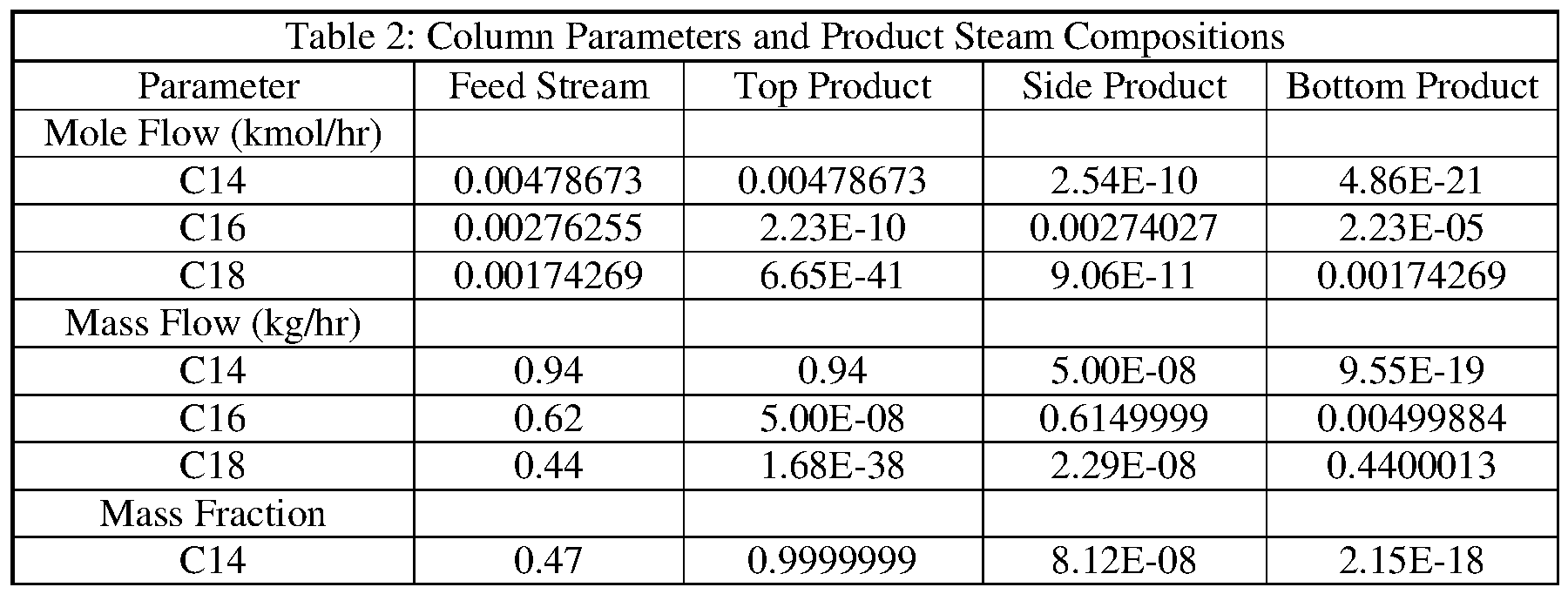
[0036] Parameters of the modeled column are adjusted for pure product streams and corresponding temperatures and pressures are obtained from the simulation. This information is provided in Table 2. Molar flow is provided in kilomoles per hour (kmol/hr). Mass flow is provided in kilograms per hour (kg/hr). Volumetric flow is provided in cubic centimeters per second (cc/sec). Density is provided in moles per cubic centimeter (mol/cc) and grams per cubic centimeter (gm/cc). Enthalpy is provided in kiloJoules per mole (kJ/mol). Entropy is provided in Joules per mole-Kelvin (J/mol-K). A can be seen in Table 2, a linear alpha olefin mixture is easily separated into its individual components C14 , C16, and C18 at 99% purity levels using a divided wall distillation column method in accordance with the present disclosure.
C18 0.22 1.79E-38 3.72E-08 0.9887667
Total Flow (kmol/hr) 0.00929197 0.00478673 0.00274027 0.00176496
Total Flow (kg/hr) 2 0.94 0.615 0.4450001
Total Flow (cc/sec) 1.010608 0.486963 0.320851 0.236572
Temperature (°C) 140 157.6821 186.8983 212.4968
Pressure (kiloPascal) 200 6.66611 6.66611 6.66611
Vapor Fraction 0 0 0 0
Liquid Fraction 1 1 1 1
Solid Fraction 0 0 0 0
Enthalpy (kJ/mol) -253.673 -215.548 -240.186 -261.899
Entropy (J/mol-K) -1322.929 -1186.385 -1322.017 -1465.333
Entropy (cal/gm-K) -1.469002 -1.443925 -1.407876 -1.389058
Density (mol/cc) 0.00255401 0.00273048 0.0023724 0.00207238
Density (gm/cc) 0.5497234 0.5362013 0.5324367 0.5225093
Liquid Volume (1/min) 0.0428068 0.0202559 0.0130876 0.00946321
Average Mole Weight 215.2397 196.3763 224.4301 252.1298
[0037] The processes and systems disclosed herein include(s) at least the following embodiments:
[0038] Embodiment 1 : A method of separating linear alpha olefins, comprising: passing a feed stream comprising linear alpha olefins through a pre-fractionator column of a divided wall distillation column; separating the feed stream into fractions within the pre-fractionator column of the divided wall distillation column, wherein the fractions comprise a Cn fraction, a Cn+x fraction, and a Cn+y fraction; distributing the Cn fraction and a portion of the Cn+x fraction to a top portion of the pre-fractionator column, forming a top fraction; distributing the Cn+y fraction and a portion of the Cn+x fraction to a bottom portion of the pre-fractionator column, forming a bottom fraction; enriching the Cn fraction by passing the top fraction through a top portion of a main column located within the divided wall distillation column, and withdrawing the Cn fraction as a top product from the main column; enriching the Cn+y fraction by passing the bottom fraction through a bottom portion of the main column, and withdrawing the Cn+y fraction as a bottom product from the main column; and withdrawing Cn+x as a side product from the main column.
[0039] Embodiment 2: The method of Embodiment 1, wherein the source of the feed stream is a product from an ethylene oligomerisation process.
[0040] Embodiment 3: The method of any of the preceding embodiments, wherein the feed stream comprises 35% to 50% Cn, 25% to 35% Cn+x, and 15% to 30% Cn+y by mass.
[0041] Embodiment 4: The method of any of the preceding embodiments, wherein the feed stream has a temperature of 120°C to 160 °C.
[0042] Embodiment 5: The method of any of the preceding embodiments, wherein n is equal to 14.
[0043] Embodiment 6: The method of any of the preceding embodiments, wherein x is equal to 2 and y is equal to 4.
[0044] Embodiment 7: The method of any of the preceding embodiments, wherein the top product from the main column comprises greater than or equal to 99% Cn by mass.
[0045] Embodiment 8: The method of any of the preceding embodiments, wherein the side product from the main column comprises greater than or equal to 99% Cn+x by mass.
[0046] Embodiment 9: The method of any of the preceding embodiments, wherein the bottom product from the main column comprises greater than or equal to 98% Cn+y by mass.
[0047] Embodiment 10: The method of any of the preceding embodiments, wherein the top product from the main column has a temperature of 135°C to 185°C.
[0048] Embodiment 11 : The method of any of the preceding embodiments, wherein the side product from the main column has a temperature of 165°C to 215°C.
[0049] Embodiment 12: The method of any of the preceding embodiments, wherein the bottom product from the main column has a temperature of 185°C to 240°C.
[0050] Embodiment 13: The method of any of the preceding embodiments, further comprising converting the top product from the main column to chloroparaffins.
[0051] Embodiment 14: The method of any of the preceding embodiments, further comprising using the top product from the main column as drilling fluid.
[0052] Embodiment 15: The method of any of the preceding embodiments, wherein the Cn fraction comprises 1-Tetradecene, (7E)-7-Tetradecene, Octylcyclohexane, 2-Methyl-l- tridecene, Cyclotetradecane, (7Z)-7-Tetradecene, 7-Methylenetridecane, 5-Methylenetridecane, or a combination comprising at least one of the foregoing.
[0053] Embodiment 16: The method of any of the preceding embodiments, wherein the Cn+x fraction comprises 1-Hexadecene, Decylcyclohexane, 2-Methyl-l-pentadecene,
Cyclohexadecane, (8E)-8-Hexadecene, Undecylcyclopentane, (7E)-7-Hexadecene, (8Z)-8- Hexadecene, or a combination comprising at least one of the foregoing.
[0054] Embodiment 17: A method of separating linear alpha olefins, comprising: passing a feed stream comprising linear alpha olefins through a divided wall distillation column, wherein the divided wall distillation column comprises a pre-fractionator column and a main column, wherein the feed stream has a temperature of 120°C to 160°C and comprises 35% to 50% C14, 25% to 35% C16, and 15% to 30% C18 by mass; separating the feed stream into fractions in the pre-fractionator column, wherein the fractions comprise a C14 fraction, a C16 fraction, and a
CI 8 fraction; distributing the C14 fraction and a portion of the CI 6 fraction to a top portion of the pre-fractionator column, forming a top fraction; distributing the CI 8 fraction and a portion of the CI 6 fraction to a bottom portion of the pre-fractionator column, forming a bottom fraction; enriching the C14 fraction by passing the top fraction through a top portion of the main column, and withdrawing the C14 fraction as a top product from the main column, wherein the top product has a temperature of 135°C to 185°C and comprises greater than or equal to 99% C14 by mass; enriching the CI 8 fraction by passing the bottom fraction through a bottom portion of the main column, and withdrawing the CI 8 fraction as a bottom product from the main column, wherein the bottom product has a temperature of 185°C to 240°C and comprises greater than or equal to 98% C18 by mass; and withdrawing C16 as a side product from the main column, wherein the side product has a temperature of 165°C to 215°C and comprises greater than or equal to 99% C16 by mass.
[0055] Embodiment 18: The method of Embodiment 17, wherein the source of the feed stream is a product from an ethylene oligomerisation process.
[0056] Embodiment 19: The method of Embodiment 17 or Embodiment 18, wherein the C14 fraction comprises 1-Tetradecene, (7E)-7-Tetradecene, Octylcyclohexane, 2-Methyl-l- tridecene, Cyclotetradecane, (7Z)-7-Tetradecene, 7-Methylenetridecane, 5-Methylenetridecane, or a combination comprising at least one of the foregoing.
[0057] Embodiment 20: The method of any of Embodiments 17-19, further comprising converting the top product from the main column to chloroparaffins.
[0058] Embodiment 21 : The method of any of Embodiments 17-20, further comprising using the top product from the main column as drilling fluid.
[0059] Embodiment 22: A system for separating linear alpha olefin fractions, comprising: a divided wall distillation column comprising a pre-fractionator column; and a main column; wherein the pre-fractionator column is configured to: separate a feed stream comprising linear alpha olefins into fractions, wherein the fractions comprise a C14 fraction, a C16 fraction, and a CI 8 fraction; distribute the C14 fraction and a portion of the C16 fraction to a top portion of the pre-fractionator column to form a top fraction; distribute the C18 fraction and a portion of the CI 6 fraction to a bottom portion of the pre-fractionator column to form a bottom fraction; pass the top fraction through a top portion of the main column; and pass the bottom fraction through a bottom portion of the main column; wherein the main column is configured to: enrich the CI 4 fraction and release the C14 fraction as a top product; enrich the CI 8 fraction and release the CI 8 fraction as a bottom product; and release the C16 fraction as a side product.
[0060] In general, the invention may alternately comprise, consist of, or consist essentially of, any appropriate components herein disclosed. The invention may additionally, or alternatively, be formulated so as to be devoid, or substantially free, of any components, materials, ingredients, adjuvants or species used in the prior art compositions or that are otherwise not necessary to the achievement of the function and/or objectives of the present invention. The endpoints of all ranges directed to the same component or property are inclusive and independently combinable (e.g., ranges of "less than or equal to 25 wt , or 5 wt% to 20 wt ," is inclusive of the endpoints and all intermediate values of the ranges of "5 wt% to 25 wt ," etc.). Disclosure of a narrower range or more specific group in addition to a broader range is not a disclaimer of the broader range or larger group. "Combination" is inclusive of blends, mixtures, alloys, reaction products, and the like. Furthermore, the terms "first," "second," and the like, herein do not denote any order, quantity, or importance, but rather are used to denote one element from another. The terms "a" and "an" and "the" herein do not denote a limitation of quantity, and are to be construed to cover both the singular and the plural, unless otherwise indicated herein or clearly contradicted by context. "Or" means "and/or." The suffix "(s)" as used herein is intended to include both the singular and the plural of the term that it modifies, thereby including one or more of that term (e.g., the film(s) includes one or more films). Reference throughout the specification to "one embodiment", "another embodiment", "an embodiment", and so forth, means that a particular element (e.g., feature, structure, and/or characteristic) described in connection with the embodiment is included in at least one embodiment described herein, and may or may not be present in other embodiments. In addition, it is to be understood that the described elements may be combined in any suitable manner in the various embodiments.
[0061] The modifier "about" used in connection with a quantity is inclusive of the stated value and has the meaning dictated by the context (e.g., includes the degree of error associated with measurement of the particular quantity). The notation "+ 10%" means that the indicated measurement can be from an amount that is minus 10% to an amount that is plus 10% of the stated value. The terms "front", "back", "bottom", and/or "top" are used herein, unless otherwise noted, merely for convenience of description, and are not limited to any one position or spatial orientation. "Optional" or "optionally" means that the subsequently described event or circumstance can or cannot occur, and that the description includes instances where the event occurs and instances where it does not. Unless defined otherwise, technical and scientific terms used herein have the same meaning as is commonly understood by one of skill in the art to
which this invention belongs. A "combination" is inclusive of blends, mixtures, alloys, reaction products, and the like.
[0062] Unless otherwise indicated, each of the foregoing groups can be unsubstituted or substituted, provided that the substitution does not significantly adversely affect synthesis, stability, or use of the compound. The term "substituted" as used herein means that at least one hydrogen on the designated atom or group is replaced with another group, provided that the designated atom's normal valence is not exceeded. When the substituent is oxo (i.e., =0), then two hydrogens on the atom are replaced. Combinations of substituents and/or variables are permissible provided that the substitutions do not significantly adversely affect synthesis or use of the compound. Exemplary groups that can be present on a "substituted" position include, but are not limited to, cyano; hydroxyl; nitro; azido; alkanoyl (such as a C2-6 alkanoyl group such as acyl); carboxamido; Ci-6 or C1-3 alkyl, cycloalkyl, alkenyl, and alkynyl (including groups having at least one unsaturated linkages and from 2 to 8, or 2 to 6 carbon atoms); Ci-6 or C1-3 alkoxys; C6-10 aryloxy such as phenoxy; Ci-6 alkylthio; Ci-6 or C1-3 alkylsulfinyl; CI -6 or C1-3 alkylsulfonyl; aminodi(Ci-6 or Ci-3)alkyl; C6-12 aryl having at least one aromatic rings (e.g., phenyl, biphenyl, naphthyl, or the like, each ring either substituted or unsubstituted aromatic); C7-19 arylalkyl having 1 to 3 separate or fused rings and from 6 to 18 ring carbon atoms; or arylalkoxy having 1 to 3 separate or fused rings and from 6 to 18 ring carbon atoms, with benzyloxy being an exemplary arylalkoxy.
[0063] All cited patents, patent applications, and other references are incorporated herein by reference in their entirety. However, if a term in the present application contradicts or conflicts with a term in the incorporated reference, the term from the present application takes precedence over the conflicting term from the incorporated reference
[0064] While particular embodiments have been described, alternatives, modifications, variations, improvements, and substantial equivalents that are or may be presently unforeseen may arise to applicants or others skilled in the art. Accordingly, the appended claims as filed and as they may be amended are intended to embrace all such alternatives, modifications variations, improvements, and substantial equivalents.
Claims
1. A method of separating linear alpha olefins, comprising:
passing a feed stream comprising linear alpha olefins through a pre-fractionator column of a divided wall distillation column;
separating the feed stream into fractions within the pre-fractionator column of the divided wall distillation column, wherein the fractions comprise a Cn fraction, a Cn+x fraction, and a Cn+y fraction;
distributing the Cn fraction and a portion of the Cn+x fraction to a top portion of the pre- fractionator column, forming a top fraction;
distributing the Cn+y fraction and a portion of the Cn+x fraction to a bottom portion of the pre-fractionator column, forming a bottom fraction;
enriching the Cn fraction by passing the top fraction through a top portion of a main column located within the divided wall distillation column, and withdrawing the Cn fraction as a top product from the main column;
enriching the Cn+y fraction by passing the bottom fraction through a bottom portion of the main column, and withdrawing the Cn+y fraction as a bottom product from the main column; and
withdrawing Cn+x as a side product from the main column.
2. The method of Claim 1 , wherein the source of the feed stream is a product from an ethylene oligomerisation process.
3. The method of any of the preceding claims, wherein the feed stream comprises 35% to 50% Cn, 25% to 35% Cn+x, and 15% to 30% Cn+y by mass.
4. The method of any of the preceding claims, wherein the feed stream has a temperature of 120°C to 160 °C.
5. The method of any of the preceding claims, wherein n is equal to 14 and wherein x is equal to 2 and y is equal to 4.
6. The method of any of the preceding claims, wherein the top product from the main column comprises greater than or equal to 99% Cn by mass.
7. The method of any of the preceding claims, wherein the side product from the main column comprises greater than or equal to 99% Cn+x by mass.
8. The method of any of the preceding claims, wherein the bottom product from the main column comprises greater than or equal to 98% Cn+y by mass.
9. The method of any of the preceding claims, wherein the top product from the main column has a temperature of 135°C to 185°C.
10. The method of any of the preceding claims, wherein the side product from the main column has a temperature of 165°C to 215°C and wherein the bottom product from the main column has a temperature of 185°C to 240°C.
11. The method of any of the preceding claims, further comprising converting the top product from the main column to chloroparaffins.
12. The method of any of the preceding claims, further comprising using the top product from the main column as drilling fluid.
13. The method of any of the preceding claims, wherein the Cn fraction comprises 1- Tetradecene, (7E)-7-Tetradecene, Octylcyclohexane, 2-Methyl-l-tridecene, Cyclotetradecane, (7Z)-7-Tetradecene, 7-Methylenetridecane, 5-Methylenetridecane, or a combination comprising at least one of the foregoing.
14. The method of any of the preceding claims, wherein the Cn+x fraction comprises 1-Hexadecene, Decylcyclohexane, 2-Methyl-l-pentadecene, Cyclohexadecane, (8E)-8- Hexadecene, Undecylcyclopentane, (7E)-7-Hexadecene, (8Z)-8-Hexadecene, or a combination comprising at least one of the foregoing.
15. A method of separating linear alpha olefins, comprising:
passing a feed stream comprising linear alpha olefins through a divided wall distillation column, wherein the divided wall distillation column comprises a pre-fractionator column and a
main column, wherein the feed stream has a temperature of 120°C to 160°C and comprises 35% to 50% C14, 25% to 35% C16, and 15% to 30% C18 by mass;
separating the feed stream into fractions in the pre-fractionator column, wherein the fractions comprise a C14 fraction, a C16 fraction, and a C18 fraction;
distributing the C14 fraction and a portion of the C16 fraction to a top portion of the pre- fractionator column, forming a top fraction;
distributing the C18 fraction and a portion of the C16 fraction to a bottom portion of the pre-fractionator column, forming a bottom fraction;
enriching the C14 fraction by passing the top fraction through a top portion of the main column, and withdrawing the C14 fraction as a top product from the main column, wherein the top product has a temperature of 135°C to 185°C and comprises greater than or equal to 99% C14 by mass;
enriching the CI 8 fraction by passing the bottom fraction through a bottom portion of the main column, and withdrawing the CI 8 fraction as a bottom product from the main column, wherein the bottom product has a temperature of 185°C to 240°C and comprises greater than or equal to 98% C18 by mass; and
withdrawing C16 as a side product from the main column, wherein the side product has a temperature of 165°C to 215°C and comprises greater than or equal to 99% C16 by mass.
16. The method of Claim 15, wherein the source of the feed stream is a product from an ethylene oligomerisation process.
17. The method of Claim 15 or Claim 16, wherein the C14 fraction comprises 1- Tetradecene, (7E)-7-Tetradecene, Octylcyclohexane, 2-Methyl-l-tridecene, Cyclotetradecane, (7Z)-7-Tetradecene, 7-Methylenetridecane, 5-Methylenetridecane, or a combination comprising at least one of the foregoing.
18. The method of any of Claims 15-17, further comprising converting the top product from the main column to chloroparaffins.
19. The method of any of Claims 15-18, further comprising using the top product from the main column as drilling fluid.
20. A system for separating linear alpha olefin fractions, comprising:
a divided wall distillation column comprising
a pre-fractionator column; and
a main column;
wherein the pre-fractionator column is configured to:
separate a feed stream comprising linear alpha olefins into fractions, wherein the fractions comprise a C14 fraction, a C16 fraction, and a C18 fraction;
distribute the C14 fraction and a portion of the CI 6 fraction to a top portion of the pre-fractionator column to form a top fraction;
distribute the CI 8 fraction and a portion of the CI 6 fraction to a bottom portion of the pre-fractionator column to form a bottom fraction;
pass the top fraction through a top portion of the main column; and
pass the bottom fraction through a bottom portion of the main column;
wherein the main column is configured to:
enrich the C14 fraction and release the C14 fraction as a top product;
enrich the CI 8 fraction and release the CI 8 fraction as a bottom product; and release the C16 fraction as a side product.
Applications Claiming Priority (2)
| Application Number | Priority Date | Filing Date | Title |
|---|---|---|---|
| US201562272888P | 2015-12-30 | 2015-12-30 | |
| US62/272,888 | 2015-12-30 |
Publications (1)
| Publication Number | Publication Date |
|---|---|
| WO2017115305A1 true WO2017115305A1 (en) | 2017-07-06 |
Family
ID=57966048
Family Applications (1)
| Application Number | Title | Priority Date | Filing Date |
|---|---|---|---|
| PCT/IB2016/058059 Ceased WO2017115305A1 (en) | 2015-12-30 | 2016-12-28 | Method of separating linear alpha olefins |
Country Status (2)
| Country | Link |
|---|---|
| TW (1) | TW201736323A (en) |
| WO (1) | WO2017115305A1 (en) |
Cited By (3)
| Publication number | Priority date | Publication date | Assignee | Title |
|---|---|---|---|---|
| WO2020114745A1 (en) * | 2018-12-04 | 2020-06-11 | Exxonmobil Chemical Patents Inc. | Methods for separating linear alpha olefins from combined product streams |
| WO2020114744A1 (en) * | 2018-12-04 | 2020-06-11 | Exxonmobil Chemical Patents Inc. | Process for the separation of linear alpha-olefins using a diving wall column |
| US11612829B1 (en) | 2022-06-18 | 2023-03-28 | David Norbert Kockler | Process for the separation of multicomponent mixtures using a prefractionation/main column arrangement |
Citations (4)
| Publication number | Priority date | Publication date | Assignee | Title |
|---|---|---|---|---|
| EP0122367A2 (en) * | 1983-01-26 | 1984-10-24 | BASF Aktiengesellschaft | Distillation column |
| US20070185362A1 (en) * | 2006-02-03 | 2007-08-09 | Lattner James R | Process for generating alpha olefin comonomers |
| US20120149961A1 (en) * | 2010-12-10 | 2012-06-14 | Uop, Llc | Process for separating at least one oligomerized effluent |
| US20150126790A1 (en) * | 2012-05-09 | 2015-05-07 | Sasol Technology (Proprietary) Limited | Process for oligomerising a hydrocarbon to form at least one co-monomer product |
-
2016
- 2016-12-28 TW TW105143672A patent/TW201736323A/en unknown
- 2016-12-28 WO PCT/IB2016/058059 patent/WO2017115305A1/en not_active Ceased
Patent Citations (4)
| Publication number | Priority date | Publication date | Assignee | Title |
|---|---|---|---|---|
| EP0122367A2 (en) * | 1983-01-26 | 1984-10-24 | BASF Aktiengesellschaft | Distillation column |
| US20070185362A1 (en) * | 2006-02-03 | 2007-08-09 | Lattner James R | Process for generating alpha olefin comonomers |
| US20120149961A1 (en) * | 2010-12-10 | 2012-06-14 | Uop, Llc | Process for separating at least one oligomerized effluent |
| US20150126790A1 (en) * | 2012-05-09 | 2015-05-07 | Sasol Technology (Proprietary) Limited | Process for oligomerising a hydrocarbon to form at least one co-monomer product |
Non-Patent Citations (3)
| Title |
|---|
| ASPRION N ET AL: "Dividing wall columns: Fundamentals and recent advances", CHEMICAL ENGINEERING AND PROCESSING, ELSEVIER SEQUOIA, LAUSANNE, CH, vol. 49, no. 2, 1 February 2010 (2010-02-01), pages 139 - 146, XP026938678, ISSN: 0255-2701, [retrieved on 20100125], DOI: 10.1016/J.CEP.2010.01.013 * |
| BECKER H ET AL: "Die weltweit groesste Trennwandkolonne mit Boeden-Erfahrungen von der Konzeptfindung bis zur Inbetriebnahme", BERICHTE AUS TECHNIK UND WISSENSCHAFT, ACHEMA 2000 SONDERAUSGABE 80,, 1 January 2000 (2000-01-01), pages 42 - 48, XP009190900 * |
| ÖMER YILDIRIM ET AL: "Dividing wall columns in chemical process industry: A review on current activities", SEPARATION AND PURIFICATION TECHNOLOGY, vol. 80, no. 3, 1 August 2011 (2011-08-01), pages 403 - 417, XP055043075, ISSN: 1383-5866, DOI: 10.1016/j.seppur.2011.05.009 * |
Cited By (6)
| Publication number | Priority date | Publication date | Assignee | Title |
|---|---|---|---|---|
| WO2020114745A1 (en) * | 2018-12-04 | 2020-06-11 | Exxonmobil Chemical Patents Inc. | Methods for separating linear alpha olefins from combined product streams |
| WO2020114744A1 (en) * | 2018-12-04 | 2020-06-11 | Exxonmobil Chemical Patents Inc. | Process for the separation of linear alpha-olefins using a diving wall column |
| CN113166001A (en) * | 2018-12-04 | 2021-07-23 | 埃克森美孚化学专利公司 | Process for separating linear alpha-olefins using a divided wall column |
| US11572325B2 (en) | 2018-12-04 | 2023-02-07 | Exxonmobil Chemical Patents Inc. | Process for the separation of linear alpha-olefins using a dividing wall column |
| CN113166001B (en) * | 2018-12-04 | 2023-09-22 | 埃克森美孚化学专利公司 | Method for separating linear alpha-olefins using a partition column |
| US11612829B1 (en) | 2022-06-18 | 2023-03-28 | David Norbert Kockler | Process for the separation of multicomponent mixtures using a prefractionation/main column arrangement |
Also Published As
| Publication number | Publication date |
|---|---|
| TW201736323A (en) | 2017-10-16 |
Similar Documents
| Publication | Publication Date | Title |
|---|---|---|
| JP6518233B2 (en) | Method and apparatus for the separation of ternary or multicomponent mixtures by distillation | |
| JP4658945B2 (en) | Separation method of a mixture containing ethyleneamines by distillation | |
| Madenoor Ramapriya et al. | Thermal coupling links to liquid‐only transfer streams: a path for new dividing wall columns | |
| JP6140374B2 (en) | Method and apparatus for separating ternary or multicomponent mixtures by distillation | |
| TWI746500B (en) | Purification of mercaptans or thiophenes using dividing wall column distillation | |
| Lee et al. | Application of a fully thermally coupled distillation column for fractionation process in naphtha reforming plant | |
| CN104968636B (en) | For preparing the device of alkanol | |
| US20150119612A1 (en) | Multicomponent Dividing Wall Columns | |
| CN103298531A (en) | Dividing wall-type distillation tower for preparing high-purity 2-ethylhexyl-acrylate and preparation method using same | |
| WO2017115305A1 (en) | Method of separating linear alpha olefins | |
| US20230125966A1 (en) | Process and Apparatus for distillation | |
| CN103282336A (en) | Dividing wall column for producing high-urity neopentyl glycol, and manufacturing method using same | |
| US20200139334A1 (en) | Method for Temperature Control in a Bubble Column Reactor for Selective 1-Hexene Production | |
| EP3554664B1 (en) | Method of separating linear alpha olefins | |
| US11225444B2 (en) | Method of column control | |
| RU2682330C1 (en) | Method of continuous unmixing mixture of ethyl chlorosilane | |
| CN108137442B (en) | Method and system for purifying 1, 3-butadiene | |
| US11174209B2 (en) | C3 fractionation system | |
| CN109414628A (en) | The method of distillating liquid in inert gas environment | |
| Kharkov | Thermal Distillation Study on Heat and Mass Transfer Improvement of Column Contact Devices | |
| Dufton | CCXXVIII.—The separation of miscible liquids by distillation | |
| CN109970504A (en) | A kind of process of butylene concentration |
Legal Events
| Date | Code | Title | Description |
|---|---|---|---|
| 121 | Ep: the epo has been informed by wipo that ep was designated in this application |
Ref document number: 16834197 Country of ref document: EP Kind code of ref document: A1 |
|
| NENP | Non-entry into the national phase |
Ref country code: DE |
|
| 122 | Ep: pct application non-entry in european phase |
Ref document number: 16834197 Country of ref document: EP Kind code of ref document: A1 |