WO2017114560A1 - Image display device with third-level channel picture-in-picture function - Google Patents
Image display device with third-level channel picture-in-picture function Download PDFInfo
- Publication number
- WO2017114560A1 WO2017114560A1 PCT/EP2015/081339 EP2015081339W WO2017114560A1 WO 2017114560 A1 WO2017114560 A1 WO 2017114560A1 EP 2015081339 W EP2015081339 W EP 2015081339W WO 2017114560 A1 WO2017114560 A1 WO 2017114560A1
- Authority
- WO
- WIPO (PCT)
- Prior art keywords
- channel
- display device
- image display
- picture
- tuners
- Prior art date
- Legal status (The legal status is an assumption and is not a legal conclusion. Google has not performed a legal analysis and makes no representation as to the accuracy of the status listed.)
- Ceased
Links
Images
Classifications
-
- H—ELECTRICITY
- H04—ELECTRIC COMMUNICATION TECHNIQUE
- H04N—PICTORIAL COMMUNICATION, e.g. TELEVISION
- H04N5/00—Details of television systems
- H04N5/44—Receiver circuitry for the reception of television signals according to analogue transmission standards
- H04N5/445—Receiver circuitry for the reception of television signals according to analogue transmission standards for displaying additional information
- H04N5/45—Picture in picture, e.g. displaying simultaneously another television channel in a region of the screen
-
- H—ELECTRICITY
- H04—ELECTRIC COMMUNICATION TECHNIQUE
- H04N—PICTORIAL COMMUNICATION, e.g. TELEVISION
- H04N21/00—Selective content distribution, e.g. interactive television or video on demand [VOD]
- H04N21/40—Client devices specifically adapted for the reception of or interaction with content, e.g. set-top-box [STB]; Operations thereof
- H04N21/41—Structure of client; Structure of client peripherals
- H04N21/426—Internal components of the client ; Characteristics thereof
- H04N21/42607—Internal components of the client ; Characteristics thereof for processing the incoming bitstream
- H04N21/4263—Internal components of the client ; Characteristics thereof for processing the incoming bitstream involving specific tuning arrangements, e.g. two tuners
-
- H—ELECTRICITY
- H04—ELECTRIC COMMUNICATION TECHNIQUE
- H04N—PICTORIAL COMMUNICATION, e.g. TELEVISION
- H04N21/00—Selective content distribution, e.g. interactive television or video on demand [VOD]
- H04N21/40—Client devices specifically adapted for the reception of or interaction with content, e.g. set-top-box [STB]; Operations thereof
- H04N21/43—Processing of content or additional data, e.g. demultiplexing additional data from a digital video stream; Elementary client operations, e.g. monitoring of home network or synchronising decoder's clock; Client middleware
- H04N21/431—Generation of visual interfaces for content selection or interaction; Content or additional data rendering
- H04N21/4312—Generation of visual interfaces for content selection or interaction; Content or additional data rendering involving specific graphical features, e.g. screen layout, special fonts or colors, blinking icons, highlights or animations
- H04N21/4316—Generation of visual interfaces for content selection or interaction; Content or additional data rendering involving specific graphical features, e.g. screen layout, special fonts or colors, blinking icons, highlights or animations for displaying supplemental content in a region of the screen, e.g. an advertisement in a separate window
-
- H—ELECTRICITY
- H04—ELECTRIC COMMUNICATION TECHNIQUE
- H04N—PICTORIAL COMMUNICATION, e.g. TELEVISION
- H04N21/00—Selective content distribution, e.g. interactive television or video on demand [VOD]
- H04N21/40—Client devices specifically adapted for the reception of or interaction with content, e.g. set-top-box [STB]; Operations thereof
- H04N21/43—Processing of content or additional data, e.g. demultiplexing additional data from a digital video stream; Elementary client operations, e.g. monitoring of home network or synchronising decoder's clock; Client middleware
- H04N21/438—Interfacing the downstream path of the transmission network originating from a server, e.g. retrieving encoded video stream packets from an IP network
- H04N21/4383—Accessing a communication channel
-
- H—ELECTRICITY
- H04—ELECTRIC COMMUNICATION TECHNIQUE
- H04N—PICTORIAL COMMUNICATION, e.g. TELEVISION
- H04N5/00—Details of television systems
- H04N5/44—Receiver circuitry for the reception of television signals according to analogue transmission standards
- H04N5/50—Tuning indicators; Automatic tuning control
Definitions
- the present invention relates to an image display device capable of demonstrating a third-level alternative channel broadcast during a broadcast program by an interactive triggering system.
- Digital and interactive TV systems provide a comprehensive amount of TV channels and programs leading to the general outcome that users cannot be timely informed of another program of interest while viewing a first program. In such cases, the users are not presented with an effective option to timely switch to an alternative channel broadcasting at the same time.
- the electronic program guide (EPG) designed to serve for informing the user about the broadcast program contents is not effective enough due to insufficient number of broadcasters appropriately conveying program information for the increasing number of available channels.
- the insufficient information provided by a limited number of broadcasters eliminates practical use of the electronic program guide.
- information as obtained from the EPG may not always be time-synchronized with the actual flow of programs on a specific channel and may as such not be reliable because noticeable and disturbing phase shifts may occur with respect to actual timing of transitions from one program content to another.
- An image display device with various features and capabilities can be provided with a multitude of tuners so as to perform viewing of a first broadcast channel and simultaneous recording of a second broadcast program. It is to be noted that apart from viewing a first program content and recording a second program content, the receiver-decoder or the image display device itself may enable various types of services including interactive functions such as picture-in-picture (PIP).
- PIP picture-in-picture
- GB2519768 discloses a method of providing interaction options to a user of a device.
- the device in the form of a smart TV is capable of receiving broadcast content from a broadcaster and content via a network.
- the method comprises receiving, at the device, both broadcast content and a call-to-action related to the broadcast content.
- the call-to-action is received via a network.
- the method includes presenting the broadcast content and the call-to-action to the user, receiving a trigger signal from the user in response to the call-to-action, and initiating, in response to the trigger signal, an interaction over the network between the user and a call-to-action party associated with the call-to-action.
- the method enables an interaction to be established between the user and the call-to-action party regardless of whether the call-to-action party is the same entity as or a different entity to the broadcaster.
- the method may be used to enable a viewer of the broadcast content to purchase items related to the broadcast over the internet from a third party supplier.
- the present invention provides a system and a method by which an image display device is operated such that an interactive informational system is provided to passively inform the user about another program content of interest while the user is watching a certain channel.
- the present invention therefore provides a system and method for generating an interactive informational as provided by the characterizing features defined in Claim 1.
- Primary object of the present invention is hence to provide a system and method by which an image display device provides a non-directly reached interactive program content window of a third-level broadcast program content.
- the present invention proposes an image display device an electronic control unit of which activates a triggering system if incremental or decremental changing of channels is effectuated by the user.
- a first channel incrementally or decrementally changed to a second neighboring channel activates the triggering system in the manner that a third-level channel neighboring the second channel is shown through the second tuner in the form of a picture-in picture window.
- the second channel is viewed through the first tuner and at this stage no incremental or decremental changing of the second channel to the neighboring third-level channel is carried out by the user.
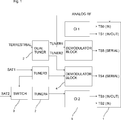
- Fig. 1 demonstrates a general block diagram in the form of a routing diagram structure of the operational components according to the present invention.
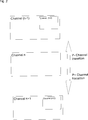
- Fig. 2 demonstrates general working steps of the third-level channel picture-in-picture function according to the present invention.
- the present invention proposes an image display device or a set-top box receiving programs via satellite, cable or terrestrial broadcasting for instance in the form of separate subscription formats.
- a set-top box may typically contain a plurality of tuner (2) inputs, operating in connection with an image display device.
- the image display device itself can receive programs using built-in tuners (2).
- Digital and interactive TV systems provide a comprehensive amount of TV channels and programs.
- a conventional structure receiving program contents receives a transport stream via a tuner (2).
- the receiver-decoder In order for viewing a first program content and processing a second program content, the receiver-decoder should have at least two tuners (2), which also enables various types of services including interactive functions such as picture-in-picture (PIP).
- PIP picture-in-picture
- the image display device in accordance with the invention can be connected to a set-top box, the latter having at least two tuners (2).
- the image display device itself or the receiver (set-top box) can therefore have multiple tuners (2) as well as demodulators (demodulator blocks (4)) suitable for receiving broadcast multimedia content.
- receivers capable of receiving and tuning to signals of different generations e.g. DVB-T and DVB-T2 (TUN1, TUN2), DVB-S and DVB-S2 (TUN3, TUN4), DVB-C and DVB-C2 can be in use.
- the present invention relates to an image display device having an interactive triggering system to provide the user with an alternative broadcast program content of potential interest.
- a picture-in-picture (PIP) window automatically appears on the screen and the user is notified of a third-level channel program on a neighboring channel as will be delineated hereinafter.
- the image display device therefore comprises or communicates with at least a pair of tuners (2) for viewing a first program content and for simultaneously activating picture-in-picture function.
- the triggering system typically opens a third-level channel in the form of a picture-in picture window appearing on the screen when the user views a first-level channel and this operation is carried out when the user presses channel up (P+) or channel down (P-) buttons. Therefore, a picture-in picture window automatically appearing when the channel up or channel down buttons are pressed contains the actual broadcast program of a neighboring channel, which is also advantageous in that time duration of the transition between neighboring channels will be substantially less noticeable if the user actually presses the respective channel up or channel down button one more time.
- the user views a channel numbered 8 and presses the channel up button, he will be automatically presented with the channel numbered 10 as a third-level channel in the form of a picture-in picture window appearing on the screen while the user views channel 9.
- This function is performed only when the channel up or down buttons are pressed because the user’s next action is considered to be known as he is expected to continue to view neighboring channels one by one moving in one of the two directions.
- the user is presented with the third-level channel only if he incrementally or decrementally change channels, typically by using the up and down channel keys because then, the next channel to be viewed by the user being known, the channel is shown in the form of a picture-in picture window before the respective key is pressed so that the user may review contents on both channels at once, which is also advantageous in that, the next channel to be viewed being already tuned in, it will be shown more quickly, i.e. the time duration of the transition will be much less noticeable.
- the image display device is conventionally in communication with a plurality of tuners (2) to receive a plurality of transport streams, each of the transport streams conventionally comprising multiple programs per transport stream.
- a first program content and at least a second program content are processed, the program contents being respectively selected from at least a first transport stream and at least a second transport stream.
- a switching unit (switch (3)) and conditional access modules are shown where a first conditional access module can be typically inserted in a first common interface (CI (5)) and a second conditional access module can be inserted in a second common interface.
- the present invention proposes an image display device receiving a plurality of broadcasting services and comprising at least a first and second tuners (2) and an electronic control unit (1) comprising a triggering system configured to perform automatic displaying of a third-level channel broadcast program content in an incremental or decremental channel viewing direction.
- the electronic control unit (1) of the image display device activates the triggering system in response to either incremental or decremental changing of a first channel to a second neighboring channel.
- the triggering system is activated in the manner that a third-level channel incrementally or decrementally neighboring the second channel is shown through the second tuner (2) in the form of a picture-in picture window.
- the third-level channel is shown while the second channel is viewed through the first tuner (2).
- the third-level channel is shown through the second tuner (2) before incremental or decremental changing of the second channel to the neighboring third-level channel.
- the first and second tuners (2) are either terrestrial or satellite tuners (2).
- the first and second tuners (2) are DVB-T, DVB-T2, DVB-C or DVB-C2 tuners (2).
- the first and second tuners (2) are DVB-S or DVB-S2 tuners (2).
- the third-level channel incrementally or decrementally neighboring the second channel is shown through the second tuner (2) in the form of a picture-in picture window only during a predetermined time duration while the second channel is viewed through the first tuner (2).
- a method for operating an image display device comprising at least a first and second tuners (2) and an electronic control unit (1)
- the method comprising the steps of a) activating a triggering system in response to either incremental or decremental changing of a first channel to a second neighboring channel, b) displaying a third-level channel incrementally or decrementally neighboring the second channel through the second tuner (2) in the form of a picture-in picture window, c) displaying the third-level channel while the second channel is viewed through the first tuner (2) and d) displaying the third-level channel through the second tuner (2) before incremental or decremental changing of the second channel to the neighboring third-level channel.
- the present invention therefore provides a system and method by which an image display device is operated such that an interactive triggering system informs the user of a program content of potential interest while the user is watching another channel.
- the user is presented with the third-level channel only if he incrementally or decrementally change channels because there is a high probability that the next channel to be viewed by the user is already known and the next channel can be shown more quickly as it is already tuned in.
Landscapes
- Engineering & Computer Science (AREA)
- Multimedia (AREA)
- Signal Processing (AREA)
- Business, Economics & Management (AREA)
- Marketing (AREA)
- Circuits Of Receivers In General (AREA)
- Two-Way Televisions, Distribution Of Moving Picture Or The Like (AREA)
Abstract
The present invention relates to an image display device capable of demonstrating a third-level alternative channel broadcast during a broadcast program by an interactive triggering system. The present invention more particularly relates to an image display device receiving a plurality of broadcasting services and comprising at least a first and second tuners (2) and an electronic control unit (1) comprising a triggering system configured to perform automatic displaying of a third-level channel broadcast program content in an incremental or decremental channel viewing direction.
Description
The present invention relates to an image display device capable of demonstrating a third-level alternative channel broadcast during a broadcast program by an interactive triggering system.
Digital and interactive TV systems provide a comprehensive amount of TV channels and programs leading to the general outcome that users cannot be timely informed of another program of interest while viewing a first program. In such cases, the users are not presented with an effective option to timely switch to an alternative channel broadcasting at the same time.
The electronic program guide (EPG) designed to serve for informing the user about the broadcast program contents is not effective enough due to insufficient number of broadcasters appropriately conveying program information for the increasing number of available channels. The insufficient information provided by a limited number of broadcasters eliminates practical use of the electronic program guide. On the other hand, it is also to be noted that information as obtained from the EPG may not always be time-synchronized with the actual flow of programs on a specific channel and may as such not be reliable because noticeable and disturbing phase shifts may occur with respect to actual timing of transitions from one program content to another.
An image display device with various features and capabilities can be provided with a multitude of tuners so as to perform viewing of a first broadcast channel and simultaneous recording of a second broadcast program. It is to be noted that apart from viewing a first program content and recording a second program content, the receiver-decoder or the image display device itself may enable various types of services including interactive functions such as picture-in-picture (PIP).
Among others, one of the prior art disclosures in the technical field of the present invention may be referred to as GB2519768, which discloses a method of providing interaction options to a user of a device. The device in the form of a smart TV is capable of receiving broadcast content from a broadcaster and content via a network. The method comprises receiving, at the device, both broadcast content and a call-to-action related to the broadcast content. The call-to-action is received via a network. The method includes presenting the broadcast content and the call-to-action to the user, receiving a trigger signal from the user in response to the call-to-action, and initiating, in response to the trigger signal, an interaction over the network between the user and a call-to-action party associated with the call-to-action. The method enables an interaction to be established between the user and the call-to-action party regardless of whether the call-to-action party is the same entity as or a different entity to the broadcaster. The method may be used to enable a viewer of the broadcast content to purchase items related to the broadcast over the internet from a third party supplier.
The present invention provides a system and a method by which an image display device is operated such that an interactive informational system is provided to passively inform the user about another program content of interest while the user is watching a certain channel.
The present invention therefore provides a system and method for generating an interactive informational as provided by the characterizing features defined in Claim 1.
Primary object of the present invention is hence to provide a system and method by which an image display device provides a non-directly reached interactive program content window of a third-level broadcast program content.
The present invention proposes an image display device an electronic control unit of which activates a triggering system if incremental or decremental changing of channels is effectuated by the user. In this case, a first channel incrementally or decrementally changed to a second neighboring channel activates the triggering system in the manner that a third-level channel neighboring the second channel is shown through the second tuner in the form of a picture-in picture window.
While the third-level channel is shown, the second channel is viewed through the first tuner and at this stage no incremental or decremental changing of the second channel to the neighboring third-level channel is carried out by the user.
Accompanying drawings are given solely for the purpose of exemplifying a system and method by which an image display device is operable, whose advantages over prior art were outlined above and will be explained in brief hereinafter.
The drawings are not meant to delimit the scope of protection as identified in the claims nor should they be referred to alone in an effort to interpret the scope identified in the claims without recourse to the technical disclosure in the description of the present invention.
Fig. 1 demonstrates a general block diagram in the form of a routing diagram structure of the operational components according to the present invention.
Fig. 2 demonstrates general working steps of the third-level channel picture-in-picture function according to the present invention.
The following part numbers are used in the detailed description of the present invention:
- Electronic control unit
- Tuner
- Switch
- Demodulator block
- Common interface
The present invention proposes an image display device or a set-top box receiving programs via satellite, cable or terrestrial broadcasting for instance in the form of separate subscription formats. A set-top box may typically contain a plurality of tuner (2) inputs, operating in connection with an image display device. Alternatively, the image display device itself can receive programs using built-in tuners (2).
Digital and interactive TV systems provide a comprehensive amount of TV channels and programs. A conventional structure receiving program contents receives a transport stream via a tuner (2). In order for viewing a first program content and processing a second program content, the receiver-decoder should have at least two tuners (2), which also enables various types of services including interactive functions such as picture-in-picture (PIP).
The image display device in accordance with the invention can be connected to a set-top box, the latter having at least two tuners (2). The image display device itself or the receiver (set-top box) can therefore have multiple tuners (2) as well as demodulators (demodulator blocks (4)) suitable for receiving broadcast multimedia content. In this regard, receivers capable of receiving and tuning to signals of different generations (e.g. DVB-T and DVB-T2 (TUN1, TUN2), DVB-S and DVB-S2 (TUN3, TUN4), DVB-C and DVB-C2) can be in use.
The present invention relates to an image display device having an interactive triggering system to provide the user with an alternative broadcast program content of potential interest.
According to the present invention, when the user presses channel up or channel down buttons, a picture-in-picture (PIP) window automatically appears on the screen and the user is notified of a third-level channel program on a neighboring channel as will be delineated hereinafter.
The image display device therefore comprises or communicates with at least a pair of tuners (2) for viewing a first program content and for simultaneously activating picture-in-picture function.
The triggering system typically opens a third-level channel in the form of a picture-in picture window appearing on the screen when the user views a first-level channel and this operation is carried out when the user presses channel up (P+) or channel down (P-) buttons. Therefore, a picture-in picture window automatically appearing when the channel up or channel down buttons are pressed contains the actual broadcast program of a neighboring channel, which is also advantageous in that time duration of the transition between neighboring channels will be substantially less noticeable if the user actually presses the respective channel up or channel down button one more time.
As an exemplary situation, if the user views a channel numbered 8 and presses the channel up button, he will be automatically presented with the channel numbered 10 as a third-level channel in the form of a picture-in picture window appearing on the screen while the user views channel 9. This function is performed only when the channel up or down buttons are pressed because the user’s next action is considered to be known as he is expected to continue to view neighboring channels one by one moving in one of the two directions.
Therefore, the user is presented with the third-level channel only if he incrementally or decrementally change channels, typically by using the up and down channel keys because then, the next channel to be viewed by the user being known, the channel is shown in the form of a picture-in picture window before the respective key is pressed so that the user may review contents on both channels at once, which is also advantageous in that, the next channel to be viewed being already tuned in, it will be shown more quickly, i.e. the time duration of the transition will be much less noticeable.
In reference to Fig. 1 now, the image display device is conventionally in communication with a plurality of tuners (2) to receive a plurality of transport streams, each of the transport streams conventionally comprising multiple programs per transport stream. Conventionally a first program content and at least a second program content are processed, the program contents being respectively selected from at least a first transport stream and at least a second transport stream. Further, a switching unit (switch (3)) and conditional access modules are shown where a first conditional access module can be typically inserted in a first common interface (CI (5)) and a second conditional access module can be inserted in a second common interface.
In summary, the present invention proposes an image display device receiving a plurality of broadcasting services and comprising at least a first and second tuners (2) and an electronic control unit (1) comprising a triggering system configured to perform automatic displaying of a third-level channel broadcast program content in an incremental or decremental channel viewing direction.
In one embodiment of the present invention, the electronic control unit (1) of the image display device activates the triggering system in response to either incremental or decremental changing of a first channel to a second neighboring channel.
In a further embodiment of the present invention, the triggering system is activated in the manner that a third-level channel incrementally or decrementally neighboring the second channel is shown through the second tuner (2) in the form of a picture-in picture window.
In a further embodiment of the present invention, the third-level channel is shown while the second channel is viewed through the first tuner (2).
In a further embodiment of the present invention, the third-level channel is shown through the second tuner (2) before incremental or decremental changing of the second channel to the neighboring third-level channel.
In a further embodiment of the present invention, the first and second tuners (2) are either terrestrial or satellite tuners (2).
In a further embodiment of the present invention, the first and second tuners (2) are DVB-T, DVB-T2, DVB-C or DVB-C2 tuners (2).
In a further embodiment of the present invention, the first and second tuners (2) are DVB-S or DVB-S2 tuners (2).
In a further embodiment of the present invention, the third-level channel incrementally or decrementally neighboring the second channel is shown through the second tuner (2) in the form of a picture-in picture window only during a predetermined time duration while the second channel is viewed through the first tuner (2).
In a further embodiment of the present invention, a method for operating an image display device comprising at least a first and second tuners (2) and an electronic control unit (1) is proposed, the method comprising the steps of a) activating a triggering system in response to either incremental or decremental changing of a first channel to a second neighboring channel, b) displaying a third-level channel incrementally or decrementally neighboring the second channel through the second tuner (2) in the form of a picture-in picture window, c) displaying the third-level channel while the second channel is viewed through the first tuner (2) and d) displaying the third-level channel through the second tuner (2) before incremental or decremental changing of the second channel to the neighboring third-level channel.
The present invention therefore provides a system and method by which an image display device is operated such that an interactive triggering system informs the user of a program content of potential interest while the user is watching another channel. The user is presented with the third-level channel only if he incrementally or decrementally change channels because there is a high probability that the next channel to be viewed by the user is already known and the next channel can be shown more quickly as it is already tuned in.
Claims (6)
- An image display device receiving a plurality of broadcasting services and comprising at least a first and second tuners (2) and an electronic control unit (1) comprising a triggering system configured to perform automatic displaying of a third-level channel broadcast program content in an incremental or decremental channel viewing direction, characterized in that- the electronic control unit (1) of the image display device activates the triggering system in response to either incremental or decremental changing of a first channel to a second neighboring channel,- the triggering system is activated in the manner that a third-level channel incrementally or decrementally neighboring the second channel is shown through the second tuner (2) in the form of a picture-in picture window,- the third-level channel is shown while the second channel is viewed through the first tuner (2) and- the third-level channel is shown through the second tuner (2) before incremental or decremental changing of the second channel to the neighboring third-level channel.
- An image display device as in Claim 1, characterized in that the first and second tuners (2) are either terrestrial or satellite tuners (2).
- A image display device as in Claim 2, characterized in that the first and second tuners (2) are DVB-T, DVB-T2, DVB-C or DVB-C2 tuners (2).
- An image display device as in Claim 2, characterized in that the first and second tuners (2) are DVB-S or DVB-S2 tuners (2).
- An image display device as in any one of the preceding Claims, characterized in that the third-level channel incrementally or decrementally neighboring the second channel is shown through the second tuner (2) in the form of a picture-in picture window only during a predetermined time duration while the second channel is viewed through the first tuner (2).
- A method for operating an image display device comprising at least first and second tuners (2) and an electronic control unit (1), the method comprising the steps of:- activating a triggering system in response to either incremental or decremental changing of a first channel to a second neighboring channel,- displaying a third-level channel incrementally or decrementally neighboring the second channel through the second tuner (2) in the form of a picture-in picture window,- displaying the third-level channel while the second channel is viewed through the first tuner (2) and- displaying the third-level channel through the second tuner (2) before incremental or decremental changing of the second channel to the neighboring third-level channel.
Priority Applications (2)
| Application Number | Priority Date | Filing Date | Title |
|---|---|---|---|
| PCT/EP2015/081339 WO2017114560A1 (en) | 2015-12-29 | 2015-12-29 | Image display device with third-level channel picture-in-picture function |
| TR2016/16465A TR201616465A2 (en) | 2015-12-29 | 2016-11-15 | THIRD LEVEL CHANNEL IMAGE DEVICE WITH PICTURE FUNCTION IN PICTURE |
Applications Claiming Priority (1)
| Application Number | Priority Date | Filing Date | Title |
|---|---|---|---|
| PCT/EP2015/081339 WO2017114560A1 (en) | 2015-12-29 | 2015-12-29 | Image display device with third-level channel picture-in-picture function |
Publications (1)
| Publication Number | Publication Date |
|---|---|
| WO2017114560A1 true WO2017114560A1 (en) | 2017-07-06 |
Family
ID=55083397
Family Applications (1)
| Application Number | Title | Priority Date | Filing Date |
|---|---|---|---|
| PCT/EP2015/081339 Ceased WO2017114560A1 (en) | 2015-12-29 | 2015-12-29 | Image display device with third-level channel picture-in-picture function |
Country Status (2)
| Country | Link |
|---|---|
| TR (1) | TR201616465A2 (en) |
| WO (1) | WO2017114560A1 (en) |
Citations (1)
| Publication number | Priority date | Publication date | Assignee | Title |
|---|---|---|---|---|
| US5900916A (en) * | 1996-12-30 | 1999-05-04 | Mitsubishi Consumer Electronics America, Inc. | Apparatus for control of images from multiple sources |
-
2015
- 2015-12-29 WO PCT/EP2015/081339 patent/WO2017114560A1/en not_active Ceased
-
2016
- 2016-11-15 TR TR2016/16465A patent/TR201616465A2/en unknown
Patent Citations (1)
| Publication number | Priority date | Publication date | Assignee | Title |
|---|---|---|---|---|
| US5900916A (en) * | 1996-12-30 | 1999-05-04 | Mitsubishi Consumer Electronics America, Inc. | Apparatus for control of images from multiple sources |
Also Published As
| Publication number | Publication date |
|---|---|
| TR201616465A2 (en) | 2017-07-21 |
Similar Documents
| Publication | Publication Date | Title |
|---|---|---|
| KR101106826B1 (en) | Automatic display of new program information during current program viewing | |
| US20040189879A1 (en) | Method and apparatus for switching television channels | |
| CN101682710B (en) | Broadcast receiver and reproducing method | |
| KR100710339B1 (en) | Image display device and its broadcasting information display method | |
| EP2188982B1 (en) | Device for receiving broadcasting program and method for displaying favorite channel | |
| JPH1132267A (en) | Program selection display device and program selection display method | |
| US8205224B2 (en) | Image signal processing apparatus and control method for selecting a rating system thereof | |
| KR100797104B1 (en) | Channel TV Tuning Method | |
| WO2017114560A1 (en) | Image display device with third-level channel picture-in-picture function | |
| US20020021309A1 (en) | Future program action indication display | |
| KR100758642B1 (en) | Channel input processing method and apparatus for channel selection | |
| WO2006089022A1 (en) | Channel navigation on integrated atsc tuner tv set | |
| CN101682703B (en) | Method for viewing data broadcast and receiving device for realizing the method | |
| KR20080060921A (en) | Broadcast receiving device and broadcasting receiving method | |
| WO2017133787A1 (en) | Image display device with picture-in-picture broadcast program reminder function | |
| KR100793777B1 (en) | Image apparatus and its broadcasting information display method | |
| JP2004297355A (en) | Channel selection method of digital broadcast receiver and digital broadcast receiver | |
| US20020100048A1 (en) | Upcoming program information display | |
| KR20090127560A (en) | Video display device and channel search method | |
| KR100896277B1 (en) | How to restrict viewing by TV program items | |
| WO2015149834A1 (en) | Method for simultaneous viewing and recording of separate conditional access contents in an image display device | |
| WO2018041514A1 (en) | Image display device with language-restricted program content function | |
| KR100753509B1 (en) | Video device and history management method | |
| KR101194824B1 (en) | Apparatus and method of channel changing on digital broadcast system | |
| KR100747390B1 (en) | How to watch broadcasting information by region of digital TV |
Legal Events
| Date | Code | Title | Description |
|---|---|---|---|
| 121 | Ep: the epo has been informed by wipo that ep was designated in this application |
Ref document number: 15823169 Country of ref document: EP Kind code of ref document: A1 |
|
| NENP | Non-entry into the national phase |
Ref country code: DE |
|
| 122 | Ep: pct application non-entry in european phase |
Ref document number: 15823169 Country of ref document: EP Kind code of ref document: A1 |