WO2017109936A1 - 入力情報生成方法、情報処理装置、および情報処理プログラム - Google Patents
入力情報生成方法、情報処理装置、および情報処理プログラム Download PDFInfo
- Publication number
- WO2017109936A1 WO2017109936A1 PCT/JP2015/086223 JP2015086223W WO2017109936A1 WO 2017109936 A1 WO2017109936 A1 WO 2017109936A1 JP 2015086223 W JP2015086223 W JP 2015086223W WO 2017109936 A1 WO2017109936 A1 WO 2017109936A1
- Authority
- WO
- WIPO (PCT)
- Prior art keywords
- input
- character
- authentication information
- information
- characters
- Prior art date
- Legal status (The legal status is an assumption and is not a legal conclusion. Google has not performed a legal analysis and makes no representation as to the accuracy of the status listed.)
- Ceased
Links
Images












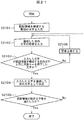

Classifications
-
- G—PHYSICS
- G06—COMPUTING OR CALCULATING; COUNTING
- G06F—ELECTRIC DIGITAL DATA PROCESSING
- G06F3/00—Input arrangements for transferring data to be processed into a form capable of being handled by the computer; Output arrangements for transferring data from processing unit to output unit, e.g. interface arrangements
- G06F3/01—Input arrangements or combined input and output arrangements for interaction between user and computer
- G06F3/02—Input arrangements using manually operated switches, e.g. using keyboards or dials
- G06F3/023—Arrangements for converting discrete items of information into a coded form, e.g. arrangements for interpreting keyboard generated codes as alphanumeric codes, operand codes or instruction codes
-
- G—PHYSICS
- G06—COMPUTING OR CALCULATING; COUNTING
- G06F—ELECTRIC DIGITAL DATA PROCESSING
- G06F3/00—Input arrangements for transferring data to be processed into a form capable of being handled by the computer; Output arrangements for transferring data from processing unit to output unit, e.g. interface arrangements
- G06F3/01—Input arrangements or combined input and output arrangements for interaction between user and computer
- G06F3/048—Interaction techniques based on graphical user interfaces [GUI]
- G06F3/0487—Interaction techniques based on graphical user interfaces [GUI] using specific features provided by the input device, e.g. functions controlled by the rotation of a mouse with dual sensing arrangements, or of the nature of the input device, e.g. tap gestures based on pressure sensed by a digitiser
- G06F3/0488—Interaction techniques based on graphical user interfaces [GUI] using specific features provided by the input device, e.g. functions controlled by the rotation of a mouse with dual sensing arrangements, or of the nature of the input device, e.g. tap gestures based on pressure sensed by a digitiser using a touch-screen or digitiser, e.g. input of commands through traced gestures
-
- G—PHYSICS
- G06—COMPUTING OR CALCULATING; COUNTING
- G06F—ELECTRIC DIGITAL DATA PROCESSING
- G06F3/00—Input arrangements for transferring data to be processed into a form capable of being handled by the computer; Output arrangements for transferring data from processing unit to output unit, e.g. interface arrangements
- G06F3/01—Input arrangements or combined input and output arrangements for interaction between user and computer
- G06F3/048—Interaction techniques based on graphical user interfaces [GUI]
- G06F3/0487—Interaction techniques based on graphical user interfaces [GUI] using specific features provided by the input device, e.g. functions controlled by the rotation of a mouse with dual sensing arrangements, or of the nature of the input device, e.g. tap gestures based on pressure sensed by a digitiser
- G06F3/0489—Interaction techniques based on graphical user interfaces [GUI] using specific features provided by the input device, e.g. functions controlled by the rotation of a mouse with dual sensing arrangements, or of the nature of the input device, e.g. tap gestures based on pressure sensed by a digitiser using dedicated keyboard keys or combinations thereof
-
- H—ELECTRICITY
- H03—ELECTRONIC CIRCUITRY
- H03M—CODING; DECODING; CODE CONVERSION IN GENERAL
- H03M11/00—Coding in connection with keyboards or like devices, i.e. coding of the position of operated keys
- H03M11/02—Details
- H03M11/04—Coding of multifunction keys
Definitions
- the present invention relates to an input information generation method, an information processing apparatus, and an information processing program.
- Patent Document 1 discloses a technique for automatically generating authentication information based on a random number.
- the authentication information input method differs for each type, so the same authentication information is input by information processing devices with different input methods.
- the input operation becomes complicated. For example, when a user purchases a license key and then plays the content on an information processing device of a different type from the information processing device that entered the license key at the time of purchase, the input method is different because the license key input method is different. Operation becomes complicated.
- authentication information there are a user ID and a password in addition to a license key.
- the input operation is complicated as in the case of the license key.
- Such a problem is not limited to inputting authentication information, a user ID, and a password, but may occur in various scenes where various predetermined input information is input. For this reason, the technique which can produce
- authentication information is automatically generated, but generation of input information according to an input method is not considered.
- the present invention has been made in view of the above, and an object thereof is to provide an input information generation method, an information processing apparatus, and an information processing program capable of generating input information according to an input method.
- the input information generation method includes a plurality of characters (here, “characters” are characters such as A, B, and C, numbers such as 1, 2, 3, and the like, +,
- characters are characters such as A, B, and C, numbers such as 1, 2, 3, and the like, +
- the input information generation method is characterized by generating the input information.
- the present invention can also be understood as an information processing apparatus using the input information generation method and an information processing program for executing the input information generation method.
- input information can be generated according to the input method.
- FIG.2 It is a figure which shows the structural example of the information processing system to which the input information generation method concerning this invention, information processing apparatus, and an information processing program are applied. It is a block diagram which shows an example of an internal structure of information processing apparatus. It is a software block diagram which shows an example of an internal structure of the information processing apparatus shown to Fig.2 (a). It is a sequence diagram of a process in which a distribution server generates a license key and distributes it to an information processing terminal. It is a sequence diagram of a process in which a distribution server generates a license key and distributes it to an information processing terminal. It is a figure which shows the example of the license key input screen in S318 shown in FIG.3 (b).
- FIG. 11 is a software configuration diagram illustrating an example of an internal configuration of an information processing apparatus (second embodiment). It is a flowchart which shows the process sequence of the process which produces
- FIG. 16 It is a flowchart which shows the process sequence of the process which logs in to a website and an application using the user ID and password which were registered in Fig.16 (a). It is a figure which shows the example of the input screen of a user ID and a password displayed on the display of information processing apparatus in S1604.
- 12 is a flowchart illustrating a processing procedure of first authentication information generation processing in the second embodiment.
- 12 is a flowchart illustrating a processing procedure of second authentication information generation processing in the second embodiment.
- 12 is a flowchart illustrating a modification of the processing procedure of the second authentication information generation processing in the second embodiment.
- 12 is a flowchart illustrating a processing procedure of third authentication information generation processing in the second embodiment. It is a figure which shows the structural example of the information processing system to which the input information generation method, information processing apparatus, and information processing program concerning this invention are applied (in the case of a remote control).
- FIG. 1 is a diagram illustrating a configuration example of an information processing system 1000 to which an input information generation method, an information processing apparatus, and an information processing program according to the present invention are applied.
- the information processing system 1000 includes an information processing apparatus 100 and a distribution server 101, which are connected to an access point apparatus 103 or a base station 105 via a network 102.
- the network 102, the access point device 103, the mobile server 104, and the base station 105 have general configurations that have been conventionally known, and thus their descriptions are omitted below.
- the information processing apparatus 100 can accept input of input information including, for example, portable terminals such as feature phones and smart phones, operation devices such as remote controllers, information processing terminals such as PCs (Personal Computers) and wearable terminals. Types of devices, terminals, and devices. In the following, feature phones, smartphones, and remote controllers are listed as examples of the information processing apparatus 100, but as described above, various apparatuses, terminals, and devices that accept input information can be used.
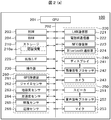
- FIG. 2A is a block diagram illustrating an example of the internal configuration of the information processing apparatus 100.
- the information processing apparatus 100 includes a CPU (Central Processing Unit) 201, a system bus 202, a ROM (Read Only Memory) 203, a RAM (Random Access Memory) 204, and a storage 210.
- the CPU 201 is a microprocessor unit that controls the entire information processing apparatus 100.
- a system bus 202 is a data communication path for transmitting and receiving data between the CPU 201 and each operation block in the information processing apparatus 100.
- the ROM 203 is a memory in which a basic operation program such as an operating system and other operation programs are stored.
- a rewritable ROM such as an EEPROM (Electrically Erasable Programmable Read-Only Memory) or a flash ROM is used.
- the RAM 204 serves as a work area when the basic operation program and other operation programs are executed.
- the ROM 203 and RAM 204 may be integrated with the CPU 201. Further, the ROM 203 may use a partial storage area in the storage 210 instead of the independent configuration as shown in FIG.
- the storage 210 stores a license key as the above-described authentication information in addition to the operation program and operation setting value of the information processing apparatus 100, personal information of the user who uses the information processing apparatus 100, and the like.
- an operation program downloaded from the network and various data created by the operation program may be stored.
- a part or all of the functions of the ROM 203 may be substituted for a partial storage area of the storage 210.
- a device such as a flash ROM, SSD (Solid State Drive), HDD (Hard Disk Drive) or the like is used.
- the operation program stored in the ROM 203 or the storage 210 can be updated and expanded by executing a download process from each device on the network 102.
- the communication processor 220 includes a LAN (Local Area Network) communication device 221, a telephone network communication device 222, an NFC (Near Field Communication) communication device 223, and a BlueTooth (registered trademark) communication device 224.
- the LAN communication device 221 is connected to the network 102 via the access point device 103 and transmits / receives data to / from each device on the network 102.
- the telephone network communicator 222 transmits and receives calls and data with the base station 105 of the mobile telephone communication network.
- the NFC communication device 223 transmits and receives data by wireless communication when a corresponding reader / writer approaches.
- the BlueTooth communicator 224 transmits and receives data by wireless communication with an adjacent information processing apparatus.
- the operation device 230 is a device that receives input of input information to the information processing apparatus 100.
- the operation unit 230 is, for example, an operation key in which button switches are arranged, and a touch panel arranged on the display 241.
- the operation keys and the touch panel are described as examples, but other devices such as a keyboard may be used.
- the user operates the operation unit 230 to input a license key, which is one of input information, or a user ID and a password.
- Arrangement of keys of the operation unit 230, groups assigned to each arranged key, characters belonging to the group, characters displayed around the key when a key is selected during flick operation, and toggle operation Characters to be selected according to the number of times the key is touched are stored in advance in the storage 210, for example.
- the video processor 240 includes a display 241, an image signal processor 242 and a camera 243.
- the display 241 is a display device such as a liquid crystal panel, for example, and displays the image data processed by the image signal processor 242.
- the image signal processor 242 displays the input image data on the display 241.
- the camera 243 inputs image data of surroundings and objects by converting light input from a lens into an electrical signal using an electronic device such as a CCD (Charge-Coupled Device) or a CMOS (Complementary-Metal-Oxide-Semiconductor) sensor. It is a camera unit that functions as an imaging device.
- the audio processor 250 includes a speaker 251, an audio signal processor 252, and a microphone 253.
- Speaker 251 outputs an audio signal processed by audio signal processor 252.
- the audio signal processor 252 outputs the input audio data to the speaker 251.
- the microphone 253 converts sound into sound data and outputs the sound data to the sound signal processor 252.
- the sensor 260 is a sensor group for detecting the state of the information processing apparatus 100, and includes a GPS receiver 261, a gyro sensor 262, a geomagnetic sensor 263, an acceleration sensor 264, an illuminance sensor 265, and a proximity sensor 266. It is comprised. Since each of these sensors is a general sensor group known conventionally, the description is abbreviate
- the configuration of the information processing apparatus 100 illustrated in FIG. 2A is merely an example, and may not include all of them.
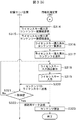
- FIG. 2B is a software configuration diagram illustrating an example of an internal configuration of the information processing apparatus 100 illustrated in FIG.
- the information processing apparatus 100 stores a basic operation program 203 a and other programs 203 b in the ROM 203.
- the RAM 204 has a basic operation execution program 204a for executing the basic operation program 203a, a server information acquisition execution program 204b for executing the server information acquisition program 210b stored in the storage unit 210, and these execution programs.
- the temporary storage area 204c required when executing is stored.
- the storage unit 210 stores a server information acquisition program 210b, other programs 210c, and various information / data storage areas 210d.
- the various information / data storage area 210d has an authentication information storage area 210a for storing a license key, which is an example of authentication information generated by the distribution server 101.
- the server information acquisition program 210b stored in the storage unit 210 is loaded into the RAM 204, and the server information acquisition execution program 204b acquires a license key that is an example of authentication information generated in the distribution server 101. And stored in the authentication information storage area 210a.
- the authentication information storage area 210 a may be provided in the temporary storage area 204 c of the RAM 204. Specific operations of the server information acquisition execution program 204b will be described later.
- the distribution server 101 will be described.
- the distribution server 101 is a server that distributes content to the information processing apparatus 100, and includes a general server. Since the distribution server 101 has a general configuration, a block diagram showing an example of the internal configuration is omitted below, and the software configuration will be described.
- FIG. 5 is a software configuration diagram illustrating an example of an internal configuration of the distribution server 101. As illustrated in FIG. 5, the distribution server 101 includes a RAM 503, a basic operation execution program 503 a for executing the basic operation program 504 a stored in the storage unit 504, and content management / distribution stored in the storage unit 504.
- An authentication information verification execution program 503d for executing the verification program 504e is stored.
- the storage unit 504 stores a basic operation program 504a, a content management / distribution program 504b, a distributed content 504c, a content management / distribution program 504d, and an authentication information collation program 504e.
- the LAN communication device 505 is an interface for connecting to the network 102.
- a content management / distribution program 504b, an authentication information generation program 504d, and an authentication information collation program 504e stored in the storage 504 are loaded into the RAM 503, and the content management / distribution execution program 503b distributes the content for authentication.
- the information generation execution program 503c generates a license key, and the authentication information verification execution program 503d verifies the license key. Specific operations of these programs will be described later.
- FIG. 3A is a sequence diagram of processing in which the distribution server 101 generates a license key and distributes it to the information processing terminal 100.
- FIG. 3A shows the flow of processing from when the application of the information processing apparatus 100 is activated until the license key is displayed.
- the server information acquisition execution program 204b of the information processing apparatus 100 activates an application for purchasing a license key and viewing the content (S301).
- An example of the application is a web browser program.
- the server information acquisition execution program 204b displays on the display 241 a selection screen for selecting the purchase of the license key or viewing of the content for which the license key has already been purchased (S302).
- the server information acquisition execution program 204b determines which of the purchase or viewing selection is accepted (S304).
- the server information acquisition execution program 204b determines that the viewing selection has been accepted, the server information acquisition execution program 204b proceeds to FIG. On the other hand, when it is determined that the purchase has been accepted, the server information acquisition execution program 204b requests the distribution server 101 for sales content list information indicating a list of sales content (S305). The content management / distribution execution program 503b of the distribution server 101 transmits the sales content list information to the requested information processing apparatus 100 (S306).
- the server information acquisition execution program 204b of the information processing apparatus 100 displays the sales content list information on the display 241 (S307).
- the server information acquisition execution program 204b inputs information necessary for purchasing the license key from the operating device 203.
- a request is made (S309).
- the server information acquisition execution program 204b transmits the received necessary information and the type of the information processing apparatus 100 to the distribution server 101 (S310). Examples of the necessary information include a user's address and a card number of a credit card used for content purchase.
- the above types are information for classifying devices, terminals, and devices such as mobile phones such as feature phones and smart phones, operation devices such as remote controllers, and information processing terminals such as PCs (Personal Computers) and wearable terminals. It is.
- the case where the input information input method is caused by the difference in the above type is described as an example, but not only in the above type difference, but also when the input information input method differs due to various other factors. Can be applied similarly.
- the authentication information generation execution program 503c of the distribution server 101 executes a license key generation process for generating a license key for the content to be purchased (S311), and transmits the generated license key to the requested information processing apparatus 100 ( S312).
- the license key generation process will be described later with reference to FIG.
- the server information acquisition execution program 204b of the information processing apparatus 100 displays the license key received from the distribution server 101 on the display 241 (S313).
- the server information acquisition execution program 204b determines that the viewing selection has been accepted, the server information acquisition execution program 204b indicates a list of contents that can be viewed with a license key that has already been purchased. Content list information is requested to the distribution server 101 (S314).
- the content management / distribution execution program 503b of the distribution server 101 transmits the purchased content list information to the requested information processing apparatus 100 (S315).
- the server information acquisition execution program 204b of the information processing apparatus 100 displays the purchased content list information on the display 241 (S316).
- the server information acquisition execution program 204b inputs a purchased license key for viewing the selected purchased content.
- a license key input screen is displayed on the display 241 (S318).
- the server information acquisition execution program 204b distributes the received purchased license key and the content ID for identifying the purchased content. It transmits to the server 101 (S320).
- the content ID and the license key are transmitted to the distribution server 101 in order to identify them.
- the authentication information collation execution program 503d of the distribution server 101 determines whether or not the license key of the content ID generated in S311 at the time of purchase matches the license key received from the information processing apparatus 100 in S320 (S321). ), When it is determined that the two match (S321; Yes), the viewing data that is the content identified by the content ID is transmitted to the requested information processing apparatus 100 (S322).
- the process returns to S318 and displays the license key input screen on the display 241.
- the server information acquisition execution program 204b of the information processing apparatus 100 reproduces the content received from the distribution server 101 (S323), and the user views the content.
- the user After the user purchases a license key, when viewing content with a different type of information processing apparatus 100, the user needs to input the license key again.
- the method for inputting the license key differs for each type of information processing apparatus 100. For this reason, even when the same license key is input between information processing apparatuses of different types, the input method is different and the input operation is complicated. In this embodiment, even when a license key is input from the information processing apparatus 100 of a different type, the license key is generated according to the type of the information processing apparatus 100 so that the input is easy. .
- FIG. 4 is a diagram showing an example of the license key input screen in S318 shown in FIG. As shown in FIG. 4, the license key input screen includes a display column for the content ID selected in S317 and an input column for the license key corresponding to the content ID.
- FIG. 6 is a flowchart showing the processing procedure of the license key generation process in S311 shown in FIG.
- the authentication information generation execution program 503c of the content distribution server 101 reads the type of the information processing apparatus 100 received in S310 (S600), and the type is a feature phone. Or a smartphone (S601).
- the authentication information generation execution program 503c proceeds to S605, and executes a first authentication information generation process for generating feature phone authentication information (S605).
- the authentication information generation execution program 503c determines that the type is a smartphone, it further determines whether the smartphone is a toggle input type smartphone or a flick input type smartphone (S602).
- the process proceeds to S604, and a third authentication information generation process for generating authentication information for the toggle input type smartphone is executed (S604). .
- the process proceeds to S603 and executes a second authentication information generation process for generating authentication information for the flick input method smartphone ( S603).
- the first authentication information generation process, the second authentication information generation process, and the third authentication information generation process will be described later.
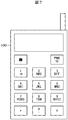
- FIG. 7 is a diagram illustrating an arrangement example of a keypad which is an example of the operation device 203 included in the feature phone.
- FIG. 7 shows an example in which input keys such as numeric keys and symbols are arranged. The arrangement of such numeric keys and input keys is the same for the remote controller.
- a plurality of keys for receiving license key inputs are regularly arranged on the keypad.
- Each key is assigned a group including one or more types of characters. If the character input by operating the operation unit 203 and the character to be input next belong to the same group, the character to be input next can be selected unless the cursor is shifted to the right by one character after the input of the input character. I can't enter it. For this reason, compared with the case where characters are simply input continuously, troubles such as shifting the cursor occur, and the input operation becomes complicated.
- the characters that are continuously input are the same group as the characters that have been input immediately before.
- the authentication information is generated so that the characters adjacent to each other do not become the same group.
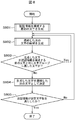
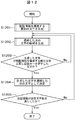
- FIG. 8 is a flowchart showing a processing procedure of the first authentication information generation processing shown in FIG.
- the authentication information generation execution program 503c of the content distribution server 101 executes a generation process for generating the first character constituting the authentication information (S801). Determine the first character of.
- the authentication information generation execution program 503c executes a generation process for generating a next candidate character (S802). The generation process will be described later.
- the authentication information generation / execution program 503c determines whether or not the character generated in the generation process belongs to the same group as the character previously determined as authentication information (S803). If it is determined that the character belongs (S803; Yes), the process returns to S802 and the generation process is executed again.
- the generated character is used as authentication information one time before. It is determined as a character following the character determined in (S804).
- the authentication information generation / execution program 503c determines whether or not all characters constituting the authentication information have been determined, that is, whether or not the authentication information satisfies the set number of characters (S805), and determines that the set number of characters is not satisfied. In the case (S805; No), the process returns to S802 and the above processes are repeated until the set number is satisfied. On the other hand, if the authentication information generation execution program 503c determines that the set number is satisfied (S805; Yes), the process ends.
- each character that constitutes the authentication information is determined so that the characters following the preceding character are not in the same group. Therefore, a complicated operation such as moving the cursor as described above is not necessary, and authentication information can be input by an easy input operation.
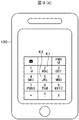
- FIG. 9A is a diagram illustrating an arrangement example of a keypad which is an example of the operation device 203 included in the smartphone.
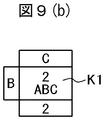
- FIG. 9B is an explanatory diagram of an input example when a character is input by a flick operation of sliding a finger touching the keypad shown in FIG.
- Each key constituting the keypad is actually arranged on a touch panel having an operation device 203 and a display 240, unlike a feature phone. Since the arrangement and group of each key are the same as those in the case of FIG. 7, the description thereof is omitted here.
- FIG. 9A and 9B a key K1 displayed on the touch panel with A, B, C, and 2 as one group will be described as an example.
- FIG. 9B When the user touches the center of the key K1, FIG. 9B is displayed.
- “A” is selected as the character.
- the character “B” is selected.
- the character “C” is selected, and when the user performs a downward flick operation to move the finger touched downward, the character “2” is selected.
- the next input character is not changed unless the finger is moved in a different direction after the input character is input. I can't enter it. For this reason, compared with the case where characters are continuously input by the flick operation in the same direction, the trouble of having to move the finger in a different direction occurs, and the input operation becomes complicated.
- the characters that are continuously input and the characters that are input immediately before are not included in the license key input so that the flick operation is not performed in the different direction as described above.
- the authentication information is generated so that the flick operation is performed in the same direction, that is, all adjacent characters are performed in the flick operation in the same direction.
- FIG. 10 is a flowchart showing a processing procedure of the second authentication information generation processing shown in FIG.
- the second authentication information generation process is a process for generating authentication information input by the flick operation shown in FIG. Since S1001, S1002, S1004, and S1005 shown in FIG. 10 are the same as S801, S802, S804, and S805 shown in FIG. 8, S1003 will be described below.
- the authentication information generation execution program 503c determines that the character generated by the generation process has the same flick operation direction as the character previously determined as the authentication information. Is determined (S1003), and when it is determined that the characters are not in the same flick operation direction (S1003; No), the process returns to S1002 and the generation process is executed again.
- the authentication information generation execution program 503c determines that both are characters in the same flick operation direction (S1003; Yes), the generated character is used as the character that follows the character previously determined as authentication information. Determine (S1004).
- the authentication information generation execution program 503c determines whether or not the direction of the flick operation is the same, and the character previously determined as authentication information and the generated character are not necessarily the same group. Does not have to belong to. Whether or not the direction of the flick operation is the same is determined by, for example, a key to which the authentication information generation execution program 503c previously assigned as authentication information is assigned a group to which the decided character belongs.
- each character constituting the authentication information is determined so that the direction of the flick operation for inputting the character following the character previously determined as the authentication information is the same. Therefore, a complicated operation such as a flick operation in a different direction as described above is not necessary, and authentication information can be input by an easy input operation.
- FIG. 11 is a flowchart showing a modified example of the processing procedure of the second authentication information generation processing shown in FIG. As described above, this processing is processing for generating authentication information input by the flick operation shown in FIG. Since S1101, S1102, S1104, and S1105 shown in FIG. 11 are the same as S801, S802, S804, and S805 shown in FIG. 8, S1103 will be described below.
- the authentication information generation execution program 503c performs a flick when the character generated by the generation process is input as the previous character determined as the authentication information. It is determined whether or not the character is included in the group of keys in the direction of operation (S1103), and included in the group of keys in the direction of flick operation when the previously determined character is input as authentication information If it is determined that the character is not a character to be received (S1103; No), the process returns to S1102 and the above selection process is executed again.
- the authentication information generation execution program 503c determines that the character is included in the group of keys in the direction of the flick operation when the character previously determined as the authentication information is input (S1103; Yes)
- the generated character is determined as a character following the character previously determined as authentication information (S1104).
- the authentication information generation execution program 503c determines whether or not the next input character is a character included in the key in the direction of the flick operation when the immediately preceding character is input.
- the character previously determined as the authentication information and the generated character may not necessarily belong to the adjacent group.
- the character following the character previously determined as authentication information is determined from the characters belonging to the key in the flick operation direction when the determined character is input. Therefore, not only a complicated operation such as a flick operation in a different direction as described above is unnecessary, but also the next flick operation can be performed at the position of the finger after the flick operation. Can be entered.
- FIG. 12 is a flowchart showing a processing procedure of the third authentication information generation processing shown in FIG.
- the third authentication information generation process is a process of generating authentication information that is input by a toggle operation of repeatedly touching the key arranged on the keypad shown in FIG. 9A one or more times.
- S1201, S1202, S1204, and S1205 shown in FIG. 12 are the same as S801, S802, S804, and S805 shown in FIG. 8, S1203 will be described below.
- the authentication information generation execution program 503c inputs the character generated in the generation process with the same number of toggle operations as the character determined in the determination process. If it is determined that the character is not input by the same number of toggle operations as the character determined in the determination process (S1203; No), the process returns to S1202 and again Perform the selection process.
- the authentication information generation execution program 503c determines that the character is input by the same number of toggle operations as the character previously determined as authentication information (S1203; Yes), the generated character is used as the authentication information. Is determined as a character following the previously determined character (S1204). In the processing of S1203, the authentication information generation execution program 503c determines whether or not the number of toggle operations is the same, and the character previously determined as the authentication information and the generated character are not necessarily in the same group. Does not have to belong to.
- each character constituting the authentication information is determined so that the number of toggle operations for inputting the character following the character previously determined as the authentication information is the same. Therefore, a complicated operation such as a toggle operation with different number of touches is not required, the input operation can be performed with the same rhythm, and the authentication information can be input with an easy input operation.
- FIG. 13 is a flowchart showing the processing procedure of the generation process.
- the authentication information generation execution program 503c of the content distribution server 101 generates a random number from a numerical value (for example, 0 to 32768) within a predetermined range (S1501).
- the random number is converted into an integer (S1502).
- the authentication information generation / execution program 503c divides the random number that has been converted into an integer into a numerical value (for example, 62 in the case of uppercase and lowercase letters of the alphabet and numbers from 0 to 9) whose remainder is the remainder (S1503), A numerical value (for example, any one of 0 to 61) that is a remainder of the numerical value obtained by the division is assigned to the character (S1504).
- a numerical value for example, 62 in the case of uppercase and lowercase letters of the alphabet and numbers from 0 to 9
- a numerical value for example, any one of 0 to 61
- S1504 Various processes for generating random numbers that are conventionally known can be applied to these processes for generating random numbers.
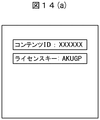
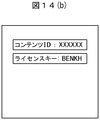
- FIG. 14 (a) to 14 (d) are diagrams showing display examples of the input license key.
- FIG. 14A shows a display example in the case of input by a feature phone
- FIG. 14B shows a display example in the case of flick input by a smartphone
- FIG. 14C shows flick input by a smartphone.
- the example of a display in the case of a modification is shown
- FIG.14 (d) has shown the example of a display in the case of toggle input by a smart phone.
- FIG. 14A “AKUGP” is displayed as the license key.
- “A” among the characters constituting the license key “AKUGP” in the key arrangement shown in FIG. 9A, “2”, “A”, “B”, “C” Select the key K1 to which. Subsequently, “K” belonging to a group different from that when “A” is input is input. Similarly, “G” belonging to a group different from “K” is input, and subsequently “P” belonging to a group different from “G” is input.
- the characters of each digit constituting the license key generated by this system are arranged so that the inputted digit character and the next digit character are different groups of keys. Therefore, as described above, a troublesome operation for the user, such as movement of the cursor, becomes unnecessary.
- FIG. 14B “BENKH” is displayed as the license key.
- the user inputs “B” among the characters constituting the license key “BENKH”
- the user touches the key K1 and selects “A” as in the case of FIG. do.
- the left flick operation is performed.
- flick left to input “N” after selecting “M”, flick left to input “N”, then select “J”, flick left to input “K”, and enter “G”.
- each digit character constituting the license key generated by this system is entered so that the next digit character can be input by the flick operation in the same direction as the flick operation in order to input the character of the immediately preceding digit. Digits are arranged. Therefore, as described above, troublesome operations for the user such as flick operations in different directions are not required.
- FIG. 14C “2K4SV” is displayed as the license key.
- the user inputs “2” among the characters constituting the license key “2K4SV”
- the user touches the key K1 to select “A” and then performs the flick operation similarly to the case of FIG. 14B. do.
- the left flick operation is performed.
- “G” belonging to the group in the direction in which the left flick operation is performed is selected, then the lower flick operation is performed to input “4”, and “4” is input.
- the character of each digit constituting the license key generated by this system is the character of the next digit among the characters assigned to the key in the direction of the flick operation in which the character of the previous digit was entered. Characters in each digit are arranged so that they can be selected and entered. Therefore, as described above, troublesome operations for the user such as flick operations in different directions are not required.
- FIG. 14D “BKUHQ” is displayed as the license key.
- the user touches the key K1 twice and inputs “B” as in the case of FIG. 14C.
- the key of the group including “J” is touched twice to input “K”.
- the key of the group including “T” is touched twice to input “U”
- the key of the group including “G” is set to 2
- “H” is input by touching twice and “Q” is input
- the key of the group including “P” is touched twice to input “Q”.
- the characters of each digit constituting the license key generated by this system can be selected and input with the same number of touches as the number of times the key was touched when the previous digit character was input.
- the characters of each digit are lined up. Therefore, as described above, a troublesome operation for the user such as a toggle operation in which the number of times of touching is different becomes unnecessary.
- FIG. 15 is a software configuration diagram illustrating an example of an internal configuration of the information processing apparatus 100 according to the second embodiment of the information processing system 1000 to which the input information generation method, the information processing apparatus, and the information processing program according to the present invention are applied. is there.
- the information processing apparatus 100 stores a basic operation program 203a and other programs 203b in the ROM 203, as in the case shown in FIG.
- the RAM 204 also includes a basic operation execution program 204a for executing the basic operation program 203a, an authentication information verification execution program 204d for executing the authentication information verification program 210e stored in the storage unit 210, and these execution programs.
- the temporary storage area 204c required when executing is stored.
- the storage unit 210 stores an authentication information collation program 210e, other programs 210c, and various information / data storage areas 210d.
- the various information / data storage area 210d has an authentication information storage area 210a for storing a user ID and a password, which is an example of authentication information generated by the distribution server 101.
- the authentication information collation program 210e stored in the storage unit 210 is loaded into the RAM 204, and the authentication information collation execution program 204d is a user ID and password that are an example of authentication information generated in the information processing apparatus 100. Is stored in the authentication information storage area 210a. Note that the authentication information storage area 210 a may be provided in the temporary storage area 204 c of the RAM 204. The specific operation of the authentication information verification execution program 204d will be described later.
- FIG. 16A is a flowchart showing a processing procedure for generating and registering a user ID and a password in the information processing apparatus 100.
- the authentication information collation execution program 204d of the information processing apparatus 100 reads the user ID received from the user by the operating device 230 and stores it in the authentication information storage area 210a (S1601).
- the authentication information collation execution program 204d reads the password received from the user by the operating device 230 and stores it in the authentication information storage area 210a (S1602).
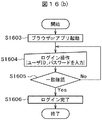
- FIG. 16B is a flowchart showing a processing procedure for processing to log in to a website or application using the user ID and password registered in FIG.
- the authentication information collation execution program 204d of the information processing apparatus 100 starts an application for viewing content by inputting a user ID and a password (S1603).
- An example of the application is a web browser program.
- the authentication information verification execution program 204d confirms whether the user ID and password registered in FIG. 16A match the input user ID and password. It is determined whether or not (S1605), and when it is determined that they do not match (S1605; No), the process returns to S1602 and the subsequent processing is repeated.
- the authentication information collation execution program 204d completes the login (S1606) and permits the use of the website or application.
- FIG. 17 is a diagram illustrating an example of a user ID and password input screen displayed on the display 241 of the information processing apparatus 100 in step S1604. As shown in FIG. 17, the input screen is provided with input fields for a user ID and a password.
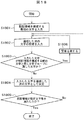
- FIG. 18 is a flowchart of the first authentication information generation process according to the second embodiment. Since the processing from S1801 to S1805 of the first authentication information generation processing in the second embodiment is the same as the processing from S801 to S805 shown in FIG. 8, the description thereof will be omitted here, and S1806 will be described.
- the authentication information collation execution program 204d of the information processing apparatus 100 determines that the character input in the input process is the same group as the character previously determined as the authentication information in S1801 or S1804. If it is determined whether or not the characters belong to the same group (S1803; Yes), a warning indicating that the characters cannot be input is notified from the speaker 251. Or displayed on the display 241.
- the authentication information collation execution program 204d is “2” and “A” because they are the same group. You cannot enter “A” after “2”. Please select and enter from other groups. "The message that the character selected after the first determined character is in the same group and that the character in the same group cannot be input continuously, and that the character to be subsequently input is selected from another group. Is notified from the speaker 251 or displayed on the display 241. At this time, the authentication information collation execution program 204d recommends other groups to be selected, such as “Please select and enter from the group of 5, J, K, and L” together with the above message. May be notified or displayed.
- each character constituting the authentication information is determined so that the characters following the character arranged immediately before do not belong to the same group. Therefore, even when a user ID or password is input, a complicated operation such as moving the cursor as described above is not necessary, and authentication information can be input with an easy input operation.
- the authentication information collation execution program 204d can select an arbitrary group that is not the same group when selecting the other group. However, for example, the authentication information collation execution program 204d counts the characters input by the user in the past, the characters input subsequent to the characters, and the number of times these inputs are performed for each character, A group including characters that have been input many times among the subsequently input characters may be selected as the other group. In this case, since a group including characters that are frequently input by the user is selected as a group subsequent to the group including the first input characters, the user can input characters without a sense of incongruity with operations that are familiar to everyday use.
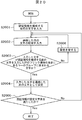
- FIG. 19 is a flowchart illustrating a processing procedure of second authentication information generation processing according to the second embodiment. Since the processing from S1901 to S1905 of the second authentication information generation processing in the second embodiment is the same as the processing from S1001 to S1005 shown in FIG. 10, the description thereof will be omitted here and S1906 will be described.
- the authentication information collation execution program 204d of the information processing apparatus 100 flicks the character input in the input process as the character previously determined as the authentication information in S1901 or S1904. It is determined whether or not the character is in the direction of the operation (S1903), and when it is determined that both are not the characters in the same flick operation direction (S1903; No), a warning indicating that the character cannot be input is displayed on the speaker 251. Or display on the display 241.
- the authentication information matching execution program 204d determines that “B” and “3” are “B” and “3” when the character first determined as the character of the authentication information is “B” and the next input character is “3”. Because it is not the same flick direction, you cannot enter “3” after “B”. Select and input from the characters with the same flick direction. ”Or the like, the character that is selected first and the character that is selected following that character are not in the same flick operation direction, and characters that do not have the same flick operation direction cannot be input continuously. A message that prompts the user to select characters having the same direction is notified from the speaker 251 or displayed on the display 241.
- the authentication information collation execution program 204d has the same flick operation in the same direction as "Please select and input from E, H, K, N, Q, U, and X" together with the above message. May be notified or displayed as a recommendation message.
- each character constituting the authentication information is determined so that the direction of the flick operation for inputting the character following the character determined as the character of the authentication information is the same. Therefore, even when a user ID or password is input, a complicated operation such as a flick operation in a different direction as described above is not necessary, and authentication information can be input with an easy input operation.
- the authentication information collation execution program 204d selects a character in the same flick direction, it can select the character from an arbitrary group.
- the authentication information collation execution program 204d counts the characters input by the user in the past, the characters input subsequent to the characters, and the number of times these inputs are performed for each character, Of the characters subsequently input in the same flick operation direction, a character with a large number of inputs may be selected as the subsequently input character.
- the character in the same flick operation direction that is frequently input by the user is selected as the character that follows the first input character, the user can input the character without a sense of incongruity with an operation that is familiar to everyday use.
- FIG. 20 is a flowchart illustrating a modification of the processing procedure of the second authentication information generation processing in the second embodiment. Since the processes from S2001 to S2005 of the modified example of the second authentication information generation process in the second embodiment are the same as the processes from S1101 to S1105 shown in FIG. 11, the description thereof is omitted here and S1006 is described. To do.
- the authentication information collation execution program 204d of the information processing apparatus 100 determines that the character input in the input process is the previous one as the authentication information in S2001 or S2004. It is determined whether or not the character is included in the key group in the direction of the flick operation when the determined character is input (S1103), and the flick when the character previously determined as authentication information is input If it is determined that the character is not included in the key group in the operation direction (S2003; No), a warning indicating that the character cannot be input is notified from the speaker 251 or displayed on the display 241.
- the authentication information collation execution program 204d flicks when “2” is entered as “D”. Since it is not a character included in the key group in the direction of operation, "D" cannot be entered after "2". Select and enter from the characters included in the key group in the direction of the flick operation. , Etc., the character that was entered next is not included in the group of keys that are in the direction of the flick operation when the character was first determined and included in the group of keys in the direction of the flick operation. A message that prompts the user to select a character included in a group of keys that are in the direction of the flick operation is notified from the speaker 251 or displayed on the display 241. indicate. At this time, the authentication information collation execution program 204d is included in the key group in the direction of the flick operation, such as “Please select and input from 5, J, K, L” together with the above message. May be notified or displayed as a recommendation message.
- the authentication information collation execution program 204d includes the next input character in the key in the direction of the flick operation when the immediately preceding character is input. It is determined whether or not the character is a character, and the determined character and the input character may not necessarily belong to an adjacent group.
- the character following the determined character is selected from the characters belonging to the key in the direction of the flick operation when the determined character is input. Therefore, even when a user ID or password is input, a complicated operation such as a flick operation in a different direction as described above is not necessary, and authentication information can be input with a much easier input operation.
- the authentication information collation execution program 204d can select an arbitrary character from the group when inputting the character included in the group of keys in the direction of the flick operation.
- the authentication information matching execution program 204d counts the characters input by the user in the past, the characters input subsequent to the characters, and the number of times these inputs are performed for each character.
- a character with a large number of inputs may be selected as a subsequently input character.
- a character with a high input frequency by the user is selected as a character following the first input character from the group of keys in the direction of the flick operation of the first input character, the user is accustomed to everyday use. Characters can be input without any discomfort.
- FIG. 21 is a flowchart of the third authentication information generation process according to the second embodiment. Since the processes from S2101 to S2105 of the third authentication information generation process in the second embodiment are the same as the processes from S1201 to S1205 shown in FIG. 12, the description thereof will be omitted here and S2106 will be described.
- the authentication information collation execution program 204d of the information processing apparatus 100 determines that the character input in the input process is the same number of times as the character previously determined as the authentication information in S2101 or S2104. It is determined whether or not the character is input by the toggle operation (S2103). If it is determined that the characters are not input by the same number of toggle operations (S2103; No), it is determined that the character cannot be input. A warning to be shown is notified from the speaker 251 or displayed on the display 241.
- the authentication information collation execution program 204d determines that “B” and “D” are “B” and “D” when the character first determined as the character of the authentication information is “B” and the next input character is “D”. Since it is not a character entered by the same number of toggle operations, you cannot enter “D” after “B”. Select from the characters entered with the same number of toggle operations. ”Or the like, the character that was initially determined and the character that was input following that character are not characters that are input by the same number of toggle operations, and characters that are not the same number of toggle operations cannot be input continuously, so input continuously. A message that prompts the user to select a character input by the same number of toggle operations is notified from the speaker 251 or displayed on the display 241.
- the authentication information collation execution program 204d performs the same number of toggle operations such as “Select and input from E, H, K, N, Q, U, and X” together with the above message.
- the characters entered in may be notified or displayed as a recommendation message.
- each character constituting the authentication information is determined so that the number of toggle operations for inputting the character following the determined character is the same. Therefore, even when a user ID or password is input, a complicated operation such as a toggle operation with different number of touches is not required, the input operation can be performed with the same rhythm, and authentication information can be input with a simple input operation.
- the authentication information collation execution program 204d can select a character from an arbitrary group when inputting the character input by the same number of toggle operations. However, for example, the authentication information collation execution program 204d counts the characters input by the user in the past, the characters input subsequent to the characters, and the number of times these inputs are performed for each character, Of the characters that are input by the same number of toggle operations that are subsequently input, a character that is frequently input may be selected as the subsequently input character. In this case, since the character in the same flick operation direction that is frequently input by the user is selected as the character that follows the first input character, the user can input the character without a sense of incongruity with an operation that is familiar to everyday use.
- the authentication information such as the license key, the user ID, and the password
- various kinds of predetermined input information are input according to the input method even when the input method is different.
- Information can be generated.
- the feature phone, the smartphone, and the remote controller are examples of the information processing apparatus 100.
- the information processing apparatus 100 is a remote control, for example, FIG.
- the configuration may be different from the configuration shown in FIG.
- a remote controller 2101 instead of the information processing apparatus 100 communicates with a television 2100 by a communication method such as infrared communication, and the television 2100 receives content such as a program from the antenna 2200t of the broadcast station 2202 via the antenna 2200a.
- the content distributed from the distribution server 101 can also be received as in the case of the first embodiment. Therefore, the remote controller 2101 can be used as the information processing apparatus 100 even under such an environment.
- Example 1 and Example 2 are implement
- these programs can be installed.
- the file may be provided in any format or executable format, provided on a computer-readable recording medium such as a CD-ROM, CD-R, DVD (Digital Versatile Disk), or distributed.
- the program may be provided or distributed by storing it on a computer connected to a network such as the Internet and downloading it via the network.
- the distribution server 101 executes the license key generation process in S311.
- the information processing apparatus 100 executes this process, and the generated license key is used as the identification information of the information processing apparatus 100. At the same time, it may be transmitted to the distribution server 100 and stored and managed. In this case, since the information processing apparatus 100 generates the license key, the load on the distribution server 101 can be reduced, and the effect can be expected as the content with many viewers is distributed.
- Information processing system 100 Information processing apparatus 101 Distribution server 102 Network 103 Access point apparatus 104 Mobile server 105 Base station 201 CPU 202 System bus 203 ROM 203a Basic operation program 203b Other program 204 RAM 204a Basic operation execution program 204b Server information acquisition execution program 204c Temporary storage area 204d Authentication information verification execution program 210 Storage 210a Authentication information storage area 210b Server information acquisition program 210c Other programs 210d Various information / data storage area 210e Authentication information verification program 220 Communication processor 230 Controller 240 Video processor 250 Audio processor 260 Sensor 503 RAM 503a Basic operation execution program 503b Content management / distribution execution program 503c Authentication information generation execution program 503d Authentication information verification execution program 504a Basic operation program 504b Content management / distribution program 504c Content 504d Authentication information generation program 504e Authentication information verification program 505 LAN communication device .
Landscapes
- Engineering & Computer Science (AREA)
- Theoretical Computer Science (AREA)
- General Engineering & Computer Science (AREA)
- Human Computer Interaction (AREA)
- Physics & Mathematics (AREA)
- General Physics & Mathematics (AREA)
- Telephone Function (AREA)
Abstract
複数の文字から構成される入力情報を生成する入力情報生成方法であって、操作部から入力される文字の入力方法を判定し、判定した文字の入力方法に応じて入力情報を生成する。
Description
本発明は、入力情報生成方法、情報処理装置、および情報処理プログラムに関する。
コンテンツを視聴する場合のように、電子商取引を行う際には、ライセンスキー等の認証情報を発行する必要がある。認証情報を発行するために、例えば、特許文献1には、乱数に基づいて認証情報を自動生成する技術が開示されている。
認証情報の入力が煩雑であると、ユーザは入力を間違える可能性がある。このため、認証情報を容易に入力できることが望ましい。例えば、フィーチャーフォン、スマートフォン、リモコン、あるいはPC(Personal Computer)等の様々な情報処理装置では、その種別ごとに認証情報の入力方法が異なるため、入力方法が異なる情報処理装置で同じ認証情報を入力する場合、入力操作が煩雑となる。具体例を挙げると、ユーザがライセンスキーを購入した後、購入時にライセンスキーを入力した情報処理装置とは異なる種別の情報処理装置でコンテンツを再生する場合、ライセンスキーの入力方法が異なるため、入力操作が煩雑となる。
認証情報の例としては、ライセンスキーのほか、ユーザIDやパスワードがあるが、上記のような場合にはライセンスキーと同様、入力操作の煩雑さが生じる。このような問題は、認証情報、ユーザIDやパスワードを入力する場合に限らず、あらかじめ定められた様々な入力情報を入力する様々な場面で生じ得る。このため、入力情報の入力方法が異なることによる入力操作の煩雑さが生じないように、入力方法に応じて入力情報を生成することができる技術が求められていた。上記特許文献1では、認証情報を自動的に生成しているが、入力方法に応じて入力情報を生成することについては考慮されていない。
本発明は、上記に鑑みてなされたものであって、入力方法に応じて入力情報を生成することができる入力情報生成方法、情報処理装置、および情報処理プログラムを提供することを目的とする。
上記課題を解決するために、本発明にかかる入力情報生成方法は、複数の文字(ここで「文字」とは、A、B、C等の文字、1、2、3等の数字、+、-等の記号、符号等を含む)を含む入力情報を生成する入力情報生成方法であって、操作部から入力される前記文字の入力方法を判定し、判定した前記文字の入力方法に応じて前記入力情報を生成する、ことを特徴とする入力情報生成方法として構成される。
また、本発明は、上記入力情報生成方法を用いた情報処理装置、および上記入力情報生成方法を実行する情報処理プログラムとしても把握される。
本発明によれば、入力方法に応じて入力情報を生成することができる。
以下に添付図面を参照して、本発明にかかる入力情報生成方法、情報処理装置、および情報処理プログラムの実施の形態を詳細に説明する。以下では、認証情報の例として、実施例1にライセンスキー、実施例2にユーザIDおよびパスワードを挙げているが、上記に限らず、あらかじめ定められた様々な入力情報を入力する様々な場面に適用することができる。
(実施例1)
図1は、本発明にかかる入力情報生成方法、情報処理装置、および情報処理プログラムを適用した情報処理システム1000の構成例を示す図である。図1に示すように、情報処理システム1000は、情報処理装置100と配信サーバ101とを有し、これらが、ネットワーク102を介してアクセスポイント装置103または基地局105に接続されている。なお、ネットワーク102、アクセスポイント装置103、移動体サーバ104、基地局105は、従来から知られている一般的な構成であるため、以下ではこれらの説明を省略している。
(実施例1)
図1は、本発明にかかる入力情報生成方法、情報処理装置、および情報処理プログラムを適用した情報処理システム1000の構成例を示す図である。図1に示すように、情報処理システム1000は、情報処理装置100と配信サーバ101とを有し、これらが、ネットワーク102を介してアクセスポイント装置103または基地局105に接続されている。なお、ネットワーク102、アクセスポイント装置103、移動体サーバ104、基地局105は、従来から知られている一般的な構成であるため、以下ではこれらの説明を省略している。
情報処理装置100は、例えば、フィーチャーフォン、スマートフォン等の携帯端末、リモコン等の操作機器、PC(Personal Computer)やウェアラブル端末等の情報処理端末をはじめ、入力情報の入力を受け付けることが可能な様々な種別の装置や端末、機器である。以下では、情報処理装置100の例として、フィーチャーフォン、スマートフォン、リモコンを挙げているが、上記のとおり、入力情報の入力を受け付ける様々な装置や端末、機器を用いることができる。
図2(a)は、情報処理装置100の内部構成の一例を示すブロック図である。図2(a)に示すように、情報処理装置100は、CPU(Central Processing Unit)201と、システムバス202と、ROM(Read Only Memory)203と、RAM(Random Access Memory)204と、ストレージ210と、通信処理器220と、操作器230と、ビデオプロセッサ240と、オーディオプロセッサ250と、センサ260とを有して構成されている。
CPU201は、情報処理装置100全体を制御するマイクロプロセッサユニットである。システムバス202は、CPU201と情報処理装置100内の各動作ブロックとの間でデータを送受信するためのデータ通信路である。
ROM203は、オペレーティングシステム等の基本動作プログラムやその他の動作プログラムが格納されたメモリであり、例えば、EEPROM(Electrically Erasable Programmable Read-Only Memory)やフラッシュROMのような書き換え可能なROMが用いられる。
RAM204は、基本動作プログラムやその他の動作プログラム実行時のワークエリアとなる。ROM203及びRAM204は、CPU201と一体の構成であってもよい。また、ROM203は、図2(a)に示したような独立構成ではなく、ストレージ210内の一部記憶領域を使用してもよい。
ストレージ210は、情報処理装置100の動作プログラムや動作設定値、情報処理装置100を使用するユーザの個人情報等のほか、上述した認証情報として、ライセンスキーを記憶する。以下では特に例示していないが、ネットワーク上からダウンロードした動作プログラムや、その動作プログラムが作成した各種データを記憶してもよい。また、ストレージ210の一部記憶領域をROM203の機能の一部または全部を代替してもよい。ストレージ210には、例えば、フラッシュROMやSSD(Solid State Drive)、HDD(Hard Disk Drive)等のデバイスが用いられる。
なお、ROM203やストレージ210に記憶された上記動作プログラムは、ネットワーク102上の各装置からダウンロード処理を実行することにより、更新及び機能拡張することができる。
通信処理器220は、LAN(Local Area Network)通信器221、電話網通信器222、NFC(Near Field Communication)通信器223、BlueTooth(登録商標)通信器224を有して構成される。LAN通信器221は、アクセスポイント装置103を介してネットワーク102と接続され、ネットワーク102上の各装置との間でデータを送受信する。電話網通信器222は、移動体電話通信網の基地局105との間で通話およびデータを送受信する。NFC通信器223は、対応するリーダ/ライタが近接した際に無線通信してデータを送受信する。BlueTooth通信器224は、近接する情報処理装置と無線通信してデータを送受信する。
操作器230は、情報処理装置100に対する入力情報の入力を受け付ける装置である。操作器230は、例えば、ボタンスイッチを並べた操作キー、ディスプレイ241に重ねて配置したタッチパネルである。以下では、上記操作キー、タッチパネルを例に挙げて説明しているが、キーボードをはじめとする他の装置であってもよい。具体的には後述するが、ユーザは、操作器230を操作して、入力情報の一つであるライセンスキー、あるいはユーザIDおよびパスワードを入力する。操作器230が有するキーの配置、配置された各キーに割り当てられているグループおよびそのグループに属する文字、フリック操作時においてキーが選択されたときにそのキーの周囲に表示する文字、トグル操作時においてキーをタッチした回数により選択する文字(後述する図7、図9(a)~(c))については、例えば、ストレージ210にあらかじめ記憶されている。
ビデオプロセッサ240は、ディスプレイ241と、画像信号処理プロセッサ242と、カメラ243とを有して構成される。
ディスプレイ241は、例えば、液晶パネル等の表示デバイスであり、画像信号処理プロセッサ242が処理した画像データを表示する。画像信号処理プロセッサ242は、入力された画像データをディスプレイ241に表示させる。カメラ243は、CCD(Charge Coupled Device)やCMOS(Complementary Metal Oxide Semiconductor)センサ等の電子デバイスを用いてレンズから入力した光を電気信号に変換することにより、周囲や対象物の画像データを入力する撮像装置として機能するカメラユニットである。
オーディオプロセッサ250は、スピーカ251と、音声信号プロセッサ252と、マイク253とを有して構成される。
スピーカ251は、音声信号プロセッサ252が処理した音声信号を出力する。音声信号プロセッサ252は、入力された音声データをスピーカ251に出力する。マイク253は、音声を音声データに変換し、音声信号プロセッサ252に出力する。
センサ260は、情報処理装置100の状態を検出するためのセンサ群であり、GPS受信機261と、ジャイロセンサ262と、地磁気センサ263と、加速度センサ264と、照度センサ265と、近接センサ266とを有して構成される。これらの各センサは従来から知られている一般的なセンサ群であるため、ここではその説明を省略する。図2(a)に示した情報処理装置100の構成はあくまで一例であり、必ずしもこれらの全てを備えていなくてもよい。
図2(b)は、図2(a)に示した情報処理装置100の内部構成の一例を示すソフトウェア構成図である。図2(b)に示すように、情報処理装置100には、ROM203に、基本動作プログラム203aと、その他のプログラム203bとが記憶される。また、RAM204に、基本動作プログラム203aを実行するための基本動作実行プログラム204aと、ストレージ部210に記憶されたサーバ情報取得プログラム210bを実行するためのサーバ情報取得実行プログラム204bと、これらの実行プログラムの実行時に必要となる一時記憶領域204cとが記憶される。ストレージ部210に、サーバ情報取得プログラム210bと、その他のプログラム210cと、各種情報/データ記憶領域210dとが記憶される。各種情報/データ記憶領域210dには、配信サーバ101において生成された認証情報の一例であるライセンスキーを記憶する認証情報記憶領域210aを有している。
本実施例においては、ストレージ部210に記憶されたサーバ情報取得プログラム210bがRAM204にロードされ、サーバ情報取得実行プログラム204bが、配信サーバ101において生成された認証情報の一例であるライセンスキーを取得し、上記認証情報記憶領域210aに記憶する。なお、認証情報記憶領域210aは、RAM204の一時記憶領域204cに設けてもよい。サーバ情報取得実行プログラム204bの具体的な動作については後述する。
続いて、配信サーバ101について説明する。
続いて、配信サーバ101について説明する。
配信サーバ101は、情報処理装置100にコンテンツを配信するサーバであり、一般的なサーバから構成される。配信サーバ101は一般的な構成であるため、以下では、その内部構成の一例を示すブロック図を省略し、ソフトウェア構成について説明する。
図5は、配信サーバ101の内部構成の一例を示すソフトウェア構成図である。図5に示すように、配信サーバ101には、RAM503に、ストレージ部504に記憶された基本動作プログラム504aを実行するための基本動作実行プログラム503aと、ストレージ部504に記憶されたコンテンツ管理/配信プログラム504bを実行するためのコンテンツ管理/配信実行プログラム503bと、ストレージ部504に記憶された認証情報発生プログラム504dを実行するための認証情報発生実行プログラム503cと、ストレージ部504に記憶された認証情報照合プログラム504eを実行するための認証情報照合実行プログラム503dとが記憶される。
図5は、配信サーバ101の内部構成の一例を示すソフトウェア構成図である。図5に示すように、配信サーバ101には、RAM503に、ストレージ部504に記憶された基本動作プログラム504aを実行するための基本動作実行プログラム503aと、ストレージ部504に記憶されたコンテンツ管理/配信プログラム504bを実行するためのコンテンツ管理/配信実行プログラム503bと、ストレージ部504に記憶された認証情報発生プログラム504dを実行するための認証情報発生実行プログラム503cと、ストレージ部504に記憶された認証情報照合プログラム504eを実行するための認証情報照合実行プログラム503dとが記憶される。
また、ストレージ部504に、基本動作プログラム504aと、コンテンツ管理/配信プログラム504bと、配信されるコンテンツ504cと、コンテンツ管理/配信プログラム504dと、認証情報照合プログラム504eとが記憶される。なお、LAN通信器505は、ネットワーク102に接続するためのインタフェースである。
本実施例においては、ストレージ504に記憶されたコンテンツ管理/配信プログラム504b、認証情報発生プログラム504d、認証情報照合プログラム504eがRAM503にロードされ、コンテンツ管理/配信実行プログラム503bがコンテンツを配信し、認証情報発生実行プログラム503cがライセンスキーを生成し、認証情報照合実行プログラム503dがライセンスキーを照合する。これらの各プログラムの具体的な動作については後述する。
図3(a)は、配信サーバ101がライセンスキーを生成して情報処理端末100に配信する処理のシーケンス図である。図3(a)では、情報処理装置100のアプリケーションを起動してからライセンスキーを表示するまでの処理の流れを示している。
図3(a)に示すように、まず、情報処理装置100のサーバ情報取得実行プログラム204bは、ライセンスキーを購入してコンテンツを視聴するためのアプリケーションを起動する(S301)。上記アプリケーションとしては、例えば、ウェブブラウザプログラムがある。
サーバ情報取得実行プログラム204bは、上記ライセンスキーの購入または既にライセンスキーを購入したコンテンツの視聴を選択するための選択画面を、ディスプレイ241に表示する(S302)。
操作器230が上記購入または視聴の選択を受け付けると(S303)、サーバ情報取得実行プログラム204bは、上記購入または視聴の選択のいずれが受け付けられたのかを判定する(S304)。
サーバ情報取得実行プログラム204bは、上記視聴の選択が受け付けられたと判定した場合、図3(b)に進み、以降の処理を実行する。一方、サーバ情報取得実行プログラム204bは、上記購入が受け付けられたと判定した場合、配信サーバ101に対して、販売用コンテンツの一覧を示す販売用コンテンツ一覧情報を要求する(S305)。配信サーバ101のコンテンツ管理/配信実行プログラム503bは、上記販売用コンテンツ一覧情報を、要求された情報処理装置100に送信する(S306)。
情報処理装置100のサーバ情報取得実行プログラム204bは、上記販売用コンテンツ一覧情報をディスプレイ241に表示する(S307)。操作器203が上記販売用コンテンツ一覧情報の中から購入コンテンツの選択を受け付けると(S308)、サーバ情報取得実行プログラム204bは、操作器203から上記ライセンスキーを購入するために必要な情報の入力を要求する(S309)。サーバ情報取得実行プログラム204bは、受け付けられた上記必要な情報と、情報処理装置100の種別とを配信サーバ101に送信する(S310)。上記必要な情報としては、例えば、ユーザの住所や、コンテンツの購入に使用するクレジットカードのカード番号がある。また、上記種別とは、フィーチャーフォン、スマートフォン等の携帯端末、リモコン等の操作機器、PC(Personal Computer)やウェアラブル端末等の情報処理端末をはじめとする装置や端末、機器を分類するための情報である。以下では、入力情報の入力方法が上記種別の違いによって生じている場合を例に説明しているが、上記種別の違いに限らず、他の様々な要因により入力情報の入力方法が異なる場合にも同様に適用することができる。
配信サーバ101の認証情報発生実行プログラム503cは、購入されるコンテンツのライセンスキーを発生させるライセンスキー生成処理を実行し(S311)、生成したライセンスキーを、要求された情報処理装置100に送信する(S312)。ライセンスキー生成処理については、図6を用いて後述する。
情報処理装置100のサーバ情報取得実行プログラム204bは、配信サーバ101から受信した上記ライセンスキーを、ディスプレイ241に表示する(S313)。
一方、図3(b)に示すように、サーバ情報取得実行プログラム204bは、上記視聴の選択が受け付けられたと判定した場合、既に購入されているライセンスキーにより視聴可能なコンテンツの一覧を示す購入済コンテンツ一覧情報を、配信サーバ101に対して要求する(S314)。
配信サーバ101のコンテンツ管理/配信実行プログラム503bは、上記購入済コンテンツ一覧情報を、要求された情報処理装置100に送信する(S315)。
情報処理装置100のサーバ情報取得実行プログラム204bは、上記購入済コンテンツ一覧情報をディスプレイ241に表示する(S316)。操作器203が上記購入済コンテンツ一覧情報の中から購入済コンテンツの選択を受け付けると(S317)、サーバ情報取得実行プログラム204bは、選択した購入済コンテンツを視聴するための購入済ライセンスキーを入力するライセンスキー入力画面を、ディスプレイ241に表示する(S318)。
サーバ情報取得実行プログラム204bは、操作器203が上記購入済ライセンスキーの入力を受け付けると(S319)、受け付けられた上記購入済ライセンスキーと、購入済コンテンツを識別するためのコンテンツIDとを、配信サーバ101に送信する(S320)。ここでは、複数のコンテンツに対して同じライセンスキーが生成される場合もあるため、それらを識別するために、コンテンツIDとライセンスキーとを配信サーバ101に送信している。
配信サーバ101の認証情報照合実行プログラム503dは、購入時にS311で生成された当該コンテンツIDのライセンスキーと、S320で情報処理装置100から受信したライセンスキーとが一致するか否かを判定し(S321)、両者が一致すると判定した場合(S321;Yes)、そのコンテンツIDによって識別されるコンテンツである視聴用データを、要求された情報処理装置100に送信する(S322)。
一方、認証情報照合実行プログラム503dは、両者が一致しないと判定した場合(S321;No)、S318に戻って、上記ライセンスキー入力画面を、ディスプレイ241に表示する。
情報処理装置100のサーバ情報取得実行プログラム204bは、配信サーバ101から受信したコンテンツを再生し(S323)、ユーザがそのコンテンツを視聴する。
ユーザがライセンスキーを購入した後、異なる種別の情報処理装置100でコンテンツを視聴する場合、ユーザはライセンスキーを再度入力する必要が生じる。情報処理装置100の種別ごとにライセンスキーの入力方法が異なる。このため、種別が異なる情報処理装置間で同じライセンスキーを入力する場合であっても、その入力方法が異なり入力操作が煩雑となっていた。本実施例では、種別の異なる情報処理装置100からライセンスキーが入力される場合であっても、その入力が容易となるように、情報処理装置100の種別に応じてライセンスキーを生成している。
図4は、図3(b)に示したS318におけるライセンスキー入力画面の例を示す図である。図4に示すように、ライセンスキー入力画面には、S317で選択したコンテンツIDの表示欄と、そのコンテンツIDに対応するライセンスキーの入力欄とが設けられている。
図6は、図3に示したS311におけるライセンスキー生成処理の処理手順を示すフローチャートである。図6に示すように、ライセンスキー生成処理では、コンテンツ配信サーバ101の認証情報発生実行プログラム503cは、S310で受信した情報処理装置100の種別を読み取り(S600)、その種別が、フィーチャーフォンであるか、またはスマートフォンであるかを判定する(S601)。
認証情報発生実行プログラム503cは、上記種別がフィーチャーフォンであると判定した場合、S605に進み、フィーチャーフォン用の認証情報を生成するための第1認証情報生成処理を実行する(S605)。
一方、認証情報発生実行プログラム503cは、上記種別がスマートフォンであると判定した場合、さらに、そのスマートフォンがトグル入力方式のスマートフォンであるか、フリック入力方式のスマートフォンであるかを判定する(S602)。
認証情報発生実行プログラム503cは、トグル入力方式のスマートフォンであると判定した場合、S604に進み、トグル入力方式のスマートフォン用の認証情報を生成するための第3認証情報生成処理を実行する(S604)。
一方、認証情報発生実行プログラム503cは、フリック入力方式のスマートフォンであると判定した場合、S603に進み、フリック入力方式のスマートフォン用の認証情報を生成するための第2認証情報生成処理を実行する(S603)。
上記第1認証情報生成処理、第2認証情報生成処理、第3認証情報生成処理については後述する。
図7は、フィーチャーフォンが有する操作器203の一例であるキーパッドの配置例を示す図である。フィーチャーフォンが有する操作器203として、図7では、テンキーおよび記号等の入力キーが配置された例を示している。このようなテンキーや入力キーの配置は、リモコンの場合も同様である。
図7に示すように、上記キーパッドには、ライセンスキーの入力を受け付けるための複数のキーが規則的に配置されている。それぞれのキーには、1または複数の種類の文字を含むグループが割り当てられている。ユーザが操作器203を操作して入力した文字と次に入力する文字とが同じグループに属する場合、上記入力した文字の入力後にカーソルを右に一文字分ずらさなければ、上記次に入力する文字を入力することができない。このため、単純に続けて文字を入力する場合に比べて、カーソルをずらす等の手間が生じ、入力操作が煩雑となってしまう。
そこで、本実施例では、ライセンスキーの入力において上記のようにカーソルをずらす必要がないように、認証情報を構成する文字のうち、続けて入力される文字が直前に入力された文字と同じグループとならないように、すなわち、互いに隣接する文字が同じグループとならないように、認証情報を生成している。
図8は、図6に示した第1認証情報生成処理の処理手順を示すフローチャートである。図8に示すように、第1認証情報生成処理では、コンテンツ配信サーバ101の認証情報発生実行プログラム503cは、認証情報を構成する最初の文字を生成する生成処理を実行し(S801)、認証情報の最初の文字を決定する。続いて、認証情報発生実行プログラム503cは、次に続く文字の候補を生成する生成処理を実行する(S802)。上記生成処理については後述する。
認証情報発生実行プログラム503cは、上記生成処理で生成した文字が、認証情報として一つ前に決定した文字と同じグループに属する文字であるか否かを判定し(S803)、両者が同じグループに属する文字であると判定した場合(S803;Yes)、S802に戻って、再び上記生成処理を実行する。
一方、認証情報発生実行プログラム503cは、両者が同じグループに属する文字でない、すなわち両者が異なるグループに属する文字であると判定した場合(S803;No)、生成した文字を、認証情報として一つ前に決定した文字に続く文字として決定する(S804)。
認証情報発生実行プログラム503cは、認証情報を構成する全ての文字が決定したか否か、すなわち認証情報が設定文字数を満たしたか否かを判定し(S805)、設定文字数を満たしていないと判定した場合(S805;No),S802に戻って、設定数を満たすまで上記各処理を繰り返す。一方、認証情報発生実行プログラム503cは、設定数を満たすと判定した場合(S805;Yes)、処理を終了する。
このように、1つ前に並ぶ文字に続く文字が同じグループとならないように、認証情報を構成する各文字を決定する。したがって、上記したようなカーソルの移動といった煩雑な操作が不要となり、容易な入力操作で認証情報を入力することができる。
図9(a)は、スマートフォンが有する操作器203の一例であるキーパッドの配置例を示す図である。また、図9(b)は、図9(a)に示したキーパッドにタッチする指をスライドさせるフリック操作により文字を入力する場合の入力例の説明図である。キーパッドを構成する各キーは、実際には、フィーチャーフォンの場合と異なり、操作器203とディスプレイ240とを有したタッチパネル上に配置されている。各キーの配置やグループについては図7の場合と同様の説明となるため、ここではその説明を省略する。
図9(a)、9(b)において、A、B、C、2を一つのグループとしてタッチパネル上に表示されているキーK1を例に説明する。ユーザがキーK1の中央をタッチすると、図9(b)が表示される。ユーザがタッチをやめて指を離した場合、すなわち、フリック操作による移動なしの場合、文字として「A」が選択される。また、ユーザがタッチした指を左向きに移動させる左フリック操作をすると、文字「B」が選択される。同様に、ユーザがタッチした指を上向きに移動させる上フリック操作をすると、文字「C」が選択され、ユーザがタッチした指を下向きに移動させる下フリック操作をすると、文字「2」が選択される。
ユーザが操作器203を入力した文字と次に入力する文字のフリック操作の向きが異なる向きとなる場合、上記入力した文字の入力後に異なる向きに指を動かさなければ、上記次に入力する文字を入力することができない。このため、同じ向きのフリック操作で続けて文字を入力する場合に比べて、異なる向きに指を動かさなければならない手間が生じ、入力操作が煩雑となってしまう。
そこで、本実施例では、ライセンスキーの入力において上記のように向きが異なるフリック操作とならないように、認証情報を構成する文字のうち、続けて入力される文字と直前に入力された文字とが同じ向きのフリック操作となるように、すなわち、隣接するすべての文字が同じ向きのフリック操作となるように、認証情報を生成している。
図10は、図6に示した第2認証情報生成処理の処理手順を示すフローチャートである。第2認証情報生成処理は、上記したように、図9(b)に示したフリック操作により入力される認証情報を生成する処理である。図10に示すS1001、S1002、S1004、S1005は、それぞれ、図8に示したS801、S802、S804、S805と同様であるため、以下では、S1003について説明する。
図10に示すように、S1002の生成処理が実行されると、認証情報発生実行プログラム503cは、上記生成処理で生成した文字が、認証情報として一つ前に決定した文字と同じフリック操作の向きの文字であるか否かを判定し(S1003)、両者が同じフリック操作の向きの文字でないと判定した場合(S1003;No)、S1002に戻って、再び上記生成処理を実行する。
一方、認証情報発生実行プログラム503cは、両者が同じフリック操作の向きの文字であると判定した場合(S1003;Yes)、生成した文字を、認証情報として一つ前に決定した文字に続く文字として決定する(S1004)。S1003の処理では、認証情報発生実行プログラム503cは、フリック操作の向きが同じであるか否かを判定しており、必ずしも認証情報として一つ前に決定した文字と上記生成した文字とが同じグループに属していなくてもよい。なお、上記フリック操作の向きが同じであるか否かは、例えば、認証情報発生実行プログラム503cが、認証情報として一つ前に決定した文字が、当該決定した文字が属するグループが割り当てられたキーに対してどの向きの位置に配置されているのかを判定し、さらに、上記生成した文字が、当該生成した文字が属するグループが割り当てられたキーに対してどの向きの位置に配置されているのかを判定し、当該決定した文字と当該生成した文字とが、それぞれが属するキーに対して同じ向きとなる位置に配置されていると判定した場合に、当該決定した文字に対するフリック操作と当該生成した文字に対するフリック操作とが同じ向きであると判定する。
このように、認証情報として一つ前に決定した文字に続く文字を入力するためのフリック操作の向きが同じとなるように、認証情報を構成する各文字を決定する。したがって、上記したような異なる向きのフリック操作といった煩雑な操作が不要となり、容易な入力操作で認証情報を入力することができる。
図10に示した例では、上記フリック操作が同じ向きであれば煩雑な操作とならないことに着目し、その説明をした。しかし、フリック操作により指が移動した向きにあるキーに配置されたグループの中から次の文字を生成することも可能である。
例えば、図9(b)において、A、B、C、2を一つのグループとしてタッチパネル上に表示されているキーK1の中央をタッチした後、指を下向きに移動させる下フリック操作をすると、文字「2」が選択される。このとき、図9(c)に示すように、上記キーK1に対して下フリック操作した向きにあるキーK2には、J、K、L、5を一つのグループとしたキーが配置されている。このため、このグループの中から上記次の文字を生成すると、より一層、入力操作が容易になる。
図11は、図10に示した第2認証情報生成処理の処理手順の変形例を示すフローチャートである。本処理は、上記したように、図9(c)に示したフリック操作により入力される認証情報を生成する処理である。図11に示すS1101、S1102、S1104、S1105は、それぞれ、図8に示したS801、S802、S804、S805と同様であるため、以下では、S1103について説明する。
図11に示すように、S1102の生成処理が実行されると、認証情報発生実行プログラム503cは、上記生成処理で生成した文字が、認証情報として一つ前に決定した文字を入力したときのフリック操作の向きにあるキーのグループに含まれる文字であるか否かを判定し(S1103)、認証情報として一つ前に決定した文字を入力したときのフリック操作の向きにあるキーのグループに含まれる文字でないと判定した場合(S1103;No)、S1102に戻って、再び上記選択処理を実行する。
一方、認証情報発生実行プログラム503cは、認証情報として一つ前に決定した文字を入力したときのフリック操作の向きにあるキーのグループに含まれる文字であると判定した場合(S1103;Yes)、生成した文字を、認証情報として一つ前に決定した文字に続く文字として決定する(S1104)。S1103の処理では、認証情報発生実行プログラム503cは、次に入力される文字が、直前の文字が入力されたときのフリック操作の向きにあるキーに含まれる文字であるか否かを判定しており、必ずしも認証情報として一つ前に決定した文字と上記生成した文字とが隣接するグループに属していなくてもよい。
このように、認証情報として一つ前に決定した文字に続く文字を、決定した文字を入力したときのフリック操作の向きにあるキーに属する文字の中から決定する。したがって、上記したような異なる向きのフリック操作といった煩雑な操作が不要となるだけでなく、フリック操作後の指の位置で次のフリック操作ができるため、より一層、容易な入力操作で認証情報を入力することができる。
図12は、図6に示した第3認証情報生成処理の処理手順を示すフローチャートである。第3認証情報生成処理は、上記したように、図9(a)に示したキーパッドに配置されたキーを1または複数回繰り返しタッチするトグル操作により入力される認証情報を生成する処理である。図12に示すS1201、S1202、S1204、S1205は、それぞれ、図8に示したS801、S802、S804、S805と同様であるため、以下では、S1203について説明する。
図12に示すように、S1202の選択処理が実行されると、認証情報発生実行プログラム503cは、上記生成処理で生成した文字が、上記決定処理で決定した文字と同じ回数のトグル操作で入力された文字であるか否かを判定し(S1003)、上記決定処理で決定した文字と同じ回数のトグル操作で入力された文字でないと判定した場合(S1203;No)、S1202に戻って、再び上記選択処理を実行する。
一方、認証情報発生実行プログラム503cは、認証情報として一つ前に決定した文字と同じ回数のトグル操作で入力された文字であると判定した場合(S1203;Yes)、生成した文字を、認証情報として一つ前に決定した文字に続く文字として決定する(S1204)。S1203の処理では、認証情報発生実行プログラム503cは、トグル操作の回数が同じであるか否かを判定しており、必ずしも認証情報として一つ前に決定した文字と上記生成した文字とが同じグループに属していなくてもよい。
このように、認証情報として一つ前に決定した文字に続く文字を入力するためのトグル操作の回数が同じとなるように、認証情報を構成する各文字を決定する。したがって、タッチする回数が異なるトグル操作といった煩雑な操作が不要となり、同じリズムで入力操作ができ、容易な入力操作で認証情報を入力することができる。
続いて、図8に示したS801、S802、図10に示したS1001、S1002、図11に示したS1101、S1102、図12に示したS1201、S1202における生成処理について説明する。
図13は、生成処理の処理手順を示すフローチャートである。図13に示すように、上記生成処理では、まず、コンテンツ配信サーバ101の認証情報発生実行プログラム503cは、所定の範囲にある数値(例えば、0~32768)から乱数を発生させ(S1501)、発生させた乱数を整数化する(S1502)。
認証情報発生実行プログラム503cは、整数化した乱数を、求めたい範囲の数値が剰余となる数値(例えば、アルファベットの大文字、小文字と、0から9の数字の場合は62)除算し(S1503)、除算して得られた数値の剰余となる数値(例えば、0~61のいずれか)を、上記文字に割り当てる(S1504)。これらの乱数発生に関する処理は、従来から知られている様々な乱数発生のための処理を適用することができる。
図14(a)~14(d)は、入力されたライセンスキーの表示例を示す図である。図14(a)は、フィーチャーフォンによる入力の場合の表示例を示し、図14(b)は、スマートフォンによるフリック入力の場合の表示例を示し、図14(c)は、スマートフォンによるフリック入力の変形例の場合の表示例を示し、図14(d)は、スマートフォンによるトグル入力の場合の表示例を示している。以下、各図面で表示されているライセンスキーの入力例について具体的に説明する。
図14(a)では、ライセンスキーとして「AKUGP」が表示されている。ユーザは、ライセンスキー「AKUGP」を構成する文字のうち、「A」を入力する場合、図9(a)に示したキー配置では、「2」、「A」、「B」、「C」が属するキーK1を選択する。続いて、「A」を入力したときとは異なるグループに属する「K」を入力する。同様に、「K」とは異なるグループに属する「G」を入力し、続いて、「G」とは異なるグループに属する「P」を入力する。このように、本システムにより生成されたライセンスキーを構成する各桁の文字は、入力した桁の文字と次の桁の文字とが異なるグループのキーとなるように並べられている。したがって、上記したように、カーソルの移動といったユーザにとって面倒な操作が不要となる。
図14(b)では、ライセンスキーとして「BENKH」が表示されている。ユーザは、ライセンスキー「BENKH」を構成する文字のうち、「B」を入力する場合、図14(a)の場合と同様、キーK1をタッチして「A」を選択した後、左フリック操作をする。続いて、「E」を入力する場合、「D」を選択した後、左フリック操作をする。同様に、「M」を選択した後、左フリック操作して「N」を入力し、続いて、「J」を選択した後、左フリック操作して「K」を入力し、「G」を選択した後、左フリック操作して「H」を入力する。このように、本システムにより生成されたライセンスキーを構成する各桁の文字は、直前の桁の文字を入力するためフリック操作と同じ向きのフリック操作で次の桁の文字が入力できるように各桁の文字が並べられている。したがって、上記したように、異なる向きのフリック操作といったユーザにとって面倒な操作が不要となる。
図14(c)では、ライセンスキーとして「2K4SV」が表示されている。ユーザは、ライセンスキー「2K4SV」を構成する文字のうち、「2」を入力する場合、図14(b)の場合と同様、キーK1をタッチして「A」を選択した後、下フリック操作をする。続いて、「K」を入力する場合、「2」を入力して下フリック操作した向きにあるグループに属する「J」を選択した後、左フリック操作をする。続いて、「K」を入力したときに左フリック操作した向きにあるグループに属する「G」を選択した後、下フリック操作をして「4」を入力し、「4」を入力したときに下フリック操作した向きにあるグループに属する「P」を選択した後、右フリック操作をして「S」を入力し、「S」を入力したときに右フリック操作した向きにあるグループに属する「T」を選択した後、上フリック操作をして「V」を入力する。このように、本システムにより生成されたライセンスキーを構成する各桁の文字は、直前の桁の文字を入力したフリック操作の向きにあるキーに割り当てられた文字の中から次の桁の文字を選択して入力できるように各桁の文字が並べられている。したがって、上記したように、異なる向きのフリック操作といったユーザにとって面倒な操作が不要となる。
図14(d)では、ライセンスキーとして「BKUHQ」が表示されている。ユーザは、ライセンスキー「BKUHQ」を構成する文字のうち、「B」を入力する場合、図14(c)の場合と同様、キーK1を2回タッチして「B」を入力する。続いて、「K」を入力する場合、「J」を含むグループのキーを2回タッチして「K」を入力する。同様に、「U」を入力する場合、「T」を含むグループのキーを2回タッチして「U」を入力し、「H」を入力する場合、「G」を含むグループのキーを2回タッチして「H」を入力し、「Q」を入力する場合、「P」を含むグループのキーを2回タッチして「Q」を入力する。このように、本システムにより生成されたライセンスキーを構成する各桁の文字は、直前の桁の文字を入力した際にキーをタッチした回数と同じタッチの回数で文字を選択して入力できるように各桁の文字が並べられている。したがって、上記したように、タッチする回数が異なるトグル操作といったユーザにとって面倒な操作が不要となる。
上記実施例1では、ライセンスキーを認証情報とした場合において、その入力方法に応じた認証情報を自動的に生成することができる。したがって、例えば、上記認証情報を入力する情報処理端末の種別が異なることにより、その入力方法が異なる場合であっても、その異なる入力方法ごとにライセンスキーを生成するので、ユーザは、種別の異なる情報処理装置から、容易にライセンスキーを入力することができ、入力誤りの可能性を減らすことができる。
(実施例2)
図15は、本発明にかかる入力情報生成方法、情報処理装置、および情報処理プログラムを適用した情報処理システム1000のうち、実施例2における情報処理装置100の内部構成の一例を示すソフトウェア構成図である。実施例2では、上記したように、ライセンスキーに代えてユーザIDおよびパスワードを認証情報として入力する場合について説明するが、情報処理装置100の物理的な構成は図2(a)と同様であり、配信サーバ101については図5と同様である。したがって、以下ではこれらの説明については省略している。
(実施例2)
図15は、本発明にかかる入力情報生成方法、情報処理装置、および情報処理プログラムを適用した情報処理システム1000のうち、実施例2における情報処理装置100の内部構成の一例を示すソフトウェア構成図である。実施例2では、上記したように、ライセンスキーに代えてユーザIDおよびパスワードを認証情報として入力する場合について説明するが、情報処理装置100の物理的な構成は図2(a)と同様であり、配信サーバ101については図5と同様である。したがって、以下ではこれらの説明については省略している。
図15に示すように、情報処理装置100は、図2(b)に示した場合と同様に、ROM203に、基本動作プログラム203aと、その他のプログラム203bとが記憶される。また、RAM204に、基本動作プログラム203aを実行するための基本動作実行プログラム204aと、ストレージ部210に記憶された認証情報照合プログラム210eを実行するための認証情報照合実行プログラム204dと、これらの実行プログラムの実行時に必要となる一時記憶領域204cとが記憶される。ストレージ部210に、認証情報照合プログラム210eと、その他のプログラム210cと、各種情報/データ記憶領域210dとが記憶される。各種情報/データ記憶領域210dには、配信サーバ101において生成された認証情報の一例であるユーザIDおよびパスワードを記憶する認証情報記憶領域210aを有している。
本実施例においては、ストレージ部210に記憶された認証情報照合プログラム210eがRAM204にロードされ、認証情報照合実行プログラム204dが、情報処理装置100において生成された認証情報の一例であるユーザIDおよびパスワードを取得し、上記認証情報記憶領域210aに記憶する。なお、認証情報記憶領域210aは、RAM204の一時記憶領域204cに設けてもよい。認証情報照合実行プログラム204dの具体的な動作については後述する。
図16(a)は、情報処理装置100においてユーザID及びパスワードを生成、登録する処理の処理手順を示すフローチャートである。図16(a)に示すように、情報処理装置100の認証情報照合実行プログラム204dは、操作器230がユーザから受け付けたユーザIDを読み取り、認証情報記憶領域210aに記憶させる(S1601)。同様に、認証情報照合実行プログラム204dは、操作器230がユーザから受け付けたパスワードを読み取り、認証情報記憶領域210aに記憶させる(S1602)。
図16(b)は、図16(a)で登録したユーザIDおよびパスワードを用いてウェブサイトやアプリケーションにログインする処理の処理手順を示すフローチャートである。図16(b)に示すように、情報処理装置100の認証情報照合実行プログラム204dは、ユーザIDおよびパスワードを入力してコンテンツを視聴するためのアプリケーションを起動する(S1603)。上記アプリケーションとしては、例えば、ウェブブラウザプログラムがある。
操作器230がユーザIDおよびパスワードの入力を受け付けると(S1604)、認証情報照合実行プログラム204dは、図16(a)で登録したユーザIDおよびパスワードと、入力されたユーザIDおよびパスワードが一致するか否かを判定し(S1605)、両者が一致しないと判定した場合には(S1605;No)、S1602に戻って、以降の処理を繰り返す。
一方、認証情報照合実行プログラム204dは、両者が一致すると判定した場合には(S1605;Yes)、ログインを完了して(S1606)、ウェブサイトやアプリケーションの利用を許可する。
図17は、S1604において情報処理装置100のディスプレイ241に表示されるユーザIDおよびパスワードの入力画面の例を示す図である。図17に示すように、入力画面には、ユーザIDおよびパスワードの入力欄が設けられている。
図18は、実施例2における第1認証情報生成処理の処理手順を示すフローチャートである。実施例2における第1認証情報生成処理のS1801~S1805までの処理は、図8に示したS801~S805までの処理と同様であるため、ここではその説明を省略し、S1806について説明する。
S1802の入力処理が終了すると、S1803において、情報処理装置100の認証情報照合実行プログラム204dは、上記入力処理で入力した文字が、S1801或いはS1804で認証情報として一つ前に決定した文字と同じグループに属する文字であるか否かを判定し(S1803)、両者が同じグループに属する文字であると判定した場合(S1803;Yes)、その文字は入力できないことを示す警告を、スピーカ251から報知し、またはディスプレイ241に表示する。
例えば、認証情報照合実行プログラム204dは、最初に決定した文字が「2」であり、次に入力された文字が「A」である場合、「「2」と「A」は同じグループのため、「2」に続いて「A」を入力することはできません。他のグループの中から選択して入力してください。」等、最初に決定した文字に続いて選択された文字が同じグループである旨および同じグループの文字は続けて入力できないため続いて入力する文字は他のグループから選択することを促す旨のメッセージを、スピーカ251から報知し、またはディスプレイ241に表示する。このとき、認証情報照合実行プログラム204dは、上記メッセージとともに、「5、J、K、Lのグループの中から選択して入力してください。」というように、選択すべき他のグループをおすすめメッセージとして報知または表示してもよい。
このように、実施例1の場合と同様、1つ前に並ぶ文字に続く文字が同じグループとならないように、認証情報を構成する各文字を決定する。したがって、ユーザIDやパスワードを入力する場合でも、上記したようなカーソルの移動といった煩雑な操作が不要となり、容易な入力操作で認証情報を入力することができる。
なお、認証情報照合実行プログラム204dは、上記他のグループを選択する場合、同じグループではない任意のグループを選択することができる。しかし、例えば、認証情報照合実行プログラム204dが、過去にユーザが入力した文字およびその文字に続いて入力した文字と、これらの入力回数とを文字ごとに集計しておき、最初に入力した文字に続いて入力された文字の中で、続いて入力された文字の入力回数が多い文字を含むグループを、上記他のグループとして選択してもよい。この場合、ユーザによる入力頻度が高い文字を含むグループを、最初に入力した文字を含むグループに続くグループとして選択するので、ユーザは、日常使い慣れている操作で違和感なく文字を入力することができる。
図19は、実施例2における第2認証情報生成処理の処理手順を示すフローチャートである。実施例2における第2認証情報生成処理のS1901~S1905までの処理は、図10に示したS1001~S1005までの処理と同様であるため、ここではその説明を省略し、S1906について説明する。
S1902の入力処理が終了すると、S1903において、情報処理装置100の認証情報照合実行プログラム204dは、上記入力処理で入力した文字が、S1901或いはS1904で認証情報として一つ前に決定した文字と同じフリック操作の向きの文字であるか否かを判定し(S1903)、両者が同じフリック操作の向きの文字でないと判定した場合(S1903;No)、その文字は入力できないことを示す警告を、スピーカ251から報知し、またはディスプレイ241に表示する。
例えば、認証情報照合実行プログラム204dは、最初に認証情報の文字として決定した文字が「B」であり、次に入力された文字が「3」である場合、「「B」と「3」は同じフリック操作の向きでないため、「B」に続いて「3」を入力することはできません。フリック操作の向きが同じ文字の中から選択して入力してください。」等、最初に決定した文字とその文字に続いて選択された文字とが同じフリック操作の向きでない旨およびフリック操作の向きが同じでない文字は続けて入力できないため続いて入力する文字はフリック操作の向きが同じ文字を選択することを促す旨のメッセージを、スピーカ251から報知し、またはディスプレイ241に表示する。このとき、認証情報照合実行プログラム204dは、上記メッセージとともに、「E、H、K、N、Q、U、Xの中から選択して入力してください。」というように、フリック操作が同じ向きの文字をおすすめメッセージとして報知または表示してもよい。
このように、実施例1の場合と同様、認証情報の文字として決定した文字に続く文字を入力するためのフリック操作の向きが同じとなるように、認証情報を構成する各文字を決定する。したがって、ユーザIDやパスワードを入力する場合でも、上記したような異なる向きのフリック操作といった煩雑な操作が不要となり、容易な入力操作で認証情報を入力することができる。
図19に示した例では、上記フリック操作が同じ向きであれば煩雑な操作とならないことに着目し、その説明をした。しかし、実施例1の場合と同様、フリック操作により指が移動した向きにあるキーに配置されたグループの中から次の文字を入力することも可能である。実施例1と同様、ユーザIDやパスワードを入力する場合でも、このグループの中から上記次の文字を選択すると、より一層、入力操作が容易になる。
さらに、認証情報照合実行プログラム204dは、上記同じフリック操作の向きの文字を選択する場合、任意のグループの中からその文字を選択することができる。しかし、例えば、認証情報照合実行プログラム204dが、過去にユーザが入力した文字およびその文字に続いて入力した文字と、これらの入力回数とを文字ごとに集計しておき、最初に入力した文字に続いて入力された同じフリック操作の向きの文字のうち、入力回数が多い文字を続いて入力された文字として選択してもよい。この場合、ユーザによる入力頻度が高い同じフリック操作の向きの文字を、最初に入力した文字に続く文字として選択するので、ユーザは、日常使い慣れている操作で違和感なく文字を入力することができる。
図20は、実施例2における第2認証情報生成処理の処理手順の変形例を示すフローチャートである。実施例2における第2認証情報生成処理の変形例のS2001~S2005までの処理は、図11に示したS1101~S1105までの処理と同様であるため、ここではその説明を省略し、S1006について説明する。
図20に示すように、S2002の入力処理が終了すると、S2003において、情報処理装置100の認証情報照合実行プログラム204dは、上記入力処理で入力した文字が、S2001或いはS2004で認証情報として一つ前に決定した文字を入力したときのフリック操作の向きにあるキーのグループに含まれる文字であるか否かを判定し(S1103)、認証情報として一つ前に決定した文字を入力したときのフリック操作の向きにあるキーのグループに含まれる文字でないと判定した場合(S2003;No)、その文字は入力できないことを示す警告を、スピーカ251から報知し、またはディスプレイ241に表示する。
例えば、認証情報照合実行プログラム204dは、最初に決定した文字が「2」であり、次に選択された文字が「D」である場合、「「D」は「2」を入力したときのフリック操作の向きにあるキーのグループに含まれる文字でないため、「2」に続いて「D」を入力することはできません。フリック操作の向きにあるキーのグループに含まれる文字の中から選択して入力してください。」等、続いて入力された文字が最初に決定した文字とその文字を入力したときのフリック操作の向きにあるキーのグループに含まれる文字でない旨およびフリック操作の向きにあるキーのグループに含まれる文字でない文字は続けて入力できないため続いて入力する文字はフリック操作の向きにあるキーのグループに含まれる文字を選択することを促す旨のメッセージを、スピーカ251から報知し、またはディスプレイ241に表示する。このとき、認証情報照合実行プログラム204dは、上記メッセージとともに、「5、J、K、Lの中から選択して入力してください。」というように、フリック操作の向きにあるキーのグループに含まれる文字をおすすめメッセージとして報知または表示してもよい。
なお、実施例1の場合と同様、S2003の処理では、認証情報照合実行プログラム204dは、次に入力される文字が、直前の文字が入力されたときのフリック操作の向きにあるキーに含まれる文字であるか否かを判定しており、必ずしも上記決定した文字と上記入力した文字とが隣接するグループに属していなくてもよい。
このように、実施例1の場合と同様、決定した文字に続く文字を、決定した文字を入力したときのフリック操作の向きにあるキーに属する文字の中から選択する。したがって、ユーザIDやパスワードを入力する場合でも、上記したような異なる向きのフリック操作といった煩雑な操作が不要となり、より一層、容易な入力操作で認証情報を入力することができる。
さらに、認証情報照合実行プログラム204dは、上記フリック操作の向きにあるキーのグループに含まれる文字を入力する場合、そのグループの中から任意の文字を選択することができる。しかし、例えば、認証情報照合実行プログラム204dが、過去にユーザが入力した文字およびその文字に続いて入力した文字と、これらの入力回数とを文字ごとに集計しておき、最初に入力した文字のフリック操作の向きにあるキーのグループに含まれる文字のうち、入力回数が多い文字を続いて入力された文字として選択してもよい。この場合、最初に入力した文字のフリック操作の向きにあるキーのグループの中からユーザによる入力頻度が高い文字を、最初に入力した文字に続く文字として選択するので、ユーザは、日常使い慣れている操作で違和感なく文字を入力することができる。
図21は、実施例2における第3認証情報生成処理の処理手順を示すフローチャートである。実施例2における第3認証情報生成処理のS2101~S2105までの処理は、図12に示したS1201~S1205までの処理と同様であるため、ここではその説明を省略し、S2106について説明する。
S2102の入力処理が終了すると、S2103において、情報処理装置100の認証情報照合実行プログラム204dは、上記入力処理で入力した文字が、S2101或いはS2104で認証情報として一つ前に決定した文字と同じ回数のトグル操作で入力される文字であるか否かを判定し(S2103)、両者が同じ回数のトグル操作で入力される文字でないと判定した場合(S2103;No)、その文字は入力できないことを示す警告を、スピーカ251から報知し、またはディスプレイ241に表示する。
例えば、認証情報照合実行プログラム204dは、最初に認証情報の文字として決定した文字が「B」であり、次に入力された文字が「D」である場合、「「B」と「D」は同じ回数のトグル操作で入力される文字でないため、「B」に続いて「D」を入力することはできません。同じ回数のトグル操作で入力される文字の中から選択して入力してください。」等、最初に決定した文字とその文字に続いて入力された文字とが同じ回数のトグル操作で入力される文字でない旨および同じ回数のトグル操作でない文字は続けて入力できないため続いて入力する文字は同じ回数のトグル操作で入力される文字を選択することを促す旨のメッセージを、スピーカ251から報知し、またはディスプレイ241に表示する。このとき、認証情報照合実行プログラム204dは、上記メッセージとともに、「E、H、K、N、Q、U、Xの中から選択して入力してください。」というように、同じ回数のトグル操作で入力される文字をおすすめメッセージとして報知または表示してもよい。
このように、実施例1の場合と同様、決定した文字に続く文字を入力するためのトグル操作の回数が同じとなるように、認証情報を構成する各文字を決定する。したがって、ユーザIDやパスワードを入力する場合でも、タッチする回数が異なるトグル操作といった煩雑な操作が不要となり、同じリズムで入力操作ができ、容易な入力操作で認証情報を入力することができる。
なお、認証情報照合実行プログラム204dは、上記同じ回数のトグル操作で入力される文字を入力する場合、任意のグループの中からその文字を選択することができる。しかし、例えば、認証情報照合実行プログラム204dが、過去にユーザが入力した文字およびその文字に続いて入力した文字と、これらの入力回数とを文字ごとに集計しておき、最初に入力した文字に続いて入力された同じ回数のトグル操作で入力される文字のうち、入力回数が多い文字を続いて入力された文字として選択してもよい。この場合、ユーザによる入力頻度が高い同じフリック操作の向きの文字を、最初に入力した文字に続く文字として選択するので、ユーザは、日常使い慣れている操作で違和感なく文字を入力することができる。
また、実施例2のS1803がYesの場合、S1903がNoの場合、S2003がNoの場合、S2103がNoの場合に、警告をスピーカ251から報知し、またはディスプレイ241に表示することとしたが、実施例1のS803がYesの場合、S903がNoの場合、S1003がNoの場合、S1103がNoの場合にも同様の警告をスピーカ251から報知し、またはディスプレイ241に表示してもよい。
このように、本システムでは、ライセンスキー、ユーザIDおよびパスワード等の認証情報に限らず、あらかじめ定められた様々な入力情報について、その入力方法が異なる場合であっても、入力方法に応じて入力情報を生成することができる。
なお、上記実施例1、実施例2では、ユーザが情報処理装置100の一例であるフィーチャーフォン、スマートフォン、リモコンを挙げたが、情報処理装置100がリモコンである場合には、例えば、図22に示すように、図1に示した構成とは異なる構成としてもよい。図22において、情報処理装置100にかわるリモコン2101とテレビ2100とが赤外線通信等の通信方法により通信し、テレビ2100は、アンテナ2200aを介して放送局2202のアンテナ2200tから番組等のコンテンツを受信する。もちろん、実施例1の場合と同様に、配信サーバ101から配信されるコンテンツを受信することもできる。したがって、このような環境下でも、リモコン2101を情報処理装置100として利用することができる。
また、実施例1、実施例2における各処理を実行するためのプログラムは、情報処理装置100やコンテンツ配信サーバ101にインストールされたプログラムを実行することにより実現されるが、これらのプログラムをインストール可能な形式又は実行可能な形式のファイルでCD-ROM、CD-R、DVD(Digital Versatile Disk)等のコンピュータで読み取り可能な記録媒体に記録して提供したり、配布してもよい。さらには、上記プログラムを、インターネット等のネットワークに接続されたコンピュータ上に格納し、ネットワーク経由でダウンロードさせることにより提供したり、配布してもよい。
例えば、図3(a)では、配信サーバ101がS311におけるライセンスキー生成処理を実行することとしたが、この処理を情報処理装置100が実行し、生成したライセンスキーを情報処理装置100の識別情報とともに配信サーバ100に送信し、記憶させて管理してもよい。この場合、情報処理装置100がライセンスキーを生成するので、配信サーバ101の負荷を低減させることができ、視聴者の多いコンテンツを配信する場合ほど、その効果が期待できる。
1000 情報処理システム
100 情報処理装置
101 配信サーバ
102 ネットワーク
103 アクセスポイント装置
104 移動体サーバ
105 基地局
201 CPU
202 システムバス
203 ROM
203a 基本動作プログラム
203b その他のプログラム
204 RAM
204a 基本動作実行プログラム
204b サーバ情報取得実行プログラム
204c 一時記憶領域
204d 認証情報照合実行プログラム
210 ストレージ
210a 認証情報記憶領域
210b サーバ情報取得プログラム
210c その他のプログラム
210d 各種情報/データ記憶領域
210e 認証情報照合プログラム
220 通信処理器
230 操作器
240 ビデオプロセッサ
250 オーディオプロセッサ
260 センサ
503 RAM
503a 基本動作実行プログラム
503b コンテンツ管理/配信実行プログラム
503c 認証情報発生実行プログラム
503d 認証情報照合実行プログラム
504a 基本動作プログラム
504b コンテンツ管理/配信プログラム
504c コンテンツ
504d 認証情報発生プログラム
504e 認証情報照合プログラム
505 LAN通信器。
100 情報処理装置
101 配信サーバ
102 ネットワーク
103 アクセスポイント装置
104 移動体サーバ
105 基地局
201 CPU
202 システムバス
203 ROM
203a 基本動作プログラム
203b その他のプログラム
204 RAM
204a 基本動作実行プログラム
204b サーバ情報取得実行プログラム
204c 一時記憶領域
204d 認証情報照合実行プログラム
210 ストレージ
210a 認証情報記憶領域
210b サーバ情報取得プログラム
210c その他のプログラム
210d 各種情報/データ記憶領域
210e 認証情報照合プログラム
220 通信処理器
230 操作器
240 ビデオプロセッサ
250 オーディオプロセッサ
260 センサ
503 RAM
503a 基本動作実行プログラム
503b コンテンツ管理/配信実行プログラム
503c 認証情報発生実行プログラム
503d 認証情報照合実行プログラム
504a 基本動作プログラム
504b コンテンツ管理/配信プログラム
504c コンテンツ
504d 認証情報発生プログラム
504e 認証情報照合プログラム
505 LAN通信器。
Claims (9)
- 複数の文字を含む入力情報を生成する入力情報生成方法であって、
操作部から入力される前記文字の入力方法を判定し、
判定した前記文字の入力方法に応じて前記入力情報を生成する、
ことを特徴とする入力情報生成方法。 - 前記判定において、前記文字のうち、先に入力された文字と、続いて入力された文字とが、入力キーに割り当てられた同じグループに属する文字であるか否かを判定し、両者が同じグループに属さないと判定した場合に、前記入力情報を生成する、
ことを特徴とする請求項1に記載の入力情報生成方法。 - 前記判定において、前記文字のうち、先に入力された文字と、続いて入力された文字とが、同じ向きのフリック操作で入力された文字であるか否かを判定し、同じ向きのフリック操作で入力された文字であると判定した場合に、前記入力情報を生成する、
ことを特徴とする請求項1に記載の入力情報生成方法。 - 前記判定において、前記文字のうち、続いて入力された文字が、先に入力された文字を入力したときのフリック操作の向きにある入力キーに割り当てられたグループに属する文字であるか否かを判定し、前記続いて入力された文字が前記グループに属する文字であると判定した場合に、前記入力情報を生成する、
ことを特徴とする請求項1に記載の入力情報生成方法。 - 前記判定において、前記文字のうち、先に入力された文字と、続いて入力された文字とが、同じ回数のトグル操作で入力されたか否かを判定し、同じ回数のトグル操作で入力されたと判定した場合に、前記入力情報を生成する、
ことを特徴とする請求項1に記載の入力情報生成方法。 - 前記判定において、前記入力方法に応じて入力してないと判定した場合、前記操作部に警告を出力する、
ことを特徴とする請求項1に記載の入力情報生成方法。 - 前記判定において、前記文字のうち、先に入力された文字に続いて入力する文字として、過去に入力した前記続いて入力する文字の中から、入力頻度が高い文字を選択する、
ことを特徴とする請求項1に記載の入力情報生成方法。 - 複数の文字を含む入力情報を生成する情報処理装置であって、
操作部から入力される前記文字の入力方法を判定する第1の処理部と、
判定した前記文字の入力方法に応じて前記入力情報を生成する第2の処理部と、
を備えることを特徴とする情報処理装置。 - コンピュータに、
操作部から入力される入力情報を含む複数の文字の入力方法を判定する第1の処理と、
判定した前記文字の入力方法に応じて前記入力情報を生成する第2の処理と、
を実行させることを特徴とする情報処理プログラム。
Priority Applications (1)
| Application Number | Priority Date | Filing Date | Title |
|---|---|---|---|
| PCT/JP2015/086223 WO2017109936A1 (ja) | 2015-12-25 | 2015-12-25 | 入力情報生成方法、情報処理装置、および情報処理プログラム |
Applications Claiming Priority (1)
| Application Number | Priority Date | Filing Date | Title |
|---|---|---|---|
| PCT/JP2015/086223 WO2017109936A1 (ja) | 2015-12-25 | 2015-12-25 | 入力情報生成方法、情報処理装置、および情報処理プログラム |
Publications (1)
| Publication Number | Publication Date |
|---|---|
| WO2017109936A1 true WO2017109936A1 (ja) | 2017-06-29 |
Family
ID=59089741
Family Applications (1)
| Application Number | Title | Priority Date | Filing Date |
|---|---|---|---|
| PCT/JP2015/086223 Ceased WO2017109936A1 (ja) | 2015-12-25 | 2015-12-25 | 入力情報生成方法、情報処理装置、および情報処理プログラム |
Country Status (1)
| Country | Link |
|---|---|
| WO (1) | WO2017109936A1 (ja) |
Citations (2)
| Publication number | Priority date | Publication date | Assignee | Title |
|---|---|---|---|---|
| JP2004139327A (ja) * | 2002-10-17 | 2004-05-13 | Avex Network Inc | 携帯端末に対して発行されたクーポンを用いてパーソナルコンピュータ用のコンテンツを販売するシステム |
| JP2015176268A (ja) * | 2014-03-14 | 2015-10-05 | 株式会社東芝 | 電子機器および認証方法 |
-
2015
- 2015-12-25 WO PCT/JP2015/086223 patent/WO2017109936A1/ja not_active Ceased
Patent Citations (2)
| Publication number | Priority date | Publication date | Assignee | Title |
|---|---|---|---|---|
| JP2004139327A (ja) * | 2002-10-17 | 2004-05-13 | Avex Network Inc | 携帯端末に対して発行されたクーポンを用いてパーソナルコンピュータ用のコンテンツを販売するシステム |
| JP2015176268A (ja) * | 2014-03-14 | 2015-10-05 | 株式会社東芝 | 電子機器および認証方法 |
Non-Patent Citations (1)
| Title |
|---|
| HIROYUKI INABA ET AL.: "Notes on Secure and Smooth Typing Password Generation Method Using Markov Process(2", IPSJ SIG NOTES SECURITY PSYCHOLOGY & TRUST (SPT) 2014-SPT-010, vol. 42, 26 June 2014 (2014-06-26), pages 1 - 6 * |
Similar Documents
| Publication | Publication Date | Title |
|---|---|---|
| US9549143B2 (en) | Method and mobile terminal for displaying information, method and display device for providing information, and method and mobile terminal for generating control signal | |
| US10572134B2 (en) | Method and system for providing prototyping tool, and non-transitory computer-readable recording medium | |
| CN105763909A (zh) | 远程设备上的自适应媒体内容清理 | |
| KR102591292B1 (ko) | 디스플레이 장치와 방법 및 광고 서버 | |
| CN104954829A (zh) | 显示装置及其操作方法 | |
| US20140282204A1 (en) | Key input method and apparatus using random number in virtual keyboard | |
| US9495088B2 (en) | Text entry method with character input slider | |
| US9621703B2 (en) | Motion to connect to kiosk | |
| CN102939574A (zh) | 字符选择 | |
| JP2022521720A (ja) | ミニプログラム作成方法、装置、端末及びプログラム | |
| CN120066375A (zh) | 提供远程键盘服务 | |
| US20170316011A1 (en) | Method and apparatus for searching resource | |
| KR20150136312A (ko) | 디스플레이 장치 및 이의 정보 제공 방법 | |
| JP2023554229A (ja) | メディアデバイスに対する難読化個人識別番号入力のためのシステム、方法、および媒体 | |
| WO2014103776A1 (ja) | 情報処理装置、情報処理方法、並びに記録媒体 | |
| CN105373334A (zh) | 交互式屏幕控制方法与装置 | |
| TWI703492B (zh) | 控制使用者介面之方法、程式及裝置 | |
| JP2014232426A (ja) | 文字入力方法、電子機器およびプログラム | |
| KR102797533B1 (ko) | 자동 완성 기능 지원 방법 및 이를 지원하는 전자 장치 | |
| CN105677164A (zh) | 页面选择方法和装置 | |
| KR101662740B1 (ko) | 사용자 손가락들의 모션에 기반한 한글 입력 방법 및 장치 | |
| CN114115622A (zh) | 显示控制方法、装置、电子设备及介质 | |
| CN104035764A (zh) | 对象控制方法及相关装置 | |
| US20160004856A1 (en) | Server, user apparatus and terminal device | |
| CN107066864B (zh) | 一种应用图标显示方法及其设备 |
Legal Events
| Date | Code | Title | Description |
|---|---|---|---|
| 121 | Ep: the epo has been informed by wipo that ep was designated in this application |
Ref document number: 15911374 Country of ref document: EP Kind code of ref document: A1 |
|
| NENP | Non-entry into the national phase |
Ref country code: DE |
|
| 122 | Ep: pct application non-entry in european phase |
Ref document number: 15911374 Country of ref document: EP Kind code of ref document: A1 |
|
| NENP | Non-entry into the national phase |
Ref country code: JP |