WO2017105070A1 - 업링크 자원 할당 방법 및 그 방법을 수행하는 인지 소형 셀 네트워크 시스템 - Google Patents
업링크 자원 할당 방법 및 그 방법을 수행하는 인지 소형 셀 네트워크 시스템 Download PDFInfo
- Publication number
- WO2017105070A1 WO2017105070A1 PCT/KR2016/014625 KR2016014625W WO2017105070A1 WO 2017105070 A1 WO2017105070 A1 WO 2017105070A1 KR 2016014625 W KR2016014625 W KR 2016014625W WO 2017105070 A1 WO2017105070 A1 WO 2017105070A1
- Authority
- WO
- WIPO (PCT)
- Prior art keywords
- small cell
- subchannel
- user
- access request
- access
- Prior art date
- Legal status (The legal status is an assumption and is not a legal conclusion. Google has not performed a legal analysis and makes no representation as to the accuracy of the status listed.)
- Ceased
Links
Images


Classifications
-
- H—ELECTRICITY
- H04—ELECTRIC COMMUNICATION TECHNIQUE
- H04W—WIRELESS COMMUNICATION NETWORKS
- H04W16/00—Network planning, e.g. coverage or traffic planning tools; Network deployment, e.g. resource partitioning or cells structures
- H04W16/02—Resource partitioning among network components, e.g. reuse partitioning
- H04W16/10—Dynamic resource partitioning
-
- H—ELECTRICITY
- H04—ELECTRIC COMMUNICATION TECHNIQUE
- H04W—WIRELESS COMMUNICATION NETWORKS
- H04W16/00—Network planning, e.g. coverage or traffic planning tools; Network deployment, e.g. resource partitioning or cells structures
- H04W16/24—Cell structures
- H04W16/32—Hierarchical cell structures
-
- H—ELECTRICITY
- H04—ELECTRIC COMMUNICATION TECHNIQUE
- H04W—WIRELESS COMMUNICATION NETWORKS
- H04W72/00—Local resource management
- H04W72/04—Wireless resource allocation
Definitions
- the present invention relates to an uplink resource allocation method and a cognitive small cell network system performing the method.
- a method of efficiently supporting data traffic of an exploding user in a cellular network a method of providing a service by compactly installing more small cells by reducing the size of the cell may be considered as a realistic alternative.
- cognitive radio communication is a frequency-sharing technology that measures the radio wave environment so that different types of radio communication services can use the same frequency, and finds an idle frequency that is not used by a user who has been previously licensed. Cognitive Radio technology has been proposed.
- CSN Cognitive Small Cell Network
- the resource allocation condition to maximize the overall data rate during uplink data transmission is NP-hard while protecting the macro base station while ensuring minimum data rate requirements for cognitive small cell users. There is a problem that it is difficult to optimize due to the problem.
- the present invention provides an uplink resource allocation capable of maximizing the overall data rate during uplink data transmission while protecting macro base stations in a cognitive small cell network environment and ensuring minimum data rate requirements for cognitive small cell users.
- a method and a cognitive small cell network system performing the method are provided.
- CLAIMS 1. A method in which a small cell manager allocates uplink resources in a cognitive small cell network, comprising: collecting access requests from small cell users; Forming a preference relation for each small cell user; Calculating transmit power for each subchannel for providing a maximum data rate in the uplink transmission; And transmitting the calculated subchannel transmission power information to the small cell user.
- the calculating of the transmission power for each subchannel may include determining whether the maximum data rate can be provided during uplink transmission; If it is not possible to provide the maximum data rate in the uplink transmission, denying an access request for the small cell user with the lowest preference; And if it is possible to provide the maximum data rate during uplink transmission, approving an access request for the small cell user, and calculating transmission power for each subchannel.
- the denying of the access request may be repeated for small cell users who have not been denied among the small cell users who have made the access request until the maximum data rate can be provided in the uplink transmission.
- the preference relationship for each small cell user is estimated by a utility value for a subchannel requested to be accessed by the small cell user, and the utility value is represented by the following relational expression.
- R nm k is the data rate of the small cell user n when the small cell user n uses the subchannel k for the small cell base station m
- R n min is the small cell user ( n) is the minimum data rate requirement
- ⁇ is a weight parameter for capturing the degree of system throughput reduction
- P nm k is the power allocated between small cell user n and small cell base station m on subchannel k.
- y nmk indicates whether subchannel k has been allocated between small cell base station m and small cell user n
- g nm indicates small cell base station m and small cell on subchannel k.
- N k req is the set of small cell users making the access request and P nmk is the power allocated between small cell user n and small cell base station m on subchannel k. .
- the transmission power for each subchannel may be calculated by solving a concave problem of power related variables in the relational expression.
- a method of allocating uplink resources by a Cognitive Small Cell User Equipment in a cognitive small cell network comprising: forming a preference relation for every available subchannel; Sending an access request for a subchannel having the maximum call relationship to the small cell manager; Performing power allocation for each subchannel for which access is determined by using transmission power information transmitted from the small cell manager; And performing data transmission on an access determined subchannel using the allocated power.
- step of transmitting to the small cell manager receiving an answer to the access request; And determining whether the access request has been approved through the answer, and if the access request is determined to be approved, performing the power allocation, and determining that the access request is denied. Repeating the step of transmitting to the small cell manager until it is approved.
- the method may further include receiving, through broadcast, subchannel information available from the small cell base station before forming the preference relationship for each subchannel.
- the preference relationship for each subchannel may be formed assuming an equal transmission power for all available subchannels.
- the preference relationship for each subchannel is estimated by utility values for all available subchannels, and the utility value is represented by
- R nm k is the data rate of small cell user n when small cell user n uses subchannel k for small cell base station m
- nm k is the relation
- B k is the bandwidth of the subchannel k
- g nm k is the channel gain between the small cell user n and the small cell base station m on the subchannel k
- P nm k is the small cell on the subchannel k. Is the power allocated between user n and small cell base station m
- g km k P k0 k is the interference level of macro user k at small cell base station m
- ⁇ 2 is the small cell base station Calculated using Gaussian noise.
- a cognitive small cell network system according to another aspect of the present invention.
- a plurality of small cell users each forming an available subchannel preference relationship and each performing an access request based on the formed subchannel preference relationship; And receiving access requests from the plurality of small cell users, forming a preference relationship for each small cell user requesting access, and calculating transmission power for each subchannel for providing a maximum data rate during uplink transmission. It includes a small cell manager for delivering to the requested small cell user.
- the small cell user may transmit an access request through the subchannel having the maximum preference among the available subchannel preference relationships to the small cell manager.
- the small cell manager rejects an access request of a small cell user who cannot provide the maximum data rate during uplink transmission among the small cell users who request access, and the small cell user whose access request is denied is denied. It is characterized in that the access request based on the preference relationship for each subchannel until the approval.
- the small cell manager rejects the access request of the small cell user
- the small cell manager rejects the access request of the small cell user having the lowest preference among the small cell users who request the access.
- the present invention it is possible to maximize the overall data rate during uplink data transmission while protecting the macro base station in a cognitive small cell network environment and ensuring minimum data rate requirements of the cognitive small cell user.
- FIG. 1 is a schematic diagram of a cognitive small cell network 10 to which an embodiment of the present invention is applied.
- FIG. 2 is a diagram illustrating a schematic configuration of a framework for uplink resource allocation in a cognitive small cell network according to an embodiment of the present invention.
- FIG. 3 is a flowchart of an uplink resource allocation method at the CSUE side according to an embodiment of the present invention.
- FIG. 4 is a flowchart of an uplink resource allocation method at the CSM side according to an embodiment of the present invention.
- FIG. 5 is a diagram illustrating a simulation result of the uplink resource allocation method according to an embodiment of the present invention.
- FIG. 1 is a schematic diagram of a cognitive small cell network 10 to which an embodiment of the present invention is applied.
- the macro base station 11 is called a macro base station (MBS)
- the user 21 of the macro base station 11 is called a macro user equipment (MUE)
- MUE macro user equipment
- Reference numeral 31 denotes a Cognitive Small Cell Base Station (CSBS)
- CSUE Cognitive Small Cell User Equipment
- Each CSBS m has a set of CSUEs of N m .
- N m By a set of all CSUEs in the network It can be represented as
- Each CSUE may be allowed to access on most subchannels.
- Cognitive Small Cell Management (CSM) 51 is arranged to manage MBS protection and QoS of CSUE.
- each CSUE n has a minimum data rate requirement R n min .
- B k is the bandwidth of subchannel k
- g nm k is the channel gain between nth CSUE and mth CSBS on subchannel k
- P nm k is between nth CSUE and mth CSBS on subchannel k Is the allocated power
- g km k P k0 k is the interference level of MUE k at CSBS m
- ⁇ 2 is the Gaussian noise in CSBS.
- object 1 represents the total network throughput in uplink CSN 10, with six limitations for this.
- Limit 1 (C1) is the limit for MBS protection
- limit 2 (C2) describes the minimum data rate requirement for each CSUE
- limit 3 (C3) indicates that the CSUE is allocated on most subchannels
- limit 6 (C6) means that the last match in the next section is guaranteed to be a stable group.
- the optimizations related to subchannel and power allocation to maximize the overall network throughput in the uplink CSN 10 while protecting the MBS 11 and satisfying the minimum data rate requirements of the CSUEs through the above limitations are NP. This can be a hard problem.
- FIG. 2 is a diagram illustrating a schematic configuration of a framework for uplink resource allocation in a cognitive small cell network according to an embodiment of the present invention.
- a framework for uplink resource allocation in a cognitive small cell network proposes a design based on a distributed algorithm based on a one-to-many matching game.
- the framework according to the embodiment of the present invention is the input stage 100, the initialization stage 200, the contention stage 300, the combined resource allocation stage 400, resource allocation stage 500 and output stage 600 It includes.
- the input stage 100 prepares input parameters of the original problem (Equation 2) consisting of the CSUE 41, the available subchannels, the QoS request of the CSUE 41, and the interference threshold to protect the macro base station 11. do.
- the initialization stage 200 performs initialization to prepare for the next competition stage 300.
- the CSBS 31 broadcasts the available subchannel information to its CSUE 41.
- the CSUE 41 estimates the utility function value for each subchannel assuming an equal transmission power for all available subchannels.
- the estimated utility summ values are then referred to as the preference relation of the CSUE 41, i.e. Save as.
- the CSUE 41 sends a proposal of the most preferred subchannel in the preference relationship. That is, the CSUE 41 has the highest preference relationship. Subchannel information corresponding to the CSBS 31 is transmitted, and the CSBS 31 transmits a proposal for the subchannel from the CSUE 41 to the CSM 51 performing admission control.
- Combined resource allocation stage 400 is composed of two sub-stages, admission control substage 410 and power allocation substage 420.
- CSM 51 collects information from the proposed CSUE 41 for each sub-channel. The CSM 51 then selects an access grant group for CSUE 41 that can access the subchannel to ensure minimum speed and MBS protection on each subchannel. In this substage 410, some CSUE 41 will be denied access by the CSM 51 to the requested subchannel.
- the power allocation substage 420 power allocation is performed for the CSUE 41 approved by the CSM 51.
- the CSUE 41 rejected in the game returns to the previous competition stage 300 and re-enters the competition.
- This contention stage 300 ends when there is no new request from the CSUE 41 to the CSM 51.
- the CSUE 41 performs power allocation for each subchannel determined by the CSM 51 in the power allocation substage 420.
- the CSUE 41 performs data transmission through the CSBS 31 with the optimal subchannel and power allocated in the resource allocation stage 500.
- Proposition 1 Formula 2 is formulated as a one-to-many matching game.
- q k is a limit (quato) of the sub-channel k in the CSM 51, and represents the maximum number of CSUEs that can be allocated to the sub-channel k.
- This q k is a dynamic limit dependent on the limits 1, 2, 5, 6 (C1, C2, C5, C6).
- the parameter q n is the limit of CSUE n described as restriction 3 (C3).
- the proposed solution is a preference function Wow Is a matching function of ⁇ SCA : N ⁇ K ⁇ N ⁇ K matching game that provides the last assignment between CSUE and CSBS.
- CSUE utility The utility value for each CSUE n ( ) Forms a preference relationship for the subchannel k, as shown in Equation 3.
- CSM utility for each subchannel On the CSM 51 side, the CSM 51 performs a utility value for each subchannel k given to CSUE n required in CSBS m, as shown in [Equation 4]. Estimate).
- the first term represents a measure of quantifying satisfaction of restriction 2 (C2)
- the second term represents a measure of quantifying violation degree of restriction 1 (C1).
- N k is a dynamic limit dependent on the CSM 51 request as follows.
- the CSM 51 Given the set N k req of CSUE requested for subchannel k, the CSM 51 provides subchannels to maximize the overall data rate for subchannel k while ensuring MBS protection and the minimum rate of CSUE. And a power allocation strategy. From the existing [Formula 2], the request function of the CSM 51 is formulated as [Formula 5].
- Equation 6 can be solved using some workarounds such as the CVX toolbox for convex in the well known matlab (matrix laboratory) software.
- FIG. 3 is a flowchart of an uplink resource allocation method at the CSUE side according to an embodiment of the present invention
- FIG. 4 is a flowchart of an uplink resource allocation method at the CSM side according to an embodiment of the present invention.
- the CSUE 41 uses the available subchannel information received through the broadcast from the CSBS 31 for the preference relationship for each subchannel belonging to the set K. (S100).
- the preference relationship for each subchannel ( ) May be calculated as a utility value of the CSUE 41 through Equation 3 described above.
- the CSUE 41 transmits a request to the CSM 51 to access the subchannel having the maximum value among the subchannel preference relationships (S110).
- the subchannel k selected by the CSUE 41 arg max ( )
- the CSUE 41 that has sent the access request to the CSM 51 waits for a response from the CSM 51 whether the request is approved or rejected.
- the CSUE 41 performs power allocation for each subchannel in the CSUE 41 using the power allocation information received in the step S140 (S150).
- the CSUE 41 performs data transmission to the CSBS 31 using the approved subchannel and the allocated optimal power (S160).
- CSUE 41 repeats the steps (S110, S120, S130) until the access request is approved. That is, the CSUE 41 will continue to participate in competition with other CSUEs until the corresponding access request is granted.
- the CSM 51 inputs the input parameters of the original problem (Equation 2) consisting of the CSUE 41, the available subchannels, the QoS request of the CSUE 41, and the interference threshold.
- Equation 2 the input parameters of the original problem (Equation 2) consisting of the CSUE 41, the available subchannels, the QoS request of the CSUE 41, and the interference threshold.
- the preference relationship for each CSUE ( ) May be calculated as a utility value of the CSM 51 through Equation 4 described above.
- the CSM 51 determines whether it is executable through Equation 6 (S230).
- the request access authorization for the CSUE remaining in N k req and the corresponding CSUE is included in N k accepted (S260).
- Equation 2 is used to calculate an optimal transmission power capable of providing a maximum data rate (S270).
- the calculated transmit power information is transmitted to the access authorized CSUEs together with the access grant in response to the access request (S280).
- the CSM 51 repeats the above steps S210 to S290.
- the method according to the embodiment of the present invention has four existing schemes, that is, a greedy scheme, a random scheme, a no admission control scheme, and a fixed scheme. Compared to a fixed power scheme.
- FIG. 5 shows the result of number of CSUEs versus average overall throughput, and (b) shows the number of CSUEs versus average outage probability.
- embodiments of the present invention provide a new framework for subchannel and power allocation in uplink aware small cell networks.
- the problem of subchannel and power allocation has been formulated as an optimization problem, and the overall data rate in uplink data transmission is protected while protecting the macro base station and ensuring minimum data rate requirements of the given small cell user. It can be maximized.
Landscapes
- Engineering & Computer Science (AREA)
- Computer Networks & Wireless Communication (AREA)
- Signal Processing (AREA)
- Mobile Radio Communication Systems (AREA)
Abstract
업링크 자원 할당 방법 및 그 방법을 수행하는 인지 소형 셀 네트워크 시스템이 개시된다. 이 방법에서, 소형 셀 관리기는, 소형 셀 사용자로부터의 액세스 요청을 수집하고, 소형 셀 사용자별 선호 관계를 형성한다. 그 후, 업링크 전송시 최대 데이터 전송률을 제공하기 위한 부채널별 전송 전력을 산출하고, 산출되는 부채널별 전송 전력 정보를 상기 소형 셀 사용자에게 전달한다. 한편, 소형 셀 사용자는, 가용한 모든 부채널별 선호 관계를 형성한 후, 최대의 선호 관계를 갖는 부채널에 대한 액세스 요청을 소형 셀 관리기로 전송한다. 그 후, 상기 소형 셀 관리기로부터 전달되는 전송 전력 정보를 사용하여 액세스가 결정된 부채널별로 전력 할당을 수행하고, 할당된 전력을 사용하여 액세스 결정된 부채널을 통해 데이터 전송을 수행한다.
Description
본 발명은 업링크 자원 할당 방법 및 그 방법을 수행하는 인지 소형 셀 네트워크 시스템에 관한 것이다.
휴대 가능한 이동 단말 및 태블릿 PC의 광범위한 보급과 무선 인터넷 기술을 근간으로 하는 모바일 컴퓨팅의 급속한 확대로 인하여 무선 네트워크 용량의 획기적인 증대가 요구되고 있다.
많은 연구들에서 향후 모바일 사용자들의 트래픽 사용량은 급격하게 증가할 것으로 예측되고 있다. 이와 같은 폭발적인 트래픽 증가에 따른 요구사항을 충족시키기 위한 대표적인 해결책은 진화된 물리계층 기술을 적용하거나 추가적인 스펙트럼을 할당하는 방법을 고려할 수 있다. 그러나, 물리계층 기술은 이론적인 한계점에 도달하고 있고, 추가적인 스펙트럼의 할당을 통한 셀룰러망의 용량 증대는 근본적인 해결책이 될 수 없다.
따라서, 셀룰러망에서 폭발적으로 증가하는 사용자의 데이터 트래픽을 효율적으로 지원하기 위한 방법으로, 셀의 크기를 줄여서 더 많은 소형 셀들을 촘촘하게 설치하여 서비스를 제공하는 방법이 현실적인 대안으로 고려될 수 있다.
한편, 서로 다른 종류의 무선 통신 서비스가 동일한 주파수를 사용할 수 있도록 전파 환경을 측정하여 기존에 주파수 사용 허가를 받은 사용자가 사용하고 있지 않은 유휴 주파수를 찾아 그 주파수에서 통신하는 주파수 공유 기술인 인지 무선통신(Cognitive Radio) 기술이 제안되었다.
이러한 소형 셀 네트워크에 인지 무선통신 기술이 접목된 인지 소형 셀 네트워크 환경(Cognitive Small cell Network, CSN)에서 매크로 기지국을 보호하면서 인지 소형 셀 사용자의 최소 데이터 전송률 요구를 보장하기 위해 적절한 자원 할당이 이루어져야 한다.
그러나, 인지 소형 셀 네트워크에서 업링크 전송의 경우 매크로 기지국을 보호하면서 인지 소형 셀 사용자의 최소 데이터 전송률 요구를 보장하는 동안 업링크 데이터 전송시의 전체 데이터 전송률을 최대화하기 위한 자원 할당 조건이 NP-하드 문제로 인해 최적화되기 어렵다는 문제점이 있다.
본 발명이 이루고자 하는 기술적 과제는 인지 소형 셀 네트워크 환경에서 매크로 기지국을 보호하고 인지 소형 셀 사용자의 최소 데이터 전송률 요구를 보장하면서, 업링크 데이터 전송시의 전체 데이터 전송률을 최대화할 수 있는 업링크 자원 할당 방법 및 그 방법을 수행하는 인지 소형 셀 네트워크 시스템을 제공한다.
본 발명의 한 특징에 따른 자원 할당 방법은,
인지 소형 셀 네트워크에서 소형 셀 관리기가 업링크 자원을 할당하는 방법으로서, 소형 셀 사용자로부터의 액세스 요청을 수집하는 단계; 소형 셀 사용자별 선호 관계(preference relation)를 형성하는 단계; 업링크 전송시 최대 데이터 전송률을 제공하기 위한 부채널별 전송 전력을 산출하는 단계; 및 산출되는 부채널별 전송 전력 정보를 상기 소형 셀 사용자에게 전달하는 단계를 포함한다.
여기서, 상기 부채널별 전송 전력을 산출하는 단계가, 업링크 전송시 최대 데이터 전송률 제공이 가능한 지의 여부를 판단하는 단계; 업링크 전송시 최대 데이터 전송률 제공이 가능하지 않은 경우, 최저의 선호 관계를 갖는 소형 셀 사용자에 대한 액세스 요청을 거절하는 단계; 및 업링크 전송시 최대 데이터 전송률 제공이 가능한 경우, 소형 셀 사용자에 대한 액세스 요청을 승인하고, 부채널별 전송 전력을 산출하는 단계를 포함한다.
또한, 상기 액세스 요청을 거절하는 단계는 업링크 전송시 최대 데이터 전송률 제공이 가능할 때까지 액세스 요청을 한 소형 셀 사용자들 중 거절되지 않은 소형 셀 사용자들에 대해 반복 수행되는 것을 특징으로 한다.
또한, 상기 소형 셀 사용자별 선호 관계는 상기 소형 셀 사용자에 의해 액세스 요청된 부채널에 대한 유틸리티 값에 의해 추정되며, 상기 유틸리티 값은 다음의 관계식

- 여기서, Rnm
k는 소형 셀 기지국(m)에 대해 소형 셀 사용자(n)이 부채널(k)를 사용할 때의 소형 셀 사용자(n)의 데이터 전송률이고, Rn
min는 소형 셀 사용자(n)의 최소 데이터 전송률 요구사항이며, β는 시스템 스루풋 감소 정도를 캡쳐하기 위한 가중치 파라미터이고, Pnm
k는 부채널 k 상에서 소형 셀 사용자(n)와 소형 셀 기지국(m) 사이에 할당된 전력이며, ynmk는 부채널 k가 소형 셀 기지국(m)과 소형 셀 사용자(n) 사이에 할당되었는지의 여부를 나타내고, gnm,0
k는 부채널 k 상에서 소형 셀 기지국(m)과 소형 셀 사용자(n) 사이의 채널 이득이며, I0,k
th는 매크로 기지국에서 부채널 k에 대해 미리 설정된 간섭 전력 임계값을 나타냄 -을 사용하여 산출된다.
또한, 상기 업링크 전송시 최대 데이터 전송률 제공이 가능한 지의 여부는 다음의 관계식
[규칙 제91조에 의한 정정 27.12.2016]

- 여기서, Nk
req는 액세스 요청을 한 소형 셀 사용자의 집합이고, Pnmk는 부채널 k 상에서 소형 셀 사용자(n)와 소형 셀 기지국(m) 사이에 할당된 전력임 -을 사용하여 판단된다.
또한, 상기 부채널별 전송 전력을 산출하는 단계에서, 상기 관계식에서 전력에 관한 변수의 오목 문제를 풀어서 부채널별 전송 전력을 산출하는 것을 특징으로 한다.
본 발명의 다른 특징에 따른 자원 할당 방법은,
인지 소형 셀 네트워크에서 소형 셀 사용자(Cognitive Small cell User Equipment)가 업링크 자원을 할당하는 방법으로서, 가용한 모든 부채널별 선호 관계(preference relation)를 형성하는 단계; 최대의 호 관계를 갖는 부채널에 대한 액세스 요청을 소형 셀 관리기로 전송하는 단계; 상기 소형 셀 관리기로부터 전달되는 전송 전력 정보를 사용하여 액세스가 결정된 부채널별로 전력 할당을 수행하는 단계; 및 할당된 전력을 사용하여 액세스 결정된 부채널을 통해 데이터 전송을 수행하는 단계를 포함한다.
여기서, 상기 소형 셀 관리기로 전송하는 단계와 상기 전력 할당을 수행하는 단계 사이에, 상기 액세스 요청에 대한 답변을 수신하는 단계; 및 상기 답변을 통해 상기 액세스 요청이 승인되었는지를 판단하는 단계를 포함하고, 상기 액세스 요청이 승인된 것으로 판단되는 경우 상기 전력 할당을 수행하는 단계를 수행사고, 상기 액세스 요청이 거절된 것으로 판단되는 경우 승인될 때까지 상기 소형 셀 관리기로 전송하는 단계를 반복 수행하는 것을 특징으로 한다.
또한, 상기 부채널별 선호 관계를 형성하는 단계 전에, 소형 셀 기지국으로부터 가용한 부채널 정보를 방송을 통해 수신하는 단계를 더 포함한다.
또한, 상기 부채널별 선호 관계는 가용한 모든 부채널에 대해 균등한 전송 전력을 가정하여 형성되는 것을 특징으로 한다.
또한, 상기 부채널별 선호 관계는 가용한 모든 부채널에 대한 유틸리티 값에 의해 추정되며, 상기 유틸리티 값은 다음의 관계식
Unm(k)=Rnm
k
- 여기서, Rnm
k는 소형 셀 기지국(m)에 대해 소형 셀 사용자(n)가 부채널(k)을 사용할 때의 소형 셀 사용자(n)의 데이터 전송률임 -을 사용하여 산출되고, 상기 Rnm
k는 다음의 관계식

- 여기서, Bk는 부채널 k의 대역폭이고, gnm
k는 부채널 k 상에서 소형 셀 사용자(n)과 소형 셀 기지국(m) 사이의 채널 이득이며, Pnm
k는 부채널 k 상에서 소형 셀 사용자(n)과 소형 셀 기지국(m) 사이에 할당된 전력이고, gkm
kPk0
k는 소형 셀 기지국(m)에서 매크로 사용자(k)의 간섭 레벨이며, σ2은 소형 셀 기지국에서의 가우시안 잡음임 -을 사용하여 산출된다.
본 발명의 또 다른 특징에 따른 인지 소형 셀 네트워크 시스템은,
가용한 부채널별 선호 관계를 형성하고, 형성되는 부채널별 선호 관계에 기초하여 액세스 요청을 각각 수행하는 복수의 소형 셀 사용자; 및 상기 복수의 소형 셀 사용자로부터의 액세스 요청을 수신하고, 액세스를 요청한 소형 셀 사용자별 선호 관계를 형성한 후, 업링크 전송시 최대 데이터 전송률을 제공하기 위한 부채널별 전송 전력을 산출하여 액세스를 요청한 소형 셀 사용자에게 전달하는 소형 셀 관리기를 포함한다.
여기서, 상기 소형 셀 사용자는 가용한 부채널별 선호 관계 중에서 최대의 선호 관계를 갖는 부채널을 통한 액세스 요청을 상기 소형 셀 관리기로 전송하는 것을 특징으로 한다.
또한, 상기 소형 셀 관리기는 엑세스를 요청한 소형 셀 사용자들 중에서 업링크 전송시 최대 데이터 전송률 제공이 가능하지 않은 소형 셀 사용자의 액세스 요청을 거절하고, 액세스 요청이 거절된 상기 소형 셀 사용자는 액세스 요청이 승인될 때까지 부채널별 선호 관계에 기초한 액세스 요청을 수행하는 것을 특징으로 한다.
또한, 상기 소형 셀 관리기는 소형 셀 사용자의 액세스 요청을 거절하는 경우, 액세스를 요청한 소형 셀 사용자들 중에서 최저의 선호 관계를 갖는 소형 셀 사용자의 액세스 요청을 거절하는 것을 특징으로 한다.
본 발명에 따르면, 인지 소형 셀 네트워크 환경에서 매크로 기지국을 보호하고 인지 소형 셀 사용자의 최소 데이터 전송률 요구를 보장하면서, 업링크 데이터 전송시의 전체 데이터 전송률을 최대화할 수 있다.
도 1은 본 발명의 실시예가 적용되는 인지 소형 셀 네트워크(10)의 개략적인 구성도이다.
도 2는 본 발명의 실시예에 따른 인지 소형 셀 네트워크에서의 업링크 자원 할당을 위한 프레임워크의 개략적인 구성을 도시한 도면이다.
도 3은 본 발명의 실시예에 따른 CSUE측에서의 업링크 자원 할당 방법의 흐름도이다.
도 4는 본 발명의 실시예에 따른 CSM측에서의 업링크 자원 할당 방법의 흐름도이다.
도 5는 본 발명의 실시예에 따른 업링크 자원 할당 방법의 시뮬레이션 결과를 도시한 도면이다.
아래에서는 첨부한 도면을 참고로 하여 본 발명의 실시예에 대하여 본 발명이 속하는 기술 분야에서 통상의 지식을 가진 자가 용이하게 실시할 수 있도록 상세히 설명한다. 그러나 본 발명은 여러 가지 상이한 형태로 구현될 수 있으며 여기에서 설명하는 실시예에 한정되지 않는다. 그리고 도면에서 본 발명을 명확하게 설명하기 위해서 설명과 관계없는 부분은 생략하였으며, 명세서 전체를 통하여 유사한 부분에 대해서는 유사한 도면 부호를 붙였다.
명세서 전체에서, 어떤 부분이 어떤 구성요소를 "포함"한다고 할 때, 이는 특별히 반대되는 기재가 없는 한 다른 구성요소를 제외하는 것이 아니라 다른 구성요소를 더 포함할 수 있는 것을 의미한다. 또한, 명세서에 기재된 "…부", "…기", "모듈" 등의 용어는 적어도 하나의 기능이나 동작을 처리하는 단위를 의미하며, 이는 하드웨어나 소프트웨어 또는 하드웨어 및 소프트웨어의 결합으로 구현될 수 있다.
먼저, 인지 소형 셀 네트워크에서의 업링크 자원 할당을 위한 시스템 모델에 대해 설명한다.
도 1은 본 발명의 실시예가 적용되는 인지 소형 셀 네트워크(10)의 개략적인 구성도이다. 도 1에서, 설명의 편의를 위해, 매크로 기지국(11)은 MBS(Macro Base Station)라 하고, 매크로 기지국(11)의 사용자(21)는 MUE(Macro User Equipment)라 하며, 인지 소형 셀의 기지국(31)은 CSBS(Cognitive Small cell Base Station)라 하고, 인지 소형 셀의 사용자(41)를 CSUE(Cognitive Small cell User Equipment)라 한다.
도 1을 참조하여, M = {1 … m} CSBS들인 집합으로 구성된 업링크 인지 소형 셀 네트워크를 고려한다.
각 CSBS m은 Nm의 CSUE들 집합을 갖는다. 네트워크에서 모든 CSUE들의 집합에 의해  으로 나타낼 수 있다.
MBS(11)로부터 사용되는 부채널의 집합 K={1, 2 … k}가 있다. 소형 셀들 사이에 간섭은 없는 것으로 가정한다.
각 CSUE는 대부분의 부채널에서 액세스하도록 허용될 수 있다. 인지 소형 셀 관리(Cognitive Small cell Management, CSM)(51)는 MBS 보호 및 CSUE의 QoS를 관리하도록 배치된다.
또한, MBS(11)에서 각 부채널 k에 대해 미리 설정된 간섭 전력 임계값은 I0,k
th이다. 그리고, 각 CSUE n은 최소 데이터 전송률 요구사항 Rn
min을 갖는다.
한편, CSBS m에 대해 CSUE n이 부채널 k를 사용할 때, CSUE n의 데이터 전송률은 [수식 1]과 같이 구해질 수 있다.
[수식 1]

여기서, Bk는 부채널 k의 대역폭이고, gnm
k는 부채널 k 상에서 n번째 CSUE와 m번째 CSBS 사이의 채널 이득이며, Pnm
k는 부채널 k 상에서 n번째 CSUE와 m번째 CSBS 사이에 할당된 전력이고, gkm
kPk0
k는 CSBS m에서 MUE k의 간섭 레벨이며, σ2은 CSBS에서의 가우시안 잡음이다.
MBS(11)를 보호하고 CSUE(31)의 QoS를 보장하기 위해, 부채널 및 전력 할당의 문제가 [수식 2]와 같이 공식화된다.
[수식 2]
[규칙 제91조에 의한 정정 27.12.2016]
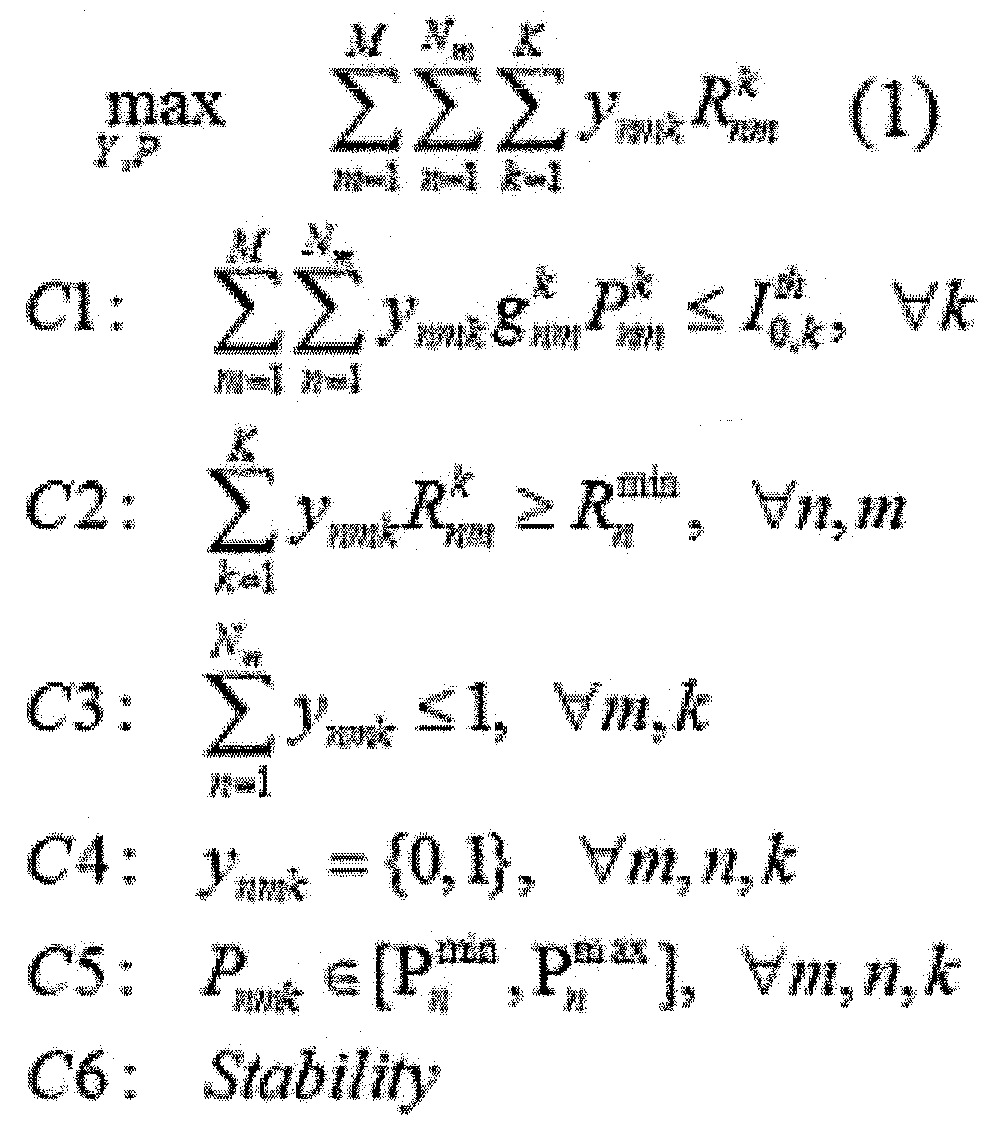
[수식 2]에서, 객체 (1)은 업링크 CSN(10)에서의 전체 네트워크 스루풋을 나타내며, 이를 위해 6개의 제한을 갖는다. 제한1(C1)은 MBS 보호를 위한 제한이고, 제한2(C2)는 각 CSUE의 최소 데이터 전송률 요구사항을 설명하며, 제한3(C3)은 CSUE가 대부분의 부채널에서 할당되는 것을 나타내고, 제한4(C4)에서, 부채널 인덱스 ynmk=1는 부채널 k가 CSBS m에서 CSUE n에 할당되는 것을 나타내지만 그렇지 않은 경우에는 ynmk=0인 것을 의미하며, 제한5(C5)는 CSUE n의 전송 전력 범위를 나타내고, 제한6(C6)은 다음 섹션에서 최후의 매칭이 안정된 그룹인 것을 보장한다는 것을 의미한다.
상기한 바와 같은 제한을 통해 MBS(11)을 보호하고 CSUE들의 최소 데이터 전송률 요구사항을 만족시키면서 업링크 CSN(10)에서의 전체 네트워크 스루풋을 최대로 하기 위한 부채널 및 전력 할당에 관한 최적화는 NP hard 문제가 될 수 있다.
따라서, 이를 해결하기 위해, 일대다 매칭 게임 접근에 기초한 본 발명의 실시예에 대해 설명한다.
도 2는 본 발명의 실시예에 따른 인지 소형 셀 네트워크에서의 업링크 자원 할당을 위한 프레임워크의 개략적인 구성을 도시한 도면이다.
도 2를 참조하면, 본 발명의 실시예에 따른 인지 소형 셀 네트워크에서의 업링크 자원 할당을 위한 프레임워크에서는 일대다 매칭 게임에 기초한 분산 알고리즘에 따른 설계를 제안한다.
먼저, 본 발명의 실시예에 따른 프레임워크는 입력 스테이지(100), 초기화 스테이지(200), 경쟁 스테이지(300), 결합 자원 할당 스테이지(400), 자원 할당 스테이지(500) 및 출력 스테이지(600)를 포함한다.
입력 스테이지(100)는 매크로 기지국(11)을 보호하기 위해, CSUE(41), 가용 부채널, CSUE(41)의 QoS 요구, 간섭 임계값으로 구성되는 원본 문제(수식 2)의 입력 파라미터들을 준비한다.
초기화 스테이지(200)는 다음의 경쟁 스테이지(300)를 위한 준비를 위해 초기화를 수행한다. 이 스테이지에서, CSBS(31)는 자신의 CSUE(41)들에게 가용한 부채널 정보를 방송한다. 따라서, CSUE(41)는 가용한 모든 부채널에 대해 균등한 전송 전력을 가정하여 부채널별로 유틸리티 함수값을 추정한다. 그 후, 추정한 유틸리티 합수값들을 CSUE(41)의 선호 관계(preference relation), 즉  로 저장한다.
경쟁 스테이지(300)에서, CSUE(41)는 선호 관계에서 가장 선호하는 부채널의 제안을 전송한다. 즉, CSUE(41)는 선호 관계가 가장 높은 값을 갖는  에 해당하는 부채널 정보를 CSBS(31)로 전송하고, CSBS(31)는 CSUE(41)로부터의 부채널에 대한 제안을, 수락 제어(admission control)를 수행하는 CSM(51)에게 전달한다.
결합 자원 할당 스테이지(400)는 두 개의 부 스테이지, 즉 승인 제어 부스테이지(410)와 전력 할당 부스테이지(420)로 구성된다.
첫 번째인 부 스테이지인 승인 제어 부스테이지(410)에서, CSM(51)은 각 부채널에 대해 제안된 CSUE(41)로부터의 정보를 수집한다. 그 후, CSM(51)에서, 각 부채널 상에서 최소 속도와 MBS 보호를 보장하기 위해 부채널을 액세스할 수 있는 CSUE(41)에 대해 액세스 승인 그룹으로 선정한다. 이 부스테이지(410)에서, 일부 CSUE(41)는 CSM(51)에 의해, 요청된 부채널에 대한 액세스가 거절될 것이다.
다음, 두 번째 부스테이지인 전력 할당 부스테이지(420)에서, CSM(51)에 의해 승인된 CSUE(41)에 대해 전력 할당이 수행된다.
본 게임에서 거절된 CSUE(41)는 앞의 경쟁 스테이지(300)으로 되돌아 가서 다시 경쟁에 참가하게 된다. 이러한 경쟁 스테이지(300)는 CSUE(41)로부터 CSM(51)으로 새로운 요청이 없는 경우에 종료된다.
자원 할당 스테이지(500)에서, CSUE(41)는 전력 할당 부스테이지(420)에서 CSM(51)에 의해 결정된 부채널별로 각각 전력 할당을 수행한다.
출력 스테이지(600)에서, CSUE(41)는 자원 할당 스테이지(500)에서 할당된 최적의 부채널과 전력으로 CSBS(31)를 통한 데이터 전송을 수행한다.
이하, 상기한 본 발명의 실시예에 대해 보다 상세하게 설명한다.
먼저, [수식 2]에서의 제한1 내지 제한6(C1 내지 C6)를 만족하는 두 개의 집합 N과 K사이에 일대다 매칭을 사용한다.
제안 1 : [수식 2]가 일대다 매칭 게임으로 공식화된다.
매칭 기반 부채널 할당 문제가 (N, M, ,
, , qn=1, qk=Nk)로부터의 함수로서 튜플(tuple)에 의해 정의된다. 여기서, qk는 CSM(51)에서의 부채널 k의 한도(quato)로서, 부채널 k에 할당될 수 있는 CSUE의 최대 개수를 나타낸다. 이 qk은 제한1, 2, 5, 6(C1, C2, C5, C6)에 종속되는 동적 한도이다. 파라미터 qn은 제한3(C3)로서 설명되는 CSUE n의 한도이다. 제안된 해결 수단은, 선호 함수
  와
와  에 기초하는 CSUE와 CSBS 사이의 최후 할당을 제공하는 μSCA:N∪K→N∪K 매칭 게임의 매칭 함수이다.
제안된 매칭 게임에서, 두 개의 선호 관계  와
와  는 다음의 유틸리티 함수에 기초하여 공식화된다.
CSUE 유틸리티: 각 CSUE n의 유틸리티 값( )은 [수학식 3]에서와 같이 부채널 k에 대한 선호 관계를 형성한다.
[수식 3]
Umn(k)=Rnm
k
각 부채널에 대한 CSM 유틸리티: CSM(51) 측에서, CSM(51)은 [수식 4]와 같이, CSBS m에서 요구된 CSUE n에 주어진 각 부채널 k에 대한 유틸리티 값( )을 추정한다.
[수식 4]

여기서, [수식 4]에서 첫 번째 텀은 제한2(C2)의 만족도를 정량화하는 측정을 나타내고, 두 번째 텀은 제한1(C1)의 위반 정도(violation degree)를 정량화하는 측정을 나타낸다.
이와 같이 제안된 매칭 게임에서, Nk는 다음과 같이, CSM(51) 요구에 종속되는 동적 한도이다.
CSM 요구: 부채널 k에 대해 요청된 CSUE의 집합 Nk
req가 주어지면, CSM(51)은 MBS 보호와 CSUE의 최소 속도를 보장하는 동안 부채널 k에 대한 전체 데이터 속도를 최대화하기 위해 부채널 및 전력 할당 전략을 가진다. 기존의 [수식 2]로부터, CSM(51)의 요구 함수는 [수식 5]와 같이 공식화된다.
[수식 5]
[규칙 제91조에 의한 정정 27.12.2016]
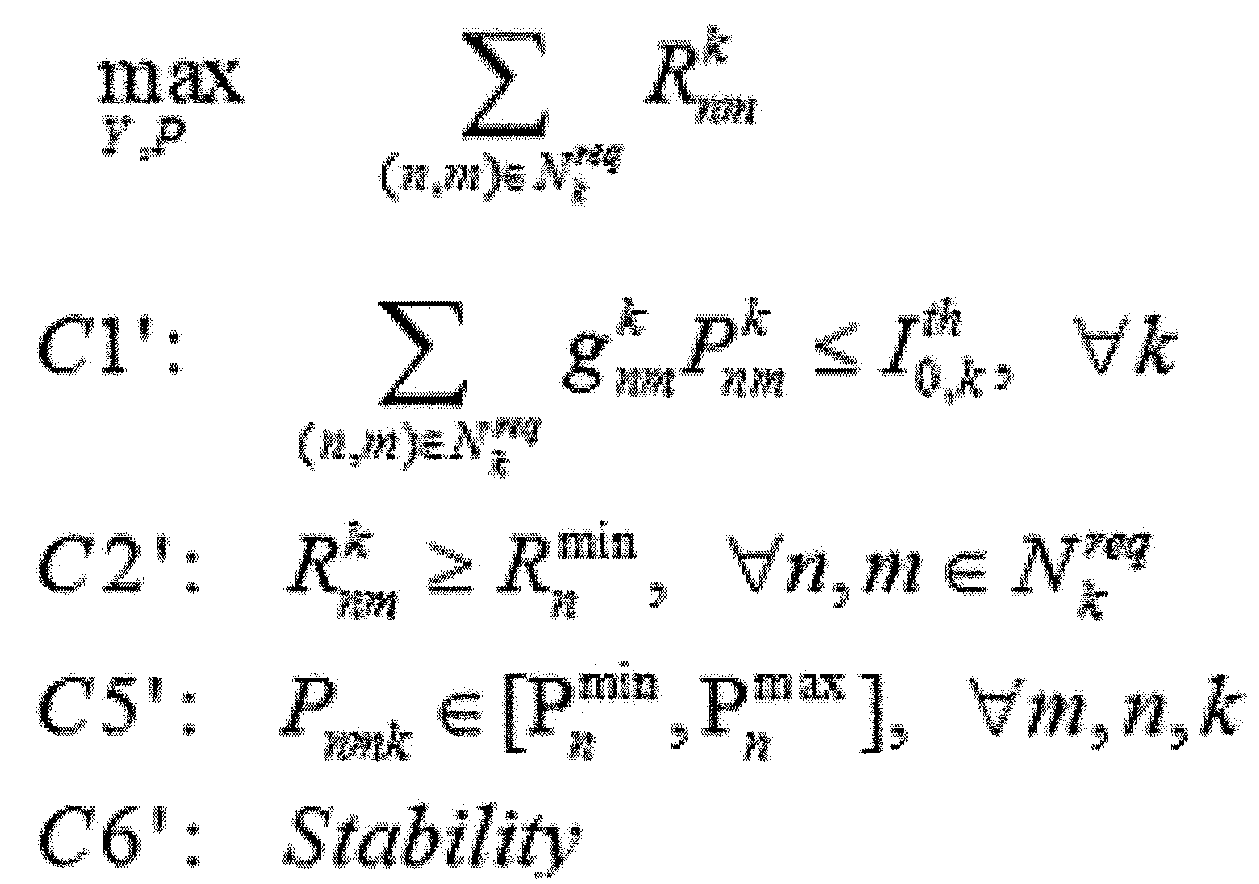
이러한 [수식 5]에서 변경되지 않은 제한을 적용하면, 다음의 [수식 6]과 같다.
[수식 6]
[규칙 제91조에 의한 정정 27.12.2016]
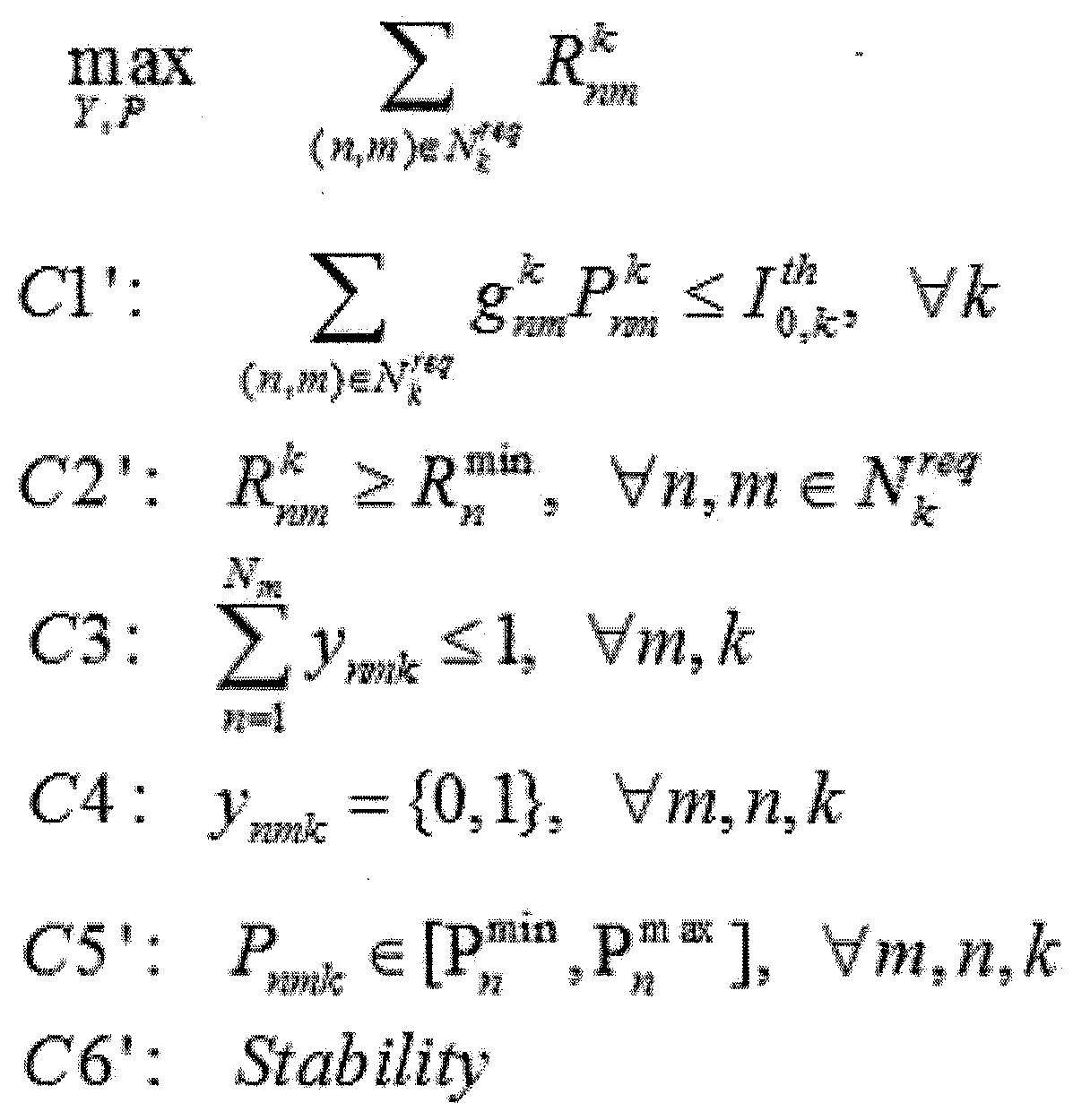
[수식 6]에 대해 주어진 실행가능한 해결 수단은 변수 P에서의 오목 문제(concave problem)임을 알 수 있다. 따라서, [수식 6]은 이미 잘 알려져 있는 matlab(matrix laboratory) 소프트웨어에서 콘벡스(convex)용 CVX 툴박스와 같은 일부 해결 수단을 사용하여 해결될 수 있다.
제안된 게임에서, [수식 6]이 실행불가능하다면, 경쟁 스테이지(300)에서 집합 Nk
req에서의 CSUE는 가장 작은 선호 관계, 즉 최저의 Unm(k)을 갖도록 CSM(51)에 의해 제거될 것이다.
이하, 상기한 제안과 설정으로부터, [수식 6]을 해결하기 위해 일대다 매칭 게임에 기초한 분산 알고리즘에 따른 인지 소형 셀 네트워크에서의 업링크 자원 할당 방법에 대해 설명한다.
도 3은 본 발명의 실시예에 따른 CSUE측에서의 업링크 자원 할당 방법의 흐름도이고, 도 4는 본 발명의 실시예에 따른 CSM측에서의 업링크 자원 할당 방법의 흐름도이다.
먼저, 도 3을 참조하여 CSUE(41)측에서의 업링크 자원 할당 방법에 대해 설명한다.
본 발명의 실시예에서는 하나의 CSUE(41)를 사용하여 설명하지만 다른 CSUE들에게도 적용될 수 있다는 것이 이해될 것이다.
먼저, CSUE(41)는 CSBS(31)로부터 방송을 통해 전달받은 가용 부채널 정보를 사용하여 집합 K 내에 속하는 모든 부채널별로 선호 관계( )를 형성한다(S100). 이 때, 부채널별 선호 관계(
 )는 상기한 [수식 3]을 통해서 CSUE(41)의 유틸리티 값으로 산출될 수 있다.
그 후, CSUE(41)는 부채널별 선호 관계 중에서 최대값을 갖는 부채널을 액세스하기 위한 요청을 CSM(51)로 전송한다(S110). 여기서, CSUE(41)에 의해 선택되는 부채널 k = arg max ( )가 된다.
이와 같이, 액세스 요청을 CSM(51)으로 전송한 CSUE(41)는 CSM(51)으로부터 해당 요청이 승인되는지 아니면 거절되는지의 답변을 대기한다.
그 후, CSM(51)으로부터 액세스 요청에 대한 답변이 수신되면(S120), 해당 액세스 요청이 승인되었는지를 판단하고(S130), 만약 액세스 요청이 승인되었으면 CSM(51)으로부터 전력 할당 정보를 수신한다(S140).
그 후, CSUE(41)는 상기 단계(S140)에서 수신된 전력 할당 정보를 사용하여 CSUE(41)에서의 부채널별 전력 할당을 수행한다(S150).
그리고, CSUE(41)는 승인된 부채널과 할당된 최적의 전력을 사용하여 CSBS(31)로 데이터 전송을 수행한다(S160).
한편, 상기 단계(S130)에서 해당 액세스 요청이 거절되었으면, CSUE(41)는 해당 액세스 요청이 승인될 때까지 상기 단계(S110, S120, S130)를 반복 수행한다. 즉, CSUE(41)는 해당 액세스 요청이 승인될 때까지 다른 CSUE들과의 경쟁에 계속 참여하게 된다.
다음, 도 4를 참조하여 CSM(51)측에서의 업링크 자원 할당 방법에 대해 설명한다.
먼저, CSM(51)은 매크로 기지국(11)을 보호하기 위해, CSUE(41), 가용 부채널, CSUE(41)의 QoS 요구, 간섭 임계값으로 구성되는 원본 문제(수식 2)의 입력 파라미터들을 준비한다(S200).
다음, 액세스 요청을 전송한 CSUE(41)를 비롯한 모든 CSUE의 정보를 수집하여 Nk
req를 형성한다(S210).
그 후, Nk
req에 속하는 모든 CSUE에 대해 선호 관계( )를 형성한다(S220). 이 때, CSUE별 선호 관계(
 )는 상기한 [수식 4]를 통해서 CSM(51)의 유틸리티 값으로 산출될 수 있다.
다음, CSM(51)은 [수식 6]을 통해서 실행 가능 여부를 판단한다(S230).
만약 실행 가능하지 않은 것으로 판단되는 경우(S240) 최저 선호 관계( )를 갖는 CSUE를 제거한다(S250). 그리고, 이러한 CSUE 제거 단계(S250)는 본 발명의 실시예에 따른 자원 할당이 실행 가능할 때까지 계속 반복된다.
한편, 상기 단계(S240)에서 실행 가능한 것으로 판단되면, Nk
req에 남아 있는 CSUE들에 대해 요청 액세스 승인을 하고 해당 CSUE를 Nk
accepted에 포함시킨다(S260).
그 후, CVX 툴박스를 사용하여 [수식 2]를 사용하여 최대의 데이터 전송률를 제공할 수 있는 최적의 전송 전력을 산출한다(S270).
그리고, 산출된 전송 전력 정보를 액세스 승인된 CSUE들에게 액세스 요청에 대한 답변으로 액세스 승인과 함께 전송한다(S280).
한편, CSM(51)은 CSUE로부터 액세스 요청이 있는 경우, 상기한 단계 S210 내지 S290)을 반복 수행하게 된다.
이하, 도 5를 참조하여 상기한 본 발명의 실시예에 따른 자원 할당 방법의 시뮬레이션 결과에 대해 설명한다.
시뮬레이션의 경우, 본 발명의 실시예에 따른 성능을 평가하기 위해 Matlab에서 수행한 시뮬레이션을 나타낸다.
M=5 CSBS가 MBS(11)와 함께 위치하는 2층열(two-tier)의 네트워크를 고려한다. 일부 파라미터는 다음과 같이 설정된다. Pnm
max
= 100 mW, I0
th = -75 dBmW, σ2 = -105 dBm, Bk = 360 kHz, K=5 부채널.
채널 이득은 평균값 h(d) = h0(d/15)-4를 갖는 Rayleigh 랜덤 변수로 가정되며, 여기서 h0는 거리 15m에서의 기준 채널 이득이다.
도 5를 참조하면, 본 발명의 실시예에 따른 방법이 기존의 4가지 방식, 즉 그리디 방식(Greedy scheme), 랜덤 방식(random scheme), 승인 제어 아닌 방식(no admission control scheme), 및 고정 전력 방식(fixed power scheme)과 비교되었다.
도 5에서 (a)는 CSUE의 개수(number of CSUEs)대 전체 평균 스루풋(average overall throughput)의 결과를 나타내고, (b)는 CSUE의 개수대 평균 아웃티지 확률(average outage probability)을 나타낸다.
도 5의 (a) 및 (b)를 통해서, 본 발명의 실시예에 따른 방법이 전체 스루풋과 아웃티지 확률에서 다른 방식들을 능가함을 알 수 있다.
이와 같이, 본 발명의 실시예에서는, 업링크 인지 소형 셀 네트워크에서의 부채널 및 전력 할당에 대한 새로운 프레임워크를 제공하였다. 본 발명의 실시예를 통해 부채널 및 전력 할당의 문제가 최적화 문제로서 공식화되었으며, 매크로 기지국을 보호하고 제공된 소형 셀 사용자의 최소 데이터 속도 요구사항을 보장하는 동안 업링크 데이터 전송에서의 전체 데이터 전송률을 최대화할 수 있다.
이상에서 본 발명의 실시예에 대하여 상세하게 설명하였지만 본 발명의 권리범위는 이에 한정되는 것은 아니고 다음의 청구범위에서 정의하고 있는 본 발명의 기본 개념을 이용한 당업자의 여러 변형 및 개량 형태 또한 본 발명의 권리범위에 속하는 것이다.
Claims (15)
- 인지 소형 셀 네트워크에서 소형 셀 관리기가 업링크 자원을 할당하는 방법에 있어서,소형 셀 사용자로부터의 액세스 요청을 수집하는 단계;소형 셀 사용자별 선호 관계(preference relation)를 형성하는 단계;업링크 전송시 최대 데이터 전송률을 제공하기 위한 부채널별 전송 전력을 산출하는 단계; 및산출되는 부채널별 전송 전력 정보를 상기 소형 셀 사용자에게 전달하는 단계를 포함하는 자원 할당 방법.
- 제1항에 있어서,상기 부채널별 전송 전력을 산출하는 단계가,업링크 전송시 최대 데이터 전송률 제공이 가능한 지의 여부를 판단하는 단계;업링크 전송시 최대 데이터 전송률 제공이 가능하지 않은 경우, 최저의 선호 관계를 갖는 소형 셀 사용자에 대한 액세스 요청을 거절하는 단계; 및업링크 전송시 최대 데이터 전송률 제공이 가능한 경우, 소형 셀 사용자에 대한 액세스 요청을 승인하고, 부채널별 전송 전력을 산출하는 단계를 포함하는 자원 할당 방법.
- 제2항에 있어서,상기 액세스 요청을 거절하는 단계는 업링크 전송시 최대 데이터 전송률 제공이 가능할 때까지 액세스 요청을 한 소형 셀 사용자들 중 거절되지 않은 소형 셀 사용자들에 대해 반복 수행되는 것을 특징으로 하는 자원 할당 방법.
- 제1항에 있어서,상기 소형 셀 사용자별 선호 관계는 상기 소형 셀 사용자에 의해 액세스 요청된 부채널에 대한 유틸리티 값에 의해 추정되며,상기 유틸리티 값은 다음의 관계식
 - 여기서, Rnm k는 소형 셀 기지국(m)에 대해 소형 셀 사용자(n)이 부채널(k)를 사용할 때의 소형 셀 사용자(n)의 데이터 전송률이고, Rn min는 소형 셀 사용자(n)의 최소 데이터 전송률 요구사항이며, β는 시스템 스루풋 감소 정도를 캡쳐하기 위한 가중치 파라미터이고, Pnm k는 부채널 k 상에서 소형 셀 사용자(n)와 소형 셀 기지국(m) 사이에 할당된 전력이며, ynmk는 부채널 k가 소형 셀 기지국(m)과 소형 셀 사용자(n) 사이에 할당되었는지의 여부를 나타내고, gnm,0 k는 부채널 k 상에서 소형 셀 기지국(m)과 소형 셀 사용자(n) 사이의 채널 이득이며, I0,k th는 매크로 기지국에서 부채널 k에 대해 미리 설정된 간섭 전력 임계값을 나타냄 -을 사용하여 산출되는 자원 할당 방법.
 - [규칙 제91조에 의한 정정 27.12.2016]
제4항에 있어서,
상기 업링크 전송시 최대 데이터 전송률 제공이 가능한 지의 여부는 다음의 관계식
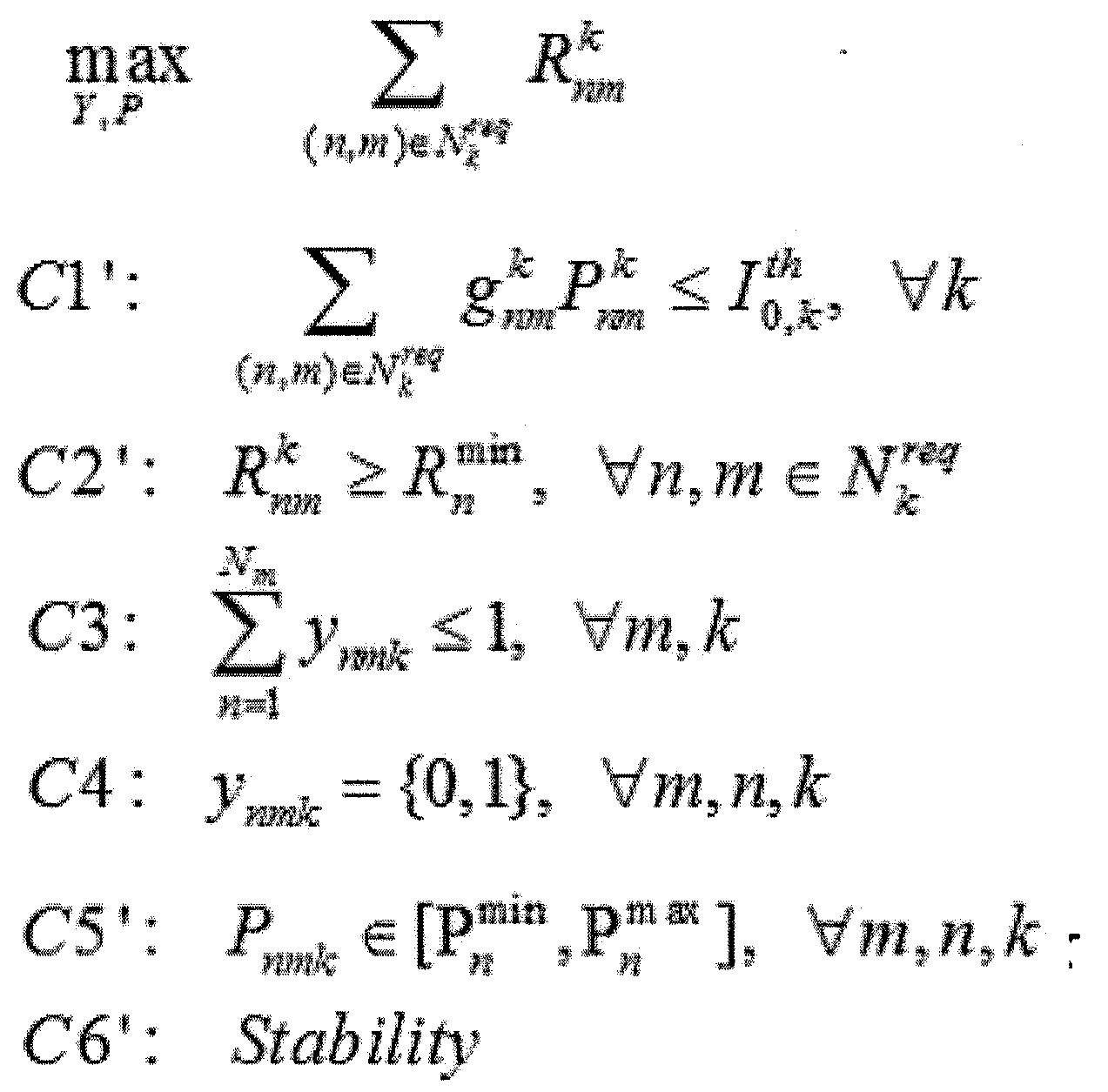
- 여기서, Nk req는 액세스 요청을 한 소형 셀 사용자의 집합이고, Pnmk는 부채널 k 상에서 소형 셀 사용자(n)와 소형 셀 기지국(m) 사이에 할당된 전력임 -
을 사용하여 판단되는 자원 할당 방법. - 제5항에 있어서,상기 부채널별 전송 전력을 산출하는 단계에서, 상기 관계식에서 전력에 관한 변수의 오목 문제를 풀어서 부채널별 전송 전력을 산출하는 것을 특징으로 하는 자원 할당 방법.
- 인지 소형 셀 네트워크에서 소형 셀 사용자(Cognitive Small cell User Equipment)가 업링크 자원을 할당하는 방법에 있어서,가용한 모든 부채널별 선호 관계(preference relation)를 형성하는 단계;최대의 선호 관계를 갖는 부채널에 대한 액세스 요청을 소형 셀 관리기로 전송하는 단계;상기 소형 셀 관리기로부터 전달되는 전송 전력 정보를 사용하여 액세스가 결정된 부채널별로 전력 할당을 수행하는 단계; 및할당된 전력을 사용하여 액세스 결정된 부채널을 통해 데이터 전송을 수행하는 단계를 포함하는 자원 할당 방법.
- 제7항에 있어서,상기 소형 셀 관리기로 전송하는 단계와 상기 전력 할당을 수행하는 단계 사이에,상기 액세스 요청에 대한 답변을 수신하는 단계; 및상기 답변을 통해 상기 액세스 요청이 승인되었는지를 판단하는 단계를 포함하고,상기 액세스 요청이 승인된 것으로 판단되는 경우 상기 전력 할당을 수행하는 단계를 수행사고,상기 액세스 요청이 거절된 것으로 판단되는 경우 승인될 때까지 상기 소형 셀 관리기로 전송하는 단계를 반복 수행하는것을 특징으로 하는 자원 할당 방법.
- 제7항에 있어서,상기 부채널별 선호 관계를 형성하는 단계 전에,소형 셀 기지국으로부터 가용한 부채널 정보를 방송을 통해 수신하는 단계를 더 포함하는 자원 할당 방법.
- 제7항에 있어서,상기 부채널별 선호 관계는 가용한 모든 부채널에 대해 균등한 전송 전력을 가정하여 형성되는 것을 특징으로 하는 자원 할당 방법.
- 제10항에 있어서,상기 부채널별 선호 관계는 가용한 모든 부채널에 대한 유틸리티 값에 의해 추정되며,상기 유틸리티 값은 다음의 관계식Unm(k)=Rnm k- 여기서, Rnm k는 소형 셀 기지국(m)에 대해 소형 셀 사용자(n)가 부채널(k)을 사용할 때의 소형 셀 사용자(n)의 데이터 전송률임 -을 사용하여 산출되고,상기 Rnm k는 다음의 관계식
 - 여기서, Bk는 부채널 k의 대역폭이고, gnm k는 부채널 k 상에서 소형 셀 사용자(n)과 소형 셀 기지국(m) 사이의 채널 이득이며, Pnm k는 부채널 k 상에서 소형 셀 사용자(n)과 소형 셀 기지국(m) 사이에 할당된 전력이고, gkm kPk0 k는 소형 셀 기지국(m)에서 매크로 사용자(k)의 간섭 레벨이며, σ2은 소형 셀 기지국에서의 가우시안 잡음임 -을 사용하여 산출되는 자원 할당 방법.
 - 인지 소형 셀 네트워크 시스템에 있어서,가용한 부채널별 선호 관계를 형성하고, 형성되는 부채널별 선호 관계에 기초하여 액세스 요청을 각각 수행하는 복수의 소형 셀 사용자; 및상기 복수의 소형 셀 사용자로부터의 액세스 요청을 수신하고, 액세스를 요청한 소형 셀 사용자별 선호 관계를 형성한 후, 업링크 전송시 최대 데이터 전송률을 제공하기 위한 부채널별 전송 전력을 산출하여 액세스를 요청한 소형 셀 사용자에게 전달하는 소형 셀 관리기를 포함하는 인지 소형 셀 네트워크 시스템.
- 제12항에 있어서,상기 소형 셀 사용자는 가용한 부채널별 선호 관계 중에서 최대의 선호 관계를 갖는 부채널을 통한 액세스 요청을 상기 소형 셀 관리기로 전송하는 것을 특징으로 하는 인지 소형 셀 네트워크 시스템.
- 제13항에 있어서,상기 소형 셀 관리기는 엑세스를 요청한 소형 셀 사용자들 중에서 업링크 전송시 최대 데이터 전송률 제공이 가능하지 않은 소형 셀 사용자의 액세스 요청을 거절하고,액세스 요청이 거절된 상기 소형 셀 사용자는 액세스 요청이 승인될 때까지 부채널별 선호 관계에 기초한 액세스 요청을 수행하는것을 특징으로 하는 인지 소형 셀 네트워크 시스템.
- 제14항에 있어서,상기 소형 셀 관리기는 소형 셀 사용자의 액세스 요청을 거절하는 경우, 액세스를 요청한 소형 셀 사용자들 중에서 최저의 선호 관계를 갖는 소형 셀 사용자의 액세스 요청을 거절하는 것을 특징으로 하는 인지 소형 셀 네트워크 시스템.
Priority Applications (2)
| Application Number | Priority Date | Filing Date | Title |
|---|---|---|---|
| US16/062,659 US10524211B2 (en) | 2015-12-15 | 2016-12-14 | Uplink resource allocation method and cognitive small cell network system for executing same |
| US16/720,207 US10813055B2 (en) | 2015-12-15 | 2019-12-19 | Uplink resource allocation method and cognitive small cell network system for executing same |
Applications Claiming Priority (4)
| Application Number | Priority Date | Filing Date | Title |
|---|---|---|---|
| KR20150179542 | 2015-12-15 | ||
| KR10-2015-0179542 | 2015-12-15 | ||
| KR1020160005368A KR101770810B1 (ko) | 2015-12-15 | 2016-01-15 | 업링크 자원 할당 방법 및 그 방법을 수행하는 인지 소형 셀 네트워크 시스템 |
| KR10-2016-0005368 | 2016-01-15 |
Related Child Applications (2)
| Application Number | Title | Priority Date | Filing Date |
|---|---|---|---|
| US16/062,659 A-371-Of-International US10524211B2 (en) | 2015-12-15 | 2016-12-14 | Uplink resource allocation method and cognitive small cell network system for executing same |
| US16/720,207 Division US10813055B2 (en) | 2015-12-15 | 2019-12-19 | Uplink resource allocation method and cognitive small cell network system for executing same |
Publications (1)
| Publication Number | Publication Date |
|---|---|
| WO2017105070A1 true WO2017105070A1 (ko) | 2017-06-22 |
Family
ID=59057032
Family Applications (1)
| Application Number | Title | Priority Date | Filing Date |
|---|---|---|---|
| PCT/KR2016/014625 Ceased WO2017105070A1 (ko) | 2015-12-15 | 2016-12-14 | 업링크 자원 할당 방법 및 그 방법을 수행하는 인지 소형 셀 네트워크 시스템 |
Country Status (1)
| Country | Link |
|---|---|
| WO (1) | WO2017105070A1 (ko) |
Cited By (2)
| Publication number | Priority date | Publication date | Assignee | Title |
|---|---|---|---|---|
| CN109361483A (zh) * | 2018-10-12 | 2019-02-19 | 南京邮电大学 | 一种主用户最小速率需求下的认知无线供能网络资源分配方法 |
| CN114375010A (zh) * | 2021-06-28 | 2022-04-19 | 山东华科信息技术有限公司 | 基于sdn和匹配理论的配电物联网 |
Citations (3)
| Publication number | Priority date | Publication date | Assignee | Title |
|---|---|---|---|---|
| KR101172657B1 (ko) * | 2012-05-07 | 2012-08-08 | 상명대학교 산학협력단 | 소형 기지국의 다중 채널 사용 장치 및 방법 |
| KR20130068015A (ko) * | 2011-12-15 | 2013-06-25 | 한국전자통신연구원 | 차세대 무선 액세스 네트워크에서의 자원 할당 장치 및 자원 할당 방법 |
| KR20150086741A (ko) * | 2014-01-20 | 2015-07-29 | 한국전자통신연구원 | 인지무선 소형 셀 환경에서의 자원할당 방법 및 자원할당 장치 |
-
2016
- 2016-12-14 WO PCT/KR2016/014625 patent/WO2017105070A1/ko not_active Ceased
Patent Citations (3)
| Publication number | Priority date | Publication date | Assignee | Title |
|---|---|---|---|---|
| KR20130068015A (ko) * | 2011-12-15 | 2013-06-25 | 한국전자통신연구원 | 차세대 무선 액세스 네트워크에서의 자원 할당 장치 및 자원 할당 방법 |
| KR101172657B1 (ko) * | 2012-05-07 | 2012-08-08 | 상명대학교 산학협력단 | 소형 기지국의 다중 채널 사용 장치 및 방법 |
| KR20150086741A (ko) * | 2014-01-20 | 2015-07-29 | 한국전자통신연구원 | 인지무선 소형 셀 환경에서의 자원할당 방법 및 자원할당 장치 |
Non-Patent Citations (2)
| Title |
|---|
| LEANH, TUAN ET AL.: "User Association and Sub-channel Allocation in Uplink Cognitive Smallcell Network", JOURNAL OF KOREA COMPUTER CONGRESS 2015 OF THE KOREAN INSTITUTE OF INFORMATION AND ENGINEERS, June 2015 (2015-06-01), pages 1238 - 1240, Retrieved from the Internet <URL:http://www.dbpia.co.kr/Article/NODE06394369> * |
| ZHANG, HAIJUN ET AL.: "Resource Allocation for Cognitive Small Cell Networks: A Cooperative Bargaining Game Theoretic Approach", IEEE TRANSACTIONS ON WIRELESS COMMUNICATIONS, vol. 14, no. 6, June 2015 (2015-06-01), pages 3481 - 3493, XP011584053, Retrieved from the Internet <URL:https://www.researchgate.net/publication/273060943> * |
Cited By (5)
| Publication number | Priority date | Publication date | Assignee | Title |
|---|---|---|---|---|
| CN109361483A (zh) * | 2018-10-12 | 2019-02-19 | 南京邮电大学 | 一种主用户最小速率需求下的认知无线供能网络资源分配方法 |
| CN109361483B (zh) * | 2018-10-12 | 2021-03-26 | 南京邮电大学 | 一种主用户最小速率需求下的认知无线供能网络资源分配方法 |
| CN114375010A (zh) * | 2021-06-28 | 2022-04-19 | 山东华科信息技术有限公司 | 基于sdn和匹配理论的配电物联网 |
| CN114375011A (zh) * | 2021-06-28 | 2022-04-19 | 山东华科信息技术有限公司 | 基于匹配理论的配电物联网任务卸载方法 |
| CN114375010B (zh) * | 2021-06-28 | 2022-10-14 | 山东华科信息技术有限公司 | 基于sdn和匹配理论的配电物联网系统 |
Similar Documents
| Publication | Publication Date | Title |
|---|---|---|
| WO2012111974A2 (en) | Method and apparatus for uplink power control in wireless communication system | |
| WO2009145521A2 (en) | Method of transmitting and receiving uplink data using transmission of profile indexes | |
| WO2010107264A2 (en) | Transmission frame and resource allocation method for communication system including base stations | |
| WO2011078487A2 (en) | Method for assigning and managing reference signals in a multi-cell environment, and network device and terminal for applying the method | |
| WO2010095878A2 (en) | Multi-cell network including communication device scheduling outer cell frequency resource and method for same | |
| WO2012144721A1 (ko) | 다른 클러스터의 비율 변경을 보상하는 무선 자원의 배분 | |
| Salameh et al. | A batch-based MAC design with simultaneous assignment decisions for improved throughput in guard-band-constrained cognitive networks | |
| Amer et al. | Association optimization in Wi-Fi networks: Use of an access-based fairness | |
| WO2020022592A1 (ko) | 인지 무선 네트워크에서 2차 사용자의 패킷 전송 성능 개선 방법 및 그 장치 | |
| WO2015102447A1 (ko) | 배터리 사용 패턴에 따른 데이터 전송 방법 | |
| WO2017105070A1 (ko) | 업링크 자원 할당 방법 및 그 방법을 수행하는 인지 소형 셀 네트워크 시스템 | |
| WO2012030037A1 (ko) | 이동통신 시스템에서 단말의 그룹을 고려한 스케줄링 | |
| WO2018217056A1 (ko) | 무선 통신 시스템에서 서비스의 품질 보장 방법 및 장치 | |
| WO2015023079A1 (ko) | 가상 셀 네트워크 시스템에서 랜덤 억세스 방법 및 장치 | |
| Li et al. | Queuing method in combined channel aggregation and fragmentation strategy for dynamic spectrum access | |
| WO2012077992A2 (ko) | 무선 통신 시스템에서 기지국의 자원 운용 방법 및 장치 | |
| WO2022255751A1 (ko) | 통신 시스템에서 적응적 보안 적용을 위한 방법 및 장치 | |
| US10813055B2 (en) | Uplink resource allocation method and cognitive small cell network system for executing same | |
| WO2009151210A2 (en) | Apparatus and method for allocating subchannels and controlling interference in ofdma systems | |
| Chai et al. | Service characteristics-oriented joint ACB, cell selection, and resource allocation scheme for heterogeneous M2M communication networks | |
| Zeng et al. | Lightweight privacy preservation for secondary users in cognitive radio networks | |
| WO2017065464A1 (ko) | 무선 통신 시스템 내 협력 통신 방법 및 장치 | |
| EP2397013A2 (en) | Method and system for managing communication in wireless communication network | |
| WO2011084033A2 (en) | Wireless communication system and random access method thereof | |
| EP3255951B1 (en) | Pseudo access method, pseudo access direct-connection scheduling method, stations and access point |
Legal Events
| Date | Code | Title | Description |
|---|---|---|---|
| 121 | Ep: the epo has been informed by wipo that ep was designated in this application |
Ref document number: 16876012 Country of ref document: EP Kind code of ref document: A1 |
|
| NENP | Non-entry into the national phase |
Ref country code: DE |
|
| 122 | Ep: pct application non-entry in european phase |
Ref document number: 16876012 Country of ref document: EP Kind code of ref document: A1 |