WO2017096047A1 - Absorbent and protective composition including an elastomeric copolymer and superabsorbent - Google Patents
Absorbent and protective composition including an elastomeric copolymer and superabsorbent Download PDFInfo
- Publication number
- WO2017096047A1 WO2017096047A1 PCT/US2016/064426 US2016064426W WO2017096047A1 WO 2017096047 A1 WO2017096047 A1 WO 2017096047A1 US 2016064426 W US2016064426 W US 2016064426W WO 2017096047 A1 WO2017096047 A1 WO 2017096047A1
- Authority
- WO
- WIPO (PCT)
- Prior art keywords
- composition
- polystyrene
- copolymer
- block
- thermoplastic elastomeric
- Prior art date
- Legal status (The legal status is an assumption and is not a legal conclusion. Google has not performed a legal analysis and makes no representation as to the accuracy of the status listed.)
- Ceased
Links
Classifications
-
- C—CHEMISTRY; METALLURGY
- C08—ORGANIC MACROMOLECULAR COMPOUNDS; THEIR PREPARATION OR CHEMICAL WORKING-UP; COMPOSITIONS BASED THEREON
- C08L—COMPOSITIONS OF MACROMOLECULAR COMPOUNDS
- C08L23/00—Compositions of homopolymers or copolymers of unsaturated aliphatic hydrocarbons having only one carbon-to-carbon double bond; Compositions of derivatives of such polymers
- C08L23/02—Compositions of homopolymers or copolymers of unsaturated aliphatic hydrocarbons having only one carbon-to-carbon double bond; Compositions of derivatives of such polymers not modified by chemical after-treatment
- C08L23/10—Homopolymers or copolymers of propene
-
- A—HUMAN NECESSITIES
- A47—FURNITURE; DOMESTIC ARTICLES OR APPLIANCES; COFFEE MILLS; SPICE MILLS; SUCTION CLEANERS IN GENERAL
- A47L—DOMESTIC WASHING OR CLEANING; SUCTION CLEANERS IN GENERAL
- A47L13/00—Implements for cleaning floors, carpets, furniture, walls, or wall coverings
- A47L13/10—Scrubbing; Scouring; Cleaning; Polishing
- A47L13/16—Cloths; Pads; Sponges
-
- A—HUMAN NECESSITIES
- A47—FURNITURE; DOMESTIC ARTICLES OR APPLIANCES; COFFEE MILLS; SPICE MILLS; SUCTION CLEANERS IN GENERAL
- A47L—DOMESTIC WASHING OR CLEANING; SUCTION CLEANERS IN GENERAL
- A47L13/00—Implements for cleaning floors, carpets, furniture, walls, or wall coverings
- A47L13/10—Scrubbing; Scouring; Cleaning; Polishing
- A47L13/16—Cloths; Pads; Sponges
- A47L13/17—Cloths; Pads; Sponges containing cleaning agents
-
- B—PERFORMING OPERATIONS; TRANSPORTING
- B01—PHYSICAL OR CHEMICAL PROCESSES OR APPARATUS IN GENERAL
- B01J—CHEMICAL OR PHYSICAL PROCESSES, e.g. CATALYSIS OR COLLOID CHEMISTRY; THEIR RELEVANT APPARATUS
- B01J20/00—Solid sorbent compositions or filter aid compositions; Sorbents for chromatography; Processes for preparing, regenerating or reactivating thereof
- B01J20/22—Solid sorbent compositions or filter aid compositions; Sorbents for chromatography; Processes for preparing, regenerating or reactivating thereof comprising organic material
- B01J20/26—Synthetic macromolecular compounds
- B01J20/261—Synthetic macromolecular compounds obtained by reactions only involving carbon to carbon unsaturated bonds
-
- B—PERFORMING OPERATIONS; TRANSPORTING
- B01—PHYSICAL OR CHEMICAL PROCESSES OR APPARATUS IN GENERAL
- B01J—CHEMICAL OR PHYSICAL PROCESSES, e.g. CATALYSIS OR COLLOID CHEMISTRY; THEIR RELEVANT APPARATUS
- B01J20/00—Solid sorbent compositions or filter aid compositions; Sorbents for chromatography; Processes for preparing, regenerating or reactivating thereof
- B01J20/30—Processes for preparing, regenerating, or reactivating
- B01J20/32—Impregnating or coating ; Solid sorbent compositions obtained from processes involving impregnating or coating
- B01J20/3231—Impregnating or coating ; Solid sorbent compositions obtained from processes involving impregnating or coating characterised by the coating or impregnating layer
-
- B—PERFORMING OPERATIONS; TRANSPORTING
- B01—PHYSICAL OR CHEMICAL PROCESSES OR APPARATUS IN GENERAL
- B01J—CHEMICAL OR PHYSICAL PROCESSES, e.g. CATALYSIS OR COLLOID CHEMISTRY; THEIR RELEVANT APPARATUS
- B01J20/00—Solid sorbent compositions or filter aid compositions; Sorbents for chromatography; Processes for preparing, regenerating or reactivating thereof
- B01J20/30—Processes for preparing, regenerating, or reactivating
- B01J20/32—Impregnating or coating ; Solid sorbent compositions obtained from processes involving impregnating or coating
- B01J20/3291—Characterised by the shape of the carrier, the coating or the obtained coated product
- B01J20/3295—Coatings made of particles, nanoparticles, fibers, nanofibers
-
- B—PERFORMING OPERATIONS; TRANSPORTING
- B08—CLEANING
- B08B—CLEANING IN GENERAL; PREVENTION OF FOULING IN GENERAL
- B08B1/00—Cleaning by methods involving the use of tools
- B08B1/10—Cleaning by methods involving the use of tools characterised by the type of cleaning tool
- B08B1/14—Wipes; Absorbent members, e.g. swabs or sponges
- B08B1/143—Wipes
-
- B—PERFORMING OPERATIONS; TRANSPORTING
- B32—LAYERED PRODUCTS
- B32B—LAYERED PRODUCTS, i.e. PRODUCTS BUILT-UP OF STRATA OF FLAT OR NON-FLAT, e.g. CELLULAR OR HONEYCOMB, FORM
- B32B25/00—Layered products comprising a layer of natural or synthetic rubber
- B32B25/10—Layered products comprising a layer of natural or synthetic rubber next to a fibrous or filamentary layer
-
- B—PERFORMING OPERATIONS; TRANSPORTING
- B32—LAYERED PRODUCTS
- B32B—LAYERED PRODUCTS, i.e. PRODUCTS BUILT-UP OF STRATA OF FLAT OR NON-FLAT, e.g. CELLULAR OR HONEYCOMB, FORM
- B32B27/00—Layered products comprising a layer of synthetic resin
- B32B27/12—Layered products comprising a layer of synthetic resin next to a fibrous or filamentary layer
-
- B—PERFORMING OPERATIONS; TRANSPORTING
- B32—LAYERED PRODUCTS
- B32B—LAYERED PRODUCTS, i.e. PRODUCTS BUILT-UP OF STRATA OF FLAT OR NON-FLAT, e.g. CELLULAR OR HONEYCOMB, FORM
- B32B27/00—Layered products comprising a layer of synthetic resin
- B32B27/18—Layered products comprising a layer of synthetic resin characterised by the use of special additives
- B32B27/20—Layered products comprising a layer of synthetic resin characterised by the use of special additives using fillers, pigments, thixotroping agents
-
- B—PERFORMING OPERATIONS; TRANSPORTING
- B32—LAYERED PRODUCTS
- B32B—LAYERED PRODUCTS, i.e. PRODUCTS BUILT-UP OF STRATA OF FLAT OR NON-FLAT, e.g. CELLULAR OR HONEYCOMB, FORM
- B32B27/00—Layered products comprising a layer of synthetic resin
- B32B27/30—Layered products comprising a layer of synthetic resin comprising vinyl (co)polymers; comprising acrylic (co)polymers
- B32B27/302—Layered products comprising a layer of synthetic resin comprising vinyl (co)polymers; comprising acrylic (co)polymers comprising aromatic vinyl (co)polymers, e.g. styrenic (co)polymers
-
- B—PERFORMING OPERATIONS; TRANSPORTING
- B32—LAYERED PRODUCTS
- B32B—LAYERED PRODUCTS, i.e. PRODUCTS BUILT-UP OF STRATA OF FLAT OR NON-FLAT, e.g. CELLULAR OR HONEYCOMB, FORM
- B32B27/00—Layered products comprising a layer of synthetic resin
- B32B27/32—Layered products comprising a layer of synthetic resin comprising polyolefins
-
- B—PERFORMING OPERATIONS; TRANSPORTING
- B32—LAYERED PRODUCTS
- B32B—LAYERED PRODUCTS, i.e. PRODUCTS BUILT-UP OF STRATA OF FLAT OR NON-FLAT, e.g. CELLULAR OR HONEYCOMB, FORM
- B32B27/00—Layered products comprising a layer of synthetic resin
- B32B27/32—Layered products comprising a layer of synthetic resin comprising polyolefins
- B32B27/327—Layered products comprising a layer of synthetic resin comprising polyolefins comprising polyolefins obtained by a metallocene or single-site catalyst
-
- B—PERFORMING OPERATIONS; TRANSPORTING
- B32—LAYERED PRODUCTS
- B32B—LAYERED PRODUCTS, i.e. PRODUCTS BUILT-UP OF STRATA OF FLAT OR NON-FLAT, e.g. CELLULAR OR HONEYCOMB, FORM
- B32B3/00—Layered products comprising a layer with external or internal discontinuities or unevennesses, or a layer of non-planar shape; Layered products comprising a layer having particular features of form
- B32B3/26—Layered products comprising a layer with external or internal discontinuities or unevennesses, or a layer of non-planar shape; Layered products comprising a layer having particular features of form characterised by a particular shape of the outline of the cross-section of a continuous layer; characterised by a layer with cavities or internal voids ; characterised by an apertured layer
-
- B—PERFORMING OPERATIONS; TRANSPORTING
- B32—LAYERED PRODUCTS
- B32B—LAYERED PRODUCTS, i.e. PRODUCTS BUILT-UP OF STRATA OF FLAT OR NON-FLAT, e.g. CELLULAR OR HONEYCOMB, FORM
- B32B3/00—Layered products comprising a layer with external or internal discontinuities or unevennesses, or a layer of non-planar shape; Layered products comprising a layer having particular features of form
- B32B3/26—Layered products comprising a layer with external or internal discontinuities or unevennesses, or a layer of non-planar shape; Layered products comprising a layer having particular features of form characterised by a particular shape of the outline of the cross-section of a continuous layer; characterised by a layer with cavities or internal voids ; characterised by an apertured layer
- B32B3/266—Layered products comprising a layer with external or internal discontinuities or unevennesses, or a layer of non-planar shape; Layered products comprising a layer having particular features of form characterised by a particular shape of the outline of the cross-section of a continuous layer; characterised by a layer with cavities or internal voids ; characterised by an apertured layer characterised by an apertured layer, the apertures going through the whole thickness of the layer, e.g. expanded metal, perforated layer, slit layer regular cells B32B3/12
-
- B—PERFORMING OPERATIONS; TRANSPORTING
- B32—LAYERED PRODUCTS
- B32B—LAYERED PRODUCTS, i.e. PRODUCTS BUILT-UP OF STRATA OF FLAT OR NON-FLAT, e.g. CELLULAR OR HONEYCOMB, FORM
- B32B5/00—Layered products characterised by the non- homogeneity or physical structure, i.e. comprising a fibrous, filamentary, particulate or foam layer; Layered products characterised by having a layer differing constitutionally or physically in different parts
- B32B5/02—Layered products characterised by the non- homogeneity or physical structure, i.e. comprising a fibrous, filamentary, particulate or foam layer; Layered products characterised by having a layer differing constitutionally or physically in different parts characterised by structural features of a fibrous or filamentary layer
-
- B—PERFORMING OPERATIONS; TRANSPORTING
- B32—LAYERED PRODUCTS
- B32B—LAYERED PRODUCTS, i.e. PRODUCTS BUILT-UP OF STRATA OF FLAT OR NON-FLAT, e.g. CELLULAR OR HONEYCOMB, FORM
- B32B5/00—Layered products characterised by the non- homogeneity or physical structure, i.e. comprising a fibrous, filamentary, particulate or foam layer; Layered products characterised by having a layer differing constitutionally or physically in different parts
- B32B5/02—Layered products characterised by the non- homogeneity or physical structure, i.e. comprising a fibrous, filamentary, particulate or foam layer; Layered products characterised by having a layer differing constitutionally or physically in different parts characterised by structural features of a fibrous or filamentary layer
- B32B5/022—Non-woven fabric
-
- B—PERFORMING OPERATIONS; TRANSPORTING
- B32—LAYERED PRODUCTS
- B32B—LAYERED PRODUCTS, i.e. PRODUCTS BUILT-UP OF STRATA OF FLAT OR NON-FLAT, e.g. CELLULAR OR HONEYCOMB, FORM
- B32B5/00—Layered products characterised by the non- homogeneity or physical structure, i.e. comprising a fibrous, filamentary, particulate or foam layer; Layered products characterised by having a layer differing constitutionally or physically in different parts
- B32B5/02—Layered products characterised by the non- homogeneity or physical structure, i.e. comprising a fibrous, filamentary, particulate or foam layer; Layered products characterised by having a layer differing constitutionally or physically in different parts characterised by structural features of a fibrous or filamentary layer
- B32B5/06—Layered products characterised by the non- homogeneity or physical structure, i.e. comprising a fibrous, filamentary, particulate or foam layer; Layered products characterised by having a layer differing constitutionally or physically in different parts characterised by structural features of a fibrous or filamentary layer characterised by a fibrous or filamentary layer mechanically connected, e.g. by needling to another layer, e.g. of fibres, of paper
-
- B—PERFORMING OPERATIONS; TRANSPORTING
- B32—LAYERED PRODUCTS
- B32B—LAYERED PRODUCTS, i.e. PRODUCTS BUILT-UP OF STRATA OF FLAT OR NON-FLAT, e.g. CELLULAR OR HONEYCOMB, FORM
- B32B5/00—Layered products characterised by the non- homogeneity or physical structure, i.e. comprising a fibrous, filamentary, particulate or foam layer; Layered products characterised by having a layer differing constitutionally or physically in different parts
- B32B5/02—Layered products characterised by the non- homogeneity or physical structure, i.e. comprising a fibrous, filamentary, particulate or foam layer; Layered products characterised by having a layer differing constitutionally or physically in different parts characterised by structural features of a fibrous or filamentary layer
- B32B5/06—Layered products characterised by the non- homogeneity or physical structure, i.e. comprising a fibrous, filamentary, particulate or foam layer; Layered products characterised by having a layer differing constitutionally or physically in different parts characterised by structural features of a fibrous or filamentary layer characterised by a fibrous or filamentary layer mechanically connected, e.g. by needling to another layer, e.g. of fibres, of paper
- B32B5/073—Layered products characterised by the non- homogeneity or physical structure, i.e. comprising a fibrous, filamentary, particulate or foam layer; Layered products characterised by having a layer differing constitutionally or physically in different parts characterised by structural features of a fibrous or filamentary layer characterised by a fibrous or filamentary layer mechanically connected, e.g. by needling to another layer, e.g. of fibres, of paper characterised by the fibrous or filamentary layer being mechanically connected to another layer by sewing, stitching, hook-and-loop fastening or stitchbonding
-
- B—PERFORMING OPERATIONS; TRANSPORTING
- B32—LAYERED PRODUCTS
- B32B—LAYERED PRODUCTS, i.e. PRODUCTS BUILT-UP OF STRATA OF FLAT OR NON-FLAT, e.g. CELLULAR OR HONEYCOMB, FORM
- B32B5/00—Layered products characterised by the non- homogeneity or physical structure, i.e. comprising a fibrous, filamentary, particulate or foam layer; Layered products characterised by having a layer differing constitutionally or physically in different parts
- B32B5/02—Layered products characterised by the non- homogeneity or physical structure, i.e. comprising a fibrous, filamentary, particulate or foam layer; Layered products characterised by having a layer differing constitutionally or physically in different parts characterised by structural features of a fibrous or filamentary layer
- B32B5/08—Layered products characterised by the non- homogeneity or physical structure, i.e. comprising a fibrous, filamentary, particulate or foam layer; Layered products characterised by having a layer differing constitutionally or physically in different parts characterised by structural features of a fibrous or filamentary layer the fibres or filaments of a layer being of different substances, e.g. conjugate fibres, mixture of different fibres
-
- B—PERFORMING OPERATIONS; TRANSPORTING
- B32—LAYERED PRODUCTS
- B32B—LAYERED PRODUCTS, i.e. PRODUCTS BUILT-UP OF STRATA OF FLAT OR NON-FLAT, e.g. CELLULAR OR HONEYCOMB, FORM
- B32B5/00—Layered products characterised by the non- homogeneity or physical structure, i.e. comprising a fibrous, filamentary, particulate or foam layer; Layered products characterised by having a layer differing constitutionally or physically in different parts
- B32B5/22—Layered products characterised by the non- homogeneity or physical structure, i.e. comprising a fibrous, filamentary, particulate or foam layer; Layered products characterised by having a layer differing constitutionally or physically in different parts characterised by the presence of two or more layers which are next to each other and are fibrous, filamentary, formed of particles or foamed
- B32B5/24—Layered products characterised by the non- homogeneity or physical structure, i.e. comprising a fibrous, filamentary, particulate or foam layer; Layered products characterised by having a layer differing constitutionally or physically in different parts characterised by the presence of two or more layers which are next to each other and are fibrous, filamentary, formed of particles or foamed one layer being a fibrous or filamentary layer
- B32B5/26—Layered products characterised by the non- homogeneity or physical structure, i.e. comprising a fibrous, filamentary, particulate or foam layer; Layered products characterised by having a layer differing constitutionally or physically in different parts characterised by the presence of two or more layers which are next to each other and are fibrous, filamentary, formed of particles or foamed one layer being a fibrous or filamentary layer another layer next to it also being fibrous or filamentary
-
- B—PERFORMING OPERATIONS; TRANSPORTING
- B32—LAYERED PRODUCTS
- B32B—LAYERED PRODUCTS, i.e. PRODUCTS BUILT-UP OF STRATA OF FLAT OR NON-FLAT, e.g. CELLULAR OR HONEYCOMB, FORM
- B32B7/00—Layered products characterised by the relation between layers; Layered products characterised by the relative orientation of features between layers, or by the relative values of a measurable parameter between layers, i.e. products comprising layers having different physical, chemical or physicochemical properties; Layered products characterised by the interconnection of layers
- B32B7/04—Interconnection of layers
-
- B—PERFORMING OPERATIONS; TRANSPORTING
- B32—LAYERED PRODUCTS
- B32B—LAYERED PRODUCTS, i.e. PRODUCTS BUILT-UP OF STRATA OF FLAT OR NON-FLAT, e.g. CELLULAR OR HONEYCOMB, FORM
- B32B7/00—Layered products characterised by the relation between layers; Layered products characterised by the relative orientation of features between layers, or by the relative values of a measurable parameter between layers, i.e. products comprising layers having different physical, chemical or physicochemical properties; Layered products characterised by the interconnection of layers
- B32B7/04—Interconnection of layers
- B32B7/05—Interconnection of layers the layers not being connected over the whole surface, e.g. discontinuous connection or patterned connection
-
- C—CHEMISTRY; METALLURGY
- C08—ORGANIC MACROMOLECULAR COMPOUNDS; THEIR PREPARATION OR CHEMICAL WORKING-UP; COMPOSITIONS BASED THEREON
- C08L—COMPOSITIONS OF MACROMOLECULAR COMPOUNDS
- C08L53/00—Compositions of block copolymers containing at least one sequence of a polymer obtained by reactions only involving carbon-to-carbon unsaturated bonds; Compositions of derivatives of such polymers
- C08L53/02—Compositions of block copolymers containing at least one sequence of a polymer obtained by reactions only involving carbon-to-carbon unsaturated bonds; Compositions of derivatives of such polymers of vinyl-aromatic monomers and conjugated dienes
-
- C—CHEMISTRY; METALLURGY
- C09—DYES; PAINTS; POLISHES; NATURAL RESINS; ADHESIVES; COMPOSITIONS NOT OTHERWISE PROVIDED FOR; APPLICATIONS OF MATERIALS NOT OTHERWISE PROVIDED FOR
- C09D—COATING COMPOSITIONS, e.g. PAINTS, VARNISHES OR LACQUERS; FILLING PASTES; CHEMICAL PAINT OR INK REMOVERS; INKS; CORRECTING FLUIDS; WOODSTAINS; PASTES OR SOLIDS FOR COLOURING OR PRINTING; USE OF MATERIALS THEREFOR
- C09D125/00—Coating compositions based on homopolymers or copolymers of compounds having one or more unsaturated aliphatic radicals, each having only one carbon-to-carbon double bond, and at least one being terminated by an aromatic carbocyclic ring; Coating compositions based on derivatives of such polymers
- C09D125/02—Homopolymers or copolymers of hydrocarbons
- C09D125/04—Homopolymers or copolymers of styrene
- C09D125/08—Copolymers of styrene
- C09D125/10—Copolymers of styrene with conjugated dienes
-
- C—CHEMISTRY; METALLURGY
- C09—DYES; PAINTS; POLISHES; NATURAL RESINS; ADHESIVES; COMPOSITIONS NOT OTHERWISE PROVIDED FOR; APPLICATIONS OF MATERIALS NOT OTHERWISE PROVIDED FOR
- C09D—COATING COMPOSITIONS, e.g. PAINTS, VARNISHES OR LACQUERS; FILLING PASTES; CHEMICAL PAINT OR INK REMOVERS; INKS; CORRECTING FLUIDS; WOODSTAINS; PASTES OR SOLIDS FOR COLOURING OR PRINTING; USE OF MATERIALS THEREFOR
- C09D153/00—Coating compositions based on block copolymers containing at least one sequence of a polymer obtained by reactions only involving carbon-to-carbon unsaturated bonds; Coating compositions based on derivatives of such polymers
- C09D153/02—Vinyl aromatic monomers and conjugated dienes
-
- C—CHEMISTRY; METALLURGY
- C09—DYES; PAINTS; POLISHES; NATURAL RESINS; ADHESIVES; COMPOSITIONS NOT OTHERWISE PROVIDED FOR; APPLICATIONS OF MATERIALS NOT OTHERWISE PROVIDED FOR
- C09D—COATING COMPOSITIONS, e.g. PAINTS, VARNISHES OR LACQUERS; FILLING PASTES; CHEMICAL PAINT OR INK REMOVERS; INKS; CORRECTING FLUIDS; WOODSTAINS; PASTES OR SOLIDS FOR COLOURING OR PRINTING; USE OF MATERIALS THEREFOR
- C09D7/00—Features of coating compositions, not provided for in group C09D5/00; Processes for incorporating ingredients in coating compositions
-
- C—CHEMISTRY; METALLURGY
- C09—DYES; PAINTS; POLISHES; NATURAL RESINS; ADHESIVES; COMPOSITIONS NOT OTHERWISE PROVIDED FOR; APPLICATIONS OF MATERIALS NOT OTHERWISE PROVIDED FOR
- C09K—MATERIALS FOR MISCELLANEOUS APPLICATIONS, NOT PROVIDED FOR ELSEWHERE
- C09K3/00—Materials not provided for elsewhere
- C09K3/32—Materials not provided for elsewhere for absorbing liquids to remove pollution, e.g. oil, gasoline, fat
-
- D—TEXTILES; PAPER
- D04—BRAIDING; LACE-MAKING; KNITTING; TRIMMINGS; NON-WOVEN FABRICS
- D04H—MAKING TEXTILE FABRICS, e.g. FROM FIBRES OR FILAMENTARY MATERIAL; FABRICS MADE BY SUCH PROCESSES OR APPARATUS, e.g. FELTS, NON-WOVEN FABRICS; COTTON-WOOL; WADDING ; NON-WOVEN FABRICS FROM STAPLE FIBRES, FILAMENTS OR YARNS, BONDED WITH AT LEAST ONE WEB-LIKE MATERIAL DURING THEIR CONSOLIDATION
- D04H1/00—Non-woven fabrics formed wholly or mainly of staple fibres or like relatively short fibres
- D04H1/70—Non-woven fabrics formed wholly or mainly of staple fibres or like relatively short fibres characterised by the method of forming fleeces or layers, e.g. reorientation of fibres
- D04H1/72—Non-woven fabrics formed wholly or mainly of staple fibres or like relatively short fibres characterised by the method of forming fleeces or layers, e.g. reorientation of fibres the fibres being randomly arranged
-
- D—TEXTILES; PAPER
- D06—TREATMENT OF TEXTILES OR THE LIKE; LAUNDERING; FLEXIBLE MATERIALS NOT OTHERWISE PROVIDED FOR
- D06N—WALL, FLOOR, OR LIKE COVERING MATERIALS, e.g. LINOLEUM, OILCLOTH, ARTIFICIAL LEATHER, ROOFING FELT, CONSISTING OF A FIBROUS WEB COATED WITH A LAYER OF MACROMOLECULAR MATERIAL; FLEXIBLE SHEET MATERIAL NOT OTHERWISE PROVIDED FOR
- D06N3/00—Artificial leather, oilcloth or other material obtained by covering fibrous webs with macromolecular material, e.g. resins, rubber or derivatives thereof
- D06N3/0002—Artificial leather, oilcloth or other material obtained by covering fibrous webs with macromolecular material, e.g. resins, rubber or derivatives thereof characterised by the substrate
- D06N3/0011—Artificial leather, oilcloth or other material obtained by covering fibrous webs with macromolecular material, e.g. resins, rubber or derivatives thereof characterised by the substrate using non-woven fabrics
-
- D—TEXTILES; PAPER
- D06—TREATMENT OF TEXTILES OR THE LIKE; LAUNDERING; FLEXIBLE MATERIALS NOT OTHERWISE PROVIDED FOR
- D06N—WALL, FLOOR, OR LIKE COVERING MATERIALS, e.g. LINOLEUM, OILCLOTH, ARTIFICIAL LEATHER, ROOFING FELT, CONSISTING OF A FIBROUS WEB COATED WITH A LAYER OF MACROMOLECULAR MATERIAL; FLEXIBLE SHEET MATERIAL NOT OTHERWISE PROVIDED FOR
- D06N3/00—Artificial leather, oilcloth or other material obtained by covering fibrous webs with macromolecular material, e.g. resins, rubber or derivatives thereof
- D06N3/0056—Artificial leather, oilcloth or other material obtained by covering fibrous webs with macromolecular material, e.g. resins, rubber or derivatives thereof characterised by the compounding ingredients of the macro-molecular coating
- D06N3/0059—Organic ingredients with special effects, e.g. oil- or water-repellent, antimicrobial, flame-resistant, magnetic, bactericidal, odour-influencing agents; perfumes
-
- D—TEXTILES; PAPER
- D06—TREATMENT OF TEXTILES OR THE LIKE; LAUNDERING; FLEXIBLE MATERIALS NOT OTHERWISE PROVIDED FOR
- D06N—WALL, FLOOR, OR LIKE COVERING MATERIALS, e.g. LINOLEUM, OILCLOTH, ARTIFICIAL LEATHER, ROOFING FELT, CONSISTING OF A FIBROUS WEB COATED WITH A LAYER OF MACROMOLECULAR MATERIAL; FLEXIBLE SHEET MATERIAL NOT OTHERWISE PROVIDED FOR
- D06N3/00—Artificial leather, oilcloth or other material obtained by covering fibrous webs with macromolecular material, e.g. resins, rubber or derivatives thereof
- D06N3/0086—Artificial leather, oilcloth or other material obtained by covering fibrous webs with macromolecular material, e.g. resins, rubber or derivatives thereof characterised by the application technique
- D06N3/0088—Artificial leather, oilcloth or other material obtained by covering fibrous webs with macromolecular material, e.g. resins, rubber or derivatives thereof characterised by the application technique by directly applying the resin
-
- D—TEXTILES; PAPER
- D06—TREATMENT OF TEXTILES OR THE LIKE; LAUNDERING; FLEXIBLE MATERIALS NOT OTHERWISE PROVIDED FOR
- D06N—WALL, FLOOR, OR LIKE COVERING MATERIALS, e.g. LINOLEUM, OILCLOTH, ARTIFICIAL LEATHER, ROOFING FELT, CONSISTING OF A FIBROUS WEB COATED WITH A LAYER OF MACROMOLECULAR MATERIAL; FLEXIBLE SHEET MATERIAL NOT OTHERWISE PROVIDED FOR
- D06N3/00—Artificial leather, oilcloth or other material obtained by covering fibrous webs with macromolecular material, e.g. resins, rubber or derivatives thereof
- D06N3/04—Artificial leather, oilcloth or other material obtained by covering fibrous webs with macromolecular material, e.g. resins, rubber or derivatives thereof with macromolecular compounds obtained by reactions only involving carbon-to-carbon unsaturated bonds
- D06N3/045—Artificial leather, oilcloth or other material obtained by covering fibrous webs with macromolecular material, e.g. resins, rubber or derivatives thereof with macromolecular compounds obtained by reactions only involving carbon-to-carbon unsaturated bonds with polyolefin or polystyrene (co-)polymers
-
- B—PERFORMING OPERATIONS; TRANSPORTING
- B32—LAYERED PRODUCTS
- B32B—LAYERED PRODUCTS, i.e. PRODUCTS BUILT-UP OF STRATA OF FLAT OR NON-FLAT, e.g. CELLULAR OR HONEYCOMB, FORM
- B32B2250/00—Layers arrangement
- B32B2250/03—3 layers
-
- B—PERFORMING OPERATIONS; TRANSPORTING
- B32—LAYERED PRODUCTS
- B32B—LAYERED PRODUCTS, i.e. PRODUCTS BUILT-UP OF STRATA OF FLAT OR NON-FLAT, e.g. CELLULAR OR HONEYCOMB, FORM
- B32B2250/00—Layers arrangement
- B32B2250/20—All layers being fibrous or filamentary
-
- B—PERFORMING OPERATIONS; TRANSPORTING
- B32—LAYERED PRODUCTS
- B32B—LAYERED PRODUCTS, i.e. PRODUCTS BUILT-UP OF STRATA OF FLAT OR NON-FLAT, e.g. CELLULAR OR HONEYCOMB, FORM
- B32B2250/00—Layers arrangement
- B32B2250/40—Symmetrical or sandwich layers, e.g. ABA, ABCBA, ABCCBA
-
- B—PERFORMING OPERATIONS; TRANSPORTING
- B32—LAYERED PRODUCTS
- B32B—LAYERED PRODUCTS, i.e. PRODUCTS BUILT-UP OF STRATA OF FLAT OR NON-FLAT, e.g. CELLULAR OR HONEYCOMB, FORM
- B32B2262/00—Composition or structural features of fibres which form a fibrous or filamentary layer or are present as additives
- B32B2262/02—Synthetic macromolecular fibres
- B32B2262/0207—Elastomeric fibres
- B32B2262/0215—Thermoplastic elastomer fibers
-
- B—PERFORMING OPERATIONS; TRANSPORTING
- B32—LAYERED PRODUCTS
- B32B—LAYERED PRODUCTS, i.e. PRODUCTS BUILT-UP OF STRATA OF FLAT OR NON-FLAT, e.g. CELLULAR OR HONEYCOMB, FORM
- B32B2262/00—Composition or structural features of fibres which form a fibrous or filamentary layer or are present as additives
- B32B2262/02—Synthetic macromolecular fibres
- B32B2262/0223—Vinyl resin fibres
- B32B2262/023—Aromatic vinyl resin, e.g. styrenic (co)polymers
-
- B—PERFORMING OPERATIONS; TRANSPORTING
- B32—LAYERED PRODUCTS
- B32B—LAYERED PRODUCTS, i.e. PRODUCTS BUILT-UP OF STRATA OF FLAT OR NON-FLAT, e.g. CELLULAR OR HONEYCOMB, FORM
- B32B2262/00—Composition or structural features of fibres which form a fibrous or filamentary layer or are present as additives
- B32B2262/02—Synthetic macromolecular fibres
- B32B2262/0223—Vinyl resin fibres
- B32B2262/0238—Vinyl halide, e.g. PVC, PVDC, PVF, PVDF
-
- B—PERFORMING OPERATIONS; TRANSPORTING
- B32—LAYERED PRODUCTS
- B32B—LAYERED PRODUCTS, i.e. PRODUCTS BUILT-UP OF STRATA OF FLAT OR NON-FLAT, e.g. CELLULAR OR HONEYCOMB, FORM
- B32B2262/00—Composition or structural features of fibres which form a fibrous or filamentary layer or are present as additives
- B32B2262/02—Synthetic macromolecular fibres
- B32B2262/0246—Acrylic resin fibres
-
- B—PERFORMING OPERATIONS; TRANSPORTING
- B32—LAYERED PRODUCTS
- B32B—LAYERED PRODUCTS, i.e. PRODUCTS BUILT-UP OF STRATA OF FLAT OR NON-FLAT, e.g. CELLULAR OR HONEYCOMB, FORM
- B32B2262/00—Composition or structural features of fibres which form a fibrous or filamentary layer or are present as additives
- B32B2262/02—Synthetic macromolecular fibres
- B32B2262/0253—Polyolefin fibres
-
- B—PERFORMING OPERATIONS; TRANSPORTING
- B32—LAYERED PRODUCTS
- B32B—LAYERED PRODUCTS, i.e. PRODUCTS BUILT-UP OF STRATA OF FLAT OR NON-FLAT, e.g. CELLULAR OR HONEYCOMB, FORM
- B32B2262/00—Composition or structural features of fibres which form a fibrous or filamentary layer or are present as additives
- B32B2262/02—Synthetic macromolecular fibres
- B32B2262/0261—Polyamide fibres
-
- B—PERFORMING OPERATIONS; TRANSPORTING
- B32—LAYERED PRODUCTS
- B32B—LAYERED PRODUCTS, i.e. PRODUCTS BUILT-UP OF STRATA OF FLAT OR NON-FLAT, e.g. CELLULAR OR HONEYCOMB, FORM
- B32B2262/00—Composition or structural features of fibres which form a fibrous or filamentary layer or are present as additives
- B32B2262/02—Synthetic macromolecular fibres
- B32B2262/0276—Polyester fibres
-
- B—PERFORMING OPERATIONS; TRANSPORTING
- B32—LAYERED PRODUCTS
- B32B—LAYERED PRODUCTS, i.e. PRODUCTS BUILT-UP OF STRATA OF FLAT OR NON-FLAT, e.g. CELLULAR OR HONEYCOMB, FORM
- B32B2262/00—Composition or structural features of fibres which form a fibrous or filamentary layer or are present as additives
- B32B2262/02—Synthetic macromolecular fibres
- B32B2262/0276—Polyester fibres
- B32B2262/0284—Polyethylene terephthalate [PET] or polybutylene terephthalate [PBT]
-
- B—PERFORMING OPERATIONS; TRANSPORTING
- B32—LAYERED PRODUCTS
- B32B—LAYERED PRODUCTS, i.e. PRODUCTS BUILT-UP OF STRATA OF FLAT OR NON-FLAT, e.g. CELLULAR OR HONEYCOMB, FORM
- B32B2262/00—Composition or structural features of fibres which form a fibrous or filamentary layer or are present as additives
- B32B2262/02—Synthetic macromolecular fibres
- B32B2262/0292—Polyurethane fibres
-
- B—PERFORMING OPERATIONS; TRANSPORTING
- B32—LAYERED PRODUCTS
- B32B—LAYERED PRODUCTS, i.e. PRODUCTS BUILT-UP OF STRATA OF FLAT OR NON-FLAT, e.g. CELLULAR OR HONEYCOMB, FORM
- B32B2262/00—Composition or structural features of fibres which form a fibrous or filamentary layer or are present as additives
- B32B2262/04—Cellulosic plastic fibres, e.g. rayon
-
- B—PERFORMING OPERATIONS; TRANSPORTING
- B32—LAYERED PRODUCTS
- B32B—LAYERED PRODUCTS, i.e. PRODUCTS BUILT-UP OF STRATA OF FLAT OR NON-FLAT, e.g. CELLULAR OR HONEYCOMB, FORM
- B32B2264/00—Composition or properties of particles which form a particulate layer or are present as additives
- B32B2264/04—Cellulosic particles, e.g. rayon
-
- B—PERFORMING OPERATIONS; TRANSPORTING
- B32—LAYERED PRODUCTS
- B32B—LAYERED PRODUCTS, i.e. PRODUCTS BUILT-UP OF STRATA OF FLAT OR NON-FLAT, e.g. CELLULAR OR HONEYCOMB, FORM
- B32B2264/00—Composition or properties of particles which form a particulate layer or are present as additives
- B32B2264/06—Vegetal particles
- B32B2264/062—Cellulose particles, e.g. cotton
- B32B2264/067—Wood particles
-
- B—PERFORMING OPERATIONS; TRANSPORTING
- B32—LAYERED PRODUCTS
- B32B—LAYERED PRODUCTS, i.e. PRODUCTS BUILT-UP OF STRATA OF FLAT OR NON-FLAT, e.g. CELLULAR OR HONEYCOMB, FORM
- B32B2264/00—Composition or properties of particles which form a particulate layer or are present as additives
- B32B2264/10—Inorganic particles
-
- B—PERFORMING OPERATIONS; TRANSPORTING
- B32—LAYERED PRODUCTS
- B32B—LAYERED PRODUCTS, i.e. PRODUCTS BUILT-UP OF STRATA OF FLAT OR NON-FLAT, e.g. CELLULAR OR HONEYCOMB, FORM
- B32B2264/00—Composition or properties of particles which form a particulate layer or are present as additives
- B32B2264/10—Inorganic particles
- B32B2264/102—Oxide or hydroxide
-
- B—PERFORMING OPERATIONS; TRANSPORTING
- B32—LAYERED PRODUCTS
- B32B—LAYERED PRODUCTS, i.e. PRODUCTS BUILT-UP OF STRATA OF FLAT OR NON-FLAT, e.g. CELLULAR OR HONEYCOMB, FORM
- B32B2264/00—Composition or properties of particles which form a particulate layer or are present as additives
- B32B2264/10—Inorganic particles
- B32B2264/104—Oxysalt, e.g. carbonate, sulfate, phosphate or nitrate particles
-
- B—PERFORMING OPERATIONS; TRANSPORTING
- B32—LAYERED PRODUCTS
- B32B—LAYERED PRODUCTS, i.e. PRODUCTS BUILT-UP OF STRATA OF FLAT OR NON-FLAT, e.g. CELLULAR OR HONEYCOMB, FORM
- B32B2264/00—Composition or properties of particles which form a particulate layer or are present as additives
- B32B2264/10—Inorganic particles
- B32B2264/107—Ceramic
- B32B2264/108—Carbon, e.g. graphite particles
-
- B—PERFORMING OPERATIONS; TRANSPORTING
- B32—LAYERED PRODUCTS
- B32B—LAYERED PRODUCTS, i.e. PRODUCTS BUILT-UP OF STRATA OF FLAT OR NON-FLAT, e.g. CELLULAR OR HONEYCOMB, FORM
- B32B2274/00—Thermoplastic elastomer material
-
- B—PERFORMING OPERATIONS; TRANSPORTING
- B32—LAYERED PRODUCTS
- B32B—LAYERED PRODUCTS, i.e. PRODUCTS BUILT-UP OF STRATA OF FLAT OR NON-FLAT, e.g. CELLULAR OR HONEYCOMB, FORM
- B32B2307/00—Properties of the layers or laminate
- B32B2307/50—Properties of the layers or laminate having particular mechanical properties
- B32B2307/51—Elastic
-
- B—PERFORMING OPERATIONS; TRANSPORTING
- B32—LAYERED PRODUCTS
- B32B—LAYERED PRODUCTS, i.e. PRODUCTS BUILT-UP OF STRATA OF FLAT OR NON-FLAT, e.g. CELLULAR OR HONEYCOMB, FORM
- B32B2307/00—Properties of the layers or laminate
- B32B2307/50—Properties of the layers or laminate having particular mechanical properties
- B32B2307/538—Roughness
-
- B—PERFORMING OPERATIONS; TRANSPORTING
- B32—LAYERED PRODUCTS
- B32B—LAYERED PRODUCTS, i.e. PRODUCTS BUILT-UP OF STRATA OF FLAT OR NON-FLAT, e.g. CELLULAR OR HONEYCOMB, FORM
- B32B2307/00—Properties of the layers or laminate
- B32B2307/50—Properties of the layers or laminate having particular mechanical properties
- B32B2307/54—Yield strength; Tensile strength
-
- B—PERFORMING OPERATIONS; TRANSPORTING
- B32—LAYERED PRODUCTS
- B32B—LAYERED PRODUCTS, i.e. PRODUCTS BUILT-UP OF STRATA OF FLAT OR NON-FLAT, e.g. CELLULAR OR HONEYCOMB, FORM
- B32B2307/00—Properties of the layers or laminate
- B32B2307/70—Other properties
- B32B2307/718—Weight, e.g. weight per square meter
-
- B—PERFORMING OPERATIONS; TRANSPORTING
- B32—LAYERED PRODUCTS
- B32B—LAYERED PRODUCTS, i.e. PRODUCTS BUILT-UP OF STRATA OF FLAT OR NON-FLAT, e.g. CELLULAR OR HONEYCOMB, FORM
- B32B2432/00—Cleaning articles, e.g. mops or wipes
-
- D—TEXTILES; PAPER
- D06—TREATMENT OF TEXTILES OR THE LIKE; LAUNDERING; FLEXIBLE MATERIALS NOT OTHERWISE PROVIDED FOR
- D06N—WALL, FLOOR, OR LIKE COVERING MATERIALS, e.g. LINOLEUM, OILCLOTH, ARTIFICIAL LEATHER, ROOFING FELT, CONSISTING OF A FIBROUS WEB COATED WITH A LAYER OF MACROMOLECULAR MATERIAL; FLEXIBLE SHEET MATERIAL NOT OTHERWISE PROVIDED FOR
- D06N2205/00—Condition, form or state of the materials
- D06N2205/16—Solution
-
- D—TEXTILES; PAPER
- D06—TREATMENT OF TEXTILES OR THE LIKE; LAUNDERING; FLEXIBLE MATERIALS NOT OTHERWISE PROVIDED FOR
- D06N—WALL, FLOOR, OR LIKE COVERING MATERIALS, e.g. LINOLEUM, OILCLOTH, ARTIFICIAL LEATHER, ROOFING FELT, CONSISTING OF A FIBROUS WEB COATED WITH A LAYER OF MACROMOLECULAR MATERIAL; FLEXIBLE SHEET MATERIAL NOT OTHERWISE PROVIDED FOR
- D06N2209/00—Properties of the materials
- D06N2209/14—Properties of the materials having chemical properties
- D06N2209/148—Superabsorbing
-
- D—TEXTILES; PAPER
- D06—TREATMENT OF TEXTILES OR THE LIKE; LAUNDERING; FLEXIBLE MATERIALS NOT OTHERWISE PROVIDED FOR
- D06N—WALL, FLOOR, OR LIKE COVERING MATERIALS, e.g. LINOLEUM, OILCLOTH, ARTIFICIAL LEATHER, ROOFING FELT, CONSISTING OF A FIBROUS WEB COATED WITH A LAYER OF MACROMOLECULAR MATERIAL; FLEXIBLE SHEET MATERIAL NOT OTHERWISE PROVIDED FOR
- D06N2211/00—Specially adapted uses
- D06N2211/08—Cleaning articles
Definitions
- a composition can include a thermoplastic elastomeric copolymer.
- the composition can also include a superabsorbent material and a solvent.
- the thermoplastic elastomeric copolymer can be dissolved in the solvent.
- a non-woven substrate can include a non-woven material including a plurality of fibers.
- the non-woven substrate can also include a composition applied to the non-woven material.
- the composition can include a thermoplastic elastomeric copolymer, a superabsorbent material, and a solvent.
- a method of removing oil or water from a surface can include providing a composition, the composition including a thermoplastic elastomeric copolymer, a superabsorbent material, and a solvent.
- the thermoplastic elastomeric copolymer can be dissolved in the solvent.
- the method can include applying the composition to the surface to absorb the oil or water.
- the method can additionally include removing the composition from the surface to remove the absorbed oil or water.
- the present disclosure provides an improved composition for absorbing liquids such as water and oil.
- the composition can be employed as a coating.
- the coating can be applied to a substrate, such as a non-woven material.
- the composition can be applied to a surface and can be used for protecting a surface of a vehicle, building, or airplane that may be painted or mechanically processed.
- certain surfaces of a vehicle, building, or airplane may be masked in accordance with the present disclosure to protect those surfaces from paint overspray as well as from marring, scratching, or other deleterious effects associated with mechanical processing.
- the composition described herein produces a film which adheres well to a surface to be protected, with few or no pinholes.
- composition described herein can absorb any oil or grease present on a surface which can eliminate the need for towels and chemical solvents that may create toxic fumes, hazardous waste, and flammable hazards. Further, the composition described herein can be removed easily from the surface after use by peeling the film layer away from the surface.
- the composition of the present disclosure can include a copolymer that can demonstrate the following desired attributes.
- a desired attribute of the copolymer utilized in the composition described herein is that the copolymer can be soluble in a solvent.
- a benefit of the currently described composition is that it can be applied via brush, spray, or roller application. Such application is less time consuming than utilizing masking tape to adhere a protective material to a surface to be protected.
- Another desired attribute of the copolymer utilized in the composition described herein is that it demonstrate good adhesion to a variety of surfaces.
- a benefit of the currently described composition is the ability to apply the composition to a variety of surfaces such that it can be utilized in a variety of industries as a protective coating.
- the composition should also demonstrate good adherence to the desired surface such that it does not shift during processing such as painting.
- Another desired attribute of the copolymer utilized in the composition described herein is that it be elastomeric in physical property in order that the composition can be easily peeled off of the surface which the composition had been protecting.
- a benefit of the composition described herein is that it can be peeled off as a single piece leaving a clean surface behind.
- a copolymer which can demonstrate the attributes described above is a thermoplastic elastomer.
- the material In order for a material to qualify as a thermoplastic elastomer, the material must have these three essential characteristics: 1 ) the ability to be stretched to moderate elongations and, upon the removal of stress, return to something close to its original shape; 2) the material can be processed as a melt at elevated temperature; and 3) there is an absence of significant creep.
- TPEs thermoplastic elastomers
- TPE-s styrenic block copolymers
- TPE-o polyolefin blends
- TPE-v elastomeric alloys
- TPU thermoplastic polyurethanes
- TPU thermoplastic polyurethanes
- thermoplastic copolymers that come from a block copolymer group include
- TPV copolymers include FORPRENE and TERMOTON-V.
- TPE-s SOFPRENE
- SBS SOFPRENE
- thermoplastic elastomers include polystyrene-polyisoprene- polystyrene (the styrene can be present at 14 wt%, 17 wt% or 22 wt%), polystyrene-block- polybutadiene-block-polystyrene (the molecular weight can be about 140,000 and the styrene can be present at 30 wt%), polystyrene-block-poly(ethylene-ran-polybutylene)-block-polystyrene (the molecular weight can be either about 89,000 or 1 18,000), polystyrene-block-polybutadiene-block- polystyrene (KratonTM types), alpha-methylstyrene-vinyltoluene-copolymer (EastmanTM Regalrez® resin), ethylene-octene-1 copolymer (Dow® AffinityTM
- composition can additionally include a superabsorbent material.
- superabsorbent material refers herein to a water-swellable, water-insoluble organic or inorganic material capable, under the most favorable conditions, of absorbing at least about 15 times its weight and, in an embodiment, at least about 30 times its weight, in an aqueous solution containing 0.9 weight percent sodium chloride.
- the superabsorbent material can be natural, synthetic and modified natural polymers and materials.
- the superabsorbent materials can be inorganic materials, such as silica gels, or organic compounds, such as cross-linked polymers. Cross-linking can be covalent, ionic, Van der Waals, or hydrogen bonding.
- the superabsorbent material can provide between about 1 % to about 50% by weight of the composition. More preferably, the superabsorbent material can provide between about 5% to about 50% by weight of the composition.
- the superabsorbent material can be oligomeric or polymeric.
- superabsorbent materials include polyacrylamides, polyvinyl alcohol, ethylene maleic anhydride copolymers, polyvinyl ethers, hydroxypropyl cellulose, carboxymal methyl cellulose, polyvinylmorpholinone, polymers and copolymers of vinyl sulfonic acid, polyacrylates, polyacrylamides, polyvinyl pyrrolidone, and the like.
- Additional polymers suitable for superabsorbent material include hydrolyzed, acrylonitrile grafted starch, acrylic acid grafted starch, polyacrylates and isobutylene maleic anhydride copolymers and mixtures thereof.
- One exemplary superabsorbent material that is polymeric and that can be used is HySorb® 8760D, by BASF Corporation.
- an oligomeric superabsorbent material is an absorbent binder composition, or alternatively referred to as a superabsorbent binder polymer solution described in U.S. Patent Nos. 6,849,685 to Soerens et al., 7,312,286 to Lang et al, and U.S. 7,335,713 to Lang et al, the entirety of each of these references is herein incorporated by reference.
- the superabsorbent binder polymer solution described therein is capable of post-application, moisture-induced crosslinking.
- this superabsorbent polymer material does not require the addition of a crosslinking agent because the organic monomers act as an internal crosslinker.
- the internal crosslinker allows the superabsorbent polymer material to be formed by coating the water-soluble precursor polymer onto the substrate and then removing the water to activate the latent crosslinker.
- the absorbent binder composition disclosed in Soerens et al. is a monoethylenically unsaturated polymer and an acrylate or methacrylate ester that contains an alkoxysilane functionality that is particularly suitable for use in manufacturing absorbent articles. Also described in Soerens et al. is a method of making the absorbent binder composition that includes the steps of preparing a monomer solution, adding the monomer solution to an initiator system, and activating a polymerization initiator within the initiator system reported an alcohol-based, water-soluble binder composition.
- “Monomer(s)” as used herein includes monomers, oligomers, polymers, mixtures of monomers, oligomers and/or polymers, and any other reactive chemical species which are capable of co- polymerization with monoethylenically unsaturated carboxylic, sulphonic or phosphoric acid or salts thereof.
- Ethylenically unsaturated monomers containing a trialkoxysilane functional group are appropriate for this invention and are desired. Desired ethylenically unsaturated monomers include acrylates and methacrylates, such as acrylate or methacrylate esters that contain an alkoxysilane functionality.
- the superabsorbent binder polymer composition disclosed in the references noted above is the reaction product of at least 15 percent by mass monoethylenically unsaturated carboxylic, sulphonic or phosphoric acid or salts thereof, an acrylate or methacrylate ester that contains an alkoxysilane functionality which, upon exposure to water, forms a silanol functional group which condenses to form a crosslinked polymer, a copolymerizable hydrophilic glycol containing ester monomer; and/or, a plasticizer.
- the monoethylenically unsaturated monomer is desirably acrylic acid.
- suitable monomers include carboxyl group-containing monomers: for example monoethylenically unsaturated mono or poly-carboxylic acids, such as (meth)acrylic acid (meaning acrylic acid or methacrylic acid; similar notations are used hereinafter), maleic acid, fumaric acid, crotonic acid, sorbic acid, itaconic acid, and cinnamic acid; carboxylic acid anhydride group-containing monomers: for example monoethylenically unsaturated polycarboxylic acid anhydrides (such as maleic anhydride); carboxylic acid salt-containing monomers: for example water-soluble salts (alkali metal salts, ammonium salts, amine salts, and the like) of monoethylenically unsaturated mono- or poly-carboxylic acids (such as sodium (meth)acrylate, trimethylamine (meth)acrylate, triethanolamine (meth)
- (meth)acrylamides [such as N , N -d i h yd roxyeth y I (meth)acrylamide], vinyl lactams (such as N- vinylpyrrolidone).
- the amount of monoethylenically unsaturated carboxylic, sulphonic or phosphoric acid or salts thereof relative to the weight of the superabsorbent binder polymer composition may range from about 15 percent to about 99.9 percent by weight.
- the acid groups are desirably neutralized to the extent of at least about 25 mol percent, that is, the acid groups are preferably present as sodium, potassium or ammonium salts.
- the degree of neutralization is preferably at least about 50 mol percent.
- One of the issues in preparing water-soluble polymers is the amount of the residual monoethylenically unsaturated monomer content remaining in the polymer.
- the amount of residual monoethylenically unsaturated monomer content of the superabsorbent polymer composition be less than about 1000 ppm, and more preferably less than 500 ppm, and even more preferably less than 100 ppm.
- U.S. Patent No. 7,312,286 discloses at least one method by which an absorbent binder composition may be manufactured so that the residual monoethylenically unsaturated monomer content is at least less than 1000 parts per million.
- the analysis of residual monoethylenically unsaturated monomer is determined according to the Residual Monoethylenically Unsaturated Monomer Test which is disclosed in U.S. Patent No. 7,312,286. More specifically, the residual monoethylenically unsaturated monomer analysis is carried out using solid film obtained from the polymer solution or superabsorbent composition.
- the monoethylenically unsaturated monomer is acrylic acid.
- HPLC High performance liquid chromatography
- SPD-IOAvp Shimadzu UV detector available from Shimadzu Scientific Instruments, having a place of business in Columbia, Md., U.S.A
- an aqueous solution of an oligomeric polyacrylic acid having a silanol cross-linker covalently bonded to the backbone chain of a polyacrylic acid is used for the superabsorbent material described herein.
- the superabsorbent material may be in the form of discrete particles or a powder.
- the discrete particles can be of any desired shape, for example, spiral or semi-spiral, cubic, rod-like, polyhedral, etc. Shapes having a largest greatest dimension/smallest dimension ratio, such as needles, flakes, and fibers are also contemplated for use herein.
- the composition can also include a tackifier.
- Tackifiers can be added to provide increased adhesion to a surface or substrate to which the composition can be applied. Tackifiers can also provide a higher coefficient of friction for the composition, resulting in enhanced properties for removing oil and grease from a surface. Tackifiers tend to have low molecular weight, and glass transition and softening temperature above room temperature, providing them with suitable viscoelastic properties.
- Tackifiers are usually resins (e.g., rosins and their derivatives, terpenes and modified terpenes, aliphatic, cycloaliphatic and aromatic resins (C5 aliphatic resins, C9 aromatic resins, and C5/C9 aliphatic/aromatic resins), hydrogenated hydrocarbon resins, and their mixtures, terpene-phenol resins (TPR, used often with ethylene-vinyl acetate adhesives)).
- resins e.g., rosins and their derivatives, terpenes and modified terpenes, aliphatic, cycloaliphatic and aromatic resins (C5 aliphatic resins, C9 aromatic resins, and C5/C9 aliphatic/aromatic resins), hydrogenated hydrocarbon resins, and their mixtures, terpene-phenol resins (TPR, used often with ethylene-vinyl acetate adhesives)).
- One preferred tackifier includes Regal
- a tackifier can comprise about 1 % to about 25% by weight of the composition, more preferably about 3% to about 20% by weight of the composition, and even more preferably about 5% to about 15% by weight of the composition.
- thermoplastic elastomeric copolymer in compositions including a thermoplastic elastomeric copolymer, a solvent, and a superabsorbent material, it is preferable to have a weight percentage of the thermoplastic elastomeric copolymer by weight of the composition be greater than a weight percentage of the superabsorbent material by weight of the composition. Having a greater weight percentage of the thermoplastic elastomeric copolymer than the superabsorbent material provides for beneficial absorbent properties where the liquid being absorbed will include at least some oil. In some preferred embodiments, a weight percentage of the thermoplastic elastomeric copolymer by weight of the composition is at least 50% greater than a weight percentage of the superabsorbent by weight of the composition.
- a weight percentage of the thermoplastic elastomeric copolymer by weight of the composition is at least 100% greater than a weight percentage of the superabsorbent by weight of the composition. In still other embodiments, a weight percentage of the thermoplastic elastomeric copolymer by weight of the composition is at least 200% greater than a weight percentage of the superabsorbent by weight of the composition.
- the copolymer can be soluble in a solvent in order to formulate a composition which can be applied via a brush or spraying.
- suitable solvents include mineral spirits, methylethylketone, toluene, p-xylene, tetrahydrofuran, and dimethoxymethane.
- suitable solvents can include cyclohexane, ethyl acetate, acetonitrile, carbon disulfide, methanol, propanol, vinyl acetate, tetrahydrofuran, pyridine, ethanol, turpentine, white spirits, xylene, and ethylene glycol.
- the copolymer and solvent can be mixed with the superabsorbent material.
- composition described herein can be made by conventional means, typically including the steps of incorporating the copolymer into the solvent at room temperature and allowing the copolymer to fully dissolve in the solvent. This can be further aided by mixing the solution of the solvent and the copolymer so as to form a substantially homogenous composition.
- the composition can additionally include superabsorbent material, which can be added to the copolymer and the solvent after the copolymer is dissolved in the solvent.
- the composition can be made by mixing the superabsorbent with the
- thermoplastic elastomeric copolymer or the solvent prior to the mixing of the thermoplastic elastomeric copolymer with the solvent.
- the composition can be applied to a non-woven material, such as a wipe, or to a desired surface.
- a non-woven material such as a wipe
- Various techniques for application of the composition to a surface, wipe or paper product include brushing and spraying of the composition or dipping the desired surface into the composition.
- the composition can be allowed to dry at room temperature, or alternatively at a temperature elevated from room temperature, to form a coating on the non-woven material. If the composition is applied to a surface as a protective or absorbent coating, the composition can be allowed to dry at room temperature, such as, for about 10 to 15 seconds, thereby forming a dried composition film which can have a thickness from about 0.5 or 1 .5 mils to about 2, 2.5, or 4 mils thick.
- composition described herein can absorb oil-based
- the composition described herein is oleophilic through the usage of thermoplastic elastomers and can, therefore, demonstrate an affinity for oil based contaminants such as oil and grease.
- the composition can be applied to a non- woven material, such as a hydroknit wipe used in industrial applications or a paper product more suitable for home consumer applications. Such a wipe or paper product including the composition can be used to wipe up liquids such as water and/or oil-based contaminants.
- the composition can be applied to the wipe or paper product in a pattern. In various embodiments, the pattern can have at least one of a dot, line, circle, or wavy line.
- the composition described herein can be sprayed onto the surface whereupon the oil based contaminant is located, can be allowed to dry, such as, for about 10 to 15 seconds, and the dried composition can be peeled away from the surface thereby removing the oil based contaminants leaving a clean surface.
- compositions described herein can be sprayed onto the surface which is desired to be protected, can be allowed to dry, such as, for about 10 to 15 seconds, paint the area which needs to be painted, and the dried composition can be peeled away from the protected surface leaving a clean surface.
- the superabsorbent in the composition can increase the effectiveness in absorbing any overspray paint to reduce any mess when the composition is removed from the surface being protected.
- a visual change indicator into the liquid composition to alert a user of the liquid composition that the composition has dried and is ready to either be removed from the surface or the user can continue processing the surface, such as, for example, applying a paint to the surface.
- fluorescein Sigma-Aldrich Chemical Co., Milwaukee, Wl
- the fluorescein is soluble in organic solvents. With the addition of the fluorescein, the liquid composition can be pale pink in color initially, and upon drying, the color can change to bright orange.
- a hydroknit wipe can be formed by hydraulically entangling a wet laid pulp layer with a continuous filament nonwoven substrate.
- a suspension of pulp fibers can be wet laid onto a forming fabric of a conventional papermaking machine.
- the suspension may contain from about 0.01 to about 1.5 percent by weight pulp fibers suspended in water. Water is removed from the suspension of pulp fibers to form a uniform layer of pulp fibers.
- the pulp fibers may be any high average fiber length pulp, low average fiber length pulp, or mixtures of the same.
- the high average fiber length pulp typically have an average fiber length from about 1 .5 mm to about 6 mm.
- the low average fiber length pulp may be, for example, certain virgin hardwood pulps and secondary (i.e., recycled) fiber pulp from sources such as, for example, newsprint, reclaimed paperboard, and office waste.
- the low average fiber length pulps typically have an average fiber length of less than about 1 .2 mm, for example, from 0.7 mm to 1 .2 mm.
- Mixtures of high average fiber length and low average fiber length pulps may contain a significant proportion of low average fiber length pulps.
- mixtures may contain more than about 50 percent by weight low average fiber length pulp and less than about 50 percent by weight high average fiber length pulp.
- One exemplary mixture contains 75 percent by weight low average fiber length pulp and about 25 percent high average fiber length pulp.
- the pulp fibers may be unrefined or may be beaten to various degrees of refinement. Small amounts of wet strength resins and/or resin binders may be added to improve strength and abrasion resistance.
- Cross-linking agents and/or hydrating agents may also be added to the pulp mixture. Debonding agents may be added to the pulp mixture to reduce the degree of hydrogen bonding if a very open or loose nonwoven pulp fiber web is desired.
- a continuous filament nonwoven substrate may be formed by any known continuous filament nonwoven extrusion processes, such as, for example, known solvent spinning or melt-spinning processes.
- the continuous filament nonwoven substrate is a nonwoven web of conjugate spun filaments. Description of such filaments and a method for making the same may be found in, for example, U.S. Patent No. 5,382,400 to Pike, et al., the disclosure of which is incorporated herein by reference to the extent it does not conflict with the disclosure herein.
- Such filaments may be shaped filaments, sheath/core filaments, side-by-side filaments or the like.
- the spunbond filaments may be formed from any melt-spinnable polymer, copolymer or blends thereof.
- the conjugate spun filaments are conjugate melt-spun filaments. More desirably, the conjugate spun filaments are conjugate melt-spun filaments composed of at least one low softening point component and at least one high softening point component (in which at least some of the exterior surfaces of the filaments are composed of at least one low softening point component).
- One polymeric component of the conjugate melt-spun filaments should be a polymer characterized as a low softening point thermoplastic material (e.g., one or more low softening point polyolefins, low softening point elastomeric block copolymer, low softening point copolymers of ethylene and at least one vinyl monomer (such as, for example, vinyl acetates, unsaturated aliphatic monocarboxylic acids, and esters of such monocarboxylic acids) and blends of the same).
- polyethylene may be used as a low softening point thermoplastic material.
- Another polymeric component of the conjugate melt-spun filaments should be a polymer characterized as a high softening point material (e.g., one or more polyesters, polyamides, high softening point polyolefins, and blends of the same).
- a high softening point material e.g., one or more polyesters, polyamides, high softening point polyolefins, and blends of the same.
- polypropylene may be used as a high softening point thermoplastic material.
- the conjugate spun filaments may include from about 20 to about 85 percent, by weight, of the high softening point component and from about 15 to about 80 percent, by weight, of the low softening point component.
- the conjugate spun filaments may include from about 40 to about 75 percent, by weight, of the high softening point component and from about 25 to about 60 percent, by weight, of the low softening point component.
- the conjugate spunbond filaments contain from about 20 to about 85 percent, by weight of a polypropylene component and from about 15 to about 80 percent, by weight, of a polyethylene component. More desirably, conjugate spunbond filaments contain from about 40 to about 75 percent, by weight, of a polypropylene component and from about 25 to about 60 percent, by weight, of a polyethylene component.
- the nonwoven substrate may have a basis weight from about 3.5 or 10 to about 35 or 70 grams per square meter (gsm).
- the polymers may include additional materials such as, for example, pigments, antioxidants, flow promoters, stabilizers, and the like.
- the nonwoven continuous filament substrate may have a total bond area of less than about 30 percent and a uniform bond density greater than about 100 bonds per square inch.
- the nonwoven continuous filament substrate may have a total bond area from about 20 to about 30 percent (as determined by conventional optical microscope methods) and a bond density from about 250 to about 500 pin bonds per square inch.
- Such a combination total bond area and bond density may be achieved by bonding the continuous filament substrate with a pin bond pattern having more than about 100 pin bonds per square inch which provides a total bond surface area less than about 30 percent when fully contacting a smooth anvil roll.
- the bond pattern may have a pin bond density from about 250 to about 350 pin bonds per square inch and a total bond surface area from about 10 percent to about 25 percent when contacting a smooth anvil roll.
- pin bonding produced by thermal bond rolls is described above, any form of bonding which produces good tie down of the filaments with minimum overall bond area is contemplated.
- a combination of thermal bonding and latex impregnation may be used to provide desirable filament tie down with minimum bond area.
- a resin, latex or adhesive may be applied to the nonwoven continuous filament web by, for example, spraying or printing, and dried to provide the desired bonding.
- the nonwoven substrate may be relatively lightly bonded or even unbonded prior to entanglement with the pulp layer and still produce a durable nonwoven composite fabric.
- the conjugate spun filaments are conjugate melt-spun filaments.
- the nonwoven substrate is a nonwoven layer of conjugate melt-spun filaments composed of at least one low softening point component and at least one high softening point component (in which at least some of the exterior surfaces of the filaments are composed of at least one low softening point component)
- the pulp fiber layer is then laid on the nonwoven substrate which rests upon a foraminous entangling surface of a conventional hydraulic entangling machine. It is preferable that the pulp layer is between the nonwoven substrate and the hydraulic entangling manifolds.
- the pulp fiber layer and nonwoven substrate pass under one or more hydraulic entangling manifolds and are treated with jets of fluid to entangle the pulp fibers with the filaments of the continuous filament nonwoven substrate.
- the jets of fluid also drive pulp fibers into and through the nonwoven substrate to form the composite material.
- hydraulic entangling may take place while the pulp fiber layer and nonwoven substrate are on the same foraminous screen (i.e., mesh fabric) which the wet-laying took place.
- Also contemplated is superposing a dried pulp sheet on a continuous filament nonwoven substrate, rehydrating the dried pulp sheet to a specified consistency and then subjecting the rehydrated pulp sheet to hydraulic entangling.
- the hydraulic entangling may take place while the pulp fiber layer is highly saturated with water.
- the pulp fiber layer may contain up to about 90 percent by weight water just before hydraulic entangling.
- the pulp fiber layer may be an air-laid or dry-laid layer of pulp fibers. Hydraulic entangling a wet-laid layer of pulp fibers is desirable because the pulp fibers can be embedded into and/or entwined and tangled with the continuous filament substrate without interfering with "paper” bonding (sometimes referred to as hydrogen bonding) since the pulp fibers are maintained in a hydrated state. "Paper” bonding also appears to improve the abrasion resistance and tensile properties of the high pulp content composite fabric.
- the hydraulic entangling may be accomplished utilizing conventional hydraulic entangling equipment such as may be found in, for example, U.S. Patent No. 3,485,706 to Evans, the disclosure of which is hereby incorporated by reference to the extent it does not conflict with the disclosure herein.
- the hydraulic entangling may be carried out with any appropriate working fluid such as, for example, water.
- the working fluid flows through a manifold which evenly distributes the fluid to a series of individual holes or orifices. These holes or orifices may be from about 0.003 to about 0.015 inch in diameter.
- a single manifold may be used or several manifolds may be arranged in succession.
- the working fluid passes through the orifices at a pressure ranging from about 200 to about 2000 pounds per square inch gage (psig).
- psig pounds per square inch gage
- the composite fabrics may be processed at speeds of about 1000 feet per minute (fpm).
- the fluid impacts the pulp fiber layer and the nonwoven substrate which are supported by a foraminous surface which may be, for example, a single plane mesh having a mesh size of from about 40x40 to about 100x100.
- the foraminous surface may also be a multi-ply mesh having a mesh size from about 50x50 to about 200x200.
- vacuum slots may be located directly beneath the hydro-needling manifolds or beneath the foraminous entangling surface downstream of the entangling manifold so that excess water is withdrawn from the hydraulically entangled composite material.
- a relatively lightly bonded or unbonded nonwoven layer of conjugate, spunbond filaments (desirably conjugate, melt-spun filaments composed of at least one high softening point component and having at least some exterior surfaces of the filaments composed of at least one low softening point component) can be used to produce a durable high pulp content hydraulically entangled nonwoven composite fabric.
- the relatively lightly bonded or unbonded layer of conjugate spun filaments is used in combination with a thermal treatment to cause regions in which the low softening point component at the surfaces of the filaments is fused to the pulp fibers, the resulting fabric has enhanced toughness, abrasion resistance and uniformity.
- a relatively lightly bonded or unbonded nonwoven layer of conjugate, spun filaments in combination with a thermal post treatment provides a coherent substrate which may be formed into a pulp fiber composite fabric by hydraulic entangling on only one side and still provide a strong, useful fabric as well as a composite fabric having desirable dimensional stability.
- the term "relatively lightly bonded” is used to described a generally coherent nonwoven matrix or layer of filaments and/or fibers that is held together primarily by interfiber entanglement and/or mechanical bonded in the absence of conventional levels of web bonding provided by standard web bonding techniques such as, for example, thermal pattern bonding and/or adhesive bonding.
- the energy of the fluid jets that impact the pulp layer and substrate may be adjusted so that the pulp fibers are inserted into and entangled with the continuous filament substrate in a manner that enhances the two-sidedness of the fabric. That is, the entangling may be adjusted to produce high pulp fiber concentration on one side of the fabric and a corresponding low pulp fiber concentration on the opposite side.
- the continuous filament substrate may be entangled with a pulp fiber layer on one side and a different pulp fiber layer on the other side to create a composite fabric with two pulp-rich sides.
- the composite fabric may be transferred to a non-compressive drying operation. If desired, the composite fabric may be wet-creped prior to the drying operation.
- Non-compressive drying may be accomplished utilizing a conventional rotary drum through-air drying apparatus.
- the web may be dried first and then treated (e.g., heat treated) separately to create regions in which the low softening point component at the exterior surfaces of the filaments is fused to at least a portion of the fibrous component.
- the drying step may also be carried out in a manner that simultaneously created regions in which the low softening point component at the exterior surfaces of the filaments is fused to at least a portion of the fibrous component.
- Through-air drying processes have been found to work particularly well. Other drying processes which incorporate infrared radiation, yankee dryers, steam cans, vacuum dewatering, microwaves, and ultrasonic energy may also be used.
- the wipe may be lightly pressed by calendar rolls, creped or brushed to provide a uniform exterior appearance and/or certain tactile properties.
- chemical post treatments such as, adhesives or dyes can be added to the fabric.
- the composition described herein can be applied to the hydroknit wipe such that the hydroknit wipe can wipe a surface clean and/or absorbent an oil based contaminant such as oil or grease.
- An example of a hydroknit wipe is the Wypall® X60 Wipers sold by Kimberly-Clark Professional, Roswell, GA, U .S.A. Paper Product
- a "paper product” as described herein is meant to include products such as bath tissues, facial tissues, paper towels, industrial wipes, food service wipes, napkins, medical pads, and other similar products.
- the paper product can be a nonwoven sheet formed from a plurality of papermaking fibers and having a first outer surface and a second outer surface.
- the paper product may have one, two, three or more plies and each ply can be made from any suitable type(s) of papermaking fiber.
- Papermaking fibers can include any pulp fibers, cellulosic fibers, other natural fibers, non- cellulosic synthetic fibers, chemithermomechanical fibers, or recycled cellulosic fibers which are known to be useful for making paper products.
- Fibers suitable for making a paper product can include, but are not limited to, any natural or synthetic cellulosic fibers including, but not limited to, nonwoody fibers, such as cotton, wool, human hair, boar bristles, abaca, kenaf, sabai grass, flax, esparto grass, straw, jute hemp, bagasse, milkweed floss fibers, and pineapple leaf fibers; and woody fibers such as those obtained from deciduous and coniferous trees, including softwood fibers, such as northern and southern softwood kraft fibers; hardwood fibers, such as eucalyptus, maple, birch, and aspen.
- nonwoody fibers such as cotton, wool, human hair, boar bristles, abaca, kenaf, sabai grass, flax, esparto grass, straw, jute hemp, bagasse, milkweed floss fibers, and pineapple leaf fibers
- woody fibers such as those obtained from deciduous and conifer
- Woody fibers can be prepared in high-yield or low-yield forms and can be pulped in any known method, including kraft, sulfite, high-yield pulping methods and other known pulping methods.
- a portion of the fibers such as up to 50% or less by dry weight, or from about 5% to about 30% by dry weight, can be synthetic fibers such as rayon, polyolefin fibers, polyester fibers, polypropylene fibers, polystyrene fibers, butylene fibers, bicomponent sheath-core fibers, copolymer fibers, multi-component binder fibers, and the like. Any known bleaching method can be used.
- Synthetic cellulose fiber types include rayon in all its varieties and other fibers derived from viscose or chemically modified cellulose.
- Chemically treated natural cellulosic fibers can be used such as mercerized pulps, chemically stiffened or crosslinked fibers, or sulfonated fibers.
- Other papermaking fibers that can be used include recycled cellulosic fibers and high yield fibers.
- recycled cellulosic fibers means any cellulosic fiber which has previously been isolated from its original matrix via physical, chemical or mechanical means and, further, has been formed into a fiber web, dried to a moisture content of about 10 weight percent or less and subsequently reisolated from its web matrix by some physical, chemical or mechanical means.
- High yield fibers are those papermaking fibers produced by pulping processes providing a yield of about 65% or greater, more specifically about 75% or greater, and still more specifically about 75% to about 95%. Yield is the resulting amount of processed fibers expressed as a percentage of the initial wood mass. Such pulping processes include bleached
- High yield fibers are known for their stiffness in both dry and wet states relative to typical chemically pulped fibers.
- Paper products can be made with a homogeneous fiber furnish or can be formed from a stratified fiber furnish producing layers within the single- or multi-ply product.
- Stratified base webs of the paper product can be formed using equipment known in the art, such as a multi-layered headbox. Both strength and softness of the base web can be adjusted as desired through manufacture of layers, such as those produced from stratified headboxes.
- a single ply can include a first outer layer and a second outer layer containing primarily hardwood fibers.
- the hardwood fibers can be mixed, if desired, with recycled cellulosic fibers in an amount up to about 10% by weight and/or softwood fibers in an amount up to about 10% by weight.
- the ply can further include a middle layer positioned in between the first outer layer and the second outer layer.
- the middle layer can contain primarily softwood fibers.
- other fibers such as high-yield fibers or synthetic fibers may be mixed with the softwood fibers in an amount up to about 10% by weight.
- each layer can be from about 15% to about 40% of the total weight of the ply, such as from about 25% to about 35% of the weight of the ply.
- Wet strength resins may be added to the furnish as desired to increase the wet strength of the final paper product.
- Useful wet strength resins include diethylenetriamine (DETA), triethylenetetramine (TETA), tetraethylenepentamine (TEPA), epichlorohydrin resin(s), polyamide-epichlorohydrin (PAE), or any combinations thereof, or any resins to be considered in these families of resins.
- Particularly preferred wet strength resins are polyamide-epichlorohydrin (PAE) resins.
- PAE resins are formed by first reacting a polyalkylene polyamine and an aliphatic dicarboxylic acid or dicarboxylic acid derivative.
- a polyaminoamide made from diethylenetriamine and adipic acid or esters of dicarboxylic acid derivatives is most common.
- the resulting polyaminoamide is then reacted with epichlorohydrin.
- Useful PAE resins are sold under the tradename Kymene® (commercially available from Ashland, Inc., Covington, KY).
- dry strength resins can be added to the furnish as desired to increase the dry strength of the final paper product.
- dry strength resins include, but are not limited to carboxymethyl celluloses (CMC), any type of starch, starch derivatives, gums, polyacrylamide resins, and others as are well known. Commercial suppliers of such resins are the same as those that supply the wet strength resins discussed above.
- the paper products can generally be formed by any of a variety of papermaking processes known in the art.
- the base web of the paper product is formed by through-air drying and can be either creped or uncreped.
- a papermaking process can utilize adhesive creping, wet creping, double creping, embossing, wet-pressing, air pressing, through-air drying, creped through-air drying, uncreped through-air drying, as well as other steps in forming the base web.
- Some examples of such techniques are disclosed in US Patent Nos. 5,048,589, 5,399,412, 5,129,988 and 5,494,554 all of which are incorporated herein in a manner consistent with the present disclosure.
- the separate plies can be made from the same process or from different processes as desired.
- the base web is formed by an uncreped through-air drying process, such as the processes described, for example, in US Patent Nos. 5,656,132 and 6,017,417, both of which are hereby incorporated by reference herein in a manner consistent with the present disclosure.
- a twin wire former in an uncreped through-air drying process, can have a papermaking headbox which injects or deposits a stream of an aqueous suspension of papermaking fibers onto the forming fabric which serves to support and carry the newly-formed wet web downstream in the process as the wet web is partially dewatered to a consistency of about 10 dry weight percent. Additional dewatering of the wet web may be carried out by known paper making techniques, such as vacuum suction boxes. The wet web may be additionally dewatered to a consistency of greater than 20 percent, more specifically between about 20 to about 40 percent, and more specifically about 20 to about 30 percent.
- the wet web is then transferred from the forming fabric to a transfer fabric traveling at a slower speed than the forming fabric in order to impart increased strength into the web. Transfer can be carried out with the assistance of a vacuum shoe.
- the wet web is then transferred from the transfer fabric to the through-air drying fabric with the aid of a vacuum transfer roll or a vacuum transfer shoe.
- the through-air drying fabric can be traveling at about the same speed or a different speed relative to the transfer fabric. If desired, the through-air drying fabric can be run at a slower speed to further enhance stretch. While supported by the through-air drying fabric, the wet web is dried to a consistency of about 94 percent or greater by the through-air dryer.
- the drying process can be any noncompressive drying method which tends to preserve the bulk or thickness of the wet web including, without limitation, through-air drying, infrared radiation, microwave drying, etc.
- a speed differential is provided between fabrics at one or more points of transfer of the wet web. This process is known as rush transfer.
- the speed difference between the forming fabric and the transfer fabric can be from about 5 to about 75 percent or greater, such as from about 10 to about 35 percent. For instance, in an embodiment, the speed difference can be from about 15 to about 25 percent, based on the speed of the slower transfer fabric.
- the stretch can be imparted to the web using a single differential speed transfer or two or more differential speed transfers of the wet web prior to drying.
- Softening agents can be used to enhance the softness of the paper product and such softening agents can be incorporated with the fibers before, during, or after formation of the aqueous suspension of fibers. Such agents can also be sprayed or printed onto the web after formation of the wet web.
- Suitable agents include, but are not limited to, fatty acids, waxes, quaternary ammonium salts, dimethyl dehydrogenated tallow ammonium chloride, quaternary ammonium methyl sulfate, carboxylated polyethylene, cocamide diethanol amine, coco betaine, sodium lauryl sarcosinate, partly ethoxylated quaternary ammonium salt, distearyl dimethyl ammonium chloride, polysiloxanes, and the like.
- the softening agents can be added in an amount from about 0.05, 0.25, or 0.5 to about 0.75 or 1 weight percent based upon the weight of the fiber.
- the basis weight of webs made can vary depending upon the final paper product. In general, the basis weight of the web may vary from about 15, 16, 18, 30 or 30 gsm to about 32, 34, 36, 40, 45, 60 or 80 gsm.
- a topical binder may be used to bond the papermaking fibers together which can impart added strength to the final paper product.
- a binder can be added onto each side of an uncreped through-dried web and each side of the web can then be creped. Binder may be "added” by gravure printing, flexo printing, coating, spraying, ink jet, or hot melt applications.
- the web for the paper product is first formed by conventional means and then rush-transferred and through-air dried (and not creped or calendared). Next, each side of the uncreped, through-air dried base sheet has binder added to it, and then each side of the base sheet is creped.
- the binder composition can be applied to one or more surfaces of the ply or plies within the product.
- a single-ply product can have one or both surfaces treated with the binder composition.
- a two-ply product can have one or both outer surfaces treated with the binder composition and/or one or both inner surfaces treated with the binder composition.
- the binder When the binder is applied to the inner surfaces of a multi-ply product, the binder also provides a means of bonding the plies together. In such cases, mechanical bonding may not be required.
- the surface area of the coverage of the binder composition on the fibrous web can be about 5 percent or greater, more specifically about 30 percent or greater, sill more specifically, from about 5 to about 90 percent or from about 20 to about 75 percent.
- the binder composition can be applied to one or both surfaces of the fibrous web by any suitable method such as printing, spraying, coating, foaming and the like.
- Curing temperatures for the binder composition can be about 260°C or less, more specifically about 120°C or less, more specifically about 100°C or less, more specifically about 40°C or less, more specifically from about 10 to about 260°C and still more specifically from about 20 to about 120°C. It will be appreciated that although the binder compositions can be cured at relatively low temperatures, the rate of curing can be accelerated at higher temperatures associated with curing conventional binders.
- the paper product can undergo any subsequent converting process.
- the paper product can undergo a shear calendaring process in order to generate a high value of fuzziness while maintaining sufficient tensile strength.
- the paper product can be placed into final packaging comprising an air impermeable material.
- an amount of the copolymer can be added to a volume of the solvent and observed over time.
- three copolymers were evaluated for their solubility in a variety of potential solvents.
- the three copolymers which were evaluated were: polystyrene-polyisoprene-polystyrene (styrene at 14 wt%)(Sigma-Aldrich Chemical Company), ethyl en e-octene-1 (DowTM Affinity®), and alpha-methylstyrene-vinyltoluene (EastmanTM Regalrez®).
- Example 2 Surface Adhesion for Thermoplastic Elastomeric Copolymer and Solvent
- another desired attribute of the composition described herein is the ability to adhere to a variety of surfaces.
- 4 grams of polystyrene-block-polyisoprene-block-polystyrene (styrene at 14 wt%, available from Sigma-Aldrich Chemical Company) was dissolved in 60 ml dimethoxymethane (available from Sigma-Aldrich Chemical Company) at room temperature.
- This solution was then sprayed using a Prevail spray gun (Prevail Co., Coal City, IL) onto four different surfaces: 1) aluminum sheet metal, 12"x12"x0.25" (available from Grainger Co., Loves Park, IL), 2) polycarbonate sheet, 12"x12"x1/8" (available from Grainger Co, Loves Park, IL), 3) Glass Sheet, 12"x12"x1/8", and 4) black laboratory bench top (mineral-polymer composite). Each sprayed sample was allowed to dry for 10 - 15 seconds. The dried compositions were then peeled from each surface to make a visual observation as to whether surface adhesion was achieved. For each of the four surfaces, the coating of the dried composition was observed to have adhered to each surface and yet could be easily peeled off of each surface.
- Prevail spray gun Prevail Co., Coal City, IL
- compositions including a thermoplastic elastomeric copolymer, solvent, and superabsorbent material were also conducted for compositions including a thermoplastic elastomeric copolymer, solvent, and superabsorbent material. No changes from the behavior noted above were observed for compositions including superabsorbent material.
- Example 3 Oil-Based Contaminant Absorption by Thermoplastic Elastomeric Copolymer
- Ventura Foods LLC was applied to the surface of an aluminum metal sheet, 12"x12"x0.25" (available from Grainger Co., Loves Park, IL) and using a gloved finger spread across the surface to form a light streak (6 inches long and 1 inch wide).
- a liquid composition was prepared of 4 grams of polystyrene- block-polyisoprene-block-polystyrene dissolved in 60 ml of dimethoxymethane.
- a light spray coating was applied on top of the streaks and allowed to dry for about 20 seconds to form a film. The film was then removed by peeling the film off of the aluminum surface. On visible inspection, no visible sign of the oil or grease was observed on the aluminum surface. This composition, therefore, absorbed and removed the oils and grease from the surface in a single easy step.
- Aluminum plates having a 6" diameter hole in the center
- polycarbonate sheets GRAinger Company, Loves Park, IL
- the polycarbonate sheet formed the "window" within the hole of the aluminum plate to model a vehicle or airplane window.
- a liquid composition was prepared of 4 grams of polystyrene-block-polyisoprene-block-polystyrene dissolved in 60 ml of dimethoxymethane. The liquid composition was brushed onto the polycarbonate window, using a 1 inch paint brush
- a liquid composition was formulated with 4 grams of polystyrene-block-polyisoprene-block- polystyrene dissolved in 60 ml of dimethoxymethane. An amount, 0.02 grams, of fluorescein (Sigma- Aldrich Chemical Co., Milwaukee, Wl) was added to the liquid composition. The fluorescein is soluble in organic solvents. With the addition of the fluorescein, the liquid composition was pale pink in color. Upon drying, the color changed from pale pink to bright orange.
- a 0.27 gram sample of a dried copolymer film (4 grams of polystyrene-block-polyisoprene- block-polystyrene dissolved in 60 ml of dimethoxymethane (14 wt% styrene)) was placed in an excess of engine oil (100 grams Chevron SAE 30, 10W30) in a 8"x12" Pyrex® baking dish. The film was then removed, blotted with paper towels and weighed. This was repeated over certain time points. Table 2 shows the weight gain over time.
- Synthetic 10W30 motor oil (available from Kendall, Houston, TX)
- Example 8 Applying the Elastomeric Copolymer and Solvent Composition via Roller Ball Applicator
- Example 9 Application of Thermoplastic Elastomeric Copolymer and Solvent Composition as a Coating on a Wipe
- the wipes with the copolymer composition were able to absorb about 5 times more oil when compared with the wipe control.
- Example 10 Application of Thermoplastic Elastomeric Copolymer and Solvent Composition as a Coating on a Wipe - Oil Capacity
- Example 1 Coefficient of Friction of Thermoplastic Elastomeric Copolymer and Solvent Composition
- the elastomeric copolymer and solvent composition was applied to the contaminated surface as a liquid composition which was then allowed to dry and also via a wipe containing a coating of the elastomeric copolymer and solvent composition. Both techniques of application of the elastomeric composition were further compared against a wipe which did not contain a coating of the elastomeric composition and solvent.
- the elastomeric copolymer composition was prepared by dissolving 4 grams of polystyrene-block- polyisoprene-block-polystyrene (14 wt% styrene) in 60 ml of dimethoxymethane. The elastomeric copolymer and solvent composition when then sprayed onto Wypall® X-60 Hydroknit wipes (7cm x 14cm) at different add-on levels.
- the instrument arm is designed to hold from 1 - 3 brush holders or shuttle for wipes or towels.
- the test method was followed as written with the following notations: 1 ) the wipe was placed under the shuttle, 2) 1 cycle is 3 seconds, 3) 1 lb was applied to the instrument arm, and 4) the stroke length was 1 1 inches.
- the hydroknit wipes coated with the elastomeric copolymer composition had a higher coefficient of friction than the hydroknit wipe without the coating of the elastomeric copolymer composition.
- the elastomeric copolymer and solvent composition can provide a "squeegee” effect and can help scrape the oil off of the surface and into the hydroknit wipe.
- Example 12 Patterned Coating of Thermoplastic Elastomeric Copolymer and Solvent Composition Wypall® X-60 wipes and Scott® paper towels (both available from Kimberly-Clark
- thermoplastic elastomeric copolymers were tested to determine their effectiveness of absorbing oil (Chevron 10W30 SAE80, engine oil) over time.
- the thermoplastic elastomeric copolymers noted below were made into small circular discs by using a hot plate press (Atlas press) at approximately 380°F. These discs were placed in excess engine oil for specified time periods as noted in Table 7 below, removed from the oil, blotted, and their weight was re-measured, being shown as a percentage increase from initial weight.
- the block polystyrene-block-polyisoprene-block-polystyrene copolymers provided the highest amount of engine oil absorption.
- Example 14 Oil and Water Absorption for Thermoplastic Elastomeric Copolymer and Superabsorbent Material Composition
- thermoplastic elastomeric copolymer was mixed with a superabsorbent material (polystyrene-polyisoprene-polystyrene, 22% styrene, with HySorb® 8760D, BASF) at a ratio of 70:30 wt/wt and was melt pressed into a thin film using a hot plate press (Atlas Press) at approximately 380°F.
- a superabsorbent material polystyrene-polyisoprene-polystyrene, 22% styrene, with HySorb® 8760D, BASF
- Example 15 Application of Thermoplastic Elastomeric Copolymer, Solvent, and
- thermoplastic elastomeric copolymer was mixed with a superabsorbent material
- thermoplastic elastomeric copolymer polystyrene-polyisoprene-polystyrene, 22% styrene, with HySorb® 8760D, BASF.
- the composition was applied to X-60 Hydroknit wipes by a dip and squeeze technique by dipping the X-60 Hydroknit wipes into the composition and then running the dipped wipes through an Atlas Wringer with 25lb of nip pressure. Thereafter, the wipes were allowed to air dry in a fume hood until dry to the touch.
- the X-60 Hydroknit wipe with the coating composition absorbed significantly more quickly and had significantly higher absorption capacities for both oil and water than did the control X-60 Hydroknit wipes.
- the wipes with the coating composition had an absorbent capacity that was 86% greater than the wipes without the coating composition for oil and 190% greater for water after ten minutes.
- Example 16 Mixture of Thermoplastic Elastomeric Copolymer, a Solvent, and a
- composition including 6gram polystyrene-polyisoprene-polystyrene (14% styrene) in 60mL of dimethoxymethane along with 8ml of polyacrylic acid oligomer (oligomeric superabsorbent material) in water (32%wt wt.
- the spray coated non-woven sample and the brush coated non-woven sample absorbed significantly more motor oil and water than the control non-woven sample.
- Example 17 Oil and Water Absorption for Hot Melt Adhesive including a Superabsorbent Material
- the hot melt adhesive including a superabsorbent material (HB Fuller Hydro Lock FC- 9230-N) provided significantly reduced kinetic absorption characteristics and significantly reduced absorbent capacity with respect to oil.
- the hot melt adhesive (HB Fuller Hydro Lock FC- 9230-N) only provided a 3.0% increase in weight due to absorption of oil after one minute and a 5.0% increase in weight due to absorption of oil after ten minutes whereas the composition including a thermoplastic elastomeric copolymer, a solvent, and a superabsorbent material of Example 14 provided a 36% increase in weight due to absorption of oil after one minute and an 86% increase in weight due to absorption of oil after 10 minutes. Due to the low kinetic absorption and absorbent capacity, the hot melt adhesive including a superabsorbent material (HB Fuller Hydro Lock FC-9230- N) would not be suitable.
- the hot melt adhesive including a superabsorbent material (HB Fuller Hydro Lock
- FC-9230-N also provided a significantly reduced absorbent capacity with respect to water.
- the hot melt adhesive only provided a 124% increase in weight due to absorption of water after ten minutes whereas the composition including a thermoplastic elastomeric copolymer, a solvent, and a superabsorbent material of Example 14 provided a 190% increase in weight due to absorption of water after ten minutes.
- the hot melt adhesive including a superabsorbent material (HB Fuller Hydro Lock FC-9230-N) would not be suitable for a dual use environment including oil and water.
- the composition including a thermoplastic elastomeric copolymer and a superabsorbent material, such as in Example 14 can be suitable for absorbing both oil and water.
- Embodiment 1 A composition comprising: a thermoplastic elastomeric copolymer; a superabsorbent material; and a solvent, the thermoplastic elastomeric copolymer being dissolved in the solvent.
- Embodiment 2 The composition of embodiment 1 , wherein the thermoplastic elastomeric copolymer is oleophilic.
- Embodiment 3 The composition of embodiment 1 or embodiment 2, wherein the thermoplastic elastomeric copolymer is selected from the group consisting of: polystyrene-polyisoprene-polystyrene, polystyrene-block-polybutadiene-block-polystyrene, polystyrene-block-poly(ethylene-ran-polybutylene)- block-polystyrene, polystyrene-block-polybutadiene-block-polystyrene, alpha-methylstyrene- vinyltoluene-copolymer, and ethylene-octene-1 copolymer.
- the thermoplastic elastomeric copolymer is selected from the group consisting of: polystyrene-polyisoprene-polystyrene, polystyrene-block-polybutadiene-block-polystyrene, polys
- Embodiment 4 The composition of any one of the preceding embodiments, wherein the thermoplastic elastomeric copolymer is polystyrene-polyisoprene-polystyrene.
- Embodiment 5 The composition of embodiment 4, wherein a styrene content of the polystyrene- polyisoprene-polystyrene is at least about 10%.
- Embodiment 6 The composition of embodiment 4, wherein a styrene content of the polystyrene- polyisoprene-polystyrene is no greater than about 25%.
- Embodiment 7 The composition of any one of the preceding embodiments, wherein the solvent is selected from the group consisting of: mineral spirits, methylethylketone, toluene, p-xylene, tetrahydrofuran, and dimethoxymethane.
- the solvent is selected from the group consisting of: mineral spirits, methylethylketone, toluene, p-xylene, tetrahydrofuran, and dimethoxymethane.
- Embodiment 8 The composition of any one of the preceding embodiments, wherein the
- superabsorbent material comprises between about 5% to about 50% by weight of the composition.
- Embodiment 9 The composition of any one of embodiments 1 -7, wherein a weight percentage of the thermoplastic elastomeric copolymer by weight of the composition is at least 50% greater than a weight percentage of the superabsorbent material by weight of the composition.
- Embodiment 10 A non-woven substrate comprising: a non-woven material comprising a plurality of fibers; and a composition applied to the non-woven material, the composition comprising: a thermoplastic elastomeric copolymer; a superabsorbent material; and a solvent.
- Embodiment 1 1 The non-woven substrate of embodiment 10, wherein the thermoplastic elastomeric copolymer is oleophilic.
- Embodiment 12 The non-woven substrate of embodiment 10 or embodiment 11 , wherein the thermoplastic elastomeric copolymer is selected from the group consisting of: polystyrene- polyisoprene-polystyrene, polystyrene-block-polybutadiene-block-polystyrene, polystyrene-block- poly(ethylene-ran-polybutylene)-block-polystyrene, polystyrene-block-polybutadiene-block-polystyrene, alpha-methylstyrene-vinyltoluene-copolymer, and ethylene-octene-1 copolymer.
- the thermoplastic elastomeric copolymer is selected from the group consisting of: polystyrene- polyisoprene-polystyrene, polystyrene-block-polybutadiene-block-polystyren
- Embodiment 13 The non-woven substrate of any one of embodiments 10-12, wherein the thermoplastic elastomeric copolymer is polystyrene-polyisoprene-polystyrene.
- Embodiment 14 The non-woven substrate of any one of embodiments 10-13, wherein the solvent is selected from the group consisting of: mineral spirits, methylethylketone, toluene, p-xylene, tetrahydrofuran, and dimethoxymethane.
- the solvent is selected from the group consisting of: mineral spirits, methylethylketone, toluene, p-xylene, tetrahydrofuran, and dimethoxymethane.
- Embodiment 15 The non-woven substrate of any one of embodiments 10-14, further comprising a tackifier.
- Embodiment 16 A method of removing oil or water from a surface, the method comprising: providing a composition, the composition including a thermoplastic elastomeric copolymer, a superabsorbent material, and a solvent, the thermoplastic elastomeric copolymer being dissolved in the solvent;
- Embodiment 17 The method of embodiment 16, wherein the composition is provided as a coating on a non-woven material of a non-woven substrate, and wherein applying the composition to the surface to absorb the oil or water and removing the composition from the surface to remove the absorbed oil or water involves wiping the surface with the non-woven substrate.
- Embodiment 18 The method of embodiment 16, wherein the composition is provided in a liquid form, the method further comprising: allowing the composition to dry after the composition is applied to the surface to form a thermoplastic elastomeric film; and wherein the composition is removed from the surface by peeling the thermoplastic elastomeric film from the surface.
- Embodiment 19 The method of any one of embodiments16-18, wherein the thermoplastic elastomeric copolymer is selected from the group consisting of: polystyrene-polyisoprene-polystyrene, polystyrene-block-polybutadiene-block-polystyrene, polystyrene-block-poly(ethylene-ran-polybutylene)- block-polystyrene, polystyrene-block-polybutadiene-block-polystyrene, alpha-methylstyrene- vinyltoluene-copolymer, and ethylene-octene-1 copolymer.
- the thermoplastic elastomeric copolymer is selected from the group consisting of: polystyrene-polyisoprene-polystyrene, polystyrene-block-polybutadiene-block-polystyrene
- Embodiment 20 The method of any one of embodiments 16-19, wherein the solvent is selected from the group consisting of: mineral spirits, methylethylketone, toluene, p-xylene, tetrahydrofuran, and dimethoxymethane.
- the solvent is selected from the group consisting of: mineral spirits, methylethylketone, toluene, p-xylene, tetrahydrofuran, and dimethoxymethane.
Landscapes
- Chemical & Material Sciences (AREA)
- Engineering & Computer Science (AREA)
- Organic Chemistry (AREA)
- Chemical Kinetics & Catalysis (AREA)
- Textile Engineering (AREA)
- Analytical Chemistry (AREA)
- Materials Engineering (AREA)
- Health & Medical Sciences (AREA)
- Wood Science & Technology (AREA)
- Life Sciences & Earth Sciences (AREA)
- Medicinal Chemistry (AREA)
- Polymers & Plastics (AREA)
- Nanotechnology (AREA)
- Environmental & Geological Engineering (AREA)
- Oil, Petroleum & Natural Gas (AREA)
- Public Health (AREA)
- Cleaning Implements For Floors, Carpets, Furniture, Walls, And The Like (AREA)
- Laminated Bodies (AREA)
- Treatments For Attaching Organic Compounds To Fibrous Goods (AREA)
- Compositions Of Macromolecular Compounds (AREA)
- Coating Of Shaped Articles Made Of Macromolecular Substances (AREA)
- Paints Or Removers (AREA)
- Solid-Sorbent Or Filter-Aiding Compositions (AREA)
Abstract
Description


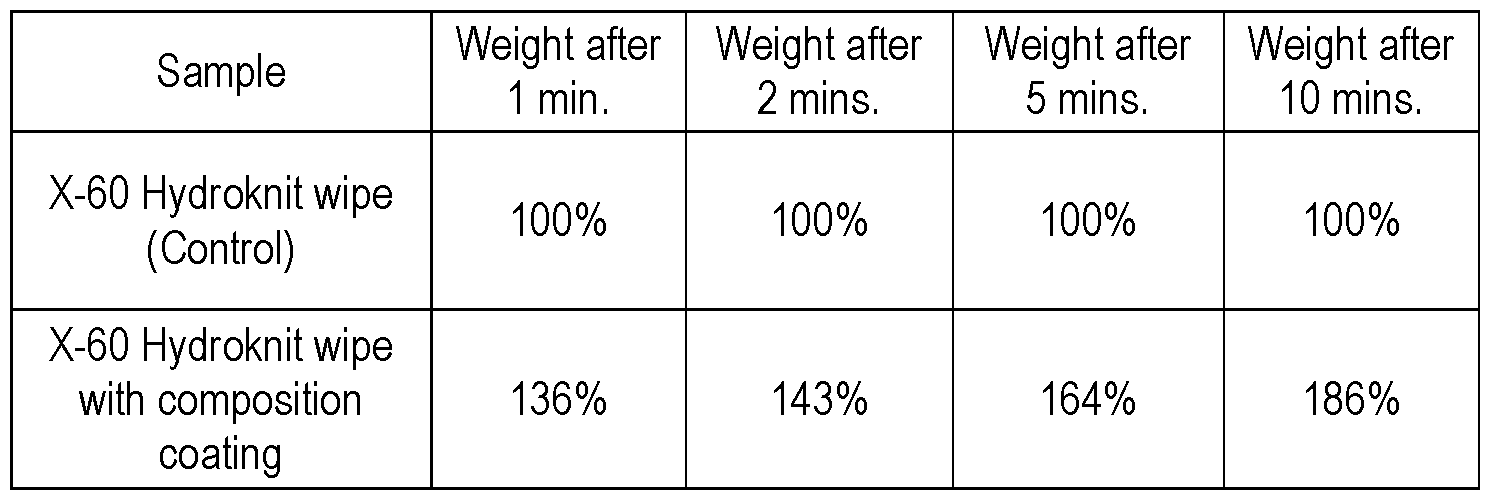
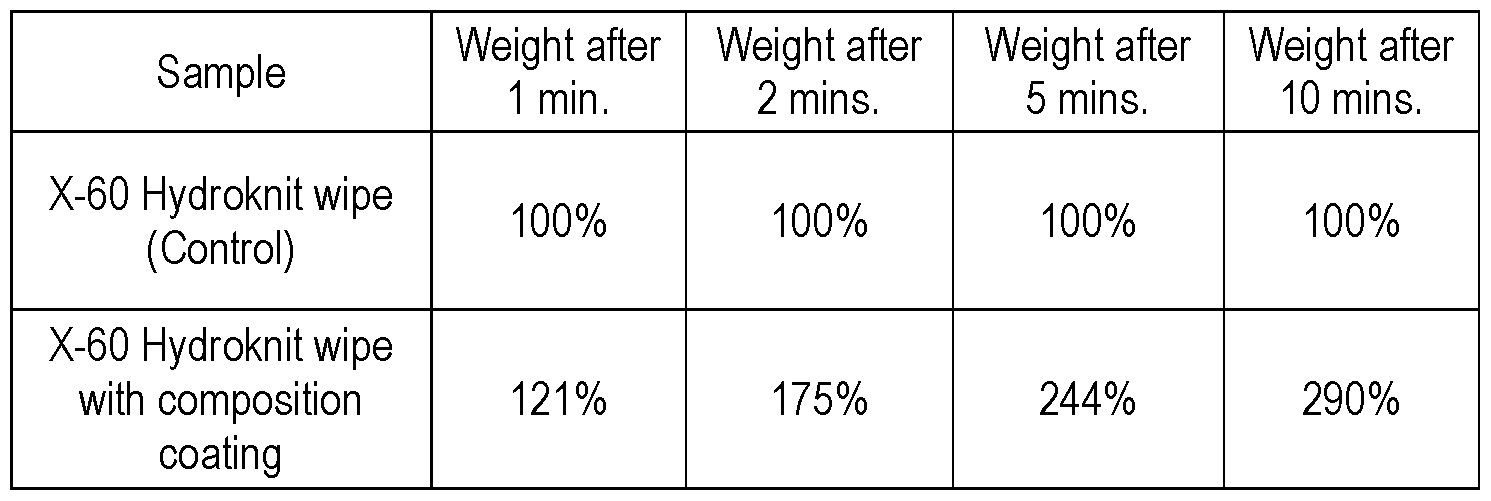


Claims
Priority Applications (7)
| Application Number | Priority Date | Filing Date | Title |
|---|---|---|---|
| MX2018005534A MX2018005534A (en) | 2015-12-01 | 2016-12-01 | Absorbent and protective composition including an elastomeric copolymer and superabsorbent. |
| CN201680062875.1A CN108350238A (en) | 2015-12-01 | 2016-12-01 | Absorbent and protective compositions comprising elastomeric copolymers and superabsorbent materials |
| AU2016362322A AU2016362322A1 (en) | 2015-12-01 | 2016-12-01 | Absorbent and protective composition including an elastomeric copolymer and superabsorbent |
| GB1805412.2A GB2556859A (en) | 2015-12-01 | 2016-12-01 | Absorbent and protective composition including an elastomeric copolymer and superabsorbent |
| BR112018009642A BR112018009642A2 (en) | 2015-12-01 | 2016-12-01 | composition, non-woven substrate, and method of removing oil or water from a surface |
| US15/778,852 US20180353047A1 (en) | 2015-12-01 | 2016-12-01 | Absorbent and protective composition including an elastomeric copolymer and superabsorbent |
| KR1020187015650A KR20180080283A (en) | 2015-12-01 | 2016-12-01 | Absorbent and protective compositions comprising an elastomeric copolymer and a superabsorbent |
Applications Claiming Priority (4)
| Application Number | Priority Date | Filing Date | Title |
|---|---|---|---|
| US201562261652P | 2015-12-01 | 2015-12-01 | |
| US62/261,652 | 2015-12-01 | ||
| US201662315714P | 2016-03-31 | 2016-03-31 | |
| US62/315,714 | 2016-03-31 |
Publications (1)
| Publication Number | Publication Date |
|---|---|
| WO2017096047A1 true WO2017096047A1 (en) | 2017-06-08 |
Family
ID=58797770
Family Applications (2)
| Application Number | Title | Priority Date | Filing Date |
|---|---|---|---|
| PCT/US2016/044746 Ceased WO2017095483A1 (en) | 2015-12-01 | 2016-07-29 | Oil absorbent wiping product |
| PCT/US2016/064426 Ceased WO2017096047A1 (en) | 2015-12-01 | 2016-12-01 | Absorbent and protective composition including an elastomeric copolymer and superabsorbent |
Family Applications Before (1)
| Application Number | Title | Priority Date | Filing Date |
|---|---|---|---|
| PCT/US2016/044746 Ceased WO2017095483A1 (en) | 2015-12-01 | 2016-07-29 | Oil absorbent wiping product |
Country Status (10)
| Country | Link |
|---|---|
| US (2) | US20180368647A1 (en) |
| EP (1) | EP3383649A4 (en) |
| KR (2) | KR102500513B1 (en) |
| CN (2) | CN109070554B (en) |
| AU (2) | AU2016361953B2 (en) |
| BR (2) | BR112018009724B1 (en) |
| CA (1) | CA3005607C (en) |
| GB (1) | GB2556859A (en) |
| MX (1) | MX2018005534A (en) |
| WO (2) | WO2017095483A1 (en) |
Cited By (1)
| Publication number | Priority date | Publication date | Assignee | Title |
|---|---|---|---|---|
| CN109706663A (en) * | 2019-03-05 | 2019-05-03 | 南充八度阳光科技有限公司 | A kind of flux controllable oiling device for carbon fiber production |
Families Citing this family (3)
| Publication number | Priority date | Publication date | Assignee | Title |
|---|---|---|---|---|
| DE102018008583A1 (en) * | 2018-10-31 | 2020-04-30 | Ewald Dörken Ag | Composite film |
| EP4316857A1 (en) * | 2021-03-30 | 2024-02-07 | Kyocera Corporation | Wiping member, wiper, wiping method, and liquid ejection device |
| WO2025102133A1 (en) * | 2023-11-17 | 2025-05-22 | Caciatori Sergio Luiz | Synthetic mat for protecting berms |
Citations (5)
| Publication number | Priority date | Publication date | Assignee | Title |
|---|---|---|---|---|
| US4832852A (en) * | 1987-04-06 | 1989-05-23 | John D. Hollingsworth On Wheels, Inc. | Nonwoven oil absorbing material and method |
| WO2000031331A1 (en) * | 1998-11-20 | 2000-06-02 | Kimberly-Clark Worldwide, Inc. | Elastic absorbent structures |
| US20090036014A1 (en) * | 2005-06-29 | 2009-02-05 | Manel Torres | Non-Woven Fabric |
| US20100233273A1 (en) * | 2003-12-05 | 2010-09-16 | 3M Innovative Properties Company | Polymer compositions with bioactive agent, medical articles, and methods |
| US20120328862A1 (en) * | 2010-01-13 | 2012-12-27 | Sumitomo Seika Chemicals Co., Ltd. | Water-absorbent sheet structure |
Family Cites Families (18)
| Publication number | Priority date | Publication date | Assignee | Title |
|---|---|---|---|---|
| US5292582A (en) * | 1986-04-04 | 1994-03-08 | Kimberly-Clark Corporation | Elastic dust cloth |
| US4781966A (en) * | 1986-10-15 | 1988-11-01 | Kimberly-Clark Corporation | Spunlaced polyester-meltblown polyetherester laminate |
| US4737394A (en) * | 1987-06-17 | 1988-04-12 | E. I. Du Pont De Nemours And Company | Article for absorbing oils |
| US5114781A (en) * | 1989-12-15 | 1992-05-19 | Kimberly-Clark Corporation | Multi-direction stretch composite elastic material including a reversibly necked material |
| US5114785A (en) * | 1990-10-09 | 1992-05-19 | The Standard Oil Company | Silicon based intermetallic coatings for reinforcements |
| US20030171051A1 (en) * | 2002-03-08 | 2003-09-11 | 3M Innovative Properties Company | Wipe |
| US6992028B2 (en) * | 2002-09-09 | 2006-01-31 | Kimberly-Clark Worldwide, Inc. | Multi-layer nonwoven fabric |
| US20040121683A1 (en) | 2002-12-20 | 2004-06-24 | Joy Jordan | Composite elastic material |
| JP2007518535A (en) * | 2004-01-26 | 2007-07-12 | ザ プロクター アンド ギャンブル カンパニー | Cleaning wipes with active design |
| US8198200B2 (en) * | 2004-03-29 | 2012-06-12 | The Procter & Gamble Company | Web materials having both plastic and elastic properties |
| US7846530B2 (en) * | 2004-09-27 | 2010-12-07 | Kimberly-Clark Worldwide, Inc. | Creped electret nonwoven wiper |
| US20060147503A1 (en) * | 2004-12-30 | 2006-07-06 | 3M Innovative Properties Company | Oil absorbent wipe with high crumpability |
| US8282776B2 (en) * | 2005-12-15 | 2012-10-09 | Kimberly-Clark Worldwide, Inc. | Wiping product having enhanced oil absorbency |
| US7585382B2 (en) * | 2006-06-30 | 2009-09-08 | Kimberly-Clark Worldwide, Inc. | Latent elastic nonwoven composite |
| US20090151748A1 (en) | 2007-12-13 | 2009-06-18 | Ridenhour Aneshia D | Facial blotter with improved oil absorbency |
| US8679992B2 (en) * | 2008-06-30 | 2014-03-25 | Kimberly-Clark Worldwide, Inc. | Elastic composite formed from multiple laminate structures |
| BR112012020853A2 (en) * | 2010-02-25 | 2018-03-27 | Procter & Gamble | binding patterns for fibrous webs |
| EP3083247B1 (en) * | 2013-12-20 | 2018-10-03 | Kimberly-Clark Worldwide, Inc. | Hydroentangled elastic film-based, stretch-bonded composites and methods of making same |
-
2016
- 2016-07-29 AU AU2016361953A patent/AU2016361953B2/en active Active
- 2016-07-29 WO PCT/US2016/044746 patent/WO2017095483A1/en not_active Ceased
- 2016-07-29 BR BR112018009724-1A patent/BR112018009724B1/en active IP Right Grant
- 2016-07-29 KR KR1020187017031A patent/KR102500513B1/en active Active
- 2016-07-29 EP EP16871191.9A patent/EP3383649A4/en active Pending
- 2016-07-29 CA CA3005607A patent/CA3005607C/en active Active
- 2016-07-29 US US15/779,412 patent/US20180368647A1/en active Pending
- 2016-07-29 CN CN201680066381.0A patent/CN109070554B/en active Active
- 2016-12-01 CN CN201680062875.1A patent/CN108350238A/en active Pending
- 2016-12-01 WO PCT/US2016/064426 patent/WO2017096047A1/en not_active Ceased
- 2016-12-01 GB GB1805412.2A patent/GB2556859A/en not_active Withdrawn
- 2016-12-01 US US15/778,852 patent/US20180353047A1/en not_active Abandoned
- 2016-12-01 KR KR1020187015650A patent/KR20180080283A/en not_active Withdrawn
- 2016-12-01 BR BR112018009642A patent/BR112018009642A2/en not_active IP Right Cessation
- 2016-12-01 AU AU2016362322A patent/AU2016362322A1/en not_active Abandoned
- 2016-12-01 MX MX2018005534A patent/MX2018005534A/en unknown
Patent Citations (5)
| Publication number | Priority date | Publication date | Assignee | Title |
|---|---|---|---|---|
| US4832852A (en) * | 1987-04-06 | 1989-05-23 | John D. Hollingsworth On Wheels, Inc. | Nonwoven oil absorbing material and method |
| WO2000031331A1 (en) * | 1998-11-20 | 2000-06-02 | Kimberly-Clark Worldwide, Inc. | Elastic absorbent structures |
| US20100233273A1 (en) * | 2003-12-05 | 2010-09-16 | 3M Innovative Properties Company | Polymer compositions with bioactive agent, medical articles, and methods |
| US20090036014A1 (en) * | 2005-06-29 | 2009-02-05 | Manel Torres | Non-Woven Fabric |
| US20120328862A1 (en) * | 2010-01-13 | 2012-12-27 | Sumitomo Seika Chemicals Co., Ltd. | Water-absorbent sheet structure |
Cited By (1)
| Publication number | Priority date | Publication date | Assignee | Title |
|---|---|---|---|---|
| CN109706663A (en) * | 2019-03-05 | 2019-05-03 | 南充八度阳光科技有限公司 | A kind of flux controllable oiling device for carbon fiber production |
Also Published As
| Publication number | Publication date |
|---|---|
| BR112018009724A2 (en) | 2018-11-06 |
| CN109070554B (en) | 2021-06-04 |
| KR20180080283A (en) | 2018-07-11 |
| BR112018009724B1 (en) | 2022-03-15 |
| GB2556859A (en) | 2018-06-06 |
| MX2018005534A (en) | 2018-08-15 |
| CN108350238A (en) | 2018-07-31 |
| GB201805412D0 (en) | 2018-05-16 |
| BR112018009724A8 (en) | 2019-02-26 |
| US20180353047A1 (en) | 2018-12-13 |
| CN109070554A (en) | 2018-12-21 |
| EP3383649A4 (en) | 2019-08-28 |
| BR112018009642A2 (en) | 2018-11-06 |
| CA3005607A1 (en) | 2017-06-08 |
| EP3383649A1 (en) | 2018-10-10 |
| US20180368647A1 (en) | 2018-12-27 |
| AU2016362322A1 (en) | 2018-06-07 |
| AU2016361953B2 (en) | 2020-09-17 |
| AU2016361953A1 (en) | 2018-06-07 |
| CA3005607C (en) | 2024-01-30 |
| KR102500513B1 (en) | 2023-02-16 |
| KR20180080326A (en) | 2018-07-11 |
| WO2017095483A1 (en) | 2017-06-08 |
Similar Documents
| Publication | Publication Date | Title |
|---|---|---|
| EP1599627B1 (en) | Textured fabric containing a treatment composition | |
| JP5302206B2 (en) | Tissue product with low lint | |
| KR101283077B1 (en) | Dispersible wet wipes with improved dispensing | |
| EP2659067B1 (en) | Bacteriostatic tissue product | |
| MXPA02004056A (en) | Patterned application of polymeric anionic compounds to fibrous webs. | |
| SA07280673B1 (en) | Process For Increasing The Basis Weight Of Sheet Materials | |
| AU2011350917B2 (en) | Creped tissue product with enhanced retention capacity | |
| CN101600788A (en) | Cleaning capacity enhanced wipe product | |
| WO2017096047A1 (en) | Absorbent and protective composition including an elastomeric copolymer and superabsorbent | |
| KR102423408B1 (en) | Wiper product and manufacturing method thereof | |
| AU2016362323B2 (en) | Absorbent and protective composition containing an elastomeric copolymer | |
| WO2021106571A1 (en) | Cleaning sheet and method for producing cleaning sheet | |
| JPH04194095A (en) | Sheet for cleaning | |
| JPH04256722A (en) | Laminated paper sheet |
Legal Events
| Date | Code | Title | Description |
|---|---|---|---|
| 121 | Ep: the epo has been informed by wipo that ep was designated in this application |
Ref document number: 16871504 Country of ref document: EP Kind code of ref document: A1 |
|
| ENP | Entry into the national phase |
Ref document number: 201805412 Country of ref document: GB Kind code of ref document: A Free format text: PCT FILING DATE = 20161201 |
|
| WWE | Wipo information: entry into national phase |
Ref document number: MX/A/2018/005534 Country of ref document: MX |
|
| REG | Reference to national code |
Ref country code: BR Ref legal event code: B01A Ref document number: 112018009642 Country of ref document: BR |
|
| ENP | Entry into the national phase |
Ref document number: 20187015650 Country of ref document: KR Kind code of ref document: A |
|
| NENP | Non-entry into the national phase |
Ref country code: DE |
|
| ENP | Entry into the national phase |
Ref document number: 2016362322 Country of ref document: AU Date of ref document: 20161201 Kind code of ref document: A |
|
| ENP | Entry into the national phase |
Ref document number: 112018009642 Country of ref document: BR Kind code of ref document: A2 Effective date: 20180511 |
|
| 122 | Ep: pct application non-entry in european phase |
Ref document number: 16871504 Country of ref document: EP Kind code of ref document: A1 |