WO2017081590A1 - Process for the preparation of omarigliptin - Google Patents
Process for the preparation of omarigliptin Download PDFInfo
- Publication number
- WO2017081590A1 WO2017081590A1 PCT/IB2016/056656 IB2016056656W WO2017081590A1 WO 2017081590 A1 WO2017081590 A1 WO 2017081590A1 IB 2016056656 W IB2016056656 W IB 2016056656W WO 2017081590 A1 WO2017081590 A1 WO 2017081590A1
- Authority
- WO
- WIPO (PCT)
- Prior art keywords
- formula
- compound
- process according
- group
- omarigliptin
- Prior art date
- Legal status (The legal status is an assumption and is not a legal conclusion. Google has not performed a legal analysis and makes no representation as to the accuracy of the status listed.)
- Ceased
Links
- 0 CS([n]1nc(CN(C2)[C@]3CO[C@]4c5cc(F)ccc5*[C@]4C3)c2c1)(=O)=O Chemical compound CS([n]1nc(CN(C2)[C@]3CO[C@]4c5cc(F)ccc5*[C@]4C3)c2c1)(=O)=O 0.000 description 8
- MKMPWKUAHLTIBJ-ISTRZQFTSA-N CS([n]1nc(CN(C2)[C@H](C[C@@H]3N)CO[C@@H]3c3cc(F)ccc3F)c2c1)(=O)=O Chemical compound CS([n]1nc(CN(C2)[C@H](C[C@@H]3N)CO[C@@H]3c3cc(F)ccc3F)c2c1)(=O)=O MKMPWKUAHLTIBJ-ISTRZQFTSA-N 0.000 description 3
- NRSOKXSYKBYBOO-UHFFFAOYSA-N CCOC(C(CC#C)N=C(c1ccccc1)c1ccccc1)=O Chemical compound CCOC(C(CC#C)N=C(c1ccccc1)c1ccccc1)=O NRSOKXSYKBYBOO-UHFFFAOYSA-N 0.000 description 1
Classifications
-
- A—HUMAN NECESSITIES
- A61—MEDICAL OR VETERINARY SCIENCE; HYGIENE
- A61K—PREPARATIONS FOR MEDICAL, DENTAL OR TOILETRY PURPOSES
- A61K31/00—Medicinal preparations containing organic active ingredients
- A61K31/33—Heterocyclic compounds
- A61K31/395—Heterocyclic compounds having nitrogen as a ring hetero atom, e.g. guanethidine or rifamycins
- A61K31/41—Heterocyclic compounds having nitrogen as a ring hetero atom, e.g. guanethidine or rifamycins having five-membered rings with two or more ring hetero atoms, at least one of which being nitrogen, e.g. tetrazole
- A61K31/415—1,2-Diazoles
- A61K31/4162—1,2-Diazoles condensed with heterocyclic ring systems
-
- C—CHEMISTRY; METALLURGY
- C07—ORGANIC CHEMISTRY
- C07C—ACYCLIC OR CARBOCYCLIC COMPOUNDS
- C07C231/00—Preparation of carboxylic acid amides
- C07C231/02—Preparation of carboxylic acid amides from carboxylic acids or from esters, anhydrides, or halides thereof by reaction with ammonia or amines
-
- C—CHEMISTRY; METALLURGY
- C07—ORGANIC CHEMISTRY
- C07C—ACYCLIC OR CARBOCYCLIC COMPOUNDS
- C07C249/00—Preparation of compounds containing nitrogen atoms doubly-bound to a carbon skeleton
- C07C249/02—Preparation of compounds containing nitrogen atoms doubly-bound to a carbon skeleton of compounds containing imino groups
-
- C—CHEMISTRY; METALLURGY
- C07—ORGANIC CHEMISTRY
- C07D—HETEROCYCLIC COMPOUNDS
- C07D487/00—Heterocyclic compounds containing nitrogen atoms as the only ring hetero atoms in the condensed system, not provided for by groups C07D451/00 - C07D477/00
- C07D487/02—Heterocyclic compounds containing nitrogen atoms as the only ring hetero atoms in the condensed system, not provided for by groups C07D451/00 - C07D477/00 in which the condensed system contains two hetero rings
- C07D487/04—Ortho-condensed systems
Definitions
- the present invention provides a process for preparing omarigliptin.
- Omarigliptin chemically (2i?,35 * ,5i?)-2-(2,5-difluorophenyl)-5-[2- (methylsulfonyl)-2,6-dihydropyrrolo [3 ,4-c]pyrazol-5 (4H)-yl]tetrahydro-2H-pyran-3 - amine, is represented by Formula I.
- Omarigliptin is a dipeptidyl peptidase-IV inhibitor being developed for the treatment of diabetes mellitus.
- U.S. Patent No. 7,902,376 (“the '376 patent”) describes a process for the preparation of omarigliptin comprising the step of reacting ethyl N- (diphenylmethylene)glycinate of Formula A with 3-bromoprop-l-yne in the presence of cesium carbonate to obtain a compound of Formula II.
- the '376 patent also describes a process for the preparation of omarigliptin comprising the step of cycloisomerizing a compound of Formula VII using a transition metal catalyst in the presence of N-hydroxysuccinimide in DMF to obtain a compound of Formula VIII.
- the '376 patent also describes a process for the preparation of omarigliptin comprising the step of condensing the compound of Formula IV with ⁇ , ⁇ - dimethylhydroxylamine hydrochloride using CDI ( ⁇ , ⁇ -carbonyldiimidazole) to obtain a compound of Formula V.
- PCT Publication No. WO 2013/003250 describes a process for the preparation of omarigliptin.
- PCT Publication No. WO 2015/139859 describes a process for the preparation of tert-butyl-2-(2,5-diflourophenyl)-2-oxoethylcarbamate, an intermediate used for the preparation of omarigliptin.
- the present invention provides an improved process for the preparation of omarigliptin and its intermediates.
- the present invention provides an easy, cost-effective, and industrially advantageous process for the preparation of omarigliptin and its intermediates.
- a first aspect of the present invention provides a process for the preparation of omarigliptin of Formula I,
- P is an amine protecting group
- a second aspect of the present invention provides a process for the preparation of gliptin of Formula I,
- a third aspect of the present invention provides a process for the preparation of omarigliptin of Formula I,
- a fourth aspect of the present invention provides a process for the preparation of omarigliptin of Formula I,
- a fifth aspect of the present invention provides a process for the preparation of omarigliptin of Formula I,
- a sixth aspect of the present invention provides a process for the preparation of omarigliptin of Formula I,
- a seventh aspect of the present invention provides a process for the preparation of a compound of Formula II,
- An eighth aspect of the present invention provides a process for the preparation of a compound of Formula V,
- a ninth aspect of the present invention provides a process for the preparation of a compound of Formula VIII,
- a tenth aspect of the present invention provides a process for the preparation of a compound of Formula XII,
- An eleventh aspect of the present invention provides a process for the preparation of a compound of Formula XIII,
- ambient temperature refers to a temperature in the range of 25 °C to 35°C.
- amine protecting group refers to Boc, CBz, FMOC, allyloc, methoxycarbonyl, formyl, phthaloyl, benzoyl, phenyl, methyl, ethyl, propyl, isopropyl, butyl, and tert-butyl.
- deprotection refers to removing a protecting group under the conditions known in the art.
- the amine protecting group is Boc
- it is removable under acidic conditions such as aqueous hydrochloric acid, sulfuric acid, hydrobromic acid, tetrafluoroboric acid, benzenesulfonic acid, p-toluenesulfonic acid, ethanesulfonic acid, and trifluoroacetic acid in an organic solvent.
- transition metal catalyst includes rhodium and ruthenium catalysts such as rhodium trichloride hydrate and CpRuCl(Pli3P)2.
- acid activating agent includes oxalyl chloride, triphenylphosphine/carbon tetrabromide, benzotriazol-l-yloxytris
- non-nucleophilic base includes sodium hydride, potassium hydride, lithium diisopropylamide, sodium bis(trimethylsilyl)amide, potassium bis(trimethylsilyl)amide, lithium tetramethylpiperidide, triethylamine, N,N- diisopropylethylamine, and diisopropylamine.
- alkylhaloformate includes methylchloroformate, ethylchloroformate, propylchloroformate, isopropylchloroformate, butylchloroformate, and tert-butylchloroformate.
- acylhalide includes acetylchloride
- base includes methylamine, triethylamine, diisopropylamine, diisopropylethylamine, pyridine, N-methylpyridine, morpholine, and N- methy lmo holine .
- phase transfer catalyst includes chloride, bromide, and iodide salts of benzyltrimethylammonium, benzyltriethylammonium,
- methyltricaprylammonium methyltributylammonium, methyltrioctylammonium, and tetra-n-butylammonium .
- phosphine ligand includes triphenylphosphine, tris(3- fluorophenyl)phosphine, tris(3,5-difluorophenyl)phosphine, and tris(4- fluorophenyl)phosphine .
- cycloisomerizing agent includes NHS, NHP, and NHM.
- polar aprotic solvent includes dichloromethane, THF, DMF, acetone, ethyl acetate, isopropyl acetate, acetonitrile, DME, 1,4-dioxane, methyl THF, DMA, and DMSO.
- non polar solvent includes toluene, benzene, cyclohexane, and hexanes.
- the compound of Formula A is reacted with 3-bromoprop-l-yne in the presence of a pulverized metal hydroxide, and optionally a phase transfer catalyst, to obtain the compound of Formula II .
- the metal hydroxide is selected from the group consisting of lithium hydroxide, sodium hydroxide, and potassium hydroxide.
- the compound of Formula II is either isolated or used as such for the next reaction.
- the compound of Formula II is hydrolyzed to obtain the compound of Formula III using an acid.
- the step of hydrolysis can be performed as described in U.S. Patent No. 7,902,376.
- the compound of Formula III is either isolated or used as such for the next reaction.
- the compound of Formula III is protected to obtain the compound of Formula IV by using methods known in the art or as described in U.S. Patent No. 7,902,376.
- the compound of Formula IV is either isolated or used as such for the next reaction.
- the compound of Formula IV is condensed with N,0-bismethylhydroxylamine hydrochloride using an acid activating agent in the presence of a base and a polar aprotic solvent to obtain the compound of Formula V.
- the acid activating agent is selected from the group consisting of alkylhaloformate and acylhalide in the presence of a base.
- the compound of Formula V is reacted with 2-bromo-l,4-diflourobenzene in the presence of a Grignard reagent to obtain the compound of Formula VI as described in U.S. Patent No. 7,902,376.
- the compound of Formula VII is cycloisomerized using a transition metal catalyst in the presence of a sodium salt of a cycloisomerizing agent, a phosphine ligand, and tetrabutylammonium hexafluorophosphate in a solvent to obtain the compound of Formula VIII.
- a sodium salt of a cycloisomerizing agent is sodium salt NHS.
- the solvent is selected from a group consisting of non polar solvents and polar aprotic solvents.
- the solvent is toluene or DME.
- the use of sodium salt NHS is advantageous over the use of NHS in terms of increase in product formation.
- the use of toluene and DME reduces the reaction time and the amount of catalyst used.
- the compound of Formula VIII is either isolated or used as such for the next reaction.
- the compound of Formula X is reductively animated with the compound of Formula XIV or a salt thereof to obtain omarigliptin as described in U.S. Patent Nos. 7,902,376 and 8, 143,289 or PCT Publication Nos. WO 2013/003250 and WO
- the compound of Formula XIV is obtained by following the process as described in U.S. Patent No. 8, 143,289 or PCT Publication No. WO 2013/003250.
- the compound of Formula XI is treated with an organic acid to obtain the compound of Formula XII.
- the organic acid is selected from the group consisting of acetic acid and trifluoroacetic acid.
- the use of an organic acid ensures the reduction of the compound of Formula XI with retention of the amine protected group.
- the compound of Formula XI is obtained by following the process as described in U.S. Patent No. 8,143,289 or PCT Publication No. WO 2013/003250.
- the compound of Formula XII is reacted with methylsulfonyl chloride in the presence of a non-nucleophilic base in THF or DMF or mixtures thereof with non polar solvents and other polar aprotic solvents to obtain the compound of Formula XIII. It has been observed that selection of the solvent plays a pivotal role in determining the regioselectivity of the process, and thus yielding a greater percentage of the desired regioisomer.
- the compound of Formula XIII is converted to a compound of Formula XIV, and further to omarigliptin, by the process as described in U.S. Patent No. 8,143,289 or PCT Publication No. WO 2013/003250. While the present invention has been described in terms of its specific aspects and embodiments, certain modifications and equivalents will be apparent to those skilled in the art and are intended to be included within the scope of the present invention.
- HPLC High Performance Liquid Chromatography
- Pulverized potassium hydroxide (29.53 g) was added to a solution of ethyl N- (diphenylmethylidene)glycinate (94 g; Formula A), tetrabutylammonium bromide (11.35 g), and 3-bromoprop-l-yne (42.6 inL) in toluene (282 mL) at -5°C to 0°C.
- the reaction mixture was stirred for 1 hour to 2 hours at the same temperature to obtain ethyl 2- [(diphenylmethylidene)amino]pent-4-ynoate in situ.
- the reaction mixture was diluted with water (282 mL) at a temperature of -5°C to 0°C. The reaction mixture was used as such for the next reaction.
- the aqueous layer (Formula II; Example 1) was treated with a solution of hydrochloric acid (50%; 94 mL) at a temperature of 2°C to 8°C.
- the reaction mixture was allowed to warm to a temperature of 20°C to 25°C, and was then stirred for 6 hours to 10 hours to obtain ethyl 2-aminopent-4-ynoate (Formula III).
- the layers were separated, and the aqueous layer was cooled to 10°C to 15°C.
- a solution of sodium hydroxide 50 mL; 18.5 M
- Di-tert- butyldicarbonate (84.2 g) was added to the reaction mixture.
- reaction mixture was allowed to warm to 20°C to 30°C.
- a solution of sodium hydroxide (10 mL to 15 mL; 18.5 M) was again added to the reaction mixture to adjust the pH to 12.5 to 13.
- toluene (282 mL) was added to the aqueous layer.
- the reaction mixture was cooled to 0°C to 5°C.
- An aqueous solution of hydrochloric acid (180 mL) was added to adjust the pH to 2.5 to 3.0.
- the mixture was stirred for 5 minutes to 10 minutes.
- the layers were separated.
- Toluene (282 mL) was added to the aqueous layer, and then the mixture was stirred for 15 minutes. The mixture was allowed to settle for 10 minutes, and the layers were separated.
- CDI 39.45 g was added to a solution of 2-[(tert-butoxycarbonyl)amino]pent-4- ynoic acid (40 g; Formula IV, Example 2) in dimethylformamide (100 mL), and the mixture was stirred for 2 hours at 20°C to 30°C.
- N O-Bismethylhydroxylamine hydrochloride (20.1 g) was added to the reaction mixture, and then the mixture was stirred for 1 hour to 3 hours at 20°C to 30°C.
- water 200 mL was added to the reaction mixture, and then the mixture was stirred for 6 hours to 8 hours at 20°C to 25°C.
- the reaction mixture was cooled to 0°C to 5°C.
- Trimethylacetyl chloride 24.50 mL was added to a solution of 2-[(tert- butoxycarbonyl)amino]pent-4-ynoic acid (40 g; Formula IV, Example 2) in
- the organic layer was washed with an aqueous sodium bicarbonate solution (5%; 25 mL) and then with a saturated sodium chloride solution (25 mL) at 20°C to 25°C.
- the organic layer was concentrated under reduced pressure at 50°C to 55°C to obtain a residue.
- IPA (15 mL) was added to the residue, and then the mixture was stirred at 55°C to 60°C for 30 minutes.
- Water (22.5 mL) was added to the reaction mixture at 50°C to 60°C.
- the reaction mixture was cooled to 20°C to 25 °C, and then stirred for 15 minutes.
- the reaction mixture was filtered, and then dried under reduced pressure at 45°C to 50°C to obtain the title compound.
- the aqueous layer was extracted with toluene (200 mL), and the layers were separated.
- the organic layers were washed with an aqueous sodium bicarbonate solution (5%; 500 mL), and then stirred for 10 minutes.
- Tetrabutyl ammonium hexafluorophosphate (13.8 g) and sodium salt of NHS (17.6 g) were added to a solution of tert-butyl [(lR,2S)-l-(2,5-difluorophenyl)-l-hydroxypent-4- yn-2-yl]carbamate (100 g; Formula VII; Example 7) in toluene (600 ml) under nitrogen at ambient temperature, and the mixture was stirred for 10 minutes.
- Triphenylphosphine (4.2 g) and chloro(cyclopentadienyl) bis (triphenylphosphine) ruthenium(II) ethanol (1.5 g) were added to the reaction mixture, and then the mixture was stirred for 4 hours to 5 hours at 80°C to 85°C. The reaction mixture was allowed to cool to 40°C. Chloro(cyclopentadienyl) bis (triphenylphosphine) ruthenium(II) ethanol (1 g) was again added to the reaction mixture, and then the mixture was stirred for 16 hours to 18 hours at 80°C to 85°C. After completion of the reaction, the reaction mixture was allowed to cool to ambient temperature. The reaction mixture was filtered to obtain a solid.
- the solid was washed with toluene (50 mL ⁇ 2), and then washed with a sodium bicarbonate solution (5%). The reaction mixture was stirred for 10 minutes, and then allowed to settle for 10 minutes. The layers were separated, and the aqueous layer was extracted with toluene (200 mL). The organic layers were combined, then washed with water (500 mL), and then concentrated under reduced pressure at 55°C to 60°C to obtain the title compound as a viscous liquid.
- Tetrabutyl ammonium hexafluorophosphate (3.4 g) and sodium salt of NHS (4.4 g) were added to a solution oftert-butyl [(lR,2S)-l-(2,5-difluorophenyl)-l-hydroxypent-4- yn-2-yl]carbamate (20 g, Formula VII; Example 7) in DME (140 mL) under nitrogen at ambient temperature, and the mixture was stirred for 10 minutes.
- Triphenylphosphine (1.1 g) and chloro(cyclopentadienyl) bis (triphenylphosphine) ruthenium(II) ethanol (0.6 g) were added to the reaction mixture, and then the mixture was stirred for 6 hours at 80°C to 85°C. The reaction mixture was allowed to cool to 40°C. Chloro(cyclopentadienyl) bis (triphenylphosphine) ruthenium(II) ethanol (0.2 g) was again added to the reaction mixture, and then the mixture was stirred for 20 hours at 80°C to 85°C. After completion of the reaction, the reaction mixture was allowed to cool to ambient temperature. The reaction mixture was filtered to obtain a solid.
- Example 10 Preparation of tert-butyl[(2R.3S)-5-hydroxy-2-(2.5- difluorophenyl)tetrahvdro-2H-pyran-3-vHcarbamate (Formula IX) Borane DMS (24 mL) was added to a solution of tert-butyl [(2R,3S)-2-(2,5- difluorophenyl)-3,4-dihydro-2H-pyran-3-yl]carbamate (50 g; Formula VIII; Example 8 or 9) in MTBE (350 mL) at -10°C to -5°C. The reaction mixture was stirred for 2 hours to 3 hours at the same temperature.
- reaction mixture was added to an aqueous solution of sodium hydroxide (I N; 400 mL) while maintaining the temperature at 0°C to 10°C.
- Hydrogen peroxide (18 mL; 50%) was added to the reaction mixture, and then the mixture was stirred for 14 hours at 20°C to 26°C.
- the reaction mixture was allowed to settle, and the layers were separated.
- Toluene 150 mL was added to the aqueous layer, and then the mixture was stirred at 20°C to 25°C for 10 minutes.
- the reaction mixture was allowed to settle, and the layers were separated.
- the organic layers were combined, then washed with water (300 mL), and then concentrated under reduced pressure at 60°C to 70°C to obtain a residue.
- Toluene (150 mL) was added to the residue, and then the mixture was heated at 80°C to 85°C for 45 minutes. The reaction mixture was allowed to cool to 20°C to 25 °C. The reaction mixture was filtered, and then dried under reduced pressure at 45°C to 50°C to obtain the title compound.
- Trifluoroacetic acid 28.2 mL was added to the reaction mixture (Formula XI; Example 12) at 20°C to 25 °C, and the mixture was stirred for 2 hours. After completion of the reaction, water (350 mL) was added to the mixture. The reaction mixture was allowed to settle, and the layers were separated. The organic layer was concentrated under vacuum to obtain a crude mass. N-heptane (210 mL) was added to the crude mass, and then the mixture was stirred for 1 hour to 3 hours at 20°C to 30°C to obtain a solid. The solid was filtered to obtain the title compound.
- the reaction mixture was allowed to settle, and the layers were separated.
- the organic layer was washed with a saturated sodium chloride solution (25 mL).
- the organic layer was concentrated under reduced pressure at 35°C to 45 °C to obtain a crude mass.
- IPA 7.5 mL
- n-heptane 25 mL were added to the crude mass, and then the mixture was stirred at 20°C to 30°C for 1 hour to 3 hours to obtain a solid.
- the solid was filtered, and then dried under reduced pressure at 35°C to 40°C for 30 minutes to obtain the title compound.
- Triethylamine (1.15 mL) was added to a solution of tert-butyl 4,6- dihydropyrrolo[3,4-c]pyrazole-5(lH)-carboxylate (1 g; Formula XII; Example 13) in tetrahydrofuran (10 mL) at ambient temperature.
- Mesyl chloride (0.49 mL) was slowly added to the reaction mixture at 0°C to 5°C, and then the mixture was stirred for 30 minutes. The temperature was allowed to rise to ambient temperature, and then the mixture was stirred for 3 hours. After completion of the reaction, water (25 mL) and ethyl acetate (25 mL) were added to the reaction mixture.
- the reaction mixture was allowed to settle, and the layers were separated.
- the organic layer was concentrated under reduced pressure at 30°C to 35°C to obtain a crude mass.
- IPA 7.5 mL
- n-heptane 25 mL
- the mixture was stirred at 30°C to 35°C for 30 minutes to obtain a solid.
- the solid was filtered, and then dried under reduced pressure 30°C to 35°C for 30 minutes to obtain the title compound.
- Triethylamine (1.15 mL) was added to a solution of tert-butyl 4,6- dihydropyrrolo[3,4-c]pyrazole-5(lH)-carboxylate (1 g; Formula XII; Example 13) in 2- methyltetrahydrofuran (10 mL) at 0°C to 5°C, and the mixture was stirred for 15 minutes.
- Mesyl chloride (0.49 mL) was slowly added to the reaction mixture at 0°C to 5°C, and then the mixture was stirred for 30 minutes. The reaction mixture was allowed to rise to ambient temperature, and was then stirred at the same temperature for 2 hours.
- Triethylamine (0.2 mL) was added to the reaction mixture, and then the mixture was stirred for 30 minutes at 30°C to 35°C. After completion of the reaction, water (15 mL) was added. The reaction mixture was allowed to settle, and the layers were separated. The organic layer was washed with a saturated sodium chloride solution (25 mL). The organic layer was concentrated under reduced pressure to obtain a crude mass. IPA (7.5 mL) and n-heptane (25 mL) were added to the crude mass, and then the mixture was stirred at 30°C to 35°C for 30 minutes to obtain a solid. The solid was filtered, and then dried under reduced pressure at 30°C to 35°C for 8 hours to obtain the title compound. Regioselectivity: 90%
- Triethylamine (1.6 mL) was added to a solution of tert-butyl 4,6-dihydropyrrolo[3,4- c]pyrazole-5(lH)-carboxylate (2 g; Formula XII; Example 13) in N,N-dimethylformamide (20 mL) at ambient temperature, and the mixture was stirred for 2 hours.
- Mesyl chloride (1.1 mL in 10 mL of N,N-dimethylformamide) was slowly added to the reaction mixture at 0°C to 5°C, and then the mixture was stirred for 2 hours.
- Triethylamine (3 mL) was added to the reaction mixture, and then the mixture was stirred for 2 hours at 0°C to 5°C.
- the reaction mixture was allowed to settle, and the layers were separated.
- the organic layer was washed with a saturated sodium chloride solution (25 mL).
- the organic layer was concentrated under reduced pressure to obtain a crude mass.
- IPA 7.5 mL
- n-heptane 25 mL
- the mixture was stirred at 30°C to 35°C for 30 minutes to obtain a solid.
- the solid was filtered, and then dried under reduced pressure at 30°C to 35°C for 8 hours to obtain the title compound.
- the reaction mixture was extracted in ethyl acetate (20 mL), then dried over sodium sulfate, and then concentrated under reduced pressure to obtain a crude mass.
- IPA 7.5 mL
- n-heptane 25 mL
- the mixture was stirred at 30°C to 35°C for 8 hours to obtain a solid.
- the solid was filtered, and then dried under reduced pressure at 30°C to 35°C for 30 minutes to obtain the title compound.
- Trifluoroacetic acid (73.3 g) was added to a solution of tert-butyl ⁇ (2R,3S,5R)-2- (2,5-difluorophenyl)-5-[2-(methylsulfonyl)-2,6-dihydropyrrolo[3,4-c]pyrazol-5(4H)- yl]tetrahydro-2H-pyran-3-yl ⁇ carbamate (8.2 g; Formula XV; Example 23) in
- dichloromethane ( 123 mL) at 0°C.
- the reaction mixture was allowed to warm to the ambient temperature, and was then stirred at the same temperature for 30 minutes.
- water 99 mL at 0°C to 5°C
- An aqueous ammonia solution (25%) was added to the reaction mixture to adjust the pH to 9.6.
- the reaction mixture was allowed to settle, and the layers were separated.
- the organic layer was washed with water (85 mL). The organic layer was separated, and then concentrated under vacuum at 30°C to 35°C to obtain a crude mass.
- Dichloromethane (95 mL) was added to the crude mass to obtain a solution.
Landscapes
- Chemical & Material Sciences (AREA)
- Organic Chemistry (AREA)
- Health & Medical Sciences (AREA)
- Animal Behavior & Ethology (AREA)
- Epidemiology (AREA)
- Life Sciences & Earth Sciences (AREA)
- Pharmacology & Pharmacy (AREA)
- General Health & Medical Sciences (AREA)
- Public Health (AREA)
- Veterinary Medicine (AREA)
- Medicinal Chemistry (AREA)
- Chemical Kinetics & Catalysis (AREA)
- Organic Low-Molecular-Weight Compounds And Preparation Thereof (AREA)
Abstract
The present invention provides a process for preparing omarigliptin.
Description
PROCESS FOR THE PREPARATION OF OMARIGLIPTIN
Field of the Invention
The present invention provides a process for preparing omarigliptin.
Background of the Invention
Omarigliptin, chemically (2i?,35*,5i?)-2-(2,5-difluorophenyl)-5-[2- (methylsulfonyl)-2,6-dihydropyrrolo [3 ,4-c]pyrazol-5 (4H)-yl]tetrahydro-2H-pyran-3 - amine, is represented by Formula I.

Formula I
Omarigliptin is a dipeptidyl peptidase-IV inhibitor being developed for the treatment of diabetes mellitus.
U.S. Patent No. 7,902,376 ("the '376 patent") describes a process for the preparation of omarigliptin comprising the step of reacting ethyl N- (diphenylmethylene)glycinate of Formula A with 3-bromoprop-l-yne in the presence of cesium carbonate to obtain a compound of Formula II.
The '376 patent also describes a process for the preparation of omarigliptin comprising the step of cycloisomerizing a compound of Formula VII using a transition metal catalyst in the presence of N-hydroxysuccinimide in DMF to obtain a compound of Formula VIII.
The '376 patent also describes a process for the preparation of omarigliptin comprising the step of condensing the compound of Formula IV with Ν,Ο- dimethylhydroxylamine hydrochloride using CDI (Ι,Γ -carbonyldiimidazole) to obtain a compound of Formula V.
PCT Publication No. WO 2013/003250 describes a process for the preparation of omarigliptin.
PCT Publication No. WO 2015/139859 describes a process for the preparation of tert-butyl-2-(2,5-diflourophenyl)-2-oxoethylcarbamate, an intermediate used for the preparation of omarigliptin.
The present invention provides an improved process for the preparation of omarigliptin and its intermediates.
Summary of the Invention
The present invention provides an easy, cost-effective, and industrially advantageous process for the preparation of omarigliptin and its intermediates.
A first aspect of the present invention provides a process for the preparation of omarigliptin of Formula I,

Formula I
wherein the process comprises the steps of:
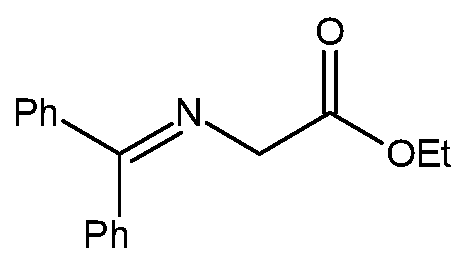
a) reacting ethyl N-(diphenylmethylidene)glycinate of Formula A

Formula A
with 3-bromoprop-l-yne using a pulverized metal hydroxide to obtain a compound of Formula II;

Formula II
b) hydrolyzing the compound of Formula II to obtain a compound of Formula III;

Formula III
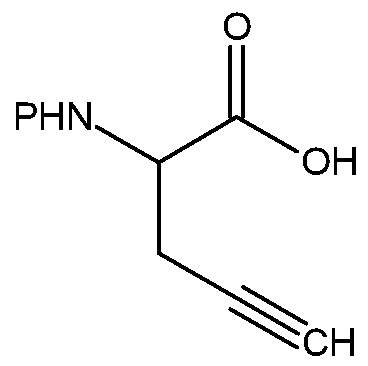
c) protecting the compound of Formula III to obtain a compound of Formula IV,
Formula IV
wherein P is an amine protecting group;
d) condensing the compound of Formula IV with N,0-bisdimethylhydroxylamine hydrochloride using an acid activating agent in the presence of a base to obtain a compound of Formula V;

Formula V
e) reacting the compound of Formula V with 2-bromo- 1,4-difluorobenzene ' presence of a Grignard reagent to obtain a compound of Formula VI;

Formula VI
f) reducing the compound of Formula VI to obtain a compound of Formula VII;

Formula VII
cycloisomerizing the compound of Formula VII in the presence of a sodium salt of a cycloisomerizing agent in a solvent to obtain a compound of Formula VIII;

Formula VIII
h) converting the compound of Formula VIII to a compound of Formula IX;

Formula IX
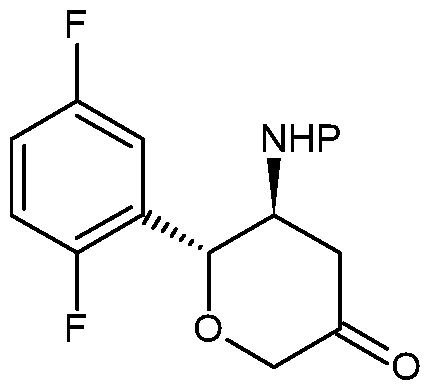
i) oxidizing the compound of Formula IX to a compound of Formula X;
Formula X
reductive animation of the compound of Formula X with a compound of Formula XIV or its salts

Formula XIV
to obtain a compound of Formula XV; and

Formula XV
k) deprotecting the compound of Formula XV to obtain omarigliptin of Formula I.
A second aspect of the present invention provides a process for the preparation of gliptin of Formula I,

Formula I
comprising the steps of:
a) reacting ethyl N-(diphenylmethylidene)glycinate of Formula A

Formula A
with 3-bromoprop-l-yne in the presence of a pulverized metal hydroxide to obtain a compound of Formula II; and

Formula II
b) converting the compound of Formula II to omarigliptin of Formula I.
A third aspect of the present invention provides a process for the preparation of omarigliptin of Formula I,

Formula I
wherein the process comprises the steps of:
a) condensing a compound of Formula IV,

Formula IV
wherein P is an amine protecting group,
with N,0-bisdimethylhydroxylamine hydrochloride using an acid activating agent in the presence of a base to obtain a compound of Formula V; and

b) converting the compound of Formula V to omarigliptin of Formula I.
A fourth aspect of the present invention provides a process for the preparation of omarigliptin of Formula I,

Formula I
wherein the process comprises the steps of:
a) cycloisomerizing the compound of Formula VII,

Formula VII
wherein P is an amine protecting group,
in the presence of a sodium salt of a cycloisomerizing agent in a solvent to obtain a compound of Formula VIII; and

Formula VIII
b) converting the compound of Formula VIII to omarigliptin of Formula I.
A fifth aspect of the present invention provides a process for the preparation of omarigliptin of Formula I,

Formula I
wherein the process comprises the steps of:
a) treating a compound of Formula XI,

Formula XI
wherein P is an amine protecting group,
with an organic acid to obtain a compound of Formula XII; and

Formula XII
b) converting the compound of Formula XII to omarigliptin of Formula I.
A sixth aspect of the present invention provides a process for the preparation of omarigliptin of Formula I,

Formula I
wherein the process comprises the steps of:
a) reacting a compound of Formula XII

Formula XII
with methylsulfonyl chloride in the presence of a non-nucleophilic base in THF or DMF or mixtures thereof with non polar solvents and other polar aprotic solvents to obtain a compound of Formula XIII; and

Formula XIII
b) converting the compound of Formula XIII to omarigliptin of Formula I.
A seventh aspect of the present invention provides a process for the preparation of a compound of Formula II,

wherein the process comprises reacting ethyl N-(diphenylmethylidene)glycinate of Formula A

Formula A
with 3-bromoprop-l-yne in the presence of a pulverized metal hydroxide to obtain the compound of Formula II.
An eighth aspect of the present invention provides a process for the preparation of a compound of Formula V,

Formula V
wherein P is an amine protecting group,
comprising condensing a compound of Formula IV

Formula IV
with N,0-bisdimethylhydroxylamine hydrochloride using an acid activating agent in the presence of a base to obtain the compound of Formula V.
A ninth aspect of the present invention provides a process for the preparation of a compound of Formula VIII,

Formula VIII
wherein P is an amine protecting group,
comprising cycloisomerizing a compound of Formula VII

Formula VII
in the presence of a sodium salt of a cycloisomerizing agent in a solvent to obtain the compound of Formula VIII.
A tenth aspect of the present invention provides a process for the preparation of a compound of Formula XII,

Formula XII
wherein P is an amine protecting group,
comprising treating a compound of Formula XI

Formula XI
with an organic acid to obtain the compound of Formula XII.
An eleventh aspect of the present invention provides a process for the preparation of a compound of Formula XIII,

Formula XIII
wherein P is an amine protecting group,
comprising reacting a compound of Formula XII

Formula XII
with methylsulfonyl chloride in the presence of a non-nucleophilic base in THF or DMF or mixtures thereof with non polar solvents and other polar aprotic solvents.
Detailed Description of the Invention:
List of Abbreviations:
Ar aryl
Boc tert-butyloxycarbonyl
Bs benzene sulfonyl
CBz benzyloxycarbonyl
FMOC 9-fluorenylmethyl-oxycarbonyl
Allyloc allyloxycarbonyl
CDI 1 , 1 '-carbonyldiimidazole
Cp cyclopentadienyl
CSICOB cesium carbonate
DAB CO l,4-diazabicyclo[2.2.2]octane
DBU l,8-diazabicyclo[5.4.0]undec-7-ene
DIPE diisopropyl ether
DIPEA diisopropylethylamine
DMAC N,N-dimethylacetamide
DMAP 4-dimethylaminopyridine
DMF N,N-dimethylformamide
DMF/DMA N,N-dimethylformamide/dimethyl acetal
DMS dimethylsulfide
DME dimethoxyethane
HPLC high-performance liquid chromatography
IPA isopropyl alcohol
i-PrAc isopropyl acetate
iPr isopropyl
iPrMgCl isopropyl magnesium chloride
MTBE methyl tert-butyl ether
NHS N-hydroxysuccinimide
NHP N-hydroxyphthalimide
NHM N-hydroxymaleimide
NMP N-methyl-2-pyrrolidone
PhMe phenylmethyl
CpRuCl(PPh3)2 Chloro(cyclopentadienyl)bis (triphenylphosphine) ruthenium(II)
TBAB tetra-n-butylammonium bromide
TEA triethylamine
THF tetrahydrofuran
TMG 1,1, 3 ,3 -tetramethy lguanidine
The term "ambient temperature," as used herein, refers to a temperature in the range of 25 °C to 35°C.
The term "amine protecting group," as used herein, refers to Boc, CBz, FMOC, allyloc, methoxycarbonyl, formyl, phthaloyl, benzoyl, phenyl, methyl, ethyl, propyl, isopropyl, butyl, and tert-butyl.
The term "deprotection," as used herein, refers to removing a protecting group under the conditions known in the art. In a particular case, if the amine protecting group is Boc, it is removable under acidic conditions such as aqueous hydrochloric acid, sulfuric acid, hydrobromic acid, tetrafluoroboric acid, benzenesulfonic acid, p-toluenesulfonic acid, ethanesulfonic acid, and trifluoroacetic acid in an organic solvent.
The term "transition metal catalyst," as used herein, includes rhodium and ruthenium catalysts such as rhodium trichloride hydrate and CpRuCl(Pli3P)2.
The term "acid activating agent," as used herein, includes oxalyl chloride, triphenylphosphine/carbon tetrabromide, benzotriazol-l-yloxytris
(dimethylamino)phosphonium hexafluorophosphate, 1,3-dicyclohexylcarbodiimide/l- hydroxybenzotriazole, 0-(benzotriazol- 1 -yl)-l , 1 ,3 ,3 -tetramethyluronium
hexafluorophosphate, alkylhaloformate, and acylhalide.
The term "non-nucleophilic base," as used herein, includes sodium hydride, potassium hydride, lithium diisopropylamide, sodium bis(trimethylsilyl)amide, potassium bis(trimethylsilyl)amide, lithium tetramethylpiperidide, triethylamine, N,N- diisopropylethylamine, and diisopropylamine.
The term "alkylhaloformate," as used herein, includes methylchloroformate, ethylchloroformate, propylchloroformate, isopropylchloroformate, butylchloroformate, and tert-butylchloroformate.
The term "acylhalide," as used herein, includes acetylchloride,
methylacetylchloride, dimethylacetylchloride, and trimethylacetylchloride.
The term "base," as used herein, includes methylamine, triethylamine, diisopropylamine, diisopropylethylamine, pyridine, N-methylpyridine, morpholine, and N- methy lmo holine .
The term "phase transfer catalyst," as used herein, includes chloride, bromide, and iodide salts of benzyltrimethylammonium, benzyltriethylammonium,
methyltricaprylammonium, methyltributylammonium, methyltrioctylammonium, and tetra-n-butylammonium .
The term "phosphine ligand," as used herein, includes triphenylphosphine, tris(3- fluorophenyl)phosphine, tris(3,5-difluorophenyl)phosphine, and tris(4- fluorophenyl)phosphine .
The term "cycloisomerizing agent" as used herein includes NHS, NHP, and NHM.
The term "polar aprotic solvent" as used herein includes dichloromethane, THF, DMF, acetone, ethyl acetate, isopropyl acetate, acetonitrile, DME, 1,4-dioxane, methyl THF, DMA, and DMSO.
The term "non polar solvent" as used herein includes toluene, benzene, cyclohexane, and hexanes.
The compound of Formula A is reacted with 3-bromoprop-l-yne in the presence of a pulverized metal hydroxide, and optionally a phase transfer catalyst, to obtain the compound of Formula II .
The metal hydroxide is selected from the group consisting of lithium hydroxide, sodium hydroxide, and potassium hydroxide. The compound of Formula II is either isolated or used as such for the next reaction.
The compound of Formula II is hydrolyzed to obtain the compound of Formula III using an acid. The step of hydrolysis can be performed as described in U.S. Patent No. 7,902,376. The compound of Formula III is either isolated or used as such for the next reaction.
The compound of Formula III is protected to obtain the compound of Formula IV by using methods known in the art or as described in U.S. Patent No. 7,902,376. The compound of Formula IV is either isolated or used as such for the next reaction.
The compound of Formula IV is condensed with N,0-bismethylhydroxylamine hydrochloride using an acid activating agent in the presence of a base and a polar aprotic solvent to obtain the compound of Formula V.
The acid activating agent is selected from the group consisting of alkylhaloformate and acylhalide in the presence of a base.
The compound of Formula V is reacted with 2-bromo-l,4-diflourobenzene in the presence of a Grignard reagent to obtain the compound of Formula VI as described in U.S. Patent No. 7,902,376.
The reduction of the compound of Formula VI to a compound of Formula VII is carried out by a method known in the art or as described in U.S. Patent No. 7,902,376. The compound of Formula VII is either isolated or used as such for the next reaction.
The compound of Formula VII is cycloisomerized using a transition metal catalyst in the presence of a sodium salt of a cycloisomerizing agent, a phosphine ligand, and tetrabutylammonium hexafluorophosphate in a solvent to obtain the compound of Formula VIII. An example of a sodium salt of a cycloisomerizing agent is sodium salt NHS.
The solvent is selected from a group consisting of non polar solvents and polar aprotic solvents. Preferably, the solvent is toluene or DME. The use of sodium salt NHS is advantageous over the use of NHS in terms of increase in product formation. The use of toluene and DME reduces the reaction time and the amount of catalyst used. The compound of Formula VIII is either isolated or used as such for the next reaction.
The compound of Formula VIII is converted to the compound of Formula X as described in U.S. Patent No.7,902,376.
The compound of Formula X is reductively animated with the compound of Formula XIV or a salt thereof to obtain omarigliptin as described in U.S. Patent Nos. 7,902,376 and 8, 143,289 or PCT Publication Nos. WO 2013/003250 and WO
2015/139859.
The compound of Formula XIV is obtained by following the process as described in U.S. Patent No. 8, 143,289 or PCT Publication No. WO 2013/003250.
The compound of Formula XI is treated with an organic acid to obtain the compound of Formula XII.
The organic acid is selected from the group consisting of acetic acid and trifluoroacetic acid. The use of an organic acid ensures the reduction of the compound of Formula XI with retention of the amine protected group.
The compound of Formula XI is obtained by following the process as described in U.S. Patent No. 8,143,289 or PCT Publication No. WO 2013/003250.
The compound of Formula XII is reacted with methylsulfonyl chloride in the presence of a non-nucleophilic base in THF or DMF or mixtures thereof with non polar solvents and other polar aprotic solvents to obtain the compound of Formula XIII. It has been observed that selection of the solvent plays a pivotal role in determining the regioselectivity of the process, and thus yielding a greater percentage of the desired regioisomer.
The compound of Formula XIII is converted to a compound of Formula XIV, and further to omarigliptin, by the process as described in U.S. Patent No. 8,143,289 or PCT Publication No. WO 2013/003250.
While the present invention has been described in terms of its specific aspects and embodiments, certain modifications and equivalents will be apparent to those skilled in the art and are intended to be included within the scope of the present invention.
Instrument details
High Performance Liquid Chromatography (HPLC) purity was determined using an Alliance® HPLC System from Waters® (Separation Module 2695), detector model PDA 2996.
The following examples are for illustrative purposes only and should not be construed as limiting the scope of the invention in any way.
Examples
Example 1 : Preparation of ethyl 2-[(diphenylmethylidene)amino]pent-4-ynoate (Formula
ID
Pulverized potassium hydroxide (29.53 g) was added to a solution of ethyl N- (diphenylmethylidene)glycinate (94 g; Formula A), tetrabutylammonium bromide (11.35 g), and 3-bromoprop-l-yne (42.6 inL) in toluene (282 mL) at -5°C to 0°C. The reaction mixture was stirred for 1 hour to 2 hours at the same temperature to obtain ethyl 2- [(diphenylmethylidene)amino]pent-4-ynoate in situ. The reaction mixture was diluted with water (282 mL) at a temperature of -5°C to 0°C. The reaction mixture was used as such for the next reaction.
Example 2: Preparation of 2-r(tert-butoxycarbonyl)aminolpent-4-ynoic acid (Formula IV)
The aqueous layer (Formula II; Example 1) was treated with a solution of hydrochloric acid (50%; 94 mL) at a temperature of 2°C to 8°C. The reaction mixture was allowed to warm to a temperature of 20°C to 25°C, and was then stirred for 6 hours to 10 hours to obtain ethyl 2-aminopent-4-ynoate (Formula III). The layers were separated, and the aqueous layer was cooled to 10°C to 15°C. A solution of sodium hydroxide (50 mL; 18.5 M) was added to adjust the pH of the reaction mixture to 9.5 to 10.0. Di-tert- butyldicarbonate (84.2 g) was added to the reaction mixture. The reaction mixture was allowed to warm to 20°C to 30°C. A solution of sodium hydroxide (10 mL to 15 mL; 18.5 M) was again added to the reaction mixture to adjust the pH to 12.5 to 13. After completion of the reaction, toluene (282 mL) was added to the aqueous layer. The reaction mixture was cooled to 0°C to 5°C. An aqueous solution of hydrochloric acid (180
mL) was added to adjust the pH to 2.5 to 3.0. The mixture was stirred for 5 minutes to 10 minutes. The layers were separated. Toluene (282 mL) was added to the aqueous layer, and then the mixture was stirred for 15 minutes. The mixture was allowed to settle for 10 minutes, and the layers were separated. The organic layers were combined, and then washed with a saturated solution of sodium chloride (282 mL). The reaction mixture was allowed to settle, and the layers were separated. The organic layer was concentrated under reduced pressure at 40°C to 50°C to obtain the the title compound as a residue. The residue obtained was used as such in the next step.
Example 3: Preparation of tert-butyl { l-rmethoxy(methyl)aminol-l-oxopent-4-yn-2- yl| carbamate (Formula V)
CDI (39.45 g) was added to a solution of 2-[(tert-butoxycarbonyl)amino]pent-4- ynoic acid (40 g; Formula IV, Example 2) in dimethylformamide (100 mL), and the mixture was stirred for 2 hours at 20°C to 30°C. N, O-Bismethylhydroxylamine hydrochloride (20.1 g) was added to the reaction mixture, and then the mixture was stirred for 1 hour to 3 hours at 20°C to 30°C. After completion of the reaction, water (200 mL) was added to the reaction mixture, and then the mixture was stirred for 6 hours to 8 hours at 20°C to 25°C. The reaction mixture was cooled to 0°C to 5°C. MTBE (12.5 mL) was added to the reaction mixture, and then the mixture was stirred for 2 hours. The solid obtained was filtered, then washed with water (2 χ 100 mL), and then dried under reduced pressure at a temperature of 40°C to 50°C to obtain the title compound.
Yield: 65%
Example 4: Preparation of tert-butyl { l-rmethoxy(methyl)aminol-l-oxopent-4-yn-2- ylj carbamate (Formula V)
Ethylchloroformate (6 mL) was added to a solution of 2-[(tert- butoxycarbonyl)amino]pent-4-ynoic acid (12.5 g; Formula IV, Example 2) and ΝΜΡ
(13.50 mL) in dichloromethane (125 mL) at 0°C to -5°C, and the mixture was stirred for 2 hours to 3 hours at the same temperature. N, O-Bismethylhydroxylamine hydrochloride (5.83 g) was added to the reaction mixture, and then the mixture was stirred for 1 hour to 2 hours at 5°C to 10°C. After completion of the reaction, water (65 mL) was added to the mixture, and then the mixture was stirred for 10 minutes. The reaction mixture was allowed to settle, and the layers were separated. The organic layer was washed with a saturated sodium chloride solution (65 mL). The organic layer was concentrated under
reduced pressure to obtain a residue. DIPE (25 mL) was added to the residue, and then the mixture was stirred for 15 minutes at 20°C to 30°C to obtain a solid. The solid was filtered, and then dried under reduced pressure to obtain the title compound.
Yield: 71%
Example 5: Preparation of tert-butyl { l-rmethoxy(methyl)aminol-l-oxopent-4-yn-2- yl} carbamate (Formula V)
Trimethylacetyl chloride (24.50 mL) was added to a solution of 2-[(tert- butoxycarbonyl)amino]pent-4-ynoic acid (40 g; Formula IV, Example 2) in
dichloromethane (280 mL) and DIPEA (98.50 mL) at -10°C to -5°C, and the mixture was stirred for 2 hours. N, O-Bismethylhydroxylamine hydrochloride (18.30 g) was added to the reaction mixture, and then the mixture was stirred for 3 hours to 4 hours at -10°C to -5°C. After completion of the reaction, water (200 mL) was added to the reaction mixture, and then the mixture was stirred for 30 minutes. The reaction mixture was allowed to settle, and the layers were separated. The organic layer was washed with water (200 mL), and then concentrated under reduced pressure at 40°C to 45 °C to obtain a residue. MTBE (12.5 mL) was added to the residue, and then the mixture was stirred for 2 hours at 0°C to 5°C. The solid obtained was filtered, then washed with MTBE (50 mL), and then dried under reduced pressure at 40°C to 50°C to obtain the title compound.
Yield: 73%
Example 6: Preparation oftert-butyl [1 -(2.5 ^fluorophenyl)- l-oxopent-4-yn-2- yll carbamate (Formula VI)
Tert-butyl { l-[methoxy(methyl)amino]-l-oxopent-4-yn-2-yl}carbamate (5 g;
Formula V; Example 3, 4, or 5) in toluene (40 mL) was added to a solution of 2-bromo- 1,4-diflourobenzene (4.9 mL) and isopropyl magnesium chloride (21 mL; 2 M in THF) in toluene (15 mL) at -20°C to -10°C. The reaction mixture was allowed to warm to 25 °C, and then the mixture was stirred for 2 hours. After the completion of the reaction, the reaction mixture was quenched with aqueous ammonium chloride (20%; 40 mL) to adjust the pH to 4 to 5. The reaction mixture was stirred for 10 minutes at 20°C to 25 °C, and then allowed to settle. The layers were separated. The organic layer was washed with an aqueous sodium bicarbonate solution (5%; 25 mL) and then with a saturated sodium chloride solution (25 mL) at 20°C to 25°C. The organic layer was concentrated under reduced pressure at 50°C to 55°C to obtain a residue. IPA (15 mL) was added to the
residue, and then the mixture was stirred at 55°C to 60°C for 30 minutes. Water (22.5 mL) was added to the reaction mixture at 50°C to 60°C. The reaction mixture was cooled to 20°C to 25 °C, and then stirred for 15 minutes. The reaction mixture was filtered, and then dried under reduced pressure at 45°C to 50°C to obtain the title compound.
Yield: 96%
Example 7: Preparation oftert-butyl [(lR.2S -(2.5-difluorophenyl -hydroxypent-4-yn- 2-yl]carbamate (Formula VIP
DAB CO (108 g) and RuCl(R,R-FsDPEN)(p-cymene) (900 mg) were added to a solution oftert-butyl [l-(2,5-difluorophenyl)-l-oxopent-4-yn-2-yl]carbamate (100 g; Formula VI; Example 6) in THF (700 mL) at ambient temperature. The reaction mixture was stirred under nitrogen for 5 minutes. Formic acid (63 mL) was added to the reaction mixture and then the mixture was stirred for 16 hours to 18 hours at 40°C to 45°C. After completion of the reaction, the reaction mixture was concentrated at 40°C to 45°C under reduced pressure to obtain a residue. Toluene (500 mL) was added to the residue, and then the mixture was stirred for 5 minutes. The reaction mixture was cooled to 0°C to 5°C. Aqueous hydrochloric acid (5%; 250 mL) was added to the reaction mixture, and then the mixture was stirred at 20°C to 25°C for 30 minutes. The reaction mixture was allowed to settle, and the layers were separated. The aqueous layer was extracted with toluene (200 mL), and the layers were separated. The organic layers were washed with an aqueous sodium bicarbonate solution (5%; 500 mL), and then stirred for 10 minutes. The reaction mixture was allowed to settle, and the layers were separated. The organic layer was washed with water (500 mL), and then dried under reduced pressure at 50°C to 60°C to obtain the title compound as a viscous liquid, used as such for the next reaction.
Example 8: Preparation oftert-butyl r(2R.3S)-2-(2.5-difluorophenyl)-3.4-dihvdro-2H- pyran-3-yllcarbamate (Formula VIII)
Tetrabutyl ammonium hexafluorophosphate (13.8 g) and sodium salt of NHS (17.6 g) were added to a solution of tert-butyl [(lR,2S)-l-(2,5-difluorophenyl)-l-hydroxypent-4- yn-2-yl]carbamate (100 g; Formula VII; Example 7) in toluene (600 ml) under nitrogen at ambient temperature, and the mixture was stirred for 10 minutes. Triphenylphosphine (4.2 g) and chloro(cyclopentadienyl) bis (triphenylphosphine) ruthenium(II) ethanol (1.5 g) were added to the reaction mixture, and then the mixture was stirred for 4 hours to 5 hours at 80°C to 85°C. The reaction mixture was allowed to cool to 40°C.
Chloro(cyclopentadienyl) bis (triphenylphosphine) ruthenium(II) ethanol (1 g) was again added to the reaction mixture, and then the mixture was stirred for 16 hours to 18 hours at 80°C to 85°C. After completion of the reaction, the reaction mixture was allowed to cool to ambient temperature. The reaction mixture was filtered to obtain a solid. The solid was washed with toluene (50 mL χ 2), and then washed with a sodium bicarbonate solution (5%). The reaction mixture was stirred for 10 minutes, and then allowed to settle for 10 minutes. The layers were separated, and the aqueous layer was extracted with toluene (200 mL). The organic layers were combined, then washed with water (500 mL), and then concentrated under reduced pressure at 55°C to 60°C to obtain the title compound as a viscous liquid.
Example 9: Preparation oftert-butyl r(2R.3S)-2-(2.5-difluorophenyl)-3.4-dihvdro-2H- pyran-3-yllcarbamate (Formula VIII)
Tetrabutyl ammonium hexafluorophosphate (3.4 g) and sodium salt of NHS (4.4 g) were added to a solution oftert-butyl [(lR,2S)-l-(2,5-difluorophenyl)-l-hydroxypent-4- yn-2-yl]carbamate (20 g, Formula VII; Example 7) in DME (140 mL) under nitrogen at ambient temperature, and the mixture was stirred for 10 minutes. Triphenylphosphine (1.1 g) and chloro(cyclopentadienyl) bis (triphenylphosphine) ruthenium(II) ethanol (0.6 g) were added to the reaction mixture, and then the mixture was stirred for 6 hours at 80°C to 85°C. The reaction mixture was allowed to cool to 40°C. Chloro(cyclopentadienyl) bis (triphenylphosphine) ruthenium(II) ethanol (0.2 g) was again added to the reaction mixture, and then the mixture was stirred for 20 hours at 80°C to 85°C. After completion of the reaction, the reaction mixture was allowed to cool to ambient temperature. The reaction mixture was filtered to obtain a solid. The solid was washed with DME (20 mL). Toluene (60 mL) and water (100 mL) were added to the filtrate, and then the mixture was stirred for 20 minutes. The mixture was allowed to settle, and the layers were separated. The aqueous layer was extracted with toluene (40 mL). The organic layers were combined, then washed with water (100 mL), and then washed with a saturated sodium chloride solution (100 mL). The organic layer was separated, and then concentrated under reduced pressure at 55°C to 60°C to obtain a residue. The residue was purified through column chromatography (eluent: 5% ethyl acetate in hexane; 60-120 mesh silica gel) to obtain the title compound as a viscous liquid.
Example 10: Preparation of tert-butyl[(2R.3S)-5-hydroxy-2-(2.5- difluorophenyl)tetrahvdro-2H-pyran-3-vHcarbamate (Formula IX)
Borane DMS (24 mL) was added to a solution of tert-butyl [(2R,3S)-2-(2,5- difluorophenyl)-3,4-dihydro-2H-pyran-3-yl]carbamate (50 g; Formula VIII; Example 8 or 9) in MTBE (350 mL) at -10°C to -5°C. The reaction mixture was stirred for 2 hours to 3 hours at the same temperature. After completion of the reaction, the reaction mixture was added to an aqueous solution of sodium hydroxide (I N; 400 mL) while maintaining the temperature at 0°C to 10°C. Hydrogen peroxide (18 mL; 50%) was added to the reaction mixture, and then the mixture was stirred for 14 hours at 20°C to 26°C. The reaction mixture was allowed to settle, and the layers were separated. Toluene (150 mL) was added to the aqueous layer, and then the mixture was stirred at 20°C to 25°C for 10 minutes. The reaction mixture was allowed to settle, and the layers were separated. The organic layers were combined, then washed with water (300 mL), and then concentrated under reduced pressure at 60°C to 70°C to obtain a residue. Toluene (150 mL) was added to the residue, and then the mixture was heated at 80°C to 85°C for 45 minutes. The reaction mixture was allowed to cool to 20°C to 25 °C. The reaction mixture was filtered, and then dried under reduced pressure at 45°C to 50°C to obtain the title compound.
Yield: 53%
Example 11 : Preparation of tert-butyl r(2R.3S)-2-(2.5-difluorophenyl)-5-oxotetrahydro- 2H-pyran-3-yllcarbamate (Formula X)
Ruthenium chloride (45 mg) was added to a solution of tert-butyl[(2R,3S)-5- hydroxy-2-(2,5-difluorophenyl)tetrahydro-2H-pyran-3-yl]carbamate (15.0 g; Formula IX; Example 10) and acetic acid (15.0 mL) in acetonitrile (45.0 mL) and water (7.5 mL) at 0°C. Sodium bromate (4.0 g) was added slowly to the reaction mixture at 0°C to 5°C over 5 hours, and then the mixture was stirred for 16 hours at -5°C to 5°C. After completion of the reaction, IPA (15 mL) was added over 25 minutes at 0°C to 5°C, and then the mixture was stirred for 15 minutes. Water (180 mL) was slowly added to the reaction mixture, and then the mixture was stirred for 5 hours at 0°C to 5°C. The reaction mixture was filtered, and then dried under reduced pressure at 45°C to 50°C to obtain the title compound.
Yield: 80%
Example 12: Preparation of tert-butyl 6a-hvdroxy-2.4.6.6a-tetrahydropyrrolor3.4- c|pyrazole-5(lH)-carboxylate (Formula XI)
DMF/DMA (143 mL) was added to a solution of tert-butyl 3-oxopyrrolidine-l- carboxylate (100 g) in toluene (500 mL) at 40°C to 50°C under nitrogen atmosphere. The
reaction mixture was heated to reflux, and then stirred for 2 hours. The reaction mixture was concentrated under reduced pressure at 50°C to 55°C to obtain a crude mass. Hexane (500 mL) and toluene (200 mL) were added to the crude mass, and then the mixture was stirred for 2 hours to obtain tert-butyl (3Z)-3-[(dimethylamino)methylene]-4- oxopyrrolidine-l-carboxylate. Hydrazine hydrate (100%; 17 mL) and methanol (50 mL) were added to a solution of tert-butyl (3Z)-3-[(dimethylamino)methylene]-4- oxopyrrolidine-l-carboxylate (70 g) in toluene (350 mL). The reaction mixture was stirred at 30°C to 40°C for 4 hours. The reaction mixture was allowed to cool to 20°C to 25 °C to obtain the title compound in situ.
Yield: 60% to 70%
Example 13: Preparation of tert-butyl 4.6-dihvdropyrrolor3.4-c|pyrazole-5(lH)- carboxylate (Formula XII)
Trifluoroacetic acid (28.2 mL) was added to the reaction mixture (Formula XI; Example 12) at 20°C to 25 °C, and the mixture was stirred for 2 hours. After completion of the reaction, water (350 mL) was added to the mixture. The reaction mixture was allowed to settle, and the layers were separated. The organic layer was concentrated under vacuum to obtain a crude mass. N-heptane (210 mL) was added to the crude mass, and then the mixture was stirred for 1 hour to 3 hours at 20°C to 30°C to obtain a solid. The solid was filtered to obtain the title compound.
Yield: 98%
Example 14: Preparation of tert-butyl 2-(methylsulfonyl)hexahydropyrrolor3.4- c|pyrazole-5(lH)-carboxylate (Formula XIII)
A solution of tert-butyl 4,6-dihydropyrrolo[3,4-c]pyrazole-5(lH)-carboxylate (5 g; Formula XII; Example 13) in tetrahydrofuran (5 mL) and N,N-dimethylformamide (5 mL) was added to a suspension of sodium hydride (60%; 1.91 g) in THF (5 mL) and DMF (10 mL) at 0°C to 5°C, and the mixture was stirred for 15 minutes. Mesyl chloride (3.2 mL) was slowly added to the reaction mixture at 0°C to 5°C, and then the mixture was stirred for 30 minutes. After completion of the reaction, water (50 mL) was added to the reaction mixture. The reaction mixture was extracted with ethyl acetate (25 mL), then dried over sodium sulfate, and then concentrated under reduced pressure at 35°C to 45°C to obtain a crude mass. IPA (7.5 mL) and n-heptane (25 mL) were added to the crude mass, and then the mixture was stirred at 20°C to 30°C for 1 hour to 3 hours to obtain a solid. The solid
was filtered, and then dried under reduced pressure at 35°C to 40°C for 30 minutes to obtain the title compound.
Regioselectivity: 95%
Example 15: Preparation of tert-butyl 2-(methylsulfonyl)hexahvdropyrrolor3.4- c|pyrazole-5(lH)-carboxylate (Formula XIII)
A solution of tert-butyl 4,6-dihydropyrrolo[3,4-c]pyrazole-5(lH)-carboxylate (2 g; Formula XII; Example 13) was added to a suspension of sodium hydride (60%; 0.46 g) in tetrahydrofuran (30 mL) at 30°C to 40°C, and the mixture was stirred for 2 hours. Mesyl chloride (3.2 mL in 20 mL of tetrahydrofuran) was slowly added to the reaction mixture at 30°C to 40°C, and then the mixture was stirred for 2 hours. After completion of the reaction, water (20 mL) and ethyl acetate (50 mL) were added to the reaction mixture. The reaction mixture was allowed to settle, and the layers were separated. The organic layer was washed with a saturated sodium chloride solution (25 mL). The organic layer was concentrated under reduced pressure at 35°C to 45 °C to obtain a crude mass. IPA (7.5 mL) and n-heptane (25 mL) were added to the crude mass, and then the mixture was stirred at 20°C to 30°C for 1 hour to 3 hours to obtain a solid. The solid was filtered, and then dried under reduced pressure at 35°C to 40°C for 30 minutes to obtain the title compound.
Regioselectivity: 82%
Example 16: Preparation of tert-butyl 2-(methylsulfonyl)hexahydropyrrolo[3.4- c|pyrazole-5(lH)-carboxylate (Formula XIII)
Triethylamine (1.15 mL) was added to a solution of tert-butyl 4,6- dihydropyrrolo[3,4-c]pyrazole-5(lH)-carboxylate (1 g; Formula XII; Example 13) in tetrahydrofuran (10 mL) at ambient temperature. Mesyl chloride (0.49 mL) was slowly added to the reaction mixture at 0°C to 5°C, and then the mixture was stirred for 30 minutes. The temperature was allowed to rise to ambient temperature, and then the mixture was stirred for 3 hours. After completion of the reaction, water (25 mL) and ethyl acetate (25 mL) were added to the reaction mixture. The reaction mixture was allowed to settle, and the layers were separated. The organic layer was concentrated under reduced pressure at 30°C to 35°C to obtain a crude mass. IPA (7.5 mL) and n-heptane (25 mL) were added to the crude mass, and then the mixture was stirred at 30°C to 35°C for 30
minutes to obtain a solid. The solid was filtered, and then dried under reduced pressure 30°C to 35°C for 30 minutes to obtain the title compound.
Regioselectivity: 90%
Example 17: Preparation of tert-butyl 2-(methylsulfonyl)hexahvdropyrrolor3.4- c|pyrazole-5(lH)-carboxylate (Formula XIII)
Triethylamine (1.15 mL) was added to a solution of tert-butyl 4,6- dihydropyrrolo[3,4-c]pyrazole-5(lH)-carboxylate (1 g; Formula XII; Example 13) in 2- methyltetrahydrofuran (10 mL) at 0°C to 5°C, and the mixture was stirred for 15 minutes. Mesyl chloride (0.49 mL) was slowly added to the reaction mixture at 0°C to 5°C, and then the mixture was stirred for 30 minutes. The reaction mixture was allowed to rise to ambient temperature, and was then stirred at the same temperature for 2 hours.
Triethylamine (0.2 mL) was added to the reaction mixture, and then the mixture was stirred for 30 minutes at 30°C to 35°C. After completion of the reaction, water (15 mL) was added. The reaction mixture was allowed to settle, and the layers were separated. The organic layer was washed with a saturated sodium chloride solution (25 mL). The organic layer was concentrated under reduced pressure to obtain a crude mass. IPA (7.5 mL) and n-heptane (25 mL) were added to the crude mass, and then the mixture was stirred at 30°C to 35°C for 30 minutes to obtain a solid. The solid was filtered, and then dried under reduced pressure at 30°C to 35°C for 8 hours to obtain the title compound. Regioselectivity: 90%
Example 18: Preparation oftert-butyl 2-(methylsulfonyl)hexahvdropyrrolor3.4- c|pyrazole-5(lH)-carboxylate (Formula XIII)
Triethylamine (1.6 mL) was added to a solution of tert-butyl 4,6-dihydropyrrolo[3,4- c]pyrazole-5(lH)-carboxylate (2 g; Formula XII; Example 13) in N,N-dimethylformamide (20 mL) at ambient temperature, and the mixture was stirred for 2 hours. Mesyl chloride (1.1 mL in 10 mL of N,N-dimethylformamide) was slowly added to the reaction mixture at 0°C to 5°C, and then the mixture was stirred for 2 hours. Triethylamine (3 mL) was added to the reaction mixture, and then the mixture was stirred for 2 hours at 0°C to 5°C. After completion of the reaction, water (50 mL) and dichloromethane (50 mL) were added. The reaction mixture was allowed to settle, and the layers were separated. The organic layer was washed with a saturated sodium chloride solution (25 mL). The organic layer was concentrated under reduced pressure to obtain a crude mass. IPA (7.5 mL) and
n-heptane (25 mL) were added to the crude mass, and then the mixture was stirred at 30°C to 35°C for 30 minutes to obtain a solid. The solid was filtered, and then dried under reduced pressure at 30°C to 35°C for 8 hours to obtain the title compound.
Regioselectivity: 95%
Example 19: Preparation of tert-butyl 2-(methylsulfonyl)hexahvdropyrrolor3.4- c]pyrazole-5(lH)-carboxylate (Formula XIII)
Tert-butyl 4,6-dihydropyrrolo[3,4-c]pyrazole-5(lH)-carboxylate (5 g; Formula XII; Example 13) was added to a suspension of sodium hydride (1.14 g; 60%) in acetonitrile (150 mL) at 20°C to 30°C, and the mixture was stirred for 2 hours. Mesyl chloride (4.6 mL in 35 mL of acetonitrile) was slowly added to the reaction mixture at 20°C to 30°C, and then the mixture was stirred for 2 hours. After completion of the reaction, water (50 mL) and dichloromethane (50 mL) were added to the reaction mixture. The reaction mixture was allowed to settle, and the layers were separated. The organic layer was washed with a saturated sodium chloride solution (25 mL). The organic layer was concentrated under reduced pressure to obtain a crude mass. IPA (7.5 mL) and n-heptane (25 mL) were added to the crude mass, and then the mixture was stirred at 30°C to 35°C for 30 minutes to obtain a solid. The solid was filtered, and then dried under reduced pressure at 30°C to 35°C for 8 hours to obtain the title compound.
Regioselectivity: 50%
Example 20: Preparation of tert-butyl 2-(methylsulfonyl)hexahydropyrrolo[3.4- c|pyrazole-5(lH)-carboxylate (Formula XIII)
A solution of tert-butyl 4,6-dihydropyrrolo[3,4-c]pyrazole-5(lH)-carboxylate (5 g; Formula XII; Example 13) in N,N-dimethylformamide (15 mL) was added to a suspension of sodium hydride (1.91 g in 10 mL of THF; 60%) at 0°C to 5°C, and the mixture was stirred for 15 minutes. Mesyl chloride (3.8 mL) was slowly added to the reaction mixture at -10°C to 0°C, and then the mixture was stirred for 30 minutes. After completion of the reaction, water (50 mL) was added to the reaction mixture. The reaction mixture was extracted in ethyl acetate (20 mL), then dried over sodium sulfate, and then concentrated under reduced pressure to obtain a crude mass. IPA (7.5 mL) and n-heptane (25 mL) were added to the crude mass, and then the mixture was stirred at 30°C to 35°C for 30 minutes to obtain a solid. The solid was filtered, and then dried under reduced pressure at 30°C to 35°C for 8 hours to obtain the title compound.
Regioselectivity: 95%
Example 21 : Preparation of tert-butyl 2-(methylsulfonyl)hexahvdropyrrolor3.4- c|pyrazole-5(lH)-carboxylate (Formula XIII)
A solution of tert-butyl 4,6-dihydropyrrolo[3,4-c]pyrazole-5(lH)-carboxylate (5 g; Formula XII; Example 13) in N,N-dimethylformamide (15 inL) was added to a suspension of sodium hydride (60%; 1.91 g in 10 mL of DMF) at 0°C to 5°C, and the mixture was stirred for 15 minutes. Mesyl chloride (3.8 mL) was slowly added to the reaction mixture at -10°C to 0°C, and then the mixture was stirred for 30 minutes. After completion of the reaction, water (50 mL) was added to the reaction mixture. The reaction mixture was extracted in ethyl acetate (20 mL), then dried over sodium sulfate, and then concentrated under reduced pressure to obtain a crude mass. IPA (7.5 mL) and n-heptane (25 mL) were added to the crude mass, and then the mixture was stirred at 30°C to 35°C for 8 hours to obtain a solid. The solid was filtered, and then dried under reduced pressure at 30°C to 35°C for 30 minutes to obtain the title compound.
Regioselectivity: 95%
Example 22: Preparation of p-toluenesulfonate salt of tert-butyl 2-(methylsulfonyl)l-2.6- dihvdropyrrolor3.4-clpyrazole-5-(4H)-carboxylate (Formula XIV)
P-toluenesulfonic acid (42.3 g dissolved in 96 mL of IPA) was added to a solution of tert-butyl 2-(methylsulfonyl)hexahydropyrrolo[3,4-c]pyrazole-5(lH)-carboxylate (32 g; Formula XIII) in isopropyl acetate (160 mL). The reaction mixture was stirred for 8 hours to 12 hours at ambient temperature. After completion of the reaction, the reaction mixture was filtered, then washed with isopropyl acetate (50 mL), and then dried under reduced pressure at 45°C to 50°C to obtain the title compound.
Yield: 78%
Example 23: Preparation of tert-butyl {(2R.3S.5R)-2-(2.5-difluorophenyl)-5-[2-
(methylsulfonyl)-2.6-dihvdropyrrolor3.4-clpyrazol-5(4H)-ylltetrahvdro-2H-pyran-3- yl| carbamate (Formula XV)
Dimethylacetamide (12.5 mL) was added to a solution of p-toluenesulfonate salt of tert-butyl 2-(methylsulfonyl)]-2,6-dihydropyrrolo[3,4-c]pyrazole-5-(4H)-carboxylate (0.55 g; Formula XIV; Example 22) and tert-butyl [(2R,3S)-2-(2,5-difluorophenyl)-5- oxotetrahydro-2H-pyran-3-yl]carbamate (0.5 g; Formula X; Example 11) at -10°C.
Sodium triacetoxyborohydride (0.97 g) was added to the reaction mixture at the same temperature, and then the mixture was stirred for 1 hour to 2 hours. After completion of the reaction, water ( 12.5 mL at 0°C to 5°C) was added to the reaction mixture at 0°C to 5°C over 30 minutes to obtain a solid. The solid was filtered, then washed with dimethylacetamide (5 mL), water (10 mL), and n-heptane (7.5 mL), and then dried at 55°C to 60°C to obtain the title compound.
Yield: 80%
Example 24: Preparation of omarigliptin (Formula I)
Trifluoroacetic acid (73.3 g) was added to a solution of tert-butyl {(2R,3S,5R)-2- (2,5-difluorophenyl)-5-[2-(methylsulfonyl)-2,6-dihydropyrrolo[3,4-c]pyrazol-5(4H)- yl]tetrahydro-2H-pyran-3-yl} carbamate (8.2 g; Formula XV; Example 23) in
dichloromethane ( 123 mL) at 0°C. The reaction mixture was allowed to warm to the ambient temperature, and was then stirred at the same temperature for 30 minutes. After completion of the reaction, water (99 mL at 0°C to 5°C) was added to the reaction mixture at 0°C to 5°C. An aqueous ammonia solution (25%) was added to the reaction mixture to adjust the pH to 9.6. The reaction mixture was allowed to settle, and the layers were separated. The organic layer was washed with water (85 mL). The organic layer was separated, and then concentrated under vacuum at 30°C to 35°C to obtain a crude mass. Dichloromethane (95 mL) was added to the crude mass to obtain a solution. Charcoal (0.8 g) was added to the solution, and then the solution was filtered to obtain the organic layer. The organic layer was concentrated to obtain a solid mass. The solid mass was dissolved in dichloromethane (30 mL) at 40°C to obtain a clear solution. Isopropyl acetate (15 mL) was added to the clear solution, and then the mixture was stirred for 2 hours at ambient temperature until a solid started to appear. Isopropyl acetate (55 mL) was again added to the solution, and then the reaction mass was stirred for 2 hours at ambient temperature to obtain a solid. The solid was filtered, then washed with n-heptane (45 mL), and then dried under vacuum at 40°C to 45°C to obtain omarigliptin.
Yield: 84%
HPLC Purity: 99.76%
Claims
We claim:
1. A process for the preparation of omarigliptin of Formula I,

Formula I
wherein the process comprises the steps of:
a) reacting ethyl N-(diphenylmethylidene)glycinate of Formula A
Formula A
with 3-bromoprop-l-yne using a pulverized metal hydroxide to obtain a compound of Formula II;

Formula II
b) hydrolyzing the compound of Formula II to obtain a compound of Formula III;

Formula III
c) protecting the compound of Formula III to obtain a compound of Formula IV,

Formula IV
wherein P is an amine protecting group;
d) condensing the compound of Formula IV with N,0-bisdimethylhydroxylamine hydrochloride using an acid activating agent in the presence of a base to obtain a compound of Formula V;

Formula V
e) reacting the compound of Formula V with 2-bromo- 1,4-difluorobenzene ' presence of a Grignard reagent to obtain a compound of Formula VI;

Formula VI
f) reducing the compound of Formula VI to obtain a compound of Formula VII;

Formula VII
cycloisomerizing the compound of Formula VII in the presence of a sodium salt of a cycloisomerizing agent in a solvent to obtain a compound of Formula VIII:

Formula VIII
h) converting the compound of Formula VIII to a compound of Formula IX;

Formula IX
i) oxidizing the compound of Formula IX to a compound of Formula X;

Formula X
reductive amination of the compound of Formula X with a compound of Formula XIV or its salts

Formula XIV
to obtain a compound of Formula XV; and

Formula XV
k) deprotecting the compound of Formula XV to obtain omarigliptin of Formula I. 2. A process for the preparation of omarigliptin of Formula I,

Formula I
comprising the steps of:
a) reacting ethyl N-(diphenylmethylidene)glycinate of Formula A

Formula A
with 3-bromoprop-l-yne in the presence of a pulverized metal hydroxide to obtain a compound of Formula II; and

Formula II
b) converting the compound of Formula II to omarigliptin of Formula I.
3. A process for the preparation of omarigliptin of Formula I,

Formula I
wherein the process comprises the steps of:
a) condensing a compound of Formula IV,

Formula IV
wherein P is an amine protecting group,
with N,0-bisdimethylhydroxylamine hydrochloride using an acid activating agent in the presence of a base to obtain a compound of Formula V; and

Formula V
b) converting the compound of Formula V to omarigliptin of Formula I. A process for the preparation of omarigliptin of Formula I,

Formula I
wherein the process comprises the steps of:
a) cycloisomerizing the compound of Formula VII,

Formula VII
wherein P is an amine protecting group,
in the presence of a sodium salt of a cycloisomerizing agent in a solvent to obtain a compound of Formula VIII; and

Formula VIII
b) converting the compound of Formula VIII to omarigliptin of Formula I. A process for the preparation of omarigliptin of Formula I,

Formula I
wherein the process comprises the steps of:
a) treating a compound of Formula XI,

Formula XI
wherein P is an amine protecting group,
with an organic acid to obtain a compound of Formula XII; and

Formula XII
b) converting the compound of Formula XII to omarigliptin of Formula I.
6. A process for the preparation of omarigliptin of Formula I,

Formula I
wherein the process comprises the steps of:
a) reacting a compound of Formula XII

Formula XII
with methylsulfonyl chloride in the presence of a non-nucleophilic base in THF or DMF or mixtures thereof with non polar solvents and other polar aprotic solvents to obtain a compound of Formula XIII; and

Formula XIII
b) converting the compound of Formula XIII to omarigliptin of Formula I.
7. A process for the preparation of a compound of Formula II,

wherein the process comprises reacting ethyl N-(diphenylmethylidene) glycinate of Formula A

Formula A
with 3-bromoprop-l-yne in the presence of a pulverized metal hydroxide to obtain the compound of Formula II.
A process for the preparation of a compound of Formula V,

Formula V
wherein P is an amine protecting group;
comprising condensing a compound of Formula IV

Formula IV
with Ν,Ο-bisdimethylhydroxylamine hydrochloride using an acid activating agent in the presence of a base to obtain the compound of Formula V.
9. A process for the preparation of a compound of Formula VIII,

Formula VIII
wherein P is an amine protecting group,
comprising cycloisomerizing a compound of Formula VII

Formula VII
in the presence of a sodium salt of a cycloisomerizing agent in a solvent to obtain the compound of Formula VIII.
10. A process for the preparation of a compound of Formula XII,

Formula XII
wherein P is an amine protecting group,
comprising treating a compound of Formula XI

Formula XI
with an organic acid to obtain the compound of Formula XII.
1 1. A process for the preparation of a compound of Formula XIII,

Formula XIII
wherein P is an amine protecting group,
comprising reacting a compound of Formula XII
 Formula XII
with methylsulfonyl chloride in the presence of a non-nucleophilic base in THF or DMF or mixtures thereof with non polar solvents and other polar aprotic solvents. 12. The process according to claim 1, 2, or 7, wherein the compound of Formula A is reacted with 3-bromoprop-l-yne in the presence of a pulverized metal hydroxide, and optionally a phase transfer catalyst, to obtain the compound of Formula II.
13. The process according to claim 12, wherein the metal hydroxide is selected from the group consisting of lithium hydroxide, sodium hydroxide, and potassium hydroxide. 14. The process according to claim 12, wherein the phase transfer catalyst is selected from the group consisting of chloride, bromide, and iodide salts of
benzyltrimethylammonium, benzyltriethylammonium, methyltricaprylammonium, methyltributylammonium, methyltrioctylammonium, and tetra-n-butylammonium. 15. The process according to claim 1, 3, or 8, wherein the compound of Formula IV is condensed with N,0-bismethylhydroxylamine hydrochloride using an acid activating agent in the presence of a base and a polar aprotic solvent to obtain the compound of Formula V.
16. The process according to claim 15, wherein the acid activating agent is selected from the group consisting of alkylhaloformates and acylhalides.
17. The process according to claim 16, wherein the alkylhaloformate is selected from the group consisting of methylchloroformate, ethylchloroformate, propylchloroformate, isopropylchloroformate, butylchloroformate, and tert-butylchloroformate.
18. The process according to claim 16, wherein the acylhalide is selected from the group consisting of acetylchloride, methylacetylchloride, dimethylacetylchloride, and trimethylacetylchloride.
19. The process according to claim 15, wherein the base is selected from the group
consisting of methylamine, triethylamine, diisopropylamine, diisopropylethylamine, pyridine, N-methylpyridine, morpholine, and N-methylmorpholine.
20. The process according to claim 15, wherein the polar aprotic solvent is selected from the group consisting of dichloromethane, THF, DMF, acetone, ethyl acetate, isopropyl acetate, acetonitrile, DME, 1,4-dioxane, methyl THF, DMA, and DMSO.
21. The process according to claim 1, 4, or 9, wherein the compound of Formula VII is cycloisomerized using a transition metal catalyst in the presence of a sodium salt of a cycloisomerizing agent, a phosphine ligand, and tetrabutylammonium
hexafluorophosphate in a solvent to obtain the compound of Formula VIII.
22. The process according to claim 21, wherein the transition metal catalyst is selected from the group consisting of rhodium and ruthenium.
23. The process according to claim 22, wherein the transition metal catalyst is rhodium trichloride hydrate or CpRuCl(Pli3P)2.
24. The process according to claim 21, wherein the cycloisomerizing agent is selected from the group consisting of NHS, NHP, and NHM.
25. The process according to claim 21, wherein the phosphine ligand is selected from the group consisting of triphenylphosphine, tris(3-fluorophenyl)phosphine, tris(3,5- difluorophenyl)phosphine, and tris(4-fluorophenyl)phosphine.
26. The process according to claim 21, wherein the solvent is selected from the group consisting of non polar solvents and polar aprotic solvents.
27. The process according to claim 21, wherein the solvent is toluene or DME.
28. The process according to claim 5 or 10, wherein the compound of Formula XI is treated with an organic acid to obtain the compound of Formula XII.
29. The process according to claim 28, wherein the organic acid is selected from the group consisting of acetic acid and trifluoroacetic acid.
30. The process according to claim 6 or 11, wherein the compound of Formula XII is reacted with methylsulfonyl chloride in the presence of a non-nucleophilic base in THF or DMF or mixtures thereof with nonpolar solvents and polar aprotic solvents to obtain the compound of Formula XIII.
31. The process according to claim 30, wherein the non-nucleophilic base is selected from the group consisting of sodium hydride, potassium hydride, lithium diisopropylamide, sodium bis(trimethylsilyl)amide, potassium bis(trimethylsilyl)amide, lithium tetramethylpiperidide, triethylamine, N,N-diisopropylethylamine, and
diisopropylamine.
32. The process according to claim 30, wherein the nonpolar solvent is selected from the group consisting of toluene, benzene, cyclohexane, and hexanes.
33. The process according to claim 30, wherein the polar aprotic solvent is selected from the group consisting of dichloromethane, THF, DMF, acetone, ethyl acetate, isopropyl acetate, acetonitrile, DME, 1,4-dioxane, methyl THF, DMA, and DMSO.
Applications Claiming Priority (2)
| Application Number | Priority Date | Filing Date | Title |
|---|---|---|---|
| IN3665/DEL/2015 | 2015-11-09 | ||
| IN3665DE2015 | 2015-11-09 |
Publications (1)
| Publication Number | Publication Date |
|---|---|
| WO2017081590A1 true WO2017081590A1 (en) | 2017-05-18 |
Family
ID=58695925
Family Applications (1)
| Application Number | Title | Priority Date | Filing Date |
|---|---|---|---|
| PCT/IB2016/056656 Ceased WO2017081590A1 (en) | 2015-11-09 | 2016-11-04 | Process for the preparation of omarigliptin |
Country Status (1)
| Country | Link |
|---|---|
| WO (1) | WO2017081590A1 (en) |
Cited By (2)
| Publication number | Priority date | Publication date | Assignee | Title |
|---|---|---|---|---|
| CN107473988A (en) * | 2017-08-22 | 2017-12-15 | 钟桂发 | The preparation method of Ao Gelieting intermediate |
| CN119504764A (en) * | 2024-11-26 | 2025-02-25 | 斯坦德药典标准物质研发(湖北)有限公司 | A preparation method of Omarigliptin |
Citations (4)
| Publication number | Priority date | Publication date | Assignee | Title |
|---|---|---|---|---|
| US7902376B2 (en) * | 2008-01-23 | 2011-03-08 | Merck Sharp & Dohme Corp. | Process for preparing chiral dipeptidyl peptidase-IV inhibitor intermediates |
| US20120277240A1 (en) * | 2010-02-22 | 2012-11-01 | Merck Sharp & Dohme Corp. | Substituted aminotetrahydrothiopyrans and derivatives thereof as dipeptidyl peptidase-iv inhibitors for the treatment of diabetes |
| WO2013003249A1 (en) * | 2011-06-29 | 2013-01-03 | Merck Sharp & Dohme Corp. | Novel crystalline forms of a dipeptidyl peptidase-iv inhibitor |
| WO2015139859A1 (en) * | 2014-03-20 | 2015-09-24 | F.I.S. - Fabbrica Italiana Sintetici S.P.A. | Process for the preparation of key intermediates of omarigliptin |
-
2016
- 2016-11-04 WO PCT/IB2016/056656 patent/WO2017081590A1/en not_active Ceased
Patent Citations (4)
| Publication number | Priority date | Publication date | Assignee | Title |
|---|---|---|---|---|
| US7902376B2 (en) * | 2008-01-23 | 2011-03-08 | Merck Sharp & Dohme Corp. | Process for preparing chiral dipeptidyl peptidase-IV inhibitor intermediates |
| US20120277240A1 (en) * | 2010-02-22 | 2012-11-01 | Merck Sharp & Dohme Corp. | Substituted aminotetrahydrothiopyrans and derivatives thereof as dipeptidyl peptidase-iv inhibitors for the treatment of diabetes |
| WO2013003249A1 (en) * | 2011-06-29 | 2013-01-03 | Merck Sharp & Dohme Corp. | Novel crystalline forms of a dipeptidyl peptidase-iv inhibitor |
| WO2015139859A1 (en) * | 2014-03-20 | 2015-09-24 | F.I.S. - Fabbrica Italiana Sintetici S.P.A. | Process for the preparation of key intermediates of omarigliptin |
Non-Patent Citations (1)
| Title |
|---|
| XU ET AL.: "Assymmetric Synthesis of Highly Functionalized Tetrahydropyran DPP-4 Inhibitor.", ORGANIC LETTERS, vol. 16, no. 20, 2014, pages 5422 - 5425, XP055330147, Retrieved from the Internet <URL:http://pubs.acs.org/doi/abs/10.1021/ol502661g> [retrieved on 20170117] * |
Cited By (2)
| Publication number | Priority date | Publication date | Assignee | Title |
|---|---|---|---|---|
| CN107473988A (en) * | 2017-08-22 | 2017-12-15 | 钟桂发 | The preparation method of Ao Gelieting intermediate |
| CN119504764A (en) * | 2024-11-26 | 2025-02-25 | 斯坦德药典标准物质研发(湖北)有限公司 | A preparation method of Omarigliptin |
Similar Documents
| Publication | Publication Date | Title |
|---|---|---|
| JP7139511B2 (en) | Method for producing peptide compound, protecting group-forming reagent, and condensed polycyclic aromatic hydrocarbon compound | |
| JP2023065511A (en) | Method for producing peptide compound, protecting group-forming reagent, and aromatic heterocyclic compound | |
| CN108718527B (en) | Methods for preparing compounds | |
| KR20210098476A (en) | A method for deprotecting a peptide compound or an amide compound and a dehydration method in a solid phase reaction, and a method for producing a peptide compound | |
| CN103403008B (en) | The preparation method of sitagliptin intermediate | |
| WO2022145444A1 (en) | Method for supporting amino acid on resin for solid-phase synthesis | |
| WO2012025944A2 (en) | Sitagliptin, salts and polymorphs thereof | |
| IL309839A (en) | Methods of manufacturing a bifunctional compound | |
| CN105017082A (en) | Preparation method of cardiotonic drug Entresto key intermediate (R)-tert-butyl-(1-([1,1'-biphenyl]-4-yl)-3-hydroxypropane-2-yl)carbamate | |
| CA2810393A1 (en) | Method of preparing 3-amino-4-(2-oxo-piperidin-1-yl)-butyric acid derivative for synthesizing medicament | |
| AU2018366342A1 (en) | Method for preparing Baricitinib | |
| WO2017081590A1 (en) | Process for the preparation of omarigliptin | |
| US20250243211A1 (en) | Processes and intermediates for producing diazaspiro lactam compounds | |
| WO2013059281A2 (en) | Processes for the preparation of novel benzimidazole derivatives | |
| US10421716B2 (en) | Process for preparing alpha-carboxamide pyrrolidine derivatives | |
| Wang et al. | An efficient enantioselective synthesis of florfenicol via asymmetric aziridination | |
| EP2709455A2 (en) | Processes for the preparation of 5-azaspiro[2.4]heptane-6-carboxylic acid and its derivatives | |
| CN102712593B (en) | Method for producing 2-amino-4-(trifluoromethyl)pyridine | |
| JP6591927B2 (en) | Method for producing polyalkylene glycol derivative having amino group at terminal | |
| WO2020240375A1 (en) | Improved process for the preparation of elagolix and its intermediates | |
| WO2023106356A1 (en) | Method for producing peptide compound, reagent for forming protective group, and substituted benzyl compound | |
| CN102171175B (en) | The preparation method of tetrafluoro compound | |
| WO2017072596A1 (en) | An improved process for the preparation of ledipasvir | |
| KR102184129B1 (en) | Production method of intermediate compound for synthesizing medicament | |
| CN107540603A (en) | The synthetic method of atazanavir |
Legal Events
| Date | Code | Title | Description |
|---|---|---|---|
| 121 | Ep: the epo has been informed by wipo that ep was designated in this application |
Ref document number: 16863753 Country of ref document: EP Kind code of ref document: A1 |
|
| NENP | Non-entry into the national phase |
Ref country code: DE |
|
| 122 | Ep: pct application non-entry in european phase |
Ref document number: 16863753 Country of ref document: EP Kind code of ref document: A1 |