WO2017066562A2 - Artificial metalloenzymes containing noble metal-porphyrins - Google Patents
Artificial metalloenzymes containing noble metal-porphyrins Download PDFInfo
- Publication number
- WO2017066562A2 WO2017066562A2 PCT/US2016/057032 US2016057032W WO2017066562A2 WO 2017066562 A2 WO2017066562 A2 WO 2017066562A2 US 2016057032 W US2016057032 W US 2016057032W WO 2017066562 A2 WO2017066562 A2 WO 2017066562A2
- Authority
- WO
- WIPO (PCT)
- Prior art keywords
- substitutions
- catalyst composition
- group
- seq
- heme
- Prior art date
- Legal status (The legal status is an assumption and is not a legal conclusion. Google has not performed a legal analysis and makes no representation as to the accuracy of the status listed.)
- Ceased
Links
- QUTGOLZSEDKFIA-QMMMGPOBSA-N CCC[C@@H](CCC=C1)C1=[S](N)(=O)=O Chemical compound CCC[C@@H](CCC=C1)C1=[S](N)(=O)=O QUTGOLZSEDKFIA-QMMMGPOBSA-N 0.000 description 1
- BBDKIQDSKKQSPA-UHFFFAOYSA-N Cc(cc1)cc2c1OCC2O Chemical compound Cc(cc1)cc2c1OCC2O BBDKIQDSKKQSPA-UHFFFAOYSA-N 0.000 description 1
Classifications
-
- C—CHEMISTRY; METALLURGY
- C07—ORGANIC CHEMISTRY
- C07D—HETEROCYCLIC COMPOUNDS
- C07D487/00—Heterocyclic compounds containing nitrogen atoms as the only ring hetero atoms in the condensed system, not provided for by groups C07D451/00 - C07D477/00
- C07D487/22—Heterocyclic compounds containing nitrogen atoms as the only ring hetero atoms in the condensed system, not provided for by groups C07D451/00 - C07D477/00 in which the condensed system contains four or more hetero rings
-
- B—PERFORMING OPERATIONS; TRANSPORTING
- B01—PHYSICAL OR CHEMICAL PROCESSES OR APPARATUS IN GENERAL
- B01J—CHEMICAL OR PHYSICAL PROCESSES, e.g. CATALYSIS OR COLLOID CHEMISTRY; THEIR RELEVANT APPARATUS
- B01J31/00—Catalysts comprising hydrides, coordination complexes or organic compounds
- B01J31/003—Catalysts comprising hydrides, coordination complexes or organic compounds containing enzymes
-
- B—PERFORMING OPERATIONS; TRANSPORTING
- B01—PHYSICAL OR CHEMICAL PROCESSES OR APPARATUS IN GENERAL
- B01J—CHEMICAL OR PHYSICAL PROCESSES, e.g. CATALYSIS OR COLLOID CHEMISTRY; THEIR RELEVANT APPARATUS
- B01J31/00—Catalysts comprising hydrides, coordination complexes or organic compounds
- B01J31/16—Catalysts comprising hydrides, coordination complexes or organic compounds containing coordination complexes
- B01J31/18—Catalysts comprising hydrides, coordination complexes or organic compounds containing coordination complexes containing nitrogen, phosphorus, arsenic or antimony as complexing atoms, e.g. in pyridine ligands, or in resonance therewith, e.g. in isocyanide ligands C=N-R or as complexed central atoms
-
- B—PERFORMING OPERATIONS; TRANSPORTING
- B01—PHYSICAL OR CHEMICAL PROCESSES OR APPARATUS IN GENERAL
- B01J—CHEMICAL OR PHYSICAL PROCESSES, e.g. CATALYSIS OR COLLOID CHEMISTRY; THEIR RELEVANT APPARATUS
- B01J31/00—Catalysts comprising hydrides, coordination complexes or organic compounds
- B01J31/16—Catalysts comprising hydrides, coordination complexes or organic compounds containing coordination complexes
- B01J31/18—Catalysts comprising hydrides, coordination complexes or organic compounds containing coordination complexes containing nitrogen, phosphorus, arsenic or antimony as complexing atoms, e.g. in pyridine ligands, or in resonance therewith, e.g. in isocyanide ligands C=N-R or as complexed central atoms
- B01J31/1805—Catalysts comprising hydrides, coordination complexes or organic compounds containing coordination complexes containing nitrogen, phosphorus, arsenic or antimony as complexing atoms, e.g. in pyridine ligands, or in resonance therewith, e.g. in isocyanide ligands C=N-R or as complexed central atoms the ligands containing nitrogen
- B01J31/181—Cyclic ligands, including e.g. non-condensed polycyclic ligands, comprising at least one complexing nitrogen atom as ring member, e.g. pyridine
- B01J31/1815—Cyclic ligands, including e.g. non-condensed polycyclic ligands, comprising at least one complexing nitrogen atom as ring member, e.g. pyridine with more than one complexing nitrogen atom, e.g. bipyridyl, 2-aminopyridine
-
- C—CHEMISTRY; METALLURGY
- C07—ORGANIC CHEMISTRY
- C07K—PEPTIDES
- C07K14/00—Peptides having more than 20 amino acids; Gastrins; Somatostatins; Melanotropins; Derivatives thereof
- C07K14/795—Porphyrin- or corrin-ring-containing peptides
-
- C—CHEMISTRY; METALLURGY
- C07—ORGANIC CHEMISTRY
- C07K—PEPTIDES
- C07K14/00—Peptides having more than 20 amino acids; Gastrins; Somatostatins; Melanotropins; Derivatives thereof
- C07K14/795—Porphyrin- or corrin-ring-containing peptides
- C07K14/80—Cytochromes
-
- C—CHEMISTRY; METALLURGY
- C07—ORGANIC CHEMISTRY
- C07K—PEPTIDES
- C07K14/00—Peptides having more than 20 amino acids; Gastrins; Somatostatins; Melanotropins; Derivatives thereof
- C07K14/795—Porphyrin- or corrin-ring-containing peptides
- C07K14/805—Haemoglobins; Myoglobins
-
- C—CHEMISTRY; METALLURGY
- C12—BIOCHEMISTRY; BEER; SPIRITS; WINE; VINEGAR; MICROBIOLOGY; ENZYMOLOGY; MUTATION OR GENETIC ENGINEERING
- C12N—MICROORGANISMS OR ENZYMES; COMPOSITIONS THEREOF; PROPAGATING, PRESERVING, OR MAINTAINING MICROORGANISMS; MUTATION OR GENETIC ENGINEERING; CULTURE MEDIA
- C12N9/00—Enzymes; Proenzymes; Compositions thereof; Processes for preparing, activating, inhibiting, separating or purifying enzymes
- C12N9/0002—Antibodies with enzymatic activity, e.g. abzymes
-
- C—CHEMISTRY; METALLURGY
- C12—BIOCHEMISTRY; BEER; SPIRITS; WINE; VINEGAR; MICROBIOLOGY; ENZYMOLOGY; MUTATION OR GENETIC ENGINEERING
- C12N—MICROORGANISMS OR ENZYMES; COMPOSITIONS THEREOF; PROPAGATING, PRESERVING, OR MAINTAINING MICROORGANISMS; MUTATION OR GENETIC ENGINEERING; CULTURE MEDIA
- C12N9/00—Enzymes; Proenzymes; Compositions thereof; Processes for preparing, activating, inhibiting, separating or purifying enzymes
- C12N9/0004—Oxidoreductases (1.)
- C12N9/0071—Oxidoreductases (1.) acting on paired donors with incorporation of molecular oxygen (1.14)
-
- C—CHEMISTRY; METALLURGY
- C12—BIOCHEMISTRY; BEER; SPIRITS; WINE; VINEGAR; MICROBIOLOGY; ENZYMOLOGY; MUTATION OR GENETIC ENGINEERING
- C12Y—ENZYMES
- C12Y114/00—Oxidoreductases acting on paired donors, with incorporation or reduction of molecular oxygen (1.14)
- C12Y114/14—Oxidoreductases acting on paired donors, with incorporation or reduction of molecular oxygen (1.14) with reduced flavin or flavoprotein as one donor, and incorporation of one atom of oxygen (1.14.14)
- C12Y114/14001—Unspecific monooxygenase (1.14.14.1)
-
- B—PERFORMING OPERATIONS; TRANSPORTING
- B01—PHYSICAL OR CHEMICAL PROCESSES OR APPARATUS IN GENERAL
- B01J—CHEMICAL OR PHYSICAL PROCESSES, e.g. CATALYSIS OR COLLOID CHEMISTRY; THEIR RELEVANT APPARATUS
- B01J2231/00—Catalytic reactions performed with catalysts classified in B01J31/00
- B01J2231/30—Addition reactions at carbon centres, i.e. to either C-C or C-X multiple bonds
- B01J2231/32—Addition reactions to C=C or C-C triple bonds
- B01J2231/324—Cyclisations via conversion of C-C multiple to single or less multiple bonds, e.g. cycloadditions
-
- B—PERFORMING OPERATIONS; TRANSPORTING
- B01—PHYSICAL OR CHEMICAL PROCESSES OR APPARATUS IN GENERAL
- B01J—CHEMICAL OR PHYSICAL PROCESSES, e.g. CATALYSIS OR COLLOID CHEMISTRY; THEIR RELEVANT APPARATUS
- B01J2531/00—Additional information regarding catalytic systems classified in B01J31/00
- B01J2531/02—Compositional aspects of complexes used, e.g. polynuclearity
- B01J2531/0238—Complexes comprising multidentate ligands, i.e. more than 2 ionic or coordinative bonds from the central metal to the ligand, the latter having at least two donor atoms, e.g. N, O, S, P
- B01J2531/0241—Rigid ligands, e.g. extended sp2-carbon frameworks or geminal di- or trisubstitution
- B01J2531/025—Ligands with a porphyrin ring system or analogues thereof, e.g. phthalocyanines, corroles
-
- B—PERFORMING OPERATIONS; TRANSPORTING
- B01—PHYSICAL OR CHEMICAL PROCESSES OR APPARATUS IN GENERAL
- B01J—CHEMICAL OR PHYSICAL PROCESSES, e.g. CATALYSIS OR COLLOID CHEMISTRY; THEIR RELEVANT APPARATUS
- B01J2531/00—Additional information regarding catalytic systems classified in B01J31/00
- B01J2531/10—Complexes comprising metals of Group I (IA or IB) as the central metal
- B01J2531/17—Silver
-
- B—PERFORMING OPERATIONS; TRANSPORTING
- B01—PHYSICAL OR CHEMICAL PROCESSES OR APPARATUS IN GENERAL
- B01J—CHEMICAL OR PHYSICAL PROCESSES, e.g. CATALYSIS OR COLLOID CHEMISTRY; THEIR RELEVANT APPARATUS
- B01J2531/00—Additional information regarding catalytic systems classified in B01J31/00
- B01J2531/80—Complexes comprising metals of Group VIII as the central metal
- B01J2531/82—Metals of the platinum group
- B01J2531/824—Palladium
-
- B—PERFORMING OPERATIONS; TRANSPORTING
- B01—PHYSICAL OR CHEMICAL PROCESSES OR APPARATUS IN GENERAL
- B01J—CHEMICAL OR PHYSICAL PROCESSES, e.g. CATALYSIS OR COLLOID CHEMISTRY; THEIR RELEVANT APPARATUS
- B01J2531/00—Additional information regarding catalytic systems classified in B01J31/00
- B01J2531/80—Complexes comprising metals of Group VIII as the central metal
- B01J2531/82—Metals of the platinum group
- B01J2531/827—Iridium
-
- B—PERFORMING OPERATIONS; TRANSPORTING
- B01—PHYSICAL OR CHEMICAL PROCESSES OR APPARATUS IN GENERAL
- B01J—CHEMICAL OR PHYSICAL PROCESSES, e.g. CATALYSIS OR COLLOID CHEMISTRY; THEIR RELEVANT APPARATUS
- B01J2531/00—Additional information regarding catalytic systems classified in B01J31/00
- B01J2531/80—Complexes comprising metals of Group VIII as the central metal
- B01J2531/82—Metals of the platinum group
- B01J2531/828—Platinum
Definitions
- Tins application claims priority to U.S. Application Nos. 62/384,011, filed September 6, 2016, and 62/241,487, filed October 14, 2015, each of which is incorporated in its entirety herein for all purposes.
- Metalloenzymes form a distinct class of natural enzymes, which contain a metal in the active site; this metal is often contained in a cofactor embedded within this site.
- the catalytic activity of a metalloenzyme is determined by both the primary coordination sphere of the metal and the surrounding protein scaffold.
- laboratory evolution has been used to develop variants of metalloenzymes for selective reactions of unnatural substrates.
- the classes of reactions that such enzymes undergo are limited to those of biological transformations.
- artificial metalloenzymes catalyze classes of reactions for which there is no known enzyme (i.e. abiological transformations).
- abiological transformations i.e. abiological transformations
- artificial metalloenzymes are not merely the sum of the properties of a protein and a transition metal complex.
- the incorporation of an abiological metal cofactor into a protein can change significantly the properties of the protein that are essential to its function as a catalyst, including its dynamics, its thermal and kinetic stability, and the size and accessibility of its substrate binding site.
- the encapsulation of the metal complex changes significantly the properties of the metal catalyst, such as its geometry, oxidation state, or primary coordination sphere, as well as the accessibility of its metal site to the substrate. Consequently, the global properties of artificial metalloenzymes, particularly the rates and stability of the resulting systems, have not reflected the cumulative properties of the isolated protein and its abiological metal components.
- a major current challenge facing the creation of artificial metalloenzymes is to attain the fundamental characteristics of natural enzymes, such as high activity (turnover frequency, TOF) and high productivity (turnover number, TON).
- TOF turnover frequency
- TON turnover number
- TOF turnover frequency
- TON turnover number
- reaction occurs with 96% ee, but with rate of only 0.68 mm 4 .
- rate is more than an order of magnitude lower than that of the same reaction catalyzed by the Ir-cofactor in the absence of the protein.
- artificial metalloenzymes lack many of the practical characteristics of enzymes used in synthesis, such as suitability for preparative-scale reactions and potential to be recovered and reused.
- the present invention provides a catalyst composition
- a catalyst composition comprising a porphyrin, M(L), wherein the porphyrin and M(L) form a complex
- M is a metal selected from the group consisting of Ir, Pd, Pt and Ag
- L is absent or a ligand
- heme apoprotein wherein the porphyriii-M(L) complex is bound to the heme apoprotein.
- the heme apoprotein has a mutation close to the active site.
- the present invention provides a catalyst composition
- M is a metal selected from the group consisting of Ir, Pd, Pt, Ag, Mn, Ru, Co, Zn, Cu, Ni, Cr, Rli and Os
- L is absent or a ligand
- a mutant heme apoprotein selected from the group consisting of a myoglobin and a P450, wherein the porphyrin-M(L) complex is bound to the heme apoprotein.
- the mutant heme apoprotein has a mutation close to the active site.
- the present invention provides a method of forming a bond, comprising forming a reaction mixture comprising a catalyst composition of the present invention, a reactant selected from a carbene precursor or a nitrene precursor, and a substrate comprising an olefin or a C-H group, under conditions where the reactant forms a carbene or nitrene which inserts into the alkene or C-H bond of the substrate to form the bond between the reactant and the substrate.
- the present invention provides a heme apoprotein comprising porphyrin -Ir(L) complex, wherein L is a ligand selected from the group consisting of methyl, ethyl, F, CI and Fir, and wherein the porphyrin and Ir(L) form a complex, wherein the heme apoprotein comprises an amino acid substitution, relative to the native apoprotein amino acid sequence, at a position close to the active site.
- Figure 1 A illustrates the direct expression, purification, and diverse metallation of apo- PIX proteins.
- Figure I B illustrates a comparison of the CD spectra obtained from directly expressed apo-Myo, the same protein reconstituted with Fe-PIX (hemin), and the same mutant expressed as a native Fe-PIX protein.
- Figure 2 presents results of characterization of purified apo myoglobin (A), mOCR- myoglobin (B), and P411-CXS (C) proteins by SDS-PAGE gel electrophoresis. Protein samples are shown in comparison to a standard protein ladder (D)
- Figure 3 presents the CD and UV spectra of native and artificially metallated proteins.
- Figure 4 presents the CD and UV spectra of native and artificially metallated proteins.
- Figure 5 presents the CD and UV spectra of native and artificially metallated proteins.
- Figure 6 presents the CD and UV spectra of native and artificially metallated proteins.
- Figure 7 presents native NS-ESI-MS data, showing the binding of Ir(Me)-PIX to apo- Myo in a 1 : 1 stoichiometry.
- Figure 8 presents schemes and selecti vibes of reactions catalyzed by native Fe and reconstituted Fe-PIX-proteins.
- Figure 9 presents schemes and selectivities of reactions of Ir(Me)-PIX-H93 A/H64V upon storage under various conditions.
- Figure 10 presents results of S-H insertion of methyl phenyl diazoacetate (MPDA) into thiophenol catalyzed by an array of 64 artificial mOCR-myoglobins generated with eight, single- step affinity chromatography purifications of protein scaffolds.
- TON turnover number.
- Figure 11 presents results of cyclopropanation of styrene with ethyl diazoacetate (EDA) catalyzed by an array of 64 artificial mOCR-myoglobins generated with eight, single-step affinity chromatography purifications of protein scaffolds.
- TON :: turnover number.
- Figure 12 presents results of cyclopropanation of ra/iv-p-Me-Styrene with EDA catalyzed by an array of 64 artificial mOCR-myoglobins generated with eight, single-step affinity chromatography purifications of protein scaffolds.
- TON turnover number.
- Figure 13 presents results of intramolecular insertion of 2-OMe-MPDA into a C-H bond catalyzed by an array of 64 artificial mOCR-myoglobins generated with eight, single-step affinity chromatography purifications of protein scaffolds.
- TON : : turnover number.
- Figure 14 presents a summar of activities and selectivities for reactions catalyzed by Ir(Me)-mOCR-Myo. Above: Substrates used for C-H insertion reactions. Below (left):
- Figure 1 5 presents comparisons of activities and selectivities for C-H insertion reactions catalyzed by the same Ir(Me)-PIX-mOCR-Myo mutant (H93 A H64V) for substrates varied at the arene, ester, and alkoxy-functionalities. Turnover numbers are determined by CJC.
- Figure 16 illustrates a directed evolution strategy used to obtain Ir(Me)-mOCR-Myo mutants capable of producing either enantiomer of the products of C-H insertion reactions of SAR substrates.
- Inner sphere, middle sphere, and outer sphere residues are highlighted in the depiction of the active site and in the evolutionary tree (Image produced in Chimera from PDB: 1MBN (Watson (1969) Protein Stereochem. 4: 299)).
- Figure 17 illustrates a directed evolution tree showing the progression toward the most selective catalyst for C-H insertion into a substrate.
- Figure 1 8 illustrates a directed evolution tree showing the progression toward the most selective catalyst for C-H insertion into a substrate.
- Figure 19 illustrates a directed evolution tree showing the progression toward the most selective catalyst for C-H insertion into a substrate.
- Figure 20 presents a scheme for a model reaction converting diazoester to
- Figure 21 presents the enantioselectivity and yields for the formation of
- Figure 22 presents kinetic parameters describing the formation of dihydrobenzofuran by variants of CYPl 19 using 0.1% catalyst and 5 mM substrate; for free Ir(Me)-PIX, k 5 (the first order kinetic constant) is listed instead of k cat /KM-
- Figure 23 presents the most selective variants of Irf Me)-PIX CYPl 19 identified to catalyze enantioselective intra- and intermolecular C-H carbene insertion reactions of activated and unactivated C-H bonds.
- A-D Intramolecular C-H carbene insertion reactions. Reactions were conducted at room temperature unless otherwise noted.
- E An intermolecular C-H carbene insertion reaction. Conditions: 10 (10 umol) and EDA (100 umol); EDA was added as a 50% solution in DMF over 1 hour using a syringe pump.
- Figure 24 presents results for catalyst productivity in intramolecular C-H carbene insertion reactions catalyzed by Ir(Me)-PIX CYPl 19-Max under synthetically relevant reaction conditions.
- Figure 25 presents results from an evaluation of [M] ⁇ PIX-IX complexes as catalysts for metal catalyzed C-H amination reactions.
- Top C-H amination reaction involving the insertion of tertiary and secondary C-H bonds. The targeted products of the C-H insertion reactions are shown in addition to the side products formed from metal-nitrene reduction.
- Figure 26 is a scheme of a C-H amination reaction catalyzed by a variant of Ir(Me)-PIX CYPl 19 containing the following mutations: C317G, L69V, T213G, V254L, L155G. Selectivity and yield determined by SFC using an internal standard.
- Figure 27 presents results of C-H insertion reactions of nitrenes using various substrates.
- the conditions with Fe-P41 1 -CIS mutant 0.2% Fe-P411-CIS-T438S, 2 mM substrate, 2 mM N 2 S 2 0 4j 1 mL solvent (100 mM KPi, pH 8.0 containing 2.5 vol% DMSO).
- the present invention provides new artificial metalloenzymes having improved reactivity and that can facilitate formation of bonds, including those to the carbon of unactivated C-H bonds.
- the metalloenzy mes of the present invention can have a non-native heme component, such as an Iridium metal in the porphyrin, as well as a mutant enzyme.
- the metalloenzymes provide improved stereoselectivity and reactivity compared to metalloenzymes in the art.
- Porphyrin refers to a macrocyclic aromatic ring structure with alternating pyrrole and methyne groups forming the ring. Porphyrins can be substituted to form compounds such as pheophorbide or pyropheophorbide, among others. Porphyrins are a key component of hemoglobin and can complex a metal, such a iron, via the nitrogen atoms of the pyrrole rings.
- Metal refers to elements of the periodic table that are metallic and that can be neutral, or negatively or positively charged as a result of having more or fewer electrons in the valence shell than is present for the neutral metallic element.
- Metals useful in the present invention include the alkali metals, alkali earth metals, transition metals and post-transition metals.
- Alkali metals include Li, Na, K, Rb and Cs.
- Alkaline earth metals include Be, Mg, Ca, Sr and Ba.
- Transition metals include Sc, Ti, V, Cr, Mn, Fe, Co, Ni, Cu, Zn, Y, Zr, Nb, Mo, Tc, Ru, Rh, Pd, Ag, Hf, Ta, W, Re, Os, Ir, Pt, Au, and Hg.
- Post-transition metals include Al, Ga, In, Tl, Ge, Sn, Pb, Sb, Bi, and Po.
- Rare earth metals include Sc, Y, La, Ce, Pr, Nd, Sm, Eu, Gd, Tb, Dy, Ho, Er, Tni, Yb and Lu.
- Ligand refers to a substituent on the metal of the porphyrin-metal complex.
- the ligand stabilizes the metal and donates electrons to the metal to complete the valence shell of electrons.
- Alkyl refers to a straight or branched, saturated, aliphatic radical having the number of carbon atoms indicated. Alkyl can include any number of carbons, such as C 1-2 , C1-3, C 1-4 , Ci-5, Cj -6, Ci-7, Cj -8, Ci-9, Cj-10, C2-3, C1-4, C 2 -5, C2-6, C3-4, C3.5, C .6, C 4 -5, C4.6 and C5-6.
- Ci -6 alkyl includes, but is not limited to, methyl, ethyl, propyl, isopropyl, butyl, isobutvl, sec-butyl, tert-butyl, pentyl, isopentyl, hexyl, etc.
- Alkyl can also refer to alkyl groups having up to 20 carbons atoms, such as, but not limited to heptyi, octyl, nonyi, decyl, etc. Alkyl groups can be substituted or unsubstituted.
- Alkene or “alkenyl” refers to a straight chain or branched hydrocarbon having at least 2 carbon atoms and at least one double bond.
- Alkenyl can include any number of carbons, such as C 2 , C2-3, C 2 -4, C2-5, C2-6, C2-7, C 2- g, C 2 -9, C 2- io, C3, C3-4, C3-5, C3-6, C 4 , C 4-5 , C4-6, C5, C5-6, and Cg.
- Alkenyl groups can have any suitable number of double bonds, including, but not limited to, 1, 2, 3, 4, 5 or more.
- alkenyl groups include, but are not limited to, vinyl (ethenyl), propenyl, isopropenyl, 1-butenyl, 2-butenyl, isobutenyl, butadienyl, 1 -pentenyl, 2-pentenyl, isopentenyl, 1 ,3-pentadienyl, 1 ,4-pentadienyl, -hexenyl, 2-hexenyl, 3-hexenyl, 1 ,3-hexadienyl, 1,4-hexadienyl, 1 ,5-hexadienyl, 2,4-hexadienyl, or 1 ,3,5-hexatrienyl.
- Alkenyl groups can be substituted or unsubstituted.
- Alkyne or “alkynyl” refers to either a straight chain or branched hydrocarbon having at least 2 carbon atoms and at least one triple bond. Alkynyl can include any number of carbons,
- alkynyl groups include, but are not limited to, acetylenyl, propynyl, 1-butynyl, 2-butynyl, butadiynyl, 1-pentynyl, 2-pentynyl, isopentynyl, 1 ,3-pentadiynyl,
- Alkynyl groups can be substituted or unsubstituted.
- Alkoxy refers to an alkyl group having an oxygen atom that connects the alkyl group to the point of attachment: alkyl-O-.
- alkyl group alkoxy groups can have any suitable number of carbon atoms, such as C 1-6 .
- Alkoxy groups include, for example, methoxy, ethoxy, propoxy, iso-propoxy, butoxy, 2-butoxy, iso-butoxy, sec-butoxy, tert-butoxy, pentoxv, hexoxv, etc.
- the alkoxy groups can be further substituted with a variety of substituents described within. Alkoxy groups can be substituted or unsubstituted.
- Halogen refers to fluorine, chlorine, bromine and iodine.
- Haloalkyl refers to alkyl, as defined above, where some or ail of the hydrogen atoms are replaced with halogen atoms.
- alkyl group haloalkyl groups can have any suitable number of carbon atoms, such as Cj . -s.
- haloalkyl includes trifluoromethyl, flouromethyl, etc.
- perfluoro can be used to define a compound or radical where all the hydrogens are replaced with fluorine.
- perfluoromethyi refers to 1,1 ,1 -trifluoromethyl.
- Haloalkoxy refers to an alkoxy group where some or all of the hydrogen atoms are substituted with halogen atoms.
- haloalkoxy groups can have any suitable number of carbon atoms, such as Cj . -s.
- the alkoxy groups can be substituted with 1, 2, 3, or more halogens.
- halogen for example by fluorine
- the compounds are per-substituted, for example, perfluorinated.
- Haloalkoxy includes, but is not limited to, trif!uoromethoxy, 2,2,2, -trifluoroethoxy, perfluoroethoxy, etc.
- Heteroalkyl refers to an alkyl group of any suitable length and having from 1 to 3 heteroatoms such as N, O and S. Additional heteroatoms can also be useful, including, but not limited to, B, Al, Si and P. The heteroatoms can also be oxidized, such as, but not limited to, -S(0) ⁇ and -S(0) 2 -.
- heteroalkyl can include ethers, thioethers and alkyl-amines.
- the heteroatom portion of the heteroalkyl can replace a hydrogen of the alkyl group to form a hydroxy, thio or amino group.
- the heteroartom portion can be the connecting atom, or be inserted between two carbon atoms.
- Amine or “amino” refers to an -N(R) 2 group where the R groups can be hydrogen, alkyl, alkenyl, alkynyl, cycloalkyl, heterocycloalkyl, aryl, or heteroaryl, among others.
- the R groups can be the same or different.
- the ammo groups can be primary (each R is hydrogen), secondary (one R is hydrogen) or tertiar (each R is other than hydrogen).
- Alkyl amine refers to an alkyl group as defined within, having one or more amino groups.
- the ammo groups can be primary, secondary or tertiary.
- the alkyl amine can be further substituted with a hydroxy group to form an amino-hydroxy group.
- Alkyl amines useful in the present invention include, but are not limited to, ethyl amine, propyl amine, isopropyl amine, ethylene diamine and ethanolamine.
- the amino group can link the alkyl amine to the point of attachment with the rest of the compound, be at the omega position of the alkyl group, or link together at least two carbon atoms of the alkyl group.
- alkyl amines are useful in the present invention.
- Cycioalkyl refers to a saturated or partially unsaturated, monocyclic, fused bicyciic or bridged poly cyclic ring assembly containing from 3 to 12 ring atoms, or the number of atoms indicated. Cycioalkyl can include any number of carbons, such as C3-6, C4-6, C 5- 6, C3-8, C4.8, C s, Ce-8, C3-9, CS-JO, C3-11, and C3 -12 .
- Saturated monocyclic cycioalkyl rings include, for example, cyclopropyl, cyclobutyi, cyclopentyl, cyclohexyl, and cyclooctyl.
- Saturated bicyciic and polycyclic cycioalkyl rings include, for example, norbornane, [2.2.2] bicyclooctane,
- Cycioalkyl groups can also be partially unsaturated, having one or more double or triple bonds in the ring.
- Representative cycioalkyl groups that are partially unsaturated include, but are not limited to, cyclobutene, cyclopentene, cyclohexene, cyclohexadiene (1 ,3- and 1,4-isomers), cycloheptene, cycloheptadiene, cyclooctene,
- cyclooctadiene (1 ,3-, 1,4- and 1 ,5-isomers), norbornene, and norbornadiene.
- exemplary groups include, but are not limited to cyclopropyl, cyclobutyi, cyclopentyl, cyclohexyl, cycloheptyl and cyclooctyl.
- exemplary groups include, but are not limited to cyclopropyl, cyclobutyi, cyclopentyl, and cyclohexyl. Cycioalkyl groups can be substituted or un substituted.
- Heterocycloalkyl refers to a saturated ring system having from 3 to 12 ring members and from 1 to 4 heteroatoms of N, O and S. Additional heteroatoms can also be useful, including, but not limited to, B, Al, Si and P. The heteroatoms can also be oxidized, such as, but not limited to, -S(O)- and -S(0) 2 -. Heterocycloalkyl groups can include any number of ring atoms, such as, 3 to 6, 4 to 6, 5 to 6, 3 to 8, 4 to 8, 5 to 8, 6 to 8, 3 to 9, 3 to 10, 3 to , or 3 to 12 ring members. Any suitable number of heteroatoms can be included in the heterocycloalkyl groups, such as 1, 2, 3, or 4, or 1 to 2, 1 to 3, 1 to 4, 2 to 3, 2 to 4, or 3 to 4. The
- heterocycloalkyl group can include groups such as aziridine, azetidine, pyrrolidine, piperidine, azepane, azocane, quinuclidine, pyrazolidine, imidazolidine, piperazine (1,2-, 1,3- and 1,4- isomers), oxirane, oxetane, tetrahydrofuran, oxane (tetrahydropyran), oxepane, thiirane, thietane, thiolane (tetrahydrothiophene), thiane (tetrahydrothiopyran), oxazolidme, isoxazolidine, thiazolidine, isothiazolidine, dioxolane, dithioiane, morphoiine, thiomorpholine, dioxane, or dithiane.
- groups such as aziridine, azetidine, pyrrolidine, piperidine,
- heterocycloalkyl groups can also be fused to aromatic or non-aromatic ring systems to form members including, but not limited to, indoline.
- Heterocycloalkyl groups can be unsubstituted or substituted.
- the heterocycloalkyl groups can be linked via any position on the ring.
- aziridine can be 1- or 2-aziridine
- azetidine can be 1- or 2- azetidine
- pyrrolidine can be 1 -, 2- or 3 -pyrrolidine
- piperidine can be 1-, 2-, 3- or 4-piperidine
- pyrazolidine can be 1-, 2-, 3-, or 4- pyrazolidine
- imidazolidine can be 1-, 2-, 3- or 4-imidazolidine
- piperazine can be 1-, 2-, 3- or 4- piperazine
- tetrahydrofuran can be 1- or 2-tetrahydrofuran
- oxazolidine can be 2-, 3-, 4- or 5 ⁇ oxazolidine
- isoxazolidine can be 2-, 3-, 4- or 5-isoxazolidine
- thiazolidine can be 2-, 3-, 4- or 5- thiazolidine
- isothiazolidine can be 2-, 3-, 4- or 5-
- heterocycloalkyl includes 3 to 8 ring members and 1 to 3 heteroatoms
- representative members include, but are not limited to, pyrrolidine, piperidine, tetrahydrofuran, oxane, tetrahydrothiophene, thiane, pyrazolidine, imidazolidine, piperazine, oxazolidine, isoxzoalidme, thiazolidine, isothiazolidine, morphoiine, thiomorpholine, dioxane and dithiane.
- Heterocycloalkyl can also form a ring having 5 to 6 ring members and 1 to 2 heteroatoms, with representative members including, but not limited to, pyrrolidine, piperidine, tetrahydrofuran, tetrahydrothiophene, pyrazolidine, imidazolidine, piperazine, oxazolidme, isoxazolidine, thiazolidine, isothiazolidine, and morphoiine.
- Aryl refers to an aromatic ring system having any suitable number of ring atoms and any suitable number of rings.
- Aryl groups can include any suitable number of ring atoms, such as, 6, 7, 8, 9, 10, 1 1 , 12, 13, 14, 15 or 16 ring atoms, as well as from 6 to 10, 6 to 12, or 6 to 14 ring members.
- Aryl groups can be monocyclic, fused to form bicyclic or tricy devis groups, or linked by a bond to form a biaryl group.
- Representative aryl groups include phenyl, naphthyl and biphenyl. Other aryl groups include benzyl, having a methylene linking group.
- aryl groups have from 6 to 12 ring members, such as phenyl, naphthyl or biphenyl. Other aryl groups have from 6 to 10 ring members, such as phenyl or naphthyl. Some other aryl groups have 6 ring members, such as phenyl. Aiyl groups can be substituted or unsubstituted.
- alkenyl-aryl or "arylalkene” refers to a radical having both an alkene component and a ar>4 component, as defined above.
- Representative arylalkene groups include styrene or viiiyl- benzene. Alkenyl-aryl groups can be substituted or unsubstituted.
- Penefluorophenyl refers to a phenyl ring substituted with 5 fluorine groups.
- Heteroaryi refers to a monocyclic or fused bicyclic or tricyclic aromatic ring assembly containing 5 to 16 ring atoms, where from 1 to 5 of the ring atoms are a heteroatom such as N, O or S. Additional heteroatoms can also be useful, including, but not limited to, B, Al, Si and P. The heteroatoms can also be oxidized, such as, but not limited to, -S(O)- and -S(0) 2 -. Heteroaryi groups can include any number of ring atoms, such as, 3 to 6, 4 to 6, 5 to 6, 3 to 8, 4 to 8, 5 to 8, 6 to 8, 3 to 9, 3 to 10, 3 to 11, or 3 to 12 ring members.
- heteroaryi groups can have from 5 to 8 ring members and from 1 to 4 heteroatoms, or from 5 to 8 ring members and from 1 to 3 heteroatoms, or from 5 to 6 ring members and from 1 to 4 heteroatoms, or from 5 to 6 ring members and from 1 to 3 heteroatoms.
- the heteroaryi group can include groups such as pyrrole, pyridine, imidazole, pyrazole, triazole, tetrazole, pyrazine, pyrimidine, pyridazine, triazine (1 ,2,3-, 1,2,4- and 1,3,5-isomers), thiophene, furan, thiazole, isothiazole, oxazole, and isoxazole.
- heteroaryi groups can also be fused to aromatic ring systems, such as a phenyl ring, to form members including, but not limited to, benzopyrroles such as indole and isoindole, benzopyridines such as quinoline and isoquinoline, benzopyrazine (quinoxaline), benzopyrimidine (quinazoline), benzopyridazines such as phthalazine and cinnoline, benzothiophene, and benzofuran.
- Other heteroaryi groups include heteroaryi rings linked by a bond, such as bipyndine. Heteroaryi groups can be substituted or unsubstituted.
- the heteroaryl groups can be linked via any position on the ring.
- pyrrole includes 1-, 2- and 3-pyrrole
- pyridine includes 2-, 3- and 4-pyndine
- imidazole includes 1-, 2-, 4- and 5-imidazole
- pyrazole includes 1-, 3-, 4- and 5-pyrazole
- tnazole includes 1-, 4- and 5- triazole
- tetrazoie includes 1- and 5-tetrazole
- pyrimidine includes 2-, 4-, 5- and 6- pyrinndine
- pyridazine includes 3- and 4-pyridazine
- 1,2,3-triazine includes 4- and 5-tnazine
- 1,2,4-triazine includes 3-, 5- and 6-triazine
- 1,3,5-triazine includes 2-triazine
- thiophene includes 2- and 3- thiophene
- furan includes 2- and 3-furan
- thiazole includes 2-, 4- and 5-thiazoie
- benzothiophene includes 2 ⁇ and 3 -benzothiophene
- benzofuran includes 2- and 3-benzofuran.
- heteroaryl groups include those having from 5 to 10 ring members and from 1 to 3 ring atoms including N, O or S, such as pyrrole, pyridine, imidazole, pyrazole, triazole, pyrazine, pyrimidine, pyridazine, triazine (1 ,2,3-, 1,2,4- and 1,3,5-isomers), thiophene, furan, thiazole, isothiazole, oxazole, isoxazole, indole, isoindole, quinoline, isoquinoline, quinoxaline, quinazoline, phthalazme, cinnoline, benzothiophene, and benzofuran.
- N, O or S such as pyrrole, pyridine, imidazole, pyrazole, triazole, pyrazine, pyrimidine, pyridazine, triazine (1 ,2,3-, 1,2,4-
- heteroaryl groups include those having from 5 to 8 ring members and from 1 to 3 heteroatoms, such as pyrrole, pyridine, imidazole, pyrazole, triazole, pyrazine, pyrimidine, pyridazine, triazine (1,2,3-, 1,2,4- and 1 ,3,5-isomers), thiophene, furan, thiazole, isothiazole, oxazole, and isoxazole.
- heteroatoms such as pyrrole, pyridine, imidazole, pyrazole, triazole, pyrazine, pyrimidine, pyridazine, triazine (1,2,3-, 1,2,4- and 1 ,3,5-isomers), thiophene, furan, thiazole, isothiazole, oxazole, and isoxazole.
- heteroaryl groups include those having from 9 to 12 ring members and from 1 to 3 heteroatoms, such as indole, isoindole, quinoline, isoquinoline, quinoxaline, quinazoline, phthalazme, cinnoline, benzothiophene, benzofuran and bipyndine.
- heteroaiyl groups include those having from 5 to 6 ring members and from 1 to 2 ring atoms including N, O or S, such as pyrrole, pyridine, imidazole, pyrazole, pyrazine, pyrimidine, pyridazine, thiophene, furan, thiazole, isothiazole, oxazole, and isoxazole.
- heteroaryl groups include from 5 to 10 ring members and only nitrogen heteroatoms, such as pyrrole, pyridine, imidazole, pyrazole, triazole, pyrazine, pyrimidine, pyridazine, triazine (1,2,3-, 1,2,4- and 1,3,5-isomers), indole, isoindole, quinoline, isoquinoline, quinoxaline, quinazoline, phthalazme, and cinnoline.
- Other heteroaryl groups include from 5 to 0 ring members and only oxygen heteroatoms, such as furan and benzofuran.
- heteroaryl groups include from 5 to 10 ring members and only sulfur heteroatoms, such as thiophene and benzothiophene. Still other heteroaryl groups include from 5 to 10 ring members and at least two heteroatoms, such as imidazole, pyrazole, triazole, pyrazme, pyrimidine, pyridaziiie, triazine (1 ,2,3-, 1 ,2,4- and 1,3,5-isomers), thiazole, isothiazole, oxazole, isoxazole, quinoxaline, quinazoline, phthalazine, and cinnoline.
- R', R" and R'" each independently refer to hydrogen, unsubstituted alkyl, such as unsubstituted C 1-6 alkyl.
- R' and R", or R" and R'" when attached to the same nitrogen, are combined with the nitrogen to which they are attached to form a heterocycloalkyl or heteroaryl ring, as defined above.
- heme protein refers to a protein having a prosthetic group that comprises a porphyrin ring, which in its native state, has an iron metal contained within the porphyrin ring.
- the prosthetic group may comprise protoporphyrin IX, which has a porphyrin ring, substituted with four methyl groups, two vinyl groups, and two propionic acid groups, and complexes with an iron atom to form heme.
- a "heme apoprotein” as used herein refers to a heme protein that lacks the metal/porphyrin complex.
- the term “heme protein” or “heme apoprotein” encompasses fragments of heme apoproteins, so long as the fragment comprises an active site, as well as variants of native heme apoproteins.
- active site refers to the porphyrin binding region of the heme protein.
- An amino acid change "close to the active site” refers to a position that is 25 Angstroms or less from the iron center of a native heme protein, where any part of the amino acid is 25 Angstroms or less from the iron center of the native heme protein.
- an ammo acid residue close to the active site has any part of the ammo acid molecule that is 20 Angstroms or less from the iron center of the active site in the native heme protein.
- an amino acid residue close to the active site has any part of the amino acid that is 15 Angstroms or less from the iron center of the active site in the native heme protein
- wild type wild type
- mutant mutant polypeptide or mutant polynucleotide
- variant variant with respect to a given wildtype heme apoprotein reference sequence can include naturally occurring allelic variants.
- a “non-naturaily" occurring heme apoprotein refers to a variant or mutant heme apoprotein polypeptide that is not present in a cell in nature and that is produced by genetic modification, e.g., using genetic engineering technology or mutagenesis techniques, of a native heme polynucleotide or polypeptide.
- a “variant” includes any heme protein comprising at least one amino acid mutation with respect to wild type. Mutations may include substitutions, insertions, and deletions. Variants include protein sequences that contain regions or segments of ammo acid sequences obtained from more than one heme apoprotein sequence.
- a polynucleotide or polypeptide is "heterologous" to an organism or a second polynucleotide or polypeptide sequence if it originates from a foreign species, or, if from the same species, is modified from its original form.
- a "heterologous" sequence includes a native heme apoprotein having one or more mutations relative to the native heme apoprotein amino acid sequence; or a native heme apoprotein that is expressed in a host cell in which it does not naturally occur.
- amino acid refers to naturally occurring and synthetic amino acids, as well as amino acid analogs and amino acid mimetics that function in a manner similar to the naturally occurring amino acids.
- Naturally occurring amino acids are those encoded by the genetic code, as well as those ammo acids that are later modified, e.g., hydroxyproline, ⁇ -carboxyglutamate, and O-phosphoserine
- Ammo acid analogs refers to compounds that have the same basic chemical structure as a naturally occurring amino acid, i.e., an a carbon that is bound to a hydrogen, a carboxyl group, an amino group, and an R group, e.g., homoserine, norleucine, methionine sulfoxide, methionine methyl sulfonium.
- Such analogs have modified R groups (e.g., norleucine) or modified polypeptide backbones, but retain the same basic chemical structure as a naturally occurring amino acid.
- Ammo acid mimetics refers to chemical compounds that have a structure that is different from the general chemical structure of an ammo acid, but that functions in a manner similar to a naturally occurring amino acid. Amino acid is also meant to include -amino acids having L or D configuration at the a-carbon.
- non-natural amino acid is included in the definition of an amino acid and refers to an amino acid that is not one of the 20 common naturally occurring amino acids or the rare naturally occurring amino acids e.g., selenocysteine or pyrrolysine.
- Other terms that may be used synonymously with the term “non-natural amino acid” is “non-naturally encoded amino acid,” “unnatural ammo acid,” “non-naturally-occurring amino acid,” and variously hyphenated and non-hyphenated versions thereof.
- non-natural amino acid includes, but is not limited to, ammo acids which occur naturally by modification of a naturally encoded ammo acid (including but not limited to, the 20 common ammo acids or pyrrolysine and selenocysteine) but are not themselves incorporated into a growing polypeptide chain by the translation complex.
- naturally-occurring amino acids that are not naturally-encoded include, but are not limited to, N-acetyiglucosaminyl-L-serme, N-acetylglucosaminyl-L-threonine, and O- phosphotyrosine.
- non-natural ammo acid includes, but is not limited to, amino acids which do not occur naturally and may be obtained synthetically or may be obtained by modification of non-natural amino acids.
- Amino acids may be referred to herein by either their commonly known three letter symbols or by the one-letter symbols recommended by the IUPAC-IUB Biochemical
- polypeptide peptide
- protein protein
- ammo acid polymers in which one or more amino acid residue is an artificial chemical mimetic of a corresponding naturally occurring amino acid, as well as to naturally occurring ammo acid polymers and non-naturally occurring amino acid polymers.
- Amino acid polymers may comprise entirely L-amino acids, entirely D-amino acids, or a mixture of L and D ammo acids.
- Heme polypeptide sequences that are substantially identical to a reference sequence include “conservatively modified variants.”
- One of skill will recognize that individual changes in a nucleic acid sequence that alters a single amino acid or a small percentage of amino acids in the encoded sequence is a “conservatively modified variant” where the alteration results in the substitution of an ammo acid with a chemically similar amino acid.
- Conservative substitution tables providing functionally similar amino acids are well known in the art.
- ammo acid groups defined in this manner can include: a "charged/polar group” including Glu (Glutamic acid or E), Asp (Aspartic acid or D), Asn (Asparagine or N), Gin (Glutamine or Q), Lys (Lysine or K), Arg (Arginine or R) and His (Histidine or H); an "aromatic or cyclic group” including Pro (Proline or P), Phe (Phenylalanine or F), Tyr (Tyrosine or Y) and Trp (Tiyptoplian or W): and an "aliphatic group” including Gly (Glycine or G), Ala (Alanine or A), Val (Valine or V), Leu (Leucine or L), He (Isoleucine or I), Met (Methionine or M), Ser (Serine or S), Thr (Threonine or T) and Cys (Cysteine or C). Within each group, subgroups can also be identified. For example, the
- the aromatic or cyclic group can be sub-divided into sub-groups including: a "nitrogen ring sub- group” comprising Pro, His and Trp; and a"phenyl sub-group” comprising Phe and Tyr.
- the aliphatic group can be sub-divided into sub-groups, e.g., an
- aliphatic non-polar sub-group comprising Val, Leu, Gly, and Ala
- an "aliphatic slightly- polar sub-group” comprising Met Ser, Thr and Cys.
- conservative mutations include amino acid substitutions of amino acids within the sub-groups above, such as, but not limited to: Lys for Arg or vice versa, such that a positive charge can be maintained; Glu for Asp or vice versa, such that a negative charge can be maintained; Ser for Thr or vice versa, such that a free—OH can be maintained; and Gin for Asn or vice versa, such that a free ⁇ NH 2 can be maintained.
- hydrophobic amino acids are substituted for naturally occurring hydrophobic amino acid, e.g., in the active site, to preserve hydrophohicity.
- sequence comparison typically one sequence acts as a reference sequence, to which test sequences are compared.
- test and reference sequences are entered into a computer, subsequence coordinates are designated, if necessary, and sequence algorithm program parameters are designated. Default program parameters can be used, or alternative parameters can be designated.
- sequence comparison algorithm then calculates the percent sequence identities for the test sequences relative to the reference sequence, based on the program parameters. For sequence comparison of nucleic acids and proteins, the BLAST and BLAST 2.0 algorithms and the default parameters are used.
- sequences may be aligned by hand to determine the percent identity.
- corresponding to refers to the position of the residue of a specified reference sequence when the given amino acid sequence is maximally aligned and compared to the reference sequence.
- a residue in a polypeptide "corresponds to” an amino acid at a position in SEQ ID NO: ! when the residue aligns with the amino acid in SEQ ID NO: I when optimally aligned to SEQ ID NO: 1.
- the polypeptide that is aligned to the reference sequence need not be the same length as the reference sequence and may or may not contain a starting methionine.
- Forming a bond refers to the process of forming a covalent bond such as a carbon- carbon bond, a carbon-nitrogen bond, a carbon-oxygen bond, or a covalent bond two other atoms.
- Carbene precursor refers to a compound capable of generating a carbene, a carbon atom having only six valence shell electrons, including a lone pair of electrons, and represented by the fomula: R 2 C. .
- carbene precursors include, but are not limited to, a-diazoester, an cc-diazoamide, an ⁇ -diazonitrile, an a-diazoketone, an cc-diazoaldehyde, and an a-diazosilane.
- Neitrene precursor refers to a compound capable of generating a nitrene, a nitrogen atom having only six valence shell electrons, including two lone pairs of electrons, and represented by the fomula: RNI I .
- the nitrene precursor can have the formula
- nitrene precursors include azides.
- the nitrenes are formed by coordination of the nitrene precursor to the metal, followed by reaction with the substrate to form amines.
- Substrate refers to the compound that reacts with the carbene or nitrene to form the bond.
- Representative substrates contain an olefin or a C-H bond.
- C-H insertion refers to the process of carbene insertion into a C-H bond to form a carbon-carbon bond, or nitrene insertion to form a carbon-nitrogen bond. Insertion of a nitrene into a C-H bond results in formation of an amine and can also be referred to as amination.
- Cyclopropanation refers to the process of forming a cyclopropyl ring by carbene insertion into a double bound.
- the present invention provides catalyst compositions of a metal-porphyrin complex and a heme apoprotein.
- the porphyrin-metal complex useful in the catalyst compositions of the present invention can be any suitable porphyrin and metal.
- the porphyrin can be any suitable porphyrin.
- Representative porphyrins suitable in the present invention include, but are not limited to, pyropheophorbide-a, pheophorbide, chlorin e6, purpurin or purpurinimide.
- the porphyrin can be pyropheophorbide-a. Representative structures are shown below:
- porphyrins of the present invention can also he represented by the following formula:
- R ⁇ a , R l , R 2a , R 2 , R ja , R 3 , R 4a and R are each independently selected from the group consisting of hydrogen, C 1-6 alkyl, C2-6 alkenyl, €2-6 alkynyl, cycloalkyl and C6-10 aryl,
- R l , R 'b , R , R 2 , R " ' a and R 4a are each independently selected from the group consisting of hydrogen, C 1-6 alkyl and C 2 -6 alkenyl, and R ,b and R 4b are each
- R ! A , R R °, R 2a , R B , R 3a and R 4A are each independently selected from the group consisting of hydrogen, methyl, ethyl and ethenyl, and ⁇ R i0 and R 4d are each -CH 2 CH 2 -C(0)OH.
- the porphyrin can be selected from the group consisting of:
- Representative metals include, but are not limited to, Ir, Pd, Pt, Ag, Fe, Mn, Ru, Co, Zn, Cu, Ni, Cr, Rh and Os.
- the metal M can be Ir, Pd, Pt, Ag, Mn, Ru, Co, Zn, Cu, Ni, Cr, Rh and Os.
- the metal M can be Ir, Co, Cu, Mn, Ru, or Rh .
- the metal M can be Ir, Pd, Pt or Ag.
- the metal M can be Ir.
- the metal is other than Fe.
- the ligand L can be absent or any suitable ligand.
- iigands bound via an oxygen with a formal negative charge include, but are not limited to, hydroxo, alkoxo, phenoxo, carbox late, carbamate, sulfonate, and phosphate.
- Iigands bound via an oxygen with a neutral charge include, but are not limited to, water, ethers, alcohols, phosphine oxide, and sulfoxides.
- Neutral examples of Iigands bound via a nitrogen include, but are not limited to, amines, basic heterocycles, such as pyridine or imidazole.
- Examples of iigands bound via nitrogen with formal negative charges include, but are not limited to, amides like acetamide or trifluoroacetamide, heteroarenes like pyrrolide, among others.
- Examples of Iigands bound via carbon with a negative charge include, but are not limited to, alkyl, aryi, vinyl, aikynyl, and others.
- Iigands bound through phosphorus include, but are not limited to, phosphines (PR;), phosphites (P(OR)3), phosphinites (P(OR)(R) 2 ), phosphonites (P(OR) 2 (R)) and phosphoramides (P(NR 2 )3, where each R can independently be H, alkyl, alkenyl, aikynyl, aryl, etc.
- Ligands bound via phosphorous can also include mixtures of alkyl and alkoxo or amino groups.
- Examples of ligands bound through sulfur include, but are not limited to, thiols, thiolates and thioethers, among others.
- the ligand can be C 1 -3 alkyl, -O-C 1 -3 alkyl, halogen, -OH, -CN, -CO, -NR 2 , -PR 3 , Ci -3 haloalkyl, or pentafluorophenyl.
- the ligand is absent.
- the ligand is C 1 .3 alkyl, -O-Cj.3 alkyl, halogen, -OH, -CN, -CO, -NR 2 , -PR 3 , Ci-3 haloalkyl, or pentafluorophenyl.
- the ligand can be C 1 .3 alkyl, halogen, -CO or -CN. In some embodiments, the ligand can be C 1 .3 alkyl or halogen. In some embodiments, the ligand can be methyl, ethyl, n-propyl, isopropyl, F, CI, or Br. In some embodiments, the ligand can be methyl ethyl, F, CI, Br, CO or CN. In some embodiments, the ligand can be methyl, ethyl, F, CI or Br. In some embodiments, the ligand can be methyl or chloro.
- the M(L) can be Ir(Me), Ir(Ci), Fe(Ci), Co(Cl), Cu, Mn(Cl), Ru(CO) or Rh.
- M(L) can be Ir(Me) or Ir(Cl).
- M(L) can be Ir(Me).
- porphyrin and M(L) group can also form a complex, such as in the following structure:
- the porphyrm-M(L) complex has the formula:
- the porphynn-M(L) complex has the formula:
- the porphyrin-M(L) complex has the formula:
- R ia , R l , R 2a , R 2b , R Ja , R 3b , R 4a and R 4 are as defined above.
- the porphyrin-ir(L) complex has the formula:
- the porphyrin-Ir(L) complex can have the formula:
- Heme proteins have diverse biological functions including oxygen transport, catalysis, active membrane transport, electron transport, and others.
- Various classes of heme proteins mclude, without limitation, globins (e.g., hemoglobin, myoglobin, neuroglobin, cytoglobin, leghemoglobin), cytochromes (e.g., a-, b ⁇ , and c-types, cdl -nitrite reductase, cytochrome oxidase), transferrins (e.g., lactotransferrin, serotransferrin, melanotransferrin), bacterioferririns, hydroxylamine oxidoreductase, nitrophorins, peroxidases (e.g., lignin peroxidase), cyclooxygenases (e.g., COX-1, COX-2, COX-3, prostaglandin H synthase), catalases, cytochrome P-450
- any heme apoprotein can be bound to a porphyrm-M(L) of the present invention, wherein M is a metal other than iron.
- the metal is Pd, Pt, or Ag.
- the metal is Ir.
- the metal is Mn, Ru, Co, Zn, Cu, Ni, Cr, Rli or Os.
- the heme apoprotein is a cytochrome P450.
- the heme apoprotein is myoglobin.
- a heme apoprotein suitable for use in the invention has a mutation near the active site of the heme apoprotein.
- the active sites of many heme proteins are known. Accordingly, heme protein active sites can be determined by sequence analysis, structural modeling based on known sequences, or a combination of such techniques.
- a mutation near the active site is an amino acid substitution.
- a mutation may be a deletion or insertion of amino acids, e.g., an insertion of 1, 2, 3, 4, or 5, or more, amino acids, or a deletion of 1 , 2, 3, 4, or 5, or more, amino acids.
- a mutant heme apoprotein that is complexed with a porphyrin- M(L) of the invention comprises one or more substitutions near the active site.
- at least one or all of the amino acids substituted for the native amino acid(s) are hydrophobic amino acids, e.g., uncharged hydrophobic amino acids.
- the substitution is D, E, F, G, H, I, L, M, S, T, V, W, or Y.
- the porphyrin- M(L) complex comprises a metal selected from Mn, Ru, Co, Zn, Cu, Ni, Cr, Rh and Os.
- a mutation near the active site of heme apoprotein is at a position corresponding to an axial ligand position of a naturally occurring heme aproprotein.
- the axial ligand position is the position of an amino acid residue, for example, a C residue in a P450, in the heme apoprotein that binds to the iron in the native heme protein.
- the axial ligand position for a heme protein can be determined by sequence alignment of active sites, structural alignments of a sequence to a known structure, e.g., a known crystallographic structure, and/or a combination of sequence analysis with protein modeling, in some embodiments, the mutation is a substitution, e.g., substitution of a hydrophobic amino acid for a native Cys residue of cytochrome P450 polypeptides.
- the amino acid substituted for the native amino acid may be a small hydrophobic ammo acid, such as Ala or Gly.
- the amino acid residue that coordinates the metal atom at the axial position of the heme apoprotein-metalloporphyrin is a naturally occurring ammo acid selected from the group consisting of serine, threonine, cysteine, tyrosine, histidine, aspartic acid, glutamic acid, and selenocysteine.
- a non-naturally occurring a-amino acid amino is para-amino-phenylalanine, /wet -amino-phenylalanine, /3 ⁇ 4?ra- mercaptomethyl-phenylalanine, meta-mercaptomethyl-phenylalanine, 3 ⁇ 43 ⁇ 4ra-(isocyanomethyl)- phenylalanine, /weta-(isoc ⁇ 'anomethyl)-phenylalanine, 3-pyridyl-alanine, or 3-methyl-histidine.
- Cytochrome P450 heme apoproteins [0105]
- the heme apoprotein employed in the invention is a cytochrome P450 enzyme.
- Cytochrome P450 enzymes are a superfamily of proteins that have been identified across bacterial, fungal, archaea, Protista, plant and animal kingdoms.
- a cytochrome P450 enzyme apoprotein suitable for use in the invention is from a thermophile.
- Thousands of cytochrome p450 protein sequences are known and publicly available in P450 databases (e.g., Nelson, Num. Genomics 4:59, 2009; Sirim el a!., BMC
- the iron of the heme prosthetic group in a native P450 is linked to the P450 apoprotein via a cysteine thiolate ligand. This cysteine and several flanking residues are highly conserved in known cytochrome P450 proteins and have the formal PROSITE signature consensus pattern:
- a cytochrome P450 apoprotein employed in the invention is from a microbial source.
- P450 apoproteins in accordance with the present invention typically comprise at least one mutation near the active site.
- An active site can be determined based on structural information, e.g., crystallographic structure; sequence information; and/or modeling of sequences based on known structures.
- a native ammo acid residue close to I the active site e.g., an axial ligand position of a native P450 enzyme
- an ammo acid e.g., a hydrophobic amino acid.
- a native ammo acid close to the active site is substituted with a D, E, F, G, H, I, L, M, S, T, V, W, or Y.
- the heme aprotein is any P450 enzyme having a mutation close to the active site with the proviso that the P450 enzyme is not a Bacillus megaterium P450; or variant of a Bacillus megaterium P450 that has a mutation near the active site.
- a P450 apoprotein e.g., a CYP 119 P450, or a variant thereof that is substantially identical to CYP 119 region of sEQ ID NO:3, e.g. as described herein, is bound to a porphyrin-M(L) of the present invention, wherein M is a metal other than iron.
- the metal is Pd, Pt, or Ag.
- the metal is Ir.
- the metal is Mn, Ru, Co, Zn, Cu, Ni, Cr, Rh or Os.
- a cytochrome P450 apoprotein is CYP 119 from Sufolobus sofataricus or a variant thereof.
- the CYP 119 apoprotein comprises the amino acid sequence of SEQ ID NO: I, or comprises a variant of SEQ ID NO: 1, e.g., that has at least: 50%, 55%, 60%, 65%, 70%, 75%, 80%, 85%, 90%, 91%, 92%, 93%, 94%, 95%, 96%, 97%, 98%, or 99% identity to SEQ ID NO: l .
- an apoprotein suitable for use in the invention comprises at least 80%, at least 85%, at least 90%, or at least 95% identity to a 100 or 200 amino acid segment of SEQ ID NO: I that comprises the active site; or at least 70%, at least 80%, at least 85%, at least 90%, or at least 95% identity to a 300 amino acid segment of SEQ ID NO: 1 that comprises the active site.
- a cytochrome P450 apoprotein of the invention is a variant of SEQ ID NO: 1 that has a substitution at a position C317 as determined with reference to SEQ ID NO: I.
- the variant comprises a hydrophobic amino acid, other than C, at position 317.
- the variant comprises A or G at position 317.
- a cytochrome P450 apoprotein variant comprises at least one or more substitutions at positions V254, L69, T213, A152, F310, 1,318, L155, or A209 as determined with reference to SEQ ID NO: 1.
- the P450 apoprotin variant comprises at least one substitution T213G/V/A; L69V/YAV/F, V254L/A/V/G; A209G,
- the cytochrome p450 apoprotein variant comprises a substitution at C317 and at least one or more substitutions at positions V254, L69, T213, A152, F310, L318, LI 55, or A209 as determined with reference to SEQ ID NO: 1.
- a variant comprises at least one substitution C317/G/A; and at least one substitution T213G/V/A; L69V/Y/W/F, V254L/A/V/G; A209G, C317G/A, Al 52F/ /Y/L/V, L 155 T/W/F/Y7L, F310G/A/L, or L318G/A/F.
- a variant comprises a substitution at C317 and at least two, at least three, or four substitutions at positions V254, L69, T213, A152, F310, L318, L155, or A209 as determined with reference to SEQ ID NO: l.
- a variant comprises at least one substitution C317/G/A; and two, three, or four substitutions selected from T213G V7A; L69V/YAV/F, V254L/A/V/G; A209G, C317G/A, Al 52F/W/Y/L/V, L155T/W/F/V/L,
- the variant is employed in a
- a variant comprises a substitution at C317 and five, six, seven, or all eight substitutions at positions V254, L69, T2I3, A152, F3 I0, 1.3 1 8.. L155, or A209 as determined with reference to SEQ ID NO: I.
- a variant comprises one substitution C3 7/G/A; and five, six, seven, or all eight substitutions T213G/V/A; L69V/Y/WVF, V254L/A/V/G, A209G, C317G/A, Al 52F/W/Y/L/V, L155T/W/F/V/L, F310G/A/L, or
- the variant is employed in a cyclopropanation reaction or a C-H insertion reaction.
- a variant comprises substitutions at C317 and V254 as determined with reference to SEQ ID NO: I. In some instances, the variant comprises the substitutions C317G and V254A.
- a variant comprises substitutions at C317, L69, and T213 as determined with reference to SEQ ID NO: 1. In some instances, the variant comprises the substitutions C317G, L69F, and T213V. In some instances, the variant comprises the substitutions C317G, L69W, and T213G.
- a variant comprises substitutions at C317, T213, and V254 as determined with reference to SEQ ID NO: 1. In some instances, the variant comprises the substitutions C317G, T213A, and V254L. In some instances, the variant comprises the substitutions C317G, T213G, and V254L.
- a variant comprises substitutions at C317 and T213 as determined with reference to SEQ ID NO: 1. In some instances, the variant comprises the substitutions C317G and T213 A.
- a variant comprises a substitution at position C317, L69, T213, and V254 as determined with reference to SEQ ID NO: 1.
- the variant comprises substitutions C317G, L69V, T213G and V254L.
- the variant comprises substitutions C317G, L69F, T213G, and V254L.
- the variant comprises substitutions C317G, L69F, T213 V, and V254L.
- a variant comprises a substitution at positions C317, L69, T213, and F310 as determined with reference to SEQ ID NO: 1. In some instances, the variant comprises substitutions C317G, L69W, T213G, and F310G.
- a variant comprises a substitution at positions C317, L69, T213, and Al 52 as determined with reference to SEQ ID NO: 1.
- the variant comprises substitutions C317G, 1.09 Y. T213G, and A152W.
- the variant comprises substitutions C317G, L69V, T213A, and A152W.
- a variant comprises a substitution at positions C317, L69, T213, and L318 as determined with reference to SEQ ID NO: 1. In some instances, the variant comprises substitutions C317G, L69W, T213G, and L318G.
- a variant comprises substitutions at C317, LI 55, and V254 as determined with reference to SEQ ID NO: 1. In some instances, the variant comprises substitutions C317G, L155W, and V254A.
- a variant comprises a substitution at position C317, L69, T213, and Al 52 as determined with reference to SEQ ID NO: 1.
- the variant comprises C317G, I 69! ⁇ . T213V, and A152 L/V.
- a variant comprises a substitution at position C317, L69, T213, and LI 55 as determined with reference to SEQ ID NO: l .
- the variant comprises C317G, L69F, T213V, and L155T.
- the variant comprises C317G, L69F, T213V, and L155W.
- a variant composes a substitution at position C317, T213, V254 and Al 52 as determined with reference to SEQ ID NO: 1.
- the variant comprises C317G, T213 G, V254L, and A 152Y.
- a variant comprises a substitution at position C317, L69, T213, V254, and LI 55 as determined with reference to SEQ ID NO: 1.
- the variant comprises C317, L69F, T213V, V254L, and L155T
- a variant comprises a substitution at position C317 and A209 as determined with reference to SEQ ID NO: 1. In some instances, the variant comprises C317G and A209G.
- a variant comprises substitutions at C317, A254, F69, L318, and LI 55 as determined with reference to SEQ ID NO: 1. In some instances, the variant comprises C317G, V254A, F69L, L318F, and L155W. [0128] In some embodiments, a variant comprises substitutions at C317, A254, F69, and LI 55 as determined with reference to SEQ ID NO: 1. In some instances, the variant comprises C317G, V254A, F69L, and L155W.
- a P450 apoprotein as described herein can comprise one or more non-naturally occurring amino acids.
- a P450 apoprotein as set forth in each of the preceding paragraphs detailing P450 variants with reference to SEQ ID NO: l can be employed in a catalyst composition of the present invention in which the P450 apoprotein is bound to a porphyrin-Mf L) complex in which the metal is Pd, Pt, or Ag.
- a P450 apoprotein as set forth in each of the preceding paragraphs with reference to SEQ ID NO: l can be employed in a catalyst composition of the present invention in which the P450 apoprotein is bound to a porphyrm-M(L) complex in which the metal is Ir.
- the metal is Mn, Ru, Co, Zn, Cu, Ni, Cr, Rh or Os.
- a catalyst composition of the present invention comprises a P450 apoprotein variant as described in each of the preceding paragraphs bound to a metal- porphyrin complex in which the metal is Ir. In some instances, the catalyst composition is used in a C-H insertion reaction.
- the P450 apoprotein variant is substantially identical to the P450 region of SEQ ID NO: 3, e.g., has at least: 50%, 60%, 70%, 80%, 85%, 90%, 95%, or greater, identity to the P450 region of SEQ ID NO: 3; and comprises substitutions C317G, L69V, T213G, and V254L; substitutions C317G, T213G, and F310G; substitutions C317G, ⁇ .6 V.
- T213G, and A152 substitutions C317G, T213A, and V254L; substitutions C317G, L69F, T213G, and V254L; substitutions C317G and T213A; substitutions C317G, 1.69V.
- T213G, and AI 52W substitutions C317G, L69W, T213G, and L318G; substitutions C317G, T213G, and V254L; substitutions C317G, 1.69V.
- such variants have at least 80% identity to the P450 region of SEQ ID NO:3. In some embodiments, such variants have at least 90% identity, or at least 95% identity, to the P450 region of SEQ ID NO:3.
- a catalyst composition of the present invention comprises a P450 apoprotein variant as described in each of the preceding paragraphs bound to a metal - porphyrin complex in which the metal is Ir.
- the catalyst composition is used in a cyclopropanation reaction.
- the P450 apoprotein variant is substantially identical to the P450 region of SEQ ID NO:3, e.g., has at least: 50%, 60%, 70%, 80%, 85%, 90%, 95%, or greater, identity to the P450 region of SEQ ID NO:3; and comprises substitutions C317G and V254A; C317G, L69F, and T213V; C317G, V254A, and L155w; C317G, L69F, T213V, and V254L; T213G and V254L; C317G, L69F, T21 3V, and LI 55T; C317G, V254A, and A1 52L; C317G, L69F, T213V, and V254L; C317G, V254A, and A1 52V; C317G, T213G, V254L, and A152Y; C317G, V254A, and L155W; C317G and V254
- such variants have at least 80% identity to the P450 region of SEQ ID NO:3. In some embodiments, such variants have at least 90% identity, or at least 95% identity, to the P450 region of SEQ ID NO:3.
- a heme apoprotein employed in the invention is a myoglobin.
- Myoglobin is an oxygen- binding hemoprotein found in the muscle tissue of vertebrates. The physiological role of myoglobin is to bind molecular oxygen with high affinity, providing a reservoir and source of oxygen to support the aerobic metabolism of muscle tissue.
- Native myoglobin contains a heme group (iron-protoporphyrin IX) which is coordinated at the proximal site via the imidazolyl group of a conserved histidine residue (e.g., His93 in sperm whale myoglobin).
- a distal histidine residue (e.g., His64 in sperm whale myoglobin) is present on the distal face of the heme ring, playing a role in favoring binding of Oa to the heme iron center.
- Myoglobin belongs to the globin superfamily of proteins and consists of multiple (typically eight) alpha helical segments connected by loops. In biological systems, myoglobin does not exert any catalytic function. Myoglobins have been well-studied structurally and many vertebrate myoglobin sequences are known in the art. An active site of a myoglobin can be determined based on structural information, e.g., crystallographic structure; sequence information; and/or modeling of sequences against known structures.
- the amino acid residue that coordinates the metal atom at the axial position of the myoglogbin apoprotein-metalloporphyrin is a naturally occurring amino acid selected from the group consisting of serine, threonine, cysteine, tyrosine, histidine, aspartic acid, glutamic acid, and selenocysteme.
- a non-naturally occurring a-amino acid ammo is /3 ⁇ 4zra-amino-phenylalanine, /weta-amino-phenylalanine, para- mercaptomethyl-phenylalanine, meta-mercaptomethyl-phenylalanine, /3 ⁇ 4zra-(isocyanomethyl)- phenylalanine, »3 ⁇ 4 ⁇ ?to-(isocyanomethyl)-phenylalanine, 3-pyridyl-alanine, or 3-methyl-histidine.
- a myoglobin apoprotein in accordance with the present invention comprises at least one mutation near the active site, e.g., a position that corresponds to an axial ligand position in a native myoglobin protein.
- a native amino acid close to the active site is substituted with a hydrophobic amino acid.
- a native amino acid is substituted with a D, E, F, G, H, I, L, M, S, T, V, W, or Y.
- a myoglobin e.g., a sperm whale myoglobin, or a mutant thereof, e.g. as described herein, is bound to a porphyrin-M(L) of the present invention, wherein M is a metal other than iron.
- the metal is Pd, Pt, or Ag.
- the metal is Ir.
- the metal is Mn, Ru, Co, Zn, Cu, Ni, Cr, Rh or Os.
- the myoglobin is a Physeter microcephalus (sperm whale) myoglobin, or a variant thereof.
- a myoglobin apoprotein of the invention comprises the amino acid sequence of SEQ ID NO: 2, or comprises a variant of SEQ ID NO: 2, that is substantially identical to SEQ ID NO:2, i.e., it has at least: 50%, 55%, 60%, 65%, 70%, 75%, 80%, 85%, 90%, 91%, 92%, 93%, 94%, 95%, 96%, 97%, 98%, or 99% identify to SEQ ID NO:2.
- an apoprotein suitable for use in the invention comprises at least 80%, at least 85%, at least 90%, or at least 95% identity to a 100 amino acid segment of SEQ ID NO:2 that comprises the active site; or at least 70%, at least 80%, at least 85%, at least 90%, or at least 95% identity to a 120 or 125 amino acid segment of SEQ ID NO:2 that comprises the active site.
- a myoglobin apoprotein of the invention is a variant that has a substitution, compared to the native myoglobin sequence, near the active site.
- a myoglobin apoprotein of the present invention has a substitution at at least one of positions 93, 64, 43, 32, 33, 68, 97, 99, 103, and 108 as determined with reference to SEQ ID NO: 2.
- a variant comprises a hydrophobic ammo acid at substitution at one, two, three, four, five, six, seven, eight, nine, or all 10 of the positions.
- a myoglobin variant of the present invention is substantially identical to SEQ ID NO:2 and comprises one or more substitutions at positions H93, H64, F43, F33, L32, V68, H97, 199, Y103, and S108 as determined with reference to SEQ ID NO:2,
- the myoglobin apoprotein variant comprises at least one substitution H93A/G, H64L/V7A, F43L/Y/W/H1, L32F, F33V/1, V68A/S/G T, H97W/Y, I99F/V, Y103C, and Sl OSC.
- a myoglobin variant comprises substitutions at position H93, H64, F43, and F33 as determined with reference to SEQ ID NO: 2. In some instances, the variant comprises substitutions H93A, H64L, F43L, and F33V.
- a myoglobin variant comprises a substitution at each of positions H93, H64, F43, V68, and H97 as determined with reference to SEQ ID NO: 2.
- the variant comprises substitutions H93A, H64V, F43Y, V68A, and H97W.
- the variant comprises substitutions H93A, H64L, F43W, V68A, and H97Y.
- a myoglobin variant comprises substitutions at positions H93, H64, F43, and 199 as determined with reference to SEQ ID NO: 2. In some instances, the variant comprises substitutions H93G, H64L, F43L, and I99F.
- a myoglobin variant comprises substitutions at position H93, H64, V68, 103, and 108 as determined with reference to SEQ ID NO: 2. In some instances, the variant comprises substitutions H93A, H64V, V68A, Y103C, and S108C.
- a myoglobin variant comprises substitutions at positions H93, H64, F43, V68, and F33 as determined with reference to SEQ ID NO:2. In some instances, the variant comprises substitutions H93A, H64L, F43W, V68A, and F33I.
- a myoglobin variant comprises substitutions at positions H93, H64, F43, V68, as determined with reference to SEQ ID NO: 2.
- the variant comprises substitutions H93A, H64V, F43H, and V68S.
- the variant comprises substitutions H93A, H64A, F43W, and V68G.
- the variant comprises substitutions H93A, H64A, F43W, and V68T.
- the variant comprises substitutions H93A, H64A, F43I, and V68T.
- a myoglobin variant comprises substitutions at position H93, H64, V68, F33, and 199 as determined with reference to SEQ ID NO:2. In some instances, the variant comprises substitutions H93G, H64L, V68A, and I99V. In some instances, the variant comprises substitutions H93A, H64L, V68A, and I99V. [0147] In some embodiments, a myoglobin variant comprises substitutions at position H93, H64, V68, F33, and H97 as determined with reference to SEQ ID NO:2. In some instances, the variant comprises substitutions H93A, H64V, V68A, F33V and H97Y.
- a myoglobin variant comprises substitutions at position H93, H64, V68, L32, and H97 as determined with reference to SEQ ID NO: 2. In some instances, the variant comprises substitutions H93G, H64L, V68A, L32F, and H97Y.
- a myoglobin apoprotein variant as described herein can comprise one or more non-naturally occurring amino acids.
- a myoglobin apoprotein as specifically set forth in each of the preceding paragraphs detailing myoglobin variants can be employed in a catalyst composition of the present invention in which myoglobin apoprotein is bound to a porphyrin-M(L) complex in which the metal is Pd, Pt, or Ag.
- a myoglobin apoprotein as specifically set forth in each of the preceding paragraphs can be employed in a catalyst composition of the present invention in which myoglobin apoprotein is bound to a porpliyrin-M(L) complex in which the metal is Ir.
- the metal is Pd, Pt, or Ag.
- the metal is Mn, Ru, Co, Zn, Cu, Ni, Cr, Rh or Os.
- a catalyst composition of the present invention comprises a myoglobin apoprotein variant as described in each of the preceding paragraphs bound to a phorphyrin-M(L) complex in which the metal is Ir.
- the catalyst composition is used in a C-H insertion reaction.
- the myoglobin apoprotein variant is substantially identical to the myoglobin region of SEQ ID NO: 6, e.g., has at least: 50%, 60%, 70%, 80%, 85%, 90%, 95%, or greater, identity to the myoglobin region of SEQ ID NO: 6; and comprises substitutions H93 A, H64L, F43L, and F33V; substitutions H93 A, H64V, F43 Y, V68A, and H97W; substitutions H93A, H64L, F43W, V68A, and H97Y;
- substitutions H93G, H64L, F43L, and I99F substitutions H93A, H64V, V68A, Y103C, and
- such variants have at least 80% identity to the myoglobin region of SEQ ID NO:6. In some embodiments, such variants have at least 90% identity, or at least 95% identity, to the myoglobin region of SEQ ID NO: 6.
- a myoglobin apoprotein variant as described herein can comprise one or more non-naturally occurring amino acids.
- the present invention provides a catalyst composition comprising a porphyrin, M(L), wherein the porphyrin and M(L) form a complex, M is a metal selected from the group consisting of Ir, Pd, Pt and Ag, L is absent or a iigand, and a heme apoprotein, wherein the porphynn-M(L) complex is bound to the heme apoprotein.
- the present invention provides a catalyst composition
- a catalyst composition comprising a porphyrin, M(L), wherein the porphyrin and M(L) form a complex
- M is a metal selected from the group consisting of Ir, Pd, Pt and Ag
- L is absent or a iigand selected from the group consisting of Ci.3 alkyl, -0-C 1-3 aikyl, halogen, -OH, -CN, -CO, -NR 2 , -PR 3 , C 1-3 haloalkyi, and
- each R is independently selected from the group consisting of H and C 1-3 alkyl, and a heme apoprotein, wherein the porphyriii-M(L) complex is bound to the heme apoprotein.
- the present invention provides a catalyst composition
- M is a metal selected from the group consisting of Ir, Pd, Pt, Ag, Mn, Ru, Co, Zn, Cu, Ni, Cr, Rh and Os
- L is absent or a Iigand
- a mutant heme apoprotein having a mutation close to the active site e.g., a myoglobin or P450 having a mutation close to the active site, wherein the porphyrin-M(L) complex is bound to the heme apoprotein.
- the present invention provides a catalyst composition comprising a porphyrin, M(L), wherein the porphyrin and M(L) form a complex, M is a metal selected from the group consisting of Ir, Pd, Pt, Ag, Mn, Ru, Co, Zn, Cu, Ni, Cr, Rh and Os, L is absent or a Iigand selected from the group consisting of
- each R is independently selected from the group consisting of H and C1-3 alkyl, and a mutant heme apoprotein having a mutation close to the active site, e.g., a myoglobin or 450, wherein the porphyrin-M(L) complex is bound to the heme apoprotein.
- the porphyrin-M(L) complex has the formula:
- M can be Ir, Pd, Pt, Ag, Mn, Ru, Co, Zn, Cu, Ni, Cr, Rh and Os
- L can be absent or a hgand
- R f a , R f , R 2a , R 2 , R 3a , R 3b , R 4a and R 4 can each independently be hydrogen, C 5 . 6 alkyl, C 2- 6 alkenyl, C 2-6 alkynyl, C3-8 cycloalkyl or C -io aryl, wherein the alkyl can optionally be substituted with -C(0)OR 3 wherein R 5 is hydrogen or C 1-6 alkyl.
- M can be Ir, Co, Cu, Mn, Ru, or Rh
- L can be absent or a iigand that can be methyl ethyl, F, Cl, Br, CO or CN, and R ! a , R 3 ⁇ 4 D , R "'a , R "'b , R a , R Jb , R 4a and R 4d can each independently be hydrogen, C 1-6 alkyl, C 2-6 alkenyl, C 2-6 alkynyl, Cj.g cycloalkyl or C6-i o aryl, wherein the alkyl can optionally be substituted with -C(0)QR 3 wherein R 5 is hydrogen or C 1-6 alkyl.
- the catalyst composition includes the porphyrm-Ir(L) complex having the structure:
- L, R la , R lb , R 2a , R 2 , R a , R , R 4a and R 4b are as defined above.
- the catalyst composition includes the porphyrm-Ir(L) complex having the structure:
- the heme apoprotein is myoglobin.
- the catalyst composition includes the porphyrin- Ir(L) compl having the structure:
- the heme apoprotein is P450.
- Heme apoprotein-ML-complexes can be prepared according to any method, for example, removal of the heme cofactor from the heme polypeptide followed by refolding of the apoprotein in the presence of the metalloporphvrin (Yonetani and Asakura 1969; Yonetani,
- heme apoprotein-ML-complexes can be obtained via recombinant expression of the heme polypeptide in bacterial strains that are capable of uptaking the metalloporphvrin from the culture medium (Woodward, Martin et al. 2007; Bordeaux, Singh et al. 2014).
- the heme apoprotein-metal complex is produced by expressing the apoprotein in an expression system, e.g., an E. coli expression system, in which the cells are grown in minimal media lacking added Fe to inhibit the biosynthesis of hemin; and are grown at low temperature to mitigate the stability of the apoprotein form.
- the expressed aprotems are then purified and reconstituted quantitatively by addition of stoichiometric amounts of the desired metallo porphyrin complex.
- the heme apoprotein may be fused to a sequence to increase stability of the expressed protein, e.g., an mOCR stability tag.
- the heme apoprotein is expressed with a tag, e.g., a His tag, for purification.
- the tag is joined to the apoprotein by a cleavable linker.
- the invention provides a heme apoprotein produced by expressing the heme apoprotein in ceils that are grown in minimal media lacking added Fe at a low temperature, e.g., in a range of from about 15°C to about 30°C, e.g., from about 20°C to about 25°C; purifying the heme apoprotein; and reconstituting the heme aproprotein with a metallo porphyrin complex that contains a metal selected from the group consisting of Ir, Pd, Pt, Ag, Mn, Ru, Co, Zn, Cu, Ni, Cr, Rh and Os.
- the heme apoprotein is reconstituted with a metal selected from the group consisting of Ir, Pd, Pt, or Ag. In some embodiments, the heme apoprotein is reconstituted with Ir. [ ⁇ 162] Heme apoproteins can be expressed using any number of expression vectors.
- suitable recombinant expression vectors include but are not limited to, chromosomal, nonchromosomal and synthetic DNA sequences, e.g., derivatives of SV40; bacterial plasmids; phage DNA; baculovxrus; yeast plasmids; vectors derived from combinations of plasmids and phage DNA, viral DNA such as vaccinia, adenovirus, fowl pox virus, pseudorabies, adenovirus, adeno-associated viruses, retroviruses and many others.
- suitable expression vectors for a particular application, e.g., the type of expression host (e.g., in vitro systems, prokaryotic cells or eukaryotic cells, including bacterial cells,
- a host cell for expression of a heme aprotein is a microorganism, such as a bacterial or yeast host cell.
- the host cell is a proteobacteria.
- the host cell is a bacterial host cell from a species of the genus Planctomyc.es, Bradyrhizobium, Rhodobacier, Rhizobium, Myxococcus, Klebsiella, Azotobacter, Escherichia, Salmonella, Pseiidomonas, Caulobacier, Chlamydia, Acinetobacier, Acetobacter, Enter obacter, Sinorhizobium, Vibrio, or Zymomonas.
- the host cell is E. coli.
- the host cells include species assigned to the Azotobacter, Erwinia, Bacillus, Clostridium, Enterococcus, Lactobacillus, Lactococcus, Oceanobacillus, Proteus, Serratia, Shigella, StaphLococcus, Streptococcus, Streptomyces, Vitreoscilla, Synechococcus, Synechocystis, and Paracoccus taxoiiomieai classes.
- the host cell is a yeast. Examples of yeast host cells include, without limitation, Candida, Hansenula, Kluyveromyces, Pichia, Saccharomyces, Schizosaccharomyces, or Yarrowia host cells.
- the invention further provides host cells that are engineered to express a heme apoprotein, e.g., a variant P450 or variant myoglobin of the present invention: and/or lysates or extracts of such host ceils.
- a heme apoprotein e.g., a variant P450 or variant myoglobin of the present invention: and/or lysates or extracts of such host ceils.
- Variants of heme apoprotein can be generated via mutagenesis of a polyncucletoide that encodes the heme apoportin of interest.
- Suitable mutagenesis techniques include, but are not limited to, site-directed mutagenesis, site-saturation mutagenesis, random mutagenesis, cassette- mutagenesis, DNA shuffling, homologous recombination, non-homologous recombination, site- directed recombination, and the like.
- Detailed description of art-known mutagenesis methods can be found, among other sources, in U.S. Pat. No. 5,605,793; U.S. Pat No. 5,830,721 ; U.S. Pat. No.
- Heme apoproteins expressed in a host expression system can be isolated and purified using any one or more of the well-known techniques for protein purification, including, among others, cell lysis via sonication or chemical treatment, filtration, salting-out, and chromatography (e.g., ion-exchange chromatography, gel-filtration chromatography, etc.).
- Variants can be assessed for activity using any suitable assay that assesses the desired catalytic activity, e.g., assays as described herein.
- kits comprising heme apoprotein- metalloporphyrin complexes of the present invention, e.g., Ir-containing metalloporphyrin complexes, or metallophorphyrin complexes containing Pt, Pd, or Ag.
- kits can include a single catalyst composition or multiple catalyst compositions.
- the catalyst compositions is linked to a solid support.
- the kit further comprises reagents for conducting the desired reactions, substrates for assessing activity, and the like.
- a heme apoprotein-metalloporphyrin complex of the present invention can be covalently or non-covalently linked to a solid support.
- solid supports include but are not limited to supports such as polystyrene, polyacrylamide, polyethylene, polypropylene, polyethylene, glass, silica, controlled pore glass, metals and the like.
- the configuration of the solid support can be in the form of beads, spheres, particles, gel, a membrane, or a surface.
- the catalyst compositions of the present invention can be used to prepare a variety of new bonds, including carbon-carbon and carbon-nitrogen bonds.
- the new bond can be formed by insertion of a carbene into a C-H bond or addition to an olefin group to form a carbon-carbon bond. Insertion into a C-H bond can be intermolecular or intramolecular insertion of the carbene. Addition to an olefin provides a cyclopropyl group.
- the new bond can also be formed by insertion of a nitrene into a C-H bond to form a carbon-nitrogen bond, i.e., an amine.
- the present invention provides a method of forming a bond, comprising forming a reaction mixture comprising a catalyst composition of the present invention, a reactant selected from a carbene precursor or a nitrene precursor, and a substrate comprising an olefin or a C-H group, under conditions where the reactant forms a carbene or nitrene which inserts into the alkene or C-H bond of the substrate to form the bond between the reactant and the substrate.
- the reactant can be any suitable carbene or nitrene precursor.
- a carbene precursor can be any group capable of generating a carbene.
- Representative carbene precursors include the diazo ( * ⁇ or 3 ⁇ 4 or -N 2 ) group. When the carbene precursor is a diazo group, the carbene precursor can have the formula:
- R 1 is independently selected from the group consisting of halo, cyano, -C(0)OR ld , -
- R is independently selected from the group consisting of H, C MS alkyl, CMS substituted alkyl, Ce-io aryl, C 6-1 o substituted aryl, C5..10 heteroaryl, C 5-1 o substituted heteroaryl, halo, cyano, -C(0)OR 2a , -C(0)N(R 7 ) 2 , -C(0)R 8 , -C(0)C(0)OR 8 , -
- R ld and R 2d are each independently selected from the group consisting of H and C 1-18 alkyl;
- R' and R 8 are each independently selected from the group consisting of H, C 1-12 alkyl,
- the carbene precursor can be an a-diazoester, an a-diazoamide, an a-diazonitrile, an a-diazoketone, an a-diazoaldehyde, or an a-diazosilane, which can also be represented by the formulas below:
- R 2 can be hydrogen.
- R 2 can be CMS alky], C 1-18 substituted alky], C -io aryl, Ce-io substituted aryl, C 5-1 o heteroaryl, C 5-1 o substituted heteroaryl, halo, cyano, -C(0)OR 2a , -C(0)N(R 7 ) 2 , -C(0)R 8 , -C(0)C(0)OR 8 , or -Si(R 8 ) 3 .
- R ' can be Ce-io substituted aryl or C5-10 substituted heteroaryl, wherein the aryl and heteroaryl groups are substituted with 1 to 5 W ' groups each independently selected from the group consisting of C 1-6 alkyl, Ci_6 alkoxy, C 1-6 alkyl-C 6 _io aryl and C 1-6 alkoxy-Ce-io aryl.
- the carbene precursor has the formula:
- R " can be Ce-io substituted aryl or C 5-1 o substituted heteroaryl, wherein tl aryl and heteroaryl groups are substituted with 1 to 5 R 2 groups each independently selected from the group consisting of C 1-6 alkyl, Ci-e alkoxy, and C 1-6 alkyl-Ce-io aryl.
- R 2 can be phenyl, substituted with 1 to 5 R groups each independently selected from the group consisting of C 1-6 alkyl, Ci-e alkoxy, and C 1-6 alkyl-Ce-io ary - In some embodiments, R 2 can be phenyl substituted with ethyl, propyl, methoxv, ethoxy, or benzyloxy.
- the carbene precursor has the formula:
- the nitrene can be formed from any suitable compound.
- Representative nitrene precursors can be azides, sulphonamides, tosyl-protected sulphonamides, and phosphoramidates.
- the nitrene precursor is an azide, the azide can have the following formula:
- R 5 is independently selected from the group consisting of CMS alky l, Ce-io aryl,
- R la is selected from the group consisting of H and C S alkyl
- R' and R 8 are each independently selected from the group consisting of H, C 1-12 alkyl,
- the nitrene precursor can be a sulfonvl azide, a sulfinyl azide, keto azide, ester azide, phosphono azide and phosphino azide.
- the nitren ⁇ precursor can be sulfonyl azide.
- the nitrene precursor can have the structure:
- R 8 is selected from the group consisting of H, C 1-12 alkyl, C 2-12 alkenyl, C 3-10 cycloalkyl, C3-10 substituted cycloalkyl, C3.12 heterocycloalkyl, C 3 - 12 substituted heterocycloalkyl, Gs-10 atyl, Ce-io substituted aryl, C5-10 heteroaryl and C 5-1 o substituted heteroaryl.
- the substrate can be any suitable group capable of reacting with the carbene or nitrene to form a new bond.
- the substrate can include an activated C-H bond, an olefin, an activated N-H bond, an activated S-H bond or an activated Si-H bond.
- the substrate can be independent of the reactant such that the bond formation is an intermolecular bond formation between the reactant and the substrate.
- the substrate can be a part of the reactant such that the bond formation is an intramolecular bond formation.
- Activated C-H bonds include, but are not limited to, benzylic C-H bonds, those adjacent to heteroatoms such as O, N or S, as well as alkyl C-H bonds. Other C-H bonds are also useful in the methods of the present invention. Substrates including an activated C-H bond can have the following formula:
- R" R l and R lj are each independently selected from the group consisting of H, Q.. 6 alkyl, C2-6 alkenyl, C 2-6 alkynyl, halogen, C 1-6 haloalkyl, C 1-6 alkoxy, Ci-e haloalkoxy, Ci_ 6 alkyl-Ci-6 alkoxy, -CN, -OH, -NR l la R l l , -C(0)R i ia , ⁇ C(0)OR l la , -C(0)NR l la R l lb , -SR l la , - S(0)R l la , -S(0)2R l la , C3-8 cycloalkyl, C 3-8 heterocycloalkyl, Ce-io aryl, and Cs-io heteroaryl, optionally substituted with 1 to 5 R l k groups each independently selected from the group consisting of halogen, haloalkyl, C2
- R " . R” and R” each independently refer to hydrogen, unsubstituted alkyl, such as unsubstituted Ci-e alkyl.
- R' and R", or R" and R'" when attached to the same nitrogen, are combined with the nitrogen to which they are attached to form a heterocycloalkyl or heteroaryl ring, as defined above.
- the carbon of the C-H bond can be a primary carbon, secondary carbon or tertiary carbon.
- the carbon of the C-H bond can be a primary carbon, wherein R 11 is selected from the group consisting of Cj-6 alkyl, C 2 -3 ⁇ 4 alkenyl, C 2-6 alkynyl, halogen, C ⁇ .
- R " . R” and R'" each independently refer to hydrogen, unsubstituted alkyl, such as unsubstituted C 1-6 alkyl, and R and R " are both H.
- the carbon of the C-H bond can be a secondary carbon, wherein R 11 and R l are each independently selected from the group consisting of C3 ⁇ 4 .6 alkyl, C 2-6 alkenyl, C 2-6 alkynyl, halogen, C 1-6 haloalkyl, C 1-6 alkoxy, Q..
- R', R" and R' each independently refer to hydrogen, unsubstituted alkyl, such as unsubstituted Ci-e alkyl, and L ' is H.
- the carbon of the C-H bond can be a tertiary carbon, wherein R", R l and R 13 are each independently selected from the group consisting of Ci-e alkyl, C2-6 alkenyl, C 2 _ & alkynyl, halogen, Ci_6 haloalkyl, Ci_6 alkoxy, C 1-6 haloalkoxy, C 1-6 alkyl-C]. 6 alkoxy, -CN, -OH, -NR J J a R 1 Jb , -C(0)R !
- R * , R ⁇ R , R “ and R " are each as defined above, and wherein R ' can combine with one or more of R 11 , R' 2 and R l3 such that the bond formation is an intramolecular bond formation.
- the product of the bond formation between the carbene precursor and the substrate can also have a preferred stereochemistry as represented by the following formula:
- R ⁇ a , fT, R 11 , R 12 and R 1J are each as defined above, and wherein R 2 can combine with one or more of R 11 , R l2 and R 13 such that the bond formation is an intramolecular bond formation.
- R 2 When R 2 combines with one or more of R 11 , R and R 13 , the substrate and the reaetant are the same compound such that the substrate comprises a C-H group, and such that the bond formed between the reaetant and the substrate results in formation of a C?-6 cycloalkyl or C5-6 heterocycloalkyl.
- the product of the bond formation between the carbene precursor and the substrate can also have a preferred stereochemistry as represented by the following formula:
- R !a , R 2 , R", R 12 and R ! i are each as defined above
- R !a , R 2 , R", R 12 and R ! i are each as defined above
- R " , R , R “ and R J are each as defined above, and wherein R can combine with one or more of R 1 ' " , K and R ! " such that the bond formation is an intramolecular bond formation.
- R ". R and R J are each as defined above, and wherein R can combine with one or more of R" , R 11 and R ! " such that the bond formation is an intramolecular bond formation.
- the substrate and the reactant are the same compound such that the substrate comprises a C-H group and a sulfonyl azide, such that the bond formed between the reactant and the substrate results in formation of an amine bond.
- the catalyst compositions of the present invention can be used to prepare new bonds with a variety of stereochemistries, as represented by the % enantiomeric excess (% ee), the excess percent of one enantiomer formed in a reaction over the other enantiomer.
- the enantiomeric excess represents the selectivity of a reaction to form one of a pair of enantiomers (R v. S).
- the catalyst composition can provide a product with an enantiomeric excess of at least about 10% ee, or about 15, 20, 25, 30, 35, 40, 45, 50, 55, 60, 65, 70, 75, 80, 85, 90, or about 95% ee.
- the catalyst composition can provide a product with an enantiomeric excess of at least about -10% ee, or about -15, -20, -25, -30, -35, -40, -45, -50, -55, -60, -65, -70, -75, -80, -85, -90, or about -95% ee. Any of these values can represent the % ee for the R or the S enantiomer. [0191 J
- the catalyst compositions of the present invention can also have suitable turnover numbers (TON), which refers to the number of moles of substrate that a mole of catalyst can convert before becoming inactivatved. Representative turnover numbers can be at least about 100, 200, 300, 400, 500, 1000, 2000, 3000, 4000, 5000, 10000, or more.
- TON turnover numbers
- the resulting product is a substituted cyclopropyl group.
- Substrates including an olefin can have the following formula:
- R" R 12 , R 13 and R 1'* are each independently selected from the group consisting of H, Ci-6 alkyl, Cq-e alkenyl, C2-6 alkynyl, halogen, Ci-6 haloalkyl, Ci -e alkoxy, C 1-6 haloalkoxy, Ci- 6 alkyl-Ci -6 alkoxy, -CN, -OH, -NR L IA R L LB , -C(0)R l la , -C(0)OR l la , -C(0)NR l la R l l , -SR l la , - S(0)R L LA , -S(0) 2 R l ld , Cs-s cycloalkyl, C3-8 heterocycloalkyl, Ce-io aryl, and C5.10 heteroaryl, optionally substituted with 1 to 5 R 11l groups each independently selected from the group consisting of halogen, haloalkyl, haloalky
- R " . R” and R" each independently refer to hydrogen, unsubstituted alkyl, such as unsubstituted Ci ⁇ alkyl.
- R' and R", or R" and R'" when attached to the same nitrogen, are combined with the nitrogen to which they are attached to form a heterocycloalkyl or heteroaryl ring, as defined above.
- the olefin can be an alkene, cycioalkene, arylalkene such as styrene and styrene derivatives (alpha-methyl styrene, beta-methyl styrene (cis and trans)), vinyl ethers, as well as chiral alkenes.
- the olefin can be an alkene, cycioalkene or an arylalkene.
- the substrate comprises an olefin such that the bond formed between the reactant and the substrate results in formation of a cyclopropane.
- R ! , R z , R ! ! , R 1 2 , R ⁇ and R i 4 are each as defined above, and wherein R 2 can combine with one or more of R 1 J ? R J " , R ; ! and R f such that the bond formation is an intramolecular bond formation.
- R , R 1 , R n R 12 , R 1"1 and R 1 are each as defined above.
- R ia , R 2 , R", R 12 , R 1" ' and R 14 are each as defined above, and wherein R z can combine with one or more of R i l , R u , " and R 14 such that the bond formation is an intramolecular bond formation.
- R Ia , R "? , R 11 , R 12 , R 13 and R are each as defined above.
- stereochemical configuration of the products will be determined in part by the orientation of the diazo reagent with respect to the position of an olefinic substrate such as styrene during the cyclopropanation step.
- an olefinic substrate such as styrene
- any substituent originating from the substrate can be positioned on the same side of the cyclopropyl ring as a substituent originating from the diazo reagent.
- Cyclopropanation products having this arrangement are called “cis” compounds or "Z” compounds.
- Any substituent originating from the olefinic substrate and any substituent originating from the diazo reagent can also be on opposite sides of the cyclopropyl ring. Cyclopropanation products having this arrangement are called “trans” compounds or "E” compounds.
- Cyclopropanation product mixtures can have cis: trans ratios ranging from about 1:99 to about 99: 1.
- the cis: trans ratio can be, for example, from about 1 :99 to about 1 :75, or from about 1 : 75 to about 1 :50, or from about 1 : 50 to about 1 :25, or from about 99: 1 to about 75 : 1 , or from about 75: 1 to about 50: 1, or from about 50: 1 to about 25: 1.
- the cis:trans ratio can be from about 1 : 80 to about 1 :20, or from about 1 : 60 to about 1 :40, or from about 80: to about 20: 1 or from about 60: 1 to about 40: 1.
- the cis : trans ratio can be about : 5, 1 : 10, 1 : 15, 1 :20, 1 :25, 1 :30, 1 :35, 1 :40, 1 :45, 1 :50, 1 :55, 1 :60, 1 :65, 1 :70, 1 :75, 1 :80, 1 :85, 1 :90, or about 1 :95.
- the cis:trans ratio can be about 5: 1, 10: 1, 15: 1 , 20: 1, 25: 1, 30: 1, 35: 1, 40: 1, 45: 1 , 50: 1, 55: 1, 60: 1, 65: 1, 70: 1, 75: 1, 80: 1, 85: 1, 90: 1, or about 95: 1.
- the % diastereomeric excess refers to the excess percent of one diastereomer formed in a reaction over an alternate diastereomer that can also form in the reaction.
- the catalyst composition can provide a product with an diastereomeric excess of from about 1% to about 99% de, or from about -1% to about -99% de.
- Representative % de values include at least about 10% de, or about 15, 20, 25, 30, 35, 40, 45, 50, 55, 60, 65, 70, 75, 80, 85, 90, or about 95% de.
- Representative % ee values also include at least about -10% de, or about -15, -20, -25, -30, -35, -40, -45, -50, -55, -60, -65, -70, -75, -80, -85, -90, or about -95% de.
- the preference for one diastereomer over another can also be represented by the diastereomeric ratio (dr), which is a ratio of one diastereomer to another.
- Representative dr values for the reactions of the present invention can be 5: 1, 10: 1, 15: 1 20: 1, 25: 1, 30: 1, 35: 1 , 40: 1, 50: 1, 60: 1, 70: 1, 75: 1 , 80: 1, 90: 1 , 100: 1, 125: 1, 150: 175: 1 and 200: 1, or greater.
- the dr values can represent a cis/trans relati onship of the primary substituents at each carbon relative to one another. The enantiomeric excess of individual stereocenters in the cyciopropanation reaction are also useful.
- the methods of the invention include forming reaction mixtures that contain the heme enzymes described herein.
- the heme enzymes can be, for example, purified prior to addition to a reaction mixture or secreted by a cell present in the reaction mixture.
- the reaction mixture can contain a cell lysate including the enzyme, as well as other proteins and other cellular materials.
- a heme enzyme can catalyze the reaction within a cell expressing the heme enzyme. Any suitable amount of heme enzyme can be used in the methods of the invention.
- reaction mixtures contain from about 0.01 mol % to about 10 mol % heme enzyme with respect to the reactant and/or substrate.
- the reaction mixtures can contain, for example, from about 0.01 mol % to about 0.1 mol % heme enzyme, or from about 0.1 mol % to about 1 mol % heme enzyme, or from about 1 mol % to about 0 mol % heme enzyme.
- the reaction mixtures can contain from about 0.05 mol % to about 5 mol % heme enzyme, or from about 0.05 mol % to about 0.5 mol % heme enzyme.
- the reaction mixtures can contain about 0.1 , 0.2, 0.3, 0.4, 0.5, 0.6, 0.7, 0.8, 0.9, or about 1 mol % heme enzyme.
- the concentration of substrate and reactant are typically in the range of from about 00 ⁇ to about 1 M.
- the concentration can be, for example, from about 100 ⁇ to about 1 mM, or about from 1 mM to about 100 mM, or from about 100 mM to about 500 mM, or from about 500 mM to 1 M.
- the concentration can be from about 500 ⁇ to about 500 mM, 500 ⁇ to about 50 mM, or from about 1 mM to about 50 mM, or from about 15 mM to about 45 mM, or from about 5 rnM to about 30 mM.
- the concentration of olefinic substrate or diazo reagent can be, for example, about 100, 200, 300, 400, 500, 600, 700, 800, or 900 ⁇ .
- the concentration of olefinic substrate or diazo reagent can be about 1, 5, 10, 15, 20, 25, 30, 35, 40, 45, 50, 55, 60, 65, 70, 75, 80, 85, 90, 95, 100, 150, 200, 250, 300, 350, 400, 450, or 500 mM.
- Reaction mixtures can contain additional reagents.
- the reaction mixtures can contain buffers (e.g., 2-(N-morpholino)ethanesulfonic acid (MES), 2-[4- (2 ⁇ hydroxyethyi)piperazm-l -yljethanesulfonic acid (HEPES), 3-morpholinopropane-l -sulfonic acid (MOPS), 2-amino-2-hydroxymethyl-propane-l,3-diol (TRIS), potassium phosphate, sodium phosphate, phosphate-buffered saline, sodium citrate, sodium acetate, and sodium borate), cosolvents (e.g., dimethylsulfoxide, dimethylformamide, ethanol, methanol, isopropanol, glycerol, tetrahydrofuran, acetone, acetonitrile, and acetic acid), salts (e.g., NaCl, KG,
- buffers e.g., 2-(N-morpholino)ethanesul
- EGTA ⁇ tetraacetic acid
- EDTA 2-( ⁇ 2- [Bis(carboxymethyl]amino)ethyl ⁇ (carboxymethyl)amino)acetic acid
- BAPTA l,2-bis(o- aminophenoxy)ethane-N,N,N,N-tetraacetic acid
- sugars e.g., glucose, sucrose, and the like
- reducing agents e.g., sodium dithionite, NADPH, dithiothreitol (DTT), .beta.- mercaptoethanol (BME), and tris(2-carboxyethyl)phosphine (TCEP)).
- Buffers, cosolvents, salts, denaturants, detergents, chelators, sugars, and reducing agents can be used at any suitable concentration, which can be readily determined by one of skill in the art.
- buffers, cosolvents, salts, denaturants, detergents, chelators, sugars, and reducing agents, if present, are included in reaction mixtures at concentrations ranging from about 1 ⁇ to about 1 M.
- a buffer, a cosolvent, a salt, a denaturant, a detergent, a chelator, a sugar, or a reducing agent can be included in a reaction mixture at a concentration of about I or about 10 ⁇ , or about 100 ⁇ , or about 1 mM, or about 10 mM, or about 25 mM, or about 50 mM, or about 100 mM, or about 250 mM, or about 500 mM, or about 1 M.
- a reducing agent is used i a sub-stoichiometric amount with respect to the olefin substrate and the diazo reagent.
- Cosolvents in particular, can be included in the reaction mixtures in amounts ranging from about 1% v/v to about 75% v/v, or higher.
- a cosolvent can be included in the reaction mixture, for example, in an amount of about 5, 10, 20, 30, 40, or 50% (v/v).
- reactions are conducted under conditions sufficient to catalyze the formation of a cyclopropanation product.
- the reactions can be conducted at any suitable temperature. In general, the reactions are conducted at a temperature of from about 4. degree. C. to about 40. degree. C. The reactions can be conducted, for example, at about 25. degree. C. or about 37. degree. C.
- the reactions can be conducted at any suitable pH. In general, the reactions are conducted at a pH of from about 6 to about 10. The reactions can be conducted, for example, at a pH of from about 6.5 to about 9. The reactions can be conducted for any suitable length of time. In general, the reaction mixtures are incubated under suitable conditions for anywhere between about I minute and several hours.
- the reactions can be conducted, for example, for about I minute, or about 5 minutes, or about 10 minutes, or about 30 minutes, or about 1 hour, or about 2 hours, or about 4 hours, or about 8 hours, or about 2 hours, or about 24 hours, or about 48 hours, or about 72 hours.
- Reactions can be conducted under aerobic conditions or anaerobic conditions.
- Reactions can be conducted under an inert atmosphere, such as a nitrogen
- reaction mixture a solvent is added to the reaction mixture.
- the solvent forms a second phase, and the cyclopropanation occurs in the aqueous phase, in some embodiments, the heme enzyme is located in the aqueous layer, whereas the substrates and/or products occur in an organic layer.
- Other reaction conditions may be employed in the methods of the invention, depending on the identit' of a particular heme enzyme, olefimc substrate, or diazo reagent.
- Reactions can be conducted in vivo with intact cells expressing a heme enzyme of the invention. The in vivo reactions can be conducted with any of the host cells used for expression of the heme enzymes, as described herein.
- a suspension of cells can be formed in a suitable medium supplemented with nutrients (such as mineral micronutrients, glucose and other fuel sources, and the like). Cyclopropanation yields from reactions in vivo can be controlled, in part, by controlling the cell density in the reaction mixtures. Cellular suspensions exhibiting optical densities ranging from about 0.1 to about 50 at 600 nm can be used for cyclopropanation reactions. Other densities can be useful, depending on the cell type, specific heme enzymes, or other factors.
- the methods of the invention can be assessed in terms of the diastereoselectivity and/or enantioselectivity of cyclopropanation reaction—that is, the extent to which the reaction produces a particular isomer, whether a diastereomer or enantiomer.
- a perfectly selective reaction produces a single isomer, such that the isomer constitutes 100% of the product.
- a reaction producing a particular enantiomer constituting 90% of the total product can be said to be 90% enantioselective.
- a reaction producing a particular diastereomer constituting 30% of the total product meanwhile, can be said to be 30% diastereoselective.
- NMR spectra were acquired on 400 MHz, 500 MHz, 600 MHz, or 900 MHz Bruker instruments at the University of California, Berkeley. NMR spectra were processed with
- the reaction mixture was diluted with dichloromethane (-60 ml), washed with water (2 x -50 ml), and dried over MgSQ 4 . After filtration, the volatile material from the filtrate was evaporated under reduced pressure.
- the crude product was purified by column chromatography on silica gel, with a mixture of hexanes and ethyl acetate (100:0 to 95: 5 gradient) as the eluent. Fractions of the pure product were combined, and the solvent evaporated, yielding 4.1 g (87%) of product.
- the red precipitate was separated from the liquid by centrifugation (2000 rpm, 15 min, 4 °C) and subsequent decanting of the liquid.
- the red solid residue was suspended in water (15 mi), the mixture was centrifuged, and the liquid was decanted. The resulting solid was dried for overnight under high vacuum at room temperature, yielding product quantitatively; dark red powder.
- the product was extracted with diethyl ether (3 x 50 mL), and the combined organic layers were washed with brine (30 mL), dried over MgS0 4 and evaporated.
- the crude product was purified by column chromatography on silica gel, with a mixture of hexanes and ethyl acetate (100:0 to 95: 5 gradient) as the eluent. Fractions of the pure 2-propyibenzenesuifonyl chloride were combined, and the solvent evaporated, yielding 500 mg of product as colorless liquid, which was subjected to the next step without further purification.
- the crude product was purified by column chromatography on silica gel, with a mixture of hexanes and ethyl acetate (100:0 to 95:5 gradient) as the eluent. Fractions of the pure product were combined, and the solvent evaporated, yielding 400 mg (7%, 2 steps) of product as colorless liquid.
- the reaction mixture was concentrated to ca. 10 ml.
- the product was extracted with ethyl acetate
- Procedure A To a vial charged with the aikene (5-10 mmol, 5-10 equiv.) in toluene (10 ml), was added 100 ⁇ of an 8 mM solution of Ir(Me)-PIX (0.0008 equiv. ) in DMF. A solution of ethyl diazoacetate (EDA, 1 mmol, 1 equiv.) in toluene (1 ml) was then added slowly while the reaction mixture was vigorously stirred. After complete addition of EDA, the reaction was stirred for 30-60 minutes, after which time the evolution of nitrogen stopped, indicating full consumption of EDA.
- EDA ethyl diazoacetate
- Procedure B To a solution of aikene (-0.2 M) and Rh 2 Ac0 4 ( ⁇ 0.1-1 mol% in respect to EDA) in dry DCM, a solution of ethyl diazoacetate ( ⁇ 1 M) in dry DCM was added slowly while the reaction mixture was vigorously stirred. After complete addition of EDA, the reaction was stirred for 30-60 min, after which time the evolution of nitrogen stopped, indicating full consumption of EDA. Then, the volatile materials were removed, and the residue was purified by column chromatography on silica gel, with a mixture of hexanes and ethyl acetate (100:0 to 85: 15 gradient) as the eluent. Fractions of the pure product(s) were combined, and the solvent evaporated, yielding cyclopropanation products.
- Example 27 Ethyl syn-2-methyl-syii-3-pentylcyclopropane-l-carboxylate
- EtQOcf The product was isolated from a reaction of ethyl methacrylate (3 ml) with EDA (1 ml) conducted following Procedure B of Example 26.
- the isolated product contains 5% impurity by GC.
- Relative stereochemistrv- was assigned based on comparison with the NMR data for the methyl ester analogue: anti-2-ethyi 1 -methyl l-methylcyclopropane-l,2-dicarboxylate.
- Porphyrin catalyst variants were prepared that containing eight different amino acids in the axial position of the PIX-bmding site, including neutral nitrogen donors (histidine; H, native ligand), anionic and neutral sulfur donors (cysteine; C and methionine; M), anionic and neutral oxygen donors (aspartic acid; D, glutamic acid; E, and serine; S), and small, non-coordinating moieties (alanine; A, glycine; G).
- An additional mutation to the residue directly above the catalytic metal (H64V) was incorporated to expand the binding site for artificial substrates.
- the [M]-PIX derivatives incorporated into these mutants contained Fe(Ci)-, Co(Cl)-, Cu-, Mn(Cl)-, Rh-, Ir(Ci)-, Ru(CO)- and Ag-sites.
- BL21 Star competent E. coil cells 50 ,uL, QB3 Macrolab, UC Berkeley
- the cells were incubated on ice (30 min), heat shocked (20 seconds, 42°C), re-cooled on ice (2 minutes), and recovered with SOC media (37 °C, 1 hour, 250 rpm).
- Aliquots of the cultures were diluted (0.02X), plated on minimal media plates (expression media supplemented with 17 g agar/L), and incubated (20 hours, 37 °C) to produce approximately 10-100 colonies per plate.
- the lysates were briefly incubated with Ni-NTA (30 minutes, 4 °C, 20 rpm) and poured into glass frits (coarse, 50 mL). The resin was washed with Ni-NTA lysis buffer (3 x 35 mL), and the wash fractions were monitored using Bradford assay dye.
- Example 37 Catalysis of MPDA insertion by mOCR-Myo with diverse jMj-FIX cof actors
- catalyst solution (240 ⁇ , 0.1 mM protein, 0.24 ⁇ ) was added to a vial.
- a stock solution of the appropriate olefin (2.5 ⁇ in 10 ⁇ MeCN) was added, followed by a stock solution of the appropriate diazo compound (15 ⁇ in 10 ⁇ . MeCN).
- EDA ethyl diazoacetate
- a morpholine-substituted pyridine was chosen for further study, due to its effectiveness as a selective inhibitor of the free Ir-porphyrin and its high water solubility.
- mutants were selected, expressed, reconstituted with Ir(Me)-PIX, and evaluated as catalysts for reaction of the seven substrates for the C-H insertion reaction.
- the reactivity and selectivity of the mutants that were expressed earlier were used to select subsequent mutants for evaluation from the prepared library of plasmids.
- 225 additional mutants were evaluated, and the results in Table 4 below revealed that a different mutant was the most selective catalyst for each substrate.
- Catalyst solution (15 mL, 0.1 mM protein (mOCR-myo-93G,64L,43L,99F) was added to a Schlenk flask and gently degassed on a Schlenk line (3 cycles vacuum/refill).
- a solution of substrate 11 (Figure 14, 33 mg, 0.5 mmol in 600 uL DMF) was added.
- the flask was sealed and gently shaken (120 rpm) at 20 °C overnight.
- the reaction was diluted with brine (30 ml) and extracted with ethyl acetate (3 - 50 ml). If required, the phase separation was achieved by centrifuging (2000 rpm, 3 minutes) the mixture. The combined organic fractions were washed with sat.
- the Ir(Me)-PIX protein formed from CYP1 19 had a much higher T m (69 °C) than those formed from P450-BM3 (45 °C) or P450- CAM (40 °C). This higher T m suggested that enzymes created from the scaffold of CYP1 19 could be used at elevated temperatures. Thus, this protein was used for our studies on catalytic reactions.
- Ir(Me)-CYPl 9-Max also catalyzes the insertion of carbenes into fully unactivated C-H bonds.
- substrates 1 and 7 Figure 23
- the primary C-H bonds in 7 are stronger and less reactive than those in 1, which are located alpha to an oxygen atom (Paradine and White (2012) J. Am. Chem. Soc. 134:2036).
- Example 45 In light of the results of Example 45, we sought to create thermally stable Ir-containing P450s, which can be used at elevated temperatures in order to achieve enzymatic C-H amination activity.
- the apo-form of WT CYP119 was expressed recombinantly in E. coli in high yield (10- 20 mg/L cell culture) using minimal media without supplementation with any source of iron to limit heme biosynthesis.
- the apo protein was purified directly using Ni-NTA chromatography, after which the protein was reconstituted by the addition of a stoichiometric addition of Ir(Me)- PIX cofactor, without any need for subsequent purification.
- this mutant catalyzed the formation of various suitams with up to 95:5 er, 200 TON, 67% yield, and >25: 1 chemoselectivity.
- the nitrene can be inserted into either the alpha C-H bonds or beta C ⁇ H bonds of the propyl group, forming either a six- or a five- membered ring (9a, 9b, Figure 27).
- the mutant T213G, V254L, F310L catalyzes the reaction with opposite site-selectivity, forming 9b with 4: 1 site- selectivity and with 84: 16 er, while also producing less than 1% yield of the free sulfonamide byproduct.
- Example 48 Catalytic formation of aryl sulfamate
- SEQ ID NO:6 TEV-cleavable N-terminal His6-mOCR myoglobin. The myoglobin region is underlined.
Landscapes
- Chemical & Material Sciences (AREA)
- Organic Chemistry (AREA)
- Health & Medical Sciences (AREA)
- Life Sciences & Earth Sciences (AREA)
- Genetics & Genomics (AREA)
- Engineering & Computer Science (AREA)
- Biochemistry (AREA)
- General Health & Medical Sciences (AREA)
- Medicinal Chemistry (AREA)
- Molecular Biology (AREA)
- Gastroenterology & Hepatology (AREA)
- Proteomics, Peptides & Aminoacids (AREA)
- Biophysics (AREA)
- Bioinformatics & Cheminformatics (AREA)
- Wood Science & Technology (AREA)
- Zoology (AREA)
- Materials Engineering (AREA)
- Chemical Kinetics & Catalysis (AREA)
- General Engineering & Computer Science (AREA)
- Inorganic Chemistry (AREA)
- Microbiology (AREA)
- Biotechnology (AREA)
- Biomedical Technology (AREA)
- Immunology (AREA)
- Catalysts (AREA)
- Enzymes And Modification Thereof (AREA)
- Nitrogen Condensed Heterocyclic Rings (AREA)
- Pharmaceuticals Containing Other Organic And Inorganic Compounds (AREA)
Abstract
The present invention is drawn to artificial metalloenzymes for use in cyclopropanation reactions, amination and C-H insertion.
Description
CROSS-REFERENCES TO RELATED APPLICATIONS
[0001] Tins application claims priority to U.S. Application Nos. 62/384,011, filed September 6, 2016, and 62/241,487, filed October 14, 2015, each of which is incorporated in its entirety herein for all purposes.
STATEMENT AS TO RIGHTS TO INVENTIONS MADE UNDER FEDERALLY SPONSORED RESEARCH AND DEVELOPMENT
[0002] This invention was made with Government support under Grant No. DE-AC02- 05CH1 1231 , awarded by the U.S. Department of Energy, and Grant No. FA9550-11-C-0028, awarded by the U.S. Department of Defense. The government has certain rights in this invention.
BACKGROUND OF THE INVENTION
[0003] Native enzymes undergo a range of synthetically valuable reactions with high activity and high stereo-, regie- and site-selectivities enabled by the structure of their active sites.
Metalloenzymes form a distinct class of natural enzymes, which contain a metal in the active site; this metal is often contained in a cofactor embedded within this site. The catalytic activity of a metalloenzyme is determined by both the primary coordination sphere of the metal and the surrounding protein scaffold. In some cases, laboratory evolution has been used to develop variants of metalloenzymes for selective reactions of unnatural substrates. Yet, with few exceptions, the classes of reactions that such enzymes undergo are limited to those of biological transformations.
[0004] To combine the favorable qualities of enzymes with the diverse reactivity of synthetic transition-metal catalysts, abiological transition-metal centers or cofactors have been
incorporated into native proteins. The resulting systems, called artificial metalloenzymes, catalyze classes of reactions for which there is no known enzyme (i.e. abiological
transformations). Although envisioned to combine the selectivities of enzymes with the reactivities of transition metal complexes, artificial metalloenzymes are not merely the sum of the properties of a protein and a transition metal complex. The incorporation of an abiological metal cofactor into a protein can change significantly the properties of the protein that are essential to its function as a catalyst, including its dynamics, its thermal and kinetic stability, and the size and accessibility of its substrate binding site. Likewise, the encapsulation of the metal complex changes significantly the properties of the metal catalyst, such as its geometry, oxidation state, or primary coordination sphere, as well as the accessibility of its metal site to the substrate. Consequently, the global properties of artificial metalloenzymes, particularly the rates and stability of the resulting systems, have not reflected the cumulative properties of the isolated protein and its abiological metal components.
[0005] A major current challenge facing the creation of artificial metalloenzymes is to attain the fundamental characteristics of natural enzymes, such as high activity (turnover frequency, TOF) and high productivity (turnover number, TON). Even when the artificial enzymes contain metal catalysts that are highly active catalysts for a targeted reaction (such as Cp*Rh and Ir complexes for transfer hydrogenation), than the rates and TON of reactions catalyzed by free metal complexes in organic solvent. For example, Ward and coworkers reported a highly enantioselective artificial metalloenzyme for imine hydrogenation, prepared by bioconjugation of an Ir-cofactor to streptavidm. In this case, the reaction occurs with 96% ee, but with rate of only 0.68 mm4. This rate is more than an order of magnitude lower than that of the same reaction catalyzed by the Ir-cofactor in the absence of the protein. In addition to the limitations in activity, artificial metalloenzymes lack many of the practical characteristics of enzymes used in synthesis, such as suitability for preparative-scale reactions and potential to be recovered and reused.
[0006] One reason that artificial metalloenzymes react more slowly than native enzymes is the absence of a defined binding site for the substrate. Natural enzymes generally bind their substrates with high affinit' and in a conformation that leads to extremely fast rates and high selectivity. If the artificial metalloenzyme is generated by incorporation of full metal-ligand complexes into the substrate binding site of a natural enzyme or protein, the space remaining to bind a reactant for a catalytic process is limited, and the interactions by which the protein binds the reactant are compromised. Accordingly, there is a need for new metalloenzymes with
improved reactivity to facilitate bond formation. Surprisingly, the present invention meets this and other needs.
BRIEF SUMMARY OF THE INVENTION
[0007] In one embodiment, the present invention provides a catalyst composition comprising a porphyrin, M(L), wherein the porphyrin and M(L) form a complex, M is a metal selected from the group consisting of Ir, Pd, Pt and Ag, L is absent or a ligand, and a heme apoprotein, wherein the porphyriii-M(L) complex is bound to the heme apoprotein. In some instances, the heme apoprotein has a mutation close to the active site. [0008] In another embodiment the present invention provides a catalyst composition comprising a porphyrin, M(L), wherein the porphyrin and M(L) form a complex, M is a metal selected from the group consisting of Ir, Pd, Pt, Ag, Mn, Ru, Co, Zn, Cu, Ni, Cr, Rli and Os, L is absent or a ligand, and a mutant heme apoprotein selected from the group consisting of a myoglobin and a P450, wherein the porphyrin-M(L) complex is bound to the heme apoprotein. In some instances, the mutant heme apoprotein has a mutation close to the active site.
[0009] In another embodiment the present invention provides a method of forming a bond, comprising forming a reaction mixture comprising a catalyst composition of the present invention, a reactant selected from a carbene precursor or a nitrene precursor, and a substrate comprising an olefin or a C-H group, under conditions where the reactant forms a carbene or nitrene which inserts into the alkene or C-H bond of the substrate to form the bond between the reactant and the substrate.
[0010] In another embodiment, the present invention provides a heme apoprotein comprising porphyrin -Ir(L) complex, wherein L is a ligand selected from the group consisting of methyl, ethyl, F, CI and Fir, and wherein the porphyrin and Ir(L) form a complex, wherein the heme apoprotein comprises an amino acid substitution, relative to the native apoprotein amino acid sequence, at a position close to the active site.
BRIEF DESCRIPTION OF THE DRAWINGS
[0011] Figure 1 A illustrates the direct expression, purification, and diverse metallation of apo- PIX proteins.
[0012] Figure I B illustrates a comparison of the CD spectra obtained from directly expressed apo-Myo, the same protein reconstituted with Fe-PIX (hemin), and the same mutant expressed as a native Fe-PIX protein.
[0013] Figure 2 presents results of characterization of purified apo myoglobin (A), mOCR- myoglobin (B), and P411-CXS (C) proteins by SDS-PAGE gel electrophoresis. Protein samples are shown in comparison to a standard protein ladder (D)
[0014] Figure 3 presents the CD and UV spectra of native and artificially metallated proteins.
[0015] Figure 4 presents the CD and UV spectra of native and artificially metallated proteins.
[0016] Figure 5 presents the CD and UV spectra of native and artificially metallated proteins. [0017] Figure 6 presents the CD and UV spectra of native and artificially metallated proteins.
[0018] Figure 7 presents native NS-ESI-MS data, showing the binding of Ir(Me)-PIX to apo- Myo in a 1 : 1 stoichiometry.
[0019] Figure 8 presents schemes and selecti vibes of reactions catalyzed by native Fe and reconstituted Fe-PIX-proteins. [0020] Figure 9 presents schemes and selectivities of reactions of Ir(Me)-PIX-H93 A/H64V upon storage under various conditions.
[0021] Figure 10 presents results of S-H insertion of methyl phenyl diazoacetate (MPDA) into thiophenol catalyzed by an array of 64 artificial mOCR-myoglobins generated with eight, single- step affinity chromatography purifications of protein scaffolds. TON = turnover number. [0022] Figure 11 presents results of cyclopropanation of styrene with ethyl diazoacetate (EDA) catalyzed by an array of 64 artificial mOCR-myoglobins generated with eight, single-step affinity chromatography purifications of protein scaffolds. TON ::= turnover number.
[0023] Figure 12 presents results of cyclopropanation of ra/iv-p-Me-Styrene with EDA catalyzed by an array of 64 artificial mOCR-myoglobins generated with eight, single-step affinity chromatography purifications of protein scaffolds. TON = turnover number.
[0024] Figure 13 presents results of intramolecular insertion of 2-OMe-MPDA into a C-H bond catalyzed by an array of 64 artificial mOCR-myoglobins generated with eight, single-step affinity chromatography purifications of protein scaffolds. TON :=: turnover number.
[0025] Figure 14 presents a summar of activities and selectivities for reactions catalyzed by Ir(Me)-mOCR-Myo. Above: Substrates used for C-H insertion reactions. Below (left):
Selectivities obtained from evaluation of eight initial mutants. Below (right): Highest selectivities obtained from directed evolution.
[0026] Figure 1 5 presents comparisons of activities and selectivities for C-H insertion reactions catalyzed by the same Ir(Me)-PIX-mOCR-Myo mutant (H93 A H64V) for substrates varied at the arene, ester, and alkoxy-functionalities. Turnover numbers are determined by CJC.
[0027] Figure 16 illustrates a directed evolution strategy used to obtain Ir(Me)-mOCR-Myo mutants capable of producing either enantiomer of the products of C-H insertion reactions of SAR substrates. Inner sphere, middle sphere, and outer sphere residues are highlighted in the depiction of the active site and in the evolutionary tree (Image produced in Chimera from PDB: 1MBN (Watson (1969) Protein Stereochem. 4: 299)).
[0028] Figure 17 illustrates a directed evolution tree showing the progression toward the most selective catalyst for C-H insertion into a substrate.
[0029] Figure 1 8 illustrates a directed evolution tree showing the progression toward the most selective catalyst for C-H insertion into a substrate. [0030] Figure 19 illustrates a directed evolution tree showing the progression toward the most selective catalyst for C-H insertion into a substrate.
[0031] Figure 20 presents a scheme for a model reaction converting diazoester to
dihydrobenzofuran.
[0032] Figure 21 presents the enantioselectivity and yields for the formation of
dihydrobenzofuran catalyzed by sequentially evolved variants of CYP119 (0. 17% catalyst loading, 10 mM substrate).
[0033] Figure 22 presents kinetic parameters describing the formation of dihydrobenzofuran by variants of CYPl 19 using 0.1% catalyst and 5 mM substrate; for free Ir(Me)-PIX, k5 (the first order kinetic constant) is listed instead of kcat/KM-
[0034] Figure 23 presents the most selective variants of Irf Me)-PIX CYPl 19 identified to catalyze enantioselective intra- and intermolecular C-H carbene insertion reactions of activated and unactivated C-H bonds. A-D: Intramolecular C-H carbene insertion reactions. Reactions were conducted at room temperature unless otherwise noted. E: An intermolecular C-H carbene insertion reaction. Conditions: 10 (10 umol) and EDA (100 umol); EDA was added as a 50% solution in DMF over 1 hour using a syringe pump. [0035] Figure 24 presents results for catalyst productivity in intramolecular C-H carbene insertion reactions catalyzed by Ir(Me)-PIX CYPl 19-Max under synthetically relevant reaction conditions.
[0036] Figure 25 presents results from an evaluation of [M]~PIX-IX complexes as catalysts for metal catalyzed C-H amination reactions. Top: C-H amination reaction involving the insertion of tertiary and secondary C-H bonds. The targeted products of the C-H insertion reactions are shown in addition to the side products formed from metal-nitrene reduction. Bottom: Outcome of C-H insertion reactions catalyzed by each metal complex. Bars reflect the mol ratio of two products (sultam and sulfonamide) formed, and a comparison of the outcomes in the case of insertions into secondary C-H bonds (dark gray bars) and tertiary C-H bonds (light gray bars). Reactions catalyzed by Cu and Mn porphyrins produced trace sulfonamide product and no observable sultam product.
[0037] Figure 26 is a scheme of a C-H amination reaction catalyzed by a variant of Ir(Me)-PIX CYPl 19 containing the following mutations: C317G, L69V, T213G, V254L, L155G. Selectivity and yield determined by SFC using an internal standard. [0038] Figure 27 presents results of C-H insertion reactions of nitrenes using various substrates. Conditions: 0.33% Ir(Me)-PIX CYP l 19 (mutations C317G, T213G, V254L, F310G), 10 mM substrate, 0.5 mL solvent (100 mM NaPi, 100 mM NaCl, pH = 6.0 containing 2 vol% DMF). Reaction time = 66 hours. Chemoselectivity refers to mol ratio of sultam formed in comparison to sulfonamide formed. Yield and TON refer to the formation of the sultam product.
[0039] Figure 28 presents results of a C-H animation approach to aryl sulfamate. The conditions with Ir(Me)CYPl 19 mutants are same as Figure 27. The conditions with Fe-P41 1 -CIS mutant: 0.2% Fe-P411-CIS-T438S, 2 mM substrate, 2 mM N2S204j 1 mL solvent (100 mM KPi, pH 8.0 containing 2.5 vol% DMSO).
DETAILED DESCRIPTION OF THE INVENTION
I. GENERAL
[0040] The present invention provides new artificial metalloenzymes having improved reactivity and that can facilitate formation of bonds, including those to the carbon of unactivated C-H bonds. The metalloenzy mes of the present invention can have a non-native heme component, such as an Iridium metal in the porphyrin, as well as a mutant enzyme. The metalloenzymes provide improved stereoselectivity and reactivity compared to metalloenzymes in the art.
II. DEFINITIONS [0041] "Porphyrin" refers to a macrocyclic aromatic ring structure with alternating pyrrole and methyne groups forming the ring. Porphyrins can be substituted to form compounds such as pheophorbide or pyropheophorbide, among others. Porphyrins are a key component of hemoglobin and can complex a metal, such a iron, via the nitrogen atoms of the pyrrole rings.
[0042] "Metal" refers to elements of the periodic table that are metallic and that can be neutral, or negatively or positively charged as a result of having more or fewer electrons in the valence shell than is present for the neutral metallic element. Metals useful in the present invention include the alkali metals, alkali earth metals, transition metals and post-transition metals. Alkali metals include Li, Na, K, Rb and Cs. Alkaline earth metals include Be, Mg, Ca, Sr and Ba. Transition metals include Sc, Ti, V, Cr, Mn, Fe, Co, Ni, Cu, Zn, Y, Zr, Nb, Mo, Tc, Ru, Rh, Pd, Ag, Hf, Ta, W, Re, Os, Ir, Pt, Au, and Hg. Post-transition metals include Al, Ga, In, Tl, Ge, Sn, Pb, Sb, Bi, and Po. Rare earth metals include Sc, Y, La, Ce, Pr, Nd, Sm, Eu, Gd, Tb, Dy, Ho, Er, Tni, Yb and Lu. One of skill in the art will appreciate that the metals described above can each adopt several different oxidation states, all of which are useful in the present invention. In some
instances, the most stable oxidation state is formed, but other oxidation states are useful in the present invention.
[0043] "Ligand" refers to a substituent on the metal of the porphyrin-metal complex. The ligand stabilizes the metal and donates electrons to the metal to complete the valence shell of electrons.
[0044] "Alkyl" refers to a straight or branched, saturated, aliphatic radical having the number of carbon atoms indicated. Alkyl can include any number of carbons, such as C1-2, C1-3, C1-4, Ci-5, Cj -6, Ci-7, Cj -8, Ci-9, Cj-10, C2-3, C1-4, C2-5, C2-6, C3-4, C3.5, C .6, C4-5, C4.6 and C5-6. For example, Ci-6 alkyl includes, but is not limited to, methyl, ethyl, propyl, isopropyl, butyl, isobutvl, sec-butyl, tert-butyl, pentyl, isopentyl, hexyl, etc. Alkyl can also refer to alkyl groups having up to 20 carbons atoms, such as, but not limited to heptyi, octyl, nonyi, decyl, etc. Alkyl groups can be substituted or unsubstituted.
[0045] "Alkene" or "alkenyl" refers to a straight chain or branched hydrocarbon having at least 2 carbon atoms and at least one double bond. Alkenyl can include any number of carbons, such as C2, C2-3, C2-4, C2-5, C2-6, C2-7, C2-g, C2-9, C2-io, C3, C3-4, C3-5, C3-6, C4, C4-5, C4-6, C5, C5-6, and Cg. Alkenyl groups can have any suitable number of double bonds, including, but not limited to, 1, 2, 3, 4, 5 or more. Examples of alkenyl groups include, but are not limited to, vinyl (ethenyl), propenyl, isopropenyl, 1-butenyl, 2-butenyl, isobutenyl, butadienyl, 1 -pentenyl, 2-pentenyl, isopentenyl, 1 ,3-pentadienyl, 1 ,4-pentadienyl, -hexenyl, 2-hexenyl, 3-hexenyl, 1 ,3-hexadienyl, 1,4-hexadienyl, 1 ,5-hexadienyl, 2,4-hexadienyl, or 1 ,3,5-hexatrienyl. Alkenyl groups can be substituted or unsubstituted.
[0046] "Alkyne" or "alkynyl" refers to either a straight chain or branched hydrocarbon having at least 2 carbon atoms and at least one triple bond. Alkynyl can include any number of carbons,
SUCh as C2, C2-3, C2-4, C2-5, C2-6, C2-7, ί\;·;. C2-9, Ci..j0, C3, C3.4, C3..5, C3.6, C4, C4..5, C4.6, C5, C5..6, and C6. Examples of alkynyl groups include, but are not limited to, acetylenyl, propynyl, 1-butynyl, 2-butynyl, butadiynyl, 1-pentynyl, 2-pentynyl, isopentynyl, 1 ,3-pentadiynyl,
1.4- pentadiynyl, 1-hexynyl, 2-hexynyl, 3-hexynyl, 1,3-hexadiynyl, 1 ,4-hexadiynyl,
1.5- hexadiynyl, 2,4-hexadiynyl, or 1 ,3,5-hexatriynyl. Alkynyl groups can be substituted or unsubstituted.
[0047] "Alkoxy" refers to an alkyl group having an oxygen atom that connects the alkyl group to the point of attachment: alkyl-O-. As for alkyl group, alkoxy groups can have any suitable number of carbon atoms, such as C1-6. Alkoxy groups include, for example, methoxy, ethoxy, propoxy, iso-propoxy, butoxy, 2-butoxy, iso-butoxy, sec-butoxy, tert-butoxy, pentoxv, hexoxv, etc. The alkoxy groups can be further substituted with a variety of substituents described within. Alkoxy groups can be substituted or unsubstituted.
[0048] "Halogen" refers to fluorine, chlorine, bromine and iodine.
[0049] "Haloalkyl" refers to alkyl, as defined above, where some or ail of the hydrogen atoms are replaced with halogen atoms. As for alkyl group, haloalkyl groups can have any suitable number of carbon atoms, such as Cj.-s. For example, haloalkyl includes trifluoromethyl, flouromethyl, etc. In some instances, the term "perfluoro" can be used to define a compound or radical where all the hydrogens are replaced with fluorine. For example, perfluoromethyi refers to 1,1 ,1 -trifluoromethyl.
[0050] "Haloalkoxy" refers to an alkoxy group where some or all of the hydrogen atoms are substituted with halogen atoms. As for an alkyl group, haloalkoxy groups can have any suitable number of carbon atoms, such as Cj.-s. The alkoxy groups can be substituted with 1, 2, 3, or more halogens. When all the hydrogens are replaced with a halogen, for example by fluorine, the compounds are per-substituted, for example, perfluorinated. Haloalkoxy includes, but is not limited to, trif!uoromethoxy, 2,2,2, -trifluoroethoxy, perfluoroethoxy, etc. [0051] "Heteroalkyl" refers to an alkyl group of any suitable length and having from 1 to 3 heteroatoms such as N, O and S. Additional heteroatoms can also be useful, including, but not limited to, B, Al, Si and P. The heteroatoms can also be oxidized, such as, but not limited to, -S(0)~ and -S(0)2-. For example, heteroalkyl can include ethers, thioethers and alkyl-amines. The heteroatom portion of the heteroalkyl can replace a hydrogen of the alkyl group to form a hydroxy, thio or amino group. Alternatively, the heteroartom portion can be the connecting atom, or be inserted between two carbon atoms.
[0052] " Amine" or "amino" refers to an -N(R)2 group where the R groups can be hydrogen, alkyl, alkenyl, alkynyl, cycloalkyl, heterocycloalkyl, aryl, or heteroaryl, among others. The R
groups can be the same or different. The ammo groups can be primary (each R is hydrogen), secondary (one R is hydrogen) or tertiar (each R is other than hydrogen).
[0053] "Alkyl amine" refers to an alkyl group as defined within, having one or more amino groups. The ammo groups can be primary, secondary or tertiary. The alkyl amine can be further substituted with a hydroxy group to form an amino-hydroxy group. Alkyl amines useful in the present invention include, but are not limited to, ethyl amine, propyl amine, isopropyl amine, ethylene diamine and ethanolamine. The amino group can link the alkyl amine to the point of attachment with the rest of the compound, be at the omega position of the alkyl group, or link together at least two carbon atoms of the alkyl group. One of skill in the art will appreciate that other alkyl amines are useful in the present invention.
[0054] "Cycioalkyl" refers to a saturated or partially unsaturated, monocyclic, fused bicyciic or bridged poly cyclic ring assembly containing from 3 to 12 ring atoms, or the number of atoms indicated. Cycioalkyl can include any number of carbons, such as C3-6, C4-6, C5-6, C3-8, C4.8, C s, Ce-8, C3-9, CS-JO, C3-11, and C3-12. Saturated monocyclic cycioalkyl rings include, for example, cyclopropyl, cyclobutyi, cyclopentyl, cyclohexyl, and cyclooctyl. Saturated bicyciic and polycyclic cycioalkyl rings include, for example, norbornane, [2.2.2] bicyclooctane,
decahydronaphthalene and adamantane. Cycioalkyl groups can also be partially unsaturated, having one or more double or triple bonds in the ring. Representative cycioalkyl groups that are partially unsaturated include, but are not limited to, cyclobutene, cyclopentene, cyclohexene, cyclohexadiene (1 ,3- and 1,4-isomers), cycloheptene, cycloheptadiene, cyclooctene,
cyclooctadiene (1 ,3-, 1,4- and 1 ,5-isomers), norbornene, and norbornadiene. When cycioalkyl is a saturated monocyclic C3-8 cycioalkyl, exemplary groups include, but are not limited to cyclopropyl, cyclobutyi, cyclopentyl, cyclohexyl, cycloheptyl and cyclooctyl. When cycioalkyl is a saturated monocyclic C3-6 cycioalkyl, exemplary groups include, but are not limited to cyclopropyl, cyclobutyi, cyclopentyl, and cyclohexyl. Cycioalkyl groups can be substituted or un substituted.
[0055] "Heterocycloalkyl" refers to a saturated ring system having from 3 to 12 ring members and from 1 to 4 heteroatoms of N, O and S. Additional heteroatoms can also be useful, including, but not limited to, B, Al, Si and P. The heteroatoms can also be oxidized, such as, but not limited to, -S(O)- and -S(0)2-. Heterocycloalkyl groups can include any number of ring
atoms, such as, 3 to 6, 4 to 6, 5 to 6, 3 to 8, 4 to 8, 5 to 8, 6 to 8, 3 to 9, 3 to 10, 3 to , or 3 to 12 ring members. Any suitable number of heteroatoms can be included in the heterocycloalkyl groups, such as 1, 2, 3, or 4, or 1 to 2, 1 to 3, 1 to 4, 2 to 3, 2 to 4, or 3 to 4. The
heterocycloalkyl group can include groups such as aziridine, azetidine, pyrrolidine, piperidine, azepane, azocane, quinuclidine, pyrazolidine, imidazolidine, piperazine (1,2-, 1,3- and 1,4- isomers), oxirane, oxetane, tetrahydrofuran, oxane (tetrahydropyran), oxepane, thiirane, thietane, thiolane (tetrahydrothiophene), thiane (tetrahydrothiopyran), oxazolidme, isoxazolidine, thiazolidine, isothiazolidine, dioxolane, dithioiane, morphoiine, thiomorpholine, dioxane, or dithiane. The heterocycloalkyl groups can also be fused to aromatic or non-aromatic ring systems to form members including, but not limited to, indoline. Heterocycloalkyl groups can be unsubstituted or substituted. For example, heterocycloalkyl groups can be substituted with Ci„6 alkyl or oxo (=0), among many others.
[ΘΘ56] The heterocycloalkyl groups can be linked via any position on the ring. For example, aziridine can be 1- or 2-aziridine, azetidine can be 1- or 2- azetidine, pyrrolidine can be 1 -, 2- or 3 -pyrrolidine, piperidine can be 1-, 2-, 3- or 4-piperidine, pyrazolidine can be 1-, 2-, 3-, or 4- pyrazolidine, imidazolidine can be 1-, 2-, 3- or 4-imidazolidine, piperazine can be 1-, 2-, 3- or 4- piperazine, tetrahydrofuran can be 1- or 2-tetrahydrofuran, oxazolidine can be 2-, 3-, 4- or 5~ oxazolidine, isoxazolidine can be 2-, 3-, 4- or 5-isoxazolidine, thiazolidine can be 2-, 3-, 4- or 5- thiazolidine, isothiazolidine can be 2-, 3-, 4- or 5- isothiazolidine, and morphoiine can be 2-, 3- or 4-morpholine.
[0057] When heterocycloalkyl includes 3 to 8 ring members and 1 to 3 heteroatoms, representative members include, but are not limited to, pyrrolidine, piperidine, tetrahydrofuran, oxane, tetrahydrothiophene, thiane, pyrazolidine, imidazolidine, piperazine, oxazolidine, isoxzoalidme, thiazolidine, isothiazolidine, morphoiine, thiomorpholine, dioxane and dithiane. Heterocycloalkyl can also form a ring having 5 to 6 ring members and 1 to 2 heteroatoms, with representative members including, but not limited to, pyrrolidine, piperidine, tetrahydrofuran, tetrahydrothiophene, pyrazolidine, imidazolidine, piperazine, oxazolidme, isoxazolidine, thiazolidine, isothiazolidine, and morphoiine.
[0058] "Aryl" refers to an aromatic ring system having any suitable number of ring atoms and any suitable number of rings. Aryl groups can include any suitable number of ring atoms, such
as, 6, 7, 8, 9, 10, 1 1 , 12, 13, 14, 15 or 16 ring atoms, as well as from 6 to 10, 6 to 12, or 6 to 14 ring members. Aryl groups can be monocyclic, fused to form bicyclic or tricy clic groups, or linked by a bond to form a biaryl group. Representative aryl groups include phenyl, naphthyl and biphenyl. Other aryl groups include benzyl, having a methylene linking group. Some aryl groups have from 6 to 12 ring members, such as phenyl, naphthyl or biphenyl. Other aryl groups have from 6 to 10 ring members, such as phenyl or naphthyl. Some other aryl groups have 6 ring members, such as phenyl. Aiyl groups can be substituted or unsubstituted.
[0059] "Alkenyl-aryl" or "arylalkene" refers to a radical having both an alkene component and a ar>4 component, as defined above. Representative arylalkene groups include styrene or viiiyl- benzene. Alkenyl-aryl groups can be substituted or unsubstituted.
[0060] "Pentafluorophenyl" refers to a phenyl ring substituted with 5 fluorine groups.
[0061] "Heteroaryi" refers to a monocyclic or fused bicyclic or tricyclic aromatic ring assembly containing 5 to 16 ring atoms, where from 1 to 5 of the ring atoms are a heteroatom such as N, O or S. Additional heteroatoms can also be useful, including, but not limited to, B, Al, Si and P. The heteroatoms can also be oxidized, such as, but not limited to, -S(O)- and -S(0)2-. Heteroaryi groups can include any number of ring atoms, such as, 3 to 6, 4 to 6, 5 to 6, 3 to 8, 4 to 8, 5 to 8, 6 to 8, 3 to 9, 3 to 10, 3 to 11, or 3 to 12 ring members. Any suitable number of heteroatoms can be included in the heteroaryi groups, such as 1, 2, 3, 4, or 5, or 1 to 2, 1 to 3, 1 to 4, 1 to 5, 2 to 3, 2 to 4, 2 to 5, 3 to 4, or 3 to 5. Heteroaryi groups can have from 5 to 8 ring members and from 1 to 4 heteroatoms, or from 5 to 8 ring members and from 1 to 3 heteroatoms, or from 5 to 6 ring members and from 1 to 4 heteroatoms, or from 5 to 6 ring members and from 1 to 3 heteroatoms. The heteroaryi group can include groups such as pyrrole, pyridine, imidazole, pyrazole, triazole, tetrazole, pyrazine, pyrimidine, pyridazine, triazine (1 ,2,3-, 1,2,4- and 1,3,5-isomers), thiophene, furan, thiazole, isothiazole, oxazole, and isoxazole. The heteroaryi groups can also be fused to aromatic ring systems, such as a phenyl ring, to form members including, but not limited to, benzopyrroles such as indole and isoindole, benzopyridines such as quinoline and isoquinoline, benzopyrazine (quinoxaline), benzopyrimidine (quinazoline), benzopyridazines such as phthalazine and cinnoline, benzothiophene, and benzofuran. Other heteroaryi groups include heteroaryi rings linked by a bond, such as bipyndine. Heteroaryi groups can be substituted or unsubstituted.
[0062] The heteroaryl groups can be linked via any position on the ring. For example, pyrrole includes 1-, 2- and 3-pyrrole, pyridine includes 2-, 3- and 4-pyndine, imidazole includes 1-, 2-, 4- and 5-imidazole, pyrazole includes 1-, 3-, 4- and 5-pyrazole, tnazole includes 1-, 4- and 5- triazole, tetrazoie includes 1- and 5-tetrazole, pyrimidine includes 2-, 4-, 5- and 6- pyrinndine, pyridazine includes 3- and 4-pyridazine, 1,2,3-triazine includes 4- and 5-tnazine, 1,2,4-triazine includes 3-, 5- and 6-triazine, 1,3,5-triazine includes 2-triazine, thiophene includes 2- and 3- thiophene, furan includes 2- and 3-furan, thiazole includes 2-, 4- and 5-thiazoie, isothiazole includes 3-, 4- and 5-isothiazoie, oxazole includes 2-, 4- and 5-oxazole, isoxazole includes 3-, 4- and 5-isoxazole, indole includes 1-, 2- and 3 -indole, isoindole includes 1- and 2-isomdole, quinoline includes 2-, 3- and 4-quinoline, isoquinoline includes 1 -, 3~ and 4-isoquinoline, quinazoline includes 2- and 4-quinoazoline, cinnoline includes 3- and 4-cinnoline,
benzothiophene includes 2~ and 3 -benzothiophene, and benzofuran includes 2- and 3-benzofuran.
[0063] Some heteroaryl groups include those having from 5 to 10 ring members and from 1 to 3 ring atoms including N, O or S, such as pyrrole, pyridine, imidazole, pyrazole, triazole, pyrazine, pyrimidine, pyridazine, triazine (1 ,2,3-, 1,2,4- and 1,3,5-isomers), thiophene, furan, thiazole, isothiazole, oxazole, isoxazole, indole, isoindole, quinoline, isoquinoline, quinoxaline, quinazoline, phthalazme, cinnoline, benzothiophene, and benzofuran. Other heteroaryl groups include those having from 5 to 8 ring members and from 1 to 3 heteroatoms, such as pyrrole, pyridine, imidazole, pyrazole, triazole, pyrazine, pyrimidine, pyridazine, triazine (1,2,3-, 1,2,4- and 1 ,3,5-isomers), thiophene, furan, thiazole, isothiazole, oxazole, and isoxazole. Some other heteroaryl groups include those having from 9 to 12 ring members and from 1 to 3 heteroatoms, such as indole, isoindole, quinoline, isoquinoline, quinoxaline, quinazoline, phthalazme, cinnoline, benzothiophene, benzofuran and bipyndine. Still other heteroaiyl groups include those having from 5 to 6 ring members and from 1 to 2 ring atoms including N, O or S, such as pyrrole, pyridine, imidazole, pyrazole, pyrazine, pyrimidine, pyridazine, thiophene, furan, thiazole, isothiazole, oxazole, and isoxazole.
[0064] Some heteroaryl groups include from 5 to 10 ring members and only nitrogen heteroatoms, such as pyrrole, pyridine, imidazole, pyrazole, triazole, pyrazine, pyrimidine, pyridazine, triazine (1,2,3-, 1,2,4- and 1,3,5-isomers), indole, isoindole, quinoline, isoquinoline, quinoxaline, quinazoline, phthalazme, and cinnoline. Other heteroaryl groups include from 5 to
0 ring members and only oxygen heteroatoms, such as furan and benzofuran. Some other heteroaryl groups include from 5 to 10 ring members and only sulfur heteroatoms, such as thiophene and benzothiophene. Still other heteroaryl groups include from 5 to 10 ring members and at least two heteroatoms, such as imidazole, pyrazole, triazole, pyrazme, pyrimidine, pyridaziiie, triazine (1 ,2,3-, 1 ,2,4- and 1,3,5-isomers), thiazole, isothiazole, oxazole, isoxazole, quinoxaline, quinazoline, phthalazine, and cinnoline.
[0065] The groups defined above can optionally be substituted by any suitable number and type of subsituents. Representative substituents include, but are not limited to, halogen, haloalkyl, haloalkoxy, -OR', =0, -OC(0)R\ -(0)R\ -02R', -ONR'R", -OC(0)NR'R", =NR', =N-OR' , -NR'R", -NR"C(0)R' , -NR' -(0)NR"R" ' , -NR"C(0)OR' , -NH-(NH2)=NH, -NR' C(NH ■ ) Ni l. -NH-(NH2)=NR', -SR', -S(0)R', -S(0)2R', -S(0)2NR'R", -NR' S(0)2R", -N3 and -\0 >. R', R" and R'" each independently refer to hydrogen, unsubstituted alkyl, such as unsubstituted C1-6 alkyl. Alternatively, R' and R", or R" and R'", when attached to the same nitrogen, are combined with the nitrogen to which they are attached to form a heterocycloalkyl or heteroaryl ring, as defined above.
[0066] In the context of this invention, the term "heme protein" refers to a protein having a prosthetic group that comprises a porphyrin ring, which in its native state, has an iron metal contained within the porphyrin ring. The prosthetic group may comprise protoporphyrin IX, which has a porphyrin ring, substituted with four methyl groups, two vinyl groups, and two propionic acid groups, and complexes with an iron atom to form heme. A "heme apoprotein" as used herein refers to a heme protein that lacks the metal/porphyrin complex. The term "heme protein" or "heme apoprotein" encompasses fragments of heme apoproteins, so long as the fragment comprises an active site, as well as variants of native heme apoproteins.
[0067] The term "active site" as used in reference to a "heme protein" refers to the porphyrin binding region of the heme protein. An amino acid change "close to the active site" refers to a position that is 25 Angstroms or less from the iron center of a native heme protein, where any part of the amino acid is 25 Angstroms or less from the iron center of the native heme protein. In some embodiments, an ammo acid residue close to the active site has any part of the ammo acid molecule that is 20 Angstroms or less from the iron center of the active site in the native heme protein. In some embodiments, an amino acid residue close to the active site has any part of the
amino acid that is 15 Angstroms or less from the iron center of the active site in the native heme protein
[0068] The terms "wild type", "native", and "naturally occurring" with respect to a heme protein are used herein to refer to a heme protein that has a sequence that occurs in nature. [0069] In the context of this invention, the term "mutant" with respect to a mutant polypeptide or mutant polynucleotide is used interchangeably with "variant". A variant with respect to a given wildtype heme apoprotein reference sequence can include naturally occurring allelic variants. A "non-naturaily" occurring heme apoprotein refers to a variant or mutant heme apoprotein polypeptide that is not present in a cell in nature and that is produced by genetic modification, e.g., using genetic engineering technology or mutagenesis techniques, of a native heme polynucleotide or polypeptide. A "variant" includes any heme protein comprising at least one amino acid mutation with respect to wild type. Mutations may include substitutions, insertions, and deletions. Variants include protein sequences that contain regions or segments of ammo acid sequences obtained from more than one heme apoprotein sequence. [0070] A polynucleotide or polypeptide is "heterologous" to an organism or a second polynucleotide or polypeptide sequence if it originates from a foreign species, or, if from the same species, is modified from its original form. For example, a "heterologous" sequence includes a native heme apoprotein having one or more mutations relative to the native heme apoprotein amino acid sequence; or a native heme apoprotein that is expressed in a host cell in which it does not naturally occur.
[0071] The term "amino acid" refers to naturally occurring and synthetic amino acids, as well as amino acid analogs and amino acid mimetics that function in a manner similar to the naturally occurring amino acids. Naturally occurring amino acids are those encoded by the genetic code, as well as those ammo acids that are later modified, e.g., hydroxyproline, γ-carboxyglutamate, and O-phosphoserine Ammo acid analogs refers to compounds that have the same basic chemical structure as a naturally occurring amino acid, i.e., an a carbon that is bound to a hydrogen, a carboxyl group, an amino group, and an R group, e.g., homoserine, norleucine, methionine sulfoxide, methionine methyl sulfonium. Such analogs have modified R groups (e.g., norleucine) or modified polypeptide backbones, but retain the same basic chemical structure as a naturally occurring amino acid. Ammo acid mimetics refers to chemical
compounds that have a structure that is different from the general chemical structure of an ammo acid, but that functions in a manner similar to a naturally occurring amino acid. Amino acid is also meant to include -amino acids having L or D configuration at the a-carbon.
[0072] A "non-natural amino acid" is included in the definition of an amino acid and refers to an amino acid that is not one of the 20 common naturally occurring amino acids or the rare naturally occurring amino acids e.g., selenocysteine or pyrrolysine. Other terms that may be used synonymously with the term "non-natural amino acid" is "non-naturally encoded amino acid," "unnatural ammo acid," "non-naturally-occurring amino acid," and variously hyphenated and non-hyphenated versions thereof. The term "non-natural amino acid" includes, but is not limited to, ammo acids which occur naturally by modification of a naturally encoded ammo acid (including but not limited to, the 20 common ammo acids or pyrrolysine and selenocysteine) but are not themselves incorporated into a growing polypeptide chain by the translation complex. Examples of naturally-occurring amino acids that are not naturally-encoded include, but are not limited to, N-acetyiglucosaminyl-L-serme, N-acetylglucosaminyl-L-threonine, and O- phosphotyrosine. Additionally, the term "non-natural ammo acid" includes, but is not limited to, amino acids which do not occur naturally and may be obtained synthetically or may be obtained by modification of non-natural amino acids.
[0073] Amino acids may be referred to herein by either their commonly known three letter symbols or by the one-letter symbols recommended by the IUPAC-IUB Biochemical
Nomenclature Commission. Nucleotides, likewise, may be referred to by their commonly accepted single-letter codes.
[0074] The terms "polypeptide," "peptide" and "protein" are used interchangeably herein to refer to a polymer of ammo acid residues. The terms apply to ammo acid polymers in which one or more amino acid residue is an artificial chemical mimetic of a corresponding naturally occurring amino acid, as well as to naturally occurring ammo acid polymers and non-naturally occurring amino acid polymers. Amino acid polymers may comprise entirely L-amino acids, entirely D-amino acids, or a mixture of L and D ammo acids.
[0075] Heme polypeptide sequences that are substantially identical to a reference sequence include "conservatively modified variants." One of skill will recognize that individual changes in a nucleic acid sequence that alters a single amino acid or a small percentage of amino acids in
the encoded sequence is a "conservatively modified variant" where the alteration results in the substitution of an ammo acid with a chemically similar amino acid. Conservative substitution tables providing functionally similar amino acids are well known in the art. Examples of ammo acid groups defined in this manner can include: a "charged/polar group" including Glu (Glutamic acid or E), Asp (Aspartic acid or D), Asn (Asparagine or N), Gin (Glutamine or Q), Lys (Lysine or K), Arg (Arginine or R) and His (Histidine or H); an "aromatic or cyclic group" including Pro (Proline or P), Phe (Phenylalanine or F), Tyr (Tyrosine or Y) and Trp (Tiyptoplian or W): and an "aliphatic group" including Gly (Glycine or G), Ala (Alanine or A), Val (Valine or V), Leu (Leucine or L), He (Isoleucine or I), Met (Methionine or M), Ser (Serine or S), Thr (Threonine or T) and Cys (Cysteine or C). Within each group, subgroups can also be identified. For example, the group of charged or polar amino acids can be sub-divided into sub-groups including:
a"positively-charged sub-group" comprising Lys, Arg and His; a "negatively-charged sub-group" comprising Glu and Asp; and a "polar sub-group" comprising Asn and Gin. In another example, the aromatic or cyclic group can be sub-divided into sub-groups including: a "nitrogen ring sub- group" comprising Pro, His and Trp; and a"phenyl sub-group" comprising Phe and Tyr. In another further example, the aliphatic group can be sub-divided into sub-groups, e.g., an
"aliphatic non-polar sub-group" comprising Val, Leu, Gly, and Ala; and an "aliphatic slightly- polar sub-group" comprising Met Ser, Thr and Cys. Examples of conservative mutations include amino acid substitutions of amino acids within the sub-groups above, such as, but not limited to: Lys for Arg or vice versa, such that a positive charge can be maintained; Glu for Asp or vice versa, such that a negative charge can be maintained; Ser for Thr or vice versa, such that a free—OH can be maintained; and Gin for Asn or vice versa, such that a free ~NH2 can be maintained. In some embodiments, hydrophobic amino acids are substituted for naturally occurring hydrophobic amino acid, e.g., in the active site, to preserve hydrophohicity. [0076] The terms "identical" or percent "identity," in the context of two or more polypeptide sequences (or two or more nucleic acids), refer to two or more sequences or subsequences that are the same or have a specified percentage of amino acid residues or nucleotides that are the same, e.g., at least 50% identity, preferably at least 60% identity, preferably at least 65%, 70%, 75%, 80%, 85%, 90%, 91%, 92%, 93%, 94%, 95%, 96%, 97%, 98%, 99% or 100% identity, over a specified region when compared and aligned for maximum correspondence over a comparison window, or designated region as measured using one of the following sequence
comparison algorithms or by manual alignment and visual inspection. Such sequences are then said to be "substantially identical." This definition also refers to the compliment of a test sequence.
[0077] For sequence comparison, typically one sequence acts as a reference sequence, to which test sequences are compared. When using a sequence comparison algorithm, test and reference sequences are entered into a computer, subsequence coordinates are designated, if necessary, and sequence algorithm program parameters are designated. Default program parameters can be used, or alternative parameters can be designated. The sequence comparison algorithm then calculates the percent sequence identities for the test sequences relative to the reference sequence, based on the program parameters. For sequence comparison of nucleic acids and proteins, the BLAST and BLAST 2.0 algorithms and the default parameters are used.
Alternatively, sequences may be aligned by hand to determine the percent identity.
[0078] The terms "corresponding to", "determined with reference to", or "numbered with reference to" when used in the context of the identification of a given amino acid residue in a polypeptide sequence, refers to the position of the residue of a specified reference sequence when the given amino acid sequence is maximally aligned and compared to the reference sequence. Thus, for example, a residue in a polypeptide "corresponds to" an amino acid at a position in SEQ ID NO: ! when the residue aligns with the amino acid in SEQ ID NO: I when optimally aligned to SEQ ID NO: 1. The polypeptide that is aligned to the reference sequence need not be the same length as the reference sequence and may or may not contain a starting methionine.
[0079] "Forming a bond" refers to the process of forming a covalent bond such as a carbon- carbon bond, a carbon-nitrogen bond, a carbon-oxygen bond, or a covalent bond two other atoms. [0080] "Carbene precursor" refers to a compound capable of generating a carbene, a carbon atom having only six valence shell electrons, including a lone pair of electrons, and represented by the fomula: R2C. . For example, the carbene precursor can include a diazo group and have the formula R2C=N=N where N2 is the leaving group the loss of which forms R.2C. .
Representative carbene precursors include, but are not limited to, a-diazoester, an cc-diazoamide,
an α-diazonitrile, an a-diazoketone, an cc-diazoaldehyde, and an a-diazosilane. The carbenes are formed by coordination of the carbene precursor to the metal, generation of the metal - carbene complex, and reaction of this complex with the substrate in an inter- or intra-molecular fashion to form carbon-carbon bonds, including those in cyclopropyl groups, [0081] "Nitrene precursor" refers to a compound capable of generating a nitrene, a nitrogen atom having only six valence shell electrons, including two lone pairs of electrons, and represented by the fomula: RNI I . For example, the nitrene precursor can have the formula
RN=N=N where N? is the leaving group, the loss of which forms RNI I . Representative nitrene precursors include azides. The nitrenes are formed by coordination of the nitrene precursor to the metal, followed by reaction with the substrate to form amines.
[0082] "Substrate" refers to the compound that reacts with the carbene or nitrene to form the bond. Representative substrates contain an olefin or a C-H bond.
[0083] "Olefin" refers to a compound containing a vinyl group: -CR=CR-.
[0084] "C-H insertion" refers to the process of carbene insertion into a C-H bond to form a carbon-carbon bond, or nitrene insertion to form a carbon-nitrogen bond. Insertion of a nitrene into a C-H bond results in formation of an amine and can also be referred to as amination.
[0085] "Cyclopropanation" refers to the process of forming a cyclopropyl ring by carbene insertion into a double bound.
Ill, CATALYST COMPOSITIONS [0086] The present invention provides catalyst compositions of a metal-porphyrin complex and a heme apoprotein.
A. Porphyrin-Metal Complexes
[0087] The porphyrin-metal complex useful in the catalyst compositions of the present invention can be any suitable porphyrin and metal. [0088] The porphyrin can be any suitable porphyrin. Representative porphyrins suitable in the present invention include, but are not limited to, pyropheophorbide-a, pheophorbide, chlorin e6,
purpurin or purpurinimide. In some embodiments, the porphyrin can be pyropheophorbide-a. Representative structures are shown below:


[0089] The porphyrins of the present invention can also he represented by the following formula:

wherein R±a, Rl , R2a, R2 , Rja, R3 , R4a and R are each independently selected from the group consisting of hydrogen, C1-6 alkyl, C2-6 alkenyl,€2-6 alkynyl, cycloalkyl and C6-10 aryl,
5 5
wherein the alkyl is optionally substituted with -C(0)OR: wherein R is hydrogen or Ci_6 alkyl. In some embodiments, Rl , R'b, R , R2 , R"'a and R4a are each independently selected from the group consisting of hydrogen, C1-6 alkyl and C2-6 alkenyl, and R,b and R4b are each
independently selected from the group consisting of Cj-6 alkyl, wherein the alkyl is substituted o 11
with -C(0)OR5 wherem R5 is hydrogen. In some embodiments, R! A, RR°, R2a, R B, R3a and R4A are each independently selected from the group consisting of hydrogen, methyl, ethyl and ethenyl, and ~Ri0 and R4d are each -CH2CH2-C(0)OH. In some embodiments, the porphyrin can be selected from the group consisting of:

Representative metals include, but are not limited to, Ir, Pd, Pt, Ag, Fe, Mn, Ru, Co, Zn, Cu, Ni, Cr, Rh and Os. In some embodiments, the metal M can be Ir, Pd, Pt, Ag, Mn, Ru, Co, Zn, Cu, Ni, Cr, Rh and Os. In some embodiments, the metal M can be Ir, Co, Cu, Mn, Ru, or Rh . In some embodiments, the metal M can be Ir, Pd, Pt or Ag. In some embodiments, the metal M can be Ir. In some embodiments, the metal is other than Fe.
[0091] The ligand L can be absent or any suitable ligand. Examples of iigands bound via an oxygen with a formal negative charge include, but are not limited to, hydroxo, alkoxo, phenoxo, carbox late, carbamate, sulfonate, and phosphate. Examples of Iigands bound via an oxygen with a neutral charge include, but are not limited to, water, ethers, alcohols, phosphine oxide, and sulfoxides. Neutral examples of Iigands bound via a nitrogen include, but are not limited to, amines, basic heterocycles, such as pyridine or imidazole. Examples of iigands bound via nitrogen with formal negative charges include, but are not limited to, amides like acetamide or trifluoroacetamide, heteroarenes like pyrrolide, among others. Examples of Iigands bound via carbon with a negative charge include, but are not limited to, alkyl, aryi, vinyl, aikynyl, and others. Examples of Iigands bound through phosphorus include, but are not limited to, phosphines (PR;), phosphites (P(OR)3), phosphinites (P(OR)(R)2), phosphonites (P(OR)2(R)) and phosphoramides (P(NR2)3, where each R can independently be H, alkyl, alkenyl, aikynyl, aryl, etc. Ligands bound via phosphorous can also include mixtures of alkyl and alkoxo or
amino groups. Examples of ligands bound through sulfur include, but are not limited to, thiols, thiolates and thioethers, among others.
[0092] In other examples, the ligand can be C1-3 alkyl, -O-C1-3 alkyl, halogen, -OH, -CN, -CO, -NR2, -PR3, Ci -3 haloalkyl, or pentafluorophenyl. In some embodiments, the ligand is absent. In some embodiments, the ligand is C1.3 alkyl, -O-Cj.3 alkyl, halogen, -OH, -CN, -CO, -NR2, -PR3, Ci-3 haloalkyl, or pentafluorophenyl. In some embodiments, the ligand can be C1.3 alkyl, halogen, -CO or -CN. In some embodiments, the ligand can be C1.3 alkyl or halogen. In some embodiments, the ligand can be methyl, ethyl, n-propyl, isopropyl, F, CI, or Br. In some embodiments, the ligand can be methyl ethyl, F, CI, Br, CO or CN. In some embodiments, the ligand can be methyl, ethyl, F, CI or Br. In some embodiments, the ligand can be methyl or chloro.
[0093] Any combination of metal and ligand can be used in the compositions of the present invention. In some embodiments, the M(L) can be Ir(Me), Ir(Ci), Fe(Ci), Co(Cl), Cu, Mn(Cl), Ru(CO) or Rh. In some embodiments, M(L) can be Ir(Me) or Ir(Cl). In some embodiments, M(L) can be Ir(Me).
[0094] The porphyrin and M(L) group can also form a complex, such as in the following structure:

wherein R!a, R!b, R2a, R2b, ~Ri3, R,b, R4a and R4b are as defined above. In some embodiments, the porphyrm-M(L) complex has the formula:

[0095] In some embodiments, the porphynn-M(L) complex has the formula:

[0096] In some embodiments, the porphyrin-M(L) complex has the formula:

wherein Ria, Rl , R2a, R2b, RJa, R3b, R4a and R4 are as defined above.
[0097] In some embodiments, the porphyrin-ir(L) complex has the formula:


[0099] In some embodiments, the porphyrin-Ir(L) complex can have the formula:

B, Heme Apoproteins
[0100] Heme proteins have diverse biological functions including oxygen transport, catalysis, active membrane transport, electron transport, and others. Various classes of heme proteins mclude, without limitation, globins (e.g., hemoglobin, myoglobin, neuroglobin, cytoglobin, leghemoglobin), cytochromes (e.g., a-, b~, and c-types, cdl -nitrite reductase, cytochrome oxidase), transferrins (e.g., lactotransferrin, serotransferrin, melanotransferrin), bacterioferririns, hydroxylamine oxidoreductase, nitrophorins, peroxidases (e.g., lignin peroxidase),
cyclooxygenases (e.g., COX-1, COX-2, COX-3, prostaglandin H synthase), catalases, cytochrome P-450s, chloroperoxidases, PAS-domain heme sensors, H-NOX heme sensors (e.g., soluble guanylate cyclase, FixL, DOS, HemAT, and CooA), heme-oxygenases, and nitric oxide synthases. Data on heme protein structure and function has been aggregated into The Heme Protein Database. Any heme apoprotein can be bound to a porphyrm-M(L) of the present invention, wherein M is a metal other than iron. In some embodiments, the metal is Pd, Pt, or Ag. In some embodiments, the metal is Ir. In some embodiments, the metal is Mn, Ru, Co, Zn, Cu, Ni, Cr, Rli or Os. In some embodiments, the heme apoprotein is a cytochrome P450. In some embodiments, the heme apoprotein is myoglobin. [0101] In some embodiments, a heme apoprotein suitable for use in the invention has a mutation near the active site of the heme apoprotein. The active sites of many heme proteins are known. Accordingly, heme protein active sites can be determined by sequence analysis, structural modeling based on known sequences, or a combination of such techniques. In some embodiments, a mutation near the active site is an amino acid substitution. In some
embodiments, a mutation may be a deletion or insertion of amino acids, e.g., an insertion of 1, 2, 3, 4, or 5, or more, amino acids, or a deletion of 1 , 2, 3, 4, or 5, or more, amino acids.
[0102] In some embodiments, a mutant heme apoprotein that is complexed with a porphyrin- M(L) of the invention, e.g., a Pd, Pt, or Ag-containing porphyrin-M(L) complex; or an Ir- containing porphyrin-M(L) complex, comprises one or more substitutions near the active site. In some embodiments, at least one or all of the amino acids substituted for the native amino acid(s) are hydrophobic amino acids, e.g., uncharged hydrophobic amino acids. In some embodiments, the substitution is D, E, F, G, H, I, L, M, S, T, V, W, or Y. In some embodiments, the porphyrin- M(L) complex comprises a metal selected from Mn, Ru, Co, Zn, Cu, Ni, Cr, Rh and Os.
[0103] In some embodiments, a mutation near the active site of heme apoprotein is at a position corresponding to an axial ligand position of a naturally occurring heme aproprotein. As used herein, the axial ligand position is the position of an amino acid residue, for example, a C residue in a P450, in the heme apoprotein that binds to the iron in the native heme protein. The axial ligand position for a heme protein can be determined by sequence alignment of active sites, structural alignments of a sequence to a known structure, e.g., a known crystallographic structure, and/or a combination of sequence analysis with protein modeling, in some
embodiments, the mutation is a substitution, e.g., substitution of a hydrophobic amino acid for a native Cys residue of cytochrome P450 polypeptides. In some embodiments, the amino acid substituted for the native amino acid may be a small hydrophobic ammo acid, such as Ala or Gly. [0104] In some embodiments, the amino acid residue that coordinates the metal atom at the axial position of the heme apoprotein-metalloporphyrin is a naturally occurring ammo acid selected from the group consisting of serine, threonine, cysteine, tyrosine, histidine, aspartic acid, glutamic acid, and selenocysteine. In other embodiments, the amino acid residue is a non- naturally occurring cc-amino acid comprising a— SH,— NH2,— OH, =N~,— NC group, imidazolvl, or pyridyl group within its side chain. In some instances, a non-naturally occurring a-amino acid amino is para-amino-phenylalanine, /wet -amino-phenylalanine, /¾?ra- mercaptomethyl-phenylalanine, meta-mercaptomethyl-phenylalanine, ¾¾ra-(isocyanomethyl)- phenylalanine, /weta-(isoc\'anomethyl)-phenylalanine, 3-pyridyl-alanine, or 3-methyl-histidine.
Cytochrome P450 heme apoproteins [0105] In some embodiments, the heme apoprotein employed in the invention is a cytochrome P450 enzyme. Cytochrome P450 enzymes are a superfamily of proteins that have been identified across bacterial, fungal, archaea, Protista, plant and animal kingdoms. In some embodiments, a cytochrome P450 enzyme apoprotein suitable for use in the invention is from a thermophile. Thousands of cytochrome p450 protein sequences are known and publicly available in P450 databases (e.g., Nelson, Num. Genomics 4:59, 2009; Sirim el a!., BMC
Biochem 10:27, 2009; and Preissner et al, Nucleic Acids Res, 38:D237, 2010). The iron of the heme prosthetic group in a native P450 is linked to the P450 apoprotein via a cysteine thiolate ligand. This cysteine and several flanking residues are highly conserved in known cytochrome P450 proteins and have the formal PROSITE signature consensus pattern:
[FW] - [SGNH] - x - [GD] - {F} - [RKHPT] - {P} - C - [LIVMFAP] - [GAD]. In some embodiments, a cytochrome P450 apoprotein employed in the invention is from a microbial source. P450 apoproteins in accordance with the present invention typically comprise at least one mutation near the active site. An active site can be determined based on structural information, e.g., crystallographic structure; sequence information; and/or modeling of sequences based on known structures. In some instances, a native ammo acid residue close to I
the active site, e.g., an axial ligand position of a native P450 enzyme, is substituted with an ammo acid, e.g., a hydrophobic amino acid. In some embodiments, a native ammo acid close to the active site is substituted with a D, E, F, G, H, I, L, M, S, T, V, W, or Y. In some
embodiments, the heme aprotein is any P450 enzyme having a mutation close to the active site with the proviso that the P450 enzyme is not a Bacillus megaterium P450; or variant of a Bacillus megaterium P450 that has a mutation near the active site.
[0106] In some embodiments, a P450 apoprotein, e.g., a CYP 119 P450, or a variant thereof that is substantially identical to CYP 119 region of sEQ ID NO:3, e.g. as described herein, is bound to a porphyrin-M(L) of the present invention, wherein M is a metal other than iron. In some embodiments, the metal is Pd, Pt, or Ag. In some instance, the metal, is Ir. In some embodiments, the metal is Mn, Ru, Co, Zn, Cu, Ni, Cr, Rh or Os.
[0107] In some embodiments, a cytochrome P450 apoprotein is CYP 119 from Sufolobus sofataricus or a variant thereof. In some embodiments, the CYP 119 apoprotein comprises the amino acid sequence of SEQ ID NO: I, or comprises a variant of SEQ ID NO: 1, e.g., that has at least: 50%, 55%, 60%, 65%, 70%, 75%, 80%, 85%, 90%, 91%, 92%, 93%, 94%, 95%, 96%, 97%, 98%, or 99% identity to SEQ ID NO: l . In some embodiments, an apoprotein suitable for use in the invention comprises at least 80%, at least 85%, at least 90%, or at least 95% identity to a 100 or 200 amino acid segment of SEQ ID NO: I that comprises the active site; or at least 70%, at least 80%, at least 85%, at least 90%, or at least 95% identity to a 300 amino acid segment of SEQ ID NO: 1 that comprises the active site.
[0108] In some embodiments, a cytochrome P450 apoprotein of the invention is a variant of SEQ ID NO: 1 that has a substitution at a position C317 as determined with reference to SEQ ID NO: I. In some embodiments, the variant comprises a hydrophobic amino acid, other than C, at position 317. In some embodiments, the variant comprises A or G at position 317. [0109] In some embodiments, a cytochrome P450 apoprotein variant comprises at least one or more substitutions at positions V254, L69, T213, A152, F310, 1,318, L155, or A209 as determined with reference to SEQ ID NO: 1. In some embodiments, the P450 apoprotin variant comprises at least one substitution T213G/V/A; L69V/YAV/F, V254L/A/V/G; A209G,
A 1 21·' W Y I . Y. L155T/W7F/V/L, F310G/A/L, or L318G/A/F.
[0110] In some embodiments, the cytochrome p450 apoprotein variant comprises a substitution at C317 and at least one or more substitutions at positions V254, L69, T213, A152, F310, L318, LI 55, or A209 as determined with reference to SEQ ID NO: 1. In some
embodiments, a variant comprises at least one substitution C317/G/A; and at least one substitution T213G/V/A; L69V/Y/W/F, V254L/A/V/G; A209G, C317G/A, Al 52F/ /Y/L/V, L 155 T/W/F/Y7L, F310G/A/L, or L318G/A/F.
[0111] In some embodiments, a variant comprises a substitution at C317 and at least two, at least three, or four substitutions at positions V254, L69, T213, A152, F310, L318, L155, or A209 as determined with reference to SEQ ID NO: l. In some embodiments, a variant comprises at least one substitution C317/G/A; and two, three, or four substitutions selected from T213G V7A; L69V/YAV/F, V254L/A/V/G; A209G, C317G/A, Al 52F/W/Y/L/V, L155T/W/F/V/L,
F310G/A/L, and L3 8G/A/F. In some embodiments, the variant is employed in a
cyclopropanation reaction or a C-H insertion reaction.
[0112] In some embodiments, a variant comprises a substitution at C317 and five, six, seven, or all eight substitutions at positions V254, L69, T2I3, A152, F3 I0, 1.3 1 8.. L155, or A209 as determined with reference to SEQ ID NO: I. In some embodiments, a variant comprises one substitution C3 7/G/A; and five, six, seven, or all eight substitutions T213G/V/A; L69V/Y/WVF, V254L/A/V/G, A209G, C317G/A, Al 52F/W/Y/L/V, L155T/W/F/V/L, F310G/A/L, or
L318G/A/F. In some embodiments, the variant is employed in a cyclopropanation reaction or a C-H insertion reaction.
[0113] In some embodiments, a variant comprises substitutions at C317 and V254 as determined with reference to SEQ ID NO: I. In some instances, the variant comprises the substitutions C317G and V254A.
[0114] In some embodiments, a variant comprises substitutions at C317, L69, and T213 as determined with reference to SEQ ID NO: 1. In some instances, the variant comprises the substitutions C317G, L69F, and T213V. In some instances, the variant comprises the substitutions C317G, L69W, and T213G.
[0115] In some embodiments, a variant comprises substitutions at C317, T213, and V254 as determined with reference to SEQ ID NO: 1. In some instances, the variant comprises the
substitutions C317G, T213A, and V254L. In some instances, the variant comprises the substitutions C317G, T213G, and V254L.
[0116] In some embodiments, a variant comprises substitutions at C317 and T213 as determined with reference to SEQ ID NO: 1. In some instances, the variant comprises the substitutions C317G and T213 A.
[0117] In some embodiments, a variant comprises a substitution at position C317, L69, T213, and V254 as determined with reference to SEQ ID NO: 1. In some embodiments, the variant comprises substitutions C317G, L69V, T213G and V254L. In some instances, the variant comprises substitutions C317G, L69F, T213G, and V254L. In some instances, the variant comprises substitutions C317G, L69F, T213 V, and V254L.
[0118] In some embodiments, a variant comprises a substitution at positions C317, L69, T213, and F310 as determined with reference to SEQ ID NO: 1. In some instances, the variant comprises substitutions C317G, L69W, T213G, and F310G.
[0119] In some embodiments, a variant comprises a substitution at positions C317, L69, T213, and Al 52 as determined with reference to SEQ ID NO: 1. In some instances, the variant comprises substitutions C317G, 1.09 Y. T213G, and A152W. In some instances, the variant comprises substitutions C317G, L69V, T213A, and A152W.
[0120] In some embodiments, a variant comprises a substitution at positions C317, L69, T213, and L318 as determined with reference to SEQ ID NO: 1. In some instances, the variant comprises substitutions C317G, L69W, T213G, and L318G.
[0121] In some embodiments, a variant comprises substitutions at C317, LI 55, and V254 as determined with reference to SEQ ID NO: 1. In some instances, the variant comprises substitutions C317G, L155W, and V254A.
[0122] In some embodiments, a variant comprises a substitution at position C317, L69, T213, and Al 52 as determined with reference to SEQ ID NO: 1. In some instances, the variant comprises C317G, I 69!·. T213V, and A152 L/V.
[0123] In some embodiments, a variant comprises a substitution at position C317, L69, T213, and LI 55 as determined with reference to SEQ ID NO: l . In some instances, the variant
comprises C317G, L69F, T213V, and L155T. In some instances, the variant comprises C317G, L69F, T213V, and L155W.
[0124] In some embodiments, a variant composes a substitution at position C317, T213, V254 and Al 52 as determined with reference to SEQ ID NO: 1. In some instances, the variant comprises C317G, T213 G, V254L, and A 152Y.
[0125] In some embodiments, a variant comprises a substitution at position C317, L69, T213, V254, and LI 55 as determined with reference to SEQ ID NO: 1. In some instances, the variant comprises C317, L69F, T213V, V254L, and L155T
[0126] In some embodiments, a variant comprises a substitution at position C317 and A209 as determined with reference to SEQ ID NO: 1. In some instances, the variant comprises C317G and A209G.
[0127] In some embodiments, a variant comprises substitutions at C317, A254, F69, L318, and LI 55 as determined with reference to SEQ ID NO: 1. In some instances, the variant comprises C317G, V254A, F69L, L318F, and L155W. [0128] In some embodiments, a variant comprises substitutions at C317, A254, F69, and LI 55 as determined with reference to SEQ ID NO: 1. In some instances, the variant comprises C317G, V254A, F69L, and L155W.
[0129] As explained above, a P450 apoprotein as described herein, e.g., a variant P450 apoprotein, can comprise one or more non-naturally occurring amino acids. [0130] In some embodiments, a P450 apoprotein as set forth in each of the preceding paragraphs detailing P450 variants with reference to SEQ ID NO: l can be employed in a catalyst composition of the present invention in which the P450 apoprotein is bound to a porphyrin-Mf L) complex in which the metal is Pd, Pt, or Ag. In some embodiments, a P450 apoprotein as set forth in each of the preceding paragraphs with reference to SEQ ID NO: l can be employed in a catalyst composition of the present invention in which the P450 apoprotein is bound to a porphyrm-M(L) complex in which the metal is Ir. In some embodiments, the metal is Mn, Ru, Co, Zn, Cu, Ni, Cr, Rh or Os.
[01311 In some embodiments, a catalyst composition of the present invention comprises a P450 apoprotein variant as described in each of the preceding paragraphs bound to a metal- porphyrin complex in which the metal is Ir. In some instances, the catalyst composition is used in a C-H insertion reaction. In some embodiments, the P450 apoprotein variant is substantially identical to the P450 region of SEQ ID NO: 3, e.g., has at least: 50%, 60%, 70%, 80%, 85%, 90%, 95%, or greater, identity to the P450 region of SEQ ID NO: 3; and comprises substitutions C317G, L69V, T213G, and V254L; substitutions C317G, T213G, and F310G; substitutions C317G, { .6 V. T213G, and A152; substitutions C317G, T213A, and V254L; substitutions C317G, L69F, T213G, and V254L; substitutions C317G and T213A; substitutions C317G, 1.69V. T213G, and AI 52W; substitutions C317G, L69W, T213G, and L318G; substitutions C317G, T213G, and V254L; substitutions C317G, 1.69V. T213G, and V254L; substitutions C3 I7G, T213G, and V254L; substitutions C317G, L69W, and T213G; or substitutions C317G, L69V, T2 3A, V254L, and A152W; where the residues are numbered with reference to SEQ ID NO: . In some embodiments, such variants have at least 80% identity to the P450 region of SEQ ID NO:3. In some embodiments, such variants have at least 90% identity, or at least 95% identity, to the P450 region of SEQ ID NO:3.
[0132] In some embodiments, a catalyst composition of the present invention comprises a P450 apoprotein variant as described in each of the preceding paragraphs bound to a metal - porphyrin complex in which the metal is Ir. In some instances, the catalyst composition is used in a cyclopropanation reaction. In some embodiments, the P450 apoprotein variant is substantially identical to the P450 region of SEQ ID NO:3, e.g., has at least: 50%, 60%, 70%, 80%, 85%, 90%, 95%, or greater, identity to the P450 region of SEQ ID NO:3; and comprises substitutions C317G and V254A; C317G, L69F, and T213V; C317G, V254A, and L155w; C317G, L69F, T213V, and V254L; T213G and V254L; C317G, L69F, T21 3V, and LI 55T; C317G, V254A, and A1 52L; C317G, L69F, T213V, and V254L; C317G, V254A, and A1 52V; C317G, T213G, V254L, and A152Y; C317G, V254A, and L155W; C317G, L69F, T213V, V254L, and LI 55t; C317G, L69F, T213V, and L155W; C317G and A209G; C317G, L69F, T213V, and V254L; C317G, V254A, F69L, L318F, and L155W; C317G, L69F, T213V, and L155W; where the residues are numbered with reference to SEQ ID NO: 1. In some
embodiments, such variants have at least 80% identity to the P450 region of SEQ ID NO:3. In
some embodiments, such variants have at least 90% identity, or at least 95% identity, to the P450 region of SEQ ID NO:3.
Myoglobin heme apoproteins
[0133] In some embodiments, a heme apoprotein employed in the invention is a myoglobin. Myoglobin is an oxygen- binding hemoprotein found in the muscle tissue of vertebrates. The physiological role of myoglobin is to bind molecular oxygen with high affinity, providing a reservoir and source of oxygen to support the aerobic metabolism of muscle tissue. Native myoglobin contains a heme group (iron-protoporphyrin IX) which is coordinated at the proximal site via the imidazolyl group of a conserved histidine residue (e.g., His93 in sperm whale myoglobin). A distal histidine residue (e.g., His64 in sperm whale myoglobin) is present on the distal face of the heme ring, playing a role in favoring binding of Oa to the heme iron center. Myoglobin belongs to the globin superfamily of proteins and consists of multiple (typically eight) alpha helical segments connected by loops. In biological systems, myoglobin does not exert any catalytic function. Myoglobins have been well-studied structurally and many vertebrate myoglobin sequences are known in the art. An active site of a myoglobin can be determined based on structural information, e.g., crystallographic structure; sequence information; and/or modeling of sequences against known structures.
[0134] In some embodiments, the amino acid residue that coordinates the metal atom at the axial position of the myoglogbin apoprotein-metalloporphyrin is a naturally occurring amino acid selected from the group consisting of serine, threonine, cysteine, tyrosine, histidine, aspartic acid, glutamic acid, and selenocysteme. In other embodiments, the amino acid residue is a non- naturally occurring a-amino acid comprising a— SH,— NH2,— OH, =N-,— NC group, imidazolyl, or pyridyl group within its side chain. In specific embodiments, a non-naturally occurring a-amino acid ammo is /¾zra-amino-phenylalanine, /weta-amino-phenylalanine, para- mercaptomethyl-phenylalanine, meta-mercaptomethyl-phenylalanine, /¾zra-(isocyanomethyl)- phenylalanine, »¾<?to-(isocyanomethyl)-phenylalanine, 3-pyridyl-alanine, or 3-methyl-histidine.
[0135] In typical embodiments, a myoglobin apoprotein in accordance with the present invention comprises at least one mutation near the active site, e.g., a position that corresponds to an axial ligand position in a native myoglobin protein. In some embodiments, a native amino
acid close to the active site is substituted with a hydrophobic amino acid. In some embodiments, a native amino acid is substituted with a D, E, F, G, H, I, L, M, S, T, V, W, or Y.
[0136] In some embodiments, a myoglobin e.g., a sperm whale myoglobin, or a mutant thereof, e.g. as described herein, is bound to a porphyrin-M(L) of the present invention, wherein M is a metal other than iron. In some embodiments, the metal is Pd, Pt, or Ag. In some instance, the metal, is Ir. In some embodiments, the metal is Mn, Ru, Co, Zn, Cu, Ni, Cr, Rh or Os.
[0137] In some embodiments, the myoglobin is a Physeter microcephalus (sperm whale) myoglobin, or a variant thereof. In some embodiments, a myoglobin apoprotein of the invention comprises the amino acid sequence of SEQ ID NO: 2, or comprises a variant of SEQ ID NO: 2, that is substantially identical to SEQ ID NO:2, i.e., it has at least: 50%, 55%, 60%, 65%, 70%, 75%, 80%, 85%, 90%, 91%, 92%, 93%, 94%, 95%, 96%, 97%, 98%, or 99% identify to SEQ ID NO:2. In some embodiments, an apoprotein suitable for use in the invention comprises at least 80%, at least 85%, at least 90%, or at least 95% identity to a 100 amino acid segment of SEQ ID NO:2 that comprises the active site; or at least 70%, at least 80%, at least 85%, at least 90%, or at least 95% identity to a 120 or 125 amino acid segment of SEQ ID NO:2 that comprises the active site.
[0138] In some embodiments, a myoglobin apoprotein of the invention is a variant that has a substitution, compared to the native myoglobin sequence, near the active site. In some embodiments, a myoglobin apoprotein of the present invention has a substitution at at least one of positions 93, 64, 43, 32, 33, 68, 97, 99, 103, and 108 as determined with reference to SEQ ID NO: 2. In some embodiments, a variant comprises a hydrophobic ammo acid at substitution at one, two, three, four, five, six, seven, eight, nine, or all 10 of the positions.
[Θ139] In some embodiments, a myoglobin variant of the present invention is substantially identical to SEQ ID NO:2 and comprises one or more substitutions at positions H93, H64, F43, F33, L32, V68, H97, 199, Y103, and S108 as determined with reference to SEQ ID NO:2, In some embodiments, the myoglobin apoprotein variant comprises at least one substitution H93A/G, H64L/V7A, F43L/Y/W/H1, L32F, F33V/1, V68A/S/G T, H97W/Y, I99F/V, Y103C, and Sl OSC.
[0140] In some embodiments, a myoglobin variant comprises substitutions at position H93, H64, F43, and F33 as determined with reference to SEQ ID NO: 2. In some instances, the variant comprises substitutions H93A, H64L, F43L, and F33V.
[0141] In some embodiments, a myoglobin variant comprises a substitution at each of positions H93, H64, F43, V68, and H97 as determined with reference to SEQ ID NO: 2. In some instances, the variant comprises substitutions H93A, H64V, F43Y, V68A, and H97W. In some instances, the variant comprises substitutions H93A, H64L, F43W, V68A, and H97Y.
[0142] In some embodiments, a myoglobin variant comprises substitutions at positions H93, H64, F43, and 199 as determined with reference to SEQ ID NO: 2. In some instances, the variant comprises substitutions H93G, H64L, F43L, and I99F.
[0143] In some embodiments, a myoglobin variant comprises substitutions at position H93, H64, V68, 103, and 108 as determined with reference to SEQ ID NO: 2. In some instances, the variant comprises substitutions H93A, H64V, V68A, Y103C, and S108C.
[0144] In some embodiments, a myoglobin variant comprises substitutions at positions H93, H64, F43, V68, and F33 as determined with reference to SEQ ID NO:2. In some instances, the variant comprises substitutions H93A, H64L, F43W, V68A, and F33I.
[0145] In some embodiments, a myoglobin variant comprises substitutions at positions H93, H64, F43, V68, as determined with reference to SEQ ID NO: 2. In some instances, the variant comprises substitutions H93A, H64V, F43H, and V68S. In some instances, the variant comprises substitutions H93A, H64A, F43W, and V68G. In some instances, the variant comprises substitutions H93A, H64A, F43W, and V68T. In some instances, the variant comprises substitutions H93A, H64A, F43I, and V68T.
[0146] In some embodiments, a myoglobin variant comprises substitutions at position H93, H64, V68, F33, and 199 as determined with reference to SEQ ID NO:2. In some instances, the variant comprises substitutions H93G, H64L, V68A, and I99V. In some instances, the variant comprises substitutions H93A, H64L, V68A, and I99V.
[0147] In some embodiments, a myoglobin variant comprises substitutions at position H93, H64, V68, F33, and H97 as determined with reference to SEQ ID NO:2. In some instances, the variant comprises substitutions H93A, H64V, V68A, F33V and H97Y.
[0148] In some embodiments, a myoglobin variant comprises substitutions at position H93, H64, V68, L32, and H97 as determined with reference to SEQ ID NO: 2. In some instances, the variant comprises substitutions H93G, H64L, V68A, L32F, and H97Y.
[0149] As explained above, a myoglobin apoprotein variant as described herein can comprise one or more non-naturally occurring amino acids.
[0150] In some embodiments, a myoglobin apoprotein as specifically set forth in each of the preceding paragraphs detailing myoglobin variants can be employed in a catalyst composition of the present invention in which myoglobin apoprotein is bound to a porphyrin-M(L) complex in which the metal is Pd, Pt, or Ag. In some embodiments, a myoglobin apoprotein as specifically set forth in each of the preceding paragraphs can be employed in a catalyst composition of the present invention in which myoglobin apoprotein is bound to a porpliyrin-M(L) complex in which the metal is Ir. In some embodiments, the metal is Pd, Pt, or Ag. In some embodiments, the metal is Mn, Ru, Co, Zn, Cu, Ni, Cr, Rh or Os.
[0151] In some embodiments, a catalyst composition of the present invention comprises a myoglobin apoprotein variant as described in each of the preceding paragraphs bound to a phorphyrin-M(L) complex in which the metal is Ir. In some embodiments, the catalyst composition is used in a C-H insertion reaction. In some embodiments, the myoglobin apoprotein variant is substantially identical to the myoglobin region of SEQ ID NO: 6, e.g., has at least: 50%, 60%, 70%, 80%, 85%, 90%, 95%, or greater, identity to the myoglobin region of SEQ ID NO: 6; and comprises substitutions H93 A, H64L, F43L, and F33V; substitutions H93 A, H64V, F43 Y, V68A, and H97W; substitutions H93A, H64L, F43W, V68A, and H97Y;
substitutions H93G, H64L, F43L, and I99F; substitutions H93A, H64V, V68A, Y103C, and
S108C; substitutions H93A, H64L, F43W, V68A, and F33I; substitutions H93A, H64V, F43H, and V68S; substitutions H93A, H64A, F43W, and V68G; substitutions H93A, H64A, F43W, and V68T; substitutions H93 A, H64A, F43I, and V68T; substitutions H93G, H64L, V68A, and I99V substitutions H93A, H64L, V68A, and I99V; substitutions H93 A, H64V, V68A, F33V and H97Y; or substitutions H93G, H64L, V68A, L32F, and H97Y; where the residues are numbered
with reference to SEQ ID NO:2. In some embodiments, such variants have at least 80% identity to the myoglobin region of SEQ ID NO:6. In some embodiments, such variants have at least 90% identity, or at least 95% identity, to the myoglobin region of SEQ ID NO: 6.
[0152] As explained above, a myoglobin apoprotein variant as described herein can comprise one or more non-naturally occurring amino acids.
C. Catalyst Compositions
[0153] Suitable combinations of porphyrin-metal complexes described above and heme apoproteins described above are useful in the catalyst compositions of the present invention,
[0154] In some embodiments, the present invention provides a catalyst composition comprising a porphyrin, M(L), wherein the porphyrin and M(L) form a complex, M is a metal selected from the group consisting of Ir, Pd, Pt and Ag, L is absent or a iigand, and a heme apoprotein, wherein the porphynn-M(L) complex is bound to the heme apoprotein. In some embodiments, the present invention provides a catalyst composition comprising a porphyrin, M(L), wherein the porphyrin and M(L) form a complex, M is a metal selected from the group consisting of Ir, Pd, Pt and Ag, L is absent or a iigand selected from the group consisting of Ci.3 alkyl, -0-C1-3 aikyl, halogen, -OH, -CN, -CO, -NR2, -PR3, C1-3 haloalkyi, and
pentafluorophenyl, each R is independently selected from the group consisting of H and C1-3 alkyl, and a heme apoprotein, wherein the porphyriii-M(L) complex is bound to the heme apoprotein. [0155] In some embodiments, the present invention provides a catalyst composition comprising a porphyrin, M(L), wherein the porphyrin and M(L) form a complex, M is a metal selected from the group consisting of Ir, Pd, Pt, Ag, Mn, Ru, Co, Zn, Cu, Ni, Cr, Rh and Os, L is absent or a Iigand, and a mutant heme apoprotein having a mutation close to the active site, e.g., a myoglobin or P450 having a mutation close to the active site, wherein the porphyrin-M(L) complex is bound to the heme apoprotein. In some embodiments, the present invention provides a catalyst composition comprising a porphyrin, M(L), wherein the porphyrin and M(L) form a complex, M is a metal selected from the group consisting of Ir, Pd, Pt, Ag, Mn, Ru, Co, Zn, Cu, Ni, Cr, Rh and Os, L is absent or a Iigand selected from the group consisting of
Ci.3 alkyl, -O-C; alkyl, halogen, -OH, -CN, -CO, -NR2, -PR3, Ci.3 haloalkyi, and
pentafluorophenyl, each R is independently selected from the group consisting of H and C1-3 alkyl, and a mutant heme apoprotein having a mutation close to the active site, e.g., a myoglobin or 450, wherein the porphyrin-M(L) complex is bound to the heme apoprotein.
[0156] In some embodiments, the porphyrin-M(L) complex has the formula:

wherein M can be Ir, Pd, Pt, Ag, Mn, Ru, Co, Zn, Cu, Ni, Cr, Rh and Os, L can be absent or a hgand, and Rf a, Rf , R2a, R2 , R3a, R3b, R4a and R4 can each independently be hydrogen, C5.6 alkyl, C2-6 alkenyl, C2-6 alkynyl, C3-8 cycloalkyl or C -io aryl, wherein the alkyl can optionally be substituted with -C(0)OR3 wherein R5 is hydrogen or C1-6 alkyl. In some embodiments, M can be Ir, Co, Cu, Mn, Ru, or Rh, L can be absent or a iigand that can be methyl ethyl, F, Cl, Br, CO or CN, and R! a, R¾ D, R"'a, R"'b, R a, RJb, R4a and R4d can each independently be hydrogen, C1-6 alkyl, C2-6 alkenyl, C2-6 alkynyl, Cj.g cycloalkyl or C6-i o aryl, wherein the alkyl can optionally be substituted with -C(0)QR3 wherein R5 is hydrogen or C1-6 alkyl.
[0157] In some embodiments, the catalyst composition includes the porphyrm-Ir(L) complex having the structure:

wherein L, Rla, Rlb, R2a, R2 , R a, R , R4a and R4b are as defined above.
[0158] In some embodiments, the catalyst composition includes the porphyrm-Ir(L) complex having the structure:

the heme apoprotein is myoglobin.
[0159] In some embodiments, the catalyst composition includes the porphyrin- Ir(L) compl having the structure:

the heme apoprotein is P450.
1. Preparation of heme
[0160] Heme apoprotein-ML-complexes can be prepared according to any method, for example, removal of the heme cofactor from the heme polypeptide followed by refolding of the apoprotein in the presence of the metalloporphvrin (Yonetani and Asakura 1969; Yonetani,
Yamamoto et al. 1974; Hayashi, Dejima et al. 2002; Hayashi, Matsuo et al. 2002; Heinecke, Yi et al. 2012). Alternatively, heme apoprotein-ML-complexes can be obtained via recombinant expression of the heme polypeptide in bacterial strains that are capable of uptaking the metalloporphvrin from the culture medium (Woodward, Martin et al. 2007; Bordeaux, Singh et al. 2014).
[0161] In some embodiments, the heme apoprotein-metal complex is produced by expressing the apoprotein in an expression system, e.g., an E. coli expression system, in which the cells are grown in minimal media lacking added Fe to inhibit the biosynthesis of hemin; and are grown at
low temperature to mitigate the stability of the apoprotein form. The expressed aprotems are then purified and reconstituted quantitatively by addition of stoichiometric amounts of the desired metallo porphyrin complex. In some embodiments, the heme apoprotein may be fused to a sequence to increase stability of the expressed protein, e.g., an mOCR stability tag. In some embodiments, the heme apoprotein is expressed with a tag, e.g., a His tag, for purification. In some embodiments, the tag is joined to the apoprotein by a cleavable linker. In one aspect, the invention provides a heme apoprotein produced by expressing the heme apoprotein in ceils that are grown in minimal media lacking added Fe at a low temperature, e.g., in a range of from about 15°C to about 30°C, e.g., from about 20°C to about 25°C; purifying the heme apoprotein; and reconstituting the heme aproprotein with a metallo porphyrin complex that contains a metal selected from the group consisting of Ir, Pd, Pt, Ag, Mn, Ru, Co, Zn, Cu, Ni, Cr, Rh and Os. In some embodiments, the heme apoprotein is reconstituted with a metal selected from the group consisting of Ir, Pd, Pt, or Ag. In some embodiments, the heme apoprotein is reconstituted with Ir. [Θ162] Heme apoproteins can be expressed using any number of expression vectors. Examples of suitable recombinant expression vectors include but are not limited to, chromosomal, nonchromosomal and synthetic DNA sequences, e.g., derivatives of SV40; bacterial plasmids; phage DNA; baculovxrus; yeast plasmids; vectors derived from combinations of plasmids and phage DNA, viral DNA such as vaccinia, adenovirus, fowl pox virus, pseudorabies, adenovirus, adeno-associated viruses, retroviruses and many others. A person skilled in the art will be able to select suitable expression vectors for a particular application, e.g., the type of expression host (e.g., in vitro systems, prokaryotic cells or eukaryotic cells, including bacterial cells,
cyanobacteria, algae and microalgae; archaea, yeast, insect, mammalian, fungal, or plant cells) and the expression conditions selected. [0163] In some embodiments, a host cell for expression of a heme aprotein is a microorganism, such as a bacterial or yeast host cell. In some embodiments of the invention, the host cell is a proteobacteria. In some embodiments of the invention, the host cell is a bacterial host cell from a species of the genus Planctomyc.es, Bradyrhizobium, Rhodobacier, Rhizobium, Myxococcus, Klebsiella, Azotobacter, Escherichia, Salmonella, Pseiidomonas, Caulobacier, Chlamydia, Acinetobacier, Acetobacter, Enter obacter, Sinorhizobium, Vibrio, or Zymomonas. In some
embodiments, the host cell is E. coli. In some embodiments, the host cells include species assigned to the Azotobacter, Erwinia, Bacillus, Clostridium, Enterococcus, Lactobacillus, Lactococcus, Oceanobacillus, Proteus, Serratia, Shigella, StaphLococcus, Streptococcus, Streptomyces, Vitreoscilla, Synechococcus, Synechocystis, and Paracoccus taxoiiomieai classes. In some embodiments, the host cell is a yeast. Examples of yeast host cells include, without limitation, Candida, Hansenula, Kluyveromyces, Pichia, Saccharomyces, Schizosaccharomyces, or Yarrowia host cells.
[0164] In one aspect, the invention further provides host cells that are engineered to express a heme apoprotein, e.g., a variant P450 or variant myoglobin of the present invention: and/or lysates or extracts of such host ceils.
[0165] Variants of heme apoprotein can be generated via mutagenesis of a polyncucletoide that encodes the heme apoportin of interest. Suitable mutagenesis techniques include, but are not limited to, site-directed mutagenesis, site-saturation mutagenesis, random mutagenesis, cassette- mutagenesis, DNA shuffling, homologous recombination, non-homologous recombination, site- directed recombination, and the like. Detailed description of art-known mutagenesis methods can be found, among other sources, in U.S. Pat. No. 5,605,793; U.S. Pat No. 5,830,721 ; U.S. Pat. No. 5,834,252; WO 95/22625; WO 96/33207; WO 97/20078; WO 97/35966; WO 98/27230; WO 98/42832; WO 99/29902; WO 98/41653; WO 98/41622; WO 98/42727; WO 00/18906; WO 00/04190; WO 00/42561 ; WO 00/42560; WO 01/23401 ; WO 01/64864. [0166] Heme apoproteins expressed in a host expression system, such as, for example, in a host cell, can be isolated and purified using any one or more of the well-known techniques for protein purification, including, among others, cell lysis via sonication or chemical treatment, filtration, salting-out, and chromatography (e.g., ion-exchange chromatography, gel-filtration chromatography, etc.). [0167] Variants can be assessed for activity using any suitable assay that assesses the desired catalytic activity, e.g., assays as described herein.
[0168] In one aspect, the invention further provide kits comprising heme apoprotein- metalloporphyrin complexes of the present invention, e.g., Ir-containing metalloporphyrin complexes, or metallophorphyrin complexes containing Pt, Pd, or Ag. Such kits can include a
single catalyst composition or multiple catalyst compositions. In some embodiments, the catalyst compositions is linked to a solid support. In some embodiments, the kit further comprises reagents for conducting the desired reactions, substrates for assessing activity, and the like. [0169] In some embodiments, a heme apoprotein-metalloporphyrin complex of the present invention can be covalently or non-covalently linked to a solid support. Examples of solid supports include but are not limited to supports such as polystyrene, polyacrylamide, polyethylene, polypropylene, polyethylene, glass, silica, controlled pore glass, metals and the like. The configuration of the solid support can be in the form of beads, spheres, particles, gel, a membrane, or a surface.
IV. BOND FORMATION
[0170] The catalyst compositions of the present invention can be used to prepare a variety of new bonds, including carbon-carbon and carbon-nitrogen bonds. The new bond can be formed by insertion of a carbene into a C-H bond or addition to an olefin group to form a carbon-carbon bond. Insertion into a C-H bond can be intermolecular or intramolecular insertion of the carbene. Addition to an olefin provides a cyclopropyl group. The new bond can also be formed by insertion of a nitrene into a C-H bond to form a carbon-nitrogen bond, i.e., an amine.
[0171] In some embodiments, the present invention provides a method of forming a bond, comprising forming a reaction mixture comprising a catalyst composition of the present invention, a reactant selected from a carbene precursor or a nitrene precursor, and a substrate comprising an olefin or a C-H group, under conditions where the reactant forms a carbene or nitrene which inserts into the alkene or C-H bond of the substrate to form the bond between the reactant and the substrate.
[0172] The reactant can be any suitable carbene or nitrene precursor. A carbene precursor can be any group capable of generating a carbene. Representative carbene precursors include the diazo ( *· or ¾ or -N2 ) group. When the carbene precursor is a diazo group, the carbene precursor can have the formula:

wherein
R1 is independently selected from the group consisting of halo, cyano, -C(0)ORld, -
C(0)N(R7)2, -C(0)R8, -C(0)C(0)OR8, and -Si(R8)3;
R is independently selected from the group consisting of H, C MS alkyl, CMS substituted alkyl, Ce-io aryl, C6-1o substituted aryl, C5..10 heteroaryl, C5-1o substituted heteroaryl, halo, cyano, -C(0)OR2a, -C(0)N(R7)2, -C(0)R8, -C(0)C(0)OR8, -
Si(R8)3, and -S02(R8);
Rld and R2d are each independently selected from the group consisting of H and C1-18 alkyl; and
R' and R8 are each independently selected from the group consisting of H, C1-12 alkyl,
C2-12 alkenyl, C3.10 cycloalkyl, C3-1o substituted cycloalkyl, C3-12 heterocycloalkyl, C3-12 substituted heterocycloalkyl, Ce-io aryl, Ce-io substituted aryl, C5-10 heteroaryl and C5-1o substituted heteroaryl
[0173] The carbene precursor can be an a-diazoester, an a-diazoamide, an a-diazonitrile, an a-diazoketone, an a-diazoaldehyde, or an a-diazosilane, which can also be represented by the formulas below:
D

[0174] In some embodiments, R2 can be hydrogen. In some embodiments, R2 can be CMS alky], C1-18 substituted alky], C -io aryl, Ce-io substituted aryl, C5-1o heteroaryl, C5-1o substituted heteroaryl, halo, cyano, -C(0)OR2a, -C(0)N(R7)2, -C(0)R8, -C(0)C(0)OR8, or -Si(R8)3. In some embodiments R ' can be Ce-io substituted aryl or C5-10 substituted heteroaryl, wherein the aryl and heteroaryl groups are substituted with 1 to 5 W' groups each independently selected from the group consisting of C1-6 alkyl, Ci_6 alkoxy, C1-6 alkyl-C6_io aryl and C1-6 alkoxy-Ce-io aryl.
[0175] In some embodiments, the carbene precursor has the formula:

In some embodiments, R" can be Ce-io substituted aryl or C5-1o substituted heteroaryl, wherein tl aryl and heteroaryl groups are substituted with 1 to 5 R2 groups each independently selected from the group consisting of C1-6 alkyl, Ci-e alkoxy, and C1-6 alkyl-Ce-io aryl. In some embodiments, R2 can be phenyl, substituted with 1 to 5 R groups each independently selected from the group consisting of C1-6 alkyl, Ci-e alkoxy, and C1-6 alkyl-Ce-io ary - In some embodiments, R2 can be phenyl substituted with ethyl, propyl, methoxv, ethoxy, or benzyloxy.
[0176] In some embodiments, the carbene precursor has the formula:
N2
R1 A
O
[0177] When the reactant is a nitrene precursor, the nitrene can be formed from any suitable compound. Representative nitrene precursors can be azides, sulphonamides, tosyl-protected sulphonamides, and phosphoramidates. When the nitrene precursor is an azide, the azide can have the following formula:
R1— N™ 2
wherein
R5 is independently selected from the group consisting of CMS alky l, Ce-io aryl,
C5.10 heteroaryl, halo, cyano, -C(0)ORla, -C(0)N(R7)2) -C(0)R8, -C(0)C(0)OR8 -Si(R8)3, S02R8 and -P(0)(OR8)2 and
Rla is selected from the group consisting of H and C S alkyl; and
R' and R8 are each independently selected from the group consisting of H, C1-12 alkyl,
C2-12 alkenyl, C3-10 cycloalkyl, G io substituted cycloalkyl, C3-1 2 heterocycloalky C3.J 2 substituted heterocycloalkyl, C6-1o aryl, Ce-io substituted aryl, C5-10 heteroaryl and Cs.jo substituted heteroaryl.
[0178] In some embodiments, the nitrene precursor can be a sulfonvl azide, a sulfinyl azide, keto azide, ester azide, phosphono azide and phosphino azide. In some embodiments, the nitren<
precursor can be sulfonyl azide. In some embodiments, the nitrene precursor can have the structure:

wherein R8 is selected from the group consisting of H, C1-12 alkyl, C2-12 alkenyl, C3-10 cycloalkyl, C3-10 substituted cycloalkyl, C3.12 heterocycloalkyl, C3-12 substituted heterocycloalkyl, Gs-10 atyl, Ce-io substituted aryl, C5-10 heteroaryl and C5-1o substituted heteroaryl.
[0179] The substrate can be any suitable group capable of reacting with the carbene or nitrene to form a new bond. For example, the substrate can include an activated C-H bond, an olefin, an activated N-H bond, an activated S-H bond or an activated Si-H bond. The substrate can be independent of the reactant such that the bond formation is an intermolecular bond formation between the reactant and the substrate. Alternatively, the substrate can be a part of the reactant such that the bond formation is an intramolecular bond formation.
A. C-H Insertion and Amination
[0180] Activated C-H bonds include, but are not limited to, benzylic C-H bonds, those adjacent to heteroatoms such as O, N or S, as well as alkyl C-H bonds. Other C-H bonds are also useful in the methods of the present invention. Substrates including an activated C-H bond can have the following formula:
R1
R — C— H
/
R13
wherein R", Rl and Rlj are each independently selected from the group consisting of H, Q.. 6 alkyl, C2-6 alkenyl, C2-6 alkynyl, halogen, C1-6 haloalkyl, C1-6 alkoxy, Ci-e haloalkoxy, Ci_ 6 alkyl-Ci-6 alkoxy, -CN, -OH, -NRl laRl l , -C(0)Ri ia, ~C(0)ORl la, -C(0)NRl laRl lb, -SRl la, - S(0)Rl la, -S(0)2Rl la, C3-8 cycloalkyl, C3-8 heterocycloalkyl, Ce-io aryl, and Cs-io heteroaryl, optionally substituted with 1 to 5 Rl k groups each independently selected from the group consisting of halogen, haloalkyl, haloalkoxy, -OR',
==0, -OC(0)R\ -(())R". -O2R' , -ONR'R", -OC(0)NR'R", \R" . N-OR". -NR'R", -
NR"C(0)R', -NR'-(0)NR"R"', -N R "{ (() )R \ - -ί-(ΝΗ2)==ΝΗ, ·Ν Η."("·; Ν Π .} Ni l. -NH-
( M l .) \ R '. -SR.". -S(0)R\ -S(0)2R', -S(0)2NR'R", -NR'S(0)2R", -N3 and -N02. R". R" and R" each independently refer to hydrogen, unsubstituted alkyl, such as unsubstituted Ci-e alkyl. Alternatively, R' and R", or R" and R'", when attached to the same nitrogen, are combined with the nitrogen to which they are attached to form a heterocycloalkyl or heteroaryl ring, as defined above.
[0181] The carbon of the C-H bond can be a primary carbon, secondary carbon or tertiary carbon. In some embodiments, the carbon of the C-H bond can be a primary carbon, wherein R11 is selected from the group consisting of Cj-6 alkyl, C2-¾ alkenyl, C2-6 alkynyl, halogen, C\.
6 haloalkyl, C1-6 alkoxy, Ci-6 haloalkoxy, Ci-6 alkyl-Cj -s alkoxy, -CN, -OH, -NR1 l 3Rnb, - C(0)Rlla, -C(0)ORlla, -C(0)NRllaRii , -SRHa, -S(0)Rl la, -S(0)2Rlla, C3-8 cycloalkyl, C3.
8 heterocycloalkyl, C6-io aryl, and C5-1o heteroaryl, optionally substituted with 1 to 5 R¾ ¾ c groups each independently selected from the group consisting of halogen, haloalkyl, haloalkoxy, -OR', =0, -OC(0)R\ -(O)R', -02R\ -ONR'R", -OC(0)NR'R", =NR', =N-OR\ -NR'R", - NR"C(0)R', -\ R -(())\ R" R ". - R"C(0)OR', ~NH-( H2)=NH, -NR'C( H2)= H, -NH- (NH2)=NR\ -SR', -S(0)R', -S(0)2R', -S(0)2NR'R", -NR'S(0)2R", -N3 and -N02. R". R" and R'" each independently refer to hydrogen, unsubstituted alkyl, such as unsubstituted C1-6 alkyl, and R and R " are both H. In some embodiments, the carbon of the C-H bond can be a secondary carbon, wherein R11 and Rl are each independently selected from the group consisting of C¾ .6 alkyl, C2-6 alkenyl, C2-6 alkynyl, halogen, C1-6 haloalkyl, C1-6 alkoxy, Q..
6 haloalkoxy, C1-6 alkyl-C1-6 alkoxy, -CN, -OH,
 -C(0)Rl la, -C(0)ORl la, -
C(0)NRllaRll , -SRl la, -S(0)Rl la, -S(0)2Rlla, C3-8 cycloalkyl, C3-8 heterocycloalkyl, C6-i0 aryl, and C5-10 heteroaryl, optionally substituted with 1 to 5 Rl lc groups each independently selected from the group consisting of halogen, haloalkyl, haloalkoxy, -OR',
O. -OC(0)R', ~(0)R\ -O .R". -ONR'R", -OC(0)NR'R", XR'. N-OR' -NR'R", - NR"C(0)R', -NR'-(0)NR"R"', -NR"C(0)OR', -NH-(NH2)==NH, -NR'C(NH2)==NH, -NH-
(Ni¾)==NR', -SR', -S(0)R\ -S(())2R', -S(())2NR'R", -NR'S(0)2R", -N3 and -N02. R', R" and R'" each independently refer to hydrogen, unsubstituted alkyl, such as unsubstituted Ci-e alkyl, and L' is H. In some embodiments, the carbon of the C-H bond can be a tertiary carbon, wherein R", Rl and R13 are each independently selected from the group consisting of Ci-e alkyl, C2-6 alkenyl, C2_& alkynyl, halogen, Ci_6 haloalkyl, Ci_6 alkoxy, C1-6 haloalkoxy, C1-6 alkyl-C]. 6 alkoxy, -CN, -OH, -NRJ J aR1 Jb, -C(0)R! !a, -C(0)ORUa, -C(0)NRi iaRf ib, -SRl l a, -S(0)Rl la, -
S(0)2Rlla, C3-8 cycloalkyl, C3-8 heterocycloalkyl, Ce-io aryl, and C5-1o heteroaryi, optionally substituted with 1 to 5 R! lC groups each independently selected from the group consisting of halogen, haloalkyi, haloalkoxy, -OR', =0, -OC(0)R\ -(O)R', -02R', -ONR'R", -OC(0)NR'R",
\R'. N OR . -NR'R", -NR"C(0)R', -NR" -(0)NR R ' . NR '(. (0}OR . -NH-(NH2)=NH, - NR'C(NH2)=NH, -NH-(NH2)=NR' , -SR\ -S(0)R\ -S(Q)2R', -S(0)2NR'R",•NR"S(()) .R ". -N3 and -N02. R', R" and R'" each independently refer to hydrogen, unsubstituted alkyl, such as unsubstituted C1-6 alkyl.
[0182] The product of the bond formation between the carbene precursor and the substrate can be represented by the following formula:

wherein R*, R\ R , R " and R" are each as defined above, and wherein R ' can combine with one or more of R11, R'2 and Rl3 such that the bond formation is an intramolecular bond formation.
[0183] The product of the bond formation between the carbene precursor and the substrate can also have a preferred stereochemistry as represented by the following formula:

or the following formula:
R' 12
1 1
R" R '
wherein R1. R^. R11, R12 and R13 are each as defined above.
[0184] The product of the bond formation between the carbene precursor and the substrate can be represented by the following formula:

wherein R±a, fT, R11, R12 and R1J are each as defined above, and wherein R2 can combine with one or more of R11, Rl2 and R13 such that the bond formation is an intramolecular bond formation.
[0185] When R2 combines with one or more of R11, R and R13, the substrate and the reaetant are the same compound such that the substrate comprises a C-H group, and such that the bond formed between the reaetant and the substrate results in formation of a C?-6 cycloalkyl or C5-6 heterocycloalkyl.
[0186] The product of the bond formation between the carbene precursor and the substrate can also have a preferred stereochemistry as represented by the following formula:

or the following formula:

w herein R!a, R2, R", R12 and R! i are each as defined above
[0187] The product of the bond formation between the nitrene precursor and the substrate can be represented by the following formula:
NH
.-^ 0 .
R1 1 l ^R13
R12
wherein R", R , R " and R J are each as defined above, and wherein R can combine with one or more of R1 ' ", K and R! " such that the bond formation is an intramolecular bond formation.
[0188] The product of the bond formation between the nitrene precursor and the substrate can be represented by the following formula:

wherein , R ". R and R J are each as defined above, and wherein R can combine with one or more of R" , R11 and R! " such that the bond formation is an intramolecular bond formation.
[0189] In some embodiments, the substrate and the reactant are the same compound such that the substrate comprises a C-H group and a sulfonyl azide, such that the bond formed between the reactant and the substrate results in formation of an amine bond.
[0190] The catalyst compositions of the present invention can be used to prepare new bonds with a variety of stereochemistries, as represented by the % enantiomeric excess (% ee), the excess percent of one enantiomer formed in a reaction over the other enantiomer. The enantiomeric excess represents the selectivity of a reaction to form one of a pair of enantiomers (R v. S). For example, the catalyst composition can provide a product with an enantiomeric excess of at least about 10% ee, or about 15, 20, 25, 30, 35, 40, 45, 50, 55, 60, 65, 70, 75, 80, 85, 90, or about 95% ee. The catalyst composition can provide a product with an enantiomeric excess of at least about -10% ee, or about -15, -20, -25, -30, -35, -40, -45, -50, -55, -60, -65, -70, -75, -80, -85, -90, or about -95% ee. Any of these values can represent the % ee for the R or the S enantiomer.
[0191 J The catalyst compositions of the present invention can also have suitable turnover numbers (TON), which refers to the number of moles of substrate that a mole of catalyst can convert before becoming inactivatved. Representative turnover numbers can be at least about 100, 200, 300, 400, 500, 1000, 2000, 3000, 4000, 5000, 10000, or more. B. Cyclopropanation
[0192] When the substrate includes an olefin, the resulting product is a substituted cyclopropyl group. Substrates including an olefin can have the following formula:
R12 R14 R^ ^R13
wherein R", R12, R13 and R1'* are each independently selected from the group consisting of H, Ci-6 alkyl, Cq-e alkenyl, C2-6 alkynyl, halogen, Ci-6 haloalkyl, Ci -e alkoxy, C1-6 haloalkoxy, Ci- 6 alkyl-Ci-6 alkoxy, -CN, -OH, -NRL IARL LB, -C(0)Rl la, -C(0)ORl la, -C(0)NRl laRl l , -SRl la, - S(0)RL LA, -S(0)2Rl ld, Cs-s cycloalkyl, C3-8 heterocycloalkyl, Ce-io aryl, and C5.10 heteroaryl, optionally substituted with 1 to 5 R11l groups each independently selected from the group consisting of halogen, haloalkyl, haloalkoxy, -OR',
O. -OC{0)R". -(Q)R', -O R . -ONR'R", -OC(0)NR'R", =NR\ N OR . -NR'R", -
NR"C(0)R\ -NR'-(0)NR"R"\ -NR"C(0)OR\ -NH-(NH2)=NH, -NR'C(NH2)=NH, -NIT- ( M i -.) \R\ -SK -S(0)R\ -S(0)2R', -S(0)2NR'R", -NR 'Sl hR"*'. -N3 and -N02. R". R" and R" each independently refer to hydrogen, unsubstituted alkyl, such as unsubstituted Ci^ alkyl. Alternatively, R' and R", or R" and R'", when attached to the same nitrogen, are combined with the nitrogen to which they are attached to form a heterocycloalkyl or heteroaryl ring, as defined above.
[0193] When the substrate includes an olefin, the olefin can be an alkene, cycioalkene, arylalkene such as styrene and styrene derivatives (alpha-methyl styrene, beta-methyl styrene (cis and trans)), vinyl ethers, as well as chiral alkenes. In some embodiments, the olefin can be an alkene, cycioalkene or an arylalkene. In some embodiments, the substrate comprises an olefin such that the bond formed between the reactant and the substrate results in formation of a cyclopropane.
[0194] The product of the bond formation between the carbene precursor and the substrate can then be represented by the following formula:
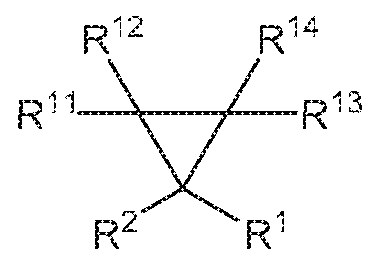
wherem R!, Rz, R! !, R1 2, R^ and Ri 4 are each as defined above, and wherein R2 can combine with one or more of R1 J ? RJ ", R; ! and Rf such that the bond formation is an intramolecular bond formation.
[0195] The product of the bond formation between the carbene precursor and the substrate can then be represented by the following formula:
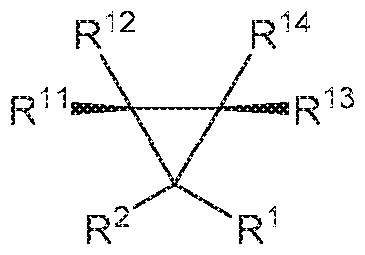
or the following formula:
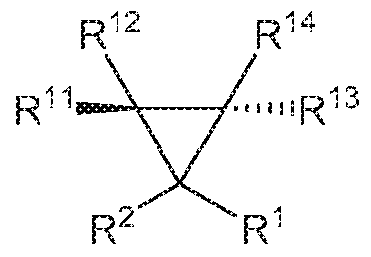
14
wherein R , R1, Rn R12, R1"1 and R1 are each as defined above.
[0196] The uct of the bond formation between the carbene precursor and the substrate can then be d by the following formula:
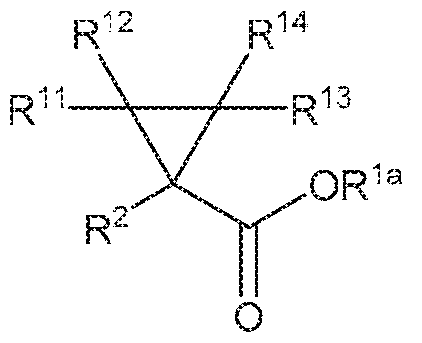
wherein Ria, R2, R", R12, R1"' and R14 are each as defined above, and wherein Rz can combine with one or more of Ri l, Ru, " and R14 such that the bond formation is an intramolecular bond formation.
[0197] The product of the bond formation between the carbene precursor and the substrate can then be represented by the following formula:

or the following formula:
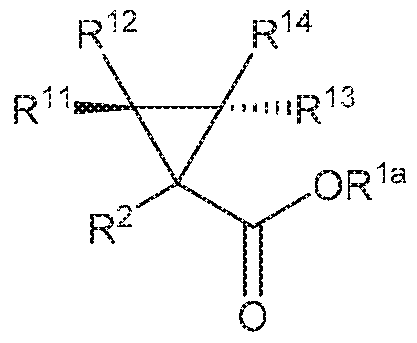
wherein RIa, R"?, R11, R12, R13 and R are each as defined above.
[0198] One of skill in the art will appreciate that stereochemical configuration of the products will be determined in part by the orientation of the diazo reagent with respect to the position of an olefinic substrate such as styrene during the cyclopropanation step. For example, any substituent originating from the substrate can be positioned on the same side of the cyclopropyl ring as a substituent originating from the diazo reagent. Cyclopropanation products having this arrangement are called "cis" compounds or "Z" compounds. Any substituent originating from the olefinic substrate and any substituent originating from the diazo reagent can also be on opposite sides of the cyclopropyl ring. Cyclopropanation products having this arrangement are called "trans" compounds or "E" compounds.
[0199] Cyclopropanation product mixtures can have cis: trans ratios ranging from about 1:99 to about 99: 1. The cis: trans ratio can be, for example, from about 1 :99 to about 1 :75, or from about 1 : 75 to about 1 :50, or from about 1 : 50 to about 1 :25, or from about 99: 1 to about 75 : 1 , or from about 75: 1 to about 50: 1, or from about 50: 1 to about 25: 1. The cis:trans ratio can be from about 1 : 80 to about 1 :20, or from about 1 : 60 to about 1 :40, or from about 80: to about 20: 1 or from about 60: 1 to about 40: 1. The cis : trans ratio can be about : 5, 1 : 10, 1 : 15, 1 :20, 1 :25, 1 :30, 1 :35, 1 :40, 1 :45, 1 :50, 1 :55, 1 :60, 1 :65, 1 :70, 1 :75, 1 :80, 1 :85, 1 :90, or about 1 :95. The cis:trans ratio
can be about 5: 1, 10: 1, 15: 1 , 20: 1, 25: 1, 30: 1, 35: 1, 40: 1, 45: 1 , 50: 1, 55: 1, 60: 1, 65: 1, 70: 1, 75: 1, 80: 1, 85: 1, 90: 1, or about 95: 1.
[0200] For the cyciopropanation reaction, the % diastereomeric excess (% de) refers to the excess percent of one diastereomer formed in a reaction over an alternate diastereomer that can also form in the reaction. For example, the catalyst composition can provide a product with an diastereomeric excess of from about 1% to about 99% de, or from about -1% to about -99% de. Representative % de values include at least about 10% de, or about 15, 20, 25, 30, 35, 40, 45, 50, 55, 60, 65, 70, 75, 80, 85, 90, or about 95% de. Representative % ee values also include at least about -10% de, or about -15, -20, -25, -30, -35, -40, -45, -50, -55, -60, -65, -70, -75, -80, -85, -90, or about -95% de. The preference for one diastereomer over another can also be represented by the diastereomeric ratio (dr), which is a ratio of one diastereomer to another. Representative dr values for the reactions of the present invention can be 5: 1, 10: 1, 15: 1 20: 1, 25: 1, 30: 1, 35: 1 , 40: 1, 50: 1, 60: 1, 70: 1, 75: 1 , 80: 1, 90: 1 , 100: 1, 125: 1, 150: 175: 1 and 200: 1, or greater. The dr values can represent a cis/trans relati onship of the primary substituents at each carbon relative to one another. The enantiomeric excess of individual stereocenters in the cyciopropanation reaction are also useful.
C. Reaction Conditions
[0201] The methods of the invention include forming reaction mixtures that contain the heme enzymes described herein. The heme enzymes can be, for example, purified prior to addition to a reaction mixture or secreted by a cell present in the reaction mixture. The reaction mixture can contain a cell lysate including the enzyme, as well as other proteins and other cellular materials. Alternatively, a heme enzyme can catalyze the reaction within a cell expressing the heme enzyme. Any suitable amount of heme enzyme can be used in the methods of the invention. In general, reaction mixtures contain from about 0.01 mol % to about 10 mol % heme enzyme with respect to the reactant and/or substrate. The reaction mixtures can contain, for example, from about 0.01 mol % to about 0.1 mol % heme enzyme, or from about 0.1 mol % to about 1 mol % heme enzyme, or from about 1 mol % to about 0 mol % heme enzyme. The reaction mixtures can contain from about 0.05 mol % to about 5 mol % heme enzyme, or from about 0.05 mol % to about 0.5 mol % heme enzyme. The reaction mixtures can contain about 0.1 , 0.2, 0.3, 0.4, 0.5, 0.6, 0.7, 0.8, 0.9, or about 1 mol % heme enzyme.
[0202] The concentration of substrate and reactant are typically in the range of from about 00 μΜ to about 1 M. The concentration can be, for example, from about 100 μΜ to about 1 mM, or about from 1 mM to about 100 mM, or from about 100 mM to about 500 mM, or from about 500 mM to 1 M. The concentration can be from about 500 μΜ to about 500 mM, 500 μΜ to about 50 mM, or from about 1 mM to about 50 mM, or from about 15 mM to about 45 mM, or from about 5 rnM to about 30 mM. The concentration of olefinic substrate or diazo reagent can be, for example, about 100, 200, 300, 400, 500, 600, 700, 800, or 900 μΜ. The concentration of olefinic substrate or diazo reagent can be about 1, 5, 10, 15, 20, 25, 30, 35, 40, 45, 50, 55, 60, 65, 70, 75, 80, 85, 90, 95, 100, 150, 200, 250, 300, 350, 400, 450, or 500 mM. [0203] Reaction mixtures can contain additional reagents. As non-iimitmg examples, the reaction mixtures can contain buffers (e.g., 2-(N-morpholino)ethanesulfonic acid (MES), 2-[4- (2~hydroxyethyi)piperazm-l -yljethanesulfonic acid (HEPES), 3-morpholinopropane-l -sulfonic acid (MOPS), 2-amino-2-hydroxymethyl-propane-l,3-diol (TRIS), potassium phosphate, sodium phosphate, phosphate-buffered saline, sodium citrate, sodium acetate, and sodium borate), cosolvents (e.g., dimethylsulfoxide, dimethylformamide, ethanol, methanol, isopropanol, glycerol, tetrahydrofuran, acetone, acetonitrile, and acetic acid), salts (e.g., NaCl, KG,
CaCl.sub.2, and salts of Mrs su 2 · and Mg.sup.2+), denaturants (e.g., urea and guandinium hydrochloride), detergents (e.g., sodium dodecylsulfate and Triton-X 100), chelators (e.g., ethylene glycol~bis(2~aminoethylether)-N,N,N!,N!~tetraacetic acid (EGTA), 2-({2- [Bis(carboxymethyl]amino)ethyl}(carboxymethyl)amino)acetic acid (EDTA), and l,2-bis(o- aminophenoxy)ethane-N,N,N,N-tetraacetic acid (BAPTA)), sugars (e.g., glucose, sucrose, and the like), and reducing agents (e.g., sodium dithionite, NADPH, dithiothreitol (DTT), .beta.- mercaptoethanol (BME), and tris(2-carboxyethyl)phosphine (TCEP)). Buffers, cosolvents, salts, denaturants, detergents, chelators, sugars, and reducing agents can be used at any suitable concentration, which can be readily determined by one of skill in the art. In general, buffers, cosolvents, salts, denaturants, detergents, chelators, sugars, and reducing agents, if present, are included in reaction mixtures at concentrations ranging from about 1 μΜ to about 1 M. For example, a buffer, a cosolvent, a salt, a denaturant, a detergent, a chelator, a sugar, or a reducing agent can be included in a reaction mixture at a concentration of about I or about 10 μΜ, or about 100 μΜ, or about 1 mM, or about 10 mM, or about 25 mM, or about 50 mM, or about 100
mM, or about 250 mM, or about 500 mM, or about 1 M. In some embodiments, a reducing agent is used i a sub-stoichiometric amount with respect to the olefin substrate and the diazo reagent. Cosolvents, in particular, can be included in the reaction mixtures in amounts ranging from about 1% v/v to about 75% v/v, or higher. A cosolvent can be included in the reaction mixture, for example, in an amount of about 5, 10, 20, 30, 40, or 50% (v/v).
[0204] Reactions are conducted under conditions sufficient to catalyze the formation of a cyclopropanation product. The reactions can be conducted at any suitable temperature. In general, the reactions are conducted at a temperature of from about 4. degree. C. to about 40. degree. C. The reactions can be conducted, for example, at about 25. degree. C. or about 37. degree. C. The reactions can be conducted at any suitable pH. In general, the reactions are conducted at a pH of from about 6 to about 10. The reactions can be conducted, for example, at a pH of from about 6.5 to about 9. The reactions can be conducted for any suitable length of time. In general, the reaction mixtures are incubated under suitable conditions for anywhere between about I minute and several hours. The reactions can be conducted, for example, for about I minute, or about 5 minutes, or about 10 minutes, or about 30 minutes, or about 1 hour, or about 2 hours, or about 4 hours, or about 8 hours, or about 2 hours, or about 24 hours, or about 48 hours, or about 72 hours. Reactions can be conducted under aerobic conditions or anaerobic conditions. Reactions can be conducted under an inert atmosphere, such as a nitrogen
atmosphere or argon atmosphere. In some embodiments, a solvent is added to the reaction mixture. In some embodiments, the solvent forms a second phase, and the cyclopropanation occurs in the aqueous phase, in some embodiments, the heme enzyme is located in the aqueous layer, whereas the substrates and/or products occur in an organic layer. Other reaction conditions may be employed in the methods of the invention, depending on the identit' of a particular heme enzyme, olefimc substrate, or diazo reagent. [0205] Reactions can be conducted in vivo with intact cells expressing a heme enzyme of the invention. The in vivo reactions can be conducted with any of the host cells used for expression of the heme enzymes, as described herein. A suspension of cells can be formed in a suitable medium supplemented with nutrients (such as mineral micronutrients, glucose and other fuel sources, and the like). Cyclopropanation yields from reactions in vivo can be controlled, in part, by controlling the cell density in the reaction mixtures. Cellular suspensions exhibiting optical
densities ranging from about 0.1 to about 50 at 600 nm can be used for cyclopropanation reactions. Other densities can be useful, depending on the cell type, specific heme enzymes, or other factors.
[0206] The methods of the invention can be assessed in terms of the diastereoselectivity and/or enantioselectivity of cyclopropanation reaction—that is, the extent to which the reaction produces a particular isomer, whether a diastereomer or enantiomer. A perfectly selective reaction produces a single isomer, such that the isomer constitutes 100% of the product. As another non- limiting example, a reaction producing a particular enantiomer constituting 90% of the total product can be said to be 90% enantioselective. A reaction producing a particular diastereomer constituting 30% of the total product, meanwhile, can be said to be 30% diastereoselective.
V. EXAMPLES
[0207] Unless stated otherwise, all reactions and manipulations were conducted on the laboratory bench in air with reagent grade solvents. Reactions under inert gas atmosphere were carried out in the oven dried glassware in a nitrogen- filled glovebox or by standard Schlenk techniques under nitrogen.
[0208] NMR spectra were acquired on 400 MHz, 500 MHz, 600 MHz, or 900 MHz Bruker instruments at the University of California, Berkeley. NMR spectra were processed with
MestReNova 9.0 (Mestrelab Research SL). Chemical shifts are reported in ppm and referenced to residual solvent peaks (Fulmer et al. (2010) Organometallics 29:2176). Coupling constants are reported in hertz. GC analyses were obtained on an Agilent 6890 GC equipped with either an
HP- 5 column (25 m x 0.20 mm ID x 0.33 m film) for achiral analysis or Cyciosil-B column (30m x 0.25mm x 0.25 um film) for chiral analysis, and an FID detector. GC yields were calculated using dodecane as the internal standard and not corrected for response factors of minor isomers. High-resolution mass spectra and elemental analysis were obtained via the Micro- Mass/Analytical Facility operated by the College of Chemistry, University of California, Berkeley.
[Θ2Θ9] Unless noted otherwise, all reagents and solvents were purchased from commercial suppliers and used without further purification. If required, dichloromethane (DCM) and tetrahydrofuran (THF) were degassed by purging with argon for 15 minutes and dried with a
solvent purification system containing a one-meter column of activated alumina; dried and degassed acetonitrile, 1,2-xylene, toluene, Ν,Ν-dimethylformamide (DMF), ethanol and methanol were purchased form commercial suppliers and used as received.
[0210] Example structures below are named according to standard IUPAC nomenclature using the CambridgeSoft ChemDraw naming package.
Example 1. Methyl phenyldiazoacetate e

[0211] To a stirred solution of methyl phenylacetate (6.0 ml, 40 mmol) and 4- acetamidobenzenesulfonyl azide (p-ABSA, 14.4 g, 60 mmol) in acetonitrile (80 ml) at 0 °C, 1,8- diazabicycloundec-7-ene (DBU, 9.6 ml, 64 mmol) was added dropwise. The cooling bath was removed, and the reaction was allowed to continue stirring overnight. The reaction mixture was diluted with dichloromethane (~60 ml), washed with water (2 x -50 ml), dried over MgS04 and evaporated. The crude product was purified by column chromatography on silica gel, with a mixture of hexane and ethyl acetate (100:0 to 95: 5 gradient) as the eluent. Fractions of the pure product were combined, and the solvent evaporated, yielding 5.5 g (78%) of product. The NMR data match those of the reported molecule (Nakamura et al. (2000) J. Am. Chem. Soc.
122: 1 1340).

[0212] To a stirred solution of methyl (2-methoxyphenyl)acetate (3.2 ml, 20 mmol) and 4- acetamidobenzenesulfonyl azide (p-ABSA, 7.2 g, 30 mmol) in acetonitrile (40 ml) at 0 °C, 1 ,8- diazabicycloundec-7-ene (DBU, 4.8 ml, 32 mmol) was added dropwise. The cooling bath was removed, and the reaction was allowed to continue stirring overnight. The reaction mixture was diluted with dichloromethane (~60 ml), washed with water (2 x -50 ml), dried over MgS04.
After filtration, the volatile material from the filtrate was evaporated under reduced pressure. The crude product was purified by column chromatography on silica gel, with a mixture of hexanes and ethyl acetate (100:0 to 95: 5 gradient) as the eluent. Fractions of the pure product were combined, and the solvent evaporated, yielding 3.9 g (95%) of product. The NMR data match those of the reported molecule (Huw et al. (2001) Org. Lett. 3: 1475)).
Example 3. Ethyl (2-methoxyphenyI)diazoacetate

[0213] In a closed vial, a solution of (2-methoxyphenyl)acetic acid (3.3 g, 20 mmol) in ethanol (20 ml), containing several drops of sulfuric acid, was stirred overnight at 80 °C. The volatile materials were evaporated under vacuum. The residue was dissolved in ethyl acetate (-40 ml), washed with \ai ICO . sat. (40 ml) and water (40 ml), and dried over MgS04. After filtration, the volatile material from the filtrate was evaporated under reduced pressure. The resulting crude product was used in the next step without further purification.
[0214] To a stirred solution of ethyl (2-methoxyphenyl)acetate and 4- acetamidobenzenesulfonyl azide (p-ABSA, 7.2 g, 30 mmol) in acetonitrile (40 ml) at 0 °C, 1,8- diazabicycloundec-7-ene (DBU, 4.8 ml, 32 mmol) was added dropwise. The cooling bath was removed, and the reaction was allowed to continue stirring overnight. The reaction mixture was diluted with dichloromethane (-60 ml), washed with water (2 x -50 ml), and dried over MgS04. After filtration, the volatile material from the filtrate was evaporated under reduced pressure. The crude product was purified by column chromatography on silica gel, with a mixture of hexanes and ethyl acetate (100:0 to 95:5 gradient) as the eluent. Fractions of the pure product were combined, and the solvent evaporated, yielding 2.15 g (49%) of product. The NMR data match those of the reported molecule (Nicolle and Moody (2014) Chemistry - A European Journal 18: 11063).
Example 4. Methyl (2-ethoxyphenyl)diazoacetate e

[0215] To a solution of (2-ethoxyphenyl)diazoacetate acid (3.8 g, 20 mmol) in toluene (40 ml) and methanol (20 ml), a solution of trimethysilyldiazomethane in diethyl ether (15 ml, 2 M, 30 mmol) was added dropwise while stirring, and stirring was continued for 2 hours. Upon evaporation of the volatile materials under vacuum, the product was obtained in quantitative yield without the need for further purification.
[0216] To a stirred solution of methyl (2-ethoxyphenyl)acetate (20 mmol) and 4- acetamidobenzenesulfonyl azide (p-ABSA, 7.2 g, 30 mmol) in acetonitriie (40 ml) at 0 °C, 1,8- diazabicycloundec-7-ene (DBU, 4.8 ml, 32 mmol) was added dropwise. The cooling bath was removed, and the reaction was allowed to continue stirring overnight. The reaction mixture was diluted with dichloromethane (-60 ml), washed with water (2 x -50 ml), dried over MgS0 and evaporated. The crude product was purified by column chromatography on silica gel, with a mixture of hexanes and ethyl acetate (100:0 to 95:5 gradient) as the eluent. Fractions of the pure product were combined, and the solvent evaporated, yielding 2.6 g (59%) of product. The NMR data match those of the reported molecule (Nicolle and Moody (2014) Chemistry— A European Journal 18: 11063).
Example 5. Methyl (2,5-dimethoxyphenyl)diazoacetate e

[0217] In a closed vial, a solution of (2,5-dimethoxyphenyi)acetic acid (3.8 g, 20 mmol) in methanol (20 nil) containing several drops of sulfuric acid, was stirred overnight at 80 °C. The volatile materials were evaporated under vacuum. The residue was dissolved in ethyl acetate (-40 ml), washed with Nal 1( 0 : sat. (40 ml) and water (40 ml), dried over MgS04 and evaporated. The crude product was used in the next step without further purification.
[0218] To a stirred solution of methyl (2,5-dimethoxyphenyl)acetate and 4- acetamidobenzenesulfonyl azide (p-ABSA, 7.2 g, 30 mmol) in acetonitrile (40 ml) at 0 °C, 1 ,8- diazabicycloundec-7-ene (DBU, 4.8 ml, 32 mmol) was added dropwise. The cooling bath was removed, and the reaction was allowed to continue stirring for 48 h (the reaction progress was followed by thin layer chromatography (TLC)). The reaction mixture was diluted with dichloromethane (-60 ml), washed with water (2 x -50 ml), and dried over MgSQ4. After filtration, the volatile material from the filtrate was evaporated under reduced pressure. The crude product was purified by column chromatography on silica gel, with a mixture of hexanes and ethyl acetate (100:0 to 95: 5 gradient) as the eluent. Fractions of the pure product were combined, and the solvent evaporated, yielding 4.1 g (87%) of product.
[0219] JH NMR (900 MHz, CDC13): d = 7.14 (d, J = 3.0 Hz, IH), 6.78 (d, J = 8.9 Hz, 1H), 6.75 (dd, J = 8,9 Hz, J = 3.0 Hz, IH), 3.80 (s, 3H), 3.76 (s, 3H), 3.74 (s, 3H); 13C NMR (225 MHz, CDCI3): d = 166,7, 154.1 , 149.8, 115,2, 114.7, 1 14.0, 112.3, 56.4, 56.0, 52.2 (C=N2 signal missing, as observed before for related molecules (Huw et al. (2001))); BR MS (EI): calcd, for C11H12N2O4 [M]+ : 236.0797, found: 236.0801.

[0220] To a stirred solution of ethyl (2,5-dimethoxyphenyl)acetate (4.3 g, 19.2 mmol) and 4- acetamidobenzenesulfonyl azide (p-ABSA, 7.2 g, 30 mmol) in acetonitrile (40 ml) at 0 °C, 1,8- diazabicycloundec-7-ene (DBU, 4.8 ml, 32 mmol) was added dropwise. The cooling bath was removed, and the reaction was allowed to continue stirring for 48 h (the reaction progress was followed by IXC). The reaction mixture was diluted with dichloromethane (-60 ml), washed with water (2 x -50 ml), and dried over MgS04. After filtration, the volatile material from the filtrate was evaporated under reduced pressure. The crude product was purified by column chromatography on silica gel, with a mixture of hexanes and ethyl acetate (100:0 to 95:5 gradient) as the eluent. Fractions of the pure product were combined, and the solvent evaporated, yielding 3.9 g (81%) of product.
[0221] ! I I NMR (900 MHz, CDCI3): d = 7.16 (d, J = 3.0 Hz, ! ! !}. 6.78 (d, J = 9.0 Hz, i l l). 6.74 (dd, J = 9.0 Hz, .! - 3.0 Hz, 1H), 4.27 (q, J = 7.2 Hz, 2H, OCH2), 3.77 (s, 3H), 3.74 (s, 3H), 1.28 (t, J = 7.2 Hz, 3H, CH2CH3); 13C NMR (225 MHz, CDC13): d = 166.3, 154.1, 149.8, 115.0, 114.9, 114.0, 112.3, 61.1, 56.4, 56.0, 14.8 (C=N2 signal missing, as observed before for related molecules (Huw et al (2001))); HR MS (EI): calcd. for Ci 2R !4 (> i M j : 250.0954, found: 250.0957.
Example 7. Benzyl (2,5-dimethoxyphenyQdiazoacetate n

[0222] To a solution of (2,5-dimethoxyphenyl)acetic acid (0.95 g, 5 mmol) in dichloromethane (20 ml) thionyl chloride (2 ml) was added dropwise and the reaction mixture was stirred under reflux for 1 hour. The volatile materials were evaporated under vacuum. The residue was dissolved in dichloromethane (40 ml), benzyl alcohol (1 ml) was added, followed by slow addition of trimethylamine (1 ml), and the reaction mixture was stirred for 48 hours (the reaction progress was followed by TI.C). The reaction mixture was washed with HC1 (0.5 M, 40 ml) and water (40 ml), dried over MgS04 and evaporated. The crude product was purified by column chromatography on silica gel, with a mixture of hexanes and ethyl acetate (100:0 to 95:5 gradient) as the eluent. Fractions of the product were combined, and the solvent evaporated, yielding 1.43 g (quantitative) of benzyl (2,5-dimethoxyphenyl)acetate.
[0223] To a stirred solution of benzyl (2,5-dimethoxyphenyl)acetate (1.43 g, 5 mmol) and 4- acetamidobenzenesulfonyl azide (p-ABSA, 1.8 g, 7.5 mmol) in acetonitrile (20 ml) at 0 °C, 1,8- diazabicycloundec-7-ene (DBU, 1.2 ml, 8 mmol) was added dropwise. The cooling bath was removed, and the reaction was allowed to continue stirring overnight. The reaction mixture was diluted with dichloromethane (~50 ml), washed with water (2 x -50 ml), dried over MgS04 and evaporated. The crude product was purified by column chromatography on silica gel, with a mixture of hexanes and ethyl acetate (100:0 to 80:20 gradient) as the eluent. Fractions of the pure product were combined, and the solvent evaporated, yielding 0.94 g (60%) of product.
[0224] ! I I NMR (900 MHz, CDCI3): d = 7.37-7.32 (in. 4H), 7.31-7.28 (m, III), 7.16 (bs, I I I ). 6.78 (d, J = 9.0 Hz, IH), 6.75 (dd, J = 9.0 Hz, J = 3.0 Hz, ! ! ! }. 5.26 (s, 2H), 3.76 (s, 3H), 3.71 (s, 3H); 13C NMR (225 MHz, CDCI3): d = 166.1, 154.1, 149.8, 136.3, 128.8, 128.4, 1 15.0, 114.6, 114.2, 112.3, 66.6, 56.4, 56.0 (C=N2 signal missing, as observed before for related molecules (Huw et a!. (2001))); HR MS (EI): calcd. for C , ·! ! |.,\ -O [M]+ : 312.1 110, found: 312.1 111.
Example 8. Methyl (2,3-dimethoxyphenyI)diazoacetate e

[0225] In a closed vial, a solution of (2,3-dimethoxyphenyl)acetic acid (1.5 g, 7.9 mmol) in methanol (20 ml) containing several drops of sulfuric acid, was stirred overnight at 80 °C. The volatile materials were evaporated under vacuum. The residue was dissolved in ethyl acetate (-40 ml), washed with Nal 1( 0 : sat. (40 ml) and water (40 ml), dried over MgS04 and evaporated. The crude product was used in the next step without further purification.
[0226] To a stirred solution of methyl (2,3-dimethoxyphenyl)acetate and 4- acetamidobenzenesuifonyl azide (p-ABSA, 2.9 g, 12 mmol) in acetonitrile (30 ml) at 0 °C, 1,8- diazabicycloundec-7-ene (DBU, 1.9 ml, 13 mmol) was added dropwise. The cooling bath was removed, and the reaction was allowed to continue stirring for 48 h (the reaction progress was followed by TLC). The reaction mixture was diluted with dichloromethane (~50 ml), washed with water (2 x -50 ml), and dried over MgS04. After filtration, the volatile material from the filtrate was evaporated under reduced pressure. The crude product was purified by column chromatography on silica gel, with a mixture of hexanes and ethyl acetate (100:0— > 80:20 gradient) as the eluent. Fractions of the pure product were combined, and the solvent evaporated, yielding 1.55 g (83%) of product.
[0227] ! I I NMR (900 MHz, CDCI3): d = 7.19 (d, J = 7.9 Hz, 1 H), 7.05 (dd, J = 8.1 Hz, J = 8.1
Hz, I H), 6.79 (d, J = 8.2 Hz, 1 H), 3.83 (s, 3H), 3.81 (s, 3H), 3.79 (s, 3H); !JC NMR (225 MHz, CDCI3): d = 166.6, 152.9, 145.3, 124.5, 121.3, 120.0, 1 11.4, 60.8, 56.0, 52.2 (C=N2 signal
missing, as observed before for related molecules (Huw et al. (2001))); HR MS (El): calcd. for CiiH12N204 [M]+ : 236.0797, found: 236.0800.
Example 9. General procedure for synthesis of dihydrobenzofurans
[0228] To a solution of a derivative of methyl (2-methoxyphenyl)diazoacetate (-50 mM) in toluene a solution of Ir(Me)-PIX (8 mM, 0.2-2 mol%) in DMF was added, and the reaction mixture was vigorously stirred. The reaction progress was monitored by IXC. Upon completion, the volatile materials were removed, and the residue was purified by column chromatography on silica gel, with a mixture of hexanes and ethyl acetate (100:0 to 80:20 gradient) as eluent.
Fractions of the pure product were combined, and the solvent evaporated, yielding 20-90% of desired product.
Example 10. Tnms-met yl 2-methyl-2,3-dihydrobenzofuran-3-carboxyiate Mc

[0229] 'I I NMR (900 MHz, CDCI3): d = 7.29 (d, J = 7.7 Hz, 1H), 7.15 (dd, J = 7.8 Hz, J = 7.6 Hz, 1H), 6.84 (dd, J - 7.6 Hz, J = 7.6 Hz, i l l ). 6.76 (d, J = 7.9 Hz, IH), 5.13 (dq, J = 7.9 Hz, J 6.5 Hz, IH), 3.75 (s, 3H), 1.48 (d, J = 6.5 Hz, 3H); °C NMR (225 MHz, CDCI3): d = 171.7, 159.4, 129.7, 125.6, 124.4, 120.7, 1 10.1, 81.5, 54.5, 52,7, 21.4; HR MS (EI): calcd. for
C11H12O3 [M]+ : 192.0786, found: 192.0784.
Example 11. Ethyl 2,3-dihydrobenzofuran-3-carboxylate OEt

[0230] 'I I NMR (900 MHz, CDCI3): d = 7.34 (d, J = 7.5 Hz, IH), 7.14 (dd, J = 7.9 Hz, J == 7.9 Hz, IH), 6.85 (dd, J - 7.5 Hz, J == 7.5 Hz, IH), 6.78 (d, J == 8.0 Hz, IH), 4.90 (dd, J == 9.0 Hz, J 6.8 Hz, IH), 4.63 (dd, J === 9.4 Hz, J == 9.4 Hz, IH), 4.29 (dd, J === 9.7 Hz, J === 6.8 Hz, IH), 4.19 (dq, J == 13.3 Hz, J = 7.1 Hz, 21 1). 1.27 (t, J == 7.1 Hz, 3H); i3C NMR (225 MHz, CDCI3): d
173.9, 162.6, 132.2, 128.1, 127. 1 , 123.4, 112.7, 75.2, 64.3, 49.9, 17.0; H calcd. for C11H12O3 [M]+ : 192.0786, found: 192.0782 O e
 [0231] ' I I NMR (900 MHz, CDCI3): d = 6.91 (s, 1 1 1 ). 6.71 -6.68 im. 2H), 4.86 (dd, J = 9.1 Hz, J = 6.7 Hz, IH), 4.61 (dd, J - 9.5 Hz, J - 9.3 Hz, IH), 4.27 (dd, J = 9.5 Hz, J - 6.7 Hz, 1 1 1 ). 3.74 (s, 3H), 3.73 (s, 3H); 13C NMR (225 MHz, CDCI3): d 171.7, 154.4, 154.1 , 125.2, 1 14.9, 1 11.5, 110.1 , 72.9, 56.3, 52.8, 47.8; HR MS (EI): calcd. for CnH12()4 [M]+ : 208.0736, found:
208.0740. Example 13. Ethyl 5-methoxy-23-cSii¾ydrobe8izofara¾¾-3-carboxylate OEi
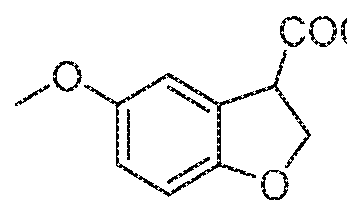
H NMR (900 MHz, CDCI3): d = 6.92 (s, IH), 6.70-6.68 (m, 2H), 4.86 (dd, J = 9.0 Hz, J = 6.9 Hz, IH), 4.61 (dd, J = 9.6 Hz, J = 9.1 Hz, IH), 4.26 (dd, J = 9.5 Hz, J = 7.0 Hz, IH), 4.19 (dq, J = 19.2 Hz, J = 7.1 Hz, 2H), 3.72 (s, 3H), 1.27 (t, j 7. 1 Hz, 3H); "C NMR. (225 MHz, CDCI3): d = 171.2, 154.3, 154.2, 125.3, 114.9, 111.4, 1 10.1 , 61.7, 56.3, 47.8, 14.5; HR MS (EI): calcd. for C .H uC [M] D: 222.0892, found: 222.0893. OBn

[0233] 1H NMR (900 MHz, CDCI3): d = 7.35-7,29 (m, 5H), 6.86 (s, IH), 6.70-6,68 (m, 2H), 5.17 (dd, J = 43.3 Hz, J = 12.2 Hz, 2H), 4.88 (dd, J = 9.1 Hz, J = 6.8 Hz, IH), 4.62 (dd, J = 9.5
Hz, J = 9,2 Hz, IH), 4.31 (dd, J = 9.6 Hz, J = 7.0 Hz, IH), 3.66 (s, 3H); l3C NMR (225 MHz.
CDCI3): d = 171.0, 154.3, 154.1, 135.7, 128.9, 128.7, 128.6, 125.0, 1 15.4, 1 11.1, 110.2, 72.9, 67.5, 56.2, 47.8; HR MS (EI): calcd. for CV i l ;,X).i | M j : 284.1049, found: 284.1053.
Example IS. Methyl 7-methoxy-2,3-dihydrobenzofuraii-3-carboxylate OMe

[0234] *H NMR (900 MHz, CDCI3): d = 6.95 (d, J = 7.7 Hz, 1H), 6.81 (dd, J = 7.9 Hz, J = 7 Hz, 1H), 6.76 (d, J = 8.2 Hz, 1H), 4.95 (dd, J = 9.2 Hz, J = 6.8 Hz, IH), 4.69 (dd, J = 9.7 Hz, J : 9.3 Hz, IH), 4.33 (dd, J = 9.7 Hz, J = 6.9 Hz, IH), 3.83 (s, 3H), 3.73 (s, 3H); 13C NMR (225 MHz, CDC! : ): d = 171.7, 148.6, 145.1, 125.2, 121.5, 117.6, 1 12.6, 73.4, 56.2, 52.8, 47.9; HE. MS (EI): calcd. for CnH] 204 | M | : 208.0738, found: 208.0740.

[[00223355]] TToo aa ssoolluuttiioonn ooff aann aallkkeennee ((--00..11--00..55 MM,, 55--1100 eeqquuiivv..)) iinn ttoolluueennee,, aa ssoolluuttiioonn ooff IIrr((MMee))-- PPIIXX ((88 mmMM,, 00..22 mmooll%%)) iinn DDMMFF w waass aaddddeedd,, ffoolllloowweedd bbyy ssllooww aaddddiittiioonn ooff aa ssoolluuttiioonn ooff eetthhyyll ddiiaazzooaacceettaattee ((11 eeqq..)) iinn ttoolluueennee,, wwhhiillee tthhee rreeaaccttiioonn mmiixxttuurree wwaass vviiggoorroouussllyy ssttiirrrreedd.. UUppoonn ccoommpplleettiioonn,, tthhee vvoollaattiillee mmaatteerriiaallss wweerree rreemmoovveedd aanndd tthhee rreessiidduuee wwaass ppuurriiffiieedd bbyy ccoolluummnn cchhrroommaattooggrraapphhyy oonn ssiilliiccaa ggeell,, wwiitthh aa mmiixxttuurree ooff hheexxaanneess a anndd eetthhyyll aacceettaattee ((110000::00 ttoo 9955:: 55 ggrraaddiieenntt)) aass tthhee eelluueenntt.. FFrraaccttiioonnss ooff tthhee ppuurree pprroodduucctt((ss)) wweerree ccoommbbiinneedd,, aanndd tthhee ssoollvveenntt eevvaappoorraatteedd,, yyiieellddiinngg ddeessiirreedd pprroodduuccttss..

[0236] A solution of thiophenol (0.2 ml), methyl phenyldiazoacetate (0.1 ml) and Ir(Me)~PIX (1 mol%) in toluene (4 ml) was stirred vigorously overnight. The reaction progress was monitored by TLC. Upon completion, the volatile materials were removed and the residue was purified by column chromatography on silica gel, with a mixture of hexanes and ethyl acetate
(100:0 to 90: 10 gradient) as the eluent. Fractions of the pure product were combined, and the solvent evaporated, yielding the product from insertion of the carbene into the S-H bond. The NMR data of the product match those of the reported molecule (Kamata et al. (2010) Chem. Lett, 39:702). Example 18. lr(CO)Cl-Mesoporphyrin IX dimethyl ester

[0237] Under a nitrogen atmosphere, a suspension of mesoporphyrin IX dimethyl ester (250 mg, 0.42 mmol) and [Ir(COD)Cl]2 (400 mg, 0.6 mmol) in dry and degassed 1,2-xylene (20 ml) was stirred at 150 °C for 7 days. The crude reaction mixture was loaded onto a plug of silica gel (Si02). The organic material was first eluted with a mixture of hexanes and ethyl acetate (100:0 to 75:25 gradient) to remove the remaining starting material and a side product. Then it was eluted with a mixture of hexanes and ethyl acetate (75:25 to 55:55 gradient) to collect the product. Fractions containing the pure product were combined, and the solvent evaporated, yielding 85 mg (24%) of a deep red solid. [0238] ' I I NMR (500 MHz, CDC13): d = 10.33- 10.28 (in, 4F1), 4.53 -4.41 (m, 4F1), 4.20-4.01 (m, 4FI), 3.75-3.71 (m, 6FI), 3.71 -3.67 (m, 9FI), 3.64 (s, 31 11 1 ). 3.38 (t, J = 7.8 Flz, 4FI), 1.95 (t, J = 7.6 HZ, 6FI); i3C NMR (225 MHz, CDCI3): d = 173.83, 173.82, 143.2, 143.1 , 140.0, 139.8, 139.4, 139.23, 139.20, 139.19, 138.9, 138.5, 138.45, 138.4, 137.38, 137.35, 136.4, 136.3, 135.0, 99.2, 99.1, 99.0, 98.9, 51.99, 51.96, 37.05, 37.04, 22.07, 22.01, 20.10, 20.09, 17.85, 17.83, 12.02, 11.98, 11.85, 1 1.81 ; HR MS (ESI): calcd. I r CwJ l rN^)., [M-Cl-COf: 785.2673, found:
785.2715; IR (neat): 2031, 1735 cm"1; UV/Vis (DMF, O5- 10"6 M): λπ13Χ (log ε) 327 (4.23), 393 (5.29), 510 (4.02), 540 nm (4.27).
Example 19. lr(CI)-Mesoporphyrin IX

[0239] A solution of Ir(CO)Cl-mesoporphyrin IX dimethyl ester (25 mg, 0.03 mmoi) and LiOH (100 mg) in THF (3 ml), methanol (1 ml) and water (1 ml) was stirred at room temperature for 2 hours. The reaction mixture was concentrated (~1 ml) under vacuum, diluted with sodium phosphate buffer (4 mi, 0.1 M, pH = 5) and slowly acidified with HC1 (0.5 M) to ~ pH = 5. The red precipitate was separated from the liquid by centrifugation (2000 rpm, 15 min, 4 °C) and subsequent decanting of the liquid. The red solid residue was suspended in water (15 ml), the mixture was centrifuged, and the liquid was decanted. The resulting solid was dried for overnight under high vacuum at room temperature, yielding 21 nig (88%) of dark red powder.
[0240] ¾ NMR (600 MHz, D2O+0.5% NaOD): d = 10.22 (bs, 1H), 9.98 (bs, 3H), 4.35 (bs, 4H), 4.08 (bs, 3.67 (bs, 12H), 3.12 (bs, 4H), 1.84 (bs, 6H); 13C NMR (225 MHz,
D2O+0.5% NaOD): δ = 185.7, 145.8, 145.6, 145.16, 145.10, 145.07, 145.0, 144.09, 144.08, 144.05, 143.9, 142.53, 142.51, 139.74, 139.71, 138.7, 138.5, 102.37, 102.14, 101.99, 101.96, 43.7, 25.4, 21.5, 19.95, 19.94, 13.12, 13.10, 12.88: H1 MS (ESI): calcd. for C\ 1 hJ rN J, [M- Cl]+: 757.2360, found: 757.2393; (neat): 1706 cm"1; UV/Vis (DMF, C=5 - 10"6 M): (log ε) 326 (4.40), 393 (5.26), 510 (4.15), 540 nm (4.37).
Example 20. lr(Me)-Mesoporphyrin IX

[0241] Under a nitrogen atmosphere, to a suspension of Ir(CO)Cl-mesoporphyrin IX dimethyl ester (1 10 mg, 0.13 mmol) in degassed ethanol (10 ml), a degassed solution of NaBEU (25 mg) and NaOH (1 M) in water (3 mi) was added. The reaction mixture was stirred at 50 °C for 1 hour in the dark, cooled to room temperature, and followed by addition of methyl iodide (10 mi). The reaction mixture was stirred overnight at room temperature. The reaction mixture was concentrated (~3 ml) under vacuum, followed by addition of LiOH (200 mg). The reaction mixture was stirred at room temperature for 1 hour, diluted with sodium phosphate buffer (8 ml, 0.1 M, pH = 5) and slowly acidified with HC1 (0.5 M) to ~ pH = 5. The red precipitate was separated from the liquid by centrifugation (2000 rpm, 15 min, 4 °C) and subsequent decanting of the liquid. The red solid residue was suspended in water (15 mi), the mixture was centrifuged, and the liquid was decanted. The resulting solid was dried for overnight under high vacuum at room temperature, yielding product quantitatively; dark red powder. [0242] ¾ NMR (900 MHz, DM i / -): d = 12.56 (bs, 2H), 9.93 (s, 1H), 9.78 (s, 3H), 4.38- 4.33 (m, 21 1). 4.29-4.24 (m, 2H), 4.03-3.98 (m, 4H), 3.61 (s, 6H), 3.58 (s, 3H), 3.57 (s, 3H), 3.28 (q, J = 7.5 Hz, 6H), 1.83 (t, J = 7.5 Hz, 6H), -7.61 (s, 3H); 13C NMR (225 MHz, DM I-V-): d = 175.40, 175.39, 143.5, 143.2, 143.0, 142.91, 142.88, 142.79, 142.4, 142.0, 141.83, 141.82, 139.82, 139.76, 136.95, 136.90, 135.9, 135.7, 101.0, 100.9, 100.7, 100.5, 38.34, 38.32, 22.50, 22.49, 20.09, 20.06, 18,59, 18.55, 1.63, 11.61, 11.48, 1 1.44; S IR MS (ESI): calcd. for
C35H4oIrN404 [M+Hf : 773,2673, found: 773.2708; IS (neat): 1706 cm"1; U Vis (DMF, C=5- 10"6 M): λ (log ε) 341 (4.39), 392 (5.07), 530 (4.24).
Example 21. 2-Propylbe8ize¾¾es lfosivI azide

[0243] To a stirred solution of l-bromo-2-propylbenzene (Ruano et al. (2005) Tetrahedron 61: 10099, 5 g, 25 mmol) in 50 mL of dry THF was added n-butyllithium (12 mL, 2.5 M in hexanes, 30 mmol) dropwise at -78 °C, and the reaction mixture was stirred 1 h. Sulfuryl chloride (2.5 ml, 31 mmol) was added at -78 °C, the cooling bath was removed and the reaction mixture was stirred overnight at room temperature. Then the reaction was quenched with water (30 mL). The product was extracted with diethyl ether (3 x 50 mL), and the combined organic layers were washed with brine (30 mL), dried over MgS04 and evaporated. The crude product was purified by column chromatography on silica gel, with a mixture of hexanes and ethyl acetate (100:0 to 95: 5 gradient) as the eluent. Fractions of the pure 2-propyibenzenesuifonyl chloride were combined, and the solvent evaporated, yielding 500 mg of product as colorless liquid, which was subjected to the next step without further purification.
[0244] To a solution of 2-propylbenzenesulfonyi chloride in an acetone : water mixture (40 ml, 1 : 1 v/v) was added sodium azide (500 mg, 7.7 mmol) at 0 °C. The cooling bath was removed and the reaction mixture was let to stir for 24 hours. Then the reaction mixture was concentrated to ca. 20 ml. The product was extracted with diethyl ether (3 x 30 mL), and the combined organic layers were washed with brine (30 mL), dried over MgS04 and evaporated. The crude product was purified by column chromatography on silica gel, with a mixture of hexanes and ethyl acetate (100:0 to 95:5 gradient) as the eluent. Fractions of the pure product were combined, and the solvent evaporated, yielding 400 mg (7%, 2 steps) of product as colorless liquid.
[0245] U NMR (500 MHz, CDCI3): d = 8.01 (d, J = 8.0 Hz, 1H), 7,59 (t, J = 7.5 Hz, IH), 7.42 (d, J = 7.7 Hz, i l l). 7.36 (t, J = 7,7 Hz, i l l ). 2.99 - 2.89 (m, 2H), 1.69 (dq, J = 15.0, 7.4 Hz, 2H), 1.00 (t, J = 7,3 Hz, 3H); 13C NMR (151 MHz, CDCI3): d = 143.38, 136,73, 134.74, 134.71, 132.20, 129.69, 126,56, 35.15, 24.65, 14,26; I IK MS (EI): calcd. for C; . Π 1 - [Mf : 178.0994, found: 178.0997,
Example 22. General procedure for synthesis of sultams
[0246] In a closed vial, a solution of benzenesulfonyl azide (100 mg) and Ir(Me)-PIX (~4 mg) in toluene (6 nil) was stirred at 80 °C. The reaction progress was monitored by TLC. Upon completion (~16 hours), the volatile materials were evaporated under reduced pressure, and the residue was purified by column chromatography on silica gel, with a mixture of hexanes and ethyl acetate (100:0 to 70:30 gradient) as eluent. Fractions of the pure product were combined, and the solvent evaporated, yielding sultam products.
Example 23. General procedure for synthesis of beiizenesulfonamide
[0247] To a solution of benzenesulfonyl azide (100 mg, -0.5 mmol) in THF (5 ml) sodium borohydnde (100 mg, 2.6 mmol) was added at room temperature. The reaction progress was monitored by TLC. Upon completion (~1 hour), the reaction was quenched with water (10 ml).
The reaction mixture was concentrated to ca. 10 ml. The product was extracted with ethyl acetate
(3 x 30 mL), and the combined organic layers were washed with brine (30 mL), dried over
MgS04 and evaporated. The crude product was purified by column chromatography on silica gel, with a mixture of hexanes and ethyl acetate (100:0 to 70:30 gradient) as the eluent. Fractions of the pure product were combined, and the solvent evaporated, yielding benzenesulfonamide products.
Example 24. 2,5-Diethylbenzenesulfonamide
 [0248] *H NMR (600 MHz, CDCI3): d = 1H NMR (400 MHz, Chloroform-d) δ 7.82 (s, IH), 7.36 - 7.25 (m, 2H), 3.00 (q, J = 7.5 Hz, 2H), 2.64 (q, J = 7.6 Hz, 2H), 1.28 (t, J = 7.5 Hz, 3H), 1.21 (t, J = 7.6 Hz, 3H); 1H NMR (600 MHz, DMSO-d6): d = 7.70 (s, IH), 7.40-7.30 (m, 4H), 2.96 (q, J = 7.5 Hz, 2H), 2.63 (q, J = 7.6 Hz, 2H), 1.19 (q, J = 7.2 Hz, 6H); 13C NMR (151 MHz, DMSO-d6): d = 141.70, 141.30, 139.11, 131.25, 130.55, 126.26, 27.62, 24.89, 15.48, 15.40; MR MS (El): calcd. for C9H13NO2S [Mf: 199.0667, found: 199.0668.
Example 25. 2-PropylbenzeneseIfonamide
[0248] *H NMR (600 MHz, CDCI3): d = 1H NMR (400 MHz, Chloroform-d) δ 7.82 (s, IH), 7.36 - 7.25 (m, 2H), 3.00 (q, J = 7.5 Hz, 2H), 2.64 (q, J = 7.6 Hz, 2H), 1.28 (t, J = 7.5 Hz, 3H), 1.21 (t, J = 7.6 Hz, 3H); 1H NMR (600 MHz, DMSO-d6): d = 7.70 (s, IH), 7.40-7.30 (m, 4H), 2.96 (q, J = 7.5 Hz, 2H), 2.63 (q, J = 7.6 Hz, 2H), 1.19 (q, J = 7.2 Hz, 6H); 13C NMR (151 MHz, DMSO-d6): d = 141.70, 141.30, 139.11, 131.25, 130.55, 126.26, 27.62, 24.89, 15.48, 15.40; MR MS (El): calcd. for C9H13NO2S [Mf: 199.0667, found: 199.0668.
Example 25. 2-PropylbenzeneseIfonamide

[0249] Ή NMR (600 MHz, CDCI3): d = 7.96 (d, J = 8.0 Hz, ! ! ! }. 7.46 ft, J = 7.5 Hz, 1H), 7.34 (d, J = 7.6 Hz, IH), 7.26 (t, J = 7.7 Hz, I I I ). 4.94 (s, 2H), 2.98 - 2.92 (in, 2H), 1.70 (h, J 7.4 Hz, 21 1 ). 0.99 (t, J = 7.3 Hz, 3H); i3C NMR (151 MHz, CDCI3): d = 141.68, 139.87, 132.89, 131.46, 128.40, 126.23, 35.15, 24.48, 14.410; I IR MS (EI): calcd. for C.,l l , AO >S | M j .
99.0667, found: 199.0668.
Example 26. General procedures for synthesis of cyclopropanes
[0250] Procedure A: To a vial charged with the aikene (5-10 mmol, 5-10 equiv.) in toluene (10 ml), was added 100 μΐ of an 8 mM solution of Ir(Me)-PIX (0.0008 equiv. ) in DMF. A solution of ethyl diazoacetate (EDA, 1 mmol, 1 equiv.) in toluene (1 ml) was then added slowly while the reaction mixture was vigorously stirred. After complete addition of EDA, the reaction was stirred for 30-60 minutes, after which time the evolution of nitrogen stopped, indicating full consumption of EDA. Then, the volatile materials were removed, and the residue was purified by column chromatography on silica gel, with a mixture of hexanes and ethyl acetate (100:0 to 85: 15 gradient) as the eluent. Fractions of the pure product(s) were combined, and the solvent evaporated, yielding cyclopropanation products.
[0251] Procedure B: To a solution of aikene (-0.2 M) and Rh2Ac04 (~0.1-1 mol% in respect to EDA) in dry DCM, a solution of ethyl diazoacetate (~1 M) in dry DCM was added slowly while the reaction mixture was vigorously stirred. After complete addition of EDA, the reaction was stirred for 30-60 min, after which time the evolution of nitrogen stopped, indicating full consumption of EDA. Then, the volatile materials were removed, and the residue was purified by column chromatography on silica gel, with a mixture of hexanes and ethyl acetate (100:0 to 85: 15 gradient) as the eluent. Fractions of the pure product(s) were combined, and the solvent evaporated, yielding cyclopropanation products.
Example 27. Ethyl syn-2-methyl-syii-3-pentylcyclopropane-l-carboxylate

[0252] The product was isolated from a reaction of cis-2-octene (1 ml) with EDA (0.25 ml) conducted following Procedure B of Example 26. 1H NMR (900 MHz, CDCI3): d = 4.09-4.05 (m, 2H), 1.60-1.57 (m, 3H), 1.38-1.36 (dq, J =6.5 Hz, J = 2.2 Hz, 1H), 1.31-1.22 (m, I I I I ). 1.18 (d, J = 6.2 Hz, 3H), 0.85 (m, J = 6.7 Hz, 3H); 13C NMR (151 MHz, CDCI3): d = 172.34, 59.76, 31.84, 29.57, 25.36, 22,82, 22.10, 20.76, 19.04, 14.55, 14.20, 7.53; HR MS (EI): calcd. for C12H2l02 [Mf : 198.1620, found: 198, 1622.
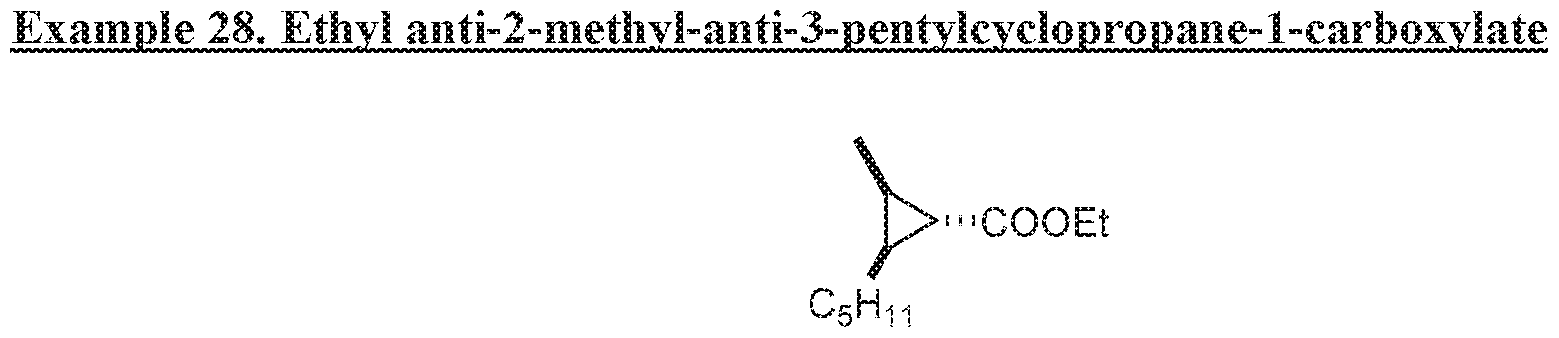
[Θ253] The product was isolated from a reaction of cis-2-octene (1 ml) with EDA (0,25 ml) conducted following Procedure B of Example 26, *H NMR (900 MHz, CDC13): d = 4.08 (q, J 7.2 Hz, 2H), 1 ,46 (m, IH), 1.39-1.30 (m, 5H), 1 .28- 1,24 (m, 41 1 ). 1 ,23 (t, J = 7.2 Hz, 3H), 1.08 (d, J = 6,3 Hz, 3H), 0.99 (t, J = 4.8 Hz, I H), 0,87 (t, J = 7,4 1 1 3H); 13C NMR (151 MHz, CDCI3): d = 174.85, 60,33, 31 ,77, 29.31, 28.15, 27,99, 27.23, 22.76, 21 ,92, 14,47, 14.19, 12.16; HR MS (EI): calcd. for C12H2102 [M]+: 198, 1620, found: 198, 1619.
Example 29. Syn-2-ethyl 1 -ethyl l-methylcyclopropane-l,2-dicarboxylate
EtOO

[0254] The product was isolated from a reaction of ethyl methacrylate (3 ml) with EDA (1 ml) conducted following Procedure B of Example 26. The isolated product conta ins 5% impurity by GC. Stereochemistry assigned based on comparison of NMR data to analogous compound (Chen et al (2007) J. Am. Chem. Soc. 129: 12074), !I I NMR (500 MHz, CDCI3): d = 4.10-4,20 (m, 4H), 1.78-1.84 (m, 2H), 1.41 (s, 3H), 1.24-1.28 (m, 6H), 1.04-1.10 (m, IH); ;i3C NMR (151
MHz, CDC ): d 171.73, 170.55, 61.12, 60.93, 29.06, 28.97, 21.33, 19.64, 14.33, 14.24; HE MS (EI): caicd. for CioH5604 | M ] . 200.1049, found: 200.1051.
Example 30. Anti-2-ethyl 1-ethyl l-methvlcyclopropaiie-l,2-dicarboxylate
[ ™COOEt
EtQOcf [0255] The product was isolated from a reaction of ethyl methacrylate (3 ml) with EDA (1 ml) conducted following Procedure B of Example 26. The isolated product contains 5% impurity by GC. Relative stereochemistrv- was assigned based on comparison with the NMR data for the methyl ester analogue: anti-2-ethyi 1 -methyl l-methylcyclopropane-l,2-dicarboxylate. *H NMR (600 MHz, CDCI3): d = 4.07-4.16 (m, 4H), 2.29 (dd, J = 8.7, 6.5 Hz, IH), 1.53 (dd, J = 8.7, 4.2 Hz, IH), 1.36 (s, 3H), 1.31 - 1.26 (m, IH), 1.23 (dt, J = 10.7, 7.1 Hz, 6H); 13C NMR (151 MHz, CDCI3): d = 173.64, 170.63, 61.37, 61.04, 27.98, 27.10, 21.12, 14.45, 14.28, 14.26, 13.21; MR MS (EI): caicd. for Ci0H]6G4 | M ] : 200.1049, found: 200.1051.

Example 32. 6-ethyI 3-methyl (lR,3s,5S,6s)-bicyclo[3.1.0'lhexane-3,6-dicarboxyIate
MeOOC

stereochemistrv' was assigned based on comparison with the NMR data for the analogue: methyl syn-3-carbomethoxybicyclo[3.1.0]hexane-6-acetate (Carfagna et al. (1991) J. Org. Chew. 56: 3924). ¾ NMR (900 Mi l;-. CDCI3): d = 4.11 (q, J = 7.1 Hz, 2H), 3.63 (s, 3H), 2.93 (p, J = 8.7 Hz, I I I ). 2.22 (m, 4H), 1.82 (m, 2H), 1.67 (t, J = 8.3 Hz, 1H), 1.25 (t, J = 7.4 Hz, 3H); 13C NMR (226 MHz, CDCI3): d = 176.50, 171.61, 61.24, 51.75, 43.08, 29.80, 25.71, 23.60, 14.26.; HR MS (EI): calcd. for CnH1604 | M | : 212.1049, found: 212.1048.

[[00225588]] TThhee pprroodduucctt wwaass iissoollaatteedd ffrroomm aa rreeaaccttiioonn ooff mmeetthhyyll ccyyccllooppeenntt--33--eennee--ll --ccaarrbbooxxyyllaattee ((00..33 m mll)) wwiitthh EEDDAA ((00..55 mmll)) ccoonndduucctteedd ffoolllloowwiinngg PPrroocceedduurree BB ooff EExxaammppllee 2266.. **HH NNMMRR ( (990000 M MHHzz,, CCDDCCII33)):: dd == 44..0099 ((qq,, JJ 77..11 HHzz,, 2211 11 )).. 33..6655 ((ss,, 33HH)),, 33..3344 ((pp,, JJ == 99..55 HHzz,, ii ll ll )).. 22..2266 ((111111,, 44HH)),, 11..8888 ((mm,, 33HH)),, 11..6666 ((tt,, JJ == 88..55 HHzz,, 11 HH)),, 11 ,,2222 ((tt,, JJ 77..22 HHzz,, 33HH));; 1133CC NNMMRR ((222266 M MHHzz,, CCDDCCII33)):: dd == 117755,, 1188,, 117711..2255,, 5599..9900,, 5511 ,,8877,, 4499..4455,, 2277..6677,, 2266..2299,, 1144,,3333;; HHR MMSS ((EEII)):: ccaallccdd.. ffoorr CC nn HH ^^OOii [[MM]+:: 221122..11004499,, ffoouunndd:: 221122..11005500..

[Θ259] An evaluation of protein expression methods (Table 1) identified conditions to express and purify apo-PIX proteins directly (Figure 1 A). Mutants of Physeter macrocephalus myoglobin (Myo) (Carey et al. (2004) J. Am. Chem. Soc. 126: 0812) and Bacillus meg terium cytochrome P450 BM3h (P450) (Coelho et al. (2013) Nat. Chem. Biol. 9:485) were
overexpressed and purified (40 and 10 mg L culture, respectively. Figure 2, Table 2) with less than 5% incorporation of the native Fe-PIX cofactor, as determined by ICP-OES. To generate a more stable apo protein, a variant of myoglobin fused to an mOCR stability tag was also expressed (70 mg/L culture, Figure 2). The CD spectra of the apo-proteins and their native Fe- counterparts indicated that the apo proteins retain the native fold (Figure IB, Figure 3, Figure 4, Figure 5, and Figure 6).
Table 1

Table 2

Example 35. Preparation of mOCR-Myo catalysts with diverse [Ml-PIX cofactors
[0261] Porphyrin catalyst variants were prepared that containing eight different amino acids in the axial position of the PIX-bmding site, including neutral nitrogen donors (histidine; H, native ligand), anionic and neutral sulfur donors (cysteine; C and methionine; M), anionic and neutral oxygen donors (aspartic acid; D, glutamic acid; E, and serine; S), and small, non-coordinating moieties (alanine; A, glycine; G). An additional mutation to the residue directly above the catalytic metal (H64V) was incorporated to expand the binding site for artificial substrates. The [M]-PIX derivatives incorporated into these mutants contained Fe(Ci)-, Co(Cl)-, Cu-, Mn(Cl)-, Rh-, Ir(Ci)-, Ru(CO)- and Ag-sites. By this straightforward combinatorial pairing of solutions of cofactors and apo proteins, an array of 64 artificial mOCR-myoglobins was generated with only eight, single-step affinity chromatography purifications of protein scaffolds (Figure 10).
[0262] To prepare the multidimensional catalyst array, BL21 Star competent E. coil cells (50 ,uL, QB3 Macrolab, UC Berkeley) were thawed on ice, transferred to 14 mL Falcon tubes, and transformed with the desired plasmid solution (2 μΕ, 50-250 ng/μΧ.,). The cells were incubated on ice (30 min), heat shocked (20 seconds, 42°C), re-cooled on ice (2 minutes), and recovered with SOC media (37 °C, 1 hour, 250 rpm). Aliquots of the cultures were diluted (0.02X), plated on minimal media plates (expression media supplemented with 17 g agar/L), and incubated (20 hours, 37 °C) to produce approximately 10-100 colonies per plate. Single colonies were used to inoculate starter cultures (3 mL, expression media), which were grown (6-8 hours, 37°C, 275 rpm) and used to inoculate 100 mL overnight cultures (minimal media, 37° C, 275 rpm). Each overnight culture was used to inoculate 750 mL of minimal media, which was further grown (9 hours, 37 °C, 275 rpm). Expression was induced with IPTG (800 uL, IM), and the cultures were further grown (15 hours, 20 °C, 275 rpm). Cells were harvested by centrifugation (5000 rpm, 15
minutes, 4° C), and the pellets were resuspended in 20 mL Ni-NTA lysis buffer (50 mM NaPi, 250 mM NaCl, 10 mM Imidazole, pH =;: 8.0) and stored at -80 °C until purification.
[0263] Cell suspensions were thawed in a room temperature ice bath, decanted to 50 mL glass beakers, and lysed on ice by somcation (3x30 seconds on, 2x2 minutes off, 60% power). Crude lysates were transferred to 50 mL Falcon tubes, treated with triton X (100 μL, 2% in H20), and incubated on an end-over-end shaker (30 minutes, room temperature, 15 rpm). Ceil debris was removed by centrifugation (10,000 rpm, 60 minutes, 4° C), and Ni-NTA (5 mL, 50% suspension per 850 mL ceil culture) was added. The lysates were briefly incubated with Ni-NTA (30 minutes, 4 °C, 20 rpm) and poured into glass frits (coarse, 50 mL). The resin was washed with Ni-NTA lysis buffer (3 x 35 mL), and the wash fractions were monitored using Bradford assay dye. The desired protein was eluded with 18 mL Ni-NTA elusion buffer (50 mM NaPi, 250 mM NaCl, 250 mM Imidazole, pH = 8.0), dialyzed against Tris buffer ( 0 mM, pH = 8.0, 12 hours, 4 °C), concentrated to the desired concentration using a spin concentrator, and metallated within several hours. Apo protein was not stored for more than 8 hours. [0264] Stock solutions of 9 metal cofactors (8.3 uL per well, 6 mM, DMF) were distributed in a nitrogen-atmosphere glove box down the columns of a 96-well plate containing 1.2 mL glass vials. Each mutant was concentrated to 0.6 mM and degassed on a Schlenk line (3 cycles vacuum/refill), and the mutants were distributed across the rows of the same 96-well plate ( 66 uL protein per vial) to generate 72 unique catalysts formed from different combinations of cofactors and mutants. The prepared portion of each catalyst was evenly divided among 4 separate 96-well reaction plates of the same type (42 uL per well), and each well was diluted to 250 uL with 10 mM tris buffer, pH = 8.0,
[0265] Unless otherwise noted, catalytic reactions were performed in 4 mL individually- capped vials or in 1.2 mL vials as part of a 96-well array fitted with a screw on cover. Reactions were either (1) assembled in a nitrogen atmosphere glove box or (2) assembled on the bench. In the latter case, the headspace of the vial purged with nitrogen through a septum cap. Solutions of Ir(Me)-PIX-mOCR-Myo were gently degassed on a Schlenk line (3 cycles vacuum/refill) before being pumped into a glove box in sealed vials. Organic reagents were added as stock solutions in
acetonitrile (MeCN), such that the final amount of MeCN in the reaction was approximately 8% by volume. Protein catalysts were diluted to reaction concentration in Tris buffer (10 mM, pH =;: 8.0) before being added to reaction vials. Unless otherwise noted, all reactions were performed with catalysts generated from a 1 :2 ratio of [M]-cofactor : apo protein, with 0.5% catalyst loading with respect to [M] cofactor and limiting reagent. All reactions were conducted in a shaking incubator (20 °C, 16 hours 275 rpm)
Example 37. Catalysis of MPDA insertion by mOCR-Myo with diverse jMj-FIX cof actors
[0266] To assess the activity of 64 [M]-mOCR-Myo proteins from Example 34, we evaluated them as catalysts for a series of reactions, including transformations for which there are no reported examples catalyzed by either native or artificial enzymes. To test catalytic S-H insertion, catalyst solution (240 μΕ, 0.1 mM protein, 0.24 μιηοΐ) was added to a vial. A stock solution of the appropriate thiol (2.5 μπιοΐ in 10 uL MeCN) was added, followed by a stock solution of the appropriate diazo compound (5 μηιοΐ in 10 μΕ MeCN).
[0267] We first evaluated this array of catalysts for the insertion of methyl phenyldiazoacetate (MPDA, 2) into the S-H bond of thiophenol (1), which we expected to be catalyzed by a range of the constructs. Indeed, catalysts containing various Μ-ΡΓΧ produced desired thioether 3, verifying that the protocol generates active catalysts. Enzymes containing the Fe(Cl)-PIX, Ir(Cl)- PIX, and Cu-PIX cofactors were the most active, furnishing 3 with 40-53 turnovers. These studies further showed that the identity of the axial ligand supplied by the protein scaffold strongly influences the catalytic activity of the unnatural systems as it does for Fe-PIX enzymes. For example, the reaction catalyzed by Cu-PIX ligated with glutamic acid (H93E) occurred with 40 TON, while that catalyzed by other Cu-PIX myoglobins occurred with < 15 TON. The enzyme containing Ir(Cl)-PIX was the most active overall (53 TON), but this high activity was observed only when the Ir was ligated by carboxylates (H93D and E). Considering these results, we prepared the cofactor Ir(Me)-PIX, which contains a methyl group as the non- labile axial ligand. Enzymes formed from the Ir(Me)~PIX cofactor were the most active enzymes for carbene insertion into the thiol, reacting with up to 100 turnovers.
SIS 01 cv liverse
[0268] To test catalytic cyclopropanation, catalyst solution (240 μΕ, 0.1 mM protein, 0.24 μτηοΐ) was added to a vial. A stock solution of the appropriate olefin (2.5 μιηοΐ in 10 μΕ MeCN) was added, followed by a stock solution of the appropriate diazo compound (15 μηιοΐ in 10 μΐ. MeCN). We evaluated the array of [M]-mOCR-Myo from Example 34 for the cyclopropanation of styrene (4, Figure 1 1 ) with ethyl diazoacetate (5, EDA) to determine if systems containing non-native metals would be more reactive than those containing iron for this abiological reaction. Native Fe-PIX formed highly active catalysts for this reaction. However, we found that unnatural enzymes formed from Ru(CO)-PIX, Ir(Cl), and Ir(Me)-PIX were as active or more active than the Fe-PIX enzymes and that Ir(Me)-PIX was, again, the most active enzyme for this abiological process.
59] To probe whether the abiological metal centers would generate enzymes that react with a broader scope of substrates and wider range of transformations than those catalyzed by their native Fe-analogs, we assessed the catalytic activity of the array from Example 34 for two unknown enzymatic reactions: cyclopropanation of less reactive, β-substituted styrenes with EDA and insertions of carbenes into C-H bonds. For the cyclopropanation of trans-β- methylstyrene (7, Figure 12), only the abiological Rh, Ru, and Ir catalysts generated the addition product 8; Fe-PIX enzymes were completely inactive. Again, the Ir(Me)-PIX enzyme was the most active. Further studies on the scope revealed that the enzymes containing Ir(Me)~PIX also catalyze the previously unknown enzymatic cyclopropanation of aliphatic alkenes. The reaction of 1-octene with EDA generated the cyclopropane with up to 40 turnovers (Table 3).
Table 3

[0270] To test catalytic intramolecular C-H insertion a stock solution of the appropriate diazo compound (2.5μίη 20 μΕ MeCN) was added to a vial followed by the catalyst solution (240 μΕ, 0.1 mM protein, 0.24 μηιοΐ). We evaluated fM]-mOCR-myo variants from Example 34 for the insertion of carbenes into C-H bonds (Figure 13), a reaction class that has not been accomplished with native or artificial metalloenzymes. The reaction of 9 catalyzed by Ir(Me)-PIX enzymes (the most active catalysts identified) formed enantioenriched dibenzohydrofuran 10 with selectivities ranging from 38:64 er (H93G) to 56:44 er (H93A). The carbene C-H insertion reaction of six additional substrates 11-16 containing varied ester, arene, and alkoxy functionalities (Figure 14) also occurred; the reactivity of these substrates and the enantioselectivity of the reactions varied, suggesting that significant interactions exist between the reactant and the protein (Figure 15). The observation of enantioenriched products, albeit in modest enaiitiomer ratios with this first set of mutants, again, verifies that the reactions occur at the metal center of the cofactor embedded within the protein. Together, these results show that the multi-dimensional evaluation of reconstituted PIX-enzynies can identify new, artificial metalloenzymes that are more active for a range of reactions than are those containing the native metal, including reactions for which biological Fe-PIX-proteins are inactive.
[0271] To facilitate the screening process, we sought a size-selective inhibitor that would bind to any free cofactor released in the event of protein denaturation during the reaction, but that would be excluded from the porphyrin binding due to steric interactions with the protein scaffold. Such an inhibitor would enable a more direct comparison of the inherent selectivities of different mutants. Several classes of molecules are known to be potent inhibitors of Fe-PPIX- proteins, including imidazoles, pyridines, and isonitriles (Barrick (1994) Biochemistry 33:6546).
[0272] To ascertain whether size-selective inhibition could be realized, an assay was developed based on the enantioselective cyclopropanation of 4-OMe-styrene with EDA catalyzed by Fe-PPIX-Myo. The reaction catalyzed by the mutant Fe~PPIX-Myo-V68A occurs in 90% ee, whereas the reaction catalyzed by the combination of Fe-Myo-V68 A and Ir(Me)-PPIX (free cofactor) occurs in lower ee (30%), due to the unselective Ir-ΡΡΓΧ cofactor. Therefore, we
expected that reactions catalyzed by this combination of catalysts in the presence of a size- selective inhibitor would occur with ee's reflecting that of the Fe-PPIX-Myo-V68A protein. Using this assay, a series of inhibitors based on pyridines, imidazoles, and isocyanides were evaluated. Electron rich, stericaily bulky pyridines were determined to be the best inhibitors; reactions catalyzed by the combination of Fe-Myo-V68 A and Ir(Me)-PPIX in the presence of the combination of Fe-Myo-V68A and Ir(Me)-PPIX occurred with the highest yields and selectivities. A morpholine-substituted pyridine was chosen for further study, due to its effectiveness as a selective inhibitor of the free Ir-porphyrin and its high water solubility. An investigation of the combination of inhibitor concentration (0-10 mM), reaction concentration ( 10-40 mM substrate), and ratio of Ir(Me)-PPIX : Myo (0.5-1.0) revealed that high
concentrations of inhibitor both suppressed yield and lowered the selectivity of the reaction, while 1-10 equiv. of inhibitor (relative to catalyst) permitted higher selectivities than were possible without the inhibitor. These effects were even higher at higher reaction concentrations and higher metailation levels, suggesting higher catalyst stability in the presence of lower reaction concentrations and limited inhibitor levels. Based on these results, 10 mM substrate, 1 mM inhibitor, 0.10 mM apo protein, and 0.05 mM cofactor were chosen as conditions for the directed evolution of Ir(Me)-mOCR-Myo catalysts for the C-H insertion reaction.
[Θ273] To evolve enantioselective myoglobins containing Ir(Me)-PIX, we followed a hybrid strategy based on stepwise optimization of three sets of amino acids, at positions progressively more distal from the binding site of the metal and substrate (Figure 16). To retain the hvdrophobicity of the PlX-binding site, a limited set of amino acid permutations was chosen for each targeted position. The axial ligand (H93) and the residue directly above the metal center (H64) were modified first (Fig. 4). Considering previous results (Example 37, Example 38, and Example 39), the axial ligand was mutated to alanine or glycine, and residue H64 was mutated to alanine, valine, leucine and isoleucine. These eight mutants were expressed and their Ir(Me) variants evaluated as catalysts for the insertion reactions for seven substrates (Figure 14). For each substrate, at least one mutant reacted with higher enantioselectivity than the native protein containing the Η93/Ή64 binding site (Figure 14). Moreover, this set of eight mutants contained enzymes that form either enantiomer of the product from reaction of three of the seven
substrates. For example, mutant H93A/H64L catalyzed the C-H insertion of substrate 9 with 77:23 er, while the mutant H93G/H64L catalyzed the same reaction with a reversed
enantioselectivity: 26:74 er.
[0274] In the second phase of the evolution, we prepared enzymes having variations to residues F43 and V68, which are located further from the metal, but within the binding site of the substrate (Figure 16). Once again, a limited number of amino acids were selected for each position (F43Y,W,L,I,T,H,V and V68A,G,F,Y,S,T), such that plasmids encoding 55 derivatives of each of the initial eight mutants were targeted. Site-directed mutagenesis using mixed primers yielded a plasmid library covering 69% of these targeted mutants. From this library, mutants were selected, expressed, reconstituted with Ir(Me)-PIX, and evaluated as catalysts for reaction of the seven substrates for the C-H insertion reaction. The reactivity and selectivity of the mutants that were expressed earlier were used to select subsequent mutants for evaluation from the prepared library of plasmids. In total, 225 additional mutants were evaluated, and the results in Table 4 below revealed that a different mutant was the most selective catalyst for each substrate.
Table 4

[0275] In the third phase of the evolution, the most selective mutants for each substrate identified from the second round of mutations were further modified at four positions (L32 and F33, which are adjacent to the substrate binding site; and H97 and 199, which are adjacent to the axial ligand) more remote from the substrate binding site than the positions modified in the second round (Figure 16). From the obtained plasmid library encoding these final mutations (L32V,I,F,H,W,Y; F33V,L,I,H,W,Y; H97V,L,I,F,W,Y; I99V,L,F,H,W,Y), 217 mutant proteins were evaluated. In total, the directed evolution of Ir(Me)-myoglobins by this methodology
uncovered enzymes that catalyze the insertion reaction to form either enantiomer for all seven substrates, with selectivities up to 92:8 er, TON up to 194, and yields up to 97% (Figure 16, Figure 17, Figure 18, Figure 19, and Table 5). Furthermore, the reactions can be carried out at larger scale; substrate 16 (28 mg) forms the product in 80% isolated yield with the same enantioselectiviij' (90: 10 er) as observed at lower scale. These results demonstrate that the direct expression of apo-Myo, insertion of Ir(Me)-PIX, and subsequent directed evolution of the resulting enzymes is a strategy that creates stereoselective catalysts for reactions that have not been catalyzed by any natural or unnatural enzymes previously.
Table 5

[0276] Having demonstrated the potential to evolve Ir(Me)-mOCR-Myo, we sought to evolve enantioselective catalysts for the cyclopropanation reactions that are not catalyzed by heme enzymes. The eight mutants with variations only at positions H93 and H64 catalyzed the cyclopropanation of β-Me-styrene and 1-octene with EDA with modest enantioselectivity (Figure 14). However, reactions catalyzed by enzymes generated for our studies on carbene insertions into C-Fl bonds containing mutations at position F43 and V68 occurred with higher enantioselectivity, including a mutant that reacted with 91 :9 er and 40: 1 dr for the
cyclopropanation of 1-octene (Figure 14, Figure 16, and Table 6). These results underscore the potential to evolve myoglobins containing abiological active sites for enantioselective intermolecular and intramolecular reactions of substrates possessing diverse shapes and functional groups.
Table 6
10 mM 60 mM Standard Method 20 85: 15
10 mM 60 mM Syringe Pump Addition of EDA (1 hr) 40
10 mM 60 mM Syringe Pump Addition of EDA (12 hr) 91:9
Catalyst solution (15 mL, 0.1 mM protein (mOCR-myo-93G,64L,43L,99F)) was added to a Schlenk flask and gently degassed on a Schlenk line (3 cycles vacuum/refill). A solution of substrate 11 (Figure 14, 33 mg, 0.5 mmol in 600 uL DMF) was added. The flask was sealed and gently shaken (120 rpm) at 20 °C overnight. The reaction was diluted with brine (30 ml) and extracted with ethyl acetate (3 - 50 ml). If required, the phase separation was achieved by centrifuging (2000 rpm, 3 minutes) the mixture. The combined organic fractions were washed with sat. NH4CI (5-30 ml), brine (30 ml), dried over MgS04. After filtration, the volatile material from the filtrate was evaporated under reduced pressure. The residue was purified by column chromatography on silica gel, with a mixture of hexanes and ethyl acetate (100:0 to 95:5 gradient) as the eluent. Fractions of the pure product were combined, and the solvent evaporated, yielding 10 mg (35%) of ethyl 2,3-dihydrobenzofuran-3-carboxylate. Er: 86: 14, [α]ο^° :=: + 40°,

Example 43. Evolution of IrfMeVPIX CYP119 enzymes
[0278] Upon combining the apo forms of P450-BM3, CAM, and CYP119 with 1 equiv. of Ir(Me)-PIX cofactor, the ir(Me)-PIX is incorporated into the protein within 5 minutes, as evidenced by co-elution of the porphyrin with the protein in a desalting (size-exclusion) column and observation of a 1 : 1 cofactor : CYP1 19 assembly by native-nanospray ionization mass spectrometry (native nanoESI-MS). As hypothesized, the Ir(Me)-PIX protein formed from CYP1 19 had a much higher Tm (69 °C) than those formed from P450-BM3 (45 °C) or P450- CAM (40 °C). This higher Tm suggested that enzymes created from the scaffold of CYP1 19 could be used at elevated temperatures. Thus, this protein was used for our studies on catalytic reactions.
[0279] By studying the model reaction (Figure 20) to convert diazoester 9 into dihydrobenzofuran 10, which does not occur in the presence of natural Fe-PIX enzymes, we found that the activity and selectivity of Ir(Me)-PIX CYP119 enzymes are readily evolved through molecular evolution of the natural substrate binding site of the CYP119 scaffold. The wild type (WT) Ir(Me)-CYPl 19 enzyme and its variant C317G (bearing a mutation that introduces space to accommodate the axial ligand of the Ir(Me)-PIX cofactor) catalyze the intramolecular C-H carbene insertion reaction to form 10, although with low rates (TOF = 0.23 and 0.13 mm"1) and enantioseiectivities (ee = 0% and 14%) for reactions conducted with 5 mM 9 and 0.1 mol % catalyst. To identify mutants that form 10 with higher rates and enantioselectivity, we used a directed evolution strategy targeting the residues close to the active site (L69, A209, T213, and V254, Figure 21). To retain the hydrophobicity of the active site, only hydrophobic and uncharged residues were introduced (V, A, G, F, Y, S, T) by site-directed mutagenesis to prepare a library of 24 double mutants of CYP119. The mutant C317G, T213G formed 10 with 68% ee and 80~fold higher activity (TOF = 9.3 min"1) than the single mutant C317G under the same reaction conditions described previously. Two additional rounds of evolution, in which approximately 150 additional variants were analyzed, identified the quadruple mutant C317G, T213G, L69V, V254L (CYP1 19-Max) that formed 10 with 94% enantioselectivity and with an initial TOF of 43 min"1. This rate is more than 180 times faster than that of the WT variant. Such rates are unprecedented for abiological transformations catalyzed by artificial metalloenzymes with high enantioselectivity.
[0280] Kinetic studies (Figure 22) provided insight into the origin of the differences in the enzymatic activity between the various mutants of Ir(Me)-CYPl 19. in particular, we determined the standard Michaelis-Menten kinetic parameters (A½t and KM) or the mutants at each stage of the evolution. Using these terms, we determined the catalytic efficiency of each enzyme, which is defined as kcst/KM and considered one of the most relevant parameters for comparing engineered enzymes to natural enzymes (Bar-Even et al. (201 ) Biochemistry 50:4402). The affinity of substrate 1 for the WT enzyme is weak, as revealed by a high KM (> 5 mM). The single mutant C317G, which lacks a sidechain at this position that could act as an axial ligand, exhibits higher substrate affinity (Km = 3.14 mM), catalytic activity (A..,., = 0.22 min"1), and, therefore, overall enzyme efficiency kQJKu = 0.071 mm" mM" ) than the WT enzyme. The double mutant T213G, C317G of Ir(Me)-CYPl 19 reacts with far more favorable Michaelis-
Menten parameters (koat = 4.88 min"1 and KM ;=: 0.43 mM, kc Ku :=: min^mM"1) than those of this single mutant C317G. The incorporation of two additional mutations (L69V, V254L) led to further improvements of both kcat and .KM, creating an enzyme (CYPl 19-Max) with 4,000-times higher efficiency (kcat = 48.0 min"1, KM = 0.17 mM, and kcat/KM = 278 min^mM"1) than that of the WT system. These kinetic parameters mark a vast improvement over those of the variant of myoglobin Ir(Me)-PIX-mOCR-Myo H93A, 1 164V = 0.73 min"1, KM = 1.1 mM, and kcat/KM = 0.66 ΐΉΐη ηΜ"1). Furthermore, the rates of reactions catalyzed by CYP119-Max at
concentrations below KM are more than twenty times faster than those catalyzed by the free iridium-porphyrin in the presence of the same substrate concentration (TOP = 21 min'1 versus TOP = 0.93 mm"1 at 0.17 mM 1 ), despite the fact that the free cofactor lacks any steric encumbrance near the metal site necessary to enable selective catalysis. These results show the value of conducting this iridium-catalyzed reaction within the enzyme active site to control selectivity and increase the reaction rate simultaneously.
[0281] A comparison of the kinetic parameters of reactions catalyzed by the Ir(Me)~PIX CYP1 19-Max enzyme to those of natural enzymes involved in intermediate and secondary metabolism, such as many cytochromes P450. This comparison indicates that Ir(Me)~PIX CYPl 19-Max reacts with kinetic parameters that are comparable to those of such natural enzymes. The binding affinity of Ir(Me)-CYPl 19-Max for the abiological substrate 1 is even higher than the affinity of P450s for their native substrates (compare KM :=: 0.17 mM for
CYPl 19-Max to KM = 0.298 mM for the native substrate lauric ac d of P450-BM3) and similar to the median KM value for natural enzymes (0.13 mM). in addition, the kcal of 48.0 mm"1 for this enzyme is within an order of magnitude of the median kcsi of natural enzymes responsible for the production of biosynthetic intermediates (312 nun"1) and secondary metabolites (150 nun"1). This analysis demonstrates that direct replacement of the metal found in a natural metalloenzyme by an abiological metal creates artificial metalloenzyrnes that can be evolved into catalysts that react with tight binding and favorable preorganization of unnatural substrates, and thus with high activity and selectivity.
[0282] The potential to evolve proteins having advantageous enzyme-substrate interactions should also create the possibility to catalyze C-H carbene insertion reactions involving structurally diverse and less reactive substrates (Figure 23). Directed evolution targeting high
stereoselectivity led to suitable mutants to form products 3-7 in up to (+/-) 98% ee, in reactions conducted with a fixed catalyst loading (0.17 moi%). The reactions to form products 3-5 (Figure 23) show that the enzyme reacts as selectively with substrates containing substituents on the aryl ring as it does for the unsubstituted 2 (Figure 23). Such reactivity is relevant to contemporary synthetic challenges, as compound (S)-5 is an intermediate in the synthesis of BRL 37959 - a potent analgesic - and was prepared previously by kinetic resolution (Bongen et al. (2012) Chem,. Eur. J. 18: 11063). This product was formed by variant 69Y-152W-213G in 94% ee. Product 6 (Figure 23) results from carbene insertion into a secondary C-H bond, and product 7 (Figure 23) results from carbene insertion into a sterically hindered, secondary C-H bond.
Directed evolution furnished a mutant capable of forming 7 with high enantio- and
diastereoselectivity favoring the cis isomer (90% ee, 12 : 1 dr (cis : trans)). The Ir(Me)~PIX enzymes based on myoglobin reported previously produced this product in only trace amounts, and the free Ir(Me)~PIX cofactor formed predominantly the trans isomer (3: 1 dr, trans : cis). This reversal of diastereoselectivity from that of the free Ir(Me)-PXX cofactor to that of the artificial metalloenzyme highlights the ability of strong substrate- enzyme interactions to override the inherent selectivity of a metal cofactor or substrate.
[Θ283] Ir(Me)-CYPl 9-Max also catalyzes the insertion of carbenes into fully unactivated C-H bonds. Although substrates 1 and 7 (Figure 23) are structurally similar, the primary C-H bonds in 7 are stronger and less reactive than those in 1, which are located alpha to an oxygen atom (Paradine and White (2012) J. Am. Chem. Soc. 134:2036). in fact, there are no metal catalysts of any type reported to form indanes by carbene insertion into an unactivated C-H bond with synthetically useful enantioselectivities. The synthesis of such chiral moieties was achieved only in a diastereoselective fashion, when a stoichiometric amount of a chiral auxiliary was built into the substrate (Hong el al (201.5) J. Am. Chem. Soc. 137: 11946). in contrast Ir(Me)-CYPl 19- Max catalyzed the formation of 8 (Figure 23) in 90% ee, with no need for the auxiliary. To observe substantial amounts of this product (TON = 31), the reaction was conducted at 40° C; the enantioselecti vitv of the product at this temperature was the same as that of the small quantity of product formed at room temperature. These data constitute the first enzyme-catalyzed carbene insertion into an unactivated C-H bond and illustrate the value of employing a thermally stable enzyme scaffold.
[[00228844]] IInn aaddddiititioonn ttoo ccaattaallyyzziinngg iinnttrraammoolleeccuullaarr rreeaaccttiioonnss wwiitthh uunnaaccttiivvaatteedd CC--HH bboonnddss,, IIrr((MMee))-- CCYYPP11 1199-- MMaaxx ccaattaallyyzzeess tthhee fifirrsstt eennzzyymmee--ccaattaallyyzzeedd,, iinntteerrmmoolleeccuullaarr ccaarrbbeennee iinnsseerrttiioonn iinnttoo aa CC--HH bboonndd.. IInntteerrmmoolleeccuullaarr iinnsseerrttiioonnss ooff c caarrbbeenneess iinnttoo CC--HH bboonnddss aarree cchhaalllleennggiinngg bbeeccaauussee tthhee mmeettaall-- ccaarrbbeennee iinntteerrmmeeddiiaattee ccaann uunnddeerrggoo ccoommppeettiittiivvee ddiiaazzoo ccoouupplliinngg oorr iinnsseerrtt tthhee ccaarrbbeennee uunniitt iinnttoo tthhee 55 OO--HH bboonndd ooff wwaatteerr ((SSrriivvaassttaavvaa eett aall.. ((22001155)) nnoott.. CCoommmmuunn.. 66::77778899 aanndd WWeellddyy eett aall.. ((22001166)) CChheemm.. SSccii.. 77::33114422)).. IInn ffaacctt,, tthhee mmooddeell rreeaaccttiioonn bbeettwweeeenn pphhtthhaallaann ((1100,, FFiigguurree 2233)) aanndd eetthhyyll ddiiaazzooaacceettaattee ((EEDDAA)) ffoorrmmss aallkkeennee aanndd aallccoohhooll aass tthhee ddoommiinnaanntt pprroodduuccttss wwhheenn ccaattaallyyzzeedd bbyy tthhee ffrreeee IIrr((MMee))--PPIIXX ccooffaaccttoorr;; oonnllyy ttrraaccee aammoouunnttss ooff ccaarrbbeennee iinnsseerrttiioonn pprroodduucctt 1111 ((FFiigguurree 2233)) wweerree ffoorrmmeedd.. IInn sshhaarrpp ccoonnttrraasstt,, tthhee ssaammee rreeaaccttiioonn ccaattaallyyzzeedd bbyy tthhee mmuuttaanntt IIrr((MMee))--PPIIXX CCYYPP111199--MMaaxx--
1100 AA115522FF ooccccuurrrreedd ttoo ffoorrmm 1111 iinn 5555%% yyiieelldd wwiitthh 333300 TTOONN aanndd 6688%% eeee.. DDiimmeerriizzaattiioonn ooff tthhee
ccaarrbbeennee wwhheenn ccaattaallyyzzeedd bbyy I Irr((MMee))--CCYYPPl 11199--MMaaxx iiss lliimmiitteedd,, pprreessuummaabbllyy bbeeccaauussee ooff sseelleeccttiivvee bbiinnddiinngg aanndd pprreeoorrggaanniizzaattiioonn ooff tthhee ssuubbssttrraattee;; tthhee sseelleeccttiivviittyy ffoorr ffoorrmmaattiioonn ooff tthhee CC--HH ccaarrbbeennee iinnsseerrttiioonn pprroodduucctt 1111 oovveerr tthhee aallkkeennee ssiiddee pprroodduucctt 1122 ((FFiigguurree 2233)) wwaass 7700--ffoolldd hhiigghheerr wwhheenn ccaattaallyyzzeedd bbyy IIrr((MMee))--PPIIXX CCYYPP11 1199--MMaaxx--AAII 5522FF tthhaann wwhheenn ccaattaallyyzzeedd bbyy tthhee ffrreeee ccooffaaccttoorr.. TThhiiss
1155 iinntteerrmmoolleeccuullaarr,, eennzzyymmee-- ccaattaallyyzzeedd CC--HH ccaarrbbeennee iinnsseerrttiioonn rreeaaccttiioonn ooppeennss nneeww ppoossssiibbiilliittiieess ffoorr sseelleeccttiivvee CC--HH ffuunnccttiioonnaalliizzaattiioonnss..

[0285] We found that a series of reactions containing between 40 mg and I g of substrate 9 (Figure 13) catalyzed by Ir(Me)~CYP-Max occurred with yields and enantioselectivities that
20 were similar to each other (91 -94% ee), showing that the outcome of the reaction is independent of the scale (Figure 24). Moreover, with 200 mM of substrate, reactions catalyzed by Ir(Me)- CYP-Max (0.0025 mM) formed product 10 (Figure 13) with up to 35,000 TON without loss of enantioselectivity (93% ee, Figure 24). Thus, this artificial metalloenzyme operates with high productivity under conditions suitable for preparative scales. Finally, Ir(Me)-CYP-Max
25 supported on CNBr-activated sepharose catalyzed the conversion of 9 to 10 by carbene insertion into a C-H bond in 52% yield and 83% ee. This supported catalyst was used, recovered, and recycled four times without loss of the enantioselectivity for formation of 10, while retaining 64% of the activity.
Example 45. Catalysis of chemoselective C-H amination
[0286] To create an artificial heme enzyme for chemoselective C-H amination, we first assessed the reactivity of a set of free metallo-porphyrins IX (M-PIX) for the model reactions to convert sulfonylazides 1 and 2 into sultams 3 and 4 (Figure 25). These model substrates require activation of azide to form the metal-nitrene followed by the insertion of the nitrene unit into either tertiary or secondary C-H bonds respectively . The [MJ-PIX complexes containing Fe, Cu, and Mn either did not react with the sulfonyl azide or reacted with chemoselectivity strongly favoring the sulfonamide products (5, 6, Figure 25) over the sultam product. Reactions of sulfonyl azide 1, in the presence of the metal-ΡΓΧ complexes containing Co, Ru, or Rh formed preferentially the sultam over the sulfonamide product with modest chemoselectivity. However, in reactions of sulfonyl azide 2, containing stronger, secondary C-H bonds, the same catalysts formed predominantly sulfonamide over sultam.
[0287] Although porphyrins containing iridium have not been reported for the insertion of nitrenes into C-H bonds (Suematso et al. (2008) J. Am. Chem, Soc. 130: 10327), Ir(Me)-PIX was found to be the most active and the most chemoselective catalyst from the series of tested M-
PIXs for the formation of C-H insertion products under aqueous conditions, producing the sultam over the sulfonamide with > 10: 1 chemoselectivity for both substrates (Figure 25). In the presence of Ir(Me)-PIX, substrate 1 (Figure 25) reacted to form sultam 3 (Figure 25) in 92% yield, with 14: 1 selectivity over the formation of sulfonamide 5 (Figure 25). Under otherwise identical conditions, substrate 2 (Figure 25) containing less reactive secondary C-H bonds underwent the reaction to form 4 (Figure 25) in 72% along with 6% of side-product 6 (Figure 25), Upon heating the reaction to 37 °C, the yield for the reaction of substrate 2 was increased to 89% of sultam 4 and 8% of sulfonamide 6.
chemoselectivity
[0288] In light of the results of Example 45, we sought to create thermally stable Ir-containing P450s, which can be used at elevated temperatures in order to achieve enzymatic C-H amination activity. The apo-form of WT CYP119 was expressed recombinantly in E. coli in high yield (10- 20 mg/L cell culture) using minimal media without supplementation with any source of iron to
limit heme biosynthesis. The apo protein was purified directly using Ni-NTA chromatography, after which the protein was reconstituted by the addition of a stoichiometric addition of Ir(Me)- PIX cofactor, without any need for subsequent purification.
[0289] To assess initially the activit of Ir(Me)-PIX C YP119 variants to catalyze the insertion of nitrenes into C-H bonds, we evaluated the WT Ir(Me)-PIX enzyme, the variant containing the single mutation C317G to the axial iigand, and the variant CYP119-Max-L155G (discovered previously to be highly active for the insertion of carbenes into C-H bonds) as catalysts for the formation of sultam 4 from sulfonylazide 2 (Figure 25). From results shown in Figure 26 it can be seen that while the WT and C317G Ir(Me)-PIX enzymes reacted with low activity, the reaction catalyzed by the variant CYP119-Max-Ll 55G formed the sultam in excellent yield
(98% yield, 294 TON) and excellent chemoselectivity (<1% yield of sulfonamide 6, Figure 25). Thus, by changing only the metal site of a P 50 from iron to an iridium- methyl unit, a highly- active and chemoselective catalyst for C-H amination is created.
[0290] Given the findings of Example 46, we then evaluated whether the enantioselectivity of this transformation could be improved. In our previous studies of Xr(Me)-PIX enzymes, directed evolution of the enzymes to improve enantioselectivity was successful, but laborious, as each variant of the enzymes was expressed and purified prior to evaluation. Therefore, in our pursuit of enantioselective enzymes for C-H amination, we aimed to develop simultaneously a more efficient strategy for the directed evolution of artificial heme proteins that does not require purification or concentration of the enzyme variants.
[0291] Toward these objectives, we created a library of plasmids encoding variants of CYPl 19 with mutants at eight different positions within the active site. To enable rapid evaluation of Ir(Me)~PrX CYP l 19s, we overexpressed in E. coli the apo form of the CYPl 19 variants, after which we added the Ir(Me)PIX cofactor to the cell lysate. The metallated lysates were incubated at 37 °C in the presence of the substrate, and the enantioselectivities of the reactions were determined after extracting the product with organic solvent. By this protocol, we evaluated as catalysts 142 variants of ir(Me)-PIX CYPl 19 that contained between 2-4 mutations at the targeted active site positions. Many of the mutants evaluated were inactive; however, the
screening identified several variants that did form product 4 (Figure 27) in an enantioselective fashion . The mutant C317G, T213G, V254L, F310L formed product 4 with 84: 16 er, while the mutant C317G, T213A, Al 52L formed the opposite enantiomer of the product (26:74 er).
[0292] A subset of mutants that formed 4 (Figure 27) with the highest enantiomeric ratios were evaluated subsequently as purified enzymes in the reaction to form 4 and in reactions of similar sulfonyl azides to form products 7-9 (Figure 27). Results from these experiments shown in Figure 27 revealed that the mutants identified to be highly selective by screening cell iysates were equally selective in forming 4 when used as purified enzymes. In particular, the mutant C317G, T213 G, V254L, F310G functioned as an active and chemoselective catalyst for the formation of 4 and 7-9 in an enantioselective fashion. Under optimized conditions, this mutant catalyzed the formation of various suitams with up to 95:5 er, 200 TON, 67% yield, and >25: 1 chemoselectivity. In the case of 2-propyl benzenesulfonylazide, the nitrene can be inserted into either the alpha C-H bonds or beta C~H bonds of the propyl group, forming either a six- or a five- membered ring (9a, 9b, Figure 27). While the free Ir(Me)-PIX cofactor forms the five-membered product 9b with slight preference over the six-membered 9a (40:60, 9a:9b), the mutant T213G, V254L, F310L catalyzes the reaction with opposite site-selectivity, forming 9b with 4: 1 site- selectivity and with 84: 16 er, while also producing less than 1% yield of the free sulfonamide byproduct. These results show that directed evolution can lead to catalysts for enantio-, chemo-, and site-selective C-H animation. Moreover, this study also shows that the evaluation of variants of artificially metal lated PIX-proteins can be accomplished rapidly using cell Iysates, without the need for protein purification or concentration.
Example 48. Catalytic formation of aryl sulfamate
[0293] To demonstrate further the potential of the Ir(Me)-PIX cofactor to enhance C-H animation reactions catalyzed by enzymes, we evaluated Ir(Me)-PIX CYP119 variants as catalysts in the model reaction to form an aryl sulfamate motif (Figure 28), which is the versatile intermediate for various chiral benzyl amine compounds by nickel-catalyzed cross-couplings (When and Bois (2005) Org. Lett. 7:4685 and Luo et al. (2012) Angew. Chem. Int. Ed. 51 :6762), The C-H animation reaction of 10 (Figure 28) is not catalyzed effectively by either Fe-P450- BM3 reported previously for C-H animation (Mcintosh et al. (2013) Angew. Chem. Int. Ed. 52:9309) or by the Ir(Me)-PIX cofactor (10% yield). Therefore, we sought to identify a variant
of Ir(Me)-PIX CYPl 19 that would catalyze this reaction with rate acceleration compared to the same reaction catalyzed by the free cofactor. Indeed, by evaluating 20 mutants that were active or selective for the reaction of substrate 2 (Figure 25), we identified the mutant C317G, T213G, V254L that formed 11 (Figure 28) with 76% yield, 237 TON, 90: 10 er, and >25: 1
chemoselectivity. We could also obtain 11 with excellent enantioselectivity (95: 5 er) with mutant C317G, T213G, L69V, although the yield was low. The previous method with chiral rhodium catalyst for enantioselective C-H animation of aryl sulfonamide to 12 (Figure 28) gave 11 in low yield with low ee (up to 66: 34 er) (Fruit and Mulier (2004) Tetrahedron: Asymmetry 15: 1019). Therefore, by incorporating the abiological Ir(Me)-PXX cofactor into CYPl 19, we create catalyst that can form selectively an important class of molecules have not been created previously with any natural enzymes and transition metal catalysts.
[0294] Although the foregoing invention has been described in some detail by way of illustration and Example for purposes of clarity of understanding, one of skill in the art will appreciate that certain changes and modifications may be practiced within the scope of the appended claims. In addition, each reference provided herein is incorporated by reference in its entirety to the same extent as if each reference was individually incorporated by reference. Where a conflict exists between the instant application and a reference provided herein, the instant application shall dominate.
Table of Illustrative Sequences;
SEQ ID NO:l CYP 119 Sufolobm sofatariem
MYDWFSEMRKKDPVYYDGNIWQVFSYRYT
RFDIPTRYTMLTSDPPLHDELRSMSADIFSPQKLQTLETFIRETTRSLLDSIDPREDD1VKK LAVPLPIIVISK1LGLPIEDKEKFKEWSDLVAFRLGKPGEIFELGKKYLELIGYV
TEVVSRVVNSNLSDIEKLGYIILLLIAGNETTTNLISNSVIDFTRFNLWQRIREENLYLKAIE EALRYSPPVMRWRKTKERVKLGDQΉEEGEYV VWIASANRDEEVFHDGEKFΠ>DRNP NPEGLSFGSGIliLCLGAPLARLEARIAIEEFSKRFRHIEILDTEKVPNEVLNGYKRLVVRLK SNE SEQ ID NO: 2 sperm whale myoglobin sequence
VLSEGEWQLVLETV VAKVEADVAGHGQDILIRLFKSHPETLEKFDRFKFrJLKTEAEMK^
EDLKKHGVT\XTALGAILKKKGF£F£EAELKPLAQSHA^HKIPIKYLEFISEAIIH\XHSRH
PGDFGADAQGAMNKALELFRKDIAAKYKEL
SEQ ID NO:3 CYP 119 Sufolobus sofataricus HxHis-CYP 119. The CYP119 region of the sequence is underlined
TEVGDIHMKSSHEDHHHHEN^
VLNNFSKFSSDLTGY ffiRI DLRNGKIRFDiPTRYTM..TSDPPIXroELRSMSADIFSPOKL QTLETTIRETTRSLLDSIDPREDDrvnKKLA LPIl TSKILGLPIEDKEKFKEWSDLVAFRL
GKPGEIFELG KYXEUGYrV PFILNSGTEVVSRV^NSNLSDIEKLGYlIIXIIAGNETTTN LISNSVIDFTRFNiAVQRIREENLYLKAiEEALRYSPPV RTVR TKER\XLGDQTIEEGEY' VRVWIASANJ^EEVFFroGE FlPDRNPNPFXSFGSGnXCLGAPLARLEARIAIEEFSKRF RFilEILDTEKVPNEVLNGYKRLWRLKSNE
SEQ IB NO:4 P450 BM3 (Bacillus megateriurri) The His tag is underlined.
TIEXMPQPKTFGELKNLPIXN^
CDESRFDKNLSQALKFARDFAGDGLVTSW^ffiKNW KAHNrLLPSFSQQAMKGY IAM M XIAVQLVQKWERLNADEFIIEVSEDMTRI LDTIGLCGFNYRFNSFYRDQPHPFIISM
VRALDEVMNKLQRANPDDPAYDENKRQFQEDIKVMNDLVDKnADRKARGEQSDDLLT QMLNGKDPETGEPLDDGNIRYQIITFLIAGHEATSGLLSFALWLVKNPHVLQKVAEEAA RVLVDPWSYKQVKQLKWGMVLNEALRLWPTAPAFSLYAKEDTVLGGEYPLEK VM XIPQLFIRDKT\^GDDVEEFRPERFENPSAIPQHAFKPFGNGQRASIGQQFALIIEAT LVLGMMLKHFDFEDHTNYEL^
SEQ ID NO: 5 P450 CAM Psudeomonas putida (P45— CAM-6xHis) The His tag is
underlined.
MTTETIQSNANLAPLPPHVPEHLVFDFDMYNPSNLSAGVQEAWAVLQESNVPDLVWTR CNGGHWIATRGQLIREAYEDYRFIFSSECPFIPREAGEAYDFIPTSMDPPEQRQFRALANQ VVGMPVVDKLENRIQELACSLIESLRPQGQCNFTEDYAEPFPIRIFMLLAGLPEEDIPHLK YLTDQMTRPDGSMTFAEAKEALYDYLIPIIEQRRQKPGTDAISIVANGQVNGI^ITSDEA RA CGLLLVGGLDTVVNFLSFSMEFLAKSPEF1RQELIQRPERIPAACEELLRRFSLVADG MLTSDYEFHGVQLKKGDQILLPQMLSGLDERENACPMHVDFSRQKVSHTTFGHGSHLC
l .GQj Η ΛΚΚΠ V n .K I AV I TR j PDj- Sl A PGAQl Ql 1 SG1 VSGVQA .PLVW DPAT 1 V I \ \ Π U i HH
SEQ ID NO:6 TEV-cleavable N-terminal His6-mOCR myoglobin. The myoglobin region is underlined.
EGDIHMKSSHHHHHHENLYFQSNMSNMTYNNVFDHAYEMLKENIRYDDIRDTDDLHD AIHMAADNAVPHYYADIRSVMASEGIDLEFEDSGLMPDTKDDIRILQAPJYEQLTIDLWE DAEDI NEYLEEVEEYEEDEEGTGSETPGTSESGVLSEGEWQLVLHVWAKVEADVAGH GODILIRLFKSHPETLEKFDRFKH^
AEEKPLAOSHATKFmPIKYLEFISEAIIHVXFiSRHPGDFGADAOGAMNKALELFj^KDIA AKYKELGYOG
Claims
WHAT IS CLAIMED IS: 1. A catalyst composition comprising:
a porphyrin;
M(L), wherem the porphyrin and M(L) form a complex;
M is a metal selected from the group consisting of Ir, Pd, Pt and Ag;
L is absent or a ligand; and
a heme apoprotein, wherein the porphyrin-M(L) complex is bound to the heme
apoprotein. 2. The catalyst composition of claim 1 , wherein the metal M is Ir. 3. The catalyst composition of claim 1, wherein the ligand L is selected from the group consisting of methyl, ethy l, F, CI and Br. 4. The catalyst composition of claim 1 , wherein M(L) is selected from Ir(Me) and ir(Cl). 5. The catalyst composition of claim 1 , wherein M(L) is Ir(Me). 6. The catalyst composition of claim I, wherein the porphyrin-M(L) complex has the formula:

wherem Rla, Rl0, R2a, R , Rja, Rj , R4a and R4° are each independently selected from the group consisting of hydrogen, Ci_6 alkyl, C2-6 alkenyl, C2-6 alkynyl, C3-8
cycloalkyl and C6-10 aryl, wherein the alkyl is optionally substituted with - C(())OR" wherein Rs is hydrogen or C1-6 alkyl.
The catalyst composition of claim 6, wherein
R , R! D, Rzs, Rzo, Ris and R4A are each independently selected from the group consisting of hydrogen, C1-6 alkyl and C2-6 alkenyl; and
Ri0 and R4d are each independently selected from the group consisting of C1-6 alkyl, wherein the alkyl is substituted with -C(0)OR5 wherein R3 is hydrogen. 8. The catalyst composition of claim 6, wherein
Rla, RIB, R"', R B, R <! and R4a are each independently selected from the group consisting of hydrogen, methyl, ethyl and ethenyl; and
R3B and R4B are each -CH2CH2-C(Q)OH. 9. The catalyst composition of claim 6, wherein the porphyrin-Ir(L) complex is selected from the group consisting of:

HOOC s HOOC ? and HOOC 10. The catalyst composition of claim 6, wherein the porphyrin-Ir(L) complex has the structure:

HOOC COOH ami HOOC COOH 2. The catalyst composition of claim 1, wherein the heme apoprotein comprises at least one amino acid substitution at a native amino acid residue close to the active site, compared to the native heme apoprotein amino acid sequence, 13. The catalyst composition of claim 12, wherein the heme apoprotein comprises at least one amino acid substitution at an axial ligand position of the heme apoprotein 14. The catalyst composition of claim 1, wherein the heme apoprotein is selected from the group consisting of myoglobin and cytochrome P450. 15. The catalyst composition of claim 14, wherein the heme apoprotein is a cytochrome P450. 16. The catalyst composition of claim 15, wherein the cytochrome P450 comprises a substitution at a native amino acid residue close to the active site. 17. The catalyst composition of claim 16, wherein the amino acid residue substituted for the native amino acid residue is a hydrophobic amino acid. 18. The catalyst composition of claim 16, wherein the substitution at the native amino acid residue is A, C, D, E, F, G, H, I, L, M, S, T, V, W, or Y. 19. The catalyst composition of claim 16, wherein the substitution is at a position corresponding to the axial ligand binding position of the native cytochrome P450 sequence.
20. The catalyst composition of claim 16, wherein the cytochrome P450 comprises a substitution at position C317 as determmed with reference to SEQ ID NO: l .
21. The catalyst composition of claim 20, further comprising a substitution at at least one of positions T213, L69, V254, A209, Al 52F, LI 55, F310, or L318 as determined with reference to SEQ ID NO: 1.
22. The catalyst composition of claim 16, wherein the cytochrome P450 comprises at least one substitition T213G/V/A; L69VA W/F, V254L/A/V/G; A209G, C317G/A, A 152F/W/ Y/L/V, LI 55T/W7F/V L, F31 OG/A/L, or L31 8G/A/F as determined with reference to SEQ ID NO: l .
23. The catalyst composition of claim 16, wherein the cytochrome P450 comprises a substitution C317G/A and a second substitution selected from the group consisting of T213G/V/A; L69V/Y/W7F, V254L/A/V/G; A209G, A152F/W/Y L/V, L1 55T/W/F/V/L, F31 OG/A/L, and L318G/A/F.
24. The catalyst composition of claim 16, wherein the cytochrome P450 comprises a substitution at each of positions€317 and T2 I 3, or each of positions C317 and V254, as determined with reference to SEQ ID NO: I , optionally wherein each of the substittued amino acids is a hydrophobic amino acid.
25. The catalyst composition of claim 24, wherein the cytochrome P450 comprises a substitution C317G and V254L/A/V/G as determined with reference to SEQ ID NO: l .
26. The catalyst compositoin of claim 24, wherein the cytochrome P450 comprises a substitution at each of positions C317, T213, and L69.
27. The catalyst compositions of claim 30, wherein the cytochrome P450 comprises a substitution C317G, L69V/Y/WVF, and T213G V/A as determmed with reference to
28. The catalyst composition of claim 16, wherein the cytochrome P450 has at least 70% identity to the P450 region of SEQ ID NO:3; and comprises substitutions C317G, L69V, T213G, and V254L; substitutions C317G, T213G, and F310G; substitutions C317G, L69Y, T213G, and Al 52W; substitutions C317G, T213 A, and V254L; substitutions C317G, L69F, T213G, and V254L; substitutions C317G and T213 A; substitutions C317G, L69Y, T213G, and A152W; substitutions C317G, L69W, T213G, and L318G; substitutions C317G, T213G, and V254L; substitutions C317G, L69V, T213G, and V254L; substitutions C317G, T213 G, and V254L; substitutions C 317G, L69W, and T213 G; or substitutions C317G, L69 V, T213A, V254L, and Al 52W, wherein the positoms are numbered with reference to SEQ ID NO: i . 29. The catalyst composition of claim 16, wherein the cytochrome P450 has at least 70% identity to the P450 region of SEQ ID NO:3; and comprises substitutions C317G and V254A; C317G, L69F, and T213V; C317G, V254A, and L155W; C317G, L69F, T213V, and V254L; T213G and V254L; C317G, L69F, T213 V, and LI 55T; C317G, V254A, and Al 52L: C317G, L69F, T213V, and V254L; C317G, V254A, and A152V: C317G, T213G, V254L, and Al 52Y; C317G, V254A, and L155W; C317G, L69F, T213 V, V254L, and L155T; C317G, L69F, T213 V, and LI 55 W; C317G and A209G; C317G, L69F, T213V, and V254L: C317G, V254A, F69L, L318F, and L155W; C317G, L69F, T213V, and L155W; wherein the residues are numbered with reference to SEQ ID NO: 1. 30. The catalyst composition of claim 14, wherein the heme apoprotein is a myoglobin. 31. The catalyst composition of claim 30, where the myoglobin comprises an amino acid substitution, relative to a native myogloboin amino acid sequence, at a position close to the active site. 32. The catalyst composition of claim 30, wherein the myoglobin comprises an amino acid substituted for the native amino acid at an axial ligand position. 33. The catalyst composition of claim 32, wherein the amino acid substituted for the native ammo aicd is a hydrophobic, uncharged amino acid residue.
34. The catalyst composition of claim 30, wherein the myoglobin comprises a substitution at position H93 as determined with reference to SEQ ID NO:2. 35. The catalyst composition of claim 30, wherein the myoglobin comprises a substitution at positions H93, F43, and V68 as determined with reference to SEQ ID NO: 2, 36. The catalyst composition of claim 30, wherein the myoglobin comprises an ammo acid substitution at positions H64, F43, F33, L32, V68, H97, 199, Y103, and S108 as determined with refernece to SEQ ID NO:2. 37. The catalyst composition of claim 36, wherein the myoglobin comprises a substitution i 19 A (F. H64L/V/A, F4 L Y W 1 1 L L32F, F33V/L V68A/S/G/T, H97W/Y, I99F/V, Yl 03C, and S 108C as determined with refernece to SEQ ID NO 2. 38. The catalyst composition of claim 30, wherein the myoglobin has at least 70% identity to the myoglobin region of SEQ ID NO: 6; and comprises substitutions H93A, H64L, F43L, and F33V; substitutions H93A, H64V, F43Y, V68A, and H97W; substitutions H93 A, H64L, F43W, V68A, and H97Y; substitutions H93G, H64L, F43L, and I99F;
substitutions 1 19 A. H64V, V68A, Yl 03C, and S 108C; substitutions H93 A, H64L, F43W, V68A, and F33I; substitutions H93A, H64V, F43H, and V68S; substitutions H93 A, H64A, F43W, and V68G; substitutions H93A, H64A, F43W, and V68T; substitutions H93A, H64A, F43I, and V68T; substitutions H93G, H64L, V68A, and I99V substitutions H93A, H64L, V68A, and I99V; substitutions H93A, H64V, V68A, F33V and H97Y; or substitutions H93G, H64L, V68A, L32F, and 1197 Y; wherein the residues are numbered with reference to SEQ ID NQ:2. 39. The catalyst composition of claim 1, wherein
the porphyrm-Ir(L) complex has the structure:

the heme apoprotein is myoglobin.
40. The catalyst composition of claim 1, where
the porphyrin-Ir(L) complex has the structure:

the heme apoprotein is a P450.
41. A catalyst composition comprising:
a porphyrin;
M(L), wherein M is a metal and L is absent or a ligand, and wherein the porphyrin and
M(L) form a complex;
M is selected from the group consisting of Ir, Pd, Pt, Ag, Mn, Ru, Co, Zn, Cu, Ni, Cr, Rh and Os;
L is absent or a ligand; and
a heme apoprotein that has a mutation close to the active site.
42. The catalyst composition of claim 41, wherein the heme apoprotein is a P450 that has at least 70% identity to the P450 region of SEQ ID NO: 3.
43. The catalyst composition of claim 42, wherein the P450 comprises substitutions at positions:
(i) C317, L69, T213, and V254; C317, T213, and F310; C317, L69, T213, and A152; C317, T213, and V254; C317, L69, T213, and V254; C317 and T213; C317, L69, T213, and A152; C317, L69, T213, and L318; C317, T213, and V254; C317, L69, T213, and V254; C317, T213, and V254; C317, L69, and T213; or C317, L69, T213, V254, and Al 52, wherein the positions are numbered with reference to SEQ ID NO: 1 ; or
(ii) C317 and V254; C317, L69, and T213; C317, V254, and LI 55; C317, L69, T213, and V254; T213 and V254; C317, L69, T213, and L155; C317, V254, and A152; C317, L69, T213, and V254; C317, V254, and A152; C317, T213, V254, and A152; C317, V254, and L155; C317, L69, T213, V254, and L155; C317, L69, T213, and L155; C317 and A209; C317, L69, T213, and V254; C317, V254, F69, L318, and LI 55: C317, L69, T213, and LI 55, wherein the positions are numbered with reference to SEQ ID NO ! . 44. The catalyst composition of claim 43, wherein when the P450 comprises: (i) substitutions C317G, 1.09V. T213G, and V254L; substitutions C317G, T213G, and F310G; substitutions C317G, L69Y, T213G, and A152W; substitutions C317G, T213A, and V254L; substitutions C317G, L69F, T213G, and V254L; substitutions C317G and T213 A; substitutions C317G, L69Y, T213G, and Al 52W; substitutions C317G, L69W, T213G, and I,31 8G: substitutions C317G, T213G, and V254L;
substitutions C317G, L69V, T213G, and V254L; substitutions C317G, T213G, and V254L; substitutions C317G, L69W, and T213G; or substitutions C317G, L69V, T213 A, V254L, and Al 52W, wherein the positions are numbered with reference to SEQ ID NO: l ; or
(ii) substitutions C317G and V254A; C317G, L69F, and T213 V; C317G, V254A, and LI 55W; C317G, L69F, T21 3V, and V254L; T213G and V254L; C317G, L69F, T213 V, and LI 55T; C317G, V254A, and Al 52L; C317G, L69F, T21 3 V, and V254L; C317G, V254A, and Al 52V; C317G, T213G, V254L, and A 152Y; C31 7G, V254A , and L155W; C317G, L69F, T213V, V254L, and LI 55T; C317G, L69F, T213V, and L155W; C317G and A209G; C31 7G, L69F, T213V, and V254L; C317G, V254A, F69L, L318F,
and L155W; C317G, L69F, T213V, and L155W; wherein the residues are numbered with reference to SEQ ID NO: 1.
45 The catalyst composition of claim 41, wherein the heme apoprotein is a myoglobin having at least 70% identity to the myoglobin region of SEQ ID NO:6; and further, wherein the myoglobin comprises substitutions at positions: H93, H64, F43, and F33; H93, H64, F43, V68, and H97; H93, H64, F43W, V68, and H97; H93, 1164, F43, and 199; H93, H64, V68, Y103, and S108; H93, H64, F43, V68, and F33; H93, H64, F43, and V68; H93, H64, F43, and V68; H93, H64, F43, and \ 68: S 193. H64, F43, and V68; H93, 1 164. \ 68. and 199; H93, S 164. V68, and 199; H93, H64, V68, F33 and H97; or H93, H64, \ 68. L32, and H97; wherein the residues are numbered with reference to SEQ ID NO: 2. 46. The catalyst composition of claim 45, wherein the myoglobin has at least comprises: substitutions H93 A, H64L, F43L, and F33V; substitutions H93 A, H64V, F43Y, V68A, and H97W; substitutions H93A, H64L, F43W, V68A, and H97Y; substitutions H93G, H64L, F43L, and I99F; substitutions H93A, H64V, V68A, Yl 03C, and S 108C; substitutions H93A, H64L, F43W, V68A, and F33I; substitutions H93A, H64V, F43H, and V68S;
substitutions H93A, H64A, F43W, and V68G; substitutions H93A, H64A, F43W, and V68T; substitutions H93A, H64A, F43I, and V68T; substitutions H93G, H64L, V68A, and I99V;
substitutions H93A, H64L, V68A, and I99V; substitutions H93A, H64V, V68A, F33V and H97Y; or substitutions H93G, H64L, V68A, L32F, and H97Y; wherein the residues are numbered with reference to SEQ ID NO: 2. 47. The catalyst composition of claim 41, wherein the porphyrin-M(L) complex has the formula:

wherein
M is selected from the group consisting of Ir, Co, Cu, Mn, Ru, and Rh;
L is absent or a ligand selected from the group consisting of methyl ethyl, F, CI, Br, CO and CN; and
R¾3, Rr°, R a, R2b, R3a, R3b, R4a and R4b are each independently selected from the group consisting of hydrogen, Ci-6 alkyl, C2-6 alkenyl, C2-6 alkynyl, C s cycloalkyl and Ce-io aryl, wherein the alkyl is optionally substituted with -C(0)QR5 wherein R3 is hydrogen or Ci-6 alkyl. 48. The catalyst composition of claim 41, wherein the M(L) is selected from the group consisting of Ir(Me), Ir(Ci), Fe(Cl), Co(Cl), Cu, Mn(Cl), Ru(CO) and Rh. 49. A method of forming a bond, comprising forming a reaction mixture comprising a catalyst composition of any of claims 1 to 48, a reactant selected from the group consisting of a carbene precursor and a nitrene precursor, and a substrate comprising an olefin or a C-H group, under conditions where the reactant forms a carbene or nitrene which inserts into the alkene or C-H bond of the substrate to form the bond between the reactant and the substrate. 50. The method of claim 49, wherein the carbene or nitrene precursor comprises a diazo ( ^=N ) group. 51. The method of claim 49, wherein the reactant is a carbene precursor selected from the group consisting of an a-diazoester, an a-diazoamide, an a-diazonitrile, an a- diazoketone, an cc-diazoaldehyde, and an a-diazosilane. 52. The method of claim 49, wherein the reactant is an a-diazoester. 53. The method of claim 49, wherein the reactant is a nitrene precursor comprising an azide. 54. The method of claim 49, wherein the reactant is a nitrene precursor selected from the group consisting of a sulfonyl azide, a sulfinyl azide, keto azide, ester azide, phosphono azide and phosphino azide.
55. The method of claim 49, wherein the reactant is a sulfonyl azide.
56. The method of claim 49, wherein the olefin is selected from the group consisting of an alkene, cycloalkene and an arylalkene. 57. The method of claim 49, wherein the substrate comprises an olefin such that the bond formed between the reactant and the substrate results in formation of a cyclopropane. 58. The method of claim 49, wherein the substrate and the reactant are the same compound such that the substrate comprises a C-H group, and such that the bond formed between the reactant and the substrate results in formation of a C5-6 cycloalkyl or
C5-6 heterocycloalkyl. 59. The method of claim 49, wherein the substrate and the reactant are the same compound such that the substrate comprises a C-H group and a sulfonyl azide, such that the bond formed between the reactant and the substrate results in formation of an amine bond. 60. A heme apoprotein comprising porphyrin-Ir(L) complex, wherein I. is a ligand selected from the group consisting of methyl, ethyl, F, CI and Br, and wherein the porphyrin and Ir(L) form a complex, wherein the heme apoprotein comprises an amino acid substitution, relative to the native apoprotein amino acid sequence, at a position close to the active site.
Priority Applications (1)
| Application Number | Priority Date | Filing Date | Title |
|---|---|---|---|
| US15/953,331 US11518768B2 (en) | 2015-10-14 | 2018-04-13 | Artificial metalloenzymes containing noble metal-porphyrins |
Applications Claiming Priority (4)
| Application Number | Priority Date | Filing Date | Title |
|---|---|---|---|
| US201562241487P | 2015-10-14 | 2015-10-14 | |
| US62/241,487 | 2015-10-14 | ||
| US201662384011P | 2016-09-06 | 2016-09-06 | |
| US62/384,011 | 2016-09-06 |
Related Child Applications (1)
| Application Number | Title | Priority Date | Filing Date |
|---|---|---|---|
| US15/953,331 Continuation-In-Part US11518768B2 (en) | 2015-10-14 | 2018-04-13 | Artificial metalloenzymes containing noble metal-porphyrins |
Publications (2)
| Publication Number | Publication Date |
|---|---|
| WO2017066562A2 true WO2017066562A2 (en) | 2017-04-20 |
| WO2017066562A3 WO2017066562A3 (en) | 2017-07-20 |
Family
ID=58518088
Family Applications (1)
| Application Number | Title | Priority Date | Filing Date |
|---|---|---|---|
| PCT/US2016/057032 Ceased WO2017066562A2 (en) | 2015-10-14 | 2016-10-14 | Artificial metalloenzymes containing noble metal-porphyrins |
Country Status (2)
| Country | Link |
|---|---|
| US (1) | US11518768B2 (en) |
| WO (1) | WO2017066562A2 (en) |
Cited By (1)
| Publication number | Priority date | Publication date | Assignee | Title |
|---|---|---|---|---|
| US10934531B2 (en) | 2018-01-25 | 2021-03-02 | California Institute Of Technology | Method for enantioselective carbene C—H insertion using an iron-containing protein catalyst |
Families Citing this family (2)
| Publication number | Priority date | Publication date | Assignee | Title |
|---|---|---|---|---|
| US12129493B2 (en) * | 2020-03-13 | 2024-10-29 | The Regents Of The University Of California | Host cells and methods useful for producing unnatural terpenoids using a novel artificial metalloenzyme |
| CN118974131A (en) * | 2022-03-18 | 2024-11-15 | 巴斯夫公司 | Copper-catalyzed amidation of polyolefins |
Family Cites Families (8)
| Publication number | Priority date | Publication date | Assignee | Title |
|---|---|---|---|---|
| US7129329B1 (en) * | 1999-12-06 | 2006-10-31 | University Of Hawaii | Heme proteins hemAT-Hs and hemAT-Bs and their use in medicine and microsensors |
| US7226768B2 (en) | 2001-07-20 | 2007-06-05 | The California Institute Of Technology | Cytochrome P450 oxygenases |
| US20110243849A1 (en) * | 2010-04-02 | 2011-10-06 | Marletta Michael A | Heme-binding photoactive polypeptides and methods of use thereof |
| WO2014058729A1 (en) | 2012-10-09 | 2014-04-17 | California Institute Of Technology | In vivo and in vitro carbene insertion and nitrene transfer reactions catalyzed by heme enzymes |
| JP2015534464A (en) | 2012-10-09 | 2015-12-03 | カリフォルニア インスティチュート オブ テクノロジー | In vivo and in vitro olefin cyclopropanation catalyzed by heme enzymes |
| US9399762B2 (en) | 2014-02-18 | 2016-07-26 | California Institute Of Technology | Methods and systems for sulfimidation or sulfoximidation of organic molecules |
| WO2016086015A1 (en) | 2014-11-25 | 2016-06-02 | University Of Rochester | Myoglobin-based catalysts for carbene transfer reactions |
| US20180148745A1 (en) | 2015-05-26 | 2018-05-31 | California Institute Of Technology | Hemoprotein catalysts for improved enantioselective enzymatic synthesis of ticagrelor |
-
2016
- 2016-10-14 WO PCT/US2016/057032 patent/WO2017066562A2/en not_active Ceased
-
2018
- 2018-04-13 US US15/953,331 patent/US11518768B2/en active Active
Cited By (1)
| Publication number | Priority date | Publication date | Assignee | Title |
|---|---|---|---|---|
| US10934531B2 (en) | 2018-01-25 | 2021-03-02 | California Institute Of Technology | Method for enantioselective carbene C—H insertion using an iron-containing protein catalyst |
Also Published As
| Publication number | Publication date |
|---|---|
| US20180305368A1 (en) | 2018-10-25 |
| US11518768B2 (en) | 2022-12-06 |
| WO2017066562A3 (en) | 2017-07-20 |
Similar Documents
| Publication | Publication Date | Title |
|---|---|---|
| Moore et al. | Chemoselective cyclopropanation over carbene Y–H insertion catalyzed by an engineered carbene transferase | |
| Frost et al. | Macrocyclization of Organo‐Peptide Hybrids through a Dual Bio‐orthogonal Ligation: Insights from Structure–Reactivity Studies | |
| WO2016086015A1 (en) | Myoglobin-based catalysts for carbene transfer reactions | |
| Ayikpoe et al. | MftD catalyzes the formation of a biologically active redox center in the biosynthesis of the ribosomally synthesized and post-translationally modified redox cofactor mycofactocin | |
| US11518768B2 (en) | Artificial metalloenzymes containing noble metal-porphyrins | |
| Ji et al. | Ionozyme: ionic liquids as solvent and stabilizer for efficient bioactivation of CO 2 | |
| EP3621461A1 (en) | Methods and enzyme catalysts for the synthesis of non-canonical amino acids | |
| Ming et al. | Engineering the activity of amine dehydrogenase in the asymmetric reductive amination of hydroxyl ketones | |
| US10093906B2 (en) | Cytochrome C protein variants for catalyzing carbon-silicon bond formation | |
| US10752927B2 (en) | Method for the synthesis of tryptophan analogs in aqueous solvents at reduced temperatures | |
| WO2018175628A1 (en) | Biocatalytic synthesis of strained carbocycles | |
| CN117106738A (en) | A cytochrome mutant that can accommodate unnatural metalloporphyrins, artificial metalloenzymes and their applications | |
| US11525123B2 (en) | Diverse carbene transferase enzyme catalysts derived from a P450 enzyme | |
| Chan et al. | The biochemistry of methane monooxygenases | |
| Brieke et al. | Investigating cytochrome P450 specificity during glycopeptide antibiotic biosynthesis through a homologue hybridization approach | |
| Micalella et al. | X-ray crystallography, mass spectrometry and single crystal microspectrophotometry: a multidisciplinary characterization of catechol 1, 2 dioxygenase | |
| US20240336943A1 (en) | Compositions, Systems and Methods for Atom Transfer Radical Addition Reaction | |
| US12129493B2 (en) | Host cells and methods useful for producing unnatural terpenoids using a novel artificial metalloenzyme | |
| Gespers | Engineering of novel Biocatalysts with Functionalities beyond Nature | |
| Pujol et al. | Repurposing myoglobin into a carbene transferase for a [2, 3]-sigmatropic Sommelet-Hauser rearrangement | |
| JP6286036B2 (en) | S-adenosylmethionine (SAM) synthase variants for the synthesis of artificial cofactors | |
| Walls III | MECHANISTIC INVESTIGATION INTO POST-TRANSLATIONAL MODIFICATIONS CATALYZED BY RADICAL S-ADENOSYLMETHIONINE ENZYMES | |
| Himes | Studies toward understanding the biosynthesis of sactipeptides and the creation of peptide natural product libraries through mRNA display | |
| Widderich et al. | The ectoine hydroxylase: a nonheme-containing iron (II) and 2-oxoglutarate-dependent dioxygenase | |
| Joyner | Development of Artificial Metalloenzymes for Application in Synthetic Chemistry |
Legal Events
| Date | Code | Title | Description |
|---|---|---|---|
| 121 | Ep: the epo has been informed by wipo that ep was designated in this application |
Ref document number: 16856270 Country of ref document: EP Kind code of ref document: A2 |
|
| NENP | Non-entry into the national phase |
Ref country code: DE |
|
| 122 | Ep: pct application non-entry in european phase |
Ref document number: 16856270 Country of ref document: EP Kind code of ref document: A2 |