WO2017048787A1 - Compositions and methods for selective oligomerization comprising metal organic frameworks - Google Patents

Compositions and methods for selective oligomerization comprising metal organic frameworks Download PDF

Info

Publication number
WO2017048787A1
WO2017048787A1 PCT/US2016/051646 US2016051646W WO2017048787A1 WO 2017048787 A1 WO2017048787 A1 WO 2017048787A1 US 2016051646 W US2016051646 W US 2016051646W WO 2017048787 A1 WO2017048787 A1 WO 2017048787A1
Authority
WO
WIPO (PCT)
Prior art keywords
butene
mof
ligand
metal ion
ethylene
Prior art date
Legal status (The legal status is an assumption and is not a legal conclusion. Google has not performed a legal analysis and makes no representation as to the accuracy of the status listed.)
Ceased
Application number
PCT/US2016/051646
Other languages
French (fr)
Other versions
WO2017048787A8 (en
Inventor
Eric D. METZGER
Mircea Dinca
Carl K. BROZEK
Current Assignee (The listed assignees may be inaccurate. Google has not performed a legal analysis and makes no representation or warranty as to the accuracy of the list.)
Massachusetts Institute of Technology
Original Assignee
Massachusetts Institute of Technology
Priority date (The priority date is an assumption and is not a legal conclusion. Google has not performed a legal analysis and makes no representation as to the accuracy of the date listed.)
Filing date
Publication date
Application filed by Massachusetts Institute of Technology filed Critical Massachusetts Institute of Technology
Priority to BR112018004265A priority Critical patent/BR112018004265A2/en
Priority to CN201680052674.3A priority patent/CN108025286A/en
Priority to US15/760,104 priority patent/US10493441B2/en
Publication of WO2017048787A1 publication Critical patent/WO2017048787A1/en
Publication of WO2017048787A8 publication Critical patent/WO2017048787A8/en
Anticipated expiration legal-status Critical
Ceased legal-status Critical Current

Links

Classifications

    • BPERFORMING OPERATIONS; TRANSPORTING
    • B01PHYSICAL OR CHEMICAL PROCESSES OR APPARATUS IN GENERAL
    • B01JCHEMICAL OR PHYSICAL PROCESSES, e.g. CATALYSIS OR COLLOID CHEMISTRY; THEIR RELEVANT APPARATUS
    • B01J31/00Catalysts comprising hydrides, coordination complexes or organic compounds
    • B01J31/16Catalysts comprising hydrides, coordination complexes or organic compounds containing coordination complexes
    • B01J31/1691Coordination polymers, e.g. metal-organic frameworks [MOF]
    • BPERFORMING OPERATIONS; TRANSPORTING
    • B01PHYSICAL OR CHEMICAL PROCESSES OR APPARATUS IN GENERAL
    • B01JCHEMICAL OR PHYSICAL PROCESSES, e.g. CATALYSIS OR COLLOID CHEMISTRY; THEIR RELEVANT APPARATUS
    • B01J31/00Catalysts comprising hydrides, coordination complexes or organic compounds
    • B01J31/02Catalysts comprising hydrides, coordination complexes or organic compounds containing organic compounds or metal hydrides
    • B01J31/06Catalysts comprising hydrides, coordination complexes or organic compounds containing organic compounds or metal hydrides containing polymers
    • BPERFORMING OPERATIONS; TRANSPORTING
    • B01PHYSICAL OR CHEMICAL PROCESSES OR APPARATUS IN GENERAL
    • B01JCHEMICAL OR PHYSICAL PROCESSES, e.g. CATALYSIS OR COLLOID CHEMISTRY; THEIR RELEVANT APPARATUS
    • B01J31/00Catalysts comprising hydrides, coordination complexes or organic compounds
    • B01J31/16Catalysts comprising hydrides, coordination complexes or organic compounds containing coordination complexes
    • BPERFORMING OPERATIONS; TRANSPORTING
    • B01PHYSICAL OR CHEMICAL PROCESSES OR APPARATUS IN GENERAL
    • B01JCHEMICAL OR PHYSICAL PROCESSES, e.g. CATALYSIS OR COLLOID CHEMISTRY; THEIR RELEVANT APPARATUS
    • B01J31/00Catalysts comprising hydrides, coordination complexes or organic compounds
    • B01J31/16Catalysts comprising hydrides, coordination complexes or organic compounds containing coordination complexes
    • B01J31/18Catalysts comprising hydrides, coordination complexes or organic compounds containing coordination complexes containing nitrogen, phosphorus, arsenic or antimony as complexing atoms, e.g. in pyridine ligands, or in resonance therewith, e.g. in isocyanide ligands C=N-R or as complexed central atoms
    • B01J31/1805Catalysts comprising hydrides, coordination complexes or organic compounds containing coordination complexes containing nitrogen, phosphorus, arsenic or antimony as complexing atoms, e.g. in pyridine ligands, or in resonance therewith, e.g. in isocyanide ligands C=N-R or as complexed central atoms the ligands containing nitrogen
    • B01J31/181Cyclic ligands, including e.g. non-condensed polycyclic ligands, comprising at least one complexing nitrogen atom as ring member, e.g. pyridine
    • B01J31/1815Cyclic ligands, including e.g. non-condensed polycyclic ligands, comprising at least one complexing nitrogen atom as ring member, e.g. pyridine with more than one complexing nitrogen atom, e.g. bipyridyl, 2-aminopyridine
    • BPERFORMING OPERATIONS; TRANSPORTING
    • B01PHYSICAL OR CHEMICAL PROCESSES OR APPARATUS IN GENERAL
    • B01JCHEMICAL OR PHYSICAL PROCESSES, e.g. CATALYSIS OR COLLOID CHEMISTRY; THEIR RELEVANT APPARATUS
    • B01J31/00Catalysts comprising hydrides, coordination complexes or organic compounds
    • B01J31/16Catalysts comprising hydrides, coordination complexes or organic compounds containing coordination complexes
    • B01J31/18Catalysts comprising hydrides, coordination complexes or organic compounds containing coordination complexes containing nitrogen, phosphorus, arsenic or antimony as complexing atoms, e.g. in pyridine ligands, or in resonance therewith, e.g. in isocyanide ligands C=N-R or as complexed central atoms
    • B01J31/1805Catalysts comprising hydrides, coordination complexes or organic compounds containing coordination complexes containing nitrogen, phosphorus, arsenic or antimony as complexing atoms, e.g. in pyridine ligands, or in resonance therewith, e.g. in isocyanide ligands C=N-R or as complexed central atoms the ligands containing nitrogen
    • B01J31/181Cyclic ligands, including e.g. non-condensed polycyclic ligands, comprising at least one complexing nitrogen atom as ring member, e.g. pyridine
    • B01J31/1825Ligands comprising condensed ring systems, e.g. acridine, carbazole
    • B01J31/183Ligands comprising condensed ring systems, e.g. acridine, carbazole with more than one complexing nitrogen atom, e.g. phenanthroline
    • CCHEMISTRY; METALLURGY
    • C07ORGANIC CHEMISTRY
    • C07CACYCLIC OR CARBOCYCLIC COMPOUNDS
    • C07C2/00Preparation of hydrocarbons from hydrocarbons containing a smaller number of carbon atoms
    • C07C2/02Preparation of hydrocarbons from hydrocarbons containing a smaller number of carbon atoms by addition between unsaturated hydrocarbons
    • C07C2/04Preparation of hydrocarbons from hydrocarbons containing a smaller number of carbon atoms by addition between unsaturated hydrocarbons by oligomerisation of well-defined unsaturated hydrocarbons without ring formation
    • C07C2/06Preparation of hydrocarbons from hydrocarbons containing a smaller number of carbon atoms by addition between unsaturated hydrocarbons by oligomerisation of well-defined unsaturated hydrocarbons without ring formation of alkenes, i.e. acyclic hydrocarbons having only one carbon-to-carbon double bond
    • C07C2/08Catalytic processes
    • C07C2/26Catalytic processes with hydrides or organic compounds
    • C07C2/32Catalytic processes with hydrides or organic compounds as complexes, e.g. acetyl-acetonates
    • BPERFORMING OPERATIONS; TRANSPORTING
    • B01PHYSICAL OR CHEMICAL PROCESSES OR APPARATUS IN GENERAL
    • B01JCHEMICAL OR PHYSICAL PROCESSES, e.g. CATALYSIS OR COLLOID CHEMISTRY; THEIR RELEVANT APPARATUS
    • B01J2231/00Catalytic reactions performed with catalysts classified in B01J31/00
    • B01J2231/20Olefin oligomerisation or telomerisation
    • BPERFORMING OPERATIONS; TRANSPORTING
    • B01PHYSICAL OR CHEMICAL PROCESSES OR APPARATUS IN GENERAL
    • B01JCHEMICAL OR PHYSICAL PROCESSES, e.g. CATALYSIS OR COLLOID CHEMISTRY; THEIR RELEVANT APPARATUS
    • B01J2531/00Additional information regarding catalytic systems classified in B01J31/00
    • B01J2531/02Compositional aspects of complexes used, e.g. polynuclearity
    • B01J2531/0202Polynuclearity
    • B01J2531/0205Bi- or polynuclear complexes, i.e. comprising two or more metal coordination centres, without metal-metal bonds, e.g. Cp(Lx)Zr-imidazole-Zr(Lx)Cp
    • BPERFORMING OPERATIONS; TRANSPORTING
    • B01PHYSICAL OR CHEMICAL PROCESSES OR APPARATUS IN GENERAL
    • B01JCHEMICAL OR PHYSICAL PROCESSES, e.g. CATALYSIS OR COLLOID CHEMISTRY; THEIR RELEVANT APPARATUS
    • B01J2531/00Additional information regarding catalytic systems classified in B01J31/00
    • B01J2531/02Compositional aspects of complexes used, e.g. polynuclearity
    • B01J2531/0213Complexes without C-metal linkages
    • B01J2531/0216Bi- or polynuclear complexes, i.e. comprising two or more metal coordination centres, without metal-metal bonds, e.g. Cp(Lx)Zr-imidazole-Zr(Lx)Cp
    • BPERFORMING OPERATIONS; TRANSPORTING
    • B01PHYSICAL OR CHEMICAL PROCESSES OR APPARATUS IN GENERAL
    • B01JCHEMICAL OR PHYSICAL PROCESSES, e.g. CATALYSIS OR COLLOID CHEMISTRY; THEIR RELEVANT APPARATUS
    • B01J2531/00Additional information regarding catalytic systems classified in B01J31/00
    • B01J2531/20Complexes comprising metals of Group II (IIA or IIB) as the central metal
    • B01J2531/26Zinc
    • BPERFORMING OPERATIONS; TRANSPORTING
    • B01PHYSICAL OR CHEMICAL PROCESSES OR APPARATUS IN GENERAL
    • B01JCHEMICAL OR PHYSICAL PROCESSES, e.g. CATALYSIS OR COLLOID CHEMISTRY; THEIR RELEVANT APPARATUS
    • B01J2531/00Additional information regarding catalytic systems classified in B01J31/00
    • B01J2531/80Complexes comprising metals of Group VIII as the central metal
    • B01J2531/84Metals of the iron group
    • B01J2531/847Nickel
    • CCHEMISTRY; METALLURGY
    • C07ORGANIC CHEMISTRY
    • C07CACYCLIC OR CARBOCYCLIC COMPOUNDS
    • C07C2531/00Catalysts comprising hydrides, coordination complexes or organic compounds
    • C07C2531/16Catalysts comprising hydrides, coordination complexes or organic compounds containing coordination complexes
    • C07C2531/22Organic complexes

Definitions

  • MOFs metal organic frameworks
  • a MOF comprises a plurality of metal ions, each metal ion coordinated with at least one ligand comprising at least two N-heterocyclic aromatic groups arranged about an organic core.
  • Ethylene is a cornerstone of the petrochemical industry.
  • the dimerization of ethylene to 1-butene plays a key role in the production of alkylate gasoline and of linear low-density polyethylene.
  • ethylene oligomerization is one of the largest industrial transformations enabled by homogeneous catalysts, exceeded in volume only by hydroformylation, hydrocyanation, and methanol carbonylation.
  • the prominence of ethylene dimerization in the overall industrial production of 1-butene is projected to rise further with the increasing reliance on natural gas feedstocks.
  • the development of heterogeneous catalysts for ethylene dimerization has suffered from either a lack of activity or poor selectivity.
  • a method for forming butene (e.g., 1-butene) from ethylene comprising exposing ethylene to a metal organic framework (MOF) catalyst to produce butene, wherein the MOF catalyst comprises a plurality of metal ions, each metal ion coordinated with at least one ligand, and wherein each ligand comprises at least two N-heterocyclic aromatic groups arranged about an organic core, wherein the N-heterocyclic aromatic groups are selected from the group consisting of imidazolate, triazolate, and tetrazolate.
  • MOF metal organic framework
  • MOF metal organic framework
  • the MOF comprising a plurality of metal ions (e.g., Ni +2 and/or Zn +2 ) and a plurality of ligands comprising one, two, three, or four N-heterocyclic aromatic groups (e.g., imidazolate, triazolate, and/or tetrazolate).
  • metal ions e.g., Ni +2 and/or Zn +2
  • ligands comprising one, two, three, or four N-heterocyclic aromatic groups (e.g., imidazolate, triazolate, and/or tetrazolate).
  • FIG. 1A - FIG. ID show simulated structures of a non-limiting MOF, according to some embodiments
  • FIG. 2 shows PXRD patterns of a non-limiting MOF, after ethylene
  • FIG. 3 and FIG. 4 show exemplary chromatograms after ethylene dimerization with a non-limiting MOF, according to some embodiments
  • FIG. 5 shows another exemplary chromatogram after ethylene dimerization with a non-limiting MOF, according to some embodiments
  • FIG. 6 shows an exemplary chromatogram for ethylene dimerization with a comparative MOF, according to some embodiments.
  • FIG. 7 shows a scanning electron microscope image of non-limiting MOF particles, according to some embodiments.
  • FIG. 8A - FIG. 8C show simulated structure of a non-limiting example of an
  • a MOF comprises a plurality of metal ions, each coordinated with at least one ligand, wherein each ligand comprises at least two unsaturated N-heterocyclic aromatic groups.
  • metal-organic framework refers to a one-, two-, or three-dimensional coordination polymer including metal ions and ligands which function as organic structural units, wherein a portion of the metal ions are each chemically bonded to at least one bi-, tri- or poly-dentate organic structural unit.
  • the metal ions in addition to being coordinated with at least one ligand, may also be bound to one or more auxiliary ligands, as described in more detail herein.
  • the MOFs described herein may be utilized in a wide variety of applications.
  • the MOFs may be utilized as a catalyst.
  • the MOFs may be utilized as a catalyst for olefin oligomerization or olefin dimerization.
  • the MOF may be utilized as a catalyst for ethylene dimerization (e.g., to form 1-butene).
  • the catalyst is a heterogeneous catalyst.
  • heterogeneous catalyst will be understood by those of ordinary skill in the art and generally refers to a catalyst in solid state catalyzing a reaction which is fully or partly run in another phase, such as a solvent phase or gaseous phase.
  • the MOFs described herein are utilized in a solid state, for example, as a solid dispersed in a solution.
  • the catalyst may generally be easily separated from a reaction mixture.
  • the catalyst e.g., the heterogeneous catalyst
  • the heterogeneous catalyst is a single site catalyst.
  • single site catalyst will be understood by those of ordinary skill in the art and generally refers to a catalyst that has only a single type of kinetically active site. For example, for the MOFs described herein, a single type of metal ion for each MOF may act as the catalytic site(s).
  • MOFs described herein are particularly advantageous as catalysts for the oligomerization (e.g., dimerization) of olefins such as ethylene.
  • the MOFs described herein have high turnover frequencies (e.g., greater than about
  • the TOF is about 27,000 with a selectivity of 96% for 1- butene at 50 bar of ethylene. In some embodiments, the TOF is about 41,500 with a selectivity of 96% for 1-butene at 50 bar of ethylene.
  • the MOF catalysts described herein may generally be used in any reactor suitable for the oligomerization of olefins.
  • the MOF may be loaded into a reactor for use as an olefin oligomerization catalyst.
  • Olefins e.g., ethylene, propylene, or the like
  • the reactor wherein the olefin
  • the reactor may contain one or more solvents (e.g., an organic solvent) and/or one or more additives (e.g.,
  • the reactor may be operated at any suitable temperature and/or pressure. In some embodiments, the reactor may be operated until a high fraction (e.g., greater than about 80%, greater than about 90%, greater than about 95%, or more) of the desired oligomer (e.g., butene) is produced. In some embodiments, the reactor is operated at or near atmospheric pressure. In other embodiments, the reactor is operated at elevated pressures (e.g., under an atmosphere of ethylene).
  • a high fraction e.g., greater than about 80%, greater than about 90%, greater than about 95%, or more
  • the reactor is operated at or near atmospheric pressure. In other embodiments, the reactor is operated at elevated pressures (e.g., under an atmosphere of ethylene).
  • oligomerization of an olefin is conducted (e.g., the formation of butene from ethylene) in the presence of the MOF and an additive.
  • the presence of the additive may increase the turnover frequency and/or the selectivity of the oligomerization carried out in the presence of the MOF (e.g., for butene) as compared to the turnover frequency and/or the selectivity in the absence of the additive.
  • the additive is an alkylaluminum compound.
  • alkylaluminum compounds include aluminoxanes (e.g.,
  • the additive is methylaluminoxane.
  • the additive is an alkyl magnesium halide (e.g., ethyl magnesium bromide).
  • the additive is an alkyllithium compound (e.g., methyllithium). The additive may be provided in any suitable amount.
  • the ratio of moles of additive to moles of active metal center is between 1 and 1000, or between 1 and 500, or between 1 and 250, or between 1 and 100, or between 50 and 500, or between 50 and 400, or between 50 and 300, or between 50 and 200, or between 50 and 150, or about 1, about 2, about 5, about 10, about 25, about 50 ,or about 100.
  • the oligomerization may be conducted at any suitable temperature or pressure.
  • oligomerization in the presence of the MOF may be conducted at a temperature of at least about 0 °C, at least about 25 °C, at least about 50 °C, or at least about 100 °C. In certain embodiments, oligomerization in the presence of the MOF may be conducted at a temperature of less than or equal to about 150 °C, less than or equal to about 100 °C, less than or equal to about 50 °C, or less than or equal to about 25 °C. Combinations of the above-referenced ranges are also possible (e.g., between about 0 °C and about 150 °C). Other ranges are also possible.
  • oligomerization in the presence of the MOF is conducted at a pressure of at least about 15 bar, at least about 30 bar, or at least about 50 bar. In certain embodiments, oligomerization in the presence of the MOF is conducted at a pressure of less than or equal to about 75 bar, less than or equal to about 50 bar, or less than or equal to about 30 bar. Combinations of the above-referenced ranges are also possible (e.g., between about 15 bar and about 75 bar). Other ranges are also possible. Those skilled in the art would be capable of selecting suitable combinations of temperatures and pressures for the oligomerization of olefins based upon the teachings of the specification.
  • the MOFs described herein may catalyze the formation of butene from ethylene with high selectivity.
  • butene is formed in the presence of a MOF with a selectivity of at least about 80%, at least about 85%, at least about 90%, at least about 95%, at least about 97%, at least about 98%, at least about 99%, at least about 99.5%, at least about 99.8%, or at least about 99.9% for butene.
  • butene is formed in the presence of a MOF with a selectivity of 100% for butene.
  • butene is formed with a high weight percentage of 1- butene versus the total amount of butenes. That is to say, the MOFs described herein may also catalyze the formation of 1 -butene from ethylene with a high selectivity.
  • At least about 80 wt%, at least about 85 wt%, at least about 90 wt%, at least about 95 wt%, at least about 97 wt%, at least about 98 wt%, at least about 99 wt%, at least about 99.5 wt%, at least about 99.8 wt, or at least about 99.9 wt% of amount of butene formed from ethylene in the presence of the MOFs described herein is 1 -butene.
  • the selectivity of a reaction for 1 -butene may be determined by determining the percent by weight of 1-butene based on total amount of products (e.g., butenes, hexenes, octenes, etc.) produced. For example, gas chromatography may be used to determining the weight percentage of butene versus the total amount of product produced and/or the total weight percentage of 1-butene versus the total amount of butenes produced.
  • the MOF may catalyze the formation of butene with a high turnover frequency.
  • Turnover frequency refers to the number of moles of ethylene consumed per moles of active metal centers in the MOF.
  • the TOF refers to the number of moles of ethylene consumed per mole of nickel.
  • butenes and 1-butene is formed in the presence of the MOF at a turnover frequency of at least about 12,000, at least about 12,500, at least about 14,000, at least about 15,000, at least about 16,000, at least about 17,500, at least about 18,000, at least about 20,000, at least about 21,000, at least about 22,000, at least about 25,000, at least about 27,000, or at least about 30,000, at least about 35,000, or at least about 41,500 per hour per moles of active metal centers (e.g., nickel).
  • active metal centers e.g., nickel
  • butene (and 1 -butene) is formed in the presence of the MOF at a turnover frequency of less than or equal to about 40,000, less than or equal to about 30,000, less than or equal to about 25,000, less than or equal to about 20,000, less than or equal to about 18,000, less than or equal to about
  • the TOF is determined per hour at 25 °C and 50 bar.
  • the number of moles of ethylene converted can be determined, for example, using gas chromatography after an hour of reacting the ethylene with the metal ion-containing MOF at 25°C.
  • the active metal center is nickel and the MOF also comprises zinc
  • number of moles of nickel may be determined based at least in part on the ratio of nickel to zinc (e.g., based on the structure of the MOF) and the weight of the MOF used.
  • the MOF may catalyze the formation of butene or 1- butene with a selectivity of at least about 50%, or 60%, or 70%, or 75%, or 80%, or 85%, or 90%, or 95% and a turnover frequency of at least about 12,500 per hour per moles of active metal centers (e.g., nickel).
  • the MOF may catalyze the formation of butene or 1 -butene with a selectivity of at least about 50%, or 60%, or 70%, or about 75%, or 80%, or 85%, or 90%, or 95% and a turnover frequency of at least about 15,000 per hour per moles of active metal centers (e.g., nickel).
  • the MOF may catalyze the formation of butene or 1 -butene with a selectivity of at least about 50%, or 60%, or 70%, or about 75%, or 80%, or 85%, or 90%, or 95% and a turnover frequency of at least about 17,500 per hour per moles of active metal centers (e.g., nickel). In some embodiments, the MOF may catalyze the formation of butene or 1 -butene with a selectivity of at least about 50%, or 60%, or 70%, or about 75%, or 80%, or 85%, or 90%, or 95% and a turnover frequency of at least about 20,000 per hour per moles of active metal centers (e.g., nickel).
  • the MOF may catalyze the formation of butene or 1 -butene with a selectivity of at least about 50%, or 60%, or 70%, or about 75%, or 80%, or 85%, or 90%, or 95% and a turnover frequency of at least about 22,500 per hour per moles of active metal centers (e.g., nickel).
  • the MOF may catalyze the formation of butene or 1-butene with a selectivity of at least about 50%, or 60%, or 70%, or about 75%, or 80%, or 85%, or 90%, or 95% and a turnover frequency of at least about 25,000 per hour per moles of active metal centers (e.g., nickel).
  • the MOF may catalyze the formation of butene or 1-butene with a selectivity of at least about 50%, or 60%, or 70%, or about 75%, or 80%, or 85%, or 90%, or 95% and a turnover frequency of at least about 27,000 per hour per moles of active metal centers (e.g., nickel).
  • the MOF may catalyze the formation of butene or 1-butene with a selectivity of at least about 50%, or 60%, or 70%, or about 75%, or 80%, or 85%, or 90%, or 95% and a turnover frequency of at least about 30,000 per hour per moles of active metal centers (e.g., nickel).
  • the MOF may catalyze the formation of butene or 1-butene with a selectivity of at least about 50%, or 60%, or 70%, or about 75%, or 80%, or 85%, or 90%, or 95% and a turnover frequency of at least about 35,000 per hour per moles of active metal centers (e.g., nickel). In some embodiments, the MOF may catalyze the formation of butene or 1-butene with a selectivity of at least about 50%, or 60%, or 70%, or about 75%, or 80%, or 85%, or 90%, or 95% and a turnover frequency of at least about 41,500 per hour per moles of active metal centers (e.g., nickel).
  • a MOF comprises a plurality of metal ions, each coordinated with at least one ligand comprising at least two unsaturated N-heterocyclic aromatic groups.
  • at least some of the metal ions are associated with two, three, or four ligands, and each of those ligands are individually associated with one, two, three, or four metal ions.
  • at least some of the metal ions are associated with two ligands, and each of those ligand is individually associated with two metal ions.
  • at least some of the metal ions are associated with three ligands, and each of those ligand is individually associated with three metal ions.
  • At least some of the metal ions are associated with four ligands, and each of those ligand is individually associated with two metal ions.
  • a ligand is charged.
  • a ligand has a charge of (-1), or (-2), or (-3), or (-4).
  • a ligand has a charge of (-2).
  • each metal ion is coordinated with at least two ligands, at least three ligands, or at least four ligands.
  • the MOF comprises a plurality of metal ions associated with at least two triazolates, at least three triazolates, or at least four triazolates.
  • suitable ligands are described in detail herein.
  • the plurality of metal ions may be selected from the group consisting of Ni 2+ , Ti 3+ , Ti 4+ , Cr 2+ , Cr 3+ , Mn 2+ , Fe 3+ , Fe 2+ , Co 2+ , Cu 2+ , and Zn 2+ , or combinations thereof.
  • Each metal ion may be monovalent, divalent, trivalent, or tetravalent.
  • a least one type of metal ion is a monovalent metal ion.
  • each metal ion is a monovalent metal ion.
  • Non-limiting examples of monovalent metal ions are Ag + , Cu + , and Au + .
  • at least one type of metal ion is a divalent metal ion.
  • the metal ion is a divalent metal ion.
  • monovalent metal ions are Mg 2+ , Mn 2+ , Fe 2+ , Co 2+ , Ni 2+ , Cu 2+ , Pd 2+ , Pt 2+ , Ru 2+ , Cd 2+ , Zn 2+ , Pb 2+ , Hg 2+ , V 2+ , and Cr 2+ .
  • the metal ion is Ni +2 .
  • At least one type of metal ion is a divalent metal ion.
  • the metal ion is a trivalent metal ion.
  • trivalent metal ions are Fe 3+ , V 3+ , Ti 3+ , Sc 3+ , Al 3+ , In 3+ , Ga 3+ , Mn 3+ , Co 3+ , and Cr 3+ .
  • at least one type of metal ion is a tetravalent metal ion.
  • the metal ion is a tetravalent metal ion.
  • a non-limiting examples of tetravalent metal ion is Ti 4+ .
  • the MOF comprises a plurality of a first type of metal ion and a plurality of a second type of metal ion.
  • the first type of metal is Ni 2+ .
  • the second type of metal ion is Zn 2+ .
  • each MOF comprises a single metal ion of the first type.
  • each MOF comprises more than one of the first type of metal ion.
  • one or more of the first type of metal ion are the active metal centers for catalysis. In some embodiments, only a single first type of metal ion is an active metal center for catalysis.
  • the MOF catalyst comprises a plurality of metal ions which are each Ni 2+ .
  • the MOF comprises a plurality of Ni +2 ions and a plurality of a second type of metal ion.
  • the Ni +2 metal centers are the active metal centers for catalysis.
  • the MOF catalyst comprises a plurality of metal ions selected from Ni 2+ and Zn 2+ .
  • the MOF catalyst comprises a first metal ion comprising Ni and a second metal ion comprising Zn , where the first metal ion and the second metal ion are each coordinated with at least one ligand comprising a triazolate.
  • more than one type of metal ion may be employed, for example, a first type of metal ion and a second type of metal ion.
  • the first type of metal ion and the second type of metal ion may have the same valency.
  • the first type of metal ion may be a first type of divalent metal ion and the second type of metal ion may be a second different type of divalent metal ion.
  • the two or more types of metal ions may be provided in any suitable ratio.
  • a metal ion may be associated with one or more one auxiliary ligands.
  • the one or more auxiliary ligand may be found above and/or below the metal ion (e.g., as apical ligands).
  • An auxiliary ligand may or might not be charged.
  • auxiliary ligands include halides (e.g., chlorine, fluorine, bromine, iodine), other salts (e.g., alkyl (e.g., -CH 3 ), allyl, nitrite, sulfite, chloride, fluoride, bromide, iodide, triflate, BF 4 , PF 6 , N0 3 - " , S0 4 2- " , C10 4 " , nitrate, carbonate, sulfonate, etc.), and coordinating solvents (e.g., water, pyridine,
  • halides e.g., chlorine, fluorine, bromine, iodine
  • other salts e.g., alkyl (e.g., -CH 3 ), allyl, nitrite, sulfite, chloride, fluoride, bromide, iodide, triflate, BF 4 , PF 6 ,
  • the MOF comprises Ni (e.g., as Ni +2 ), a plurality of second type of metal ions (e.g., Zn +2 ), wherein the Ni metal center is associated with three unsaturated N-heterocyclic aromatic groups and optionally an anion.
  • the MOF or a portion of the MOF may comprise the structure:
  • each heteroaromatic ring is a portion of a ligand (as indicated by the dashed lines), each Y is independently N or C, E is an ion (e.g., a second type of metal ion, optionally bound to one or more additional ligands and indicated by the mini lines), and X is an anion.
  • E is a second type of metal ion.
  • the second type of metal ion may or might not be nickel.
  • the second type of metal ion is zinc.
  • E is coordinated with three unsaturated N-heterocyclic aromatic groups.
  • the MOF or a portion of the MOF comprises the structure:
  • X may be absent in all of or a portion of the MOF.
  • a portion of the MOF may comprise the structure:
  • each heteroaromatic ring is a portion of a ligand
  • each Y is independently N or C
  • M is a metal ion selected from the group consisting of Ni 2+ , Ti 3+ , Cr 2+ , Cr 3+ , Mn 2+ , Fe 2+ , Co 2+ , Cu 2+ , Zn 2+
  • X is a suitable anion.
  • E may be absent in a portion of or all of the MOF.
  • a portion of the MOF may comprise the structure:
  • each heteroaromatic ring is a portion of a ligand
  • each Y is independently N or C
  • X is a suitable anion
  • the MOF may comprise one or more of the above structures.
  • a significant portion of the MOF comprises both E and X and at least a portion of the MOF does not comprise the E and/or X.
  • M is bound to additional ligands comprising N- heterocyclic aromatic groups. In some embodiments, M is bound by six ligands comprising N-heterocyclic aromatic groups. In some embodiments, the ligand comprising the N-heterocyclic aromatic group has a structure as in Formula (I):
  • each R is the same or different and is selected from the group consisting of hydrogen, -alkyl, -N0 2 , -R', -F, -CI, -Br, -I, -CN, -NC, -S0 3 R', -S0 3 H, -OR', -OH, -SR', -SH, -P0 3 R', -P0 3 H, -CF 3 , -NR' 2 , -NHR', and -NH 2 , and each R' is the same or different and is optionally substituted alkyl or optionally substituted aryl.
  • M is bound to six unsaturated N-heterocyclic aromatic groups having a structures as in Formula (I).
  • each R 1 is hydrogen.
  • r is 0 (e.g., so that the two aryl rings are directly bound via a bond).
  • each R is hydrogen.
  • r is 0 and each R 1 is hydrogen.
  • the ligand has the structure:
  • E is Ti , Cr , Cr , Mn , Fe , Co 2+ , Cu 2+ , and Zn 2+
  • each X is any suitable anion or optionally absent.
  • suitable anions include alkyl (e.g., -CH 3 ), allyl, nitrite, sulfite, chloride, fluoride, bromide, iodide, triflate, BF 4 , PF 6 , N0 3 - " , S0 4 2- " , and C10 4 " .
  • the MOF comprises at least one ligand comprising at least two unsaturated N-heterocyclic aromatic groups.
  • At least one ligand comprises two unsaturated N-heterocyclic aromatic groups. In some embodiments, at least one ligand comprises three unsaturated N- heterocyclic aromatic groups. In some embodiments, each ligand comprises two unsaturated N-heterocyclic aromatic groups. In some embodiments, each ligand comprises three unsaturated N-heterocyclic aromatic groups. In some embodiments, each ligand comprises four unsaturated N-heterocyclic aromatic groups.
  • the unsaturated N-heterocyclic aromatic group may be selected from any suitable group.
  • Non-limiting examples include pyrrolate, pyrazolate, triazolate, imidazolate, oxazolate, tetrazolate, and pyridinate.
  • Other non-limiting examples include thiazolate, oxadiazolate, purinate, quinolonate, and indolate.
  • the unsaturated N-heterocyclic aromatic groups are selected from the group consisting of pyrazolate, triazolate, imidazolate, and tetrazolate. In some embodiments, the unsaturated N-heterocyclic aromatic groups are selected from the group consisting of pyrazolate, pyridinate, imidazolate, triazolate, and tetrazolate. In some embodiments, the unsaturated N-heterocyclic aromatic groups are selected from the group consisting of imidazolate, imidazolate, triazolate, and tetrazolate. In some embodiments, the unsaturated N-heterocyclic aromatic groups are pyrazolates.
  • the unsaturated N-heterocyclic aromatic groups are triazolates.
  • triazolate include 1,2,4-triazolate and 1,2,3-triazolate.
  • the at least one ligand comprises two or more triazolate, three or more triazolate, or four or more triazolate.
  • the at least one ligand comprises two triazolates. In some embodiments, the ligand comprises three triazolate. Other N-heterocyclic aromatic groups described herein, and/or combinations of two or more N-heterocyclic aromatic groups described herein, are also possible.
  • the at least one ligand comprises at least one triazolate and at least one tetrazolate (e.g., one triazolate and one tetrazolate, two triazolates and one tetrazolate, two triazolates and two tetrazolates, etc.). Other combinations are possible.
  • the at least one ligand comprises at least two unsaturated N-heterocyclic aromatic groups arranged about an organic core.
  • the organic core of the ligand comprising at least two unsaturated N-heterocyclic aromatic groups may be any suitable core.
  • the core is aromatic.
  • the core comprises a rigid structure formed from fused aryl and/or heteroaryl rings.
  • the organic core comprises a plurality of fused aryl and/or heteroaryl rings.
  • the organic core comprises a plurality of fused aryl rings.
  • the organic core comprises one or more of benzyl, thiophenyl, carbazolyl, pyrrolyl, indolyl, and furanyl.
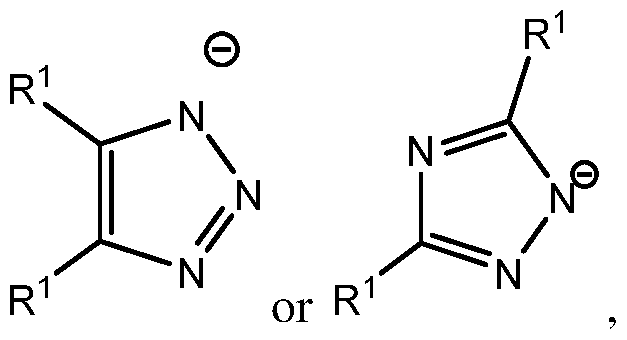
  • the at least one ligand comprises a structure as in:
  • B is an aromatic or heterocyclic core (e.g., comprising one or more aromatic rings, e.g. B can be biphenyl), wherein each R 1 is the same or different and is selected from the group consisting of hydrogen (-H), -alkyl (e.g., -CH 3 ), -N0 2 , -R ⁇ -F, -CI, - Br, -I, -CN, -NC, -S0 3 R', -S0 3 H, -OR', -OH, -SR', -SH, -P0 3 R', -P0 3 H, -CF 3 , , - NR' 2 , -NHR', and -NH 2 , wherein each R' is the same or different and is optionally substituted alkyl or optionally substituted aryl.
  • each R 1 is the same and is hydrogen.
  • Non-limiting examples of such ligands include:
  • each R is the same or different and is selected from the group consisting of hydrogen, -alkyl, -N0 2 , -R', -F, -CI, -Br, -I, -CN, -NC, -S0 3 R', -S0 3 H, -OR', -OH, -SR', -SH, -P0 3 R', -P0 3 H, -CF 3 , -NR' 2 , -NHR', and -NH 2 , wherein each R' is the same or different and is optionally substituted alkyl or optionally substituted aryl. In some embodiments, each R 1 is the same and hydrogen.
  • each R is the same or different and is selected from the group consisting of hydrogen, -alkyl, -N0 2 , -R', -F, -CI, -Br, -I, -CN, -NC, -S0 3 R', -S0 3 H, -OR', -OH, -SR', -SH, -PO 3 R', -PO 3 H, -CF 3 , -NR' 2 , -NHR', and -NH 2 , wherein each R' is the same or different and is optionally substituted alkyl or optionally substituted aryl.
  • the ligand comprises the structure:
  • r is 0. In some embodiments, each R 1 is H. In some embodiments, r is 0 and each R 1 is hydrogen. In some embodiments, when r is zero and
  • more than one type of ligand comprising at least two unsaturated N-heterocyclic aromatic groups may be employed, for example, a first type of ligand and a second type of ligand.
  • the two or more types of ligands may be provided in any suitable ratio.
  • the ligand may comprise any combination of unsaturated N-heterocyclic aromatic groups (e.g., at least one triazolate; a combination of triazolates and tetrazolates; at least one tetrazolate, etc.)
  • unsaturated N-heterocyclic aromatic groups e.g., at least one triazolate; a combination of triazolates and tetrazolates; at least one tetrazolate, etc.
  • a mixture of types of ligands may be present.
  • the ligands within the MOF or a plurality of precursor ligands that will be used to form a MOF may be synthetically modified (e.g., oxidized) and only a portion of the substituents of the ligands or precursor ligands may be altered.
  • the ligands within the MOF or the precursor ligands used to form the MOF may comprise a number of different substitution patterns.
  • the ligand (or precursor ligand) comprises two substituents that are targeted to be modified, upon modification of a plurality of the ligands, for each ligand within the plurality, both substituents may be modified, or only one substituent may be modified, or neither substituent may be modified.
  • the plurality of ligands may comprise some ligands with both substituents modified, some ligands with only one substituent modified, and some ligands with neither substituent modified.
  • the MOFs may be synthesized using methods known in the art (e.g., see Chem. Eur. J. 2011, 17, 1837-1848; Chem. Eur. J. 2015, 21, 8188-8199).
  • a method of synthesizing a MOF comprises exposing a plurality of metal ions to a plurality of precursor ligands to form a MOF comprising a portion of the plurality of metal ions each coordinated with at least one ligand, wherein the at least one ligand comprises at least two unsaturated N-heterocyclic aromatic groups arranged about an organic core.
  • ligands comprises at least unsaturated N-heterocyclic aromatic groups arranged about an organic core are described herein.
  • the metal ion is provided as a salt
  • the at least one precursor ligand comprises at least two N-heterocyclic aromatic groups which, during the course of the reaction are deprotonated to form the corresponding ligand (e.g., comprising unsaturated N-heterocyclic aromatic groups).
  • the precursor ligand may be deprotonated to have a charge of (-1), or (-2), or (-3), or (-4). Exemplary precursor ligands are described herein.
  • an MOF comprising at least a first type of metal ion and a second type of metal ion may be prepared by metal exchange of a substantially similar MOF comprising only a single type of metal ion.
  • the metal exchange may be carried out by adding the first type of metal ion to solution comprising the MOF comprising only the second type of metal ion.
  • an MOF comprising zinc ions may be exposed to a plurality of a first type of metal ions (e.g., in solution) and at least one zinc ion may be exchanged by a first type of metal ion (e.g., Ni 2+ ).
  • the MOF may be modified.
  • the ligands of the MOF may be modified to include one or more functional groups and/or the one or more of the functional groups of the ligand may be modified. The ability to modify in the MOF following synthesis of the MOF is beneficial as the properties of the MOFs may be more readily tuned.
  • the MOF is modified to include hydrophilic groups.
  • the MOF may be modified using any suitable technique.
  • the MOF is exposed to oxidative conditions to associate new functional groups and/or modify currently present functional groups that are present on the ligand of the MOF.
  • a ligand of the MOF may comprise one or more alkyl sulfide groups, and the MOF may be exposed to oxidizing conditions (e.g., dimethyldioxirane) to modify the alkyl sulfide groups into alkyl sulfoxides or alkyl ethyl sulfones groups.
  • one or more of the metal ions may be exchanged.
  • an MOF comprising zinc ions may be exposed to a plurality of nickel ions, and at least one zinc ion may be replaced by a nickel ion.
  • the MOFs formed may comprise little or no excess metal ions. That is, the MOF comprises essentially no metal ions which are not coordinated with a ligand comprising at least two unsaturated N-heterocyclic aromatic groups (i.e., "free metal ions").
  • the MOF comprises less than about 0.5 wt%, or less then about 0.4 wt%, or less then about 0.3 wt%, or less than about 0.2 wt%, or less then about 0.1 wt%, or less than about 0.05 wt%, or less than about 0.03 wt%, or less than about 0.02 wt%, or less than about 0.01 wt%, or less than about 0.005 wt%, or less than about 0.001 wt% of free metal ions.
  • Those of ordinary skill in the art will be aware of methods for determining the amount of free metal ions, for example, using XPS.
  • each precursor ligand comprises two N-heterocyclic aromatic groups. In some embodiments, each precursor ligand comprises three N- heterocyclic aromatic groups. In some embodiments, each precursor ligand comprises four N-heterocyclic aromatic groups.
  • the N-heterocyclic aromatic group for the precursor ligand may be selected from any suitable group. Non-limiting examples are pyrrole, pyrazole, triazole, imidazole, and tetrazole. In some embodiments, the N- heterocyclic aromatic groups are selected from the group consisting of pyrazole, triazole, imidazole, and tetrazole.
  • the N-heterocyclic aromatic groups are selected from the group consisting of pyrazole, imidazole, and tetrazole. In some embodiments, the N-heterocyclic aromatic groups are pyrazoles.
  • the organic core of precursor ligand comprising at least two N-heterocyclic aromatic groups may be as described here.
  • each precursor ligand has the structure:
  • B is an aromatic or heterocyclic core, wherein each R is the same or different and is selected from the group consisting of hydrogen, -alkyl, -NO 2 , -R' , -F, -CI, -Br, - I, -CN, -NC, -SO3R', -SO3H, -OR', -OH, -SR', -SH, -PO3R', -PO3H, -CF 3 , -NR' 2 , - NHR', and -NH 2 , wherein each R' is the same or different and is optionally substituted alkyl or optionally substituted aryl.
  • each R 1 is the same and is hydrogen.
  • Non-limiting examples of such ligands include:
  • each R 1 is the same or different and is selected from the group consisting of hydrogen, -N0 2 , -R ⁇ -F, -CI, -Br, -I, -CN, -NC, -SO3R', -SO3H, -OR', -OH, -SR', -SH, -PO3R' , -PO3H, -CF 3 , -NR' 2 , -NHR' , and -NH 2 , wherein each R' is the same or different and is optionally substituted alkyl or optionally substituted aryl. In some embodiments, each R 1 is the same and hydrogen.
  • each precursor ligand has a structure as in:
  • each R is the same or different and is selected from the group consisting of hydrogen, -N0 2 , -R ⁇ -F, -CI, -Br, -I, -CN, -NC, -SO3R', -SO3H, -OR', -OH, -SR', -SH, -PO 3 R', -PO 3 H, -CF 3 , -NR' 2 , -NHR', and -NH 2 , wherein each R' is the same or different and is optionally substituted alkyl or optionally substituted aryl. In a particular embodiment, each R 1 is the same and hydrogen.
  • the metal ion and the ligand may be provided in any suitable amounts.
  • the mole ratio of the metal ion to the ligand may be based upon the coordination of the metal ion to the ligand. For example, in embodiments, where the ligand is coordinated with three metal ions, and each metal ion is associated with two ligands, the mole ratio of the metal ion to the ligand may be at least 3:2. As another example, in embodiments, where the ligand is coordinated with two metal ions, and each metal ion is associated with one ligand, the mole ratio of the metal ion to the precursor ligand may about 2: 1. In some embodiments, the ligand is providing in slight mole excess.
  • the metal ions are provided as a salt.
  • salts chloride, fluoride, bromide, iodide, triflate, BF 4 , PF 6 , N0 3 ⁇ , S0 4 2- " , and C10 4 " salts.
  • the salt is S0 4 2- " .
  • solvents include water, methanol, ethanol, propanol, benzene, /?-cresol, toluene, xylene, diethyl ether, glycol, diethyl ether, petroleum ether, hexane, cyclohexane, pentane, methylene chloride, chloroform, carbon tetrachloride, dioxane, tetrahydrofuran (THF), dimethyl sulfoxide (DMSO),
  • dimethylformamide dimethylformamide, hexamethyl-phosphoric triamide, ethyl acetate, pyridine, triethylamine, picoline, mixtures thereof, or the like.
  • the MOFs may be synthesized at any suitable temperature.
  • the reaction is carried out at about room temperature (e.g., about 25 °C, about 20 °C, between about 20 °C and about 25 °C, or the like). In some cases, however, the reaction is carried out at temperatures below or above room temperature. In some embodiments, the reaction is carried at a temperature between about 25 °C and about 200 °C, about 25 °C and about 150 °C, or between about 50 °C and about 200 °C, or between about 50 °C and about 150 °C, or between about 100 °C and about 150 °C.
  • the MOFs may be synthesized in the presence of a base
  • Non-limiting examples of bases include NR" 3 wherein each R" is the same or different and is hydrogen, optionally substituted alkyl, or optionally substituted aryl, and QOH, wherein Q is a cation (e.g., a metal cation, a semi-metal cation, NH 4 ).
  • the MOFs may be synthesized in an inert atmosphere.
  • the reactions may be carried out in or under an inert nitrogen or argon atmosphere (e.g., using standard Schlenk techniques and/or in an inert- atmosphere glovebox).
  • MOFs synthesized using the methods described herein may be purified using techniques known to those of ordinary skill in the art.
  • a synthesized MOF may be washed, sometimes involving a Soxhlet extractor, boiled, and/or sonicated (e.g., to remove excess starting materials).
  • reacting refers to the forming of a bond between two or more components to produce a stable, isolable compound.
  • a first component and a second component may react to form one reaction product comprising the first component and the second component joined by a covalent bond. That is, the term “reacting” does not refer to the interaction of solvents, catalysts, bases, ligands, or other materials which may serve to promote the occurrence of the reaction with the component(s).
  • aliphatic includes both saturated and unsaturated, nonaromatic, straight chain (i.e., unbranched), branched, acyclic, and cyclic (i.e., carbocyclic) hydrocarbons, which are optionally substituted with one or more functional groups.
  • aliphatic is intended herein to include, but is not limited to, alkyl, alkenyl, alkynyl, cycloalkyl, cycloalkenyl, and cycloalkynyl moieties.
  • alkyl includes straight, branched and cyclic alkyl groups.
  • alkenyl alkynyl
  • alkynyl alkenyl
  • alkynyl alkynyl
  • aliphatic is used to indicate those aliphatic groups (cyclic, acyclic, substituted, unsubstituted, branched or unbranched) having 1-20 carbon atoms.
  • Aliphatic group substituents include, but are not limited to, any of the substituents described herein, that result in the formation of a stable moiety ⁇ e.g., aliphatic, alkyl, alkenyl, alkynyl, heteroaliphatic, heterocyclic, aryl, heteroaryl, acyl, oxo, imino, thiooxo, cyano, isocyano, amino, azido, nitro, hydroxyl, thiol, halo, aliphaticamino, heteroaliphaticamino, alkylamino, heteroalkylamino, arylamino, heteroarylamino, alkylaryl, arylalkyl, aliphaticoxy, heteroaliphaticoxy, alkyloxy, heteroalkyloxy, aryloxy, heteroaryloxy, aliphaticthioxy, heteroaliphaticthioxy, alkylthioxy, heteroalkylthioxy, arylthioxy, heteroarylthioxy,
  • alkyl is given its ordinary meaning in the art and refers to the radical of saturated aliphatic groups, including straight-chain alkyl groups, branched-chain alkyl groups, cycloalkyl (alicyclic) groups, alkyl substituted cycloalkyl groups, and cycloalkyl substituted alkyl groups.
  • the alkyl group may be a lower alkyl group, i.e. , an alkyl group having 1 to 10 carbon atoms (e.g. , methyl, ethyl, propyl, butyl, pentyl, hexyl, heptyl, octyl, nonyl, or decyl).
  • a straight chain or branched chain alkyl may have 30 or fewer carbon atoms in its backbone, and, in some cases, 20 or fewer. In some embodiments, a straight chain or branched chain alkyl may have 12 or fewer carbon atoms in its backbone (e.g. , C 1 -C 12 for straight chain, C3-C 12 for branched chain), 6 or fewer, or 4 or fewer. Likewise, cycloalkyls may have from 3- 10 carbon atoms in their ring structure, or 5, 6 or 7 carbons in the ring structure.
  • alkyl groups include, but are not limited to, methyl, ethyl, propyl, isopropyl, cyclopropyl, butyl, isobutyl, i-butyl, cyclobutyl, hexyl, and cyclochexyl.
  • alkylene refers to a bivalent alkyl group.
  • alkylene group is a polymethylene group, i.e. , -(CH 2 ) Z -, wherein z is a positive integer, e.g. , from 1 to 20, from 1 to 10, from 1 to 6, from 1 to 4, from 1 to 3, from 1 to 2, or from 2 to 3.
  • a substituted alkylene chain is a polymethylene group in which one or more methylene hydrogen atoms are replaced with a substituent. Suitable substituents include those described herein for a substituted aliphatic group.
  • a bivalent carbocycle is “carbocyclylene”
  • a bivalent aryl ring is “arylene”
  • a bivalent benzene ring is “phenylene”
  • a bivalent heterocycle is
  • heterocyclylene a bivalent heteroaryl ring is “heteroarylene”
  • a bivalent alkyl chain is “alkylene”
  • a bivalent alkenyl chain is “alkenylene”
  • a bivalent alkynyl chain is
  • alkynylene a bivalent heteroalkyl chain is “heteroalkylene”
  • a bivalent heteroalkenyl chain is “heteroalkenylene”
  • a bivalent heteroalkynyl chain is “heteroalkynylene”, and so forth.
  • alkenyl and alkynyl are given their ordinary meaning in the art and refer to unsaturated aliphatic groups analogous in length and possible substitution to the alkyls described above, but that contain at least one double or triple bond respectively.
  • the alkyl, alkenyl and alkynyl groups employed in the invention contain 1-20 aliphatic carbon atoms. In certain other embodiments, the alkyl, alkenyl, and alkynyl groups employed in the invention contain 1-10 aliphatic carbon atoms. In yet other embodiments, the alkyl, alkenyl, and alkynyl groups employed in the invention contain 1-8 aliphatic carbon atoms. In still other embodiments, the alkyl, alkenyl, and alkynyl groups employed in the invention contain 1-6 aliphatic carbon atoms. In yet other embodiments, the alkyl, alkenyl, and alkynyl groups employed in the invention contain 1-4 carbon atoms.
  • Illustrative aliphatic groups thus include, but are not limited to, for example, methyl, ethyl, n-propyl, isopropyl, allyl, n-butyl, sec -butyl, isobutyl, i-butyl, n-pentyl, sec-pentyl, isopentyl, i-pentyl, n-hexyl, sec-hexyl, moieties and the like, which again, may bear one or more substituents.
  • Alkenyl groups include, but are not limited to, for example, ethenyl, propenyl, butenyl, l-methyl-2-buten-l-yl, and the like.
  • Representative alkynyl groups include, but are not limited to, ethynyl, 2- propynyl (propargyl), 1-propynyl and the like.
  • cycloalkyl refers specifically to groups having three to ten, preferably three to seven carbon atoms. Suitable cycloalkyls include, but are not limited to cyclopropyl, cyclobutyl, cyclopentyl, cyclohexyl, cycloheptyl and the like, which, as in the case of other aliphatic, heteroaliphatic, or hetercyclic moieties, may optionally be substituted with substituents including, but not limited to aliphatic;
  • heteroaliphatic aryl; heteroaryl; arylalkyl; heteroarylalkyl; alkoxy; aryloxy;
  • heteroarylkyl wherein any of the aliphatic, heteroaliphatic, arylalkyl, or heteroarylalkyl substituents described above and herein may be substituted or unsubstituted, branched or unbranched, cyclic or acyclic, and wherein any of the aryl or heteroaryl substituents described above and herein may be substituted or unsubstituted. Additional examples of generally applicable substituents are illustrated by the specific embodiments shown in the Examples that are described herein.
  • heteroaliphatic refers to an aliphatic moiety, as defined herein, which includes both saturated and unsaturated, nonaromatic, straight chain (i.e., unbranched), branched, acyclic, cyclic (i.e., heterocyclic), or polycyclic hydrocarbons, which are optionally substituted with one or more functional groups, and that contain one or more oxygen, sulfur, nitrogen, phosphorus, or silicon atoms, e.g. , in place of carbon atoms.
  • heteroaliphatic moieties are substituted by independent replacement of one or more of the hydrogen atoms thereon with one or more substituents.
  • heteroaliphatic is intended herein to include, but is not limited to, heteroalkyl, heteroalkenyl, heteroalkynyl, heterocycloalkyl, heterocycloalkenyl, and
  • heterocycloalkynyl moieties.
  • heteroaliphatic includes the terms “heteroalkyl,” “heteroalkenyl”, “heteroalkynyl”, and the like.
  • heteroalkyl encompass both substituted and unsubstituted groups.
  • heteroaliphatic is used to indicate those heteroaliphatic groups (cyclic, acyclic, substituted, unsubstituted, branched or unbranched) having 1-20 carbon atoms.
  • Heteroaliphatic group substituents include, but are not limited to, any of the substituents described herein, that result in the formation of a stable moiety (e.g. , aliphatic, alkyl, alkenyl, alkynyl, heteroaliphatic, heterocyclic, aryl, heteroaryl, acyl, sulfinyl, sulfonyl, oxo, imino, thiooxo, cyano, isocyano, amino, azido, nitro, hydroxyl, thiol, halo, aliphaticamino, heteroaliphaticamino, alkylamino, heteroalkylamino, arylamino, heteroarylamino, alkylaryl, arylalkyl, aliphaticoxy, heteroaliphaticoxy, alkyloxy, heteroalkyloxy, aryloxy, heteroaryloxy, aliphaticthioxy, heteroaliphaticthioxy, alkylthioxy,
  • heteroalkyl is given its ordinary meaning in the art and refers to an alkyl group as described herein in which one or more carbon atoms is replaced by a heteroatom. Suitable heteroatoms include oxygen, sulfur, nitrogen, phosphorus, and the like. Examples of heteroalkyl groups include, but are not limited to, alkoxy, alkoxyalkyl, amino, thioester, poly(ethylene glycol), and alkyl-substituted amino.
  • heteroalkenyl and “heteroalkynyl” are given their ordinary meaning in the art and refer to unsaturated aliphatic groups analogous in length and possible substitution to the heteroalkyls described above, but that contain at least one double or triple bond respectively.
  • substituents of the above-described aliphatic (and other) moieties of compounds of the invention include, but are not limited to aliphatic;
  • heteroaliphatic aryl; heteroaryl; alkylaryl; alkylheteroaryl; alkoxy; aryloxy;
  • aliphatic, alycyclic, heteroaliphatic, heterocyclic, aryl, heteroaryl, alkylaryl, or alkylheteroaryl independently includes, but is not limited to, aliphatic, alycyclic, heteroaliphatic, heterocyclic, aryl, heteroaryl, alkylaryl, or alkylheteroaryl, wherein any of the aliphatic, heteroaliphatic, alkylaryl, or alkylheteroaryl substituents described above and herein may be substituted or unsubstituted, branched or unbranched, cyclic or acyclic, and wherein any of the aryl or heteroaryl substituents described above and herein may be substituted or unsubstituted. Additional examples of generally applicable substituents are illustrated by the specific embodiments shown in the Examples that are described herein.
  • aryl is given its ordinary meaning in the art and refers to aromatic carbocyclic groups, optionally substituted, having a single ring (e.g. , phenyl), multiple rings (e.g. , biphenyl), or multiple fused rings in which at least one is aromatic (e.g. , 1,2,3,4-tetrahydronaphthyl, naphthyl, anthryl, or phenanthryl). That is, at least one ring may have a conjugated pi electron system, while other, adjoining rings can be
  • aryl group may be optionally substituted, as described herein.
  • Substituents include, but are not limited to, any of the previously mentioned substituents, i.e. , the substituents recited for aliphatic moieties, or for other moieties as disclosed herein, resulting in the formation of a stable compound.
  • an aryl group is a stable mono- or polycyclic unsaturated moiety having preferably 3- 14 carbon atoms, each of which may be substituted or unsubstituted.
  • Carbocyclic aryl groups refer to aryl groups wherein the ring atoms on the aromatic ring are carbon atoms. Carbocyclic aryl groups include monocyclic carbocyclic aryl groups and polycyclic or fused compounds (e.g. , two or more adjacent ring atoms are common to two adjoining rings) such as naphthyl groups.
  • the terms “heteroaryl” is given its ordinary meaning in the art and refers to aryl groups comprising at least one heteroatom as a ring atom.
  • a “heteroaryl” is a stable heterocyclic or polyheterocyclic unsaturated moiety having preferably 3-14 carbon atoms, each of which may be substituted or unsubstituted.
  • Substituents include, but are not limited to, any of the previously mentioned substituents, i.e., the substitutes recited for aliphatic moieties, or for other moieties as disclosed herein, resulting in the formation of a stable compound.
  • a heteroaryl is a cyclic aromatic radical having from five to ten ring atoms of which one ring atom is selected from S, O, and N; zero, one, or two ring atoms are additional heteroatoms independently selected from S, O, and N; and the remaining ring atoms are carbon, the radical being joined to the rest of the molecule via any of the ring atoms, such as, for example, pyridyl, pyrazinyl, pyrimidinyl, pyrrolyl, pyrazolyl, imidazolyl, thiazolyl, oxazolyl, isooxazolyl, thiadiazolyl,
  • aryl and heteroaryl moieties as defined herein may be attached via an alkyl or heteroalkyl moiety and thus also include -(alkyl)aryl,
  • aryl or heteroaryl moieties and "aryl, heteroaryl, - (alkyl)aryl, -(heteroalkyl)aryl, -(heteroalkyl)heteroaryl, and -(heteroalkyl)heteroaryl" are interchangeable.
  • Substituents include, but are not limited to, any of the previously mentioned substituents, i.e., the substituents recited for aliphatic moieties, or for other moieties as disclosed herein, resulting in the formation of a stable compound.
  • aryl and heteroaryl groups can be unsubstituted or substituted, wherein substitution includes replacement of one or more of the hydrogen atoms thereon independently with any one or more of the following moieties including, but not limited to: aliphatic; alicyclic; heteroaliphatic; heterocyclic; aromatic; heteroaromatic; aryl; heteroaryl; alkylaryl; heteroalkylaryl;
  • any of the aromatic, heteroaromatic, aryl, heteroaryl, -(alkyl)aryl or -(alkyl)heteroaryl substituents described above and herein may be substituted or unsubstituted.
  • any two adjacent groups taken together may represent a 4, 5, 6, or 7- membered substituted or unsubstituted alicyclic or heterocyclic moiety. Additional examples of generally applicable substituents are illustrated by the specific embodiments described herein.
  • any of the above groups may be optionally substituted.
  • substituted is contemplated to include all permissible substituents of organic compounds, "permissible” being in the context of the chemical rules of valence known to those of ordinary skill in the art.
  • substituted whether preceeded by the term “optionally” or not, and substituents contained in formulas of this invention, refer to the replacement of hydrogen radicals in a given structure with the radical of a specified substituent.
  • substituent When more than one position in any given structure may be substituted with more than one substituent selected from a specified group, the substituent may be either the same or different at every position. It will be understood that “substituted” also includes that the substitution results in a stable compound, e.g., which does not spontaneously undergo transformation such as by rearrangement, cyclization, elimination, etc. In some cases, “substituted” may generally refer to replacement of a hydrogen with a substituent as described herein. However,
  • substituted does not encompass replacement and/or alteration of a key functional group by which a molecule is identified, e.g., such that the "substituted” functional group becomes, through substitution, a different functional group.
  • a "substituted phenyl group” must still comprise the phenyl moiety and cannot be modified by substitution, in this definition, to become, e.g., a pyridine ring.
  • the permissible substituents include acyclic and cyclic, branched and unbranched, carbocyclic and heterocyclic, aromatic and nonaromatic substituents of organic compounds.
  • Illustrative substituents include, for example, those described herein.
  • the permissible substituents can be one or more and the same or different for appropriate organic compounds.
  • the heteroatoms such as nitrogen may have hydrogen substituents and/or any permissible substituents of organic compounds described herein which satisfy the valencies of the heteroatoms.
  • stable preferably refers to compounds which possess stability sufficient to allow manufacture and which maintain the integrity of the compound for a sufficient period of time to be detected and preferably for a sufficient period of time to be useful for the purposes detailed herein.
  • substituents include, but are not limited to, halogen, azide, alkyl, aralkyl, alkenyl, alkynyl, cycloalkyl, hydroxyl, alkoxyl, amino, nitro, sulfhydryl, imino, amido, phosphonate, phosphinate, carbonyl, carboxyl, silyl, ether, alkylthio, sulfonyl, sulfonamido, ketone, aldehyde, ester, heterocyclyl, aromatic or heteroaromatic moieties, -CF 3 , -CN, aryl, aryloxy, perhaloalkoxy, aralkoxy, heteroaryl, heteroaryloxy,
  • heteroarylalkyl heteroaralkoxy, azido, amino, halide, alkylthio, oxo, acylalkyl, carboxy esters, -carboxamido, acyloxy, aminoalkyl, alkylaminoaryl, alkylaryl, alkylaminoalkyl, alkoxyaryl, arylamino, aralkylamino,
  • alkylsulfonyl -carboxamidoalkylaryl, -carboxamidoaryl, hydroxyalkyl, haloalkyl, alkylaminoalkylcarboxy-, aminocarboxamidoalkyl-, cyano, alkoxyalkyl, perhaloalkyl, arylalkyloxyalkyl, and the like.
  • the following example demonstrates the synthesis and structure of an exemplary MOF for use as a catalyst in ethylene dimerization.
  • BTDD Zn 5 Cl 4
  • MFU-4/ Zn 5 Cl 4
  • Ni-MFU-4/ Ni 0.46 Zn 4.54 Cl 2 .3 8 (NO 3 ) 1.62 (BTDD)3 (Ni-MFU-4/), where approximately one Zn 2+ ion in every two SBUs was replaced by Ni 2+ , as revealed by inductively-coupled plasma atomic emission spectroscopy (ICP-AES).
  • ICP-AES inductively-coupled plasma atomic emission spectroscopy
  • Ni-MFU-4/ displays excellent activity for ethylene dimerization (see Table 1A and IB) and compared to alternative catalysts.
  • a typical catalytic run consisted of the addition of methylaluminoxane (MAO) to a rapidly stirred suspension of Ni-MFU-4/ in toluene, with subsequent pressurization with ethylene gas.
  • MAO methylaluminoxane
  • the reactor was rapidly cooled with a dry ice/acetone bath to condense the oligomerized products, the reaction was quenched with cooled water, and 1-pentene was added as an external standard before the organic layer was analyzed by gas chromatography (see FIG. 3, FIG. 4, and FIG. 5).
  • Ni-MFU-4/ After 60 minutes at 25 °C, 30 bar of ethylene, and in the presence of 100 equivalents of MAO, Ni-MFU-4/ showed a turnover frequency of 21,800 moles of ethylene consumed per mole of Ni per hour.
  • the reaction products contained 94.4 wt% butenes, of which 1-butene accounted for 86.0 wt%, and 5.6 wt% hexenes.
  • the reaction temperature had a dramatic effect on the catalytic performance of Ni-MFU-4/. For a given ethylene pressure, the dimerization activity was comparable at 0 °C and 25 °C, but showed a marked drop-off when the temperature was increased to 50 °C.
  • the reaction pressure also played a role in the catalytic performance, showing a positive correlation with the activity.
  • increasing the pressure from 15 bar to 30 bar elevated the turnover frequency from 6,300 hr -1 to 22,600 hr -1 .
  • the selectivity for 1-butene relative to 2-butene also generally increased with increasing pressure, with the only exception to this trend coming from the less active reactions at 50 °C. This suggests that higher ethylene pressure enhanced the rate of chain transfer relative to chain isomerization, leading to the enrichment of alpha-olefins within the product distribution.
  • MAO additive generally improved catalytic activity in Ni-MFU-4/.
  • the turnover frequency of Ni-MFU-4/ was 4,700 hr -1 , and polymeric residues were observed.
  • a turnover frequency of 27,100 moles of ethylene consumed per mole of nickel per hour was reached in the presence of 500 equivalents of MAO at 50 bar and 25 °C. Under these conditions, the catalyst showed a selectivity of 96.9% for butenes, with 1-butene accounting for 92.9% of C4 products.
  • a turnover frequency of 41,500 moles of ethylene consumed per mole of nickel per hour was reached in the presence of 500 equivalents of MAO at 50 bar and 25 °C when the nickel loading level was decreased to 1 percent of the total metal content of the MOF.
  • the catalyst showed a selectivity of 97.4% for butenes, with 1-butene accounting for 94.5% of C4 products.
  • the selectivity for 1-butene increased when catalysis was run with 100 equivalents of MAO at 50 bar and 0 °C.
  • These conditions lead to a turnover frequency of 22,600 moles of ethylene consumed per mole of nickel per hour and an optimized selectivity of 98.4% for butenes, with 1-butene making up 97.8% of the C4 fraction.
  • the optimized overall selectivity for 1-butene was thus 96.2%.
  • Ni-MFU-4/ produced C6 olefins as the sole byproducts.
  • shape selectivity induced by the pores of the MOF may explain the preference for butenes relative to hexenes, although this does not account for the higher 1-butene selectivity observed with the heterogeneous catalyst.
  • An alternative explanation is that the less sterically encumbered active site in the MOF enhances the rate of chain transfer relative to chain propagation or chain isomerization.
  • the Ni environment within Ni-MFU-4/ provides an ideal balance between active site accessibility and pore-induced shape selectivity, which lead to unprecedented selectivity for 1-butene.
  • the following example demonstrates the synthesis and structure of an exemplary MOF for use as a catalyst in ethylene dimerization.
  • bibta Zn 2+ ions in ZnsCl 4
  • CFA- 1 Four of the five Zn 2+ ions in ZnsCl 4 (bibta)3 (CFA- 1) are coordinated to contain a central Zn atom that is octahedrally coordinated by six nitrogen atoms, and four pore- exposed tetrahedral Zn 2+ ions coordinated by three nitrogen atoms and a chloride (FIG. 8A-FIG. 8C).
  • bibta lH,l 'H-5,5'-bibenzo[ ⁇ i]triazole.
  • the bond angles and lengths surrounding these Zn 2+ ions suggest that nickel-substituted CFA-1 may be a very proficient heterogeneous catalyst for ethylene dimerization.
  • Ni-CFA-1 was successively soaked in fresh DMF and methanol. The structural integrity of the material was maintained during these manipulations, as evidenced by the powder X-ray diffraction.
  • This example demonstrates the use of the MOF described in Example 4 as a catalyst in ethylene dimerization.
  • Ni-CFA- 1 displays excellent activity for ethylene dimerization compared to alternative catalysts.
  • a typical catalytic run involved the addition of modified
  • methylaluminoxane MMAO-12
  • MMAO-12 methylaluminoxane
  • the reactor was rapidly cooled with a dry ice/acetone bath to condense the oligomerized products, the reaction was quenched with cooled water, and 1-pentene was added as an external standard before the organic layer was analyzed by gas chromatography.
  • the turnover frequency is 36,400 with a selectivity of 96% for butenes and a selectivity of 90% for 1-butene relative to all C 4 products.
  • the selectivity for 1-butene relative to 2-butene also generally increased with increasing pressure. This suggests that higher ethylene pressure enhanced the rate of chain transfer relative to chain isomerization, leading to the enrichment of alpha-olefins within the product distribution.
  • the tube voltage and current were 40 kV and 40 mA, respectively.
  • a Micromeritics ASAP 2020 Surface Area and Porosity Analyzer was used to measure nitrogen adsorption isotherms.
  • An oven-dried sample tube equipped with a S3 TranSealTM (Micrometrics) was evacuated and tared. The sample was transferred to the sample tube, heated to 200 °C for 12 h, and held at that temperature until the outgas rate was less than 2 mtorr/minute.
  • the evacuated sample tube was weighed again and the sample mass was determined by subtracting the mass of the previously tared tube.
  • An N 2 isotherm was measured using liquid nitrogen baths (77 K). UHP grade (99.999% purity) N 2 and He, oil-free valves and gas regulators were used for all free space corrections and measurements.
  • the ethylene dimerization reaction mixtures were analyzed with an Agilent 7890B gas chromatograph (30 meter PoraBOND Q PT capillary column) equipped with a 5977A mass spectrometer and a flame ionization detector. Synthesis of H 2 BTDD, Linker for MFU-4/. A solution of NaN0 2 (2.86 g, 41.4 mmol) and water (10 mL) was added over ten minutes into a stirring, ice-cooled suspension of dibenzo[l,4]dioxine-2,3,7,8-tetramine tetrakis hydrochloride (7.35 g, 18.8 mmol), acetic acid (70 mL), and water (10 mL).
  • Ni(N0 3 ) 2 *6H 2 0 (5.5 g, 19 mmol) was dissolved in 100 mL of DMF.
  • MFU-41 was suspended in an additional 50 mL of DMF and added to the Ni(N0 3 ) 2 *6H 2 0 solution.
  • the resulting suspension was allowed to sit at room temperature for one month.
  • the solution was decanted, and the remaining powder was soaked in 100 mL fresh DMF. This process was repeated once daily for three days.
  • the powder was subsequently suspended in 100 mL of fresh methanol. The methanol was replaced once daily for three days.
  • the reactor was pressurized with ethylene through a dip tube and magnetic stirring was turned on. After one hour, the reactor was rapidly cooled in a dry ice/acetone bath. When the internal temperature reaches -20 °C, the reactor was slowly vented to atmospheric pressure. The reactor was opened and the reaction solution was treated with precooled deionized water. 1-pentene was added to the solution to serve as an external standard before the organic layer was filtered through a precooled 0.2 ⁇ syringe filter. A small sample of the organic layer was quickly analyzed via gas chromatography. Control experiments with the unsubstituted MFU-4/or with alternative aluminum activators were carried out in the same manner as described above.
  • Ni-MFU-4/ Leaching Experiment with Ni-MFU-4/.
  • a magnetic stir bar and 5 mg of thermally desolvated Ni-MFU-4/ were introduced into a 50 mL stainless steel Parr reactor in a nitrogen filled glovebox.
  • 5 mL of toluene was added to the reactor, followed by the addition of 100 equivalents of methylaluminoxane (10% w/w in toluene, Aldrich).
  • the reactor was fully sealed, transferred out of the glovebox, and brought to the reaction temperature specified with a temperature controller and internal temperature probe. Thirty minutes after the addition of methylaluminxoane, magnetic stirring was turned on and the reactor was pressurized with ethylene through a dip tube.
  • the reactor was transferred into a nitrogen glove bag and slowly vented to atmospheric pressure.
  • the reactor was opened and the reaction solution was sparged with dry nitrogen for 15 minutes to remove any residual butenes in solution.
  • the solution was subsequently filtered through three 0.2 ⁇ syringe filters and transferred into a new 50 mL stainless steel Parr reactor. This new reactor was fully closed, transferred out of the glove bag, and pressurized with ethylene through a dip tube. Internal stirring was maintained throughout the reaction, and after one hour the reactor was rapidly cooled to - 20 °C with a dry ice/acetone bath. Once the internal temperature reached -20 °C the reactor was slowly vented to atmospheric pressure. The reactor was opened and the reaction solution was treated with precooled deionized water. 1-pentene was added to the solution to serve as an external standard before the organic layer was filtered through a precooled 0.2 ⁇ syringe filter. A small sample of the organic layer was quickly analyzed via gas chromatography.
  • reactor 2 was fully sealed, transferred out of the glovebox, and the temperature of the reactor was monitored with an internal temperature probe.
  • a 50 mL stainless steel Parr reactor, referred to as reactor 2 was connected to reactor 1 with three feet of 1/8" copper tubing, although the valve connecting reactor 1 to reactor 2 was left closed.
  • Reactor 2 was evacuated to remove ambient water and oxygen inside the vessel. After evacuation, reactor 2 was cooled below -20 °C with a dry ice/acetone bath, as monitored with an internal temperature probe. Thirty minutes after the addition of methylaluminxoane to Ni-MFU-4/, reactor 1 was pressurized to 50 bar with ethylene through a dip tube and magnetic stirring was turned on.
  • reactor 1 was placed in a lukewarm water bath and the connection between reactor 1 and reactor 2 was opened, allowing the product butenes to condense in the second reactor. After 30 minutes to allow the system to equilibrate, the connection between reactor 1 and reactor 2 was closed. Reactor 2 was opened, and 10 mL of precooled toluene and 0.1 mL of 1-pentene were added to the vessel. This organic mixture was analyzed via gas chromatography. Reactor 1 was repressurized with ethylene and allowed to react for one hour, while reactor 2 was cleaned and evacuated. This process was continued for 10 cycles before reactor 1 was opened and the organic products were analyzed via GC/MS.
  • a reference to "A and/or B,” when used in conjunction with open-ended language such as “comprising” can refer, in one embodiment, to A without B (optionally including elements other than B); in another embodiment, to B without A (optionally including elements other than A); in yet another embodiment, to both A and B (optionally including other elements); etc.
  • “or” should be understood to have the same meaning as “and/or” as defined above.
  • the phrase "at least one,” in reference to a list of one or more elements, should be understood to mean at least one element selected from any one or more of the elements in the list of elements, but not necessarily including at least one of each and every element specifically listed within the list of elements and not excluding any combinations of elements in the list of elements.
  • This definition also allows that elements may optionally be present other than the elements specifically identified within the list of elements to which the phrase "at least one" refers, whether related or unrelated to those elements specifically identified.
  • At least one of A and B can refer, in one embodiment, to at least one, optionally including more than one, A, with no B present (and optionally including elements other than B); in another embodiment, to at least one, optionally including more than one, B, with no A present (and optionally including elements other than A); in yet another embodiment, to at least one, optionally including more than one, A, and at least one, optionally including more than one, B (and optionally including other elements); etc.

Landscapes

  • Chemical & Material Sciences (AREA)
  • Organic Chemistry (AREA)
  • Chemical Kinetics & Catalysis (AREA)
  • Engineering & Computer Science (AREA)
  • Materials Engineering (AREA)
  • Inorganic Chemistry (AREA)
  • Organic Low-Molecular-Weight Compounds And Preparation Thereof (AREA)
  • Catalysts (AREA)
  • Lubricants (AREA)

Abstract

Compositions and methods for selective olefin (e.g., ethylene) oligomerization comprising metal organic frameworks (MOFs) are generally provided In some embodiments, a MOF comprises a plurality of metal ions, each coordinated with at least one ligand comprising at least two unsaturated N-heterocyclic aromatic groups arranged about an organic core.

Description

COMPOSITIONS AND METHODS FOR SELECTIVE OLEFIN
OLIGOMERIZATION COMPRISING METAL ORGANIC FRAMEWORKS
Related Applications
This application claims priority to U.S. Provisional Patent Application Serial No. 62/218,003, filed September 14, 2015, and entitled "Compositions and Methods for Selective Olefin Oligomerization Comprising Metal Organic Frameworks" and U.S. Provisional Patent Application Serial No. 62/306,028, filed March 9, 2016, and entitled "Compositions and Methods for Selective Olefin Oligomerization Comprising Metal Organic Frameworks", each of which are incorporated herein by reference in their entirety for all purposes.
Field
Compositions and methods for selective olefin oligomerization comprising metal organic frameworks (MOFs) are generally provided. In some embodiments, a MOF comprises a plurality of metal ions, each metal ion coordinated with at least one ligand comprising at least two N-heterocyclic aromatic groups arranged about an organic core.
Background
Ethylene is a cornerstone of the petrochemical industry. For example, the dimerization of ethylene to 1-butene plays a key role in the production of alkylate gasoline and of linear low-density polyethylene. Overall, ethylene oligomerization is one of the largest industrial transformations enabled by homogeneous catalysts, exceeded in volume only by hydroformylation, hydrocyanation, and methanol carbonylation. The prominence of ethylene dimerization in the overall industrial production of 1-butene is projected to rise further with the increasing reliance on natural gas feedstocks. Despite substantial academic and industrial efforts, the development of heterogeneous catalysts for ethylene dimerization has suffered from either a lack of activity or poor selectivity. Addressing the selectivity challenge is particularly difficult because, for example, small changes in the ligand sphere or electronic structure of the metal can change the relative rates of ethylene insertion versus beta-hydride elimination, which together relate to product distribution. Such degree of fine tuning in ligand design is the realm of homogeneous catalysis and has not traditionally been available to heterogeneous sy stems.
Accordingly, improved compositions and methods are needed.
Summary
In some embodiments, a method for forming butene (e.g., 1-butene) from ethylene are provided, the method comprising exposing ethylene to a metal organic framework (MOF) catalyst to produce butene, wherein the MOF catalyst comprises a plurality of metal ions, each metal ion coordinated with at least one ligand, and wherein each ligand comprises at least two N-heterocyclic aromatic groups arranged about an organic core, wherein the N-heterocyclic aromatic groups are selected from the group consisting of imidazolate, triazolate, and tetrazolate.
In some embodiments, a method for forming butene (e.g., 1-butene) from ethylene is provided, the method comprising exposing ethylene to a metal organic framework (MOF) catalyst to produce butene, wherein the MOF comprises a plurality of metal ions, each metal ion coordinated with at least one ligand, and wherein butene is formed with a selectivity of at least about 95% and at a turnover frequency of at least about 20,000 per hour.
In some embodiments, the MOF comprising a plurality of metal ions (e.g., Ni+2 and/or Zn+2) and a plurality of ligands comprising one, two, three, or four N-heterocyclic aromatic groups (e.g., imidazolate, triazolate, and/or tetrazolate).
Brief Description of the Drawings
FIG. 1A - FIG. ID show simulated structures of a non-limiting MOF, according to some embodiments;
FIG. 2 shows PXRD patterns of a non-limiting MOF, after ethylene
oligomerization reactions, according to some embodiments;
FIG. 3 and FIG. 4 show exemplary chromatograms after ethylene dimerization with a non-limiting MOF, according to some embodiments;
FIG. 5 shows another exemplary chromatogram after ethylene dimerization with a non-limiting MOF, according to some embodiments;
FIG. 6 shows an exemplary chromatogram for ethylene dimerization with a comparative MOF, according to some embodiments; and
FIG. 7 shows a scanning electron microscope image of non-limiting MOF particles, according to some embodiments; and
FIG. 8A - FIG. 8C show simulated structure of a non-limiting example of an
MOF.
Other aspects, embodiments, and features of the invention will become apparent from the following detailed description when considered in conjunction with the accompanying drawings. The accompanying figures are schematic and are not intended to be drawn to scale. For purposes of clarity, not every component is labeled in every figure, nor is every component of each embodiment of the invention shown where illustration is not necessary to allow those of ordinary skill in the art to understand the invention. All patent applications and patents incorporated herein by reference are incorporated by reference in their entirety. In case of conflict, the present specification, including definitions, will control.
Detailed Description
Compositions and methods comprising metal organic frameworks (MOFs) and related uses are generally provided. In some embodiments, a MOF comprises a plurality of metal ions, each coordinated with at least one ligand, wherein each ligand comprises at least two unsaturated N-heterocyclic aromatic groups.
The term "metal-organic framework" is given its ordinary meaning in the art and refers to a one-, two-, or three-dimensional coordination polymer including metal ions and ligands which function as organic structural units, wherein a portion of the metal ions are each chemically bonded to at least one bi-, tri- or poly-dentate organic structural unit. The metal ions, in addition to being coordinated with at least one ligand, may also be bound to one or more auxiliary ligands, as described in more detail herein.
The MOFs described herein may be utilized in a wide variety of applications. In some embodiments, the MOFs may be utilized as a catalyst. For example, in some embodiments, the MOFs may be utilized as a catalyst for olefin oligomerization or olefin dimerization. In a particular embodiment, the MOF may be utilized as a catalyst for ethylene dimerization (e.g., to form 1-butene).
In some embodiments, the catalyst is a heterogeneous catalyst. The term
"heterogeneous catalyst" will be understood by those of ordinary skill in the art and generally refers to a catalyst in solid state catalyzing a reaction which is fully or partly run in another phase, such as a solvent phase or gaseous phase. In some embodiments, the MOFs described herein are utilized in a solid state, for example, as a solid dispersed in a solution. One non-limiting advantage to heterogeneous catalysts is the catalyst may generally be easily separated from a reaction mixture. In some embodiments, the catalyst (e.g., the heterogeneous catalyst) is a single site catalyst. The term "single site catalyst" will be understood by those of ordinary skill in the art and generally refers to a catalyst that has only a single type of kinetically active site. For example, for the MOFs described herein, a single type of metal ion for each MOF may act as the catalytic site(s).
The MOFs described herein are particularly advantageous as catalysts for the oligomerization (e.g., dimerization) of olefins such as ethylene. In some embodiments, the MOFs described herein have high turnover frequencies (e.g., greater than about
12,400 moles of ethylene per mole of active metal ion at room temperature under 30 bar of ethylene, greater than about 21,600 moles of ethylene per mole of active metal ion at room temperature under 30 bar of ethylene), high selectivity (e.g., greater than about 95% for butenes), and/or long catalyst lifetimes as compared to traditional olefin catalysts. In some embodiments, the TOF is about 27,000 with a selectivity of 96% for 1- butene at 50 bar of ethylene. In some embodiments, the TOF is about 41,500 with a selectivity of 96% for 1-butene at 50 bar of ethylene. The MOF catalysts described herein may generally be used in any reactor suitable for the oligomerization of olefins. While much of the description herein relates to the dimerization of ethylene, those skilled in the art would understand, based upon the teachings of this specification, that other olefins such as propylene, 1-butene, or 1-pentene may also be oligomerized by catalysis with such MOFs.
Those of ordinary skill in the art will be aware of suitable systems and methods for utilizing a MOF described herein for catalysis. For example, the MOF may be loaded into a reactor for use as an olefin oligomerization catalyst. Olefins (e.g., ethylene, propylene, or the like) may be introduced into the reactor, wherein the olefin
oligomerizes upon exposure to the catalyst. Optionally, the reactor may contain one or more solvents (e.g., an organic solvent) and/or one or more additives (e.g.,
alkylaluminum). The reactor may be operated at any suitable temperature and/or pressure. In some embodiments, the reactor may be operated until a high fraction (e.g., greater than about 80%, greater than about 90%, greater than about 95%, or more) of the desired oligomer (e.g., butene) is produced. In some embodiments, the reactor is operated at or near atmospheric pressure. In other embodiments, the reactor is operated at elevated pressures (e.g., under an atmosphere of ethylene).
In some embodiments, oligomerization of an olefin is conducted (e.g., the formation of butene from ethylene) in the presence of the MOF and an additive. The presence of the additive, in some cases, may increase the turnover frequency and/or the selectivity of the oligomerization carried out in the presence of the MOF (e.g., for butene) as compared to the turnover frequency and/or the selectivity in the absence of the additive. In some embodiments, the additive is an alkylaluminum compound. Non- limiting examples of alkylaluminum compounds include aluminoxanes (e.g.,
methylaluminoxane, modified methylaluminoxane) ethylaluminum dichloride, diethylaluminum chloride, triethylaluminum, and trimethylaluminum. In an exemplary embodiments, the additive is methylaluminoxane. In some embodiments, the additive is an alkyl magnesium halide (e.g., ethyl magnesium bromide). In some embodiments, the additive is an alkyllithium compound (e.g., methyllithium). The additive may be provided in any suitable amount. In some embodiments, the ratio of moles of additive to moles of active metal center (e.g., Ni+2) is between 1 and 1000, or between 1 and 500, or between 1 and 250, or between 1 and 100, or between 50 and 500, or between 50 and 400, or between 50 and 300, or between 50 and 200, or between 50 and 150, or about 1, about 2, about 5, about 10, about 25, about 50 ,or about 100.
The oligomerization may be conducted at any suitable temperature or pressure.
For example, in some cases, oligomerization in the presence of the MOF may be conducted at a temperature of at least about 0 °C, at least about 25 °C, at least about 50 °C, or at least about 100 °C. In certain embodiments, oligomerization in the presence of the MOF may be conducted at a temperature of less than or equal to about 150 °C, less than or equal to about 100 °C, less than or equal to about 50 °C, or less than or equal to about 25 °C. Combinations of the above-referenced ranges are also possible (e.g., between about 0 °C and about 150 °C). Other ranges are also possible.
In some embodiments, oligomerization in the presence of the MOF is conducted at a pressure of at least about 15 bar, at least about 30 bar, or at least about 50 bar. In certain embodiments, oligomerization in the presence of the MOF is conducted at a pressure of less than or equal to about 75 bar, less than or equal to about 50 bar, or less than or equal to about 30 bar. Combinations of the above-referenced ranges are also possible (e.g., between about 15 bar and about 75 bar). Other ranges are also possible. Those skilled in the art would be capable of selecting suitable combinations of temperatures and pressures for the oligomerization of olefins based upon the teachings of the specification.
In some embodiments, the MOFs described herein may catalyze the formation of butene from ethylene with high selectivity. For example, in some embodiments, butene is formed in the presence of a MOF with a selectivity of at least about 80%, at least about 85%, at least about 90%, at least about 95%, at least about 97%, at least about 98%, at least about 99%, at least about 99.5%, at least about 99.8%, or at least about 99.9% for butene. In certain embodiments, butene is formed in the presence of a MOF with a selectivity of 100% for butene.
In certain embodiments, butene is formed with a high weight percentage of 1- butene versus the total amount of butenes. That is to say, the MOFs described herein may also catalyze the formation of 1 -butene from ethylene with a high selectivity. In some embodiments, at least about 80 wt%, at least about 85 wt%, at least about 90 wt%, at least about 95 wt%, at least about 97 wt%, at least about 98 wt%, at least about 99 wt%, at least about 99.5 wt%, at least about 99.8 wt, or at least about 99.9 wt% of amount of butene formed from ethylene in the presence of the MOFs described herein is 1 -butene.
Those of ordinary skill in the art will be aware of methods and techniques for determining selectivity. The selectivity of a reaction for 1 -butene may be determined by determining the percent by weight of 1-butene based on total amount of products (e.g., butenes, hexenes, octenes, etc.) produced. For example, gas chromatography may be used to determining the weight percentage of butene versus the total amount of product produced and/or the total weight percentage of 1-butene versus the total amount of butenes produced.
In certain embodiments, the MOF may catalyze the formation of butene with a high turnover frequency. Turnover frequency, as used herein, refers to the number of moles of ethylene consumed per moles of active metal centers in the MOF. For example, in some embodiments, wherein the active metal center is a nickel ion, the TOF refers to the number of moles of ethylene consumed per mole of nickel. In some embodiments, butenes (and 1-butene) is formed in the presence of the MOF at a turnover frequency of at least about 12,000, at least about 12,500, at least about 14,000, at least about 15,000, at least about 16,000, at least about 17,500, at least about 18,000, at least about 20,000, at least about 21,000, at least about 22,000, at least about 25,000, at least about 27,000, or at least about 30,000, at least about 35,000, or at least about 41,500 per hour per moles of active metal centers (e.g., nickel). In certain embodiments, butene (and 1 -butene) is formed in the presence of the MOF at a turnover frequency of less than or equal to about 40,000, less than or equal to about 30,000, less than or equal to about 25,000, less than or equal to about 20,000, less than or equal to about 18,000, less than or equal to about
16,000, less than or equal to about 15,000, or less than or equal to about 14,000 per hour per moles of active metal centers (e.g., nickel). Combinations of the above referenced ranges are also possible (e.g., between about 12,000 and about 40,000 per hour per moles of active metal centers (e.g., nickel)).
In some embodiments, the TOF is determined per hour at 25 °C and 50 bar. The number of moles of ethylene converted can be determined, for example, using gas chromatography after an hour of reacting the ethylene with the metal ion-containing MOF at 25°C. Those of ordinary skill in the art will be aware of methods and systems for determining the number of moles of active metal centers. For example, in embodiments wherein the active metal center is nickel and the MOF also comprises zinc, number of moles of nickel may be determined based at least in part on the ratio of nickel to zinc (e.g., based on the structure of the MOF) and the weight of the MOF used.
In some embodiments, the MOF may catalyze the formation of butene or 1- butene with a selectivity of at least about 50%, or 60%, or 70%, or 75%, or 80%, or 85%, or 90%, or 95% and a turnover frequency of at least about 12,500 per hour per moles of active metal centers (e.g., nickel). In some embodiments, the MOF may catalyze the formation of butene or 1 -butene with a selectivity of at least about 50%, or 60%, or 70%, or about 75%, or 80%, or 85%, or 90%, or 95% and a turnover frequency of at least about 15,000 per hour per moles of active metal centers (e.g., nickel). In some embodiments, the MOF may catalyze the formation of butene or 1 -butene with a selectivity of at least about 50%, or 60%, or 70%, or about 75%, or 80%, or 85%, or 90%, or 95% and a turnover frequency of at least about 17,500 per hour per moles of active metal centers (e.g., nickel). In some embodiments, the MOF may catalyze the formation of butene or 1 -butene with a selectivity of at least about 50%, or 60%, or 70%, or about 75%, or 80%, or 85%, or 90%, or 95% and a turnover frequency of at least about 20,000 per hour per moles of active metal centers (e.g., nickel). In some embodiments, the MOF may catalyze the formation of butene or 1 -butene with a selectivity of at least about 50%, or 60%, or 70%, or about 75%, or 80%, or 85%, or 90%, or 95% and a turnover frequency of at least about 22,500 per hour per moles of active metal centers (e.g., nickel). In some embodiments, the MOF may catalyze the formation of butene or 1-butene with a selectivity of at least about 50%, or 60%, or 70%, or about 75%, or 80%, or 85%, or 90%, or 95% and a turnover frequency of at least about 25,000 per hour per moles of active metal centers (e.g., nickel). In some embodiments, the MOF may catalyze the formation of butene or 1-butene with a selectivity of at least about 50%, or 60%, or 70%, or about 75%, or 80%, or 85%, or 90%, or 95% and a turnover frequency of at least about 27,000 per hour per moles of active metal centers (e.g., nickel). In some embodiments, the MOF may catalyze the formation of butene or 1-butene with a selectivity of at least about 50%, or 60%, or 70%, or about 75%, or 80%, or 85%, or 90%, or 95% and a turnover frequency of at least about 30,000 per hour per moles of active metal centers (e.g., nickel). In some embodiments, the MOF may catalyze the formation of butene or 1-butene with a selectivity of at least about 50%, or 60%, or 70%, or about 75%, or 80%, or 85%, or 90%, or 95% and a turnover frequency of at least about 35,000 per hour per moles of active metal centers (e.g., nickel). In some embodiments, the MOF may catalyze the formation of butene or 1-butene with a selectivity of at least about 50%, or 60%, or 70%, or about 75%, or 80%, or 85%, or 90%, or 95% and a turnover frequency of at least about 41,500 per hour per moles of active metal centers (e.g., nickel).
In some embodiments, a MOF comprises a plurality of metal ions, each coordinated with at least one ligand comprising at least two unsaturated N-heterocyclic aromatic groups. In some embodiments, at least some of the metal ions are associated with two, three, or four ligands, and each of those ligands are individually associated with one, two, three, or four metal ions. In some embodiments, at least some of the metal ions are associated with two ligands, and each of those ligand is individually associated with two metal ions. In some embodiments, at least some of the metal ions are associated with three ligands, and each of those ligand is individually associated with three metal ions. In some embodiments, at least some of the metal ions are associated with four ligands, and each of those ligand is individually associated with two metal ions. In some embodiments, a ligand is charged. In some embodiments, a ligand has a charge of (-1), or (-2), or (-3), or (-4). In some embodiments, a ligand has a charge of (-2).
In some cases, each metal ion is coordinated with at least two ligands, at least three ligands, or at least four ligands. For example, in some embodiments, the MOF comprises a plurality of metal ions associated with at least two triazolates, at least three triazolates, or at least four triazolates. Other non-limiting examples of suitable ligands are described in detail herein. In some embodiments, the plurality of metal ions may be selected from the group consisting of Ni2+, Ti3+, Ti4+, Cr2+, Cr3+, Mn2+, Fe3+, Fe2+, Co2+, Cu2+, and Zn2+, or combinations thereof.
Any suitable metal ion may be employed. Each metal ion may be monovalent, divalent, trivalent, or tetravalent. In some embodiments, a least one type of metal ion is a monovalent metal ion. In some embodiments, each metal ion is a monovalent metal ion. Non-limiting examples of monovalent metal ions are Ag+, Cu+, and Au+. In some embodiments, at least one type of metal ion is a divalent metal ion. In some
embodiments, the metal ion is a divalent metal ion. Non-limiting examples of monovalent metal ions are Mg2+, Mn2+, Fe2+, Co2+, Ni2+, Cu2+, Pd2+, Pt2+, Ru2+, Cd2+, Zn2+, Pb2+, Hg2+, V2+, and Cr2+. In some cases, the metal ion is Ni+2. In some
embodiments, at least one type of metal ion is a divalent metal ion. In some
embodiments, the metal ion is a trivalent metal ion. Non-limiting examples of trivalent metal ions are Fe3+, V3+, Ti3+, Sc3+, Al3+, In3+, Ga3+, Mn3+, Co3+, and Cr3+. In some embodiments, at least one type of metal ion is a tetravalent metal ion. In some embodiments, the metal ion is a tetravalent metal ion. A non-limiting examples of tetravalent metal ion is Ti4+.
In some embodiments, the MOF comprises a plurality of a first type of metal ion and a plurality of a second type of metal ion. In some cases, the first type of metal is Ni2+. In some embodiments, the second type of metal ion is Zn2+. In some embodiments, each MOF comprises a single metal ion of the first type. In some embodiments, each MOF comprises more than one of the first type of metal ion. In some embodiments, one or more of the first type of metal ion are the active metal centers for catalysis. In some embodiments, only a single first type of metal ion is an active metal center for catalysis.
In an exemplary embodiment, the MOF catalyst comprises a plurality of metal ions which are each Ni2+. In some embodiments, the MOF comprises a plurality of Ni+2 ions and a plurality of a second type of metal ion. In such embodiments, the Ni+2 metal centers are the active metal centers for catalysis. In another exemplary embodiment, the MOF catalyst comprises a plurality of metal ions selected from Ni2+ and Zn2+. For example, in some embodiments, the MOF catalyst comprises a first metal ion comprising Ni and a second metal ion comprising Zn , where the first metal ion and the second metal ion are each coordinated with at least one ligand comprising a triazolate.
In some embodiments, more than one type of metal ion may be employed, for example, a first type of metal ion and a second type of metal ion. In some cases, the first type of metal ion and the second type of metal ion may have the same valency. For example, the first type of metal ion may be a first type of divalent metal ion and the second type of metal ion may be a second different type of divalent metal ion. The two or more types of metal ions may be provided in any suitable ratio.
In some embodiments, a metal ion may be associated with one or more one auxiliary ligands. In some cases, the one or more auxiliary ligand may be found above and/or below the metal ion (e.g., as apical ligands). An auxiliary ligand may or might not be charged. Non-limiting examples of auxiliary ligands include halides (e.g., chlorine, fluorine, bromine, iodine), other salts (e.g., alkyl (e.g., -CH3), allyl, nitrite, sulfite, chloride, fluoride, bromide, iodide, triflate, BF4, PF6, N03 -", S042-", C104 ", nitrate, carbonate, sulfonate, etc.), and coordinating solvents (e.g., water, pyridine,
tetrahydrofuran, diethyl ether, tetrahydrofuran, ammonia, toluene, benzene, etc.).
In an exemplary embodiment, the MOF comprises Ni (e.g., as Ni+2), a plurality of second type of metal ions (e.g., Zn+2), wherein the Ni metal center is associated with three unsaturated N-heterocyclic aromatic groups and optionally an anion. For example, the MOF or a portion of the MOF may comprise the structure:
Figure imgf000012_0001
wherein each heteroaromatic ring is a portion of a ligand (as indicated by the dashed lines), each Y is independently N or C, E is an ion (e.g., a second type of metal ion, optionally bound to one or more additional ligands and indicated by the mini lines), and X is an anion. In some embodiments, E is a second type of metal ion. The second type of metal ion may or might not be nickel. In some cases, the second type of metal ion is zinc. In some embodiments structure, E is coordinated with three unsaturated N-heterocyclic aromatic groups. In some embodiments, the MOF or a portion of the MOF comprises the structure:
Figure imgf000013_0001
wherein E and X are as described above.
In some embodiments, X may be absent in all of or a portion of the MOF. For example, in a n -limiting example, a portion of the MOF may comprise the structure:
Figure imgf000013_0002
wherein each heteroaromatic ring is a portion of a ligand, each Y is independently N or C, M is a metal ion selected from the group consisting of Ni2+, Ti3+, Cr2+, Cr3+, Mn2+, Fe2+, Co2+, Cu2+, Zn2+, and X is a suitable anion.
In some embodiments, E may be absent in a portion of or all of the MOF. For example, in a n -limiting example, a portion of the MOF may comprise the structure:
Figure imgf000013_0003
wherein each heteroaromatic ring is a portion of a ligand, each Y is independently N or C, and X is a suitable anion.
It should be understood that while the ligands depicted above contain 5- membered rings, a heterocycle of any ring size may be substituted in the place of any or all of the ligands coordinated to the metal ion. Furthermore, the MOF may comprise one or more of the above structures. For example, in some embodiments, a significant portion of the MOF comprises both E and X and at least a portion of the MOF does not comprise the E and/or X.
In some embodiments, M is bound to additional ligands comprising N- heterocyclic aromatic groups. In some embodiments, M is bound by six ligands comprising N-heterocyclic aromatic groups. In some embodiments, the ligand comprising the N-heterocyclic aromatic group has a structure as in Formula (I):
Figure imgf000014_0001
wherein each R is the same or different and is selected from the group consisting of hydrogen, -alkyl, -N02, -R', -F, -CI, -Br, -I, -CN, -NC, -S03R', -S03H, -OR', -OH, -SR', -SH, -P03R', -P03H, -CF3, -NR'2, -NHR', and -NH2, and each R' is the same or different and is optionally substituted alkyl or optionally substituted aryl. In some embodiments, M is bound to six unsaturated N-heterocyclic aromatic groups having a structures as in Formula (I). In some embodiments, each R1 is hydrogen. In some embodiments, the ligand comprising the N-heterocyclic aromatic group
Figure imgf000014_0002
wherein each R is the same or different and is selected from the group consisting of hydrogen, -alkyl, -N02, -R', -F, -CI, -Br, -I, -CN, -NC, -S03R', -S03H, -OR', -OH, -SR', -SH, -P03R', -P03H, -CF3, -NR'2, -NHR', and -NH2, wherein each R' is the same or different and is optionally substituted alkyl or optionally substituted aryl, wherein each Y is independently alkylene, heteroalkylene, arylene, heteroarylene, -0-, - C(=0), -S-, and r is 0, 1, 2, or 3. In some embodiments, r is 0 (e.g., so that the two aryl rings are directly bound via a bond). In some embodiments, each R is hydrogen. In some embodiments, r is 0 and each R1 is hydrogen. In some embodiments, the ligand has the structure:
Figure imgf000015_0001
also referred to herein as "bibta". In some embodiments, E is Ti , Cr , Cr , Mn , Fe , Co2+, Cu2+, and Zn2+, and each X is any suitable anion or optionally absent. Non-limiting examples of suitable anions include alkyl (e.g., -CH3), allyl, nitrite, sulfite, chloride, fluoride, bromide, iodide, triflate, BF4, PF6, N03 -", S042-", and C104 ".
As described above, generally, the MOF comprises at least one ligand comprising at least two unsaturated N-heterocyclic aromatic groups. In some
embodiments, at least one ligand comprises two unsaturated N-heterocyclic aromatic groups. In some embodiments, at least one ligand comprises three unsaturated N- heterocyclic aromatic groups. In some embodiments, each ligand comprises two unsaturated N-heterocyclic aromatic groups. In some embodiments, each ligand comprises three unsaturated N-heterocyclic aromatic groups. In some embodiments, each ligand comprises four unsaturated N-heterocyclic aromatic groups.
The unsaturated N-heterocyclic aromatic group may be selected from any suitable group. Non-limiting examples include pyrrolate, pyrazolate, triazolate, imidazolate, oxazolate, tetrazolate, and pyridinate. Other non-limiting examples include thiazolate, oxadiazolate, purinate, quinolonate, and indolate.
In some embodiments, the unsaturated N-heterocyclic aromatic groups are selected from the group consisting of pyrazolate, triazolate, imidazolate, and tetrazolate. In some embodiments, the unsaturated N-heterocyclic aromatic groups are selected from the group consisting of pyrazolate, pyridinate, imidazolate, triazolate, and tetrazolate. In some embodiments, the unsaturated N-heterocyclic aromatic groups are selected from the group consisting of imidazolate, imidazolate, triazolate, and tetrazolate. In some embodiments, the unsaturated N-heterocyclic aromatic groups are pyrazolates. In certain embodiments, the unsaturated N-heterocyclic aromatic groups are triazolates. Non- limiting examples of triazolate include 1,2,4-triazolate and 1,2,3-triazolate. For example, in some embodiments, the at least one ligand comprises two or more triazolate, three or more triazolate, or four or more triazolate. In some
embodiments, the at least one ligand comprises two triazolates. In some embodiments, the ligand comprises three triazolate. Other N-heterocyclic aromatic groups described herein, and/or combinations of two or more N-heterocyclic aromatic groups described herein, are also possible. For example, in some embodiments, the at least one ligand comprises at least one triazolate and at least one tetrazolate (e.g., one triazolate and one tetrazolate, two triazolates and one tetrazolate, two triazolates and two tetrazolates, etc.). Other combinations are possible.
In some embodiments, the at least one ligand comprises at least two unsaturated N-heterocyclic aromatic groups arranged about an organic core. The organic core of the ligand comprising at least two unsaturated N-heterocyclic aromatic groups may be any suitable core. In some embodiments, the core is aromatic. Generally, the core comprises a rigid structure formed from fused aryl and/or heteroaryl rings. In some embodiments, the organic core comprises a plurality of fused aryl and/or heteroaryl rings. In some cases, the organic core comprises a plurality of fused aryl rings. In some cases, the organic core comprises one or more of benzyl, thiophenyl, carbazolyl, pyrrolyl, indolyl, and furanyl.
In some embodiments, the at least one ligand comprises a structure as in:
Figure imgf000017_0001
wherein B is an aromatic or heterocyclic core (e.g., comprising one or more aromatic rings, e.g. B can be biphenyl), wherein each R1 is the same or different and is selected from the group consisting of hydrogen (-H), -alkyl (e.g., -CH3), -N02, -R\ -F, -CI, - Br, -I, -CN, -NC, -S03R', -S03H, -OR', -OH, -SR', -SH, -P03R', -P03H, -CF3, , - NR'2, -NHR', and -NH2, wherein each R' is the same or different and is optionally substituted alkyl or optionally substituted aryl. In some embodiments, each R1 is the same and is hydrogen. Non-limiting examples of such ligands include:
Figure imgf000018_0001
wherein each R is the same or different and is selected from the group consisting of hydrogen, -alkyl, -N02, -R', -F, -CI, -Br, -I, -CN, -NC, -S03R', -S03H, -OR', -OH, -SR', -SH, -P03R', -P03H, -CF3, -NR'2, -NHR', and -NH2, wherein each R' is the same or different and is optionally substituted alkyl or optionally substituted aryl. In some embodiments, each R1 is the same and hydrogen.
In certain embodiments the ligand comprises the structure as in:
Figure imgf000018_0002
wherein each R is the same or different and is selected from the group consisting of hydrogen, -alkyl, -N02, -R', -F, -CI, -Br, -I, -CN, -NC, -S03R', -S03H, -OR', -OH, -SR', -SH, -PO3R', -PO3H, -CF3, -NR'2, -NHR', and -NH2, wherein each R' is the same or different and is optionally substituted alkyl or optionally substituted aryl.
In some embodiments, the ligand comprises the structure:
Figure imgf000019_0001
wherein each R is the same or different and is selected from the group consisting of hydrogen, -alkyl, -N02, -R', -F, -CI, -Br, -I, -CN, -NC, -S03R', -S03H, -OR', -OH, -SR', -SH, -P03R', -P03H, -CF3, -NR'2, -NHR', and -NH2, wherein each R' is the same or different and is optionally substituted alkyl or optionally substituted aryl, wherein each Y is independently alkylene, heteroalkylene, arylene, heteroarylene, -0-, - C(=0), -S-, and r is 0, 1, 2, or 3. In some embodiments, r is 0. In some embodiments, each R1 is hydrogen. In some embodiments, the ligand has the structure:
Figure imgf000019_0002
In some embodiments, r is 0. In some embodiments, each R1 is H. In some embodiments, r is 0 and each R1 is hydrogen. In some embodiments, when r is zero and
In some embodiments, more than one type of ligand comprising at least two unsaturated N-heterocyclic aromatic groups may be employed, for example, a first type of ligand and a second type of ligand. The two or more types of ligands may be provided in any suitable ratio. As described herein, the ligand may comprise any combination of unsaturated N-heterocyclic aromatic groups (e.g., at least one triazolate; a combination of triazolates and tetrazolates; at least one tetrazolate, etc.) In some embodiments, following synthetic modification of a MOF or a precursor ligand which is to be utilized to form a MOF, a mixture of types of ligands (or precursor ligands) may be present. For example, the ligands within the MOF or a plurality of precursor ligands that will be used to form a MOF may be synthetically modified (e.g., oxidized) and only a portion of the substituents of the ligands or precursor ligands may be altered. Thus, the ligands within the MOF or the precursor ligands used to form the MOF may comprise a number of different substitution patterns. As a non-limiting example, if the ligand (or precursor ligand) comprises two substituents that are targeted to be modified, upon modification of a plurality of the ligands, for each ligand within the plurality, both substituents may be modified, or only one substituent may be modified, or neither substituent may be modified. Thus, the plurality of ligands may comprise some ligands with both substituents modified, some ligands with only one substituent modified, and some ligands with neither substituent modified. The MOFs may be synthesized using methods known in the art (e.g., see Chem. Eur. J. 2011, 17, 1837-1848; Chem. Eur. J. 2015, 21, 8188-8199). For example, in some cases, a method of synthesizing a MOF comprises exposing a plurality of metal ions to a plurality of precursor ligands to form a MOF comprising a portion of the plurality of metal ions each coordinated with at least one ligand, wherein the at least one ligand comprises at least two unsaturated N-heterocyclic aromatic groups arranged about an organic core. Non-limiting examples of ligands comprises at least unsaturated N-heterocyclic aromatic groups arranged about an organic core are described herein. In some embodiments, the metal ion is provided as a salt, and the at least one precursor ligand comprises at least two N-heterocyclic aromatic groups which, during the course of the reaction are deprotonated to form the corresponding ligand (e.g., comprising unsaturated N-heterocyclic aromatic groups). For example, the precursor ligand may be deprotonated to have a charge of (-1), or (-2), or (-3), or (-4). Exemplary precursor ligands are described herein.
In some embodiments, an MOF comprising at least a first type of metal ion and a second type of metal ion may be prepared by metal exchange of a substantially similar MOF comprising only a single type of metal ion. In some embodiments, the metal exchange may be carried out by adding the first type of metal ion to solution comprising the MOF comprising only the second type of metal ion. For example, an MOF comprising zinc ions may be exposed to a plurality of a first type of metal ions (e.g., in solution) and at least one zinc ion may be exchanged by a first type of metal ion (e.g., Ni2+). In some embodiments, only one of the second type of metal ions is exchanged with the first type of metal ion. In some embodiments, one or less of the second type of metal ions is exchanged with the first type of metal ion. In other embodiments, more than one of the second type of metal ions is replaced with the first type of metal ion. In some embodiments, following synthesis of the MOF, the MOF may be modified. For example, the ligands of the MOF may be modified to include one or more functional groups and/or the one or more of the functional groups of the ligand may be modified. The ability to modify in the MOF following synthesis of the MOF is beneficial as the properties of the MOFs may be more readily tuned. In some embodiments, the MOF is modified to include hydrophilic groups. The MOF may be modified using any suitable technique. In some embodiments, the MOF is exposed to oxidative conditions to associate new functional groups and/or modify currently present functional groups that are present on the ligand of the MOF. As a non-limiting example, a ligand of the MOF may comprise one or more alkyl sulfide groups, and the MOF may be exposed to oxidizing conditions (e.g., dimethyldioxirane) to modify the alkyl sulfide groups into alkyl sulfoxides or alkyl ethyl sulfones groups.
In some embodiments, following synthesis of the MOF, one or more of the metal ions may be exchanged. For example, an MOF comprising zinc ions may be exposed to a plurality of nickel ions, and at least one zinc ion may be replaced by a nickel ion.
In some embodiments, the MOFs formed may comprise little or no excess metal ions. That is, the MOF comprises essentially no metal ions which are not coordinated with a ligand comprising at least two unsaturated N-heterocyclic aromatic groups (i.e., "free metal ions"). In some embodiments, the MOF comprises less than about 0.5 wt%, or less then about 0.4 wt%, or less then about 0.3 wt%, or less than about 0.2 wt%, or less then about 0.1 wt%, or less than about 0.05 wt%, or less than about 0.03 wt%, or less than about 0.02 wt%, or less than about 0.01 wt%, or less than about 0.005 wt%, or less than about 0.001 wt% of free metal ions. Those of ordinary skill in the art will be aware of methods for determining the amount of free metal ions, for example, using XPS.
In some embodiments, each precursor ligand comprises two N-heterocyclic aromatic groups. In some embodiments, each precursor ligand comprises three N- heterocyclic aromatic groups. In some embodiments, each precursor ligand comprises four N-heterocyclic aromatic groups. The N-heterocyclic aromatic group for the precursor ligand may be selected from any suitable group. Non-limiting examples are pyrrole, pyrazole, triazole, imidazole, and tetrazole. In some embodiments, the N- heterocyclic aromatic groups are selected from the group consisting of pyrazole, triazole, imidazole, and tetrazole. In some embodiments, the N-heterocyclic aromatic groups are selected from the group consisting of pyrazole, imidazole, and tetrazole. In some embodiments, the N-heterocyclic aromatic groups are pyrazoles. The organic core of precursor ligand comprising at least two N-heterocyclic aromatic groups may be as described here.
In some embodiments, each precursor ligand has the structure:
Figure imgf000022_0001
wherein B is an aromatic or heterocyclic core, wherein each R is the same or different and is selected from the group consisting of hydrogen, -alkyl, -NO2, -R' , -F, -CI, -Br, - I, -CN, -NC, -SO3R', -SO3H, -OR', -OH, -SR', -SH, -PO3R', -PO3H, -CF3, -NR'2, - NHR', and -NH2, wherein each R' is the same or different and is optionally substituted alkyl or optionally substituted aryl. In some embodiments, each R1 is the same and is hydrogen. Non-limiting examples of such ligands include:
Figure imgf000023_0001
wherein each R1 is the same or different and is selected from the group consisting of hydrogen, -N02, -R\ -F, -CI, -Br, -I, -CN, -NC, -SO3R', -SO3H, -OR', -OH, -SR', -SH, -PO3R' , -PO3H, -CF3, -NR'2, -NHR' , and -NH2, wherein each R' is the same or different and is optionally substituted alkyl or optionally substituted aryl. In some embodiments, each R1 is the same and hydrogen.
In some embodiments, each precursor ligand has a structure as in:
Figure imgf000023_0002
wherein each R is the same or different and is selected from the group consisting of hydrogen, -N02, -R\ -F, -CI, -Br, -I, -CN, -NC, -SO3R', -SO3H, -OR', -OH, -SR', -SH, -PO3R', -PO3H, -CF3, -NR'2, -NHR', and -NH2, wherein each R' is the same or different and is optionally substituted alkyl or optionally substituted aryl. In a particular embodiment, each R1 is the same and hydrogen.
The metal ion and the ligand may be provided in any suitable amounts. In some embodiments, the mole ratio of the metal ion to the ligand may be based upon the coordination of the metal ion to the ligand. For example, in embodiments, where the ligand is coordinated with three metal ions, and each metal ion is associated with two ligands, the mole ratio of the metal ion to the ligand may be at least 3:2. As another example, in embodiments, where the ligand is coordinated with two metal ions, and each metal ion is associated with one ligand, the mole ratio of the metal ion to the precursor ligand may about 2: 1. In some embodiments, the ligand is providing in slight mole excess.
In some embodiments, the metal ions are provided as a salt. Non-limiting examples of salts chloride, fluoride, bromide, iodide, triflate, BF4, PF6, N03 ~, S04 2-", and C104 " salts. In some cases, the salt is S04 2-".
Any suitable solvent may be utilized in the synthetic methods of forming the MOFs described herein. Non-limiting examples of solvents include water, methanol, ethanol, propanol, benzene, /?-cresol, toluene, xylene, diethyl ether, glycol, diethyl ether, petroleum ether, hexane, cyclohexane, pentane, methylene chloride, chloroform, carbon tetrachloride, dioxane, tetrahydrofuran (THF), dimethyl sulfoxide (DMSO),
dimethylformamide, hexamethyl-phosphoric triamide, ethyl acetate, pyridine, triethylamine, picoline, mixtures thereof, or the like.
The MOFs may be synthesized at any suitable temperature. In some cases, the reaction is carried out at about room temperature (e.g., about 25 °C, about 20 °C, between about 20 °C and about 25 °C, or the like). In some cases, however, the reaction is carried out at temperatures below or above room temperature. In some embodiments, the reaction is carried at a temperature between about 25 °C and about 200 °C, about 25 °C and about 150 °C, or between about 50 °C and about 200 °C, or between about 50 °C and about 150 °C, or between about 100 °C and about 150 °C.
In some embodiments, the MOFs may be synthesized in the presence of a base
(e.g., to aid in deprotonation of the ligand). Non-limiting examples of bases include NR"3 wherein each R" is the same or different and is hydrogen, optionally substituted alkyl, or optionally substituted aryl, and QOH, wherein Q is a cation (e.g., a metal cation, a semi-metal cation, NH4).
In some embodiments, the MOFs may be synthesized in an inert atmosphere. For example, the reactions may be carried out in or under an inert nitrogen or argon atmosphere (e.g., using standard Schlenk techniques and/or in an inert- atmosphere glovebox).
MOFs synthesized using the methods described herein may be purified using techniques known to those of ordinary skill in the art. In some embodiments, a synthesized MOF may be washed, sometimes involving a Soxhlet extractor, boiled, and/or sonicated (e.g., to remove excess starting materials). Definitions
For convenience, certain terms employed in the specification, examples, and appended claims are listed here.
As used herein, the term "reacting" refers to the forming of a bond between two or more components to produce a stable, isolable compound. For example, a first component and a second component may react to form one reaction product comprising the first component and the second component joined by a covalent bond. That is, the term "reacting" does not refer to the interaction of solvents, catalysts, bases, ligands, or other materials which may serve to promote the occurrence of the reaction with the component(s).
Definitions of specific functional groups and chemical terms are described in more detail below. For purposes of this invention, the chemical elements are identified in accordance with the Periodic Table of the Elements, CAS version, Handbook of
Chemistry and Physics, 75th Ed., inside cover, and specific functional groups are generally defined as described therein. Additionally, general principles of organic chemistry, as well as specific functional moieties and reactivity, are described in Organic Chemistry, Thomas Sorrell, University Science Books, Sausalito: 1999, the entire contents of which are incorporated herein by reference.
The term "aliphatic," as used herein, includes both saturated and unsaturated, nonaromatic, straight chain (i.e., unbranched), branched, acyclic, and cyclic (i.e., carbocyclic) hydrocarbons, which are optionally substituted with one or more functional groups. As will be appreciated by one of ordinary skill in the art, "aliphatic" is intended herein to include, but is not limited to, alkyl, alkenyl, alkynyl, cycloalkyl, cycloalkenyl, and cycloalkynyl moieties. Thus, as used herein, the term "alkyl" includes straight, branched and cyclic alkyl groups. An analogous convention applies to other generic terms such as "alkenyl", "alkynyl", and the like. Furthermore, as used herein, the terms "alkyl", "alkenyl", "alkynyl", and the like encompass both substituted and unsubstituted groups. In certain embodiments, as used herein, "aliphatic" is used to indicate those aliphatic groups (cyclic, acyclic, substituted, unsubstituted, branched or unbranched) having 1-20 carbon atoms. Aliphatic group substituents include, but are not limited to, any of the substituents described herein, that result in the formation of a stable moiety {e.g., aliphatic, alkyl, alkenyl, alkynyl, heteroaliphatic, heterocyclic, aryl, heteroaryl, acyl, oxo, imino, thiooxo, cyano, isocyano, amino, azido, nitro, hydroxyl, thiol, halo, aliphaticamino, heteroaliphaticamino, alkylamino, heteroalkylamino, arylamino, heteroarylamino, alkylaryl, arylalkyl, aliphaticoxy, heteroaliphaticoxy, alkyloxy, heteroalkyloxy, aryloxy, heteroaryloxy, aliphaticthioxy, heteroaliphaticthioxy, alkylthioxy, heteroalkylthioxy, arylthioxy, heteroarylthioxy, acyloxy, and the like, each of which may or may not be further substituted).
As used herein, the term "alkyl" is given its ordinary meaning in the art and refers to the radical of saturated aliphatic groups, including straight-chain alkyl groups, branched-chain alkyl groups, cycloalkyl (alicyclic) groups, alkyl substituted cycloalkyl groups, and cycloalkyl substituted alkyl groups. In some cases, the alkyl group may be a lower alkyl group, i.e. , an alkyl group having 1 to 10 carbon atoms (e.g. , methyl, ethyl, propyl, butyl, pentyl, hexyl, heptyl, octyl, nonyl, or decyl). In some embodiments, a straight chain or branched chain alkyl may have 30 or fewer carbon atoms in its backbone, and, in some cases, 20 or fewer. In some embodiments, a straight chain or branched chain alkyl may have 12 or fewer carbon atoms in its backbone (e.g. , C1-C12 for straight chain, C3-C12 for branched chain), 6 or fewer, or 4 or fewer. Likewise, cycloalkyls may have from 3- 10 carbon atoms in their ring structure, or 5, 6 or 7 carbons in the ring structure. Examples of alkyl groups include, but are not limited to, methyl, ethyl, propyl, isopropyl, cyclopropyl, butyl, isobutyl, i-butyl, cyclobutyl, hexyl, and cyclochexyl.
The term "alkylene" as used herein refers to a bivalent alkyl group. An
"alkylene" group is a polymethylene group, i.e. , -(CH2)Z-, wherein z is a positive integer, e.g. , from 1 to 20, from 1 to 10, from 1 to 6, from 1 to 4, from 1 to 3, from 1 to 2, or from 2 to 3. A substituted alkylene chain is a polymethylene group in which one or more methylene hydrogen atoms are replaced with a substituent. Suitable substituents include those described herein for a substituted aliphatic group.
Generally, the suffix "-ene" is used to describe a bivalent group. Thus, any of the terms defined herein can be modified with the suffix "-ene" to describe a bivalent version of that moiety. For example, a bivalent carbocycle is "carbocyclylene", a bivalent aryl ring is "arylene", a bivalent benzene ring is "phenylene", a bivalent heterocycle is
"heterocyclylene", a bivalent heteroaryl ring is "heteroarylene", a bivalent alkyl chain is "alkylene", a bivalent alkenyl chain is "alkenylene", a bivalent alkynyl chain is
"alkynylene", a bivalent heteroalkyl chain is "heteroalkylene", a bivalent heteroalkenyl chain is "heteroalkenylene", a bivalent heteroalkynyl chain is "heteroalkynylene", and so forth.
The terms "alkenyl" and "alkynyl" are given their ordinary meaning in the art and refer to unsaturated aliphatic groups analogous in length and possible substitution to the alkyls described above, but that contain at least one double or triple bond respectively.
In certain embodiments, the alkyl, alkenyl and alkynyl groups employed in the invention contain 1-20 aliphatic carbon atoms. In certain other embodiments, the alkyl, alkenyl, and alkynyl groups employed in the invention contain 1-10 aliphatic carbon atoms. In yet other embodiments, the alkyl, alkenyl, and alkynyl groups employed in the invention contain 1-8 aliphatic carbon atoms. In still other embodiments, the alkyl, alkenyl, and alkynyl groups employed in the invention contain 1-6 aliphatic carbon atoms. In yet other embodiments, the alkyl, alkenyl, and alkynyl groups employed in the invention contain 1-4 carbon atoms. Illustrative aliphatic groups thus include, but are not limited to, for example, methyl, ethyl, n-propyl, isopropyl, allyl, n-butyl, sec -butyl, isobutyl, i-butyl, n-pentyl, sec-pentyl, isopentyl, i-pentyl, n-hexyl, sec-hexyl, moieties and the like, which again, may bear one or more substituents. Alkenyl groups include, but are not limited to, for example, ethenyl, propenyl, butenyl, l-methyl-2-buten-l-yl, and the like. Representative alkynyl groups include, but are not limited to, ethynyl, 2- propynyl (propargyl), 1-propynyl and the like.
The term "cycloalkyl," as used herein, refers specifically to groups having three to ten, preferably three to seven carbon atoms. Suitable cycloalkyls include, but are not limited to cyclopropyl, cyclobutyl, cyclopentyl, cyclohexyl, cycloheptyl and the like, which, as in the case of other aliphatic, heteroaliphatic, or hetercyclic moieties, may optionally be substituted with substituents including, but not limited to aliphatic;
heteroaliphatic; aryl; heteroaryl; arylalkyl; heteroarylalkyl; alkoxy; aryloxy;
heteroalkoxy; heteroaryloxy; alkylthio; arylthio; heteroalkylthio; heteroaryl thio; -F; -CI; -Br; -I; -OH; -N02; -CN; -CF3; -CH2CF3; -CHC12; -CH2OH; -CH2CH2OH; -CH2NH2; - CH2S02CH3; -C(0)Rx; -C02(Rx); -CON(Rx)2; -OC(0)Rx; -OC02Rx; -OCON(Rx)2; - N(RX)2; -S(0)2Rx; -NRx(CO)Rx, wherein each occurrence of Rx independently includes, but is not limited to, aliphatic, heteroaliphatic, aryl, heteroaryl, arylalkyl, or
heteroarylkyl, wherein any of the aliphatic, heteroaliphatic, arylalkyl, or heteroarylalkyl substituents described above and herein may be substituted or unsubstituted, branched or unbranched, cyclic or acyclic, and wherein any of the aryl or heteroaryl substituents described above and herein may be substituted or unsubstituted. Additional examples of generally applicable substituents are illustrated by the specific embodiments shown in the Examples that are described herein.
The term "heteroaliphatic," as used herein, refers to an aliphatic moiety, as defined herein, which includes both saturated and unsaturated, nonaromatic, straight chain (i.e., unbranched), branched, acyclic, cyclic (i.e., heterocyclic), or polycyclic hydrocarbons, which are optionally substituted with one or more functional groups, and that contain one or more oxygen, sulfur, nitrogen, phosphorus, or silicon atoms, e.g. , in place of carbon atoms. In certain embodiments, heteroaliphatic moieties are substituted by independent replacement of one or more of the hydrogen atoms thereon with one or more substituents. As will be appreciated by one of ordinary skill in the art,
"heteroaliphatic" is intended herein to include, but is not limited to, heteroalkyl, heteroalkenyl, heteroalkynyl, heterocycloalkyl, heterocycloalkenyl, and
heterocycloalkynyl moieties. Thus, the term "heteroaliphatic" includes the terms "heteroalkyl," "heteroalkenyl", "heteroalkynyl", and the like. Furthermore, as used herein, the terms "heteroalkyl", "heteroalkenyl", "heteroalkynyl", and the like encompass both substituted and unsubstituted groups. In certain embodiments, as used herein, "heteroaliphatic" is used to indicate those heteroaliphatic groups (cyclic, acyclic, substituted, unsubstituted, branched or unbranched) having 1-20 carbon atoms.
Heteroaliphatic group substituents include, but are not limited to, any of the substituents described herein, that result in the formation of a stable moiety (e.g. , aliphatic, alkyl, alkenyl, alkynyl, heteroaliphatic, heterocyclic, aryl, heteroaryl, acyl, sulfinyl, sulfonyl, oxo, imino, thiooxo, cyano, isocyano, amino, azido, nitro, hydroxyl, thiol, halo, aliphaticamino, heteroaliphaticamino, alkylamino, heteroalkylamino, arylamino, heteroarylamino, alkylaryl, arylalkyl, aliphaticoxy, heteroaliphaticoxy, alkyloxy, heteroalkyloxy, aryloxy, heteroaryloxy, aliphaticthioxy, heteroaliphaticthioxy, alkylthioxy, heteroalkylthioxy, arylthioxy, heteroarylthioxy, acyloxy, and the like, each of which may or may not be further substituted).
The term "heteroalkyl" is given its ordinary meaning in the art and refers to an alkyl group as described herein in which one or more carbon atoms is replaced by a heteroatom. Suitable heteroatoms include oxygen, sulfur, nitrogen, phosphorus, and the like. Examples of heteroalkyl groups include, but are not limited to, alkoxy, alkoxyalkyl, amino, thioester, poly(ethylene glycol), and alkyl-substituted amino. The terms "heteroalkenyl" and "heteroalkynyl" are given their ordinary meaning in the art and refer to unsaturated aliphatic groups analogous in length and possible substitution to the heteroalkyls described above, but that contain at least one double or triple bond respectively.
Some examples of substituents of the above-described aliphatic (and other) moieties of compounds of the invention include, but are not limited to aliphatic;
heteroaliphatic; aryl; heteroaryl; alkylaryl; alkylheteroaryl; alkoxy; aryloxy;
heteroalkoxy; heteroaryloxy; alkylthio; arylthio; heteroalkylthio; heteroaryl thio; F; C I ; Br; I; -OH; -N02; -CN; -CF3; -CHF2; -CH2F; -CH2CF3; -CHC12; -CH2OH; -CH2CH2OH; -CH2NH2; -CH2S02CH3; -C(0)Rx; -C02(Rx); -CON(Rx)2; -OC(0)Rx; -OC02Rx; - OCON(Rx)2; -N(RX)2; -S(0)2Rx; -NRx(CO)Rx wherein each occurrence of Rx
independently includes, but is not limited to, aliphatic, alycyclic, heteroaliphatic, heterocyclic, aryl, heteroaryl, alkylaryl, or alkylheteroaryl, wherein any of the aliphatic, heteroaliphatic, alkylaryl, or alkylheteroaryl substituents described above and herein may be substituted or unsubstituted, branched or unbranched, cyclic or acyclic, and wherein any of the aryl or heteroaryl substituents described above and herein may be substituted or unsubstituted. Additional examples of generally applicable substituents are illustrated by the specific embodiments shown in the Examples that are described herein.
The term "aryl" is given its ordinary meaning in the art and refers to aromatic carbocyclic groups, optionally substituted, having a single ring (e.g. , phenyl), multiple rings (e.g. , biphenyl), or multiple fused rings in which at least one is aromatic (e.g. , 1,2,3,4-tetrahydronaphthyl, naphthyl, anthryl, or phenanthryl). That is, at least one ring may have a conjugated pi electron system, while other, adjoining rings can be
cycloalkyls, cycloalkenyls, cycloalkynyls, aryls and/or heterocyclyls. The aryl group may be optionally substituted, as described herein. Substituents include, but are not limited to, any of the previously mentioned substituents, i.e. , the substituents recited for aliphatic moieties, or for other moieties as disclosed herein, resulting in the formation of a stable compound. In some cases, an aryl group is a stable mono- or polycyclic unsaturated moiety having preferably 3- 14 carbon atoms, each of which may be substituted or unsubstituted. "Carbocyclic aryl groups" refer to aryl groups wherein the ring atoms on the aromatic ring are carbon atoms. Carbocyclic aryl groups include monocyclic carbocyclic aryl groups and polycyclic or fused compounds (e.g. , two or more adjacent ring atoms are common to two adjoining rings) such as naphthyl groups. The terms "heteroaryl" is given its ordinary meaning in the art and refers to aryl groups comprising at least one heteroatom as a ring atom. A "heteroaryl" is a stable heterocyclic or polyheterocyclic unsaturated moiety having preferably 3-14 carbon atoms, each of which may be substituted or unsubstituted. Substituents include, but are not limited to, any of the previously mentioned substituents, i.e., the substitutes recited for aliphatic moieties, or for other moieties as disclosed herein, resulting in the formation of a stable compound. In some cases, a heteroaryl is a cyclic aromatic radical having from five to ten ring atoms of which one ring atom is selected from S, O, and N; zero, one, or two ring atoms are additional heteroatoms independently selected from S, O, and N; and the remaining ring atoms are carbon, the radical being joined to the rest of the molecule via any of the ring atoms, such as, for example, pyridyl, pyrazinyl, pyrimidinyl, pyrrolyl, pyrazolyl, imidazolyl, thiazolyl, oxazolyl, isooxazolyl, thiadiazolyl,
oxadiazolyl, thiophenyl, furanyl, quinolinyl, isoquinolinyl, and the like.
It will also be appreciated that aryl and heteroaryl moieties, as defined herein may be attached via an alkyl or heteroalkyl moiety and thus also include -(alkyl)aryl,
-(heteroalkyl)aryl, -(heteroalkyl)heteroaryl, and -(heteroalkyl)heteroaryl moieties. Thus, as used herein, the phrases "aryl or heteroaryl moieties" and "aryl, heteroaryl, - (alkyl)aryl, -(heteroalkyl)aryl, -(heteroalkyl)heteroaryl, and -(heteroalkyl)heteroaryl" are interchangeable. Substituents include, but are not limited to, any of the previously mentioned substituents, i.e., the substituents recited for aliphatic moieties, or for other moieties as disclosed herein, resulting in the formation of a stable compound.
It will be appreciated that aryl and heteroaryl groups (including bicyclic aryl groups) can be unsubstituted or substituted, wherein substitution includes replacement of one or more of the hydrogen atoms thereon independently with any one or more of the following moieties including, but not limited to: aliphatic; alicyclic; heteroaliphatic; heterocyclic; aromatic; heteroaromatic; aryl; heteroaryl; alkylaryl; heteroalkylaryl;
alkylheteroaryl; heteroalkylheteroaryl; alkoxy; aryloxy; heteroalkoxy; heteroaryloxy; alkylthio; arylthio; heteroalkylthio; heteroarylthio; F; CI; Br; I; -OH; -N02; -CN; -CF3; - CH2F; -CHF2; -CH2CF3; -CHC12; -CH2OH; -CH2CH2OH; -CH2NH2; -CH2S02CH3; - C(0)Rx; -C02(Rx); -CON(Rx)2; -OC(0)Rx; -OC02Rx; -OCON(Rx)2; -N(RX)2; -S(0)Rx; - S(0)2Rx; -NRx(CO)Rx wherein each occurrence of Rx independently includes, but is not limited to, aliphatic, alicyclic, heteroaliphatic, heterocyclic, aromatic, heteroaromatic, aryl, heteroaryl, alkylaryl, alkylheteroaryl, heteroalkylaryl or heteroalkylheteroaryl, wherein any of the aliphatic, alicyclic, heteroaliphatic, heterocyclic, alkylaryl, or alkylheteroaryl substituents described above and herein may be substituted or
unsubstituted, branched or unbranched, saturated or unsaturated, and wherein any of the aromatic, heteroaromatic, aryl, heteroaryl, -(alkyl)aryl or -(alkyl)heteroaryl substituents described above and herein may be substituted or unsubstituted. Additionally, it will be appreciated, that any two adjacent groups taken together may represent a 4, 5, 6, or 7- membered substituted or unsubstituted alicyclic or heterocyclic moiety. Additional examples of generally applicable substituents are illustrated by the specific embodiments described herein.
The terms "halo" and "halogen" as used herein refer to an atom selected from the group consisting of fluorine, chlorine, bromine, and iodine.
It will be appreciated that the above groups and/or compounds, as described herein, may be optionally substituted with any number of substituents or functional moieties. That is, any of the above groups may be optionally substituted. As used herein, the term "substituted" is contemplated to include all permissible substituents of organic compounds, "permissible" being in the context of the chemical rules of valence known to those of ordinary skill in the art. In general, the term "substituted" whether preceeded by the term "optionally" or not, and substituents contained in formulas of this invention, refer to the replacement of hydrogen radicals in a given structure with the radical of a specified substituent. When more than one position in any given structure may be substituted with more than one substituent selected from a specified group, the substituent may be either the same or different at every position. It will be understood that "substituted" also includes that the substitution results in a stable compound, e.g., which does not spontaneously undergo transformation such as by rearrangement, cyclization, elimination, etc. In some cases, "substituted" may generally refer to replacement of a hydrogen with a substituent as described herein. However,
"substituted," as used herein, does not encompass replacement and/or alteration of a key functional group by which a molecule is identified, e.g., such that the "substituted" functional group becomes, through substitution, a different functional group. For example, a "substituted phenyl group" must still comprise the phenyl moiety and cannot be modified by substitution, in this definition, to become, e.g., a pyridine ring. In a broad aspect, the permissible substituents include acyclic and cyclic, branched and unbranched, carbocyclic and heterocyclic, aromatic and nonaromatic substituents of organic compounds. Illustrative substituents include, for example, those described herein. The permissible substituents can be one or more and the same or different for appropriate organic compounds. For purposes of this invention, the heteroatoms such as nitrogen may have hydrogen substituents and/or any permissible substituents of organic compounds described herein which satisfy the valencies of the heteroatoms.
Furthermore, this invention is not intended to be limited in any manner by the permissible substituents of organic compounds. The term "stable," as used herein, preferably refers to compounds which possess stability sufficient to allow manufacture and which maintain the integrity of the compound for a sufficient period of time to be detected and preferably for a sufficient period of time to be useful for the purposes detailed herein.
Examples of substituents include, but are not limited to, halogen, azide, alkyl, aralkyl, alkenyl, alkynyl, cycloalkyl, hydroxyl, alkoxyl, amino, nitro, sulfhydryl, imino, amido, phosphonate, phosphinate, carbonyl, carboxyl, silyl, ether, alkylthio, sulfonyl, sulfonamido, ketone, aldehyde, ester, heterocyclyl, aromatic or heteroaromatic moieties, -CF3, -CN, aryl, aryloxy, perhaloalkoxy, aralkoxy, heteroaryl, heteroaryloxy,
heteroarylalkyl, heteroaralkoxy, azido, amino, halide, alkylthio, oxo, acylalkyl, carboxy esters, -carboxamido, acyloxy, aminoalkyl, alkylaminoaryl, alkylaryl, alkylaminoalkyl, alkoxyaryl, arylamino, aralkylamino,
alkylsulfonyl, -carboxamidoalkylaryl, -carboxamidoaryl, hydroxyalkyl, haloalkyl, alkylaminoalkylcarboxy-, aminocarboxamidoalkyl-, cyano, alkoxyalkyl, perhaloalkyl, arylalkyloxyalkyl, and the like.
The following examples are intended to illustrate certain embodiments of the present invention, but do not exemplify the full scope of the invention.
EXAMPLES
Example 1
The following example demonstrates the synthesis and structure of an exemplary MOF for use as a catalyst in ethylene dimerization.
Four of the five Zn2+ ions in Zn5Cl4(BTDD)3 (MFU-4/) are coordinated to contain a central Zn atom that is octahedrally coordinated by six nitrogen atoms, and four pore-exposed tetrahedral Zn2+ ions coordinated by three nitrogen atoms and a chloride (FIGs. 1A-1D). BTDD=bis(lH-l,2,3-triazolo[4,5-b],[4',5'-i])dibenzo[l,4]dioxin. The bond angles and lengths surrounding these Zn ions suggest that nickel-substituted MFU-4/ could serve as a very proficient heterogeneous catalyst for ethylene
dimerization. Soaking the parent zinc framework in a N,N-dimethylformamide (DMF) solution of Ni(N03)2*6H20 for one month produced a nickel-substituted material, Ni0.46Zn4.54Cl2.38(NO3)1.62(BTDD)3 (Ni-MFU-4/), where approximately one Zn2+ ion in every two SBUs was replaced by Ni2+, as revealed by inductively-coupled plasma atomic emission spectroscopy (ICP-AES). To remove excess metal ions physisorbed in the pores of the framework, Ni-MFU-4/ was successively soaked in fresh DMF and methanol. The structural integrity of the material was maintained during these manipulations, as evidenced by the powder X-ray diffraction (PXRD) analysis (FIG. 2). N2 adsorption isotherms for activated Ni-MFU-4/ revealed an uptake of 622 cm /g at 77 K and 760 torr, and a BET surface area of 2711 m /g, in line with the values reported for the parent Zn material. Example 2
This example demonstrates the use of the MOF described in Example 1 as a catalyst in ethylene dimerization.
Ni-MFU-4/ displays excellent activity for ethylene dimerization (see Table 1A and IB) and compared to alternative catalysts. A typical catalytic run consisted of the addition of methylaluminoxane (MAO) to a rapidly stirred suspension of Ni-MFU-4/ in toluene, with subsequent pressurization with ethylene gas. Upon completion, the reactor was rapidly cooled with a dry ice/acetone bath to condense the oligomerized products, the reaction was quenched with cooled water, and 1-pentene was added as an external standard before the organic layer was analyzed by gas chromatography (see FIG. 3, FIG. 4, and FIG. 5). After 60 minutes at 25 °C, 30 bar of ethylene, and in the presence of 100 equivalents of MAO, Ni-MFU-4/ showed a turnover frequency of 21,800 moles of ethylene consumed per mole of Ni per hour. The reaction products contained 94.4 wt% butenes, of which 1-butene accounted for 86.0 wt%, and 5.6 wt% hexenes. The reaction temperature had a dramatic effect on the catalytic performance of Ni-MFU-4/. For a given ethylene pressure, the dimerization activity was comparable at 0 °C and 25 °C, but showed a marked drop-off when the temperature was increased to 50 °C. Increasing the temperature also decreased the selectivity for 1-butene in favor of the isomerized, less desirable product 2-butene. Thus, at 50 °C, 30 bar of ethylene, and 100 equivalents of MAO, the activity dropped to 1,600 hr-1, and 1-butene represented only 83.1% of all butenes.
The reaction pressure also played a role in the catalytic performance, showing a positive correlation with the activity. At 0 °C and 100 equivalents of MAO, increasing the pressure from 15 bar to 30 bar elevated the turnover frequency from 6,300 hr-1 to 22,600 hr-1. The selectivity for 1-butene relative to 2-butene also generally increased with increasing pressure, with the only exception to this trend coming from the less active reactions at 50 °C. This suggests that higher ethylene pressure enhanced the rate of chain transfer relative to chain isomerization, leading to the enrichment of alpha-olefins within the product distribution.
MAO additive generally improved catalytic activity in Ni-MFU-4/. When treated with an equivalent amount of Et2AlCl, the turnover frequency of Ni-MFU-4/ was 4,700 hr-1, and polymeric residues were observed. The amount of MAO, and other additives, generally correlated with the observed catalytic activity. The most substantial increase was observed when the quantity of MAO was doubled from 50 to 100 equivalents.
In a first non-limiting embodiment, a turnover frequency of 27,100 moles of ethylene consumed per mole of nickel per hour was reached in the presence of 500 equivalents of MAO at 50 bar and 25 °C. Under these conditions, the catalyst showed a selectivity of 96.9% for butenes, with 1-butene accounting for 92.9% of C4 products. In a second non-limiting embodiment, a turnover frequency of 41,500 moles of ethylene consumed per mole of nickel per hour was reached in the presence of 500 equivalents of MAO at 50 bar and 25 °C when the nickel loading level was decreased to 1 percent of the total metal content of the MOF. Under these conditions, the catalyst showed a selectivity of 97.4% for butenes, with 1-butene accounting for 94.5% of C4 products. The selectivity for 1-butene increased when catalysis was run with 100 equivalents of MAO at 50 bar and 0 °C. These conditions lead to a turnover frequency of 22,600 moles of ethylene consumed per mole of nickel per hour and an optimized selectivity of 98.4% for butenes, with 1-butene making up 97.8% of the C4 fraction. Indeed, the optimized overall selectivity for 1-butene was thus 96.2%.
Under these conditions, Ni-MFU-4/ produced C6 olefins as the sole byproducts.
In an industrial setting these oligomers will not typically foul the reactor, can readily be separated using technology currently employed in the Alphabutol process, and are valuable themselves as copolymerization monomers. The high activity suggests that all of the nickel sites are active, not just those exposed on the surface.
Without wishing to be bound by theory, shape selectivity induced by the pores of the MOF may explain the preference for butenes relative to hexenes, although this does not account for the higher 1-butene selectivity observed with the heterogeneous catalyst. An alternative explanation is that the less sterically encumbered active site in the MOF enhances the rate of chain transfer relative to chain propagation or chain isomerization. The Ni environment within Ni-MFU-4/ provides an ideal balance between active site accessibility and pore-induced shape selectivity, which lead to unprecedented selectivity for 1-butene.
To determine whether the nickel sites in Ni-MFU-4/ were responsible for the catalytic activity, standard dimerization reactions with unsubstituted, all-zinc MFU-4/ were conducted. No product formation was observed, indicating that the nickel sites are necessary for dimerization activity. Furthermore, leaching tests showed that the reaction no longer proceeded if the MOF was filtered and removed from the reactor, confirming that the catalytic activity was not attributable to trace homogeneous decomposition products of the MOF (FIG. 6). Finally, PXRD analysis ensured that Ni-MFU-4/ remained crystalline after catalysis (FIG. 2). Example 3
The following example demonstrates the lifetime of the MOF catalyst described in Example 1.
One of the major attractions in heterogenizing homogeneous catalysts stems from the possibility of extending the catalyst lifetime by eliminating bimolecular
decomposition pathways. To study the lifetime of Ni-MFU-4/ and the potential for catalyst recycling, a two-reactor system that allowed distillation of the reaction products without exposing the Ni-MFU-4//MAO slurry to the atmosphere was constructed. This experimental setup allowed the removal of products by distillation and repressurization of the reactor for evaluating the catalyst in consecutive runs. The reactor was thus cycled continuously over 72 hours (8 cycles), with only a minor decrease in catalyst activity (See Table 2). Over the course of these 8 cycles, over 92,000 moles of ethylene were dimerized per mole of nickel, highlighting the robustness of Ni-MFU-4/ for catalytic ethylene dimerization. Table 1A. Results of ethylene oligomerization with Ni-MFU-41.
Selectivity (wt %)
Pressure T MAO TOF
Entry (bar) (°C) equivs (hr 1)3 C4 C6 a-C4
1 50 25 °C 500 27000 96.53 3.47 92.31
2 50 25 °C 250 26700 97.36 2.64 93.70
3 50 25 °C 100 23300 97.14 2.86 93.59
4 50 25 °C 50 5900 95.77 4.23 84.72
5 50 0 °C 100 22600 98.35 1.65 97.81
6 50 25 °C 100 23300 97.14 2.86 93.59
7 50 50 °C 100 1700 87.51 12.49 80.52
8 30 0 °C 100 21600 97.43 2.57 95.50
9 30 25 °C 100 21800 94.41 5.59 85.98
10 30 50 °C 100 1600 89.34 10.66 83.14
11 15 0 °C 100 6300 94.17 5.83 93.54
12 15 25 °C 100 11100 94.75 5.25 80.73
13 15 50 °C 100 600 85.19 14.81 79.30 aMoles of ethylene converted per mole of nickel per hour, determined by GC analysis.
Table IB. Ethylene dimerization with Ni-MFU-4/.
Selectivity (wt %)
Pressure T MAO TOF Overall
Entry (bar) (°C) equivs (h-V c4 f c6 g (X- , ,4 h 1-butene1 la 50 25 500 27000 96.5 3.5 92.3 89.1
2a 50 25 250 26700 97.4 2.6 93.7 91.3
3a 50 25 100 21000 97.2 2.8 94.6 92.0
4a 50 25 50 5900 95.8 4.2 84.7 81.1
5a 50 0 100 22600 98.4 1.6 97.8 96.2
6a 50 25 100 21000 97.2 2.8 94.6 92.0 r 50 50 100 1700 87.5 12.5 80.5 70.4
8a 30 0 100 21600 97.4 2.6 95.5 93.0
9a 30 25 100 21000 95.2 4.8 86.9 82.7
10a 30 50 100 1600 89.3 10.7 83.1 74.2 l la 15 0 100 6300 94.2 5.8 93.5 88.1
12a 15 25 100 11100 94.8 5.2 80.7 76.5
13a 15 50 100 600 85.2 14.8 79.3 67.6
14a 5 25 100 3600 92.9 7.1 72.8 67.6
15a 10 25 100 7000 94.4 5.6 80.8 76.3
16a 15 25 100 11100 94.8 5.2 80.7 76.5
17a 20 25 100 16400 94.9 5.1 81.9 77.7
18a 25 25 100 19800 95.7 4.3 86.8 83.1
19a 30 25 100 21000 95.2 4.8 86.9 82.7
20a 40 25 100 20000 96.6 3.4 94.3 91.1
21a 50 25 100 21000 97.2 2.8 94.6 92.0
22b 50 25 500 9100 97.3 2.7 93.0 90.5
23a 50 25 500 27000 96.5 3.5 92.3 89.1
24c 50 25 500 39600 97.3 2.7 94.7 92.1
25d 50 25 500 41500 97.4 2.6 94.5 92.0
Results of ethylene dimerization with Ni-MFU-4/, as determined by GC analysis. aCatalyst is Ni(10%)-MFU-4/ bCatalyst is Ni(30%)-MFU-4/ 'Catalyst is Ni(3%)-MFU-4/ dCatalyst is Ni(l%)-MFU-4/. eMoles of ethylene converted per mole of nickel per hour, determined by GC analysis. fPercent oligomeric products that are C4 olefins. gPercent oligomeric products that are C6 olefins. hPercent 1-butene relative to all C4 products. 'The overall selectivity for 1-butene among all products. Table 2. Results of the lifetime experiments with Ni-MFU-41 where the products are distilled off into a second reactor. aTurnovers defined as the moles of ethylene converted per nickel site. Each cycle lasts for 1 hour.
Selectivity (wt %)
Cycle Turnovers3 C4 C6 C8 a-C4
1 13600 99.35 0.65 93.88
2 12100 99.18 0.82 88.78
3 10200 99.02 0.98 84.73
4 11000 98.65 1.35 82.82
5 12000 98.22 1.78 84.00
6 12000 98.15 1.85 85.54
7 11000 98.29 1.71 85.35
8 11200 98.86 1.14 84.74
Example 4
The following example demonstrates the synthesis and structure of an exemplary MOF for use as a catalyst in ethylene dimerization.
Four of the five Zn2+ ions in ZnsCl4(bibta)3 (CFA- 1) are coordinated to contain a central Zn atom that is octahedrally coordinated by six nitrogen atoms, and four pore- exposed tetrahedral Zn2+ ions coordinated by three nitrogen atoms and a chloride (FIG. 8A-FIG. 8C). bibta=lH,l 'H-5,5'-bibenzo[<i]triazole. The bond angles and lengths surrounding these Zn2+ ions suggest that nickel-substituted CFA-1 may be a very proficient heterogeneous catalyst for ethylene dimerization. Soaking the parent zinc framework in a N,N-dimethylformamide (DMF) solution of Νί(Νθ3)2*6Η2θ for one month produced a nickel-substituted material, Nio.34Zn4.66Cl4(bibta)3 (Ni-CFA- 1), where approximately one Zn2+ ion in every three SBUs was replaced by Ni2+, as revealed by inductively-coupled plasma atomic emission spectroscopy (ICP-AES). To remove excess metal ions physisorbed in the pores of the framework, Ni-CFA-1 was successively soaked in fresh DMF and methanol. The structural integrity of the material was maintained during these manipulations, as evidenced by the powder X-ray diffraction. Example 5
This example demonstrates the use of the MOF described in Example 4 as a catalyst in ethylene dimerization.
Ni-CFA- 1 displays excellent activity for ethylene dimerization compared to alternative catalysts. A typical catalytic run involved the addition of modified
methylaluminoxane (MMAO-12) to a rapidly stirred suspension of Ni-CFA-1 in toluene, with subsequent pressurization with ethylene gas. Upon completion, the reactor was rapidly cooled with a dry ice/acetone bath to condense the oligomerized products, the reaction was quenched with cooled water, and 1-pentene was added as an external standard before the organic layer was analyzed by gas chromatography. At 25 °C and 1000 equivalents of MMAO-12 the turnover frequency is 36,400 with a selectivity of 96% for butenes and a selectivity of 90% for 1-butene relative to all C4 products. The selectivity for 1-butene relative to 2-butene also generally increased with increasing pressure. This suggests that higher ethylene pressure enhanced the rate of chain transfer relative to chain isomerization, leading to the enrichment of alpha-olefins within the product distribution.
Example 6
This example outlines the methods used in Examples 1-5.
Powder X-ray diffraction (PXRD) patterns were recorded on a Bruker Advance II diffractometer equipped with Θ/2Θ Bragg-Brentano geometry and Ni-filtered Cu-Ka radiation (Kal = 1.5406 A). The tube voltage and current were 40 kV and 40 mA, respectively.
A Micromeritics ASAP 2020 Surface Area and Porosity Analyzer was used to measure nitrogen adsorption isotherms. An oven-dried sample tube equipped with a S3 TranSeal™ (Micrometrics) was evacuated and tared. The sample was transferred to the sample tube, heated to 200 °C for 12 h, and held at that temperature until the outgas rate was less than 2 mtorr/minute. The evacuated sample tube was weighed again and the sample mass was determined by subtracting the mass of the previously tared tube. An N2 isotherm was measured using liquid nitrogen baths (77 K). UHP grade (99.999% purity) N2 and He, oil-free valves and gas regulators were used for all free space corrections and measurements. The ethylene dimerization reaction mixtures were analyzed with an Agilent 7890B gas chromatograph (30 meter PoraBOND Q PT capillary column) equipped with a 5977A mass spectrometer and a flame ionization detector. Synthesis of H2BTDD, Linker for MFU-4/. A solution of NaN02 (2.86 g, 41.4 mmol) and water (10 mL) was added over ten minutes into a stirring, ice-cooled suspension of dibenzo[l,4]dioxine-2,3,7,8-tetramine tetrakis hydrochloride (7.35 g, 18.8 mmol), acetic acid (70 mL), and water (10 mL). After the transfer was complete, the resulting suspension was allowed to stir an additional 30 minutes. The title compound was obtained by filtration, rinsing with water (50 mL) and methanol (50 mL), as a tan powder (4.31 g, 16.2 mmol, 86% yield). 1H NMR (500 MHz, trifluoroacetic acid-Dl) δ 7.65 (4 H). 13C NMR (125 MHz, trifluoroacetic acid-Dl) δ 145.25, 131.72, 100.40.
Synthesis of Zn5Cl4(BTDD)3. H2BTDD (1.00 g, 3.76 mmol) was heated with stirring in DMF (1.0 L) at 140 °C until a homogeneous solution was obtained. The solution was then cooled down to room temperature before the addition of ZnCl2. The mixture was heated to 140 °C with stirring overnight. The resulting powder was obtained by filtration and rinsed with DMF. The powder was soaked in DMF for 12 hours before isolation via centrifugation. This soaking process was repeated four times with DMF, and then two additional times with methanol. The sample was then filtered, rinsed with
dichloromethane, and then dried under high vacuum overnight at 180 °C.
Synthesis of Nio.46Zn4.54Cl2.38(N03)i.62(BTDD)3. Ni(N03)2*6H20 (5.5 g, 19 mmol) was dissolved in 100 mL of DMF. MFU-41 was suspended in an additional 50 mL of DMF and added to the Ni(N03)2*6H20 solution. The resulting suspension was allowed to sit at room temperature for one month. The solution was decanted, and the remaining powder was soaked in 100 mL fresh DMF. This process was repeated once daily for three days. The powder was subsequently suspended in 100 mL of fresh methanol. The methanol was replaced once daily for three days. The resulting powder was collected via gravity filtration and was transferred into activation glassware. The material was activated at 150 °C under high vacuum. General Procedure for Ethylene Oligomerization. In the typical catalytic run, a magnetic stir bar and 5 mg of thermally desolvated Ni-MFU-4/ were introduced into a 50 mL stainless steel Parr reactor in a nitrogen filled glovebox. 5 mL of toluene were added to the reactor, followed by the addition of the specified number of equivalents of methylaluminoxane (10% w/w in toluene, Aldrich). The reactor was fully sealed, transferred out of the glovebox, and brought to the reaction temperature specified with a temperature controller and internal temperature probe. Thirty minutes after the addition of methylaluminxoane, the reactor was pressurized with ethylene through a dip tube and magnetic stirring was turned on. After one hour, the reactor was rapidly cooled in a dry ice/acetone bath. When the internal temperature reaches -20 °C, the reactor was slowly vented to atmospheric pressure. The reactor was opened and the reaction solution was treated with precooled deionized water. 1-pentene was added to the solution to serve as an external standard before the organic layer was filtered through a precooled 0.2 μιη syringe filter. A small sample of the organic layer was quickly analyzed via gas chromatography. Control experiments with the unsubstituted MFU-4/or with alternative aluminum activators were carried out in the same manner as described above.
Leaching Experiment with Ni-MFU-4/. To verify that leached nickel species were not responsible for the observed catalytic activity, a magnetic stir bar and 5 mg of thermally desolvated Ni-MFU-4/ were introduced into a 50 mL stainless steel Parr reactor in a nitrogen filled glovebox. 5 mL of toluene was added to the reactor, followed by the addition of 100 equivalents of methylaluminoxane (10% w/w in toluene, Aldrich). The reactor was fully sealed, transferred out of the glovebox, and brought to the reaction temperature specified with a temperature controller and internal temperature probe. Thirty minutes after the addition of methylaluminxoane, magnetic stirring was turned on and the reactor was pressurized with ethylene through a dip tube. After one hour, the reactor was transferred into a nitrogen glove bag and slowly vented to atmospheric pressure. The reactor was opened and the reaction solution was sparged with dry nitrogen for 15 minutes to remove any residual butenes in solution. The solution was subsequently filtered through three 0.2 μιη syringe filters and transferred into a new 50 mL stainless steel Parr reactor. This new reactor was fully closed, transferred out of the glove bag, and pressurized with ethylene through a dip tube. Internal stirring was maintained throughout the reaction, and after one hour the reactor was rapidly cooled to - 20 °C with a dry ice/acetone bath. Once the internal temperature reached -20 °C the reactor was slowly vented to atmospheric pressure. The reactor was opened and the reaction solution was treated with precooled deionized water. 1-pentene was added to the solution to serve as an external standard before the organic layer was filtered through a precooled 0.2 μιη syringe filter. A small sample of the organic layer was quickly analyzed via gas chromatography.
Lifetime Experiment with Ni-MFU-4/. A two-reactor system that allowed the distillation the reaction product without exposing the Ni-MFU-4//MAO slurry to air was constructed in order to study the lifetime of Ni-MFU-4/ and the potential for catalyst recycling. As with typical oligomerization experiments, a magnetic stir bar and 5 mg of thermally desolvated Ni-MFU-41 were introduced into a 25 mL stainless steel Parr reactor, referred to as reactor 1, in a nitrogen filled glovebox. 5 mL of toluene was added to the reactor, followed by the addition of 100 equivalents of methylaluminoxane (10% w/w in toluene, Aldrich). The reactor was fully sealed, transferred out of the glovebox, and the temperature of the reactor was monitored with an internal temperature probe. A 50 mL stainless steel Parr reactor, referred to as reactor 2, was connected to reactor 1 with three feet of 1/8" copper tubing, although the valve connecting reactor 1 to reactor 2 was left closed. Reactor 2 was evacuated to remove ambient water and oxygen inside the vessel. After evacuation, reactor 2 was cooled below -20 °C with a dry ice/acetone bath, as monitored with an internal temperature probe. Thirty minutes after the addition of methylaluminxoane to Ni-MFU-4/, reactor 1 was pressurized to 50 bar with ethylene through a dip tube and magnetic stirring was turned on. After one hour, reactor 1 was placed in a lukewarm water bath and the connection between reactor 1 and reactor 2 was opened, allowing the product butenes to condense in the second reactor. After 30 minutes to allow the system to equilibrate, the connection between reactor 1 and reactor 2 was closed. Reactor 2 was opened, and 10 mL of precooled toluene and 0.1 mL of 1-pentene were added to the vessel. This organic mixture was analyzed via gas chromatography. Reactor 1 was repressurized with ethylene and allowed to react for one hour, while reactor 2 was cleaned and evacuated. This process was continued for 10 cycles before reactor 1 was opened and the organic products were analyzed via GC/MS. While several embodiments of the present invention have been described and illustrated herein, those of ordinary skill in the art will readily envision a variety of other means and/or structures for performing the functions and/or obtaining the results and/or one or more of the advantages described herein, and each of such variations and/or modifications is deemed to be within the scope of the present invention. More generally, those skilled in the art will readily appreciate that all parameters, dimensions, materials, and configurations described herein are meant to be exemplary and that the actual parameters, dimensions, materials, and/or configurations will depend upon the specific application or applications for which the teachings of the present invention is/are used. Those skilled in the art will recognize, or be able to ascertain using no more than routine experimentation, many equivalents to the specific embodiments of the invention described herein. It is, therefore, to be understood that the foregoing embodiments are presented by way of example only and that, within the scope of the appended claims and equivalents thereto, the invention may be practiced otherwise than as specifically described and claimed. The present invention is directed to each individual feature, system, article, material, kit, and/or method described herein. In addition, any
combination of two or more such features, systems, articles, materials, kits, and/or methods, if such features, systems, articles, materials, kits, and/or methods are not mutually inconsistent, is included within the scope of the present invention.
The indefinite articles "a" and "an," as used herein in the specification and in the claims, unless clearly indicated to the contrary, should be understood to mean "at least one."
The phrase "and/or," as used herein in the specification and in the claims, should be understood to mean "either or both" of the elements so conjoined, i.e., elements that are conjunctively present in some cases and disjunctively present in other cases. Other elements may optionally be present other than the elements specifically identified by the "and/or" clause, whether related or unrelated to those elements specifically identified unless clearly indicated to the contrary. Thus, as a non-limiting example, a reference to "A and/or B," when used in conjunction with open-ended language such as "comprising" can refer, in one embodiment, to A without B (optionally including elements other than B); in another embodiment, to B without A (optionally including elements other than A); in yet another embodiment, to both A and B (optionally including other elements); etc. As used herein in the specification and in the claims, "or" should be understood to have the same meaning as "and/or" as defined above. For example, when separating items in a list, "or" or "and/or" shall be interpreted as being inclusive, i.e., the inclusion of at least one, but also including more than one, of a number or list of elements, and, optionally, additional unlisted items. Only terms clearly indicated to the contrary, such as "only one of or "exactly one of," or, when used in the claims, "consisting of," will refer to the inclusion of exactly one element of a number or list of elements. In general, the term "or" as used herein shall only be interpreted as indicating exclusive alternatives (i.e. "one or the other but not both") when preceded by terms of exclusivity, such as "either," "one of," "only one of," or "exactly one of." "Consisting essentially of," when used in the claims, shall have its ordinary meaning as used in the field of patent law.
As used herein in the specification and in the claims, the phrase "at least one," in reference to a list of one or more elements, should be understood to mean at least one element selected from any one or more of the elements in the list of elements, but not necessarily including at least one of each and every element specifically listed within the list of elements and not excluding any combinations of elements in the list of elements. This definition also allows that elements may optionally be present other than the elements specifically identified within the list of elements to which the phrase "at least one" refers, whether related or unrelated to those elements specifically identified. Thus, as a non-limiting example, "at least one of A and B" (or, equivalently, "at least one of A or B," or, equivalently "at least one of A and/or B") can refer, in one embodiment, to at least one, optionally including more than one, A, with no B present (and optionally including elements other than B); in another embodiment, to at least one, optionally including more than one, B, with no A present (and optionally including elements other than A); in yet another embodiment, to at least one, optionally including more than one, A, and at least one, optionally including more than one, B (and optionally including other elements); etc.
In the claims, as well as in the specification above, all transitional phrases such as "comprising," "including," "carrying," "having," "containing," "involving," "holding," and the like are to be understood to be open-ended, i.e., to mean including but not limited to. Only the transitional phrases "consisting of and "consisting essentially of shall be closed or semi-closed transitional phrases, respectively, as set forth in the United States Patent Office Manual of Patent Examining Procedures, Section 2111.03.

Claims

Claims
What is claimed is: 1. A method for forming butene from ethylene, the method comprising:
exposing ethylene to a metal organic framework (MOF) catalyst to produce butene,
wherein the MOF catalyst comprises a plurality of metal ions, each metal ion coordinated with at least one ligand, and at least one metal ion being Ni2+, and
wherein the at least one ligand comprises at least two N-heterocyclic aromatic groups arranged about an organic core, wherein the N-heterocyclic aromatic groups are selected from the group consisting of imidazolate, triazolate, and tetrazolate.
2. The method of claim 1, wherein butene is formed with a selectivity of at least about 75% and at a turnover frequency of at least about 12,500 per hour.
3. A method for forming butene from ethylene, the method comprising:
exposing ethylene to a metal organic framework (MOF) catalyst to produce butene,
wherein the MOF comprises a plurality of metal ions, each metal ion coordinated with at least one ligand, and at least one metal ion being Ni2+, and
wherein butene is formed with a selectivity of at least about 95% and at a turnover frequency of at least about 20,000 per hour.
4. The method as in claim 3, wherein each ligand comprises at least two N- heterocyclic aromatic groups arranged about an organic core, wherein the N-heterocyclic aromatic groups are selected from the group consisting of pyrazolate, pyridinate, imidazolate, triazolate, and tetrazolate.
5. The method as in any preceding claim, wherein an additive is present during the exposing step.
6. The method as in claim 5, wherein the additive is selected from the group consisting of an aluminoxane, methylaluminoxane, ethylaluminum dichloride, diethylaluminum chloride, triethylaluminum, an alkyl magnesium halide an alkyllithium, and trimethylaluminum.
7. The method as in claim 5, wherein the additive is methylaluminoxane.
8. The method as in any preceding claim, wherein at least one metal ion is selected from the group consisting of Ni2+, Ti3+, Cr2+, Cr3+, Mn2+, Fe2+, Co2+, Cu2+, and Zn2+.
9. The method as in any preceding claim, wherein at least one metal ion is Zn2+.
10. The method as in any preceding claim, wherein the N-heterocyclic aromatic group is triazolate.
11. The method as in any preceding claim, wherein butene is formed with a selectivity of at least about 80%, or at least about 85%, or at least about 90%, or at least about 95%, or about 96%, or about 97%, or about 98%, or about 99%, or about 99.5%, or about 100%.
12. The method as in any preceding claim, wherein 1-butene is formed with a selectivity of at least about 80%, or at least about 85%, or at least about 90%, or at least about 95%, or about 96%, or about 97%, or about 98%, or about 99%, or about 99.5%, or about 100%.
13. The method as in any preceding claim, wherein butene is formed with a selectivity of at least about 80%, or at least about 85%, or at least about 90%, or at least about 95%, or about 96%, or about 97%, or about 98%, or about 99%, or about 99.5%, or about 100% at a turnover frequency of at least about 12,500, or at least about 15,000, or at least about 17,500, or at least about 20,000, or at least about 25,000, or at least about 30,000, or at least about 35,000, or at least about 41,500 per hour per active metal center.
14. The method as in any preceding claim, wherein 1-butene is formed with a selectivity of at least about 80%, or at least about 85%, or at least about 90%, or at least about 95%, or about 96%, or about 97%, or about 98%, or about 99%, or about 99.5%, or about 100% at a turnover frequency of at least about 12,500, or at least about 15,000, or at least about 17,500, or at least about 20,000, or at least about 25,000, or at least about 30,000, or at least about 35,000, or at least about 41,500 per hour per active metal center.
15. The method as in any preceding claim, wherein the MOF comprises at least two ligands comprising triazolate.
16. The method as in any preceding claim, wherein the at least one ligand comprising the N-heterocyclic aromatic group has a structure as in Formula (I):
Figure imgf000047_0001
wherein each R is the same or different and is selected from the group consisting of hydrogen, -alkyl, -N02, -R', -F, -CI, -Br, -I, -CN, -NC, -S03R', -S03H, -OR', -OH, -SR', -SH, -P03R', -P03H, -CF3, -NR'2, -NHR', and -NH2, and each R' is the same or different and is optionally substituted alkyl or optionally substituted aryl.
17. The method as in claim 16, wherein each R1 is hydrogen.
18. The method as in any preceding claim, wherein the at least one ligand comprising the N-heterocyclic aromatic group comprises the structure:
Figure imgf000047_0002
wherein each R is the same or different and is selected from the group consisting of hydrogen, -alkyl, -N02, -R', -F, -CI, -Br, -I, -CN, -NC, -S03R', -S03H, -OR', -OH, -SR', -SH, -P03R', -P03H, -CF3, -NR'2, -NHR', and -NH2, wherein each R' is the same or different and is optionally substituted alkyl or optionally substituted aryl, wherein each Y is independently alkylene, heteroalkylene, arylene, heteroarylene, -0-, - C(=0), -S-, and wherein r is 0, 1, 2, or 3.
The method as in claim 18, wherein the ligand has the structure:
Figure imgf000048_0001
20. The method as in claim 18 or 19, wherein each R is H.
21. The method as in claim 18, 19, or 20, wherein r is 0.
PCT/US2016/051646 2015-09-14 2016-09-14 Compositions and methods for selective oligomerization comprising metal organic frameworks Ceased WO2017048787A1 (en)

Priority Applications (3)

Application Number Priority Date Filing Date Title
BR112018004265A BR112018004265A2 (en) 2015-09-14 2016-09-14 compositions and methods for selective olefin oligomerization comprising metal-organic structures
CN201680052674.3A CN108025286A (en) 2015-09-14 2016-09-14 The composition and method comprising metal organic framework for selective olefin oligomerisation
US15/760,104 US10493441B2 (en) 2015-09-14 2016-09-14 Compositions and methods for selective olefin oligomerization comprising metal organic frameworks

Applications Claiming Priority (4)

Application Number Priority Date Filing Date Title
US201562218003P 2015-09-14 2015-09-14
US62/218,003 2015-09-14
US201662306028P 2016-03-09 2016-03-09
US62/306,028 2016-03-09

Publications (2)

Publication Number Publication Date
WO2017048787A1 true WO2017048787A1 (en) 2017-03-23
WO2017048787A8 WO2017048787A8 (en) 2017-04-20

Family

ID=58289860

Family Applications (1)

Application Number Title Priority Date Filing Date
PCT/US2016/051646 Ceased WO2017048787A1 (en) 2015-09-14 2016-09-14 Compositions and methods for selective oligomerization comprising metal organic frameworks

Country Status (4)

Country Link
US (1) US10493441B2 (en)
CN (1) CN108025286A (en)
BR (1) BR112018004265A2 (en)
WO (1) WO2017048787A1 (en)

Cited By (5)

* Cited by examiner, † Cited by third party
Publication number Priority date Publication date Assignee Title
US10174063B2 (en) 2014-05-06 2019-01-08 Massachusetts Institute Of Technology Compositions and methods comprising conductive metal organic frameworks and uses thereof
US10442875B2 (en) 2015-09-14 2019-10-15 Massachusetts Institute Of Technology Compositions and methods for olefin polymerization comprising metal organic frameworks
US10653993B2 (en) 2016-05-27 2020-05-19 Massachusetts Institute Of Technology Compositions comprising metal organic frameworks for the uptake of compounds and related methods
WO2021048741A3 (en) * 2019-09-09 2021-07-08 King Abdullah University Of Science And Technology Mof catalysts for oligomerization of olefins
US11179708B2 (en) 2016-10-04 2021-11-23 Massachusetts Institute Of Technology Compositions and methods for selective carbonylation of heterocyclic compounds

Families Citing this family (8)

* Cited by examiner, † Cited by third party
Publication number Priority date Publication date Assignee Title
CN109225338B (en) * 2018-09-14 2020-05-08 中国石油大学(北京) A kind of recyclable liquid-phase ethylene selective dimerization heterogeneous catalyst and preparation method thereof
EP3947396B1 (en) * 2019-04-01 2024-12-11 ExxonMobil Technology and Engineering Company Metal-organic framework materials comprising a diimine scaffold and methods for production thereof
WO2021067251A1 (en) * 2019-09-30 2021-04-08 Massachusetts Institute Of Technology Metal-organic frameworks for supercapacitor electrodes
CN113372389B (en) * 2021-06-29 2023-03-03 万华化学集团股份有限公司 Phosphine-nitrogen ligand, preparation method thereof, ethylene oligomerization ternary catalyst system and application
EP4197634A1 (en) 2021-12-17 2023-06-21 Metafuels AG Method for converting unsaturated light hydrocarbons to unsaturated heavy hydrocarbons, metal organic framework composition to be used as catalyst, and method or preparing a metal organic framework
WO2023128775A1 (en) * 2021-12-29 2023-07-06 Qatar Foundation For Education, Science And Community Development High performance phosphinamine complex supported metal-organic framework for ethylene dimerization
CN117106116B (en) * 2023-10-25 2024-02-13 传化智联股份有限公司 MFU-4l catalyst containing Nd and Al elements, preparation method thereof and application thereof in preparing polybutadiene
CN119708301A (en) * 2024-12-13 2025-03-28 浙江工业大学 Co-CFA-1-based butadiene polymerization catalyst and preparation and application thereof

Citations (3)

* Cited by examiner, † Cited by third party
Publication number Priority date Publication date Assignee Title
US20120077667A1 (en) * 2010-09-27 2012-03-29 Uchicago Argonne, Llc Non-platinum group metal electrocatalysts using metal organic framework materials and method of preparation
US20130066128A1 (en) * 2011-09-08 2013-03-14 IFP Energies Nouvelles Novel nickel-based catalytic composition and method of oligomerization of olefins using said composition
US20140326007A1 (en) * 2013-05-06 2014-11-06 Massachusetts Institute Of Technology Compositions and methods comprising porous metal organic frameworks and related uses

Family Cites Families (27)

* Cited by examiner, † Cited by third party
Publication number Priority date Publication date Assignee Title
US5112974A (en) 1985-01-18 1992-05-12 The Trustees Of Columbia University In The City Of New York Mixed ligand complexes and uses thereof as binding agents to DNA
US6989044B2 (en) 1999-12-10 2006-01-24 Praxair Technology, Inc. Intermolecularly bound transition element complexes for oxygen-selective adsorption
US6893564B2 (en) 2002-05-30 2005-05-17 Basf Aktiengesellschaft Shaped bodies containing metal-organic frameworks
US7215473B2 (en) 2002-08-17 2007-05-08 3M Innovative Properties Company Enhanced heat mirror films
US7662746B2 (en) 2005-04-07 2010-02-16 The Regents Of The University Of Michigan High gas adsorption metal-organic framework
GB0514478D0 (en) 2005-07-14 2005-08-17 Birkeland Innovasjon As Compounds
DE102005037893A1 (en) 2005-08-10 2007-02-15 Süd-Chemie AG Process for the preparation of highly active metal / metal oxide catalysts
DE102005039654A1 (en) 2005-08-22 2007-03-01 Basf Ag Mesoporous organometallic framework
US7324029B2 (en) 2006-01-26 2008-01-29 Emerson Process Management Capacitance-to-digital interface circuit for differential pressure sensor
WO2008129051A2 (en) 2007-04-24 2008-10-30 Basf Se Organometallic framework materials having a hexagonal-trigonal structure based on aluminum, iron, and chromium, and a dicarboxylic acid
CN101743214B (en) 2007-07-10 2013-07-17 巴斯夫欧洲公司 Process for the separation of unbranched hydrocarbons from their branched isomers
FR2931707B1 (en) 2008-05-30 2011-05-20 Inst Francais Du Petrole CATALYTIC SYSTEM FOR OLIGOMERIZING OLEFINS BASED ON ORGANOMETALLIC COMPLEXES AND POROUS SOLID.
CA2742549C (en) 2008-11-10 2017-07-04 Institut National De La Recherche Scientifique Catalyst precursors, catalysts and methods of producing same
JP5937001B2 (en) 2009-04-08 2016-06-22 ノボマー, インコーポレイテッド Process for the production of β-lactone
US8197579B2 (en) 2009-06-19 2012-06-12 Empire Technology Development Llc Gas storage and release using piezoelectric materials
EP2563800B1 (en) 2010-04-30 2016-04-20 Commonwealth Scientific and Industrial Research Organisation Crystallisation facilitators for the synthesis of metal organic frameworks
CN103347885A (en) 2010-07-20 2013-10-09 加利福尼亚大学董事会 Functionalization of organic molecules using metal-organic frameworks (mofs) as catalysts
US8697191B2 (en) 2010-12-07 2014-04-15 Basf Se Process for coating a support surface with a porous metal-organic framework
US8764887B2 (en) 2011-04-04 2014-07-01 Massachusetts Institute Of Technology Methods for electrochemically induced cathodic deposition of crystalline metal-organic frameworks
US9272262B2 (en) 2011-12-16 2016-03-01 King Abdullah University of Science and Technology (KAUST) Materials for gas capture, methods of making materials for gas capture, and methods of capturing gas
GB201205365D0 (en) 2012-03-27 2012-05-09 Univ Nottingham Frameworks
US20170081345A1 (en) 2014-03-18 2017-03-23 The Regents Of The University Of California Metal-organic frameworks characterized by having a large number of adsorption sites per unit volume
WO2015171791A1 (en) 2014-05-06 2015-11-12 Massachusetts Institute Of Technology Compositions and methods comprising conductive metal organic frameworks and uses thereof
CN104001476B (en) 2014-05-07 2016-05-04 华南理工大学 A kind of ammonia modified absorbing material and preparation method thereof and application
US10442875B2 (en) 2015-09-14 2019-10-15 Massachusetts Institute Of Technology Compositions and methods for olefin polymerization comprising metal organic frameworks
CN109414688A (en) 2016-05-27 2019-03-01 麻省理工学院 The composition and correlation technique comprising metal organic framework absorbed for compound
US11179708B2 (en) 2016-10-04 2021-11-23 Massachusetts Institute Of Technology Compositions and methods for selective carbonylation of heterocyclic compounds

Patent Citations (3)

* Cited by examiner, † Cited by third party
Publication number Priority date Publication date Assignee Title
US20120077667A1 (en) * 2010-09-27 2012-03-29 Uchicago Argonne, Llc Non-platinum group metal electrocatalysts using metal organic framework materials and method of preparation
US20130066128A1 (en) * 2011-09-08 2013-03-14 IFP Energies Nouvelles Novel nickel-based catalytic composition and method of oligomerization of olefins using said composition
US20140326007A1 (en) * 2013-05-06 2014-11-06 Massachusetts Institute Of Technology Compositions and methods comprising porous metal organic frameworks and related uses

Non-Patent Citations (1)

* Cited by examiner, † Cited by third party
Title
CANIVET ET AL.: "MOF-Supported Selective Ethylene Dimerization Single-Site Catalysts through One-Pot Postsynthetic Modification", JOURNAL OF THE AMERICAN CHEMICAL SOCIETY, vol. 135, 7 March 2013 (2013-03-07), pages 4195 - 4198, XP055371787 *

Cited By (8)

* Cited by examiner, † Cited by third party
Publication number Priority date Publication date Assignee Title
US10174063B2 (en) 2014-05-06 2019-01-08 Massachusetts Institute Of Technology Compositions and methods comprising conductive metal organic frameworks and uses thereof
US10822364B2 (en) 2014-05-06 2020-11-03 Massachusetts Institute Of Technology Compositions and methods comprising conductive metal organic frameworks and uses thereof
US11608350B2 (en) 2014-05-06 2023-03-21 Massachusetts Institute Of Technology Compositions and methods comprising conductive metal organic frameworks and uses thereof
US10442875B2 (en) 2015-09-14 2019-10-15 Massachusetts Institute Of Technology Compositions and methods for olefin polymerization comprising metal organic frameworks
US10653993B2 (en) 2016-05-27 2020-05-19 Massachusetts Institute Of Technology Compositions comprising metal organic frameworks for the uptake of compounds and related methods
US11077398B2 (en) 2016-05-27 2021-08-03 Massachusetts Institute Of Technology Compositions comprising metal organic frameworks for the uptake of compounds and related methods
US11179708B2 (en) 2016-10-04 2021-11-23 Massachusetts Institute Of Technology Compositions and methods for selective carbonylation of heterocyclic compounds
WO2021048741A3 (en) * 2019-09-09 2021-07-08 King Abdullah University Of Science And Technology Mof catalysts for oligomerization of olefins

Also Published As

Publication number Publication date
US10493441B2 (en) 2019-12-03
CN108025286A (en) 2018-05-11
US20180250664A1 (en) 2018-09-06
WO2017048787A8 (en) 2017-04-20
BR112018004265A2 (en) 2018-10-09

Similar Documents

Publication Publication Date Title
US10493441B2 (en) Compositions and methods for selective olefin oligomerization comprising metal organic frameworks
Hartmann et al. Amino-functionalized basic catalysts with MIL-101 structure
Dhakshinamoorthy et al. Iron (III) metal–organic frameworks as solid Lewis acids for the isomerization of α-pinene oxide
JP6045683B2 (en) EMM-19: Novel zeolite imidazolate framework material, method for producing the same, and use thereof
CA2875956C (en) Ruthenium complexes comprising chelating alkylidene ligands and their use as metathesis catalysts
US10442875B2 (en) Compositions and methods for olefin polymerization comprising metal organic frameworks
US9758532B2 (en) Compositions and methods comprising porous metal organic frameworks and related uses
JP6395714B2 (en) Ruthenium-based metathesis catalysts, precursors for their production and their use
Dang et al. Effect of Fe (III)-based MOFs on the catalytic efficiency of the tandem cyclooxidative reaction between 2-aminobenzamide and alcohols
Zhang et al. Solvent-free heterogeneous catalysis for cyanosilylation in a modified sodalite-type Cu (II)-MOF
Chen et al. Carbene insertion into N–H bonds with size-selectivity induced by a microporous ruthenium–porphyrin metal–organic framework
Degtyareva et al. Application of Ni-based metal-organic framework as heterogeneous catalyst for disulfide addition to acetylene
Varnaseri et al. Size and function influence study on enhanced catalytic performance of a cooperative MOF for mild, green and fast C–C bond formation
Zhang et al. Functional hexanuclear Y (III) cluster-based MOFs supported Pd (II) single site catalysts for aerobic selective oxidation of styrene
KR100676215B1 (en) Porous Coordination Unsaturated Metal Complexes
Dijkstra et al. Metathesis of Olefin‐Substituted Pyridines: The Metalated NCN‐Pincer Complex in a Dual Role as Protecting Group and Scaffold
Chen et al. Pyrazole–pyridine–pyrazole (NNN) ruthenium (II) complex catalyzed acceptorless dehydrogenation of alcohols to aldehydes
Humphrey et al. Crystal and molecular structure of (. eta. 5-pentamethylcyclopentadienyl)(trifluoromethanesulfonato) iron (II) dicarbonyl: a strong electrostatic iron-triflate interaction
KR20150034679A (en) Metal complexes, their application and methods of carrying out a metathesis reaction
EP3814363B1 (en) Organoruthenium complexes as precatalysts for olefin metathesis
EP4472771A2 (en) Metal organic framework composition as catalyst for converting unsaturated light hydrocarbons to unsaturated heavy hydrocarbons and method for its preparation
WO2012062469A1 (en) Ethylene oligomerization catalyst
ES2365591T3 (en) NEW NITROGEN ORGANIC COMPOUNDS USED AS PRECURSORS OF A CATALYTIC COMPOSITION.
WO2002083698A1 (en) New method for the preparation of metal carbene complexes
Ros et al. Dioxycarbene complexes derived from reactions of tetrairidium carbonyl clusters with oxirane: X-ray crystal structures of and

Legal Events

Date Code Title Description
121 Ep: the epo has been informed by wipo that ep was designated in this application

Ref document number: 16847192

Country of ref document: EP

Kind code of ref document: A1

WWE Wipo information: entry into national phase

Ref document number: 15760104

Country of ref document: US

NENP Non-entry into the national phase

Ref country code: DE

REG Reference to national code

Ref country code: BR

Ref legal event code: B01A

Ref document number: 112018004265

Country of ref document: BR

ENP Entry into the national phase

Ref document number: 112018004265

Country of ref document: BR

Kind code of ref document: A2

Effective date: 20180302

122 Ep: pct application non-entry in european phase

Ref document number: 16847192

Country of ref document: EP

Kind code of ref document: A1