WO2017045751A1 - Compounds as asic inhibitors and uses thereof - Google Patents
Compounds as asic inhibitors and uses thereof Download PDFInfo
- Publication number
- WO2017045751A1 WO2017045751A1 PCT/EP2016/001531 EP2016001531W WO2017045751A1 WO 2017045751 A1 WO2017045751 A1 WO 2017045751A1 EP 2016001531 W EP2016001531 W EP 2016001531W WO 2017045751 A1 WO2017045751 A1 WO 2017045751A1
- Authority
- WO
- WIPO (PCT)
- Prior art keywords
- compound
- nmr
- mhz
- amine
- retention time
- Prior art date
- Legal status (The legal status is an assumption and is not a legal conclusion. Google has not performed a legal analysis and makes no representation as to the accuracy of the status listed.)
- Ceased
Links
- 0 *c1cccc2c[n]nc12 Chemical compound *c1cccc2c[n]nc12 0.000 description 13
- FWOPJXVQGMZKEP-UHFFFAOYSA-N Cc1n[nH]c2ccccc12 Chemical compound Cc1n[nH]c2ccccc12 FWOPJXVQGMZKEP-UHFFFAOYSA-N 0.000 description 2
- PTALRMRRYXEZGL-ARJAWSKDSA-N C/C=C\c(c(N)c1)ccc1OCc(cc1)ccc1OC Chemical compound C/C=C\c(c(N)c1)ccc1OCc(cc1)ccc1OC PTALRMRRYXEZGL-ARJAWSKDSA-N 0.000 description 1
- HJEKNEPYQBCPAW-UHFFFAOYSA-N CC(C(C)[IH]C=C1CCC(COc2cc(F)c3c(N)n[nH]c3c2)CC1)F Chemical compound CC(C(C)[IH]C=C1CCC(COc2cc(F)c3c(N)n[nH]c3c2)CC1)F HJEKNEPYQBCPAW-UHFFFAOYSA-N 0.000 description 1
- YNBILRSUIWOETK-UHFFFAOYSA-N CC(C(F)F)N1CCC(COc2cc(C)c(C(C)=N)c(N)c2)CC1 Chemical compound CC(C(F)F)N1CCC(COc2cc(C)c(C(C)=N)c(N)c2)CC1 YNBILRSUIWOETK-UHFFFAOYSA-N 0.000 description 1
- VNMHLMABYHGHOW-NFJWQWPMSA-N CC(C)C1C[C@H](COc2cc3n[nH]c(N)c3c(F)c2)CC1 Chemical compound CC(C)C1C[C@H](COc2cc3n[nH]c(N)c3c(F)c2)CC1 VNMHLMABYHGHOW-NFJWQWPMSA-N 0.000 description 1
- HAEUKDJKMMSATG-UHFFFAOYSA-N CC(C)CCN1CC(COc2cc3n[nH]c(N)c3c(F)c2)CC1 Chemical compound CC(C)CCN1CC(COc2cc3n[nH]c(N)c3c(F)c2)CC1 HAEUKDJKMMSATG-UHFFFAOYSA-N 0.000 description 1
- PTZGWSTYUWSZOI-UHFFFAOYSA-N CC(C)CN1CC(COc2cc(C)c(c(C=N)n[nH]3)c3c2)CC1 Chemical compound CC(C)CN1CC(COc2cc(C)c(c(C=N)n[nH]3)c3c2)CC1 PTZGWSTYUWSZOI-UHFFFAOYSA-N 0.000 description 1
- YAPKDTNCGMQOMD-UHFFFAOYSA-N CCC(CCc1cc(N2CCCC2)c(C=N)c(F)c1)CCN Chemical compound CCC(CCc1cc(N2CCCC2)c(C=N)c(F)c1)CCN YAPKDTNCGMQOMD-UHFFFAOYSA-N 0.000 description 1
- QFWOTQCXCFJTQH-NBFOIZRFSA-N CCCC(CCC[C@H](C)C(F)=C)COc1cc(F)c2c(N)n[nH]c2c1 Chemical compound CCCC(CCC[C@H](C)C(F)=C)COc1cc(F)c2c(N)n[nH]c2c1 QFWOTQCXCFJTQH-NBFOIZRFSA-N 0.000 description 1
- OMJYVKZNZOKSTI-DTIOYNMSSA-N CCCC1C[C@@H](COc2cc3n[nH]c(N)c3c(F)c2)CC1 Chemical compound CCCC1C[C@@H](COc2cc3n[nH]c(N)c3c(F)c2)CC1 OMJYVKZNZOKSTI-DTIOYNMSSA-N 0.000 description 1
- DOCJPKWFKYEUOR-UHFFFAOYSA-N CCCN1CCC(COc2cc(C)c3c(N)n[nH]c3c2)CC1 Chemical compound CCCN1CCC(COc2cc(C)c3c(N)n[nH]c3c2)CC1 DOCJPKWFKYEUOR-UHFFFAOYSA-N 0.000 description 1
- VMMDILWRIYQPNI-CYBMUJFWSA-N CC[C@H](CCC(C1CCC1)=C)COc1cc2n[nH]c(N)c2c(F)c1 Chemical compound CC[C@H](CCC(C1CCC1)=C)COc1cc2n[nH]c(N)c2c(F)c1 VMMDILWRIYQPNI-CYBMUJFWSA-N 0.000 description 1
- ZTHPGNLKMPNWIB-UHFFFAOYSA-N CCc1ccc(COc2cc3n[nH]c(N)c3cc2)cc1 Chemical compound CCc1ccc(COc2cc3n[nH]c(N)c3cc2)cc1 ZTHPGNLKMPNWIB-UHFFFAOYSA-N 0.000 description 1
- HSKNJZGSGNLZAO-HYXAFXHYSA-N CCc1ccc(COc2ccc(/C=C\C)c(N)c2)cc1 Chemical compound CCc1ccc(COc2ccc(/C=C\C)c(N)c2)cc1 HSKNJZGSGNLZAO-HYXAFXHYSA-N 0.000 description 1
- DJDJEUVWVANFDZ-UHFFFAOYSA-N CN1CC(COc2cc3n[nH]c(N)c3c(F)c2)CC1 Chemical compound CN1CC(COc2cc3n[nH]c(N)c3c(F)c2)CC1 DJDJEUVWVANFDZ-UHFFFAOYSA-N 0.000 description 1
- DKDGZSQXQRKTGH-UHFFFAOYSA-N COc1ccc(COc2cc3n[nH]c(N)c3cc2)cn1 Chemical compound COc1ccc(COc2cc3n[nH]c(N)c3cc2)cn1 DKDGZSQXQRKTGH-UHFFFAOYSA-N 0.000 description 1
- GMKWUJHSHDJLMQ-UHFFFAOYSA-N COc1ccc(COc2ccc(cn[nH]3)c3c2)cc1 Chemical compound COc1ccc(COc2ccc(cn[nH]3)c3c2)cc1 GMKWUJHSHDJLMQ-UHFFFAOYSA-N 0.000 description 1
- MNUFIJCLVQNBMV-UHFFFAOYSA-N COc1ncc(COc2cc3n[nH]c(N)c3cc2)nc1 Chemical compound COc1ncc(COc2cc3n[nH]c(N)c3cc2)nc1 MNUFIJCLVQNBMV-UHFFFAOYSA-N 0.000 description 1
- ASYDXBNDYYZAFA-UHFFFAOYSA-N Cc1ccccc1C([n](c1cc(OCC(CC2)CCN2C(c2c(C)cccc2)=O)ccc11)nc1N)=O Chemical compound Cc1ccccc1C([n](c1cc(OCC(CC2)CCN2C(c2c(C)cccc2)=O)ccc11)nc1N)=O ASYDXBNDYYZAFA-UHFFFAOYSA-N 0.000 description 1
- XPDYSBRQLUVAMD-UHFFFAOYSA-N Fc1c(cn[nH]2)c2cc(OCC(CC2)CCN2C2COCCC2)c1 Chemical compound Fc1c(cn[nH]2)c2cc(OCC(CC2)CCN2C2COCCC2)c1 XPDYSBRQLUVAMD-UHFFFAOYSA-N 0.000 description 1
- UDOAFHIVADMIQZ-UHFFFAOYSA-N Nc1c(ccc(OCC2CC2)c2)c2n[nH]1 Chemical compound Nc1c(ccc(OCC2CC2)c2)c2n[nH]1 UDOAFHIVADMIQZ-UHFFFAOYSA-N 0.000 description 1
- BBDYLDJDCQDDRU-ARLHGKGLSA-N Nc1c2c(F)cc(OC[C@H]3CC(CC4CCC4)CCC3)cc2n[nH]1 Chemical compound Nc1c2c(F)cc(OC[C@H]3CC(CC4CCC4)CCC3)cc2n[nH]1 BBDYLDJDCQDDRU-ARLHGKGLSA-N 0.000 description 1
- DAIXWDMNKMAAFK-UHFFFAOYSA-N Nc1n[nH]c(cc2)c1cc2OC1CCNCC1 Chemical compound Nc1n[nH]c(cc2)c1cc2OC1CCNCC1 DAIXWDMNKMAAFK-UHFFFAOYSA-N 0.000 description 1
Classifications
-
- C—CHEMISTRY; METALLURGY
- C07—ORGANIC CHEMISTRY
- C07D—HETEROCYCLIC COMPOUNDS
- C07D231/00—Heterocyclic compounds containing 1,2-diazole or hydrogenated 1,2-diazole rings
- C07D231/54—Heterocyclic compounds containing 1,2-diazole or hydrogenated 1,2-diazole rings condensed with carbocyclic rings or ring systems
- C07D231/56—Benzopyrazoles; Hydrogenated benzopyrazoles
-
- A—HUMAN NECESSITIES
- A61—MEDICAL OR VETERINARY SCIENCE; HYGIENE
- A61P—SPECIFIC THERAPEUTIC ACTIVITY OF CHEMICAL COMPOUNDS OR MEDICINAL PREPARATIONS
- A61P21/00—Drugs for disorders of the muscular or neuromuscular system
-
- A—HUMAN NECESSITIES
- A61—MEDICAL OR VETERINARY SCIENCE; HYGIENE
- A61P—SPECIFIC THERAPEUTIC ACTIVITY OF CHEMICAL COMPOUNDS OR MEDICINAL PREPARATIONS
- A61P25/00—Drugs for disorders of the nervous system
-
- A—HUMAN NECESSITIES
- A61—MEDICAL OR VETERINARY SCIENCE; HYGIENE
- A61P—SPECIFIC THERAPEUTIC ACTIVITY OF CHEMICAL COMPOUNDS OR MEDICINAL PREPARATIONS
- A61P25/00—Drugs for disorders of the nervous system
- A61P25/14—Drugs for disorders of the nervous system for treating abnormal movements, e.g. chorea, dyskinesia
- A61P25/16—Anti-Parkinson drugs
-
- A—HUMAN NECESSITIES
- A61—MEDICAL OR VETERINARY SCIENCE; HYGIENE
- A61P—SPECIFIC THERAPEUTIC ACTIVITY OF CHEMICAL COMPOUNDS OR MEDICINAL PREPARATIONS
- A61P25/00—Drugs for disorders of the nervous system
- A61P25/28—Drugs for disorders of the nervous system for treating neurodegenerative disorders of the central nervous system, e.g. nootropic agents, cognition enhancers, drugs for treating Alzheimer's disease or other forms of dementia
-
- C—CHEMISTRY; METALLURGY
- C07—ORGANIC CHEMISTRY
- C07D—HETEROCYCLIC COMPOUNDS
- C07D261/00—Heterocyclic compounds containing 1,2-oxazole or hydrogenated 1,2-oxazole rings
- C07D261/20—Heterocyclic compounds containing 1,2-oxazole or hydrogenated 1,2-oxazole rings condensed with carbocyclic rings or ring systems
-
- C—CHEMISTRY; METALLURGY
- C07—ORGANIC CHEMISTRY
- C07D—HETEROCYCLIC COMPOUNDS
- C07D401/00—Heterocyclic compounds containing two or more hetero rings, having nitrogen atoms as the only ring hetero atoms, at least one ring being a six-membered ring with only one nitrogen atom
- C07D401/02—Heterocyclic compounds containing two or more hetero rings, having nitrogen atoms as the only ring hetero atoms, at least one ring being a six-membered ring with only one nitrogen atom containing two hetero rings
- C07D401/12—Heterocyclic compounds containing two or more hetero rings, having nitrogen atoms as the only ring hetero atoms, at least one ring being a six-membered ring with only one nitrogen atom containing two hetero rings linked by a chain containing hetero atoms as chain links
-
- C—CHEMISTRY; METALLURGY
- C07—ORGANIC CHEMISTRY
- C07D—HETEROCYCLIC COMPOUNDS
- C07D401/00—Heterocyclic compounds containing two or more hetero rings, having nitrogen atoms as the only ring hetero atoms, at least one ring being a six-membered ring with only one nitrogen atom
- C07D401/14—Heterocyclic compounds containing two or more hetero rings, having nitrogen atoms as the only ring hetero atoms, at least one ring being a six-membered ring with only one nitrogen atom containing three or more hetero rings
-
- C—CHEMISTRY; METALLURGY
- C07—ORGANIC CHEMISTRY
- C07D—HETEROCYCLIC COMPOUNDS
- C07D403/00—Heterocyclic compounds containing two or more hetero rings, having nitrogen atoms as the only ring hetero atoms, not provided for by group C07D401/00
- C07D403/02—Heterocyclic compounds containing two or more hetero rings, having nitrogen atoms as the only ring hetero atoms, not provided for by group C07D401/00 containing two hetero rings
- C07D403/12—Heterocyclic compounds containing two or more hetero rings, having nitrogen atoms as the only ring hetero atoms, not provided for by group C07D401/00 containing two hetero rings linked by a chain containing hetero atoms as chain links
-
- C—CHEMISTRY; METALLURGY
- C07—ORGANIC CHEMISTRY
- C07D—HETEROCYCLIC COMPOUNDS
- C07D405/00—Heterocyclic compounds containing both one or more hetero rings having oxygen atoms as the only ring hetero atoms, and one or more rings having nitrogen as the only ring hetero atom
- C07D405/02—Heterocyclic compounds containing both one or more hetero rings having oxygen atoms as the only ring hetero atoms, and one or more rings having nitrogen as the only ring hetero atom containing two hetero rings
- C07D405/04—Heterocyclic compounds containing both one or more hetero rings having oxygen atoms as the only ring hetero atoms, and one or more rings having nitrogen as the only ring hetero atom containing two hetero rings directly linked by a ring-member-to-ring-member bond
-
- C—CHEMISTRY; METALLURGY
- C07—ORGANIC CHEMISTRY
- C07D—HETEROCYCLIC COMPOUNDS
- C07D405/00—Heterocyclic compounds containing both one or more hetero rings having oxygen atoms as the only ring hetero atoms, and one or more rings having nitrogen as the only ring hetero atom
- C07D405/02—Heterocyclic compounds containing both one or more hetero rings having oxygen atoms as the only ring hetero atoms, and one or more rings having nitrogen as the only ring hetero atom containing two hetero rings
- C07D405/12—Heterocyclic compounds containing both one or more hetero rings having oxygen atoms as the only ring hetero atoms, and one or more rings having nitrogen as the only ring hetero atom containing two hetero rings linked by a chain containing hetero atoms as chain links
-
- C—CHEMISTRY; METALLURGY
- C07—ORGANIC CHEMISTRY
- C07D—HETEROCYCLIC COMPOUNDS
- C07D413/00—Heterocyclic compounds containing two or more hetero rings, at least one ring having nitrogen and oxygen atoms as the only ring hetero atoms
- C07D413/02—Heterocyclic compounds containing two or more hetero rings, at least one ring having nitrogen and oxygen atoms as the only ring hetero atoms containing two hetero rings
- C07D413/12—Heterocyclic compounds containing two or more hetero rings, at least one ring having nitrogen and oxygen atoms as the only ring hetero atoms containing two hetero rings linked by a chain containing hetero atoms as chain links
Definitions
- the present invention relates to compounds that are useful as inhibitors of acid- sensing ion channels (ASIC).
- ASIC acid- sensing ion channels
- the invention also provides pharmaceutically acceptable compositions comprising compounds of the present invention and methods of using said compositions in the treatment of various disorders.
- ASIC channels are proton-gated, voltage-insensitive cation channels activated by extracellular acidosis.
- ASICs belong to a superfamily which also contains degenerins (DEG) and epithelial sodium channels (ENaC) All members within the ENaC/DEG/ASIC superfamily share the same topology, with the N- and C-termini located inside the cell and a large cysteine-rich extracellular domain.
- DEG degenerins
- ENaC epithelial sodium channels
- four genes encode at least six different ASIC subunits, ASICla, ASIC2a, ASIC2b, ASIC3 and ASIC4.
- ASICs function as trimers and conduct mostly Na+.
- the amino acid sequences of ASIC subunits are well conserved between species. For example, the mouse ASICla and the human ASICla share over 99% of their amino acid sequence identity.
- ASICs are highly expressed in neurons, but are also present in non-neuronal tissues. ASICla and ASIC2a and b are widely expressed in the central nervous system, while almost all subunits are present in sensory neurons of the peripheral nervous system. In peripheral sensory neurons, ASICs have been found on cell bodies and sensory terminals, where they appear to be important for nociception and mechanosensation. In central neurons, ASICs have been found on cell bodies, dendrites and at dendritic spines and have been suggested to contribute to synaptic plasticity. ASICs are activated by extracellular acidosis and their activation induces neuronal depolarization, sometimes associated with direct and indirect Ca2+ entry through voltage-gated calcium channels.
- ASIC activation can be subject to modulation by extracellular alkalosis, intracellular H, neuropeptides, polyamines, cations, arachidonic acid, lactate, nitric oxide, ATP, serotonin and exogenous modulators such as toxins from venoms, PcTx, APETx2, MitTx, and Mambalgin-1.
- ASICs have been involved in several physiological processes such as nociception, mechanosensation, blood pressure regulation, synaptic function and plasticity. Growing evidence suggests an involvement of ASICs in anxiety and depression-related disorders.
- a common feature in neuropathological conditions is acidosis arising from ischemia, inflammation, metabolism or synaptic transmission. Acidosis kills neurons and ASICs have been involved in mediating acid-induced neurotoxicity in neurological disorders such as ischemic stroke, epilepsy, multiple sclerosis, Huntington's disease, Parkinson's disease and spinal cord injury.
- many types of brain tumors upregulate ASIC expression, which suggests a possible role of ASICs in tumor pathophysiology.
- Ring A, Ring B, X, Y, R 1 , R 2 , R 3 , R 4 , R 5 , R a , m, n, and p, is as defined and described in embodiments herein.
- Compounds of the present invention, and pharmaceutically acceptable compositions thereof, are useful for treating a variety of diseases, disorders or conditions, associated with ASIC. Such diseases, disorders, or conditions include those described herein.
- the present invention provides for inhibitors of ASIC. In certain aspects, the present invention provides for inhibitors of ASIC la. In some embodiments, such compounds include those of the formulae described herein, or a pharmaceutically acceptable salt thereof, wherein each variable is as defined and described herein.
- aliphatic or "aliphatic group”, as used herein, means a straight-chain (i.e., unbranched) or branched, substituted or unsubstituted hydrocarbon chain that is completely saturated or that contains one or more units of unsaturation, or a monocyclic hydrocarbon or bicyclic hydrocarbon that is completely saturated or that contains one or more units of unsaturation, but which is not aromatic (also referred to herein as “carbocycle” “cycloaliphatie” or “cycloalkyl”), that has a single point of attachment to the rest of the molecule.
- aliphatic groups contain 1-6 aliphatic carbon atoms.
- aliphatic groups contain 1-5 aliphatic carbon atoms. In other embodiments, aliphatic groups contain 1-4 aliphatic carbon atoms. In still other embodiments, aliphatic groups contain 1-3 aliphatic carbon atoms, and in yet other embodiments, aliphatic groups contain 1-2 aliphatic carbon atoms.
- cycloaliphatie (or “carbocycle” or “cycloalkyl”) refers to a monocyclic C 3 -C 6 hydrocarbon that is completely saturated or that contains one or more units of unsaturation, but which is not aromatic, that has a single point of attachment to the rest of the molecule.
- Exemplary aliphatic groups are linear or branched, substituted or unsubstituted Ci-C 8 alkyl, C 2 -C 8 alkenyl, C 2 -C 8 alkynyl groups and hybrids thereof such as (cycloalkyl)alkyl, (cycloalkenyl)alkyl or (cycloalkyl)alkenyl.
- the term "lower alkyl” refers to a Ci -4 straight or branched alkyl group.
- Exemplary lower alkyl groups are methyl, ethyl, propyl, isopropyl, butyl, isobutyl, and tert-butyl.
- lower haloalkyl refers to a C 1-4 straight or branched alkyl group that is substituted with one or more halogen atoms.
- heteroatom means one or more of oxygen, sulfur, nitrogen, or phosphorus (including, any oxidized form of nitrogen, sulfur, or phosphorus; the quaternized form of any basic nitrogen or; a substitutable nitrogen of a heterocyclic ring, for example N (as in 3,4- dihydro-2H-pyrrolyl), ⁇ (as in pyrrolidinyl) or NR + (as in N-substituted pyrrolidinyl)).
- Ci -8 (or Ci- 6 ) saturated or unsaturated, straight or branched, hydrocarbon chain
- bivalent alkylene, alkenylene, and alkynylene chains that are straight or branched as defined herein.
- alkylene refers to a bivalent alkyl group.
- An "alkylene chain” is a polymethylene group, i.e., -(CH 2 ) n - wherein n is a positive integer, preferably from 1 to 6, from
- a substituted alkylene chain is a polymethylene group in which one or more methylene hydrogen atoms are replaced with a substituent. Suitable substituents include those described below for a substituted aliphatic group.
- alkenylene refers to a bivalent alkenyl group.
- a substituted alkenylene chain is a polymethylene group containing at least one double bond in which one or more hydrogen atoms are replaced with a substituent. Suitable substituents include those described below for a substituted aliphatic group.
- halogen means F, CI, Br, or I.
- aryl used alone or as part of a larger moiety as in “aralkyl”, “aralkoxy”, or “aryloxyalkyl”, refers to monocyclic and bicyclic ring systems having a total of five to fourteen ring members, wherein at least one ring in the system is aromatic and wherein each ring in the system contains three to seven ring members.
- aryl is used interchangeably with the term “aryl ring”.
- aryl refers to an aromatic ring system.
- Exemplary aryl groups are phenyl, biphenyl, naphthyl, anthracyl and the like, which optionally includes one or more substituents.
- aryl is a group in which an aromatic ring is fused to one or more non— aromatic rings, such as indanyl, phthalimidyl, naphthimidyl, phenanthridinyl, or tetrahydronaphthyl, and the like.
- heteroaryl and “heteroar-”, used alone or as part of a larger moiety refer to groups having 5 to 10 ring atoms, preferably 5, 6, or 9 ring atoms; having 6, 10, or 14 ⁇ electrons shared in a cyclic array; and having, in addition to carbon atoms, from one to five heteroatoms.
- heteroatom refers to nitrogen, oxygen, or sulfur, and includes any oxidized form of nitrogen or sulfur, and any quaternized form of a basic nitrogen.
- Heteroaryl groups include, without limitation, thienyl, furanyl, pyrrolyl, imidazolyl, pyrazolyl, triazolyl, tetrazolyl, oxazolyl, isoxazolyl, oxadiazolyl, thiazolyl, isothiazolyl, thiadiazolyl, pyridyl, pyridazinyl, pyrimidinyl, pyrazinyl, indolizinyl, purinyl, naphthyridinyl, and pteridinyl.
- heteroaryl and “heteroar-”, as used herein, also include groups in which a heteroaromatic ring is fused to one or more aryl, cycloaliphatic, or heterocyclyl rings, where the radical or point of attachment is on the heteroaromatic ring.
- Nonlimiting examples include indolyl, isoindolyl, benzothienyl, benzofuranyl, dibenzofuranyl, indazolyl, benzimidazolyl, benzthiazolyl, quinolyl, isoquinolyl, cinnolinyl, phthalazinyl, quinazolinyl, quinoxalinyl, 4H-quinolizinyl, carbazolyl, acridinyl, phenazinyl, phenothiazinyl, phenoxazinyl, tetrahydroquinolinyl, tetrahydroisoquinolinyl, and pyrido[2,3-b]-l,4-oxazin- 3(4H)-one.
- heteroaryl group is optionally mono- or bicyclic.
- heteroaryl is used interchangeably with the terms “heteroaryl ring”, “heteroaryl group”, or “heteroaromatic”, any of which terms include rings that are optionally substituted.
- heteroarylkyl refers to an alkyl group substituted by a heteroaryl, wherein the alkyl and heteroaryl portions independently are optionally substituted.
- heterocycle As used herein, the terms “heterocycle”, “heterocyclyl”, “heterocyclic radical”, and “heterocyclic ring” are used interchangeably and refer to a stable 5- to 7-membered monocyclic or 7-10-membered bicyclic heterocyclic moiety that is either saturated or partially unsaturated, and having, in addition to carbon atoms, one or more, preferably one to four, heteroatoms, as defined above.
- nitrogen includes a substituted nitrogen.
- a saturated or partially unsaturated ring having 0-3 heteroatoms selected from oxygen, sulfur or nitrogen the nitrogen is N (as in 3,4-dihydro- 2H-pyrrolyl), ⁇ (as in pyrrolidinyl), or + NR (as in N-substituted pyrrolidinyl).
- N an organic radical
- ⁇ an organic radical
- + NR an organic radical
- a heterocyclic ring can be attached to its pendant group at any heteroatom or carbon atom that results in a stable structure and any of the ring atoms can be optionally substituted.
- saturated or partially unsaturated heterocyclic radicals include, without limitation, tetrahydrofuranyl, tetrahydrothiophenyl pyrrolidinyl, piperidinyl, pyrrolinyl, tetrahydroquinolinyl, tetrahydroisoquinolinyl, decahydroquinolinyl, oxazolidinyl, piperazinyl, dioxanyl, dioxolanyl, diazepinyl, oxazepinyl, thiazepinyl, morpholinyl, and quinuclidinyl.
- heterocycle refers to an alkyl group substituted by a heterocyclyl, wherein the alkyl and heterocyclyl portions independently are optionally substituted.
- partially unsaturated refers to a ring moiety that includes at least one double or triple bond.
- partially unsaturated is intended to encompass rings having multiple sites of unsaturation, but is not intended to include aryl or heteroaryl moieties, as herein defined.
- an "optionally substituted” group has a suitable substituent at each substitutable position of the group, and when more than one position in any given structure is substituted with more than one substituent selected from a specified group, the substituent is either the same or different at every position.
- Combinations of substituents envisioned by this invention are preferably those that result in the formation of stable or chemically feasible compounds.
- stable refers to compounds that are not substantially altered when subjected to conditions to allow for their production, detection, and, in certain embodiments, their recovery, purification, and use for one or more of the purposes disclosed herein.
- Suitable monovalent substituents on R° are independently deuterium, halogen, -(CH 2 )(v- 2 R E , -(haloR*), -(CH 2 )o- 2 OH, -(CH 2 )o- 2 OR*, -(CH 2 ) 0 - 2 CH(OR*) 2 ; -O(haloR'), -CN, -N 3 , -(CH 2 )o- 2 C(0)R e , -(CH 2 )o- 2 C(0)OH, -CCH 2 )o- 2 C(0)OR*, -(CH 2 )o- 2 SR e , -(CH 2 )o- 2 SH, -(CH 2 )o_ 2 NH 2 , -(CH 2 )o-2 HR*, -(CH 2 )o- 2 NR* 2 ,
- Suitable divalent substituents that are bound to vicinal substitutable carbons of an "optionally substituted” group include: -0(CR * 2 ) 2 - 3 0-, wherein each independent occurrence of R * is selected from hydrogen, Ci- ⁇ aliphatic which is optionally substituted as defined below, or an unsubstituted 5-6- membered saturated, partially unsaturated, or aryl ring having 0-4 heteroatoms independently selected from nitrogen, oxygen, or sulfur.
- Suitable substituents on the aliphatic group of R * include halogen, -R*, -(haloR*), -OH, -OR', -O(haloR'), -CN, -C(0)OH, -C(0)OR e , -NH 2 , -NHR*, -NR* 2 , or -N0 2 , wherein each R* is unsubstituted or where preceded by "halo" is substituted only with one or more halogens, and is independently Ci- ⁇ aliphatic, -CH 2 Ph, -0(CH 2 )o-iPh, or a 5-6-membered saturated, partially unsaturated, or aryl ring having 0-4 heteroatoms independently selected from nitrogen, oxygen, or sulfur.
- Suitable substituents on a substitutable nitrogen of an "optionally substituted" group include -R ⁇ , -NR ⁇ 2 , -C(0)Rt, -C(0)ORt, -C(0)C(0)Rt, -C(0)CH 2 C(0)Rt, -S(0>2R ⁇ , -S(0) 2 NR ⁇ 2 , -C(S)NR ⁇ 2 , -C(NH)NR ⁇ 2 , or -N(R ⁇ )S(0) 2 R ⁇ ; wherein each R ⁇ is independently hydrogen, Ci-6 aliphatic which is optionally substituted as defined below, unsubstituted -OPh, or an unsubstituted 5-6-membered saturated, partially unsaturated, or aryl ring having 0-4 heteroatoms independently selected from nitrogen, oxygen, or sulfur, or, notwithstanding the definition above, two independent occurrences of R ⁇ , taken together with their intervening atom(s) form an un
- Suitable substituents on the aliphatic group of R ⁇ are independently halogen, -R*, -(haloR*), -OH, -OR*, -O(haloR'), -CN, -C(0)OH, -C(0)OR*, -NH 2 , -NHR*, -NR* 2 , or -NO2, wherein each R* is unsubstituted or where preceded by "halo" is substituted only with one or more halogens, and is independently C1-4 aliphatic, -CH 2 Ph, -0(CH 2 )o-iPh, or a 5-6- membered saturated, partially unsaturated, or aryl ring having 0-4 heteroatoms independently selected from nitrogen, oxygen, or sulfur.
- the terms “optionally substituted”, “optionally substituted alkyl,” “optionally substituted “optionally substituted alkenyl,” “optionally substituted alkynyl”, “optionally substituted carbocyclic,” “optionally substituted aryl”, “ optionally substituted heteroaryl,” “optionally substituted heterocyclic,” and any other optionally substituted group as used herein, refer to groups that are substituted or unsubstituted by independent replacement of one, two, or three or more of the hydrogen atoms thereon with typical substituents including, but not limited to:
- -NH 2 protected amino, -NH alkyl, -NH alkenyl, -NH alkynyl, -NH cycloalkyl, -NH - aryl, -NH -heteroaryl, -NH -heterocyclic, -dialkylamino, -diarylamino, -diheteroarylamino,
- -S(O)- alkyl - S(O)- alkenyl, - S(O)- alkynyl, - S(O)- carbocyclyl, - S(0)-aryl, - S(0)- heteroaryl, - S(0)-heterocyclyl -SO2NH2, -SO2NH- alkyl, -SO2NH- alkenyl, -S0 2 NH- alkynyl, - S0 2 NH- carbocyclyl, -SO2NH- aryl, -S0 2 NH- heteroaryl, -S0 2 NH- heterocyclyl,
- -alkyl -alkenyl, -alkynyl, -aryl, -arylalkyl, -heteroaryl, -heteroarylalkyl, heterocycloalkyl, -cycloalkyl, -carbocyclic, -heterocyclic, polyalkoxyalkyl, polyalkoxy, - methoxymethoxy, -methoxyethoxy, -SH, -S- alkyl, -S- alkenyl, -S- alkynyl, -S- carbocyclyl, -S- aryl, -S-heteroaryl, -S-heterocyclyl, or methylthiomethyl.
- Divalent groups include each group in either directions.
- the group "- SO 2 H-" in between group X and group Y includes both X-S0 2 NH-Y and Y-SO2NH-X.
- the term "pharmaceutically acceptable salt” refers to those salts which are, within the scope of sound medical judgment, suitable for use in contact with the tissues of humans and lower animals without undue toxicity, irritation, allergic response and the like, and are commensurate with a reasonable benefit/risk ratio.
- Pharmaceutically acceptable salts are well known in the art. For example, S. M. Berge et al., describe pharmaceutically acceptable salts in detail in J. Pharmaceutical Sciences, 1977, 66, 1-19, incorporated herein by reference.
- Pharmaceutically acceptable salts of the compounds of this invention include those derived from suitable inorganic and organic acids and bases.
- Examples of pharmaceutically acceptable, nontoxic acid addition salts are salts of an amino group formed with inorganic acids such as hydrochloric acid, hydrobromic acid, phosphoric acid, sulfuric acid and perchloric acid or with organic acids such as acetic acid, oxalic acid, maleic acid, tartaric acid, citric acid, succinic acid or malonic acid or by using other methods used in the art such as ion exchange.
- inorganic acids such as hydrochloric acid, hydrobromic acid, phosphoric acid, sulfuric acid and perchloric acid
- organic acids such as acetic acid, oxalic acid, maleic acid, tartaric acid, citric acid, succinic acid or malonic acid or by using other methods used in the art such as ion exchange.
- salts include adipate, alginate, ascorbate, aspartate, benzenesulfonate, benzoate, bisulfate, borate, butyrate, camphorate, camphorsulfonate, citrate, cyclopentanepropionate, digluconate, dodecylsulfate, ethanesulfonate, formate, fumarate, glucoheptonate, glycerophosphate, gluconate, hemisulfate, heptanoate, hexanoate, hydroiodide, 2-hydroxy-ethanesulfonate, lactobionate, lactate, laurate, lauryl sulfate, malate, maleate, malonate, methanesulfonate, 2-naphthalenesulfonate, nicotinate, nitrate, oleate, oxalate, palmitate, pamoate, pectinate,
- Salts derived from appropriate bases include alkali metal, alkaline earth metal, ammonium and salts.
- Representative alkali or alkaline earth metal salts include sodium, lithium, potassium, calcium, magnesium, and the like.
- Further pharmaceutically acceptable salts include, when appropriate, nontoxic ammonium, quaternary ammonium, and amine cations formed using counterions such as halide, hydroxide, carboxylate, sulfate, phosphate, nitrate, loweralkyl sulfonate and aryl sulfonate.
- structures depicted herein are also meant to include all isomeric (e.g., enantiomeric, diastereomeric, and geometric (or conformational)) forms of the structure; for example, the R and S configurations for each asymmetric center, Z and E double bond isomers, and Z and E conformational isomers. Therefore, single stereochemical isomers as well as enantiomeric, diastereomeric, and geometric (or conformational) mixtures of the present compounds are within the scope of the invention. Unless otherwise stated, all tautomeric forms of the compounds of the invention are within the scope of the invention.
- tautomer means each of two or more isomers of a compound that exist together in equilibrium, and are readily interchanged by migration of an atom or group within the molecule.
- Tautomers are constitutional isomers of organic compounds that readily interconvert by a chemical reaction called tautomerization. This reaction commonly results in the formal migration of a hydrogen atom or proton, accompanied by a switch of a single bond and adjacent double bond (e.g., and in no way limited to this example, compounds of the following tautomers are contemplated by the invention,
- structures depicted herein are also meant to include compounds that differ only in the presence of one or more isotopically enriched atoms.
- compounds having the present structures including the replacement of hydrogen by deuterium or tritium, or the replacement of a carbon by a 13 C- or 14 C-enriched carbon are within the scope of this invention.
- the group comprises one or more deuterium atoms.
- a compound of the formula I includes isotope- labeled forms thereof.
- An isotope-labeled form of a compound of the formula I is identical to this compound apart from the fact that one or more atoms of the compound have been replaced by an atom or atoms having an atomic mass or mass number which differs from the atomic mass or mass number of the atom which usually occurs naturally.
- isotopes which are readily commercially available and which can be incorporated into a compound of the formula I by well- known methods include isotopes of hydrogen, carbon, nitrogen, oxygen, phos-phorus, fluo-rine and chlorine, for example 2 H, 3 H, ,3 C, 14 C, 15 N, 18 0, 17 0, 31 P, 32 P, 35 S, 18 F and 36 CI, respectively.
- a compound of the formula I, a prodrug, thereof or a pharmaceutically acceptable salt of either which contains one or more of the above-mentioned isotopes and/or other isotopes of other atoms is intended to be part of the present invention.
- An isotope-labeled compound of the formula I can be used in a number of beneficial ways.
- an isotope-labeled compound of the formula I into which, for example, a radioisotope, such as 3 H or 14 C, has been incorporated is suitable for medicament and/or substrate tissue distribution assays.
- radioisotopes i.e. tritium ( 3 H) and carbon- 14 ( 14 C)
- 3 H tritium
- 14 C carbon- 14
- Incorporation of heavier isotopes, for example deuterium ( 2 H) into a compound of the formula I has therapeutic advantages o wing to the higher metabolic stability of this isotope-labeled compound. Higher metabolic stability translates directly into an increased in vivo half-life or lower dosages, which under most circumstances would represent a preferred embodiment of the present invention.
- An isotope-labeled compound of the formula I can usually be prepared by carrying out the procedures disclosed in the synthesis schemes and the related description, in the example part and in the preparation part in the present text, replacing a non-isotope-labeled reactant by a readily available isotope-labeled reactant.
- Deuterium ( 2 H) can also be incorporated into a compound of the formula I for the purpose in order to manipulate the oxidative metabolism of the compound by way of the primary kinetic isotope effect.
- the primary kinetic isotope effect is a change of the rate for a chemical reaction that results from exchange of isotopic nuclei, which in turn is caused by the change in ground state energies necessary for covalent bond formation after this isotopic exchange.
- Exchange of a heavier isotope usually results in a lowering of the ground state energy for a chemical bond and thus causes a reduction in the rate in rate-limiting bond breakage.
- the product distribution ratios can be altered substantially.
- Half-life determinations enable favorable and accurate determination of the extent of the extent to which the improvement in resistance to oxidative metabolism has improved. In this way, it is determined that the half-life of the parent compound can be extended by up to 100% as the result of deuterium-hydrogen exchange of this type.
- Deuterium-hydrogen exchange in a compound of the formula I can also be used to achieve a favorable modification of the metabolite spectrum of the starting compound in order to diminish or eliminate undesired toxic metabolites. For example, if a toxic metabolite arises through oxidative carbon-hydrogen (C-H) bond cleavage, it can reasonably be assumed that the deuterated analogue will greatly diminish or eliminate production of the unwanted metabolite, even if the particular oxidation is not a rate-determining step. Further information on the state of the art with respect to deuterium-hydrogen exchange may be found, for example in Hanzlik et al., J. Org. Chem.
- a modulator is defined as a compound that binds to and /or inhibits the target with measurable affinity.
- a modulator has an IC50 and/or binding constant of less about 50 ⁇ , less than about 5 ⁇ , less than about 1 ⁇ , less than about 500 nM, less than about 100 nM, or less than about 10 nM.
- measurable affinity and “measurably inhibit,” as used herein, means a measurable change in ASIC activity between a sample comprising a compound of the present invention, or composition thereof, and ASIC, and an equivalent sample comprising ASIC, in the absence of said compound, or composition thereof.
- the present invention provides a compound of formula I,
- Ring A is C5-10 aryl, a 3-8 membered saturated or partially unsaturated carbocyclic ring, a 3-7 membered heterocylic ring having 1-4 heteroatoms independently selected from nitrogen, oxygen, or sulfur, or a 5-6 membered monocyclic heteroaryl ring having 1-4 heteroatoms independently selected from nitrogen, oxygen, or sulfur;
- each R 1 is independently -R, halogen, -OR, -SR, -CN, -N0 2 , -SO2R, -SOR, -C(0)R, -C0 2 R,
- Ring B is a 3-7 membered heterocylic ring having 1 -4 heteroatoms independently selected from nitrogen, oxygen, or sulfur, or a 5-6 membered monocyclic heteroaryl ring having 1-4 heteroatoms independently selected from nitrogen, oxygen, or sulfur;
- each R 2 is independently -R, halogen, -OR, -SR, -CN, -NO2, -SO2R, -SOR, -C(0)R, -CO2R,
- Y is C or N, wherein if Y is N then R 3 is absent;
- R 3 is -R, halogen, -OR, -SR, -CN, -NO2, -SO2R, -SOR, -C(0)R, -C0 2 R, -C(0)N(R) 2 , -
- NRC(0)R NRC(0)R, -NRC(0)N(R) 2 , -NRSChR, or -N(R) 2 ;
- R 4 is -R, or halogen
- R s is -R or halogen; each R a is independently hydrogen, or Ci-6 aliphatic, each of which is optionally substituted; each R is independently hydrogen, d-6 aliphatic, C5-10 aryl, a 3-8 membered saturated or partially unsaturated carbocyclic ring, a 3-7 membered heterocylic ring having 1-4 heteroatoms independently selected from nitrogen, oxygen, or sulfur, or a 5-6 membered monocyclic heteroaryl ring having 1-4 heteroatoms independently selected from nitrogen, oxygen, or sulfur; each of which is optionally substituted; or
- n 0, 1, or 2;
- n 0, 1 , or 2;
- p 0, 1, or 2.
- Ring A is Ring A is C5-10 aryl, a 3-8 membered saturated or partially unsaturated carbocyclic ring, a 3-7 membered heterocylic ring having 1-4 heteroatoms independently selected from nitrogen, oxygen, or sulfur, or a 5-6 membered monocyclic heteroaryl ring having 1-4 heteroatoms independently selected from nitrogen, oxygen, or sulfur.
- Ring A is phenyl, naphthyl, cyclopropyl, cyclobutyl, cyclopentyl, cyclohexyl, cycloheptyl, adamantyl, cyclooctyl, [3.3.0]bicyclooctanyl, [4.3.0]bicyclononanyl, [4.4.0]bicyclodecanyl, [2.2.2]bicyclooctanyl, fluorenyl, indanyl, tetrahydronaphthyl, acridinyl, azocinyl, benzimidazolyl, benzofuranyl, benzothiofuranyl, benzothiophenyl, benzoxazolyl, benzthiazolyl, benztriazolyl, benztetrazolyl, benzisoxazolyl, benzisothiazolyl, benzimidazolinyl, carb
- Ring A is phenyl, furanyl, furazanyl, imidazolidinyl, imidazolinyl, imidazolyl, lH-indazolyl, indolenyl, indolinyl, indolizinyl, indolyl, 3H-indolyl, isoindolinyl, isoindolenyl, isoindazolyl, isoindolinyl, isoindolyl, isoquinolinyl, isothiazolyl, isoxazolyl, oxadiazolyl, 1 ,2,3-oxadiazolyl, 1,2,4-oxadiazolyl;- l,2,5oxadiazolyl, 1,3,4-oxadiazolyl, oxazolidinyl, oxazolyl, oxazolidinyl, pyrimidinyl, purinyl, pyranyl, furazanyl,
- Ring A is phenyl, cyclopropyl, cycopentyl, cyclohexyl, pyrazolyl, pyridinyl, pyrazinyl, oxytanyl, azetidinyl, pyrrolidinyl, piperidinyl, morpholinyl, tetrahydronaphthalenyl, or tetrahydroisoquinolinyl.
- Ring A is N-(2-aminoethyl)-2-aminoethyl-N-(2-aminoethyl)-2-aminoethyl-N-(2-aminoethyl)-2-aminoethyl-N-(2-aminoethyl)-2-aminoethyl-N-(2-aminoethyl)-2-aminoethyl
- Ring B is 5 membered heterocylic ring having 1 -4 heteroatoms independently selected from nitrogen, oxygen, or sulfur, or a 5 membered monocyclic heteroaryl ring having 1-4 heteroatoms independently selected from nitrogen, oxygen, or sulfur; each of which is optionally substituted.
- Ring B is dihydrofuro [2,3-6] tetrahydrofuran, furanyl, furazanyl, imidazolidinyl, imidazolinyl, imidazolyl, isothiazolyl, isoxazolyl, morpholinyl, oxadiazolyl, 1 ,2,3-oxadiazolyl, 1,2,4-oxadiazolyl;- l ,2,5oxadiazolyl, 1 ,3,4-oxadiazolyl, oxazolidinyl, oxazolyl, oxazolidinyl, pyrimidinyl, piperazinyl, piperidinyl, pyranyl, pyrazinyl, pyrazolidinyl, pyrazolinyl, pyrazolyl, pyridazinyl, pyridinyl, pyridyl, pyrimidinyl, pyrrolidiny
- Ring B is
- Ring B is
- Y is C.
- Y is N.
- R 3 is H.
- R 3 is Ci-s aliphatic, C5-10 aryl, a 3-8 membered saturated or partially unsaturated carbocyclic ring, a 3-7 membered heterocylic ring having 1-4 heteroatoms independently selected from nitrogen, oxygen, or sulfur, or a 5-6 membered monocyclic heteroaryl ring having 1 -4 heteroatoms independently selected from nitrogen, oxygen, or sulfur; each of which is optionally substituted; or R 3 is halogen, -OR, -SR, -CN, -NO2, -S0 2 R, -SOR, -C(0)R, -CO2R, -C(0)N(R) 2 , -NRC(0)R, -NRC(0)N(R) 2 , -NRS0 2 R, or -N(R) 2 .
- R 3 is methyl, ethyl, propyl, i-propyl, n-butyl, s-butyl, t-butyl, straight chain or branched pentyl, or straight chain or branched hexyl, each of which is optionally substituted.
- R 3 is phenyl, naphthyl, cyclopropyl, cyclobutyl, cyclopentyl, cyclohexyl, cycloheptyl, adamantyl, cyclooctyl, [3.3.0]bicyclooctanyl, [4.3.0]bicyclononanyl, [4.4.0]bicyclodecanyl, [2.2.2]bicyclooctanyl, fluorenyl, indanyl, tetrahydronaphthyl, acridinyl, azocinyl, benzimidazolyl, benzofuranyl, benzothiofuranyl, benzothiophenyl, benzoxazolyl, benzthiazolyl, benztriazolyl, benztetrazolyl, benzisoxazolyl, benzisothiazolyl, benzimidazolinyl, carb
- R 3 is halogen, -OR, -SR, -CN, -N0 2 , -S0 2 R, -SOR,
- R 3 is ⁇ ; optionally substituted Cs-io aryl an optionally substituted 3-7 membered heterocylic ring having 1-4 heteroatoms independently selected from nitrogen, oxygen, or sulfur; halogen; -CN; -OR; or -N(R) 2 .
- R 3 is - ⁇ , -F, -CI, -Br, -CN, -N(Me) 2 , -OMe,
- R 4 is H.
- R 4 is Ci_6 aliphatic, C5-10 aryl, a 3-8 membered saturated or partially unsaturated carbocyclic ring, a 3-7 membered heterocylic ring having 1-4 heteroatoms independently selected from nitrogen, oxygen, or sulfur, or a 5-6 membered monocyclic heteroaryl ring having 1-4 heteroatoms independently selected from nitrogen, oxygen, or sulfur; each of which is optionally substituted, or halogen.
- R 4 is H or F.
- R 5 is H.
- R 5 is Ci-6 aliphatic, C5-10 aryl, a 3-8 membered saturated or partially unsaturated carbocyclic ring, a 3-7 membered heterocylic ring having 1-4 heteroatoms independently selected from nitrogen, oxygen, or sulfur, or a 5-6 membered monocyclic heteroaryl ring having 1-4 heteroatoms independently selected from nitrogen, oxygen, or sulfur; each of which is optionally substituted, or halogen.
- R 5 is H or F.
- each R a is H.
- each R a is Ci-6 aliphatic, which is optionally substituted.
- each R a is H or Me.
- each of Ring A, Ring B, R, R 1 , R 2 , R 3 , R 4 , R 5 , R a , m, n, and p is as defined above and described in embodiments, classes and subclasses above and herein, singly or in combination.
- the present invention provides a compound of formula I-a,
- the present invention provides a compound of formula I-b,
- Ring A, R, R 1 , R 2 , R 4 , R a , m, n, and p is as defined above and described in embodiments, classes and subclasses above and herein, singly or in combination.
- the present invention provides a compound of formula I-c,
- Ring A, R, R 1 , R 2 , R 4 , R a , m, n, and p is as defined above and described in embodiments, classes and subclasses above and herein, singly or in combination.
- the present invention provides a compound of formula I-d,
- Ring A, R, R 1 , R 4 , R a , m, and n is as defined above and described in embodiments, classes and subclasses above and herein, singly or in combination.
- the present invention provides a compound of formula I-e,
- Ring A, Ring B, R, R 1 , R 2 , R 3 , R 4 , R 5 , n, and p is as defined above and described in embodiments, classes and subclasses above and herein, singly or in combination.
- the present invention provides a compound of formula I-f,
- Ring B, R, R 1 , R 2 , R 3 , R 4 , R 5 , n, and p is as defined above and described in embodiments, classes and subclasses above and herein, singly or in combination.
- the present invention provides a compound of formula I-g,
- Ring A, R, R 1 , R 2 , R 4 , R ⁇ m, n, and p is as defined above and described in embodiments, classes and subclasses above and herein, singly or in combination.
- the invention provides a compound selected from Table 1 :
- the present invention provides a compound selected from those depicted above, or a pharmaceutically acceptable salt thereof.
- the compounds of the invention were synthesized in accordance with the schemes provided in the Examples below.
- the invention provides a composition comprising a compound of this invention or a pharmaceutically acceptable derivative thereof and a pharmaceutically acceptable carrier, adjuvant, or vehicle.
- the amount of compound in compositions of this invention is such that is effective to measurably inhibit ASIC, or a mutant thereof, in a biological sample or in a patient.
- the amount of compound in compositions of this invention is such that is effective to measurably inhibit ASIC, or a mutant thereof, in a biological sample or in a patient.
- a composition of this invention is formulated for administration to a patient in need of such composition.
- patient or "subject”, as used herein, means an animal, preferably a mammal, and most preferably a human.
- compositions of this invention refers to a nontoxic carrier, adjuvant, or vehicle that does not destroy the pharmacological activity of the compound with which it is formulated.
- Pharmaceutically acceptable carriers, adjuvants or vehicles that are used in the compositions of this invention include, but are not limited to, ion exchangers, alumina, aluminum stearate, lecithin, serum proteins, such as human serum albumin, buffer substances such as phosphates, glycine, sorbic acid, potassium sorbate, partial glyceride mixtures of saturated vegetable fatty acids, water, salts or electrolytes, such as protamine sulfate, disodium hydrogen phosphate, potassium hydrogen phosphate, sodium chloride, zinc salts, colloidal silica, magnesium trisilicate, polyvinyl pyrrolidone, cellulose-based substances, polyethylene glycol, sodium carboxymethylcellulose, polyacrylates, waxes, polyethylene- polyoxypropylene-
- a "pharmaceutically acceptable derivative” means any non-toxic salt, ester, salt of an ester or other derivative of a compound of this invention that, upon administration to a recipient, is capable of providing, either directly or indirectly, a compound of this invention or an inhibitorily active metabolite or residue thereof.
- compositions of the present invention are administered orally, parenterally, by inhalation spray, topically, rectally, nasally, buccally, vaginally or via an implanted reservoir.
- parenteral as used herein includes subcutaneous, intravenous, intramuscular, intraarticular, intra-synovial, intrasternal, intrathecal, intrahepatic, intralesional and intracranial injection or infusion techniques.
- the compositions are administered orally, intraperitoneally or intravenously.
- Sterile injectable forms of the compositions of this invention include aqueous or oleaginous suspension. These suspensions are formulated according to techniques known in the art using suitable dispersing or wetting agents and suspending agents.
- the sterile injectable preparation may also be a sterile injectable solution or suspension in a nontoxic parenterally acceptable diluent or solvent, for example as a solution in 1,3-butanediol.
- a nontoxic parenterally acceptable diluent or solvent for example as a solution in 1,3-butanediol.
- acceptable vehicles and solvents that are employed are water, Ringer's solution and isotonic sodium chloride solution.
- sterile, fixed oils are conventionally employed as a solvent or suspending medium.
- any bland fixed oil employed includes synthetic mono- or di- glycerides.
- Fatty acids such as oleic acid and its glyceride derivatives are useful in the preparation of injectables, as are natural pharmaceutically-acceptable oils, such as olive oil or castor oil, especially in their polyoxyethylated versions.
- These oil solutions or suspensions also contain a long-chain alcohol diluent or dispersant, such as carboxymethyl cellulose or similar dispersing agents that are commonly used in the formulation of pharmaceutically acceptable dosage forms including emulsions and suspensions.
- Other commonly used surfactants such as Tweens, Spans and other emulsifying agents or bioavailability enhancers which are commonly used in the manufacture of pharmaceutically acceptable solid, liquid, or other dosage forms are also be used for the purposes of formulation.
- compositions of this invention are orally administered in any orally acceptable dosage form.
- exemplary oral dosage forms are capsules, tablets, aqueous suspensions or solutions.
- carriers commonly used include lactose and corn starch.
- Lubricating agents such as magnesium stearate, are also typically added.
- useful diluents include lactose and dried cornstarch.
- aqueous suspensions are required for oral use, the active ingredient is combined with emulsifying and suspending agents. If desired, certain sweetening, flavoring or coloring agents are optionally also added.
- compositions of this invention are administered in the form of suppositories for rectal administration.
- suppositories can be prepared by mixing the agent with a suitable non-irritating excipient that is solid at room temperature but liquid at rectal temperature and therefore will melt in the rectum to release the drug.
- suitable non-irritating excipient include cocoa butter, beeswax and polyethylene glycols.
- compositions of this invention are also administered topically, especially when the target of treatment includes areas or organs readily accessible by topical application, including diseases of the eye, the skin, or the lower intestinal tract. Suitable topical formulations are readily prepared for each of these areas or organs.
- Topical application for the lower intestinal tract can be effected in a rectal suppository formulation (see above) or in a suitable enema formulation. Topically-transdermal patches are also used.
- compositions are formulated in a suitable ointment containing the active component suspended or dissolved in one or more carriers.
- exemplary carriers for topical administration of compounds of this aremineral oil, liquid petrolatum, white petrolatum, propylene glycol, polyoxyethylene, polyoxypropylene compound, emulsifying wax and water.
- provided pharmaceutically acceptable compositions can be formulated in a suitable lotion or cream containing the active components suspended or dissolved in one or more pharmaceutically acceptable carriers.
- Suitable carriers include, but are not limited to, mineral oil, sorbitan monostearate, polysorbate 60, cetyl esters wax, cetearyl alcohol, 2-octyldodecanol, benzyl alcohol and water.
- compositions of this invention are optionally administered by nasal aerosol or inhalation.
- Such compositions are prepared according to techniques well-known in the art of pharmaceutical formulation and are prepared as solutions in saline, employing benzyl alcohol or other suitable preservatives, absorption promoters to enhance bioavailability, fluorocarbons, and/or other conventional solubilizing or dispersing agents.
- compositions of this invention are formulated for oral administration. Such formulations may be administered with or without food. In some embodiments, pharmaceutically acceptable compositions of this invention are administered without food. In other embodiments, pharmaceutically acceptable compositions of this invention are administered with food.
- compositions of the present invention that are optionally combined with the carrier materials to produce a composition in a single dosage form will vary depending upon the host treated, the particular mode of administration.
- provided compositions should be formulated so that a dosage of between 0.01 - 100 mg/kg body weight/day of the compound can be administered to a patient receiving these compositions.
- a specific dosage and treatment regimen for any particular patient will depend upon a variety of factors, including the activity of the specific compound employed, the age, body weight, general health, sex, diet, time of administration, rate of excretion, drug combination, and the judgment of the treating physician and the severity of the particular disease being treated.
- the amount of a compound of the present invention in the composition will also depend upon the particular compound in the composition.
- the invention provides a method for inhibiting or antagonizing ASIC in a patient or in a biological sample comprising the step of administering to said patient or contacting said biological sample with a compound according to the invention.
- the invention is directed to the use of compounds of the invention and/or physiologically acceptable salts thereof, for modulating or inhibiting/antagonizing ASIC.
- modulation denotes any change in ASIC-mediated signal transduction, which is based on the action of the specific inventive compounds capable to interact with the ASIC target in such a manner that makes recognition, binding and activating possible.
- the compounds are characterized by such a high affinity to ASIC.
- the substances are highly selective for ASIC over most other channels in order to guarantee an exclusive and directed recognition with the single ASIC target.
- the term "recognition" - without being limited thereto - relates to any type of interaction between the specific compounds and the target, particularly covalent or non- covalent binding or association, such as a covalent bond, hydrophobic/ hydrophilic interactions, van der Waals forces, ion pairs, hydrogen bonds, ligand-receptor (enzyme-inhibitor) interactions, and the like.
- Such association may also encompass the presence of other molecules such as peptides, proteins or nucleotide sequences.
- the present ion channel interaction is characterized by high affinity, high selectivity and minimal or even lacking cross-reactivity to other target molecules to exclude unhealthy and harmful impacts to the treated subject.
- the present invention relates to a method for inhibiting or antagonizing ASIC, with at least one compound of formula (I) according to the invention and/or physiologically acceptable salts thereof, under conditions such that said ASIC is inhibited/antagonozied.
- the system is a cellular system.
- the cellular system is defined to be any subject provided that the subject comprises cells.
- the cellular system can be selected from the group of single cells, cell cultures, tissues, organs and animals.
- the method for modulating ASIC is performed in-vitro.
- the prior teaching of the present specification concerning the compounds of formula (I), including any embodiments thereof, is valid and applicable without restrictions to the compounds according to formula (I) and their salts when used in the method for inhibiting/antagonizing ASIC.
- the prior teaching of the present specification concerning the compounds of formula (I), including any embodiments thereof, is valid and applicable without restrictions to the compounds according to formula (I) and their salts when used in the method for inhibiting/antagonizing ASIC.
- the present invention provides a method for treating an ASIC-mediated disorder comprising the step of administering to a patient in need thereof a compound of the present invention, or pharmaceutically acceptable composition thereof.
- a method for the treatment or lessening the severity of acute, chronic, neuropathic, or inflammatory pain, arthritis, migrane, cluster headaches, trigeminal neuralgia, herpetic neuralgia, general neuralgias, epilepsy or epilepsy conditions, neurodegenerative disorders, psychiatric disorders such as anxiety and depression, myotonia, arrhythmia, movement disorders, neuroendocrine disorders, ataxia, multiple sclerosis, irritable bowel syndrome, incontinence, visceral pain, osteoarthritis pain, postherpetic neuralgia, diabetic neuropathy, radicular pain, sciatica, back pain, head or neck pain, severe or intractable pain, nociceptive pain, breakthrough pain, postsurgical pain, or cancer pain comprising administering an effective amount of a compound, or a pharmaceutically acceptable composition comprising a compound to a subject in need thereof.
- a method for the treatment or lessening the severity of acute, chronic, neuropathic, or inflammatory pain comprising administering an effective amount of a compound or a pharmaceutically acceptable composition to a subject in need thereof.
- a method for the treatment or lessening the severity of radicular pain, sciatica, back pain, head pain, or neck pain is provided comprising administering an effective amount of a compound or a pharmaceutically acceptable composition to a subject in need thereof.
- a method for the treatment or lessening the severity of severe or intractable pain, acute pain, postsurgical pain, back pain, tinnitis or cancer pain comprising administering an effective amount of a compound or a pharmaceutically acceptable composition to a subject in need thereof.
- the compounds of the present invention are useful in the prophylaxis and treatment of autoimmune and/or inflammatory disorders, including neurodegenerative diseases, such as multiple sclerosis (MS), polyneuritis, multiple neuritis, amyotrophic lateral sclerosis (ALS), Alzheimer's disease, optic neuritis, or Parkinson's disease.
- neurodegenerative diseases such as multiple sclerosis (MS), polyneuritis, multiple neuritis, amyotrophic lateral sclerosis (ALS), Alzheimer's disease, optic neuritis, or Parkinson's disease.
- the present invention furthermore relates to a method of treating a subject suffering from an immunerogulatory abnomality, comprising administering to said subject a compound of formula I in an amount that is effective for treating said immunoregulatory abnormality.
- the present invention preferably relates to a method wherein the immunoregulatory abnormality is an autoimmune or chronic inflammatory disease selected from the group consisting of: amyotrophic lateral sclerosis (ALS), Alzheimer's disease, Parkinson's disease, systemic lupus erythematosus, chronic rheumatoid arthritis, type I diabetes mellitus, inflammatory bowel disease, biliary cirrhosis, uveitis, multiple sclerosis, Crohn's disease, ulcerative colitis, bullous pemphigoid, sarcoidosis, psoriasis, autoimmune myositis, Wegener's granulomatosis, ichthyosis, Graves' ophthalmopathy and asthma.
- the present invention furthermore relates to a method wherein the immunoregulatory abnormality is bone marrow or organ transplant rejection or graft-versus-host disease.
- the present invention furthermore relates to a method wherein the immunoregulatory abnormality is selected from the group consisting of: transplantation of organs or tissue, graft- versus-host diseases brought about by transplantation, autoimmune syndromes including rheumatoid arthritis, systemic lupus erythematosus, Hashimoto's thyroiditis, multiple sclerosis, myasthenia gravis, type I diabetes, uveitis, posterior uveitis, allergic encephalomyelitis, glomerulonephritis, post-infectious autoimmune diseases including rheumatic fever and postinfectious glomerulonephritis, inflammatory and hyperproliferative skin diseases, psoriasis, atopic dermatitis, contact dermatitis, eczematous dermatitis, sebor
- the disorder or disease is anxiety.
- the disorder or disease is optic neuritis.
- the disorder or disease is MS.
- the disorder or disease is depression-related disorders
- the disorder or disease is acidosis. In certain embodiments, the disorder or disease is acidosis arising from ischemia, inflammation, metabolism or synaptic transmission.
- the disorder or disease is ischemic stroke, epilepsy, multiple sclerosis, Huntington's disease, Parkinson's disease or spinal cord injury.
- the disorder or disease is cancer.
- the disorder or disease is brain cancer or brain tumor.
- an "effective amount" of the compound or pharmaceutically acceptable composition is that amount effective for treating or lessening the severity of a disease or disorder provide supra.
- the compounds and compositions, according to the method of the present invention may be administered using any amount and any route of administration effective for treating or lessening the severity of a disease or disorder provide supra.
- the exact amount required will vary from subject to subject, depending on the species, age, and general condition of the subject, the severity of the infection, the particular agent, its mode of administration, and the like.
- the compounds of the invention are preferably formulated in dosage unit form for ease of administration and uniformity of dosage.
- dosage unit form refers to a physically discrete unit of agent appropriate for the patient to be treated. It will be understood, however, that the total daily usage of the compounds and compositions of the present invention will be decided by the attending physician within the scope of sound medical judgment.
- the specific effective dose level for any particular patient or organism will depend upon a variety of factors including the disorder being treated and the severity of the disorder; the activity of the specific compound employed; the specific composition employed; the age, body weight, general health, sex and diet of the patient; the time of administration, route of administration, and rate of excretion of the specific compound employed; the duration of the treatment; drugs used in combination or coincidental with the specific compound employed, and like factors well known in the medical arts.
- patient means an animal, preferably a mammal, and most preferably a human.
- the compounds of the invention are useful as inhibitors of voltage-gated ion channels.
- the compounds and compositions of the invention are inhibitors of one or more of ASIC la, ASIC2a, ASIC2b, ASIC3 or ASIC4, and thus, without wishing to be bound by any particular theory, the compounds and compositions are particularly useful for treating or lessening the severity of a disease, condition, or disorder where activation or hyperactivity of one or more of ASIC la, ASIC2a, ASIC2b, ASIC3 and ASIC4 is implicated in the disease, condition, or disorder.
- the present invention provides a method for treating or lessening the severity of a disease, condition, or disorder where activation or hyperactivity of one or more of ASIC la, ASIC2a, ASIC2b, ASIC3 and ASIC4 is implicated in the disease state.
- the compounds and compositions of the invention are inhibitors of ASIC.
- the activity of a compound utilized in this invention as an inhibitor of ASIC la, ASIC2a, ASIC2b, ASIC3 or ASIC4 may be assayed according to methods described generally in the examples herein, or according to methods available to one of ordinary skill in the art.
- the compound is administered in an effective amount as defined above.
- the treatment is an oral administration.
- the method of the invention can be performed either in-vitro or in-vivo.
- the susceptibility of a particular cell to treatment with the compounds according to the invention can be particularly determined by in-vitro tests, whether in the course of research or clinical application.
- a culture of the cell is combined with a compound according to the invention at various concentrations for a period of time which is sufficient to allow the active agents to inhibit ASIC activity, usually between about one hour and one week.
- In-vitro treatment can be carried out using cultivated cells from a biopsy sample or cell line.
- the host or patient can belong to any mammalian species, for example a primate species, particularly humans; rodents, including mice, rats and hamsters; rabbits; horses, cows, dogs, cats, etc. Animal models are of interest for experimental investigations, providing a model for treatment of human disease.
- the compounds according to the invention can also be used as reagents for testing ASIC-dependent signal transduction pathways in animals and/or cell culture models or in the clinical diseases mentioned in this application.
- the invention also relates to the use of compounds according to formula (I) and/or physiologically acceptable salts thereof for the prophylactic or therapeutic treatment and/or monitoring of diseases that are caused, mediated and/or propagated by ASIC activity. Furthermore, the invention relates to the use of compounds according to formula (I) and/or physiologically acceptable salts thereof for the production of a medicament for the prophylactic or therapeutic treatment and/or monitoring of diseases that are caused, mediated and/or propagated by ASIC activity. In certain embodiments, the invention provides the use of a compound according to formula I or physiologically acceptable salts thereof, for the production of a medicament for the prophylactic or therapeutic treatment of an ASIC-mediated disorder.
- Compounds of formula (I) and/or a physiologically acceptable salt thereof can furthermore be employed as intermediate for the preparation of further medicament active ingredients.
- the medicament is preferably prepared in a non-chemical manner, e.g. by combining the active ingredient with at least one solid, fluid and/or semi-fluid carrier or excipient, and optionally in conjunction with a single or more other active substances in an appropriate dosage form.
- the compounds of formula (I) according to the invention can be administered before or following an onset of disease once or several times acting as therapy.
- the aforementioned compounds and medical products of the inventive use are particularly used for the therapeutic treatment.
- a therapeutically relevant effect relieves to some extent one or more symptoms of a disorder, or returns to normality, either partially or completely, one or more physiological or biochemical parameters associated with or causative of a disease or pathological condition.
- Monitoring is considered as a kind of treatment provided that the compounds are administered in distinct intervals, e.g. in order to boost the response and eradicate the pathogens and/or symptoms of the disease completely. Either the identical compound or different compounds can be applied.
- the methods of the invention can also be used to reduce the likelihood of developing a disorder or even prevent the initiation of disorders associated with ASIC activity in advance or to treat the arising and continuing symptoms.
- prophylactic treatment is advisable if the subject possesses any preconditions for the aforementioned physiological or pathological conditions, such as a familial disposition, a genetic defect, or a previously incurred disease.
- the invention furthermore relates to a medicament comprising at least one compound according to the invention and/or pharmaceutically usable derivatives, salts, solvates and stereoisomers thereof, including mixtures thereof in all ratios.
- the invention relates to a medicament comprising at least one compound according to the invention and/or physiologically acceptable salts thereof.
- a "medicament” in the meaning of the invention is any agent in the field of medicine, which comprises one or more compounds of formula (I) or preparations thereof (e.g. a pharmaceutical composition or pharmaceutical formulation) and can be used in prophylaxis, therapy, follow-up or aftercare of patients who suffer from diseases, which are associated with ASIC activity, in such a way that a pathogenic modification of their overall condition or of the condition of particular regions of the organism could establish at least temporarily.
- the active ingredient may be administered alone or in combination with other treatments.
- a synergistic effect may be achieved by using more than one compound in the pharmaceutical composition, i.e. the compound of formula (I) is combined with at least another agent as active ingredient, which is either another compound of formula (I) or a compound of different structural scaffold.
- the active ingredients can be used either simultaneously or sequentially.
- Antiinflammatory agents include but are not limited to NSAIDs, non-specific and COX-2 specific cyclooxygenase enzyme inhibitors, gold compounds, corticosteroids, methotrexate, tumor necrosis factor (TNF) antagonists, immunosuppressants and methotrexate.
- NSAIDs include, but are not limited to, ibuprofen, flurbiprofen, naproxen and naproxen sodium, diclofenac, combinations of diclofenac sodium and misoprostol, sulindac, oxaprozin, diflunisal, piroxicam, indomethacin, etodolac, fenoprofen calcium, ketoprofen, sodium nabumetone, sulfasalazine, tolmetin sodium, and hydroxychloroquine.
- NSAIDs also include COX-2 specific inhibitors such as celecoxib, valdecoxib, lumiracoxib dnd/or etoricoxib.
- the anti-inflammatory agent is a salicylate.
- Salicylates include by are not limited to acetylsalicylic acid or aspirin, sodium salicylate, and choline and magnesium salicylates.
- the anti-inflammatory agent may also be a corticosteroid.
- the corticosteroid may be cortisone, dexamethasone, methylprednisolone, prednisolone, prednisolone sodium phosphate, or prednisone.
- the anti-inflammatory agent is a gold compound such as gold sodium thiomalate or auranofin.
- the invention also includes embodiments in which the anti-inflammatory agent is a metabolic inhibitor such as a dihydrofolate reductase inhibitor, such as methotrexate or a dihydroorotate dehydrogenase inhibitor, such as leflunomide.
- a metabolic inhibitor such as a dihydrofolate reductase inhibitor, such as methotrexate or a dihydroorotate dehydrogenase inhibitor, such as leflunomide.
- At least one anti-inflammatory compound is an anti-monoclonal antibody (such as eculizumab or pexelizumab), a TNF antagonist, such as entanercept, or infliximab, which is an anti-TNF alpha monoclonal antibody.
- an anti-monoclonal antibody such as eculizumab or pexelizumab
- TNF antagonist such as entanercept, or infliximab
- Still other embodiments of the invention pertain to combinations in which at least one active agent is an immunosuppressant compound such as an immunosuppressant compound chosen from methotrexate, leflunomide, cyclosporine, tacrolimus, azathioprine, and mycophenolate mofetil.
- an immunosuppressant compound such as an immunosuppressant compound chosen from methotrexate, leflunomide, cyclosporine, tacrolimus, azathioprine, and mycophenolate mofetil.
- the compounds of the invention are also used in combination with chemotherapeutic drugs, in particular, drugs that induce apoptosis.
- chemotherapeutic drugs that can be used in combination with chemosensitizing ASIC inhibitors include topoisomerase I inhibitors (camptothecin or topotecan), topoisomerase II inhibitors (e.g. daunomycin and etoposide), alkylating agents (e.g. cyclophosphamide, melphalan and BCNU), tubulin directed agents (e.g. taxol and vinblastine), and biological agents (e.g. antibodies such as anti CD20 antibody, IDEC 8, immunotoxins, and cytokines).
- topoisomerase I inhibitors camptothecin or topotecan
- topoisomerase II inhibitors e.g. daunomycin and etoposide
- alkylating agents e.g. cyclophosphamide, melphalan and BCNU
- the disclosed compounds of the formula I can be administered in combination with other known therapeutic agents, including anticancer agents.
- anticancer agent relates to any agent which is administered to a patient with cancer for the purposes of treating the cancer.
- the anti-cancer treatment defined above may be applied as a monotherapy or may involve, in addition to the herein disclosed compounds of formula I, conventional surgery or radiotherapy or medicinal therapy.
- Such medicinal therapy e.g. a chemotherapy or a targeted therapy, may include one or more, but preferably one, of the following anti-tumor agents:
- Alkylating agents such as altretamine, bendamustine, busulfan, carmustine, chlorambucil, chlormethine, cyclophosphamide, dacarbazine, ifosfamide, improsulfan, tosilate, lomustine, melphalan, mitobronitol, mitolactol, nimustine, ranimustine, temozolomide, thiotepa, treosulfan, mechloretamine, carboquone; apaziquone, fotemustine, glufosfamide, palifosfamide, pipobroman, trofosfamide, uramustine, TH-302 4 , VAL-083 4 ;
- Platinum Compounds such as carboplatin, cisplatin, eptaplatin, miriplatine hydrate, oxaliplatin, lobaplatin, nedaplatin, picoplatin, satraplatin; lobaplatin, nedaplatin, picoplatin, satraplatin;
- DNA altering agents such as amrubicin, bisantrene, decitabine, mitoxantrone, procarbazine, trabectedin, clofarabine; amsacrine, brostallicin, pixantrone, laromustine 1 ' 3 ;
- Topoisomerase Inhibitors such as etoposide, irinotecan, razoxane, sobuzoxane, teniposide, topotecan; amonafide, belotecan, elliptinium acetate, voreloxin;
- Microtubule modifiers such as cabazitaxel, docetaxel, eribulin, ixabepilone, paclitaxel, vinblastine, vincristine, vinorelbine, vindesine, vinflunine; fosbretabulin, tesetaxel;
- Antimetabolites such as asparaginase 3 , azacitidine, calcium levofolinate, capecitabine,
- cladribine cytarabine
- enocitabine floxuridine
- fludarabine fluorouracil
- gemcitabine
- mercaptopurine methotrexate, nelarabine, pemetrexed, pralatrexate, azathioprine, thioguanine, carmofur; doxifluridine, elacytarabine, raltitrexed, sapacitabine, tegafur 2,3 , trimetrexate;
- Anticancer antibiotics such as bleomycin, dactinomycin, doxorubicin, epirubicin, idarubicin, levamisole, miltefosine, mitomycin C, romidepsin, streptozocin, valrubicin, zinostatin, zorubicin, daunurobicin, plicamycin; aclarubicin, peplomycin, pirarubicin;
- Hormones/ Antagonists such as abarelix, abiraterone, bicalutamide, buserelin, calusterone, chlorotrianisene, degarelix, dexamethasone, estradiol, fluocortolone
- Aromatase inhibitors such as aminoglutethimide, anastrozole, exemestane, fadrozole, letrozole, testolactone; formestane;
- Small molecule kinase inhibitors such as crizotinib, dasatinib, erlotinib, imatinib, lapatinib, nilotinib, pazopanib, regorafenib, ruxolitinib, sorafenib, sunitinib, vandetanib, vemurafenib, bosutinib, gefitinib, axitinib; afatinib, alisertib, dabrafenib, dacomitinib, dinaciclib, dovitinib, enzastaurin, nintedanib, lenvatinib, linifanib, linsitinib, masitinib, midostaurin, motesanib, neratinib, orantinib, perifosine, ponatinib, radotinib, rigo
- Photosensitizers such as methoxsalen 3 ; porfimer sodium, talaporfin, temoporfin;
- Antibodies such as alemtuzumab, besilesomab, brentuximab vedotin, cetuximab, denosumab, ipilimumab, ofatumumab, panitumumab, rituximab, tositumomab,
- trastuzumab bevacizumab, pertuzumab 2 ' 3 ; catumaxomab, elotuzumab, epratuzumab, farletuzumab, mogamulizumab, necitumumab, nimotuzumab, obinutuzumab, ocaratuzumab, oregovomab, ramucirumab, rilotumumab, siltuximab, tocilizumab, zalutumumab, zanolimumab, matuzumab > dalotuzumab 1 ' 2 ' 3 , onartuzumab 1 3 , racotumomab 1 , tabalumab 1 ' 3 , EMD-525797 4 , nivolumab 1 ' 3 ;
- Cytokines such as aldesleukin, interferon alfa 2 , interferon alfa2a 3 , interferon alfa2b 2 > 3 ;
- Drug Conjugates such as denileukin diftitox, ibritumomab tiuxetan, iobenguane 1123,
- trastuzumab emtansine prednimustine, trastuzumab emtansine, estramustine, gemtuzumab, ozogamicin, aflibercept;
- cintredekin besudotox edotreotide, inotuzumab ozogamicin, naptumomab estafenatox, oportuzumab monatox, technetium (99mTc) arcitumomab 1 ' 3 , vintafolide 1 - 3 ;
- Vaccines such as sipuleucel 3 ; vitespen 3 , emepepimut-S 3 , oncoVAX 4 , rindopepimut 3 , troVax 4 , MGN-1601 4 , MGN-1703 4 ; and
- the invention provides for a kit consisting of separate packs of an effective amount of a compound according to the invention and/or pharmaceutically acceptable salts, derivatives, solvates and stereoisomers thereof, including mixtures thereof in all ratios, and optionally, an effective amount of a further active ingredient.
- the kit comprises suitable containers, such as boxes, individual bottles, bags or ampoules.
- the kit may, for example, comprise separate ampoules, each containing an effective amount of a compound according to the invention and/or pharmaceutically acceptable salts, derivatives, solvates and stereoisomers thereof, including mixtures thereof in all ratios, and an effective amount of a further active ingredient in dissolved or lyophilized form.
- treatment refers to reversing, alleviating, delaying the onset of, or inhibiting the progress of a disease or disorder, or one or more symptoms thereof, as described herein.
- treatment is administered after one or more symptoms have developed.
- treatment is administered in the absence of symptoms.
- treatment is administered to a susceptible individual prior to the onset of symptoms (e.g., in light of a history of symptoms and/or in light of genetic or other susceptibility factors). Treatment is also continued after symptoms have resolved, for example to prevent or delay their recurrence.
- the compounds and compositions, according to the method of the present invention are administered using any amount and any route of administration effective for treating or lessening the severity of a disorder provided above.
- the exact amount required will vary from subject to subject, depending on the species, age, and general condition of the subject, the severity of the infection, the particular agent, its mode of administration, and the like.
- Compounds of the invention are preferably formulated in dosage unit form for ease of administration and uniformity of dosage.
- dosage unit form refers to a physically discrete unit of agent appropriate for the patient to be treated. It will be understood, however, that the total daily usage of the compounds and compositions of the present invention will be decided by the attending physician within the scope of sound medical judgment.
- the specific effective dose level for any particular patient or organism will depend upon a variety of factors including the disorder being treated and the severity of the disorder; the activity of the specific compound employed; the specific composition employed; the age, body weight, general health, sex and diet of the patient; the time of administration, route of administration, and rate of excretion of the specific compound employed; the duration of the treatment; drugs used in combination or coincidental with the specific compound employed, and like factors well known in the medical arts.
- compositions of this invention can be administered to humans and other animals orally, rectally, parenterally, intracisternally, intravaginally, intraperitoneally, topically (as by powders, ointments, or drops), bucally, as an oral or nasal spray, or the like, depending on the severity of the infection being treated.
- the compounds of the invention are administered orally or parenterally at dosage levels of about 0.01 mg/kg to about 100 mg/kg and preferably from about 1 mg/kg to about 50 mg/kg, of subject body weight per day, one or more times a day, to obtain the desired therapeutic effect.
- Liquid dosage forms for oral administration include, but are not limited to, pharmaceutically acceptable emulsions, microemulsions, solutions, suspensions, syrups and elixirs.
- the liquid dosage forms optionally contain inert diluents commonly used in the art such as, for example, water or other solvents, solubilizing agents and emulsifiers such as ethyl alcohol, isopropyl alcohol, ethyl carbonate, ethyl acetate, benzyl alcohol, benzyl benzoate, propylene glycol, 1,3-butylene glycol, dimethylformamide, oils (in particular, cottonseed, groundnut, corn, germ, olive, castor, and sesame oils), glycerol, tetrahydrofurfuryl alcohol, polyethylene glycols and fatty acid esters of sorbitan, and mixtures thereof.
- the oral compositions can also include
- Injectable preparations for example, sterile injectable aqueous or oleaginous suspensions are formulated according to the known art using suitable dispersing or wetting agents and suspending agents.
- the sterile injectable preparation are also a sterile injectable solution, suspension or emulsion in a nontoxic parenterally acceptable diluent or solvent, for example, as a solution in 1,3-butanediol.
- acceptable vehicles and solvents that may be employed are water, Ringer's solution, U.S.P. and isotonic sodium chloride solution.
- sterile, fixed oils are conventionally employed as a solvent or suspending medium.
- any bland fixed oil can be employed including synthetic mono- or diglycerides.
- fatty acids such as oleic acid are used in the preparation of injectables.
- Injectable formulations can be sterilized, for example, by filtration through a bacterial-retaining filter, or by incorporating sterilizing agents in the form of sterile solid compositions which can be dissolved or dispersed in sterile water or other sterile injectable medium prior to use.
- the rate of compound release can be controlled.
- biodegradable polymers include poly(orthoesters) and poly(anhydrides).
- Depot injectable formulations are also prepared by entrapping the compound in liposomes or microemulsions that are compatible with body tissues.
- compositions for rectal or vaginal administration are preferably suppositories which can be prepared by mixing the compounds of this invention with suitable non-irritating excipients or carriers such as cocoa butter, polyethylene glycol or a suppository wax which are solid at ambient temperature but liquid at body temperature and therefore melt in the rectum or vaginal cavity and release the active compound.
- suitable non-irritating excipients or carriers such as cocoa butter, polyethylene glycol or a suppository wax which are solid at ambient temperature but liquid at body temperature and therefore melt in the rectum or vaginal cavity and release the active compound.
- Solid dosage forms for oral administration include capsules, tablets, pills, powders, and granules.
- the active compound is mixed with at least one inert, pharmaceutically acceptable excipient or carrier such as sodium citrate or dicalcium phosphate and/or a) fillers or extenders such as starches, lactose, sucrose, glucose, mannitol, and silicic acid, b) binders such as, for example, carboxymethylcellulose, alginates, gelatin, polyvinylpyrrolidinone, sucrose, and acacia, c) humectants such as glycerol, d) disintegrating agents such as agar— agar, calcium carbonate, potato or tapioca starch, alginic acid, certain silicates, and sodium carbonate, e) solution retarding agents such as paraffin, f) absorption accelerators such as quaternary ammonium compounds, g) wetting agents such as, for example, cetyl
- Solid compositions of a similar type are also employed as fillers in soft and hard- filled gelatin capsules using such excipients as lactose or milk sugar as well as high molecular weight polyethylene glycols and the like.
- the solid dosage forms of tablets, dragees, capsules, pills, and granules can be prepared with coatings and shells such as enteric coatings and other coatings well known in the pharmaceutical formulating art. They optionally contain opacifying agents and can also be of a composition that they release the active ingredient(s) only, or preferentially, in a certain part of the intestinal tract, optionally, in a delayed manner. Examples of embedding compositions that can be used include polymeric substances and waxes.
- Solid compositions of a similar type are also employed as fillers in soft and hard-filled gelatin capsules using such excipients as lactose or milk sugar as well as high molecular weight polethylene glycols and the like.
- the active compounds can also be in micro-encapsulated form with one or more excipients as noted above.
- the solid dosage forms of tablets, dragees, capsules, pills, and granules can be prepared with coatings and shells such as enteric coatings, release controlling coatings and other coatings well known in the pharmaceutical formulating art.
- the active compound may be admixed with at least one inert diluent such as sucrose, lactose or starch.
- Such dosage forms also comprise, as is normal practice, additional substances other than inert diluents, e.g., tableting lubricants and other tableting aids such a magnesium stearate and microcrystalline cellulose.
- the dosage forms optionally also comprise buffering agents. They optionally contain opacifying agents and can also be of a composition that they release the active ingredient(s) only, or preferentially, in a certain part of the intestinal tract, optionally, in a delayed manner. Examples of embedding compositions that can be used include polymeric substances and waxes.
- Dosage forms for topical or transdermal administration of a compound of this invention include ointments, pastes, creams, lotions, gels, powders, solutions, sprays, inhalants or patches.
- the active component is admixed under sterile conditions with a pharmaceutically acceptable carrier and any needed preservatives or buffers as required.
- Ophthalmic formulation, ear drops, and eye drops are also contemplated as being within the scope of this invention. Additionally, the present invention contemplates the use of transdermal patches, which have the added advantage of providing controlled delivery of a compound to the body. Such dosage forms can be made by dissolving or dispensing the compound in the proper medium. Absorption enhancers can also be used to increase the flux of the compound across the skin. The rate can be controlled by either providing a rate controlling membrane or by dispersing the compound in a polymer matrix or gel.
- the invention relates to a method of inhibiting ASIC activity in a biological sample comprising the step of contacting said biological sample with a compound of this invention, or a composition comprising said compound.
- the invention relates to a method of inhibiting ASIC, or a mutant thereof, activity in a biological sample in a positive manner, comprising the step of contacting said biological sample with a compound of this invention, or a composition comprising said compound.
- the compounds of the invention can be applied either themselves and/or in combination with physical measurements for diagnostics of treatment effectiveness.
- Pharmaceutical compositions containing said compounds and the use of said compounds to treat ASIC-mediated conditions is a promising, novel approach for a broad spectrum of therapies causing a direct and immediate improvement in the state of health, whether in human or animal.
- the orally bioavailable and active new chemical entities of the invention improve convenience for patients and compliance for physicians.
- the compounds of formula (I), their salts, isomers, tautomers, enantiomeric forms, diastereomers, racemates, derivatives, prodrugs and/or metabolites are characterized by a high specificity and stability, low manufacturing costs and convenient handling. These features form the basis for a reproducible action, wherein the lack of cross-reactivity is included, and for a reliable and safe interaction with the target structure.
- biological sample includes, without limitation, cell cultures or extracts thereof; biopsied material obtained from a mammal or extracts thereof; and blood, saliva, urine, feces, semen, tears, or other body fluids or extracts thereof.
- Modulation of ASIC, or a mutant thereof, activity in a biological sample is useful for a variety of purposes that are known to one of skill in the art. Examples of such purposes include, but are not limited to, blood transfusion, organ transplantation, biological specimen storage, and biological assays.
- Example compounds and their intermediates were analysed by HPLC-MS using a combination of the following instrumentation: Shimadzu, Waters or Micromass ZMD, ZQ or LCT mass spectrometers with an Agilent, Waters or Polymer Labs UV and ELS detector.
- the HPLC conditions are tabulated below.
- Micromass MassLynx Operating Software with OpenLynx Browser were used for data acquisition, processing and reporting.
- Example 49 6-[(l-methyIpiperidin-4-yl)oxy]-lH-indazol-3-amine (46) [00245]
- the title compound was prepared in a manner analagous to that described for example 34: 0.08 g (66.8%) as a white powder.
- METCR1416 Hi res (7min) M/Z (ES+) 247, Retention time 0.66 min.
- Racemic 4-fluoro-6-( ⁇ l-[(oxolan-3-yl]piperidin-4-yl ⁇ methoxy)-lH-indazol-3-amine was purified by chiral column chromatography to provide the title compound as a single enantiomer (absolute stereochemistry not specified) 33.1 mg (37.8%) as a yellow powder.
- Racemic 4-fluoro-6-( ⁇ l-[(oxolan-3-yl]piperidin-4-yl ⁇ methoxy)-lH-indazol-3-amine was purified by chiral column chromatography to provide the title compound as a single enantiomer (absolute stereochemistry not specified) 33.1 mg (37.8%) as a yellow powder.
- Racemic 6-[l-(l-cyclobutylpiperidin-4-yl)ethoxy]-4-fluoro-lH-indazol-3-amine was purified by chiral column chromatography to provide the title compound as a single enantiomer (absolute stereochemistry not specified): 0.12 g (26%) as an off white foam.
- Racemic 6-[l-(l-cyclobutylpiperidin-4-yl)ethoxy]-4-fluoro-lH-indazol-3-amine was purified by chiral column chromatography to provide the title compound as a single enantiomer (absolute stereochemistry not specified) 0.08 g (18%) as an off white foam.
- Racemic 4-fluoro-6- ⁇ l-[l-(propan-2-yl)piperidin-4-yl]ethoxy ⁇ -lH-indazol-3-amine was purified by chiral column chromatography to provide the title compound as a single enantiomer (absolute stereochemistry not specified) 0.01 g (19.5%) as a light pink foam.
- Racemic 4-fluoro-6- ⁇ 1 -[l-(propan-2-yl)piperidin-4-yl]ethoxy ⁇ -lH-indazol-3-amine was purified by chiral column chromatography to provide the title compound as a single enantiomer (absolute stereochemistry not specified) 60.6 mg (20%) as a light pink foam.
- Example 84 Enantiomer 1: 4-fluoro-6-( ⁇ l-[(-)-oxan-3-yl]piperidin-4-yl ⁇ methoxy)-lH- indazol-3-amine (115)
- Racemic 4-fluoro-6- ⁇ [ 1 -(oxan-3-yl)piperidin-4-yl]methoxy ⁇ - 1 H-indazol-3 -amine was purified by chiral column chromatography to provide the title compound as a single enantiomer (absolute stereochemistry not specified): 11.9 mg (8.4%) as a tan color powder.
- Racemic 4-fluoro-6- ⁇ [ 1 -(oxan-3-yl)piperidin-4-yl]methoxy ⁇ - 1 H-indazol-3 -amine was purified by chiral column chromatography to provide the title compound as a single enantiomer (absolute stereochemistry not specified): 7.2 mg (5.1%) as a beige powder.
- Racemic 4-fluoro-6- ⁇ [l-(propan-2-yl)pyrrolidin-3-yl]methoxy ⁇ -lH-indazol-3-amine was purified by chiral column chromatography to provide the title compound as a single enantiomer (absolute stereochemistry not specified): 65 mg (9%) as a brown viscous oil.
- Racemic 4-fluoro-6- ⁇ [l-(propan-2-yl)pyrrolidin-3-yl]methoxy ⁇ -lH-indazol-3-amine was purified by chiral column chromatography to provide the title compound as a single enantiomer (absolute stereochemistry not specified) 52 mg (7.2%) as a brown viscous oil.
- Racemic 6-[( 1 -cyclobutylpyrrolidin-3-yl)methoxy]-4-fluoro-l H-indazol-3 -amine was purified by chiral column chromatography to provide the title compound as a single enantiomer (absolute stereochemistry not specified): 160 mg (20.2%) as a brown viscous oil.
- Racemic 6-[(l-cyclobutylpyrrolidin-3-yl)methoxy]-4-fluoro-lH-indazol-3-amine was purified by chiral column chromatography to provide the title compound as a single enantiomer (absolute stereochemistry not specified): 156 mg (19.5%) as a brown viscous oil.
- Racemic 6-[(l-ethylpyrrolidin-3-yl)methoxy]-4-fluoro-lH-indazol-3-amine was purified by chiral column chromatography to provide the title compound as a single enantiomer (absolute stereochemistry not specified) 8 mg (1.4%) as a brown solid.
- Racemic 6-[(l-ethylpyrrolidin-3-yl)methoxy]-4-fluoro-lH-indazol-3-amine was purified by chiral column chromatography to provide the title compound as a single enantiomer (absolute stereochemistry not specified) 6 mg (1%) as a brown solid.
- Racemic 4-fluoro-6-( ⁇ 1 -[4,4,4-trifluorobutan-2-yl]piperidin-4-yl ⁇ methoxy)- 1 H- indazol-3-amineamine was purified by chiral column chromatography to provide the title compound as a single enantiomer (absolute stereochemistry not specified): 9.1 mg as a brown solid.
- Achiral LCMS data MET-uHPLC-AB-101 (7min) M Z (ES+) 208.6, Retention time 1.37 min.
- Racemic 4-fluoro-6-( ⁇ l-[4,4,4-trifluorobutan-2-yl]piperidin-4-yl ⁇ methoxy>lH- indazol-3-amineamine was purified by chiral column chromatography to provide the title compound as a single enantiomer (absolute stereochemistry not specified) 6.8 mg as a brown solid.
- Achiral LCMS data METCR1416 Hi res (7min) M/Z (ES+) 375, Retention time 2.47 min.
- Racemic 6-( ⁇ 1 - [ 1 , 1 -difluoropropan-2-yl]piperidin-4-yl ⁇ methoxy)-4-fluoro- 1 H- indazol-3 -amine was purified by chiral column chromatography to provide the title compound as a single enantiomer (absolute stereochemistry not specified): 3 mg as a brown solid.
- Racemic 6-( ⁇ l-[l,l-difluoropropan-2-yl]piperidin-4-yl ⁇ methoxy)-4-fluoro-lH- indazol-3 -amine was purified by chiral column chromatography to provide the title compound as a single enantiomer (absolute stereochemistry not specified) 2.8 mg as a brown solid.
- Example 104 Enantiomer 1 : 4-fluoro-6- ⁇ [l-(3-methylbutyl)pyrrolidin-3-yl]methoxy ⁇ -lH- indazol-3-amine (169)
- Racemic 4-fluoro-6- ⁇ [ 1 -(3 -methy lbutyl)pyrrolidin-3-yl]methoxy ⁇ - 1 H-indazol-3- amine was purified by chiral column chromatography to provide the title compound as a single enantiomer (absolute stereochemistry not specified): 62 mg (9.5%) as an off white solid.
- Example 105 Enantiomer 2: 4-fluoro-6- ⁇ [-l-(3-methylbutyl)pyrroIidin-3-yl]methoxy ⁇ -lH- indazol-3-amine (137)
- Racemic 4-fluoro-6- ⁇ [ 1 -(3-methylbutyl)pyrrolidin-3-yl]methoxy ⁇ - 1 H-indazol-3- amine was purified by chiral column chromatography to provide the title compound as a single enantiomer (absolute stereochemistry not specified): 48 mg (7.4%) as an off white solid.
- Achiral LCMS data METCR1600 High pH (7 min) M/Z (ES+) 321, Retention time 5.00 min.
- Racemic 4-fluoro-6- ⁇ [l-(2-methylpropyl)pyrrolidin-3-yl]methoxy ⁇ -lH-indazol-3- amine was purified by chiral column chromatography to provide the title compound as a single enantiomer (absolute stereochemistry not specified): 88 mg (18.9%) as a light brown solid.
- Achiral LCMS data METCR1600 High pH (7 min) M/Z (ES+) 307, Retention time 4.63 min.
- Racemic 4-fluoro-6- ⁇ [l-(2-methylpropyl)pyrrolidin-3-yl]methoxy ⁇ -lH-indazol-3- amine was purified by chiral column chromatography to provide the title compound as a single enantiomer (absolute stereochemistry not specified) 85 mg (18.3%) as a light brown solid.
- Racemic 4-fluoro-6- ⁇ [l-methylpyrrolidin-3-yl]methoxy ⁇ -lH-indazol-3-amine was purified by chiral column chromatography to provide the title compound as a single enantiomer (absolute stereochemistry not specified) 40 mg (7.6%) as an off white solid.
- Racemic 4-fluoro-6- ⁇ [l-methylpyrr0lidin-3-yl]methoxy ⁇ -lH-indazol-3-amine was purified by chiral column chromatography to provide the title compound as a single enantiomer (absolute stereochemistry not specified): 42 mg (8%) as an off white solid.
- tert-butyl 4-(4-cyano-2,5-difluorophenoxymethyl)piperidine-l-carboxylate 250 mg, 0.71 mmol was dissolved in 1-Butanol (3 ml) in a pressure tube and NH2NH2 ⁇ H20 (172.91 ⁇ , 3.55 mmol) was added. Reaction was heated to 120°C overnight. On consumption of starting material the reaction was diluted with 3ml water and extracted 3 x 5ml with EtOAc. The combined organics were dried over Na2S04. The mixture was purified by column chromatography. The NMR showed there to be about 10% regioisomer, so the desired product was recrystalised from EtOAc / Heptane to yield 73 mg (28.2%) as an off white solid.
- tert-butyl 4-(4-cyano-3,5-difluorophenoxymethyl)piperidine-l-carboxylate 82%, 500 mg, 1.16 mmol
- methanol 9ml
- sodium methanolate 125.72 mg, 2.33 mmol
- 2-amino-6-fluoro-4-hydroxyphenyI 2-azido-6-fluoro-4-methoxybenzonitrile (75%, 507 mg, 1.98 mmol) was dissolved in anhydrous THF (5ml) to give a yellow solution. The reaction was cooled using an ice bath. 1M trimethylphosphane (2.958 ml) was added drop wise and left stirring for 10 minutes at 0°C before being allowed to warm to room temperature. The reaction was stirred at rt for 2h. 3ml water was added to the reaction and was stirred for 15 minutes, before being evaporated to dryness.
- Example 151 Enantiomer 1: 4-fluoro-6- ⁇ [trans-3-fluoro-l-(propan-2-yl)piperidin-4- yl]methoxy ⁇ -lH-indazol-3-amine (147)
- Example 152 Enantiomer 2: 4-fluoro-6- ⁇ [(trans)-3-fluoro-l-(propan-2-yl)piperidin-4- yl]methoxy ⁇ -lH-indazol-3-amine (148)
Landscapes
- Chemical & Material Sciences (AREA)
- Organic Chemistry (AREA)
- Health & Medical Sciences (AREA)
- Engineering & Computer Science (AREA)
- Bioinformatics & Cheminformatics (AREA)
- Neurology (AREA)
- Biomedical Technology (AREA)
- Neurosurgery (AREA)
- Nuclear Medicine, Radiotherapy & Molecular Imaging (AREA)
- Public Health (AREA)
- General Chemical & Material Sciences (AREA)
- Medicinal Chemistry (AREA)
- Veterinary Medicine (AREA)
- Chemical Kinetics & Catalysis (AREA)
- Pharmacology & Pharmacy (AREA)
- Life Sciences & Earth Sciences (AREA)
- Animal Behavior & Ethology (AREA)
- General Health & Medical Sciences (AREA)
- Hospice & Palliative Care (AREA)
- Psychiatry (AREA)
- Psychology (AREA)
- Orthopedic Medicine & Surgery (AREA)
- Physical Education & Sports Medicine (AREA)
- Pharmaceuticals Containing Other Organic And Inorganic Compounds (AREA)
Abstract
The present invention relates to compounds, and pharmaceutically acceptable compositions thereof, useful as ASIC inhibitors.
Description
COMPOUNDS AS ASIC INHIBITORS
AND USES THEREOF
TECHNICAL FIELD OF THE INVENTION
[0001] The present invention relates to compounds that are useful as inhibitors of acid- sensing ion channels (ASIC). The invention also provides pharmaceutically acceptable compositions comprising compounds of the present invention and methods of using said compositions in the treatment of various disorders.
BACKGROUND OF THE INVENTION
[0002] ASIC channels are proton-gated, voltage-insensitive cation channels activated by extracellular acidosis. ASICs belong to a superfamily which also contains degenerins (DEG) and epithelial sodium channels (ENaC) All members within the ENaC/DEG/ASIC superfamily share the same topology, with the N- and C-termini located inside the cell and a large cysteine-rich extracellular domain. In rodents, four genes encode at least six different ASIC subunits, ASICla, ASIC2a, ASIC2b, ASIC3 and ASIC4. ASICs function as trimers and conduct mostly Na+. Homomeric ASICla and human ASIClb, as well as ASICla/2b heteromers, also have a low permeability to Ca2+. The amino acid sequences of ASIC subunits are well conserved between species. For example, the mouse ASICla and the human ASICla share over 99% of their amino acid sequence identity.
[0003] ASICs are highly expressed in neurons, but are also present in non-neuronal tissues. ASICla and ASIC2a and b are widely expressed in the central nervous system, while almost all subunits are present in sensory neurons of the peripheral nervous system. In peripheral sensory neurons, ASICs have been found on cell bodies and sensory terminals, where they appear to be important for nociception and mechanosensation. In central neurons, ASICs have been found on cell bodies, dendrites and at dendritic spines and have been suggested to contribute to synaptic plasticity. ASICs are activated by extracellular acidosis and their activation induces neuronal depolarization, sometimes associated with direct and indirect Ca2+ entry through voltage-gated calcium channels. ASIC activation can be subject to modulation by extracellular alkalosis, intracellular H, neuropeptides, polyamines, cations, arachidonic acid, lactate, nitric oxide, ATP,
serotonin and exogenous modulators such as toxins from venoms, PcTx, APETx2, MitTx, and Mambalgin-1.
[0004] ASICs have been involved in several physiological processes such as nociception, mechanosensation, blood pressure regulation, synaptic function and plasticity. Growing evidence suggests an involvement of ASICs in anxiety and depression-related disorders. A common feature in neuropathological conditions is acidosis arising from ischemia, inflammation, metabolism or synaptic transmission. Acidosis kills neurons and ASICs have been involved in mediating acid-induced neurotoxicity in neurological disorders such as ischemic stroke, epilepsy, multiple sclerosis, Huntington's disease, Parkinson's disease and spinal cord injury. In addition many types of brain tumors upregulate ASIC expression, which suggests a possible role of ASICs in tumor pathophysiology.
SUMMARY OF THE INVENTION
[0005] It has now been found that compounds of this invention, and pharmaceutically acceptable compositions thereof, are effective as inhibitors of ASIC. Such compounds have general formula I:

I
or a pharmaceutically acceptable salt thereof, wherein each of Ring A, Ring B, X, Y, R1, R2, R3, R4, R5, Ra, m, n, and p, is as defined and described in embodiments herein.
[0006] Compounds of the present invention, and pharmaceutically acceptable compositions thereof, are useful for treating a variety of diseases, disorders or conditions, associated with ASIC. Such diseases, disorders, or conditions include those described herein.
DETAILED DESCRIPTION OF CERTAIN EMBODIMENTS
1. General Description of Compounds of the Invention
[0007] In certain aspects, the present invention provides for inhibitors of ASIC. In certain aspects, the present invention provides for inhibitors of ASIC la. In some embodiments, such compounds include those of the formulae described herein, or a pharmaceutically acceptable salt thereof, wherein each variable is as defined and described herein.
2. Compounds and Definitions
[0008] Compounds of this invention include those described generally above, and are further illustrated by the classes, subclasses, and species disclosed herein. As used herein, the following definitions shall apply unless otherwise indicated. For purposes of this invention, the chemical elements are identified in accordance with the Periodic Table of the Elements, CAS version, Handbook of Chemistry and Physics, 75th Ed. Additionally, general principles of organic chemistry are described in "Organic Chemistry", Thomas Sorrell, University Science Books, Sausalito: 1999, and "March's Advanced Organic Chemistry", 5th Ed., Ed.: Smith, M.B. and March, J., John Wiley & Sons, New York: 2001, the entire contents of which are hereby incorporated by reference.
[0009] The term "aliphatic" or "aliphatic group", as used herein, means a straight-chain (i.e., unbranched) or branched, substituted or unsubstituted hydrocarbon chain that is completely saturated or that contains one or more units of unsaturation, or a monocyclic hydrocarbon or bicyclic hydrocarbon that is completely saturated or that contains one or more units of unsaturation, but which is not aromatic (also referred to herein as "carbocycle" "cycloaliphatie" or "cycloalkyl"), that has a single point of attachment to the rest of the molecule. Unless otherwise specified, aliphatic groups contain 1-6 aliphatic carbon atoms. In some embodiments, aliphatic groups contain 1-5 aliphatic carbon atoms. In other embodiments, aliphatic groups contain 1-4 aliphatic carbon atoms. In still other embodiments, aliphatic groups contain 1-3 aliphatic carbon atoms, and in yet other embodiments, aliphatic groups contain 1-2 aliphatic carbon atoms. In some embodiments, "cycloaliphatie" (or "carbocycle" or "cycloalkyl") refers to a monocyclic C3-C6 hydrocarbon that is completely saturated or that contains one or more units of unsaturation, but which is not aromatic, that has a single point of attachment to the rest of the molecule. Exemplary aliphatic groups are linear or branched, substituted or unsubstituted Ci-C8 alkyl, C2-C8 alkenyl, C2-C8 alkynyl groups and hybrids thereof such as (cycloalkyl)alkyl, (cycloalkenyl)alkyl or (cycloalkyl)alkenyl.
[0010] The term "lower alkyl" refers to a Ci-4 straight or branched alkyl group. Exemplary lower alkyl groups are methyl, ethyl, propyl, isopropyl, butyl, isobutyl, and tert-butyl.
[0011] The term "lower haloalkyl" refers to a C 1-4 straight or branched alkyl group that is substituted with one or more halogen atoms.
[0012] The term "heteroatom" means one or more of oxygen, sulfur, nitrogen, or phosphorus (including, any oxidized form of nitrogen, sulfur, or phosphorus; the quaternized form of any basic nitrogen or; a substitutable nitrogen of a heterocyclic ring, for example N (as in 3,4- dihydro-2H-pyrrolyl), ΝΗ (as in pyrrolidinyl) or NR+ (as in N-substituted pyrrolidinyl)).
[0013] The term "unsaturated", as used herein, means that a moiety has one or more units of unsaturation.
[0014] As used herein, the term "bivalent Ci-8 (or Ci-6) saturated or unsaturated, straight or branched, hydrocarbon chain", refers to bivalent alkylene, alkenylene, and alkynylene chains that are straight or branched as defined herein.
[0015] The term "alkylene" refers to a bivalent alkyl group. An "alkylene chain" is a polymethylene group, i.e., -(CH2)n- wherein n is a positive integer, preferably from 1 to 6, from
1 to 4, from 1 to 3, from 1 to 2, or from 2 to 3. A substituted alkylene chain is a polymethylene group in which one or more methylene hydrogen atoms are replaced with a substituent. Suitable substituents include those described below for a substituted aliphatic group.
[0016] The term "alkenylene" refers to a bivalent alkenyl group. A substituted alkenylene chain is a polymethylene group containing at least one double bond in which one or more hydrogen atoms are replaced with a substituent. Suitable substituents include those described below for a substituted aliphatic group.
[0017] The term "halogen" means F, CI, Br, or I.
[0018] The term "aryl" used alone or as part of a larger moiety as in "aralkyl", "aralkoxy", or "aryloxyalkyl", refers to monocyclic and bicyclic ring systems having a total of five to fourteen ring members, wherein at least one ring in the system is aromatic and wherein each ring in the system contains three to seven ring members. The term "aryl" is used interchangeably with the term "aryl ring". In certain embodiments of the present invention, "aryl" refers to an aromatic ring system. Exemplary aryl groups are phenyl, biphenyl, naphthyl, anthracyl and the like, which optionally includes one or more substituents. Also included within the scope of the term "aryl", as it is used herein, is a group in which an aromatic ring is fused to one or more non— aromatic
rings, such as indanyl, phthalimidyl, naphthimidyl, phenanthridinyl, or tetrahydronaphthyl, and the like.
[0019] The terms "heteroaryl" and "heteroar-", used alone or as part of a larger moiety, e.g., "heteroaralkyl", or "heteroaralkoxy", refer to groups having 5 to 10 ring atoms, preferably 5, 6, or 9 ring atoms; having 6, 10, or 14 π electrons shared in a cyclic array; and having, in addition to carbon atoms, from one to five heteroatoms. The term "heteroatom" refers to nitrogen, oxygen, or sulfur, and includes any oxidized form of nitrogen or sulfur, and any quaternized form of a basic nitrogen. Heteroaryl groups include, without limitation, thienyl, furanyl, pyrrolyl, imidazolyl, pyrazolyl, triazolyl, tetrazolyl, oxazolyl, isoxazolyl, oxadiazolyl, thiazolyl, isothiazolyl, thiadiazolyl, pyridyl, pyridazinyl, pyrimidinyl, pyrazinyl, indolizinyl, purinyl, naphthyridinyl, and pteridinyl. The terms "heteroaryl" and "heteroar-", as used herein, also include groups in which a heteroaromatic ring is fused to one or more aryl, cycloaliphatic, or heterocyclyl rings, where the radical or point of attachment is on the heteroaromatic ring. Nonlimiting examples include indolyl, isoindolyl, benzothienyl, benzofuranyl, dibenzofuranyl, indazolyl, benzimidazolyl, benzthiazolyl, quinolyl, isoquinolyl, cinnolinyl, phthalazinyl, quinazolinyl, quinoxalinyl, 4H-quinolizinyl, carbazolyl, acridinyl, phenazinyl, phenothiazinyl, phenoxazinyl, tetrahydroquinolinyl, tetrahydroisoquinolinyl, and pyrido[2,3-b]-l,4-oxazin- 3(4H)-one. A heteroaryl group is optionally mono- or bicyclic. The term "heteroaryl" is used interchangeably with the terms "heteroaryl ring", "heteroaryl group", or "heteroaromatic", any of which terms include rings that are optionally substituted. The term "heteroaralkyl" refers to an alkyl group substituted by a heteroaryl, wherein the alkyl and heteroaryl portions independently are optionally substituted.
[0020] As used herein, the terms "heterocycle", "heterocyclyl", "heterocyclic radical", and "heterocyclic ring" are used interchangeably and refer to a stable 5- to 7-membered monocyclic or 7-10-membered bicyclic heterocyclic moiety that is either saturated or partially unsaturated, and having, in addition to carbon atoms, one or more, preferably one to four, heteroatoms, as defined above. When used in reference to a ring atom of a heterocycle, the term "nitrogen" includes a substituted nitrogen. As an example, in a saturated or partially unsaturated ring having 0-3 heteroatoms selected from oxygen, sulfur or nitrogen, the nitrogen is N (as in 3,4-dihydro- 2H-pyrrolyl), ΝΗ (as in pyrrolidinyl), or +NR (as in N-substituted pyrrolidinyl).
[0021] A heterocyclic ring can be attached to its pendant group at any heteroatom or carbon atom that results in a stable structure and any of the ring atoms can be optionally substituted. Examples of such saturated or partially unsaturated heterocyclic radicals include, without limitation, tetrahydrofuranyl, tetrahydrothiophenyl pyrrolidinyl, piperidinyl, pyrrolinyl, tetrahydroquinolinyl, tetrahydroisoquinolinyl, decahydroquinolinyl, oxazolidinyl, piperazinyl, dioxanyl, dioxolanyl, diazepinyl, oxazepinyl, thiazepinyl, morpholinyl, and quinuclidinyl. The terms "heterocycle", "heterocyclyl", "heterocyclyl ring", "heterocyclic group", "heterocyclic moiety", and "heterocyclic radical", are used interchangeably herein, and also include groups in which a heterocyclyl ring is fused to one or more aryl, heteroaryl, or cycloaliphatic rings, such as indolinyl, 3H-indolyl, chromanyl, phenanthridinyl, or tetrahydroquinolinyl, where the radical or point of attachment is on the heterocyclyl ring. A heterocyclyl group is optionally mono— or bicyclic. The term "heterocyclylalkyi" refers to an alkyl group substituted by a heterocyclyl, wherein the alkyl and heterocyclyl portions independently are optionally substituted.
[0022] As used herein, the term "partially unsaturated" refers to a ring moiety that includes at least one double or triple bond. The term "partially unsaturated" is intended to encompass rings having multiple sites of unsaturation, but is not intended to include aryl or heteroaryl moieties, as herein defined.
[0023] As described herein, certain compounds of the invention contain "optionally substituted" moieties. In general, the term "substituted", whether preceded by the term "optionally" or not, means that one or more hydrogens of the designated moiety are replaced with a suitable substituent. "Substituted" applies to one or more hydrogens that are either
; and

[0024] Suitable monovalent substituents on a substitutable carbon atom of an "optionally substituted" group are independently deuterium; halogen; -(CH2)C R0; -(CH2)O-40R°; -0(CH2)O- 4R°, -0-(CH2)o- C(0)OR°; -(CH2)o-4CH(OR°)2; -(CH2)O^SR°; -(CH2)0_4Ph, which are optionally substituted with R°;
 which is optionally substituted with R°; - CH=CHPh, which is optionally substituted with R°; -(CH2)o-40(CH2)o-i-pyridyl which is optionally substituted with R°; -N02; -CN; -N3; -(CH )o^N(R°)2; -(CH2)o-4N(R°)C(0)R°; - N(R°)C(S)R°; -<CH2)o-4N(R°)C(0)NR°2; -N(R°)C(S)NR°2; -(CH2)o-»N(R°)C(0)OR°; - N(R0)N(R°)C(0)R°; -N(R°)N(R°)C(0)NR°2; -N(R°)N(R0)C(0)OR°; -(CH2)( C(0)R°; - C(S)R°; -(CH2)o^C(0)OR°; -(CH2)o^C(0)SR°; -(CH2)o-4C(0)OSiR°3; -(CH2)o-tOC(0)R0; - OC(0)(CH2)o-tSR°, SC(S)SR°; -(CH2)o-4SC(0)R°; -(CH2)o^C(0) R°2; -C(S)NR°2; -C(S)SR°; -SC(S)SR°, -(CH2)o^OC(0)NR°2; -C(0)N(OR°)R°; -C(0)C(0)R°; -C(0)CH2C(0)R°; - C(NOR°)R°; -(CH2)o-4SSR°; -(CH2)0-tS(O)2RO; -(CH2)o-tS(0)20R0; -(CH2)o-tOS(0) R0; - S(0)2NR°2; -(CH2)o-4S(0)R°; -N(R0)S(0)2NR°2; -N(R°)S(0)2R0; -N(OR°)R°; -C(NH)NR°2; - P(0)2R°; -P(0)R°2; -OP(0)R°2; -OP(0)(OR°)2; SiR°3; -(C^ straight or branched alkylene)0- N(R°)2; or -(C1-4 straight or branched alkylene)C(0)0-N(R°)2, wherein each R° is optionally substituted as defined below and is independently hydrogen, Ci_6 aliphatic, -CH2Ph, -0(CH2)o- lPh, -CH2-(5-6 membered heteroaryl ring), or a 5-6-membered saturated, partially unsaturated, or aryl ring having 0-4 heteroatoms independently selected from nitrogen, oxygen, or sulfur, or, notwithstanding the definition above, two independent occurrences of R°, taken together with their intervening atom(s), form a 3-12-membered saturated, partially unsaturated, or aryl mono- or bicyclic ring having 0-4 heteroatoms independently selected from nitrogen, oxygen, or sulfur, which is optionally substituted as defined below.
[0025] Suitable monovalent substituents on R° (or the ring formed by taking two independent occurrences of R° together with their intervening atoms), are independently deuterium, halogen, -(CH2)(v-2RE, -(haloR*), -(CH2)o-2OH, -(CH2)o-2OR*, -(CH2)0-2CH(OR*)2;
-O(haloR'), -CN, -N3, -(CH2)o-2C(0)Re, -(CH2)o-2C(0)OH, -CCH2)o-2C(0)OR*, -(CH2)o-2SRe, -(CH2)o-2SH, -(CH2)o_2NH2, -(CH2)o-2 HR*, -(CH2)o-2NR*2, -NO2, -SiR*3, -OSiR*3, -C(0)SR* -(Ci-4 straight or branched alkylene)C(0)OR*, or -SSR* wherein each R* is unsubstituted or where preceded by "halo" is substituted only with one or more halogens, and is independently selected from C1-4 aliphatic, -CH2Ph, -0(CH2)o-iPh, or a 5-6-membered saturated, partially unsaturated, or aryl ring having 0-4 heteroatoms independently selected from nitrogen, oxygen, or sulfur. Suitable divalent substituents on a saturated carbon atom of R° include =0 and =S.
[0026] Suitable divalent substituents on a saturated carbon atom of an "optionally substituted" group include the following: =0, =S, =NNR* 2, =NNHC(0)R*, =NNHC(0)OR*, =NNHS(0)2R*, =NR*, =NOR\ -0(C(R* 2))2_30-, or -S(C(R* 2))2_3S- wherein each independent occurrence of R* is selected from hydrogen, Ci-6 aliphatic which is substituted as defined below, or an unsubstituted 5-6-membered saturated, partially unsaturated, or aryl ring having 0-4 heteroatoms independently selected from nitrogen, oxygen, or sulfur. Suitable divalent substituents that are bound to vicinal substitutable carbons of an "optionally substituted" group include: -0(CR* 2)2-30-, wherein each independent occurrence of R* is selected from hydrogen, Ci-ό aliphatic which is optionally substituted as defined below, or an unsubstituted 5-6- membered saturated, partially unsaturated, or aryl ring having 0-4 heteroatoms independently selected from nitrogen, oxygen, or sulfur.
[0027] Suitable substituents on the aliphatic group of R* include halogen, -R*, -(haloR*), -OH, -OR', -O(haloR'), -CN, -C(0)OH, -C(0)ORe, -NH2, -NHR*, -NR*2, or -N02, wherein each R* is unsubstituted or where preceded by "halo" is substituted only with one or more halogens, and is independently Ci-^ aliphatic, -CH2Ph, -0(CH2)o-iPh, or a 5-6-membered saturated, partially unsaturated, or aryl ring having 0-4 heteroatoms independently selected from nitrogen, oxygen, or sulfur.
[0028] Suitable substituents on a substitutable nitrogen of an "optionally substituted" group include -R†, -NR† 2, -C(0)Rt, -C(0)ORt, -C(0)C(0)Rt, -C(0)CH2C(0)Rt, -S(0>2R†, -S(0)2NR† 2, -C(S)NR† 2, -C(NH)NR† 2, or -N(R†)S(0)2R†; wherein each R† is independently hydrogen, Ci-6 aliphatic which is optionally substituted as defined below, unsubstituted -OPh, or an unsubstituted 5-6-membered saturated, partially unsaturated, or aryl ring having 0-4 heteroatoms independently selected from nitrogen, oxygen, or sulfur, or, notwithstanding the
definition above, two independent occurrences of R†, taken together with their intervening atom(s) form an unsubstituted 3-12-membered saturated, partially unsaturated, or aryl mono- or bicyclic ring having 0—4 heteroatoms independently selected from nitrogen, oxygen, or sulfur.
[0029] Suitable substituents on the aliphatic group of R† are independently halogen, -R*, -(haloR*), -OH, -OR*, -O(haloR'), -CN, -C(0)OH, -C(0)OR*, -NH2, -NHR*, -NR*2, or -NO2, wherein each R* is unsubstituted or where preceded by "halo" is substituted only with one or more halogens, and is independently C1-4 aliphatic, -CH2Ph, -0(CH2)o-iPh, or a 5-6- membered saturated, partially unsaturated, or aryl ring having 0-4 heteroatoms independently selected from nitrogen, oxygen, or sulfur.
[0030] In certain embodiments, the terms "optionally substituted", "optionally substituted alkyl," "optionally substituted "optionally substituted alkenyl," "optionally substituted alkynyl", "optionally substituted carbocyclic," "optionally substituted aryl", " optionally substituted heteroaryl," "optionally substituted heterocyclic," and any other optionally substituted group as used herein, refer to groups that are substituted or unsubstituted by independent replacement of one, two, or three or more of the hydrogen atoms thereon with typical substituents including, but not limited to:
-F, -CI, -Br, -I, deuterium,
-OH, protected hydroxy, alkoxy, oxo, thiooxo,

-NH2, protected amino, -NH alkyl, -NH alkenyl, -NH alkynyl, -NH cycloalkyl, -NH - aryl, -NH -heteroaryl, -NH -heterocyclic, -dialkylamino, -diarylamino, -diheteroarylamino,
-O- alkyl, -O- alkenyl, -O- alkynyl, -O- cycloalkyl, -O-aryl, -O-heteroaryl, -O- heterocyclic,
-C(0)- alkyl, -C(O)- alkenyl, -C(O)- alkynyl, -C(O)- carbocyclyl, -C(0)-aryl, -C(O)- heteroaryl, -C(0)-heterocyclyl,
-CONH2, -CONH- alkyl, -CONH- alkenyl, -CONH- alkynyl, -CONH-carbocyclyl, - CONH-aryl, -CONH-heteroaryl, -CONH-heterocyclyl,
-OC02- alkyl, -OCO2- alkenyl, -OCO2- alkynyl, -OC02- carbocyclyl, -OC0 -aryl, - OC02-heteroaryl, -OC02-heterocyclyl, -OCONH2, -OCONH- alkyl, -OCONH- alkenyl, - OCONH- alkynyl, -OCONH- carbocyclyl, -OCONH- aryl, -OCONH- heteroaryl, -OCONH- heterocyclyl,
- HC(O)- alkyl, -NHC(O)- alkenyl, -NHC(O)- alkynyl, -NHC(O)- carbocyclyl, - NHC(0>aryl, -NHC(0)-heteroaryl, -NHC(0)-heterocyclyl, -NHCO2- alkyl, -NHC02- alkenyl, - NHCO2- alkynyl, -NHCO2 - carbocyclyl, -NHCO2- aryl, -NHC02- heteroaryl, -NHC02- heterocyclyl, -NHC(0)NH2, -NHC(0)NH- alkyl, -NHC(0) H- alkenyl, -NHC(0)NH- alkenyl, - NHC(0)NH- carbocyclyl, -NHC(0)NH-aryl, -NHC(0)NH-heteroaryl, -NHC(0)NH- heterocyclyl, NHC(S)NH2, -NHC(S) H- alkyl, -NHC(S)NH- alkenyl, -NHC(S)NH- alkynyl, - NHC(S)NH- carbocyclyl, -NHC(S)NH-aryl, - HC(S)NH-heteroaryl, -NHC(S)NH-heterocyclyl, -NHC(NH)NH2, -NHC(NH)NH- alkyl, -NHC(NH)NH- -alkenyl, -NHC(NH)NH- alkenyl, - NHC(NH)NH- carbocyclyl, -NHC(NH)NH-aryl, -NHC(NH)NH-heteroaryl, -NHC(NH)NH- heterocyclyl, -NHC(NH)- alkyl, -NHC(NH)- alkenyl, -NHC(NH)- alkenyl, -NHC(NH)- carbocyclyl, -NHC(NH)-aryl, -NHC(NH)-heteroaryl, -NHC(NH heterocyclyl,
-C(NH)NH- alkyl, -C(NH) H- alkenyl, -C(NH)NH- alkynyl, -C(NH)NH- carbocyclyl, - C(NH)NH-aryl, -C(NH)NH-heteroaryl, -C(NH)NH-heterocyclyl,
-S(O)- alkyl, - S(O)- alkenyl, - S(O)- alkynyl, - S(O)- carbocyclyl, - S(0)-aryl, - S(0)- heteroaryl, - S(0)-heterocyclyl -SO2NH2, -SO2NH- alkyl, -SO2NH- alkenyl, -S02NH- alkynyl, - S02NH- carbocyclyl, -SO2NH- aryl, -S02NH- heteroaryl, -S02NH- heterocyclyl,
-NHS02- alkyl, -NHS02- alkenyl, - NHSO2- alkynyl, -NHS02- carbocyclyl, -NHSO2- aryl, -NHS02-heteroaryl, -NHS02-heterocyclyl,

-mono-, di-, or tri-alkyl silyl,
-alkyl, -alkenyl, -alkynyl, -aryl, -arylalkyl, -heteroaryl, -heteroarylalkyl, heterocycloalkyl, -cycloalkyl, -carbocyclic, -heterocyclic, polyalkoxyalkyl, polyalkoxy, - methoxymethoxy, -methoxyethoxy, -SH, -S- alkyl, -S- alkenyl, -S- alkynyl, -S- carbocyclyl, -S- aryl, -S-heteroaryl, -S-heterocyclyl, or methylthiomethyl.
[0031] Divalent groups include each group in either directions. For example, the group "- SO2 H-" in between group X and group Y, includes both X-S02NH-Y and Y-SO2NH-X.
[0032] As used herein, the term "pharmaceutically acceptable salt" refers to those salts which are, within the scope of sound medical judgment, suitable for use in contact with the tissues of humans and lower animals without undue toxicity, irritation, allergic response and the like, and are commensurate with a reasonable benefit/risk ratio. Pharmaceutically acceptable salts are well known in the art. For example, S. M. Berge et al., describe pharmaceutically
acceptable salts in detail in J. Pharmaceutical Sciences, 1977, 66, 1-19, incorporated herein by reference. Pharmaceutically acceptable salts of the compounds of this invention include those derived from suitable inorganic and organic acids and bases. Examples of pharmaceutically acceptable, nontoxic acid addition salts are salts of an amino group formed with inorganic acids such as hydrochloric acid, hydrobromic acid, phosphoric acid, sulfuric acid and perchloric acid or with organic acids such as acetic acid, oxalic acid, maleic acid, tartaric acid, citric acid, succinic acid or malonic acid or by using other methods used in the art such as ion exchange. Other pharmaceutically acceptable salts include adipate, alginate, ascorbate, aspartate, benzenesulfonate, benzoate, bisulfate, borate, butyrate, camphorate, camphorsulfonate, citrate, cyclopentanepropionate, digluconate, dodecylsulfate, ethanesulfonate, formate, fumarate, glucoheptonate, glycerophosphate, gluconate, hemisulfate, heptanoate, hexanoate, hydroiodide, 2-hydroxy-ethanesulfonate, lactobionate, lactate, laurate, lauryl sulfate, malate, maleate, malonate, methanesulfonate, 2-naphthalenesulfonate, nicotinate, nitrate, oleate, oxalate, palmitate, pamoate, pectinate, persulfate, 3-phenylpropionate, phosphate, pivalate, propionate, stearate, succinate, sulfate, tartrate, thiocyanate, p-toluenesulfonate, undecanoate, valerate salts, and the like.
[0033] Salts derived from appropriate bases include alkali metal, alkaline earth metal, ammonium and
 salts. Representative alkali or alkaline earth metal salts include sodium, lithium, potassium, calcium, magnesium, and the like. Further pharmaceutically acceptable salts include, when appropriate, nontoxic ammonium, quaternary ammonium, and amine cations formed using counterions such as halide, hydroxide, carboxylate, sulfate, phosphate, nitrate, loweralkyl sulfonate and aryl sulfonate.
[0034] Unless otherwise stated, structures depicted herein are also meant to include all isomeric (e.g., enantiomeric, diastereomeric, and geometric (or conformational)) forms of the structure; for example, the R and S configurations for each asymmetric center, Z and E double bond isomers, and Z and E conformational isomers. Therefore, single stereochemical isomers as well as enantiomeric, diastereomeric, and geometric (or conformational) mixtures of the present compounds are within the scope of the invention. Unless otherwise stated, all tautomeric forms of the compounds of the invention are within the scope of the invention.
[0035] As used herein, the term "tautomer" means each of two or more isomers of a compound that exist together in equilibrium, and are readily interchanged by migration of an
atom or group within the molecule. Tautomers are constitutional isomers of organic compounds that readily interconvert by a chemical reaction called tautomerization. This reaction commonly results in the formal migration of a hydrogen atom or proton, accompanied by a switch of a single bond and adjacent double bond (e.g., and in no way limited to this example, compounds of the following tautomers are contemplated by the invention,

[0036] Additionally, unless otherwise stated, structures depicted herein are also meant to include compounds that differ only in the presence of one or more isotopically enriched atoms. For example, compounds having the present structures including the replacement of hydrogen by deuterium or tritium, or the replacement of a carbon by a 13C- or 14C-enriched carbon are within the scope of this invention. In some embodiments, the group comprises one or more deuterium atoms.
[0037] There is furthermore intended that a compound of the formula I includes isotope- labeled forms thereof. An isotope-labeled form of a compound of the formula I is identical to this compound apart from the fact that one or more atoms of the compound have been replaced by an atom or atoms having an atomic mass or mass number which differs from the atomic mass or mass number of the atom which usually occurs naturally. Examples of isotopes which are readily commercially available and which can be incorporated into a compound of the formula I by well- known methods include isotopes of hydrogen, carbon, nitrogen, oxygen, phos-phorus, fluo-rine and chlorine, for example 2H, 3H, ,3C, 14C, 15N, 180, 170, 31P, 32P, 35S, 18F and 36CI, respectively. A compound of the formula I, a prodrug, thereof or a pharmaceutically acceptable salt of either which contains one or more of the above-mentioned isotopes and/or other isotopes of other atoms is intended to be part of the present invention. An isotope-labeled compound of the formula I can be used in a number of beneficial ways. For example, an isotope-labeled compound of the formula I into which, for example, a radioisotope, such as 3H or 14C, has been incorporated, is suitable for medicament and/or substrate tissue distribution assays. These radioisotopes, i.e. tritium (3H) and carbon- 14 (14C), are particularly preferred owing to simple preparation and excellent detectability. Incorporation of heavier isotopes, for example deuterium (2H), into a compound of the formula I has therapeutic advantages o wing to the higher metabolic
stability of this isotope-labeled compound. Higher metabolic stability translates directly into an increased in vivo half-life or lower dosages, which under most circumstances would represent a preferred embodiment of the present invention. An isotope-labeled compound of the formula I can usually be prepared by carrying out the procedures disclosed in the synthesis schemes and the related description, in the example part and in the preparation part in the present text, replacing a non-isotope-labeled reactant by a readily available isotope-labeled reactant.
[0038] Deuterium (2H) can also be incorporated into a compound of the formula I for the purpose in order to manipulate the oxidative metabolism of the compound by way of the primary kinetic isotope effect. The primary kinetic isotope effect is a change of the rate for a chemical reaction that results from exchange of isotopic nuclei, which in turn is caused by the change in ground state energies necessary for covalent bond formation after this isotopic exchange. Exchange of a heavier isotope usually results in a lowering of the ground state energy for a chemical bond and thus causes a reduction in the rate in rate-limiting bond breakage. If the bond breakage occurs in or in the vicinity of a saddle-point region along the coordinate of a multi- product reaction, the product distribution ratios can be altered substantially. For explanation: if deuterium is bonded to a carbon atom at a non-exchangeable positions rate differences of kivi/ko = 2-7 are typical. If this rate difference is successfully applied to a corn-pound of the formula I that is susceptible to oxidation, the profile of this compound in vivo can be drastically modified and result in improved pharmacokinetic properties.
[0039] When discovering and developing therapeutic agents, the person skilled in the art is able to optimize pharmacokinetic parameters while retaining desirable in vitro properties. It is reasonable to assume that many compounds with poor pharmacokinetic profiles are susceptible to oxidative metabolism. In vitro liver microsomal assays currently available provide valuable information on the course of oxidative metabolism of this type, which in turn permits the rational design of deuterated compounds of the formula I with improved stability through resistance to such oxidative metabolism. Significant improvements in the pharmacokinetic profiles of compounds of the formula I are thereby obtained, and can be expressed quantitatively in terms of increases in the in vivo half-life (t/2), concentration at maximum therapeutic effect (Cmax), area under the dose response curve (AUC), and F; and in terms of reduced clearance, dose and materials costs.
[0040] The following is intended to illustrate the above: a compound of the formula I which has multiple potential sites of attack for oxidative metabolism, for example benzylic hydrogen atoms and hydrogen atoms bonded to a nitrogen atom, is prepared as a series of analogues in which various combinations of hydrogen atoms are replaced by deuterium atoms, so that some, most or all of these hydrogen atoms have been replaced by deuterium atoms. Half-life determinations enable favorable and accurate determination of the extent of the extent to which the improvement in resistance to oxidative metabolism has improved. In this way, it is determined that the half-life of the parent compound can be extended by up to 100% as the result of deuterium-hydrogen exchange of this type.
[0041] Deuterium-hydrogen exchange in a compound of the formula I can also be used to achieve a favorable modification of the metabolite spectrum of the starting compound in order to diminish or eliminate undesired toxic metabolites. For example, if a toxic metabolite arises through oxidative carbon-hydrogen (C-H) bond cleavage, it can reasonably be assumed that the deuterated analogue will greatly diminish or eliminate production of the unwanted metabolite, even if the particular oxidation is not a rate-determining step. Further information on the state of the art with respect to deuterium-hydrogen exchange may be found, for example in Hanzlik et al., J. Org. Chem. 55, 3992-3997, 1990, Reider et al., J. Org. Chem. 52, 3326-3334, 1987, Foster, Adv. Drug Res. 14, 1-40, 1985, Gillette et al, Biochemistry 33(10) 2927-2937, 1994, and Jarman et al. Carcinogenesis 16(4), 683-688, 1993.
[0042] As used herein, the term "modulator" is defined as a compound that binds to and /or inhibits the target with measurable affinity. In certain embodiments, a modulator has an IC50 and/or binding constant of less about 50 μΜ, less than about 5 μΜ, less than about 1 μΜ, less than about 500 nM, less than about 100 nM, or less than about 10 nM.
[0043] The terms "measurable affinity" and "measurably inhibit," as used herein, means a measurable change in ASIC activity between a sample comprising a compound of the present invention, or composition thereof, and ASIC, and an equivalent sample comprising ASIC, in the absence of said compound, or composition thereof.
[0044] Combinations of substituents and variables envisioned by this invention are only those that result in the formation of stable compounds. The term "stable", as used herein, refers to compounds which possess stability sufficient to allow manufacture and which maintains the
integrity of the compound for a sufficient period of time to be useful for the purposes detailed herein (e.g., therapeutic or prophylactic administration to a subject).
[0045] The recitation of a listing of chemical groups in any definition of a variable herein includes definitions of that variable as any single group or combination of listed groups. The recitation of an embodiment for a variable herein includes that embodiment as any single embodiment or in combination with any other embodiments or portions thereof.
3. Description of Exemplary Compounds
[0046] According to one as ect, the present invention provides a compound of formula I,

or a tautomer, or a pharmaceutically acceptable salt thereof, wherein:
Ring A is C5-10 aryl, a 3-8 membered saturated or partially unsaturated carbocyclic ring, a 3-7 membered heterocylic ring having 1-4 heteroatoms independently selected from nitrogen, oxygen, or sulfur, or a 5-6 membered monocyclic heteroaryl ring having 1-4 heteroatoms independently selected from nitrogen, oxygen, or sulfur;
each R1 is independently -R, halogen, -OR, -SR, -CN, -N02, -SO2R, -SOR, -C(0)R, -C02R,
-C(0)N(R)2, -NRC(0)R, -NRC(0)N(R)2, -NRS02R, or -N(R>2;
Ring B is a 3-7 membered heterocylic ring having 1 -4 heteroatoms independently selected from nitrogen, oxygen, or sulfur, or a 5-6 membered monocyclic heteroaryl ring having 1-4 heteroatoms independently selected from nitrogen, oxygen, or sulfur;
each R2 is independently -R, halogen, -OR, -SR, -CN, -NO2, -SO2R, -SOR, -C(0)R, -CO2R,
-C(0)N(R)2, -NRC(0)R, -NRC(0)N(R)2, -NRSO2R, or -N(R)2;
Y is C or N, wherein if Y is N then R3 is absent;
R3 is -R, halogen, -OR, -SR, -CN, -NO2, -SO2R, -SOR, -C(0)R, -C02R, -C(0)N(R)2, -
NRC(0)R, -NRC(0)N(R)2, -NRSChR, or -N(R)2;
R4 is -R, or halogen;
Rs is -R or halogen;
each Ra is independently hydrogen, or Ci-6 aliphatic, each of which is optionally substituted; each R is independently hydrogen, d-6 aliphatic, C5-10 aryl, a 3-8 membered saturated or partially unsaturated carbocyclic ring, a 3-7 membered heterocylic ring having 1-4 heteroatoms independently selected from nitrogen, oxygen, or sulfur, or a 5-6 membered monocyclic heteroaryl ring having 1-4 heteroatoms independently selected from nitrogen, oxygen, or sulfur; each of which is optionally substituted; or
two R groups on the same atom are taken together with the atom to which they are attached to form a C5-10 aryl, a 3-8 membered saturated or partially unsaturated carbocyclic ring, a 3-7 membered heterocylic ring having 1-4 heteroatoms independently selected from nitrogen, oxygen, or sulfur, or a 5-6 membered monocyclic heteroaryl ring having 1-4 heteroatoms independently selected from nitrogen, oxygen, or sulfur; each of which is optionally substituted;
m is 0, 1, or 2;
n is 0, 1 , or 2; and
p is 0, 1, or 2.
[0047] In certain embodiments, Ring A is Ring A is C5-10 aryl, a 3-8 membered saturated or partially unsaturated carbocyclic ring, a 3-7 membered heterocylic ring having 1-4 heteroatoms independently selected from nitrogen, oxygen, or sulfur, or a 5-6 membered monocyclic heteroaryl ring having 1-4 heteroatoms independently selected from nitrogen, oxygen, or sulfur.
[0048] In certain embodiments, Ring A is phenyl, naphthyl, cyclopropyl, cyclobutyl, cyclopentyl, cyclohexyl, cycloheptyl, adamantyl, cyclooctyl, [3.3.0]bicyclooctanyl, [4.3.0]bicyclononanyl, [4.4.0]bicyclodecanyl, [2.2.2]bicyclooctanyl, fluorenyl, indanyl, tetrahydronaphthyl, acridinyl, azocinyl, benzimidazolyl, benzofuranyl, benzothiofuranyl, benzothiophenyl, benzoxazolyl, benzthiazolyl, benztriazolyl, benztetrazolyl, benzisoxazolyl, benzisothiazolyl, benzimidazolinyl, carbazolyl, NH-carbazolyl, carbolinyl, chromanyl, chromenyl, cinnolinyl, decahydroquinolinyl, 2H6H-l,5,2-dithiazinyl, dihydrofuro [2,3-b] tetrahydrofuran, furanyl, furazanyl, imidazolidinyl, imidazolinyl, imidazolyl, IH-indazolyl, indolenyl, indolinyl, indolizinyl, indolyl, 3H-indolyl, isoindolinyl, isoindolenyl, isobenzofuranyl, isochromanyl, isoindazolyl, isoindolinyl, isoindolyl, isoquinolinyl, isothiazolyl, isoxazolyl, morpholinyl, naphthyridinyl, octahydroisoquinolinyl, oxadiazolyl, 1,2,3-oxadiazolyl, 1,2,4-oxadiazolyl;- l,2,5oxadiazolyl, 1,3,4-oxadiazolyl, oxazolidinyl, oxazolyl, oxazolidinyl,
pyrimidinyl, phenanthridinyl, phenanthrolinyl, phenazinyl, phenothiazinyl, phenoxathiinyl, phenoxazinyl, phthalazinyl, piperazinyl, piperidinyl, pteridinyl, purinyl, pyranyl, pyrazinyl, pyrazolidinyl, pyrazolinyl, pyrazolyl, pyridazinyl, pyridooxazole, pyridoimidazole, pyridothiazole, pyridinyl, pyridyl, pyrimidinyl, pyrrolidinyl, pyrrolinyl, 2H-pyrrolyl, pyrrolyl, quinazolinyl, quinolinyl, 4H-quinolizinyl, quinoxalinyl, quinuclidinyl, tetrahydrofuranyl, tetrahydroisoquinolinyl, tetrahydroquinolinyl, 6H-l,2,5-thiadiazinyl, 1,2,3-thiadiazolyl, 1,2,4-thiadiazolyl, 1,2,5-thiadiazolyl, l,3,4thiadiazolyl, thianthrenyl, thiazolyl, thienyl, thienothiazolyl, thienooxazolyl, thienoimidazolyl, thiophenyl, triazinyl, 1,2,3-triazolyl, 1,2,4-triazolyl, 1,2,5-triazolyl, 1,3,4-triazolyl, oxetanyl, azetidinyl, or xanthenyl.
[0049] In certain embodiments, Ring A is phenyl, furanyl, furazanyl, imidazolidinyl, imidazolinyl, imidazolyl, lH-indazolyl, indolenyl, indolinyl, indolizinyl, indolyl, 3H-indolyl, isoindolinyl, isoindolenyl, isoindazolyl, isoindolinyl, isoindolyl, isoquinolinyl, isothiazolyl, isoxazolyl, oxadiazolyl, 1 ,2,3-oxadiazolyl, 1,2,4-oxadiazolyl;- l,2,5oxadiazolyl, 1,3,4-oxadiazolyl, oxazolidinyl, oxazolyl, oxazolidinyl, pyrimidinyl, purinyl, pyranyl, pyrazinyl, pyrazolidinyl, pyrazolinyl, pyrazolyl, pyridazinyl, pyridooxazole, pyridoimidazole, pyridothiazole, pyridinyl, pyridyl, pyrimidinyl, pyrrolidinyl, pyrrolinyl, 2H-pyrrolyl, pyrrolyl, thiazolyl, thienyl, thienothiazolyl, thienooxazolyl, thienoimidazolyl, thiophenyl, triazinyl, 1,2,3-triazolyl, 1,2,4-triazolyl, 1,2,5-triazolyl, or 1,3,4-triazolyl.
[0050] In certain embodiments, Ring A is phenyl, cyclopropyl, cycopentyl, cyclohexyl, pyrazolyl, pyridinyl, pyrazinyl, oxytanyl, azetidinyl, pyrrolidinyl, piperidinyl, morpholinyl, tetrahydronaphthalenyl, or tetrahydroisoquinolinyl.
[0051] In certain embodiments, Ring A is


[0053] In certain embodiments, Ring B is 5 membered heterocylic ring having 1 -4 heteroatoms independently selected from nitrogen, oxygen, or sulfur, or a 5 membered monocyclic heteroaryl ring having 1-4 heteroatoms independently selected from nitrogen, oxygen, or sulfur; each of which is optionally substituted.
[0054] In certain embodiments, Ring B is dihydrofuro [2,3-6] tetrahydrofuran, furanyl, furazanyl, imidazolidinyl, imidazolinyl, imidazolyl, isothiazolyl, isoxazolyl, morpholinyl, oxadiazolyl, 1 ,2,3-oxadiazolyl, 1,2,4-oxadiazolyl;- l ,2,5oxadiazolyl, 1 ,3,4-oxadiazolyl, oxazolidinyl, oxazolyl, oxazolidinyl, pyrimidinyl, piperazinyl, piperidinyl, pyranyl, pyrazinyl, pyrazolidinyl, pyrazolinyl, pyrazolyl, pyridazinyl, pyridinyl, pyridyl, pyrimidinyl, pyrrolidinyl, pyrrolinyl, 2H-pyrrolyl, pyrrolyl, tetrahydrofuranyl, 6H-l ,2,5-thiadiazinyl, 1 ,2,3-thiadiazolyl, 1 ,2,4-thiadiazolyl, 1 ,2,5-thiadiazolyl, l ,3,4thiadiazolyl, thiazolyl, thienyl thiophenyl, triazinyl, 1 ,2,3-triazolyl, 1 ,2,4-triazolyl, 1 ,2,5-triazolyl, or 1,3,4-triazolyl.
[0055] In certain embodiments, Ring B is imidazolyl, isoxazolyl, pyrazolyl, pyridyl, or pyrrolyl.
0056] In certain embodiments, Ring B is

[0057] In certain embodiments, Ring B is

[0058] In certain embodiments, Y is C.
[0059] In certain embodiments, Y is N.
[0060] In certain embodiments, R3 is H.
[0061] In certain embodiments, R3 is Ci-s aliphatic, C5-10 aryl, a 3-8 membered saturated or partially unsaturated carbocyclic ring, a 3-7 membered heterocylic ring having 1-4 heteroatoms independently selected from nitrogen, oxygen, or sulfur, or a 5-6 membered monocyclic heteroaryl ring having 1 -4 heteroatoms independently selected from nitrogen, oxygen, or sulfur; each of which is optionally substituted; or R3 is halogen, -OR, -SR, -CN, -NO2, -S02R, -SOR, -C(0)R, -CO2R, -C(0)N(R)2, -NRC(0)R, -NRC(0)N(R)2, -NRS02R, or -N(R)2.
[0062] In certain embodiments, R3 is methyl, ethyl, propyl, i-propyl, n-butyl, s-butyl, t-butyl, straight chain or branched pentyl, or straight chain or branched hexyl, each of which is optionally substituted.
[0063] In certain embodiments, R3 is phenyl, naphthyl, cyclopropyl, cyclobutyl, cyclopentyl, cyclohexyl, cycloheptyl, adamantyl, cyclooctyl, [3.3.0]bicyclooctanyl, [4.3.0]bicyclononanyl, [4.4.0]bicyclodecanyl, [2.2.2]bicyclooctanyl, fluorenyl, indanyl, tetrahydronaphthyl, acridinyl, azocinyl, benzimidazolyl, benzofuranyl, benzothiofuranyl, benzothiophenyl, benzoxazolyl, benzthiazolyl, benztriazolyl, benztetrazolyl, benzisoxazolyl, benzisothiazolyl, benzimidazolinyl, carbazolyl, NH-carbazolyl, carbolinyl, chromanyl, chromenyl, cinnolinyl, decahydroquinolinyl, 2H6H-l,5,2-dithiazinyl, dihydrofuro [2,3-b] tetrahydrofuran, furanyl, furazanyl, imidazolidinyl, imidazolinyl, imidazolyl, lH-indazolyl, indolenyl, indolinyl, indolizinyl, indolyl, 3H-indolyl, isoindolinyl, isoindolenyl, isobenzofuranyl, isochromanyl, isoindazolyl, isoindolinyl, isoindolyl, isoquinolinyl, isothiazolyl, isoxazolyl, morpholinyl, naphthyridinyl, octahydroisoquinolinyl, oxadiazolyl, 1,2,3-oxadiazolyl, 1,2,4-oxadiazolyl;- l,2,5oxadiazolyl, 1,3,4-oxadiazolyl, oxazolidinyl, oxazolyl, oxazolidinyl, pyrimidinyl, phenanthridinyl, phenanthrolinyl, phenazinyl, phenothiazinyl, phenoxathiinyl, phenoxazinyl, phthalazinyl, piperazinyl, piperidinyl, pteridinyl, purinyl, pyranyl, pyrazinyl, pyrazolidinyl, pyrazolinyl, pyrazolyl, pyridazinyl, pyridooxazole, pyridoimidazole, pyridothiazole, pyridinyl, pyridyl, pyrimidinyl, pyrrolidinyl, pyrrolinyl, 2H-pyrrolyl, pyrrolyl, quinazolinyl, quinolinyl, 4H-quinolizinyl, quinoxalinyl, quinuclidinyl, tetrahydrofuranyl, tetrahydroisoquinolinyl, tetrahydroquinolinyl, 6H-l ,2,5-thiadiazinyl, 1,2,3- thiadiazolyl, 1,2,4-thiadiazolyl, 1,2,5-thiadiazolyl, l ,3,4thiadiazolyl, thianthrenyl, thiazolyl, thienyl, thienothiazolyl, thienooxazolyl, thienoimidazolyl, thiophenyl, triazinyl, 1,2,3-triazolyl, 1,2,4-triazolyl, 1,2,5-triazolyl, 1,3,4-triazolyl, oxetanyl, azetidinyl, or xanthenyl; each of which is optionally substituted.
[0064] In certain embodiments, R3 is halogen, -OR, -SR, -CN, -N02, -S02R, -SOR,
-C(0)R, -C02R, -C(0)N(R)2, -NRC(0)R, -NRC(0)N(R)2, -NRSChR, or -NCR^.
[0065] In certain embodiments, R3 is Η; optionally substituted Cs-io aryl an optionally substituted 3-7 membered heterocylic ring having 1-4 heteroatoms independently selected from nitrogen, oxygen, or sulfur; halogen; -CN; -OR; or -N(R)2.
[0066] In certain embodiments, R3 is -Η, -F, -CI, -Br, -CN, -N(Me)2, -OMe,

[0067 J In certain embodiments, R4 is H.
[0068] In certain embodiments, R4 is Ci_6 aliphatic, C5-10 aryl, a 3-8 membered saturated or partially unsaturated carbocyclic ring, a 3-7 membered heterocylic ring having 1-4 heteroatoms independently selected from nitrogen, oxygen, or sulfur, or a 5-6 membered monocyclic heteroaryl ring having 1-4 heteroatoms independently selected from nitrogen, oxygen, or sulfur; each of which is optionally substituted, or halogen.
[0069] In certain embodiments, R4 is H or F.
[0070] In certain embodiments, R5 is H.
[0071] In certain embodiments, R5 is Ci-6 aliphatic, C5-10 aryl, a 3-8 membered saturated or partially unsaturated carbocyclic ring, a 3-7 membered heterocylic ring having 1-4 heteroatoms independently selected from nitrogen, oxygen, or sulfur, or a 5-6 membered monocyclic heteroaryl ring having 1-4 heteroatoms independently selected from nitrogen, oxygen, or sulfur; each of which is optionally substituted, or halogen.
[0072] In certain embodiments, R5 is H or F.
[0073] In certain embodiments, each Ra is H.
[0074] In certain embodiments, each Ra is Ci-6 aliphatic, which is optionally substituted.
[0075] In certain embodiments, each Ra is H or Me.
[0076] In certain embodiments, each of Ring A, Ring B, R, R1, R2, R3, R4, R5, Ra, m, n, and p, is as defined above and described in embodiments, classes and subclasses above and herein, singly or in combination.
[0077] In certain embodiments the present invention provides a compound of formula I-a,

l a;
[0078] or a pharmaceutically acceptable salt thereof, wherein each of Ring A, R, R1, R2, R3, R4, Ra, m, n, and p, is as defined above and described in embodiments, classes and subclasses above and herein, singly or in combination.
[0079] In certain embodiments the present invention provides a compound of formula I-b,

l b;
or a pharmaceutically acceptable salt thereof, wherein each of Ring A, R, R1, R2, R4, Ra, m, n, and p, is as defined above and described in embodiments, classes and subclasses above and herein, singly or in combination.
[0080] In certain embodiments the present invention provides a compound of formula I-c,

I c;
or a pharmaceutically acceptable salt thereof, wherein each of Ring A, R, R1, R2, R4, Ra, m, n, and p, is as defined above and described in embodiments, classes and subclasses above and herein, singly or in combination.
[0081] In certain embodiments the present invention provides a compound of formula I-d,

[0082] In certain embodiments, the present invention provides a compound of formula I-e,

I e;
or a pharmaceutically acceptable salt thereof, wherein each of Ring A, Ring B, R, R1, R2, R3, R4, R5, n, and p, is as defined above and described in embodiments, classes and subclasses above and herein, singly or in combination.
[0083] In certain embodiments, the present invention provides a compound of formula I-f,

I-f;
or a pharmaceutically acceptable salt thereof, wherein each of Ring B, R, R1, R2, R3, R4, R5, n, and p, is as defined above and described in embodiments, classes and subclasses above and herein, singly or in combination.
[0084] In certain embodiments the present invention provides a compound of formula I-g,

i-g;
or a pharmaceutically acceptable salt thereof, wherein each of Ring A, R, R1, R2, R4, R\ m, n, and p, is as defined above and described in embodiments, classes and subclasses above and herein, singly or in combination.
[0085] In certain embodiments, the invention provides a compound selected from Table 1 :
Table 1

12 13


30


 [0086] In some embodiments, the present invention provides a compound selected from those depicted above, or a pharmaceutically acceptable salt thereof.
[0087] Various structural depictions may show a heteroatom without an attached group, radical, charge, or counterion. Those of ordinary skill in the art are aware that such depictions are meant to indicate that the heteroatom is attached to hydrogen (e.g., is understood to be
VOH ).
[0088] In certain embodiments, the compounds of the invention were synthesized in accordance with the schemes provided in the Examples below.
4. Uses, Formulation and Administration
Pharmaceutically Acceptable Compositions
[0089] According to another embodiment, the invention provides a composition comprising a compound of this invention or a pharmaceutically acceptable derivative thereof and a pharmaceutically acceptable carrier, adjuvant, or vehicle. The amount of compound in compositions of this invention is such that is effective to measurably inhibit ASIC, or a mutant thereof, in a biological sample or in a patient. In certain embodiments, the amount of compound in compositions of this invention is such that is effective to measurably inhibit ASIC, or a mutant thereof, in a biological sample or in a patient. In certain embodiments, a composition of this invention is formulated for administration to a patient in need of such composition.
[0090] The term "patient" or "subject", as used herein, means an animal, preferably a mammal, and most preferably a human.
[0091] The term "pharmaceutically acceptable carrier, adjuvant, or vehicle" refers to a nontoxic carrier, adjuvant, or vehicle that does not destroy the pharmacological activity of the compound with which it is formulated. Pharmaceutically acceptable carriers, adjuvants or vehicles that are used in the compositions of this invention include, but are not limited to, ion exchangers, alumina, aluminum stearate, lecithin, serum proteins, such as human serum albumin, buffer substances such as phosphates, glycine, sorbic acid, potassium sorbate, partial glyceride mixtures of saturated vegetable fatty acids, water, salts or electrolytes, such as protamine sulfate, disodium hydrogen phosphate, potassium hydrogen phosphate, sodium chloride, zinc salts, colloidal silica, magnesium trisilicate, polyvinyl pyrrolidone, cellulose-based substances,
polyethylene glycol, sodium carboxymethylcellulose, polyacrylates, waxes, polyethylene- polyoxypropylene-block polymers, polyethylene glycol and wool fat.
[0092] A "pharmaceutically acceptable derivative" means any non-toxic salt, ester, salt of an ester or other derivative of a compound of this invention that, upon administration to a recipient, is capable of providing, either directly or indirectly, a compound of this invention or an inhibitorily active metabolite or residue thereof.
[0093] Compositions of the present invention are administered orally, parenterally, by inhalation spray, topically, rectally, nasally, buccally, vaginally or via an implanted reservoir. The term "parenteral" as used herein includes subcutaneous, intravenous, intramuscular, intraarticular, intra-synovial, intrasternal, intrathecal, intrahepatic, intralesional and intracranial injection or infusion techniques. Preferably, the compositions are administered orally, intraperitoneally or intravenously. Sterile injectable forms of the compositions of this invention include aqueous or oleaginous suspension. These suspensions are formulated according to techniques known in the art using suitable dispersing or wetting agents and suspending agents. The sterile injectable preparation may also be a sterile injectable solution or suspension in a nontoxic parenterally acceptable diluent or solvent, for example as a solution in 1,3-butanediol. Among the acceptable vehicles and solvents that are employed are water, Ringer's solution and isotonic sodium chloride solution. In addition, sterile, fixed oils are conventionally employed as a solvent or suspending medium.
[0094] For this purpose, any bland fixed oil employed includes synthetic mono- or di- glycerides. Fatty acids, such as oleic acid and its glyceride derivatives are useful in the preparation of injectables, as are natural pharmaceutically-acceptable oils, such as olive oil or castor oil, especially in their polyoxyethylated versions. These oil solutions or suspensions also contain a long-chain alcohol diluent or dispersant, such as carboxymethyl cellulose or similar dispersing agents that are commonly used in the formulation of pharmaceutically acceptable dosage forms including emulsions and suspensions. Other commonly used surfactants, such as Tweens, Spans and other emulsifying agents or bioavailability enhancers which are commonly used in the manufacture of pharmaceutically acceptable solid, liquid, or other dosage forms are also be used for the purposes of formulation.
[0095] Pharmaceutically acceptable compositions of this invention are orally administered in any orally acceptable dosage form. Exemplary oral dosage forms are capsules, tablets, aqueous
suspensions or solutions. In the case of tablets for oral use, carriers commonly used include lactose and corn starch. Lubricating agents, such as magnesium stearate, are also typically added. For oral administration in a capsule form, useful diluents include lactose and dried cornstarch. When aqueous suspensions are required for oral use, the active ingredient is combined with emulsifying and suspending agents. If desired, certain sweetening, flavoring or coloring agents are optionally also added.
[0096] Alternatively, pharmaceutically acceptable compositions of this invention are administered in the form of suppositories for rectal administration. These can be prepared by mixing the agent with a suitable non-irritating excipient that is solid at room temperature but liquid at rectal temperature and therefore will melt in the rectum to release the drug. Such materials include cocoa butter, beeswax and polyethylene glycols.
[0097] Pharmaceutically acceptable compositions of this invention are also administered topically, especially when the target of treatment includes areas or organs readily accessible by topical application, including diseases of the eye, the skin, or the lower intestinal tract. Suitable topical formulations are readily prepared for each of these areas or organs.
[0098] Topical application for the lower intestinal tract can be effected in a rectal suppository formulation (see above) or in a suitable enema formulation. Topically-transdermal patches are also used.
[0099] For topical applications, provided pharmaceutically acceptable compositions are formulated in a suitable ointment containing the active component suspended or dissolved in one or more carriers. Exemplary carriers for topical administration of compounds of this aremineral oil, liquid petrolatum, white petrolatum, propylene glycol, polyoxyethylene, polyoxypropylene compound, emulsifying wax and water. Alternatively, provided pharmaceutically acceptable compositions can be formulated in a suitable lotion or cream containing the active components suspended or dissolved in one or more pharmaceutically acceptable carriers. Suitable carriers include, but are not limited to, mineral oil, sorbitan monostearate, polysorbate 60, cetyl esters wax, cetearyl alcohol, 2-octyldodecanol, benzyl alcohol and water.
[00100] Pharmaceutically acceptable compositions of this invention are optionally administered by nasal aerosol or inhalation. Such compositions are prepared according to techniques well-known in the art of pharmaceutical formulation and are prepared as solutions in saline, employing benzyl alcohol or other suitable preservatives, absorption promoters to
enhance bioavailability, fluorocarbons, and/or other conventional solubilizing or dispersing agents.
[00101] Most preferably, pharmaceutically acceptable compositions of this invention are formulated for oral administration. Such formulations may be administered with or without food. In some embodiments, pharmaceutically acceptable compositions of this invention are administered without food. In other embodiments, pharmaceutically acceptable compositions of this invention are administered with food.
[00102] The amount of compounds of the present invention that are optionally combined with the carrier materials to produce a composition in a single dosage form will vary depending upon the host treated, the particular mode of administration. Preferably, provided compositions should be formulated so that a dosage of between 0.01 - 100 mg/kg body weight/day of the compound can be administered to a patient receiving these compositions.
[00103] It should also be understood that a specific dosage and treatment regimen for any particular patient will depend upon a variety of factors, including the activity of the specific compound employed, the age, body weight, general health, sex, diet, time of administration, rate of excretion, drug combination, and the judgment of the treating physician and the severity of the particular disease being treated. The amount of a compound of the present invention in the composition will also depend upon the particular compound in the composition.
Uses of Compounds and Pharmaceutically Acceptable Compositions
[00104] In certain embodiments, the invention provides a method for inhibiting or antagonizing ASIC in a patient or in a biological sample comprising the step of administering to said patient or contacting said biological sample with a compound according to the invention.
[00105] In certain embodiments, the invention is directed to the use of compounds of the invention and/or physiologically acceptable salts thereof, for modulating or inhibiting/antagonizing ASIC. The term "modulation" denotes any change in ASIC-mediated signal transduction, which is based on the action of the specific inventive compounds capable to interact with the ASIC target in such a manner that makes recognition, binding and activating possible. The compounds are characterized by such a high affinity to ASIC. In certain embodiments, the substances are highly selective for ASIC over most other channels in order to guarantee an exclusive and directed recognition with the single ASIC target. In the context of the present invention, the term "recognition" - without being limited thereto - relates to any type
of interaction between the specific compounds and the target, particularly covalent or non- covalent binding or association, such as a covalent bond, hydrophobic/ hydrophilic interactions, van der Waals forces, ion pairs, hydrogen bonds, ligand-receptor (enzyme-inhibitor) interactions, and the like. Such association may also encompass the presence of other molecules such as peptides, proteins or nucleotide sequences. The present ion channel interaction is characterized by high affinity, high selectivity and minimal or even lacking cross-reactivity to other target molecules to exclude unhealthy and harmful impacts to the treated subject.
[00106] In certain embodiments, the present invention relates to a method for inhibiting or antagonizing ASIC, with at least one compound of formula (I) according to the invention and/or physiologically acceptable salts thereof, under conditions such that said ASIC is inhibited/antagonozied. In certain embodiments, the system is a cellular system. The cellular system is defined to be any subject provided that the subject comprises cells. Hence, the cellular system can be selected from the group of single cells, cell cultures, tissues, organs and animals. In certain embodiments, the method for modulating ASIC is performed in-vitro. The prior teaching of the present specification concerning the compounds of formula (I), including any embodiments thereof, is valid and applicable without restrictions to the compounds according to formula (I) and their salts when used in the method for inhibiting/antagonizing ASIC. The prior teaching of the present specification concerning the compounds of formula (I), including any embodiments thereof, is valid and applicable without restrictions to the compounds according to formula (I) and their salts when used in the method for inhibiting/antagonizing ASIC.
[00107] Provided compounds are inhibitors/antagonists of ASIC and are therefore useful for treating one or more disorders associated with activity of ASIC. Thus, in some embodiments, the present invention provides a method for treating an ASIC-mediated disorder comprising the step of administering to a patient in need thereof a compound of the present invention, or pharmaceutically acceptable composition thereof.
[00108] In yet another aspect, a method for the treatment or lessening the severity of acute, chronic, neuropathic, or inflammatory pain, arthritis, migrane, cluster headaches, trigeminal neuralgia, herpetic neuralgia, general neuralgias, epilepsy or epilepsy conditions, neurodegenerative disorders, psychiatric disorders such as anxiety and depression, myotonia, arrhythmia, movement disorders, neuroendocrine disorders, ataxia, multiple sclerosis, irritable bowel syndrome, incontinence, visceral pain, osteoarthritis pain, postherpetic neuralgia, diabetic
neuropathy, radicular pain, sciatica, back pain, head or neck pain, severe or intractable pain, nociceptive pain, breakthrough pain, postsurgical pain, or cancer pain is provided comprising administering an effective amount of a compound, or a pharmaceutically acceptable composition comprising a compound to a subject in need thereof. In certain embodiments, a method for the treatment or lessening the severity of acute, chronic, neuropathic, or inflammatory pain is provided comprising administering an effective amount of a compound or a pharmaceutically acceptable composition to a subject in need thereof. In certain other embodiments, a method for the treatment or lessening the severity of radicular pain, sciatica, back pain, head pain, or neck pain is provided comprising administering an effective amount of a compound or a pharmaceutically acceptable composition to a subject in need thereof. In still other embodiments, a method for the treatment or lessening the severity of severe or intractable pain, acute pain, postsurgical pain, back pain, tinnitis or cancer pain is provided comprising administering an effective amount of a compound or a pharmaceutically acceptable composition to a subject in need thereof.
[00109] The compounds of the present invention are useful in the prophylaxis and treatment of autoimmune and/or inflammatory disorders, including neurodegenerative diseases, such as multiple sclerosis (MS), polyneuritis, multiple neuritis, amyotrophic lateral sclerosis (ALS), Alzheimer's disease, optic neuritis, or Parkinson's disease.
[00110] The present invention furthermore relates to a method of treating a subject suffering from an immunerogulatory abnomality, comprising administering to said subject a compound of formula I in an amount that is effective for treating said immunoregulatory abnormality. The present invention preferably relates to a method wherein the immunoregulatory abnormality is an autoimmune or chronic inflammatory disease selected from the group consisting of: amyotrophic lateral sclerosis (ALS), Alzheimer's disease, Parkinson's disease, systemic lupus erythematosus, chronic rheumatoid arthritis, type I diabetes mellitus, inflammatory bowel disease, biliary cirrhosis, uveitis, multiple sclerosis, Crohn's disease, ulcerative colitis, bullous pemphigoid, sarcoidosis, psoriasis, autoimmune myositis, Wegener's granulomatosis, ichthyosis, Graves' ophthalmopathy and asthma. The present invention furthermore relates to a method wherein the immunoregulatory abnormality is bone marrow or organ transplant rejection or graft-versus-host disease. The present invention furthermore relates to a method wherein the immunoregulatory abnormality is selected from the group consisting of: transplantation of organs or tissue, graft-
versus-host diseases brought about by transplantation, autoimmune syndromes including rheumatoid arthritis, systemic lupus erythematosus, Hashimoto's thyroiditis, multiple sclerosis, myasthenia gravis, type I diabetes, uveitis, posterior uveitis, allergic encephalomyelitis, glomerulonephritis, post-infectious autoimmune diseases including rheumatic fever and postinfectious glomerulonephritis, inflammatory and hyperproliferative skin diseases, psoriasis, atopic dermatitis, contact dermatitis, eczematous dermatitis, seborrhoeic dermatitis, lichen planus, pemphigus, bullous pemphigoid, epidermolysis bullosa, urticaria, angioedemas, vasculitis, erythema, cutaneous eosinophilia, lupus erythematosus, acne, alopecia areata, keratoconjunctivitis, vernal conjunctivitis, uveitis associated with Behcet's disease, keratitis, herpetic keratitis, conical cornea, dystrophia epithelialis corneae, corneal leukoma, ocular pemphigus, 5 Mooren's ulcer, scleritis, Graves' opthalmopathy, Vogt-Koyanagi-Harada syndrome, sarcoidosis, pollen allergies, reversible obstructive airway disease, bronchial asthma, allergic asthma, intrinsic asthma, extrinsic asthma, dust asthma, chronic or inveterate asthma, late asthma and airway hyper-responsiveness, bronchitis, gastric ulcers, vascular damage caused by ischemic diseases and thrombosis, ischemic bowel diseases, inflammatory bowel diseases, necrotizing enterocolitis, intestinal lesions associated with thermal burns, coeliac diseases, proctitis, eosinophilic gastroenteritis, mastocytosis, Crohn's disease, ulcerative colitis, migraine, rhinitis, eczema, interstitial nephritis, Goodpasture's syndrome, hemolytic-uremic syndrome, diabetic nephropathy, multiple myositis, Guillain-Barre syndrome, Meniere's disease, polyneuritis, multiple neuritis, mononeuritis, radiculopathy, hyperthyroidism, Basedow's disease, pure red cell aplasia, aplastic anemia, hypoplastic anemia, idiopathic thrombocytopenic purpura, autoimmune hemolytic anemia, agranulocytosis, pernicious anemia, megaloblastic anemia, anerythroplasia, osteoporosis, sarcoidosis, fibroid lung, idiopathic interstitial pneumonia, dermatomyositis, leukoderma vulgaris, ichthyosis vulgaris, photoallergic sensitivity, cutaneous T cell lymphoma, chronic lymphocytic leukemia, arteriosclerosis, atherosclerosis, aortitis syndrome, polyarteritis nodosa, myocardosis, scleroderma, Wegener's granuloma, Sjogren's syndrome, adiposis, eosinophilic fascitis, lesions of gingiva, periodontium, alveolar bone, substantia ossea dentis, glomerulonephritis, male pattern alopecia or alopecia senilis by preventing epilation or providing hair germination and/or promoting hair generation and hair growth, muscular dystrophy, pyoderma and Sezary's syndrome, Addison's disease, ischemiareperfusion injury of organs which occurs upon preservation, transplantation or
ischemic disease, endotoxin-shock, pseudomembranous colitis, colitis caused by drug or radiation, ischemic acute renal insufficiency, chronic renal insufficiency, toxinosis caused by lung-oxygen or drugs, lung cancer, pulmonary emphysema, cataracta, siderosis, retinitis pigmentosa, senile macular degeneration, vitreal scarring, corneal alkali burn, dermatitis erythema multiforme, linear IgA ballous dermatitis and cement dermatitis, gingivitis, periodontitis, sepsis, pancreatitis, diseases caused by environmental pollution, aging, carcinogenesis, metastasis of carcinoma and hypobaropathy, disease caused by histamine or leukotriene-C4 release, Behcet's disease, autoimmune hepatitis, primary biliary cirrhosis, sclerosing cholangitis, partial liver resection, 35 acute liver necrosis, necrosis caused by toxin, viral hepatitis, shock, or anoxia, B-virus hepatitis, non-A/non-B hepatitis, cirrhosis, alcoholic cirrhosis, hepatic failure, fulminant hepatic failure, late-onset hepatic failure, "acute-on-chronic" liver failure, augmentation of chemotherapeutic effect, cytomegalovirus infection, HCMV infection, AIDS, cancer, senile dementia, trauma, and chronic bacterial infection.
[00111] In certain embodiments, the disorder or disease is anxiety.
[00112] In certain embodiments, the disorder or disease is optic neuritis.
[00113] In certain embodiments, the disorder or disease is MS.
[00114] In certain embodiments, the disorder or disease is depression-related disorders
[00115] In certain embodiments, the disorder or disease is acidosis. In certain embodiments, the disorder or disease is acidosis arising from ischemia, inflammation, metabolism or synaptic transmission.
[00116] In certain embodiments, the disorder or disease is ischemic stroke, epilepsy, multiple sclerosis, Huntington's disease, Parkinson's disease or spinal cord injury.
[00117] In certain embodiments, the disorder or disease is cancer.
[00118] In certain embodiments, the disorder or disease is brain cancer or brain tumor.
[00119] In certain embodiments of the present invention an "effective amount" of the compound or pharmaceutically acceptable composition is that amount effective for treating or lessening the severity of a disease or disorder provide supra.
[00120] The compounds and compositions, according to the method of the present invention, may be administered using any amount and any route of administration effective for treating or lessening the severity of a disease or disorder provide supra.
[00121] The exact amount required will vary from subject to subject, depending on the species, age, and general condition of the subject, the severity of the infection, the particular agent, its mode of administration, and the like. The compounds of the invention are preferably formulated in dosage unit form for ease of administration and uniformity of dosage. The expression "dosage unit form", as used herein refers to a physically discrete unit of agent appropriate for the patient to be treated. It will be understood, however, that the total daily usage of the compounds and compositions of the present invention will be decided by the attending physician within the scope of sound medical judgment. The specific effective dose level for any particular patient or organism will depend upon a variety of factors including the disorder being treated and the severity of the disorder; the activity of the specific compound employed; the specific composition employed; the age, body weight, general health, sex and diet of the patient; the time of administration, route of administration, and rate of excretion of the specific compound employed; the duration of the treatment; drugs used in combination or coincidental with the specific compound employed, and like factors well known in the medical arts. The term "patient", as used herein, means an animal, preferably a mammal, and most preferably a human.
[00122] As described generally above, the compounds of the invention are useful as inhibitors of voltage-gated ion channels. In one embodiment, the compounds and compositions of the invention are inhibitors of one or more of ASIC la, ASIC2a, ASIC2b, ASIC3 or ASIC4, and thus, without wishing to be bound by any particular theory, the compounds and compositions are particularly useful for treating or lessening the severity of a disease, condition, or disorder where activation or hyperactivity of one or more of ASIC la, ASIC2a, ASIC2b, ASIC3 and ASIC4 is implicated in the disease, condition, or disorder. When activation or hyperactivity of ASIC la, ASIC2a, ASIC2b, ASIC3 or ASIC4, is implicated in a particular disease, condition, or disorder, the disease, condition, or disorder may also be referred to as an "ASIC la, ASIC2a, ASIC2b, ASIC3 or ASIC4-mediated disease, condition or disorder". Accordingly, in another aspect, the present invention provides a method for treating or lessening the severity of a disease, condition, or disorder where activation or hyperactivity of one or more of ASIC la, ASIC2a, ASIC2b, ASIC3 and ASIC4 is implicated in the disease state.
[00123] In certain embodiments, the compounds and compositions of the invention are inhibitors of ASIC.
[00124] The activity of a compound utilized in this invention as an inhibitor of ASIC la, ASIC2a, ASIC2b, ASIC3 or ASIC4, may be assayed according to methods described generally in the examples herein, or according to methods available to one of ordinary skill in the art.
[00125] It is another object of the invention to provide a method for treating diseases that are caused, mediated and/or propagated by ASIC activity, wherein at least one compound of formula (I) according to the invention and/or physiologically acceptable salts thereof is administered to a mammal in need of such treatment. In certain embodiments, the compound is administered in an effective amount as defined above. In certain embodiments, the treatment is an oral administration.
[00126] The method of the invention can be performed either in-vitro or in-vivo. The susceptibility of a particular cell to treatment with the compounds according to the invention can be particularly determined by in-vitro tests, whether in the course of research or clinical application. Typically, a culture of the cell is combined with a compound according to the invention at various concentrations for a period of time which is sufficient to allow the active agents to inhibit ASIC activity, usually between about one hour and one week. In-vitro treatment can be carried out using cultivated cells from a biopsy sample or cell line.
[00127] The host or patient can belong to any mammalian species, for example a primate species, particularly humans; rodents, including mice, rats and hamsters; rabbits; horses, cows, dogs, cats, etc. Animal models are of interest for experimental investigations, providing a model for treatment of human disease.
[00128] For identification of a signal transduction pathway and for detection of interactions between various signal transduction pathways, various scientists have developed suitable models or model systems, for example cell culture models and models of transgenic animals. For the determination of certain stages in the signal transduction cascade, interacting compounds can be utilized in order to modulate the signal. The compounds according to the invention can also be used as reagents for testing ASIC-dependent signal transduction pathways in animals and/or cell culture models or in the clinical diseases mentioned in this application.
[00129] Moreover, the subsequent teaching of the present specification concerning the use of the compounds according to formula (I) and its derivatives for the production of a medicament for the prophylactic or therapeutic treatment and/or monitoring is considered as valid and
applicable without restrictions to the use of the compound for the inhibition of ASIC activity if expedient.
[00130] The invention also relates to the use of compounds according to formula (I) and/or physiologically acceptable salts thereof for the prophylactic or therapeutic treatment and/or monitoring of diseases that are caused, mediated and/or propagated by ASIC activity. Furthermore, the invention relates to the use of compounds according to formula (I) and/or physiologically acceptable salts thereof for the production of a medicament for the prophylactic or therapeutic treatment and/or monitoring of diseases that are caused, mediated and/or propagated by ASIC activity. In certain embodiments, the invention provides the use of a compound according to formula I or physiologically acceptable salts thereof, for the production of a medicament for the prophylactic or therapeutic treatment of an ASIC-mediated disorder.
[00131] Compounds of formula (I) and/or a physiologically acceptable salt thereof can furthermore be employed as intermediate for the preparation of further medicament active ingredients. The medicament is preferably prepared in a non-chemical manner, e.g. by combining the active ingredient with at least one solid, fluid and/or semi-fluid carrier or excipient, and optionally in conjunction with a single or more other active substances in an appropriate dosage form.
[00132] The compounds of formula (I) according to the invention can be administered before or following an onset of disease once or several times acting as therapy. The aforementioned compounds and medical products of the inventive use are particularly used for the therapeutic treatment. A therapeutically relevant effect relieves to some extent one or more symptoms of a disorder, or returns to normality, either partially or completely, one or more physiological or biochemical parameters associated with or causative of a disease or pathological condition. Monitoring is considered as a kind of treatment provided that the compounds are administered in distinct intervals, e.g. in order to boost the response and eradicate the pathogens and/or symptoms of the disease completely. Either the identical compound or different compounds can be applied. The methods of the invention can also be used to reduce the likelihood of developing a disorder or even prevent the initiation of disorders associated with ASIC activity in advance or to treat the arising and continuing symptoms.
[00133] In the meaning of the invention, prophylactic treatment is advisable if the subject possesses any preconditions for the aforementioned physiological or pathological conditions, such as a familial disposition, a genetic defect, or a previously incurred disease.
[00134] The invention furthermore relates to a medicament comprising at least one compound according to the invention and/or pharmaceutically usable derivatives, salts, solvates and stereoisomers thereof, including mixtures thereof in all ratios. In certain embodiments, the invention relates to a medicament comprising at least one compound according to the invention and/or physiologically acceptable salts thereof.
[00135] A "medicament" in the meaning of the invention is any agent in the field of medicine, which comprises one or more compounds of formula (I) or preparations thereof (e.g. a pharmaceutical composition or pharmaceutical formulation) and can be used in prophylaxis, therapy, follow-up or aftercare of patients who suffer from diseases, which are associated with ASIC activity, in such a way that a pathogenic modification of their overall condition or of the condition of particular regions of the organism could establish at least temporarily.
[00136] In various embodiments, the active ingredient may be administered alone or in combination with other treatments. A synergistic effect may be achieved by using more than one compound in the pharmaceutical composition, i.e. the compound of formula (I) is combined with at least another agent as active ingredient, which is either another compound of formula (I) or a compound of different structural scaffold. The active ingredients can be used either simultaneously or sequentially.
[00137] Included herein are methods of treatment in which at least one chemical entity provided herein is administered in combination with an anti-inflammatory agent. Antiinflammatory agents include but are not limited to NSAIDs, non-specific and COX-2 specific cyclooxygenase enzyme inhibitors, gold compounds, corticosteroids, methotrexate, tumor necrosis factor (TNF) antagonists, immunosuppressants and methotrexate.
[00138] Examples of NSAIDs include, but are not limited to, ibuprofen, flurbiprofen, naproxen and naproxen sodium, diclofenac, combinations of diclofenac sodium and misoprostol, sulindac, oxaprozin, diflunisal, piroxicam, indomethacin, etodolac, fenoprofen calcium, ketoprofen, sodium nabumetone, sulfasalazine, tolmetin sodium, and hydroxychloroquine. Examples of NSAIDs also include COX-2 specific inhibitors such as celecoxib, valdecoxib, lumiracoxib dnd/or etoricoxib.
[00139] In some embodiments, the anti-inflammatory agent is a salicylate. Salicylates include by are not limited to acetylsalicylic acid or aspirin, sodium salicylate, and choline and magnesium salicylates.
[00140] The anti-inflammatory agent may also be a corticosteroid. For example, the corticosteroid may be cortisone, dexamethasone, methylprednisolone, prednisolone, prednisolone sodium phosphate, or prednisone.
[00141] In additional embodiments the anti-inflammatory agent is a gold compound such as gold sodium thiomalate or auranofin.
[00142] The invention also includes embodiments in which the anti-inflammatory agent is a metabolic inhibitor such as a dihydrofolate reductase inhibitor, such as methotrexate or a dihydroorotate dehydrogenase inhibitor, such as leflunomide.
[00143] Other embodiments of the invention pertain to combinations in which at least one anti-inflammatory compound is an anti-monoclonal antibody (such as eculizumab or pexelizumab), a TNF antagonist, such as entanercept, or infliximab, which is an anti-TNF alpha monoclonal antibody.
[00144] Still other embodiments of the invention pertain to combinations in which at least one active agent is an immunosuppressant compound such as an immunosuppressant compound chosen from methotrexate, leflunomide, cyclosporine, tacrolimus, azathioprine, and mycophenolate mofetil.
[00145] The compounds of the invention are also used in combination with chemotherapeutic drugs, in particular, drugs that induce apoptosis. Examples of other chemotherapeutic drugs that can be used in combination with chemosensitizing ASIC inhibitors include topoisomerase I inhibitors (camptothecin or topotecan), topoisomerase II inhibitors (e.g. daunomycin and etoposide), alkylating agents (e.g. cyclophosphamide, melphalan and BCNU), tubulin directed agents (e.g. taxol and vinblastine), and biological agents (e.g. antibodies such as anti CD20 antibody, IDEC 8, immunotoxins, and cytokines).
[00146] The disclosed compounds of the formula I can be administered in combination with other known therapeutic agents, including anticancer agents. As used here, the term "anticancer agent" relates to any agent which is administered to a patient with cancer for the purposes of treating the cancer.
[00147] The anti-cancer treatment defined above may be applied as a monotherapy or may involve, in addition to the herein disclosed compounds of formula I, conventional surgery or radiotherapy or medicinal therapy. Such medicinal therapy, e.g. a chemotherapy or a targeted therapy, may include one or more, but preferably one, of the following anti-tumor agents:
Alkylating agents: such as altretamine, bendamustine, busulfan, carmustine, chlorambucil, chlormethine, cyclophosphamide, dacarbazine, ifosfamide, improsulfan, tosilate, lomustine, melphalan, mitobronitol, mitolactol, nimustine, ranimustine, temozolomide, thiotepa, treosulfan, mechloretamine, carboquone; apaziquone, fotemustine, glufosfamide, palifosfamide, pipobroman, trofosfamide, uramustine, TH-3024, VAL-0834;
Platinum Compounds: such as carboplatin, cisplatin, eptaplatin, miriplatine hydrate, oxaliplatin, lobaplatin, nedaplatin, picoplatin, satraplatin; lobaplatin, nedaplatin, picoplatin, satraplatin;
DNA altering agents: such as amrubicin, bisantrene, decitabine, mitoxantrone, procarbazine, trabectedin, clofarabine; amsacrine, brostallicin, pixantrone, laromustine1'3;
Topoisomerase Inhibitors: such as etoposide, irinotecan, razoxane, sobuzoxane, teniposide, topotecan; amonafide, belotecan, elliptinium acetate, voreloxin;
Microtubule modifiers: such as cabazitaxel, docetaxel, eribulin, ixabepilone, paclitaxel, vinblastine, vincristine, vinorelbine, vindesine, vinflunine; fosbretabulin, tesetaxel;
Antimetabolites: such as asparaginase3, azacitidine, calcium levofolinate, capecitabine,
cladribine, cytarabine, enocitabine, floxuridine, fludarabine, fluorouracil, gemcitabine,
mercaptopurine, methotrexate, nelarabine, pemetrexed, pralatrexate, azathioprine, thioguanine, carmofur; doxifluridine, elacytarabine, raltitrexed, sapacitabine, tegafur2,3, trimetrexate;
Anticancer antibiotics: such as bleomycin, dactinomycin, doxorubicin, epirubicin, idarubicin, levamisole, miltefosine, mitomycin C, romidepsin, streptozocin, valrubicin, zinostatin, zorubicin, daunurobicin, plicamycin; aclarubicin, peplomycin, pirarubicin;
Hormones/ Antagonists: such as abarelix, abiraterone, bicalutamide, buserelin, calusterone, chlorotrianisene, degarelix, dexamethasone, estradiol, fluocortolone
fluoxymesterone, flutamide, fulvestrant, goserelin, histrelin, leuprorelin, megestrol, mitotane, nafarelin, nandrolone, nilutamide, octreotide, prednisolone, raloxifene, tamoxifen, thyrotropin alfa, toremifene, trilostane, triptorelin, diethylstilbestrol; acolbifene, danazol, deslorelin, epitiostanol, orteronel, enzalutamide1 3;
Aromatase inhibitors: such as aminoglutethimide, anastrozole, exemestane, fadrozole, letrozole, testolactone; formestane;
Small molecule kinase inhibitors: such as crizotinib, dasatinib, erlotinib, imatinib, lapatinib, nilotinib, pazopanib, regorafenib, ruxolitinib, sorafenib, sunitinib, vandetanib, vemurafenib, bosutinib, gefitinib, axitinib; afatinib, alisertib, dabrafenib, dacomitinib, dinaciclib, dovitinib, enzastaurin, nintedanib, lenvatinib, linifanib, linsitinib, masitinib, midostaurin, motesanib, neratinib, orantinib, perifosine, ponatinib, radotinib, rigosertib, tipifarnib, tivantinib, tivozanib, trametinib, pimasertib, brivanib alaninate, cediranib, apatinib4, cabozantinib S-malate1'3, ibrutinib1-3, icotinib4, buparlisib2, cipatinib4, cobimetinib1-3, idelalisib1 3, fedratinib1, XL-6474;
Photosensitizers: such as methoxsalen3; porfimer sodium, talaporfin, temoporfin;
Antibodies: such as alemtuzumab, besilesomab, brentuximab vedotin, cetuximab, denosumab, ipilimumab, ofatumumab, panitumumab, rituximab, tositumomab,
trastuzumab, bevacizumab, pertuzumab2'3; catumaxomab, elotuzumab, epratuzumab, farletuzumab, mogamulizumab, necitumumab, nimotuzumab, obinutuzumab, ocaratuzumab, oregovomab, ramucirumab, rilotumumab, siltuximab, tocilizumab, zalutumumab, zanolimumab, matuzumab> dalotuzumab1'2'3, onartuzumab1 3, racotumomab1, tabalumab1'3, EMD-5257974, nivolumab1'3;
Cytokines: such as aldesleukin, interferon alfa2, interferon alfa2a3, interferon alfa2b2>3;
celmoleukin, tasonermin, teceleukin, oprelvekin1'3, recombinant interferon beta- la4;
Drug Conjugates: such as denileukin diftitox, ibritumomab tiuxetan, iobenguane 1123,
prednimustine, trastuzumab emtansine, estramustine, gemtuzumab, ozogamicin, aflibercept;
cintredekin besudotox, edotreotide, inotuzumab ozogamicin, naptumomab estafenatox, oportuzumab monatox, technetium (99mTc) arcitumomab1'3, vintafolide1-3;
Vaccines: such as sipuleucel3; vitespen3, emepepimut-S3, oncoVAX4, rindopepimut3, troVax4, MGN-16014, MGN-17034; and
Miscellaneous: alitretinoin, bexarotene, bortezomib, everolimus, ibandronic acid, imiquimod, lenalidomide, lentinan, metirosine, mifamurtide, pamidronic acid, pegaspargase, pentostatin, sipuleucel3, sizofiran, tamibarotene, temsirolimus, thalidomide, tretinoin, vismodegib, zoledronic acid, vorinostat; celecoxib, cilengitide, entinostat, etanidazole, ganetespib, idronoxil, iniparib, ixazomib, lonidamine, nimorazole, panobinostat, peretinoin, plitidepsin, pomalidomide, procodazol, ridaforolimus, tasquinimod, telotristat, thymalfasin, tirapazamine, tosedostat, trabedersen, ubenimex,
valspodar, gendicine4, picibanil4, reolysin4, retaspimycin hydrochloride1'3, trebananib2-3, virulizin4, carfilzomib1'3, endostatin4, immucothel4, belinostat3, MGN-17034.
C1 Prop. INN (Proposed International Nonproprietary Name); 2 Rec. INN (Recommended
International Nonproprietary Names); 3 USAN (United States Adopted Name); 4 no INN).
[00148] In another aspect, the invention provides for a kit consisting of separate packs of an effective amount of a compound according to the invention and/or pharmaceutically acceptable salts, derivatives, solvates and stereoisomers thereof, including mixtures thereof in all ratios, and optionally, an effective amount of a further active ingredient. The kit comprises suitable containers, such as boxes, individual bottles, bags or ampoules. The kit may, for example, comprise separate ampoules, each containing an effective amount of a compound according to the invention and/or pharmaceutically acceptable salts, derivatives, solvates and stereoisomers thereof, including mixtures thereof in all ratios, and an effective amount of a further active ingredient in dissolved or lyophilized form.
[00149] As used herein, the terms "treatment," "treat," and "treating" refer to reversing, alleviating, delaying the onset of, or inhibiting the progress of a disease or disorder, or one or more symptoms thereof, as described herein. In some embodiments, treatment is administered after one or more symptoms have developed. In other embodiments, treatment is administered in the absence of symptoms. For example, treatment is administered to a susceptible individual prior to the onset of symptoms (e.g., in light of a history of symptoms and/or in light of genetic or other susceptibility factors). Treatment is also continued after symptoms have resolved, for example to prevent or delay their recurrence.
[00150] The compounds and compositions, according to the method of the present invention, are administered using any amount and any route of administration effective for treating or lessening the severity of a disorder provided above. The exact amount required will vary from subject to subject, depending on the species, age, and general condition of the subject, the severity of the infection, the particular agent, its mode of administration, and the like. Compounds of the invention are preferably formulated in dosage unit form for ease of administration and uniformity of dosage. The expression "dosage unit form" as used herein refers to a physically discrete unit of agent appropriate for the patient to be treated. It will be understood, however, that the total daily usage of the compounds and compositions of the present invention will be decided by the attending physician within the scope of sound medical
judgment. The specific effective dose level for any particular patient or organism will depend upon a variety of factors including the disorder being treated and the severity of the disorder; the activity of the specific compound employed; the specific composition employed; the age, body weight, general health, sex and diet of the patient; the time of administration, route of administration, and rate of excretion of the specific compound employed; the duration of the treatment; drugs used in combination or coincidental with the specific compound employed, and like factors well known in the medical arts.
[00151] Pharmaceutically acceptable compositions of this invention can be administered to humans and other animals orally, rectally, parenterally, intracisternally, intravaginally, intraperitoneally, topically (as by powders, ointments, or drops), bucally, as an oral or nasal spray, or the like, depending on the severity of the infection being treated. In certain embodiments, the compounds of the invention are administered orally or parenterally at dosage levels of about 0.01 mg/kg to about 100 mg/kg and preferably from about 1 mg/kg to about 50 mg/kg, of subject body weight per day, one or more times a day, to obtain the desired therapeutic effect.
[00152] Liquid dosage forms for oral administration include, but are not limited to, pharmaceutically acceptable emulsions, microemulsions, solutions, suspensions, syrups and elixirs. In addition to the active compounds, the liquid dosage forms optionally contain inert diluents commonly used in the art such as, for example, water or other solvents, solubilizing agents and emulsifiers such as ethyl alcohol, isopropyl alcohol, ethyl carbonate, ethyl acetate, benzyl alcohol, benzyl benzoate, propylene glycol, 1,3-butylene glycol, dimethylformamide, oils (in particular, cottonseed, groundnut, corn, germ, olive, castor, and sesame oils), glycerol, tetrahydrofurfuryl alcohol, polyethylene glycols and fatty acid esters of sorbitan, and mixtures thereof. Besides inert diluents, the oral compositions can also include adjuvants such as wetting agents, emulsifying and suspending agents, sweetening, flavoring, and perfuming agents.
[00153] Injectable preparations, for example, sterile injectable aqueous or oleaginous suspensions are formulated according to the known art using suitable dispersing or wetting agents and suspending agents. The sterile injectable preparation are also a sterile injectable solution, suspension or emulsion in a nontoxic parenterally acceptable diluent or solvent, for example, as a solution in 1,3-butanediol. Among the acceptable vehicles and solvents that may be employed are water, Ringer's solution, U.S.P. and isotonic sodium chloride solution. In
addition, sterile, fixed oils are conventionally employed as a solvent or suspending medium. For this purpose any bland fixed oil can be employed including synthetic mono- or diglycerides. In addition, fatty acids such as oleic acid are used in the preparation of injectables.
[00154] Injectable formulations can be sterilized, for example, by filtration through a bacterial-retaining filter, or by incorporating sterilizing agents in the form of sterile solid compositions which can be dissolved or dispersed in sterile water or other sterile injectable medium prior to use.
[00155] In order to prolong the effect of a compound of the present invention, it is often desirable to slow the absorption of the compound from subcutaneous or intramuscular injection. This is accomplished by the use o"f a liquid suspension of crystalline or amorphous material with poor water solubility. The rate of absorption of the compound then depends upon its rate of dissolution that, in turn, may depend upon crystal size and crystalline form. Alternatively, delayed absorption of a parenterally administered compound form is accomplished by dissolving or suspending the compound in an oil vehicle. Injectable depot forms are made by forming microencapsule matrices of the compound in biodegradable polymers such as polylactide- polyglycolide. Depending upon the ratio of compound to polymer and the nature of the particular polymer employed, the rate of compound release can be controlled. Examples of other biodegradable polymers include poly(orthoesters) and poly(anhydrides). Depot injectable formulations are also prepared by entrapping the compound in liposomes or microemulsions that are compatible with body tissues.
[00156] Compositions for rectal or vaginal administration are preferably suppositories which can be prepared by mixing the compounds of this invention with suitable non-irritating excipients or carriers such as cocoa butter, polyethylene glycol or a suppository wax which are solid at ambient temperature but liquid at body temperature and therefore melt in the rectum or vaginal cavity and release the active compound.
[00157] Solid dosage forms for oral administration include capsules, tablets, pills, powders, and granules. In such solid dosage forms, the active compound is mixed with at least one inert, pharmaceutically acceptable excipient or carrier such as sodium citrate or dicalcium phosphate and/or a) fillers or extenders such as starches, lactose, sucrose, glucose, mannitol, and silicic acid, b) binders such as, for example, carboxymethylcellulose, alginates, gelatin, polyvinylpyrrolidinone, sucrose, and acacia, c) humectants such as glycerol, d) disintegrating
agents such as agar— agar, calcium carbonate, potato or tapioca starch, alginic acid, certain silicates, and sodium carbonate, e) solution retarding agents such as paraffin, f) absorption accelerators such as quaternary ammonium compounds, g) wetting agents such as, for example, cetyl alcohol and glycerol monostearate, h) absorbents such as kaolin and bentonite clay, and i) lubricants such as talc, calcium stearate, magnesium stearate, solid polyethylene glycols, sodium lauryl sulfate, and mixtures thereof. In the case of capsules, tablets and pills, the dosage form also optionally comprises buffering agents.
[00158] Solid compositions of a similar type are also employed as fillers in soft and hard- filled gelatin capsules using such excipients as lactose or milk sugar as well as high molecular weight polyethylene glycols and the like. The solid dosage forms of tablets, dragees, capsules, pills, and granules can be prepared with coatings and shells such as enteric coatings and other coatings well known in the pharmaceutical formulating art. They optionally contain opacifying agents and can also be of a composition that they release the active ingredient(s) only, or preferentially, in a certain part of the intestinal tract, optionally, in a delayed manner. Examples of embedding compositions that can be used include polymeric substances and waxes. Solid compositions of a similar type are also employed as fillers in soft and hard-filled gelatin capsules using such excipients as lactose or milk sugar as well as high molecular weight polethylene glycols and the like.
[00159] The active compounds can also be in micro-encapsulated form with one or more excipients as noted above. The solid dosage forms of tablets, dragees, capsules, pills, and granules can be prepared with coatings and shells such as enteric coatings, release controlling coatings and other coatings well known in the pharmaceutical formulating art. In such solid dosage forms the active compound may be admixed with at least one inert diluent such as sucrose, lactose or starch. Such dosage forms also comprise, as is normal practice, additional substances other than inert diluents, e.g., tableting lubricants and other tableting aids such a magnesium stearate and microcrystalline cellulose. In the case of capsules, tablets and pills, the dosage forms optionally also comprise buffering agents. They optionally contain opacifying agents and can also be of a composition that they release the active ingredient(s) only, or preferentially, in a certain part of the intestinal tract, optionally, in a delayed manner. Examples of embedding compositions that can be used include polymeric substances and waxes.
[00160] Dosage forms for topical or transdermal administration of a compound of this invention include ointments, pastes, creams, lotions, gels, powders, solutions, sprays, inhalants or patches. The active component is admixed under sterile conditions with a pharmaceutically acceptable carrier and any needed preservatives or buffers as required. Ophthalmic formulation, ear drops, and eye drops are also contemplated as being within the scope of this invention. Additionally, the present invention contemplates the use of transdermal patches, which have the added advantage of providing controlled delivery of a compound to the body. Such dosage forms can be made by dissolving or dispensing the compound in the proper medium. Absorption enhancers can also be used to increase the flux of the compound across the skin. The rate can be controlled by either providing a rate controlling membrane or by dispersing the compound in a polymer matrix or gel.
[00161] According to one embodiment, the invention relates to a method of inhibiting ASIC activity in a biological sample comprising the step of contacting said biological sample with a compound of this invention, or a composition comprising said compound.
[00162] According to another embodiment, the invention relates to a method of inhibiting ASIC, or a mutant thereof, activity in a biological sample in a positive manner, comprising the step of contacting said biological sample with a compound of this invention, or a composition comprising said compound.
[00163] The compounds of the invention can be applied either themselves and/or in combination with physical measurements for diagnostics of treatment effectiveness. Pharmaceutical compositions containing said compounds and the use of said compounds to treat ASIC-mediated conditions is a promising, novel approach for a broad spectrum of therapies causing a direct and immediate improvement in the state of health, whether in human or animal. The orally bioavailable and active new chemical entities of the invention improve convenience for patients and compliance for physicians.
[00164] The compounds of formula (I), their salts, isomers, tautomers, enantiomeric forms, diastereomers, racemates, derivatives, prodrugs and/or metabolites are characterized by a high specificity and stability, low manufacturing costs and convenient handling. These features form the basis for a reproducible action, wherein the lack of cross-reactivity is included, and for a reliable and safe interaction with the target structure.
[00165] The term "biological sample", as used herein, includes, without limitation, cell cultures or extracts thereof; biopsied material obtained from a mammal or extracts thereof; and blood, saliva, urine, feces, semen, tears, or other body fluids or extracts thereof.
[00166] Modulation of ASIC, or a mutant thereof, activity in a biological sample is useful for a variety of purposes that are known to one of skill in the art. Examples of such purposes include, but are not limited to, blood transfusion, organ transplantation, biological specimen storage, and biological assays.
EXEMPLIFICATION
[00167] As depicted in the Examples below, in certain exemplary embodiments, compounds are prepared according to the following general procedures. It will be appreciated that, although the general methods depict the synthesis of certain compounds of the present invention, the following general methods, and other methods known to one of ordinary skill in the art, can be applied to all compounds and subclasses and species of each of these compounds, as described herein.
[00168] The symbols and conventions used in the following descriptions of processes, schemes, and examples are consistent with those used in the contemporary scientific literature, for example, the Journal of the American Chemical Society or the Journal of Biological Chemistry.
[00169] Compound numbers utilized in the Examples below correspond to compound numbers set forth supra.
General Conditions and Analytical Methods
[00170] All solvents used were commercially available and were used without further purification. Reactions were typically run using anhydrous solvents under an inert atmosphere of nitrogen unless otherwise noted.
Analytical Methods
NMR Spectrometers
[00171] Bruker Avance III HD 500 MHz NMR
[00172] Bruker Avance III HD 250 MHz NMR
Configuration of the Bruker Avance III HD 500 MHz NMR
[00173J High performance digital NMR spectrometer, 2-channel console and Windows 7 host workstation running Topspin version 3.2
[00174] Equipped with:
[00175] -Oxford instruments magnet 11.74 Tesla (500 MHz proton resonance frequency)
[00176] -BSVT temperature controller
[00177] -GRASP II gradient spectroscopy accessory for fast acquisition of 2D pulse sequences
[00178] -Deuterium lock switch for gradient shimming/Topshim
[00179] -5mm Broad Band Inverse geometry double resonance probe with automated tuning and matching (BBI ATMA). Allows Ή observation with pulsing/decoupling of nuclei in the frequency range 15N and 31P with 2H lock and shielded z-gradient coils.
[00180] Configuration of the Bruker Avance III HD 250 MHz NMR
[00181] High performance digital NMR spectrometer, 2-channel nanobay console and
Windows 7 host workstation running Topspin version 3.2
[00182] Equipped with:
[00183] -Oxford instruments magnet 5.87 Tesla (250 MHz proton resonance frequency)
[00184] -BSVT temperature controller
[00185] -GRASP II gradient spectroscopy accessory for fast acquisition of 2D pulse sequences
[00186] -Deuterium lock switch for gradient shimming/Topshim
[00187] -5mm Broad Band Observe geometry double resonance probe with automated tuning and matching (BBFO ATMA). Allows IH observation with pulsing/decoupling of nuclei in the frequency range 15N and 31P as well as ,9F with Ή decoupling/observation and 2H lock with shielded z-gradient coils.
LCMS Methods
[00188] Example compounds and their intermediates were analysed by HPLC-MS using a combination of the following instrumentation: Shimadzu, Waters or Micromass ZMD, ZQ or LCT mass spectrometers with an Agilent, Waters or Polymer Labs UV and ELS detector. The HPLC conditions are tabulated below. Micromass MassLynx Operating Software with OpenLynx Browser were used for data acquisition, processing and reporting.


7.00 5
Purification Methods

0 10
2 10
2.5 15
14.5 100
15.5 100
16 10
17 10
Flow rate 40mL/min
Injection Vol 1500μΙ.
Detection
Signal UV 215
Generic low pH prep method
Waters Sunfire C18
Column Part no.186003971
30 x 100mm, lOum
Available on Waters02
Column Temp Room temperature
A, Water + 0.1% Formic acid
Mobile Phase
B, Acetonitrile + 0.1% Formic acid
Gradient Time (mins) % organic
0 5
2 5
2.5 10
14.5 100
15.5 100
16 5
17 5
Flow rate 40mL/min
Injection Vol 1500μΙ,
Detection
Signal UV 215
Example 1. 6-[(4-methylphenyl)methoxy]-lH-indazol-3-amine (1) Route A- Alkylation

2-Fluoro-4-[(4-methylphenyI)methoxy)]benzonitrile
[00189] To a stirred solution of 2-fluoro-4-hydroxybenzonitrile (200 mg, 1.46 mmol) and 1- (bromomethyl)-4-methylbenzene (270 mg, 1.46 mmol) in anhydrous acetonitrile (3.8 ml) at room temperature in a sealable pressure tube under nitrogen was added Cs2C03 (523 mg, 1.6 mmol). The tube was then sealed and the mixture heated to 100°C for 1.5 hrs. On completion the reaction was cooled to room temperature and diluted with DCM (10 ml) and washed with water
(3x 5 ml). The organics were dried over MgS04, filtered and evaporated to dryness to give the title compound as a white solid (520 mg, quantitative). This was used without further purification.
1H NMR (500 MHz, DMSO-d6) 5 7.93 - 7.79 (m, lH), 7.35 (d, J = 8.0 Hz, 2H), 7.29 - 7.19 (m, 3H), 7.04 (dd, J = 8.8, 2.4 Hz, 1H), 5.18 (s, 2H), 2.31 (s, 3H).
6-[(4-methylphenyl)methoxy]-lH-indazol-3-amine
[00190] To a solution of 2-fluoro-4-[(4-methylphenyl)methoxy]benzonitrile (520 mg, 2.16 mmol) in 1-Butanol (5 mL) was added hydrazine hydrate (305 μΐ, 6.25 mmol) and the reaction heated to 110 °C for 12 hrs in a pressure tube. The reaction mixture was cooled to room temperature and filtered. The solid was washed with Et20 (10 ml) and dried under vacuum to give the title compound as a pale yellow solid (154 mg, 38%).
MET-uPLC-AB-101 (7 min, low pH)_M/Z (ES+) 254, Retention time 2.30 min.
1H NMR (500 MHz, DMSO-d6) 6 1 1.19 (s, 1H), 7.77 (d, J = 8.2 Hz, 2H), 7.68 (d, J = 8.1 Hz,
2H), 7.55 (d, J = 8.7 Hz, 1H), 6.70 (d, J = 2.0 Hz, 1H), 6.62 (dd, J = 8.7, 2.1 Hz, 1H), 5.26 (s,
2H), 5.24 (s, 2H).
Example 2. 6-{[4-(trifluoromethyl)phenyl]methoxy}-lH-iiidazol-3-amine (2)
Route A- Alkylation

[00191] To a stirred solution of 2-fluoro-4-hydroxybenzonitrile (200 mg, 1.46 mmol) and 1- (bromomethyl)-4-(trifluoromethyl)benzene (349 mg, 1.46 mmol) in anhydrous acetonitrile (3.8 ml) at room temperature in a sealable pressure tube under nitrogen was added Cs2C03 (523 mg, 1.6 mmol). The tube was then sealed and the mixture heated to 100 oC for 1.5 hr.
[00192] The reaction was cooled to rt and diluted with DCM (10 ml) and washed with water (3x 5 ml). The organic layer was dried over MgS04, filtered and evaporated to dryness to give 369mg of the title compound 1H NMR (500 MHz, DMSO-d6) δ 7.91 - 7.85 (m, 1H), 7.80 (d, J = 8.1 Hz, 2H), 7.69 (d, J = 8.0 Hz, 2H), 7.30 (dd, J = 1 1.8, 2.4 Hz, 1H), 7.08 (dd, J = 8.8, 2.4 Hz, 1H), 5.36 (s, 2H). 6-{[4-(trifluoromethyl)phenyl]methoxy}-lH-indazol-3-amine To a solution of 2-fluoro-4-{[4-(trifluoromethyl)phenyl]methoxy}benzonitrile (369 mg, 1.25 mmol) in 1-Butanol (5 mL) was added hydrazine hydrate (525 μΐ, 10.78 mmol) and the reaction heated to 1 10 °C for 12hrs in a pressure tube.
[00193] The reaction mixture was cooled to rt and filtered. The solid was washed with Et20
(10 ml) and dried under vacuum to give 340mg of the title compound as a pale yellow solid.
[00194] The title compound was obtained using a procedure analogous to that described for Example lMET-uPLC-AB-101 (7 min, low pH) M/Z (ES+) 308, Retention time 2.60 min.
1H NMR (500 MHz, DMSO-d6) δ 1 1.19 (s, 1H), 7.77 (d, J = 8.2 Hz, 2H), 7.68 (d, J = 8.1 Hz, 2H), 7.55 (d, J = 8.7 Hz, 1H), 6.70 (d, J = 2.0 Hz, 1H), 6.62 (dd, J = 8.7, 2.1 Hz, 1H), 5.26 (s, 2H), 5.24 (s, 2H).
Example 3. 6-(2-methylpropoxy)-lH-indazol-3-amine (167)

[00195] The title compound was obtained using a procedure analogous to that described for Example 1 : 80.4 mg (29.1%) as an off white solid. MET-uPLC-AB-101 (7 min, low pH) M/Z (ES+) 206, Retention time 1.97 min.
1H NMR (500 MHz, DMSO-d6) 6 1 1.12 (s, 1H), 7.51 (d, J = 8.16 Hz, 1H), 6.60 (s, 1H), 6.52 (d, J = 8.45 Hz, IH), 5.22 (s, 2H), 3.74 (d, J = 5.1 1 Hz, 2H), 2.15 - 1.89 (m, 1H), 1.00 (d, J = 5.60
Hz, 6H).
Example 4. 6-{[4-(propan-2-yl)phenyl]methoxy}-lH-indazol-3-amine (3)

[00196] The title compound was obtained using the procedure from Example 1 : 160 mg (41.2%) as an off white powder. ET-uPLC-AB-101 (7 min, low pH) M/Z (ES+) 282, Retention time 2.79 min.
1H NMR (500 MHz, DMSOd6) δ 11.16 (s, 1H), 7.53 (d, J = 8.71 Hz, 1H), 7.38 (d, J = 8.10 Hz, 2H), 7.27 (d, J = 8.09 Hz, 2H), 6.70 (d, J = 1.99 Hz, 1H), 6.58 (dd, J = 2.09, 8.71 Hz, 1H), 5.24 (s, 2H), 5.07 (s, 2H), 2.89 (hept, J = 6.90 Hz, 1H), 1.20 (d, J = 6.92 Hz, 6H).
Example 5. 6-[(3-chIorophenyl)methoxy]-lH-indazoI-3-amine (4)

[00197] The title compound was obtained using a procedure analogous to that described for Example 1 : 143 mg (64.1%) as a white solid. METCR1416 Hi res (7min) M/Z (ES+) 271, Retention time 2.43 min.
1H NMR (500 MHz, DMSO-d6) 6 11.18 (s, IH), 7.56 - 7.52 (m, 2H), 7.44 - 7.42 (m, 2H), 7.41 - 7.38 (m, IH), 6.69 (d, J = 2.0 Hz, IH), 6.61 (dd, J = 8.7, 2.1 Hz, IH), 5.25 (s, 2H), 5.14 (s, 2H).
Example 6. 6-[(4-methoxyphenyI)methoxy]-lH-indazoI-3-amine (5)

[00198J The title compound was obtained using a procedure analogous to that described for Example 1 : 242 mg (83.4%) as a white powder. METCR1416 Hi res (7min) M/Z (ES+) 270, Retention time 2.07 min.
1H NMR (500 MHz, DMSO-d6) δ 1 1.15 (s, 1H), 7.52 (d, J = 8.7 Hz, 1H), 7.43 - 7.30 (m, 2H), 6.99 - 6.87 (m, 2H), 6.69 (d, J = 2.0 Hz, 1H), 6.56 (dd, J = 8.7, 2.1 Hz, 1H), 5.23 (s, 2H), 5.01 (s, 2H), 3.75 (s, 3H).
Example 7. 6-[(3,4-dichlorophenyl)methoxy]-lH-indazoI-3-amine (6)

[00199] The title compound was obtained using a procedure analogous to that described for Example 1 : 181 mg (68.5%) as a pale yellow powder. METCR1416 Hi res (7min) M/Z (ES+) 308, Retention time 2.71 min.
1H NMR (500 MHz, DMSO-d6) δ 11.22 (s, 1H), 7.73 (d, J = 1.9 Hz, 1H), 7.67 (d, J = 8.3 Hz, 1H), 7.55 (d, J = 8.7 Hz, 1H), 7.46 (dd, J = 8.3, 2.0 Hz, 1H), 6.69 (d, J = 2.0 Hz, 1H), 6.62 (dd, J = 8.7, 2.1 Hz, 1H), 5.42 (br s, 2H), 5.14 (s, 2H).
Example 8. 6-[(3-chloro-4-methoxyphenyl)methoxy]-lH-indazol-3-amine (7)

1H NMR (500 MHz, DMSO-d6) 6 11.15 (s, 1H), 7.54 (d, J = 8.4 Hz, 2H), 7.41 (dd, J = 8.4, 2.1 Hz, 1H), 7.17 (d, J = 8.5 Hz, 1H), 6.70 (d, J = 2.0 Hz, 1H), 6.59 (dd, J = 8.7, 2.1 Hz, 1H), 5.21 (s, 2H), 5.05 (s, 2H), 3.86 (s, 3H).
Example 9. 6-[(3-chloro-4-methoxyphenyl)methoxy]-lH-indazole (8)

[00201] The title compound was obtained using the procedure from Example 1 : 0.07 g (44.6%) as a pale pink powder. MET-uHPLC-AB-101 (7min) M/Z (ES+) 289.1, Retention time 3.24 min.
1H NMR (500 MHz, DMSO-d6) δ 12.82 (s, 1H), 7.93 (s, 1H), 7.62 (d, J = 8.8 Hz, 1H), 7.55 (d, J = 2.0 Hz, 1H), 7.42 (dd, J = 8.4, 2.1 Hz, lH), 7.17 (d, J = 8.5 Hz, 1H), 6.98 (s, 1H), 6.80 (dd, J = 8.8, 2.1 Hz, lH), 5.09 (s, 2H), 3.86 (s, 3H).
Example 10. 6-(benzyloxy)-lH-indazol-3-amine (9)

[00202] The title compound was obtained using a procedure analogous to that described for Example 1: 0.17 g (63.9%) as a yellow powder. MET-uHPLC-AB-101 (7min) M/Z (ES+) 240.1, Retention time 2.14 min.
1H NMR (500 MHz, DMSO-d6) 5 1 1.13 (s, 1H), 7.53 (d, J = 8.7 Hz, 1H), 7.46 (d, J = 7.4 Hz, 2H), 7.39 (t, J = 7.5 Hz, 2H), 7.33 (t, J = 7.3 Hz, 1H), 6.70 (d, J = 1.9 Hz, 1H), 6.60 (dd, J = 8.7, 2.0 Hz, 1H), 5.20 (s,2H), 5.11 (s, 2H).
Example 11. 6-[(3-chloro-4-methoxyphenyI)methoxy]-l-methyl-lH-indazol-3-amine (10)

[00203] The title compound was obtained using a procedure analogous to that described for Example 1 : 70.07 mg (32.2%) as an off white powder. METCR1416 Hi res (7min) M/Z (ES+) 318, Retention time 3.87 min.
1H NMR (500 MHz, DMSO-i 6) δ 7.56 (d, J= 2.08 Hz, 1H), 7.52 (d, J= 8.70 Hz, 1H), 7.43 (dd, J= 2.09, 8.45 Hz, 1H), 7.18 (d, J = 8.51 Hz, 1H), 6.91 (d, J = 1.98 Hz, 1H), 6.58 (dd, J = 2.07, 8.70 Hz, 1H), 5.33 (s, 2H), 5.06 (s, 2H), 3.87 (s, 3H), 3.66 (s, 3H).
Example 12. 6-[(2-chloro-4-methoxyphenyl)methoxy]-lH-indazol-3-amine (11)

[00204] The title compound was obtained using a procedure analogous to that described for Example 1 : 200.4 mg (34.9%) as a white powder. METCR1416 Hi res (7min) M/Z (ES+) 304, Retention time 3.65 min.
1H NMR (500 MHz, DMSO-d6) δ 1 1.17 (s, 1H), 7.53 (dd, J = 8.63, 13.94 Hz, 2H), 7.12 (d, J = 2.56 Hz, 1H), 6.96 (dd, J = 2.58, 8.54 Hz, 1H), 6.72 (d, J = 2.00 Hz, 1H), 6.58 (dd, J = 2.09, 8.71 Hz, 1H), 5.25 (s,2H), 5.08 (s, 2H), 3.80 (s, 3H).
Example 13. 6-[(3-chloro-4-methoxyphenyl)methoxy]-l,2-benzoxazol-3-amine (12)

[00205] The title compound was obtained using the procedure from Example 1 : 16.2 mg (20.7%) as an off white powder. METCR1416 Hi res (7min) M Z (ES+) 305, Retention time 4.05 min.
1H NMR (500 MHz, DMSO-d6) δ 7.66 (d, J = 8.7 Hz, 1H), 7.55 (d, J = 2.1 Hz, 1H), 7.43 (dd, J = 8.5, 2.1 Hz, 1H), 7.17 (d, J = 8.5 Hz, 1H), 7.09 (d, J = 2.0 Hz, 1H), 6.90 (dd, J = 8.7, 2.1 Hz, 1H), 6.29 (s, 2H), 5.09 (s, 2H), 3.86 (s, 3H).
Example 14. 6-[(4-chlorophenyl)methoxy]-lH-indazol-3-amine (13)

[00206] The title compound was obtained using a procedure analogous to that described for Example 1 : 43.4 mg (18.8%) an off white crystalline solid. METCR1416 Hi res (7min) M/Z (ES+) 274.1, Retention time 2.41 min.
1H NMR (500 MHz, DMSO-d6) δ 11.16 (s, 1H), 7.53 (d, J = 8.7 Hz, 1H), 7.51 - 7.44 (m, 4H), 6.69 (d, J = 2.0 Hz, 1H), 6.59 (dd, J = 8.7, 2.1 Hz, lH), 5.24 (s, 2H), 5.12 (s, 2H)
Example 15. 6-[(4-methoxy-3-methylphenyl)methoxy]-lH-indazoI-3-amine (14)

1H NMR (500 MHz, DMSO-d6) 6 11.13 (s, 1H), 7.51 (d, J = 8.7 Hz, 1H), 7.29 - 7.19 (m, 2H), 6.93 (d, J = 8.3 Hz, 1H), 6.69 (d, J = 1.9 Hz, 1H), 6.56 (dd, J = 8.7, 2.0 Hz, 1H), 5.22 (s,2H), 4.98 (s, 2H), 3.78 (s, 3H), 2.15 (s, 3H).
Example 16. 6-[(3-chloro-4-methoxyphenyl)methoxy]-7-fluoro-lH-indazol-3-amine (15)

[00208] The title compound was obtained using the procedure from Example 1 : 76.5 mg (47.2%) as an off white powder. METCR1416 Hi res (7min) M/Z (ES+) 322, Retention time 2.73 min.
1H NMR (500 MHz, DMSO-d6) δ 11.61 (s, 1H), 7.52 (d, J = 2.1 Hz, 1H), 7.44 - 7.32 (m, 2H), 7.15 (d, J = 8.5 Hz, 1H), 6.89 (dd, J = 8.6, 6.9 Hz, 1H), 5.43 (s, 2H), 5.14 (s, 2H), 3.85 (s, 3H).
Example 17. 6-[(3-chloro-4-fluorophenyl)methoxy]-lH-indazol-3-amine (16)

[00209] The title compound was obtained using a procedure analogous to that described for Example 1: 148 mg (55.6%) as an off white solid. MET-uHPLC-AB-101 (7min) M/Z (ES+) 292.1, Retention time 3.60 min.
1H NMR (500 MHz, DMSO-d6) δ 11.18 (s, 1H), 7.70 (dd, J = 7.3, 2.0 Hz, 1H), 7.54 (d, J = 8.7 Hz, 1H), 7.49 (ddd, J = 7.0, 4.9, 2.0 Hz, 1H), 7.47 - 7.42 (m, 1H), 6.70 (d, J = 2.0 Hz, 1H), 6.60 (dd, J = 8.7, 2.1 Hz, 1H), 5.25 (s, 2H), 5.11 (s, 2H).
Example 18. 6-[(3-fluoro-4-methoxyphenyl)methoxy]-lH-indazol-3-amine (17)

[00210] The title compound was obtained using a procedure analogous to that described for Example 1: 59 mg (26.3%) as a brown solid. MET-uHPLC-AB-101 (7min) M/Z (ES+) 288, Retention time 3.28 min.
lH NMR (500 MHz, DMSO-d6) 5 11.16 (s, 1H), 7.52 (d, J = 8.7 Hz, 1H), 7.31 (dd, J = 12.3, 1.9 Hz, 1H), 7.24 (d, J = 8.4 Hz, 1H), 7.17 (t, J = 8.6 Hz, 1H), 6.69 (d, J = 2.0 Hz, 1H), 6.57 (dd, J = 8.7, 2.1 Hz, 1H), 5.24 (s, 2H), 5.03 (s, 2H), 3.83 (s, 3H).
Example 19. 3-{[(3-amino-lH-indazol-6-yl)oxy]methyl}benzonitrile (18)

[00211] The title compound was obtained using a procedure analogous to that described for Example 1 : 65 mg (30.3%) as an off white solid. MET-uHPLC-AB-101 (7min) M/Z (ES+) 265.1, Retention time 1.92 min.
1H NMR (500 MHz, DMSO-d6) δ 11.18 (s, 1H), 7.93 (s, 1H), 7.81 (dd, J = 7.7, 1.5 Hz, 2H), 7.62 (t, J = 7.8 Hz, 1H), 7.55 (d, J = 8.7 Hz, 1H), 6.71 (d, J = 2.0 Hz, 1H), 6.62 (dd, J = 8.7, 2.1 Hz, 1H), 5.25 (s, 2H), 5.18 (s, 2H).
Example 20. 6-[(3-chloro-4-methoxyphenyl)methoxy]-lH-indazol-3-amine

1H NMR (500 MHz, DMSO-d6) δ 11.50 (s, 1H), 7.52 (d, J = 2.0 Hz, 1H), 7.40 (dd, J = 8.5, 2.0 Hz, 1H), 7.16 (d, J = 8.5 Hz, 1H), 6.54 (d, J = 1.7 Hz, 1H), 6.37 (dd, J = 11.9, 1.5 Hz, 1H), 5.09 (s, 2H), 5.05 (s, 2H), 3.86 (s, 3H).
Example 21. 5-[(3-chloro-4-methoxyphenyl)methoxy]-lH-indazol-3-amine (23)

[00213] The title compound was obtained using the procedure from Example 1: 16 mg (12.1%) as a white solid. METCR1416 Hi res (7min) M/Z (ES+) 304, Retention time 3.65 min. 1H NMR (500 MHz, DMSO-d6) δ 11.17 (s, lH), 7.53 (s, 1H), 7.41 (d, J =. 10.5 Hz, 1H), 7.26 (d, J = 2.3 Hz, 1H), 7.15 (dd, J = 8.6, 6.8 Hz, 2H), 6.96 (dd, J = 8.9, 2.3 Hz, 1H), 5.14 (s, 2H), 4.99 (s, 2H), 3.86 (s, 4H).
Example 22. 6-[(3,4-dimethoxyphenyl)methoxy]-lH-indazol-3-amine (24)

[00214] The title compound was obtained using a procedure analogous to that described for Example 1 : 22 mg (13.4%) as a brown solid. METCR1416 Hi res (7min) M/Z (ES+) 300, Retention time 3.06 min.
1H NMR (500 MHz, DMSO-d6) δ 11.12 (s, 1H), 7.52 (d, J = 8.7 Hz, 1H), 7.06 (s, 1H), 7.01 - 6.93 (m, 2H), 6.70 (d, J = 1.9 Hz, 1H), 6.58 (dd, J = 8.7, 2.0 Hz, 1H), 5.20 (s, 2H), 5.01 (s, 2H), 3.76 (s, 3H), 3.75 (s, 3H)
Example 23. 6-(cyclopentylmethoxy)-lH-indazoI-3-amine (26)

[00215] The title compound was obtained using a procedure analogous to that described for Example 1 : 4.4 mg (2%) as an off white solid. METCR1416 Hi res (7min) M/Z (ES+) 232, Retention time 3.42 min.
1H NMR (500 MHz, DMSO-d6) δ 11.08 (s, 1H), 7.50 (d, J = 8.7 Hz, 1H), 6.61 (d, J = 1.9 Hz, 1H), 6.51 (dd, J = 8.7, 2.1 Hz, 1H), 5.18 (s, 2H), 3.83 (d, J = 7.0 Hz, 2H), 2.35 - 2.26 (m, 1H), 1.84 - 1.71 (m, 2H), 1.68- 1.46 (m, 4H), 1.41 - 1.29 (m, 2H).
Example 24. 6-[(4-methoxyphenyl)methoxy]-lH-indazole (27)

[00216] The title compound was obtained using the procedure from Example 1 : 130 mg (34.3%) as a brown solid. METCR1416 Hi res (7min) M/Z (ES+) 255, Retention time 4.08 min. 1H NMR (500 MHz, DMSO-d6) δ 12.79 (s, 1H), 7.93 (s, lH), 7.62 (d, J = 8.8 Hz, 1H), 7.41 (d, J = 8.6 Hz, 2H), 7.00 (s, lH), 6.98 - 6.94 (m, 2H), 6.79 (dd, J = 8.8, 2.1 Hz, 1H), 5.08 (s, 2H), 3.77 (s, 3H).
Example 25. 6-[(3-methoxyphenyl)methoxy]-lH-indazol-3-amine (28)

1H NMR (500 MHz, DMSO-d6) δ 11.13 (s, 1H), 7.54 (d, J = 8.7 Hz, 1H), 7.31 (t, J = 8.1 Hz, 1H), 7.03 (d, J = 6.6 Hz, 2H), 6.89 (dd, J - 7.9, 2.0 Hz, 1H), 6.70 (d, J = 2.0 Hz, 1H), 6.61 (dd, J = 8.7, 2.1 Hz, 1H), 5.21 (s, 2H), 5.10 (s, 2H), 3.77 (s, 3H).
Example 26. 6-(cyclopropylmethoxy)-lH-indazol-3-amine (29)
.

[00218] The title compound was obtained using a procedure analogous to that described for Example 1 : 0.07 g (21.2%) as a white solid. METCR1416 Hi res (7min) M/Z (ES+) 204, Retention time 2.80 min.
1H NMR (500 MHz, DMSO-d6) δ 11.08 (s, 1H), 7.50 (d, J = 8.7 Hz, 1H), 6.58 (d, J = 1.9 Hz, 1H), 6.52 (dd, J = 8.7, 2.0 Hz, 1H), 5.18 (s, 2H), 3.80 (d, J = 6.9 Hz, 2H), 1.29 - 1.17 (m, 1H), 0.61- 0.52 (m, 2H), 0.36- 0.30 (m, 2H).
Example 27. 6-[(4-methoxyphenyl)methoxy]-lH-indole (30)

[00219] The title compound was obtained using the procedure from Example 1 : 71.6 mg (18.8%) as an off white powder. METCR1416 Hi res (7min) M/Z (ES+) 254, Retention time 4.44 min.
1H NMR (500 MHz, DMSO- 6) δ 10.85 (s, 1H), 7.39 (dd, J = 1.72, 8.54 Hz, 3H), 7.17 (t, J = 2.69 Hz, lH), 6.98 - 6.92 (m, 3H), 6.70 (dd, J= 2.24, 8.57 Hz, 1H), 6.36 - 6.28 (m, 1H), 5.02 (s, 2H), 3.76 (s, 3H).
Example 28. 6-[(2-methoxyphenyl)methoxy]-lH-indazol-3-amine (32)

[00220] The title compound was obtained using a procedure analogous to that described for Example 1 : 83 mg (25.7%) as a pink solid. MET-uHPLC-AB-101 (7min) M/Z (ES+) 270.1, Retention time 2.11 min.
1H MR (500 MHz, DMSO-d6) δ 11.10 (s, 1H), 7.53 (d, J = 8.7 Hz, lH), 7.40 (m, 1H), 7.33 (m, 1H), 7.06 (d, J = 8.2 Hz, 1H), 6.96 (t, J = 7.5 Hz, 1H), 6.68 (d, J = 2.0 Hz, 1H), 6.58 (dd, J = 8.7, 2.1 Hz, 1H), 5.20 (s, 2H), 5.06 (s, 2H), 3.84 (s, 3H).
Example 29. 5-[(4-methoxyphenyl)methoxy]-lH-indazol-3-amine (33)

[00221] The title compound was obtained using the procedure from Example 1 : 7 mg (5.8%) as an off white powder. MET-uHPLC-AB-101 (7min) M/Z (ES+) 270.1, Retention time 2.18 min.
1H NMR (500 MHz, DMSO-d6) δ 1 1.16 (s, 1H), 7.42 - 7.37 (m, 2H), 7.27 (d, J = 2.2 Hz, 7.14 (d, J = 8.9 Hz, 1H), 6.97 -6.91 (m, 3H), 5.14 (s, 2H), 4.97 (s, 2H), 3.76 (s, 3H).
Example 30. 6-[(5-methoxypyridin-2-yl)methoxyJ-lH-indazoI-3-amine (34)

1H NMR (500 MHz, DMSO-d6) δ 11.13 (s, 1H), 8.29 (d, J = 2.9 Hz, 1H), 7.54 (d, J = 8.7 Hz, 1H), 7.47 (d, J = 8.6 Hz, 1H), 7.42 (dd, J = 8,6, 2.9 Hz, 1H), 6.71 (d, J = 2.0 Hz, 1H), 6.60 (dd, J = 8.7, 2.1 Hz, 1H), 5.21 (s, 2H), 5.11 (s, 2H), 3.84 (s, 3H).
Example 31. 6-[(4-ethyIphenyl)methoxy]-lH-indazol-3-amine (35)

[00223] The title compound was obtained using a procedure analogous to that described for Example 1: 104 mg (53.1%) as a white powder. MET-uHPLC-AB-101 (7min) M/Z (ES+) 268.1, Retention time 2.58 min.
1H NMR (500 MHz, DMSO-d6) δ 11.15 (brs, 1H), 7.53 (d, J = 8.7 Hz, 1H), 7.36 (d, J = 8.0 Hz, 2H), 7.23 (d, J = 8.1 Hz, 2H), 6.70 (d, J = 2.0 Hz, 1H), 6.59 (dd, J = 8.7, 2.1 Hz, 1H), 5.35 (brs, 2H), 5.07 (s, 2H), 2.60 (q, J = 7.6 Hz, 2H), 1.18 (t, J = 7.6 Hz, 3H)
Example 32. 6-[(l-methylpiperidin-4-yl)methoxy]-lH-indazol-3-amine (41)

[00224] The title compound was obtained using a procedure analogous to that described for Example 1: 3.2 mg (8.5%) as a yellow powder. METCR1600 High pH (7 min) M/Z (ES+) 261.1 , Retention time 3.45 min.
1H NMR (500 MHz, DMSO-d6) 5 11.09 (s, 1H), 7.50 (d, J = 8.7 Hz, 1H), 6.60 (d, J = 2.0 Hz, 1H), 6.51 (dd, J = 8.7, 2.0 Hz, lH), 5.19 (s, 2H), 3.81 (d, J = 6.2 Hz, 2H), 2.80 (d, J = 1 .3 Hz, 2H), 2.18 (s, 3H), 1.91 (m,2H), 1.73 (m, 3H), 1.37 - 1.27 (m, 2H).
Example 33. 4-fluoro-6-(piperidin-4-ylmethoxy)-lH-indazol-3-amine dihydrochloride (48)

[00225] The title compound was obtained using a procedure analogous to that described for Example 1 : 100.7 mg (57%) as a white solid. METCR1600 High pH (7 min) M/Z (ES+) 265.2, Retention time 3.08 min.
1H NMR (250 MHz, DMSO-d6) 6 9.14 - 8.61 (m, 2H), 6.62 (d, J = 1.6 Hz, 1H), 6.50 (dd, J = 11.9, 1.6 Hz, lH), 3.93(d, J = 6.3 Hz, 2H), 3.37 - 3.18 (m, 2H), 2.98 - 2.76 (m, 2H), 2.18 - 2.00 (m, 1H), 1.98 - 1.83(m, 2H), 1.61 - 1.37 (m, 2H).
Example 34. 4-fluoro-6-{[l-(propan-2-yl)piperidin-4-yl]methoxy}-lH-indazol-3-amine (64)
General Procedure B
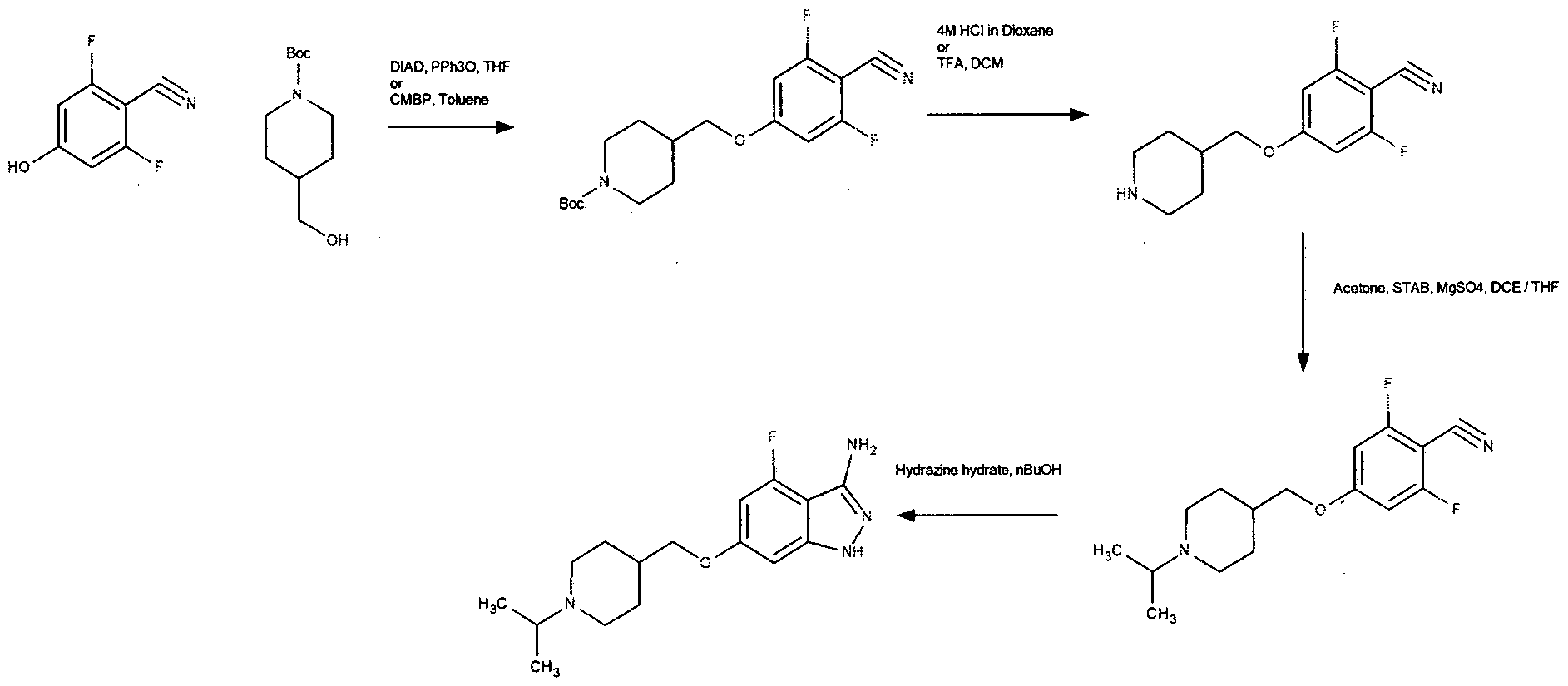
[00226] 2,6-difluoro-4-hydroxybenzonitrile (5 g, 32.24 mmol) and triphenylphosphine (99%,
17.08 g, 64.47 mmol) were added to a solution of tert-butyl 4-(hydroxymethyl)piperidine-l-
carboxylate (8.33 g, 38.68 mmol) in anhydrous THF (20 ml) under nitrogen. The reaction was then placed in an ice bath and cooled to 0°C and DIAD (10.13 ml, 51.58 mmol) was added drop wise, the ice bath was then removed and reaction was stirred under room temperature overnight.
[00227] The solvent was reduced under vacuo, the resulting yellow oil diluted with ethyl acetate, (30ml) and washed with water (2x30ml), dried over magnesium sulphate, filtered and cone, in vacuo. The product was purified by flash column chromatography, eluting product in 20% EtOAc / Heptane. This yielded 8g (63%) of the title compound as a white solid. METCR1673 Generic 2 minutes M/Z (ES+) 297, Retention time 1.51 min.
1H MR (500 MHz, DMSO-d6) δ 7.10 (d, J = 10.4 Hz, 2H), 4.81- 4.73(m,0H),4.00(d,J=6.5Hz,2H),2.74(s,2H),1.94(ddd,J=14.9,11.3,3.6Hz,lH),1.72 (d, J = 1 1.2 Hz, 2H), 1.40 (s, 9H), 1.15 (ddt, J = 24.8, 12.6, 5.7 Hz, 4H).
2,6-difluoro-4-(piperidin-4-ylmethoxy)benzonitrile hydrochloride
[00228] To a solution of tert-butyl 4-(4-cyano-3,5-difluorophenoxymethyl)piperidine-l- carboxylate (95%, 6 g, 16.18 mmol) in DCM (15ml) was added HC1 in Dioxane 4M (8.27 ml, 242.64 mmol) and reaction was stirred at room temperature over the weekend. Following consumption of starting material, the solvent was evaporated to yield 4g, 100% of the title compound as an off white solid. METCR1673 Generic 2 minutes M Z (ES+) 252.9, Retention time 0.74 min.
2,6-difluoro-4-{[l-9propan-2-yl)piperidin-4-yl]methoxy}benzonitrile
[00229] To a solution of 2,6-difluoro-4-(piperidin-4-ylmethoxy)benzonitrile hydrochloride (94%, 1 g, 3.26 mmol), acetone (0.48 ml, 6.51 mmol) and magnesium sulfate (391.89 mg, 3.26 mmol) in anhydrous THF (10ml) was added acetic acid (186.2 μΐ, 3.26 mmol). Reaction was stirred at room temperature for lh than STAB (2.07 g, 9.77 mmol) was added. The reaction was stirred at room temperature overnight. On completion the reaction was quenched with water (10ml) and 1M NaOH(lOml). The aqueous was separated and then extracted 3 x 10ml with EtOAc. Combined organics were washed with water and brine and dried over Na2S04. The product was purified by column to yield 539 mg (55.1%) of the title compound. METCR1673 Generic 2 minutes M/Z (ES+) 295, Retention time 0.89 min.
1H NMR (500 MHz, DMSO-d6) δ 7.13 (s, 1H), 7.11 (s, IH), 4.03 (d, J = 5.8 Hz, 2H), 3.48 - 3.39 (m, 1H), 3.28 -3.21 (m, 2H), 3.02 - 2.77 (m, 2H), 2.16 - 1.82 (m, 3H), 1.78 - 1.54 (m,2H), 1.24 (d, J - 5.3 Hz, 6H)
4-fluoro-6-{[l-(propan-2-yl)piperidin-4-yl]methoxy}-lH-indazol-3-amine
[00230] 2,6-difluoro-4-{[l-9propan-2-yl)piperidin-4-yl]methoxy}benzonitrile (95%, 539 mg, 1.74 mmol) was dissolved in 1-Butanol (6 ml) in a sealable pressure tube and NH2NH2 · H20 (0.3 ml, 8.7 mmol) was added. The reaction was heated to 120°C for 2h. IPC showed reaction to be complete and no starting material remaining. The solution was allowed to cool to room temperature, was diluted with water (10ml), the organics were separated and aqueous extracted 2 x 10ml with EtOAc. The combined organics were dried over Na2S04, filtered and evaporated, then purified by column chromatography to yield 233 mg (43.7%) of the title compound as a pale yellow solid.
MET-uHPLC-AB-101 (7min) M/Z (ES+) 307.2, Retention time 1.11 min.
1H NMR (500 MHz, DMSO-d6) δ 11.47 (s, 1H), 6.45 (d, J = 1.7 Hz, 1H), 6.27 (dd, J = 12.0, 1.7 Hz, 1H), 5.07 (s, 2H), 3.81 (d, J = 6.2 Hz, 2H), 2.82 - 2.74 (m, 2H), 2.69 - 2.61 (m, 1H), 2.13 - 2.05 (m, 2H), 1.77 - 1.64 (m, 3H), 1.32 - 1.17 (m, 2H), 0.95 (d, J = 6.6 Hz, 6H).
Example 35. 6-[(5-chloro-6-methoxypyridin-3-yl)methoxy]-lH-indazol-3-amine (20)

[00231] The title compound was prepared in a manner analagous to that described for example 34: 95.9 mg (45.1%) as a white powder. METCR1416 Hi res (7min) M/Z (ES+) 305, Retention time 2.19 min.
1H NMR (500 MHz, DMSO-d6) δ 11.17 (s, 1H), 8.26 (d, J = 1.99 Hz, 1H), 8.02 (d, J = 2.02 Hz, 1H), 7.55 (d, J = 8.71 Hz, 1H), 6.74 (d, J = 1.99 Hz, 1H), 6.60 (dd, J = 2.07, 8.71 Hz, 1H), 5.22 (s, 2H), 5.08 (s, 2H), 3.96 (s, 3H).
Example 36. (rac)-6-(l,2,3,4-tetrahydronaphthalen-2-yImethoxy)-lH-indazol-3-amine (21)

[00232] The title compound was prepared in a manner analagous to that described for example 34: 0.08 g (65.4%) as a pale pink solid. MET-uHPLC-AB-101 (7min) M/Z (ES+) 280.1, Retention time 2.46 min.
1H NMR (500 MHz, DMSO-d6) δ 11.10 (s, 1H), 7.55 (d, J = 8.7 Hz, 1H), 7.31 (d, J = 7.7 Hz, 1H), 7.23 (td, J = 7.4, 1.4 Hz, 1H), 7.20 - 7.13 (m, 2H), 6.81 (d, J = 2.0 Hz, 1H), 6.60 (dd, J =8.7, 2.1 Hz, 1H), 5.47 (t, J = 4.5 Hz, 1H), 5.22 (s, 2H), 2.84 (dt, J = 16.7, 5.4 Hz, 1H), 2.77 - 2.68 (m, lH), 2.08 - 1.83 (m, 3H), 1.80 - 1.70 (m, 1H).
Example 37. 6-(cyclohexylmethoxy)-lH-indazoI-3-amine (22)

[00233] The title compound was obtained using the procedure from Example 34: 103.6 mg (34.3%) as a white crystalline powder. METCR1416 Hi res (7min) M/Z (ES+) 246, Retention time 3.71 min.
1H NMR (500 MHz, DMSO-d6) δ 11.08 (s, 1H), 7.51 (d, J = 8.70 Hz, 1H), 6.60 (d, J = 1.97 Hz, lH), 6.51 (dd, J = 2.06, 8.70 Hz, 1H), 5.19 (s, 2H), 3.77 (d, J = 6.35 Hz, 2H), 1.85 - 1.63(m, 6H), 1.31 - 1.16 (m, 3H), 1.06 (qd, J = 3.12, 12.33 Hz, 2H).
Example 38. 6-({l-[(2-fluorophenyI)methyl]piperidin-4-yI}methoxy)-lH-indazol-3-amine
(25)

[00234] The title compound was prepared in a manner analagous to that described for example 34: 4.8 mg (21.9%) as an off white powder. MET-uHPLC-AB-101 (7min) M/Z (ES+) 355.2, Retention time 1.14 min.
1H NMR (500 MHz, DMSO-d6) δ 11.08 (s, 1H), 7.50 (d, J = 8.7 Hz, 1H), 7.44 - 7.37 (m, 1H), 7.34 - 7.26 (m, lH), 7.20 - 7.12 (m, 2H), 6.60 (d, J = 2.0 Hz, 1H), 6.50 (dd, J = 8.7, 2.1 Hz, 1H), 5.18 (s, 2H), 3.81 (d, J= 5.9 Hz, 2H), 3.51 (s, 2H), 2.89 - 2.80 (m, 2H), 2.05 - 1.96 (m, 2H), 1.79 - 1.68 (m, 3H), 1.37 - 1.26 (m, 2H).
Example 39. 6-[(6-methoxypyridin-3-yl)methoxy]-lH-indazol-3-amine (31)

[00235] The title compound was prepared in a manner analagous to that described for example 34: 20.6 mg (22.8%) as an off white powder. MET-uHPLC-AB-101 (7min) M/Z (ES+) 271.3, Retention time 2.87 min.
1H NMR (500 MHz, DMSO-d6) δ 1 1.14 (s, 1H), 8.26 (d, J = 2.3 Hz, 1H), 7.79 (dd, J = 8.5, 2.4 Hz, 1H), 7.52 (d, J = 8.7 Hz, 1H), 6.84 (d, J = 8.5 Hz, 1H), 6.73 (d, J = 2.0 Hz, 1H), 6.56 (dd, J = 8.7, 2.0 Hz, 1H), 5.20 (s, 2H), 5.04 (s, 2H), 3.85 (s, 3H).
Example 40. 6-(propan-2-yloxy)-lH-indazol-3-amine (168)

1H NMR (500 MHz, DMSO-d6) δ 11.04 (s, lH), 7.50 (d, J = 8.7 Hz, 1H), 6.60 (d, J = 1.9 Hz, 1H), 6.48 (dd, J = 8.7, 2.0 Hz, 1H), 5.18 (s, 2H), 4.59 (hept, J = 6.0 Hz, 1H), 1.27 (d, J = 6.0 Hz, 6H).
Example 41. 6-[(5-methoxypyrazin-2-yl)methoxy]-lH-indazol-3-amine (36)

[00237] The title compound was prepared in a manner analagous to that described for example 34: 0.06 g (29.7%) as an off white powder. METCR1416 Hi res (7min) M/Z (ES+) 282, Retention time 1.56 min.
1H NMR (500 MHz, DMSO-d6) δ 11.16 (s, 1H), 8.38 (d, J = 1.3 Hz, 1H), 8.35 (d, J = 1.4 Hz, 1H), 7.55 (d, J= 8.7 Hz, 1H), 6.77 (d, J = 2.0 Hz, lH), 6.61 (dd, J = 8.7, 2.1 Hz, 1H), 5.22 (s, 2H), 5.17 (s, 2H), 3.93 (s, 3H).
Example 42. 6-(oxetan-2-ylmethoxy)-lH-indazol-3-amine (37)

[00238] The title compound was obtained using the procedure from Example 34: 0.04 g (24.2%) as a light pink powder. METCR1600 High pH (7 min) M/Z (ES+) 220, Retention time 2.59 min.
1H NMR (500 MHz, DMSO-d6) δ 11.14 (s, 1H), 7.53 (d, J = 8.7 Hz, 1H), 6.67 (d, J = 2.0 Hz, 1H), 6.56 (dd, J = 8.7, 2.1 Hz, 1H), 5.20 (s, 2H), 5.05 - 4.98 (m, 1H), 4.57 - 4.46 (m, 2H), 4.15 (dd, J = 10.9, 5.7 Hz, 1H), 4.08 (dd, J = 10.9, 3.2 Hz, 1H), 2.75 - 2.66 (m, 1H), 2.59 - 2.52 (m,
1H).
Example 43. 6-(piperidin-4-ylmethoxy)-lH-indazol-3-amine (38)

[00239] The title compound was prepared in a manner analagous to that described for example 34: 11 mg (2.5%) as a white powder. METCR1416 Hi res (7min) M/Z (ES+) 247, Retention time 0.76 min.
1H NMR (500 MHz, DMSO-d6) δ 11.09 (s, 1H), 7.51 (d, J = 8.7 Hz, 1H), 6.61 (s, 1H), 6.51 (d, J = 8.7 Hz, 1H), 5.19 (s, 2H), 3.79 (d, J = 6.2 Hz, 2H), 2.95 (d, J = 12.1 Hz, 2H), 2.54 - 2.43(m, 2H), 1.87- 1.78 (m, 1H), 1.70 (d, J = 11.7 Hz, 2H), 1.12 - 1.15 (m, J = 12.2, 6.1 Hz, 2H).
Example 44. 6-{[l-(2-fluorobenzoyl)piperidin-4-yl]methoxy}-lH-indazol-3-amine (39)

[00240] The title compound was prepared in a manner analagous to that described for example 34: 0.01 g (6.5%) as a white powder. METCR1416 Hi res (7min) M/Z (ES+) 369, Retention time 2.02 min.
1H NMR (500 MHz, DMSO-d6) δ 11.12 (s, 1H), 7.53-7.46 (m, 2H), 7.43-7.35 (m, 1H), 7.33 - 7.26 (m, 2H), 6.61-6.64 (m, 1H), 6.54-6.50 (m, 1H), 5.76 (s, OH), 5.20 (s, 2H), 4.60-4.52 (m, lH),3.90-3.83 (m, 2H), 3.47-3.38 (m, 1H), 3.15-3.03 (m, 1H), 2.90 - 2.79 (m, 1H), 2.08 (s, 1H), 1.95-1.86 (m, 1H), 1.81-1.70 (m, 1H), 1.35 - 1.16 (m, 2H).
Example 45. l-(2-fluorobenzoyl)-6-{[l-(2-fluorobenzoyl)piperidin-4-yl]methoxy}-lH-
indazol-3-amine (40)

[00241] The title compound was obtained using the procedure from Example 34: 0.01 g (6.5%) as an off white powder. METCR1416 Hi res (7min) M/Z (ES+) 491 , Retention time 3.43 min. 1H NMR (500 MHz, DMSO-d6) δ 7.86 (s, 1H), 7.78-7.77 (m, 1H), 7.62-7.54 (m, 2H), 7.54 - 7.47 (m, 1H), 7.45-7.37 (m, 1H), 7.36 - 7.26 (m, 4H), 7.06-7.02 (m, 1H), 6.45 (s, 2H), 4.61-4.55 (m, 1H), 4.03-3.96 (m, 2H), 3.50-3.40 (m, 1H), 3.20-3.07 (m, 1H), 2.93 - 2.82 (m, 1H), 2.20- 2.07 (m, 1H), 1.99-1.90 (m, 1H), 1.84-1.74 (m, IH), 1.40 - 1.23 (m, 2H).
Example 46. 6-[(l-phenylpiperidin-4-yl)methoxy]-lH-indazol-3-amine (43)

[00242] The title compound was prepared in a manner analagous to that described for example 34: 0.06 g (51.5%) as a white powder. METCR1416 Hi res (7min) M/Z (ES+) 323, Retention time 1.45 min.
1H NMR (500 MHz, DMSO-d6) δ 1 1.11 (s, 1H), 7.52 (d, J = 8.7 Hz, 1H), 7.20 (dd, J = 8.7, 7.3 Hz, 2H), 6.95 (d, J = 7.9 Hz, 2H), 6.75 (t, J = 7.2 Hz, 1H), 6.64 (d, J = 2.0 Hz, 1H), 6.54 (dd,J = 8.7, 2.1 Hz, 1H), 5.20 (s, 2H), 3.88 (d, J = 6.2 Hz, 2H), 3.75-3.70 (m, 2H), 3.18 (d, J = 5.3 Hz, OH), 2.75 - 2.66 (m, 2H), 2.00 - 1.84 (m, 3H), 1.48-1.39 (m, 2H).
Example 47. tert-butyl 4-{2-[(3-amino-lH-indazol-6-yl)oxy]ethyl}piperidine-l-carboxylate
(44)

[00243] The title compound was prepared in a manner analagous to that described for example 34: 0.4 g (29.7%) as an off white powder. METCR1416 Hi res (7min) M/Z (ES+) 361, Retention time 2.64 min.
1H NMR (500 MHz, DMSO-d6) 5 11.11 (s, 1H), 7.51 (d, J = 8.7 Hz, 1H), 6.63 (d, J = 2.0 Hz, 1H), 6.51 (dd, J = 8.7, 2.1 Hz, 1H), 5.19 (s, 2H), 4.01 (t, J = 6.0 Hz, 2H), 3.93 (d, J = 11.8 Hz, 2H), 2.81 - 2.62 (m, 2H), 1.77 - 1.60 (m, 5H), 1.40 (s, 9H), 1.07 (td, J = 12.6, 12.1, 6.4 Hz, 2H).
Example 48. 6-[2-(piperidin-4-yl)ethoxy]-lH-indazol-3-amine (45)

[00244] The title compound was prepared in a manner analagous to that described for example 34: 0.2 g (73.8%) as a white powder. METCR1600 High pH (7 min) M/Z (ES+) 261, Retention time 4.51 min.
1H NMR (500 MHz, DMSO-d6) δ 12.74 (s, 1H), 8.99 (s, 1H), 8.78 (d, J = 9.0 Hz, 1H), 7.90 (d, J = 8.9 Hz, 1H), 6.81 - 6.76 (m, 2H), 4.12-4.08 (m, 2H), 3.26-3.21 (m, 2H), 2.89-2.79 (m,2H), 1.89-1.84 (m, 2H), 1.82 - 1.76 (m, 1H), 1.75-1.69 (m, 2H), 1.64 (s, OH), 1.47 - 1.36 (m, 2H).
Example 49. 6-[(l-methyIpiperidin-4-yl)oxy]-lH-indazol-3-amine (46)
 [00245] The title compound was prepared in a manner analagous to that described for example 34: 0.08 g (66.8%) as a white powder. METCR1416 Hi res (7min) M/Z (ES+) 247, Retention time 0.66 min.
1H NMR (500 MHz, DMSO-d6) δ 11.04 (s, 1H), 7.51 (d, J - 8.7 Hz, 1H), 6.65 (d, J = 1.9 Hz, 1H), 6.52 (dd, J = 8.7, 2.0 Hz, 1H), 5.19 (s, 2H), 4.39 - 4.30 (m, 1H), 2.68 - 2.58 (m, 2H), 2.26 - 2.12 (m, 5H), 1.98 -1.88 (m, 2H), 1.70 - 1.60 (m, 2H).
Example 50. 6-(piperidin-4-yloxy)-lH-indazol-3-amine (47)

[00246] The title compound was prepared in a manner analagous to that described for example 34: 0.17 g (70.6%) as a yellow powder. METCR1600 High pH (7 min) M/Z (ES+) 233, Retention time 2.36 min.
1H NMR (500 MHz, DMSO-d6) δ 12.54 (br s, 1H), 9.28-8.76 (m, 2H), 7.89 (d, J = 8.9 Hz, 1H), 6.91 (d, J = 1.7 Hz, 1H), 6.84 (dd, J = 8.9, 1.9 Hz, IH), 4.85 - 4.75 (m, 1H), 3.29 - 3.18 (m, 2H), 3.14 - 3.02 (m, 2H),2.20 - 2.08 (m, 2H), 1.94 - 1.81 (m, 2H).
Example 51. 6-[(l-ethyIpiperidin-4-yl)methoxy]-lH-indazol-3-amine (50)

[00247] The title compound was prepared in a manner analagous to that described for example 34: 32.4 mg (76.6%) as a yellow powder. METCR1600 High pH (7 min) M/Z (ES+) 275.1, Retention time 3.35 min.
1H NMR (500 MHz, DMSO-d6) δ 11.09 (s, 1H), 7.50 (d, J = 8.7 Hz, 1H), 6.60 (d, J = 2.0 Hz, IH), 6.51 (dd, J = 8.7, 2.1 Hz, 1H), 5.18 (s, 2H), 3.81 (d, J = 6.0 Hz, 2H), 2.93 - 2.83 (m,2H), 2.31 (q, J = 7.2 Hz, 2H), 1.92 - 1.81 (m, 2H), 1.79 - 1.66 (m, 3H), 1.35 - 1.22 (m, 2H), 0.99 (t, J = 7.2 Hz, 3H).
Example 52. 6-{[l-(propan-2-yl)piperidin-4-yl]methoxy}-lH-indazoI-3-amine (51)

[00248] The title compound was prepared in a manner analagous to that described for example 34: 19.6 mg (30.9%) as a yellow powder. METCR1600 High pH (7 min) M/Z (ES+) 289.2, Retention time 3.62 min.
IH NMR (500 MHz, DMSO-d6) δ 1 1.08 (s, IH), 7.50 (d, J = 8.7 Hz, IH), 6.60 (d, J = 1.9 Hz, IH), 6.51 (dd, J = 8.7, 1.9 Hz, IH), 5.18 (s, 2H), 3.80 (d, J = 6.2 Hz, 2H), 2.82 - 2.76 (m, 2H), 2.70 - 2.65 (m, IH), 2.14 - 2.06 (m, 2H), 1.78 - 1.72 (m, 2H), 1.72 - 1.64 (m, IH), 1.32 - 1.19 (m, 2H), 0.96 (d, J = 6.6 Hz, 6H).
Example 53. (rac)-6-(pyrrolidin-3-ylmethoxy)-lH-indazol-3-amine (52)
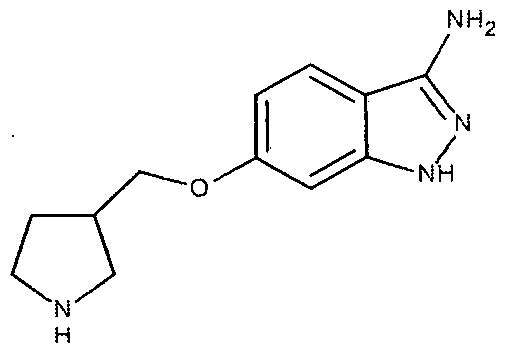
[00249] The title compound was prepared in a manner analagous to that described for example 34: 0.08 g (57.3%) as a pale yellow solid. METCR1600 High pH (7 min) M/Z (ES+) 233.1 , Retention time 2.54 min.
IH NMR (500 MHz, DMSO-d6) δ 12.56 (br s, IH), 9.29 - 9.1 1 (m, 2H), 7.85 (d, J = 9.4 Hz, IH), 6.86 - 6.76 (m, 2H), 4.15 - 4.02 (m, 2H), 3.22 - 3.12 (m, 2H), 3.11 - 2.96 (m, IH), 2.85 - 2.68 (m, IH), 2.19 - 2.05 (m, IH), 1.86 - 1.70 (m, IH).
Example 54. (r c)-6-(pyrrolidin-2-ylmethoxy)-lH-indazol-3-amine (53)

[00250] The title compound was prepared in a manner analagous to that described for example 34: 130 mg (33.1%) as a white powder. METCR1600 High pH (7 min) M/Z (ES+) 233, Retention time 2.70 min.
IH NMR (500 MHz, DMSO-d6) δ 12.67 (s, IH), 9.67 (s, IH), 9.17 (s, IH), 7.96 - 7.85 (m, IH), 6.88 - 6.79 (m, 2H), 4.36 - 4.30 (m, IH), 4.30 - 4.20 (m, IH), 4.00 - 3.89 (m, IH), 3.26 -3.20 (m, 2H), 2.19 - 2.10 (m, IH), 2.05 - 1.97 (m, IH), 1.96 - 1.87 (m, IH), 1.82 - 1.73 (m, IH).
Example 55. l-(4-{[(3-amino-lH-indazol-6-yl)oxy]methyl}piperidin-l-yl)ethan-l-one (55)

[00251] The title compound was prepared in a manner analagous to that described for example 34: 0.01 g (12.9%) as a red powder. MET-uHPLC-AB-101 (Tmin) M/Z (ES+) 289, Retention time 1.41 min.
IH NMR (500 MHz, DMSO-d6) 6 11.11 (s, IH), 7.59 - 7.43 (m, IH), 6.66 - 6.58 (m, IH), 6.57 - 6.47 (m, IH), 5.25 - 5.14 (m, 2H), 4.50 - 4.32 (m, IH), 3.88 - 3.85 (m, IH), 3.85 - 3.81 (m, 2H), 3.09 - 3.00 (m, IH), 2.61 - 2.52 (m, IH), 2.06 - 2.01 (m, IH), 2.00 (s, 3H), 1.87 - 1.73 (m, 2H), 1.33 - 1.20 (m, IH), 1.20 - 1.05 (m, IH).
Example 56. 6-(piperidin-4-ylmethoxy)-lH-indazole (56)

1H NMR (500 MHz, DMSO-d6) δ 12.76 (s, 1H), 7.91 (s, 1H), 7.59 (d, J = 8.8 Hz, 1H), 6.89 (s, 1H), 6.72 (dd, J = 8.8, 2.0 Hz, 1H), 3.84 (d, J = 6.4 Hz, 2H), 3.01 - 2.90 (m, 2H), 2.49 - 2.44 (m, 2H), 1.91 - 1.79 (m, 1H), 1.76 - 1.66 (m, 2H), 1.25 - 1.13 (m, 2H).
Example 57. 5-(piperidin-4-ylmethoxy)-lH-indazol-3-amine (61)

[00253] The title compound was obtained using the procedure from Example 34: 10 mg (25.3%) as an off white powder. METCR1600 High pH (7 min) M/Z (ES+) 247, Retention time 2.71 min.
1H NMR (500 MHz, DMSO-d6) δ 1 1.15 (s, 1H), 7.16 (d, J = 2.1 Hz, 1H), 7.13 (d, J = 8.9 Hz, 1H), 6.89 (dd, J = 8.9, 2.3 Hz, 1H), 5.13 (s, 2H), 3.76 (d, J = 6.4 Hz, 2H), 3.00 - 2.92 (m,2H), 2.49 - 2.45 (m, 2H), 1.89 - 1.78 (m, lH), 1.74 - 1.67 (m, 2H), 1.22 - 1.13 (m, 2H).
Example 58. 4-fluoro-6-{[l-(pyridin-2-ylmethyl)piperidin-4-yl]methoxy}-lH-indazol-3- amine (63)

1H NMR (500 MHz, DMSO-d6) δ 1 1.48 (s, IH), 8.48 (ddd, J = 4.8, 1.7, 0.8 Hz, 1H), 7.76 (td, J - 7.7, 1.8 Hz, IH), 7.46 - 7.42 (m, 1H), 7.25 (ddd, J = 7.4, 4.9, 1.0 Hz, 1H), 6.46 (d, J = 1.7Hz, 1H), 6.29 (dd, J = 12.0, 1.7 Hz, IH), 5.08 (s, 2H), 3.84 (d, J = 5,9 Hz, 2H), 3.58 (s, 2H), 2.91 - 2.80 (m, 2H), 2.08 - 2.00 (m, 2H), 1.80 - 1.70 (m, 3H), 1.42 - 1.28 (m, 2H).
Example 59. 5-(piperidin-4-yloxy)-lH-indazoI-3-amine (65)

[00255] The title compound was prepared in a manner analagous to that described for example 34: 18.5 mg (51.7%) as a brown crystalline solid. METCR1600 High pH (7 min) M/Z (ES+) 233.2, Retention time 2.40 min.
IH NMR (500 MHz, DMSO-d6) δ 11.13 (s, IH), 7.21 (d, J - 2.0 Hz, IH), 7.1 1 (d, J = 8.9 Hz, IH), 6.88 (dd, J = 8.9, 2.3 Hz, IH), 5.14 (s, 2H), 4.27 - 4.16 (m, IH), 3.01 - 2.91 (m, 2H), 2.59 - 2.53 (m, 2H), 1.97 - 1.88 (m, 2H), 1.49 - 1.39 (m, 2H).
Example 60. 4-fluoro-6-(piperidin-4-ylmethoxy)-l,2-benzoxazol-3-amine (66)

[00256] The title compound was prepared in a manner analagous to that described for example 34: 0.01 g (8.5%) as an off white crystalline solid. METCR1600 High pH (7 min) M/Z (ES+) 266, Retention time 3.58 min.
IH NMR (500 MHz, DMSO-d6) δ 8.85 (s, 1H), 8.52 (s, 1H), 6.92 (d, J = 1.7 Hz, IH), 6.68 (dd, J = 11.3, 1.7 Hz, IH), 6.16 (s, 2H), 3.96 (d, J = 6.4 Hz, 2H), 3.31 - 3.26 (m, 2H), 2.95 -2.84 (m,
2H), 2.14- 2.02 (m, 1H), 1.96 - 1.86 (m, 2H), 1.55 - 1.42 (m, 2H).
Example 61. 6-[(l-ethylpiperidin-4-yl)methoxy]-4-fluoro-lH-indazol-3-amine (67)

[00257] The title compound was prepared in a manner analagous to that described for example 34: 0.01 g (2.2%) as an off white crystalline solid. METCR1416 Hi res (7min) M/Z (ES+) 293, Retention time 1.13 min.
1H NMR (500 MHz, DMSO-d6) δ 11.46 (s, 1H), 6.45 (d, J = 1.7 Hz, 1H), 6.28 (dd, J = 12.0, 1.6 Hz, 1H), 5.08 (s, 2H), 3.83 (d, J = 6.0 Hz, 2H), 2.95 - 2.81 (m, 2H), 2.31 (q, J = 7.1 Hz, 2H), 1.92 - 1.82 (m, 2H), 1.79 - 1.69 (m, 3H), 1.34 - 1.22 (m, 2H), 1.00 (t, J = 7.2 Hz, 3H).
Example 62. 4-fluoro-l-methyl-6-(piperidin-4-ylmethoxy)-lH-indazoI-3-amine (68)

[00258] The title compound was prepared in a manner analagous to that described for example 34: 167 mg (75.7%) as a pink powder. METCR1600 High pH (7 min) M/Z (ES+) 279.2, Retention time 3.40 min.
1H NMR (500 MHz, DMSO-d6) δ 7.88 (s, 1H), 6.67 (d, J = 1.7 Hz, 1H), 6.28 (dd, J = 11.9, 1.6 Hz, 1H), 5.17 (s, 2H), 3.91 (d, J = 6.4 Hz, 2H), 3.66 (s, 3H), 3.27 - 3.25 (m, 2H), 2.94 - 2.80 (m, 2H), 2.14- 1.96 (m, 1H), 1.97 - 1.82 (m, 2H), 1.54 - 1.36 (m, 2H).
Example 63. 4-fluoro-6-[(l-methylpiperidin-4-yl)methoxy]-lH-indazol-3-amine (69)

[00259] The title compound was prepared in a manner analagous to that described for example 34: 16.2 mg (27.7%) as an off white solid. METCR1416 Hi res (7min) M/Z (ES+) 279.2, Retention time 3.38 min.
1H NMR (500 MHz, DMSO-d6) δ 11.46 (s, 1H), 6.45 (d, J = 1.7 Hz, 1H), 6.27 (dd, J = 12.0, 1.6 Hz, 1H), 5.07 (s,2H), 3.82 (d, J = 6.2 Hz, 2H), 2.81 - 2.72 (m, 2H), 2.14 (s, 3H), 1.88 -1.79 (m, 2H), 1.73 - 1.64 (m, 3H), 1.35 - 1.23 (m, 2H).
Example 64. (rac)-4-fluoro-6-(piperidin-3-ylmethoxy)-lH-indazol-3-amine (71)

[00260] The title compound was prepared in a manner analagous to that described for example 34: 71.2 mg (93.4%) as a red powder. METCR1600 High pH (7 min) M/Z (ES+) 265.1, Retention time 3.15 min.
1H NMR (500 MHz, Methanol-d4) δ 6.70 (d, J = 1.7 Hz, 1H), 6.62 (dd, J = 11.7, 1.7 Hz, 1H), 4.15 - 4.09 (m, 1H), 4.04 - 3.99 (m, 1H), 3.58 - 3.52 (m, 1H), 3.43 - 3.37 (m, 1H), 3.03 - 2.88 (m, 2H), 2.40 - 2.29 (m, 1H), 2.06 - 1.96 (m, 2H), 1.89 - 1.76 (m, 1H), 1.59 - 1.46 (m, 1H).
Example 65. (rac)-4-fluoro-6-(morpholin-2-ylmethoxy)-lH-indazol-3-amine (75)

1H NMR (500 MHz, Deuterium Oxide) δ 6.74 (d, J = 1.8 Hz, 1H), 6.64 (dd, J = 11.8, 1.8 Hz, 1H), 4.35 - 4.29 (m, 2H), 4.28 - 4.21 (m, 2H), 4.05 - 3.96 (m, 1H), 3.58 - 3.52 (m, 1H), 3.48 - 3.41 (m, 1H), 3.39 - 3.26 (m, 2H).
Example 66. 4-fluoro-6-(piperidin-4-ylmethoxy)-lH-indazole (78)

[00262] The title compound was prepared in a manner analagous to that described for example 34: 0.01 g (48%) as an off white powder. METCR1600 High pH (7 min) M Z (ES+) 250.2, Retention time 4.12 min.
1H NMR (500 MHz, DMSO-d6) δ 13.16 (s, 1H), 8.49 (br s, 2H), 8.03 (s, 1H), 6.81 (s, 1H), 6.56 (dd, J = 11.6, 1.6 Hz, 1H), 3.94 (d, J = 6.3 Hz, 2H), 2.98 - 2.84 (m, 2H), 2.53 - 2.51 (m, 2H), 2.18 - 2.01 (m, 1H), 1.98 - 1.86 (m, 2H), 1.57 - 1.41 (m, 2H).
Example 67. 4-fluoro-6-(piperidin-4-ylmethoxy)-lH-indazol-3-ol (95)

[00263] The title compound was prepared in a manner analagous to that described for example 34: 3 mg (21.7%) as on off white powder. METCR1416 Hi res (7min) M/Z (ES+) 266, Retention time 1.86 min.
1H NMR (500 MHz, Methanol-d4) δ 6.46 (s, 1H), 6.28 (d, J = 11.6 Hz, 1H), 3.90 (d, J = 6.1 Hz, 2H), 3.27 - 3.20 (m, 2H), 2.88 - 2.75 (m, 2H), 2.10 - 2.02 (m, 1H), 1.99 - 1.89 (m, 2H), 1.52 -
1.41 (m, 2H).
Example 68. Enantiomer 1: 4-fluoro-6-({l-[oxolan-3-yI]piperidin-4-yl)methoxy)-lH- indazol-3-amine (96)

[00264] Racemic 4-fluoro-6-({ l-[(oxolan-3-yl]piperidin-4-yl}methoxy)-lH-indazol-3-amine, was purified by chiral column chromatography to provide the title compound as a single enantiomer (absolute stereochemistry not specified) 33.1 mg (37.8%) as a yellow powder. Achiral LCMS data: METCR1600 High pH (7 min) M/Z (ES+) 335.2, Retention time 3.27 min. 1H NMR (500 MHz, DMSO-d6) δ 11.45 (s, 1H), 6.45 (d, J = 1.6 Hz, 1H), 6.28 (dd, J = 11.9, 1.4 Hz, lH), 5.07 (s, 2H), 3.82 (d, J = 5.9 Hz, 2H), 3.80 - 3.74 (m, 2H), 3.68 - 3.58 (m, 1H), 3.48 - 3.41 (m, 1H), 2.95 - 2.88 (m, 1H), 2.88 - 2.81 (m, 1H), 2.75 - 2.67 (m, lH), 2.03 - 1.91 (m, 3H), 1.79 - 1.65 (m, 4H), 1.36 - 1.22 (m, 2H).
Example 69. Enantiomer 2: 4-fluoro-6-({l-[oxolan-3-yl]piperidin-4-yl}methoxy)-lH- indazol-3-amine (97)

[00265] Racemic 4-fluoro-6-({ l-[(oxolan-3-yl]piperidin-4-yl}methoxy)-lH-indazol-3-amine, was purified by chiral column chromatography to provide the title compound as a single enantiomer (absolute stereochemistry not specified) 33.1 mg (37.8%) as a yellow powder. Achiral LCMS data: METCR1600 High pH (7 min) M/Z (ES+) 335.2, Retention time 3.27 min. 1H NMR (500 MHz, DMSO-d6) δ 11.45 (s, 1H), 6.45 (d, J = 1.6 Hz, 1H), 6.28 (dd, J = 11.9, 1.4 Hz, 1H), 5.07 (s, 2H), 3.82 (d, J = 5.9 Hz, 2H), 3.80 - 3.74 (m, 2H), 3.68 - 3.58 (m, 1H), 3.48 -
3.41 (m, 1H), 2.95 - 2.88 (m, 1H), 2.88 - 2.81 (m, 1H), 2.75 - 2.67 (m, 1H), 2.03 - 1.91 3H), 1.79 - 1.65 (m, 4H), 1.36 - 1.22 (m, 2H).
Example 70. (rac)-4-fluoro-6-[l-(piperidin-4-yl)ethoxy]-lH-indazol-3-amine (99)

[00266] The title compound was prepared in a manner analagous to that described for example 34: 0.01 g (32.3%) as a brown viscous oil. MET-uHPLC-AB-101 (7min) M/Z (ES+) 279, Retention time 1.03 min.
1H NMR (500 MHz, DMSO-d6) 6 11.42 (s, 1H), 6.47 (d, J = 1.6 Hz, 1H), 6.27 (dd, J = 12.1, 1.5 Hz, lH), 5.07 (s, 2H), 4.30 - 4.21 (m, 1H), 3.07 - 2.96 (m, 2H), 1.82 - 1.72 (m, 1H), 1.71 - 1.56 (m, 2H), 1.31 - 1.21 (m, 2H), 1.20 (d, J = 6.1 Hz, 3H).
Example 71. 4-fluoro-6-{[l-(oxetan-3-yl)piperidin-4-yl]methoxy}-lH-indazol-3-amine (100)

[00267] The title compound was prepared in a manner analagous to that described for example 34: 24.6 mg (9.5%) as an off white solid. METCR1600 High pH (7 min) M/Z (ES+) 321.2, Retention time 1.55 min.
1H NMR (500 MHz, Methanol-d4) δ 6.53 (d, J = 1.6 Hz, 1H), 6.31 (dd, J = 12.0, 1.6 Hz, lH), 4.73 - 4.67 (m, 2H), 4.66 - 4.59 (m, 2H), 3.88 (d, J = 5.8 Hz, 2H), 3.52 (p, J = 6.5 Hz, 1H),2.89 - 2.82 (m, 2H), 1.97 - 1.83 (m, 5H), 1.53 - 1.42 (m, 2H).
Example 72. 4-fluoro-6-{[l-(3,3,3-trifluoropropyl)piperidin-4-yl]methoxy}-lH-indazol-3-
amine (101)

[00268] The title compound was prepared in a manner analagous to that described for example 34: 96 mg (56.6%) as an off white solid. METCR1416 Hi res (7min) M/Z (ES+) 361.3, Retention time 1.22 min.
1H NMR (500 MHz, DMSO-d6) δ 11.47 (s, lH), 6.46 (d, J = 1.6 Hz, 1H), 6.28 (dd, J = 12.0, 1.5 Hz, 1H), 5.07 (s, 2H), 3.83 (d, J = 5.9 Hz, 2H), 2.92 - 2.86 (m, 2H), 2.50 - 2.48 (m, 2H),2.48 - 2.35 (m, 2H), 2.00 - 1.89 (m, 2H), 1.78 - 1.67 (m, 3H), 1.36 - 1.22 (m, 2H).
Example 73. (rac)-6-{[l-(l,l-difluoropropan-2-yl)piperidin-4-yl]methoxy}-4-fluoro-lH- indazol-3-amine (102)

[00269] The title compound was prepared in a manner analagous to that described for example 34: 19 mg (59.1%) of as an orange solid. METCR1416 Hi res (7min) M/Z (ES+) 343.3, Retention time 1.18 min.
1H NMR (500 MHz, DMSO-d6) δ 11.46 (s, 1H), 6.45 (d, J = 1.6 Hz, 1H), 6.28 (dd, 1H), 6.02 (t, 1H), 5.06 (s, 2H), 3.82 (d, J = 5.8 Hz, 2H), 3.00 - 2.77 (m, 2H), 2.52 - 2.51 (m, 1H), 2.42 - 2.27 (m, 2H), 1.79 -1.65 (m, 3H), 1.34 - 1.19 (m, 2H), 1.02 (d, J = 6.5 Hz, 3H).
Example 74. (rac)-4-fluoro-6-{[l-(4,4,4-trifluorobutan-2-yl)piperidin-4-yI]methoxy}-lH-
indazoI-3-amine (103)

[00270] The title compound was prepared in a manner analagous to that described for example 34: 42 mg (88.4%) as an off white solid. METCR1416 Hi res (7min) M/Z (ES+) 375.3, Retention time 1.35 min.
1H NMR (500 MHz, DMSO-d6) δ 11.47 (s, 1H), 6.46 (d, J = 1.7 Hz, 1H), 6.28 (dd, J = 12.0, 1.7 Hz, 1H), 5.07 (s, 2H), 3.82 (d, J = 6.2 Hz, 2H), 2.99 - 2.89 (m, 1H), 2.78 - 2.69 (m, 2H), 2.31 - 2.09 (m, 3H), 1.81 - 1.64 (m, 3H), 1.43 - 1.15 (m, 3H), 1.03 (d, J = 6.6 Hz, 3H).
Example 75. 4-fluoro-6-[(l-propyIpiperidin-4-yl)methoxy]-lH-indazol-3-amine (104)

[00271] The title compound was prepared in a manner analagous to that described for example 34: 20 mg (28.6%) as a beige solid. MET-uHPLC-AB-101 (7min) M/Z (ES+) 307.2, Retention time 1.15 min.
1H NMR (500 MHz, DMSO-d6) δ 1 1.46 (s, 1H), 6.46 (d, J = 1.7 Hz, 1H), 6.28 (dd, J = 12.0, 1.6 Hz, 1H), 5.08 (s, 2H), 3.83 (d, J = 5.9 Hz, 2H), 2.97 - 2.80 (m, 2H), 2.33 - 2.15 (m, 2H), 1.96 - 1.81 (m, 2H), 1.78 - 1.66 (m, 3H), 1.51 - 1.36 (m, 2H), 1.36 - 1.20 (m, 2H), 0.85 (t, J = 7.4 Hz, 3H).
Example 76. 4-fluoro-6-{[l-(2-methylpropyl)piperidin-4-yl]methoxy}-lH-indazol-3-amine
(105)

[00272] The title compound was prepared in a manner analagous to that described for example 34: 26 mg (21.7%) as a beige solid. MET-uHPLC-AB-101 (7min) M/Z (ES+) 321.2, Retention time 1.29 min.
1H NMR (500 MHz, DMSO-d6) δ 11.46 (s, 1H), 6.45 (d, J = 1.7 Hz, 1H), 6.28 (dd, J = 12.0, 1.6 Hz, 1H), 5.08 (s, 2H), 3.83 (d, J = 5.9 Hz, 2H), 2.90 - 2.77 (m, 2H), 2.08 - 1.95 (m, 2H), 1.92 - 1.81 (m, 2H), 1.78 - 1.64 (m, 4H), 1.37 - 1.20 (m, 2H), 0.85 (d, J = 6.6 Hz, 6H).
Example 77. (rac)-6-[l-(l-cyclobutylpiperidin-4-yl)ethoxy]-4-fluoro-lH-indazol-3-amine
(106)

[00273] The title compound was prepared in a manner analagous to that described for example 34: 0.31 g (69.8%) as an off white powder. METCR1416 Hi res (7min) M/Z (ES+) 333, Retention time 2.41 min.
1H NMR (500 MHz, DMSO-d6) δ 11.39 (s, 1H), 6.45 (d, J = 1.6 Hz, 1H), 6.27 (dd, J = 12.1, 1.6 Hz, 1H), 5.06 (s, 2H), 4.37 - 4.16 (m, 1H), 2.90 - 2.74 (m, 2H), 2.67 - 2.57 (m, 1H), 1.99 - 1.89 (m, 2H), 1.80 - 1.68 (m, 3H), 1.65 - 1.54 (m, 5H), 1.54 - 1.43 (m, 1H), 1.35 - 1.21 (m, 2H), 1.19 (d, J = 6.1 Hz, 3H).
Example 78. Enantiomer 1: 6-[l-(l-cyclobutylpiperidin-4-yl)ethoxy]-4-fluoro-lH-indazol-3- amine (110)

[00274] Racemic 6-[l-(l-cyclobutylpiperidin-4-yl)ethoxy]-4-fluoro-lH-indazol-3-amine, was purified by chiral column chromatography to provide the title compound as a single enantiomer (absolute stereochemistry not specified): 0.12 g (26%) as an off white foam. Achiral LCMS data: MET-uHPLC-AB-101 (7min) M/Z (ES+) 333.2, Retention time 1.30 min.
1H NMR (500 MHz, DMSO-d6) δ 1 1.39 (s, 1H), 6.45 (d, J = 1.6 Hz, 1H), 6.27 (dd, J = 12.1, 1.5 Hz, 1H), 5.06 (s, 2H), 4.32 - 4.18 (m, lH), 2.87 - 2.74 (m, 2H), 2.67 - 2.57 (m, 1H), 2.01 - 1.87 (m, 2H), 1.82 - 1.68(m, 3H), 1.66 - 1.54 (m, 5H), 1.55 - 1.43 (m, 1H), 1.37 - 1.21 (m, 2H), 1.19 (d, J = 6.1 Hz, 3H).
Example 79. Enantiomer 2: 6-[l-(l-cyclobutylpiperidin-4-yI)ethoxy]-4-fluoro-lH-indazoI-3- amine (111)

[00275] Racemic 6-[l-(l-cyclobutylpiperidin-4-yl)ethoxy]-4-fluoro-lH-indazol-3-amine, was purified by chiral column chromatography to provide the title compound as a single enantiomer (absolute stereochemistry not specified) 0.08 g (18%) as an off white foam. Achiral LCMS data: MET-uHPLC-AB-101 (7min) M/Z (ES+) 333.2, Retention time 1.31 min.
1H NMR (500 MHz, DMSO-d6) δ 11.39 (s, 1H), 6.45 (d, J = 1.6 Hz, 1H), 6.27 (dd, J = 12.1, 1.6 Hz, 1H), 5.06 (s, 2H), 4.36 - 4.15 (m, 1H), 2.90 - 2.74 (m, 2H), 2.70 - 2.57 (m, 1H), 2.01 - 1.87 (m, 2H), 1.84 - 1.66(m, 3H), 1.65 - 1.53 (m, 5H), 1.53 - 1.44 (m, 1H), 1.35 - 1.21 (m, 2H), 1.19 (d, J = 6.1 Hz, 3H).
Example 80. (rac)-4-fluoro-6-{l-[l-(propan-2-yl)piperidin-4-yl]ethoxy}-lH-indazol-3-amine
(107)

[00276] The title compound was prepared in a manner analagous to that described for example 34: 0.01 g (2.6%) as a beige foam. METCR1416 Hi res (7min) M/Z (ES+) 321.1, Retention time 2.41 min.
1H NMR (500 MHz, DMSO-d6) δ 11.39 (s, 1H), 6.45 (d, J = 1.6 Hz, 1H), 6.27 (dd, J = 12.1, 1.5 Hz, 1H), 5.06 (s, 2H), 4.34 - 4.17 (m, 1H), 2.85 - 2.75 (m, 2H), 2.70 - 2.59 (m, 1H), 2.09 - 1.98 (m, 2H), 1.81 - 1.74(m, 1H), 1.65 - 1.56 (m, 1H), 1.53 - 1.43 (m, 1H), 1.35 - 1.21 (m, 2H), 1.19 (d, J = 6.1 Hz, 3H), 0.94 (d, J = 6.6 Hz, 6H).
Example 81. Enantiomer 1: 4-fluoro-6-[l-[l-(propan-2-yl)piperidin-4-yl]ethoxy]-lH- indazol-3-amine (112)

[00277] Racemic 4-fluoro-6-{ l-[l-(propan-2-yl)piperidin-4-yl]ethoxy}-lH-indazol-3-amine, was purified by chiral column chromatography to provide the title compound as a single enantiomer (absolute stereochemistry not specified) 0.01 g (19.5%) as a light pink foam. Achiral LCMS data: MET-uHPLC-AB-101 (7min) M/Z (ES+) 321.2, Retention time 1.23 min.
1H NMR (500 MHz, DMSO-d6) δ 1 1.39 (s, 1H), 6.45 (d, J = 1.7 Hz, 1H), 6.26 (dd, J = 12.1, 1.6 Hz, 1H), 5.06 (s, 2H), 4.32 - 4.18 (m, 1H), 2.85 - 2.75 (m, 2H), 2.69 - 2.59 (m, 1H), 2.10 - 1.97 (m, 2H), 1.84 - 1.72 (m, 1H), 1.65 - 1.55 (m, 1H), 1.54 - 1.42 (m, 1H), 1.36 - 1.21 (m, 2H), 1.19 (d, J = 6.1 Hz, 3H), 0.94 (d, J = 6.6 Hz, 6H).
Example 82. Enantiomer 2: 4-fluoro-6-[l-[l-(propan-2-yl)piperidin-4-yl]ethoxy]-lH- indazol-3-amine (113)

[00278] Racemic 4-fluoro-6-{ 1 -[l-(propan-2-yl)piperidin-4-yl]ethoxy}-lH-indazol-3-amine, was purified by chiral column chromatography to provide the title compound as a single enantiomer (absolute stereochemistry not specified) 60.6 mg (20%) as a light pink foam. Achiral LCMS data: MET-uHPLC-AB- 101 (7min) M/Z (ES+) 321.2, Retention time 1.23 min.
1H NMR (500 MHz, DMSO-d6) δ 11.39 (s, 1H), 6.45 (d, J = 1.5 Hz, 1H), 6.26 (dd, J = 12.1, 1.3 Hz, 1H), 5.06 (s, 2H), 4.31 - 4.18 (m, 1H), 2.86 - 2.75 (m, 2H), 2.70 - 2.58 (m, 1H), 2.10 - 1.98 (m, 2H), 1.83 - 1.71 (m, 1H), 1.65 - 1.55 (m, 1H), 1.53 - 1.42 (m, 1H), 1.36 - 1.21 (m, 2H), 1.19 (d, J = 6.1 Hz, 3H), 0.94 (d, J = 6.6 Hz, 6H).
Example 84. Enantiomer 1: 4-fluoro-6-({l-[(-)-oxan-3-yl]piperidin-4-yl}methoxy)-lH- indazol-3-amine (115)

[00279] Racemic 4-fluoro-6-{ [ 1 -(oxan-3-yl)piperidin-4-yl]methoxy} - 1 H-indazol-3 -amine, was purified by chiral column chromatography to provide the title compound as a single enantiomer (absolute stereochemistry not specified): 11.9 mg (8.4%) as a tan color powder. Achiral LCMS data: MET-uHPLC-AB-101 (7min) M/Z (ES+) 349.1, Retention time 1.13 min.
1H NMR (500 MHz, DMSO-d6) δ 1 1.45 (s, 1H), 6.44 (d, J = 1.6 Hz, 1H), 6.27 (dd, J = 11.9, 1.5 Hz, 1H), 5.07 (s, 2H), 3.89 - 3.82 (m, 1H), 3.80 (d, J = 5.9 Hz, 2H), 3.75 - 3.68 (m, 1Ή), 3.21 - 3.12 (m, 2H), 2.92 - 2.83 (m, 2H), 2.35 - 2.28 (m, 1H), 2.23 - 2.12 (m, 2H), 1.93 - 1.85 (m, 1H), 1.76 - 1.60 (m, 4H), 1.54 - 1.33 (m, 2H), 1.31 - 1.17 (m, 2H).
Example 85. Enantiomer 2: 4-fluoro-6-({l— oxan-3-yl]piperidin-4-yl}methoxy)-lH-
3-amine (116)

[00280] Racemic 4-fluoro-6- { [ 1 -(oxan-3-yl)piperidin-4-yl]methoxy } - 1 H-indazol-3 -amine, was purified by chiral column chromatography to provide the title compound as a single enantiomer (absolute stereochemistry not specified): 7.2 mg (5.1%) as a beige powder. Achiral LCMS data: MET-uHPLC-AB-101 (7min) M/Z (ES+) 349.2, Retention time 1.12 min.
1H NMR (500 MHz, DMSO-d6) δ 11.44 (s, 1H), 6.44 (d, J = 1.7 Hz, 1H), 6.27 (dd, J = 11.9, 1.5 Hz, 1H), 5.07 (s, 2H), 3.89 - 3.83 (m, 1H), 3.80 (d, J = 6.0 Hz, 2H), 3.76 - 3.68 (m, 1H), 3.22 - 3.11 (m, 2H), 2.93 - 2.83 (m, 2H), 2.35 - 2.28 (m, 1H), 2.24 - 2.11 (m, 2H), 1.95 - 1.83 (m, 1H), 1.78 - 1.58 (m, 4H), 1.55 - 1.33 (m, 2H), 1.31 - 1.13 (m, 2H).
Example 86. (rac)-6-{[l-(butan-2-yl)piperidin-4-yI]methoxy}-4-fluoro-lH-indazol-3-amine
(108)

[00281] The title compound was prepared in a manner analagous to that described for example 34: 36.9 mg (35.6%) as a brown powder. MET-uHPLC-AB-101 (7min) M/Z (ES+) 321.2, Retention time 1.29 min.
1H NMR (500 MHz, DMSO-d6) δ 11.52 (s, 1H), 6.51 (d, J = 1.7 Hz, 1H), 6.34 (dd, J = 12.0, 1.6 Hz, 1H), 5.13 (s, 2H), 3.88 (d, J = 6.2 Hz, 2H), 2.85 - 2.72 (m, 2H), 2.52 - 2.46 (m, 1H), 2.39 - 2.27 (m, 1H), 2.22 - 2.09 (m, 1H), 1.85 - 1.70 (m, 3H), 1.59 - 1.49 (m, 1H), 1.40 - 1.26 (m, 3H), 0.97 (d, J= 6.0 Hz, 3H), 0.91 (t, J = 7.4 Hz, 3H).
Example 87. 6-[(l-cycIobutylpiperidin-4-yl)methoxy]-4-fluoro-lH-indazoIe (114)

[00282] The title compound was prepared in a manner analagous to that described for example 40: 7 mg (19.8%) as an off white powder. MET-uHPLC-AB-101 (7min) M/Z (ES+) 304.2, Retention time 1.61 min.
IH NMR (500 MHz, DMSO-d6) δ 13.12 (s, IH), 8.03 (s, IH), 6.79 (s, IH), 6.57 (dd, J = 11.7, 1.5 Hz, 1H), 3.91 (d, J = 4.1 Hz, 2H), 3.07 - 2.79 (m, 2H), 2.12 - 1.56 (m, 11H), 1.45 - 1.27 (m, 2H).
Example 88. (rac)-4-fluoro-6-{[l-(propan-2-yl)pyrrolidin-3-yl]methoxy}-lH-indazol-3- amine (117)

[00283] The title compound was prepared in a manner analagous to that described for example 40: 176 mg (24.3%) as a pale yellow solid. METCR1600 High pH (7 min) M/Z (ES+) 293, Retention time 4.02 min.
IH NMR (500 MHz, DMSO-d6) δ 11.47 (s, IH), 6.47 (d, J = 1.7 Hz, IH), 6.29 (dd, J = 12.0, 1.6 Hz, IH), 5.08 (s, 2H), 3.87 (d, J = 7.2 Hz, 2H), 2.72 - 2.65 (m, IH), 2.59 - 2.52 (m, 3H), 2.41 - 2.27 (m, 2H), 1.98 - 1.84 (m, IH), 1.56 - 1.42 (m, IH), 1.02 (dd, J = 6.2, 4.2 Hz, 6H).
Example 89. Enantiomer 1: 4-fluoro-6-{[l-(propan-2-yl)pyrrolidin-3-yl]methoxy}-lH- indazol-3-amine (122)

[00284] Racemic 4-fluoro-6-{[l-(propan-2-yl)pyrrolidin-3-yl]methoxy}-lH-indazol-3-amine was purified by chiral column chromatography to provide the title compound as a single enantiomer (absolute stereochemistry not specified): 65 mg (9%) as a brown viscous oil. Achiral LCMS data: METCR1600 High pH (7 min) M/Z (ES+) 293, Retention time 4.13 min.
1H NMR (500 MHz, DMSO-d6) δ 1 1.48 (s, 1H), 6.47 (d, J = 1.7 Hz, 1H), 6.29 (dd, J = 12.0, 1.6 Hz, 1H), 5.08 (s, 2H), 3.87 (d, J = 7.1 Hz, 2H), 2.60 - 2.51 (m, 4H), 2.43 - 2.29 (m, 2H), 2.02 - 1.82 (m, 1H), 1.55 - 1.40 (m, 1H), 1.03 (dd, J = 6.2, 4.1 Hz, 6H).
Example 90. Enantiomer 2: 4-fluoro-6-{[-l-(propan-2-yl)pyrrolidin-3-yl]methoxy}-lH- indazol-3-amine (123)

[00285] Racemic 4-fluoro-6-{[l-(propan-2-yl)pyrrolidin-3-yl]methoxy}-lH-indazol-3-amine was purified by chiral column chromatography to provide the title compound as a single enantiomer (absolute stereochemistry not specified) 52 mg (7.2%) as a brown viscous oil. Achiral LCMS data: METCR1416 Hi res (7min) M/Z (ES+) 293, Retention time 2.05 min.
lH NMR (500 MHz, DMSO-d6) 5 11.48 (s, 1H), 6.47 (s, 1H), 6.29 (d, J = 12.0 Hz, 1H), 5.08 (s, 2H), 3.87 (d, J = 7.3 Hz, 2H), 2.61 - 2.51 (m, 4H), 2.45 - 2.32 (m, 2H), 2.01 - 1.84 (m, 1H), 1.56 - 1.43 (m, 1H), 1.03 (t, J = 4.2 Hz, 6H).
Example 91. (rac)-6-[(l-cyclobutylpyrrolidin-3-yl)methoxy]-4-fluoro-lH-indazol-3-amine
(118)

[00286] The title compound was prepared in a manner analagous to that described for example 34: 379 mg (47.4%) as a pale yellow solid. MET-uHPLC-AB-101 (7min) M/Z (ES+) 305, Retention time 1.07 min.
1H NMR (500 MHz, DMSO-d6) δ 11.47 (s, 1H), 6.47 (d, J = 1.7 Hz, 1H), 6.28 (dd, J = 12.0, 1.6 Hz, 1H), 5.08 (s, 2H), 3.91 - 3.82 (m, 2H), 2.91 - 2.82 (m, 1H), 2.60 - 2.52 (m, 2H), 2.45 - 2.37 (m, 2H), 2.30 - 2.23 (m, 1H), 2.00 - 1.89 (m, 3H), 1.88 - 1.75 (m, 2H), 1.73 - 1.56 (m, 2H), 1.52 - 1.41 (m, 1H).
Example 92. Enantiomer 1: 6-{[(3R)-l-cycIobutylpyrrolidin-3-yl]methoxy}-4-fluoro-lH- indazol-3-amine (124)

[00287] Racemic 6-[( 1 -cyclobutylpyrrolidin-3-yl)methoxy]-4-fluoro-l H-indazol-3 -amine, was purified by chiral column chromatography to provide the title compound as a single enantiomer (absolute stereochemistry not specified): 160 mg (20.2%) as a brown viscous oil. Achiral LCMS data: MET-uHPLC-AB-101 (7min) M/Z (ES+) 305, Retention time 1.12 min. 1H NMR (500 MHz, DMSO-d6) δ 11.48 (s, 1H), 6.47 (d, J = 1.6 Hz, 1H), 6.28 (dd, J = 12.0, 1.4 Hz, 1H), 5.08 (s, 2H), 3.92 - 3.81 (m, 2H), 2.95 - 2.79 (m, 1H), 2.59 - 2.52 (m, 2H), 2.46 - 2.36 (m, 2H), 2.29 - 2.23 (m, 1H), 1.98 - 1.89 (m, 3H), 1.88 - 1.77 (m, 2H), 1.72 - 1.58 (m, 2H), 1.53 - 1.41 (m, 1H).
Example 93. Enantiomer 2: 6-{[-l-cyclobutylpyrrolidin-3-yl]methoxy}-4-fluoro-lH-indazol-
3-amine (125)

[00288] Racemic 6-[(l-cyclobutylpyrrolidin-3-yl)methoxy]-4-fluoro-lH-indazol-3-amine, was purified by chiral column chromatography to provide the title compound as a single enantiomer (absolute stereochemistry not specified): 156 mg (19.5%) as a brown viscous oil. Achiral LCMS data: MET-uHPLC-AB-101 (7min) M/Z (ES+) 305, Retention time 1.13 min. 1H NMR (500 MHz, DMSO-d6) δ 1 1.48 (s, 1H), 6.47 (d, J = 1.7 Hz, 1H), 6.28 (dd, J = 12.0, 1.5 Hz, 1H), 5.08 (s, 2H), 3.91 - 3.80 (m, 2H), 2.93 - 2.81 (m, 1H), 2.59 - 2.52 (m, 2H), 2.47 - 2.36 (m, 2H), 2.29 - 2.22 (m, 1H), 1.98 - 1.89 (m, 3H), 1.88 - 1.78 (m, 2H), 1.71 - 1.60 (m, 2H), 1.53 - 1.44 (m, 1H).
Example 94. (rac)-6-[(l-ethylpyrrolidin-3-yl)methoxy]-4-fluoro-lH-indazol-3-amine (119)

[00289] The title compound was prepared in a manner analagous to that described for example 34: 175 mg (30.1%) as an off white solid. METCR1600 High pH (7 min) M/Z (ES+) 279, Retention time 3.73 min.
1H NMR (500 MHz, DMSO-d6) δ 11.48 (s, 1H), 6.47 (d, J = 1.7 Hz, 1H), 6.29 (dd, J = 12.0, 1.7 Hz, 1H), 5.08 (s, 2H), 3.90 - 3.83 (m, 2H), 2.64 - 2.59 (m, 1H), 2.56 - 2.52 (m, 2H), 2.47 - 2.39 (m, 3H), 2.38 - 2.35 (m, 1H), 1.98 - 1.88 (m, 1H), 1.54 - 1.45 (m, 1H), 1.03 (t, J = 7.2 Hz, 3H).
Ill
Example 95. Enantiomer 1: 6-{[-l-ethylpyrrolidin-3-yl]methoxy}-4-fluoro-lH-indazol-3- amine (128)

[00290] Racemic 6-[(l-ethylpyrrolidin-3-yl)methoxy]-4-fluoro-lH-indazol-3-amine, was purified by chiral column chromatography to provide the title compound as a single enantiomer (absolute stereochemistry not specified) 8 mg (1.4%) as a brown solid. Achiral LCMS data: METCR1600 High pH (7 min) M/Z (ES+) 279, Retention time 3.79 min.
1H NMR (500 MHz, DMSO-d6) δ 1 1.49 (s, 1H), 6.48 (d, J = 1.7 Hz, 1H), 6.29 (dd, J = 12.0, 1.5 Hz, 1H), 5.09 (s, 2H), 3.95 - 3.81 (m, 2H), 2.81 - 2.69 (m, 1H), 2.03 - 1.92 (m, lH), 1.60 - 1.47 (m, 1H), 1.06 (t, J = 7.2 Hz, 3H).
Example 96. Enantiomer 2: 6-{[(3R)-l-ethylpyrrolidin-3-yl]methoxy}-4-fluoro-lH-indazol-3- amine (129)

[002911 Racemic 6-[(l-ethylpyrrolidin-3-yl)methoxy]-4-fluoro-lH-indazol-3-amine, was purified by chiral column chromatography to provide the title compound as a single enantiomer (absolute stereochemistry not specified) 6 mg (1%) as a brown solid. Achiral LCMS data: METCR1600 High pH (7 min) M/Z (ES+) 279, Retention time 3.80 min.
1H NMR (500 MHz, DMSO-d6) δ 11.48 (s, 1H), 6.47 (d, J = 1.6 Hz, 1H), 6.29 (dd, J = 12.0, 1.5 Hz, 1H), 5.08 (s, 2H), 3.93 - 3.82 (m, 2H), 2.01 - 1.87 (m, 1H), 1.58 - 1.45 (m, 1H), 1.04 (t, J - 7.2 Hz, 3H).
Example 97. Enantiomer 1 : 4-fluoro-6-({l-[4,4,4-trifluorobutan-2-yl]piperidin-4- yl}methoxy)-lH-indazol-3-amineamine (120)
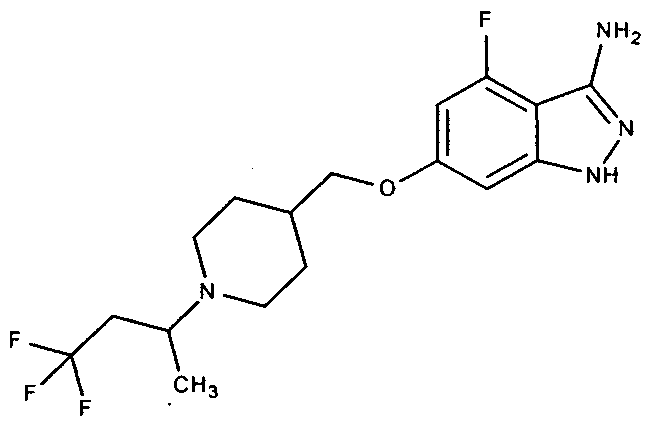
[00292] Racemic 4-fluoro-6-( { 1 -[4,4,4-trifluorobutan-2-yl]piperidin-4-yl } methoxy)- 1 H- indazol-3-amineamine was purified by chiral column chromatography to provide the title compound as a single enantiomer (absolute stereochemistry not specified): 9.1 mg as a brown solid. Achiral LCMS data: MET-uHPLC-AB-101 (7min) M Z (ES+) 208.6, Retention time 1.37 min.
1H NMR (500 MHz, DMSO-d6) δ 1 1.46 (s, 1H), 6.45 (d, J = 1.7 Hz, 1H), 6.28 (dd, J = 12.0, 1.6 Hz, 1H), 5.08 (s, 2H), 3.83 (d, J = 6.2 Hz, 2H), 2.96 (q, J = 6.9 Hz, 1H), 2.78 - 2.71 (m,
2H), 2.30 - 2.11 (m, 3H), 1.77 - 1.66 (m, 3H), 1.29 - 1.19 (m, 3H), 1.03 (d, J = 6.6 Hz, 3H).
Example 98. Enantiomer 2: 4-fluoro-6-({l-[4,4,4-trifluorobutan-2-yI]piperidin-4- yl) methox )-lH-indazol-3-amineamine (121)

[00293] Racemic 4-fluoro-6-({l-[4,4,4-trifluorobutan-2-yl]piperidin-4-yl}methoxy>lH- indazol-3-amineamine, was purified by chiral column chromatography to provide the title compound as a single enantiomer (absolute stereochemistry not specified) 6.8 mg as a brown solid. Achiral LCMS data: METCR1416 Hi res (7min) M/Z (ES+) 375, Retention time 2.47 min. 1H NMR (500 MHz, DMSO-d6) δ 11.46 (s, 1H), 6.45 (d, J = 1.7 Hz, 1H), 6.28 (dd, J = 12.0, 1.6 Hz, 1H), 5.08 (s, 2H), 3.83 (d, J = 6.2 Hz, 2H), 3.04 - 2.88 (m, 1H), 2.79 - 2.69 (m, 2H), 2.30 - 2.11 (m, 3H), 1.79 -1.66 (m, 3H), 1.32 - 1.17 (m, 3H), 1.03 (d, J = 6.6 Hz, 3H).
Example 99. Enantiomer 1: 6-({l-[l,l-difluoropropan-2-yI]piperidin-4-yI}methoxy)-4- fluoro-lH-indazoI-3-amine (126)

[00294] Racemic 6-( { 1 - [ 1 , 1 -difluoropropan-2-yl]piperidin-4-yl} methoxy)-4-fluoro- 1 H- indazol-3 -amine was purified by chiral column chromatography to provide the title compound as a single enantiomer (absolute stereochemistry not specified): 3 mg as a brown solid. Achiral LCMS data: METCR1416 Hi res (7min) M/Z (ES+) 342.9, Retention time 2.37 min.
1H NMR (500 MHz, DMSO-d6) δ 11.47 (s, 1H), 6.45 (d, J = 1.7 Hz, 1H), 6.29 (dd, J = 12.0, 1.6 Hz, 1H), 6.03 (td, J = 56.0, 3.8 Hz, 1H), 5.08 (s, 2H), 3.83 (d, J = 5.9 Hz, 2H), 2.99 - 2.89 (m, 1H), 2.88 - 2.80 (m, 2H), 2.40 - 2.31 (m, 3H), 1.79 - 1.66 (m, 3H), 1.37 - 1.15 (m, 3H), 1.02 (d, J = 6.9 Hz, 3H).
Example 100. Enantiomer 2: 6-({l-[l,l-difluoropropan-2-yl]piperidin-4-yl}methoxy)-4- fluoro-lH-indazol-3-amine (127)

[00295] Racemic 6-({l-[l,l-difluoropropan-2-yl]piperidin-4-yl}methoxy)-4-fluoro-lH- indazol-3 -amine was purified by chiral column chromatography to provide the title compound as a single enantiomer (absolute stereochemistry not specified) 2.8 mg as a brown solid. Achiral LCMS data: METCR1416 Hi res (7min) M/Z (ES+) 343.1, Retention time 2.38 min.
1H NMR (500 MHz, DMSO-d6) δ 11.47 (s, IH), 6.45 (d, J = 1.7 Hz, 1H), 6.29 (dd, J = 12.0, 1.7
Hz, 1H), 6.03 (td, J = 56.0, 3.8 Hz, 1H), 5.08 (s, 2H), 3.83 (d, J = 6.0 Hz, 2H), 2.99 - 2.89
(m, 1H), 2.88 - 2.81 (m, 2H), 2.41 - 2.34 (m, 2H), 1.80 - 1.67 (m, 3H), 1.34 - 1.22 (m, 2H),
1.02 (d, J = 6.9 Hz, 3H)
Example 101 e-ill-iSjS-difluorocyclobut ^piperidin^-ylJmetho i^-fluoro-ljH-ind zol-S- amine (130)
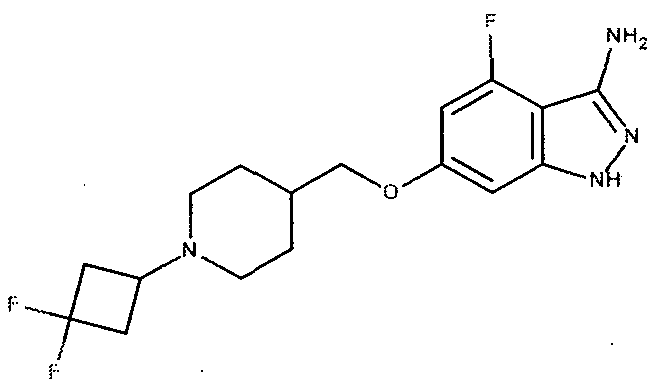
[00296] The title compound was prepared in a manner analagous to that described for example 34: 20 mg (38.7%) as an off white crystalline solid. METCR1416 Hi res (7min) M/Z (ES+) 355.1, Retention time 1.15 min.
1H NMR (500 MHz, DMSO-d6) δ 11.46 (s, IH), 6.45 (d, J = 1.6 Hz, 1H), 6.28 (dd, J = 12.0, 1.5 Hz, IH), 5.07 (s, 2H), 3.83 (d, J = 5.8 Hz, 2H), 2.82 (d, J = 11.3 Hz, 2H), 2.74 - 2.55 (m, 3H), 2.43 - 2.27 (m, 2H), 1.86 - 1.64 (m, 5H), 1.37 - 1.24 (m, 2H).
Example 102. (rac)-4-fluoro-6-[(l-methylpyrrolidin-3-yl)methoxy]-lH-indazole (131)

[00297] The title compound was prepared in a manner analagous to that described for example 34: 387 mg (73.9%) as an off white solid. MET-uHPLC-AB-101 (7min) M/Z (ES+) 265, Retention time 0.79 min.
IH NMR (500 MHz, DMSO-d6) δ 11.47 (s, IH), 6.46 (d, J = 1.7 Hz, IH), 6.27 (dd, J = 12.0, 1.7 Hz, IH), 5.07 (s, 2H), 3.89 - 3.80 (m, 2H), 2.56 - 2.52 (m, 2H), 2.48 - 2.45 (m, IH), 2.40 - 2.31 (m, 2H), 2.23 (s, 3H), 1.98 - 1.88 (m, IH), 1.55 - 1.44 (m, IH).
Example 103. (rac)-4-fluoro-6-{[l-(3-methylbutyl)pyrrolidin-3-yl]methoxy}-lH-indazole
(132)

[00298] The title compound was prepared in a manner analagous to that described for example 34: 424 mg (62.5%) as an off white solid. MET-uHPLC-AB-101 (7min) M/Z (ES+) 321, Retention time 1.46 min.
1H NMR (500 MHz, DMSO-d6) δ 11.46 (s, 1H), 6.46 (d, J = 1.6 Hz, 1H), 6.28 (dd, J = 12.0, 1.6 Hz, 1H), 5.07 (s, 2H), 3.91 - 3.77 (m, 2H), 2.66 - 2.52 (m, 2H), 2.46 - 2.27 (m, 5H), 1.96 - 1.84 (m, 1H), 1.65 - 1.52 (m, 1H), 1.52 - 1.43 (m, 1H), 1.35 - 1.27 (m, 2H), 0.86 (dd, J = 6.6, 1.0 Hz, 6H).
Example 104. Enantiomer 1 : 4-fluoro-6-{[l-(3-methylbutyl)pyrrolidin-3-yl]methoxy}-lH- indazol-3-amine (169)

[00299] Racemic 4-fluoro-6- { [ 1 -(3 -methy lbutyl)pyrrolidin-3-yl]methoxy } - 1 H-indazol-3- amine was purified by chiral column chromatography to provide the title compound as a single enantiomer (absolute stereochemistry not specified): 62 mg (9.5%) as an off white solid. Achiral LCMS data: METCR1600 High pH (7 min) M/Z (ES+) 321 , Retention time 4.96 min.
1H NMR (500 MHz, DMSO-d6) δ 1 1.47 (s, lH), 6.47 (d, J = 1.7 Hz, 1H), 6.28 (dd, J = 12.0, 1.6 Hz, 1H), 5.08 (s, 2H), 3.90 - 3.81 (m, 2H), 2.62 - 2.52 (m, 2H), 2.49 - 2.30 (m, 5H), 1.97 - 1.85
(m, 1H), 1.63 - 1.54 (m, 1H), 1.52 - 1.43 (m, 1H), 1.36 - 1.28 (m, 2H), 0.87 (dd, J = 6.6, 1.2 Hz, 6H).
Example 105. Enantiomer 2: 4-fluoro-6-{[-l-(3-methylbutyl)pyrroIidin-3-yl]methoxy}-lH- indazol-3-amine (137)

[00300] Racemic 4-fluoro-6-{ [ 1 -(3-methylbutyl)pyrrolidin-3-yl]methoxy } - 1 H-indazol-3- amine, was purified by chiral column chromatography to provide the title compound as a single enantiomer (absolute stereochemistry not specified): 48 mg (7.4%) as an off white solid. Achiral LCMS data: METCR1600 High pH (7 min) M/Z (ES+) 321, Retention time 5.00 min.
1H NMR (500 MHz, DMSO-d6) δ 1 1.47 (s, 1H), 6.46 (d, J = 1.7 Hz, 1H), 6.27 (dd, J = 12.0, 1.6 Hz, 1H), 5.07 (s, 2H), 3.85 (dd, J = 7.2, 3.0 Hz, 2H), 2.64 - 2.51 (m, 2H), 2.47 - 2.30 (m, 5H), 1.96 - 1.83 (m, 1H), 1.64 - 1.54 (m, 1H), 1.52 - 1.41 (m, 1H), 1.35 - 1.26 (m, 2H), 0.86 (dd, J = 6.6, 1.2 Hz, 6H).
Example 106. (rac -4-fluoro-6-{[l-(2-methylpropyl)pyrrolidin-3-yl]methoxy}-lH-indazol-3- amine (133)

[00301] The title compound was prepared in a manner analagous to that described for example 34: 309 mg (66.4%) as a light brown solid. MET-uHPLC-AB-101 (7min) M/Z (ES+) 307, Retention time 1.20 min.
1H NMR (500 MHz, DMSO-d6) δ 1 1.47 (s, 1H), 6.47 (d, J = 1.7 Hz, 1H), 6.28 (dd, J = 12.0, 1.7
Hz, 1H), 5.08 (s, 2H), 3.87 (d, J = 7.5 Hz, 2H), 2.60 - 2.55 (m, lH), 2.46 - 2.39 (m, 1H), 2.34 (dd, J = 8.5, 4.6 Hz, 1H), 2.17 - 2.13 (m, 2H), 1.97 - 1.87 (m, 1H), 1.73 - 1.64 (m, 1H), 1.55 - 1.46 (m, 1H), 1.44 - 1.23 (m, 1H), 1.23 - 1.09 (m, 1H), 0.87 (d, J = 2.3 Hz, 3H), 0.86 (d, J = 2.4 Hz, 3H).
Example 107. Enantiomer 1: 4-fluoro-6-{[l-(2-methylpropyl)pyrrolidin-3-yl]methoxy}-lH- indazoI-3-amine (138)

[00302] Racemic 4-fluoro-6-{ [l-(2-methylpropyl)pyrrolidin-3-yl]methoxy}-lH-indazol-3- amine was purified by chiral column chromatography to provide the title compound as a single enantiomer (absolute stereochemistry not specified): 88 mg (18.9%) as a light brown solid. Achiral LCMS data: METCR1600 High pH (7 min) M/Z (ES+) 307, Retention time 4.63 min. 1H NMR (500 MHz, DMSO-d6) δ 11.46 (s, 1H), 6.46 (d, J = 1.7 Hz, 1H), 6.28 (dd, J = 12.0, 1.6 Hz, 1H), 5.07 (s, 2H), 3.86 (d, J = 7.5 Hz, 2H), 2.61 - 2.52 (m, 2H), 2.49 - 2.30 (m, 3H), 2.18 - 2.10 (m, 2H), 1.95 - 1.84 (m, 1H), 1.73 - 1.62 (m, 1H), 1.54 - 1.42 (m, 1H), 0.86 (dd, J = 6.6, 2.4 Hz, 6H).
Example 108. Enantiomer 2: 4-fluoro-6-{[l-(2-methylpropyl)pyrrolidin-3-yl]methoxy}-lH- indazol-3-amine (139)

[00303] Racemic 4-fluoro-6-{ [l-(2-methylpropyl)pyrrolidin-3-yl]methoxy}-lH-indazol-3- amine, was purified by chiral column chromatography to provide the title compound as a single
enantiomer (absolute stereochemistry not specified) 85 mg (18.3%) as a light brown solid. Achiral LCMS data: METCR1600 High pH (7 min) M/Z (ES+) 307, Retention time 4.59 min. lH NMR (500 MHz, DMSO-d6) 5 11.46 (s, 1H), 6.46 (d, J = 1.7 Hz, lH), 6.28 (dd, J = 12.0, 1.7 Hz, 1H), 5.07 (s, 2H), 3.86 (d, J = 7.5 Hz, 2H), 2.60 - 2.52 (m, 2H), 2.49 - 2.29 (m, 3H), 2.18 - 2.08 (m, 2H), 1.97 - 1.86 (m, 1H), 1.74 - 1.61 (m, 1H), 1.53 - 1.43 (m, 1H), 0.86 (dd, J = 6.6, 2.4 Hz, 6H).
Example 109. Enantiomer 1: 4-fluoro-6-{[l-methylpyrrolidin-3-yl]methoxy}-lH-indazol-3- amine (135)

[00304] Racemic 4-fluoro-6-{[l-methylpyrrolidin-3-yl]methoxy}-lH-indazol-3-amine, was purified by chiral column chromatography to provide the title compound as a single enantiomer (absolute stereochemistry not specified) 40 mg (7.6%) as an off white solid. Achiral LCMS data: METCR1600 High pH (7 min) M/Z (ES+) 265, Retention time 3.64 min.
1H NMR (500 MHz, DMSO-d6) δ 11.47 (s, 1H), 6.46 (d, J = 1.7 Hz, 1H), 6.27 (dd, J = 12.0, 1.7 Hz, 1H), 5.07 (s, 2H), 3.90 - 3.78 (m, 2H), 2.55 - 2.51 (m, 2H), 2.48 - 2.45 (m, 1H), 2.40 - 2.31 (m, 2H), 2.23 (s, 3H), 1.98 - 1.84 (m, 1H), 1.55 - 1.42 (m, 1H).
Example 110. Enantiomer 2: 4-fluoro-6-{[l-methylpyrrolidin-3-yl]methoxy}-lH-indazol-3- amine (136)

[00305] Racemic 4-fluoro-6-{[l-methylpyrr0lidin-3-yl]methoxy}-lH-indazol-3-amine was purified by chiral column chromatography to provide the title compound as a single enantiomer
(absolute stereochemistry not specified): 42 mg (8%) as an off white solid. Achiral LCMS data: METCR1600 High pH (7 min) M/Z (ES+) 265, Retention time 3.63 min.
1H NMR (500 MHz, DMSO-d6) 5 11.47 (s, 1H), 6.46 (d, J = 1.7 Hz, 1H), 6.27 (dd, J = 12.0, 1.7 Hz, 1H), 5.07 (s, 2H), 3.90 - 3.80 (m, 2H), 2.57 - 2.52 (m, 2H), 2.48 - 2.45 (m, 1H), 2.41 - 2.30 (m, 2H), 2.23 (s, 3H), 1.99 - 1.85 (m, 1H), 1.55 - 1.43 (m, lH).
Example 111. 6-(azetidin-3-ylmethoxy)-4-fluoro-lH-indazol-3-amine (134)

[00306] The title compound was prepared in a manner analagous to that described for example 34, using TFA for de-protection: 3 mg (21.4%) as a pale pink solid. METCR1600 High pH (7 min) M/Z (ES+) 237, Retention time 3.60 min.
lH NMR (500 MHz, DMSO-d6) 5 11.54 (s, 1H), 7.73 (br s, 1H), 6.51 (d, J = 1.7 Hz, 1H), 6.35 (dd, J = 11.9, 1.7 Hz, 1H), 5.11 (s, 2H), 4.13 (d, J = 6.0 Hz, 2H), 3.95 (t, J = 9.4 Hz, 2H), 3.72 (dd, J = 10.0, 6.5 Hz, 2H), 3.18 - 3.07 (m, 1H).
Example 112. 6-[(l-cyclopentylazetidin-3-yl)methoxy]-4-fluoro-lH-indazol-3-amine (141)

[00307] The title compound was prepared in a manner analagous to that described for example 34, using TFA for de-protection: 9 mg (12.9%) as an off white solid. METCR1600 High pH (7 min) M/Z (ES+) 305, Retention time 4.43 min.
1H NMR (500 MHz, DMSO-d6) δ 11.48 (s, 1H), 6.47 (d, J = 1.7 Hz, 1H), 6.28 (dd, J = 12.0, 1.6 Hz, 1H), 5.08 (s, 2H), 4.07 (d, J = 6.9 Hz, 2H), 3.24 - 3.20 (m, 2H), 2.87 (m, 2H), 2.75 - 2.61 (m, 2H), 1.64 - 1.52 (m, 2H), 1.50 - 1.42 (m, 4H), 1.33 - 1.22 (m, 2H).
Example 113. 6-[(l-cycIobutylazetidin-3-yl)methoxy]-4-fluoro-lH-indazol-3-amine (142)

[00308] The title compound was prepared in a manner analagous to that described for example 34, using TFA for de-protection: 10 mg (15.1%) as an off white solid. METCR1600 High pH (7 min) M/Z (ES+) 291, Retention time 3.98 min.
1H NMR (500 MHz, DMSO-d6) δ 1 1.48 (s, 1H), 6.48 (d, J = 1.7 Hz, 1H), 6.28 (dd, J = 11.9, 1.7 Hz, 1H), 5.08 (s, 2H), 4.08 (d, J = 6.8 Hz, 2H), 3.24 - 3.20 (m, 2H), 3.07 - 3.03 (m, lH), 2.95 - 2.91 (m, 2H), 2.77 - 2.68 (m, 1H), 1.92 - 1.81 (m, 2H), 1.78 - 1.53 (m, 4H).
Example 114. 4-fluoro-6-{[l-(propan-2-yl)azetidin-3-yl]methoxy}-lH-indazol-3-amine (143)

[00309] The title compound was prepared in a manner analagous to that described for example 34, using TFA for de-protection: 16 mg (25.2%) an off white solid. METCR1600 High pH (7 min) M/Z (ES+) 279, Retention time 3.88 min.
1H NMR (500 MHz, DMSO-d6) δ 1 1.48 (s, 1H), 6.47 (d, J = 1.7 Hz, 1H), 6.28 (dd, J = 12.0, 1.7 Hz, 1H), 5.08 (s, 2H), 4.08 (d, J = 7.0 Hz, 2H), 3.22 (t, J = 7.4 Hz, 2H), 2.94 - 2.83 (m, 2H), 2.74 - 2.60 (m, 1H), 2.25 (hept, J = 6.2 Hz, 1H), 0.83 (d, J = 6.2 Hz, 6H).
Example 115. (rac)-4-fluoro-6-{[l-(l-fluoropropan-2-yl)piperidin-4-yl]methoxy}-lH- indazol-3-amine; formic acid (109)

[00310] The title compound was prepared in a manner analagous to that described for example 34, using TFA for de-protection: 4 mg as a white solid. MET-uHPLC-AB-101 (7min) M/Z (ES+) 325.2, Retention time 1.07 min.
IH NMR (500 MHz, DMSO-d6) δ 1 1.47 (s, IH), 8.15 (s, IH), 6.69 (d, J = 1.7 Hz, OH), 6.45 (d, J = 1.7 Hz, IH), 6.29 (dd, J = 12.0, 1.7 Hz, IH), 5.08 (s, 2H), 4.72 - 4.11 (m, 2H), 3.83 (d, J = 6.0 Hz, 2H), 2.94 - 2.88 (m, IH), 2.87 - 2.83 (m, 2H), 2.35 - 2.26 (m, 2H), 1.78 - 1.68 (m, 3H), 1.34 - 1.20 (m, 2H), 0.99 (dd, J = 6.9, 1.3 Hz, 3H).
Example 116. 4-fluoro-6-[(4-methylpiperidin-4-yl)methoxy]-lH-indazoI-3-amine (93)

[00311] The title compound was prepared in a manner analagous to that described for example 34, using TFA for de-protection: 8 mg (21.3%) as a brown solid. MET-uHPLC-AB-101 (7min) M/Z (ES+) 279, Retention time 1.07 min.
IH NMR (500 MHz, DMSO-d6) δ 11.49 (s, IH), 6.50 (d, J = 1.5 Hz, IH), 6.29 (dd, J = 12.0, 1.4 Hz, IH), 5.08 (s, 2H), 3.73 (s, 2H), 2.89 - 2.75 (m, 4H), 1.64 - 1.56 (m, 2H), 1.42 - 1.34 (m, 2H), 1.05 (s, 3H).
Example 117. 6-{[l-(pyridin-2-ylmethyl)piperidin-4-yI]methoxy}-lH-indazol-3-amine (54)

[00312] The title compound was prepared in a manner analagous to that described for example 34, using TFA for de-protection: 60 mg (35.6%) as an off white solid. METCR1600 High pH (7 min) M/Z (ES+) 338.2, Retention time 3.37 min.
1H NMR (250 MHz, Methanol-d4) δ 8.49 (dd, J = 5.0 Hz, 1H), 7.88 - 7.77 (m, 1H), 7.60 - 7.46 (m, 2H), 7.38 -7.27 (m, 1H), 6.69 (d, J = 1.7 Hz, 1H), 6.62 (dd, J = 8.8, 2.1 Hz, 1H), 3.86 (d, J = 5.7 Hz, 2H), 3.69 (s,2H), 3.05 - 2.90 (m, 2H), 2.27 - 2.10 (m, 2H), 1.93 - 1.76 (m, 3H), 1.60 - 1.37 (m, 2H).
Example 118. 6-{[l-(pyridazin-3-ylmethyl)piperidin-4-yI]methoxy}-lH-indazol-3-amine
(60)

[00313] The title compound was prepared in a manner analagous to that described for example 34, using TFA for de-protection: O.Olg (10.7%) as a brown powder. METCR1600 High pH (7 min) M/Z (ES+) 339, Retention time 2.87 min.
1H NMR (500 MHz, DMSO-d6) 5 1 1.10 (s, 1H), 9.13 (d, J = 4.2 Hz, 1H), 7.73 - 7.65 (m, 2H), 7.51 (d, J = 8.7 Hz, 1H), 6.61 (s, 1H), 6.51 (d, J - 8.5 Hz, lH), 5.19 (s, 2H), 3.83 (d, J = 5.5 Hz, 2H), 3.79 (s, 2H), 2.87 - 2.80 (m, 2H), 2.15 - 2.06 (m, 2H), 1.82 - 1.71 (m, 3H), 1.39 - 1.29 (m, 2H).
Example 119. 6-{[l-(2,2-difluoroethyl)piperidin-4-yl]methoxy}-4-fluoro-lH-indazol-3-
amine (70)

[00314] The title compound was prepared in a manner analagous to that described for example 34, using TFA for de-protection: 27 mg (66.8%) as an orange powder. MET-uHPLC- AB-101 (7min) M/Z (ES+) 329.1, Retention time 1.04 min.
1H NMR (500 MHz, DMSO-d6) δ 1 1.46 (s, 1H), 6.45 (d, J = 1.7 Hz, 1H), 6.28 (dd, J = 12.0, 1.6 Hz, lH), 6.10 (tt,lH), 5.07 (s, 2H), 3.82 (d, J = 5.9 Hz, 2H), 2.95 - 2.87 (m, 2H), 2.70 (td, J = 15.7, 4.3 Hz, 2H), 2.22- 2.10 (m, 2H), 1.76 - 1.67 (m, 3H), 1.38 - 1.25 (m, 2H).
Example 120. 4-fluoro-6-{[l-(2-methoxyethyl)piperidin-4-yl]methoxy}-lH-indazol-3-amine
(74)

[00315] The title compound was prepared in a manner analagous to that described for example 34, using TFA for de-protection: 1 1.1 mg (7.6%) as a brown solid. METCR1600 High pH (7 min) M/Z (ES+) 323.2, Retention time 3.43 min.
1H NMR (500 MHz, DMSO-d6) δ 1 1.45 (s, 1H), 6.44 (d, J = 1.7 Hz, 1H), 6.28 (dd, J = 12.0, 1.3 Hz, 1H), 5.07 (s, 2H), 3.82 (d, J = 5.9 Hz, 2H), 3.42 (t, J = 5.9 Hz, 2H), 3.23 (s, 3H), 2.92 - 2.85 (m, 2H), 2.45 (t, J = 5.8 Hz, 2H), 1.99 - 1.90 (m, 2H), 1.76 - 1.65 (m, 3H), 1.34 - 1.22 (m, 2H).
Example 121. 4-fluoro-6-{[l-(oxan-4-yl)piperidin-4-yl]methoxy}-lH-indazol-3-amine (84)

[00316] The title compound was prepared in a manner analagous to that described for example 34, using TFA for de-protection: 0.01 g (56.2%) as a brown solid. MET-uHPLC-AB- 101 (7min) M/Z (ES+) 349.2, Retention time 1.24 min.
1H NMR (500 MHz, DMSO-d6) 6 1 1.45 (s, 1H), 6.44 (d, J = 1.7 Hz, 1H), 6.27 (dd, J = 12.0, 1.6 Hz, 1H), 5.07 (s, 2H), 3.90 - 3.84 (m, 2H), 3.82 (d, J = 6.1 Hz, 2H), 3.29 - 3.22 (m, 2H), 2.93 - 2.86 (m, 2H), 2.44 - 2.37(m, 1H), 2.14 - 2.07 (m, 2H), 1.78 - 1.62 (m, 5H), 1.47 - 1.37 (m, 2H), 1.31 - 1.20 (m, 2H).
Example 122. 6-[(l-cyclohexylpiperidin-4-yl)methoxy]-4-fluoro-lH-indazol-3-amine (85)

[00317] The title compound was prepared in a manner analagous to that described for example 34, using TFA for de-protection: 14.6 mg (36.8%) as a brown solid. MET-uHPLC-AB- 101 (7min) M/Z (ES+) 347.2, Retention time 1.52 min.
1H NMR (500 MHz, Methanol-d4) δ 6.52 (d, J = 1.7 Hz, 1H), 6.29 (dd, J = 11.9, 1.6 Hz, 1H), 3.90 (d, J = 5.6 Hz, 2H), 3.31 - 3.22 (m, 2H), 2.82 - 2.67 (m, 2H), 2.07 - 1.97 (m, 5H), 1.92- 1.85 (m, 2H), 1.74 - 1.67 (m, 1H), 1.65 - 1.53 (m, 2H), 1.48 - 1.13 (m, 6H)
Example 123. 6-[(l-cyclopentylpiperidin-4-yl)methoxy]-4-fluoro-lH-indazoI-3-amine (87)

[00318] The title compound was prepared in a manner analagous to that described for example 34, using TFA for de-protection: 23 mg (24.1%) as a light pink crystalline solid. MET- uHPLC-AB-101 (7min) M/Z (ES+) 333.2, Retention time 1.32 min.
1H NMR (500 MHz, DMSO-d6) δ 11.45 (s, 1H), 6.44 (d, J = 1.6 Hz, 1H), 6.27 (dd, J = 12.0, 1.5 Hz, 1H), 5.07 (s, 2H), 3.81 (d, J = 5.8 Hz, 2H), 3.00 - 2.84 (m, 2H), 2.47 - 2.40 (m, 1H), 1.95 - 1.85 (m, 2H), 1.81 - 1.68 (m, 5H), 1.63 - 1.54 (m, 2H), 1.52 - 1.43 (m, 2H), 1.37 - 1.22 (m, 4H).
Example 124. 6-[(l-cycIobutylpiperidin-4-yl)methoxy]-4-fluoro-lH-indazoI-3-amine (88)

[00319] The title compound was prepared in a manner analagous to that described for example 34, using TFA for de-protection: 22.2 mg (27.1%) as a light pink crystalline solid. MET-uHPLC-AB-101 (7min) M/Z (ES+) 319.2, Retention time 1.17 min.
1H NMR (500 MHz, DMSO-d6) δ 11.46 (s, 1H), 6.45 (d, J = 1.6 Hz, 1H), 6.28 (dd, J = 12.0, 1.4 Hz, 1H), 5.08 (s, 2H), 3.82 (d, J = 5.9 Hz, 2H), 2.84 - 2.76 (m, 2H), 2.70 - 2.60 (m, 1H), 2.00 - 1.92 (m, 2H), 1.84 - 1.65 (m, 7H), 1.64 - 1.56 (m, 2H), 1.32 - 1.19 (m, 2H>.
Example 125. (rac)-4-fluoro-6-{[l-(oxolan-3-yl)piperidin-4-yl]methoxy}-lH-indazol-3- amine (91)

[00320] The title compound was prepared in a manner analagous to that described for example 34, using TFA for de-protection: 33.1 mg (37.8%) as a yellow powder. METCR1600 High pH (7 min) M/Z (ES+) 335.2, Retention time 3.27 min.
1H NMR (500 MHz, DMSO-d6) δ 11.45 (s, 1H), 6.45 (d, J = 1.6 Hz, IH), 6.28 (dd, J = 11.9, 1.4 Hz, 1H), 5.07 (s, 2H), 3.82 (d, J = 5.9 Hz, 2H), 3.80 - 3.74 (m, 2H), 3.68 - 3.58 (m, 1H), 3.48 - 3.41 (m, 1H), 2.95 - 2.88 (m, 1H), 2.88 - 2.81 (m, 1H), 2.75 - 2.67 (m, 1H), 2.03 - 1.91 (m, 3H), 1.79 - 1.65 (m, 4H), 1.36 - 1.22 (m, 2H).
Exam le 126. N-(2-methylpropyl)-6-(piperidin-4-ylmethoxy)-lH-indazol-3-amine (58)

[00321] A mixture 4-{[(3-amino-lH-indazol-6-yl)oxy]methyl}piperidine-l-carboxylate (50 mg, 0.14 mmol), Isobutyraldehyde (15.81 μΐ, 0.17 mmol) and acetic acid (8.25 μΐ, 0.14 mmol) in anhydrous DCE (0.7 mL) under nitrogen was stirred at rt for 30 min. STAB (0.06 g, 0.29 mmol) was then added and the mixture stirred at rt overnight. The solvent was then evaporated in vacuo and the residue obtained taken in DCM (2 mL) and washed with saturated aqueous NaHCC>3 ( 2 mL), water (2 mL), brine (2 mL). The combined aqueous washes were extracted with DCM (2 x
2mL). The combined organic extracts were dried over MgSC , filtered and concentrated in vacuo to give 0.05 g of crude material as a white foam.

N-(2-methylpropyl)-6-(piperidin-4-ylmethoxy)-lH-indazol-3-amine
[00322] The crude material was purified in the preparative HPLC under neutral conditions to give 0.02 g (29.3%) 4-[({3-[(2-methylpropyl)amino]-lH-indazol-6-yl}oxy)methyl]piperidine-l- carboxylate as a light pink oil: 0.01 g (97.2%) as a yellow powder. MET-uHPLC-AB-101 (7min) M/Z (ES+) 303.2, Retention time 1.20 min.
1H NMR (500 MHz, DMSO-d6) δ 8.86 - 8.74 (m, 1H), 8.58 - 8.42 (m, 1H), 7.96 - 7.82 (m, 1H), 6.82 - 6.68 (m, 2H), 3.93 (d, J = 6.2 Hz, 2H), 3.34 - 3.24 (m, 2H), 3.13 (d, J = 6.9 Hz, 2H), 2.98 - 2.83 (m, 2H), 2.15 -2.03 (m, 1H), 2.00 - 1.86 (m, 3H), 1.57 - 1.43 (m, 2H), 0.95 (d, J = 6.6 Hz, 6H).
Example 127. 6-(piperidin-4-ylmethoxy)-N-(propan-2-yl)-lH-iiidazol-3-amine (57)

[00323] The title compound was obtained using the procedure from Example 126: 0.05 g (86.4%) as a gold powder. METCR1600 High pH (7 min) M/Z (ES+) 289.2, Retention time 3.99 mm.
1H NMR (500 MHz, DMSO-d6) δ 12.58 (br s, 8.91 (br s, 1H), 8.63 (br s, 1H), 7.91 (d, J = 8.4 Hz, 1H), 6.98 - 6.53 (m, 2H), 3.94 (d, J = 6.1 Hz, 2H), 3.90 - 3.81 (m, 1H), 2.98 - 2.84 (m, 2H), 2.17 - 2.01 (m, 1H), 1.98 - 1.85 (m, 2H), 1.60 - 1.43 (m, 2H), 1.26 (d, J = 6.3 Hz, 6H).
Example 128. N-benzyI-6-(piperidin-4-yImethoxy)-lH-indazol-3-amine (59)

[00324] The title compound was obtained using an analogous procedure to that described for Example 131 but replacing the alkylation with iodomethane by a reductive amination with benzaldehyde:
[00325] Product was obtained 0.0 lg (93.3%) as a dark green powder. MET-uHPLC-AB-101 (7min) M/Z (ES+) 337.2, Retention time 1.47 min.
1H NMR (500 MHz, DMSO-d6) δ 12.43 (br s, 1H), 8.96 - 8.79 (m, 1H), 8.65 - 8.49 (m, 1H), 7.88 (d, J = 8.9 Hz, 1H), 7.42 (d, J = 7.3 Hz, 2H), 7.36 (t, J = 7.5 Hz, 2H), 7.28 (t, J = 7.3 Hz, 1H), 6.81 - 6.65 (m, 2H), 4.57 (s, 2H), 3.93 (d, J = 6.3 Hz, 2H), 3.35 - 3.19 (m, 2H), 2.99 - 2.83 (m, 2H), 2.19 - 2.01 (m, 1H), 1.98 - 1.84 (m, 2H), 1.61 - 1.40 (m, 2H).
Example 129. N-cyclohexyl-6-(piperidin-4-yImethoxy)-lH-indazol-3-amine (62)
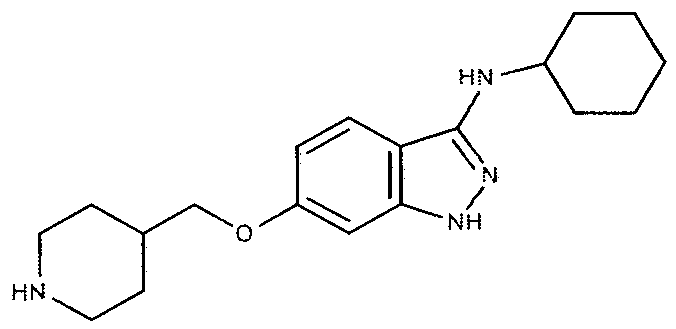
[00326] The title compound was obtained using the procedure from Example 126: 0.01 g (96.5%) as a yellow solid. MET-uHPLC-AB-101 (7min) M/Z (ES+) 329.2 Retention time 1.57 min.
1H NMR (500 MHz, DMSO-d6) δ 9.07 - 8.78 (m, 1H), 8.72 - 8.41 (m, 1H), 7.93 (d, J = 8.6 Hz, 1H), 6.94 - 6.55 (m, 2H), 3.94 (d, J = 6.0 Hz, 2H), 3.59 - 3.48 (m, 2H), 2.99 - 2.83 (m, 2H), 2.16 - 2.03 (m, 1H), 2.04- 1.96 (m, 2H), 1.97 - 1.86 (m, 2H), 1.82 - 1.70 (m, 2H), 1.68 - 1.58 (m, 1H), 1.59 - 1.43 (m, 2H), 1.42 - 1.25 (m, 4H), 1.25-1.10 (m, 1H).
Example 130. N-benzyI-4-fluoro-6-(piperidin-4-ylmethoxy)-lH-iiidazo]-3-amine (72)

[00327] The title compound was obtained using an analagous procedure to that described for Example 131 but replacing the alkylation with iodomethane by a reductive amination with benzaldehyde: Product was obtained 0.02 g (93.9%) as a yellow powder. MET-uHPLC-AB-101 (7min) M/Z (ES+) 355.2 Retention time 1.88 min.
1H NMR (500 MHz, DMSO-d6) δ 11.67 (s, 1H), 8.76 (s, 1H), 8.44 (s, 1H), 7.49 - 7.32 (m, 2H), 7.35 - 7.24 (m, 2H), 7.26 - 7.13 (m, 1H), 6.50 (s, 1H), 6.33 (d, J = 12.4 Hz, 1H), 4.42 (s, 2H), 3.89 (d, J = 6.0 Hz, 2H),3.36 - 3.23 (m, 2H), 3.00 - 2.80 (m, 2H), 2.15 - 1.98 (m, 1H), 1.96 - 1.80 (m, 2H), 1.57 - 1.35 (m, 2H).
Example 131. 4-fluoro-N-methyl-6-(piperidin-4-ylmethoxy)-lH-indazol-3-amine (80)

tert-Butyl 4-{[(3-amino-4-fluoro-lH-indazol-6-yl)oxy]methyl}piperidine-l-carboxylate :
[00328] To a stirred mixture of tert-butyl 4-(4-cyano-3,5-difluorophenoxymethyl) piperidine- 1-carboxylate, prepared as described in procedure B (1.1 1 g, 2.83 mmol) in butanol (20 mL) at room temperature in a sealable pressure tube under nitrogen was added hydrazine hydrate (0.78 ml, 15.74 mmol). The tube was then sealed and the mixture heated at 125 oC overnight.
[00329] The volatiles were removed in vacuo and the crude material was taken up in EtOAc (30 mL) and washed with water (30 mL) and brine (30 mL). The combined aqueous washes were extracted with EtOAc (2 x 30 mL). The combined organic extracts were dried over MgS04,
filtered and concentrated in vacuo to give 1.17 g (101.6%) of tert-butyl 4-{ [(3-amino-4-fluoro- lH-indazol-6-yl)oxy]methyl}piperidine-l-carboxylate as a light orange solid. The crude material was used without further purification in the.next step.
tert-butyl 4-({[4-fluoro-3-(methyIamino)-lH-indazol-6-yl]oxy}methyl)piperidine-l- carboxylate :
[00330] To a stirred mixture of tert-butyl 4-{[(3-amino-4-fluoro-lH-indazol-6- yl)oxy]methyl}piperidine-l-carboxylate (0.31 g, 0.85 mmol) and K2C03 (0.18 g, 1.28 mmol) in anhydrous DMF (2.1 mL) in a sealable pressure tube under nitrogen was added iodomethane
(58.25 μΐ, 0.94 mmol). The tube was then sealed and the mixture heated to 80 °C. On consumption of starting materials the solvent was removed in vacuo and the residue taken in DCM (5 mL) and washed with water (5 mL). The phases were separated and the organic phase washed with brine (5 mL). The combined aqueous washes were extracted with DCM (2 x 5 mL). The combined organic extracts were dried over MgS04, filtered and concentrated in vacuo to yield the crude product as a brown oil which was purified by preparative HPLC under basic conditions to give the product as an off-white solid, 0.04 g (9.5%).
4-fluoro-N-methyl-6-(piperidin-4-ylmethoxy)-lH-indazol-3-aniine:
[00331] To a stirred solution of tert-butyl 4-({[4-fluoro-3-(methylamino)-lH- indazol-6-yl]oxy}methyl)piperidine-l-carboxylate (0.03 g, 0.08 mmol) in anhydrous methanol (2 mL) at room temperature under nitrogen was added 4M HC1 in Dioxane (0.34 ml). The mixture was stirred at rt for two days. The volatiles were evaporated in vacuo and the residue obtained was dissolved in a small amount of MeOH and passed through a 2g Isolute SCX-2 cartridge. The cartridge was initially washed with a 50:50 mixture of DCM MeOH (ca. 12 mL) and then the product was released using 7N NH3 in MeOH to give 0.02 g (88.3%) of 4-fluoro-N-methyl-6- (piperidin-4-ylmethoxy)-lH-indazol-3 -amine as a purple solid. 0.03 g (88.3%). MET-uHPLC- AB-101 (7min) M/Z (ES+) 279.1 Retention time 1.03 min.
1H NMR (500 MHz, DMSO-d6) 6 11.49 (s, 1H), 6.46 (s, 1H), 6.27 (d, J = 12.0 Hz, 1H), 5.43 (q, J = 4.9 Hz, 1H), 3.82 (d, J = 6.3 Hz, 2H), 3.10 - 2.98 (m, 2H), 2.78 (d, J = 5.1 Hz, 3H), 2.62 - 2.54 (m, 2H), 1.94 -1.81 (m, 1H), 1.79 - 1.67 (m, 2H), 1.32 - 1.15 (m, 2H).
Example 132. 5-fluoro-6-(piperidin-4-ylmethoxy)-lH-indazoI-3-amine (90)
Route D - SnAr


tert-butyl 4-(4-cyano-2,5-difluorophenoxymethyl)piperidine-l-carboxylate
[00332] 2,4,5-trifluorobenzonitrile (218.9 mg, 1.39 mmol) and tert-butyl 4- (hydroxymethyl)piperidine-l-carboxylate (200 mg, 0.93 mmol) were dissolved in anhydrous THF (4 ml) and potassium 2-methylpropan-2-olate (125.09 mg, 1.11 mmol) was added. Reaction was cooled to -30— 40°C in a dry ice/MeCN bath and the internal reaction temperature monitored. Once cooled, KOtBu (250.18 mg, 2.23 mmol) was added portion wise, maintaining reaction temperature between -30~40°C. Reaction was stirred at -30 to -40°C for lh. On completion, the reaction was diluted with 20ml water and extracted with EtOAc (3 x 15ml). The combined orga ics were washed with brine and dried over Na2S04. The product was purified by column chromatography to yield 496 mg (75.8%) of the title compound. The structure confirmed by HSQC NMR. METCR1673 Generic 2 minutes M/Z (ES+) 365, Retention time 1.15 min. 1H NMR (250 MHz, DMSO-d6) δ 7.94 (dd, J = 10.8, 6.3 Hz, 1H), 7.48 (dd, J = 11.3, 7.0 Hz, 1H), 4.05 (d, J = 6.4 Hz, 2H), 4.03 - 3.89 (m, 2H), 2.86 - 2.64 (m, 2H), 2.11 - 1.87 (m, 1H),1.81 - 1.65 (m, 2H), 1.40 (s, 9H), 1.19 (ddd, J = 16.2, 9.9, 4.1 Hz, 2H).
tert-butyl 4-{[(3-amino-5-fluoro-lH-indazol-6-yl)oxy]methyl}piperidine-l-carboxylate
[00333] tert-butyl 4-(4-cyano-2,5-difluorophenoxymethyl)piperidine-l-carboxylate (250 mg, 0.71 mmol) was dissolved in 1-Butanol (3 ml) in a pressure tube and NH2NH2 · H20 (172.91 μΐ, 3.55 mmol) was added. Reaction was heated to 120°C overnight. On consumption of starting material the reaction was diluted with 3ml water and extracted 3 x 5ml with EtOAc. The combined organics were dried over Na2S04. The mixture was purified by column chromatography. The NMR showed there to be about 10% regioisomer, so the desired product
was recrystalised from EtOAc / Heptane to yield 73 mg (28.2%) as an off white solid.
METCR1600 High pH (7 min) M/Z (ES+) 265.1 , Retention time 2.90 min.
1H NMR (500 MHz, DMSO-d6) δ 1 1.24 (s, 1H), 7.44 (d, J = 11.2 Hz, 1H), 6.81 (d, J = 7.0 Hz, lH), 5.20 (s, 2H), 4.04 - 3.94 (m, 2H), 3.92 (d, J = 6.3 Hz, 2H), 2.88 - 2.68 (m, 2H), 2.07 -1.93
(m, 1H), 1.81 - 1.72 (m, 2H), 1.41 (s, 9H), 1.22 - 1.13 (m, 2H).
5-fluoro-6-(piperidin-4-ylmethoxy)-lH-indazol-3-amine
[00334] tert-butyl 4-{ [(3-amino-5-fluoro-lH-indazol-6-yl)oxy]methyl}piperidine-l- carboxylate (73 mg, 0.2 mmol) was dissolved in DCM (2 ml) and 4M HC1 in Dioxane (0.75 ml) was added. The reaction was stirred at rt over night. On completion, the reaction was evaporated to dryness under vacuum to leave a white solid which was dried in vac oven to yield 53 mg (78.5%) of the title compound. METCR1600 High pH 7 min M/Z (ES+) 265.1, retention time 2.9 min.
1H NMR (500 MHz, DMSO-d6) δ 12.55 (s, 1H), 8.73 (d, J = 159.9 Hz, 2H), 7.73 (d, J = 10.8 Hz, 1H), 7.01 (d, J = 7.0 Hz, 1 H), 4.02 (d, J = 6.2 Hz, 2H), 2.97 - 2.86 (m, 2H), 2.53 - 2.5 l(m, 2H), 2.19 - 2.07 (m, 1H), 1.98 - 1.84 (m, 2H), 1.59 - 1.47 (m, 2H).
Example 133. 4,5,7-trifluoro-6-(piperidin-4-ylmethoxy)-lH-indazol-3-amine

[00335] The title compound was obtained using a procedure analogous to that described for Example 132: 4.3 mg (39.1%) as an off white solid. MET-uHPLC-AB-101 (7min) M/Z (ES+) 301.2, Retention time 1.12 min.
1H NMR (500 MHz, DMSO-d6) δ 12.30 (brs, 1H), 8.65 (brs, 1H), 8.32 (brs, 1H), 4.08 (d, J = 6.1 Hz, 2H), 2.98 - 2.85 (m, 2H), 2.12 - 2.02 (m, 1H), 1.98 - 1.90 (m, 2H), 1.57 - 1.45 (m, 2H).
Example 134. 6-(piperidin-4-ylmethoxy)-4-(pyrroIidin-l-yl)-lH-indazol-3-amine (76) Route E
 tert-butyl 4-[4-cyano-3-fluoro-5-(pyrrolidin-l-yl)phenoxymethyl]piperidine-l-carboxylate
[00336] tert-butyl 4-(4-cyano-3,5-difluorophenoxymethyl)piperidine- 1 -carboxylate
(synthesised via route B) (82%, 500 mg, 1.16 mmol) and pyrrolidine (95.56 μΐ, 1.16 mmol) in DMF (9ML) were stirred together at room temperature overnight. On consumption of starting materials the reaction was diluted with ethyl acetate (10ml) and washed with water (10x3ml), the combined organics were dried over magnesium sulfate, filtered and the solvent was reduced in vacuo. The remaining residue was purified by column chromatography, eluting with 12-100% EtOAc in heptane to yield 200mg, 36% of the title compound as a colourless oil. METCR1673 Generic 2 minutes M/Z (ES+) 348, retention time 1.65 min.
tert-butyl 4-({[3-amino-4-(pyrrolidin-l-yl)-lH-indazol-6-yl]oxy}methyI)piperidine-l- carboxylate
[00337] To a stirred suspension of tert-butyl 4-[4-cyano-3-fiuoro-5-(pyrrolidin-l- yl)phenoxymethyl]piperidine-l-carboxylate (84%, 0.2 g, 0.42 mmol) in 1-butanol (6 mL) at room temperature in a sealable pressure tube under nitrogen was added hydrazine hydrate (0.1 ml, 2.08 mmol). The tube was then sealed and the mixture heated to 110 ° C overnight. LCMS indicated remaining starting material, therefore another lOeq of Hydrazine hydrate were added. Upon completion and cooling the solvent was evaporated and the resulting residue was dissolved in ethyl acetate (6ml) and washed with water (2 x8ml). The organic layer was dried over mag sulphate, filtered and reduced in vacuo. The product was purified by column chromatography,
12-100% EtOAc in heptane, to yield lOOmg, 41% of the titled compound as an orange viscous oil, which was used without further purification. METCR1673 Generic 2 minutes M/Z (ES+) 416, Retention time 1.27 min.
6-(piperidin-4-ylmethoxy)-4-(pyrrolidin-l-yl)-lH-indazol-3-amine
[00338] tert-butyl 4-({[3-amino-4-(pyrrolidin-l-yl)-lH-indazol-6-yl]oxy}methyl)piperidine-l- carboxylate (71%, 0.09 g, 0.15 mmol) was dissolved in DCM (5ML) and 4M HCl in Dioxane (0.13 ml, 3.84 mmol) was added. The reaction was stirred at room temperature for 4 hours. On consumption of starting material the solvent was evaporated to a brown solid and the reaction residue was loaded onto an SCX column and washed with 3 column volumes of methanol before releasing the desired product with 7M NH3 in Methanol. The product was then purified using preparative HPLC (basic conditions). 3mg, 6% of the title compound was obtained as a brown solid. METCR1600 High pH (7 min) M/Z (ES+) 328.4, Retention time 4.13 min.
1H NMR (500 MHz, DMSO-d6) δ 11.19 (s, 1H), 6.18 (d, J = 1.8 Hz, 1H), 5.88 (d, J = 1.8 Hz, 1H), 4.66 (s, 2H), 3.74 (d, J = 6.3 Hz, 2H), 3.22 - 3.11 (m, 4H), 2.98 - 2.90 (m, 2H), 2.48 - 2.42 (m, 2H), 1.92 - 1.85 (m, 4H), 1.83 - 1.77 (m, 1H), 1.71 - 1.64 (m, 2H), 1.20 - 1.10 (m, 2H).
Example 135. 4-N,4-N-dimethyl-6-(piperidin-4-yImethoxy)-lH-indazole-3,4-diamine (77)

[00339] The title compound was obtained using the procedure from Example 134: 0.01 g (9.9%) as a brown solid. METCR1600 High pH (7 min) M/Z (ES+) 290, Retention time 3.53 mm.
1H NMR (500 MHz, DMSO-d6) δ 11.21 (s, 1H), 6.26 (d, J = 1.8 Hz, 1H), 5.97 (d, J = 1.8 Hz, 1H), 4.78 (s, 2H), 3.77 (d, J = 6.3 Hz, 2H), 3.10 - 3.04 (m, 2H), 2.73 (s, 6H), 2.65 - 2.58 (m, 2H), 1.94 - 1.82 (m, 1H), 1.80 - 1.72 (m, 2H), 1.32 - 1.21 (m, 2H).
Example 136. 4-methoxy-6-(piperidin-4-ylmethoxy)-lH-indazol-3-amine (79)

tert-butyl 4-(4-cyano-3-fluoro-5-methoxyphenoxymethyl)piperidine-l-carboxylate:
[00340] tert-butyl 4-(4-cyano-3,5-difluorophenoxymethyl)piperidine-l-carboxylate (82%, 500 mg, 1.16 mmol), prepared as described in example 40, was dissolved in methanol (9ml) and placed in an ice bath to cool to 0C, then sodium methanolate (125.72 mg, 2.33 mmol) was added carefully in small portions, after which the ice bath was removed and the reaction left stirring at rt for 4 hours.
[00341] Another equivalent of sodium methoxide was then added and reaction was left stirring at room temperature over the weekend.
[00342] The solvent was reduced in vacuo and the residue dissolved in ethyl acetate (15ml) and washed with water (10x2ml), the organic layer was separated, dried over magnesium sulphate, filtered and concentrated.
[00343] The residue was purified by column chromatography eluting with 12-50% ethyl acetate in heptane to give tert-butyl 4-(4-cyano-3-fluoro-5-methoxyphenoxymethyl)piperidine-l- carboxylate (300mg, 71%) as a colourless oil.:
tert-butyl 4-{[(3-amino-4-methoxy-lH-indazol-6-yl)oxy]methyl}piperidine-l-carboxyIate:
[00344] To a stirred suspension of tert-butyl 4-(4-cyano-3-fluoro-5-methoxyphenoxymethyl) piperidine-l-carboxylate (93%, 0.3 g, 0.77 mmol) in butanol (10 mL) at room temperature in a sealable pressure tube under nitrogen was added hydrazine hydrate (1 :1) (0.19 ml, 3.83 mmol). The tube was then sealed and the mixture heated to 130 o C for 4 hours. A further 2eq of hydrazine hydrate was added and the reaction was left overnight.
[00345] Solvent was evaporated and the resulting residue was dissolved in ethyl acetate (15ml) and washed with water (10x2ml), the organic layer was dried over magnesium sulphate, filtered and reduced in vacuo.
[00346] The residue was then purified using column chromatography, eluting with a gradient of 12-100% ethyl acetate in heptane, yielding tert-butyl 4-{[(3-amino-4-methoxy-lH-indazol-6- yl)oxy]methyl}piperidine-l-carboxylate (0.22g, 74%) as a white solid, which was carried
through to the next stage.
1H NMR (500 MHz, DMSO-d6) δ 1 1.14 (s, 1H), 6.19 (d, J = 1.6 Hz, 1H), 5.94 (d, J = 1.6 Hz, 1H), 4.84 (s, 2H), 3.99 (d, J = 11.7 Hz, 2H), 3.82 (s, 3H), 2.75 (s, 2H), 1.92 (dt, J = 7.7, 4.0 Hz, 1H), 1.76 (d, J = 11.4 Hz, 2H), 1.41 (s, 9H), 1.18 (s, 2H)
4-methoxy-6-(piperidin-4-ylmethoxy)-lH-indazol-3-amine:
[00347] tert-buty 1 4- { [(3 -amino-4-methoxy- 1 H-indazol-6-yl)oxy ]methy 1 } piperidine- 1 - carboxylate (0.22 g, 0.58 mmol) and 4M HCL in dioxane (0.5 ml, 14.61 mmol) were stirred together in DCM (5ML) for 2 hours. The solvent was then evaporated and the resulting residue was dissolved in methanol and purified using an SCX column, eluting the impurities using methanol, before using 7N NH3 in methanol to release the product. The fractions were reduced in vacuo and the sampled is dried, yielding 4-methoxy-6-(piperidin-4-ylmethoxy)-lH-indazol-3- amine as an off white solid. 68 mg (42.1%) as an off white solid. METCR1600 High pH (7 min) M/Z (ES+) 277, Retention time 3.17 min.
1H NMR (500 MHz, DMSO-d6) δ 11.14 (s, 1H), 6.19 (d, J = 1.5 Hz, 1H), 5.93 (d, J = 1.5 Hz, lH), 4.84 (s, 2H), 3.82 (s, 3H), 3.77 (d, 2H), 3.00 - 2.93 (m, 2H), 2.50 - 2.45 (m, 2H), 1.87 - 1.77 (m, 1H), 1.72 - 1.67 (m, 2H), 1.21 - 1.15 (m, 2H).
Example 137. 4-ethoxy-6-(piperidin-4-yImethoxy)-lH-indazol-3-amine (81)

[00348] The title compound was obtained using the procedure from Example 134: 0.21 g (95.4%) as an off white crystalline solid. METCR1600 High pH (7 min) M/Z (ES+) 291, Retention time 3.38 min.
1H NMR (500 MHz, DMSO-d6) δ 12.90 (s, 1H), 9.22 (d, J = 9.6 Hz, 1H), 8.89 (d, J = 10.1 Hz, 1H), 6.34 (d, J = 1.2 Hz, 1H), 6.16 (d, J = 1.3 Hz, 1H), 4.17 (q, J = 7.0 Hz, 2H), 3.91 (d, J = 6.4 Hz, 2H), 3.32 - 3.24 (m, 2H), 2.96 - 2.83 (m, 2H), 2.13 - 2.03 (m, 1H), 1.97 - 1.86 (m, 2H), 1.59 - 1.47 (m, 2H), 1.41 (t, J = 7.0 Hz, 3H).
Example 138. 6-(piperidin-4-ylmethoxy)-4-(propan-2-yloxy)-lH-indazol-3-amine (83)

[00349] The title compound was obtained using the procedure from Example 134: 0.14 g (74.4%) as an off white crystalline solid. METCR1600 High pH (7 min) M/Z (ES+) 305, Retention time 3.73 min.
1H NMR (500 MHz, Methanol-d4) δ 6.41 - 6.39 (m, 1H), 6.29 (s, 1H), 4.82 (dq, J = 12.1, 6.1 Hz, 1H), 4.01 (d, J = 6.1 Hz, 2H), 3.52 - 3.45 (m, 2H), 3.13 - 3.05 (m, 2H), 2.27 - 2.18 (m, 1H), 2.15 - 2.09 (m, 2H), 1.74 - 1.63 (m, 2H), 1.46 (d, J = 6.1 Hz, 6H).
Example 139. 4-phenoxy-6-(piperidin-4-ylmethoxy)-lH-indazol-3-amine (86)

[00350] The title compound was obtained using a procedure analogous to that described for Example 136: 52.9 mg (64.6%) as a brown solid. MET-uHPLC-AB-101 (7min) M/Z (ES+) 339.2, Retention time 1.39 min.
1H NMR (250 MHz, Methanol-d4) δ 7.50 - 7.38 (m, 2H), 7.29 - 7.12 (m, 3H), 6.38 (d, J = 1.7 Hz, 1H), 5.72 (d, J = 1.7 Hz, 1H), 3.76 (d, J = 6.0 Hz, 2H), 3.11 - 2.95 (m, 2H), 2.59 (td, J =12.3, 2.5 Hz, 2H), 2.05 - 1.61 (m, 3H), 1.29 (ddd, J = 12.3, 3.9 Hz, 2H).
Example 140. 4-(2-methylpropoxy)-6-(piperidin-4-ylmethoxy)-lH-indazol-3-amine (89)

[00351] The title compound was obtained using the procedure from Example 134: 0.14 g (62.2%) as an off white solid. METCR1600 High pH (7 min) M/Z (ES+) 319, Retention time 4.07 min.
1H NMR (500 MHz, DMSO-d6) 5 12.88 (s, 1H), 9.19 (s, 1H), 8.89 (s, 1H), 6.35 (d, J = 1.5 Hz, 1H), 6.17 (d, J = 1.5 Hz, 1H), 3.93 - 3.88 (m, 4H), 3.30 - 3.26 (m, 2H), 2.94 - 2.85 (m, 2H), 2.24 - 2.13 (m, 1H), 2.13 - 2.02 (m, 1H), 1.97 - 1.87 (m, 2H), 1.59 - 1.48 (m, 2H), 1.00 (d, J = 6.7 Hz, 6H).
Example 141. N-(3-amino-lH-indazol-6-yl)-3-chloro-4-methoxybenzamide (42) 3-chloro-N-(3,4-dinitrophenyl)-4-methoxybenzamide
[00352] To a stirring solution of 3,4-dinitrophenol (150 mg, 0.81 mmol) and sodium hydride (29.33 mg, 1.22 mmol) in DMF (8 ml) under nitrogen, was added 4-(bromomethyl)-2-chloro-l- methoxy benzene (191.88 mg, 0.81 mmol) and the reaction left at RT for 19 hrs. The reaction was then heated to 60°C for a further 5 hrs, prior to allowing it to cool and removing the solvent in vacuo. EtOAc (20 ml) and water (10 ml) were added to the resulting residue and the organic fraction separated before extracting the aqueous layer with EtOAc (3 x 20 ml). The combined organics were washed with brine (10 ml), dried over Na2SO_i, filtered and concentrated to an orange oil. Purification by chromatography gave the title compound as a yellow solid. (83.6 mg, 29.4%). METCR1673 Generic 2 minutes M/Z (ES+) 336.9, Retention time 1.49 min.
1H NMR (500 MHz, DMSO-d6) δ 8.27 (d, J = 9.2 Hz, 1H), 7.85 (d, J = 2.7 Hz, 1H), 7.59 (d, J = 2.1 Hz, 1H), 7.48 (dd, J = 9.2, 2.7 Hz, 1H), 7.44 (dd, J = 8.5, 2.1 Hz, 1H), 7.19 (d, J = 8.5 Hz, 1H), 5.25 (s, 2H), 3.87 (s, 3H).
N-(3-amino-lH-indazol-6-yI)-3-chIoro-4-methoxybenzamide
[00353] A mixture of 3-chloro-N-(3,4-dinitrophenyl)-4-methoxybenzamide (97%, 83.6 mg, 0.24 mmol), iron (133.7 mg, 2.39 mmol), amine hydrochloride (128.07 mg, 2.39 mmol), 2-PrOH
(1.2 ml) and formic acid (1.2 ml) was stirred at 80°C in a sealed pressure tube and flushed with nitrogen. After 4 hrs, another 10 eq. of iron (133.7 mg, 2.39 mmol) and amine hydrochloride (128.07 mg, 2.39 mmol) were added and heating was continued overnight. The mixture was allowed to cool to RT and the insoluble impurities were removed by filtration, washing with 2- PrOH. The filtrate was concentrated in vacuo prior to partitioning the residue between DCM (6 ml) and saturated aq. NaHCC>3 (2 ml). The aqueous layer was extracted with DCM (4 x 6 ml) and the organic fractions pooled, dried over MgSC>4, filtered and evaporated to a brown solid.
The product was purified by column chromatography to give the title compound as a pale yellow solid (36.1 mg, 49.6%). METCR1600 High pH (7 min) M/Z (ES+) 289, Retention time 1.90 min.
(VT RUN) 1H NMR (250 MHz, DMSO-d6) δ 12.25 (brs, 1H) 8.02 (s, 1H), 7.52 - 7.43 (m, 2H), 7.39 (dd, J = 8.4, 2.0 Hz, 1H), 7.18 - 7.12 (m, 2H), 6.90 (dd, J = 8.7, 2.4 Hz, 1H), 5.07 (s, 2H), 3.87 (s, 3H).
Example 142. 6-(piperidin-4-yImethoxy)-lH-indazoI-3-ol (82)

[00354] The title compound was made using the procedure described in Example 34: 66.6 mg (97.1%) as an off white powder. METCR1600 High pH (7 min) M/Z (ES+) 248.2, Retention time 2.10 min.

Example 143. 4-phenyl-6-(piperidin-4-ylmethoxy)-lH-indazoI-3-amine (73) 2-azido-6-fluoro-4-methoxybenzonitriIe
[00355] 2,6-difluoro-4-hydroxybenzonitrile (600 mg, 3.87 mmol) was dissolved in anhydrous DMF (6ml) and NaN3 (276.64 mg, 4.26 mmol) was added. The reaction was heated to 70°C overnight. On consumption of starting material the reaction was quenched with water (15ml), pH was adjusted with 2M NaOH to pH 9, then the aqueous was extracted with EtOAc (3 x 10ml). The combined organics were dried over Na2S04, then purified by column chromatography using gradient of 0% EtOAc / Heptane -100% EtOAc). NMR shows product to be about 70% clean - used in next step without further purification. 507 mg (51.5%) of title compound was obtained as a cream solid. METCR1673 Generic 2 minutes M/Z (ES+) no ionisation, Retention time 1.21 min.
1H NMR (500 MHz, DMSO-d6) δ 11.57 (s, 1H), 6.67 (dd, J = 1.9, 0.8 Hz, 1H), 6.64 (dd, J = 11.3, 2.0 Hz, 1H).
2-amino-6-fluoro-4-hydroxyphenyI
[00356] 2-azido-6-fluoro-4-methoxybenzonitrile (75%, 507 mg, 1.98 mmol) was dissolved in anhydrous THF (5ml) to give a yellow solution. The reaction was cooled using an ice bath. 1M trimethylphosphane (2.958 ml) was added drop wise and left stirring for 10 minutes at 0°C before being allowed to warm to room temperature. The reaction was stirred at rt for 2h. 3ml water was added to the reaction and was stirred for 15 minutes, before being evaporated to dryness. The product was evaporated from Methanol and purified by column chromatography, Heptane : Ethyl acetate, 0%-100%) to give 275 mg (84.7%) of the title compound as an off white solid. METCR1673 Generic 2 minutes M/Z (ES+) no ionization.
1H NMR (500 MHz, DMSO-d6) δ 10.46 (s, 1H), 6.21 (s, 2H), 6.02 - 5.95 (m, 1H), 5.91 (dd, J - 11.7, 2.1 Hz, 1H).
2-bromo-6-fluoro-4-hydroxybenzonitrile
[00357] 2-amino-6-fluoro-4-hydroxyphenyl (100 mg, 0.66 mmol) was dissolved in HBr (3 ml) in a three necked flask, fitted with a dropping funnel and a thermometer to measure the internal temperature. The solution was cooled to -5°C in an ice / salt bath and NaN02 (54.42 mg, 0.79 mmol) in water (1 ml) was added drop wise. The reaction temperature was maintained between - 10 and -5°C for lh. Copper(l+) bromide (1 13.16 mg, 0.79 mmol) was dissolved in HBr (3ml) and cooled to below 0°C. The diazonium solution was poured onto the CuBr solution and the reaction was stirred in an ice bath (water bath) over night. On completion the reaction was diluted with water (6ml) and extracted with DCM (3 x 10ml). The combined organics were dried over Na2S04 and the residue was purified by column chromatography, using gradient (100% heptane -40% EtOAc / Heptane) to give 123 mg (86.6%) of the title compound as an orange solid. METCR1673 Generic 2 minutes M/Z (ES+) no ionisation, Retention time 1.12 min.
1H NMR (250 MHz, DMSO-d6) δ 1 1.74 (s, 1H), 7.08 (dd, J = 2.1, 1.1 Hz, 1H), 6.88 (dd, J = 11.4, 2.1 Hz, 1H).
tert-butyl 4-(3-bromo-4-cyano-5-fluorophenoxymethyl)piperidine-l-carboxyIate
[00358] The title compound was obtained using the procedure provided in Example 34: 78 mg (23.9%) as an off white solid. METCR1673 Generic 2 minutes M/Z (ES+) 358.7, Retention time 1.47 min.
1H NMR (250 MHz, DMSO-d6) δ 8.87 (s, 1H), 7.39 - 7.34 (m, 1H), 7.29 - 7.19 (m, 1H), 4.06 - 3.86 (m, 4H), 2.74 (s, 2H), 2.10 - 1.85 (m, 1H), 1.70 (t, J = 12.1 Hz, 2H), 1.40 (s, 9H).
tert-butyl 4-(4-cyano-3-fluoro-5-phenylphenoxymethyl)piperidine-l-carboxylate
[00359] Tert-butyl 4-(3 -bromo-4-cyano-5 -fluorophenoxymethyl)piperidine- 1 -carboxylate (71%, 164 mg, 0.28 mmol) and phenylboronic acid (103.06 mg, 0.85 mmol) were dissolved in Toluene (3 ml) and Methanol (1 ml). To this was added 2M Na2C03 in water (1.13 ml) and Palladium tetrakis triphenylphospine (32.56 mg, 0.03 mmol). The reaction was heated to 80°C overnight. On completion the reaction was diluted with water 3ml and extracted into EtOAc 3 x 10ml, the organics were dried over Na2S04 and purified by column, eluting in a gradient 0-60% EtOAc / Heptane to yield 101 mg (87.3%) of the title compound as a brown solid. METCR1673 Generic 2 minutes M/Z (ES+) , Retention time 1.65 min.
1H NMR (250 MHz, DMSO-d6) δ 7.65 - 7.48 (m, 5H), 7.19 (dd, J = 11.6, 2.3 Hz, 1H), 7.00 (d, J = 2.3 Hz, 1H), 4.10 - 3.88 (m, 4H), 2.86 - 2.64 (m, 2H), 2.06 - 1.85 (m, 1H), 1.82 - 1.68 (m, 2H), 1.39 (s, 9H), 1.26 - 1.11 (m, 3H).
4-phenyl-6-(piperidin-4-yImethoxy)-lH-indazol-3-amine
[00360] The title compound was obtained using the procedure described in Example 34: 39.9 mg (62.7%) as a yellow powder. METCR1416 Hi res (7min) M/Z (ES+) 323.2, Retention time 1.36 min.
1H NMR (500 MHz, DMSO-d6) δ 12.75 (s, 1H), 8.97 (d, J = 9.9 Hz, 1H), 8.67 (d, J = 10.3 Hz, 1H), 7.58 - 7.46 (m,5H), 6.83 (d, J = 2.0 Hz, 1H), 6.59 (d, J = 2.0 Hz, 1H), 3.97 (d, J = 6.3 Hz, 2H), 3.31 -3.26 (m, 2H), 2.96 - 2.85 (m, 2H), 2.15 - 2.05 (m, 1H), 1.97 - 1.90 (m, 2H), 1.58 - 1.47 (m, 2H).
Example 144. 4-bromo-6-(piperidin-4-ylmethoxy)-lH-indazol-3-amine (98)

[00361] The title compound was obtained using the procedure described in Example 34: 21 mg (47.3%) as a colorless glass. MET-uHPLC-AB-101 (7min) M/Z (ES+) 327.1, Retention time 1.13 min.
1H NMR (500 MHz, DMSO-d6) δ 1 1.56 (s, 1H), 6.72 (d, J = 1.8 Hz, 1H), 6.65 (d, J = 1.9 I lH), 5.02 (s, 2H), 3.80 (d, J = 6.4 Hz, 2H), 2.97 - 2.90 (m, 2H), 2.46 - 2.42 (m, 2H), 1.86 - 1. (m, 1H), 1.71 - 1.63 (m, 2H), 1.20 - 1.09 (m, 2H).
Example 145. 3-amino-6-(piperidin-4-ylmethoxy)-lH-indazole-4-carbonitrile (92)

[00362] tert-butyl 4-{ [(3-amino-4-bromo-lH-indazol-6-yl)oxy]methyl}piperidine-l - carboxylate (50 mg, 0.12 mmol) was dissolved in DMF (2ml) in a microwave tube and Copper cyanide (3.97 μΐ, 0.13 mmol) and sodium cyanide (9.22 mg, 0.19 mmol) were added. The reaction was heated to 130° C in the microwave for a total of 32h. On completion the reaction was diluted with water (10ml) and extracted into EtOAc (3 x 10ml), the organics were washed with NaHC03 and brine then dried over Na2S04, filtered and evaporated. The extract was purified by preparative HPLC to yield 2.5 mg (5.7%) of tert-butyl 4-{ [(3-amino-4-cyano-lH- indazol-6-yl)oxy]methyl}piperidine-l -carboxylate was obtained after prep purification. 2.1 mg (90.6%) as an off white solid. METCR1600 High pH (7 min) M/Z (ES+) 272.2, Retention time 3.28 min.
1H NMR (500 MHz, Methanol-d4) δ 7.35 (d, J = 1.7 Hz, 1H), 7.21 (d, J - 1.7 Hz, 1H), 4.05 (d, J = 6.0 Hz, 2H), 3.51- 3.41 (m, 2H), 3.12 - 3.02 (m, 2H), 2.29 - 2.17 (m, 1H), 2.14 - 2.06 (m, 2H), 1.72 - 1.59 (m, 2H).
Example 146. 4-fluoro-6-[(l-methylazetidin-3-yl)methoxy]-lH-indazoI-3-amine (140)

1H NMR (500 MHz, DMSO I6) δ 11.48 (s, 1H), 6.47 (d, J = 1.8 Hz, 1H), 6.28 (dd, J = 12.0, 1.8 Hz, lH), 5.08 (s, 2H), 4.09 (d, J = 6.9 Hz, 2H), 3.28 - 3.24 (m , 2H), 2.98 - 2.90 (m, 2H), 2.78 - 2.66 (m, lH), 2.19 (s, 3H).
Example 147. 6-[2-(l-methyIpiperidin-4-yl)ethoxy]-lH-indazoI-3-amine (49)

[00364] The title compound was obtained using the procedure described for Example 146: 34.3 mg (25.9%) as a red crystalline solid. METCR1600 High pH (7 min) M/Z (ES+) 275.3, Retention time 3.18 min.
1H NMR (500 MHz, DMSO-d6) δ 11.09 (s, IH), 7.50 (d, J = 8.7 Hz, 1H), 6.62 (d, J = 1.9 Hz, 1H), 6.50 (dd, J = 8.7, 1.9 Hz, IH), 5.18 (s, 2H), 3.99 (t, J = 6.6 Hz, 2H), 2.77 - 2.67 (m, 2H), 2.12 (s, 3H), 1.81 (dt, J - 10.7 Hz, 2H), 1.72 - 1.60 (m, 4H), 1.48 - 1.36 (m, IH), 1.27 - 1.14 (m, 2H).
Example 148. 6-[(l-cyclopentylazetidin-3-yl)methoxy]-4-fluoro-lH-indazol-3-amine (144)

[00365] The title compound was prepared in a manner analagous to that described for example 34: 9 mg (12.9%) as an off white solid. METCR1600 High pH (7 min) M/Z (ES+) 305, Retention time 4.43 min
1H NMR (500 MHz, DMSO-d6) δ 11.48 (s, 1H), 6.47 (d, J = 1.7 Hz, 1H), 6.28 (dd, J = 12.0, 1.6 Hz, 1H), 5.08 (s, 2H), 4.07 (d, J = 6.9 Hz, 2H), 3.24 - 3.20 (m, 2H), 2.87 (m, 2H), 2.75 - 2.61 (m, 2H), 1.64 - 1.52 (m, 2H), 1.50 - 1.42 (m, 4H), 1.33 - 1.22 (m, 2H).
Example 149. 4-fluoro-6-{[l-(propan-2-yl)piperidin-4-yl]methoxy}-lH-indazole (145)

[00366] The title compound was prepared in a manner analagous to that described for example 34: 0.11 g (71.7%) as a white solid. MET-uHPLC-AB-101 (7min) M/Z (ES+) 292.1, Retention time 1.53 min
1H NMR (500 MHz, DMSO-d6) δ 13.05 (br s, 1H), 8.02 (s, 1H), 6.77 (s, 1H), 6.56 (dd, J = 11.7, 1.6 Hz, 1H), 3.87 (d, J = 6.1 Hz, 2H), 2.86 - 2.75 (m, 2H), 2.72 - 2.64 (m, 1H), 2.17 - 2.01 (m, 2H), 1.81 - 1.63 (m,3H), 1.35 - 1.19 (m, 2H), 0.96 (d, J = 6.6 Hz, 6H).
Example 150. (rac)-4-fluoro-6-{[(trans)-3-fluoro-l-(propan-2-yl)piperidin-4-yl]methoxy}- lH-indazol-3-amine (146)

lH NMR (500 MHz, DMSO-d6) 6 11.48 (s, 1H), 6.48 (d, J = 1.7 Hz, 1H), 6.30 (dd, J = 11.9, 1.6 Hz, 1H), 5.08 (s, 2H), 4.58 - 4.40 (m, 1H), 4.08 (dd, J - 9.6, 3.0 Hz, 1H), 4.01 (dd, J = 9.6, 5.9 Hz, 1H), 3.15 - 3.08 (m, 1H), 2.82 - 2.69 (m, 2H), 2.17 - 2.07 (m, 2H), 1.93 - 1.79 (m, 2H), 1.49 - 1.38 (m, 1H), 0.97 (dd, J = 6.5, 4.6 Hz, 6H).
Example 151. Enantiomer 1: 4-fluoro-6-{[trans-3-fluoro-l-(propan-2-yl)piperidin-4- yl]methoxy}-lH-indazol-3-amine (147)

[00368] Racemic 4-fluoro-6-{[(trans)-3-fluoro-l-(propan-2-yl)piperidin-4-yl]methoxy}-lH- indazol-3 -amine, was purified by chiral column chromatography to provide the title compound as a single enantiomer (absolute stereochemistry not specified): 1.7 mg (3.1%) as a brown powder. Achiral LCMS data: MET-uHPLC-AB-101 (7min) M/Z (ES+) 325.1., Retention time
1.05 min
1H NMR (500 MHz, DMSO-d6) δ 13.05 (br s, 1H), 8.02 (s, 1H), 6.77 (s, 1H), 6.56 (dd, J = 11.7,
1.6 Hz, 1H), 3.87 (d, J = 6.1 Hz, 2H), 2.86 - 2.75 (m, 2H), 2.72 - 2.64 (m, 1H), 2.17- 2.01 (m, 2H), 1.81 - 1.63 (m,3H), 1.35 - 1.19 (m, 2H), 0.96 (d, J = 6.6 Hz, 6H).
Example 152. Enantiomer 2: 4-fluoro-6-{[(trans)-3-fluoro-l-(propan-2-yl)piperidin-4- yl]methoxy}-lH-indazol-3-amine (148)

1.05 min
lH NMR (500 MHz, DMSO-d6) 6 13.05 (br s, 1H), 8.02 (s, 1H), 6.77 (s, 1H), 6.56 (dd, J = 11.7,
1.6 Hz, 1H), 3.87 (d, J = 6.1 Hz, 2H), 2.86 - 2.75 (m, 2H), 2.72 - 2.64 (m, 1H), 2.17 - 2.01 (m, 2H), 1.81 - 1.63 (m,3H), 1.35 - 1.19 (m, 2H), 0.96 (d, J = 6.6 Hz, 6H).
Example 153. (rac)-4-fluoro-6-{l-[l-(propan-2-yl)piperidin-4-yl]ethoxy}-lH-indazole (149)

[00370] The title compound was prepared in a manner analagous to that described for example 34: 0.02 g (38.1%) as an off white powder. MET-uHPLC-AB-101 (7min) M/Z (ES+) 306.1., Retention time 1.63 min
1H NMR (500 MHz, DMSO-d6) δ 13.02 (s, 1H), 8.01 (s, 1H), 6.77 (s, 1H), 6.54 (dd, J = 1 1.8, 1.7 Hz, 1H), 4.37 - 4.28 (m, 1H), 2.86 - 2.74 (m, 2H), 2.69 - 2.59 (m, 1H), 2.10 - 1.97 (m, 2H), 1.84 - 1.75 (m, 1H), 1.67- 1.56 (m, lH), 1.56 - 1.44 (m, 1H), 1.36 - 1.23 (m, 2H), 1.22 (d, J = 6.2 Hz, 3H), 0.94 (d, J = 6.6 Hz, 6H).
Example 154. Enantiomer 1: 4-fluoro-6-[l-[l-(propan-2-yl)piperidin-4-yl]ethoxy]-lH- indazole (150)

lH NMR (500 MHz, DMSO-d6) δ 13.02 (s, 1H), 8.01 (s, 1H), 6.77 (s, 1H), 6.54 (dd, J = 11.8, 1.7 Hz, 1H), 4.37 - 4.28 (m, 1H), 2.86 - 2.74 (m, 2H), 2.69 - 2.59 (m, 1H), 2.10 - 1.97 (m, 2H), 1.84 - 1.75 (m, 1H), 1.67- 1.56 (m, 1H), 1.56 - 1.44 (m, 1H), 1.36 - 1.23 (m, 2H), 1.22 (d, J = 6.2 Hz, 3H), 0.94 (d, J = 6.6 Hz, 6H).
Example 155. Enantiomer 2: 4-fluoro-6-[l-[l-(propan-2-yl)piperidin-4-yl]ethoxy]-lH- indazole (151)

[00372] Racemic 4-fluoro-6-[l-[l-(propan-2-yl)piperidin-4-yl]ethoxy]-lH-indazole, was purified by chiral column chromatography to provide the title compound as a single enantiomer (absolute stereochemistry not specified): 5.5 mg (9%) Achiral LCMS data: MET-uHPLC-AB- 101 (7min) M/Z (ES+) 306.1., Retention time 1.63 min
1H NMR (500 MHz, DMSO-d6) δ 13.02 (s, 1H), 8.01 (s, lH), 6.77 (s, 1H), 6.54 (dd, J = 11.8, 1.7 Hz, 1H), 4.37 - 4.28 (m, 1H), 2.86- 2.74 (m, 2H), 2.69 - 2.59 (m, 1H), 2.10 - 1.97 (m, 2H), 1.84 - 1.75 (m, 1H), 1.67- 1.56 (m, 1H), 1.56 - 1.44 (m, 1H), 1.36 - 1.23 (m, 2H), 1.22 (d, J = 6.2 Hz, 3H), 0.94 (d, J = 6.6 Hz, 6H).
Example 156. (mc)-4-fluoro-6-{[l-(oxan-3-yI)piperidin-4-yl]methoxy}-lH-indazole (152)

1H NMR (500 MHz, Chloroform-d) δ 1.49 (ddd, J = 9.58, 17.28, 35.22 Hz, 3H), 1.58 - 1.76 (m, 2H), 1.79- 1.92 (m, 3H), 2.06 (d, J = 16.93 Hz, 1H), 2.28 (q, J = 10.69 Hz, 2H), 2.51 (s, 1H), 3.05 (s, 2H), 3.23 - 3.37 (m, 2H), 3.82 (d, J= 5.94 Hz, 2H), 3.84 - 3.91 (m, 1H), 4.09 (d, J = 11.25 Hz, 1H), 6.48 (dd, J = 1.52, 11.21 Hz, 1H), 6.62 (s, 1H), 8.01 (s, 1H).
Example 157. 4-fluoro-6-{[l-(pyridin-2-ylmethyl)piperidin-4-yl]methoxy}-lH-indazoIe
(153)

[00374] The title compound was prepared in a manner analagous to that described for example 34: 25.2 mg (38.9%) as a beige solid. MET-uHPLC-AB-101 (7min) M/Z (ES+) 341, Retention time 1.37 min
1H NMR (500 MHz, Chloroform-d) δ 1.45 (d, J = 11.55 Hz, 2H), 1.81 - 1.90 (m, 3H), 2.01 - 2.14 (m, 2H), 2.94 (d, J = 10.94 Hz, 2H), 3.56 (s, 2H), 3.82 (d, J= 5.99 Hz, 2H), 6.48 (dd, J = 1.67, 11.22 Hz, 1H), 6.62 (s, 1H), 7.27 (d, J= 10.60 Hz, 2H), 7.71 (d, J = 6.99 Hz, 1H), 8.01 (s, 1H), 8.46- 8.63 (m, 2H).
Example 158. (rac)-4-fluoro-6-{[l-(oxolan-3-yl)piperidin-4-yl]methoxy}-lH-indazole (154)

1 H NMR (500 MHz, Chloroform-d) δ 1.49 (d, J = 11.90 Hz, 2H), 1.80 - 1.95 (m, 4H), 2.06 - 2.20 (m, 3H), 2.86 (d, J = 10.41 Hz, 1H), 3.02 (s, 1H), 3.07 (d, J= 10.59 Hz, 1H), 3.69 (t, J = 7.43 Hz, 1H), 3.77 - 3.86 (m, 3H), 3.89 - 4.00 (m, 2H), 6.48 (dd, J = 1.71, 11.20 Hz, 1H), 6.63 (s, 1H), 8.01 (s, 1H).
Example 159. (mc)-4-fluoro-6-{[(trans)-3-fluoro-l-(propan-2-yl)piperidin-4-yl]methoxy}- lH-indazole (155)

[00376] The title compound was prepared in a manner analagous to that described for example 34: 61mg (61.9%) as an off white foam. MET-uHPLC-AB-101 (7min) M/Z (ES+) 310.1 , Retention time 1.49 min
1H NMR (500 MHz, DMSO-d6) δ 13.12 (s, 1H), 8.03 (s, 1H), 6.81 (s, 1H), 6.59 (dd, J = 11.6, 1.4 Hz, 1H), 4.63 - 4.36 (m, 1H), 4.17 - 4.11 (m, 1H), 4.11 - 4.05 (m, 1H), 3.16 - 3.08 (m, 1H), 2.82 - 2.69 (m, 2H), 2.19- 2.09 (m, 2H), 1.94 - 1.82 (m, 2H), 1.53 - 1.40 (m, 1H), 0.97 (dd, J = 6.4, 4.7 Hz, 6H).
Example 160. (rac)-6-{[l-(l,l-difluoropropan-2-yl)piperidin-4-yl]methoxy}-4-fluoro-lH- indazole (156)

1H NMR (500 MHz, DMSO-6?6) δ 13.09 (s, IH), 8.02 (s, IH), 6.77 (s, IH), 6.56 (dd, J= 1.55, 11.70 Hz, IH), 6.02 (td, J= 3.63, 55.98 Hz, IH), 3.88 (d, J= 5.89 Hz, 2H), 3.00 - 2.88 (m, IH), 2.89 - 2.80 (m, 2H), 2.37 (dd, J= 8.39, 15.28 Hz, 2H), 1.81 - 1.68 (m, 3H), 1.38 - 1.20 (m, 2H), 1.02 (d, J = 6.89 Hz, 3H).
Example 161. 4-fluoro-l-methyI-6-{[l-(propan-2-yl)piperidin-4-yl]methoxy}-lH-indazol-3- amine (157)
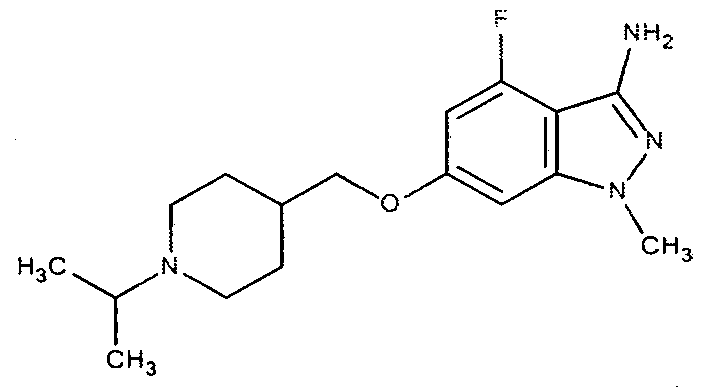
[00378] The title compound was prepared in a manner analagous to that described for example 34: 56 mg (20.6%) as a white powder. MET-uHPLC-AB-101 (7min) M/Z (ES+) 321, Retention time 1.30 min
IH NMR (500 MHz, DMSO-d6) δ 6.66 (d, J = 1.7 Hz, IH), 6.29 (dd, J = 11.9, 1.6 Hz, IH), 5.16 (s, 2H), 3.88 (d, J = 5.9 Hz, 2H), 3.67 (s, 3H), 3.04 - 2.81 (m, 3H), 2.42 - 2.27 (m, 2H), 1.89 - 1.73 (m, 3H), 1.44 - 1.28 (m, 2H), 1.05 (d, J = 6.4 Hz, 6H).
Example 162. 4-fluoro-6-{[l-(propan-2-yl)piperidin-4-yl]methoxy}-l,2-benzoxazol-3-amine
(158)
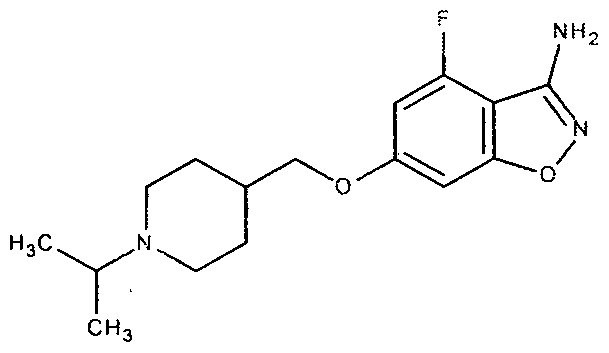
1H MR (500 MHz, DMSO-d6) δ 6.89 (d, J = 1.5 Hz, 1H), 6.68 (dd, J = 11.4, 1.4 Hz, 1H), 6.14 (s, 2H), 3.90 (d, J = 6.0 Hz, 2H), 2.86 - 2.77 (m, 2H), 2.74 - 2.65 (m, 1H), 2.26 - 2.02 (m,2H), 1.84 - 1.64 (m, 3H), 1.34 - 1.17 (m, 2H), 0.97 (d, J = 6.5 Hz, 6H).
Example 163. Enantiomer 1: 4-fluoro-6-({l-[oxan-3-yl]piperidin-4-yl}methoxy)-lH- indazole (159)

[00380] Racemic 4-fluoro-6-({ l-[oxan-3-yI]piperidin-4-yl}methoxy)-lH-indazole, was purified by chiral column chromatography to provide the title compound as a single enantiomer (absolute stereochemistry not specified): 10.2 mg (16.1%) as an off white solid. Achiral LCMS data: MET-uHPLC-AB-101 (7min) M/Z (ES+) 334, Retention time 1.52 min
1H NMR (500 MHz, DMSO-i/6) 6 13.09 (s, 1H), 8.02 (s, 1H), 6.77 (s, 1H), 6.57 (dd, J= 11.7, 1.5 Hz, 1H), 3.87 (d, J= 5.8 Hz, 2H), 3.86 - 3.84 (m, 1H), 3.73 (d, J= 9.2 Hz, 1H), 3.21 - 3.14 (m, 2H), 2.93 - 2.86 (m, 2H), 2.36 - 2.31 (m, 1H), 2.24 - 2.14 (m, 2H), 1.93 - 1.87 (m, 1H), 1.79 - 1.69 (m, 3H), 1.68 - 1.61 (m, lH), 1.53 - 1.36 (m, 2H), 1.32 - 1.21 (m, 2H).
Example 164. Enantiomer 2: 4-fluoro-6-({l-[oxan-3-yl]piperidin-4-yl}methoxy)-lH- indazole (160)

1H NMR (500 MHz, DMSO- 6) δ 13.09 (s, 1H), 8.02 (s, lH), 6.77 (s, 1H), 6.57 (dd, J = 11.7, 1.6 Hz, 1H), 3.88 (d, J= 5.8 Hz, 2H), 3.86 - 3.84 (m, 1H), 3.73 (d, J= 11.0 Hz, 1H), 3.21 -3.14 (m, 2H), 2.93 - 2.87 (m, 2H), 2.36 - 2.30 (m, 1H), 2.24 - 2.14 (m, 2H), 1.93 - 1.87 (m, 1H), 1.78 - 1.69 (m, 3H), 1.67 - 1.61 (m, 1H), 1.53 - 1.36 (m, 2H), 1.31 - 1.21 (m, 2H).
Example 165. Enantiomer 1: ^-fluoro-e-iil-Ioxolan-S- llpiperidin^- lJmethoxy)-!!!- indazole (161)

[00382] Racemic 4-fluoro-6-({ l-[oxolan-3-yl]piperidin-4-yl}methoxy)-lH-indazole, was purified by chiral column chromatography to provide the title compound as a single enantiomer (absolute stereochemistry not specified): 9.7 mg (16.1%) as an off white solid. Achiral LCMS data: MET-uHPLC- AB- 101 (7min) M/Z (ES+) 320, Retention time 1.42 min
1H NMR (500 MHz, DMSO-d6) δ 13.10 (s, 1H), 8.02 (s, 1H), 6.77 (s, 1H), 6.57 (dd, J= 11.7, 1.6 Hz, 1H), 3.89 (d, J= 5.9 Hz, 2H), 3.81 - 3.74 (m, 2H), 3.68 - 3.61 (m, 1H), 3.48 - 3.42(m, 1H), 2.96 - 2.90 (m, 1H), 2.90 - 2.82 (m, 1H), 2.76 - 2.69 (m, lH), 2.04 - 1.92 (m, 3H), 1.81 - 1.67 (m, 4H), 1.37 - 1.26 (m, 2H).
Example 166. Enantiomer 2: 4-fluoro-6-({l-[oxoIan-3-yl]piperidin-4-yl}methoxy)-lH- indazole (162)

[00383] Racemic 4-fluoro-6-({ l-[oxolan-3-yl]piperidin-4-yl}methoxy)-lH-indazole, was purified by chiral column chromatography to provide the title compound as a single enantiomer (absolute stereochemistry not specified): 9 mg (15%) of as an off white solid. Achiral LCMS data: MET-uHPLC-AB-101 (7min) M/Z (ES+) 320, Retention time 1.42 min
lH NMR (500MHz, DMSO-</6) 5 13.10 (s, 1H), 8.02 (s, 1H), 6.77 (s, 1H), 6.57 (dd, J= 11.7, 1.6 Hz, 1H), 3.91 - 3.86 (m, 2H), 3.81 - 3.74 (m, 2H), 3.68 - 3.61 (m, 1H), 3.48 - 3.43 (m, 1H), 2.96 - 2.90 (m, 1H), 2.90 - 2.82 (m, lH), 2.76 - 2.69 (m, 1H), 2.04 - 1.92 (m, 3H), 1.80 - 1.67 (m, 4H), 1.37 - 1.26 (m, 2H).
Example 167 (rac)-4-fluoro-6-{l-[l-(oxetan-3-yl)piperidin-4-yl]ethoxy}-lH-indazol-3-amine
(163)

[00384] The title compound was prepared in a manner analagous to that described for example 34: 75 mg (65.5%) as a pink foam. MET-uHPLC-AB-101 (7min) M/Z (ES+) 335.1, Retention time 1.0 min
1H NMR (500 MHz, DMSO-d6) δ 1 1.40 (s, 1H), 6.46 (d, J = 1.7 Hz, 1H), 6.27 (dd, J = 12.1, 1.6 Hz, 1H), 5.06 (s, 2H), 4.53 - 4.48 (m, 2H), 4.43 - 4.37 (m, 2H), 4.31 - 4.24 (m, 1H), 3.39 - 3.34 (m, 1H), 2.77 - 2.69 (m, 2H), 1.82 - 1.76 (m, 1H), 1.73 - 1.66 (m, 2H), 1.65 - 1.58 (m, 1H), 1.57 - 1.48 (m, 1H), 1.40 - 1.25 (m, 2H), 1.20 (d, J = 6.1 Hz, 3H).
Example 168. l-(propan-2-yl)-4-({lH-pyrrolo[3,2-b]pyridin-6-yloxy}methyl)piperidine
(164)

[00385] The title compound was prepared in a manner analagous to that described for example 34: 14.6 mg (12.9%) as a white crystalline solid. METCR1600 high pH (7 min) M/Z (ES+) 274.3, Retention time 4.81 min
1H NMR (500 MHz, DMSO-d6) δ 11.02 (s, 1H), 8.06 (d, J = 2.6 Hz, 1H), 7.47 - 7.41 (m, 1H), 7.30 - 7.27 (m, 1H), 6.47 - 6.42 (m, 1H), 3.86 (d, J = 6.3 Hz, 2H), 2.82 - 2.76 (m, 2H), 2.72 - 2.61 (m, lH), 2.13 - 2.07 (m, 2H), 1.80 - 1.74 (m, 2H), 1.73 - 1.67 (m, 1H), 1.33 - 1.21 (m, 2H), 0.96 (d, J = 6.0 Hz, 6H).
Example 169. (rac)-6-[l-{l-[l,l-difluoropropan-2-yl]piperidin-4-yl}ethoxy]-4-fluo
indazoI-3-amine (165)

[00386] The title compound was prepared in a manner analagous to that described for example 34: 48 mg (49.9%) as a yellow glass. MET-uHPLC-AB-101 (7min) M/Z (ES+) 357.1, Retention time 1.29 min
1H NMR (500 MHz, DMSO-d6) 11.41 (s, 1H), 6.46 (d, J = 1.5 Hz, 1H), 6.28 (dd, J = 12.1, 1.4 Hz, 1H), 6.01 (td, J = 56.0, 3.7 Hz, 1H), 5.07 (s, 2H), 4.34 - 4.19 (m, 1H), 3.03 - 2.76 (m,3H), 2.36 - 2.23 (m, 2H), 1.82 - 1.73 (m, 1H), 1.70 - 1.56 (m, 1H), 1.56 - 1.43 (m, lH), 1.36 - 1.22 (m, 2H), 1.20(d, J = 6.1 Hz, 3H), 1.01 (d, J = 6.9 Hz, 3H).
Example 170. (/•ac^-fi ^-dimethylpiperidin^-y^methoxyl^-fluoro-lH-indazol-S-amine
(166)

[00387] The title compound was prepared in a manner analagous to that described for example 34: 8mg (25%) as an off white powder. MET-uHPLC-AB-101 (7min) M/Z (ES+) 293, Retention time 1.12 min
lH NMR (500 MHz, DMSO-d6) 6 11.46 (s, 1H), 6.45 (d, J = 1.7 Hz, 1H), 6.28 (dd, J = 12.0, 1.6 Hz, 1H), 5.08 (s, 2H), 3.76 (d, J = 6.3 Hz, 2H), 2.78 - 2.71 (m, 2H), 2.09 - 1.98 (m, 1H), 1.71 - 1.63 (m, 1H), 1.59 - 1.54 (m, 1H), 1.05 (d, J = 8.9 Hz, 6H), 1.03 - 0.94 (m, 2H).
Example 171. General Protocol for hASICla IC50 determination on QPatch Screening
Station (Sophion Bioscience).
[00388] 4 point IC50 curves were done, standard concentration range was 0.01, 0.1 , 1, 10 μΜ. If the compounds show > 50% inhibition at 10 nM, the concentration range was adapted.
Activation of hASICla was done with pH 6.75, washout/preincubation was at pH 7.4.
Four applications of pH 6.75 were done in the beginning of the experiment for current stabilization. After preincubation of the concentration at pH7.4, one activation per concentration at pH6.75 was done. Incubation between activation steps was minimum 200s.
Methods of analysis:
[00389] Compound concentrations were normalized to last initial pH 6.75 activation. Baseline current was subtracted of the peak current before normalization. IC50 value was calculated out of all valid experiments per compound, minimum was 3 valid data points per concentration.
Cell culture:
[00390] Cell line: CHO Kl hASICla #8.2
- Medium: DMEM/F12 (Sigma D8437) + 10% FCS
- Antibiotics 500 μg/ml G418 (Life technologies, CatJ 1181 1-064)
- 5% C02, 37°C
[00391] Permanent culture
removed old medium and wash cells with Ca2+ and Mg2+ free PBS (Life
technologies, Cat.# 14190-240)
added 4 ml of pre-warmed Accumax solution (Sigma, Cat.# A7089), incubated cells at 37°C for 3-4min
stopped activity by adding 16 ml of culture medium, triturated very gently (2-3x) counted cells using CasyCounter from Scharfe System
transferred cells into new T175-flask (Greiner bio-one, Cat.# 660 175) containing 30 mL of fresh media (3d: 5e5 / 4d: 2e5)
for QPatch experiments split cells Id (2e6) or 2d (8e5) before experiment without antibiotics in T75
[00392] Preparation for QPatch experiments
Washed the cells twice with PBS (-)
To detach the cells used Accumax and incubated the suspension for 3 minutes at 37°C into the incubator
Added fresh Media to the cell suspension to stop the effect of Accumax Centrifuged the cells 3 min with 1000 rpm
Resuspended the cells in 1 ,5ml SFM and transfered the suspension into a QTube in the QFuge, start experiment
[00393] QPatch experiments:
Buffers:

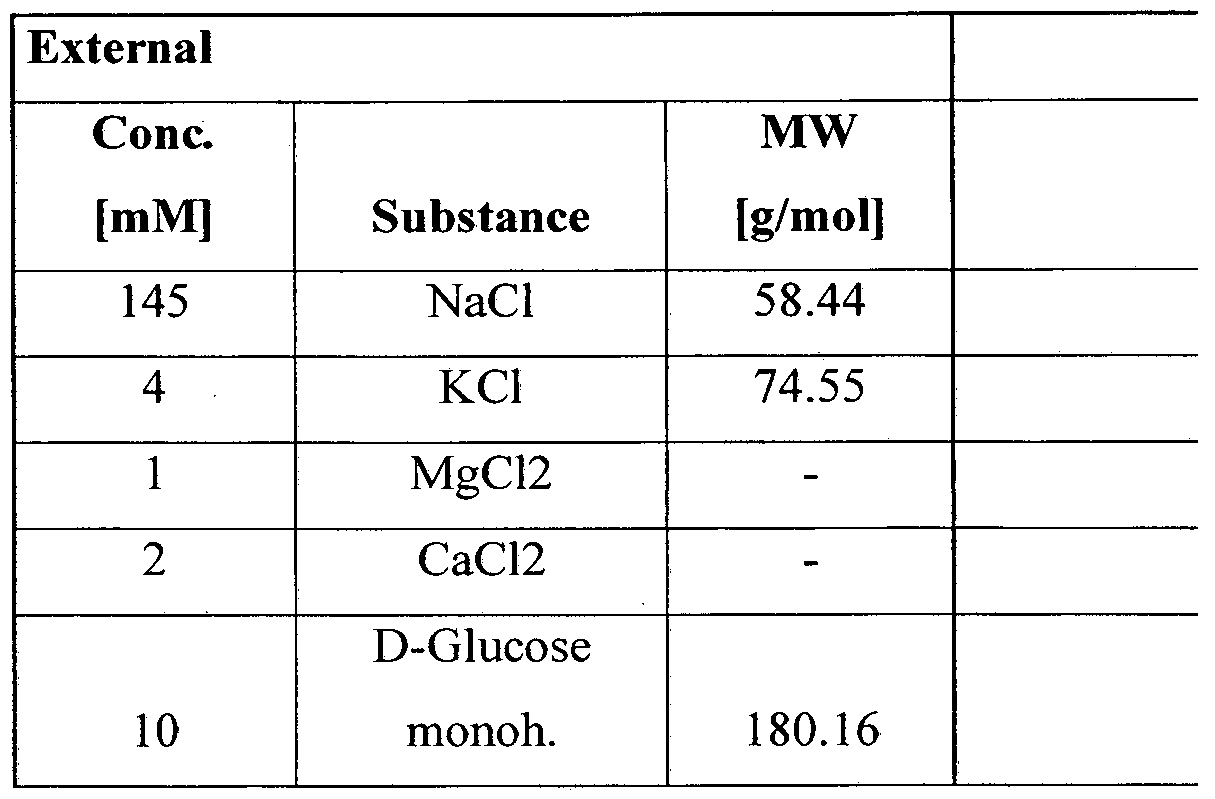
10 MES 195.2 pH 6.75 pH adjusted to 6.75 / 7.4
with: NaOH
[00394] The data is interpreted according to the following:
D > 5 μΜ;
C > 1-5 μΜ;
B ΙΟΟ ηΜ - Ι μΜ;
A < 100 nM.

18 17 D
19 18 D
20 19 D
21 23 D
22 24 D
23 26 D
24 27 D
25 28 D
26 29 D
27 30 D
28 32 D
29 33 D
30 34 D
31 35 D
32 41 C
33 48 A
34 64 A
35 20 D
36 21 D
37 22 D
38 25 B
39 31 D
40 168 D
41 36 D
42 37 D
43 38 C
44 39 D
45 40 D
46 43 C
47 44 D
48 45 C
49 46 C
50 47 D
51 50 B
52 51 A
53 52 B
54 53 D
55 55 D
56 56 D
57 61 D
58 63 A
59 65 D
60 66 D
61 67 A
62 68 D
63 69 A
64 71 B
65 75 C
66 78 B
67 95 D
68 96 A
69 97 A
70 99 A
71 100 A
72 101 A
73 102 A
74 103 A
75 104 A
76 105 A
77 106 A
78 110 A
79 111 B
80 107 A
81 112 A
82 113 A
84 115 A
85 116 A
86 108 A
87 114 A
88 117 A
89 122 B
90 123 A
91 118 A
92 124 B
93 125 A
94 119 A
95 128 B
96 129 B
97 120 A
98 121 A
99 126 A
100 127 A
101 130 B
102 131 B
103 132 A
104 169 B
105 137 A
106 133 A
107 138 B
108 139 B
109 135 B
110 136 A
111 134 C
112 141 A
113 142 A
114 143 B
115 109 A
116 93 A
117 54 A
118 60 C
119 70 A
120 74 B
121 84 A
122 85 A
123 87 A
124 88 A
125 91 A
126 58 D
127 57 D
128 59 D
129 62 D
130 72 D
131 80 D
132 90 A
133 94 C
134 76 D
135 77 D
136 79 D
137 81 D
138 83 D
139 86 D
140 89 D
141 42 D
142 82 D
143 73 D
144 98 A
145 92 D
146 140 D
147 49 C
148 144 A
149 145 A
150 146 A
151 147 A
152 148 A
153 149 B
154 150 A
155 151 D
156 152 A
157 153 A
158 154 A
159 155 A
160 156 B
161 157 A
162 158 B
163 159 A
164 160 A
165 161 B
166 162 A
167 163 A
168 164 C
169 165 A
170 166 B
Example 172. Pharmaceutical preparations
[00395] (A) Injection vials: A solution of 100 g of an active ingredient according to the invention and 5 g of disodium hydrogen phosphate in 3 1 of bidistilled water is adjusted to pH 6.5 using 2 N hydrochloric acid, sterile filtered, transferred into injection vials, is lyophilized under sterile conditions and is sealed under sterile conditions. Each injection vial contains 5 mg of active ingredient.
[00396] (B) Suppositories: A mixture of 20 g of an active ingredient according to the invention is melted with 100 g of soy lecithin and 1400 g of cocoa butter, is poured into moulds and is allowed to cool. Each suppository contains 20 mg of active ingredient.
[00397] (C) Solution: A solution is prepared from 1 g of an active ingredient according to the invention, 9.38 g of NaH2P04 · 2 H20, 28.48 g of Na2HP04 · 12 H20 and 0.1 g of benzalkonium chloride in 940 ml of bidistilled water. The pH is adjusted to 6.8, and the solution is made up to 1
1 and sterilized by irradiation. This solution could be used in the form of eye drops.
[00398] (D) Ointment: 500 mg of an active ingredient according to the invention is mixed with 99.5 g of Vaseline under aseptic conditions.
[00399] (E) Tablets: A mixture of 1 kg of an active ingredient according to the invention, 4 kg of lactose, 1.2 kg of potato starch, 0.2 kg of talc and 0.1 kg of magnesium stearate is pressed to give tablets in a conventional manner in such a way that each tablet contains 10 mg of active ingredient.
[00400] (F) Coated tablets: Tablets are pressed analogously to Example E and subsequently are coated in a conventional manner with a coating of sucrose, potato starch, talc, tragacanth and dye.
[00401] (G) Capsules: 2 kg of an active ingredient according to the invention are introduced into hard gelatin capsules in a conventional manner in such a way that each capsule contains 20 mg of the active ingredient.
[00402] (H) Ampoules: A solution of 1 kg of an active ingredient according to the invention in 60 1 of bidistilled water is sterile filtered, transferred into ampoules, is lyophilized under sterile conditions and is sealed under sterile conditions. Each ampoule contains 10 mg of active ingredient.
[00403] (I) Inhalation spray: 14 g of an active ingredient according to the invention are dissolved in 10 1 of isotonic NaCl solution, and the solution is transferred into commercially available spray containers with a pump mechanism. The solution could be sprayed into the mouth or nose. One spray shot (about 0.1 ml) corresponds to a dose of about 0.14 mg.
[00404] While a number of embodiments of this invention are described herein, it is apparent that the basic examples may be altered to provide other embodiments that utilize the compounds and methods of this invention. Therefore, it will be appreciated that the scope of this invention is to be defined by the appended claims rather than by the specific embodiments that have been represented by way of example.
Claims
1 . A compound of formula I

I
or a tautomer, or a pharmaceutically acceptable salt thereof, wherein:
Ring A is C5-10 aryl, a 3-8 membered saturated or partially unsaturated carbocyclic ring, a 3-7 membered heterocylic ring having 1 -4 heteroatoms independently selected from nitrogen, oxygen, or sulfur, or a 5-6 membered monocyclic heteroaryl ring having 1-4 heteroatoms independently selected from nitrogen, oxygen, or sulfur;
each R1 is independently -R, halogen, -OR, -SR, -CN, -N02, -S02R, -SOR, -C(0)R, -CO2R,
-C(0)N(R)2, -NRC(0)R, -NRC(0)N(R)2, -NRS02R, or -N(R)2;
Ring B is a 3-7 membered heterocylic ring having 1 -4 heteroatoms independently selected from nitrogen, oxygen, or sulfur, or a 5-6 membered monocyclic heteroaryl ring having 1 -4 heteroatoms independently selected from nitrogen, oxygen, or sulfur;
each R2 is independently -R, halogen, -OR, -SR, -CN, -N02, -SO2R, -SOR, -C(0)R, -CO2R,
-C(0)N(R)2, -NRC(0)R, -NRC(0)N(R)2, -NRSO2R, or -N(R;h;
Y is C or N, wherein if Y is N then R3 is absent;
R3 is -R, halogen, -OR, -SR, -CN, -N02, -S02R, -SOR, -C(0)R, -CO2R, -C(0)N(R)2, -
NRC(0)R, -NRC(0)N(R)2, -NRS 2R, or -N(R ;
R4 is -R, or halogen;
R5 is -R or halogen;
each Ra is independently hydrogen, or Ci-6 aliphatic, each of which is optionally substituted; each R is independently hydrogen, Ci-ό aliphatic, Cs_io aryl, a 3-8 membered saturated or partially unsaturated carbocyclic ring, a 3-7 membered heterocylic ring having 1 -4 heteroatoms independently selected from nitrogen, oxygen, or sulfur, or a 5-6 membered
monocyclic heteroaryl ring having 1-4 heteroatoms independently selected from nitrogen, oxygen, or sulfur; each of which is optionally substituted; or
two R groups on the same atom are taken together with the atom to which they are attached to form a C5-10 aryl, a 3-8 membered saturated or partially unsaturated carbocyclic ring, a 3-7 membered heterocylic ring having 1-4 heteroatoms independently selected from nitrogen, oxygen, or sulfur, or a 5-6 membered monocyclic heteroaryl ring having 1-4 heteroatoms independently selected from nitrogen, oxygen, or sulfur; each of which is optionally substituted;
m is 0, 1, or 2;
n is 0, 1, or 2; and
p is 0, 1, or 2.
2. The compound of any preceding claim, wherein Ring A is phenyl, furanyl, furazanyl, imidazolidinyl, imidazolinyl, imidazolyl, lH-indazolyl, indolenyl, indolinyl, indolizinyl, indolyl, 3H-indolyl, isoindolinyl, isoindolenyl, isoindazolyl, isoindolinyl, isoindolyl, isoquinolinyl, isothiazolyl, isoxazolyl, oxadiazolyl, 1,2,3-oxadiazolyl, 1,2,4-oxadiazolyl;- l,2,5oxadiazolyl, 1,3,4-oxadiazolyl, oxazolidinyl, oxazolyl, oxazolidinyl, pyrimidinyl, purinyl, pyranyl, pyrazinyl, pyrazolidinyl, pyrazolinyl, pyrazolyl, pyridazinyl, pyridooxazole, pyridoimidazole, pyridothiazole, pyridinyl, pyridyl, pyrimidinyl, pyrrolidinyl, pyrrolinyl, 2H-pyrrolyl, pyrrolyl, thiazolyl, thienyl, thienothiazolyl, thienooxazolyl, thienoimidazolyl, thiophenyl, triazinyl, 1,2,3-triazolyl, 1,2,4-triazolyl, 1,2,5-triazolyl, or 1,3,4-triazolyl.
3. The compound of any preceding claim, wherein Ring A is


169


5. The compound of any preceding claim, wherein Ring B is dihydrofuro [2,3-b] tetrahydrofliran, furanyl, furazanyl, imidazolidinyl, imidazolinyl, imidazolyl, isothiazolyl, isoxazolyl, morpholinyl, oxadiazolyl, 1,2,3-oxadiazolyl, 1,2,4-oxadiazolyl;- l,2,5oxadiazolyl, 1,3,4-oxadiazolyl, oxazolidinyl, oxazolyl, oxazolidinyl, pyrimidinyl, piperazinyl, piperidinyl, pyranyl, pyrazinyl, pyrazolidinyl, pyrazolinyl, pyrazolyl, pyridazinyl, pyridinyl, pyridyl, pyrimidinyl, pyrrolidinyl, pyrrolinyl, 2H-pyrrolyl, pyrrolyl, tetrahydrofuranyl,
6H-l,2,5-thiadiazinyl, 1,2,3-thiadiazolyl, 1 ,2,4-thiadiazolyl, 1,2,5-thiadiazolyl, l,3,4thiadiazolyl, thiazolyl, thienyl, thiophenyl, triazinyl, 1,2,3-triazolyl, 1,2,4-triazolyl, 1,2,5-triazolyl, or
1,3,4-triazolyl.
6. The compound of any preceding claim, wherein Ring B is

8. The compound of any preceding claim, wherein R3 is Ci-e aliphatic, C5-10 aryl, a 3-8 membered saturated or partially unsaturated carbocyclic ring, a 3-7 membered heterocylic ring having 1-4 heteroatoms independently selected from nitrogen, oxygen, or sulfur, or a 5-6 membered monocyclic heteroaryl ring having 1-4 heteroatoms independently selected from nitrogen, oxygen, or sulfur; each of which is optionally substituted; or R3 is halogen, -OR, -SR, -CN, -NO2, -S02R, -SOR, -C(0)R, -C02R, -C(0)N(R , -NRC(0)R, -NRC(0)N(R)_, -NRS02R, or -NCR^.
9. The compound of any preceding claim, wherein R3 is -H, -F, -CI, -Br, -CN, -N(Me)2,

10. The compound of any preceding claim, wherein R4 is H or F.
1 1. The compound of any preceding claim, wherein each Ra is H or Me.
12. The compound of claim 1 , of formula I-a

or a pharmaceutically acceptable salt thereof.
13. The compound of claim 1, of formula I-c,

I-c;
or a pharmaceutically acceptable salt thereof.
14. The compound of claim 1, selected from Table 1.
15. A pharmaceutical composition comprising a compound of any one of claims 1-14, and a pharmaceutically acceptable adjuvant, carrier, or vehicle.
16. A method for inhibiting ASIC, or a mutant thereof, activity in a patient or in a biological sample, comprising the step of administering to said patient or contacting said biological sample with a compound of any one of claims 1-14, or a physiologically acceptable salt thereof.
17. A method for treating a ASIC-mediated disorder in a patient in need thereof, comprising the step of administering to said patient a compound of any one of claims 1-14.
18. The method of claim 17, wherein the disorder is selected from multiple sclerosis (MS), polyneuritis, multiple neuritis, amyotrophic lateral sclerosis (ALS), Alzheimer's disease, optic neuritis, and Parkinson's disease.
19. A method for treating ischemic stroke, epilepsy, multiple sclerosis, Huntington's disease, Parkinson's disease, optic neuritis, or spinal cord injury in a subject, comprising the step of
administering to said subject a compound of any one of claims 1-14, or a physiologically acceptable salt thereof.
Applications Claiming Priority (2)
| Application Number | Priority Date | Filing Date | Title |
|---|---|---|---|
| DE102015012050.6 | 2015-09-15 | ||
| DE102015012050.6A DE102015012050A1 (en) | 2015-09-15 | 2015-09-15 | Compounds as ASIC inhibitors and their uses |
Publications (1)
| Publication Number | Publication Date |
|---|---|
| WO2017045751A1 true WO2017045751A1 (en) | 2017-03-23 |
Family
ID=56896505
Family Applications (1)
| Application Number | Title | Priority Date | Filing Date |
|---|---|---|---|
| PCT/EP2016/001531 Ceased WO2017045751A1 (en) | 2015-09-15 | 2016-09-12 | Compounds as asic inhibitors and uses thereof |
Country Status (2)
| Country | Link |
|---|---|
| DE (1) | DE102015012050A1 (en) |
| WO (1) | WO2017045751A1 (en) |
Cited By (4)
| Publication number | Priority date | Publication date | Assignee | Title |
|---|---|---|---|---|
| US10287353B2 (en) | 2016-05-11 | 2019-05-14 | Huya Bioscience International, Llc | Combination therapies of HDAC inhibitors and PD-1 inhibitors |
| US10385131B2 (en) | 2016-05-11 | 2019-08-20 | Huya Bioscience International, Llc | Combination therapies of HDAC inhibitors and PD-L1 inhibitors |
| WO2024112831A1 (en) * | 2022-11-22 | 2024-05-30 | Maze Therapeutics, Inc. | Inhibitors of solute carrier family 6a member 19 (slc6a19) and methods of use thereof |
| US12103915B2 (en) | 2022-09-29 | 2024-10-01 | Insilico Medicine Ip Limited | TEAD inhibitors and methods of uses thereof |
Citations (12)
| Publication number | Priority date | Publication date | Assignee | Title |
|---|---|---|---|---|
| US5843975A (en) * | 1995-06-02 | 1998-12-01 | Synthelabo | Oxazolidinone derivatives, their preparation and therapeutical use |
| WO2003051847A1 (en) * | 2001-12-19 | 2003-06-26 | Smithkline Beecham P.L.C. | (1-h-indazol-3-yl) -amide derivatives as gsk-3 inhibitors |
| WO2005063767A2 (en) * | 2003-12-22 | 2005-07-14 | Memory Pharmaceuticals Corporation | Indoles, 1h-indazoles, 1,2-benzisoxazoles, and 1,2-benzisothiazoles, and preparation and uses thereof |
| WO2005085206A1 (en) * | 2004-02-27 | 2005-09-15 | F. Hoffmann-La Roche Ag | Indazole derivatives and pharmaceutical compositions containing them |
| EP1647549A1 (en) * | 2004-10-14 | 2006-04-19 | Laboratoire Theramex | Indazoles, benzisoxazoles and benzisothiazoles as estrogenic agents |
| US20070054915A1 (en) * | 2005-08-25 | 2007-03-08 | Roche Palo Alto Llc | p38 MAP kinase inhibitors and methods for using the same |
| US20070232620A1 (en) * | 2004-06-15 | 2007-10-04 | Dieter Dorsch | 3-Aminoindazoles |
| US7511136B2 (en) * | 2001-09-26 | 2009-03-31 | Pfizer Italia S.R.L. | Aminoindazole derivatives active as kinase inhibitors |
| WO2010069966A1 (en) * | 2008-12-18 | 2010-06-24 | Nerviano Medical Sciences S.R.L. | Substituted indazole derivatives active as kinase inhibitors |
| WO2010098367A1 (en) * | 2009-02-25 | 2010-09-02 | Banyu Pharmaceutical Co.,Ltd. | Pyrimidopyrimidoindazole derivative |
| WO2012152763A1 (en) * | 2011-05-12 | 2012-11-15 | Nerviano Medical Sciences S.R.L. | Substituted indazole derivatives active as kinase inhibitors |
| WO2014144545A2 (en) * | 2013-03-15 | 2014-09-18 | Genentech, Inc. | Substituted benzoxazoles and methods of use thereof |
Family Cites Families (3)
| Publication number | Priority date | Publication date | Assignee | Title |
|---|---|---|---|---|
| AU2003303477A1 (en) * | 2002-12-23 | 2004-07-22 | Alcon, Inc. | 1-alkyl-3-aminoindazoles |
| EP2205085A1 (en) * | 2007-09-25 | 2010-07-14 | Merck Sharp & Dohme Corp. | 2-aryl or heteroaryl indole derivatives |
| EP2489663A1 (en) * | 2011-02-16 | 2012-08-22 | Almirall, S.A. | Compounds as syk kinase inhibitors |
-
2015
- 2015-09-15 DE DE102015012050.6A patent/DE102015012050A1/en not_active Withdrawn
-
2016
- 2016-09-12 WO PCT/EP2016/001531 patent/WO2017045751A1/en not_active Ceased
Patent Citations (12)
| Publication number | Priority date | Publication date | Assignee | Title |
|---|---|---|---|---|
| US5843975A (en) * | 1995-06-02 | 1998-12-01 | Synthelabo | Oxazolidinone derivatives, their preparation and therapeutical use |
| US7511136B2 (en) * | 2001-09-26 | 2009-03-31 | Pfizer Italia S.R.L. | Aminoindazole derivatives active as kinase inhibitors |
| WO2003051847A1 (en) * | 2001-12-19 | 2003-06-26 | Smithkline Beecham P.L.C. | (1-h-indazol-3-yl) -amide derivatives as gsk-3 inhibitors |
| WO2005063767A2 (en) * | 2003-12-22 | 2005-07-14 | Memory Pharmaceuticals Corporation | Indoles, 1h-indazoles, 1,2-benzisoxazoles, and 1,2-benzisothiazoles, and preparation and uses thereof |
| WO2005085206A1 (en) * | 2004-02-27 | 2005-09-15 | F. Hoffmann-La Roche Ag | Indazole derivatives and pharmaceutical compositions containing them |
| US20070232620A1 (en) * | 2004-06-15 | 2007-10-04 | Dieter Dorsch | 3-Aminoindazoles |
| EP1647549A1 (en) * | 2004-10-14 | 2006-04-19 | Laboratoire Theramex | Indazoles, benzisoxazoles and benzisothiazoles as estrogenic agents |
| US20070054915A1 (en) * | 2005-08-25 | 2007-03-08 | Roche Palo Alto Llc | p38 MAP kinase inhibitors and methods for using the same |
| WO2010069966A1 (en) * | 2008-12-18 | 2010-06-24 | Nerviano Medical Sciences S.R.L. | Substituted indazole derivatives active as kinase inhibitors |
| WO2010098367A1 (en) * | 2009-02-25 | 2010-09-02 | Banyu Pharmaceutical Co.,Ltd. | Pyrimidopyrimidoindazole derivative |
| WO2012152763A1 (en) * | 2011-05-12 | 2012-11-15 | Nerviano Medical Sciences S.R.L. | Substituted indazole derivatives active as kinase inhibitors |
| WO2014144545A2 (en) * | 2013-03-15 | 2014-09-18 | Genentech, Inc. | Substituted benzoxazoles and methods of use thereof |
Non-Patent Citations (3)
| Title |
|---|
| HARTUNG INGO V ET AL: "Optimization of allosteric MEK inhibitors. Part 1: Venturing into underexplored SAR territories", BIOORGANIC & MEDICINAL CHEMISTRY LETTERS, PERGAMON, AMSTERDAM, NL, vol. 23, no. 8, 14 February 2013 (2013-02-14), pages 2384 - 2390, XP028525192, ISSN: 0960-894X, DOI: 10.1016/J.BMCL.2013.02.028 * |
| JESSE A. MAY ET AL: "1-(( S )-2-Aminopropyl)-1 H -indazol-6-ol: A Potent Peripherally Acting 5-HT 2 Receptor Agonist with Ocular Hypotensive Activity", JOURNAL OF MEDICINAL CHEMISTRY, vol. 49, no. 1, 1 January 2006 (2006-01-01), US, pages 318 - 328, XP055307810, ISSN: 0022-2623, DOI: 10.1021/jm050663x * |
| SARAH C ABBOT ET AL: "Synthesis of Heteroaryl-fused Pyrazoles as P38 Kinase Inhibitors", HETEROCYCLES COMMUNICATION | SPECIAL ISSUE, JAPAN INSTITUTE OF HETEROCYCLIC CHEMISTRY, JP, vol. 78, no. 11, 1 January 2009 (2009-01-01), pages 2811 - 2826, XP008160162, ISSN: 0385-5414, [retrieved on 20090707], DOI: 10.3987/COM-09-11808 * |
Cited By (7)
| Publication number | Priority date | Publication date | Assignee | Title |
|---|---|---|---|---|
| US10287353B2 (en) | 2016-05-11 | 2019-05-14 | Huya Bioscience International, Llc | Combination therapies of HDAC inhibitors and PD-1 inhibitors |
| US10385131B2 (en) | 2016-05-11 | 2019-08-20 | Huya Bioscience International, Llc | Combination therapies of HDAC inhibitors and PD-L1 inhibitors |
| US10385130B2 (en) | 2016-05-11 | 2019-08-20 | Huya Bioscience International, Llc | Combination therapies of HDAC inhibitors and PD-1 inhibitors |
| US11535670B2 (en) | 2016-05-11 | 2022-12-27 | Huyabio International, Llc | Combination therapies of HDAC inhibitors and PD-L1 inhibitors |
| US12122833B2 (en) | 2016-05-11 | 2024-10-22 | Huyabio International, Llc | Combination therapies of HDAC inhibitors and PD-1 inhibitors |
| US12103915B2 (en) | 2022-09-29 | 2024-10-01 | Insilico Medicine Ip Limited | TEAD inhibitors and methods of uses thereof |
| WO2024112831A1 (en) * | 2022-11-22 | 2024-05-30 | Maze Therapeutics, Inc. | Inhibitors of solute carrier family 6a member 19 (slc6a19) and methods of use thereof |
Also Published As
| Publication number | Publication date |
|---|---|
| DE102015012050A1 (en) | 2017-03-16 |
Similar Documents
| Publication | Publication Date | Title |
|---|---|---|
| EP3497094B1 (en) | Tlr7/8 antagonists and uses thereof | |
| EP3350170B1 (en) | Heteroaryl compounds as irak inhibitors and uses thereof | |
| US10377745B2 (en) | Heterocyclic compounds as NaV channel inhibitors and uses thereof | |
| EP3221306B1 (en) | Heteroaryl compounds as irak inhibitors and uses thereof | |
| EP3253764B1 (en) | Macrocyclic compounds as irak1/4 inhibitors and uses thereof | |
| EP3253763B1 (en) | Pyridazinone macrocycles as irak inhibitors and uses thereof | |
| EP4248968A2 (en) | Tlr7/8 antagonists and uses thereof | |
| AU2016323612A1 (en) | Heteroaryl compounds as IRAK inhibitors and uses thereof | |
| WO2020025517A1 (en) | Tlr7/8 antagonists and uses thereof | |
| CA3078579A1 (en) | Pyrimidine tbk/ikk.epsilon. inhibitor compounds and uses thereof | |
| WO2017045751A1 (en) | Compounds as asic inhibitors and uses thereof | |
| WO2017045750A1 (en) | Compounds as asic inhibitors and uses thereof | |
| EP3697773A1 (en) | PYRIMIDINE TBK/IKKe INHIBITOR COMPOUNDS AND USES THEREOF |
Legal Events
| Date | Code | Title | Description |
|---|---|---|---|
| 121 | Ep: the epo has been informed by wipo that ep was designated in this application |
Ref document number: 16763448 Country of ref document: EP Kind code of ref document: A1 |
|
| NENP | Non-entry into the national phase |
Ref country code: DE |
|
| 122 | Ep: pct application non-entry in european phase |
Ref document number: 16763448 Country of ref document: EP Kind code of ref document: A1 |