WO2017040702A1 - Bipolar tetraether lipids - Google Patents
Bipolar tetraether lipids Download PDFInfo
- Publication number
- WO2017040702A1 WO2017040702A1 PCT/US2016/049753 US2016049753W WO2017040702A1 WO 2017040702 A1 WO2017040702 A1 WO 2017040702A1 US 2016049753 W US2016049753 W US 2016049753W WO 2017040702 A1 WO2017040702 A1 WO 2017040702A1
- Authority
- WO
- WIPO (PCT)
- Prior art keywords
- substituted
- unsubstituted
- membered
- mol
- liposome
- Prior art date
- Legal status (The legal status is an assumption and is not a legal conclusion. Google has not performed a legal analysis and makes no representation as to the accuracy of the status listed.)
- Ceased
Links
- 0 CCCCC*(C)C*1=C=*C(C)(C*)*(CCC*)C1 Chemical compound CCCCC*(C)C*1=C=*C(C)(C*)*(CCC*)C1 0.000 description 3
Classifications
-
- A—HUMAN NECESSITIES
- A61—MEDICAL OR VETERINARY SCIENCE; HYGIENE
- A61K—PREPARATIONS FOR MEDICAL, DENTAL OR TOILETRY PURPOSES
- A61K9/00—Medicinal preparations characterised by special physical form
- A61K9/10—Dispersions; Emulsions
- A61K9/127—Synthetic bilayered vehicles, e.g. liposomes or liposomes with cholesterol as the only non-phosphatidyl surfactant
- A61K9/1271—Non-conventional liposomes, e.g. PEGylated liposomes or liposomes coated or grafted with polymers
- A61K9/1272—Non-conventional liposomes, e.g. PEGylated liposomes or liposomes coated or grafted with polymers comprising non-phosphatidyl surfactants as bilayer-forming substances, e.g. cationic lipids or non-phosphatidyl liposomes coated or grafted with polymers
-
- C—CHEMISTRY; METALLURGY
- C07—ORGANIC CHEMISTRY
- C07C—ACYCLIC OR CARBOCYCLIC COMPOUNDS
- C07C43/00—Ethers; Compounds having groups, groups or groups
- C07C43/02—Ethers
- C07C43/03—Ethers having all ether-oxygen atoms bound to acyclic carbon atoms
- C07C43/04—Saturated ethers
- C07C43/13—Saturated ethers containing hydroxy or O-metal groups
- C07C43/135—Saturated ethers containing hydroxy or O-metal groups having more than one ether bond
-
- C—CHEMISTRY; METALLURGY
- C07—ORGANIC CHEMISTRY
- C07C—ACYCLIC OR CARBOCYCLIC COMPOUNDS
- C07C43/00—Ethers; Compounds having groups, groups or groups
- C07C43/02—Ethers
- C07C43/03—Ethers having all ether-oxygen atoms bound to acyclic carbon atoms
- C07C43/14—Unsaturated ethers
- C07C43/178—Unsaturated ethers containing hydroxy or O-metal groups
- C07C43/1785—Unsaturated ethers containing hydroxy or O-metal groups having more than one ether bound
-
- C—CHEMISTRY; METALLURGY
- C07—ORGANIC CHEMISTRY
- C07F—ACYCLIC, CARBOCYCLIC OR HETEROCYCLIC COMPOUNDS CONTAINING ELEMENTS OTHER THAN CARBON, HYDROGEN, HALOGEN, OXYGEN, NITROGEN, SULFUR, SELENIUM OR TELLURIUM
- C07F9/00—Compounds containing elements of Groups 5 or 15 of the Periodic Table
- C07F9/02—Phosphorus compounds
- C07F9/06—Phosphorus compounds without P—C bonds
- C07F9/08—Esters of oxyacids of phosphorus
- C07F9/09—Esters of phosphoric acids
- C07F9/10—Phosphatides, e.g. lecithin
- C07F9/106—Adducts, complexes, salts of phosphatides
-
- C—CHEMISTRY; METALLURGY
- C07—ORGANIC CHEMISTRY
- C07F—ACYCLIC, CARBOCYCLIC OR HETEROCYCLIC COMPOUNDS CONTAINING ELEMENTS OTHER THAN CARBON, HYDROGEN, HALOGEN, OXYGEN, NITROGEN, SULFUR, SELENIUM OR TELLURIUM
- C07F9/00—Compounds containing elements of Groups 5 or 15 of the Periodic Table
- C07F9/02—Phosphorus compounds
- C07F9/547—Heterocyclic compounds, e.g. containing phosphorus as a ring hetero atom
- C07F9/655—Heterocyclic compounds, e.g. containing phosphorus as a ring hetero atom having oxygen atoms, with or without sulfur, selenium, or tellurium atoms, as the only ring hetero atoms
- C07F9/65525—Heterocyclic compounds, e.g. containing phosphorus as a ring hetero atom having oxygen atoms, with or without sulfur, selenium, or tellurium atoms, as the only ring hetero atoms the oxygen atom being part of a seven-(or more) membered ring
-
- C—CHEMISTRY; METALLURGY
- C07—ORGANIC CHEMISTRY
- C07J—STEROIDS
- C07J51/00—Normal steroids with unmodified cyclopenta(a)hydrophenanthrene skeleton not provided for in groups C07J1/00 - C07J43/00
-
- C—CHEMISTRY; METALLURGY
- C07—ORGANIC CHEMISTRY
- C07C—ACYCLIC OR CARBOCYCLIC COMPOUNDS
- C07C2601/00—Systems containing only non-condensed rings
- C07C2601/06—Systems containing only non-condensed rings with a five-membered ring
- C07C2601/08—Systems containing only non-condensed rings with a five-membered ring the ring being saturated
-
- C—CHEMISTRY; METALLURGY
- C07—ORGANIC CHEMISTRY
- C07C—ACYCLIC OR CARBOCYCLIC COMPOUNDS
- C07C2601/00—Systems containing only non-condensed rings
- C07C2601/12—Systems containing only non-condensed rings with a six-membered ring
- C07C2601/14—The ring being saturated
-
- C—CHEMISTRY; METALLURGY
- C07—ORGANIC CHEMISTRY
- C07J—STEROIDS
- C07J9/00—Normal steroids containing carbon, hydrogen, halogen or oxygen substituted in position 17 beta by a chain of more than two carbon atoms, e.g. cholane, cholestane, coprostane
Definitions
- L 1 , L 2 , L 3 , L , L 5 and L 6 are independently a
- R 1 , R 2 , and R 3 are independent! ⁇ ' halogen, -CX 3 , -CHX 2 , -CH 2 X, -OCX 3 , - ( ⁇ ⁇ ⁇ .
- R 5 and R 6 are independently hydrogen, substituted or unsubstituted alkyl, substituted or unsubstituted heteroalkyl, substituted or unsubstituted cycloalkyl,
- R and R 8 are independently a polar moiety.
- X is independently -F, -CI, -Br, or -I.
- the symbols y ' 2 and y 3 are independently an integer from 0 to 5.
- the symbols w2 and w3 are independently 0 or 1 .
- the symbols zl, z2, and z3 are independently an integer from 0 to 4.
- L ! , L 2 , L', L 4 , L '1 , L 6 and L 7 are independently a
- R and R 3 are independently halogen, -CX 3 , -CHX 2 , -CH 2 X, -OCX 3 , - OCH 2 X, ⁇ ()( ' ! IX -. -CN, -SH, -SO 2 H, -SO 2 NH 2 , - -IC(0)NH 2 , -N(0) 2 , -NH 2 , ⁇ ( ((»! !.
- R 5 and R b are independently a steroid moiety.
- R 7 and R 8 are independently a polar moiety.
- X is independently -F, -CI, -Br, or -T.
- the symbols y2 and y3 are independently and integer from 0 to 5.
- the symbols w 2 and w* are independently 0 or 1.
- the symbols z 2 and z J are independently an integer from 0 to 4.
- a pharmaceutical composition including a liposome as described herein and a pharmaceutically acceptable excipient, wherein the cavity includes an active pharmaceutical ingredient.
- a liposome including a polar membrane enclosing a cavity, the polar membrane including a plurality of the compound as described herein, including embodiments, wherein each of the compounds span the width of the polar membrane thereby forming a plurality of bipolar lipids within the polar membrane.
- a polar membrane including a plurality of the compound as described herein, including embodiments, wherein each of the compounds span the width of the polar membrane thereby forming a plurality of bipolar lipids within the polar membrane.
- FIG. 1 Chemical structures of exampl es of tethered tetraether lipids.
- FIGS. 2A-2C Observed rate of pH equilibration from liposomes formed from EggPC or synthetic lipids.
- FIG. 2A Graph of the change in CF fluorescence from CF encapsulated GMGTPC or EggPC liposomes vs. time (h);
- FIG. 2B Comparison of the observed initial rates of decreased CF fluorescence from CF encapsulated liposomes comprised of different lipids;
- FIG. 2C Average observed initial rates of pH equilibration in liposomes comprised of different lipids. Standard errors of the mean are provided based on 9 measurements each. Statistical analyses were performed using a t-test with 95% confidence interval. ** indicate a p- value ⁇ 0.01.
- FIGS. 3A-3B Comparison of observed initial rates of pH equilibration of liposomes comprising lipids with zero rings, one cyclopentane ring, or one cyclohexane ring.
- FIG. 3A Plot of natural log of relative fluorescence of CF (first 15% of pH-dependent fluorescence decrease of CF) vs. time (h) of GMGTPC, GMGTPC-CPl , GMGTPC-CHl
- FIG. 3B Graph of the observed rates of CF fluorescence decrease for GMGTPC, GMGTPC-CPl, GMGTPC-CHl.
- Statistical analyses were performed using a t-test with 95% confidence interval. ** indicate a p- value ⁇ 0.01.
- FIG. 4 Chemical synthesis scheme for glycerol scaffold 3.
- FIG. 5 Chemical synthesis scheme for GMGPC.
- FIG. 6 Chemical synthesis scheme for GMGPC-CP 1.
- FIG. 7 Chemical synthesis scheme for GMGPC-CP2.
- FIG. 8 Chemical synthesis scheme for GMGPC-CP3.
- FIG. 9 Chemical synthesis scheme for GMGPC-CH13.
- FIG. 10 DLS hydrodynamic radius of GMGTPC liposomes.
- FIG. 11. CF Leakage Measurements of Lipids at Room Temperature
- FIG. 12 pH Equilibration of CF vs Time (h).
- FIG. 13 Examples of lipid headgroups found in Archaea. [ ⁇ 24] FIG. 14. Synthesis of GMGT lipid derivatives.
- FIGS. 16A-16B Relative effects of headgroups on small ion membrane leakage.
- FIG. 16A Graph of the relative variation of leakage rate from membranes comprised of 1 : 1 mixtures of PC with PA, PE or PG lipids compared to membranes formed from pure PC lipids. Data represents the percent deviation of observed initial rates of membrane leakage compared to the observed initial rate of leakage from pure POPC or GMGTPC lipid membranes (zero percent).
- FIG. 16A Graph of the relative variation of leakage rate from membranes comprised of 1 : 1 mixtures of PC with PA, PE or PG lipids compared to membranes formed from pure PC lipids. Data represents the percent deviation of observed initial rates of membrane leakage compared to the observed initial rate of leakage from pure POPC or GMGTPC lipid membranes (zero percent).
- FIG. 16A Graph of the relative variation of leakage rate from membranes comprised of 1 : 1 mixtures of PC with PA, PE or PG lipids compared
- 16B Graph showing the relative leakage rate of membranes comprised of 1 : 1 mixtures of PC with PA, PE, or PG lipids relati ve to the observed initial rate of leakage from membranes comprised of pure POPC or pure GMGTPC lipids (normalized to I).
- FIG. 17 Chemical synthesis scheme for GMGTPA.
- FIG. 18 Chemical synthesis scheme for GMGTPG.
- FIG. 19 Chemical synthesis scheme for GMGTPE.
- FIGS. 20A-20D Hydrodynamic radius measured using Dynamic Light Scatter.
- FIG. 20 A shows GMGTPC at 0 hours (dashed) and 0.35 hours (solid) on the left, and GMGTPA at 0 hours (dashed) and 0.35 hours (solid) on the right.
- FIG. 20B shows GMGTPE at 0 hours (dashed) and 0.35 hours (solid) on the left, and GMGTPG at 0 hours (dashed) and 0.35 hours (solid) on the right.
- FIG. 20C shows POPC at 0 hours (dashed) and 0.35 hours (solid) on the left, and POPA at 0 hours (dashed) and 0.35 hours (solid) on the right.
- FIG. 20 A shows GMGTPC at 0 hours (dashed) and 0.35 hours (solid) on the left, and GMGTPA at 0 hours (dashed) and 0.35 hours (solid) on the right.
- 20D shows POPE at 0 hours (dashed) and 0,35 hours (solid) on the left, and POPG at 0 hours (dashed) and 0.35 hours (solid) on the right.
- PG, PE, PA liposomes were comprised of 1 : 1 mixture with PC lipids.
- FIG. 21 DSC measurements of lipids.
- FIGS. 22A-22H Equilibration of CF vs. time. Dashed line represents standard errors between measurements.
- FIG. 22A shows the equilibration of CF vs. time for GMGTPC.
- FIG. 22B shows the equilibration of CF vs. time for GMGTPA.
- FIG. 22C shows the equilibration of CF vs. time for GMGTPE.
- FIG. 22D shows the equilibration of CF vs. time for GMGTPG.
- FIG. 22E shows the equilibration of CF vs. time for POPC.
- FIG. 22F shows the equilibration of CF vs. time for POPA.
- FIG. 22G shows the equilibration of CF vs. time for POPE.
- FIG. 22H shows the equilibration of CF vs. time for POPG.
- FIG. 23 Archaea-inspired synthetic lipids.
- FIG. 24 Chemical synthesis of chimeric lipid, GcGTPC-CH.
- FIG. 25 Observed initial rate of pH equilibration for liposomes formed from synthetic or POPC lipids with/without added cholesterol.
- A) Comparison of the observed initial rates of decreased CF fluorescence intensity (monitored at ⁇ ( ⁇ / ⁇ ) 485/517 nm) from CF- encapsuiated liposomes comprised of GMGTPC-CH, GcGTPC-CH, or POPC lipid with without added 40 mol% cholesterol during liposome formation.
- Statistical significance was determined using a paired Student t-test. *** indicates a p- value of ⁇ 0.001 relative to the k c , bSC i of liposomes comprised of GMGTPC-CH lipids.
- FIGS. 26A-26D Demonstration of different biological applications using GcGTPC- CH liposomes.
- FIG. 26C Diameter measured using dynamic light scattering (DLS) after incubation with/without phospholipase-D in at 37 °C for 30 mins.
- DLS dynamic light scattering
- 26D Fluorescence microscopy image of KB cells after incubation with calcein encapsulated GcGTPC-CH liposomes with added 0.5 mol% of DSPE-PEG-folate lipid for 6 hours. Hoescht nuclear stain was added to stain the nucleus. Statistical significance was determined using a paired Student t- test. *, *** indicates a p- value of ⁇ 0.1, 0.001, respectively, relative to the khanded b s d of liposomes comprised of GMGTPC-CH lipids with no additives.
- FIGS. 27A-27E Chemical structure of example tetraether lipids U 16, T32, and T36.
- FIG. 27B Image of example liposome.
- FIG. 27C Measured diffusion of POPC, T32, T36, and U16.
- FIG. 27D Measured heat flow.
- FIG. 27E Measured diameter at 75°C at 0 min and 6 hours.
- FIGS. 28A-28E Temperature dependence of leakage.
- FIG. 28A shows the percent leakage at different temperatures for an example tethered tetraether lipid compared to an untethered lipid.
- FIG. 28B Calculated enthalpy and entropy for liposomes of different sizes.
- FIGS. 28C-28D shows the relative change, or the change in the change of enthalpy and entropy, respectively for T32, T36, and U 16.
- FIG. 28E depicts the Gibbs energy as a function of temperature for T32, T36, and U16.
- FIG. 29 Lipids for calcium mediated fusion.
- FIGS. 30A-30B Liposome fusion experiments.
- FIG. 30A Egg-PA on the left and GMGT-PA on the right showing the % quenching over time.
- FIG. 30B Egg-PA on the left and GMGT-PA on the right showing the intensity as a function of radius of the liposome for a time series over 30 minutes. The measurements conclude that both types of liposomes fuse.
- FIGS. 31A-31B Liposome mixing experiments.
- FIG. 31 A Egg-PA on the left and GMGT-PA on the right showing the % quenching over time at different concentrations.
- FIG. 3 IB Egg-PA on the left and GMGT-PA on the right showing the intensity as a function of radius of the liposome at different concentrations. The measurements conclude that both types of liposomes fuse.
- FIGS. 32A-32B Liposome leakage experiments.
- FIG. 32A Egg-PA on the left and GMGT-PA on the right showing the % quenching over time at different concentrations.
- FIG. 3 IB Egg-PA on the left and GMGT-PA on the right showing the intensity as a function of radius of the liposome at different concentrations. The measurements conclude that diacyi liposomes leak cargo upon fusion whereas the tetraether lipids do not leak cargo.
- FIG. 33 Differential scanning calorimetry traces of lipids.
- FIGS. 34A-34E Dynamic light scattering (DLS) measurements of liposomes.
- FIGS. 35A-35B The effects of gramicidin A on GcGTPC-CH liposomes.
- FIG. 35 A Percent fluorescence of CF after incubation with or without gA at 37 °C for 30 minutes.
- FIG.35B DLS measurements of GcGTPC-CH liposomes under different conditions.
- FIG. 36 KB cell viability with varying concentration of liposome.
- substituent groups are specified by their conventional chemical formulae, written from left to right, they equally encompass the chemically identical substituents that would result from writing the structure from right to left, e.g., -CH 2 0- is equivalent to -OCH 2 -.
- alkyl by itself or as part of another substituent, means, unless otherwise stated, a straight (i.e., unbranched) or branched carbon chain (or carbon), or combination thereof, which may be fully saturated, mono- or polyunsaturated and can include mono-, di- and multivalent radicals, having the number of carbon atoms designated (i.e., Ci-C io means one to ten carbons).
- Alkyl is an uncyclized chain.
- saturated hydrocarbon radicals include, but are not limited to, groups such as methyl, ethyl, n-propyl, isopropyl, n-butyl, t-butyl, isobutyl, sec-butyl, (cyclohexyl)methyl, homologs and isomers of, for example, n-pentyl, n ⁇ hexyl, n-heptyl, n-octyl, and the like.
- An unsaturated alkyl group is one having one or more double bonds or triple bonds.
- unsaturated alkyl groups include, but are not limited to, vinyl, 2-propenyl, crotyl, 2-isopentenyi, 2-(hutadienyl), 2,4-pentadienyl, 3-(l ,4-pentadienyl), ethynyl, 1- and 3-propynyl, 3-butynyl, and the higher homologs and isomers.
- An alkoxy is an alkyl attached to the remainder of the molecule via an oxygen linker (-0-).
- alkylene by itself or as part of another substituent, means, unless otherwise stated, a divalent radical derived from an alkyl, as exemplified, but not limited by, - CH 2 CH 2 CH 2 CH 2 -.
- an alkyl (or alkylene) group will have from 1 to 24 carbon atoms, with those groups having 10 or fewer carbon atoms being preferred herein.
- a “lower alkyl” or “lower alkylene” is a shorter chain alkyl or alkylene group, generally having eight or fewer carbon atoms.
- alkenylene by itself or as part of another substituent, means, unless otherwise stated, a divalent radical derived from an alkene.
- heteroalkyl by itself or in combination with another term, means, unless othenvise stated, a stable straight or branched chain, or combinations thereof, including at least one carbon atom and at least one heteroatom (e.g., O, N, P, Si, and S), and wherein the nitrogen and sulfur atoms may optionally be oxidized, and the nitrogen heteroatom may optionally be quatemized.
- the heteroatom(s) e.g., N, S, Si, or P
- Heteroalkyl is an uncyclized chain.
- a heteroalkyl moiety may include one heteroatom (e.g., O, N, S, Si, or P).
- a heteroalkyl moiety may include two optionally different heteroatoms (e.g., O, N, S, Si, or P).
- a heteroalkyl moiety may include three optionally different heteroatoms (e.g., O, N, S, Si, or P).
- a heteroalkyl moiety may include four optionally different heteroatoms (e.g., O, N, S, Si, or P).
- a heteroalkyl moiety may include five optionally different heteroatoms (e.g., O, N, S, Si, or P).
- a heteroalkyl moiety may include up to 8 optionally different heteroatoms (e.g., O, N, S, Si, or P).
- heteroalkylene by itself or as part of another substituent, means, unless otherwise stated, a divalent radical derived from heteroalkyl, as exemplified, but not limited by, -CH 2 -CH 2 -S-CH 2 -CH 2 - and -CH 2 -S-CH 2 -CH 2 -NH-CH 2 -.
- heteroatoms can also occupy either or both of the chain termini (e.g., alkyleneoxy,
- heteroalkyl groups include those groups that are attached to the remainder of the molecule through a heteroatom, such as - C(0)R', -C(0)NR * , -NR'R", -OR', -SR', and/or -S0 2 R.
- heteroalkyl is recited, followed by recitations of specific heteroalkyl groups, such as -NR'R” or the like, it will be understood that the terms heteroalkyl and -NR'R" are not redundant or mutually exclusive. Rather, the specific heteroalkyl groups are recited to add clarity. Thus, the term “heteroalkyl” should not be interpreted herein as excluding specific heteroalkyl groups, such as -NR'R" or the like.
- cycloalkyl and heterocycloalkyl by themselves or in combination with other terms, mean, unless otherwise stated, cyclic versions of “alkyi” and “heteroalkyl,” respectively. Cycloalkyl and heterocycloalkyl are not aromatic. Additionally, for
- heterocycloalkyl a heteroatom can occupy the position at which the heterocycle is attached to the remainder of the molecule.
- cycloalkyl include, but are not limited to, cyclopropyi, cyclohutyl, cyclopentyl, cyclohexyl, 1 -cyclohexenyl, 3-cyclohexenyl, cycloheptyl, and the like.
- heterocycloalkyl examples include, but are not limited to, 1 -(1,2,5,6- tetrahydropyridyl), 1-piperidinyl, 2-piperidinyl, 3-piperidinyl, 4-morpholinyl, 3-morpholinyl, tetrahydrofuran-2-yl, tetrahydrofuran-3-yl, tetrahydrothien-2-yl, tetrahydrothien-3-yl, I - piperazinyl, 2-piperazinyl, and the like.
- a "cycloalkylene” and a "heterocycloalkylene,” alone or as part of another substituent, means a divalent radical derived from a cycloalkyl and
- halo or halogen
- haloalkyl by themselves or as part of another substituent, mean, unless otherwise stated, a fluorine, chlorine, bromme, or iodine atom.
- terms such as “haloalkyl” are meant to include monohaloalkyi and polyhaloalkyl .
- halo(Ci-C 4 )alkyr' includes, but is not limited to, fluoromethyl, difluoromethyl, trifluoromethyl, 2,2,2-trifluoroethyl, 4-chlorobutyl, 3-bromopropyl, and the like.
- 'acyl means, unless otherwise stated, -C(0)R where R is a substituted or unsubstituted alkyi, substituted or unsubstituted cycloalkyl, substituted or unsubstituted heteroalkyl, substituted or unsubstituted heterocycloalkyl, substituted or unsubstituted aryl, or substituted or unsubstituted heteroaryl.
- aryl * means, unless otherwise stated, a polyunsaturated, aromatic, hydrocarbon substituent, which can be a single ring or multiple rings (preferably from 1 to 3 rings) that are fused together (i.e., a fused ring aryl) or linked covalently.
- a fused ring aryl refers to multiple rings fused together wherein at least one of the fused rings is an aryl ring.
- heteroaryl refers to aryl groups (or rings) that contain at least one heteroatom such as N, O, or S, wherein the nitrogen and sulfur atoms are optionally oxidized, and the nitrogen atom(s) are optionally quaternized.
- heteroaryl includes fused ring heteroaryl groups (i.e., multiple rings fused together wherein at least one of the fused rings is a heteroaromatic ring).
- a 5,6-fused ring heteroaryiene refers to two rings fused together, wherein one ring has 5 members and the other ring has 6 members, and wherein at least one ring is a heteroaryl ring.
- a 6,6 ⁇ fused ring heteroaryiene refers to two rings fused together, wherein one ring has 6 members and the other ring has 6 members, and wherein at least one ring is a heteroaryl ring.
- a 6,5- fused ring heteroaryiene refers to two rings fused together, wherein one ring has 6 members and the other ring has 5 members, and wherein at least one ring is a heteroaryl ring.
- a heteroaryl group can be attached to the remainder of the molecule through a carbon or heteroatom.
- Non- limiting examples of aryl and heteroaryl groups include phenyl, naphthyl, pyrroiyl, pyrazolyl, pyridazinyl, triazinyl, pyrimidinyl, imidazolyi, pyrazinvl, purinyl, oxazolyl, isoxazolyl, thiazolyl, furyl, thienyl, pyridyl, pyrimidyl, benzothiazolyl, benzoxazoyl benzimidazolyl, benzofuran, isobenzofuranyl, indolyl, isoindolyl, benzothiophenyi, isoquinolyl, quinoxaimyl, quinoiyl, 1- naphthyl, 2-naphthyl, 4-biphenyl, 1 -pyrroiyl, 2 -pyrroiyl, 3-pyrrolyl, 3-pyrazolyl, 2-imi
- aryl and heteroaryl ring systems are selected from the group of acceptable substituents described below.
- a heteroaryl group substituent may be -O- bonded to a ring heteroatom nitrogen.
- Spirocyclic rings are two or more rings wherein adjacent rings are attached through a single atom.
- the individual rings within spirocyclic rings may be identical or different.
- Individual rings in spirocyclic rings may be substituted or unsubstituted and may have different substituents from other individual rings within a set of spirocyclic rings. Possible substituents for individual rings within spirocyclic rings are the possible substituents for the same ring when not part of spirocyclic rings (e.g. substituents for cycloalkyl or heterocycloalkyl rings).
- Spirocylic rings may be substituted or unsubstituted cycloalkyl, substituted or unsubstituted cycloalkylene, substituted or unsubstituted heterocycloalkyl or substituted or unsubstituted heterocycloalkyl ene and individual rings within a spirocyclic ring group may be any of the immediately previous list, including having all rings of one type (e.g. all rings being substituted heterocvcioalkylene wherein each ring may be the same or different substituted heterocvcioalkylene).
- heterocyclic spirocyclic rings means a spirocyclic rings wherein at least one ring is a heterocyclic ring and wherein each ring may be a different ring.
- substituted spirocyclic rings means that at least one ring is substituted and each substituent may optionally be different.
- oxo means an oxygen that is double bonded to a carbon atom.
- alkylarylene as an aryiene moiety covalently bonded to an alkylene moiety (also referred to herein as an alkylene linker).
- alkylarylene group has the formula:
- An alkylarylene moiety may be substituted (e.g. with a substituent group) on the alkylene moiety or the aryiene linker (e.g. at carbons 2, 3, 4, or 6) with halogen, oxo, -N 3 , -CF 3 , - CC1 3 , -CBr 3 , -CI3, -CN, -CHO, -OH, -NH 2 , -COOH, -CONH 2 , -N0 2 , -SH, -S0 2 CH 3 -SO3H, -OSO .H.
- alkylarylene is unsubstituted.
- alkyl substituted or unsubstituted C1-C5 alkyl or substituted or unsubstituted 2 to 5 membered heteroalkyl.
- the alkylarylene is unsubstituted.
- Each of the abo ve terms e.g., "alkyl,” “heteroalkyl,” “cyciaikyl,” “heterocycloalkyl,” “aryl,” and “heteroaryl” includes both substituted and unsubstituted forms of the indicated radical. Preferred substituents for each type of radical are provided below.
- R, R', R", R", and R" each preferably independently refer to hydrogen, substituted or unsubstituted heteroalkyl, substituted or unsubstituted cycloalkyl, substituted or unsubstituted heterocycloalkyl, substituted or unsubstituted aryl (e.g., aryl substituted with 1 -3 halogens), substituted or unsubstituted heteroaryl, substituted or
- each of the R groups is independently selected as are each R, R", R", and R"" gro up when more than one of these groups is present.
- R' and R" are attached to the same nitrogen atom, they can be combined with the nitrogen atom to form a 4-, 5-, 6-, or 7-membered ring.
- -NR'R includes, but is not limited to, 1 -pyrrolidinyl and 4-morpholinyl.
- alkyl is meant to include groups including carbon atoms bound to groups other than hydrogen groups, such as haloalkvl (e.g., -CF 3 and -CH 2 CF 3 ) and acyl (e.g., ⁇ ( ⁇ ) ⁇ ( ! I -C(0)CF 3 , -C(0)CH 2 OCH 3 , and the like).
- haloalkvl e.g., -CF 3 and -CH 2 CF 3
- acyl e.g., ⁇ ( ⁇ ) ⁇ ( ! I -C(0)CF 3 , -C(0)CH 2 OCH 3 , and the like.
- substituents for the aryl and heteroaryl groups are varied and are selected from, for example; -OR', -NR'R", -SR', -halogen, -
- R', R", R'", and R" are preferably independently selected from hydrogen, substituted or unsubstituted alkyl, substituted or unsubstituted heteroalkvl, substituted or unsubstituted cyeloalkyl, substituted or unsubstituted heterocycloalkyl, substituted or unsubstituted aryl, and substituted or unsubstituted heteroaryl.
- R groups is independently selected as are each R', R", R'", and R"" groups when more than one
- Substituents for rings may be depicted as substituents on the ring rather than on a specific atom of a ring (commonly referred to as a floating substituent).
- the subsiituent may be attached to any of the ring atoms (obeying the rules of chemical valency) and in the case of fused rings or spirocyclic rings, a substituent depicted as associated with one member of the fused rings or spirocyclic rings (a floating substituent on a single ring), may be a substituent on any of the fused rings or spirocyclic rings (a floating subsiituent on multiple rings).
- the multiple substituents may be on the same atom, same ring, different atoms, different fused rings, different spirocyclic rings, and each substituent may optionally be different.
- a point of attachment of a ring to the remainder of a molecule is not limited to a single atom (a floating substituent)
- the attachment point may be any atom of the ring and in the case of a fused ring or spirocyclic ring, any atom of any of the fused rings or spirocyclic rings while obeying the rules of chemical valency.
- a ring, fused rings, or spirocyclic rings contain one or more ring heteroatoms and the ring, fused rings, or spirocyclic rings are shown with one more floating substituents (including, but not limited to, points of attachment to the remainder of the molecule), the floating substituents may be bonded to the heteroatoms.
- the ring heteroatoms are shown bound to one or more hydrogens (e.g. a ring nitrogen with two bonds to ring atoms and a third bond to a hydrogen) in the structure or formula with the floating substituent, when the heteroatom is bonded to the floating substituent, the substituent will be understood to replace the hydrogen, while obeying the rules of chemical valency.
- Two or more substituents may optionally be joined to form aryl, heteroaryl, cyeloalkyl, or heterocycloalkyl groups.
- Such so-called ring-forming substituents are typically, though not necessarily, found attached to a cyclic base structure, in one embodiment, the ring-forming substituents are attached to adjacent members of the base structure. For example, two ring- forming substituents attached to adjacent members of a cyclic base structure create a fused ring structure.
- the ring-forming substituents are attached to a single member of the base structure. For example, two ring-forming substituents attached to a single member of a cyclic base structure create a spirocyclic structure.
- the ring- forming substituents are attached to non-adjacent members of the base structure.
- Two of the substituents on adjacent atoms of the aryl or heteroaryl ring may optionally form a ring of the formula -T-C(0)-(CRR') q -U-, wherein T and U are independently -NR-, -0-, - CRR'-, or a single bond, and q is an integer of from 0 to 3.
- two of the substituents on adjacent atoms of the aryl or heteroaryl ring may optionally be replaced with a substituent of the formula -A ⁇ (CH 2 ) r -B ⁇ , wherein A and B are independently -CRR -, -0-, -NR-, -S-, ⁇ S(0) -, - S(0):r, -S(0) ? NR'-, or a single bond, and r is an integer of from 1 to 4.
- One of the single bonds of the new ring so formed may optionally be replaced with a double bond.
- two of the substituents on adjacent atoms of the aryl or heteroaryl ring may optionally be replaced with a substituent of the formula -(CRR') s -X'- (C"R"R"') d -, where s and d are independently integers of from 0 to 3, and X' is -0-, -NR'-, -S-, -S(0)-, -S(0) 2 -, or -S(0) 2 NR'-.
- R, R', R", and R' are preferably independently selected from hydrogen, substituted or unsubstituted alkyl, substituted or unsubstituted heteroalkyl, substituted or unsubstituted cycloalkyl, substituted or unsubstituted heterocycioalkyl, substituted or unsubstituted aryl, and substituted or unsubstituted heteroaryl.
- a fused ring heterocyloalkyl-aryl is an aryl fused to a heterocycioalkyl.
- a fused ring heterocycioalkyl -heteroaryl is a heteroaryl fused to a heterocycioalkyl.
- heterocycloalkyi-cycloalkyi is a heterocycioalkyl fused to a cycloalkyl.
- a fused ring heterocycloaikyl-heterocycioalkyl is a heterocycioalkyl fused to another heterocycioalkyl.
- Fused ring heterocycioalkyl -aryl , fused ring heterocy cloalkyl-heteroary 1 , fused ring heterocycloalkyi- cycloalkyi, or fused ring heterocy cloalkyl-heterocycloalkyl may each independently be unsubstituted or substituted with one or more of the substituents described herein.
- heteroatom or "ring heteroatom” are meant to include oxygen (O), nitrogen (N), sulfur (S), phosphorus (P), and silicon (Si).
- M IC iO ⁇ NH 2 , -NHS0 2 H, - NHC (O)H, -NHC(0)-OH, -NHOH, -OCF3, -OCHF 2 , unsubstituted alkyl, unsubstituted heteroalkyl, unsubstituted cycloalkyi, unsubstituted heterocvcioalkyl, unsubstituted aryi, unsubstituted heteroary 1.
- a "size-limited substituent” or " size-limited substituent group,” as used herein, means a group selected from all of the substituents described above for a “substituent group,” wherein each substituted or unsubstituted alkyl is a substituted or unsubstituted C 1-C2 0 alkyl, each substituted or unsubstituted heteroalkyl is a substituted or unsubstituted 2 to 20 membered heteroalkyl, each substituted or unsubstituted cycloalkyi is a substituted or unsubstituted C 3 -C 8 cvcloalkyl, each substituted or unsubstituted heterocvcloalkvl is a substituted or unsubstituted 3 to 8 membered heterocvcloalkvl, each substituted or unsubstituted aryl is a substituted or unsubstituted Ce-C io aryl, and each substituted or unsubstituted
- a "lower substituent” or " lower substituent group,' " as used herein, means a group selected from all of the substituents described above for a "substituent group,” wherein each substituted or unsubstituted alky] is a substituted or unsubstituted Ci-Cs alkyl, each substituted or unsubstituted heteroalkyl is a substituted or unsubstituted 2 to 8 membered heteroalkyl, each substituted or unsubstituted cycloaikyi is a substituted or unsubstituted C3-C7 cvcloalkyl, each substituted or unsubstituted heterocycioalky] is a substituted or unsubstituted 3 to 7 membered heterocvcloalkvl, each substituted or unsubstituted aryl is a substituted or unsubsiituted C C jo aryl, and each substituted or unsubstituted
- each substituted group described in the compounds herein is substituted with at least one substituent group. More specifically, in some embodiments, each substituted alkyl, substituted heteroalkyl, substituted cvcloalkyl, substituted heterocvcloalkvl, substituted aryl, substituted heteroaryl, substituted alkylene, substituted heteroalkylene,
- substituted cycloalkylene, substituted heterocycloalkylene, substituted arylene, and/or substituted heteroarylene described in the compounds herein are substituted with at least one substituent group. In other embodiments, at least one or all of these groups are substituted with at least one size-limited substituent group. In other embodiments, at least one or all of these groups are substituted with at least one lower substituent group.
- each substituted or unsubstituted alkyl may be a substituted or unsubstituted Cj -C2o alkyl
- each substituted or unsubstituted heteroalkyl is a substituted or unsubsiituted 2 to 20 membered heteroalkyl
- each substituted or unsubstituted cycloaikyi is a substituted or unsubstituted C3-C8 cycloaikyi
- each substituted or unsubstituted aryl is a substituted or unsubstituted C 6 -Cio aryl
- each substituted or unsubstituted heteroaryl is a substituted or unsubstituted 5 to 10 membered heteroaryl.
- each substituted or unsubsiituted alkylene is a substituted or unsubstituted C j -C 2 o alkylene
- each substituted or unsubstituted heteroalkylene is a substituted or unsubstituted 2 to 20 membered heteroalkylene
- each substituted or unsubstituted cycloaikylene is a substituted or unsubstituted C-j-Cg cycloaikylene
- each substituted or unsubstituted heterocycloaikyiene is a substituted or unsubstituted 3 to 8 membered heterocycloalkylene
- each substituted or unsubstituted arylene is a substituted or unsubstituted Ce-Cio aiylene
- each substituted or unsubstituted heteroarylene is a substituted or unsubstituted 5 to 10 membered heteroarylene.
- each substituted or unsubstituted alkyi is a substituted or unsubstituted C C 8 alkyl
- each substituted or unsubstituted heteroaikyl is a substituted or unsubstituted 2 to 8 membered heteroaikyl
- each substituted or unsubstituted cycloalkyl is a substituted or unsubstituted C3-C7 cycloalkyl
- each substituted or unsubstituted heterocycioalkyl is a substituted or unsubstituted 3 to 7 membered heterocycioalkyl
- each substituted or unsubstituted aryl is a substituted or unsubstituted Ce-Cio aryl
- each substituted or unsubstituted alkylene is a substituted or unsubstituted Ci-C 3 alkylene
- each substituted or unsubstituted heteroaikyl ene is a substituted or unsubstituted 2 to 8 membered heteroaikyl ene
- each substituted or unsubstituted cycloaikylene is a substituted or unsubstituted C3-C7 cycloaikylene
- each substituted or unsubstituted heterocycloalkylene is a substituted or unsubstituted 3 to 7 membered heterocycloalkylene
- each substituted or unsubstituted aiylene is a substituted or unsubstituted C 6 -Cj 0 arylene
- each substituted or unsubstituted heteroarylene is a substituted or unsubstituted or unsubstituted
- Certain compounds of the present invention possess asymmetric carbon atoms (optical or chiral centers) or double bonds; the enantiomers, racemates, diastereomers, tautomers, geometric isomers, stereoisometnc forms that may be defined, in terms of absolute
- stereochemistry as ( )-or (S) ⁇ or, as (D)- or (L) ⁇ for amino acids, and individual isomers are encompassed within the scope of the present invention.
- the compounds of the present invention do not include those that are known in art to be too unstable to synthesize and/or isolate.
- the present invention is meant to include compounds in racemic and optically pure forms.
- Optically active (R) ⁇ and (S or (D) ⁇ and (L)-isomers may be prepared using chiral synthons or chiral reagents, or resolved using conventional techniques.
- the compounds described herein contain olefmic bonds or other centers of geometric asymmetry, and unless specified otherwise, it is intended that the compounds include both E and Z geometric isomers.
- the term “ 'isomers' refers to compounds having the same number and kmd of atoms, and hence the same molecular weight, but differing in respect to the structural arrangement or configuration of the atoms.
- tautomer refers to one of two or more scrucitural isomers which exist in equilibrium and which are readily converted from one isomeric form to another.
- structures depicted herein are also meant to include all stereochemical forms of the structure: i.e., the R and S configurations for each asymmetric center. Therefore, single stereochemical isomers as well as enantiomeric and diastereomenc mixtures of the present compounds are within the scope of the inven tion.
- structures depicted herein are also meant to include compounds which differ only in the presence of one or more isotopically enriched atoms.
- compounds having the present structures except for the replacement of a hydrogen by a deuterium or tritium, or the repl acement of a carbon by 1J C- or 14 C-enriched carbon are within the scope of this invention.
- structures depicted herein are also meant to include compounds which differ only in the presence of one or more isotopically enriched atoms.
- compounds having the present structures except for the replacement of a hydrogen by a deuterium or tritium, or the replacement of a carbon by l3 C- or M C-enriched carbon are within the scope of this invention.
- the compounds of the present invention may also contain unnatural proportions of atomic isotopes at one or more of the atoms that constitute such compounds.
- the compounds may be radiolabeled with radioactive isotopes, such as for example tritium ( ⁇ ), iodine-125 ( 125 I), or carbon-14 ( 34 C). All isotopic variations of the compounds of the present invention, whether radioactive or not, are encompassed within the scope of the present invention.
- an analog is used in accordance with its plain ordinary meaning within Chemistry and Biology and refers to a chemical compound that is structurally similar to another compound (i.e., a so-called “reference " ' compound) but differs in composition, e.g., in the replacement of one atom by an atom of a different element, or in the presence of a particular functional group, or the replacement of one functional group by another functional group, or the absolute stereochemistry of one or more chiral centers of the reference compound. Accordingly, an analog is a compound that is similar or comparable in function and appearance but not in structure or origin to a reference compound.
- a or “an,” as used in herein means one or more.
- substituted with a[n] means the specified group may be substituted with one or more of any or all of the named substituents.
- a group such as an alkyl or heteroaryl group
- the group may contain one or more unsubstituted C 1 -C 20 alkyls, and/or one or more unsubstituted 2 to 20 membered heteroalkyls.
- R-substituted where a moiety is substituted with an R substituent, the group may be referred to as "R-substituted.” Where a moiety is R-substituted, the moiety is substituted with at least one R substituent and each R substituent is opiionally different. Where a particular R group is present in the description of a chemical genus (such as formula (I)), a Roman alphabetic sy mbol may be used to distinguish each appearance of that particular R group.
- each R l3 substituent may be distinguished as R ljA , R 13B , R ijL , R 13D , etc., wherein each of R I3A , R 1 JIJ , R L3C , R l D , etc. is defined within the scope of the definition of R 33 and optionally differently.
- salts are meant to include salts of the acti ve compounds that are prepared with relatively nontoxic acids or bases, depending on the particular substituents found on the compounds described herein.
- base addition salts can be obtained by- contacting the neutral form of such compounds with a sufficient amount of the desired base, either neat or in a suitable inert solvent.
- pharmaceutically acceptable base addition salts include sodium, potassium, calcium, ammonium, organic amino, or magnesium salt, or a similar salt.
- acid addition salts ca be obtained by contacting the neutral form of such compounds with a sufficient amount of the desired acid, either neat or in a suitable inert solvent.
- pharmaceutically acceptable acid addition salts include those derived from inorganic acids like hydrochloric, hydrobromic, nitric, carbonic, monohydrogencarbonic, phosphoric,
- the compounds of the present invention may exist as salts, such as with pharmaceutically acceptable acids.
- the present invention includes such salts.
- Non-limiting exampl es of such salts include hydrochlorides, hydrobromides, phosphates, sulfates,
- methanesulfonates nitrates, maleates, acetates, citrates, fumarates, proprionates, tartrates (e.g., (-t-)-tartrates, (-)-tartrates, or mixtures thereof including racemic mixtures), succinates, benzoates, and salts with amino acids such as glutamic acid, and quaternary ammonium salts (e.g. methyl iodide, ethyl iodide, and the like). These salts may be prepared by methods known to those skilled in the art. [0091]
- the neutral forms of the compounds are preferably regenerated by contacting the salt with a base or acid and isolating the parent compound in the conventional manner.
- the parent form of the compound may differ from the various salt forms in certain physical properties, such as solubility in polar solvents.
- the present invention provides compounds, which are in a prodrug form.
- Prodrugs of the compounds described herein are those compounds that readily undergo chemical changes under physiological conditions to provide the compounds of the present invention.
- Prodrugs of the compounds described herein may be converted in vivo after administration.
- prodrugs can be converted to the compounds of the present invention by chemical or biochemical methods in an ex vivo environment, such as, for example, when contacted with a suitable enzyme or chemical reagent.
- Certain compounds of the present invention can exist in unsolvated forms as well as solvated forms, including hydrated forms. In general, the solvated forms are equivalent to unsolvated forms and are encompassed within the scope of the present invention. Certain compounds of the present invention may exist in multiple crystalline or amorphous forms. In general, all physical forms are equivalent for the uses contemplated by the present invention and are intended to be within the scope of the present invention.
- “Pharmaceutically acceptable excipient” and “pharmaceutically acceptable carrier” refer to a substance that aids the administration of an active agent to and absorption by a subject and can be included in the compositions of the present invention without causing a significant adverse toxicological effect on the patient.
- Non-limiting examples of pharmaceutically acceptable excipients include water, NaCl, normal saline solutions, lactated Ringer's, normal sucrose, normal glucose, binders, fillers, disintegrants, lubricants, coatings, sweeteners, flavors, salt solutions (such as Ringer's solution), alcohols, oils, gelatins, carbohydrates such as lactose, amylose or starch, fatty acid esters, hydroxymethycellulose, poly vinyl pyrrolidine, and colors, and the like.
- Such preparations can be sterilized and, if desired, mixed with auxiliary agents such as lubricants, preservatives, stabilizers, wetting agents, emuisifiers, salts for influencing osmotic pressure, buffers, coloring, and/or aromatic substances and the like that do not deleteriously react with the compounds of the invention.
- auxiliary agents such as lubricants, preservatives, stabilizers, wetting agents, emuisifiers, salts for influencing osmotic pressure, buffers, coloring, and/or aromatic substances and the like that do not deleteriously react with the compounds of the invention.
- preparation is intended to include the formulation of the active compound with encapsulating material as a carrier providing a capsule in which the active component with or without other carriers, is surrounded by a carrier, which is thus in association with it.
- cachets and lozenges are included. Tablets, powders, capsules, pills, cachets, and lozenges can be used as solid dosage forms suitable for oral administration.
- polypeptide refers to a polymer of amino acid residues, wherein the polymer may optionally be conjugated to a moiety that does not consist of amino acids.
- the terms apply to amino acid polymers in which one or more ammo acid residue is an artificial chemical mimetic of a corresponding naturally occurring amino acid, as well as to naturally occurring amino acid polymers and non-naturally occurring amino acid polymer.
- a polypeptide, or a cell is "recombinant" when it is artificial or engineered, or derived from or contains an artificial or engineered protein or nucleic acid (e.g. non-natural or not wild type).
- a polynucleotide that is inserted into a vector or any other heterologous location, e.g., in a genome of a recombinant organism, such that it is not associated with nucleotide sequences that normally flank the polynucleotide as it is found in nature is a recombinant polynucleotide.
- a protein expressed in vitro or in vivo from a recombinant polynucleotide is an example of a recombinant polypeptide.
- a polynucleotide sequence that does not appear in nature, for example a van ant of a naturally occurring gene, is recombinant.
- Contacting is used in accordance with its plain ordinary meaning and refers to the process of allowing at least two distinct species (e.g. chemical compounds including
- the resulting reaction product can be produced directly from a reaction between the added reagents or from an intermediate from one or more of the added reagents that can be produced in the reaction mixture.
- contacting may include allowing two species to react, interact, or physically touch, wherein the two species may be a compound as described herein and a protein or enzyme.
- contacting includes allowing a compound described herein to interact with a protein or enzyme that is involved in a signaling pathway.
- treating' * refers to any indicia of success in the therapy or amelioration of an injury, disease, pathology or condition, including any objective or subjective parameter such as abatement; remission; diminishing of symptoms or making the injury, pathology or condition more tolerable to the patient; slowing in the rate of degeneration or decline; making the final point of degeneration less debilitating; improving a patient's physical or mental well-being.
- the treatment or amelioration of symptoms can be based on objective or subjective parameters; including the results of a physical examination, neuropsychiatric exams, and/or a psychiatric evaluation.
- the term "treating" and conjugations thereof, may include prevention of an injury, pathology, condition, or disease.
- treating is preventing.
- treating does not include preventing.
- Patient or “subject in need thereof refers to a living organism suffering from or prone to a disease or condition that can be treated by administration of a pharmaceutical composition as provided herein.
- Non-limiting examples include humans, other mammals, bovines, rats, mice, dogs, monkeys, goat, sheep, cows, deer, and other non-mammalian animals.
- a patient is human.
- a "effective amount” is an amount sufficient for a compound to accomplish a stated purpose relative to the absence of the compound (e.g. achieve the effect for which it is administered, treat a disease, reduce enzyme activity, increase enzyme activity, reduce a signaling pathway, or reduce one or more symptoms of a disease or condition).
- An example of an “effective amount' " is an amount sufficient to contribute to the treatment, prevention, or reduction of a symptom or symptoms of a disease, which could also be referred to as a
- a “reduction” of a symptom or symptoms means decreasing of the severity or frequency of the symptoni(s), or elimination of the symptom(s).
- a “prophylactically effective amount” of a drug is an amount of a drug that, when administered to a subject, will have the intended prophylactic effect, e.g., preventing or delaying the onset (or reoccurrence) of an injury, disease, pathology or condition, or reducing the likelihood of the onset (or reoccurrence) of an injur ⁇ ', disease, pathology, or condition, or their symptoms.
- the full prophylactic effect does not necessarily occur by administration of one dose, and may occur only after administration of a series of doses.
- a prophylactically effective amount may be administered in one or more administrations.
- An “activity decreasing amount,” as used herein, refers to an amount of antagonist required to decrease the activity of an enzyme relative to the absence of the antagonist.
- a “function disrupting amount,” as used herein, refers to the amount of antagonist required to disrupt the function of an enzyme or protein relati ve to the absence of the antagonist. The exact amounts will depend on the purpose of the treatment, and will be ascertainable by one skilled in the art using known techniques ⁇ see, e.g., Lieberman, Pharmaceutical Dosage Forms (vols.
- the therapeutically effective amount can be initially determined from cell culture assays.
- Target concentrations will be those concentrations of active compound(s) that are capable of achieving the methods described herein, as measured using the methods described herein or known in the art.
- therapeutically effective amounts for use in humans can also be determined from animal models.
- a dose for humans can be formulated to achieve a concentration that has been found to be effective in animals.
- the dosage in humans can be adjusted by monitoring compounds effectiveness and adjusting the dosage upwards or downwards, as described above. Adjusting the dose to achieve maximal efficacy in humans based on the methods described above and other methods is well within the capabilities of the ordinarily skilled artisan.
- administering means oral administration, administration as a suppository, topical contact, intravenous, intraperitoneal, intramuscular, mtralesional, intrathecal, intranasal or subcutaneous administration, or the implantation of a slow-release device, e.g., a mini-osmotic pump, to a subject.
- Administration is by any route, including parenteral and transmucosal (e.g., buccal, sublingual, palatal, gingival, nasal, vaginal, rectal, or transdermal) compatible with the preparation.
- Parenteral administration includes, e.g., intravenous, intramuscular, intra-arteriole, intradermal, subcutaneous, intraperitoneal, intraventricular, and intracranial.
- Other modes of delivery include, but are not limited to, the use of liposomal formulations, intravenous infusion, transdermal patches, etc.
- compositions described herein are administered at the same time, just prior to, or just after the administration of one or more additional therapies.
- the compounds of the invention can be administered alone or can be coadministered to the patient. Coadministration is meant to include simultaneous or sequential administration of the compounds individually or in combination (more than one compound).
- the preparations can also be combined, when desired, with other active substances (e.g. to reduce metabolic degradation).
- the compositions of the present invention can be delivered transdermally, by a topical route, or formulated as applicator sticks, solutions, suspensions, emulsions, gels, creams, ointments, pastes, jellies, paints, powders, and aerosols.
- a cell can be identified by well-known methods in the art including, for example, presence of an intact membrane, staining by a particular dye, ability to produce progeny or, in the case of a gamete, ability to combine with a second gamete to produce a viable offspring.
- Cells may include prokaryotic and eukaroytic cells.
- Prokaryotic cells include but are not limited to bacteria.
- Eukaryotic cells include but are not limited to yeast ceils and cells derived from plants and animals, for example mammalian, insect (e.g., spodoptera) and human cells. Cells may be useful when they are naiuraliy nonadherent or have been treated not to adhere to surfaces, for example by trypsinization.
- Control or "control experiment” is used in accordance with its plain ordinary meaning and refers to an experiment in which the subjects or reagents of the experiment are treated as in a parallel experiment except for omission of a procedure, reagent, or variable of the experiment. In some instances, the control is used as a standard of comparison in evaluating experimental effects. In some embodiments, a control is the measurement of the activity of a protein in the absence of a compound as described herein (including embodiments and examples).
- steroid is used in accordance with its plain ordinary meaning and refers to a a class of tetracyclic ohexane and one cyclopentane ring arranged
- Steroids can vary in the number of functional groups or methyl groups attached to the rings, or differ in the level of saturation within the rings.
- a cholesterol moiety for example, a cholesterol moiety,
- steroids include cholesterol, cholic acid, progesterone, testosterone, or estradiol.
- liposome is used in accordance with its plain ordinary meaning and refers to a vesicle including a plurality of lipids (e.g. , as disclosed herein including a compound described herein) enclosing an internal cavity.
- the liposome forms when the lipids coalesce into a vesicle in response to an environmental stimuli (e.g., pH change,
- liposomes are spherical vesicles with particle sizes ranging from 30 nm to several micrometers in diameter.
- the liposome include one or more lipid layers (e.g., membrane) enclosing a cavity (e.g., including buffer, solution, small molecules of interest such as an active pharmaceutical ingredient or detectable agent).
- polar moiety refers to a hydrophilic group (e.g., hydrogen- bond donor, hydrogen-bond acceptor, or charged group).
- polar moiety include hydroxy!, amine, phosphate, sulfate, halogen, or organohalogen.
- the polar moiety is charged. In embodiments, the polar moiety is zwitterionic.
- 'bipolar lipid refers to a molecule that has a hydrophiiic group (e.g., a polar moiety) at both ends of a hydrophobic (e.g., hydrocarbon) linker.
- polar membrane and “membrane” are used in accordance with their plain ordinary meaning and refer to a barrier including lipids (e.g., bipolar lipids).
- a polar membrane is organized such that that the hydrophobic regions are isolated from the surrounding aqueous medium (e.g., water) and the hydrophiiic head regions (e.g., polar moiety) interact with the aqueous media.
- the membrane is organized in a single monolayer (also referred to herein as a lipid monolayer) instead of a lipid bilayer, because of the presence of covalent bonds connecting the two polar moieties.
- the membrane further includes proteins.
- the compounds provided herein may be referred to as lipid monolayer compounds.
- active pharmaceutical ingredient refers to a therapeutic agent that can be encompassed within a liposome that when administered to a subject will have the intended prophylactic effect, e.g., preventing or delaying the onset (or reoccuixence) of an inj ury, disease, pathology or condition, or reducing the likelihood of the onset (or reoccurrence) of an injury, disease, pathology, or condition, or their symptoms or the intended therapeutic effect, e.g., treatment or amelioration of an injury, disease, pathology or condition, or their symptoms including any objective or subjective parameter of treatment such as abatement; remission; diminishing of symptoms or making the injury, pathology or condition more tolerable to the patient; slowing in the rate of degeneration or decline; making the final point of degeneration less debilitating; or improving a patient's physical or mental well-being.
- L l , ⁇ ! L 4 , ! . ' and L 6 are independently a
- R 1 , R 2 , and R 3 are independently halogen, -CX 3 , -CHX 2 , -CH 2 X, -OCX ?
- -NHC(0)OH substituted or unsubstituted aJkyl, substituted or unsubstituted heteroalkyl, substituted or unsubstituted cycloaJkyl, substituted or unsubstituted heterocycloalkyi, substituted or unsubstituted aryl, or substituted or unsubstituted heteroaryl.
- R 5 and R° are independently hydrogen, substituted or unsubstituted alkyl, substituted or unsubstituted heteroalkyl, substituted or unsubstituted cycioalkyl, substituted or unsubstituted heterocycloalkyi, substituted or unsubstituted aryl, substituted or unsubstituted heteroaryl, or a steroid moiety
- R' and R 8 are independently a polar moiety
- X is independently -F, -CI, -Br, or -I.
- the symbols y2 and y3 are independently an integer from 0 to 5.
- the symbols wl, w2, and w3 are independently 0 or 1.
- the symbols zl, z2, and z3 are independently an integer from 0 to 4. in embodiments, wl is 1. In embodiments, wl is 0. In embodiments, wl is not 0 when y2 and y3 are both 0.
- L l , L 2 , L 3 , L 4 , L 3 , L 6 and L 7 are independently a
- R and R 3 are independently halogen, -CX3 ⁇ 4, -CHX 2 , -CH 2 X, -OCX 3 , - QCH ? X, -OCHX 2 , -CN, -SH, -S0 2 H, -SO2NH7, ⁇ ⁇ ! !( ⁇ ()) ⁇ >.
- -N(0) 2 -NH 2 , -C(0)H, -C(0)OH , -C(0)NH 2 , -OH, -NHSO2H, -Ni !( ⁇ ())! !.
- -NHC(0)OH substituted or unsubstituted alkyl, substituted or unsubstituted heteroalkyl, substituted or unsubstituted cycloalkyl, substituted or unsubstituted heterocycloalkyl, substituted or unsubstituted ar>'l, or substituted or unsubstituted heteroarvl.
- R 3 and R 6 are independently hydrogen, substituted or unsubstituted alkyl, substituted or unsubstituted heteroalkyl, substituted or unsubstituted cycloalkyl, substituted or unsubstituted heterocycloalkyl, substituted or unsubstituted aryl, substituted or unsubstituted heteroaryl, or a steroid moiety and at least one of R 5 and R° is a steroid moiety.
- R 7 and R 8 are independently a polar moiety.
- X is independently -F, -CI, -Br, or -I.
- the symbols y2 and y3 are independently an integer from 0 to 5.
- the symbols w2 and w3 are independently 0 or 1.
- the symbols z2 and z3 are independently an integer from 0 to 4.
- R 3 and R 6 are independently an optionally different steroid moiety.
- the compound has the formula:
- R ! , zl, R 2 , z2, R 3 , z3, L 1 , L 2 , L 3 , L 4 , L 5 , L 6 , R 5 , R 6 , R 7 , R B , w3, y3, w2, and y2 are as described herein.
- the compound has the formula:
- R 1 , zl , R 2 , z2, R 3 , z3, L 1 , L 2 , L 3 , L 4 , L 5 , L 6 , R 5 , R 6 , R 7 , R 8 , w3, y3, w2, and y2 are as described herein, wherein y2 and y3 are not both 0.
- the compound has the formula:
- R 1 , zl, R 2 , Z2, R 3 , Z3, L 1 , L 2 , L 3 , I. 4 , L 5 , L 6 , R 5 , R 6 , R 7 , R B , W3, y3, w2, and y2 are as described herein, wherein y2 and y3 are not both 0.
- the compound has the formula
- R 5 , R 6 , R 7 , and R 8 are as described herein, wherein at least one of R 3 and R 6 is a steroid moiety.
- R 5 and R u are optionally different steroid moieties.
- the compound has the formula:
- R 5 and R b are a steroid moiety.
- R 3 and R 6 are optionally different steroid moieties.
- the compound has the formula:
- L ⁇ L ' ⁇ L 6 , R 5 , R 6 , R', and R 8 are as described herein, wherein at least one of R 5 and R° is a steroid moiety.
- R 3 and R 6 are optionally different steroid moieties.
- the compound has the formula:
- R are as described herein.
- the compound has the formula:
- R z2, R 3 , z3, L 1 , L z , L 3 , L 4 , L ⁇ L 6 , L', R 5 , R 6 , R 7 , R 8 , y3, and y2 are as described herein.
- R 5 or R 6 is a steroid moiety when y2 and y3 are both 0.
- R 3 and R b are optionally different steroid moieties when y2 and y3 are both 0.
- the compound has the formula:
- R 3 , z3, L 1 , L 2 , L 3 , L 4 , L 5 , L 6 , L 7 , R 5 , R 6 , R 7 , R 8 , y3, and y2 are as described herein.
- R 3 or R 6 is a steroid moiet>' when y2 and y3 are both 0.
- R 5 and R 6 are optionally different steroid moieties when y2 and y3 are both 0. 0129]
- the compound has the formula:
- R 2 , 7.2, R 3 , z3, L 1 , L 2 , L 3 , L 4 , lA L 6 , R 5 , R 6 , R 7 , R 8 , y3, and y2 are as described herein.
- the symbol n is an integer from 1 to 100.
- R 5 or R° is a steroid moiety when y2 and v3 are both 0.
- R 5 and R b are optionally different steroid moieties when y2 and y3 are both 0.
- the compound has the formula:
- R ⁇ , z2, R J , z.3, L 1 , L 2 , L J , L 4 , L 5 , L 6 , R ⁇ R 6 , R', R 8 , y3, and y2 are as described herein.
- the symbol n is an integer from 1 to 100.
- R s or R 6 is a steroid moiety when y2 and y3 are both 0.
- R J and R 6 are optionally different steroid moieties when y2 and y3 are both 0.
- the compound has the formula:
- R 7 , and R 8 are as described herein; and n is an integer from 10 to 18.
- R s a steroid moiety.
- R '5 and R b are optionally different steroid moieties.
- the compound has the formula:
- R 5 and R° are as described herein, wherein at least one of R 5 and R° is a steroid moiety.
- the symbols l and n2 are independently integers from I to 50. In embodiments, nl and n2 are independently an integer from 6 to 18. In embodiments, nl and n2 are independently 6.
- R 5 or R° is a steroid moiety. In embodiments, R 5 and R 6 are optionally different steroid moieties.
- the compound has the formula:
- R 5 , R°, R', and R 8 are as described herein.
- the symbols n3 and n4 are independently integers from 1 to 50. In embodiments, n3 and n4 are independently an integer from 3 to 1 8. In embodiments, n! and n2 are independently 4.
- the compound has the formula:
- n is an integer from 1 to 50. In embodiments, n is an integer from 1 to 20. In embodiments, n is an integer from 10 to 18. In embodiments, n is 10. In embodiments, the compound has the formula:
- L 1 is a
- V is a bond.
- L 1 is -S(0) 2 -.
- L 1 is -NH-.
- L ! is -0-,
- L s is -S-.
- L ! is -C(O)-.
- L 1 is -C(0)NH-. In embodiments, L 1 is -NHC(O)-. In embodiments, L 1 is -NHC(0)NH-. In embodiments, L ! is ⁇ NHC(0)NH ⁇ . In embodiments, L 1 is -C(0)0-. In embodiments, L s is -OC(O)-.
- L 1 is a substituted or unsubstituted alkylene (e.g., C 1; C 2 , C 3 , C 4 , C 5 , C 6 , C 7 , C 8 , C9, Cio, C11, C 12 , C 1 3, CM, C15, C 16 , C 17 , C 18 , C19, C?o, C 21 , C22, C23, C24, C25, C 26 , C27, C28, C29, C30, C31, C32, C33, C34, C35, C36, C37, C 3 g, C39, C40, C41, C42, C43, C44, C45, C 4 6, C47, C48, C49, or C50 alkylene).
- C 1 substituted or unsubstituted alkylene
- V is R 24 -substituted or unsubstituted alkylene (e.g., C-. -Cso alkylene, C 30-C50 alkylene, or C10-C20 alkylene).
- L 1 is R 24 -substituted alkylene (e.g. , C1-C50 alkylene, C10-C50 alkylene, or C 10-C20 alkylene).
- L 1 is an unsubstituted alkylene (e.g., C Cso alkylene, C ui-Cso alkylene, or C10-C20 alkylene).
- L s includes at least one unsaturated bond.
- L 1 includes at least two unsaturated bonds.
- L 1 includes one unsaturated bond.
- 1/ includes two unsaturated bonds.
- L 1 is R 4 -substituted or unsubstituted heteroalkylene (e.g., 2 to 50 membered heteroalkylene, 10 to 50 membered heteroalkylene, or 10 to 20 membered heteroalkylene).
- L 1 is R 24 -substituted heteroalkylene (e.g., 2 to 50 membered heteroalkvlene, 10 to 50 niembered heteroalkvlene, or 10 to 20 niembered heteroalkvlene).
- L is an unsubstituted lieteroalkylene (e.g., 2 to 50 niembered heteroalkvlene, 10 to 50 membered lieteroalkylene, or 10 to 20 membered lieteroalkylene).
- L ] is R 24 -substituted or unsubstituted alkenylene (e.g., C2-C50, C10-C50, or Cio ⁇ C?o).
- L 1 is R 4 -substituted alkenylene (e.g., C2-C50, C-.Q-CSO, or C!o-C 2 o).
- L 3 is an unsubstituted alkenylene (e.g., C2-C50, C10-C50, or C10-C20).
- L 1 is R 24 - substituied or unsubstituted alkynylene (e.g. , C 2 -C 50 , Cio-C 50 , or Cio ⁇ C 2 o).
- L l is R 4 -substituted alkynylene (e.g., C 2 -Cso, C JO-CSO, or C]o-C 2 o).
- L 1 is an unsubstituted alkynylene (e.g., C2-C50, C10-C50, or C10-C20).
- L 1 is a substituted or unsubstituted branched alkylene (e.g. , C3, C4, C5, Ce, C'7, Cg, C9, Cio, C11, C12, C , C14, C15, Cie, Cn, Ci8, C19, C20, C 21 , C22, C23, C24, C25, C?6, C27, C 2 g, C 2 9, C30, C31, C32, C33, C34, C35, C36, C37, C38, C39, C40, C4], C42, C43, C44, C45, C46, C47, C48, C49, or C50 branched alkylene).
- branched alkylene e.g. , C3, C4, C5, Ce, C'7, Cg, C9, Cio, C11, C12, C , C14, C15, Cie, Cn, Ci8, C19, C20, C 21 , C22, C23, C24
- L s is R 24 -substituted or unsubstituted branched alkylene (e.g., C3-C50 branched alkylene, C10-C50 branched alkylene, or C 10-C20 branched alkylene).
- L 1 is R 24 ⁇ substituted branched alkylene (e.g., C3-C50 branched alkylene, C10-C50 branched alkylene, or C10-C20 branched alkylene).
- L 3 is an unsubstituted branched alkylene (e.g., C3-C5 9 branched alkylene, C 1 0 -C5 9 branched alkylene, or C1 0 -C2 0 branched alkylene).
- L 2 is a
- L 2 is a bond.
- L is -S(O)?-.
- L 2 is -Nil-.
- L 2 is -0-, In embodiments, L 2 is -S-.
- L 2 is ⁇ C(0) ⁇ .
- L 2 is -C(0)NH-. In embodiments, L 2 is -NHC(O)-. In embodiments, L 2 is -NHC(0)NH-. In embodiments, L 2 is -NHC(0)NH-. In embodiments, L 2 is -C(0)0-. In embodiments, L 2 is -OC(O)-. In embodiments, L 2 includes at least one unsaturated bond. In embodiments, L 2 includes at least two unsaturated bonds. In embodiments, L 2 includes one unsaturated bond. In embodiments, L includes two unsaturated bonds.
- L 2 is a substituted or unsubstituted alkylene (e.g., Ci, C 2 , C3, C4, Cs,
- L 2 is R 25 -substituted or unsubstituted alkylene (e.g., C-.-Cso alkylene, C 10-C50 alkylene, or C10-C20 alkylene). In embodiments, L 2 is R 25 -substituted alkylene (e.g. , C1-C50 alkylene, C10-C50 alkylene, or C io-C?o alkylene). In embodiments, L 2 is an
- unsubstituted alkylene e.g., C1-C50 alkylene, C10-C 50 alkylene, or C10-C20 alkylene.
- L 2 is R 25 -substituted or unsubstituted heteroalkvlene (e.g., 2 to 50 membered heieroalkylene, 10 to 50 membered heieroalkylene, or 10 to 20 membered heteroalkvlene).
- L 2 is R /" -substituted heteroalkvlene (e.g., 2 to 50 membered heteroalkvlene, 10 to 50 niembered heteroalkvlene, or 10 to 20 membered heteroalkvlene).
- L 2 is an unsubstituted lieteroalkylene (e.g.
- 1/ is R 5 -substituted or unsubstituted alkenylene (e.g., C2-C50, C10-C50, or C10-C20).
- L 2 is R 5 -substituted alkenylene (e.g., C2-C50, C-.Q-CSO, or Cio-C2o).
- L 2 is an unsubstituted alkenylene (e.g., C2-C59, C10-C50, or C10-C20).
- L 2 is R 2i - substituted or unsubstituted alkynylene (e.g. , C2-C50, C10-C50, or Cio-C 2 o).
- L 2 is R 25 -substituted alkynylene (e.g., C2-C50, C10-C50, or C10-C20).
- L 2 is an unsubstituted alkynylene (e.g., C 2 -C 50 , Cio-C 50 , or C W -C 2 Q)-
- L" is a substituted or unsubstituted branched alkylene (e.g., C3, C4, C5, Ce, C'7, Cg, C9, Cio, Cn, C12, C , C14, C15, Cie, Cn, Ci8, C19, C20, C 21 , C 22 , C23, C24, C25, C 26 , C27, C28, C29, C30, C31, C32, C33, C34, C35, C36, C37, C3 , C39, C40, C4], C42, C43, C44, C45, C46, C47, C4 , C49, or C59 branched alkylene).
- L 2 is R" 5 -substituted or unsubstituted branched alkylene (e.g., C3-C50 branched alkylene, C10-C50 branched alkylene, or C i0 -C 2 o branched alkylene).
- L is R 25 -substituted branched alkylene (e.g., C3-C50 branched alkylene, C10-C50 branched alkylene, or C10-C20 branched alkylene).
- L 2 is an unsubstituted branched alkylene (e.g., C3-C50 branched alkylene, C 10-C59 branched alkylene, or Cio ⁇ C2o branched alkylene).
- L' is a
- L 3 is a bond.
- V is -S(0)2-.
- L 3 is -NH-.
- If is -0-.
- L 3 is -S-.
- L' is -C(O)-.
- L J is -C(0)NH-. In embodiments, L J is -NHC(O)-. In embodiments, L' is -NHC(0)NH-. In embodiments, L 3 is -NHC(0)NH-. In embodiments, L 3 is -C(0)0-. In embodiments, L 3 is -OC(O)-.
- a substituted or tmsubstituted alkylene e.g., d, C 2 , C 3 , C 4 , C5, d, d, Cg, Cg, Cio, C11, Ci 2 , Co, C14, ds,
- L J is R 2b -substituted alkylene (e.g. , C1-C50 alkylene, C10-C50 alkylene, or do-C 2 o alkylene). In embodiments, is an unsubstituted alkylene (e.g., d-do alkylene, do-Cso alkylene, or C10-C20 alkylene).
- L 3 includes at least one unsaturated bond. In embodiments, L 3 includes at least two unsaturated bonds. In embodiments, L' includes one unsaturated bond. In embodiments, L J includes two unsaturated bonds.
- L 3 is R 26 -substituted or unsubstituted heteroalkylene (e.g., 2 to 50 membered heteroalkylene, 10 to 50 membered heteroalkylene, or 10 to 20 membered heteroalkylene).
- L' is R 2o -substituted heteroalkylene (e.g., 2 to 50 membered heteroalkylene, 10 to 50 membered heteroalkylene, or 10 to 20 membered heteroalkylene).
- L 3 is an unsubstituted heteroalkylene (e.g. , 2 to 50 membered heteroalkylene, 10 to 50 membered heteroalkylene, or 10 to 20 membered heteroalkylene).
- L 3 is R ⁇ -substituted or unsubstituted alkenylene (e.g., C2-C50, C10-C50, or C10-C20). I embodiments, L 3 is R /6 -substituted alkenylene (e.g., d-do, do-do, or do-C 2 o). In embodiments, L 3 is an unsubstituted alkenylene (e.g., C2-C50, o-Cso, or do-do).
- R 2b substituted or unsubstituted alkynylene (e.g., C2-C50, C10-C50, or do-C 2 o)-
- L' is R 26 -substituted alkynylene (e.g. , C2-C50, C10-C50, or C10-C20).
- L 3 is an unsubstituted alkynylene (e.g., C2-C50, C10-C50, or C10-C20).
- L' is a substituted or unsubstituted branched alkylene (e.g., C 3 , C4, C5,
- L' is R 2o -substituted or unsubstituted branched alkylene (e.g., C3-C50 branched alkylene, do-Cso branched alkylene, or do-do branched alkylene).
- L J is R 26 -substituted branched alkylene (e.g., C3-C50 branched alkylene, CJO-CJO branched alkylene, or C 10 -C 2 o branched alkylene).
- L 3 is an unsubstituted branched alkylene (e.g., C3-C50 branched alkylene, C-.o-Cso branched alkylene, or C10-C20 branched alkylene).
- L is a
- L 4 is a bond.
- L 4 is -S(0) 2 -.
- L 4 is -NH-.
- L 4 is -0-, In embodiments, L 4 is -S-.
- L 4 is ⁇ C(0) ⁇ .
- L 4 is -C(0)NH-. In embodiments, L 4 is -NHC(O)-. In embodiments, L 4 is -NHC(0)NH-. In embodiments, L 4 is -NHC(0)NH-. In embodiments, L 4 is -C(0)0-. In embodiments, L 4 is -OC(O)-.
- L 4 is a substituted or unsubstituted alkylene (e.g., C 1; C 2 , C 3 , C 4 , C5, Ce, C'7, Cg, C9, Cio, C11, C12, , C14, C15, Ci6, C 17 , C 18 , C19, C?o, C21, C22, C 23 , C24, C25, C26, C27, C 2 8, C 2 9, C30, C31, C32, C33, C34, C35, C36, C37, C 3 8, C39, C40, C41, C42, 43, C44, C45, C 4 6, C47, C48, C49, or C50 alkylene).
- C 1 C 1; C 2 , C 3 , C 4 , C5, Ce, C'7, Cg, C9, Cio, C11, C12, , C14, C15, Ci6, C 17 , C 18 , C19, C?o, C21, C22, C
- L 4 is R 2 '-substituted or unsubstituted alkylene (e.g., C-.-Cso alkylene, C 10-C50 alkylene, or C10-C20 alkylene). In embodiments, L 4 is R 2 '-substituted alkylene (e.g. , C1-C50 alkylene, C10-C50 alkylene, or Cio-C 2 o alkylene). In embodiments, L 4 is an unsubstituted alkylene (e.g., Cj-Cso alkylene, Cui-Cso alkylene, or C10-C20 alkylene). In embodiments, L 4 includes at least one unsaturated bond. In embodiments, L 4 includes at least two unsaturated bonds. In embodiments, L 4 includes one unsaturated bond. In embodiments, L 4 includes two unsaturated bonds.
- L 4 is R 27 -substituted or unsubstituted heteroalkvlene (e.g., 2 to 50 membered heteroalkyiene, 10 to 50 membered lieteroalkylene, or 10 to 20 membered heteroalkvlene).
- L 4 is R 2 '-substituted lieteroalkylene (e.g., 2 to 50 membered heteroalkvlene, 10 to 50 membered lieteroalkylene, or 10 to 20 membered lieteroalkylene).
- L 4 is an unsubstituted heteroalkyiene (e.g., 2 to 50 membered lieteroalkylene, 10 to 50 membered heteroalkyiene, or 10 to 20 membered heteroalkyiene). In embodiments, L 4 is
- R '-substituted or unsubstituted alkenylene e.g., C2-C50, C10-C50, or C10-C20.
- L 4 is R 2 '-substituted alkenylene (e.g., C 2 -Cso, Cui-Cso, or Cui-Czo). In embodiments, L 4 is an unsubstituted alkenylene (e.g., C2-C50, C10-C50, or C 10-C20). In embodiments, L 4 is R - substituted or unsubstituted alkynylene (e.g., C2-C50, C10-C50, or CKTCJO). In embodiments, L* is R 2 '-substituted alkynylene (e.g., C2-C50, C10-C50, or C10-C20). In embodiments, L 4 is an unsubstituted alkynylene (e.g., C2-C50, C10-C50, or C10-C20).
- L is R"' -substituted or unsubstituted branched alkylene (e.g., C3-C50 branched aikviene. Cj 0 -C 5 o branched alkylene, or CjQ-Cjo branched alkylene).
- L 4 is R 2 '-substituted branched alkylene (e.g., C3-C50 branched alkylene, C 10-C50 branched alkylene, or C10-C20 branched alkylene).
- L 4 is an unsubstituted branched alkylene (e.g., C3-C50 branched alkylene, CnrCso branched alkylene, or C10-C20 branched alkylene).
- V is a
- L 5 is a bond.
- L 5 is -S(0) 2 -.
- L 3 is -NH-.
- L 5 is -0-.
- L 5 is -S-.
- L 5 is -C(O)-. In embodiments, V is -C(0)NH-. In embodiments, L 5 is -NHC(O)-. In embodiments, L 5 is -NHC(0)NH-. In embodiments, L 5 is -NHC(0)NH-. In embodiments, L 5 is -C(0)0-. In embodiments, i is -OC(0) ⁇ . In embodiments, L 5 includes at least one unsaturated bond. In embodiments, V includes at least two unsaturated bonds. In embodiments, L '1 includes one unsaturated bond. In embodiments, L 5 includes two unsaturated bonds.
- L 5 is a substituted or unsubstituted alkylene (e.g., Ci, C 2 , C3, C4, C5, Ce, C7, Cg, C9, Cio, Cn, C12, Co, Ci4, C 15, Cie, Cn, Ci8, C19, C20, C21, C22, C23, C24, C25, C?6, C27, C28, C29, C30, €31, C32, C33, C34, C35, C36, C37, C38, C39, C40, C4], C42, C43, C44, C45, C46, C47, C48, C49, C50, C51, C52, C53, C54, C55, C56, C57, C58, C 59, Ceo, Cei, Ce2, Ce?, Ce4, Ces, Cee, C(n, Ces, C-69, C70, C71, C72,
- L 5 is R 2S -substituted or unsubstituted alkylene (e.g., C-.-Cioo alkylene, C-.-Cso alkylene, CJO-CJO alkylene, or Cui-Czo alkylene).
- L 5 is R 28 -substituted alkylene (e.g., Ci-Cioo alkylene, C1-C5 0 alkylene, C1 0 -C5 0 alkylene, or do-do alkylene).
- V is an unsubstituted alkylene (e.g., C Cioo alkylene, C 3 -C50 alkylene, do-do alkylene, or C 10-C20 alkylene).
- L 5 is R 28 -substituted or unsubstituted heteroalkylene (e.g., 2 to 100 membered heteroalkylene, 2 to 50 membered heteroalkylene, 10 to 50 membered heteroalkylene, or 10 to 20 membered heteroalkylene).
- L '1 is R B -substituted heteroalkylene (e.g., 2 to 100 membered heteroalkylene, 2 to 50 membered heteroalkylene, 10 to 50 membered heteroalkylene, or 10 to 20 membered heteroalkylene).
- L 5 is an unsubstituted heteroalkylene (e.g., 2 to 100 membered heteroalkylene, 2 to 50 membered heteroalkylene, 10 to 50 membered heteroalkylene, or 10 to 20 membered heteroalkylene).
- L 5 is R 28 - substituted or unsubstituted alkenylene (e.g., d-do, C10-C50, or C10-C20).
- L 5 is R 28 -substituted alkenylene (e.g., d-do, do-Cso, or Cio-C 2 o).
- L 5 is an unsubstituted alkenylene (e.g., C2-C50, C10-C50, or C 10-C20). In embodiments, L 5 is R 28 - substituted or unsubstituted alkynylene (e.g., C2-C50, do-do, or do-do). In embodiments, L 5 is R i8 -substituted alkynylene (e.g., d-do, C19-C50, or C19-C2G). I embodiments, L 5 is an unsubstituted alkynylene (e.g., d-do, C10-C50, or C10-C20).
- L 5 is a substituted or unsubstituted branched alkylene (e.g., C3, d, C , d, C7, d, C9, do, C11, C12, Ci3, Cw, C 35, Ci6, Cn, Ci8, C19, do, di, d,2, C23, d.4, ds, de, d ⁇ , C28, dsi, C30, C31, C32, C33, C34, C35, C36, C37, C38, C39, do, di, d 2 , d?
- L 5 is R 8 -substituted or unsubstituted branched alkylene (e.g., d ⁇ doo branched alkylene, d ⁇ do branched alkylene, dodo branched alkylene, or do ⁇ do branched alkylene).
- L 5 is R 8 -substituted branched alkylene (e.g., d-doo branched alkylene, d-do branched alkylene, Cio-do branched alkylene, or do-do branched alkylene).
- L 5 is an unsubstituted branched alkylene (e.g., d-doo branched alkylene, d-do branched alkylene, do-do branched alkylene, or do-do branched alkylene).
- L b is a
- substituted or unsubstituted alkylene e.g., d-doo alkylene, d-do alkylene, do- o alkylene, or do-do alkylene
- substituted or unsubstituted heteroalkylene e.g., 2 to
- L 6 is a bond. In embodiments, L° is -S(0) 2 -. In embodiments, L 6 is -NH-. In embodiments, L 6 is -0-. In embodiments, L b is -S-. In embodiments, L 6 is -C(O)-. In embodiments, L 6 is -C(0)NH-. In embodiments, L 6 is -NHC(O)-. In embodiments, L 6 is -NHC(0)NH-. In embodiments, L 6 is ⁇ NHC(0)NH ⁇ . In embodiments, L 6 is -( (OK ) -.
- L 6 is -OC(O)-. In embodiments, L 6 includes at least one unsaturated bond. In embodiments, L 6 includes at least two unsaturated bonds. In embodiments, L 6 includes one unsaturated bond. In embodiments, L 6 includes two unsaturated bonds.
- L 6 is a substituted or unsubstituted alkylene (e.g., Ci, C 2 , C 3 , C 4 , C $ ,
- Cf C7, Cg, C , Cio, C11, Cj2, Co, Ci4, Cj5, Cl6, Cl7, C]g, C]9, C20, C21, C22, C?3, C24, C25, C 2 6, C 2 7, C28, C29, C30, C31, C32, C33, C34, C35, C36, C37, C38, C39, C40, C41, C42, C43, C44, C45, C 4 6, C47, C48, C49, C50,
- I .” is R S -substituted or unsubstituted alkylene (e.g., Ci-Cioo alkylene, C1-C50 alkylene, C10-C50 alkylene, or C10-C20 alkylene).
- L° is R 29 -substituted alkylene (e.g., C1-C100 alkylene, C1-C50 alkylene, C10-C50 alkylene, or C10-C20 alkylene).
- L 6 is an unsubstituted alkylene (e.g., Ct-Cioo alkylene, Ci-C 50 alkylene, C1 0 -C5 0 alkylene, or C i 0 -C 2 o alkylene).
- alkylene e.g., Ct-Cioo alkylene, Ci-C 50 alkylene, C1 0 -C5 0 alkylene, or C i 0 -C 2 o alkylene.
- L 6 is R ⁇ -substituted or unsubstituted heteroalkylene (e.g., 2 to 100 membered heteroalkylene, 2 to 50 membered heteroalkylene, 10 to 50 membered heteroalkylene, or 10 to 20 membered heteroalkylene).
- L b is R 9 -substituted heteroalkylene (e.g., 2 to 100 membered heteroalkylene, 2 to 50 membered heteroalkylene, 10 to 50 membered heteroalkylene, or 10 to 20 membered heteroalkylene).
- L 6 is an unsubstituted heteroalkylene (e.g., 2 to 100 membered heteroalkylene, 2 to 50 membered heteroalkylene, 10 to 50 membered heteroalkylene, or 10 to 20 membered heteroalkylene).
- L 6 is R 29 - substituted or unsubstituted alkenylene (e.g., C2-C50, C10-C50, or C10-C20).
- L D is R 29 -substituted alkenylene (e.g., C2-C50, Cio-Cso, or Cjo-C 2 o).
- L 6 is an unsubstituted alkenylene (e.g., C2-C50, Cio-Cso, or C 10 -C 2 o).
- L b is R 29 - substituted or unsubstituted alkynylene (e.g., C 2 -C 50 , C1 0 -C5 0 , or C1 0 -C2 0 ).
- L 6 is R i9 -substituted alkynylene (e.g., C2-C50, C19-C50, or C10-C20).
- L 6 is an unsubstituted alkynylene (e.g., C 2 -Cso, Cui-Cso, or Cui-Czo).
- L 6 is a substituted or unsubstituted branched alkylene (e.g. , C 3 , C4, C , C 6 , C 7 , Cs, C9, Cio, C11, C12, Co, C , C15, C 16 , C 17 , C ⁇ , C19, C20, C 21 , C 22 , C23, C24, C25, C26, C27, C 28 , C2 , C30, C31, C32, C33, C34, C35, C36, C37, C38, C39, C40, C41, C42, C43, C44, C45, C46, C47, C48, C49, C50, C51, C52, C53, C54, C55, C56, C57, C58, C59, Ceo, Cei, €52, Ces, C-64, Ces, Cee, Ce?, ⁇ , Ce9, C70, C71, C 72 ,
- L° is R 9 -substituted or unsubstituted branched alkylene (e.g., C3-C 100 branched alkvlene, C1-C50 branched alkvlene, C 10 - C59 branched alkylene, or C10-C20 branched alkvlene).
- L 6 is R 29 -substituted branched alkylene (e.g., C3-C1 00 branched alkylene, C3-C50 branched alkylene, C10-C50 branched alkylene, or C 10 -C2 0 branched alkylene).
- L° is an unsubstituted branched alkylene (e.g., C3-C100 branched alkylene, C3-C50 branched alkylene, C10-C50 branched alkylene, or C10-C20 branched alkylene).
- i . is a
- L 7 is a bond.
- L ' is -S(0) 2 -.
- L 7 is -NH-.
- L' is -0-.
- V is -S-.
- L' is -C(O)-.
- L' is -C(0)NH-.
- L' is -NHC(O)-. In embodiments, L' is -NHC(0)NH-. In embodiments, L 7 is -NHC(0)NH-. In embodiments, L 7 is -C(0)0-. In embodiments, V is -OC(O)-. In embodiments, L ' ' includes at least one unsatoated bond. In embodiments, L' includes at least two unsaturated bonds. In embodiments, L' includes at least three unsaturated bonds. In embodiments, L ' includes at least four unsaturated bonds. In embodiments, L ' includes at least five unsaturated bonds. In embodiments, L 7 includes at least six unsaturated bonds. In embodiments, V includes one unsaturated bond.
- L 7 includes two unsaturated bonds. In embodiments, L' includes three unsaturated bonds. In embodiments, L 7 includes four unsaturated bonds, in embodiments, L 7 includes five unsaturated bonds. In embodiments, L ' includes six unsaturated bonds.
- L 7 is a substituted or unsubstituted alkylene (e.g., C 1; C 2 , C 3 , C4, Cs, C 6 , C 7 , C 8 , C9, Cio, C11, C12, C 1 3, CM, C15, C 16 , C 17 , C 18 , C19, C20, C 21 , C22, C23, C24, C25, C 26 , C2 , C28, C29, C30, C31, C32, C33, C34, C35, C36, C37, C38, C39, C40, C 4 1, C42, C43, C44, C45, C46, C47, C48, C49, C50, C51, C52, C53, C54, C55, C56, C57, C58, C59, Ceo, Cei, Cei, C : proportion C-64, Ces, Cee, Cei, Cgg, C C70, C71, C 72 ,
- L 7 is R 3 °-substituted or tmsubstituted alkylene (e.g., C-. -Cioo alkylene, C-. -Cso alkylene, C 30-C50 alkylene, or C10-C20 alkylene).
- L 7 is R 30 -substituted alkylene (e.g., C1-C190 alkylene, C1-C59 alkylene, C1 0 -C59 alkylene, or Cio-C 2 o alkylene).
- L 7 is an unsubstituted alkylene (e.g., C Cioo alkylene, C1-C50 alkylene, C10-C50 alkylene, or C]o-C 2 o alkylene).
- L ' is R j0 -substituted or unsubstituted heteroaikylene (e.g., 2 to 100 membered heieroalkylene, 2 to 50 membered heieroalkylene, 10 to 50 membered heteroaikylene, or 10 to 20 membered heteroaikylene).
- L 7 is R ⁇ -substituted heteroaikylene (e.g., 2 to 100 membered heteroaikylene, 2 to 50 membered heteroaikylene, 10 to 50 membered heteroaikylene, or 10 to 20 membered heteroaikylene).
- L 7 is an unsubstituted heteroaikylene (e.g., 2 to 100 membered heteroaikylene, 2 to 50 membered heteroaikylene, 10 to 50 membered heteroaikylene, or 10 to 20 membered heteroaikylene).
- L ' is Unsubstituted or unsubstituted alkenyiene (e.g., C2-C50, C-.o-Cso, or Cio-C 2 o)-
- L ' is R 3,J -substituted alkenyiene (e.g., C2-C59, C10-C50, or C 19-C20).
- L ' is an unsubstituted alkenyiene (e.g., CVC59, C10-C50, or Cio-C 2 o).
- L 7 is R'°- substituted or unsubstituted alkynylene (e.g., C2-C50, C19-C50, or Ci 0 -C 2 o)-
- L ' is R j0 -substituted alkynylene (e.g., C 2 -C 50 , C1 0 -C5 0 , or C1 0 -C2 0 ).
- L 7 is an unsubstituted alkynylene (e.g., C 2 -C 50 , C1 0 -C50, or C1 0 -C2 0 ).
- 1/ is a substituted or unsubstituted branched alkylene (e.g., C3, C4, C5,
- L' is R 3u -substituted or unsubstituted branched alkylene (e.g., C3-C190 branched alkylene, C3-C50 branched alkylene, Cio- C50 branched alkylene, or C1 0 -C2 0 branched alkylene).
- L' is R 30 -substituted branched alkylene (e.g., C3-C1 00 branched alkylene, C3-C50 branched alkylene, C branched alkylene, or C 1 0 -C2 9 branched alkylene).
- L' is an unsubstituted branched alkylene (e.g., C3-C 100 branched alkylene, C3-C50 branched alkylene, C10-C50 branched alkylene, or C10-C20 branched alkylene).
- L ' is a substituted or unsubstituted alkylene, or substituted or unsubstituted heteroalkylene.
- L ' ' is a substituted or unsubstituted C 1 -C 20 alkylene, or substituted or unsubstituted 2 to 20 membered heteroalkylene.
- L l , ! . '.. L 3 , L 4 , I . and I .” are independently a bond, unsubstituted alkylene, or unsubstituted heteroalkylene.
- V is a bond.
- L ] is unsubstituted alkylene.
- V is unsubstituted heteroalkylene.
- L 2 is a bond.
- L 2 is unsubstituted alkylene.
- L is unsubstituted heteroalkylene.
- L 3 is a bond.
- L 3 is unsubstituted alkylene.
- L J is unsubstituted heteroalkylene.
- L 4 is a bond.
- L 4 is unsubstituted alkylene. In embodiments, L 4 is unsubstituted heteroalkylene. In embodiments, L 3 is a bond. In embodiments, L 5 is unsubstituted alkylene. In embodiments, L '1 is unsubstituted heteroalkylene. In embodiments, L ] is unsubstituted C] -C 2 o alkylene. In embodiments, L s is unsubstituted 2 to 20 membered heteroalkylene. In embodiments, L 2 is unsubstituted C 1 -C 20 alkylene. In embodiments, 1/ is unsubstituted 2 to 20 membered heteroalkylene.
- L 3 is unsubstituted C 1 -C 20 alkylene. In embodiments, l is unsubstituted 2 to 20 membered heteroalkylene. In embodiments, L 4 is unsubstituted C -C 20 alkylene. In embodiments, L 4 is unsubstituted 2 to 20 membered heteroalkylene. In embodiments, L 3 is unsubstituted C 1 -C 20 alkylene. In embodiments, l is unsubstituted 2 to 20 membered heteroalkylene. In embodiments, L 4 is unsubstituted C -C 20 alkylene. In embodiments, L 4 is unsubstituted 2 to 20 membered heteroalkylene. In
- L 5 is unsubstituted C i ⁇ C 2 o alkylene. In embodiments, L 5 is unsubstituted 2 to 20 membered heteroalkylene.
- R 1 is halogen, -CX 3 , -CHX 2 , ⁇ ( i l -X. -OCX 3 , -
- substituted or unsubstituted heteroalkyl e.g., 2 to 8 membered heteroalkyl, 2 to 6 membered heteroalkyl, or 2 to 4 membered heteroalkyl
- substituted or unsubstituted cycloalkyl e.g., cycloalkyl, C3-C6 cycloalkyl, or Cs-Cfi cycloalkyl
- substituted or unsubstituted heterocycloalkyl e.g., 3 to 8 membered heterocycloalkyl, 3 to 6 membered heterocycloalkyl, or 5 to 6 membered heterocycloalkyl
- substituted or unsubstituted aryl e.g., C 6 -Ci 0 aryl, C 10 aryl, or phenyl
- substituted or unsubstituted heteroaryl e.g., 5 to 10 membered heteroaryl, 5 to 9 membered heteroaryl, or 5
- R l is R 9 -substituted or unsubstituted alkyl (e.g., C Cs alkyl, Ci-C(, alkyl, or C 1 -C4 alkyl), R 9 -substituted or unsubstituted heteroalkyl (e.g., 2 to 8 membered heteroalkyl, 2 to 6 membered heteroalkyl, or 2 to 4 membered heteroalkyl), R 9 -substituted or unsubstituted cycloalkyl (e.g., C3-C8 cycloalkyl, C3-C6 cycioalkyl, or d-C 6 cycloalkyl), R y - substituted or unsubstituted heterocycloalkyi (e.g., 3 to 8 membered heterocycloalkyi, 3 to 6 membered heterocycloalkyi, or 5 to 6 membered heterocycloal
- R ! is R 9 -substituted or unsubstituted alkyl (e.g., Ci-C 8 alkyl, d-C 6 alkyl, or d-d alkyl).
- R 3 is R 9 -substituted alkyl (e.g., d-d alkyl, d-d alkyl, or C1-C4 alkyl).
- R 1 is an unsubstituted alkyl (e.g., d-Cg alkyl, d-d alkyl, or C1-C4 alkyl).
- R 1 is R -substituted or unsubstituted heteroalkyl (e.g., 2 to 8 membered heteroalkyl, 2 to 6 membered heteroalkyl, or 2 to 4 membered heteroalkyl).
- R 1 is R 9 -substituted heteroalkyl (e.g., 2 to 8 membered heteroalkyl, 2 to 6 membered heteroalkyl, or 2 to 4 membered heteroalkyl).
- R 1 is an unsubstituted heteroalkyl (e.g., 2 to 8 membered heteroalkyl, 2 to 6 membered heteroalkyl, or 2 to 4 membered heteroalkyl).
- R 1 is R 9 -substituted or unsubstituted cycioalkyl (e.g., -d cycloalkyl, C3-C6 cycloalkyl, or d-d cycloalkyl).
- R 1 is R 9 -substi luted cycloalkyl (e.g., ( ' : ⁇ ( ' ⁇ cycloalkyl, d-d cycloalkyl, or d-d cycloalkyl).
- R 1 is an unsubstituted cycloalkyl (e.g., d-d cycioalkyl, d-d cycloalkyl, or d-d cycloalkyl).
- R 1 is R 9 -substituted or unsubstituted heterocycloalkyi (e.g., 3 to 8 membered heterocycloalkyi, 3 to 6 membered heterocycloalkyi, or 5 to 6 membered
- R l is R 9 ⁇ substituted heterocycloalkyi (e.g., 3 to 8 membered heterocycloalkyi, 3 to 6 membered heterocycloalkyi, or 5 to 6 membered heterocycloalkyi).
- R 1 is an unsubstituted heterocycloalkyi (e.g., 3 to 8 membered heterocycloalkyi, 3 to 6 membered heterocycloalkyi, or 5 to 6 membered heterocycloalkyi).
- R l is R 9 -substituted or unsubstituted aryl (e.g., C 6 -CJO aryl, C !0 aryl, or phenyl).
- R ! is R 9 -substituted aryl (e.g., C - w aryl, Cjo aryl, or phenyl).
- R 1 is an unsubstituted aiyl (e.g., Ce-C aryl, do aryl, or phenyl).
- R l is R 9 -substituted or unsubstituted heteroaryl (e.g., 5 to 10 membered heteroaryl, 5 to 9 membered heteroaryl, or 5 to 6 membered heteroaryl).
- R l is R 9 -substituted heteroaryl (e.g., 5 to 10 membered heteroaryl, 5 to 9 membered heteroaryl, or 5 to 6 membered heteroaryl).
- R ] is an unsubstituted heteroaryl (e.g., 5 to 10 membered heteroaryl, 5 to 9 membered heteroaryl, or 5 to 6 membered heteroaryl).
- R 1 is independently substituted or unsubstituted alkyl, substituted or unsubstituted heteroalkyl, substituted or unsubstituted cycloalkyl, substituted or unsubstituted heterocycloalkyi, substituted or unsubstituted aryl, or substituted or unsubstituted heteroaryl.
- R 1 is independently substituted or unsubstituted Ci-Cg alkyl, or substituted or unsubstituted 2 to 8 membered heteroalkyl, substituted or unsubstituted C3 cycloalkyl, substituted or unsubstituted 3 to 8 membered heterocycloalkyi, substituted or unsubstituted phenyl, or substituted or unsubstituted 5 to 6 membered heteroaryl.
- R 2 is halogen, -CX 3 , -CHX 2 , -CH 2 X, -OCX3, -
- R 2 is R 1G -substituted or unsubstituted alkyl (e.g., Ci-C 8 alkyl, C C 6 alkyl, or C1-C4 alkyl), R ]0 -substituted or unsubstituted heteroalkyl (e.g., 2 to 8 membered heteroalkyl, 2 to 6 membered heteroalkyl, or 2 to 4 membered heteroalkyl), R 1 "-substituted or unsubstituted or unsubstituted cycloalkyl (e.g., Cs-Cs cycloalkyl, C3-C6 cycloalkyl, or Cs-C 6 cycloalkyl), R 10 - substituted or unsubstituted heterocycloalkyi (e.g., 3 to 8 membered heterocycloalkyi, 3 to 6 membered heterocycloalkyi, or 5 to 6 membered heterocycloalkyi), R
- R 2 is R 1G -substituted or unsubstituted aikyl (e.g., C C 8 aikyl, C C 6 alkyl, or C1-C4 aikyl).
- R 2 is R l0 -substituted alkyl (e.g., C
- R is an unsubstituted alkyl (e.g., Cj-Cs alkyl, Cj-Ce alkyl, or C1-C4 alkyl).
- R 2 is R 10 -substituted or unsubstituted heteroaikyl (e.g., 2 to 8 membered heieroalkyl, 2 to 6 membered heteroaikyl, or 2 to 4 membered heteroaikyl).
- R 2 is R ! "-substituted heteroaikyl (e.g., 2 to 8 membered heteroaikyl, 2 to 6 membered heteroaikyl, or 2 to 4 membered heteroaikyl).
- R 2 is an unsubstituted heteroaikyl (e.g. , 2 to 8 membered heieroalkyl, 2 to 6 membered heteroaikyl, or 2 to 4 membered heteroaikyl).
- R 2 is R 10 -substituted or unsubstituied cycioalkyl (e.g., C 3 ⁇ C 8 cycloalkyi, C 3 -C 6 cycloaikyi, or C 5 -C 6 cycloalkyi).
- R 2 is R i0 -substituted cycloalkyi (e.g., Ci-Cg cycioalkyl, C3-C6 cycioalkyl, or Cs-Ce cycloaikyi).
- R" is an unsubstituied cycioalkyl (e.g., C3-C8 cycioalkyl, C3-C6 cycioalkyl, or Cs-Ce cycloalkyi).
- R 2 is R 10 -substituted or unsubstituted heterocycloaikvl (e.g., 3 to 8 membered heterocycloalkyl, 3 to 6 membered heterocycloalkyl, or 5 to 6 membered
- R" is R lu -substi luted heterocycloalkyl (e.g., 3 to 8 membered heterocycloalkyl, 3 to 6 membered heterocycloalkyl, or 5 to 6 membered
- R 2 is an unsubstituted heterocycloalkyl (e.g., 3 to 8 membered heterocycloalkyl, 3 to 6 membered heterocycloalkyl, or 5 to 6 membered
- R 2 is R u '-substituted or unsubstituted aryl (e.g., Ce-Cio and, do aryl, or phenyl).
- R 2 is R 10 -substituted aryl (e.g., C Cjo aryl, C 10 aryl, or phenyl).
- R 2 is an unsubstituted aryl (e.g., Ce-Cio aryl, C lo arv'l, or phenyl).
- R 2 is R 1G -substituted or unsubstituted heteroaryl (e.g., 5 to 1 0 membered heteroaryl, 5 to 9 membered heteroaryl, or 5 to 6 membered heteroaryl).
- R 2 is R l0 -substituted heteroaryl (e.g., 5 to 10 membered heteroaryl, 5 to 9 membered heteroaryl, or 5 to 6 membered heteroaryl).
- R 2 is an unsubstituted heteroaryl (e.g., 5 to 10 membered heteroaryl, 5 to 9 niembered heteroar l, or 5 to 6 membered heteroaryl).
- R 2 and R 3 are independently substituted or unsubstituted alkyl, substituted or unsubstituted heteroalkyl, substituted or unsubstituted cycloalkyl, substituted or unsubstituted heterocycloalkyl, substituted or unsubstituted aryl, or substituted or unsubstituted heteroaryl.
- R and R' are independently substituted or unsubstituted d-d alkyl, or substituted or unsubstituted 2 to 8 membered heteroalkyl, substituted or unsubstituted C-j-Cg cycloalkyl, substituted or unsubstituted 3 to 8 membered heterocycloalkyl, substituted or unsubstituted phenyl, or substituted or unsubstituted 5 to 6 membered heteroaryl.
- R 3 is halogen, -CX 3 , -CHX 2 , -( ⁇ ⁇ -. ⁇ . -OCX 3 , -
- R 3 is R 3 '-substituted or unsubstituted alkyl (e.g., d-d alkyl, d-d alkyl, or C1-C4 alkyl), R n -substituted or unsubstituted heteroalkyl (e.g., 2 to 8 membered heteroalkyl, 2 to 6 membered heteroalkyl, or 2 to 4 membered heteroalkyl), R 11 -substituted or unsubstituted cycloalkyl (e.g., d-d cycloalkyl, ( ' : -( ' ,..
- R 3 3 - substituted or unsubstituted heterocycloalkyl e.g., 3 to 8 membered heterocycloalkyl, 3 to 6 membered heterocycloalkyl, or 5 to 6 membered heterocycloalkyl
- R 1 ⁇ substituted or unsubstituted aryl e.g., d-do aryl, do aryl, or phenyl
- R 3 3 -substituted or unsubstituted heteroaryl e.g., 5 to 10 membered heteroaryl, 5 to 9 membered heteroaryl, or 5 to 6 membered heteroaryl.
- R 3 is R n -substituted or unsubstituted alkyl (e.g., d-d alkyl, d-d alkyl, or d - alkyl). In embodiments, R 3 is R ! '-substituted alkyl (e.g., d-C 8 alkyl, d-d alkyl, or (L C4 alkyl). In embodiments, R 3 is an unsubstituted alkyl (e.g., CrCg alkyl, C ⁇ -C(, alkyl, or C1-C4 alkyl).
- R J is R u -substituted or unsubstituted heteroalkyl (e.g., 2 to 8 membered heteroalkyl, 2 to 6 membered heteroalkyl, or 2 to 4 membered heteroalkyl).
- R' is R u -substituted heteroalkyl (e.g., 2 to 8 membered heteroalkyl, 2 to 6 membered heteroalkyl, or 2 to 4 membered heteroalkyl).
- R' is an unsubstituted heteroalkyl (e.g., 2 to 8 membered heteroalkyl , 2 to 6 membered heteroalkyl, or 2 to 4 membered heteroalkyl).
- IV is R u -substituted or unsubstituted cycloalkyl (e.g., C Cg cycloalkyl, C3-C6 cycloalkyl, or Cs-C 6 cycloalkyl).
- R ' is R' '-substituted cycloalkyl (e.g., cycloalkyl, C3-C6 cycloalkyl, or Cs-Ce cycloalkyl).
- R J is an unsubstituted cycloalkyl (e.g., C3-C8 cycloalkyl, C3-C6 cycloalkyl, or Cs-Ce cycloalkyl).
- R n is R n -substituted or unsubstituted heterocycloalkyl (e.g., 3 to 8 membered heterocycloalkyl, 3 to 6 membered heterocycloalkyl, or 5 to 6 membered
- R J is R n -substituted heterocycloalkyl (e.g., 3 to 8 membered heterocycloalkyl, 3 to 6 membered heterocycloalkyl, or 5 to 6 membered
- R 3 is an unsubstituted heterocycloalkyl (e.g., 3 to 8 membered heterocycloalkyl, 3 to 6 membered heterocycloalkyl, or 5 to 6 membered
- R 3 is R ] '-substituted or unsubstituted aryl (e.g., Ce-Cio aryl, C 10 aryl, or phenyl).
- R' is R 1 ⁇ substituted aryl (e.g., Ce-Cio aryl, Cjo aryl, or phenyl).
- R' is an unsubstituted aryl (e.g., Ce-Cio aryl, C lo aryl, or phenyl).
- R 3 is R n -substituted or unsubstituted heteroaryl (e.g., 5 to 10 membered heteroaryl, 5 to 9 membered heteroar ⁇ '!, or 5 to 6 membered heteroaryl).
- R 3 is R 13 -substituted heteroarj'l (e.g., 5 to 10 membered heteroaryl, 5 to 9 membered heteroaryl, or 5 to 6 membered heieroaiyi).
- R J is an unsubstituted heteroaryl (e.g., 5 to 10 membered heteroaryl, 5 to 9 membered heteroar ⁇ '!, or 5 to 6 membered heteroaryl).
- R 5 is hydrogen, substituted or unsubstituted alkyl, substituted or unsubstituted heteroalkyl, substituted or unsubstituted cycloalkyl, substituted or unsubstituted heterocycloalkyl, substituted or unsubstituted aryl, substituted or unsubstituted heteroaryl. In embodiments, R 5 is hydrogen.
- R 5 is substituted or unsubstituted alkyl, substituted or unsubstituted heteroalkyl, substituted or unsubstituted cycloalkyl, substituted or unsubstituted heterocycl oalkyl, substituted or unsubstituted aryl, substituted or unsubstituted heteroaryl, or a steroid moiety.
- R 5 is a steroid moiety.
- R 5 is a cholesterol moiety.
- R 5 is a sterol moiety.
- R 5 is a substituted or unsubstituted alkyl (e.g., alkyl, C i-Ce alkyl, or Cj -C 4 alkyl), substituted or unsubstituted heteroalkyl (e.g., 2 to 8 membered heteroalkyl, 2 to 6 membered heteroalkyl, or 2 to 4 membered heteroalkyl), substituted or unsubstituted cycloalkyl (e.g., Cs-Cg cycloalkyl, C3-C6 cycloalkyl, or Cs-Cs cycloalkyl), substituted or unsubstituted heterocycloalkyl (e.g., 3 to 8 membered heterocycloalkyl, 3 to 6 membered heterocycloalkyl, or 5 to 6 membered heterocycloalkyl), substituted or unsubstituted aryl (e.g., Ce-Cio aryl,
- R 3 is: , wherein R lW ' is hydrogen, halogen, -CX 3 , -CHX 2 , -CH 2 X, -OCX ;. -Oi ! ! X. -OCHX 2 , -CN, -SS I. -S0 2 H, -S0 2 NH 2 , -NHC(0)NH 2 , -N(0) 2 , -NH 2 , ⁇ ( ⁇ () )] I. ⁇ ( ⁇ () )()] 1.
- substituted or unsubstituted alkyl e.g., C r C 8 alkyl, Ci-C 6 alkyl, or C1-C4 alkyl
- substituted or unsubstituted heteroalkyl e.g., 2 to 8 membered heteroalkyl, 2 to 6 membered heteroalkyl, or 2 to 4 membered heteroalkyl
- substituted or unsubstituted cycloalkyl e.g., C3-C8 cycloalkyl, C3-C6 cycloalkyl, or Cs-Ce cycloalkyl
- substituted or unsubstituted heterocycloalkyl e.g., 3 to 8 membered heterocycloalkyl, 3 to 6 membered heterocycloalkyl, or 5 to 6 membered heterocycl
- R 100 is halogen, -CX 3 , - CHX 2 , -CH 2 X, -OCX 3 , ⁇ QCH 2 X, -GCHX 2 , -CN, -SH, -S0 2 H, -S0 2 NH 2 , -NHC(0)NH 2 , -N(0) 2 , -NH 2 , -C(0)H, -C(0)OH, -C(0)NH 2 , -OH, -NHS0 2 H, - ! !( * ⁇ ⁇ ) ⁇ ! i.
- substituted or unsubstituted alkyl e.g., ( ' ⁇ ⁇ ( « alkyl, alkyl, or C1-C4 alkyl)
- substituted or unsubstituted heteroalkyl e.g., 2 to 8 membered heteroalkyl, 2 to 6 membered heteroalkyl, or 2 to 4 membered heteroalkyl
- substituted or unsubstituted cycloalkyl e.g., C3-C8 cycloalkyl, C3-C6 cycloalkyl, or Cs-C 6 cycloalkyl
- substituted or unsubstituted heterocvcioaikyl e.g.
- 3 to 8 membered heterocycloalkvl 3 to 6 membered heterocvcioaikyl, or 5 to 6 membered heterocvcioaikyl
- substituted or unsubstituted aryl e.g., Ce-Cio aryl, do aryl, or phenyl
- substituted or unsubstituted heteroaryl e.g., 5 to 10 membered heteroaryl, 5 to 9 membered heteroaryl, or 5 to 6 membered heteroaryl.
- R 100 is a floating substituent and may be bonded to any of the rings in the moiety and is not limited to the ring to which R l0 ° is attached in the formula herein. Additionally, it will be understood that R '5 may include one or more points of non-saturation (i.e. double bonds) withm one or more of the rings.
- R " is hydrogen, -OH, or substituted or unsubstituted alkyl (e.g., Ci ⁇ Cs alkyl, C 1 -C6 alkyl, or C C 4 alkyl), and zlOO is an integer from 0 to 28.
- zlOO is 1.
- zlOO is 2.
- zl OO is 3.
- zlOO is 4.
- zl OO is 5.
- zlOO is 6.
- zlOO is 7.
- zlOO is 8.
- zlOO is 9.
- zlOO is 10.
- R 5 has the formula:
- R 3 is s
- R 5 is
- R 5 is R 12 -substituted or unsubstituted alkyl (e.g. , Ci-Cg alky], Ci-Ce alkyl, or Ci ⁇ C4 alkyl), R iz -substituied or unsubstituted heteroalkyl (e.g., 2 to 8 membered heteroalkyl, 2 to 6 membered heteroalkyl, or 2 to 4 membered heteroalkyl), R°-substituted or unsubstituted or unsubstituted cycloalkyl (e.g., Cs-Cs cycloalkyl, Cj-Ce cycloalkyl, or Cs-C 6 cycloalkyl), R l - substituted or unsubstituted heterocvcioalkyl (e.g., 3 to 8 membered heterocvcioalkyl, 3 to 6 membered heterocvcioalkyl, or 5 to 6 membered
- R 5 is R 12 -substituted or unsubstituted aikyl (e.g., C C 8 aikyl, C C 6 alkyl, or C1-C4 aikyl).
- R 5 is R l2 -substituted alkyl (e.g., C
- R '5 is an unsubstituted alkyl (e.g., Cj-Cs alkyl, Cj-Ce alkyl, or C1-C4 alkyl).
- R 5 is R 1 -substituted or unsubstituted heteroaikyl (e.g., 2 to 8 membered heieroalkyl, 2 to 6 membered heteroaikyl, or 2 to 4 membered heteroaikyl).
- R 5 is R !2 -substituted heteroaikyl (e.g., 2 to 8 membered heteroaikyl, 2 to 6 membered heteroaikyl, or 2 to 4 membered heteroaikyl).
- R 5 is an unsubstituted heteroaikyl (e.g. , 2 to 8 membered heieroalkyl, 2 to 6 membered heteroaikyl, or 2 to 4 membered heteroaikyl).
- R 5 is R 12 -substituted or unsubstituied cycioalkyl (e.g., C 3 -C 8 cycloalkyi, C 3 -C 6 cycloaikyi, or C 5 -C 6 cycloalkyi).
- R 5 is R i2 -substituted cycloalkyi (e.g., Ci-Cg cycioalkyl, C3-C6 cycioalkyl, or Cs-Ce cycloaikyi).
- R 5 is an unsubstituied cycioalkyl (e.g., C3-C8 cycioalkyl, C3-C6 cycioalkyl, or Cs-Ce cycloalkyi).
- cycioalkyl e.g., C3-C8 cycioalkyl, C3-C6 cycioalkyl, or Cs-Ce cycloalkyi.
- R '1 is R 12 -substituted or unsubstituted heterocycloaikvl (e.g., 3 to 8 membered heterocycloalkyl, 3 to 6 membered heterocycioalkyl, or 5 to 6 membered
- R 5 is R 12 -substi luted heterocycloalkyl (e.g., 3 to 8 membered heterocycloalkyl, 3 to 6 membered heterocycloalkyl, or 5 to 6 membered
- R '1 is an unsubstituted heterocycloalkyl (e.g., 3 to 8 membered heterocycloalkyl, 3 to 6 membered heterocycioalkyl, or 5 to 6 membered
- R 3 is R 1 -substituted or unsubstituted aryl (e.g., Ce-Cio and, do aryl, or phenyl).
- R 5 is R 12 -substituted aryl (e.g., C Cjo aryl, C lo arj'l, or phenyl).
- R 5 is an unsubstituted aryl (e.g., Ce-Cio aryi, C lo arv'l, or phenyl).
- R 5 is R 12 -substituted or unsubstituted heteroaryl (e.g., 5 to 1 0 membered heteroaryl, 5 to 9 membered heteroaryl, or 5 to 6 membered heteroaryl).
- R '1 is R l -substituted heteroaryl (e.g., 5 to 10 membered heteroaryl, 5 to 9 membered heteroaryl, or 5 to 6 membered heteroaryl).
- R 5 is an unsubstituted heteroaryl (e.g., 5 to 10 membered heteroaryl, 5 to 9 membered heteroaryl, or 5 to 6 membered heteroaryl).
- R 6 is hydrogen, substituted or unsubstituted alkylene, substituted or unsubstituted heteroalkylene, substituted or unsubstituted cycloalkylene, substituted or unsubstituted heterocycloalkylene, substituted or unsubstituted arylene, substituted or unsubstituted heteroarylene.
- R 6 is hydrogen.
- R b is substituted or unsubstituted alkylene, substituted or unsubstituted heteroalkylene, substituted or
- R 6 is a steroid moiety. In embodiments, R 6 is a cholesterol moiety.
- R 6 is a substituted or unsubstituted alkyl (e.g., Ci-Cs alkyi, Ci-Ce alkyl, or Ci-C* alkyl), substituted or unsubstituted heteroalkyl (e.g.
- substituted or unsubstituted cycloalkyl e.g., C 3 -Cs cycloalkyl, Cj-Ce cycloalkvl, or Cs-C 6 cycloalkvl
- substituted or unsubstituted heterocvcloalkyl e.g., 3 to 8 membered heterocvcloalkyl, 3 to 6 membered heterocvcloalkyl, or 5 to 6 membered heterocycloalkyi
- substituted or unsubstituted aryl e.g., C 6 -Cio aryl, C 10 aryl, or phenyl
- substituted or unsubstituted heteroaryl e.g., 5 to 10 membered heteroaryl, 5 to 9 membered heteroaryl , or 5 to 6 membered heteroaryl.
- R 1 is: , wherein " is hydrogen, halogen, -CX 3 , -CHX 2 , -CH 2 X, -OCX 3 , -OCH 2 X, -OCHX 2 , -C , -SH, -SO ? H, -S0 2 NH 2 , -NHC(0)NH 2 , -N(0) 2 , -NH 2 , ⁇ ( ( ⁇ ) ⁇ I 1. ⁇ ( " ! ( ) )()! I.
- substituted or unsubstituted heterocvcloalkyl e.g., 3 to 8 membered heterocycloalkyi , 3 to 6 membered heterocycloalkyi, or 5 to 6 membered heterocycloalkyi
- R 100 is halogen, -CX 3 , - CHX 2 , -CH 2 X, -OCXs, ⁇ ()( i l -X. ⁇ 0( ⁇ I X >. -CN, -SH, -SQ 2 H, -S0 2 NH 2 , -NHC(0)NH 2 , -N(0) 2 , -NH 2 , -C(0)H 5 -C(0)OH, -C(0)NH 2 , -OH, -M IS0 2 H, -NHC(0)H, -NHC(0)OH, -NHOH, substituted or unsubstituted alkyl (e.g., Ci-Cg alkyl, Ci-Ce alkyl, or C1-C alky]), substituted or unsubstituted heteroalkyi (e.g., 2 to 8 membered heteroalkyl, 2 to 6 membered heteroalkyl, or 2 to 4 membered heteroalkyl), substituted or un
- R 200 is a floating subsiituent and may be bonded to any of the rings in the moiety and is not limited to the ring to which R 200 is attached in the formula herein. Additionally, it will be understood that R 6 may include one or more points of non-saturation (i.e. double bonds) within one or more of the rings.
- R " 1 is hydrogen, -OH, or substituted or unsubstituted alkyl (e.g., Cr Cg alkyl, Ci-Ce alkyl, or C1-C4 alkyl), and z200 is an integer from 0 to 28.
- z200 is 1.
- z200 is 2.
- z200 is 3.
- z2()() is 4.
- z.200 is 5.
- z200 is 7.
- z200 is 8.
- z200 is 9.
- z200 is 10.
- R 6 has the formula:
- R 1 is [0212]
- R b is R 15 -substituted or unsubstituted aikyl (e.g., Ci-Cg alkyl, Cj-Cc, alkyl, or C1-C4 alkyl), R 15 -substituted or unsubstituted heteroalkyl (e.g., 2 to 8 membered heteroalkyl, 2 to 6 membered heteroalkyl, or 2 to 4 membered heteroalkyl), R i 5 -substituted or unsubstituted cycloalkyi (e.g., Cs-Cg cycloalkyi, C3-C6 cycloalkyi, or Cs-Ce cycloalkyi), R 15 - substituted or unsubstituted heterocycloalkyl (e.g., 3 to 8 membered heterocycloalkyl, 3 to 6 membered heterocycloalkyl, or 5 to 6
- R l3 -substituted or unsubstituted heteroaryl e.g., 5 to 10 membered heteroaiyi, 5 to 9 membered heteroaiyl, or 5 to 6 membered heteroaryl.
- R 6 is R 15 -substituted or unsubstituted alkyl (e.g. , Ci-Cg alkyl, Ci-Ce alkyl, or C1-C4 alkyl).
- R 6 is R l5 -substituted alkyl (e.g., C
- R 6 is an unsubstituted alkyl (e.g., Cj-Cg alkyl, Cj-Ce alkyl, or C1-C4 aikyl).
- R 6 is R l5 -substituted or unsubstituted heteroalkyl (e.g., 2 to 8 membered heteroalkyl, 2 to 6 membered heteroalkyl, or 2 to 4 membered heteroalkyl).
- R 6 is R ! '-substituted heteroalkyl (e.g., 2 to 8 membered heteroalkyl, 2 to 6 membered heteroalkyl, or 2 to 4 membered heteroalkyl).
- R 6 is an unsubstituted heteroalkyl (e.g. , 2 to 8 membered heteroalkyl, 2 to 6 membered heteroalkyl, or 2 to 4 membered heteroalkyl).
- R 6 is R 1 '-substituted or unsubstituted cycioalkyl (e.g., Cs-Cg cycloalkyi, C 3 -C 6 cycioalkyl, or C 5 -C 6 cycloalkyi).
- R b is R i5 -substituted cycloalkyi (e.g., cycloalkyi, C3-C6 cycloalkyi, or Cs-Ce cycloalkyi).
- R 6 is an unsubstituied cycloalkyi (e.g., Cs-Cg cycioalkyl, C3-C6 cycioalkyl, or Cs-Ce cycioalkyl).
- R b is R 15 -substituted or unsubstituted heterocycloalkyl (e.g., 3 to 8 membered heterocycloalkyl, 3 to 6 membered heterocycloalkyl, or 5 to 6 membered
- R 6 is R 15 -substituted heterocycloalkyl (e.g., 3 to 8 membered heterocycloalkyl, 3 to 6 membered heterocycloalkyl, or 5 to 6 membered
- R b is an unsubstituted heterocycloalkyl (e.g., 3 to 8 membered heterocycloalkyl, 3 to 6 membered heterocycloalkyl, or 5 to 6 membered
- R b is R 15 -substituted or unsubstituted aryl (e.g., Ce-Cio aryl, Cjo aiyl, or phenyl).
- R 6 is R 15 -substituted aryl (e.g., Ce-Cw aryl, C 10 aryl, or phenyl).
- R 6 is an unsubstituted aryl (e.g., C Cio aryl, C lo aryl, or phenyl).
- R 6 is R ⁇ -substituted or unsubstituted heteroaryl (e.g. , 5 to 10 membered heteroaryl, 5 to 9 membered heteroaryl, or 5 to 6 membered heteroaryl).
- R b is R 15 -substituted heteroaryl (e.g., 5 to 10 membered heteroaryl, 5 to 9 membered heteroaryl, or 5 to 6 membered heteroaryl).
- R 6 is an unsubstituted heteroaryl (e.g., 5 to 10 membered heteroaryl, 5 to 9 membered heteroaryl, or 5 to 6 membered heteroaryl).
- R ' ' is a polar moiety .
- R ' is -OP(0) 2 OH.
- molecules which include a ionizable moiety e.g., -NH 2 , -C(O)OH
- molecules which include a ionizable moiety will be written in their neutral form but may include their charged form.
- -R 7 has the formula -OH, [ ⁇ 222] In embodiments, -R 7 has the formula ;
- R 7A is hydrogen, halogen, - OCH 2 X 7A , -OCHX 7A 2, -CN, -SH, -SO2H, -S() 2 NH 2 , -NHC(0)NH 2 , -N(0) 2 , -NH 2 , -C(0)H 5 -C(0 )OH, -C(0)NH 2 , -OH, -NHS0 2 H, -NHC(0)H, -NHC(0)OH, -NHOH, substituted or unsubstituted alkyl, substituted or unsubstituted heteroalkyl, substituted or unsubstituted cycloalkyl, substituted or unsubstituted heterocycloalkvl, substituted or unsubstituted aryl, or substituted or unsubstituted heteroaryl.
- R ' A is hydrogen.
- X' A is halogen.
- X 7A is F.
- R 7A is hydrogen, halogen, -CX 7A 3 , ⁇ CHX 7A 2 , -CH 2 X 7A , -OCX 7A 3 , - OCH 2 X 7A , -OCHX 7A 2 , -CN, -SH, -SO ?
- substituted or unsubstituted alkyl e.g., Ci-Cg alkyl, Ci-Ce alkyl, or C1-C4 alkyl
- substituted or unsubstituted heteroalkyl e.g., 2 to 16 membered heteroalkyl, 2 to 8 membered heteroalkyl, or 2 to 6 membered heteroalkyl
- substituted or unsubstituted cycloalkyl e.g., C3-C8 cycloalkyl, C3-C6 cycloalkyl, or C5-C6 cycloalkyl
- substituted or unsubstituted alkyl e.g., Ci-Cg alkyl, Ci-Ce alkyl, or C1-C4 alkyl
- substituted or unsubstituted heteroalkyl e.g., 2 to 16 membered heteroalkyl, 2 to 8 membered heteroalkyl, or 2 to 6 membered heteroal
- R /A is R 18 -substituted or unsubstituted alkyl (e.g., C C 8 alkyl, CrC 6 alkyl, or (LVC4 alkyl), R ls -substituted or unsubstituted heteroalkyl (e.g., 2 to 16 membered heteroalkyl, 2 to 8 membered heteroalkyl, or 2 to 6 membered heteroalkyl), R 18 -substituted or unsubstituted cycloalkyl (e.g., Cs-Cg cycloalkyl, C3-C6 cycloalkyl, or Cs-Ce cycloalkyl), R 18 - substituted or unsubstituted heterocycloalkyl (e.g., 3 to 8 membered heterocycloalkyl, 3 to 6 membered heterocycloalkyl, or 5 to 6 membered heterocycloalkyl), R 18
- R l8 -substituted or unsubstituted heteroaryl e.g., 5 to 10 membered heteroaryl, 5 to 9 membered heteroaryl, or 5 to 6 membered heteroaryl.
- R 7A is R 18 -substituted or unsubstituted alkyl (e.g., C C 8 alkyl, Ci-C 6 alkyl, or C1-C4 alkyl).
- R' A is R i8 -substituted alkyl (e.g., Ci-Cg alkyl, CrC 6 alkyl, or C1-C4 alkyl).
- R' A is an unsubstituted alkyl (e.g., Cj-Cg alkyl, C-.-Ce alkyl, or C1-C4 alkyl).
- R 7A is R 18 -substituted or unsubstituted heteroaikyl (e.g., 2 to 16 membered heieroalkyl, 2 to 8 membered heteroaikyl, or 2 to 6 membered heteroaikyl).
- R" is R " -substituted heteroaikyl (e.g., 2 to 16 membered heteroaikyl, 2 to 8 membered heteroaikyl, or 2 to 6 membered heteroaikyl).
- R 7A is an
- unsubstituied heteroaikyl e.g., 2 to 16 membered heteroaikyl, 2 to 8 membered heieroalkyl, or 2 to 6 membered heteroaikyl
- R 7A is R ls -substituted or unsubstituted cycloalkyi (e.g., € 3 ⁇ € ⁇ cycloalkyi, C 3 -C 6 cycloalkyi, or C 5 -C 6 cycloalkyi).
- R' A is R 18 -substituted cycloalkyi (e.g., Ci-Cg cycloalkyi, C3-C6 cycloalkyi, or Cs-Ce cycloalkyi).
- R' A is an unsubstituied cycloalkyi (e.g., C3-C8 cycloalkyi, C3-C6 cycloalkyi, or Cs-Ce cycloalkyi).
- R /A is R ! 8 -substituted or unsubstituted heterocycloalkyl (e.g., 3 to 8 membered heterocycloalkyl, 3 to 6 membered heterocycloalkyl, or 5 to 6 membered
- R' A is R l8 -substituted heterocycloalkyl (e.g., 3 to 8 membered heterocycloalkyl, 3 to 6 membered heterocycloalkyl, or 5 to 6 membered
- R is an unsubstituted heterocycloalkyl (e.g., 3 to 8 membered heterocycloalkyl, 3 to 6 membered heterocycloalkyl, or 5 to 6 membered
- R' A is R l8 -substituted or unsubstituted aryl (e.g., Ce-Cio aryl, C10 aryl, or phenyl).
- R /A is R 3 s -substituted aryl (e.g., C CJO aryl, C 10 aryl, or phenyl).
- R' A is an unsubstituted aryl (e.g., Ce-Cio aryl, C10 aryl, or phenyl).
- R 7A is R 18 -substituted or unsubstituted heteroaryl (e.g., 5 to 10 membered heteroaryl, 5 to 9 membered heteroaryl, or 5 to 6 membered heteroaryl).
- R /A is R l8 -substituted heteroaryl (e.g., 5 to 10 membered heteroaryl, 5 to 9 membered heteroaryl, or 5 to 6 membered heteroaryl).
- R' A is an unsubstituted heteroaryl (e.g., 5 to 10 membered heteroaryl, 5 to 9 membered heteroaryl, or 5 to 6 membered heteroaryl).
- R 7A is hydrogen, ethanolamine, choline, serine, glycerol,
- R " is hydrogen.
- R ' ' is ethanolamine.
- R /A is choline.
- R' A is serine.
- R' A is glycerol.
- R /A is phosphatidylglycerol.
- R' A is or inositol.
- R 8 is a polar moiety. In embodiments R 8 is -OP(0) 2 OH. In embodiments R 8 is -OP(0) 3 R 8A . In embodiments R 8 is -OP(0)3R 8a . In embodiments R 8 is
- -R has the formula -OH
- R 8A is hydrogen, halogen, -CX 8A 3 , -CHX 8A 2 , -CH 2 X 8A , -QCX 8A 3 , - OCH 2 X 8A , -OCHX 8A 2 , -CN, -Si l. -S0 2 H, -S0 2 NH 2 , -NHC(0)NH 2 , -N(0) 2 , -NH 2 , -C(0)H, ⁇ ( ' ⁇ ( ) )OH, -C(0)NH 2 , -OH, -N! iSO ! l.
- R 8A is hydrogen, X 8A is halogen. In embodiments, X 8A is F.
- R 8A is hydrogen, halogen, -CX 8A 3 , -CHX 8A 2 , -CH 2 X 8A , -QCX 8A 3 , - OCH 2 X 8A , -OCHX SA 2, -CN, -SH, -S0 2 H, -S0 2 NH 2 , -NHC(0)NH 2 , -N(Q) 2 , -Ni l -. -C(Q)H, -C(0 )OH, -C(0)NH 2 , -OH, -N! iSO ! l.
- substituted or unsubstituted alkyl e.g., Cj-Cg alkyl, Cj-Ce alkyl, or C1-C4 alkyl
- substituted or unsubstituted heteroalkyl e.g., 2 to 16 membered heteroalkyl, 2 to 8 membered heteroalkyl, or 2 to 6 membered heteroalkyl
- substituted or unsubstituted cycloalkyi e.g., C 3 -Cs cycloalkyi, C3-C6 cycloalkyi, or Cs-Ce cycloalkyi
- substituted or unsubstituted heterocycloalkyl e.g., 3 to 8 membered heterocycloalkyl, 3 to 6 membered heterocycloalkyl, or 5 to 6 membered
- heterocycloalkyl substituted or unsubstituted aryl (e.g., Ce-Cio aryi, C 10 aryl, or phenyl), or substituted or unsubstituted heteroaryl (e.g., 5 to 10 membered heteroaryl, 5 to 9 membered heteroaryl, or 5 to 6 membered heteroaryl).
- aryl e.g., Ce-Cio aryi, C 10 aryl, or phenyl
- heteroaryl e.g., 5 to 10 membered heteroaryl, 5 to 9 membered heteroaryl, or 5 to 6 membered heteroaryl.
- R 8A is R 2l -substituted or unsubstituted alkyl (e.g., Ci ⁇ C 8 alkyl, Ci ⁇ C 6 alkyl, or C1-C4 alkyl), R 23 -substituted or unsubstituted heteroalkyl (e.g., 2 to 16 membered heteroalkyl, 2 to 8 membered heteroalkyl, or 2 to 6 membered heteroalkyl), R 21 -substituted or unsubstituted cycloalkyi (e.g., C 3 -C 8 cycloalkyi , C 3 -C 6 cycloalkyi, or C 5 -C 6 cycloalkyi), R zi - substituted or unsubstituted heterocycloalkyl (e.g., 3 to 8 membered heterocycloalkyl, 3 to 6 membered heterocycloalkyl, or 5 to 6 membered heterocycloalkyl),
- R 8A is R 21 -substituted or unsubstituted alkyl (e.g., Ci-C 3 alkyl, Ci-C 6 alkyl, or C1-C4 alkyl).
- R 8A is R " ⁇ substituted alkyl (e.g., Ci-Cg alkyl, Ci-C 6 alkyl, or C1-C4 alkyl).
- R 8A is an unsubstituted alkyl (e.g., Ci-Cg alkyl, Ci-Ce alkyl, or Cj-C4 alkyl).
- R SA is R I -substituted or unsubstituted heteroalkyl (e.g., 2 to 16 membered heteroalkyl, 2 to 8 membered heteroalkyl, or 2 to 6 membered heteroalkyl).
- R 8A is R 2l -substituted heteroalkyl (e.g., 2 to 16 membered heteroalkyl, 2 to 8 membered heteroalkyl, or 2 to 6 membered heteroalkyl).
- R SA is an
- unsubstituted heteroalkyl e.g., 2 to 16 membered heteroalkyl, 2 to 8 membered heteroalkyl, or 2 to 6 membered heteroalkyl.
- R 8A is R 2 '-substituted or unsubstituted cycloalkyi (e.g. , Cs-Cg cvcloalkyi, C3 ⁇ C 6 cycloalkyi, or C 5 ⁇ C 6 cycloalkyi).
- R 8A is R 2l -substituted cycloalkyi (e.g., CVC 8 cycloalkyi, C-j-Ce cycloalkyi, or Cs-Ce cycloalkyi).
- R 8A is an unsubstituted cycloalkyi (e.g., Cs-Cg cycloalkyi, C3-C6 cycloalkyi, or Cs-Ce cycloalkyi).
- R 8A is R ⁇ -substituted or unsubstituted heterocycloaikvl (e.g., 3 to 8 membered heterocycloaikvl, 3 to 6 membered heierocvcloalkyl, or 5 to 6 membered
- R 8A is R 21 -substituted heterocycloaikvl (e.g., 3 to 8 membered heterocycloaikvl, 3 to 6 membered heterocycioalkyl, or 5 to 6 membered
- R ' is an unsubstituted heterocycloaikvl (e.g., 3 to 8 membered heterocycioalkyl, 3 to 6 membered heterocycioalkyl, or 5 to 6 membered
- R 8A is R 21 -substituted or unsubstituted aryl (e.g., C 6 -C 10 aryl, C 10 aryl, or phenyl).
- R 8RI is R 21 -substi uted aryl (e.g., Ce-C io aryl, C1 0 aryl, or phenyl).
- R 8a is an unsubstituted aryl (e.g., C 6 -Cio aryl, Cj 0 aryl, or phenyl).
- R A is R 2 ! -substituted or unsubstituted heteroaryl (e.g., 5 to 10 membered heteroaryi, 5 to 9 membered heteroaryl, or 5 to 6 membered heteroaryl).
- R 8A is R 2l -substituted heteroaryl (e.g., 5 to 10 membered heteroaryl, 5 to 9 membered heteroaryl, or 5 to 6 membered heteroaryl).
- R 8A is an unsubstituted heteroaryl (e.g., 5 to 10 membered heteroaryi, 5 to 9 membered heteroaryl, or 5 to 6 membered heteroaryi).
- R ' is hydrogen, ethanolamine, choline, serine, glycerol,
- R A is hydrogen.
- R 8A is ethanolamine.
- R 8A is choline.
- R 8A is serine.
- R is glycerol .
- R " is phosphatidylglycerol.
- R is or inositol.
- aryl e.g., C Cio aryl, C 10 aryl, or phenyl
- R s 3 -substituted or unsubstituted heteroaryl e.g., 5 to 10 membered heteroaryl, 5 to 9 membered heteroaryl, or 5 to 6 membered heteroaryl.
- R 12 is R l3 -substituted or unsubstituted alkyl (e.g., Ci-Cg alkyl, Ci-Ce alkyl, or Ci ⁇ C 4 alkyl).
- R 12 is R°-substituted alkyl (e.g. , C r Cg alkyl, C 3 -C 6 alkyl, or C 1 -C4 alkyl).
- R l is an unsubstituted alkyi (e.g., Cj-Cg alkyl, Cj-Ce alkyl, or C 1 -C4 alkyi).
- R 12 is R l3 -substituted or unsubstituted heteroalkyl (e.g., 2 to 8 membered heteroalkyl, 2 to 6 membered heteroalkyl, or 2 to 4 membered heteroalkyl). In embodiments, R 12 is R 33 -substituted heteroalkyl (e.g., 2 to 8 membered heteroalkyl, 2 to 6 membered heteroalkyl, or 2 to 4 membered heteroalkyl). In embodiments, R 12 is an unsubstituted heteroalkyl (e.g. , 2 to 8 membered heteroalkyl, 2 to 6 membered heteroalkyl, or 2 to 4 membered heteroalkyl).
- R 12 is R ! '-substituted or unsubstituted cycloalkyl (e.g., C 3 -Cg cycloalkyl, C 3 -Ce cycloalkyl, or Cs-Ce cycloalkyl).
- R 12 is R l3 -substituted cycloalkyl (e.g., C 3 ⁇ C 8 cycloalkyl, C 3 -C 6 cycloalkyl, or C 5 -C 6 cycloalkyl).
- R li is an unsubstituted cycloalkyl (e.g., C 3 -Cg cycloalkyl, C 3 -C 6 cycloalkyl, or C -CV, cycloalkyl).
- R 12 is R i3 -substituted or unsubstituted heterocycloalkyl (e.g., 3 to 8 membered heterocycloalkyl, 3 to 6 membered heterocycloalkyl, or 5 to 6 membered
- R li is R 13 -substituted heterocycloalkyl (e.g., 3 to 8 membered heterocycloalkyl, 3 to 6 membered heterocycloalkyl, or 5 to 6 membered
- R 12 is an unsubstituted heterocycloalkyl (e.g., 3 to 8 membered heterocycloalkyl, 3 to 6 membered heterocycloalkyl, or 5 to 6 membered
- R 12 is R i3 -substituted or unsubstituted aryl (e.g., C 6 -C 10 aryi, C 10 aryl, or phenyl).
- R' 2 is R 13 -substituted aryl (e.g., Ce-Cio aryl, Cio aryl, or phenyl).
- R 1 is an unsubstituted aryl (e.g., C Cjo aryl, C 10 aryl, or phenyl).
- R 12 is R ! '-substituted or unsubstituted heteroaryi (e.g., 5 to 10 membered heteroaryi, 5 to 9 membered heieroaryl, or 5 to 6 membered heteroaryi).
- R 12 is R ] J -substituted heteroaryi (e.g., 5 to 10 membered heteroaryi, 5 to 9 membered heteroaryi, or 5 to 6 membered heteroaryi).
- R is an unsubstituted heteroaryi (e.g., 5 to 10 membered heteroaryi, 5 to 9 membered heieroaryl, or 5 to 6 membered heteroaryi).
- R l3 is independently oxo
- halogen -CC1 3 , ⁇ CBr 3 , -CF 3 , -CI 3 , ⁇ CN, -OH, -Ni l -. -CQOH, -( ONH -. -N0 2 , -SH, -S0 3 H, -S0 4 H , -SO 2 NH 2 , - HNH 2 , -ONH 2 , ⁇ NHC(0)NHNH 2 , Ni K ' (0) ⁇ 1 I ⁇ . -Ni !SC i.
- R 1 -substituted or unsubstituted alkyl e.g., Cj-Cg aikyl, Cj-Ce alkyl, or Cj-C 4 alkyl
- R 14 - substituted or unsubstituted heteroalkyl e.g., 2 to 8 membered heteroalkyl, 2 to 6 membered heteroalkyl, or 2 to 4 membered heteroalkyl
- R l4 -substituted or unsubstituted cycioalkyl e.g., C 3 -Cg cycioalkyl, C3-C6 cycioalkyl
- R 13 is R l4 -substituted or unsubstituted alkyl (e.g., Ci-Cg alkyl, Ci-C 6 alkyl, or C 1 -C4 alkyi).
- R i j is R ⁇ -substituted alkyl (e.g., Ci ⁇ Cg alkyl, Ci-C 6 alkyl, or (LVC4 alkyl).
- i 3 is an unsubstituted alkyl (e.g., C Cg alkyl, C C 6 alkyi, or C1-C4 alkyl).
- R lj is R l4 -substituted or unsubstituted heteroalkyl (e.g., 2 to 8 membered heteroalkyl, 2 to 6 membered heteroalkyl, or 2 to 4 membered heteroalkyl).
- R ! ' is R 14 -substituted heteroalkyl (e.g., 2 to 8 membered heteroalkyl, 2 to 6 membered heteroalkyl, or 2 to 4 membered heteroalkyl).
- R 1" ' is an unsubstituted lieteroaikyl (e.g., 2 to 8 membered heteroalkyl, 2 to 6 membered heteroalkyl, or 2 to 4 membered heteroalkyl).
- R lj is R i -substituted or unsubstituted cycloalkyl (e.g., C 3 -C 8 cycloalkyl, C 3 -Ce cycloalkyl, or Cs-Ce cycloalkyl).
- R 13 is R l4 ⁇ substituted cycloalkyl (e.g., ( ' : ⁇ ( ' ⁇ cycloalkyl, C3-C6 cycloalkyl, or Cs-Ce cycloalkyl).
- R li is an unsubstituted cycloalkyl (e.g., C3-C8 cycloalkyl, C3-C6 cycloalkyl, or Cs-Ce cycloalkyl).
- R 13 is R l4 -substituted or unsubstituted heterocycloalkyl (e.g., 3 to 8 membered heterocycloalkyl, 3 to 6 membered heterocycloalkyl, or 5 to 6 membered
- R li is R 14 -substituted heterocycloalkyl (e.g., 3 to 8 membered heterocycloalkyl, 3 to 6 membered heterocycloalkyl, or 5 to 6 membered
- R 13 is an unsubstituted heterocycloalkyl (e.g., 3 to 8 membered heterocycloalkyl, 3 to 6 membered heterocycloalkyl, or 5 to 6 membered
- R 13 is R' 4 -substituted or unsubstituted aryl (e.g., Ce-Cio aryl, C 10 aryl, or phenyl).
- R l3 is R 14 -substituted aryl (e.g., C6-C 19 aryl, C io aryl , or phenyl).
- R 13 is an unsubstituted aryl (e.g., C (s ⁇ Cw aryl , do aryl, or phenyl).
- R ! ' is R l4 -substituted or unsubstituted heteroaryl (e.g., 5 to 10 membered heteroaryl, 5 to 9 membered heteroaryl, or 5 to 6 membered heteroaryl).
- R 13 is R 14 -substi luted heteroaryl (e.g., 5 to 10 membered heteroaryl, 5 lo 9 membered heteroaryl, or 5 to 6 membered heteroaryl).
- R i J is an unsubstituted heteroaryl (e.g., 5 to 10 membered heteroaryl, 5 to 9 membered heteroaryl, or 5 to 6 membered heteroaryl).
- R 15 is independently oxo
- R 15 is R !b -substituted or unsubstituted alkyl (e.g., Cj-Cg alkyl, Ci-C (s alkyl, or C C 4 alkyl).
- R 15 is R 16 -substituted alkyl (e.g., C]-C 8 alkyl, C 3 -C 6 alkyl, or C1-C4 alkyl).
- R " is an unsubstituted alkyl (e.g., C i ⁇ Cx alkyl, C C 6 alkyl, or C1-C4 alkyl).
- R 13 is R l6 ⁇ substituted or unsubstituted heteroalkyl (e.g., 2 to 8 membered heteroalkyl, 2 to 6 membered heteroalkyl, or 2 to 4 membered heteroalkyl).
- R 15 is R 16 -substi luted heteroalkyl (e.g. , 2 to 8 membered heteroalkyl, 2 to 6 membered heteroalkyl, or 2 to 4 membered heteroalkyl).
- R 15 is an unsubstituted heteroalkyl (e.g., 2 to 8 membered heteroalkyl, 2 to 6 membered heteroalkyl, or 2 to 4 membered heteroalkyl).
- R 15 is R l6 -substituted or unsubstituted cycloalkyl (e.g., (>,-Cg cycloalkyl, C3-C6 cycloalkyl, or Cs-Cr, cycloalkyl).
- R 15 is R l6 -substituted cycloalkyl (e.g., CVCg cycloalkyl, C-j-Ce cycloalkyl, or C5-C6 cycloalkyl).
- R 15 is an unsubstituted cycloalkyl (e.g., (>,-Cs cycloalkyl, C3-C6 cycloalkyl, or Cs-C 6 cycloalkyl).
- R 15 is R i6 -substituted or unsubstituted heterocycloalkyl (e.g., 3 to 8 membered heterocycloalkyl, 3 to 6 membered heterocycloalkyl, or 5 to 6 membered
- R 15 is R 16 -substituted heterocycloalkyl (e.g., 3 to 8 membered heterocycloalkyl, 3 to 6 membered heterocycloalkyl, or 5 to 6 membered
- R 15 is an unsubstituted heterocycloalkyl (e.g., 3 to 8 membered heterocycloalkyl, 3 to 6 membered heterocycloalkyl, or 5 to 6 membered
- R 15 is R i6 -substituted or unsubstituted aryl (e.g., C 6 -Ci 0 aryl, C lo aryl, or phenyl ).
- R l5 is R K '-substituted ar l (e.g., Ce-Cio aryl, C lo aryl, or phenyl).
- R 15 is an unsubstituted aryl (e.g., C CJO aryl, Cw aryl, or phenyl).
- R 15 is R !b -substituted or unsubstituted heteroaryl (e.g. , 5 to 10 membered heteroaryl, 5 to 9 membered heteroaryl, or 5 to 6 membered heteroaryl).
- R 15 is R lo -substituted heteroaryl (e.g., 5 to 10 membered heteroaryl, 5 to 9 membered heteroaryl, or 5 to 6 membered heteroaryl).
- R 15 is an unsubstituted heteroaryl (e.g., 5 to 10 membered heteroaryl, 5 to 9 membered heteroaryl, or 5 to 6 membered heteroaryl).
- R i6 is independently oxo
- R 16 is R ! '-substituted or unsubstituted alkyl (e.g., Cj -Cg alkyl, C-. -Ce alkyl, or C1-C4 alkyl).
- R l0 is R 1 '-substituted alkyl (e.g., C i-Cx alkyl, C ⁇ ⁇ Ce alkyl, or C1-C4 alkyl).
- R i6 is an unsubstituted alkyl (e.g., Ci-Cg alkyl, Ci-Ce alkyl, or (LVC4 alkyl).
- R lb is R s '-substituted or unsubstituted heteroalkyl (e.g., 2 to 8 membered heteroalkyl, 2 to 6 membered heteroalkyl, or 2 to 4 membered heteroalkyl).
- R 16 is R 1 ' -substituted heteroalkyl (e.g. , 2 to 8 membered heteroalkyl, 2 to 6 membered heteroalkyl, or 2 to 4 membered heteroalkyi).
- R !o is an unsubstituted heteroalkyl (e.g., 2 to 8 membered heteroalkyl, 2 to 6 membered heteroalkyl, or 2 to 4 membered heteroalkyl).
- R 16 is R 17 -substituted or unsubstituted cycloalkyi (e.g., C 3 -C 8 cycloalkyi, C -C 6 cycloalkyi, or C5-C6 cycloalkyi).
- R ! 6 is R ! '-substituted cycloalkyi (e.g., C 3 -C 8 cycloalkyi, C 3 -C 6 cycloalkyi, or C5-C6 cycloalkyi).
- R lb is an unsubstituted cycloalkyi (e.g., C 3 -Cg cycioalkyl, C 3 -Ce cycloalkyi, or Cs-Ce cycloalkyi).
- R 16 is R 1 '-substituted or unsubstituted heterocycloalkyl (e.g., 3 to 8 membered heterocycloalkyl, 3 to 6 membered heterocycloalkyl, or 5 to 6 membered
- R lb is R 1 '-substituted heterocycloalkyl (e.g., 3 to 8 membered heterocycloalkyl, 3 to 6 membered heterocycloalkyl, or 5 to 6 membered
- R 16 is an unsubstituted heterocycloalkyl (e.g., 3 to 8 membered heterocycloalkyl, 3 to 6 membered heterocycloalkyl, or 5 to 6 membered
- R 16 is R ! '-substituted or unsubstituted aryl (e.g., C C J O aryl, C 10 aryl, or phenyl).
- R' 6 is R 1 '-substituted aryl (e.g., Ce-Cio aryl, C lo aryl, or phenyl).
- R lu is an unsubstituted aryl (e.g., Ce-Cio aryl , C lo aryl, or phenyl).
- R 16 is R 17 -substituted or unsubstituted heteroaryl (e.g., 5 to 10 membered heteroaiyi, 5 to 9 membered heteroaryl, or 5 to 6 membered heteroaryl).
- R 16 is R 3 '-substituted heteroaryl (e.g., 5 to 10 membered heteroaryl, 5 to 9 membered heteroaryl, or 5 to 6 membered heteroaryl).
- R l0 is an unsubstituted heteroaryl (e.g., 5 to 10 membered heteroaiyi, 5 to 9 membered heteroaryl, or 5 to 6 membered heteroaryl).
- R' s is independently oxo
- R 19 -substituted or unsubstituted alkyl e.g., Ci-Cg alkyl, C i ⁇ C 6 alkyl, or C1-C4 alkyl
- R l9 ⁇ substituted or unsubstituted heteroalkyl e.g., 2 to 8 membered heteroalkyi, 2 to 6 membered heteroalkyl, or 2 to 4 membered heteroalkyl
- R l9 -substituted or unsubstituted cycloalkyi e.g., (" :.-( x cycloalkyi, C 3 -Ce cycloalkyi, or Cs-Ce cycloalkyi
- R l9 -substituted or unsubstituted heterocycloalkyl e.g., 3 to 8 membered heterocycloalkyl, 3 to 6 membered heterocycloalkyl, or 5 to 6 membered heterocycloalky
- R !S is R l9 -substituted or unsubstituted alkyl (e. g., C Cs alkyl, C j-C f , alkyl, or C1-C4 alkyl).
- R 3 s is R 19 -substituted alkyl (e.g., Ci-Cg alkyl, Ci-C 6 alkyl, or C1-C4 alkyl).
- R 18 is an unsubstituted alkyl (e.g., Ci-Cg alkyl, Ci-Ce alkyl, or C C 4 alkyl).
- R 18 is R l 9 -substituted or unsubstituted heteroalkyl (e.g., 2 to 8 membered heteroalkyl, 2 to 6 membered heteroalkyl, or 2 to 4 membered heteroalkyl).
- R 18 is an unsubstituted heteroalkyl (e.g. , 2 to 8 membered heteroalkyl, 2 to 6 membered heteroalkyl, or 2 to 4 membered heteroalkyl).
- R 18 is R l 9 -substituted or unsubstituted cycloalkyi (e.g., C3-C8 cycloalkyi, C 3 -C 6 cycloalkyi, or C 5 -C 6 cycloalkyi).
- R 18 is R i9 -substituted cycloalkyi (e.g., cycloalkyi, C3-C6 cycloalkyi, or Cs-Ce cycloalkyi).
- R 18 is an unsubstituied cycloalkyi (e.g., C 3 -C 8 cycloalkyi, C 3 -C 6 cycloalkyi, or C 3 -C 6 cycloalkyi).
- R 18 is R l9 -substituted or unsubstituted heterocycloalkyi (e.g., 3 to 8 membered heterocycloalkyi, 3 to 6 membered heierocycloalkyl, or 5 to 6 membered
- R 18 is R ⁇ substituted heterocycloalkyi (e.g., 3 to 8 membered heterocycloalkyi, 3 to 6 membered heierocycloalkyl, or 5 to 6 membered
- R 18 is an unsubstituted heterocycloalkyi (e.g., 3 to 8 membered heterocycloalkyi, 3 to 6 membered heterocycloalkyi, or 5 to 6 membered
- R 18 is R l9 ⁇ substituted or unsubstituted aryl (e.g., Ce-Cio aryl, do aryl, or phenyl).
- R l8 is R ! 9 -substituted aryl (e.g., C C jo aryl, C 10 aryl, or phenyl).
- R 18 is an unsubstituted aryl (e.g., C 6 -Ci 0 aryl, C 10 aryl, or phenyl).
- R 18 is R l9 -substituted or unsubstituted heteroaryl (e.g. , 5 to 1.0 membered heteroaryl, 5 to 9 membered heteroaryl, or 5 to 6 membered heteroaryl).
- R 18 is R 19 -substituted heteroaryl (e.g., 5 to 10 membered heteroaryl, 5 to 9 membered heteroaryl, or 5 to 6 membered heteroaryl).
- R 38 is an unsubstituted heteroaryl (e.g., 5 to 10 membered heteroaryl, 5 to 9 membered heteroaryl, or 5 to 6 membered heteroaryl),
- R i9 is independently oxo
- halogen -CCI3, -CBr 3 , -CF 3 , -(3 ⁇ 4,-CN, -OH, A l l -.. -COOH, -CONH 2 , -N0 2 , -SH, -SO3H, -SO4H , -SO2NH2, -NHNH2, --ONH2, -NHC(0)NI-INH 2 , -NHC(0)NH 2 , -M !SO ! I.
- R 20 -substituted or unsubstituted alkyl (e.g., Ci-Cg alkyl, Ci-Ce alkyl, or -C4 alkyl), R"°- substituted or unsubstituted heteroalkyl (e.g., 2 to 8 membered heteroalkyl, 2 to 6 membered heteroalkyl, or 2 to 4 membered heteroalkyl), R 20 -substituted or unsubstituted cycloalkyi (e.g., C-j-Cg cycioalkyl, C3-C6 cycloalkyl, or Cs-Ce cycloalkyl), R 20 -substituted or unsubstituted alkyl (e.g., Ci-Cg alkyl, Ci-Ce alkyl, or -C4 alkyl), R"°- substituted or unsubstituted heteroalkyl (e.g., 2 to 8 membere
- R 19 is R ⁇ "-substituted or unsubstituted alkyl (e. g., C i-Cg alkyl, Ci-C 6 alkyl, or C1-C4 alkyl).
- R i 9 is R 20 -substituted alkyl (e.g., C i ⁇ C 8 alkyl, C i-C 6 alkyl, or (LVC4 alkyl).
- R 59 is an unsubstituted alkyl (e.g., C Cg alkyl, C C 6 alkyl, or C1-C4 alkyl).
- R 19 is R 2G -substituied or unsubstituted heteroalkyl (e.g., 2 to 8 membered heteroalkyl, 2 to 6 membered heteroalkyl, or 2 to 4 membered heteroalkyl). In embodiments, R 19 is R 0 -substituted heteroalkyl (e.g., 2 to 8 membered heteroalkyl, 2 to 6 membered heteroalkyl, or 2 to 4 membered heteroalkyi). In embodiments, R 19 is an unsubstituted heteroalkyl (e.g., 2 to 8 membered heteroalkyl, 2 to 6 membered heteroalkyl, or 2 to 4 membered heteroalkyl).
- R 19 is R 20 -substituted or unsubstituted cycloalkyl (e.g., C-j-Cg cycloalkyl, C3-C6 cycloalkyl, or Cs-C 6 cycloalkyl). In embodiments, R 19 is R 20 -substituted cycloalkyl (e.g., cycloalkyl, C3-C6 cycloalkyl, or Cs-Ce cycloalkyl). In embodiments, R 19 is an unsubstituted cycloalkyl (e.g., C3-C8 cycloalkyl, C3-C6 cycloalkyl, or Cs-Ce cycloalkyl).
- cycloalkyl e.g., C-j-Cg cycloalkyl, C3-C6 cycloalkyl, or Cs-C 6 cycloalkyl.
- R 19 is R 20 -sub
- R 19 is R 20 -substituted or unsubstituted heterocycloalkyl (e.g., 3 to 8 membered heterocycloalkyl, 3 to 6 membered heterocycloalkyl, or 5 to 6 membered
- R 19 is R G -substituted heterocycloalkyl (e.g., 3 to 8 membered heterocycloalkyl, 3 to 6 membered heterocycloalkyl, or 5 to 6 membered
- R 19 is an unsubstituted heterocycloalkyl (e.g., 3 to 8 membered heterocycloalkyl, 3 to 6 membered heterocycloalkyl, or 5 to 6 membered
- R 19 is R 20 -substituted or unsubstituted aryl (e.g., C Cio aryl, C10 aryl, or phenyl).
- R l 9 is R 0 -substituted aryl (e.g., C fl -C ⁇ aryl, Cjo aryl, or phenyl).
- R 19 is an unsubstituted aryl (e.g., Ce-Cio aryl, C lo aryl, or phenyl).
- R 19 is R u -substituted or unsubstituted heteroaryl (e.g., 5 to 10 membered heteroaryl, 5 to 9 membered heteroaryl, or 5 to 6 membered heteroaryl).
- R 19 is R 2u -substituted heteroaryl (e.g., 5 to 10 membered heteroaryl, 5 to 9 membered heteroaryl, or 5 to 6 membered heteroaryl).
- R 19 is an unsubstituted heteroaryl (e.g., 5 to 10 membered heteroaryl, 5 to 9 membered heteroaryl, or 5 to 6 membered heteroaryl).
- R 2! is independently oxo
- R "" -substituted or unsubstituted alkyl e.g., Ci-Cg alkyl, Ci-Ce alkyl, or C1-C4 alkyl
- R 22 - substituted or unsubstituted heteroalkyl e.g., 2 to 8 membered heteroalkyl, 2 to 6 membered heteroalkyl, or 2 to 4 membered heteroalkyl
- R 22 -substituted or unsubstituted cycloalkyl e.g., C3-C8 cycloalkyl, C 3 -Ce cycloalkyl, or Cs-Ce cycloalkyl
- R -substituted or unsubstituted heterocycloalkyl e.g., 3 to 8 membered heterocycloalkyl , 3 to 6 membered heterocycloalkyl, or 5 to 6 membered heterocycloalkyl
- R 21 is R -substituted or unsubstituted alkyl (e.g., Ci ⁇ C 8 alkyl, Cj-C 6 alkyl, or (LVC4 alkyl).
- R 21 is R 22 -substituted alkyl (e.g., Ci-Cg alkyl, C 1-C6 alkyl, or C1-C4 alkyl).
- R 23 is an unsubstituted alkyl (e.g., Ci-Cg alkyl, Ci-Ce alkyl, or C1-C4 alkyl).
- R 21 is R 22 -substituted or unsubstituted heteroalkyl (e.g., 2 to 8 membered heteroalkyl, 2 to 6 membered heteroalkyl, or 2 to 4 membered heteroalkyl).
- R 21 is R -substituted heteroalkyl (e.g., 2 to 8 membered heteroalkyl, 2 to 6 membered heteroalkyl, or 2 to 4 membered heteroalkyl).
- R 21 is an unsubstituted heteroalkyl (e.g., 2 to 8 membered heteroalkyl , 2 to 6 membered heteroalkyl, or 2 to 4 membered heteroalkyl).
- R 21 is R 22 -substituted or unsubstituted cycloalkyl (e.g., C 3 -C 8 cycloalkyl, C 3 -Ce cycloalkyl, or Cs-Ce cycloalkyl).
- R " " 1 is R 2 ⁇ substituted cycloalkyl (e.g., C 3 -Cg cycloalkyl, C ⁇ Cfi cycloalkyl, or Cs-Cr, cycloalkyl).
- R 21 is an unsubstituted cycloalkyl (e.g., C Cg cycloalkyl, C 3 -Ce cycloalkyl, or Cs-Ce cycloalkyl).
- R 2! is R 22 -substituted or unsubstituted heterocycloalkyl (e.g., 3 to 8 membered heterocycloalkyl, 3 to 6 membered heterocycloalkyl, or 5 to 6 membered
- R 21 is R 22 -substituted heterocycloalkyl (e.g., 3 to 8 membered heterocycloalkyl, 3 to 6 membered heterocycloalkyl, or 5 to 6 membered
- R 21 is an unsubstituted heterocycloalkyl (e.g., 3 to 8 membered heterocycloalkyl, 3 to 6 membered heterocycloalkyl, or 5 to 6 membered
- R 2! is R 22 -substituted or unsubstituted aryl (e.g., C 6 -Cio aryl, C ) 0 aryl, or phenyl).
- R 2i is R 22 -substituted aryl (e.g., C Cjo aryl, C 10 aryl, or phenyl).
- R 21 is an unsubstituted aryl (e.g., C6-C19 aryl, C lo ar l, or phenyl).
- R 21 is R 22 -substituted or unsubstituted heteroaryl (e.g. , 5 to 10 membered heteroaryl, 5 to 9 membered heteroaryl, or 5 to 6 membered heteroaryl).
- R 21 is R -substituted heteroaryl (e.g., 5 to 10 membered heteroaryl, 5 to 9 membered heteroaryl, or 5 to 6 membered heteroaryl).
- R 21 is an unsubstituted heteroaryl (e.g., 5 to 10 membered heteroaryl, 5 to 9 membered heteroaryl, or 5 to 6 membered heteroaryl).
- R 22 is independently oxo
- R 2j -substituted or i,m substituted alkyl (e.g., Ci-Cg alkyi, Ci-Ce alkyl, or -C4 alkyl), R 23 - substituted or unsubstituted heteroalkyl (e.g., 2 to 8 membered heteroalkyl, 2 to 6 membered heteroalkyl, or 2 to 4 membered heteroalkyl), R 23 -substituted or unsubstituted cycloaikyi (e.g., C 3 -Cg cycloaikyi, C3-C6 cycloaikyi, or C5-C6 cycloaikyi), R 23 -subsrituied or unsubstituted heterocycloalkyl (e.
- alkyl e.g., Ci-Cg alkyi, Ci-Ce alkyl, or -C4 alkyl
- R 22 is R 2j -substituted or unsubstituted alkyl (e.g., Cj-Cg alkyl, CrC 6 alkyl, or C1-C4 alkyl).
- R is R 23 -substituted alkyi (e.g., Cj-Cg alkyl, Cj-Ce alkyl, or C1-C4 alkyl).
- R is an unsubstituted alkyi (e.g., ( * ⁇ -( ' alkyl, C]-C 6 alkyl, or C1-C4 alkyl).
- R 22 is R 23 -substituted or unsubstituted heteroalkyl (e.g., 2 to 8 membered heteroalkyl, 2 to 6 membered heteroalkyl, or 2 to 4 membered heteroalkyl).
- R 22 is R 23 -substituted heteroalkyl (e.g. , 2 to 8 membered heteroalkyl, 2 to 6 membered heteroalkyl, or 2 to 4 membered heteroalkyl).
- R 2 is an unsubstituted heteroalkyl (e.g., 2 to 8 membered heteroalkyl, 2 to 6 membered heteroalkyl, or 2 to 4 membered heteroalkyl).
- R 3 is R 3 -substituted or unsubstituted cycloalkyi (e.g., C 3 -Cg cvcloalkyi, C3-C cycloalkyi, or C 5 ⁇ C 6 cycloalkyi).
- R 22 is R 2 , -suhstituted cycloalkyi (e.g., CVC 8 cycloalkyi, C-j-Ce cycloalkyi, or C5-C6 cycloalkyi).
- R 22 is an unsubstituted cycloalkyi (e.g., Cs-Cg cycloalkyi, C3-C6 cycloalkyi, or Cs-Ce cycloalkyi).
- R 22 is R 23 -substituted or unsubstituted heterocycloalkvi (e.g., 3 to 8 membered heterocycloalkvi, 3 to 6 membered heierocvcloalkyl, or 5 to 6 membered
- R 22 is R 3 -substituted heterocycloalkvi (e.g., 3 to 8 membered heterocycloalkvi, 3 to 6 membered heterocycioalkyl, or 5 to 6 membered
- R 22 is an unsubstituted heierocvcloalkyl (e.g., 3 to 8 membered heterocycioalkyl, 3 to 6 membered heterocycioalkyl, or 5 to 6 membered
- R 22 is R 23 -substituted or unsubstituted aryl (e.g., C 6 -C 10 aryl, C 10 aryl, or phenyl ). In embodiments, R 22 is R i3 -substituted aryl (e.g., Ce-Cio aryl. C aryl, or phenyl). In embodiments, R 22 is an unsubstituted aryl (e.g., C Cjo aryl, C 10 aryl, or phenyl).
- R 22 is R 2 '-substituted or unsubstituted heteroaryl (e.g., 5 to 10 membered heteroaryl, 5 to 9 membered heteroaryl, or 5 to 6 membered heteroaryl).
- R 22 is R /J ⁇ substituted heteroaryl (e.g., 5 to 10 membered heteroaryl, 5 to 9 membered heteroaryl, or 5 to 6 membered heteroaryl).
- R is an unsubstituted heteroaryl (e.g., 5 to 10 membered heteroaryl, 5 to 9 membered heteroaryl, or 5 to 6 membered heteroaryl).
- R 9 , R i0 , R 11 , R 14 , R 17 , R 20 , R 23 , R 24 , R 25 , R 26 , R 27 , R 28 , R 29 , and R 30 are independently, oxo, halogen, -CCI 3 , -CBr 3 , -CF 3 , -CI 3 ,-CN, -OH, -NH 2 , -COOH, ⁇ CONH 2 , -N0 2 , -SH, -S0 3 H, -SO 4 H, -SO2NH2, -NHNH 2 , -ONH 2s ⁇ HC(0)NH H 2 , M !( i())N! !
- R 9 , R 10 , R u , R ! 4 , R 20 , R 23 , R 24 , R 25 , R 26 , R 27 , R 28 , R 29 , and R 30 are independently halogen, -CCI3, -CBr 3 , -CF 3 , -CI3, unsubstituted alkyl (e.g., Ci-Cs alkyl, Cj-Ce alkyl, or C1-C4 alkyl), unsubstituted heteroalkyl (e.g., 2 to 8 membered heteroalkyl, 2 to 6 membered heteroalkyl, or 2 to 4 membered heteroalkyl), unsubstituted cycloalkyl (e.g., C 3 -Cg cycloalkyl, -Ce cycloalkyl, or C5-C6 cycloalkyl), unsubstituted heterocycioalkyl (e
- heterocycioalkyl unsubstituted aryl (e.g., d-Cio aryl, C10 aryl, or phenyl), or unsubstituted heteroaiyl (e.g., 5 to 10 membered heteroaiyl, 5 to 9 membered heteroaryl, or 5 to 6 membered heteroaryl).
- aryl e.g., d-Cio aryl, C10 aryl, or phenyl
- heteroaiyl e.g., 5 to 10 membered heteroaiyl, 5 to 9 membered heteroaryl, or 5 to 6 membered heteroaryl.
- R 9 , R 10 , R 11 , R 24 , R 25 , R 26 , R 27 , R 28 , R 29 , and R 30 are independently, halogen, -CC1 3 , -CBr 3 , -CF 3 , -CI 3 , unsubstituted alkyl (e.g., C C 8 alkyl, C C 6 alkyl, or C C 4 alkyl), unsubstituted heteroalkyl (e.g., 2 to 8 membered heteroalkyl, 2 to 6 membered heteroalkyl, or 2 to 4 membered heteroalkyl), unsubstituted cycloalkyl (e.g., Cj-Cg cycloalkyl, C 3 -C 6 cycloalkyl, or - cycloalkyl), unsubstituted heterocycioalkyl (e.g., 3 to 8 membered heterocycioalkyl, 3
- d-Cio aryl do aryl, or phenyl
- unsubstituted heteroaiyl e.g., 5 to 10 membered heteroaiyl, 5 to 9 membered heteroaryl, or 5 to 6 membered heteroaryl
- X is -F. In embodiments, X is -CI. In embodiments, X is -Br. In embodiments, X is -I. In embodiments, X' A is -F. In embodiments, X' A is -CI. In embodiments, X' " is -Br. In embodiments, X 1 is -I. In embodiments, X " is -F. In embodiments, X " is -CI. In embodiments, X 8A is -Br. In embodiments, X 8A is -I.
- y2 is 0. In embodiments, y2 is 1. In embodiments, y2 is 2. In embodiments, y2 is 3. In embodiments, y2 is 4. In embodiments, y2 is 5. In embodiments, y3 is
- y3 is 1. In embodiments, y3 is 2. In embodiments, y3 is 3. In
- y3 is 4. In embodiments, y3 is 5. In embodiments, w2 is 0. In embodiments, w2 is 1. In embodiments, w3 is 0. In embodiments, w3 is 1 . In embodiments, zl is 0. In embodiments, zl is 1. In embodiments, zl is 2. In embodiments, zl is 3. In embodiments, zl is 4. In embodiments, z2 is 0. In embodiments, z2 is 1. In embodiments, z.2 is 2. In embodiments, z2 is 3. In embodiments, z2 is 4, In embodiments, z3 is 0. In embodiments, z3 is 1. In embodiments, z3 is 2. In embodiments, z3 is 3. In embodiments, z3 is 4. In embodiments, y2 is an integer from 1 to 5. In embodiments, y3 is an integer from 1 to 5.
- n is an integer from 1 to 100. In embodiments, n is an integer from 1 to 80. In embodiments, n is an integer from 1 to 60. In embodiments, n is an integer from I to 50. In embodiments, n is an integer from 1 to 30. In embodiments, n is an integer from 1 to 25. In embodiments, n is an integer from 1 to 20. In embodiments, n is an integer from 1 to 10. In embodiments, n is an integer from 10 to 50. In embodiments, n is an integer from 10 to 20. In embodiments, n is an integer from 15 to 100. In embodiments, n is an integer from 15 to 50. In embodiments, n is an integer from 15 to 30. In embodiments, n is an integer from 10 to 18.
- nl is an integer from 1 to 50. In embodiments, nl is an integer from 1 to 30. In embodiments, nl is an integer from 1 to 25. In embodiments, l is an integer from 1 to 20. In embodiments, nl is an integer from 1 to 10. In embodiments, nl is an integer from 10 to 50. In embodiments, nl is an integer from 10 to 20. In embodiments, nl is an integer from 15 to 50. In embodiments, nl is an integer from 15 to 50. In embodiments, nl is an integer from 15 to 30. In embodiments, n2 is an integer from 1 to 50. In embodiments, n2 is an integer from 1 to 30.
- n2 is an integer from 1 to 25. In embodiments, n2 is an integer from 1 to 20. In embodiments, n2 is an integer from 1 to 10. In embodiments, ii2 is an integer from 10 to 50. In embodiments, n2 is an integer from 10 to 20. In embodiments, n2 is an integer from 15 to 50. In embodiments, n2 is an integer from 15 to 50. In embodiments, n2 is an integer from 15 to 30. In embodiments, n3 is an integer from 1 to 50. In embodiments, n3 is an integer from 1 to 30. In embodiments, n3 is an integer from 1 to 25. In embodiments, n3 is an integer from 1 to 20.
- n3 is an integer from 1 to 10. In embodiments, n3 is an integer from 10 to 50. In embodiments, n3 is an integer from 10 to 20. In embodiments, n3 is an integer from 15 to 50. In embodiments, n3 is an integer from 15 to 50. In embodiments, n3 is an integer from 15 to 30. In embodiments, n4 is an integer from 1 to 50. In embodiments, n4 is an integer from 1 to 30. In embodiments, n4 is an integer from 1 to 25. In embodiments, n4 is an integer from 1 to 20. In embodiments, n4 is an integer from 1 to 10. In embodiments, n4 is an integer from 10 to 50. In embodiments, n4 is an integer from 10 to 20. In embodiments, n4 is an integer from 15 to 50. in embodiments, n4 is an integer from 15 to 50. In embodiments, n4 is an integer from 15 to 30.
- ml is an integer from 1 to 50. In embodiments, ml is an integer from 1 to 30. In embodiments, ml is an integer from 1 to 25. In embodiments, ml is an integer from 1 to 20. In embodiments, ml is an integer from 1 to 10. In embodiments, ml is an integer from 10 to 50. In embodiments, ml is an integer from 10 to 20. In embodiments, ml is an integer from 15 to 50. In embodiments, ml is an integer from 15 to 50. In embodiments, ml is an integer from 15 to 30. In embodiments, ⁇ 2 is an integer from 1 to 50. In embodiments, ni2 is an integer from I to 30.
- m2 is an integer from 1 to 25. In embodiments, m2 is an integer from 1 to 20. In embodiments, ml is an integer from 1 to .10. In embodiments, m2 is an integer from 10 to 50. In embodiments, ml is an integer from 10 to 20. In embodiments, ml is an integer from 15 to 50. In embodiments, m2 is an integer from 15 to 50. In embodiments, ml is an integer from 15 to 30.
- n is 1, 2, 3, 4, 5, 6, 7, 8, 9, 10, 11, 12, 13, 14, 15, 16, 17, 18, 19, 20, 21 , 22, 23, 24, 25, 26, 27, 28, 29, 30, 31 , 32, 33, 34, 35, 36, 37, 38, 39, 40, 41, 42, 43, 44, 45, 46, 47, 48, 49, 50, 51, 52, 53, 54, 55, 56, 57, 58, 59, 60, 61, 62, 63, 64, 65, 66, 67, 68, 69, 70, 71, 72, 73, 74, 75, 76, 77, 78, 79, 80, 81, 82, 83, 84, 85, 86, 87, 88, 89, 90, 91 , 92, 93, 94, 95, 96, 97, 98, 99, or 100.
- n is 3.
- n is 6.
- n is 8.
- n is 10.
- n is 10
- nl is 1, 2, 3, 4, 5, 6, 7, 8, 9, 10, 11, 12, 13, 14, 15, 16, 17, 18, 19, 20,
- n i is 3. In embodiments, ni is 4. In embodiments, nl is 6.
- nl is 8. In embodiments, nl is 10. In embodiments, nl is 12. In embodiments, nl is 18. In embodiments, n2 is 1, 2, 3, 4, 5, 6, 7, 8, 9, 10, 11, 12, 13, 14, 15, 16, 17, 18, 19, 20,
- nl is 4. In embodiments, nl is 3. In embodiments, nl is 6.
- n2 is 8. In embodiments, n2 is 10. In embodiments, n2 is 12. In embodiments, n2 is 18. In embodiments, n3 is 1, 2, 3, 4, 5, 6, 7, 8, 9, 10, 1 1, 12, 13, 14, 15, 16, 17, 18, 19, 20,
- n3 is 3. In embodiments, n3 is 4. In embodiments, n3 is 6. In embodiments, n3 is 8. In embodiments, n3 is 10. In embodiments, n3 is 12. In embodiments, n3 is 18. In embodiments, n4 is 1, 2, 3, 4, 5, 6, 7, 8, 9, 10, 11, 12, 13, 14, 15, 16, 17, 1 8, 19, 20, 21, 22, 23, 24, 25, 26, 27, 28, 29, 30, 31, 32, 33, 34, 35, 36, 37, 38, 39, 40, 41, 42, 43, 44, 45, 46, 47, 48, 49, or 50. In embodiments, n4 is 3. In embodiments, n4 is 4. In embodiments, n4 is 6. In embodiments, n4 is 8. In embodiments, n4 is 10. In embodiments, n4 is 12. In embodiments, n4 is 18.
- ml is 1, 2, 3, 4, 5, 6, 7, 8, 9, 10, I I, 12, 13, 14, 15, 16, 17, 18, 19, 20, 21, 22, 23, 24, 25, 26, 27, 28, 29, 30, 31 , 32, 33, 34, 35, 36, 37, 38, 39, 40, 41, 42, 43, 44, 45, 46, 47, 48, 49, or 50, In embodiments, ml is 3. In embodiments, ml is 6, In embodiments, ml is 8. In embodiments, ml is 10. In embodiments, ml is 12. In embodiments, ml is 18.
- m2 is 1, 2, 3, 4, 5, 6, 7, 8, 9, 10, 11, 12, 13, 14, 15, 16, 17, 18, 19, 20, 21, 22, 23, 24, 25, 26, 27, 28, 29, 30, 31 , 32, 33, 34, 35, 36, 37, 38, 39, 40, 41, 42, 43, 44, 45, 46, 47, 48, 49, or 50.
- ml is 3.
- m2 is 6,
- ml is 8.
- m2 is 10.
- m2 is 12.
- m2 is 18.
- the compound has the formula:
- R are as described herein.
- R " and R° are not substituted or unsubstituted alkyi, substituted or unsubstituted heteroalkvl, substituted or unsubstituted cycloalkyl, substituted or unsubstituted heterocycloaikyl, substituted or unsubstituted aryl, substituted or unsubstituted heteroaryl.
- a pharmaceutical composition including a liposome including a polar membrane enclosing a cavity as described herein, and a pharmaceutically acceptable excipient, wherein the cavity includes an active pharmaceutical mgredient.
- the active pharmaceutical ingredient is doxorubicin, daunorubicm, epirubicin, vincristine, etoposide phosphate, 5-fluoro-2-deoxyuridine, methotrexate, cytarabine, fluorouracil, cis-platin, oxiplatin, annamycin, vinorelbine, mitoxantrone, camptothecin, pachtaxel, lapatinib, topotecan, iurtotecan, irinotecan, sn-38, 9-nitrocamptothecin, verteporfin, dexamethasone, curcumin, amphotericin b, morphine sulfate, estrogen, propofol, or
- the cavity includes an active pharmaceutical ingredient with a molecular weight of at least 2000 g/mol. In embodiments, the cavity includes an active pharmaceutical ingredient with a molecular weight of at least 1000 g/mol. In embodiments, the cavity includes an active pharmaceutical ingredient with a molecular weight of at least 750 g/mol. In embodiments, the cavity includes an active pharmaceutical ingredient with a molecular weight of at least 500 g/mol . In embodiments, the cavity includes an active pharmaceutical ingredient with a molecular weight of at least 250 g/mol. .
- the cavity includes an active pharmaceutical ingredient with a molecular weight of about 250 g/mol, 300 g/mol, 350 g/mol, 400 g/mol, 450 g/raol, 500 g/raol, 550 g/raol, 600 g/raol, 650 g/raol, 700 g/mol, 750 g/mol, 800 g/mol, 850 g/mol, 900 g/mol, 950 g/mol, 1000 g/mol, 1050 g/mol, 1100 g/mol, 1150 g/mol, 1200 g/mol, 1250 g/mol, 1300 g/mol, 1350 g/mol, 1400 g/mol, 1450 g/mol, 1500 g/mol, 1550 g/mol, 1600 g/mol, 1650 g/mol, 1700 g/mol, 1750 g/mol, 1 800 g/raol, 1 850
- the cavity includes an active pharmaceutical ingredient with a molecular weight of at least 250 g/raol, 300 g/mol, 350 g/mol, 400 g/mol, 450 g/mol, 500 g/mol, 550 g/mol, 600 g/mol, 650 g/mol, 700 g/mol, 750 g/mol, 800 g/mol, 850 g/mol, 900 g/mol, 950 g/mol, 1000 g/mol, 1050 g/mol, 1 100 g/mol, 1150 g/mol, 1200 g/mol, 1250 g/mol, 1300 g/mol, 1350 g/mol, 1400 g mol, 1450 g/mol, 1500 g/mol, 1550 g/mol, 1600 g/mol, 1650 g/mol, 1700 g/mol, 1750 g/mol, 1800 g/mol, 1850 g/mol, 1900 g/mol, 1950
- the cavity includes an aqueous media. In embodiments, the cavity includes a gel.
- a liposome including a polar membrane enclosing a cavity, the polar membrane including a plurality of the compound as described herein, including embodiments, wherein each of the compounds (e.g. lipid monolayer compounds) span the width of the polar membrane thereby forming a plurality of bipol ar lipids within the polar membrane.
- the liposome includes a cavity encompassed by a lipid membrane, wherein the lipid membrane includes a plurality of the compunds disclosed herein (e.g. the lipid monolayer compounds described above).
- the lipid membrane of the liposome may be approximately spherical.
- the lipid monolayer compounds form more than 50% of the lipid compounds within the liposomal lipid membrane. In embodiments, the lipid monolayer compounds form more than 60% of the lipid compounds within the liposomal lipid membrane. In embodiments, the lipid monolayer compounds form more tha 70% of the lipid compounds within the liposomal lipid membrane. In embodiments, the lipid monolayer compounds form more than 80%) of the lipid compounds within the liposomal lipid membrane. In embodiments, the lipid monolayer compounds form more than 90% of the lipid compounds within the liposomal lipid membrane. In embodiments, the lipid monolayer compounds form more than 95%) of the lipid compounds within the liposomal lipid membrane.
- the lipid monolayer compounds form more than 98% of the lipid compounds within the liposomal lipid membrane. In embodiments, the lipid monolayer compounds form more than 99% of the lipid compounds within the liposomal lipid membrane. In embodiments, the lipid monolayer compounds form 100% of the lipid compounds within the liposomal lipid membrane.
- the average hydrodynamic diameter of a liposome is determined by DLS. In embodiments, the average hydrodynamic diameter is about 30 to about 200 nm. In embodiments, the average hydrodynamic diameter is about 100 to about 200 nm. In
- the average hydrodynamic diameter is about 120 to about 1 80 nm.
- the average hydrodynamic diameter is about 50 to about 150 nm.
- the average hydrodynamic diameter is about 60 to about 150 nm. In embodiments, the average hydrodynamic diameter is about 70 to about 150 nm. In embodiments, the average hydrodynamic diameter is about 80 to about 150 nm. In embodiments, the average
- hydrodynamic diameter is about 90 to about 150 nm. In embodiments, the average
- hydrodynamic diameter is about 100 to about 150 nm. In embodiments, the average
- hydrodynamic diameter is about 110 to about 150 nm. In embodiments, the average
- hydrodynamic diameter is about 120 to about 150 nm. In embodiments, the average
- hydrodynamic diameter is about 130 to about 150 nm. In embodiments, the average
- hydrodynamic diameter is about 120 nm. In embodiments, the average hydrodynamic diameter is about 130 nm. In embodiments, the average hydrodynamic diameter is about 140 nm. In embodiments, the average hydrodynamic diameter is about 150 nm.
- the cavity includes an active pharmaceutical ingredient with a molecular weight of at least 2000 g/mol. In embodiments, the cavity includes an active pharmaceutical ingredient with a molecular weight of at least 500 g/mol. In embodiments, the cavity includes an active pharmaceutical ingredient with a molecular weight of at least 250 g/mol.
- the cavity includes an active pharmaceutical ingredient with a molecular weight of at least 250 g/mol, 300 g/mol, 350 g/mol, 400 g/mol, 450 g/mol, 500 g/mol,
- the cavity includes an active pharmaceutical ingredient with a molecular weight of about 250 g mol, 300 g mol, 350 g mol, 400 g/mol, 450 g/mol, 500 g/mol, 550 g/mol, 600 g/mol, 650 g/mol, 700 g/mol, 750 g/mol, 800 g/mol, 850 g/mol, 900 g/mol, 950 g/mol, 1000 g/mol, 1050 g/mol, 1100 g/raol, 1 150 g/mol, 1200 g/mol, 1250 g/mol, 1300 g/mol, 1350 g/mol, 1400 g/mol, 1450 g/mol, 1500 g/mol, 1550 g/mol, 1600 g/mol, 1650 g/mol, 1700 g/mol, 1750 g/mol, 1800 g/mol, 1850 g/mol, 1900 g/mol, 1950 g/mol, 2000
- the polar membrane further includes a plurality of bilayer lipids. Tn embodiments, the polar membrane further includes an ion channel.
- the liposome does not exhibit a phase transition between 5 and 65 °C.
- At least 75% (w/w) of the lipids within the polar membrane are the pl urality of bipolar lipids.
- at least 90% (w/w) of the lipids within the polar membrane are the plurality of bipolar lipids.
- at least 95% (w/w) of the lipids within the polar membrane are the plurality of bipolar lipids.
- at least 99% (w/w) of the lipids within the polar membrane are the plurality of bipolar lipids.
- the liposome is capable of fusing with a cell membrane.
- the liposome is nontoxic.
- the liposome is capable of encompassing the cavity for at least 1 day. In embodiments, the liposome is capable of encompassing the cavity for at least 2 days. In embodiments, the liposome is capable of encompassing the cavity for at least 3 days. In embodiments, the liposome is capable of encompassing the cavity for at least 4 days. In embodiments, the liposome is capable of encompassing the cavity for at least 5 days. In embodiments, the liposome is capable of encompassing the cavity for at least 6 days. In embodiments, the liposome is capable of encompassing the cavity for at least 7 days. In embodiments, the liposome is capable of encompassing the cavity for at least 8 days. In embodiments, the liposome is capable of encompassing the cavity for at least 9 days. In embodiments, the liposome is capable of encompassing the cavity for at least 10 days.
- a polar membrane including a plurality of the compound as described herein, including embodiments, wherein each of the compounds span the width of the polar membrane thereby forming a plurality of bipolar lipids within the polar membrane.
- at least 75% (w/w) of the lipids within the polar membrane are the plurality of bipolar lipids.
- at least 90% (w/w) of the lipids within the polar membrane are the plurality of bipolar lipids.
- at least 95% (w/w) of the lipids within the polar membrane are the plurality of bipolar lipids.
- at least 99% (w/w) of the lipids within the polar membrane are the plurality of bipolar lipids.
- the rate of the leakage of small ions is about 2 orders of magnitude slower than membranes generated from commercial EggPC lipids, for example EggPC lipids with the CAS Number 97281-44-2 or with the formula:
- the rate of the leakage of small ions is about 2 orders of magnitude slower than membranes generated from common diacyl lipid (e.g.,
- the rate of the leakage of small ions is about 5 orders of magnitude slower than membranes generated from common diacyl lipid (e.g., POPC). In embodiments, the rate of the leakage of small ions (e.g., H , OH “ , CI “ , buffer ions) is about 10 orders of magnitude slower than membranes generated from common diacyl lipid (e.g., POPC).
- the rate of the leakage of small ions is about 20 orders of magnitude slower than membranes generated from common diacyl lipid (e.g., POPC). In embodiments, the rate of the leakage of small ions (e.g., H l , OH “ , CI “ , buffer ions) is about 30 orders of magnitude slower than membranes generated from common diacyl lipid (e.g., POPC).
- the rate of the leakage of small ions is about 40 orders of magnitude slower than membranes generated from common diacyl lipid (e.g., POPC). In embodiments, the rate of the leakage of small ions (e.g., H + , OH “ , CI " , buffer ions) is about 50 orders of magnitude slower than membranes generated from common diacyl lipid (e.g., POPC).
- the rate of the leakage of small ions is about 60 orders of magnitude slower than membranes generated from common diacyl lipid (e.g., POPC). In embodiments, the rate of the leakage of small ions (e.g., H . OH “ , CI “ , buffer ions) is about 70 orders of magnitude slower than membranes generated from common diacyl lipid (e.g., POPC).
- the liposome maintains intraliposomal pH for at least 30 minutes. In embodiments, the liposome maintains intraliposomal pH for at least 1 hour. In embodiments, the liposome maintains intraliposomal pH for at least 2 hours. In embodiments, the liposome maintains intraliposomal pH for at least 1 day. In embodiments, the liposome maintains pH equilibration for at least 30 minutes. In embodiments, the liposome maintains pH equilibration for at least 1 hour. In embodiments, the liposome maintains pH equilibration for at least 2 hours. In embodiments, the liposome maintains pH equilibration for at least 1 day.
- the liposome does not rupture at low pH (e.g., 3.0, 3.5, 4.0, 4.5, 5.0, 5.5, 6.0). In embodiments, the liposome does not undergo a morphology change in a biological environment (e.g., pH 7.2). In embodiments, the liposome does not undergo a morphology change at room temperature (e.g., 23 °C). In embodiments, the liposome does not undergo a morphology change for at least 20 minutes. In embodiments, the liposome does not undergo a morphology change for at least 30 minutes. In embodiments, the liposome does not undergo a morphology change for at least 60 minutes.
- a biological environment e.g., pH 7.2
- room temperature e.g., 23 °C
- the liposome does not undergo a morphology change for at least 20 minutes. In embodiments, the liposome does not undergo a morphology change for at least 30 minutes. In embodiments, the liposome does not undergo
- the liposome does not undergo a significant morphology change for at least 20 minutes. In embodiments, the liposome does not undergo a significant morphology change for at least 30 minutes. In embodiments, the liposome does not undergo a significant morphology change for at least 60 minutes, in embodiments, the liposome maintains pH equilibration in a surround milieu having a pH that differs from the pH of the liposome cavity by at least 0.5 pH units (e.g., about 0,5, 0.6, 0.7, 0.8, 0,9, 1 .0, 1.5, 2,0, 2.5, 3.0, 3.5, 4.0, 4.5, 5.0, 5,5, 6.0, 6,5, 7.0, 7.5, 8,0, 8.5, 9.0, or 9,5 pH units; 0.5, 0.6, 0.7, 0,8, 0.9, 1.0, 1.5, 2.0, 2.5, 3.0, 3,5, 4.0, 4.5, 5.0, 5.5, 6.0, 6.5, 7.0, 7.5, 8.0, 8.5, 9.0, or
- the liposome maintains pH equilibration in a surround milieu having a pH that differs from the pH of the liposome cavity by about 0,5, 0.6, 0.7, 0.8, 0,9, 1 .0, 1 .5, 2,0, 2.5, 3.0, 3.5, 4,0, 4.5, 5.0, 5,5, 6.0, 6.5, 7.0, 7.5, 8.0, 8.5, 9.0, or 9.5 pH units.
- the liposome maintains pH equilibration in a surround milieu having a pH that differs from the pH of the liposome cavity by at least 1 .0 units.
- the liposome maintains pH equilibration in a surround milieu having a pH that differs from the pH of the liposome cavity by at least 2.0 units.
- the liposome maintains pH equilibration in a surround milieu having a pH that differs from the pH of the liposome cavity by at least 3.0 units. In embodiments, the liposome maintains pH equil ibration in a surround mil ieu having a pH that differs from the pH of the liposome cavity by at least 4.0 units. In embodiments, the liposome maintains pH equilibration in a surround milieu having a pH that differs from the pH of the liposome cavity by at least 5.0 units. In embodiments, the liposome maintains pH equilibration in a surround milieu having a pH that differs from the pH of the liposome cavity by at least 6.0 units. In embodiments, the liposome maintains pH equilibration in a surround milieu having a pH that differs from the pH of the liposome cavity by at least 7,0 units. In embodiments, the liposome maintains pH
- the liposome maintains pH equilibration in a surround milieu having a pH that differs from the pH of the liposome cavity by at least 9.0 units.
- the liposome includes about 20 mol % to about 60 mol% cholesterol. In embodiments, the liposome includes about 20 mol % to about 40 mol% cholesterol. In embodiments, the liposome includes about 40 mol% cholesterol. In embodiments, the liposome includes about 30 moi% cholesterol In embodiments, the liposome includes about 20, 21, 22, 23, 24, 25, 26, 27, 28, 29, 30, 31, 32, 33, 34, 35, 36, 37, 38, 39, 40, 41, 42, 43, 44, 45, 46, 47, 48, 49, 50, 51, 52, 53, 54, 55, 56, 57, 58, 59, or about 60 mol % cholesterol.
- the liposome includes 20, 21, 22, 23, 24, 25, 26, 27, 28, 29, 30, 31, 32, 33, 34, 35, 36, 37, 38, 39, 40, 41, 42, 43, 44, 45, 46, 47, 48, 49, 50, 51, 52, 53, 54, 55, 56, 57, 58, 59, or 60 mol % cholesterol.
- the liposome maintains 100% of an initial concentration of an ion for at least 1 to 60 minutes at room temperature (e.g., 20 to 25 °C). In embodiments the liposome maintains 100% of an initial concentration of an ion for at least 1 to 24 hours at room
- the liposome maintains 100% of an initial concentration of an ion for at least 1 to 10 days at room temperature (e.g., 20 to 25 °C). In embodiments the liposome maintains at least 99% of an initial concentration of an ion for at least I to 60 minutes at room temperature (e.g., 20 to 25 °C). In embodiments the liposome maintains at least 99% of an initial concentration of an ion for at least 1 to 24 hours at room temperature (e.g., 20 to 25 °C). In embodiments the liposome maintains at least 99% of an initial
- the liposome maintains at least 98% of an initial concentration of an ion for at least 1 to 10 days at room temperature (e.g., 20 to 25 °C). In embodiments the liposome maintains at least 98% of an initial concentration of an ion for at least 1 to 60 minutes at room temperature (e.g., 20 to 25 °C). In embodiments the liposome maintains at least 98% of an initial concentration of an ion for at least 1 to 24 hours at room temperature (e.g., 20 to 25 °C). In embodiments the liposome maintains at least 98% of an initial
- the liposome maintains at least 95%) of an initial concentration of an ion for at least 1 to 60 minutes at room temperature (e.g. , 20 to 25 °C). In embodiments the liposome maintains at least 95% of an initial concentration of an ion for at least 1 to 24 hours at room temperature (e.g., 20 to 25 °C). In embodiments the liposome maintains at least 95% of an initial
- the liposome maintains at least 90% of an initial concentration of an ion for at least 1 to 60 minutes at room temperature (e.g., 20 to 25 °C). In embodiments the liposome maintains at least 90% of an initial concentration of an ion for at least 1 to 24 hours at room temperature (e.g. , 20 to 25 °C). In embodiments the liposome maintains at least 90% of an initial
- the liposome maintains at least 80% of an initial concentration of an ion for at least 1 to 10 days at room temperature (e.g., 20 to 25 °C). In embodiments the liposome maintains at least 80% of an initial concentration of an ion for at least 1 to 60 minutes at room temperature (e.g., 20 to 25 °C). In embodiments the liposome maintains at least 80% of an initial concentration of an ion for at least 1 to 24 hours at room temperature (e.g., 20 to 25 °C). In embodiments the liposome maintains at least 80% of an initial
- the liposome maintains at least 70% of an initial concentration of an ion for at least 1 to 10 days at room temperature (e.g., 20 to 25 °C). In embodiments the liposome maintains at least 70% of an initial concentration of an ion for at least 1 to 60 minutes at room temperature (e.g. , 20 to 25 °C). In embodiments the liposome maintains at least 70% of an initial concentration of an ion for at least 1 to 24 hours at room temperature (e.g., 20 to 25 °C). In embodiments the liposome maintains at least 70% of an initial
- the liposome maintains at least 60% of an initial concentration of an ion for at least 1 to 10 days at room temperature (e.g., 20 to 25 °C). In embodiments the liposome maintains at least 60% of an initial concentration of an ion for at least 1 to 60 minutes at room temperature (e.g. , 20 to 25 °C). In embodiments the liposome maintains at least 60% of an initial concentration of an ion for at least 1 to 24 hours at room temperature (e.g., 20 to 25 °C). In embodiments the liposome maintains at least 60% of an initial
- concentration of an ion for at least 1 to 10 days at room temperature e.g., 20 to 25 °C.
- the liposome maintains 100% of an initial concentration of an ion for at least 1 to 60 minutes at 23 °C. In embodiments the liposome maintains 100% of an initial concentration of an ion for at least 1 to 24 hours at 23 °C. In embodiments the liposome maintains 100% of an initial concentration of an ion for at least 1 to 10 days at 23 °C. In embodiments the liposome maintains at least 99% of an initial concentration of an ion for at least 1 to 60 minutes at 23 °C. In embodiments the liposome maintains at least 99% of an initial concentration of an ion for at least I to 24 hours at 23 °C.
- the liposome maintains at least 99% of an mitial concentration of an ion for at least 1 to 10 days at 23 °C. In embodiments the liposome maintains at least 98%) of an initial concentration of an ion for at least 1 to 60 minutes at 23 °C. In embodiments the liposome maintains at least 98%) of an initial concentration of an ion for at least 1 to 24 hours at 23 °C. In embodiments the liposome maintains at least 98% of an initial concentration of an ion for at least I to 10 days at 23 °C. In embodiments the liposome maintains at least 95 % of an initial concentration of an ion for at least I to 60 minutes at 23 °C.
- the liposome maintains at least 95% of an initial concentration of an ion for at least 1 to 24 hours at 23 °C. In embodiments the liposome maintains at least 95% of an initial concentration of an ion for at least 1 to 10 days at 23 °C. In embodiments the liposome maintains at least 90%) of an initial concentration of an ion for at least 1 to 60 minutes at 23 °C. In embodiments the liposome maintains at least 90% of an initial concentration of an ion for at least 1 to 24 hours at 23 °C. In embodiments the liposome maintains at least 90%» of an initial concentration of an ion for at least 1 to 10 days at 23 °C.
- the liposome maintains at least 80% of an initial concentration of an ion for at least 1 to 60 minutes at 23 °C. In embodiments the liposome maintains at least 80% of an initial concentration of an ion for at least 1 to 24 hours at 23 °C. In embodiments the liposome maintains at least 80% of an initial concentration of an ion for at least I to 10 days at 23 °C. In embodiments the liposome maintains at least 70% of an initial concentration of an ion for at least 1 to 60 minutes at 23 °C. In embodiments the liposome maintains at least 70% of an initial concentration of an ion for at least 1 to 24 hours at 23 °C.
- the liposome maintains at least 70% of an initial concentration of an ion for at least 1 to 10 days at 23 °C. In embodiments the liposome maintains at least 60% of an initial concentration of an ion for at least 1 to 60 minutes at 23 °C. In embodiments the liposome maintains at least 60% of an initial concentration of an ion for at least I to 24 hours at 23 °C, In embodiments the liposome maintains at least 60% of an initial concentration of an ion for at least 1 to 10 days at 23 °C.
- the liposome maintains 100% of an initial concentration of an ion for at least 1 to 60 minutes at a temperature from about 20 to 90 °C. In embodiments the liposome maintains 100% of an initial concentration of an ion for at least 1 to 24 hours at a temperature from about 20 to 90 °C. In embodiments the liposome maintains 100% of an initial concentration of an ion for at least 1 to 10 days at a temperature from about 20 to 90 °C.
- the liposome maintains at least 99%» of an initial concentration of an ion for at least 1 to 60 minutes at a temperature from about 20 to 90 °C, In embodiments the liposome maintains at least 99% of an initial concentration of an ion for at least 1 to 24 hours at a temperature from about 20 to 90 °C. In embodiments the liposome maintains at least 99% of an initial concentration of an ion for at least 1 to 10 days at a temperature from about 20 to 90 °C. In embodiments the liposome maintains at least 98% of an initial concentration of an ion for at least I to 60 minutes at a temperature from about 20 to 90 °C.
- the liposome maintains at least 98% of an initial concentration of an ion for at least 1 to 24 hours at a temperature from about 20 to 90 °C. In embodiments the liposome maintains at least 98% of an initial concentration of an ion for at least 1 to 10 days at a temperature from about 20 to 90 °C. In embodiments the liposome maintains at least 95% of an initial concentration of an ion for at least 1 to 60 minutes at a temperature from about 20 to 90 °C. In embodiments the liposome maintains at least 95% of an initial concentration of an ion for at least 1 to 24 hours at a temperature from about 20 to 90 °C.
- the liposome maintains at least 95% of an initial concentration of an ion for at least 1 to 10 days at a temperature from about 20 to 90 °C. In embodiments the liposome maintains at least 90% of an initial concentration of an ion for at least 1 to 60 minutes at a temperature from about 20 to 90 °C. In embodiments the liposome maintains at least 90% of an initial concentration of an ion for at least 1 to 24 hours at a temperature from about 20 to 90 °C.
- the liposome maintains at least 90% of an initial concentration of an ion for at least 1 to 10 days at a temperature from about 20 to 90 °C, In embodiments the liposome maintains at least 80% of an initial concentration of an ion for at least 1 to 60 minutes at a temperature from about 20 to 90 °C. In embodiments the liposome maintains at least 80% of an initial concentration of an ion for at least 1 to 24 hours at a temperature from about 20 to 90 °C. In embodiments the liposome maintains at least 80% of an initial concentration of an ion for at least 1 to 10 days at a temperature from about 20 to 90 °C.
- the liposome maintains at least 70% of an initial concentration of an ion for at least 1 to 60 minutes at a temperature from about 20 to 90 °C. In embodiments the liposome maintains at least 70% of an initial concentration of an ion for at least 1 to 24 hours at a temperature from about 20 to 90 °C. In embodiments the liposome maintains at least 70% of an initial concentration of an ion for at least 1 to 10 days at a temperature from about 20 to 90 °C, In embodiments the liposome maintains at least 60% of an initial concentration of an ion for at least 1 to 60 minutes at a temperature from about 20 to 90 °C.
- the liposome maintains at least 60% of an initial concentration of an ion for at least 1 to 24 hours at a temperature from about 20 to 90 °C. In embodiments the liposome maintains at least 60% of an initial concentration of an ion for at least 1 to 10 days at a temperature from about 20 to 90 °C.
- the temperature is about 20, 21, 22, 23, 24, 25, 26, 27, 28, 29, 30, 31, 32, 33, 34, 35, 36, 37, 38, 39, 40, 41 , 42, 43, 44 ; 45 s 46, 47, 48, 49, 50, 51 , 52, 53, 54, 55, 56, 57, 58, 59, 60, 61, 62, 63, 64, 65, 66, 67, 68, 69, 70, 71, 72, 73, 74, 75, 76, 77, 78, 79, 80, 81, 82, 83, 84, 85, 86, 87, 88, 89, or about 90 °C. In embodiments, the temperature is about 90 °C.
- the temperature is about 80 °C. In embodiments, the temperature is about 70 °C. In embodiments, the temperature is about 60 °C. In embodiments, the temperature is about 60 °C. In embodiments, the temperature is about 50 °C. In embodiments, the temperature is about 40 °C. In embodiments, the temperature is about 30 °C. In embodiments, the temperature is about 20 °C.
- the liposome maintains 100% of an initial concentration of an ion for at least 1 to 60 minutes. In embodiments the liposome maintains 100% of an initial
- the liposome maintains 100% of an initial concentration of an ion for at least 1 to 10 days. In embodiments the liposome maintains at least 99% of an initial concentration of an ion for at least 1 to 60 minutes. In embodiments the liposome maintains at least 99% of an initial concentration of an ion for at least 1 to 24 hours. In embodiments the liposome maintains at least 99% of an initial concentration of an ion for at least 1 to 10 days. In embodiments the liposome maintains at least 98% of an initial concentration of an ion for at least 1 to 60 minutes. In embodiments the liposome maintains at least 98% of an initial concentration of an ion for at least 1 to 24 hours.
- the liposome maintains at least 98% of an initial concentration of an ion for at least 1 to 10 days. In embodiments the liposome maintains at least 95% of an initial concentration of an ion for at least 1 to 60 minutes. In embodiments the liposome maintains at least 95% of an initial concentration of an ion for at least 1 to 24 hours. In embodiments the liposome maintains at least 95% of an initial concentration of an ion for at least 1 to 10 days. In embodiments the liposome maintains at least 90% of an initial concentration of an ion for at least 1 to 60 minutes. In embodiments the liposome maintains at least 90% of an initial concentration of an ion for at least 1 to 24 hours.
- the liposome maintains at least 90%) of an initial concentration of an ion for at least 1 to 10 days. In embodiments the liposome maintains at least 80% of an initial concentration of an ion for at least 1 to 60 minutes. In embodiments the liposome maintains at least 80% of an initial concentration of an ion for at least 1 to 24 hours. In embodiments the liposome maintains at least 80% of an initial concentration of an ion for at least 1 to 10 days. In embodiments the liposome maintains at least 70% of an initial concentration of an ion for at least 1 to 60 minutes. In embodiments the liposome maintains at least 70% of an initial concentration of an ion for at least 1 to 24 hours.
- the liposome maintains at least 70% of an initial concentration of an ion for at least 1 to 10 days. In embodiments the liposome maintains at least 60% of an initial concentration of an ion for at least 1 to 60 minutes. In embodiments the liposome maintains at least 60% of an initial concentration of an ion for at least 1 to 24 hours. In embodiments the liposome maintains at least 60% of an initial concentration of an ion for at least 1 to 10 days.
- the liposome maintains 100% of an initial concentration of an ion for at least 1, 2, 3, 4, 5, 6, 7, 8, 9, 10, 11, 12, 13, 14, 15, 16, 17, 18, 19, 20, 21, 22, 23, 24, 25, 26, 27, 28, 29, 30, 31, 32, 33, 34, 35, 36, 37, 38, 39, 40, 41 , 42, 43, 44, 45, 46, 47, 48, 49, 50, 51, 52, 53, 54, 55, 56, 57, 58, 59, or 60 minutes.
- the liposome maintains 100% of an initial concentration of an ion for at least I, 2, 3, 4, 5, 6, 7, 8, 9, 10, 11, 12, 13, 14, 15, 16, 17, 18, 19, 20, 21, 22, 23, or 24 hours.
- the liposome maintains 100% of an initial concentration of an ion for at least 1 , 2, 3, 4, 5, 6, 7, 8, 9, or 10 days. In embodiments the liposome maintains at least 99% of an initial concentration of an ion for at least 1, 2, 3, 4, 5, 6, 7, 8, 9, 10, I I, 12, 13, 14, 15, 16, 17, 18, 19, 20, 21, 22, 23, 24, 25, 26, 27, 28, 29, 30, 31, 32, 33, 34, 35, 36, 37, 38, 39, 40, 41 , 42, 43, 44, 45, 46, 47, 48, 49, 50, 51, 52, 53, 54, 55, 56, 57, 58, 59, or 60 minutes.
- the liposome maintains at least 99% of an initial concentration of an ion for at least 1, 2, 3, 4, 5, 6, 7, 8, 9, 10, 11, 12, 13, 14, 15, 16, 17, 18, 19, 20, 21, 22, 23, or 24 hours. In embodiments the liposome maintains at least 99% of an initial concentration of an ion for at least 1, 2, 3, 4, 5, 6, 7, 8, 9, or 10 days.
- the liposome maintains at least 98% of an initial concentration of an ion for at least 1, 2, 3, 4, 5, 6, 7, 8, 9, 10, 11, 12, 13, 14, 15, 16, 17, 18, 19, 20, 21, 22, 23, 24, 25, 26, 27, 28, 29, 30, 31, 32, 33, 34, 35, 36, 37, 38, 39, 40, 41, 42, 43, 44, 45, 46, 47, 48, 49, 50, 51 , 52, 53, 54, 55, 56, 57, 58, 59, or 60 minutes. In embodiments the liposome maintains at least 98% of an initial concentration of an ion for at least 1, 2, 3, 4, 5, 6, 7, 8, 9, 10, 11, 12, 13, 14, 15, 16, 17, 18, 19, 20, 21, 22, 23, or 24 hours.
- the liposome maintains at least 98%) of an initial concentration of an ion for at least 1, 2, 3, 4, 5, 6, 7, 8, 9, or 10 days. In embodiments the liposome maintains at least 95% of an initial concentration of an ion for at least 1, 2, 3, 4, 5, 6, 7, 8, 9, 10, 11, 12, 13, 14, 15, 16, 17, 18,
- the liposome maintains at least 95% of an initial concentration of an ion for at least 1, 2, 3, 4, 5, 6, 7, 8, 9, 10, 11, 12, 13, 14, 15, 16, 17, 18, 19, 20, 21, 22, 23, or 24 hours. In embodiments the liposome maintains at least 95% of an initial concentration of an ion for at least 1, 2, 3, 4, 5, 6, 7, 8, 9, or 10 days.
- the liposome maintains at least 90% of an initial concentration of an ion for at least 1 , 2, 3, 4, 5, 6, 7, 8, 9, 10, 1 1, 12, 13, 14, 15, 16, 17, 18, 19, 20, 21 , 22, 23, 24, 25, 26, 27, 28, 29, 30, 31, 32, 33, 34, 35, 36, 37, 38, 39, 40, 41, 42, 43, 44, 45, 46, 47, 48, 49, 50, 51, 52, 53, 54, 55, 56, 57, 58, 59, or 60 minutes.
- the liposome maintains at least 90% of an initial concentration of an ion for at least 1, 2, 3, 4, 5, 6, 7, 8, 9, 10, 1 1, 12, 13, 14, 15, 16, 17, 18, 19, 20, 21, 22, 23, or 24 hours.
- the liposome maintains at least 90% of an initial concentration of an ion for at least 1, 2, 3, 4, 5, 6, 7, 8, 9, or 10 days. In embodiments the liposome maintains at least 80% of an initial concentration of an ion for at least I . 2, 3, 4, 5, 6, 7. 8, 9, 10, 11 , 12, 13, 14, 15, 16, 17, 18, 19, 20, 21, 22, 23, 24, 25, 26, 27, 28, 29, 30, 31, 32, 33, 34, 35, 36, 37, 38, 39, 40, 41, 42, 43, 44, 45, 46, 47, 48, 49, 50, 51 , 52, 53, 54, 55, 56, 57, 58, 59, or 60 minutes. In embodiments the liposome maintains at least 80% of an initial concentration of an ion for at least 1 , 2, 3, 4, 5, 6, 7, 8, 9, 10, 11, 12, 13, 14, 15, 16, 17, 18, 19,
- the liposome maintains at least 80% of an initial concentration of an ion for at least 1, 2, 3, 4, 5, 6, 7, 8, 9, or 10 days. In embodiments the liposome maintains at least 70% of an initial concentration of an ion for at least 1, 2, 3, 4, 5, 6, 7, 8, 9, 10, 1 1 , 12, 13, 14, 15, 16, 17, 18, 19, 20, 21, 22, 23, 24, 25, 26, 27, 28, 29, 30, 31, 32, 33, 34, 35, 36, 37, 38, 39, 40, 41, 42, 43, 44, 45, 46, 47, 48, 49, 50, 51, 52, 53, 54, 55, 56, 57, 58, 59, or 60 minutes.
- the liposome maintains at least 70% of an initial concentration of an ion for at least 1 , 2, 3, 4, 5, 6, 7, 8, 9, 10, 1 1, 12, 13, 14, 15, 16, 17, 18, 19, 20, 21 , 22, 23, or 24 hours. In embodiments the liposome maintains at least 70% of an initial concentration of an ion for at least 1, 2, 3, 4, 5, 6, 7, 8, 9, or 10 days.
- the liposome maintains at least 60% of an initial concentration of an ion for at least 1, 2, 3, 4, 5, 6, 7, 8, 9, 10, 1 1, 12, 13, 14, 15, 16, 17, 1 8, 19, 20, 21, 22, 23, 24, 25, 26, 27, 28, 29, 30, 31, 32, 33, 34, 35, 36, 37, 38, 39, 40, 41, 42, 43, 44, 45, 46, 47, 48, 49, 50, 51 , 52, 53, 54, 55, 56, 57, 58, 59, or 60 minutes. In embodiments the liposome maintains at least 60% of an initial concentration of an ion for at least 1, 2, 3, 4, 5, 6, 7, 8, 9, 10, 11 , 12, 13, 14, 15, 16, 17, 18, 19, 20, 21, 22, 23, or 24 hours. In embodiments the liposome maintains at least 60% of an initial concentration of an ion for at least 1, 2, 3, 4, 5, 6, 7, 8, 9, or 10 days,
- the liposome maintains 100% of an initial concentration of an ion for at least 1 minute. In embodiments the liposome maintains 100% of an initial concentration of an ion for at least 2 minutes. In embodiments the liposome maintains 100% of an initial concentration of an ion for at least 3 minutes. In embodiments the liposome maintains 100% of an initial concentration of an ion for at least 4 minutes. In embodiments the liposome maintains 100% of an initial concentration of an ion for at least 5 minutes. In embodiments the liposome maintains 100% of an initial concentration of an ion for at least 10 minutes. In embodiments the liposome maintains 100% of an initial concentration of an ion for at least 15 minutes.
- the liposome maintains 100% of an initial concentration of an ion for at least 20 minutes. In embodiments the liposome maintains 100% of an initial concentration of an ion for at least 30 minutes. In embodiments the liposome maintains 100% of an initial concentration of an ion for at least 1 hour. In embodiments the liposome maintains 100% of an initial concentration of an ion for at least 2 hours. In embodiments the liposome maintains 100%) of an initial concentration of an ion for at least 3 hours. In embodiments the liposome maintains 100% of an initial concentration of an ion for at least 5 hours. In embodiments the liposome maintains 100% of an initial concentration of an ion for at least 10 hours.
- the liposome maintains 100% of an initial concentration of an ion for at least 20 hours. In embodiments the liposome maintains 100% of an initial concentration of an ion for at least 1 day. In embodiments the liposome maintains 100% of an initial concentration of an ion for at least 2 days. In embodiments the liposome maintains 100% of an initial concentration of an ion for at least 3 days. In embodiments the liposome maintains 100% of an initial concentration of an ion for at least 4 days. In embodiments the liposome maintains 100% of an initial concentration of an ion for at least 5 days. In embodiments the liposome maintains 100% of an initial concentration of an ion for at least 10 days.
- the liposome maintains at least 99% of an initial concentration of an ion for at least 1 minute. In embodiments the liposome maintains at least 99% of an initial concentration of an ion for at least 2 minutes. In embodiments the liposome maintains at least 99% of an initial concentration of an ion for at least 3 minutes. In embodiments the liposome maintains at least 99% of an initial concentration of an ion for at least 4 minutes. In
- the liposome maintains at least 99% of an initial concentration of an ion for at least 5 minutes. In embodiments the liposome maintains at least 99% of an initial concentration of an ion for at least 10 minutes. In embodiments the liposome maintains at least 99% of an initial concentration of an ion for at least 15 minutes. In embodiments the liposome maintains at least 99% of an initial concentration of an ion for at least 20 minutes. In embodiments the liposome maintains at least 99% of an initial concentration of an ion for at least 30 minutes. In
- the liposome maintains at least 99% of an initial concentration of an ion for at least 1 hour. In embodiments the liposome maintains at least 99% of an initial concentration of an ion for at least 2 hours. In embodiments the liposome maintains at least 99% of an initial concentration of an ion for at least 3 hours. In embodiments the liposome maintains at least 99% of an initial concentration of an ion for at least 5 hours. In embodiments the liposome maintains at least 99% of an initial concentration of an ion for at least 10 hours. In embodiments the liposome maintains at least 99% of an initial concentration of an ion for at least 20 hours.
- the liposome maintains at least 99% of an initial concentration of an ion for at least 1 day. In embodiments the iiposome maintains at least 99% of an initial concentration of an ion for at least 2 days. In embodiments the liposome maintains at least 99% of an initial concentration of an ion for at least 3 days. In embodiments the liposome maintains at least 99% of an initial concentration of an ion for at least 4 days. In embodiments the liposome maintains at least 99% of an initial concentration of an ion for at least 5 days. In embodiments the liposome maintains at least 99% of an initial concentration of an ion for at least 10 days.
- the liposome maintains at least 98% of an initial concentration of an ion for at least 1 minute. In embodiments the liposome maintains at least 98% of an initial concentration of an ion for at least 2 minutes. In embodiments the liposome maintains at least 98%s of an initial concentration of an ion for at least 3 minutes. In embodiments the liposome maintains at least 98% of an initial concentration of an ion for at least 4 minutes. In
- the liposome maintains at least 98%) of an initial concentration of an ion for at least 5 minutes. In embodiments the liposome maintains at least 98% of an initial concentration of an ion for at least 10 minutes. In embodiments the liposome maintains at least 98% of an initial concentration of an ion for at least 15 minutes. In embodiments the liposome maintains at least 98% of an initial concentration of an ion for at least 20 minutes. In embodiments the liposome maintains at least 98% of an initial concentration of an ion for at least 30 minutes. In
- the liposome maintains at least 98% of an initial concentration of an ion for at least 1 hour. In embodiments the liposome maintains at least 98%) of an initial concentration of an ion for at least 2 hours. In embodiments the liposome maintains at least 98% of an initial concentration of an ion for at least 3 hours. In embodiments the liposome maintains at least 98% of an initial concentration of an ion for at least 5 hours. In embodiments the liposome maintains at least 98% of an initial concentration of an ion for at least 10 hours. In embodiments the liposome maintains at least 98% of an initial concentration of an ion for at least 20 hours.
- the liposome maintains at least 98%o of an initial concentration of an ion for at least 1 day. In embodiments the liposome maintains at least 98%» of an initial concentration of an ion for at least 2 days. In embodiments the liposome maintains at least 98% of an initial concentration of an ion for at least 3 days. In embodiments the liposome maintains at least 98% of an initial concentration of an ion for at least 4 days. In embodiments the liposome maintains at least 98% of an initial concentration of an ion for at least 5 days. In embodiments the liposome maintains at least 98% of an initial concentration of an ion for at least 10 days.
- the liposome maintains at least 95% of an initial concentration of an ion for at least 1 minute. In embodiments the liposome maintains at least 95% of an initial concentration of an ion for at least 2 minutes. In embodiments the liposome maintains at least 95% of an initial concentration of an ion for at least 3 minutes. In embodiments the liposome maintains at least 95% of an initial concentration of an ion for at least 4 minutes. In
- the liposome maintains at least 95 % of an initial concentration of an ion for at least 5 minutes. In embodiments the liposome maintains at least 95% of an initial concentration of an ion for at least 10 minutes. In embodiments the liposome maintains at least 95% of an initial concentration of an ion for at least 15 minutes. In embodiments the liposome maintains at least 95%) of an initial concentration of an ion for at least 20 minutes. In embodiments the liposome maintains at least 95% of an initial concentration of an ion for at least 30 minutes. In embodiments the liposome maintains at least 95% of an initial concentration of an ion for at least 1 hour.
- the liposome maintains at least 95% of an initial concentration of an ion for at least 2 hours. In embodiments the liposome maintains at least 95% of an initial concentration of an ion for at least 3 hours. In embodiments the liposome maintains at least 95% of an initial concentration of an ion for at least 5 hours. In embodiments the liposome maintains at least 95% of an initial concentration of an ion for at least 10 hours. In embodiments the liposome maintains at least 95% of an initial concentration of an ion for at least 20 hours. In embodiments the liposome maintains at least 95% of an initial concentration of an ion for at least 1 day.
- the liposome maintains at least 95% of an initial concentration of an ion for at least 2 days. In embodiments the liposome maintains at least 95% of an initial concentration of an ion for at least 3 days. In embodiments the liposome maintains at least 95% of an initial concentration of an ion for at least 4 days. In embodiments the liposome maintains at least 95% of an initial concentration of an ion for at least 5 days. In embodiments the liposome maintains at least 95% of an mitial concentration of an ion for at least 10 days.
- the liposome maintains at least 90% of an initial concentration of an ion for at least 1 minute. In embodiments the liposome maintains at least 90% of an initial concentration of an ion for at least 2 minutes. In embodiments the liposome maintains at least 90%) of an initial concentration of an ion for at least 3 minutes. In embodiments the liposome maintains at least 90% of an initial concentration of an ion for at least 4 minutes. In
- the liposome maintains at least 90% of an initial concentration of an ion for at least 5 minutes. In embodiments the liposome maintains at least 90% of an initial concentration of an ion for at least 10 minutes. In embodiments the liposome maintains at least 90% of an initial concentration of an ion for at least 15 minutes. In embodiments the liposome maintains at least 90%) of an initial concentration of an ion for at least 20 minutes. In embodiments the liposome maintains at least 90% of an initial concentration of an ion for at least 30 minutes. In
- the liposome maintains at least 90% of an initial concentration of an ion for at least 1 hour. In embodiments the liposome maintains at least 90% of an initial concentration of an ion for at least 2 hours. In embodiments the liposome maintains at least 90% of an initial concentration of an ion for at least 3 hours. In embodiments the liposome maintains at least 90% of an initial concentration of an ion for at least 5 hours. In embodiments the liposome maintains at least 90% of an initial concentration of an ion for at least 10 hours. In embodiments the liposome maintains at least 90% of an initial concentration of an ion for at least 20 hours. In embodiments the liposome maintains at least 90% of an initial concentration of an ion for at least 1 day.
- the liposome maintains at least 90%» of an initial concentration of an ion for at least 2 days. In embodiments the liposome maintains at least 90% of an initial concentration of an ion for at least 3 days. In embodiments the liposome maintains at least 90% of an initial concentration of an ion for at least 4 days. In embodiments the liposome maintains at least 90% of an initial concentration of an ion for at least 5 days. In embodiments the liposome maintains at least 90% of an initial concentration of an ion for at least 10 days.
- the liposome maintains at least 80% of an initial concentration of an ion for at least 1 minute. In embodiments the liposome maintains at least 80% of an initial concentration of an ion for at least 2 minutes. In embodiments the liposome maintains at least 80% of an initial concentration of an ion for at least 3 minutes. In embodiments the liposome maintains at least 80% of an initial concentration of an ion for at least 4 minutes. In
- the liposome maintains at least 80% of an initial concentration of an ion for at least 5 minutes. In embodiments the liposome maintains at least 80% of an initial concentration of an ion for at least 10 minutes. In embodiments the liposome maintains at least 80% of an initial concentration of an ion for at least 15 minutes. In embodiments the liposome maintains at least 80% of an initial concentration of an ion for at least 20 minutes. In embodiments the liposome maintains at least 80% of an initial concentration of an ion for at least 30 minutes. In
- the liposome maintains at least 80% of an initial concentration of an ion for at least 1 hour. In embodiments the liposome maintains at least 80% of an initial concentration of an ion for at least 2 hours. In embodiments the liposome maintains at least 80% of an initial concentration of an ion for at least 3 hours. In embodiments the liposome maintains at least 80% of an initial concentration of an ion for at least 5 hours. In embodiments the liposome maintains at least 80% of an initial concentration of an ion for at least 10 hours. In embodiments the liposome maintains at least 80% of an initial concentration of an ion for at least 20 hours.
- the liposome maintains at least 80% of an initial concentration of an ion for at least 1 day. In embodiments the liposome maintains at least 80% of an initial concentration of an ion for at least 2 days. In embodiments the liposome maintains at least 80% of an initial concentration of an ion for at least 3 days. In embodiments the liposome maintains at least 80% of an initial concentration of an ion for at least 4 days. In embodiments the liposome maintains at least 80% of an initial concentration of an ion for at least 5 days. In embodiments the liposome maintains at least 80% of an initial concentration of an ion for at least 10 days.
- the liposome maintains at least 70% of an initial concentration of an ion for at least 1 minute. In embodiments the liposome maintains at least 70% of an initial concentration of an ion for at least 2 minutes. In embodiments the liposome maintains at least 70% of an initial concentration of an ion for at least 3 minutes. In embodiments the liposome maintains at least 70%» of an initial concentration of an ion for at least 4 minutes. In
- the liposome maintains at least 70% of an initial concentration of an ion for at least 5 minutes. In embodiments the liposome maintains at least 70% of an initial concentration of an ion for at least 10 minutes. In embodiments the liposome maintains at least 70% of an initial concentration of an ion for at least 15 minutes. In embodiments the liposome maintains at least 70%) of an initial concentration of an ion for at least 20 minutes. In embodiments the liposome maintains at least 70% of an initial concentration of an ion for at least 30 minutes. In
- the liposome maintains at least 70% of an initial concentration of an ion for at least 1 hour. In embodiments the liposome maintains at least 70% of an initial concentration of an ion for at least 2 hours. In embodiments the liposome maintains at least 70% of an initial concentration of an ion for at least 3 hours. In embodiments the liposome maintains at least 70% of an initial concentration of an ion for at least 5 hours. In embodiments the liposome maintains at l east 70% of an initial concentration of an ion for at least 1 0 hours. In embodiments the liposome maintains at least 70% of an initial concentration of an ion for at least 20 hours. In embodiments the liposome maintains at least 70% of an initial concentration of an ion for at least 1 day. In embodiments the iiposome maintains at least 70% of an initial concentration of an ion for at least 2 days. In embodiments the liposome maintains at least 70% of an initial
- the liposome maintains at least 70% of an initial concentration of an ion for at least 3 days. In embodiments the liposome maintains at least 70% of an initial concentration of an ion for at least 4 days. In embodiments the liposome maintains at l east 70% of an initial concentration of an ion for at least 5 days. In embodiments the liposome maintains at least 70% of an initial concentration of an ion for at least 10 days.
- the liposome maintains at least 60% of an initial concentration of an ion for at least 1 minute. In embodiments the liposome maintains at least 60% of an initial concentration of an ion for at least 2 minutes. In embodiments the liposome maintains at least 60% of an initial concentration of an ion for at least 3 minutes. In embodiments the liposome maintains at least 60% of an initial concentration of an ion for at least 4 minutes. In
- the liposome maintains at least 60% of an initial concentration of an ion for at least 5 minutes. In embodiments the liposome maintains at least 60% of an initial concentration of an ion for at least 10 minutes. In embodiments the liposome maintains at least 60% of an initial concentration of an ion for at least 15 minutes. In embodiments the liposome maintains at least 60% of an initial concentration of an ion for at least 20 minutes. In embodiments the liposome maintains at least 60% of an initial concentration of an ion for at least 30 minutes. In
- the liposome maintains at least 60% of an initial concentration of an ion for at least I hour. In embodiments the liposome maintains at least 60% of an initial concentration of an ion for at least 2 hours. In embodiments the liposome maintains at least 60% of an initial concentration of an ion for at least 3 hours. In embodiments the liposome maintains at least 60% of an initial concentration of an ion for at least 5 hours. In embodiments the liposome maintains at least 60% of an initial concentration of an ion for at least 10 hours. In embodiments the liposome maintains at least 60% of an initial concentration of an ion for at least 20 hours. In embodiments the liposome maintains at least 60% of an initial concentration of an ion for at least 1 day. In embodiments the liposome maintains at least 60% of an initial concentration of an ion for at least 2 days. In embodiments the liposome maintains at least 60% of an initial concentration of an ion
- the liposome maintains at least 60% of an initial concentration of an ion for at least 4 days. In embodiments the liposome maintains at least 60% of an initial concentration of an ion for at least 5 days. In embodiments the liposome maintains at least 60% of an initial concentration of an ion for at least 10 days.
- the liposome maintains an ion concentration in an aqueous solution, which includes water, a buffer (e.g., 10 mM Bis-Tns), and a salt (e.g., 100 mM NaCl), maintained at room temperature (e.g., 23 °C) and at pH 7.2.
- a buffer e.g., 10 mM Bis-Tns
- a salt e.g., 100 mM NaCl
- the ion is hydrogen, lithium, magnesium, sodium, potassium, copper, nickel, cobalt, calcium, magnesium, ammonium, hydroxide, nitrate, carbonate, chlorate, chloride, fluoride, bromide, iodide, citric acid, acetic acid, borate, or sulfate.
- the ion is hydrogen.
- the ion is chloride.
- the ion is sodium.
- the ion is hydroxide. In embodiments, the ion is calcium.
- Archaeal organisms halophiles, thermophiles, acidophiles, nitrifiers and methanogens
- one of the three domains of life have evolved mechanically and chemically robust membrane compositions that allow survival in extreme environments.
- Crenarchaeota a kingdom of Archaea
- Crenarchaeota have an optimal survival temperature above 80°C.
- the membranes of these hyperthermophiles are comprised of lipids containing cyclopentane rings, with a positive correlation found between the number of cy clopentane rings integrated to their lipid membrane and environmental growth temperature.
- Tetraether Archaea lipids found in Nature contain either a single transmembrane tether or are macrocyclic (i.e. both transmembrane lipid tails are tethered). While one example of a macrocyclic tetraether lipid has been prepared by total synthesis,(Arakawa, K.; Eguchi, T. ; Kakinuma, K. J. Org. Chem. 1998, 63 (14), 4741-4745;) the preparation required over 20 synthetic steps (without incorporation of rings). Hence, accessibility of a series of synthetic macrocyclic tetraether lipids comprising rings was not practical.
- lipids containing a single tether which made i t possible to prepare a series of transmembrane spanning lipids containing 0 to 3 rings, in certain embodinebts, in sufficient quantities (150-420 nig) to evaluate their leakage properties.
- phosphocholine head groups were incorporated into the lipids because these zwitterionic groups are known to produce stable liposomes.
- the transmembrane cores of hemi cyclic tetraether lipids were generated using a series of metathesis and SN reactions.
- a common feature found in many natural Crenarchaeota lipids is the presence of cyclopentane rings within the tethered transmembrane core of tetraether lipids.
- GMGTPC lipids with no rings
- GMGTPC-CPl-3 cyclopentane rings
- the difference in flexibility of the cyclohexane ring compared to a cyclopentane ring affects lipid packing, which leads to reduced membrane permeability to small ions in GMGTPC-CH1 liposomes (Kwart, H.; Rock, M, C; Sanchez-Obregon, R.; Walls, F. J.
- Deuterated solvents were purchased from Cambridge Isotope Laboratories, Inc. ⁇ , 1 'C, 3 i P NMR spectra were obtained on either JEOL EGA 500 spectrometer or Varian 400 MHz/500MHz spectrometer. Chemical shifts are reported in ppm relative to residual solvent.
- the FID file was analyzed using
- NMRnotebook version 2.70 build 0.10 by NMRTEC.
- Low resolution MS analysis was performed on a Micromass Quattro Ultima triple quadrupole mass spectrometer with an electrospray ionization (ESI) source.
- High resolution MS analysis was performed using Agilent 6230 Accurate-Mass TOFMS with an electrospray ionization (ESI) source by Molecular Mass Spectrometry Facility (MMSF) in the department of chemistry and biochemistry at University of California, San Diego.
- MMSF Molecular Mass Spectrometry Facility
- bromoethyldichlorophosphate was prepared following a reported protocol (Chang Chung, Y.; Hong Chiu, Y.; Wei Wu, Y.: Tai Tao, Y. Biomaterials 2005, 26 (15), 2313-2324;).
- a solution of bromoethyldichlorophosphate (8 eq) in dry DCM (0.33 M) a solution of the diol (1 eq) and Et 3 N (1 1 eq) in dry DCM (0,04 M) was added dropwise. After stirring the mixture for 3 days in the dark at room temperature, toluene was added to precipitate triethylammonium chloride.
- Dialdehyde 6 was synthesized from 1 ,12-dodecandiol (3.50 g, 17.3 mmol) according to the general procedure for Alcohol oxidation (Albright-Onodera conditions) (see section 2.1). 6 (2.06 g, 60%) was obtained as a white solid after purification by column chromatography on silica gel using hexane/EtOAc (95:5 to 90: 10) as the eluent. ⁇ NMR data matched previously reported data,
- EtOH/EtOAc/pyndine (9: 1 :0.02) (55 mL) and 10% Pd/C (0.65 g, 50% w/w) was added. The reaction was stirred under 1 atm H 2 at room temperature for 16 hours. The catalyst was removed by filtration on CELITE® after the sol vent was heated to 40°C, and evaporation of the filtrate gave 8 (1.24 g, 97%) as a white solid without further purification.
- Lipid GMGTPC was synthesized from diol 11 (0.23 g, 0.21 mmol) following the general procedure for formation of phosphocholine lipid (see section 2.1). Lipid GMGTPC (0.16 g, 54%) was obtained as a white gum after purification by column chromatography on silica gel using DCM/Me()H/H 2 0 (70:30:5) as the eluent. Rf: 0.33 (DCM/MeOH/LLO 70:30:5);
- Compound 18 was synthesized by reaction of 3 (0.39 g, 0.84 mmoi) and 17 (0.20 g, 0.34 mmoi) according to the general procedure for formation of tetraether lipid scaffold by S N reaction (see section 2. 1).
- Product 18 (0.13 g, 29%) was obtained as a colorless oil after purification by column chromatography on silica gel using hexane/EtOAc (99: 1 to 95 :5) as eluent.
- Lipid GMGTPC-CPl was synthesized from diol 19 (0.38 g, 0,32 mmol) following the general procedure for formation of phosphocholine lipid (see section 2.1). Lipid GMGTPC-CPl (0.42 g, 85%) was obtained as a white gum after purification by column chromatography on silica gel using IX ⁇ ! MeO! ! ! ! >() (70:30:5) as elueni. Rf: 0.32 (DCM/MeOH/HjO 70:30:5); ' l !
- Dialdehyde 26 was synthesized following a reported protocol. (Trigo, G. G.; Mufloz, E. M.; Liama-Hurtado, E. J. Heterocyci. Chem. 1984, 21 (5), 1479-1483).
- Compound 30 was synthesized by reaction of 3 (1.10 g, 2,35 mmol) and 29 (0.47 g, 0.78 mmol) according to the general procedure for formation of tetraether lipid scaffold by S N 2 reaction (see section 2.1).
- Product 30 (0.32 g, 30%) was obtained as a colorless oil after purification by column chromatography on silica gel using hexane/EtOAc (99: 1 to 95:5) as the eluent.
- GMGTPC-CP2 cyclopentyl)octyl)cyclopentyl)heptyl)oxy)-2-((3,7,n ⁇ propyl-(2- (trimethylammonio)ethyl) phosphate
- Lipid GMGTPC-CP2 was synthesized from diol 31 (0.17 g, 0, 14 mmol) following the general procedure for formation of phosphocholine lipid (see section 2.1). Lipid GMGTPC-CP2 (0.15 g, 82%) was obtained as a white gum after purification by column chromatography on silica gel using IX ⁇ MeO! l ! ! >() (70:30:5) as the eluent. Rf: 0.50 i SX ' M VleO! ! 1 1 0 70:30:5); j H NMR (500 MHz, Y!eOD-d, ⁇ :-(.!
- triphenylphosphine (10.8 g, 41.4 mrnol) was added portionwise at -78 °C. The reaction mixture was allowed to warm up slowly to room temperature and stirred overnight. The solvent was removed under reduced pressure and the resulting solid was purified by column chromatography on silica gel using hexane/EtOAc (90: 10 to 80:20) as eluent. Aldehyde 33 (5.85 g, 88%) was obtained as a colorless oil and ! H NMR data match previously reported data.
- Compound 45 was synthesized by reaction of 3 (0.85 g, 1.84 mmol) and 44 (0.38 g, 0.60 mmol) according to the general procedure for formation of tetraether lipid scaffold by SN reaction (see section 2. 1).
- Compound 45 (0.24 g, 29%) was obtained as a colorless oil after purification by column chromatography on silica gel using hexane/EtOAc (98:2 to 95:5) as eluent.
- Compound 46 was synthesized by hydrogenation of 45 (0.24 g, 0.17 mmol) according to the general procedure for debenzvlation of lipid scaffold by hydrogenation (see section 2.1 ).
- Diol 46 (0.1 8 g, 87%) was obtained as a colorless oil after purification by column
- GMGTPC-CP3 tetramethylhexadecyl)oxy)propyl (2-(triraethylaramonio)ethyl) phosphate
- Lipid GMGTPC-CP3 was synthesized from diol 46 (0.1 8 g, 0.14 rnmo! ) following the general procedure for formation of phosphocholine lipid (see section 2.1). Lipid GMGTPC-CP3 (0.20 g, 90%) was obtained as a white gum after purification by column chromatography on silica gel using DCM/MeOH/H 2 0 (70:30:5) as the elueni. Rf: 0,59 (DCM/MeOH/H 2 0 70:30:5); !
- Compound 53 was synthesized by reaction of 3 (1.53 g, 3.32 mmol) and 44 (0.67 g, 1. mmol) according to the general procedure for formation of tetraether lipid scaffold by S 2 reaction (see section 2.1).
- Compound 53 (0.32 g, 21%) was obtained as a colorless oil after purification by column chromatography on silica gel using hexane/EtOAc (98:2 to 95:5) as the eiuent.
- Compound 54 was synthesized by hydrogenation of 53 (0.32 g, 0.23 mmol) according to the general procedure for debenzylation of lipid scaffold by hydrogenation (see section 2.1).
- Diol 54 (0.28 g, Qt.) was obtained as a colorless oil after purification by column chromatography on silica gel using hexane/EtOAc (8:2) as the eiuent.
- Lipid GMGTPC-CH1 was synthesized from diol 54 (0.26 g, 0.22 mmol) following the general procedure for formation of phosphocholine lipid above. Lipid GMGTPC-CH1 (0.25 g, 75%) was obtained as a white gum after purification by column chromatography on silica gel using !X M MeOfi ! ⁇ ) (70:30:5) as the eiuent. Rf: 0.55 (OCX! MeOi!
- 10 mg/mL liposome solution was prepared by first dissolving 5 mg of lipid of interest into a 5 mL round bottom flask in a DCM/MeOH (7/3) solution. A thin lipid film was achieved by evaporating the solvent using a rotary evaporator (BUCHI REl 11) then dried further over a hi-vacuum pump (Welch 1402) for 4 hrs. The thin lipid film was then hydrated, in a 4 mM Carboxyfluorescein (CF) solution prepared in buffer A, by vortexing the solution for 30 seconds followed by soni cation in a water bath sonicator (Branson 2510) for 30 rnins.
- CF Carboxyfluorescein
- the lipid mixture After sonication, the lipid mixture underwent 5 freeze thaw cycles that consisted of 2 mins at -78°C followed by 2 mins at 50°C. The lipid solution was then extruded (Avanti mini -extruder) through 200 nm polycarbonate membrane 25 times followed by another extrusion with a 100 nm polycarbonate membrane 51 times. The lipid solution was then stored at 4°C in Protein Lo-Bind Eppendorf tube. The liposome hydrodynamic radii are shown in FIG. 10.
- Example 2 Effect of headgroups on small son permeability across Archaea-inspired tetraether lipid membranes
Landscapes
- Chemical & Material Sciences (AREA)
- Organic Chemistry (AREA)
- Health & Medical Sciences (AREA)
- Life Sciences & Earth Sciences (AREA)
- General Health & Medical Sciences (AREA)
- Molecular Biology (AREA)
- Biochemistry (AREA)
- Dispersion Chemistry (AREA)
- Biophysics (AREA)
- Medicinal Chemistry (AREA)
- Pharmacology & Pharmacy (AREA)
- Epidemiology (AREA)
- Animal Behavior & Ethology (AREA)
- Public Health (AREA)
- Veterinary Medicine (AREA)
- Pharmaceuticals Containing Other Organic And Inorganic Compounds (AREA)
Abstract
Disclosed herein, inter alia, are compounds, compositions, and liposomes and methods of thereof.
Description
BIPOLAR TETRAETHER LIPIDS
CROSS-REFERENCES TO RELATED APPLICATIONS
[0001] This application claims the benefit of U.S. Provisional Application No., 62/212,106 filed August 31, 2015, which is incorporated herein by reference in entirety and for all purposes
STATEMENT AS TO RIGHTS TO INVENTIONS MADE UNDER FEDERALLY SPONSORED RESEARCH AND DEVELOPMENT
[0002] This invention was made with government support under grant number FA9550-12- 1 - 0435, awarded by the Air Force Office of Scientific Research. The government has certain rights in the invention.
BACKGROUND
[0003] There has been considerable specul ation that certain structural features of natural Archaea lipids could improve membrane integrity. However, the difficult}' of preparation or isolation of Archaea lipids has precluded the capability to adequately explore the relationship between structure and function in their lipid membranes. There are provided, inter alia, solutions to these and other problems in the art.
BRIEF SUMMARY
[ΘΘΘ4] Disclosed herein, inter alia, is a biomimetic approach to designing and using lipids that incorporate key structural elements of extremophile Archaea organisms. In an aspect is provided a compound having the formula:

I
[0005] L1, L2, L3, L , L5 and L6 are independently a
bond, -S(0)2-, -NH-, -0-, -S-, -C(O)-, -C(0)NH-, -M !CjOK -NHC(0)NH-, -NHC(())NH-, -C(0)0-, -OC(O)-, substituted or unsubstituted alkylene, or substituted or unsubstituted heteroalkylene. R1, R2, and R3 are independent!}' halogen, -CX3, -CHX2, -CH2X, -OCX3, - (ΚΊ Ι Χ. -OCHX2, -CN, -Si L -SO2H, -SO2NH2, -NHC(0)NH2, -N(0)2, -NH2, ·( «)}! !. -C(0)OH , -C(0)NH2, -OH, -NHSO2H, -NHC(0)H, -NHC(0)OH, -NHOH, substituted or unsubstituted alkyl, substituted or unsubstituted heteroalkyl, substituted or unsubstituted cycioalky], substituted or unsubstituted heterocycloalkyl, substituted or unsubstituted aryi, or substituted or unsubstituted heteroarvl. R5 and R6 are independently hydrogen, substituted or unsubstituted alkyl, substituted or unsubstituted heteroalkyl, substituted or unsubstituted cycloalkyl,
substituted or unsubstituted heterocycloalkyl, substituted or unsubstituted aryl, substituted or unsubstituted heteroaryl, or a steroid moiety. R and R8 are independently a polar moiety. X is independently -F, -CI, -Br, or -I. The symbols y'2 and y 3 are independently an integer from 0 to 5. The symbols w2 and w3 are independently 0 or 1 . The symbols zl, z2, and z3 are independently an integer from 0 to 4.
[ΘΘΘ6] In an aspect is provided a compound having the formula:

[0007] L!, L2, L', L4, L'1, L6 and L7 are independently a
bond, -S(0)2-, -NH-, -0-, -S-, -C(0)-, -C(0)NH-, -NHC(0)-, -M I('! ( ))M I·. -NHC(0)NH-5 -C(0 )0-, -OC(O)-, substituted or unsubstituted alkylene, or substituted or unsubstituted
heteroalkylene. R and R3 are independently halogen, -CX3, -CHX2, -CH2X, -OCX3, - OCH2X, ·()('! IX -. -CN, -SH, -SO2H, -SO2NH2, - -IC(0)NH2, -N(0)2, -NH2, ·( ((»! !. -C(())OH , -C(0)NH2, -OH, -NHSO2H, -NHC(0)H, -NHC(0)OH, -NHOH, substituted or unsubstituted alkyl, substituted or unsubstituted heteroalkyl, substituted or unsubstituted cycloalkyl,
substituted or unsubstituted heterocvcloalkyl, substituted or unsubstituted aryi, or substituted or unsubstituted heteroaryl. R5 and Rb are independently a steroid moiety. R7 and R8 are independently a polar moiety. X is independently -F, -CI, -Br, or -T. The symbols y2 and y3 are independently and integer from 0 to 5. The symbols w2 and w* are independently 0 or 1. The symbols z2 and zJ are independently an integer from 0 to 4.
[0008] In an aspect is provided a pharmaceutical composition including a liposome as described herein and a pharmaceutically acceptable excipient, wherein the cavity includes an active pharmaceutical ingredient.
[0009] In an aspect is provided a liposome including a polar membrane enclosing a cavity, the polar membrane including a plurality of the compound as described herein, including embodiments, wherein each of the compounds span the width of the polar membrane thereby forming a plurality of bipolar lipids within the polar membrane.
[0010] In an aspect is provided a polar membrane including a plurality of the compound as described herein, including embodiments, wherein each of the compounds span the width of the polar membrane thereby forming a plurality of bipolar lipids within the polar membrane.
BRIEF DESCRIPTION OF THE DRAWINGS
[0011] FIG. 1. Chemical structures of exampl es of tethered tetraether lipids.
[0012] FIGS. 2A-2C. Observed rate of pH equilibration from liposomes formed from EggPC or synthetic lipids. (FIG. 2A) Graph of the change in CF fluorescence from CF encapsulated GMGTPC or EggPC liposomes vs. time (h); (FIG. 2B) Comparison of the observed initial rates of decreased CF fluorescence from CF encapsulated liposomes comprised of different lipids; (FIG. 2C) Average observed initial rates of pH equilibration in liposomes comprised of different lipids. Standard errors of the mean are provided based on 9 measurements each. Statistical analyses were performed using a t-test with 95% confidence interval. ** indicate a p- value < 0.01.
[0013] FIGS. 3A-3B. Comparison of observed initial rates of pH equilibration of liposomes comprising lipids with zero rings, one cyclopentane ring, or one cyclohexane ring. (FIG. 3A) Plot of natural log of relative fluorescence of CF (first 15% of pH-dependent fluorescence decrease of CF) vs. time (h) of GMGTPC, GMGTPC-CPl , GMGTPC-CHl; (FIG. 3B) Graph of the observed rates of CF fluorescence decrease for GMGTPC, GMGTPC-CPl, GMGTPC-CHl.
Statistical analyses were performed using a t-test with 95% confidence interval. ** indicate a p- value < 0.01.
[ΘΘ14] FIG. 4. Chemical synthesis scheme for glycerol scaffold 3.
[0015] FIG. 5. Chemical synthesis scheme for GMGPC.
[0016] FIG. 6. Chemical synthesis scheme for GMGPC-CP 1.
[0017] FIG. 7. Chemical synthesis scheme for GMGPC-CP2.
[0018] FIG. 8. Chemical synthesis scheme for GMGPC-CP3.
[0019] FIG. 9. Chemical synthesis scheme for GMGPC-CH13.
[0020] FIG. 10. DLS hydrodynamic radius of GMGTPC liposomes.
[0021 ] FIG. 11. CF Leakage Measurements of Lipids at Room Temperature
[0022] FIG. 12. pH Equilibration of CF vs Time (h). (Panel A) GMGTPC; (Panel B)
GMGTPC-CP1 ; (Panel C) GMGTPC-CP2; (Panel D) GMGTPC-CP3; (Panel E) GMGTPC - CHI ; (Panel F) Egg-PC.
[ΘΘ23] FIG. 13. Examples of lipid headgroups found in Archaea. [ΘΘ24] FIG. 14. Synthesis of GMGT lipid derivatives.
[ΘΘ25] FIG. 15. Observed initial rate of pH equilibration from liposomes formed from GMGT or PO series of lipids. Comparison of the observed initial rates of decreased CF fluorescence intensity (monitored at λ(Εχ/Εηι) = 485/517 nm) from CF-encapsulated liposomes comprised of pure GMGTPC lipid or 1 : 1 mixtures of GMGTPC with GMGTPG, GMGTPE, or GMGTPA (the inset represents a zoomed in graph of the observed initial rates of leakage from the GMGT lipids); and pure POPC lipid or 1 : 1 mixtures of POPC with POPG, POPE, or POP A. Statistical significance was determined using a paired Student t-test. *, **, *** indicate a p-value of < 0.1, 0.01, 0.001 , respectively, relati ve to the kobsd of the analogous PC lipid.
[0026] FIGS. 16A-16B. Relative effects of headgroups on small ion membrane leakage. FIG. 16A: Graph of the relative variation of leakage rate from membranes comprised of 1 : 1 mixtures of PC with PA, PE or PG lipids compared to membranes formed from pure PC lipids. Data represents the percent deviation of observed initial rates of membrane leakage compared to the observed initial rate of leakage from pure POPC or GMGTPC lipid membranes (zero percent).
FIG. 16B: Graph showing the relative leakage rate of membranes comprised of 1 : 1 mixtures of PC with PA, PE, or PG lipids relati ve to the observed initial rate of leakage from membranes comprised of pure POPC or pure GMGTPC lipids (normalized to I).
[0027] FIG. 17. Chemical synthesis scheme for GMGTPA.
[0028] FIG. 18. Chemical synthesis scheme for GMGTPG.
[0029] FIG. 19. Chemical synthesis scheme for GMGTPE.
[0030] FIGS. 20A-20D. Hydrodynamic radius measured using Dynamic Light Scatter. FIG. 20 A shows GMGTPC at 0 hours (dashed) and 0.35 hours (solid) on the left, and GMGTPA at 0 hours (dashed) and 0.35 hours (solid) on the right. FIG. 20B shows GMGTPE at 0 hours (dashed) and 0.35 hours (solid) on the left, and GMGTPG at 0 hours (dashed) and 0.35 hours (solid) on the right. FIG. 20C shows POPC at 0 hours (dashed) and 0.35 hours (solid) on the left, and POPA at 0 hours (dashed) and 0.35 hours (solid) on the right. FIG. 20D shows POPE at 0 hours (dashed) and 0,35 hours (solid) on the left, and POPG at 0 hours (dashed) and 0.35 hours (solid) on the right. PG, PE, PA liposomes were comprised of 1 : 1 mixture with PC lipids.
[0031 ] FIG. 21. DSC measurements of lipids.
[0032] FIGS. 22A-22H. Equilibration of CF vs. time. Dashed line represents standard errors between measurements. FIG. 22A shows the equilibration of CF vs. time for GMGTPC. FIG. 22B shows the equilibration of CF vs. time for GMGTPA. FIG. 22C shows the equilibration of CF vs. time for GMGTPE. FIG. 22D shows the equilibration of CF vs. time for GMGTPG. FIG. 22E shows the equilibration of CF vs. time for POPC. FIG. 22F shows the equilibration of CF vs. time for POPA. FIG. 22G shows the equilibration of CF vs. time for POPE. FIG. 22H shows the equilibration of CF vs. time for POPG.
[0033] FIG. 23. Archaea-inspired synthetic lipids.
[0034] FIG. 24. Chemical synthesis of chimeric lipid, GcGTPC-CH.
[0035] FIG. 25. Observed initial rate of pH equilibration for liposomes formed from synthetic or POPC lipids with/without added cholesterol. A) Comparison of the observed initial rates of decreased CF fluorescence intensity (monitored at λ(Εχ/Ειη) = 485/517 nm) from CF- encapsuiated liposomes comprised of GMGTPC-CH, GcGTPC-CH, or POPC lipid with without added 40 mol% cholesterol during liposome formation. B) Table of average observed rates
(N=9) of membrane leakage of GMGTPC-CH, GcGTPC-CH, or POPC lipid with/without added 40 mol% cholesterol during liposome formation. Statistical significance was determined using a paired Student t-test. *** indicates a p- value of < 0.001 relative to the kc,bSCi of liposomes comprised of GMGTPC-CH lipids.
[0036] FIGS. 26A-26D. Demonstration of different biological applications using GcGTPC- CH liposomes. FIG. 26A: Percent fluorescence of CF after incubation with/without 1 μΜ of gramicidin A at 37 °C for 30 mins (monitored at .(Ex/Em) = 485/517 nm). FIG. 26B: Percent leakage of CF after incubation with 30 % serum in PBS at 37 °C over 5 days (monitored at (Ex/'Em) = 485/517 nm). FIG. 26C: Diameter measured using dynamic light scattering (DLS) after incubation with/without phospholipase-D in at 37 °C for 30 mins. FIG. 26D: Fluorescence microscopy image of KB cells after incubation with calcein encapsulated GcGTPC-CH liposomes with added 0.5 mol% of DSPE-PEG-folate lipid for 6 hours. Hoescht nuclear stain was added to stain the nucleus. Statistical significance was determined using a paired Student t- test. *, *** indicates a p- value of < 0.1, 0.001, respectively, relative to the k„bsd of liposomes comprised of GMGTPC-CH lipids with no additives.
[0037] FIGS. 27A-27E. FIG. 27A: Chemical structure of example tetraether lipids U 16, T32, and T36. FIG. 27B: Image of example liposome. FIG. 27C. Measured diffusion of POPC, T32, T36, and U16. FIG. 27D: Measured heat flow. FIG. 27E: Measured diameter at 75°C at 0 min and 6 hours.
[0038] FIGS. 28A-28E. Temperature dependence of leakage. FIG. 28A shows the percent leakage at different temperatures for an example tethered tetraether lipid compared to an untethered lipid. FIG. 28B: Calculated enthalpy and entropy for liposomes of different sizes. FIGS. 28C-28D shows the relative change, or the change in the change of enthalpy and entropy, respectively for T32, T36, and U 16. FIG. 28E depicts the Gibbs energy as a function of temperature for T32, T36, and U16.
[0039] FIG. 29. Lipids for calcium mediated fusion.
[0040] FIGS. 30A-30B. Liposome fusion experiments. FIG. 30A: Egg-PA on the left and GMGT-PA on the right showing the % quenching over time. FIG. 30B: Egg-PA on the left and GMGT-PA on the right showing the intensity as a function of radius of the liposome for a time series over 30 minutes. The measurements conclude that both types of liposomes fuse.
[0041] FIGS. 31A-31B. Liposome mixing experiments. FIG. 31 A: Egg-PA on the left and GMGT-PA on the right showing the % quenching over time at different concentrations. FIG. 3 IB: Egg-PA on the left and GMGT-PA on the right showing the intensity as a function of radius of the liposome at different concentrations. The measurements conclude that both types of liposomes fuse.
[00421 FIGS. 32A-32B. Liposome leakage experiments. FIG. 32A: Egg-PA on the left and GMGT-PA on the right showing the % quenching over time at different concentrations. FIG. 3 IB: Egg-PA on the left and GMGT-PA on the right showing the intensity as a function of radius of the liposome at different concentrations. The measurements conclude that diacyi liposomes leak cargo upon fusion whereas the tetraether lipids do not leak cargo.
[0043] FIG. 33. Differential scanning calorimetry traces of lipids.
[0044] FIGS. 34A-34E. Dynamic light scattering (DLS) measurements of liposomes.
[0045] FIGS. 35A-35B. The effects of gramicidin A on GcGTPC-CH liposomes. FIG. 35 A: Percent fluorescence of CF after incubation with or without gA at 37 °C for 30 minutes.
FIG.35B: DLS measurements of GcGTPC-CH liposomes under different conditions.
[0046] FIG. 36. KB cell viability with varying concentration of liposome.
DETAILED DESCRIPTION
1. Definitions
[0047] The abbreviations used herein have their conventional meaning within the chemical and biological arts. The chemical structures and formulae set forth herein are constructed according to the standard rules of chemical valency known in the chemical arts.
[0048] Where substituent groups are specified by their conventional chemical formulae, written from left to right, they equally encompass the chemically identical substituents that would result from writing the structure from right to left, e.g., -CH20- is equivalent to -OCH2-.
[0049] The term "alkyl," by itself or as part of another substituent, means, unless otherwise stated, a straight (i.e., unbranched) or branched carbon chain (or carbon), or combination thereof, which may be fully saturated, mono- or polyunsaturated and can include mono-, di- and multivalent radicals, having the number of carbon atoms designated (i.e., Ci-C io means one to ten carbons). Alkyl is an uncyclized chain. Examples of saturated hydrocarbon radicals include, but are not limited to, groups such as methyl, ethyl, n-propyl, isopropyl, n-butyl, t-butyl,
isobutyl, sec-butyl, (cyclohexyl)methyl, homologs and isomers of, for example, n-pentyl, n~ hexyl, n-heptyl, n-octyl, and the like. An unsaturated alkyl group is one having one or more double bonds or triple bonds. Examples of unsaturated alkyl groups include, but are not limited to, vinyl, 2-propenyl, crotyl, 2-isopentenyi, 2-(hutadienyl), 2,4-pentadienyl, 3-(l ,4-pentadienyl), ethynyl, 1- and 3-propynyl, 3-butynyl, and the higher homologs and isomers. An alkoxy is an alkyl attached to the remainder of the molecule via an oxygen linker (-0-).
[0050] The term "alkylene," by itself or as part of another substituent, means, unless otherwise stated, a divalent radical derived from an alkyl, as exemplified, but not limited by, - CH2CH2CH2CH2-. Typically, an alkyl (or alkylene) group will have from 1 to 24 carbon atoms, with those groups having 10 or fewer carbon atoms being preferred herein. A "lower alkyl" or "lower alkylene" is a shorter chain alkyl or alkylene group, generally having eight or fewer carbon atoms. The term "alkenylene," by itself or as part of another substituent, means, unless otherwise stated, a divalent radical derived from an alkene.
[0051 ] The term "heteroalkyl," by itself or in combination with another term, means, unless othenvise stated, a stable straight or branched chain, or combinations thereof, including at least one carbon atom and at least one heteroatom (e.g., O, N, P, Si, and S), and wherein the nitrogen and sulfur atoms may optionally be oxidized, and the nitrogen heteroatom may optionally be quatemized. The heteroatom(s) (e.g., N, S, Si, or P) may be placed at any interior position of the heteroalkyl group or at the position at which the alkyl group is attached to the remainder of the molecule. Heteroalkyl is an uncyclized chain. Examples include, but are not limited to: -C3¾- CH2-0-CH3, -CH2-CH2-NH-CH3, -CH2-CH2-N(CH3)-CH3, -CH2-S-CH2-CH3, -( H . -( ! ! -. -S(0)~ CH3, -CH2-CH2-S(0)2-CH3, -CH=€H-0-CH3, -Si(CH3)3, -( ! ! -( H N-OC! ! .. ~CH ;H-N(CH3)- CH3, -O-CH3, -0-CH2-CH3, and -CN. Up to two or three heteroatoms may be consecutive, such as, for example, -CH2-NH-OCH3 and -CH2-0-Si(CH3)3. A heteroalkyl moiety may include one heteroatom (e.g., O, N, S, Si, or P). A heteroalkyl moiety may include two optionally different heteroatoms (e.g., O, N, S, Si, or P). A heteroalkyl moiety may include three optionally different heteroatoms (e.g., O, N, S, Si, or P). A heteroalkyl moiety may include four optionally different heteroatoms (e.g., O, N, S, Si, or P). A heteroalkyl moiety may include five optionally different heteroatoms (e.g., O, N, S, Si, or P). A heteroalkyl moiety may include up to 8 optionally different heteroatoms (e.g., O, N, S, Si, or P).
[0052] Similarly, the term "heteroalkylene," by itself or as part of another substituent, means, unless otherwise stated, a divalent radical derived from heteroalkyl, as exemplified, but not limited by, -CH2-CH2-S-CH2-CH2- and -CH2-S-CH2-CH2-NH-CH2-. For heteroalkyl ene groups, heteroatoms can also occupy either or both of the chain termini (e.g., alkyleneoxy,
alkylenedioxy, alkylenearnino, aikylenediamino, and the like). Still further, for alkylene and heteroalkyl ene linking groups, no orientation of the linking group is implied by the direction in which the formula of the linking group is written. For example, the formula -C(0)2Rf- represents both -C(0)2R'- and -R'C(0)2-. As described above, heteroalkyl groups, as used herein, include those groups that are attached to the remainder of the molecule through a heteroatom, such as - C(0)R', -C(0)NR*, -NR'R", -OR', -SR', and/or -S02R. Where "heteroalkyl" is recited, followed by recitations of specific heteroalkyl groups, such as -NR'R" or the like, it will be understood that the terms heteroalkyl and -NR'R" are not redundant or mutually exclusive. Rather, the specific heteroalkyl groups are recited to add clarity. Thus, the term "heteroalkyl" should not be interpreted herein as excluding specific heteroalkyl groups, such as -NR'R" or the like.
[0053] The terms "cycloalkyl" and "heterocycloalkyl," by themselves or in combination with other terms, mean, unless otherwise stated, cyclic versions of "alkyi" and "heteroalkyl," respectively. Cycloalkyl and heterocycloalkyl are not aromatic. Additionally, for
heterocycloalkyl, a heteroatom can occupy the position at which the heterocycle is attached to the remainder of the molecule. Examples of cycloalkyl include, but are not limited to, cyclopropyi, cyclohutyl, cyclopentyl, cyclohexyl, 1 -cyclohexenyl, 3-cyclohexenyl, cycloheptyl, and the like. Examples of heterocycloalkyl include, but are not limited to, 1 -(1,2,5,6- tetrahydropyridyl), 1-piperidinyl, 2-piperidinyl, 3-piperidinyl, 4-morpholinyl, 3-morpholinyl, tetrahydrofuran-2-yl, tetrahydrofuran-3-yl, tetrahydrothien-2-yl, tetrahydrothien-3-yl, I - piperazinyl, 2-piperazinyl, and the like. A "cycloalkylene" and a "heterocycloalkylene," alone or as part of another substituent, means a divalent radical derived from a cycloalkyl and
heterocycloalkyl, respectively.
[0054] The terms "halo" or "halogen," by themselves or as part of another substituent, mean, unless otherwise stated, a fluorine, chlorine, bromme, or iodine atom. Additionally, terms such as "haloalkyl" are meant to include monohaloalkyi and polyhaloalkyl . For example, the term "halo(Ci-C4)alkyr' includes, but is not limited to, fluoromethyl, difluoromethyl, trifluoromethyl, 2,2,2-trifluoroethyl, 4-chlorobutyl, 3-bromopropyl, and the like.
[0055] The term "'acyl" means, unless otherwise stated, -C(0)R where R is a substituted or unsubstituted alkyi, substituted or unsubstituted cycloalkyl, substituted or unsubstituted heteroalkyl, substituted or unsubstituted heterocycloalkyl, substituted or unsubstituted aryl, or substituted or unsubstituted heteroaryl.
[0056] The term "aryl*' means, unless otherwise stated, a polyunsaturated, aromatic, hydrocarbon substituent, which can be a single ring or multiple rings (preferably from 1 to 3 rings) that are fused together (i.e., a fused ring aryl) or linked covalently. A fused ring aryl refers to multiple rings fused together wherein at least one of the fused rings is an aryl ring. The term "heteroaryl" refers to aryl groups (or rings) that contain at least one heteroatom such as N, O, or S, wherein the nitrogen and sulfur atoms are optionally oxidized, and the nitrogen atom(s) are optionally quaternized. Thus, the term "heteroaryl" includes fused ring heteroaryl groups (i.e., multiple rings fused together wherein at least one of the fused rings is a heteroaromatic ring). A 5,6-fused ring heteroaryiene refers to two rings fused together, wherein one ring has 5 members and the other ring has 6 members, and wherein at least one ring is a heteroaryl ring. Likewise, a 6,6~fused ring heteroaryiene refers to two rings fused together, wherein one ring has 6 members and the other ring has 6 members, and wherein at least one ring is a heteroaryl ring. And a 6,5- fused ring heteroaryiene refers to two rings fused together, wherein one ring has 6 members and the other ring has 5 members, and wherein at least one ring is a heteroaryl ring. A heteroaryl group can be attached to the remainder of the molecule through a carbon or heteroatom. Non- limiting examples of aryl and heteroaryl groups include phenyl, naphthyl, pyrroiyl, pyrazolyl, pyridazinyl, triazinyl, pyrimidinyl, imidazolyi, pyrazinvl, purinyl, oxazolyl, isoxazolyl, thiazolyl, furyl, thienyl, pyridyl, pyrimidyl, benzothiazolyl, benzoxazoyl benzimidazolyl, benzofuran, isobenzofuranyl, indolyl, isoindolyl, benzothiophenyi, isoquinolyl, quinoxaimyl, quinoiyl, 1- naphthyl, 2-naphthyl, 4-biphenyl, 1 -pyrroiyl, 2 -pyrroiyl, 3-pyrrolyl, 3-pyrazolyl, 2-imidazolyl, 4- imidazolyl, pyrazinyl, 2-oxazolyl, 4-oxazolyl, 2-phenyl-4-oxazolyl, 5 -oxazolyl, 3-isoxazolyl, 4- isoxazolyi, 5-isoxazolyi, 2-thiazoiyi, 4-thiazolyl, 5 -thiazolyl, 2-furyl, 3-furyl, 2-thienyi, 3- thienyl, 2-pyridyi, 3-pyridyl, 4-pyridyl, 2-pyrimidyl, 4-pyrimidyl, 5 -benzothiazolyl, purinyl, 2- benzimidazolyl, 5-indolyl, 1 -isoquinolyl, 5-isoquinolyl, 2-quinoxalinyl, 5-quinoxalinyl, 3- quinolyl, and 6-quinoiyl. Substituents for each of the above noted aryl and heteroaryl ring systems are selected from the group of acceptable substituents described below. An "arylene" and a "heteroaryiene," alone or as part of another substituent, mean a divalent radical derived
from an and and heteroaryl, respectively. A heteroaryl group substituent may be -O- bonded to a ring heteroatom nitrogen.
[ΘΘ57] Spirocyclic rings are two or more rings wherein adjacent rings are attached through a single atom. The individual rings within spirocyclic rings may be identical or different.
Individual rings in spirocyclic rings may be substituted or unsubstituted and may have different substituents from other individual rings within a set of spirocyclic rings. Possible substituents for individual rings within spirocyclic rings are the possible substituents for the same ring when not part of spirocyclic rings (e.g. substituents for cycloalkyl or heterocycloalkyl rings). Spirocylic rings may be substituted or unsubstituted cycloalkyl, substituted or unsubstituted cycloalkylene, substituted or unsubstituted heterocycloalkyl or substituted or unsubstituted heterocycloalkyl ene and individual rings within a spirocyclic ring group may be any of the immediately previous list, including having all rings of one type (e.g. all rings being substituted heterocvcioalkylene wherein each ring may be the same or different substituted heterocvcioalkylene). When referring to a spirocyclic ring system, heterocyclic spirocyclic rings means a spirocyclic rings wherein at least one ring is a heterocyclic ring and wherein each ring may be a different ring. When referring to a spirocyclic ring system, substituted spirocyclic rings means that at least one ring is substituted and each substituent may optionally be different.
[0058] The symbol " denotes the point of attachment of a chemical moiety to the remainder of a molecule or chemical formula.
[0059] The term "oxo," as used herein, means an oxygen that is double bonded to a carbon atom.
[0060] The term '"alkylarylene" as an aryiene moiety covalently bonded to an alkylene moiety (also referred to herein as an alkylene linker). In embodiments, the alkylarylene group has the formula:

[0061] An alkylarylene moiety may be substituted (e.g. with a substituent group) on the alkylene moiety or the aryiene linker (e.g. at carbons 2, 3, 4, or 6) with halogen, oxo, -N3, -CF3, - CC13, -CBr3, -CI3, -CN, -CHO, -OH, -NH2, -COOH, -CONH2, -N02, -SH, -S02CH3 -SO3H, -OSO .H. -SO2NTT2, -Νΐ-Ι Η,, ONI k -NHC (0)NHNH2 , substituted or unsubstituted C1-C5
alkyl or substituted or unsubstituted 2 to 5 membered heteroalkyl). In embodiments, the alkylarylene is unsubstituted. i] Each of the abo ve terms (e.g., "alkyl," "heteroalkyl," "cyciaikyl," "heterocycloalkyl," "aryl," and "heteroaryl") includes both substituted and unsubstituted forms of the indicated radical. Preferred substituents for each type of radical are provided below.
[0063] Substituents for the alkyl and heteroalkyl radicals (including those groups often referred to as alkylene, alkenyl, heteroalkylene, heteroalkenyl, alkynyl, cycloalkyl, heterocycloalkyl, cycloalkenyl, and heterocycloalkenyl) can be one or more of a variety of groups selected from, but not limited to, -OR', =0, =NR', =N-OR', -NR'R", -SR', -halogen, -SiR'R"R'", -QC(0)R', - C(0)R', -C02R', -CONR'R", -OC(0)NR'R", -NR"C(0)R', -NR!-C(Q)NR"R"*, -NR"C(0)2R', -NR- ί s \ R'R"R"'} NR"". -\ R-( ( N R'R") NR". -S(0)R', -S(0)2R', -S(0)2NR'R", -N RSO .R'.
\ R'\ R"R"\ -ONR'R", -NR'C(0)NR"NR"'R"", -CN, -NO -. -NR'S02R", -NR'C(0)R", - NR'C(0)-OR", -NR'OR", in a number ranging from zero to (2m'+l), where m' is the total number of carbon atoms in such radical. R, R', R", R", and R"" each preferably independently refer to hydrogen, substituted or unsubstituted heteroalkyl, substituted or unsubstituted cycloalkyl, substituted or unsubstituted heterocycloalkyl, substituted or unsubstituted aryl (e.g., aryl substituted with 1 -3 halogens), substituted or unsubstituted heteroaryl, substituted or
unsubstituted alkyl, alkoxy, or thioalkoxy groups, or arylalkyl groups. When a compound described herein includes more than one R group, for example, each of the R groups is independently selected as are each R, R", R", and R"" gro up when more than one of these groups is present. When R' and R" are attached to the same nitrogen atom, they can be combined with the nitrogen atom to form a 4-, 5-, 6-, or 7-membered ring. For example, -NR'R" includes, but is not limited to, 1 -pyrrolidinyl and 4-morpholinyl. From the above discussion of substituents, one of skill in the art will understand that the term "alkyl" is meant to include groups including carbon atoms bound to groups other than hydrogen groups, such as haloalkvl (e.g., -CF3 and -CH2CF3) and acyl (e.g., ··( {<)}( ! I -C(0)CF3, -C(0)CH2OCH3, and the like).
[ΘΘ64] Similar to the substituents described for the alkyl radical, substituents for the aryl and heteroaryl groups are varied and are selected from, for example; -OR', -NR'R", -SR', -halogen, -
SiR'R'R"', ~OC(0)R', ~C(0)R', -C02R', -CONR'R", -OC(0)NR'R", ~NR"C(0)R', -NR-
C(Q)NR"R"', -NR"C(0)2R', -NR-C(NR'R"R"*)=NR"", -NR-C(NR'R")=NR"', -S(0)R', -S(Q)2R', -
S(0)2NR'R", -NRS02R', -NR'NR"R"', -ONR'R", --NR'C(0)NR"NR"'R"", -CN, -N02, -R, -N3, -
CH(Ph)2, fluoi (C C4)aikoxy, and fluoro(C]-C4)alkyl, -NR'S02R", -NR'C(0)R", -NR'C(O)-
OR", -NR'OR", in a number ranging from zero to the total number of open valences on the aromatic nng system; and where R', R", R'", and R"" are preferably independently selected from hydrogen, substituted or unsubstituted alkyl, substituted or unsubstituted heteroalkvl, substituted or unsubstituted cyeloalkyl, substituted or unsubstituted heterocycloalkyl, substituted or unsubstituted aryl, and substituted or unsubstituted heteroaryl. When a compound described herein includes more than one R group, for example, each of the R groups is independently selected as are each R', R", R'", and R"" groups when more than one of these groups is present,
[0065] Substituents for rings (e.g. cyeloalkyl, heterocycloalkyl, aryl, heteroaryl, cycloalkylene, heterocycloalkyiene, aryleiie, or heteroarylene) may be depicted as substituents on the ring rather than on a specific atom of a ring (commonly referred to as a floating substituent). In such a case, the subsiituent may be attached to any of the ring atoms (obeying the rules of chemical valency) and in the case of fused rings or spirocyclic rings, a substituent depicted as associated with one member of the fused rings or spirocyclic rings (a floating substituent on a single ring), may be a substituent on any of the fused rings or spirocyclic rings (a floating subsiituent on multiple rings). When a subsiituent is attached to a ring, but not a specific atom (a floating substituent), and a subscript for the substituent is an integer greater than one, the multiple substituents may be on the same atom, same ring, different atoms, different fused rings, different spirocyclic rings, and each substituent may optionally be different. Where a point of attachment of a ring to the remainder of a molecule is not limited to a single atom (a floating substituent), the attachment point may be any atom of the ring and in the case of a fused ring or spirocyclic ring, any atom of any of the fused rings or spirocyclic rings while obeying the rules of chemical valency. Where a ring, fused rings, or spirocyclic rings contain one or more ring heteroatoms and the ring, fused rings, or spirocyclic rings are shown with one more floating substituents (including, but not limited to, points of attachment to the remainder of the molecule), the floating substituents may be bonded to the heteroatoms. Where the ring heteroatoms are shown bound to one or more hydrogens (e.g. a ring nitrogen with two bonds to ring atoms and a third bond to a hydrogen) in the structure or formula with the floating substituent, when the heteroatom is bonded to the floating substituent, the substituent will be understood to replace the hydrogen, while obeying the rules of chemical valency.
[0066] Two or more substituents may optionally be joined to form aryl, heteroaryl, cyeloalkyl, or heterocycloalkyl groups. Such so-called ring-forming substituents are typically, though not necessarily, found attached to a cyclic base structure, in one embodiment, the ring-forming
substituents are attached to adjacent members of the base structure. For example, two ring- forming substituents attached to adjacent members of a cyclic base structure create a fused ring structure. In another embodiment, the ring-forming substituents are attached to a single member of the base structure. For example, two ring-forming substituents attached to a single member of a cyclic base structure create a spirocyclic structure. In yet another embodiment, the ring- forming substituents are attached to non-adjacent members of the base structure.
[0067] Two of the substituents on adjacent atoms of the aryl or heteroaryl ring may optionally form a ring of the formula -T-C(0)-(CRR')q-U-, wherein T and U are independently -NR-, -0-, - CRR'-, or a single bond, and q is an integer of from 0 to 3. Alternatively, two of the substituents on adjacent atoms of the aryl or heteroaryl ring may optionally be replaced with a substituent of the formula -A~(CH2)r-B~, wherein A and B are independently -CRR -, -0-, -NR-, -S-, ~S(0) -, - S(0):r, -S(0)?NR'-, or a single bond, and r is an integer of from 1 to 4. One of the single bonds of the new ring so formed may optionally be replaced with a double bond. Alternatively, two of the substituents on adjacent atoms of the aryl or heteroaryl ring may optionally be replaced with a substituent of the formula -(CRR')s-X'- (C"R"R"')d-, where s and d are independently integers of from 0 to 3, and X' is -0-, -NR'-, -S-, -S(0)-, -S(0)2-, or -S(0)2NR'-. The substituents R, R', R", and R'" are preferably independently selected from hydrogen, substituted or unsubstituted alkyl, substituted or unsubstituted heteroalkyl, substituted or unsubstituted cycloalkyl, substituted or unsubstituted heterocycioalkyl, substituted or unsubstituted aryl, and substituted or unsubstituted heteroaryl.
[0068] A fused ring heterocyloalkyl-aryl is an aryl fused to a heterocycioalkyl. A fused ring heterocycioalkyl -heteroaryl is a heteroaryl fused to a heterocycioalkyl. A fused ring
heterocycloalkyi-cycloalkyi is a heterocycioalkyl fused to a cycloalkyl. A fused ring heterocycloaikyl-heterocycioalkyl is a heterocycioalkyl fused to another heterocycioalkyl. Fused ring heterocycioalkyl -aryl , fused ring heterocy cloalkyl-heteroary 1 , fused ring heterocycloalkyi- cycloalkyi, or fused ring heterocy cloalkyl-heterocycloalkyl may each independently be unsubstituted or substituted with one or more of the substituents described herein.
[0069] As used herein, the terms "heteroatom" or "ring heteroatom" are meant to include oxygen (O), nitrogen (N), sulfur (S), phosphorus (P), and silicon (Si).
[0070] A "substituent group," as used herein, means a group selected from the following moieties:
(A) oxo, halogen, -CF3, -CN, -OH, -Ni k -COOH, -CONH2, -NQ2, -SH, -SQ3H, -SO4H, - SO2MH2, -NHNH2, ONI ~NHC=(0)NHNH2, ~NHC=(0) NH2, -M ISO -I L -NHC= (O)H, - HC(0)-OH, -NHOH, -OCF3, -OCHF2, unsubstituted alkyl, unsubstituted heteroalkyl, unsubstituted cycloalkyi, unsubstituted heterocvcioalkyl, unsubstituted aryl, unsubstituted heteroarvi, and
(B) alkyl, heteroalkyl, cycloalkyi, heterocvcioalkyl, aryl, heteroarvi, substituted with at least one substituent selected from:
(i) oxo, halogen, -CF3, -CN, -OH, -NH2, -COOH, -CQNH2, -NO?., -SH, -SO3H, -SO4H, - S02NH2, -NHNH2, -ONH2, -NHC=(0)NHNH2, -NHC=(Q) NH2, -Ni lSO H. M IC (0)H, - NHC(Q)-QH, -NHOH, · ()( !' :. -OCHF2, unsubstituted alkyl, unsubstituted heteroalkyl, unsubstituted cycloalkyi, unsubstituted heterocvcioalkyl, unsubstituted aryl, unsubstituted heteroary], and
(ii) alkyl, heteroalky], cycloalkyi, heterocvcioalkyl, aryl, heteroarvi, substituted with at least one substituent selected from:
(a) oxo, halogen, -CF3, -CN, -OH, -Ni l -. -COOH, -CONH2, -N02, -SH, -SO3H, -SO4H, - SQ2NH2, ~NHNH2, ON! I;. NI K {())M !N! ! <. -NHC=(0) NH2, -NHS02H, -NHC= (O)H, - NHC(Q)-QH, -NHOH, -OCF3, -0CHF2, unsubstituted alkyl, unsubstituted heteroalkyl, unsubstituted cycloalkyi, unsubstituted heterocvcioalkyl, unsubstituted aryl, unsubstituted heteroarvi, and
(b) alkyl, heteroalkyl, cycloalkyi, heterocvcioalkyl, aryl, heteroarvi, substituted with at least one substituent selected from: oxo, halogen, -CF3, -CN, -OH, -NH2, -COOH, -CONH2, -N02, -SH, - SO3H, -SO4H, -SO -Ni l -. M IN! 1 ·. -QNH?., M IC (0)M INH >. M IC iO} NH2, -NHS02H, - NHC= (O)H, -NHC(0)-OH, -NHOH, -OCF3, -OCHF2, unsubstituted alkyl, unsubstituted heteroalkyl, unsubstituted cycloalkyi, unsubstituted heterocvcioalkyl, unsubstituted aryi, unsubstituted heteroary 1.
[0071] A "size-limited substituent" or " size-limited substituent group," as used herein, means a group selected from all of the substituents described above for a "substituent group," wherein each substituted or unsubstituted alkyl is a substituted or unsubstituted C 1-C20 alkyl, each substituted or unsubstituted heteroalkyl is a substituted or unsubstituted 2 to 20 membered heteroalkyl, each substituted or unsubstituted cycloalkyi is a substituted or unsubstituted C3-C8
cvcloalkyl, each substituted or unsubstituted heterocvcloalkvl is a substituted or unsubstituted 3 to 8 membered heterocvcloalkvl, each substituted or unsubstituted aryl is a substituted or unsubstituted Ce-C io aryl, and each substituted or unsubstituted heteroaryl i s a substituted or unsubstituted 5 to 10 membered heteroaryl.
[0072] A "lower substituent" or " lower substituent group,'" as used herein, means a group selected from all of the substituents described above for a "substituent group," wherein each substituted or unsubstituted alky] is a substituted or unsubstituted Ci-Cs alkyl, each substituted or unsubstituted heteroalkyl is a substituted or unsubstituted 2 to 8 membered heteroalkyl, each substituted or unsubstituted cycloaikyi is a substituted or unsubstituted C3-C7 cvcloalkyl, each substituted or unsubstituted heterocycioalky] is a substituted or unsubstituted 3 to 7 membered heterocvcloalkvl, each substituted or unsubstituted aryl is a substituted or unsubsiituted C C jo aryl, and each substituted or unsubstituted heteroaryl is a substituted or unsubstituted 5 to 9 membered heteroaryl.
[0073] In some embodiments, each substituted group described in the compounds herein is substituted with at least one substituent group. More specifically, in some embodiments, each substituted alkyl, substituted heteroalkyl, substituted cvcloalkyl, substituted heterocvcloalkvl, substituted aryl, substituted heteroaryl, substituted alkylene, substituted heteroalkylene,
substituted cycloalkylene, substituted heterocycloalkylene, substituted arylene, and/or substituted heteroarylene described in the compounds herein are substituted with at least one substituent group. In other embodiments, at least one or all of these groups are substituted with at least one size-limited substituent group. In other embodiments, at least one or all of these groups are substituted with at least one lower substituent group.
[0074] In other embodiments of the compounds herein, each substituted or unsubstituted alkyl may be a substituted or unsubstituted Cj -C2o alkyl, each substituted or unsubstituted heteroalkyl is a substituted or unsubsiituted 2 to 20 membered heteroalkyl, each substituted or unsubstituted cycloaikyi is a substituted or unsubstituted C3-C8 cycloaikyi, each substituted or unsubstituted heterocycioalky! is a substituted or unsubstituted 3 to 8 membered heterocvcloalkvl, each substituted or unsubsiituted aryl is a substituted or unsubstituted C6-Cio aryl, and/or each substituted or unsubstituted heteroaryl is a substituted or unsubstituted 5 to 10 membered heteroaryl. In some embodiments of the compounds herein, each substituted or unsubsiituted alkylene is a substituted or unsubstituted C j -C2o alkylene, each substituted or unsubstituted heteroalkylene is a substituted or unsubstituted 2 to 20 membered heteroalkylene, each
substituted or unsubstituted cycloaikylene is a substituted or unsubstituted C-j-Cg cycloaikylene, each substituted or unsubstituted heterocycloaikyiene is a substituted or unsubstituted 3 to 8 membered heterocycloalkylene, each substituted or unsubstituted arylene is a substituted or unsubstituted Ce-Cio aiylene, and/or each substituted or unsubstituted heteroarylene is a substituted or unsubstituted 5 to 10 membered heteroarylene.
[0075] In some embodiments, each substituted or unsubstituted alkyi is a substituted or unsubstituted C C8 alkyl, each substituted or unsubstituted heteroaikyl is a substituted or unsubstituted 2 to 8 membered heteroaikyl, each substituted or unsubstituted cycloalkyl is a substituted or unsubstituted C3-C7 cycloalkyl, each substituted or unsubstituted heterocycioalkyl is a substituted or unsubstituted 3 to 7 membered heterocycioalkyl, each substituted or unsubstituted aryl is a substituted or unsubstituted Ce-Cio aryl, and/or each substituted or unsubstituted heteroary! is a substituted or unsubstituted 5 to 9 membered heteroary!. In some embodiments, each substituted or unsubstituted alkylene is a substituted or unsubstituted Ci-C3 alkylene, each substituted or unsubstituted heteroaikyl ene is a substituted or unsubstituted 2 to 8 membered heteroaikyl ene, each substituted or unsubstituted cycloaikylene is a substituted or unsubstituted C3-C7 cycloaikylene, each substituted or unsubstituted heterocycloalkylene is a substituted or unsubstituted 3 to 7 membered heterocycloalkylene, each substituted or unsubstituted aiylene is a substituted or unsubstituted C6-Cj0 arylene, and/or each substituted or unsubstituted heteroarylene is a substituted or unsubstituted 5 to 9 membered heteroarylene. In some embodiments, the compound is a chemical species set forth in the Examples section, figures, or tables below.
[0076] Certain compounds of the present invention possess asymmetric carbon atoms (optical or chiral centers) or double bonds; the enantiomers, racemates, diastereomers, tautomers, geometric isomers, stereoisometnc forms that may be defined, in terms of absolute
stereochemistry, as ( )-or (S)~ or, as (D)- or (L)~ for amino acids, and individual isomers are encompassed within the scope of the present invention. The compounds of the present invention do not include those that are known in art to be too unstable to synthesize and/or isolate. The present invention is meant to include compounds in racemic and optically pure forms. Optically active (R)~ and (S or (D)~ and (L)-isomers may be prepared using chiral synthons or chiral reagents, or resolved using conventional techniques. When the compounds described herein contain olefmic bonds or other centers of geometric asymmetry, and unless specified otherwise, it is intended that the compounds include both E and Z geometric isomers.
[0077] As used herein, the term "'isomers'" refers to compounds having the same number and kmd of atoms, and hence the same molecular weight, but differing in respect to the structural arrangement or configuration of the atoms.
[0078] The term "tautomer," as used herein, refers to one of two or more s tructural isomers which exist in equilibrium and which are readily converted from one isomeric form to another.
[0079] It will be apparent to one skilled in the art that certain compounds of this invention may exist in tautomeric forms, all such tautomeric forms of the compounds being within the scope of the invention.
[0080] Unless otherwise stated, structures depicted herein are also meant to include all stereochemical forms of the structure: i.e., the R and S configurations for each asymmetric center. Therefore, single stereochemical isomers as well as enantiomeric and diastereomenc mixtures of the present compounds are within the scope of the inven tion.
[0081] Unless otherwise stated, structures depicted herein are also meant to include compounds which differ only in the presence of one or more isotopically enriched atoms. For example, compounds having the present structures except for the replacement of a hydrogen by a deuterium or tritium, or the repl acement of a carbon by 1JC- or 14C-enriched carbon are within the scope of this invention.
[0082] Unless otherwise stated, structures depicted herein are also meant to include compounds which differ only in the presence of one or more isotopically enriched atoms. For example, compounds having the present structures except for the replacement of a hydrogen by a deuterium or tritium, or the replacement of a carbon by l3C- or MC-enriched carbon are within the scope of this invention.
[0083] The compounds of the present invention may also contain unnatural proportions of atomic isotopes at one or more of the atoms that constitute such compounds. For example, the compounds may be radiolabeled with radioactive isotopes, such as for example tritium (Ή), iodine-125 (125I), or carbon-14 (34C). All isotopic variations of the compounds of the present invention, whether radioactive or not, are encompassed within the scope of the present invention.
[0084] It should be noted that throughout the application that alternatives are written in Markush groups, for example, each amino acid position that contains more than one possible amino acid. It is specifically contemplated that each member of the Markush group should be
considered separately, thereby comprising another embodiment, and the Markush group is not to be read as a single unit.
[0085] "Analog," or "analogue" is used in accordance with its plain ordinary meaning within Chemistry and Biology and refers to a chemical compound that is structurally similar to another compound (i.e., a so-called "reference"' compound) but differs in composition, e.g., in the replacement of one atom by an atom of a different element, or in the presence of a particular functional group, or the replacement of one functional group by another functional group, or the absolute stereochemistry of one or more chiral centers of the reference compound. Accordingly, an analog is a compound that is similar or comparable in function and appearance but not in structure or origin to a reference compound.
[0086] The terms "a" or "an," as used in herein means one or more. In addition, the phrase "substituted with a[n]," as used herein, means the specified group may be substituted with one or more of any or all of the named substituents. For example, where a group, such as an alkyl or heteroaryl group, is "substituted with an unsubstituted C1-C20 alkyl, or unsubstituted 2 to 20 membered heteroalkyl," the group may contain one or more unsubstituted C1-C20 alkyls, and/or one or more unsubstituted 2 to 20 membered heteroalkyls.
[0087] Moreover, where a moiety is substituted with an R substituent, the group may be referred to as "R-substituted." Where a moiety is R-substituted, the moiety is substituted with at least one R substituent and each R substituent is opiionally different. Where a particular R group is present in the description of a chemical genus (such as formula (I)), a Roman alphabetic sy mbol may be used to distinguish each appearance of that particular R group. For example, where multiple R13 substituents are present, each Rl3 substituent may be distinguished as RljA, R13B, RijL, R13D, etc., wherein each of RI3A, R1 JIJ, RL3C, Rl D, etc. is defined within the scope of the definition of R33 and optionally differently.
[0088] Descriptions of compounds of the present invention are limited by principles of chemical bonding known to those skilled in the art. Accordingly, where a group may be substituted by- one or more of a number of substituents, such substitutions are selected so as to comply with principles of chemical bonding and to give compounds which are not inherently unstable and/or would be known to one of ordinary skill in the art as likely to be unstable under ambient conditions, such as aqueous, neutral, and several known physiological conditions. For example, a heterocycioalkyl or heteroaryl is attached to the remainder of the molecule via a ring
heteroatom in compliance with principles of chemical bonding known to those skilled in the art thereby avoiding inherently unstable compounds.
[ΘΘ89] The term "pharmaceutically acceptable salts" is meant to include salts of the acti ve compounds that are prepared with relatively nontoxic acids or bases, depending on the particular substituents found on the compounds described herein. When compounds of the present invention contain relatively acidic functionalities, base addition salts can be obtained by- contacting the neutral form of such compounds with a sufficient amount of the desired base, either neat or in a suitable inert solvent. Examples of pharmaceutically acceptable base addition salts include sodium, potassium, calcium, ammonium, organic amino, or magnesium salt, or a similar salt. When compounds of the present invention contain relatively basic functionalities, acid addition salts ca be obtained by contacting the neutral form of such compounds with a sufficient amount of the desired acid, either neat or in a suitable inert solvent. Examples of pharmaceutically acceptable acid addition salts include those derived from inorganic acids like hydrochloric, hydrobromic, nitric, carbonic, monohydrogencarbonic, phosphoric,
monohydrogenphosphoric, dihydrogenphosphoric, sulfuric, monohydrogensulfuric, hydriodic, or phosphorous acids and the like, as well as the salts derived from relatively nontoxic organic acids like acetic, propionic, isobutyric, maleic, malonic, benzoic, succinic, suberic, fumaric, lactic, man del ic, phthalic, benzenes ulfonic, p-tolylsulfonic, citric, tartaric, oxalic, methanesulfonic, and the like. Also included are salts of amino acids such as arginate and the like, and salts of organic acids like glucuronic or galactunoric acids and the like (see, for example, Berge et al,
"Pharmaceutical Salts", Journal of Pharmaceutical Science, 1911, 66, 1-19). Certain specific compounds of the present invention contain both basic and acidic functionalities that all ow the compounds to be converted into either base or acid addition salts.
[ΘΘ90] Thus, the compounds of the present invention may exist as salts, such as with pharmaceutically acceptable acids. The present invention includes such salts. Non-limiting exampl es of such salts include hydrochlorides, hydrobromides, phosphates, sulfates,
methanesulfonates, nitrates, maleates, acetates, citrates, fumarates, proprionates, tartrates (e.g., (-t-)-tartrates, (-)-tartrates, or mixtures thereof including racemic mixtures), succinates, benzoates, and salts with amino acids such as glutamic acid, and quaternary ammonium salts (e.g. methyl iodide, ethyl iodide, and the like). These salts may be prepared by methods known to those skilled in the art.
[0091] The neutral forms of the compounds are preferably regenerated by contacting the salt with a base or acid and isolating the parent compound in the conventional manner. The parent form of the compound may differ from the various salt forms in certain physical properties, such as solubility in polar solvents.
[0092] In addition to salt forms, the present invention provides compounds, which are in a prodrug form. Prodrugs of the compounds described herein are those compounds that readily undergo chemical changes under physiological conditions to provide the compounds of the present invention. Prodrugs of the compounds described herein may be converted in vivo after administration. Additionally, prodrugs can be converted to the compounds of the present invention by chemical or biochemical methods in an ex vivo environment, such as, for example, when contacted with a suitable enzyme or chemical reagent.
[0093] Certain compounds of the present invention can exist in unsolvated forms as well as solvated forms, including hydrated forms. In general, the solvated forms are equivalent to unsolvated forms and are encompassed within the scope of the present invention. Certain compounds of the present invention may exist in multiple crystalline or amorphous forms. In general, all physical forms are equivalent for the uses contemplated by the present invention and are intended to be within the scope of the present invention.
[ΘΘ94] "Pharmaceutically acceptable excipient" and "pharmaceutically acceptable carrier" refer to a substance that aids the administration of an active agent to and absorption by a subject and can be included in the compositions of the present invention without causing a significant adverse toxicological effect on the patient. Non-limiting examples of pharmaceutically acceptable excipients include water, NaCl, normal saline solutions, lactated Ringer's, normal sucrose, normal glucose, binders, fillers, disintegrants, lubricants, coatings, sweeteners, flavors, salt solutions (such as Ringer's solution), alcohols, oils, gelatins, carbohydrates such as lactose, amylose or starch, fatty acid esters, hydroxymethycellulose, poly vinyl pyrrolidine, and colors, and the like. Such preparations can be sterilized and, if desired, mixed with auxiliary agents such as lubricants, preservatives, stabilizers, wetting agents, emuisifiers, salts for influencing osmotic pressure, buffers, coloring, and/or aromatic substances and the like that do not deleteriously react with the compounds of the invention. One of skill in the art will recognize that other
pharmaceutical excipients are useful in the present invention.
[0095] The term "preparation" is intended to include the formulation of the active compound with encapsulating material as a carrier providing a capsule in which the active component with or without other carriers, is surrounded by a carrier, which is thus in association with it.
Similarly, cachets and lozenges are included. Tablets, powders, capsules, pills, cachets, and lozenges can be used as solid dosage forms suitable for oral administration.
[0096] The terms "poly peptide," "peptide" and "protein" are used interchangeably herein to refer to a polymer of amino acid residues, wherein the polymer may optionally be conjugated to a moiety that does not consist of amino acids. The terms apply to amino acid polymers in which one or more ammo acid residue is an artificial chemical mimetic of a corresponding naturally occurring amino acid, as well as to naturally occurring amino acid polymers and non-naturally occurring amino acid polymer.
[0097] A polypeptide, or a cell is "recombinant" when it is artificial or engineered, or derived from or contains an artificial or engineered protein or nucleic acid (e.g. non-natural or not wild type). For example, a polynucleotide that is inserted into a vector or any other heterologous location, e.g., in a genome of a recombinant organism, such that it is not associated with nucleotide sequences that normally flank the polynucleotide as it is found in nature is a recombinant polynucleotide. A protein expressed in vitro or in vivo from a recombinant polynucleotide is an example of a recombinant polypeptide. Likewise, a polynucleotide sequence that does not appear in nature, for example a van ant of a naturally occurring gene, is recombinant.
[0098] "Contacting" is used in accordance with its plain ordinary meaning and refers to the process of allowing at least two distinct species (e.g. chemical compounds including
biomolecules or cells) to become sufficiently proximal to react, interact or physically touch. It should be appreciated; however, the resulting reaction product can be produced directly from a reaction between the added reagents or from an intermediate from one or more of the added reagents that can be produced in the reaction mixture.
[0099] The term "contacting" may include allowing two species to react, interact, or physically touch, wherein the two species may be a compound as described herein and a protein or enzyme. In some embodiments contacting includes allowing a compound described herein to interact with a protein or enzyme that is involved in a signaling pathway.
[0100] The terms "treating'*, or "treatment" refers to any indicia of success in the therapy or amelioration of an injury, disease, pathology or condition, including any objective or subjective parameter such as abatement; remission; diminishing of symptoms or making the injury, pathology or condition more tolerable to the patient; slowing in the rate of degeneration or decline; making the final point of degeneration less debilitating; improving a patient's physical or mental well-being. The treatment or amelioration of symptoms can be based on objective or subjective parameters; including the results of a physical examination, neuropsychiatric exams, and/or a psychiatric evaluation. The term "treating" and conjugations thereof, may include prevention of an injury, pathology, condition, or disease. In embodiments, treating is preventing. In embodiments, treating does not include preventing.
[0101] "Patient" or "subject in need thereof refers to a living organism suffering from or prone to a disease or condition that can be treated by administration of a pharmaceutical composition as provided herein. Non-limiting examples include humans, other mammals, bovines, rats, mice, dogs, monkeys, goat, sheep, cows, deer, and other non-mammalian animals. In some embodiments, a patient is human.
[0102] A "effective amount" is an amount sufficient for a compound to accomplish a stated purpose relative to the absence of the compound (e.g. achieve the effect for which it is administered, treat a disease, reduce enzyme activity, increase enzyme activity, reduce a signaling pathway, or reduce one or more symptoms of a disease or condition). An example of an "effective amount'" is an amount sufficient to contribute to the treatment, prevention, or reduction of a symptom or symptoms of a disease, which could also be referred to as a
"therapeutically effective amount." A "reduction" of a symptom or symptoms (and grammatical equivalents of this phrase) means decreasing of the severity or frequency of the symptoni(s), or elimination of the symptom(s). A "prophylactically effective amount" of a drug is an amount of a drug that, when administered to a subject, will have the intended prophylactic effect, e.g., preventing or delaying the onset (or reoccurrence) of an injury, disease, pathology or condition, or reducing the likelihood of the onset (or reoccurrence) of an injur}', disease, pathology, or condition, or their symptoms. The full prophylactic effect does not necessarily occur by administration of one dose, and may occur only after administration of a series of doses. Tims, a prophylactically effective amount may be administered in one or more administrations. An "activity decreasing amount," as used herein, refers to an amount of antagonist required to decrease the activity of an enzyme relative to the absence of the antagonist. A "function
disrupting amount," as used herein, refers to the amount of antagonist required to disrupt the function of an enzyme or protein relati ve to the absence of the antagonist. The exact amounts will depend on the purpose of the treatment, and will be ascertainable by one skilled in the art using known techniques {see, e.g., Lieberman, Pharmaceutical Dosage Forms (vols. 1-3, 1992); Lloyd, The Art, Science and Technology of Pharmaceutical Compounding (1999); Pickar, Dosage Calculations (1999); and Remington: The Science and Practice of Pharmacy, 20th Edition, 2003, Gennaro, Ed., Lippincott, Williams & Wilkins).
[0103] For any compound described herein, the therapeutically effective amount can be initially determined from cell culture assays. Target concentrations will be those concentrations of active compound(s) that are capable of achieving the methods described herein, as measured using the methods described herein or known in the art.
[0104] As is well known in the art, therapeutically effective amounts for use in humans can also be determined from animal models. For example, a dose for humans can be formulated to achieve a concentration that has been found to be effective in animals. The dosage in humans can be adjusted by monitoring compounds effectiveness and adjusting the dosage upwards or downwards, as described above. Adjusting the dose to achieve maximal efficacy in humans based on the methods described above and other methods is well within the capabilities of the ordinarily skilled artisan.
[0105] As used herein, the term "administering" means oral administration, administration as a suppository, topical contact, intravenous, intraperitoneal, intramuscular, mtralesional, intrathecal, intranasal or subcutaneous administration, or the implantation of a slow-release device, e.g., a mini-osmotic pump, to a subject. Administration is by any route, including parenteral and transmucosal (e.g., buccal, sublingual, palatal, gingival, nasal, vaginal, rectal, or transdermal) compatible with the preparation. Parenteral administration includes, e.g., intravenous, intramuscular, intra-arteriole, intradermal, subcutaneous, intraperitoneal, intraventricular, and intracranial. Other modes of delivery include, but are not limited to, the use of liposomal formulations, intravenous infusion, transdermal patches, etc.
[0106] "Co-administer" it is meant that a composition described herein is administered at the same time, just prior to, or just after the administration of one or more additional therapies. The compounds of the invention can be administered alone or can be coadministered to the patient. Coadministration is meant to include simultaneous or sequential administration of the
compounds individually or in combination (more than one compound). Thus, the preparations can also be combined, when desired, with other active substances (e.g. to reduce metabolic degradation). The compositions of the present invention can be delivered transdermally, by a topical route, or formulated as applicator sticks, solutions, suspensions, emulsions, gels, creams, ointments, pastes, jellies, paints, powders, and aerosols.
[0107] A "cell" as used herein, refers to a cell carrying out metabolic or other function sufficient to preserve or replicate its genomic DNA. A cell can be identified by well-known methods in the art including, for example, presence of an intact membrane, staining by a particular dye, ability to produce progeny or, in the case of a gamete, ability to combine with a second gamete to produce a viable offspring. Cells may include prokaryotic and eukaroytic cells. Prokaryotic cells include but are not limited to bacteria. Eukaryotic cells include but are not limited to yeast ceils and cells derived from plants and animals, for example mammalian, insect (e.g., spodoptera) and human cells. Cells may be useful when they are naiuraliy nonadherent or have been treated not to adhere to surfaces, for example by trypsinization.
[0108] "Control" or "control experiment" is used in accordance with its plain ordinary meaning and refers to an experiment in which the subjects or reagents of the experiment are treated as in a parallel experiment except for omission of a procedure, reagent, or variable of the experiment. In some instances, the control is used as a standard of comparison in evaluating experimental effects. In some embodiments, a control is the measurement of the activity of a protein in the absence of a compound as described herein (including embodiments and examples).
[0109] The term "steroid" is used in accordance with its plain ordinary meaning and refers to a a class of tetracyclic ohexane and one cyclopentane ring arranged
with the structural fo
 , which is optionally substituted and may include one or more points of non-saturation (i.e. double bonds) within one or more of the rings. Steroids can vary in the number of functional groups or methyl groups attached to the rings, or differ in the level of saturation within the rings. For example, a cholesterol moiety,

Additional non limiting examples of steroids include cholesterol, cholic acid, progesterone, testosterone, or estradiol.
[Θ110] The term "liposome" is used in accordance with its plain ordinary meaning and refers to a vesicle including a plurality of lipids (e.g. , as disclosed herein including a compound described herein) enclosing an internal cavity. In embodiments, the liposome forms when the lipids coalesce into a vesicle in response to an environmental stimuli (e.g., pH change,
sonication, or polarity changes). Due to the amphipathic nature (i.e. both hydrophobic and hydrophilic) of lipids in aqueous media, environmental stimuli influence the confiscation of their hydrophobic sections into spherical layers, also referred to as lamellae. In embodiments, liposomes are spherical vesicles with particle sizes ranging from 30 nm to several micrometers in diameter. In embodiments, the liposome include one or more lipid layers (e.g., membrane) enclosing a cavity (e.g., including buffer, solution, small molecules of interest such as an active pharmaceutical ingredient or detectable agent).
[0111] The term "polar moiety'" as used herein refers to a hydrophilic group (e.g., hydrogen- bond donor, hydrogen-bond acceptor, or charged group). Non-limiting examples of a polar moiety include hydroxy!, amine, phosphate, sulfate, halogen, or organohalogen. In
embodiments, the polar moiety is charged. In embodiments, the polar moiety is zwitterionic.
[0112] The term "'bipolar lipid" refers to a molecule that has a hydrophiiic group (e.g., a polar moiety) at both ends of a hydrophobic (e.g., hydrocarbon) linker.
[0113] The terms "polar membrane" and "membrane" are used in accordance with their plain ordinary meaning and refer to a barrier including lipids (e.g., bipolar lipids). A polar membrane is organized such that that the hydrophobic regions are isolated from the surrounding aqueous medium (e.g., water) and the hydrophiiic head regions (e.g., polar moiety) interact with the aqueous media. In embodiments, the membrane is organized in a single monolayer (also referred to herein as a lipid monolayer) instead of a lipid bilayer, because of the presence of covalent bonds connecting the two polar moieties. In embodiments, the membrane further includes proteins. In embodiments, the compounds provided herein may be referred to as lipid monolayer compounds.
[0114] The term "active pharmaceutical ingredient" used herein refers to a therapeutic agent that can be encompassed within a liposome that when administered to a subject will have the intended prophylactic effect, e.g., preventing or delaying the onset (or reoccuixence) of an inj ury, disease, pathology or condition, or reducing the likelihood of the onset (or reoccurrence) of an injury, disease, pathology, or condition, or their symptoms or the intended therapeutic effect, e.g., treatment or amelioration of an injury, disease, pathology or condition, or their symptoms including any objective or subjective parameter of treatment such as abatement; remission; diminishing of symptoms or making the injury, pathology or condition more tolerable to the patient; slowing in the rate of degeneration or decline; making the final point of degeneration less debilitating; or improving a patient's physical or mental well-being.
II. Com ounds
[0115] In an aspect is provided a compound having the formula:

[0116] Ll, ΐΛ ! L4, ! .' and L6 are independently a
bond, ~S{ O i.. -. -NH-, -0-, -S-, -C(O)-, -('lO)M k -NHC(Q)-, -\i K iO)\l !-. -NHC(0)NH-, -C(0)0-, -OC(O)-, substituted or unsubstituted alkylene, or substituted or unsubstituted heteroalkylene. R1, R2, and R3 are independently halogen, -CX3, -CHX2, -CH2X, -OCX?,, - QCH2X, -OCHX2, -CN, -SH, -SO2H, ~S02NH2, -NHC(0)NH2, -N(0)2, -NH2, -C(0)H, -C(0)OH , -C(0)NH2, -OH, -NHSO2H, M !( {())! !. -NHC(0)OH, -NHOH, substituted or unsubstituted aJkyl, substituted or unsubstituted heteroalkyl, substituted or unsubstituted cycloaJkyl, substituted or unsubstituted heterocycloalkyi, substituted or unsubstituted aryl, or substituted or unsubstituted heteroaryl. R5 and R° are independently hydrogen, substituted or unsubstituted alkyl, substituted or unsubstituted heteroalkyl, substituted or unsubstituted cycioalkyl, substituted or unsubstituted heterocycloalkyi, substituted or unsubstituted aryl, substituted or unsubstituted heteroaryl, or a steroid moiety, R' and R8 are independently a polar moiety, X is independently -F, -CI, -Br, or -I. The symbols y2 and y3 are independently an integer from 0 to 5. The symbols wl, w2, and w3 are independently 0 or 1. The symbols zl, z2, and z3 are independently an integer from 0 to 4. in embodiments, wl is 1. In embodiments, wl is 0. In embodiments, wl is not 0 when y2 and y3 are both 0.
[0117] In an aspect is provided a compound having the formula:

[0118] Ll, L2, L3, L4, L3, L6 and L7 are independently a
bond, -S(0)2-, -NH-, -0-, -S-, -C(O)-, -ClOlNi k -NHC(0)-, -\i K iO)\l !-. -NHC(0)NH-, -C(0 )()-, -OC(O)-, substituted or unsubstituted alkylene, or substituted or unsubstituted
heteroalkyl ene. R and R3 are independently halogen, -CX¾, -CHX2, -CH2X, -OCX3, - QCH?X, -OCHX2, -CN, -SH, -S02H, -SO2NH7, · Ν! !(·{())\Η >. -N(0)2, -NH2, -C(0)H, -C(0)OH , -C(0)NH2, -OH, -NHSO2H, -Ni !( {())! !. -NHC(0)OH, -NHOH, substituted or unsubstituted alkyl, substituted or unsubstituted heteroalkyl, substituted or unsubstituted cycloalkyl, substituted or unsubstituted heterocycloalkyl, substituted or unsubstituted ar>'l, or substituted or unsubstituted heteroarvl. R3 and R6 are independently hydrogen, substituted or unsubstituted alkyl, substituted or unsubstituted heteroalkyl, substituted or unsubstituted cycloalkyl, substituted or unsubstituted heterocycloalkyl, substituted or unsubstituted aryl, substituted or unsubstituted heteroaryl, or a steroid moiety and at least one of R5 and R° is a steroid moiety. R7 and R8 are independently a polar moiety. X is independently -F, -CI, -Br, or -I. The symbols y2 and y3 are independently an integer from 0 to 5. The symbols w2 and w3 are independently 0 or 1. The symbols z2 and z3 are independently an integer from 0 to 4. In embodiments R3 and R6 are independently an optionally different steroid moiety.
0119 In embodiments, the compound has the formula:

R!, zl, R2, z2, R3, z3, L1, L2, L3, L4, L5, L6, R5, R6, R7, RB, w3, y3, w2, and y2 are as described herein.
0120] In embodiments, the compound has the formula:

R1, zl , R2, z2, R3, z3, L1, L2, L3, L4, L5, L6, R5, R6, R7, R8, w3, y3, w2, and y2 are as described herein, wherein y2 and y3 are not both 0.
0121 ] In embodiments, the compound has the formula:

0122] In embodiments, the compound has the formula;

0123] In embodiments, the compound has the formula:

[0124] In embodiments, the compound has the formula:


R are as described herein.
0126] In embodiments, the compound has the formula:
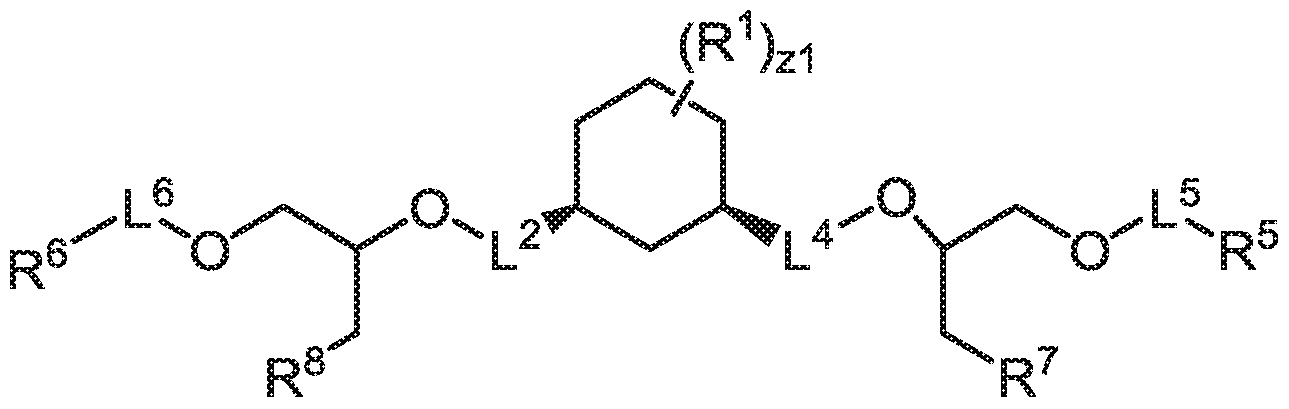
L , R , ', R ', and R are as described herein. 0127] In embodiments, the compound has the formula:

0128] In embodiments, the compound has the formula:

z2, R3, z3, L1, L2, L3, L4, L5, L6, L7, R5, R6, R7, R8, y3, and y2 are as described herein. In embodiments, R3 or R6 is a steroid moiet>' when y2 and y3 are both 0. In embodiments, R5 and R6 are optionally different steroid moieties when y2 and y3 are both 0. 0129] In embodiments, the compound has the formula:

R2, 7.2, R3, z3, L1, L2, L3, L4, lA L6, R5, R6, R7, R8, y3, and y2 are as described herein. The symbol n is an integer from 1 to 100. In embodiments, R5 or R° is a steroid moiety when y2 and v3 are both 0. In embodiments, R5 and Rb are optionally different steroid moieties when y2 and y3 are both 0. In embodiments, the compound has the formula:

[Θ13Θ] In embodiments, the compound has the formula:

R 7, and R8 are as described herein; and n is an integer from 10 to 18. In embodiments, Rs a steroid moiety. In embodiments, R'5 and Rb are optionally different steroid moieties.
[0131 ] In embodiments, the compound has the formula:

[0132] In embodiments, the compound has the formula:


R5, R°, R', and R8 are as described herein. The symbols n3 and n4 are independently integers from 1 to 50. In embodiments, n3 and n4 are independently an integer from 3 to 1 8. In embodiments, n! and n2 are independently 4.
[0134] In embodiments, the compound has the formula:

are as described herein. The symbols ml and m2 are independently integers from 0 to 50. In embodiments, ml and m2 are integers from 1 to 20. In embodiments, ml and m2 are independently 3. In embodiments, n is an integer from 1 to 50. In embodiments, n is an integer from 1 to 20. In embodiments, n is an integer from 10 to 18. In embodiments, n is 10.
In embodiments, the compound has the formula:

wherein R7 and R8 are as described herein. [0137] In embodiments, L1 is a
bond, -S< ()).-. -NH-, -0-, -S-, -C(O)-, -C(0)NH-, -\i !( {())-. -NHC(0)NH-, -NHC(0)NH-, -C(0)0-, -OC(O)-, substituted or unsubstituted alkylene (e.g., C-. -Cso alkylene, CJO-CJO alkylene, or C 30-C20 alkylene), or substituted or unsubstituted heteroalkylene (e.g., 2 to 50 membered heteroalkylene, 10 to 50 membered heteroalkylene, or 10 to 20 membered heteroalkylene). In embodiments, V is a bond. In embodiments, L1 is -S(0)2-. In embodiments, L1 is -NH-. In embodiments, L! is -0-, In embodiments, Ls is -S-. In embodiments, L! is -C(O)-. In
embodiments, L1 is -C(0)NH-. In embodiments, L1 is -NHC(O)-. In embodiments, L1 is -NHC(0)NH-. In embodiments, L! is ~NHC(0)NH~. In embodiments, L1 is -C(0)0-. In embodiments, Ls is -OC(O)-.
[01381 hi embodiments, L1 is a substituted or unsubstituted alkylene (e.g., C1; C2, C3, C4, C5, C6, C7, C8, C9, Cio, C11, C12, C 1 3, CM, C15, C16, C17, C18, C19, C?o, C21, C22, C23, C24, C25, C26, C27, C28, C29, C30, C31, C32, C33, C34, C35, C36, C37, C3g, C39, C40, C41, C42, C43, C44, C45, C46, C47, C48, C49, or C50 alkylene). In embodiments, V is R24-substituted or unsubstituted alkylene (e.g., C-. -Cso alkylene, C 30-C50 alkylene, or C10-C20 alkylene). In embodiments, L1 is R24-substituted alkylene (e.g. , C1-C50 alkylene, C10-C50 alkylene, or C 10-C20 alkylene). In embodiments, L1 is an unsubstituted alkylene (e.g., C Cso alkylene, C ui-Cso alkylene, or C10-C20 alkylene). In embodiments, Ls includes at least one unsaturated bond. In embodiments, L1 includes at least two unsaturated bonds. In embodiments, L1 includes one unsaturated bond. In embodiments, 1/ includes two unsaturated bonds.
[0139] In embodiments, L1 is R 4-substituted or unsubstituted heteroalkylene (e.g., 2 to 50 membered heteroalkylene, 10 to 50 membered heteroalkylene, or 10 to 20 membered heteroalkylene). In embodiments, L1 is R24-substituted heteroalkylene (e.g., 2 to 50 membered
heteroalkvlene, 10 to 50 niembered heteroalkvlene, or 10 to 20 niembered heteroalkvlene). In embodiments, L! is an unsubstituted lieteroalkylene (e.g., 2 to 50 niembered heteroalkvlene, 10 to 50 membered lieteroalkylene, or 10 to 20 membered lieteroalkylene). In embodiments, L] is R24-substituted or unsubstituted alkenylene (e.g., C2-C50, C10-C50, or Cio~C?o). In embodiments, L1 is R 4-substituted alkenylene (e.g., C2-C50, C-.Q-CSO, or C!o-C2o). In embodiments, L3 is an unsubstituted alkenylene (e.g., C2-C50, C10-C50, or C10-C20). I embodiments, L1 is R24- substituied or unsubstituted alkynylene (e.g. , C2-C50, Cio-C50, or Cio~C2o). In embodiments, Ll is R 4-substituted alkynylene (e.g., C2-Cso, C JO-CSO, or C]o-C2o). In embodiments, L1 is an unsubstituted alkynylene (e.g., C2-C50, C10-C50, or C10-C20).
[0140] In embodiments, L1 is a substituted or unsubstituted branched alkylene (e.g. , C3, C4, C5, Ce, C'7, Cg, C9, Cio, C11, C12, C , C14, C15, Cie, Cn, Ci8, C19, C20, C21, C22, C23, C24, C25, C?6, C27, C2g, C29, C30, C31, C32, C33, C34, C35, C36, C37, C38, C39, C40, C4], C42, C43, C44, C45, C46, C47, C48, C49, or C50 branched alkylene). In embodiments, Ls is R24-substituted or unsubstituted branched alkylene (e.g., C3-C50 branched alkylene, C10-C50 branched alkylene, or C 10-C20 branched alkylene). In embodiments, L1 is R24~substituted branched alkylene (e.g., C3-C50 branched alkylene, C10-C50 branched alkylene, or C10-C20 branched alkylene). In embodiments, L3 is an unsubstituted branched alkylene (e.g., C3-C59 branched alkylene, C 10-C59 branched alkylene, or C10-C20 branched alkylene).
[0141] In embodiments, L2 is a
bond, -Si. () ! . ·. -NH-, -0-, -S-, -C(O)-, -('l O)M k -NHC(O)-, -Ni 1( { (»M I · . -NHC(0)NH-, -C(0)0-, -OC(0)~, substituted or un substituted alkylene (e.g., C 1 -C50 alkylene, C 10-C50 alkylene, or Cio-C20 alkylene), or substituted or unsubstituted heteroalkvlene (e.g., 2 to 50 membered lieteroalkylene, 10 to 50 membered heteroalkvlene, or 10 to 20 membered heteroalkvlene). In embodiments, L2 is a bond. In embodiments, L is -S(O)?-. In embodiments, L2 is -Nil-. In embodiments, L2 is -0-, In embodiments, L2 is -S-. In embodiments, L2 is ~C(0)~. In
embodiments, L2 is -C(0)NH-. In embodiments, L2 is -NHC(O)-. In embodiments, L2 is -NHC(0)NH-. In embodiments, L2 is -NHC(0)NH-. In embodiments, L2 is -C(0)0-. In embodiments, L2 is -OC(O)-. In embodiments, L2 includes at least one unsaturated bond. In embodiments, L2 includes at least two unsaturated bonds. In embodiments, L2 includes one unsaturated bond. In embodiments, L includes two unsaturated bonds.
[0142] In embodiments, L2 is a substituted or unsubstituted alkylene (e.g., Ci, C2, C3, C4, Cs,
C6, C7, Cg, C9, Cio, Cn, C12, Co, C , Ci5, Ci6, Cn, C i g, C19, C2o, C21, C22, C23, C24, C25, C26, C27, C2g,
C , C30, C31, C32, C33, C34, C35, C36, C37, C38, C39, C40, C41, C42, C43, C44, C45, C46, C47, C48, C49, or C50 alkylene). In embodiments, L2 is R25-substituted or unsubstituted alkylene (e.g., C-.-Cso alkylene, C 10-C50 alkylene, or C10-C20 alkylene). In embodiments, L2 is R25-substituted alkylene (e.g. , C1-C50 alkylene, C10-C50 alkylene, or C io-C?o alkylene). In embodiments, L2 is an
unsubstituted alkylene (e.g., C1-C50 alkylene, C10-C 50 alkylene, or C10-C20 alkylene).
[0143] In embodiments, L2 is R25-substituted or unsubstituted heteroalkvlene (e.g., 2 to 50 membered heieroalkylene, 10 to 50 membered heieroalkylene, or 10 to 20 membered heteroalkvlene). In embodiments, L2 is R/" -substituted heteroalkvlene (e.g., 2 to 50 membered heteroalkvlene, 10 to 50 niembered heteroalkvlene, or 10 to 20 membered heteroalkvlene). In embodiments, L2 is an unsubstituted lieteroalkylene (e.g. , 2 to 50 membered heteroalkvlene, 10 to 50 membered heieroalkylene, or 10 to 20 membered heieroalkylene). In embodiments, 1/ is R 5-substituted or unsubstituted alkenylene (e.g., C2-C50, C10-C50, or C10-C20). In embodiments, L2 is R 5-substituted alkenylene (e.g., C2-C50, C-.Q-CSO, or Cio-C2o). In embodiments, L2 is an unsubstituted alkenylene (e.g., C2-C59, C10-C50, or C10-C20). I embodiments, L2 is R2i- substituted or unsubstituted alkynylene (e.g. , C2-C50, C10-C50, or Cio-C2o). In embodiments, L2 is R25-substituted alkynylene (e.g., C2-C50, C10-C50, or C10-C20). In embodiments, L2 is an unsubstituted alkynylene (e.g., C2-C50, Cio-C50, or CW-C2Q)-
[0144] In embodiments, L" is a substituted or unsubstituted branched alkylene (e.g., C3, C4, C5, Ce, C'7, Cg, C9, Cio, Cn, C12, C , C14, C15, Cie, Cn, Ci8, C19, C20, C21, C22, C23, C24, C25, C26, C27, C28, C29, C30, C31, C32, C33, C34, C35, C36, C37, C3 , C39, C40, C4], C42, C43, C44, C45, C46, C47, C4 , C49, or C59 branched alkylene). In embodiments, L2 is R"5-substituted or unsubstituted branched alkylene (e.g., C3-C50 branched alkylene, C10-C50 branched alkylene, or Ci0-C2o branched alkylene). In embodiments, L is R25-substituted branched alkylene (e.g., C3-C50 branched alkylene, C10-C50 branched alkylene, or C10-C20 branched alkylene). In embodiments, L2 is an unsubstituted branched alkylene (e.g., C3-C50 branched alkylene, C 10-C59 branched alkylene, or Cio~C2o branched alkylene).
[014S| In embodiments, L' is a
bond, -S(0)2-, -NH-, -0-, -S-, -C(0)-5 -C(0)NH-, -NHC(O)-, -M 1('! ( ))M I·. -NHC(0)NH-5
-C(0)0-, -OC(0)-, substituted or i,m substituted alkylene (e.g., C 1 -C50 alkylene, C 10-C50 alkylene, or Cio-C2o alkylene), or substituted or unsubstituted heteroalkvlene (e.g., 2 to 50 membered lieteroalkylene, 10 to 50 niembered heteroalkvlene, or 10 to 20 membered heteroalkvlene). In embodiments, L3 is a bond. In embodiments, V is -S(0)2-. In embodiments, L3 is -NH-. In
embodiments, If is -0-. In embodiments, L3 is -S-. In embodiments, L' is -C(O)-. In
embodiments, LJ is -C(0)NH-. In embodiments, LJ is -NHC(O)-. In embodiments, L' is -NHC(0)NH-. In embodiments, L3 is -NHC(0)NH-. In embodiments, L3 is -C(0)0-. In embodiments, L3 is -OC(O)-.
[0146] In embodiments, If is a substituted or tmsubstituted alkylene (e.g., d, C2, C3, C4, C5, d, d, Cg, Cg, Cio, C11, Ci2, Co, C14, ds, Cie, C37, Cie, C19, do, C21, C22, C23, C , ds, d.6, C27, C28, C29, do, C31, C32, C33, C34, C35, C36,€37, C38, C39, C40, C41, C42, C43, C44, C45, C46, C47, Gig, C49, or C50 alkylene). In embodiments, If is R2o-substituted or unsubstituted alkylene (e.g., d~ o alkylene, do-do alkylene, or do-do alkylene). In embodiments, LJ is R2b-substituted alkylene (e.g. , C1-C50 alkylene, C10-C50 alkylene, or do-C2o alkylene). In embodiments, is an unsubstituted alkylene (e.g., d-do alkylene, do-Cso alkylene, or C10-C20 alkylene). In embodiments, L3 includes at least one unsaturated bond. In embodiments, L3 includes at least two unsaturated bonds. In embodiments, L' includes one unsaturated bond. In embodiments, LJ includes two unsaturated bonds.
[0147] In embodiments, L3 is R26-substituted or unsubstituted heteroalkylene (e.g., 2 to 50 membered heteroalkylene, 10 to 50 membered heteroalkylene, or 10 to 20 membered heteroalkylene). In embodiments, L' is R2o-substituted heteroalkylene (e.g., 2 to 50 membered heteroalkylene, 10 to 50 membered heteroalkylene, or 10 to 20 membered heteroalkylene). In embodiments, L3 is an unsubstituted heteroalkylene (e.g. , 2 to 50 membered heteroalkylene, 10 to 50 membered heteroalkylene, or 10 to 20 membered heteroalkylene). In embodiments, L3 is R^-substituted or unsubstituted alkenylene (e.g., C2-C50, C10-C50, or C10-C20). I embodiments, L3 is R/6-substituted alkenylene (e.g., d-do, do-do, or do-C2o). In embodiments, L3 is an unsubstituted alkenylene (e.g., C2-C50, o-Cso, or do-do). In embodiments, is R2b- substituted or unsubstituted alkynylene (e.g., C2-C50, C10-C50, or do-C2o)- I embodiments, L' is R26-substituted alkynylene (e.g. , C2-C50, C10-C50, or C10-C20). In embodiments, L3 is an unsubstituted alkynylene (e.g., C2-C50, C10-C50, or C10-C20).
[0148| In embodiments, L' is a substituted or unsubstituted branched alkylene (e.g., C3, C4, C5,
Ce, C-, Ce, C9, Cio, u, C12, Co, C14, C15, Cie, C37, Cie, C19, C20, C21, C22, C23, C24, C25, de, C27, C28,
C29, C30, C31, C32, C33, C34, C35, C36, C37, C38, C39, C40, C41, C42, C43, C44, C45, C46, C47, Gig, C49, or do branched alkylene). In embodiments, L' is R2o-substituted or unsubstituted branched alkylene (e.g., C3-C50 branched alkylene, do-Cso branched alkylene, or do-do branched alkylene). In embodiments, LJ is R26-substituted branched alkylene (e.g., C3-C50 branched
alkylene, CJO-CJO branched alkylene, or C10-C2o branched alkylene). In embodiments, L3 is an unsubstituted branched alkylene (e.g., C3-C50 branched alkylene, C-.o-Cso branched alkylene, or C10-C20 branched alkylene).
[0149] In embodiments, L is a
bond, ~S{ (> !.. -. -NH-, -0-, -S-, -C(O)-, -('lO)M k -NHC(O)-, -Ni 1( {(»M I·. -NHC(0)NH-, -C(0)0-, -OC(O)-, substituted or unsubstituted alkylene (e.g., CrC5o alkylene, C10-C50 alkylene, or C10-C20 alkylene), or substituted or unsubstituted heteroalkvlene (e.g., 2 to 50 membered heteroalkvlene, 10 to 50 membered heteroalkvlene, or 10 to 20 membered heteroalkvlene). In embodiments, L4 is a bond. In embodiments, L4 is -S(0)2-. In embodiments, L4 is -NH-. In embodiments, L4 is -0-, In embodiments, L4 is -S-. In embodiments, L4 is ~C(0)~. In
embodiments, L4 is -C(0)NH-. In embodiments, L4 is -NHC(O)-. In embodiments, L4 is -NHC(0)NH-. In embodiments, L4 is -NHC(0)NH-. In embodiments, L4 is -C(0)0-. In embodiments, L4 is -OC(O)-.
[OlSO In embodiments, L4 is a substituted or unsubstituted alkylene (e.g., C1; C2, C3, C4, C5, Ce, C'7, Cg, C9, Cio, C11, C12, , C14, C15, Ci6, C17, C18, C19, C?o, C21, C22, C23, C24, C25, C26, C27, C28, C29, C30, C31, C32, C33, C34, C35, C36, C37, C38, C39, C40, C41, C42, 43, C44, C45, C46, C47, C48, C49, or C50 alkylene). In embodiments, L4 is R2 '-substituted or unsubstituted alkylene (e.g., C-.-Cso alkylene, C 10-C50 alkylene, or C10-C20 alkylene). In embodiments, L4 is R2 '-substituted alkylene (e.g. , C1-C50 alkylene, C10-C50 alkylene, or Cio-C2o alkylene). In embodiments, L4 is an unsubstituted alkylene (e.g., Cj-Cso alkylene, Cui-Cso alkylene, or C10-C20 alkylene). In embodiments, L4 includes at least one unsaturated bond. In embodiments, L4 includes at least two unsaturated bonds. In embodiments, L4 includes one unsaturated bond. In embodiments, L4 includes two unsaturated bonds.
[0151] In embodiments, L4 is R27-substituted or unsubstituted heteroalkvlene (e.g., 2 to 50 membered heteroalkyiene, 10 to 50 membered lieteroalkylene, or 10 to 20 membered heteroalkvlene). In embodiments, L4 is R2 '-substituted lieteroalkylene (e.g., 2 to 50 membered heteroalkvlene, 10 to 50 membered lieteroalkylene, or 10 to 20 membered lieteroalkylene). In embodiments, L4 is an unsubstituted heteroalkyiene (e.g., 2 to 50 membered lieteroalkylene, 10 to 50 membered heteroalkyiene, or 10 to 20 membered heteroalkyiene). In embodiments, L4 is
R '-substituted or unsubstituted alkenylene (e.g., C2-C50, C10-C50, or C10-C20). In embodiments,
L4 is R2 '-substituted alkenylene (e.g., C2-Cso, Cui-Cso, or Cui-Czo). In embodiments, L4 is an unsubstituted alkenylene (e.g., C2-C50, C10-C50, or C 10-C20). In embodiments, L4 is R -
substituted or unsubstituted alkynylene (e.g., C2-C50, C10-C50, or CKTCJO). In embodiments, L* is R2 '-substituted alkynylene (e.g., C2-C50, C10-C50, or C10-C20). In embodiments, L4 is an unsubstituted alkynylene (e.g., C2-C50, C10-C50, or C10-C20).
[0152] In embodiments, is a substituted or unsubstituted branched alkylene (e.g., C3, C4, C5,
C(„ C7, C8, C9, CjO, Cj j, C12, Ci3, C j4, Cl5, Ci6, Cj7, Cl8, Ci9, C20, C21, C22, C23, C24, C25, C26, C27, C28,
C29, C30, C31, C32, C33, C34, C35, C36, C37, C38, C39, C40, C41, C42, C43, C44, C45, C 6, C47, C48, C49, or C59 branched alkylene). In embodiments, L is R"' -substituted or unsubstituted branched alkylene (e.g., C3-C50 branched aikviene. Cj0-C5o branched alkylene, or CjQ-Cjo branched alkylene). In embodiments, L4 is R2 '-substituted branched alkylene (e.g., C3-C50 branched alkylene, C 10-C50 branched alkylene, or C10-C20 branched alkylene). In embodiments, L4 is an unsubstituted branched alkylene (e.g., C3-C50 branched alkylene, CnrCso branched alkylene, or C10-C20 branched alkylene).
[0153] In embodiments, V is a
bond, -S(0)2-, -NH-, -0-, -S-, -C(0)-5 -C(0)NH-, -NHC(0)-, -M I('!())M I·. -NHC(0)NH-,
-C(0)0~, -OC(0)~, substituted or unsubstituted alkylene (e.g., Ci-Cioo alkylene, Ci-Cso alkylene, Cjo-Cso alkylene, or C 10-C20 alkylene), or substituted or unsubstituted heteroalkylene (e.g., 2 to 50 membered heteroalkylene, 10 to 50 membered heteroalkylene, or 10 to 20 membered heteroalkylene). In embodiments, L5 is a bond. In embodiments, L5 is -S(0)2-. In embodiments, L3 is -NH-. In embodiments, L5 is -0-. In embodiments, L5 is -S-. In embodiments, L5 is -C(O)-. In embodiments, V is -C(0)NH-. In embodiments, L5 is -NHC(O)-. In embodiments, L5 is -NHC(0)NH-. In embodiments, L5 is -NHC(0)NH-. In embodiments, L5 is -C(0)0-. In embodiments, i is -OC(0)~. In embodiments, L5 includes at least one unsaturated bond. In embodiments, V includes at least two unsaturated bonds. In embodiments, L'1 includes one unsaturated bond. In embodiments, L5 includes two unsaturated bonds.
[Θ154] In embodiments, L5 is a substituted or unsubstituted alkylene (e.g., Ci, C2, C3, C4, C5, Ce, C7, Cg, C9, Cio, Cn, C12, Co, Ci4, C 15, Cie, Cn, Ci8, C19, C20, C21, C22, C23, C24, C25, C?6, C27, C28, C29, C30,€31, C32, C33, C34, C35, C36, C37, C38, C39, C40, C4], C42, C43, C44, C45, C46, C47, C48, C49, C50, C51, C52, C53, C54, C55, C56, C57, C58, C 59, Ceo, Cei, Ce2, Ce?, Ce4, Ces, Cee, C(n, Ces, C-69, C70, C71, C72,
C73, C74, C75, C76, C77, C78, C79, Cso, C81, C82, C83, Cs4, Cs5, Cg6, Cs7, C88, C89, C99, C91, C92, C93, C94,
C95, C%, C97, C95, C99, or C 100 alkylene). In embodiments, L5 is R2S-substituted or unsubstituted alkylene (e.g., C-.-Cioo alkylene, C-.-Cso alkylene, CJO-CJO alkylene, or Cui-Czo alkylene). In embodiments, L5 is R28-substituted alkylene (e.g., Ci-Cioo alkylene, C1-C50 alkylene, C10-C50
alkylene, or do-do alkylene). In embodiments, V is an unsubstituted alkylene (e.g., C Cioo alkylene, C 3 -C50 alkylene, do-do alkylene, or C 10-C20 alkylene).
[Θ155] In embodiments, L5 is R28-substituted or unsubstituted heteroalkylene (e.g., 2 to 100 membered heteroalkylene, 2 to 50 membered heteroalkylene, 10 to 50 membered heteroalkylene, or 10 to 20 membered heteroalkylene). In embodiments, L'1 is R B-substituted heteroalkylene (e.g., 2 to 100 membered heteroalkylene, 2 to 50 membered heteroalkylene, 10 to 50 membered heteroalkylene, or 10 to 20 membered heteroalkylene). In embodiments, L5 is an unsubstituted heteroalkylene (e.g., 2 to 100 membered heteroalkylene, 2 to 50 membered heteroalkylene, 10 to 50 membered heteroalkylene, or 10 to 20 membered heteroalkylene). In embodiments, L5 is R28- substituted or unsubstituted alkenylene (e.g., d-do, C10-C50, or C10-C20). in embodiments, L5 is R28-substituted alkenylene (e.g., d-do, do-Cso, or Cio-C2o). In embodiments, L5 is an unsubstituted alkenylene (e.g., C2-C50, C10-C50, or C 10-C20). In embodiments, L5 is R28- substituted or unsubstituted alkynylene (e.g., C2-C50, do-do, or do-do). In embodiments, L5 is Ri8-substituted alkynylene (e.g., d-do, C19-C50, or C19-C2G). I embodiments, L5 is an unsubstituted alkynylene (e.g., d-do, C10-C50, or C10-C20).
[0156] In embodiments, L5 is a substituted or unsubstituted branched alkylene (e.g., C3, d, C , d, C7, d, C9, do, C11, C12, Ci3, Cw, C 35, Ci6, Cn, Ci8, C19, do, di, d,2, C23, d.4, ds, de, d~, C28, dsi, C30, C31, C32, C33, C34, C35, C36, C37, C38, C39, do, di, d2, d?„ C44, C45, de, C47, ds, C49, C50, C51, C52, C53, C54, C55, C56, C57, C58, C59, Ceo, di, 2. Gas, 4, ds, de, Ce?, ds, 9, C70, di, C ,
C73, C74, C75, C76, C77, C78, C79, m, CgJ, CR2, CS3, Cf¾4, C»5, Cg6, CS7, Cgg, C%9, C90, C9] , C92, C93, C94,
C95, C96, C97, C98, C99, or doo branched alkylene). In embodiments, L5 is R 8-substituted or unsubstituted branched alkylene (e.g., d~doo branched alkylene, d~do branched alkylene, dodo branched alkylene, or do~do branched alkylene). In embodiments, L5 is R 8-substituted branched alkylene (e.g., d-doo branched alkylene, d-do branched alkylene, Cio-do branched alkylene, or do-do branched alkylene). In embodiments, L5 is an unsubstituted branched alkylene (e.g., d-doo branched alkylene, d-do branched alkylene, do-do branched alkylene, or do-do branched alkylene).
[0157] In embodiments, Lb is a
bond, -S(0)2-, -NH-, -0-, -S-, -C(O)-, -C(0)NH-, -NHC(O)-, -NHC(0)NH-, -NHC(0)NH-5
-C(0)0~, -OC(0)~, substituted or unsubstituted alkylene (e.g., d-doo alkylene, d-do alkylene, do- o alkylene, or do-do alkylene), or substituted or unsubstituted heteroalkylene (e.g., 2 to
50 membered heteroalkylene, 10 to 50 membered heteroalkylene, or 10 to 20 membered
heteroalkylene). In embodiments, L6 is a bond. In embodiments, L° is -S(0)2-. In embodiments, L6 is -NH-. In embodiments, L6 is -0-. In embodiments, Lb is -S-. In embodiments, L6 is -C(O)-. In embodiments, L6 is -C(0)NH-. In embodiments, L6 is -NHC(O)-. In embodiments, L6 is -NHC(0)NH-. In embodiments, L6 is ~NHC(0)NH~. In embodiments, L6 is -( (OK)-. In embodiments, L6 is -OC(O)-. In embodiments, L6 includes at least one unsaturated bond. In embodiments, L6 includes at least two unsaturated bonds. In embodiments, L6 includes one unsaturated bond. In embodiments, L6 includes two unsaturated bonds.
[0158] In embodiments, L6 is a substituted or unsubstituted alkylene (e.g., Ci, C2, C3, C4, C$,
Cf„ C7, Cg, C , Cio, C11, Cj2, Co, Ci4, Cj5, Cl6, Cl7, C]g, C]9, C20, C21, C22, C?3, C24, C25, C26, C27, C28, C29, C30, C31, C32, C33, C34, C35, C36, C37, C38, C39, C40, C41, C42, C43, C44, C45, C46, C47, C48, C49, C50,
C51, C52, C53, C54, C55, C56, C57, C38, C59, Ceo, Cei, Ct2,€53, C ,4, Ces, Cee, C67, Cee, Ce9, C70, C 71, C72,
C73, C74, C75, C76, C77, C78, C79, m, CgJ, C82, Cs3, Cs4, C»5, Cg6, CS7, Cgg, Cs , C90, C9] , C92, C93, C94,
C95, < '·.·,.. C97, C¾8, C99, or ( '
 In embodiments, I ." is R S-substituted or unsubstituted alkylene (e.g., Ci-Cioo alkylene, C1-C50 alkylene, C10-C50 alkylene, or C10-C20 alkylene). In embodiments, L° is R29-substituted alkylene (e.g., C1-C100 alkylene, C1-C50 alkylene, C10-C50 alkylene, or C10-C20 alkylene). In embodiments, L6 is an unsubstituted alkylene (e.g., Ct-Cioo alkylene, Ci-C50 alkylene, C10-C50 alkylene, or C i0-C2o alkylene).
[0159] In embodiments, L6 is R^-substituted or unsubstituted heteroalkylene (e.g., 2 to 100 membered heteroalkylene, 2 to 50 membered heteroalkylene, 10 to 50 membered heteroalkylene, or 10 to 20 membered heteroalkylene). In embodiments, Lb is R 9-substituted heteroalkylene (e.g., 2 to 100 membered heteroalkylene, 2 to 50 membered heteroalkylene, 10 to 50 membered heteroalkylene, or 10 to 20 membered heteroalkylene). In embodiments, L6 is an unsubstituted heteroalkylene (e.g., 2 to 100 membered heteroalkylene, 2 to 50 membered heteroalkylene, 10 to 50 membered heteroalkylene, or 10 to 20 membered heteroalkylene). In embodiments, L6 is R29- substituted or unsubstituted alkenylene (e.g., C2-C50, C10-C50, or C10-C20). I embodiments, LD is R29-substituted alkenylene (e.g., C2-C50, Cio-Cso, or Cjo-C2o). In embodiments, L6 is an unsubstituted alkenylene (e.g., C2-C50, Cio-Cso, or C 10-C2o). In embodiments, Lb is R29- substituted or unsubstituted alkynylene (e.g., C2-C50, C10-C50, or C10-C20). In embodiments, L6 is Ri9-substituted alkynylene (e.g., C2-C50, C19-C50, or C10-C20). I embodiments, L6 is an unsubstituted alkynylene (e.g., C2-Cso, Cui-Cso, or Cui-Czo).
[0160] In embodiments, L6 is a substituted or unsubstituted branched alkylene (e.g. , C3, C4, C , C6, C7, Cs, C9, Cio, C11, C12, Co, C , C15, C16, C17, C^, C19, C20, C21, C22, C23, C24, C25, C26, C27, C28,
C2 , C30, C31, C32, C33, C34, C35, C36, C37, C38, C39, C40, C41, C42, C43, C44, C45, C46, C47, C48, C49, C50, C51, C52, C53, C54, C55, C56, C57, C58, C59, Ceo, Cei,€52, Ces, C-64, Ces, Cee, Ce?, Οββ, Ce9, C70, C71, C72,
C73, C74, C75, C76, C77, (' ·!;. C79, C80, ( K ! . Cg2, Cs3, ( H i . Cs5, C86, C87, ( 'κχ. Cg9, C90, C91, C92, C93, C94,
C95, C%, C97, Cgg, C99, or Cioo branched alkvlene). In embodiments, L° is R 9-substituted or unsubstituted branched alkylene (e.g., C3-C 100 branched alkvlene, C1-C50 branched alkvlene, C10- C59 branched alkylene, or C10-C20 branched alkvlene). In embodiments, L6 is R29-substituted branched alkylene (e.g., C3-C100 branched alkylene, C3-C50 branched alkylene, C10-C50 branched alkylene, or C 10-C20 branched alkylene). In embodiments, L° is an unsubstituted branched alkylene (e.g., C3-C100 branched alkylene, C3-C50 branched alkylene, C10-C50 branched alkylene, or C10-C20 branched alkylene).
[0161] In embodiments, i . is a
bond, ~S{ (> !.. -. -NH-, -0-, -S-, -C(O)-, -('lO)M k -NHC(O)-, -Ni 1( {(»M I·. -NHC(0)NH-, -C(0)0-, -OC(O)-, substituted or unsubstituted alkylene (e.g., C-. -Cioo alkylene, CrC5o alkylene, C19-C50 alkylene, or C 10-C20 alkylene), or substituted or unsubstituted heteroalkylene (e.g., 2 to 50 membered heteroalkylene, 10 to 50 membered heteroalkylene, or 10 to 20 membered heteroalkylene). In embodiments, L7 is a bond. In embodiments, L ' is -S(0)2-. In embodiments, L7 is -NH-. In embodiments, L' is -0-. In embodiments, V is -S-. In embodiments, L' is -C(O)-. In embodiments, L' is -C(0)NH-. In embodiments, L' is -NHC(O)-. In embodiments, L' is -NHC(0)NH-. In embodiments, L7 is -NHC(0)NH-. In embodiments, L7 is -C(0)0-. In embodiments, V is -OC(O)-. In embodiments, L'' includes at least one unsatoated bond. In embodiments, L' includes at least two unsaturated bonds. In embodiments, L' includes at least three unsaturated bonds. In embodiments, L ' includes at least four unsaturated bonds. In embodiments, L ' includes at least five unsaturated bonds. In embodiments, L7 includes at least six unsaturated bonds. In embodiments, V includes one unsaturated bond. In embodiments, L7 includes two unsaturated bonds. In embodiments, L' includes three unsaturated bonds. In embodiments, L7 includes four unsaturated bonds, in embodiments, L7 includes five unsaturated bonds. In embodiments, L ' includes six unsaturated bonds.
[0162] In embodiments, L7 is a substituted or unsubstituted alkylene (e.g., C1; C2, C3, C4, Cs, C6, C7, C8, C9, Cio, C11, C12, C 1 3, CM, C15, C16, C17, C18, C19, C20, C21, C22, C23, C24, C25, C26, C2 , C28, C29, C30, C31, C32, C33, C34, C35, C36, C37, C38, C39, C40, C41, C42, C43, C44, C45, C46, C47, C48, C49, C50, C51, C52, C53, C54, C55, C56, C57, C58, C59, Ceo, Cei, Cei, C :„ C-64, Ces, Cee, Cei, Cgg, C C70, C71, C72,
C73, C74, C75, C76, C77, (' ·!;. C79, C80, Csi, Cs >. ί 'χ ,. ( H i . Cs5, C86, C87, C88, Cs9, C90, C91, C92, C93, C94,
C 5, C96, C97, C 8, C99, or Cioo alkylene). In embodiments, L7 is R3°-substituted or tmsubstituted alkylene (e.g., C-. -Cioo alkylene, C-. -Cso alkylene, C 30-C50 alkylene, or C10-C20 alkylene). In embodiments, L7 is R30-substituted alkylene (e.g., C1-C190 alkylene, C1-C59 alkylene, C10-C59 alkylene, or Cio-C2o alkylene). In embodiments, L7 is an unsubstituted alkylene (e.g., C Cioo alkylene, C1-C50 alkylene, C10-C50 alkylene, or C]o-C2o alkylene).
[0163] In embodiments, L ' is Rj0-substituted or unsubstituted heteroaikylene (e.g., 2 to 100 membered heieroalkylene, 2 to 50 membered heieroalkylene, 10 to 50 membered heteroaikylene, or 10 to 20 membered heteroaikylene). In embodiments, L7 is R^-substituted heteroaikylene (e.g., 2 to 100 membered heteroaikylene, 2 to 50 membered heteroaikylene, 10 to 50 membered heteroaikylene, or 10 to 20 membered heteroaikylene). In embodiments, L7 is an unsubstituted heteroaikylene (e.g., 2 to 100 membered heteroaikylene, 2 to 50 membered heteroaikylene, 10 to 50 membered heteroaikylene, or 10 to 20 membered heteroaikylene). In embodiments, L ' is Unsubstituted or unsubstituted alkenyiene (e.g., C2-C50, C-.o-Cso, or Cio-C2o)- In embodiments, L ' is R3,J-substituted alkenyiene (e.g., C2-C59, C10-C50, or C 19-C20). In embodiments, L ' is an unsubstituted alkenyiene (e.g., CVC59, C10-C50, or Cio-C2o). In embodiments, L7 is R'°- substituted or unsubstituted alkynylene (e.g., C2-C50, C19-C50, or Ci0-C2o)- In embodiments, L ' is Rj0-substituted alkynylene (e.g., C2-C50, C10-C50, or C10-C20). In embodiments, L7 is an unsubstituted alkynylene (e.g., C2-C50, C10-C50, or C10-C20).
[0164] In embodiments, 1/ is a substituted or unsubstituted branched alkylene (e.g., C3, C4, C5,
C(„ C7, C8, C9, CJO, Cj j , C12, Ci3, C j4, Cl5, Ci6, Cj7, Cl8, Ci9, C20, C21, C22, C23, C24, C25, C26, C27, C28,
C29, C30, C31, C32, C33, C34,€35, C36, C37, C38, C39, C40, C41, C42, C43, C44, C45, C46, C47, C48, C49, C50, C51 , $2, C53, C54, C55, C56, C57, C58, C59, Ceo, Cei, C62, C< , Ce4, C65, Cee, C67, Ces, C69, C7o, C71, C72, C73, C74, C75, C?6, C77, C78, C79, C»o, Csi, Cg2, Cg3, M, CSS, Cm, Ctn, Css, Cg9, C 0, C91, C92, C93, C94, C95, C¾6, C97, C-98, C99, or Cioo branched alkylene). In embodiments, L' is R3u-substituted or unsubstituted branched alkylene (e.g., C3-C190 branched alkylene, C3-C50 branched alkylene, Cio- C50 branched alkylene, or C10-C20 branched alkylene). In embodiments, L' is R30-substituted branched alkylene (e.g., C3-C100 branched alkylene, C3-C50 branched alkylene, C
 branched alkylene, or C 10-C29 branched alkylene). In embodiments, L' is an unsubstituted branched alkylene (e.g., C3-C 100 branched alkylene, C3-C50 branched alkylene, C10-C50 branched alkylene, or C10-C20 branched alkylene).
[0165] In embodiments, L' is a substituted or unsubstituted alkylene, or substituted or unsubstituted heteroalkylene. In embodiments, L'' is a substituted or unsubstituted C1-C20 alkylene, or substituted or unsubstituted 2 to 20 membered heteroalkylene.
branched alkylene, or C 10-C29 branched alkylene). In embodiments, L' is an unsubstituted branched alkylene (e.g., C3-C 100 branched alkylene, C3-C50 branched alkylene, C10-C50 branched alkylene, or C10-C20 branched alkylene).
[0165] In embodiments, L' is a substituted or unsubstituted alkylene, or substituted or unsubstituted heteroalkylene. In embodiments, L'' is a substituted or unsubstituted C1-C20 alkylene, or substituted or unsubstituted 2 to 20 membered heteroalkylene.
[0166] In embodiments, Ll, ! . '.. L3, L4, I . and I ." are independently a bond, unsubstituted alkylene, or unsubstituted heteroalkylene. In embodiments, V is a bond. In embodiments, L] is unsubstituted alkylene. In embodiments, V is unsubstituted heteroalkylene. In embodiments, L2 is a bond. In embodiments, L2 is unsubstituted alkylene. In embodiments, L is unsubstituted heteroalkylene. In embodiments, L3 is a bond. In embodiments, L3 is unsubstituted alkylene. In embodiments, LJ is unsubstituted heteroalkylene. In embodiments, L4 is a bond. In
embodiments, L4 is unsubstituted alkylene. In embodiments, L4 is unsubstituted heteroalkylene. In embodiments, L3 is a bond. In embodiments, L5 is unsubstituted alkylene. In embodiments, L'1 is unsubstituted heteroalkylene. In embodiments, L] is unsubstituted C] -C2o alkylene. In embodiments, Ls is unsubstituted 2 to 20 membered heteroalkylene. In embodiments, L2 is unsubstituted C1-C20 alkylene. In embodiments, 1/ is unsubstituted 2 to 20 membered heteroalkylene. In embodiments, L3 is unsubstituted C1-C20 alkylene. In embodiments, l is unsubstituted 2 to 20 membered heteroalkylene. In embodiments, L4 is unsubstituted C -C20 alkylene. In embodiments, L4 is unsubstituted 2 to 20 membered heteroalkylene. In
embodiments, L5 is unsubstituted C i~C2o alkylene. In embodiments, L5 is unsubstituted 2 to 20 membered heteroalkylene.
[0167] In embodiments, R1 is halogen, -CX3, -CHX2, ··( i l -X. -OCX3, -
OCH2X, -OCHX2, -CN, -SH, -SO2H, -SO N! ! -. - HC(0)NH2, -N(0)2, -NH2, -( (()}! !. -( ! 0 )01 1 , -C(0)NH2, -OH, -NHSO2H, -NHC(0)H, -NHC(0)OH, -NHOH, substituted or unsubstituted alkyl (e.g., Ci-Cs alkyl, C C6 alkyl, or C1 -C4 alky I s. substituted or unsubstituted heteroalkyl (e.g., 2 to 8 membered heteroalkyl, 2 to 6 membered heteroalkyl, or 2 to 4 membered heteroalkyl), substituted or unsubstituted cycloalkyl (e.g.,
 cycloalkyl, C3-C6 cycloalkyl, or Cs-Cfi cycloalkyl), substituted or unsubstituted heterocycloalkyl (e.g., 3 to 8 membered heterocycloalkyl, 3 to 6 membered heterocycloalkyl, or 5 to 6 membered heterocycloalkyl), substituted or unsubstituted aryl (e.g., C6-Ci0 aryl, C10 aryl, or phenyl), or substituted or unsubstituted heteroaryl (e.g., 5 to 10 membered heteroaryl, 5 to 9 membered heteroaryl, or 5 to 6 membered heteroaryl).
[0168] In embodiments, Rl is R9-substituted or unsubstituted alkyl (e.g., C Cs alkyl, Ci-C(, alkyl, or C1-C4 alkyl), R9-substituted or unsubstituted heteroalkyl (e.g., 2 to 8 membered
heteroalkyl, 2 to 6 membered heteroalkyl, or 2 to 4 membered heteroalkyl), R9-substituted or unsubstituted cycloalkyl (e.g., C3-C8 cycloalkyl, C3-C6 cycioalkyl, or d-C6 cycloalkyl), Ry- substituted or unsubstituted heterocycloalkyi (e.g., 3 to 8 membered heterocycloalkyi, 3 to 6 membered heterocycloalkyi, or 5 to 6 membered heterocycloalkyi), R9~substituted or unsubstituted aryl (e.g., C6-do aryl, o aryl, or phenyl), or R9-substituted or unsubstituted heteroaryl (e.g., 5 to 10 membered heteroaryl, 5 to 9 membered heteroaryl, or 5 to 6 membered heteroary]),
[0169] In embodiments, R! is R9-substituted or unsubstituted alkyl (e.g., Ci-C8 alkyl, d-C6 alkyl, or d-d alkyl). In embodiments, R3 is R9-substituted alkyl (e.g., d-d alkyl, d-d alkyl, or C1-C4 alkyl). In embodiments, R1 is an unsubstituted alkyl (e.g., d-Cg alkyl, d-d alkyl, or C1-C4 alkyl).
[0170] In embodiments, R1 is R -substituted or unsubstituted heteroalkyl (e.g., 2 to 8 membered heteroalkyl, 2 to 6 membered heteroalkyl, or 2 to 4 membered heteroalkyl). In embodiments, R1 is R9-substituted heteroalkyl (e.g., 2 to 8 membered heteroalkyl, 2 to 6 membered heteroalkyl, or 2 to 4 membered heteroalkyl). In embodiments, R1 is an unsubstituted heteroalkyl (e.g., 2 to 8 membered heteroalkyl, 2 to 6 membered heteroalkyl, or 2 to 4 membered heteroalkyl).
[Θ171] In embodiments, R1 is R9-substituted or unsubstituted cycioalkyl (e.g., -d cycloalkyl, C3-C6 cycloalkyl, or d-d cycloalkyl). In embodiments, R1 is R9-substi luted cycloalkyl (e.g., (' : ·( 'κ cycloalkyl, d-d cycloalkyl, or d-d cycloalkyl). In embodiments, R1 is an unsubstituted cycloalkyl (e.g., d-d cycioalkyl, d-d cycloalkyl, or d-d cycloalkyl).
[0172] In embodiments, R1 is R9-substituted or unsubstituted heterocycloalkyi (e.g., 3 to 8 membered heterocycloalkyi, 3 to 6 membered heterocycloalkyi, or 5 to 6 membered
heterocycloalkyi). In embodiments, Rl is R9~substituted heterocycloalkyi (e.g., 3 to 8 membered heterocycloalkyi, 3 to 6 membered heterocycloalkyi, or 5 to 6 membered heterocycloalkyi). In embodiments, R1 is an unsubstituted heterocycloalkyi (e.g., 3 to 8 membered heterocycloalkyi, 3 to 6 membered heterocycloalkyi, or 5 to 6 membered heterocycloalkyi).
[0173] In embodiments, Rl is R9-substituted or unsubstituted aryl (e.g., C6-CJO aryl, C!0 aryl, or phenyl). In embodiments, R! is R9-substituted aryl (e.g., C - w aryl, Cjo aryl, or phenyl). In embodiments, R1 is an unsubstituted aiyl (e.g., Ce-C aryl, do aryl, or phenyl).
[0174] In embodiments, Rl is R9-substituted or unsubstituted heteroaryl (e.g., 5 to 10 membered heteroaryl, 5 to 9 membered heteroaryl, or 5 to 6 membered heteroaryl). In embodiments, Rl is R9-substituted heteroaryl (e.g., 5 to 10 membered heteroaryl, 5 to 9 membered heteroaryl, or 5 to 6 membered heteroaryl). In embodiments, R] is an unsubstituted heteroaryl (e.g., 5 to 10 membered heteroaryl, 5 to 9 membered heteroaryl, or 5 to 6 membered heteroaryl).
[0175] In embodiments, R1 is independently substituted or unsubstituted alkyl, substituted or unsubstituted heteroalkyl, substituted or unsubstituted cycloalkyl, substituted or unsubstituted heterocycloalkyi, substituted or unsubstituted aryl, or substituted or unsubstituted heteroaryl. In embodiments, R1 is independently substituted or unsubstituted Ci-Cg alkyl, or substituted or unsubstituted 2 to 8 membered heteroalkyl, substituted or unsubstituted C3 cycloalkyl, substituted or unsubstituted 3 to 8 membered heterocycloalkyi, substituted or unsubstituted phenyl, or substituted or unsubstituted 5 to 6 membered heteroaryl.
[0176] In embodiments, R2 is halogen, -CX3, -CHX2, -CH2X, -OCX3, -
OCH2X, -OCHX2, -CN, -SH, -SO2H, -SO2NH2, -NHC(0)NH2, -N(0)2, -NH2, -C(0)H, -C(0)OH , -C(0)NH2, -OH, -NHSO2H, M !( { ())! !. -NHC(0)OH, -NHOH, substituted or unsubstituted alkyl (e.g., Ci-Cs alkyl, Ci-Ce alkyl, or C -C4 alkyl), substituted or unsubstituted heteroalkyl (e.g. , 2 to 8 membered heteroalkyl, 2 to 6 membered heteroalkyl, or 2 to 4 membered heteroalkyl), substituted or unsubstituted cycloalkyl (e.g., C3-C8 cycloalkyl, Cj-Ce cycloalkyl, or C5-C6 cycloalkyl), substituted or unsubstituted heterocycloalkyi (e.g., 3 to 8 membered heterocycloalkyi, 3 to 6 membered heterocycloalkyi, or 5 to 6 membered heterocycloalkyi), substituted or unsubstituted aryl (e.g., C6-Ci0 aryl, C 10 aryl , or phenyl), or substituted or unsubstituted heteroaryl (e.g., 5 to 10 membered heteroar}'!, 5 to 9 membered heteroar}'!, or 5 to 6 membered heteroaryl).
[Θ177] In embodiments, R2 is R1G-substituted or unsubstituted alkyl (e.g., Ci-C8 alkyl, C C6 alkyl, or C1-C4 alkyl), R]0-substituted or unsubstituted heteroalkyl (e.g., 2 to 8 membered heteroalkyl, 2 to 6 membered heteroalkyl, or 2 to 4 membered heteroalkyl), R1 "-substituted or unsubstituted cycloalkyl (e.g., Cs-Cs cycloalkyl, C3-C6 cycloalkyl, or Cs-C6 cycloalkyl), R10- substituted or unsubstituted heterocycloalkyi (e.g., 3 to 8 membered heterocycloalkyi, 3 to 6 membered heterocycloalkyi, or 5 to 6 membered heterocycloalkyi), Rl0-substituted or unsubstituted aryl (e.g., Ce-C-.o aryl, C j0 aryl, or phenyl), or Rl0-substituted or unsubstituted
heteroaryl (e.g., 5 to 10 membered heteroaryl, 5 to 9 membered heteroaryl, or 5 to 6 membered heteroaryl).
[0178] In embodiments, R2 is R1G-substituted or unsubstituted aikyl (e.g., C C8 aikyl, C C6 alkyl, or C1-C4 aikyl). In embodiments, R2 is Rl0-substituted alkyl (e.g., C|-C8 alkyl , C]-C6 alkyl, or C1-C4 aikyl). In embodiments, R is an unsubstituted alkyl (e.g., Cj-Cs alkyl, Cj-Ce alkyl, or C1-C4 alkyl).
[01791 η embodiments, R2 is R10-substituted or unsubstituted heteroaikyl (e.g., 2 to 8 membered heieroalkyl, 2 to 6 membered heteroaikyl, or 2 to 4 membered heteroaikyl). In embodiments, R2 is R! "-substituted heteroaikyl (e.g., 2 to 8 membered heteroaikyl, 2 to 6 membered heteroaikyl, or 2 to 4 membered heteroaikyl). In embodiments, R2 is an unsubstituted heteroaikyl (e.g. , 2 to 8 membered heieroalkyl, 2 to 6 membered heteroaikyl, or 2 to 4 membered heteroaikyl).
[0180] In embodiments, R2 is R10-substituted or unsubstituied cycioalkyl (e.g., C3~C8 cycloalkyi, C3-C6 cycloaikyi, or C5-C6 cycloalkyi). In embodiments, R2 is Ri0-substituted cycloalkyi (e.g., Ci-Cg cycioalkyl, C3-C6 cycioalkyl, or Cs-Ce cycloaikyi). In embodiments, R" is an unsubstituied cycioalkyl (e.g., C3-C8 cycioalkyl, C3-C6 cycioalkyl, or Cs-Ce cycloalkyi).
[0181] In embodiments, R2 is R10-substituted or unsubstituted heterocycloaikvl (e.g., 3 to 8 membered heterocycloalkyl, 3 to 6 membered heterocycloalkyl, or 5 to 6 membered
heterocvcloalkyl). In embodiments, R" is Rlu-substi luted heterocycloalkyl (e.g., 3 to 8 membered heterocycloalkyl, 3 to 6 membered heterocycloalkyl, or 5 to 6 membered
heterocycloalkyl). In embodiments, R2 is an unsubstituted heterocycloalkyl (e.g., 3 to 8 membered heterocycloalkyl, 3 to 6 membered heterocycloalkyl, or 5 to 6 membered
heterocycloalkvi).
[0182] in embodiments, R2 is Ru'-substituted or unsubstituted aryl (e.g., Ce-Cio and, do aryl, or phenyl). In embodiments, R2 is R10-substituted aryl (e.g., C Cjo aryl, C10 aryl, or phenyl). In embodiments, R2 is an unsubstituted aryl (e.g., Ce-Cio aryl, Clo arv'l, or phenyl).
[0183] In embodiments, R2 is R1G-substituted or unsubstituted heteroaryl (e.g., 5 to 1 0 membered heteroaryl, 5 to 9 membered heteroaryl, or 5 to 6 membered heteroaryl). In embodiments, R2 is Rl0-substituted heteroaryl (e.g., 5 to 10 membered heteroaryl, 5 to 9 membered heteroaryl, or 5 to 6 membered heteroaryl). In embodiments, R2 is an unsubstituted
heteroaryl (e.g., 5 to 10 membered heteroaryl, 5 to 9 niembered heteroar l, or 5 to 6 membered heteroaryl).
[0184] In embodiments, R2 and R3 are independently substituted or unsubstituted alkyl, substituted or unsubstituted heteroalkyl, substituted or unsubstituted cycloalkyl, substituted or unsubstituted heterocycloalkyl, substituted or unsubstituted aryl, or substituted or unsubstituted heteroaryl. In embodiments, R and R' are independently substituted or unsubstituted d-d alkyl, or substituted or unsubstituted 2 to 8 membered heteroalkyl, substituted or unsubstituted C-j-Cg cycloalkyl, substituted or unsubstituted 3 to 8 membered heterocycloalkyl, substituted or unsubstituted phenyl, or substituted or unsubstituted 5 to 6 membered heteroaryl.
[0185] In embodiments, R3 is halogen, -CX3, -CHX2, -(Ί Ι -.Χ. -OCX3, -
OCH2X, -OCHX2, -CN, -SH, -SO2H, -SO2NH2, -NHC(0)NH2, -N(0)2, - H2, -C(0)H, -C(0)OH , ~C(0)NH2, -OH, ~NHS02H, -NHC(0)H, -NHC(0)OH, -NHOH, substituted or unsubstituted alkyl (e.g., d -d alkyl, d -d alkyl, or d-d alkyl), substituted or unsubstituted heteroalkyl (e.g., 2 to 8 membered heteroalkyl, 2 to 6 membered heteroalkyl, or 2 to 4 membered heteroalkyl), substituted or unsubstituted cycloalkyl (e.g., C3-Cg cycloalkyl, C3-C6 cycloalkyl, or C5-C6 cycloalkyl), substituted or unsubstituted heterocycloalkyl (e.g., 3 to 8 membered heterocycloalkyl, 3 to 6 membered heterocycloalkyl, or 5 to 6 membered heterocycloalkyl), substituted or unsubstituted aryl (e.g., d~do aryl, do aryl, or phenyl), or substituted or unsubstituted heteroaryl (e.g., 5 to 10 membered heteroaryl, 5 to 9 membered heteroaryl, or 5 to 6 membered heteroaryl).
[0186] In embodiments, R3 is R3 '-substituted or unsubstituted alkyl (e.g., d-d alkyl, d-d alkyl, or C1-C4 alkyl), Rn-substituted or unsubstituted heteroalkyl (e.g., 2 to 8 membered heteroalkyl, 2 to 6 membered heteroalkyl, or 2 to 4 membered heteroalkyl), R11 -substituted or unsubstituted cycloalkyl (e.g., d-d cycloalkyl, (' : -( ',.. cycloalkyl, or - cycloalkyl), R3 3- substituted or unsubstituted heterocycloalkyl (e.g., 3 to 8 membered heterocycloalkyl, 3 to 6 membered heterocycloalkyl, or 5 to 6 membered heterocycloalkyl), R1 ^substituted or unsubstituted aryl (e.g., d-do aryl, do aryl, or phenyl), or R3 3 -substituted or unsubstituted heteroaryl (e.g., 5 to 10 membered heteroaryl, 5 to 9 membered heteroaryl, or 5 to 6 membered heteroaryl).
[0187] In embodiments, R3 is Rn-substituted or unsubstituted alkyl (e.g., d-d alkyl, d-d alkyl, or d - alkyl). In embodiments, R3 is R! '-substituted alkyl (e.g., d-C8 alkyl, d-d
alkyl, or (L C4 alkyl). In embodiments, R3 is an unsubstituted alkyl (e.g., CrCg alkyl, C\-C(, alkyl, or C1-C4 alkyl).
[0188] In embodiments, RJ is Ru-substituted or unsubstituted heteroalkyl (e.g., 2 to 8 membered heteroalkyl, 2 to 6 membered heteroalkyl, or 2 to 4 membered heteroalkyl). In embodiments, R' is Ru-substituted heteroalkyl (e.g., 2 to 8 membered heteroalkyl, 2 to 6 membered heteroalkyl, or 2 to 4 membered heteroalkyl). In embodiments, R' is an unsubstituted heteroalkyl (e.g., 2 to 8 membered heteroalkyl , 2 to 6 membered heteroalkyl, or 2 to 4 membered heteroalkyl).
[0189] In embodiments, IV is Ru-substituted or unsubstituted cycloalkyl (e.g., C Cg cycloalkyl, C3-C6 cycloalkyl, or Cs-C6 cycloalkyl). In embodiments, R ' is R' '-substituted cycloalkyl (e.g.,
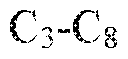 cycloalkyl, C3-C6 cycloalkyl, or Cs-Ce cycloalkyl). In embodiments, RJ is an unsubstituted cycloalkyl (e.g., C3-C8 cycloalkyl, C3-C6 cycloalkyl, or Cs-Ce cycloalkyl).
[0190] In embodiments, is Rn -substituted or unsubstituted heterocycloalkyl (e.g., 3 to 8 membered heterocycloalkyl, 3 to 6 membered heterocycloalkyl, or 5 to 6 membered
heterocycloalkyl). In embodiments, RJ is Rn-substituted heterocycloalkyl (e.g., 3 to 8 membered heterocycloalkyl, 3 to 6 membered heterocycloalkyl, or 5 to 6 membered
heterocycloalkyl). In embodiments, R3 is an unsubstituted heterocycloalkyl (e.g., 3 to 8 membered heterocycloalkyl, 3 to 6 membered heterocycloalkyl, or 5 to 6 membered
heterocycloalkyl).
[0191] In embodiments, R3 is R] '-substituted or unsubstituted aryl (e.g., Ce-Cio aryl, C10 aryl, or phenyl). In embodiments, R' is R1 ^substituted aryl (e.g., Ce-Cio aryl, Cjo aryl, or phenyl). In embodiments, R' is an unsubstituted aryl (e.g., Ce-Cio aryl, Clo aryl, or phenyl).
[0192] In embodiments, R3 is Rn-substituted or unsubstituted heteroaryl (e.g., 5 to 10 membered heteroaryl, 5 to 9 membered heteroar}'!, or 5 to 6 membered heteroaryl). In embodiments, R3 is R13 -substituted heteroarj'l (e.g., 5 to 10 membered heteroaryl, 5 to 9 membered heteroaryl, or 5 to 6 membered heieroaiyi). In embodiments, RJ is an unsubstituted heteroaryl (e.g., 5 to 10 membered heteroaryl, 5 to 9 membered heteroar}'!, or 5 to 6 membered heteroaryl).
[0193] In embodiments, R5 is hydrogen, substituted or unsubstituted alkyl, substituted or unsubstituted heteroalkyl, substituted or unsubstituted cycloalkyl, substituted or unsubstituted
heterocycloalkyl, substituted or unsubstituted aryl, substituted or unsubstituted heteroaryl. In embodiments, R5 is hydrogen. In embodiments, R5 is substituted or unsubstituted alkyl, substituted or unsubstituted heteroalkyl, substituted or unsubstituted cycloalkyl, substituted or unsubstituted heterocycl oalkyl, substituted or unsubstituted aryl, substituted or unsubstituted heteroaryl, or a steroid moiety. In embodiments, R5 is a steroid moiety. In embodiments, R5 is a cholesterol moiety. In embodiments, R5 is a sterol moiety.
[0194] In embodiments, R5 is a substituted or unsubstituted alkyl (e.g.,
 alkyl, C i-Ce alkyl, or Cj -C4 alkyl), substituted or unsubstituted heteroalkyl (e.g., 2 to 8 membered heteroalkyl, 2 to 6 membered heteroalkyl, or 2 to 4 membered heteroalkyl), substituted or unsubstituted cycloalkyl (e.g., Cs-Cg cycloalkyl, C3-C6 cycloalkyl, or Cs-Cs cycloalkyl), substituted or unsubstituted heterocycloalkyl (e.g., 3 to 8 membered heterocycloalkyl, 3 to 6 membered heterocycloalkyl, or 5 to 6 membered heterocycloalkyl), substituted or unsubstituted aryl (e.g., Ce-Cio aryl, Cl0 aryl, or phenyl), or substituted or unsubstituted heteroaryl (e.g., 5 to 10 membered heteroaryl, 5 to 9 membered heteroaryl, or 5 to 6 membered heteroaryl).
[0195] In embodiments, R3 is:
 , wherein RlW' is hydrogen, halogen, -CX3, -CHX2, -CH2X, -OCX ;. -Oi ! ! X. -OCHX2, -CN, -SS I. -S02H, -S02NH2, -NHC(0)NH2, -N(0)2, -NH2, ·( { () )] I. ·( {() )()] 1. -C(0)NH2, -OH, -NHS02H, -NHC(0)H, -N i l C(0)OH, -NHOH, substituted or unsubstituted alkyl (e.g., CrC8 alkyl, Ci-C6 alkyl, or C1-C4 alkyl), substituted or unsubstituted heteroalkyl (e.g., 2 to 8 membered heteroalkyl, 2 to 6 membered heteroalkyl, or 2 to 4 membered heteroalkyl), substituted or unsubstituted cycloalkyl (e.g., C3-C8 cycloalkyl, C3-C6 cycloalkyl, or Cs-Ce cycloalkyl), substituted or unsubstituted heterocycloalkyl (e.g., 3 to 8 membered heterocycloalkyl, 3 to 6 membered heterocycloalkyl, or 5 to 6 membered heterocycloalkyl), substituted or unsubstituted aryl (e.g., C6-C10 aryl, Cw aryl, or phenyl), or substituted or unsubstituted heteroaryl (e.g., 5 to 10 membered heteroaryl, 5 to 9 membered heteroaryl, or 5 to 6 membered heteroaryl). In embodiments, R100 is halogen, -CX3, - CHX2, -CH2X, -OCX3, ~QCH2X, -GCHX2, -CN, -SH, -S02H, -S02NH2, -NHC(0)NH2, -N(0)2, -NH2, -C(0)H, -C(0)OH, -C(0)NH2, -OH, -NHS02H, - ! !( *· <) ·! i. A ! K (())<)! i.
-NHOH, substituted or unsubstituted alkyl (e.g., ( ' · ··( « alkyl,
 alkyl, or C1-C4 alkyl), substituted or unsubstituted heteroalkyl (e.g., 2 to 8 membered heteroalkyl, 2 to 6 membered
heteroalkyl, or 2 to 4 membered heteroalkyl), substituted or unsubstituted cycloalkyl (e.g., C3-C8 cycloalkyl, C3-C6 cycloalkyl, or Cs-C6 cycloalkyl), substituted or unsubstituted heterocvcioaikyl (e.g. , 3 to 8 membered heterocycloalkvl, 3 to 6 membered heterocvcioaikyl, or 5 to 6 membered heterocvcioaikyl), substituted or unsubstituted aryl (e.g., Ce-Cio aryl, do aryl, or phenyl), or substituted or unsubstituted heteroaryl (e.g., 5 to 10 membered heteroaryl, 5 to 9 membered heteroaryl, or 5 to 6 membered heteroaryl). For clarity, it will be understood that R100 is a floating substituent and may be bonded to any of the rings in the moiety and is not limited to the ring to which Rl0° is attached in the formula herein. Additionally, it will be understood that R'5 may include one or more points of non-saturation (i.e. double bonds) withm one or more of the rings.
alkyl, or C1-C4 alkyl), substituted or unsubstituted heteroalkyl (e.g., 2 to 8 membered heteroalkyl, 2 to 6 membered
heteroalkyl, or 2 to 4 membered heteroalkyl), substituted or unsubstituted cycloalkyl (e.g., C3-C8 cycloalkyl, C3-C6 cycloalkyl, or Cs-C6 cycloalkyl), substituted or unsubstituted heterocvcioaikyl (e.g. , 3 to 8 membered heterocycloalkvl, 3 to 6 membered heterocvcioaikyl, or 5 to 6 membered heterocvcioaikyl), substituted or unsubstituted aryl (e.g., Ce-Cio aryl, do aryl, or phenyl), or substituted or unsubstituted heteroaryl (e.g., 5 to 10 membered heteroaryl, 5 to 9 membered heteroaryl, or 5 to 6 membered heteroaryl). For clarity, it will be understood that R100 is a floating substituent and may be bonded to any of the rings in the moiety and is not limited to the ring to which Rl0° is attached in the formula herein. Additionally, it will be understood that R'5 may include one or more points of non-saturation (i.e. double bonds) withm one or more of the rings.
[0196] In embodiments, R " is hydrogen, -OH, or substituted or unsubstituted alkyl (e.g., Ci~ Cs alkyl, C1-C6 alkyl, or C C4 alkyl), and zlOO is an integer from 0 to 28. In embodiments, zlOO is 1. In embodiments, zlOO is 2. In embodiments, zl OO is 3. In embodiments, zlOO is 4. In embodiments, zl OO is 5. In embodiments, zlOO is 6. In embodiments, zlOO is 7. In embodiments, zlOO is 8. In embodiments, zlOO is 9. In embodiments, zlOO is 10.
[0197] In embodiments, R5 has the formula:
[0198] In embodi
embodiments, R3 is
 s, R5 is


[0199] In embodiments, R5 is R12-substituted or unsubstituted alkyl (e.g. , Ci-Cg alky], Ci-Ce alkyl, or Ci~C4 alkyl), Riz-substituied or unsubstituted heteroalkyl (e.g., 2 to 8 membered heteroalkyl, 2 to 6 membered heteroalkyl, or 2 to 4 membered heteroalkyl), R°-substituted or unsubstituted cycloalkyl (e.g., Cs-Cs cycloalkyl, Cj-Ce cycloalkyl, or Cs-C6 cycloalkyl), Rl - substituted or unsubstituted heterocvcioalkyl (e.g., 3 to 8 membered heterocvcioalkyl, 3 to 6 membered heterocvcioalkyl, or 5 to 6 membered heterocvcioalkyl), R!/'-substituted or unsubstituted aiyl (e.g., Ce-C-.o aryl, C10 aryl, or phenyl), or R12-substituted or unsubstituted
heteroaryl (e.g., 5 to 10 membered heteroaryl, 5 to 9 membered heteroaryl, or 5 to 6 membered heteroaryl).
[0200] In embodiments, R5 is R12-substituted or unsubstituted aikyl (e.g., C C8 aikyl, C C6 alkyl, or C1-C4 aikyl). In embodiments, R5 is Rl2-substituted alkyl (e.g., C|-C8 alkyl , C]-C6 alkyl, or C1-C4 aikyl). In embodiments, R'5 is an unsubstituted alkyl (e.g., Cj-Cs alkyl, Cj-Ce alkyl, or C1-C4 alkyl).
[0201 ] In embodiments, R5 is R1 -substituted or unsubstituted heteroaikyl (e.g., 2 to 8 membered heieroalkyl, 2 to 6 membered heteroaikyl, or 2 to 4 membered heteroaikyl). In embodiments, R5 is R!2-substituted heteroaikyl (e.g., 2 to 8 membered heteroaikyl, 2 to 6 membered heteroaikyl, or 2 to 4 membered heteroaikyl). In embodiments, R5 is an unsubstituted heteroaikyl (e.g. , 2 to 8 membered heieroalkyl, 2 to 6 membered heteroaikyl, or 2 to 4 membered heteroaikyl).
[0202] In embodiments, R5 is R12-substituted or unsubstituied cycioalkyl (e.g., C3-C8 cycloalkyi, C3-C6 cycloaikyi, or C5-C6 cycloalkyi). In embodiments, R5 is Ri2-substituted cycloalkyi (e.g., Ci-Cg cycioalkyl, C3-C6 cycioalkyl, or Cs-Ce cycloaikyi). In embodiments, R5 is an unsubstituied cycioalkyl (e.g., C3-C8 cycioalkyl, C3-C6 cycioalkyl, or Cs-Ce cycloalkyi).
[0203] In embodiments, R'1 is R12-substituted or unsubstituted heterocycloaikvl (e.g., 3 to 8 membered heterocycloalkyl, 3 to 6 membered heterocycioalkyl, or 5 to 6 membered
heterocvcloalkyl). In embodiments, R5 is R12-substi luted heterocycloalkyl (e.g., 3 to 8 membered heterocycloalkyl, 3 to 6 membered heterocycloalkyl, or 5 to 6 membered
heterocycloalkyl). In embodiments, R'1 is an unsubstituted heterocycloalkyl (e.g., 3 to 8 membered heterocycloalkyl, 3 to 6 membered heterocycioalkyl, or 5 to 6 membered
heterocycloalkvi).
[0204] in embodiments, R3 is R1 -substituted or unsubstituted aryl (e.g., Ce-Cio and, do aryl, or phenyl). In embodiments, R5 is R12-substituted aryl (e.g., C Cjo aryl, Clo arj'l, or phenyl). In embodiments, R5 is an unsubstituted aryl (e.g., Ce-Cio aryi, Clo arv'l, or phenyl).
[0205] In embodiments, R5 is R12-substituted or unsubstituted heteroaryl (e.g., 5 to 1 0 membered heteroaryl, 5 to 9 membered heteroaryl, or 5 to 6 membered heteroaryl). In embodiments, R'1 is Rl -substituted heteroaryl (e.g., 5 to 10 membered heteroaryl, 5 to 9 membered heteroaryl, or 5 to 6 membered heteroaryl). In embodiments, R5 is an unsubstituted
heteroaryl (e.g., 5 to 10 membered heteroaryl, 5 to 9 membered heteroaryl, or 5 to 6 membered heteroaryl).
[Θ2Θ6] In embodiments, R6 is hydrogen, substituted or unsubstituted alkylene, substituted or unsubstituted heteroalkylene, substituted or unsubstituted cycloalkylene, substituted or unsubstituted heterocycloalkylene, substituted or unsubstituted arylene, substituted or unsubstituted heteroarylene. In embodiments, R6 is hydrogen. In embodiments, Rb is substituted or unsubstituted alkylene, substituted or unsubstituted heteroalkylene, substituted or
unsubstituted cycloalkylene, substituted or unsubstituted heterocycloalkylene, substituted or unsubstituted arylene, substituted or unsubstituted heteroarylene, or a steroid moiety. In embodiments, R6 is a steroid moiety. In embodiments, R6 is a cholesterol moiety.
[0207] In embodiments, R6 is a substituted or unsubstituted alkyl (e.g., Ci-Cs alkyi, Ci-Ce alkyl, or Ci-C* alkyl), substituted or unsubstituted heteroalkyl (e.g. , 2 to 8 membered heteroalkyl, 2 to 6 membered heteroalkyl, or 2 to 4 membered heteroalkyl), substituted or unsubstituted cycloalkyl (e.g., C3-Cs cycloalkyl, Cj-Ce cycloalkvl, or Cs-C6 cycloalkvl), substituted or unsubstituted heterocvcloalkyl (e.g., 3 to 8 membered heterocvcloalkyl, 3 to 6 membered heterocvcloalkyl, or 5 to 6 membered heterocycloalkyi), substituted or unsubstituted aryl (e.g., C6-Cio aryl, C 10 aryl, or phenyl), or substituted or unsubstituted heteroaryl (e.g., 5 to 10 membered heteroaryl, 5 to 9 membered heteroaryl , or 5 to 6 membered heteroaryl).
[0208] In embodiments, R 1 is:
 , wherein " is hydrogen, halogen, -CX3, -CHX2, -CH2X, -OCX3, -OCH2X, -OCHX2, -C , -SH, -SO?H, -S02NH2, -NHC(0)NH2, -N(0)2, -NH2, ··( ( <) }I 1. ··( "! ( ) )()! I. -C(())NH2, -OH, -NHS02H, -NHC(0)H, -NH C(0)OH, -NHOH, substituted or unsubstituted alkyl (e.g., C Cg alkyl, C Ce alkyl, or C 1-C4 alkyl), substituted or unsubstituted heteroalkyl (e.g., 2 to 8 membered heteroalkyl, 2 to 6 membered heteroalkyl, or 2 to 4 membered heteroalkyl), substituted or unsubstituted cycloalkyl (e.g. , C3-C8 cycloalkyl, C3-C6 cycloalkyl, or C5-C6 cycloalkyl), substituted or unsubstituted heterocvcloalkyl (e.g., 3 to 8 membered heterocycloalkyi , 3 to 6 membered heterocycloalkyi, or 5 to 6 membered heterocycloalkyi), substituted or unsubstituted aryl (e.g., C6-Cio aryl, do aryl, or phenyl), or substituted or unsubstituted heteroaryl (e.g., 5 to 10 membered heteroaryl, 5 to 9 membered heteroaryl, or 5 to 6 membered heteroaryl). In embodiments, R100 is halogen, -CX3, -
CHX2, -CH2X, -OCXs, ·()( i l -X. ·0(Ί I X >. -CN, -SH, -SQ2H, -S02NH2, -NHC(0)NH2, -N(0)2, -NH2, -C(0)H5 -C(0)OH, -C(0)NH2, -OH, -M IS02H, -NHC(0)H, -NHC(0)OH, -NHOH, substituted or unsubstituted alkyl (e.g., Ci-Cg alkyl, Ci-Ce alkyl, or C1-C alky]), substituted or unsubstituted heteroalkyi (e.g., 2 to 8 membered heteroalkyl, 2 to 6 membered heteroalkyl, or 2 to 4 membered heteroalkyl), substituted or unsubstituted cvcloaikyl (e.g., C3-C8 cycloalkyl, C3-C6 cycloalkyl, or C5-C6 cycloalkyl), substituted or unsubstituted heterocycloalkyl (e.g., 3 to 8 membered heterocycloalkyl, 3 to 6 membered heterocycloalkyl, or 5 to 6 membered heterocycloalkyl), substituted or unsubstituted aryl (e.g., C CJO aryl, C10 aryl, or phenyl), or substituted or unsubstituted heteroaryl (e.g., 5 to 10 membered heteroaryl, 5 to 9 membered heteroaryl, or 5 to 6 membered heteroaryl). For cl arity, it will be understood that R200 is a floating subsiituent and may be bonded to any of the rings in the moiety and is not limited to the ring to which R200 is attached in the formula herein. Additionally, it will be understood that R6 may include one or more points of non-saturation (i.e. double bonds) within one or more of the rings.
, wherein " is hydrogen, halogen, -CX3, -CHX2, -CH2X, -OCX3, -OCH2X, -OCHX2, -C , -SH, -SO?H, -S02NH2, -NHC(0)NH2, -N(0)2, -NH2, ··( ( <) }I 1. ··( "! ( ) )()! I. -C(())NH2, -OH, -NHS02H, -NHC(0)H, -NH C(0)OH, -NHOH, substituted or unsubstituted alkyl (e.g., C Cg alkyl, C Ce alkyl, or C 1-C4 alkyl), substituted or unsubstituted heteroalkyl (e.g., 2 to 8 membered heteroalkyl, 2 to 6 membered heteroalkyl, or 2 to 4 membered heteroalkyl), substituted or unsubstituted cycloalkyl (e.g. , C3-C8 cycloalkyl, C3-C6 cycloalkyl, or C5-C6 cycloalkyl), substituted or unsubstituted heterocvcloalkyl (e.g., 3 to 8 membered heterocycloalkyi , 3 to 6 membered heterocycloalkyi, or 5 to 6 membered heterocycloalkyi), substituted or unsubstituted aryl (e.g., C6-Cio aryl, do aryl, or phenyl), or substituted or unsubstituted heteroaryl (e.g., 5 to 10 membered heteroaryl, 5 to 9 membered heteroaryl, or 5 to 6 membered heteroaryl). In embodiments, R100 is halogen, -CX3, -
CHX2, -CH2X, -OCXs, ·()( i l -X. ·0(Ί I X >. -CN, -SH, -SQ2H, -S02NH2, -NHC(0)NH2, -N(0)2, -NH2, -C(0)H5 -C(0)OH, -C(0)NH2, -OH, -M IS02H, -NHC(0)H, -NHC(0)OH, -NHOH, substituted or unsubstituted alkyl (e.g., Ci-Cg alkyl, Ci-Ce alkyl, or C1-C alky]), substituted or unsubstituted heteroalkyi (e.g., 2 to 8 membered heteroalkyl, 2 to 6 membered heteroalkyl, or 2 to 4 membered heteroalkyl), substituted or unsubstituted cvcloaikyl (e.g., C3-C8 cycloalkyl, C3-C6 cycloalkyl, or C5-C6 cycloalkyl), substituted or unsubstituted heterocycloalkyl (e.g., 3 to 8 membered heterocycloalkyl, 3 to 6 membered heterocycloalkyl, or 5 to 6 membered heterocycloalkyl), substituted or unsubstituted aryl (e.g., C CJO aryl, C10 aryl, or phenyl), or substituted or unsubstituted heteroaryl (e.g., 5 to 10 membered heteroaryl, 5 to 9 membered heteroaryl, or 5 to 6 membered heteroaryl). For cl arity, it will be understood that R200 is a floating subsiituent and may be bonded to any of the rings in the moiety and is not limited to the ring to which R200 is attached in the formula herein. Additionally, it will be understood that R6 may include one or more points of non-saturation (i.e. double bonds) within one or more of the rings.
[0209] In embodiments, R" 1 is hydrogen, -OH, or substituted or unsubstituted alkyl (e.g., Cr Cg alkyl, Ci-Ce alkyl, or C1-C4 alkyl), and z200 is an integer from 0 to 28. In embodiments, z200 is 1. In embodiments, z200 is 2. In embodiments, z200 is 3. In embodiments, z2()() is 4. In embodiments, z.200 is 5. In embodiments, z200 i s 6. In embodiments, z200 is 7. In embodiments. z200 is 8. In embodiments, z200 is 9. In embodiments, z200 is 10.
Θ210] In embodiments, R6 has the formula:

[0211] In embodi
embodiments. R1 is

 [0212] In embodiments, Rb is R15-substituted or unsubstituted aikyl (e.g., Ci-Cg alkyl, Cj-Cc, alkyl, or C1-C4 alkyl), R15-substituted or unsubstituted heteroalkyl (e.g., 2 to 8 membered heteroalkyl, 2 to 6 membered heteroalkyl, or 2 to 4 membered heteroalkyl), Ri 5-substituted or unsubstituted cycloalkyi (e.g., Cs-Cg cycloalkyi, C3-C6 cycloalkyi, or Cs-Ce cycloalkyi), R15- substituted or unsubstituted heterocycloalkyl (e.g., 3 to 8 membered heterocycloalkyl, 3 to 6 membered heterocycloalkyl, or 5 to 6 membered heterocycloalkyl), R15-substituted or unsubstituted aryl (e.g. , C6-Cj0 aryl, Ci0 aryl, or phenyl), or Rl3-substituted or unsubstituted heteroaryl (e.g., 5 to 10 membered heteroaiyi, 5 to 9 membered heteroaiyl, or 5 to 6 membered heteroaryl).
[0213] In embodiments, R6 is R15-substituted or unsubstituted alkyl (e.g. , Ci-Cg alkyl, Ci-Ce alkyl, or C1-C4 alkyl). In embodiments, R6 is Rl5-substituted alkyl (e.g., C|-C8 alkyl, C]-C6 alkyl, or C1-C4 aikyl). In embodiments, R6 is an unsubstituted alkyl (e.g., Cj-Cg alkyl, Cj-Ce alkyl, or C1-C4 aikyl).
[0214] In embodiments, R6 is Rl5-substituted or unsubstituted heteroalkyl (e.g., 2 to 8 membered heteroalkyl, 2 to 6 membered heteroalkyl, or 2 to 4 membered heteroalkyl). In embodiments, R6 is R! '-substituted heteroalkyl (e.g., 2 to 8 membered heteroalkyl, 2 to 6 membered heteroalkyl, or 2 to 4 membered heteroalkyl). In embodiments, R6 is an unsubstituted heteroalkyl (e.g. , 2 to 8 membered heteroalkyl, 2 to 6 membered heteroalkyl, or 2 to 4 membered heteroalkyl).
[0215] In embodiments, R6 is R1 '-substituted or unsubstituted cycioalkyl (e.g., Cs-Cg cycloalkyi, C3-C6 cycioalkyl, or C5-C6 cycloalkyi). In embodiments, Rb is Ri5-substituted cycloalkyi (e.g.,
 cycloalkyi, C3-C6 cycloalkyi, or Cs-Ce cycloalkyi). In embodiments, R6 is an unsubstituied cycloalkyi (e.g., Cs-Cg cycioalkyl, C3-C6 cycioalkyl, or Cs-Ce cycioalkyl).
[0216] In embodiments, Rb is R15-substituted or unsubstituted heterocycloalkyl (e.g., 3 to 8 membered heterocycloalkyl, 3 to 6 membered heterocycloalkyl, or 5 to 6 membered
heterocycloalkyl). In embodiments, R6 is R15-substituted heterocycloalkyl (e.g., 3 to 8 membered heterocycloalkyl, 3 to 6 membered heterocycloalkyl, or 5 to 6 membered
heterocycloalkyl). In embodiments, Rb is an unsubstituted heterocycloalkyl (e.g., 3 to 8 membered heterocycloalkyl, 3 to 6 membered heterocycloalkyl, or 5 to 6 membered
heterocycloalkyl).
[0217] In embodiments, Rb is R15-substituted or unsubstituted aryl (e.g., Ce-Cio aryl, Cjo aiyl, or phenyl). In embodiments, R6 is R15-substituted aryl (e.g., Ce-Cw aryl, C10 aryl, or phenyl). In embodiments, R6 is an unsubstituted aryl (e.g., C Cio aryl, Clo aryl, or phenyl).
[0218] In embodiments, R6 is R^-substituted or unsubstituted heteroaryl (e.g. , 5 to 10 membered heteroaryl, 5 to 9 membered heteroaryl, or 5 to 6 membered heteroaryl). In embodiments, Rb is R15-substituted heteroaryl (e.g., 5 to 10 membered heteroaryl, 5 to 9 membered heteroaryl, or 5 to 6 membered heteroaryl). In embodiments, R6 is an unsubstituted heteroaryl (e.g., 5 to 10 membered heteroaryl, 5 to 9 membered heteroaryl, or 5 to 6 membered heteroaryl).
[Θ219] In embodiments, R'' is a polar moiety . In embodiments R ' is -OP(0)2OH. In
-OP(0)3R'A. In embodiments R'' is -OP(0)3R'A In embodiments R'' is

[0220] One of ordinary skill in the art would recognize the ionization state of the molecule is dependent on the surroimding environment. In embodiments, molecules which include a ionizable moiety (e.g., -NH2, -C(O)OH) will be written in their neutral form but may include their charged form.
[0221] In embodiment -R 7 has the formula -OH,

 [Θ222] In embodiments, -R7 has the formula
 ;
;
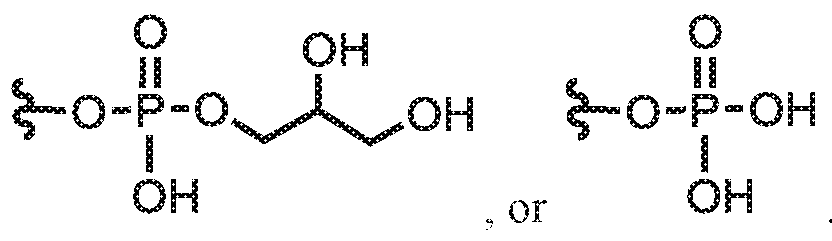
[02231 R7A is hydrogen, halogen,
 - OCH2X7A, -OCHX7A2, -CN, -SH, -SO2H, -S()2NH2, -NHC(0)NH2, -N(0)2, -NH2, -C(0)H5 -C(0 )OH, -C(0)NH2, -OH, -NHS02H, -NHC(0)H, -NHC(0)OH, -NHOH, substituted or unsubstituted alkyl, substituted or unsubstituted heteroalkyl, substituted or unsubstituted cycloalkyl, substituted or unsubstituted heterocycloalkvl, substituted or unsubstituted aryl, or substituted or unsubstituted heteroaryl. In embodiments, R 'A is hydrogen. X'A is halogen. In embodiments, X7Ais F.
[0224] In embodiments, R7A is hydrogen, halogen, -CX7A 3, ~CHX7A 2, -CH2X7A, -OCX7A 3, - OCH2X7A, -OCHX7A 2, -CN, -SH, -SO?H, -S02NH2, -NHC(0)NH2, -N(Q)2, -NH2, -C(Q)H, -C(0 )OH, -C(0)NH2, -OH, -NHSO2H, -NHC(0)H, -NHC(0)OH, -NHOH, substituted or unsubstituted alkyl (e.g., Ci-Cg alkyl, Ci-Ce alkyl, or C1-C4 alkyl), substituted or unsubstituted heteroalkyl (e.g., 2 to 16 membered heteroalkyl, 2 to 8 membered heteroalkyl, or 2 to 6 membered heteroalkyl), substituted or unsubstituted cycloalkyl (e.g., C3-C8 cycloalkyl, C3-C6 cycloalkyl, or C5-C6 cycloalkyl), substituted or unsubstituted heterocycloalkvl (e.g., 3 to 8 membered heterocycloalkvl, 3 to 6 membered heterocycloalkyl, or 5 to 6 membered heterocycloalkyl), substituted or unsubstituted aryl (e.g., Ce-Cio aryl, C10 aryl, or phenyl), or substituted or unsubstituted heteroaryl (e.g., 5 to 10 membered heteroaryl, 5 to 9 membered heteroaryl, or 5 to 6 membered heteroaryl).
[0225] In embodiments, R/A is R18-substituted or unsubstituted alkyl (e.g., C C8 alkyl, CrC6 alkyl, or (LVC4 alkyl), Rls-substituted or unsubstituted heteroalkyl (e.g., 2 to 16 membered heteroalkyl, 2 to 8 membered heteroalkyl, or 2 to 6 membered heteroalkyl), R18-substituted or unsubstituted cycloalkyl (e.g., Cs-Cg cycloalkyl, C3-C6 cycloalkyl, or Cs-Ce cycloalkyl), R18- substituted or unsubstituted heterocycloalkyl (e.g., 3 to 8 membered heterocycloalkyl, 3 to 6 membered heterocycloalkyl, or 5 to 6 membered heterocycloalkyl), R18-substituted or unsubstituted aryl (e.g. , Ce-Cio aryl, C10 aryl, or phenyl), or Rl8-substituted or unsubstituted
heteroaryl (e.g., 5 to 10 membered heteroaryl, 5 to 9 membered heteroaryl, or 5 to 6 membered heteroaryl).
[0226] In embodiments, R7A is R18-substituted or unsubstituted alkyl (e.g., C C8 alkyl, Ci-C6 alkyl, or C1-C4 alkyl). In embodiments, R'A is Ri8-substituted alkyl (e.g., Ci-Cg alkyl, CrC6 alkyl, or C1-C4 alkyl). In embodiments, R'A is an unsubstituted alkyl (e.g., Cj-Cg alkyl, C-.-Ce alkyl, or C1-C4 alkyl).
[02271 hi embodiments, R7A is R18-substituted or unsubstituted heteroaikyl (e.g., 2 to 16 membered heieroalkyl, 2 to 8 membered heteroaikyl, or 2 to 6 membered heteroaikyl). In embodiments, R" is R" -substituted heteroaikyl (e.g., 2 to 16 membered heteroaikyl, 2 to 8 membered heteroaikyl, or 2 to 6 membered heteroaikyl). In embodiments, R7A is an
unsubstituied heteroaikyl (e.g., 2 to 16 membered heteroaikyl, 2 to 8 membered heieroalkyl, or 2 to 6 membered heteroaikyl),
[0228] In embodiments, R7A is Rls-substituted or unsubstituted cycloalkyi (e.g.,€3~€Β cycloalkyi, C3-C6 cycloalkyi, or C5-C6 cycloalkyi). In embodiments, R'A is R18-substituted cycloalkyi (e.g., Ci-Cg cycloalkyi, C3-C6 cycloalkyi, or Cs-Ce cycloalkyi). In embodiments, R'A is an unsubstituied cycloalkyi (e.g., C3-C8 cycloalkyi, C3-C6 cycloalkyi, or Cs-Ce cycloalkyi).
[0229] In embodiments, R/A is R! 8-substituted or unsubstituted heterocycloalkyl (e.g., 3 to 8 membered heterocycloalkyl, 3 to 6 membered heterocycloalkyl, or 5 to 6 membered
heterocycloalkyl). In embodiments, R'A is Rl8-substituted heterocycloalkyl (e.g., 3 to 8 membered heterocycloalkyl, 3 to 6 membered heterocycloalkyl, or 5 to 6 membered
heterocycloalkyl). In embodiments, R is an unsubstituted heterocycloalkyl (e.g., 3 to 8 membered heterocycloalkyl, 3 to 6 membered heterocycloalkyl, or 5 to 6 membered
heterocycloalkyl).
[0230] In embodiments, R'A is Rl8-substituted or unsubstituted aryl (e.g., Ce-Cio aryl, C10 aryl, or phenyl). In embodiments, R/A is R3 s-substituted aryl (e.g., C CJO aryl, C10 aryl, or phenyl). In embodiments, R'A is an unsubstituted aryl (e.g., Ce-Cio aryl, C10 aryl, or phenyl).
[0231] In embodiments, R7A is R18-substituted or unsubstituted heteroaryl (e.g., 5 to 10 membered heteroaryl, 5 to 9 membered heteroaryl, or 5 to 6 membered heteroaryl). In embodiments, R/A is Rl8-substituted heteroaryl (e.g., 5 to 10 membered heteroaryl, 5 to 9 membered heteroaryl, or 5 to 6 membered heteroaryl). In embodiments, R'A is an unsubstituted
heteroaryl (e.g., 5 to 10 membered heteroaryl, 5 to 9 membered heteroaryl, or 5 to 6 membered heteroaryl).
[Θ232] In embodiments, R7A is hydrogen, ethanolamine, choline, serine, glycerol,
phosphatidylglvcerol, or inositol. In embodiments, R " is hydrogen. In embodiments, R' ' is ethanolamine. In embodiments, R/A is choline. In embodiments, R'A is serine. In embodiments, R'A is glycerol. In embodiments, R/A is phosphatidylglycerol. In embodiments, R'A is or inositol.
[0233] In embodiments, R8 is a polar moiety. In embodiments R8 is -OP(0)2OH. In embodiments R8 is -OP(0)3R8A. In embodiments R8 is -OP(0)3R8a. In embodiments R8 is
¾™0~P~0™"R!
[0234] In embodiments, -R has the formula -OH,


[0237] In embodiments, R8A is hydrogen, halogen, -CX8A 3, -CHX8A 2, -CH2X8A, -QCX8A 3, - OCH2X8A, -OCHXSA2, -CN, -SH, -S02H, -S02NH2, -NHC(0)NH2, -N(Q)2, -Ni l -. -C(Q)H, -C(0 )OH, -C(0)NH2, -OH, -N! iSO ! l. -NHC(0)H, -NHC(0)OH, -NHOH, substituted or unsubstituted alkyl (e.g., Cj-Cg alkyl, Cj-Ce alkyl, or C1-C4 alkyl), substituted or unsubstituted heteroalkyl (e.g., 2 to 16 membered heteroalkyl, 2 to 8 membered heteroalkyl, or 2 to 6 membered heteroalkyl), substituted or unsubstituted cycloalkyi (e.g., C3-Cs cycloalkyi, C3-C6 cycloalkyi, or Cs-Ce cycloalkyi), substituted or unsubstituted heterocycloalkyl (e.g., 3 to 8 membered heterocycloalkyl, 3 to 6 membered heterocycloalkyl, or 5 to 6 membered
heterocycloalkyl), substituted or unsubstituted aryl (e.g., Ce-Cio aryi, C10 aryl, or phenyl), or substituted or unsubstituted heteroaryl (e.g., 5 to 10 membered heteroaryl, 5 to 9 membered heteroaryl, or 5 to 6 membered heteroaryl).
[0238] In embodiments, R8A is R2l-substituted or unsubstituted alkyl (e.g., Ci~C8 alkyl, Ci~C6 alkyl, or C1-C4 alkyl), R23 -substituted or unsubstituted heteroalkyl (e.g., 2 to 16 membered heteroalkyl, 2 to 8 membered heteroalkyl, or 2 to 6 membered heteroalkyl), R21 -substituted or unsubstituted cycloalkyi (e.g., C3-C8 cycloalkyi , C3-C6 cycloalkyi, or C5-C6 cycloalkyi), Rzi- substituted or unsubstituted heterocycloalkyl (e.g., 3 to 8 membered heterocycloalkyl, 3 to 6 membered heterocycloalkyl, or 5 to 6 membered heterocycloalkyl), R21-substituted or unsubstituted aryl (e.g., Ce-Cio aryl, Clo aryl, or phenyl), or R ^substituted or unsubstituted heteroaryl (e.g., 5 to 10 membered heteroaryl, 5 to 9 membered heteroaryl, or 5 to 6 membered heteroaryl).
[0239] In embodiments, R8A is R21-substituted or unsubstituted alkyl (e.g., Ci-C3 alkyl, Ci-C6 alkyl, or C1-C4 alkyl). In embodiments, R8A is R" ^substituted alkyl (e.g., Ci-Cg alkyl, Ci-C6 alkyl, or C1-C4 alkyl). In embodiments, R8A is an unsubstituted alkyl (e.g., Ci-Cg alkyl, Ci-Ce alkyl, or Cj-C4 alkyl).
[0240] In embodiments, RSA is R I -substituted or unsubstituted heteroalkyl (e.g., 2 to 16 membered heteroalkyl, 2 to 8 membered heteroalkyl, or 2 to 6 membered heteroalkyl). In embodiments, R8A is R2l-substituted heteroalkyl (e.g., 2 to 16 membered heteroalkyl, 2 to 8 membered heteroalkyl, or 2 to 6 membered heteroalkyl). In embodiments, RSA is an
unsubstituted heteroalkyl (e.g., 2 to 16 membered heteroalkyl, 2 to 8 membered heteroalkyl, or 2 to 6 membered heteroalkyl).
[0241] In embodiments, R8A is R2 '-substituted or unsubstituted cycloalkyi (e.g. , Cs-Cg cvcloalkyi, C3~C6 cycloalkyi, or C5~C6 cycloalkyi). In embodiments, R8A is R2l-substituted cycloalkyi (e.g., CVC8 cycloalkyi, C-j-Ce cycloalkyi, or Cs-Ce cycloalkyi). In embodiments, R8A is an unsubstituted cycloalkyi (e.g., Cs-Cg cycloalkyi, C3-C6 cycloalkyi, or Cs-Ce cycloalkyi).
[0242] In embodiments, R8A is R^-substituted or unsubstituted heterocycloaikvl (e.g., 3 to 8 membered heterocycloaikvl, 3 to 6 membered heierocvcloalkyl, or 5 to 6 membered
heterocycloaikvl). In embodiments, R8A is R21-substituted heterocycloaikvl (e.g., 3 to 8 membered heterocycloaikvl, 3 to 6 membered heterocycioalkyl, or 5 to 6 membered
8 .
heterocycloaikvl). In embodiments, R ' is an unsubstituted heterocycloaikvl (e.g., 3 to 8 membered heterocycioalkyl, 3 to 6 membered heterocycioalkyl, or 5 to 6 membered
heterocycioalkyl).
[0243] In embodiments, R8A is R21-substituted or unsubstituted aryl (e.g., C6-C10 aryl, C10 aryl, or phenyl). In embodiments, R8RI is R21 -substi uted aryl (e.g., Ce-C io aryl, C10 aryl, or phenyl). In embodiments, R8a is an unsubstituted aryl (e.g., C6-Cio aryl, Cj0 aryl, or phenyl).
[0244] In embodiments, R A is R2 ! -substituted or unsubstituted heteroaryl (e.g., 5 to 10 membered heteroaryi, 5 to 9 membered heteroaryl, or 5 to 6 membered heteroaryl). In embodiments, R8A is R2l-substituted heteroaryl (e.g., 5 to 10 membered heteroaryl, 5 to 9 membered heteroaryl, or 5 to 6 membered heteroaryl). In embodiments, R8A is an unsubstituted heteroaryl (e.g., 5 to 10 membered heteroaryi, 5 to 9 membered heteroaryl, or 5 to 6 membered heteroaryi).
8 .
[0245] In embodiments, R ' is hydrogen, ethanolamine, choline, serine, glycerol,
phosphatidyl glycerol, or inositol. In embodiments, R A is hydrogen. In embodiments, R8A is ethanolamine. In embodiments, R8A is choline. In embodiments, R8A is serine. In embodiments, R is glycerol . In embodiments, R" is phosphatidylglycerol. In embodiments, R is or inositol.
[0246] R! is independently oxo,
halogen, -CCf3, -CBr3, -CF3, -CI3,-CN, -OH, Al l -.. -COOH, -CONH2, -N02, -SH, -S03H, -S04H
, -SO2NH2, -ΝΪ-ΙΝΗ2, --ONH2, -NHC(0)NHNH2, -NHC(0)NH2, -M !SO ! I. -NHC(0)H, -NHC(0)OH, -NHOH, -OCCl3, -OCF3, -OCBr3, -OCI3,-OCHCl2, -OCHBr2, -OCHI2, -OCHF2, Rlj-substituted or unsubstituted alkyl (e.g., Ci-Cg alkyi, Ci-Ce alkyl, or -C4 alkyl), R13- substituted or unsubstituted heteroalkyl (e.g., 2 to 8 membered heteroalkyl, 2 to 6 membered heteroalkyl, or 2 to 4 membered heteroalkyl), R13 -substituted or unsubstituted cycloalkyl (e.g., C3-Cg cycloalkyl, C3-C6 cycloalkyl, or Cs-C-6 cycloalkyl), Ri3-substituted or unsubstituted heterocycloalkyi (e.g., 3 to 8 membered heterocvcloalkvl, 3 to 6 membered heterocycloalkyl, or 5 to 6 membered heterocycloalkyl), R! '-substituted or unsubstituted aryl (e.g., C Cio aryl, C10 aryl, or phenyl), or Rs 3 -substituted or unsubstituted heteroaryl (e.g., 5 to 10 membered heteroaryl, 5 to 9 membered heteroaryl, or 5 to 6 membered heteroaryl).
[0247] In embodiments, R12 is Rl3-substituted or unsubstituted alkyl (e.g., Ci-Cg alkyl, Ci-Ce alkyl, or Ci~C4 alkyl). In embodiments, R12 is R°-substituted alkyl (e.g. , CrCg alkyl, C3-C6 alkyl, or C1-C4 alkyl). In embodiments, Rl is an unsubstituted alkyi (e.g., Cj-Cg alkyl, Cj-Ce alkyl, or C1-C4 alkyi).
[0248] In embodiments, R12 is Rl3-substituted or unsubstituted heteroalkyl (e.g., 2 to 8 membered heteroalkyl, 2 to 6 membered heteroalkyl, or 2 to 4 membered heteroalkyl). In embodiments, R12 is R33 -substituted heteroalkyl (e.g., 2 to 8 membered heteroalkyl, 2 to 6 membered heteroalkyl, or 2 to 4 membered heteroalkyl). In embodiments, R12 is an unsubstituted heteroalkyl (e.g. , 2 to 8 membered heteroalkyl, 2 to 6 membered heteroalkyl, or 2 to 4 membered heteroalkyl).
[0249] In embodiments, R12 is R! '-substituted or unsubstituted cycloalkyl (e.g., C3-Cg cycloalkyl, C3-Ce cycloalkyl, or Cs-Ce cycloalkyl). In embodiments, R12 is Rl3-substituted cycloalkyl (e.g., C3~C8 cycloalkyl, C3-C6 cycloalkyl, or C5-C6 cycloalkyl). In embodiments, Rli is an unsubstituted cycloalkyl (e.g., C3-Cg cycloalkyl, C3-C6 cycloalkyl, or C -CV, cycloalkyl).
[0250] In embodiments, R12 is Ri3-substituted or unsubstituted heterocycloalkyl (e.g., 3 to 8 membered heterocycloalkyl, 3 to 6 membered heterocycloalkyl, or 5 to 6 membered
heterocycloalkyl). In embodiments, Rli is R13-substituted heterocycloalkyl (e.g., 3 to 8 membered heterocycloalkyl, 3 to 6 membered heterocycloalkyl, or 5 to 6 membered
heterocycloalkyi). In embodiments, R12 is an unsubstituted heterocycloalkyl (e.g., 3 to 8
membered heterocycloalkyl, 3 to 6 membered heterocycloalkyl, or 5 to 6 membered
heterocycloalkyl).
[Θ251] In embodiments, R12 is Ri3-substituted or unsubstituted aryl (e.g., C6-C10 aryi, C10 aryl, or phenyl). In embodiments, R'2 is R13 -substituted aryl (e.g., Ce-Cio aryl, Cio aryl, or phenyl). In embodiments, R1 is an unsubstituted aryl (e.g., C Cjo aryl, C10 aryl, or phenyl).
[0252] In embodiments, R12 is R! '-substituted or unsubstituted heteroaryi (e.g., 5 to 10 membered heteroaryi, 5 to 9 membered heieroaryl, or 5 to 6 membered heteroaryi). In embodiments, R12 is R] J-substituted heteroaryi (e.g., 5 to 10 membered heteroaryi, 5 to 9 membered heteroaryi, or 5 to 6 membered heteroaryi). In embodiments, R is an unsubstituted heteroaryi (e.g., 5 to 10 membered heteroaryi, 5 to 9 membered heieroaryl, or 5 to 6 membered heteroaryi).
[0253] Rl3 is independently oxo,
halogen, -CC13, ~CBr3, -CF3, -CI3,~CN, -OH, -Ni l -. -CQOH, -( ONH -. -N02, -SH, -S03H, -S04H , -SO2NH2, - HNH2, -ONH2, ~NHC(0)NHNH2, Ni K'(0)\1 I ··. -Ni !SC i. -NHC(Q)H, -NHC(0)OH, -NHOH, -OCCI3, -OCF3, -OCBr3, -OCI3,-OCHCl2, -OCHBr2, -OCHI2, -OCHF2, R1 -substituted or unsubstituted alkyl (e.g., Cj-Cg aikyl, Cj-Ce alkyl, or Cj-C4 alkyl), R14- substituted or unsubstituted heteroalkyl (e.g., 2 to 8 membered heteroalkyl, 2 to 6 membered heteroalkyl, or 2 to 4 membered heteroalkyl), Rl4-substituted or unsubstituted cycioalkyl (e.g., C3-Cg cycioalkyl, C3-C6 cycioalkyl, or Cs-Ce cycioalkyl), Rl4-substituted or unsubstituted heterocycloalkyl (e.g., 3 to 8 membered heterocycloalkyl, 3 to 6 membered heterocycloalkyl, or 5 to 6 membered heterocycloalkyl), Rl4-substituted or unsubstituted ar l (e.g., C Cio aryl, Clo aryl, or phenyl), or Rl4-substituted or unsubstituted heieroaryl (e.g. , 5 to 10 membered heteroaryi, 5 to 9 membered heieroaryl, or 5 to 6 membered heteroaryi).
[0254] In embodiments, R13 is Rl4-substituted or unsubstituted alkyl (e.g., Ci-Cg alkyl, Ci-C6 alkyl, or C1-C4 alkyi). In embodiments, Ri j is R^-substituted alkyl (e.g., Ci~Cg alkyl, Ci-C6 alkyl, or (LVC4 alkyl). In embodiments, i 3 is an unsubstituted alkyl (e.g., C Cg alkyl, C C6 alkyi, or C1-C4 alkyl).
[0255] In embodiments, Rlj is Rl4-substituted or unsubstituted heteroalkyl (e.g., 2 to 8 membered heteroalkyl, 2 to 6 membered heteroalkyl, or 2 to 4 membered heteroalkyl). In embodiments, R! ' is R14-substituted heteroalkyl (e.g., 2 to 8 membered heteroalkyl, 2 to 6 membered heteroalkyl, or 2 to 4 membered heteroalkyl). In embodiments, R1"' is an unsubstituted
lieteroaikyl (e.g., 2 to 8 membered heteroalkyl, 2 to 6 membered heteroalkyl, or 2 to 4 membered heteroalkyl).
[Θ256] In embodiments, Rlj is Ri -substituted or unsubstituted cycloalkyl (e.g., C3-C8 cycloalkyl, C3-Ce cycloalkyl, or Cs-Ce cycloalkyl). In embodiments, R13 is Rl4~substituted cycloalkyl (e.g., (' : ·( 'κ cycloalkyl, C3-C6 cycloalkyl, or Cs-Ce cycloalkyl). In embodiments, Rli is an unsubstituted cycloalkyl (e.g., C3-C8 cycloalkyl, C3-C6 cycloalkyl, or Cs-Ce cycloalkyl).
[0257] In embodiments, R13 is Rl4-substituted or unsubstituted heterocycloalkyl (e.g., 3 to 8 membered heterocycloalkyl, 3 to 6 membered heterocycloalkyl, or 5 to 6 membered
heterocycloalkyl). In embodiments, Rli is R14-substituted heterocycloalkyl (e.g., 3 to 8 membered heterocycloalkyl, 3 to 6 membered heterocycloalkyl, or 5 to 6 membered
heterocycloalkyl). In embodiments, R13 is an unsubstituted heterocycloalkyl (e.g., 3 to 8 membered heterocycloalkyl, 3 to 6 membered heterocycloalkyl, or 5 to 6 membered
heterocycloalkyl).
[0258] In embodiments, R13 is R'4-substituted or unsubstituted aryl (e.g., Ce-Cio aryl, C10 aryl, or phenyl). In embodiments, Rl3 is R14-substituted aryl (e.g., C6-C 19 aryl, C io aryl , or phenyl). In embodiments, R13 is an unsubstituted aryl (e.g., C(s~Cw aryl , do aryl, or phenyl).
[0259] In embodiments, R! ' is Rl4-substituted or unsubstituted heteroaryl (e.g., 5 to 10 membered heteroaryl, 5 to 9 membered heteroaryl, or 5 to 6 membered heteroaryl). In embodiments, R13 is R14-substi luted heteroaryl (e.g., 5 to 10 membered heteroaryl, 5 lo 9 membered heteroaryl, or 5 to 6 membered heteroaryl). In embodiments, Ri J is an unsubstituted heteroaryl (e.g., 5 to 10 membered heteroaryl, 5 to 9 membered heteroaryl, or 5 to 6 membered heteroaryl).
[0260] R15 is independently oxo,
halogen, -CCI3, -CBr3, -CF3, -( ! .. -( \. -OH, -NH2, -COOH, -CQNH2, -N02, -SH, -SO3H, -SO4H , -SO N i k -NH H2, OM 1 -. -NHC(Q)NHNH2, Μ 1( '{ ())Μ 1 ·. -NHS02H, ~NHC(0)H, -M K (()}()! i. -NHOH, -OCCI3, -OCF3, -OCBr3, -0( 1 : .-0CH( 1 .. -OCHBr2, -()( ί U ·. -OCHF2, Rlo-substituted or unsubstituted alkyl (e.g., Ci-Cg aikyl, C\-C(, alkyl, or Ci -C4 alkyl), Ri 6~ substituted or unsubstituted heteroalkyl (e.g., 2 to 8 membered heteroaikyl, 2 to 6 membered heteroaikyl, or 2 to 4 membered heteroalkyl ), Rl6-substituted or unsubstituted cycloalkyl ( e.g., Cs-Cg cycloalkyl, C3-C6 cycloalkyl, or Cs-Ce cycloalkyl), Rl6-substituted or unsubstituted heterocycloalkyl (e.g., 3 to 8 membered heterocycloalkyl, 3 to 6 membered heterocycloalkyl, or
5 to 6 membered heterocycloalkyl), R'^-substituted or unsubstituted aryl (e.g., C C JO aryl, C10 aryl, or phenyl), or Ri6-substituted or unsubstituted heteroaryl (e.g., 5 to 10 membered heteroaryl, 5 to 9 membered heteroaryl, or 5 to 6 membered heteroaryl).
[0261] In embodiments, R15 is R!b-substituted or unsubstituted alkyl (e.g., Cj-Cg alkyl, Ci-C(s alkyl, or C C4 alkyl). In embodiments, R15 is R16-substituted alkyl (e.g., C]-C8 alkyl, C3-C6 alkyl, or C1-C4 alkyl). In embodiments, R " is an unsubstituted alkyl ( e.g., C i~Cx alkyl, C C6 alkyl, or C1-C4 alkyl).
[0262] In embodiments, R13 is Rl6~substituted or unsubstituted heteroalkyl (e.g., 2 to 8 membered heteroalkyl, 2 to 6 membered heteroalkyl, or 2 to 4 membered heteroalkyl). In embodiments, R15 is R16-substi luted heteroalkyl (e.g. , 2 to 8 membered heteroalkyl, 2 to 6 membered heteroalkyl, or 2 to 4 membered heteroalkyl). In embodiments, R15 is an unsubstituted heteroalkyl (e.g., 2 to 8 membered heteroalkyl, 2 to 6 membered heteroalkyl, or 2 to 4 membered heteroalkyl).
[0263] In embodiments, R15 is Rl6-substituted or unsubstituted cycloalkyl (e.g., (>,-Cg cycloalkyl, C3-C6 cycloalkyl, or Cs-Cr, cycloalkyl). In embodiments, R15 is Rl6-substituted cycloalkyl (e.g., CVCg cycloalkyl, C-j-Ce cycloalkyl, or C5-C6 cycloalkyl). In embodiments, R15 is an unsubstituted cycloalkyl (e.g., (>,-Cs cycloalkyl, C3-C6 cycloalkyl, or Cs-C6 cycloalkyl).
[Θ264] In embodiments, R15 is Ri6-substituted or unsubstituted heterocycloalkyl (e.g., 3 to 8 membered heterocycloalkyl, 3 to 6 membered heterocycloalkyl, or 5 to 6 membered
heterocycloalkyl). In embodiments, R15 is R16-substituted heterocycloalkyl (e.g., 3 to 8 membered heterocycloalkyl, 3 to 6 membered heterocycloalkyl, or 5 to 6 membered
heterocycloalkyl). In embodiments, R15 is an unsubstituted heterocycloalkyl (e.g., 3 to 8 membered heterocycloalkyl, 3 to 6 membered heterocycloalkyl, or 5 to 6 membered
heterocycloalkyl).
[Θ265] In embodiments, R15 is Ri6-substituted or unsubstituted aryl (e.g., C6-Ci0 aryl, Clo aryl, or phenyl ). In embodiments, Rl5 is RK'-substituted ar l (e.g., Ce-Cio aryl, Clo aryl, or phenyl). In embodiments, R15 is an unsubstituted aryl (e.g., C CJO aryl, Cw aryl, or phenyl).
[0266] In embodiments, R15 is R!b-substituted or unsubstituted heteroaryl (e.g. , 5 to 10 membered heteroaryl, 5 to 9 membered heteroaryl, or 5 to 6 membered heteroaryl). In embodiments, R15 is Rlo-substituted heteroaryl (e.g., 5 to 10 membered heteroaryl, 5 to 9 membered heteroaryl, or 5 to 6 membered heteroaryl). In embodiments, R15 is an unsubstituted
heteroaryl (e.g., 5 to 10 membered heteroaryl, 5 to 9 membered heteroaryl, or 5 to 6 membered heteroaryl).
[0267] Ri6 is independently oxo,
halogen, -CC13, -CBr3, -CF3, -CI3,-CN, -OH, -NH2, -COOH, -CONH2, -N02, -SH, -S03H, -S04H , -SQ2NH2, -NHNH2, -ONH2, -NHC (0)NHNH2, -NHC(0)NH2, -NHS02H, -NHC(0)H, -NHC(0)OH, -NHOH, -OCCI3, -OCF3, -OCBr,, -OCI3,-OCHCl2, -OCHBr2, -OCHI2, -OCHF2, Ri 7-substituted or unsubstituted alkyl (e.g., Cj -Cg alkyl, Cj -Ce alkyl, or C1-C4 alkyl), R1 '- substituted or unsubstituted heteroaikyl (e.g., 2 to 8 membered heteroalkyi, 2 to 6 membered heteroalkyl, or 2 to 4 membered heteroalkyi), R1 '-substituted or unsubstituted cycloalkyi (e.g., C3 cycloalkyi, C3-C6 cycloalkyi, or Cs-Ce cycloalkyi), R1 '-substituted or unsubstituted heterocycloalkyi (e.g., 3 to 8 membered heterocycloalkyl, 3 to 6 membered heterocycloalkyl, or 5 to 6 membered heterocycloalkyl), R1 ''-substituted or unsubstituted aryl (e.g., Ce-Cw aryl, C10 aryl, or phenyl), or R1 '-substituted or unsubstituted heteroaryl (e.g., 5 to 10 membered heteroaryl, 5 to 9 membered heteroaryl, or 5 to 6 membered heteroaryl).
[0268] In embodiments, R16 is R! '-substituted or unsubstituted alkyl (e.g., Cj -Cg alkyl, C-. -Ce alkyl, or C1-C4 alkyl). In embodiments, Rl0 is R1 '-substituted alkyl (e.g., C i-Cx alkyl, C \~Ce alkyl, or C1-C4 alkyl). In embodiments, Ri6 is an unsubstituted alkyl (e.g., Ci-Cg alkyl, Ci-Ce alkyl, or (LVC4 alkyl).
[0269] In embodiments, Rlb is Rs '-substituted or unsubstituted heteroalkyl (e.g., 2 to 8 membered heteroalkyl, 2 to 6 membered heteroalkyl, or 2 to 4 membered heteroalkyl). In embodiments, R16 is R1 ' -substituted heteroalkyl (e.g. , 2 to 8 membered heteroalkyl, 2 to 6 membered heteroalkyl, or 2 to 4 membered heteroalkyi). In embodiments, R!o is an unsubstituted heteroalkyl (e.g., 2 to 8 membered heteroalkyl, 2 to 6 membered heteroalkyl, or 2 to 4 membered heteroalkyl).
[0270] In embodiments, R16 is R17-substituted or unsubstituted cycloalkyi (e.g., C3-C8 cycloalkyi, C -C6 cycloalkyi, or C5-C6 cycloalkyi). In embodiments, R! 6 is R! '-substituted cycloalkyi (e.g., C3-C8 cycloalkyi, C3-C6 cycloalkyi, or C5-C6 cycloalkyi). In embodiments, Rlb is an unsubstituted cycloalkyi (e.g., C3-Cg cycioalkyl, C3-Ce cycloalkyi, or Cs-Ce cycloalkyi).
[0271] In embodiments, R16 is R1 '-substituted or unsubstituted heterocycloalkyl (e.g., 3 to 8 membered heterocycloalkyl, 3 to 6 membered heterocycloalkyl, or 5 to 6 membered
heterocycloalkyi). In embodiments, Rlb is R1 '-substituted heterocycloalkyl (e.g., 3 to 8
membered heterocycloalkyl, 3 to 6 membered heterocycloalkyl, or 5 to 6 membered
heterocycloalkyl). In embodiments, R16 is an unsubstituted heterocycloalkyl (e.g., 3 to 8 membered heterocycloalkyl, 3 to 6 membered heterocycloalkyl, or 5 to 6 membered
heterocycloalkyl).
[0272] In embodiments, R16 is R! '-substituted or unsubstituted aryl (e.g., C C J O aryl, C10 aryl, or phenyl). In embodiments, R'6 is R1 '-substituted aryl (e.g., Ce-Cio aryl, Clo aryl, or phenyl). In embodiments, Rlu is an unsubstituted aryl (e.g., Ce-Cio aryl , Clo aryl, or phenyl).
[0273] In embodiments, R16 is R17-substituted or unsubstituted heteroaryl (e.g., 5 to 10 membered heteroaiyi, 5 to 9 membered heteroaryl, or 5 to 6 membered heteroaryl). In embodiments, R16 is R3 '-substituted heteroaryl (e.g., 5 to 10 membered heteroaryl, 5 to 9 membered heteroaryl, or 5 to 6 membered heteroaryl). In embodiments, Rl0 is an unsubstituted heteroaryl (e.g., 5 to 10 membered heteroaiyi, 5 to 9 membered heteroaryl, or 5 to 6 membered heteroaryl).
[0274] R's is independently oxo,
halogen, -CC13, -CBr3, -CF3, -( ! , -< \. -OH, -NH2, -COOH, -CONH2, -N02, -SH, -S03H, -S04H , -S02NH2, -NHNH2, -ONH2, -NHC (O)NHNH? , -NHC(0)NH2, -NHS02H, -NHC(0)H, -XI K (()}()! i. -NHOH, -OCCI3, -OCF3, -OCBr3, -OCI3,-OCHCl2, -OCHBr2, -()( ί U ·. -OCHF2,
R19-substituted or unsubstituted alkyl (e.g., Ci-Cg alkyl, C i~C6 alkyl, or C1-C4 alkyl), Rl9~ substituted or unsubstituted heteroalkyl (e.g., 2 to 8 membered heteroalkyi, 2 to 6 membered heteroalkyl, or 2 to 4 membered heteroalkyl), Rl9-substituted or unsubstituted cycloalkyi (e.g., (" :.-( x cycloalkyi, C3-Ce cycloalkyi, or Cs-Ce cycloalkyi), Rl9-substituted or unsubstituted heterocycloalkyl (e.g., 3 to 8 membered heterocycloalkyl, 3 to 6 membered heterocycloalkyl, or 5 to 6 membered heterocycloalkyl), Ri9-substituted or unsubstituted aryl (e.g., Ce-Cio aryl, Clo aryl, or phenyl), or R^-substituted or unsubstituted heteroaryl (e.g., 5 to 10 membered heteroaiyi, 5 to 9 membered heteroaiyi, or 5 io 6 membered heteroaryl).
[0275] In embodiments, R!S is Rl9-substituted or unsubstituted alkyl (e. g., C Cs alkyl, C j-Cf, alkyl, or C1-C4 alkyl). In embodiments, R3 s is R19-substituted alkyl (e.g., Ci-Cg alkyl, Ci-C6 alkyl, or C1-C4 alkyl). In embodiments, R18 is an unsubstituted alkyl (e.g., Ci-Cg alkyl, Ci-Ce alkyl, or C C4 alkyl).
[0276] In embodiments, R18 is Rl 9-substituted or unsubstituted heteroalkyl (e.g., 2 to 8 membered heteroalkyl, 2 to 6 membered heteroalkyl, or 2 to 4 membered heteroalkyl). In
embodiments, is R -substituted heteroalkyl (e.g., 2 to 8 membered heteroalkyl, 2 to 6 membered heteroalkyl, or 2 to 4 membered heteroalkyl). In embodiments, R18 is an unsubstituted heteroalkyl (e.g. , 2 to 8 membered heteroalkyl, 2 to 6 membered heteroalkyl, or 2 to 4 membered heteroalkyl).
[0277] In embodiments, R18 is Rl 9-substituted or unsubstituted cycloalkyi (e.g., C3-C8 cycloalkyi, C3-C6 cycloalkyi, or C5-C6 cycloalkyi). In embodiments, R18 is Ri9-substituted cycloalkyi (e.g.,
 cycloalkyi, C3-C6 cycloalkyi, or Cs-Ce cycloalkyi). In embodiments, R18 is an unsubstituied cycloalkyi (e.g., C3-C8 cycloalkyi, C3-C6 cycloalkyi, or C3-C6 cycloalkyi).
[0278] In embodiments, R18 is Rl9-substituted or unsubstituted heterocycloalkyi (e.g., 3 to 8 membered heterocycloalkyi, 3 to 6 membered heierocycloalkyl, or 5 to 6 membered
heterocycloalkyi). In embodiments, R18 is R^substituted heterocycloalkyi (e.g., 3 to 8 membered heterocycloalkyi, 3 to 6 membered heierocycloalkyl, or 5 to 6 membered
heterocycloalkyi). In embodiments, R18 is an unsubstituted heterocycloalkyi (e.g., 3 to 8 membered heterocycloalkyi, 3 to 6 membered heterocycloalkyi, or 5 to 6 membered
heterocycloalkyi).
[0279] In embodiments, R18 is Rl9~substituted or unsubstituted aryl (e.g., Ce-Cio aryl, do aryl, or phenyl). In embodiments, Rl8 is R! 9-substituted aryl (e.g., C C jo aryl, C10 aryl, or phenyl). In embodiments, R18 is an unsubstituted aryl (e.g., C6-Ci0 aryl, C10 aryl, or phenyl).
[028Θ] In embodiments, R18 is Rl9-substituted or unsubstituted heteroaryl (e.g. , 5 to 1.0 membered heteroaryl, 5 to 9 membered heteroaryl, or 5 to 6 membered heteroaryl). In embodiments, R18 is R19-substituted heteroaryl (e.g., 5 to 10 membered heteroaryl, 5 to 9 membered heteroaryl, or 5 to 6 membered heteroaryl). In embodiments, R38 is an unsubstituted heteroaryl (e.g., 5 to 10 membered heteroaryl, 5 to 9 membered heteroaryl, or 5 to 6 membered heteroaryl),
[0281] Ri9 is independently oxo,
halogen, -CCI3, -CBr3, -CF3, -(¾,-CN, -OH, A l l -.. -COOH, -CONH2, -N02, -SH, -SO3H, -SO4H , -SO2NH2, -NHNH2, --ONH2, -NHC(0)NI-INH2, -NHC(0)NH2, -M !SO ! I. -NHC(0)H, -NHC(0)OH, -NHOH, -OCCI3, -OCF3, -OCBr3, -OCI3,-OCHCl2, -OCHBr2, -OCHI2, -OCHF2, R20-substituted or unsubstituted alkyl (e.g., Ci-Cg alkyl, Ci-Ce alkyl, or -C4 alkyl), R"°- substituted or unsubstituted heteroalkyl (e.g., 2 to 8 membered heteroalkyl, 2 to 6 membered heteroalkyl, or 2 to 4 membered heteroalkyl), R20-substituted or unsubstituted cycloalkyi (e.g.,
C-j-Cg cycioalkyl, C3-C6 cycloalkyl, or Cs-Ce cycloalkyl), R20-substituted or unsubstituted heterocycloalkyl (e.g., 3 to 8 membered heterocycloalkyl, 3 to 6 membered heterocycloalkyl, or 5 to 6 membered heterocycloalkyl), R t'-substituted or unsubstituted ar l (e.g., C C io aryl, C10 aryl, or phenyl), or R20-substituted or unsubstituted heteroaryl (e.g., 5 to 10 membered heteroaryl, 5 to 9 membered heteroaryl, or 5 to 6 membered heteroaryl).
[0282] In embodiments, R19 is R~ "-substituted or unsubstituted alkyl (e. g., C i-Cg alkyl, Ci-C6 alkyl, or C1-C4 alkyl). In embodiments, Ri 9 is R20-substituted alkyl (e.g., C i~C8 alkyl, C i-C6 alkyl, or (LVC4 alkyl). In embodiments, R59 is an unsubstituted alkyl (e.g., C Cg alkyl, C C6 alkyl, or C1-C4 alkyl).
[0283] In embodiments, R19 is R2G-substituied or unsubstituted heteroalkyl (e.g., 2 to 8 membered heteroalkyl, 2 to 6 membered heteroalkyl, or 2 to 4 membered heteroalkyl). In embodiments, R19 is R 0-substituted heteroalkyl (e.g., 2 to 8 membered heteroalkyl, 2 to 6 membered heteroalkyl, or 2 to 4 membered heteroalkyi). In embodiments, R19 is an unsubstituted heteroalkyl (e.g., 2 to 8 membered heteroalkyl, 2 to 6 membered heteroalkyl, or 2 to 4 membered heteroalkyl).
[0284] In embodiments, R19 is R20-substituted or unsubstituted cycloalkyl (e.g., C-j-Cg cycloalkyl, C3-C6 cycloalkyl, or Cs-C6 cycloalkyl). In embodiments, R19 is R20-substituted cycloalkyl (e.g.,
 cycloalkyl, C3-C6 cycloalkyl, or Cs-Ce cycloalkyl). In embodiments, R19 is an unsubstituted cycloalkyl (e.g., C3-C8 cycloalkyl, C3-C6 cycloalkyl, or Cs-Ce cycloalkyl).
[0285] In embodiments, R19 is R20-substituted or unsubstituted heterocycloalkyl (e.g., 3 to 8 membered heterocycloalkyl, 3 to 6 membered heterocycloalkyl, or 5 to 6 membered
heterocycloalkyl). In embodiments, R19 is R G-substituted heterocycloalkyl (e.g., 3 to 8 membered heterocycloalkyl, 3 to 6 membered heterocycloalkyl, or 5 to 6 membered
heterocycloalkyl). In embodiments, R19 is an unsubstituted heterocycloalkyl (e.g., 3 to 8 membered heterocycloalkyl, 3 to 6 membered heterocycloalkyl, or 5 to 6 membered
heterocycloalkyl).
[0286] In embodiments, R19 is R20-substituted or unsubstituted aryl (e.g., C Cio aryl, C10 aryl, or phenyl). In embodiments, Rl 9 is R 0-substituted aryl (e.g., Cfl-C\ aryl, Cjo aryl, or phenyl). In embodiments, R19 is an unsubstituted aryl (e.g., Ce-Cio aryl, Clo aryl, or phenyl).
[0287] In embodiments, R19 is R u-substituted or unsubstituted heteroaryl (e.g., 5 to 10 membered heteroaryl, 5 to 9 membered heteroaryl, or 5 to 6 membered heteroaryl). In
embodiments, R19 is R2u-substituted heteroaryl (e.g., 5 to 10 membered heteroaryl, 5 to 9 membered heteroaryl, or 5 to 6 membered heteroaryl). In embodiments, R19 is an unsubstituted heteroaryl (e.g., 5 to 10 membered heteroaryl, 5 to 9 membered heteroaryl, or 5 to 6 membered heteroaryl).
[0288] R2! is independently oxo,
halogen, -CCI3, -CBr3, -CF3, -CI3,-CN, -OH, -Ni k -COOH, -CONH2, -NO .. -SH, -S03H, -SQ4H , -S02NH2, --NI-INH2, -ONH2, -NHC(0)NHNH2, -NHC(0)NH2, -NHS02H, -NHC(0)H, -NHC(0)OH, -NHOH, -OCCI3, -OCF3, -OCBr3, -OCI3,-OCHCl2, -OCHBr2, -OCHI2, ·()( I IF >. R""-substituted or unsubstituted alkyl (e.g., Ci-Cg alkyl, Ci-Ce alkyl, or C1-C4 alkyl), R22- substituted or unsubstituted heteroalkyl (e.g., 2 to 8 membered heteroalkyl, 2 to 6 membered heteroalkyl, or 2 to 4 membered heteroalkyl), R22-substituted or unsubstituted cycloalkyl (e.g., C3-C8 cycloalkyl, C3-Ce cycloalkyl, or Cs-Ce cycloalkyl), R -substituted or unsubstituted heterocycloalkyl (e.g., 3 to 8 membered heterocycloalkyl , 3 to 6 membered heterocycloalkyl, or 5 to 6 membered heterocycloalkyl), R22-substituted or unsubstituted aryl (e.g., C6-Cio aryl, C) 0 aryl, or phenyl), or R22-substituted or unsubstituted heteroaryl (e.g., 5 to 10 membered heteroaryl, 5 to 9 membered heteroaryl, or 5 to 6 membered heteroaryl).
[0289] In embodiments, R21 is R -substituted or unsubstituted alkyl (e.g., Ci~C8 alkyl, Cj-C6 alkyl, or (LVC4 alkyl). In embodiments, R21 is R22-substituted alkyl (e.g., Ci-Cg alkyl, C 1-C6 alkyl, or C1-C4 alkyl). In embodiments, R23 is an unsubstituted alkyl (e.g., Ci-Cg alkyl, Ci-Ce alkyl, or C1-C4 alkyl).
[0290] In embodiments, R21 is R22-substituted or unsubstituted heteroalkyl (e.g., 2 to 8 membered heteroalkyl, 2 to 6 membered heteroalkyl, or 2 to 4 membered heteroalkyl). In embodiments, R21 is R -substituted heteroalkyl (e.g., 2 to 8 membered heteroalkyl, 2 to 6 membered heteroalkyl, or 2 to 4 membered heteroalkyl). In embodiments, R21 is an unsubstituted heteroalkyl (e.g., 2 to 8 membered heteroalkyl , 2 to 6 membered heteroalkyl, or 2 to 4 membered heteroalkyl).
[Θ291] In embodiments, R21 is R22-substituted or unsubstituted cycloalkyl (e.g., C3-C8 cycloalkyl, C3-Ce cycloalkyl, or Cs-Ce cycloalkyl). In embodiments, R""1 is R 2~substituted cycloalkyl (e.g., C3-Cg cycloalkyl, C ~Cfi cycloalkyl, or Cs-Cr, cycloalkyl). In embodiments, R21 is an unsubstituted cycloalkyl (e.g., C Cg cycloalkyl, C3-Ce cycloalkyl, or Cs-Ce cycloalkyl).
[0292] In embodiments, R2! is R22-substituted or unsubstituted heterocycloalkyl (e.g., 3 to 8 membered heterocycloalkyl, 3 to 6 membered heterocycloalkyl, or 5 to 6 membered
heterocycloalkyl). In embodiments, R21 is R22-substituted heterocycloalkyl (e.g., 3 to 8 membered heterocycloalkyl, 3 to 6 membered heterocycloalkyl, or 5 to 6 membered
heterocycloalkyl). In embodiments, R21 is an unsubstituted heterocycloalkyl (e.g., 3 to 8 membered heterocycloalkyl, 3 to 6 membered heterocycloalkyl, or 5 to 6 membered
heterocycloalkyl).
[0293] In embodiments, R2! is R22-substituted or unsubstituted aryl (e.g., C6-Cio aryl, C) 0 aryl, or phenyl). In embodiments, R2i is R22-substituted aryl (e.g., C Cjo aryl, C10 aryl, or phenyl). In embodiments, R21 is an unsubstituted aryl (e.g., C6-C19 aryl, Clo ar l, or phenyl).
[0294] In embodiments, R21 is R22-substituted or unsubstituted heteroaryl (e.g. , 5 to 10 membered heteroaryl, 5 to 9 membered heteroaryl, or 5 to 6 membered heteroaryl). In embodiments, R21 is R -substituted heteroaryl (e.g., 5 to 10 membered heteroaryl, 5 to 9 membered heteroaryl, or 5 to 6 membered heteroaryl). In embodiments, R21 is an unsubstituted heteroaryl (e.g., 5 to 10 membered heteroaryl, 5 to 9 membered heteroaryl, or 5 to 6 membered heteroaryl).
[0295] R22 is independently oxo,
halogen, -CC13, -CBr3, -CF3, -CI3,-CN, -OH, -NIL, -COOH, -CONH2, -N02, -SH, -SO3H, -SO4H
, -SO2NH2, -NHNH2, --ONH2, -NHC(0)NI-INH2, -NHC(0)NH2, -M !SO ! I. -NHC(0)H, -NHC(0)OH, -NHOH, ·()( ( h. -OCF3, -OCBr3, -OCI3,-OCHCl2, -OCHBr2, -OCHI2, -OCHF2, R2j-substituted or i,m substituted alkyl (e.g., Ci-Cg alkyi, Ci-Ce alkyl, or -C4 alkyl), R23- substituted or unsubstituted heteroalkyl (e.g., 2 to 8 membered heteroalkyl, 2 to 6 membered heteroalkyl, or 2 to 4 membered heteroalkyl), R23-substituted or unsubstituted cycloaikyi (e.g., C3-Cg cycloaikyi, C3-C6 cycloaikyi, or C5-C6 cycloaikyi), R23-subsrituied or unsubstituted heterocycloalkyl (e.g., 3 to 8 membered heterocycloalkyl, 3 to 6 membered heterocycloalkyl, or 5 to 6 membered heterocycloalkyl), R2 '-substituted or unsubstituted aryl (e.g., C C J O aryl, Clo aryl, or phenyl), or R23-substituted or unsubstituted heteroaryl (e.g., 5 to 10 membered heteroaryl, 5 to 9 membered heteroaryl, or 5 to 6 membered heteroaryl).
[0296] In embodiments, R22 is R2j-substituted or unsubstituted alkyl (e.g., Cj-Cg alkyl, CrC6 alkyl, or C1-C4 alkyl). In embodiments, R is R23-substituted alkyi (e.g., Cj-Cg alkyl, Cj-Ce alkyl, or C1-C4 alkyl). In embodiments, R is an unsubstituted alkyi (e.g., ( * ·-( ' alkyl, C]-C6 alkyl, or C1-C4 alkyl).
[0297] In embodiments, R22 is R23-substituted or unsubstituted heteroalkyl (e.g., 2 to 8 membered heteroalkyl, 2 to 6 membered heteroalkyl, or 2 to 4 membered heteroalkyl). In embodiments, R22 is R23-substituted heteroalkyl (e.g. , 2 to 8 membered heteroalkyl, 2 to 6 membered heteroalkyl, or 2 to 4 membered heteroalkyl). In embodiments, R2 is an unsubstituted heteroalkyl (e.g., 2 to 8 membered heteroalkyl, 2 to 6 membered heteroalkyl, or 2 to 4 membered heteroalkyl).
[0298] In embodiments, " is R 3-substituted or unsubstituted cycloalkyi (e.g., C3-Cg cvcloalkyi, C3-C cycloalkyi, or C5~C6 cycloalkyi). In embodiments, R22 is R2 ,-suhstituted cycloalkyi (e.g., CVC8 cycloalkyi, C-j-Ce cycloalkyi, or C5-C6 cycloalkyi). In embodiments, R22 is an unsubstituted cycloalkyi (e.g., Cs-Cg cycloalkyi, C3-C6 cycloalkyi, or Cs-Ce cycloalkyi).
[0299] In embodiments, R22 is R23-substituted or unsubstituted heterocycloalkvi (e.g., 3 to 8 membered heterocycloalkvi, 3 to 6 membered heierocvcloalkyl, or 5 to 6 membered
heterocycloalkvi). In embodiments, R22 is R 3-substituted heterocycloalkvi (e.g., 3 to 8 membered heterocycloalkvi, 3 to 6 membered heterocycioalkyl, or 5 to 6 membered
heterocycloalkvi). In embodiments, R22 is an unsubstituted heierocvcloalkyl (e.g., 3 to 8 membered heterocycioalkyl, 3 to 6 membered heterocycioalkyl, or 5 to 6 membered
heterocycioalkyl).
[0300] In embodiments, R22 is R23-substituted or unsubstituted aryl (e.g., C6-C10 aryl, C10 aryl, or phenyl ). In embodiments, R22 is Ri3-substituted aryl (e.g., Ce-Cio aryl. C aryl, or phenyl). In embodiments, R22 is an unsubstituted aryl (e.g., C Cjo aryl, C10 aryl, or phenyl).
[0301] In embodiments, R22 is R2 '-substituted or unsubstituted heteroaryl (e.g., 5 to 10 membered heteroaryl, 5 to 9 membered heteroaryl, or 5 to 6 membered heteroaryl). In embodiments, R22 is R/J~substituted heteroaryl (e.g., 5 to 10 membered heteroaryl, 5 to 9 membered heteroaryl, or 5 to 6 membered heteroaryl). In embodiments, R is an unsubstituted heteroaryl (e.g., 5 to 10 membered heteroaryl, 5 to 9 membered heteroaryl, or 5 to 6 membered heteroaryl).
[0302] R9, Ri0, R11, R14, R17, R20, R23, R24, R25, R26, R27, R28, R29, and R30 are independently, oxo, halogen, -CCI3, -CBr3, -CF3, -CI3,-CN, -OH, -NH2, -COOH, ~CONH2, -N02, -SH, -S03H, -SO4H, -SO2NH2, -NHNH2, -ONH2s ~ HC(0)NH H2, M !( i())N! ! <. -NHS02H, -NHC(0)H, -NHC(0)OH, -NHOH, -CHC1, -CHF, -CHBr, -CHI, -CH2C1, -CH2F, -CH2Br, -CH2I, -OCH2CS, -OCH2F, -OCH2Br, -OCH2I, -OCCI3, -OCF3, -OCBr3, -OCi3,-OCHCl2, -OCHBr2, -OCffl2,
-OCHF2, imsubstituted alkyl (e.g., Cj-Cg alkyl, C1-C6 alkyl, or C1-C4 alkyl), unsubstituted heteroalkyl (e.g., 2 to 8 membered heteroalkyl, 2 to 6 membered heteroalkyl, or 2 to 4 membered heteroalkyl), unsubstituted cycloalkyl (e.g., d-Cg cycloalky], C3-C6 cycloalkyl, or Cs-Ce cycloalkyl), unsubstituted heterocycioalkyl (e.g., 3 to 8 membered heterocycioalkyl, 3 to 6 membered heterocycioalkyl, or 5 to 6 membered heterocycioalkyl), unsubstituted aryl (e.g., C6- C10 aryl, C10 aryl, or phenyl), or unsubstituted heteroaiyl (e.g. , 5 to 10 membered heteroaryl, 5 to 9 membered heteroaryl, or 5 to 6 membered heteroaiyl).
[0303] In embodiments, R9, R10, Ru, R! 4,
 R20, R23, R24, R25, R26, R27, R28, R29, and R30 are independently halogen, -CCI3, -CBr3, -CF3, -CI3, unsubstituted alkyl (e.g., Ci-Cs alkyl, Cj-Ce alkyl, or C1-C4 alkyl), unsubstituted heteroalkyl (e.g., 2 to 8 membered heteroalkyl, 2 to 6 membered heteroalkyl, or 2 to 4 membered heteroalkyl), unsubstituted cycloalkyl (e.g., C3-Cg cycloalkyl, -Ce cycloalkyl, or C5-C6 cycloalkyl), unsubstituted heterocycioalkyl (e.g., 3 to 8 membered heterocycioalkyl, 3 to 6 membered heterocycioalkyl, or 5 to 6 membered
heterocycioalkyl), unsubstituted aryl (e.g., d-Cio aryl, C10 aryl, or phenyl), or unsubstituted heteroaiyl (e.g., 5 to 10 membered heteroaiyl, 5 to 9 membered heteroaryl, or 5 to 6 membered heteroaryl). In embodiments, R9, R10, R11, R24, R25, R26, R27, R28, R29, and R30 are independently, halogen, -CC13, -CBr3, -CF3, -CI3, unsubstituted alkyl (e.g., C C8 alkyl, C C6 alkyl, or C C4 alkyl), unsubstituted heteroalkyl (e.g., 2 to 8 membered heteroalkyl, 2 to 6 membered heteroalkyl, or 2 to 4 membered heteroalkyl), unsubstituted cycloalkyl (e.g., Cj-Cg cycloalkyl, C3-C6 cycloalkyl, or - cycloalkyl), unsubstituted heterocycioalkyl (e.g., 3 to 8 membered heterocycioalkyl, 3 to 6 membered heterocycioalkyl, or 5 to 6 membered heterocycioalkyl), unsubstituted aryl (e.g. , d-Cio aryl, do aryl, or phenyl), or unsubstituted heteroaiyl (e.g., 5 to 10 membered heteroaiyl, 5 to 9 membered heteroaryl, or 5 to 6 membered heteroaryl).
[Θ3Θ4] In embodiments, X is -F. In embodiments, X is -CI. In embodiments, X is -Br. In embodiments, X is -I. In embodiments, X'A is -F. In embodiments, X'A is -CI. In embodiments, X'" is -Br. In embodiments, X 1 is -I. In embodiments, X" is -F. In embodiments, X" is -CI. In embodiments, X8A is -Br. In embodiments, X8A is -I.
[0305] In embodiments, y2 is 0. In embodiments, y2 is 1. In embodiments, y2 is 2. In embodiments, y2 is 3. In embodiments, y2 is 4. In embodiments, y2 is 5. In embodiments, y3 is
0. In embodiments, y3 is 1. In embodiments, y3 is 2. In embodiments, y3 is 3. In
embodiments, y3 is 4. In embodiments, y3 is 5. In embodiments, w2 is 0. In embodiments, w2 is 1. In embodiments, w3 is 0. In embodiments, w3 is 1 . In embodiments, zl is 0. In
embodiments, zl is 1. In embodiments, zl is 2. In embodiments, zl is 3. In embodiments, zl is 4. In embodiments, z2 is 0. In embodiments, z2 is 1. In embodiments, z.2 is 2. In embodiments, z2 is 3. In embodiments, z2 is 4, In embodiments, z3 is 0. In embodiments, z3 is 1. In embodiments, z3 is 2. In embodiments, z3 is 3. In embodiments, z3 is 4. In embodiments, y2 is an integer from 1 to 5. In embodiments, y3 is an integer from 1 to 5.
[0306] In embodiments, n is an integer from 1 to 100. In embodiments, n is an integer from 1 to 80. In embodiments, n is an integer from 1 to 60. In embodiments, n is an integer from I to 50. In embodiments, n is an integer from 1 to 30. In embodiments, n is an integer from 1 to 25. In embodiments, n is an integer from 1 to 20. In embodiments, n is an integer from 1 to 10. In embodiments, n is an integer from 10 to 50. In embodiments, n is an integer from 10 to 20. In embodiments, n is an integer from 15 to 100. In embodiments, n is an integer from 15 to 50. In embodiments, n is an integer from 15 to 30. In embodiments, n is an integer from 10 to 18.
[0307] In embodiments, nl is an integer from 1 to 50. In embodiments, nl is an integer from 1 to 30. In embodiments, nl is an integer from 1 to 25. In embodiments, l is an integer from 1 to 20. In embodiments, nl is an integer from 1 to 10. In embodiments, nl is an integer from 10 to 50. In embodiments, nl is an integer from 10 to 20. In embodiments, nl is an integer from 15 to 50. In embodiments, nl is an integer from 15 to 50. In embodiments, nl is an integer from 15 to 30. In embodiments, n2 is an integer from 1 to 50. In embodiments, n2 is an integer from 1 to 30. In embodiments, n2 is an integer from 1 to 25. In embodiments, n2 is an integer from 1 to 20. In embodiments, n2 is an integer from 1 to 10. In embodiments, ii2 is an integer from 10 to 50. In embodiments, n2 is an integer from 10 to 20. In embodiments, n2 is an integer from 15 to 50. In embodiments, n2 is an integer from 15 to 50. In embodiments, n2 is an integer from 15 to 30. In embodiments, n3 is an integer from 1 to 50. In embodiments, n3 is an integer from 1 to 30. In embodiments, n3 is an integer from 1 to 25. In embodiments, n3 is an integer from 1 to 20. In embodiments, n3 is an integer from 1 to 10. In embodiments, n3 is an integer from 10 to 50. In embodiments, n3 is an integer from 10 to 20. In embodiments, n3 is an integer from 15 to 50. In embodiments, n3 is an integer from 15 to 50. In embodiments, n3 is an integer from 15 to 30. In embodiments, n4 is an integer from 1 to 50. In embodiments, n4 is an integer from 1 to 30. In embodiments, n4 is an integer from 1 to 25. In embodiments, n4 is an integer from 1 to 20. In embodiments, n4 is an integer from 1 to 10. In embodiments, n4 is an integer from 10 to 50. In embodiments, n4 is an integer from 10 to 20. In embodiments, n4 is an integer from 15 to
50. in embodiments, n4 is an integer from 15 to 50. In embodiments, n4 is an integer from 15 to 30.
[Θ3Θ8] In embodiments, ml is an integer from 1 to 50. In embodiments, ml is an integer from 1 to 30. In embodiments, ml is an integer from 1 to 25. In embodiments, ml is an integer from 1 to 20. In embodiments, ml is an integer from 1 to 10. In embodiments, ml is an integer from 10 to 50. In embodiments, ml is an integer from 10 to 20. In embodiments, ml is an integer from 15 to 50. In embodiments, ml is an integer from 15 to 50. In embodiments, ml is an integer from 15 to 30. In embodiments, ητ2 is an integer from 1 to 50. In embodiments, ni2 is an integer from I to 30. In embodiments, m2 is an integer from 1 to 25. In embodiments, m2 is an integer from 1 to 20. In embodiments, ml is an integer from 1 to .10. In embodiments, m2 is an integer from 10 to 50. In embodiments, ml is an integer from 10 to 20. In embodiments, ml is an integer from 15 to 50. In embodiments, m2 is an integer from 15 to 50. In embodiments, ml is an integer from 15 to 30.
[03091 In embodiments, n is 1, 2, 3, 4, 5, 6, 7, 8, 9, 10, 11, 12, 13, 14, 15, 16, 17, 18, 19, 20, 21 , 22, 23, 24, 25, 26, 27, 28, 29, 30, 31 , 32, 33, 34, 35, 36, 37, 38, 39, 40, 41, 42, 43, 44, 45, 46, 47, 48, 49, 50, 51, 52, 53, 54, 55, 56, 57, 58, 59, 60, 61, 62, 63, 64, 65, 66, 67, 68, 69, 70, 71, 72, 73, 74, 75, 76, 77, 78, 79, 80, 81, 82, 83, 84, 85, 86, 87, 88, 89, 90, 91 , 92, 93, 94, 95, 96, 97, 98, 99, or 100. In embodiments, n is 3. In embodiments, n is 6. In embodiments, n is 8. In embodiments, n is 10. In embodiments, n is 12. In embodiments, n is 18.
[03101 in embodiments, nl is 1, 2, 3, 4, 5, 6, 7, 8, 9, 10, 11, 12, 13, 14, 15, 16, 17, 18, 19, 20,
21, 22, 23, 24, 25, 26, 27, 28, 29, 30, 31 , 32, 33, 34, 35, 36, 37, 38, 39, 40, 41, 42, 43, 44, 45, 46,
47, 48, 49, or 50, In embodiments, n i is 3. In embodiments, ni is 4. In embodiments, nl is 6.
In embodiments, nl is 8. In embodiments, nl is 10. In embodiments, nl is 12. In embodiments, nl is 18. In embodiments, n2 is 1, 2, 3, 4, 5, 6, 7, 8, 9, 10, 11, 12, 13, 14, 15, 16, 17, 18, 19, 20,
21, 22, 23, 24, 25, 26, 27, 28, 29, 30, 31, 32, 33, 34, 35, 36, 37, 38, 39, 40, 41, 42, 43, 44, 45, 46,
47, 48, 49, or 50. In embodiments, nl is 4. In embodiments, nl is 3. In embodiments, nl is 6.
In embodiments, n2 is 8. In embodiments, n2 is 10. In embodiments, n2 is 12. In embodiments, n2 is 18. In embodiments, n3 is 1, 2, 3, 4, 5, 6, 7, 8, 9, 10, 1 1, 12, 13, 14, 15, 16, 17, 18, 19, 20,
21 , 22, 23, 24, 25, 26, 27, 28, 29, 30, 31 , 32, 33, 34, 35, 36, 37, 38, 39, 40, 41, 42, 43, 44, 45, 46,
47, 48, 49, or 50. In embodiments, n3 is 3. In embodiments, n3 is 4. In embodiments, n3 is 6. In embodiments, n3 is 8. In embodiments, n3 is 10. In embodiments, n3 is 12. In embodiments, n3 is 18. In embodiments, n4 is 1, 2, 3, 4, 5, 6, 7, 8, 9, 10, 11, 12, 13, 14, 15, 16, 17, 1 8, 19, 20,
21, 22, 23, 24, 25, 26, 27, 28, 29, 30, 31, 32, 33, 34, 35, 36, 37, 38, 39, 40, 41, 42, 43, 44, 45, 46, 47, 48, 49, or 50. In embodiments, n4 is 3. In embodiments, n4 is 4. In embodiments, n4 is 6. In embodiments, n4 is 8. In embodiments, n4 is 10. In embodiments, n4 is 12. In embodiments, n4 is 18.
[03111 In embodiments, ml is 1, 2, 3, 4, 5, 6, 7, 8, 9, 10, I I, 12, 13, 14, 15, 16, 17, 18, 19, 20, 21, 22, 23, 24, 25, 26, 27, 28, 29, 30, 31 , 32, 33, 34, 35, 36, 37, 38, 39, 40, 41, 42, 43, 44, 45, 46, 47, 48, 49, or 50, In embodiments, ml is 3. In embodiments, ml is 6, In embodiments, ml is 8. In embodiments, ml is 10. In embodiments, ml is 12. In embodiments, ml is 18. In embodiments, m2 is 1, 2, 3, 4, 5, 6, 7, 8, 9, 10, 11, 12, 13, 14, 15, 16, 17, 18, 19, 20, 21, 22, 23, 24, 25, 26, 27, 28, 29, 30, 31 , 32, 33, 34, 35, 36, 37, 38, 39, 40, 41, 42, 43, 44, 45, 46, 47, 48, 49, or 50. In embodiments, ml is 3. In embodiments, m2 is 6, In embodiments, ml is 8. In embodiments, m2 is 10. In embodiments, m2 is 12. In embodiments, m2 is 18.
[0312 ] In embodiments, the compound has the formula:


R are as described herein. In embodiments, R" and R° are not substituted or unsubstituted alkyi, substituted or unsubstituted heteroalkvl, substituted or unsubstituted cycloalkyl, substituted or unsubstituted heterocycloaikyl, substituted or unsubstituted aryl, substituted or unsubstituted heteroaryl.
III. Pharmaceutical compositions
[Θ315] In an aspect is provided a pharmaceutical composition including a liposome including a polar membrane enclosing a cavity as described herein, and a pharmaceutically acceptable excipient, wherein the cavity includes an active pharmaceutical mgredient. In embodiments, the active pharmaceutical ingredient is doxorubicin, daunorubicm, epirubicin, vincristine, etoposide phosphate, 5-fluoro-2-deoxyuridine, methotrexate, cytarabine, fluorouracil, cis-platin, oxiplatin, annamycin, vinorelbine, mitoxantrone, camptothecin, pachtaxel, lapatinib, topotecan, iurtotecan, irinotecan, sn-38, 9-nitrocamptothecin, verteporfin, dexamethasone, curcumin, amphotericin b, morphine sulfate, estrogen, propofol, or bupivacaine.
[Θ316] In embodiments, the cavity includes an active pharmaceutical ingredient with a molecular weight of at least 2000 g/mol. In embodiments, the cavity includes an active pharmaceutical ingredient with a molecular weight of at least 1000 g/mol. In embodiments, the cavity includes an active pharmaceutical ingredient with a molecular weight of at least 750 g/mol. In embodiments, the cavity includes an active pharmaceutical ingredient with a molecular weight of at least 500 g/mol . In embodiments, the cavity includes an active pharmaceutical ingredient with a molecular weight of at least 250 g/mol. . In embodiments, the cavity includes an active pharmaceutical ingredient with a molecular weight of about 250 g/mol, 300 g/mol, 350 g/mol, 400 g/mol, 450 g/raol, 500 g/raol, 550 g/raol, 600 g/raol, 650 g/raol, 700 g/mol, 750 g/mol, 800 g/mol, 850 g/mol, 900 g/mol, 950 g/mol, 1000 g/mol, 1050 g/mol, 1100 g/mol, 1150 g/mol, 1200 g/mol, 1250 g/mol, 1300 g/mol, 1350 g/mol, 1400 g/mol, 1450 g/mol, 1500 g/mol, 1550 g/mol, 1600 g/mol, 1650 g/mol, 1700 g/mol, 1750 g/mol, 1 800 g/raol, 1 850 g/mol, 1900 g/mol, 1950 g/mol, 2000 g/mol, 2050 g/mol, 2100 g/mol, 2150 g/rnol, 2200 g/mol, 2250 g/mol, 2300 g/mol, 2350 g/mol, 2400 g/mol, 2450 g/mol, 2500 g/mol, 2550 g/mol, 2600 g/mol, 2650 g/mol, 2700 g/mol, 2750 g/mol, 2800 g/mol, 2850 g/mol, 2900 g/mol, 2950 g/mol, 3000 g/mol, 3050 g/mol, 3100 g/mol, 3150 g/rnol, 3200 g/mol, 3250 g/mol, 3300 g/mol, 3350 g/mol, 3400 g/mol, 3450 g/mol, 3500 g/mol, 3550 g/mol, 3600 g/mol, 3650 g/mol, 3700 g/mol, 3750 g/mol, 3800 g/mol, 3850 g/mol, 3900 g/mol, 3950 g/mol, 4000 g/mol, 4050 g/mol, 4100 g/mol, 4150 g/mol, 4200 g/mol, 4250 g/raol, 4300 g/raol, 4350 g/mol, 4400 g/mol, 4450 g/mol, 4500 g/mol, 4550 g/mol, 4600 g/mol, 4650 g/mol, 4700 g/mol, 4750 g/mol, 4800 g/mol, 4850 g/mol, 4900 g/mol, 4950 g/mol, or 5000 g/mol.
[Θ317] In embodiments, the cavity includes an active pharmaceutical ingredient with a molecular weight of at least 250 g/raol, 300 g/mol, 350 g/mol, 400 g/mol, 450 g/mol, 500 g/mol,
550 g/mol, 600 g/mol, 650 g/mol, 700 g/mol, 750 g/mol, 800 g/mol, 850 g/mol, 900 g/mol, 950 g/mol, 1000 g/mol, 1050 g/mol, 1 100 g/mol, 1150 g/mol, 1200 g/mol, 1250 g/mol, 1300 g/mol, 1350 g/mol, 1400 g mol, 1450 g/mol, 1500 g/mol, 1550 g/mol, 1600 g/mol, 1650 g/mol, 1700 g/mol, 1750 g/mol, 1800 g/mol, 1850 g/mol, 1900 g/mol, 1950 g/mol, 2000 g/mol, 2050 g/mol, 2100 g/mol, 2150 g/mol, 2200 g/mol, 2250 g/mol, 2300 g/mol, 2350 g/mol, 2400 g/mol, 2450 g/mol, 2500 g/mol, 2550 g/mol, 2600 g/mol, 2650 g/mol, 2700 g/mol, 2750 g/mol, 2800 g/mol, 2850 g/mol, 2900 g/mol, 2950 g/mol, 3000 g/mol, 3050 g/mol, 3100 g/mol, 3150 g mol, 3200 g/mol, 3250 g/mol, 3300 g/mol, 3350 g/mol, 3400 g/mol, 3450 g/mol, 3500 g/mol, 3550 g/mol, 3600 g/mol, 3650 g/mol, 3700 g/mol, 3750 g/mol, 3800 g/mol, 3850 g/mol, 3900 g/mol, 3950 g/mol, 4000 g/mol, 4050 g/mol, 4100 g/mol, 4150 g/mol, 4200 g/mol, 4250 g/mol, 4300 g/mol, 4350 g/mol, 4400 g/mol, 4450 g/mol, 4500 g/mol, 4550 g/mol, 4600 g/mol, 4650 g/mol, 4700 g/mol, 4750 g/mol, 4800 g/mol, 4850 g/mol, 4900 g/mol, 4950 g/mol, or 5000 g/mol.
[0318] In embodiments, the cavity includes an aqueous media. In embodiments, the cavity includes a gel.
IV. Liposomes
[0319] In an aspect is provided a liposome including a polar membrane enclosing a cavity, the polar membrane including a plurality of the compound as described herein, including embodiments, wherein each of the compounds (e.g. lipid monolayer compounds) span the width of the polar membrane thereby forming a plurality of bipol ar lipids within the polar membrane. Thus, in embodiments the liposome includes a cavity encompassed by a lipid membrane, wherein the lipid membrane includes a plurality of the compunds disclosed herein (e.g. the lipid monolayer compounds described above). In embodiments, the lipid membrane of the liposome may be approximately spherical. In embodiments, the lipid monolayer compounds form more than 50% of the lipid compounds within the liposomal lipid membrane. In embodiments, the lipid monolayer compounds form more than 60% of the lipid compounds within the liposomal lipid membrane. In embodiments, the lipid monolayer compounds form more tha 70% of the lipid compounds within the liposomal lipid membrane. In embodiments, the lipid monolayer compounds form more than 80%) of the lipid compounds within the liposomal lipid membrane. In embodiments, the lipid monolayer compounds form more than 90% of the lipid compounds within the liposomal lipid membrane. In embodiments, the lipid monolayer compounds form more than 95%) of the lipid compounds within the liposomal lipid membrane. In embodiments, the lipid monolayer compounds form more than 98% of the lipid compounds within the
liposomal lipid membrane. In embodiments, the lipid monolayer compounds form more than 99% of the lipid compounds within the liposomal lipid membrane. In embodiments, the lipid monolayer compounds form 100% of the lipid compounds within the liposomal lipid membrane.
[0320] In embodiments, the average hydrodynamic diameter of a liposome is determined by DLS. In embodiments, the average hydrodynamic diameter is about 30 to about 200 nm. In embodiments, the average hydrodynamic diameter is about 100 to about 200 nm. In
embodiments, the average hydrodynamic diameter is about 120 to about 1 80 nm. In
embodiments, the average hydrodynamic diameter is about 50 to about 150 nm. In
embodiments, the average hydrodynamic diameter is about 60 to about 150 nm. In embodiments, the average hydrodynamic diameter is about 70 to about 150 nm. In embodiments, the average hydrodynamic diameter is about 80 to about 150 nm. In embodiments, the average
hydrodynamic diameter is about 90 to about 150 nm. In embodiments, the average
hydrodynamic diameter is about 100 to about 150 nm. In embodiments, the average
hydrodynamic diameter is about 110 to about 150 nm. In embodiments, the average
hydrodynamic diameter is about 120 to about 150 nm. In embodiments, the average
hydrodynamic diameter is about 130 to about 150 nm. In embodiments, the average
hydrodynamic diameter is about 120 nm. In embodiments, the average hydrodynamic diameter is about 130 nm. In embodiments, the average hydrodynamic diameter is about 140 nm. In embodiments, the average hydrodynamic diameter is about 150 nm.
[0321] In embodiments, the cavity includes an active pharmaceutical ingredient with a molecular weight of at least 2000 g/mol. In embodiments, the cavity includes an active pharmaceutical ingredient with a molecular weight of at least 500 g/mol. In embodiments, the cavity includes an active pharmaceutical ingredient with a molecular weight of at least 250 g/mol.
[Θ322] In embodiments, the cavity includes an active pharmaceutical ingredient with a molecular weight of at least 250 g/mol, 300 g/mol, 350 g/mol, 400 g/mol, 450 g/mol, 500 g/mol,
550 g/mol, 600 g/mol, 650 g mol, 700 g/mol, 750 g/mol, 800 g/mol, 850 g/mol, 900 g/mol, 950 g/mol, 1000 g/mol, 1050 g/mol, 1100 g/mol, 1150 g/mol, 1200 g/mol, 1250 g/mol, 1300 g/mol,
1350 g/mol, 1400 g/mol, 1450 g/mol, 1500 g/mol, 1550 g/mol, 1600 g/mol, 1 650 g/mol, 1700 g/mol, 1750 g/mol, 1800 g/mol, 1850 g/mol, 1900 g/mol, 1950 g/mol, 2000 g/mol, 2050 g/mol,
2100 g/mol, 2150 g/mol, 2200 g/mol, 2250 g/mol, 2300 g/mol, 2350 g/mol, 2400 g/mol, 2450 g/mol, 2500 g/mol, 2550 g/mol, 2600 g/mol, 2650 g/mol, 2700 g/mol, 2750 g/mol, 2800 g/mol,
2850 g/mol, 2900 g/mol, 2950 g/mol, 3000 g/mol, 3050 g/mol, 3100 g/mol, 3150 g/mol, 3200 g/mol, 3250 g/mol, 3300 g/mol, 3350 g/mol, 3400 g/mol, 3450 g/mol, 3500 g/mol, 3550 g/mol, 3600 g/mol, 3650 g/raol, 3700 g/mol, 3750 g/mol, 3800 g/mol, 3850 g/mol, 3900 g/mol, 3950 g/mol, 4000 g/mol, 4050 g/mol, 4100 g/mol, 4150 g/mol, 4200 g/mol, 4250 g/mol, 4300 g/mol, 4350 g/mol, 4400 g/mol, 4450 g/mol, 4500 g/mol, 4550 g/mol, 4600 g/mol, 4650 g/mol, 4700 g/mol, 4750 g/mol, 4800 g/mol, 4850 g/raol, 4900 g/raol, 4950 g/mol, or 5000 g/mol. In embodiments, the cavity includes an active pharmaceutical ingredient with a molecular weight of about 250 g mol, 300 g mol, 350 g mol, 400 g/mol, 450 g/mol, 500 g/mol, 550 g/mol, 600 g/mol, 650 g/mol, 700 g/mol, 750 g/mol, 800 g/mol, 850 g/mol, 900 g/mol, 950 g/mol, 1000 g/mol, 1050 g/mol, 1100 g/raol, 1 150 g/mol, 1200 g/mol, 1250 g/mol, 1300 g/mol, 1350 g/mol, 1400 g/mol, 1450 g/mol, 1500 g/mol, 1550 g/mol, 1600 g/mol, 1650 g/mol, 1700 g/mol, 1750 g/mol, 1800 g/mol, 1850 g/mol, 1900 g/mol, 1950 g/mol, 2000 g mol, 2050 g/mol, 2100 g/mol, 2150 g/mol, 2200 g/mol, 2250 g/mol, 2300 g/mol, 2350 g/mol, 2400 g/mol, 2450 g/mol, 2500 g/mol, 2550 g/mol, 2600 g/mol, 2650 g/mol, 2700 g/mol, 2750 g/mol, 2800 g/mol, 2850 g/mol, 2900 g/mol, 2950 g/mol, 3000 g mol, 3050 g/mol, 3100 g/mol, 3150 g/mol, 3200 g/mol, 3250 g/mol, 3300 g/mol, 3350 g/mol, 3400 g/mol, 3450 g/mol, 3500 g/mol, 3550 g/mol, 3600 g/mol, 3650 g/mol, 3700 g/mol, 3750 g/mol, 3800 g/mol, 3850 g/mol, 3900 g/mol, 3950 g/mol, 4000 g/mol, 4050 g/mol, 4100 g/mol, 4150 g/mol, 4200 g/mol, 4250 g/mol, 4300 g/mol, 4350 g/mol, 4400 g/mol, 4450 g/moi, 4500 g/mol, 4550 g/mol, 4600 g/mol, 4650 g/mol, 4700 g/mol, 4750 g mol, 4800 g/mol, 4850 g/mol, 4900 g/mol, 4950 g/mol, or 5000 g/mol.
[0323] In embodiments, the polar membrane further includes a plurality of bilayer lipids. Tn embodiments, the polar membrane further includes an ion channel.
[0324] In embodiments, the liposome does not exhibit a phase transition between 5 and 65 °C.
[0325] In embodiments, at least 75% (w/w) of the lipids within the polar membrane are the pl urality of bipolar lipids. In embodiments, at least 90% (w/w) of the lipids within the polar membrane are the plurality of bipolar lipids. In embodiments, at least 95% (w/w) of the lipids within the polar membrane are the plurality of bipolar lipids. In embodiments, at least 99% (w/w) of the lipids within the polar membrane are the plurality of bipolar lipids.
[0326] In embodiments, at least 75, 76, 77, 78, 79, 80, 81, 82, 83, 84, 85, 86, 87, 88, 89, 90, 91 , 92, 93, 94, 95, 96, 97, 98, or 99% (w/w) of the lipids within the polar membrane are the plurality of bipolar lipids.
[0327] In embodiments, the liposome is capable of fusing with a cell membrane. [0328] In embodiments, the liposome is nontoxic.
[Θ329] In embodiments, the liposome is capable of encompassing the cavity for at least 1 day. In embodiments, the liposome is capable of encompassing the cavity for at least 2 days. In embodiments, the liposome is capable of encompassing the cavity for at least 3 days. In embodiments, the liposome is capable of encompassing the cavity for at least 4 days. In embodiments, the liposome is capable of encompassing the cavity for at least 5 days. In embodiments, the liposome is capable of encompassing the cavity for at least 6 days. In embodiments, the liposome is capable of encompassing the cavity for at least 7 days. In embodiments, the liposome is capable of encompassing the cavity for at least 8 days. In embodiments, the liposome is capable of encompassing the cavity for at least 9 days. In embodiments, the liposome is capable of encompassing the cavity for at least 10 days.
[0330] In an aspect is provided a polar membrane including a plurality of the compound as described herein, including embodiments, wherein each of the compounds span the width of the polar membrane thereby forming a plurality of bipolar lipids within the polar membrane. In embodiments, at least 75% (w/w) of the lipids within the polar membrane are the plurality of bipolar lipids. In embodiments, at least 90% (w/w) of the lipids within the polar membrane are the plurality of bipolar lipids. In embodiments, at least 95% (w/w) of the lipids within the polar membrane are the plurality of bipolar lipids. In embodiments, at least 99% (w/w) of the lipids within the polar membrane are the plurality of bipolar lipids.
[0331] In embodiments, the rate of the leakage of small ions (e.g., H+, OH", CI", buffer ions) is about 2 orders of magnitude slower than membranes generated from commercial EggPC lipids, for example EggPC lipids with the CAS Number 97281-44-2 or with the formula:

[0332] In embodiments, the rate of the leakage of small ions (e.g., H+, OH", CI", buffer ions) is about 2 orders of magnitude slower than membranes generated from common diacyl lipid (e.g.,
POPC). In embodiments, the rate of the leakage of small ions (e.g., H . OH", CI", buffer ions) is
about 5 orders of magnitude slower than membranes generated from common diacyl lipid (e.g., POPC). In embodiments, the rate of the leakage of small ions (e.g., H , OH", CI", buffer ions) is about 10 orders of magnitude slower than membranes generated from common diacyl lipid (e.g., POPC). In embodiments, the rate of the leakage of small ions (e.g., H+, OH", CI", buffer ions) is about 20 orders of magnitude slower than membranes generated from common diacyl lipid (e.g., POPC). In embodiments, the rate of the leakage of small ions (e.g., H l, OH", CI", buffer ions) is about 30 orders of magnitude slower than membranes generated from common diacyl lipid (e.g., POPC). In embodiments, the rate of the leakage of small ions (e.g., H+, OH", Ci", buffer ions) is about 40 orders of magnitude slower than membranes generated from common diacyl lipid (e.g., POPC). In embodiments, the rate of the leakage of small ions (e.g., H+, OH", CI", buffer ions) is about 50 orders of magnitude slower than membranes generated from common diacyl lipid (e.g., POPC). In embodiments, the rate of the leakage of small ions (e.g., H+, OH", CI", buffer ions) is about 60 orders of magnitude slower than membranes generated from common diacyl lipid (e.g., POPC). In embodiments, the rate of the leakage of small ions (e.g., H . OH", CI", buffer ions) is about 70 orders of magnitude slower than membranes generated from common diacyl lipid (e.g., POPC).
[Θ333] In embodiments, the liposome maintains intraliposomal pH for at least 30 minutes. In embodiments, the liposome maintains intraliposomal pH for at least 1 hour. In embodiments, the liposome maintains intraliposomal pH for at least 2 hours. In embodiments, the liposome maintains intraliposomal pH for at least 1 day. In embodiments, the liposome maintains pH equilibration for at least 30 minutes. In embodiments, the liposome maintains pH equilibration for at least 1 hour. In embodiments, the liposome maintains pH equilibration for at least 2 hours. In embodiments, the liposome maintains pH equilibration for at least 1 day. In embodiments, the liposome does not rupture at low pH (e.g., 3.0, 3.5, 4.0, 4.5, 5.0, 5.5, 6.0). In embodiments, the liposome does not undergo a morphology change in a biological environment (e.g., pH 7.2). In embodiments, the liposome does not undergo a morphology change at room temperature (e.g., 23 °C). In embodiments, the liposome does not undergo a morphology change for at least 20 minutes. In embodiments, the liposome does not undergo a morphology change for at least 30 minutes. In embodiments, the liposome does not undergo a morphology change for at least 60 minutes. In embodiments, the liposome does not undergo a significant morphology change for at least 20 minutes. In embodiments, the liposome does not undergo a significant morphology change for at least 30 minutes. In embodiments, the liposome does not undergo a significant
morphology change for at least 60 minutes, in embodiments, the liposome maintains pH equilibration in a surround milieu having a pH that differs from the pH of the liposome cavity by at least 0.5 pH units (e.g., about 0,5, 0.6, 0.7, 0.8, 0,9, 1 .0, 1.5, 2,0, 2.5, 3.0, 3.5, 4.0, 4.5, 5.0, 5,5, 6.0, 6,5, 7.0, 7.5, 8,0, 8.5, 9.0, or 9,5 pH units; 0.5, 0.6, 0.7, 0,8, 0.9, 1.0, 1.5, 2.0, 2.5, 3.0, 3,5, 4.0, 4.5, 5.0, 5.5, 6.0, 6.5, 7.0, 7.5, 8.0, 8.5, 9.0, or 9.5 pH units). In embodiments, the liposome maintains pH equilibration in a surround milieu having a pH that differs from the pH of the liposome cavity by about 0,5, 0.6, 0.7, 0.8, 0,9, 1 .0, 1 .5, 2,0, 2.5, 3.0, 3.5, 4,0, 4.5, 5.0, 5,5, 6.0, 6.5, 7.0, 7.5, 8.0, 8.5, 9.0, or 9.5 pH units. In embodiments, the liposome maintains pH equilibration in a surround milieu having a pH that differs from the pH of the liposome cavity by at least 1 .0 units. In embodiments, the liposome maintains pH equilibration in a surround milieu having a pH that differs from the pH of the liposome cavity by at least 2.0 units. In
embodiments, the liposome maintains pH equilibration in a surround milieu having a pH that differs from the pH of the liposome cavity by at least 3.0 units. In embodiments, the liposome maintains pH equil ibration in a surround mil ieu having a pH that differs from the pH of the liposome cavity by at least 4.0 units. In embodiments, the liposome maintains pH equilibration in a surround milieu having a pH that differs from the pH of the liposome cavity by at least 5.0 units. In embodiments, the liposome maintains pH equilibration in a surround milieu having a pH that differs from the pH of the liposome cavity by at least 6.0 units. In embodiments, the liposome maintains pH equilibration in a surround milieu having a pH that differs from the pH of the liposome cavity by at least 7,0 units. In embodiments, the liposome maintains pH
equilibration in a surround milieu having a pH that differs from the pH of the liposome cavity by at least 8.0 units. In embodiments, the liposome maintains pH equilibration in a surround milieu having a pH that differs from the pH of the liposome cavity by at least 9.0 units.
[Θ334] In embodiments, the liposome includes about 20 mol % to about 60 mol% cholesterol. In embodiments, the liposome includes about 20 mol % to about 40 mol% cholesterol. In embodiments, the liposome includes about 40 mol% cholesterol. In embodiments, the liposome includes about 30 moi% cholesterol In embodiments, the liposome includes about 20, 21, 22, 23, 24, 25, 26, 27, 28, 29, 30, 31, 32, 33, 34, 35, 36, 37, 38, 39, 40, 41, 42, 43, 44, 45, 46, 47, 48, 49, 50, 51, 52, 53, 54, 55, 56, 57, 58, 59, or about 60 mol % cholesterol. In embodiments, the liposome includes 20, 21, 22, 23, 24, 25, 26, 27, 28, 29, 30, 31, 32, 33, 34, 35, 36, 37, 38, 39, 40, 41, 42, 43, 44, 45, 46, 47, 48, 49, 50, 51, 52, 53, 54, 55, 56, 57, 58, 59, or 60 mol % cholesterol.
[0335] In embodiments the liposome maintains 100% of an initial concentration of an ion for at least 1 to 60 minutes at room temperature (e.g., 20 to 25 °C). In embodiments the liposome maintains 100% of an initial concentration of an ion for at least 1 to 24 hours at room
temperature (e.g., 20 to 25 °C). In embodiments the liposome maintains 100% of an initial concentration of an ion for at least 1 to 10 days at room temperature (e.g., 20 to 25 °C). In embodiments the liposome maintains at least 99% of an initial concentration of an ion for at least I to 60 minutes at room temperature (e.g., 20 to 25 °C). In embodiments the liposome maintains at least 99% of an initial concentration of an ion for at least 1 to 24 hours at room temperature (e.g., 20 to 25 °C). In embodiments the liposome maintains at least 99% of an initial
concentration of an ion for at least 1 to 10 days at room temperature (e.g., 20 to 25 °C). In embodiments the liposome maintains at least 98% of an initial concentration of an ion for at least 1 to 60 minutes at room temperature (e.g., 20 to 25 °C). In embodiments the liposome maintains at least 98% of an initial concentration of an ion for at least 1 to 24 hours at room temperature (e.g., 20 to 25 °C). In embodiments the liposome maintains at least 98% of an initial
concentration of an ion for at least 1 to 10 days at room temperature (e.g., 20 to 25 °C). In embodiments the liposome maintains at least 95%) of an initial concentration of an ion for at least 1 to 60 minutes at room temperature (e.g. , 20 to 25 °C). In embodiments the liposome maintains at least 95% of an initial concentration of an ion for at least 1 to 24 hours at room temperature (e.g., 20 to 25 °C). In embodiments the liposome maintains at least 95% of an initial
concentration of an ion for at least I to 10 days at room temperature (e.g., 20 to 25 °C). In embodiments the liposome maintains at least 90% of an initial concentration of an ion for at least 1 to 60 minutes at room temperature (e.g., 20 to 25 °C). In embodiments the liposome maintains at least 90% of an initial concentration of an ion for at least 1 to 24 hours at room temperature (e.g. , 20 to 25 °C). In embodiments the liposome maintains at least 90% of an initial
concentration of an ion for at least 1 to 10 days at room temperature (e.g., 20 to 25 °C). In embodiments the liposome maintains at least 80% of an initial concentration of an ion for at least 1 to 60 minutes at room temperature (e.g., 20 to 25 °C). In embodiments the liposome maintains at least 80% of an initial concentration of an ion for at least 1 to 24 hours at room temperature (e.g., 20 to 25 °C). In embodiments the liposome maintains at least 80% of an initial
concentration of an ion for at least 1 to 10 days at room temperature (e.g., 20 to 25 °C). In embodiments the liposome maintains at least 70% of an initial concentration of an ion for at least 1 to 60 minutes at room temperature (e.g. , 20 to 25 °C). In embodiments the liposome maintains at least 70% of an initial concentration of an ion for at least 1 to 24 hours at room temperature
(e.g., 20 to 25 °C). In embodiments the liposome maintains at least 70% of an initial
concentration of an ion for at least 1 to 10 days at room temperature (e.g., 20 to 25 °C). In embodiments the liposome maintains at least 60% of an initial concentration of an ion for at least 1 to 60 minutes at room temperature (e.g. , 20 to 25 °C). In embodiments the liposome maintains at least 60% of an initial concentration of an ion for at least 1 to 24 hours at room temperature (e.g., 20 to 25 °C). In embodiments the liposome maintains at least 60% of an initial
concentration of an ion for at least 1 to 10 days at room temperature (e.g., 20 to 25 °C).
[0336] In embodiments the liposome maintains 100% of an initial concentration of an ion for at least 1 to 60 minutes at 23 °C. In embodiments the liposome maintains 100% of an initial concentration of an ion for at least 1 to 24 hours at 23 °C. In embodiments the liposome maintains 100% of an initial concentration of an ion for at least 1 to 10 days at 23 °C. In embodiments the liposome maintains at least 99% of an initial concentration of an ion for at least 1 to 60 minutes at 23 °C. In embodiments the liposome maintains at least 99% of an initial concentration of an ion for at least I to 24 hours at 23 °C. In embodiments the liposome maintains at least 99% of an mitial concentration of an ion for at least 1 to 10 days at 23 °C. In embodiments the liposome maintains at least 98%) of an initial concentration of an ion for at least 1 to 60 minutes at 23 °C. In embodiments the liposome maintains at least 98%) of an initial concentration of an ion for at least 1 to 24 hours at 23 °C. In embodiments the liposome maintains at least 98% of an initial concentration of an ion for at least I to 10 days at 23 °C. In embodiments the liposome maintains at least 95 % of an initial concentration of an ion for at least I to 60 minutes at 23 °C. In embodiments the liposome maintains at least 95% of an initial concentration of an ion for at least 1 to 24 hours at 23 °C. In embodiments the liposome maintains at least 95% of an initial concentration of an ion for at least 1 to 10 days at 23 °C. In embodiments the liposome maintains at least 90%) of an initial concentration of an ion for at least 1 to 60 minutes at 23 °C. In embodiments the liposome maintains at least 90% of an initial concentration of an ion for at least 1 to 24 hours at 23 °C. In embodiments the liposome maintains at least 90%» of an initial concentration of an ion for at least 1 to 10 days at 23 °C. In embodiments the liposome maintains at least 80% of an initial concentration of an ion for at least 1 to 60 minutes at 23 °C. In embodiments the liposome maintains at least 80% of an initial concentration of an ion for at least 1 to 24 hours at 23 °C. In embodiments the liposome maintains at least 80% of an initial concentration of an ion for at least I to 10 days at 23 °C. In embodiments the liposome maintains at least 70% of an initial concentration of an ion for at least
1 to 60 minutes at 23 °C. In embodiments the liposome maintains at least 70% of an initial concentration of an ion for at least 1 to 24 hours at 23 °C. In embodiments the liposome maintains at least 70% of an initial concentration of an ion for at least 1 to 10 days at 23 °C. In embodiments the liposome maintains at least 60% of an initial concentration of an ion for at least 1 to 60 minutes at 23 °C. In embodiments the liposome maintains at least 60% of an initial concentration of an ion for at least I to 24 hours at 23 °C, In embodiments the liposome maintains at least 60% of an initial concentration of an ion for at least 1 to 10 days at 23 °C.
[0337] In embodiments the liposome maintains 100% of an initial concentration of an ion for at least 1 to 60 minutes at a temperature from about 20 to 90 °C. In embodiments the liposome maintains 100% of an initial concentration of an ion for at least 1 to 24 hours at a temperature from about 20 to 90 °C. In embodiments the liposome maintains 100% of an initial concentration of an ion for at least 1 to 10 days at a temperature from about 20 to 90 °C. In embodiments the liposome maintains at least 99%» of an initial concentration of an ion for at least 1 to 60 minutes at a temperature from about 20 to 90 °C, In embodiments the liposome maintains at least 99% of an initial concentration of an ion for at least 1 to 24 hours at a temperature from about 20 to 90 °C. In embodiments the liposome maintains at least 99% of an initial concentration of an ion for at least 1 to 10 days at a temperature from about 20 to 90 °C. In embodiments the liposome maintains at least 98% of an initial concentration of an ion for at least I to 60 minutes at a temperature from about 20 to 90 °C. In embodiments the liposome maintains at least 98% of an initial concentration of an ion for at least 1 to 24 hours at a temperature from about 20 to 90 °C. In embodiments the liposome maintains at least 98% of an initial concentration of an ion for at least 1 to 10 days at a temperature from about 20 to 90 °C. In embodiments the liposome maintains at least 95% of an initial concentration of an ion for at least 1 to 60 minutes at a temperature from about 20 to 90 °C. In embodiments the liposome maintains at least 95% of an initial concentration of an ion for at least 1 to 24 hours at a temperature from about 20 to 90 °C. In embodiments the liposome maintains at least 95% of an initial concentration of an ion for at least 1 to 10 days at a temperature from about 20 to 90 °C. In embodiments the liposome maintains at least 90% of an initial concentration of an ion for at least 1 to 60 minutes at a temperature from about 20 to 90 °C. In embodiments the liposome maintains at least 90% of an initial concentration of an ion for at least 1 to 24 hours at a temperature from about 20 to 90 °C. In embodiments the liposome maintains at least 90% of an initial concentration of an ion for at least 1 to 10 days at a temperature from about 20 to 90 °C, In embodiments the liposome
maintains at least 80% of an initial concentration of an ion for at least 1 to 60 minutes at a temperature from about 20 to 90 °C. In embodiments the liposome maintains at least 80% of an initial concentration of an ion for at least 1 to 24 hours at a temperature from about 20 to 90 °C. In embodiments the liposome maintains at least 80% of an initial concentration of an ion for at least 1 to 10 days at a temperature from about 20 to 90 °C. In embodiments the liposome maintains at least 70% of an initial concentration of an ion for at least 1 to 60 minutes at a temperature from about 20 to 90 °C. In embodiments the liposome maintains at least 70% of an initial concentration of an ion for at least 1 to 24 hours at a temperature from about 20 to 90 °C. In embodiments the liposome maintains at least 70% of an initial concentration of an ion for at least 1 to 10 days at a temperature from about 20 to 90 °C, In embodiments the liposome maintains at least 60% of an initial concentration of an ion for at least 1 to 60 minutes at a temperature from about 20 to 90 °C. In embodiments the liposome maintains at least 60% of an initial concentration of an ion for at least 1 to 24 hours at a temperature from about 20 to 90 °C. In embodiments the liposome maintains at least 60% of an initial concentration of an ion for at least 1 to 10 days at a temperature from about 20 to 90 °C. In embodiments, the temperature is about 20, 21, 22, 23, 24, 25, 26, 27, 28, 29, 30, 31, 32, 33, 34, 35, 36, 37, 38, 39, 40, 41 , 42, 43, 44; 45s 46, 47, 48, 49, 50, 51 , 52, 53, 54, 55, 56, 57, 58, 59, 60, 61, 62, 63, 64, 65, 66, 67, 68, 69, 70, 71, 72, 73, 74, 75, 76, 77, 78, 79, 80, 81, 82, 83, 84, 85, 86, 87, 88, 89, or about 90 °C. In embodiments, the temperature is about 90 °C. In embodiments, the temperature is about 80 °C. In embodiments, the temperature is about 70 °C. In embodiments, the temperature is about 60 °C. In embodiments, the temperature is about 60 °C. In embodiments, the temperature is about 50 °C. In embodiments, the temperature is about 40 °C. In embodiments, the temperature is about 30 °C. In embodiments, the temperature is about 20 °C.
[Θ338] In embodiments the liposome maintains 100% of an initial concentration of an ion for at least 1 to 60 minutes. In embodiments the liposome maintains 100% of an initial
concentration of an ion for at least 1 to 24 hours. In embodiments the liposome maintains 100% of an initial concentration of an ion for at least 1 to 10 days. In embodiments the liposome maintains at least 99% of an initial concentration of an ion for at least 1 to 60 minutes. In embodiments the liposome maintains at least 99% of an initial concentration of an ion for at least 1 to 24 hours. In embodiments the liposome maintains at least 99% of an initial concentration of an ion for at least 1 to 10 days. In embodiments the liposome maintains at least 98% of an initial concentration of an ion for at least 1 to 60 minutes. In embodiments the liposome maintains at
least 98% of an initial concentration of an ion for at least 1 to 24 hours. In embodiments the liposome maintains at least 98% of an initial concentration of an ion for at least 1 to 10 days. In embodiments the liposome maintains at least 95% of an initial concentration of an ion for at least 1 to 60 minutes. In embodiments the liposome maintains at least 95% of an initial concentration of an ion for at least 1 to 24 hours. In embodiments the liposome maintains at least 95% of an initial concentration of an ion for at least 1 to 10 days. In embodiments the liposome maintains at least 90% of an initial concentration of an ion for at least 1 to 60 minutes. In embodiments the liposome maintains at least 90% of an initial concentration of an ion for at least 1 to 24 hours. In embodiments the liposome maintains at least 90%) of an initial concentration of an ion for at least 1 to 10 days. In embodiments the liposome maintains at least 80% of an initial concentration of an ion for at least 1 to 60 minutes. In embodiments the liposome maintains at least 80% of an initial concentration of an ion for at least 1 to 24 hours. In embodiments the liposome maintains at least 80% of an initial concentration of an ion for at least 1 to 10 days. In embodiments the liposome maintains at least 70% of an initial concentration of an ion for at least 1 to 60 minutes. In embodiments the liposome maintains at least 70% of an initial concentration of an ion for at least 1 to 24 hours. In embodiments the liposome maintains at least 70% of an initial concentration of an ion for at least 1 to 10 days. In embodiments the liposome maintains at least 60% of an initial concentration of an ion for at least 1 to 60 minutes. In embodiments the liposome maintains at least 60% of an initial concentration of an ion for at least 1 to 24 hours. In embodiments the liposome maintains at least 60% of an initial concentration of an ion for at least 1 to 10 days.
[0339] In embodiments the liposome maintains 100% of an initial concentration of an ion for at least 1, 2, 3, 4, 5, 6, 7, 8, 9, 10, 11, 12, 13, 14, 15, 16, 17, 18, 19, 20, 21, 22, 23, 24, 25, 26, 27, 28, 29, 30, 31, 32, 33, 34, 35, 36, 37, 38, 39, 40, 41 , 42, 43, 44, 45, 46, 47, 48, 49, 50, 51, 52, 53, 54, 55, 56, 57, 58, 59, or 60 minutes. In embodiments the liposome maintains 100% of an initial concentration of an ion for at least I, 2, 3, 4, 5, 6, 7, 8, 9, 10, 11, 12, 13, 14, 15, 16, 17, 18, 19, 20, 21, 22, 23, or 24 hours. In embodiments the liposome maintains 100% of an initial concentration of an ion for at least 1 , 2, 3, 4, 5, 6, 7, 8, 9, or 10 days. In embodiments the liposome maintains at least 99% of an initial concentration of an ion for at least 1, 2, 3, 4, 5, 6, 7, 8, 9, 10, I I, 12, 13, 14, 15, 16, 17, 18, 19, 20, 21, 22, 23, 24, 25, 26, 27, 28, 29, 30, 31, 32, 33, 34, 35, 36, 37, 38, 39, 40, 41 , 42, 43, 44, 45, 46, 47, 48, 49, 50, 51, 52, 53, 54, 55, 56, 57, 58, 59, or 60 minutes. In embodiments the liposome maintains at least 99% of an initial concentration
of an ion for at least 1, 2, 3, 4, 5, 6, 7, 8, 9, 10, 11, 12, 13, 14, 15, 16, 17, 18, 19, 20, 21, 22, 23, or 24 hours. In embodiments the liposome maintains at least 99% of an initial concentration of an ion for at least 1, 2, 3, 4, 5, 6, 7, 8, 9, or 10 days. In embodiments the liposome maintains at least 98% of an initial concentration of an ion for at least 1, 2, 3, 4, 5, 6, 7, 8, 9, 10, 11, 12, 13, 14, 15, 16, 17, 18, 19, 20, 21, 22, 23, 24, 25, 26, 27, 28, 29, 30, 31, 32, 33, 34, 35, 36, 37, 38, 39, 40, 41, 42, 43, 44, 45, 46, 47, 48, 49, 50, 51 , 52, 53, 54, 55, 56, 57, 58, 59, or 60 minutes. In embodiments the liposome maintains at least 98% of an initial concentration of an ion for at least 1, 2, 3, 4, 5, 6, 7, 8, 9, 10, 11, 12, 13, 14, 15, 16, 17, 18, 19, 20, 21, 22, 23, or 24 hours. In embodiments the liposome maintains at least 98%) of an initial concentration of an ion for at least 1, 2, 3, 4, 5, 6, 7, 8, 9, or 10 days. In embodiments the liposome maintains at least 95% of an initial concentration of an ion for at least 1, 2, 3, 4, 5, 6, 7, 8, 9, 10, 11, 12, 13, 14, 15, 16, 17, 18,
19, 20, 21, 22, 23, 24, 25, 26, 27, 28, 29, 30, 31, 32, 33, 34, 35, 36, 37, 38, 39, 40, 41, 42, 43, 44, 45, 46, 47, 48, 49, 50, 51, 52, 53, 54, 55, 56, 57, 58, 59, or 60 minutes. In embodiments the liposome maintains at least 95% of an initial concentration of an ion for at least 1, 2, 3, 4, 5, 6, 7, 8, 9, 10, 11, 12, 13, 14, 15, 16, 17, 18, 19, 20, 21, 22, 23, or 24 hours. In embodiments the liposome maintains at least 95% of an initial concentration of an ion for at least 1, 2, 3, 4, 5, 6, 7, 8, 9, or 10 days. In embodiments the liposome maintains at least 90% of an initial concentration of an ion for at least 1 , 2, 3, 4, 5, 6, 7, 8, 9, 10, 1 1, 12, 13, 14, 15, 16, 17, 18, 19, 20, 21 , 22, 23, 24, 25, 26, 27, 28, 29, 30, 31, 32, 33, 34, 35, 36, 37, 38, 39, 40, 41, 42, 43, 44, 45, 46, 47, 48, 49, 50, 51, 52, 53, 54, 55, 56, 57, 58, 59, or 60 minutes. In embodiments the liposome maintains at least 90% of an initial concentration of an ion for at least 1, 2, 3, 4, 5, 6, 7, 8, 9, 10, 1 1, 12, 13, 14, 15, 16, 17, 18, 19, 20, 21, 22, 23, or 24 hours. In embodiments the liposome maintains at least 90% of an initial concentration of an ion for at least 1, 2, 3, 4, 5, 6, 7, 8, 9, or 10 days. In embodiments the liposome maintains at least 80% of an initial concentration of an ion for at least I . 2, 3, 4, 5, 6, 7. 8, 9, 10, 11 , 12, 13, 14, 15, 16, 17, 18, 19, 20, 21, 22, 23, 24, 25, 26, 27, 28, 29, 30, 31, 32, 33, 34, 35, 36, 37, 38, 39, 40, 41, 42, 43, 44, 45, 46, 47, 48, 49, 50, 51 , 52, 53, 54, 55, 56, 57, 58, 59, or 60 minutes. In embodiments the liposome maintains at least 80% of an initial concentration of an ion for at least 1 , 2, 3, 4, 5, 6, 7, 8, 9, 10, 11, 12, 13, 14, 15, 16, 17, 18, 19,
20, 21, 22, 23, or 24 hours. In embodiments the liposome maintains at least 80% of an initial concentration of an ion for at least 1, 2, 3, 4, 5, 6, 7, 8, 9, or 10 days. In embodiments the liposome maintains at least 70% of an initial concentration of an ion for at least 1, 2, 3, 4, 5, 6, 7, 8, 9, 10, 1 1 , 12, 13, 14, 15, 16, 17, 18, 19, 20, 21, 22, 23, 24, 25, 26, 27, 28, 29, 30, 31, 32, 33, 34, 35, 36, 37, 38, 39, 40, 41, 42, 43, 44, 45, 46, 47, 48, 49, 50, 51, 52, 53, 54, 55, 56, 57, 58, 59,
or 60 minutes. In embodiments the liposome maintains at least 70% of an initial concentration of an ion for at least 1 , 2, 3, 4, 5, 6, 7, 8, 9, 10, 1 1, 12, 13, 14, 15, 16, 17, 18, 19, 20, 21 , 22, 23, or 24 hours. In embodiments the liposome maintains at least 70% of an initial concentration of an ion for at least 1, 2, 3, 4, 5, 6, 7, 8, 9, or 10 days. In embodiments the liposome maintains at least 60% of an initial concentration of an ion for at least 1, 2, 3, 4, 5, 6, 7, 8, 9, 10, 1 1, 12, 13, 14, 15, 16, 17, 1 8, 19, 20, 21, 22, 23, 24, 25, 26, 27, 28, 29, 30, 31, 32, 33, 34, 35, 36, 37, 38, 39, 40, 41, 42, 43, 44, 45, 46, 47, 48, 49, 50, 51 , 52, 53, 54, 55, 56, 57, 58, 59, or 60 minutes. In embodiments the liposome maintains at least 60% of an initial concentration of an ion for at least 1, 2, 3, 4, 5, 6, 7, 8, 9, 10, 11 , 12, 13, 14, 15, 16, 17, 18, 19, 20, 21, 22, 23, or 24 hours. In embodiments the liposome maintains at least 60% of an initial concentration of an ion for at least 1, 2, 3, 4, 5, 6, 7, 8, 9, or 10 days,
[0340] In embodiments the liposome maintains 100% of an initial concentration of an ion for at least 1 minute. In embodiments the liposome maintains 100% of an initial concentration of an ion for at least 2 minutes. In embodiments the liposome maintains 100% of an initial concentration of an ion for at least 3 minutes. In embodiments the liposome maintains 100% of an initial concentration of an ion for at least 4 minutes. In embodiments the liposome maintains 100% of an initial concentration of an ion for at least 5 minutes. In embodiments the liposome maintains 100% of an initial concentration of an ion for at least 10 minutes. In embodiments the liposome maintains 100% of an initial concentration of an ion for at least 15 minutes. In embodiments the liposome maintains 100% of an initial concentration of an ion for at least 20 minutes. In embodiments the liposome maintains 100% of an initial concentration of an ion for at least 30 minutes. In embodiments the liposome maintains 100% of an initial concentration of an ion for at least 1 hour. In embodiments the liposome maintains 100% of an initial concentration of an ion for at least 2 hours. In embodiments the liposome maintains 100%) of an initial concentration of an ion for at least 3 hours. In embodiments the liposome maintains 100% of an initial concentration of an ion for at least 5 hours. In embodiments the liposome maintains 100% of an initial concentration of an ion for at least 10 hours. In embodiments the liposome maintains 100% of an initial concentration of an ion for at least 20 hours. In embodiments the liposome maintains 100% of an initial concentration of an ion for at least 1 day. In embodiments the liposome maintains 100% of an initial concentration of an ion for at least 2 days. In embodiments the liposome maintains 100% of an initial concentration of an ion for at least 3 days. In embodiments the liposome maintains 100% of an initial concentration of an ion for at
least 4 days. In embodiments the liposome maintains 100% of an initial concentration of an ion for at least 5 days. In embodiments the liposome maintains 100% of an initial concentration of an ion for at least 10 days.
[0341] In embodiments the liposome maintains at least 99% of an initial concentration of an ion for at least 1 minute. In embodiments the liposome maintains at least 99% of an initial concentration of an ion for at least 2 minutes. In embodiments the liposome maintains at least 99% of an initial concentration of an ion for at least 3 minutes. In embodiments the liposome maintains at least 99% of an initial concentration of an ion for at least 4 minutes. In
embodiments the liposome maintains at least 99% of an initial concentration of an ion for at least 5 minutes. In embodiments the liposome maintains at least 99% of an initial concentration of an ion for at least 10 minutes. In embodiments the liposome maintains at least 99% of an initial concentration of an ion for at least 15 minutes. In embodiments the liposome maintains at least 99% of an initial concentration of an ion for at least 20 minutes. In embodiments the liposome maintains at least 99% of an initial concentration of an ion for at least 30 minutes. In
embodiments the liposome maintains at least 99% of an initial concentration of an ion for at least 1 hour. In embodiments the liposome maintains at least 99% of an initial concentration of an ion for at least 2 hours. In embodiments the liposome maintains at least 99% of an initial concentration of an ion for at least 3 hours. In embodiments the liposome maintains at least 99% of an initial concentration of an ion for at least 5 hours. In embodiments the liposome maintains at least 99% of an initial concentration of an ion for at least 10 hours. In embodiments the liposome maintains at least 99% of an initial concentration of an ion for at least 20 hours. In embodiments the liposome maintains at least 99% of an initial concentration of an ion for at least 1 day. In embodiments the iiposome maintains at least 99% of an initial concentration of an ion for at least 2 days. In embodiments the liposome maintains at least 99% of an initial concentration of an ion for at least 3 days. In embodiments the liposome maintains at least 99% of an initial concentration of an ion for at least 4 days. In embodiments the liposome maintains at least 99% of an initial concentration of an ion for at least 5 days. In embodiments the liposome maintains at least 99% of an initial concentration of an ion for at least 10 days.
[0342] In embodiments the liposome maintains at least 98% of an initial concentration of an ion for at least 1 minute. In embodiments the liposome maintains at least 98% of an initial concentration of an ion for at least 2 minutes. In embodiments the liposome maintains at least 98%s of an initial concentration of an ion for at least 3 minutes. In embodiments the liposome
maintains at least 98% of an initial concentration of an ion for at least 4 minutes. In
embodiments the liposome maintains at least 98%) of an initial concentration of an ion for at least 5 minutes. In embodiments the liposome maintains at least 98% of an initial concentration of an ion for at least 10 minutes. In embodiments the liposome maintains at least 98% of an initial concentration of an ion for at least 15 minutes. In embodiments the liposome maintains at least 98% of an initial concentration of an ion for at least 20 minutes. In embodiments the liposome maintains at least 98% of an initial concentration of an ion for at least 30 minutes. In
embodiments the liposome maintains at least 98% of an initial concentration of an ion for at least 1 hour. In embodiments the liposome maintains at least 98%) of an initial concentration of an ion for at least 2 hours. In embodiments the liposome maintains at least 98% of an initial concentration of an ion for at least 3 hours. In embodiments the liposome maintains at least 98% of an initial concentration of an ion for at least 5 hours. In embodiments the liposome maintains at least 98% of an initial concentration of an ion for at least 10 hours. In embodiments the liposome maintains at least 98% of an initial concentration of an ion for at least 20 hours. In embodiments the liposome maintains at least 98%o of an initial concentration of an ion for at least 1 day. In embodiments the liposome maintains at least 98%» of an initial concentration of an ion for at least 2 days. In embodiments the liposome maintains at least 98% of an initial concentration of an ion for at least 3 days. In embodiments the liposome maintains at least 98% of an initial concentration of an ion for at least 4 days. In embodiments the liposome maintains at least 98% of an initial concentration of an ion for at least 5 days. In embodiments the liposome maintains at least 98% of an initial concentration of an ion for at least 10 days.
[0343] In embodiments the liposome maintains at least 95% of an initial concentration of an ion for at least 1 minute. In embodiments the liposome maintains at least 95% of an initial concentration of an ion for at least 2 minutes. In embodiments the liposome maintains at least 95% of an initial concentration of an ion for at least 3 minutes. In embodiments the liposome maintains at least 95% of an initial concentration of an ion for at least 4 minutes. In
embodiments the liposome maintains at least 95 % of an initial concentration of an ion for at least 5 minutes. In embodiments the liposome maintains at least 95% of an initial concentration of an ion for at least 10 minutes. In embodiments the liposome maintains at least 95% of an initial concentration of an ion for at least 15 minutes. In embodiments the liposome maintains at least 95%) of an initial concentration of an ion for at least 20 minutes. In embodiments the liposome maintains at least 95% of an initial concentration of an ion for at least 30 minutes. In
embodiments the liposome maintains at least 95% of an initial concentration of an ion for at least 1 hour. In embodiments the liposome maintains at least 95% of an initial concentration of an ion for at least 2 hours. In embodiments the liposome maintains at least 95% of an initial concentration of an ion for at least 3 hours. In embodiments the liposome maintains at least 95% of an initial concentration of an ion for at least 5 hours. In embodiments the liposome maintains at least 95% of an initial concentration of an ion for at least 10 hours. In embodiments the liposome maintains at least 95% of an initial concentration of an ion for at least 20 hours. In embodiments the liposome maintains at least 95% of an initial concentration of an ion for at least 1 day. In embodiments the liposome maintains at least 95% of an initial concentration of an ion for at least 2 days. In embodiments the liposome maintains at least 95% of an initial concentration of an ion for at least 3 days. In embodiments the liposome maintains at least 95% of an initial concentration of an ion for at least 4 days. In embodiments the liposome maintains at least 95% of an initial concentration of an ion for at least 5 days. In embodiments the liposome maintains at least 95% of an mitial concentration of an ion for at least 10 days.
[0344] In embodiments the liposome maintains at least 90% of an initial concentration of an ion for at least 1 minute. In embodiments the liposome maintains at least 90% of an initial concentration of an ion for at least 2 minutes. In embodiments the liposome maintains at least 90%) of an initial concentration of an ion for at least 3 minutes. In embodiments the liposome maintains at least 90% of an initial concentration of an ion for at least 4 minutes. In
embodiments the liposome maintains at least 90% of an initial concentration of an ion for at least 5 minutes. In embodiments the liposome maintains at least 90% of an initial concentration of an ion for at least 10 minutes. In embodiments the liposome maintains at least 90% of an initial concentration of an ion for at least 15 minutes. In embodiments the liposome maintains at least 90%) of an initial concentration of an ion for at least 20 minutes. In embodiments the liposome maintains at least 90% of an initial concentration of an ion for at least 30 minutes. In
embodiments the liposome maintains at least 90% of an initial concentration of an ion for at least 1 hour. In embodiments the liposome maintains at least 90% of an initial concentration of an ion for at least 2 hours. In embodiments the liposome maintains at least 90% of an initial concentration of an ion for at least 3 hours. In embodiments the liposome maintains at least 90% of an initial concentration of an ion for at least 5 hours. In embodiments the liposome maintains at least 90% of an initial concentration of an ion for at least 10 hours. In embodiments the liposome maintains at least 90% of an initial concentration of an ion for at least 20 hours. In
embodiments the liposome maintains at least 90% of an initial concentration of an ion for at least 1 day. In embodiments the liposome maintains at least 90%» of an initial concentration of an ion for at least 2 days. In embodiments the liposome maintains at least 90% of an initial concentration of an ion for at least 3 days. In embodiments the liposome maintains at least 90% of an initial concentration of an ion for at least 4 days. In embodiments the liposome maintains at least 90% of an initial concentration of an ion for at least 5 days. In embodiments the liposome maintains at least 90% of an initial concentration of an ion for at least 10 days.
[0345] In embodiments the liposome maintains at least 80% of an initial concentration of an ion for at least 1 minute. In embodiments the liposome maintains at least 80% of an initial concentration of an ion for at least 2 minutes. In embodiments the liposome maintains at least 80% of an initial concentration of an ion for at least 3 minutes. In embodiments the liposome maintains at least 80% of an initial concentration of an ion for at least 4 minutes. In
embodiments the liposome maintains at least 80% of an initial concentration of an ion for at least 5 minutes. In embodiments the liposome maintains at least 80% of an initial concentration of an ion for at least 10 minutes. In embodiments the liposome maintains at least 80% of an initial concentration of an ion for at least 15 minutes. In embodiments the liposome maintains at least 80% of an initial concentration of an ion for at least 20 minutes. In embodiments the liposome maintains at least 80% of an initial concentration of an ion for at least 30 minutes. In
embodiments the liposome maintains at least 80% of an initial concentration of an ion for at least 1 hour. In embodiments the liposome maintains at least 80% of an initial concentration of an ion for at least 2 hours. In embodiments the liposome maintains at least 80% of an initial concentration of an ion for at least 3 hours. In embodiments the liposome maintains at least 80% of an initial concentration of an ion for at least 5 hours. In embodiments the liposome maintains at least 80% of an initial concentration of an ion for at least 10 hours. In embodiments the liposome maintains at least 80% of an initial concentration of an ion for at least 20 hours. In embodiments the liposome maintains at least 80% of an initial concentration of an ion for at least 1 day. In embodiments the liposome maintains at least 80% of an initial concentration of an ion for at least 2 days. In embodiments the liposome maintains at least 80% of an initial concentration of an ion for at least 3 days. In embodiments the liposome maintains at least 80% of an initial concentration of an ion for at least 4 days. In embodiments the liposome maintains at least 80% of an initial concentration of an ion for at least 5 days. In embodiments the liposome maintains at least 80% of an initial concentration of an ion for at least 10 days.
[0346] In embodiments the liposome maintains at least 70% of an initial concentration of an ion for at least 1 minute. In embodiments the liposome maintains at least 70% of an initial concentration of an ion for at least 2 minutes. In embodiments the liposome maintains at least 70% of an initial concentration of an ion for at least 3 minutes. In embodiments the liposome maintains at least 70%» of an initial concentration of an ion for at least 4 minutes. In
embodiments the liposome maintains at least 70% of an initial concentration of an ion for at least 5 minutes. In embodiments the liposome maintains at least 70% of an initial concentration of an ion for at least 10 minutes. In embodiments the liposome maintains at least 70% of an initial concentration of an ion for at least 15 minutes. In embodiments the liposome maintains at least 70%) of an initial concentration of an ion for at least 20 minutes. In embodiments the liposome maintains at least 70% of an initial concentration of an ion for at least 30 minutes. In
embodiments the liposome maintains at least 70% of an initial concentration of an ion for at least 1 hour. In embodiments the liposome maintains at least 70% of an initial concentration of an ion for at least 2 hours. In embodiments the liposome maintains at least 70% of an initial concentration of an ion for at least 3 hours. In embodiments the liposome maintains at least 70% of an initial concentration of an ion for at least 5 hours. In embodiments the liposome maintains at l east 70% of an initial concentration of an ion for at least 1 0 hours. In embodiments the liposome maintains at least 70% of an initial concentration of an ion for at least 20 hours. In embodiments the liposome maintains at least 70% of an initial concentration of an ion for at least 1 day. In embodiments the iiposome maintains at least 70% of an initial concentration of an ion for at least 2 days. In embodiments the liposome maintains at least 70% of an initial
concentration of an ion for at least 3 days. In embodiments the liposome maintains at least 70% of an initial concentration of an ion for at least 4 days. In embodiments the liposome maintains at l east 70% of an initial concentration of an ion for at least 5 days. In embodiments the liposome maintains at least 70% of an initial concentration of an ion for at least 10 days.
[0347] In embodiments the liposome maintains at least 60% of an initial concentration of an ion for at least 1 minute. In embodiments the liposome maintains at least 60% of an initial concentration of an ion for at least 2 minutes. In embodiments the liposome maintains at least 60% of an initial concentration of an ion for at least 3 minutes. In embodiments the liposome maintains at least 60% of an initial concentration of an ion for at least 4 minutes. In
embodiments the liposome maintains at least 60% of an initial concentration of an ion for at least 5 minutes. In embodiments the liposome maintains at least 60% of an initial concentration of an
ion for at least 10 minutes. In embodiments the liposome maintains at least 60% of an initial concentration of an ion for at least 15 minutes. In embodiments the liposome maintains at least 60% of an initial concentration of an ion for at least 20 minutes. In embodiments the liposome maintains at least 60% of an initial concentration of an ion for at least 30 minutes. In
embodiments the liposome maintains at least 60% of an initial concentration of an ion for at least I hour. In embodiments the liposome maintains at least 60% of an initial concentration of an ion for at least 2 hours. In embodiments the liposome maintains at least 60% of an initial concentration of an ion for at least 3 hours. In embodiments the liposome maintains at least 60% of an initial concentration of an ion for at least 5 hours. In embodiments the liposome maintains at least 60% of an initial concentration of an ion for at least 10 hours. In embodiments the liposome maintains at least 60% of an initial concentration of an ion for at least 20 hours. In embodiments the liposome maintains at least 60% of an initial concentration of an ion for at least 1 day. In embodiments the liposome maintains at least 60% of an initial concentration of an ion for at least 2 days. In embodiments the liposome maintains at least 60% of an initial
concentration of an ion for at least 3 days. In embodiments the liposome maintains at least 60% of an initial concentration of an ion for at least 4 days. In embodiments the liposome maintains at least 60% of an initial concentration of an ion for at least 5 days. In embodiments the liposome maintains at least 60% of an initial concentration of an ion for at least 10 days.
[0348] In the above paragraphs (e.g., [0338] -[0347]), the liposome maintains an ion concentration in an aqueous solution, which includes water, a buffer (e.g., 10 mM Bis-Tns), and a salt (e.g., 100 mM NaCl), maintained at room temperature (e.g., 23 °C) and at pH 7.2.
[0349] In embodiments, the ion is hydrogen, lithium, magnesium, sodium, potassium, copper, nickel, cobalt, calcium, magnesium, ammonium, hydroxide, nitrate, carbonate, chlorate, chloride, fluoride, bromide, iodide, citric acid, acetic acid, borate, or sulfate. In embodiments, the ion is hydrogen. In embodiments, the ion is chloride. In embodiments, the ion is sodium. In
embodiments, the ion is hydroxide. In embodiments, the ion is calcium.
EXAMPLES
[0350] It is understood that the examples and embodiments described herein are for illustrative purposes only and that various modifications or changes in light thereof will be suggested to persons skilled in the art and are to be included within the spirit and purview of this application and scope of the appended claims. Ail publications, patents, and patent applications cited herein are hereby incorporated by reference in their entirety for all purposes.
Example 1. Cyclohexane Rings Reduce Small Ion Membrane Permeabilit in Archaea- Inspired Tetraether Lipids
[0351] Extremophile Archaea organisms overcome the problem of membrane permeability in harsh environments by producing lipids with structural elements that putatively help improve integrity of their membranes compared to other life forms. Here, we describe the synthesis and evaluation of a series of lipids that mimic some of the unique structural features that distinguish Archaea-derived lipids from prokaryotic or eukaryotic lipids. In particular, we sought to evaluate the effect on small ion membrane leakage of 1) single tethering of lipid tails to create fully transmembrane lipids and 2) small rings incorporated into these tether segments. We found that membranes formed from pure, transmembrane spanning tetraether lipids, in general, leaked small ions at a rate that was approximately 2 orders of magnitude slower tha common, bilayer- forming EggPC lipids. Interestingly, incorporation of 1, 2, or 3 cyclopentane rings into the structure of the tetraether lipids did not affect the apparent rate of membrane leakage. In contrast, however, incorporation of a cyclohexane ring into the tethered segment of the tetraether lipid afforded membranes that exhibited an additional 40% reduction in the rate of leakage of small ions compared to the other tetraether lipids studied. These results suggest that incorporation of certain structural features found in natural Archaea lipids can have a significant effect on membrane integrity, which may help overcome some limitations of many current lipid-based technologies.
[0352] In nature, ion pumps, molecular transporters, and alterations of membrane composition are used to reduce membrane leakage and maintain gradients. (Valentine, D. L. Nat. Rev.
Microbiol. 2007, 5, 316-323; Deamer, D. W.; Nichols, J, W. Proc, Natl . Acad. Sci. U. S. A. 1983, 80 (1), 165-168: Nozaki, Y.; Tanford, C. Proc. Natl. Acad. Sci. U. S. A. 1981, 78 (7), 4324-4328; Nichols, J. W.; Deamer, D. W. Proc, Natl Acad. Sci. U. S. A. 1980, 77 (4), 2038- 2042) Archaeal organisms (halophiles, thermophiles, acidophiles, nitrifiers and methanogens), one of the three domains of life, have evolved mechanically and chemically robust membrane compositions that allow survival in extreme environments. For instance, Crenarchaeota, a kingdom of Archaea, have an optimal survival temperature above 80°C. Interestingly, the membranes of these hyperthermophiles are comprised of lipids containing cyclopentane rings, with a positive correlation found between the number of cy clopentane rings integrated to their lipid membrane and environmental growth temperature. ( Chong, P. L.-G.; Ayesa, U.; Daswani, V. P.; Hur, E. C. Archaea 2012, 2012, 1-11) This unique structural feature has been proposed to
decrease membrane leakage by increasing lipid packing. (Gabriel, J. L.; Lee Gau Chong, P. Chem. Phys. Lipids 2000, 105 (2), 193-200) Additionally, Thaumarchaeota, a recently identified category in the kingdom of Archaea, have cyclohexane rings incorporated into their lipids. Molecular dynamics simulations suggest that the incorporation of cyclohexane rings into lipids also affects membrane packing that allow Thaumarchaeota to adapt to extreme environments. (Chong, P, L. G. Chem. Phys, Lipids 2010, 163 (3), 253-265)
[0353] Modification of membranes by addition with cholesterol, PEG-lipids, and lipids with high phase transition temperature are a common strategy to reduce membrane leakage in laboratory settings. (Sipai Altaf Bhai, M.; Vandana, Y.; Mamatha, Y.; Prasanth, V. V. J. Pharm. Sci. Innov. 2012, 1 (1), 13-21 ) However, incoiporation of additives to membranes can be problematic. For instance, cholesterol has been observed to leach out and destabilize vesicles, causing premature release of encapsulated content. Moreover, incorporation of PEG-lipids into liposomes for in vivo use can create problems including accelerated blood clearance and potential long term toxicity. Lastly, inclusion of lipid with a high phase transition temperature into membranes may be accompanied by problems associated with the additional heating required for membrane preparation.
[Θ354] Several attempts have been made to address problems with membrane leakage by using Archaea extracted lipids or through chemical synthesis of Archaea-inspired lipids. For instance, polar lipid fraction E (PLFE) extracted from Sulfobus acidocaldarius exhibit low permeability, tight membrane packing, and high stability (Eiferink, M. G. L.: de Wit, J. G; Driessen, A. J. M.; Konings, W. N. Biochira, Biophys. Acta, Biomembr. 1994, 1 193 (2), 247-254; Chang, E. L. Biochem. Biophys, Res. Commun. 1994, 202 (2), 673-679; Uda, I.; Sugai, A; Itoh, Y, H.; Itoh, T. Lipids 2001, 36 (1), 103- 105) However, harvesting reproducible and large quantities of specific lipid compositions from cultured Archaea can be challenging. While a few groups have also reported the synthesis of singly tethered transmembrane spanning tetraether lipids,
(Arakawa, K.; Eguchi, T.; Kakinuma, K. Chem. Lett. 2001 , 5, 440-441; Arakawa, K ; Eguchi, Ί .; Kakinuma, K. Bull. Chem. Soc. Jpn. 2001, 74 (2), 347-356; Raguse, B. ; Culshaw, P. N.; Prashar, J. K; Raval, K. Tetrahedron Lett. 2000, 41 (16), 2971-2974; Patwardhan, A. P.;
Thompson, D. H. Org. Lett. 1999, 1 (2), 241-243; Brard, M.; Laine, C; Rethore, G ; Laurent, I.; Neveu, C; Lemiegre, L.; Benvegnu, T. J. Org. Chem. 2007, 72 (22), 8267-8279) the relationship between structure and function of these lipids remains unclear due to the limited data available on their membrane permeability properties. A systematic study of the effect of specific structural
elements inspired from Archaea lipids on membrane leakage could make it possible to design lipids with improved integrity under a variety of environmental conditions.
[Θ355] Herein, we describe a series of Archaea-inspired synthetic lipids, Glycerol Monoaikyl Glycerol Tetraether lipid with PhosphoCholine head groups (GMGTPC), that exhibit excellent membrane integrity without the necessity of adding dopants. Collectively, the structural elements of these ne synthetic lipids attempt to mimic lipids derived from Crenarchaeoia or Thaumarchaeota.(Vil]mama, L.; Damste, J. S. S.; Schouten, S. Nat. Rev. Microbiol. 2014, 12 (6), 438-448) By incorporating the essence of some key structural features (e.g., ether glycerol linkage, tethering of lipids, and incorporation of rings) found in natural Archaeal lipids, we generated a set of synthetic lipids that formed stable liposomal membranes at room temperature with reduced leakage properties compared to commercially available EggPC lipids.
[0356] We designed the series of synthetic lipids shown in FIG. 1 to evaluate the effects of two important structural elements found in many Archaea lipids on membrane permeability: 1) the effect of tethering of alkyl tails to create bolaform amphiphiles capable of spanning the length of the membranes, and 2) the effect of incorporation of cyclopentane or cyclohexane rings within the tethered lipid chain. In all of the lipids described herein, we included ether linkages instead of ester groups between the lipid tails and the head groups because ether functional groups are expected to be more chemically stable than the ester groups commonly found in eukaryotic and prokaryotic lipid membranes.
[0357] Tetraether Archaea lipids found in Nature contain either a single transmembrane tether or are macrocyclic (i.e. both transmembrane lipid tails are tethered). While one example of a macrocyclic tetraether lipid has been prepared by total synthesis,(Arakawa, K.; Eguchi, T. ; Kakinuma, K. J. Org. Chem. 1998, 63 (14), 4741-4745;) the preparation required over 20 synthetic steps (without incorporation of rings). Hence, accessibility of a series of synthetic macrocyclic tetraether lipids comprising rings was not practical. We synthesized lipids containing a single tether, which made i t possible to prepare a series of transmembrane spanning lipids containing 0 to 3 rings, in certain embodinebts, in sufficient quantities (150-420 nig) to evaluate their leakage properties. In embodiments, phosphocholine head groups were incorporated into the lipids because these zwitterionic groups are known to produce stable liposomes.
[0358] The transmembrane cores of hemi cyclic tetraether lipids were generated using a series of metathesis and SN reactions. We synthesized the various hydrophobic cores from readily prepared dialdehydes using combination sequences of Wittig, hydrogenation, and oxidation reactions to afford a set of symmetric diols (see FIG. 4- FIG. 9). These diols were individually conjugated to glycerol groups carrying a phytanyl chain, followed by subsequent incorporation of the phosphocholine head groups to produce a series of GMGTPC lipids. This synthetic strategy made it possible to generate a set of five tethered lipids that differ by the number and type of rings in the hydrophobic core in approximately 10 synthetic steps each.
[0359] We prepared liposomes from pure GMGTPC lipids by hydration of thin films of each lipid in 10 raM Bis-Tris buffer (including 4 mM 5,6-Carboxyfluorescein (CF), 100 mM NaCl, pH 7.2), and extruded 25 times through a 200 nm polycarbonate membrane, followed by a second extrusion through a 100 nm membrane 51 times. This liposome preparation afforded liposomes of approximately 130 nm average hydrodynamic diameter as determined by DLS.
[0360] In order to evaluate the relative permeability of membranes formed from these different lipids, we developed a modified pH equilibration assay that was previously reported by
akintmia and coworkers (Arakawa, K.; Eguchi, T.: Kakinuma, K. Bull. Chem. Soc. Jpn. 2001, 74 (2), 347-356). In this assay, we encapsulated CF within the liposomes with an initial internal liposomal pH of 7.2. The liposomes were then incubated in a Bis-Tris buffered solution with an external pH of 5.8, and the change in fluorescence intensity of CF was monitored over time as the internal liposome pH equilibrated to pH 5.8. We chose to use pH 5.8 and 7.2 as external and internal liposomal pH, respectively, since CF exhibits a linear correlation between its fluorescence and environmental pH within this pH range. We also chose to use CF as the fluorescent reporter of pH since we did not observe any appreciable leakage of CF from these liposomes over the time required to observe pH equilibration at room temperature from any of the lipids used in this study (see FIG. 11). While we expect all of the membranes to be most permeable to protons over any other ionic species under these experimental conditions, it is possible the mtraliposomal buffer and other ions such as OH", Na , or CI" could also contribute to the observed rate of pH equilibration. We, therefore, consider the observed initial rates of pH equilibration from membranes comprised of the different lipids to represent an estimate of their overall permeability to small ions rather than an estimate of the permeability of a single, specific ionic species.
[0361] To understand whether tethering of lipids affected small ion membrane leakage, we e valuated the observed initial rates of pH equilibration of liposomes comprised of EggPC and GMGTPC (FIG. 2A). GMGTPC liposomes exhibited approximately 2 orders of magnitude reduction in rate of leakage of small ions when compared to liposomes formed from EggPC. This result could arise, in part, by a combination of the absence of the ester linkage found in EggPC, the presence of the branched aikane network provided by the phytanyl group in GMGTPC, and the elimination of the small aqueous layer found in between the two lipid leaflets of a bilayer forming lipid (which, presumably, would not be present in a membrane comprised of pure tethered GMGTPC lipids).
[0362] A common feature found in many natural Crenarchaeota lipids is the presence of cyclopentane rings within the tethered transmembrane core of tetraether lipids. (Hershberger, K. L.: Barns, S. M.; Reysenbach, A.-L.: Dawson, S. C: Pace, N. R. Nature. 1996, p 420: Song, Z. Q.; Chen, J. Q.; Jiang, I I. ('.; Zhou, E. M.; Tang, S. K.; Zhi, X. Y.; Zhang, L. X.; Zhang, C. L. L.; Li, W. J. Extremophiles 2010, 14 (3), 287-296; Fuhrman, J. A.; McCallum, K. ; Davis, A, A. Nature 1992, 356, 148-149;). In order to examine the effect of cyclopentane integration in the lipid on small ion membrane leakage, we ev aluated the rate of pH equilibration from liposomes formed from GMGTPC-CPl-3 (FIGS. 2B and 2C), which contained 1, 2, or 3 e/s-1,3- cyclopentane rings (FIG. 1). Interestingly, we found that the presence or number of rings had no observable effect at room temperature on the rate of pH equilibration compared to GMGTPC (which has zero rings within its tethered hydrophobic core). These results are in contrast to reported computational studies suggesting that cyclopentane rings in tethered lipids increased lipid packing. (Gliozzi, A.; Relini, A.; Chong, P. L.-G, J. Membr. Sci. 2002, 206, 131-147). While the stereochemistry of the cyclopentane rings (cis versus trans) may account for the discrepancy between our experimental results and the reported com utational studies, conformational analysis and X-ray studies of polymers containing multiple 1,3-cyclopentane rings suggest that the energy of inter-strand packing of these polymers is independent of the cis or trans configuration of the rings. Nevertheless, the results shown in FIGS. 2A-2C demonstrate that any structural effects to the lipid through introduction of cis cyclopentane rings is not sufficient to significantly affect membrane leakage of small ions under the conditions used in these studies.
[0363] In order to examine the effects on membrane leakage of a cyclohexane ring
incorporated into tethered lipids, we synthesized GMGTPC-CH1 (FIG. 1 ) comprising a cis-ί -
cyclohexane group. Here, we maintained the same cis-1,3 stereochemistry as in the GMGTPC- CP1-3 lipids to avoid introducing an additional variable when comparing their leakage properties. Interestingly, FIGS. 3A-3B shows that liposomes comprised of GMGTPC-CH1 lipids exhibited an additional approximately 40% reduction in the rate of small ion membrane leakage ( knh, :=: 0.8 ± 0.1) compared to liposomes comprised of lipids with no rings (GMGTPC) or with one or more cyclopentane rings (GMGTPC-CPl-3). Presumably, the difference in flexibility of the cyclohexane ring compared to a cyclopentane ring affects lipid packing, which leads to reduced membrane permeability to small ions in GMGTPC-CH1 liposomes (Kwart, H.; Rock, M, C; Sanchez-Obregon, R.; Walls, F. J. Am. Chem. Soc. 1972, 94 (5), 1759-1760), These results could help support the structural benefits of cyclohexane ring incorporation found in lipids derived from Thaumarchaeota, which grow optimally in environments between pH 5-8 and temperature of 20-45°C.
[0364] We have, thus, presented a systematic study of the effects on membrane leakage of some key structural features inspired from natural Archaea lipids. As expected, the incorporation of phytanyl groups, the presence of tethering, and the incorporation of ether glycerol backbones in tetraether lipids substantially reduced membrane permeability of small ions when compared to commercially available EggPC lipids. Surprisingly, we found that incorporation of cis-1,3 cyclopentane rings had no effect on leakage of small ions in GMGTPC lipids. In contrast, incorporation of & cis-1,3 cyclohexane ring significantly reduced small ion membrane leakage compared to all other GMGTPC lipids studied. Such differences in small ion permeability between lipids containing cyclopentane versus cyclohexane rings could reflect differences in ring flexibility as it relates to lipid packing. This work represents an important step towards establishing some design principles inspired from Nature for generating lipids with low membrane permeability.
[0365] Experimental Methods and Materials for Example I
[0366] All reagents were purchased from commercial sources and used without further purification. EggPC was purchased from Avanti Polar Lipids. The EggPC lipids were stored under Argon at -20°C and used within 3 months of purchase. Glassware was dried at 115°C overnight. Air and moisture-sensiti ve reagents were transferred using a syringe or stainless steel cannula. Intermediates were purified over silica (60 A, particle size 40-63 μιη) purchased from Dynamic Adsorbents, Inc. Reactions were monitored by thin-layer chromatography (TLC) using
0.25 mm silica gel plates (60F-254) from Dynamic Adsorbents, Inc. Deuterated solvents were purchased from Cambridge Isotope Laboratories, Inc. Ή, 1 'C, 3 iP NMR spectra were obtained on either JEOL EGA 500 spectrometer or Varian 400 MHz/500MHz spectrometer. Chemical shifts are reported in ppm relative to residual solvent. The FID file was analyzed using
NMRnotebook version 2.70 build 0.10 by NMRTEC.
[0367] Dynamic Light Scattering (DLS) measurements were performed on a Wyatt DynaPro NanoStar (Wyatt Technology, Santa Barbara, CA) instrument using a disposable cuvette (Eppendorf UVette 220 nm - 1,600 nm) and data processed using Wyatt DYNAMICS V7 software. Each analysis involved an average of 10 measurements. The data was exported for final plotting using GraphPad Prism 5 (GraphPad Software, Inc., La Jolla, CA).
[0368] Low resolution MS analysis was performed on a Micromass Quattro Ultima triple quadrupole mass spectrometer with an electrospray ionization (ESI) source. High resolution MS analysis was performed using Agilent 6230 Accurate-Mass TOFMS with an electrospray ionization (ESI) source by Molecular Mass Spectrometry Facility (MMSF) in the department of chemistry and biochemistry at University of California, San Diego.
[0369] Stopped-Flow fluorescence measurements were taken using Applied Photophysics SX- 17MV stopped-flow. The slit was set at 4 nm and the PMU set to 600. The experiments were run using asymmetrical mixing; one solution comprised of the lipid sol ution in buffer A (0.1 mg/mL) and the other solution with either buffer A/B. The kinetic was measured when 25 μΐ. of the liposome solution was mixed with 225 μΐ of buffer A'B (0.01 mg/mL final liposome
concentration) for 1000 seconds. The excitation was set at 485 nm and the fluorescence data was collected using a high pass cut-off filter at 505 nm. The data was exported for final plotting using GraphPad Prism 5 (GraphPad Software, Inc., La Jolla, CA).
[0370] Longer fluorescence decay measurements were taken on a Perkin Elmer ENSPIRE^ multimode plate reader (excitation 485 nm, emission 516 nm and 75 flashes; initially, each measurement was taken every second for 500 seconds, followed by every 60 seconds for 6 hours). Cosiar EIA/RJA plates were used (96 well half area, no lid, flat bottom, non-treated black polystyrene). The data were exported for final plotting using GraphPad Prism 5 (GraphPad Software, Inc., La Jolla, CA).
[0371] Alcohol oxidation using Albright-Onodera conditions. To a cold solution of the starting alcohol (1 eq) in a mixture of dry dichloromethane (DCM)/dimethyl sulfoxide (DMSO)
(1 : 1) (0.15 M), phosphorus pentoxide (3 eq) was slowly added and reaction was stirred at room temperature for 30 minutes. Then, the reaction mixture was cooled using an ice-water bath and triethylamine (EtiN) (10 eq) was slowly added. After 30 min of stirring at room temperature, the reaction mixture was cooled down again and 10% aqueous HQ was added. The resulting mixture was extracted with DCM, washed with water, dried over Na2S04 and purified by column chromatography on silica gel. Experimental Note: When a diol was used, the number of equivalents for P205 and E†.3N were 6 and 20 respectively.
[0372] Wittig olefin ation. To a suspension of phosphonium salt (1 eq) in dry THF (0.07 M), butyilitliium (1.2 eq) was added dropwise at 0°C. The reaction mixture was stirred for 15 min at 0°C, and the reactive aldehyde (1.1 eq) dissolved in dry tetrahydrofuran (THF) (0.09 M) was added dropwise. After 30 minutes of stirring at room temperature, the reaction was quenched with water and solvent was removed under vacuum. The aqueous residue was extracted with DCM, washed with water and brine, dried over Na2SC>4 and purified by column chromatography on silica gel. Experimental note: For double Wittig reactions, the amount of butyilitliium was increased to 2.2 equivalents.
[0373] Bromination of diol using hydrobromic acid solution. To a suspension of diol (0.02 M, 1 eq) in a solution of hydrobromic acid (48 wt. % in H20), tetrabutylammonium bromide (0.5 eq) was added and the reaction mixture was stirred at reflux for 24 hours. The solution was cooled down and extracted with DCM. The combined organic layers were washed with water until the aqueous layer remained at neutral H, and dried over Na2S04. Unless noted otherwise, the desired product was obtained after purification by column chromatography on silica gel using hexane/Ethyl Acetate (EtOAc) (99: 1 ) as the eluent.
[0374] Formation of tetraetber lipid scaffold by S^2 reaction. To a cold solution of 3 (0.21 M, 2.5 eq) in dry THF, sodium hydride (2.7 eq) was added portionwise. The solution was stirred for 1 hour at room temperature and cooled down again. A solution of dibromoalkane (0.09 M, 1 eq) in dry THF was added and the reaction was stirred at reflux for 16 hours. The reaction was quenched with water and the solvent was removed under vacuum. The aqueous residue was extracted with DCM, washed with water and brine, then dried over Na2SC>4 and purified by column chromatography on silica gel.
[0375] Debenzylation of lipid scaffold by hydrogenation. Benzylated lipid (1 eq) was dissolved in a degassed mixture of ethanol (EtOH)/THF (1 : 1) (0.01 M) and 20% Pd(OH)2 (10%
w/w) was added. The reaction was stirred under 1 atm H? at room temperature for 16 hours. The catalyst was removed by filtration through a pad of CELITE®, and the resulting residue was purified by column chromatography on silica gel.
[0376] Formation of phosphochollne lipid. First, bromoethyldichlorophosphate was prepared following a reported protocol (Chang Chung, Y.; Hong Chiu, Y.; Wei Wu, Y.: Tai Tao, Y. Biomaterials 2005, 26 (15), 2313-2324;). To a solution of bromoethyldichlorophosphate (8 eq) in dry DCM (0.33 M), a solution of the diol (1 eq) and Et3N (1 1 eq) in dry DCM (0,04 M) was added dropwise. After stirring the mixture for 3 days in the dark at room temperature, toluene was added to precipitate triethylammonium chloride. Then, the solution was filtered through a small pad of CELITE® and the filtrate concentrated. The resulting residue was dissolved in a mixture of THF/NaHCQ? (sat) (2.8 mM) and the reaction was stirred for 16 hours at room temperature. THF was evaporated under vacuum and the resulting aqueous solution was acidified to pH 1 using a dilution solution of hydrochloric acid (1M) and extracted using several portions of DCM/Methanol (MeOH) (8:2). The organic layers were combined, dried over Na2S04 and concentrated under reduced pressure.
[0377] To a solution of the previous crude in a mixture of THF/' chloroform (CHCI3) (2: 1) (0.03 M), Et:,N (33% in EtOH) (180 eq) was added and the reaction was stirred in a sealed tube at room temperature for 5 days. The reaction mixture was concentrated to dryness, purified on SEPHADEX® LH-20 using DCM/MeOH (1 : 1) as eluent and purified by column
chromatography on silica gel.
[0378] Chemical synthesis scheme for synthesis of glycerol scaffold 3 is depicted in FIG. 4. [0379] (E)-2-phenyl-5-((3,7, l l,15-tetramethylhexadec-2-en-l-yl)oxy)-l,3-dioxane (1):

[0380] Compound I was synthesized following a reported protocol (Febo-Ayala, W. ; Morera- Felix, S. L,; Hrycyna, C. A,; Thompson, D. H, Biochemistry 2006, 45 (49), 14683-14694).
[0381] 2-phenyl-5-((3,7, 11 , 15-tetramethylhexadecyl)oxy)-l ,3-dioxane (2):

[0382] Compound 1 (0.50 g, 1.10 mmol) was dissolved in a degassed solution of tert-butanol (tBuOH)/THF (1 : 1 ) (10 mL) and Wilkinson's catalyst (Rh(PPh3)3Cl) (0.02 g, 4% w/w) was added. The mixture was stirred under 1 atm H2, at room temperature for 24 hours, and filtered through a small pad of alumina. The solvent was removed under vacuum and the crude product was purified by column chromatography on silica gel using hexane/EtOAc (95:5) as the eluent. Compound 2 was obtained as a yellow oil (0.43 g, 85%) and 1H NMR spectrum matched previously reported data.
[0383] 3-(benzyloxy)-2-((3,7,l l,15-tetramethylhexadecyl)oxy)propan-l-ol (3):

[0384] Compound 3 was synthesized following a reported protocol (Febo-Ayala, W.; Morera- Felix, S. L. ; Hrycyna, C. A.; Thompson. D. I I. Biochemistry 2006, 45 (49), 14683-14694).
[0385] Chemical synthesis scheme for synthesis of GMGTPC is depicted in FIG. 5.
[0386] 8-((tetrahydro-2H-pyran-2-yl)oxy)octan-l-ol (4):

[0387] Compound 4 was synthesized following a reported protocol (Babu, K. V.; Sharnia, G. V. M. Tetrahedron Asym. 2008, 19 (5), 577-583).
[0388] tTiphenyl(8-((tetrahydro-2H-pyran-2-yl)oxy)octyl)phosphoniurn iodide (S):

[0389] To a cold solution of triphenylphosphine (6.1 g, 23.5 mmol) and imidazole (1.6 g, 23.5 mmol) in DCM (45 mL), iodine (6.0 g, 23.5 mmol) was added. After stirring of the mixture at room temperature in the dark for 10 rain, a solution of compound 4 (4.5 g, 19.6 mmol) in DCM
(12 mL) was added. The reaction mixture was stirred for 2 hours at room temperature in the dark. The reaction mixture was washed with 10% Na2S2C>3 aqueous solution and extracted with
DCM. The combmed organic layers were washed with water, dried over Na?.S04, and purified by silica gel chromatography using hexane/EtOAc (8:2) as eluent. The resulting oil was carried out to the next step without further purification and characterization. To a solution of the purified crude in acetonitrile (CAN) (100 mL), potassium carbonate (3.2 g, 23.5 mmoi) and
triphenylphosphine (6.0 g, 23.5 mmol) were added. After stirring at reflux for two days, the reaction mixture was cooled down, evaporated and purified by column chromatography on silica gel using DCM/MeOH (100:0 to 95:5) as eluent. Phosphomum salt 5 (9.1 g, 77%) was obtained as a white fluffy solid. Rf: 0.78 (DCM/MeOH 95: 5); i l l NMR (500 MHz, CDC13-dl) δ 7.76- 7.63 (m, 15H), 4.45 (dd, J = 3.2, 4.4 Hz, I I I ). 3.76 (ddd, J = 3.2, 7.4, 11.3 Hz, i l l ). 3.60 { id. J 6.9. 9,6 Hz, 1H), 3.54-3,48 (m, 2H), 3.42-3.38 (m, 1H), 3.26 (td, J = 6.9, 9.6 Hz, i l l ). 1 .74-1.40 (m, 12H), 1.23-1.15 (m, 6H); 13C NMR (126 MHz, CDC13-dl) δ 135.2 (d, JC-P= 3.0 Hz), 133.7 (d, JC-P = 10.0 Hz), 130.7 (d, JC-P = 12.5 Hz), 118.1 (d, JC-P= 86.0 Hz), 99.0, 67.6, 62.6, 30.8, 30.5, 30.3, 29.6, 29.1 , 29.0, 26.1, 25.5, 23.3, 22.9, 22.6, 22.5, 19.8; ESI-MS: 475.3 ! VI X j : HRMS 475.2760 cased for , Η ,, .Ρ Γ,. found 475.2757,
[0390] Dodecanedial (6):

[0391] Dialdehyde 6 was synthesized from 1 ,12-dodecandiol (3.50 g, 17.3 mmol) according to the general procedure for Alcohol oxidation (Albright-Onodera conditions) (see section 2.1). 6 (2.06 g, 60%) was obtained as a white solid after purification by column chromatography on silica gel using hexane/EtOAc (95:5 to 90: 10) as the eluent. \ NMR data matched previously reported data,
[0392] (8E,20E)- 1 ,28-bis((teirahydro-2H-pyran-2-yl)oxy)octacosa-8,20-diene (7)
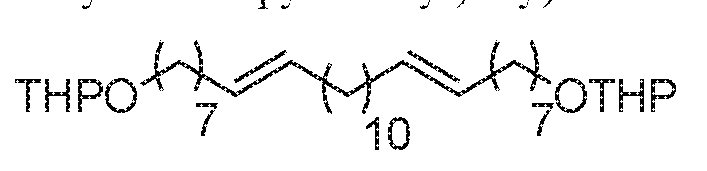
[0393] Compound 7 was synthesized by reaction of 5 (4.44 g, 7.37 mmol) and 6 (0.66 g, 3.4 mmol) according to the general procedure for Wittig oiefmation (see section 2.1). Olefin 7 (1.27 g, 61%) was obtained as a colorless oil after purification by column chromatography on silica gel using hexane/EtOAc (97:3 to 95:5) as eluent. Rf: 0.29 (hexane/EtOAc 97:3); 1H NMR (500
MHz, CDCl-rdl) δ 5.34-5.26 (m, 4H), 4.53 (dd, J = 2.8, 4.4 Hz, 2H), 3.84-3.80 (m, 2H), 3.71-
3.66 (m, 2H), 3.47-3.43 (m, 2H), 3.35-3.31 (m, 2H), 1.98-1.45 (m, 25H), 1.27-1.22 (m, 33H);
13C NMR (126 MHz, CDC13-dl) δ 130.5, 130.4, 130.1, 129.9, 99,0, 67.8, 62.4, 32.8, 32.7, 29,9,
29.9, 29.9, 29.8, 29.7, 29.7, 29.6, 29.5, 29.4, 29.3, 29.2, 27.2, 27.3, 26.4, 25.7, 19.8: ESI-MS: 613.6 [M+Naf ; HRMS 613.5166 calcd for j C ;K] i-nOA'af - found 613.5167.
[0394] 1 ,28-bis((tetrahydro-2H-pyran-2-yl)oxy)octacosane (8):

[0395] Crnpd 7 (1 .27 g, 2.15 mmol) was dissolved in a degassed mixture of
EtOH/EtOAc/pyndine (9: 1 :0.02) (55 mL) and 10% Pd/C (0.65 g, 50% w/w) was added. The reaction was stirred under 1 atm H2 at room temperature for 16 hours. The catalyst was removed by filtration on CELITE® after the sol vent was heated to 40°C, and evaporation of the filtrate gave 8 (1.24 g, 97%) as a white solid without further purification. *H NMR (400 MHz, CDCI3- di) δ 4.55 (dd, ./ = 2.8, 4,4 Hz, 2H), 3.87-3,83 (m, 2H), 3.70 (td, ./ 6.9, 9.6 Hz, 2H), 3.49-3.44 (m, 2H), 3.35 (td, ./ 6.9, 9.6 Hz, 2H), 1.84-1.76 (m, 2H), 1.72-1.66 (m, 2H), 1.58-1.46 (12H), 1.33-1.16 (m, 48H); i3C NMR (100 MHz, CDC^-d δ 99.0, 67.9, 62.5, 31.0, 29.9, 29.8, 29.7, 26.4, 25.7, 19.9; ESI-MS: 617.5 [M+Na]+; HRMS 617.5479 calcd for
 ' . found 617.5480.
[0396] 1,28-dibfomooctacos

[0397] 1,28-dibfomooctacosane was synthesized following a reported protocol for conversion of tetrah dropyranylated alcohols to their corresponding bromides (Wagner, A.; Heitz, M.-P.; Vlioskov. sk s . C. Tetrahedron Lett. 1989, 30 (5), 557-558). Carbon tetrabromide (1.80 g, 5.44 mmol) was added to a solution of 8 in dry DCM (30 mL). After stirring for 10 min, the solution was cooled down and triphenylphosphine (2.85 g, 10.88 mmol) was added. The mixture was stirred 24 hours at room temperature and purified by column chromatography on silica gel using DCM/liexane (1 : 1) as eluent. Compound 9 (0.76 g, 76%) was obtained as a white solid. Rf: 0.90 (DCM/hexane 1 : 1 ); Ί I NMR (500 MHz, CDCl3-di) δ 3.39 (t, ,/ 6.9 Hz, 4H), 1.86-1.80 (m, 4H), 1.42-1.37 (m, 4H), 1.29-1.23 (m, 44! ! }: 1 C NMR (126 MHz, CDCi3-di) δ 34.3, 33,0, 29.9, 29.8, 29.8, 29.7, 29.0, 28.4.
[03981 18,51-bis((beiizyloxy)methyl)-2,6,10,14,55,59,63,67-octamethyl-r7,20,49,52- tetraoxaoctahexacontane (10):

[0399] Compound 10 was synthesized by reaction of 3 (1.21 g, 2.62 mmol) and 9 (0.58 g, 1.05 mmol) according to the general procedure for formation of tetraether lipid scaffold by S 2 reaction (see section 2.1). Compound 10 (0.39 g, 28%) was obtained as a colorless oil after purification by column chromatography on silica gel using hexane/EtOAc (98:2 to 95:5) as eluent. Rf: 0.26 (hexane/EtOAc 95:5); !H NMR (500 MHz, CDCh-di) δ 7.32-7.25 (m, 10H), 4.54 (s, 4H), 3.64-3.45 (m, 14H), 3.41 (t, ./ 6.9 Hz, 4H), 1.67-1.48 (m, 10H), 1.36-1.02 (m, 90H), 0.86-0.82 (m, 30H); i3C NMR (126 MHz, CDCl3-di) δ 138.6, 128.5, 127.8, 127,7, 78.1, 73.5, 71.9, 70.9, 70.5, 69.1, 39.6, 37.7, 37.7, 37.6, 37.6, 37.5, 37.4, 37.3, 33.0, 30.0, 29.9, 29.9, 29.7, 28.2, 26.3, 25.0, 24.7, 24.6, 22.9, 22.8, 20.0, 19.9, 19.8.
[0400] 3-((28-(3-hydroxy-2-((3,7,l 1 ,15-teiraniethyihexadecyi)oxy)propoxy)octacosyI) oxy)-2- ((3,7,1 1 ,15-tetramethylhexadecyl) oxy)propan-l-ol (11):

[0401] Compound 11 was synthesized by hydrogenation of 10 (0.39 g, 0.30 mmol) according to the general procedure for debenzylation of the lipid scaffold by hydrogenation (see section 2. 1). Diol 11 (0.23 g, 68%) was obtained as a white solid after purificatio by column chromatography on silica gel using hexane/EtOAc (9: 1 to 8:2) as eluent. Rf: 0.52
(hexane/EtOAc 8:2); lH NMR (500 MHz, CDCl3-di) δ 3.71 -3.39 (m, 18H), 2.16 (brs, 2H), 1.62- 1.45 (m, 10H), 1.39-1.02 (ra, 90H), 0,85-0.81 (m, 30H); !3C NMR (126 MHz, CDCl3-di) δ 78.5,
72.1, 72.1, 68.9, 63,3, 39,6, 37.7, 37.7, 37,6, 37,5, 37.5, 37.3, 37.2, 33,0, 30.0, 29.9, 29.8, 29,7,
28.2, 26.3, 25.0, 24.7, 24.6, 22.9, 22.8, 20.0, 19.9,19.8; ESI-MS: 1135.8 | M 1 11
[0402] (octacosane-l,28-diylbis(oxy))bis(2-((3,7,l l,15-tetramethylhexadecyl)oxy) propane-3, 1-diyl) -(trimethylammonio)ethyl) bis(phosphate) GMGTPC

[0403] Lipid GMGTPC was synthesized from diol 11 (0.23 g, 0.21 mmol) following the general procedure for formation of phosphocholine lipid (see section 2.1). Lipid GMGTPC (0.16 g, 54%) was obtained as a white gum after purification by column chromatography on silica gel using DCM/Me()H/H20 (70:30:5) as the eluent. Rf: 0.33 (DCM/MeOH/LLO 70:30:5);
NMR (500 MHz, Y!eOD-d, i'DCL-d i 1 : 1) δ 4.00-3.96 (m, 4H), 3,63 (t, ./ 5.5 Hz, 4H), 3.40-3,31 (m, 12H), 3.23-3.17 (m, 6H), 2.95 (s, 18H), 1.39-1,22 (m, 10H), 1.14-0.79 (m, 90H), 0.62-0.58 (30H); 13C NMR (126 MHz, MeOD-d4/CDCl3-di 1 : 1 ) δ 77.8, 77.7, 77.7, 77.6, 71.3, 70.2, 68.6, 68.3, 66.0, 64,7, 64.6, 58.6, 58.5, 53,5, 39.0, 37.3, 37. 1, 37,0, 36.8, 36.8, 36.7, 32.4, 29.5, 29.3, 29.1, 27.5, 25,6, 24.3, 24.0, 22.0, 21 ,9, 19.1, 19.0, 19.0, 18,9, 18.9; 3 !P NMR (202 MHz, MeOD-d4/CDCl3-di 1 : 1) δ 0.16; ES1-MS: 1466.0 [M+H]+; HRMS calcd 1466.2615 for [C84H175N2Oi2P2]+, found 1466.2597.
[0404] Chemical synthesis scheme for synthesis of GMGTPC-CPI is depicted in FIG, 6. [0405] 12-(benzyloxy)dodecan-l-ol

[0406] Compound 12 was synthesized following a reported protocol (WO 2009/135977), [0407] 12-(benzyloxy)dodecanal (13):

[0408] To a cold solution of 12 (1.44 g, 4.90 mmol) in dry- DC VI (45 mL), Dess-Martin
Periodmane (DMP) (2.50 g, 5.89 mmol) was added portionwise. The resulting mixture was allowed to reach room temperature over 1 hour. After 3 more hours of stirring at room temperature, the mixture was diluted with DCM, washed successively with 1M NaOH solution,
water and brine. The organic layer was then dried over Na2S04, concentrated under reduce pressure and purified by column chromatography on silica gel using hexane/EtOAc (95:5) as the eluent. Aldehyde 1.3 (1.25 g, 88%) was obtained as a colorless oil. Rf: 0.47 (hexane/EtOAc 95:5); !H NMR (400 MHz, CDCl3-di) δ 9.74 (t, J = 1.7 Hz, 1H), 7.33-7.25 (m, 5H), 4.48 (s, 2H), 3.44 (t, J ------ 6.7 Hz, 2H), 2.40 (tt, ./ 1.7, 6.7 Hz, 2H), 1.62-1.55 (m, 4H), 1.35-1.25 (m, 141 1 ):
ESl-MS: 291.2 I M · 1 11 . HRMS 291.23 9 calcd for [C19H3102]+, found 291.2322.
[0409] (((lR,3S)-cyclopentane-l,3-diy])bis(methylene))bis(triphenylphosphonium) iodide

[0410] Compound 14 was synthesized following a reported protocol (Brard, M.: Lame, C: Rethore, G.; Laurent, I.; Neveu, C; Lemiegre, L.; Benvegnu, T. J. Org. Chem. 2007, 72 (22), 8267-8279).
[0411] (lR,3S)-l,3-bis((E)- -(benzyloxy)tridec-l-en-l -yl)cyclopentane (IS):

[Θ412] Compound 15 was synthesized by reaction of 13 (3.84 g, 13.24 mmol) and 14 (4.87 g, 5.57 mmol) according to the general procedure for Wittig olefmation (see section 2.1). Olefin 15 (2.44 g, 68%) was obtained as a colorless oil after purification by column chromatography on silica gel using hexane/EtOAc (99: 1) as eluent. Rf: 0.45 (hexane/EtOAc 99: 1): SH NMR (500 MHz, CDCl3-di) δ 7.35-7.26 (m, 10H), 5,37-5.27 (m, 4H), 4.50 (s, 4H), 3.46 (dd, ,/ 6,5, 6.8 Hz, 4H), 2.82-2.76 (m, 1.5H), 2.49-2,43 (m, 0.5H), 2.04-1.77 (m, 7H), 1.64-1.58 (m, 4H), 1.36-1.26 (m, 34H), 1.06-0.96 (m, 1H); nC NMR (126 MHz, CDCl3-d δ 138.9, 135.3, 135.2, 135.0, 134.9, 128.8, 128.8, 128.7, 128.5, 127.8, 127.6, 73.0, 70.7, 43.7, 42,3, 41.9, 38.4, 38.2, 33.0, 32.8, 32,7, 32.5, 32.4, 30.1, 30.0, 29,8, 29.7, 29.7, 29.5, 29,4, 27.7, 26.4; ESI-MS: 660,6
[M+NH4]+; HRMS calcd 660,5714 for | C,>i ΚΟ. 'Ι U T · found 660.5715,
[0413] 6):
 [0414] To a degassed solution of 15 (2.38 g, 3.71 mmoi) in EtOH (220 mL), 10% Pd/C (0.60 g, 25% w/w) was added. The reaction w¾s stirred under 1 atm H2 at room temperature for 24 hours. The solution was then filtered through CELITE®, and the solvent was evaporated. Diol 16 (1.64 g, 95%) was obtained as a white solid and used without further purification. Rf: 0.26 (hexane/EtOAc 95 :5); lH NMR (500 MHz, MeOD-cU/CDCls-di 1 : 1) δ 3.58 (t,■/ 7.0 Hz, 4H), 1.92-1 .68 (m, 5H), 1.58- 1.51 (m, 4H), 1 .39-1 .21 (m, 44H), 1. 18-1.1 1 (m, 2H), 0.67-0.59 (ra, 1H); i 3C NMR ( 126 MHz, MeOD-d4/CDCl3-d1 1 : 1 ) 5 62,4, 40.7, 40.1 , 36.7, 32.5, 31 ,6, 29.9, 29.7, 29.6, 29.5, 28.7, 28.6, 25.7: ESI-MS: 467.6 | M · I I |
[0415] (lR,3S)-l,3-bis(13-bromotridecyl)cyclopentane (17):

[Θ416] Dibromo alkane 17 (1.57 g, 78%) was obtained as a white solid from diol 16 (1.58 g, 3.39 mmoi) following the general procedure for bromination of diol using hvdrobromic acid solution (see section 2.1). Rf: 0, 81 (hexane/EtOAc 99: 1); (500 MHz, CDCl3-dj) δ 3.41 (ΐ, J = 7.0 Hz, 4H), 1.89-1.69 (m, 9H), 1.44-1.14 (m, 44H), 0.91-0.85 (m, 2H), 0.66-0.50 (m, I I I ): 13C NMR (126 MHz, CDCl3-di) δ 40.9, 40.4, 39,0, 37.0, 37.0, 34.2, 33,2, 33.0, 31 .9, 30.2, 29.9, 29.9, 29.8, 29.7, 29.0, 29,0, 28.9, 28.4,
[0417] (lR,3S)-l,3-bis(13-(3-(ben.^loxy
propoxy tridecyl)cyclopentane (18):

[0418] Compound 18 was synthesized by reaction of 3 (0.39 g, 0.84 mmoi) and 17 (0.20 g, 0.34 mmoi) according to the general procedure for formation of tetraether lipid scaffold by SN reaction (see section 2. 1). Product 18 (0.13 g, 29%) was obtained as a colorless oil after purification by column chromatography on silica gel using hexane/EtOAc (99: 1 to 95 :5) as eluent. Rf: 0,27 (hexane/EtOAc 95:5); Ή NMR (500 MHz, CDCl3-di) δ 7.25-7.26 (m, l OH), 4.57 (s, 4H), 3.68-3.43 (m, 18H), 1.94-1.89 (m, 1H), 1.81 -1.71 (m, 4H), 1.69-1.50 (m, 10H), 1.42-1.07 (m, 88! ! ). 0.89-0.60 (m, 31H); i3C NMR (126 MHz, CDCl3-di) δ 138.6, 128.6, 128.5 127.8, 127.8, 128,7, 100.1 , 78. 1 , 73.5, 71.8, 70,9, 70.5, 69.0, 40.9, 40,3, 39.6, 39.0, 37.7, 37.7,
37.6, 37.6, 37.5, 37.5, 36.9, 33.0, 31.8, 30.2, 30.0, 29.9, 29.8, 29.7, 29.0, 28.1, 26.3, 25.0, 24.7, 24.6, 22.9, 22.8, 20.0, 19.9, 19.8.
[0419] 3,3'-((((lR,3S)-cyclopentane-l ,3-^
((3,7,11 ,15-tetramethylhexadecyl)oxy)propan-l-ol) (19):

[0420] Compound 19 was synthesized by hydrogenation of 18 (0.28 g, 0.28 mmol) according to the general procedure for debenzylation of lipid scaffold by hydrogenation (see section 2.1). 19 (0.28 g, 85%) was obtained as a colorless oil after purification by column chromatography on silica gel using hexane/EtO Ac (9: 1 to 8:2) as elueni. Rf: 0.43 (hexane/EtOAc 8:2); !H NMR (500 MHz, CDCl3-di) δ 3.75-3,37 (m, 18H), 2.22 (t, J = 7.0 Hz, 2H), 1 ,91 -1.48 (m, 17H), 1.43- 1.01 (m, 86H), 0,88-0.84 (m, 30H), 0.75-0.59 (m, 1H); 13C NMR (126 MHz, CDCl3-di) δ 78.4, 72.1, 71.1 , 68.9, 63.3, 40.9, 40.3, 39.6, 39.0, 37.7, 37.7, 37.6, 37.6, 37.5, 37.3, 37.3, 37.0, 33.2, 33.0, 31 ,8, 30.2, 30.0, 29.9, 29.8, 29,7, 29.0, 28.9, 28.2, 26,3, 25.0, 24.7, 24.6, 22.9, 22,8, 20.0, 19.9, 19.8; ES1-MS: 1175.9 | M i 11 : HRMS calcd 1176.1818 for j C«H , «0,. j '. found
1 176.1817.
[0421] i(((l R,3S)-cyclopentane-l,3-diyl)bis(tridecane- 13, l -diyl))bi
tetranieihylhexadecyl)oxy)propar!e~3, l-diyl) bis(2-(trim.ethylammonio) ethyl) bis(phosphate)

[0422] Lipid GMGTPC-CPl was synthesized from diol 19 (0.38 g, 0,32 mmol) following the general procedure for formation of phosphocholine lipid (see section 2.1). Lipid GMGTPC-CPl (0.42 g, 85%) was obtained as a white gum after purification by column chromatography on silica gel using IX \! MeO! ! ! ! >() (70:30:5) as elueni. Rf: 0.32 (DCM/MeOH/HjO 70:30:5); ' l ! NMR (500 MHz, MeOD-d4/CDCl3-di 1 : 1 ) 5 3,91 (m, 4H), 3.56 (t, J ------ 5.5 Hz, 4H), 3,33-3. 10
(m, 18H), 2.89 (s, 18H), 1.75-1.15 (m, 14H), 1.05-0.72 (m, 89H), 0.55-0.51 (m, 31H), 0.33-0.26 (m, 1H); : ;C NMR (126 MHz, MeOD-d /CDCl3-di 1 : 1 ) δ 77.8, 77.8, 77.7, 71.4, 70.2, 68.7, 68.5,
66. 1, 64,7, 64.7, 58.6, 58.6, 53.6, 40,4, 39.8, 39.0, 37.3, 37, 1 , 37.0, 36.9, 36.8, 36.7, 36,4, 32.4,
31.2, 29,6, 29.4, 29.3, 29.3, 29.2, 28,4, 27.6, 25.8, 24.4, 24, 1 , 24.0, 22.1, 22.0, 19.2, 19, 1, 19.1, 19.0; 31P NMR (202 MHz, MeOD-d /CDCl3-di 1 : 1) δ 0.22; ESI-MS: 1505.9 | i I i | : HRMS calcd 1506,2928 for
 found 1506.2930.
[0423] Chemical synthesis scheme for synthesis of GMGTPC-CP2 is depicted in FIG. 7. [0424] 6-(benzyloxy)hexan~l~ol (20):

[0425] Compound 20 was synthesized following a reported protocol (WO 2009/135977) and
NMR data match previously reported data. (Shimojo, M.; Matsumoto, K_; Hatanaka, M, Tetrahedron 2000, 56 (47), 9281 -9288)
[0426] 6-(benzyloxy)hexanal (21):

[0427] To a cold solution of 20 (2.15 g, 10.34 mmol) in dry DCM (100 mL), DMP (5.26 g, 12.40 mmol) was added portionwise. The resulting mixture was allowed to reach room temperature over 1 hour. After 3 more hours of stirring at room temperature, the mixture was diluted with DCM, washed successively with 1M NaOH solution, water and brine. The organic solution was dried over Na?S04, concentrated under reduce pressure and purified by column chromatography on silica gel using hexane/EtOAc (95:5 to 90: 10) as the eluent. Aldehyde 21 (1.77 g, 83%) was obtained as a colorless oil and Ή NMR data match previously reported data,
[0428] triphenyl(((l S,3R.)~3~(((tetrahydro~2H~py
phosphonium iodide (22):

[0429] Compound 22 was synthesized following a reported protocol. (Brard, M.; Richter, W.; Benvegnu, T.; Plusquellec, D, J. Am. Chera, Soc. 2004, 126 (32), 10003-10012)
[0430] 2-(((l S,3R)-3-((E)-7-(benzyloxy)hept- 1 -en- 1 -yl)cyclopentyl)methoxy)tetrahydro-2H- pyran (23):

[0431] Compound 23 was synihesized by reaction of 21 (0.85 g, 4. 14 mmol) and 22 (2.02 g, 3.45 mmol) according to the general procedure for Wittig olefmation (see section 2.1). Olefin 23 (0.76 g, 57%) was obtained as a colorless oil after purification by column chromatography on silica gel using hexane/EtOAc (99: 1 to 95:5) as the eluent. Rf: 0.39 (hexane/EtOAc 95:5); H NMR (500 MHz, CDCl3~di) δ 7.34-7.25 (m, SH), 5.39-5.24 (m, 2H), 4.58 (ddd, 1.9, 2.9, 4.2 Hz, 1H), 4.50 (s, 2H), 3.89-3.84 (m, 1H), 3.65-3.60 (m, 1H), 3.51-3.45 (m, 3H), 3.31-3.26 (m, 2.79-2.71 (m, 0.8H), 2.45-2.42 (m, 0.2H), 2.28-2.20 (m, 1H), 2.08-2.89 (m, 3H), 1.86-1.67
(m, 4H), 1.65-1,23 (m, 12! ! ). 1.03-0.90 (m, 1H); 13C NMR (126 MHz, ΠΧ h-d , ) δ 138.8, 135.2, 134,9, 128.8, 128.7, 128.5, 127,8, 127,6, 99.0, 73.0, 72.5, 72,4, 70,6, 62.4, 62.3, 43,7, 43,6, 39.7, 39.5, 38.5, 38.4, 38.4, 38.1, 37.9, 37.7, 32.9, 32.9, 32.6, 32.5, 30.9, 30,0, 29.9, 29.8, 29.6, 29.1, 29.0, 28.8, 27.6, 36.0, 25.9, 25.7, 19.8, 19.7; ESI-MS: 409.3 j YS - Nai ; FIRMS calcd 409.2713 for [C25H3803Na] , found 409.2714.
[0432] ((l S,3R)-3-((E)-7-(benzyloxy)hept-l-en-l -y1)cyclopent}'l)methanol (24):

[0433] To a solution of 23 (740 mg, 1.92 mmol) in MeOH (32 mL), p-toluenesulfonic acid (18 mg, 0.3 mmol) was added. The solution was stirred 2 hours at room temperature, concentrated and purified by column chromatography on silica gel using hexane/EtOAc (9: 1 to 8:2) as the eluent. Alcohol 24 (477 mg, 83%) was obtained as a colorless oil. Rf: 0.41 (hexane/EtOAc 8:2); -l NMR (500 MHz, CDCi3-di) δ 7.34-7.25 (m, 5H), 5.31-5.24 (m, 2H), 4.49 (s, 2H), 3,51-3.44 (m, 4H), 2.79-2.71 (m, 0.8H), 2.47-2.39 (m, 0.2H), 2.19-2.13 (m, ! ! ! }, 2,06-1 ,95 (m, 2H), 1.94- 1.87 (m. I I I ). 1 ,79-1.59 (m, 5H), 1.44-1,22 (m, 6H), 0.98-0.88 (m, 1H); i3C NMR (126 MHz, nX'h-di ) δ 138,8, 134.9, 134.7, 129.0, 128.8, 128.5, 127.8, 127.6, 73.0, 70.6, 67.7, 67,6, 43.6, 42.2, 42.0, 38.5, 37.6, 37.1, 32.9, 32.6, 32.4, 29.9, 29.8, 29.8, 29.5, 28.4, 28.2, 27.6, 26.0, 25.8; ESI-MS: 303.2 [M+H]+; HRMS calcd 325.2138 for j C^I M Sai . found 325.2137.
[0434] (((1 S,3R)-3-((E)-7-(benzyloxy)hept- 1 -en- 1 -yl)cyclopentyl)methyl)triphenyl- phosphonium iodide (25):

[0435] To a cold solution of triphenylphosphine (476 mg, 1.82 mmol) and imidazole (218 mg, 3.20 mmol) in DCM (11 mL), iodine (539 mg, 2.13 mmol) was added. After stirring of the mixture at room temperature in the dark for 10 min, a solution of compound 24 (460 mg, 1.52 mmol) in DCM (11 mL) was added. The reaction mixture was stirred for 2 hours at room temperature in the dark. The reaction mixture was washed with 10% Na2S203 aqueous solution and extracted with DCM. The combined organic layers were washed with water, dried over Na2S04, and purified by silica gel chromatography using DCM as the eiuent. The resulting oil was carried out to the next step without further purification and characterization. To a solution of the purified crude in ACN (70 mL), triphenylphosphine (476 mg, 1.82 mmol) was added. After stirring at reflux for two days, the reaction mixture was cooled down, evaporated and purified by column chromatography on silica gel using DCM/MeOH (100:0 to 98:2) as the eiuent.
Phosphonium salt 25 (427 mg, 42%) was obtained as a yellow pale solid. Rf: 0.46 (DCM/MeOH 95:5); !H NMR (500 MHz, CDCl3-di) δ 7.79-7.62 (m, 15H), 7.25-7, 17 (m, 5H), 5.20-5.13 (m, 2H), 4.40 (s, 2H), 3.77-3.64 (m, 2H), 3.38-3.35 (m, 2H), 2.57-2.49 (m, 0.8H), 2.24-2.13 (m, 1.2H), 1.91-1.80 (m, 2H), 1.74-1 .66 (m, 1H), 1.62-1 , 13 (m, 1 1H); 13C NMR (126 MHz, CDCI3- di) δ 138.6, 138.5, 135, 1, 133.8, 133.7, 133.6, 132.0, 132.0, 130,6, 130.5, 129.2, 129.1, 128.5 ( C-P = 12.5 Hz), 128.3, 127.6, 127.4, 118.4 (JC-P= 86.0 Hz), 72.8, 70.3, 42.8, 42.5, 42.4, 42.2, 42.1, 37.5, 34.5, 24.5, 34.3, 33.2, 33.1, 32.3, 32,0, 31.5, 29.6, 29.2, 29.1, 28.7, 27.3, 25.6, 25.6; ESI-MS: 547,4 I YM ! |
[0436] adipaldehyde (26):
,0
4
[0437] Dialdehyde 26 was synthesized following a reported protocol. (Trigo, G. G.; Mufloz, E. M.; Liama-Hurtado, E. J. Heterocyci. Chem. 1984, 21 (5), 1479-1483).
[0438] (lE,7E)-l-((lR,3S)-3-((E)-7-(benzyioxy)hept-l-en-l-yl)cyclopenty3)-8-((l S,3R)-3- ((E)-7-(benzyloxy)hept- 1 -en-l-yl)cyclopentyl)octa-l ,7-diene (27):

[0439] Compound 27 was synthesized by reaction of 25 (2.71 g, 4.02 mmol) and 26 (0.21 g, 1.83 mmol) according to the general procedure for Wittig olefination (see section 2.1). Olefin 23 (0.61 g, 5.1 %) was obtained as a colorless oil after purification by column chromatography on silica gel using hexane/EtOAc (98:2) as the eiuent. This product represents a possible mixture of isotactic and syndiotactic isomers. For simplicity, only the isotactic isomer is shown in FIG. 1 and throughout. Rf: 0.28 (hexane EtOAc 98:2); *H NMR (500 MHz, CDCi3-di) δ 7.34-7.25 (m, I OH ). 5.36-5.26 (m, 8FI), 4.48 (s, 4FI), 3.44 (t, ,/ 6,9 FIz, 4FI), 2.82-2,73 (m, 3H), 2.47-2,41 (m, 0.8H), 2.30-2,27 (m, 0.2H), 2.01-1 ,92 (m, 7H), 1.88-1.74 (m, 6H), 1 ,65-1,55 (m, 5H), 1.41-1.30 (m, 16H), 1.05-0.91 (m, 2H); 33C NMR (126 MFIz, CDC -di) δ 138.8, 135.5, 135.4, 135.4, 135.3, 135. 1 , 135,0, 134.0, 133.8, 128.9, 128.7, 128.6, 128,6, 128.5, 127.8, 127.6, 73.0, 70,6, 43.7, 43,4, 42.3, 41.9, 38.4, 38.1 , 33,0, 32.8, 32.6, 32.6, 32,5, 32.3, 29.9, 29.8, 29.8, 29,7, 29.6, 29.3, 27.6, 27.6, 26.0, 25.9.
[04401 l-((lR,3S)-3-(hept}4-7-ol)cyclopeiit 1)-8-((lS,3R)-3-(hept 4-7-ol)cyciopent 'l) octane (28):

[04411 To a degassed solution of olefin 27 (0.85 g, 1.31 mmol) in EtOH (76 mL), 10% Pd/C (0.21 g, 25%) w/w) was added. The reaction was stirred under 1 atm H2 at room temperature for 24 hours. The solution was then filtered through CELTTE®, and the solvent was evaporated. Diol 28 (0.45 g, 72%) was obtained as a white solid, Ή NMR (500 MHz, MeGD~d4/CDCl3~di 9: 1) 5 3.34 ( ·. ./ 6.9 Hz, 4H), 1.71-1.66 (m, 2H), 1,56-1.47 (m, 8H), 1.35-1.29 (m, 4H), 1.14- 0,98 (m, 40H), 0.96-0.80 (m, 6H), 0.43-0.37 (m, 2H); 13C NMR (126 MFIz, MeOD-cU/CDCh-di 9: 1 ) δ 62.2, 40,6, 40.0, 38.6, 38.6, 32,9, 32.4, 31.5, 29.8, 29,6, 29.4, 28.6, 28.5, 25.6.
[0442] J.~((lR,3S)-3-(7~bromoheptyl)ey^^
cyclopentyl)octane (29):
 [0443] Dibromo alkane 29 (0.47 g, 83%) was obtained as a white solid from diol 28 (0.45 g, 0.94 mmol) following the general procedure for bromination of diol using hydrobromic acid solution (see section 2.1). Rf: 0,75 (hexane); Ή NMR (500 MHz, CDCl3-di) δ 3.38 (t, ,/ 6.9 Hz, 4H), 1.90-1.66 (m, 13H), 1 ,42-1.00 (m, 40H), 0.87-0,83 (m, IH), 0.63-0.56 (m, 2H); i3C NMR (126 MHz, CDC^-d δ 40.9, 40.3, 40.3, 39.0, 38.9, 36.9, 36.8, 34.3, 33.2, 33.0, 31.8, 30.2, 29.9, 29.0, 29.0, 28,9, 28.8, 28.7, 28.4.
[0444] I -((lR,3S)-3-(7-(3-(benzykwy)-2-((3,7, l l,15 .etramethy]hexadecyl)oxy)propox}-) heptyl)cyclopentyl)-8-((l S,3R)-3-(7-(3-^
hexadecyl)oxy)propoxy)heptyl)cyclopentyl)octane (30):

[0445] Compound 30 was synthesized by reaction of 3 (1.10 g, 2,35 mmol) and 29 (0.47 g, 0.78 mmol) according to the general procedure for formation of tetraether lipid scaffold by SN2 reaction (see section 2.1). Product 30 (0.32 g, 30%) was obtained as a colorless oil after purification by column chromatography on silica gel using hexane/EtOAc (99: 1 to 95:5) as the eluent. Rf: 0,50 (hexane/EtOAc 95:5); lH NMR (500 MHz, CDCl3-di) δ 7.32-7.25 (m, OH), 4.53 (s, 4H), 3.63-3.92 (m, 18H), 1.88-1.85 (m, 2H), 1.76-1.66 (m, 6H), 1.62-1.47 (m, 10H), 1.37-1.01 (m, 84! i ). 0.85-0.81 (m, 30! ! }. 0.73-0.56 (m, 2H); 13C NMR (126 MHz, CDCi3-d3) 138.6, 128.5, 127,8, 127.7, 78. 1, 73.6, 71.9, 70,9, 70.5, 69.1, 40.9, 40,3, 39.6, 39.0, 37.7, 37.7, 37.6, 37.6, 37.5, 37.4, 37.3, 37.0, 36.9, 33.3, 33.0, 31.8, 30.2, 30.1, 30.0, 30.0, 29.9, 29.8, 29.0, 28.9, 28.2, 26.4, 25.0, 24.7, 24.6, 23.0, 22.9, 20.0, 19.9, 19.8.
[0446] 3-((7-((lR,3S)-3-(8-((lR,3S)-3-(7-(3-hydroxy-2-((3,7,n,15-tetramethylhexadecyl) oxy)propoxy)hep )cyclopentyl)oct 'l)cyclopentyl)hept 'l)oxy)-2-((3,7,l l, 15- tetramethylhexadecyl)oxy)propan-l -ol (31):

chromatography on silica gel using hexane/EtO Ac (95:5 to 85: 15) as the eluent. Rf: 0.41 (hexane/EtOAc 80:20); *H NMR (500 MHz, CDCl3-di) δ 3.71-3.40 (m, 18H), 1.90-1.85 (m, 2H), 1.74-1.47 (m, 20H), 1.38-1,01 (m, 82H), 0.86-0.81 (m, 30H), 0.63-0,56 (m, 1H); 13C NMR (126 MHz, CDCl3-di) δ 78.5, 72.1, 71.1 , 68,9, 40.9, 40.3, 39.6, 39,0, 37.7, 37.7, 37.6, 37,5, 37.4, 37.3, 37.0, 36.9, 33.2, 33.0, 31.9, 30.2, 30.1, 30.0, 30.0, 29.9, 29.7, 29.0, 28.9, 28.8, 28.2, 26.3, 25.0, 24.7, 24.6, 23.0, 22.9, 20.0, 19.9, 19.8; ESI-MS: 1187.8 [M+H] \
[0448] 3-((7-((l S,3R)-3-(8-((l S,3R)-3-(7-(3-((oxido(2-(lrimethylammonio)ethoxy) phosphotyl)oxy)-2-((3,7,l l,15-tetramethylhexadecyl)oxy)propoxy)hept\'l)
cyclopentyl)octyl)cyclopentyl)heptyl)oxy)-2-((3,7,n^ propyl-(2- (trimethylammonio)ethyl) phosphate (GMGTPC-CP2):

[0449] Lipid GMGTPC-CP2 was synthesized from diol 31 (0.17 g, 0, 14 mmol) following the general procedure for formation of phosphocholine lipid (see section 2.1). Lipid GMGTPC-CP2 (0.15 g, 82%) was obtained as a white gum after purification by column chromatography on silica gel using IX ΎΙ MeO! l ! ! >() (70:30:5) as the eluent. Rf: 0.50 i SX'M VleO! ! 1 1 0 70:30:5); jH NMR (500 MHz, Y!eOD-d, ΠΧΊ :-(.! , 1 : 1) δ 3.90-3.87 (m, 4H), 3,53 (t, J= 5.5 Hz, 4H), 3.32-3.06 (m, 18H), 2.86 (s, 18H), 1.58-1.34 (m, 10H), 1.28-1.13 (m, 10H), 1.03-0.70 (m, 82H), 0.53-0.48 (m 30H), 0.30-0.24 (m, 2H); 33C NMR (126 MHz, MeOD-d /CDCl3-di 1 : 1) δ 77.8, 77.7, 77.6, 77.6, 71.3, 70,2, 68.6, 68.4, 66.0, 64,7, 64.6, 58.6, 58.5, 53,5, 40.3, 39.8, 39.0, 38.4, 38.3, 37.3, 37.1, 37.0, 37,0, 36.9, 36.8, 36.7, 36,4, 36.3, 32.6, 32.4, 31 ,2, 29.5, 29.4, 29.3, 29.2, 29.1, 28.3, 27.5, 25.7, 24.4, 24.0, 24.0, 22.1, 22.0, 19.1, 19.1, 19.0, 19.0, 18.9; 31P NMR (202 MHz, MeOD-d4/CDCl3-di 1 : 1 ) δ 0,20; EST-MS: 1518.2 I M · 1 11 . HRMS calcd 1518,2928 for
 found 1518.2923.
0450] Chemical synthesis scheme for synthesis of GMGTPC-CP3 is depicted in FIG. 8. 0451] ((pent-4-en-l-yloxy)methy
found 1518.2923.
0450] Chemical synthesis scheme for synthesis of GMGTPC-CP3 is depicted in FIG. 8. 0451] ((pent-4-en-l-yloxy)methy

[0452] Compound 32 was synthesized following a reported protocol. (Lowik, D. W. P. M; Liskamp, R. M. J. Eur. J. Org. Chem. 2000, 2000 (7), 1219-1228)
[0453] 4-(benzyioxy)butanal (33):

[0454] To a solution of 32 (6,63 g, 37.6 mrnol) ra DCM (300 mL) at -78 °C ozone was bubbled until the solution turned blue. Then, oxygen was bubbled for 10 mm and
triphenylphosphine (10.8 g, 41.4 mrnol) was added portionwise at -78 °C. The reaction mixture was allowed to warm up slowly to room temperature and stirred overnight. The solvent was removed under reduced pressure and the resulting solid was purified by column chromatography on silica gel using hexane/EtOAc (90: 10 to 80:20) as eluent. Aldehyde 33 (5.85 g, 88%) was obtained as a colorless oil and !H NMR data match previously reported data.
[0455] ( 1R,3S)- 1 ,3-bi -5-(benzyloxy)pent- 1 -en-1 -yl)cy clopentane (34):

[0456] Compound 34 was synthesized by reaction of 14 (13.1 g, 14.9 mrnol) and 33 (5.9 g, 32.9 mrnol) according to the general procedure for Wittig olefination (see section 2.1). Olefin 34 (2.8 g, 45%) was obtained as a colorless oil after purification by column chromatography on silica gel using hexane/EtOAc (98:2) as the eluent. Rf: 0.45 (hexane/EtOAc 95:5); Ή NMR (500 MHz, CDCi3-di) δ 7.36-7,28 (m, 1 Π ). 5.41-5.29 (ra, 4H); 4,52 (s, 4H); 3.51-3.48 (m, 4H), 2.86-2,77 (m, 1.7H), 2.50-2,45 (m, 0.3H); 2.19-2,08 (m, 4H), 1.93-1.78 (m, 3H), 1.73-1.67 (ra, 4H), 1.41-1.34 (m, 2H), 1.08-0,99 (m, 1H); l3C NMR (126 MHz, CDCVdj) δ 138.8, 136.0, 135.9, 135.7, 135.5, 128.5, 127.9, 127.8, 127.6, 73.1 , 73.0, 70.0, 69.9, 43.6, 43.4, 42.2, 41.8, 38.4, 38, 1 , 32.9, 32.8, 32.4, 32.3, 30, 1 , 29.8, 29.2, 24.3.
[0457] 5,5'-((lR,3S)-cyciopentane-l ,3-diyl)bis(pentan-l -ol) (35):
 [0458] To a degassed solution of 34 (2.75 g, 6.58 nimoi) in EtQH/THF (9: 1 ) (75 mL), 10% Pd/C (0.69 g, 25%» w/w) was added. The reaction was stirred under 1 aim H2 at room temperature for 16 hours. The solution was then filtered through CELTTE®, and the solvent was evaporated. Diol 35 (0.83 g, 52%) was obtained as a white solid after purification by column
chromatography on silica gel using hexane/EtOAc (75:25 to 50:50) as the eluent. Rf: 0.42 (hexane/EtOAc 1 : ); lli NMR (500 MHz, CDCl3-di) 6 3,49 (t, 6,9 Hz, 4H), 3, 23 (brs, 2H), 1.84-1.79 (m, 1H), 1.73-1.61 (m, 4H), 1.48-1 .42 (m, 4H), 1 ,25-1 ,04 (m, 14.2H), 0.57-0,51 (m, 0.8! I s; i3C NMR (126 MHz, CDCl3-d]) 6 62.6, 40.1, 38.8, 36.8, 36.7, 33.0, 32.7, 31.6, 28.6, 28.5, 26.1; ESI-MS: 265.1 M+Naj+; 1 1 RMS calcd 265.2138 for [C15H3o02Na|+, found 265.2141.
[0459] (X(lR,3S)-cyclopentane-l ,3~diyl)tt
iodide (36):
IPh3P/' '^^
[0460] To a cold solution of triphenylphosphine (1.98 g, 7.55 mmol) and imidazole (0.52 g, 7.55 mmol) in DCM (18 mL), iodine (1.92 g, 7.55 mmol) was added. After stirring of the mixture at room temperature in the dark for 10 min, a solution of compound 35 (0.83 g, 3.43 mmol) in DCM (18 mL) was added. The reaction mixture was stirred for 2 hours at room temperature in the dark. The reaction mixture was washed with 10% Na2S203 aqueous solution and extracted with DCM. The combined organic layers were washed with water, dried over Na2S04, and purified by silica gel chromatography using a mixture of hexane EtOAc (8:2) as eluent. The resulting oil was carried out to the next step without further purification and characterization. To a solution of the purified crude in benzene (15 mL), triphenylphosphine (2.70 g, 10.29 mmol) was added. After stirring at reflux for 16 hours, the reaction mixture was cooled down, evaporated and purified by column chromatography on silica gel using
DCM/MeOH (1 :0 to 9: 1) as the eluent, diphosphomum salt 36 (3, 19 g, 94%) was obtained as a white solid. *H NMR (500 MHz, CDC^-d δ 7.74-.61 (m, 30H), 3.48-3.42 (m, 4H), 1.76-1.71 (m, 1H), 1.57-1.50 (m, I 2H), 1.16-0.85 (10.2H), 0,43-0,37 (m, 0.8H); i3C NMR (126 MHz, CDClj-di) δ 135.2, 133.6 (d, JC-P = 10.0 Hz), 130,6 (d, ./( '· ' = 12.5 Hz), 1 17.9 (d, JC-P = 85.7 Hz), 53.6, 40.2, 39.7, 38.3, 38.2, 36.0, 32.8, 31.5, 30.6, 30.5, 28.0, 23.2, 22.8, 22.5, 22.5; ESI- MS: 366.3 | M-2I]2+; HRMS calcd 366.2001 for | 51Η58Ρ2]2+, found 366.2003.
[0461] ((but-3-en-l -yloxy)methyl )benzene (37):
[0462] Compound 37 was synthesized following a reported protocol. (Qin, L.; Ren, X.; Lu, Y.; Li, Y.; Zhou, J. Angew. Chem., Int. Ed. Engl. 2012, 51 (24), 5915-5919)
[0463] 3~(benzyloxy)propanai (38):

[0464] Compound 38 was synthesized following a reported protocol. (Flowers, C. L.; Vogel, P, Chem, - A Eur. J. 2010, 16 (47), 14074-14082)
[0465] 2-(((l S,3R)-3-((E)-4-(benzyloxy)but- 1 -en-1 -y])cyclopentyl)methoxy)tetrahydro-2H-

[0466] Compound 39 was synthesized by reaction of 22 (4.4 ! g, 7.52 mmol) and 38 (1.45 g, 9.02 mmol) according to the general procedure for Wittig olefination (see section 2.1). Olefin 39 (1.10 g, 43%) was obtained as a colorless oil after purification by column chromatography on silica gel using hexane/EtOAc (98:2 to 95:5) as eluent. Rf: 0.33 (hexane/EtOAc 95:5); H NMR (500 MHz, CDCl3-di) δ 7.32-7.24 (m, 5H), 5.49-5,30 (m, 2H), 4.57 (dd, ./ = 2.9, 4,2 Hz, 1H), 4.50 (s, 2H), 3.87-3.83 (m, 1H), 3.63-3.59 (m, 1H), 3.49-3.44 (m, 3H), 3.29-3.24 (m, i l l ). 2.79- 2.71 (m, 0.8H), 2.44-2.22 (m, 3.3H); 1.98-1.90 (m, 1H), 1.84-1.66 (m, 4H), 1.59-1.40 (m, 5H), 1.34-1.24 (m, 1H), 1.00-0,89 (m, H i ): 13C NMR (126 MHz, CDCl3-di) δ 138,7, 138.6, 137.1, 136.9, 128.4, 127.7, 127.6, 124.7, 124,4, 98.9, 72.9, 72.9, 72.4, 72,3, 72.2, 70.4, 70.3, 62,3, 62.2, 43.7, 43.6, 41.7, 39.7, 39.4, 38.6, 38.5, 38.2, 38.0, 37.7, 37.5, 33.1, 32.8, 32.8, 32.3, 30.8, 29.0, 28.9, 28.7, 28.4, 25.6, 19.7, 19.6.
[0467] ((l S,3R)-3-((E)-4-(benzyloxy)but-l-en-l -yl)cyclopentyl)methanol (40):

[0468] To a solution of 39 (1.10 g, 3.20 mmol) in a mixture of MeOH (150 mL) and THF (30 mL), p-toluenesulfonic acid (30 mg, 0.16 mmol) was added and the solution was stirred for 16 hours at room temperature. Then, the solvent was evaporated and the resulting residue was dissolved in EtOAc. The organic solution was washed successively with 1M aOH solution,
water, brine and dried over Na2,SQ4 to yield the alcohol 40 (0.84 g, Qt.) as a colorless oil. {H NMR (500 MHz, CDCl3-d3) δ 7.33-7.24 (m, 5H), 5.49-5.30 (m, 2H), 4.50 (s, 2H), 3.48-3.44 (m, 4H), 2.80-2,71 (m, 0.8H), 2.40-2,28 (M, 3.3H), 2.17-2.10 (ra, 1H), 1 ,93-1.88 (m, l H), 1.78-1.69 (m, 2H), 1.44-1.23 (m, 2\ i ). 0.96-0,88 (m, i l l ): rjC NMR (126 MHz, CDCl3-di) δ 138.5, 138.4, 136.9, 136.7, 128.4, 127.7, 127.6, 124.7, 124.5, 72.9, 72.8, 70.3, 70.2, 67.3, 67.2, 43.5, 42.1 , 41.9, 38.5, 37.5, 36.9, 33,0, 32.7, 32.2, 28.4, 28,3, 28.2; ESI-MS; 283, 1 [M+Na] ; FIRMS calcd 283, 1669 for | <VH u< Xa| . found 283. 1668.
[0469] (l S,3R)-3-((E)-4-(benzyloxy)but-l-en-i-yl)cyclopeniane-l-carbak1elwd

[047Θ] To a cold solution of 40 (0.84 g, 3.23 mmol) in dry DCM (30 mL), DMP (1.64 g, 3.88 mmol) was added portionwise. The resulting mixture was allowed to reach room temperature over 1 hour. After 3 more hours of stirring at room temperature, the mixture was diluted with DCM, washed successively with 1 M NaOH solution, water and brine. The organic solution was dried over Na2S04, concentrated under reduce pressure and purified by column chromatography on silica gel using hexane/EtOAc (90: 10 to 75:25) as the eluent. Aldehyde 41 (0.59 g, 70%) was obtained as a colorless oil. Rf: 0.63 (hexane/EtOAc 75:25); !H NMR (500 MHz, CDCl3-d3) δ 9.64 (d, J --- 2.5 Hz, i l l ). 7,34-7.30 (m, 5H), 5.52-5.38 (ra, 2H), 4,55 (s, 2H), 3,54-3.50 (m, 2H), 2.92-2,80 (m, 1.8H), 2.60-2,33 (m, 2.2H), 2.07-1.98 (m, 2H), 1.89-1.90 (m, 2H), 1.63-1 ,51 (m, 1H), 1.38-1.27 (m, 1H); 33C NMR (126 MHz, CDCl3-di) 5 203.6, 203.4, 138.6, 138.5, 135.3, 135.1 , 128.4, 127.7, 127.6, 126.0, 125,7, 73.0, 72.9, 70.1, 70.0, 51 ,5, 51.3, 43.7, 38.7, 33,9, 33.8, 33.4, 33.1, 33.0, 32.7, 28,4, 25.9, 25.7; ESI-MS: 281.1 [M+Na]+; HRMS calcd 281.1512 for [CigH-Qj af , found 281.1514.
[0471] (lS,3RH-((E)-6-((lR,3S)-3-((E)-4-(benzyto
}T)-3-((E)-6-((l S,3R)-3-((E)-4-(benz\'loxy)but-l-en-l -yl)cyclopentyl)hex-5-en-l- yl)cyclopentane (42):

[0472] Compound 42 was synthesized by reaction of 36 (2.41 g, 2.44 mmol) and 41 (1.40 g, 5.43 mmol) according to the general procedure for Wittig olefmation (see section 2.1). Olefin 42 (0.80 g, 43%) was obtained as a colorless oil after purification by column chromatography on
silica gel using hexane/EtOAc (98:2) as the eluent. This product represents a possible mixture of isotactic and syndiotactic isomers. For simplicity, only the isotactic isomer is shown in FIG. 1 and throughout the disclosure. Rf: 0.32 (hexane/EtOAc 95:5); Ti NMR (500 MHz, CDCl3-di) δ 7.33-7,25 (m, 10H), 5.49-5.23 (m, 8H), 4.51 (s, 4H), 3.48-3,44 (m, 4H), 2.82-2.75 (m, M l ). 2.50- 2.28 (m, 5H), 2,02-1.70 (in, 15H), 1.38-1.24 (m, 16H), 1.14-0.96 (in, 4.2H), 0.66-0.58 (in, 0.8H); 1 ( NMR (126 MHz, CDCl3-di) δ 138.7, 137,6, 137.4, 137.4, 137.2, 135.3, 135. 1 , 134,8, 129.0, 128.9, 128.9, 128.6, 127.8, 127.7, 124,6, 124.3, 124.2, 73.1, 73.0, 70,5, 70.4, 43.7, 43.7, 42,3, 41.9, 41.8, 40.9, 40.3, 40.3, 39.0, 38.6, 38.5, 38.4, 38.3, 38.2, 36.9, 36.8, 36.7, 33.2, 33.0, 32.9, 32.8, 32.8, 32.5, 32.4, 31.8, 30.4, 30.1, 28.6, 28.5, 28.4, 27.7.
[0473] 4-((l R53S)-3-(6-((lR53S)-3-(6-((lR,3S)-3-(4-hydroxybutyl)cyclopentyl )hexy]) cy cl openly l)hexyl)cy cl opentyl)butan- 1 ~ol (43) :

[0474] To a degassed solution of olefin 42 (0.77 g, 1.16 mmol) in EtOH/THF (8:2) (45 mL), 10% Pd/C (0.28 g, 25% w/w) was added. The reaction was stirred under 1 atm H2 at room temperature for 24 hours. The solution was then filtered through CELITE®, and the solvent was evaporated to yield a white solid which was used in the next step without further purification and characterization.
[0475] ((l S,3R)-l-(6-((lR,3S)-3-(4-bromobuty4)cyclopentyi)hexyi)-3-(6-((lS,3R)-3-(4- bromobutyl)cyclopentyl)hexyl)cyclopentane (44):

[0476] Dibromo aikane 44 (0.38 g, 67%) was obtained as a white solid from diol 28 (0.46 g, 0.89 mmol) following the general procedure for bromination of diol using hydrobromic acid solution (see section 2. 1). The purification was accomplished by column chromatography on silica gel using hexane/DCM (1 : 1) as the eluent. Rf: 0.86 (hexane/DCM); lH NMR (500 MHz, CDCl3-di) δ 3,38 (dd, J --- 6.6, 6.9 Hz, 41 1 ). 1.90-1.67 (m, 1 ! ! }. 1.43-1 ,02 (m, 40! ! ). 0.87-0.59 (m, 3H); i3C NMR (126 MHz, CDCl3~di) δ 40,9, 40.8, 40.3, 40. 1 , 39,0, 38.9, 38.7, 37.0, 37,0, 36.9, 36,0, 35.9, 34.2, 33.3, 33.2, 31.8, 31.8, 31.7, 30.2, 28.9, 28.9, 27.5, 27.4.
[0477] (lS 3R)-l-(6-((lR,3S)-3-(4-(3-(benzyloxy^^
ox} propoxy)butyl)cyclopent 'l)hexyl)-3-(6-((l<S',3 ?)-3-(4-(3-(benzyloxy)-2-((3,7,l l,15- teirarnethylhexadecyl)oxy)propoxy)butyl)cycloper!iy])hexy]) cyclopentane (45);

[0478] Compound 45 was synthesized by reaction of 3 (0.85 g, 1.84 mmol) and 44 (0.38 g, 0.60 mmol) according to the general procedure for formation of tetraether lipid scaffold by SN reaction (see section 2. 1). Compound 45 (0.24 g, 29%) was obtained as a colorless oil after purification by column chromatography on silica gel using hexane/EtOAc (98:2 to 95:5) as eluent. Rf: 0.29 (hexane/EtOAc 95:5); lH NMR (500 MHz, CDCl3-di) δ 7.32-7.25 (m, 10H), 4.55 (s, 4H), 3.63-3,40 (m, 18H), 1.91-1.68 (m, 1SH), 1.65-1,49 (m, KM), 1.39-1.03 (m, 80H), 0.87-0,83 (m, 30H), 0.75-0.59 (m, 3H); 1 C NMR (126 MHz, CDCl3-d δ 138.6, 128.5, 127,8, 127.7, 78.1, 73.5, 71.9, 71.0, 70.5, 69.1, 40.9, 40.9, 40.3, 40.3, 39.6, 39.0, 38.9, 37.7, 37.7, 37.6, 37.6, 37.5, 37.4, 37.3, 37.0, 36.9, 36.8, 36.7, 33.2, 32.0, 31.8, 31.8, 30.2, 30.1, 30.0, 29.0, 28.9, 28.2, 25.4, 25.4, 25.0, 24,7, 24.6, 22.9, 22.8, 20,0, 19.9, 19.8; ESI-MS: 1408,9 [M-H]'\
[0479] 3-(4-((lR,3S)-3-(6-((lR,3S)-3-(6-((lR,3S)-3-(4-(3-hydroxy-2-((3,7,l l 515-tetra methylhexadecyl)oxy)propoxy)butyl)cyclopentyl)hexyl)cyclopentyl)hexyl)cyclopentyl )butoxy)- 2-((3,7, 1 1 15-tetramethylhexadecyl)oxy)propan- 1 -ol (46):

[0480] Compound 46 was synthesized by hydrogenation of 45 (0.24 g, 0.17 mmol) according to the general procedure for debenzvlation of lipid scaffold by hydrogenation (see section 2.1 ).
Diol 46 (0.1 8 g, 87%) was obtained as a colorless oil after purification by column
chromatography on silica gel using hexane/EtOAc (9: 1 to 8:2) as the eluent. Rf: 0.38
(hexane/EtOAc); Ή NMR (500 MHz, CDCl-j-d,) ό 3.70-3.39 (m, 1 81 1 ). 2.24 (brs, 2H), 1.90-1.47
(m, 25H), 1.37-1.00 (m, 80H), 0.85-0.81 (m, 30H), 0.72-0.58 (m, 3H); 13C NMR (126 MHz,
CDCl-rd δ 78.5, 72.0, 71.1, 68.8, 40.9, 40.8, 40.3, 40.2, 39.6, 39.0, 38.9, 37.7, 37.6, 37.6, 37.5, 37.5, 37.3, 37.3, 37.0, 36.9, 36.9, 36.7, 36.6, 33.2, 33.2, 33.0, 31.8, 31.8, 30.2, 30.1 , 30.0, 28.9, 28.9, 28,2, 25.4, 25.3, 25.0, 24.7, 24,6, 22.9, 22.8, 20.0, 19,9, 19.8; ESI-MS: 1226.6 [M-H]".
[0481] -(4~{{ = S.3K }- ?-(6~(( = S 3 )-3-{6-(( I S.3 )-3-{ ·!-ί ,^i ioxidiH 2-i [n r:x-!hyi amnK »nu)) ethoxy)phosphoryl)oxy)-2-((3,7, 11 , 15-tetramethylhexadecyl)oxy)propoxy)butyl)
cyclopentyl)hexyl)cyc3opentyl)hexyr)cycIopenty3)butoxy)-2-(
tetramethylhexadecyl)oxy)propyl (2-(triraethylaramonio)ethyl) phosphate (GMGTPC-CP3):

[0482] Lipid GMGTPC-CP3 was synthesized from diol 46 (0.1 8 g, 0.14 rnmo! ) following the general procedure for formation of phosphocholine lipid (see section 2.1). Lipid GMGTPC-CP3 (0.20 g, 90%) was obtained as a white gum after purification by column chromatography on silica gel using DCM/MeOH/H20 (70:30:5) as the elueni. Rf: 0,59 (DCM/MeOH/H20 70:30:5); ! l l NMR (500 MHz, MeOD-d4/CDCl3-di 1 : 1) δ 3,91 -3.86 (m, 4H), 3.53 (t, J = 5.4 Hz, 4H), 3.29-3.07 (m, 18H), 2.85 (m, 18! ! ). 1.56-1.31 (m, 15H), 1.28-1.12 (m, lOH), 1.02-0.69 (m, 80H), 0.52-0.45 (m, 30H), 0.38-0.24 (m, 3H); 13C NMR (126 MHz, MeOD-d4/CDCl3-di 1 : 1) δ 77.8, 77.7, 77,6, 77.5, 71.3, 70.2, 68.6, 68,4, 66.0, 66.0, 64.7, 58,6, 58.6, 53.5, 48.8, 39,8, 39,7, 39.0,
38.4, 38.3, 37.3, 37.1, 37.0, 37.0, 36.9, 36.8, 36.7, 36.4, 36.3, 36.2, 36.1, 32.6, 32.4, 31.2, 31.1,
29.5, 29.5, 29.4, 28.3, 28.2, 27.5, 24.8, 24.7, 24.4, 24.0, 24.0, 22.0, 21.9, 19.1, 19.0, 19.0, 18.9, 18.9; 1P NMR (202 MHz, MeOD-d4/CDC]3-di 1 : 1) 6 0.16; ESI-MS: 1558.2 [M-H]"; HRMS calcd 1558,3241 for [C^Hi^O^]*, found 1558.3241.
[0483] Chemical synthesis scheme for synthesis of GMGTPC-CP3 is depicted in FIG. 9.
[0484] Dimethyl (lR,3S)-cyclohexane-l,3-dicarboxylate (47):
 [0485] To a solution of 6 5-1,3-cyelohexanedicarboxylic acid (10.3 g, 60.1 mmol) in MeOH (82 mL), concentrated sulfuric acid (2 mL) was added. The solution was stirred for 16 hours at reflux and the solvent was removed under vacuum. Ice was added to the residue and the aqueous solution was extracted with EtOAc. The combined organic layer was washed with sat. NaHC03 solution, water and dried over Na2SC>4. Diester 47 (10.9 g, 91%) was obtained as a colorless oil, which was used in the next step without further purification.
[0486] ((lR,3S)~cydohexane-l,3-diyl)dimethanol (48):

[0487] To a cold suspension of L1AIH4 (10.4 g, 272.0 mmol) in dry Et20 (300 mL), a solution of 47 (10.9 g, 54,4 mmol) in dry Et20 (230 mL) was added dropwise. After stirring at 0°C for 1.5 hours, 1M HQ solution was added slowly to quench the reaction. The reaction mixture was extracted with EtOAc and the combined organic layer was washed with water, brine and dried over Na2S04. Diol 48 (4.4 g, 55%) was obtained as a white solid after solvent evaporation. !H NM (500 MHz, CDCl3-di) δ 3.38-3.40 (m, 4H), 2.04-2,00 (m, 3H), 1.88-1.73 (m, 4H), 1.55- 1.47 (111, 2H), 1 ,32-1.22 (m, I H i. 0.89-0,81 (m, 2H), 0.65-0.58 (m, 1H),
[0488] (((lR,3S)-cyclohexane-l ,3-diyl)bis(methylene))bis(triphenylphosphonium) iodide (49):

[0489] To a cold solution of triphenylphosphine (17.4 g, 66.5 mmol) and imidazole (4,5 g, 66.5 mmol) in mixture of dry ACN/Et20 (1 :3) (150 mL), iodine (16.8 g, 66.5 mmol) was added. After stirring of the mixture at room temperature in the dark for 10 min, a solution of compound 48 (4.4 g, 30,2 mmol) in dry Et20 (30 mL) was added. The reaction mixture was stirred for 2 hours at room temperature in the dark. Reaction mixture was washed with 10% Na2S203 aqueous solution and extracted with Et20. The combined organic layers were washed with water, dried over Na2S04, and purified by silica gel chromatography using a mixture of hexane/EtOAc (8:2) as the eluent. The resulting oil was carried out to the next step without further purification and characterization. To a solution of the purified crude in ACN (80 mL), triphenylphosphine (23.7 g, 90.6 mmol) was added and the reaction mixture was stirred for 16 hours at reflux. After the reaction mixture was allowed to cool down to room temperature, the product was precipitated by adding toluene. Pure compound 49 (13.7 g, 51%) was obtained as a white solid after
recrystallization from MeOH and Et20. H NMR (500 MHz, Me()D-d ) δ 7.89-7.72 (m, 30H),
3.52-3.36 Cm. 4! i s. 1.88-1.70 (m, 3H), 1.64-1.57 C m. 1 1 1 ). 1.45-1.42 (m, i l l ). 1.33-1.30 (m, 2H), 1.20-1.12 Cm. 2H), 1.03-0.94 (m, 1H); 33C NMR (126 MHz, Me()D-d ) δ 136.4, 135.0 (d, ./( ·-/' = 10. 1 Hz), 131.7 (d, ./ ( -F 12.6 Hz), 120.5 (d, J C-P= 86.0 Hz), 34.7, 43.6, 43.6, 34,6, 34.5, 34. 1, 29,4, 29.0, 29.2; 3 iP NMR (202 MHz, MeOD-d4) δ 22.78; ESI-MS: 317.5 [M-2I]2+; HRMS calcd 317.1454 for | C4,] I44P > i \ found 31 7.1452.
[04901 (1 ,3S)-l53-bis((E)-l 3-(benzyloxy)tridec-l-en-l -yl)cyclohexane (50):

[0491] Compound SO was synthesized by reaction of 43 (2.57 g, 2.89 mmol) and 13 (2.01 g, 6.93 mmol) according to the general procedure for Wittig olefmation (see section 2.1). Olefin 50 (1.00 g, 53%) was obtained as a colorless oil after purification by column chromatography on silica gel using hexane/'EtOAc (99: 1) as the eluent. Rf: 0.40 (Hexane/EtOAc 99: 1); !H NMR (500 MHz, CDCl3-di) δ 7.34-7.25 (m, OH), 5.40-5, 14 (m, 4H), 4.50 (s, 4H), 3.46 (t, ./ 6.6 Hz, 4H), 2.35 (m, 1H), 2.06-1.92 (m, 5H), 1.78-1.52 (m, 8H), 1.38-1.26 (in, 33H), 1.02-0.81 (m, 3H); 13C NMR (126 MHz, CDCl3-di) δ 138,9, 136.3, 136.2, 135.9, 135.8, 134.0, 133,8, 128.5, 128,5, 128.1, 127.8, 127.6, 73.0, 70,7, 40.8, 40.5, 40.1 , 40,0, 36.3, 36.2, 33. 1, 32,9, 32.9, 32.8, 30.2, 30.0, 29.9, 29.8, 29.7, 29.5, 29.3, 27.7, 27.6, 26.4, 26.0, 25.9; ESI-MS: 657.5 [M+H]+; HRMS calcd 679.5425 for [C^F^CbNai l, found 679.5424.
[0492] 13, 13'-((lR,3S)-cycl 51):

[0493] To a degassed solution of olefin 50 (0.95 g, 1.45 mmol) in EtOH (88 mL), 10% Pd/C (0.24 g, 25% w/w) was added. The reaction was stirred under 1 atm H2 at room temperature for 24 hours. The solution was then filtered through CELITE®, and the solvent was evaporated to yield a white solid w hich was used in the next step without further purification and
characterization.
[0494] (lR,3S)-l,3-bis(13-bromotridec l)cyclohexane (52):
 [0495] Dibromo alkane 52 (0.70 g, 80%) was obtained as a white solid from diol 51 (0.70 g, 1.45 mmol) following the general procedure for bromination of diol using hydrobromic acid solution (see section 2. I ). Rf: 0,80 (hexane/EtOAc 99: 1 ); Ή NMR (500 MHz, CDCl3-di) 6 3.39 (t, ./ 6,9 Hz, 4H), 1 ,86-1 ,80 (m, 4H), 1.69-1.66 (m, 3H), 1 ,43-1.37 (m, 4H), 1.29-1.05 (m, 43! ! ). 0.87-0.69 (m, 3H), 0.49-0.42 (m, 1H); 13C NMR (126 MHz, CDCI3-di) δ 40.6, 37.9, 37.8, 34.2, 33.5, 32.9, 30. 1 , 29,9, 29.8, 29.7, 29.6, 29,5, 29.4, 28.9, 28.3, 27,0, 26.5.
[0496] (!R,3S)~ l,3-bisil3~(3~(benzyloxy)-2~i(3^
propoxy)tridecyl)cyclohexane (53):

[0497] Compound 53 was synthesized by reaction of 3 (1.53 g, 3.32 mmol) and 44 (0.67 g, 1. mmol) according to the general procedure for formation of tetraether lipid scaffold by S 2 reaction (see section 2.1). Compound 53 (0.32 g, 21%) was obtained as a colorless oil after purification by column chromatography on silica gel using hexane/EtOAc (98:2 to 95:5) as the eiuent. Rf: 0.35 (hexane/EtOAc 95:5); *H NMR (500 MHz, CDCl3-di) δ 7.33-7.24 (m, 10H), 4.55 (s, 4H), 3.65-3,41 (m, 18H), 1.72-1.50 (m, 1 1 1 1.39-1,04 (m, 89H), 0.88-0.72 (m, 32H), 0.52-0,45 (m, 1H); i3C NMR (126 MHz, CDCl3-d δ 138.6, 128.4, 127.7, 127.6, 78.1, 73.5, 71.8, 70.9, 70.4, 69.0, 40.7, 39.5, 38.0, 37.9, 37.8, 37.7, 37.6, 37.5, 37.4, 37.3, 37.2, 33.6, 33.0, 30.3, 29.9, 29.8, 29,7, 28, 1, 27.1, 26.6, 26,3, 25,0, 24.7, 24.5, 22.9, 22,8, 20.0, 19.9, 19.8,

[0499] Compound 54 was synthesized by hydrogenation of 53 (0.32 g, 0.23 mmol) according to the general procedure for debenzylation of lipid scaffold by hydrogenation (see section 2.1). Diol 54 (0.28 g, Qt.) was obtained as a colorless oil after purification by column chromatography on silica gel using hexane/EtOAc (8:2) as the eiuent. Rf: 0.48 (hexane/EtOAc 8:2); lR NMR
(500 MHz, CDClrdi) δ 3.71-3.39 (m, 18H), 2.11 (brs, 2H), 1.69-1.46 (m, 14H), 1.39-1.00 (m, 89!!}.0.86-0.68 (in, 32! i).0.49-0.42 (m, I!!}; 33C NMR (126 MHz, ClX'h-di) 578.4, 72.0, 71.1 71.0, 68,8, 63.3, 63.2, 40.7, 39.6, 38,0, 37.9, 37.8, 37.7, 37,6, 37.5, 37.4, 37.3, 37.2, 33,6, 33.0, 30.3, 30,1, 30.0, 29.9, 29.8, 29.7, 28,2, 27.1, 26.6, 26.3, 25,0, 24.7, 24.5, 22.9, 22.8, 20,0, 19.9, 19.8; ESI-MS: 1190.2 [M+H]+; HRMS calcd 1190.1975 for |C-N! Ι,,-ί .Ι'. found 1190.1979.
[05001 ((((lR,3S)-cyclohexane-l,3-diyl)bis(tndecane-13,l-di l))bis(oxy 15- tetrameihylhexadecyl)oxy)propane-3,l-diyl)bis(2-(trimeihy]a,mrnonio)ethy]^ bis(phosphate)

[05011 Lipid GMGTPC-CH1 was synthesized from diol 54 (0.26 g, 0.22 mmol) following the general procedure for formation of phosphocholine lipid above. Lipid GMGTPC-CH1 (0.25 g, 75%) was obtained as a white gum after purification by column chromatography on silica gel using !X M MeOfi !!·<) (70:30:5) as the eiuent. Rf: 0.55 (OCX! MeOi! 1 Li) 70:30:5); Ή NMR (500 MHz, MeOD-d4/CDCl3-di 1:1) 53,90-3.86 (m, 4H), 3.53 (t, 5.6 Hz, 4H), 3.32-3.20 (ra, 12H), 3.13-3,06 (m, 6H), 2.04 (s, 18H), 1.37-1.32 (m, 4H), 1.25-1,12 (m, 10H), 1.02-0.69 (m, 89H), 0.52-0.48 (m, 30H), 0.43-0.35 (m, 2H), 0.15-0.08 (m, 1H); 33C NMR (126 MHz, MeOD- d/CDCl3-di 1:1) 577.8, 77.7, 77.6, 71.3, 70.2, 68.6, 68.4, 66.0, 64.7, 64.6, 58.6, 58.5, 53.5, 40.2, 39.0, 37.5, 37.4, 37,3, 37.2, 37.1, 37.0, 36,9, 36.8, 36.7, 33.1, 32,4, 29.6, 29.5, 29.4, 29.3, 29.2, 29.1, 27.5, 26.5, 26,0, 25.7, 24.4, 24.0, 23,9, 22.1, 22.0, 19.2, 19,1, 19.0, 18.9, 18.8; 3IP NMR (202 MHz, MeOD-d/CDCl3-di 1:1)50.15; ESI-MS: 1520.4 [M+H]+; HRMS calcd 1520.3084 for
 found 1520.3093.
[0502] General Buffer Preparation Procedure. Preparation of Buffer A- 4.18 g of Bis Tris (10 mM) and 11.68 g of NaCl (100 mM) was dissolved in 2 L of M1LLI-Q® filtered Deiomzed water. The pH was then adjusted to 7.2 by minimal addition of 2 M HCl. Preparation of Buffer B - 4,18 g of Bis Tris (10 mM) and 11.68 g of NaCl (100 mM) was dissolved in 2 L of MILL!- Q® filtered Deionized water. The pH was then adjusted to 5.8 by minimal addition of 2 M HCl.
[0503] General Procedure for Liposome Extrusion. 10 mg/mL liposome solution was prepared by first dissolving 5 mg of lipid of interest into a 5 mL round bottom flask in a DCM/MeOH (7/3) solution. A thin lipid film was achieved by evaporating the solvent using a rotary evaporator (BUCHI REl 11) then dried further over a hi-vacuum pump (Welch 1402) for 4 hrs. The thin lipid film was then hydrated, in a 4 mM Carboxyfluorescein (CF) solution prepared in buffer A, by vortexing the solution for 30 seconds followed by soni cation in a water bath sonicator (Branson 2510) for 30 rnins. After sonication, the lipid mixture underwent 5 freeze thaw cycles that consisted of 2 mins at -78°C followed by 2 mins at 50°C. The lipid solution was then extruded (Avanti mini -extruder) through 200 nm polycarbonate membrane 25 times followed by another extrusion with a 100 nm polycarbonate membrane 51 times. The lipid solution was then stored at 4°C in Protein Lo-Bind Eppendorf tube. The liposome hydrodynamic radii are shown in FIG. 10.
[0504] General Procedure to Measure pll Equilibration of Liposomes. First, to evaluate whether CF permeates through the liposomal membrane at room temperature, liposomes incorporating 100 mM of CF were prepared. At high intravesicular concentrations, CF has negligible fluorescence due to self-quenching properties. When the dye is released from the liposome, CF becomes fluorescent due to liberation from the high concentration quenching conditions. No appreciable fluorescence was measured, as shown in FIG. 1 1.
[0505] After determining that CF does not leak through the liposomal membrane, pH induced reduction of intravesicular CF fluorescence was monitored. In order to obtain the fast rate of pH induced decrease of CF for EggPC, a stopped-f!ow assay was necessary. Before each assay, 10 μί of the stock extruded lipid solution was diluted in 500 μΕ of buffer A. Free CF was removed using a PD MINITRAP™ G-25 SEPHADEX™ column from GE Healthcare ending 100 times dilution from the stock extruded solution (0.1 mg/mL). The reaction cell was cleaned using buffer A (15 drives) until a steady signal was obtained before running any experiments. After a steady fluorescence signal was achieved and free CF was removed from the liposome solution, 25 μΐ of the lipid solution was mixed with 225 uL of buffer A to obtain the relative maximum fluorescence at pH 7.2 (5 acquisitions). The reaction cell was again cleaned until a steady signal was observed and repeated with buffer B (5 acquisitions). To confirm 100% change of fluorescence at pH 5.8 from the assay, the relative fluorescence at 1000 seconds was confirmed by comparison to the relative fluorescence of liposomes in Buffer B doped with 1 μί of a solution of Nigericin in Ethanol (100 μΜ) using the plate reader.
[0506] To obtain the pH equilibration observed rate of each lipid, the decrease in fluorescence of CF was followed using Perkin Elmer Enspire'0 muitimode plate reader. Before each assay, 10 ,u.L of the stock extruded lipid solution was diluted in 500 μΕ of buffer A. Free CF was removed using a PD MINITRAP™ G-25 SEPHADEX™ column from GE Healthcare ending in 100 times dilution from the stock extruded solution (0.1 mg/mL). 45 μΐ, of purified liposome solution was next added into three 0.5 mL Protein Lo-Bind tubes for each lipid solution. In one tube, 405 μί of Buffer A was added. In the second tube, 405 μί of Buffer B was added with 1 μΐ. of 1 00 μΜ solution of Nigericin in Ethanol. in the third tube, right before starting the measurement, 405 μΐ, of Buffer B was added. 125 μΐ, was added to each well of the plate three times for each tubes resulting in three measurements with three replicates with a total of 9 measurements per lipid solution. The 9 average measurements are plotted in FIG. 12. No significant morphology change was observed after the assay as shown in FIG. 10.
[0507] General Calculation Procedure for Kinetic Analysis. For each assay, the relative fluorescence (Frel) was normalized using equation ( ! ) below. F0 represents fluorescence at T0, FA represents fluorescence measurements at different times, and FNjg is the fluorescence measurement of the liposome sol ution including Nigericin at 600 second in buffer B. After the data was normalized, equation (2) was used to determine the initial rate (i.e., up to 15% decrease in CF fluorescence) of the decrease in CF fluorescence by combining individual measurements using GraphPad Prism 5 software.

In (Frel) kt (2).
Example 2, Effect of headgroups on small son permeability across Archaea-inspired tetraether lipid membranes
[0508] This example examines the synthesis and effects of four different polar headgroups on small ion membrane permeability from liposomes comprised of Archaea-inspired
glycerolmonoalkyl glycerol tetraether (GMGT) lipids. We found that the membrane leakage rate across GMGT lipid membranes varied by a factor of < 1.6 as a function of headgroup structure. However, the leakage rates of small ions across membranes comprised of commercial bilayer- forming l -palmitoyl-2-oleoyl-sn-glycerol (PO) lipids varied by as much as 32-fold within the same series of headgroups. These results demonstrate that membrane leakage from GMGT lipids is less influenced by headgroup structure, making it possible to tailor the structure of the polar
headgroups on GMGT lipids while retaining predictable leakage properties of membranes comprised of these tethered lipids.
[0509] Eukaryotes and prokaryotes often respond to environmental stress by modifying the lipid composition of their membranes. Archaea, a niche classification of prokaryotes, thrive in extreme environments, but can maintain their membrane integrity under environmental stress presumably due to the unique structural features integrated in their lipids. These structural features include incorporation of: 1 ) phytanyl (isoprene) hydrocarbon chains, 2) tethered lipid chains, and 3) ether linkages between the glycerol backbone of the headgroup and the hydrophobic chains (FIG. 13). Additionally, the mixtures of polar lipid headgroups in Archaea membranes are dependent on specific growth conditions (P. L.-G. Chong, U. Ayesa, V. P.
Daswani, E. C. Hur, Archaea 2012, 2012, 1-11), For instance, under acidic conditions, the lipid composition of Archaea will include a higher fraction of headgroups that can facilitate hydrogen bonding between the headgroups on adjacent lipids (H. Shimada, N. Nemoto, Y. Shi da, T.
Oshiraa, A. Yamagishi , J. Bacterid, 2008, 190, 5404-5411; P. L. G. Chong, Chem. Phys. Lipids 2010, 163, 253-265). FIG. 13 shows the structures of four common polar lipid headgroups that are found naturally in Archaea. The delicate balance in generating a precise mixture of lipids comprised of these different polar headgroups is thought to be essential in maintaining a viable membrane under harsh conditions.
[0510] In Example 1, we reported a systematic study of the dependence of membrane leakage on the presence of small rings incorporated into the tethered, membrane-spanning segments of synthetic glycerolmonoalkyi glycerol tetraether (GMGT) lipids. In brief, we found that
incorporating a single transmembrane tether (with or without rings), phytanyl hydrophobic side chains, and ether linkages between the glycerol backbone made it possible to generate membranes with approximately 2 orders magnitude slower rate of leakage of small ions (e.g., I , OH", CI', buffer ions) at room temperature compared to membranes generated from commercial EggPC lipids. These results demonstrate that altering the structure of the hydrophobic portion of lipids can dramatically affect membrane leakage. Additionally, previous studies suggest that lipid headgroups affect membrane permeation of water, but have little effect on permeability of small organic molecules across membranes. However, to our knowledge no systematic study on effects of headgroups on small ion permeability has been reported.
[0511] Herein, we describe the synthesis of a series of Archaea-inspired GMGT lipid analogs containing 4 different headgroups found in nature (phosphocholine, PC; phosphoethanol amine,
PE; phospliatic acid, PA; phosphoglycerol, PG; FIG. 13) and investigate the effect of headgroups on small ion membrane permeability across membranes comprised of these lipids. We prepared GMGT lipid analogs from the common diol 9 (FIG. 14), which comprised a 28-carbon aliphatic chain and 2 untethered phytanyl groups attached to a glycerol backbone via ether linkages. The phytanyl chains and ether groups were maintained throughout this series of lipids because these features were previously found to increase chemical stability and to reduce small ion permeation. Briefly, diol 9 was synthesized in 7 steps from 1,12-dodecandiol, using a double Wittig reaction to form the key intermediate 6. We then generated 1,28-dibromooctacosane 7 from 6 through a hydrogenation/bromination sequence, and reacted this dibromide with glycerol scaffold 8, followed by hydrogenation to afford diol 9. Finally, the synthesis of the different GMGT analogs was carried out using derivatives of benzyldiisopropyl phosphoramidite as phosphorylating agents. The phosphite-triester products were then oxidized to the corresponding phosphate- triesters, and the protecting groups were removed by hydrogenation to afford lipids GMGTPA, GMGTPG and GMGTPE in good yields as mixtures of stereoisomers. GMGTPC was generated by reaction of the diol 9 with 2-bromoethyl dichlorophosphate followed by nucleophilic displacement of the bromine with trimethyi amine as described previously (see FIGS. 17-19 for details of the syntheses of GMGT lipids).
[0512] We next assessed whether we could form liposomes comprised of pure GMGT lipids using a previously described procedure as in Example 1. While pure GMGTPC, GMGTPA and GMGTPG readily formed stable liposomes of approximately 120 nm diameter, (see FIG. 20), we were unable to form liposomes from pure GMGTPE lipids (similar results have been shown previously with standard diacylphospholipids with PE headgroups due to relatively small headgroup size (M. Sipai Altai Bhai, Y. Vandana, Y. Mamatha, V. V Prasanth, J. Pharm. Sci. Innov. 2012, 1, 13-21)). However, since we were able to form liposomes comprised of 1 : 1 mixtures between PC lipids and lipids earning P A, PG, or PE headgroups, we used these mixtures to evaluate the effects of the headgroup on the relative membrane permeability (FIG. 15). Differential scanning calorimetry (DSC) measurements show that suspensions of pure GMGTPC, GMGTPA, GMGTPG or GMGTPE lipids in water maintained a liquid phase without an observed phase transition between 5 and 65 °C (see FIG. 21 ). Additionally, we did not observe any morphology changes by Dynamic Light Scattering (DLS) within the timeframe of the leakage assays (see FIG. 20), which suggests that liposome fusion or aggregation does not significantly contribute to the observed rate of small ion permeability.
[0513] We evaluated the relative permeability to small ions of membranes comprised of lipids carrying various headgroups using a pH-equilibration assay described previously. Briefly, this method consists of encapsulation of carbox fluorescein (CF) inside liposomes with an intraliposomal pH of 7.2. The liposomes are then incubated in a buffered solution at pH 5.8, and the change in fluorescence intensity of CF is monitored over time as the pH between the inside and outside of the liposomes reaches equilibrium. We chose to use CF as a fluorescent reporter in this assay, in part, because we previously showed that CF does not leak from liposomes comprised of tetraether or diacyl lipids under these experimental conditions. While we expect proton leakage to be the dominant contributor to the rate of pH equilibration, other ions present in the assay medium (e.g., OH-, Na+, C1-) could also contribute to the measured rate of leakage. The measured initial rates of pH equilibration, therefore, can be considered more generally as an estimate for membrane permeability to small ions rather than as an estimate of permeability to protons only. We also avoided addition of divalent cations in the buffer to prevent negatively charged lipid polar headgroups from inducing aggregation/fusion of liposomes. In order to minimize error in our leakage rate measurement from photobleaching and evaporation, we used initial rates (i.e., the first 15% change in CF fluorescence) to evaluate the rate of pH equilibration at room temperature (see FIG. 22). Additionally, while this CF-based assay made it possible to estimate the relative effects of different headgroups on leakage of small ions from liposomes, other assays may offer additional advantages for estimating absolute permeability constants of specific ions across various lipid membranes.
[0514] FIG. 1 5 shows that there was no statistically significant difference between the observed rate of leakage of small ions from liposomes comprised of 1 : 1 mixtures of GMGTPC lipids with lipids containing PE or PA headgroups compared to liposomes comprised of pure GMGTPC lipids. Liposomes formed from a 1 : 1 mixture of GMGTPC:GMGTPG lipids, however, exhibited a 1.5 fold increased rate of l eakage compared to pure GMGTPC liposomes (the numerical values of the observed first order rates of membrane leakage are given in Table SI). Overall, the rate of small ion leakage from any two of the GMGT lipids differed by a factor of < 1.6 as a function of the headgroup.
[0515] In order to examine how these results compared to the effect of headgroups on standard bilayer-forming diacyiphospholipids, we also examined leakage of small ions from 1-palmitoyl- 2-oleoyl-sn-glycerol (PO) lipids. Since POPA and POPE have phase transition temperatures near room temperature, we generated liposomes by mixing POPC lipids 1 : 1 with POPG, POPE, or
POP A and compared their relative rate of leakage to liposomes comprised of pure POPC lipids (i.e., the analogous procedure we used to measure relative leakage from the GMGT lipids with the same four headgroups). Again, DSC measurements showed that liposomes comprised of 1 : 1 mixtures of POPC with POP A, POPE, or POPG maintained a liquid phase at room temperature and did not exhibit a phase transition between 5 and 65 °C (see FIG. 21 ), and POPC has a known phase transition at -2 °C. DLS measurement also confirmed that lipid fusion or aggregation is not expected to significantly contribute to the observed rate of membrane leakage (see FIG. 20).
[0516] In the case of the PO series of lipids, we observed significant effects of headgroups on the observed rates of small ion membrane permeation (FIG. 15). Similar to the series of GMGT lipids, the PG headgroup increased leakage compared to the PC headgroup. However, in the PO series, the PG headgroup had a much larger effect for increasing membrane leakage (by a factor of 2.5) compared to liposomal membranes from lipids with PC headgroups only (see Table SI). Furthermore, in contrast to the case with GMGTPE or GMGTPA (which did not affect membrane leakage compared to GMGTPC lipids), the rate of leakage from POPE and POPA- containing membranes was a factor of 0.5 and 0.07 slower, respectively, compared to membranes formed from pure POPC lipids. Surprisingly, liposomes comprised of a 1 : 1 mixture of POPC and POPA exhibited the lowest observed rate of small ion leakage among all lipid mixtures tested under the experimental conditions used here. FIGS. 16A-16B highlights that, in contrast to GMGT lipids, PO lipids show a strong dependence of headgroups on small ion permeability.
[0517] The reduced permeation of small ions observed for liposomes containing POPC mixed with POPA or POPE (compared to pure POPC liposomes) could arise from increased intermolecular hydrogen bonding betw een headgroups of neighboring lipids. Such
intermolecular hydrogen bonding may lead to exclusion of water molecules near the membrane surface and increased membrane packing, as suggested through X-ray diffraction, FT-IR, and computational studies. For the GMGT lipids, we previously showed that leakage of small ions from tethered lipids was significantly reduced compared to bilayer-forming lipids, presumably as a res ult of favorable lipid packing of hydrocarbon chains in neighboring lipids within the membrane. Such inherently tight membrane packing in GMGT lipids, thus, may not be as influenced by membrane surface effects induced by the presence of PE or PA headgroups. On the other hand, for lipids with PG headgroups, the presence of multiple hydroxy! groups may lead to an increase in the number of water molecules in between lipid headgroups near the
membrane surface, which could cause a decrease in lipid packing and an increase in membrane leakage (M. Jansen, A. Blume, Biophys. J. 1995, 68, 997-1008). We expect such an effect on leakage by PG headgroups would be more pronounced in PO lipids (which presumably are inherently more loosely packed) compared to GMGT lipids. The results from permeability experiments (FIG. 15) support such a hypothesis.
[0518] We have, thus, presented a systematic study of the effects of lipid headgroups on the leakage properties of membranes comprised of GMGT or PO lipids. Liposomes containing PO lipids exhibited a strong dependence on headgroups for membrane leakage. Such effects on small ion permeability from headgroups may limit the utility of PO (and possibly other biiayer- forming) lipids in applications and studies where maintaining a consistent membrane
permeability is important across vanous headgroups. On the other hand, membrane leakage from liposomes comprised of synthetic GMGT lipids was not strongly influenced by headgroups. These findings suggest that GMGT lipids may offer greater flexibility for tailoring the functionality presented in the lipid headgroups, without significantly compromising membrane permeability. Such versatility in the design of lipid headgroups may open up opportunities to use GMGT lipids in a range of applications including the incorporation of receptor targeting molecules on lipids for development of liposomal drug delivery systems or the incorporation of ligands as well as charged headgroups to attract specific analytes or binding partners to the membrane surface for biophysical studies.
[0519] Experimental Methods and Materials for Example 2
[0520] All reagents were purchased from commercial sources and used without further purification. POPC lipid analogs were purchased from A anti Polar Lipids. The POPC lipid analogs were stored under Argon at -20°C and used within 3 months of purchase. Glassware was dried at 115°C overnight. Air and moisture-sensitive reagents were transferred using a syringe or stainless steel cannula. Intermediates were purified over silica (60.4, particle size 40- 63 μπι) purchased from Dynamic Adsorbents, Inc. Reactions were monitored by thin-layer chromatography (TLC) using 0.25 mm silica gel plates (60F-254) from Dynamic Adsorbents, Inc. Deuterated solvents were purchased from Cambridge Isotope Laboratories, Inc. T-I, !JC, j lP NMR spectra were obtained on either JEOL EGA 500 spectrometer or Varian 400 MHz/500MHz spectrometer. Chemical shifts are reported in ppm relative to residual solvent. The FID file was analyzed using NMRnotebook version 2.70 build 0.10 by NMRTEC.
[0521] Dynamic Light Scattering (DLS) measurements were performed on a Wyatt DynaPro NanoStar (Wyatt Technology, Santa Barbara, CA) instrument using a disposable cuvette (Eppendorf UVette 220 nm - 1 ,600 nm) and data processed using Wyatt DYNAMICS V7 software. Each analysis involved an average of 10 measurements. The data was exported for final plotting using GraphPad Prism 5 (GraphPad Software, Inc., La Jolla, CA).
[0522] Low resolution MS analysis was performed on a Micromass Quattro Ultima triple quadrupole mass spectrometer with an electrospray ionization (ESI) source. High resolution MS analysis was performed using Agilent 6230 Accurate-Mass TOFMS with an electrospray ionization (ESI) source by Molecular Mass Spectrometry Facility (MMSF) in the department of chemistry and biochemistry at University of California, San Diego.
[0523] Fluorescence decay measurements were taken on a Perkin Elmer Enspire multimode plate reader (excitation 485 nm, emission 517 nm and 75 flashes); each measurement was taken with a 10 sec delay with 125 repeat (total acquisition time = 21 min). Costar EIA-'RIA plates were used (96 well half area, no lid, flat bottom, non-treated black polystyrene). The data were exported for final plotting using GraphPad Prism 5 (GraphPad Software, Inc., La Jolla, CA).
[0524] Synthesis of GMGTPA
[0525] 3-((28-(3-hydroxy-2-((3,7,l l,15-tetramethylhexadecyl)oxy)propoxy)octacosyl)oxy)-2- ((3,7, 11,15-tetramethylhexadecyl)oxy)propan- 1 -oi (9):

[0526] Compound 9 was prepared using previously reported protocols (T. Koyanagi, G.
Leriche, D. Onofrei, G. P. Holland, M. Mayer, J. Yang, Angew. Cheni, Int. Ed. Engl. 2016, 128, 1922-1925.). ietrabenzyl((octacosarie-l,28-diylbis(oxy))bis(2-((3,7, l 1 ,15- tetramethylhexadecyl)oxy)propane-3, 1 -diyl)) bis(phosphate) (10):

[0527] A solution of 9 (45 mg, 0.04 mmol) in 1 mL of degassed dichloromethane (DCM) and tetrazole (0.45 M in acetonitriie, 711 uL) was prepared. Then, a solution of dibenzyl-N,N- diisopropylphosphor-amidite (55 mg, 0.2 mmol) in 1 mL of degassed DCM was added dropwise and the reaction mixture was stirred at room temperature (rt) for 16 h. After the reaction was then cooled to -40°C, a tert-Butyl hydroperoxide solution (5-6 M in decane, 160 μΕ) was added and the reaction mixture was allowed to warm up to it over 2 h. The solvent was evaporated over vacuum and the resulting residue was purified over silica using ethyl acetate/hexane (EtOAc/Hexane) (1/1) as the mobile phase. Benzvlated lipid 10 was obtained as a clear oil (62 mg, 95%). f 0.81 (hexane/EtOAc 5:5); Ί I NMR (500 MHz, CDCl3-di) δ 7.33-7.24 (m, 20H), 5.04-5.02 (m, 8H), 4. 12-3,98 (m, 4H), 3.54-3.53 (m, 6H), 3,42-3,37 (m, 8H), 1.61-1.48 (m, 10H), 1.25-1.20 (m, 90H), 0.85-0.80 (m, 30H); r'C NMR (126 MHz, CDCl3-d δ 135.9 (dd, J = 7.2, 2.5 Hz), 128.6, 128.5, 127.9, 71.8, 69.8, 69.3, 69.2, 69.1 , 69.0, 67.1, 39.4, 37.6, 37.6, 37.5, 37.4, 37,3, 37.1 , 37.0, 32.8, 29.9, 29,8, 29.7, 29.7, 29.6, 28,0, 26.1, 24.9, 24.5, 24,4, 22,8, 22.7, 19.8, 19,7, 19.7, 19.7, 19.6, 19,6; 1P NMR (202 MHz, CDCI3) δ 0.29; HRMS: 1678.2529 calcd for | (· !ι: .! ! | -,Οι >Ρ η Γ found 1678.2554.
[05281 (octacosane-1 ,28-diyibis(oxy))bis(2-((3,7, 1 1 , 15-tetramethylhexadecyl)oxy)propane- 3, -diyl) bisihydrogen phosphate) (GMGTPA):

[0529] Benzvlated lipid 10 (62 mg, 0.04 mmol) was dissolved in a degassed mixture of 3 mL of ethanol/tetrahydrofuran (EtOH/THF) (1 : 1) and 20% Pd(OH)2 (10% w/w) was added. The reaction was stirred under hydrogen atmosphere (1 aim) at rt for 6 hours. The catalyst was
removed by filtration through a pad of celite, and the resulting residue was purified by column chromatography on Sephadex LH 20 (DCM/MeOH 70:30). GMGTPA was obtained as a clear Oi l (29 mg, 60%). ! l l N .MR (500 MHz, MeOD-d4/ CDCl3-di ! : ! ) δ 3.94-3,92 (m, 4H), 3.67-3.56 (m, 8H), 3.49-3.30 (m, 6H), 1.65-1 ,47 (m, l OH), 1.35-1.04 (m, 90» ! }. 0,87-0,82 (m, 30H); nC NMR (126 MHz, Me()D-d / ί IX k-d; 1 : 1 ) δ 72,5, 71.3, 69.8, 69.6, 65.7, 65.7, 40.1, 38.4, 38.2, 38.2, 38.1, 38.0, 37.8, 37,8, 33.5, 30.6, 30.4, 30,3, 28.7, 26.9, 25.6, 25,2, 25.1 , 23.2, 23.1, 203, 20.2, 20.1, 20, 1, 20,0; 3 !P NMR (202 MHz, MeOD-d4/ ΠΧ h-d , 1 : 1) δ 1, 18; ESI-MS: 1317.95 [M+Na]+; HRMS: 1294.0686 calcd for
 1294.0682 found.
[0530] Synthesis of GMGTPG. 5-(beiizyioxy)-2-phenyl-l,3-dioxane (11) was prepared following a previously reported procedure, (A. Marinier, P, Deslongchamps, Tetrahedron Lett, 1988, 29, 6215-6218) A solution of 11 (2,4 g, 1.3 mmol) in dry DCM was cooled to -78°C, DIBAL-H in DCM (1 M, 3.4 niL) was added dropwise to the cooled solution and reacted for 16 h at it. After the reaction was complete, a small amount of MeOH was used to quench the remaining DIBAL-H followed by the addition of aqueous NaOH (5 M, 15 mL). The solution was then extracted 3 times using diethyl ether (Et20) and then washed with water. The extracted organic layer was dried using anhydrous MgSQ4 and the solvent was removed using vacuum. The crude oil was purified over silica using hexane/EtOAc (4/6) as the eluent. Alcohol 2,3- bis(benzyloxy)propan-.l -ol (12) (2.2 g, 96%) was obtained as a clear oil and NMR spectra matched previously reported data. (S. Bartoli, G. De Nicola, S. Roelens, J. Org. Chem. 2003, 68, 8149-8156.)
[0531] To a solution of l -(benzyloxy)-N,N,N',N'-tetraisopropylphosphanediamine (13) (0.9 g, 2.7 mmol) in 7 mL of degassed DCM, a solution of tetrazole (0.45 M in acetonitrile, 3 mL) was added dropwise. To the reaction mixture, a solution of 12 (0.4 g 1.4 mmol) in 7 mL of degassed DCM was added dropwise and reacted for 2 h at rt. The reaction was diluted with DCM and then washed with saturated aqueous NaHC03 solution, brine and then dried over MgS04. The solvent was evaporated under vacuum and purified over silica using hexane/EtOAc/triethylamine (90: 10:3) as the mobile phase. Benzyl (2,3-bis(benzyloxy)propyl) diisopropylphosphoramidite (14) was obtained (252 mg, 39%) as a clear oii. T-I NMR (500 MHz, CDCl3-di) δ 7.43-7.29 (m, 15! ! ). 4.82-4.70 (m, 4H), 4,61 -4,59 (m, 2H), 3.90-3.65 (m, 71 1 ). 1.28-1 ,24 (m, 121 1 ): !3C NMR (126 MHz, CDCi3-di) δ; 139.7 (dd, J - 7.2, 3.2 Hz), 138.9, 138.5, 128.5, 128.4, 128.4, 127.9, 127.8, 127.7, 127.6, 127.6, 127.4, 127.1, 78.1 i dd. ./ 7.7, 4.0 Hz), 73.5, 72.4, 70.6, 65.4 (dd, J
- 17.9, 2.9 Hz), 63.2 (dd, J 15.7, 9.6 Hz), 43.1 (dd, J - 12.2, 1.6 Hz), 24.8 (J - 7.2, 5.1 Hz); 31P NMR (126 MHz, CDCl3-di) δ 148.38.
[Θ532] Compound 15, protected lipid:

[0533] A solution of 9 (47 mg, 0.04 mmol) and tetrazole (0.45 M in acetonitriie, 800 uL) in 1.5 ml. of degassed DCM was prepared. Then, a solution of 14 (84 mg, 0.17 mmol) in 1 .5 ml. of degassed DCM was added dropwise and the reaction mixture was stirred at rt for 16 h. After the reaction was then cooled to -40°C, a tert-Butyl hydroperoxide solution (5-6 M in decane, 169 ,LLL) was added and the reaction mixture was allowed to warm up to rt over 2 h. The solvent was evaporated and purified over silica using EtOAc/hexane (1/1) as the mobile phase. Protected lipid IS was obtained as a clear oil (75 mg, 91 %). Rf = 0.80 (hexane/EtOAc 5:5); !H NMR (500 MHz, CDCl3-di) δ 7.34-7.25 (m, 30H), 5.04-5.03 (m, 4H), 4.66-4.59 (m,4H), 4.49 (d, J = 3.5 Hz, 4H), 4,22-4.17 (m, 2H), 4. 14-4,07(m, 4H), 4.03-3,98 (m, 2H), 3.78-3.75 (m, 21 1 ). 3.56-3,49 (m, 10H), 3.41-3,33 (m, 8H), 1.53-1.48 (m, 10H), 1.33-1 ,08 (m, 90H), 0.85-0.80 (m, 30H); 1 C NMR (126 MHz, CDCl3-d]) 6 138.3, 138.2, 136.1 (d, J - 7.2 Hz), 128.9, 128.7, 128.7, 128.6, 128.5, 128.1, 128.0, 127.9, 127.8, 73.6, 72.5, 72.0, 70.0, 69.4, 69.3, 69.2, 67.3, 67.1 (d, J = 7.2 Hz), 39.6, 37.8, 37,7, 37,6, 37.6, 37.5, 37.3, 37,2, 33.0, 30.0, 30.0, 29,9, 29.9, 29.8, 28.2, 26.3, 25.0, 24,7, 24.6, 23.0, 22.9, 20.0, 19,9, 19.9, 19.8, 19.8, 19,7; 31P NMR (202 MHz, CDCI3) δ - 0.22; HRMS: 1984.4384 calcd for
 found 1984.4389.
[05341 GMGTPG:

[0535] Benzylated lipid 15 (79 mg, 0.04 rnmol) was dissolved in 3 ml. of a degassed mixture of EtOH/THF (1 : 1) and 20% Pd(OH)2 (10% w/w) was added. The reaction was stirred under hydrogen atmosphere (1 atm) at rt for 6 hours. The catalyst was removed by filtration through a pad of celite, and the resulting residue was purified by column chromatography on Sephadex LH 20 (DCM/MeOH 70:30). GMGTPG was obtained as a clear oil (44 mg, 77%). lH NMR (500 MHz, C!M h-d i ) δ 3,98-3.02 (m, 28H), 1.23-1. 13 (m, 10H), 1,05-0.73 (m, 90H), 0.54-0.49 (m, 30Π ). : ;C NMR (126 MHz, CDCl3-d3) δ 71.4, 70.4, 70.3, 69.7, 68.8, 68.5, 67.3, 67.3, 65,7, 65.7,
62.0, 62.0, 61 ,5, 39.0, 37,2, 37.0, 37.0, 36.9, 36,7, 36.7, 32.4, 29.5, 29,3, 29.1 , 27.6, 25.7, 24.4,
24.1, 24.0, 22.1, 22.0, 19, 1, 19.1, 19.0, 18.9; 31P NMR (202 MHz, MeOD-d4/ C!XI :-(.! : 1 : 1) δ 0.54; ESi-MS: 720.56 [M-2H]2"; HRMS: 1442.1422 calcd for
 found 1442.1428.
[0536] Synthesis of GMGTPE.
[Θ537] Compound 16, benzyl (2-hydroxyethyl)carbamate, was prepared using a previously- reported protocol. (M. Yar, S, P. Fritz, P. J. Gates, E. M. McGarrigle, V. K. Aggarwal, Eur, J. Org, Chem, 2012, 160-166) Compound 17, benzyl (2-
(((benzyloxy)(cUisopropylamino)phosphanyl)oxy) ethyl)carbamate, was prepared using previously reported protocol (P. W. Rzepecki, G. D. Prestwich, J. Org. Chem. 2002, 67, 5454- 5460). Compound (18):

[0538] A solution of 9 (43 mg, 0,04 rnmol) in 1 ml, of degassed DCM and tetrazole (0.45 M in acetonitrile, 680 uL) was prepared. Then, a solution of benzyl (2-
(((benzyloxy)(diisopropylamino)phosphanyl)oxy)ethyl)carbamate (17) (65 mg, 0.15 mmol) in 1 mL of degassed DCM was added dropwise and the reaction mixture was stirred at rt for 16 h. After the reaction was then cooled to -40 °C, a tert-Butyl hydroperoxide solution (5-6 M in decane, 140 uL) was added and the reaction mixture was allowed to warm up to room temperature over 2 h. The solvent was evaporated and purified over silica using ethyl
EtO Ac/hex ane (1/1) as the mobile phase. Compound 18 was obtained as a clear oil (54 mg, 78%), Rf= 0.70 (hexane/EtOAc 25:75) lll NMR (500 MHz, CDCl3-di) δ 7.35-7.31 (m, 20H), 5.07-5.04 (m, 8H), 4.15-3.98 (m, 8H), 3.56-3.33 (m, 181 Is.1.56-1.45 (m, 10H), 1.34-1.03 (m, 90H), 0.85-0.81 (m, 30H); 13C NMR (126 MHz, CDCl3-d3) δ 156.5, 136.6, 135.9 (dl. J - 6.5,
, 128.8, 128.8, 128.7, 128.3, 128,2, 128,2, 128.2, 72.0, 69.6, 69,2, 69.1, 67.5, 67.4, 67.1,
67.1, 67,0, 66.9, 41.6, 41.5, 39,5, 37,8, 37.7, 37.6, 37.6, 37,5, 37.2, 37.1, 33.0, 30,0, 29,9, 29.8, 29.8, 29,7, 28.1, 26.3, 25.0, 24.7, 24.5, 22.9, 22.8, 19.9, 19.8, 19.7, 19.7: ESI-MS: 1852.99 M+Naj l; HRMS: 1852.3170 calcd for [C10sH]S6N2()i6P2Naj 1 found 1852.3171.
[0539] (GMGTPE):
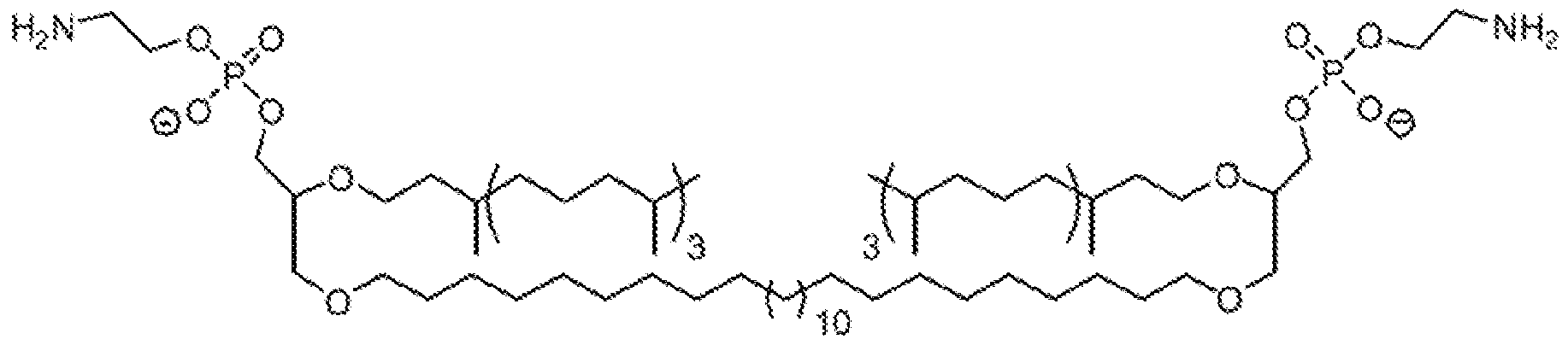
[0540] Benzylated lipid 18 (54 mg, 0.03 mmol) was dissolved in 6 mL of a degassed mixture of (EtOH)/THF (2:1) and 20% Pd/C (10% w/w) was added. The reaction was stirred under hydrogen atmosphere (1 atm) at rt for 6 hours. The catalyst was removed by filtration through a pad of celite, and the resulting residue was purified by column chromatography on Sephadex LH 20 (DCM/MeOH 70:30). GMGTPE was obtained as a clear oil (37 mg, 91%). *H NMR (500 MHz, MeOD-dV CDCl3-di 1:1) δ 4.09-3.99 (m, 4H), 3.93-3,84 (m, 4H), 3.66-3.54 (m, 8H), 3.48-3.40 (m, 6H), 3.18-3.09 (m, 4H), 1.59-1.48 (m, 10H), 1.35-1.04 (m, 90H), 0.87-0.82 (m, 30H): 13C NMR (126 MHz, MeOD-d4/ CDCl3-di 1:1) δ 71,3, 70.1, 68.6, 68.4, 64.7, 64.7, 61.1, 61.1, 60.1, 60.1, 42.5, 40,1, 40.1, 39.0, 37.3, 37,1, 37.1, 37.0, 36.9, 36,8, 36.7, 36.7, 32.4, 29.6, 29.5, 29.4, 29.3, 29,1, 27,6, 25.7, 24.4, 24,1, 24,0, 22.1, 22.0, 19.1, 19,1, 19.0, 19.0, 18.9, 10,4; 3lP NMR (202 MHz, MeOD-d ΠΜΊ :,-d; i : ! } δ 1.10; ESI-MS: 1382.15 [M+Na]+; HRMS: 1382.1676 calcd for |C-KI I Sl. ;N ><),>!>> |' found 1382.1673.
[0541] General Procedure for Liposome Extrusion. 10 mg/mL liposome solution was prepared by first dissolving 5 mg of lipid of interest into a 5 mL round bottom flask in a
DCM/MeOH (7/3) solution. A thin lipid film was achieved by evaporating the solvent using a rotary evaporator (BUCHI REl 11) then dried further over a hi -vacuum pump (Welch 1402) for 4 hrs. The thin lipid film was then hydrated, in a 4 mM Carboxyfluorescein (CF) solution prepared in buffer A ( see section 5, general buffer preparation procedure), by vortexing the solution for 30 seconds followed by sonication in a water bath sonicator (Branson 2510) for 30 mins. After sonication, the lipid mixture underwent 5 freeze thaw cycles that consisted of 2 mins at -78°C followed by 2 mins at 50°C. The lipid solution was then extruded (Avanti mini- extruder) through 200 nm polycarbonate membrane 25 times followed by another extrusion with a 100 nm polycarbonate membrane 51 times. The lipid solution was then stored at 4°C in Protein Lo-Bind Eppendorf tube. Liposome radius is shown in FIG. 20.
[0542] General Procedure for Differential Scanning Calorimetry (DSC) Measurement of Lipids. DSC experiments were performed in duplicate using a Thermal Analysis Q2000 DSC. Each experiment involved a 5 °C/min ramp from 0 °C to 67 °C under high purity N2 at 50 mL/min. Samples were -0.3 - 1.0 mg of liposomes dissolved in water at ~5% by weight. TA Universal Analysis was used to extract Tm for these samples. All of the synthetic lipids did not exhibit a phase transition from 5 - 65 °C shown in FIG. 21. DMPC was used as a positive control which showed a phase transition at 24 °C. Pure POPC lipid has been observed to have a phase transition at -2 °C.
[0543] General Buffer Preparation Procedure. Preparation of Buffer A- 4.1 8 g of Bis Tris (10 mM) and 11.68 g of NaCl (100 mM) was dissolved in 2 L of Milli-Q filtered Deionized water. The pH was then adjusted to 7.2 by minimal addition of 2 M HC1. Preparation of Buffer B - 4.18 g of Bis Tris (10 mM) and 1 1.68 g of NaCl (100 mM) was dissolved in 2 L of Milli-Q filtered Deionized water. The pH was then adjusted to 5.8 by minimal addition of 2 M HC1.
[0544] General Procedure to Measure pH Equilibrium of CF. CF was used as the reporter dye because CF is a pH responsive fluorophore and is known to exhibit fluorescence quenching upon acidification. We chose the pH values of 7.2 and 5.8 as internal and external liposomal pH values, respectively, because CF exhibits a linear correlation between its fluorescence intensity and environmental pH value with in this pH range. To estimate the initial rate of pH equilibration from liposomes, the decrease in fluorescence of CF was followed using Perkin Elmer EnspireLg multirnode plate reader. Before each assay, 10 uL of the stock extruded lipid solution was
diluted in 500 LIL of buffer A. Free CF was removed using a PD miniTrap G-25 Sephadex ' column from GE Healthcare ending in 100 times dilution from the stock extruded solution (0.1 mg/mL). 45 μΕ of purified liposome solution was next added into three 0.5 ml. Protein Lo-Bind tubes for each lipid solution. In one tube, 405 uL of Buffer A was added. In the second tube, 405 μΐ, of Buffer B was added with 1 μ.Ι_. of 100 μ,Μ solution of Nigericin in Ethanol. Nigericin, a polyether ionophore known to form pores in membranes, was used as our positive control of complete pH exchange between the internal/external buffer system. In the third tube, right before starting the measurement, 405 μί, of Buffer B was added. 125 μί, was added to each well of the plate three times for each tubes resulting in three measurements with three replicates with a total of 9 measurements per lipid solution. The measurements are plotted in FIG. 22. No significant morphology change over the course of 21 mins was observed after the assay as shown in FIG. 20.
[0545] General Calculation Procedure for Kinetic Analysis. For each leakage assay, the same procedure was used as in Example 1 .
[0546] Table SI . Observed rate calculated of small ion permeability of liposomes using method of initial rates (15% completion; the observed rate was calculated by taking the mean of 9 kinetic rates per experiment. However, the observed rate of GMGTPE was calculated using 8 measured kinetic rates. (1 experiment was determined to be an outlier using Q-test 95% confidence, and was omitted from the analysis).

Example 3, Cholesterol-integrated chimeric Archaea-inspired tetraether lipids
[0547] A limitation of many phospholipids for medical applications and basic research studies is that they generate membranes with poor stability and high permeability to ions and small molecules. Here, we present a new chimeric tetraether lipid that integrates many of the structural features of natural Archaea lipids and covalently attached cholesterol groups that putatively help
with lipid packing. Liposomes comprised of pure chimeric lipids exhibited an approximate 50- fold decrease in the rate of small ion membrane leakage compared to liposomes comprised of a commercial diacyl lipid, and an approximate 5-fold decrease in the rate of leakage compared to the same Archaea-inspired lipid but lacking a covalently attached cholesterol group. We demonstrate that these chimeric lipids generate membranes with good stability in serum- containing solutions, yet can be used as a support for functional ion channels and membrane- active enzymes and as liposomal vehicles for the delivery of small molecules into living cells.
[0548] Leakage across membranes have been a problem for applications in drug delivery and membrane based protein studies. Specifically, vesicles used for drug delivery suffers from content leakage during transit to their target causing detrimental side-effects. In the field of membrane based protein studies involving ion channels, highly permeable membrane causes high background signal resulting in poor signal to noise ratio. These deficiencies caused by high permeability of membranes have been traditionally circumvented by the addition of cholesterol during membrane preparation.
[0549] The addition of cholesterol to lipid formulation has been commonly used to improve membrane leakage properties by increasing membrane packing. However, it has been shown that cholesterol can leach out from vesicles causing destabilization of vesicles in protein rich environments such as serum (J. Senior, G. Gregoriadis, Life Sci. 1982, 30, 2123-2136; M. C. Phillips, W. J. Johnson, G. H. Rothblat, Biochim. Biophys. Acta 1987, 906, 223-276). To address problems of cholesterol loss during transit, researchers have designed lipids that covalently attach cholesterol to the glycerol backbone of the lipid creating "chimeric" diacyl lipids (Z. Huang, M, R, Jaafari, F. C, Szoka, Angew. Chem., Int. Ed. Engl. 2009, 48. 4146-4149; F. Fogiia, D. J. Barlow, F. C. Szoka, Z. Huang, S. E. Rogers, M. J. Lawrence, Langmuir 2011, 27, 8275- 8281 ; A. G. ohli, P. H. Kierstead, V. J. Venditto, C. L. Walsh, F. C. Szoka, J. Control. Release 2014, 190, 274-287). in addition to eliminating destabilization of vesicles caused by cholesterol loss, the chimeric diacyl lipids also exhibited an additional reduction of small molecule membrane leakage in serum when compared with diacyl lipids sharing the same hydrophobic tail.
[0550] In the previous examples, we have previously described the new class of Archaea inspired lipids, namely, glycerol monoalkyl glycerol tetraether with phospholcholine headgroup
(GMGTPC) lipids that demonstrated approximately 2 orders of magnitude of reduction in small ion membrane leakage without the need for added cholesterol when compared with
commercially available diacyl lipid, EggPC. In addition to the reduction in small ion membrane permeation demonsirated by the GMGTPC lipid analogs, we have also shown that the GMGTPC lipid analogs are more tolerant to changes in headgroup to small ion membrane leakage than the commercial diacyl lipid, l-palmitoyl-2-oleoyl-sn-glycerol-3-phosphocholine (POPC).
[0551] We sought to improve membrane properties of cyclohexane integrated glycerol monoalkyl glycerol tetraether with phosphocholine headgroup (GMGTPC-CH) further by creating a chimeric tetraether lipid that covalently links cholesterol to the un tethered tail of the glycerol backbone while maintaining Archaeal structures designed in the GMGTPC lipids (see FIG. 23).
[Θ552] Herein this example, we describe the synthesis of chimeric tetraether lipid, cyclohexane integrated glycerol cholesterol glycerol tetraether lipid with phosphocholine headgroup
(GcGTPC-CH), physical characterization of GcGTPC-CH lipid and probed whether GcGTPC- CH can be used as a substitute for biological applications currently using diacyl lipids.
[0553] We began the design of the GcGTPC-CH lipid by modifying cholesterol by the addition of an ethylene glycol spacer to improve flexibility and increase accessibility. This method began by first tosylation of the alcohol followed by substitution of the tosyi group with ethylene glycol to generate the modified cholesterol 1. The free terminal alcohol of the spacer was then converted to the corresponding tosylate which successively reacted with 2-phenyl-l,3- dioxan-5-ol that was followed by a selective opening of the dioxane moiety using DIB AL-H to form the benzyl protected glycerol backbone 2. Dibromo aikane 3 was then connected to the glycerol backbone 3 to generate protected lipid 4 using Williamson ether synthesis. Lastly, the diol 5 was afforded by deprotection of the benzyl ethers through hydrolysis to generate the free alcohol. The formation of GcGTPC-CH was completed by reacting diol 5 with 2-bromoethyl dichlorophosphate followed by a displacement of bromine by trimethylamine.
[Θ554] We next probed the physical characteristic of GcGTPC-CH and distinguish whether pure GcGTPC-CH can form stable liposomes. Differential scanning calorimentry (DSC) measurements showed that suspensions of pure GcGTPC-CH remained in a liquid phase from 5 to 65 °C (shown in FIG. 33) and dynamic light scattering (DLS) measurements showed a hydrodynamic diameter of approximately 150 nm for liposomes made using previously described procedure. Furthermore, liposomes remained stable through the time frame of the leakage assays and did not exhibit morphological changes (shown in FIGS. 34A-34E).
[0555] Using our previously described method of pH equilibrium, we evaluated the observed rate of small ion membrane leakage of liposomes derived from GcGTPC-CH lipids. Briefly, carhoxyfluorescein (CF) was encapsulated with an intraliposomal buffered solution at pH of 7.2. The liposomes were then incubated in a buffered solution at pH 5.8, causing the mtraiiposomal pH to equilibrate to 5.8 resulting in a change in fluorescence intensity of CF that was monitored over time. While we expect proton leakage to be the predominant rate in the observed rate of CF quenching, other ions present in the assay medium (e.g., OH", Na+, CI") could also contribute to the measured rate of leakage. We, therefore, consider the observed rates of pH equilibration from membranes comprised of different lipids to represent an overall observed permeability to small ions.
[0556] To study whether the addition of cholesterol to POPC, GMGTPC-CH, or GcGTPC-CH liposomal formulations affected membrane permeation of small ions, 40 moi% of cholesterol was added to the individual lipid formulations. As expected, the addition of cholesterol to POPC resulted in a 10 fold decrease in small ion membrane leakage (shown in FIG. 25). However, the addition of cholesterol to GMGTPC-CH did not have significant effect on the rate of small ion membrane leakage. This surprising result may be attributed to the inability for cholesterol to integrate into the membrane. The presence of cholesterol in the GMGTPC-CH liposomal formulation was confirmed by titration of both total phosphorus content and free cholesterol using the Bartlett assay and Ampiex® Red cholesterol assay kit, respectively. The result showed a presence of 31 ± 10 moi% cholesterol in the GMGTPC-CH liposomal formulation which is within the expected range of cholesterol concentration for liposomal formulations. In addition, cholesterol was also added to liposomes comprised of GcGTPC-CH lipids, however, no free cholesterol was detected after purification, suggesting cholesterol did not incorporate in the liposomes. In contrast to the no significant effect observed for the addition of cholesterol to GMGTPC-CH liposomal formulation, liposomes comprised of GcGTPC-CH displayed a 5 fold decrease in small ion membrane leakage (shown in FIG. 25). This reductive effect of small ion membrane leakage may suggest that covalently attaching cholesterol to the glycerol backbone allows cholesterol to correctly orient within the membrane to allow better packing.
[0557] To understand whether the remarkably impermeable lipid, GcGTPC-CH can be used as a substitute for biological applications in place of commercially available diacyl lipids, we sought to examine whether GCGTPC-CH liposomes could serve as a viable alternative. Using previously reported procedures for diacyl lipids we examined whether 1) natural ion channel
forming peptides such as gramicidin A (gA), can function within the membrane, 2) liposomes derived from GcGTPC are sufficiently stable in serum to be potentially useful for drug delivery applications, 3) membrane active enzymes such as phospholipase-D (PLD) can recognize GcGTPC-CH lipids as a substrate to cleave the choline headgroup, and 4) small molecule encapsulated in GcGTPC-CH liposomes are able to be taken up into cells.
[0558] Using the same pH equilibrium assay, GcGTPC-CH liposomes were introduced to a buffered solution at pH 5.8 with the addition of gramicidin A (gA). To determine whether gA remained functional upon incorporation into the membrane, fluorescence of CF was monitored for a flux of small ions into the liposome causing an accelerated quenching of CF when compared to liposomes without the addition of gA. The addition of gA displayed 5%
fluorescence of CF after 30 mins suggesting ion channel remained functional within the membrane. To ensure the addition of gA did not cause the liposomes to rupture, the presence of liposomes were confirmed using DLS (shown in FIGS. 35A-35B).
[0559] Next, the potential for GcGTPC-CH liposomes usage in drug delivery was assessed using standard self-quenching leakage assay of CF. The liposomes were introduced into a buffered solution with fetal bovine serum (30% in PBS) at 37 °C and the fluorescence of CF was monitored to estimate membrane leakage. Surprisingly, the addition of cholesterol to GMGTPC- CH liposome formulation showed a reduction in the initial burst of leakage triggered by proteins in serum. While after the burst leakage, however, both leakage profile of GMGTPC-CH with or without added cholesterol remains similar after four hours. GcGTPC-CH liposomes on the other hand, showed the lowest leakage profile compared with GMGTPC-CH liposomes (with or without added cholesterol), that showed 80% retention of CF after 5 days (shown in FIG. 26B). These promising stability results displayed by GcGTPC-CH liposomes suggests potential utility for in vivo drug delivery vesicles with additional experiments.
[Θ560] After determining the potential for GcGTPC-CH liposomes to be used for in vivo applications, phospholipase-D (PLD) a biological membrane active enzyme, was administered to liposomal formulations to determine whether PLD was able to recognize GcGTPC-CH lipids as a substrate. Following previous protocols involving diacyl lipids, PLD was added to liposomal suspension comprised of GcGTPC-CH lipids in the presence of Ca + ions at 37 °C. After 30 mins at 37 °C, a morphology change from approximately 150 nm diameter to abpproximateiy 1500 nm diameter was measured using DLS, suggesting enzyme activity (shown in FIG. 26C). This change in morphology is hypothesized to be due to aggregation/fusion caused by an enzymatic
cleavage of the choline group from the phosphatidylcholine converting the lipid headgroup to phosphatidic acid that result in a Ca2+ induced morphology change.
[0561] Lastly, after GcGTPC-CH liposomes were shown to be non-toxic for up to 100 μΜ (shown in FIG, 36), calcein was encapsul ated in GcGTPC-CH liposomes to determine if targeted liposomal delivery of small molecules to cells were possible. These calcein encapsulated GcGTPC-CH liposomes decorated with DSPE-PEG-folate lipid was incubated with KB cells to allow folate-mediated endocytosis. As shown by the fluorescence images in FIG. 26D, the fluorescence distribution of calcein suggests that liposomes comprised of GcGTPC-CH lipids was capable of delivering calcein into cells. These promising results show a potential to be translated to be used to deliver small molecule drugs.
[0562] We have, thus, presented the synthesis of chimeric tetraether lipid GcGTPC-CH. The new GcGTPC-CH liposomes showed a 50 fold decrease in membrane leakage when compared with liposomes comprised of a common diacyl lipid, POPC. Although furthur investigation and optimization will be necessary, the 4 biological applications demonstrated using liposomes comprised of GcGTPC-CH lipids suggests utility as an alternative for the leakier diacyl lipids.
[0563] Experimental Methods and Materials for Example 3
[0564] All reagents were purchased from commercial sources and used without further purification. POPC lipid were purchased from Avanti Polar Lipids. The POPC lipid was stored under Argon at -20°C and used within 3 months of purchase. Gramicidin from Bacillus aneurinolyticus (Bacillus brevis) was purchased through Sigma Aldrich, which is about 80% gramicidin A, was used without further purification. Glassware was dried at 115°C overnight. Air and moisture-sensitive reagents were transferred using a syringe or stainless steel cannula. Intermediates were purified over silica (60A, particle size 40-63 μτη) purchased from Dynamic Adsorbents, Inc. Reactions v> ere monitored by thin-layer chromatography (TLC) using 0.25 mm silica gel plates (60F-254) from Dynamic Adsorbents, Inc. Deuterated solvents were purchased from Cambridge Isotope Laboratories, Inc. ]H, °C, 3 ΪΡ NMR spectra were obtained on either JEOL ECA 500 spectrometer or Varian 400 MHz/500MHz spectrometer. Chemical shifts are reported in ppm relative to residual solvent. The FID file was analyzed using NMRnotebook version 2,70 build 0.10 by NMRTEC.
[0565] Dynamic Light Scattering (DLS) measurements were performed on a Wyatt DynaPro NanoStar (Wyatt Technology, Santa Barbara, CA) instrument using a disposable cuvette
(Eppendorf UVette 220 nm - 1,600 nm) and data processed using Wyatt DYNAMICS V7 software. Each analysis involved an average of 10 measurements. The data was exported for final plotting using GraphPad Prism 5 (GraphPad Software, Inc., La Jolla, CA).
[0566] Low resolution MS analysis was performed on a Micromass Quattro Ultima triple quadrupole mass spectrometer with an electrospray ionization (ESI) source. High resolution MS analysis was performed using Agilent 6230 Accurate-Mass TOFMS with an electrospray ionization (EST) source by Molecular Mass Spectrometry Facility (MMSF) in the department of chemistry and biochemistry at University of California, San Diego.
[0567] Fluorescence decay measurements were taken on a Perkin Elmer Enspire'& multimode plate reader (excitation 485 nm, emission 517 nm and 75 flashes); each measurement was taken with a 10 sec delay with 125 repeat (total acquisition time ::= 21 min). Costar ETA/RIA plates were used (96 well half area, no lid, flat bottom, non-treated black polystyrene). The data were exported for final plotting using GraphPad Prism 5 (GraphPad Software, Inc., La Jolla, CA).
[0568] Synthesis of GcGTPC-CH lipid.
[0569] 2 ((3S,8S,9S, 10R,13R,14S)-10, 13-dimethyl-17-((R 6-methylheptan-2-yl)- 2,3,4,7,8,9, 10,11,12, 13, 14, 15, 16, 17-tetradecahydro-lH-c xlopenta[a]phenanthren-3- yi)oxy)ethan- 1 -ol ( 1) :

[0570] Compound 1 was prepared foll owing a previously reported protocol (A. Bajaj, P.
Kondiah, S. Bhattacharya, J. Med. Chem. 2007, 50, 2432-2442).
[0571] 2 ((3S,8S59S 0R,13R,14S)-10 3-dimethyl-17-((R)-6-memymeptan-2-yl)- 2,3,4,7,8,9, 10,1 l ,12, I 3,14, 15,I 6,17-tetradecahydro-lH-cyclopenta[a]phenanthren-3-yl)oxy)ethyl 4-methylbenzenesulfonate (1.1):

[0572] Compound 1.1 was prepared following a previously reported protocol (A. Bajaj, P. ondiah, S. Bhattaeharya, J. Med. Chem. 2007, 50, 2432-2442).
[05731 5-(2-(((3S,8S,9S, 10R, 13R, 14S)-10, 13-dimethyl-l 7-((R)-6-methylheptan-2-yl)- 2,3,4,7,8,9,10,11,12,13, 14,15, 16, 17-tetradecahydro-lH-cyclopenta[a]phenanthren-3- yl)oxy)ethoxy)-2-phenyl-l ,3-dioxane (1.2):

[0574] To a cooled suspension of 0.27 g (11 mmoi) of NaH in 5 mL of dry tetrahydrofuran (THF), 0.67 g (3.7 mmol) of cis-l,3-0-Benzylideneglycerol was added drop wise and reacted for 1 hour at room temperature. Next, 1.97 g (4.1 mmol) molecule 1.1 was added and then heated at reflux for 16 hours. The reaction was quenched with water and the solvent was removed under vacuum. The residue was extracted with DCM, washed successively with water and brine, then dried over MgSC>4 and compound 1.2 was obtained as a white solid and then engaged to the next step.
[0575] 3-(benzyloxy)-2-(2^((3S,8S59Ss10R,13R,14S)-10s13-dime l-17-((R)-6- methylheptan-2-yl)-2,3,4,7,8,9,10,l l, 12,13,14, 15,16, 17 eiradecahydro- ^
cyclopenta[a]phenanthren-3-yl)oxy)ethoxy)propan-l-ol (2):

[0576] 1.57 g (2.7 mrnol) of 1.2 was dissolved in 7.5 mL of dry dichioromethane (DCM) then cooled to -78 °C. 7.7 mL of DIBAL-H in DCM (1 M) was added dropwise and the reaction was slowly brought back to room temperature and reacted for 16 hours. The reaction was quenched with methanol and 27 mL of (5 M) NaOH was added. The solution was then extracted with diethyl ether, washed successively with water and brine, then dried over MgS04 and purified by column chromatography on silica gel using Hexane/EtOAc (1 : 1) as the eluent. Compound 2 was obtained as a white oily solid (1.39 g, 88%). Rf: 0.59 (Hexane/EtOAc 1 : 1 ); ¾ NMR (500 MHz, CDCh-di) δ 7,28-7.17 (m, 5H), 5.27-5.26 i ns. i l l ). 4,46 (s, 2H), 3,82-3.80 (m, IH), 3.63-3,38 (m, 9H), 3.18-3.08 (m, IH), 2.34-2,27 (m, 1H), 2.17-2.11 (m, IH), 1 ,96-1.72 (m, 5H), 1.51-1. 18 (m, i l l ! }. 1.09-0.78 (m, 22! i s. 0.61 (s, 3H): 13C NMR (126 MHz, CDCl3-di) δ 140.5, 138.1, 128,3, 127.6, 127.6, 121.7, 80.2, 80,2, 79.5, 73.4, 70.3, 70,2, 70.1, 67.6, 67.5, 62,7, 56.7, 56.2, 50.1, 42.3, 39.8, 39.5, 38,9, 37.1, 36.8, 36.2, 35,8, 31.9, 31.8, 28.3, 28,0, 24.3, 23.9, 22.9, 22.6, 21.1, 19.4, 18.8, 1 1.9; ES1-MS: 617.53 [M+Naf ; HRMS 617.4540 calcd for | C j, -.0 Na| '. found 617,4534.
[0577] (lR,3S)-l ,3-bis(14-bromotetradecyl)cyclohexane (3):

[0578] Compound 3 was prepared following a previously reported protocol (T. Koyanagi, G. Leriche, D, Onofrei, G. P. Holland, M. Mayer, J. Yang, Angew. Chem., Int. Ed, Engl , 2016, 128, 1922-1925).
[05791 (3R58R,9R,10S,13S,14R)-3-(2-((l -(benzyloxy)-3-((12-((l S,3R)-3-(13-(3-(benzyloxy)-
2-(2-(((3S,8S,9S,10R,13R, 14S)~l Q,13~dim^^
2,3,4,7,8,9, 10, 11, 12, 13, 14, 15, 16, 17-tetradecahydro-lH-c>xlopenta[a]phenanthren-3- yl)oxy)emoxy)propoxy)tridecyl)cyclohexyl)dodecyl)oxy)propan-2-yl)oxy)ethoxy)-10,13-
dimethyl- 17-((S)-6-methylheptan-2-yl)-2,3,4,7,8,9, 10,11,12,13,14,15,16,17-tetradecahydro- 1H- cyclopenta| a]phenanthrene (4):

[058Θ] To a cooled suspension of 0.08 g (3.2 mmol) of NaH in 34 mL of dry THF, 1 .39 g (2.3 mmol) of 2 was added drop wise and reacted for 1 hour at room temperature. Next, 0.64 g (1.1 mmol) molecule 3 was added and then heated at reflux for 16 hours. The reaction was quenched with water and the solvent was removed under vacuum. The residue was extracted with DCM, washed successively with water and brine, then dried over MgSC>4 and purified by column chromatography on silica gel using Hexane/EtOAc (9: 1) as the eluent. Compound 4 was obtained as a clear oil (0.441 g, 29%). Rf: 0.15 (Hexane/EtOAc 9: 1 ); ¾ NMR (500 MHz, CDCh-di) δ 7,33-7.25 (m, 10H), 5.32-5.31 (ra, 2H), 4,55 (s, 4H), 3,76-3.74 (m, 4H), 3.723.58 (m, 2H), 3.63-3.49 (m, i 21 H. 3,42 (t, ,/ 6,7 Hz, 4H), 3.22-3, 14 (m, 2H), 2.38-2.35 (m, 2H), 2.21-2, 16 (m, 2H), 2.03-1.81 (m, lOH), 1.72-1.68 (m, 4H), 1.55-1.42 (m, 1 1 1 ). 1.31-0.74 (m, 105 H), 0.67 (s, 6H), 0.51-0,44 (m, 1H); °C NMR (126 MHz, CDCl3-di) δ 141.2, 138,6, 128.5, 127.8, 127.7, 121.7, 79.6, 78,7, 73.6, 71.9, 70.9, 70,5, 70,2, 68.2, 67.7, 57.0, 56,4, 50.4, 42.5, 40.8, 40.0, 39.7, 39.3, 38.0, 37.9, 37.4, 37.1, 36.4, 36.0, 33.6, 32.1, 32.1, 30.3, 30.0, 29.9, 29.7, 28.6, 28.4, 28.2, 27.2, 26.6, 26.3, 25.8, 24.5, 24.0, 23.0 ,22.8, 21.3, 19.6, 18.9, 12.1 ; ESI-MS: HRMS 1656.3883 calcd for | C' : ί ικ Λ'ίί Ι ' . found 1656,3879.
[0581] 2-(2-(((3S,8S,9S, 10R, J.3R, 14S)-10, 13-dimethyl -17-((R)-6-methylheptan-2-yl)-
2,3,4,7,8,9, 10,11,12, 13, 14, 15, 16,17-tetradecahydro-lH-cyciopenta| a]phenanthren-3- yf)oxy)ethoxy)-3-((13-((l R,3S)-3-(13-^
6-rnethylheptan-2-yl)-2,3,4,7,8,9, 10, 1 1 , 12, 13, 14, 15, 16, 17-tetradecah dro- 1 H- cyclopenta[a]phenanthren-3-yl)oxy)ethoxy)-3-hydroxypropoxy)tridecyi)cyclohexyl) tridecyl)oxy)propan-l -ol (5):

[Θ582] 35 mg (0.022 mmol) of 4 and 1.8 mg (5 % w/w) of Pd(OH)2 was added to 4 mL of solvent mixture THF/EtOH (1 : 1 ). The suspension was purged with N gas for 10 seconds and repeated 3 times. The suspension was then purged using H2 for 10 seconds and repeated 3 times. The reaction was stirred at room temperature for 20 mms. The suspension was then immediately filtered over celite and purified using column chromatography on silica gel using Hexane EtOAc (7:3) as the eluent. Compound 5 was obtained as a white viscous oil (20.3 mg g, 65%). Rf: 0.13 (Hexane/EtOAc 7:3); ¾ NMR (500 MHz, CDCl3-dt) δ 5.27-5.26 (m, 2H), 3.86-3.81 (m, 2H), 3.64-3.34 (m, 20H), 3.18-3.11 (m, 2H), 2.32-2.27 (m, 2H), 2.18-2, 11 (m, 2H), 1.96-1.73 (m, 10H), 1.65-1,59 (m, 4H), 1.50-1.38 (m, 14H), 1.27-0.65 (m, 105H), 0.59 (s, 6H), 0.044-0.38 (m, lH); 1 C NMR (126 MHz, CDCl3-di) δ 140.9, 122.0, 80,3, 80.3, 79.8, 72.0, 71,2, 70,4, 70.4, 67.8, 67,7, 63.3, 57.0, 56.4, 50.4, 42.5, 40.8, 40.0, 39.7, 39.1, 39.1, 38.0, 38.0, 37,4, 37.1, 36.4, 36.0, 33.7, 32.1, 32.1, 30.3, 30.0, 29.9, 29.8, 29.7, 28.5, 28.5, 28.4, 28.2, 27.2, 26.6, 26.3, 24.5, 24.0, 23.0 22.8, 21.3, 19.6, 18,9, 12.1; ESI-MS: 1476.28 [M+Naf ; HRMS 1476,2944 calcd for [C%HJ 72Q8Naf , found 1476.2952.
[0583] 2-(2-(((3S,8S,9S, lOR, 13R, 14S)-10, 13-dimethyl-l 7-((R)-6-methylheptan-2-yl)-
2,3,4,7,8,9,10,11,12, 13, 14,15, 16,17-tetradecahydro-lH-cydopenta[a]phenanthren-3- yi )oxy)ethoxy)-3 - (( 13 - (( 1 R,3 S )-3 -( 13 -(2-(2-(((3R, 8R,9R, 1 OS , 13 S , 14R)- 10, 3 -di methyl- 17-((S)-
6-methylheptan-2-yl)-2,3,4,7,8,9,10,l l,12,13,14,15,16,i7-tetradecahydro-lH- cyclopenta[a]phenanthren-3-yl)oxy)ethoxy)-3-((oxido(2-
(trimethylammonio)ethoxy)phosphond)oxy)propoxy)tridecyl)cycloh (2- (trimethylammonio)ethyl) phosphate (GcGTPC-CH) :

[0584] To a solution of 81 mg (0.34 mmol) of bromoethyldichlorophosphate in 1.5 mL of dry
THF, a solution of 61 mg (0.04 mmol) of 5 and 64 μΐ, of Et3N (0.46 mmol) in 1.5 mL of dry THF was added dropwise. After stirring the mixture for 3 days in the dark at room temperature, toluene was added to precipitate triethylammonium chloride. Then, the solution was filtered through a small pad of celite and the filtrate was concentrated. The resulting residue was dissolved in a mixture of THF7NaHC03 (sat) (2,8 mM) and the reaction was stirred for 16 hours at room temperature. THF was evaporated under vacuum and the resulting aqueous solution was acidified to pH 1 using a dilution solution of hydrochloric acid (1M) and extracted using several portions of DCM/Methanol (MeOH) (8:2). The organic layers were combined, dried over
Na2SC>4 and concentrated under reduced pressure.
[0585] To a solution of the previous crude in a mixture of 3.5 ml, of chloroform (CHC13) and 4 mL of Me N (33% in EtOH) was added and the reaction was stirred in a sealed tube at room temperature for 5 days. The reaction mixture was concentrated to dryness, purified on sephadex LH-20 using DCM/MeOH (1: 1 ) as eluent and purified by column chromatography on silica gel using DCM/MeOH/Water (70:30:5) as the eluent. GcGTPC-CH was obtained as a white (viscous oil) (40 mg, 53%). Rf: 0.15 (Hexane/EtOAc 9: 1); Ή NMR (500 MHz, MeOD-dVCDCls-di 1 : 1) δ 4.99-4.95 (m, 2H), 3.92-3.85 (m, 4H), 3.57-3.52 (m, 4H), 3.43-3.33 (m, 6H), 3.29-3.05 (m, 16H), 2.97-2,94 (m, 2H), 2.85-2,84 (m, I 8H), 2.00-1 .77 (m, 4H), 1.67-1.44 (m, 10H), 1.34- 1 .32 (m, 4H), 1.19-1.07 (m, 15H), 0.98-0.32 (m, 110H), 0.16-0.08 (m, 1H); 13C NMR (126 MHz, CDCL di) δ 140.2, 121.4, 79.1, 78.3, 78.2, 71.3, 70.3, 69.6, 67.1, 66.0, 64.8, 64.8, 58.6, 58.6, 56.5, 55,9, 53.5, 49.9, 41.9, 40.2, 39,5, 39.1, 38.7, 37.4, 36,8, 36.4, 35.8, 35.5, 33.1 , 31 ,6, 31.5, 29.7, 29,4, 29.3, 29.2, 28.0, 27.8, 27,6, 26.6, 26.0, 25.8, 23,9, 23.4, 22.1, 21.9, 20,7, 18,8, 18.1,
11.3; 3 !P NMR (202 MHz, MeOD-cVCDCl-j-d, 1 : 1) δ 0.12: HRJV1S 1784.4235 calcd for [C106H197N2O14P2] +, found 1784.4264.
[Θ586] General Procedure for Liposome Extrusion. 10 mg/mL liposome solution was prepared by first dissolving 5 mg of lipid of interest into a 5 mL round bottom flask in a DCM/MeQH (7/3) solution. A thin lipid film was achieved by evaporating the solvent using a rotary evaporator (BUCHI REl 11 ) then dried further over a hi-vacuum pump (Welch 1402) for 4 hrs. The thin lipid film was then hydrated, in either 100 mM/4 mM Carbox luorescein (CF) or 10 mM calcein solution prepared in PBS or buffer A/C or (see section 5, general buffer preparation procedure) respectively, by vortexing the solution for 30 seconds followed by sonication in a water bath sonicator (Branson 2510) for 30 mins. After sonication, the lipid mixture underwent 5 freeze thaw cycles that consisted of 2 mins at -78°C followed by 2 mins at 50°C. The lipid solution was then extruded (Avanti mini -extruder) through 200 nm
polycarbonate membrane 25 times followed by another extrusion with a 100 nm polycarbonate membrane 51 times. The lipid solution was then stored at 4°C in Protein Lo-Bind Eppendorf tube.
[Θ587] General Procedure for Differential Scanning Calorimetry (DSC) Measurement of GcGTPC-CH lipid. DSC experiments were performed in duplicate using a Thermal Analysis Q2000 DSC. Each experiment involved a 5 °C/min ramp from 0 °C to 67 °C under high purity N2 at 50 mL/min. Samples were -0.3 - 1.0 mg of liposomes dissolved in water at ~5% by weight. TA Universal Analysis was used to extract Tm for these samples. Both of the synthetic lipids did not exhibit a phase transition from 5 - 65 °C shown in FIG. 33. DMPC was used as a positive control which showed a phase transition at 24 °C. Commercially available diacyl lipid, POPC, was reported to have a phase transition from solid to liquid at -2 °C.
[0588] General Buffer Preparation Procedure. Preparation of Buffer A- 4.18 g of Bis Tris (10 mM) and 11.68 g of NaCl (100 mM) was dissolved in 2 L of Milli-Q filtered deiomzed water.
The pH was then adjusted to 7.2 by minimal addition of 2 M HC1. Preparation of Buffer B - 4.18 g of Bis Tris (10 mM) and 11.68 g of NaCl (100 mM) was dissolved in 2 L of Milli-Q filtered deionized water. The pH was then adjusted to 5.8 by minimal addition of 2 M HC3. Preparation of Buffer C - 0.46 g of 2-[(2-Hydroxy-.l ,l-bis(hydroxymethyl)ethy])amino] ethanes ulfonic acid,
N-[Tris(hydroxymethyl)meihyl]-2-aminoethanesulfonic acid (TES) (2 mM), 5.84 g of NaCl (100 mM), 0.029 g of ethylenediaminetetraacetic acid (EDTA) (0.1 mM), and 0.31 g of histidine (2 mM) was dissolved in 1 L of Milli-Q filtered deionized water. The pH was then adjusted to 7.4.
[0589] Preparation of Buffer D - 0.23 g of TES (2 mM), 2.11 g of NaCl (72.23 mM), 0.62 g of CaCl2 (1 1.11 mM), 0.015 g of EDTA (0.1 mM), and 0.16 g of histidine (2 mM) was dissolved in 0.5 L of Milli-Q filtered deionized water. The pH was then adjusted to 7.4.
[0590] General Procedure to Measure pH Equilibrium of CF. CF was used as the reporter dye because CF is a pH responsive fluorophore and is known to exhibit fluorescence quenching upon acidification. We chose the pH values of 7.2 to 5.8 as internal and external liposomal pH values, respectively, because CF exhibits a linear correlation between its fluorescence intensity and environmental pH value with in this pH range.
[0591 ] To estimate the initial rate of pH equilibration from liposomes, the decrease in fluorescence of CF was followed using Perkin Elmer Enspire0 multimode plate reader. Before each assay, 10 μΐ, of the stock extruded lipid sol ution was diluted in 500 μ1_, of buffer A. Free CF was removed using a PD miniTrap1M G-25 Sephadex1M column from GE Healthcare ending in 100 times dilution from the stock extruded solution (0.1 mg/mL). 45 fiL of purified liposome solution was next added into three 0.5 mL Protein Lo-Bind tubes for each lipid solution. In one tube, 405 μΕ of Buffer A was added. In the second tube, 400 μΕ of Buffer B was added with 5 μΐ, of 100 μΜ solution of Nigericin in Ethanol. Nige icm, a polyether ionophore known to form pores in membranes, was used as our positive control of complete pH exchange between the internal/external buffer systems. In the third tube, right before starting the measurement, 405 μΕ of Buffer B was added. 125 μΕ was added to each well of the plate three times for each tubes resulting in three measurements with three replicates with a total of 9 measurements per lipid solution. No significant morphology change over the course of 21 mins was observed after the assay as shown in FIGS. 34A-34E.
[0592] General Calculation Procedure for Kinetic Analysis. The procedure is identical to the procedure employed in Example 1 and Example 2.
[0593] General Procedure for gramicidin A membrane assay. Liposomes were prepared as described in general procedures for liposome extrusion. The general procedure to measure pH equilibrium of CF was used with a small modification. After the liposomes were prepared, a solution of gA was prepared 225 μΜ in DMSO. To each tube (i.e. pH 7.2, pH 5.8, pH 5.8 + nigericin) 2 μΐ. of buffer A was added to control the volume. Additional solution containing 2 μΕ of DMSO (vehicle) or 2 μΕ gA (final concentration of 1 μΜ) was incubated at 37 °C with
liposomes for 30 minutes and CF fluorescence was measured and analyzed. As shown in FIG. 35 A, no significant effect was observed when 2 μί, of DMSO was added. The decrease in percent fluorescence of CF shown in FIG. 35A suggests that gA was able to form a channel on the membrane to allow ions to rush inside. DLS measurements were taken to confirm the presence of liposomes after the addition of DMSO and gA shown in FIG. 35B.
[0594] General Procedure for phosphoIipase-D induced cleavage of choline. Liposomes were prepared as described in general procedures for liposome extrusion. The liposomes were first hydrated in buffer C, then the liposome formulation was incubated in buffer D with or without 5 units of PLD from cabbage (Sigma Aidrich) at 37 °C for 30 minutes. After the incubation, the size was measured using dynamic light scattering (DLS) to study whether a morphology change occurred.
[0595] General Procedure for self-quenched CF liposomal release assay in serum.
Liposomes prepared as described in general procedures for liposome extrusion. Using the method of self-quenched CF loaded (100 mM in PBS) leakage assay , liposomes comprised of GcGTPC-CH was incubated in PBS with 30 % fetal bovine serum (FBS) at 37 °C and CF fluorescence was monitored (Ex 485 nrn/E-m 517) nm for up to 5 days.
[0596] Cell toxicity studies of GcGTPC-CH liposomes. KB ceils were plated onto a fibronectin-treated 96 well plate at 5000 cells/well in folate deficient Rosweil Park Memorial Institute (RPMI) 1640 medium (Invitrogen). The cells were incubated for 24 hours under a humidified atmosphere of 95% air and 5% C02 at 37°C. After 24 hours of incubation, the cells were dosed with various concentrations of the liposomes, in triplicates. The cells were incubated with the compounds for 24 hours, and then washed to remove unbound compound. After incubation with the liposomes, the cells were carefully washed three times with 200 mL phosphate buffered saline (PBS) buffer and fixed with a solution of 200 mL PBS and 50 mL of 50% trichloroacetic acid. The cells were allowed to fix at 4°C for 1 hr. After fixation, the cells were washed five times with water and allowed to dry. After the plates are dried, 100 mL of a 0.4 % sulforhodamine B (SRB, Sigma Aidrich, S 1402) solution in 1% acetic acid was added to each of the wells and incubated for 30 minutes at room temperature on a shaker. The SRB-treated cells were then washed five times with 1 % acetic acid and allowed to dry. Tris base solution (100 mM, 200 mL) was then added to each well and the plates were placed on an oribitai shaker for 30 minutes. The plates were then read on a microplate reader at 515 nm. The absorbance
values were used to create cell -toxicity curves. Liposomes showed no toxicity up to 100 μΜ shown in FIG. 36.
[Θ597] Fluorescence microscopy of GcGTPC-CH liposome uptake. To a dry lipid film of GcGTPC-CH lipid with added 0.5 mol % of DSPE-PEG2000-folate lipid, 10 nxM calcein in buffer A was then used to hydrate the lipid film. Liposomes were then prepared as described in general procedures for liposomes extrusion. KB cells were plated with folate deficient RPMI- 1640 media supplemented with 10% fetal bovine serum (FBS) on 10mm glass bottom plates and incubated for 12 hours. Media was then removed and a solution containing 10 μΜ of liposomes, free calcein, or PBS control was added to the cells and incubated for 6 hours. Cells were then rinsed with media once, and a fresh media containing 2 jig/mL Hoescht nuclear stain was added. The living cells where then immediately imaged with an Olympus FluoView FViOOO deconvolution 1X81 inverted confocai microscope equipped with a 405, 488, and 543 laser line. Fluorescence images were processed with ImageJ.
EMBODIMENTS
[0598] Terms defined within this section refer only to aspects and embodiments within this section, and supersede definitions recited above.
[0599] The term "'alkyi," by itself or as part of another substituent, means, unless otherwise stated, a straight (i.e., unbranched) or branched carbon chain (or carbon), or combination thereof, which may be fully saturated, mono- or polyunsaturated and can include di- and multivalent radicals, having the number of carbon atoms designated (i.e., C Cio means one to ten carbons). Alkyi is not cyclized. Examples of saturated hydrocarbon radicals include, but are not limited to, groups such as methyl, ethyl, n-propyl, isopropyl, n -butyl, t-butyi, isobutyl, sec-butyl,
(cyclohexyl)methyl, homologs and isomers of, for example, n-pentyl, n-hexyl, n-heptyl, n-octyl, and the like. An unsaturated alkyi group is one having one or more double bonds or triple bonds (e.g. alkene, aikyne). Examples of unsaturaied alkyi groups include, but are not limited to, vinyl, 2-propenyl, erotyl, 2-isopentenyl, 2-(butadienyi), 2,4-pentadienyl, 3-( 1 ,4-pentadienyl), ethynyl, 1- and 3-propynyl, 3-butynyl, and the higher homologs and isomers. An aikoxy is an alkyi attached to the remainder of the molecule via an oxygen linker (-0-).
[0600] The term "alkylene," by itself or as part of another substituent, means, unless otherwise stated, a divalent radical derived from an alkyi, as exemplified, but not limited by, - CH2CH2CH2CH2-. Typically, an alkyi (or alkylene) group will have from 1 to 24 carbon atoms,
with those groups having 10 or fewer carbon atoms being preferred in the present invention. A "lower alkyl" or "lower alkylene" is a shorter chain alkyl or alkylene group, generally having eight or fewer carbon atoms. The term "alkenylene," by itself or as part of another substituent, means, unless otherwise stated, a divalent radical derived from an alkene.
[0601] The term "heteroalkyl," by itself or in combination with another term, means, unless otherwise stated, a stable straight or branched chain, or combinations thereof, including at least one carbon atom and at least one heteroatom selected from the group consisting of O, N, P, Si, and S, and wherein the nitrogen and sulfur atoms may optionally be oxidized, and the nitrogen heteroatom may optionally be quaternized. Heteroalkyl is not cyciized. The heteroatom(s) O, N, P, S, and Si may be placed at any interior position of the heteroalkyl group or at the position at which the alkyl group is attached to the remainder of the molecul e. Examples include, but are not limited to: ·('! i < -0 i · -()-('! I :. -ί'Η .-ί.Ή -ΝΉ -ίΉ ;. ·('! i · -('! ! · -\ί(Ί ί ι)-Π h. -CH2-S-CH2- CH3, ·ίΊ Ι . ·( ! ! .. -S«))-CH -.. -Ci¾-CH2-Si())2-CH3, -C S S Π Ι--0-Π h. -SiiCf h h. -<Ή · -<Ή N- OCH3, ~CFI ;H-N(CH3)-CH3, -O-CH3, -0-CH2-CH3, and -CN. Up to two or three heteroatoms may be consecutive, such as, for example, -CH2-NH-OCH3 and -CH2-0-Si(CH3)3.
[0602] Similarly, the term "heteroalkylene," by itself or as part of another substituent, means, unless otherwise stated, a divalent radical derived from heteroalkyl, as exemplified, but not limited by, -CH2-CH2-S-CH2-CH2- and -CH2-S-CH2-CH2-NH-CH2-. For heteroalkylene groups, heteroatoms can also occupy either or both of the chain termini (e.g., alkyl eneoxy,
alkylenedioxy, alkyleiieaniino, alkyienediammo, and the like). Still further, for alkylene and heteroalkylene linking groups, no orientation of the linking group is implied by the direction in which the formula of the linking group is written. For example, the formula -C(0)2R'- represents both -C(Q)2R'- and -R'C(0)2-. As described above, heteroalkyl groups, as used herein, include those groups that are attached to the remainder of the molecule through a heteroatom, such as - C(0)R', -C(0)NR*, -NR'R", -OR', -SR', and/or -S02R'. Where "heteroalkyl" is recited, followed by recitations of specific heteroalkyl groups, such as -NR'R" or the like, it will be understood that the terms heteroalkyl and -NR'R" are not redundant or mutually exclusive. Rather, the specific heteroalkyl groups are recited to add clarity. Thus, the term "heteroalkyl" should not be interpreted herein as excluding specific heteroalkyl groups, such as -NR'R" or the like.
13] The terms "cycloalkyl" and "heterocycloalkyl," by themselves or in combination with other terms, mean, unless otherwise stated, cyclic versions of "alkyl" and "heteroalkyl," respectively. Additionally, for heterocycloalkyl, a heteroatom can occupy the position at which
the heterocycle is attached to the remainder of the molecule. Cycloalkyl and heterocycloalkyl are non-aromatic. Examples of cycloalkyl include, but are not limited to, cyclopropyl, cyclobutyl, cyclopentyl, cyclohexyl, 1 -cyclohexenyl, 3-cyclohexenyl, cycloheptyl, and the like. Exampl es of heterocycloalkyl include, but are not limited to, 1 -(1,2,5 ,6-tetrahydropyridyl), 1- piperidinyl, 2-piperidinyl, 3-piperidinyl, 4-morpholinyl, 3-morpholinyl, tetrahydrofuran-2-yl, tetrahydrofuran-3-yl, tetrahydrothien-2-yl, tetrahydrothien-3-yl, 1-piperazinyl, 2-piperazinyl, and the like. A "cycloalkyl ene" and a "heterocycloalkyl ene," alone or as part of another substituent, means a divalent radical derived from a cycloalkyl and heterocycloalkyl, respectively.
[0604] The term "aryl" means, unless otherwise stated, a polyunsaturated, aromatic, hydrocarbon substituent, which can be a single ring or multiple rings (preferably from 1 to 3 rings) that are fused together (i.e., a fused ring aryl) or linked covalently. A fused ring aryl refers to multiple rings fused together wherein at least one of the fused rings is an aryl ring. The term "heteroaryl" refers to aryl groups (or rings) that contain at least one heteroatom such as N, O, or S, wherein the nitrogen and sulfur atoms are optionally oxidized, and the nitrogen atom(s) are optionally quatemized. Thus, the term "heteroaryl" includes fused ring heteroaryl groups (i .e., multiple rings fused together wherein at least one of the fused rings is a heteroaromatic ring). A 5,6-fused ring heteroaryl ene refers to two rings fused together, wherein one ring has 5 members and the other ring has 6 members, and wherein at least one ring is a heteroaryl ring. Likewise, a 6,6-fused ring heteroarylene refers to two rings fused together, wherein one ring has 6 members and the other ring has 6 members, and wherein at least one ring is a heteroaryl ring. And a 6,5- fused ring heteroarylene refers to two rings fused together, wherein one ring has 6 members and the other ring has 5 members, and wherein at least one ring is a heteroaryl ring. A heteroaryl group can be attached to the remainder of the molecule through a carbon or heteroatom. Non- limiting examples of aryl and heteroaryl groups include phenyl, 1-naphthyl, 2-naphthyl, 4- biphenyl, 1-pyrrolyl, 2-pyrrolyl, 3-pyrrolyl, 3-pyrazolyl, 2-imidazolyl, 4-imidazolyl, pyrazinyl, 2-oxazolyl, 4-oxazolyl, 2-pheiiyl-4-oxazolyl, 5-oxazolyl, 3-isoxazolyl, 4-isoxazolyl, 5- isoxazolyl, 2-thiazoiyl, 4-thiazolyl, 5-thiazolyl, 2-furyl, 3-furyl, 2-thienyl, 3-thienyi, 2-pyridyl, 3- pyridyl, 4-pyridyl, 2-pyrimidyl, 4-pyrimidyl, 5-benzothiazolyl, purinyl, 2-benzirnidazolyl, 5- indolyl, 1-isoquinolyl, 5-isoquinolyl, 2-quinoxalinyl, 5-quinoxalinyl, 3-quinolyl, and 6-quinolyl. Substituents for each of the above noted aryl and heteroaryl ring systems are selected from the group of acceptable substituents described below. An "arylene" and a "heteroarylene," alone or as part of another substituent, mean a divalent radical derived from an aryl and heteroaryl,
respectively. Non-limiting examples of heteroaryl groups include pyridinyl, pyrimidinyl, thiophenyl, thienyl, furanyl, indolyl, benzoxadiazolyl, benzodioxolyl, benzodioxanyl, thianaphthanyl, pyrrol opyridinyl, indazolyl, quinolinyl, quinoxalinyl, pyridopyrazinyl, quinazolinonyl, benzoisoxazolyl, imidazopyridinyl, benzofuranyl, benzothienyl,
benzothiophenyl, phenyl, naphthyl, biphenyl, pyrrolyi, pyrazolyi, imidazolyl, pyrazinyl, oxazolyl, isoxazolyl, thiazolyl, furylthienyl, pyridyl, pyrimidyl, benzothiazolyl, puriny], benzimidazolyl, isoquinolyl, thiadiazolyl, oxadiazolyl, pyrrolyi, diazolyl, triazolyl , tetrazolyl, benzothiadiazolyl, isothiazoiyi, pyrazolopyrimidinyl, pyrrolopyrimidinyl, benzotnazoiyl, benzoxazolyl, or quinolyl. The examples above may be substituted or unsubstituted and divalent radicals of each heteroaryl example above are non-limiting examples of heteroaryl ene.
[0605] Substituents for the alkyl and heteroalkyl radicals (including those groups often referred to as alkylene, alkenyi, heteroalkylene, heteroalkenyl, alkynyi, cycloalkyl, heterocycloaikyi, cycloalkenyi, and heterocycloalkenyl) can be one or more of a variety of groups selected from, but not limited to, -OR', (). =NR', OR". -NR'R", -SR.'. -halogen, -SiR'R"R"f, -OC(0)R', - C(0)R', -C02R', -C'ON R'R '. -OC(0)NR*R", -NR"C(G)R', -NR'-C(Q)NR"R'", ~NR"C(0)2R', -NR- C(NR'R"R"' =NR"", -NR-C(NR'R")=NR'", -S(0)R', -S(G)2R', -S(0)2NR'R", -NRS02R\
--NR'NR"R"', -ONR'R", -NR'C(0)NR"NR'"R"", -CN, -NG2, monophosphate (or derivatives thereof), diphosphate (or derivatives thereof), triphosphate (or derivatives thereof), in a number ranging from zero to (2m'+l), where rri is the total number of carbon atoms in such radical. R, R', R", R'", and R"" each preferably independently refer to hydrogen, substituted or unsubstituted heteroalkyl, substituted or unsubstituted cycloalkyl, substituted or unsubstituted
heterocycloaikyi, substituted or unsubstituted aryl (e.g., aryl substituted with 1 -3 halogens), substituted or unsubstituted heteroaryl, substituted or unsubstituted alkyl, alkoxy, or thioalkoxy groups, or arylalkyl groups. When a compound of the invention includes more than one R group, for example, each of the R groups is independently selected as are each R', R", R'", and R"" group when more than one of these groups is present. When R' and R" are attached to the same nitrogen atom, they can be combined with the nitrogen atom to form a 4-, 5-, 6-, or 7- membered ring. For example, -NR'R" includes, but is not limited to, 1 -pyrrolidinyl and 4- morpholinyi. From the above discussion of substituents, one of skill in the art will understand that the term "alkyl" is meant to include groups including carbon atoms bound to groups other than hydrogen groups, such as haloalkyl (e.g., -CF3 and -CH2CF3) and acyl (e.g., ~C(0)CH3, - C(Q)CF3, -·(·{ø}(·} 1 <<}('! ! :. and the like).
[0606] Similar to the substituents described for the alkyl radical, substituents for the aryl and heteroaryl groups are varied and are selected from, for example: -OR', -NR'R", -SR', -halogen, - SiR'R"R"', -OC(0)R*, -C(0)R*, -C02R', -CONR'R", -OC(0)NR'R", -NR"C(0)R*, -NR'- C(0)NR"R"', -NR"C(Q)2R', -NR-C(NR!R"R"')=NR"", -NR-C (NR'R' ')=NR" ' , -S(0)R', -S(0)2R', - S(0)2NR'R", -NRS02R', -NR'NR"R"', -ONR'R", ~NR'C(0)NR"NR'"R"", -CN, -N02, -R', -N3, - CH(Ph)2, fluoro(Ci-C4)alkoxy, and fluoro(Ci-C4)alkyl, monophosphate (or derivatives thereof), diphosphate (or derivatives thereof), triphosphate (or derivatives thereof), in a number ranging from zero to the total number of open valences on the aromatic ring system; and where R', R", R'", and R"" are preferably independently selected from hydrogen, substituted or unsubstituted alkyl, substituted or unsubstituted heteroalkyl, substituted or unsubstituted cycloalkyl, substituted or unsubstituted heterocycioalkyl, substituted or unsubstituted aryl, and substituted or unsubstituted heteroaryl. When a compound of the invention includes more than one R group, for example, each of the R groups is independently selected as are each R', R", R!", and R"" groups when more than one of these groups is present.
[0607] A "substituent group,"' as used herein, means a group selected from the following moieties:
(A) oxo, halogen, -CF3, -CN, -OH, -NH2, -COOH, -CONH2, -N02, -SH, -S02C1, -S03H, - S04H, -S02NH2, -NHNH2, -ONH2, -NHC(0)NH -I2, -NHC(O) NH2, -NHS02H, -M IC (O)H, -NHC(0)-OH, -NHOH, -OCF3, -OCHF2, -NHS02CH3, -N3, unsubstituted alkyl, unsubstituted heteroalkyl, unsubstituted cycloalkyl, unsubstituted heterocycioalkyl, unsubstituted aryl, unsubstituted heteroaryl, monophosphate (or derivatives thereof), diphosphate (or derivatives thereof), or triphosphate (or derivatives thereof), and
(B) alkyl, heteroalkyl, cycloalkyl, heterocycioalkyl, aryl, heteroaryl, monophosphate (or derivatives thereof), diphosphate (or derivatives thereof), or triphosphate (or derivatives thereof), substituted with at least one substituent selected from:
(1) oxo, halogen, -CF3, -CN, -OH, -NH2, -COOH, -CONH2, -NQ2, -SH, -S02C1, -SO3H, - S04H, -S02NH2, -NHNH2, 0M 1 -. -NHC(0)NHNH2, -NHC(Q) NH2, -NHS02H, - N! !C (O)H, -N! !C(O )-i)! !. -NHOH, -OCF3, -OCHF2, -NHS02CH3, -N3, unsubstituted alkyl , unsubstituted heteroalkyl, unsubstituted cycloalkyl, unsubstituted heterocycioalkyl,
unsubstituted aryl, unsubstituted heteroaiyl, monophosphate (or derivatives thereof), diphosphate (or derivatives thereof), or triphosphate (or derivatives thereof), and
(ii) alkyl, heteroalkyi, cycloalkyl, heterocycloalkyl, aryl, heteroaiyl, monophosphate (or derivatives thereoi), diphosphate (or derivatives thereoi), or triphosphate (or derivatives thereof), substituted with at least one subsiituent selected from:
(a) oxo, halogen, -CF3, -CN, -OH, -NH2, ·('()()! 1. -CONH2, -NO... -SH, -SQ2Ci, - S03H, -SO4H, -SO2 H2, M !NH . ON! ! -. -NHC(0)NHNH2, M !( { () ) NH2, - NHSO2H, -NHC= (O)H, -NHC(0)-OH, -NHOH, -OCF3, -OCHF2, -NHS02CH3, ~N3, unsubstituted alkyl, unsubstituted heteroalkyi, unsubstituted cycloalkyl, unsubstituted heterocycloalkyl, unsubstituted aryl, unsubstituted heteroaiyl, monophosphate (or derivatives thereof), diphosphate (or derivatives thereof), or triphosphate (or
derivatives thereof), and
(b) alkyl, heteroalkyi, cycloalkyl, heterocycloalkyl, aryl, heteroaryl, monophosphate (or derivatives thereof), diphosphate (or derivatives thereof), or triphosphate (or derivatives thereoi), substituted with at least one substituent selected from: oxo, halogen, -CF3, -CN, -OH, -N R .. -COOH, -CONH2, -N02, -SH, -S02C1, -SO3H, - SO4H, -S02NH2, -NHNH2, ONH , -NHC(0)NHNH2, -NHC(O) NH2, -NHS02H, - NHC= (0)H, -NHC(0)-OH, -NHOH, -OCF3, -OCHF2, -NHS02CH3, -N3, unsubstituted alkyl, unsubstituted heteroalkyi, unsubstituted cycloalkyl, unsubstituted heterocycloalkyl, unsubstituted aryl, unsubstituted heteroaryl, monophosphate (or derivatives thereof), diphosphate (or derivatives thereof), and triphosphate (or derivatives thereoi).
In an aspect, there is provided a compound with structure:

[0609] in another aspect, there is provided a liposome including a compound with structure of formula (I).
[0610] Embodiment PI. A compound with structure of Formula (I):

wherein
L! is substituted or unsubstituted aikylene, substituted or unsubstituted lieteroalkylene, substituted or unsubstituted cycloalkylene, substituted or unsubstituted heterocycloalkvlene, substituted or unsubstituted aryiene, or substituted or unsubstituted heteroarvlene.
[0611 ] Embodiment P2. The compound of Embodiment PI , wherein said L1 is

[0612] Embodiment P3. The compound of Embodiment PI , wherein said L1 is

[0613] Embodiment P4. The compound of Embodiment PI, wherein said i is

[0614] Embodiment P5. The compound of Embodiment PI, wherein said L] is

[0615] Embodiment P6. The compound of Embodiment PI , wherein said L3 is

[0616] Embodiment P7. A liposome comprising the compound according to Embodiment PI .
Additional Embodiments
[Θ617] Embodiment 1. A compound having the formula:

wherein
L1, L , L3, L4, L5 and L6 are independently a
bond, -S(0)2-, -NH-, -0-, -S-, ~C(0)~, -C(0)NH-, -NHC(O)-, ~NHC(0)NH~, -NHC(0)NH-, -C(0 )0-, -OC(0)-, substituted or unsubstituted alkylene, or substituted or unsubstituted
heteroalkylene;
R1, R2, and R3 are independently halogen, -CX3, -CHX2, -CH2X, -OCX3, - OCH2X, -OCHX2, -CN, -SH, -SO2H, -SO2NH2, -NHC(0)NH2, -N(0)2, -NH2, -C(0)H, -C(0)OH , -C(0)NH2, -OH, -NHS02H, -NHC(0)H, -NHC(0)OH, - HOH, substituted or unsubstituted alkyl, substituted or unsubstituted heteroalkyl, substituted or unsubstituted cycloalkyl, substituted or unsubstituted heierocvcloalkyl, substituted or unsubstituted aryl, or substituted or unsubstituted heteroaryl;
R3 and R1 are independently hydrogen, substituted or unsubstituted alkylene, substituted or unsubstituted heteroalkyiene, substituted or unsubstituted cycloalkylene, substituted or unsubstituted heterocycloalkylene, substituted or unsubstituted aryiene, substituted or unsubstituted heteroarylene, or a steroid moiety;
R ' and Rs are independently a polar moiety;
X is independently -F, -CI , -Br, or -I;
y2 and y3 are independently and integer from 0 to 5;
w2 and w3 are independently 0 or 1 ; and
zl , z2, and z3 are independently an integer from 0 to 4.
[0618] Embodiment 2. The compound of embodiment 1 , wherein R! is independently substituted or unsubstituted alkyl, substituted or unsubstituted heteroalkyl, substituted or unsubstituted cycioalkyl, substituted or unsubstituted heterocycloaikyi, substituted or unsubstituted aryl, or substituted or unsubstituted heteroaryl.
[0619] Embodiment 3. The compound of embodiment 1, wherein R1 is independently substituted or unsubsiituted C j-Cs alkyl, or substituted or unsubstituted 2 to 8 membered heteroalkyl, substiiuted or unsubstituted (>,-Cs cycioalkyl, substituted or unsubstituted 3 to 8 membered heterocycloaikyi, substiiuted or unsubstituted phenyl, or substituted or unsubstituted 5 to 6 membered heteroaryl.
[0620] Embodiment 4. The compound of one of embodiments 1 to 3, wherein z] is 0.
[0621] Embodiment 5. The compound of one of embodiments 1 to 4, wherein R5 and R° are independently steroid moiety .
[0622] Embodiment 6. The compound of one of embodiments 1 to 4, wherein R5 and Rb are independently cholesterol moi ety.
[0623] Embodiment 7. The compound of one of embodiments 1 to 4, wherein R3 and R6 are independently a hydrogen.
[Θ624] Embodiment 8. A compound having the formula:

wherein
ΐΛ L , L3, L4, L3, L6 and L' are independently a
bond, -S(0)2-, -NH-, -0-, -S-, -C(0)-5 -C(0)NH-, -NHC(0)-, - M I( '! ( ) )M I ·. -NHC(0)NH-, -C(0 )0-, -OC(O)-, substituted or unsubstituted alkyiene, or substituted or unsubstituted
heteroaikylene:
R2 and R3 are independently halogen, -CX3, -CHX2, -CH2X, -OCX3, - OCH2X, -OCHX2, -CN, -SH, -SO2H, -SO2NH2, -NHC(0)NH2, -N(0)2, - H2, -C(0)H, -C(0)OH , ~C(0)NH2, -OH, ~NHS02H, -NHC(0)H, -NHC(0)OH, -NHOH, substituted or unsubstituted alkyl, substituted or unsubstituted heteroalkyl, substituted or unsubstituted cycloalkyl, substituted or unsubstituted heterocycloalkyl, substituted or unsubstituted a yl, or substituted or unsubstituted heteroaryl;
R3 and R6 are independently a steroid moiety;
R'' and R8 are independently a polar moiety;
X is independently -F, -CI, -Br, or -I;
v2 and y3 are independently and integer from 0 to 5;
w2 and w3 are independently 0 or 1 ; and
z2 and z.3 are independently an integer from 0 to 4.
[0625] Embodiment 9. The compound of embodiment 8, wherein L7 is a substituted or unsubstituted alkyiene, or substituted or unsubstituted heteroaikylene.
[0626] Embodiment 10. The compound of embodiment 8, wherein L7 is a substituted or unsubstituted Cj-C2o alkyiene, or substituted or unsubstituted 2 to 20 membered heteroaikylene.
[0627] Embodiment 1 1. The compound of one of embodiments 8 to 10, wherein R3 and R6 are independently a cholesterol moiety.
i / /
[0628] Embodiment 12. The compound of one of embodiments 1 to 11 , wherein L1, L2, L3, L4, L5 and Lb are independently a bond, unsubstituted alkylene, or unsubstituted heteroalkylene.
[Θ629] Embodiment 13. The compound of one of embodiments 1 to 11 , wherein L1, L2, L3, L", L5 and L6 are independently a bond, unsubstituted C1-C20 alkylene, or unsubstituted 2 to 20 membered heteroalkylene.
[0630] Embodiment 14. The compound of one of embodiments 1 to 13, wherein R"' and R3 are independently substituted or unsubstituted alkyi, substituted or unsubstituted heteroalkyl, substituted or unsubstituted cycloalkyl, substituted or unsubstituted heterocydoalkyl, substituted or unsubstituted aryl, or substituted or unsubstituted heteroaryl.
[0631] Embodiment 15. The compound of one of embodiments 1 to 13, wherein R2 and R3 are independently substituted or unsubstituted Ci-Cs alkyi, or substituted or unsubstituted 2 to 8 membered heteroalkyl, substituted or unsubstituted C3-C8 cycloalkyl, substituted or unsubstituted 3 to 8 membered heterocydoalkyl, substituted or unsubstituted phenyl, or substituted or unsubstituted 5 to 6 membered heteroaryl .
[0632] Embodiment 16. The compound of one of embodiments 1 to 15, wherein z2 and z3 are independently 0.
[0633] Embodiment 17. The compound of one of embodiments 1 to 16, wherein is -OP(0)3R7A;
R8 is -OP(0)3R8A;
R7A is hydrogen, halogen, -CX7A 3,
 - OCH2X7A, -OCHX7A2, -CN, -SH, ~SQ2H, ~S02NH2, -NHC(0)NH2, -N(0)2, -NH2, ~C(0)H, -C(0 )()! !. -C(0)NH2, -OH. -Ni iSG i. - HC(0)H, -NHC(0)OH, -NHOH, substituted or unsubstituted aikyl, substituted or unsubstituted heteroalkyl, substituted or unsubstituted cycloalkyl, substituted or unsubstituted heterocydoalkyl, substituted or unsubstituted aryl, or substituted or unsubstituted heteroaryl; and
R8A is hydrogen, halogen,
 -CHXSA 2, -CH2XSA, - OCH2X8A, -OCHX8A 2, -CN, -SH, -SO -! !. -S02NH2, -NHC(0)NH2, -N(0)2, -NH2, -C(0)H, -C(0 )OH, -C(0)NH2, -OH, -N! !SO ! I. -NHC(0)H, -NHC(0)OH, -NHOH, substituted or unsubstituted alkyi, substituted or unsubstituted heteroalkyl, substituted or unsubstituted
cycloalkyl, substituted or unsubstituted heterocycloalkyl, substituted or unsubstituted aryl, or substituted or unsubstituted heteroaryl.
-CHXSA 2, -CH2XSA, - OCH2X8A, -OCHX8A 2, -CN, -SH, -SO -! !. -S02NH2, -NHC(0)NH2, -N(0)2, -NH2, -C(0)H, -C(0 )OH, -C(0)NH2, -OH, -N! !SO ! I. -NHC(0)H, -NHC(0)OH, -NHOH, substituted or unsubstituted alkyi, substituted or unsubstituted heteroalkyl, substituted or unsubstituted
cycloalkyl, substituted or unsubstituted heterocycloalkyl, substituted or unsubstituted aryl, or substituted or unsubstituted heteroaryl.
[0634] Embodiment 1 8. The compoimd of embodiment 17, wherein R A and R8A are independently hydrogen, ethanol amine, choline, serine, glycerol, phosphatidyl glycerol, or inositol.
[0635] Embodiment 19. The compound of one of embodiments 1 to 18, wherein y2 is 1.
[0636] Embodiment 20. The compound of one of embodiments 1 to 18, wherein y3 is 1.
[0637] Embodiment 21. The compound of one of embodiments 1 to 20, wherein y2 is 0.
[0638] Embodiment 22. The compound of one of embodiments 1 to 20, wherein y2 is an integer from 1 to 5.
[0639] Embodiment 23. The compound of one of embodiments 1 to 22, wherein y~' is 0.
[0640] Embodiment 24. The compound of one of embodiments 1 to 22, wherein y' is an integer from 1 to 5.
[0641] Embodiment 25. The compoimd of one of embodiments 1 to 24, wherein w2 is 0.
[0642] Embodiment 26. The compound of one of embodiments 1 to 24, wherein w2 is 1.
[0643] Embodiment 27. The compound of one of embodiments 1 to 26, wherein w3 is 0.
[0644] Embodiment 28. The compound of one of embodiments 1 to 26, wherein w3 is 1.
[0645] Embodiment 29. A liposome comprising a polar membrane enclosing a cavity, said polar membrane comprising a plurality of the compound of one of embodiments 1 to 28, wherein each of the compounds spa the width of said polar membrane thereby forming a plurality of bipolar lipids within said polar membrane.
[0646] Embodiment 30. The liposome of embodiment 29, wherein the polar membrane further comprises a plurality of bilayer lipids.
[0647] Embodiment 31. The liposome of embodiment 29, wherein at least 75% (w/w) of the lipids within the polar membrane are said plurality of bipolar lipids.
[0648] Embodiment 32. The liposome of embodiment 29, wherein at least 90% (w/w) of the lipids within the polar membrane are said plurality of bipolar lipids.
[0649] Embodiment 33. The liposome of embodiment 29, wherein at least 95% (w/w) of the lipids within the polar membrane are said plurality of bipolar lipids.
[0650] Embodiment 34. The liposome of embodiment 29, wherein at least 99% (w/w) of the lipids within the polar membrane are said plurality of bipolar lipids.
[0651] Embodiment 35. The liposome of embodiment 29, wherein the liposome is capable of fusing with a cell membrane.
[0652] Embodiment 36. The liposome of embodiment 29, wherein the liposome is capable of encompassing said cavity for at least 1 day.
[0653] Embodiment 37. The liposome of embodiment 29, wherein the liposome is capable of encompassing said cavity for at least 3 days.
[0654] Embodiment 38. The liposome of embodiment 29, wherein the liposome is capable of encompassing said cavity for at least 5 days.
[0655] Embodiment 39. The liposome of one of embodiments 36 to 38, wherein said cavity comprises an active pharmaceutical ingredient with a molecular weight of at least 2000 g/mol.
[0656] Embodiment 40. The liposome of one of embodiments 36 to 38, wherein said cavity comprises an active pharmaceutical ingredient with a molecular weight of at least 500 g/mol.
[0657] Embodiment 41. The liposome of one of embodiments 36 to 38, wherein said cavity comprises an active pharmaceutical ingredient with a molecular weight of at least 250 g/rnol.
[0658] Embodiment 42. A polar membrane comprising a plurality of the compound of one of embodiments 1 to 28, wherein each of the compounds span the width of said polar membrane thereby forming a plurality of bipolar lipids within said polar membrane.
[0659] Embodiment 43. The membrane of embodiment 42, wherein at least 75% (w/w) of the lipids within the polar membrane are said plurality of bipolar lipids.
[0660] Embodiment 44. The membrane of embodiment 42, wherein at l east 90% (w/w) of the lipids within the polar membrane are said plurality of bipolar lipids.
[0661 ] Embodiment 45. The membrane of embodiment 42, wherein at least 95% (w/w) of the lipids within the polar membrane are said plurality of bipolar lipids.
[0662] Embodiment 46. The membrane of embodiment 42, wherein at least 99% (w/w) of the lipids within the polar membrane are said plurality of bipolar lipids.
[Θ663] Embodiment 47. A pharmaceutical composition comprising the liposome of any one of embodiments 29 to 41 and a pharmaceutically acceptable excipient, wherein said cavity comprises an active pharmaceutical ingredient.
Claims
WHAT IS CLAIMED IS:
1 , A compound having the formul

wherein
L1, L2, L3, L4, L5 and L6 are independently a
bond, -S(0)2-, -NH-, -0-, -S-, -C(O)-, -C(0)NH-, -M !('{<})-. -NHC(0)NH-, -NHC(0)NH-, -C(0 )0~, -OC(O)-, substituted or unsubstituted alkylene, or substituted or unsubstituted
heteroalkvlene;
R1, R2, and R3 are independently halogen, -C¾, -CHX2, -CH2X, -GCX3, - (ΚΊ Ι Χ. -GCHX2, -CN, -Si L -SO .1 1. -S02NH2, -NHC(0)NH2, -N(())2, -NH2, -·( «)}! !. -C(0)OH , -C(0)NH2, -OH, -NHS02H, -NHC(0)H, -NHC(0)OH, -NHOH, substituted or unsubstituted alkyl, substituted or unsubstituted heteroalkyl, substituted or unsubstituted cycloalkyl, substituted or unsubstituted heterocvcloalkyl, substituted or unsubstituted aryl, or substituted or unsubstituted heteroaryl;
R5 and R6 are independently hydrogen, substituted or unsubstituted alkylene, substituted or unsubstituted heteroalkvlene, substituted or unsubstituted cycloalkylene, substituted or unsubstituted heterocycloalkylene, substituted or unsubstituted arylene, substituted or unsubstituted heteroaryl ene, or a steroid moiety;
R and R8 are independently a polar moiety;
X is independently -F, -CI, -Br, or -I;
v2 and y3 are independently and integer from 0 to 5;
w2 and w3 are independently 0 or 1; and
zl, z2, and z3 are independently an integer from 0 to 4.
2. The compound of claim 1, wherein R1 is independently substituted or unsubstituted alkyi, substituted or unsubstituted heteroaikyl, substituted or unsubstituted cycloalkvi, substituted or unsubstituted heierocycloalkyl, substituted or unsubstituted aryl, or substituted or unsubstituted heteroaryl. 3. The compound of claim 1, wherein R1 is independently substituted or unsubstituted C C8 alkyl, or substituted or unsubstituted 2 to 8 membered heteroaikyl, substituted or unsubstituted C3-C8 cycloalky], substituted or unsubstituted 3 to 8 membered heierocycloalkyl, substituted or unsubstituted phenyl, or substituted or unsubstituted 5 to 6 membered heteroaryl.
4. The compound of claim I, wherein z1 is 0.
5. The compound of claim I, wherein R' and R' are independently steroic
6, The compound of claim 1 , wherein R5 and R6 are independently cholesterol moiety.
7. The compound of claim 1, wherein R and R are independently a hvdroeen.
A com ound having the formula:

wherein
L], L2, LJ, L4, L5, L6 and L' are independently a
bond, ~S{ <}}.. -. -NH-, -0-, -S-, -C(O)-, -C(G)NH-, -NHC(O)-, -NHC
-C(0)0-, -OC(O)-, substituted or unsubstituted alkylene, or substituted or unsubstituted heteroalkylene;
R and R3 are independently halogen, -CX3, -CHX2, -CH2X, -OCX3, - (ΚΊ Ι Χ. -OCHX2, -CN, -Si L -SO .1 1. -S02NH2, -NHC(0)NH2, -N(0)2, -NH2, ·( «)}! !. -C(0)OH , -C(0)NH2, -OH, -NHS02H, -NHC(0)H, ~NHC(Q)QH, -NHOH, substituted or unsubstituted alkyl, substituted or unsubstituted heteroalkyl, substituted or unsubstituted cycloalkyl, substituted or unsubstituted heterocvcloalkyl, substituted or unsubstituted aryi, or substituted or unsubstituted heteroaryl;
R5 and R6 are independently a steroid moiety;
R' and I s are independentiy a polar moiety;
X is independently -F, -CI, -Br, or -I;
y2 and y3 are independently and integer from 0 to 5;
w2 and w3 are independently 0 or 1 ; and
z2 and z3 are independently an integer from 0 to 4. 9. The compound of claim 8, wherein L7 is a substituted or unsubstituted alkylene, or substituted or unsubstituted heteroalkylene. 10. The compound of claim 8, wherein L' is a substituted or unsubstituted Ci- C2o alkylene, or substituted or unsubstituted 2 to 20 membered heteroalkylene. 11. The compound of claim 8, wherein R5 and R6 are independently a cholesterol moiety. 12, The compound of one of claims 1 or 8, wherein L1, L2, L3, L4, L5 and L6 are independently a bond, unsubstituted alkylene, or unsubstituted heteroalkylene. 13. The compound of one of claims 1 or 8, wherein L1, L2, L3, L4, L5 and Lu are independently a bond, unsubstituted C C2o alkyl ene, or unsubstituted 2 to 20 membered heteroalkylene. 14. The compound of one of claims 1 or 8, wherein R2 and R3 are independently substituted or unsubstituted alkyl, substituted or unsubstituted heteroalkyl, substituted or unsubstituted cycloalkyl, substituted or unsubstituted heterocvcloalkyl, substituted or unsubstituted aryl, or substituted or unsubstituted heteroaryl.
15. The compound of one of claims 1 or 8, wherein R2 and R3 are
independently substituted or unsubstituted Ci-Cs alkyl, or substituted or unsubstituted 2 to 8 membered heteroalkyl, substituted or unsubstituted C3-C8 cycloaikvl, substituted or unsubstituted 3 to 8 membered heterocycioalkyl, substituted or unsubstituted phenyl, or substituted or unsubstituted 5 to 6 membered heteroaryl , 16. The compound of one of claims 1 or 8, wherein z2 and z3 are independently 0. 17. The compound of one of cl aims 1 or 8, wherein is -QP(0)3R7A;
R8 is -OP(0)3R8A;
R7A is hydrogen, halogen, -CX7A 3, -CHX7A 2, -CH2X7A,
 - OCH2X7A, -OCHX7A2, -CN, -SH, ~SQ2H, ~S02NH2, -NHC(0)NH2, -N(0)2, -NH2, ~C(0)H, -C(0 )OH, -C(0)NH2, ~OH, ~NHS02H, -NHC(Q)H, -NHC(0)OH, -NHOH, substituted or unsubstituted alkyl, substituted or unsubstituted heteroalkyl, substituted or unsubstituted cycloaikvl, substituted or unsubstituted heterocycioalkyl, substituted or unsubstituted aryl, or substituted or unsubstituted heteroaryl; and
R8A is hydrogen, halogen, -CX A , -CHX8A 2, -CH2X8A,
 - OCH2X8A, -OCHX8A 2, -CN, -SH, -SO -I !. -S02NH2, -NHC(0)NH2, -N(())2, -NH , -C(0)H, ··('{() )OH, -C(0)NH2, -OH, -N! iSO ! l. -NHC(0)H, -NHC(0)OH, -NHOH, substituted or
unsubstituted alkyl, substituted or unsubstituted heteroalkyl, substituted or unsubstituted cycloaikvl, substituted or unsubstituted heterocycioalkyl, substituted or unsubstituted aryl, or substituted or unsubstituted heteroaryl; and
X Λ and X8A are independently halogen. 18. The compound of claim 17, wherein R'A and R8A are independently hydrogen, ethanolamine, choline, serine, glycerol, phosphatidyigiycerol, or inositol. 19. The compound of one of claims 1 or 8, wherein y2 is 1. 20. The compound of one of claims 1 or 8, wherein y3 is 1.
21. The compound of one of claims 1 or 8, wherein y2 is 0.
22. The compound of one of claims 1 or 8, wherein y2 is an integer from 1 to 5. 23, The compound of one of claims 1 or 8, wherein y3 is 0, 24, The compound of one of claims 1 or 8, wherein y3 is an integer from 1 to 5. 25, The compound of one of claims 1 or 8, wherein w2 is 0. 26, The compound of one of claims 1 or 8, wherein w2 is 1. 27. The compound of one of claims 1 or 8, wherein w3 is 0. 28. The compound of one of claims 1 or 8, wherem w3 is 1. 29. A liposome comprising a polar membrane enclosing a cavity, said polar membrane comprising a plurality of the compound of one of claims 1 or 8, wherein each of the compounds span the width of said polar membrane thereby forming a plurality of bipolar lipids within said polar membrane. 30. The liposome of claim 29, wherein the polar membrane further comprises a pl urality of bi I ay er 1 ipi ds . 31, The liposome of claim 29, w herein at least 75% (w/w) of the lipids within the polar membrane are said plurality of bipolar lipids, 32, The liposome of claim 29, wherein at least 90% (w/w) of the lipids withm the polar membrane are said plurality of bipolar lipids, 33, The liposome of claim 29, wherein at least 95% (w/w) of the lipids withm the polar membrane are said plurality of bipolar lipids. 34. The liposome of claim 29, wherein at least 99%) (w/w ) of the lipids withm the polar membrane are said plurality of bipolar lipids. 35. The liposome of claim 29, wherein the liposome is capable of fusing with a cell membrane.
36. The liposome of claim 29, wherein the liposome is capable of encompassing said cavity for at least 1 day. 37. The liposome of claim 29, wherein the liposome is capable of encompassing said cavity for at least 3 days. 38. The liposome of claim 29, wherein the liposome is capable of encompassing said cavity for at least 5 days. 39. The liposome of claim 36, wherein said cavity comprises an acti ve pharmaceutical ingredient with a molecular weight of at least 2000 g/mol. 40. The liposome of claim 36, wherein said cavity comprises an active pharmaceutical ingredient with a molecular weight of at least 500 g/mol. 41. The liposome of claim 36, wherein said cavity comprises an active pharmaceutical ingredient with a molecular weight of at least 250 g/mol. 42. A polar membrane comprising a plurality of the compound of one of claims 1 or 8, wherein each of the compounds span the width of said polar membrane thereby forming a plurality of bipolar lipids within said polar membrane. 43. The membrane of claim 42, wherein at least 75% (w/w) of the lipids within the polar membrane are said plurality of bipolar lipids. 44. The membrane of claim 42, wherein at least 90% (w/w) of the lipids within the polar membrane are said plurality of bipolar lipids. 45. The membrane of claim 42, wherein at least 95% (w/w) of the lipids within the polar membrane are said plurality of bipolar lipids. 46. The membrane of claim 42, wherein at least 99% (w/w) of the lipids within the polar membrane are said plurality of bipolar lipids. 47. A pharmaceutical composition comprising the liposome of claim 29 and a pharmaceutically accepiable excipient, wherein said cavity comprises an active pharmaceutical ingredient.
Applications Claiming Priority (2)
| Application Number | Priority Date | Filing Date | Title |
|---|---|---|---|
| US201562212106P | 2015-08-31 | 2015-08-31 | |
| US62/212,106 | 2015-08-31 |
Publications (1)
| Publication Number | Publication Date |
|---|---|
| WO2017040702A1 true WO2017040702A1 (en) | 2017-03-09 |
Family
ID=58188273
Family Applications (1)
| Application Number | Title | Priority Date | Filing Date |
|---|---|---|---|
| PCT/US2016/049753 Ceased WO2017040702A1 (en) | 2015-08-31 | 2016-08-31 | Bipolar tetraether lipids |
Country Status (1)
| Country | Link |
|---|---|
| WO (1) | WO2017040702A1 (en) |
Cited By (1)
| Publication number | Priority date | Publication date | Assignee | Title |
|---|---|---|---|---|
| CN118351957A (en) * | 2024-06-18 | 2024-07-16 | 北京剂泰医药科技有限公司 | Head-tail identification method of ionizable lipid molecules, molecular simulation method, system and computer program product of lipid bilayer membrane |
Citations (5)
| Publication number | Priority date | Publication date | Assignee | Title |
|---|---|---|---|---|
| US6316260B1 (en) * | 1997-08-22 | 2001-11-13 | Bernina Biosystems Gmbh | Tetraether lipid derivatives and liposomes and lipid agglomerates containing tetraether lipid derivatives, and use thereof |
| WO2002094282A2 (en) * | 2001-03-30 | 2002-11-28 | Bernina Biosystems Gmbh | Compositions with methylprednisolone derivatives having therapeutic effect |
| US20060002991A1 (en) * | 2002-02-19 | 2006-01-05 | Frank Essler | Ph-sensitive cationic lipids, and liposomes and nanocapsules containing the same |
| US20110309300A1 (en) * | 2010-06-18 | 2011-12-22 | Chisso Petrochemical Corporation | Compound having a five-membered ring, the liquid crystal composition and the liquid crystal display device |
| EP2711369A1 (en) * | 2012-09-20 | 2014-03-26 | Bernina Plus GmbH | Liposomes containing tetraether lipid derivatives |
-
2016
- 2016-08-31 WO PCT/US2016/049753 patent/WO2017040702A1/en not_active Ceased
Patent Citations (5)
| Publication number | Priority date | Publication date | Assignee | Title |
|---|---|---|---|---|
| US6316260B1 (en) * | 1997-08-22 | 2001-11-13 | Bernina Biosystems Gmbh | Tetraether lipid derivatives and liposomes and lipid agglomerates containing tetraether lipid derivatives, and use thereof |
| WO2002094282A2 (en) * | 2001-03-30 | 2002-11-28 | Bernina Biosystems Gmbh | Compositions with methylprednisolone derivatives having therapeutic effect |
| US20060002991A1 (en) * | 2002-02-19 | 2006-01-05 | Frank Essler | Ph-sensitive cationic lipids, and liposomes and nanocapsules containing the same |
| US20110309300A1 (en) * | 2010-06-18 | 2011-12-22 | Chisso Petrochemical Corporation | Compound having a five-membered ring, the liquid crystal composition and the liquid crystal display device |
| EP2711369A1 (en) * | 2012-09-20 | 2014-03-26 | Bernina Plus GmbH | Liposomes containing tetraether lipid derivatives |
Cited By (1)
| Publication number | Priority date | Publication date | Assignee | Title |
|---|---|---|---|---|
| CN118351957A (en) * | 2024-06-18 | 2024-07-16 | 北京剂泰医药科技有限公司 | Head-tail identification method of ionizable lipid molecules, molecular simulation method, system and computer program product of lipid bilayer membrane |
Similar Documents
| Publication | Publication Date | Title |
|---|---|---|
| WO2023280280A1 (en) | Fused-ring compound that acts as kras g12d inhibitor | |
| NL192683C (en) | "4" -Demethyl-epipodophyllotoxin glucoside compound as well as pharmaceutical composition with anti-tumor activity | |
| TW301648B (en) | ||
| TW434238B (en) | Anti-estrogen compounds and pharmaceutically acceptable salts thereof, and pharmaceutical composition for treating estrogen-sensitive diseases | |
| EP4371991A1 (en) | Benzopyrimidine compounds and use thereof | |
| WO2021141969A1 (en) | Nanomaterials | |
| JP2022545633A (en) | Modulator of cystic fibrosis transmembrane conductance regulator | |
| JPS63500661A (en) | Novel vitamin D analogs | |
| EA024627B1 (en) | Cryptophycin derivatives and conjugates thereof, preparation thereof, and therapeutic use thereof | |
| CN116670140A (en) | Macrocycles containing 1,3,4-oxadiazole rings useful as modulators of cystic fibrosis transmembrane transduction regulators | |
| CN106008272A (en) | Cationic lipid | |
| JPH02202896A (en) | Phospholipid nucleoside | |
| EP3750908A1 (en) | Steroid derivative regulators, method for preparing the same, and uses thereof | |
| CA2992016C (en) | Salts and prodrugs of 1-methyl-d-tryptophan | |
| EP4349833A1 (en) | Pyridazinone compound as parp7 inhibitor | |
| WO2025153099A1 (en) | Use of prefabricated carrier in preparation of product for in vitro delivery of gene into immune cells and stem cells | |
| JP7224688B2 (en) | Cyclic dinucleotide prodrug molecules, methods of making and uses thereof | |
| WO2017040702A1 (en) | Bipolar tetraether lipids | |
| AU690805B2 (en) | Heteroaryl-substituted deoxy glycero-phosphoethanolamines | |
| WO2025153097A1 (en) | Use of blank lipid nanoparticles in preparation of in-vivo delivery product | |
| WO2025073822A1 (en) | Strained multi-functionalized trans-cyclooctenes | |
| Kim et al. | Synthesis of 1-lyso-2-palmitoyl-rac-glycero-3-phosphocholine and its regioisomers and structural elucidation by NMR spectroscopy and FAB tandem mass spectrometry | |
| EP2542560B1 (en) | Arylfluorophosphate inhibitors of intestinal apical membrane sodium/phosphate co-transport | |
| CN106432339A (en) | Voriconazole derivative, synthesis thereof, and use thereof in long-acting preparation | |
| JP7678243B2 (en) | Lithocholic acid derivatives with vitamin D activity |
Legal Events
| Date | Code | Title | Description |
|---|---|---|---|
| 121 | Ep: the epo has been informed by wipo that ep was designated in this application |
Ref document number: 16842935 Country of ref document: EP Kind code of ref document: A1 |
|
| NENP | Non-entry into the national phase |
Ref country code: DE |
|
| 122 | Ep: pct application non-entry in european phase |
Ref document number: 16842935 Country of ref document: EP Kind code of ref document: A1 |