WO2017030685A1 - One-pot synthesis of anhydropentitol mono- and diethers - Google Patents
One-pot synthesis of anhydropentitol mono- and diethers Download PDFInfo
- Publication number
- WO2017030685A1 WO2017030685A1 PCT/US2016/041988 US2016041988W WO2017030685A1 WO 2017030685 A1 WO2017030685 A1 WO 2017030685A1 US 2016041988 W US2016041988 W US 2016041988W WO 2017030685 A1 WO2017030685 A1 WO 2017030685A1
- Authority
- WO
- WIPO (PCT)
- Prior art keywords
- ethylhexyl
- oxy
- tetrahydrofuran
- anhydropentitol
- process according
- Prior art date
- Legal status (The legal status is an assumption and is not a legal conclusion. Google has not performed a legal analysis and makes no representation as to the accuracy of the status listed.)
- Ceased
Links
- MMMASMWVYFFFRK-BFGFKNPTSA-N CCCCC(CC)CO[C@H](COC[C@H]1O)[C@H]1OCC(CC)CCCC Chemical compound CCCCC(CC)CO[C@H](COC[C@H]1O)[C@H]1OCC(CC)CCCC MMMASMWVYFFFRK-BFGFKNPTSA-N 0.000 description 1
- SAEAVCSFOBYVHP-WAYZNYOTSA-N CCCCC(CC)CO[C@H](COC[C@H]1OCC(CC)CCCC)C1C=O Chemical compound CCCCC(CC)CO[C@H](COC[C@H]1OCC(CC)CCCC)C1C=O SAEAVCSFOBYVHP-WAYZNYOTSA-N 0.000 description 1
- NYLJORNLSNIMSR-WXRRBKDZSA-O CCCCC(CC)C[OH+]C1[C@@H](CO)OCC1 Chemical compound CCCCC(CC)C[OH+]C1[C@@H](CO)OCC1 NYLJORNLSNIMSR-WXRRBKDZSA-O 0.000 description 1
Classifications
-
- B—PERFORMING OPERATIONS; TRANSPORTING
- B01—PHYSICAL OR CHEMICAL PROCESSES OR APPARATUS IN GENERAL
- B01J—CHEMICAL OR PHYSICAL PROCESSES, e.g. CATALYSIS OR COLLOID CHEMISTRY; THEIR RELEVANT APPARATUS
- B01J31/00—Catalysts comprising hydrides, coordination complexes or organic compounds
- B01J31/02—Catalysts comprising hydrides, coordination complexes or organic compounds containing organic compounds or metal hydrides
- B01J31/0215—Sulfur-containing compounds
- B01J31/0225—Sulfur-containing compounds comprising sulfonic acid groups or the corresponding salts
- B01J31/0227—Sulfur-containing compounds comprising sulfonic acid groups or the corresponding salts being perfluorinated, i.e. comprising at least one perfluorinated moiety as substructure in case of polyfunctional compounds
-
- C—CHEMISTRY; METALLURGY
- C07—ORGANIC CHEMISTRY
- C07D—HETEROCYCLIC COMPOUNDS
- C07D307/00—Heterocyclic compounds containing five-membered rings having one oxygen atom as the only ring hetero atom
- C07D307/02—Heterocyclic compounds containing five-membered rings having one oxygen atom as the only ring hetero atom not condensed with other rings
- C07D307/04—Heterocyclic compounds containing five-membered rings having one oxygen atom as the only ring hetero atom not condensed with other rings having no double bonds between ring members or between ring members and non-ring members
- C07D307/18—Heterocyclic compounds containing five-membered rings having one oxygen atom as the only ring hetero atom not condensed with other rings having no double bonds between ring members or between ring members and non-ring members with hetero atoms or with carbon atoms having three bonds to hetero atoms with at the most one bond to halogen, e.g. ester or nitrile radicals, directly attached to ring carbon atoms
- C07D307/20—Oxygen atoms
-
- C—CHEMISTRY; METALLURGY
- C07—ORGANIC CHEMISTRY
- C07D—HETEROCYCLIC COMPOUNDS
- C07D309/00—Heterocyclic compounds containing six-membered rings having one oxygen atom as the only ring hetero atom, not condensed with other rings
- C07D309/02—Heterocyclic compounds containing six-membered rings having one oxygen atom as the only ring hetero atom, not condensed with other rings having no double bonds between ring members or between ring members and non-ring members
- C07D309/08—Heterocyclic compounds containing six-membered rings having one oxygen atom as the only ring hetero atom, not condensed with other rings having no double bonds between ring members or between ring members and non-ring members with hetero atoms or with carbon atoms having three bonds to hetero atoms with at the most one bond to halogen, e.g. ester or nitrile radicals, directly attached to ring carbon atoms
- C07D309/10—Oxygen atoms
-
- B—PERFORMING OPERATIONS; TRANSPORTING
- B01—PHYSICAL OR CHEMICAL PROCESSES OR APPARATUS IN GENERAL
- B01J—CHEMICAL OR PHYSICAL PROCESSES, e.g. CATALYSIS OR COLLOID CHEMISTRY; THEIR RELEVANT APPARATUS
- B01J2231/00—Catalytic reactions performed with catalysts classified in B01J31/00
- B01J2231/40—Substitution reactions at carbon centres, e.g. C-C or C-X, i.e. carbon-hetero atom, cross-coupling, C-H activation or ring-opening reactions
-
- B—PERFORMING OPERATIONS; TRANSPORTING
- B01—PHYSICAL OR CHEMICAL PROCESSES OR APPARATUS IN GENERAL
- B01J—CHEMICAL OR PHYSICAL PROCESSES, e.g. CATALYSIS OR COLLOID CHEMISTRY; THEIR RELEVANT APPARATUS
- B01J2531/00—Additional information regarding catalytic systems classified in B01J31/00
- B01J2531/30—Complexes comprising metals of Group III (IIIA or IIIB) as the central metal
- B01J2531/32—Gallium
-
- B—PERFORMING OPERATIONS; TRANSPORTING
- B01—PHYSICAL OR CHEMICAL PROCESSES OR APPARATUS IN GENERAL
- B01J—CHEMICAL OR PHYSICAL PROCESSES, e.g. CATALYSIS OR COLLOID CHEMISTRY; THEIR RELEVANT APPARATUS
- B01J2531/00—Additional information regarding catalytic systems classified in B01J31/00
- B01J2531/30—Complexes comprising metals of Group III (IIIA or IIIB) as the central metal
- B01J2531/35—Scandium
-
- B—PERFORMING OPERATIONS; TRANSPORTING
- B01—PHYSICAL OR CHEMICAL PROCESSES OR APPARATUS IN GENERAL
- B01J—CHEMICAL OR PHYSICAL PROCESSES, e.g. CATALYSIS OR COLLOID CHEMISTRY; THEIR RELEVANT APPARATUS
- B01J2531/00—Additional information regarding catalytic systems classified in B01J31/00
- B01J2531/30—Complexes comprising metals of Group III (IIIA or IIIB) as the central metal
- B01J2531/38—Lanthanides other than lanthanum
-
- B—PERFORMING OPERATIONS; TRANSPORTING
- B01—PHYSICAL OR CHEMICAL PROCESSES OR APPARATUS IN GENERAL
- B01J—CHEMICAL OR PHYSICAL PROCESSES, e.g. CATALYSIS OR COLLOID CHEMISTRY; THEIR RELEVANT APPARATUS
- B01J2531/00—Additional information regarding catalytic systems classified in B01J31/00
- B01J2531/40—Complexes comprising metals of Group IV (IVA or IVB) as the central metal
- B01J2531/49—Hafnium
-
- B—PERFORMING OPERATIONS; TRANSPORTING
- B01—PHYSICAL OR CHEMICAL PROCESSES OR APPARATUS IN GENERAL
- B01J—CHEMICAL OR PHYSICAL PROCESSES, e.g. CATALYSIS OR COLLOID CHEMISTRY; THEIR RELEVANT APPARATUS
- B01J2531/00—Additional information regarding catalytic systems classified in B01J31/00
- B01J2531/50—Complexes comprising metals of Group V (VA or VB) as the central metal
- B01J2531/54—Bismuth
-
- B—PERFORMING OPERATIONS; TRANSPORTING
- B01—PHYSICAL OR CHEMICAL PROCESSES OR APPARATUS IN GENERAL
- B01J—CHEMICAL OR PHYSICAL PROCESSES, e.g. CATALYSIS OR COLLOID CHEMISTRY; THEIR RELEVANT APPARATUS
- B01J31/00—Catalysts comprising hydrides, coordination complexes or organic compounds
- B01J31/16—Catalysts comprising hydrides, coordination complexes or organic compounds containing coordination complexes
- B01J31/22—Organic complexes
- B01J31/2204—Organic complexes the ligands containing oxygen or sulfur as complexing atoms
- B01J31/2208—Oxygen, e.g. acetylacetonates
- B01J31/2226—Anionic ligands, i.e. the overall ligand carries at least one formal negative charge
- B01J31/2252—Sulfonate ligands
- B01J31/2256—Sulfonate ligands being perfluorinated, i.e. comprising at least one perfluorinated moiety as substructure in case of polyfunctional ligands
Definitions
- the present disclosure relates to the preparation of ethers from biologically derived molecules.
- the present disclosure describes a preparation of mono- and diethers of anhydropentitol from sugar-alcohols.
- Anhydropentitols have considerable value as renewable molecular entities because of their intrinsic chiral tri -functionalities.
- Anhydropentitol molecules can serve as versatile precursors for certain derivatives that include tetrahydrofuranic structural analogs. This characteristic enables chemists to expand the potential to synthesize both existing and new derivative compounds. For example, these compounds can serve as alternative precursors for naphthenes and other aliphatic cyclic molecules which traditionally have relied entirely on petrochemical processes for production.
- anhydropentitols encompass functionalities that are absent from fossil-based hydrocarbon materials, and such functional groups would otherwise need to be inserted chemically in complex multi-step syntheses to functionalize when starting from fossil -based hydrocarbons.
- the anhydropentitol molecules possess a structural similarity to other cyclic ether polyols that have exhibited favorable performances as surrogates for organic compounds that have been made traditionally from non -renewable petrochemical sources.
- anhydropentitol To better leverage the functional potential of anhydropentitols, a need exists for a simple and cost effective method of preparing derivative compounds from these molecule.
- mono- and diethers of anhydropentitols can serve as a ready platform for a variety of chemical transformations.
- Derivatives of anhydropentitol ethers can be used to generate various chemical compounds from a renewable source material. These compounds may include, for instance, polymer subunits, plasticizers, lubricants, dispersants, emulsifiers, adhesives coatings, resins, or humectants and surfactants.
- a method that can make ethers from the anhydropentitol molecules can promote further innovation in the synthesis and development of novel compounds to more efficiently capture the industrial potential of these molecules.
- the present disclosure describes a process for converting monosaccharides into cyclized ethers.
- the present invention pertains to a process for producing cyclic ethers from pentitols.
- the process involves contacting a pentitol in the presence of a water tolerant Lewis acid catalyst to dehydratively cyclize the pentitol and generate an anhydropentitol, then etherifying the anhydropentitol with an alcohol to produce either mono-, di- or triethers.
- An advantageous feature of the present process is that both the catalytic dehydration and
- etherification reactions are performed in a single reaction vessel (i.e., one-pot), where one can obviate the need for workup steps in between each transformation.
- the present disclosure pertains to the mono and diether products.
- the monoetherified anhydropentitol compounds have a structure according to at least one of the following:
- dietherified anhydropentitol compounds have a structure according to at least one of the
- FIG. 1 is a schematic of the combined dehydrative cyclization and etherification according to the present one-pot process.
- FIG. 2 is a schematic that illustrates an embodiment using xylitol and 2-ethylhexanol to generate corresponding anhydropentitol mono and diethers.
- FIG. 3 is a gas chromatograph (GC) trace of the resulting product mixture from dehydrative cyclization and etherification of xylitol using 0.5 mol.% Hf(OTf)4 catalyst to generate 1,4-anhydroxylitol mono-2EHO ethers as major products and l,5-anhydroxylitol-2EH ethers as minor products according to an embodiment of the present synthesis process.
- GC gas chromatograph
- FIG. 4 is a GC trace of products from dehydrative cyclization and etherification of ribitol using 0.5 mol.% Ga(OTf)4 catalyst to yield 1,4-anhydroribitol mono and di-2EHO ethers as major products and 1,5-anhydroribitol mono and di-2EHO ethers as minor products according to another embodiment.
- FIGs 3A, 3B, and 3C show GC analysis of starting materials, respectively, 2- ethylhexanol (EHO), 1,4-anhydroxylitol and 1,5-anhydroxylitol, and xylitol precursor for purposes of comparison.
- EHO 2- ethylhexanol
- 1,4-anhydroxylitol and 1,5-anhydroxylitol and xylitol precursor for purposes of comparison.
- the present disclosure describes, in part, a highly efficient one-pot process for preparation of anhydropentitol mono and diethers from pentitols.
- One-pot synthesis is a strategy to improve the efficiency of a chemical reaction whereby a reactant is subjected to successive chemical reactions in just one reactor. The strategy avoids a lengthy separation process and purification of the intermediate chemical compounds, and saves time and resources while increasing chemical yield.
- "One-pot reactions where several reaction sequences are conducted in the same reaction flask are one of the methods that can be used in order to conduct synthesis in a greener fashion. The chemistry is greener due to the reduction of work-up procedures and purification steps required compared to a more stepwise approach. In reactions that require a catalyst it is possible to combine several catalytic processes in the same reaction vessel.”
- the process involves performing a dehydrative cyclization with a linear pentitol in the presence of water-tolerant Lewis acid (“WTLA”) catalysts, and subsequent etherification of the anhydropentitols with an alcohol also catalyzed by the water-tolerant Lewis acid.
- WTLA water-tolerant Lewis acid
- the term "water-tolerant” refers to the degree that a metal ion of a particular catalyst is resistant to being hydrolyzed by water. Metal triflates possess this remarkable trait, (e.g., see, J. Am. Chem. Soc. 1998, 120, 8287-8288, the content of which is incorporated herein by reference).
- Such materials are reviewed panoptically, in Chem Rev, 2002, 3641-3666, the contents of which are incorporated herein by reference.
- an initial molten sugar alcohol feed and aliphatic alcohol will form a biphasic system.
- the molten pentitol and WTLA catalyst will tend to comprise a denser lower phase, while the alcohol will comprise an upper phase.
- the catalyzed dehydration reaction will occur in the lower phase and form anhydropentitols.
- Anhydropentitols being more soluble than the pentitol starting material in the aliphatic alcohol, will diffuse with the catalysts into the upper phase thereby effecting a single phase that enables the catalytic etherification of the anhydropentitols with the alcohol to readily occur.
- the etherification can be performed neat in the desired alcohol at a certain temperature.
- the initial dehydration and subsequent etherification reactions in the present process are performed in a near contiguous fashion and enables one to prepare the ethers directly from pentitol starting materials. This is a convenience of being able to perform both the dehydrative cyclization and etherification in a one-pot process, which is an advantageous feature over conventional reactions that are performed in distinguishable, discrete stages. Nonetheless, conceptually one can separate the two parts of the process for purposes of description.
- Scheme 1 depicts a generalized example of the initial dehydrative cyclization of a pentitol according to the present process.
- M Hf, Ga, Sc, Bi
- the sugar alcohol can be at least one of the following: D-ribitol, D- arabinitol, D-xylitol.
- the dehydrated anhydroxpentitol compound can have a structure according to at least one of the following:
- Bronsted acids can catalyze the dehydrative cyclization of the pentitols in an alternate protocol, they are not well suited for the subsequent etherification without a separation. Catalysis processes with Bronsted acids can be complicated by the generation of side products and are not as amenable to further chemical transformations as the present process using water- tolerant Lewis acids. Hence, both the dehydration and etherification reactions use water-tolerant Lewis acids as catalysts.
- the water-tolerant Lewis acid catalysts are metal triflates, specifically: lanthanum triflate, cerium triflate, praseodymium triflate, neodymium triflate, samarium triflate, europium triflate, gadolinium triflate, terbium triflate, dysprodium triflate, holmium triflate, erbium triflate, ytterbium triflate, lutetium triflate, gallium triflate, scandium triflate, bismuth triflate, hafnium triflate, mercury triflate iron triflate, nickel triflate, aluminum triflate, copper triflate, zinc triflate, thallium, tin triflate, indium triflate, and a combination thereof.
- metal triflates specifically: lanthanum triflate, cerium triflate, praseodymium triflate, neodymium triflate, samarium triflat
- the metal triflate is selected from either hafnium, gallium, scandium, or bismuth.
- the metal triflate catalyzes effectively the conversion of pentitols to anhydropentitols and can achieve a conversion rate of at least 60% and anhydropentitol yields of greater than 50%.
- a near complete (quantitative) conversion rate i.e. 99%- 100%
- the catalyst load of the metal triflates can be much less than that used conventionally for Bronsted acids, which normally ranges from about 5 mol.% to about 50 mol. %.
- the metal triflate catalyst load can range from about 0.0001 mol. % to about 1.5 mol.% relative to the amount of pentitol.
- the catalyst load can range from about 0.001 mol.% or 0.005 mol.% to about 0.8 mol.% or 1.0 mol.%.
- catalyst amounts can range from about 0.01 or 0.03 mol.% to about 0.5 or 0.7 mol.% (e.g., 0.02, 0.04, 0.05 mol.% to about 0.1, 0.2, 0.3, 0.6 mol.%). In most cases these values are less than conventional amounts by at least an order of magnitude.
- the dehydration reaction is performed at a temperature of about 120°C to about 160°C.
- the temperature interval can be from about 125°C or 130°C to about 145°C or 150°C.
- the reaction temperature can be about 132°C or 135°C to about 140°C, 155°C.
- a reaction can be executed at a temperature up to about 160°C, and over an extended period, such as about 2-4 hours (120-240 minutes), or the reaction can be performed within about 1 hour.
- the reaction time is in a range from about 30 minutes to about 180 minutes, typically about 60 to 120 minutes.
- the dehydration reaction can generate: 1,4- anhydroxylitol, 1,4-anhydroarabitol, 2,5-anhydroarabitol, and 1,4-anhydroribitol as the major cyclized products.
- One can achieve a yield of at least 70% or 75% for 1,4-anhydropentitol or 2,5- anhydropentitol.
- the major product yields can be about 80% or greater (e.g., 85%, 87%, 90%, 92%, 95%, 97%).
- Minor cyclized products can include 1,5-anhydroxylitol, 1,5 anhydroarabitol and 1,5-anhydroribitol.
- the yield of 1,5-anhydropentitol is at most about 20%, but is typically less than about 10% or 15%. Desirably the yield of minor product is less than about 5% (e.g., 2%, 3%, 4%).
- anhydropentitols are then subjected to etherification.
- Etherification reactions are conducted neat in a single alcohol that serves as the etherifying agent.
- Different kinds of alcohols can be used in the etherification, such as the alcohol can be selected from an alkanoic, alkenoic, alkyonoic, and aromatic alcohol, having a carbon chain length ranging from C2-C26.
- two of the anhydropentitol -OH moieties are either partially or fully etherified with alcohols, producing monoethers and diethers, such as in the examples herein.
- the etherification reaction is usually conducted in a temperature range of about 150°C to about 250°C.
- the reaction temperature is about 160°C to about 225 °C, preferably about 170°C or 175°C to about 200°C or 210°C, more preferably it is at about 180°C to about 190°C.
- the water byproduct from condensation is immediately evaporated out of solution, hence driving the dehydration/acylation to completion.
- the etherification reaction runs for at least 30-45 minutes. Typically, the reaction is run for a time from about 1 to 24 hours or longer periods. According to certain embodiments, the reaction is performed between about 3 or 4 hours to about 10 or 12 hours (e.g., 5, 6, 7, 8 or 9 hours).
- Figure 1 shows generally the combined dehydrative cyclization and etherification according to the present one-pot process.
- Figure 2 illustrates an example of the process with xylitol and 2-ethylhexanol to make the corresponding anhydropentitol mono and diethers.
- the present process is able to convert acyclic pentitols in quantitative amounts to their corresponding oxocyclic mono- and diethers in yields of at least 12% or 15%.
- the conversion rate is about 18% to about 20% or 32%.
- the conversion rate is about 22% or 25% to about 28% or 30% depending on the reaction conditions. With optimization one can increase the overall yields to about 35%-40% or greater.
- anhydropentitol monoethers having a structure such as one or more of the following: , where R is an alkyl, alkenyl, alkynyl, allyl, or aromatic group.
- anhydropentitol diether compound having a structure according to at least one of the following:
- alkynyl allyl, or aromatic group.
- the R-group is a 2-ethylhexyl moiety, wherein the 2- ethylhexyl is in either an "S" or “R” stereo-configuration with respect to the hydroxyl groups, which are independently in “S" or "R” stereo-configurations.
- anhydropentitol diethers with a structure such as one or more of the following: u. (2S,3R,4S)-4-((2-ethylhexyl)oxy)-2-(((2-ethylhexyl)oxy)methyl)tetra- hydrofuran-3-ol
- the method involves a consolidated single-step synthesis that combines a) dehydrating a pentitol in the presence of a water-tolerant Lewis acid (WTLA) catalyst to produce a corresponding anhydopentitiol and b) etherifying the anhydropentitol product with an aliphatic alcohol in the presence of a water-tolerant Lewis acid catalyst all in a one-pot process, without need to remove, separate or transfer the products of the dehydration reaction before etherification.
- WTLA water-tolerant Lewis acid
- the examples use low catalytic amounts of homogeneous catalysts, hafnium triflate and gallium triflate, to dehydrate and cyclize xylitol and ribitol (also known as adonitol) to their corresponding anhydropentitols.
- the starting C5 sugar alcohols can be readily obtained commercially as xylitol, arabinitol, and ribitol.
- Example 1 involves hafnium triflate-mediated xylitol dehydration/etherification making 1,4-anhydroxylitol mono-2EHO ethers as major products and l,5-anhydroxylitol-2EH ethers as minor products.
- the leftmost neck was affixed to a jacketed Dean-Stark trap filled with EHO and capped with a 12' needle-penetrated rubber septum, the center neck a long-stemmed thermowell adapter, and the rightmost neck an argon inlet. While vigorously stirring and under argon, the mixture was heated to 140°C for 1 h. The temperature was then increased to 160°C and the reaction continued for 8 h under these conditions. (Previous, independent evaluations revealed that 1 h at 140°C was ample to entirely convert xylitol to 1,4- anhydroxylitol).
- Example 2 involves gallium triflate-mediated ribitol dehydration/etherfication making 1,4-anhydroribitol mono and di-2EHO ethers as major products and 1,5-anhydroribitol mono and di-2EHO ethers as minor products.
- Figure 4 presents a GC trace of the different compounds in the product mixture generated from this example.
- Figures 5A, 5B, and 5C show GC analysis of starting materials, respectively, 2-ethylhexanol, 1,4-anhydroxylitol and 1,5-anhydroxylitol, and xylitol.
Landscapes
- Chemical & Material Sciences (AREA)
- Organic Chemistry (AREA)
- Engineering & Computer Science (AREA)
- Materials Engineering (AREA)
- Chemical Kinetics & Catalysis (AREA)
- Organic Low-Molecular-Weight Compounds And Preparation Thereof (AREA)
- Low-Molecular Organic Synthesis Reactions Using Catalysts (AREA)
Abstract
A process for preparing anhydropentitol mono- and diethers from C5 sugar alcohols is described. The process involves performing in a single reaction vessel consolidated reactions that a) cyclize dehydratively a linear C5 sugar alcohol and b) etherify a resulting anhydropentitol. Each of the reactions is catalyzed by a very low amount of a water-tolerant Lewis acid catalyst relative to the starting sugar-alcohol. Depending on the reaction conditions, the synthesis method is efficient, selective and affords good yields of mono- and diethers. The anhydropentiol ethers can serve as renewable substitute precursors of petroleum incumbents for use in the making of surfactants and plasticizers.
Description
ONE-POT SYNTHESIS OF ANHYDROPENTITOL
MONO- AND DIETHERS
PRIORITY CLAIM
[0000] This Application claims benefit of priority of U.S. Provisional Application Nos.
62/205,340, filed August 14, 2015, and 62/213, 149, filed September 2, 2015, the contents of each are incorporated herein by reference.
FIELD OF INVENTION
[0001] The present disclosure relates to the preparation of ethers from biologically derived molecules. In particular, the present disclosure describes a preparation of mono- and diethers of anhydropentitol from sugar-alcohols.
BACKGROUND
[0002] Inexpensive fossil-based hydrocarbons have served as the predominant resource for the production of both commodity and specialty chemicals for over a century. In recent years as scientists have endeavored to find alternatives to petroleum-based hydrocarbons and develop more environmentally sustainable replacements from renewable carbon resources, they have often looked to carbon sources that can be derived from biomass. A major component of biomass is carbohydrates or sugars (i.e., hexoses and pentoses) that can be transformed readily into other versatile platforms.
[0003] One class of materials that can be prepared from pentitols (C5 sugar alcohols) by means of acid-catalyzed dehydration of xylose, ribose, and arabinose are the cyclized dehydration products 1,4-anhydropentitols and 1,5-anhydropentitols. (See e.g., Chari, Ravi V. J. and Blattler, Walter A., Int'l. Appl. No. 2001/049698, 12 Jul 2001, Bronsted acid catalyzed dehydration of pentitols to anhydropentitols.) The reaction is shown in Scheme A.
Scheme A.

entstoil 1 ,4-anhydropentitoi 1 ,5-anhydropentitoJ
(major product) {minor product)
[0004] Anhydropentitols have considerable value as renewable molecular entities because of their intrinsic chiral tri -functionalities. Anhydropentitol molecules can serve as versatile
precursors for certain derivatives that include tetrahydrofuranic structural analogs. This characteristic enables chemists to expand the potential to synthesize both existing and new derivative compounds. For example, these compounds can serve as alternative precursors for naphthenes and other aliphatic cyclic molecules which traditionally have relied entirely on petrochemical processes for production. A particular attribute of anhydropentitols is that they encompass functionalities that are absent from fossil-based hydrocarbon materials, and such functional groups would otherwise need to be inserted chemically in complex multi-step syntheses to functionalize when starting from fossil -based hydrocarbons. Moreover, as cyclic furanotriols the anhydropentitol molecules possess a structural similarity to other cyclic ether polyols that have exhibited favorable performances as surrogates for organic compounds that have been made traditionally from non -renewable petrochemical sources.
[0005] To better leverage the functional potential of anhydropentitols, a need exists for a simple and cost effective method of preparing derivative compounds from these molecule. For example, mono- and diethers of anhydropentitols can serve as a ready platform for a variety of chemical transformations. Derivatives of anhydropentitol ethers can be used to generate various chemical compounds from a renewable source material. These compounds may include, for instance, polymer subunits, plasticizers, lubricants, dispersants, emulsifiers, adhesives coatings, resins, or humectants and surfactants. Hence, a method that can make ethers from the anhydropentitol molecules can promote further innovation in the synthesis and development of novel compounds to more efficiently capture the industrial potential of these molecules.
SUMMARY OF INVENTION
[0006] The present disclosure describes a process for converting monosaccharides into cyclized ethers. In particular, the present invention pertains to a process for producing cyclic ethers from pentitols. The process involves contacting a pentitol in the presence of a water tolerant Lewis acid catalyst to dehydratively cyclize the pentitol and generate an anhydropentitol, then etherifying the anhydropentitol with an alcohol to produce either mono-, di- or triethers. An advantageous feature of the present process is that both the catalytic dehydration and
etherification reactions are performed in a single reaction vessel (i.e., one-pot), where one can obviate the need for workup steps in between each transformation.
[0007] In another aspect, the present disclosure pertains to the mono and diether products. The monoetherified anhydropentitol compounds have a structure according to at least one of the following:

dietherified anhydropentitol compounds have a structure according to at least one of the

[0008] Additional features and advantages of the present synthesis process and material compounds will be disclosed in the following detailed description. It is understood that both the foregoing summary and the following detailed description and examples are merely
representative of the invention, and are intended to provide an overview for understanding the invention as claimed.
BRIEF DESCRIPTION OF FIGURES
[0009] FIG. 1 is a schematic of the combined dehydrative cyclization and etherification according to the present one-pot process.
[0010] FIG. 2 is a schematic that illustrates an embodiment using xylitol and 2-ethylhexanol to generate corresponding anhydropentitol mono and diethers.
[0011] FIG. 3 is a gas chromatograph (GC) trace of the resulting product mixture from dehydrative cyclization and etherification of xylitol using 0.5 mol.% Hf(OTf)4 catalyst to generate 1,4-anhydroxylitol mono-2EHO ethers as major products and l,5-anhydroxylitol-2EH ethers as minor products according to an embodiment of the present synthesis process.
[0012] FIG. 4 is a GC trace of products from dehydrative cyclization and etherification of ribitol using 0.5 mol.% Ga(OTf)4 catalyst to yield 1,4-anhydroribitol mono and di-2EHO ethers as major products and 1,5-anhydroribitol mono and di-2EHO ethers as minor products according to another embodiment.
[0013] FIGs 3A, 3B, and 3C show GC analysis of starting materials, respectively, 2- ethylhexanol (EHO), 1,4-anhydroxylitol and 1,5-anhydroxylitol, and xylitol precursor for purposes of comparison.
DETAILED DESCRIPTION OF THE INVENTION
Section I. Description
[0014] The present disclosure describes, in part, a highly efficient one-pot process for preparation of anhydropentitol mono and diethers from pentitols. One-pot synthesis is a strategy to improve the efficiency of a chemical reaction whereby a reactant is subjected to successive chemical reactions in just one reactor. The strategy avoids a lengthy separation process and purification of the intermediate chemical compounds, and saves time and resources while increasing chemical yield. "One-pot reactions where several reaction sequences are conducted in the same reaction flask are one of the methods that can be used in order to conduct synthesis in a greener fashion. The chemistry is greener due to the reduction of work-up procedures and purification steps required compared to a more stepwise approach. In reactions that require a catalyst it is possible to combine several catalytic processes in the same reaction vessel." "One- Pot Reactions: A Step Towards Greener Chemistry." CURRENT GREEN CHEMISTRY, 1(3): 216- 226.
[0015] Generally, the process involves performing a dehydrative cyclization with a linear pentitol in the presence of water-tolerant Lewis acid ("WTLA") catalysts, and subsequent etherification of the anhydropentitols with an alcohol also catalyzed by the water-tolerant Lewis acid. As used herein, the term "water-tolerant" refers to the degree that a metal ion of a particular catalyst is resistant to being hydrolyzed by water. Metal triflates possess this remarkable trait, (e.g., see, J. Am. Chem. Soc. 1998, 120, 8287-8288, the content of which is incorporated herein by reference). Such materials are reviewed panoptically, in Chem Rev, 2002, 3641-3666, the contents of which are incorporated herein by reference.
[0016] According to the process, an initial molten sugar alcohol feed and aliphatic alcohol will form a biphasic system. The molten pentitol and WTLA catalyst will tend to comprise a denser lower phase, while the alcohol will comprise an upper phase. The catalyzed dehydration reaction will occur in the lower phase and form anhydropentitols. Anhydropentitols, being more soluble than the pentitol starting material in the aliphatic alcohol, will diffuse with the catalysts into the upper phase thereby effecting a single phase that enables the catalytic etherification of the anhydropentitols with the alcohol to readily occur. The etherification can be performed neat in the desired alcohol at a certain temperature.
[0017] The initial dehydration and subsequent etherification reactions in the present process are performed in a near contiguous fashion and enables one to prepare the ethers directly from pentitol starting materials. This is a convenience of being able to perform both the dehydrative cyclization and etherification in a one-pot process, which is an advantageous feature over conventional reactions that are performed in distinguishable, discrete stages. Nonetheless, conceptually one can separate the two parts of the process for purposes of description.
[0018] Scheme 1 depicts a generalized example of the initial dehydrative cyclization of a pentitol according to the present process.
Scheme 1.

pentitol anhydropentitol
(e.g., M = Hf, Ga, Sc, Bi)
[0019] As a starting material the sugar alcohol can be at least one of the following: D-ribitol, D- arabinitol, D-xylitol. The dehydrated anhydroxpentitol compound can have a structure according to at least one of the following:

a) 1,4-anhydroxylitol , b) 1,5-anhydroxylitol
c) 1,4-anhydroarabinitol
 , and
, and
e) 1,4-anhydroribitol HO H
[0020] Even though Bronsted acids can catalyze the dehydrative cyclization of the pentitols in an alternate protocol, they are not well suited for the subsequent etherification without a separation. Catalysis processes with Bronsted acids can be complicated by the generation of side products and are not as amenable to further chemical transformations as the present process using water- tolerant Lewis acids. Hence, both the dehydration and etherification reactions use water-tolerant Lewis acids as catalysts.
[0021] The water-tolerant Lewis acid catalysts are metal triflates, specifically: lanthanum triflate, cerium triflate, praseodymium triflate, neodymium triflate, samarium triflate, europium triflate, gadolinium triflate, terbium triflate, dysprodium triflate, holmium triflate, erbium triflate, ytterbium triflate, lutetium triflate, gallium triflate, scandium triflate, bismuth triflate, hafnium triflate, mercury triflate iron triflate, nickel triflate, aluminum triflate, copper triflate, zinc triflate, thallium, tin triflate, indium triflate, and a combination thereof. In particular favored
embodiments, the metal triflate is selected from either hafnium, gallium, scandium, or bismuth.
[0022] The metal triflate catalyzes effectively the conversion of pentitols to anhydropentitols and can achieve a conversion rate of at least 60% and anhydropentitol yields of greater than 50%. Alternatively in other embodiments, one can achieve a pentitol to anhydropentitol conversion rate of at least 80% and anhydropentitol yields greater than 70%, or a near complete (quantitative) conversion rate (i.e. 99%- 100%,) and anhydropentitol yields of greater than 80%. For further detail about the dehydration reaction, see U.S. Provisional Application No. 62/205340 (Aug. 14, 2015), the contents of which are incorporated herein by reference.
[0023] Additionally, the catalyst load of the metal triflates can be much less than that used conventionally for Bronsted acids, which normally ranges from about 5 mol.% to about 50 mol. %. In contrast, the metal triflate catalyst load can range from about 0.0001 mol. % to about 1.5 mol.% relative to the amount of pentitol. Typically, the catalyst load can range from about 0.001 mol.% or 0.005 mol.% to about 0.8 mol.% or 1.0 mol.%. More typically, catalyst amounts can range from about 0.01 or 0.03 mol.% to about 0.5 or 0.7 mol.% (e.g., 0.02, 0.04, 0.05 mol.% to about 0.1, 0.2, 0.3, 0.6 mol.%). In most cases these values are less than conventional amounts by at least an order of magnitude.
[0024] The dehydration reaction is performed at a temperature of about 120°C to about 160°C. Typically, the temperature interval can be from about 125°C or 130°C to about 145°C or 150°C. In certain embodiments, the reaction temperature can be about 132°C or 135°C to about 140°C, 155°C. For example, a reaction can be executed at a temperature up to about 160°C, and over an extended period, such as about 2-4 hours (120-240 minutes), or the reaction can be performed within about 1 hour. For example, the reaction time is in a range from about 30 minutes to about 180 minutes, typically about 60 to 120 minutes.
[0025] Depending on the pentitol starting material, the dehydration reaction can generate: 1,4- anhydroxylitol, 1,4-anhydroarabitol, 2,5-anhydroarabitol, and 1,4-anhydroribitol as the major cyclized products. One can achieve a yield of at least 70% or 75% for 1,4-anhydropentitol or 2,5- anhydropentitol. Typically, the major product yields can be about 80% or greater (e.g., 85%, 87%, 90%, 92%, 95%, 97%). Minor cyclized products can include 1,5-anhydroxylitol, 1,5
anhydroarabitol and 1,5-anhydroribitol. As a minor product, the yield of 1,5-anhydropentitol is at most about 20%, but is typically less than about 10% or 15%. Desirably the yield of minor product is less than about 5% (e.g., 2%, 3%, 4%).
[0026] Once pentitol dehydration has occurred, the anhydropentitols are then subjected to etherification. Etherification reactions are conducted neat in a single alcohol that serves as the etherifying agent. Different kinds of alcohols can be used in the etherification, such as the alcohol can be selected from an alkanoic, alkenoic, alkyonoic, and aromatic alcohol, having a carbon chain length ranging from C2-C26. According to certain embodiments, two of the anhydropentitol -OH moieties are either partially or fully etherified with alcohols, producing monoethers and diethers, such as in the examples herein.
[0027] The etherification reaction is usually conducted in a temperature range of about 150°C to about 250°C. Typically, the reaction temperature is about 160°C to about 225 °C, preferably about 170°C or 175°C to about 200°C or 210°C, more preferably it is at about 180°C to about 190°C. In an embodiment, by means of a jacketed Dean-Stark trap and a head space argon sweep, the water byproduct from condensation is immediately evaporated out of solution, hence driving the dehydration/acylation to completion.
[0028] The etherification reaction runs for at least 30-45 minutes. Typically, the reaction is run for a time from about 1 to 24 hours or longer periods. According to certain embodiments, the reaction is performed between about 3 or 4 hours to about 10 or 12 hours (e.g., 5, 6, 7, 8 or 9 hours).
[0029] Figure 1 shows generally the combined dehydrative cyclization and etherification according to the present one-pot process. Figure 2 illustrates an example of the process with xylitol and 2-ethylhexanol to make the corresponding anhydropentitol mono and diethers.
[0030] The present process is able to convert acyclic pentitols in quantitative amounts to their corresponding oxocyclic mono- and diethers in yields of at least 12% or 15%. Typically the conversion rate is about 18% to about 20% or 32%. In certain embodiments, the conversion rate is about 22% or 25% to about 28% or 30% depending on the reaction conditions. With optimization one can increase the overall yields to about 35%-40% or greater.
[0031] According to certain exemplary embodiments of the present process, one can generate anhydropentitol monoethers having a structure such as one or more of the following:

 , where R is an alkyl, alkenyl, alkynyl, allyl, or aromatic group.
And the anhydropentitol diether compound having a structure according to at least one of the following:

alkynyl, allyl, or aromatic group.
[0032] In particular example compounds the R-group is a 2-ethylhexyl moiety, wherein the 2- ethylhexyl is in either an "S" or "R" stereo-configuration with respect to the hydroxyl groups, which are independently in "S" or "R" stereo-configurations.
a. (2S,3R,4R)-4-(( -ethylhexyl)oxy)-2-(hydroxymethyl)tetrahydrofuran-3-ol
b. (3R,4S,5 S)-4-((2 thyl)tetrahydrofuran-3 -ol

c. (2S,3S,4R)-2-((( -ethylhexyl)oxy)methyl)tetrahydrofuran-3,4-diol

d. (3S,4R,5R)-5-((2-ethylhexyl)oxy)tetrahydro-2H-pyran-3,4-diol

e. (3R,4R,5S)-4-((2-ethylhexyl)oxy)tetrahydro-2H-pyran-3,5-diol

f. (3R,4S,5S)-5-((2-ethylhexyl)oxy)tetrahydro-2H-pyran-3,4-diol

g . (2 S ,3 S ,4R) -4-((2 -ethylhexyl)oxy) -2 -(hydroxymethyl)tetrahydrofuran-3 -ol

h. (3R,4R,5 S)-4-((2-ethylhexyl)oxy)-5 -(hydroxymethyl)tetrahydrofuran-3 -ol

i. (2S,3R,4R)-2-(((2-ethylhexyl)oxy)methyl)tetrahydrofuran-3,4-diol

j . (3R,4R,5R)-5-((2-ethylhexyl)oxy)tetrahydro-2H-pyran-3,4-diol

k. (3R,5R)-4-((2-ethylhexyl)oxy)tetrahydro-2H-pyran-3,5-diol

1. (3R.4S,5R)-5-((2-ethylhexyl)oxy)tetrahydro-2H-pyran-3.4-diol

m. (2R,3 S,4R)-4-((2-ethylhexyl)oxy)-2-(hydroxymethyl)tetrahydrofliran-3 -ol

n. (3R,4R,5R)-4-((2-ethylhexyl)oxy)-5-(hydroxymethyl)tetrahydrofuran-3-ol

o. (2R,3R,4R)-2-((( -ethylhexyl)oxy)methyl)tetrahydrofliran-3,4-diol

p. (3R,4R,5S)-5-((2-ethylhexyl)oxy)tetrahydro-2H-pyran-3,4-diol
q. (3R,4S,5S)-4-(( n-3,5-diol
r. (2S,3 S,4S)-4-((2 )tetrahydrofuran-3 -ol
s. (3 S,4R,5 S)-4-(( )tetrahydrofuran-3 -ol

t. (2S,3R,4S)-2-((( -ethylhexyl)oxy)methyl)tetrahydrofuran-3,4-diol
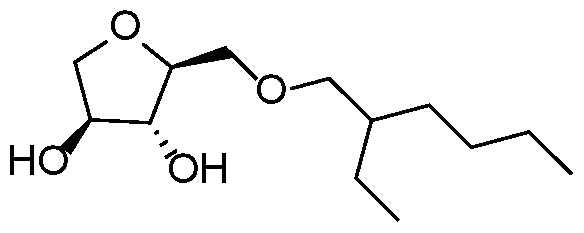
Alternatively, according to other embodiments one can produce anhydropentitol diethers with a structure such as one or more of the following: u. (2S,3R,4S)-4-((2-ethylhexyl)oxy)-2-(((2-ethylhexyl)oxy)methyl)tetra- hydrofuran-3-ol

v. (3S,4R,5S)-4-((2-ethylhexyl)oxy)-5-(((2-ethylhexyl)oxy)methyl)tetrahydrofuran 3-ol

w. ((2S,3S,4S)-3,4-bis((2-ethylhexyl)oxy)tetrahydrofuran-2-yl)methanol

x. (2S.3S,4R)-4-((2-ethylhexyl)oxy)-2-(((2-ethylhexyl)oxy)methyl)tetrahydrofuran- -ol

z. ((2S,3R,4R)-3,4-bis((2-ethylhexyl)oxy)tetrahydrofuran-2-yl)methanol

aa. (3R,4S,5R)-4,5-bis((2-ethylhexyl)oxy)tetrahydro-2H-pyran-3-ol

bb. (3R,4R,5R)-4,5-bis((2-ethylhexyl)oxy)tetrahydro-2H-pyran-3-ol

cc. (3R,5R)-3,5-bis((2-ethylhexyl)oxy)tetrahydro-2H-pyran-4-ol

dd. (2R,3R,4R)-4-((2-ethylhexyl)oxy)-2-(((2- ethylhexyl)oxy)methyl)tetrahydrofuran-3-ol

ee. (3R,4R,5R)-4-((2-ethylhexyl)oxy)-5-(((2- ethylhexyl)oxy)methyl)tetrahydrofuran-3-ol

ff. ((2R,3S,4R)-3,4-bis((2-ethylhexyl)oxy)tetrahydrofuran-2-yl)methanol

gg. (3R,4R,5S)-4,5-b -ethylhexyl)oxy)tetrahydro-2H-pyran-3-ol

hh. (3S,4S,5R)-4,5-b -ethylhexyl)oxy)tetrahydro-2H-pyran-3-ol
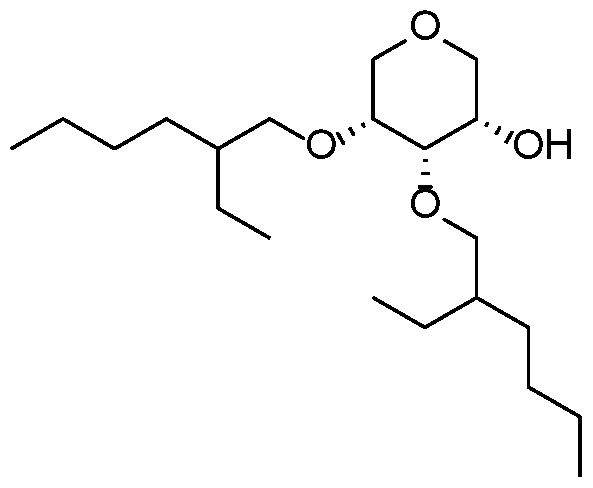
ii. (3R,4s,5S -3,5-bis((2-ethylhexyl)oxy)tetrahydro-2H-pyran-4-ol

jj . (3S,4R,5R)-4,5-bis((2-ethylhexyl)oxy)tetrahydro-2H-pyran-3-ol

kk. (3R,4S,5S)-4,5-b -ethylhexyl)oxy)tetrahydro-2H-pyran-3-ol

(3R,4r,5S -3,5-bis((2-ethylhexyl)oxy)tetrahydro-2H-pyran-<

Section II. Examples
[0033] In the following examples we further illustrate the present method of preparing ethers. To reiterate, the method involves a consolidated single-step synthesis that combines a) dehydrating a pentitol in the presence of a water-tolerant Lewis acid (WTLA) catalyst to produce a corresponding anhydopentitiol and b) etherifying the anhydropentitol product with an aliphatic alcohol in the presence of a water-tolerant Lewis acid catalyst all in a one-pot process, without need to remove, separate or transfer the products of the dehydration reaction before etherification. In particular, the examples use low catalytic amounts of homogeneous catalysts, hafnium triflate and gallium triflate, to dehydrate and cyclize xylitol and ribitol (also known as adonitol) to their corresponding anhydropentitols. The starting C5 sugar alcohols can be readily obtained commercially as xylitol, arabinitol, and ribitol.
[0034] Example 1 involves hafnium triflate-mediated xylitol dehydration/etherification making 1,4-anhydroxylitol mono-2EHO ethers as major products and l,5-anhydroxylitol-2EH ethers as minor products.
[0035] Experimental: A 250 mL, three necked round bottomed flask equipped with a PTFE magnetic stir bar was charged with 100 g of xylitol (0.675 mol), 523 mg of Hf(OTf>4 (0.5 mol%) and 356 mL of 2-ethylhexanol (EHO, 3.29 mol). The leftmost neck was affixed to a jacketed Dean-Stark trap filled with EHO and capped with a 12' needle-penetrated rubber septum, the center neck a long-stemmed thermowell adapter, and the rightmost neck an argon inlet. While vigorously stirring and under argon, the mixture was heated to 140°C for 1 h. The temperature was then increased to 160°C and the reaction continued for 8 h under these conditions. (Previous, independent evaluations revealed that 1 h at 140°C was ample to entirely convert xylitol to 1,4- anhydroxylitol). Supervening GC analysis of the cooled mixture disclosed four salient signals: a) Two at 11.55 and 11.90 min., designating 1,5-anhydroxylitol and 1,4-anhydroxylitol respectively, and comprising 70 wt.%; b) one at 21.58 min. denoting 1,4-anhydroxylitol mono-2-ethylhexyl ether, comprising 12 wt.%; c) one at 26.83 min. comprising 1,5-anhydroxylitol mono-2- ethylhexyl mono, comprising 8 wt.%. No xylitol signal (18.18 min.) was observed, adducing full conversion of this precursor to 1,4-anhydroxylitol. Figure 3 presents a gas chromatograph (GC) trace of the resulting product mixture.
[0036] Example 2 involves gallium triflate-mediated ribitol dehydration/etherfication making 1,4-anhydroribitol mono and di-2EHO ethers as major products and 1,5-anhydroribitol mono and di-2EHO ethers as minor products.
[0037] Experimental: A 250 mL, three necked round bottomed flask equipped with a PTFE magnetic stir bar was charged with 100 g of ribitol (0.675 mol), 322 mg of Ga(OTf>3 (0.5 mol%) and 356 mL of 2-ethylhexanol (EHO, 3.29 mol). The leftmost neck was affixed to a jacketed Dean-Stark trap filled with EHO and capped with a 12' needle-penetrated rubber septum, the center neck a long-stemmed thermowell adapter, and the rightmost neck an argon inlet. While vigorously stirring and under argon, the mixture was heated to 140°C for 1 h. The temperature was then increased to 160°C and the reaction continued for 8 h conditions. (Previous, independent evaluations revealed that 1 h at 140°C was ample to entirely convert ribitol to 1,4- anhydroribitol). Supervening GC analysis of the cooled mixture disclosed four salient signals: a) Two at 11.55 and 11.90 min., designating 1,5-anhydroribitol and 1,4-anhydroribitol respectively, and comprising 52 wt.%; b) one at 21.58 min. denoting 1,4-anhydroribitol mono -2 -ethylhexyl ether, comprising 12 wt.%; c) one at 26.83 min comprising 1,5-anhydroribitol mono-2- ethylhexyl mono, comprising 10 wt.%; d) two overlapping signals at 31.48 and 31.54 min.
respectively, corresponding to the di-2EH ethers of 1,4-anhydroribitol and 1,5-anhydroribitol, and comprising 18 wt.%. No ribitol signal (18.18 min.) was observed, adducing full conversion of this precursor to 1,4-anhydroribitol. Figure 4, presents a GC trace of the different compounds in the product mixture generated from this example. For purposes of comparison, Figures 5A, 5B, and 5C show GC analysis of starting materials, respectively, 2-ethylhexanol, 1,4-anhydroxylitol and 1,5-anhydroxylitol, and xylitol.
[0038] Although the present invention has been described generally and by way of examples, it is understood by those persons skilled in the art that the invention is not necessarily limited to the embodiments specifically disclosed, and that modifications and variations can be made without departing from the spirit and scope of the invention. Thus, unless changes otherwise depart from the scope of the invention as defined by the following claims, they should be construed as included herein.
Claims
1. A process for producing cyclic ethers comprising: contacting a pentitol in the presence of a water-tolerant Lewis acid catalyst to dehydratively cyclize said pentitol and produce an anhydropentitol; and etherifying said anhydropentitol with an alcohol to produce a monoether, diether, or triether, at a reaction temperature and time sufficient for the respective dehydration and etherification reactions.
2. The process according to claim 1, wherein both of said dehydration and etherification
reactions are performed concurrently in a single reaction vessel.
3. The process according to claim 1, wherein said pentitol is at least one of the following: D- ribitol, D-arabinitol, or D-xylitol.
4. The process according to claim 1, wherein said anhydropentitol from said dehydration
reaction of said pentitols is at least one of the following: 1,4-anhydroxylitol, 1,5- anhydroxylitol, 1,4-anhydroarabinitol, 2,5-anhydroarabinitol, 1,4-anhydroribitol.
5. The process according to claim 1, wherein said water-tolerant Lewis acid is a metal triflate of at least one of the following: lanthanum, cerium, praseodymium, neodymium, samarium, europium, gadolinium, terbium, dysprodium, holmium, erbium, ytterbium, lutetium, hafnium, gallium, scandium, bismuth, mercury iron, nickel, copper, zinc, aluminum, thallium, tin, indium.
6. The process according to claim 5, wherein the metal triflate is hafnium, gallium, scandium, and bismuth.
7. The process according to claim 1, wherein said alcohol is selected from an alkanoic, alkenoic, alkyonoic, and aromatic alcohol, having a carbon chain length ranging from C2-C26.
8. The process according to claim 1, wherein said water-tolerant Lewis acid catalyst is at an amount of about 0.0001 mol.% to about 1.5 mol.% relative to an amount of pentitol.
9. The process according to claim 8, wherein said catalyst is in an amount of about 0.01 mol.% to about 0.1 mol.% relative to an amount of pentitol.
10. The process according to claim 1, wherein said dehydration reaction with said water-tolerant Lewis acid catalyst achieves a conversion rate of at least 60% of said pentitol to a corresponding anhydropentitol.
1 1. The process according to claim 1, wherein said etherification reaction with said water-tolerant Lewis acid catalyst converts said anhydropentitol to a corresponding monoether or diether at yields of least 12%.
12. The process according to claim 1, wherein said temperature for dehydration is in range from about 120°C to about 160°C.
13. The process according to claim 12, wherein said temperature is about 125°C to about 150°C.
14. Ine process according to claim 1, wherein said temperature for etherifi ti oii is m a langc from about 150°C to about 250°C.
15. The process according to claim 14, wherein said temperature is about 170°C to about 200°C.
16. The process according to claim 1, wherein said reaction time is at least 30 minutes to about 24 hours.
17. An anhydropentitol monoether compound having a structure according to at least one of the follo
a)
d
 ) , e) , and f) , where R is an alkyl, alkenyl, alkynyl, allyl, or aromatic group.
18. An anhydropentitol diether compound having a structure according to at least one of the following:

19. The anhydropentitol monoether compound according to claim 17, wherein said
anhydropentitol monoether compound is one or more of the following:
a. (2S,3R,4R)-4-((2-ethylhexyl)oxy)-2-(hydroxymethyl)tetrahydrofuran-3-ol

b. (3R,4S,5 S)-4-((2-ethylhexyl)oxy)-5 -(hydroxymethyl)tetrahydrofuran-3 -ol
c. (2S,3S,4R)-2-((( ran-3,4-diol d. (3S,4R,5R)-5-((2 -3,4-diol e. (3R,4R,5S)-4-((2 -3,5-diol
f. (3R,4S,5S)-5-((2 3,4-diol

(2S,3S,4R)-4-((2-ethylhexyl)oxy)-2-(hydroxymethyl)tetrahydrofuran-3-ol

h. (3R,4R,5 S)-4-((2-ethylhexyl)oxy)-5 -(hydroxymethyl)tetrahydrofuran-3 -ol

i. (2S,3R,4R)-2-(((2-ethylhexyl)oxy)methyl)tetrahydrofuran-3,4-diol

j . (3R,4R,5R)-5-((2-ethylhexyl)oxy)tetrahydro-2H-pyran-3,4-diol
(3R,5R)-4-((2-eth n-3,5-diol

(3R,4S,5R)-5-((2-ethylhexyl)oxy)tetrahydro-2H-pyran-3,4-diol

m. (2R,3 S,4R)-4-((2-ethylhexyl)oxy)-2-(hydroxymethyl)tetrahydrofuran-3 -ol

n. (3R,4R,5R)-4-((2-ethylhexyl)oxy)-5-(hydroxymethyl)tetrahydrofuran-3-ol

o. (2R,3R,4R)-2-(((2 rofuran-3,4-diol

p. (3R,4R,5S)-5-((2-ethylhexyl)oxy)tetrahydro-2H-pyran-3,4-diol
(3R,4S,5S)-4-(( l
r. (2S,3 S,4S)-4-((2 rofuran-3 -ol

s. (3 S,4R,5 S)-4-((2-ethylhe l)tetrahydrofuran-3 -ol

t. (2S,3R,4S)-2-(((2-ethylhexyl)oxy)methyl)tetrahydrofuran-3,4-diol

20. The anhydropentitol diether compound according to claim 18, wherein said anhydropentitol diether compound is one or more of the following: a. -4-((2-ethylhexyl)oxy)-2-(((2-ethylhexyl)oxy)methyl)tetra-hydrofuran-3-
b. ethyl)tetrahydrofuran-3-ol

c. ((2S,3S,4S)-3,4-bis((2- drofuran-2-yl)methanol

d. (2S,3S,4R)- -((2-ethylhexyl)oxy)-2-(((2-ethylhexyl)oxy)methyl)tetrahydrofuran-3-ol

e. (3R,4S,5S)-4-((2-ethylhexyl)oxy)-5-(((2-ethylhexyl)oxy)methyl)tetrahydrofuran-3-ol

f. ((2S,3R,4R)-3,4-bis((2-ethylhexyl)oxy)tetrahydrofuran-2-yl)methanol

(3R,4S,5R)-4,5-bis((2-ethylhexyl)oxy)tetrahydro-2H-pyran-3-ol

h. (3R,4R,5R)-4,5-bis((2-ethylhexyl)oxy)tetrahydro-2H-pyran-3-ol

i. (3R,5R)-3,5-bis((2-ethylhexyl)oxy)tetrahydro-2H-pyran-4-ol

j . (2R,3R,4R)-4-((2-ethylhexyl)oxy)-2-(((2-ethylhexyl)oxy)methyl)-tetrahydrofuran-3 - ol

k. (3R,4R,5R)-4-((2-ethylhexyl)oxy)-5 -(((2-ethylhexyl)oxy)methyl)-tetrahydrofuran-3 - ol
1. ((2R,3S,4R)-3,4-bi uran-2-yl)methanol

m. (3R,4R,5S)-4,5-bis -ethylhexyl)oxy)tetrahydro-2H-pyran-3-ol

n. (3S,4S,5R)-4,5-bis -ethylhexyl)oxy)tetrahydro-2H-pyran-3-ol

o. (3R,4s,5S)-3,5-bis((2-ethylhexyl)oxy)tetrahydro-2H-pyran-4-ol

Applications Claiming Priority (4)
| Application Number | Priority Date | Filing Date | Title |
|---|---|---|---|
| US201562205340P | 2015-08-14 | 2015-08-14 | |
| US62/205,340 | 2015-08-14 | ||
| US201562213149P | 2015-09-02 | 2015-09-02 | |
| US62/213,149 | 2015-09-02 |
Publications (1)
| Publication Number | Publication Date |
|---|---|
| WO2017030685A1 true WO2017030685A1 (en) | 2017-02-23 |
Family
ID=58051983
Family Applications (1)
| Application Number | Title | Priority Date | Filing Date |
|---|---|---|---|
| PCT/US2016/041988 Ceased WO2017030685A1 (en) | 2015-08-14 | 2016-07-13 | One-pot synthesis of anhydropentitol mono- and diethers |
Country Status (1)
| Country | Link |
|---|---|
| WO (1) | WO2017030685A1 (en) |
Cited By (1)
| Publication number | Priority date | Publication date | Assignee | Title |
|---|---|---|---|---|
| WO2023198682A1 (en) * | 2022-04-11 | 2023-10-19 | Ecole Polytechnique Federale De Lausanne (Epfl) | Biobased surfactants |
Citations (4)
| Publication number | Priority date | Publication date | Assignee | Title |
|---|---|---|---|---|
| US6013812A (en) * | 1997-11-07 | 2000-01-11 | Degussa Aktiengesellschaft | Process for the production of five-membered or six-membered cyclic ethers, in particular of anhydropolyols |
| US20100274030A1 (en) * | 2007-07-13 | 2010-10-28 | Hanamanthsa Shankarsa Bevinakatti | Cyclic ethers |
| WO2012099755A1 (en) * | 2011-01-11 | 2012-07-26 | Alnylam Pharmaceuticals, Inc. | Pegylated lipids and their use for drug delivery |
| WO2014137619A1 (en) * | 2013-03-05 | 2014-09-12 | Archer Daniels Midland Company | Process for acid dehydration of sugar alcohols |
-
2016
- 2016-07-13 WO PCT/US2016/041988 patent/WO2017030685A1/en not_active Ceased
Patent Citations (4)
| Publication number | Priority date | Publication date | Assignee | Title |
|---|---|---|---|---|
| US6013812A (en) * | 1997-11-07 | 2000-01-11 | Degussa Aktiengesellschaft | Process for the production of five-membered or six-membered cyclic ethers, in particular of anhydropolyols |
| US20100274030A1 (en) * | 2007-07-13 | 2010-10-28 | Hanamanthsa Shankarsa Bevinakatti | Cyclic ethers |
| WO2012099755A1 (en) * | 2011-01-11 | 2012-07-26 | Alnylam Pharmaceuticals, Inc. | Pegylated lipids and their use for drug delivery |
| WO2014137619A1 (en) * | 2013-03-05 | 2014-09-12 | Archer Daniels Midland Company | Process for acid dehydration of sugar alcohols |
Non-Patent Citations (1)
| Title |
|---|
| GUAL, A. ET AL.: "Cl-symmetric diphosphite ligands derived from carbohydrates: influence of structural modifications on the rhodium-catalyzed asymmetric hydroformylation of styrene", EUROPEAN JOURNAL OF ORGANIC CHEMISTRY, vol. 8, 2009, pages 1191 - 1201, XP055311142 * |
Cited By (1)
| Publication number | Priority date | Publication date | Assignee | Title |
|---|---|---|---|---|
| WO2023198682A1 (en) * | 2022-04-11 | 2023-10-19 | Ecole Polytechnique Federale De Lausanne (Epfl) | Biobased surfactants |
Similar Documents
| Publication | Publication Date | Title |
|---|---|---|
| Corma et al. | Production of high quality diesel from cellulose and hemicellulose by the Sylvan process: catalysts and process variables | |
| US7880049B2 (en) | Production of liquid alkanes in the jet fuel range (C8-C15) from biomass-derived carbohydrates | |
| CN101809010B (en) | Hydroxymethylfurfural ethers from sugars or HMF and mixed alcohols | |
| Tan et al. | Efficient production of ethyl levulinate from cassava over Al2 (SO4) 3 catalyst in ethanol–water system | |
| US20150045576A1 (en) | Methods of making alkyl lactates and alkyl levulinates from saccharides | |
| JP7184132B2 (en) | Alcohol production method | |
| CN106866331B (en) | Method for preparing cyclopentadiene or dicyclopentadiene from furfuryl alcohol | |
| WO2016135605A1 (en) | Process for the dehydration of oxygenated compounds | |
| EP2755943B1 (en) | Method of producing saturated alkyl esters/acids | |
| CN105713642B (en) | Method for synthesizing high density aviation fuel from lignocellulose | |
| WO2016081010A1 (en) | Acid-catalyzed acylation of 5-(hydroxylmethyl)-furfural reduction products | |
| KR102001716B1 (en) | Process for making hmf from sugars with reduced byproduct formation, and improved stability hmf compositions | |
| CN117567400A (en) | A method for directly preparing 5-hydroxymethylfurfural from glucose using a deep eutectic solvent | |
| EP2495239B1 (en) | Method for preparing 4-hydroxymethylfurfural | |
| WO2015094716A1 (en) | Synthesis of isohexide ethers and carbonates | |
| WO2017030685A1 (en) | One-pot synthesis of anhydropentitol mono- and diethers | |
| CN104744406B (en) | Heavy turpentine is utilized to prepare epoxy caryophyllene and the method separating longifolene | |
| EP3143101B1 (en) | Biphasic solvent catalytic process for the direct production of light naphtha from carbohydrate-containing feedstock. | |
| AU2014369062A1 (en) | Direct synthesis of bio-based alkyl and furanic diol ethers, acetates, ether-acetates, and carbonates | |
| WO2017100402A1 (en) | One-pot synthesis of anhydropentitol esters from pentitols, catalyzed by water-tolerant lewis acids | |
| EP2516411A1 (en) | Process for preparing hydrocarbons | |
| WO2017030684A1 (en) | Dehydrative cyclization of pentitols using water-tolerant lewis acid catalysts under mild conditions and derivatives | |
| WO2025036706A1 (en) | Method of making furan-based bis-hydroxymethyl compounds from mixtures comprising hydroxymethylfurfural, and respective mixtures for use as intermediates | |
| WO2016150965A1 (en) | Process for preparing product oil from peat, coir or peat-like substances | |
| CN121986092A (en) | Method for producing furan-based bis-hydroxymethyl compounds from mixtures comprising hydroxymethylfurfural and corresponding mixtures for use as intermediates |
Legal Events
| Date | Code | Title | Description |
|---|---|---|---|
| 121 | Ep: the epo has been informed by wipo that ep was designated in this application |
Ref document number: 16837448 Country of ref document: EP Kind code of ref document: A1 |
|
| NENP | Non-entry into the national phase |
Ref country code: DE |
|
| 122 | Ep: pct application non-entry in european phase |
Ref document number: 16837448 Country of ref document: EP Kind code of ref document: A1 |