WO2017029635A1 - Robust node estimation and topology discovery for large-scale networks - Google Patents
Robust node estimation and topology discovery for large-scale networks Download PDFInfo
- Publication number
- WO2017029635A1 WO2017029635A1 PCT/IB2016/054949 IB2016054949W WO2017029635A1 WO 2017029635 A1 WO2017029635 A1 WO 2017029635A1 IB 2016054949 W IB2016054949 W IB 2016054949W WO 2017029635 A1 WO2017029635 A1 WO 2017029635A1
- Authority
- WO
- WIPO (PCT)
- Prior art keywords
- probability
- nodes
- network device
- network
- transmission packet
- Prior art date
- Legal status (The legal status is an assumption and is not a legal conclusion. Google has not performed a legal analysis and makes no representation as to the accuracy of the status listed.)
- Ceased
Links
Classifications
-
- H—ELECTRICITY
- H04—ELECTRIC COMMUNICATION TECHNIQUE
- H04W—WIRELESS COMMUNICATION NETWORKS
- H04W84/00—Network topologies
- H04W84/18—Self-organising networks, e.g. ad-hoc networks or sensor networks
-
- H—ELECTRICITY
- H04—ELECTRIC COMMUNICATION TECHNIQUE
- H04L—TRANSMISSION OF DIGITAL INFORMATION, e.g. TELEGRAPHIC COMMUNICATION
- H04L41/00—Arrangements for maintenance, administration or management of data switching networks, e.g. of packet switching networks
- H04L41/12—Discovery or management of network topologies
Definitions
- WSNs Wireless Sensor Networks
- a WSN refers to a set of small electronic devices (sensors) capable of monitoring and measuring certain phenomena, e.g., temperature, pressure, flood, fires, etc., usually in hazardous and non-reachable environments.
- a WSN is typically composed of hundreds to millions of nodes capable of intersecting and communicating with each other. Due to their small size, these devices have limited resources such as memory, computation power, battery lifetime and bandwidth.
- Embodiments of the present disclosure are related to robust node estimation and topology discovery for networks, including large scale networks.
- a method comprises receiving, over a wireless channel, a first transmission packet that includes a first identifier from a first one of a plurality of nodes; adding the first identifier to a second transmission packet based at least in part on a first comparison between the first identifier and a plurality of existing identifiers associated with the second transmission packet; adjusting a transmit probability based on the first comparison; and transmitting, over the wireless channel, the second transmission packet to at least one of the plurality of nodes based at least in part on a second comparison between the transmit probability and a probability distribution.
- the method can comprise determining a probability distribution associated with the plurality of nodes with respect to the first one of the plurality of nodes.
- At least one of the plurality of nodes can comprise a sensor device.
- the sensor device can be configured to measure at least one of: a temperature, a pressure, a voltage, or a current.
- a system comprises a first network device in a network; and an application executable in the first network device. Execution of the application causes the first network device to at least generate a first transmission packet that includes a first identifier and a list comprising a plurality of existing identifiers; receive a second transmission packet that includes a second identifier from a second network device in the network; add the second identifier to the list in response to a first comparison between the second identifier and the plurality of existing identifiers; adjust a transmit probability based on the first comparison; and transmit the first transmission packet to a third network device in the network based at least in part on a second comparison between the transmit probability and a probability distribution.
- the first comparison can determine whether the second identifier matches one of the plurality of existing identifiers.
- the transmit probability can be increased when the second identifier does not match one of the plurality of existing identifiers.
- the first network device can transmit the first transmission packet to a data collector in response to a query message from the data collector.
- the transmit probability can indicate a probability that the first network device will transmit the first transmission packet.
- the first network device can determine the probability distribution by calculating a uniform distribution.
- the first network device can transmit the first transmission packet to the third network device when the transmit probability exceeds the probability distribution.
- the first network device can reset the transmit probability to an initial probability in response to transmission of the first transmission packet to the third network device.
- the first network device can comprise a wireless transceiver, and the first transmission packet is transmitted over a wireless channel using the wireless transceiver.
- the list can comprise the plurality of existing identifiers represents a plurality of neighboring wireless network devices located within a predefined radius with respect to a location of the first network device.
- a method comprises transmitting, using a computing device, a query message to a plurality of sensor devices, the query message being transmitted over a wireless channel; receiving a transmission packet from at least one of the plurality of sensor devices, the transmission packet comprising data indicating a plurality of identifiers; and determining, using the computing device, a quantity of the plurality of sensor devices based at least in part on the plurality of identifiers.
- FIG. 1 is an example drawing illustrating the transmission range of two sensor devices, according to various embodiments of the present disclosure.
- FIG. 2 is an example algorithm illustrating an initialization phase of a sensor node, according to various embodiments of the present disclosure.
- FIG. 3 is an example drawing illustrating a network of nodes and a corresponding set of coordinates for each node, according to various embodiments of the present disclosure.
- FIG. 4 is an example algorithm illustrating a dissemination of knowledge among multiple sensor nodes, according to various embodiments of the present disclosure.
- FIG. 5 is an example algorithm illustrating a query phase associated with a data collector, according to various embodiments of the present disclosure.
- FIG. 6 is a graph illustrating an example of a number of queried nodes versus the number of estimated nodes for different combination of query time t and initial transmit probability F, according to various embodiments of the present disclosure.
- FIG. 7 is a graph illustrating an example of an initial transmit probability F versus the average time to perform 95% estimation of the network for different number of queried nodes K, according to various embodiments of the present disclosure.
- FIG. 8 is a graph illustrating an example of a number of queried nodes K versus the average erasure probability to perform 95% estimation of the network for different running times t, according to various embodiments of the present disclosure.
- FIG. 9 is a schematic block diagram that provides on example illustration of a computing environment, according to an embodiment of the present disclosure.
- node estimation and/or topology discovery for large-scale networks where nodes communicate with each other such as, e.g., a wireless sensor network (WSN).
- WSN wireless sensor network
- the present disclosure relates to a novel approach for estimating cardinality, i.e., the number of nodes, in large scale anonymous graphs using statistical inference methods.
- each node possesses little or non-existing information on the network topology.
- the present disclosure relates to determining network characteristics such as the number of nodes distributed randomly and uniformly in a given field.
- benefits for cardinality estimation in graphs such as energy efficiency, mobile communication and coding schemes design, data collections, and distributed storage.
- various embodiments of the present disclosure can enable each node to discover its neighbors, which help network designers enhance coverage and connectivity.
- the difficulty of the network size estimation can heavily depend on the assumptions and features of the system.
- the present disclosure considers the anonymous networks framework approach, where nodes only know their unique identifier (ID).
- ID unique identifier
- each node possesses little or non-existing information on the network topology. It has been shown that with a centralized strategy, the node estimation can be obtained in finite time with probability one. For a large network, the complexity of discovering with probability one (1 ) is very high. For non-unique IDs, it has also been demonstrated that the estimation cannot be performed with probability one in limited time or with a bounded computational complexity. The problem is, then, to discover estimators that trade-off small error likelihood and moderate computational complexity.
- Various embodiments of the present disclosure relate to a hybrid scheme that not only performs node counting that can be run for an arbitrary time period, but further uses the output to carry out the network size estimation. Such an estimate can benefit network designers to design the coding schemes appropriately.
- Various embodiments of the present disclosure combine the advantages of both the node counting algorithms and the node estimation ones. Given that the time and computation complexity of node counting algorithms is high, their use in large-scale networks is prohibitive. On the other hand, network size estimation algorithms have, in general, high variance. Depending on the initialization parameters, the estimate of the proposed scheme balances these two effects and can be made as arbitrarily close to the network cardinality as wanted. Furthermore, various embodiments can, at the same time, discover the neighbors of each node.
- an estimate may be provided based on nodes with unique IDs. In other embodiments, an estimate can be provided where the nodes may not have a unique ID by exploiting the inverse birthday paradox.
- the network J can be considered as an abstract graph with a set of
- nodes V and a set of edges £, where n
- the set can represent
- the transmission range is circular, let be its radius.
- the various embodiments of the present disclosure are independent of the considered transmission range.
- the performance analysis provided in the rest of this disclosure assumes a circular transmission range with the same radius for all nodes.
- n nodes i.e., the network size
- connections i.e., the network topology
- a bound on the network size JV, ⁇ > n is known by the data fusion center.
- This scenario can be seen as a network after a long running time or a disaster. Initially, the network is composed of nodes each having a unique ID. After a long running time or a disaster, some of the nodes may disappear from the graph leaving a graph with n ⁇ N max nodes with unique ID. Let be the ID of sensor
- each node may know only its unique identifier. Communication between nodes can be performed by broadcasting the information to the other nodes. Note that nodes need not transmit additional bits indicating its ID with the information packet. Moreover, no acknowledgement is expected from sensors that successfully receive a packet. Transmissions are subject to erasure at the sensors with a probability of for sensor In other words,
- Definition 1 Denote by the set of neighbors of a node
- the present disclosure can consider static nodes in the network. Therefore, due to the static nature of the nodes, their relative position in the network remains identical which results in an unchanged set of neighbors for all nodes.
- K the set of nodes in the network that can be queried by the data collector. This set of nodes can be randomly picked from the set of alive and dead nodes with
- the data collector can be assumed to know the IDs of the nodes in the initial network comprising sensors.
- selection of the queried nodes can be performed by sampling uniformly without replacement from this set of IDs. Such methods can result in nodes randomly picked from the set of alive and dead ones.
- the notation i/(0,l) refers to the uniform distribution over
- the algorithm can estimate the total number of nodes in a network.
- the algorithm can run in three distinct phases: the initialization, the knowledge distribution, and the query phases.
- the initialization phase the initial packets of the nodes and their transmit probability can be set.
- the knowledge distribution phase the information about the networks can be disseminated among the surviving nodes from neighbor to neighbors.
- the DC can collect the information about the network by asking some nodes and inferring the size of the whole system.
- each node in the network can generate a packet containing its ID.
- the packet size limitation can have an effect on the results, the various embodiments of the present disclosure can consider reducing it.
- the distinct IDs can be encoded using
- Each node also can initialize its initial transmit probability
- a small value of the initial probability means that there is a small amount of communication between nodes in the network, a value
- FIG. 2 summarizes the steps of the initialization phase as one non-limiting example.
- each node s £ can generate a packet containing both its ID and its (X, Y) coordinates. Assuming that coordinates are encoded using V bits, the maximum size a packet can reach is
- the size of the topology discovery packet scales in the same manner as the one of the cardinality estimation.
- the packet brings new information to the node, i.e., The node can
- each node can first remove its ID from the packet it possesses and then append it to the end of the packet.
- each node s can sample from a probability distribution
- FIG. 4 summarizes the steps of the knowledge distribution phase as one non-limiting example.
- a DC can query some nodes from the set of nodes to retrieve information about the current status of the network N and infer its size P s .. If the queried node s f is alive then it can transmit its packet P Si . Otherwise, there may be no transmission, and the packet of that node can be the empty set.
- FIG. 5 summarizes the steps of the query phase as one non-limiting example.
- nodes that are dead where is the set of all nodes in the network. It can be seen that this section assumes that nodes can have the same
- FIG. 6 is an example illustrating the relation between the number of queried nodes and the number of estimated nodes in the network for different combinations of query time t and initial transmit probability F.
- Various embodiments of the present disclosure have found that asking 10% or more of nodes can give a good estimation of the network size. Besides, increasing the initial transmit probability F or the query time t can result in an enhancement of the performances.
- FIG. 7 is an example graph that shows the initial transmit probability F versus the time t, in which the total estimation of network nodes is 95% or more for various queried nodes K.
- F 0.5
- FIG. 8 is an example graph that illustrates the number of queried nodes K versus the average erasure probability, in which the total estimation of network nodes is 95% or more for different running times t.
- the number of queried nodes to perform 95% estimation of the whole network size can decrease with the number of iterations of the algorithm. This can be explained by the fact that as the number of iterations increases, each node can have more knowledge about the network configuration that results in a less queried nodes.
- the computing environment 903 includes one or more computing devices 906.
- Each computing device 906 includes at least one processor circuit, for example, having a processor 909 and a memory 912, both of which are coupled to a local interface 915.
- each computing device 906 may comprise, for example, at least one server computer or like device.
- the local interface 915 may comprise, for example, a data bus with an accompanying address/control bus or other bus structure as can be appreciated.
- Stored in the memory 912 are both data and several components that are executable by the processor 909.
- stored in the memory 912 and executable by the processor 909 is a Node Estimation application 921 , and potentially other applications.
- Also stored in the memory 912 may be a data store 918 and other data.
- an operating system may be stored in the memory 912 and executable by the processor 909.
- executable means a program file that is in a form that can ultimately be run by the processor 909.
- Examples of executable programs may be, for example, a compiled program that can be translated into machine code in a format that can be loaded into a random access portion of the memory 912 and run by the processor 909, source code that may be expressed in proper format such as object code that is capable of being loaded into a random access portion of the memory 912 and executed by the processor 909, or source code that may be interpreted by another executable program to generate instructions in a random access portion of the memory 912 to be executed by the processor 909, etc.
- An executable program may be stored in any portion or component of the memory 912 including, for example, random access memory (RAM), read-only memory (ROM), hard drive, solid-state drive, USB flash drive, memory card, optical disc such as compact disc (CD) or digital versatile disc (DVD), floppy disk, magnetic tape, or other memory components.
- RAM random access memory
- ROM read-only memory
- hard drive solid-state drive
- USB flash drive USB flash drive
- memory card such as compact disc (CD) or digital versatile disc (DVD), floppy disk, magnetic tape, or other memory components.
- CD compact disc
- DVD digital versatile disc
- the memory 912 is defined herein as including both volatile and nonvolatile memory and data storage components. Volatile components are those that do not retain data values upon loss of power. Nonvolatile components are those that retain data upon a loss of power.
- the memory 912 may comprise, for example, random access memory (RAM), read-only memory (ROM), hard disk drives, solid-state drives, USB flash drives, memory cards accessed via a memory card reader, floppy disks accessed via an associated floppy disk drive, optical discs accessed via an optical disc drive, magnetic tapes accessed via an appropriate tape drive, and/or other memory components, or a combination of any two or more of these memory components.
- the RAM may comprise, for example, static random access memory (SRAM), dynamic random access memory (DRAM), or magnetic random access memory (MRAM) and other such devices.
- the ROM may comprise, for example, a programmable read-only memory (PROM), an erasable programmable read-only memory (EPROM), an electrically erasable programmable read-only memory (EEPROM), or other like memory device.
- the processor 909 may represent multiple processors 909 and/or multiple processor cores and the memory 912 may represent multiple memories 912 that operate in parallel processing circuits, respectively.
- the local interface 915 may be an appropriate network that facilitates communication between any two of the multiple processors 909, between any processor 909 and any of the memories 912, or between any two of the memories 912, etc.
- the local interface 915 may comprise additional systems designed to coordinate this communication, including, for example, performing load balancing.
- the processor 909 may be of electrical or of some other available construction.
- Node Estimation application 921 and/or other various systems described herein may be embodied in software or code executed by general purpose hardware as discussed above, as an alternative the same may also be embodied in dedicated hardware or a combination of software/general purpose hardware and dedicated hardware. If embodied in dedicated hardware, each can be implemented as a circuit or state machine that employs any one of or a combination of a number of technologies. These technologies may include, but are not limited to, discrete logic circuits having logic gates for implementing various logic functions upon an application of one or more data signals, application specific integrated circuits (ASICs) having appropriate logic gates, field-programmable gate arrays (FPGAs), or other components, etc. Such technologies are generally well known by those skilled in the art and, consequently, are not described in detail herein.
- each block may represent a module, segment, or portion of code that comprises program instructions to implement the specified logical function(s).
- the program instructions may be embodied in the form of source code that comprises human-readable statements written in a programming language or machine code that comprises numerical instructions recognizable by a suitable execution system such as a processor 909 in a computer system or other system.
- the machine code may be converted from the source code, etc.
- each block may represent a circuit or a number of interconnected circuits to implement the specified logical function(s).
- FIGS. 2, 4 and 5 show a specific order of execution, it is understood that the order of execution may differ from that which is depicted. For example, the order of execution of two or more blocks may be scrambled relative to the order shown. Also, two or more steps shown in succession in FIGS. 2, 4 and 5 may be executed concurrently or with partial concurrence. Further, in some embodiments, one or more of the steps shown in FIGS. 2, 4 and 5 may be skipped or omitted. In addition, any number of counters, state variables, warning semaphores, or messages might be added to the logical flow described herein, for purposes of enhanced utility, accounting, performance measurement, or providing troubleshooting aids, etc. It is understood that all such variations are within the scope of the present disclosure.
- any logic or application described herein, that comprises software or code can be embodied in any non-transitory computer-readable medium for use by or in connection with an instruction execution system such as, for example, a processor 909 in a computer system or other system.
- the logic may comprise, for example, statements including instructions and declarations that can be fetched from the computer-readable medium and executed by the instruction execution system.
- a "computer-readable medium" can be any medium that can contain, store, or maintain the logic or application described herein for use by or in connection with the instruction execution system.
- the computer-readable medium can comprise any one of many physical media such as, for example, magnetic, optical, or semiconductor media.
- a suitable computer-readable medium would include, but are not limited to, magnetic tapes, magnetic floppy diskettes, magnetic hard drives, memory cards, solid-state drives, USB flash drives, or optical discs.
- the computer-readable medium may be a random access memory (RAM) including, for example, static random access memory (SRAM) and dynamic random access memory (DRAM), or magnetic random access memory (MRAM).
- the computer-readable medium may be a read-only memory (ROM), a programmable read-only memory (PROM), an erasable programmable read-only memory (EPROM), an electrically erasable programmable read-only memory (EEPROM), or other type of memory device.
- any logic or application described herein may be implemented and structured in a variety of ways.
- one or more applications described may be implemented as modules or components of a single application.
- one or more applications described herein may be executed in shared or separate computing devices or a combination thereof.
- a plurality of the applications described herein may execute in the same computing device 906, or in multiple computing devices in the same computing environment 903.
- terms such as “application,” “service,” “system,” “engine,” “module,” and so on may be interchangeable and are not intended to be limiting.
- the present disclosure relates to a novel hybrid size estimation algorithm in an anonymous graph, in which each node knows only its unique identifier.
- the present disclosure discusses a node counting algorithm whose output can be used to perform network size estimation using statistical inference methods.
- various embodiments of the present disclosure can show that the proposed algorithm produces an estimate of the total number of nodes proportional to the BLUE and that it converges when all the network nodes are queried. Simulation results show that various embodiments of the present disclosure can produce a good estimate when either the running time or the number of queried nodes are reasonable.
- Disjunctive language such as the phrase "at least one of X, Y, or Z," unless specifically stated otherwise, is otherwise understood with the context as used in general to present that an item, term, etc., may be either X, Y, or Z, or any combination thereof (e.g., X, Y, and/or Z). Thus, such disjunctive language is not generally intended to, and should not, imply that certain embodiments require at least one of X, at least one of Y, or at least one of Z to each be present.
Landscapes
- Engineering & Computer Science (AREA)
- Computer Networks & Wireless Communication (AREA)
- Signal Processing (AREA)
- Mobile Radio Communication Systems (AREA)
Abstract
Various examples are provided for node estimation and topology discovery for networks. In one example, a method includes receiving a packet having an identifier from a first node; adding the identifier to another transmission packet based on a comparison between the first identifier and existing identifiers associated with the other packet; adjusting a transmit probability based on the comparison; and transmitting the other packet based on a comparison between the transmit probability and a probability distribution. In another example, a system includes a network device that can adds an identifier received in a packet to a list including existing identifiers and adjust a transmit probability based on a comparison between the identifiers; and transmit another packet based on a comparison between the transmit probability and a probability distribution. In another example, a method includes determining a quantity of sensor devices based on a plurality of identifiers received in a packet.
Description
ROBUST NODE ESTIMATION AND TOPOLOGY DISCOVERY
FOR LARGE-SCALE NETWORKS
CROSS REFERENCE TO RELATED APPLICATIONS
[0001] This application claims priority to, and the benefit of, co-pending U.S. provisional application entitled "Robust Node Estimation and Topology Discovery for Large-Scale Networks" having serial no. 62/207,128, filed August 19, 2015, which is hereby incorporated by reference in its entirety.
BACKGROUND
[0002] Wireless Sensor Networks (WSNs) have been a great success in the past decades. Generally, a WSN refers to a set of small electronic devices (sensors) capable of monitoring and measuring certain phenomena, e.g., temperature, pressure, flood, fires, etc., usually in hazardous and non-reachable environments. A WSN is typically composed of hundreds to millions of nodes capable of intersecting and communicating with each other. Due to their small size, these devices have limited resources such as memory, computation power, battery lifetime and bandwidth.
SUMMARY
[0003] Embodiments of the present disclosure are related to robust node estimation and topology discovery for networks, including large scale networks.
[0004] In one embodiment, among others, a method comprises receiving, over a wireless channel, a first transmission packet that includes a first identifier from a first one of a plurality of nodes; adding the first identifier to a second transmission packet based at least in part on a first comparison between the first identifier and a
plurality of existing identifiers associated with the second transmission packet; adjusting a transmit probability based on the first comparison; and transmitting, over the wireless channel, the second transmission packet to at least one of the plurality of nodes based at least in part on a second comparison between the transmit probability and a probability distribution. In one or more aspects of these embodiments, the method can comprise determining a probability distribution associated with the plurality of nodes with respect to the first one of the plurality of nodes. At least one of the plurality of nodes can comprise a sensor device. The sensor device can be configured to measure at least one of: a temperature, a pressure, a voltage, or a current.
[0005] In another embodiment, a system comprises a first network device in a network; and an application executable in the first network device. Execution of the application causes the first network device to at least generate a first transmission packet that includes a first identifier and a list comprising a plurality of existing identifiers; receive a second transmission packet that includes a second identifier from a second network device in the network; add the second identifier to the list in response to a first comparison between the second identifier and the plurality of existing identifiers; adjust a transmit probability based on the first comparison; and transmit the first transmission packet to a third network device in the network based at least in part on a second comparison between the transmit probability and a probability distribution. In one or more aspects of these embodiments, the first comparison can determine whether the second identifier matches one of the plurality of existing identifiers. The transmit probability can be increased when the second identifier does not match one of the plurality of existing identifiers.
[0006] In one or more aspects of these embodiments, the first network device can transmit the first transmission packet to a data collector in response to a query message from the data collector. The transmit probability can indicate a probability that the first network device will transmit the first transmission packet. The first network device can determine the probability distribution by calculating a uniform distribution. The first network device can transmit the first transmission packet to the third network device when the transmit probability exceeds the probability distribution. The first network device can reset the transmit probability to an initial probability in response to transmission of the first transmission packet to the third network device. The first network device can comprise a wireless transceiver, and the first transmission packet is transmitted over a wireless channel using the wireless transceiver. The list can comprise the plurality of existing identifiers represents a plurality of neighboring wireless network devices located within a predefined radius with respect to a location of the first network device.
[0007] In another embodiment, a method comprises transmitting, using a computing device, a query message to a plurality of sensor devices, the query message being transmitted over a wireless channel; receiving a transmission packet from at least one of the plurality of sensor devices, the transmission packet comprising data indicating a plurality of identifiers; and determining, using the computing device, a quantity of the plurality of sensor devices based at least in part on the plurality of identifiers.
[0008] Other systems, methods, features, and advantages of the present disclosure will be or become apparent to one with skill in the art upon examination of the following drawings and detailed description. It is intended that all such additional systems, methods, features, and advantages be included within this description, be
within the scope of the present disclosure, and be protected by the accompanying claims. In addition, all optional and preferred features and modifications of the described embodiments are usable in all aspects of the disclosure taught herein. Furthermore, the individual features of the dependent claims, as well as all optional and preferred features and modifications of the described embodiments are combinable and interchangeable with one another.
BRIEF DESCRIPTION OF THE DRAWINGS
[0009] Many aspects of the present disclosure can be better understood with reference to the following drawings. The components in the drawings are not necessarily to scale, emphasis instead being placed upon clearly illustrating the principles of the present disclosure. Moreover, in the drawings, like reference numerals designate corresponding parts throughout the several views.
[0010] FIG. 1 is an example drawing illustrating the transmission range of two sensor devices, according to various embodiments of the present disclosure.
[0011] FIG. 2 is an example algorithm illustrating an initialization phase of a sensor node, according to various embodiments of the present disclosure.
[0012] FIG. 3 is an example drawing illustrating a network of nodes and a corresponding set of coordinates for each node, according to various embodiments of the present disclosure.
[0013] FIG. 4 is an example algorithm illustrating a dissemination of knowledge among multiple sensor nodes, according to various embodiments of the present disclosure.
[0014] FIG. 5 is an example algorithm illustrating a query phase associated with a data collector, according to various embodiments of the present disclosure.
[0015] FIG. 6 is a graph illustrating an example of a number of queried nodes versus the number of estimated nodes for different combination of query time t and initial transmit probability F, according to various embodiments of the present disclosure.
[0016] FIG. 7 is a graph illustrating an example of an initial transmit probability F versus the average time to perform 95% estimation of the network for different number of queried nodes K, according to various embodiments of the present disclosure.
[0017] FIG. 8 is a graph illustrating an example of a number of queried nodes K versus the average erasure probability to perform 95% estimation of the network for different running times t, according to various embodiments of the present disclosure.
[0018] FIG. 9 is a schematic block diagram that provides on example illustration of a computing environment, according to an embodiment of the present disclosure.
DETAIL DESCRIPTION
[0019] Disclosed herein are various embodiments of node estimation and/or topology discovery for large-scale networks where nodes communicate with each other such as, e.g., a wireless sensor network (WSN). In particular, the present disclosure relates to a novel approach for estimating cardinality, i.e., the number of nodes, in large scale anonymous graphs using statistical inference methods. In anonymous graphs, each node possesses little or non-existing information on the network topology. References will now be made in detail to the description of the embodiments as illustrated in the drawings.
[0020] The present disclosure relates to determining network characteristics such as the number of nodes distributed randomly and uniformly in a given field. There are several benefits for cardinality estimation in graphs such as energy efficiency, mobile communication and coding schemes design, data collections, and distributed storage. Furthermore, various embodiments of the present disclosure can enable each node to discover its neighbors, which help network designers enhance coverage and connectivity.
[0021] Applications of the network size estimation are not limited to WSN. With the shift in the design from the centralized architectures to decentralized ones, the problem becomes increasingly in demand due to its applications in social networks, online users, active protein cells, and artificial intelligence. Even though decentralized systems are more scalable and robust to failure, their use makes the estimation of the parameters of the whole network challenging.
[0022] With respect to the problem of node counting in an undirected graph, the aim is to visit all nodes of a graph and avoid revisiting nodes. The problem has numerous applications in artificial intelligence and control theory. However, the problem has proven to be NP-complete with a time complexity given by ^(n^) where n is the cardinality of the graph. NP refers to "nondeterministic polynomial time". Therefore, such an approach is unsuited for large-scale networks.
[0023] The use of statistical inference for cardinality estimation of a given network first appeared in the literature with the German tank problem, in which the aim was to estimate the total number of tanks given the serial number of the captured ones. The various embodiments of the present disclosure relate to sampling a subset of the entire population and available information. For example,
some embodiments can query a small portion of nodes to infer information about the whole network status.
[0024] The difficulty of the network size estimation can heavily depend on the assumptions and features of the system. The present disclosure considers the anonymous networks framework approach, where nodes only know their unique identifier (ID). In anonymous networks, each node possesses little or non-existing information on the network topology. It has been shown that with a centralized strategy, the node estimation can be obtained in finite time with probability one. For a large network, the complexity of discovering with probability one (1 ) is very high. For non-unique IDs, it has also been demonstrated that the estimation cannot be performed with probability one in limited time or with a bounded computational complexity. The problem is, then, to discover estimators that trade-off small error likelihood and moderate computational complexity.
[0025] Various embodiments of the present disclosure relate to a hybrid scheme that not only performs node counting that can be run for an arbitrary time period, but further uses the output to carry out the network size estimation. Such an estimate can benefit network designers to design the coding schemes appropriately. Various embodiments of the present disclosure combine the advantages of both the node counting algorithms and the node estimation ones. Given that the time and computation complexity of node counting algorithms is high, their use in large-scale networks is prohibitive. On the other hand, network size estimation algorithms have, in general, high variance. Depending on the initialization parameters, the estimate of the proposed scheme balances these two effects and can be made as arbitrarily close to the network cardinality as wanted. Furthermore, various embodiments can, at the same time, discover the neighbors of each node. Such knowledge can be
useful for data routing, which can be combined with the code design resulting in efficient resource utilization. In this context, an estimate may be provided based on nodes with unique IDs. In other embodiments, an estimate can be provided where the nodes may not have a unique ID by exploiting the inverse birthday paradox.
Network Model and Problem Formulation
A. Network Model
[0026] Consider a wireless sensor network with n sensor nodes that are

randomly and uniformly distributed in a region for some


The network J can be considered as an abstract graph with a set of

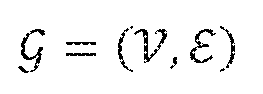
nodes V and a set of edges £, where n = |V|. The set can represent

the sensors that measure information about a specific field, and £ represents the set of links between the sensors.
[0027] As shown in FIG. 1 , two arbitrary sensors s4 and

can be connected if they are in the transmission range each other. Therefore, and
 sj are connected if and only if , where is the distance operator.


Assuming that the transmission range is circular, let
 be its radius. The various embodiments of the present disclosure are independent of the considered transmission range. However, the performance analysis provided in the rest of this disclosure assumes a circular transmission range with the same radius for all nodes.
[0028] Assume that neither the number of these n nodes, i.e., the network size, nor their connections, i.e., the network topology, are known. However, a bound on the network size JV,^ > n is known by the data fusion center. This scenario can be seen as a network after a long running time or a disaster. Initially, the network is composed of nodes each having a unique ID. After a long running time or a
disaster, some of the nodes may disappear from the graph leaving a graph with n≤ Nmax nodes with unique ID. Let be the ID of sensor

B. Network Protocol
[0029] In the considered network model, each node may know only its unique identifier. Communication between nodes can be performed by broadcasting the information to the other nodes. Note that nodes need not transmit additional bits indicating its ID with the information packet. Moreover, no acknowledgement is expected from sensors that successfully receive a packet. Transmissions are subject to erasure at the sensors with a probability of for sensor In other words,


for a sensor s£ broadcasting data, sensors successfully receives the data with

probability where is the set of neighbors of the node defined as follows.


[0030] Definition 1. Denote by the set of neighbors of a node

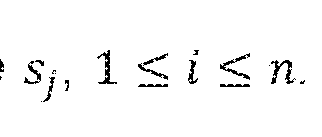
In other words,

[0031] The present disclosure can consider static nodes in the network. Therefore, due to the static nature of the nodes, their relative position in the network remains identical which results in an unchanged set of neighbors for all nodes.
C. Problem Formulation
[0032] Given the aforementioned network model and protocol, the present disclosure's objectives include:
1) Estimating the number of nodes n by randomly asking K nodes in the network. Let K be the set of nodes in the network that can be queried by the data collector. This set of nodes can be randomly picked from the set of alive and dead nodes with

2) Discovering locally, for an arbitrary node its set of neighbors 5


selection of the queried nodes can be performed by sampling uniformly without replacement from this set of IDs. Such methods can result in
 nodes randomly picked from the set of alive and dead ones. Throughout the present disclosure, the notation i/(0,l) refers to the uniform distribution over

Node Estimation Algorithm
[0034] This section introduces the hybrid node counting and estimation algorithm. The algorithm can estimate the total number of nodes in a network. The algorithm can run in three distinct phases: the initialization, the knowledge distribution, and the query phases. In the initialization phase, the initial packets of the nodes and their transmit probability can be set. In the knowledge distribution phase, the information about the networks can be disseminated among the surviving nodes from neighbor to neighbors. Finally, in the query stage, the DC can collect the information about the network by asking some nodes and inferring the size of the whole system.
A. Initialization Phase
[0035] In the initial step, each node in the network can generate a packet containing its ID. As the packet size limitation can have an effect on the results, the various embodiments of the present disclosure can consider reducing it. For a network with initial nodes, the distinct IDs can be encoded using


where ] is the ceiling function. Therefore, the maximum size a packet can reach at any node in the network is as only n nodes are alive. Such packet
 size is convenient for practical scenarios as it scales logarithmically with and
 linearly with n.
[0036] Each node also can initialize its initial transmit probability

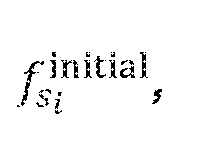

its neighbors. Whereas a small value of the initial probability means that there is a small amount of communication between nodes in the network, a value

[0037] In alternative embodiments, the present disclosure can be extended to perform topology discovery with the estimation of both V and £, by modifying the initial packets of each node. As shown in FIG. 3, each node s£ can generate a packet containing both its ID and its (X, Y) coordinates. Assuming that coordinates are encoded using V bits, the maximum size a packet can reach is

Therefore, the size of the topology discovery packet scales in the same manner as the one of the cardinality estimation.
B. Knowledge Distribution Phase
[0038] In this phase, knowledge can be distributed among the alive nodes in the network from neighbor to neighbor. At each iteration of the algorithm, if a node s,- receives a packet from a node sj whose ID can be determined by examining the last ID in the received packet, it can add such node to its set of neighbors Depending

on the content of the received packet, two scenarios can be distinguished:
1) The packet does not contain new information for The packet

can be discarded and the buffer may not be updated.
2) The packet brings new information to the node, i.e., The node can

update its buffer and can increase its transmit probability. The more informative packets a node receives, the more its transmit probability can increase. This is motivated by the fact that the more new information a node receives, it can become a better candidate to transmit its information. To be able to estimate locally the neighbors of the nodes, each node can first remove its ID from the packet it possesses and then append it to the end of the packet.
[0039] Afterward, each node s can sample from a probability distribution

i/(0,l) and can decide, according to either to broadcast or not. After


broadcasting data, the node can reset its transmit probability to the initial value. This is motivated by the fact that after transmission, if all neighbors received the packet, then node may not bring new information anymore unless it receives new packets. FIG. 4 summarizes the steps of the knowledge distribution phase as one non-limiting example.
C. Query Phase
[0040] In this phase, a DC can query some nodes from the set of nodes to retrieve information about the current status of the network N and infer its size Ps.. If the queried node sf is alive then it can transmit its packet PSi. Otherwise, there may be no transmission, and the packet of that node can be the empty set.
[0041] After querying the nodes, their packets can be processed using the union operator and by counting the number of IDs. In other words, the quantity Z, the counting estimation, can be obtained by where is the cardinality


operator. The next section relates the counting estimation to the Best Linear
Unbiased Estimators (BLUE) of network size n. FIG. 5 summarizes the steps of the query phase as one non-limiting example.
Performance Analysis
[0042] be a Bernoulli random variable denoting if node s; knows that

node is alive. Let be the vector containing the

knowledge of node s From FIG. 4, is the realization of the random variable Xi(t)


at each time slot t.
[0043] Let be a random variable where


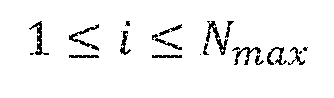
node is alive when the data collection is performed at time slot t. Let


[0044] From the data collection algorithm, is the realization of Z(t) at query

time t. Given the data collection equation, the random variable can

be written as follows:

[0045] Define Λ as the set of nodes that are alive and the set of

nodes that are dead where
 is the set of all nodes in the network. It can be seen that This section assumes that nodes can have the same

initial transmit probability and the same erasure probability q. The following lemma

links the estimator to the BLUE of the network size n for t = 0,1 and


[0046] Lemma 1. The estimator and is proportional


to the BLUE of the network size n. In other words, it can be written as follows:

Note that while the results consider the cases for t = 0,1 and∞, they can be extended for any arbitrary execution time.
[0047] From the expressions proposed in Lemma 1 , it is clear that when the number of queried nodes K = Nmax, then the estimator 2(t) is equal to the BLUE of the network size. Therefore, linking the counting estimator to the BLUE can be conjectured to be valid of all time instant t:
[0048] Conjecture 1. The estimator Z(t) is the proportional to the BLUE n of the network size and can be written as:
With

Simulation Results
[0049] This section presents the simulation results of the proposed counting algorithm. In all the simulations, the bound was set to = 390 for a network containing n = 300 nodes. The field was set to the unit square, the connectivity radius to R = 0.1 and the average packet erasure to Q= 0.1. Due to space limitations, the performance of the network size estimator is not presented.
[0050] FIG. 6 is an example illustrating the relation between the number of queried nodes and the number of estimated nodes in the network for different combinations of query time t and initial transmit probability F. Various embodiments
of the present disclosure have found that asking 10% or more of nodes can give a good estimation of the network size. Besides, increasing the initial transmit probability F or the query time t can result in an enhancement of the performances.
[0051] FIG. 7 is an example graph that shows the initial transmit probability F versus the time t, in which the total estimation of network nodes is 95% or more for various queried nodes K. One can notice that for fixed F = 0.5, increasing the queried nodes from K = 10 to K = 20, reduces the average time t to disseminate the node's information in the network.
[0052] FIG. 8 is an example graph that illustrates the number of queried nodes K versus the average erasure probability, in which the total estimation of network nodes is 95% or more for different running times t. As expected, the number of queried nodes to perform 95% estimation of the whole network size can decrease with the number of iterations of the algorithm. This can be explained by the fact that as the number of iterations increases, each node can have more knowledge about the network configuration that results in a less queried nodes.
[0053] Examining the relationship between the queried time t versus the mean number of queried nodes K to achieve 95% or more of the total estimation of network size, it was noted that for t = 8 the counting estimator reached the BLUE. Thus, for the setting, t = 8 was sufficient for the condition t→∞. Increasing the initial transmit probability results in an improvement in the estimation of network size.
[0054] With reference to FIG. 9, shown is a schematic block diagram of the computing environment 903 according to an embodiment of the present disclosure. The computing environment 903 includes one or more computing devices 906. Each computing device 906 includes at least one processor circuit, for example, having a processor 909 and a memory 912, both of which are coupled to a local interface 915.
To this end, each computing device 906 may comprise, for example, at least one server computer or like device. The local interface 915 may comprise, for example, a data bus with an accompanying address/control bus or other bus structure as can be appreciated.
[0055] Stored in the memory 912 are both data and several components that are executable by the processor 909. In particular, stored in the memory 912 and executable by the processor 909 is a Node Estimation application 921 , and potentially other applications. Also stored in the memory 912 may be a data store 918 and other data. In addition, an operating system may be stored in the memory 912 and executable by the processor 909.
[0056] It is understood that there may be other applications that are stored in the memory 912 and are executable by the processor 909 as can be appreciated. Where any component discussed herein is implemented in the form of software, any one of a number of programming languages may be employed such as, for example, C, C++, C#, Objective C, Java®, JavaScript* Perl, PHP, Visual Basic®, Python®, Ruby, Flash®, or other programming languages.
[0057] A number of software components are stored in the memory 912 and are executable by the processor 909. In this respect, the term "executable" means a program file that is in a form that can ultimately be run by the processor 909. Examples of executable programs may be, for example, a compiled program that can be translated into machine code in a format that can be loaded into a random access portion of the memory 912 and run by the processor 909, source code that may be expressed in proper format such as object code that is capable of being loaded into a random access portion of the memory 912 and executed by the processor 909, or source code that may be interpreted by another executable
program to generate instructions in a random access portion of the memory 912 to be executed by the processor 909, etc. An executable program may be stored in any portion or component of the memory 912 including, for example, random access memory (RAM), read-only memory (ROM), hard drive, solid-state drive, USB flash drive, memory card, optical disc such as compact disc (CD) or digital versatile disc (DVD), floppy disk, magnetic tape, or other memory components.
[0058] The memory 912 is defined herein as including both volatile and nonvolatile memory and data storage components. Volatile components are those that do not retain data values upon loss of power. Nonvolatile components are those that retain data upon a loss of power. Thus, the memory 912 may comprise, for example, random access memory (RAM), read-only memory (ROM), hard disk drives, solid-state drives, USB flash drives, memory cards accessed via a memory card reader, floppy disks accessed via an associated floppy disk drive, optical discs accessed via an optical disc drive, magnetic tapes accessed via an appropriate tape drive, and/or other memory components, or a combination of any two or more of these memory components. In addition, the RAM may comprise, for example, static random access memory (SRAM), dynamic random access memory (DRAM), or magnetic random access memory (MRAM) and other such devices. The ROM may comprise, for example, a programmable read-only memory (PROM), an erasable programmable read-only memory (EPROM), an electrically erasable programmable read-only memory (EEPROM), or other like memory device.
[0059] Also, the processor 909 may represent multiple processors 909 and/or multiple processor cores and the memory 912 may represent multiple memories 912 that operate in parallel processing circuits, respectively. In such a case, the local interface 915 may be an appropriate network that facilitates communication between
any two of the multiple processors 909, between any processor 909 and any of the memories 912, or between any two of the memories 912, etc. The local interface 915 may comprise additional systems designed to coordinate this communication, including, for example, performing load balancing. The processor 909 may be of electrical or of some other available construction.
[0060] Although the Node Estimation application 921 and/or other various systems described herein may be embodied in software or code executed by general purpose hardware as discussed above, as an alternative the same may also be embodied in dedicated hardware or a combination of software/general purpose hardware and dedicated hardware. If embodied in dedicated hardware, each can be implemented as a circuit or state machine that employs any one of or a combination of a number of technologies. These technologies may include, but are not limited to, discrete logic circuits having logic gates for implementing various logic functions upon an application of one or more data signals, application specific integrated circuits (ASICs) having appropriate logic gates, field-programmable gate arrays (FPGAs), or other components, etc. Such technologies are generally well known by those skilled in the art and, consequently, are not described in detail herein.
[0061] The algorithms of FIGS. 2, 4 and 5 show functionality and operation of an implementation of portions of the Node Estimation application 921. If embodied in software, each block may represent a module, segment, or portion of code that comprises program instructions to implement the specified logical function(s). The program instructions may be embodied in the form of source code that comprises human-readable statements written in a programming language or machine code that comprises numerical instructions recognizable by a suitable execution system such as a processor 909 in a computer system or other system. The machine code
may be converted from the source code, etc. If embodied in hardware, each block may represent a circuit or a number of interconnected circuits to implement the specified logical function(s).
[0062] Although the algorithms of FIGS. 2, 4 and 5 show a specific order of execution, it is understood that the order of execution may differ from that which is depicted. For example, the order of execution of two or more blocks may be scrambled relative to the order shown. Also, two or more steps shown in succession in FIGS. 2, 4 and 5 may be executed concurrently or with partial concurrence. Further, in some embodiments, one or more of the steps shown in FIGS. 2, 4 and 5 may be skipped or omitted. In addition, any number of counters, state variables, warning semaphores, or messages might be added to the logical flow described herein, for purposes of enhanced utility, accounting, performance measurement, or providing troubleshooting aids, etc. It is understood that all such variations are within the scope of the present disclosure.
[0063] Also, any logic or application described herein, that comprises software or code can be embodied in any non-transitory computer-readable medium for use by or in connection with an instruction execution system such as, for example, a processor 909 in a computer system or other system. In this sense, the logic may comprise, for example, statements including instructions and declarations that can be fetched from the computer-readable medium and executed by the instruction execution system. In the context of the present disclosure, a "computer-readable medium" can be any medium that can contain, store, or maintain the logic or application described herein for use by or in connection with the instruction execution system.
[0064] The computer-readable medium can comprise any one of many physical media such as, for example, magnetic, optical, or semiconductor media. More specific examples of a suitable computer-readable medium would include, but are not limited to, magnetic tapes, magnetic floppy diskettes, magnetic hard drives, memory cards, solid-state drives, USB flash drives, or optical discs. Also, the computer-readable medium may be a random access memory (RAM) including, for example, static random access memory (SRAM) and dynamic random access memory (DRAM), or magnetic random access memory (MRAM). In addition, the computer-readable medium may be a read-only memory (ROM), a programmable read-only memory (PROM), an erasable programmable read-only memory (EPROM), an electrically erasable programmable read-only memory (EEPROM), or other type of memory device.
[0065] Further, any logic or application described herein may be implemented and structured in a variety of ways. For example, one or more applications described may be implemented as modules or components of a single application. Further, one or more applications described herein may be executed in shared or separate computing devices or a combination thereof. For example, a plurality of the applications described herein may execute in the same computing device 906, or in multiple computing devices in the same computing environment 903. Additionally, it is understood that terms such as "application," "service," "system," "engine," "module," and so on may be interchangeable and are not intended to be limiting.
[0066] The present disclosure relates to a novel hybrid size estimation algorithm in an anonymous graph, in which each node knows only its unique identifier. In addition, the present disclosure discusses a node counting algorithm whose output can be used to perform network size estimation using statistical
inference methods. For dense graphs and accurate running times, various embodiments of the present disclosure can show that the proposed algorithm produces an estimate of the total number of nodes proportional to the BLUE and that it converges when all the network nodes are queried. Simulation results show that various embodiments of the present disclosure can produce a good estimate when either the running time or the number of queried nodes are reasonable.
[0067] Disjunctive language such as the phrase "at least one of X, Y, or Z," unless specifically stated otherwise, is otherwise understood with the context as used in general to present that an item, term, etc., may be either X, Y, or Z, or any combination thereof (e.g., X, Y, and/or Z). Thus, such disjunctive language is not generally intended to, and should not, imply that certain embodiments require at least one of X, at least one of Y, or at least one of Z to each be present.
[0068] It should be emphasized that the above-described embodiments of the present disclosure are merely possible examples of implementations set forth for a clear understanding of the principles of the disclosure. Many variations and modifications may be made to the above-described embodiment(s) without departing substantially from the spirit and principles of the disclosure. All such modifications and variations are intended to be included herein within the scope of this disclosure and protected by the following claims.
Claims
1. A method, comprising
receiving, over a wireless channel, a first transmission packet that includes a first identifier from a first one of a plurality of nodes;
adding the first identifier to a second transmission packet based at least in part on a first comparison between the first identifier and a plurality of existing identifiers associated with the second transmission packet;
adjusting a transmit probability based on the first comparison; and transmitting, over the wireless channel, the second transmission packet to at least one of the plurality of nodes based at least in part on a second comparison between the transmit probability and a probability distribution.
2. The method of claim 1 , further comprising determining a probability distribution associated with the plurality of nodes with respect to the first one of the plurality of nodes.
3. The method of claim 1 , wherein at least one of the plurality of nodes comprises a sensor device.
4. The method of claim 3, wherein the sensor device is configured to measure at least one of: a temperature, a pressure, a voltage, or a current.
5. A system, comprising
a first network device in a network;
an application executable in the first network device, wherein when executed, the application causes the first network device to at least:
generate a first transmission packet that includes a first identifier and a list comprising a plurality of existing identifiers;
receive a second transmission packet that includes a second identifier from a second network device in the network;
add the second identifier to the list in response to a first comparison between the second identifier and the plurality of existing identifiers;
adjust a transmit probability based on the first comparison; and transmit the first transmission packet to a third network device in the network based at least in part on a second comparison between the transmit probability and a probability distribution.
6. The system of claim 5, wherein the first comparison determines whether the second identifier matches one of the plurality of existing identifiers.
7. The system of claim 5, wherein the transmit probability is increased when the second identifier does not match one of the plurality of existing identifiers.
8. The system of claim 5, wherein the first network device transmits the first transmission packet to a data collector in response to a query message from the data collector.
9. The system of claim 5, wherein the transmit probability indicates a probability that the first network device will transmit the first transmission packet.
10. The system of claim 5, wherein the first network device determines the probability distribution by calculating a uniform distribution.
11. The system of claim 5, wherein the first network device transmits the first transmission packet to the third network device when the transmit probability exceeds the probability distribution.
12. The system of claim 5, wherein the first network device resets the transmit probability to an initial probability in response to transmission of the first transmission packet to the third network device.
13. The system of claim 5, wherein the first network device comprises a wireless transceiver, and the first transmission packet is transmitted over a wireless channel using the wireless transceiver.
14. The system of claim 5, wherein the list comprising the plurality of existing identifiers represents a plurality of neighboring wireless network devices located within a predefined radius with respect to a location of the first network device.
15. A method, comprising:
transmitting, using a computing device, a query message to a plurality of sensor devices, the query message being transmitted over a wireless channel;
receiving a transmission packet from at least one of the plurality of sensor devices, the transmission packet comprising data indicating a plurality of identifiers; and
determining, using the computing device, a quantity of the plurality of sensor devices based at least in part on the plurality of identifiers.
Priority Applications (1)
| Application Number | Priority Date | Filing Date | Title |
|---|---|---|---|
| US15/747,554 US10476750B2 (en) | 2015-08-19 | 2016-08-18 | Robust node estimation and topology discovery for large-scale networks |
Applications Claiming Priority (2)
| Application Number | Priority Date | Filing Date | Title |
|---|---|---|---|
| US201562207128P | 2015-08-19 | 2015-08-19 | |
| US62/207,128 | 2015-08-19 |
Publications (1)
| Publication Number | Publication Date |
|---|---|
| WO2017029635A1 true WO2017029635A1 (en) | 2017-02-23 |
Family
ID=56896733
Family Applications (1)
| Application Number | Title | Priority Date | Filing Date |
|---|---|---|---|
| PCT/IB2016/054949 Ceased WO2017029635A1 (en) | 2015-08-19 | 2016-08-18 | Robust node estimation and topology discovery for large-scale networks |
Country Status (2)
| Country | Link |
|---|---|
| US (1) | US10476750B2 (en) |
| WO (1) | WO2017029635A1 (en) |
Citations (3)
| Publication number | Priority date | Publication date | Assignee | Title |
|---|---|---|---|---|
| US20090265141A1 (en) * | 2008-04-21 | 2009-10-22 | Aly Salah A | Distributed storage in wireless sensor networks |
| US20140247821A1 (en) * | 2011-12-12 | 2014-09-04 | Fujitsu Limited | Transmission control method, node, and non-transitory computer-readable recording medium |
| US20150063350A1 (en) * | 2013-08-27 | 2015-03-05 | Purdue Research Foundation | Tracing message transmissions between communicating network devices |
Family Cites Families (5)
| Publication number | Priority date | Publication date | Assignee | Title |
|---|---|---|---|---|
| US6236365B1 (en) * | 1996-09-09 | 2001-05-22 | Tracbeam, Llc | Location of a mobile station using a plurality of commercial wireless infrastructures |
| US7522908B2 (en) * | 2003-04-21 | 2009-04-21 | Airdefense, Inc. | Systems and methods for wireless network site survey |
| US8456363B2 (en) * | 2008-01-31 | 2013-06-04 | Nec Corporation | Position detection device, position detection method and position detection program |
| US8301156B2 (en) | 2008-09-25 | 2012-10-30 | Optimi Corporation | Load balancing for capacity improvement in mobile wireless communication networks |
| IL224878A0 (en) | 2013-02-24 | 2013-07-31 | Intucell Ltd | Method and apparatus for load management in cellular communication networks |
-
2016
- 2016-08-18 US US15/747,554 patent/US10476750B2/en active Active
- 2016-08-18 WO PCT/IB2016/054949 patent/WO2017029635A1/en not_active Ceased
Patent Citations (3)
| Publication number | Priority date | Publication date | Assignee | Title |
|---|---|---|---|---|
| US20090265141A1 (en) * | 2008-04-21 | 2009-10-22 | Aly Salah A | Distributed storage in wireless sensor networks |
| US20140247821A1 (en) * | 2011-12-12 | 2014-09-04 | Fujitsu Limited | Transmission control method, node, and non-transitory computer-readable recording medium |
| US20150063350A1 (en) * | 2013-08-27 | 2015-03-05 | Purdue Research Foundation | Tracing message transmissions between communicating network devices |
Also Published As
| Publication number | Publication date |
|---|---|
| US20180227188A1 (en) | 2018-08-09 |
| US10476750B2 (en) | 2019-11-12 |
Similar Documents
| Publication | Publication Date | Title |
|---|---|---|
| Shankar et al. | Increasing fault tolerance ability and network lifetime with clustered pollination in wireless sensor networks | |
| CN103210669B (en) | Systems and methods for routing critical communications | |
| US10742760B2 (en) | Neworking internet of things (IoT) devices | |
| Djenouri et al. | Energy-aware constrained relay node deployment for sustainable wireless sensor networks | |
| JP2020529171A (en) | Traffic measurement methods, devices, and systems | |
| US9455903B2 (en) | Recording packet routes using bloom filters | |
| CN109936472A (en) | The node computing capability calculated towards mist describes method, exchange method and its equipment | |
| JP6302096B2 (en) | Information processing method and apparatus in M2M | |
| Al-Turjman et al. | Network experience scheduling and routing approach for big data transmission in the Internet of Things | |
| US20170272326A1 (en) | Determining service group based network topologies | |
| Robinson et al. | DRP: Dynamic routing protocol in wireless sensor networks | |
| CN117176796A (en) | Message pushing method, device, computer equipment and storage medium | |
| WO2025241539A1 (en) | Computing power node information advertisement method and apparatus, device and storage medium | |
| CN104252504A (en) | Method, equipment and system for inquiring data | |
| CN111092925B (en) | Block chain capacity expansion processing method, device and equipment | |
| US10476750B2 (en) | Robust node estimation and topology discovery for large-scale networks | |
| CN109194504A (en) | Timing link prediction technique and computer readable storage medium towards dynamic network | |
| Ghabri et al. | New fault tolerant strategy of wireless sensor network | |
| CN118158151A (en) | Load balancing configuration method, device, switch, storage medium and program product | |
| JP2017038148A (en) | Tree route determination device and tree route determination method | |
| Douik et al. | Robust node estimation and topology discovery algorithm in large-scale wireless sensor networks | |
| Kumar et al. | Enhanced AODV routing analysis for mobile Ad Hoc networks | |
| Won et al. | A destination-based approach for cut detection in wireless sensor networks | |
| Alouini et al. | Robust node estimation and topology discovery for large-scale networks | |
| Niedermayer et al. | Continuous Quantile Query Processing in Wireless Sensor Networks. |
Legal Events
| Date | Code | Title | Description |
|---|---|---|---|
| 121 | Ep: the epo has been informed by wipo that ep was designated in this application |
Ref document number: 16763579 Country of ref document: EP Kind code of ref document: A1 |
|
| WWE | Wipo information: entry into national phase |
Ref document number: 15747554 Country of ref document: US |
|
| NENP | Non-entry into the national phase |
Ref country code: DE |
|
| 122 | Ep: pct application non-entry in european phase |
Ref document number: 16763579 Country of ref document: EP Kind code of ref document: A1 |