WO2017019770A1 - Compositions and methods relating to galectin detection - Google Patents
Compositions and methods relating to galectin detection Download PDFInfo
- Publication number
- WO2017019770A1 WO2017019770A1 PCT/US2016/044263 US2016044263W WO2017019770A1 WO 2017019770 A1 WO2017019770 A1 WO 2017019770A1 US 2016044263 W US2016044263 W US 2016044263W WO 2017019770 A1 WO2017019770 A1 WO 2017019770A1
- Authority
- WO
- WIPO (PCT)
- Prior art keywords
- composition
- substituted
- group
- labeled
- structural formula
- Prior art date
- Legal status (The legal status is an assumption and is not a legal conclusion. Google has not performed a legal analysis and makes no representation as to the accuracy of the status listed.)
- Ceased
Links
- 0 CCC(C=*C(F)=CC)=C Chemical compound CCC(C=*C(F)=CC)=C 0.000 description 8
Classifications
-
- A—HUMAN NECESSITIES
- A61—MEDICAL OR VETERINARY SCIENCE; HYGIENE
- A61K—PREPARATIONS FOR MEDICAL, DENTAL OR TOILETRY PURPOSES
- A61K31/00—Medicinal preparations containing organic active ingredients
- A61K31/70—Carbohydrates; Sugars; Derivatives thereof
- A61K31/7042—Compounds having saccharide radicals and heterocyclic rings
- A61K31/7052—Compounds having saccharide radicals and heterocyclic rings having nitrogen as a ring hetero atom, e.g. nucleosides, nucleotides
- A61K31/7056—Compounds having saccharide radicals and heterocyclic rings having nitrogen as a ring hetero atom, e.g. nucleosides, nucleotides containing five-membered rings with nitrogen as a ring hetero atom
-
- A—HUMAN NECESSITIES
- A61—MEDICAL OR VETERINARY SCIENCE; HYGIENE
- A61K—PREPARATIONS FOR MEDICAL, DENTAL OR TOILETRY PURPOSES
- A61K31/00—Medicinal preparations containing organic active ingredients
- A61K31/70—Carbohydrates; Sugars; Derivatives thereof
- A61K31/7016—Disaccharides, e.g. lactose, lactulose
-
- G—PHYSICS
- G01—MEASURING; TESTING
- G01N—INVESTIGATING OR ANALYSING MATERIALS BY DETERMINING THEIR CHEMICAL OR PHYSICAL PROPERTIES
- G01N33/00—Investigating or analysing materials by specific methods not covered by groups G01N1/00 - G01N31/00
- G01N33/48—Biological material, e.g. blood, urine; Haemocytometers
- G01N33/50—Chemical analysis of biological material, e.g. blood, urine; Testing involving biospecific ligand binding methods; Immunological testing
- G01N33/58—Chemical analysis of biological material, e.g. blood, urine; Testing involving biospecific ligand binding methods; Immunological testing involving labelled substances
- G01N33/582—Chemical analysis of biological material, e.g. blood, urine; Testing involving biospecific ligand binding methods; Immunological testing involving labelled substances with fluorescent label
-
- G—PHYSICS
- G01—MEASURING; TESTING
- G01N—INVESTIGATING OR ANALYSING MATERIALS BY DETERMINING THEIR CHEMICAL OR PHYSICAL PROPERTIES
- G01N33/00—Investigating or analysing materials by specific methods not covered by groups G01N1/00 - G01N31/00
- G01N33/48—Biological material, e.g. blood, urine; Haemocytometers
- G01N33/50—Chemical analysis of biological material, e.g. blood, urine; Testing involving biospecific ligand binding methods; Immunological testing
- G01N33/58—Chemical analysis of biological material, e.g. blood, urine; Testing involving biospecific ligand binding methods; Immunological testing involving labelled substances
- G01N33/60—Chemical analysis of biological material, e.g. blood, urine; Testing involving biospecific ligand binding methods; Immunological testing involving labelled substances involving radioactive labelled substances
-
- G—PHYSICS
- G01—MEASURING; TESTING
- G01N—INVESTIGATING OR ANALYSING MATERIALS BY DETERMINING THEIR CHEMICAL OR PHYSICAL PROPERTIES
- G01N33/00—Investigating or analysing materials by specific methods not covered by groups G01N1/00 - G01N31/00
- G01N33/48—Biological material, e.g. blood, urine; Haemocytometers
- G01N33/50—Chemical analysis of biological material, e.g. blood, urine; Testing involving biospecific ligand binding methods; Immunological testing
- G01N33/68—Chemical analysis of biological material, e.g. blood, urine; Testing involving biospecific ligand binding methods; Immunological testing involving proteins, peptides or amino acids
-
- G—PHYSICS
- G01—MEASURING; TESTING
- G01N—INVESTIGATING OR ANALYSING MATERIALS BY DETERMINING THEIR CHEMICAL OR PHYSICAL PROPERTIES
- G01N2333/00—Assays involving biological materials from specific organisms or of a specific nature
- G01N2333/435—Assays involving biological materials from specific organisms or of a specific nature from animals; from humans
- G01N2333/46—Assays involving biological materials from specific organisms or of a specific nature from animals; from humans from vertebrates
- G01N2333/47—Assays involving proteins of known structure or function as defined in the subgroups
- G01N2333/4701—Details
- G01N2333/4724—Lectins
-
- G—PHYSICS
- G01—MEASURING; TESTING
- G01N—INVESTIGATING OR ANALYSING MATERIALS BY DETERMINING THEIR CHEMICAL OR PHYSICAL PROPERTIES
- G01N2800/00—Detection or diagnosis of diseases
- G01N2800/70—Mechanisms involved in disease identification
- G01N2800/7023—(Hyper)proliferation
- G01N2800/7028—Cancer
Definitions
- the present invention relates generally to compositions and methods for imaging of different gaiectins.
- the present invention relates to compositions and methods for nuclear imaging and fluorescent imaging of gaiectins,
- Gaiectins are a group of proteins known for their ability to bind to ⁇ ga!actoside sugars, either by N-!inked or 0-linked glycosylation see Cummings RD and Liu FT. Gaiectins. In: Varki A, Cummings RD, et al. eds. Essentials of Glycobioiogy. 2nd ed., NY: CSHL Press, 2009: Chapter 33; and Barondes SH et ah, J. Biol. Chem., 1994, 269:20807- 10.
- Gaiectins were first isolated from chick muscle and calf heart and lungs in 1976. Since then, gaiectins have been named in the order of discovery with as 15 members of the family identified so far. Each galectin has a carbohydrate recognition domain (CRD), and are classified according to the number and structure of these CRD. Gaiectins are therefore divided into tandem, dimeric and chimeric gaiectins. Dimeric gaiectins have two identical CRD subunits, tandem ones have two distinct CRD subunits and chimeric ones have one or even multiple subunits of the same type. Gaiectins- 1, -2, - 5.
- CRD carbohydrate recognition domain
- Galectin-3 is the only chimeric galectin discovered in mammals thus far.
- Gaiectins have been implicated in the development of cancer, the pathogenesis of heart failure and ventricular remodeling after myocardial infarction, infectious processes, such as HIV, and various other autoimmune and inflammatory processes, as well as in fibrotic tissues associated with different diseases.
- infectious processes such as HIV
- various other autoimmune and inflammatory processes as well as in fibrotic tissues associated with different diseases.
- compositions and methods for detection and assessment of gaiectins are lacking.
- compositions are provided according to aspects of the present invention which include a labeled composition having the structural formula:
- R 3 , R 4 and R 5 are each independently selected from the group consisting of: a substituted or unsubstiruted alkyl, alkenyl, alkyne or alkoxy group, a carbamoyl, substituted with an alkyl, alkenyl, alkyne or alkoxy group, and a substituted or unsubstiruted aromatic ring, where X is C, Si, O, NH. NC3 ⁇ 4, S or Se, where Y is a substituted or unsubstituted aromatic ring, and where Rg is a radioactive or fluorescent label.
- the aromatic ring is phenyl, naphthyi, thienyl, foryi or pyrrol yl.
- X is S.
- compositions are provided according to aspects of the present invention which include a labeled composition having the structural formula II, where R 3 ⁇ 4 is selected from the group consisting of: a substituted or unsubstituted alkyl, alkenyl, alkyne or alkoxy group, a carbamoyl substituted with an alkyl, alkenyl, alkyne or alkoxy group, and a substituted or unsubstituted aromatic ring, where X is C, Si, O, NH, NG3 ⁇ 4, S or Se, where Y is a substituted or unsubstituted aromatic ring, and where R 6 is a radioactive or fluorescent label, According to particular aspects the aromatic ring is phenyl, naphthyi, thienyl, foryi or pyrrolyl.
- compositions are provided according to aspects of the present invention which include a labeled composition having the structural formula III, where R4 and R 5 are each independently selected from the group consisting of: a substituted or unsubstituted aikyl, alkenyl, alkyne or alkoxy group, a carbamoyl substituted with an alkyl, alkenyl, alkyne or alkoxy group, and a substituted or unsubstituted aromatic, ring, where X is C. Si, O, NH, NCH 3> S or Se, where Y is a substituted or unsubstituted aromatic ring, and where Re is a radioactive or fluorescent label.
- the aromatic ring is phenyl, naphthyl, thienyl, furyl or pyrrolyl.
- X is S.
- compositions are provided according to aspects of the present invention which include a labeled composition having the structural formula IV, where R4 and R 5 are each independently selected from the group consisting of: a substituted or unsubstituted aikyl, alkenyl, alkyne or alkoxy group, a carbamoyl substituted with an aikyl, alkenyl, alkyne or aikoxy group, and a substituted or unsubstituted aromatic ring, where X is C, Si, O, NH, NC3 ⁇ 4, S or Se, where Y is a substituted or unsubstituted aromatic ring, and where Rg is a radioactive or fluorescent label.
- the aromatic ring is phenyl, naphthyl thienyl, furyl or pyrrolyl.
- X is S.
- compositions are provided according to aspects of the present invention which include a labeled composition having the structural formula V:
- compositions are provided according to aspects of the present invention which include a labeled composition having the structural formula V:
- R 7 , Rs, R9, R;o, Rii, R 12 , Ri3, Ri4, R15 are selected from the combinations 1 - 93 shown in Table I herein and X is C, Si, O, NH, NCH 3 , S or Sc. According to particular aspects, X is S and R 7 , Rg, R 9 , R i0 , R u , R12, R13, R14, R15 are selected from the combinations 1 - 93 shown in Table I herein.
- compositions are provided according to aspects of the present invention which include a labeled composition having the structural formula VI:
- X is C, Si, O, NH, NCH 3 , S or Se.
- compositions are provided according to aspects of the present invention which include a labeled composition having the structural formula VI, where X is S.
- compositions are provided according to aspects of the present invention which include a labeled composition having the structural formula VII:
- X is C, Si, O, NH, NC3 ⁇ 4, S or Se. According to particular aspects, X is S.
- compositions are provided according to aspects of the present invention which include a labeled composition having the structural formula VIII:
- X is C, Si, O, NH, NC3 ⁇ 4, S or Se, According to particular aspects.
- X is S.
- compositions are provided according to aspects of the present invention which include a labeled composition having the structural formula IX:
- each of R 7 , Rg, Rg, R ⁇ and Rn is independently selected from the group consisting of: H, F, Br, CI, I, N0 2 , NMe 2 , NEt 2 , Sn(Me) 3 , NH 2) where X is C, Si, O, NH, NCHj, S or Se, where Y is a substituted or imsisbstituted aromatic ring, and where R !8 is a macrocyclic chelator complexed with a radionuclide.
- X is S.
- compositions are provided according to aspects of the present invention which include a labeled composition having the structural formula IX, where X is C, Si, ), NH, NC3 ⁇ 4, S or Se, where Y is a substituted or unsubstituted aromatic ring, and vhere R J8 is a macrocyclic chelator compiexed with a radionuclide, where R 7 , Rg, 3 ⁇ 4, lio and R n are H, F, Br, CI, I, N0 2 , NMe 2 , NEt 2 , Sn(Me) 3 or NH? shown as ombinatioiis 94 - 357 in Table II and X is C, Si, O, NH, NCH 3 , S or Se, According to (articular aspects, X is S.
- compositions are provided according to aspects of the present nvention having the structural formula X):
- each R t7 is a protecting group, where R 7 , R s . R9, R t 3 ⁇ 4 R n , R 12 , R13, R !4 , R-, 5 and lie are H, F, Br, I, N0 2 , (NMe 3 ) + TfO " , ( Et 3 ) + TfO " , Sn(Me) 3 or.
- NH 2 as shown in Table I as any one of combinations 94-357, where X is C, Si, O, NH, NCH 3 , S or Se, wherein it least one of R 7 , R 8 , Ra, Rio, Rn, R3 ⁇ 4 2 , R13, Rn, Rss and R i6 is not H and with the >roviso that R 8 and i 3 ⁇ 4 are not both fluorine,
- R3, R4 and R 5 are each independently selected from the group consisting of: a ubstituted or unsubstituted alkyl, alkenyl, aikyne or alkoxy group, a carbamoyl Libstituted with an alkyl alkenyl, aikyne or alkoxy group, and a substituted or nsubstttuted aromatic ring, where X is C, Si, O, NH, NCH3, S or Se, where R i 7 is a rotective group and where R J9 is N3 or NH 2 .
- the romatic ring is phenyl, naphthyl, thienyl, fury! or pyrrolyl.
- X is S,
- compositions are provided according to aspects of the present ivention having the structural formula (XII):
- compositions are provided according to aspects of the present invention having the structural formula (XIII);
- R4 and R5 are each independently selected from the group consisting of: a substituted or unsubstituted alkyl, alkenyl, alkyne or alkoxy group, a carbamoyl substituted with an alkyl, alkenyl, alkyne or alkoxy group, and a substituted or unsubstituted aromatic ring, where X is C. Si, O, NH, NCFI 3 , S or Se, and where R 17 is a protective group.
- the aromatic ring is phenyl, naphthyi, thienyl, raryl or pyrrolyl.
- X is S.
- compositions are provided according to aspects of the present invention having the structural formula (XIV):
- R4 and 5 are each independently selected from the group consisting of: a substituted or unsubstituted alkyl, alkenyl, alkyne or alkoxy group, a carbamoyl substituted with an alkyl, alkenyl, alkyne or alkoxy group, and a substituted or unsubstituted aromatic ring, where X is C, Si, O, NH, NC3 ⁇ 4, S or Se, and where R n is a protective group.
- the aromatic ring is phenyl, naphthyi, thienyl, raryl or pyrrolyl.
- X is S.
- R 7 , Rg, R 3 ⁇ 4 Rio and n are each independently selected from the group consisting of: H, F, Br, CI, I, N0 2 , NMe 2 , NEt 2 , Sn(Me) 3 and NH 2 , where X is C, Si, O, NH, NCH 3 , S or Se, and where 17 is a protective group. According to particular aspects. X is S.
- Precursor compositions are provided according to aspects of the present invention having the structural formula XV where R 7 , Rg, R 9 , R ]0 and Rn are H, F, Br, CI, I, NO2, NMe 2 , NEt 2 , Sn(Me) 3 and NH 2 as shown in Table II as combinations 94 - 357, where X is C. Si, O, NH, NCH3, S or Se, and where J7 is a protective group.
- Precursor compositions are provided according to aspects of the present invention having the structural formula XV where R 7 , Rg, R9, Rjo and jj are H, F, Br, CI, I, N0 2 , NMe 2 , NEt 2 , Sn(Me) 3 and N3 ⁇ 4 as shown in Table II as combinations 94 - 357, where X is S, and where R. ? is a protective group.
- compositions are provided according to aspects of the present invention having the structural formula (XVI)
- compositions are provided according to aspects of the present invention having the structural formula (XVI), where X is S, and where Rj 7 is a protective group,
- compositions are provided according to aspects of the present invention having the structural formula (XVTT):
- X is C, Si, O, NH, NCH 3 , S or Se, and where R; 7 is a protective group.
- compositions are provided according to aspects of the present invention having the stmcturai formula (XVII), where X is S, and where Rj 7 is a protective group.
- compositions are. provided according to aspects of the present invention having the structural formula (XVIII):
- R i2 , s 3, R14, R15 and R 16 are selected from the group consisting of: l8 F, 7o Br, m l. l24 I, 125 I or 1 J ! I, as shown in Table ill as combinations 358 - 446.
- compositions are provided according to aspects of the present invention having the structural formula (XVill):
- R 12 , R] 3 , R14, Ris and Rig are selected from the group consisting of: H, F, Br, CL f, N0 2 , (NMe 3 ) + TfO " , (NEt 3 ) + TfO Sn(Me) 3 and NH 2 , as shown in Table FV as combinations 447 ⁇ ⁇ 646.
- compositions are provided according to aspects of the present invention having the structural formula (XIX);
- compositions are provided according to aspects of the present invention having the structural formula (XXI):
- each R 17 is a protecting group
- compositions are provided according to aspects of the present invention having the structural formula (XXI), where each R n is a protecting group, where each R 7 , R 3 ⁇ 4 R 3 ⁇ 4 io and Rn is independently selected from the group consisting of: H, l 8 F, 76 Br, " * * ' 3 !
- Labeled compositions, precursor compositions and pharmaceutical compositions including a labeled composition are provided according to aspects of the present invention wherein the labeled compositions or precursor composition is a derivative, salt, hydrate, amide or ester of a labeled composition or precursor composition according to any structural formula shown or described herein, including, but not limited to, any one of structural formulas I, II, III, IV, V, VI, VII, VHI, IX, X, XI, XII, XIII, XIV, XV, XVI, XVII, XVIII, XIX, XX and XXI.
- compositions are provided according to aspects of the present invention which include a labeled composition or the present invention, further comprising a pharmaceutically acceptable carrier.
- Methods of detecting a gaiectin are provided according to aspects of the present invention which include contacting a gaiectin with a labeled composition having the structural formula I,
- R3, R4 and R5 are each independently selected from the group consisting of: a substituted or unsubstituted alkyl, alkenyl, alkyne or alkoxy group, a carbamoyl substituted with an alkyl, alkenyl, alkyne or alkoxy group, and a substituted or unsubstitated aromatic ring, where X is C, Si, O, NH, NC3 ⁇ 4, S or Se, where Y is a substituted or unsubstitated aromatic ring, and where R 6 is a radioactive or fluorescent label, under conditions to form a complex of the labeled composition and the galectin; and detecting a signal of the labeled composition in the complex of the labeled composition and the galectin.
- the aromatic ring is phenyl, naphthyl, thienyi, furyl or pyrrolyl.
- X is S.
- Methods of detecting a galectin are provided according to aspects of the present invention which include contacting a galectin with a labeled composition having the stTOCturai formula II, where R 3 is selected from the group consisting of: a substituted or unsubstituted alkyl, aikenyl, aikyne or alkoxy group, a carbamoyl substituted with an alkyl, aikenyl, aikyne or alkoxy group, and a substituted or unsubstituted aromatic ring, where X is C, Si, O, NH, NC3 ⁇ 4, S or Se, where Y is a substituted or unsubstituted aromatic ring, and where R 3 ⁇ 4 is a radioactive or fluorescent label, under conditions to form a complex of the labeled composition and the galectin; and detecting a signal of the labeled composition in the complex of the labeled composition and the galectin.
- R 3 is selected from the group consist
- Methods of detecting a galectin are provided according to aspects of the present invention which include contacting a galectin with a labeled composition having the structural formula III, where 4 and R are each independently selected from the group consisting of: a substituted or unsubstituted alkyl, aikenyl, aikyne or alkoxy group, a carbamoyl substituted with an alkyl, aikenyl, aikyne or alkoxy group, and a substituted or unsubstituted aromatic ring, where X is C, Si, O, NH, NCH 3 , S or Se, where Y is a substituted or unsubstituted aromatic ring, and where Re is a radioactive or fluorescent label, under conditions to form a complex of the labeled composition and the galectin; and detecting a signal of the labeled composition in the complex of the labeled composition and the galectin.
- the aromatic ring is pheny
- Methods of detecting a galectin are provided according to aspects of the present invention which include contacting a galectin with a labeled composition having the stTOCturai formula IV, where R4 and R5 are each independently selected from the group consisting of: a substituted or unsubstituted alkyl, aikenyl, aikyne or alkoxy group, a carbamoyl substituted with an alkyl, aikenyl, aikyne or alkoxy group, and a substituted or unsubstituted aromatic ring, where X is C, Si, O, NH.
- NC3 ⁇ 4, S or Se where Y is a substituted or unsubstituted aromatic ring, and where R 6 is a radioactive or fluorescent label, under conditions to form a complex of the labeled composition and the galectin; and detecting a signal of the labeled composition in the complex of the labeled composition and the galectin.
- the aromatic ring is phenyl, naphthyl, thienyl, furyl or pyrroiyl.
- X is S,
- Methods of detecting a galectin are provided according to aspects of the present invention which include contacting a galectin with a labeled composition having the structural formula V, where each of R 7 , Rg, R 9 , Rio, Ra, i2, Ri3, Ri4, Ris and Rie is independently selected from the group consisting of: H, i 8 F, '%r, n u ⁇ 12S I and wherein at least one of R 7 , Rg, I3 ⁇ 4, Rio, Ra, Ri 2 , R13, R1 , R15 and R ⁇ is i !> F 5 76 Br, m l, l2 % l or ⁇ 3 ⁇ ⁇ . under conditions to form a complex of the labeled composition and the galectin; and detecting a signal of the labeled composition in the complex of the labeled composition and the galectin.
- X is S.
- Methods of detecting a galectin are provided according to aspects of the present invention which include contacting a galectin with a labeled composition having the structural formuia V, where R 7 , Rg, R3 ⁇ 4 Rso, Ra, R12, R13, R14, Ris are selected from the combinations 1 - 93 shown in Table 1 herein and X is C, Si, O, NH, NC13 ⁇ 4, S or Se.
- X is S and R 7 , R g , R3 ⁇ 4 Rj 0 , Ra, R 12 , R13, R 4, Ris are selected from the combinations 1 - 93 shown in Table I herein, under conditions to form a complex of the labeled composition and the galectin; and detecting a signal of the labeled composition in the complex of the labeled composition and the galectin.
- X is S.
- Methods of detecting a galectin are provided according to aspects of the present invention which include contacting a galectin with a labeled composition having the structural formula VI, where X is C, Si, O, NH, NCH 3 , S or Se, under conditions to form a complex of the labeled composition and the galectin; and detecting a signal of the labeled composition in the complex of the labeled composition and the galectin.
- X is S.
- Methods of detecting a galectin are provided according to aspects of the present invention which include contacting a galectin with a labeled composition having the structural formuia VII, where X is C, Si, O, NH. NC3 ⁇ 4, S or Se, under conditions to form a complex of the labeled composition and the galectin; and detecting a signal of the labeled composition in the complex of the labeled composition and the galectin.
- X is S.
- Methods of detecting a galectin are provided according to aspects of the present invention which include contacting a galectin with a labeled composition having the structural formula VIII, where X is C, Si, O, NH, NCH 3 , S or Se, under conditions to form a complex of the labeled composition and the galectin; and detecting a signal of the labeled composition in the complex of the labeled composition and the galectin.
- X is S.
- Methods of detecting a galectin are provided according to aspects of the present invention which include contacting a galectin with a labeled composition having the structural formula IX, where each of R 7 , Rg, R 9( io and R n is independently selected from the group consisting of: H, F, Br, CI, ⁇ , NQ 2 , NMe 2 , NEt 2 , Sn(Me)3, ' N3 ⁇ 4.
- X is C, Si, O, NH, NCH 3j S or Se
- Y is a substituted or unsubstituted aromatic ring
- Ris is a macrocyciic chelator complexed with a radionuclide, under conditions to form a complex of the labeled composition and the galectin; and detecting a signal of the iabeied composition in the complex of the labeled composition and the galectin
- the aromatic ring is phenyl, naphthyl, thienyl, furyl or pyrrolyl.
- X is S.
- Methods of detecting a galectin are provided according to aspects of the present invention which include contacting a galectin with a labeled composition having the structural formula IX: where R 7 , Rg, R 9 , R
- X is S.
- Methods of detecting a galectin are provided according to aspects of the present invention, wherein the labeled composition includes a radionuclide and wherein detecting the signal includes obtaining a PET, SPECT or scintigraphic image.
- Methods of detecting a galectin are provided according to aspects of the present invention, wherein the labeled composition comprises a fluorophore and wherein detecting the signal comprises obtaining a fluorescence image.
- Methods of detecting a galectin are provided according to aspects of the present invention, wherein the galectin is in vitro.
- Methods of detecting a galectin are provided according to aspects of the present invention, wherein the galectin is in a subject.
- Methods of detecting a galectin are provided according to aspects of the present invention, wherein the galectin is in a subject, and wherein the subject has or is suspected of having cancer, heart failure, ventricular remodeling, an infection, an HIV infection, a pathological autoimmune conditio and/or a pathological inflammatory condition,
- Methods of detecting a galectin are provided according to aspects of the present invention, wherein the galectin is galectin- 1 or galectin-3.
- Methods of chemical synthesis of a labeled composition are provided according to aspects of the present invention, which include chemical reaction of a precursor composition as shown or described herein.
- Methods of aiding in diagnosis and/or treatment of a condition characterized by upregulation of one or more galectins in a subject in need thereof are provided according to aspects of the present invention, which include contacting a galectin with a labeled composition having the structural formula I, where R3 ⁇ 4 is
- R 3 , 3 ⁇ 4 and R 5 are each independently selected from the group consisting of: a substituted or unsubstituted aikyl, alkenyl, alkyne or alkoxy group, a carbamoyl substituted with an alkyl, alkenyl, alkyne or alkoxy group, and a substituted or unsubstituted aromatic ring, where X is C, Si, O, NH.
- NCHj, S or Se where Y is a substituted or unsubstituted aromatic ring, and where Re is a radioactive or fluorescent label, under conditions to form a complex of the labeled composition and the galectin; detecting a signal of the labeled composition in the complex of the labeled composition and the galectin; and comparing the signal to a control, thereby determining the level of the one or more galectins in the subject.
- the aromatic ring is phenyl, naphthyl, thienyl, fury] or pyrrolyl.
- X is S.
- Methods of aiding in diagnosis and/or treatment of a condition characterized by upregulation of one or more galectins in a subject in need thereof are provided according to aspects of the present invention, which include contacting a galectin with a labeled composition having the structural formula ⁇ , where 33 ⁇ 4 is selected from the group consisting of: a substituted or unsubstituted aikyl, alkenyl, alkyne or alkoxy group, a carbamoyl substituted with an alkyl, alkenyl, alkyne or alkoxy group, and a substituted or unsubstituted aromatic ring, where X is C, Si, O, NH, NC3 ⁇ 4, S or Se, where Y is a substituted or unsubstituted aromatic ring, and where Rg is a radioactive or fluorescent label, under conditions to form a complex of the labeled composition and the galectin; detecting a signal of the labeled composition in the complex of the labeled composition
- Methods of aiding in diagnosis and/or treatment of a condition characterized by upregulation of one or more galectins in a subject in need thereof are provided according to aspects of the present invention, which include contacting a galectin with a labeled composition having the structural formula ⁇ , where R4 and R 5 are each independently selected from the group consisting of: a substituted or unsubstituted alkyl, alkenyl, alkyne or alkoxy group, a carbamoyl substituted with an alkyl, alkenyl, alkyne or alkoxy group, and a substituted or unsubstituted aromatic ring, where X is C, Si, O, NH, NCH 3 , S or Se, where Y is a substituted or unsubstituted aromatic ring, and where R ⁇ s is a radioactive or fluorescent label, under conditions to form a complex of the labeled composition and the galectin; detecting a signal of the labeled composition in the complex of the
- Methods of aiding in diagnosis and/or treatment of a condition characterized by upregulation of one or more galectins in a subject in need thereof are provided according to aspects of the present invention, which include contacting a gaiectin with a labeled composition having the structural formula IV, where R4 and R5 are each independently selected from the group consisting of: a substituted or unsubstituted alkyl, aikenyl, alkyne or alkoxy group, a carbamoyl substituted with an alkyl, alkenyl, alkyne or alkoxy group, arid a substituted or unsubstituted aromatic ring, where X is C, Si, O, NH, CH 3 , S or Se, where Y is a substituted or unsubstituted aromatic ring, and where R 6 is a radioactive or fluorescent label, under conditions to form a compiex of the labeled composition and the gaiectin; detecting a signal of the
- Methods of aiding in diagnosis and/or treatment of a condition characterized by upregulation of one or more galectins in a subject in need thereof are provided according to aspects of the present invention, which include contacting a gaiectin with a labeled composition having the structural formula V, where each of R 7) R g , R 9 , R i0 , Ri i, Ri 2 , Ri3, Ri , Rj5 and R i6 is independently selected from the group consisting of: H, , 8 F, 76 Br, u % m l m l and 13 , L wherein at least one of R 7 ⁇ R 8 , R3 ⁇ 4 R 10 , Rn, 3 ⁇ 4 2 , R13, Rw, Ris and R, 6 is 18 F, , ⁇ Br.
- X is S.
- Methods of aiding in diagnosis and/or treatment of a condition characterized by upregulation of one or more galectins in a subject in need thereof are provided according to aspects of the present invention, which include contacting a gaiectin with a iabeled composition having the structural formula V, where R 7 , Rg, R 9 , R 10j R u , R 12 , R !3> i4, R3 ⁇ 45 are selected from the combinations 1 - 93 shown in Table I herein and X is C, Si, O, NH, NC I 3 , S or Se.
- X is S and R 7 , R g , R 9( R i0 , Rn, Ri 2» R , 3 ⁇ 44, Ris are selected from the combinations ! - 93 shown in Table I herein, under conditions to form a complex of the labeled composition and the gaiectin; detecting a signal of the iabeled composition in the compiex of the labeled composition and the galectm; and comparing the signal to a control, thereby determining the level of the one or more galeciins in the subject.
- X is S.
- Methods of aiding in diagnosis and/or treatment of a condition characterized by upregulation of one or more galectins in a subject in need thereof are provided according to aspects of the present invention, which include contacting a galectin with a labeled composition having the structural formula VL where X is C, Si, O, NH, NC3 ⁇ 4, S or Se, under conditions to form a complex of the labeled composition and the galectm; detecting a signal of the labeled composition in the complex of the labeled composition and the galectm; and comparing the signal to a control, thereby determining the level of the one or more galectins in the subject.
- X is S.
- Methods of aiding in diagnosis and/or treatment of a condition characterized by upregulation of one or more galectins in a subject in need thereof are provided according to aspects of the present invention, which include contacting a galectin with a labeled composition having the structural formula VII, where X is C, Si, O, NH, NCH 3 , S or Se, under conditions to form a complex of the labeled composition and the galectin; detecting a signal of the labeled composition in the complex of the labeled composition and the galectin; and comparing the signal to a control, thereby determining the level of the one or more galectins in the subject.
- X is S.
- Methods of aiding in diagnosis and/or treatment of a condition characterized by upregulation of one or more galectins in a subject in need thereof are provided according to aspects of the present invention, which include contacting a galectin with a labeled composition having the structural formula VIII, where X is C, Si, O, NH, NCH3, S or Se, under conditions to form a complex of the labeled composition and the galectin; detecting a signal of the labeled composition in the complex of the labeled composition and the galectin; and comparing the signal to a control, thereby determining the level of the one or more galectins in the subject.
- X is S.
- Methods of aiding in diagnosis and/or treatment of a condition characterized by upregulation of one or more galectins in a subject in need thereof are provided according to aspects of the present invention, which include contacting a galectin with a labeled composition having the structural formula IX, where each of R7, Rg, R3 ⁇ 4 Rio and Rn is independently selected from the group consisting of: H, F, Br, CI, I, N0 2 , NMe 2 , NEt 2 , Sn(Me) 3 , N3 ⁇ 4, where X is C, Si, O, NH, NCH 3 , S or Se.
- Y is a substituted or unsubstituted aromatic ring, and where Rjg is a macrocyciic chelator complexed with a radionuclide, under conditions to form a complex of the labeled composition and the galectin; detecting a signal of the labeled composition in the complex of the labeled composition and the galectin; and comparing the signal to a control, thereby determining the level of the one or more galectins in the subject.
- the aromatic ring is phenyl, naphthyl, thienyl, furyl or pyrrolyl.
- X is S,
- Methods of aiding in diagnosis and/or treatment of a condition characterized by upregulation of one or more galectins in a subject in need thereof are provided according to aspects of the presen invention, which include contacting a galectin with a labeled composition having the structural formula IX: where R 7 , R 8 , R 9 , R i0 and R 1 ⁇ are.
- X is C, Si, O, NH, NCH 3 , S or Se, under conditions to form a complex of the labeled composition and the galectin; detecting a signal of the labeled composition in the complex of the labeled composition and the galectin: and comparing the signal to a control, thereby determining the level of the one or more galectins in the subject.
- X is S,
- Methods of aiding in diagnosis and/or treatment of a condition characterized by upregulation of one or more galectins in a subject in need thereof are provided according to aspects of the present invention, wherein the labeled composition includes a radionuclide and wherein detecting the signal includes obtaining a PET, SPECT or scintigraphic image,
- Methods of aiding in diagnosis and/or treatment of a condition characterized by upregulation of one or more galectins in a subject i need thereof are provided according to aspects of the present invention, wherein the labeled composition comprises a fluorophore and wherein detecting the signal comprises obtaining a fluorescence image.
- Methods of aiding in diagnosis and/or treatment of a condition characterized by upregulation of one or more galectins in a subject in need thereof are provided according to aspects of the present invention, wherein the one or more galectins are in a biological sample obtained from the subject.
- Methods of aiding in diagnosis and/or treatment of a condition characterized by upregulation of one or more galectins in a subject in need thereof are provided according to aspects of the present invention, wherein contacting a galectin with a labeled composition includes administering the labeled composition to the subject.
- Methods of aiding in diagnosis and/or treatment of a condition characterized by upregulation of one or more galectins in a subject in need thereof are provided according to aspects of the present invention, wherein the one or more galectins is in a subject, and wherein the subject has or is suspected of having cancer, heart failure, ventricular remodeling, an infection, an HIV infection, a pathological autoimmune conditio and/or a pathological inflammatory condition.
- control is a level of the one or more galectins determined in the subject prior to administration of a treatment for the condition characterized by upregulation of one or more galectins.
- Methods of aiding in diagnosis and/or treatment of a condition characterized by upregulation of one or more galectins in a subject in need thereof are provided according to aspects of the present invention, wherein the control is a reference level of the one or more galectins in a comparable subject or population of comparable subjects.
- kits are provided according to aspects of the present invention including a labeled composition and/or precursor composition described herein; or a derivative, salt, hydrate, amide or ester thereof.
- One or more auxiliary components are optionally included in commercial packages of the present invention, such as a pharmaceutically acceptable carrier exemplified by a buffer, diluent or a reconstituting agent.
- X is C, Si, O, NH, NCI3 ⁇ 4, S or Se; or a derivative, salt, hydrate, amide or ester of the labeled composition.
- X is C, Si, O, NH, NCH 3 , S or Se; or a derivative, salt, hydrate, amide or ester of the labeled composition.
- X is C, Si, O, NH, NCH 3 , S or Se; or a derivative, salt, hydrate, amide or ester of the labeled composition.
- kits including a labeled composition having the structural fonnula (VIII), where X is S; or a derivative, salt, hydrate, amide or ester of the labeled composition,
- Figure I is a drawing illustrating chemical synthesis Scheme la
- Figure 2 is a drawing illustrating chemical synthesis Scheme lb
- Figure 3 is a drawing illustrating chemical synthesis Schemes 2a and 2b;
- Figure 4 is a drawing illustrating chemical synthesis Schemes 3a, 3b and 3c;
- Figure 5 is a drawing illustrating chemical synthesis Schemes 4a and 4b;
- FIG. 6 is a drawing illustrating chemical synthesis Scheme 4c
- Figure 7 is a drawing illustrating chemical synthesis Scheme 5;
- Figure 8 is a drawing illustrating chemical synthesis Scheme 6
- Figure 9 is a drawing illustrating chemical synthesis Scheme 7
- Figure 0 is a drawing illustrating chemical synthesis Scheme 8.
- Figure 1 1 is a drawing illustrating chemical synthesis Scheme 9
- Figure 12 is a drawing illustrating chemical synthesis Scheme 10.
- Figure 13 is a drawing illustrating chemical synthesis Scheme 11 ;
- Fig. 14A shows images of magnitude and patterns of ga!ectin-1 and ga!ectin- 3 levels in carcinoma cells MCF10A, MCFI OATI , MCFl ONeoT, MCFl OCaid, MCF 1 ODCIS visualized using fluorescence microscopy;
- Figure 14B is a graph showing quantitative ELISA measurements of galectin- 1 and galectin-3 levels on cellular membranes in carcinoma cells MCF 1 OA, MCFIOATI , MCFl ONeoT, MCFlOCaid, MCFI ODCIS, MiaPaCa, Pane 1, SKBr3, MDA-MB-435 and MDA-MB-231 ;
- Figure 14C is a graph showing results of an in vitro radiotracer binding/accumulation assay in cancer cells MCFI OATI , MCFlONeoT, MCFlOCaid, MCFI ODCIS, MiaPaCa, and SKBr3;
- Figure 15 is a series of dynamic PET/CT images of [18FJFPTDG localization obtained at different time intervals after intravenous administration;
- Figure 16 is a series of dynamic PET/CT images of [18FJFPTDG localization obtained at different time intervals after intravenous administration;
- Figure 17 is a series of dynamic PET/CT images of [ 1 8F]FPTDG localization obtained at different time intervals after intravenous administration;
- Figure 18A is a series of PET/CT images of [18FJFPTDG localization in a rat at 75 min. after intravenous administration;
- Figure 18B is a dynamic PET/CT image of [i 8F]FPTDG localization after intravenous administration ;
- Figure 1 A is a graph showing time-activity curves of [ 18 F]FPTDG in different organs and tissues and its clearance from blood;
- Figure ⁇ 9 ⁇ is a graph showing time- activity carves of [ , 8 F]FPTDG in organs and tissues involved in clearance from the body;
- Figure 20A shows images of dynamic PET/CT images of 18 F-FPTDG accumulation in MCAIODCIS breast tumor xenografts in nude mice in which the arrow indicates the location of subcutaneous xenograft of MCFIODCTS tumor;
- Figure 20B is a graph showing time activity curves of 18 F-FPTDG in different organs and tissues (SUV av ⁇ std err);
- Figure 20C is a graph showing results of Logan graphical analysis of i 8 F- FPTDG accumulation in MCA I ODCIS breast tumor using muscle as a reference tissue;
- Figure 21 A is an image showing Gal-3 expression progression from normal breast tissue to benign and malignant lesions assessed by immunohistochemical staining of high density tissue array and shows that the level of Gal-3 expression is low-to non- detectable in normal breast tissue and minimally increased in benign lobular hyperplasia and fibroadenom atous epithelial hyperplasia. In contrast, Gal-3 expression is dramatically increased in DOS and invasive ductal carcinomas;
- FIG, 21B shows diagrammatic images of progression stages of breast cancer and corresponding images of immunohistochemical staining for Gal-3 showing Gal-3 expression progression from normal breast tissue to benign and malignant lesions as assessed by immunohistochemical staining of high density tissues: and
- Figure 22 is an image of immunohistochemical staining for Gal-3 showing high levels of Gal-3 expression in cell membranes and cell cytoplasm of invasive ductal and lobular breast carcinomas.
- aromatic ring refers to a polyatomic, cyclic, conjugated ring system which may include one or more heteroatoms. Examples of aromatic rings include phenyl, naphthyl, thenyl, furyl and pyrrolyl, among others.
- substituted aromatic ring refers to an aromatic ring system in which one or more hydrogen atoms bound to any carbon or heteroatom is replaced by one or more functional groups, such as, alky], substituted alkyl, cycloalkyl, substituted cycloalkyl, halogen, alkoxy, amino, nitro, thio, heterocycloalkyl, substituted heterocycloalkyL and the like.
- alkyl refers to a saturated, straight chain or branched, non-cyclic hydrocarbon having a chain length of 1 -8 carbons.
- alkenyi refers to an unsaturated, straight chain or branched, non-cyclic hydrocarbon with one or more carbon-carbon double bonds, having a chain length of 1 -8 carbons.
- alkynyl refers to an unsaturated, straight chain or branched, non-cyclic hydrocarbon with one or more carbon-carbon triple bonds, having a chain length of 1 -8 carbons.
- alkyl group -O-alkyl, exemplified by methoxy, ethoxy, propoxy, tert-butoxy, and the like.
- cheiator refers to an agent that forms a chelation complex with a radionuclide.
- Chelators such as macrocyclic chelators, are well known in the art and include 1 ,4,7, 10-tetrazacyclododecane-N,iV' N", N' -tetraacetic acid
- DOT A 1,4,7-triazacyclononane-N-glutaric acid-N' N' -diacetic acid
- NODAGA 1,4,7-triazacyclononane-N-glutaric acid-N' N' -diacetic acid
- l ⁇ -triazacyclononane-NA ⁇ N -triacetic acid and the like.
- NMe 3 refers to trimethylamine
- N-eh as used herein refers to triethyi amine.
- (NEt3) 4 TiO refers to triethylammonium inflate.
- protective group refers to a group attached to a functional group in order to prevent reaction of the functional group during a chemical reaction and which can be removed after the chemical reaction, restoring the functional group.
- protective groups which protect hydroxyl groups include acetate (Ac), benzoate (Bz), benzyl ether (Bp), methoxymethyl ether (MOM), p-Methoxybenzyl ether (PMB), pivalate (Piv) and the like.
- Protective groups for hydroxyl groups are well known in the art and one of skill in the art is able to select and use an appropriate protective group. In addition to those protective groups specifically mentioned, 90 additional protective groups are known as described in Greene T. W. and Wuts P. G. ML, Protective Groups in Organic Synthesis, 3rd Ed., published by John Wiley & Sons. 1999.
- Labeled compositions according to aspects of the present invention have the structural formula (I) NH QH
- R 3 , R4 and R5 are each independently selected from the group consisting of: a substituted or unsubstituted alkyl, alkenyl, alkyne or alkoxy group, a carbamoyl substituted with an alkyl, alkenyl, alkyne or alkoxy group, and a substituted or unsubstituted aromatic ring such as phenyl, naphthyl, thieny!, furyl or pyrroiyl, where X is C, Si, O, NH, NCH 3 , S or Se, where Y is a substituted or unsubstituted aromatic ring such as phenyl, naphthyl, thienyl, furyl or pyrroiyl, and where Re is a radioactive or fluorescent label.
- Labeled compositions according to aspects of the present invention have the structural formula (II)
- R3 is selected from the group consisting of: a substituted or unsubstituted alkyl, aikenyl, aikyne or alkoxy group, a carbamoyl substituted with an alkyl, aikenyl, aikyne or alkoxy group, and a substituted or unsubstituted aromatic ring such as phenyl, naphthyl, thienyl, fury!
- X is C, Si, O, NH, NCH3, S or Se
- Y is a substituted or unsubstituted aromatic ring such as phenyl, naphthyl, thienyl, furyi or pyrrolyl, and where Re is a radioactive or fluorescent label.
- R4 and R5 are independently selected from the group consisting of: a substituted or unsubstituted alkyl, aikenyl, aikyne or alkoxy group, a carbamoyl substituted with an alkyl, aikenyl, aikyne or alkoxy group, and a substituted or unsubstituted aromatic ring such as phenyl, naphthyl, thienyl, furyl or pyrrolyl, where X is C, Si, O, NH, NCH3, S or Se, where Y is a substituted or unsubstituted aromatic ring such as phenyl, naphthyl, thienyl, furyl or pyrrolyl, and where e is a radioactive or fluorescent label,
- R4 and R 5 are independently selected from the group consisting of: a substituted or unsubstituted alkyl, alkenyl, alkyne or alkoxy group, a carbamoyl substituted with an alky!, alkenyl, alkyne or alkoxy group, and a substituted or unsubstituted aromatic ring such as phenyl, naphthyl, thienyl, furyl or pyrrolyl, where X is C, Si, O, NH, NC3 ⁇ 4, S or Se, where Y is a substituted or unsubstituted aromatic ring such as phenyl, naphthyl, thienyl, furyl or pyrrolyl, and where Re is a radioactive or fluorescent label,
- X is C, Si, O, NH, NC3 ⁇ 4, S or Se
- each of R?, Rs, R , Rio, Rii, R12, ij, i , RJS and R 16 is independently selected from the group consisting of: H, i8 F, 76 Br, ,25 I and 13l I, where at least one of R 7 , R3 ⁇ 4 3 ⁇ 4, Rio, R11, R12, Ris, Ri , Ris and R 16 is 18 F, 76 Br, i , L 12 I, ⁇ 25 ⁇ or i31 I are shown in Table I as any one of combinations 1-93.
- Labeled compositions are any one of compositions defined in Table I selected from 1, 2, 3. 4, 5, 6, 7, 8, 9, 10, l i, 12, 13, 14, 15, 16, 17, 18, 19, 20, 21 , 22, 23, 24, 25, 26, 2,7 28, 29, 30, 31 , 32, 33, 34, 35, 36, 37, 38, 39, 40, 41 , 42, 43, 44, 45, 46, 47, 48, 49, 50, 51, 52, 53, 54, 55, 56, 5,7 58, 59, 60, 61 , 62, 63, 64, 65, 66, 67, 68, 69, 70, 71 , 72, 73, 74, 75, 76, 77, 78, 79, 80, 81, 82, 83, 84, 85, 86, 87, 88, 89, 90, 91, 92 or 93; or a mixture of any two or more thereof,
- a labeled composition according to aspects of the present invention has the structural formula (Vi)
- X is C, Si, O, NH, NCH 3 , S or Se.
- a labeled composition according to aspects of the present invention has structural formula (VII)
- X is C, Si, O, NH, NC3 ⁇ 4, S or Se.
- a labeled composition according to aspects of the present invention has the structural formula (VIII)
- each of R 7 , Rs, 9, Rio and R n is independently selected from the group consisting of: H, F, Br, CI, I, N0 2 , NMe 2 , MEt 2 , Sn(Me) 3 , NH 2 , where X is C, Si, O, NH, NCH 3 , S or Se, where Y is H, a substituted or unsubstituted alkyl, alkenyl, alkyne, alkoxy, acyl, carbamoyl, aryl, heteroaryl, peptidyl, or a substituted or unsubstituted aromatic ring such as phenyl, naphthyi, thienyl, furyl or pyrrolyl, and where !1 ⁇ 2 is a macrocyclic chelator such DOTA, NOTA and NODAGA or R-.
- s is a macrocychc chelator complex ed with a radionuclide, such as 67 68 Ga,
- compositions according to aspects of the present invention have the structural formula (IX), where R 7 , R 8 , Rg, Rio and Rn are H, F, Br, CI, I, N0 2 , NMe 2 , MEt 2 , Sn(Me)3 or NH 2 as shown in Table II as any one of combinations 94 ⁇ 357, where X is C, Si, O, NH, NCH 3 , S or Se, where Y is H, a substituted or unsubstituted alkyl, alkenyl, alkyne, alkoxy, acyl, carbamoyl, aryl, heteroaryl, peptidyi, or a substituted or unsubstituted aromatic ring such as phenyl, naphthyi, thienyl, furyl or pyrrolyl, and where R i 8 is a macrocyclic chelator such as DOTA, NOTA and NODAGA or R lg is a macrocycl
- compositions are any one of compositions defined in Table II selected from 94, 95, 96, 97, 98, 99, 100, 101 102, 103, 104, 105, 106, 107, 108, 109, 110, 111, 112, 113, 114, 115, 116, 117, 118, 119, 120, 121, 122, 123, 124, 125, 126, 127, 128, 129, 130, 131, 132, 133, 134, 135, 136, 137, 138, 139, 140, 141, 142, 143, 144, 145, 146, 147, 148, 149, 150, 151, 152, 153, 154, 155, 156, 157, 158, 159, 160, 161, 162, 163, 164, 365, 166, 167, 168, 169, 170, 171, 172, 173, 174, 175,
- each R i7 is a protecting group, where R 7> R3 ⁇ 4, R 9 , Rio, Rn, Ru, , Rw, is and R 16 are H, F, Br, ⁇ , N0 2 , (NMfcfTfO " , (NEt 3 ) + TfO Sn(Me) 3 or NH 2 as shown in Table II as any one of combinations 94-357, where X is C, Si, O, NH, NC3 ⁇ 4, S or Se, wherein at least one of R 7 , Rg, R3 ⁇ 4 Rio, Rn , R 12 , , Rw, is and R1 ⁇ 2 is not H and with the proviso that Rg and Rj 3 are not both fluorine.
- compositions according to aspects of the present invention have the structural formula (XI)
- I 4 and R5 are each independently selected from the group consisting of: a substituted or unsubstituted aikyi, alkenyl, alkyne or aikoxy group, a carbamoyl substituted with an alkyl, alkenyl, aikyne or aikoxy group, and a substituted or unsubstituted aromatic ring such as phenyl, naphthyl, thienyl, furyl or pyrrolyi, where X is C, Si, O, NH, NCH 3 , S or Se, where R 17 is a protective group and where R19 is N3 or N3 ⁇ 4.
- compositions according to aspects of the present invention have the structural formula ( ⁇ ):
- j is selected from the group consisting of: a substituted or unsubstituted alkyl, alkenyl, alkyne or aikoxy group, a carbamoyl substituted with an alkyl, alkenyl, alkyne or aikoxy group, and a substituted or unsubstituted aromatic ring such as phenyl, naphthyl, thienyl, furyl or pyrrolyl, where X is C, Si, O, NH, NC3 ⁇ 4, S or Se, and where R.17 is a protective group,
- compositions according to aspects of the present invention have the structural formula (XIII) and (XIV)
- R4 and 5 are each independently selected from the group consisting of: a substituted or unsubstituted alkyl, aikenyl, alkyne or alkoxy group, a carbamoyl substituted with an alkyl, aikenyl, alkyne or a!koxy group, and a substituted or unsubstituted aromatic ring such as phenyl, naphthyl, thienyl, furyi or pyrrolyl, where X is C, Si, O, NH, NCH 3 , 3 or Se, and where R !7 is a protective group.
- Precursor compositions according to aspects of the present invention have the structural formula (XV)
- R 7 is each independently selected from the group consisting of: H, F, Br, CI, I, N0 2 , NMe 2 , NEt 2 , Sn(Me) 3 and N3 ⁇ 4, where X is C, Si, O, NH, NCH 3 , S or Se, and where Ri ? is a protective group.
- compositions according to aspects of the present invention have the structural formula (XV), where each n is a protecting group, where R 7 , Rg, R 3 ⁇ 4 R !0 and n are H, F, Br, CI, I, N0 2 , NMe 2 , NEt 2 , Sn(Me) 3 and NH 2 as shown in Table II as combinations 94 - 357, and where X is C, Si, O, NH, NC%, S or Se,
- compositions according to aspects of the present invention have the structural formula (XVI)
- each R 17 is a protecting group and where X is C, Si, O, NH, NC3 ⁇ 4, S or Se.
- compositions according to aspects of the present invention have the structural formula (XVII) (XVII),
- X is C, Si, O, NH, NC3 ⁇ 4, S or Se, and where R i7 is a protective group.
- compositions according to aspects of the present invention have the structural formula (XVill)
- Ri2, Ri3, R1 , Ri5 and R !6 are selected from the group consisting of: 18 F, 16 Bt, l2 % I, !2S i or as shown in Table III as combinations 358 - 446.
- Precursor compositions according to aspects of the present invention are any one of compositions defined in Table III selected from 358, 359, 360, 361, 362, 363, 364, 365, 366, 367, 368, 369, 370, 371, 372, 373, 374, 375, 376, 377, 378, 379, 380, 381, 382, 383, 384, 385, 386, 387, 388, 389, 390, 391, 392, 393, 394, 395, 396, 397, 398, 399, 400, 401 , 402, 403, 404, 405, 406, 407, 408, 409, 410, 41 1 , 412, 413, 414, 415, 416, 417, 418, 419, 420, 421, 422, 423, 424, 425, 426, 427, 428, 429, 430, 4 1 , 432, 433, 434, 435, 436, 437, 438, 439,
- Ri2, B, R14, i5 and R l6 are selected from the group consisting of: H, F, Br, CI, I, NO2, (NMe 3 ) + TfO " , (NEt3) + TfO " , Sn(Me)3 and NH 2 , as shown in Table IV as combinations 447 - 646.
- compositions according to aspects of the present invention are any one of compositions defined in Table IV selected from 447, 448, 449, 450, 451 , 452, 453, 454, 455, 456, 457, 458, 459, 460, 461 , 462, 463, 464, 465, 466, 467, 468, 469, 470, 471 , 472, 473, 474, 475, 476, 477, 478, 479, 480, 481, 482, 483, 484, 485, 486, 487, 488, 489, 490, 491 , 492, 493, 494, 495, 496, 497, 498, 499, 500, 501, 502, 503, 504, 505, 506, 507, 508, 509, 510, 51 1 , 512, 513, 514, 515, 516, 517, 51 8, 519, 520, 52 1 , 522, 523, 524, 525, 526, 527, 5
- compositions according to aspects of the present invention have the structural formula (XIX).
- compositions according to aspects of the present invention have the structural formula (XX),
- compositions according to aspects of the present invention have the structural formula (XXI):
- each R )7 is a protecting group
- R 5 and R 2 are each independently selected from the group consisting of: a substituted or unsubstituted alkyi, alkenyl, alkyne, aikoxy, acyl, carbamoyl, aryl, heteroaryl, and peptidyl, and where at least one of R 7 , Rg, R 9 , Rio, and R u is not H.
- compositions having the structural formula I are synthesized according to Schemes 5, 6, ⁇ , 8 and 9.
- compositions having the structural formula II are synthesized according to Schemes 5 and 6.
- compositions having the structural formula III are synthesized according to Schemes 7, 8 and 9,
- compositions having the structural formula IV are synthesized according to Scheme 8.
- compositions having the structural formula V are synthesized according to Scheme 5, 6, and 9.
- compositions having the structural formula VII are synthesized according to Scheme 4b.
- compositions having the structural formula X are synthesized according to Schemes 5, 6, and 9.
- compositions having the structural formula XI are synthesized according to Scheme lb.
- compositions having the structural formula XIV are synthesized according to Scheme 1 1.
- Compositions having the structural formula XV are synthesized according to Scheme lb.
- compositions having the structural formula XVI are synthesized according to Scheme lb.
- compositions having the structural formula XVII are synthesized according to Scheme lb.
- compositions having the structural formula XVTii are synthesized according to Schemes 2a, 2b, 3a, 3b, 3c and 6.
- compositions having the structural formula XIX are synthesized according to Schemes 2a, 2b and 6.
- compositions having the structural formula XX are synthesized according to Schemes 3b and 6.
- compositions having the structural formula XXI are synthesized according to Scheme 8.
- Precursor compositions according to aspects of the present invention are useful as precursors in chemical synthesis reactions of labeled compositions as well as synthesis of other compositions.
- Labeled compositions according to aspects of the present invention are capable of specific binding to one or more galectins and useful for binding, targeting, inhibiting and imaging galectins in vitro and in vivo. Implication of galectins in the development of cancer, the pathogenesis of heart failure and ventricular remodeling, various fibrotic diseases, various other autoimmune and inflammatory processes, and infectious processes, such as HIV, supports utility of labeled compositions described herein for binding, targeting, inhibiting and imaging galectins.
- label refers to a material capable of producing a signal indicative of the presence of a labeled composition incorporating the label by any appropriate method illustratively including spectroscopic, optical, photochemical, biochemical, enzymatic, electrical and/or immunochemical label detection methods.
- detectable labels illustratively include a iluorescent moiety, a chemiluminescent moiety, a bioluminescent moiety, a magnetic particle, an enzyme, a substrate, a radionuclide and a chromophore.
- the choice of label will depend on the detection method to be used.
- the label is a radionuclide.
- Radiolabels incorporated in labeled compositions according to aspects of the present invention include any radionuclide useful in imaging or useful in therapeutic applications, including 18 F, 76 Br, n m l, i 2 % m l, 67/68 Ga, S9 3 ⁇ 4 "rnTc, w ln, 6!/62/64 Cu, 67 Cu, 89 Sr, 90 Y, " i86 Re, 165 D y , I66 Ho, 21 1 At and 213 Bi.
- the label is a fluorescent moiety.
- Fluorescent moieties used as labels to generate a fluorescentiy labeled composition of the present invention can be any of numerous fluorophores including, but not limited to, those described in Haughland, R. P., The Handbook, A Guide to Fluorescent Probes and Labeling Technologies, 10th Ed., 2005; Lakowicz, J.
- rhodamine and derivatives such as 6-carboxy-X-rhodamine (ROX), 6-carboxyrhodamine (Rhodamine 6G), rhodamine isothiocyanate., !issamine rhodamine B sulfonyl chloride, rhodamine B, rhodamine 123, sulforhodamine B, sulforhodamine 101 and sulfonyl chloride derivative of sulforhodamine 101 (Texas Red); ⁇ , ⁇ , ⁇ ', ⁇ -tetramethyl-carboxyrhodamine (TAMRA); tetram ethyl rhodamine; tetram ethyl rhodamine isothiocyanate (T ITC); riboflavin; roso
- Labeled compositions and precursor compositions according to aspects of the present invention are optionally derivatives, salts, hydrates, amides or esters of labeled compositions and precursor compositions shown or described herein.
- derivative refers to a labeled composition or precursor composition that is modified compared to a reference labeled composition or precursor composition and which has similar or improved bioactivity compared to the reference labeled composition or precursor composition.
- upregulation refers to an increased level of one or more galectins. According aspects of the present invention, the term “upregulation” refers to an increased level of galectin-1 and/or galectin-3.
- Conditions characterized by upregulation of one or more galectins are exemplified by cancer, heart failure (i.e.. myocardial infarction), infectious processes, such as HIV, and various other autoimmune and inflammatory processes, as well as in fibrotic tissues associated with different diseases (i.e., idiopathic pulmonary fibrosis, liver cirrhosis).
- Methods of aiding in diagnosis and/or treatment of one or more conditions characterized by upregulation of one or more galectins include assaying one or more galectins with a labeled composition described or shown herein under conditions to form a complex of the labeled composition and the one or more galectins.
- a signal emanating from the labeled composition in the complex is detected by a suitable imaging modality such as positron emission tomography, fluorescence imaging, and the like which is indicative of the complex of the labeled composition and the one or more gaiectins.
- the signal is compared to an appropriate control to determine the level of the one or more gaiectins detected.
- the labeled composition includes a radionuclide and detecting a signal emanating from the labeled composition in the complex is achieved by PET, SPECT or scintigraphic imaging.
- the labeled composition comprises a fluorophore and detecting the signal including fluorescence imaging or hotoaeoustie imaging,
- Methods of aiding in diagnosis and/or treatment of one or more conditions characterized by upregulation of one or more gaiectins are performed by assaying one or more gaiectins in a biological sample obtained from a subject having or suspected of having a condition characterized by upregulation of one or more gaiectins according to aspects of the present invention such as by a radioligand binding assay, fluorescent ligand binding assay, and the like.
- Methods of aiding in diagnosis and or treatment of one or more conditions characterized by upregulation of one or more gaiectins are optionally performed by assaying one or more gaiectins in a subject having or suspected of having a condition characterized by upregulation of one or more gaiectins according to aspects of the present invention.
- the subject has or is suspected of having cancer, heart failure, an infection, an HIV infection, a pathological autoimmune condition, a disease manifesting by fibrosis, and/or a pathological inflammatory condition.
- the galectin assayed is galectin-1 and/or galectin-3.
- Controls are well-known in the art and one of skill in the art would readily recognize an appropriate control and be able to determine an appropriate control for a method of the present invention with no more than routine experimentation.
- a control is a reference level of one or more gaiectins in a sample of the same type.
- the reference level may be, for example, a known level typical for a subject of similar age, gender or condition.
- the reference level is a level determined according to a method of the present invention at a first time point. The first time point may be prior to a medical treatment such that assaying one or more galectins according to the present invention provides information about efficacy of the treatment.
- a decrease in the one or more galectins after a medical treatment to treat a condition characterized by upregulaiion of one or more galectins compared to the level of the one or more galectins prior to the medical treatment is indicative of efficacy of the medical treatment.
- control level of the one or more galectins may be previously determined and stored in a print or electronic medium for recall and comparison to an assayed level of the one or more galectins according to aspects of methods aiding in diagnosis and/or treatment of one or more conditions characterized by up regulation of one or more galectins of the present invention.
- Galectin-1 and/ or galectin-3 are upregulated in conditions, including: fibrosis of lungs (e.g. idiopathic pulmonary fibrosis, iPF; chronic obstructive pulmonary disease. CQPD), liver (e.g. cirrhosis), kidney (renal fibrosis); 2) myocardial infarction; 3) various cancers (e.g. breast, prostate, brain, and others); autoimmune diseases (e.g., rheumatoid arthritis, lupus, and the like).
- fibrosis of lungs e.g. idiopathic pulmonary fibrosis, iPF; chronic obstructive pulmonary disease. CQPD
- liver e.g. cirrhosis
- kidney renal fibrosis
- myocardial infarction e.g. breast, prostate, brain, and others
- autoimmune diseases e.g., rheumatoid arthritis, lupus, and the
- labeled compositions according to the present invention are useful as diagnostic imaging agents that enable quantitative visualization of galectin-1 and/or galectin-3 expressio levels in affected organs and tissues and inhibitors of galectin- 1 and/or galectin-3 function for therapy of these and other such diseases.
- labeled compositions are used to assay galectin 1 and/or gaieclin-3 for diagnostic imaging of organ and tissue fibrosis.
- labeled compositions are used to assay galectin 1 and/or galectin-3 for selection of patients for inclusion into the clinical trials assessing inhibitors of galectin 1 and/or galectin-3, based on the expression levels of galectin 1 and/or galectin-3 at sites of pathological/disease processes.
- labeled compositions are used to assay galectin ⁇ and/or galectin-3 to predict responsiveness of patients to therapy with inhibitors of galectin 1 and/or galectin-3.
- labeled compositions are used to assay galectin I and/or galectin-3 in micro-dosing clinical studies to assess the pharmacokinetics, metabolism, biodistribution, and targeting of pathological/disease processes (e.g. fibrotic tissue, infarction, cancer, inflammation, and others).
- pathological/disease processes e.g. fibrotic tissue, infarction, cancer, inflammation, and others.
- PET/CT imaging with a labeled composition of the present invention provides information about the pharmacokinetics and delivery of a corresponding non-labeled drug to an affected tissue in a subject and allows determination of how much of the non-labeled drug reaches its target, how much and where does the non-labeled drag accumulate, how long does the non-labeled drug remain at the target and what is the biodistribution of the labeled composition, indicative of the biodistribution of the non-labeled drug,
- compositions according to aspects of the present invention include a labeled composition described or shown herein and a pharmaceutically acceptable carrier.
- compositions are known in the art, illustratively including, but not limited to, as described in Remington: The Science and Practice of Pharmacy, 21 st Ed., Lippincott, Williams & Wilkins, Philadelphia, PA. 2006; and Allen, L.V. et al., Ansel's Pharmaceutical Dosage Forms and Drug Delivery Systems, 8 th Ed., Lippincott, Williams & Wilkins, Philadelphia, PA, 2005.
- compositions suitable for delivery to a subject may be prepared in various forms illustratively including physiologically acceptable sterile aqueous or nonaqueous solutions, dispersions, suspensions or emulsions, and sterile powders for reconstitution into sterile injectable solutions or dispersions.
- suitable aqueous and nonaqueous carriers include water, ethanol, polyols such as propylene glycol, polyethylene glycol, glycerol, and the like, suitable mixtures thereof; vegetable oils such as olive oil: and injectable organic esters such as ethyloleaie.
- Proper fluidity can be maintained, for example, by the use of a coating such as lecithin, by the maintenance of the required particle size in the case of dispersions, and by the use of surfactants, such as sodium lauryi sulfate.
- Additional components illustratively including a buffer, a. solvent, or a diluent may be included.
- Such formulations are administered by a suitable route including parenteral and oral administration.
- Administration may include systemic or local injection, and particularly intravenous injection.
- compositions may also contain adjuvants such as preserving, wetting, emulsifying, and dispersing agents. Prevention of the action of microorganisms can be ensured by various antibacterial and antifungal agents, for example, parabens, c orobuianol, phenol, sorbic acid, and the like. It may also be desirable to include isotonic agents, for example, sugars, sodium chloride, and substances similar in nature.
- Liquid dosage forms for oral administration include a pharmaceutically acceptable carrier formulated as an emulsion, solution, suspension, syrup, or elixir.
- the liquid dosage forms may contain inert diluents commonly used in the art, such as water or other solvents, solubilizing agents and emuisifiers, as for example, ethyl alcohol, isopropyl alcohol, ethyl carbonate, ethyl acetate, benzyl alcohol, benzyl benzoate, propyleneglycol, i,3-butyleneglycol, dimethyiformamide, oils, in particular, cottonseed oil, groundnut oil, com germ oil, olive oil, castor oil and sesame oil, glycerol, teirahydrofijrftiryl alcohol, polyethyleneglyco!s and fatty acid esters of sorbitan or mixtures of these substances, and the like.
- inert diluents commonly used in the art
- the composition can also include adjuvants, such as wetting agents, emulsifying and suspending agents, sweetening, flavoring, and perfuming agents.
- adjuvants such as wetting agents, emulsifying and suspending agents, sweetening, flavoring, and perfuming agents.
- Suspensions may contain suspending agents, as for example, ethoxylated isostearyl alcohols, polyoxyethylene sorbitol and sorbitol esters, microcrystalline cellulose, aluminum metahydroxide, bentonite, agar-agar or tragacanth, or mixtures of these substances, and the like.
- suspending agents as for example, ethoxylated isostearyl alcohols, polyoxyethylene sorbitol and sorbitol esters, microcrystalline cellulose, aluminum metahydroxide, bentonite, agar-agar or tragacanth, or mixtures of these substances, and the like.
- Solid dosage forms for oral administration include capsules, tablets, pills, powders, and granules.
- one or more compositions described herein is admixed with at least one inert customary excipient (or earner) such as sodium citrate or dicalcium phosphate or
- fillers or extenders as for example, starches, lactose, sucrose, glucose, mannitol, and silicic acid
- binders as for example, carboxymethylcellulose, alignates, gelatin, polyvinylpyrrolidone, sucrose, and acacia
- humectants as for example, glycerol
- disintegrating agents as for example, agar- agar, calcium carbonate, plant starches such as potato or tapioca starch, alginic acid, certain complex silicates, and sodium carbonate
- solution retarders as for example, paraffin
- absorption accelerators as sodium citrate or dicalcium phosphate
- absorption accelerators as sodium citrate or dicalcium
- adsorbents as for example, kaolin and bentonite
- lubricants as for example, talc, calcium stearate, magnesium stearate, solid polyethylene glycols, sodium lauryl sulfate, or mixtures thereof.
- the dosage forms may also include a buffering agent.
- Solid compositions of a similar type may also be employed as fillers in soft and hard-filled gelatin capsules using such excipients as lactose or milk sugar as well as high molecular weight polyethyleneglycols, and the like.
- Solid dosage forms such as tablets, dragees, capsules, pills, and granules can be prepared with coatings and shells, such as enteric coatings and others well known in the art. They may contain opacifying agents, and can also be of such composition that they release the active compound or compounds in a certain part of the intestinal tract in a delayed manner. Examples of embedding compositions which can be used are polymeric substances and waxes. The active compounds can also be in microencapsulated form, if appropriate, with one or more of the above-mentioned excipients.
- compositions for delivery by nasal and/or pulmonary routes e.g. by inhalation or insufflation include solutions and suspensions in a pharmaceutically acceptable carrier, such as liquids, aerosols or powders.
- a pharmaceutical composition according to aspects of the present invention is fomiulated to achieve lipid-solubility and/or aqueous-solubility.
- a pharmaceutically acceptable earner is a particulate carrier such as lipid particles including liposomes, micelles, unilamellar or mulitlamellar vesicles; polymer particles such as hydrogel particles, polyglycolic acid particles or polylactic acid particles; inorganic particles such as calcium phosphate particles such as described in for example U.S. Patent No. 5,648,097; and inorganic/organic particulate carriers such as described for exampie in U.S. Patent No. 6,630,486.
- lipid particles including liposomes, micelles, unilamellar or mulitlamellar vesicles
- polymer particles such as hydrogel particles, polyglycolic acid particles or polylactic acid particles
- inorganic particles such as calcium phosphate particles such as described in for example U.S. Patent No. 5,648,097
- inorganic/organic particulate carriers such as described for exampie in U.S. Patent No. 6,630,486.
- a particuiate pharmaceutically acceptable carrier can be selected from among a lipid particle; a polymer particle; an inorganic particle; and an inorganic/organic particle.
- a mixture of particle types can also be included as a particuiate pharmaceutically acceptable carrier.
- compositions are optionally formulated for inhalation, such as aerosols formulations.
- Aerosol formulations include pressurized or non-pressurized inhalant carriers.
- a particuiate carrier is typically formulated such that particles have an average particle size in the range of about 1 nm - 10 microns.
- a particulate carrier is fomiulated such that particles have an average particle size in the range of about i nm --- 100 nm.
- a pharmaceutical composition according to the present invention is suitable for administration to a subject by a variety of systemic and/or local routes including, but not limited to, intravenous, intramuscular, subcutaneous, intraperitoneal, oral, otic, rectal, vaginal, topical, parenteral, pulmonary, ocular, nasal, intra tumoral and mucosal.
- Subjects are identified as having, or at risk of having, a disease or condition associated with upregulaiion of galectins using various medical and diagnostic methods, including measurements of galectins in blood, serum, plasma, saliva, sputum, urine, biopsy material and other biological samples containing or suspected of containing one or more galectins.
- subjects are identified as having, or at risk of having, a disease or condition associated with upregulaiion of galectin-1 and/or galectin-3 using various medical and diagnostic methods, including measurements of galectin- 1 and/or galectin-3 in blood, serum, plasma, saliva, sputum, urine, biopsy material and other biological samples containing or suspected of containing galectin-1 and/or galectin-3.
- subject refers to an individual in which galectin imaging is desirable using compositions of the present invention and generally includes mammals and birds, such as. but not limited to, humans, other primates, cats, dogs, cows, horses, rodents, pigs, sheep, goats and poultry.
- An inventive composition may be administered to a subject as a single dose for a single study or repetitively, such as for monitoring galectin levels and disease status, i.e., for monitoring therapeutic efficacy.
- an effective amount of a pharmaceutical composition according to the present invention will vary depending on the particular pharmaceutical composition used, the imaging modality to be used, the species of the subject, the age and sex of the subject and the general physical characteristics of the subject to be treated.
- One of skill in the art could determine an effective amount in view of these and other considerations typical in the practice of medical and diagnostic imaging. In general it is contemplated that an effective amount would be in the range of about 0.0001 mg/kg - 100 mg kg body weight, optionally in the range of about 0.01 - 10 mg kg, and further optionally in the range of about 0.1 - 5 mg/kg.
- the amount of the composition administered will generally include an amount of a labeled composition sufficient for imaging by a selected imaging methodology.
- an amount in the range of 0.001 - 1 millicuries (mCi) kg body weight, 0.01-0,75 mCi /kg body weight, 0.05-0,5 mCi /kg body weight or 0.1 1 - 0.25 mCi /kg body weight is generally administered in one or more doses, although more or less can be administered if necessary.
- Detection of the detectable signal is accomplished using an appropriate imaging method.
- Any detection method or system operable to detect a labeled composition can be used in methods according to embodiments of the present invention and such appropriate detection methods and systems are well-known in the art.
- a radiation detection method is used, such as Positron Emission Tomography (PET), single-photon emission computed tomography (SPECT) or scintigraphic imaging (where the composition includes a chelator and associated radiolabel).
- the radiolabel is any of various positron emitting metal ions used in PET and SPECT or scintigraphic imaging methods such as i 8 F, 76 Br, 123 L 124 I, ,25 I, 13 T, ⁇ ' 68 ⁇ 3, s9 Zr, "mTc, " 'in and L ' 62/64 Cu. Combinations of imaging techniques are optionally combined. PET imaging is optionally combined with computed tomography (CT) imaging or magnetic resonance imaging (MRI).
- CT computed tomography
- MRI magnetic resonance imaging
- a fluorescence detection method is used.
- a signal from a fluorescent!' labeled composition is detected, for example, using a light source capable of emitting light of an appropriate wavelength.
- the fluorescent label then emits light detectable optically, such as by eye or using a fluorescence detector.
- Galectins are detected in vitro, such as in solution or in a cell, according to aspects of the present invention by contacting the solution or cell with a labeled composition under conditions which permit binding of the labeled composition and the galectin, and then detecting a detectable signal of the labeled composition in a complex of the labeled composition and the galectin,
- Such cells can be ceil lines, primary cells isolated from an organism or cells present in an explanted tissue or tumor sample, such as a biopsy tumor sample.
- Galectins are detected in vivo according to aspects of the present invention by administration of a labeled composition to a subject under conditions which permit binding of the labeled composition and the galectin, and then detecting a detectable signal of the labeled composition in a complex of the labeled composition and the galectin in the subject.
- Conditions which permit binding of the labeled composition and the galectin in vitro and in vivo are physiological conditions according to aspects of the present invention, including, physiological temperature and pH.
- In vitro conditions can include contacting the labeled composition and the galectin in a buffer.
- kits are provided according to aspects of the present invention including a labeled composition and/or precursor composition described herein; or a derivative, salt, hydrate, amide or ester thereof.
- One or more auxiliary components are optionally included in commercial packages of the present invention, such as a pharmaceutically acceptable carrier exemplified by a buffer, diluent or a reconstituting agent.
- inventive compositions and methods are illustrated in the following examples. These examples are provided for illustrative purposes and are not considered limitations on the scope of inventive compositions and methods.
- Scheme l a shows a method for preparation of bis-(3-azido-2,4,6-tri-0-acetyl- P-D-galactopyranosyl)sulfane (XXIX), which is the starting material for the symmetrical "cold" standards (X) used for radiosynthesis and cell uptake studies. Synthesis of 2,4,6- tri-C?-acetyl-3-azido-a-D-galactopyranosyl bromide (XXVII).
- TIPSSH (0.33 mL, 1.52 mmol) was added dropwise at 0 °C to the solution of bromide (XXVII) (500 mg, 1.27 mmol) in dry and degassed acetonitrile ( 10 mL) with anhydrous K2CO3 (526 mg, 3.81 mmol).
- the reaction mixture was stirred for 30 min at 0 °C, then 3 h at room temperature.
- the solvent was evaporated; the residue was purified with column chromatography (Si0 2 , Hexane:EtOAc, 4: 1) gave tri-isopropyisilyl galactopyranoside XXVIII (570 mg, 89%).
- R f 0,6 (HexanerEtOAc, 2: 1 , v/v).
- NMR and HRMS data correspond to those described in S. Mandal and U. J. Nilsson, Org. Biomol Chem., 2014, 12, 4816-4819.
- NMR and HRMS data correspond to those described in S. Mandal and U. J. Nilsson, Org. Biomol. Chem., 2014, 12, 4816-4819.
- NMR and HRMS data correspond to the earlier described in US 2014/0121 179.
- NMR and HRMS data correspond to those described in US 2014/0121179.
- Scheme l b shows a method of synthesis of precursors (XVI, XVTI) used in synthesis of both symmetrical and asymmetrical radiolabeled compounds.
- Scheme 2a shows synthesis of a para-precursor used in methods of synthesis of radiolabeled compositions according to aspects of the present invention.
- Scheme. 2b shows synthesis of a meta-precursor used in methods of synthesis of radiolabeled compositions according to aspects of the present invention.
- Scheme 3a shows synthesis of a 4- ,8 F-phenylacetylene precursor used in methods of synthesis of radiolabeled compositions according to aspects of the present invention.
- Scheme 3b shows synthesis of a 3- 18 F-phenylacetylene precursor used in methods of synthesis of radiolabeled compositions according to aspects of the present invention.
- Scheme 3c shows synthesis of a 5- ! 8 F-penlyne used in methods of synthesis of radiolabeled compositions according to aspects of the present invention.
- Example 5 Radiosynthesis of 3- "F-fluorophenylacetylene (XX). The synthesis was performed in a similar manner to the radiosynthesis of 4- 18 F-fluorophenylacetylene (XXXVIII) using 3-acetylene-N,N,N-trimethyI benzyl ammonium trifluoroniethyl sulfonate as precursor.
- Example 1 Biological characterization of selected F-18 labeled thiogalactosides for binding to different cancer cells in vitro.
- Various cancer cell lines were tested in vitro, including: a) breast carcinomas (MCF1 OA-derived; MCF10AT1 , MCFl ONeoT, MCFIODCIS; MCFt OCaldl , MDA- MB-231, MDA-MB-435, SKBR3) and b) pancreatic carcinomas (MiaPaCa, Pane 3); as well as c) leukemia cell lines (HL60, Mo ).
- the cancer cells were grown under nonnai ceil culture cultivation conditions (MEM with 10% FCS, glucose, in humidified atmosphere, at 37°C).
- Figures 14 A-C Characterization of galectin 1 and galectin 3 expression in different cancer cell lines. Fluorescence microscopic images of galectin 1 and galectin 3 expression in MCFlO-derived cancer cell lines (A). Galectin 1 and galectin 3 expression on membranes of different cancer cell lines (B). Correlation between the levels of gaiectin-3 expression and 3-[ i8 F] fluorophenyl thiodigalactoside (VI, where X is S) accumulation in corresponding cancer cell lines in vitro,
- the cells were plated in 10cm plastic Petri dishes and grown until 60-80% confluent monolayers were observed with light microscopy.
- the cell monolayers in Petri dishes were incubated with 14 ml of cell culture medium containing individual F- 18 labeled radiotracer (0.1 uC/ml) for 30 min to achieve receptor binding equilibrium, then harvested by gentle scraping, transferred into the 15 ml conical polypropylene tubes, which were then centriftiged at 3000 rpm to obtain cell pellet; the supernatant was removed by vacuum-assisted aspiration, the top surface of the pellet was blotted by a cotton swab, the pellet frozen inside the tube by placing it on a dry ice, the frozen pellet was tapped out of the tube, placed into the pre-weighed scintillation vial and weighed to calculate the cell pellet weight; then the radioactivity concentration in cell pellet and radioactive medium sample (20 ul) was measured using gamma
- the radioactivity concentration in cell pellet was normalized by its weight (cpm/g) and divided by the radioactivity concentration in culture medium (cmp/rnl), which is a measure of fold-accumulation of radiotracer on cellular membranes as a function of target receptor expression (distribution volume) (Fig, 14C).
- cpm/g weight
- cmp/rnl radioactivity concentration in culture medium
- compositions for imaging of labeled galectin binding compositions such as PET imaging with F-18 labeled thiodigaiactoside radiotracers, e.g. 3 -[ 18 F]fiuorophenyi thiodigaiactoside, according to aspects of the present invention are useful for differentiation of more benign, vs more malignant breast lesions, as well as for image-guidance of biopsies for improvement of detection of true-positive malignant breast lesions.
- the purified product was de-protected by hydrolysis under basic conditions to yield 3-(3- [ 18 F]fluoropheny! triazolyl)-3-deoxy-3 '-(3-tluoropheny! triazolyl)-3 '-deoxy- l-thio ⁇ ,B-D- digalactopyranoside ([ i8 F]FPTDG) and formulated in saline for in vivo PET imaging studies.
- Sprague-Dawley rats males, ⁇ 250g were anesthetized using inhalation of 2% isoflurane in oxygen, and their body temperature maintained at 37°C by a heating pad with a feedback temperature control.
- the rats were positioned inside the mieroPET R4 (Siemens) with the field of view covering thoraco-abdominal section and injected intravenously with 400-500 uCi of [ ! 8 F]FPTDG.
- Dynamic PET images were acquired in the list-mode and reconstructed using OSEM algorithm at multiple time frames post radiotracer administration (0-2, 2-4, 4-6, 6-8, 8- 10, 10-20, 20-30, 30-40, 40-50, 50-60 min), followed by a whole body image that has been acquired using 3 consecutive bed positions, 5 min bed position. Thereafter, while still fixed to the positioning bed, the rats were moved with the bed into the gantry of the TNVEON SPECT/CT (Siemens) and CT images were acquired over the whole body area for attenuation correction of PET images and for production of PET/CT images. PET/CT fusion images were generated and analyzed using the AMIDE software version 1.0.4. Regions of interest were drawn over different organs and tissues and the [ i!
- ⁇ F]FPTDG ⁇ derived radioactivity concentrations quantified in Standard Uptake Values (SUV) were plotted over time.
- the data was analyzed using GraphPad Prism version 6 (GraphPad Prism, Inc.) and pharmacokinetic parameters of clearance were calculated by fitting the resultant time-activity curves with exponential or bi-exponential functions.
- the primary radiation dose- limiting organs are liver and gall bladder, and, to a much lesser extent, upper intestine. Organs and tissues immediately adjacent to the liver will be exposed to higher doses or radioactivity as well, but not critical.
- Radioactivity levels derived from [ i 8 F]FPTDG in all major organs and tissues, including the liver arid gall bladder after 75 min post intravenous administration are very low. Therefore, imaging abnormalities associated with iipregulation of Galectin- 1 and/or Galectin- 3 levels as part of pathophysiologic or pathomorphology phenomena (i.e., fibrosis, cancers, inflammatory and autoimmune diseases), should be possible in different organs and tissues, including: the head and neck (i.e., oropharyngeal structures, salivary glands, thyroid, parathyroid, etc), lungs (including larynx, bronchial tree and lung parenchyma), heart and major vessels, esophagus, stomach, liver, pancreas, kidney, spleen, lower intestines, prostate (or uterus), gonads (i.e., testes, ovaries), muscles, bones, cartilage, skin, vasculature and lymph nodes.
- the head and neck
- the primary radiation dose-limiting organs were the liver and gallbladder. No acute pharmacologic toxicity at radiotracer doses has been observed.
- the [ !8 F]FPTDG was primarily excreted via the hepatobiliary route, as evidenced by high levels of radioactivity in the liver during the early phase of clearance, followed by transit of radioactivity through the intestines.
- the renal clearance was insignificant, as evidenced by very low amounts of radioactivity present in the bladder; the radioactivity in the kidneys was localized predominantly to the renal cortex, with almost no radioactivity registered in the renal pelvis and ureters. No substantial uptake or retention of [ l8 F]FPTDG was observed in any other organs or tissues.
- a single (unilateral.) orthotopic breast carcinoma xenograft was established in immunedeficient mx/ i mice by injection of human breast ductal carcinoma in situ cells
- MCFIODCIS Matrigel into one of the upper mammary fat pad. After about 2 weeks of growth, the tumors reached about 8 ⁇ 2 mm in diameter, at which time, the mice were included into PET/CT imaging studies with [ 1 S F]FPTDG.
- Tumor- bearing mice ( ⁇ 20-25g) were anesthetized using inhalation of 2% isoflurane in oxygen, and their body temperature maintained at 38°C by a heating pad with a feedback temperature control.
- the mice were positioned inside the microPET R4 (Siemens) with the field of view covering the whole body and injected intravenously with -150 ⁇ of [ "FJFPTDG.
- Dynamic PET images were acquired in list-mode and reconstructed using OS EM algorithm at multiple time frames post radiotracer administration (0-2, 2-4, 4-6, 6-8, 8-10, 10-20, 20-30, 30-40, 40-50, 50-60 min).
- mice were moved with the bed into the gantry of INVEON SPECT/CT (Siemens), and CT images were acquired over the whole body area for attenuation correction of PET images and for production of PET/CT images, PET/CT fusion images were generated and analyzed in a similar manner as when studying rats.
- INVEON SPECT/CT Siemens
- CT images were acquired over the whole body area for attenuation correction of PET images and for production of PET/CT images
- PET/CT fusion images were generated and analyzed in a similar manner as when studying rats.
- Figure 20 shows PET/CT imaging of 3-(3-[ 18 F]fluorophenyl t riazolyl)-3- deoxy-3 '-(3-fluorophenyl triazolyl)-3 ' -deoxy- 1 -thio-p-D-digalactopyranoside
- Item 1 A composition, comprising: a labeled composition having the structural formula (I):
- R3, R4 and R5 are each independently selected from the group consisting of: a substituted or unsubstituted alkyl, alkenyl, alkyne or alkoxy group, a carbamoyl substituted with an alkyl, alkenyl, ' alkyne or alkoxy group, and a substituted or unsubstituted aromatic ring, where X is C, Si, O, NH, NC3 ⁇ 4, S or Se, where Y is a substituted or unsubstituted aromatic ring, and where 3 ⁇ 4 is a radioactive or fluorescent label,
- Item 2 The composition of item 1 , where the labeled composition has the structural formula II where R3 is selected from the group consisting of: a substituted or unsubstituted alkyl, alkenyl, alkyne or alkoxy group, a carbamoyl substituted with an alkyl, alkenyl, alkyne or alkoxy group, and a substituted or unsubstituted aromatic ring, where X is C, Si, O, NH, NC33 ⁇ 4, S or Se, where Y is a substituted or unsubstituted aromatic ring, and where R ⁇ ; is a radioactive or fluorescent label.
- R3 is selected from the group consisting of: a substituted or unsubstituted alkyl, alkenyl, alkyne or alkoxy group, a carbamoyl substituted with an alkyl, alkenyl, alkyne or alkoxy group, and a substituted or unsubstituted aromatic ring, where
- Item 3 The composition of item 1 , where the labeled composition has the structural formula III, where R 4 and R 5 are each independently selected from the group consisting of: a substituted or unsubstituted alkyl, alkenyl, alkyne or alkoxy group, a carbamoyl substituted with an aikyl, alkenyl, alkyne or alkoxy group, and a substituted or unsubstituted aromatic ring, where X is C, Si, O, NH, NCH 3 , S or Se, where Y is a substituted or unsubstituted aromatic ring, and where e is a radioactive or fluorescent label.
- R 4 and R 5 are each independently selected from the group consisting of: a substituted or unsubstituted alkyl, alkenyl, alkyne or alkoxy group, a carbamoyl substituted with an aikyl, alkenyl, alkyne or alkoxy group, and a
- Item 4 The composition of item 1 , where the labeled composition has the structural formula IV, where R4 and R5 are each independently selected from the group consisting of: a substituted or unsubstituted alkyl, alkenyl, alkyne or alkoxy group, a carbamoyl substituted with an alkyl, alkenyl, alkyne or alkoxy group, and a substituted or unsubstituted aromatic ring, where X is C, Si, O, NH, NCH 3 , S or Se, where Y is a substituted or unsubstituted aromatic ring, and where Rg is a radioactive or fluorescent- label.
- R4 and R5 are each independently selected from the group consisting of: a substituted or unsubstituted alkyl, alkenyl, alkyne or alkoxy group, a carbamoyl substituted with an alkyl, alkenyl, alkyne or alkoxy group, and a substituted or
- 4, )5 and Rjg is independently selected from the group consisting of: H, I8 F, 76 Br, i23 I, ⁇ , 125 ⁇ and ! 31 I, wherein at least one of R 7 , Rg. R 3 ⁇ 4 Rio, n, R 12 , Rn, Rt4, is and R 16 is 18 F, 76 Br, m I, 124 I, i 25 I or ! 35 I.
- R 7 , R g , R 9 , R 10 , Rn, R1 2 , R] 3 , Rw, i5 are selected from the combinations 1 - 93 shown in Table I.
- X is C, Si, O, NH, NC3 ⁇ 4, S or Se.
- X is C, Si, O, NH, NCH 3 , S or Se.
- X is C, Si, O, NH, NCH 3 , S or Se.
- composition of item 1 wherein the labeled composition has the structural formula (TX):
- each of R 7 , Kg, R , Rso and Rn is independently selected from the group consisting of: H, F, Br, CI, I, N0 2 , NM ⁇ 3 ⁇ 4, NEt 2 , Sn(Me) 3 , NH 2 , where X is C, Si, O, NH, NCH3, S or Se, where Y is a substituted or unsubstituted aromatic ring, and where Ris is a macrocyclic chelator complexed with a radionuclide.
- Item 14 A composition, comprising: a precursor composition having the structural formula (X):
- each R i7 is a protecting group, where R 7 , Rg, Rg, Ri 0 , Ru, R12, R», R14, R ! 5 and R ] 6 are H, F, Br, I, NQ 2 , (NMej TfO " , ( Et 3 ) + TfO " , Sn(Me) 3 or NH 2 as shown in Table II as any one of combinations 94-357, where X is C, Si, O, NH, NC3 ⁇ 4, S or Se, wherein at least one of R 7 , Rg, R9, R io, Rn, i2, n, Ri4 ; R15 and R ! 6 is not H and with the proviso that g and R, 3 are not both, fluorine.
- a composition comprising: a precursor composition having the
- R3, R4 and R5 are each independently selected from the group consisting of: a substituted or unsubstituted alky!, alkenyl, alkyne or alkoxy group, a carbamoyl substituted with an aikyl, alkenyl, alkyne or alkoxy group, and a substituted or unsubstituted aromatic ring, where X is C, Si, O, NH, NCH 3 , S or Se, where j 7 is a protective group and where R 19 is N 3 or NH?.
- Item 16 The composition of item 15, comprising: a precursor composition having the structural formula (XII):
- R 3 is selected from the group consisting of: a substituted or unsubstituted alkyl, alkenyl, alkyne or alkoxy group, a carbamoyl substituted with an aikyl, alkenyl, alkyne or alkoxy group, and a substituted or unsubstituted aromatic ring, where X is C, Si, O, NH, NCH 3 , S or Se, and where R1 7 is a protective group.
- composition of item 15 comprising: a precursor composition having the structural formula (XIII):
- R and R5 are each independently selected from the group consisting of: a substituted or unsubstituted alkyl, alkenyl, alkyne or alkoxy group, a carbamoyl substituted with an alkyl, alkenyl, alkyne or alkoxy group, and a substituted or irasubstituted aromatic ring, where X is C, Si, O, NH. NCH 3 , S or Se, and where R !7 is a protective group.
- item 18 The composition of item 15, comprising: a precursor composition having the structural formula (XIV):
- R 4 and R5 are each independently selected from the group consisting of: a substituted or unsubslituted alkyl, alkenyl, alkyne or alkoxy group, a carbamoyl substituted with an alkyl, alkenyl, alkyne or alkoxy group, and a substituted or unsubstituted aromatic ring, where X is C, Si, O, NH, NC3 ⁇ 4, S or Se, and where R (7 is a protective group.
- composition of item 15 comprising: a precursor composition having the structural formula (XV):
- R 7> Rs, R 3 ⁇ 4 Rio and u are each independently selected from the group consisting of: H, F, Br, CL I, N0 2 , NMe 2 , NEt 2 , Sn(Me) 3 and NH 2 , where X is C, Si, O, NH, NCH 3 , S or Se, and where R 17 is a protective group.
- R 7 , R 8 , Rg, io and R-. j are H, F, Br, CI, I, N0 2 , NMe 2 . NEt 2 , Sn(Me) 3 and NH 2 as sho in Table II as combinations 94 - 357.
- composition of item 19 comprising: a precursor composition having the structural formula (XVI):
- Item 22 The composition of item 15, comprising: a precursor composition having the structural formula (XVII):
- Item 23 The composition of any one of items 5 to 18, where the aromatic ring is phenyl, naphthyl, thienyl, fury! or pyrrolyl.
- Item 24 The composition of any one of items 14 to 23, where X is S.
- composition comprising: a precursor composition having the structural formula (XVIII):
- R J3 , R14, R 15 and R !6 are selected from the group consisting of: 18 F, 76 Br, l2j I, , z4 T, i i5 I or !31 I, as shown in Table III as combinations 358 - 446,
- Item 26 The composition of item 25, comprising: a precursor composition having the structural formula (XX):
- composition comprising: a precursor composition having the structural formula (XVIII):
- Rt 2 , RB, RM, R-15 a ⁇ d Ri 6 are selected from the group consisting of: H, F, Br, CI, I, N0 2 , (NMe 3 ) + TfO ⁇ (MEt 3 ) + TfQ ⁇ Sn(Me) 3 and NH 2 , as shown in Table IV as combinations 447 - 646.
- Item 28 The composition of item 27, comprising: a precursor composition having the structural formula (XIX):
- a composition comprising: a precursor composition having the
- each Rn is a protecting group
- Item 1. The composition of item 29 or 30. where X is S.
- Item 32 A pharmaceutical composition comprising a labeled composition of any one of items 1 to 13 further comprising a pharmaceutically acceptable carrier.
- Item 33 A method of detecting a galectin, comprising:
- Item 34 The method of item 33. wherein the labeled composition comprises a radionuclide and wherein detecting the signal comprises obtaining a PET, SPECT or scintigraphic image.
- Item 35 The method of item 33, wherein the labeled composition comprises a fluorophore and wherein detecting the signal comprises obtaining a fluorescence image, [00377] Item 36. The method of any of items 33-35, wherein the galectin is in vitro.
- Item 37 The method of any of items 33-35, wherein the galectin is in a subject.
- Item 38 The method of item 37, wherein the subject has or is suspected of having cancer, heart failure, ventricular remodeling, an infection, an HIV infection, a pathological autoimmune condition and/or a pathological inflammatory condition.
- item 39 The method of item 38, wherein the cancer is breast cancer.
- Item 40 The method of any of items 33-39, wherein the galectin is galectin-1 or ga!eciin-3.
- Item 41 A method of chemical synthesis of a labeled composition according to any of items 1 to 13 or 32, comprising chemical reaction of a precursor composition according to any of items 15 to 31.
- Item 42 A method of aiding in diagnosis and/or treatment of a condition characterized by upregulation of one or more gaiectins in a subject in need thereof, comprisingxontacting a galectin with a labeled composition according to any one of items 1 to 13 or 32 under conditions to form a complex of the labeled composition and the galectin; detecting a signal of the labeled composition in the complex of the labeled composition and the galectin; and comparing the signal to a control thereby determining the level of the one or more galectins in the subject.
- Item 43 The method of item 42, wherein the labeled composition comprises a radionuclide and wherein detecting the signal comprises obtaining a PET. SPECT or scintigraphic image.
- item 44 The method of item 42, wherein the labeled composition comprises a fhiorophore and wherein detecting the signal comprises obtaining a fluorescence image, [00386J tem 45.
- item 46 The method of any of items 42-44. wherein contacting a galectin with a labeled composition comprises administering the labeled composition to the subject.
- Item 47 The method of any of items 42-46, wherein the subject has or is suspected of having cancer, heart failure, ventricular remodeling, an infection, an HIV infection, a pathological autoimmune condition and/or a pathological inflammatory condition.
- Item 48 The method of any of items 42-47, wherein the subject has or is suspected of having breast cancer.
- Item 49 The method of any of items 42-48, wherein the one or more galectins are selected from the group consisting of: galectin- 1 and galectin-3.
- Item 50 The method of any of items 42-49, wherein the control includes a level of the one or more galectins determined in the subject prior to administration of a treatment for the condition characterized by upregulatioii of one or more gaiectms.
- Item 51 The method of any of items 42-50, wherein the control includes a reference level of the one or more galectins in a comparable subject or population of comparable subjects.
- Item 52 A commercial package comprising a labeled composition or precursor composition described or shown herein, such as in items 1 to 13 or 32 or items 15 to 31.
- item 53 A labeled composition having the structural formula (VI):
- a labeled composition has the structural formula (VIII):
- Item 56 A method of detecting a galectin, comprising: contacting a galectin with a labeled composition according to any one of items 53, 54, 55 or a combination of any two or more thereof under conditions to fonn a complex of the labeled composition and the galectin; and detecting a signal of the labeled composition in the complex of the labeled composition and the galectin,
- Item 57 A method of detecting a galectin, comprising: administering a a labeled composition according to any one of items 1 to 13 or 32 or a combination of any two or more thereof to a subject, forming a complex of the labeled composition and the galectin in the subject; and detecting a signal of the labeled composition in the complex of the labeled composition and the galectin in the subject.
- Item 58 A method of detecting a galectin, comprising: administering a a labeled composition according to any one of items 53, 54, 55 or a combination of any two or more thereof to a subject, forming a complex of the labeled composition and the galectin in the subject; and detecting a signal of the labeled composition in the complex of the labeled composition and the galectin in the subject.
- compositions and methods described herein are presently representative of preferred embodiments, exemplary, and not intended as limitations on the scope of the invention. Changes therein and other uses will occur to those skilled in the art. Such changes and other uses can be made without departing from the scope of the invention as set forth in the claims.
Landscapes
- Health & Medical Sciences (AREA)
- Life Sciences & Earth Sciences (AREA)
- Engineering & Computer Science (AREA)
- Molecular Biology (AREA)
- Chemical & Material Sciences (AREA)
- Urology & Nephrology (AREA)
- Immunology (AREA)
- Hematology (AREA)
- Biomedical Technology (AREA)
- Medicinal Chemistry (AREA)
- General Health & Medical Sciences (AREA)
- Microbiology (AREA)
- Physics & Mathematics (AREA)
- Pathology (AREA)
- Biotechnology (AREA)
- Cell Biology (AREA)
- General Physics & Mathematics (AREA)
- Biochemistry (AREA)
- Analytical Chemistry (AREA)
- Food Science & Technology (AREA)
- Pharmacology & Pharmacy (AREA)
- Epidemiology (AREA)
- Animal Behavior & Ethology (AREA)
- Public Health (AREA)
- Veterinary Medicine (AREA)
- Proteomics, Peptides & Aminoacids (AREA)
- Medicines Containing Antibodies Or Antigens For Use As Internal Diagnostic Agents (AREA)
Abstract
Compositions and methods for detection and assessment of galectins are provided by the present invention, including labeled compositions, pharmaceutical composition including a labeled composition for galectin detection and a pharmaceutically acceptable carrier, method of aiding in diagnosis and/or treatment of a condition characterized by upregulation of one or more galectins in a subject in need thereof and precursor compositions for synthesis of chemical compositions, including but not limited to labeled compositions for detection and assessment of galectins.
Description
COMPOSITIONS AND METHODS RELATING TO GALECTIN DETECTION
REFERENCE TO RELATED APPLICATION
[ 01J This application claims priority from U.S. Provisional Patent Application Serial No. 62/197,338, filed July 27, 2015, the entire content of which is incorporated herein by reference,
FIELD OF THE INVENTION
[0002] The present invention relates generally to compositions and methods for imaging of different gaiectins. In specific aspects, the present invention relates to compositions and methods for nuclear imaging and fluorescent imaging of gaiectins,
BACKGROUND OF THE INVENTION
[00031 Gaiectins are a group of proteins known for their ability to bind to β~ ga!actoside sugars, either by N-!inked or 0-linked glycosylation see Cummings RD and Liu FT. Gaiectins. In: Varki A, Cummings RD, et al. eds. Essentials of Glycobioiogy. 2nd ed., NY: CSHL Press, 2009: Chapter 33; and Barondes SH et ah, J. Biol. Chem., 1994, 269:20807- 10.
[0004] Gaiectins were first isolated from chick muscle and calf heart and lungs in 1976. Since then, gaiectins have been named in the order of discovery with as 15 members of the family identified so far. Each galectin has a carbohydrate recognition domain (CRD), and are classified according to the number and structure of these CRD. Gaiectins are therefore divided into tandem, dimeric and chimeric gaiectins. Dimeric gaiectins have two identical CRD subunits, tandem ones have two distinct CRD subunits and chimeric ones have one or even multiple subunits of the same type. Gaiectins- 1, -2, - 5. -7, -10, -1 i, -13, -14 and -15 are all dimeric gaiectins with gaIectins-4, -5, -8, -9 and - 12 falling under the tandem category. Galectin-3 is the only chimeric galectin discovered in mammals thus far.
[0005] Gaiectins have been implicated in the development of cancer, the pathogenesis of heart failure and ventricular remodeling after myocardial infarction, infectious processes, such as HIV, and various other autoimmune and inflammatory processes, as well as in fibrotic tissues associated with different diseases. However, compositions and methods for detection and assessment of gaiectins are lacking.
SUMMARY OF THE INVENTION
[000 j Compositions are provided according to aspects of the present invention which include a labeled composition having the structural formula:

, where R3, R4 and R5 are each independently selected from the group consisting of: a substituted or unsubstiruted alkyl, alkenyl, alkyne or alkoxy group, a carbamoyl, substituted with an alkyl, alkenyl, alkyne or alkoxy group, and a substituted or unsubstiruted aromatic ring, where X is C, Si, O, NH. NC¾, S or Se, where Y is a substituted or unsubstituted aromatic ring, and where Rg is a radioactive or fluorescent label. According to particular aspects the aromatic ring is phenyl, naphthyi, thienyl, foryi or pyrrol yl. According to particular aspects, X is S.
Compositions are provided according to aspects of the present invention which include a labeled composition having the structural formula II, where R¾ is selected from the group consisting of: a substituted or unsubstituted alkyl, alkenyl, alkyne or alkoxy group, a carbamoyl substituted with an alkyl, alkenyl, alkyne or alkoxy group, and a substituted or unsubstituted aromatic ring, where X is C, Si, O, NH, NG¾, S or Se, where Y is a substituted or unsubstituted aromatic ring, and where R6 is a radioactive or fluorescent label, According to particular aspects the aromatic ring is phenyl, naphthyi, thienyl, foryi or pyrrolyl. According to particular aspects, X is S.
[0007] Compositions are provided according to aspects of the present invention which include a labeled composition having the structural formula III, where R4 and R5 are each independently selected from the group consisting of: a substituted or unsubstituted aikyl, alkenyl, alkyne or alkoxy group, a carbamoyl substituted with an alkyl, alkenyl, alkyne or alkoxy group, and a substituted or unsubstituted aromatic, ring, where X is C. Si, O, NH, NCH3> S or Se, where Y is a substituted or unsubstituted aromatic ring, and where Re is a radioactive or fluorescent label. According to particular aspects the aromatic ring is phenyl, naphthyl, thienyl, furyl or pyrrolyl. According to particular aspects, X is S.
[0008] Compositions are provided according to aspects of the present invention which include a labeled composition having the structural formula IV, where R4 and R5 are each independently selected from the group consisting of: a substituted or unsubstituted aikyl, alkenyl, alkyne or alkoxy group, a carbamoyl substituted with an aikyl, alkenyl, alkyne or aikoxy group, and a substituted or unsubstituted aromatic ring, where X is C, Si, O, NH, NC¾, S or Se, where Y is a substituted or unsubstituted aromatic ring, and where Rg is a radioactive or fluorescent label. According to particular aspects the aromatic ring is phenyl, naphthyl thienyl, furyl or pyrrolyl. According to particular aspects, X is S.
[0009] Compositions are provided according to aspects of the present invention which include a labeled composition having the structural formula V:

, where each of R7, Rg, Rg, R;o; Ri Ri2, R13, Rw, Ris and Rj$ is independently selected from the group consisting of: H, l8F. /6Br, 3I, 1¾I. i jI and 13 !ΐ. wherein at least one of R7, R8, R¾ Rio, RU, RU, Ru, i4, R« a d Ri6 is ,8F, 76Br, ml, !24I, mi or 131I. According to particular aspects, X is S.
[0010] Compositions are provided according to aspects of the present invention which include a labeled composition having the structural formula V:

, where R7, Rs, R9, R;o, Rii, R12, Ri3, Ri4, R15 are selected from the combinations 1 - 93 shown in Table I herein and X is C, Si, O, NH, NCH3, S or Sc. According to particular aspects, X is S and R7, Rg, R9, Ri0, Ru, R12, R13, R14, R15 are selected from the combinations 1 - 93 shown in Table I herein.
[00111 Compositions are provided according to aspects of the present invention which include a labeled composition having the structural formula VI:

, where X is C, Si, O, NH, NCH3, S or Se.
[0012] According to particular aspects, compositions are provided according to aspects of the present invention which include a labeled composition having the structural formula VI, where X is S.
[0013] Compositions are provided according to aspects of the present invention which include a labeled composition having the structural formula VII:

, where X is C, Si, O, NH, NC¾, S or Se. According to particular aspects, X is S.
[00143 Compositions are provided according to aspects of the present invention which include a labeled composition having the structural formula VIII:

, where X is C, Si, O, NH, NC¾, S or Se, According to particular aspects. X is S.
[0015] Compositions are provided according to aspects of the present invention which include a labeled composition having the structural formula IX:

(IX)
, where each of R7, Rg, Rg, R^ and Rn is independently selected from the group consisting of: H, F, Br, CI, I, N02, NMe2, NEt2, Sn(Me)3, NH2) where X is C, Si, O, NH, NCHj, S or Se, where Y is a substituted or imsisbstituted aromatic ring, and where R!8 is a macrocyclic chelator complexed with a radionuclide. According to particular aspects, X is S.
[0016] Compositions are provided according to aspects of the present invention which include a labeled composition having the structural formula IX, where X is C, Si,
), NH, NC¾, S or Se, where Y is a substituted or unsubstituted aromatic ring, and vhere RJ8 is a macrocyclic chelator compiexed with a radionuclide, where R7, Rg, ¾, lio and Rn are H, F, Br, CI, I, N02, NMe2, NEt2, Sn(Me)3 or NH? shown as ombinatioiis 94 - 357 in Table II and X is C, Si, O, NH, NCH3, S or Se, According to (articular aspects, X is S.
0017] Precursor compositions are provided according to aspects of the present nvention having the structural formula X):

0018 j Precursor compositions are provided according to aspects of the present nvention having the structural formula (XI):


where R3, R4 and R5 are each independently selected from the group consisting of: a ubstituted or unsubstituted alkyl, alkenyl, aikyne or alkoxy group, a carbamoyl Libstituted with an alkyl alkenyl, aikyne or alkoxy group, and a substituted or nsubstttuted aromatic ring, where X is C, Si, O, NH, NCH3, S or Se, where Ri 7 is a rotective group and where RJ9 is N3 or NH2. According to particular aspects the romatic ring is phenyl, naphthyl, thienyl, fury! or pyrrolyl. According to particular spects, X is S,
3019] Precursor compositions are provided according to aspects of the present ivention having the structural formula (XII):

where 3 is selected from the group consisting of: a substituted or unsubstituted a!kyl, Ikenyl, aikyne or alkoxy group, a carbamoyl substituted with an alkyl, alkenyl, aikyne r alkoxy group, and a substituted or unsubstituted aromatic ring, where X is C, Si, O, ΪΗ, NCH3, S or Se, and where R! is a protective group. According to particular aspects e aromatic ring is phenyl, naphthyl, thienyl, fury] or pyrrolyl. According to particular spects, X is S.
{0020] Precursor compositions are provided according to aspects of the present invention having the structural formula (XIII);

, where R4 and R5 are each independently selected from the group consisting of: a substituted or unsubstituted alkyl, alkenyl, alkyne or alkoxy group, a carbamoyl substituted with an alkyl, alkenyl, alkyne or alkoxy group, and a substituted or unsubstituted aromatic ring, where X is C. Si, O, NH, NCFI3, S or Se, and where R17 is a protective group. According to particular aspects the aromatic ring is phenyl, naphthyi, thienyl, raryl or pyrrolyl. According to particular aspects, X is S.
[0021] Precursor compositions are provided according to aspects of the present invention having the structural formula (XIV):

where R4 and 5 are each independently selected from the group consisting of: a substituted or unsubstituted alkyl, alkenyl, alkyne or alkoxy group, a carbamoyl substituted with an alkyl, alkenyl, alkyne or alkoxy group, and a substituted or unsubstituted aromatic ring, where X is C, Si, O, NH, NC¾, S or Se, and where Rn is a protective group. According to particular aspects the aromatic ring is phenyl, naphthyi, thienyl, raryl or pyrrolyl. According to particular aspects, X is S.
[0022] Precursor compositions are provided according to aspects of the present invention having the structural formula (XV):

, where R7, Rg, R¾ Rio and n are each independently selected from the group consisting of: H, F, Br, CI, I, N02, NMe2, NEt2, Sn(Me)3 and NH2, where X is C, Si, O, NH, NCH3, S or Se, and where 17 is a protective group. According to particular aspects. X is S.
[0023] Precursor compositions are provided according to aspects of the present invention having the structural formula XV where R7, Rg, R9, R]0 and Rn are H, F, Br, CI, I, NO2, NMe2, NEt2, Sn(Me)3 and NH2 as shown in Table II as combinations 94 - 357, where X is C. Si, O, NH, NCH3, S or Se, and where J7 is a protective group.
[0024] Precursor compositions are provided according to aspects of the present invention having the structural formula XV where R7, Rg, R9, Rjo and jj are H, F, Br, CI, I, N02, NMe2, NEt2, Sn(Me)3 and N¾ as shown in Table II as combinations 94 - 357, where X is S, and where R. ? is a protective group.
[0025] Precursor compositions are provided according to aspects of the present invention having the structural formula (XVI)

, where X is C, Si, O, NH, NCH3, S or Se, and where R17 is a protective group.
100263 Precursor compositions are provided according to aspects of the present invention having the structural formula (XVI), where X is S, and where Rj7 is a protective group,
[0027] Precursor compositions are provided according to aspects of the present invention having the structural formula (XVTT):

(XVII)
, where X is C, Si, O, NH, NCH3, S or Se, and where R;7 is a protective group.
[0028] Precursor compositions are provided according to aspects of the present invention having the stmcturai formula (XVII), where X is S, and where Rj7 is a protective group.
[0029] Precursor compositions are. provided according to aspects of the present invention having the structural formula (XVIII):

, where Ri2, s 3, R14, R15 and R16 are selected from the group consisting of: l8F, 7oBr, ml. l24I, 125I or 1 J !I, as shown in Table ill as combinations 358 - 446.
0030| Precursor compositions are provided according to aspects of the present invention having the structural formula (XX):

[0031] Precursor compositions are provided according to aspects of the present invention having the structural formula (XVill):

, where R12, R]3, R14, Ris and Rig are selected from the group consisting of: H, F, Br, CL f, N02, (NMe3)+TfO", (NEt3)+TfO Sn(Me)3 and NH2, as shown in Table FV as combinations 447 ·■ 646.
[0032] Precursor compositions are provided according to aspects of the present invention having the structural formula (XIX);

[0033] Precursor compositions are provided according to aspects of the present invention having the structural formula (XXI):

, where each R17 is a protecting group, where each R7, R8, R9, Rjo and Rn is independently selected from the group consisting of: H, OH, F, Br, CI, I, N(Alk)2, Sn(AIk)3, SnCl2s N02 and OTf , where X is C, Si, O, NH, NCH3, S or Se, where Y is selected from the group consisting of: CH2, -C= , carbony!, -C(NH)-, -NH(CO), - NH(CS), where R2Q and R21 are each independently selected from the group consisting of: a substituted or unsubstituted alkyl. aikenyl, alkyne, alkoxy, acyl, carbamoyl, aryl, heteroaryi, and peptidyl, and where at least one of R?, Rg, R9, Ri o> and Rn is not H.
[0034] Precursor compositions are provided according to aspects of the present invention having the structural formula (XXI), where each Ri7 is a protecting group, where each R7, Rg, R9> Rio and Ru is independently selected from the group consisting of: H, OH, F, Br, CI, I, N(Alk)2j Sn(Aik)3, SnCl2, N02 and OTf , where X is S, where Y is selected from the group consisting of: C¾, -C= , carbonyi, -C(NH)-, -NH(CO), - NH(CS), where R20 and RZi are each independently selected from the group consisting of: a substituted or unsubstituted alkyl, aikenyl, alkyne, alkoxy, acyl, carbamoyl, aryl, heteroaryi, and peptidyl, and where at least one of R?, Rg, R , Rio, and Rn is not H.
[0035] Precursor compositions are provided according to aspects of the present invention having the structural formula (XXI), where each R<7 is a protecting group, where each R7, Rg, Re, i o and Rn is independently selected from the group consisting of: H, 18F, 76Br, 123/124/125/1 311, and nC , where X is C, Si, O, NH, NC¾, S or Se, where Y is selected from the group consisting of: CH2, -C= , carbonyi, -C(NH)-, -NH(CO), - NH(CS), where Rj and R2 are each independently selected from the group consisting of: a substituted or unsubstituted alkyl, aikenyl, alkyne, alkoxy, acyl, carbamoyl, aryl, heteroaryi, and peptidyl, and where at least one of R?, Rg, R¾ Rio, and Rn is not H.
Precursor compositions are provided according to aspects of the present invention having the structural formula (XXI), where each Rn is a protecting group, where each R7, R¾ R¾ io and Rn is independently selected from the group consisting of: H, l 8F, 76Br, " * * ' 3 ! J 'I, and "C , where X is S, where Y is selected from the group consisting of: CH2> -C= , carbonyl, -C(NH)-, -NH(CO), -NH(CS), where Ri and R2 are each independently seiected from the group consisting of: a substituted or unsubstituted alkyl, alkenyl, alkyne, alkoxy, acyl, carbamoyl, aryl, heteroaryl, and peptidyl, and where at least one of R7, R8, R9, R-o, and Rn is not H.
[00361 Labeled compositions, precursor compositions and pharmaceutical compositions including a labeled composition are provided according to aspects of the present invention wherein the labeled compositions or precursor composition is a derivative, salt, hydrate, amide or ester of a labeled composition or precursor composition according to any structural formula shown or described herein, including, but not limited to, any one of structural formulas I, II, III, IV, V, VI, VII, VHI, IX, X, XI, XII, XIII, XIV, XV, XVI, XVII, XVIII, XIX, XX and XXI.
[0037] Pharmaceutical compositions are provided according to aspects of the present invention which include a labeled composition or the present invention, further comprising a pharmaceutically acceptable carrier.
[0038} Methods of detecting a gaiectin are provided according to aspects of the present invention which include contacting a gaiectin with a labeled composition having the structural formula I,

, where R3, R4 and R5 are each independently selected from the group consisting of: a substituted or unsubstituted alkyl, alkenyl, alkyne or alkoxy group, a carbamoyl substituted with an alkyl, alkenyl, alkyne or alkoxy group, and a substituted or
unsubstitated aromatic ring, where X is C, Si, O, NH, NC¾, S or Se, where Y is a substituted or unsubstitated aromatic ring, and where R6 is a radioactive or fluorescent label, under conditions to form a complex of the labeled composition and the galectin; and detecting a signal of the labeled composition in the complex of the labeled composition and the galectin. According to particular aspects the aromatic ring is phenyl, naphthyl, thienyi, furyl or pyrrolyl. According to particular aspects, X is S.
[0039] Methods of detecting a galectin are provided according to aspects of the present invention which include contacting a galectin with a labeled composition having the stTOCturai formula II, where R3 is selected from the group consisting of: a substituted or unsubstituted alkyl, aikenyl, aikyne or alkoxy group, a carbamoyl substituted with an alkyl, aikenyl, aikyne or alkoxy group, and a substituted or unsubstituted aromatic ring, where X is C, Si, O, NH, NC¾, S or Se, where Y is a substituted or unsubstituted aromatic ring, and where R¾ is a radioactive or fluorescent label, under conditions to form a complex of the labeled composition and the galectin; and detecting a signal of the labeled composition in the complex of the labeled composition and the galectin. According to particular aspects the aromatic ring is phenyl, naphthyl, thienyi, furyl or pyrrolyl. According to particular aspects, X is S.
[0040| Methods of detecting a galectin are provided according to aspects of the present invention which include contacting a galectin with a labeled composition having the structural formula III, where 4 and R are each independently selected from the group consisting of: a substituted or unsubstituted alkyl, aikenyl, aikyne or alkoxy group, a carbamoyl substituted with an alkyl, aikenyl, aikyne or alkoxy group, and a substituted or unsubstituted aromatic ring, where X is C, Si, O, NH, NCH3, S or Se, where Y is a substituted or unsubstituted aromatic ring, and where Re is a radioactive or fluorescent label, under conditions to form a complex of the labeled composition and the galectin; and detecting a signal of the labeled composition in the complex of the labeled composition and the galectin. According to particular aspects the aromatic ring is phenyl, naphthyl, thienyi, furyl or pyrrolyl. According to particular aspects, X is S.
[0041} Methods of detecting a galectin are provided according to aspects of the present invention which include contacting a galectin with a labeled composition having the stTOCturai formula IV, where R4 and R5 are each independently selected from the group consisting of: a substituted or unsubstituted alkyl, aikenyl, aikyne or alkoxy group, a carbamoyl substituted with an alkyl, aikenyl, aikyne or alkoxy group, and a substituted
or unsubstituted aromatic ring, where X is C, Si, O, NH. NC¾, S or Se, where Y is a substituted or unsubstituted aromatic ring, and where R6 is a radioactive or fluorescent label, under conditions to form a complex of the labeled composition and the galectin; and detecting a signal of the labeled composition in the complex of the labeled composition and the galectin. According to particular aspects the aromatic ring is phenyl, naphthyl, thienyl, furyl or pyrroiyl. According to particular aspects, X is S,
[0042] Methods of detecting a galectin are provided according to aspects of the present invention which include contacting a galectin with a labeled composition having the structural formula V, where each of R7, Rg, R9, Rio, Ra, i2, Ri3, Ri4, Ris and Rie is independently selected from the group consisting of: H, i 8F, '%r, n u\ 12SI and wherein at least one of R7, Rg, I¾, Rio, Ra, Ri2, R13, R1 , R15 and R^ is i !>F5 76Br, ml, l2% l or ί3 ιϊ. under conditions to form a complex of the labeled composition and the galectin; and detecting a signal of the labeled composition in the complex of the labeled composition and the galectin. According to particular aspects, X is S.
[0043] Methods of detecting a galectin are provided according to aspects of the present invention which include contacting a galectin with a labeled composition having the structural formuia V, where R7, Rg, R¾ Rso, Ra, R12, R13, R14, Ris are selected from the combinations 1 - 93 shown in Table 1 herein and X is C, Si, O, NH, NC1¾, S or Se. According to particular aspects, X is S and R7, Rg, R¾ Rj0, Ra, R12, R13, R 4, Ris are selected from the combinations 1 - 93 shown in Table I herein, under conditions to form a complex of the labeled composition and the galectin; and detecting a signal of the labeled composition in the complex of the labeled composition and the galectin. According to particular aspects, X is S.
[0044] Methods of detecting a galectin are provided according to aspects of the present invention which include contacting a galectin with a labeled composition having the structural formula VI, where X is C, Si, O, NH, NCH3, S or Se, under conditions to form a complex of the labeled composition and the galectin; and detecting a signal of the labeled composition in the complex of the labeled composition and the galectin. According to particular aspects, X is S.
[0045] Methods of detecting a galectin are provided according to aspects of the present invention which include contacting a galectin with a labeled composition having the structural formuia VII, where X is C, Si, O, NH. NC¾, S or Se, under conditions to form a complex of the labeled composition and the galectin; and detecting a signal of the
labeled composition in the complex of the labeled composition and the galectin. According to particular aspects, X is S.
[0046] Methods of detecting a galectin are provided according to aspects of the present invention which include contacting a galectin with a labeled composition having the structural formula VIII, where X is C, Si, O, NH, NCH3, S or Se, under conditions to form a complex of the labeled composition and the galectin; and detecting a signal of the labeled composition in the complex of the labeled composition and the galectin. According to particular aspects, X is S.
[0047] Methods of detecting a galectin are provided according to aspects of the present invention which include contacting a galectin with a labeled composition having the structural formula IX, where each of R7, Rg, R9( io and Rn is independently selected from the group consisting of: H, F, Br, CI, Ϊ, NQ2, NMe2, NEt2, Sn(Me)3, 'N¾. where X is C, Si, O, NH, NCH3j S or Se, where Y is a substituted or unsubstituted aromatic ring, and where Ris is a macrocyciic chelator complexed with a radionuclide, under conditions to form a complex of the labeled composition and the galectin; and detecting a signal of the iabeied composition in the complex of the labeled composition and the galectin, According to particular aspects the aromatic ring is phenyl, naphthyl, thienyl, furyl or pyrrolyl. According to particular aspects, X is S.
[0048] Methods of detecting a galectin are provided according to aspects of the present invention which include contacting a galectin with a labeled composition having the structural formula IX: where R7, Rg, R9, R| Q and R1 5 are H, F, Br, CI, I, N02, NMe2. NEt2, Sn(Me)3 or NH2 shown as combinations 94 - 357 in Table II, where Y is a substituted or unsubstituted aromatic ring, where R!8 is a macrocyciic chelator complexed with a radionuclide, and X is C, Si, O, NH, NCH3, S or Se, under conditions to form a complex of the labeled composition and the galectin; and detecting a signal of the labeled composition in the complex of the labeled composition and the galectin. According to particular aspects, X is S.
[0049] Methods of detecting a galectin are provided according to aspects of the present invention, wherein the labeled composition includes a radionuclide and wherein detecting the signal includes obtaining a PET, SPECT or scintigraphic image.
[0050] Methods of detecting a galectin are provided according to aspects of the present invention, wherein the labeled composition comprises a fluorophore and wherein detecting the signal comprises obtaining a fluorescence image.
[0051] Methods of detecting a galectin are provided according to aspects of the present invention, wherein the galectin is in vitro.
[0052] Methods of detecting a galectin are provided according to aspects of the present invention, wherein the galectin is in a subject.
[0053J Methods of detecting a galectin are provided according to aspects of the present invention, wherein the galectin is in a subject, and wherein the subject has or is suspected of having cancer, heart failure, ventricular remodeling, an infection, an HIV infection, a pathological autoimmune conditio and/or a pathological inflammatory condition,
[0054] Methods of detecting a galectin are provided according to aspects of the present invention, wherein the galectin is galectin- 1 or galectin-3.
[0055] Methods of chemical synthesis of a labeled composition are provided according to aspects of the present invention, which include chemical reaction of a precursor composition as shown or described herein.
[0056] Methods of aiding in diagnosis and/or treatment of a condition characterized by upregulation of one or more galectins in a subject in need thereof are provided according to aspects of the present invention, which include contacting a galectin with a labeled composition having the structural formula I, where R¾ is
. where R2 is

, where R3, ¾ and R5 are each independently selected from the group consisting of: a substituted or unsubstituted aikyl, alkenyl, alkyne or alkoxy group, a carbamoyl substituted with an alkyl, alkenyl, alkyne or alkoxy group, and a substituted or unsubstituted aromatic ring, where X is C, Si, O, NH. NCHj, S or Se, where Y is a substituted or unsubstituted aromatic ring, and where Re is a radioactive or fluorescent label, under conditions to form a complex of the labeled composition and the galectin;
detecting a signal of the labeled composition in the complex of the labeled composition and the galectin; and comparing the signal to a control, thereby determining the level of the one or more galectins in the subject. According to particular aspects the aromatic ring is phenyl, naphthyl, thienyl, fury] or pyrrolyl. According to particular aspects, X is S.
[0057] Methods of aiding in diagnosis and/or treatment of a condition characterized by upregulation of one or more galectins in a subject in need thereof are provided according to aspects of the present invention, which include contacting a galectin with a labeled composition having the structural formula Π, where 3¾ is selected from the group consisting of: a substituted or unsubstituted aikyl, alkenyl, alkyne or alkoxy group, a carbamoyl substituted with an alkyl, alkenyl, alkyne or alkoxy group, and a substituted or unsubstituted aromatic ring, where X is C, Si, O, NH, NC¾, S or Se, where Y is a substituted or unsubstituted aromatic ring, and where Rg is a radioactive or fluorescent label, under conditions to form a complex of the labeled composition and the galectin; detecting a signal of the labeled composition in the complex of the labeled composition and the galectin; and comparing the signal to a control, thereby determining the level of the one or more galectins in the subject. According to particular aspects the aromatic ring is phenyl, naphthyl, thienyl, furyl or pyrrolyl. According to particular aspects. X is S.
[0058] Methods of aiding in diagnosis and/or treatment of a condition characterized by upregulation of one or more galectins in a subject in need thereof are provided according to aspects of the present invention, which include contacting a galectin with a labeled composition having the structural formula ΠΤ, where R4 and R5 are each independently selected from the group consisting of: a substituted or unsubstituted alkyl, alkenyl, alkyne or alkoxy group, a carbamoyl substituted with an alkyl, alkenyl, alkyne or alkoxy group, and a substituted or unsubstituted aromatic ring, where X is C, Si, O, NH, NCH3, S or Se, where Y is a substituted or unsubstituted aromatic ring, and where R<s is a radioactive or fluorescent label, under conditions to form a complex of the labeled composition and the galectin; detecting a signal of the labeled composition in the complex of the labeled composition and the galectin; and comparing the signal to a control, thereby determining the level of the one or more galectins in the subject. According to particular aspects the aromatic ring is phenyl, naphthyl. thienyl, furyl or pyrrolyl. According to particular aspects, X is S.
[0059] Methods of aiding in diagnosis and/or treatment of a condition characterized by upregulation of one or more galectins in a subject in need thereof are provided
according to aspects of the present invention, which include contacting a gaiectin with a labeled composition having the structural formula IV, where R4 and R5 are each independently selected from the group consisting of: a substituted or unsubstituted alkyl, aikenyl, alkyne or alkoxy group, a carbamoyl substituted with an alkyl, alkenyl, alkyne or alkoxy group, arid a substituted or unsubstituted aromatic ring, where X is C, Si, O, NH, CH3, S or Se, where Y is a substituted or unsubstituted aromatic ring, and where R6 is a radioactive or fluorescent label, under conditions to form a compiex of the labeled composition and the gaiectin; detecting a signal of the iabeled composition in the complex of the labeled composition and the gaiectin; and comparing the signal to a control, thereby determining the level of the one or more galectins in the subject. According to particular aspects the aromatic ring is phenyl, naphthyl, thienyl, fury! or pyrrolyl. According to particular aspects, X is S,
[0060] Methods of aiding in diagnosis and/or treatment of a condition characterized by upregulation of one or more galectins in a subject in need thereof are provided according to aspects of the present invention, which include contacting a gaiectin with a labeled composition having the structural formula V, where each of R7) Rg, R9, Ri0, Ri i, Ri2, Ri3, Ri , Rj5 and Ri6 is independently selected from the group consisting of: H, , 8F, 76Br, u% ml ml and 13 ,L wherein at least one of R7} R8, R¾ R10, Rn, ¾2, R13, Rw, Ris and R,6 is 18F, ,< Br. ml, ml, l2il or under conditions to form a complex of the labeled composition and the gaiectin; detecting a signal of the iabeled composition in the complex of the labeled composition and the gaiectin; and comparing the signal to a control, thereby determining the level of the one or more galectins in the subject. According to particular aspects, X is S.
[0061] Methods of aiding in diagnosis and/or treatment of a condition characterized by upregulation of one or more galectins in a subject in need thereof are provided according to aspects of the present invention, which include contacting a gaiectin with a iabeled composition having the structural formula V, where R7, Rg, R9, R10j Ru, R12, R!3> i4, R¾5 are selected from the combinations 1 - 93 shown in Table I herein and X is C, Si, O, NH, NC I3, S or Se. According to particular aspects, X is S and R7, Rg, R9( Ri0, Rn, Ri2» R , ¾4, Ris are selected from the combinations ! - 93 shown in Table I herein, under conditions to form a complex of the labeled composition and the gaiectin; detecting a signal of the iabeled composition in the compiex of the labeled composition
and the galectm; and comparing the signal to a control, thereby determining the level of the one or more galeciins in the subject. According to particular aspects, X is S.
[0062] Methods of aiding in diagnosis and/or treatment of a condition characterized by upregulation of one or more galectins in a subject in need thereof are provided according to aspects of the present invention, which include contacting a galectin with a labeled composition having the structural formula VL where X is C, Si, O, NH, NC¾, S or Se, under conditions to form a complex of the labeled composition and the galectm; detecting a signal of the labeled composition in the complex of the labeled composition and the galectm; and comparing the signal to a control, thereby determining the level of the one or more galectins in the subject. According to particular aspects, X is S.
[0063] Methods of aiding in diagnosis and/or treatment of a condition characterized by upregulation of one or more galectins in a subject in need thereof are provided according to aspects of the present invention, which include contacting a galectin with a labeled composition having the structural formula VII, where X is C, Si, O, NH, NCH3, S or Se, under conditions to form a complex of the labeled composition and the galectin; detecting a signal of the labeled composition in the complex of the labeled composition and the galectin; and comparing the signal to a control, thereby determining the level of the one or more galectins in the subject. According to particular aspects, X is S.
[0064] Methods of aiding in diagnosis and/or treatment of a condition characterized by upregulation of one or more galectins in a subject in need thereof are provided according to aspects of the present invention, which include contacting a galectin with a labeled composition having the structural formula VIII, where X is C, Si, O, NH, NCH3, S or Se, under conditions to form a complex of the labeled composition and the galectin; detecting a signal of the labeled composition in the complex of the labeled composition and the galectin; and comparing the signal to a control, thereby determining the level of the one or more galectins in the subject. According to particular aspects, X is S.
[0065] Methods of aiding in diagnosis and/or treatment of a condition characterized by upregulation of one or more galectins in a subject in need thereof are provided according to aspects of the present invention, which include contacting a galectin with a labeled composition having the structural formula IX, where each of R7, Rg, R¾ Rio and Rn is independently selected from the group consisting of: H, F, Br, CI, I, N02, NMe2, NEt2, Sn(Me)3, N¾, where X is C, Si, O, NH, NCH3, S or Se. where Y is a substituted or unsubstituted aromatic ring, and where Rjg is a macrocyciic chelator complexed with
a radionuclide, under conditions to form a complex of the labeled composition and the galectin; detecting a signal of the labeled composition in the complex of the labeled composition and the galectin; and comparing the signal to a control, thereby determining the level of the one or more galectins in the subject. According to particular aspects the aromatic ring is phenyl, naphthyl, thienyl, furyl or pyrrolyl. According to particular aspects, X is S,
[0066] Methods of aiding in diagnosis and/or treatment of a condition characterized by upregulation of one or more galectins in a subject in need thereof are provided according to aspects of the presen invention, which include contacting a galectin with a labeled composition having the structural formula IX: where R7, R8, R9, Ri0 and R1 { are. H, F, Br, CI, I, N02; NMe2, N£t2, Sn(Me)3 or NH2 shown as combinations 94 - 357 in Table II and X is C, Si, O, NH, NCH3, S or Se, under conditions to form a complex of the labeled composition and the galectin; detecting a signal of the labeled composition in the complex of the labeled composition and the galectin: and comparing the signal to a control, thereby determining the level of the one or more galectins in the subject. According to particular aspects, X is S,
[0067] Methods of aiding in diagnosis and/or treatment of a condition characterized by upregulation of one or more galectins in a subject in need thereof are provided according to aspects of the present invention, wherein the labeled composition includes a radionuclide and wherein detecting the signal includes obtaining a PET, SPECT or scintigraphic image,
[0068] Methods of aiding in diagnosis and/or treatment of a condition characterized by upregulation of one or more galectins in a subject i need thereof are provided according to aspects of the present invention, wherein the labeled composition comprises a fluorophore and wherein detecting the signal comprises obtaining a fluorescence image.
[0069] Methods of aiding in diagnosis and/or treatment of a condition characterized by upregulation of one or more galectins in a subject in need thereof are provided according to aspects of the present invention, wherein the one or more galectins are in a biological sample obtained from the subject.
[0070] Methods of aiding in diagnosis and/or treatment of a condition characterized by upregulation of one or more galectins in a subject in need thereof are provided
according to aspects of the present invention, wherein contacting a galectin with a labeled composition includes administering the labeled composition to the subject.
[0071] Methods of aiding in diagnosis and/or treatment of a condition characterized by upregulation of one or more galectins in a subject in need thereof are provided according to aspects of the present invention, wherein the one or more galectins is in a subject, and wherein the subject has or is suspected of having cancer, heart failure, ventricular remodeling, an infection, an HIV infection, a pathological autoimmune conditio and/or a pathological inflammatory condition.
[Q072J Methods of aiding in diagnosis and/or treatment of a condition characterized by upregulation of one or more galectins in a subject in need thereof are provided according to aspects of the present invention, wherein the one or more galectins is galectin- 1 and/or galectin-3.
[0073] Methods of aiding in diagnosis and/or treatment of a condition characterized by upregulation of one or more galectins in a subject in need thereof are provided according to aspects of the present invention, wherein the control is a level of the one or more galectins determined in the subject prior to administration of a treatment for the condition characterized by upregulation of one or more galectins.
[0074] Methods of aiding in diagnosis and/or treatment of a condition characterized by upregulation of one or more galectins in a subject in need thereof are provided according to aspects of the present invention, wherein the control is a reference level of the one or more galectins in a comparable subject or population of comparable subjects.
[0075] Commercial packages are provided according to aspects of the present invention including a labeled composition and/or precursor composition described herein; or a derivative, salt, hydrate, amide or ester thereof. One or more auxiliary components are optionally included in commercial packages of the present invention, such as a pharmaceutically acceptable carrier exemplified by a buffer, diluent or a reconstituting agent.
[0076] Commercial packages are provided according to aspects of the present invention including a labeled composition having the structural formula VI;

, where X is C, Si, O, NH, NCI¾, S or Se; or a derivative, salt, hydrate, amide or ester of the labeled composition.
[0077] Commercial packages are provided according to aspects of the present invention including a labeled composition having the structural formula VI, where X is S; or a derivative, salt, hydrate, amide or ester of the labeled composition.
[0078] Commercial packages are provided according to aspects of the present invention including a labeled composition having the structural formula (VII):

[0079] Commercial packages are provided according to aspects of the present invention including a labeled composition having the structural formula (VII), where X is S; or a derivative, salt, hydrate, amide or ester of the labeled composition.
[0080] Commercial packages are provided according to aspects of the present invention including a labeled composition having the structural formula (VIII):

, where X is C, Si, O, NH, NCH3, S or Se; or a derivative, salt, hydrate, amide or ester of the labeled composition.
[0081] Commercial packages are provided according to aspects of the present invention including a labeled composition having the structural fonnula (VIII), where X is S; or a derivative, salt, hydrate, amide or ester of the labeled composition,
[0082] Commercial packages are provided according to aspects of the present invention including a precursor com osition having the structural formula (XX):

[0083 Commercial packages are provided according to aspects of the present invention including a precursor composition having the structural formula (XX) for use in "click" chemistry reactions.
[0084] Commercial packages are provided according to aspects of the present invention including a precursor composition having the structural formula having the structural formula (XIX):

BRIEF DESCRIPTION OF THE DRAWINGS
[0086] Figure I is a drawing illustrating chemical synthesis Scheme la;
[0087] Figure 2 is a drawing illustrating chemical synthesis Scheme lb;
[0088] Figure 3 is a drawing illustrating chemical synthesis Schemes 2a and 2b;
[0089] Figure 4 is a drawing illustrating chemical synthesis Schemes 3a, 3b and 3c;
[0090] Figure 5 is a drawing illustrating chemical synthesis Schemes 4a and 4b;
[0091] Figure 6 is a drawing illustrating chemical synthesis Scheme 4c;
[0092] Figure 7 is a drawing illustrating chemical synthesis Scheme 5;
[0093] Figure 8 is a drawing illustrating chemical synthesis Scheme 6;
[0094] Figure 9 is a drawing illustrating chemical synthesis Scheme 7;
[0095] Figure 0 is a drawing illustrating chemical synthesis Scheme 8;
[0096] Figure 1 1 is a drawing illustrating chemical synthesis Scheme 9;
[0097] Figure 12 is a drawing illustrating chemical synthesis Scheme 10;
[0098] Figure 13 is a drawing illustrating chemical synthesis Scheme 11 ;
[0099] Fig. 14A shows images of magnitude and patterns of ga!ectin-1 and ga!ectin- 3 levels in carcinoma cells MCF10A, MCFI OATI , MCFl ONeoT, MCFl OCaid, MCF 1 ODCIS visualized using fluorescence microscopy;
[00100] Figure 14B is a graph showing quantitative ELISA measurements of galectin- 1 and galectin-3 levels on cellular membranes in carcinoma cells MCF 1 OA, MCFIOATI , MCFl ONeoT, MCFlOCaid, MCFI ODCIS, MiaPaCa, Pane 1, SKBr3, MDA-MB-435 and MDA-MB-231 ;
[00101] Figure 14C is a graph showing results of an in vitro radiotracer binding/accumulation assay in cancer cells MCFI OATI , MCFlONeoT, MCFlOCaid, MCFI ODCIS, MiaPaCa, and SKBr3;
[00102] Figure 15 is a series of dynamic PET/CT images of [18FJFPTDG localization obtained at different time intervals after intravenous administration;
[00103] Figure 16 is a series of dynamic PET/CT images of [18FJFPTDG localization obtained at different time intervals after intravenous administration;
[00104] Figure 17 is a series of dynamic PET/CT images of [ 1 8F]FPTDG localization obtained at different time intervals after intravenous administration;
[00105] Figure 18A is a series of PET/CT images of [18FJFPTDG localization in a rat at 75 min. after intravenous administration;
[00106] Figure 18B is a dynamic PET/CT image of [i 8F]FPTDG localization after intravenous administration ;
[00107] Figure 1 A is a graph showing time-activity curves of [18F]FPTDG in different organs and tissues and its clearance from blood;
[00108] Figure Ϊ9Β is a graph showing time- activity carves of [, 8F]FPTDG in organs and tissues involved in clearance from the body;
[00109] Figure 20A shows images of dynamic PET/CT images of 18F-FPTDG accumulation in MCAIODCIS breast tumor xenografts in nude mice in which the arrow indicates the location of subcutaneous xenograft of MCFIODCTS tumor;
[00110] Figure 20B is a graph showing time activity curves of 18F-FPTDG in different organs and tissues (SUV av±std err);
[00111] Figure 20C is a graph showing results of Logan graphical analysis of i 8F- FPTDG accumulation in MCA I ODCIS breast tumor using muscle as a reference tissue;
[00112] Figure 21 A is an image showing Gal-3 expression progression from normal breast tissue to benign and malignant lesions assessed by immunohistochemical staining of high density tissue array and shows that the level of Gal-3 expression is low-to non- detectable in normal breast tissue and minimally increased in benign lobular hyperplasia and fibroadenom atous epithelial hyperplasia. In contrast, Gal-3 expression is dramatically increased in DOS and invasive ductal carcinomas;
[00113] FIG, 21B shows diagrammatic images of progression stages of breast cancer and corresponding images of immunohistochemical staining for Gal-3 showing Gal-3 expression progression from normal breast tissue to benign and malignant lesions as assessed by immunohistochemical staining of high density tissues: and
[00114] Figure 22 is an image of immunohistochemical staining for Gal-3 showing high levels of Gal-3 expression in cell membranes and cell cytoplasm of invasive ductal and lobular breast carcinomas.
DETAILED DESCRIPTION OF THE INVENTION
[00115] Scientific and technical terms used herein are intended to have the meanings commonly understood by those of ordinary skill in the art. Such terms are found defined and used in context in various standard references illustratively including J. Sambrook and D.W. Russell, Molecular Cloning: A Laboratory Manual, Cold Spring Harbor Laboratory Press; 3rd Ed., 2001 ; P.M. Aus bel, Ed., Short Protocols in Molecular Biology, Current Protocols; 5th Ed., 2002; B. Alberts et a!., Molecular Biology of the Cell, 4th Ed., Garland, 2002; D.L. Nelson and M.M. Cox, Lehninger Principles of Biochemistry, 4th Ed., W.H. Freeman & Company, 2004; Chu, E. and Devita, V.T., Eds., Physicians' Cancer Chemotherapy Drag Manual, Jones & Bartlett Publishers, 2005; J.M. irkwood et al., Eds., Current Cancer Therapeutics, 4th Ed., Current Medicine Group, 2001 ; Remington: The Science and Practice of Pharmacy, Lippincott Williams & Wilkins, 21st Ed., 2005; L.V, Allen, Jr. et al, Ansel's Pharmaceutical Dosage Forms and Drag Delivery Systems. 8th Ed., Philadelphia, PA: Lippincott, Williams & Wilkins, 2004; and L. Brunton et al, Goodman & Oilman's The Pharmacological Basis of Therapeutics, McGraw-Hill Professional, 12th Ed., 2011.
[00116} The singular terms "a," "an," and "the" are not intended to be limiting and include plural referents unless explicitly stated otherwise or the context clearly indicates otherwise.
[00117] The term «123 '!24/ί23 53!·ι» as use(j herein refers to an iodine isotope selected from the group consisting of: 1 Ί, Λ I. 1 " I and " L
[00118] The term "aromatic ring" as used herein refers to a polyatomic, cyclic, conjugated ring system which may include one or more heteroatoms. Examples of aromatic rings include phenyl, naphthyl, thenyl, furyl and pyrrolyl, among others. The term "substituted aromatic ring" refers to an aromatic ring system in which one or more hydrogen atoms bound to any carbon or heteroatom is replaced by one or more functional groups, such as, alky], substituted alkyl, cycloalkyl, substituted cycloalkyl, halogen, alkoxy, amino, nitro, thio, heterocycloalkyl, substituted heterocycloalkyL and the like.
[00119] The term "alkyl" as used herein refers to a saturated, straight chain or branched, non-cyclic hydrocarbon having a chain length of 1 -8 carbons.
[00120} The term "alkenyi" as used herein refers to an unsaturated, straight chain or branched, non-cyclic hydrocarbon with one or more carbon-carbon double bonds, having a chain length of 1 -8 carbons.
[00121] The term "alkynyl" as used herein refers to an unsaturated, straight chain or branched, non-cyclic hydrocarbon with one or more carbon-carbon triple bonds, having a chain length of 1 -8 carbons.
[001221 The term "aikoxy" as used herein refers to an oxygen having an attached alkyl group, -O-alkyl, exemplified by methoxy, ethoxy, propoxy, tert-butoxy, and the like.
[001233 The term "carbamoyl" as used herein refers to -0(C=0)NR ' where R and R' are each independently selected from H, alkyl, alkenyi, alkynyl and aromatic, such as N-ethylcarbamoyl, N,N-dimethylcarbamoyl and the like.
[00124] The term "cheiator" as used herein refers to an agent that forms a chelation complex with a radionuclide. Chelators, such as macrocyclic chelators, are well known in the art and include 1 ,4,7, 10-tetrazacyclododecane-N,iV' N", N' -tetraacetic acid
(DOT A), 1,4,7-triazacyclononane-N-glutaric acid-N' N' -diacetic acid (NODAGA), l ^ -triazacyclononane-NA^N -triacetic acid and the like.
[00125] The term "NMe3" as used herein refers to trimethylamine,
[00126] The term "NEh" as used herein refers to triethyi amine.
[00127] The term "Sn(Me)3" as used herein refers to a trimethylstannyl group.
[00128] The term "(NMe3)+TfO"" as used herein refers to trimethylammonium inflate.
[00129] The term "(NEt3)4TiO"" as used herein refers to triethylammonium inflate.
[00130] The term "protective group" as used herein refers to a group attached to a functional group in order to prevent reaction of the functional group during a chemical reaction and which can be removed after the chemical reaction, restoring the functional group. Examples of protective groups which protect hydroxyl groups include acetate (Ac), benzoate (Bz), benzyl ether (Bp), methoxymethyl ether (MOM), p-Methoxybenzyl ether (PMB), pivalate (Piv) and the like. Protective groups for hydroxyl groups are well known in the art and one of skill in the art is able to select and use an appropriate protective group. In addition to those protective groups specifically mentioned,
90 additional protective groups are known as described in Greene T. W. and Wuts P. G. ML, Protective Groups in Organic Synthesis, 3rd Ed., published by John Wiley & Sons. 1999.
[00131] Labeled compositions, precursor compositions, methods of their use and methods of their synthesis are provided according to aspects of the present invention.
[00132] Labeled compositions according to aspects of the present invention have the structural formula (I) NH QH

, where ¾ is
where R2

, where R3, R4 and R5 are each independently selected from the group consisting of: a substituted or unsubstituted alkyl, alkenyl, alkyne or alkoxy group, a carbamoyl substituted with an alkyl, alkenyl, alkyne or alkoxy group, and a substituted or unsubstituted aromatic ring such as phenyl, naphthyl, thieny!, furyl or pyrroiyl, where X is C, Si, O, NH, NCH3, S or Se, where Y is a substituted or unsubstituted aromatic ring such as phenyl, naphthyl, thienyl, furyl or pyrroiyl, and where Re is a radioactive or fluorescent label.
[00133] Labeled compositions according to aspects of the present invention have the structural formula (II)

(Π)
, where R3 is selected from the group consisting of: a substituted or unsubstituted alkyl, aikenyl, aikyne or alkoxy group, a carbamoyl substituted with an alkyl, aikenyl, aikyne or alkoxy group, and a substituted or unsubstituted aromatic ring such as phenyl, naphthyl, thienyl, fury! or pyrrolyl, where X is C, Si, O, NH, NCH3, S or Se, where Y is a substituted or unsubstituted aromatic ring such as phenyl, naphthyl, thienyl, furyi or pyrrolyl, and where Re is a radioactive or fluorescent label.
[001341 Labeled compositions according to aspects of the present invention have the structural formula (III)

.where R4 and R5 are independently selected from the group consisting of: a substituted or unsubstituted alkyl, aikenyl, aikyne or alkoxy group, a carbamoyl substituted with an alkyl, aikenyl, aikyne or alkoxy group, and a substituted or unsubstituted aromatic ring such as phenyl, naphthyl, thienyl, furyl or pyrrolyl, where X is C, Si, O, NH, NCH3, S or
Se, where Y is a substituted or unsubstituted aromatic ring such as phenyl, naphthyl, thienyl, furyl or pyrrolyl, and where e is a radioactive or fluorescent label,
[00135] Labeled compositions according to aspects of the present invention have the structural formula (IV)

, where R4 and R5 are independently selected from the group consisting of: a substituted or unsubstituted alkyl, alkenyl, alkyne or alkoxy group, a carbamoyl substituted with an alky!, alkenyl, alkyne or alkoxy group, and a substituted or unsubstituted aromatic ring such as phenyl, naphthyl, thienyl, furyl or pyrrolyl, where X is C, Si, O, NH, NC¾, S or Se, where Y is a substituted or unsubstituted aromatic ring such as phenyl, naphthyl, thienyl, furyl or pyrrolyl, and where Re is a radioactive or fluorescent label,
[001361 Labeled compositions according to aspects of the present invention have the structural formula (V)

(V)
, where each of R7> Rs, R¾ Rio, Rn, R-12, Rn, R14, is and RJ6 is independently selected from the group consisting of: H, 'Ύ, ' Br, I, I, T and T, where at least one of R7, Rs, R9, Rio, Rn, R12, Ris, Ru, Ris and R16 is 18F, 76Br, 123L mI, i23! or ι 3 ίΙ and , where X is C, Si, O, NH, NCH3, S or Se.
|00137] Labeled compositions according to aspects of the present invention have the structural formula (V). where X is C, Si, O, NH, NC¾, S or Se, where each of R?, Rs, R , Rio, Rii, R12, ij, i , RJS and R16 is independently selected from the group consisting of: H, i8F, 76Br, ,25I and 13lI, where at least one of R7, R¾ ¾, Rio, R11, R12, Ris, Ri , Ris and R16 is 18F, 76Br, i ,L 12 I, Ϊ25Ι or i31I are shown in Table I as any one of combinations 1-93.


[001381 Labeled compositions according to aspects of the present invention are any one of compositions defined in Table I selected from 1, 2, 3. 4, 5, 6, 7, 8, 9, 10, l i, 12, 13, 14, 15, 16, 17, 18, 19, 20, 21 , 22, 23, 24, 25, 26, 2,7 28, 29, 30, 31 , 32, 33, 34, 35, 36, 37, 38, 39, 40, 41 , 42, 43, 44, 45, 46, 47, 48, 49, 50, 51, 52, 53, 54, 55, 56, 5,7 58, 59, 60, 61 , 62, 63, 64, 65, 66, 67, 68, 69, 70, 71 , 72, 73, 74, 75, 76, 77, 78, 79, 80, 81, 82, 83, 84, 85, 86, 87, 88, 89, 90, 91, 92 or 93; or a mixture of any two or more thereof,
[00Ϊ39] A labeled composition according to aspects of the present invention has the structural formula (Vi)

, where X is C, Si, O, NH, NCH3, S or Se.
[00140) A labeled composition according to aspects of the present invention has structural formula (VII)

. (VII)
, where X is C, Si, O, NH, NC¾, S or Se.
[00141] A labeled composition according to aspects of the present invention has the structural formula (VIII)

(VIII)
, where X is C, Si, O, NH, NCJ¾, S or Se,
[00142] Labeled compositions according to aspects of the present invention have the structural formula IX)

(IX)
, where each of R7, Rs, 9, Rio and Rn is independently selected from the group consisting of: H, F, Br, CI, I, N02, NMe2, MEt2, Sn(Me)3, NH2, where X is C, Si, O, NH, NCH3, S or Se, where Y is H, a substituted or unsubstituted alkyl, alkenyl, alkyne, alkoxy, acyl, carbamoyl, aryl, heteroaryl, peptidyl, or a substituted or unsubstituted aromatic ring such as phenyl, naphthyi, thienyl, furyl or pyrrolyl, and where !½ is a macrocyclic chelator such DOTA, NOTA and NODAGA or R-. s is a macrocychc chelator complex ed with a radionuclide, such as 67 68Ga, 89Zr, "mTc, n iIn or 6,/t>2,6 Cu.
[00143 j Labeled compositions according to aspects of the present invention have the structural formula (IX), where R7, R8, Rg, Rio and Rn are H, F, Br, CI, I, N02, NMe2, MEt2, Sn(Me)3 or NH2 as shown in Table II as any one of combinations 94■· 357, where X is C, Si, O, NH, NCH3, S or Se, where Y is H, a substituted or unsubstituted alkyl, alkenyl, alkyne, alkoxy, acyl, carbamoyl, aryl, heteroaryl, peptidyi, or a substituted or unsubstituted aromatic ring such as phenyl, naphthyi, thienyl, furyl or pyrrolyl, and where Ri 8 is a macrocyclic chelator such as DOTA, NOTA and NODAGA or Rlg is a
macrocyclic chelator compiexed with a radionuclide such as 67'68Ga, 89Zr5 "mTc, l l lIn or
6 i /62/64


[00144J Labeled compositions according to aspects of the present invention are any one of compositions defined in Table II selected from 94, 95, 96, 97, 98, 99, 100, 101 102, 103, 104, 105, 106, 107, 108, 109, 110, 111, 112, 113, 114, 115, 116, 117, 118, 119, 120, 121, 122, 123, 124, 125, 126, 127, 128, 129, 130, 131, 132, 133, 134, 135, 136, 137, 138, 139, 140, 141, 142, 143, 144, 145, 146, 147, 148, 149, 150, 151, 152, 153, 154, 155, 156, 157, 158, 159, 160, 161, 162, 163, 164, 365, 166, 167, 168, 169, 170, 171, 172, 173, 174, 175, 176, 177, 178, 179, 180, 181, 182, 183, 184, 185, 186, 187, 188, 189, 190, 191, 192, 193, 194, 195, 196, 197, 198, 199, 200, 201, 202, 203, 204, 205, 206, 207, 208, 209, 210, 211, 212, 213, 214, 215, 216, 217, 218, 219, 220, 221, 222, 223, 224, 225, 226, 227, 228, 229, 230, 231, 232, 233, 234, 235, 236, 237, 238, 239, 240, 241, 242, 243, 244, 245, 246, 247, 248, 249, 250, 251, 252, 253, 254, 255, 256, 257, 258, 259, 260, 261, 262, 263, 264, 265, 266, 267, 268, 269, 270, 271, 272, 273, 274, 275, 276, 277, 278.279, 280, 28 L 282, 283, 284, 285, 286, 287, 288, 289, 290, 291, 292, 293, 294, 295, 296, 297, 298, 299, 300, 301, 302, 303, 304, 305, 306, 307, 308, 309, 310, 311, 312, 313, 314, 315, 316, 317, 318, 319, 320, 321, 322, 323, 324, 325, 326, 327, 328, 329, 330, 331, 332, 333, 334, 335, 336, 337, 338, 339, 340, 341, 342, 343, 344, 345, 346, 347, 348, 349, 350, 351, 352, 353, 354, 355, 356 or 357; or a mixture of any two or more thereof.
[001.45] Precursor compositions according to aspects of the present invention have the structural formula X)

(X)
, where each Ri7 is a protecting group, where R7> R¾, R9, Rio, Rn, Ru, , Rw, is and R16 are H, F, Br, Ϊ, N02, (NMfcfTfO", (NEt3)+TfO Sn(Me)3 or NH2 as shown in Table II as any one of combinations 94-357, where X is C, Si, O, NH, NC¾, S or Se, wherein at least one of R7, Rg, R¾ Rio, Rn , R12, , Rw, is and R½ is not H and with the proviso that Rg and Rj3 are not both fluorine.
[00146] Precursor compositions according to aspects of the present invention have the structural formula (XI)

or

, where R3. I 4 and R5 are each independently selected from the group consisting of: a substituted or unsubstituted aikyi, alkenyl, alkyne or aikoxy group, a carbamoyl substituted with an alkyl, alkenyl, aikyne or aikoxy group, and a substituted or unsubstituted aromatic ring such as phenyl, naphthyl, thienyl, furyl or pyrrolyi, where X is C, Si, O, NH, NCH3, S or Se, where R17 is a protective group and where R19 is N3 or N¾.
[00147] Precursor compositions according to aspects of the present invention have the structural formula (ΧΪΪ):

(XII),
where j is selected from the group consisting of: a substituted or unsubstituted alkyl, alkenyl, alkyne or aikoxy group, a carbamoyl substituted with an alkyl, alkenyl, alkyne or aikoxy group, and a substituted or unsubstituted aromatic ring such as phenyl, naphthyl, thienyl, furyl or pyrrolyl, where X is C, Si, O, NH, NC¾, S or Se, and where R.17 is a protective group,
[0 148J Compositions according to aspects of the present invention have the structural formula (XIII) and (XIV)


where R4 and 5 are each independently selected from the group consisting of: a substituted or unsubstituted alkyl, aikenyl, alkyne or alkoxy group, a carbamoyl substituted with an alkyl, aikenyl, alkyne or a!koxy group, and a substituted or unsubstituted aromatic ring such as phenyl, naphthyl, thienyl, furyi or pyrrolyl, where X is C, Si, O, NH, NCH3, 3 or Se, and where R!7 is a protective group.
[00149] Precursor compositions according to aspects of the present invention have the structural formula (XV)

(XV),
where R7) Rs, Rg, io and n are each independently selected from the group consisting of: H, F, Br, CI, I, N02, NMe2, NEt2, Sn(Me)3 and N¾, where X is C, Si, O, NH, NCH3, S or Se, and where Ri? is a protective group.
[001503 Precursor compositions according to aspects of the present invention have the structural formula (XV), where each n is a protecting group, where R7, Rg, R¾ R!0 and n are H, F, Br, CI, I, N02, NMe2, NEt2, Sn(Me)3 and NH2 as shown in Table II as combinations 94 - 357, and where X is C, Si, O, NH, NC%, S or Se,
[00151] Precursor compositions according to aspects of the present invention have the structural formula (XVI)

[00152J Precursor compositions according to aspects of the present invention have the structural formula (XVII)
 (XVII),
where X is C, Si, O, NH, NC¾, S or Se, and where Ri7 is a protective group.
[00153] Precursor compositions according to aspects of the present invention have the structural formula (XVill)

(XVIII),
Ri2, Ri3, R1 , Ri5 and R!6 are selected from the group consisting of: 18F, 16Bt, l2% I, !2Si or as shown in Table III as combinations 358 - 446.


[00154] Precursor compositions according to aspects of the present invention are any one of compositions defined in Table III selected from 358, 359, 360, 361, 362, 363, 364, 365, 366, 367, 368, 369, 370, 371, 372, 373, 374, 375, 376, 377, 378, 379, 380, 381, 382, 383, 384, 385, 386, 387, 388, 389, 390, 391, 392, 393, 394, 395, 396, 397, 398, 399, 400, 401 , 402, 403, 404, 405, 406, 407, 408, 409, 410, 41 1 , 412, 413, 414, 415, 416, 417, 418, 419, 420, 421, 422, 423, 424, 425, 426, 427, 428, 429, 430, 4 1 , 432, 433, 434, 435, 436, 437, 438, 439, 440, 441 , 442, 443, 444, 445 or 446; or a mixture of any two or more thereof.
00155] Precursor compositions according to aspects of the present invention have the structural formula (XVIII)

R,4
(χνπΐ),
Ri2, B, R14, i5 and Rl6 are selected from the group consisting of: H, F, Br, CI, I, NO2, (NMe3)+TfO", (NEt3)+TfO", Sn(Me)3 and NH2, as shown in Table IV as combinations 447 - 646.


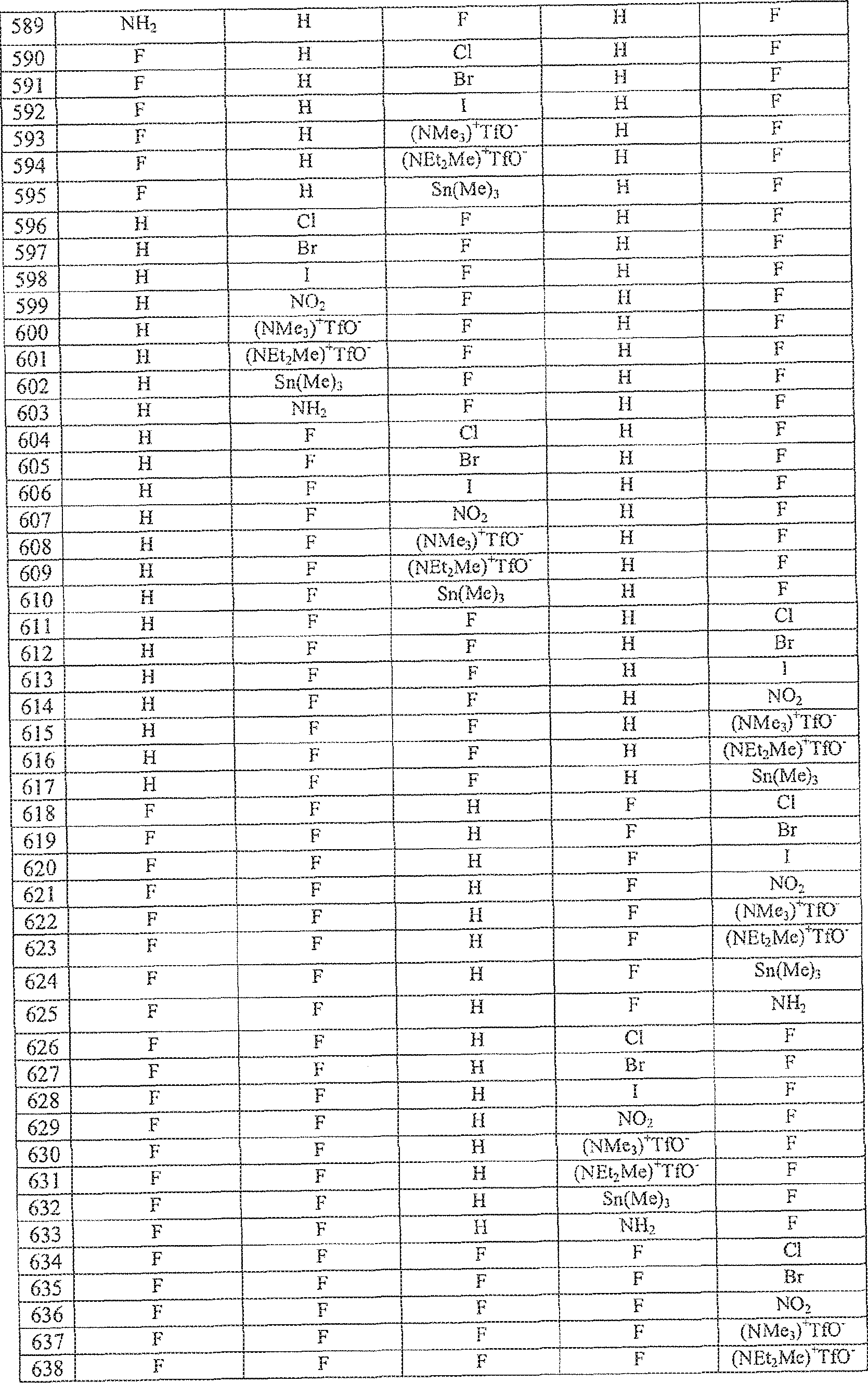

[00156] Precursor compositions according to aspects of the present invention are any one of compositions defined in Table IV selected from 447, 448, 449, 450, 451 , 452, 453, 454, 455, 456, 457, 458, 459, 460, 461 , 462, 463, 464, 465, 466, 467, 468, 469, 470, 471 , 472, 473, 474, 475, 476, 477, 478, 479, 480, 481, 482, 483, 484, 485, 486, 487, 488, 489, 490, 491 , 492, 493, 494, 495, 496, 497, 498, 499, 500, 501, 502, 503, 504, 505, 506, 507, 508, 509, 510, 51 1 , 512, 513, 514, 515, 516, 517, 51 8, 519, 520, 52 1 , 522, 523, 524, 525, 526, 527, 528, 529, 530, 531 , 532, 533, 534, 535, 536, 537, 538, 539, 540, 54] , 542, 543, 544, 545, 546, 547, 548, 549, 550, 551, 552, 553, 554, 555, 556, 557, 558, 559, 560, 561, 562, 563, 564, 565, 566, 567, 568, 569, 570, 57] , 572, 573, 574, 575, 576, 577, 578, 579, 580, 581, 582, 583, 584, 585, 586, 587, 588, 589, 590, 591, 592, 593, 594, 595, 596, 597, 598, 599, 600, 601, 602, 603, 604, 605, 606, 607, 608, 609, 610, 61 1, 612, 613, 614, 615, 616, 617, 618, 619, 620, 621 , 622, 623, 624, 625, 626, 627, 628, 629, 630, 631 , 632, 633, 634, 635, 636, 637, 638, 639, 640, 641 , 642, 643, 644, 645 or 646; or a mixture of any two or more thereof,
[00157] Precursor compositions according to aspects of the present invention have the structural formula (XIX).

[00158] Precursor compositions according to aspects of the present invention have the structural formula (XX),

[00159] Precursor compositions according to aspects of the present invention have the structural formula (XXI):

(XXI)
, where each R)7 is a protecting group, where each R7, Rs, R9s ¾0 and Rn is independently selected from the group consisting of: H, OH, F, Br, CI, I, N(Alk)2s Sn(Alk)3, SnCl¾ N02 and OTf , where X is C, Si, O, NH, NCH3, S or Se, where Y is selected from the group consisting of: CH2, -C= , carbonyl, -C(NH)-, -NH(CO), - NH(CS), where R2o and 2i are each independently selected from the group consisting of: a substituted or unsubstituted alkyl. alkenyl, aikyne, alkoxy, acyl, carbamoyl, aryl, heteroaryl, and peptidyl, and where at least one of R7; Rs, R¾ io, and Rn is not H.
[00160] Compositions according to aspects of the present invention have the structural formula (XXI). where each R7, s, R , R»o a d n is independently selected from the group consisting of: H, , SF, 76Br, 123/124 1 25/13 % and nC , where X is C, Si, O, NH, NCH3, S or Se, where Y is selected from the group consisting of: C¾, -C= , carbonyl, -C(NH)-, -NH(CO). -NH(CS), where R5 and R2 are each independently selected from the group consisting of: a substituted or unsubstituted alkyi, alkenyl,
alkyne, aikoxy, acyl, carbamoyl, aryl, heteroaryl, and peptidyl, and where at least one of R7, Rg, R9, Rio, and Ru is not H.
[00161] Synthesis
[00162] Synthesis of compositions described and shown herein are provided according to aspects of the present invention,
[00163] Compositions having the structural formula I are synthesized according to Schemes 5, 6, Ί, 8 and 9.
[00164] Compositions having the structural formula II are synthesized according to Schemes 5 and 6.
[00165] Compositions having the structural formula III are synthesized according to Schemes 7, 8 and 9,
[00166] Compositions having the structural formula IV are synthesized according to Scheme 8.
[00167] Compositions having the structural formula V are synthesized according to Scheme 5, 6, and 9.
[00168] Composiiions having the structural formula VI are synthesized according to Scheme 4a.
[00169] Compositions having the structural formula VII are synthesized according to Scheme 4b.
[00170] Compositions having the structural formula VIII are synthesized according to Scheme 4c.
[00171] Compositions having the structural formula IX are synthesized according to Scheme 9.
[00172] Compositions having the structural formula X are synthesized according to Schemes 5, 6, and 9.
[00173] Compositions having the structural formula XI are synthesized according to Scheme lb.
[00174] Composiiions having the structural formula XII are synthesized according to Scheme lb.
[00175] Compositions having the structural formula XIII are synthesized according to Scheme 10.
[00176] Compositions having the structural formula XIV are synthesized according to Scheme 1 1.
[00177] Compositions having the structural formula XV are synthesized according to Scheme lb.
[00178] Compositions having the structural formula XVI are synthesized according to Scheme lb.
[001793 Compositions having the structural formula XVII are synthesized according to Scheme lb.
[00180] Compositions having the structural formula XVTii are synthesized according to Schemes 2a, 2b, 3a, 3b, 3c and 6.
[00181] Compositions having the structural formula XIX are synthesized according to Schemes 2a, 2b and 6.
[00182] Compositions having the structural formula XX are synthesized according to Schemes 3b and 6.
[00183] Compositions having the structural formula XXI are synthesized according to Scheme 8.
[00184] Precursor compositions according to aspects of the present invention are useful as precursors in chemical synthesis reactions of labeled compositions as well as synthesis of other compositions.
[00185] Labeled compositions according to aspects of the present invention are capable of specific binding to one or more galectins and useful for binding, targeting, inhibiting and imaging galectins in vitro and in vivo. Implication of galectins in the development of cancer, the pathogenesis of heart failure and ventricular remodeling, various fibrotic diseases, various other autoimmune and inflammatory processes, and infectious processes, such as HIV, supports utility of labeled compositions described herein for binding, targeting, inhibiting and imaging galectins.
[00186] The term, "label" refers to a material capable of producing a signal indicative of the presence of a labeled composition incorporating the label by any appropriate method illustratively including spectroscopic, optical, photochemical, biochemical, enzymatic, electrical and/or immunochemical label detection methods. Examples of detectable labels illustratively include a iluorescent moiety, a chemiluminescent moiety, a bioluminescent moiety, a magnetic particle, an enzyme, a substrate, a radionuclide and a chromophore. The choice of label will depend on the detection method to be used.
[00187] In a particular aspect, the label is a radionuclide.
[00188] Radiolabels incorporated in labeled compositions according to aspects of the present invention include any radionuclide useful in imaging or useful in therapeutic applications, including 18F, 76Br, n ml, i 2% ml, 67/68Ga, S9¾ "rnTc, wln, 6!/62/64Cu, 67Cu, 89Sr, 90Y, " i86Re, 165Dy, I66Ho, 21 1 At and 213Bi.
[00189] in a particular aspect, the label is a fluorescent moiety.
[00190] Fluorescent moieties used as labels to generate a fluorescentiy labeled composition of the present invention can be any of numerous fluorophores including, but not limited to, those described in Haughland, R. P., The Handbook, A Guide to Fluorescent Probes and Labeling Technologies, 10th Ed., 2005; Lakowicz, J. R., Principles of Fluorescence Spectroscopy, Springer, 3rd ed., 2006; 4-acetamido-4'- isothiocyanatostilbene-2,2'disulfonic acid; acridine and derivatives such as acridine and acridine isothiocyanate; 4-amino-N-[3-vinylsulfonyl)phenyI]naphthalimide-3,5 disulfonate, Lucifer Yellow VS; N-(4-anilino- 1 -naphthyl)maleimide; anthranilamide, Brilliant Yellow; BIQDiPY fluorophores (4,4-difluoro-4-bora-3a,4a-diaza-s-indacenes); cournarin and derivatives such as coumarin, 7-amino-4-methylcoumarin (AMC, Coumarin 120), 7-amino-4-trif3uoiOmethyicouluarin (Coumaran 151); cyanosine; DAPOXYL sulfonyl chloride; 4',6-diaminidino-2-phenylindole (DAPI); 5',5"- dibromopyrogallol-sulfonephthalein (Bromopyrogallol Red); 7-diethylamino-3-(4'- isothiocyanatophenyl)-4-methylcoumarin; diethylenetriamine pentaacetate; 4,4'- diisothiocyanatodihydro-stilbene-2,2'-disulfonic acid; 4.4 -diisothiocyanatostilbene~2,2'- disuifonic acid; 5-[dimelhylaminolnaphthaiene-l -sulfonyl chloride (DNS, dansyl chloride); 4-4'-dimethylaminophenylazo)benzoic acid (DABCYL); 4- dimethylaminophenylazophenyl-4'-isothiocyanate (DABITC); EDANS (5-[(2- ammoethyl)amino]naphthalene- 1 -sulfonic acid), eosin and derivatives such as eosin isothiocyanate; erythrosin and derivatives such as erythrosin B and erythrosin isothiocyanate; ethidium such as ethidium bromide; fluorescein and derivatives such as 5-carboxyfiuorescein (FAM), hexachlorofluorescenin, 5-(4,6~diehlorotriazhi-2- yl)aminofluorescein (DTAF), 2', 7!-dimethoxy-4!, 5'-dichloro-6-carboxyfluorescein (JOE) and fluorescein isothiocyaiiate (FITC); fluorescamine; green fluorescent protein and derivatives such as EBFP, EBFP2, ECFP, and YFP; IAEDANS (5-({2- [(iodoacetyl)amtno] ethyl} amino)naphthalene-l -sulfonic acid), Malachite Green isothiocyanate; 4-methylumbelliferone; orthocresolphi aiein; nitrotyrosine; pararosaniline; Phenol Red; B-phycoerytnin; o-phthaldialdehyde; pyTene and derivatives
such as pyrene b tyrate, 1-pyrenesulfonyl chloride and succinimidyl 1-pyrene butyrate;
QSY 7; QSY 9; Reactive Red 4 (Cibacron TM, Brilliant Red 3B-A); rhodamine and derivatives such as 6-carboxy-X-rhodamine (ROX), 6-carboxyrhodamine (Rhodamine 6G), rhodamine isothiocyanate., !issamine rhodamine B sulfonyl chloride, rhodamine B, rhodamine 123, sulforhodamine B, sulforhodamine 101 and sulfonyl chloride derivative of sulforhodamine 101 (Texas Red); Ν,Ν,Ν',Ν-tetramethyl-carboxyrhodamine (TAMRA); tetram ethyl rhodamine; tetram ethyl rhodamine isothiocyanate (T ITC); riboflavin; rosolic acid and terbium chelate derivatives.
(00191] Labeled compositions and precursor compositions according to aspects of the present invention are optionally derivatives, salts, hydrates, amides or esters of labeled compositions and precursor compositions shown or described herein. The term "derivative" as used herein refers to a labeled composition or precursor composition that is modified compared to a reference labeled composition or precursor composition and which has similar or improved bioactivity compared to the reference labeled composition or precursor composition.
[00192] Methods of aiding in diagnosis and/or treatment
[00193] Methods of aiding in diagnosis and/or treatment of one or more conditions characterized by upregulation of one or more galectins are provided according to aspects of the present invention.
[00194] The term "upregulation" as used herein refers to an increased level of one or more galectins. According aspects of the present invention, the term "upregulation" refers to an increased level of galectin-1 and/or galectin-3.
[00195] Conditions characterized by upregulation of one or more galectins are exemplified by cancer, heart failure (i.e.. myocardial infarction), infectious processes, such as HIV, and various other autoimmune and inflammatory processes, as well as in fibrotic tissues associated with different diseases (i.e., idiopathic pulmonary fibrosis, liver cirrhosis).
[00196] Methods of aiding in diagnosis and/or treatment of one or more conditions characterized by upregulation of one or more galectins include assaying one or more galectins with a labeled composition described or shown herein under conditions to form a complex of the labeled composition and the one or more galectins. A signal emanating from the labeled composition in the complex is detected by a suitable imaging modality such as positron emission tomography, fluorescence imaging, and the like which is
indicative of the complex of the labeled composition and the one or more gaiectins. The signal is compared to an appropriate control to determine the level of the one or more gaiectins detected.
[00197] According to aspects of methods of aiding in diagnosis and/or treatment of one or more conditions characterized by upregulation of one or more gaiectins according to the present invention, the labeled composition includes a radionuclide and detecting a signal emanating from the labeled composition in the complex is achieved by PET, SPECT or scintigraphic imaging.
[00198] Optionally, the labeled composition comprises a fluorophore and detecting the signal including fluorescence imaging or hotoaeoustie imaging,
[00199] Methods of aiding in diagnosis and/or treatment of one or more conditions characterized by upregulation of one or more gaiectins are performed by assaying one or more gaiectins in a biological sample obtained from a subject having or suspected of having a condition characterized by upregulation of one or more gaiectins according to aspects of the present invention such as by a radioligand binding assay, fluorescent ligand binding assay, and the like.
[00200] Methods of aiding in diagnosis and or treatment of one or more conditions characterized by upregulation of one or more gaiectins are optionally performed by assaying one or more gaiectins in a subject having or suspected of having a condition characterized by upregulation of one or more gaiectins according to aspects of the present invention.
[00201] For example, the subject has or is suspected of having cancer, heart failure, an infection, an HIV infection, a pathological autoimmune condition, a disease manifesting by fibrosis, and/or a pathological inflammatory condition.
[00202] Optionally, the galectin assayed is galectin-1 and/or galectin-3.
[002031 Controls are well-known in the art and one of skill in the art would readily recognize an appropriate control and be able to determine an appropriate control for a method of the present invention with no more than routine experimentation.
[00204] In one aspect, a control is a reference level of one or more gaiectins in a sample of the same type. The reference level may be, for example, a known level typical for a subject of similar age, gender or condition. In another aspect, the reference level is a level determined according to a method of the present invention at a first time point. The first time point may be prior to a medical treatment such that assaying one or more
galectins according to the present invention provides information about efficacy of the treatment. Thus, for example, a decrease in the one or more galectins after a medical treatment to treat a condition characterized by upregulaiion of one or more galectins compared to the level of the one or more galectins prior to the medical treatment is indicative of efficacy of the medical treatment.
[00205] The control level of the one or more galectins may be previously determined and stored in a print or electronic medium for recall and comparison to an assayed level of the one or more galectins according to aspects of methods aiding in diagnosis and/or treatment of one or more conditions characterized by up regulation of one or more galectins of the present invention.
[00206] Galectin-1 and/ or galectin-3 are upregulated in conditions, including: fibrosis of lungs (e.g. idiopathic pulmonary fibrosis, iPF; chronic obstructive pulmonary disease. CQPD), liver (e.g. cirrhosis), kidney (renal fibrosis); 2) myocardial infarction; 3) various cancers (e.g. breast, prostate, brain, and others); autoimmune diseases (e.g., rheumatoid arthritis, lupus, and the like). Thus, labeled compositions according to the present invention are useful as diagnostic imaging agents that enable quantitative visualization of galectin-1 and/or galectin-3 expressio levels in affected organs and tissues and inhibitors of galectin- 1 and/or galectin-3 function for therapy of these and other such diseases.
[00207] According to aspects of the present invention, labeled compositions are used to assay galectin 1 and/or gaieclin-3 for diagnostic imaging of organ and tissue fibrosis.
[00208] According to aspects of the present invention, labeled compositions are used to assay galectin 1 and/or galectin-3 for selection of patients for inclusion into the clinical trials assessing inhibitors of galectin 1 and/or galectin-3, based on the expression levels of galectin 1 and/or galectin-3 at sites of pathological/disease processes.
[00209] According to aspects of the present invention, labeled compositions are used to assay galectin ί and/or galectin-3 to predict responsiveness of patients to therapy with inhibitors of galectin 1 and/or galectin-3.
[00210] According to aspects of the present invention, labeled compositions are used to assay galectin I and/or galectin-3 in micro-dosing clinical studies to assess the pharmacokinetics, metabolism, biodistribution, and targeting of pathological/disease processes (e.g. fibrotic tissue, infarction, cancer, inflammation, and others). According to particular aspects of the present invention, PET/CT imaging with a labeled composition
of the present invention provides information about the pharmacokinetics and delivery of a corresponding non-labeled drug to an affected tissue in a subject and allows determination of how much of the non-labeled drug reaches its target, how much and where does the non-labeled drag accumulate, how long does the non-labeled drug remain at the target and what is the biodistribution of the labeled composition, indicative of the biodistribution of the non-labeled drug,
[00211] Pharmaceutical Compositions
[00212] Pharmaceutical compositions according to aspects of the present invention include a labeled composition described or shown herein and a pharmaceutically acceptable carrier.
[00213] Pharmaceutically acceptable carriers and formulation of pharmaceutical compositions are known in the art, illustratively including, but not limited to, as described in Remington: The Science and Practice of Pharmacy, 21st Ed., Lippincott, Williams & Wilkins, Philadelphia, PA. 2006; and Allen, L.V. et al., Ansel's Pharmaceutical Dosage Forms and Drug Delivery Systems, 8th Ed., Lippincott, Williams & Wilkins, Philadelphia, PA, 2005.
[00214] Pharmaceutical compositions suitable for delivery to a subject may be prepared in various forms illustratively including physiologically acceptable sterile aqueous or nonaqueous solutions, dispersions, suspensions or emulsions, and sterile powders for reconstitution into sterile injectable solutions or dispersions. Examples of suitable aqueous and nonaqueous carriers include water, ethanol, polyols such as propylene glycol, polyethylene glycol, glycerol, and the like, suitable mixtures thereof; vegetable oils such as olive oil: and injectable organic esters such as ethyloleaie. Proper fluidity can be maintained, for example, by the use of a coating such as lecithin, by the maintenance of the required particle size in the case of dispersions, and by the use of surfactants, such as sodium lauryi sulfate. Additional components illustratively including a buffer, a. solvent, or a diluent may be included.
[00215] Such formulations are administered by a suitable route including parenteral and oral administration. Administration may include systemic or local injection, and particularly intravenous injection.
[00216] These compositions may also contain adjuvants such as preserving, wetting, emulsifying, and dispersing agents. Prevention of the action of microorganisms can be ensured by various antibacterial and antifungal agents, for example, parabens,
c orobuianol, phenol, sorbic acid, and the like. It may also be desirable to include isotonic agents, for example, sugars, sodium chloride, and substances similar in nature.
[002171 Liquid dosage forms for oral administration include a pharmaceutically acceptable carrier formulated as an emulsion, solution, suspension, syrup, or elixir. In addition to the active compounds, the liquid dosage forms may contain inert diluents commonly used in the art, such as water or other solvents, solubilizing agents and emuisifiers, as for example, ethyl alcohol, isopropyl alcohol, ethyl carbonate, ethyl acetate, benzyl alcohol, benzyl benzoate, propyleneglycol, i,3-butyleneglycol, dimethyiformamide, oils, in particular, cottonseed oil, groundnut oil, com germ oil, olive oil, castor oil and sesame oil, glycerol, teirahydrofijrftiryl alcohol, polyethyleneglyco!s and fatty acid esters of sorbitan or mixtures of these substances, and the like.
[00218] Besides such inert diluents, the composition can also include adjuvants, such as wetting agents, emulsifying and suspending agents, sweetening, flavoring, and perfuming agents.
[00219] Suspensions may contain suspending agents, as for example, ethoxylated isostearyl alcohols, polyoxyethylene sorbitol and sorbitol esters, microcrystalline cellulose, aluminum metahydroxide, bentonite, agar-agar or tragacanth, or mixtures of these substances, and the like.
[00220] Solid dosage forms for oral administration include capsules, tablets, pills, powders, and granules. In such solid dosage forms, one or more compositions described herein is admixed with at least one inert customary excipient (or earner) such as sodium citrate or dicalcium phosphate or (a) fillers or extenders, as for example, starches, lactose, sucrose, glucose, mannitol, and silicic acid, (b) binders, as for example, carboxymethylcellulose, alignates, gelatin, polyvinylpyrrolidone, sucrose, and acacia, (c) humectants, as for example, glycerol, (d) disintegrating agents, as for example, agar- agar, calcium carbonate, plant starches such as potato or tapioca starch, alginic acid, certain complex silicates, and sodium carbonate, (e) solution retarders, as for example, paraffin, (i) absorption accelerators, as for example, quaternary ammonium compounds, (g) wetting agents, as for example, cetyl alcohol, glycerol monostearate. and glycols (h) adsorbents, as for example, kaolin and bentonite, and (i) lubricants, as for example, talc, calcium stearate, magnesium stearate, solid polyethylene glycols, sodium lauryl sulfate, or mixtures thereof. In the case of capsules, tablets, and pills, the dosage forms may also include a buffering agent.
[00221} Solid compositions of a similar type may also be employed as fillers in soft and hard-filled gelatin capsules using such excipients as lactose or milk sugar as well as high molecular weight polyethyleneglycols, and the like.
[00222] Solid dosage forms such as tablets, dragees, capsules, pills, and granules can be prepared with coatings and shells, such as enteric coatings and others well known in the art. They may contain opacifying agents, and can also be of such composition that they release the active compound or compounds in a certain part of the intestinal tract in a delayed manner. Examples of embedding compositions which can be used are polymeric substances and waxes. The active compounds can also be in microencapsulated form, if appropriate, with one or more of the above-mentioned excipients.
[00223] Compositions for delivery by nasal and/or pulmonary routes e.g. by inhalation or insufflation include solutions and suspensions in a pharmaceutically acceptable carrier, such as liquids, aerosols or powders.
[00224] Advantageously, a pharmaceutical composition according to aspects of the present invention is fomiulated to achieve lipid-solubility and/or aqueous-solubility.
[0022S] In particular aspects, a pharmaceutically acceptable earner is a particulate carrier such as lipid particles including liposomes, micelles, unilamellar or mulitlamellar vesicles; polymer particles such as hydrogel particles, polyglycolic acid particles or polylactic acid particles; inorganic particles such as calcium phosphate particles such as described in for example U.S. Patent No. 5,648,097; and inorganic/organic particulate carriers such as described for exampie in U.S. Patent No. 6,630,486.
[00226] A particuiate pharmaceutically acceptable carrier can be selected from among a lipid particle; a polymer particle; an inorganic particle; and an inorganic/organic particle. A mixture of particle types can also be included as a particuiate pharmaceutically acceptable carrier.
[00227] Compositions are optionally formulated for inhalation, such as aerosols formulations. Aerosol formulations include pressurized or non-pressurized inhalant carriers.
[00228] A particuiate carrier is typically formulated such that particles have an average particle size in the range of about 1 nm - 10 microns. In particular aspects, a particulate carrier is fomiulated such that particles have an average particle size in the range of about i nm --- 100 nm.
[GG229J A pharmaceutical composition according to the present invention is suitable for administration to a subject by a variety of systemic and/or local routes including, but not limited to, intravenous, intramuscular, subcutaneous, intraperitoneal, oral, otic, rectal, vaginal, topical, parenteral, pulmonary, ocular, nasal, intra tumoral and mucosal.
[00230J Administration
[00231] Subjects are identified as having, or at risk of having, a disease or condition associated with upregulaiion of galectins using various medical and diagnostic methods, including measurements of galectins in blood, serum, plasma, saliva, sputum, urine, biopsy material and other biological samples containing or suspected of containing one or more galectins.
[002323 According to aspects of the present invention, subjects are identified as having, or at risk of having, a disease or condition associated with upregulaiion of galectin-1 and/or galectin-3 using various medical and diagnostic methods, including measurements of galectin- 1 and/or galectin-3 in blood, serum, plasma, saliva, sputum, urine, biopsy material and other biological samples containing or suspected of containing galectin-1 and/or galectin-3.
[00233] The term "subject" refers to an individual in which galectin imaging is desirable using compositions of the present invention and generally includes mammals and birds, such as. but not limited to, humans, other primates, cats, dogs, cows, horses, rodents, pigs, sheep, goats and poultry.
[00234] An inventive composition may be administered to a subject as a single dose for a single study or repetitively, such as for monitoring galectin levels and disease status, i.e., for monitoring therapeutic efficacy.
[00235] An effective amount of a pharmaceutical composition according to the present invention will vary depending on the particular pharmaceutical composition used, the imaging modality to be used, the species of the subject, the age and sex of the subject and the general physical characteristics of the subject to be treated. One of skill in the art could determine an effective amount in view of these and other considerations typical in the practice of medical and diagnostic imaging. In general it is contemplated that an effective amount would be in the range of about 0.0001 mg/kg - 100 mg kg body weight, optionally in the range of about 0.01 - 10 mg kg, and further optionally in the range of about 0.1 - 5 mg/kg. The amount of the composition administered will generally include an amount of a labeled composition sufficient for imaging by a
selected imaging methodology. For nuclear medical imaging an amount in the range of 0.001 - 1 millicuries (mCi) kg body weight, 0.01-0,75 mCi /kg body weight, 0.05-0,5 mCi /kg body weight or 0.1 1 - 0.25 mCi /kg body weight is generally administered in one or more doses, although more or less can be administered if necessary.
[00236J Detection
[00237] Detection of the detectable signal is accomplished using an appropriate imaging method. Any detection method or system operable to detect a labeled composition can be used in methods according to embodiments of the present invention and such appropriate detection methods and systems are well-known in the art. For example, where the labeled composition is labeled with a radiolabel, a radiation detection method is used, such as Positron Emission Tomography (PET), single-photon emission computed tomography (SPECT) or scintigraphic imaging (where the composition includes a chelator and associated radiolabel). For PET, SPECT or scintigraphic imaging detection, the radiolabel is any of various positron emitting metal ions used in PET and SPECT or scintigraphic imaging methods such as i 8F, 76Br, 123L 124I, ,25I, 13 T, ΰ'68θ3, s9Zr, "mTc, " 'in and L'62/64Cu. Combinations of imaging techniques are optionally combined. PET imaging is optionally combined with computed tomography (CT) imaging or magnetic resonance imaging (MRI).
[00238] Where the labeled composition is labeled with a fluorescent label, a fluorescence detection method is used. A signal from a fluorescent!)' labeled composition is detected, for example, using a light source capable of emitting light of an appropriate wavelength. The fluorescent label then emits light detectable optically, such as by eye or using a fluorescence detector.
[00239] Galectins are detected in vitro, such as in solution or in a cell, according to aspects of the present invention by contacting the solution or cell with a labeled composition under conditions which permit binding of the labeled composition and the galectin, and then detecting a detectable signal of the labeled composition in a complex of the labeled composition and the galectin, Such cells can be ceil lines, primary cells isolated from an organism or cells present in an explanted tissue or tumor sample, such as a biopsy tumor sample.
[00240] Galectins are detected in vivo according to aspects of the present invention by administration of a labeled composition to a subject under conditions which permit binding of the labeled composition and the galectin, and then detecting a detectable
signal of the labeled composition in a complex of the labeled composition and the galectin in the subject.
[002 11 Conditions which permit binding of the labeled composition and the galectin in vitro and in vivo are physiological conditions according to aspects of the present invention, including, physiological temperature and pH. In vitro conditions can include contacting the labeled composition and the galectin in a buffer.
[00242] Commercial Packages
[00243} Commercial packages are provided according to aspects of the present invention including a labeled composition and/or precursor composition described herein; or a derivative, salt, hydrate, amide or ester thereof. One or more auxiliary components are optionally included in commercial packages of the present invention, such as a pharmaceutically acceptable carrier exemplified by a buffer, diluent or a reconstituting agent.
[00244] Embodiments of inventive compositions and methods are illustrated in the following examples. These examples are provided for illustrative purposes and are not considered limitations on the scope of inventive compositions and methods.
[00245] Examples
[00246] Example 1
[00247] Scheme l a shows a method for preparation of bis-(3-azido-2,4,6-tri-0-acetyl- P-D-galactopyranosyl)sulfane (XXIX), which is the starting material for the symmetrical "cold" standards (X) used for radiosynthesis and cell uptake studies. Synthesis of 2,4,6- tri-C?-acetyl-3-azido-a-D-galactopyranosyl bromide (XXVII). The solution of tetra-O- acetyi-3-azido-D-gal.actopyranose (XXVI) (1 g, 2.68 mmol.) in dry DCM (5 mL) was added dropwise under vigorous stirring to the titanium tetrabromide (0.59 g, 1.6] mmol) solution in dry DCM (10 mL) with catalytic amount of glacial acetic acid. The reaction mixture was left for 1 ,5 h under microwave irradiation at 55 °C, then was diluted with DCM, washed with saturated NaHC03 solution two times, water and dried under Na2SC>4 for 3 h. Organic layer was evaporated under reduced pressure, and purified with column chromatography (Si02, Hexane:EtOAc, 4: 1). Yield is 75%. Rf = 0.65 (HexanerEtOAc, 1 : 1, v/v).
[00248] NM and HRMS data correspond to those described in van Scherpenzeel, M., et aL ChemBioChem. 2009, 10, 1724-1733.
[00249] Synthesis of triisopropyisiiyl 2,4,6-tri- ( -aceiyl-3-azido-l -thio- -D- galactopyranoside (XXVIII). TIPSSH (0.33 mL, 1.52 mmol) was added dropwise at 0 °C to the solution of bromide (XXVII) (500 mg, 1.27 mmol) in dry and degassed acetonitrile ( 10 mL) with anhydrous K2CO3 (526 mg, 3.81 mmol). The reaction mixture was stirred for 30 min at 0 °C, then 3 h at room temperature. The solvent was evaporated; the residue was purified with column chromatography (Si02, Hexane:EtOAc, 4: 1) gave tri-isopropyisilyl galactopyranoside XXVIII (570 mg, 89%). Rf = 0,6 (HexanerEtOAc, 2: 1 , v/v).
[00250] NMR and HRMS data correspond to those described in S. Mandal and U. J. Nilsson, Org. Biomol Chem., 2014, 12, 4816-4819.
[00251] Synthesis of bis-(3-azido-2,4,6-tri-0-acetyl-[3-D-galactopyranosyl)sulfane (XXIX). TBAF (0.46 mL, 0.46 mmol) was added dropwise to the solution of tri- isopropyisilyl galactopyranoside (X VIII) (230 mg, 0.46 mmol) and bromide (XXVII) (150 mg, 0.38 mmol) in dry and degassed acetonitrile ( 10 mL) at - 10 °C. The reaction mixture was stirred 15 min at -10 °C, then 30 min at room temperature. The solvent was evaporated and the residue was purified with column chromatography (Si02, Hexane:EtOAc, 4: 1 ) gave bis-$-D-galaetopyranosyl) sulfane (XXIX) ( 183 mg, 68%). Rf = 0.4 (Hexane:EtOAc, 1 : 1 , v/v),
[00252] NMR and HRMS data correspond to those described in S. Mandal and U. J. Nilsson, Org. Biomol. Chem., 2014, 12, 4816-4819.
[00253] Synthesis of bts-{2,4J6-tri-0-acetyl-3-[4-(4-fluorophenyl)-lH-l !2J3-triazol-l- yl]-[3-D-galactopyranosyl)sulfane (Xa). Compound (XXIX) (528 mg, 0.80 mmol), sodium ascorbate (40 mg, 0.24 mmol), CuS0 (20 mg, 0.15 mmol) and 4- fluorophenylacetylene (250 mg, 2.09 mmol) were dissolved in a mixture of DMF:water 5: 1 (7 mL). The reaction mixture was heated under microwave irradiation to 85°C for 1.5 h. The mixture was concentrated under reduced pressure, dissolved in DCM, and then filtered through small amount of silica. Silica gel was washed with Hexane:EtOAc (1 : 1). The mixture of solvents was evaporated to dryness and the residue was purified with column chromatography (Si02, Hexane:EtOAc, 1 : 1). Yield is 70-85%. Rf = 0.1 (Hexane:EtOAc, 1 : 1 , v/v)
[00254] Ή NMR (500 MHz, CDCl3) δ 7.88 (s, 2H), 7.81 (dd, J = 8.7, 5.3 Hz, 4H), 7.12 (t, /= 8.7 Hz, 4H), 5.84 (dd, ,/ == 10.7, 30.0 Hz, 2H), 5.64 (d, J = 2.8 Hz, III), 5.19 (dd, /= 1 1.1 , 3.2 Hz, 2H), 4.96 (d, /= 9.7 Hz, 2H), 4.40 (dd, J - 1 1.5, 6.7 Hz, 2H), 4.18
(ΐ, J = 6.2 Hz, 2H), 4.10 (dd, J = 1 1.5, 5.7 Hz, 2H), 2.12 (s, 6H), 2.1 (s, 6H), 1.93 (s,
6H). 13C NMR (125 MHz, CDC13) δ 1 70.9, 169.6, 169.0, 163.0 (d, J = 248.0 Hz), 147.4, 127.6 (d, J = 8.2 Hz), 126.4, 118.4, 1 16.1 (d, J = 21.8 Hz), 82.6, 76.3, 69.1, 66.8, 63.3, 61.8, 21.0, 20.7, 20.6. HUMS (+ES1-TOF) m/z for C40H42F2 6O14S [M+H]+ calcd 901.2526, found 901.2502.
[002551 Synthesis and purification of bis-{2,4,6-tri-0-acetyl-3-[4-(3-fluorophenyl)- ] H-l ,2,3-triazol-l -yl]-p-D-galactopyranosyl)suIfane (Xb) was done according to procedure described above for (Xa).
[00256] NMR and HRMS data correspond to the earlier described in US 2014/0121 179.
[00257] Synthesis of bis-{3-deoxy-3-[4-(4-fluorophenyl)-lH-l ,2,3-triazol-l-yl]- -D- galactopyranosyl)sulfane (Xc). The solution of sodium methoxide (1 equiv) in methanol was added to the solution of peracetylated galactopyranosylsulfane (Xa) in methanol at room temperature. The progress of deprotection was monitored with silica and CI 8 TLC, and then the reaction mixture was neutralized with DOWEX resin. The resin was filtered out, washed with methanol. Solvent was evaporated to dryness under reduced pressure to give (Xc) in almost quantitative yield. Rf= 0.25-0.30 (MeCN:Water, 3:7, v/v, CI 8).
[00258] 5H NMR (600 MHz, DMSO-sVD20) δ 8.51 (s, 2H), 7.86 (t, J - 5.9 Hz, 4H), 7.24 (t, J= 8.2 Hz, 4H), 4.89 (d, J= 9.4 Hz, 2H), 4.83 (d, J = 10.5 Hz, 2H), 4.27 (t, J = 9.9 Hz, 2H), 3.95 (d, / = 2.6 Hz, 2H), 3.73 (t, J = 6.2 Hz, 2H), 3.53 (m, 4H). C NMR (151 MHz, DMSO-rf« D20) δ 163.1, 161.4, 145.4, 127.8 (d, J = 3.8 Hz), 127.7 (d, J= 8.1 Hz), 121.5, 116.4 (d, J = 21.6 Hz), 84.4, 79.8, 68.1 , 67.3, 67.1, 60.8. !9F NMR (376 MHz, DMSO-.'/4/D20) δ -1 13.98 - -1 14.13 (m). HRMS (+ESI-TOF) m/z for C2sH30F2N6O8S [M+H' calcd 649.1814, found 649.1825.
[002591 Synthesis of bis- { 3 -deoxy-3-[4-(3 -fluorophenyl)-! ti~ i,2,3-triazol~i-yl]~P-D- galactopyranosyI)sulfane (Xd, TD 139) was done according to procedure described above for (Xc).
[00260] NMR and HRMS data correspond to those described in US 2014/0121179.
[00261] Example 2
[00262] Scheme l b shows a method of synthesis of precursors (XVI, XVTI) used in synthesis of both symmetrical and asymmetrical radiolabeled compounds.
[002631 Synthesis of l ,2,4,6 etra-0-acetyl-3-[4-(4-fluorophenyi)-lH-l ,2,3-triazoi-l- ylj-D-galactopyranoside (XXXa) is shown in Scheme lb. Compound (XXVi) (300 nig,
0.80 mmol), sodium ascorbate (40 rag, 0.24 mraol), CuS04 (20 mg, 0.15 mmol) and 3- fluorophenylacetylene (115 rag, 0.96 mmol) were dissolved in a mixture of DMF: water 5: 1 (7 rnL). The reaction mixture was heated under microwave irradiation to 85°C for 1.5 h. The mixture was concentrated under reduced pressure, dissolved in DCM, and then filtered through small amount of silica. Silica gel was washed with Hexane:EtOAc (1 : 1). The mixture of solvents was evaporated to dryness. The resulting residue was introduced to the next step without further purification. Rf= 0.50 (Hexane:EtQAe, 1 : 1 , v/v).
[00264] Synthesis of 1 ,2,4,6-tetra-0-acetyl-3-[4-(3-iluoroph.enyl)-lH- 1 ,2,3-triazol- 1 - yl]-D-galactopyranoside (XXXb) was done according to procedure described above for (XXXa).
[002651 Synthesis of 2,4,6-tri-0-acetyl-3-[4-(4-fluorophenyl)-lH-l ,2,3-triazol- l-yl]- D-galactopyranosyl bromide (XXXla). The solution of the clicked monomer (XXXa) (0.5 g, 3.01 mmol) in dry DCM (5 rnL) was added dropwise under vigorous stirring to the titanium tetrabromide (0.24 g, 0.65 mmol) solution in dry DCM (10 mL) with catalytic amount of glacial acetic acid. The reaction mixture was left for 1.5 h under microwave irradiation at 55 °C, then was diluted with DCM, washed with saturated NaHCOi solution two times, water and dried under NaySO, for 3 h. Organic layer was evaporated under reduced pressure, and the residue was purified with column chromatography (Si02, Hexane:EtOAc, 4: 1). Yield is 50-60%. Rf - 0.8 (Hexane:EtOAc, 1 : 1 , v/v)
[00266] Ή NMR (600 MHz, CDC13) S 7.77 (m, 3H), 7.1 1 (t, J « 8.6 Hz, 2H), 6.88 (d, J = 3.7 Hz, 1H), 5.80 (dd, J = 1 1.3, 3.8 Hz, 1H), 5.64 (d, J= 1.5 Hz, 1H), 5.34 (dd, J = 1 1.4, 2.9 Hz, 3H), 4.64 (t, J = 6.4 Hz, 1H), 4.23 (dd, J= 1 1.6, 6.3 Hz, 1H), 4.13 (dd, J = 1 1 .6, 6.7 Hz, 1H), 2.06 (s, 6H), 1.95 (s, 3H). 13C NMR ( 1 50 MHz, CDCI3) δ 170.4, 169.7, 169.2, 163.0 (d, J= 247.9 Hz), 147.2, 127.6 (d, J = 8.2 Hz), 126.3 (d, ./= 3.1 Hz), 1 19.4, 1 16.1 (d, J - 21.8 Hz), 88.7, 71 .5, 67.9, 67.0, 61 .0, 58.9, 20.7, 20.6, 20.5. HUMS (+ESI-TOF) m/z for C.:¾H.;i3M'N ;0? [M+Hf calcd 514.0625, found 514.101 1.
[00267] Synthesis of 2,4,6-tri-0-acetyl-3-[4-(3-fluorophenyl)- lH- l ,2,3-triazol-l-yl]- D-galactopyranosyl bromide (XXXlb) was done according to procedure described above for (XXXla).
[00268] "Ή NMR (400 MHz, CDC13) δ 7.81 (s, 1H), 7.59 - 7.50 (m, 2H), 7.39 (id, J - 8.0, 6.0 Hz, 1H), 7.04 (id, J = 8.4, 1.8 Hz, 1H), 6.88 (d, J = 3.8 Hz, 1H), 5.81 (dd, J = 1 1.4, 3.8 Hz, 1H), 5.64 (d, J = 1.8 Hz, 1 H), 5.34 (dd, J = 1 1.4, 3.0 Hz, 1H), 4.64 (t J =
6.5 Hz, 1H), 4.24 (dd, J 11.6, 6.3 Hz, IH), 4.13 (dd, J = 11.6, 6.7 Hz, 1H), 2.07 (s, 3H), 2.06 (s, 3H), 1.95 (s, 3H). !3C NMR (150 MHz, CDC¾) 8 170.4, 169.7, 169.2, 163,3 (d, J= 246,1 Hz), 147.0, 132.2 (d, J= 8.3 Hz), 130.7 (d, J ~ 8.4 Hz), 121.5, 120.1, 1 5.5 (d, J = 21.3 Hz), 112.9 (d, J= 23.1 Hz), 88.67, 71.47, 67.88, 66.99, 61.00, 58.95, 20.75, 20.62, 20.50. 19F NMR (376 MHz, CDCU) δ -112.36 - -112.45 (m). HRMS (+ESI-TOF) m/z for CaoHziBrFNjO? [M+Hf calcd 514,0625, found 514.0627.
[00269] Synthesis of (XVIa) was done according to procedure described above for (X), Yield is 50-60%.
[00270J !H NMR (600 MHz, CDC13) δ 7.77 (s, !Hj, 7.75 (dd, J= 8.7, 5.3 Hz, 2H), 7.11 (t, J= 8.6 Hz, 2H), 5.73 (t,J= 10.4 Hz, IH), 5.62 (d,J= 2.9 Hz, 1H), 5.50 (d, J~ 3.0 Hz, IH), 5.26 - 5.14 (m, 2H), 4,97 (d, J = 9.7 Hz, IH), 4.84 (d, J= 10.0 Hz, IH), 4.25 - 4.05 (m, 5H), 3.90 (t, J= 6.4 Hz, IH), 3.68 (dd, J= 10.1, 3.3 Hz, IH).2.19 (s, 3H), 2.16 (s, 3H), 2.09 (s, 3H), 2.07 (s, 3H), 2.06 (s, 3H), 1.91 (s, 3H). i3C NMR, 19F, HRMS (+ESI-TOF) m/z for CjaHjyFN.OnS [M+Hf calcd 781.2151, found 781.2146.
[00271] Synthesis of (XVTfb) was done according to procedure described above for (X). Yield is 50-60%.
[00272] !H NMR (600 MHz. CDC13) δ 7.83 (s, IH), 7.53 (t, J = 10.2 Hz, 2H), 7.38 (dd, J= 13.8, 7.9 Hz, IH), 7.03 (ld,J = 8.4, 1.8 Hz, IH), 5.73 (t, J= 10.4 Hz, IH), 5.62 (d, J= 2.8 Hz, H), 5.50 (d, J= 2.8 Hz, IH), 5.24 - 5.17 (m, 2H), 4.98 (d,J= 9.7 Hz, IH), 4.84 (d, J= 10,0 Hz, 3H), 4.22 - 4.08 (m, 5H), 3.91 (t, J ------ 6.4 Hz, IH), 3.68 (dd, J
== 10.1, 3.3 Hz, IH), 2,18 (s, 3H), 2,16 (s, 3H), 2.09 (s, 3H), 2.07 (s, 3H), 2.06 (s, 3H), 1.91 (s, 3H). l3C NMR (151 MHz, CDC13) δ 170.6, 170.4, 170.0, 169.7, 169,5, 168.9, 163.3 (d, 245.9 Hz), 147.1, 132.3 (d, J= 8.2 Hz), 130.7 (d, J- 8.4 Hz), 121.4, 118.9, 115.5 (d, J = 21.2 Hz), 112.9 ( J - 23.1 Hz), 82.3, 81.7, 75.8, 68.8, 68.6, 67.8, 66.5, 63.2, 63.0, 61.7, 61.5, 20.9, 20.9, 20.8, 20.7, 20.6, l9F NMR (376 MHz, CDCI3) δ - 112.33 - -112.43 (m). HRMS (+ESI-TOF) m/z for C32¾7F 60i4S [M+H]+ calcd 781.2151, found 781.2162.
[00273] Example 3
[00274] Certain precursors were prepared as shown in Schemes 2a and 2b following a similar previously published method described in Hausner. et ai,, J. of Med. Chem., 2008, Vol. 51, No. 19, p 5901-5904; and Marik, et al, Tetrahedron Letters 47 (2006) 6681-6684.
[00275] Scheme 2a shows synthesis of a para-precursor used in methods of synthesis of radiolabeled compositions according to aspects of the present invention. Scheme. 2b shows synthesis of a meta-precursor used in methods of synthesis of radiolabeled compositions according to aspects of the present invention.
[00276] Scheme 3a shows synthesis of a 4-,8F-phenylacetylene precursor used in methods of synthesis of radiolabeled compositions according to aspects of the present invention. Scheme 3b shows synthesis of a 3-18F-phenylacetylene precursor used in methods of synthesis of radiolabeled compositions according to aspects of the present invention. Scheme 3c shows synthesis of a 5-! 8F-penlyne used in methods of synthesis of radiolabeled compositions according to aspects of the present invention.
[00277] The radiolabeled precursors shown in Schemes 3a, 3b and 3c were coupled with several 3-substituted-3'-azide-thiodigaiactosides using click chemistry as shown in Schemes 4a, 4b and 4c. Semi-prep HPLC purification was performed, then the fraction that corresponds to the product was collected and the identity of the product was confirmed by co-elution with the cold standard. The acetyl groups were removed under basic conditions and the produced fluoropentyl, 3- and 4-fluorophenyl thiogalactosides were then formulated for ceil uptake studies or animal injection.
[00278J Radiosynthesis of Thiodigalactosides
[00279] General
[00280] The K1 <sF/cryptofix solution in acetonitrile was purchased from the Children's
Hospital of Michigan. The solution was transferred to a v-vial and the acetonitrile was removed under a stream of argon.
[002811 Example 4
[002821 Radiosynthesis of 4-18F-fluorophenylacetylene (XXX VIII). To the dried and sealed vial contains the K'8F/cryptofix2.2.2 was added 1 -10 mg (0.4 mL of DMF) of the 4-acetylene-N,N,N~trimcthyl benzyl ammonium trifluoromethyl sulfonate (XXXVII). The mixture was heated at 1201] for 5 min then passed through a silica cartridge to remove the unreacted fluoride. Also, this compound could be distilled into another vial cooled between -10 to -40 "C. The identity of the crude product was confirmed by co- elution with the cold standard using analytical HPLC. HPLC conditions: solvent, 65% acetonitrile/water, flow rate 1.0 mL/mm. Retention time was 6.2 min.
[00283] Example 5
[00284] Radiosynthesis of 3- "F-fluorophenylacetylene (XX). The synthesis was performed in a similar manner to the radiosynthesis of 4-18F-fluorophenylacetylene (XXXVIII) using 3-acetylene-N,N,N-trimethyI benzyl ammonium trifluoroniethyl sulfonate as precursor.
[002851 Example 6
[00286] Radiosynthesis of 5-i SF--fiuoropemyne (LX). To the dried sealed vial contains the K^F/cryptofix was added 1-10 mg (0.4 mL of DMF) of the 5-tosyl-pentyne. The mixture was heated at 120V for two niin followed by distillation to another vial cooled to - 1 o :.
[00287] Typical procedures for the radiosynthesis of a [18F]-3,3'-bis-triazolyl- thiodigalactoside derivatives using "click" chemistry;
[00288] To the crude 18F-actylene derivative in DMF was added the 2,2',4,4',6,6'- hexa-0-aeetyl-3-azido-3-deoxy-3 ' -substitueted-3 '-deoxy-1 -thio-p-D- digalactopyranoside in 100 μΤ DMF, followed by 50 μΕ of 1 .0 M CuS04 then, sodium ascorbate 8.0 mg in 100 iL of water was added and the mixture stirred for 10 min at 100°C and purified by semi-prep HPLC. The pure product was hydroiyzed under basic conditions and formulated for cell uptake studies and in vivo PET animal imaging.
[00289] Example 7
[00290] Radiosynthesis of 3-(4-5 ^-fluorophenyl iriazolyl)-3-deoxy-3 '-3-fiuorophenyl triazolyl -3 '-deoxy- 1 -thio-p-D-digalactopyranoside (VII).
[00291] This compound was prepared according to the general procedure. Semi-prep conditions: Solvent: 58% acetonitrile/water, flow rate 4.0 mL/min, R,: 26.2 min.
[00292] Example 8
[00293] Radiosynthesis of 3-(3-i8F-fluoiOphenyl triazolyl)-3-deoxy-3,-(3- fluorophenyl triazolyl -3!-deoxy- l -thio-p-D-digalactopyranoside (VI).
[00294] This compound was prepared according to the general procedure. Semi-prep conditions: Solvent: acetonitrile/water 58/42, flow rate 4.0 mL/min, R,: 26.5 min.
[00295] Example 9
[00296] Radiosynthesis of 3-(3-! 8F-fluoropropyl triazolyl-3-deoxy-3'-(3-fluorophenyl triazolyl -3 '-deoxy-l-thio-p-D-digalactopyranoside (VII).
[00297] This compound was prepared according to the general procedure. Semi-prep conditions: Solvent: acetonitrile/water 58/42, flow rate 4.0 mL/min, Rt: min 29.0 min.
[00298] Example 1 0
[00299] Biological characterization of selected F-18 labeled thiogalactosides for binding to different cancer cells in vitro.
[003003 The [18F]-fluoropentyl thiodigalactoside, 3-[l8F] fluorophenyl thiodigalactoside, and 4~['8F] fluorophenyl thiodigalactoside were synthesized as described above.
[00301] Various cancer cell lines were tested in vitro, including: a) breast carcinomas (MCF1 OA-derived; MCF10AT1 , MCFl ONeoT, MCFIODCIS; MCFt OCaldl , MDA- MB-231, MDA-MB-435, SKBR3) and b) pancreatic carcinomas (MiaPaCa, Pane 3); as well as c) leukemia cell lines (HL60, Mo ). The cancer cells were grown under nonnai ceil culture cultivation conditions (MEM with 10% FCS, glucose, in humidified atmosphere, at 37°C).
[00302] Figures 14 A-C: Characterization of galectin 1 and galectin 3 expression in different cancer cell lines. Fluorescence microscopic images of galectin 1 and galectin 3 expression in MCFlO-derived cancer cell lines (A). Galectin 1 and galectin 3 expression on membranes of different cancer cell lines (B). Correlation between the levels of gaiectin-3 expression and 3-[i8F] fluorophenyl thiodigalactoside (VI, where X is S) accumulation in corresponding cancer cell lines in vitro,
[00303] The magnitude and patterns of galectin- 1 and galectin- 3 levels in these cancer cells were visualized using fluorescence microscopy (Fig. 14A). Quantitative measurements of galectin- 1 and galectin- 3 levels on cellular membranes on these tumor celts were performed using ELISA (Abeam, CA) (Fig. 14B).
[00304] For in vitro radiotracer binding/accumulation assay, the cells were plated in 10cm plastic Petri dishes and grown until 60-80% confluent monolayers were observed with light microscopy. The cell monolayers in Petri dishes were incubated with 14 ml of cell culture medium containing individual F- 18 labeled radiotracer (0.1 uC/ml) for 30 min to achieve receptor binding equilibrium, then harvested by gentle scraping, transferred into the 15 ml conical polypropylene tubes, which were then centriftiged at 3000 rpm to obtain cell pellet; the supernatant was removed by vacuum-assisted aspiration, the top surface of the pellet was blotted by a cotton swab, the pellet frozen inside the tube by placing it on a dry ice, the frozen pellet was tapped out of the tube, placed into the pre-weighed scintillation vial and weighed to calculate the cell pellet weight; then the radioactivity concentration in cell pellet and radioactive medium sample (20 ul) was measured using gamma counter (Cobra II, Packard/Perkin-Elmer, CA). The
radioactivity concentration in cell pellet was normalized by its weight (cpm/g) and divided by the radioactivity concentration in culture medium (cmp/rnl), which is a measure of fold-accumulation of radiotracer on cellular membranes as a function of target receptor expression (distribution volume) (Fig, 14C). A significant linear correlation was observed between the levels of galeetin- 1 and galectin-3 expression on cellular membranes of individual cancer cell lines with levels of accumulation of radiotracers in corresponding cell lines.
[00305J These data clearly demonstrate that the level of binding (accumulation) of 3- [18F] fluorophenyl thiodigaiactoside in different cancer cells reflects the level of galectin-
3 expression on the cell membranes and can be used for radioligand assay to measure the levels of galectin-3 expression in cells in vitro.
[00306] Also, these data indicate that 3-[I8F]fluorophenyl thiodigaiactoside and other F-I 8 labeled thiodigaiactoside radiotracers with similar binding characteristics to galectin-3 (with Kd in nM range) can be used for detection and quantification of galectin-3 expression in tissues in vivo using non-invasive imaging rnethodoiogy such as PET.
[00307| These results show that the levels of galectin-3 levels in breast epithelial cells-derived cancer cell lines increases with progression of malignancy from benign (MCF OA) to ductal carcinoma in situ (DCIS) and invasive breast carcinoma (MDCFi OCald), whereas a reversed pattern is observed for galectin-1.
[00308] These results further show that methods and compositions for imaging of labeled galectin binding compositions, such as PET imaging with F-18 labeled thiodigaiactoside radiotracers, e.g. 3 -[ 18F]fiuorophenyi thiodigaiactoside, according to aspects of the present invention are useful for differentiation of more benign, vs more malignant breast lesions, as well as for image-guidance of biopsies for improvement of detection of true-positive malignant breast lesions.
[00309] Example 1 1
[00310] PET/CT imaging of 3-(3~[' ] fluorophenyl triazolyl)-3-deoxy-3'-(3- fluorophenyl triazolyl)-3 '-deoxy- 1 -thio-P-D-digalactopyranoside ([18F]FPTDG) biodistribuiion kinetics in a normal rat.
[00311] Radiosynthesis
[00312] The 3-(3-[l 8F]fluorophenyl triazolyl)-3-deoxy-3'-(3-fluorophenyl triazolyl - 3 ' -deoxy- 1 -thio-p-D-digalactop yranoside ([l8F]FPTDG) was synthesized as described in
Scheme la. Specifically, 1-10 rag (0.4 mL of DMF) of the 3-acetylene-N,N,N-trimethyl benzyl ammonium irifluoromethanesuifonate (precursor) was added to the dried and sealed vial containing K18F/kryptofix2.2.2. The mixture was heated at 120 'C for 10 min then passed through a silica cartridge to remove the unreacted i8F-iluoride. The identity of the crude product, the 3-i 8F-fluorophenyIacetylene, was confirmed by co-elutiors with the cold standard using analytical HPLC. HPLC conditions: solvent, 65% acetonitrile water, flow rate 1.0 inL/miii. Retention time was 6.2 min. To the crude 3-18F- fiuorophenylacetylene in DMF, the 2,2^4,4,,6,6,-hexa-0-acet l-3-azido-3-deoxy-3 ,- substituted-3 '-deoxy- 1 -thio-P-D-digalactopyranoside in 100 μΐ, DMF was added first, followed by 50 uL of 1.0 M CuS04, then sodium ascorbate 8.0 mg in 100 μΕ of water and the mixture was stirred for 20 min, followed by purification by semi-preparative HPLC (solvent: 58% aceionitrile/water, flow rate 4.0 mL/niin, Rt: 26.2 min). The purified product was de-protected by hydrolysis under basic conditions to yield 3-(3- [18F]fluoropheny! triazolyl)-3-deoxy-3 '-(3-tluoropheny! triazolyl)-3 '-deoxy- l-thio~,B-D- digalactopyranoside ([i8F]FPTDG) and formulated in saline for in vivo PET imaging studies.
[00313] PET/CT imaging
[00314] Sprague-Dawley rats (males, ~250g) were anesthetized using inhalation of 2% isoflurane in oxygen, and their body temperature maintained at 37°C by a heating pad with a feedback temperature control. The rats were positioned inside the mieroPET R4 (Siemens) with the field of view covering thoraco-abdominal section and injected intravenously with 400-500 uCi of [! 8F]FPTDG. Dynamic PET images were acquired in the list-mode and reconstructed using OSEM algorithm at multiple time frames post radiotracer administration (0-2, 2-4, 4-6, 6-8, 8- 10, 10-20, 20-30, 30-40, 40-50, 50-60 min), followed by a whole body image that has been acquired using 3 consecutive bed positions, 5 min bed position. Thereafter, while still fixed to the positioning bed, the rats were moved with the bed into the gantry of the TNVEON SPECT/CT (Siemens) and CT images were acquired over the whole body area for attenuation correction of PET images and for production of PET/CT images. PET/CT fusion images were generated and analyzed using the AMIDE software version 1.0.4. Regions of interest were drawn over different organs and tissues and the [i!\F]FPTDG~derived radioactivity concentrations quantified in Standard Uptake Values (SUV) were plotted over time. The data was analyzed using GraphPad Prism version 6 (GraphPad Prism, Inc.) and pharmacokinetic
parameters of clearance were calculated by fitting the resultant time-activity curves with exponential or bi-exponential functions.
[00315] Pharmacokinetics and biodistribution of [:8FJFPTDG in rats (Figs. 15-19).
[00316] The [ FJFPTDG exhibited a rapid bi-exponential clearance from the blood (fast clearance half-time = 0.5 min, slow clearance half-time - 7.36 min; Fig, 19), which occurred predominantly via the hepatobiliary route of excretion, as evidenced by very high levels of radioactivity in the liver (Figs. 15-18), increasing levels in duodenum and upper intestinal tract (with gradual progression of [l8F]FPTDG-derived radioactivity towards the large intestine by way of peristalsis). Liver and kidney clearance followed mono-exponential kinetics with half-times of 53 and 68 min, respectively,
[00317] In contrast, renal clearance was insignificant, as evidenced by very low amounts of radioactivity in the bladder (Figs. 15- 18). Noteworthy, the radioactivity in the kidney was localized predominantly in the cortical region with almost no radioactivity- registered in the kidney pelvis and ureters (Fig. 18). The magnitude of catabolism of [,8F]FPTDG was negligible^ as evidenced by very low levels of [l4F]F2 accumulation in the bone at 60-75 min post injection (Fig. 15). The level of accumulation or retention of [ i SF]FPTDG-derived radioactivity in the lungs, muscles, and other organs and tissues was extremely low. Also, there was no measurable levels of [; 8F]FPTDG-derived radioactivity in the brain, which means that [l 8F]FPTDG does not cross the blood-brain barrier (BBB).
[00318] Radiation dose-limiting organs and tissues
[00319] Based on these dynamic PET/CT imaging results, the primary radiation dose- limiting organs are liver and gall bladder, and, to a much lesser extent, upper intestine. Organs and tissues immediately adjacent to the liver will be exposed to higher doses or radioactivity as well, but not critical.
[00320] Pharmacologic toxicity
[00321] No pharmacologic toxicity can be anticipated or actually observed using radiotracer doses of [' "FJFPTDG.
[00322] Potential diagnostic utility of [i 3F]FPTDG
[00323] Radioactivity levels derived from [i 8F]FPTDG in all major organs and tissues, including the liver arid gall bladder after 75 min post intravenous administration are very low. Therefore, imaging abnormalities associated with iipregulation of Galectin- 1 and/or Galectin- 3 levels as part of pathophysiologic or pathomorphology phenomena
(i.e., fibrosis, cancers, inflammatory and autoimmune diseases), should be possible in different organs and tissues, including: the head and neck (i.e., oropharyngeal structures, salivary glands, thyroid, parathyroid, etc), lungs (including larynx, bronchial tree and lung parenchyma), heart and major vessels, esophagus, stomach, liver, pancreas, kidney, spleen, lower intestines, prostate (or uterus), gonads (i.e., testes, ovaries), muscles, bones, cartilage, skin, vasculature and lymph nodes.
[00324] Radiation dosimetry estimates for human patients are summarized in Table V.

[00325] The primary radiation dose-limiting organs were the liver and gallbladder. No acute pharmacologic toxicity at radiotracer doses has been observed. The [!8F]FPTDG
was primarily excreted via the hepatobiliary route, as evidenced by high levels of radioactivity in the liver during the early phase of clearance, followed by transit of radioactivity through the intestines. The renal clearance was insignificant, as evidenced by very low amounts of radioactivity present in the bladder; the radioactivity in the kidneys was localized predominantly to the renal cortex, with almost no radioactivity registered in the renal pelvis and ureters. No substantial uptake or retention of [l8F]FPTDG was observed in any other organs or tissues. The [18F]FPTDG exhibited a rapid bi-exponential clearance from the blood (fast clearance half-time = 0.5 min, slow clearance half-time = 7.36 min). Minimal, but detectable defluorination was observed as evidenced by very low amounts of [, 8F]-fluoride radioactivity accumulation in the bone. Based on the results of these studies, administration of lOmCi of [lKF]FPTDG to human patients will be safe in terms of radiation dose to the whole body and/or individual organs. Higher or lower doses can also be used, considering circumstances.
[00326] Example 12
[00327] PET/CT imaging of 3 -(3 -[ 18 Fluorophenyl triazolyl)-3-deoxy-3'-(3- fluorophenyl triazolyl)-3 '-deoxy- 1 -thio-P-D-digalactopyranoside ([ 1 SF]FPTDG) biodistribution kinetics in immune-deficient mice bearing an orthotopic human breast carcinoma xenograft (MCFIODCIS).
[00328] Radiosynthesis of f! 8F]FPTDG
[00329] The [i8F]FPTDG has been radiosynthesized as described above for PET/CT imaging in rats.
[00330] Orthotopic human breast carcinoma xenograft model in mice
[00331] A single (unilateral.) orthotopic breast carcinoma xenograft was established in immunedeficient mx/ i mice by injection of human breast ductal carcinoma in situ cells
(MCFIODCIS) in Matrigel into one of the upper mammary fat pad. After about 2 weeks of growth, the tumors reached about 8±2 mm in diameter, at which time, the mice were included into PET/CT imaging studies with [1 SF]FPTDG.
[00332] PET/CT imaging
[0Θ333] Tumor- bearing mice (~20-25g) were anesthetized using inhalation of 2% isoflurane in oxygen, and their body temperature maintained at 38°C by a heating pad with a feedback temperature control. The mice were positioned inside the microPET R4 (Siemens) with the field of view covering the whole body and injected intravenously with -150 μθ of [ "FJFPTDG. Dynamic PET images were acquired in list-mode and
reconstructed using OS EM algorithm at multiple time frames post radiotracer administration (0-2, 2-4, 4-6, 6-8, 8-10, 10-20, 20-30, 30-40, 40-50, 50-60 min). Thereafter, while still fixed to the positioning bed, the mice were moved with the bed into the gantry of INVEON SPECT/CT (Siemens), and CT images were acquired over the whole body area for attenuation correction of PET images and for production of PET/CT images, PET/CT fusion images were generated and analyzed in a similar manner as when studying rats.
[003341 Pharmacokinetics and biodistribution of [i 8F]FPTDG in tumor-bearing mice [00335] Figure 20 shows PET/CT imaging of 3-(3-[18F]fluorophenyl t riazolyl)-3- deoxy-3 '-(3-fluorophenyl triazolyl)-3 ' -deoxy- 1 -thio-p-D-digalactopyranoside
18
([ FJ FPTDG) biodistribution kinetics in immune-deficient mice bearing an orthotopic human breast carcinoma xenograft (MCFIODCIS).
[003363 The [l8F]FPTDG exhibited a rapid bi-exponential clearance from the blood (fast clearance half-time -0,5 min, slow clearance half-time— 10.5 min; Fig. 20B), which occurred predominantly via the hepatobiliary route of excretion, as evidenced by very high levels of radioactivity in the liver (Fig. 20A), increasing levels in duodenum and upper intestinal tract (with gradual progression of [18F]FPTDG-derived radioactivity towards the large intestine by way of peristalsis). Liver and kidney clearance followed mono-exponential kinetics with half-times of -320 min and 37 min, respectively.
[00337} Renal clearance was more active in mice, as compared with rats, as evidenced by higher amounts of radioactivity in the bladder (Fig. 20B). The magnitude of catabolism of [ i SF]FPTDG was negligible, as evidenced by very low levels of ['sFjF2 accumulation in the bone at 60 min post injection (Fig. 20A). The level of accumulation or retention of [l8F]FPTDG-derived radioactivity in the lungs, muscies, and other organs and tissues was extremely low. Also, there was no measurable levels of ['*F]FPTDG- derived radioactivity in the brain, which means that [18F]FPTDG does not cross the blood-brain barrier (BBB) in mice either, PET/CT imaging demonstrated increased accumulation and retention of [i8F]FPDTG in MCF IODCIS xenografts that represent a model of early stage malignant breast lesion, with higher levels of radiotracer retained at 60 min post injection in the central, presumably in hypoxic tumor regions (Fig. 20 A), which is consistent with previous reports that hypoxia upregulates Gai-3 expression in breast tumors and other tumor types. There was a significant retention of [18FJFPDTG in MCFI ODCIS xenografts with very little clearance from 20 to 60 min post i.v. injection
(Fig, 20A), whereas no accumulation of radioactivity was detectable in normal mammary fat pads. Logan graphical analysis (Fig. 20C) demonstrated a 2-3 -fold increased binding and accumulation of [1SF]FPDTG in early stage breast carcinomas MCFI ODCIS, as compared to normal breast tissue and muscle. Concurrent administration of non- radiolabeled FPTDG (10 mg/kg i.v. in 200 μΐ saline) 15 min prior to i.v. injection of [ FJFPDTG resulted in an almost complete (>90%) blockade of the radiotracer uptake and retention in DCIS lesion at 60 min post injection (Fig. 20B,C). These results demonstrate a use of [1SF]FPDTG PET/CT imaging for detection of early stage malignant breast lesions.
[00338] Galectin expression in malignant breast tumors versus benign lesions and normal breast tissue.
[00339] Gal-3 expression was assessed using immunohistochemicai staining of tissue arrays representing breast carcinoma progression from normal to benign to malignant lesions (US Biomax, Rockville, MD). These arrays included normal breast tissue (N=64), benign hyperplastic and adenomatous lesions (N~86), ductal carcinomas in situ (DCIS; N=248), early stage lobular carcinomas (N=62), and invasive, metastatic ductal (N=172) and lobular carcinomas (N-154). Gal-3 expression was found to be very low to non-detectable in normal breast tissue and very low in benign adenomatous and hyperplastic lesions as shown in Figs. 21A and. 21B. In contrast, there was a dramatic increase in Gal-3 expression in DCIS lesions (p<0.01 ), and, especially, in invasive ductal and lobular carcinomas, as compared to normal (p<0.001) and benign adenomatous/hyperplastic lesions (pO.01) as shown in Figs. 2iA, 21B, and Fig. 22. Such IHC studies validate Gal-3 . as sensitive and specific tissue biomarker for differential diagnosis of benign versus malignant breast lesions.
[003401 Items
[00341] Item 1. A composition, comprising: a labeled composition having the structural formula (I):

, where R3, R4 and R5 are each independently selected from the group consisting of: a substituted or unsubstituted alkyl, alkenyl, alkyne or alkoxy group, a carbamoyl substituted with an alkyl, alkenyl,' alkyne or alkoxy group, and a substituted or unsubstituted aromatic ring, where X is C, Si, O, NH, NC¾, S or Se, where Y is a substituted or unsubstituted aromatic ring, and where ¾ is a radioactive or fluorescent label,
[00342] Item 2, The composition of item 1 , where the labeled composition has the structural formula II where R3 is selected from the group consisting of: a substituted or unsubstituted alkyl, alkenyl, alkyne or alkoxy group, a carbamoyl substituted with an alkyl, alkenyl, alkyne or alkoxy group, and a substituted or unsubstituted aromatic ring, where X is C, Si, O, NH, NC3¾, S or Se, where Y is a substituted or unsubstituted aromatic ring, and where R<; is a radioactive or fluorescent label.
[00343] Item 3. The composition of item 1 , where the labeled composition has the structural formula III, where R4 and R5 are each independently selected from the group consisting of: a substituted or unsubstituted alkyl, alkenyl, alkyne or alkoxy group, a
carbamoyl substituted with an aikyl, alkenyl, alkyne or alkoxy group, and a substituted or unsubstituted aromatic ring, where X is C, Si, O, NH, NCH3, S or Se, where Y is a substituted or unsubstituted aromatic ring, and where e is a radioactive or fluorescent label.
[00344] Item 4. The composition of item 1 , where the labeled composition has the structural formula IV, where R4 and R5 are each independently selected from the group consisting of: a substituted or unsubstituted alkyl, alkenyl, alkyne or alkoxy group, a carbamoyl substituted with an alkyl, alkenyl, alkyne or alkoxy group, and a substituted or unsubstituted aromatic ring, where X is C, Si, O, NH, NCH3, S or Se, where Y is a substituted or unsubstituted aromatic ring, and where Rg is a radioactive or fluorescent- label.
[00345] Item 5. The composition of item 1. where, the labeled composition has the structural formula (V):

, where X is C, Si, O, NH, NCH3, S or Se, and where each of R7, Rg, R jo, Rn, Rt2, Rn, R|4, )5 and Rjg is independently selected from the group consisting of: H, I8F, 76Br, i23I, \, 125ϊ and ! 31I, wherein at least one of R7, Rg. R¾ Rio, n, R12, Rn, Rt4, is and R16 is 18F, 76Br, mI, 124I, i 25I or ! 35I.
[00346] Item 6. The composition of item 5, where the labeled composition has the structural formula (V):

, where X is C, Si, O, NH, NC¾, 8 or Se, and where R7, Rg, R9, R10, Rn, R12, R] 3 , Rw, i5 are selected from the combinations 1 - 93 shown in Table I.
[00347J Item 7. The composition of item 6, wherein the labeled composition has the structural formula (VI):

, where X is C, Si, O, NH, NC¾, S or Se.
[003481 Item 8. The composition of item 6, wherein the labeled composition has the s

{00349] item 9. The composition of item 6, wherein the labeled composition has the structural formula (VIII):

, where X is C, Si, O, NH, NCH3, S or Se.
{00350J item 10. The composition of item 1 , wherein the labeled composition has the structural formula (TX):

(LX)
, where each of R7, Kg, R , Rso and Rn is independently selected from the group consisting of: H, F, Br, CI, I, N02, NM<¾, NEt2, Sn(Me)3, NH2, where X is C, Si, O, NH, NCH3, S or Se, where Y is a substituted or unsubstituted aromatic ring, and where Ris is a macrocyclic chelator complexed with a radionuclide.
[00351J Item 1 1 , The composition of item 10, wherein the labeled composition has the structural formula (IX): where R7, R8, R9, R10 and Rl 1 are H, F, Br, CI, I, N02, NMe2, NEt2, Sn(Me)3 or NH2 shown as combinations 94 - 357 in Table II, where Y is a substituted or unsubstituted aromatic ring, and where Rig is a macrocyclic chelator complexed with a radionuclide.
[©0352J Item 12. The composition of any one of items 1 to 4, where the aromatic ring is phenyl, naphthyl, thienyl, furyl or pyrroiyl.
[00353] Item 13. The composition of any one of items 1 to 12, where X is S.
[00354] Item 14. A composition, comprising: a precursor composition having the structural formula (X):

, where each Ri7 is a protecting group, where R7, Rg, Rg, Ri0, Ru, R12, R», R14, R! 5 and R] 6 are H, F, Br, I, NQ2, (NMej TfO", ( Et3)+TfO", Sn(Me)3 or NH2 as shown in Table II as any one of combinations 94-357, where X is C, Si, O, NH, NC¾, S or Se, wherein at least one of R7, Rg, R9, R io, Rn, i2, n, Ri4; R15 and R! 6 is not H and with the proviso that g and R, 3 are not both, fluorine.
[00355J Item 15. A composition, comprising: a precursor composition having the

, where R3, R4 and R5 are each independently selected from the group consisting of: a substituted or unsubstituted alky!, alkenyl, alkyne or alkoxy group, a carbamoyl
substituted with an aikyl, alkenyl, alkyne or alkoxy group, and a substituted or unsubstituted aromatic ring, where X is C, Si, O, NH, NCH3, S or Se, where j 7 is a protective group and where R19 is N3 or NH?.
[00356] Item 16. The composition of item 15, comprising: a precursor composition having the structural formula (XII):

, where R3 is selected from the group consisting of: a substituted or unsubstituted alkyl, alkenyl, alkyne or alkoxy group, a carbamoyl substituted with an aikyl, alkenyl, alkyne or alkoxy group, and a substituted or unsubstituted aromatic ring, where X is C, Si, O, NH, NCH3, S or Se, and where R1 7 is a protective group.
[00357] Item 17. The composition of item 15, comprising: a precursor composition having the structural formula (XIII):

(XIII)
, where R and R5 are each independently selected from the group consisting of: a substituted or unsubstituted alkyl, alkenyl, alkyne or alkoxy group, a carbamoyl substituted with an alkyl, alkenyl, alkyne or alkoxy group, and a substituted or
irasubstituted aromatic ring, where X is C, Si, O, NH. NCH3, S or Se, and where R!7 is a protective group.
[00358] item 18. The composition of item 15, comprising: a precursor composition having the structural formula (XIV):

, where R4 and R5 are each independently selected from the group consisting of: a substituted or unsubslituted alkyl, alkenyl, alkyne or alkoxy group, a carbamoyl substituted with an alkyl, alkenyl, alkyne or alkoxy group, and a substituted or unsubstituted aromatic ring, where X is C, Si, O, NH, NC¾, S or Se, and where R(7 is a protective group.
{00359] item 19. The composition of item 15, comprising: a precursor composition having the structural formula (XV):

, where R7> Rs, R¾ Rio and u are each independently selected from the group consisting of: H, F, Br, CL I, N02, NMe2, NEt2, Sn(Me)3 and NH2, where X is C, Si, O, NH, NCH3, S or Se, and where R17 is a protective group.
[003601 Item 20. The composition of item 19. where R7, R8, Rg, io and R-. j are H, F, Br, CI, I, N02, NMe2. NEt2, Sn(Me)3 and NH2 as sho in Table II as combinations 94 - 357.
[00361 item 21. The composition of item 19, comprising: a precursor composition having the structural formula (XVI):

, where X is C, Si, O, NH. NC¾, S or Se, and where Ri 7 is a protective group.
[00362] Item 22, The composition of item 15, comprising: a precursor composition having the structural formula (XVII):

, where X is C, Si, O, NH, NCH3, S or Se, and where R]7 is a protective group.
[00363] Item 23. The composition of any one of items 5 to 18, where the aromatic ring is phenyl, naphthyl, thienyl, fury! or pyrrolyl.
[00364] Item 24. The composition of any one of items 14 to 23, where X is S.
[00365] Item 25. A composition, comprising: a precursor composition having the structural formula (XVIII):

, where ϊ½, RJ3, R14, R15 and R!6 are selected from the group consisting of: 18F, 76Br, l2jI, , z4T, i i5I or !31I, as shown in Table III as combinations 358 - 446,
[00366] Item 26. The composition of item 25, comprising: a precursor composition having the structural formula (XX):

[00367) Item 27. A composition, comprising: a precursor composition having the structural formula (XVIII):

(XVIII)
, where Rt2, RB, RM, R-15 a^d Ri 6 are selected from the group consisting of: H, F, Br, CI, I, N02, (NMe3)+TfO\ (MEt3)+TfQ\ Sn(Me)3 and NH2, as shown in Table IV as combinations 447 - 646.
[00368] Item 28. The composition of item 27, comprising: a precursor composition having the structural formula (XIX):

00369] Item 2.9. A composition, comprising: a precursor composition having the

(XXI)
, where each Rn is a protecting group, where each R7, Rs, , Rio and Rn is independently selected from the group consisting of: H, OH, F, Br, CI, I, N(Alk)2, Sn(Aik)3, SnCI2, N02 and OTf , where X is C, Si, O, NH, NC¾, S or Se, where Y is selected from the group consisting of: CH2, -C==: , carbonyl, -C(NH)-, -NH(CO), - NH(CS), where R?.o and R2i are each independently selected from the group consisting of: a substituted or unsubstituted alkyl, alkenyl, alkyne, alkoxy, acyl. carbamoyl, aryl, heteroaryl, and peptidyl, and where at least one of R7, Rg, ! >, io, and n is not H.
[003701 Item 30. The composition of item 29, where each R7, Rg, Ro, R10 and Rn is independently selected from the group consisting of: H, !8F, 7nBr, '2j/12'""'J',3'I, and HC , where X is C, Si, O, NH, NC¾, S or Ss, where Y is selected from the group consisting of: CH2, -C= , carbonyl, -C(NH)-, -NH(CO), -NH(CS), where R, and R2 are each independently selected from the group consisting of: a substituted or unsubstituted alkyl,
alkenyl, alkyne, alkoxy, acyl, carbamoyl, atyl, heteroaryl, and peptidyl, and where at least one of R , ¾, Rg, Rio, and Rn is not H.
[00371 ] Item 1.. The composition of item 29 or 30. where X is S.
|00372] Item 32. A pharmaceutical composition comprising a labeled composition of any one of items 1 to 13 further comprising a pharmaceutically acceptable carrier.
100373] Item 33. A method of detecting a galectin, comprising:
[00374] contacting a galectin with a labeled composition according to any one of items 1 to 13 or 32 under conditions to form a complex of the labeled composition and the galectin; and detecting a signal of the labeled composition in the complex of the labeled composition and the galectin.
[00375] Item 34, The method of item 33. wherein the labeled composition comprises a radionuclide and wherein detecting the signal comprises obtaining a PET, SPECT or scintigraphic image.
[00376] Item 35. The method of item 33, wherein the labeled composition comprises a fluorophore and wherein detecting the signal comprises obtaining a fluorescence image, [00377] Item 36. The method of any of items 33-35, wherein the galectin is in vitro.
[00378] Item 37. The method of any of items 33-35, wherein the galectin is in a subject.
[00379] Item 38. The method of item 37, wherein the subject has or is suspected of having cancer, heart failure, ventricular remodeling, an infection, an HIV infection, a pathological autoimmune condition and/or a pathological inflammatory condition.
[00380] item 39. The method of item 38, wherein the cancer is breast cancer.
[00381] Item 40. The method of any of items 33-39, wherein the galectin is galectin-1 or ga!eciin-3.
[00382] Item 41. A method of chemical synthesis of a labeled composition according to any of items 1 to 13 or 32, comprising chemical reaction of a precursor composition according to any of items 15 to 31.
[00383] Item 42. A method of aiding in diagnosis and/or treatment of a condition characterized by upregulation of one or more gaiectins in a subject in need thereof, comprisingxontacting a galectin with a labeled composition according to any one of items 1 to 13 or 32 under conditions to form a complex of the labeled composition and the galectin; detecting a signal of the labeled composition in the complex of the labeled
composition and the galectin; and comparing the signal to a control thereby determining the level of the one or more galectins in the subject.
[00384] Item 43. The method of item 42, wherein the labeled composition comprises a radionuclide and wherein detecting the signal comprises obtaining a PET. SPECT or scintigraphic image.
[00385] item 44, The method of item 42, wherein the labeled composition comprises a fhiorophore and wherein detecting the signal comprises obtaining a fluorescence image, [00386J tem 45. The method of any of -terns 42-44, wherein the one or more galectins are in a biological sample obtained from the subject
[00387] item 46. The method of any of items 42-44. wherein contacting a galectin with a labeled composition comprises administering the labeled composition to the subject.
[00388] Item 47, The method of any of items 42-46, wherein the subject has or is suspected of having cancer, heart failure, ventricular remodeling, an infection, an HIV infection, a pathological autoimmune condition and/or a pathological inflammatory condition.
[00389] Item 48. The method of any of items 42-47, wherein the subject has or is suspected of having breast cancer.
[00390] Item 49. The method of any of items 42-48, wherein the one or more galectins are selected from the group consisting of: galectin- 1 and galectin-3.
[00391] Item 50. The method of any of items 42-49, wherein the control includes a level of the one or more galectins determined in the subject prior to administration of a treatment for the condition characterized by upregulatioii of one or more gaiectms.
[00392] Item 51. The method of any of items 42-50, wherein the control includes a reference level of the one or more galectins in a comparable subject or population of comparable subjects.
[00393] Item 52. A commercial package comprising a labeled composition or precursor composition described or shown herein, such as in items 1 to 13 or 32 or items 15 to 31.
[00394 item 53, A labeled composition having the structural formula (VI):

(VI)
, where X is S.
[00395] Item 54. A labeled composition having the structural formula (VII):

(VII)
, where X is S.
[00396] Item 55. A labeled composition has the structural formula (VIII):

, where X is S.
[00397] Item 56. A method of detecting a galectin, comprising: contacting a galectin with a labeled composition according to any one of items 53, 54, 55 or a combination of any two or more thereof under conditions to fonn a complex of the labeled composition
and the galectin; and detecting a signal of the labeled composition in the complex of the labeled composition and the galectin,
[00398] Item 57. A method of detecting a galectin, comprising: administering a a labeled composition according to any one of items 1 to 13 or 32 or a combination of any two or more thereof to a subject, forming a complex of the labeled composition and the galectin in the subject; and detecting a signal of the labeled composition in the complex of the labeled composition and the galectin in the subject.
[00399] Item 58. A method of detecting a galectin, comprising: administering a a labeled composition according to any one of items 53, 54, 55 or a combination of any two or more thereof to a subject, forming a complex of the labeled composition and the galectin in the subject; and detecting a signal of the labeled composition in the complex of the labeled composition and the galectin in the subject.
[00400] Any patents or publications mentioned in this specification are incorporated herein by reference to the same extent as if each individual publication is specifically and individually indicated to be incorporated by reference.
[00401] The compositions and methods described herein are presently representative of preferred embodiments, exemplary, and not intended as limitations on the scope of the invention. Changes therein and other uses will occur to those skilled in the art. Such changes and other uses can be made without departing from the scope of the invention as set forth in the claims.
Claims
CLA1MS omposition, comprising; a labeled composition having the structural formula

, where R3, 4 and R5 are each independently selected from the group consisting of: a substituted or unsubstitoted alkyl, alkenyl, alkyne or alkoxy group, a carbamoyl substituted with an alkyl, alkenyl, alkyne or alkoxy group, and a substituted or in-substituted aromatic ring, where X is C, Si, Q, NH, NCH3, S or Se, where Y is a substituted or unsubsiituted aromatic ring, and where Re is a radioactive or fluorescent label.
2. The composition of claim 1 , where the labeled composition has the structural formula II where R is selected from the group consisting of: a substituted or unsubsiituted alkyl, allcenyl, alkyne or alkoxy group, a carbamoyl substituted with an alkyl, alkenyl, alkyne or alkoxy group, and a substituted or unsubsiituted aromatic ring, where X is C, Si, O, NH, NQ¾, S or Se, where Y is a substituted or unsubsiituted aromatic ring, and where Rg is a radioactive or fluorescent label
3. The composition of claim 1, where the labeled composition has the structural formula HI, where 4 and R5 are each independently selected from the group
consisting of: a substituted or unsubstituted alkyl, alkenyi, aikyne or alkoxy group, a carbamoyl substituted with an alkyl, alkenyi, aikyne or alkoxy group, and a substituted or unsubstituted aromatic ring, where X is C, Si, O, NH, NCH3, S or Se, where Y is a substituted or unsubstituted aromatic ring, and where Rr, is a radioactive or fluorescent label
4. The composition of claim 1, where the labeled composition has the structural formula IV, where R4 and R5 are each independently selected from the group consisting of: a substituted or unsubstituted alkyl, alkenyi, aikyne or alkoxy group, a carbamoyl substituted with an alkyl, alkenyi, aikyne or alkoxy group, and a substituted or unsubstituted aromatic ring, where X is C, Si, 0, NH, NC¾, S or Se, where Y is a substituted or unsubstituted aromatic ring, and where Rg is a radioactive or fluorescent label.
5, The composition of claim 1 , where the labeled composition has the structural formula (V):

, where each of R?, Rg, R9, Rio, Rn, ia, R«, Ri4, R15 and Ri6 is independently selected from the group consisting of: H, ! 8F, ;iJBr, i2'T, 124I, !2SI and UiI, wherein at least one of R7, Rg, R9s Rio, Rn, R12, Rn, n, Ris and R!6 is 18F, 76Br, i23I, !24L n or !31L
6. The composition of claim 5, where the labeled composition has the structural formula (V):

(V)
, where R7, R¾, R9, R30, Rn, Rj2, Ro, w, Ris are selected from the combinations 1 - 93 shown in Table I.
7, The composition of claim 6, wherein the labeled composition has the structural formula (VI):

, where X is C, Si, O, NH, NCH3, S or Se.
8. The composition of claim 6, wherein the labeled composition has the structural formula (VII):

9. The composition of claim 6, wherein the labeled composition has the structural formula (Viif):

, where X is C, Si, O, NH, NC¾, S or Se.
10. The composition of claim 1 , wherein the labeled composition has the truc ural formula (IX):

. where each of R7, R«; R9, Rio and Rn is independently selected from the group consisting of: H, F, Br, CI, I, N<½, NMe2, NEt2, Sn(Me)3, NH2> where X is C, Si, O, NH, NCH3, S or Se, where Y is a substituted or unsubstituted aromatic ring, and where Ris is a macrocyclic chelator compiexed with a radionuclide.
1 1. The composition of claim 10, wherein the labeled composition has the structural formula (IX): where R7, R¾, R<>, Rto and R are H, F, Br, CI, I, N02, NMe2, NF.t2s Sn(Me)3 or NH2 shown as combinations 94 - 357 in Table II.
12. The composition of any one of claims 1 to 4, where the aromatic ring is phenyl, naphthyi, thienyl, furyl or pyrrolyl.
13. The composition of any one of claims 1 to 12, where X is S ,
14. A composition, comprising: a precursor composition having the structural formu

, where each 17 is a protecting group, where R7, Rg, R9, Ri0, Rn, R|2, RB, R14, Ris and Rj6 are H, F, Br, I, N02, (NMe3)+TfCT, (NEt3)+TfO Sn(Me)3 or NH, as shown in Table II as any one of combinations 94-357, where X is C, Si, O, NH, NCH3, S or Se, wherein at least one of R7> Rg, R . jo, i b ¾?., R13, R| 4, R15 and Rjg is not H and with the proviso that Rg and Rn are not both fluorine.
15. A composition, comprising: a precursor composition having the structural formula (Xi):


, where R3, and R5 are each independently selected from the group consisting of: a substituted or unsubstituted alkyl, alkenyl, alkyne or alkoxy group, a carbamoyl substituted with an alkyl, alkenyl, alkyne or alkoxy group, and a substituted or unsubstituted aromatic ring, where X is C, Si, O, NH, NCH3, S or Se, where R17 is a protective group and where R19 is \ or NH2.
16. The composition of claim 15, comprising: a precursor composition having the structural formula (XII):

, where R3 is selected from the group consisting of: a substituted or unsubstituted alkyl, alkenyl, alkyne or alkoxy group, a carbamoyl substituted with an alkyl, alkenyl, alkyne or alkoxy group, and a substituted or unsubstituted aromatic ring, where X is C, Si, O, NH, NCH3, S or Se, and where R17 is a protective group.
17. The composition of claim 15, comprising: a precursor composition having the structural formula (ΧΪΪΓ):

, where R4 and R5 are each independently selected from the group consisting of: a substituted or unsubstituted alkyl, alkeny!, alkyne or ailcoxy group, a carbamoyl substituted with an alkyl, alkenyl, alkyne or alkoxy group, and a substituted or unsubstituted aromatic ring, where X is C, Si, O, NH, NCH3, S or Se, and where Rn is a protective group.
18. The composition of claim 15, comprising: a precursor composition having structural formula (XIV):

where R4 and R5 are each independently selected from the group consisting of: a substituted or unsubstituted alkyl, alkenyl, alkyne or alkoxy group, a carbamoyl substituted with an alkyl, alkenyl, alkyne or alkoxy group, and a substituted or unsubstituted aromatic ring, where X is C, Si, O, NH, NC¾, S or Se, and where Rn is a protective group.
19. The composition of claim 15, comprising: a precursor composition having the structural formula (XV):

, where R7, RSj R9, R10 and Rn are each independently selected from the group consisting of: H, F, Br, CI, I, N02, NMe2, NEt2, Sn(Me)3 and NH2, where X is C, Si, O, NH, NCH3) S or Se, and where n is a protective group.
20. The composition of claim 19, where R7, Rg, R9, io and Rn are H, F, Br, CI, I, N02, NMe2> NEt2, Sn(Me)3 and NH2 as shown in Table II as combinations 94 - 357.
21. The composition of claim 19, comprising: a precursor composition having the structural formula (XVI)

. where X is C. Si. O, NH, NCH3. S or Se, and where R17 is a protective group.
22. The composition of claim 1 5, comprising: a precursor composition havin. the structural formula (XVII):
 where X is C, Si, O, NH, NCH3, S or Se, and where R!7 is a protective group.
23. The composition of any one of claims 15 to 18, where the aromatic ring is phenyl, naphthyl, thienyl, furyl or pyrrolyl.
24. The composition of any one of claims 14 to 23, where X is S.
25. A composition, comprising: a precursor composition having the structural formula (XVIII):
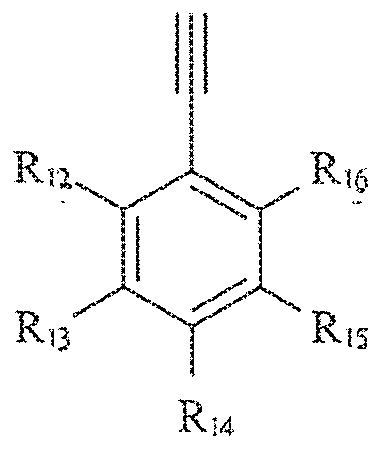
, where R12, R 13, R14, Ri 5 and Ri6 are selected from the group consisting of: !SF. 6Br, i, u% l25i or i 3 iI, as shown in Table ΪΠ as combinations 358 - 446.
26. The composition of claim 25, comprising: a precursor composition having the structura] formula (XX):

27. A composition, comprising: a precursor composition having the structural formula (XVIII):

, where Rj 2, R13, R1 , R15 and Ri6 are selected from the group consisting of: H, F, Br, CI, I, N02, ( Me3)+TfO", (NEt3)+TfO", Sn(Me)3 and K¾ as shown in Table IV as combinations 447 - 646.
28. The composition of claim 27, comprising: a precursor composition having the stmctural formula (XIX):

29, A composition, comprising: a precursor composition having the structural formula (XX Γ):
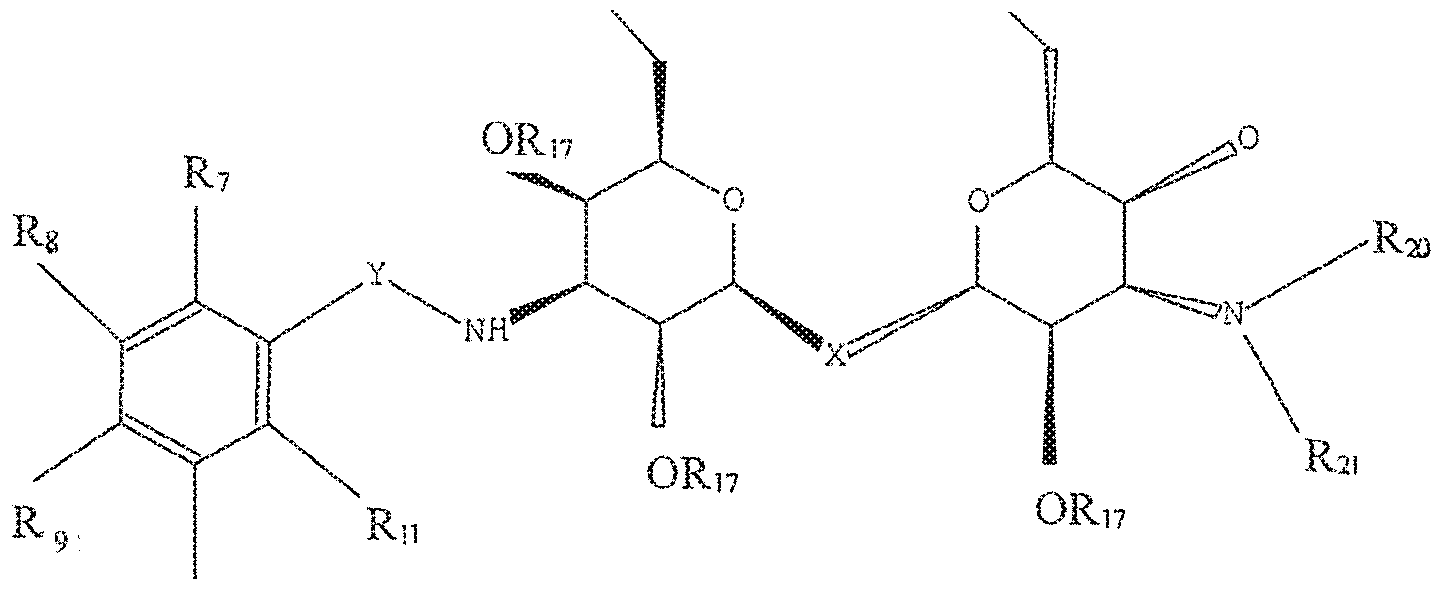
, where each R] 7 is a protecting group, where each R7, R8, R9, Rjo sad n is independently selected from the group consisting of: H, OH, F, Br. CI. I, N(Aik)2, Sn(AIk)3, SnCl2, N02 and OTf , where X is C, Si, O, NH, NCH3, S or Se, where Y is selected from the group consisting of: CH2, ~C=;= , carbonyl, -C(NH)-, -NH(CQ), - NH(CS), where R2o and R2i are each independently selected from the group consisting of: a substituted or unsubstituted alky], alkenyl, a!kyne, alkoxy, acyl, carbamoyl, aryl, heteroaryl, and peptidyl, and where at least one of R7, Rg. R , Rjo, sue! Rn is not H.
30. The composition of claim 29, where each R7, Rs, R9. ]o and u is independently selected from the group consisting of: H, ,8F, 76Br, 123/524 1 and UC , wiiere X is C, Si, O, NH, NC¾, S or Se, where Y is selected from the group consisting of: CH2, -C= , carbonyl, -C(NH)--, -NH(CO), -NH(CS), where R, and R2 are each mdependently selected from the group consisting of: a substituted or unsubstituted alkyi, alkenyl, alkyne, alkoxy, acyl., carbamoyl, aryl, heteroaryl, and peptidyl, and where at least one of R7, Rg, Rg, Rio, and i 1 is not H.
31. The composition of claim 29 or 30, where X is S.
32. A pharmaceutical composition comprising a labeled composition of any one of claims 1 to 13 further comprising a phamiaceuticaily acceptable carrier.
33. A method of detecting a galectin, comprising;
contacting a galectin with a labeled composition according to any one of claims 1 to 13 or 32 under conditions to form a complex of the labeled composition and the galectin; and
detecting a signal of the labeled composition in the complex of the labeled composition and the galectin.
34. The method of claim 33, wherein the labeled composition comprises a radionuclide and wherein detecting the signal comprises obtaining a PET, SPECT or scintigraphic image.
35. The method of claim 33, wherein the labeled composition comprises a fluorophore and wherein detecting the signal comprises obtaining a fluorescence image.
36. The method of any of claims 33-35, wherein the galectin is in vitro.
37. The method of any of claims 33-35, wherein the galectin is in a subject.
38. The method of claim 37, wherein the. subject has or is suspected of having cancer, heart failure, ventricular remodeling, an infection, an HIV infection, a pathological autoimmune condition and/or a pathological inflammatory condition.
39. The method of claim 38, wherein the cancer is breast cancer.
40. The method of any of claims 33-39, wherein the galectin is galectin- 1 or galectin-3,
41. A method of chemical synthesis of a labeled composition according to any of claims 1 to 13 or 32, comprising chemical reaction of a precursor composition according to any of claims 15 to 31.
42. A method of aiding in diagnosis and/or treatment of a condition characterized by upregulation of one or more galect s in a subject in need thereof, comprising:
contacting a gaiectin with a labeled composition according to any one of claims 1 to 13 or 32 under conditions to form a complex of the labeled composition and the gaiectin;
detecting a signal of the labeled composition in the complex of the labeled composition and the gaiectin: and
comparing the signal to a control, thereby determining the level of the one or more galectins'in the subject.
43. The method of claim 42, wherein the labeled composition comprises a radionuclide and wherein detecting the signal comprises obtaining a PET, SPECT or scintigraphic image.
44. The method of claim 42, wherein the labeled composition comprises a fluorophore and wherein detecting the signal comprises obtaining a fluorescence image.
45. The method of any of claims 42-44, wherein the one or more galectins are in a biological sample obtained from the subject.
46. The method of any of claims 42-44. wherein contacting a gaiectin with a labeled composition comprises administering the labeled composition to the subject.
47. The method of any of claims 42-46, wherein the subject has or is suspected of having cancer, heart failure, ventricular remodeling, an infection, an HIV infection, a pathological autoimmune condition and/or a pathological inflammatory condition.
48. The method of any of claims 42-47, wherein the subject has or is suspected of having breast cancer.
49. The method of any of claims 42-48, wherein the one or more galectins are selected from the group consisting of: galectin-1 and galeclin-3.
50. The method of any of claims 42-49, wherein the control includes a level of the one or more galectins determined in the subject prior to administration of a treatment for the condition characterized by upregulation of one or more galectins.
51. The method of any of claims 42-50, wherein the control includes a reference level of the one or more galectins in a comparable subject or population of comparable subjects.
52. A labeled composition substantially as shown or described herein.
53. A precursor composition substantially as shown or described herein.
54. A method of detecting a galectin substantially as shown or described herein.
55. A method of chemical synthesis of a labeled composition substantially as shown or described herein.
56. A commercial package substantially as shown or described herein.
Priority Applications (1)
| Application Number | Priority Date | Filing Date | Title |
|---|---|---|---|
| US15/747,649 US10799522B2 (en) | 2015-07-27 | 2016-07-27 | Compositions and methods relating to galectin detection |
Applications Claiming Priority (2)
| Application Number | Priority Date | Filing Date | Title |
|---|---|---|---|
| US201562197338P | 2015-07-27 | 2015-07-27 | |
| US62/197,338 | 2015-07-27 |
Publications (1)
| Publication Number | Publication Date |
|---|---|
| WO2017019770A1 true WO2017019770A1 (en) | 2017-02-02 |
Family
ID=57885335
Family Applications (1)
| Application Number | Title | Priority Date | Filing Date |
|---|---|---|---|
| PCT/US2016/044263 Ceased WO2017019770A1 (en) | 2015-07-27 | 2016-07-27 | Compositions and methods relating to galectin detection |
Country Status (2)
| Country | Link |
|---|---|
| US (1) | US10799522B2 (en) |
| WO (1) | WO2017019770A1 (en) |
Cited By (4)
| Publication number | Priority date | Publication date | Assignee | Title |
|---|---|---|---|---|
| WO2020260351A1 (en) * | 2019-06-24 | 2020-12-30 | Galecto Biotech Ab | Large scale process of 3,3'-dideoxy-3,3'-bis-[4-(3-fluorophenyl)-1h-1,2,3-triazol-1-yl]-1,1'-sulfanediyl-di-beta-d-galactopyranoside |
| US11548908B2 (en) | 2017-12-29 | 2023-01-10 | Glycomimetics, Inc. | Heterobifunctional inhibitors of E-selectin and galectin-3 |
| US11845771B2 (en) | 2018-12-27 | 2023-12-19 | Glycomimetics, Inc. | Heterobifunctional inhibitors of E-selectin and galectin-3 |
| US11873317B2 (en) | 2018-12-27 | 2024-01-16 | Glycomimetics, Inc. | Galectin-3 inhibiting c-glycosides |
Families Citing this family (3)
| Publication number | Priority date | Publication date | Assignee | Title |
|---|---|---|---|---|
| CA3025867A1 (en) * | 2016-07-12 | 2018-01-18 | Galecto Biotech Ab | Alpha-d-galactoside inhibitors of galectins |
| EP3621973A4 (en) | 2017-05-12 | 2021-10-27 | Galectin Sciences, LLC | COMPOUNDS FOR THE PREVENTION AND TREATMENT OF DISEASES AND THEIR USE |
| CN113476442A (en) * | 2021-07-28 | 2021-10-08 | 上海交通大学医学院附属第九人民医院 | Application of compound GB-0139 in medicine for treating excessive myocardial fibrosis after myocardial infarction |
Citations (3)
| Publication number | Priority date | Publication date | Assignee | Title |
|---|---|---|---|---|
| US20110130553A1 (en) * | 2008-05-16 | 2011-06-02 | Ulf Nilsson | Novel synthesis of galactoside inhibitors |
| WO2012116196A2 (en) * | 2011-02-24 | 2012-08-30 | Board Of Regents, The University Of Texas System | Substituted lactosyl compounds and use thereof for cellular imaging and therapy |
| WO2014078655A1 (en) * | 2012-11-15 | 2014-05-22 | Tufts University | Methods, compositions and kits for treating, modulating, or preventing ocular angiogenesis or fibrosis in a subject using a galectin protein inhibitor |
Family Cites Families (1)
| Publication number | Priority date | Publication date | Assignee | Title |
|---|---|---|---|---|
| CN104755088A (en) * | 2012-10-31 | 2015-07-01 | 格莱克特生物技术公司 | Galactoside inhibitor of galectin-3 and its use for treating pulmonary fibrosis |
-
2016
- 2016-07-27 WO PCT/US2016/044263 patent/WO2017019770A1/en not_active Ceased
- 2016-07-27 US US15/747,649 patent/US10799522B2/en active Active
Patent Citations (3)
| Publication number | Priority date | Publication date | Assignee | Title |
|---|---|---|---|---|
| US20110130553A1 (en) * | 2008-05-16 | 2011-06-02 | Ulf Nilsson | Novel synthesis of galactoside inhibitors |
| WO2012116196A2 (en) * | 2011-02-24 | 2012-08-30 | Board Of Regents, The University Of Texas System | Substituted lactosyl compounds and use thereof for cellular imaging and therapy |
| WO2014078655A1 (en) * | 2012-11-15 | 2014-05-22 | Tufts University | Methods, compositions and kits for treating, modulating, or preventing ocular angiogenesis or fibrosis in a subject using a galectin protein inhibitor |
Non-Patent Citations (1)
| Title |
|---|
| ZHANG, H ET AL.: "Synthesis and Evaluation of [18F]Fluorine-labeled Benzylguanidine Analogs for Targeting the Human Norepinephrine Transporter';", EUROPEAN JOURNAL OF NUCLEAR MEDICINE AND MOLECULAR IMAGING;, vol. 41, no. Issue 2, February 2014 (2014-02-01), pages 1 - 19, XP035341967 * |
Cited By (5)
| Publication number | Priority date | Publication date | Assignee | Title |
|---|---|---|---|---|
| US11548908B2 (en) | 2017-12-29 | 2023-01-10 | Glycomimetics, Inc. | Heterobifunctional inhibitors of E-selectin and galectin-3 |
| US11845771B2 (en) | 2018-12-27 | 2023-12-19 | Glycomimetics, Inc. | Heterobifunctional inhibitors of E-selectin and galectin-3 |
| US11873317B2 (en) | 2018-12-27 | 2024-01-16 | Glycomimetics, Inc. | Galectin-3 inhibiting c-glycosides |
| WO2020260351A1 (en) * | 2019-06-24 | 2020-12-30 | Galecto Biotech Ab | Large scale process of 3,3'-dideoxy-3,3'-bis-[4-(3-fluorophenyl)-1h-1,2,3-triazol-1-yl]-1,1'-sulfanediyl-di-beta-d-galactopyranoside |
| CN114222749A (en) * | 2019-06-24 | 2022-03-22 | 格莱克特生物技术公司 | Large scale process for 3,3' -dideoxy-3, 3' -bis- [4- (3-fluorophenyl) -1H-1,2,3-triazol-1-yl ] -1,1' -sulfonamido-di-beta-D-galactopyranoside |
Also Published As
| Publication number | Publication date |
|---|---|
| US10799522B2 (en) | 2020-10-13 |
| US20180221400A1 (en) | 2018-08-09 |
Similar Documents
| Publication | Publication Date | Title |
|---|---|---|
| WO2017019770A1 (en) | Compositions and methods relating to galectin detection | |
| CN111991570B (en) | A FAP-α-specific SPECT imaging agent for tumor diagnosis | |
| KR101523257B1 (en) | Nitro-imidazole hypoxia imaging agent | |
| KR101316982B1 (en) | Imaging agents for detecting neurological disorders | |
| De Bono et al. | Phase I pharmacokinetic and pharmacodynamic study of LAQ824, a hydroxamate histone deacetylase inhibitor with a heat shock protein-90 inhibitory profile, in patients with advanced solid tumors | |
| EP3964502B1 (en) | Psma-targeting compounds and uses thereof | |
| JP5541922B2 (en) | Efficient synthesis and composition and use of chelating agents for nuclear imaging and radiation therapy | |
| JP4530665B2 (en) | Non-invasive imaging techniques for mitochondria by using radiolabeled lipophilic salts | |
| KR101616139B1 (en) | Contrast agents for applications including perfusion imaging | |
| JP5208328B1 (en) | Radioactive fluorine-labeled compound | |
| WO2015031984A1 (en) | Halogenated compounds for cancer imaging and treatment and methods for their use | |
| Wang et al. | Noninvasive positron emission tomography imaging of cell death using a novel small-molecule probe, 18F labeled bis (zinc (II)-dipicolylamine) complex | |
| EP3130596B1 (en) | Glucose derivative, and cell imaging method and imaging agent using said derivative | |
| Yuen et al. | Design, synthesis, and evaluation of positron emission tomography/fluorescence dual imaging probes for targeting facilitated glucose transporter 1 (GLUT1) | |
| Sun et al. | Positron emission tomography imaging of cardiomyocyte apoptosis with a novel molecule probe [18F] FP-DPAZn2 | |
| WO2016067238A1 (en) | Quinoline-3-carboxamide compounds and their use in diagnosis | |
| CN116730983B (en) | Compound targeting prostate specific antigen and preparation method and application thereof | |
| CN113398284B (en) | Molecular probe for tumor targeted nuclide diagnosis and treatment, preparation method and application | |
| EP3781019A2 (en) | Fluorine-18 labeled compositions and their use in imaging of biological tissue | |
| He et al. | Development of a multifunctional platform for near-infrared imaging and targeted radionuclide therapy for tumors | |
| JP2019043882A (en) | Therapeutic effect predictors for alternative anticancer drugs | |
| WO2021025984A1 (en) | Radiolabeled sugars for imaging of fungal infections | |
| US20250275943A1 (en) | Composition for cancer diagnosis targeting tumor and/or tumor microenvironment and use thereof | |
| US20180064742A1 (en) | Pet imaging tracer for imaging prostate cancer | |
| EP4667019A1 (en) | Psma-targeted radiopharmaceutical, and synthesis and use thereof |
Legal Events
| Date | Code | Title | Description |
|---|---|---|---|
| 121 | Ep: the epo has been informed by wipo that ep was designated in this application |
Ref document number: 16831291 Country of ref document: EP Kind code of ref document: A1 |
|
| NENP | Non-entry into the national phase |
Ref country code: DE |
|
| 122 | Ep: pct application non-entry in european phase |
Ref document number: 16831291 Country of ref document: EP Kind code of ref document: A1 |