WO2017017118A1 - Trans-disubstituted benzodiazaporphyrins as sensitizers for solar cells - Google Patents
Trans-disubstituted benzodiazaporphyrins as sensitizers for solar cells Download PDFInfo
- Publication number
- WO2017017118A1 WO2017017118A1 PCT/EP2016/067848 EP2016067848W WO2017017118A1 WO 2017017118 A1 WO2017017118 A1 WO 2017017118A1 EP 2016067848 W EP2016067848 W EP 2016067848W WO 2017017118 A1 WO2017017118 A1 WO 2017017118A1
- Authority
- WO
- WIPO (PCT)
- Prior art keywords
- alkyl
- aryl
- amino
- independently selected
- combinations
- Prior art date
- Legal status (The legal status is an assumption and is not a legal conclusion. Google has not performed a legal analysis and makes no representation as to the accuracy of the status listed.)
- Ceased
Links
Classifications
-
- C—CHEMISTRY; METALLURGY
- C09—DYES; PAINTS; POLISHES; NATURAL RESINS; ADHESIVES; COMPOSITIONS NOT OTHERWISE PROVIDED FOR; APPLICATIONS OF MATERIALS NOT OTHERWISE PROVIDED FOR
- C09B—ORGANIC DYES OR CLOSELY-RELATED COMPOUNDS FOR PRODUCING DYES, e.g. PIGMENTS; MORDANTS; LAKES
- C09B47/00—Porphines; Azaporphines
-
- C—CHEMISTRY; METALLURGY
- C09—DYES; PAINTS; POLISHES; NATURAL RESINS; ADHESIVES; COMPOSITIONS NOT OTHERWISE PROVIDED FOR; APPLICATIONS OF MATERIALS NOT OTHERWISE PROVIDED FOR
- C09B—ORGANIC DYES OR CLOSELY-RELATED COMPOUNDS FOR PRODUCING DYES, e.g. PIGMENTS; MORDANTS; LAKES
- C09B47/00—Porphines; Azaporphines
- C09B47/04—Phthalocyanines abbreviation: Pc
- C09B47/045—Special non-pigmentary uses, e.g. catalyst, photosensitisers of phthalocyanine dyes or pigments
-
- C—CHEMISTRY; METALLURGY
- C09—DYES; PAINTS; POLISHES; NATURAL RESINS; ADHESIVES; COMPOSITIONS NOT OTHERWISE PROVIDED FOR; APPLICATIONS OF MATERIALS NOT OTHERWISE PROVIDED FOR
- C09B—ORGANIC DYES OR CLOSELY-RELATED COMPOUNDS FOR PRODUCING DYES, e.g. PIGMENTS; MORDANTS; LAKES
- C09B47/00—Porphines; Azaporphines
- C09B47/04—Phthalocyanines abbreviation: Pc
- C09B47/06—Preparation from carboxylic acids or derivatives thereof, e.g. anhydrides, amides, mononitriles, phthalimide, o-cyanobenzamide
- C09B47/063—Preparation from carboxylic acids or derivatives thereof, e.g. anhydrides, amides, mononitriles, phthalimide, o-cyanobenzamide having oxygen or sulfur atom(s) linked directly to the skeleton
-
- C—CHEMISTRY; METALLURGY
- C09—DYES; PAINTS; POLISHES; NATURAL RESINS; ADHESIVES; COMPOSITIONS NOT OTHERWISE PROVIDED FOR; APPLICATIONS OF MATERIALS NOT OTHERWISE PROVIDED FOR
- C09B—ORGANIC DYES OR CLOSELY-RELATED COMPOUNDS FOR PRODUCING DYES, e.g. PIGMENTS; MORDANTS; LAKES
- C09B47/00—Porphines; Azaporphines
- C09B47/04—Phthalocyanines abbreviation: Pc
- C09B47/06—Preparation from carboxylic acids or derivatives thereof, e.g. anhydrides, amides, mononitriles, phthalimide, o-cyanobenzamide
- C09B47/067—Preparation from carboxylic acids or derivatives thereof, e.g. anhydrides, amides, mononitriles, phthalimide, o-cyanobenzamide from phthalodinitriles naphthalenedinitriles, aromatic dinitriles prepared in situ, hydrogenated phthalodinitrile
- C09B47/0675—Preparation from carboxylic acids or derivatives thereof, e.g. anhydrides, amides, mononitriles, phthalimide, o-cyanobenzamide from phthalodinitriles naphthalenedinitriles, aromatic dinitriles prepared in situ, hydrogenated phthalodinitrile having oxygen or sulfur linked directly to the skeleton
-
- H—ELECTRICITY
- H01—ELECTRIC ELEMENTS
- H01G—CAPACITORS; CAPACITORS, RECTIFIERS, DETECTORS, SWITCHING DEVICES, LIGHT-SENSITIVE OR TEMPERATURE-SENSITIVE DEVICES OF THE ELECTROLYTIC TYPE
- H01G9/00—Electrolytic capacitors, rectifiers, detectors, switching devices, light-sensitive or temperature-sensitive devices; Processes of their manufacture
- H01G9/20—Light-sensitive devices
- H01G9/2059—Light-sensitive devices comprising an organic dye as the active light absorbing material, e.g. adsorbed on an electrode or dissolved in solution
-
- H—ELECTRICITY
- H10—SEMICONDUCTOR DEVICES; ELECTRIC SOLID-STATE DEVICES NOT OTHERWISE PROVIDED FOR
- H10K—ORGANIC ELECTRIC SOLID-STATE DEVICES
- H10K85/00—Organic materials used in the body or electrodes of devices covered by this subclass
- H10K85/30—Coordination compounds
- H10K85/311—Phthalocyanine
-
- H—ELECTRICITY
- H01—ELECTRIC ELEMENTS
- H01G—CAPACITORS; CAPACITORS, RECTIFIERS, DETECTORS, SWITCHING DEVICES, LIGHT-SENSITIVE OR TEMPERATURE-SENSITIVE DEVICES OF THE ELECTROLYTIC TYPE
- H01G9/00—Electrolytic capacitors, rectifiers, detectors, switching devices, light-sensitive or temperature-sensitive devices; Processes of their manufacture
- H01G9/20—Light-sensitive devices
- H01G9/2027—Light-sensitive devices comprising an oxide semiconductor electrode
- H01G9/2031—Light-sensitive devices comprising an oxide semiconductor electrode comprising titanium oxide, e.g. TiO2
-
- H—ELECTRICITY
- H10—SEMICONDUCTOR DEVICES; ELECTRIC SOLID-STATE DEVICES NOT OTHERWISE PROVIDED FOR
- H10K—ORGANIC ELECTRIC SOLID-STATE DEVICES
- H10K85/00—Organic materials used in the body or electrodes of devices covered by this subclass
- H10K85/30—Coordination compounds
- H10K85/381—Metal complexes comprising a group IIB metal element, e.g. comprising cadmium, mercury or zinc
-
- Y—GENERAL TAGGING OF NEW TECHNOLOGICAL DEVELOPMENTS; GENERAL TAGGING OF CROSS-SECTIONAL TECHNOLOGIES SPANNING OVER SEVERAL SECTIONS OF THE IPC; TECHNICAL SUBJECTS COVERED BY FORMER USPC CROSS-REFERENCE ART COLLECTIONS [XRACs] AND DIGESTS
- Y02—TECHNOLOGIES OR APPLICATIONS FOR MITIGATION OR ADAPTATION AGAINST CLIMATE CHANGE
- Y02E—REDUCTION OF GREENHOUSE GAS [GHG] EMISSIONS, RELATED TO ENERGY GENERATION, TRANSMISSION OR DISTRIBUTION
- Y02E10/00—Energy generation through renewable energy sources
- Y02E10/50—Photovoltaic [PV] energy
- Y02E10/542—Dye sensitized solar cells
-
- Y—GENERAL TAGGING OF NEW TECHNOLOGICAL DEVELOPMENTS; GENERAL TAGGING OF CROSS-SECTIONAL TECHNOLOGIES SPANNING OVER SEVERAL SECTIONS OF THE IPC; TECHNICAL SUBJECTS COVERED BY FORMER USPC CROSS-REFERENCE ART COLLECTIONS [XRACs] AND DIGESTS
- Y02—TECHNOLOGIES OR APPLICATIONS FOR MITIGATION OR ADAPTATION AGAINST CLIMATE CHANGE
- Y02E—REDUCTION OF GREENHOUSE GAS [GHG] EMISSIONS, RELATED TO ENERGY GENERATION, TRANSMISSION OR DISTRIBUTION
- Y02E10/00—Energy generation through renewable energy sources
- Y02E10/50—Photovoltaic [PV] energy
- Y02E10/549—Organic PV cells
Definitions
- This invention relates to dye-sensitive light absorbing species and, more particularly, to trans- disubstituted benzodiazaporphyrins useful in dye-sensitive light absorbing applications especially active in the long wavelength spectrum range.
- Dye-sensitized solar cells and organic solar cells (OSCs) have the potential to provide photovoltaic energy at competitive price with a clean and sustainable technology.
- DSSCs DS-sensitized solar cells
- OSCs organic solar cells
- ruthenium polypyridine complexes have been the most efficient sensitizers for several decades (photoconversion efficiencies in the range of 10-1 1 %), while in the OSC the development of small photoactive molecules is gaining an increase in attention.
- YD2 and SM315 are push-pull systems, containing namely a diaryl amino unit as electron donating group and a benzoic acid or a benzothiadiazole unit as electron withdrawing group, as
- Phthalocyanines are ⁇ -conjugated macrocycles related to porphyrins which have also been thoroughly investigated as sensitizers in DSSCs and OSCs.
- PCE power conversion efficiency
- a phthalocyanine in DSSCs is 6.4% and can be obtained with PcS20 represented below, wherein and R 2 are butoxy and R 3 is H, as disclosed in Ikeuchi, T. et al., Chem. Commun., 2014, 50,
- phthalocyanines A valuable property of phthalocyanines is their strong absorption band located around 670 nm , which enables to obtain a high photoactivity (IPCE around 80%) in a low energy region of the visible spectrum.
- IPCE photoactivity
- the higher energy region between 420-600 nm
- the preparation of trans disubtituted phtalocyanines is an extremely tedious and challenging synthetic task, which limits the possibility to develop push-pull dyes for solar cell applications.
- Benzodiazaporphyrins can be considered as hybrid dyes between porphyrins and phthalocyanines since two of the bridging meso positions are occupied by nitrogen like phthalocyanines, while the two other meso positions are regular methene moieties which can carry substituents.
- the two interesting and valuable features of benzodiazaporphyrins is first, the presence of an intense and long wavelength absorption band like phthalocyanines, and the possibility to envision the preparation of push-pull or quadrupolar systems by trans functionalization of the two adjacent carbon meso positions.
- trans disubstituted benzodiazaporphyrins that are highly efficient dye sensitizers for solar cells, particularly for DSSCs or OSCs because they have a strong absorption band in the N IR region and can be used to produce solar cells with interesting power conversion efficiencies (PCEs).
- a first object of the present invention is a compound of general formula (I) : wherein Ri-Ri 6 , X, Y and n are as defined herein.
- Another object of the present invention is a dye-sensitized solar cell comprising an anode, a counter- electrode, a nanocrystalline semiconductor, a sensitizer and an electrolyte, wherein the sensitizer is a compound of general formula (II) :
- Ri-Ri 6 , A, B,C, U and M are as defined herein.
- Yet another object of the present invention is the use of a compound of general formula (I I) as a sensitizer for a dye-sensitized solar cell.
- Another object of the present invention is an organic solar cell comprising an anode, a cathode and a sensitizer, wherein said sensitizer is a compound of general formula (V) :
- Ri-Ri 6 , D, E,F, G, L 2 , M and n are as defined herein.
- Yet another object of the present invention is the use of a compound of general formula (V) as a sensitizer for an organic solar cell.
- Figure 1 shows the synthetic route for the preparation of CROSSDAP.
- FIG. 2 shows the synthetic route for the preparation of TPA-CROSSDAP.
- Figure 3 shows the electronic absorption (straight line) and emission spectra (dashed line) of CROSSDAP recorded in dimethylformamide.
- Figure 4 shows the electronic absorption (straight line) and emission spectra (dashed line) of a precursor of TPA-CROSSDAP recorded in dichloromethane.
- Figure 5 shows the current/voltage characteristics of a DSSC sensitized with CROSSDAP recorded in the dark (dashed line) and under AM 1 .5 illumination (straight line).
- FIG. 6 shows the photoaction spectra (Incident photon-to-current efficiency (IPCE) as a function of the incident wavelength) of a DSSC sensitized with CROSSDAP.
- IPCE Incident photon-to-current efficiency
- the groups and radicals listed for X, Y, P -R ⁇ , A, B, C, D, E, F, G , and L 2 may be substituted or unsubstituted.
- substituted it is meant that one of the hydrogen atoms of said group or radical is replaced with a substituent other than H.
- Suitable substituents are halogen atoms, such as CI, Br, I and F; and groups selected from alkyl, cycloalkyl, alkoxy, aryl, heteroaryl, cyano, amino, dialkylamino, diarylamino, triarylamino, dialkylarylamino, thioether, a carboxylic group, a sulfonic group.
- alkyl means any monovalent radical of a linear or branched hydrocarbon chain comprising 1 to 1 8 carbon atoms.
- C- ⁇ -C e alkyl represents an alkyl having 1 to 6 carbon atoms.
- alkyl groups include methyl, ethyl, n-propyl, /-propyl, n-butyl, /-butyl, s-butyl or f-butyl, n- pentyl, n-hexyl, n-heptyl, n-octyl, 2-ethylhexyl, n-nonyl, 3,5,5-trimethylhexyl, n-decyl, n-undecyl, n- dodecyl or n-octadecyl.
- Preferred alkyls are methyl, ethyl, isopropyl and f-butyl.
- alkoxy means an -O-alkyl group wherein the term alkyl is as defined above.
- the expression "CrCe alkoxy” represents an alkoxy having 1 to 6 carbon atoms. Examples of alkoxy groups include methoxy, ethoxy, n-propoxy, /-propoxy, n-butoxy, /-butoxy, s-butoxy or f-butoxy, n-pentoxy, n-hexoxy. Preferred alkoxys are methoxy, ethoxy, isopropoxy and f-butoxy.
- aryl means any monovalent radical of an aromatic hydrocarbon ring comprising 6 to 1 2 carbon atoms.
- C 6 -aryl represents an aryl having 6 carbon atoms. Examples of aryls include phenyl, naphthyl and biphenyl. Preferred aryls are phenyl and naphthyl.
- phenoxy means an -O-phenyl group.
- thioether means an -S-alkyl group or -S-aryl group wherein the terms alkyl and aryl are as defined above.
- Ci-C 6 thioether represents a thioether having 1 to 6 carbon atoms. Examples of thioether groups include thiomethyl and thiophenyl (-S-Ph).
- heteroaryl means any monovalent radical of an aromatic 5 to 6 membered monocyclic ring or 9 to 20 membered bicyclic ring which can comprise 1 , 2 or 3 heteroatoms selected from nitrogen, oxygen and/or sulphur.
- the expression "5- to 10-membered heteroaryl” means a heteroaryl with 5 to 10 ring atoms.
- heteroaryls include furyl, pyridinyl, pyridazinyl, pyrimidinyl, pyrazinyl, thienyl, isoxazolyl, oxazolyl, oxadiazolyl, imidazolyl, pyrrolyl, pyrazolyl, triazolyl, tetrazolyl, thiazolyl, isothiazolyl, thiadiazolyl, benzoimidazolyl, indolyl, indanyl, indazolyl, benzothiazolyl, benzoisothiazolyl, benzoxazolyl, benzoisoxazolyl, benzothiadiazolyl, benzotriazolyl, quinolinyl, isoquinolinyl, a monovalent pyridinium radical, a monovalent diketopyrrolopyrrole radical and a monovalent isoindigo radical.
- Preferred heteroaryls are thienyl, benzothiadiazolyl, benzotriazolyl, pyridinyl, triazolyl, a monovalent pyridinium radical, a monovalent diketopyrrolopyrrole radical and a monovalent isoindigo radical.
- alkyl, aryl or heteroaryl group When the suffixes "ene” or “diyl” are used in conjunction with an alkyl, aryl or heteroaryl group, this means that the alkyl, aryl or heteroaryl group defined above is a divalent radical, i.e. it has two points of attachment to other groups.
- cycloalkyl means a non-aromatic cyclic hydrocarbon chain comprising 5 to 7 carbon atoms.
- alkendiyl means any divalent radical of a hydrocarbon chain comprising 2 carbon atoms and 1 carbon-carbon double bond or 4 carbon atoms and two conjugated carbon-carbon double bonds or 6 carbon atoms and three conjugated carbon-carbon double bonds.
- alkyndiyl means any divalent radical of a hydrocarbon chain comprising 2 carbon atoms and 1 triple carbon-carbon bond or 4 carbon atoms and two conjugated triple carbon-carbon bonds or 6 carbon atoms and three conjugated triple carbon-carbon bonds.
- amino means a -NH 2 group.
- dialkyi amino means an amino group wherein each hydrogen has been replaced with an alkyl group.
- diaryl amino means an amino group wherein each hydrogen has been replaced with an aryl group.
- triaryl amino means an aryl group wherein one H has been substituted by a diaryl amino group.
- dialkylaryl amino means an aryl group wherein one H has been substituted by a dialkyi amino group.
- oligothienyl means a monovalent radical of an oligomer of thiophene monomers linked together in positions 2 and 5 by a single bond.
- carboxylic group means a group of general formula -COOR c wherein R c is H, a metallic cation or an alkyl group as defined above.
- the compounds of the present invention have a central benzodiazaporphyrin core onto which are branched two groups X and Y in trans position.
- R1 -R16 are each independently selected from H , alkyl and aryl ; or two adjacent R1 -R16 groups optionally form , together with the carbon atoms to which they are attached, a ring selected from cycloalkyi and aryl, and the remaining RrR 16 groups are each independently selected from H , alkyl and aryl ;
- X and Y each comprise at least one group selected from H , alkyl , aryl, arylene, heteroaryl , heteroarylene, alkendiyl, alkyndiyl, dialkyl am ino, diaryl amino, triaryl am ino and dialkylaryl amino;
- M represents 2 hydrogen atoms; or M is selected from Zn, Mg, Al, Si, Cu, Ru, Au, Sn, Pd, Pt, Ir and Ni ; or M is selected from Sn(IV)(L) 2 , P(V)(L) 2 , Au(l l l) , Ru(l l) LU, Ir(l l l) wherein L and U represent axial ligands selected from halogeno, hydroxo, alkoxide, carboxylato, CO, and pyridine;
- n 0 or 1 ;
- X and Y are not both H , or both alkyl or both aryl.
- compounds of the present invention correspond to general form ula (I I) :
- R1 -R16 are each independently selected from H, alkyl and aryl; or two adjacent R1 -R16 groups optionally form , together with the carbon atoms to which they are attached, a ring selected from cycloalkyi and aryl, and the remaining RrR 16 groups are each independently selected from H, alkyl and aryl ;
- A is selected from H, alkyl, aryl, dialkyl amino, diaryl amino, triaryl amino, dialkylaryl amino, thienyl, oligothienyl, and combinations thereof;
- B is selected from arylene, heteroarylene, alkendiyl, alkyndiyl and combinations thereof;
- M represents 2 hydrogen atoms; or M is selected from Zn, Mg, Al, Si, Cu, Ru, Au, Sn, Pd, Pt, Ir and Ni.
- R ⁇ R 4 , R 5 , R 8 , R 9 , R 12 , R13 and R 16 may be H ; and R 2 with R 3 ; R 6 with R 7 ; R 10 with R ⁇ ; and R 14 with R 15 ; may, together with the carbon atoms to which they are attached, form a ring selected from cycloalkyi and aryl, more particularly a ring selected from C 6 -cycloalkyl and C 6 -aryl; even more particularly a ring selected from phenyl, cyclohexyl and cyclohexyl substituted with 1 to 4 methyl groups.
- R1 -R16 groups of the compounds of general formula (II) may each be independently selected from H, d-Ce-alkyl and C 6 -aryl. More particularly, RrR 16 may all be H ; or RrR 16 may each be independently selected from H and d-d-alkyl; or R R 16 may each be independently selected from H and C 6 -aryl.
- RrR 16 may each be independently selected from H, methyl, ethyl, isopropyl, tert-butyl and hexyl; or RrR 16 may each be independently selected from H and phenyl optionally substituted by one or two substituents independently selected from alkyl, alkoxy, phenoxy, dialkylamino, diphenylamino, thioether, carboxylic group and sulfonic group.
- the A group of the compounds of general formula (I I) may be selected from H, d-d-alkyl, C 6 -aryl, di-d-d-alkyl amino, di-C 6 -aryl amino, tri-C 6 -aryl amino, di-d-d-alkyl-d-aryl amino, thienyl, oligothienyl, and combinations thereof. More particularly, A may be selected from phenyl, diphenylamino, triphenylamino wherein said groups may optionally be substituted by one or two substituents selected from alkyl, alkoxy and thioether.
- A may be di(f-butyl)phenyl, diphenylamino, bis(4-methoxyphenyl)amino, bis(4-hexylphenyl)amino, diphenylamino wherein each phenyl is substituted with a dihexyloxyphenyl, phenyl substituted with diphenylamino, phenyl substituted with bis(4-methoxyphenyl)amino, and phenyl substituted with diphenylamino wherein each phenyl group of the diphenylamino substituent are further substituted with a dihexyloxyphenyl.
- the M group of the compounds of general formula (I I) may represent 2 hydrogen atoms or M may be selected from Zn, Mg, Al, Si, Cu, Ru and Ni. More particularly M may be selected from Zn, Mg and Cu. Even more particularly, M may be Zn.
- the compounds of the first embodiment of the present invention may correspond to general formula (I I) wherein
- R ! -R 16 are each independently selected from H, C ⁇ Ce-alkyl and C 6 -aryl;
- A is selected from H, CrCe-alkyl, C 6 -aryl, di-CrCe-alkyl amino, di-C 6 -aryl amino, tri-C 6 -aryl amino, di-CrCe-alkyl-Ce-aryl amino, thienyl, oligothienyl, and combinations thereof;
- M represents 2 hydrogen atoms; or M is selected from Zn, Mg, Al, Si, Cu, Ru and Ni; in particular Zn, Mg and Cu; preferably Zn.
- the compounds of general formula (II) may correspond to general formula (II I) or (IV)
- the compounds of formula (II), (II I) and (IV) are selected from :
- R1 -R16 are each independently selected from H, alkyl and aryl; or two adjacent R1 -R16 groups optionally form , together with the carbon atoms to which they are attached, a ring selected from cycloalkyl and aryl, and the remaining Ri -Ri 6 groups are each independently selected from H, alkyl and aryl ;
- D and G are each independently selected from H, alkyl, aryl, heteroaryl, oligothienyl, dialkyl amino, diaryl amino, triaryl amino, dialkylaryl amino, alkenyl, and combinations thereof;
- E and F are each independently selected from arylene, heteroarylene, alkendiyl, alkyndiyl, and combinations thereof;
- M represents 2 hydrogen atoms; or M is selected from Zn, Mg, Al, Si, Cu, Ru, Au, Sn, Pd, Pt, Ir and Ni; or M is selected from Sn(IV)(L) 2 , P(V)(L) 2 , Au(l l l), Ru(ll)LU, Ir(l ll) wherein L and U represent axial ligands selected from halogeno, hydroxo, alkoxide, carboxylato, CO and pyridine; and
- n 0 or 1 .
- the compounds of the second embodiment of the present invention may correspond to general formula (V) wherein the sequence D-L 2 -E-L 2 - is identical to the sequence -L2-F-L2-G. Indeed, the synthesis of such compounds is easy and convergent.
- R R 4 , R 5 , R 8 , R 9 , Ri 2 , R13 and R 16 may be H ; and R 2 with R 3 ; R 6 with R 7 ; R 10 with Ru ; and R 14 with R 15 ; may, together with the carbon atoms to which they are attached, form a ring selected from cycloalkyl and aryl, more particularly a ring selected from C 6 -cycloalkyl and C 6 -aryl; even more particularly a ring selected from phenyl, cyclohexyl and cyclohexyl substituted with 1 to 4 methyl groups.
- RrR 16 groups of the compounds of general formula (V) may each be independently selected from H, CrCe-alkyl and C 6 -aryl. More particularly, RrR 16 may all be H ; or RrR 16 may each be independently selected from H and Ci-C 6 -alkyl; or Ri -Ri 6 may each be independently selected from H and C 6 -aryl.
- Ri -Ri 6 may each be independently selected from H, methyl, ethyl, isopropyl, tert-butyl and hexyl; or Ri -Ri 6 may each be independently selected from H and phenyl optionally substituted by one or two substituents selected from alkyl, alkoxy, phenoxy, dialkylamino, diphenylamino, thioether, carboxylic group and sulfonic group.
- the D and G groups of the compounds of general formula (V) may each be independently selected from H, CrCe-alkyl, C 6 -aryl, 5- to 20-membered heteroaryl, oligothienyl, di-CrCe-alkyl amino, di-C 6 -aryl amino, tri-C 6 -aryl amino, di-CrCe-alkyl-Ce-aryl amino, alkenyl, and combinations thereof.
- D and G may be independently selected from H, d-Ce-alkyl, C 6 -aryl, di-Ci-C 6 -alkyl amino, di-C 6 -aryl amino, tri-C 6 -aryl amino, di-Ci-C 6 -alkyl-C 6 -aryl amino, thienyl, oligothienyl, and combinations thereof; or D and G may be independently selected from H, C 6 -aryl, 5- to 20-membered heteroaryl, alkenyl, and combinations thereof.
- D and G may be independently selected from phenyl, diphenyl amino and triphenylamino; wherein said groups may optionally be substituted by one or two substituents selected from alkyl, alkoxy, phenoxy, dialkylamino, diphenylamino, thioether, carboxylic group and sulfonic group; or D and G may be independently selected from phenyl, thienyl optionally fused with an /V-alkyl pyrrolidine-2,5-dione, benzothiadiazolyl optionally fused with a 2-alkyl triazole, benzotriazolyl, pyridinyl, triazolyl, phthalimidyl, a pyridinium radical, a diketopyrrolopyrrole radical, an isoindigo radical, a /V-alkyl-2,2'-bithiophene-3,3'-dicarboximide radical, dicyanovinyl, tricyano
- the M group of the compounds of general formula (V) may represent 2 hydrogen atoms; or M may be selected from Zn, Mg, Al, Si, Cu, Ru and Ni; or M may be selected from Sn(IV)(L) 2 , P(V)(L) 2 , Au(l ll), Ru(ll)LL', Ir(ll l) wherein L and L' represent axial ligands selected from halogeno, for example CI " , Br “ or ⁇ ; hydroxo (OH “ ) ; alkoxide, for example R'O " wherein R' is alkyl or phenyl; carboxylato, for example R'COO " wherein R' is alkyl or phenyl; CO; and pyridine.
- M may be selected from Zn, Mg and Cu; or M may be seleced from Sn(IV)(L) 2 , P(V)(L) 2 and Au(l ll).
- n is 0 or 1 and depends on the nature of M. As such, n is 1 when M is Au(l ll) or Ir(ll l). Otherwise, n is 0.
- RrR 16 are each independently selected from H, d-Ce-alkyl and C 6 -aryl;
- D and G are each independently selected from H, d-C 6 -alkyl, C 6 -aryl, di-d-C 6 -alkyl amino, di-C 6 -aryl amino, tri-C 6 -aryl amino and di-d-d-alkyl-Ce-aryl amino, thienyl, oligothienyl, and combinations thereof; in particular phenyl, diphenyl amino and triphenylamino; wherein said groups may optionally be substituted by one or two substituents selected from alkyl, alkoxy, phenoxy, dialkylamino, diphenylamino, thioether, carboxylic group and sulfonic group;
- E and F are each independently selected from C 6 -arylene, 5- to 20-membered heteroarylene, -C ⁇ C-,
- M represents 2 hydrogen atoms; or M is selected from Sn(IV)(L) 2 , P(V)(L) 2 , Au(l ll), Ru(l l)LL', Ir(l ll) wherein L and L' represent axial ligands selected from halogeno, for example CI " , Br " or ⁇ ; hydroxo
- D-A-D Donor-Acceptor-Donor compounds
- D-A-D Donor-Acceptor-Donor compounds
- the D-A-D compound of formula (V) is:
- M is Sn(IV)(L) 2 and n is 0, or M is P(V)(L) 2 and n is 0, or M is Au(ll l) and n is 1 , or M is Ru(l l)LL' and n is 0, or M is Ir(l ll) and n is 1 ;
- L is selected from CI “ , Br “ , I “ , OH “ , R'O “ and R'COO " with R' is alkyl or phenyl ;
- R ! -R 16 are each independently selected from H, C ⁇ Ce-alkyl and C 6 -aryl;
- D and G are each independently selected from H, C 6 -aryl, 5- to 20-membered heteroaryl, alkenyl, and combinations thereof; in particular phenyl, thienyl optionally fused with an /V-alkyl pyrrolidine-2,5-dione, benzothiadiazolyl optionally fused with a 2-alkyl triazole, benzotriazolyl, pyridinyl, triazolyl, phthalimidyl, a pyridinium radical, a diketopyrrolopyrrole radical, an isoindigo radical, a A/-alkyl-2,2'-bithiophene-3,3'- dicarboximide radical, dicyanovinyl, tricyanovinyl, and combinations thereof;
- Such compounds are considered as Acceptor-Donor-Acceptor compounds (A-D-A) wherein the central diazaporphyrin core is an electron donor and the D and G groups are electron acceptors.
- the A-D-A compound of formula (V) is:
- Compounds represented by formula (I) may be prepared according to various methods well known in the art. For example, said compounds may be prepared according to the synthetic route detailed in Figures 1 and 2.
- Dye-sensitized solar cell (DSSC) Dye-sensitized solar cell
- the present invention also relates to a dye-sensitized solar cell (DSSC) comprising a compound of general formula (II) as defined herein.
- DSSC dye-sensitized solar cell
- the DSSC of the present invention comprises an anode, a counter-electrode, a nanocrystalline semiconductor, a sensitizer and an electrolyte.
- the DSSC comprises an anode onto which is deposited a nanocrystalline semiconductor.
- the sensitizer is adsorbed on said nanocrystalline semiconductor.
- the DSSC further comprise a counter-electrode onto which is spread the electrolyte. The anode and counter-electrode are joined and sealed together to prevent the electrolyte from leaking.
- the anode of the DSSC of the present invention may be a transparent material, for example glass or a transparent polymer such as polyethylene terephthalate or polyethersulfone, doped with a semiconductor, for example indium tin oxide (ITO), tin oxide (Sn0 2 ), fluoride-doped tin dioxide (FTO) and mixtures thereof.
- a transparent material for example glass or a transparent polymer such as polyethylene terephthalate or polyethersulfone
- a semiconductor for example indium tin oxide (ITO), tin oxide (Sn0 2 ), fluoride-doped tin dioxide (FTO) and mixtures thereof.
- the substrate may be a glass plate coated with one or two layers of semiconductor selected from IOT, Sn0 2 , FTO and mixtures thereof.
- the nanocrystalline semiconductor of the DSSC of the present invention may comprise a metal oxide.
- said metal oxide may be selected from titanium dioxide, tin oxide, zinc oxide, tungsten oxide, zirconium oxide, gallium oxide, indium oxide, yttrium oxide, niobium oxide, tantalum oxide, vanadium oxide, and mixtures thereof. More particularly, said metal oxide may be selected from titanium dioxide, tin oxide, zinc oxide, indium oxide, and mixtures thereof, preferably titanium dioxide.
- nanocrystalline semiconductor can be in the form of a nanostructured film.
- nanostructured film it is meant a film of nanoparticles having a diameter from 1 to 500 nm .
- the nanocrystalline semiconductor is a nanostructured Ti0 2 film.
- the nanocrystalline semiconductor can be a nanostructured Ti0 2 film comprising Ti0 2 nanoparticles that exhibit a diameter of 10 to 30 nm ; in particular 15 to 25 nm ; more particularly 20 nm. Said nanostructured Ti0 2 film can exhibit a thickness of 7 to 25 ⁇ ; in particular 10 to 20 pm ; more particularly 12 to 15 pm.
- the nanocrystalline semiconductor of the DSSC can comprise a plurality of nanostructured Ti0 2 layers.
- the DSSC can comprise a plurality of Ti0 2 layers that do not exhibit the same particle diameter.
- the DSSC can comprise a first layer of Ti0 2 on the substrate and a second layer of Ti0 2 on said first layer, wherein the diameter of the Ti0 2 nanoparticles of the second layer is higher than the diameter of the Ti0 2 nanoparticles of the first layer.
- adding a second Ti0 2 layer with larger particle size on the first Ti0 2 layer can increase the solar efficiency of the DSSC because the second layer with larger particle size increases the light scattering of the semiconductor.
- the first Ti0 2 layer can be a nanostructured Ti0 2 film comprising Ti0 2 nanoparticles that exhibit a diameter of 10 to 30 nm ; in particular 1 5 to 25 nm ; more particularly 20 nm ; and the second Ti0 2 layer can be a nanostructured Ti0 2 film comprising Ti0 2 nanoparticles that exhibit a diameter of 100 to 300 nm ; in particular 150 to 250 nm ; more particularly 200 nm .
- the thickness of the second Ti0 2 layer may be lower than the thickness of the first Ti0 2 layer.
- the first Ti0 2 lay can exhibit a thickness of 7 to 25 ⁇ , in particular 10 to 20 ⁇ , more particularly 12 to 15 ⁇ and the second Ti0 2 layer can exhibit a thickness of 1 to 6 ⁇ , in particular 2 to 5 ⁇ , more particularly 3 to 4 ⁇ .
- Said nanocrystalline semiconductor can be formed on the anode by any means known in the art, for example by spraying metal oxide nanoparticles to form a film thereof directly on the anode; by electrically depositing a film of metal oxide nanoparticles on the anode; by applying a slurry or paste comprising metal oxide nanoparticles in a dispersion medium, for example with the "doctor-blade” technique, and drying, curing and/or sintering.
- the sensitizer of the DSSC of the present invention is adsorbed onto the nanocrystalline semiconductor.
- Said sensitizer comprises a compound of general formula (I I) as defined herein.
- the sensitizer may further optionally comprise an additional organic dye or a metal complex dye.
- an additional organic dye or a metal complex dye.
- said metal complex dye may be selected from a ruthenium complex or quaternary salt thereof, a phthalocyanine, a porphyrin.
- said organic dye may include metal-free phthalocyanine, porphyrin, cyanine, merocyanine, oxonol, or triphenylmethane dye, methyne dye such as acrylate dyes described in European Patent Application n °1 ,31 1 ,001 , xanthenes, azo, anthraquinone and perylene dye.
- the sensitizer may further optionally comprise a co-adsorbate.
- Said co-adsorbate advantageously prevents aggregation of the compound of general formula (I I) which results in an increase of the injection quantum yield.
- the co-adsorbate may be selected from deoxycholic acid, dehydrodeoxycholic acid, chenodeoxycholic acid, cholic acid methyl ester, cholic acid sodium, polyethyleneoxides, crown ethers, cyclodextrins, calixarenes, polyethyleneoxides, and mixtures thereof.
- said co- adsorbate may be chenodesoxycholic acid.
- the sensitizer may be adsorbed on the nanocrystalline semiconductor by any known method in the art.
- the sensitizer may be chemisorbed on the nanocrystalline semiconductor by immersing said nanocrystalline semiconductor in a liquid comprising the sensitizer solubilized or dispersed in a suitable medium.
- Said medium may be selected from water, methanol, ethanol, toluene, acetonitrile, dichloromethane, dimethylsulfoxide, dimethylformamide, acetone, tert-butanol, and mixtures thereof.
- said medium may be a mixture of water and toluene.
- the sensitizer comprises a compound of general formula (II) and an additional organic dye or a metal complex dye, they may be sequentially absorbed on the nanocrystalline semiconductor, or mixed and absorbed conjunctively.
- the counter-electrode of the DSSC of the present invention may comprise a material selected from platinum , poly(3,4-ethylenedioxythiophene) (PEDOT) and glassy carbon (GC).
- PEDOT poly(3,4-ethylenedioxythiophene)
- GC glassy carbon
- the electrolyte may comprise an organic solvent and a redox couple.
- the solvent of the electrolyte may be selected from acetonitrile, propylene carbonate, ethylene carbonate, 3- methoxypropionitrile, methoxy acetonitrile, valeronitrile, ethylene glycol, propylene glycol, diethylene glycol, triethylene glycol, butyrolactone, dimethoxyethane, dimethyl carbonate, 1 ,3-dioxolane, methylformate, 2-methyltetrahydrofurane, 3-methoxy-oxazolidin-2-one, sulforane, tetrahydrofurane, water, and mixtures thereof.
- said solvent may be acetonitrile.
- the redox couple of the electrolyte may comprise a halide source and a halogen molecule, preferably an iodide source and iodine.
- the iodide source may be selected from an iodide metal salt, a tetraalkylammonium iodide, an imidazolium iodide, a pyridinium iodide, and mixtures thereof.
- said iodide source may be Lil, Nal, Kl, Cal 2 , Mgl 2 , Cul, tetramethylammonium iodide (TMAI), tetrabutylammonium iodide (TBAI), 1 -methyl-3-propylimidazolium iodide, 1 ,2-dimethyl-3- butylimidazolinium iodide (DMBIM), and mixtures thereof.
- said halide source may be selected from Lil, 1 ,2-dimethyl-3-butylimidazolinium iodide, and mixtures thereof.
- the electrolyte may further optionally comprise an additive selected from tert-butyl pyridine (TBP), bis(trifluoromethane)sulfonimide lithium (LiTFSI), and mixtures thereof.
- TBP tert-butyl pyridine
- LiTFSI bis(trifluoromethane)sulfonimide lithium
- the present invention also relates to an organic solar cell (OSC) comprising a compound of general formula (V) as defined herein.
- OSC organic solar cell
- the OSC of the present invention comprises an anode, a cathode and a sensitizer.
- the OSC comprises a layer of sensitizer sandwiched between the cathode and the anode.
- the cathode of the OSC of the present invention may comprise a material selected from indium tin oxide (ITO), fluorine tin oxide (FTO), graphene, and mixtures thereof; said material optionally comprising a thin layer of selective hole extracting material such as, for example, poly(3,4-ethylenedioxythiophene) polystyrene sulfonate (PEDOTPSS), molybdenum oxide (MoO x ), tungsten oxide (WO x ), nickel oxide (NiO x ) or vanadium oxide (V 2 O x ), for direct solar cells.
- ITO indium tin oxide
- FTO fluorine tin oxide
- graphene graphene
- selective hole extracting material such as, for example, poly(3,4-ethylenedioxythiophene) polystyrene sulfonate (PEDOTPSS), molybdenum oxide (MoO x ), tungsten oxide (WO x ),
- the anode of the OSC of the present invention may comprise a material selected from Al, Ag, Cu, Au, and mixtures thereof, said material optionally comprising a thin layer of selective electron extracting material such as bathocuproine or lithium fluoride (LiF) for direct cells or ITO or FTO transparent conducting electrode coated with a layer of TiO x or ZnO for inverted solar cells.
- selective electron extracting material such as bathocuproine or lithium fluoride (LiF) for direct cells or ITO or FTO transparent conducting electrode coated with a layer of TiO x or ZnO for inverted solar cells.
- the sensitizer of the OSC of the present invention comprises a compound of general formula (V) as defined herein.
- the sensitizer may further optionally comprise an additional organic dye or a metal complex dye.
- an additional organic dye or a metal complex dye.
- said metal complex dye may be selected from a ruthenium complex or quaternary salt thereof, a phthalocyanine, a porphyrin.
- said organic dye may include metal-free phthalocyanine, porphyrin, cyanine, merocyanine, oxonol, or triphenylmethane dye, methyne dye such as acrylate dyes described in European Patent Application EP 1 ,31 1 ,001 , xanthenes, azo, anthraquinone, perylene dye (as described, for example by Nazeeruddin M. K., in Journal of the American Chemical Society (1993 ), Vol. 1 15, p.
- triphenylamine based dye such as D35 ((E)-3-(5-(4-(bis(2',4'-dibutoxy-[1 ,1 '-biphenyl]-4- yl)amino)phenyl)thiophen-2-yl)-2-cyanoacrylic acid).
- the sensitizer may further optionally comprise a co-adsorbate.
- Said co-adsorbate advantageously prevents aggregation of the compound of general formula (I I) which results in an increase of the injection quantum yield.
- the co-adsorbate may be selected from deoxycholic acid, dehydrodeoxycholic acid, chenodeoxycholic acid, cholic acid methyl ester, cholic acid sodium, polyethyleneoxides, crown ethers, cyclodextrins, calixarenes, polyethyleneoxides, and mixtures thereof.
- said co- adsorbate may be chenodesoxycholic acid.
- the OSC may be made by coating the anode or the cathode with the sensitizer, for example by spin- coating, and by combining the anode and cathode.
- the compounds of general formula (I) may be used in solar cells.
- the compounds of general formula (II) may be used as a sensitizer in a dye-sensitized solar cell as disclosed herein.
- the compounds of general formula (V) may be used as a sensitizer in an organic solar cell as disclosed herein.
- Figure 1 shows the synthetic route for the preparation of CROSSDAP.
- the starting dihydroisoindole ferf-butyl ester 1 was prepared according to the procedure described in Cheprakov, A.V. and M.A. Filatov, The dihydroisoindole approach to linearly annelated ⁇ -extended porphyrins. Journal of Porphyrins and Phthalocyanines, 2009. 13(03) : p. 291 -303.
- MALDI-TOF (1 ,8-bis(diphenylamino)-naphthalene , negative ion), m/z 631 .54 (M-H) ⁇ eso-(4-methoxycarbonylphenyl)-dibenzodipyrromethene 9:
- Dipyrromethene 4 or 9 (0.35 g) was dissolved in trifluoroacetic acid (TFA), stirred for 30 min at room temperature and the solvent was evaporated. The corresponding dibenzodepirromethene acid 5 or 10 was precipitated from diethyl ether and dried.
- TFA trifluoroacetic acid
- Figure 2 shows the synthetic route for the preparation of TPA-CROSSDAP. eso-(4-diphenylamino-phenyl)-dibenzodipyrromethene 16:
- Dibenzodipyrromethene 16 was prepared following the general procedure for preparation of meso-aryl substituted dibenzodipyrromethenes 4 and 9 of example 1 .
- Azide 18 was prepared following the general procedure for preparation of azides 6 and 11 of example 1 . Yield 0.25 g (70%) of a dark solid.
- Example 3 Evaluation of electronic absorption and emission spectra of CROSSDAP and a precursor of TPA-CROSSDAP
- the electronic absorption and emission spectra of CROSSDAP are measured with a solution comprising 10 ⁇ of CROSSDAP, in dimethylformamide as solvent.
- the electronic absorption and emission spectra of the precursor of TPA-CROSSDAP are measured with a solution comprising 10 ⁇ of 5,15-diaryl-10,20-diazatetrabenzoporphyrin 19, in dichloromethane as solvent.
- Example 4 Evaluation of the redox potential of CROSSDAP
- the redox potential of CROSSDAP was measured by cyclic voltammetry using 3 electrodes.
- the 3 electrodes used are:
- SCE saturated calomel electrode
- the scan rate of the potential is fixed to 100mV/s.
- the analysed solution comprises 0.001 M of CROSSDAP in acetonitrile as solvent and with 0.1 M of Bu 4 N PF 6 as supporting electrolyte.
- the indicated potential values are the first oxidation potentials for the compounds, with respect to the reference electrode (SCE).
- Eoxi corresponds to the first oxidation potential of CROSSDAP.
- Eox2(D + 7D + ) corresponds to the second oxidation potential of CROSSDAP.
- the injection (AG inj ) and the regeneration driving (AG reg ) forces can be calculated according to the following equations:
- E 0X I (D7D) corresponds to the first oxidation potential of CROSSDAP as determined in example 3;
- Eox(l 2 l " ) corresponds to the oxidation potential of ⁇ 2 ' / ⁇ ⁇ taken as 0.55 V vs SCE as disclosed in G. Boschloo, E. A. Gibson and A. Hagfeldt J. Phys. Chem. Lett. 2011 , 2, 3016-3020.
- Example 6 DSSC comprising CROSSDAP
- DSSCs were prepared according to the FTO conductive glass substrates (F-doped Sn0 2 ) were purchased from Pilkington (TEC8) . The plates were cleaned by successive sonication in soapy water, then an ethanolic solution of HCI (0.1 M) for 10 minutes, and finally dried in air. Ti0 2 films were prepared in three steps. A first treatment is applied by immersion for 30 min in an aqueous TiCI 4 solution at 80 ⁇ . Three successive layers of mesoporous Ti0 2 were then screen printed using a transparent colloidal paste (Dyesol DSL 18NR-T) and a final light scattering layer (Dyesol DSL 18NR-AO) was affixed, with 20-minute long drying steps at 150 ⁇ between each layer.
- F-doped Sn0 2 F-doped Sn0 2
- TEC8 Pilkington
- the obtained substrates were then sintered at 450°C, following a progressive heating ramp (325 °C for 5 min, 375 °C for 5 min, 450°C for 30 min).
- a second TiCI 4 treatment was immediately conducted afterwards and the electrodes were fired one last time at 450°C for 30 minutes.
- Thicknesses (16 ⁇ ) were measured by a Sloan Dektak 3 profilometer.
- the prepared Ti0 2 electrodes were soaked while still hot (ca. 80 °C) in a 0.2 mM solution of CROSSDAP and chenodeoxycholic acid (5 mM) in a 1 :1 mixture (v:v) of toluene and ethanol.
- Electrodes After one night of dyeing at room temperature, the electrodes were rinsed in ethanol and dried in air, in the dark. Platinum based counter electrodes were prepared by drop casting two drops of hexachloroplatinic acid in distilled isopropanol (2 mg per mL) on FTO plates, and subsequent firing at 380 ⁇ for 30 minutes. The photoelectrode and the counter electrode were placed on top of each other and sealed using a thin transparent film of Surlyn polymer (DuPont, 60 ⁇ ) as a spacer.
- Surlyn polymer DuPont, 60 ⁇
- the resulting chamber was filled with an iodine-based electrolyte (30 mM l 2 , 0.1 M Lil, 0.1 M guanidinium thiocyanate, 0.6 M 1 -ethyl-2,3- dimethylimidazolium iodide and 0.6 M 4-tertbutylpyridine when mentioned, in dry distilled acetonitrile) by vacuum back filling through a predrilled hole in the counter electrode, and the photovoltaic device was sealed afterwards with Surlyn and a cover glass.
- the cell had an active area of 0.25 cm 2 . Photovoltaic measurements were performed with a calibrated AM 1 .5 artificial solar light simulator (Oriel) and a Keithley 2400 digital source-meter; data were collected with a local software designed by Synervia (labview).
- the photovoltaic characteristics of the DSSCs were recorded under calibrated Air mass 1 .5 spectrum (AM1 .5) simulator at 1000 W/m 2 and are depicted in Figure 5.
- Jsc is the short-circuit current density
- Voc is the open-circuit voltage
- ff is fill factor
- PCE is the photoconversion efficiency.
- Figure 5 shows the current/voltage characteristic of the solar cell sensitized with CROSSDAP recorded under the dark (dashed line) and under AM 1 .5 illumination (straight line).
- the demonstrated efficiency of 3.45% in a non-optimized solar cell underscores the great potential of compounds of general formula (I) as sensitizers in solar cells.
Landscapes
- Chemical & Material Sciences (AREA)
- Organic Chemistry (AREA)
- Engineering & Computer Science (AREA)
- Materials Engineering (AREA)
- Power Engineering (AREA)
- Microelectronics & Electronic Packaging (AREA)
- Chemical Kinetics & Catalysis (AREA)
- Inorganic Chemistry (AREA)
Abstract
This invention relates to dye-sensitive light absorbing species and, more particularly, to trans-disubstituted benzodiazaporphyrins useful in dye-sensitive light absorbing applications especially active in the long wavelength spectrum range.
Description
7R>»/VS-DISUBSTITUTED BENZODIAZAPORPHYRINS AS SENSITIZERS FOR SOLAR CELLS
This invention relates to dye-sensitive light absorbing species and, more particularly, to trans- disubstituted benzodiazaporphyrins useful in dye-sensitive light absorbing applications especially active in the long wavelength spectrum range. STATE OF THE ART
Dye-sensitized solar cells (DSSCs) and organic solar cells (OSCs) have the potential to provide photovoltaic energy at competitive price with a clean and sustainable technology. In the area of DSSCs, ruthenium polypyridine complexes have been the most efficient sensitizers for several decades (photoconversion efficiencies in the range of 10-1 1 %), while in the OSC the development of small photoactive molecules is gaining an increase in attention.
Early 2000, in the field of DSSCs, new organic dyes were synthesized to get rid of the costly and noxious ruthenium element. It was discovered that push-pull systems, comprising a π-conjugated spacer functionalized by an electron donating group and an electron withdrawing group, are particularly efficient sensitizers in DSSCs.
More recently, zinc porphyrin sensitizers have attracted a strong interest in DSSCs because cells with such sensitizers attained the record efficiency of 13%. The most performing porphyrins are YD2 and SM315, as disclosed in Yella, A. et al., Science, 2011 , 334, 629-634 and Mathew, S. et al., Nat. Chem., 2014, 6, 242-247. YD2 and SM315 are push-pull systems, containing namely a diaryl amino unit as electron donating group and a benzoic acid or a benzothiadiazole unit as electron withdrawing group, as

YD2 SM315
However, a strong drawback of porphyrin dyes is their weak absorbance both at around 450 nm , and above 750 nm where the incoming solar flux is still significant. Zinc porphyrin absorption spectrum features a strong absorption band around 420 nm (Soret band) and two weaker absorption bands between 500-600 nm (Q-bands) with an almost transparent region around 450-500 nm . This weak light harvesting efficiency in this region certainly limits the overall photovoltaic performances of this class of dyes.
Phthalocyanines are π-conjugated macrocycles related to porphyrins which have also been thoroughly investigated as sensitizers in DSSCs and OSCs. Today, the highest power conversion efficiency (PCE)
obtained with a phthalocyanine in DSSCs is 6.4% and can be obtained with PcS20 represented below, wherein and R2 are butoxy and R3 is H, as disclosed in Ikeuchi, T. et al., Chem. Commun., 2014, 50,

A valuable property of phthalocyanines is their strong absorption band located around 670 nm , which enables to obtain a high photoactivity (IPCE around 80%) in a low energy region of the visible spectrum. On the other hand, the higher energy region (between 420-600 nm) is poorly exploited by phthalocyanine dyes owing to the low absorption coefficient in this region. Moreover, the preparation of trans disubtituted phtalocyanines is an extremely tedious and challenging synthetic task, which limits the possibility to develop push-pull dyes for solar cell applications.
Benzodiazaporphyrins can be considered as hybrid dyes between porphyrins and phthalocyanines since two of the bridging meso positions are occupied by nitrogen like phthalocyanines, while the two other meso positions are regular methene moieties which can carry substituents. The two interesting and valuable features of benzodiazaporphyrins is first, the presence of an intense and long wavelength absorption band like phthalocyanines, and the possibility to envision the preparation of push-pull or quadrupolar systems by trans functionalization of the two adjacent carbon meso positions.
The straightforward and efficient synthesis of trans disubstituted benzodiazaporphyrins was recently disclosed in Andrianov, D. S. et al., Chem. Commun. 2014, 50, 7953-7955. However, the structures of the benzodiazaporphyrins disclosed in said reference are not suited for solar cell applications.
The Applicant has now found trans disubstituted benzodiazaporphyrins that are highly efficient dye sensitizers for solar cells, particularly for DSSCs or OSCs because they have a strong absorption band in the N IR region and can be used to produce solar cells with interesting power conversion efficiencies (PCEs). SUMMARY OF THE INVENTION
A first object of the present invention is a compound of general formula (I) :
 wherein Ri-Ri6, X, Y and n are as defined herein.
Another object of the present invention is a dye-sensitized solar cell comprising an anode, a counter- electrode, a nanocrystalline semiconductor, a sensitizer and an electrolyte, wherein the sensitizer is a compound of general formula (II) :

wherein Ri-Ri6, A, B,C, U and M are as defined herein.
Yet another object of the present invention is the use of a compound of general formula (I I) as a sensitizer for a dye-sensitized solar cell.
Another object of the present invention is an organic solar cell comprising an anode, a cathode and a sensitizer, wherein said sensitizer is a compound of general formula (V) :

(V)
wherein Ri-Ri6, D, E,F, G, L2, M and n are as defined herein.
Yet another object of the present invention is the use of a compound of general formula (V) as a sensitizer for an organic solar cell.
DESCRIPTION OF FIGURES
Figure 1 shows the synthetic route for the preparation of CROSSDAP.
Figure 2 shows the synthetic route for the preparation of TPA-CROSSDAP.
Figure 3 shows the electronic absorption (straight line) and emission spectra (dashed line) of CROSSDAP recorded in dimethylformamide.
Figure 4 shows the electronic absorption (straight line) and emission spectra (dashed line) of a precursor of TPA-CROSSDAP recorded in dichloromethane.
Figure 5 shows the current/voltage characteristics of a DSSC sensitized with CROSSDAP recorded in the dark (dashed line) and under AM 1 .5 illumination (straight line).
Figure 6 shows the photoaction spectra (Incident photon-to-current efficiency (IPCE) as a function of the incident wavelength) of a DSSC sensitized with CROSSDAP.
DEFINITIONS
Unless mentioned otherwise, the groups and radicals listed for X, Y, P -R^, A, B, C, D, E, F, G , and L2 may be substituted or unsubstituted. By "substituted" it is meant that one of the hydrogen atoms of said group or radical is replaced with a substituent other than H. Examples of suitable substituents are halogen atoms, such as CI, Br, I and F; and groups selected from alkyl, cycloalkyl, alkoxy, aryl, heteroaryl, cyano, amino, dialkylamino, diarylamino, triarylamino, dialkylarylamino, thioether, a carboxylic group, a sulfonic group.
The term "alkyl" means any monovalent radical of a linear or branched hydrocarbon chain comprising 1 to 1 8 carbon atoms. The expression "C-\-Ce alkyl" represents an alkyl having 1 to 6 carbon atoms. Examples of alkyl groups include methyl, ethyl, n-propyl, /-propyl, n-butyl, /-butyl, s-butyl or f-butyl, n- pentyl, n-hexyl, n-heptyl, n-octyl, 2-ethylhexyl, n-nonyl, 3,5,5-trimethylhexyl, n-decyl, n-undecyl, n- dodecyl or n-octadecyl. Preferred alkyls are methyl, ethyl, isopropyl and f-butyl.
The term "alkoxy" means an -O-alkyl group wherein the term alkyl is as defined above. The expression "CrCe alkoxy" represents an alkoxy having 1 to 6 carbon atoms. Examples of alkoxy groups include methoxy, ethoxy, n-propoxy, /-propoxy, n-butoxy, /-butoxy, s-butoxy or f-butoxy, n-pentoxy, n-hexoxy. Preferred alkoxys are methoxy, ethoxy, isopropoxy and f-butoxy.
The term "aryl" means any monovalent radical of an aromatic hydrocarbon ring comprising 6 to 1 2 carbon atoms. The expression "C6-aryl" represents an aryl having 6 carbon atoms. Examples of aryls include phenyl, naphthyl and biphenyl. Preferred aryls are phenyl and naphthyl.
The term "phenoxy" means an -O-phenyl group.
The term "thioether" means an -S-alkyl group or -S-aryl group wherein the terms alkyl and aryl are as defined above. The expression "Ci-C6 thioether" represents a thioether having 1 to 6 carbon atoms. Examples of thioether groups include thiomethyl and thiophenyl (-S-Ph).
The term "heteroaryl" means any monovalent radical of an aromatic 5 to 6 membered monocyclic ring or 9 to 20 membered bicyclic ring which can comprise 1 , 2 or 3 heteroatoms selected from nitrogen, oxygen and/or sulphur. The expression "5- to 10-membered heteroaryl" means a heteroaryl with 5 to 10 ring atoms. Examples of heteroaryls include furyl, pyridinyl, pyridazinyl, pyrimidinyl, pyrazinyl, thienyl, isoxazolyl, oxazolyl, oxadiazolyl, imidazolyl, pyrrolyl, pyrazolyl, triazolyl, tetrazolyl, thiazolyl, isothiazolyl, thiadiazolyl, benzoimidazolyl, indolyl, indanyl, indazolyl, benzothiazolyl, benzoisothiazolyl, benzoxazolyl, benzoisoxazolyl, benzothiadiazolyl, benzotriazolyl, quinolinyl, isoquinolinyl, a monovalent pyridinium radical, a monovalent diketopyrrolopyrrole radical and a monovalent isoindigo radical. Preferred heteroaryls are thienyl, benzothiadiazolyl, benzotriazolyl, pyridinyl, triazolyl, a monovalent pyridinium radical, a monovalent diketopyrrolopyrrole radical and a monovalent isoindigo radical.
When the suffixes "ene" or "diyl" are used in conjunction with an alkyl, aryl or heteroaryl group, this means that the alkyl, aryl or heteroaryl group defined above is a divalent radical, i.e. it has two points of attachment to other groups.
The term "cycloalkyl" means a non-aromatic cyclic hydrocarbon chain comprising 5 to 7 carbon atoms.
The term "alkendiyl" means any divalent radical of a hydrocarbon chain comprising 2 carbon atoms and 1 carbon-carbon double bond or 4 carbon atoms and two conjugated carbon-carbon double bonds or 6 carbon atoms and three conjugated carbon-carbon double bonds.
The term "alkyndiyl" means any divalent radical of a hydrocarbon chain comprising 2 carbon atoms and 1 triple carbon-carbon bond or 4 carbon atoms and two conjugated triple carbon-carbon bonds or 6 carbon atoms and three conjugated triple carbon-carbon bonds.
The term "amino" means a -NH2 group.
The term "dialkyi amino" means an amino group wherein each hydrogen has been replaced with an alkyl group.
The term "diaryl amino" means an amino group wherein each hydrogen has been replaced with an aryl group.
The term "triaryl amino" means an aryl group wherein one H has been substituted by a diaryl amino group.
The term "dialkylaryl amino" means an aryl group wherein one H has been substituted by a dialkyi amino group.
The term "oligothienyl" means a monovalent radical of an oligomer of thiophene monomers linked together in positions 2 and 5 by a single bond.
The term "carboxylic group" means a group of general formula -COORc wherein Rc is H, a metallic cation or an alkyl group as defined above.
The term "sulfonic group" means a group of general formula -S(=0)2ORd wherein Rd is H , a metallic cation or an alkyl group as defined above.
DETAILED DESCRIPTION OF THE INVENTION
Sensitizer Compounds
The compounds of the present invention have a central benzodiazaporphyrin core onto which are branched two groups X and Y in trans position.
As such, compounds of the present invention are represented by general formula (I) :

R1 -R16 are each independently selected from H , alkyl and aryl ; or two adjacent R1 -R16 groups optionally form , together with the carbon atoms to which they are attached, a ring selected from cycloalkyi and aryl, and the remaining RrR16 groups are each independently selected from H , alkyl and aryl ;
X and Y, similar or different, each comprise at least one group selected from H , alkyl , aryl, arylene, heteroaryl , heteroarylene, alkendiyl, alkyndiyl, dialkyl am ino, diaryl amino, triaryl am ino and dialkylaryl amino;
M represents 2 hydrogen atoms; or M is selected from Zn, Mg, Al, Si, Cu, Ru, Au, Sn, Pd, Pt, Ir and Ni ; or M is selected from Sn(IV)(L)2, P(V)(L)2, Au(l l l) , Ru(l l) LU, Ir(l l l) wherein L and U represent axial ligands selected from halogeno, hydroxo, alkoxide, carboxylato, CO, and pyridine;
n is 0 or 1 ;
with the proviso that X and Y are not both H , or both alkyl or both aryl.
In a first embodiment, compounds of the present invention correspond to general form ula (I I) :

R1 -R16 are each independently selected from H, alkyl and aryl; or two adjacent R1 -R16 groups optionally form , together with the carbon atoms to which they are attached, a ring selected from cycloalkyi and aryl, and the remaining RrR16 groups are each independently selected from H, alkyl and aryl ;
A is selected from H, alkyl, aryl, dialkyl amino, diaryl amino, triaryl amino, dialkylaryl amino, thienyl, oligothienyl, and combinations thereof;
B is selected from arylene, heteroarylene, alkendiyl, alkyndiyl and combinations thereof;
C is selected from -COORa, -COO", -P03H2, -PO(OH)Rb, -CH=C(COOH)2, -CH=C(CN)(COOH), -Si(ORb)3, and -C(0)-CH2-C(0)-CH3, wherein Ra is H, alkyl, amino, dialkylamino, diaryl amino or -C(0)-Rb and wherein Rb is alkyl;
U are each independently selected from a single bond, -(C≡C)m-, and -(CH=CH)0-, wherein m and 0 are integers independently equal to 1 , 2 or 3;
M represents 2 hydrogen atoms; or M is selected from Zn, Mg, Al, Si, Cu, Ru, Au, Sn, Pd, Pt, Ir and Ni.
In particular, R^ R4, R5, R8, R9, R12, R13 and R16 may be H ; and R2 with R3; R6 with R7; R10 with R^ ; and R14 with R15; may, together with the carbon atoms to which they are attached, form a ring selected from cycloalkyi and aryl, more particularly a ring selected from C6-cycloalkyl and C6-aryl; even more particularly a ring selected from phenyl, cyclohexyl and cyclohexyl substituted with 1 to 4 methyl groups.
In particular, the R1 -R16 groups of the compounds of general formula (II) may each be independently selected from H, d-Ce-alkyl and C6-aryl. More particularly, RrR16 may all be H ; or RrR16 may each be independently selected from H and d-d-alkyl; or R R16 may each be independently selected from H and C6-aryl. Even more particularly, RrR16 may each be independently selected from H, methyl, ethyl, isopropyl, tert-butyl and hexyl; or RrR16 may each be independently selected from H and phenyl optionally substituted by one or two substituents independently selected from alkyl, alkoxy, phenoxy, dialkylamino, diphenylamino, thioether, carboxylic group and sulfonic group. In particular, the A group of the compounds of general formula (I I) may be selected from H, d-d-alkyl, C6-aryl, di-d-d-alkyl amino, di-C6-aryl amino, tri-C6-aryl amino, di-d-d-alkyl-d-aryl amino, thienyl, oligothienyl, and combinations thereof. More particularly, A may be selected from phenyl, diphenylamino, triphenylamino wherein said groups may optionally be substituted by one or two substituents selected from alkyl, alkoxy and thioether. Even more particularly A may be di(f-butyl)phenyl, diphenylamino, bis(4-methoxyphenyl)amino, bis(4-hexylphenyl)amino, diphenylamino wherein each phenyl is substituted with a dihexyloxyphenyl, phenyl substituted with diphenylamino, phenyl substituted with bis(4-methoxyphenyl)amino, and phenyl substituted with diphenylamino wherein each phenyl group of the diphenylamino substituent are further substituted with a dihexyloxyphenyl.
In particular, the B group of the compounds of general formula (I I) may be selected from C6-arylene, 5- to 10-membered heteroarylene, -CH=CH-, -C≡C-, and combinations thereof. More particularly, B may be selected from phenylene, thiendiyl, benzothiadiazoldiyl, benzotriazoldiyl, pyridindiyl, triazoldiyl, -CH=CH-, -C≡C-, and combinations thereof. Even more particularly, B may be a 1 ,4-phenylene optionally substituted by one or two substituents selected from fluoro and cyano.
In particular, the C group of the compounds of general formula (II) may be selected from -COOH, -P03H2, -CH=C(CN)(COOH), -Si(OMe)3, -Si(OEt)3 and -C(0)-CH2-C(0)-CH3. More particularly, C may be selected from -COOH and CH=C(CN)(COOH). Even more particularly, C may be -COOH.
In particular, the U groups of the compounds of general formula (I I) may each be independently selected from a single bond, -C≡C- and -CH=CH-. More particularly each may independently be selected from a single bond and -C≡C-. Even more particularly, each U may be a single bond.
In particular, the M group of the compounds of general formula (I I) may represent 2 hydrogen atoms or M may be selected from Zn, Mg, Al, Si, Cu, Ru and Ni. More particularly M may be selected from Zn, Mg and Cu. Even more particularly, M may be Zn. As such, the compounds of the first embodiment of the present invention may correspond to general formula (I I) wherein
R!-R16 are each independently selected from H, C^Ce-alkyl and C6-aryl;
A is selected from H, CrCe-alkyl, C6-aryl, di-CrCe-alkyl amino, di-C6-aryl amino, tri-C6-aryl amino, di-CrCe-alkyl-Ce-aryl amino, thienyl, oligothienyl, and combinations thereof;
B is selected from C6-arylene, 5- to 10-membered heteroarylene, -C≡C-, -CH=CH- and combinations thereof; in particular B is selected from phenylene, thiendiyl, benzothiadiazoldiyl, benzotriazoldiyl, pyridindiyl, triazoldiyl, -C≡C-, -CH=CH-, and combinations thereof;
C is selected from -COOH, -P03H2, -CH=C(CN)(COOH), -Si(OMe)3, -Si(OEt)3 and -C(0)-CH2-C(0)-CH3; U are each independently selected from a single bond, -C≡C- and -CH=CH-;
M represents 2 hydrogen atoms; or M is selected from Zn, Mg, Al, Si, Cu, Ru and Ni; in particular Zn, Mg and Cu; preferably Zn.
In a preferred embodiment, the compounds of general formula (II) may correspond to general formula (II I) or (IV)

(III) (iv)
wherein
R17 is independently selected from H, alkoxy and phenyl substituted by one or two alkoxy groups;
U is independently selected from single bond and -C=C-; and
C is independently selected from -COOH and -CH=C(CN)(COOH).
More preferably, the compounds of formula (II), (II I) and (IV) are selected from :


D and G are each independently selected from H, alkyl, aryl, heteroaryl, oligothienyl, dialkyl amino, diaryl amino, triaryl amino, dialkylaryl amino, alkenyl, and combinations thereof;
E and F are each independently selected from arylene, heteroarylene, alkendiyl, alkyndiyl, and combinations thereof;
L2 are each independently selected from a single bond, -(C≡C)P- and -(CR=CR)q-, wherein R is H or -CN and wherein p and q are integers independently equal to 1 , 2 or 3;
M represents 2 hydrogen atoms; or M is selected from Zn, Mg, Al, Si, Cu, Ru, Au, Sn, Pd, Pt, Ir and Ni; or M is selected from Sn(IV)(L)2, P(V)(L)2, Au(l l l), Ru(ll)LU, Ir(l ll) wherein L and U represent axial ligands selected from halogeno, hydroxo, alkoxide, carboxylato, CO and pyridine; and
n is 0 or 1 .
In a preferred embodiment, the compounds of the second embodiment of the present invention may correspond to general formula (V) wherein the sequence D-L2-E-L2- is identical to the sequence -L2-F-L2-G. Indeed, the synthesis of such compounds is easy and convergent.
In particular, R R4, R5, R8, R9, Ri2, R13 and R16 may be H ; and R2 with R3; R6 with R7; R10 with Ru ; and R14 with R15; may, together with the carbon atoms to which they are attached, form a ring selected from cycloalkyl and aryl, more particularly a ring selected from C6-cycloalkyl and C6-aryl; even more particularly a ring selected from phenyl, cyclohexyl and cyclohexyl substituted with 1 to 4 methyl groups.
In particular, the RrR16 groups of the compounds of general formula (V) may each be independently selected from H, CrCe-alkyl and C6-aryl. More particularly, RrR16 may all be H ; or RrR16 may each be independently selected from H and Ci-C6-alkyl; or Ri -Ri6 may each be independently selected from H and C6-aryl. Even more particularly, Ri -Ri6 may each be independently selected from H, methyl, ethyl, isopropyl, tert-butyl and hexyl; or Ri -Ri6 may each be independently selected from H and phenyl optionally substituted by one or two substituents selected from alkyl, alkoxy, phenoxy, dialkylamino, diphenylamino, thioether, carboxylic group and sulfonic group.
In particular, the D and G groups of the compounds of general formula (V) may each be independently selected from H, CrCe-alkyl, C6-aryl, 5- to 20-membered heteroaryl, oligothienyl, di-CrCe-alkyl amino, di-C6-aryl amino, tri-C6-aryl amino, di-CrCe-alkyl-Ce-aryl amino, alkenyl, and combinations thereof. More particularly, D and G may be independently selected from H, d-Ce-alkyl, C6-aryl, di-Ci-C6-alkyl amino, di-C6-aryl amino, tri-C6-aryl amino, di-Ci-C6-alkyl-C6-aryl amino, thienyl, oligothienyl, and combinations thereof; or D and G may be independently selected from H, C6-aryl, 5- to 20-membered heteroaryl, alkenyl, and combinations thereof. Even more particularly, D and G may be independently selected from phenyl, diphenyl amino and triphenylamino; wherein said groups may optionally be substituted by one or two substituents selected from alkyl, alkoxy, phenoxy, dialkylamino, diphenylamino, thioether, carboxylic group and sulfonic group; or D and G may be independently selected from phenyl, thienyl optionally fused with an /V-alkyl pyrrolidine-2,5-dione, benzothiadiazolyl optionally fused with a 2-alkyl triazole,
benzotriazolyl, pyridinyl, triazolyl, phthalimidyl, a pyridinium radical, a diketopyrrolopyrrole radical, an isoindigo radical, a /V-alkyl-2,2'-bithiophene-3,3'-dicarboximide radical, dicyanovinyl, tricyanovinyl, and combinations thereof.
In particular, the E and F groups of the compounds of general formula (V) may be independently selected from C6-arylene, 5- to 10-membered heteroarylene, -C≡C-, -CR=CR-, and combinations thereof, wherein R is H or -CN. More particularly, E and F may be independently selected from phenylene, thiendiyl, benzothiadiazoldiyl, benzotriazoldiyl, pyridindiyl, triazoldiyl, -C≡C-, -CH=CH-, and combinations thereof. Even more particularly, E and F may be selected from 1 ,4-phenylene and 2,5-thiendiyl. In particular, the L2 groups of the compounds of general formula (V) may each be independently selected from a single bond, -C≡C- and -CR=CR-, wherein R is H or -CN. More particularly, each L2 may independently be selected from a single bond and -C≡C-. Even more particularly, each L2 may be a single bond.
In particular, the M group of the compounds of general formula (V) may represent 2 hydrogen atoms; or M may be selected from Zn, Mg, Al, Si, Cu, Ru and Ni; or M may be selected from Sn(IV)(L)2, P(V)(L)2, Au(l ll), Ru(ll)LL', Ir(ll l) wherein L and L' represent axial ligands selected from halogeno, for example CI", Br" or Γ; hydroxo (OH") ; alkoxide, for example R'O" wherein R' is alkyl or phenyl; carboxylato, for example R'COO" wherein R' is alkyl or phenyl; CO; and pyridine. More particularly, M may be selected from Zn, Mg and Cu; or M may be seleced from Sn(IV)(L)2, P(V)(L)2 and Au(l ll). In particular, n is 0 or 1 and depends on the nature of M. As such, n is 1 when M is Au(l ll) or Ir(ll l). Otherwise, n is 0.
As such, the compounds of the second embodiment of the present invention may correspond to general formula (V) wherein
RrR16 are each independently selected from H, d-Ce-alkyl and C6-aryl;
D and G are each independently selected from H, d-C6-alkyl, C6-aryl, di-d-C6-alkyl amino, di-C6-aryl amino, tri-C6-aryl amino and di-d-d-alkyl-Ce-aryl amino, thienyl, oligothienyl, and combinations thereof; in particular phenyl, diphenyl amino and triphenylamino; wherein said groups may optionally be substituted by one or two substituents selected from alkyl, alkoxy, phenoxy, dialkylamino, diphenylamino, thioether, carboxylic group and sulfonic group;
E and F are each independently selected from C6-arylene, 5- to 20-membered heteroarylene, -C≡C-,
-CH=CH-, and combinations thereof; in particular phenylene, thiendiyl, benzothiadiazoldiyl, benzotriazoldiyl, pyridindiyl, triazoldiyl, -C≡C-, -CH=CH-, and combinations thereof;
L2 are each independently selected from a single bond, -C≡C- and -CR=CR-, wherein R is H or -CN ;
M represents 2 hydrogen atoms; or M is selected from Sn(IV)(L)2, P(V)(L)2, Au(l ll), Ru(l l)LL', Ir(l ll) wherein L and L' represent axial ligands selected from halogeno, for example CI", Br" or Γ; hydroxo
(OH") ; alkoxide, for example R'O" wherein R' is alkyl or phenyl; carboxylato, for example R'COO" wherein R' is alkyl or phenyl; CO; and pyridine; in particular Sn(IV)(L)2, P(V)(L)2, Au(ll l) ;
n is 0 or 1 .
Such compounds are considered as Donor-Acceptor-Donor compounds (D-A-D) wherein the central diazaporphyrin core is an electron acceptor and the D and G groups are electron donors.
In a particularly preferred embodiment of the present invention, the D-A-D compound of formula (V) is:

wherein M is Sn(IV)(L)2 and n is 0, or M is P(V)(L)2 and n is 0, or M is Au(ll l) and n is 1 , or M is Ru(l l)LL' and n is 0, or M is Ir(l ll) and n is 1 ;
wherein L is selected from CI", Br", I", OH", R'O" and R'COO" with R' is alkyl or phenyl ; and
wherein U is selected from CO and pyridine. Compounds of the second embodiment of the present invention may also correspond to general formula (V) wherein
R!-R16 are each independently selected from H, C^Ce-alkyl and C6-aryl;
D and G are each independently selected from H, C6-aryl, 5- to 20-membered heteroaryl, alkenyl, and combinations thereof; in particular phenyl, thienyl optionally fused with an /V-alkyl pyrrolidine-2,5-dione, benzothiadiazolyl optionally fused with a 2-alkyl triazole, benzotriazolyl, pyridinyl, triazolyl, phthalimidyl, a pyridinium radical, a diketopyrrolopyrrole radical, an isoindigo radical, a A/-alkyl-2,2'-bithiophene-3,3'- dicarboximide radical, dicyanovinyl, tricyanovinyl, and combinations thereof;
E and F are each independently selected from C6-arylene, 5- to 20-membered heteroarylene, -C≡C-, -CH=CH-, and combinations thereof; in particular phenylene, thiendiyl, benzothiadiazoldiyl, benzotriazoldiyl, pyridindiyl, triazoldiyl, -C≡C-, -CH=CH-, and combinations thereof;
L2 are each independently selected from a single bond, -C≡C- and -CR=CR-, wherein R is H or -CN ; M represents 2 hydrogen atoms; or M is selected from Zn, Mg, Al, Si, Cu, Ru and Ni; in particular Zn, Mg and Cu; preferably Zn; and
n is 0. Such compounds are considered as Acceptor-Donor-Acceptor compounds (A-D-A) wherein the central diazaporphyrin core is an electron donor and the D and G groups are electron acceptors.
In a particularly preferred embodiment of the present invention, the A-D-A compound of formula (V) is:

Compounds represented by formula (I) may be prepared according to various methods well known in the art. For example, said compounds may be prepared according to the synthetic route detailed in Figures 1 and 2. Dye-sensitized solar cell (DSSC)
The present invention also relates to a dye-sensitized solar cell (DSSC) comprising a compound of general formula (II) as defined herein.
The DSSC of the present invention comprises an anode, a counter-electrode, a nanocrystalline semiconductor, a sensitizer and an electrolyte.
In a preferred embodiment, the DSSC comprises an anode onto which is deposited a nanocrystalline semiconductor. The sensitizer is adsorbed on said nanocrystalline semiconductor. The DSSC further comprise a counter-electrode onto which is spread the electrolyte. The anode and counter-electrode are joined and sealed together to prevent the electrolyte from leaking.
The anode of the DSSC of the present invention may be a transparent material, for example glass or a transparent polymer such as polyethylene terephthalate or polyethersulfone, doped with a semiconductor, for example indium tin oxide (ITO), tin oxide (Sn02), fluoride-doped tin dioxide (FTO) and mixtures thereof. For example, the substrate may be a glass plate coated with one or two layers of semiconductor selected from IOT, Sn02, FTO and mixtures thereof.
The nanocrystalline semiconductor of the DSSC of the present invention may comprise a metal oxide. In particular, said metal oxide may be selected from titanium dioxide, tin oxide, zinc oxide, tungsten oxide, zirconium oxide, gallium oxide, indium oxide, yttrium oxide, niobium oxide, tantalum oxide, vanadium oxide, and mixtures thereof. More particularly, said metal oxide may be selected from titanium dioxide, tin oxide, zinc oxide, indium oxide, and mixtures thereof, preferably titanium dioxide.
Said nanocrystalline semiconductor can be in the form of a nanostructured film. By "nanostructured film" it is meant a film of nanoparticles having a diameter from 1 to 500 nm . As such, in a particularly preferred embodiment, the nanocrystalline semiconductor is a nanostructured Ti02 film.
For example, the nanocrystalline semiconductor can be a nanostructured Ti02 film comprising Ti02 nanoparticles that exhibit a diameter of 10 to 30 nm ; in particular 15 to 25 nm ; more particularly 20 nm. Said nanostructured Ti02 film can exhibit a thickness of 7 to 25 μιη ; in particular 10 to 20 pm ; more particularly 12 to 15 pm.
According to an embodiment, the nanocrystalline semiconductor of the DSSC can comprise a plurality of nanostructured Ti02 layers. In particular, the DSSC can comprise a plurality of Ti02 layers that do not exhibit the same particle diameter. More particularly, the DSSC can comprise a first layer of Ti02 on the substrate and a second layer of Ti02 on said first layer, wherein the diameter of the Ti02 nanoparticles of the second layer is higher than the diameter of the Ti02 nanoparticles of the first layer. Indeed, adding a second Ti02 layer with larger particle size on the first Ti02 layer can increase the solar efficiency of the DSSC because the second layer with larger particle size increases the light scattering of the semiconductor.
For example, the first Ti02 layer can be a nanostructured Ti02 film comprising Ti02 nanoparticles that exhibit a diameter of 10 to 30 nm ; in particular 1 5 to 25 nm ; more particularly 20 nm ; and the second Ti02 layer can be a nanostructured Ti02 film comprising Ti02 nanoparticles that exhibit a diameter of 100 to 300 nm ; in particular 150 to 250 nm ; more particularly 200 nm .
The thickness of the second Ti02 layer may be lower than the thickness of the first Ti02 layer. For example, the first Ti02 lay can exhibit a thickness of 7 to 25 μητι, in particular 10 to 20 μητι, more particularly 12 to 15 μιη and the second Ti02 layer can exhibit a thickness of 1 to 6 μητι, in particular 2 to 5 μητι , more particularly 3 to 4 μητι.
Said nanocrystalline semiconductor can be formed on the anode by any means known in the art, for example by spraying metal oxide nanoparticles to form a film thereof directly on the anode; by electrically depositing a film of metal oxide nanoparticles on the anode; by applying a slurry or paste comprising metal oxide nanoparticles in a dispersion medium, for example with the "doctor-blade" technique, and drying, curing and/or sintering.
The sensitizer of the DSSC of the present invention is adsorbed onto the nanocrystalline semiconductor. Said sensitizer comprises a compound of general formula (I I) as defined herein.
The sensitizer may further optionally comprise an additional organic dye or a metal complex dye. Indeed, combining the compound of general formula (I I) with an additional dye can advantageously broaden the absorption spectra of the resulting DSSC. In particular, said metal complex dye may be selected from a ruthenium complex or quaternary salt thereof, a phthalocyanine, a porphyrin. Furthermore, said organic dye may include metal-free phthalocyanine, porphyrin, cyanine, merocyanine, oxonol, or triphenylmethane dye, methyne dye such as acrylate dyes described in European Patent Application n °1 ,31 1 ,001 , xanthenes, azo, anthraquinone and perylene dye.
The sensitizer may further optionally comprise a co-adsorbate. Said co-adsorbate advantageously prevents aggregation of the compound of general formula (I I) which results in an increase of the injection quantum yield. The co-adsorbate may be selected from deoxycholic acid, dehydrodeoxycholic acid, chenodeoxycholic acid, cholic acid methyl ester, cholic acid sodium, polyethyleneoxides, crown ethers, cyclodextrins, calixarenes, polyethyleneoxides, and mixtures thereof. In particular, said co- adsorbate may be chenodesoxycholic acid.
The sensitizer may be adsorbed on the nanocrystalline semiconductor by any known method in the art. For example, the sensitizer may be chemisorbed on the nanocrystalline semiconductor by immersing
said nanocrystalline semiconductor in a liquid comprising the sensitizer solubilized or dispersed in a suitable medium. Said medium may be selected from water, methanol, ethanol, toluene, acetonitrile, dichloromethane, dimethylsulfoxide, dimethylformamide, acetone, tert-butanol, and mixtures thereof. In particular, said medium may be a mixture of water and toluene. In case the sensitizer comprises a compound of general formula (II) and an additional organic dye or a metal complex dye, they may be sequentially absorbed on the nanocrystalline semiconductor, or mixed and absorbed conjunctively.
The counter-electrode of the DSSC of the present invention may comprise a material selected from platinum , poly(3,4-ethylenedioxythiophene) (PEDOT) and glassy carbon (GC).
The electrolyte may comprise an organic solvent and a redox couple. In particular, the solvent of the electrolyte may be selected from acetonitrile, propylene carbonate, ethylene carbonate, 3- methoxypropionitrile, methoxy acetonitrile, valeronitrile, ethylene glycol, propylene glycol, diethylene glycol, triethylene glycol, butyrolactone, dimethoxyethane, dimethyl carbonate, 1 ,3-dioxolane, methylformate, 2-methyltetrahydrofurane, 3-methoxy-oxazolidin-2-one, sulforane, tetrahydrofurane, water, and mixtures thereof. In particular, said solvent may be acetonitrile.
The redox couple of the electrolyte may comprise a halide source and a halogen molecule, preferably an iodide source and iodine. The iodide source may be selected from an iodide metal salt, a tetraalkylammonium iodide, an imidazolium iodide, a pyridinium iodide, and mixtures thereof. In particular, said iodide source may be Lil, Nal, Kl, Cal2, Mgl2, Cul, tetramethylammonium iodide (TMAI), tetrabutylammonium iodide (TBAI), 1 -methyl-3-propylimidazolium iodide, 1 ,2-dimethyl-3- butylimidazolinium iodide (DMBIM), and mixtures thereof. More particularly said halide source may be selected from Lil, 1 ,2-dimethyl-3-butylimidazolinium iodide, and mixtures thereof.
The electrolyte may further optionally comprise an additive selected from tert-butyl pyridine (TBP), bis(trifluoromethane)sulfonimide lithium (LiTFSI), and mixtures thereof.
Organic solar cell (OSC)
The present invention also relates to an organic solar cell (OSC) comprising a compound of general formula (V) as defined herein.
The OSC of the present invention comprises an anode, a cathode and a sensitizer.
In a preferred embodiment, the OSC comprises a layer of sensitizer sandwiched between the cathode and the anode.
The cathode of the OSC of the present invention may comprise a material selected from indium tin oxide (ITO), fluorine tin oxide (FTO), graphene, and mixtures thereof; said material optionally comprising a thin layer of selective hole extracting material such as, for example, poly(3,4-ethylenedioxythiophene) polystyrene sulfonate (PEDOTPSS), molybdenum oxide (MoOx), tungsten oxide (WOx), nickel oxide (NiOx) or vanadium oxide (V2Ox), for direct solar cells.
The anode of the OSC of the present invention may comprise a material selected from Al, Ag, Cu, Au, and mixtures thereof, said material optionally comprising a thin layer of selective electron extracting
material such as bathocuproine or lithium fluoride (LiF) for direct cells or ITO or FTO transparent conducting electrode coated with a layer of TiOx or ZnO for inverted solar cells.
The sensitizer of the OSC of the present invention comprises a compound of general formula (V) as defined herein.
The sensitizer may further optionally comprise an additional organic dye or a metal complex dye. Indeed, combining the compound of general formula (I I) with an additional dye can advantageously broaden the absorption spectra of the resulting OSC. In particular, said metal complex dye may be selected from a ruthenium complex or quaternary salt thereof, a phthalocyanine, a porphyrin. Furthermore, said organic dye may include metal-free phthalocyanine, porphyrin, cyanine, merocyanine, oxonol, or triphenylmethane dye, methyne dye such as acrylate dyes described in European Patent Application EP 1 ,31 1 ,001 , xanthenes, azo, anthraquinone, perylene dye (as described, for example by Nazeeruddin M. K., in Journal of the American Chemical Society (1993 ), Vol. 1 15, p. 6382-6390) or a triphenylamine based dye such as D35 ((E)-3-(5-(4-(bis(2',4'-dibutoxy-[1 ,1 '-biphenyl]-4- yl)amino)phenyl)thiophen-2-yl)-2-cyanoacrylic acid).
The sensitizer may further optionally comprise a co-adsorbate. Said co-adsorbate advantageously prevents aggregation of the compound of general formula (I I) which results in an increase of the injection quantum yield. The co-adsorbate may be selected from deoxycholic acid, dehydrodeoxycholic acid, chenodeoxycholic acid, cholic acid methyl ester, cholic acid sodium, polyethyleneoxides, crown ethers, cyclodextrins, calixarenes, polyethyleneoxides, and mixtures thereof. In particular, said co- adsorbate may be chenodesoxycholic acid.
The OSC may be made by coating the anode or the cathode with the sensitizer, for example by spin- coating, and by combining the anode and cathode.
Use of sensitizers in solar cells
The compounds of general formula (I) may be used in solar cells.
In particular, the compounds of general formula (II) may be used as a sensitizer in a dye-sensitized solar cell as disclosed herein.
In another embodiment, the compounds of general formula (V) may be used as a sensitizer in an organic solar cell as disclosed herein.
This invention will be further illustrated by the following non-limiting examples which are given for illustrative purposes only and should not restrict the scope of the appended claims.
EXAMPLES
Example 1 : Synthesis of CROSSDAP

Figure 1 shows the synthetic route for the preparation of CROSSDAP.
The starting dihydroisoindole ferf-butyl ester 1 was prepared according to the procedure described in Cheprakov, A.V. and M.A. Filatov, The dihydroisoindole approach to linearly annelated π-extended porphyrins. Journal of Porphyrins and Phthalocyanines, 2009. 13(03) : p. 291 -303.
General procedure for preparation of mesoaryl substituted dibenzodipyrromethenes 4 and 9
Two equivalents of 4,7-dihydroisoindole 1 and one equivalent of a corresponding aryl aldehyde 2 or 7 were dissolved in dry dichloromethane. Para-toluene sulfonic acid (TsOH) (0.1 equivalent) and tetrabutylammonium bromide (Bu4NBr) (10 equivalents) were then added to the solution and stirred for 24 h at room temperature. Saturated aqueous NaHC03 was added to the solution and stirred vigorously for 10 min. The organic layer was separated, washed with water, dried and evaporated to afford an orange solid.
The solid residue was dissolved in toluene, 3 equivalents of 2,3-dichloro-5,6-dicyanoquinone (DDQ) was added and the solution was stirred for 2 hours at ambient temperature. 1 0% aqueous solution of Na2S03 was added and stirred vigorously for 10 min. Most toluene was removed under reduced pressure, the residue was diluted by dichloromethane, organic layer was extracted, washed with water, dried and concentrated in vacuo. The residual solution was applied to a column silica gel column, eluted with dichloromethane, a deep-violet fraction was collected and solvent removed under reduced pressure.
Afeso-(3,5-di-fert-butylphenyl)-dibenzodipyrromethene 4:
Were used 0.4 g of 4,7-dihydroisoindole 1 , 0.2 g of 3,5-di-ferf-butyl benzaldehyde 2 and 0.6 g of DDQ during the oxidation stage.
Yield 0.42 g (73%) of a dark solid.
M.p. 200 <€ with decomposition.
1 H NMR (CDCI3, 400 MHz) : 14.74 (br. s., 1 H), 8.15 (d., J = 8.08 Hz, 2H), 7.24 (t., J = 7.43 Hz, 2H), 7.04 (t., J=7.43 Hz, 2H), 6.78 (br. s., 1 H), 6.69 (br. s., 2H), 6.39 (d., J=8.08 Hz, 2H), 1 .57 (s. 18H) 1 .76 (s., 18H).
13C NMR (CDCI3) : 161 .63, 149.71 , 147.87, 142.44, 141 .33, 138.97, 135.64, 131 .33, 125.67, 123.53, 122.70, 122.42, 107.56, 101 .73, 81 .10, 55.62, 27.82.
MALDI-TOF (1 ,8-bis(diphenylamino)-naphthalene , negative ion), m/z 631 .54 (M-H)\ eso-(4-methoxycarbonylphenyl)-dibenzodipyrromethene 9:
Were used 0.5 g of a 4,7-dihydroisoindole 1 , 0.19 g of p-methoxycarbonyl benzaldehyde 7 and 0.75 g of DDQ at the oxidation stage.
Yield 0.58 g (87%) of a dark solid.
M.p. ~\ 47°C with decomposition.
1 H NMR (CDCI3, 400 MHz) : 14.79 (br. s., 1 H), 8.36 (d., J = 8.08 Hz, 2H), 8.16 (d., J = 8.08 Hz, 2H), 7.66 (d., J = 8.08 Hz, 2H), 7.23 (t., J = 7.33 Hz, 2H), 6.97 (t., J=7.33 Hz, 2H), 6.09 (d., J=8.08 Hz, 2H), 4.08 (s., 3H) 1 .78 (s., 18H).
13C NMR (CDCI3) : 166.71 , 161 .00, 141 .38, 139.56, 137.50, 135.48, 133.98, 131 .38, 131 .14, 130.68, 129.63, 126.93, 125.92, 123.07, 121 .73, 82.55, 52.54, 28.39.
MALDI-TOF (1 ,8-bis(diphenylamino)-naphthalene , negative ion), m/z 577.86 (M-H)\
General procedure for preparation of azides 6 and 11 :
Dipyrromethene 4 or 9 (0.35 g) was dissolved in trifluoroacetic acid (TFA), stirred for 30 min at room temperature and the solvent was evaporated. The corresponding dibenzodepirromethene acid 5 or 10 was precipitated from diethyl ether and dried.
Excess of thionyl chloride (SOCI2) was added to the dry dibenzodipyrrin acid 5 or 10, stirred for 30 min at 30 °C and evaporated under reduced pressure. The solid residue was dissolved in dry dichloromethane and excess of tetrabutylammonium azide (Bu4NN3) was added to the solution. The mixture was stirred for 1 h, washed with water, dried and concentrated in vacuo. The residue was passed through a column with silica, collecting a blue fraction and evaporated to dryness.
Azide 6:
Yield 0.25 g (70%) of a dark solid.
M.p. 120 Ό with decomposition.
1 H NMR (CDCI3, 400 MHz) : 14.72 (s, 1 H), 8.23 (d, J=8.08 Hz, 2H), 7.74 (t, J=1 .77 Hz, 1 H) 7.39 (d, J=1 .77 Hz, 2H), 7.29 (ddd, J=7.53, 1 .01 Hz, 2H), 7.01 (ddd, J=7.71 , 1 .01 Hz, 2H), 6.17 (d, J=8.34 Hz, 2H), 1 .37 (s, 18H).
13C NMR (CDCI3) 166.2, 152.4, 138.1 , 137.1 , 135.9, 134.7, 131 .9, 127.3, 126.9, 123.4, 122.7, 122.5, 35.2, 31 .4.
MALDI-TOF (dithranol), m/z 514.3 (M-2N2)+, 515.3 (MH-2N2)+. Azide 11 :
Yield 0.25 g (65%) of a dark solid.
M.p. 120 Ό with decomposition.
MALDI-TOF (dithranol), m/z 460.2 (M-2N2)+, 461 .2 (MH-2N2)+. 5,15-diaryl-10,20-diazaterabenzoporphrin 12:
An equimolar mixture of azide 11 (0.042 g) and 6 (0.053 g) was refluxed in DMF for 15 min. Dichloromethane was then added and the reaction mixture was washed with water and evaporated to dryness. Porphyrinoid 12 was isolated as an intermediate green fraction by column chromatography on silica.
Yield 0.012 g (15%) of a deep-green crystalline solid.
M.p >300°C.
1 H NMR (CDCI3, 400 MHz) : 9.69 (d., J=7.58 Hz, 2H), 9.62 (d., J=7.58 Hz, 2H), 8.59 (d., J=8.19 Hz, 2H),
8.20 (m., 4H), 8.14 (s., 1 H) , 8.05 (d., J=7.34 Hz, 2H), 7.93 (t., J=7.34 Hz, 2H), 7.73 (t., J=7.82 Hz, 2H), 7.60 (t., J=7.82 Hz, 2H), 7.29 (d., J=6.48 Hz, 2H), 7.00 (d., J=7.95 Hz, 2H), 7.24 (s., 3H), 1 .62 (s., 18H), -1 .25 (br. s., 1 H), -1 .37 (br. s., 1 H).
MALDI-TOF (1 ,8-bis(diphenylamino)-naphthalene), m/z 834.72 (M-H)\
CROSSDAP:
The mixture of diaryldiazatetrabenzoporphyrin 12 (0.02 g) with excess of Zn(OAc)2 dihydrate was refluxed in DMF for 2 h. The reaction mixture was diluted with dichloromethane, washed with water, dried and evaporated to dryness. The residue was dissolved in concentrated solution of potassium hydroxide in methanol and stirred for 30 min at room temperature. The reaction mixture was diluted by water, precipitate was centrifuged, washed by 0.5M HCI, water and centrifuged again to afford deep- green crystalline solid.
Yield 0.02 g (95%).
1 H NMR (THFd8+5%CD3OD, 300 MHz) : 9.72 (d., J=6 Hz, 2H), 9.70 (d., J=6 Hz, 2H), 8.72 (br. s., 2H), 8.33 (d., J=6Hz, 2H), 8.18 (t., J=3 Hz, 1 H), 8.1 1 (d., J=3 Hz, 2H), 7.97 (t., J=7.34 Hz, 4H), 7.63 (m ., 4H),
7.21 (d., J=6 Hz, 2H), 1 .55 (s., 18H).
MALDI-TOF (1 ,8-bis(diphenylamino)-naphthalene, negative ion), m/z 881 .6 (M-H)\
High resolution ESI-MS: calculated for C55H42N602Zn 882.26552, found 882.26392. Example 2: Synthesis of TPA-

TPA-CROSSDAP
Figure 2 shows the synthetic route for the preparation of TPA-CROSSDAP. eso-(4-diphenylamino-phenyl)-dibenzodipyrromethene 16:
Dibenzodipyrromethene 16 was prepared following the general procedure for preparation of meso-aryl substituted dibenzodipyrromethenes 4 and 9 of example 1 .
Were used 0.35 g of a dihydroisoindole 1 , 0.22 g of 4-diphenylaminobenzaldehyde 14 and 0.6 g of DDQ during the oxidation stage.
Yield 0.35 g (71 %) of a dark solid.
M.p. 200 °C with decomposition.
1 H NMR (CDCI3, 400 MHz) : 8.64 (d., J=8.07 Hz, 2H), 7.40-7.28 (m., 14H), 7.15 (m ., 4H), 6.57 (d.,
J=8.1 9 Hz, 2H), 4.13 (s., 6H).
MALDI-TOF (1 ,8-bis(diphenylamino)-naphthalene, negative ion), m/z 602.44 (M-H)\
Azide 18:
Azide 18 was prepared following the general procedure for preparation of azides 6 and 11 of example 1 . Yield 0.25 g (70%) of a dark solid.
M.p. 120 Ό with decomposition.
MALDI-TOF (dithranol), m/z 569.3 (M-2N2)+, 570.3 (MH-2N2)+.
5,15-diaryl-10,20-diazatetrabenzoporphyrin 19:
An equimolar mixture of azides 18 (0.042 g) and 11 (0.053 g) was refluxed in propylene glycol for 20 min. Dichloromethane was then added and the reaction mixture was washed with water and evaporated to dryness. Porphyrinoid 19 was isolated as an intermediate green fraction by column chromatography on silica.
Yield 0.001 g (1 %) of a deep-green crystalline solid.
M.p >250°C.
MALDI-TOF (1 ,8-bis(diphenylamino)-naphthalene), m/z 888.53 (M-H)\ TPA-CROSSDAP:
The mixture of diaryldiazatetrabenzoporphyrin 19 (0.004 g) with excess of Zn(OAc)2 dihydrate was refluxed in DMF for 30 min. The reaction mixture was diluted with dichloromethane, washed with water, dried and evaporated to dryness. The residue was dissolved in concentrated solution of potassium hydroxide in methanol and stirred for 30 min at room temperature. The reaction mixture was diluted by water, precipitate was centrifuged, washed by 0.5M HCI, water and centrifuged again to afford deep- green crystalline solid.
MALDI-TOF (1 ,8-bis(diphenylamino)-naphthalene, negative ion), m/z 936.7 (M-H)\
Example 3: Evaluation of electronic absorption and emission spectra of CROSSDAP and a precursor of TPA-CROSSDAP
The electronic absorption and emission spectra of CROSSDAP are measured with a solution comprising 10 μΜ of CROSSDAP, in dimethylformamide as solvent.
The electronic absorption and emission spectra of the precursor of TPA-CROSSDAP are measured with a solution comprising 10 μΜ of 5,15-diaryl-10,20-diazatetrabenzoporphyrin 19, in dichloromethane as solvent.
This solution is introduced into a quartz cell. The electronic absorption and emission spectra of CROSSDAP and the precursor of TPA-CROSSDAP in the wavelength domain were measured by a spectrophotometer and fluorimeter respectively.
Figure 3 shows the electronic absorption (straight line) and emission (dashed line) spectra of CROSSDAP, which clearly exhibits the intense absorption band at 685 nm with a high extinction coefficient (ε = 9.3x10⁴ M"1cm"1).
Figure 4 shows the electronic (straight line) and emission (dashed line) spectra of the precursor of TPA- CROSSDAP, which clearly exhibits the intense absorption band at 685 nm with a high extinction coefficient (ε = 9.33x10⁴ M"1cm"1).
Example 4: Evaluation of the redox potential of CROSSDAP
The redox potential of CROSSDAP was measured by cyclic voltammetry using 3 electrodes.
The 3 electrodes used are:
- 1 Platinum working electrode
- 1 Platinum auxiliary or counter electrode
- 1 saturated calomel electrode (SCE) as reference electrode.
The scan rate of the potential is fixed to 100mV/s.
The analysed solution comprises 0.001 M of CROSSDAP in acetonitrile as solvent and with 0.1 M of Bu4N PF6 as supporting electrolyte.
The indicated potential values are the first oxidation potentials for the compounds, with respect to the reference electrode (SCE).
It was found that:

E0x2(D+7D+) = 1 .05 V
wherein
Eoxi (D7D) corresponds to the first oxidation potential of CROSSDAP.
Eox2(D+7D+) corresponds to the second oxidation potential of CROSSDAP.
Example 5: Evaluation of the electron injection and the dye regeneration of CROSSDAP
By combining the emission wavelength of CROSSDAP as determined in example 2 and the redox potential of CROSSDAP as determined in example 3, the injection (AGinj) and the regeneration driving (AGreg) forces can be calculated according to the following equations:
AGinj = Eoxi (D7D) - E00(D*) + 0.70 = 0.84 - 1 .84 + 0.70 = -0.30 eV
AGreg = Ε (Ι2 Γ) - Eoxi (D7D) = 0.55 - 0.84 = - 0.29 eV
wherein
E0XI (D7D) corresponds to the first oxidation potential of CROSSDAP as determined in example 3;
E00(D*) corresponds to the oxidation potential of CROSSDAP singlet excited state as determined by E0XI (D7D*) = E0XI (D7D) - E00(D*) with E00(D*) determined by the wavelength at the intersection of the absorption and emission spectra (Figure 1 ).
Eox(l2 l") corresponds to the oxidation potential of \2 '/\~ taken as 0.55 V vs SCE as disclosed in G. Boschloo, E. A. Gibson and A. Hagfeldt J. Phys. Chem. Lett. 2011 , 2, 3016-3020.
These calculations support that both electron injection and dye regeneration processes are very exergonic.
Example 6: DSSC comprising CROSSDAP
DSSCs were prepared according to the FTO conductive glass substrates (F-doped Sn02) were purchased from Pilkington (TEC8) . The plates were cleaned by successive sonication in soapy water, then an ethanolic solution of HCI (0.1 M) for 10 minutes, and finally dried in air. Ti02 films were prepared
in three steps. A first treatment is applied by immersion for 30 min in an aqueous TiCI4 solution at 80 Ό. Three successive layers of mesoporous Ti02 were then screen printed using a transparent colloidal paste (Dyesol DSL 18NR-T) and a final light scattering layer (Dyesol DSL 18NR-AO) was affixed, with 20-minute long drying steps at 150 Ό between each layer. The obtained substrates were then sintered at 450°C, following a progressive heating ramp (325 °C for 5 min, 375 °C for 5 min, 450°C for 30 min). A second TiCI4 treatment was immediately conducted afterwards and the electrodes were fired one last time at 450°C for 30 minutes. Thicknesses (16 μητι) were measured by a Sloan Dektak 3 profilometer. The prepared Ti02 electrodes were soaked while still hot (ca. 80 °C) in a 0.2 mM solution of CROSSDAP and chenodeoxycholic acid (5 mM) in a 1 :1 mixture (v:v) of toluene and ethanol. After one night of dyeing at room temperature, the electrodes were rinsed in ethanol and dried in air, in the dark. Platinum based counter electrodes were prepared by drop casting two drops of hexachloroplatinic acid in distilled isopropanol (2 mg per mL) on FTO plates, and subsequent firing at 380Ό for 30 minutes. The photoelectrode and the counter electrode were placed on top of each other and sealed using a thin transparent film of Surlyn polymer (DuPont, 60 μητι) as a spacer. The resulting chamber was filled with an iodine-based electrolyte (30 mM l2, 0.1 M Lil, 0.1 M guanidinium thiocyanate, 0.6 M 1 -ethyl-2,3- dimethylimidazolium iodide and 0.6 M 4-tertbutylpyridine when mentioned, in dry distilled acetonitrile) by vacuum back filling through a predrilled hole in the counter electrode, and the photovoltaic device was sealed afterwards with Surlyn and a cover glass. The cell had an active area of 0.25 cm2. Photovoltaic measurements were performed with a calibrated AM 1 .5 artificial solar light simulator (Oriel) and a Keithley 2400 digital source-meter; data were collected with a local software designed by Synervia (labview).
The photovoltaic characteristics of the DSSCs were recorded under calibrated Air mass 1 .5 spectrum (AM1 .5) simulator at 1000 W/m2 and are depicted in Figure 5. The mean metrics of at least 3 independent solar cells are: Jsc= 7.73 imA/cm2; Voc= 597 mV, ff= 74% leading to a PCE of 3.45%, wherein:
Jsc is the short-circuit current density;
Voc is the open-circuit voltage
ff is fill factor; and
PCE is the photoconversion efficiency.
Figure 5 shows the current/voltage characteristic of the solar cell sensitized with CROSSDAP recorded under the dark (dashed line) and under AM 1 .5 illumination (straight line). The demonstrated efficiency of 3.45% in a non-optimized solar cell underscores the great potential of compounds of general formula (I) as sensitizers in solar cells.
The photoaction spectrum of the DSSC cell sensitized with CROSSDAP is given in Figure 6 and underscores the great photoactivity of this sensitizer in the near infrared region.
Claims
Compound of general formula (I):

(I)
wherein
R1-R16 are each independently selected from H, alkyl and aryl; or two adjacent Ri-Ri6 groups optionally form, together with the carbon atoms to which they are attached, a ring selected from cycloalkyi and aryl, and the remaining RrR16 groups are each independently selected from H, alkyl and aryl;
X and Y, similar or different, each comprise at least one group selected from H, alkyl, aryl, arylene, heteroaryl, heteroarylene, alkendiyl, alkyndiyl, dialkyi amino, diaryl amino, triaryl amino and dialkylaryl amino;
M represents 2 hydrogen atoms; or M is selected from Zn, Mg, Al, Si, Cu, Ru, Au, Sn, Pd, Pt, Ir and Ni; or M is selected from Sn(IV)(L)2, P(V)(L)2, Au(lll), Ru(ll)LU, Ir(lll) wherein L and U represent axial ligands selected from halogeno, hydroxo, alkoxide, carboxylato, CO and pyridine; and
n is 0 or 1 ;
with the proviso that X and Y are not both H, or both alkyl or both aryl.
2. Compound according to claim 1 , wherein said compound corresponds to general formula (II):

(II)
wherein
R1 -R16 are each independently selected from H, alkyl and aryl; or two adjacent R1 -R16 groups optionally form , together with the carbon atoms to which they are attached, a ring selected from cycloalkyi and aryl, and the remaining Ri -Ri6 groups are each independently selected from H, alkyl and aryl ;
A is selected from H, alkyl, aryl, dialkyi amino, diaryl amino, triaryl amino, dialkylaryl amino, thienyl, oligothienyl, and combinations thereof;
B is selected from arylene, heteroarylene, alkendiyl, alkyndiyl and combinations thereof;
C is selected from -COORa, -COO", -P03H2, -PO(OH)Rb, -CH=C(COOH)2, -CH=C(CN)(COOH), -Si(ORb)3, and -C(0)-CH2-C(0)-CH3, wherein Ra is H, alkyl, amino, dialkylamino, diaryl amino or -C(0)-Rb and wherein Rb is alkyl;
U are each independently selected from a single bond, -(C≡C)m-, and -(CH=CH)0-, wherein m and 0 are integers independently equal to 1 , 2 or 3;
M represents 2 hydrogen atoms; or M is selected from Zn, Mg, Al, Si, Cu, Ru, Au, Sn, Pd, Pt, Ir and Ni.
3. Compound according to claim 2, wherein
R1 -R16 are each independently selected from H, C^Ce-alkyl and C6-aryl;
A is selected from H, C^Ce-alkyl, C6-aryl, di-C^Ce-alkyl amino, di-C6-aryl amino, tri-C6-aryl amino, di-C^ C6-alkyl-C6-aryl amino, thienyl, oligothienyl, and combinations thereof;
B is selected from C6-arylene, 5- to 10-membered heteroarylene, -C≡C-, -CH=CH- and combinations thereof; in particular B is selected from phenylene, thiendiyl, benzothiadiazoldiyl, benzotriazoldiyl, pyridindiyl, triazoldiyl, -C≡C-, -CH=CH-, and combinations thereof;
C is selected from -COOH, -P03H2, -CH=C(CN)(COOH), -Si(OMe)3, -Si(OEt)3 and -C(0)-CH2-C(0)-CH3; U are each independently selected from a single bond, -C≡C- and -CH=CH-;
M represents 2 hydrogen atoms; or M is selected from Zn, Mg, Al, Si, Cu, Ru and Ni; in particular Zn, Mg and Cu; preferably Zn.
4. Compound according to any one of claims 1 to 3, wherein said compound corresponds to general formula (II I) or (IV) :

(III) (IV)
wherein
Ri7 is independently selected from H, alkoxy and phenyl substituted by one or two alkoxy groups;
U is independently selected from bond and -C≡C-; and
C is independently selected from -COOH and -CH=C(CN)(COOH).
5. Compound according to any one of claims 1 to 4, wherein said compound is selected from the following compounds:


CROSSDAP TPA-CROSSDAP
6. Dye-sensitized solar cell comprising an anode, a counter-electrode, a nanocrystalline semiconductor, a sensitizer and an electrolyte, wherein the sensitizer comprises a compound as defined in any one of claims 2 to 5.
7. Use of a compound as defined any one of claims 2 to 4 as a sensitizer for a dye-sensitized solar cell.
8. Compound according to claim 1 , wherein said compound corresponds to general formula (V) :
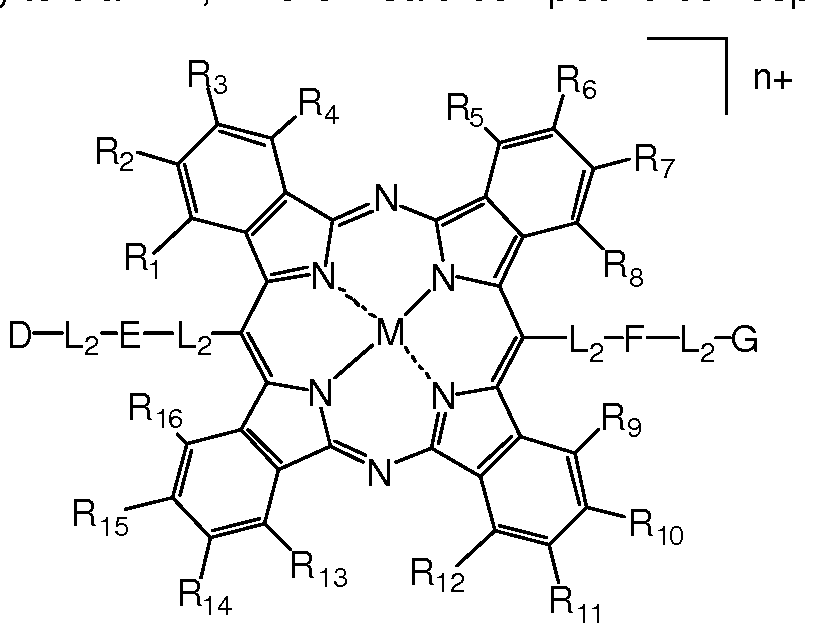
(V)
wherein
R1 -R16 are each independently selected from H, alkyl and aryl; or two adjacent Ri-Ri6 groups optionally form , together with the carbon atoms to which they are attached, a ring selected from cycloalkyi and aryl, and the remaining Ri-Ri6 groups are each independently selected from H, alkyl and aryl ;
D and G are each independently selected from H, alkyl, aryl, heteroaryl, oligothienyl, dialkyl amino, diaryl amino, triaryl amino, dialkylaryl amino, alkenyl, and combinations thereof;
E and F are each independently selected from arylene, heteroarylene, alkendiyl, alkyndiyl, and combinations thereof;
L2 are each independently selected from a single bond, -(C≡C)P- and -(CR=CR)q-, wherein R is H or -CN and wherein p and q are integers independently equal to 1 , 2 or 3;
M represents 2 hydrogen atoms; or M is selected from Zn, Mg, Al, Si, Cu, Ru, Au, Sn, Pd, Pt, Ir and Ni; or M is selected from Sn(IV)(L)2, P(V)(L)2, Au(l l l), Ru(ll)LU, Ir(l ll) wherein L and U represent axial ligands selected from halogeno, hydroxo, alkoxide, carboxylato, CO and pyridine; and
n is 0 or 1 .
9. Compound according to claim 8, wherein
R1 -R16 are each independently selected from H, C^Ce-alkyl and C6-aryl;
D and G are each independently selected from H, CrCe-alkyl, C6-aryl, di-CrCe-alkyl amino, di-C6-aryl amino, tri-C6-aryl amino and di-CrCe-alkyl-Ce-aryl amino, thienyl, oligothienyl, and combinations thereof; in particular phenyl, diphenyl amino and triphenylamino; wherein said groups may optionally be substituted by one or two substituents selected from alkyl, alkoxy, phenoxy, dialkylamino, diphenylamino, thioether, carboxylic group and sulfonic group;
E and F are each independently selected from C6-arylene, 5- to 20-membered heteroarylene, -C≡C-, -CH=CH-, and combinations thereof; in particular phenylene, thiendiyl, benzothiadiazoldiyl, benzotriazoldiyl, pyridindiyl, triazoldiyl, -C≡C-, -CH=CH-, and combinations thereof;
L2 are each independently selected from a single bond, -C≡C- and -CR=CR-, wherein R is H or -CN ;
M represents 2 hydrogen atoms; or M is selected from Sn(IV)(L)2, P(V)(L)2, Au(l ll), Ru(l l)LL', Ir(l ll) wherein L and L' represent axial ligands selected from halogeno, for example CI", Br" or Γ; hydroxo (OH"); alkoxide, for example R'O" wherein R' is alkyl or phenyl; carboxylato, for example R'COO" wherein R' is alkyl or phenyl; CO; and pyridine; in particular Sn(IV)(L)2, P(V)(L)2, Au(ll l) ;
n is 0 or 1 .

wherein M is Sn(IV)(L)2 and n is 0, or M is P(V)(L)2 and n is 0, or M is Au(ll l) and n is 1 , or M is Ru(l l)LL' and n is 0, or M is Ir(l ll) and n is 1 ;
wherein L is selected from CI", Br", I", OH", R'O" and R'COO" with R' is alkyl or phenyl ; and
wherein U is selected from CO and pyridine.
1 1 . Compound according to claim 8, wherein
RrR16 are each independently selected from H, d-Ce-alkyl and C6-aryl;
D and G are each independently selected from H, C6-aryl, 5- to 20-membered heteroaryl, alkenyl, and combinations thereof; in particular phenyl, thienyl optionally fused with an /V-alkyl pyrrolidine-2,5-dione, benzothiadiazolyl optionally fused with a 2-alkyl triazole, benzotriazolyl, pyridinyl, triazolyl, phthalimidyl, a pyridinium radical, a diketopyrrolopyrrole radical, an isoindigo radical, a A/-alkyl-2,2'-bithiophene-3,3'- dicarboximide radical, dicyanovinyl, tricyanovinyl, and combinations thereof;
E and F are each independently selected from C6-arylene, 5- to 20-membered heteroarylene, -C≡C-,
-CH=CH-, and combinations thereof; in particular phenylene, thiendiyl, benzothiadiazoldiyl, benzotriazoldiyl, pyridindiyl, triazoldiyl, -C≡C-, -CH=CH-, and combinations thereof;
L2 are each independently selected from a single bond, -C≡C- and -CR=CR-, wherein R is H or -CN ;
M represents 2 hydrogen atoms; or M is selected from Zn, Mg, Al, Si, Cu, Ru and Ni; in particular Zn, Mg and Cu; preferably Zn; and
n is 0.
12. Compound according to claim 1 1 , wherein said compound is:

13. Organic solar cell comprising an anode, a cathode and a sensitizer, wherein the sensitizer is a compound as defined in any one of claims 8 to 12.
14. Organic solar cell according to claim 13, wherein the anode comprises a material selected from indium tin oxide and graphene and wherein the cathode comprises a metal selected from Al, Ag, Cu, or Au.
15. Use of a compound as defined in any one of claims 8 to 12 as a sensitizer for an organic solar cell.
Applications Claiming Priority (2)
| Application Number | Priority Date | Filing Date | Title |
|---|---|---|---|
| EP15306227.8A EP3124552B1 (en) | 2015-07-28 | 2015-07-28 | Trans-disubstituted benzodiazaporphyrins as sensitizers for solar cells |
| EP15306227.8 | 2015-07-28 |
Publications (1)
| Publication Number | Publication Date |
|---|---|
| WO2017017118A1 true WO2017017118A1 (en) | 2017-02-02 |
Family
ID=54056142
Family Applications (1)
| Application Number | Title | Priority Date | Filing Date |
|---|---|---|---|
| PCT/EP2016/067848 Ceased WO2017017118A1 (en) | 2015-07-28 | 2016-07-26 | Trans-disubstituted benzodiazaporphyrins as sensitizers for solar cells |
Country Status (2)
| Country | Link |
|---|---|
| EP (1) | EP3124552B1 (en) |
| WO (1) | WO2017017118A1 (en) |
Family Cites Families (1)
| Publication number | Priority date | Publication date | Assignee | Title |
|---|---|---|---|---|
| US7141735B2 (en) | 2000-07-27 | 2006-11-28 | Nippon Kayaku Kabushiki Kaisha | Dye-sensitized photoelectric conversion device |
-
2015
- 2015-07-28 EP EP15306227.8A patent/EP3124552B1/en active Active
-
2016
- 2016-07-26 WO PCT/EP2016/067848 patent/WO2017017118A1/en not_active Ceased
Non-Patent Citations (2)
| Title |
|---|
| ANDREW N. CAMMIDGE ET AL: "Phthalocyanine Analogues: Unexpectedly Facile Access to Non-Peripherally Substituted Octaalkyl Tetrabenzotriazaporphyrins, Tetrabenzodiazaporphyrins, Tetrabenzomonoazaporphyrins and Tetrabenzoporphyrins", CHEMISTRY - A EUROPEAN JOURNAL., vol. 17, no. 11, 7 March 2011 (2011-03-07), WEINHEIM, DE, pages 3136 - 3146, XP055232141, ISSN: 0947-6539, DOI: 10.1002/chem.201002176 * |
| REBEKAH THEISEN ET AL: "Theoretical Characterization of Zinc Phthalocyanine and Porphyrin Analogs for Organic Solar Cell Absorption", 1 January 2014 (2014-01-01), XP055232149, ISBN: 978-1-321-32800-4, Retrieved from the Internet <URL:http://repository.asu.edu/attachments/140796/content/Theisen_asu_0010E_14304.pdf> [retrieved on 20151130] * |
Also Published As
| Publication number | Publication date |
|---|---|
| EP3124552B1 (en) | 2018-04-11 |
| EP3124552A1 (en) | 2017-02-01 |
Similar Documents
| Publication | Publication Date | Title |
|---|---|---|
| Hara et al. | Dye-sensitized nanocrystalline TiO2 solar cells based on novel coumarin dyes | |
| Qu et al. | New diketo-pyrrolo-pyrrole (DPP) sensitizer containing a furan moiety for efficient and stable dye-sensitized solar cells | |
| Lee et al. | Organic dyes incorporating low-band-gap chromophores based on π-extended benzothiadiazole for dye-sensitized solar cells | |
| Gao et al. | A new heteroleptic ruthenium sensitizer enhances the absorptivity of mesoporous titania film for a high efficiency dye-sensitized solar cell | |
| He et al. | New Bithiazole‐Based Sensitizers for Efficient and Stable Dye‐Sensitized Solar Cells | |
| JP5620316B2 (en) | Photoelectric conversion element, photoelectrochemical cell and dye | |
| Warnan et al. | A compact diketopyrrolopyrrole dye as efficient sensitizer in titanium dioxide dye-sensitized solar cells | |
| Qian et al. | Triazatruxene-based organic dyes containing a rhodanine-3-acetic acid acceptor for dye-sensitized solar cells | |
| Song et al. | Branched and linear alkoxy chains-wrapped push-pull porphyrins for developing efficient dye-sensitized solar cells | |
| EP2655366A1 (en) | Naphtalene monoimide derivatives and use thereof as photosensitizers in solar cells and photodetectors | |
| Zhang et al. | Anti-recombination organic dyes containing dendritic triphenylamine moieties for high open-circuit voltage of DSSCs | |
| Stengel et al. | Click‐Functionalized Ru (II) Complexes for Dye‐Sensitized Solar Cells | |
| Fan et al. | The position effect of electron-deficient quinoxaline moiety in porphyrin based sensitizers | |
| Shivashimpi et al. | Effect of nature of anchoring groups on photosensitization behavior in unsymmetrical squaraine dyes | |
| Unny et al. | Effect of flexible, rigid planar and non-planar donors on the performance of dye-sensitized solar cells | |
| Lyu et al. | Molecular engineering of ruthenium-diacetylide organometallic complexes towards efficient green dye for DSSC | |
| Cao et al. | New D–π–A organic dyes containing a tert-butyl-capped indolo [3, 2, 1-jk] carbazole donor with bithiophene unit as π-linker for dye-sensitized solar cells | |
| Willinger et al. | Synthesis, spectral, electrochemical and photovoltaic properties of novel heteroleptic polypyridyl ruthenium (II) donor-antenna dyes | |
| Chiu et al. | A new series of azobenzene-bridged metal-free organic dyes and application on DSSC | |
| Martín-Gomis et al. | Dye sensitized solar cells (DSSCs) based on bulky tert-octylphenoxy-carboxyphenyl substituted phthalocyanine without the presence of co-adsorbents | |
| Manfredi et al. | Performance enhancement of a dye-sensitized solar cell by peripheral aromatic and heteroaromatic functionalization in di-branched organic sensitizers | |
| Kabanakis et al. | Synthesis of novel semi-squaraine derivatives and application in efficient dye-sensitized solar cells | |
| Tamilavan et al. | Synthesis of triphenylamine-based thiophene-(N-aryl) pyrrole-thiophene dyes for dye-sensitized solar cell applications | |
| Jiang et al. | Efficient sensitization of nanocrystalline TiO2 films with high molar extinction coefficient ruthenium complex | |
| Ramasamy | Organic photosensitizers containing fused indole-imidazole ancillary acceptor with triphenylamine donor moieties for efficient dye-sensitized solar cells |
Legal Events
| Date | Code | Title | Description |
|---|---|---|---|
| 121 | Ep: the epo has been informed by wipo that ep was designated in this application |
Ref document number: 16744735 Country of ref document: EP Kind code of ref document: A1 |
|
| NENP | Non-entry into the national phase |
Ref country code: DE |
|
| 122 | Ep: pct application non-entry in european phase |
Ref document number: 16744735 Country of ref document: EP Kind code of ref document: A1 |