WO2017013720A1 - 基準線設定装置、基準線設定方法及び基準線設定プログラム - Google Patents
基準線設定装置、基準線設定方法及び基準線設定プログラム Download PDFInfo
- Publication number
- WO2017013720A1 WO2017013720A1 PCT/JP2015/070600 JP2015070600W WO2017013720A1 WO 2017013720 A1 WO2017013720 A1 WO 2017013720A1 JP 2015070600 W JP2015070600 W JP 2015070600W WO 2017013720 A1 WO2017013720 A1 WO 2017013720A1
- Authority
- WO
- WIPO (PCT)
- Prior art keywords
- line
- position information
- character
- reference line
- characters
- Prior art date
- Legal status (The legal status is an assumption and is not a legal conclusion. Google has not performed a legal analysis and makes no representation as to the accuracy of the status listed.)
- Ceased
Links
Images




Classifications
-
- G—PHYSICS
- G06—COMPUTING OR CALCULATING; COUNTING
- G06V—IMAGE OR VIDEO RECOGNITION OR UNDERSTANDING
- G06V20/00—Scenes; Scene-specific elements
- G06V20/60—Type of objects
- G06V20/62—Text, e.g. of license plates, overlay texts or captions on TV images
-
- G—PHYSICS
- G06—COMPUTING OR CALCULATING; COUNTING
- G06V—IMAGE OR VIDEO RECOGNITION OR UNDERSTANDING
- G06V30/00—Character recognition; Recognising digital ink; Document-oriented image-based pattern recognition
- G06V30/10—Character recognition
- G06V30/18—Extraction of features or characteristics of the image
- G06V30/18086—Extraction of features or characteristics of the image by performing operations within image blocks or by using histograms
-
- G—PHYSICS
- G06—COMPUTING OR CALCULATING; COUNTING
- G06T—IMAGE DATA PROCESSING OR GENERATION, IN GENERAL
- G06T1/00—General purpose image data processing
- G06T1/0007—Image acquisition
-
- G—PHYSICS
- G06—COMPUTING OR CALCULATING; COUNTING
- G06V—IMAGE OR VIDEO RECOGNITION OR UNDERSTANDING
- G06V30/00—Character recognition; Recognising digital ink; Document-oriented image-based pattern recognition
- G06V30/10—Character recognition
Definitions
- the present invention relates to a reference line setting device, a reference line setting method, and a reference line setting program.
- the character region is not correctly recognized when the outline of the character in the image is unclear, or when the contrast between the character region and the background is not sufficiently large, and the reference line is not accurately recognized. It may not be possible to set. As a result, the accuracy of character recognition from the image decreases.
- an object of the present invention is to set a reference line along which characters to be arranged should be highly accurate with respect to characters included in an image.
- a reference line setting device includes an image acquisition unit that acquires an image including a character region, and a recognition unit that recognizes a character from the character region of the image using a predetermined recognition method.
- the position information is acquired, and the reference line is a line that is drawn in the arrangement direction of the characters and arranged along a predetermined portion of each character, and the reference acquired by the line position information acquisition means and the line position information acquisition means
- a reference line setting method is a reference line setting method in a reference line setting device, the step of recognizing a character from a character region of an image by a predetermined recognition method, and at least in the vertical direction of the character
- storage means for storing for each character the line position information relating to the position through which the two reference lines pass, the line position information of a plurality of characters among the characters recognized in the recognition step is acquired, and the reference line Is a line that is drawn in the character arrangement direction and arranged along a predetermined portion of each character, and a plurality of line position information for each reference line acquired in the line position information acquisition step and the line position information acquisition step
- a setting step for setting each reference line in the image.
- a reference line setting program is a reference line setting program that causes a computer to function as a reference line setting device, and recognizes characters from a character region of an image by a predetermined recognition method,
- Each reference line acquired by the line position information acquisition means and the line position information acquisition means is a line that is drawn in the character arrangement direction and arranged along a predetermined portion of each character. Based on the plurality of line position information, function as setting means for setting each reference line in the image.
- the reference line is set for the image including the character based on the line position information of the character recognized from the image. Since the line position information is acquired from the storage means that stores the line position information in advance for each character, and the reference line is set based on the acquired line position information, the reference line can be set with high accuracy. In addition, since the reference line is set based on the line position information of the characters that can be recognized, the entire character string represented in the image including the characters that could not be recognized is highly accurate. A reference line can be set.
- the line position information acquisition unit acquires line position information indicating a position through which one first reference line passes, and the setting unit includes a plurality of characters of the first line
- the first reference line may be set by the least square method based on the line position information of the reference line.
- the reference line can be set with high accuracy.
- the first reference line is, for example, a base line in the alphabet.
- the first reference line is a reference line that runs along the lower end of the character in, for example, hiragana, katakana, and kanji.
- the line position information includes an average and a distribution of the positions through which the reference line passes in the vertical direction of the character
- the setting means includes a plurality of characters recognized by the recognition means.
- the distribution of the line position information of one reference line other than the first reference line of the reference lines is integrated, passing through the position having the highest probability obtained by the integration of the distribution of the line position information, A line having the same inclination as the reference line may be set as the one reference line.
- the first slope is set so as to pass through the position having the highest probability obtained by integrating the line position information including the mean and the variance with the same inclination as the first reference line serving as the reference for character arrangement. Since reference lines other than the reference line are set, it is possible to appropriately set those reference lines.
- the line position information includes an average and a distribution of the positions through which the reference line passes in the vertical direction of the character
- the setting means includes a plurality of characters recognized by the recognition means.
- the distribution of the line position information of two or more reference lines other than the first reference line of the reference lines is integrated, and the first position passes through the position having the highest probability obtained by the integration of the distribution of the line position information. It is also possible to set two or more reference lines that intersect with the reference line at one point.
- the characters are alphabets
- the reference lines include an ascender line, a mean line, a base line, and a descender line
- the line position information acquisition means includes an ascender line and a mean line for each character.
- the base line and descender line position information is obtained, and the setting means sets each reference line based on the line position information of the ascender line, mean line, base line, and descender line of a plurality of characters. It is good as well.
- the line position information regarding the ascender line, the mean line, the base line, and the descender line is acquired, so that these four reference lines can be set with high accuracy.
- line position information for each character is calculated based on a plurality of images in which a plurality of characters for which a reference line is set is represented, and the calculated line position information is calculated for each character. It is good also as providing the learning means to memorize
- the position of each reference line for each character is calculated based on the plurality of images representing the character, and the calculated reference line position is stored in the storage unit as line position information for each character.
- the learning means uses, as line position information, an average and a variance of positions through which each reference line passes in the vertical direction of the character based on a plurality of characters represented in a plurality of images. It may be calculated.
- the line position information is calculated as the average and variance based on the characters represented in the plurality of images
- the information on the position of the reference line as the total result of many images in which the characters are represented. Can be prepared in advance. Therefore, the reference line can be set with high accuracy based on these pieces of information.
- the characters are alphabetic characters
- the line position information acquisition unit may acquire line position information of characters whose uppercase and lowercase shapes are not similar.
- the recognized character is a character whose uppercase and lowercase characters are similar, it is highly likely that the determination of whether the character is uppercase or lowercase is incorrect.
- Characters having similar upper and lower case shapes include, for example, alphabets “S” and “s”, “O” and “o”, and the like. According to the above aspect, since the recognition result does not use the line position information of the character recognized to be a character with similar upper and lower case shapes for setting the reference line, the accuracy of the reference line position to be set Can be improved.
- the recognition means calculates a reliability score indicating the certainty of the recognition result of characters from the image, and the line position information acquisition means has a reliability score of a predetermined value or more. Character line position information may be acquired.
- the position of the reference line set based on the line position information of the character with low reliability in the recognition result is highly likely not appropriate as the position of the reference line for the character string including the character. According to the above aspect, since the line position information of the character whose reliability score in the recognition result is less than the predetermined value is not used for setting the reference line, the accuracy of the position of the set reference line can be improved.
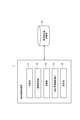
- FIG. 1 is a block diagram showing a functional configuration of the reference line setting device 1 according to the present embodiment.
- the reference line setting device 1 is a device that sets a plurality of reference lines for a character string included in an image.
- the reference line is a virtual line drawn in the character arrangement direction, and is a line for arranging predetermined portions of each character included in the character string.
- the reference lines are four lines: an ascender line, a mean line, a base line, and a descender line.
- the image is an image captured by, for example, a camera.
- the demand for a technique for character recognition from an image including characters is increasing, and it is necessary to appropriately set a reference line for a character string in the image in order to enable accurate character recognition.
- a scene image photographed by a camera or the like includes various character information such as road signs and signboards. Characters in a scene image have many problems that make recognition difficult, such as having unique fonts and styles and low resolution, as compared to characters printed on paper. Since the reference line set in the character string in the image can limit the area in which the character is represented in the image, setting an appropriate reference line contributes to accurate character recognition from the image. .
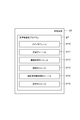
- the reference line setting device 1 functionally includes a learning unit 11 (learning unit), an image acquisition unit 12 (image acquisition unit), a recognition unit 13 (recognition unit), and a line position information acquisition unit. 14 (line position information acquisition means) and a setting unit 15 (setting means).
- the reference line setting device 1 can access storage means such as the reference line position storage unit 21.
- the reference line position storage unit 21 may be provided in the reference line setting device 1 or may be configured as an external storage unit provided so as to be accessible from the reference line setting device 1.
- FIG. 2 is a hardware configuration diagram of the reference line setting device 1.
- the reference line setting device 1 physically includes a CPU 101, a main storage device 102 constituted by memories such as a RAM and a ROM, an auxiliary storage device 103 constituted by a hard disk, etc., and a communication control device 104. It is configured as a computer system including the above.
- the reference line setting device 1 may further include an input device 105 such as a keyboard, a touch panel, and a mouse that are input devices, and an output device 106 such as a display.
- FIG. 1 operate the communication control device 104 and the like under the control of the CPU 101 by reading predetermined computer software on the hardware such as the CPU 101 and the main storage device 102 shown in FIG. In addition, it is realized by reading and writing data in the main storage device 102 and the auxiliary storage device 103. Data and databases necessary for processing are stored in the main storage device 102 and the auxiliary storage device 103.
- the learning unit 11 is a part that calculates line position information related to a position through which each reference line passes in the vertical direction of a character based on a plurality of characters represented in a plurality of images.
- the learning unit 11 stores the calculated line position information in the reference line position storage unit 21.
- the line position information is information indicating the position of the reference line for each character.
- FIG. 3 is a diagram illustrating an example of calculating line position information.
- the learning unit 11 acquires, as learning data, an image in which characters are represented, and an image to which the bounding box of each character and its character type are given. Based on a large amount of learning data, the learning unit 11 uses the method described below to obtain information on the positions through which each reference line passes through a total of 62 characters of 26 uppercase letters and lowercase letters and 0-9 numbers. Then, the line position information is calculated for each character, and the calculated line position information acquisition is stored in the reference line position storage unit 21.
- the learning unit 11 first acquires an image including the character string W31 as an example of learning data.
- Character string W31 includes characters C31 to C34. Each character is given a character type and a bounding box in advance.
- the bounding box is a rectangular frame that circumscribes the character area. That is, the character type of the character C31 is uppercase “S”. Further, a bounding box B1 is given to the character C31.
- the character types of the characters C32 to C34 are a lowercase letter “p”, a lowercase letter “o”, and a lowercase letter “t”, respectively. Further, bounding boxes B2 to B4 are given to the characters C32 to C34, respectively.
- the learning unit 11 extracts the center of the upper side and the center of the lower side of the bounding box of each character as an upper contact and a lower contact, respectively. That is, the learning unit 11 extracts the upper contact BU1 and the lower contact BL1 from the bounding box B1. Similarly, the learning unit 11 extracts the upper contacts BU2 to BU4 and the lower contacts BL2 to BL4 from each of the bounding boxes B2 to B4.
- the upper and lower contacts of the uppercase letters and numbers correspond to the positions of the ascender line and the base line, respectively.
- the upper and lower contacts of b, d, f, h, i, k, l, and t correspond to the positions of the ascender line and the base line, respectively.
- the upper and lower contacts of g, j, p, q, and y correspond to the positions of the mean line and descender line, respectively.
- Other lower case upper and lower contacts of the alphabet correspond to the positions of the mean line and the base line, respectively.
- the learning unit 11 sets a reference line as a character string of an image using a plurality of points corresponding to the position of each reference line among the extracted upper and lower contacts.
- the learning unit 11 sets each reference line as indicated by the character string W32.
- the learning unit 11 sets the ascender line LA3 to the character string W32 by the least square method using the two points of the upper contact points BU1 and BU4.
- the learning unit 11 sets the mean line LM3 to the character string W32 by the least square method using the two points of the upper contact points BU2 and BU3.
- the learning unit 11 sets the base line LB3 to the character string W32 by the least square method using the three points of the lower contacts BL1, BL3, and BL4.
- the learning unit 11 calculates line position information based on a large amount of learning data, the line position of the descender line is obtained by acquiring, as learning data, an image including a plurality of characters having lower contacts corresponding to the position of the descender line. Information can be calculated.
- the learning unit 11 acquires the position where each set reference line intersects with the vertical lines VL1 to VL4 passing through the center of the bounding box of each character as the line position of each reference line in each character.
- the learning unit 11 acquires the positions of the upper contact BU1, the point MP31, and the lower contact BL1 as the positions of the ascender line, the mean line, and the base line of the character C31 that is the uppercase “S”.
- the learning unit 11 acquires the position of the point DP31 as the position of the descender line of the character C31 that is the uppercase “S”.
- the learning unit 11 acquires the position of each reference line in each character by converting it into a value normalized by the height of each character area (bounding box).
- the learning unit 11 sets the positions of the point AP32, the upper contact BU2, the point BP32, and the lower contact BL2 as the positions of the ascender line, the mean line, the base line, and the descender line of the character C32 that is the lowercase letter “p”. get.
- the learning unit 11 acquires the positions of the point AP33, the upper contact BU3, and the lower contact BL3 as the positions of the ascender line, the mean line, and the base line of the letter C33 that is the lowercase letter “o”. If the descender line LD3 is set, the learning unit 11 acquires the position of the point DP33 as the position of the descender line of the character C33 that is the capital letter “o”.
- the learning unit 11 acquires the positions of the upper contact BU4, the point MP34, and the lower contact BL4 as the positions of the ascender line, the mean line, and the base line of the letter C34 that is the lowercase letter “t”. If the descender line LD3 is set, the learning unit 11 acquires the position of the point DP34 as the position of the descender line of the character C34 that is the capital letter “t”.
- the learning unit 11 performs the process of acquiring the position of each reference line for each character for various captured images and various fonts to which the character type and the bounding box for each character are given. Accumulate and learn information on the position of many reference lines. Then, the learning unit 11 calculates line position information based on the accumulated and learned information.
- the learning unit 11 calculates, for example, an average of the positions of the reference lines for each character type as the line position information, and stores the calculated line position information in the reference line position storage unit 21. Further, the learning unit 11 may calculate, as line position information, a Gaussian distribution calculated by statistically processing information on the positions of many reference lines for each character. In this case, the learning unit 11 stores the average and variance values of the positions of the respective reference lines for each character type in the reference line position storage unit 21 as line position information.
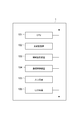
- FIG. 4 is a diagram schematically illustrating an example of the configuration of the reference line position storage unit 21 and stored data.
- the reference line position storage unit 21 stores line position information of ascender lines, mean lines, base lines, and descender lines for each of uppercase and lowercase letters and numbers.
- the line position information includes the average and the variance of the reference line positions.
- the image acquisition unit 12 is a part that acquires an image including a character area.
- the image acquisition unit 12 acquires an image captured by a camera as a target for setting a reference line.
- the recognition unit 13 is a part that recognizes a character from a character region included in the image by a predetermined recognition method. For example, the recognition unit 13 may extract a connected area in which the same color is continuous in the image and acquire the extracted connected area as a character area. The recognizing unit 13 may perform binarization processing on the image in order to extract the connected region.
- the recognition unit 13 may perform character recognition on a character region using a so-called character classifier.
- a method using a character classifier is a known method, for example, HOG (Histgram of Oriented Gradient) -SVM (Support Vector Machine).
- HOG-SVM is a technique that uses a HOG feature quantity as a feature quantity and a well-known SVM as a classifier.
- Information to be referred to for character recognition by the character classifier is stored in advance in the storage means, and the storage means is data to be referred to for character recognition using the character classifier by HOG-SVM, for example, Data learned about uppercase letters A to Z, lowercase letters a to z, and numbers 0 to 9 of the alphabet are stored.
- the HOG feature value is a feature value in which the luminance gradient direction of the local region (cell) in the image is histogrammed.
- a cell consisting of a predetermined number of pixels is set so as to cover the image to be recognized, a feature vector of a multidimensional HOG feature amount is acquired for each cell, and a multidimensional feature in which all cells are connected from the entire image A vector is obtained. Note that it is preferable to further use the aspect ratio in character classification by HOG-SVM.
- the recognition unit 13 acquires a HOG feature quantity vector and an aspect ratio vector from the character area. Then, the SVM classifier performs classification with reference to the learning data stored in advance in the storage means. As a result, the recognition unit 13 can acquire the letters (alphabet, numbers) as the classification result and the reliability score output from the classifier.
- the recognition processing performed by the recognition unit 13 is not limited to the method using a character classifier exemplified in HOG-SVM.
- the character recognition by the recognition unit 13 is not intended to output the result of accurately recognizing the character, so various known methods can be applied as long as the method can recognize the character from the image.
- the predetermined recognition method is preferably a method capable of acquiring information related to the reliability of the recognition result for each character.
- a character string W51 shown in FIG. 5 is a character string composed of characters C51 to C54 recognized by the recognition unit 13. That is, in the example illustrated in FIG. 5, the recognition unit 13 includes a letter C51 that is an uppercase “L”, a letter C52 that is a lowercase “i”, a letter C53 that is a lowercase “n”, and a lowercase “n”. A certain character C54 is output as a character recognition result from the image.
- the line position information acquisition unit 14 acquires line position information of a plurality of characters among the characters recognized by the recognition unit 13. Specifically, the line position information acquisition unit 14 acquires line position information from the reference line position storage unit 21.
- the setting unit 15 sets each reference line in the image based on a plurality of pieces of line position information for each reference line acquired by the line position information acquisition unit 14.
- the setting unit 15 sets a first reference line.
- the first reference line is a reference line serving as a reference for character arrangement, and is, for example, a base line in the alphabet.
- the first reference line is a reference line that runs along the lower end of the character in, for example, hiragana, katakana, and kanji.
- the setting unit 15 may set the first reference line by the least square method.
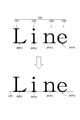
- FIG. 5 is a diagram illustrating an example of a baseline setting process.
- FIG. 6 is a diagram illustrating an example of setting processing of an ascender line, a mean line, and a descender line, which are reference lines other than the base line.
- the line position information acquisition unit 14 acquires the baseline line position information BP51 to BP54 of the characters C51 to C54 in the character string W51 of FIG. In the present embodiment, the line position information acquisition unit 14 acquires an average value in the line position information of the baseline.
- the setting unit 15 sets the baseline by the least square method based on the line position information of the recognized baselines of the plurality of characters.
- the setting unit 15 sets the baseline LB5 obtained by the least square method based on the baseline line position information BP51 to BP54 of the characters C51 to C54 for an image including the character string W51. .
- the line position information acquisition unit 14 acquires the line position information of the ascender line, the mean line, and the descender line for each of the characters C51 to C54 in order to set the ascender line, the mean line, and the descender line.
- the line position information acquisition unit 14 acquires the line position information AP61, MP61, and DP61 of the ascender line, the mean line, and the descender line of the character C51.
- the line position information AP61, MP61, DP61 acquired here is expressed as a distribution of the position of the reference line in the character and includes an average and a variance.
- the line position information AP62, MP62, DP62, line position information AP63, MP63, DP63, and line position information AP64, MP64, DP64 of the ascender line, the mean line, and the descender line of the characters C52 to C54 are acquired.
- the setting unit 15 integrates the distribution of the line position information of the reference lines other than the baseline of the plurality of recognized characters, and passes through the position having the highest probability obtained by the integration of the distribution of the line position information.
- a line having the same inclination as the base line is set as the reference line.
- the setting of three reference lines other than the baseline will be specifically described.
- the slope k is the same as the slope of the set baseline.
- a value that maximizes the likelihood when the slope k is determined can be used as the intercept.
- c 1 , c 2 ,..., C N be the character class of each character
- x 1 , x 2 Is the position in the coordinate system X direction of the central position in the horizontal direction of the character area of each character.
- c i ) is a probability that the intercept at x i of the reference line l is y i when the i-th character class is c i
- the intercept b l of the reference line l Is calculated by the following equation (1).
- mu lci, sigma lci are the mean and variance of the position of the reference line l for each character class c i obtained as the line position information.
- the setting unit 15 sets the ascender line LA6 based on the ascender line position information AP61 to AP64 of the characters C51 to C54. That is, the ascender line LA6 is set to the position with the highest probability in the distribution calculated by the average and variance integration of the line position information AP61 to AP64.
- the setting unit 15 sets the mean line LM6 based on the ascender line position information MP61 to MP64 of the characters C51 to C54.
- the setting unit 15 also sets the descender line LD6 based on the descender line line position information DP61 to DP64 of the characters C51 to C54.
- the line position information acquisition unit 14 determines that the reliability score calculated by the recognition unit 13 is greater than or equal to a predetermined value. It is good also as acquiring the line position information of this character. For example, in the example of FIGS. 5 and 6, when the reliability score in the recognition result of the characters C51 and C54 is equal to or higher than a predetermined value and the reliability score of the characters C52 and C53 is lower than the predetermined value, the line position The information acquisition unit 14 acquires line position information of the characters C51 and C54. Therefore, the setting unit 15 uses only the line position information of the characters C51 and C54 for setting the reference line, and the line position information of the characters C52 and C53 is not used for setting the reference line.
- the recognition line is thus recognized.
- the accuracy of the position of the set reference line can be improved.
- the line position information acquisition unit 14 may acquire line position information of characters whose uppercase and lowercase shapes are not similar.
- the setting unit 15 does not use the line position information of characters recognized as uppercase or lowercase among characters having similar uppercase and lowercase shapes for setting the reference line. That is, when the character recognized by the recognition unit 13 is an uppercase letter or a lowercase letter of a character whose uppercase and lowercase letters are similar, it may be erroneously determined whether the character is an uppercase letter or a lowercase letter. High nature.
- the reference line set by not using the line position information of the character recognized as the character having the similar upper and lower case shape for the setting of the reference line. It is possible to improve the accuracy of the position.
- each reference line may have an inclination such that four reference lines converge at one point.
- the setting unit 15 integrates the distribution of the line position information of two or more reference lines other than the baseline of the plurality of characters recognized by the recognition unit 13, and the probability obtained by integrating the distribution of the line position information It is also possible to set two or more reference lines that pass through the highest position and intersect the base line at one point.
- the baseline is a straight line
- the baseline may be, for example, a quadratic curve, a Bezier curve, or a spline curve.
- the baseline can be calculated by the least square method or other known methods based on the line position information indicating the position of the baseline. If the baseline is these curves, then the ascender line, mean line and descender line. It may be calculated as a line having the same curve as the base line.
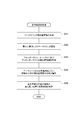
- FIG. 7 is a flowchart showing the processing contents of the reference line setting method performed in the reference line setting apparatus 1.
- the image acquisition unit 12 acquires an image including a character area (S1).
- the recognition unit 13 recognizes a character from the character region included in the image by a predetermined recognition method (S2).
- the line position information acquisition unit 14 acquires line position information of a plurality of characters among the characters recognized by the recognition unit 13 in step S2 (S3). Specifically, the line position information acquisition unit 14 acquires line position information from the reference line position storage unit 21. The line position information stored in the reference line position storage unit 21 is calculated by the learning unit 11 based on a plurality of characters represented in various images.
- the setting unit 15 performs a reference line setting process for setting a reference line based on the line position information acquired in step S3 (S4).
- the reference line setting process in step S4 will be described.
- the line position information acquisition unit 14 acquires the line position information of the recognized base line of each character (S41). Subsequently, the setting unit 15 sets a baseline by the least square method based on the baseline line position information acquired in step S41 (S42).
- the line position information acquisition unit 14 acquires line position information of the ascender line, the mean line, and the descender line for each recognized character (S43). Subsequently, the setting unit 15 accumulates the distribution of the line position information of the recognized plurality of characters for each reference line other than the baseline (S44). That is, the setting unit 15 integrates the distribution of the position of the reference line represented by the line position information for each of the ascender line, the mean line, and the descender line.
- the setting unit 15 sets, as the reference line, a line that passes through the position having the highest probability obtained by integrating the distribution of the line position information and has the same inclination as the base line (S45).
- the reference line setting program p1 includes a main module m10, a learning module m11, an image acquisition module m12, a recognition module m13, a line position information acquisition module m14, and a setting module m15.
- the main module m10 is a part that comprehensively controls the reference line setting process.
- the functions realized by executing the learning module m11, the image acquisition module m12, the recognition module m13, the line position information acquisition module m14, and the setting module m15 are the learning unit 11 of the reference line setting device 1 shown in FIG.
- the functions of the image acquisition unit 12, the recognition unit 13, the line position information acquisition unit 14, and the setting unit 15 are the same.
- the reference line setting program p1 is provided by a storage medium d1 such as a CD-ROM, DVD-ROM, or semiconductor memory.
- the reference line setting program p1 may be provided via a communication network as a computer data signal superimposed on a carrier wave.
- the reference line setting device 1 the reference line setting method, and the reference line setting program p1 of the present embodiment described above, based on the line position information of the characters that can be recognized from the image, the image including the characters is displayed.
- a reference line is set. Since the line position information is acquired from the storage means that stores the line position information in advance for each character, and the reference line is set based on the acquired line position information, the reference line can be set with high accuracy. In addition, since the reference line is set based on the line position information of the characters that can be recognized, the entire character string represented in the image including the characters that could not be recognized is highly accurate. A reference line can be set.
- a reference line is set for an alphabetic character string included in an image
- the present invention is not limited to this example.
- the present invention is applicable to, for example, other types of characters, and may be applied to character strings representing Japanese.
- the number of reference lines to be set may be two or three, for example, instead of four in the case of the alphabet.
- two reference lines may be set at the lower end and the upper end of the character.
- a third reference line may be set at the center position of the two reference lines at the upper and lower ends of the character.
Landscapes
- Engineering & Computer Science (AREA)
- Physics & Mathematics (AREA)
- General Physics & Mathematics (AREA)
- Multimedia (AREA)
- Theoretical Computer Science (AREA)
- Computer Vision & Pattern Recognition (AREA)
- Character Input (AREA)
- Character Discrimination (AREA)
Abstract
Description

Claims (11)
- 文字領域を含む画像を取得する画像取得手段と、
前記画像の前記文字領域から所定の認識手法により文字を認識する認識手段と、
文字の縦方向における少なくとも2本の基準線が通る位置に関する線位置情報を文字ごとに記憶している記憶手段を参照して、前記認識手段により認識された文字のうちの複数の文字の線位置情報を取得し、前記基準線は文字の配列方向に引かれ各文字の所定部分を沿わせて配列させるための線である、線位置情報取得手段と、
前記線位置情報取得手段により取得された基準線ごとの複数の線位置情報に基づいて、前記画像に各基準線を設定する設定手段と、
を備える基準線設定装置。 - 前記線位置情報取得手段は、1本の第1の基準線が通る位置を示す線位置情報を取得し、
前記設定手段は、複数の文字の、前記第1の基準線の線位置情報に基づいて、最小二乗法により当該第1の基準線を設定する、
請求項1に記載の基準線設定装置。 - 前記線位置情報は、前記文字の縦方向における基準線が通る位置の分布の平均と分散とからなり、
前記設定手段は、前記認識手段により認識された複数の文字の、前記基準線のうちの前記第1の基準線以外の一の基準線の線位置情報の分布を積算し、線位置情報の分布の積算により得られた確率が最も高い位置を通り、前記第1の基準線と同じ傾きを有する線を、当該一の基準線として設定する、
請求項2に記載の基準線設定装置。 - 前記線位置情報は、前記文字の縦方向における基準線が通る位置の分布の平均と分散とからなり、
前記設定手段は、前記認識手段により認識された複数の文字の、前記基準線のうちの前記第1の基準線以外の二以上の基準線の線位置情報の分布を積算し、線位置情報の分布の積算により得られた確率が最も高い位置を通り、前記第1の基準線と一点で交わる前記二以上の基準線を設定する、
請求項2に記載の基準線設定装置。 - 前記文字はアルファベットであり、
前記基準線は、アセンダーライン、ミーンライン、ベースライン及びディセンダーラインを含み、
前記線位置情報取得手段は、文字ごとのアセンダーライン、ミーンライン、ベースライン及びディセンダーラインの線位置情報を取得し、
前記設定手段は、複数の文字の、アセンダーライン、ミーンライン、ベースライン及びディセンダーラインのそれぞれの線位置情報に基づいて、各基準線を設定する、
請求項1~4のいずれか一項に記載の基準線設定装置。 - 前記基準線が設定された複数の文字が表された複数の画像に基づいて、文字ごとの線位置情報を算出し、算出した線位置情報を文字ごとに前記記憶手段に記憶させる学習手段を更に備える、
請求項1~5のいずれか一項に記載の基準線設定装置。 - 前記学習手段は、複数の画像に表された複数の文字に基づいて、文字の縦方向における各基準線が通る位置の平均及び分散を前記線位置情報として算出する、
請求項6に記載の基準線設定装置。 - 前記文字はアルファベットであり、
前記線位置情報取得手段は、大文字と小文字の形状が相似ではない文字の線位置情報を取得する、
請求項1~7のいずれか一項に記載の基準線設定装置。 - 前記認識手段は、画像からの文字の認識結果の確からしさを示す信頼性スコアを算出し、
前記線位置情報取得手段は、前記信頼性スコアが所定値以上の文字の線位置情報を取得する、
請求項1~8のいずれか一項に記載の基準線設定装置。 - 基準線設定装置における基準線設定方法であって、
文字領域を含む画像を取得する画像取得ステップと、
前記画像の前記文字領域から所定の認識手法により文字を認識する認識ステップと、
文字の縦方向における少なくとも2本の基準線が通る位置に関する線位置情報を文字ごとに記憶している記憶手段を参照して、前記認識ステップにおいて認識された文字のうちの複数の文字の線位置情報を取得し、前記基準線は文字の配列方向に引かれ各文字の所定部分を沿わせて配列させるための線である、線位置情報取得ステップと、
前記線位置情報取得ステップにおいて取得された基準線ごとの複数の線位置情報に基づいて、前記画像に各基準線を設定する設定ステップと、
を有する基準線設定方法。 - 基準線設定装置としてコンピュータを機能させる基準線設定プログラムであって、
前記コンピュータを、
文字領域を含む画像を取得する画像取得手段、
前記画像の前記文字領域から所定の認識手法により文字を認識する認識手段、
文字の縦方向における少なくとも2本の基準線が通る位置に関する線位置情報を文字ごとに記憶している記憶手段を参照して、前記認識手段により認識された文字のうちの複数の文字の線位置情報を取得し、前記基準線は文字の配列方向に引かれ各文字の所定部分を沿わせて配列させるための線である、線位置情報取得手段、及び
前記線位置情報取得手段により取得された基準線ごとの複数の線位置情報に基づいて、前記画像に各基準線を設定する設定手段、
として機能させる基準線設定プログラム。
Priority Applications (3)
| Application Number | Priority Date | Filing Date | Title |
|---|---|---|---|
| US15/554,031 US10311318B2 (en) | 2015-07-17 | 2015-07-17 | Reference line setting device, reference line setting method and reference line setting program |
| PCT/JP2015/070600 WO2017013720A1 (ja) | 2015-07-17 | 2015-07-17 | 基準線設定装置、基準線設定方法及び基準線設定プログラム |
| JP2016504816A JP5913763B1 (ja) | 2015-07-17 | 2015-07-17 | 基準線設定装置、基準線設定方法及び基準線設定プログラム |
Applications Claiming Priority (1)
| Application Number | Priority Date | Filing Date | Title |
|---|---|---|---|
| PCT/JP2015/070600 WO2017013720A1 (ja) | 2015-07-17 | 2015-07-17 | 基準線設定装置、基準線設定方法及び基準線設定プログラム |
Publications (1)
| Publication Number | Publication Date |
|---|---|
| WO2017013720A1 true WO2017013720A1 (ja) | 2017-01-26 |
Family
ID=55808320
Family Applications (1)
| Application Number | Title | Priority Date | Filing Date |
|---|---|---|---|
| PCT/JP2015/070600 Ceased WO2017013720A1 (ja) | 2015-07-17 | 2015-07-17 | 基準線設定装置、基準線設定方法及び基準線設定プログラム |
Country Status (3)
| Country | Link |
|---|---|
| US (1) | US10311318B2 (ja) |
| JP (1) | JP5913763B1 (ja) |
| WO (1) | WO2017013720A1 (ja) |
Families Citing this family (1)
| Publication number | Priority date | Publication date | Assignee | Title |
|---|---|---|---|---|
| JP5913763B1 (ja) * | 2015-07-17 | 2016-04-27 | 楽天株式会社 | 基準線設定装置、基準線設定方法及び基準線設定プログラム |
Citations (3)
| Publication number | Priority date | Publication date | Assignee | Title |
|---|---|---|---|---|
| JPH03126188A (ja) * | 1989-10-11 | 1991-05-29 | Oki Electric Ind Co Ltd | 文字認識装置 |
| JPH0412288A (ja) * | 1990-05-01 | 1992-01-16 | Koyo Electron Ind Co Ltd | 距離センサの不安定動作検出装置 |
| JPH05282493A (ja) * | 1992-03-31 | 1993-10-29 | Matsushita Electric Ind Co Ltd | 英文字認識装置 |
Family Cites Families (11)
| Publication number | Priority date | Publication date | Assignee | Title |
|---|---|---|---|---|
| JPH04127288A (ja) * | 1990-05-21 | 1992-04-28 | Fuji Facom Corp | ベースラインによる文字判別方法 |
| JP4170441B2 (ja) * | 1997-11-28 | 2008-10-22 | 富士通株式会社 | 文書画像傾き検出装置および文書画像傾き検出プログラムの記憶媒体 |
| JP2001101435A (ja) * | 1999-09-27 | 2001-04-13 | Toshiba Corp | 文書画像処理装置文書画像処理方法 |
| JP4508553B2 (ja) * | 2003-06-02 | 2010-07-21 | カシオ計算機株式会社 | 撮影画像投影装置、及び撮影画像の補正方法 |
| CN100542239C (zh) * | 2004-07-20 | 2009-09-16 | 松下电器产业株式会社 | 视频处理设备及其方法 |
| JP4607633B2 (ja) * | 2005-03-17 | 2011-01-05 | 株式会社リコー | 文字方向識別装置、画像形成装置、プログラム、記憶媒体および文字方向識別方法 |
| JP5582674B2 (ja) * | 2007-07-20 | 2014-09-03 | アルパイン株式会社 | 文字データの生成装置および生成方法、文字データの表示制御装置および表示方法、ナビゲーション装置 |
| US8423916B2 (en) * | 2008-11-20 | 2013-04-16 | Canon Kabushiki Kaisha | Information processing apparatus, processing method thereof, and computer-readable storage medium |
| US8588529B2 (en) | 2011-08-15 | 2013-11-19 | Vistaprint Schweiz Gmbh | Method and system for detecting text in raster images |
| US10607381B2 (en) * | 2014-07-07 | 2020-03-31 | Canon Kabushiki Kaisha | Information processing apparatus |
| JP5913763B1 (ja) * | 2015-07-17 | 2016-04-27 | 楽天株式会社 | 基準線設定装置、基準線設定方法及び基準線設定プログラム |
-
2015
- 2015-07-17 JP JP2016504816A patent/JP5913763B1/ja active Active
- 2015-07-17 WO PCT/JP2015/070600 patent/WO2017013720A1/ja not_active Ceased
- 2015-07-17 US US15/554,031 patent/US10311318B2/en active Active
Patent Citations (3)
| Publication number | Priority date | Publication date | Assignee | Title |
|---|---|---|---|---|
| JPH03126188A (ja) * | 1989-10-11 | 1991-05-29 | Oki Electric Ind Co Ltd | 文字認識装置 |
| JPH0412288A (ja) * | 1990-05-01 | 1992-01-16 | Koyo Electron Ind Co Ltd | 距離センサの不安定動作検出装置 |
| JPH05282493A (ja) * | 1992-03-31 | 1993-10-29 | Matsushita Electric Ind Co Ltd | 英文字認識装置 |
Also Published As
| Publication number | Publication date |
|---|---|
| JPWO2017013720A1 (ja) | 2017-07-20 |
| US20180046873A1 (en) | 2018-02-15 |
| JP5913763B1 (ja) | 2016-04-27 |
| US10311318B2 (en) | 2019-06-04 |
Similar Documents
| Publication | Publication Date | Title |
|---|---|---|
| US10055660B1 (en) | Arabic handwriting recognition utilizing bag of features representation | |
| KR100658119B1 (ko) | 문자 인식 장치 및 방법 | |
| Yadav et al. | A robust approach for offline English character recognition | |
| CN113486828A (zh) | 图像处理方法、装置、设备和存储介质 | |
| Torki et al. | Window-based descriptors for Arabic handwritten alphabet recognition: a comparative study on a novel dataset | |
| JPH08180139A (ja) | 拘束のない手書き英数字のオンライン認識の方法及び装置 | |
| Okamoto et al. | Performance evaluation of a robust method for mathematical expression recognition | |
| Naz et al. | Challenges in baseline detection of Arabic script based languages | |
| JP2000315247A (ja) | 文字認識装置 | |
| Costa Filho et al. | A fully automatic method for recognizing hand configurations of Brazilian sign language | |
| CN109766893A (zh) | 适于购物小票的图片文字识别方法 | |
| JP6868052B2 (ja) | 画像認識装置、画像認識方法、画像認識プログラム及び画像認識システム | |
| JP5913763B1 (ja) | 基準線設定装置、基準線設定方法及び基準線設定プログラム | |
| CN108062548B (zh) | 一种盲文方自适应定位方法及系统 | |
| JP6310155B2 (ja) | 文字認識装置、文字認識方法及び文字認識プログラム | |
| JP2013097561A (ja) | 単語間空白検出装置、単語間空白検出方法及び単語間空白検出用コンピュータプログラム | |
| Costa et al. | A fully automatic method for recognizing hand configurations of Brazilian sign language | |
| Naz et al. | Challenges in baseline detection of cursive script languages | |
| Fiel et al. | Writer identification on historical Glagolitic documents | |
| Pattanayak | Recognizing ODIA handwritten scripts | |
| Sajedi et al. | Persian handwritten number recognition using adapted framing feature and support vector machines | |
| US11270146B2 (en) | Text location method and apparatus | |
| JP2012008979A (ja) | 文字列探索方法、文字列探索装置、記録媒体 | |
| JP5298830B2 (ja) | 画像処理プログラム、画像処理装置及び画像処理システム | |
| Mirza | Printed arabic characters recognition based on minimum distance classifier technique |
Legal Events
| Date | Code | Title | Description |
|---|---|---|---|
| ENP | Entry into the national phase |
Ref document number: 2016504816 Country of ref document: JP Kind code of ref document: A |
|
| 121 | Ep: the epo has been informed by wipo that ep was designated in this application |
Ref document number: 15898880 Country of ref document: EP Kind code of ref document: A1 |
|
| WWE | Wipo information: entry into national phase |
Ref document number: 15554031 Country of ref document: US |
|
| NENP | Non-entry into the national phase |
Ref country code: DE |
|
| 122 | Ep: pct application non-entry in european phase |
Ref document number: 15898880 Country of ref document: EP Kind code of ref document: A1 |