WO2017007658A1 - A combination for immune mediated cancer treatment - Google Patents
A combination for immune mediated cancer treatment Download PDFInfo
- Publication number
- WO2017007658A1 WO2017007658A1 PCT/US2016/040151 US2016040151W WO2017007658A1 WO 2017007658 A1 WO2017007658 A1 WO 2017007658A1 US 2016040151 W US2016040151 W US 2016040151W WO 2017007658 A1 WO2017007658 A1 WO 2017007658A1
- Authority
- WO
- WIPO (PCT)
- Prior art keywords
- methyl
- phenyl
- pyrimidin
- amine
- diazabicyclo
- Prior art date
- Legal status (The legal status is an assumption and is not a legal conclusion. Google has not performed a legal analysis and makes no representation as to the accuracy of the status listed.)
- Ceased
Links
- 0 C*N1C(C2)COC2C1 Chemical compound C*N1C(C2)COC2C1 0.000 description 13
- HDQBAYADPKUBPD-UHFFFAOYSA-N CC1=CCC2N(C)CC1C2 Chemical compound CC1=CCC2N(C)CC1C2 HDQBAYADPKUBPD-UHFFFAOYSA-N 0.000 description 1
- CHFSWBDTODMKFT-UHFFFAOYSA-N CC=C1CC(CC2)CC2C1 Chemical compound CC=C1CC(CC2)CC2C1 CHFSWBDTODMKFT-UHFFFAOYSA-N 0.000 description 1
- JQAPCQLMAMVKSN-UHFFFAOYSA-N CSC1C2CCCC1CCC2 Chemical compound CSC1C2CCCC1CCC2 JQAPCQLMAMVKSN-UHFFFAOYSA-N 0.000 description 1
Classifications
-
- A—HUMAN NECESSITIES
- A61—MEDICAL OR VETERINARY SCIENCE; HYGIENE
- A61K—PREPARATIONS FOR MEDICAL, DENTAL OR TOILETRY PURPOSES
- A61K45/00—Medicinal preparations containing active ingredients not provided for in groups A61K31/00 - A61K41/00
- A61K45/06—Mixtures of active ingredients without chemical characterisation, e.g. antiphlogistics and cardiaca
-
- A—HUMAN NECESSITIES
- A61—MEDICAL OR VETERINARY SCIENCE; HYGIENE
- A61K—PREPARATIONS FOR MEDICAL, DENTAL OR TOILETRY PURPOSES
- A61K31/00—Medicinal preparations containing organic active ingredients
- A61K31/33—Heterocyclic compounds
- A61K31/395—Heterocyclic compounds having nitrogen as a ring hetero atom, e.g. guanethidine or rifamycins
- A61K31/495—Heterocyclic compounds having nitrogen as a ring hetero atom, e.g. guanethidine or rifamycins having six-membered rings with two or more nitrogen atoms as the only ring heteroatoms, e.g. piperazine or tetrazines
- A61K31/505—Pyrimidines; Hydrogenated pyrimidines, e.g. trimethoprim
- A61K31/506—Pyrimidines; Hydrogenated pyrimidines, e.g. trimethoprim not condensed and containing further heterocyclic rings
-
- A—HUMAN NECESSITIES
- A61—MEDICAL OR VETERINARY SCIENCE; HYGIENE
- A61P—SPECIFIC THERAPEUTIC ACTIVITY OF CHEMICAL COMPOUNDS OR MEDICINAL PREPARATIONS
- A61P35/00—Antineoplastic agents
-
- A—HUMAN NECESSITIES
- A61—MEDICAL OR VETERINARY SCIENCE; HYGIENE
- A61P—SPECIFIC THERAPEUTIC ACTIVITY OF CHEMICAL COMPOUNDS OR MEDICINAL PREPARATIONS
- A61P35/00—Antineoplastic agents
- A61P35/02—Antineoplastic agents specific for leukemia
Definitions
- the present application concerns a combination comprising a JAK inhibitor and an immunooncology agent and a method for administering the combination.
- Immunooncology research has indicated that tumors are recognized by the immune system. Tumor development can be controlled long term, or stopped entirely, by an immune system response. However, cancer progression is often accompanied by a suppression or reduction in the immune response. In many cases, this suppression or reduction is sufficient to prevent or substantially inhibit the immune system from producing an effective antitumor response.
- the lack of an immune response was initially attributed to changes in the tumor cells that made them a poor target for an immune response attack. The lack of an effective immune response may be due, in part, to the ability of some tumors to subvert the normal immune response to their advantage.
- Janus Kinases are a family of cytoplasmic protein tyrosine kinases including JAK1, JAK2, JAK3 and TYK2. JAK activation has been linked to promotion of abnormal cell proliferation in certain cancers.
- Immunooncology agents for use herein include anti-CD137 agents, anti-CTLA-4 antibodies, anti-SLAMF7 agents, anti-KIR agents, checkpoint pathway inhibitors, for example PD-1 inhibitors, such as an anti-PD-1 antibody, and PD-L1 inhibitors, such as anti-PD-Ll antibodies, and LAG-3 inhibitors, such as anti-LAG-3 antibodies.
- Additional immunooncology agents include enzyme inhibitors, including kinase inhibitors, such as PI3K inhibitors, indole dioxygenase (IDO) inhibitors, and tryptophan 2,3- dioxygenase (TDO) inhibitors.
- enzyme inhibitors including kinase inhibitors, such as PI3K inhibitors, indole dioxygenase (IDO) inhibitors, and tryptophan 2,3- dioxygenase (TDO) inhibitors.
- immunooncology agents may be selected from nivolumab, pembrolizumab, lambrolizumab, pidilizumab, elotuzumab (BMS-901608), BMS- 936559, BMS-986016, MPDL3280A, AMP-224, MEDI4736, ipilimumab, tremelimumab, lirilumab, urelumab, idelalisib, AZD8186, INCB40093, INCB50465, 1-methyltryptophan, indoximod, NSC 36398 (dihydroquercetin, taxifolin), NLG919, INCB024360 (epacodostat), F001287, or combinations thereof.
- the JAK inhibitor has a formula I
- ring A is aryl, heteroaryl or a fused ring system
- R 1 is hydrogen, alkyl, alkenyl, alkynyl, haloalkyl, haloalkenyl, haloalkenyl, cycloalkyl, cycloalkylalkyl,
- each R 2 independently is H, alkyl, alkoxy, amide, cyano, nitro, halo, haloalkyl, hydroxyalkyl, heteroalkyl, heterocyclyl, sulfonyl, sulfonamide, -R 5 , -OR 6 , -N(R 6 )2, - C(0)OR 6 , or -C(0)N(R 6 )2, or two R 2 groups, taken together with the atom or atoms to which they are attached, combine to form h R 3 independently is halo, alkyl,
- R 4 is aryl, X and Y independently are O, NH or N-alkyl;
- R 5 is an N-heterocyclyl, wherein a nitrogen atom in the N-heterocyclyl is optionally substituted by a substituent selected from alkyl, alkenyl, alkynyl, haloalkyl, haloalkenyl, haloalkynyl, aryl, aralkyl, aralkenyl, aralkynyl, cycloalkyl, cycloalkylalkyl, cycloalkylalkenyl, cycloalkylalkynyl, heterocyclyl, heterocyclylalkyl, heterocyclylalkenyl, heterocyclylalkynyl, heteroaryl, heteroarylalkyl, heteroarylalkenyl, heteroarylalkynyl, -R 8 -OR 6 , -R
- a carbon atom in the N-heterocyclyl is optionally substituted by a substituent selected from alkyl, alkenyl, alkynyl, halo, haloalkyl, haloalkenyl, haloalkynyl, oxo, aryl, aralkyl, aralkenyl, aralkynyl, cycloalkyl, cycloalkylalkyl, cycloalkylalkyl, cycloalkylalkenyl,
- cycloalkylalkynyl heterocyclyl, heterocyclylalkyl, heterocyclylalkenyl, heterocyclylalkynyl, heteroaryl, heteroarylalkyl, heteroarylalkenyl, heteroarylalkynyl, -R 8 -OR 6 , -R 8 -C(0)R 6 ,
- each R 6 and each R 7 is independently selected from hydrogen, alkyl, alkenyl, alkynyl, haloalkyl, haloalkenyl, haloalkynyl, cycloalkyl, cycloalkylalkyl, aryl, aralkyl, aralkenyl, aralkynyl, heterocyclyl, heterocyclylalkyl, heterocyclylalkenyl, heterocyclylalkynyl, heteroaryl,
- X and Y independently are O, NH or N-alkyl; each R 2 independently is H, alkyl, alkoxy, amide, cyano, halo, haloalkyl, hydroxyalkyl, heteroalkyl, heterocyclyl, sulfonyl, or sulfonamide, or two R 2 groups, taken together with the atom or atoms to which they are attached, combine to form a 4-10 membered ring system; m is 0, 1, 2, 3 or 4; R 3 is selected from halo, cyano or alkyl, with particular examples of R 3 including fluoro or methyl; and R 4 and R 10 independently are selected from H or alkyl.
- ring A is phenyl.
- the JAK inhibitor has a formula III
- ring A is a six-membered aryl or a six-membered heteroaryl ring; n is 0, 1 or 2; and m is 0, 1, 2, 3 or 4.
- Each R 2 when present, is independently selected from alkyl, halo, haloalkyl, cyano, nitro, -OR 6 , -N(R 6 ) 2 , -C(0)OR 6 or -C(0)N(R 6 ) 2 .
- Each R 3 when present, is independently selected from alkyl, halo or haloalkyl.
- R 4 is selected from aryl or heteroaryl. Generally, at least one of R 5 and a substituent on R 4 is a bridged N-heterocyclyl.
- Certain disclosed embodiments concern a method for treating a subject comprising administering to the subject a JAK inhibitor and an immunooncology agent.
- administering to the subject comprises administering to a subject having a cell proliferative disorder.
- the cell proliferative disorder may be, for example, a cancer of the tongue, mouth, pharynx, esophagus, stomach, small intestine, colon, rectum, anus, liver, gallbladder, pancreas, larynx, lung, bronchus, breast, cervix, endometrium, ovary, vulva, vagina, prostate, testis, penis, urinary bladder, kidney, renal pelvis, ureter, eye, brain, thyroid, bones, joints, skin or combinations thereof.
- the JAK inhibitor and the immunooncology agent may be administered substantially simultaneously, or alternatively, they may be administered sequentially, in any order.
- the JAK inhibitor and the immunooncology agent are administered within a time period such that the subject experiences a beneficial overlapping effect from both the JAK inhibitor and the immunooncology agent.
- the method may further comprise administering at least one or plural additional therapeutic agents to the subject.
- the additional therapeutic agent may be administered simultaneously with the JAK inhibitor, simultaneously with the immunooncology agent, or simultaneously with both; substantially simultaneously with the JAK inhibitor, substantially simultaneously with the immunooncology agent, or substantially simultaneously with both the JAK inhibitor and the immunooncology agent; or the additional therapeutic agent may be administered within a time period where the beneficial effect of the additional therapeutic agent overlaps with the therapeutic benefit of the JAK inhibitor, the therapeutic benefit of the immunooncology agent, or the therapeutic benefits of both the JAK inhibitor and the immunooncology agent.
- the additional therapeutic agent may be an analgesic, antibiotic, antibody, anticoagulant, anti-inflammatory agent, immunosuppressant, Guanylate cyclase-C receptor agonist, intestinal secretagogue, antiviral, anticancer, antifungal, or combination thereof.
- kits comprising a combination of a JAK inhibitor and an immunooncology agent.
- Disclosed embodiments of the present application concern a combination suitable for immunooncology therapy, and a method for treating a subject comprising administering the combination.
- Certain embodiments concern a combination comprising a JAK inhibitor, or inhibitors, and an immunooncology agent, such as an immune response promoter.
- the JAK inhibitors and immune response promotors, as well as embodiments of a method for administering each, are discussed in more detail below.
- Substituted when used to modify a specified group or moiety, means that at least one, and perhaps two or more, hydrogen atoms of the specified group or moiety is independently replaced with the same or different substituent groups as defined below.
- a group, moiety or substituent may be substituted or unsubstituted, unless expressly defined as either "unsubstituted” or “substituted.” Accordingly, any of the groups specified herein may be unsubstituted or substituted. In particular embodiments, the substituent may or may not be expressly defined as substituted, but is still contemplated to be optionally substituted. For example, an "alkyl” substituent may be unsubstituted or substituted, but an "unsubstituted alkyl” may not be substituted.
- substituted refers to all subsequent modifiers in a term, for example in the term “substituted arylCi-salkyl,” substitution may occur on the “Ci-salkyl” portion, the “aryl” portion or both portions of the arylCi-salkyl group.
- alkyl includes substituted cycloalkyl groups.
- R 60 is Ci- 6 alkyl; each R 70 is independently for each occurrence hydrogen or R 60 ; each R 80 is independently for each occurrence R 70 or
- each M + is a counter ion with a net single positive charge.
- Each M + is
- an alkali metal ion such as K + , Na + , Li + ; an ammonium ion, such as + N(R 60 )4; or an alkaline metal earth ion, such as [Ca 2+ ]o.5, [Mg 2+ ]o.5, or [Ba 2+ ]o.5 (a subscript "0.5" means, for example, that one of the counter ions for such divalent alkali earth ions can be an ionized form of a compound of the disclosure and the other a typical counter ion such as chloride, or two ionized compounds can serve as counter ions for such divalent alkali earth ions, or a doubly ionized compound can serve as the counter ion for such divalent alkali earth ions).
- an alkali metal ion such as K + , Na + , Li +
- an ammonium ion such as + N(R 60 )4
- an alkaline metal earth ion such as [Ca
- Substituent groups for replacing hydrogen atoms on unsaturated carbon atoms in groups containing unsaturated carbons are, unless otherwise specified, -R 60 , halo, -0 ⁇ M + , -OR 70 , -SR 70 , -S ⁇ M + , -N(R 80 ) 2 , perhaloalkyl, -CN, -OCN, -SCN, -NO, -N0 2 , -N 3 , -S0 2 R 70 , -S0 3 " M + , -SO3R 70 , -OS0 2 R 70 , -OS0 3 -M + , -OSO3R 70 , -P0 3 - 2 (M + ) 2 , -P0 3 2 M 2+ , -P(O)(OR 70 )O-M + , -P(O)(OR 70 ) 2 , -C(0)R 70 , -C(S)R
- R 60 , R 70 , R 80 and M + are as previously defined, provided that in case of substituted alkene or alkyne, the substituents are not -0 ⁇ M + , -OR 70 , -SR 70 , or -S ⁇ M + .
- Substituent groups for replacing hydrogen atoms on nitrogen atoms in groups containing such nitrogen atoms are, unless otherwise specified, -R 60 , -0 ⁇ M + , -OR 70 , -SR 70 , -S ⁇ M + , -N(R 80 )2, perhaloalkyl, -CN, -NO, -NO2, -S(0) 2 R 7 °, -S0 3 M + , -SO3R 70 , -OS(0) 2 R 7 °, -OS0 3 M + , -OSO3R 70 , -P0 3 2 (M + ) 2 , -P0 3 2 M 2+ , -P(O)(OR 70 )O M + , -P(O)(OR 70 )(OR 70 ), -C(0)R 70 , -C(S)R 70 , -C(NR 70 )R 70 , -CO2R 70 , -C(S)OR
- -OC(S)OR 70 -NR 70 C(O)R 70 , -NR 70 C(S)R 70 , -NR 70 CO 2 R 70 , -NR 70 C(S)OR 70 , -NR 70 C(O)N(R 80 ) 2 , -NR 70 C(NR 70 )R 70 and -NR 70 C(NR 70 )N(R 80 ) 2 , where R 60 , R 70 , R 80 and M + are as previously defined.
- a group that is substituted has 1 substituent, 2 substituents, 3 substituents, or 4 substituents.
- the nesting of such substituted substituents is limited to three, thereby preventing the formation of polymers.
- the first (outermost) group can only be substituted with unsubstituted substituents.
- aryl-3 can only be substituted with substituents that are not themselves substituted.
- impermissible substitution patterns e.g., methyl substituted with 5 fluoro groups. Such impermissible substitution patterns are easily recognized by a person having ordinary skill in the art.
- any of the groups referred to herein may be optionally substituted by at least one, possibly two or more, substituents as defined herein. That is, a substituted group has at least one, possible two or more, substitutable hydrogens replaced by a substituent or substitutents as defined herein, unless the context indicates otherwise or a particular structural formula precludes substitution.
- compounds may exhibit the phenomena of tautomerism, conformational isomerism, geometric isomerism, and/or optical isomerism.
- certain disclosed compounds can include one or more chiral centers and/or double bonds and as a consequence can exist as stereoisomers, such as double-bond isomers (i.e., geometric isomers), enantiomers, diasteromers, and mixtures thereof, such as racemic mixtures.
- certain disclosed compounds can exist in several tautomeric forms, including the enol form, the keto form, and mixtures thereof.
- alkyl groups are defined by a subscript, either a fixed integer or a range of integers.
- “Csalkyl” includes n- octyl, iso-octyl, 3-octynyl, cyclohexenylethyl, cyclohexylethyl, and the like; where the subscript “8” designates that all groups defined by this term have a fixed carbon number of eight.
- the term "Ci-6alkyl” refers to alkyl groups having from one to six carbon atoms and, depending on any unsaturation, branches and/or rings, the requisite number of hydrogens.
- Ci-6alkyl groups include methyl, ethyl, vinyl, propyl, isopropyl, butyl, s-butyl, i-butyl, isobutyl, isobutenyl, pentyl, pentynyl, hexyl, cyclohexyl, hexenyl, and the like.
- alkyl residue having a specific number of carbons is named generically, all geometric isomers having that number of carbons are intended to be encompassed.
- either "propyl” or "Csalkyl” each include n-propyl, opropyl, propenyl, propynyl, and isopropyl.
- Cycloalkyl is a subset of alkyl and includes cyclic hydrocarbon groups of from three to thirteen carbon atoms. Examples of cycloalkyl groups include opropyl, obutyl, opentyl, norbornyl, norbornenyl, ohexenyl, adamantyl and the like. As mentioned, alkyl refers to alkanyl, alkenyl, and alkynyl residues (and
- alkyl groups whether alone or part of another group, e.g.
- -C(0)alkyl have from one to twenty carbons, that is Ci-2oalkyl, such as from one to fifteen carbons, from one to ten carbons, from one to eight carbons, from one to six carbons, or from one to four carbons.
- the carbonyl of the -C(0)alkyl group is not included in the carbon count, since "alkyl” is designated generically.
- the optional substitution includes “oxo” the carbon of any carbonyls formed by such "oxo" substitution are included in the carbon count since they were part of the original carbon count limitation.
- optional substitution includes carbon- containing groups, e.g. -CH2CO2H, the two carbons in this group are not included in the Ci-2oalkyl carbon limitation.
- C4 iocycloalkylalkyl means a cycloalkyl bonded to the parent structure via an alkylene, alkylidene or alkylidyne; in this example the group is limited to 10 carbons inclusive of the alkylene, alkylidene or alkylidyne subunit.
- the "alkyl” portion of, e.g. "C7-i4arylalkyl” is meant to include alkylene, alkylidene or alkylidyne, unless stated otherwise, e.g. as in the terms “C 7 -i4arylalkylene” or "C6-ioaryl-CH 2 CH 2 -.”
- Alkoxy refers to the group -O-alkyl, where alkyl is as defined herein. Alkoxy includes, by way of example, methoxy, ethoxy, n-propoxy, isopropoxy, n-butoxy, i-butoxy, seobutoxy, n- pentoxy, cyclohexyloxy, cyclohexenyloxy, cyclopropylmethyloxy, and the like.
- Acyl refers to the groups -C(0)H, -C(0)alkyl, -C(0)aryl and -C(0)heterocyclyl.
- Amide refers to the group -C(0)NH 2 or -N(H)acyl.
- Amino refers to the group -NH2.
- Aryl refers to a monovalent aromatic carbocyclic group of, unless specified otherwise, from 6 to 15 carbon atoms having a single ring (e.g., phenyl) or multiple condensed rings (e.g., naphthyl or anthryl) which condensed rings may or may not be aromatic (e.g., 2-benzoxazolinone, 2H-l,4-benzoxazin-3(4H)-one-7-yl, 9,10-dihydrophenanthrenyl, indanyl, tetralinyl, and fluorenyl and the like), provided that the point of attachment is through an atom of an aromatic portion of the aryl group and the aromatic portion at the point of attachment contains only carbons in the aromatic ring.
- Aryl group are monocyclic, bicyclic, tricyclic or tetracyclic. Unless otherwise stated, an aryl group may be substituted or unsubstituted.
- Arylalkyl refers to a residue in which an aryl moiety is attached to a parent structure via one of an alkylene, alkylidene, or alkylidyne moiety. Examples include benzyl, phenethyl, phenylvinyl, phenylallyl and the like. When specified as “optionally substituted,” both the aryl, and the corresponding alkylene, alkylidene, or alkylidyne portion of an arylalkyl group can be optionally substituted.
- Cv iiarylalkyl refers to an arylalkyl limited to a total of eleven carbons, e.g., a phenylethyl, a phenylvinyl, a phenylpentyl and a naphthylmethyl are all examples of a "C7-11 arylalkyl” group.
- Arylene refers to an aryl that has at least two groups attached thereto.
- phenylene refers to a divalent phenyl ring moiety.
- a phenylene can have more than two groups attached, but is defined by a minimum of two non-hydrogen groups attached thereto.
- Aryloxy refers to the group -O-aryl, where aryl is as defined herein, including, by way of example, phenoxy, naphthoxy, and the like.
- Carboxyl refers to -CO2H or salts thereof.
- Carboxyl ester or “carboxy ester” or “ester” refers to the group -CC alkyl, -CC aryl or -CC heterocyclyl.
- Carbonate refers to the group -OC0 2 alkyl, -OC0 2 aryl or -OC0 2 heterocyclyl.
- Combination refers to two or more components that are administered such that the effective time period of the first component overlaps with the effective time period of the second and subsequent components.
- a combination may be a composition comprising the components, or it may be two or more individual components administered substantially simultaneously, or sequentially in any order.
- Halo or halogen refers to fluoro, chloro, bromo or iodo.
- Haloalkyl and haloaryl refer generically to alkyl and aryl moieties that are substituted with one or more halogens, respectively.
- dihaloaryl alkyl and aryl moieties that are substituted with one or more halogens, respectively.
- trihaloaryl etc. refer to aryl and alkyl substituted with a plurality of halogens, but not necessarily a plurality of the same halogen; thus 4-chloro-3-fluorophenyl is a dihaloaryl group.
- Haloalkyloxy refers to the group -O-alkyl, where alkyl is as defined herein, and further, alkyl is substituted with one or more halogens.
- a haloC 1-3 alky loxy” group includes -OCF3, -OCF 2 H, -OCHF2, -OCH 2 CH 2 Br, -OCH 2 CH 2 CH 2 I, -OC(CH 3 ) 2 Br, -0CH 2 C1 and the like.
- Heteroalkyl refers to an alkyl where one or more, but not all, carbons are replaced with a heteroatom.
- a heteroalkyl group has either linear or branched geometry.
- a “2 - 6 membered heteroalkyl” is a group that can contain no more than 5 carbon atoms, because at least one of the maximum 6 atoms must be a heteroatom, and the group is linear or branched.
- a heteroalkyl group always starts with a carbon atom, that is, although a heteroalkyl may contain one or more heteroatoms, the point of attachment to the parent molecule is not a heteroatom.
- a 2-6 membered heteroalkyl group includes, for example, - CH 2 XCH 3 , -CH 2 CH 2 XCH 3 , -CH 2 CH 2 XCH 2 CH 3 , -C(CH 2 ) 2 XCH 2 CH 3 and the like, where X is O, NH, NCi-6alkyl and S(0)o- 2 , for example. Unless otherwise stated, a heteroalkyl group may be substituted or unsubstituted.
- Heteroaryl refers to an aromatic group having from 1 to 10 annular carbon atoms and 1 to 4 annular heteroatoms.
- a heteroaryl moiety may have from 5 to 14 total annular atoms, such as from 5 to 12 annular atoms, from 5 to 10 annular atoms, from 5 to 8 annular atoms, or 5 or 6 annular atoms.
- Heteroaryl groups have at least one aromatic ring component, but heteroaryls can be fully unsaturated or partially unsaturated. If any aromatic ring in the group has a heteroatom, then the group is a heteroaryl, even, for example, if other aromatic rings in the group have no heteroatoms. For example, 2H-pyrido[3,2-b][l,4]oxazin-3(4H)-one-7-yl, indolyl and
- benzimidazolyl are "heteroaryls.”
- Heteroaryl groups can have a single ring (e.g., pyridinyl, imidazolyl or furyl) or multiple condensed rings (e.g., indolizinyl, quinolinyl, benzimidazolyl or benzothienyl), where the condensed rings may or may not be aromatic and/or contain a heteroatom, provided that the point of attachment to the parent molecule is through an atom of the aromatic portion of the heteroaryl group.
- the nitrogen and/or sulfur ring atom(s) of the heteroaryl group are optionally oxidized to provide for the N-oxide (N ⁇ 0), sulfinyl, or sulfonyl moieties.
- Compounds described herein containing phosphorous, in a heterocyclic ring or not, include the oxidized forms of phosphorous.
- Heteroaryl groups are monocyclic, bicyclic, tricyclic or tetracyclic. Unless otherwise stated, a heteroaryl group may be substituted or unsubstituted.
- Heteroarylene generically refers to any heteroaryl that has at least two groups attached thereto.
- pyridylene refers to a divalent pyridyl ring moiety. A pyridylene, thus can have more than two groups attached, but is defined by a minimum of two non- hydrogen groups attached thereto.
- Heteroaryloxy refers to -O-heteroaryl.
- Heteroatom refers to O, S, N, or P.
- Heterocyclyl in the broadest sense includes aromatic and non-aromatic ring systems and more specifically refers to a stable three- to fifteen-membered ring moiety that consists of carbon atoms and from one to five heteroatoms.
- a heterocyclyl moiety is a three- to twelve-membered ring moiety, a three- to ten-membered ring moiety, a three to eight-membered ring moiety, or a three to six-membered ring moiety.
- the heterocyclyl moiety can be a monocyclic, bicyclic or tricyclic ring system, which can include fused or bridged ring systems as well as spirocyclic systems; and the nitrogen, phosphorus, carbon or sulfur atoms in the heterocyclyl moiety can be optionally oxidized to various oxidation states.
- the group -S(0)o- 2 - refers to -S- (sulfide), -S(O)- (sulfoxide), and -SO2- (sulfone) linkages.
- annular nitrogens are meant to include their corresponding N-oxide form, although not explicitly defined as such in a particular example.
- annular nitrogen atoms can be optionally quaternized.
- Heterocycle includes heteroaryl and heteroalicyclyl, that is a heterocyclic ring can be partially or fully saturated or aromatic.
- heterocyclylalkyl includes heteroalicyclylalkyls and
- heteroarylalkyls Unless otherwise stated, a heterocyclyl group may be substituted or unsubstituted. Examples of heterocyclyl moieties include, but are not limited to, azetidinyl, acridinyl,
- benzodioxolyl benzodioxanyl, benzofuranyl, carbazoyl, cinnolinyl, dioxolanyl, indolizinyl, naphthyridinyl, perhydroazepinyl, phenazinyl, phenothiazinyl, phenoxazinyl, phthalazinyl, pteridinyl, purinyl, quinazolinyl, quinoxalinyl, quinolinyl, isoquinolinyl, tetrazoyl,
- Heterocyclylalkyl refers to a heterocyclyl group linked to the parent structure via, e.g. , an alkylene linker, for example (tetrahydrofuran-3-yl)methyl- or (pyridin-4-yl)methyl
- Heterocyclyloxy refers to the group -O-heterocycyl.
- Hydroalkyl refers to a hydroxy-substituted alkyl group, e.g. , -(CH2) x OH.
- Immunooncology agent refers to a compound that promotes a body's immune response against cancer. Certain cancer cells act to inhibit an immune response against that cell, such as by inhibiting a T cell response against the cell. Immunooncology agents counteract the inhibition of the immune response. Immunooncology agents include, but are not limited to, anti-PD-1 antibodies, anti-PD-Ll antibodies, PI3K inhibitors, indole dioxygenase inhibitors and combinations thereof.
- JAK inhibitor refers to a compound that inhibits at least one member of the Janus kinase family.
- the Janus kinase (JAK) family is a recognized family of non-receptor tyrosine kinases. Mammals have four members of this family, JAK1, JAK2, JAK3 and Tyrosine kinase 2 (TYK2).
- Phosphorylated JAK kinases bind various STAT (Signal Transducer and Activator of
- STAT proteins which are DNA binding proteins activated by
- JAK/STAT signaling has been implicated in the mediation of many abnormal immune responses. Studies suggest that JAK3 associates with the common gamma (yc) chain of the various cytokine receptors. JAK3 in particular selectively binds to receptors and is part of the cytokine signaling pathway for IL-2, IL-4, IL-7, IL-9, IL-15 and IL-21.
- JAK1 interacts with, among others, the receptors for cytokines IL-2, IL-4, IL-7, IL-9, IL-13 and IL-21
- JAK2 interacts with, among others, the receptors for IL-9, IL-13 and TNF-oc.
- Methods for determining JAK inhibition are well known in the art and can be performed, for example, using kits or services commercially available from Ambit Biosciences, Invitrogen and others.
- JAK inhibitors described herein have an IC50 for at least one member of the JAK family of less than about 10 ⁇ , such as less than 5 ⁇ , such as up to about 1 ⁇ or less than about 100 nM.
- Methodabolite refers to the break-down or end product of a compound or its salt produced by metabolism or biotransformation in the animal or human body; for example, biotransformation to a more polar molecule such as by oxidation, reduction, or hydrolysis, or to a conjugate (see Goodman and Gilman, "The Pharmacological Basis of Therapeutics” 12 th Ed., Pergamon Press, Gilman et al. (eds), 1990 which is herein incorporated by reference).
- the metabolite of a compound described herein or its salt can itself be a biologically active compound in the body.
- metabolite is meant to encompass those compounds not contemplated to have lost a progroup, but rather all other compounds that are formed in vivo upon administration of a compound of the disclosure which retain the biological activities described herein.
- one aspect disclosed compounds specifically contemplated herein is a metabolite of a compound described herein.
- a biologically active metabolite is discovered serendipitously, that is, no prodrug design per se was undertaken.
- biologically active compounds inherently formed as a result of practicing methods of the disclosure are contemplated and disclosed herein.
- Niro refers to the group -NO2.
- Optional or “optionally” means that the subsequently described event or circumstance may or may not occur, and that the description includes instances where the event or circumstance occurs and instances in which it does not.
- One of ordinary skill in the art would understand that, with respect to any molecule that may optionally have one or more substituents, only synthetically feasible compounds are meant to be included.
- “Optionally substituted” refers to all subsequent modifiers in a term, for example in the term “optionally substituted arylCi-salkyl,” optional substitution may occur on both the "Ci-salkyl” portion and the "aryl” portion of the arylCi-salkyl group.
- optionally substituted alkyl includes optionally substituted cycloalkyl groups.
- substituted when used to modify a specified group or moiety, means that one or more hydrogen atoms of the specified group or moiety are each, independently of one another, replaced with the same or different substituent groups as defined herein.
- the phrase “optionally substituted by a substituent selected from” is meant to encompass when the group is substituted with one or more of the moieties listed after the phrase, and when it is not so substituted.
- Oxy refers to -O- moiety (also designated as— * ⁇ 0), that is, a single bond oxygen moiety.
- N-oxides are nitrogens bearing an oxy moiety.
- Patient or Subject refers to mammals and other animals, particularly humans. Thus the disclosed embodiments of the method are applicable to both human therapy and veterinary applications.
- the patient or subject is a mammal.
- the patient or subject is a human.
- Perhalo as a modifier means that the group so modified has all its available hydrogens replaced with halogens.
- An example would be "perhaloalkyl.” Perhaloalkyls include -CF3, - CF2CF3, perchloroethyl and the like.
- “Pharmaceutically acceptable salt” refers to pharmaceutically acceptable salts of a compound, which salts are derived from a variety of organic and inorganic counter ions well known in the art and include, by way of example only, sodium, potassium, calcium, magnesium, ammonium, tetraalkylammonium, and the like; and when the molecule contains a basic
- salts of organic or inorganic acids such as hydrochloride, hydrobromide, tartrate, mesylate, acetate, maleate, oxalate, and the like.
- Pharmaceutically acceptable acid addition salts are those salts that retain the biological effectiveness of the free bases while formed by acid partners that are not biologically or otherwise undesirable, e.g., inorganic acids such as
- hydrochloric acid hydrobromic acid, sulfuric acid, nitric acid, phosphoric acid, and the like, as well as organic acids such as acetic acid, trifluoroacetic acid, propionic acid, glycolic acid, pyruvic acid, oxalic acid, maleic acid, malonic acid, succinic acid, fumaric acid, tartaric acid, citric acid, benzoic acid, cinnamic acid, mandelic acid, methanesulfonic acid, ethanesulfonic acid, p-toluenesulfonic acid, salicylic acid and the like.
- organic acids such as acetic acid, trifluoroacetic acid, propionic acid, glycolic acid, pyruvic acid, oxalic acid, maleic acid, malonic acid, succinic acid, fumaric acid, tartaric acid, citric acid, benzoic acid, cinnamic acid, mandelic acid, methanesulfonic acid, e
- Pharmaceutically acceptable base addition salts include those derived from inorganic bases such as sodium, potassium, lithium, ammonium, calcium, magnesium, iron, zinc, copper, manganese, aluminum salts and the like. Exemplary salts are the ammonium, potassium, sodium, calcium, and magnesium salts. Salts derived from inorganic bases such as sodium, potassium, lithium, ammonium, calcium, magnesium, iron, zinc, copper, manganese, aluminum salts and the like. Exemplary salts are the ammonium, potassium, sodium, calcium, and magnesium salts. Salts derived from inorganic bases such as sodium, potassium, lithium, ammonium, calcium, magnesium, iron, zinc, copper, manganese, aluminum salts and the like. Exemplary salts are the ammonium, potassium, sodium, calcium, and magnesium salts. Salts derived from
- organic non-toxic bases include, but are not limited to, salts of primary, secondary, and tertiary amines, substituted amines including naturally occurring substituted amines, cyclic amines and basic ion exchange resins, such as isopropylamine, trimethylamine, diethylamine, triethylamine, tripropylamine, ethanolamine, 2- dimethylaminoethanol, 2-diethylaminoethanol, dicyclohexylamine, lysine, arginine, histidine, caffeine, procaine, hydrabamine, choline, betaine, ethylenediamine, glucosamine,
- methylglucamine methylglucamine, theobromine, purines, piperazine, piperidine, N-ethylpiperidine, polyamine resins, and the like.
- exemplary organic bases are isopropylamine, diethylamine, ethanolamine, trimethylamine, dicyclohexylamine, choline, and caffeine.
- suitable salts include citrate salts and xinafoate salts.
- “Pharmaceutically effective amount” and “therapeutically effective amount” refer to an amount of a compound or combination sufficient to treat a specified disorder or disease or one or more of its symptoms and/or to prevent the occurrence of the disease or disorder.
- the amount of a compound or combination which constitutes a “therapeutically effective amount” will vary depending on the compound or combination, the disease state and its severity, the age of the subject to be treated, and the like. The therapeutically effective amount can be determined routinely by one of ordinary skill in the art.
- Prodrug refers to compounds that are transformed in vivo to yield the parent compound, for example, by hydrolysis in the gut or enzymatic conversion in blood.
- the prodrug includes at least one functional group masked with a progroup or promoiety, which may be cleaved under conditions of use.
- Common examples include, but are not limited to, ester and amide forms of a compound having an active form bearing a carboxylic acid moiety.
- Examples of pharmaceutically acceptable esters of the compounds of this disclosure include, but are not limited to, alkyl esters (for example with between about one and about six carbons) where the alkyl group is a straight or branched chain, and phosphates.
- Acceptable esters also include cycloalkyl esters and arylalkyl esters such as, but not limited to benzyl.
- Examples of pharmaceutically acceptable amides of the compounds of this disclosure include, but are not limited to, primary amides, and secondary and tertiary alkyl amides (for example with between about one and about six carbons).
- Amides and esters of the compounds of the present disclosure can be prepared according to conventional methods. A thorough discussion of prodrugs is provided in T. Higuchi and V. Stella, "Pro-drugs as Novel Delivery Systems," Vol 14 of the A.C.S. Symposium Series, and in Bioreversible Carriers in Drug Design, ed. Edward B. Roche, American Pharmaceutical Association and Pergamon Press, 1987, both of which are incorporated herein by reference for all purposes.
- Additional Therapeutic as used herein concerns any additional compound, drug, or formulation that can be used with disclosed embodiments of the combination described here.
- solvent refers to a complex formed by combination of solvent molecules with molecules or ions of the solute.
- the solvent can be an organic compound, an inorganic compound, or a mixture of both.
- solvents include, but are not limited to, methanol, N,N- dimethylformamide, tetrahydrofuran, dimethylsulfoxide, and water.
- the compounds described herein can exist in unsolvated as well as solvated forms with solvents, pharmaceutically acceptable or not, such as water, ethanol, and the like. Solvated forms of the presently disclosed compounds are contemplated herein and are encompassed by the disclosure, at least in generic terms.
- Stereoisomer and “stereoisomers” refer to compounds that have the same atomic connectivity but different atomic arrangement in space. Stereoisomers include cis-trans isomers, E and Z isomers, enantiomers and diastereomers. Compounds of the disclosure, or their
- pharmaceutically acceptable salts can contain one or more asymmetric centers and can thus give rise to enantiomers, diastereomers, and other stereoisomeric forms that can be defined, in terms of absolute stereochemistry, as (R)- or (5)- or, as (D)- or (L)- for amino acids.
- the present disclosure is meant to include all such possible isomers, as well as their racemic and optically pure forms.
- Optically active (+) and (-), (R)- and (5)-, or (D)- and (L)- isomers can be prepared using chiral synthons, chiral reagents, or resolved using conventional techniques, such as by: formation of diastereoisomeric salts or complexes which can be separated, for example, by crystallization; via formation of diastereoisomeric derivatives which can be separated, for example, by crystallization, selective reaction of one enantiomer with an enantiomer-specific reagent, for example enzymatic oxidation or reduction, followed by separation of the modified and unmodified enantiomers; or gas- liquid or liquid chromatography in a chiral environment, for example on a chiral support, such as silica with a bound chiral ligand or in the presence of a chiral solvent.
- enantiomer is converted into another chemical entity by one of the separation procedures described above, a further step may be required to liberate the desired enantiomeric form.
- specific enantiomer can be synthesized by asymmetric synthesis using optically active reagents, substrates, catalysts or solvents, or by converting on enantiomer to the other by asymmetric transformation.
- the major component enantiomer can be further enriched (with concomitant loss in yield) by recrystallization.
- Sulfonamide refers to the group -SO2NH2, -N(H)S0 2 H, -N(H)S0 2 alkyl, -N(H)S0 2 aryl, or -N(H)S02heterocyclyl.
- Sulfonyl refers to the group -SO2H, -S0 2 alkyl, -S0 2 aryl, or -S0 2 heterocyclyl.
- Sulfanyl refers to the group: -SH, -S-alkyl, -S-aryl, or -S-heterocyclyl.
- Sulfinyl refers to the group: -S(0)H, -S(0)alkyl, -S(0)aryl or -S(0)heterocyclyl.
- pyrazoles imidazoles, benzimidazoles, triazoles, and tetrazoles.
- Treating covers the treatment of the disease, disorder or condition of interest in a mammal, preferably a human, having the disease, disorder or condition of interest, and includes: (i) preventing the disease, disorder or condition from occurring in a mammal, in particular, when such mammal is predisposed to the condition but has not yet been diagnosed as having it;
- the terms "disease,” “disorder” and “condition” can be used interchangeably or can be different in that the particular malady or condition may not have a known causative agent (so that etiology has not yet been worked out) and it is therefore not yet recognized as a disease or disorder but only as an undesirable condition or syndrome, where a more or less specific set of symptoms have been identified by clinicians.
- the present disclosure concerns the use of particular compounds in combination with immunooncology agents for treating and/or preventing certain diseases or disorders, such as cell proliferative disorders including various cancers.
- Embodiments of the compounds for use in the disclosed combinations are JAK inhibitors.
- the JAK inhibitor com rises a compound having a formula I
- ring A is aryl, heteroaryl or a fused ring system.
- R 1 is hydrogen, alkyl, alkenyl, alkynyl, haloalkyl, haloalkenyl, haloalkenyl, cycloalkyl, cycloalkylalkyl, cycloalkylalkenyl, cycloalkylalkynyl, aryl, aralkyl, aralkenyl, aralkynyl,
- Each R 2 independently is H, alkyl, alkoxy, amide, cyano, nitro, halo, haloalkyl, hydroxyalkyl, heteroalkyl, heterocyclyl, sulfonyl, sulfonamide, -R 5 , -OR 6 , -N(R 6 )2, -C(0)OR 6 , or -
- R 3 independently is halo, alkyl, cyano or haloalkyl.
- R 4 is aryl, heteroaryl or
- X and Y independently are O, NH or N-alkyl, particularly lower alkyl such as Ci-C 6 alkyl or N-CH 2 OP(0)(ONa) 2 .
- R 5 is an N-heterocyclyl, wherein a nitrogen atom in the N-heterocyclyl is optionally substituted by a substituent selected from alkyl, alkenyl, alkynyl, haloalkyl, haloalkenyl, haloalkynyl, aryl, aralkyl, aralkenyl, aralkynyl, cycloalkyl, cycloalkylalkyl, cycloalkylalkenyl, cycloalkylalkynyl, heterocyclyl, heterocyclylalkyl, heterocyclylalkenyl, heterocyclylalkynyl, heteroaryl, heteroarylalkyl, heteroarylalkenyl, heteroarylalkynyl, -R 8 -OR 6 , -R 8 -C(0)R 6 ,
- a carbon atom in the N-heterocyclyl is optionally substituted by a substituent selected from alkyl, alkenyl, alkynyl, halo, haloalkyl, haloalkenyl, haloalkynyl, oxo, aryl, aralkyl, aralkenyl, aralkynyl, cycloalkyl, cycloalkylalkyl, cycloalkylalkenyl,
- cycloalkylalkynyl heterocyclyl, heterocyclylalkyl, heterocyclylalkenyl, heterocyclylalkynyl, heteroaryl, heteroarylalkyl, heteroarylalkenyl, heteroarylalkynyl, -R 8 -OR 6 , -R 8 -C(0)R 6 ,
- Each R 6 and each R 7 is independently selected from hydrogen, alkyl, alkenyl, alkynyl, haloalkyl, haloalkenyl, haloalkynyl, cycloalkyl, cycloalkylalkyl, aryl, aralkyl, aralkenyl, aralkynyl, heterocyclyl, heterocyclylalkyl, heterocyclylalkenyl, heterocyclylalkynyl, heteroaryl,
- heteroarylalkyl heteroarylalkenyl, or heteroarylalkynyl; or any R 6 and R 7 , together with the common nitrogen to which they are both attached, form an N-heteroaryl or an N-heterocyclyl.
- Each R 8 is independently selected from a direct bond, a straight or branched alkylene chain, a straight or branched alkenylene chain or a straight or branched alkynylene chain.
- Each R 9 is independently selected from a straight or branched alkylene chain, a straight or branched alkenylene chain or a straight or branched alkynylene chain.
- R 10 is hydrogen or alkyl; m is 0, 1, 2, 3, 4 or 5; and n is 0, 1 or 2.
- the presently disclosed compounds can exist as the parent compound, or a prodrug or pharmaceutically acceptable salt thereof, all of which can be in the form of hydrates, solvates, and N-oxides, as will be understood by a person or ordinary skill in the art.
- One embodiment is a pharmaceutically acceptable salt form of a compound of formula I.
- the pharmaceutically acceptable salts of the present disclosure can be formed by any acceptable method such as, by way of example: reacting the free base form of the product with one or more equivalents of the appropriate acid in a solvent or medium in which the salt is insoluble or in a solvent such as water which is removed in vacuo; by freeze drying; or by exchanging the anions of an existing salt for another anion on a suitable ion exchange resin.
- the present disclosure includes within its scope solvates of the disclosed compounds and salts, such as hydrates of the compounds and their salts, for example, a hydrated formate salt or a hydrated xinafoate salt.
- the JAK inhibitor is a 2,4-pyrimidinediamine having a formula
- X and Y independently are heteroatoms or heteroatom- containing groups, particularly O, S, NH or N-alkyl, particularly lower alkyl, such as Ci-C 6 alkyl or N-CH 2 OP(0)(OH) 2 or a salt thereof, such as N-CH 2 OP(0)(ONa) 2 ;
- ring A is aryl, such as phenyl, heteroaryl, such as pyridyl, or a fused ring system, such as, by way of example, an indazole ring system; each R 2 independently is H, alkyl, alkoxy, amide, cyano, halo, haloalkyl, hydroxyalkyl, heteroalkyl, heterocyclyl, sulfonyl, or sulfon
- ring A is phenyl. In certain embodiments, ring A is phenyl with at least one R 2 group para or meta to N2 of the
- pyrimidinediamine, or ring A is phenyl and two R 2 groups, taken together with the atom or atoms to which they are attached, combine to form a 4-10 membered bicyclic ring system with ring A.
- the JAK inhibitor according to formula II for use in combination with an immune enhancer is a compound listed in Table 1 or a pharmaceutically acceptable salt thereof.
- the JAK inhibitor is a pyrimidin-2-amine having a general formula III
- n 0, 1 or 2;
- n 0, 1, 2, 3 or 4;
- R 1 is selected from hydrogen, alkyl, alkenyl, alkynyl, haloalkyl, haloalkenyl, haloalkynyl, cycloalkyl, cycloalkylalkyl, cycloalkylalkenyl, cycloalkylalkynyl, aryl, aralkyl, aralkenyl, aralkynyl, -R 8 -C(0)OR 6 , -R 9 -N(R 6 )R 7 or -R 9 -OR 6 ;
- each R 2 when present, is independently selected from alkyl, halo, haloalkyl, cyano, nitro, -OR 6 , -N(R 6 ) 2 , -C(0)OR 6 or -C(0)N(R 6 ) 2 ;
- each R 3 when present, is independently selected from alkyl, halo or haloalkyl;
- R 4 is selected from aryl or heteroaryl, where the aryl and the heteroaryl are each independently optionally substituted by one or more substituents selected from oxo, alkyl, halo, haloalkyl, cyano, N-heterocyclyl, N-heteroaryl, aryl, -R 8 -OR 6a , -R 8 -S(0) r R 6a (where r is 0, 1 or 2), -R 8 -C(0)R 6a , -R 8 -C(0)OR 6a , -R 8 -C(0)N(R 6a )R 7a , -R 8 -N(R 6a )R 7a , -R 8 -N(R 6a )-R 9 -N(R 6a )R 7a , -R 8 -N(R 6a )-R 9 -OR 7a , -R 8 -N(R 6a )C(0)R 7a
- R 5 is an N-heterocyclyl, wherein a nitrogen atom in the N-heterocyclyl is optionally substituted by a substituent selected from alkyl, alkenyl, alkynyl, haloalkyl, haloalkenyl, haloalkynyl, aryl, aralkyl, aralkenyl, aralkynyl, cycloalkyl, cycloalkylalkyl, cycloalkylalkenyl, cycloalkylalkynyl, heterocyclyl, heterocyclylalkyl, heterocyclylalkenyl, heterocyclylalkynyl, heteroaryl, heteroarylalkyl, heteroarylalkenyl, heteroarylalkynyl, -R 8 -OR 6 , -R 8 -C(0)R 6 , -R 8 -C(0)OR 6 , -R 9 -N(R 6 )R 7
- cycloalkylalkynyl heterocyclyl, heterocyclylalkyl, heterocyclylalkenyl, heterocyclylalkynyl, heteroaryl, heteroarylalkyl, heteroarylalkenyl, heteroarylalkynyl, -R 8 -OR 6 , -R 8 -C(0)R 6 ,
- each R 6 and each R 7 is independently selected from hydrogen, alkyl, alkenyl, alkynyl, haloalkyl, haloalkenyl, haloalkynyl, cycloalkyl, cycloalkylalkyl, aryl, aralkyl, aralkenyl, aralkynyl, heterocyclyl, heterocyclylalkyl, heterocyclylalkenyl, heterocyclylalkynyl, heteroaryl,
- each R 8 is independently selected from a direct bond, a straight or branched alkylene chain, a straight or branched alkenylene chain or a straight or branched alkynylene chain;
- each R 9 is independently selected from a straight or branched alkylene chain, a straight or branched alkenylene chain or a straight or branched alkynylene chain;
- R 5 and a substituent on R 4 is a bridged N-heterocyclyl.
- Ring A may be a phenyl or a pyridinyl ring.
- the com ound has a formula Illa-IIIf
- ring A is a phenyl or pyridinyl ring and R 5 is a bridged N-heterocyclyl.
- R 5 is a bridged N-heterocyclyl.
- each R 6 , R 7 , R 8 and R 9 is as previously defined for formula III; and where each R 20 is independently selected from hydrogen, alkyl, haloalkyl, cycloalkyl, cycloalkylalkyl, aryl, aralkyl, heterocyclyl, heterocyclylalkyl, heteroaryl or heteroarylalkyl, or two R 20 's, together with the common nitrogen to which they are both attached, form an N-heterocyclyl or an N-heteroaryl.
- R 5 is a bridged N- heterocyclyl
- an R 4 substituent is a bridged N-heterocyclyl
- R 5 and an R 4 substituent are both bridged N-heterocyclyls.
- R 5 is a bridged N-heterocyclyl.
- R 5 is a bridged N-heterocyclyl or the R 4 substituent is an N- heterocyclyl
- R 5 and the R 4 substituent need not be attached to ring A or R 4 , respectively, via a ring nitrogen of the bridged N-heterocyclyl, but rather can be attached via a ring carbon, for example.
- a bridged N-heterocyclyl as R 5 or as an R 4 substituent is fused to another ring, part of a spiro ring system or both.
- a bridged N-heterocyclyl as R 5 or as an R 4 substituent, alone or as part of a larger fused, spiro or combination ring system comprises a substructure geometry selected from [4.4.0], [4.3.0], [4.2.0], [4.1.0], [3.3.0], [3.2.0], [3.1.0], [3.3.3], [3.3.2], [3.3.1], [3.2.2], [3.2.1], [2.2.2] or [2.2.1].
- the bridged N-heterocyclyl as R 5 or as an R 4 substituent is the bridged N-heterocyclyl as R 5 or as an R 4 substituent
- alkyl independently selected from hydrogen, alkyl, alkenyl, alkynyl, haloalkyl, haloalkenyl, haloalkynyl, aryl, aralkyl, aralkenyl, aralkynyl, cycloalkyl, cycloalkylalkyl, cycloalkylalkenyl,
- cycloalkylalkynyl heterocyclyl, heterocyclylalkyl, heterocyclylalkenyl, heterocyclylalkynyl, heteroaryl, heteroarylalkyl, heteroarylalkenyl, heteroarylalkynyl, -R 8 -OR 6 , -R 8 -C(0)R 6 ,
- each R 6 , R 7 , R 8 and R 9 is as previously defined formula III; and where each R 20 is independently selected from hydrogen, alkyl, haloalkyl, cycloalkyl,
- cycloalkylalkyl aryl, aralkyl, heterocyclyl, heterocyclylalkyl, heteroaryl or heteroarylalkyl, or two R 20 's, together with the common nitrogen to which they are both attached, form an N-heterocyclyl or an N-heteroaryl.
- R 5 is a bridged N-heterocyclyl and R 4 is a heteroaryl with a bridged N-heterocyclyl.
- R 5 is a bridged N-heterocyclyl containing an additional nitrogen
- R 4 is a 5- or 6-membered heteroaryl and n is 0.
- R 5 and the nitrogen bearing R 1 are in a para regiochemical relationship with each other and R 4 is selected from pyridyl, pyridazinyl, pyrimidinyl, pyrazinyl, triazinyl triazolyl, tetrazinyl, tetrazolyl, pyrazolyl, pyrrolyl, imidazolyl or pyrazolyl.
- R 4 is substituted with an amino-containing group, e.g.
- R 6a , R 7a , R 8 and R 9 are as previously described with respect to formula III, or R 4 is substituted with a heterocyclyl, e.g. a piperidinyl, piperazinyl, morpholinyl, or thiomorpholinyl. In some examples, R 4 is substituted with a bridged N-heterocyclyl.
- ring A and/or R 4 are substituted with up to three additional substituents selected from halo, alkyl, haloalkyl, cyano, nitro, hydroxy, -OR 25 , -N(R 25 )2, -C(0)OR 25 , -C(0)N(R 25 )2 or combinations thereof; where each R 25 is independently selected from hydrogen, alkyl, haloalkyl, cycloalkyl or cycloalkylalkyl.
- Exemplary compounds according to formula III include the compounds listed below and pharmaceutically acceptable salts thereof:
- the JAK inhibitors described herein can include functional groups that can be masked with progroups to create prodrugs. Such prodrugs are usually, but need not be, pharmacologically inactive until converted into their active drug form. Indeed, at least some of the compounds described herein include promoieties that are hydrolyzable or otherwise cleavable under conditions of use. For example, ester groups commonly undergo acid-catalyzed hydrolysis to yield the parent carboxylic acid when exposed to the acidic conditions of the stomach or base-catalyzed hydrolysis when exposed to the basic conditions of the intestine or blood. Thus, when administered to a subject orally, compounds that include ester moieties can be considered prodrugs of their corresponding carboxylic acid, regardless of whether the ester form is pharmacologically active.
- the mechanism by which the progroups metabolize is not critical and can be caused, for example, by hydrolysis under the acidic conditions of the stomach, as described above, and/or by enzymes present in the digestive tract and/or tissues or organs of the body.
- the progroup(s) can be selected to metabolize at a particular site within the body. For example, many esters are cleaved under the acidic conditions found in the stomach. Prodrugs designed to cleave chemically in the stomach to the active compounds can employ progroups including such esters. Alternatively, the progroups can be designed to metabolize in the presence of enzymes such as esterases, amidases, lipolases, and phosphatases, including ATPases and kinase, etc.
- Progroups including linkages capable of metabolizing in vivo are well known and include, by way of example and not limitation, ethers, thioethers, silylethers, silylthioethers, esters, thioesters, carbonates,
- a "precursor" group that is oxidized by oxidative enzymes such as, for example, cytochrome P450 of the liver, to a metabolizable group, can be selected.
- any available functional moiety can be masked with a progroup to yield a prodrug.
- Functional groups within the disclosed compounds that can be masked with progroups for inclusion in a promoiety include, but are not limited to, amines (primary and secondary), hydroxyls, sulfanyls (thiols), and carboxyls.
- a wide variety of progroups, as well as the resultant promoieties, suitable for masking functional groups in active compounds to yield prodrugs are well-known in the art.
- a hydroxyl functional group can be masked as a sulfonate, ester, or carbonate promoiety, which can be hydrolyzed in vivo to provide the hydroxyl group.
- An amino functional group can be masked as an amide, carbamate, imine, urea, phosphenyl, phosphoryl, or sulfenyl promoiety, which can be hydrolyzed in vivo to provide the amino group.
- a carboxyl group can be masked as an ester (including silyl esters and thioesters), amide, or hydrazide promoiety, which can be hydrolyzed in vivo to provide the carboxyl group.
- the progroup is a phosphate-containing progroup of the formula -(CR d R d y-0-P(0)(OH)(OH), or a salt thereof, y is an integer ranging from 1 to 3, typically 1 or 2; and each R d is, independently of the others, selected from hydrogen, substituted or unsubstituted lower alkyl, substituted or unsubstituted phenyl, substituted or unsubstituted methyl and substituted or unsubstituted benzyl. In a specific embodiment, each R d is, independently of the others, selected from hydrogen and unsubstituted lower alkyl.
- Specific exemplary phosphate-containing progroups include -CH2-0-P(0)(OH)(OH) and -CH2CH2-0-P(0)(OH)(OH) and/or the corresponding salts.
- Other specific examples of suitable progroups and their respective promoieties will be apparent to those of skill in the art. All of these progroups, alone or in combinations, can be included in the prodrugs.
- the progroup(s) can be attached to any available primary or secondary amine, including, for example, the N2 nitrogen atom of the 2,4-pyrimidinediamine or the pyrimidin-2-amine, the N4 nitrogen atom of the 2,4-pyrimidinediamine, and/or a primary or secondary nitrogen atom included in a substituent on the 2,4-pyrimidinediamine or the pyrimidin-2-amine.
- the identity of the progroup is not critical, provided that it can be metabolized under the desired conditions of use, for example, under the acidic conditions found in the stomach and/or by enzymes found in vivo, to yield a biologically active group, for example, the compounds as described herein.
- the progroup can include virtually any known or later-discovered hydroxyl, amine or thiol protecting group.
- Non- limiting examples of suitable protecting groups can be found, for example, in Protective Groups in Organic Synthesis, Greene & Wuts, 2 nd Ed., John Wiley & Sons, New York, 1991 (especially pages 10-142 (alcohols), 277-308 (thiols) and 309-405 (amines)), the disclosure of which is incorporated herein by reference.
- compositions comprising a JAK inhibitor.
- Pharmaceutical compositions described herein can be manufactured using conventional mixing, dissolving, granulating, dragee-making, levigating, emulsifying, encapsulating, entrapping, or lyophilization processes.
- the compositions can be formulated in conventional manner using one or more physiologically acceptable carriers, diluents, excipients, or auxiliaries which facilitate processing of the active compounds into preparations which can be used pharmaceutically.
- One embodiment is a pharmaceutical formulation including at least one of the JAK inhibitors disclosed herein, or a prodrug thereof, and at least one pharmaceutically acceptable excipient, diluent, preservative, stabilizer, or mixture thereof.
- the JAK inhibitors can be provided in a variety of formulations and dosages.
- the compounds can be provided in a pharmaceutically acceptable form, including where the compound can be formulated in the pharmaceutical compositions per se, or in the form of a hydrate, solvate, N-oxide, or pharmaceutically acceptable salt, as described herein. Typically, such salts are more soluble in aqueous solutions than the corresponding free acids and bases, but salts having lower solubility than the corresponding free acids and bases can also be formed. It is to be understood that reference to the compound or "active" in discussions of formulations is also intended to include, where appropriate as known to those of skill in the art, formulation of the prodrugs of the disclosed compounds.
- the compounds are provided as non-toxic, pharmaceutically acceptable salts.
- pharmaceutically acceptable salts are those salts that retain
- Suitable pharmaceutically acceptable salts of the compounds described herein include acid addition salts such as those formed with hydrochloric acid, fumaric acid, p-toluenesulfonic acid, maleic acid, succinic acid, acetic acid, trifluoroacteic acid, citric acid, tartaric acid, carbonic acid, or phosphoric acid.
- Salts of amine groups can also include quaternary ammonium salts in which the amino nitrogen atom carries a suitable organic group such as an alkyl, alkenyl, alkynyl, or substituted alkyl moiety.
- suitable pharmaceutically acceptable salts thereof can include metal salts such as alkali metal salts, for example, sodium or potassium salts; and alkaline earth metal salts, for example, calcium or magnesium salts.
- compositions for the administration of the disclosed compounds can be conveniently presented in dosage unit form and can be prepared by any of the methods well known in the art of pharmacy.
- the pharmaceutical compositions can be, for example, prepared by uniformly and intimately bringing an active compound or compounds into association with a liquid carrier, a finely divided solid carrier or both, and then, if necessary, shaping the product into the desired formulation.
- the active object compound is included in an amount sufficient to produce the desired therapeutic effect.
- the composition comprises from about 0.0001 to about 100 mg/kg/day, from about 0.001 to about 100 mg/kg/day; or from about 0.01 mg/kg/day to about 100 mg/kg/day of the compound.
- the composition may also further comprise a pharmaceutically acceptable carrier, selected from lactose, glucose, raffinose, melezitose, lactitol, maltitol, trehalose, sucrose, mannitol, starch, or combinations thereof.
- the composition comprises about 1 to about 20 total weight percent of the compound and the one or more other therapeutic agents, and about 99 to about 80 weight percent of the pharmaceutically acceptable carrier.
- the compound is provided as a dry powder, which may be encapsulated.
- the compound has a particle size ranging from about 0.4 ⁇ to about 5
- the compounds can be administered by oral, parenteral (for example, intramuscular, intraperitoneal, intravenous, ICV, intracisternal injection or infusion, subcutaneous injection, or implant), inhalation, spray, nasal, vaginal, rectal (for example, rectal suppository or enema), sublingual, urethral (for example, urethral suppository) or topical routes of administration (for example, gel, ointment, cream, aerosol, etc.) and can be formulated, alone or together, in suitable dosage unit formulations containing conventional non-toxic pharmaceutically acceptable carriers, adjuvants, excipients, and vehicles appropriate for each route of administration.
- parenteral for example, intramuscular, intraperitoneal, intravenous, ICV, intracisternal injection or infusion, subcutaneous injection, or implant
- inhalation spray
- nasal vaginal
- rectal for example, rectal suppository or enema
- sublingual for example, urethral sup
- administration can be, for example, orally, nasally, parenterally (e.g. , intravenous, intramuscular, or subcutaneous), topically, transdermally, intravaginally, intravesically, intracisternally, or rectally, in the form of solid, semi-solid, lyophilized powder, or liquid dosage forms, such as for example, tablets, suppositories, pills, soft elastic and hard gelatin capsules, powders, solutions, suspensions, or aerosols, or the like, preferably in unit dosage forms suitable for simple administration of precise dosages.
- Systemic formulations include those designed for administration by injection (for example, subcutaneous, intravenous, intramuscular, intrathecal, or intraperitoneal injection) as well as those designed for transdermal, transmucosal, oral, or pulmonary administration.
- Useful injectable preparations include sterile suspensions, solutions, or emulsions of the active compound(s) in aqueous or oily vehicles.
- the compositions can also contain formulating agents, such as suspending, stabilizing, and/or dispersing agents.
- the formulations for injection can be presented in unit dosage form, for example, in ampules or in multidose containers, and can contain added preservatives.
- the injectable formulation can be provided in powder form for reconstitution with a suitable vehicle, including but not limited to sterile pyrogen-free water, buffer, and dextrose solution, before use.
- a suitable vehicle including but not limited to sterile pyrogen-free water, buffer, and dextrose solution, before use.
- the active compound(s) can be dried by any art- known technique, such as lyophilization, and reconstituted prior to use.
- the pharmaceutical compositions can take the form of, for example, lozenges, tablets, or capsules prepared by conventional means with pharmaceutically acceptable excipients such as binding agents (for example, pregelatinised maize starch, polyvinylpyrrolidone, or hydroxypropyl methylcellulose); fillers (for example, lactose, microcrystalline cellulose, or calcium hydrogen phosphate); lubricants (for example, magnesium stearate, talc, or silica);
- pharmaceutically acceptable excipients such as binding agents (for example, pregelatinised maize starch, polyvinylpyrrolidone, or hydroxypropyl methylcellulose); fillers (for example, lactose, microcrystalline cellulose, or calcium hydrogen phosphate); lubricants (for example, magnesium stearate, talc, or silica);
- disintegrants for example, potato starch or sodium starch glycolate
- wetting agents for example, sodium lauryl sulfate
- the tablets can be coated by methods well known in the art with, for example, sugars, films, or enteric coatings.
- the pharmaceutical compositions containing at least one of the JAK inhibitors disclosed herein as active ingredient or prodrug thereof in a form suitable for oral use can also include, for example, troches, lozenges, aqueous or oily suspensions, dispersible powders or granules, emulsions, hard or soft capsules, or syrups or elixirs.
- compositions intended for oral use can be prepared according to any method known to the art for the manufacture of pharmaceutical compositions, and such compositions can contain one or more agents including sweetening agents, flavoring agents, coloring agents, and preserving agents in order to provide pharmaceutically elegant and palatable preparations.
- Tablets contain the active ingredient (including drug and/or prodrug) in admixture with non-toxic pharmaceutically acceptable excipients which are suitable for the manufacture of tablets.
- excipients can be for example, inert diluents, such as calcium carbonate, sodium carbonate, lactose, calcium phosphate or sodium phosphate; granulating and disintegrating agents (for example, corn starch or alginic acid); binding agents (for example starch, gelatin, or acacia); and lubricating agents (for example, magnesium stearate, stearic acid, or talc).
- the tablets can be left uncoated or they can be coated by known techniques to delay disintegration and absorption in the gastrointestinal tract and thereby provide a sustained action over a longer period.
- a time delay material such as glyceryl monostearate or glyceryl distearate can be employed.
- compositions described herein can also be in the form of oil-in- water emulsions.
- Liquid preparations for oral administration can take the form of, for example, elixirs, solutions, syrups, or suspensions, or they can be presented as a dry product for constitution with water or other suitable vehicle before use. Such liquid preparations can be prepared by
- compositions can take the form of tablets or lozenges formulated in the conventional manner.
- the pharmaceutical compositions can be in the form of a sterile injectable aqueous or oleaginous suspension.
- This suspension can be formulated according to the known art using those suitable dispersing or wetting agents and suspending agents which have been mentioned above.
- the sterile injectable preparation can also be a sterile injectable solution or suspension in a non- toxic parenterally-acceptable diluent or solvent.
- acceptable vehicles and solvents that can be employed are water, Ringer's solution, and isotonic sodium chloride solution.
- the active compound(s) can be formulated as solutions (for retention enemas), suppositories, or ointments containing conventional suppository bases such as cocoa butter or other glycerides.
- penetrants appropriate to the barrier to be permeated are used in the formulation.
- penetrants are known in the art.
- the disclosed compound(s) or prodrug(s) can be formulated as solutions, gels, ointments, creams, suspensions, etc., as are well-known in the art.
- formulations can be included in a patch or other transdermal delivery system or formulation, for example, a formulation with ingredients specifically designed to aid transport of the compound through the skin and into the body tissues.
- the active compound(s) or prodrug(s) can be conveniently delivered in the form of a dry powder (either alone, as a mixture, for example in a dry blend with lactose, or as a mixed component particle, for example, mixed with phospholipids, such as phosphatidylcholine) from a dry powder inhaler or as an aerosol spray from pressurized packs or a nebulizer with the use of a suitable propellant (for example, dichlorodifluoromethane, trichlorofluoromethane, dichlorotetrafluoroethane,
- a suitable propellant for example, dichlorodifluoromethane, trichlorofluoromethane, dichlorotetrafluoroethane,
- the dosage unit can be determined by providing a valve to deliver a metered amount.
- Capsules and cartridges for use in an inhaler or insufflator can be formulated containing a powder mix of the compound and a suitable powder base such as lactose or starch.
- a suitable powder base such as lactose or starch.
- the drug product Prior to use in a dry powder or suspension formulation, the drug product typically is micronized to a size suitable for delivery by inhalation (typically less than about 5 microns). This may be achieved as is known to those of skill in the art by an appropriate method, such as spiral jet milling, fluid bed jet milling, supercritical fluid processing, spray drying and the like.
- the compound(s) or prodrug(s) can be formulated as a depot preparation for administration by implantation or intramuscular injection.
- the active ingredient can be formulated with suitable polymeric or hydrophobic materials (for example, as an emulsion in an acceptable oil) or ion exchange resins, or as sparingly soluble derivatives (for example, as a sparingly soluble salt).
- transdermal delivery systems manufactured as an adhesive disc or patch which slowly releases the active compound(s) for percutaneous absorption can be used.
- permeation enhancers can be used to facilitate transdermal penetration of the active compound(s). Suitable transdermal patches are described in, for example, U.S. Patent No. 5,407,713.; U.S. Patent No.
- Liposomes and emulsions are well-known examples of delivery vehicles that can be used to deliver active compound(s) or prodrug(s).
- Certain organic solvents such as dimethylsulfoxide (DMSO) can also be employed, although usually at the cost of greater toxicity.
- DMSO dimethylsulfoxide
- Immunooncology focuses on therapies that aid a body's immune system to generate an effective immune response against cancer.
- An immunooncology agent is a therapeutic agent that can enhance or improve a body's innate potential for generating such an effective immune response.
- immunooncology agents include, but are not limited to, antibodies, kinase inhibitors and dioxygenase inhibitors.
- Antibodies such as anti-PD-1 and/or anti-PD-Ll antibodies, act to potentiate the anticancer response of the immune system.
- immunooncology agents potentiate an antitumor T cell response by inhibiting the interaction of an inhibitory receptor on the T cells, such as PD-1, with a ligand on the tumor cell, such as PD-L1.
- Dioxygenase inhibitors such as indole dioxygenase inhibitors, inhibit immunosuppressive enzymes, such as indoleamine-2,3-dioxygenase. These enzymes can inhibit a destructive T cell response against a cancer cell, thereby allowing the cancer cell to escape from an immunologically mediated rejection.
- the PI3K signaling pathway can help certain cancers escape rejection by the immune system.
- Certain kinase inhibitors, such as PI3K inhibitors can disrupt this signaling pathway, thereby aiding detection of the cancer cells by the immune system.
- the immunooncology agent is an anti-PD-1 and/or anti-PD-Ll antibody, such as nivolumab, pembrolizumab, lambrolizumab, pidilizumab, BMS-936559, MPDL3280A, AMP-224 or MEDI4736; anti-CTLA-4 antibody, such as ipilimumab or tremelimumab; anti-KIR antibody, such as lirilumab; anti-LAG3 antibody, such as BMS-986016; anti-CD137 antibody, such as urelumab; anti-SLAM antibody, such as anti-SLAMF7 for example elotuzumab; PI3K inhibitors, such as idelalisib, AZD8186, INCB40093 and INCB50465; and indole dioxygenase (IDO) and/or tryptophan dioxygenase inhibitors (TDO), such as 1- methyltryp
- IDO
- two or more immunooncology agents are combined with a JAK inhibitor.
- the immunooncology agents in such combinations act on different targets.
- an anti-PD-1 agent such as nivolumab
- an anti-CTLA-4 agent such as ipilimumab is particularly useful in combination with a JAK inhibitor.
- Disclosed embodiments of the present application particularly concern combination therapy concerning administering one or more disclosed JAK inhibitors in combination with one or more immunooncology agents, such as an anti-PD-1, anti-PD-Ll, PI3K inhibitor, indole dioxygenase (IDO) inhibitor.
- immunooncology agents such as an anti-PD-1, anti-PD-Ll, PI3K inhibitor, indole dioxygenase (IDO) inhibitor.
- the embodiments of disclosed combination may be used alone, in combination with one or more additional JAK inhibitors and/or immunooncology agents, or as an adjunct to, or in combination with, other established therapies.
- embodiments of the disclosed combination may be used in combination with at least one other, or plural other, therapeutic agents useful for the disorder or condition being treated. These compounds may be administered simultaneously, sequentially in any order, by the same route of administration, or by a different route.
- a second therapeutic agent used in combination with the JAK inhibitor, the immunooncology agent, or both is an analgesic, an antibiotic, an anticoagulant, an antibody, an anti-inflammatory agent, an immunosuppressant, a guanylate cyclase-C agonist, an intestinal secretagogue, an antiviral, anticancer, antifungal, or a combination thereof.
- the antiinflammatory agent may be a steroid or a nonsteroidal anti-inflammatory agent.
- the nonsteroidal anti-inflammatory agent is selected from aminosalicylates, cyclooxygenase inhibitors, diclofenac, etodolac, famotidine, fenoprofen, flurbiprofen, ketoprofen, ketorolac, ibuprofen, indomethacin, meclofenamate, mefenamic acid, meloxicam, nambumetone, naproxen, oxaprozin, piroxicam, salsalate, sulindac, tolmetin, or a combination thereof.
- the immunosuppressant is mercaptopurine, a corticosteroid, an alkylating agent, a calcineurin inhibitor, an inosine monophosphate dehydrogenase inhibitor, antilymphocyte globulin, antithymocyte globulin, an anti-T-cell antibody, or a combination thereof.
- the antibody is infliximab.
- the JAK inhibitor, the immunooncology agent, or both may be used in combination with other anti-cancer or cytotoxic agents.
- the present combinations are further combined with one or more agents from the current standard of care for a given malignancy.
- the following table displays exemplary cancers treatable in the combination therapies of the invention and lists additional treatments for use in combination with the JAK inhibitor and immunooncology agent combinations disclosed herein:
- anti-cancer and anti-neoplastic compounds for use with the presently disclosed inhbitors include, but are not limited to, alkylating agents, antimetabolites, vinca alkyloids, taxanes, antibiotics, enzymes, cytokines, platinum coordination complexes, substituted ureas, kinase inhibitors, hormones and hormone antagonists.
- alkylating agents include, without limitation, mechlorothamine, cyclophosphamide, ifosfamide, melphalan, chlorambucil, ethyleneimines, methylmelamines, alkyl sulfonates (e.g., busulfan), and carmustine.
- Exemplary antimetabolites include, by way of example and not limitation, folic acid analog methotrexate; pyrmidine analog fluorouracil, cytosine arbinoside; purine analogs mercaptopurine, thioguanine, and azathioprine.
- Exemplary vinca alkyloids include, by way of example and not limitation, vinblastine, vincristine, paclitaxel, and colchicine.
- Exemplary antibiotics include, by way of example and not limitation, actinomycin D, daunorubicin, and bleomycin.
- An exemplary enzyme effective as an anti-neoplastic agent includes L-asparaginase.
- Exemplary coordination compounds include, by way of example and not limitation, cisplatin and carboplatin.
- hormones and hormone related compounds include, by way of example and not limitation, adrenocorticosteroids prednisone and dexamethasone; aromatase inhibitors amino glutethimide, formestane, and anastrozole; progestin compounds hydroxyprogesteron caproate, medroxyprogesterone; and anti- estrogen compound tamoxifen.
- CTLA 4 antibodies that can be used in combination with the JAK inhibitor, the immunooncology agent, or both, is ipilimumab, marketed as YERVOY® by Bristol-Myers Squibb.
- Additional anti-proliferative compounds useful in combination with the JAK inhibitor, the immunooncology agent, or both include, by way of example and not limitation, antibodies directed against growth factor receptors (e.g., anti-Her2); and cytokines such as interferon-a and interferon- ⁇ , interleukin-2, and GM-CSF.
- growth factor receptors e.g., anti-Her2
- cytokines such as interferon-a and interferon- ⁇ , interleukin-2, and GM-CSF.
- BCL2 B-cell lymphoma 2
- analgesics - morphine, fentanyl, hydromorphone, oxycodone, codeine, acetaminophen, hydrocodone, buprenorphine, tramadol, venlafaxine, flupirtine, meperidine, pentazocine, dextromoramide, dipipanone;
- antibiotics - aminoglycosides e.g., amikacin, gentamicin, kanamycin, neomycin, netilmicin, tobramycin, and paromycin
- carbapenems e.g., ertapenem, doripenem, imipenem, cilastatin, and meropenem
- cephalosporins e.g., cefadroxil, cefazolin, cefalotin, cephalexin, cefaclor, cefamandole, cefoxitin, cefprozil, cefuroxime, cefixime, cefdinir, cefditoren, cefoperazone, cefotaxime, cefpodoxime, ceftazidime, ceftibuten, ceftizoxime, ceftriaxone, cefepime, and cefobiprole), glycopeptides (e.g., teicoplanin, vancomycin
- ampicillin/sulbactam, piperacillin/tazobactam, and ticarcillin/clavulanate polypeptides (e.g., bacitracin, colistin, and polymyxin B), quinolones (e.g., ciprofloxacin, enoxacin, gatifloxacin, levofloxacin, lomefloxacin, moxifloxacin, nalidixic acid, norfloxacin, ofloxacin, trovafloxacin, grepafloxacin, sparfloxacin, and temafloxacin), sulfonamides (e.g., mafenide,
- sulfonamidochrysoidine sulfacetamide, sulfadiazine, silver sulfadiazine, sulfamethizole, sulfamethoxazole, sulfanamide, sulfasalazine, sulfisoxazole, trimethoprim, and trimethoprim- sulfamethoxaxzole), tetracyclines (e.g., demeclocycline, doxycycline, minocycline, oxytetracycline, and tetracycline), antimycobacterial compounds (e.g., clofazimine, dapsone, capreomycin, cycloserine, ethambutol, ethionamide, isoniazid, pyrazinamide, rifampicin (rifampin), rifabutin, rifapentine, and streptomycin), and others, such as ar
- antibodies - anti-TNF-a antibodies e.g., infliximab (RemicadeTM), adalimumab, golimumab, certolizumab; anti-B cell antibodies, e.g., rituximab; anti-IL-6 antibodies, e.g., tocilizumab; anti-IL-1 antibodies, e.g., anakinra; anti PD-1 and/or anti-PD-Ll antibodies, e.g.
- infliximab ResmicadeTM
- adalimumab golimumab
- certolizumab certolizumab
- anti-B cell antibodies e.g., rituximab
- anti-IL-6 antibodies e.g., tocilizumab
- anti-IL-1 antibodies e.g., anakinra
- anti PD-1 and/or anti-PD-Ll antibodies e.g.
- nivolumab pembrolizumab, pidilizumab, BMS-936559, MPDL3280A, AMP-224, MEDI4736; ixekizumab, brodalumab, ofatumumab, sirukumab, clenoliximab, clazakiumab, fezakinumab, fletikumab, mdressimumab, ocrelizumab, sarilumab, secukinumab, toralizumab, zanolimumab; anticoagulants - warfarin (CoumadinTM), acenocoumarol, phenprocoumon, atromentin, phenindione, heparin, fondaparinux, idraparinux, rivaroxaban, apixaban, hirudin, lepirudin, bivalirudin, argatrobam, dabigatran, ximelagatran, bat
- anti-inflammatory agents - steroids e.g., budesonide
- nonsteroidal anti-inflammatory agents e.g., aminosalicylates (e.g., sulfasalazine, mesalamine, olsalazine, and balsalazide), cyclooxygenase inhibitors (COX-2 inhibitors, such as rofecoxib, celecoxib), diclofenac, etodolac, famotidine, fenoprofen, flurbiprofen, ketoprofen, ketorolac, ibuprofen, indomethacin,
- COX-2 inhibitors such as rofecoxib, celecoxib
- diclofenac etodolac
- famotidine fenoprofen
- flurbiprofen ketoprofen
- ketorolac ketorolac
- ibuprofen indomethacin
- meclofenamate mefenamic acid, meloxicam, nambumetone, naproxen, oxaprozin, piroxicam, salsalate, sulindac, tolmetin;
- immunosuppressants - mercaptopurine corticosteroids such as dexamethasone, hydrocortisone, prednisone, methylprednisolone and prednisolone, alkylating agents such as cyclophosphamide, calcineurin inhibitors such as cyclosporine, sirolimus and tacrolimus, inhibitors of inosine monophosphate dehydrogenase (IMPDH) such as mycophenolate, mycophenolate mofetil and azathioprine, and agents designed to suppress cellular immunity while leaving the recipient's humoral immunologic response intact, including various antibodies (for example, antilymphocyte globulin (ALG), anti thymocyte globulin (ATG), monoclonal anti-T-cell antibodies (OKT3)) and irradiation.
- corticosteroids such as dexamethasone, hydrocortisone, prednisone, methylprednisolone and predn
- Azathioprine is currently available from Salix Pharmaceuticals, Inc. under the brand name Azasan; mercaptopurine is currently available from Gate Pharmaceuticals, Inc. under the brand name Purinethol; prednisone and prednisolone are currently available from Roxane Laboratories, Inc.; Methyl prednisolone is currently available from Pfizer; sirolimus (rapamycin) is currently available from Wyeth-Ayerst under the brand name Rapamune; tacrolimus is currently available from Fujisawa under the brand name Prograf; cyclosporine is current available from Novartis under the brand name Sandimmune and Abbott under the brand name Gengraf; IMPDH inhibitors such as mycophenolate mofetil and mycophenolic acid are currently available from Roche under the brand name Cellcept and Novartis under the brand name Myfortic; azathioprine is currently available from Glaxo Smith Kline under the brand name Imuran; and antibodies are currently available from Ortho Biotech under the brand name Orthoclon
- Guanylate cyclase - C receptor agonists or intestinal secretagogues-for example linaclotide sold under the name Linzess.
- These various agents can be used in accordance with their standard or common dosages, as specified in the prescribing information accompanying commercially available forms of the drugs (see also, the prescribing information in the 2006 Edition of The Physician's Desk Reference), the disclosures of which are incorporated herein by reference.
- Embodiments of the disclosed combination can be used to treat and/or prevent certain diseases and/or disorders such as cell proliferative disorders including cancer.
- Compounds of formula I, salts, solvates, prodrug(s) thereof, or compositions thereof will generally be used in combination with at least one immunooncology agent.
- the activity of a specified compound as an inhibitor of a JAK kinase can be assessed in vitro or in vivo.
- the activity of a specified compound can be tested in a cellular assay.
- Suitable assays include assays that determine inhibition of either the phosphorylation activity or ATPase activity of a JAK kinase.
- a compound is said to inhibit an activity of a JAK kinase if it inhibits the phosphorylation or ATPase activity of a JAK kinase with an IC50 of about 20 ⁇ or less.
- the biological activity of the disclosed compounds may further be characterized by assaying the effect of the compounds on the proliferative response of primary human T-cells.
- primary human T-cells derived from peripheral blood and pre-activated through stimulation of the T-cell receptor and CD28, proliferate in culture in response to the cytokine Interleukin-2 (IL-2).
- IL-2 cytokine Interleukin-2
- This proliferative response is dependent on the activation of JAKl and JAK3 tyrosine kinases, which phosphorylate and activate the transcription factor Stat-5.
- the primary human T-cells are incubated with the compounds in the presence of IL-2 for 72 hours and at the assay endpoint intracellular ATP concentrations are measured to assess cell viability. A reduction in cell proliferation compared to control conditions is indicative of inhibition of the JAK kinase pathway.
- Activity of exemplary compounds in this primary T-cell assay are provided in Table 2.
- the biological activity of the compounds according to formula I may additionally be characterized by assaying the effect of the compounds described herein on A549 lung epithelial cells and U937 cells.
- A549 lung epithelial cells and U937 cells up-regulate ICAM-1 (CD54) surface expression in response to a variety of different stimuli. Therefore, using ICAM-1 expression as readout, test compound effects on different signaling pathways can be assessed in the same cell type.
- Stimulation with IL- ⁇ through the IL- ⁇ receptor activates the TRAF6 / NFKB pathway resulting in up-regulation of ICAM-1.
- IFNy induces ICAM-1 up-regulation through activation of the JAK1/JAK2 pathway.
- the up-regulation of ICAM-1 can be quantified by flow cytometry across a compound dose curve and EC50 values are calculated.
- Compounds according to formula I, thereof, generally inhibit the JAK kinase pathway with an IC50 in the range of about 1 mM or less, as measured in the assays described herein.
- IC50 in the range of about 1 mM or less
- compounds which exhibit lower IC50S for example on the order of 100 ⁇ , 75 ⁇ , 50 ⁇ , 40 ⁇ , 30 ⁇ , 20 ⁇ , 15 ⁇ , 10 ⁇ , 5 ⁇ , 1 ⁇ , 500 ⁇ , 100 ⁇ , 10 ⁇ , 1 ⁇ , or even lower, can be particularly useful in therapeutic applications.
- the compound can be assayed for activity with the desired cell type and counter-screened for a lack of activity against other cell types.
- the desired degree of "inactivity" in such counter screens, or the desired ratio of activity vs. inactivity may vary for different situations, and can be selected by the user.
- the disclosed JAK inhibitors also typically inhibit IL-4 stimulated expression of CD23 in B -cells with an IC50 in the range of about 20 ⁇ or less, typically in the range of about 10 ⁇ , 1 ⁇ , 500 nM, 100 nM, 10 nM, 1 nM, or even lower.
- Certain disclosed compounds may have an IC50 of less than or equal to 5 ⁇ , greater than 5 ⁇ but less than 20 ⁇ , greater than 20 ⁇ , or greater than 20 ⁇ but less than 50 ⁇ .
- the disclosed JAK inhibitors, or pharmaceutically acceptable salts, hydrates, solvates, N-oxides and/or prodrugs thereof also typically inhibit an activity of an human primary T-cells with an IC50 in the range of about 20 ⁇ or less, typically in the range of about 10 ⁇ , 1 ⁇ , 500 nM, 100 nM, 10 nM, 1 nM, or even lower.
- the IC50 against human primary T-cells can be determined in a standard in vitro assay with isolated human primary T-cells.
- a compound according to formula I has an IC50 of less than or equal to 5 ⁇ , greater than 5 ⁇ but less than 20 ⁇ , greater than 20 ⁇ , or greater than 20 ⁇ but less than 50 ⁇ .
- the compounds according to formula I, or pharmaceutically acceptable salts, hydrates, solvates, N-oxides and/or prodrugs thereof also typically inhibit expression of ICAM1 (CD54) induced by IFNy exposure in U937 or A549 cells with an IC50 in the range of about 20 ⁇ or less, typically in the range of about 10 ⁇ , 1 ⁇ , 500 nM, 100 nM, 10 nM, 1 nM, or even lower.
- the IC50 against expression of ICAM (CD54) in IFNy stimulated cells can be determined in a functional cellular assay with an isolated A549 or U937 cell line.
- the compounds have an IC50 of less than or equal to 20 ⁇ , greater than 20 ⁇ , or greater than 20 ⁇ but less than 50 ⁇ .
- cell proliferative disorder refers to a disorder characterized by abnormal proliferation of cells.
- a cell proliferative disorder does not imply any limitation with respect to the rate of cell growth, but merely indicates loss of normal controls that affect growth and cell division.
- cells of a cell proliferative disorder can have the same cell division rates as normal cells but do not respond to signals that limit such growth.
- neoplasm or tumor which is an abnormal growth of tissue.
- Cancer refers to any of various malignant neoplasms characterized by the proliferation of cells that have the capability to invade surrounding tissue and/or metastasize to new colonization sites.
- the antiproliferative effect of a combination therapy as disclosed herein may be assessed by administering embodiments of the combination to a cultured tumor cell line.
- administration of a combination comprising a JAK inhibitor according to formula I and an immunooncology agent, may be simply achieved by contacting the cells in culture with the individual components of the combination in respective amounts effective to inhibit cell proliferation.
- the antiproliferative effect of an embodiment of the disclosed combination may be assessed by administering the combination to an animal in an approved in vivo model for cell proliferation.
- In vitro or in vivo administration of a disclosed combination may comprise administering the JAK inhibitor and imunooncology agent substantially simultaneously.
- administration may comprise administering the components of the combination, i.e. the JAK inhibitor and the immunooncology agent, sequentially, in any order. With respect to a sequential administration, the second component, and any subsequent components, are
- a subject may experience a synergistic therapeutic effect upon administration of the combination, i.e. a therapeutic effect that is greater than the sum of the individual therapeutic effects of each component.
- cell proliferative disorders treatable with a combination comprising a compound according to formula I, or pharmaceutically acceptable salts, hydrates, solvates, N- oxides and/or prodrugs thereof, and an immunooncology agent, relate to any disorder characterized by aberrant cell proliferation.
- these include various tumors and cancers, benign or malignant, metastatic or non-metastatic.
- Cell proliferative disorders include a variety of cancers, including, among others, cancer of the tongue, mouth, pharynx, esophagus, stomach, small intestine, colon, rectum, anus, liver, gallbladder, pancreas, larynx, lung and bronchus, bones and joints including synovial sarcoma and osteosarcoma, melanomas including basal cell carcinoma, squamous carcinoma, breast, cervix, endometrium, ovary, vulva, vagina, prostate, testis, penis, urinary bladder, kidney and renal pelvis, ureter, eye, brain including glioma, glioblastoma, astrocytoma, neuroblastoma, medulloblastoma, and thyroid.
- cancers including, among others, cancer of the tongue, mouth, pharynx, esophagus, stomach, small intestine, colon, rectum, anus, liver, gallbladder
- cell proliferative disorders treatable with embodiments of the disclosed combination include, but are not limited to, the following: a) proliferative disorders of the breast, which include, but are not limited to, invasive ductal carcinoma, invasive lobular carcinoma, ductal carcinoma, lobular carcinoma in situ and metastatic breast cancer;
- proliferative disorders of the skin which include, but are not limited to, basal cell carcinoma, squamous cell carcinoma, malignant melanoma and Karposi's sarcoma;
- proliferative disorders of the respiratory tract include, but are not limited to, small cell and non-small cell lung carcinoma, bronchial adema, pleuropulmonary blastoma and malignant mesothelioma;
- proliferative disorders of the brain include, but are not limited to, brain stem and hyptothalamic glioma, cerebellar and cerebral astrocytoma, medullablastoma, ependymal tumors, oligodendroglial, meningiomas and neuroectodermal and pineal tumors;
- proliferative disorders of the male reproductive organs which include, but are not limited to, prostate cancer, testicular cancer and penile cancer
- proliferative disorders of the female reproductive organs which include, but are not limited to, uterine cancer (endometrial), cervical, ovarian, vaginal, vulval cancers, uterine sarcoma and ovarian germ cell tumor;
- proliferative disorders of the digestive tract include, but are not limited to, anal, colon, colorectal, esophageal, gallbladder, stomach (gastric), pancreatic cancer, pancreatic cancer- Islet cell, rectal, small-intestine and salivary gland cancers;
- liver proliferative disorders of the liver, which include, but are not limited to,
- hepatocellular carcinoma cholangiocarcinoma, mixed hepatocellular cholangiocarcinoma, primary liver cancer and metastatic liver cancer;
- proliferative disorders of the eye which include, but are not limited to, intraocular melanoma, retinoblastoma, and rhabdomyosarcoma;
- proliferative disorders of the head and neck which include, but are not limited to, laryngeal, hypopharyngeal, nasopharyngeal, oropharyngeal cancers, and lip and oral cancer, squamous neck cancer, metastatic paranasal sinus cancer;
- lymphocytic cells which include, but are not limited to, various T cell and B cell lymphomas, non-Hodgkins lymphoma, cutaneous T cell lymphoma,
- leukemias which include, but are not limited to, acute myeloid leukemia, acute lymphoblastic leukemia, chronic lymphocytic leukemia, chronic myelogenous leukemia, and hairy cell leukemia,
- m) proliferative disorders of the thyroid which include, but are not limited to, thyroid cancer, thymoma, malignant thymoma, medullary thyroid carcinomas, papillary thyroid
- MEN2A multiple endocrine neoplasia type 2A
- MEN2B multiple endocrine neoplasia type 2B
- FMTC familial medullary thyroid carcinoma
- carcinoids carcinoids
- n) proliferative disorders of the urinary tract which include, but are not limited to, bladder cancer;
- sarcomas which include, but are not limited to, sarcoma of the soft tissue, osteosarcoma, malignant fibrous histiocytoma, lymphosarcoma, and rhabdomyosarcoma;
- kidneys proliferative disorders of the kidneys, which include, but are not limited to, renal cell carcinoma, clear cell carcinoma of the kidney; and renal cell adenocarcinoma;
- lymphoblastic leukemia B-cell chronic lymphocytic leukemia/small lymphocytic lymphoma
- B- cell prolymphocytic leukemia lymphoplasmacytic lymphoma
- splenic marginal zone B-cell lymphoma hairy cell leukemia
- plasma cell myeloma/plasmacytoma extranodal marginal zone B- cell lymphoma of MALT type
- nodal marginal zone B-cell lymphoma follicular lymphoma
- mantle-cell lymphoma diffuse large B-cell lymphoma
- mediastinal large B-cell lymphoma primary effusion lymphoma and Burkitt's lymphoma/Burkitt cell leukemia
- T-cell prolymphocytic leukemia T-cell prolymphocytic leukemia
- T-cell granular lymphocytic leukemia aggressive NK-cell leukemia
- adult T-cell lymphoma/leukemia HTLV-1
- extranodal NK T-cell lymphoma nasal type, enteropathy-type T-cell lymphoma, hepatosplenic gamma-delta T-cell lymphoma, subcutaneous panniculitis-like T-cell lymphoma, mycosis fungoides/Sezary syndrome, anaplastic large-cell lymphoma, T/null cell, primary cutaneous type, peripheral T-cell lymphoma, not otherwise characterized, angioimmunoblastic T-cell lymphoma, anaplastic large-cell lymphoma, T/null cell, and primary systemic type;
- Hodgkin's lymphoma grades 1 and 2
- lymphocyte-rich classical Hodgkin' s lymphoma mixed cellularity Hodgkin's lymphoma, and lymphocyte depletion Hodgkin's lymphoma
- myelogenous leukemia e.g. , Philadelphia chromosome positive (t(9;22)(qq34;ql 1)
- multiple myeloma chronic neutrophilic leukemia, chronic eosinophilic leukemia/hypereosinophilic syndrome, chronic idiopathic myelofibrosis, polycythemia vera, essential thrombocythemia, chronic myelomonocytic leukemia, atypical chronic myelogenous leukemia, juvenile
- myelomonocytic leukemia myelomonocytic leukemia, refractory anemia with ringed sideroblasts and without ringed sideroblasts, refractory cytopenia (myelodysplastic syndrome) with multilineage dysplasia, refractory anemia (myelodysplastic syndrome) with excess blasts, 5q-syndrome, and
- tumor cell lines derived from human tumors and available for use in the in vivo studies include, but are not limited to, leukemia cell lines (e.g. , CCRF-CEM, HL-60(TB), K-562, MOLT-4, RPM1-8226, SR, P388 and P388/ADR); non-small cell lung cancer cell lines (e.g., A549/ATCC, EKVX, HOP-62, HOP-92, NCI-H226, NCI-H23, NCI-H322M, NCI-H460, NCI- H522 and LXFL 529); small cell lung cancer cell lines ( ⁇ ?.g.,DMS 114 and SHP-77); colon cancer cell lines (e.g., COLO 205, HCC-2998, HCT-116, HCT-15, HT29, KM12, SW-620, DLD-1 and KM20L2); central nervous system (CNS) cancer cell lines (e.g., SF-268,
- ovarian cancer cell lines e.g., IGROV1, OVCAR-3, OVCAR-4, OVCAR-5, OVCAR-8 and SK- OV-3
- renal cancer cell lines e.g., 786-0, A498, ACHN, CAKI-1, RXF 393, SN12C, TK-10, UO- 31, RXF-631 and SN12K1
- prostate cancer cell lines e.g., PC-3 and DU-145
- breast cancer cell lines e.g., MCF7, NCI/ ADR- RES, MDA-MB-231/ATCC, HS 578T, MDA-MB-435, BT-549, T- 47D and MDA-MB-468
- thyroid cancer cell lines e.g., SK-N-SH.
- the cell proliferative disorder treated by the disclosed combination is a hematopoietic neoplasm, which is aberrant growth of cells of the hematopoietic system.
- Hematopoietic malignancies can have its origins in pluripotent stem cells, multipotent progenitor cells, oligopotent committed progenitor cells, precursor cells, and terminally differentiated cells involved in hematopoiesis. Some hematological malignancies are believed to arise from hematopoietic stem cells, which have the ability for self renewal. For instance, cells capable of developing specific subtypes of acute myeloid leukemia (AML) upon transplantation display the cell surface markers of hematopoietic stem cells, implicating hematopoietic stem cells as the source of leukemic cells.
- AML acute myeloid leukemia
- Blast cells that do not have a cell marker characteristic of hematopoietic stem cells appear to be incapable of establishing tumors upon transplantation (Blaire et al., 1997, Blood 89:3104-3112).
- the stem cell origin of certain hematological malignancies also finds support in the observation that specific chromosomal abnormalities associated with particular types of leukemia can be found in normal cells of hematopoietic lineage as well as leukemic blast cells.
- the reciprocal translocation t(9q34;22ql l) associated with approximately 95% of chronic myelogenous leukemia appears to be present in cells of the myeloid, erythroid, and lymphoid lineage, suggesting that the chromosomal aberration originates in hematopoietic stem cells.
- a subgroup of cells in certain types of CML displays the cell marker phenotype of hematopoietic stem cells.
- hematopoietic neoplasms often originate from stem cells, committed progenitor cells or more terminally differentiated cells of a developmental lineage can also be the source of some leukemias.
- forced expression of the fusion protein Bcr/Abl associated with chronic myelogenous leukemia
- common myeloid progenitor or granulocyte/macrophage progenitor cells produces a leukemic-like condition.
- chromosomal aberrations associated with subtypes of leukemia are not found in the cell population with a marker phenotype of hematopoietic stem cells, but are found in a cell population displaying markers of a more differentiated state of the hematopoietic pathway (Turhan et al., 1995, Blood 85:2154-2161).
- committed progenitor cells and other differentiated cells may have only a limited potential for cell division
- leukemic cells may have acquired the ability to grow unregulated, in some instances mimicking the self -renewal characteristics of hematopoietic stem cells (Passegue et al., Proc. Natl. Acad. Set USA, 2003, 100:11842-9).
- the hematopoietic neoplasm is a lymphoid neoplasm, where the abnormal cells are derived from and/or display the characteristic phenotype of cells of the lymphoid lineage.
- Lymphoid neoplasms can be subdivided into B-cell neoplasms, T and NK -cell neoplasms, and Hodgkin's lymphoma.
- B-cell neoplasms can be further subdivided into precursor B-cell neoplasm and mature/peripheral B-cell neoplasm.
- Exemplary B-cell neoplasms are precursor B- lymphoblastic leukemia/lymphoma (precursor B-cell acute lymphoblastic leukemia) while exemplary mature/peripheral B-cell neoplasms are B-cell chronic lymphocytic leukemia/small lymphocytic lymphoma, B-cell prolymphocytic leukemia, lymphoplasmacytic lymphoma, splenic marginal zone B-cell lymphoma, hairy cell leukemia, plasma cell myeloma/plasmacytoma, extranodal marginal zone B-cell lymphoma of MALT type, nodal marginal zone B-cell lymphoma, follicular lymphoma, mantle-cell lymphoma, diffuse large B-cell lymphoma, mediastinal large B- cell lymphoma, primary effusion lymphoma, and Burkitt' s lymphoma/Burkitt cell leukemia.
- T-cell neoplasms are precursor T- lymphoblastic lymphoma/leukemia (precursor T-cell acute lymphoblastic leukemia) while exemplary mature (peripheral) T-cell neoplasms are T-cell prolymphocytic leukemia T-cell granular lymphocytic leukemia, aggressive NK-cell leukemia, adult T-cell lymphoma/leukemia (HTLV-1), extranodal NK T-cell lymphoma, nasal type, enteropathy-type T-cell lymphoma, hepatosplenic gamma-delta T-cell lymphoma, subcutaneous panniculitis-like T-cell lymphoma, Mycosis fungoides/Sezary syndrome, Anaplastic large-cell lymphoma, T/null cell, primary cutaneous type, Peripheral T-cell lymphoma, not otherwise characterized, Angioi
- the third member of lymphoid neoplasms is Hodgkin's lymphoma, also referred to as Hodgkin's disease.
- Exemplary diagnosis of this class that can be treated with the compounds of the disclosure, include, among others, nodular lymphocyte- predominant Hodgkin's lymphoma, and various classical forms of Hodgkin's disease, exemplary members of which are Nodular sclerosis Hodgkin's lymphoma (grades 1 and 2), Lymphocyte-rich classical Hodgkin's lymphoma, Mixed cellularity Hodgkin's lymphoma, and Lymphocyte depletion Hodgkin's lymphoma.
- any of the lymphoid neoplasms that are associated with aberrant JAK activity can be treated with embodiments of the disclosed combination comprising a JAK inhibitory compound.
- the hematopoietic neoplasm is a myeloid neoplasm.
- This group comprises a large class of cell proliferative disorders involving or displaying the characteristic phenotype of the cells of the myeloid lineage.
- Myeloid neoplasms can be subdivided into myeloproliferative diseases, myelodysplastic/myeloproliferative diseases, myelodysplastic syndromes, and acute myeloid leukemias.
- Exemplary myeloproliferative diseases are chronic myelogenous leukemia (e.g.
- myelodysplastic/myeloproliferative diseases are chronic myelomonocytic leukemia, atypical chronic myelogenous leukemia, and juvenile myelomonocytic leukemia.
- myelodysplastic syndromes are refractory anemia, with ringed sideroblasts and without ringed sideroblasts, refractory cytopenia (myelodysplastic syndrome) with multilineage dysplasia, refractory anemia (myelodysplastic syndrome) with excess blasts, 5q- syndrome, and
- any of the myeloid neoplasms that are associated with aberrant JAK activity can be treated with a disclosed combination comprising a JAK inhibitory compound.
- embodiments of the disclosed combination can be used to treat acute myeloid leukemias (AML), which represent a large class of myeloid neoplasms having its own subdivision of disorders. These subdivisions include, among others, AMLs with recurrent cytogenetic translocations, AML with multilineage dysplasia, and other AML not otherwise categorized.
- AML acute myeloid leukemias
- Exemplary AMLs with recurrent cytogenetic translocations include, among others, AML with t(8;21)(q22;q22), AML 1 (CBF-alpha)/ETO, Acute promyelocytic leukemia (AML with t(15; 17)(q22;ql 1-12) and variants, PML/RAR-alpha), AML with abnormal bone marrow eosinophils (inv(16)(pl3q22) or t(16; 16)(pl3 ;ql l), CBFb/MYHl lX), and AML with l lq23 (MLL) abnormalities.
- AML with t(8;21)(q22;q22) AML 1 (CBF-alpha)/ETO
- Acute promyelocytic leukemia AML with t(15; 17)(q22;ql 1-12
- PML/RAR-alpha Acute promyelocytic le
- Exemplary AML with multilineage dysplasia are those that are associated with or without prior myelodysplastic syndrome.
- Other acute myeloid leukemias not classified within any definable group include, AML minimally differentiated, AML without maturation, AML with maturation, Acute myelomonocytic leukemia, Acute monocytic leukemia, Acute erythroid leukemia, Acute megakaryocytic leukemia, Acute basophilic leukemia, and Acute panmyelosis with myelofibrosis.
- nivolumab sodium (5-((2-((4-fluoro-3-methoxy-5- methylphenyl)amino)-5-methylpyrimidin- 4-yl) amino)-2-oxobenzo [d] oxazol- 3 (2H) - yl)methyl phosphate
- pembrolizumab 5-((2-((4-fluoro-3-methoxy-5- methylphenyl)amino)-5-methylpyrimidin-
- ipilimumab, nivolumab 4-(6-(morpholin-4-yl)pyridin-3-yl)-N-(3- methyl-4-((lS,4S)-5-methyl-2,5- diazabicyclo [2.2.1 ]heptan-2- yl)phenyl)pyrimidin-2-amine
- ipilimumab sodium (5-((2-((4-fluoro-3,5- dimethy lpheny 1) amino) - 5 - methylpyrimidin-4-yl)amino)-2- oxobenzo [d]oxazol-3 (2H)-yl)methyl
- Animal models useful for testing the efficacy of combinations comprising a JAK inhibitor and an immunooncology agent, or the efficacy of the individual components of the combination, to treat or prevent the various diseases or conditions described above are well-known in the art.
- suitable animal models of systemic mastocytosis are described in O' Keefe et al , (1987), /. Vet. Intern. Med. l(2):75-80 and Bean-Knudsen et al. , (1989), Vet. Pathol. 26(l):90-92.
- Suitable animal models of B-cell lymphoma are described in Hough et al, (1998), Proc. Natl. Acad.
- the embodiments of the disclosed combination can be administered therapeutically to achieve therapeutic benefit or prophylactically to achieve prophylactic benefit.
- therapeutic benefit is meant eradication or amelioration of the underlying disorder being treated and/or eradication or amelioration of one or more of the symptoms associated with the underlying disorder such that the subject reports an improvement in feeling or condition, notwithstanding that the subject may still be afflicted with the underlying disorder.
- prophylactic benefit is meant prevention or delayed onset of a disorder.
- the combination can be administered to a subject at risk of developing one of the previously described conditions.
- prophylactic administration can be applied to avoid the onset of symptoms in a subject diagnosed with the underlying disorder.
- a combination can be administered to a genetically predisposed subject prior to expected onset of the disease.
- the amount of a combination that is administered will depend upon a variety of factors, including, for example, the particular condition being treated, the mode of administration, whether the desired benefit is prophylactic or therapeutic, the severity of the condition being treated, the age and weight of the subject, the general health of the subject, and/or the bioavailability of the particular active compound. Determination of an effective dosage is well within the capabilities of those skilled in the art.
- Dosage, and frequency of administration of the combination will also depend on whether the combination, or separate components thereof, is formulated for treatment of acute episodes of a condition or for the prophylactic treatment of a disorder. A skilled practitioner will be able to determine the optimal dose for a particular individual. Determination of an effective dosage is well within the capabilities of those skilled in the art.
- Effective dosages can be estimated initially from in vitro activity and metabolism assays.
- an initial dosage of prodrug for use in animals can be formulated to achieve a circulating blood or serum concentration of the metabolite active compound that is at or above an IC50 of the particular compound as measured in an in vitro assay, such as the in vitro CHMC or BMMC and other in vitro assays described in U.S. application Serial No. 10/355,543 filed January 31, 2003 (US2004/0029902A1), international application Serial No. PCT/US03/03022 filed January 31, 2003 (WO 03/063794), U.S. application Serial No. 10/631,029 filed July 29, 2003, international application Serial No.
- Initial dosages can also be estimated from in vivo data, such as animal models previously described. Persons of ordinary skill in the art can routinely adapt such information to determine dosages suitable for human administration.
- Dosage amounts of the JAK inhibitors will typically be in the range of from about 0.0001 or 0.001 or 0.01 mg/kg/day to about 100 mg/kg/day, but can be higher or lower, depending upon, among other factors, the activity of each component of the combination, its bioavailability, the mode of administration, and various factors discussed above. More typically, the dosage (or effective amount) may range from about 5 mg/kg to about 20 mg/kg; even more typically from about 10 mg/kg to about 20 mg/kg; even more typically from about 15 mg/kg to about 20 mg/kg.
- Typical treatments are from about 1 mg/kg/day to about 20 mg/kg/day, such as from about 1.5 mg/kg/day to about 15 mg/kg/day or from about 2 mg/kg/day to about 10 mg/kg/day.
- Dosage amount and interval can be adjusted individually to provide plasma levels of each bioactive compound in the combination which are sufficient to maintain therapeutic or prophylactic effect.
- the combination can be administered once per week, several times per week (e.g., every other day), once per day, or multiple times per day, depending upon, among other things, the mode of administration, the specific indication being treated, and the judgment of the prescribing physician.
- the effective local concentration of active compounds may not be related to plasma concentration. Skilled artisans will be able to optimize effective local dosages without undue experimentation.
- the daily dosage of the JAK inhibitor may be greater than zero milligrams per day, such as from about 1 mg/day, up to at least about 2 grams/day.
- the dosage is about 2 mg/day, about 3 mg/day, about 5 mg/day, about 10 mg/day, about 15 mg/day, about 20 mg/day or about 50 mg/day.
- the dosage of particular JAK inhibitors is from about 50 mg to about 800 mg/day or from about 250 mg/day to about 1.2 g/day.
- the JAK inhibitor typically is administered once, twice or three times per day to reach the total daily dosage.
- the combination will provide therapeutic or prophylactic benefit without causing substantial toxicity. Toxicity of the individual components as well as of the combination, can be determined using standard pharmaceutical procedures.
- the dose ratio between toxic and therapeutic (or prophylactic) effect is the therapeutic index. Compounds that exhibit high therapeutic indices are preferred in the combination.
- Particular disclosed embodiments concern a method comprising administering to a subject the disclosed combination in an amount effective to inhibit or prevent a disease, such as a cell proliferative disorder including cancer.
- the combination may be administered to a subject identified as having cancer or being at risk of developing cancer.
- administering comprises exposing the subject to a dosage of the combination, or to a dosage of each component of the combination, that is adjusted to inhibit or prevent the disease.
- the components of a combination also may be administered as multiple pharmaceutical compositions, each comprising one or more components of the combination, or as a single pharmaceutical composition comprising all the components, and typically is administered parenterally (e.g. , intravenously, infusion, or implant), orally, or rectally. Additionally, the combination may be administered prophylactically.
- the method may further comprise monitoring blood levels of the compound, or a metabolite thereof, in the subject to ascertain the effect of the compound.
- the method also may further comprise monitoring one or more biomarkers associated with a disease, such as a cancer.
- the method further comprises monitoring one or more biomarkers associated with a cell proliferative disorder.
- Suitable biomarkers may include serologic markers such as C-reactive protein, perinuclear antineutrophil cytoplasmic antibody, anti- Saccharomyces cerevisiae antibody, anti-OmpC (outer membrane porin C), anti-I2 protein antibody, anti-glycan antibodies, anti-chitobioside IgA, anti-laminaribioside IgG, anti-manobioside IgG, toll-like receptors 2 and 4, ⁇ -defensin-l, ubiquitination factor E4A (UBE4A), CXCL16 (a chemokine), resistin, apolipoprotein A-IV; genetic biomarkers such as NOD2/CARD 15,
- fecal biomarkers such as fecal calprotectin and lactoferrin
- mucosal biomarkers such as mucosal cytokines and chemokines (e.g. , IL-1 , IL- ⁇ , IL-4 IL-6, IL-8, IL- 10, IL-11, IL13Ra2, IL-15, IL- 18, IL-21 , IL-23, IL-32, IFN- ⁇ , TNF-a), monocyte chemotactic protein (MCP)-1 , RANTES, epithelial neutrophil activating protein 78 (ENA-78)), osteoprotegerin, STC1, PTGS2, IL13Ra2, RelA, A20, plgR (polymeric immunoglobulin receptor), GR (glucocorticosteroid receptor) expression, CXCL2, CXCL8, CXCL10, calgranulin B, adhesion molecules and markers of activation (e.g.
- MAdCAM-1 mucosal vascular addressin CAM-1
- NF- ⁇ mitogen-activated protein kinase
- MAPKs e.g. , p38, extracellular signal-regulated kinase and Jun N-terminal kinase
- immune cells e.g. , IL- 17-positive cells, TH17 cells, Tregs (regulatory T-cells), neutrophils, monocytes, mucosal dendritic cells, macrophages
- non-immune cells e.g.
- intestinal epithelial cells with abnormal HLA-DR and/or B7 molecule expression endothelial cells with high expression of CD146, TLR3, TLR4
- matrix metalloproteinases e.g. , lactate dehydrogenase (LDH) isoenzyme M monomers, LDH 5 monomers, proliferator-activated receptor-2 (PAR2) methylation), mucin 2
- mucin 2 mean histological inflammation.
- a method for inhibiting or preventing a disease comprises diagnosing a subject in need of treatment for a disease, or at risk of developing a disease, administering to the subject a combination in an amount effective to inhibit and/or prevent the disease, the combination comprising at least one of the JAK inhibitors disclosed herein and at least one immunooncology agent, and permitting the compounds to achieve therapeutic benefit for the disease in the subject.
- the disease is a cell proliferative disorder.
- the method comprises administering one or more disclosed embodiments of the combination to a subject in an amount effective to inhibit or prevent a disease.
- the combination may comprise at least one compound having any one of formulas I- III, such as any one of the exemplary compounds disclosed in Tables 1 and 3.
- the disease is a cell proliferative disorder.
- administering comprises exposing the subject to a first dose of the combination.
- the method may further comprise determining a therapeutic blood level of the one or more compounds from the combination in the subject, or a therapeutic metabolite blood level of the one or more compounds, in the subject. Additionally, the method may comprise, after determining the therapeutic blood level, adjusting the first dose to a second dose to optimize therapeutic effect.
- the combination may be administered as a single pharmaceutical composition, or alternatively, the components of the combination may be administered in multiple pharmaceutical compositions, such as two or more compositions. Suitable methods of administration include oral, buccal, mucosal, sublingual, parenteral (e.g.
- the combination is administered as more than one pharmaceutical composition
- a person of ordinary skill in the art will appreciate that the various components of the combination may be administered in different ways.
- a preferred method for administering a JAK inhibitor component of the combination may be different to the preferred method for administering the immunooncological agent, in which case each component may be individually administered by their preferred method.
- the combination, or at least one component of the combination is administered parenterally, orally, or rectally.
- the combination may be administered
- kits for administration of the combination of the JAK inhibitor and the immunooncology agent may comprise pharmaceutical formulations of each individual component of the combination.
- the pharmaceutical formulations may include a dosage amount of at least one JAK inhibitor or a composition including at least one JAK inhibitor, and at least one immunooncology agent, or a composition including at least one immunooncology agent, as disclosed herein.
- the kit may include single pharmaceutical compositions that include both the JAK inhibitor(s) and the immunooncology agent(s). Kits can further include suitable packaging and/or instructions for use of the combination.
- Kits can also include a means for the delivery of each component of the combination, such as an inhaler, spray dispenser (e.g., nasal spray), syringe for injection, or pressure pack for capsules, tables, suppositories, or other device as described herein.
- a kit can also provide the combination and reagents to prepare a single composition, or separate compositions for each component of the combination, for administration.
- the composition(s) can be in a dry or lyophilized form or in a solution, particularly a sterile solution.
- the reagent can include a pharmaceutically acceptable diluent for preparing a liquid formulation.
- the kit can contain a device for
- compositions including, but not limited to, syringe, pipette, transdermal patch, or inhalant.
- kits can include other therapeutic compounds for use in conjunction with the compounds described herein.
- the therapeutic agents are immunosuppressant or anti-allergen compounds. These compounds can be provided in a separate form or mixed with the presently disclosed combination.
- kits will include appropriate instructions for preparation and administration of the composition, side effects of the combination, and any other relevant information.
- the instructions can be in any suitable format, including, but not limited to, printed matter, videotape, computer readable disk or optical disc.
- kits including a composition comprising a compound of formula I, or a salt, solvate, hydrate, N-oxide or prodrug thereof, an immunooncology agent, packaging, and instructions for use.
- the kit may include a pharmaceutical formulation including a compound of formula I or a salt, solvate, hydrate, N-oxide or prodrug thereof, and/or a pharmaceutical formulation including an immunooncology agent, and at least one pharmaceutically acceptable excipient, diluent, preservative, stabilizer, or mixture thereof, packaging, and instructions for use for each formulation included.
- kits for treating an individual who suffers from or is susceptible to a cell proliferative disorder as disclosed herein including a container including a dosage amount of a JAK inhibitor or composition thereof, and an immunooncology agent or composition thereof, as disclosed herein, and instructions for use.
- the container can be any of those known in the art and appropriate for storage and delivery of oral, intravenous, topical, rectal, urethral, or inhaled formulations.
- Kits can also be provided that contain sufficient dosages of the combination to provide effective treatment for an individual for an extended period, such as a week, 2 weeks, 3, weeks, 4 weeks, 6 weeks, or 8 weeks or more.
- a subject in need of treatment for a cell proliferative disorder is selected based on a clinical, diagnostic, and/or histopathological presentation of a cell proliferative disorder.
- the subject may have symptoms of a cell proliferative disorder.
- a cell proliferative disorder also may be determined by diagnostic tests and/or procedures, such as blood tests (e.g. , to check for antibodies characteristic of a cell proliferative disorder), stool analysis, colonoscopy, flexible sigmoidoscopy, barium enema, abdominal x-ray, computerized tomography scan, magnetic resonance imaging, capsule endoscopy, and/or double -balloon endoscopy.
- Subjects also may be selected based on an increased risk of developing a cell proliferative disorder, such as a family history of cell proliferative disorders and/or one or more genetic markers indicating a predisposition toward developing an cell proliferative disorder.
- the subject is administered a therapeutically effective dose of one or more of the combinations disclosed herein, or pharmaceutical compositions comprising one or more components of the disclosed combination.
- Administration may be performed via any suitable route including, but not limited to, parenteral (e.g. , intravenous, intraperitoneal, implant), oral, or rectal routes.
- parenteral e.g. , intravenous, intraperitoneal, implant
- Treatment may be continued for at least a week, month, or year, and in some subjects treatment may extend over multiple years, the duration of disorder, or the lifetime of the subject.
- Beneficial or desired results of treatment can include one or more, but are not limited to, alleviation or amelioration of one or more symptoms, diminishment of extent of the cell proliferative disorder, stabilized (i.e., not worsening) state of the subject's condition, delay or slowing of the condition, including disease progression, amelioration or palliation of the condition, and remission (whether partial or total), whether detectable or undetectable.
- subjects are selected for concomitant treatment with other
- compositions comprising components of the combination, is administered to the subject with no other treatment for the cell proliferative disorder.
Landscapes
- Health & Medical Sciences (AREA)
- Life Sciences & Earth Sciences (AREA)
- Public Health (AREA)
- Veterinary Medicine (AREA)
- Medicinal Chemistry (AREA)
- Pharmacology & Pharmacy (AREA)
- Chemical & Material Sciences (AREA)
- Animal Behavior & Ethology (AREA)
- General Health & Medical Sciences (AREA)
- Chemical Kinetics & Catalysis (AREA)
- Organic Chemistry (AREA)
- Nuclear Medicine, Radiotherapy & Molecular Imaging (AREA)
- General Chemical & Material Sciences (AREA)
- Epidemiology (AREA)
- Hematology (AREA)
- Oncology (AREA)
- Pharmaceuticals Containing Other Organic And Inorganic Compounds (AREA)
Abstract
Disclosed embodiments concern a combination comprising a JAK inhibitor and an immunooncology agent. The immunooncology agent may comprise an anti-PD- 1 antibody, anti- PD-L1 antibody, PI3K inhibitor, indole dioxygenase inhibitor or a combination thereof. The JAK inhibitor may be a pyrimidin-2-amine, 2,4-pyrimidinediamine, or a combination thereof. Also disclosed are embodiments of a method for using the combination to treat a subject, particularly a subject having a cell proliferative disorder. The method may further comprise administering one or more therapeutic agents in addition to the JAK inhibitor and immunooncology agent. Kits comprising the combination are also disclosed.
Description
A COMBINATION FOR IMMUNE MEDIATED CANCER TREATMENT
CROSS REFERENCE TO RELATED APPLICATIONS
This application claims the benefit of U.S. provisional application No. 62/189,524, filed
July 7, 2015, which is incorporated herein by reference in its entirety.
FIELD
The present application concerns a combination comprising a JAK inhibitor and an immunooncology agent and a method for administering the combination.
BACKGROUND
Immunooncology research has indicated that tumors are recognized by the immune system. Tumor development can be controlled long term, or stopped entirely, by an immune system response. However, cancer progression is often accompanied by a suppression or reduction in the immune response. In many cases, this suppression or reduction is sufficient to prevent or substantially inhibit the immune system from producing an effective antitumor response. The lack of an immune response was initially attributed to changes in the tumor cells that made them a poor target for an immune response attack. The lack of an effective immune response may be due, in part, to the ability of some tumors to subvert the normal immune response to their advantage.
SUMMARY
Thus, it would be advantageous for new anti-cancer therapies to combine anticancer efficacy with promotion of a body's immune response to cancer. Janus Kinases (JAKs) are a family of cytoplasmic protein tyrosine kinases including JAK1, JAK2, JAK3 and TYK2. JAK activation has been linked to promotion of abnormal cell proliferation in certain cancers.
Disclosed herein are embodiments of a combination therapy comprising a JAK inhibitor and an immunooncology agent, such as an immune response promoter. Immunooncology agents for use herein include anti-CD137 agents, anti-CTLA-4 antibodies, anti-SLAMF7 agents, anti-KIR agents, checkpoint pathway inhibitors, for example PD-1 inhibitors, such as an anti-PD-1 antibody, and PD-L1 inhibitors, such as anti-PD-Ll antibodies, and LAG-3 inhibitors, such as anti-LAG-3 antibodies. Additional immunooncology agents include enzyme inhibitors, including kinase inhibitors, such as PI3K inhibitors, indole dioxygenase (IDO) inhibitors, and tryptophan 2,3- dioxygenase (TDO) inhibitors. Exemplary immunooncology agents may be selected from
nivolumab, pembrolizumab, lambrolizumab, pidilizumab, elotuzumab (BMS-901608), BMS- 936559, BMS-986016, MPDL3280A, AMP-224, MEDI4736, ipilimumab, tremelimumab, lirilumab, urelumab, idelalisib, AZD8186, INCB40093, INCB50465, 1-methyltryptophan, indoximod, NSC 36398 (dihydroquercetin, taxifolin), NLG919, INCB024360 (epacodostat), F001287, or combinations thereof.
In some embodiments, the JAK inhibitor has a formula I

I
or a pharmaceutically acceptable salt, solvate, hydrate, N-oxide or prodrug thereof.
With reference to formula I, ring A is aryl, heteroaryl or a fused ring system; R1 is hydrogen, alkyl, alkenyl, alkynyl, haloalkyl, haloalkenyl, haloalkenyl, cycloalkyl, cycloalkylalkyl,
cycloalkylalkenyl, cycloalkylalkynyl, aryl, aralkyl, aralkenyl, aralkynyl, -R8-C(0)OR6,
-R9-N(R6)R7 or -R9-OR6; each R2 independently is H, alkyl, alkoxy, amide, cyano, nitro, halo, haloalkyl, hydroxyalkyl, heteroalkyl, heterocyclyl, sulfonyl, sulfonamide, -R5, -OR6, -N(R6)2, - C(0)OR6, or -C(0)N(R6)2, or two R2 groups, taken together with the atom or atoms to which they are attached, combine to form h R3 independently is halo, alkyl,
cyano or haloalkyl; R4 is aryl,
 X and Y independently are O, NH or N-alkyl; R5 is an N-heterocyclyl, wherein a nitrogen atom in the N-heterocyclyl is optionally substituted by a substituent selected from alkyl, alkenyl, alkynyl, haloalkyl, haloalkenyl, haloalkynyl, aryl, aralkyl, aralkenyl, aralkynyl, cycloalkyl, cycloalkylalkyl, cycloalkylalkenyl, cycloalkylalkynyl, heterocyclyl, heterocyclylalkyl, heterocyclylalkenyl, heterocyclylalkynyl, heteroaryl, heteroarylalkyl, heteroarylalkenyl, heteroarylalkynyl, -R8-OR6, -R8-C(0)R6,
-R8-C(0)OR6, -R9-N(R6)R7, -R8-C(0)N(R6)R7, -R8-C(N=R6)N(R6)R7, -R8-S(0)2N(R6)R7, or -R8-S(0)tR6 (where t is 1 or 2); and a carbon atom in the N-heterocyclyl is optionally substituted by a substituent selected from alkyl, alkenyl, alkynyl, halo, haloalkyl, haloalkenyl, haloalkynyl, oxo, aryl, aralkyl, aralkenyl, aralkynyl, cycloalkyl, cycloalkylalkyl, cycloalkylalkenyl,
cycloalkylalkynyl, heterocyclyl, heterocyclylalkyl, heterocyclylalkenyl, heterocyclylalkynyl, heteroaryl, heteroarylalkyl, heteroarylalkenyl, heteroarylalkynyl, -R8-OR6, -R8-C(0)R6,
-R8-C(0)OR6, -R9-N(R6)R7, -R8-C(0)N(R6)R7, -R8-S(0)2N(R6)R7, or -R8-S(0)rR6 (where r is 0, 1
or 2); each R6 and each R7 is independently selected from hydrogen, alkyl, alkenyl, alkynyl, haloalkyl, haloalkenyl, haloalkynyl, cycloalkyl, cycloalkylalkyl, aryl, aralkyl, aralkenyl, aralkynyl, heterocyclyl, heterocyclylalkyl, heterocyclylalkenyl, heterocyclylalkynyl, heteroaryl,
heteroarylalkyl, heteroarylalkenyl, or heteroarylalkynyl; or any R6 and R7, together with the common nitrogen to which they are both attached, form an N-heteroaryl or an N-heterocyclyl; each R8 is independently selected from a direct bond, a straight or branched alkylene chain, a straight or branched alkenylene chain or a straight or branched alkynylene chain; each R9 is independently selected from a straight or branched alkylene chain, a straight or branched alkenylene chain or a straight or branched alkynylene chain; R10 is hydrogen or alkyl; m is 0, 1, 2, 3, 4 or 5; and n is 0, 1 or 2.
In certain embodiments the JAK inhibitor has a formula II

II
or a pharmaceutically acceptable salt, solvate, hydrate, N-oxide or prodrug thereof.
With respect to formula II, X and Y independently are O, NH or N-alkyl; each R2 independently is H, alkyl, alkoxy, amide, cyano, halo, haloalkyl, hydroxyalkyl, heteroalkyl, heterocyclyl, sulfonyl, or sulfonamide, or two R2 groups, taken together with the atom or atoms to which they are attached, combine to form a 4-10 membered ring system; m is 0, 1, 2, 3 or 4; R3 is selected from halo, cyano or alkyl, with particular examples of R3 including fluoro or methyl; and R4 and R10 independently are selected from H or alkyl. In certain embodiments, ring A is phenyl.
In certain other embodiments, the JAK inhibitor has a formula III

III
or a pharmaceutically acceptable salt, solvate, hydrate, N-oxide or prodrug thereof. With respect to formula III, ring A is a six-membered aryl or a six-membered heteroaryl ring; n is 0, 1 or 2; and m is 0, 1, 2, 3 or 4. Each R2, when present, is independently selected from alkyl, halo, haloalkyl, cyano, nitro, -OR6, -N(R6)2, -C(0)OR6 or -C(0)N(R6)2. Each R3, when present, is independently
selected from alkyl, halo or haloalkyl. And R4 is selected from aryl or heteroaryl. Generally, at least one of R5 and a substituent on R4 is a bridged N-heterocyclyl.
Certain disclosed embodiments concern a method for treating a subject comprising administering to the subject a JAK inhibitor and an immunooncology agent. In some embodiments, administering to the subject comprises administering to a subject having a cell proliferative disorder. The cell proliferative disorder may be, for example, a cancer of the tongue, mouth, pharynx, esophagus, stomach, small intestine, colon, rectum, anus, liver, gallbladder, pancreas, larynx, lung, bronchus, breast, cervix, endometrium, ovary, vulva, vagina, prostate, testis, penis, urinary bladder, kidney, renal pelvis, ureter, eye, brain, thyroid, bones, joints, skin or combinations thereof.
The JAK inhibitor and the immunooncology agent may be administered substantially simultaneously, or alternatively, they may be administered sequentially, in any order. In certain embodiments, the JAK inhibitor and the immunooncology agent are administered within a time period such that the subject experiences a beneficial overlapping effect from both the JAK inhibitor and the immunooncology agent.
The method may further comprise administering at least one or plural additional therapeutic agents to the subject. The additional therapeutic agent may be administered simultaneously with the JAK inhibitor, simultaneously with the immunooncology agent, or simultaneously with both; substantially simultaneously with the JAK inhibitor, substantially simultaneously with the immunooncology agent, or substantially simultaneously with both the JAK inhibitor and the immunooncology agent; or the additional therapeutic agent may be administered within a time period where the beneficial effect of the additional therapeutic agent overlaps with the therapeutic benefit of the JAK inhibitor, the therapeutic benefit of the immunooncology agent, or the therapeutic benefits of both the JAK inhibitor and the immunooncology agent. By way of example and without limitation, the additional therapeutic agent may be an analgesic, antibiotic, antibody, anticoagulant, anti-inflammatory agent, immunosuppressant, Guanylate cyclase-C receptor agonist, intestinal secretagogue, antiviral, anticancer, antifungal, or combination thereof.
Also disclosed herein are embodiments of a combination comprising a JAK inhibitor and an immunooncology agent, and embodiments of a kit comprising a combination of a JAK inhibitor and an immunooncology agent.
The foregoing and other objects, features, and advantages of the invention will become more apparent from the following detailed description.
DETAILED DESCRIPTION
Disclosed embodiments of the present application concern a combination suitable for immunooncology therapy, and a method for treating a subject comprising administering the combination. Certain embodiments concern a combination comprising a JAK inhibitor, or inhibitors, and an immunooncology agent, such as an immune response promoter. The JAK inhibitors and immune response promotors, as well as embodiments of a method for administering each, are discussed in more detail below. I. Terms and Abbreviations
Unless otherwise noted, technical terms are used according to conventional usage. As used herein, the singular terms "a," "an," and "the" include plural referents unless context clearly indicates otherwise. Similarly, the word "or" is intended to include "and" unless the context clearly indicates otherwise. Also, as used herein, the term "comprises" means "includes." Hence
"comprising A or B" means including A, B, or A and B. It is further to be understood that all molecular weight or molecular mass values, given compounds are approximate, and are provided for description. Although methods and materials similar or equivalent to those described herein can be used in the practice or testing of the present disclosure, suitable methods and materials are described below. All publications, patent applications, patents, and other references mentioned herein are incorporated by reference in their entirety. In case of conflict, the present specification, including explanations of terms, will control. In addition, the materials, methods, and examples are illustrative only and not intended to be limiting.
"Substituted," when used to modify a specified group or moiety, means that at least one, and perhaps two or more, hydrogen atoms of the specified group or moiety is independently replaced with the same or different substituent groups as defined below. In a particular
embodiment, a group, moiety or substituent may be substituted or unsubstituted, unless expressly defined as either "unsubstituted" or "substituted." Accordingly, any of the groups specified herein may be unsubstituted or substituted. In particular embodiments, the substituent may or may not be expressly defined as substituted, but is still contemplated to be optionally substituted. For example, an "alkyl" substituent may be unsubstituted or substituted, but an "unsubstituted alkyl" may not be substituted.
As used herein, the term "substituted" refers to all subsequent modifiers in a term, for example in the term "substituted arylCi-salkyl," substitution may occur on the "Ci-salkyl" portion,
the "aryl" portion or both portions of the arylCi-salkyl group. Also by way of example, alkyl includes substituted cycloalkyl groups.
"Substituents" or "substituent groups" for substituting for one or more hydrogen atoms on saturated carbon atoms in the specified group or moiety are, unless otherwise specified, -R60, halo, =0, -OR70, -SR70, -N(R80)2, haloalkyl, perhaloalkyl, -CN, -N02, =N2, -N3, -S02R70, -S03-M+, -SO3R70, -OS02R70, -OS03-M+, -OSO3R70, -P(0)(0-)2(M+)2, -P(0)(0")2M2+, -P(O)(OR70)O-M+, -P(O)(OR70) 2, -C(0)R70, -C(S)R70, -C(NR70)R70, -C02 "M+, -C02R70, -C(S)OR70, -C(O)N(R80)2, -C(NR70)(R80)2, -OC(0)R70, -OC(S)R70, -OC02 M+, -OC02R70, -OC(S)OR70, -NR70C(O)R70, -NR70C(S)R70, -NR70CO2-M+, -NR70CO2R70, -NR70C(S)OR70, -NR70C(O)N(R80)2,
-NR70C(NR70)R70 and -NR70C(NR70)N(R80)2, where R60 is Ci-6alkyl; each R70 is independently for each occurrence hydrogen or R60; each R80 is independently for each occurrence R70 or
alternatively, two R80 groups, taken together with the nitrogen atom to which they are bonded, form a 3- to 7-membered heteroalicyclyl which optionally includes from 1 to 4 of the same or different additional heteroatoms selected from O, N and S, of which N optionally has H or Ci-C3alkyl substitution; and each M+ is a counter ion with a net single positive charge. Each M+ is
independently for each occurrence, for example, an alkali metal ion, such as K+, Na+, Li+; an ammonium ion, such as +N(R60)4; or an alkaline metal earth ion, such as [Ca2+]o.5, [Mg2+]o.5, or [Ba2+]o.5 (a subscript "0.5" means, for example, that one of the counter ions for such divalent alkali earth ions can be an ionized form of a compound of the disclosure and the other a typical counter ion such as chloride, or two ionized compounds can serve as counter ions for such divalent alkali earth ions, or a doubly ionized compound can serve as the counter ion for such divalent alkali earth ions). As specific examples, -N(R80)2 includes -NH2, -NH-alkyl, -NH-pyrrolidin-3-yl, N- pyrrolidinyl, N-piperazinyl, V-methyl-piperazin-l-yl, N-morpholinyl and the like. Any two hydrogen atoms on a single carbon can be replaced with =0, =NR70, =N-OR70, =N2 or =S.
Substituent groups for replacing hydrogen atoms on unsaturated carbon atoms in groups containing unsaturated carbons are, unless otherwise specified, -R60, halo, -0~M+, -OR70, -SR70, -S~ M+, -N(R80)2, perhaloalkyl, -CN, -OCN, -SCN, -NO, -N02, -N3, -S02R70, -S03 "M+, -SO3R70, -OS02R70, -OS03-M+, -OSO3R70, -P03-2(M+)2, -P03 2M2+, -P(O)(OR70)O-M+, -P(O)(OR70)2, -C(0)R70, -C(S)R70, -C(NR70)R70, -C02 "M+, -C02R70, -C(S)OR70, -C(O)NR80R80, -C(NR70)N(R80)2, -OC(0)R70, -OC(S)R70, -OC02-M+, -OC02R70, -OC(S)OR70, -NR70C(O)R70, -NR70C(S)R70, -NR70CO2-M+, -NR70CO2R70, -NR70C(S)OR70, -NR70C(O)N(R80)2, -NR70C(NR70)R70 and
-NR70C(NR70)N(R80)2, where R60, R70, R80 and M+ are as previously defined, provided that in case of substituted alkene or alkyne, the substituents are not -0~M+, -OR70, -SR70, or -S~M+.
Substituent groups for replacing hydrogen atoms on nitrogen atoms in groups containing such nitrogen atoms are, unless otherwise specified, -R60, -0~M+, -OR70, -SR70, -S~M+, -N(R80)2, perhaloalkyl, -CN, -NO, -NO2, -S(0)2R7°, -S03 M+, -SO3R70, -OS(0)2R7°, -OS03 M+, -OSO3R70, -P03 2 (M+)2, -P03 2 M2+, -P(O)(OR70)O M+, -P(O)(OR70)(OR70), -C(0)R70, -C(S)R70, -C(NR70)R70, -CO2R70, -C(S)OR70, -C(O)NR80R80, -C(NR70)NR80R80, -OC(0)R70, -OC(S)R70, -OCO2R70,
-OC(S)OR70, -NR70C(O)R70, -NR70C(S)R70, -NR70CO2R70, -NR70C(S)OR70, -NR70C(O)N(R80)2, -NR70C(NR70)R70 and -NR70C(NR70)N(R80)2, where R60, R70, R80 and M+ are as previously defined.
In one embodiment, a group that is substituted has 1 substituent, 2 substituents, 3 substituents, or 4 substituents.
Additionally, in embodiments where a group or moiety is substituted with a substituted substituent, the nesting of such substituted substituents is limited to three, thereby preventing the formation of polymers. Thus, in a group or moiety comprising a first group that is a substituent on a second group that is itself a substituent on a third group, which is attached to the parent structure, the first (outermost) group can only be substituted with unsubstituted substituents. For example, in a group comprising -(aryl-l)-(aryl-2)-(aryl-3), aryl-3 can only be substituted with substituents that are not themselves substituted.
Similarly, it is understood that the above definitions are not intended to include
impermissible substitution patterns (e.g., methyl substituted with 5 fluoro groups). Such impermissible substitution patterns are easily recognized by a person having ordinary skill in the art.
Any of the groups referred to herein may be optionally substituted by at least one, possibly two or more, substituents as defined herein. That is, a substituted group has at least one, possible two or more, substitutable hydrogens replaced by a substituent or substitutents as defined herein, unless the context indicates otherwise or a particular structural formula precludes substitution.
A person of ordinary skill in the art will appreciate that compounds may exhibit the phenomena of tautomerism, conformational isomerism, geometric isomerism, and/or optical isomerism. For example, certain disclosed compounds can include one or more chiral centers and/or double bonds and as a consequence can exist as stereoisomers, such as double-bond isomers (i.e., geometric isomers), enantiomers, diasteromers, and mixtures thereof, such as racemic mixtures. As another example, certain disclosed compounds can exist in several tautomeric forms, including the enol form, the keto form, and mixtures thereof. As the various compound names, formulae and compound drawings within the specification and claims can represent only one of the possible tautomeric, conformational isomeric, optical isomeric, or geometric isomeric forms, it would be understood that the disclosed compounds encompass any tautomeric, conformational
isomeric, optical isomeric, and/or geometric isomeric forms of the compounds described herein, as well as mixtures of these various different isomeric forms. In cases of limited rotation, e.g. around the amide bond or between two directly attached rings such as the pyrazole and pryidyl rings, atropisomers are also possible and are also specifically included in the compounds of the disclosure.
"Alkyl" in its broadest sense is intended to include linear, branched, or cyclic hydrocarbon structures, and combinations thereof. Alkyl groups can be fully saturated or with one or more units of unsaturation, but not aromatic. An alkyl group may be substituted or unsubstituted, unless expressly referred to as an "unsubstituted alkyl" or a "substituted alkyl." An alkyl group can be substituted with one or more substituents (up to two substituents for each methylene carbon in an alkyl chain, or up to one substituent for each carbon of a -C=C- double bond in an alkyl chain, or up to one substituent for a carbon of a terminal me thine group). Generally alkyl groups are defined by a subscript, either a fixed integer or a range of integers. For example, "Csalkyl" includes n- octyl, iso-octyl, 3-octynyl, cyclohexenylethyl, cyclohexylethyl, and the like; where the subscript "8" designates that all groups defined by this term have a fixed carbon number of eight. In another example, the term "Ci-6alkyl" refers to alkyl groups having from one to six carbon atoms and, depending on any unsaturation, branches and/or rings, the requisite number of hydrogens.
Examples of Ci-6alkyl groups include methyl, ethyl, vinyl, propyl, isopropyl, butyl, s-butyl, i-butyl, isobutyl, isobutenyl, pentyl, pentynyl, hexyl, cyclohexyl, hexenyl, and the like. When an alkyl residue having a specific number of carbons is named generically, all geometric isomers having that number of carbons are intended to be encompassed. For example, either "propyl" or "Csalkyl" each include n-propyl, opropyl, propenyl, propynyl, and isopropyl. Cycloalkyl is a subset of alkyl and includes cyclic hydrocarbon groups of from three to thirteen carbon atoms. Examples of cycloalkyl groups include opropyl, obutyl, opentyl, norbornyl, norbornenyl, ohexenyl, adamantyl and the like. As mentioned, alkyl refers to alkanyl, alkenyl, and alkynyl residues (and
combinations thereof) - it is intended to include, e.g., cyclohexylmethyl, vinyl, allyl, isoprenyl, and the like. An alkyl with a particular number of carbons can be named using a more specific but still generic geometrical constraint, e.g. "C3-6cycloalkyl" which means only cycloalkyls having between 3 and 6 carbons are meant to be included in that particular definition. Unless specified otherwise, alkyl groups, whether alone or part of another group, e.g. -C(0)alkyl, have from one to twenty carbons, that is Ci-2oalkyl, such as from one to fifteen carbons, from one to ten carbons, from one to eight carbons, from one to six carbons, or from one to four carbons. In the example "-C(0)alkyl," where there were no carbon count limitations defined, the carbonyl of the -C(0)alkyl group is not included in the carbon count, since "alkyl" is designated generically. But where a specific carbon
limitation is given, e.g. in the term "optionally substituted Ci-2oalkyl," where the optional substitution includes "oxo" the carbon of any carbonyls formed by such "oxo" substitution are included in the carbon count since they were part of the original carbon count limitation. However, again referring to "optionally substituted Ci-2oalkyl," if optional substitution includes carbon- containing groups, e.g. -CH2CO2H, the two carbons in this group are not included in the Ci-2oalkyl carbon limitation.
When a carbon number limit is given at the beginning of a term which itself comprises two terms, the carbon number limitation is understood as inclusive for both terms. For example, for the term "C7-i4arylalkyl," both the "aryl" and the "alkyl" portions of the term are included the carbon count, a maximum of 14 in this example, but additional substituent groups thereon are not included in the atom count unless they incorporate a carbon from the group's designated carbon count, as in the "oxo" example above. Likewise when an atom number limit is given, for example "6-14 membered heteroarylalkyl," both the "heteroaryl" and the "alkyl" portion are included the atom count limitation, but additional substituent groups thereon are not included in the atom count unless they incorporate a carbon from the group's designated carbon count. In another example,
"C4 iocycloalkylalkyl" means a cycloalkyl bonded to the parent structure via an alkylene, alkylidene or alkylidyne; in this example the group is limited to 10 carbons inclusive of the alkylene, alkylidene or alkylidyne subunit. As another example, the "alkyl" portion of, e.g. "C7-i4arylalkyl" is meant to include alkylene, alkylidene or alkylidyne, unless stated otherwise, e.g. as in the terms "C7-i4arylalkylene" or "C6-ioaryl-CH2CH2-."
"Alkoxy" refers to the group -O-alkyl, where alkyl is as defined herein. Alkoxy includes, by way of example, methoxy, ethoxy, n-propoxy, isopropoxy, n-butoxy, i-butoxy, seobutoxy, n- pentoxy, cyclohexyloxy, cyclohexenyloxy, cyclopropylmethyloxy, and the like.
"Acyl" refers to the groups -C(0)H, -C(0)alkyl, -C(0)aryl and -C(0)heterocyclyl.
"Amide" refers to the group -C(0)NH2 or -N(H)acyl.
"Amino" refers to the group -NH2.
"Aryl" (sometimes referred to as "Ar") refers to a monovalent aromatic carbocyclic group of, unless specified otherwise, from 6 to 15 carbon atoms having a single ring (e.g., phenyl) or multiple condensed rings (e.g., naphthyl or anthryl) which condensed rings may or may not be aromatic (e.g., 2-benzoxazolinone, 2H-l,4-benzoxazin-3(4H)-one-7-yl, 9,10-dihydrophenanthrenyl, indanyl, tetralinyl, and fluorenyl and the like), provided that the point of attachment is through an atom of an aromatic portion of the aryl group and the aromatic portion at the point of attachment contains only carbons in the aromatic ring. If any aromatic ring portion contains a heteroatom, the
group is a heteroaryl and not an aryl. Aryl groups are monocyclic, bicyclic, tricyclic or tetracyclic. Unless otherwise stated, an aryl group may be substituted or unsubstituted.
"Arylalkyl" refers to a residue in which an aryl moiety is attached to a parent structure via one of an alkylene, alkylidene, or alkylidyne moiety. Examples include benzyl, phenethyl, phenylvinyl, phenylallyl and the like. When specified as "optionally substituted," both the aryl, and the corresponding alkylene, alkylidene, or alkylidyne portion of an arylalkyl group can be optionally substituted. By way of example, "Cv iiarylalkyl" refers to an arylalkyl limited to a total of eleven carbons, e.g., a phenylethyl, a phenylvinyl, a phenylpentyl and a naphthylmethyl are all examples of a "C7-11 arylalkyl" group.
"Arylene" refers to an aryl that has at least two groups attached thereto. For a more specific example, "phenylene" refers to a divalent phenyl ring moiety. Thus, a phenylene can have more than two groups attached, but is defined by a minimum of two non-hydrogen groups attached thereto.
"Aryloxy" refers to the group -O-aryl, where aryl is as defined herein, including, by way of example, phenoxy, naphthoxy, and the like.
"Carboxyl," "carboxy" or "carboxylate" refers to -CO2H or salts thereof.
"Carboxyl ester" or "carboxy ester" or "ester" refers to the group -CC alkyl, -CC aryl or -CC heterocyclyl.
"Carbamate" refers to the group -OC(0)NH2, -N(H)carboxyl or -N(H)carboxyl ester. "Carbonate" refers to the group -OC02alkyl, -OC02aryl or -OC02heterocyclyl.
"Combination" refers to two or more components that are administered such that the effective time period of the first component overlaps with the effective time period of the second and subsequent components. A combination may be a composition comprising the components, or it may be two or more individual components administered substantially simultaneously, or sequentially in any order.
"Cyano" or "nitrile" refers to the group -CN.
"Halo" or "halogen" refers to fluoro, chloro, bromo or iodo.
"Haloalkyl" and "haloaryl" refer generically to alkyl and aryl moieties that are substituted with one or more halogens, respectively. By way of example "dihaloaryl," "dihaloalkyl,"
"trihaloaryl" etc. refer to aryl and alkyl substituted with a plurality of halogens, but not necessarily a plurality of the same halogen; thus 4-chloro-3-fluorophenyl is a dihaloaryl group.
"Haloalkyloxy" refers to the group -O-alkyl, where alkyl is as defined herein, and further, alkyl is substituted with one or more halogens. By way of example, a haloC 1-3 alky loxy" group
includes -OCF3, -OCF2H, -OCHF2, -OCH2CH2Br, -OCH2CH2CH2I, -OC(CH3)2Br, -0CH2C1 and the like.
"Heteroalkyl" refers to an alkyl where one or more, but not all, carbons are replaced with a heteroatom. A heteroalkyl group has either linear or branched geometry. By way of example, a "2 - 6 membered heteroalkyl" is a group that can contain no more than 5 carbon atoms, because at least one of the maximum 6 atoms must be a heteroatom, and the group is linear or branched. Also, for the purposes of this disclosure, a heteroalkyl group always starts with a carbon atom, that is, although a heteroalkyl may contain one or more heteroatoms, the point of attachment to the parent molecule is not a heteroatom. A 2-6 membered heteroalkyl group includes, for example, - CH2XCH3, -CH2CH2XCH3, -CH2CH2XCH2CH3, -C(CH2)2XCH2CH3 and the like, where X is O, NH, NCi-6alkyl and S(0)o-2, for example. Unless otherwise stated, a heteroalkyl group may be substituted or unsubstituted.
"Heteroaryl" refers to an aromatic group having from 1 to 10 annular carbon atoms and 1 to 4 annular heteroatoms. A heteroaryl moiety may have from 5 to 14 total annular atoms, such as from 5 to 12 annular atoms, from 5 to 10 annular atoms, from 5 to 8 annular atoms, or 5 or 6 annular atoms. Heteroaryl groups have at least one aromatic ring component, but heteroaryls can be fully unsaturated or partially unsaturated. If any aromatic ring in the group has a heteroatom, then the group is a heteroaryl, even, for example, if other aromatic rings in the group have no heteroatoms. For example, 2H-pyrido[3,2-b][l,4]oxazin-3(4H)-one-7-yl, indolyl and
benzimidazolyl are "heteroaryls." Heteroaryl groups can have a single ring (e.g., pyridinyl, imidazolyl or furyl) or multiple condensed rings (e.g., indolizinyl, quinolinyl, benzimidazolyl or benzothienyl), where the condensed rings may or may not be aromatic and/or contain a heteroatom, provided that the point of attachment to the parent molecule is through an atom of the aromatic portion of the heteroaryl group. In one embodiment, the nitrogen and/or sulfur ring atom(s) of the heteroaryl group are optionally oxidized to provide for the N-oxide (N→0), sulfinyl, or sulfonyl moieties. Compounds described herein containing phosphorous, in a heterocyclic ring or not, include the oxidized forms of phosphorous. Heteroaryl groups are monocyclic, bicyclic, tricyclic or tetracyclic. Unless otherwise stated, a heteroaryl group may be substituted or unsubstituted.
"Heteroarylene" generically refers to any heteroaryl that has at least two groups attached thereto. For a more specific example, "pyridylene" refers to a divalent pyridyl ring moiety. A pyridylene, thus can have more than two groups attached, but is defined by a minimum of two non- hydrogen groups attached thereto.
"Heteroaryloxy" refers to -O-heteroaryl.
"Heteroatom" refers to O, S, N, or P.
"Heterocyclyl" in the broadest sense includes aromatic and non-aromatic ring systems and more specifically refers to a stable three- to fifteen-membered ring moiety that consists of carbon atoms and from one to five heteroatoms. In some embodiments, a heterocyclyl moiety is a three- to twelve-membered ring moiety, a three- to ten-membered ring moiety, a three to eight-membered ring moiety, or a three to six-membered ring moiety. For purposes of this disclosure, the heterocyclyl moiety can be a monocyclic, bicyclic or tricyclic ring system, which can include fused or bridged ring systems as well as spirocyclic systems; and the nitrogen, phosphorus, carbon or sulfur atoms in the heterocyclyl moiety can be optionally oxidized to various oxidation states. In a specific example, the group -S(0)o-2-, refers to -S- (sulfide), -S(O)- (sulfoxide), and -SO2- (sulfone) linkages. For convenience, nitrogens, particularly but not exclusively, those defined as annular aromatic nitrogens, are meant to include their corresponding N-oxide form, although not explicitly defined as such in a particular example. Thus, for a compound having, for example, a pyridyl ring; the corresponding pyridyl-N-oxide is meant to be included in the presently disclosed compounds. In addition, annular nitrogen atoms can be optionally quaternized. "Heterocycle" includes heteroaryl and heteroalicyclyl, that is a heterocyclic ring can be partially or fully saturated or aromatic. Thus, a term such as "heterocyclylalkyl" includes heteroalicyclylalkyls and
heteroarylalkyls. Unless otherwise stated, a heterocyclyl group may be substituted or unsubstituted. Examples of heterocyclyl moieties include, but are not limited to, azetidinyl, acridinyl,
benzodioxolyl, benzodioxanyl, benzofuranyl, carbazoyl, cinnolinyl, dioxolanyl, indolizinyl, naphthyridinyl, perhydroazepinyl, phenazinyl, phenothiazinyl, phenoxazinyl, phthalazinyl, pteridinyl, purinyl, quinazolinyl, quinoxalinyl, quinolinyl, isoquinolinyl, tetrazoyl,
tetrahydroisoquinolyl, piperidinyl, piperazinyl, 2-oxopiperazinyl, 2-oxopiperidinyl, 2- oxopyrrolidinyl, 2-oxoazepinyl, azepinyl, pyrrolyl, 4-piperidonyl, pyrrolidinyl, pyrazolyl, pyrazolidinyl, imidazolyl, imidazolinyl, imidazolidinyl, dihydropyridinyl, tetrahydropyridinyl, pyridinyl, pyrazinyl, pyrimidinyl, pyridazinyl, oxazolyl, oxazolinyl, oxazolidinyl, triazolyl, isoxazolyl, isoxazolidinyl, morpholinyl, thiazolyl, thiazolinyl, thiazolidinyl, isothiazolyl, quinuclidinyl, isothiazolidinyl, indolyl, isoindolyl, indolinyl, isoindolinyl, octahydroindolyl, octahydroisoindolyl, quinolyl, isoquinolyl, decahydroisoquinolyl, benzimidazolyl, thiadiazolyl, benzopyranyl, benzothiazolyl, benzoxazolyl, furyl, diazabicycloheptane, diazapane, diazepine, tetrahydrofuryl, tetrahydropyranyl, thienyl, benzothieliyl, thiamorpholinyl, thiamorpholinyl sulfoxide, thiamorpholinyl sulfone, dioxaphospholanyl, and oxadiazolyl.
"Heterocyclylalkyl" refers to a heterocyclyl group linked to the parent structure via, e.g. , an alkylene linker, for example (tetrahydrofuran-3-yl)methyl- or (pyridin-4-yl)methyl

"Heterocyclyloxy" refers to the group -O-heterocycyl.
"Hydroxy" or "hydroxyl" refers to the group -OH.
"Hydroxyalkyl" refers to a hydroxy-substituted alkyl group, e.g. , -(CH2)xOH.
"Immunooncology agent" refers to a compound that promotes a body's immune response against cancer. Certain cancer cells act to inhibit an immune response against that cell, such as by inhibiting a T cell response against the cell. Immunooncology agents counteract the inhibition of the immune response. Immunooncology agents include, but are not limited to, anti-PD-1 antibodies, anti-PD-Ll antibodies, PI3K inhibitors, indole dioxygenase inhibitors and combinations thereof.
"JAK inhibitor" refers to a compound that inhibits at least one member of the Janus kinase family. The Janus kinase (JAK) family is a recognized family of non-receptor tyrosine kinases. Mammals have four members of this family, JAK1, JAK2, JAK3 and Tyrosine kinase 2 (TYK2). Phosphorylated JAK kinases bind various STAT (Signal Transducer and Activator of
Transcription) proteins. STAT proteins, which are DNA binding proteins activated by
phosphorylation of tyrosine residues, function both as signaling molecules and transcription factors and ultimately bind to specific DNA sequences present in the promoters of cytokine-responsive genes (Leonard et al., (2000), /. Allergy Clin. Immunol.105:877-888). JAK/STAT signaling has been implicated in the mediation of many abnormal immune responses. Studies suggest that JAK3 associates with the common gamma (yc) chain of the various cytokine receptors. JAK3 in particular selectively binds to receptors and is part of the cytokine signaling pathway for IL-2, IL-4, IL-7, IL-9, IL-15 and IL-21. JAK1 interacts with, among others, the receptors for cytokines IL-2, IL-4, IL-7, IL-9, IL-13 and IL-21, while JAK2 interacts with, among others, the receptors for IL-9, IL-13 and TNF-oc. Methods for determining JAK inhibition are well known in the art and can be performed, for example, using kits or services commercially available from Ambit Biosciences, Invitrogen and others. Typically JAK inhibitors described herein have an IC50 for at least one member of the JAK family of less than about 10 μΜ, such as less than 5 μΜ, such as up to about 1 μΜ or less than about 100 nM.
"Metabolite" refers to the break-down or end product of a compound or its salt produced by metabolism or biotransformation in the animal or human body; for example, biotransformation to a more polar molecule such as by oxidation, reduction, or hydrolysis, or to a conjugate (see Goodman and Gilman, "The Pharmacological Basis of Therapeutics" 12th Ed., Pergamon Press, Gilman et al. (eds), 1990 which is herein incorporated by reference). The metabolite of a compound described
herein or its salt can itself be a biologically active compound in the body. While a prodrug described herein would meet this criteria, that is, form a described biologically active parent compound in vivo, "metabolite" is meant to encompass those compounds not contemplated to have lost a progroup, but rather all other compounds that are formed in vivo upon administration of a compound of the disclosure which retain the biological activities described herein. Thus, one aspect disclosed compounds specifically contemplated herein is a metabolite of a compound described herein. For example, a biologically active metabolite is discovered serendipitously, that is, no prodrug design per se was undertaken. Stated another way, biologically active compounds inherently formed as a result of practicing methods of the disclosure, are contemplated and disclosed herein.
"Nitro" refers to the group -NO2.
"Optional" or "optionally" means that the subsequently described event or circumstance may or may not occur, and that the description includes instances where the event or circumstance occurs and instances in which it does not. One of ordinary skill in the art would understand that, with respect to any molecule that may optionally have one or more substituents, only synthetically feasible compounds are meant to be included. "Optionally substituted" refers to all subsequent modifiers in a term, for example in the term "optionally substituted arylCi-salkyl," optional substitution may occur on both the "Ci-salkyl" portion and the "aryl" portion of the arylCi-salkyl group. Also by way of example, optionally substituted alkyl includes optionally substituted cycloalkyl groups. The term "substituted," when used to modify a specified group or moiety, means that one or more hydrogen atoms of the specified group or moiety are each, independently of one another, replaced with the same or different substituent groups as defined herein. Thus, the phrase "optionally substituted by a substituent selected from" is meant to encompass when the group is substituted with one or more of the moieties listed after the phrase, and when it is not so substituted.
"Oxo" refers to a double bond oxygen moiety, =0.
"Oxy" refers to -O- moiety (also designated as— *~0), that is, a single bond oxygen moiety. By way of example, N-oxides are nitrogens bearing an oxy moiety.
"Patient" or "Subject" refers to mammals and other animals, particularly humans. Thus the disclosed embodiments of the method are applicable to both human therapy and veterinary applications. In one embodiment the patient or subject is a mammal. In another embodiment the patient or subject is a human.
"Perhalo" as a modifier means that the group so modified has all its available hydrogens replaced with halogens. An example would be "perhaloalkyl." Perhaloalkyls include -CF3, - CF2CF3, perchloroethyl and the like.
"Pharmaceutically acceptable salt" refers to pharmaceutically acceptable salts of a compound, which salts are derived from a variety of organic and inorganic counter ions well known in the art and include, by way of example only, sodium, potassium, calcium, magnesium, ammonium, tetraalkylammonium, and the like; and when the molecule contains a basic
functionality, salts of organic or inorganic acids, such as hydrochloride, hydrobromide, tartrate, mesylate, acetate, maleate, oxalate, and the like. Pharmaceutically acceptable acid addition salts are those salts that retain the biological effectiveness of the free bases while formed by acid partners that are not biologically or otherwise undesirable, e.g., inorganic acids such as
hydrochloric acid, hydrobromic acid, sulfuric acid, nitric acid, phosphoric acid, and the like, as well as organic acids such as acetic acid, trifluoroacetic acid, propionic acid, glycolic acid, pyruvic acid, oxalic acid, maleic acid, malonic acid, succinic acid, fumaric acid, tartaric acid, citric acid, benzoic acid, cinnamic acid, mandelic acid, methanesulfonic acid, ethanesulfonic acid, p-toluenesulfonic acid, salicylic acid and the like. Pharmaceutically acceptable base addition salts include those derived from inorganic bases such as sodium, potassium, lithium, ammonium, calcium, magnesium, iron, zinc, copper, manganese, aluminum salts and the like. Exemplary salts are the ammonium, potassium, sodium, calcium, and magnesium salts. Salts derived from
pharmaceutically acceptable organic non-toxic bases include, but are not limited to, salts of primary, secondary, and tertiary amines, substituted amines including naturally occurring substituted amines, cyclic amines and basic ion exchange resins, such as isopropylamine, trimethylamine, diethylamine, triethylamine, tripropylamine, ethanolamine, 2- dimethylaminoethanol, 2-diethylaminoethanol, dicyclohexylamine, lysine, arginine, histidine, caffeine, procaine, hydrabamine, choline, betaine, ethylenediamine, glucosamine,
methylglucamine, theobromine, purines, piperazine, piperidine, N-ethylpiperidine, polyamine resins, and the like. Exemplary organic bases are isopropylamine, diethylamine, ethanolamine, trimethylamine, dicyclohexylamine, choline, and caffeine. (See, for example, S. M. Berge, et al., "Pharmaceutical Salts," J. Pharm. Sci., 1977; 66: 1-19, which is incorporated herein by reference.) Additional examples of suitable salts, without limitation, include citrate salts and xinafoate salts.
"Pharmaceutically effective amount" and "therapeutically effective amount" refer to an amount of a compound or combination sufficient to treat a specified disorder or disease or one or more of its symptoms and/or to prevent the occurrence of the disease or disorder. The amount of a compound or combination which constitutes a "therapeutically effective amount" will vary
depending on the compound or combination, the disease state and its severity, the age of the subject to be treated, and the like. The therapeutically effective amount can be determined routinely by one of ordinary skill in the art.
"Prodrug" refers to compounds that are transformed in vivo to yield the parent compound, for example, by hydrolysis in the gut or enzymatic conversion in blood. The prodrug includes at least one functional group masked with a progroup or promoiety, which may be cleaved under conditions of use. Common examples include, but are not limited to, ester and amide forms of a compound having an active form bearing a carboxylic acid moiety. Examples of pharmaceutically acceptable esters of the compounds of this disclosure include, but are not limited to, alkyl esters (for example with between about one and about six carbons) where the alkyl group is a straight or branched chain, and phosphates. Acceptable esters also include cycloalkyl esters and arylalkyl esters such as, but not limited to benzyl. Examples of pharmaceutically acceptable amides of the compounds of this disclosure include, but are not limited to, primary amides, and secondary and tertiary alkyl amides (for example with between about one and about six carbons). Amides and esters of the compounds of the present disclosure can be prepared according to conventional methods. A thorough discussion of prodrugs is provided in T. Higuchi and V. Stella, "Pro-drugs as Novel Delivery Systems," Vol 14 of the A.C.S. Symposium Series, and in Bioreversible Carriers in Drug Design, ed. Edward B. Roche, American Pharmaceutical Association and Pergamon Press, 1987, both of which are incorporated herein by reference for all purposes.
"Additional Therapeutic (Agent)" as used herein concerns any additional compound, drug, or formulation that can be used with disclosed embodiments of the combination described here.
"Solvate" refers to a complex formed by combination of solvent molecules with molecules or ions of the solute. The solvent can be an organic compound, an inorganic compound, or a mixture of both. Some examples of solvents include, but are not limited to, methanol, N,N- dimethylformamide, tetrahydrofuran, dimethylsulfoxide, and water. The compounds described herein can exist in unsolvated as well as solvated forms with solvents, pharmaceutically acceptable or not, such as water, ethanol, and the like. Solvated forms of the presently disclosed compounds are contemplated herein and are encompassed by the disclosure, at least in generic terms.
"Stereoisomer" and "stereoisomers" refer to compounds that have the same atomic connectivity but different atomic arrangement in space. Stereoisomers include cis-trans isomers, E and Z isomers, enantiomers and diastereomers. Compounds of the disclosure, or their
pharmaceutically acceptable salts can contain one or more asymmetric centers and can thus give rise to enantiomers, diastereomers, and other stereoisomeric forms that can be defined, in terms of
absolute stereochemistry, as (R)- or (5)- or, as (D)- or (L)- for amino acids. The present disclosure is meant to include all such possible isomers, as well as their racemic and optically pure forms. Optically active (+) and (-), (R)- and (5)-, or (D)- and (L)- isomers can be prepared using chiral synthons, chiral reagents, or resolved using conventional techniques, such as by: formation of diastereoisomeric salts or complexes which can be separated, for example, by crystallization; via formation of diastereoisomeric derivatives which can be separated, for example, by crystallization, selective reaction of one enantiomer with an enantiomer-specific reagent, for example enzymatic oxidation or reduction, followed by separation of the modified and unmodified enantiomers; or gas- liquid or liquid chromatography in a chiral environment, for example on a chiral support, such as silica with a bound chiral ligand or in the presence of a chiral solvent. It will be appreciated that where a desired enantiomer is converted into another chemical entity by one of the separation procedures described above, a further step may be required to liberate the desired enantiomeric form. Alternatively, specific enantiomer can be synthesized by asymmetric synthesis using optically active reagents, substrates, catalysts or solvents, or by converting on enantiomer to the other by asymmetric transformation. For a mixture of enantiomers, enriched in a particular enantiomer, the major component enantiomer can be further enriched (with concomitant loss in yield) by recrystallization.
When the compounds described herein contain olefinic double bonds or other centers of geometric asymmetry, and unless specified otherwise, it is intended that the compounds include both E and Z geometric isomers.
"Sulfonamide" refers to the group -SO2NH2, -N(H)S02H, -N(H)S02alkyl, -N(H)S02aryl, or -N(H)S02heterocyclyl.
"Sulfonyl" refers to the group -SO2H, -S02alkyl, -S02aryl, or -S02heterocyclyl.
"Sulfanyl" refers to the group: -SH, -S-alkyl, -S-aryl, or -S-heterocyclyl.
"Sulfinyl" refers to the group: -S(0)H, -S(0)alkyl, -S(0)aryl or -S(0)heterocyclyl.
"Tautomer" refers to alternate forms of a molecule that differ only in electronic bonding of atoms and/or in the position of a proton, such as enol-keto and imine-enamine tautomers, or the tautomeric forms of heteroaryl groups containing a -N=C(H)-NH- ring atom arrangement, such as pyrazoles, imidazoles, benzimidazoles, triazoles, and tetrazoles. A person of ordinary skill in the art would recognize that other tautomeric ring atom arrangements are possible and contemplated herein.
"Treating" or "treatment" as used herein covers the treatment of the disease, disorder or condition of interest in a mammal, preferably a human, having the disease, disorder or condition of interest, and includes:
(i) preventing the disease, disorder or condition from occurring in a mammal, in particular, when such mammal is predisposed to the condition but has not yet been diagnosed as having it;
(ii) inhibiting the disease, disorder or condition, for example, arresting or slowing its development;
(iii) relieving the disease, disorder or condition, for example, causing regression of the disease, disorder or condition or a symptom thereof; or
(iv) stabilizing the disease, disorder or condition.
As used herein, the terms "disease," "disorder" and "condition" can be used interchangeably or can be different in that the particular malady or condition may not have a known causative agent (so that etiology has not yet been worked out) and it is therefore not yet recognized as a disease or disorder but only as an undesirable condition or syndrome, where a more or less specific set of symptoms have been identified by clinicians. II. JAK Inhibitors
The present disclosure concerns the use of particular compounds in combination with immunooncology agents for treating and/or preventing certain diseases or disorders, such as cell proliferative disorders including various cancers. Embodiments of the compounds for use in the disclosed combinations are JAK inhibitors.
In some embodiments, the JAK inhibitor com rises a compound having a formula I

I
or a pharmaceutically acceptable salt, hydrate, solvate, N-oxide or prodrug thereof and/or as an isolated stereoisomer or a mixture thereof when comprising one or more stereoisomeric substituents.
With reference to formula I, ring A is aryl, heteroaryl or a fused ring system.
R1 is hydrogen, alkyl, alkenyl, alkynyl, haloalkyl, haloalkenyl, haloalkenyl, cycloalkyl, cycloalkylalkyl, cycloalkylalkenyl, cycloalkylalkynyl, aryl, aralkyl, aralkenyl, aralkynyl,
-R8-C(0)OR6, -R9-N(R6)R7 or -R9-OR6.
Each R2 independently is H, alkyl, alkoxy, amide, cyano, nitro, halo, haloalkyl, hydroxyalkyl, heteroalkyl, heterocyclyl, sulfonyl, sulfonamide, -R5, -OR6, -N(R6)2, -C(0)OR6, or -
C(0)N(R6)2i or two R2 groups, taken together with the atom or atoms to which they are attached,
combine to form a 4-10 membered ring system. Each R3 independently is halo, alkyl, cyano or haloalkyl.
R4 is aryl, heteroaryl or

X and Y independently are O, NH or N-alkyl, particularly lower alkyl such as Ci-C6 alkyl or N-CH2OP(0)(ONa)2.
R5 is an N-heterocyclyl, wherein a nitrogen atom in the N-heterocyclyl is optionally substituted by a substituent selected from alkyl, alkenyl, alkynyl, haloalkyl, haloalkenyl, haloalkynyl, aryl, aralkyl, aralkenyl, aralkynyl, cycloalkyl, cycloalkylalkyl, cycloalkylalkenyl, cycloalkylalkynyl, heterocyclyl, heterocyclylalkyl, heterocyclylalkenyl, heterocyclylalkynyl, heteroaryl, heteroarylalkyl, heteroarylalkenyl, heteroarylalkynyl, -R8-OR6, -R8-C(0)R6,
-R8-C(0)OR6, -R9-N(R6)R7, -R8-C(0)N(R6)R7, -R8-C(N=R6)N(R6)R7, -R8-S(0)2N(R6)R7, or
-R8-S(0)tR6 (where t is 1 or 2); and a carbon atom in the N-heterocyclyl is optionally substituted by a substituent selected from alkyl, alkenyl, alkynyl, halo, haloalkyl, haloalkenyl, haloalkynyl, oxo, aryl, aralkyl, aralkenyl, aralkynyl, cycloalkyl, cycloalkylalkyl, cycloalkylalkenyl,
cycloalkylalkynyl, heterocyclyl, heterocyclylalkyl, heterocyclylalkenyl, heterocyclylalkynyl, heteroaryl, heteroarylalkyl, heteroarylalkenyl, heteroarylalkynyl, -R8-OR6, -R8-C(0)R6,
-R8-C(0)OR6, -R9-N(R6)R7, -R8-C(0)N(R6)R7, -R8-S(0)2N(R6)R7, or -R8-S(0)rR6 (where r is 0, 1 or 2).
Each R6 and each R7 is independently selected from hydrogen, alkyl, alkenyl, alkynyl, haloalkyl, haloalkenyl, haloalkynyl, cycloalkyl, cycloalkylalkyl, aryl, aralkyl, aralkenyl, aralkynyl, heterocyclyl, heterocyclylalkyl, heterocyclylalkenyl, heterocyclylalkynyl, heteroaryl,
heteroarylalkyl, heteroarylalkenyl, or heteroarylalkynyl; or any R6 and R7, together with the common nitrogen to which they are both attached, form an N-heteroaryl or an N-heterocyclyl.
Each R8 is independently selected from a direct bond, a straight or branched alkylene chain, a straight or branched alkenylene chain or a straight or branched alkynylene chain.
Each R9 is independently selected from a straight or branched alkylene chain, a straight or branched alkenylene chain or a straight or branched alkynylene chain.
R10 is hydrogen or alkyl; m is 0, 1, 2, 3, 4 or 5; and n is 0, 1 or 2.
The presently disclosed compounds can exist as the parent compound, or a prodrug or pharmaceutically acceptable salt thereof, all of which can be in the form of hydrates, solvates, and N-oxides, as will be understood by a person or ordinary skill in the art. One embodiment is a pharmaceutically acceptable salt form of a compound of formula I. The pharmaceutically
acceptable salts of the present disclosure can be formed by any acceptable method such as, by way of example: reacting the free base form of the product with one or more equivalents of the appropriate acid in a solvent or medium in which the salt is insoluble or in a solvent such as water which is removed in vacuo; by freeze drying; or by exchanging the anions of an existing salt for another anion on a suitable ion exchange resin. The present disclosure includes within its scope solvates of the disclosed compounds and salts, such as hydrates of the compounds and their salts, for example, a hydrated formate salt or a hydrated xinafoate salt.
In particular embodiments, the JAK inhibitor is a 2,4-pyrimidinediamine having a formula
II

II
or pharmaceutically acceptable salt, hydrate, solvate, N-oxide or prodrug thereof and/or as an isolated stereoisomer or a mixture thereof when comprising one or more stereoisomeric substituents. With reference to formula II, X and Y independently are heteroatoms or heteroatom- containing groups, particularly O, S, NH or N-alkyl, particularly lower alkyl, such as Ci-C6 alkyl or N-CH2OP(0)(OH)2 or a salt thereof, such as N-CH2OP(0)(ONa)2; ring A is aryl, such as phenyl, heteroaryl, such as pyridyl, or a fused ring system, such as, by way of example, an indazole ring system; each R2 independently is H, alkyl, alkoxy, amide, cyano, halo, haloalkyl, hydroxyalkyl, heteroalkyl, heterocyclyl, sulfonyl, or sulfonamide, or two R2 groups, taken together with the atom or atoms to which they are attached, combine to form a 4-10 membered ring system, such as a partially or fully saturated monocyclic ring, or ring system comprising two or more ring systems, including bicyclic ring systems, tricyclic ring systems, and the like, and particularly including fused ring systems, such as bicyclic fused ring systems; m is 0, 1, 2, 3 or 4, more typically 1, 2 or 3; R3 is selected from halo, particularly fluoro, cyano, or alkyl, particularly lower alkyl, such as Ci-C6 alkyl, and more typically methyl; and R4 and R10 independently are selected from H or alkyl, particularly lower alkyl, such as Ci-C6 alkyl, and more typically methyl.
In some embodiments according to structural formula II, ring A is phenyl. In certain embodiments, ring A is phenyl with at least one R2 group para or meta to N2 of the
pyrimidinediamine, or ring A is phenyl and two R2 groups, taken together with the atom or atoms to which they are attached, combine to form a 4-10 membered bicyclic ring system with ring A.
In particular embodiments, the JAK inhibitor according to formula II for use in combination with an immune enhancer is a compound listed in Table 1 or a pharmaceutically acceptable salt thereof.
Table 1


The compounds and methods of their synthesis are described in PCT Patent Publication Nos. WO 2010/085684 and WO 2012/015972, both of which are incorporated herein by reference in their entireties.
The effectiveness of compounds A1-A19 to inhibit JAK activity as measured in a stimulated human primary T-cell assay, when tested in an in vitro assay, are shown in Table 2 below. In Table 2, the activity is indicated by the following ranges: "A" represents compounds having an IC50 < 0.5 μΜ; "B" represents compounds having an IC50 > 0.5 μΜ and < 5μΜ; and "— " represents no data available.
Table 2

In alternative embodiments, the JAK inhibitor is a pyrimidin-2-amine having a general formula III

III
or a pharmaceutically acceptable salt, solvate, hydrate, N-oxide or prodrug thereof and/or as an isolated stereoisomer or a mixture thereof when comprising one or more stereoisomeric substituents.
With reference to formula III,
 is a six-membered aryl or a six-membered heteroaryl ring; n is 0, 1 or 2;
m is 0, 1, 2, 3 or 4;
R1 is selected from hydrogen, alkyl, alkenyl, alkynyl, haloalkyl, haloalkenyl, haloalkynyl, cycloalkyl, cycloalkylalkyl, cycloalkylalkenyl, cycloalkylalkynyl, aryl, aralkyl, aralkenyl, aralkynyl, -R8-C(0)OR6, -R9-N(R6)R7 or -R9-OR6;
each R2, when present, is independently selected from alkyl, halo, haloalkyl, cyano, nitro, -OR6, -N(R6)2, -C(0)OR6 or -C(0)N(R6)2;
each R3, when present, is independently selected from alkyl, halo or haloalkyl;
R4 is selected from aryl or heteroaryl, where the aryl and the heteroaryl are each independently optionally substituted by one or more substituents selected from oxo, alkyl, halo, haloalkyl, cyano, N-heterocyclyl, N-heteroaryl, aryl, -R8-OR6a, -R8-S(0)rR6a (where r is 0, 1 or 2), -R8-C(0)R6a, -R8-C(0)OR6a, -R8-C(0)N(R6a)R7a, -R8-N(R6a)R7a, -R8-N(R6a)-R9-N(R6a)R7a, -R8-N(R6a)-R9-OR7a, -R8-N(R6a)C(0)R7a, -R8-N(R6a)S(0)2R7a, -R8-N(R6a)C(0)-R8-N(R6a)R7a, or -R8-N(R6a)-R9-N(R6a)S(0)2R7a, where each R6a and R7a is independently selected from hydrogen, alkyl, cycloalkyl, heterocyclyl, heterocyclylalkyl, heteroaryl or aralkyl, and where the N- heterocyclyl, the N-heteroaryl and the aryl are each independently optionally substituted by one or more substituents selected from -C(0)R6, -R8-N(R6)R7, -R8-C(0)N(R6)R7, alkyl, halo or aryl, and when any R6a and R7a are bonded to a common nitrogen, R6a and R7a together with the common nitrogen to which they are both attached, may form an N-heteroaryl or an N-heterocyclyl;
R5 is an N-heterocyclyl, wherein a nitrogen atom in the N-heterocyclyl is optionally substituted by a substituent selected from alkyl, alkenyl, alkynyl, haloalkyl, haloalkenyl, haloalkynyl, aryl, aralkyl, aralkenyl, aralkynyl, cycloalkyl, cycloalkylalkyl, cycloalkylalkenyl, cycloalkylalkynyl, heterocyclyl, heterocyclylalkyl, heterocyclylalkenyl, heterocyclylalkynyl, heteroaryl, heteroarylalkyl, heteroarylalkenyl, heteroarylalkynyl, -R8-OR6, -R8-C(0)R6,
-R8-C(0)OR6, -R9-N(R6)R7, -R8-C(0)N(R6)R7, -R8-C(N=R6)N(R6)R7, -R8-S(0)2N(R6)R7, or -R8-S(0)tR6 (where t is 1 or 2); and a carbon atom in the N-heterocyclyl is optionally substituted by a substituent selected from alkyl, alkenyl, alkynyl, halo, haloalkyl, haloalkenyl, haloalkynyl, oxo, aryl, aralkyl, aralkenyl, aralkynyl, cycloalkyl, cycloalkylalkyl, cycloalkylalkenyl,
cycloalkylalkynyl, heterocyclyl, heterocyclylalkyl, heterocyclylalkenyl, heterocyclylalkynyl, heteroaryl, heteroarylalkyl, heteroarylalkenyl, heteroarylalkynyl, -R8-OR6, -R8-C(0)R6,
-R8-C(0)OR6, -R9-N(R6)R7, -R8-C(0)N(R6)R7, -R8-S(0)2N(R6)R7, or -R8-S(0)rR6 (where r is 0, 1 or 2);
each R6 and each R7 is independently selected from hydrogen, alkyl, alkenyl, alkynyl, haloalkyl, haloalkenyl, haloalkynyl, cycloalkyl, cycloalkylalkyl, aryl, aralkyl, aralkenyl, aralkynyl, heterocyclyl, heterocyclylalkyl, heterocyclylalkenyl, heterocyclylalkynyl, heteroaryl,
heteroarylalkyl, heteroarylalkenyl, or heteroarylalkynyl; or any R6 and R7, together with the common nitrogen to which they are both attached, form an N-heteroaryl or an N-heterocyclyl; each R8 is independently selected from a direct bond, a straight or branched alkylene chain, a straight or branched alkenylene chain or a straight or branched alkynylene chain; and
each R9 is independently selected from a straight or branched alkylene chain, a straight or branched alkenylene chain or a straight or branched alkynylene chain;
provided at least one of R5 and a substituent on R4 is a bridged N-heterocyclyl.
Ring A may be a phenyl or a pyridinyl ring. In some embodiments of formula III, the com ound has a formula Illa-IIIf

Hid Hie Illf
, or
And in certain embodiments of formulas III, Ilia, Illb, IIIc, Hid, Ille, and Illf, ring A is a phenyl or pyridinyl ring and R5 is a bridged N-heterocyclyl. Certain particular embodiments of the bridged -heterocyclyl include:

-R8-S(0)2N(R6)R7, and -R8-S(0)tR6 where t is 1 or 2; each R6, R7, R8 and R9 is as previously defined for formula III; and where each R20 is independently selected from hydrogen, alkyl, haloalkyl, cycloalkyl, cycloalkylalkyl, aryl, aralkyl, heterocyclyl, heterocyclylalkyl, heteroaryl or heteroarylalkyl, or two R20's, together with the common nitrogen to which they are both attached, form an N-heterocyclyl or an N-heteroaryl.
In other embodiments of formulas III, Ilia, Illb, IIIc, Hid, Ille, and Illf, R5 is a bridged N- heterocyclyl, an R4 substituent is a bridged N-heterocyclyl, or R5 and an R4 substituent are both bridged N-heterocyclyls. In certain embodiments, R5 is a bridged N-heterocyclyl.
In embodiments where R5 is a bridged N-heterocyclyl or the R4 substituent is an N- heterocyclyl, R5 and the R4 substituent need not be attached to ring A or R4, respectively, via a ring nitrogen of the bridged N-heterocyclyl, but rather can be attached via a ring carbon, for example. In some embodiments, a bridged N-heterocyclyl as R5 or as an R4 substituent is fused to another ring, part of a spiro ring system or both. In certain embodiments, a bridged N-heterocyclyl as R5 or as an R4 substituent, alone or as part of a larger fused, spiro or combination ring system, comprises
a substructure geometry selected from [4.4.0], [4.3.0], [4.2.0], [4.1.0], [3.3.0], [3.2.0], [3.1.0], [3.3.3], [3.3.2], [3.3.1], [3.2.2], [3.2.1], [2.2.2] or [2.2.1].
In certain embodiments, the bridged N-heterocyclyl as R5 or as an R4 substituent,

independently selected from hydrogen, alkyl, alkenyl, alkynyl, haloalkyl, haloalkenyl, haloalkynyl, aryl, aralkyl, aralkenyl, aralkynyl, cycloalkyl, cycloalkylalkyl, cycloalkylalkenyl,
cycloalkylalkynyl, heterocyclyl, heterocyclylalkyl, heterocyclylalkenyl, heterocyclylalkynyl, heteroaryl, heteroarylalkyl, heteroarylalkenyl, heteroarylalkynyl, -R8-OR6, -R8-C(0)R6,
-R8-C(0)OR6, -R9-N(R6)R7, -R8-C(0)N(R6)R7, -R8-C(N=R6)N(R6)R7, -R8-S(0)2N(R6)R7, or -R8-S(0)tR6 where t is 1 or 2; each R6, R7, R8 and R9 is as previously defined formula III; and where each R20 is independently selected from hydrogen, alkyl, haloalkyl, cycloalkyl,
cycloalkylalkyl, aryl, aralkyl, heterocyclyl, heterocyclylalkyl, heteroaryl or heteroarylalkyl, or two R20's, together with the common nitrogen to which they are both attached, form an N-heterocyclyl or an N-heteroaryl.
In particular embodiments, R5 is a bridged N-heterocyclyl and R4 is a heteroaryl with a bridged N-heterocyclyl. In exemplary embodiments, R5 is a bridged N-heterocyclyl containing an additional nitrogen, R4 is a 5- or 6-membered heteroaryl and n is 0. In a specific embodiment, R5
and the nitrogen bearing R1 are in a para regiochemical relationship with each other and R4 is selected from pyridyl, pyridazinyl, pyrimidinyl, pyrazinyl, triazinyl triazolyl, tetrazinyl, tetrazolyl, pyrazolyl, pyrrolyl, imidazolyl or pyrazolyl. In certain embodiments, R4 is substituted with an amino-containing group, e.g. , -R8-N(R6a)R7a, -R8-N(R6a)-R9-N(R6a)R7a or -R8-N(R6a)-R9-OR7a, where each R6a, R7a, R8 and R9 are as previously described with respect to formula III, or R4 is substituted with a heterocyclyl, e.g. a piperidinyl, piperazinyl, morpholinyl, or thiomorpholinyl. In some examples, R4 is substituted with a bridged N-heterocyclyl. In other examples, ring A and/or R4 are substituted with up to three additional substituents selected from halo, alkyl, haloalkyl, cyano, nitro, hydroxy, -OR25, -N(R25)2, -C(0)OR25, -C(0)N(R25)2 or combinations thereof; where each R25 is independently selected from hydrogen, alkyl, haloalkyl, cycloalkyl or cycloalkylalkyl.
Exemplary compounds according to formula III include the compounds listed below and pharmaceutically acceptable salts thereof:
4-(6-((15,45)-5-methyl-2,5-diazabicyclo[2.2.1]heptan-2-yl)pyridin-3-yl)-N-(3-methyl-4-(4- methylpiperazin- 1 -yl)phenyl)pyrimidin-2-amine;
4-(6-((15,4S)-5-(4-fluorophenyl)-2,5-diazabicyclo[2.2.1]heptan-2-yl)pyridin-3-yl)-N-(3- methyl-4-(4-methylpiperazin- 1 -yl)phenyl)pyrimidin-2-amine;
4-(6-(NN-dimethylamino)pyridin-3-yl)-N-(3-methyl-4-((15,4S)-5-methyl-2,5- diazabicyclo[2.2.1]heptan-2-yl)phenyl)pyrimidin-2-amine;
4-(6-(NN-dimethylamino)pyridin-3-yl)-5-methyl-N-(3-methyl-4-((15,4S)-5-methyl-2,5- diazabicyclo[2.2. l]heptan-2-yl)phenyl)pyrimidin-2-amine;
4-(6-(N,N-dimethylamino)pyridin-3-yl)-5-trifluoromethyl-N-(3-methyl-4-((15,4S)-5- methyl-2,5-diazabicyclo[2.2.1]heptan-2-yl)phenyl)pyrimidin-2-amine;
4-(6-(N,N-dimethylamino)pyridin-3-yl)-5-fluoro-N-(3-methyl-4-((15,4S)-5-methyl-2,5- diazabicyclo[2.2.1]heptan-2-yl)phenyl)pyrimidin-2-amine;
4-(6-(N,N-dimethylamino)pyridin-3-yl)-5-fluoro-N-(3-fluoro-4-((15,4S)-5-methyl-2,5- diazabicyclo[2.2.1]heptan-2-yl)phenyl)pyrimidin-2-amine;
4-(6-(N,N-dimethylamino)pyridin-3-yl)-5-methyl-N-(3-fluoro-4-((15,4S)-5-methyl-2,5- diazabicyclo[2.2.1]heptan-2-yl)phenyl)pyrimidin-2-amine;
4-(6-(NN-dimethylamino)pyridin-3-yl)-N-(3-fluoro-4-((15,4S)-5-methyl-2,5- diazabicyclo[2.2. l]heptan-2-yl)phenyl)pyrimidin-2-amine;
4-(6-(dimethylamino)pyridin-3-yl)-N-(3-methyl-4-((15,45)-5-ethyl-2,5- diazabicyclo[2.2.1]heptan-2-yl)phenyl)pyrimidin-2-amine;
4-(6-(2-(morpholin-4-yl)ethyl)aminopyridin-3-yl)-N-(4-((15,45)-5-methyl-2,5- diazabicyclo[2.2.1]heptan-2-yl)phenyl)pyrimidin-2-amine;
4-(6-(2-(morpholin-4-yl)ethyl)aminopyridin-3-yl)-N-(3-fluoro-4-((15,45 -5-methyl-2,5- diazabicyclo[2.2.1]heptan-2-yl)phenyl)pyrimidin-2-amine;
4-(6-(cyclohexylamino)pyridin-3-yl)-N-(3-methyl-4-((15,45)-5-methyl-2,5- diazabicyclo[2.2.1]heptan-2-yl)phenyl)pyrimidin-2-amine;
4-(6-(cyclohexylamino)pyridin-3-yl)-N-(3-fluoro-4-((15,45)-5-methyl-2,5- diazabicyclo[2.2.1]heptan-2-yl)phenyl)pyrimidin-2-amine;
4-(6-(benzylamino)pyridin-3-yl)-N-(3-methyl-4-((15,45)-5-methyl-2,5- diazabicyclo[2.2.1]heptan-2-yl)phenyl)pyrimidin-2-amine;
4-(6-(benzylamino)pyridin-3-yl)-N-(3-fluoro-4-((15,45)-5-methyl-2,5- diazabicyclo[2.2. l]heptan-2-yl)phenyl)pyrimidin-2-amine;
4-(6-(cyclohexylamino)pyridin-3-yl)-N-(3-tifluoromethyl-4-((15,45)-5-methyl-2,5- diazabicyclo[2.2.1]heptan-2-yl)phenyl)pyrimidin-2-amine;
4-(6-(dimethylamino)pyridin-3-yl)-N-(3-tifluoromethyl-4-((15,45)-5-methyl-2,5- diazabicyclo[2.2.1]heptan-2-yl)phenyl)pyrimidin-2-amine;
4-(6-cyanopyridin-3-yl)-N-(3-methyl-4-((15,4S)-5-methyl-2,5-diazabicyclo[2.2.1]lieptan-2- yl)phenyl)pyrimidin-2-amine;
4-(5-cyanopyridin-3-yl)-N-(3-methyl-4((15,4S)-5-methyl-2,5-diazabicyclo[2.2.1]lieptan-2- yl)phenyl)pyrimidin-2-amine;
4-(6-aminopyridin-3-yl)-N-(3-methyl-4-((lS,4S)-5-ethylcarbonyl-2,5- diazabicyclo[2.2. l]heptan-2-yl)phenyl)pyrimidin-2-amine;
4-(6-aminopyridin-3-yl)-N-(3-methyl-4-((lS,4S)-5-methylsulfonyl-2,5- diazabicyclo[2.2.1]heptan-2-yl)phenyl)pyrimidin-2-amine;
4-(6-ethoxypyridin-3-yl)-N-(3-methyl-4-((15,4S)-5-methyl-2,5-diazabicyclo[2.2.1]heptan-2- yl)phenyl)pyrimidin-2-amine;
4-(6-ethoxypyridin-3-yl)-N-(3-fluoro-4-((15,4S)-5-methyl-2,5-diazabicyclo[2.2.1]lieptan-2- yl)phenyl)pyrimidin-2-amine;
4-(6-(dimethylamino)pyridin-3-yl)-N-(4-((15,45)-5-methyl-2,5-diazabicyclo[2.2 ]heptan 2-yl)phenyl)pyrimidin-2-amine;
4-(6-(3-ethoxypropyl)aminopyridin-3-yl)-N-(3-methyl-4-((15,45)-5-methyl-2,5- diazabicyclo[2.2. l]heptan-2-yl)phenyl)pyrimidin-2-amine;
4-(6-(propylamino)pyridin-3-yl)-N-(3-methyl-4-((lS,4S)-5-methyl-2,5- diazabicyclo[2.2.1]heptan-2-yl)phenyl)pyrimidin-2-amine;
4-(6-(2-(morpholin-4-yl)ethyl)aminopyridin-3-yl)-N-(3-methyl-4-((15,45)-5-ethylcarbo 2,5-diazabicyclo[2.2.1]heptan-2-yl)phenyl)pyrimidin-2-amine;
4-(6-(3-dimethylamino)propylaminopyridin-3-y^
diazabicyclo[2.2.1]heptan-2-yl)phenyl)pyrimidin-2-amine;
4-(6-(3-methylbutyl)aminopyridin-3-yl)-N-(3-methyl-4-((15,45)-5-methyl-2,5- diazabicyclo[2.2.1]heptan-2-yl)phenyl)pyrimidin-2-amine;
4-(6-(3,3-dimethylbutyl)aminopyridin-3-yl)-N-(3-methyl-4-((15,45)-5-methyl-2,5- diazabicyclo[2.2.1]heptan-2-yl)phenyl)pyrimidin-2-amine;
4-(6<2-methoxyethyl)(methyl)aminopyridin-3-yl)-N-(3-methyl-4-((15,45)-5-methyl-2,5- diazabicyclo[2.2.1]heptan-2-yl)phenyl)pyrimidin-2-amine;
4-(6-(propylamino)pyridin-3-yl)-N-(3-methyl-4-((15,45)-5-methylsulfonyl-2,5- diazabicyclo[2.2. l]heptan-2-yl)phenyl)pyrimidin-2-amine;
4-(2-(trifluoromethyl)pyridin-4-yl)-N-(3-methyl-4-((15,45)-5-methyl-2,5- diazabicyclo[2.2.1]heptan-2-yl)phenyl)pyrimidin-2-amine;
4-(6-(tetrahydropyran-4-yloxy)pyridin-3-yl)-N-(3-chloro-4-((15,45)-5-(methylsulfonyl)-2,5- diazabicyclo[2.2.1]heptan-2-yl)phenyl)pyrimidin-2-amine;
4-(6-(tetrahydropyran-4-yloxy)pyridin-3-yl)-N-(3-chloro-4-((15,45)-5-acetyl-2,5- diazabicyclo[2.2.1]heptan-2-yl)phenyl)pyrimidin-2-amine;
4-(6-(tetrahydropyran-4-yloxy)pyridin-3-yl)-N-(3-methyl-4-((15,45)-5-methyl-2,5- diazabicyclo[2.2.1]heptan-2-yl)phenyl)pyrimidin-2-amine;
4-(6-(tetrahydropyran-4-yloxy)pyridin-3-yl)-N-(3-methyl-4-((15,45)-5-cyclopentyl-2,5- diazabicyclo[2.2. l]heptan-2-yl)phenyl)pyrimidin-2-amine;
4-(6-(morpholin-4-yl)pyridin-3-yl)-N-(3-methyl-4-((15,45)-5-methyl-2,5- diazabicyclo[2.2.1]heptan-2-yl)phenyl)pyrimidin-2-amine;
4-(6-(morpholin-4-yl)pyridin-3-yl)-N-(3-fluoro-4-((15,45)-5-methyl-2,5- diazabicyclo[2.2.1]heptan-2-yl)phenyl)pyrimidin-2-amine;
4-(6-(4-acetylpiperazin- l-yl)pyridin-3-yl)-N-(3-fluoro-4-((15,45)-5-methyl-2,5- diazabicyclo[2.2.1]heptan-2-yl)phenyl)pyrimidin-2-amine;
4-(6-(morpholin-4-yl)pyridin-3-yl)-N-(3-methyl-4-((15,45)-5-ethyl-2,5- diazabicyclo[2.2.1]heptan-2-yl)phenyl)pyrimidin-2-amine;
4-(6<morpholin-4-yl)pyridin-3-yl)-N<3-methyl-4 (15,45)-5-((ethylamino)carbonyl)-2,5- diazabicyclo[2.2. l]heptan-2-yl)phenyl)pyrimidin-2-amine;
4-(6-(morpholin-4-yl)pyridin-3-yl)-N-(3-methyl-4-((15,45)-5-(2,2,2-trifluoroethyl)-2,5- diazabicyclo[2.2.1]heptan-2-yl)phenyl)pyrimidin-2-amine;
4-(6-(morpholin-4-yl)pyridin-3-yl)-N-(3-methyl-4-((15,45)-5-(cyclopropyl)methyl-2,5- diazabicyclo[2.2.1]heptan-2-yl)phenyl)pyrimidin-2-amine;
4-(3-fluoro-2-(morpholin-4-yl)pyridin-4-yl)-N-(3-fluoro-4-((15,4S)-5-methyl-2,5- diazabicyclo[2.2.1]heptan-2-yl)phenyl)pyrimidin-2-amine;
4- (5-methyl-6-(morpholin-4-yl)pyridin-3-yl)-N-(3-fluoro-4-((15,4S)-5-methyl-2,5- diazabicyclo[2.2.1]heptan-2-yl)phenyl)pyrimidin-2-amine;
4-(5-methyl-6-(morpholin-4-yl)pyridin-3-yl)-N-(3-methyl-4-((15,4S)-5-methyl-2,5- diazabicyclo[2.2.1]heptan-2-yl)phenyl)pyrimidin-2-amine;
5- methyl-4-(6-(morpholin-4-yl)pyridin-3-yl)-N-(3-methyl-4-((15,45)-5-methyl-2,5- diazabicyclo[2.2.1]heptan-2-yl)phenyl)pyrimidin-2-amine;
5-methyl-4-(6-(morpholin-4-yl)pyridin-3-yl)-N-(3-fluoro-4-((15,4S)-5-methyl-2,5- diazabicyclo[2.2. l]heptan-2-yl)phenyl)pyrimidin-2-amine;
4-(6-(morpholin-4-yl)pyridin-3-yl)-N-(3-methyl-4-((lR,4R)-5-methyl-2,5- diazabicyclo[2.2.1]heptan-2-yl)phenyl)pyrimidin-2-amine;
4-(6-(morpholin-4-yl)pyridin-3-yl)-N-(3-fluoro-4-((lR,4R)-5-methyl-2,5- diazabicyclo[2.2.1]heptan-2-yl)phenyl)pyrimidin-2-amine;
4-(6-(morpholin-4-yl)pyridin-3-yl)-N-(3-tifluoromethyl-4-((lS,4S)-5-methyl-2,5- diazabicyclo[2.2.1]heptan-2-yl)phenyl)pyrimidin-2-amine;
4-(6-(morpholin-4-yl)pyridin-3-yl)-N-(3-cyano-4-((15,4S)-5-acetyl-2,5- diazabicyclo[2.2.1]heptan-2-yl)phenyl)pyrimidin-2-amine;
4-(6-(morpholin-4-yl)pyridin-3-yl)-N-(3-cyano-4-((15,4S)-5-methylsulfonyl-2,5- diazabicyclo[2.2. l]heptan-2-yl)phenyl)pyrimidin-2-amine;
4-(6-(morpholin-4-yl)pyridin-3-yl)-N-(3-cyano-4-((lS,4S)-5-methyl-2,5- diazabicyclo[2.2.1]heptan-2-yl)phenyl)pyrimidin-2-amine;
4-(6-(morpholin-4-yl)pyridin-3-yl)-N-(3-cyano-4-((15,45)-5-cyclopentyl-2,5- diazabicyclo[2.2.1]heptan-2-yl)phenyl)pyrimidin-2-amine;
4-(6-(morpholin-4-yl)pyridin-3-yl)-N-(4-((15,45)-5-methyl-2,5-diazabicyclo[2.2.1]heptan- 2-yl)phenyl)pyrimidin-2-amine;
4-(6-(di-2,6-dimethylmorpholin-4-yl)pyrid^
diazabicyclo[2.2.1]heptan-2-yl)phenyl)pyrimidin-2-amine;
4-(6-(2-(dimethylamino)methylmorpholm^
methyl-2,5-diazabicyclo[2.2.1]heptan-2-yl)phenyl)pyrimidin-2-amine;
4-(6-(piperidin- l-yl)pyridin-3-yl)-N-(3-methyl-4-((15,45)-5-methyl-2,5- diazabicyclo[2.2.1]heptan-2-yl)phenyl)pyrimidin-2-amine;
4-(6<3<aminocarbonyl)piperidin -yl)pyridin-3-yl)-N-(3-methyl-4-((15,45)-5-methyl-2,5^ diazabicyclo[2.2.1]heptan-2-yl)phenyl)pyrimidin-2-amine;
4-(6-(morpholin-4-yl)pyridin-3-yl)-N-(3-methyl-4-((15,4S)-5-methylsulfonyl-2,5- diazabicyclo[2.2.1]heptan-2-yl)phenyl)pyrimidin-2-amine;
4-(6-(morpholin-4-yl)pyridin-3-yl)-N-(3-methyl-4-((15,4S)-5-ethylcarbonyl-2,5- diazabicyclo[2.2.1]heptan-2-yl)phenyl)pyrimidin-2-amine;
4-(6-(morpholin-4-yl)pyridin-3-yl)-N-(3-methyl-4-((15,45)-5-amidino-2,5- diazabicyclo[2.2.1]heptan-2-yl)phenyl)pyrimidin-2-amine;
4-(6-(morpholin-4-yl)pyridin-3-yl)-N-(3-methyl-4-((15,45)-5-isobutyl-2,5- diazabicyclo[2.2.1]heptan-2-yl)phenyl)pyrimidin-2-amine;
4-(6-(l,4-oxazepan-4-yl)pyridin-3-yl)-N-(3-methyl-4-((15,45)-5-methyl-2,5- diazabicyclo[2.2. l]heptan-2-yl)phenyl)pyrimidin-2-amine;
4-(6-((lS,4S)-2-oxa-5-azabicyclo[2.2.1]heptan-5-yl)pyridin-3-yl)-N-(3-methyl-4-((lS,4S)-5- methyl-2,5-diazabicyclo[2.2.1]heptan-2-yl)phenyl)pyrimidin-2-amine;
4-(6-(t amorpholin-4-yl)pyridin-3-yl)-N-(3-methyl-4-((15,45)-5-methyl-2,5- diazabicyclo[2.2.1]heptan-2-yl)phenyl)pyrimidin-2-amine;
4-(6-(morpholin-4-yl)pyridin-3-yl)-N-(3-methyl-4-((lS,4S)-5-methyl-2,5- diazabicyclo[2.2.1]heptan-2-yl)phenyl)pyrimidin-2-amine;
4-(6-(morpholin-4-yl)pyridin-3-yl)-N-(3-methyl-4-((15,4S)-5-cyclopropyl-2,5- diazabicyclo[2.2.1]heptan-2-yl)phenyl)pyrimidin-2-amine;
4-(6-(morpholin-4-yl)pyridin-3-yl)-N-(3-chloro-4-((lS,4S)-5-methyl-2,5- diazabicyclo[2.2. l]heptan-2-yl)phenyl)pyrimidin-2-amine;
4-(6-(morpholin-4-yl)pyridin-3-yl)-N-(3-chloro-4-((lS,4S)-5-(methylsulfonyl)-2,5- diazabicyclo[2.2.1]heptan-2-yl)phenyl)pyrimidin-2-amine;
4-(6-(morpholin-4-yl)pyridin-3-yl)-N-(3-chloro-4-((lS,45)-5-acetyl-2,5- diazabicyclo[2.2.1]heptan-2-yl)phenyl)pyrimidin-2-amine;
4-(6-(morpholin-4-yl)pyridin-3-yl)-N-(3-chloro-4-((lS,4S)-5-(l-methyletliyl)-2,5- diazabicyclo[2.2.1]heptan-2-yl)phenyl)pyrimidin-2-amine;
4-(6-((lS,4S)-2-oxa-5-azabicyclo[2.2.1]heptan-5-yl)pyridin-3-yl)-N-(3-methyl-4-((lS,4S)-5- (methylsulfonyl)-2,5-diazabicyclo[2.2J]heptan-2-yl)phenyl)pyrimidin-2-amine;
4-(6-((lR,4R)-2-oxa-5-azabicyclo[2.2.1]heptan-5-yl)pyridin-3-yl)-N-(3-methyl-4-((15,4S)- 5-methyl-2,5-diazabicyclo[2.2 ]heptan-2-yl)phenyl)pyrimidin-2-amine;
4-(6-(methylaminocarbonyl)pyridin-3-yl)-N-(3-methyl-4-((15,45)-5-methyl-2,5- diazabicyclo[2.2.1]heptan-2-yl)phenyl)pyrimidin-2-amine;
4-(5-((morpholin-4-yl)carbonyl)pyridin-3-yl)-N-(3-methyl-4-((lS,4S)-5-methyl-2,5- diazabicyclo[2.2.1]heptan-2-yl)phenyl)pyrimidin-2-amine;
4-(5-(methyl)sulfonylpyridin-3-yl)-N-(3-methyl-4-((15,4S)-5-methyl-2,5- diazabicyclo[2.2.1]heptan-2-yl)phenyl)pyrimidin-2-amine;
4-(6-((2-(cyclopropylsulfonyl)aminoethyl)-amino)pyridin-3-yl)-N-(3-methyl-4-((15,45)-5- methyl-2,5-diazabicyclo[2.2.1]heptan-2-yl)phenyl)pyrimidin-2-amine;
4-(6-(lH-tetrazol-5-yl)pyridin-3-yl)-N-(3-methyl-4((15,45)-5-methyl-2,5- diazabicyclo[2.2.1]heptan-2-yl)phenyl)pyrimidin-2-amine;
4-(6-(acetamido)pyridin-3-yl)-N-(3-methyl-4-((15,4S)-5-methyl-2,5- diazabicyclo[2.2.1]heptan-2-yl)phenyl)pyrimidin-2-amine;
4-(6-(2-(morpholin-4-yl)acetamido)pyridin-3-yl)-N-(3-methyl-4-((15,45 -5-methyl-2,5- diazabicyclo[2.2. l]heptan-2-yl)phenyl)pyrimidin-2-amine;
4-(6-(2-(morpholin-4-yl)acetamido)pyridin-3-yl)-N-(4-((15,45)-5-methyl-2,5- diazabicyclo[2.2.1]heptan-2-yl)phenyl)pyrimidin-2-amine;
4-(6-(2-(morpholin-4-yl)acetamido)pyridin-3-yl)-N-(3-fluoro-4-((15,45)-5-methyl-2,5- diazabicyclo[2.2.1]heptan-2-yl)phenyl)pyrimidin-2-amine;
4-(6-(acetamido)pyridin-3-yl)-N-(3-methyl-4-((lS,4S)-5-ethylcarbonyl-2,5- diazabicyclo[2.2.1]heptan-2-yl)phenyl)pyrimidin-2-amine;
4-(6-(methylsulfonylamino)pyridin-3-yl)-N-(3-methyl-4-((15,45 -5-methyl-2,5- diazabicyclo[2.2.1]heptan-2-yl)phenyl)pyrimidin-2-amine;
4-(6-(2-(dimethylamino)acetamido)-pyridin-3^
diazabicyclo[2.2. l]heptan-2-yl)phenyl)pyrimidin-2-amine;
4-(6-(methylsulfonylamino)pyridin-3-yl)-N-(3-fluoro-4-((15,4S)-5-methyl-2,5- diazabicyclo[2.2.1]heptan-2-yl)phenyl)pyrimidin-2-amine;
4-(5-(l-methylethoxy)carbonylpropyl-6-aminopyridin-3-yl)-N-(3-methyl-4-((15,45)-5- methyl-2,5-diazabicyclo[2.2.1]heptan-2-yl)phenyl)pyrimidin-2-amine;
4-(4-methyl-3,4-dihydro-2H-pyrido[3,2- ?] [l,4]oxazin-7-yl)-N-(3-methyl-4-((lS,45)-5- methyl-2,5-diazabicyclo[2.2.1]heptan-2-yl)phenyl)pyrimidin-2-amine;
4-(4-methyl-3,4-dihydro-2H-pyrido[3,2- ?] [l,4]oxazin-7-yl)-N-(3-fluoro-4-((15,4S)-5- methyl-2,5-diazabicyclo[2.2.1]heptan-2-yl)phenyl)pyrimidin-2-amine;
4-(2,2-dimethyl-3-oxo-3,4-dihydro-2H-pyrido[3,2- ?] [l ,4]oxazin-7-yl)-N-(3-fluoro-4- ((15,45)-5-methyl-2,5-diazabicyclo[2.2 ]heptan-2-yl)phenyl)pyrimidin-2-amine;
4-(2,2-dimethyl-3-oxo-3,4-dihydro-2H-pyrido[3,2- ?] [l ,4]oxazin-7-yl)-N-(3-methyl-4- ((15,45)-5-methyl-2,5-diazabicyclo[2.2 ]heptan-2-yl)phenyl)pyrimidin-2-amine;
4-(2,2-dimethyl-3-oxo-3,4-dihydro-2H-pyrido[3,2- ?] [l ,4]oxazin-7-yl)-N-(3-methyl-4- ((15,45)-5-(ethylcarbonyl)-2,5-diazabicyclo[2.2 ]heptan-2-yl)phenyl)pyrimidin-2-amine;
4-(2,2-dimethyl-3-oxo-3,4-dihydro-2H-pyrido[3,2-&][l,4]oxazin-7-yl)-N-(3-methyl-4- ((15,45)-5-(methylsulfonyl)-2,5-diazabicyclo[2.2J]heptan-2-yl)phenyl)pyrimidin-2-amine;
4-(2,2-dimethyl-3-oxo-3,4-dihydro-2H-pyrido[3,2- ?][l,4]oxazin-7-yl)-N-(3-methyl-4- ((lS,4S)-5-ethyl-2,5-diazabicyclo[2.2.1]heptan-2-yl)phenyl)pyrimidin-2-amine;
4-(3'-oxo-3',4'-dihydrospiro[cyclobutane-l,2'-pyrido[3,2-b][l,4]oxazine]-7'-yl)-N-(3- methyl-4-((15,45)-5-methyl-2,5-diazabicyclo[2.2J]heptan-2-yl)phenyl)pyrimidin-2-amine;
4-(3'-oxo-3',4'-dihydrospiro[cyclobutane-l,2'-pyrido[3,2-b][l,4]oxazine]-7'-yl)-N-(3- methyl-4-((15,45)-5-ethyl-2,5-diazabicyclo[2.2 ]heptan-2-yl)phenyl)pyrimidin-2-amine;
4-(2,2-dimethyl-3-oxo-3,4-dihydro-2H-pyrido[3,2- ?][l,4]oxazin-7-yl)-N-(3-methyl-4- ((15,45)-5-(aminosulfonyl)-2,5-diazabicyclo[2.2J]heptan-2-yl)phenyl)pyrimidin-2-amine;
4-(7-oxo-5,6 ,8-tetahydro ,8-naphthyridin-3-yl)-N-(3-methyl-4-((15,4S)-5-methyl-2,5- diazabicyclo[2.2.1]heptan-2-yl)phenyl)pyrimidin-2-amine;
4-(2,2-dimethyl-3-oxo-3,4-dihydro-2H-pyrido[3,2- ?][l,4]oxazin-7-yl)-N-(3-cyano-4- ((15,45)-5-methyl-2,5-diazabicyclo[2.2 ]heptan-2-yl)phenyl)pyrimidin-2-amine;
4-(2,2-dimethyl-3-oxo-3,4-dihydro-2H-pyrido[3,2- ?][l,4]oxazin-7-yl)-N-(3-methyl-4- ((lR,4R)-5-methyl-2,5-diazabicyclo[2.2.1]heptan-2-yl)phenyl)pyrimidin-2-amine;
4-(2,2-dimethyl-3-oxo-3,4-dihydro-2H-pyrido[3,2- ?][l,4]oxazin-7-yl)-N-(3-fluoro-4- ((lR,4R)-5-methyl-2,5-diazabicyclo[2.2.1]heptan-2-yl)phenyl)pyrimidin-2-amine;
4-(3,4-dihydro-2H-pyrido[3,2-b][l,4]oxazin-7-yl)-N-(3-methyl-4-((lS,4S)-5-methyl-2,5- diazabicyclo[2.2. l]heptan-2-yl)phenyl)pyrimidin-2-amine;
4-(3,4-dihydro-2H-pyrido[3,2-b][l,4]oxazin-7-yl)-N-(3-fluoro-4-((15,4S)-5-methyl-2,5- diazabicyclo[2.2.1]heptan-2-yl)phenyl)pyrimidin-2-amine;
4-(3,4-dihydro-2H-pyrido[3,2- ?][l,4]oxazin-7-yl)-N<3-tifluoromethyl-4-((lS,4S)-5-methyl- 2,5-diazabicyclo[2.2.1]heptan-2-yl)phenyl)pyrimidin-2-amine;
4-(2H-benzo[ ?][l,4]oxazin-3(4H)-on-6-yl)-N-(3-fluoro-4-((15,4S)-5-methyl-2,5- diazabicyclo[2.2.1]heptan-2-yl)phenyl)pyrimidin-2-amine;
4-(2,2,4-trimethyl-3-oxo-3,4-dihydro-2H-pyrido[3,2- ?][l,4]oxazin-7-yl)-N-(3-methyl-4- ((15,45)-5-methyl-2,5-diazabicyclo[2.2 ]heptan-2-yl)phenyl)pyrimidin-2-amine;
4-(2,2,4-trimethyl-3-oxo-3,4-dihydro-2H-pyrido[3,2- ?][l,4]oxazin-7-yl)-N-(3-fluoro-4- ((15,45)-5-methyl-2,5-diazabicyclo[2.2 ]heptan-2-yl)phenyl)pyrimidin-2-amine;
4-(2,2-dimethyl-3-oxo-3,4-dihydro-2H-pyrido[3,2- ?][l,4]oxazin-7-yl)-N-(3-methyl-4- ((15,45)-5-methyl-2,5-diazabicyclo[2.2 ]heptan-2-yl)phenyl)pyrimidin-2-amine;
4-(2,2-dimethyl-3-oxo-3,4-dihydro-2H-pyrido[3,2- ?][l,4]oxazin-7-yl)-N-(4-((15,4S)-5- methyl-2,5-diazabicyclo[2.2.1]heptan-2-yl)phenyl)pyrimidin-2-amine;
4-(2,2-dimethyl-3-oxo-3,4-dihydro-2H-p^^
trifluoromethyl-4-((15,45)-2,5-diazabicyclo[2.2 ]heptan-2-yl)phenyl)pyrimidin-2-amine;
4-(4-methyl-3,4-dihydro-2H-pyrido[3,2- ?] [l,4]oxazin-7-yl)-N-(4-((15,4S)-5-methyl-2,5- diazabicyclo[2.2.1]heptan-2-yl)phenyl)pyrimidin-2-amine;
4-(4-methyl-3,4-dihydro-2H-pyrido[3,2- ?] [l,4]oxazin-7-yl)-N-(3-methyl-4-((15,4S)-5- methylsulfonyl-2,5-diazabicyclo[2.2.1]heptan-2-yl)phenyl)pyrimidin-2-amine;
4-(3-oxo-3,4-dihydro-2H-pyrido[3,2- ?] [ l,4]oxazin-7-yl)-N-(3-methyl-4-((15,45)-5-methyl- 2,5-diazabicyclo[2.2.1]heptan-2-yl)phenyl)pyrimidin-2-amine;
4-(7-oxo-5,6,7,8-tetahydro-l ,8-naphthyridin-3-yl)-N-(3-methyl-4-((15,4S)-5- methylsulfonyl-2,5-diazabicyclo[2.2.1]heptan-2-yl)phenyl)pyrimidin-2-amine;
4-(3-oxo-3,4-dihydro-2H-benzo[ ?][l ,4]thiazin-7-yl)-N-(4-((15,4S)-5-methyl-2,5- diazabicyclo[2.2.1]heptan-2-yl)phenyl)pyrimidin-2-amine;
4-(2,2-dimethyl-3-oxo-3,4-dihydro-2H-benzo[ ?] [l,4]oxazin-7-yl)-N-(3-methyl-4-((15,4S)- 5-methyl-2,5-diazabicyclo[2.2 ]heptan-2-yl)phenyl)pyrimidin-2-amine;
4-(2,2-dimethyl-3-oxo-3,4-dihydro-2H-benzo[ ?] [l,4]oxazin-7-yl)-N-(3-methyl-4-((15,4S)- 5-methylsulfonyl-2,5-diazabicyclo[2.2J]heptan-2-yl)phenyl)pyrimidin-2-amine;
4-(2-oxo-2 ,4,5-tetrahydro H-benzo[ ?]azepin-7-yl)-N-(3-methyl-4-((lS,4S)-5-methyl-2,5- diazabicyclo[2.2.1]heptan-2-yl)phenyl)pyrimidin-2-amine;
4-(2-oxo-2,3,4,5-tetrahydro- lH-benzo[ ?]azepin-7-yl)-N-(3-methyl-4-((15,45)-5- methylsulfonyl-2,5-diazabicyclo[2.2.1]heptan-2-yl)phenyl)pyrimidin-2-amine;
4-(2,2-dimethyl-3-oxo-3,4-dihydro-2H-pyrido[3,2- ?] [l ,4]oxazin-7-yl)-N-(3-methyl-4- ((15,45)-5-(l-methylethyl)-2,5-diazabicyclo[2.2J]heptan-2-yl)phenyl)pyrimidin-2-amine;
4-(2,2-dimethyl-3-oxo-3,4-dihydro-2H-pyrido[3,2- ?] [l ,4]oxazin-7-yl)-N-(3-methyl-4- ((15,45)-5 -cyclopropyl-2,5 -diazabicyclo [2.2.1 ]heptan-2-yl)phenyl)pyrimidin-2-amine;
4-(2,2-dimethyl-3-oxo-3,4-dihydro-2H-pyrido[3,2- ?] [l ,4]oxazin-7-yl)-N-(3-chloro-4- ((15,45)-5-methyl-2,5-diazabicyclo[2.2.1]heptan-2-yl)phenyl)pyrimidin-2-amine;
4-(2,2-dimethyl-3-oxo-3,4-dihydro-2H-pyrido[3,2- ?] [l ,4]oxazin-7-yl)-N-(3-chloro-4- ((15,45)-5-(methylsulfonyl)-2,5-diazabicyclo[2.2.1]heptan-2-yl)phenyl)pyrimidin-2-amine;
4-(2,2-dimethyl-3-oxo-3,4-dihydro-2H-pyrido[3,2- ?] [l ,4]oxazin-7-yl)-N-(3-methyl-4- ((15,45)-5-cyclopentyl-2,5-diazabicyclo[2.2.1]heptan-2-yl)phenyl)pyrimidin-2-amine;
4-(2,2-dimethyl-3-oxo-3,4-dihydro-2H-pyrido[3,2- ?] [l ,4]oxazin-7-yl)-N-(3-methyl-4- ((lS,4S)-5-acetyl-2,5-diazabicyclo[2.2.1]heptan-2-yl)phenyl)pyrimidin-2-amine;
4-(6,7,8,9-tetrahydro-5H-pyrido[2,3-^]indol-3-yl)-N-(3-methyl-4-((15,4S)-5-methyl-2,5- diazabicyclo[2.2.1]heptan-2-yl)phenyl)pyrimidin-2-amine;
4-(6,7,8,9-tetrahydro-5H-pyrido[2,3-^]indol-3-yl)-N-(3-methyl-4-((15,45)-5- (methylsulfonyl)-2,5-diazabicyclo[2.2J]heptan-2-yl)phenyl)pyrimidin-2-amine;
4-(7,8,9,9a-tetxahydro-5H-pyrido[2,3-e]pyrrolo[l,2-a] [l,4]diazepin 0(l lH)-on-3-yl)-N-(3- methyl-4-((15,45)-5-methyl-2,5-diazabicyclo[2.2J]heptan-2-yl)phenyl)pyrimidin-2-amine;
4-(2,2-dimethyl-3-oxo-3,4-dihydro-2H-benzo[&] [l,4]oxazin-7-yl)-N-(3-cyano-4-((15,45)-5- methyl-2,5-diazabicyclo[2.2.1]heptan-2-yl)phenyl)pyrimidin-2-amine;
4-(2-oxo-2,3,4,5-tetrahydro- lH-benzo[ ?]azepin-7-yl)-N-(3-cyano-4-((15,45)-5-methyl-2,5- diazabicyclo[2.2.1]heptan-2-yl)phenyl)pyrimidin-2-amine;
4-(3-oxo-3,4-dihydro-2H-benzo[ ?] [l ,4]thiazin-7-yl)-N-(3-cyano-4-((15,45)-5-methyl-2,5- diazabicyclo[2.2. l]heptan-2-yl)phenyl)pyrimidin-2-amine;
4-(3-oxo-3,4-dihydro-2H-benzo[ ?][l ,4]thiazin-7-yl)-N-(3-methyl-4-((lS,4S)-5-methyl-2,5- diazabicyclo[2.2.1]heptan-2-yl)phenyl)pyrimidin-2-amine;
4-(4-(N,N-dimethylamino)phenyl)-N-(3-methyl-4-((lS,4S)-5-metliyl-2,5- diazabicyclo[2.2.1]heptan-2-yl)phenyl)pyrimidin-2-amine;
4-(4-(N,N-dimethylamino)phenyl)-N-(3-fluoro-4-((lS,4S)-5-methyl-2,5- diazabicyclo[2.2.1]heptan-2-yl)phenyl)pyrimidin-2-amine;
4-(4<4,5-dihydrothiazol-2-ylcarbamoyl)phenyl)-N-(3-methyl-4-((lS,4S)-5-methyl-2,5- diazabicyclo[2.2.1]heptan-2-yl)phenyl)pyrimidin-2-amine;
4-(4-(l, l-dimethylethyl)phenyl)-N-(3-methyl-4-((lS,4S)-5-metliyl-2,5- diazabicyclo[2.2. l]heptan-2-yl)phenyl)pyrimidin-2-amine;
4-(4-(morpholin-4-yl)phenyl)-N-(3-fluoro-4-((15,4S)-5-methyl-2,5- diazabicyclo[2.2.1]heptan-2-yl)phenyl)pyrimidin-2-amine;
4-(4 (methyl)aminocarbonylmethyl)-phenyl)-N 3-methyl-4-((15,45)-5-methyl-2,5- diazabicyclo[2.2.1]heptan-2-yl)phenyl)pyrimidin-2-amine;
4-(4-((cyclopropyl)aminocarbonyl-methyl)phenyl)-N-(3-methyl-4-((15,45)-5-methyl-2,5- diazabicyclo[2.2.1]heptan-2-yl)phenyl)pyrimidin-2-amine;
4-(4 5<4-dimethylaminophenyl)oxazol-2-yl)phenyl)-N-(3-methyl-4-((15,4S)-5-methyl-2,5- diazabicyclo[2.2.1]heptan-2-yl)phenyl)pyrimidin-2-amine;
4-(4-(i-butylcarbonylamino)phenyl)-N-(3-fluoro-4-((15,4S)-5-methyl-2,5- diazabicyclo[2.2. l]heptan-2-yl)phenyl)pyrimidin-2-amine;
4-(4-(i-butylcarbonylamino)phenyl)-N-(3-methyl-4-((lS,4S)-5-methyl-2,5- diazabicyclo[2.2.1]heptan-2-yl)phenyl)pyrimidin-2-amine;
4-(4-((pyridin-2-yl)aminocarbonyl)phenyl)-N-(3-fluoro-4-((15,4S)-5-methyl-2,5- diazabicyclo[2.2.1]heptan-2-yl)phenyl)pyrimidin-2-amine;
4-(4-((pyridin-2-yl)aminocarbonyl)phenyl)-N-(3-methyl-4-((15,45)-5-methyl-2,5- diazabicyclo[2.2.1]heptan-2-yl)phenyl)pyrimidin-2-amine;
4-(4-(methylsulfonylamino)phenyl)-N-(3-fluoro-4-((15,45)-5-methyl-2,5- diazabicyclo[2.2.1]heptan-2-yl)phenyl)pyrimidin-2-amine;
4-(4-(methylsulfonylamino)phenyl)-N-(3-methyl-4-((15,45)-5-methyl-2,5- diazabicyclo[2.2.1]heptan-2-yl)phenyl)pyrimidin-2-amine;
4-(4-(3-cyclopropylureido)phenyl)-N-(4-((15,45)-5-methyl-2,5-diazabicyclo[2.2.1]heptan- 2-yl)phenyl)pyrimidin-2-amine;
4-(4-(l-ethoxyethyl)phenyl)-N-(3-methyl-4-((15,45)-5-methyl-2,5- diazabicyclo[2.2. l]heptan-2-yl)phenyl)pyrimidin-2-amine;
4-(4-(l-ethoxyethyl)phenyl)-N-(3-fluoro-4-((15,45)-5-methyl-2,5- diazabicyclo[2.2.1]heptan-2-yl)phenyl)pyrimidin-2-amine;
4-(4-(trifluoromethyl)phenyl)-N-(3-methyl-4-((15,45)-5-methyl-2,5- diazabicyclo[2.2.1]heptan-2-yl)phenyl)pyrimidin-2-amine;
4-(lH-indol-6-yl)-N-(3-methyl-4-((15,45)-5-methyl-2,5-diazabicyclo[2.2.1]heptan-2- yl)phenyl)pyrimidin-2-amine;
4-(lH-pyrrolo[2,3-^]pyridin-5-yl)-N-(3-methyl-4-((15,45)-5-methyl-2,5- diazabicyclo[2.2.1]heptan-2-yl)phenyl)pyrimidin-2-amine;
4-(lH-pyrrolo[2,3-^]pyridin-5-yl)-N-(3-fluoro-4-((15,45)-5-methyl-2,5- diazabicyclo[2.2. l]heptan-2-yl)phenyl)pyrimidin-2-amine;
4-(lH-pyrrolo[2,3-^]pyridin-5-yl)-N-(3-methyl-4-((15,45)-5-(2,2,2-trifluoroethyl)-2,5- diazabicyclo[2.2.1]heptan-2-yl)phenyl)pyrimidin-2-amine;
4-(lH-pyrrolo[2,3-^]pyridin-5-yl)-N-(3-methyl-4-((15,45)-5-(cyclopropyl)methyl-2,5- diazabicyclo[2.2.1]heptan-2-yl)phenyl)pyrimidin-2-amine;
4-(2-(morpholin-4-yl)pyrimidin-5-yl)-N-(4-((15,45)-5-methyl-2,5- diazabicyclo[2.2.1]heptan-2-yl)phenyl)pyrimidin-2-amine;
4-(2-(morpholin-4-yl)pyrimidin-5-yl)-N-(3-methyl-4-((15,45)-5-methyl-2,5- diazabicyclo[2.2.1]heptan-2-yl)phenyl)pyrimidin-2-amine;
4-(2-(morpholin-4-yl)pyrimidin-5-yl)-N-(3-fluoro-4-((15,45)-5-methyl-2,5- diazabicyclo[2.2. l]heptan-2-yl)phenyl)pyrimidin-2-amine;
4-(2-((cyclopropyl)carbonylamino)-pyrimidin-5-yl)-N-(3-methyl-4-((15,45)-5-methyl-2,5- diazabicyclo[2.2.1]heptan-2-yl)phenyl)pyrimidin-2-amine;
4-(2-(propyl)aminopyrimidin-5-yl)-N-(3-methyl-4-((15,45)-5-methyl-2,5- diazabicyclo[2.2.1]heptan-2-yl)phenyl)pyrimidin-2-amine;
4-(2-(propyl)aminopyrimidin-5-yl)-N-(3-fluoro-4-((15,45)-5-methyl-2,5- diazabicyclo[2.2.1]heptan-2-yl)phenyl)pyrimidin-2-amine;
4-(imidazo[l ,2-a]pyridin-6-yl)-N-(3-methyl-4-((15,45)-5-methyl-2,5- diazabicyclo[2.2.1]heptan-2-yl)phenyl)pyrimidin-2-amine;
4-(6-methoxy- lH-indol-2-yl)-N-(3-methyl-4-((15,45)-5-methyl-2,5- diazabicyclo[2.2.1]heptan-2-yl)phenyl)pyrimidin-2-amine;
4-(l-(3-chlorophenyl)- lH-pyrazol-4-yl)-N-(3-methyl-4-((15,45)-5-methyl-2,5- diazabicyclo[2.2.1]heptan-2-yl)phenyl)pyrimidin-2-amine;
4-(l-methylbenzimidazol-6-yl)-N-(3-methyl-4-((15,45)-5-methyl-2,5- diazabicyclo[2.2. l]heptan-2-yl)phenyl)pyrimidin-2-amine;
4-(5-cyano H-indol-2-yl)-N-(3-methyl-4-((15,45)-5-methyl-2,5-diazabicyclo[2.2.1]heptan- 2-yl)phenyl)pyrimidin-2-amine;
4-(l-(4-fluorophenyl)- lH-pyrazol-4-yl)-N-(3-methyl-4-((15,4S)-5-methyl-2,5- diazabicyclo[2.2.1]heptan-2-yl)phenyl)pyrimidin-2-amine;
4-(2-oxoindolin-5-yl)-N-(3-methyl-4((15,4S)-5-methyl-2,5-diazabicyclo[2.2.1]lieptan-2- yl)phenyl)pyrimidin-2-amine;
4-(5-(3-methylpiperidin-l-yl)pyrazin-2-yl)-N-(3-fluoro-4-((15,4S)-5-methyl-2,5- diazabicyclo[2.2.1]heptan-2-yl)phenyl)pyrimidin-2-amine;
4-(2-(diethylamino)thiazol-4-yl)-N-(3-methyl-4-((lS,4S)-5-metliyl-2,5- diazabicyclo[2.2. l]heptan-2-yl)phenyl)pyrimidin-2-amine;
4-(2-(diethylamino)thiazol-4-yl)-N-(3-fluoro-4-((lS,4S)-5-methyl-2,5- diazabicyclo[2.2.1]heptan-2-yl)phenyl)pyrimidin-2-amine;
4-(lH-pyrrol-3-yl)-N-(3-methyl-4-((15,4S)-5-methyl-2,5-diazabicyclo[2.2.1]lieptan-2- yl)phenyl)pyrimidin-2-amine;
4-(lH-pyrrol-3-yl)-N-(4-((lS,4S)-5-methyl-2,5-diazabicyclo[2.2.1]heptan-2- yl)phenyl)pyrimidin-2-amine;
4-(lH-pyrrol-3-yl)-N-(3-trifluoromethyl-4-((15,4S)-5-methyl-2,5- diazabicyclo[2.2.1]heptan-2-yl)phenyl)pyrimidin-2-amine;
4-(2-(dimethylamino)thiazol-4-yl)-N-(3-methyl-4-((15,45)-5-methyl-2,5- diazabicyclo[2.2. l]heptan-2-yl)phenyl)pyrimidin-2-amine;
4-(2-(dimethylamino)thiazol-4-yl)-N-(3-fluoro-4-((lS,4S)-5-methyl-2,5- diazabicyclo[2.2.1]heptan-2-yl)phenyl)pyrimidin-2-amine;
4-(5-(morpholin-4-yl)pyrazin-2-yl)-N-(3-methyl-4-((lS,4S)-5-methyl-2,5- diazabicyclo[2.2.1]heptan-2-yl)phenyl)pyrimidin-2-amine;
4-(5-(morpholin-4-yl)pyrazin-2-yl)-N-(3-fluoro-4-((15,45)-5-methyl-2,5- diazabicyclo[2.2.1]heptan-2-yl)phenyl)pyrimidin-2-amine;
4-(l-(pyridin-4-yl)- lH-indol-5-yl)-N-(3-methyl-4-((15,4S)-5-methyl-2,5- diazabicyclo[2.2.1]heptan-2-yl)phenyl)pyrimidin-2-amine;
4-(l-(pyridin-4-yl)- lH-indol-5-yl)-N-(3-fluoro-4-((15,45)-5-methyl-2,5- diazabicyclo[2.2.1]heptan-2-yl)phenyl)pyrimidin-2-amine;
4-(l-(pyridin-4-yl)- lH-indol-5-yl)-N-(3-methyl-4-((15,4S)-5-ethyl-2,5- diazabicyclo[2.2.1]heptan-2-yl)phenyl)pyrimidin-2-amine;
4-(l-(pyridin-4-yl)- lH-indol-5-yl)-N-(3-methyl-4-((15,45)-5-isobutyl-2,5- diazabicyclo[2.2. l]heptan-2-yl)phenyl)pyrimidin-2-amine;
4-(6-(3-ethoxypropyl)aminopyridin-3-yl)-N-(3-methyl-4-((15,45)-5-oxa-2- azabicyclo[2.2.1]heptan-2-yl)phenyl)pyrimidin-2-amine;
4-(6-(propylamino)pyridin-3-yl)-N-(3-methyl-4-((15,4S)-5-oxa-2-azabicyclo[2.2.1]heptan- 2-yl)phenyl)pyrimidin-2-amine;
4-(6-(3-dimethylamino)propylaminopyridin-3-yl)-N-(3-methyl-4-((15,45)-5-oxa-2- azabicyclo[2.2.1]heptan-2-yl)phenyl)pyrimidin-2-amine;
4-(6<2-methoxyethyl)(methyl)aminopyridin-3-yl)-N-(3-methyl-4-((15,4S)-5-oxa-2- azabicyclo[2.2.1]heptan-2-yl)phenyl)pyrimidin-2-amine;
4-(6-(morpholin-4-yl)pyridin-3-yl)-N-(3-methyl-4-((lS,45)-5-oxa-2- azabicyclo[2.2.1]heptan-2-yl)phenyl)pyrimidin-2-amine;
4-(6-cw-2,6-dimethylmo^holin-4-yl)pyridin-3-yl)-N-(3-methyl-4-((15,45)-5-oxa-2- azabicyclo[2.2.1]heptan-2-yl)phenyl)pyrimidin-2-amine;
4-(6-(l,4-oxazepan-4-yl)pyridin-3-yl)-N-(3-methyl-4-((15,4S)-5-oxa-2- azabicyclo[2.2.1]heptan-2-yl)phenyl)pyrimidin-2-amine;
4-(6-((lS,4S)-5-oxa-2-azabicyclo[2.2.1]heptan-2-yl)pyridin-3-yl)-N-(3-methyl-4-((lS,4S)-5- oxa-2-azabicyclo[2.2.1]heptan-2-yl)phenyl)pyrimidin-2-amine;
4-(6-((2-(cyclopropylsulfonyl)aminoethyl)-amino)pyridin-3-yl)-N-(3-methyl-4-((15,45)-5- oxa-2-azabicyclo[2.2.1]heptan-2-yl)phenyl)pyrimidin-2-amine;
4-(5-(methyl)sulfonylpyridin-3-yl)-N-(3-fluoro-4-((lS,4S)-5-methyl-2,5- diazabicyclo[2.2. l]heptan-2-yl)phenyl)pyrimidin-2-amine;
4-(5-(methyl)sulfonylpyridin-3-yl)-N-(3-tifluoromethyl-4-((lS,4S)-5-methyl-2,5- diazabicyclo[2.2.1]heptan-2-yl)phenyl)pyrimidin-2-amine;
4-(6<acetamido)pyridin-3-yl)-N-(3-methyl-4-((lS,4S)-5-oxa-2-azabicyclo[2.2.1]heptan-2- yl)phenyl)pyrimidin-2-amine;
4-(2,2-dimethyl-3-oxo-3,4-dihydro-2H-pyrido[3,2- ?] [l ,4]oxazin-7-yl)-N-(3-methyl-4- ((15,45)-5-oxa-2-azabicyclo[2.2.1]heptan-2-yl)phenyl)pyrimidin-2-amine;
4-(4-methyl-3,4-dihydro-2H-pyrido[3,2- ?] [l,4]oxazin-7-yl)-N-(3-methyl-4-((15,4S)-5-oxa- 2-azabicyclo[2.2.1]heptan-2-yl)phenyl)pyrimidin-2-amine;
4-(3-oxo-3,4-dihydro-2H-pyrido[3,2- ?] [ l,4]oxazin-7-yl)-N-(3-methyl-4-((15,45)-5-oxa-2- azabicyclo[2.2.1]heptan-2-yl)phenyl)pyrimidin-2-amine;
4-(lH-pyrrolo[2 -^]pyridin-5-yl)-N-(3-methyl-4-((15,45)-5-oxa-2-azabicyclo[2.2.1]heptan-
2- yl)phenyl)pyrimidin-2-amine;
4-(2-(morpholin-4-yl)pyrimidin-5-yl)-N-(3-methyl-4-((15,45)-5-oxa-2- azabicyclo[2.2.1]heptan-2-yl)phenyl)pyrimidin-2-amine;
4-(6-(dimethylamino)pyridin-3-yl)-N-(3-methyl-4-(l,5,7-trimethyl-3,7- diazabicyclo [3.3.1 ]nonan-3 -yl)phenyl)pyrimidin-2-amine;
4-(6-(cyclohexylamino)pyridin-3-yl)-N-(3-methyl-4-(l,5,7-trimethyl-3,7- diazabicyclo [3.3.1 ]nonan-3 -yl)phenyl)pyrimidin-2-amine;
4-(6-(dimethylamino)pyridin-3-yl)-N-(3-fluoro-4-(l ,5,7-trimethyl-3,7- diazabicyclo [3.3.1 ]nonan-3 -yl)phenyl)pyrimidin-2-amine;
4-(4-(dimethylamino)phenyl)-N-(3-fluoro-4-(l ,5,7-trimethyl-3,7-diazabicyclo[3.3.1]nonan-
3- yl)phenyl)pyrimidin-2-amine;
4-(6-(benzyl)pyridin-3-yl)-N-(3-methyl-4-(l ,5,7-trimethyl-3,7-diazabicyclo[3.3.1]nonan-3- yl)phenyl)pyrimidin-2-amine;
4-(6-(benzyl)pyridin-3-yl)-N-(3-fluoro-4-(l,5,7-trimethyl-3,7-diazabicyclo[3.3.1]nonan-3- yl)phenyl)pyrimidin-2-amine;
4-(6-(3-ethoxypropyl)aminopyridin-3-yl)-N-(3-methyl-4-(l ,5,7-trimethyl-3,7- diazabicyclo [3.3.1 ]nonan-3 -yl)phenyl)pyrimidin-2-amine;
4-(6-(propylamino)pyridin-3-yl)-N-(3-methyl-4-(l ,5,7-trimethyl-3,7- diazabicyclo [3.3.1 ]nonan-3 -yl)phenyl)pyrimidin-2-amine;
4-(6-(3-dimethylamino)propylaminopyridin-3-yl)-N-(3-methyl-4-(l ,5 ,7-trimethyl-3,7- diazabicyclo [3.3.1 ]nonan-3 -yl)phenyl)pyrimidin-2-amine;
4-(6-(2-methoxyethyl)(methyl)aminopyridin-3-yl)-N-(3-metliyl-4-(l ,5 ,7-trimethyl-3 ,7- diazabicyclo [3.3.1 ]nonan-3 -yl)phenyl)pyrimidin-2-amine;
4-(6-(morpholin-4-yl)pyridin-3-yl)-N-(3-methyl-4-(l,5,7-trimethyl-3,7- diazabicyclo [3.3.1 ]nonan-3 -yl)phenyl)pyrimidin-2-amine;
4-(5-methyl-6-(morpholin-4-yl)pyridin-3-yl)-N-(3-fluoro-4-(l,5,7-trimethyl-3,7- diazabicyclo [3.3.1 ]nonan-3 -yl)phenyl)pyrimidin-2-amine;
4-(6-(morpholin-4-yl)pyridin-3-yl)-N-(3-fluoro-4-(l ,5,7-trimethyl-3,7- diazabicyclo [3.3.1 ]nonan-3 -yl)phenyl)pyrimidin-2-amine;
4-(6-((25,6R)-2,6-dimethylmorpholm-4-yl^
3,7-diazabicyclo[3.3.1]nonan-3-yl)phenyl)pyrimidin-2-amine;
4-(3,4-dihydro-2H-pyrido[3,2-b] [l,4]oxazin-7-yl)-N-(3-methyl-4-(l,5,7-trimethyl-3,7- diazabicyclo [3.3.1 ]nonan-3 -yl)phenyl)pyrimidin-2-amine;
4-(3,4-dihydro-2H-pyrido[3,2-b] [l,4]oxazin-7-yl)-N-(3-fluoro-4-(l,5,7-trimethyl-3,7- diazabicyclo [3.3.1 ]nonan-3 -yl)phenyl)pyrimidin-2-amine;
4-(2,2-dimethyl-3-oxo-3,4-dihydro-2H-pyrido[3,2- ?] [l,4]oxazin-7-yl)-N-(3-methyl-4- (l ,5,7-trimethyl-3,7-diazabicyclo[3.3.1]nonan-3-yl)phenyl)pyrimidin-2-amine;
4-(6-aminopyridin-3-yl)-N-(4-(8-methyl-3,8-diazabicyclo[3.2.1]octan-3- yl)phenyl)pyrimidin-2-amine;
4-(6-(morpholin-4-yl)pyridin-3-yl)-N-(4-(8-methyl-3,8-diazabicyclo[3.2.1]octan-3- yl)phenyl)pyrimidin-2-amine;
4-(6-(morpholin-4-yl)pyridin-3-yl)-N-(3-methyl-4-(8-methyl-3,8-diazabicyclo[3.2.1]octan- 3-yl)phenyl)pyrimidin-2-amine;
4-(6-(methylsulfonylamino)pyridin-3-yl)-N-(4-(8-methyl-3,8-diazabicyclo[3.2.1]octan-3- yl)phenyl)pyrimidin-2-amine;
4-(4-(acetamido)phenyl)-N-(4-(8-methyl-3,8-diazabicyclo[3.2.1]octan-3- yl)phenyl)pyrimidin-2-amine;
4-(6-(methylsulfonylamino)pyridin-3-yl)-N-(3-methyl-4-(8-methyl-3,8- diazabicyclo[3.2.1]octan-3-yl)phenyl)pyrimidin-2-amine;
4-(4-(i-butylcarbonylamino)phenyl)-N-(3-methyl-4-(8-methyl-3,8-diazabicyclo[3.2.1]octan- 3-yl)phenyl)pyrimidin-2-amine;
4-(2,2-dimethyl-3-oxo-3,4-dihydro-2H-pyrido[3,2- ?] [l,4]oxazin-7-yl)-N-(4-(8-methyl-3,8- diazabicyclo[3.2.1]octan-3-yl)phenyl)pyrimidin-2-amine;
4-(2,2-dimethyl-3-oxo-3,4-dihydro-2H-pyrido[3,2- ?] [l ,4]oxazin-7-yl)-N-(3-methyl-4-(8- methyl- 3 , 8 -diazabicyclo [3.2.1 ] octan- 3 -yl)pheny l)pyrimidin-2- amine ;
4-(6-cyanopyridin-3-yl)-N-(3-methyl-4-(7-azabicyclo[2.2 ]heptan-7-yl)phenyl)pyrimidin- 2-amine;
4-(6-(morpholin-4-yl)pyridin-3-yl)-N-(3-methyl-4-(7-azabicyclo[2.2.1]heptan-7- yl)phenyl)pyrimidin-2-amine;
4-(6-(morpholin-4-yl)pyridin-3-yl)-N-(3-methyl-4-(l,4-diazabicyclo[3.2.1]octan-4- yl)phenyl)pyrimidin-2-amine;
4-(6-(tetrahydropyran-4-yloxy)pyridin-3-yl)-N-(3-methyl-4-(l,4-diazabicyclo[3.2.1]octan- 4-yl)phenyl)pyrimidin-2-amine;
4-(6-(morpholin-4-yl)pyridin-3-yl)-N-(3-methyl-4-((/?)-l ,4-diazabicyclo[3.2.1]octan-4- yl)phenyl)pyrimidin-2-amine;
4-(6-(morpholin-4-yl)pyridin-3-yl)-N-(3-methyl-4-((5)-l ,4-diazabicyclo[3.2.1]octan-4- yl)phenyl)pyrimidin-2-amine;
4-(2-oxoindolin-5-yl)-N-(3-methyl-4-(l ,4-diazabicyclo[3.2.1]octan-4-yl)phenyl)pyrimidin- 2- amine;
(l-methylbenzimidazol-6-yl)-N-(3-methyl-4-(l ,4-diazabicyclo[3.2.1]octan-4- yl)phenyl)pyrimidin-2-amine;
4-(imidazo[l ,2- ]pyridin-6-yl)-N-(3-methyl-4-(l ,4-diazabicyclo[3.2.1]octan-4- yl)phenyl)pyrimidin-2-amine;
4-(2,2-dimethyl-3-oxo-3,4-dihydro-2H-pyrido[3,2- ?] [l ,4]oxazin-7-yl)-N-(3-methyl-4-(l ,4- diazabicyclo[3.2.1]octan-4-yl)phenyl)pyrimidin-2-amine;
4-(6-(morpholin-4-yl)pyridin-3-yl)-N-(3-methyl-4-(l,4-diazabicyclo[3.2.2]nonan-4- yl)phenyl)pyrimidin-2-amine;
4-(6-((15,45)-2-oxa-5-azabicyclo[2.2.1]heptan-5-yl)pyridin-3-yl)-N-(3-methyl-4-(l,4- diazabicyclo[3.2.2]nonan-4-yl)phenyl)pyrimidin-2-amine;
4-(4-((pyridin-2-yl)aminocarbonyl)phenyl)-N-(3-methyl-4-(l ,4-diazabicyclo[3.2.2]nonan-4- yl)phenyl)pyrimidin-2-amine;
4-(2,2-dimethyl-3-oxo-3,4-dihydro-2H-pyrido[3,2- ?] [l,4]oxazin-7-yl)-N-(3-methyl-4-(l ,4- diazabicyclo[3.2.2]nonan-4-yl)phenyl)pyrimidin-2-amine;
4-(6-(morpholin-4-yl)pyridin-3-yl)-N-(3-methyl-4-((15,4R)-2-azabicyclo[2.2.1]heptan-2- yl)phenyl)pyrimidin-2-amine;
4-(2,2-dimethyl-3-oxo-3,4-dihydro-2H-pyrido[3,2- ?] [l,4]oxazin-7-yl)-N-(3-methyl-4- ((15,4R)-2-azabicyclo[2.2.1]heptan-2-yl)phenyl)pyrimidin-2-amine;
4-(6-(morpholin-4-yl)pyridin-3-yl)-N-(3-methyl-4-(2-methylsulfonyl-2- azabicyclo[2.2.1]heptan-5-yl)phenyl)pyrimidin-2-amine;
4-(6-(morpholin-4-yl)pyridin-3-yl)-N-(3-methyl-4-(2-methylsulfonyl-2- azabicyclo[2.2.1]heptan-6-yl)phenyl)pyrimidin-2-amine;
4-(6-(morpholin-4-yl)pyridin-3-yl)-N-(4-(2-methylsulfonyl-2-azabicyclo[2.2.1]heptan-5- yl)phenyl)pyrimidin-2-amine;
4-(6-(morpholin-4-yl)pyridin-3-yl)-N-(4-(2-methylsulfonyl-2-azabicyclo[2.2.1]heptan-6- yl)phenyl)pyrimidin-2-amine;
4-(2,2-dimethyl-3-oxo-3,4-dihydro-2H-^
methylsulfonyl-2-azabicyclo[2.2.1]heptan-5-yl)phenyl)pyrimidin-2-amine;
4-(2,2-dimethyl-3-oxo-3,4-dihydro-2H-pyrido[3,2-Z?H^
methylsulfonyl-2-azabicyclo[2.2.1]heptan-6-yl)phenyl)pyrimidin-2-amine;
4-(2,2-dimethyl-3-oxo-3,4-dihydro-2H-pyrido[3,2-/?] [l ,4]oxazin-7-yl)-N-(4-(2- methylsulfonyl-2-azabicyclo[2.2.1]heptan-5-yl)phenyl)pyrimidin-2-amine;
4-(2,2-dimethyl-3-oxo-3,4-dihydro-2H-pyrido[3,2-/?] [l ,4]oxazin-7-yl)-N-(4-(2- methylsulfonyl-2-azabicyclo[2.2.1]heptan-6-yl)phenyl)pyrimidin-2-amine;
4-(6-(morpholin-4-yl)pyridm-3-yl)-N-(3-methy^
pyrido[l,2- ]pyrazin-2-yl)phenyl)pyrimidin-2-amine;
4-(2,2-dimethyl-3-oxo-3,4-dihydro-2H-benzo[/?] [l,4]oxazin-7-yl)-N-(3-methyl-4-((6R,95)- 6,9-methanooctahydro-lH-pyrido[l,2- ]pyrazin-2-yl)phenyl)pyrimidin-2-amine;
4-(2-oxo-2,3,4,5-tetrahydro- lH-benzo[/?]azepin-7-yl)-N-(3-methyl-4-((6R,95)-6,9- methanooctahydro-lH-pyrido[l ,2- ]pyrazin-2-yl)phenyl)pyrimidin-2-amine;
4-(3-oxo-3,4-dihydro-2H-benzo[/?][l ,4]thiazin-7-yl)-N-(3-methyl-4-((6R,95)-6,9- methanooctahydro-lH-pyrido[l ,2- ]pyrazin-2-yl)phenyl)pyrimidin-2-amine;
4-(6-(morpholin-4-yl)pyridin-3-yl)-N-(3-cyano-4-(3,9-diazabicyclo[3.3.2]decan-10-on-3- yl)phenyl)pyrimidin-2-amine;
4-(2,2-dimethyl-3-oxo-3,4-dihydro-2H-pyrido[3,2-/?] [l ,4]oxazin-7-yl)-N-(3-cyano-4-(3,9- diazabicyclo[3.3.2]decan- 10-on-3-yl)phenyl)pyrimidin-2-amine;
4-(6-(tetrahydropyran-4-yloxy)pyridin-3-yl)-N-(3-methyl-4-(3-(dimethylamino)-8- azabicyclo[3.2.1]octan-8-yl)phenyl)pyrimidin-2-amine;
4-(6-(tetrahydropyran-4-yloxy)pyridin-3-yl)-N-(3-methyl-4-(3-(morpholin-4-yl)-8- azabicyclo[3.2.1]octan-8-yl)phenyl)pyrimidin-2-amine;
4 6-(morpholin-4-yl)pyridin-3-yl)-N-(3-methyl-4 3-(mo^holin-4-yl)-8^
azabicyclo[3.2.1]octan-8-yl)phenyl)pyrimidin-2-amine; or
4-(6-(mo^holin-4-yl)pyridin-3-yl)-N-(3-methyl-4-(3-(dimethylamino)-8- azabicyclo[3.2.1]octan-8-yl)phenyl)pyrimidin-2-amine.
The compounds of formula III and methods of their synthesis are described in PCT Patent Publication No. WO 2009/103032, which is incorporated herein by reference in its entirety.
A. Prodrugs
Persons of ordinary skill in the art will appreciate that the JAK inhibitors described herein can include functional groups that can be masked with progroups to create prodrugs. Such
prodrugs are usually, but need not be, pharmacologically inactive until converted into their active drug form. Indeed, at least some of the compounds described herein include promoieties that are hydrolyzable or otherwise cleavable under conditions of use. For example, ester groups commonly undergo acid-catalyzed hydrolysis to yield the parent carboxylic acid when exposed to the acidic conditions of the stomach or base-catalyzed hydrolysis when exposed to the basic conditions of the intestine or blood. Thus, when administered to a subject orally, compounds that include ester moieties can be considered prodrugs of their corresponding carboxylic acid, regardless of whether the ester form is pharmacologically active.
The mechanism by which the progroups metabolize is not critical and can be caused, for example, by hydrolysis under the acidic conditions of the stomach, as described above, and/or by enzymes present in the digestive tract and/or tissues or organs of the body. Indeed, the progroup(s) can be selected to metabolize at a particular site within the body. For example, many esters are cleaved under the acidic conditions found in the stomach. Prodrugs designed to cleave chemically in the stomach to the active compounds can employ progroups including such esters. Alternatively, the progroups can be designed to metabolize in the presence of enzymes such as esterases, amidases, lipolases, and phosphatases, including ATPases and kinase, etc. Progroups including linkages capable of metabolizing in vivo are well known and include, by way of example and not limitation, ethers, thioethers, silylethers, silylthioethers, esters, thioesters, carbonates,
thiocarbonates, carbamates, thiocarbamates, ureas, thioureas, and carboxamides. In some instances, a "precursor" group that is oxidized by oxidative enzymes such as, for example, cytochrome P450 of the liver, to a metabolizable group, can be selected.
In the prodrugs, any available functional moiety can be masked with a progroup to yield a prodrug. Functional groups within the disclosed compounds that can be masked with progroups for inclusion in a promoiety include, but are not limited to, amines (primary and secondary), hydroxyls, sulfanyls (thiols), and carboxyls. A wide variety of progroups, as well as the resultant promoieties, suitable for masking functional groups in active compounds to yield prodrugs are well-known in the art. For example, a hydroxyl functional group can be masked as a sulfonate, ester, or carbonate promoiety, which can be hydrolyzed in vivo to provide the hydroxyl group. An amino functional group can be masked as an amide, carbamate, imine, urea, phosphenyl, phosphoryl, or sulfenyl promoiety, which can be hydrolyzed in vivo to provide the amino group. A carboxyl group can be masked as an ester (including silyl esters and thioesters), amide, or hydrazide promoiety, which can be hydrolyzed in vivo to provide the carboxyl group. In some embodiments, the progroup is a phosphate-containing progroup of the formula -(CRdRd y-0-P(0)(OH)(OH), or a salt thereof, y is an integer ranging from 1 to 3, typically 1 or 2; and each Rd is, independently of the others, selected
from hydrogen, substituted or unsubstituted lower alkyl, substituted or unsubstituted phenyl, substituted or unsubstituted methyl and substituted or unsubstituted benzyl. In a specific embodiment, each Rd is, independently of the others, selected from hydrogen and unsubstituted lower alkyl. Specific exemplary phosphate-containing progroups include -CH2-0-P(0)(OH)(OH) and -CH2CH2-0-P(0)(OH)(OH) and/or the corresponding salts. Other specific examples of suitable progroups and their respective promoieties will be apparent to those of skill in the art. All of these progroups, alone or in combinations, can be included in the prodrugs.
In some embodiments of the disclosed compounds and methods of using the compounds, the progroup(s) can be attached to any available primary or secondary amine, including, for example, the N2 nitrogen atom of the 2,4-pyrimidinediamine or the pyrimidin-2-amine, the N4 nitrogen atom of the 2,4-pyrimidinediamine, and/or a primary or secondary nitrogen atom included in a substituent on the 2,4-pyrimidinediamine or the pyrimidin-2-amine.
As noted above, the identity of the progroup is not critical, provided that it can be metabolized under the desired conditions of use, for example, under the acidic conditions found in the stomach and/or by enzymes found in vivo, to yield a biologically active group, for example, the compounds as described herein. Thus, skilled artisans will appreciate that the progroup can include virtually any known or later-discovered hydroxyl, amine or thiol protecting group. Non- limiting examples of suitable protecting groups can be found, for example, in Protective Groups in Organic Synthesis, Greene & Wuts, 2nd Ed., John Wiley & Sons, New York, 1991 (especially pages 10-142 (alcohols), 277-308 (thiols) and 309-405 (amines)), the disclosure of which is incorporated herein by reference.
B. Pharmaceutical Compositions
Certain disclosed embodiments concern pharmaceutical compositions comprising a JAK inhibitor. Pharmaceutical compositions described herein can be manufactured using conventional mixing, dissolving, granulating, dragee-making, levigating, emulsifying, encapsulating, entrapping, or lyophilization processes. The compositions can be formulated in conventional manner using one or more physiologically acceptable carriers, diluents, excipients, or auxiliaries which facilitate processing of the active compounds into preparations which can be used pharmaceutically.
Remington: The Science and Practice of Pharmacy, The University of the Sciences in Philadelphia, Editor, Lippincott, Williams, & Wilkins, Philadelphia, PA, 21st Edition (2005).
One embodiment is a pharmaceutical formulation including at least one of the JAK inhibitors disclosed herein, or a prodrug thereof, and at least one pharmaceutically acceptable excipient, diluent, preservative, stabilizer, or mixture thereof.
The JAK inhibitors can be provided in a variety of formulations and dosages. The compounds can be provided in a pharmaceutically acceptable form, including where the compound can be formulated in the pharmaceutical compositions per se, or in the form of a hydrate, solvate, N-oxide, or pharmaceutically acceptable salt, as described herein. Typically, such salts are more soluble in aqueous solutions than the corresponding free acids and bases, but salts having lower solubility than the corresponding free acids and bases can also be formed. It is to be understood that reference to the compound or "active" in discussions of formulations is also intended to include, where appropriate as known to those of skill in the art, formulation of the prodrugs of the disclosed compounds.
In some embodiments, the compounds are provided as non-toxic, pharmaceutically acceptable salts. Generally, pharmaceutically acceptable salts are those salts that retain
substantially one or more of the desired pharmacological activities of the parent compound and which are suitable for administration to humans. Suitable pharmaceutically acceptable salts of the compounds described herein include acid addition salts such as those formed with hydrochloric acid, fumaric acid, p-toluenesulfonic acid, maleic acid, succinic acid, acetic acid, trifluoroacteic acid, citric acid, tartaric acid, carbonic acid, or phosphoric acid. Salts of amine groups can also include quaternary ammonium salts in which the amino nitrogen atom carries a suitable organic group such as an alkyl, alkenyl, alkynyl, or substituted alkyl moiety. Furthermore, where presently disclosed compounds carry an acidic moiety, suitable pharmaceutically acceptable salts thereof can include metal salts such as alkali metal salts, for example, sodium or potassium salts; and alkaline earth metal salts, for example, calcium or magnesium salts.
The pharmaceutical compositions for the administration of the disclosed compounds can be conveniently presented in dosage unit form and can be prepared by any of the methods well known in the art of pharmacy. The pharmaceutical compositions can be, for example, prepared by uniformly and intimately bringing an active compound or compounds into association with a liquid carrier, a finely divided solid carrier or both, and then, if necessary, shaping the product into the desired formulation. In the pharmaceutical composition the active object compound is included in an amount sufficient to produce the desired therapeutic effect.
In particular disclosed embodiments, the composition comprises from about 0.0001 to about 100 mg/kg/day, from about 0.001 to about 100 mg/kg/day; or from about 0.01 mg/kg/day to about 100 mg/kg/day of the compound. The composition may also further comprise a pharmaceutically acceptable carrier, selected from lactose, glucose, raffinose, melezitose, lactitol, maltitol, trehalose, sucrose, mannitol, starch, or combinations thereof. In particular disclosed embodiments, the composition comprises about 1 to about 20 total weight percent of the compound and the one or
more other therapeutic agents, and about 99 to about 80 weight percent of the pharmaceutically acceptable carrier.
In certain disclosed embodiments, the compound is provided as a dry powder, which may be encapsulated. Typically, the compound has a particle size ranging from about 0.4 μιη to about 5
The compounds can be administered by oral, parenteral (for example, intramuscular, intraperitoneal, intravenous, ICV, intracisternal injection or infusion, subcutaneous injection, or implant), inhalation, spray, nasal, vaginal, rectal (for example, rectal suppository or enema), sublingual, urethral (for example, urethral suppository) or topical routes of administration (for example, gel, ointment, cream, aerosol, etc.) and can be formulated, alone or together, in suitable dosage unit formulations containing conventional non-toxic pharmaceutically acceptable carriers, adjuvants, excipients, and vehicles appropriate for each route of administration. In addition to the treatment of warm-blooded animals such as mice, rats, horses, cattle, sheep, dogs, cats, and monkeys, the compounds described herein can be used for treating humans.
Administration of the disclosed compounds, or their pharmaceutically acceptable salts, in pure form or in an appropriate pharmaceutical composition, can be carried out via any of the accepted modes of administration or agents for serving similar utilities. Thus, administration can be, for example, orally, nasally, parenterally (e.g. , intravenous, intramuscular, or subcutaneous), topically, transdermally, intravaginally, intravesically, intracisternally, or rectally, in the form of solid, semi-solid, lyophilized powder, or liquid dosage forms, such as for example, tablets, suppositories, pills, soft elastic and hard gelatin capsules, powders, solutions, suspensions, or aerosols, or the like, preferably in unit dosage forms suitable for simple administration of precise dosages.
Systemic formulations include those designed for administration by injection (for example, subcutaneous, intravenous, intramuscular, intrathecal, or intraperitoneal injection) as well as those designed for transdermal, transmucosal, oral, or pulmonary administration. Useful injectable preparations include sterile suspensions, solutions, or emulsions of the active compound(s) in aqueous or oily vehicles. The compositions can also contain formulating agents, such as suspending, stabilizing, and/or dispersing agents. The formulations for injection can be presented in unit dosage form, for example, in ampules or in multidose containers, and can contain added preservatives. Alternatively, the injectable formulation can be provided in powder form for reconstitution with a suitable vehicle, including but not limited to sterile pyrogen-free water, buffer, and dextrose solution, before use. To this end, the active compound(s) can be dried by any art- known technique, such as lyophilization, and reconstituted prior to use.
For oral administration, the pharmaceutical compositions can take the form of, for example, lozenges, tablets, or capsules prepared by conventional means with pharmaceutically acceptable excipients such as binding agents (for example, pregelatinised maize starch, polyvinylpyrrolidone, or hydroxypropyl methylcellulose); fillers (for example, lactose, microcrystalline cellulose, or calcium hydrogen phosphate); lubricants (for example, magnesium stearate, talc, or silica);
disintegrants (for example, potato starch or sodium starch glycolate); or wetting agents (for example, sodium lauryl sulfate). The tablets can be coated by methods well known in the art with, for example, sugars, films, or enteric coatings. Additionally, the pharmaceutical compositions containing at least one of the JAK inhibitors disclosed herein as active ingredient or prodrug thereof in a form suitable for oral use can also include, for example, troches, lozenges, aqueous or oily suspensions, dispersible powders or granules, emulsions, hard or soft capsules, or syrups or elixirs. Compositions intended for oral use can be prepared according to any method known to the art for the manufacture of pharmaceutical compositions, and such compositions can contain one or more agents including sweetening agents, flavoring agents, coloring agents, and preserving agents in order to provide pharmaceutically elegant and palatable preparations. Tablets contain the active ingredient (including drug and/or prodrug) in admixture with non-toxic pharmaceutically acceptable excipients which are suitable for the manufacture of tablets. These excipients can be for example, inert diluents, such as calcium carbonate, sodium carbonate, lactose, calcium phosphate or sodium phosphate; granulating and disintegrating agents (for example, corn starch or alginic acid); binding agents (for example starch, gelatin, or acacia); and lubricating agents (for example, magnesium stearate, stearic acid, or talc). The tablets can be left uncoated or they can be coated by known techniques to delay disintegration and absorption in the gastrointestinal tract and thereby provide a sustained action over a longer period. For example, a time delay material such as glyceryl monostearate or glyceryl distearate can be employed. They can also be coated by the techniques described in the U.S. Pat. Nos. 4,256,108; 4,166,452; and 4,265,874 to form osmotic therapeutic tablets for control release. The pharmaceutical compositions described herein can also be in the form of oil-in- water emulsions.
Liquid preparations for oral administration can take the form of, for example, elixirs, solutions, syrups, or suspensions, or they can be presented as a dry product for constitution with water or other suitable vehicle before use. Such liquid preparations can be prepared by
conventional means with pharmaceutically acceptable additives such as suspending agents (for example, sorbitol syrup, cellulose derivatives, or hydrogenated edible fats); emulsifying agents (for example, lecithin, or acacia); non-aqueous vehicles (for example, almond oil, oily esters, ethyl alcohol, Cremaphor® emulsifying agent, or fractionated vegetable oils); and preservatives (for
example, methyl or propyl-p-hydroxybenzoates or sorbic acid). The preparations can also contain buffer salts, preservatives, flavoring, coloring, and sweetening agents as appropriate. Preparations for oral administration can be suitably formulated to give controlled release of the active compound, as is well known. For buccal administration, the compositions can take the form of tablets or lozenges formulated in the conventional manner.
The pharmaceutical compositions can be in the form of a sterile injectable aqueous or oleaginous suspension. This suspension can be formulated according to the known art using those suitable dispersing or wetting agents and suspending agents which have been mentioned above. The sterile injectable preparation can also be a sterile injectable solution or suspension in a non- toxic parenterally-acceptable diluent or solvent. Among the acceptable vehicles and solvents that can be employed are water, Ringer's solution, and isotonic sodium chloride solution.
For rectal routes of administration, the active compound(s) can be formulated as solutions (for retention enemas), suppositories, or ointments containing conventional suppository bases such as cocoa butter or other glycerides.
For transmucosal administration, penetrants appropriate to the barrier to be permeated are used in the formulation. Such penetrants are known in the art.
For topical administration, the disclosed compound(s) or prodrug(s) can be formulated as solutions, gels, ointments, creams, suspensions, etc., as are well-known in the art. Such
formulations can be included in a patch or other transdermal delivery system or formulation, for example, a formulation with ingredients specifically designed to aid transport of the compound through the skin and into the body tissues.
For nasal administration or administration by inhalation or insufflation, the active compound(s) or prodrug(s) can be conveniently delivered in the form of a dry powder (either alone, as a mixture, for example in a dry blend with lactose, or as a mixed component particle, for example, mixed with phospholipids, such as phosphatidylcholine) from a dry powder inhaler or as an aerosol spray from pressurized packs or a nebulizer with the use of a suitable propellant (for example, dichlorodifluoromethane, trichlorofluoromethane, dichlorotetrafluoroethane,
fluorocarbons, carbon dioxide, or other suitable gas). In the case of a pressurized aerosol, the dosage unit can be determined by providing a valve to deliver a metered amount. Capsules and cartridges for use in an inhaler or insufflator (for example, capsules and cartridges including gelatin) can be formulated containing a powder mix of the compound and a suitable powder base such as lactose or starch. Prior to use in a dry powder or suspension formulation, the drug product typically is micronized to a size suitable for delivery by inhalation (typically less than about 5 microns). This may be achieved as is known to those of skill in the art by an appropriate method,
such as spiral jet milling, fluid bed jet milling, supercritical fluid processing, spray drying and the like.
For prolonged delivery, the compound(s) or prodrug(s) can be formulated as a depot preparation for administration by implantation or intramuscular injection. The active ingredient can be formulated with suitable polymeric or hydrophobic materials (for example, as an emulsion in an acceptable oil) or ion exchange resins, or as sparingly soluble derivatives (for example, as a sparingly soluble salt). Alternatively, transdermal delivery systems manufactured as an adhesive disc or patch which slowly releases the active compound(s) for percutaneous absorption can be used. To this end, permeation enhancers can be used to facilitate transdermal penetration of the active compound(s). Suitable transdermal patches are described in, for example, U.S. Patent No. 5,407,713.; U.S. Patent No. 5,352,456; U.S. Patent No. 5,332,213; U.S. Patent No. 5,336,168; U.S. Patent No. 5,290,561; U.S. Patent No. 5,254,346; U.S. Patent No. 5,164,189; U.S. Patent No.
5,163,899; U.S. Patent No. 5,088,977; U.S. Patent No. 5,087,240; U.S. Patent No. 5,008,110; and U.S. Patent No. 4,921,475.
Alternatively, other pharmaceutical delivery systems can be employed. Liposomes and emulsions are well-known examples of delivery vehicles that can be used to deliver active compound(s) or prodrug(s). Certain organic solvents such as dimethylsulfoxide (DMSO) can also be employed, although usually at the cost of greater toxicity. III. Immunooncology Agents
Immunooncology focuses on therapies that aid a body's immune system to generate an effective immune response against cancer. An immunooncology agent is a therapeutic agent that can enhance or improve a body's innate potential for generating such an effective immune response.
Therapeutics suitable as immunooncology agents for certain disclosed embodiments include, but are not limited to, antibodies, kinase inhibitors and dioxygenase inhibitors. Antibodies, such as anti-PD-1 and/or anti-PD-Ll antibodies, act to potentiate the anticancer response of the immune system. Without being bound to a particular theory, immunooncology agents potentiate an antitumor T cell response by inhibiting the interaction of an inhibitory receptor on the T cells, such as PD-1, with a ligand on the tumor cell, such as PD-L1. Dioxygenase inhibitors, such as indole dioxygenase inhibitors, inhibit immunosuppressive enzymes, such as indoleamine-2,3-dioxygenase. These enzymes can inhibit a destructive T cell response against a cancer cell, thereby allowing the cancer cell to escape from an immunologically mediated rejection. The PI3K signaling pathway can help certain cancers escape rejection by the immune system. Certain kinase inhibitors, such as
PI3K inhibitors, can disrupt this signaling pathway, thereby aiding detection of the cancer cells by the immune system.
In some embodiments, the immunooncology agent is an anti-PD-1 and/or anti-PD-Ll antibody, such as nivolumab, pembrolizumab, lambrolizumab, pidilizumab, BMS-936559, MPDL3280A, AMP-224 or MEDI4736; anti-CTLA-4 antibody, such as ipilimumab or tremelimumab; anti-KIR antibody, such as lirilumab; anti-LAG3 antibody, such as BMS-986016; anti-CD137 antibody, such as urelumab; anti-SLAM antibody, such as anti-SLAMF7 for example elotuzumab; PI3K inhibitors, such as idelalisib, AZD8186, INCB40093 and INCB50465; and indole dioxygenase (IDO) and/or tryptophan dioxygenase inhibitors (TDO), such as 1- methyltryptophan, indoximod, NSC 36398 (dihydroquercetin, taxifolin), NLG919, INCB024360 (epacodostat), and F001287. In particular embodiments of the present invention, two or more immunooncology agents are combined with a JAK inhibitor. Typically, the immunooncology agents in such combinations act on different targets. For example, the combination of an anti-PD-1 agent, such as nivolumab with an anti-CTLA-4 agent, such as ipilimumab is particularly useful in combination with a JAK inhibitor.
IV. Additional Therapeutic Agents
Disclosed embodiments of the present application particularly concern combination therapy concerning administering one or more disclosed JAK inhibitors in combination with one or more immunooncology agents, such as an anti-PD-1, anti-PD-Ll, PI3K inhibitor, indole dioxygenase (IDO) inhibitor. The embodiments of disclosed combination may be used alone, in combination with one or more additional JAK inhibitors and/or immunooncology agents, or as an adjunct to, or in combination with, other established therapies. In another aspect, embodiments of the disclosed combination may be used in combination with at least one other, or plural other, therapeutic agents useful for the disorder or condition being treated. These compounds may be administered simultaneously, sequentially in any order, by the same route of administration, or by a different route.
In some embodiments, a second therapeutic agent used in combination with the JAK inhibitor, the immunooncology agent, or both is an analgesic, an antibiotic, an anticoagulant, an antibody, an anti-inflammatory agent, an immunosuppressant, a guanylate cyclase-C agonist, an intestinal secretagogue, an antiviral, anticancer, antifungal, or a combination thereof. The antiinflammatory agent may be a steroid or a nonsteroidal anti-inflammatory agent. In certain embodiments, the nonsteroidal anti-inflammatory agent is selected from aminosalicylates, cyclooxygenase inhibitors, diclofenac, etodolac, famotidine, fenoprofen, flurbiprofen, ketoprofen,
ketorolac, ibuprofen, indomethacin, meclofenamate, mefenamic acid, meloxicam, nambumetone, naproxen, oxaprozin, piroxicam, salsalate, sulindac, tolmetin, or a combination thereof. In some embodiments, the immunosuppressant is mercaptopurine, a corticosteroid, an alkylating agent, a calcineurin inhibitor, an inosine monophosphate dehydrogenase inhibitor, antilymphocyte globulin, antithymocyte globulin, an anti-T-cell antibody, or a combination thereof. In one embodiment, the antibody is infliximab.
In some embodiments, the JAK inhibitor, the immunooncology agent, or both may be used in combination with other anti-cancer or cytotoxic agents. In particular embodiments, the present combinations are further combined with one or more agents from the current standard of care for a given malignancy. The following table displays exemplary cancers treatable in the combination therapies of the invention and lists additional treatments for use in combination with the JAK inhibitor and immunooncology agent combinations disclosed herein:
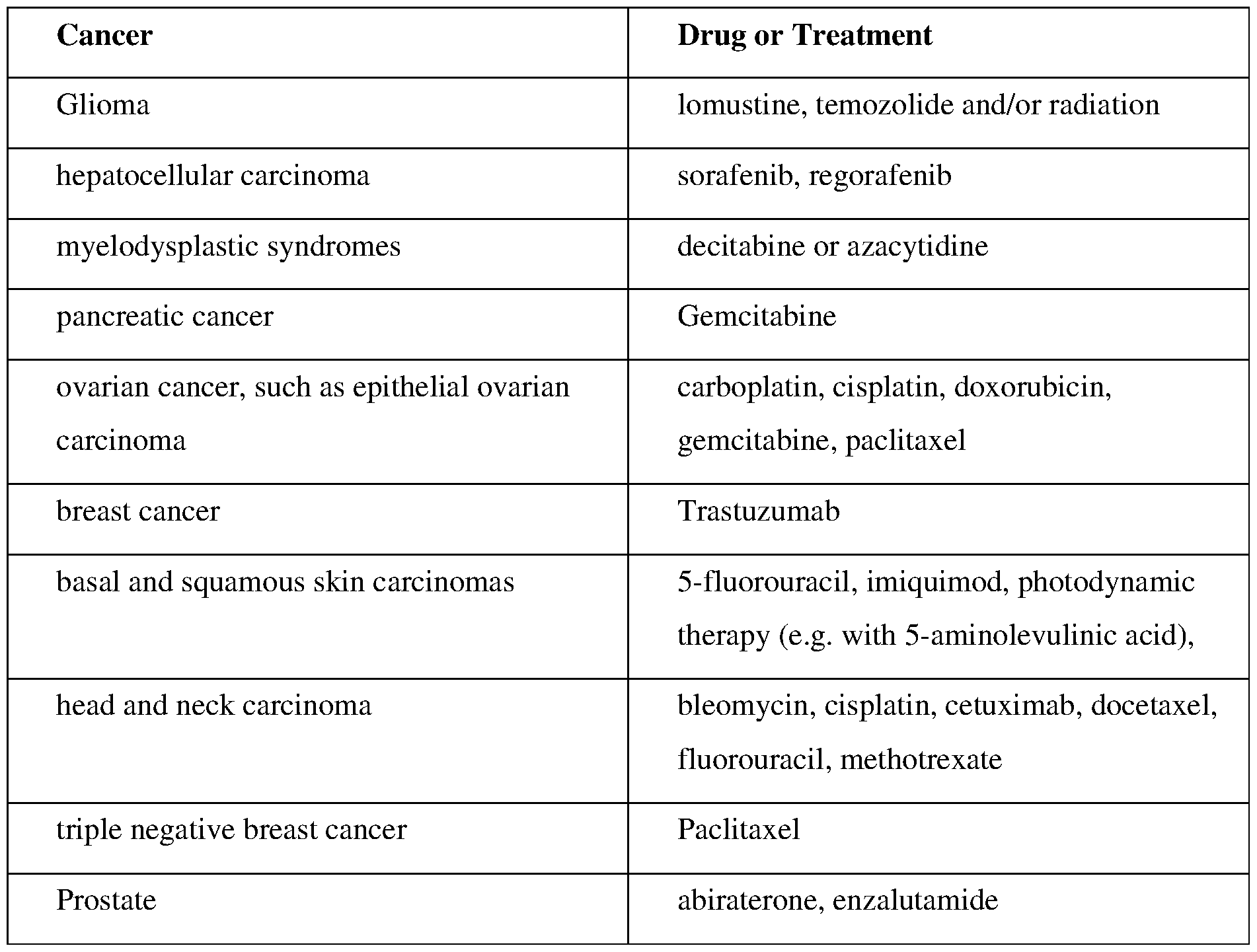
Various classes of anti-cancer and anti-neoplastic compounds for use with the presently disclosed inhbitors include, but are not limited to, alkylating agents, antimetabolites, vinca alkyloids, taxanes, antibiotics, enzymes, cytokines, platinum coordination complexes, substituted ureas, kinase inhibitors, hormones and hormone antagonists. Exemplary alkylating agents include,
without limitation, mechlorothamine, cyclophosphamide, ifosfamide, melphalan, chlorambucil, ethyleneimines, methylmelamines, alkyl sulfonates (e.g., busulfan), and carmustine. Exemplary antimetabolites include, by way of example and not limitation, folic acid analog methotrexate; pyrmidine analog fluorouracil, cytosine arbinoside; purine analogs mercaptopurine, thioguanine, and azathioprine. Exemplary vinca alkyloids include, by way of example and not limitation, vinblastine, vincristine, paclitaxel, and colchicine. Exemplary antibiotics include, by way of example and not limitation, actinomycin D, daunorubicin, and bleomycin. An exemplary enzyme effective as an anti-neoplastic agent includes L-asparaginase. Exemplary coordination compounds include, by way of example and not limitation, cisplatin and carboplatin. Exemplary hormones and hormone related compounds include, by way of example and not limitation, adrenocorticosteroids prednisone and dexamethasone; aromatase inhibitors amino glutethimide, formestane, and anastrozole; progestin compounds hydroxyprogesteron caproate, medroxyprogesterone; and anti- estrogen compound tamoxifen.
These and other useful anti-cancer compounds are described in Merck Index, 13th Ed. (O'Neil M. J. et al., ed) Merck Publishing Group (2001) and Goodman and Gilmans The
Pharmacological Basis of Therapeutics, 10th Edition, Hardman, J. G. and Limbird, L. E. eds., pg. 1381-1287, McGraw Hill, (1996), both of which are incorporated by reference herein.
Among the CTLA 4 antibodies that can be used in combination with the JAK inhibitor, the immunooncology agent, or both, is ipilimumab, marketed as YERVOY® by Bristol-Myers Squibb.
Additional anti-proliferative compounds useful in combination with the JAK inhibitor, the immunooncology agent, or both include, by way of example and not limitation, antibodies directed against growth factor receptors (e.g., anti-Her2); and cytokines such as interferon-a and interferon- γ, interleukin-2, and GM-CSF.
In particular embodiments, including the treatment of leukemias, including CLL, mantle cell lymphoma and ALL, the JAK inhibitor, the immunooncology agent, or both, may be used in combination with a B-cell lymphoma 2 (BCL2) inhibitor, such as ABT-199 or ABT737.
Examples of kinase inhibitors that are useful in combination with the JAK inhibitor, the immunooncology agent, or both, particularly in treating malignancies include Btk inhibitors, such as ibrutinib, CDK inhibitors, such as palbociclib, EGFR inhibitors, such as afatinib, erlotinib, gefitinib, lapatinib and vandetinib, Mek inhibitors, such as trametinib, Raf inhibitors, such as dabrafenib, sorafenib and vemurafenib, VEGFR inhibitors, such as axitinib, lenvatinib, nintedanib, pazopanib BCR-Abl inhibitors, such as bosutinib, dasatinib, imatinib and nilotinib, PI3-kinase inhbitors, such as idelalisib, Syk inhibitors, such as fostamatinib, and JAK inhibitors, such as baricitinib, ruxolitinib and tofacitinib. In other embodiments, the second or additional therapeutic
agent or agents useful in combination with the JAK inhibitor, the immunooncology agent, or both, may be selected from any of the following:
analgesics - morphine, fentanyl, hydromorphone, oxycodone, codeine, acetaminophen, hydrocodone, buprenorphine, tramadol, venlafaxine, flupirtine, meperidine, pentazocine, dextromoramide, dipipanone;
antibiotics - aminoglycosides (e.g., amikacin, gentamicin, kanamycin, neomycin, netilmicin, tobramycin, and paromycin), carbapenems (e.g., ertapenem, doripenem, imipenem, cilastatin, and meropenem), cephalosporins (e.g., cefadroxil, cefazolin, cefalotin, cephalexin, cefaclor, cefamandole, cefoxitin, cefprozil, cefuroxime, cefixime, cefdinir, cefditoren, cefoperazone, cefotaxime, cefpodoxime, ceftazidime, ceftibuten, ceftizoxime, ceftriaxone, cefepime, and cefobiprole), glycopeptides (e.g., teicoplanin, vancomycin, and telavancin), lincosamides (e.g., clindamycin and incomysin), lipopeptides) e.g., daptomycin), macrolides (azithromycin, clarithromycin, dirithromycin, erythromycin, roxithromycin, troleandomycin, telithromycin, and spectinomycin), monobactams (e.g., aztreonam), nitrofurans (e.g., furazolidone and nitrofurantoin), penicilllins (e.g., amoxicillin, ampicillin, azlocillin, carbenicillin, cloxacillin, dicloxacillin, flucloxacillin, mezlocillin, methicillin, nafcillin, oxacillin, penicillin G, penicillin V, piperacillin, temocillin, and ticarcillin), penicillin combinations (e.g., amoxicillin/clavulanate,
ampicillin/sulbactam, piperacillin/tazobactam, and ticarcillin/clavulanate), polypeptides (e.g., bacitracin, colistin, and polymyxin B), quinolones (e.g., ciprofloxacin, enoxacin, gatifloxacin, levofloxacin, lomefloxacin, moxifloxacin, nalidixic acid, norfloxacin, ofloxacin, trovafloxacin, grepafloxacin, sparfloxacin, and temafloxacin), sulfonamides (e.g., mafenide,
sulfonamidochrysoidine, sulfacetamide, sulfadiazine, silver sulfadiazine, sulfamethizole, sulfamethoxazole, sulfanamide, sulfasalazine, sulfisoxazole, trimethoprim, and trimethoprim- sulfamethoxaxzole), tetracyclines (e.g., demeclocycline, doxycycline, minocycline, oxytetracycline, and tetracycline), antimycobacterial compounds (e.g., clofazimine, dapsone, capreomycin, cycloserine, ethambutol, ethionamide, isoniazid, pyrazinamide, rifampicin (rifampin), rifabutin, rifapentine, and streptomycin), and others, such as arsphenamine, chloramphenicol, fosfomycin, fusidic acid, linezolid, metronidazole, mupirocin, platensimycin, quinuprisin/dalfopristin, rifaximin, thiamphenicol, tigecycline, and timidazole;
antibodies - anti-TNF-a antibodies, e.g., infliximab (Remicade™), adalimumab, golimumab, certolizumab; anti-B cell antibodies, e.g., rituximab; anti-IL-6 antibodies, e.g., tocilizumab; anti-IL-1 antibodies, e.g., anakinra; anti PD-1 and/or anti-PD-Ll antibodies, e.g.
nivolumab, pembrolizumab, pidilizumab, BMS-936559, MPDL3280A, AMP-224, MEDI4736;
ixekizumab, brodalumab, ofatumumab, sirukumab, clenoliximab, clazakiumab, fezakinumab, fletikumab, mavrilimumab, ocrelizumab, sarilumab, secukinumab, toralizumab, zanolimumab; anticoagulants - warfarin (Coumadin™), acenocoumarol, phenprocoumon, atromentin, phenindione, heparin, fondaparinux, idraparinux, rivaroxaban, apixaban, hirudin, lepirudin, bivalirudin, argatrobam, dabigatran, ximelagatran, batroxobin, hementin;
anti-inflammatory agents - steroids, e.g., budesonide, nonsteroidal anti-inflammatory agents, e.g., aminosalicylates (e.g., sulfasalazine, mesalamine, olsalazine, and balsalazide), cyclooxygenase inhibitors (COX-2 inhibitors, such as rofecoxib, celecoxib), diclofenac, etodolac, famotidine, fenoprofen, flurbiprofen, ketoprofen, ketorolac, ibuprofen, indomethacin,
meclofenamate, mefenamic acid, meloxicam, nambumetone, naproxen, oxaprozin, piroxicam, salsalate, sulindac, tolmetin;
immunosuppressants - mercaptopurine, corticosteroids such as dexamethasone, hydrocortisone, prednisone, methylprednisolone and prednisolone, alkylating agents such as cyclophosphamide, calcineurin inhibitors such as cyclosporine, sirolimus and tacrolimus, inhibitors of inosine monophosphate dehydrogenase (IMPDH) such as mycophenolate, mycophenolate mofetil and azathioprine, and agents designed to suppress cellular immunity while leaving the recipient's humoral immunologic response intact, including various antibodies (for example, antilymphocyte globulin (ALG), anti thymocyte globulin (ATG), monoclonal anti-T-cell antibodies (OKT3)) and irradiation. Azathioprine is currently available from Salix Pharmaceuticals, Inc. under the brand name Azasan; mercaptopurine is currently available from Gate Pharmaceuticals, Inc. under the brand name Purinethol; prednisone and prednisolone are currently available from Roxane Laboratories, Inc.; Methyl prednisolone is currently available from Pfizer; sirolimus (rapamycin) is currently available from Wyeth-Ayerst under the brand name Rapamune; tacrolimus is currently available from Fujisawa under the brand name Prograf; cyclosporine is current available from Novartis under the brand name Sandimmune and Abbott under the brand name Gengraf; IMPDH inhibitors such as mycophenolate mofetil and mycophenolic acid are currently available from Roche under the brand name Cellcept and Novartis under the brand name Myfortic; azathioprine is currently available from Glaxo Smith Kline under the brand name Imuran; and antibodies are currently available from Ortho Biotech under the brand name Orthoclone, Novartis under the brand name Simulect (basiliximab) and Roche under the brand name Zenapax
(daclizumab); and
Guanylate cyclase - C receptor agonists or intestinal secretagogues-for example linaclotide, sold under the name Linzess.
These various agents can be used in accordance with their standard or common dosages, as specified in the prescribing information accompanying commercially available forms of the drugs (see also, the prescribing information in the 2006 Edition of The Physician's Desk Reference), the disclosures of which are incorporated herein by reference.
V. Method of Using the Combination
Embodiments of the disclosed combination can be used to treat and/or prevent certain diseases and/or disorders such as cell proliferative disorders including cancer. Compounds of formula I, salts, solvates, prodrug(s) thereof, or compositions thereof, will generally be used in combination with at least one immunooncology agent.
A. Compounds of Formula I
Active compounds of formula I, or pharmaceutically acceptable salts, hydrates, solvates, N- oxides and/or prodrugs thereof, typically inhibit the JAK/Stat pathway. The activity of a specified compound as an inhibitor of a JAK kinase can be assessed in vitro or in vivo. In some
embodiments, the activity of a specified compound can be tested in a cellular assay. Suitable assays include assays that determine inhibition of either the phosphorylation activity or ATPase activity of a JAK kinase. Thus, a compound is said to inhibit an activity of a JAK kinase if it inhibits the phosphorylation or ATPase activity of a JAK kinase with an IC50 of about 20 μΜ or less.
One means of assaying for such inhibition is detection of the effect of a compound of formula I on the upregulation of downstream gene products. In the Ramos/IL4 assay, B-cells are stimulated with the cytokine Interleukin-4 (IL-4) leading to the activation of the JAK/Stat pathway through phosphorylation of the JAK family kinases, JAKl and JAK3, which in turn phosphorylate and activate the transcription factor Stat-6. One of the genes upregulated by activated Stat-6 is the low affinity IgE receptor, CD23. To study the effect of inhibitors (e.g., the compounds of formula I described herein) on the JAKl and JAK3 kinases, human Ramos B cells are stimulated with human IL-4. Twenty to 24 hours post stimulation, cells are stained for upregulation of CD23 and analyzed using flow cytometry (FACS). A reduction of the amount of CD23 present compared to control conditions indicates the test compound actively inhibits the JAK kinase pathway.
The biological activity of the disclosed compounds may further be characterized by assaying the effect of the compounds on the proliferative response of primary human T-cells. In this assay, primary human T-cells derived from peripheral blood and pre-activated through stimulation of the T-cell receptor and CD28, proliferate in culture in response to the cytokine
Interleukin-2 (IL-2). This proliferative response is dependent on the activation of JAKl and JAK3 tyrosine kinases, which phosphorylate and activate the transcription factor Stat-5. The primary human T-cells are incubated with the compounds in the presence of IL-2 for 72 hours and at the assay endpoint intracellular ATP concentrations are measured to assess cell viability. A reduction in cell proliferation compared to control conditions is indicative of inhibition of the JAK kinase pathway. Activity of exemplary compounds in this primary T-cell assay are provided in Table 2.
The biological activity of the compounds according to formula I may additionally be characterized by assaying the effect of the compounds described herein on A549 lung epithelial cells and U937 cells. A549 lung epithelial cells and U937 cells up-regulate ICAM-1 (CD54) surface expression in response to a variety of different stimuli. Therefore, using ICAM-1 expression as readout, test compound effects on different signaling pathways can be assessed in the same cell type. Stimulation with IL-Ιβ through the IL-Ιβ receptor activates the TRAF6 / NFKB pathway resulting in up-regulation of ICAM-1. IFNy induces ICAM-1 up-regulation through activation of the JAK1/JAK2 pathway. The up-regulation of ICAM-1 can be quantified by flow cytometry across a compound dose curve and EC50 values are calculated.
Compounds according to formula I, thereof, generally inhibit the JAK kinase pathway with an IC50 in the range of about 1 mM or less, as measured in the assays described herein. Of course, a person of ordinary skill in the art will appreciate that compounds which exhibit lower IC50S, for example on the order of 100 μΜ, 75 μΜ, 50 μΜ, 40 μΜ, 30 μΜ, 20 μΜ, 15 μΜ, 10 μΜ, 5 μΜ, 1 μΜ, 500 ηΜ, 100 ηΜ, 10 ηΜ, 1 ηΜ, or even lower, can be particularly useful in therapeutic applications. In instances where activity specific to a particular cell type is desired, the compound can be assayed for activity with the desired cell type and counter-screened for a lack of activity against other cell types. The desired degree of "inactivity" in such counter screens, or the desired ratio of activity vs. inactivity may vary for different situations, and can be selected by the user.
The disclosed JAK inhibitors, or pharmaceutically acceptable salts, hydrates, solvates, N- oxides and/or prodrugs thereof, also typically inhibit IL-4 stimulated expression of CD23 in B -cells with an IC50 in the range of about 20 μΜ or less, typically in the range of about 10 μΜ, 1 μΜ, 500 nM, 100 nM, 10 nM, 1 nM, or even lower. Certain disclosed compounds may have an IC50 of less than or equal to 5 μΜ, greater than 5 μΜ but less than 20 μΜ, greater than 20 μΜ, or greater than 20 μΜ but less than 50 μΜ.
Additionally, the disclosed JAK inhibitors, or pharmaceutically acceptable salts, hydrates, solvates, N-oxides and/or prodrugs thereof, also typically inhibit an activity of an human primary T-cells with an IC50 in the range of about 20 μΜ or less, typically in the range of about 10 μΜ, 1 μΜ, 500 nM, 100 nM, 10 nM, 1 nM, or even lower. The IC50 against human primary T-cells can
be determined in a standard in vitro assay with isolated human primary T-cells. In certain embodiments, a compound according to formula I has an IC50 of less than or equal to 5 μΜ, greater than 5 μΜ but less than 20 μΜ, greater than 20 μΜ, or greater than 20 μΜ but less than 50 μΜ.
The compounds according to formula I, or pharmaceutically acceptable salts, hydrates, solvates, N-oxides and/or prodrugs thereof, also typically inhibit expression of ICAM1 (CD54) induced by IFNy exposure in U937 or A549 cells with an IC50 in the range of about 20 μΜ or less, typically in the range of about 10 μΜ, 1 μΜ, 500 nM, 100 nM, 10 nM, 1 nM, or even lower. The IC50 against expression of ICAM (CD54) in IFNy stimulated cells can be determined in a functional cellular assay with an isolated A549 or U937 cell line. In certain embodiments, the compounds have an IC50 of less than or equal to 20 μΜ, greater than 20 μΜ, or greater than 20 μΜ but less than 50 μΜ.
The results of the ability of disclosed compounds to inhibit JAK2 activity, has been demonstrated in an assay utilizing Ba/F3 V617F cells as set forth in WO 2009/103032. B. Antiproliferative Effect of the Disclosed Combination
For purposes of this application, the phrase "cell proliferative disorder" refers to a disorder characterized by abnormal proliferation of cells. A cell proliferative disorder does not imply any limitation with respect to the rate of cell growth, but merely indicates loss of normal controls that affect growth and cell division. Thus, in some embodiments, cells of a cell proliferative disorder can have the same cell division rates as normal cells but do not respond to signals that limit such growth. Within the ambit of "cell proliferative disorder" is neoplasm or tumor, which is an abnormal growth of tissue. Cancer refers to any of various malignant neoplasms characterized by the proliferation of cells that have the capability to invade surrounding tissue and/or metastasize to new colonization sites.
The antiproliferative effect of a combination therapy as disclosed herein may be assessed by administering embodiments of the combination to a cultured tumor cell line. In the context of an in vitro assay, administration of a combination comprising a JAK inhibitor according to formula I and an immunooncology agent, may be simply achieved by contacting the cells in culture with the individual components of the combination in respective amounts effective to inhibit cell proliferation. Alternatively, the antiproliferative effect of an embodiment of the disclosed combination may be assessed by administering the combination to an animal in an approved in vivo model for cell proliferation. In vitro or in vivo administration of a disclosed combination may comprise administering the JAK inhibitor and imunooncology agent substantially simultaneously. Or, alternatively, administration may comprise administering the components of the combination,
i.e. the JAK inhibitor and the immunooncology agent, sequentially, in any order. With respect to a sequential administration, the second component, and any subsequent components, are
administered within a time period after administration of the first component such that a subject experiences simultaneous therapeutic effects from the components. In some embodiments, a subject may experience a synergistic therapeutic effect upon administration of the combination, i.e. a therapeutic effect that is greater than the sum of the individual therapeutic effects of each component.
Accordingly, cell proliferative disorders treatable with a combination comprising a compound according to formula I, or pharmaceutically acceptable salts, hydrates, solvates, N- oxides and/or prodrugs thereof, and an immunooncology agent, relate to any disorder characterized by aberrant cell proliferation. These include various tumors and cancers, benign or malignant, metastatic or non-metastatic. Cell proliferative disorders include a variety of cancers, including, among others, cancer of the tongue, mouth, pharynx, esophagus, stomach, small intestine, colon, rectum, anus, liver, gallbladder, pancreas, larynx, lung and bronchus, bones and joints including synovial sarcoma and osteosarcoma, melanomas including basal cell carcinoma, squamous carcinoma, breast, cervix, endometrium, ovary, vulva, vagina, prostate, testis, penis, urinary bladder, kidney and renal pelvis, ureter, eye, brain including glioma, glioblastoma, astrocytoma, neuroblastoma, medulloblastoma, and thyroid. For example, cell proliferative disorders treatable with embodiments of the disclosed combination, include, but are not limited to, the following: a) proliferative disorders of the breast, which include, but are not limited to, invasive ductal carcinoma, invasive lobular carcinoma, ductal carcinoma, lobular carcinoma in situ and metastatic breast cancer;
b) proliferative disorders of the skin, which include, but are not limited to, basal cell carcinoma, squamous cell carcinoma, malignant melanoma and Karposi's sarcoma;
c) proliferative disorders of the respiratory tract, which include, but are not limited to, small cell and non-small cell lung carcinoma, bronchial adema, pleuropulmonary blastoma and malignant mesothelioma;
d) proliferative disorders of the brain, which include, but are not limited to, brain stem and hyptothalamic glioma, cerebellar and cerebral astrocytoma, medullablastoma, ependymal tumors, oligodendroglial, meningiomas and neuroectodermal and pineal tumors;
e) proliferative disorders of the male reproductive organs, which include, but are not limited to, prostate cancer, testicular cancer and penile cancer;
f) proliferative disorders of the female reproductive organs, which include, but are not limited to, uterine cancer (endometrial), cervical, ovarian, vaginal, vulval cancers, uterine sarcoma and ovarian germ cell tumor;
g) proliferative disorders of the digestive tract, which include, but are not limited to, anal, colon, colorectal, esophageal, gallbladder, stomach (gastric), pancreatic cancer, pancreatic cancer- Islet cell, rectal, small-intestine and salivary gland cancers;
h) proliferative disorders of the liver, which include, but are not limited to,
hepatocellular carcinoma, cholangiocarcinoma, mixed hepatocellular cholangiocarcinoma, primary liver cancer and metastatic liver cancer;
i) proliferative disorders of the eye, which include, but are not limited to, intraocular melanoma, retinoblastoma, and rhabdomyosarcoma;
j) proliferative disorders of the head and neck, which include, but are not limited to, laryngeal, hypopharyngeal, nasopharyngeal, oropharyngeal cancers, and lip and oral cancer, squamous neck cancer, metastatic paranasal sinus cancer;
k) proliferative disorders of lymphocytic cells, which include, but are not limited to, various T cell and B cell lymphomas, non-Hodgkins lymphoma, cutaneous T cell lymphoma,
Hodgkins disease, and lymphoma of the central nervous system;
1) leukemias, which include, but are not limited to, acute myeloid leukemia, acute lymphoblastic leukemia, chronic lymphocytic leukemia, chronic myelogenous leukemia, and hairy cell leukemia,
m) proliferative disorders of the thyroid, which include, but are not limited to, thyroid cancer, thymoma, malignant thymoma, medullary thyroid carcinomas, papillary thyroid
carcinomas, multiple endocrine neoplasia type 2A (MEN2A), pheochromocytoma, parathyroid adenomas, multiple endocrine neoplasia type 2B (MEN2B), familial medullary thyroid carcinoma (FMTC) and carcinoids;
n) proliferative disorders of the urinary tract, which include, but are not limited to, bladder cancer;
o) sarcomas, which include, but are not limited to, sarcoma of the soft tissue, osteosarcoma, malignant fibrous histiocytoma, lymphosarcoma, and rhabdomyosarcoma;
p) proliferative disorders of the kidneys, which include, but are not limited to, renal cell carcinoma, clear cell carcinoma of the kidney; and renal cell adenocarcinoma;
q) precursor B-lymphoblastic leukemia/lymphoma (precursor B-cell acute
lymphoblastic leukemia), B-cell chronic lymphocytic leukemia/small lymphocytic lymphoma, B- cell prolymphocytic leukemia, lymphoplasmacytic lymphoma, splenic marginal zone B-cell
lymphoma, hairy cell leukemia, plasma cell myeloma/plasmacytoma, extranodal marginal zone B- cell lymphoma of MALT type, nodal marginal zone B-cell lymphoma, follicular lymphoma, mantle-cell lymphoma, diffuse large B-cell lymphoma, mediastinal large B-cell lymphoma, primary effusion lymphoma and Burkitt's lymphoma/Burkitt cell leukemia
(r) precursor T-lymphoblastic lymphoma/leukemia (precursor T-cell acute
lymphoblastic leukemia), T-cell prolymphocytic leukemia, T-cell granular lymphocytic leukemia, aggressive NK-cell leukemia, adult T-cell lymphoma/leukemia (HTLV-1), extranodal NK T-cell lymphoma, nasal type, enteropathy-type T-cell lymphoma, hepatosplenic gamma-delta T-cell lymphoma, subcutaneous panniculitis-like T-cell lymphoma, mycosis fungoides/Sezary syndrome, anaplastic large-cell lymphoma, T/null cell, primary cutaneous type, peripheral T-cell lymphoma, not otherwise characterized, angioimmunoblastic T-cell lymphoma, anaplastic large-cell lymphoma, T/null cell, and primary systemic type;
(s) nodular lymphocyte-predominant Hodgkin' s lymphoma, nodular sclerosis
Hodgkin's lymphoma (grades 1 and 2), lymphocyte-rich classical Hodgkin' s lymphoma, mixed cellularity Hodgkin's lymphoma, and lymphocyte depletion Hodgkin's lymphoma;
(t) myelogenous leukemia (e.g. , Philadelphia chromosome positive (t(9;22)(qq34;ql 1)), multiple myeloma, chronic neutrophilic leukemia, chronic eosinophilic leukemia/hypereosinophilic syndrome, chronic idiopathic myelofibrosis, polycythemia vera, essential thrombocythemia, chronic myelomonocytic leukemia, atypical chronic myelogenous leukemia, juvenile
myelomonocytic leukemia, refractory anemia with ringed sideroblasts and without ringed sideroblasts, refractory cytopenia (myelodysplastic syndrome) with multilineage dysplasia, refractory anemia (myelodysplastic syndrome) with excess blasts, 5q-syndrome, and
myelodysplastic syndrome with t(9;12)(q22;pl2);
(u) AML with t(8;21)(q22;q22), AML 1 (CBF- alpha)/ETO , acute promyelocytic leukemia (AML with t(15;17)(q22;ql l-12) and variants, PML/RAR-alpha), AML with abnormal bone marrow eosinophils (inv(16)(pl3q22) or t(16;16)(pl3;ql l), CBFb/MYHl IX), and AML with 1 lq23 (MLL) abnormalities, AML minimally differentiated, AML without maturation, AML with maturation, acute myelomonocytic leukemia, acute monocytic leukemia, acute erythroid leukemia, acute megakaryocytic leukemia, acute basophilic leukemia, and acute panmyelosis with
myelofibrosis.
Examples of tumor cell lines derived from human tumors and available for use in the in vivo studies include, but are not limited to, leukemia cell lines (e.g. , CCRF-CEM, HL-60(TB), K-562, MOLT-4, RPM1-8226, SR, P388 and P388/ADR); non-small cell lung cancer cell lines (e.g., A549/ATCC, EKVX, HOP-62, HOP-92, NCI-H226, NCI-H23, NCI-H322M, NCI-H460, NCI-
H522 and LXFL 529); small cell lung cancer cell lines (<?.g.,DMS 114 and SHP-77); colon cancer cell lines (e.g., COLO 205, HCC-2998, HCT-116, HCT-15, HT29, KM12, SW-620, DLD-1 and KM20L2); central nervous system (CNS) cancer cell lines (e.g., SF-268, SF-295, SF-539, SNB-19, SNB-75, U251, SNB-78 and XF 498); melanoma cell lines (e.g., LOX I MVI, MALME-3M, M14, SK-MEL-2, SK-MEL-28, SK-MEL-5, UACC-257, UACC-62, RPMI-7951 and M19-MEL);
ovarian cancer cell lines (e.g., IGROV1, OVCAR-3, OVCAR-4, OVCAR-5, OVCAR-8 and SK- OV-3); renal cancer cell lines (e.g., 786-0, A498, ACHN, CAKI-1, RXF 393, SN12C, TK-10, UO- 31, RXF-631 and SN12K1); prostate cancer cell lines (e.g., PC-3 and DU-145); breast cancer cell lines (e.g., MCF7, NCI/ ADR- RES, MDA-MB-231/ATCC, HS 578T, MDA-MB-435, BT-549, T- 47D and MDA-MB-468); and thyroid cancer cell lines (e.g., SK-N-SH).
In some embodiments, the cell proliferative disorder treated by the disclosed combination, is a hematopoietic neoplasm, which is aberrant growth of cells of the hematopoietic system.
Hematopoietic malignancies can have its origins in pluripotent stem cells, multipotent progenitor cells, oligopotent committed progenitor cells, precursor cells, and terminally differentiated cells involved in hematopoiesis. Some hematological malignancies are believed to arise from hematopoietic stem cells, which have the ability for self renewal. For instance, cells capable of developing specific subtypes of acute myeloid leukemia (AML) upon transplantation display the cell surface markers of hematopoietic stem cells, implicating hematopoietic stem cells as the source of leukemic cells. Blast cells that do not have a cell marker characteristic of hematopoietic stem cells appear to be incapable of establishing tumors upon transplantation (Blaire et al., 1997, Blood 89:3104-3112). The stem cell origin of certain hematological malignancies also finds support in the observation that specific chromosomal abnormalities associated with particular types of leukemia can be found in normal cells of hematopoietic lineage as well as leukemic blast cells. For instance, the reciprocal translocation t(9q34;22ql l) associated with approximately 95% of chronic myelogenous leukemia appears to be present in cells of the myeloid, erythroid, and lymphoid lineage, suggesting that the chromosomal aberration originates in hematopoietic stem cells. A subgroup of cells in certain types of CML displays the cell marker phenotype of hematopoietic stem cells.
Although hematopoietic neoplasms often originate from stem cells, committed progenitor cells or more terminally differentiated cells of a developmental lineage can also be the source of some leukemias. For example, forced expression of the fusion protein Bcr/Abl (associated with chronic myelogenous leukemia) in common myeloid progenitor or granulocyte/macrophage progenitor cells produces a leukemic-like condition. Moreover, some chromosomal aberrations associated with subtypes of leukemia are not found in the cell population with a marker phenotype
of hematopoietic stem cells, but are found in a cell population displaying markers of a more differentiated state of the hematopoietic pathway (Turhan et al., 1995, Blood 85:2154-2161). Thus, while committed progenitor cells and other differentiated cells may have only a limited potential for cell division, leukemic cells may have acquired the ability to grow unregulated, in some instances mimicking the self -renewal characteristics of hematopoietic stem cells (Passegue et al., Proc. Natl. Acad. Set USA, 2003, 100:11842-9).
In some embodiments, the hematopoietic neoplasm is a lymphoid neoplasm, where the abnormal cells are derived from and/or display the characteristic phenotype of cells of the lymphoid lineage. Lymphoid neoplasms can be subdivided into B-cell neoplasms, T and NK -cell neoplasms, and Hodgkin's lymphoma. B-cell neoplasms can be further subdivided into precursor B-cell neoplasm and mature/peripheral B-cell neoplasm. Exemplary B-cell neoplasms are precursor B- lymphoblastic leukemia/lymphoma (precursor B-cell acute lymphoblastic leukemia) while exemplary mature/peripheral B-cell neoplasms are B-cell chronic lymphocytic leukemia/small lymphocytic lymphoma, B-cell prolymphocytic leukemia, lymphoplasmacytic lymphoma, splenic marginal zone B-cell lymphoma, hairy cell leukemia, plasma cell myeloma/plasmacytoma, extranodal marginal zone B-cell lymphoma of MALT type, nodal marginal zone B-cell lymphoma, follicular lymphoma, mantle-cell lymphoma, diffuse large B-cell lymphoma, mediastinal large B- cell lymphoma, primary effusion lymphoma, and Burkitt' s lymphoma/Burkitt cell leukemia. T-cell and Nk-cell neoplasms are further subdivided into precursor T-cell neoplasm and mature
(peripheral) T-cell neoplasms. Exemplary precursor T-cell neoplasm is precursor T- lymphoblastic lymphoma/leukemia (precursor T-cell acute lymphoblastic leukemia) while exemplary mature (peripheral) T-cell neoplasms are T-cell prolymphocytic leukemia T-cell granular lymphocytic leukemia, aggressive NK-cell leukemia, adult T-cell lymphoma/leukemia (HTLV-1), extranodal NK T-cell lymphoma, nasal type, enteropathy-type T-cell lymphoma, hepatosplenic gamma-delta T-cell lymphoma, subcutaneous panniculitis-like T-cell lymphoma, Mycosis fungoides/Sezary syndrome, Anaplastic large-cell lymphoma, T/null cell, primary cutaneous type, Peripheral T-cell lymphoma, not otherwise characterized, Angioimmunoblastic T-cell lymphoma, Anaplastic large- cell lymphoma, T/null cell, primary systemic type. The third member of lymphoid neoplasms is Hodgkin's lymphoma, also referred to as Hodgkin's disease. Exemplary diagnosis of this class that can be treated with the compounds of the disclosure, include, among others, nodular lymphocyte- predominant Hodgkin's lymphoma, and various classical forms of Hodgkin's disease, exemplary members of which are Nodular sclerosis Hodgkin's lymphoma (grades 1 and 2), Lymphocyte-rich classical Hodgkin's lymphoma, Mixed cellularity Hodgkin's lymphoma, and Lymphocyte depletion Hodgkin's lymphoma. In various embodiments, any of the lymphoid neoplasms that are associated
with aberrant JAK activity can be treated with embodiments of the disclosed combination comprising a JAK inhibitory compound.
In some embodiments, the hematopoietic neoplasm is a myeloid neoplasm. This group comprises a large class of cell proliferative disorders involving or displaying the characteristic phenotype of the cells of the myeloid lineage. Myeloid neoplasms can be subdivided into myeloproliferative diseases, myelodysplastic/myeloproliferative diseases, myelodysplastic syndromes, and acute myeloid leukemias. Exemplary myeloproliferative diseases are chronic myelogenous leukemia (e.g. , Philadelphia chromosome positive (t(9;22)(qq34;ql l)), chronic neutrophilic leukemia, chronic eosinophilic leukemia/hypereosinophilic syndrome, chronic idiopathic myelofibrosis, polycythemia vera, and essential thrombocythemia. Exemplary myelodysplastic/myeloproliferative diseases are chronic myelomonocytic leukemia, atypical chronic myelogenous leukemia, and juvenile myelomonocytic leukemia. Exemplary
myelodysplastic syndromes are refractory anemia, with ringed sideroblasts and without ringed sideroblasts, refractory cytopenia (myelodysplastic syndrome) with multilineage dysplasia, refractory anemia (myelodysplastic syndrome) with excess blasts, 5q- syndrome, and
myelodysplastic syndrome. In various embodiments, any of the myeloid neoplasms that are associated with aberrant JAK activity can be treated with a disclosed combination comprising a JAK inhibitory compound.
In some embodiments of the disclosure, embodiments of the disclosed combination can be used to treat acute myeloid leukemias (AML), which represent a large class of myeloid neoplasms having its own subdivision of disorders. These subdivisions include, among others, AMLs with recurrent cytogenetic translocations, AML with multilineage dysplasia, and other AML not otherwise categorized. Exemplary AMLs with recurrent cytogenetic translocations include, among others, AML with t(8;21)(q22;q22), AML 1 (CBF-alpha)/ETO, Acute promyelocytic leukemia (AML with t(15; 17)(q22;ql 1-12) and variants, PML/RAR-alpha), AML with abnormal bone marrow eosinophils (inv(16)(pl3q22) or t(16; 16)(pl3 ;ql l), CBFb/MYHl lX), and AML with l lq23 (MLL) abnormalities. Exemplary AML with multilineage dysplasia are those that are associated with or without prior myelodysplastic syndrome. Other acute myeloid leukemias not classified within any definable group include, AML minimally differentiated, AML without maturation, AML with maturation, Acute myelomonocytic leukemia, Acute monocytic leukemia, Acute erythroid leukemia, Acute megakaryocytic leukemia, Acute basophilic leukemia, and Acute panmyelosis with myelofibrosis.
By way of illustration, particular combinations of the present invention for use in treating malignancies are set forth in the table below:
Immunooncology agent(s) JAK inhibitor
ipilimumab 4-(6-(morpholin-4-yl)pyridin-3-yl)-N-(3- methyl-4-((lS,4S)-5-methyl-2,5- diazabicyclo [2.2.1 ]heptan-2- yl)phenyl)pyrimidin-2-amine
nivolumab sodium (5-((2-((4-fluoro-3-methoxy-5- methylphenyl)amino)-5-methylpyrimidin- 4-yl) amino)-2-oxobenzo [d] oxazol- 3 (2H) - yl)methyl phosphate
pembrolizumab 5-((2-((4-fluoro-3-methoxy-5- methylphenyl)amino)-5-methylpyrimidin-
4-yl)amino)benzo[d]oxazol-2(3H)-one
ipilimumab, nivolumab 4-(6-(morpholin-4-yl)pyridin-3-yl)-N-(3- methyl-4-((lS,4S)-5-methyl-2,5- diazabicyclo [2.2.1 ]heptan-2- yl)phenyl)pyrimidin-2-amine
nivolumab, pembrolizumab 4-(6-(morpholin-4-yl)pyridin-3-yl)-N-(3- methyl-4-((lS,4S)-5-methyl-2,5- diazabicyclo [2.2.1 ]heptan-2- yl)phenyl)pyrimidin-2-amine
ipilimumab sodium (5-((2-((4-fluoro-3,5- dimethy lpheny 1) amino) - 5 - methylpyrimidin-4-yl)amino)-2- oxobenzo [d]oxazol-3 (2H)-yl)methyl
phosphate
Animal models useful for testing the efficacy of combinations comprising a JAK inhibitor and an immunooncology agent, or the efficacy of the individual components of the combination, to treat or prevent the various diseases or conditions described above are well-known in the art. For example, suitable animal models of systemic mastocytosis are described in O' Keefe et al , (1987), /. Vet. Intern. Med. l(2):75-80 and Bean-Knudsen et al. , (1989), Vet. Pathol. 26(l):90-92. Suitable
animal models of B-cell lymphoma are described in Hough et al, (1998), Proc. Natl. Acad. Set USA 95:13853-13858 and Hakim et al, (1996), /. Immunol. 157(12):5503-5511. Suitable animal models of polycythemia vera, essential thrombocythemia and primary myelofibrosis are described in Shimoda, (2008) Leukemia 22(l):87-95; Lacout, (2006) Blood 108(5): 1652-60; and Wernig, (2006) Blood 107(11):4274-81.
The embodiments of the disclosed combination can be administered therapeutically to achieve therapeutic benefit or prophylactically to achieve prophylactic benefit. By therapeutic benefit is meant eradication or amelioration of the underlying disorder being treated and/or eradication or amelioration of one or more of the symptoms associated with the underlying disorder such that the subject reports an improvement in feeling or condition, notwithstanding that the subject may still be afflicted with the underlying disorder. By prophylactic benefit is meant prevention or delayed onset of a disorder. For prophylactic administration, the combination can be administered to a subject at risk of developing one of the previously described conditions.
Alternatively, prophylactic administration can be applied to avoid the onset of symptoms in a subject diagnosed with the underlying disorder. For example, a combination can be administered to a genetically predisposed subject prior to expected onset of the disease.
The amount of a combination that is administered will depend upon a variety of factors, including, for example, the particular condition being treated, the mode of administration, whether the desired benefit is prophylactic or therapeutic, the severity of the condition being treated, the age and weight of the subject, the general health of the subject, and/or the bioavailability of the particular active compound. Determination of an effective dosage is well within the capabilities of those skilled in the art.
Dosage, and frequency of administration of the combination will also depend on whether the combination, or separate components thereof, is formulated for treatment of acute episodes of a condition or for the prophylactic treatment of a disorder. A skilled practitioner will be able to determine the optimal dose for a particular individual. Determination of an effective dosage is well within the capabilities of those skilled in the art.
Effective dosages can be estimated initially from in vitro activity and metabolism assays. For example, an initial dosage of prodrug for use in animals can be formulated to achieve a circulating blood or serum concentration of the metabolite active compound that is at or above an IC50 of the particular compound as measured in an in vitro assay, such as the in vitro CHMC or BMMC and other in vitro assays described in U.S. application Serial No. 10/355,543 filed January 31, 2003 (US2004/0029902A1), international application Serial No. PCT/US03/03022 filed January 31, 2003 (WO 03/063794), U.S. application Serial No. 10/631,029 filed July 29, 2003,
international application Serial No. PCT/US03/24087 (WO2004/014382), U.S. application Serial No. 10/903,263 filed July 30, 2004, and international application Serial No. PCT/US2004/24716 (WO2005/016893). Calculating dosages to achieve such circulating blood or serum concentrations, taking into account the bioavailability of the particular prodrug via the desired route of
administration, is well within the capabilities of skilled artisans. For guidance, the reader is referred to Fingl & Woodbury, "General Principles," In: Goodman and Oilman 's The
Pharmaceutical Basis of Therapeutics, Chapter 1, 12th edition, Pergamon Press, and the references cited therein.
Initial dosages can also be estimated from in vivo data, such as animal models previously described. Persons of ordinary skill in the art can routinely adapt such information to determine dosages suitable for human administration.
Dosage amounts of the JAK inhibitors will typically be in the range of from about 0.0001 or 0.001 or 0.01 mg/kg/day to about 100 mg/kg/day, but can be higher or lower, depending upon, among other factors, the activity of each component of the combination, its bioavailability, the mode of administration, and various factors discussed above. More typically, the dosage (or effective amount) may range from about 5 mg/kg to about 20 mg/kg; even more typically from about 10 mg/kg to about 20 mg/kg; even more typically from about 15 mg/kg to about 20 mg/kg. Typical treatments are from about 1 mg/kg/day to about 20 mg/kg/day, such as from about 1.5 mg/kg/day to about 15 mg/kg/day or from about 2 mg/kg/day to about 10 mg/kg/day. Dosage amount and interval can be adjusted individually to provide plasma levels of each bioactive compound in the combination which are sufficient to maintain therapeutic or prophylactic effect. For example, the combination can be administered once per week, several times per week (e.g., every other day), once per day, or multiple times per day, depending upon, among other things, the mode of administration, the specific indication being treated, and the judgment of the prescribing physician. In cases of local administration or selective uptake, such as local topical administration, the effective local concentration of active compounds may not be related to plasma concentration. Skilled artisans will be able to optimize effective local dosages without undue experimentation.
In one embodiment the daily dosage of the JAK inhibitor may be greater than zero milligrams per day, such as from about 1 mg/day, up to at least about 2 grams/day. For certain embodiments, the dosage is about 2 mg/day, about 3 mg/day, about 5 mg/day, about 10 mg/day, about 15 mg/day, about 20 mg/day or about 50 mg/day. More particularly, the dosage of particular JAK inhibitors is from about 50 mg to about 800 mg/day or from about 250 mg/day to about 1.2 g/day. When administered orally, the JAK inhibitor typically is administered once, twice or three times per day to reach the total daily dosage.
Preferably, the combination will provide therapeutic or prophylactic benefit without causing substantial toxicity. Toxicity of the individual components as well as of the combination, can be determined using standard pharmaceutical procedures. The dose ratio between toxic and therapeutic (or prophylactic) effect is the therapeutic index. Compounds that exhibit high therapeutic indices are preferred in the combination.
The foregoing disclosure pertaining to the dosage requirements for the components of the combination is pertinent to dosages required for prodrugs, with the realization, apparent to the skilled artisan, that the amount of prodrug(s) administered will also depend upon a variety of factors, including, for example, the bioavailability of the particular prodrug(s) and the conversation rate and efficiency into active drug compound under the selected route of administration.
Determination of an effective dosage of prodrug(s) for a particular use and mode of administration is well within the capabilities of those skilled in the art.
Particular disclosed embodiments concern a method comprising administering to a subject the disclosed combination in an amount effective to inhibit or prevent a disease, such as a cell proliferative disorder including cancer. For example, the combination may be administered to a subject identified as having cancer or being at risk of developing cancer. In particular disclosed embodiments, administering comprises exposing the subject to a dosage of the combination, or to a dosage of each component of the combination, that is adjusted to inhibit or prevent the disease. The components of a combination also may be administered as multiple pharmaceutical compositions, each comprising one or more components of the combination, or as a single pharmaceutical composition comprising all the components, and typically is administered parenterally (e.g. , intravenously, infusion, or implant), orally, or rectally. Additionally, the combination may be administered prophylactically.
The method may further comprise monitoring blood levels of the compound, or a metabolite thereof, in the subject to ascertain the effect of the compound. The method also may further comprise monitoring one or more biomarkers associated with a disease, such as a cancer.
Thus, in certain embodiments, the method further comprises monitoring one or more biomarkers associated with a cell proliferative disorder. Suitable biomarkers may include serologic markers such as C-reactive protein, perinuclear antineutrophil cytoplasmic antibody, anti- Saccharomyces cerevisiae antibody, anti-OmpC (outer membrane porin C), anti-I2 protein antibody, anti-glycan antibodies, anti-chitobioside IgA, anti-laminaribioside IgG, anti-manobioside IgG, toll-like receptors 2 and 4, β-defensin-l, ubiquitination factor E4A (UBE4A), CXCL16 (a chemokine), resistin, apolipoprotein A-IV; genetic biomarkers such as NOD2/CARD 15,
NOD1/CARD4; fecal biomarkers such as fecal calprotectin and lactoferrin; and mucosal
biomarkers such as mucosal cytokines and chemokines (e.g. , IL-1 , IL-Ιβ, IL-4 IL-6, IL-8, IL- 10, IL-11, IL13Ra2, IL-15, IL- 18, IL-21 , IL-23, IL-32, IFN-γ, TNF-a), monocyte chemotactic protein (MCP)-1 , RANTES, epithelial neutrophil activating protein 78 (ENA-78)), osteoprotegerin, STC1, PTGS2, IL13Ra2, RelA, A20, plgR (polymeric immunoglobulin receptor), GR (glucocorticosteroid receptor) expression, CXCL2, CXCL8, CXCL10, calgranulin B, adhesion molecules and markers of activation (e.g. , mucosal vascular addressin CAM-1 (MAdCAM- 1), NF-κΒ, mitogen-activated protein kinase (MAPK), ICAM- 1, CD40 overexpression, increased phosphorylation of MAPKs (e.g. , p38, extracellular signal-regulated kinase and Jun N-terminal kinase)), immune cells (e.g. , IL- 17-positive cells, TH17 cells, Tregs (regulatory T-cells), neutrophils, monocytes, mucosal dendritic cells, macrophages), non-immune cells (e.g. , intestinal epithelial cells with abnormal HLA-DR and/or B7 molecule expression, endothelial cells with high expression of CD146, TLR3, TLR4), matrix metalloproteinases, vascular endothelial growth factor, other mucosal components (e.g. , lactate dehydrogenase (LDH) isoenzyme M monomers, LDH 5 monomers, proliferator-activated receptor-2 (PAR2) methylation), mucin 2), and mean histological inflammation.
In particular disclosed embodiments, a method for inhibiting or preventing a disease is contemplated, wherein the method comprises diagnosing a subject in need of treatment for a disease, or at risk of developing a disease, administering to the subject a combination in an amount effective to inhibit and/or prevent the disease, the combination comprising at least one of the JAK inhibitors disclosed herein and at least one immunooncology agent, and permitting the compounds to achieve therapeutic benefit for the disease in the subject. In some examples, the disease is a cell proliferative disorder.
In particular disclosed embodiments, the method comprises administering one or more disclosed embodiments of the combination to a subject in an amount effective to inhibit or prevent a disease. The combination may comprise at least one compound having any one of formulas I- III, such as any one of the exemplary compounds disclosed in Tables 1 and 3. In some examples, the disease is a cell proliferative disorder.
Typically, administering comprises exposing the subject to a first dose of the combination. The method may further comprise determining a therapeutic blood level of the one or more compounds from the combination in the subject, or a therapeutic metabolite blood level of the one or more compounds, in the subject. Additionally, the method may comprise, after determining the therapeutic blood level, adjusting the first dose to a second dose to optimize therapeutic effect. The combination may be administered as a single pharmaceutical composition, or alternatively, the components of the combination may be administered in multiple pharmaceutical compositions, such as two or more compositions. Suitable methods of administration include oral, buccal,
mucosal, sublingual, parenteral (e.g. , intravenous, intraperitoneal, subcutaneous injection, infusion, implant), intra-arterial, intramuscular, subcutaneous, intraarticular, infusion, intrathecal, intraurethral, topical, subdermal, transdermal, intranasal, inhalation, pulmonary tract, intratracheal, intraocular, ocular, intraaural, vaginal, and rectal. In embodiments, where the combination is administered as more than one pharmaceutical composition, a person of ordinary skill in the art will appreciate that the various components of the combination may be administered in different ways. For example, a preferred method for administering a JAK inhibitor component of the combination may be different to the preferred method for administering the immunooncological agent, in which case each component may be individually administered by their preferred method. In particular disclosed embodiments, the combination, or at least one component of the combination, is administered parenterally, orally, or rectally. The combination may be administered
prophylactically.
VI. Kits
Also provided are kits for administration of the combination of the JAK inhibitor and the immunooncology agent. The kit may comprise pharmaceutical formulations of each individual component of the combination. The pharmaceutical formulations may include a dosage amount of at least one JAK inhibitor or a composition including at least one JAK inhibitor, and at least one immunooncology agent, or a composition including at least one immunooncology agent, as disclosed herein. Alternatively, the kit may include single pharmaceutical compositions that include both the JAK inhibitor(s) and the immunooncology agent(s). Kits can further include suitable packaging and/or instructions for use of the combination. Kits can also include a means for the delivery of each component of the combination, such as an inhaler, spray dispenser (e.g., nasal spray), syringe for injection, or pressure pack for capsules, tables, suppositories, or other device as described herein. A kit can also provide the combination and reagents to prepare a single composition, or separate compositions for each component of the combination, for administration. The composition(s) can be in a dry or lyophilized form or in a solution, particularly a sterile solution. When a composition is in a dry form, the reagent can include a pharmaceutically acceptable diluent for preparing a liquid formulation. The kit can contain a device for
administration or for dispensing the compositions, including, but not limited to, syringe, pipette, transdermal patch, or inhalant.
The kits can include other therapeutic compounds for use in conjunction with the compounds described herein. In some embodiments, the therapeutic agents are immunosuppressant
or anti-allergen compounds. These compounds can be provided in a separate form or mixed with the presently disclosed combination.
The kits will include appropriate instructions for preparation and administration of the composition, side effects of the combination, and any other relevant information. The instructions can be in any suitable format, including, but not limited to, printed matter, videotape, computer readable disk or optical disc.
One embodiment is a kit including a composition comprising a compound of formula I, or a salt, solvate, hydrate, N-oxide or prodrug thereof, an immunooncology agent, packaging, and instructions for use.
The kit may include a pharmaceutical formulation including a compound of formula I or a salt, solvate, hydrate, N-oxide or prodrug thereof, and/or a pharmaceutical formulation including an immunooncology agent, and at least one pharmaceutically acceptable excipient, diluent, preservative, stabilizer, or mixture thereof, packaging, and instructions for use for each formulation included.
Another embodiment is a kit for treating an individual who suffers from or is susceptible to a cell proliferative disorder as disclosed herein are provided, including a container including a dosage amount of a JAK inhibitor or composition thereof, and an immunooncology agent or composition thereof, as disclosed herein, and instructions for use. The container can be any of those known in the art and appropriate for storage and delivery of oral, intravenous, topical, rectal, urethral, or inhaled formulations.
Kits can also be provided that contain sufficient dosages of the combination to provide effective treatment for an individual for an extended period, such as a week, 2 weeks, 3, weeks, 4 weeks, 6 weeks, or 8 weeks or more.
It will be appreciated by one of skill in the art that the embodiments summarized above can be used together in any suitable combination to generate additional embodiments not expressly recited above, and that such embodiments are considered to be part of the present disclosure.
BIOLOGICAL EXAMPLE
Methods of Treatment
A subject in need of treatment for a cell proliferative disorder is selected based on a clinical, diagnostic, and/or histopathological presentation of a cell proliferative disorder. For example, the subject may have symptoms of a cell proliferative disorder. A cell proliferative disorder also may be determined by diagnostic tests and/or procedures, such as blood tests (e.g. , to check for antibodies characteristic of a cell proliferative disorder), stool analysis, colonoscopy, flexible
sigmoidoscopy, barium enema, abdominal x-ray, computerized tomography scan, magnetic resonance imaging, capsule endoscopy, and/or double -balloon endoscopy. Subjects also may be selected based on an increased risk of developing a cell proliferative disorder, such as a family history of cell proliferative disorders and/or one or more genetic markers indicating a predisposition toward developing an cell proliferative disorder.
The subject is administered a therapeutically effective dose of one or more of the combinations disclosed herein, or pharmaceutical compositions comprising one or more components of the disclosed combination. Administration may be performed via any suitable route including, but not limited to, parenteral (e.g. , intravenous, intraperitoneal, implant), oral, or rectal routes. Treatment may be continued for at least a week, month, or year, and in some subjects treatment may extend over multiple years, the duration of disorder, or the lifetime of the subject. Beneficial or desired results of treatment can include one or more, but are not limited to, alleviation or amelioration of one or more symptoms, diminishment of extent of the cell proliferative disorder, stabilized (i.e., not worsening) state of the subject's condition, delay or slowing of the condition, including disease progression, amelioration or palliation of the condition, and remission (whether partial or total), whether detectable or undetectable.
In particular cases, subjects are selected for concomitant treatment with other
pharmaceutical or non-pharmaceutical interventions, such as an analgesic, an antibiotic, an anticoagulant, an antibody, an anti-inflammatory agent, an immunosuppressant, or a combination thereof. In other cases, at least one embodiment of the disclosed combination, or pharmaceutical composition(s) comprising components of the combination, is administered to the subject with no other treatment for the cell proliferative disorder.
In view of the many possible embodiments to which the principles of the disclosed invention may be applied, it should be recognized that the illustrated embodiments are only preferred examples of the invention and should not be taken as limiting the scope of the invention. Rather, the scope of the invention is defined by the following claims. We therefore claim as our invention all that comes within the scope and spirit of these claims.
Claims
We claim:
1. A method, comprising administering to a subject a combination comprising a JAK inhibitor and an immunooncology agent. 2. The method of claim 1 wherein the JAK inhibitor and the immunooncology agent are administered substantially simultaneously.
3. The method of claim 1 wherein the JAK inhibitor and the immunooncology agent are administered as a composition comprising the JAK inhibitor and the immunooncology agent.
4. The method of claim 1 wherein the JAK inhibitor and the immunooncology agent are administered sequentially, in any order.
5. The method of claim 1, wherein the JAK inhibitor and the immunooncology agent are administered within a time period such that the subject experiences an overlapping beneficial effect from both the JAK inhibitor and the immunooncology agent.
6. The method of claim 1, wherein the immunooncology agent comprises an anti-PD-1 antibody, anti-PD-Ll antibody, PI3K inhibitor or indole dioxygenase (IDO) inhibitor or a combination thereof.
7. The method of any of claims 1-4, wherein the immunooncology agent is selected from nivolumab, pembrolizumab, lambrolizumab, pidilizumab, BMS-936559, MPDL3280A, AMP-224, MEDI4736, ipilimumab, tremelimumab, lirilumab, BMS-986016, urelumab, elotuzumab, idelalisib, AZD8186, INCB40093, INCB50465, 1-methyltryptophan, indoximod, NSC 36398 (dihydroquercetin, taxifolin), NLG919, INCB024360 (epacodostat), F001287 or combinations thereof.
8. The method of any one of claims 1-7 wherein the JAK inhibitor has a formula

or a pharmaceutically acceptable salt, solvate, hydrate, N-oxide or prodrug thereof;
ring A is aryl, heteroaryl or a fused ring system;
R1 is hydrogen, alkyl, alkenyl, alkynyl, haloalkyl, haloalkenyl, haloalkenyl, cycloalkyl, cycloalkylalkyl, cycloalkylalkenyl, cycloalkylalkynyl, aryl, aralkyl, aralkenyl, aralkynyl,
-R8-C(0)OR6, -R9-N(R6)R7 and -R9-OR6;
each R2 independently is H, alkyl, alkoxy, amide, cyano, nitro, halo, haloalkyl,
hydroxyalkyl, heteroalkyl, heterocyclyl, sulfonyl, sulfonamide, -R5, -OR6, -N(R6)2, -C(0)OR6, -C(0)N(R6)2; or two R2 groups, taken together with the atom or atoms to which they are attached, combine to form a 4-10 membered ring system;
each R3 independently is halo, alkyl, cyano or haloalkyl;
R4 is aryl, heteroaryl or
 ;
;
X and Y independently are O, NH or N-alkyl;
R5 is an N-heterocyclyl, wherein a nitrogen atom in the N-heterocyclyl is optionally substituted by a substituent selected from alkyl, alkenyl, alkynyl, haloalkyl, haloalkenyl, haloalkynyl, aryl, aralkyl, aralkenyl, aralkynyl, cycloalkyl, cycloalkylalkyl, cycloalkylalkenyl, cycloalkylalkynyl, heterocyclyl, heterocyclylalkyl, heterocyclylalkenyl, heterocyclylalkynyl, heteroaryl, heteroarylalkyl, heteroarylalkenyl, heteroarylalkynyl, -R8-OR6, -R8-C(0)R6,
-R8-C(0)OR6, -R9-N(R6)R7, -R8-C(0)N(R6)R7, -R8-C(N=R6)N(R6)R7, -R8-S(0)2N(R6)R7, or
-R8-S(0)tR6 where t is 1 or 2; and a carbon atom in the N-heterocyclyl is optionally substituted by a substituent selected from alkyl, alkenyl, alkynyl, halo, haloalkyl, haloalkenyl, haloalkynyl, oxo, aryl, aralkyl, aralkenyl, aralkynyl, cycloalkyl, cycloalkylalkyl, cycloalkylalkenyl,
cycloalkylalkynyl, heterocyclyl, heterocyclylalkyl, heterocyclylalkenyl, heterocyclylalkynyl, heteroaryl, heteroarylalkyl, heteroarylalkenyl, heteroarylalkynyl, -R8-OR6, -R8-C(0)R6,
-R8-C(0)OR6, -R9-N(R6)R7, -R8-C(0)N(R6)R7, -R8-S(0)2N(R6)R7, or -R8-S(0)rR6 where s is 0, 1 or 2;
each R6 and each R7 is independently selected from hydrogen, alkyl, alkenyl, alkynyl, haloalkyl, haloalkenyl, haloalkynyl, cycloalkyl, cycloalkylalkyl, aryl, aralkyl, aralkenyl, aralkynyl, heterocyclyl, heterocyclylalkyl, heterocyclylalkenyl, heterocyclylalkynyl, heteroaryl,
heteroarylalkyl, heteroareteroarylalkyl, heteroarylalkenyl, or heteroarylalkynyl; or any R6 and R7, together with the common nitrogen to which they are both attached, form an N-heteroaryl or an N- heterocyclyl;
each R8 is independently selected from a direct bond, a straight or branched alkylene chain, a straight or branched alkenylene chain or a straight or branched alkynylene chain;
each R9 is independently selected from a straight or branched alkylene chain, a straight or branched alkenylene chain or a straight or branched alkynylene chain;
R10 is hydrogen or alkyl;
m is 0, 1, 2, 3, 4 or 5; and
n is 0, 1 or 2.
9. The method of an one of claims 1-8, wherein the JAK inhibitor has a formula

or a pharmaceutically acceptable salt, solvate, hydrate, N-oxide or prodrug thereof;
X and Y independently are O, NH or N-alkyl;
ring A is aryl, heteroaryl, or a fused ring system;
each R2 independently is H, alkyl, alkoxy, amide, cyano, halo, haloalkyl, hydroxyalkyl, heteroalkyl, heterocyclyl, sulfonyl, sulfonamide, or two R2 groups, taken together with the atom or atoms to which they are attached, combine to form a 4-10 membered ring system;
m is 0, 1, 2, 3 or 4;
R3 is selected from halo, cyano or alkyl; and
R4 and R10 independently are selected from H or alkyl.
10. The method of claim 9, wherein ring A is phenyl.
11. The method of any of claims 9-10, wherein R3 is fluoro or methyl.
12. The method of claim 1 wherein the the JAK inhibitor is:
N2-(3,4,5-trimethyl)phenyl-5-methyl-N4-(2-oxo-2,3-dihydro-l,3-benzoxazol-5-yl)-2,4- pyrimidinediamine ;
4-[5-methyl-4-(2-oxo-2,3-dihydro-benzoxazol-5-ylamino)-pyrimidin-2-ylamino]-N-phenyl- benzamide;
N4-(benzo[^]oxazol-2(3H)-on-5-yl)-N2-(4-aminocarbonylphenyl)-5-methylpyrimidine-2,4- diamine;
N2-(3,4-dimethyl-5-hydroxymethyl)phenyl-5-methyl-N4-(2-oxo-2,3-dihydro-l,3- benzoxazol-5-yl)-2,4-pyrimidinediamine;
N-cyclobutyl-4-[5-methyl-4-(2-oxo-2 -dihydro-benzooxazol-5-ylamino)-pyrimidin-2- ylaminoj-benzamide;
N4-(benzo[J|oxazol-2(3H)-on-5-yl)-N2-(3-methylsulfonyl)phenyl)-5-methylpyrimidine- 2,4-diamine;
5-(2-(3-(fluoromethyl)-5-methylphenylamino)-5-methylpyrimidin-4- ylamino)benzo[d]oxazol-2(3H)-one;
N2-(3-fluoro-4-methyl)phenyl-5-methyl-N4-(2-oxo-2,3-dihydro-l,3-benzoxazol-5-yl)-2,4- pyrimidinediamine ;
N2-(3,5-dimethyl-4-hydroxymethyl)phenyl-5-methyl-N4-(2-oxo-2,3-dihydro-l,3- benzoxazol-5-yl)-2,4-pyrimidinediamine;
5 - [2-(3 ,4-dimethyl-phenylamino)-5 -methyl-pyrimidin-4-ylamino] -3H-benzooxazol-2-one; 5-(2-(3-chloro-4,5-dimethoxyphenylamino)-5-methy
2(3H)-one;
5-(2-(benzo[d]isoxazol-6-ylamino)-5-methylpyrimidin-4-ylamino)benzo[d]oxazol-2(3H)- one;
N2-(3-methoxy-5-trifluoromethyl)phenyl-5-metliyl-N4-(2-oxo-2,3-diliydro-l,3-benzoxazol- 5 -yl) -2 ,4-pyrimidinediamine ;
N2-(3,5-dimethyl-4-fluoro)phenyl-5-methyl-N4-(2-oxo-2,3-diliydro-l,3-benzoxazol-5-yl)- 2,4-pyrimidinediamine;
(5-((2-((3-methoxy-5-(trifluoromethyl)phenyl)amino)-5-methylpyrimidin-4-yl)amino)-2- oxobenzo[d]oxazol-3(2H)-yl)methyl dihydrogen phosphate;
(5-((2-((4-fluoro-3-methoxy-5-methylphenyl)amino)-5-methylpyrimidin-4-yl)amino)-2- oxobenzo[d]oxazol-3(2H)-yl)methyl dihydrogen phosphate;
(5-((5-methyl-2-((3,4,5-trimethylphenyl)amino)pyrimidin-4-yl)amino)-2- oxobenzo[d]oxazol-3(2H)-yl)methyl dihydrogen phosphate;
(5-((2-((4-fluoro-3,5-dimethylphenyl)amino)-5-methylpyrimidin-4-yl)amino)-2- oxobenzo[d]oxazol-3(2H)-yl)methyl dihydrogen phosphate;
5-((2-((4-fluoro-3-methoxy-5-methylphenyl)amino)-5-methylpyrimidin-4- yl)amino)benzo[d]oxazol-2(3H)-one;
or a pharmaceutically acceptable salt thereof.
13. The method of any one of claims 1-8, wherein the JAK inhibitor has a formula

or a pharmaceutically acceptable salt, solvate, hydrate, N-oxide or prodrug thereof;
is selected from a six-membered aryl or a six-membered heteroaryl;
n is 0, 1 or 2;
m is 0, 1, 2, 3 or 4;
R1 is selected from hydrogen, alkyl, alkenyl, alkynyl, haloalkyl, haloalkenyl, haloalkenyl, cycloalkyl, cycloalkylalkyl, cycloalkylalkenyl, cycloalkylalkynyl, aryl, aralkyl, aralkenyl, aralkynyl, -R8-C(0)OR6, -R9-N(R6)R7 or -R9-OR6;
each R2, when present, is independently selected from alkyl, halo, haloalkyl, cyano, nitro, -OR6, -N(R6)2, -C(0)OR6 or -C(0)N(R6)2;
each R3, when present, is independently selected from alkyl, halo or haloalkyl;
R4 is selected from aryl or heteroaryl, where the aryl and the heteroaryl are each independently optionally substituted by one or more substituents selected from oxo, alkyl, halo, haloalkyl, cyano, N-heterocyclyl, N-heteroaryl, aryl, -R8-OR6a, -R8-S(0)rR6a (where r is 0, 1 or 2), -R8-C(0)R6a, -R8-C(0)OR6a,
-R8-C(0)N(R6a)R7a, -R8-N(R6a)R7a, -R8-N(R6a)-R9-N(R6a)R7a, -R8-N(R6a)-R9-OR7a,
-R8-N(R6a)C(0)R7a, -R8-N(R6a)S(0)2R7a, -R8-N(R6a)C(0)-R8-N(R6a)R7a, or
-R8-N(R6a)-R9-N(R6a)S(0)2R7a, where each R6a and R7a is independently selected from hydrogen, alkyl, cycloalkyl, heterocyclyl, heterocyclylalkyl, heteroaryl or aralkyl, and where the N- heterocyclyl, the N-heteroaryl and the aryl are each independently optionally substituted by one or more substituents selected from -C(0)R6, -R8-N(R6)R7, -R8-C(0)N(R6)R7, alkyl, halo or aryl;
R5 is an N-heterocyclyl, wherein a nitrogen atom in the N-heterocyclyl is optionally substituted by a substituent selected from alkyl, alkenyl, alkynyl, haloalkyl, haloalkenyl, haloalkynyl, aryl, aralkyl, aralkenyl, aralkynyl, cycloalkyl, cycloalkylalkyl, cycloalkylalkenyl, cycloalkylalkynyl, heterocyclyl, heterocyclylalkyl, heterocyclylalkenyl, heterocyclylalkynyl, heteroaryl, heteroarylalkyl, heteroarylalkenyl, heteroarylalkynyl, -R8-OR6, -R8-C(0)R6,
-R8-C(0)OR6, -R9-N(R6)R7, -R8-C(0)N(R6)R7, -R8-C(N=R6)N(R6)R7, -R8-S(0)2N(R6)R7, or
-R8-S(0)tR6 (where t is 1 or 2); and a carbon atom in the N-heterocyclyl is optionally substituted by a substituent selected from alkyl, alkenyl, alkynyl, halo, haloalkyl, haloalkenyl, haloalkynyl, oxo,
aryl, aralkyl, aralkenyl, aralkynyl, cycloalkyl, cycloalkylalkyl, cycloalkylalkenyl, cycloalkylalkynyl, heterocyclyl, heterocyclylalkyl, heterocyclylalkenyl, heterocyclylalkynyl, heteroaryl, heteroarylalkyl, heteroarylalkenyl, heteroarylalkynyl, -R8-OR6, -R8-C(0)R6,
-R8-C(0)OR6, -R9-N(R6)R7, -R8-C(0)N(R6)R7, -R8-S(0)2N(R6)R7, or -R8-S(0)rR6 (where r is 0, 1 or 2);
each R6 and each R7 is independently selected from hydrogen, alkyl, alkenyl, alkynyl, haloalkyl, haloalkenyl, haloalkynyl, cycloalkyl, cycloalkylalkyl, aryl, aralkyl, aralkenyl, aralkynyl, heterocyclyl, heterocyclylalkyl, heterocyclylalkenyl, heterocyclylalkynyl, heteroaryl,
heteroarylalkyl, heteroareteroarylalkyl, heteroarylalkenyl, or heteroarylalkynyl; or any R6 and R7, together with the common nitrogen to which they are both attached, form an N-heteroaryl or an N- heterocyclyl;
each R8 is independently selected from a direct bond, a straight or branched alkylene chain, a straight or branched alkenylene chain or a straight or branched alkynylene chain; and
each R9 is independently selected from a straight or branched alkylene chain, a straight or branched alkenylene chain or a straight or branched alkynylene chain;
provided at least one of R5 and a substituent on R4 is a bridged N-heterocyclyl.
14. The method of any one of claims 1-8 wherein the JAK inhibitor is selected from
4-(6-((15,45)-5-methyl-2,5-diazabicyclo[2.2.1]heptan-2-yl)pyridin-3-yl)-N-(3-methyl-4-(4- methylpiperazin- 1 -yl)phenyl)pyrimidin-2-amine;
4-(6-((15,4S)-5-(4-fluorophenyl)-2,5-diazabicyclo[2.2.1]heptan-2-yl)pyridin-3-yl)-N-(3- methyl-4-(4-methylpiperazin- 1 -yl)phenyl)pyrimidin-2-amine;
4-(6-(NN-dimethylamino)pyridin-3-yl)-N-(3-methyl-4-((15,4S)-5-methyl-2,5- diazabicyclo[2.2.1]heptan-2-yl)phenyl)pyrimidin-2-amine;
4-(6-(NN-dimethylamino)pyridin-3-yl)-5-methyl-N-(3-methyl-4-((15,4S)-5-methyl-2,5- diazabicyclo[2.2.1]heptan-2-yl)phenyl)pyrimidin-2-amine;
4-(6-(N,N-dimethylamino)pyridin-3-yl)-5-trifluoromethyl-N-(3-methyl-4-((15,4S)-5- methyl-2,5-diazabicyclo[2.2.1]heptan-2-yl)phenyl)pyrimidin-2-amine;
4-(6-(N,N-dimethylamino)pyridin-3-yl)-5-fluoro-N-(3-methyl-4-((15,4S)-5-methyl-2,5- diazabicyclo[2.2. l]heptan-2-yl)phenyl)pyrimidin-2-amine;
4-(6-(N,N-dimethylamino)pyridin-3-yl)-5-fluoro-N-(3-fluoro-4-((15,4S)-5-methyl-2,5- diazabicyclo[2.2.1]heptan-2-yl)phenyl)pyrimidin-2-amine;
4-(6-(N,N-dimethylamino)pyridin-3-yl)-5-methyl-N-(3-fluoro-4-((15,4S)-5-methyl-2,5- diazabicyclo[2.2.1]heptan-2-yl)phenyl)pyrimidin-2-amine;
4-(6-(N,N-dimethylamino)pyridin-3-yl)-N-(3-fluoro-4-((15,4S)-5-methyl-2,5- diazabicyclo[2.2.1]heptan-2-yl)phenyl)pyrimidin-2-amine;
4-(6-(dimethylamino)pyridin-3-yl)-N-(3-methyl-4-((15,4S)-5-ethyl-2,5- diazabicyclo[2.2.1]heptan-2-yl)phenyl)pyrimidin-2-amine;
4-(6-(2-(morpholin-4-yl)ethyl)aminopyridin-3-yl)-N-(4-((15,45)-5-methyl-2,5- diazabicyclo[2.2.1]heptan-2-yl)phenyl)pyrimidin-2-amine;
4-(6<2<morpholin-4-yl)ethyl)aminopyridin-3-yl)-N-(3-fluoro-4-((15,45)-5-methyl-2,5- diazabicyclo[2.2.1]heptan-2-yl)phenyl)pyrimidin-2-amine;
4-(6-(cyclohexylamino)pyridin-3-yl)-N-(3-methyl-4-((15,45)-5-methyl-2,5- diazabicyclo[2.2. l]heptan-2-yl)phenyl)pyrimidin-2-amine;
4-(6-(cyclohexylamino)pyridin-3-yl)-N-(3-fluoro-4-((15,4S)-5-methyl-2,5- diazabicyclo[2.2.1]heptan-2-yl)phenyl)pyrimidin-2-amine;
4-(6-(benzylamino)pyridin-3-yl)-N-(3-methyl-4-((lS,4S)-5-methyl-2,5- diazabicyclo[2.2.1]heptan-2-yl)phenyl)pyrimidin-2-amine;
4-(6-(benzylamino)pyridin-3-yl)-N-(3-fluoro-4-((15,4S)-5-methyl-2,5- diazabicyclo[2.2.1]heptan-2-yl)phenyl)pyrimidin-2-amine;
4-(6-(cyclohexylamino)pyridin-3-yl)-N-(3-tifluoromethyl-4-((15,45)-5-methyl-2,5- diazabicyclo[2.2.1]heptan-2-yl)phenyl)pyrimidin-2-amine;
4-(6-(dimethylamino)pyridin-3-yl)-N-(3-tifluoromethyl-4-((15,45)-5-methyl-2,5- diazabicyclo[2.2. l]heptan-2-yl)phenyl)pyrimidin-2-amine;
4-(6-cyanopyridin-3-yl)-N-(3-methyl-4-((15,4S)-5-methyl-2,5-diazabicyclo[2.2.1]lieptan-2- yl)phenyl)pyrimidin-2-amine;
4-(5-cyanopyridin-3-yl)-N-(3-methyl-4((15,4S)-5-methyl-2,5-diazabicyclo[2.2.1]lieptan-2- yl)phenyl)pyrimidin-2-amine;
4-(6-aminopyridin-3-yl)-N-(3-methyl-4-((lS,4S)-5-ethylcarbonyl-2,5- diazabicyclo[2.2.1]heptan-2-yl)phenyl)pyrimidin-2-amine;
4-(6-aminopyridin-3-yl)-N-(3-methyl-4-((lS,4S)-5-methylsulfonyl-2,5- diazabicyclo[2.2.1]heptan-2-yl)phenyl)pyrimidin-2-amine;
4-(6-ethoxypyridin-3-yl)-N-(3-methyl-4-((15,4S)-5-methyl-2,5-diazabicyclo[2.2.1]heptan-2- yl)phenyl)pyrimidin-2-amine;
4-(6-ethoxypyridin-3-yl)-N-(3-fluoro-4-((15,4S)-5-methyl-2,5-diazabicyclo[2.2.1]lieptan-2- yl)phenyl)pyrimidin-2-amine;
4-(6-(dimethylamino)pyridin-3-yl)-N-(4-((15,45)-5-methyl-2,5-diazabicyclo[2.2 ]heptan 2-yl)phenyl)pyrimidin-2-amine;
4-(6-(3-ethoxypropyl)aminopyridin-3-yl)-N-(3-methyl-4-((15,45)-5-methyl-2,5- diazabicyclo[2.2.1]heptan-2-yl)phenyl)pyrimidin-2-amine;
4-(6-(propylamino)pyridin-3-yl)-N-(3-methyl-4-((15,4S)-5-methyl-2,5- diazabicyclo[2.2.1]heptan-2-yl)phenyl)pyrimidin-2-amine;
4-(6-(2-(morpholin-4-yl)ethyl)aminopyridin^
2,5-diazabicyclo[2.2.1]heptan-2-yl)phenyl)pyrimidin-2-amine;
4-(6-(3-dimethylamino)propylaminopyridin-3-yl)-N-(3-methyl-4-((15,45)-5-methyl-2,5- diazabicyclo[2.2.1]heptan-2-yl)phenyl)pyrimidin-2-amine;
4-(6-(3-methylbutyl)aminopyridin-3-yl)-N-(3-methyl-4-((15,45)-5-methyl-2,5- diazabicyclo[2.2. l]heptan-2-yl)phenyl)pyrimidin-2-amine;
4-(6-(3,3-dimethylbutyl)aminopyridin-3-yl)-N-(3-methyl-4-((15,45)-5-methyl-2,5- diazabicyclo[2.2.1]heptan-2-yl)phenyl)pyrimidin-2-amine;
4-(6<2-methoxyethyl)(methyl)aminopyridin-3-yl)-N-(3-methyl-4-((15,45)-5-methyl-2,5- diazabicyclo[2.2.1]heptan-2-yl)phenyl)pyrimidin-2-amine;
4-(6-(propylamino)pyridin-3-yl)-N-(3-methyl-4-((15,45)-5-methylsulfonyl-2,5- diazabicyclo[2.2.1]heptan-2-yl)phenyl)pyrimidin-2-amine;
4-(2-(trifluoromethyl)pyridin-4-yl)-N-(3-methyl-4-((15,45)-5-methyl-2,5- diazabicyclo[2.2.1]heptan-2-yl)phenyl)pyrimidin-2-amine;
4-(6-(tetrahydropyran-4-yloxy)pyridin-3-yl)-N-(3-chloro-4-((15,45)-5-(methylsulfonyl)-2,5- diazabicyclo[2.2. l]heptan-2-yl)phenyl)pyrimidin-2-amine;
4-(6-(tetrahydropyran-4-yloxy)pyridin-3-yl)-N-(3-chloro-4-((15,45)-5-acetyl-2,5- diazabicyclo[2.2.1]heptan-2-yl)phenyl)pyrimidin-2-amine;
4-(6-(tetrahydropyran-4-yloxy)pyridin-3-yl)-N-(3-methyl-4-((15,45)-5-methyl-2,5- diazabicyclo[2.2.1]heptan-2-yl)phenyl)pyrimidin-2-amine;
4-(6-(tetrahydropyran-4-yloxy)pyridin-3-yl)-N-(3-methyl-4-((15,45)-5-cyclopentyl-2,5- diazabicyclo[2.2.1]heptan-2-yl)phenyl)pyrimidin-2-amine;
4-(6-(morpholin-4-yl)pyridin-3-yl)-N-(3-methyl-4-((15,45)-5-methyl-2,5- diazabicyclo[2.2.1]heptan-2-yl)phenyl)pyrimidin-2-amine;
4-(6-(morpholin-4-yl)pyridin-3-yl)-N-(3-fluoro-4-((15,45)-5-methyl-2,5- diazabicyclo[2.2. l]heptan-2-yl)phenyl)pyrimidin-2-amine;
4-(6-(4-acetylpiperazin- l-yl)pyridin-3-yl)-N-(3-fluoro-4-((15,45)-5-methyl-2,5- diazabicyclo[2.2.1]heptan-2-yl)phenyl)pyrimidin-2-amine;
4-(6-(morpholin-4-yl)pyridin-3-yl)-N-(3-methyl-4-((15,45)-5-ethyl-2,5- diazabicyclo[2.2.1]heptan-2-yl)phenyl)pyrimidin-2-amine;
4-(6-(morpholin-4-yl)pyridin-3-yl)-N-(3-methyl-4-((15,45 -5-((ethylamino)carbonyl)-2,5- diazabicyclo[2.2.1]heptan-2-yl)phenyl)pyrimidin-2-amine;
4-(6<morpholin-4-yl)pyridin-3-yl)-N-(3-methyl-4-((15,4S)-5-(2,2,2-trifluoroethyl)-2,5- diazabicyclo[2.2.1]heptan-2-yl)phenyl)pyrimidin-2-amine;
4-(6-(morpholin-4-yl)pyridin-3-yl)-N-(3-methyl-4-((15,45)-5-(cyclopropyl)methyl-2,5- diazabicyclo[2.2.1]heptan-2-yl)phenyl)pyrimidin-2-amine;
4-(3-fluoro-2-(morpholin-4-yl)pyridin-4-yl)-N-(3-fluoro-4-((15,45)-5-methyl-2,5- diazabicyclo[2.2.1]heptan-2-yl)phenyl)pyrimidin-2-amine;
4-(5-methyl-6-(morpholin-4-yl)pyridin-3-yl)-N-(3-fluoro-4-((15,45)-5-methyl-2,5- diazabicyclo[2.2. l]heptan-2-yl)phenyl)pyrimidin-2-amine;
4- (5-methyl-6-(morpholin-4-yl)pyridin-3-yl)-N-(3-methyl-4-((15,45)-5-methyl-2,5- diazabicyclo[2.2.1]heptan-2-yl)phenyl)pyrimidin-2-amine;
5- methyl-4-(6-(morpholin-4-yl)pyridin-3-yl)-N-(3-methyl-4-((15,45)-5-methyl-2,5- diazabicyclo[2.2.1]heptan-2-yl)phenyl)pyrimidin-2-amine;
5-methyl-4-(6-(morpholin-4-yl)pyridin-3-yl)-N-(3-fluoro-4-((15,45)-5-methyl-2,5- diazabicyclo[2.2.1]heptan-2-yl)phenyl)pyrimidin-2-amine;
4-(6-(morpholin-4-yl)pyridin-3-yl)-N-(3-methyl-4-((lR,4R)-5-methyl-2,5- diazabicyclo[2.2.1]heptan-2-yl)phenyl)pyrimidin-2-amine;
4-(6-(morpholin-4-yl)pyridin-3-yl)-N-(3-fluoro-4-((lR,4R)-5-methyl-2,5- diazabicyclo[2.2. l]heptan-2-yl)phenyl)pyrimidin-2-amine;
4-(6-(morpholin-4-yl)pyridin-3-yl)-N-(3-tifluoromethyl-4-((15,45)-5-methyl-2,5- diazabicyclo[2.2.1]heptan-2-yl)phenyl)pyrimidin-2-amine;
4-(6-(morpholin-4-yl)pyridin-3-yl)-N-(3-cyano-4-((15,45)-5-acetyl-2,5- diazabicyclo[2.2.1]heptan-2-yl)phenyl)pyrimidin-2-amine;
4-(6-(morpholin-4-yl)pyridin-3-yl)-N-(3-cyano-4-((15,45)-5-methylsulfonyl-2,5- diazabicyclo[2.2.1]heptan-2-yl)phenyl)pyrimidin-2-amine;
4-(6-(morpholin-4-yl)pyridin-3-yl)-N-(3-cyano-4-((15,45)-5-methyl-2,5- diazabicyclo[2.2.1]heptan-2-yl)phenyl)pyrimidin-2-amine;
4-(6-(morpholin-4-yl)pyridin-3-yl)-N-(3-cyano-4-((15,45)-5-cyclopentyl-2,5- diazabicyclo[2.2. l]heptan-2-yl)phenyl)pyrimidin-2-amine;
4-(6-(morpholin-4-yl)pyridin-3-yl)-N-(4-((15,45)-5-methyl-2,5-diazabicyclo[2.2.1]heptan- 2-yl)phenyl)pyrimidin-2-amine;
4-(6-(di-2,6-dimethylmorpholin-4-yl)pyrid^
diazabicyclo[2.2.1]heptan-2-yl)phenyl)pyrimidin-2-amine;
4-(6-(2-(dimethylamino)methylmorpholm^
methyl-2,5-diazabicyclo[2.2.1]heptan-2-yl)phenyl)pyrimidin-2-amine;
4-(6-(piperidin- l-yl)pyridin-3-yl)-N-(3-methyl-4-((15,45)-5-methyl-2,5- diazabicyclo[2.2.1]heptan-2-yl)phenyl)pyrimidin-2-amine;
4-(6<3<aminocarbonyl)piperidin -yl)pyridin-3-yl)-N-(3-methyl-4-((15,45)-5-methyl-2,5^ diazabicyclo[2.2.1]heptan-2-yl)phenyl)pyrimidin-2-amine;
4-(6-(morpholin-4-yl)pyridin-3-yl)-N-(3-methyl-4-((15,45)-5-methylsulfonyl-2,5- diazabicyclo[2.2.1]heptan-2-yl)phenyl)pyrimidin-2-amine;
4-(6-(morpholin-4-yl)pyridin-3-yl)-N-(3-methyl-4-((15,4S)-5-ethylcarbonyl-2,5- diazabicyclo[2.2. l]heptan-2-yl)phenyl)pyrimidin-2-amine;
4-(6-(morpholin-4-yl)pyridin-3-yl)-N-(3-methyl-4-((lS,45)-5-amidino-2,5- diazabicyclo[2.2.1]heptan-2-yl)phenyl)pyrimidin-2-amine;
4-(6-(morpholin-4-yl)pyridin-3-yl)-N-(3-methyl-4-((lS,45)-5-isobutyl-2,5- diazabicyclo[2.2.1]heptan-2-yl)phenyl)pyrimidin-2-amine;
4-(6-(l,4-oxazepan-4-yl)pyridin-3-yl)-N-(3-methyl-4-((15,45)-5-methyl-2,5- diazabicyclo[2.2.1]heptan-2-yl)phenyl)pyrimidin-2-amine;
4-(6-((lS,4S)-2-oxa-5-azabicyclo[2.2.1]heptan-5-yl)pyridin-3-yl)-N-(3-methyl-4-((lS,4S)-5- methyl-2,5-diazabicyclo[2.2.1]heptan-2-yl)phenyl)pyrimidin-2-amine;
4-(6-(t amorpholin-4-yl)pyridin-3-yl)-N-(3-methyl-4-((15,45)-5-methyl-2,5- diazabicyclo[2.2. l]heptan-2-yl)phenyl)pyrimidin-2-amine;
4-(6-(morpholin-4-yl)pyridin-3-yl)-N-(3-methyl-4-((lS,4S)-5-methyl-2,5- diazabicyclo[2.2.1]heptan-2-yl)phenyl)pyrimidin-2-amine;
4-(6-(morpholin-4-yl)pyridin-3-yl)-N-(3-methyl-4-((15,4S)-5-cyclopropyl-2,5- diazabicyclo[2.2.1]heptan-2-yl)phenyl)pyrimidin-2-amine;
4-(6-(morpholin-4-yl)pyridin-3-yl)-N-(3-chloro-4-((lS,4S)-5-methyl-2,5- diazabicyclo[2.2.1]heptan-2-yl)phenyl)pyrimidin-2-amine;
4-(6-(morpholin-4-yl)pyridin-3-yl)-N-(3-chloro-4-((lS,4S)-5-(methylsulfonyl)-2,5- diazabicyclo[2.2.1]heptan-2-yl)phenyl)pyrimidin-2-amine;
4-(6-(morpholin-4-yl)pyridin-3-yl)-N-(3-chloro-4-((lS,45)-5-acetyl-2,5- diazabicyclo[2.2. l]heptan-2-yl)phenyl)pyrimidin-2-amine;
4-(6-(morpholin-4-yl)pyridin-3-yl)-N-(3-chloro-4-((15,45)-5-(l-methylethyl)-2,5- diazabicyclo[2.2.1]heptan-2-yl)phenyl)pyrimidin-2-amine;
4-(6-((lS,4S)-2-oxa-5-azabicyclo[2.2.1]heptan-5-yl)pyridin-3-yl)-N-(3-methyl-4-((lS,4S)-5- (methylsulfonyl)-2,5-diazabicyclo[2.2J]heptan-2-yl)phenyl)pyrimidin-2-amine;
4-(6-((lR,4R)-2-oxa-5-azabicyclo[2.2.1]heptan-5-yl)pyridin-3-yl)-N-(3-methyl-4-((15,45)- 5-methyl-2,5-diazabicyclo[2.2 ]heptan-2-yl)phenyl)pyrimidin-2-amine;
4-(6-(methylaminocarbonyl)pyridin-3-yl)-N-(3-methyl-4-((15,45)-5-methyl-2,5- diazabicyclo[2.2.1]heptan-2-yl)phenyl)pyrimidin-2-amine;
4-(5-((morpholin-4-yl)carbonyl)pyridin-3-yl)-N-(3-methyl-4-((15,45)-5-methyl-2,5- diazabicyclo[2.2.1]heptan-2-yl)phenyl)pyrimidin-2-amine;
4-(5-(methyl)sulfonylpyridin-3-yl)-N-(3-methyl-4-((15,4S)-5-methyl-2,5- diazabicyclo[2.2.1]heptan-2-yl)phenyl)pyrimidin-2-amine;
4-(6-((2-(cyclopropylsulfonyl)aminoethyl)-amino)pyridin-3-yl)-N-(3-methyl-4-((15,45)-5- methyl-2,5-diazabicyclo[2.2.1]heptan-2-yl)phenyl)pyrimidin-2-amine;
4-(6-(lH-tetrazol-5-yl)pyridin-3-yl)-N-(3-methyl-4((lS,4S)-5-methyl-2,5- diazabicyclo[2.2.1]heptan-2-yl)phenyl)pyrimidin-2-amine;
4-(6-(acetamido)pyridin-3-yl)-N-(3-methyl-4-((lS,4S)-5-methyl-2,5- diazabicyclo[2.2.1]heptan-2-yl)phenyl)pyrimidin-2-amine;
4-(6-(2-(morpholin-4-yl)acetamido)pyridin-3-yl)-N-(3-methyl-4-((15,45 -5-methyl-2,5- diazabicyclo[2.2.1]heptan-2-yl)phenyl)pyrimidin-2-amine;
4-(6-(2-(morpholin-4-yl)acetamido)pyridin-3-yl)-N-(4-((15,45)-5-methyl-2,5- diazabicyclo[2.2.1]heptan-2-yl)phenyl)pyrimidin-2-amine;
4-(6-(2-(morpholin-4-yl)acetamido)pyridin-3-yl)-N-(3-fluoro-4-((15,45)-5-methyl-2,5- diazabicyclo[2.2. l]heptan-2-yl)phenyl)pyrimidin-2-amine;
4-(6-(acetamido)pyridin-3-yl)-N-(3-methyl-4-((lS,4S)-5-ethylcarbonyl-2,5- diazabicyclo[2.2.1]heptan-2-yl)phenyl)pyrimidin-2-amine;
4-(6-(methylsulfonylamino)pyridin-3-yl)-N-(3-methyl-4-((15,45 -5-methyl-2,5- diazabicyclo[2.2.1]heptan-2-yl)phenyl)pyrimidin-2-amine;
4-(6-(2-(dimethylamino)acetamido)-pyridin-3-yl)-N-(3-methyl-4-((15,45 -5-meth^^ diazabicyclo[2.2.1]heptan-2-yl)phenyl)pyrimidin-2-amine;
4-(6-(methylsulfonylamino)pyridin-3-yl)-N-(3-fluoro-4-((15,4S)-5-methyl-2,5- diazabicyclo[2.2.1]heptan-2-yl)phenyl)pyrimidin-2-amine;
4-(5-(l-methylethoxy)carbonylpropyl-6-aminopyridin-3-yl)-N-(3-methyl-4-((15,45)-5- methyl-2,5-diazabicyclo[2.2.1]heptan-2-yl)phenyl)pyrimidin-2-amine;
4-(4-methyl-3,4-dihydro-2H-pyrido[3,2- ?] [l,4]oxazin-7-yl)-N-(3-methyl-4-((lS,45)-5- methyl-2,5-diazabicyclo[2.2.1]heptan-2-yl)phenyl)pyrimidin-2-amine;
4-(4-methyl-3,4-dihydro-2H-pyrido[3,2- ?] [l,4]oxazin-7-yl)-N-(3-fluoro-4-((15,4S)-5- methyl-2,5-diazabicyclo[2.2.1]heptan-2-yl)phenyl)pyrimidin-2-amine;
4-(2,2-dimethyl-3-oxo-3,4-dihydro-2H-pyrido[3,2- ?][l,4]oxazin-7-yl)-N-(3-fluoro-4- ((15,45)-5-methyl-2,5-diazabicyclo[2.2 ]heptan-2-yl)phenyl)pyrimidin-2-amine;
4-(2,2-dimethyl-3-oxo-3,4-dihydro-2H-pyrido[3,2- ?][l,4]oxazin-7-yl)-N-(3-methyl-4- ((15,45)-5-methyl-2,5-diazabicyclo[2.2 ]heptan-2-yl)phenyl)pyrimidin-2-amine;
4-(2,2-dimethyl-3-oxo-3,4-dihydro-2H-pyrido[3,2- ?][l,4]oxazin-7-yl)-N-(3-methyl-4- ((15,45)-5-(ethylcarbonyl)-2,5-diazabicyclo[2.2 ]heptan-2-yl)phenyl)pyrimidin-2-amine;
4-(2,2-dimethyl-3-oxo-3,4-dihydro-2H-pyrido[3,2- ?][l,4]oxazin-7-yl)-N-(3-methyl-4- ((15,45)-5-(methylsulfonyl)-2,5-diazabicyclo[2.2J]heptan-2-yl)phenyl)pyrimidin-2-amine;
4-(2,2-dimethyl-3-oxo-3,4-dihydro-2H-pyrido[3,2- ?][l,4]oxazin-7-yl)-N-(3-methyl-4- ((lS,4S)-5-ethyl-2,5-diazabicyclo[2.2.1]heptan-2-yl)phenyl)pyrimidin-2-amine;
4-(3'-oxo-3',4'-dihydrospiro[cyclobutane-l,2'-pyrido[3,2-b][l,4]oxazine]-7'-yl)-N-(3- methyl-4-((15,45)-5-methyl-2,5-diazabicyclo[2.2J]heptan-2-yl)phenyl)pyrimidin-2-amine;
4-(3'-oxo-3',4'-dihydrospiro[cyclobutane-l,2'-pyrido[3,2-b][l,4]oxazine]-7'-yl)-N-(3- methyl-4-((15,45)-5-ethyl-2,5-diazabicyclo[2.2 ]heptan-2-yl)phenyl)pyrimidin-2-amine;
4-(2,2-dimethyl-3-oxo-3,4-dihydro-2H-pyrido[3,2- ?][l,4]oxazin-7-yl)-N-(3-methyl-4- ((15,45)-5-(aminosulfonyl)-2,5-diazabicyclo[2.2J]heptan-2-yl)phenyl)pyrimidin-2-amine;
4-(7-oxo-5,6 ,8-tetahydro ,8-naphthyridin-3-yl)-N-(3-methyl-4-((15,4S)-5-methyl-2,5- diazabicyclo[2.2.1]heptan-2-yl)phenyl)pyrimidin-2-amine;
4-(2,2-dimethyl-3-oxo-3,4-dihydro-2H-pyrido[3,2- ?][l,4]oxazin-7-yl)-N-(3-cyano-4- ((15,45)-5-methyl-2,5-diazabicyclo[2.2 ]heptan-2-yl)phenyl)pyrimidin-2-amine;
4-(2,2-dimethyl-3-oxo-3,4-dihydro-2H-pyrido[3,2- ?][l,4]oxazin-7-yl)-N-(3-methyl-4- ((lR,4R)-5-methyl-2,5-diazabicyclo[2.2.1]heptan-2-yl)phenyl)pyrimidin-2-amine;
4-(2,2-dimethyl-3-oxo-3,4-dihydro-2H-pyrido[3,2- ?][l,4]oxazin-7-yl)-N-(3-fluoro-4- ((lR,4R)-5-methyl-2,5-diazabicyclo[2.2.1]heptan-2-yl)phenyl)pyrimidin-2-amine;
4-(3,4-dihydro-2H-pyrido[3,2-b][l,4]oxazin-7-yl)-N-(3-methyl-4-((lS,4S)-5-methyl-2,5- diazabicyclo[2.2.1]heptan-2-yl)phenyl)pyrimidin-2-amine;
4-(3,4-dihydro-2H-pyrido[3,2-b][l,4]oxazin-7-yl)-N-(3-fluoro-4-((15,4S)-5-methyl-2,5- diazabicyclo[2.2.1]heptan-2-yl)phenyl)pyrimidin-2-amine;
4-(3,4-dihydro-2H-pyrido[3,2- ?][l,4]oxazin-7-yl)-N-(3-tifluoromethyl-4-((lS,4S)-5-methyl- 2,5-diazabicyclo[2.2.1]heptan-2-yl)phenyl)pyrimidin-2-amine;
4-(2H-benzo[ ?][l,4]oxazin-3(4H)-on-6-yl)-N-(3-fluoro-4-((15,4S)-5-methyl-2,5- diazabicyclo[2.2.1]heptan-2-yl)phenyl)pyrimidin-2-amine;
4-(2,2,4-trimethyl-3-oxo-3,4-dihydro-2H-pyrido[3,2- ?][l,4]oxazin-7-yl)-N-(3-methyl-4- ((15,45)-5-methyl-2,5-diazabicyclo[2.2 ]heptan-2-yl)phenyl)pyrimidin-2-amine;
4-(2,2,4-trimethyl-3-oxo-3,4-dihydro-2H-pyrido[3,2- ?] [l,4]oxazin-7-yl)-N-(3-fluoro-4- ((15,45)-5-methyl-2,5-diazabicyclo[2.2 ]heptan-2-yl)phenyl)pyrimidin-2-amine;
4-(2,2-dimethyl-3-oxo-3,4-dihydro-2H-pyrido[3,2- ?] [l ,4]oxazin-7-yl)-N-(3-methyl-4- ((15,45)-5-methyl-2,5-diazabicyclo[2.2 ]heptan-2-yl)phenyl)pyrimidin-2-amine;
4-(2,2-dimethyl-3-oxo-3,4-dihydro-2H-pyrido[3,2- ?] [l ,4]oxazin-7-yl)-N-(4-((15,45)-5- methyl-2,5-diazabicyclo[2.2.1]heptan-2-yl)phenyl)pyrimidin-2-amine;
4-(2,2-dimethyl-3-oxo-3,4-dihydro-2H-pyrido[3,2- ?] [l ,4]oxazin-7-yl)-N-(3- trifluoromethyl-4-((15,45)-2,5-diazabicyclo[2.2 ]heptan-2-yl)phenyl)pyrimidin-2-amine;
4-(4-methyl-3,4-dihydro-2H-pyrido[3,2- ?] [l,4]oxazin-7-yl)-N-(4-((15,4S)-5-methyl-2,5- diazabicyclo[2.2. l]heptan-2-yl)phenyl)pyrimidin-2-amine;
4-(4-methyl-3,4-dihydro-2H-pyrido[3,2- ?] [l,4]oxazin-7-yl)-N-(3-methyl-4-((lS,45)-5- methylsulfonyl-2,5-diazabicyclo[2.2.1]heptan-2-yl)phenyl)pyrimidin-2-amine;
4-(3-oxo-3,4-dihydro-2H-pyrido[3,2- ?] [ l,4]oxazin-7-yl)-N-(3-methyl-4-((15,4S)-5-methyl- 2,5-diazabicyclo[2.2.1]heptan-2-yl)phenyl)pyrimidin-2-amine;
4-(7-oxo-5,6,7,8-tetahydro-l ,8-naphthyridin-3-yl)-N-(3-methyl-4-((lS,45)-5- methylsulfonyl-2,5-diazabicyclo[2.2.1]heptan-2-yl)phenyl)pyrimidin-2-amine;
4-(3-oxo-3,4-dihydro-2H-benzo[ ?][l ,4]thiazin-7-yl)-N-(4-((15,4S)-5-methyl-2,5- diazabicyclo[2.2.1]heptan-2-yl)phenyl)pyrimidin-2-amine;
4-(2,2-dimethyl-3-oxo-3,4-dihydro-2H-benzo[ ?] [l,4]oxazin-7-yl)-N-(3-methyl-4-((15,4S)- 5-methyl-2,5-diazabicyclo[2.2 ]heptan-2-yl)phenyl)pyrimidin-2-amine;
4-(2,2-dimethyl-3-oxo-3,4-dihydro-2H-benzo[ ?] [l,4]oxazin-7-yl)-N-(3-methyl-4-((15,4S)- 5-methylsulfonyl-2,5-diazabicyclo[2.2J]heptan-2-yl)phenyl)pyrimidin-2-amine;
4-(2-oxo-2 ,4,5-tetrahydro H-benzo[ ?]azepin-7-yl)-N-(3-methyl-4-((lS,4S)-5-methyl-2,5- diazabicyclo[2.2.1]heptan-2-yl)phenyl)pyrimidin-2-amine;
4-(2-oxo-2,3,4,5-tetrahydro- lH-benzo[ ?]azepin-7-yl)-N-(3-methyl-4-((15,4S)-5- methylsulfonyl-2,5-diazabicyclo[2.2.1]heptan-2-yl)phenyl)pyrimidin-2-amine;
4-(2,2-dimethyl-3-oxo-3,4-dihydro-2H-pyrido[3,2- ?] [l ,4]oxazin-7-yl)-N-(3-methyl-4- ((15,45)-5-(l-methylethyl)-2,5-diazabicyclo[2.2J]heptan-2-yl)phenyl)pyrimidin-2-amine;
4-(2,2-dimethyl-3-oxo-3,4-dihydro-2H-pyrido[3,2- ?] [l ,4]oxazin-7-yl)-N-(3-methyl-4- ((15,45)-5 -cyclopropyl-2,5 -diazabicyclo [2.2.1 ]heptan-2-yl)phenyl)pyrimidin-2-amine;
4-(2,2-dimethyl-3-oxo-3,4-dihydro-2H-pyrido[3,2- ?] [l ,4]oxazin-7-yl)-N-(3-chloro-4- ((15,45)-5-methyl-2,5-diazabicyclo[2.2.1]heptan-2-yl)phenyl)pyrimidin-2-amine;
4-(2,2-dimethyl-3-oxo-3,4-dihydro-2H-pyrido[3,2- ?] [l ,4]oxazin-7-yl)-N-(3-chloro-4- ((15,45)-5-(methylsulfonyl)-2,5-diazabicyclo[2.2.1]heptan-2-yl)phenyl)pyrimidin-2-amine;
4-(2,2-dimethyl-3-oxo-3,4-dihydro-2H-pyrido[3,2- ?] [l ,4]oxazin-7-yl)-N-(3-methyl-4- ((15,45)-5-cyclopentyl-2,5-diazabicyclo[2.2 ]heptan-2-yl)phenyl)pyrimidin-2-amine;
4-(2,2-dimethyl-3-oxo-3,4-dihydro-2H-pyrido[3,2- ?] [l ,4]oxazin-7-yl)-N-(3-methyl-4- ((15,45)-5-acetyl-2,5-diazabicyclo[2.2.1]heptan-2-yl)phenyl)pyrimidin-2-amine;
4-(6,7,8,9-tetrahydro-5H-pyrido[2,3-^]indol-3-yl)-N-(3-methyl-4-((15,45)-5-methyl-2,5- diazabicyclo[2.2.1]heptan-2-yl)phenyl)pyrimidin-2-amine;
4-(6,7,8,9-tetrahydro-5H-pyrido[2,3-^]indol-3-yl)-N-(3-methyl-4-((15,45)-5- (methylsulfonyl)-2,5-diazabicyclo[2.2J]heptan-2-yl)phenyl)pyrimidin-2-amine;
4-(7,8,9,9 -tetrahydro-5H-pyrido[2 -i']pyrrolo[l,2- ] [l,4]diazepin 0(l lH)-on-3-yl)-N-(3- methyl-4-((15,45)-5-methyl-2,5-diazabicyclo[2.2J]heptan-2-yl)phenyl)pyrimidin-2-amine;
4-(2,2-dimethyl-3-oxo-3,4-dihydro-2H-benzo[ ?] [l,4]oxazin-7-yl)-N-(3-cyano-4-((15,45)-5- methyl-2,5-diazabicyclo[2.2.1]heptan-2-yl)phenyl)pyrimidin-2-amine;
4-(2-oxo-2,3,4,5-tetrahydro- lH-benzo[ ?]azepin-7-yl)-N-(3-cyano-4-((15,4S)-5-methyl-2,5- diazabicyclo[2.2.1]heptan-2-yl)phenyl)pyrimidin-2-amine;
4-(3-oxo-3,4-dihydro-2H-benzo[ ?][l ,4]thiazin-7-yl)-N-(3-cyano-4-((15,4S)-5-methyl-2,5- diazabicyclo[2.2.1]heptan-2-yl)phenyl)pyrimidin-2-amine;
4-(3-oxo-3,4-dihydro-2H-benzo[ ?][l ,4]thiazin-7-yl)-N-(3-methyl-4-((lS,4S)-5-methyl-2,5- diazabicyclo[2.2.1]heptan-2-yl)phenyl)pyrimidin-2-amine;
4-(4-(N,N-dimethylamino)phenyl)-N-(3-methyl-4-((lS,4S)-5-metliyl-2,5- diazabicyclo[2.2. l]heptan-2-yl)phenyl)pyrimidin-2-amine;
4-(4-(N,N-dimethylamino)phenyl)-N-(3-fluoro-4-((lS,4S)-5-methyl-2,5- diazabicyclo[2.2.1]heptan-2-yl)phenyl)pyrimidin-2-amine;
4-(4<4,5-dihydrothiazol-2-ylcarbamoyl)phenyl)-N-(3-methyl-4-((lS,4S)-5-methyl-2,5- diazabicyclo[2.2.1]heptan-2-yl)phenyl)pyrimidin-2-amine;
4-(4-(l, l-dimethylethyl)phenyl)-N-(3-methyl-4-((lS,4S)-5-metliyl-2,5- diazabicyclo[2.2.1]heptan-2-yl)phenyl)pyrimidin-2-amine;
4-(4-(morpholin-4-yl)phenyl)-N-(3-fluoro-4-((15,4S)-5-methyl-2,5- diazabicyclo[2.2.1]heptan-2-yl)phenyl)pyrimidin-2-amine;
4-(4 (methyl)aminocarbonylmethyl)-phenyl)-N 3-methyl-4-((15,45)-5-methyl-2,5- diazabicyclo[2.2. l]heptan-2-yl)phenyl)pyrimidin-2-amine;
4-(4-((cyclopropyl)aminocarbonyl-methyl)phenyl)-N-(3-methyl-4-((lS,4S)-5-metliyl-2,5- diazabicyclo[2.2.1]heptan-2-yl)phenyl)pyrimidin-2-amine;
4-(4 5<4-dimethylaminophenyl)oxazol-2-yl)phenyl)-N-(3-methyl-4-((15,4S)-5-methyl-2,5- diazabicyclo[2.2.1]heptan-2-yl)phenyl)pyrimidin-2-amine;
4-(4-(i-butylcarbonylamino)phenyl)-N-(3-fluoro-4-((15,45)-5-methyl-2,5- diazabicyclo[2.2.1]heptan-2-yl)phenyl)pyrimidin-2-amine;
4-(4-(i-butylcarbonylamino)phenyl)-N-(3-methyl-4-((15,45)-5-methyl-2,5- diazabicyclo[2.2.1]heptan-2-yl)phenyl)pyrimidin-2-amine;
4-(4-((pyridin-2-yl)aminocarbonyl)phenyl)-N-(3-fluoro-4-((15,45)-5-methyl-2,5- diazabicyclo[2.2.1]heptan-2-yl)phenyl)pyrimidin-2-amine;
4-(4-((pyridin-2-yl)aminocarbonyl)phenyl)-N-(3-methyl-4-((15,45)-5-methyl-2,5- diazabicyclo[2.2.1]heptan-2-yl)phenyl)pyrimidin-2-amine;
4-(4-(methylsulfonylamino)phenyl)-N-(3-fluoro-4-((15,45)-5-methyl-2,5- diazabicyclo[2.2. l]heptan-2-yl)phenyl)pyrimidin-2-amine;
4-(4-(methylsulfonylamino)phenyl)-N-(3-methyl-4-((lS,4S)-5-metliyl-2,5- diazabicyclo[2.2.1]heptan-2-yl)phenyl)pyrimidin-2-amine;
4-(4-(3-cyclopropylureido)phenyl)-N-(4-((lS,4S)-5-methyl-2,5-diazabicyclo[2.2.1]heptan- 2-yl)phenyl)pyrimidin-2-amine;
4-(4-(l-ethoxyethyl)phenyl)-N-(3-methyl-4-((lS,4S)-5-methyl-2,5- diazabicyclo[2.2.1]heptan-2-yl)phenyl)pyrimidin-2-amine;
4-(4-(l-ethoxyethyl)phenyl)-N-(3-fluoro-4-((lS,4S)-5-methyl-2,5- diazabicyclo[2.2.1]heptan-2-yl)phenyl)pyrimidin-2-amine;
4-(4-(trifluoromethyl)phenyl)-N-(3-methyl-4-((lS,4S)-5-methyl-2,5- diazabicyclo[2.2. l]heptan-2-yl)phenyl)pyrimidin-2-amine;
4-(lH-indol-6-yl)-N-(3-methyl-4-((lS,4S)-5-methyl-2,5-diazabicyclo[2.2.1]lieptan-2- yl)phenyl)pyrimidin-2-amine;
4-(lH-pyrrolo[2,3-^]pyridin-5-yl)-N-(3-methyl-4-((lS,4S)-5-methyl-2,5- diazabicyclo[2.2.1]heptan-2-yl)phenyl)pyrimidin-2-amine;
4-(lH-pyrrolo[2,3-^]pyridin-5-yl)-N-(3-fluoro-4-((15,4S)-5-methyl-2,5- diazabicyclo[2.2.1]heptan-2-yl)phenyl)pyrimidin-2-amine;
4-(lH-pyrrolo[2,3-^]pyridin-5-yl)-N-(3-methyl-4-((lS,4S)-5-(2,2,2-trifluoroethyl)-2,5- diazabicyclo[2.2.1]heptan-2-yl)phenyl)pyrimidin-2-amine;
4-(lH-pyrrolo[2 -^]pyridin-5-yl)-N-(3-methyl-4-((15,4S)-5-(cyclopropyl)methyl-2,5- diazabicyclo[2.2. l]heptan-2-yl)phenyl)pyrimidin-2-amine;
4-(2-(morpholin-4-yl)pyrimidin-5-yl)-N-(4-((lS,4S)-5-methyl-2,5- diazabicyclo[2.2.1]heptan-2-yl)phenyl)pyrimidin-2-amine;
4-(2<morpholin-4-yl)pyrimidin-5-yl)-N-(3-methyl-4-((lS,4S)-5-methyl-2,5- diazabicyclo[2.2.1]heptan-2-yl)phenyl)pyrimidin-2-amine;
4-(2-(morpholin-4-yl)pyrimidin-5-yl)-N-(3-fluoro-4-((15,4S)-5-methyl-2,5- diazabicyclo[2.2.1]heptan-2-yl)phenyl)pyrimidin-2-amine;
4-(2-((cyclopropyl)carbonylamino)-pyrimidin-5-yl)-N-(3-methyl-4-((15,4S)-5-methyl-2,5- diazabicyclo[2.2.1]heptan-2-yl)phenyl)pyrimidin-2-amine;
4-(2-(propyl)aminopyrimidin-5-yl)-N-(3-methyl-4-((15,45)-5-methyl-2,5- diazabicyclo[2.2.1]heptan-2-yl)phenyl)pyrimidin-2-amine;
4-(2-(propyl)aminopyrimidin-5-yl)-N-(3-fluoro-4-((15,45)-5-methyl-2,5- diazabicyclo[2.2.1]heptan-2-yl)phenyl)pyrimidin-2-amine;
4-(imidazo[l ,2-a]pyridin-6-yl)-N-(3-methyl-4-((15,45)-5-methyl-2,5- diazabicyclo[2.2. l]heptan-2-yl)phenyl)pyrimidin-2-amine;
4-(6-methoxy- lH-indol-2-yl)-N-(3-methyl-4-((lS,4S)-5-methyl-2,5- diazabicyclo[2.2.1]heptan-2-yl)phenyl)pyrimidin-2-amine;
4-(l-(3-chlorophenyl)- lH-pyrazol-4-yl)-N-(3-methyl-4-((lS,4S)-5-methyl-2,5- diazabicyclo[2.2.1]heptan-2-yl)phenyl)pyrimidin-2-amine;
4-(l-methylbenzimidazol-6-yl)-N-(3-methyl-4-((lS,4S)-5-methyl-2,5- diazabicyclo[2.2.1]heptan-2-yl)phenyl)pyrimidin-2-amine;
4-(5-cyano H-indol-2-yl)-N-(3-methyl-4-((15,45)-5-methyl-2,5-diazabicyclo[2.2.1]heptan- 2-yl)phenyl)pyrimidin-2-amine;
4-(l-(4-fluorophenyl)- lH-pyrazol-4-yl)-N-(3-methyl-4-((15,4S)-5-methyl-2,5- diazabicyclo[2.2. l]heptan-2-yl)phenyl)pyrimidin-2-amine;
4-(2-oxoindolin-5-yl)-N-(3-methyl-4((15,4S)-5-methyl-2,5-diazabicyclo[2.2.1]lieptan-2- yl)phenyl)pyrimidin-2-amine;
4-(5-(3-methylpiperidin-l-yl)pyrazin-2-yl)-N-(3-fluoro-4-((15,4S)-5-methyl-2,5- diazabicyclo[2.2.1]heptan-2-yl)phenyl)pyrimidin-2-amine;
4-(2-(diethylamino)thiazol-4-yl)-N-(3-methyl-4-((lS,4S)-5-methyl-2,5- diazabicyclo[2.2.1]heptan-2-yl)phenyl)pyrimidin-2-amine;
4-(2-(diethylamino)thiazol-4-yl)-N-(3-fluoro-4-((lS,4S)-5-methyl-2,5- diazabicyclo[2.2.1]heptan-2-yl)phenyl)pyrimidin-2-amine;
4-(lH-pyrrol-3-yl)-N-(3-methyl-4-((15,4S)-5-methyl-2,5-diazabicyclo[2.2.1]lieptan-2- yl)phenyl)pyrimidin-2-amine;
4-(lH-pyrrol-3-yl)-N-(4-((lS,4S)-5-methyl-2,5-diazabicyclo[2.2.1]heptan-2- yl)phenyl)pyrimidin-2-amine;
4-(lH-pyrrol-3-yl)-N-(3-trifluoromethyl-4-((15,4S)-5-methyl-2,5- diazabicyclo[2.2.1]heptan-2-yl)phenyl)pyrimidin-2-amine;
4-(2-(dimethylamino)thiazol-4-yl)-N-(3-methyl-4-((15,45)-5-methyl-2,5- diazabicyclo[2.2.1]heptan-2-yl)phenyl)pyrimidin-2-amine;
4-(2-(dimethylamino)thiazol-4-yl)-N-(3-fluoro-4-((15,45)-5-methyl-2,5- diazabicyclo[2.2.1]heptan-2-yl)phenyl)pyrimidin-2-amine;
4-(5-(morpholin-4-yl)pyrazin-2-yl)-N-(3-methyl-4-((15,45)-5-methyl-2,5- diazabicyclo[2.2.1]heptan-2-yl)phenyl)pyrimidin-2-amine;
4-(5-(morpholin-4-yl)pyrazin-2-yl)-N-(3-fluoro-4-((15,45)-5-methyl-2,5- diazabicyclo[2.2.1]heptan-2-yl)phenyl)pyrimidin-2-amine;
4-(l-(pyridin-4-yl)- lH-indol-5-yl)-N-(3-methyl-4-((15,4S)-5-methyl-2,5- diazabicyclo[2.2. l]heptan-2-yl)phenyl)pyrimidin-2-amine;
4-(l-(pyridin-4-yl)- lH-indol-5-yl)-N-(3-fluoro-4-((15,4S)-5-methyl-2,5- diazabicyclo[2.2.1]heptan-2-yl)phenyl)pyrimidin-2-amine;
4-(l-(pyridin-4-yl)- lH-indol-5-yl)-N-(3-methyl-4-((lS,4S)-5-ethyl-2,5- diazabicyclo[2.2.1]heptan-2-yl)phenyl)pyrimidin-2-amine;
4-(l-(pyridin-4-yl)- lH-indol-5-yl)-N-(3-methyl-4-((15,4S)-5-isobutyl-2,5- diazabicyclo[2.2.1]heptan-2-yl)phenyl)pyrimidin-2-amine;
4-(6-(3-ethoxypropyl)aminopyridin-3-yl)-N-(3-methyl-4-((15,45)-5-oxa-2- azabicyclo[2.2.1]heptan-2-yl)phenyl)pyrimidin-2-amine;
4-(6-(propylamino)pyridin-3-yl)-N-(3-methyl-4-((15,4S)-5-oxa-2-azabicyclo[2.2.1]heptan- 2-yl)phenyl)pyrimidin-2-amine;
4-(6-(3-dimethylamino)propylaminopyridin-3-yl)-N-(3-methyl-4-((15,45)-5-oxa-2- azabicyclo[2.2.1]heptan-2-yl)phenyl)pyrimidin-2-amine;
4-(6<2-methoxyethyl)(methyl)aminopyridin-3-yl)-N-(3-methyl-4-((15,4S)-5-oxa-2- azabicyclo[2.2.1]heptan-2-yl)phenyl)pyrimidin-2-amine;
4-(6-(morpholin-4-yl)pyridin-3-yl)-N-(3-methyl-4-((15,4S)-5-oxa-2- azabicyclo[2.2.1]heptan-2-yl)phenyl)pyrimidin-2-amine;
4-(6-cw-2,6-dimethylmo^holin-4-yl)pyridin-3-yl)-N-(3-methyl-4-((15,45)-5-oxa-2- azabicyclo[2.2.1]heptan-2-yl)phenyl)pyrimidin-2-amine;
4-(6-(l,4-oxazepan-4-yl)pyridin-3-yl)-N-(3-methyl-4-((15,4S)-5-oxa-2- azabicyclo[2.2.1]heptan-2-yl)phenyl)pyrimidin-2-amine;
4-(6-((lS,4S)-5-oxa-2-azabicyclo[2.2.1]heptan-2-yl)pyridin-3-yl)-N-(3-methyl-4-((lS,4S)-5- oxa-2-azabicyclo[2.2.1]heptan-2-yl)phenyl)pyrimidin-2-amine;
4-(6-((2-(cyclopropylsulfonyl)aminoethyl)-amino)pyridin-3-yl)-N-(3-methyl-4-((15,45)-5- oxa-2-azabicyclo[2.2.1]heptan-2-yl)phenyl)pyrimidin-2-amine;
4-(5-(methyl)sulfonylpyridin-3-yl)-N-(3-fluoro-4-((15,4S)-5-methyl-2,5- diazabicyclo[2.2.1]heptan-2-yl)phenyl)pyrimidin-2-amine;
4-(5-(methyl)sulfonylpyridin-3-yl)-N-(3-tifluoromethyl-4-((15,4S)-5-methyl-2,5- diazabicyclo[2.2.1]heptan-2-yl)phenyl)pyrimidin-2-amine;
4-(6-(acetamido)pyridin-3-yl)-N-(3-methyl-4-((15,45)-5-oxa-2-azabicyclo[2.2.1]heptan-2- yl)phenyl)pyrimidin-2-amine;
4-(2,2-dimethyl-3-oxo-3,4-dihydro-2H-pyrido[3,2- ?] [l ,4]oxazin-7-yl)-N-(3-methyl-4- ((15,45)-5-oxa-2-azabicyclo[2.2.1]heptan-2-yl)phenyl)pyrimidin-2-amine;
4-(4-methyl-3,4-dihydro-2H-pyrido[3,2- ?] [l,4]oxazin-7-yl)-N-(3-methyl-4-((15,4S)-5-oxa- 2-azabicyclo[2.2.1]heptan-2-yl)phenyl)pyrimidin-2-amine;
4-(3-oxo-3,4-dihydro-2H-pyrido[3,2- ?] [ l,4]oxazin-7-yl)-N-(3-methyl-4-((15,45)-5-oxa-2- azabicyclo[2.2.1]heptan-2-yl)phenyl)pyrimidin-2-amine;
4-(lH-pyrrolo[2,3-&]pyridin-5-yl)-N-(3-methyl-4-((15,45)-5-oxa-2-azabicyclo[2.2.1]heptan- 2-yl)phenyl)pyrimidin-2-amine;
4-(2-(morpholin-4-yl)pyrimidin-5-yl)-N-(3-methyl-4-((lS,45)-5-oxa-2- azabicyclo[2.2.1]heptan-2-yl)phenyl)pyrimidin-2-amine;
4-(6-(dimethylamino)pyridin-3-yl)-N-(3-methyl-4-(l,5,7-trimethyl-3,7- diazabicyclo [3.3.1 ]nonan-3 -yl)phenyl)pyrimidin-2-amine;
4-(6-(cyclohexylamino)pyridin-3-yl)-N-(3-methyl-4-(l,5,7-trimethyl-3,7- diazabicyclo [3.3.1 ]nonan-3 -yl)phenyl)pyrimidin-2-amine;
4-(6-(dimethylamino)pyridin-3-yl)-N-(3-fluoro-4-(l ,5,7-trimethyl-3,7- diazabicyclo [3.3.1 ]nonan-3 -yl)phenyl)pyrimidin-2-amine;
4-(4-(dimethylamino)phenyl)-N-(3-fluoro-4-(l ,5,7-trimethyl-3,7-diazabicyclo[3.3.1]nonan- 3 -yl)pheny l)pyrimidin-2- amine ;
4-(6-(benzyl)pyridin-3-yl)-N-(3-methyl-4-(l ,5,7-trimethyl-3,7-diazabicyclo[3.3.1]nonan-3- yl)phenyl)pyrimidin-2-amine;
4-(6-(benzyl)pyridin-3-yl)-N-(3-fluoro-4-(l,5,7-trimethyl-3,7-diazabicyclo[3.3.1]nonan-3- yl)phenyl)pyrimidin-2-amine;
4-(6-(3-ethoxypropyl)aminopyridin-3-yl)-N-(3-methyl-4-(l ,5,7-trimethyl-3,7- diazabicyclo [3.3.1 ]nonan-3 -yl)phenyl)pyrimidin-2-amine;
4-(6-(propylamino)pyridin-3-yl)-N-(3-methyl-4-(l ,5,7-trimethyl-3,7- diazabicyclo [3.3.1 ]nonan-3 -yl)phenyl)pyrimidin-2-amine;
4-(6-(3-dimethylamino)propylaminopyridin-3-yl)-N-(3-methyl-4-(l ,5,7-trimethyl-3,7- diazabicyclo [3.3.1 ]nonan-3 -yl)phenyl)pyrimidin-2-amine;
4-(6-(2-methoxyethyl)(methyl)aminopyridin-3-yl)-N-(3-methyl-4-(l ,5 ,7-trimethyl-3,7- diazabicyclo [3.3.1 ]nonan-3 -yl)phenyl)pyrimidin-2-amine;
4-(6-(morpholin-4-yl)pyridin-3-yl)-N-(3-methyl-4-(l,5,7-trimethyl-3,7- diazabicyclo [3.3.1 ]nonan-3 -yl)phenyl)pyrimidin-2-amine;
4-(5-methyl-6-(morpholin-4-yl)pyridin-3-yl)-N-(3-fluoro-4-(l,5,7-trimethyl-3,7- diazabicyclo [3.3.1 ]nonan-3 -yl)phenyl)pyrimidin-2-amine;
4-(6-(morpholin-4-yl)pyridin-3-yl)-N-(3-fluoro-4-(l ,5,7-trimethyl-3,7- diazabicyclo[3.3.1]nonan-3-yl)phenyl)pyrimidin-2-amine;
4-(6-((25,6R)-2,6-dimethylmorpholin-4-yl)p^^
3,7-diazabicyclo[3.3.1]nonan-3-yl)phenyl)pyrimidin-2-amine;
4-(3,4-dihydro-2H-pyrido[3,2-b] [l,4]oxazin-7-yl)-N-(3-methyl-4-(l,5,7-trimethyl-3,7- diazabicyclo [3.3.1 ]nonan-3 -yl)phenyl)pyrimidin-2-amine;
4-(3,4-dihydro-2H-pyrido[3,2-b] [l,4]oxazin-7-yl)-N-(3-fluoro-4-(l,5,7-trimethyl-3,7- diazabicyclo [3.3.1 ]nonan-3 -yl)phenyl)pyrimidin-2-amine;
4-(2,2-dimethyl-3-oxo-3,4-dihydro-2H-pyrido[3,2- ?] [l,4]oxazin-7-yl)-N-(3-methyl-4- (l ,5,7-trimethyl-3,7-diazabicyclo[3.3.1]nonan-3-yl)phenyl)pyrimidin-2-amine;
4-(6-aminopyridin-3-yl)-N-(4-(8-methyl-3,8-diazabicyclo[3.2.1]octan-3- yl)phenyl)pyrimidin-2-amine;
4-(6-(morpholin-4-yl)pyridin-3-yl)-N-(4-(8-methyl-3,8-diazabicyclo[3.2.1]octan-3- yl)phenyl)pyrimidin-2-amine;
4-(6-(morpholin-4-yl)pyridin-3-yl)-N-(3-methyl-4-(8-methyl-3,8-diazabicyclo[3.2.1]octan- 3-yl)phenyl)pyrimidin-2-amine;
4-(6-(methylsulfonylamino)pyridin-3-yl)-N-(4-(8-methyl-3,8-diazabicyclo[3.2.1]octan-3- yl)phenyl)pyrimidin-2-amine;
4-(4-(acetamido)phenyl)-N-(4-(8-methyl-3,8-diazabicyclo[3.2.1]octan-3- yl)phenyl)pyrimidin-2-amine;
4-(6-(methylsulfonylamino)pyridin-3-yl)-N-(3-methyl-4-(8-methyl-3,8- diazabicyclo[3.2.1]octan-3-yl)phenyl)pyrimidin-2-amine;
4-(4-(i-butylcarbonylamino)phenyl)-N-(3-methyl-4-(8-methyl-3,8-diazabicyclo[3.2.1]octan- 3 -yl)phenyl)pyrimidin-2- amine ;
4-(2,2-dimethyl-3-oxo-3,4-dihydro-2H-pyrido[3,2- ?] [l,4]oxazin-7-yl)-N-(4-(8-methyl-3,8- diazabicyclo[3.2.1]octan-3-yl)phenyl)pyrimidin-2-amine;
4-(2,2-dimethyl-3-oxo-3,4-dihydro-2H-pyrido[3,2- ?] [l,4]oxazin-7-yl)-N-(3-methyl-4-(8- methyl- 3 , 8 -diazabicyclo [3.2.1 ] octan- 3 -yl)pheny l)pyrimidin-2- amine ;
4-(6-cyanopyridin-3-yl)-N-(3-methyl-4-(7-azabicyclo[2.2 ]heptan-7-yl)phenyl)pyrimidin- 2-amine;
4-(6-(morpholin-4-yl)pyridin-3-yl)-N-(3-methyl-4-(7-azabicyclo[2.2.1]heptan-7- yl)phenyl)pyrimidin-2-amine;
4-(6-(morpholin-4-yl)pyridin-3-yl)-N-(3-methyl-4-(l,4-diazabicyclo[3.2.1]octan-4- yl)phenyl)pyrimidin-2-amine;
4-(6-(tetrahydropyran-4-yloxy)pyridin-3-yl)-N-(3-methyl-4-(l,4-diazabicyclo[3.2.1]octan- 4-yl)phenyl)pyrimidin-2-amine;
4-(6-(morpholin-4-yl)pyridin-3-yl)-N-(3-methyl-4-((/?)-l ,4-diazabicyclo[3.2.1]octan-4- yl)phenyl)pyrimidin-2-amine;
4-(6-(morpholin-4-yl)pyridin-3-yl)-N-(3-methyl-4-((5)-l ,4-diazabicyclo[3.2.1]octan-4- yl)phenyl)pyrimidin-2-amine;
4-(2-oxoindolin-5-yl)-N-(3-methyl-4-(l ,4-diazabicyclo[3.2.1]octan-4-yl)phenyl)pyrimidin- 2- amine;
(l-methylbenzimidazol-6-yl)-N-(3-methyl-4-(l ,4-diazabicyclo[3.2.1]octan-4- yl)phenyl)pyrimidin-2-amine;
4-(imidazo[l ,2- ]pyridin-6-yl)-N-(3-methyl-4-(l ,4-diazabicyclo[3.2.1]octan-4- yl)phenyl)pyrimidin-2-amine;
4-(2,2-dimethyl-3-oxo-3,4-dihydro-2H-pyrido[3,2- ?] [l ,4]oxazin-7-yl)-N-(3-methyl-4-(l ,4- diazabicyclo[3.2. l]octan-4-yl)phenyl)pyrimidin-2-amine;
4-(6-(morpholin-4-yl)pyridin-3-yl)-N-(3-methyl-4-(l,4-diazabicyclo[3.2.2]nonan-4- yl)phenyl)pyrimidin-2-amine;
4-(6-((15,45)-2-oxa-5-azabicyclo[2.2.1]heptan-5-yl)pyridin-3-yl)-N-(3-methyl-4-(l,4- diazabicyclo[3.2.2]nonan-4-yl)phenyl)pyrimidin-2-amine;
4-(4-((pyridin-2-yl)aminocarbonyl)phenyl)-N-(3-methyl-4-(l ,4-diazabicyclo[3.2.2]nonan-4- yl)phenyl)pyrimidin-2-amine;
4-(2,2-dimethyl-3-oxo-3,4-dihydro-2H-pyrido[3,2- ?] [l ,4]oxazin-7-yl)-N-(3-methyl-4-(l ,4- diazabicyclo[3.2.2]nonan-4-yl)phenyl)pyrimidin-2-amine;
4-(6-(morpholin-4-yl)pyridin-3-yl)-N-(3-methyl-4-((15,4R)-2-azabicyclo[2.2.1]heptan-2- yl)phenyl)pyrimidin-2-amine;
4-(2,2-dimethyl-3-oxo-3,4-dihydro-2H-pyrido[3,2- ?] [l ,4]oxazin-7-yl)-N-(3-methyl-4- ((15,4R)-2-azabicyclo[2.2.1]heptan-2-yl)phenyl)pyrimidin-2-amine;
4-(6-(morpholin-4-yl)pyridin-3-yl)-N-(3-methyl-4-(2-methylsulfonyl-2- azabicyclo [2.2.1 ]heptan-5 -yl)phenyl)pyrimidin-2-amine ;
4-(6-(morpholin-4-yl)pyridin-3-yl)-N-(3-methyl-4-(2-methylsulfonyl-2- azabicyclo[2.2.1]heptan-6-yl)phenyl)pyrimidin-2-amine;
4-(6-(morpholin-4-yl)pyridin-3-yl)-N-(4-(2-methylsulfonyl-2-azabicyclo[2.2.1]heptan-5- yl)phenyl)pyrimidin-2-amine;
4-(6-(morpholin-4-yl)pyridin-3-yl)-N-(4-(2-methylsulfonyl-2-azabicyclo[2.2.1]heptan-6- yl)phenyl)pyrimidin-2-amine;
4-(2,2-dimethyl-3-oxo-3,4-dihydro-2H-pyrido[3,2- ?] [l ,4]oxazin-7-yl)-N-(3-methyl-4-(2- methylsulfonyl-2-azabicyclo[2.2.1]heptan-5-yl)phenyl)pyrimidin-2-amine;
4-(2,2-dimethyl-3-oxo-3,4-dihydro-2H-pyrido[3,2- ?] [l ,4]oxazin-7-yl)-N-(3-methyl-4-(2- methylsulfonyl-2-azabicyclo[2.2.1]heptan-6-yl)phenyl)pyrimidin-2-amine;
4-(2,2-dimethyl-3-oxo-3,4-dihydro-2H-pyrido[3,2- ?] [l ,4]oxazin-7-yl)-N-(4-(2- methylsulfonyl-2-azabicyclo[2.2.1]heptan-5-yl)phenyl)pyrimidin-2-amine;
4-(2,2-dimethyl-3-oxo-3,4-dihydro-2H-pyrido[3,2- ?] [l ,4]oxazin-7-yl)-N-(4-(2- methylsulfonyl-2-azabicyclo[2.2.1]heptan-6-yl)phenyl)pyrimidin-2-amine;
4-(6<morpholin-4-yl)pyridin-3-yl)-N<3-methyl-4-((6R,9S)-6,9-methanooctaliydro- lH- pyrido[l,2- ]pyrazin-2-yl)phenyl)pyrimidin-2-amine;
4-(2,2-dimethyl-3-oxo-3,4-dihydro-2H-benzo[ ?] [l,4]oxazin-7-yl)-N-(3-methyl-4-((6R,95)- 6,9-methanooctahydro-lH-pyrido[l,2- ]pyrazin-2-yl)phenyl)pyrimidin-2-amine;
4-(2-oxo-2,3,4,5-tetrahydro- lH-benzo[ ?]azepin-7-yl)-N-(3-methyl-4-((6R,95)-6,9- methanooctahydro-lH-pyrido[l ,2- ]pyrazin-2-yl)phenyl)pyrimidin-2-amine;
4-(3-oxo-3,4-dihydro-2H-benzo[ ?][l ,4]thiazin-7-yl)-N-(3-methyl-4-((6R,95)-6,9- methanooctahydro-lH-pyrido[l ,2- ]pyrazin-2-yl)phenyl)pyrimidin-2-amine;
4-(6-(morpholin-4-yl)pyridin-3-yl)-N-(3-cyano-4-(3,9-diazabicyclo[3.3.2]decan-10-on-3- yl)phenyl)pyrimidin-2-amine;
4-(2,2-dimethyl-3-oxo-3,4-dihydro-2H-pyrido[3,2- ?] [l ,4]oxazin-7-yl)-N-(3-cyano-4-(3,9- diazabicyclo[3.3.2]decan- 10-on-3-yl)phenyl)pyrimidin-2-amine;
4-(6-(tetrahydropyran-4-yloxy)pyridin-3-yl)-N-(3-methyl-4-(3-(dimethylamino)-8- azabicyclo[3.2.1]octan-8-yl)phenyl)pyrimidin-2-amine;
4-(6-(tetrahydropyran-4-yloxy)pyridin-3-yl)-N-(3-methyl-4-(3-(morpholin-4-yl)-8- azabicyclo[3.2.1]octan-8-yl)phenyl)pyrimidin-2-amine;
4-(6-(morpholin-4-yl)pyridin-3-yl)-N-(3-methyl-4-(3-(morpholin-4-yl)-8- azabicyclo[3.2.1]octan-8-yl)phenyl)pyrimidin-2-amine;
4-(6-(morpholin-4-yl)pyridin-3-yl)-N-(3-methyl-4-(3-(dimethylamino)-8- azabicyclo[3.2.1]octan-8-yl)phenyl)pyrimidin-2-amine;
or a pharmaceutically acceptable salt thereof.
15. The method of any one of claims 1-14, wherein administering to the subject comprises administering to a subject having a cell proliferative disorder.
16. The method of claim 15, wherein the cell proliferative disorder is a cancer of the tongue, mouth, pharynx, esophagus, stomach, small intestine, colon, rectum, anus, liver, gallbladder, pancreas, larynx, lung, bronchus, breast, cervix, endometrium, ovary, vulva, vagina, prostate, testis, penis, urinary bladder, kidney, renal pelvis, ureter, eye, brain, thyroid, bones, joints, skin or combinations thereof.
17. The method of claim 15, wherein the cell proliferative disorder is invasive ductal carcinoma, invasive lobular carcinoma, ductal carcinoma, lobular carcinoma in situ, metastatic breast cancer, basal cell carcinoma, squamous cell carcinoma, malignant melanoma, Karposi's sarcoma, small cell lung carcinoma, non-small cell lung carcinoma, bronchial adema,
pleuropulmonary blastoma, malignant mesothelioma, brain stem glioma, hyptothalamic glioma, cerebellar astrocytoma, cerebral astrocytoma, medullablastoma, ependymal tumors,
oligodendroglial, meningiomas tumors, neuroectodermal tumors, pineal tumors, prostate cancer, testicular cancer, penile cancer, uterine cancer (endometrial), cervical cancer, ovarian cancer, vaginal cancer, vulval cancer, uterine sarcoma, ovarian germ cell tumor, anal cancer, colon cancer, colorectal cancer, esophageal cancer, gallbladder cancer, stomach (gastric) cancer, pancreatic cancer, pancreatic cancer- Islet cell cancer, rectal cancer, small-intestine cancer, salivary gland cancer, hepatocellular carcinoma, cholangiocarcinoma, mixed hepatocellular cholangiocarcinoma, primary liver cancer, metastatic liver cancer, intraocular melanoma, retinoblastoma,
rhabdomyosarcoma, laryngeal cancer, hypopharyngeal cancer, nasopharyngeal cancer,
oropharyngeal cancer, lip and oral cancer, squamous neck cancer, metastatic paranasal sinus cancer, T cell lymphomas, B cell lymphomas, non-Hodgkins lymphoma, cutaneous T cell lymphoma, Hodgkins disease, lymphoma of the central nervous system, acute myeloid leukemia, acute lymphoblastic leukemia, chronic lymphocytic leukemia, chronic myelogenous leukemia, hairy cell leukemia, thyroid cancer, thymoma, malignant thymoma, medullary thyroid carcinomas, papillary thyroid carcinomas, multiple endocrine neoplasia type 2A (MEN2A),
pheochromocytoma, parathyroid adenomas, multiple endocrine neoplasia type 2B (MEN2B), familial medullary thyroid carcinoma (FMTC) and carcinoids, bladder cancer, sarcoma of the soft tissue, osteosarcoma, malignant fibrous histiocytoma, lymphosarcoma, rhabdomyosarcoma, renal
cell carcinoma, clear cell carcinoma of the kidney, renal cell adenocarcinoma, precursor B- lymphoblastic leukemia/lymphoma (precursor B-cell acute lymphoblastic leukemia), B-cell chronic lymphocytic leukemia/small lymphocytic lymphoma, B-cell prolymphocytic leukemia, lymphoplasmacytic lymphoma, splenic marginal zone B-cell lymphoma, plasma cell
myeloma/plasmacytoma, extranodal marginal zone B-cell lymphoma of MALT type, nodal marginal zone B-cell lymphoma, follicular lymphoma, mantle-cell lymphoma, diffuse large B-cell lymphoma, mediastinal large B-cell lymphoma, primary effusion lymphoma, Burkitt's
lymphoma/Burkitt cell leukemia, precursor T-lymphoblastic lymphoma/leukemia (precursor T-cell acute lymphoblastic leukemia), T-cell prolymphocytic leukemia, T-cell granular lymphocytic leukemia, aggressive NK-cell leukemia, adult T-cell lymphoma/leukemia (HTLV-1), extranodal NK T-cell lymphoma, nasal type, enteropathy-type T-cell lymphoma, hepatosplenic gamma-delta T-cell lymphoma, subcutaneous panniculitis-like T-cell lymphoma, mycosis fungoides/Sezary syndrome, anaplastic large-cell lymphoma, T/null cell, primary cutaneous type, peripheral T-cell lymphoma, not otherwise characterized, angioimmunoblastic T-cell lymphoma, anaplastic large- cell lymphoma, T/null cell, primary systemic type, nodular lymphocyte-predominant Hodgkin's lymphoma, nodular sclerosis Hodgkin's lymphoma (grades 1 and 2), lymphocyte-rich classical Hodgkin's lymphoma, mixed cellularity Hodgkin's lymphoma, lymphocyte depletion Hodgkin's lymphoma, myelogenous leukemia, multiple myeloma, chronic neutrophilic leukemia, chronic eosinophilic leukemia/hypereosinophilic syndrome, chronic idiopathic myelofibrosis, polycythemia vera, essential thrombocythemia, chronic myelomonocytic leukemia, atypical chronic myelogenous leukemia, juvenile myelomonocytic leukemia, refractory anemia with ringed sideroblasts and without ringed sideroblasts, refractory cytopenia (myelodysplastic syndrome) with multilineage dysplasia, refractory anemia (myelodysplastic syndrome) with excess blasts, 5q-syndrome, myelodysplastic syndrome with t(9;12)(q22;pl2), AML with t(8;21)(q22;q22), AML1(CBF- alpha)/ETO, acute promyelocytic leukemia, AML with abnormal bone marrow eosinophils (inv(16)(pl3q22) or t(16;16)(pl3;qll), CBFb/MYHllX), and AML with llq23 (MLL) abnormalities, AML minimally differentiated, AML without maturation, AML with maturation, acute myelomonocytic leukemia, acute monocytic leukemia, acute erythroid leukemia, acute megakaryocytic leukemia, acute basophilic leukemia, acute panmyelosis with myelofibrosis, or combinations thereof.
18. The method of any one of claims 1-17, further comprising administering an additional therapeutic agent.
19. The method of claim 18, wherein the additional therapeutic agent is an analgesic, antibiotic, antibody, anticoagulant, anti-inflammatory agent, immunosuppressant, Guanylate cyclase-C receptor agonist, intestinal secretagogue, antiviral, anticancer, antifungal, or combination thereof.
20. A combination, comprising:
a JAK inhibitor; and
an immunooncology agent. 21. The combination of claim 20, wherein the immunooncology agent comprises an anti-PD-1 antibody, anti-PD-Ll antibody, PI3K inhibitor, indole dioxygenase (IDO) inhibitor or a combination thereof.
22. The combination of claim 20 or claim 21, wherein the immunooncology agent is selected from nivolumab, pembrolizumab, lambrolizumab, pidilizumab, BMS-936559,
MPDL3280A, AMP-224, MEDI4736, ipilimumab, tremelimumab, lirilumab, BMS-986016, urelumab, elotuzumab, idelalisib, AZD8186, INCB40093, INCB50465, 1-methyltryptophan, indoximod, NSC 36398 (dihydroquercetin, taxifolin), NLG919, INCB024360 (epacodostat), F001287 or combinations thereof.
23. The combination of any one of claims 20-22, wherein the JAK inhibitor has a formula

or a pharmaceutically acceptable salt, solvate, hydrate, N-oxide or prodrug thereof;
ring A is aryl, heteroaryl or a fused ring system;
R1 is hydrogen, alkyl, alkenyl, alkynyl, haloalkyl, haloalkenyl, haloalkenyl, cycloalkyl, cycloalkylalkyl, cycloalkylalkenyl, cycloalkylalkynyl, aryl, aralkyl, aralkenyl, aralkynyl,
-R8-C(0)OR6, -R9-N(R6)R7 or -R9-OR6;
each R2 independently is H, alkyl, alkoxy, amide, cyano, nitro, halo, haloalkyl, hydroxyalkyl, heteroalkyl, heterocyclyl, sulfonyl, sulfonamide, -R5, -OR6, -N(R6)2, -C(0)OR6,
-C(0)N(R6)2; or two R2 groups, taken together with the atom or atoms to which they are attached, combine to form a 4-10 membered ring system;
each R3 inde endentl is halo alk l c ano or haloalkyl;

X and Y independently are O, NH or Nalkyl;
R5 is an N-heterocyclyl, wherein a nitrogen atom in the N-heterocyclyl is optionally substituted by a substituent selected from alkyl, alkenyl, alkynyl, haloalkyl, haloalkenyl, haloalkynyl, aryl, aralkyl, aralkenyl, aralkynyl, cycloalkyl, cycloalkylalkyl, cycloalkylalkenyl, cycloalkylalkynyl, heterocyclyl, heterocyclylalkyl, heterocyclylalkenyl, heterocyclylalkynyl, heteroaryl, heteroarylalkyl, heteroarylalkenyl, heteroarylalkynyl, -R8-OR6, -R8-C(0)R6,
-R8-C(0)OR6, -R9-N(R6)R7, -R8-C(0)N(R6)R7, -R8-C(N=R6)N(R6)R7, -R8-S(0)2N(R6)R7, or -R8-S(0)tR6 (where t is 1 or 2); and a carbon atom in the N-heterocyclyl is optionally substituted by a substituent selected from alkyl, alkenyl, alkynyl, halo, haloalkyl, haloalkenyl, haloalkynyl, oxo, aryl, aralkyl, aralkenyl, aralkynyl, cycloalkyl, cycloalkylalkyl, cycloalkylalkenyl,
cycloalkylalkynyl, heterocyclyl, heterocyclylalkyl, heterocyclylalkenyl, heterocyclylalkynyl, heteroaryl, heteroarylalkyl, heteroarylalkenyl, heteroarylalkynyl, -R8-OR6, -R8-C(0)R6,
-R8-C(0)OR6, -R9-N(R6)R7, -R8-C(0)N(R6)R7, -R8-S(0)2N(R6)R7, or -R8-S(0)rR6 (where r is 0, 1 or 2);
each R6 and each R7 is independently selected from hydrogen, alkyl, alkenyl, alkynyl, haloalkyl, haloalkenyl, haloalkynyl, cycloalkyl, cycloalkylalkyl, aryl, aralkyl, aralkenyl, aralkynyl, heterocyclyl, heterocyclylalkyl, heterocyclylalkenyl, heterocyclylalkynyl, heteroaryl,
heteroarylalkyl, heteroareteroarylalkyl, heteroarylalkenyl, or heteroarylalkynyl; or any R6 and R7, together with the common nitrogen to which they are both attached, form an N-heteroaryl or an N- heterocyclyl;
each R8 is independently selected from a direct bond, a straight or branched alkylene chain, a straight or branched alkenylene chain or a straight or branched alkynylene chain; and
each R9 is independently selected from a straight or branched alkylene chain, a straight or branched alkenylene chain or a straight or branched alkynylene chain;
R10 is hydrogen or alkyl;
m is 0, 1, 2, 3, 4 or 5; and
n is 0, 1 or 2.
24. The combination of any one of claims 20-23, wherein the JAK inhibitor has a formula

or a pharmaceutically acceptable salt, solvate, hydrate, N-oxide or prodrug thereof;
X and Y independently are O, NH or N-alkyl;
ring A is aryl, heteroaryl, or a fused ring system;
each R2 independently is H, alkyl, alkoxy, amide, cyano, halo, haloalkyl, hydroxyalkyl, heteroalkyl, heterocyclyl, sulfonyl, or sulfonamide, or two R2 groups, taken together with the atom or atoms to which they are attached, combine to form a 4-10 membered ring system;
m is 0, 1, 2, 3 or 4;
R3 is selected from halo, cyano or alkyl; and
R4 and R10 independently are selected from H or alkyl.
The combination of claim 24, wherein ring A is phenyl.
The combination of any one of claims 24-25, wherein R3 is fluoro or methyl.
27. The combination of any one of claims 20-26, wherein the the JAK inhibitor is: N2-(3,4,5-trimethyl)phenyl-5-methyl-N4-(2-oxo-2,3-dihydro-l,3-benzoxazol-5-yl)-2,4- pyrimidinediamine ;
4-[5-methyl-4-(2-oxo-2,3-dihydro-benzoxazol-5-ylamino)-pyrimidin-2-ylamino]-N-phenyl benzamide;
N4-(benzo[J|oxazol-2(3H)-on-5-yl)-N2-(4-aminocarbonylphenyl)-5-methylpyrimidine-2,4 diamine;
N2-(3,4-dimethyl-5-hydroxymethyl)phenyl-5-methyl-N4-(2-oxo-2,3-dihydro-l,3- benzoxazol-5-yl)-2,4-pyrimidinediamine;
N-cyclobutyl-4-[5-methyl-4-(2-oxo-2,3-dihydro-benzooxazol-5-ylamino)-pyrimidin-2- ylaminoj-benzamide;
N4-(benzo[^]oxazol-2(3H)-on-5-yl)-N2-(3-methylsulfonyl)phenyl)-5-methylpyrimidine- 2,4-diamine;
5-(2-(3-(fluoromethyl)-5-methylphenylamino)-5-methylpyrimidin-4- ylamino)benzo[d]oxazol-2(3H)-one;
N2-(3-fluoro-4-methyl)phenyl-5-methyl-N4-(2-oxo-2,3-dihydro-l,3-benzoxazol-5-yl)-2,4- pyrimidinediamine ;
N2-(3,5-dimethyl-4-hydroxymethyl)phenyl-5-methyl-N4-(2-oxo-2,3-dihydro-l,3- benzoxazol-5-yl)-2,4-pyrimidinediamine;
5-[2-(3,4-dimethyl-phenylamino)-5-methyl-pyrimidin-4-ylamino]-3H-benzooxazol-2-one;
5-(2-(3-chloro-4,5-dimethoxyphenylamino)-5-methy^^
2(3H)-one;
5-(2-(benzo[d]isoxazol-6-ylamino)-5-methylpyrimidin-4-ylamino)benzo[d]oxazol-2(3H)- one;
N2-(3-methoxy-5-trifluoromethyl)phenyl-5-metliyl-N4-(2-oxo-2,3-diliydro-l,3-benzoxazol- 5 -yl) -2 ,4-pyrimidinediamine ;
N2-(3,5-dimethyl-4-fluoro)phenyl-5-methyl-N4-(2-oxo-2,3-diliydro-l,3-benzoxazol-5-yl)- 2,4-pyrimidinediamine;
(5-((2-((3-methoxy-5-(trifluoromethyl)phenyl)amino)-5-methylpyrimidin-4-yl)amino)-2- oxobenzo[d]oxazol-3(2H)-yl)methyl dihydrogen phosphate;
(5-((2-((4-fluoro-3-methoxy-5-methylphenyl)amino)-5-methylpyrimidin-4-yl)amino)-2- oxobenzo[d]oxazol-3(2H)-yl)methyl dihydrogen phosphate;
(5-((5-methyl-2-((3,4,5-trimethylphenyl)amino)pyrimidin-4-yl)amino)-2- oxobenzo[d]oxazol-3(2H)-yl)methyl dihydrogen phosphate;
(5-((2-((4-fluoro-3,5-dimethylphenyl)amino)-5-methylpyrimidin-4-yl)amino)-2- oxobenzo[d]oxazol-3(2H)-yl)methyl dihydrogen phosphate;
5-((2-((4-fluoro-3-methoxy-5-methylphenyl)amino)-5-methylpyrimidin-4- yl)amino)benzo[d]oxazol-2(3H)-one;
or a pharmaceutically acceptable salt thereof.
28. The combination of any one of claims 20-23, wherein the JAK inhibitor has a formula

or a pharmaceutically acceptable salt, solvate, hydrate, N-oxide or prodrug thereof;
 is a six-membered aryl or a six-membered heteroaryl;
n is 0, 1 or 2;
m is 0, 1, 2, 3 or 4;
R1 is selected from hydrogen, alkyl, alkenyl, alkynyl, haloalkyl, haloalkenyl, haloalkenyl, cycloalkyl, cycloalkylalkyl, cycloalkylalkenyl, cycloalkylalkynyl, aryl, aralkyl, aralkenyl, aralkynyl, -R8-C(0)OR6, -R9-N(R6)R7 or -R9-OR6;
each R2, when present, is independently selected from alkyl, halo, haloalkyl, cyano, nitro, -OR6, -N(R6)2, -C(0)OR6 or -C(0)N(R6)2;
each R3, when present, is independently selected from alkyl, halo or haloalkyl;
R4 is selected from aryl or heteroaryl, where the aryl and the heteroaryl are each independently optionally substituted by one or more substituents selected from oxo, alkyl, halo, haloalkyl, cyano, N-heterocyclyl, N-heteroaryl, aryl, -R8-OR6a, -R8-S(0)rR6a where r is 0, 1 or 2, -R8-C(0)R6a, -R8-C(0)OR6a,
-R8-C(0)N(R6a)R7a, -R8-N(R6a)R7a, -R8-N(R6a)-R9-N(R6a)R7a, -R8-N(R6a)-R9-OR7a,
-R8-N(R6a)C(0)R7a, -R8-N(R6a)S(0)2R7a, -R8-N(R6a)C(0)-R8-N(R6a)R7a, or
-R8-N(R6a)-R9-N(R6a)S(0)2R7a, where each R6a and R7a is independently selected from hydrogen, alkyl, cycloalkyl, heterocyclyl, heterocyclylalkyl, heteroaryl or aralkyl, and where the N- heterocyclyl, the N-heteroaryl and the aryl are each independently optionally substituted by one or more substituents selected from -C(0)R6, -R8-N(R6)R7, -R8-C(0)N(R6)R7, alkyl, halo or aryl;
R5 is an N-heterocyclyl, wherein a nitrogen atom in the N-heterocyclyl is optionally substituted by a substituent selected from alkyl, alkenyl, alkynyl, haloalkyl, haloalkenyl, haloalkynyl, aryl, aralkyl, aralkenyl, aralkynyl, cycloalkyl, cycloalkylalkyl, cycloalkylalkenyl, cycloalkylalkynyl, heterocyclyl, heterocyclylalkyl, heterocyclylalkenyl, heterocyclylalkynyl, heteroaryl, heteroarylalkyl, heteroarylalkenyl, heteroarylalkynyl, -R8-OR6, -R8-C(0)R6,
-R8-C(0)OR6, -R9-N(R6)R7, -R8-C(0)N(R6)R7, -R8-C(N=R6)N(R6)R7, -R8-S(0)2N(R6)R7, or
-R8-S(0)tR6 where t is 1 or 2; and a carbon atom in the N-heterocyclyl is optionally substituted by a substituent selected from alkyl, alkenyl, alkynyl, halo, haloalkyl, haloalkenyl, haloalkynyl, oxo, aryl, aralkyl, aralkenyl, aralkynyl, cycloalkyl, cycloalkylalkyl, cycloalkylalkenyl,
cycloalkylalkynyl, heterocyclyl, heterocyclylalkyl, heterocyclylalkenyl, heterocyclylalkynyl, heteroaryl, heteroarylalkyl, heteroarylalkenyl, heteroarylalkynyl, -R8-OR6, -R8-C(0)R6,
-R8-C(0)OR6, -R9-N(R6)R7, -R8-C(0)N(R6)R7, -R8-S(0)2N(R6)R7, or -R8-S(0)rR6 where r is 0, 1 or 2;
each R6 and each R7 is independently selected from hydrogen, alkyl, alkenyl, alkynyl, haloalkyl, haloalkenyl, haloalkynyl, cycloalkyl, cycloalkylalkyl, aryl, aralkyl, aralkenyl, aralkynyl, heterocyclyl, heterocyclylalkyl, heterocyclylalkenyl, heterocyclylalkynyl, heteroaryl,
heteroarylalkyl, heteroareteroarylalkyl, heteroarylalkenyl, or heteroarylalkynyl; or any R6 and R7, together with the common nitrogen to which they are both attached, form an N-heteroaryl or an N- heterocyclyl;
each R8 is independently selected from a direct bond, a straight or branched alkylene chain, a straight or branched alkenylene chain or a straight or branched alkynylene chain; and
each R9 is independently selected from a straight or branched alkylene chain, a straight or branched alkenylene chain or a straight or branched alkynylene chain;
provided at least one of R5 and a substituent on R4 is a bridged N-heterocyclyl.
29. The combination of any one of claims 20-23, wherein the JAK inhibitor is selected from
4-(6-((15,45)-5-methyl-2,5-diazabicyclo[2.2.1]heptan-2-yl)pyridin-3-yl)-N-(3-methyl-4-(4- methylpiperazin- 1 -yl)phenyl)pyrimidin-2-amine;
4-(6-((15,4S)-5-(4-fluorophenyl)-2,5-diazabicyclo[2.2.1]heptan-2-yl)pyridin-3-yl)-N-(3- methyl-4-(4-methylpiperazin- 1 -yl)phenyl)pyrimidin-2-amine;
4-(6-(NN-dimethylamino)pyridin-3-yl)-N-(3-methyl-4-((15,4S)-5-methyl-2,5- diazabicyclo[2.2. l]heptan-2-yl)phenyl)pyrimidin-2-amine;
4-(6-(NN-dimethylamino)pyridin-3-yl)-5-methyl-N-(3-methyl-4-((15,4S)-5-methyl-2,5- diazabicyclo[2.2.1]heptan-2-yl)phenyl)pyrimidin-2-amine;
4-(6-(N,N-dimethylamino)pyridin-3-yl)-5-trifluoromethyl-N-(3-methyl-4-((15,4S)-5- methyl-2,5-diazabicyclo[2.2.1]heptan-2-yl)phenyl)pyrimidin-2-amine;
4-(6-(N,N-dimethylamino)pyridin-3-yl)-5-fluoro-N-(3-methyl-4-((15,4S)-5-methyl-2,5- diazabicyclo[2.2.1]heptan-2-yl)phenyl)pyrimidin-2-amine;
4-(6-(N,N-dimethylamino)pyridin-3-yl)-5-fluoro-N-(3-fluoro-4-((15,4S)-5-methyl-2,5- diazabicyclo[2.2.1]heptan-2-yl)phenyl)pyrimidin-2-amine;
4-(6-(N,N-dimethylamino)pyridin-3-yl)-5-methyl-N-(3-fluoro-4-((15,4S)-5-methyl-2,5- diazabicyclo[2.2. l]heptan-2-yl)phenyl)pyrimidin-2-amine;
4-(6-(NN-dimethylamino)pyridin-3-yl)-N-(3-fluoro-4-((15,4S)-5-methyl-2,5- diazabicyclo[2.2.1]heptan-2-yl)phenyl)pyrimidin-2-amine;
4-(6-(dimethylamino)pyridin-3-yl)-N-(3-methyl-4-((15,45)-5-ethyl-2,5- diazabicyclo[2.2.1]heptan-2-yl)phenyl)pyrimidin-2-amine;
4-(6-(2-(morpholin-4-yl)ethyl)aminopyridin-3-yl)-N-(4-((15,45)-5-methyl-2,5- diazabicyclo[2.2.1]heptan-2-yl)phenyl)pyrimidin-2-amine;
4-(6-(2-(morpholin-4-yl)ethyl)aminopyridin-3-yl)-N-(3-fluoro-4-((15,45)-5-methyl-2,5- diazabicyclo[2.2.1]heptan-2-yl)phenyl)pyrimidin-2-amine;
4-(6-(cyclohexylamino)pyridin-3-yl)-N-(3-methyl-4-((15,45)-5-methyl-2,5- diazabicyclo[2.2.1]heptan-2-yl)phenyl)pyrimidin-2-amine;
4-(6-(cyclohexylamino)pyridin-3-yl)-N-(3-fluoro-4-((15,45)-5-methyl-2,5- diazabicyclo[2.2.1]heptan-2-yl)phenyl)pyrimidin-2-amine;
4-(6-(benzylamino)pyridin-3-yl)-N-(3-methyl-4-((15,45)-5-methyl-2,5- diazabicyclo[2.2. l]heptan-2-yl)phenyl)pyrimidin-2-amine;
4-(6-(benzylamino)pyridin-3-yl)-N-(3-fluoro-4-((15,4S)-5-methyl-2,5- diazabicyclo[2.2.1]heptan-2-yl)phenyl)pyrimidin-2-amine;
4-(6-(cyclohexylamino)pyridin-3-yl)-N-(3-tifluoromethyl-4-((15,45)-5-methyl-2,5- diazabicyclo[2.2.1]heptan-2-yl)phenyl)pyrimidin-2-amine;
4-(6-(dimethylamino)pyridin-3-yl)-N-(3-tifluoromethyl-4-((15,45)-5-methyl-2,5- diazabicyclo[2.2.1]heptan-2-yl)phenyl)pyrimidin-2-amine;
4-(6-cyanopyridin-3-yl)-N-(3-methyl-4-((15,4S)-5-methyl-2,5-diazabicyclo[2.2.1]lieptan-2- yl)phenyl)pyrimidin-2-amine;
4-(5-cyanopyridin-3-yl)-N-(3-methyl-4((15,4S)-5-methyl-2,5-diazabicyclo[2.2.1]lieptan-2- yl)phenyl)pyrimidin-2-amine;
4-(6-aminopyridin-3-yl)-N-(3-methyl-4-((lS,4S)-5-ethylcarbonyl-2,5- diazabicyclo[2.2.1]heptan-2-yl)phenyl)pyrimidin-2-amine;
4-(6-aminopyridin-3-yl)-N-(3-methyl-4-((lS,4S)-5-methylsulfonyl-2,5- diazabicyclo[2.2.1]heptan-2-yl)phenyl)pyrimidin-2-amine;
4-(6-ethoxypyridin-3-yl)-N-(3-methyl-4-((15,4S)-5-methyl-2,5-diazabicyclo[2.2.1]heptan-2- yl)phenyl)pyrimidin-2-amine;
4-(6-ethoxypyridin-3-yl)-N-(3-fluoro-4-((15,4S)-5-methyl-2,5-diazabicyclo[2.2.1]lieptan-2- yl)phenyl)pyrimidin-2-amine;
4-(6-(dimethylamino)pyridin-3-yl)-N-(4-((15,45)-5-methyl-2,5-diazabicyclo[2.2 ]heptan 2-yl)phenyl)pyrimidin-2-amine;
4-(6-(3-ethoxypropyl)aminopyridin-3-yl)-N-(3-methyl-4-((15,45)-5-methyl-2,5- diazabicyclo[2.2.1]heptan-2-yl)phenyl)pyrimidin-2-amine;
4-(6-(propylamino)pyridin-3-yl)-N-(3-methyl-4-((lS,4S)-5-methyl-2,5- diazabicyclo[2.2.1]heptan-2-yl)phenyl)pyrimidin-2-amine;
4-(6-(2-(morpholin-4-yl)ethyl)annnopyri^
2,5-diazabicyclo[2.2.1]heptan-2-yl)phenyl)pyrimidin-2-amine;
4-(6-(3-dimethylamino)propylaminopyridin-3-yl)-N-(3-methyl-4-((15,45)-5-methyl-2,5- diazabicyclo[2.2.1]heptan-2-yl)phenyl)pyrimidin-2-amine;
4-(6-(3-methylbutyl)aminopyridin-3-yl)-N-(3-methyl-4-((15,45)-5-methyl-2,5- diazabicyclo[2.2.1]heptan-2-yl)phenyl)pyrimidin-2-amine;
4-(6-(3,3-dimethylbutyl)aminopyridin-3-yl)-N-(3-methyl-4-((15,45)-5-methyl-2,5- diazabicyclo[2.2.1]heptan-2-yl)phenyl)pyrimidin-2-amine;
4-(6<2-methoxyethyl)(methyl)aminopyridin-3-yl)-N-(3-methyl-4-((15,45)-5-methyl-2,5- diazabicyclo[2.2. l]heptan-2-yl)phenyl)pyrimidin-2-amine;
4-(6-(propylamino)pyridin-3-yl)-N-(3-methyl-4-((15,45)-5-methylsulfonyl-2,5- diazabicyclo[2.2.1]heptan-2-yl)phenyl)pyrimidin-2-amine;
4-(2-(trifluoromethyl)pyridin-4-yl)-N-(3-methyl-4-((15,45)-5-methyl-2,5- diazabicyclo[2.2.1]heptan-2-yl)phenyl)pyrimidin-2-amine;
4-(6-(tetrahydropyran-4-yloxy)pyridin-3-yl)-N-(3-chloro-4-((15,45)-5-(methylsulfonyl)-2,5- diazabicyclo[2.2.1]heptan-2-yl)phenyl)pyrimidin-2-amine;
4-(6-(tetrahydropyran-4-yloxy)pyridin-3-yl)-N-(3-chloro-4-((15,45)-5-acetyl-2,5- diazabicyclo[2.2.1]heptan-2-yl)phenyl)pyrimidin-2-amine;
4-(6-(tetrahydropyran-4-yloxy)pyridin-3-yl)-N-(3-methyl-4-((15,45)-5-methyl-2,5- diazabicyclo[2.2. l]heptan-2-yl)phenyl)pyrimidin-2-amine;
4-(6-(tetrahydropyran-4-yloxy)pyridin-3-yl)-N-(3-methyl-4-((15,45)-5-cyclopentyl-2,5- diazabicyclo[2.2.1]heptan-2-yl)phenyl)pyrimidin-2-amine;
4-(6-(morpholin-4-yl)pyridin-3-yl)-N-(3-methyl-4-((15,45)-5-methyl-2,5- diazabicyclo[2.2.1]heptan-2-yl)phenyl)pyrimidin-2-amine;
4-(6-(morpholin-4-yl)pyridin-3-yl)-N-(3-fluoro-4-((15,45)-5-methyl-2,5- diazabicyclo[2.2.1]heptan-2-yl)phenyl)pyrimidin-2-amine;
4-(6-(4-acetylpiperazin- l-yl)pyridin-3-yl)-N-(3-fluoro-4-((15,45)-5-methyl-2,5- diazabicyclo[2.2.1]heptan-2-yl)phenyl)pyrimidin-2-amine;
4-(6-(morpholin-4-yl)pyridin-3-yl)-N-(3-methyl-4-((15,45)-5-ethyl-2,5- diazabicyclo[2.2. l]heptan-2-yl)phenyl)pyrimidin-2-amine;
4-(6<morpholin-4-yl)pyridin-3-yl)-N<3-methyl-4 (15,45)-5-((ethylamino)carbonyl)-2,5- diazabicyclo[2.2.1]heptan-2-yl)phenyl)pyrimidin-2-amine;
4-(6-(morpholin-4-yl)pyridin-3-yl)-N-(3-methyl-4-((15,45)-5-(2,2,2-trifluoroethyl)-2,5- diazabicyclo[2.2.1]heptan-2-yl)phenyl)pyrimidin-2-amine;
4-(6-(morpholin-4-yl)pyridin-3-yl)-N-(3-methyl-4-((15,45)-5-(cyclopropyl)methyl-2,5- diazabicyclo[2.2.1]heptan-2-yl)phenyl)pyrimidin-2-amine;
4-(3-fluoro-2-(morpholin-4-yl)pyridin-4-yl)-N-(3-fluoro-4-((15,4S)-5-methyl-2,5- diazabicyclo[2.2.1]heptan-2-yl)phenyl)pyrimidin-2-amine;
4-(5-methyl-6-(morpholin-4-yl)pyridin-3-yl)-N-(3-fluoro-4-((15,4S)-5-methyl-2,5- diazabicyclo[2.2.1]heptan-2-yl)phenyl)pyrimidin-2-amine;
4- (5-methyl-6-(morpholin-4-yl)pyridin-3-yl)-N-(3-methyl-4-((15,45)-5-methyl-2,5- diazabicyclo[2.2.1]heptan-2-yl)phenyl)pyrimidin-2-amine;
5- methyl-4-(6-(morpholin-4-yl)pyridin-3-yl)-N-(3-methyl-4-((15,45)-5-methyl-2,5- diazabicyclo[2.2. l]heptan-2-yl)phenyl)pyrimidin-2-amine;
5-methyl-4-(6-(morpholin-4-yl)pyridin-3-yl)-N-(3-fluoro-4-((lS,4S)-5-methyl-2,5- diazabicyclo[2.2.1]heptan-2-yl)phenyl)pyrimidin-2-amine;
4-(6-(morpholin-4-yl)pyridin-3-yl)-N-(3-methyl-4-((lR,4R)-5-methyl-2,5- diazabicyclo[2.2.1]heptan-2-yl)phenyl)pyrimidin-2-amine;
4-(6-(morpholin-4-yl)pyridin-3-yl)-N-(3-fluoro-4-((lR,4R)-5-methyl-2,5- diazabicyclo[2.2.1]heptan-2-yl)phenyl)pyrimidin-2-amine;
4-(6-(morpholin-4-yl)pyridin-3-yl)-N-(3-tifluoromethyl-4-((15,45)-5-methyl-2,5- diazabicyclo[2.2.1]heptan-2-yl)phenyl)pyrimidin-2-amine;
4-(6-(morpholin-4-yl)pyridin-3-yl)-N-(3-cyano-4-((15,4S)-5-acetyl-2,5- diazabicyclo[2.2. l]heptan-2-yl)phenyl)pyrimidin-2-amine;
4-(6-(morpholin-4-yl)pyridin-3-yl)-N-(3-cyano-4-((15,4S)-5-methylsulfonyl-2,5- diazabicyclo[2.2.1]heptan-2-yl)phenyl)pyrimidin-2-amine;
4-(6-(morpholin-4-yl)pyridin-3-yl)-N-(3-cyano-4-((lS,4S)-5-methyl-2,5- diazabicyclo[2.2.1]heptan-2-yl)phenyl)pyrimidin-2-amine;
4-(6-(morpholin-4-yl)pyridin-3-yl)-N-(3-cyano-4-((15,4S)-5-cyclopentyl-2,5- diazabicyclo[2.2.1]heptan-2-yl)phenyl)pyrimidin-2-amine;
4-(6-(morpholin-4-yl)pyridin-3-yl)-N-(4-((15,45)-5-methyl-2,5-diazabicyclo[2.2.1]heptan- 2-yl)phenyl)pyrimidin-2-amine;
4-(6-(di-2,6-dimethylmorpholin-4-yl)pyrid^
diazabicyclo[2.2. l]heptan-2-yl)phenyl)pyrimidin-2-amine;
4-(6-(2-(dimethylamino)methylmorpholm^
methyl-2,5-diazabicyclo[2.2.1]heptan-2-yl)phenyl)pyrimidin-2-amine;
4-(6-(piperidin- l-yl)pyridin-3-yl)-N-(3-methyl-4-((15,45)-5-methyl-2,5- diazabicyclo[2.2.1]heptan-2-yl)phenyl)pyrimidin-2-amine;
4-(6-(3-(aminocarbonyl)piperidin -yl)pyridin-3-yl)-N-(3-methyl-4-((15,45)-5-methyl-2,5- diazabicyclo[2.2.1]heptan-2-yl)phenyl)pyrimidin-2-amine;
4-(6-(morpholin-4-yl)pyridin-3-yl)-N-(3-methyl-4-((15,4S)-5-methylsulfonyl-2,5- diazabicyclo[2.2.1]heptan-2-yl)phenyl)pyrimidin-2-amine;
4-(6-(morpholin-4-yl)pyridin-3-yl)-N-(3-methyl-4-((15,4S)-5-ethylcarbonyl-2,5- diazabicyclo[2.2.1]heptan-2-yl)phenyl)pyrimidin-2-amine;
4-(6-(morpholin-4-yl)pyridin-3-yl)-N-(3-methyl-4-((15,45)-5-amidino-2,5- diazabicyclo[2.2.1]heptan-2-yl)phenyl)pyrimidin-2-amine;
4-(6-(morpholin-4-yl)pyridin-3-yl)-N-(3-methyl-4-((15,45)-5-isobutyl-2,5- diazabicyclo[2.2. l]heptan-2-yl)phenyl)pyrimidin-2-amine;
4-(6-(l,4-oxazepan-4-yl)pyridin-3-yl)-N-(3-methyl-4-((15,45)-5-methyl-2,5- diazabicyclo[2.2.1]heptan-2-yl)phenyl)pyrimidin-2-amine;
4-(6-((lS,4S)-2-oxa-5-azabicyclo[2.2.1]heptan-5-yl)pyridin-3-yl)-N-(3-methyl-4-((lS,4S)-5- methyl-2,5-diazabicyclo[2.2.1]heptan-2-yl)phenyl)pyrimidin-2-amine;
4-(6-(t amorpholin-4-yl)pyridin-3-yl)-N-(3-methyl-4-((15,45)-5-methyl-2,5- diazabicyclo[2.2.1]heptan-2-yl)phenyl)pyrimidin-2-amine;
4-(6-(morpholin-4-yl)pyridin-3-yl)-N-(3-methyl-4-((lS,4S)-5-methyl-2,5- diazabicyclo[2.2.1]heptan-2-yl)phenyl)pyrimidin-2-amine;
4-(6-(morpholin-4-yl)pyridin-3-yl)-N-(3-methyl-4-((15,4S)-5-cyclopropyl-2,5- diazabicyclo[2.2. l]heptan-2-yl)phenyl)pyrimidin-2-amine;
4-(6-(morpholin-4-yl)pyridin-3-yl)-N-(3-chloro-4-((lS,4S)-5-methyl-2,5- diazabicyclo[2.2.1]heptan-2-yl)phenyl)pyrimidin-2-amine;
4-(6-(morpholin-4-yl)pyridin-3-yl)-N-(3-chloro-4-((lS,4S)-5-(methylsulfonyl)-2,5- diazabicyclo[2.2.1]heptan-2-yl)phenyl)pyrimidin-2-amine;
4-(6-(morpholin-4-yl)pyridin-3-yl)-N-(3-chloro-4-((15,4S)-5-acetyl-2,5- diazabicyclo[2.2.1]heptan-2-yl)phenyl)pyrimidin-2-amine;
4-(6-(morpholin-4-yl)pyridin-3-yl)-N-(3-chloro-4-((lS,4S)-5-(l-methyletliyl)-2,5- diazabicyclo[2.2.1]heptan-2-yl)phenyl)pyrimidin-2-amine;
4-(6-((lS,4S)-2-oxa-5-azabicyclo[2.2.1]heptan-5-yl)pyridin-3-yl)-N-(3-methyl-4-((lS,4S)-5- (methylsulfonyl)-2,5-diazabicyclo[2.2J]heptan-2-yl)phenyl)pyrimidin-2-amine;
4-(6-((lR,4R)-2-oxa-5-azabicyclo[2.2.1]heptan-5-yl)pyridin-3-yl)-N-(3-methyl-4-((15,4S)- 5-methyl-2,5-diazabicyclo[2.2 ]heptan-2-yl)phenyl)pyrimidin-2-amine;
4-(6-(methylaminocarbonyl)pyridin-3-yl)-N-(3-methyl-4-((15,45)-5-methyl-2,5- diazabicyclo[2.2.1]heptan-2-yl)phenyl)pyrimidin-2-amine;
4-(5-((morpholin-4-yl)carbonyl)pyridin-3-yl)-N-(3-methyl-4-((15,45)-5-methyl-2,5- diazabicyclo[2.2.1]heptan-2-yl)phenyl)pyrimidin-2-amine;
4-(5-(methyl)sulfonylpyridin-3-yl)-N-(3-methyl-4-((15,45)-5-methyl-2,5- diazabicyclo[2.2.1]heptan-2-yl)phenyl)pyrimidin-2-amine;
4-(6-((2-(cyclopropylsulfonyl)aminoethyl)-amino)pyridin-3-yl)-N-(3-methyl-4-((15,45)-5- methyl-2,5-diazabicyclo[2.2.1]heptan-2-yl)phenyl)pyrimidin-2-amine;
4-(6-(lH-tetrazol-5-yl)pyridin-3-yl)-N-(3-methyl-4((15,45)-5-methyl-2,5- diazabicyclo[2.2.1]heptan-2-yl)phenyl)pyrimidin-2-amine;
4-(6-(acetamido)pyridin-3-yl)-N-(3-methyl-4-((15,45)-5-methyl-2,5- diazabicyclo[2.2. l]heptan-2-yl)phenyl)pyrimidin-2-amine;
4-(6-(2-(morpholin-4-yl)acetamido)pyridin-3-yl)-N-(3-methyl-4-((15,45 -5-methyl-2,5- diazabicyclo[2.2.1]heptan-2-yl)phenyl)pyrimidin-2-amine;
4-(6-(2-(morpholin-4-yl)acetamido)pyridin-3-yl)-N-(4-((15,45)-5-methyl-2,5- diazabicyclo[2.2.1]heptan-2-yl)phenyl)pyrimidin-2-amine;
4-(6-(2-(morpholin-4-yl)acetamido)pyridin-3-yl)-N-(3-fluoro-4-((15,45)-5-methyl-2,5- diazabicyclo[2.2.1]heptan-2-yl)phenyl)pyrimidin-2-amine;
4-(6-(acetamido)pyridin-3-yl)-N-(3-methyl-4-((15,45)-5-ethylcarbonyl-2,5- diazabicyclo[2.2.1]heptan-2-yl)phenyl)pyrimidin-2-amine;
4-(6-(methylsulfonylamino)pyridin-3-yl)-N-(3-methyl-4-((15,45)-5-methyl-2,5- diazabicyclo[2.2. l]heptan-2-yl)phenyl)pyrimidin-2-amine;
4-(6<2 dimethylamino)acetamido)-pyridin-3-yl)-N-(3-methyl-4-((15,45)-5-methyl-2,5- diazabicyclo[2.2.1]heptan-2-yl)phenyl)pyrimidin-2-amine;
4-(6-(methylsulfonylamino)pyridin-3-yl)-N-(3-fluoro-4-((15,45)-5-methyl-2,5- diazabicyclo[2.2.1]heptan-2-yl)phenyl)pyrimidin-2-amine;
4-(5-(l-methylethoxy)carbonylpropyl-6-aminopyridin-3-yl)-N-(3-methyl-4-((15,45)-5- methyl-2,5-diazabicyclo[2.2.1]heptan-2-yl)phenyl)pyrimidin-2-amine;
4-(4-methyl-3,4-dihydro-2H-pyrido[3,2- ?] [l,4]oxazin-7-yl)-N-(3-methyl-4-((15,45)-5- methyl-2,5-diazabicyclo[2.2.1]heptan-2-yl)phenyl)pyrimidin-2-amine;
4-(4-methyl-3,4-dihydro-2H-pyrido[3,2- ?] [l,4]oxazin-7-yl)-N-(3-fluoro-4-((15,45)-5- methyl-2,5-diazabicyclo[2.2.1]heptan-2-yl)phenyl)pyrimidin-2-amine;
4-(2,2-dimethyl-3-oxo-3,4-dihydro-2H-pyrido[3,2- ?] [l ,4]oxazin-7-yl)-N-(3-fluoro-4- ((15,45)-5-methyl-2,5-diazabicyclo[2.2 ]heptan-2-yl)phenyl)pyrimidin-2-amine;
4-(2,2-dimethyl-3-oxo-3,4-dihydro-2H-pyrido[3,2- ?] [l ,4]oxazin-7-yl)-N-(3-methyl-4- ((15,45)-5-methyl-2,5-diazabicyclo[2.2.1]heptan-2-yl)phenyl)pyrimidin-2-amine;
4-(2,2-dimethyl-3-oxo-3,4-dihydro-2H-pyrido[3,2-&][l,4]oxazin-7-yl)-N-(3-methyl-4- ((15,45)-5-(ethylcarbonyl)-2,5-diazabicyclo[2.2 ]heptan-2-yl)phenyl)pyrimidin-2-amine;
4-(2,2-dimethyl-3-oxo-3,4-dihydro-2H-pyrido[3,2- ?][l,4]oxazin-7-yl)-N-(3-methyl-4- ((15,45)-5-(methylsulfonyl)-2,5-diazabicyclo[2.2J]heptan-2-yl)phenyl)pyrimidin-2-amine;
4-(2,2-dimethyl-3-oxo-3,4-dihydro-2H-pyrido[3,2- ?][l,4]oxazin-7-yl)-N-(3-methyl-4- ((lS,4S)-5-ethyl-2,5-diazabicyclo[2.2.1]heptan-2-yl)phenyl)pyrimidin-2-amine;
4-(3'-oxo-3',4'-dihydrospiro[cyclobutane-l,2'-pyrido[3,2-b][l,4]oxazine]-7'-yl)-N-(3- methyl-4-((15,45)-5-methyl-2,5-diazabicyclo[2.2J]heptan-2-yl)phenyl)pyrimidin-2-amine;
4-(3'-oxo-3',4'-dihydrospiro[cyclobutane-l,2'-pyrido[3,2-b][l,4]oxazine]-7'-yl)-N-(3- methyl-4-((15,45)-5-ethyl-2,5-diazabicyclo[2.2 ]heptan-2-yl)phenyl)pyrimidin-2-amine;
4-(2,2-dimethyl-3-oxo-3,4-dihydro-2H-pyrido[3,2- ?][l,4]oxazin-7-yl)-N-(3-methyl-4- ((15,45)-5-(aminosulfonyl)-2,5-diazabicyclo[2.2J]heptan-2-yl)phenyl)pyrimidin-2-amine;
4-(7-oxo-5,6 ,8-tetahydro ,8-naphthyridin-3-yl)-N-(3-methyl-4-((15,4S)-5-methyl-2,5- diazabicyclo[2.2.1]heptan-2-yl)phenyl)pyrimidin-2-amine;
4-(2,2-dimethyl-3-oxo-3,4-dihydro-2H-pyrido[3,2- ?][l,4]oxazin-7-yl)-N-(3-cyano-4- ((15,45)-5-methyl-2,5-diazabicyclo[2.2 ]heptan-2-yl)phenyl)pyrimidin-2-amine;
4-(2,2-dimethyl-3-oxo-3,4-dihydro-2H-pyrido[3,2- ?][l,4]oxazin-7-yl)-N-(3-methyl-4- ((lR,4R)-5-methyl-2,5-diazabicyclo[2.2.1]heptan-2-yl)phenyl)pyrimidin-2-amine;
4-(2,2-dimethyl-3-oxo-3,4-dihydro-2H-pyrido[3,2- ?][l,4]oxazin-7-yl)-N-(3-fluoro-4- ((lR,4R)-5-methyl-2,5-diazabicyclo[2.2.1]heptan-2-yl)phenyl)pyrimidin-2-amine;
4-(3,4-dihydro-2H-pyrido[3,2-b][l,4]oxazin-7-yl)-N-(3-methyl-4-((lS,4S)-5-methyl-2,5- diazabicyclo[2.2.1]heptan-2-yl)phenyl)pyrimidin-2-amine;
4-(3,4-dihydro-2H-pyrido[3,2-b][l,4]oxazin-7-yl)-N-(3-fluoro-4-((15,4S)-5-methyl-2,5- diazabicyclo[2.2.1]heptan-2-yl)phenyl)pyrimidin-2-amine;
4-(3,4-dihydro-2H-pyrido[3,2- ?][l,4]oxazin-7-yl)-N-(3-tifluoromethyl-4-((lS,4S)-5-methyl- 2,5-diazabicyclo[2.2.1]heptan-2-yl)phenyl)pyrimidin-2-amine;
4-(2H-benzo[ ?][l,4]oxazin-3(4H)-on-6-yl)-N-(3-fluoro-4-((15,4S)-5-methyl-2,5- diazabicyclo[2.2.1]heptan-2-yl)phenyl)pyrimidin-2-amine;
4-(2,2,4-trimethyl-3-oxo-3,4-dihydro-2H-pyrido[3,2- ?][l,4]oxazin-7-yl)-N-(3-methyl-4- ((15,45)-5-methyl-2,5-diazabicyclo[2.2 ]heptan-2-yl)phenyl)pyrimidin-2-amine;
4-(2,2,4-trimethyl-3-oxo-3,4-dihydro-2H-pyrido[3,2- ?][l,4]oxazin-7-yl)-N-(3-fluoro-4- ((15,45)-5-methyl-2,5-diazabicyclo[2.2 ]heptan-2-yl)phenyl)pyrimidin-2-amine;
4-(2,2-dimethyl-3-oxo-3,4-dihydro-2H-pyrido[3,2- ?][l,4]oxazin-7-yl)-N-(3-methyl-4- ((15,45)-5-methyl-2,5-diazabicyclo[2.2 ]heptan-2-yl)phenyl)pyrimidin-2-amine;
4-(2,2-dimethyl-3-oxo-3,4-dihydro-2H-pyrido[3,2- ?] [l ,4]oxazin-7-yl)-N-(4-((15,45)-5- methyl-2,5-diazabicyclo[2.2.1]heptan-2-yl)phenyl)pyrimidin-2-amine;
4-(2,2-dimethyl-3-oxo-3,4-dihydro-2H-pyrido[3,2- ?] [l ,4]oxazin-7-yl)-N-(3- trifluoromethyl-4-((15,45)-2,5-diazabicyclo[2.2 ]heptan-2-yl)phenyl)pyrimidin-2-amine;
4-(4-methyl-3,4-dihydro-2H-pyrido[3,2- ?] [l,4]oxazin-7-yl)-N-(4-((15,4S)-5-methyl-2,5- diazabicyclo[2.2.1]heptan-2-yl)phenyl)pyrimidin-2-amine;
4-(4-methyl-3,4-dihydro-2H-pyrido[3,2- ?] [l,4]oxazin-7-yl)-N-(3-methyl-4-((15,4S)-5- methylsulfonyl-2,5-diazabicyclo[2.2.1]heptan-2-yl)phenyl)pyrimidin-2-amine;
4-(3-oxo-3,4-dihydro-2H-pyrido[3,2- ?] [ l,4]oxazin-7-yl)-N-(3-methyl-4-((15,45)-5-methyl- 2,5-diazabicyclo[2.2.1]heptan-2-yl)phenyl)pyrimidin-2-amine;
4-(7-oxo-5,6,7,8-tetahydro-l ,8-naphthyridin-3-yl)-N-(3-methyl-4-((lS,45)-5- methylsulfonyl-2,5-diazabicyclo[2.2.1]heptan-2-yl)phenyl)pyrimidin-2-amine;
4-(3-oxo-3,4-dihydro-2H-benzo[ ?][l ,4]thiazin-7-yl)-N-(4-((15,4S)-5-methyl-2,5- diazabicyclo[2.2.1]heptan-2-yl)phenyl)pyrimidin-2-amine;
4-(2,2-dimethyl-3-oxo-3,4-dihydro-2H-benzo[ ?] [l,4]oxazin-7-yl)-N-(3-methyl-4-((15,4S)- 5-methyl-2,5-diazabicyclo[2.2 ]heptan-2-yl)phenyl)pyrimidin-2-amine;
4-(2,2-dimethyl-3-oxo-3,4-dihydro-2H-benzo[ ?] [l,4]oxazin-7-yl)-N-(3-methyl-4-((15,4S)- 5-methylsulfonyl-2,5-diazabicyclo[2.2J]heptan-2-yl)phenyl)pyrimidin-2-amine;
4-(2-oxo-2 ,4,5-tetrahydro H-benzo[ ?]azepin-7-yl)-N-(3-methyl-4-((lS,4S)-5-methyl-2,5- diazabicyclo[2.2. l]heptan-2-yl)phenyl)pyrimidin-2-amine;
4-(2-oxo-2,3,4,5-tetrahydro- lH-benzo[ ?]azepin-7-yl)-N-(3-methyl-4-((15,45)-5- methylsulfonyl-2,5-diazabicyclo[2.2.1]heptan-2-yl)phenyl)pyrimidin-2-amine;
4-(2,2-dimethyl-3-oxo-3,4-dihydro-2H-pyrido[3,2- ?] [l ,4]oxazin-7-yl)-N-(3-methyl-4- ((15,45)-5-(l-methylethyl)-2,5-diazabicyclo[2.2J]heptan-2-yl)phenyl)pyrimidin-2-amine;
4-(2,2-dimethyl-3-oxo-3,4-dihydro-2H-pyrido[3,2- ?] [l ,4]oxazin-7-yl)-N-(3-methyl-4- ((15,45)-5 -cyclopropyl-2,5 -diazabicyclo [2.2.1 ]heptan-2-yl)phenyl)pyrimidin-2-amine;
4-(2,2-dimethyl-3-oxo-3,4-dihydro-2H-pyrido[3,2- ?] [l ,4]oxazin-7-yl)-N-(3-chloro-4- ((15,45)-5-methyl-2,5-diazabicyclo[2.2.1]heptan-2-yl)phenyl)pyrimidin-2-amine;
4-(2,2-dimethyl-3-oxo-3,4-dihydro-2H-pyrido[3,2- ?] [l ,4]oxazin-7-yl)-N-(3-chloro-4- ((15,45)-5-(methylsulfonyl)-2,5-diazabicyclo[2.2.1]heptan-2-yl)phenyl)pyrimidin-2-amine;
4-(2,2-dimethyl-3-oxo-3,4-dihydro-2H-pyrido[3,2- ?] [l ,4]oxazin-7-yl)-N-(3-methyl-4- ((15,45)-5-cyclopentyl-2,5-diazabicyclo[2.2.1]heptan-2-yl)phenyl)pyrimidin-2-amine;
4-(2,2-dimethyl-3-oxo-3,4-dihydro-2H-pyrido[3,2- ?] [l ,4]oxazin-7-yl)-N-(3-methyl-4- ((lS,4S)-5-acetyl-2,5-diazabicyclo[2.2.1]heptan-2-yl)phenyl)pyrimidin-2-amine;
4-(6,7,8,9-tetrahydro-5H-pyrido[2,3-^]indol-3-yl)-N-(3-methyl-4-((15,45)-5-methyl-2,5- diazabicyclo[2.2.1]heptan-2-yl)phenyl)pyrimidin-2-amine;
4-(6,7,8,9-tetrahydro-5H-pyrido[2,3-^]indol-3-yl)-N-(3-methyl-4-((15,45)-5- (methylsulfonyl)-2,5-diazabicyclo[2.2J]heptan-2-yl)phenyl)pyrimidin-2-amine;
4-(7,8,9,9 -tetrahydro-5H-pyrido[2,3-i']pyrrolo[l,2- ] [l,4]diazepin-10(l lH)-on-3-yl)-N-(3- methyl-4-((15,45)-5-methyl-2,5-diazabicyclo[2.2J]heptan-2-yl)phenyl)pyrimidin-2-amine;
4-(2,2-dimethyl-3-oxo-3,4-dihydro-2H-benzo[&] [l,4]oxazin-7-yl)-N-(3-cyano-4-((15,45)-5- methyl-2,5-diazabicyclo[2.2.1]heptan-2-yl)phenyl)pyrimidin-2-amine;
4-(2-oxo-2,3,4,5-tetrahydro- lH-benzo[ ?]azepin-7-yl)-N-(3-cyano-4-((15,45)-5-methyl-2,5- diazabicyclo[2.2. l]heptan-2-yl)phenyl)pyrimidin-2-amine;
4-(3-oxo-3,4-dihydro-2H-benzo[ ?] [l,4]thiazin-7-yl)-N-(3-cyano-4-((15,4S)-5-methyl-2,5- diazabicyclo[2.2.1]heptan-2-yl)phenyl)pyrimidin-2-amine;
4-(3-oxo-3,4-dihydro-2H-benzo[ ?] [l,4]thiazin-7-yl)-N-(3-methyl-4-((lS,4S)-5-methyl-2,5- diazabicyclo[2.2.1]heptan-2-yl)phenyl)pyrimidin-2-amine;
4-(4-(N,N-dimethylamino)phenyl)-N-(3-methyl-4-((lS,4S)-5-metliyl-2,5- diazabicyclo[2.2.1]heptan-2-yl)phenyl)pyrimidin-2-amine;
4-(4-(N,N-dimethylamino)phenyl)-N-(3-fluoro-4-((lS,4S)-5-methyl-2,5- diazabicyclo[2.2.1]heptan-2-yl)phenyl)pyrimidin-2-amine;
4-(4<4,5-dihydrothiazol-2-ylcarbamoyl)phenyl)-N-(3-methyl-4-((lS,4S)-5-methyl-2,5- diazabicyclo[2.2. l]heptan-2-yl)phenyl)pyrimidin-2-amine;
4-(4-(l, l-dimethylethyl)phenyl)-N-(3-methyl-4-((lS,4S)-5-metliyl-2,5- diazabicyclo[2.2.1]heptan-2-yl)phenyl)pyrimidin-2-amine;
4-(4-(morpholin-4-yl)phenyl)-N-(3-fluoro-4-((15,4S)-5-methyl-2,5- diazabicyclo[2.2.1]heptan-2-yl)phenyl)pyrimidin-2-amine;
4-(4 (methyl)aminocarbonylmethyl)-phenyl)-N 3-methyl-4-((15,4S)-5-methyl-2,5- diazabicyclo[2.2.1]heptan-2-yl)phenyl)pyrimidin-2-amine;
4-(4-((cyclopropyl)aminocarbonyl-methyl)phenyl)-N-(3-methyl-4-((lS,4S)-5-metliyl-2,5- diazabicyclo[2.2.1]heptan-2-yl)phenyl)pyrimidin-2-amine;
4-(4 5<4-dimethylaminophenyl)oxazol-2-yl)phenyl)-N-(3-methyl-4-((15,4S)-5-methyl-2,5- diazabicyclo[2.2. l]heptan-2-yl)phenyl)pyrimidin-2-amine;
4-(4-(i-butylcarbonylamino)phenyl)-N-(3-fluoro-4-((15,4S)-5-methyl-2,5- diazabicyclo[2.2.1]heptan-2-yl)phenyl)pyrimidin-2-amine;
4-(4-(i-butylcarbonylamino)phenyl)-N-(3-methyl-4-((lS,4S)-5-methyl-2,5- diazabicyclo[2.2.1]heptan-2-yl)phenyl)pyrimidin-2-amine;
4-(4-((pyridin-2-yl)aminocarbonyl)phenyl)-N-(3-fluoro-4-((15,45)-5-methyl-2,5- diazabicyclo[2.2.1]heptan-2-yl)phenyl)pyrimidin-2-amine;
4-(4-((pyridin-2-yl)aminocarbonyl)phenyl)-N-(3-methyl-4-((15,45)-5-methyl-2,5- diazabicyclo[2.2.1]heptan-2-yl)phenyl)pyrimidin-2-amine;
4-(4-(methylsulfonylamino)phenyl)-N-(3-fluoro-4-((15,45)-5-methyl-2,5- diazabicyclo[2.2.1]heptan-2-yl)phenyl)pyrimidin-2-amine;
4-(4-(methylsulfonylamino)phenyl)-N-(3-methyl-4-((15,45)-5-methyl-2,5- diazabicyclo[2.2.1]heptan-2-yl)phenyl)pyrimidin-2-amine;
4-(4-(3-cyclopropylureido)phenyl)-N-(4-((15,45)-5-methyl-2,5-diazabicyclo[2.2.1]heptan- 2-yl)phenyl)pyrimidin-2-amine;
4-(4-(l-ethoxyethyl)phenyl)-N-(3-methyl-4-((15,45)-5-methyl-2,5- diazabicyclo[2.2.1]heptan-2-yl)phenyl)pyrimidin-2-amine;
4-(4-(l-ethoxyethyl)phenyl)-N-(3-fluoro-4-((15,45)-5-methyl-2,5- diazabicyclo[2.2.1]heptan-2-yl)phenyl)pyrimidin-2-amine;
4-(4-(trifluoromethyl)phenyl)-N-(3-methyl-4-((15,45)-5-methyl-2,5- diazabicyclo[2.2.1]heptan-2-yl)phenyl)pyrimidin-2-amine;
4-(lH-indol-6-yl)-N-(3-methyl-4-((15,45)-5-methyl-2,5-diazabicyclo[2.2.1]heptan-2- yl)phenyl)pyrimidin-2-amine;
4-(lH-pyrrolo[2,3-^]pyridin-5-yl)-N-(3-methyl-4-((15,45)-5-methyl-2,5- diazabicyclo[2.2. l]heptan-2-yl)phenyl)pyrimidin-2-amine;
4-(lH-pyrrolo[2,3-^]pyridin-5-yl)-N-(3-fluoro-4-((15,45)-5-methyl-2,5- diazabicyclo[2.2.1]heptan-2-yl)phenyl)pyrimidin-2-amine;
4-(lH-pyrrolo[2,3-^]pyridin-5-yl)-N-(3-methyl-4-((15,45)-5-(2,2,2-trifluoroethyl)-2,5- diazabicyclo[2.2.1]heptan-2-yl)phenyl)pyrimidin-2-amine;
4-(lH-pyrrolo[2,3-^]pyridin-5-yl)-N-(3-methyl-4-((15,45)-5-(cyclopropyl)methyl-2,5- diazabicyclo[2.2.1]heptan-2-yl)phenyl)pyrimidin-2-amine;
4-(2-(morpholin-4-yl)pyrimidin-5-yl)-N-(4-((15,45)-5-methyl-2,5- diazabicyclo[2.2.1]heptan-2-yl)phenyl)pyrimidin-2-amine;
4-(2-(morpholin-4-yl)pyrimidin-5-yl)-N-(3-methyl-4-((15,45)-5-methyl-2,5- diazabicyclo[2.2. l]heptan-2-yl)phenyl)pyrimidin-2-amine;
4-(2-(morpholin-4-yl)pyrimidin-5-yl)-N-(3-fluoro-4-((15,45)-5-methyl-2,5- diazabicyclo[2.2.1]heptan-2-yl)phenyl)pyrimidin-2-amine;
4-(2-((cyclopropyl)carbonylamino)-pyrimidin-5-yl)-N-(3-methyl-4-((15,45)-5-methyl-2,5- diazabicyclo[2.2.1]heptan-2-yl)phenyl)pyrimidin-2-amine;
4-(2-(propyl)aminopyrimidin-5-yl)-N-(3-methyl-4-((15,45)-5-methyl-2,5- diazabicyclo[2.2.1]heptan-2-yl)phenyl)pyrimidin-2-amine;
4-(2-(propyl)aminopyrimidin-5-yl)-N-(3-fluoro-4-((15,45)-5-methyl-2,5- diazabicyclo[2.2.1]heptan-2-yl)phenyl)pyrimidin-2-amine;
4-(imidazo[l ,2-a]pyridin-6-yl)-N-(3-methyl-4-((15,45)-5-methyl-2,5- diazabicyclo[2.2.1]heptan-2-yl)phenyl)pyrimidin-2-amine;
4-(6-methoxy- lH-indol-2-yl)-N-(3-methyl-4-((15,45)-5-methyl-2,5- diazabicyclo[2.2.1]heptan-2-yl)phenyl)pyrimidin-2-amine;
4-(l-(3-chlorophenyl)- lH-pyrazol-4-yl)-N-(3-methyl-4-((15,45)-5-methyl-2,5- diazabicyclo[2.2. l]heptan-2-yl)phenyl)pyrimidin-2-amine;
4-(l-methylbenzimidazol-6-yl)-N-(3-methyl-4-((lS,4S)-5-methyl-2,5- diazabicyclo[2.2.1]heptan-2-yl)phenyl)pyrimidin-2-amine;
4-(5-cyano H-indol-2-yl)-N-(3-methyl-4-((15,45)-5-methyl-2,5-diazabicyclo[2.2.1]heptan- 2-yl)phenyl)pyrimidin-2-amine;
4-(l-(4-fluorophenyl)- lH-pyrazol-4-yl)-N-(3-methyl-4-((15,4S)-5-methyl-2,5- diazabicyclo[2.2.1]heptan-2-yl)phenyl)pyrimidin-2-amine;
4-(2-oxoindolin-5-yl)-N-(3-methyl-4((15,4S)-5-methyl-2,5-diazabicyclo[2.2.1]lieptan-2- yl)phenyl)pyrimidin-2-amine;
4-(5-(3-methylpiperidin-l-yl)pyrazin-2-yl)-N-(3-fluoro-4-((15,4S)-5-methyl-2,5- diazabicyclo[2.2. l]heptan-2-yl)phenyl)pyrimidin-2-amine;
4-(2-(diethylamino)thiazol-4-yl)-N-(3-methyl-4-((lS,4S)-5-metliyl-2,5- diazabicyclo[2.2.1]heptan-2-yl)phenyl)pyrimidin-2-amine;
4-(2-(diethylamino)thiazol-4-yl)-N-(3-fluoro-4-((lS,4S)-5-methyl-2,5- diazabicyclo[2.2.1]heptan-2-yl)phenyl)pyrimidin-2-amine;
4-(lH-pyrrol-3-yl)-N-(3-methyl-4-((15,4S)-5-methyl-2,5-diazabicyclo[2.2.1]lieptan-2- yl)phenyl)pyrimidin-2-amine;
4-(lH-pyrrol-3-yl)-N-(4-((lS,4S)-5-methyl-2,5-diazabicyclo[2.2.1]heptan-2- yl)phenyl)pyrimidin-2-amine;
4-(lH-pyrrol-3-yl)-N-(3-trifluoromethyl-4-((15,4S)-5-methyl-2,5- diazabicyclo[2.2. l]heptan-2-yl)phenyl)pyrimidin-2-amine;
4-(2-(dimethylamino)thiazol-4-yl)-N-(3-methyl-4-((15,45)-5-methyl-2,5- diazabicyclo[2.2.1]heptan-2-yl)phenyl)pyrimidin-2-amine;
4-(2-(dimethylamino)thiazol-4-yl)-N-(3-fluoro-4-((lS,4S)-5-methyl-2,5- diazabicyclo[2.2.1]heptan-2-yl)phenyl)pyrimidin-2-amine;
- I l l -
4-(5-(morpholin-4-yl)pyrazin-2-yl)-N-(3-methyl-4-((15,45)-5-methyl-2,5- diazabicyclo[2.2.1]heptan-2-yl)phenyl)pyrimidin-2-amine;
4-(5-(morpholin-4-yl)pyrazin-2-yl)-N-(3-fluoro-4-((15,45)-5-methyl-2,5- diazabicyclo[2.2.1]heptan-2-yl)phenyl)pyrimidin-2-amine;
4-(l-(pyridin-4-yl)- lH-indol-5-yl)-N-(3-methyl-4-((15,4S)-5-methyl-2,5- diazabicyclo[2.2.1]heptan-2-yl)phenyl)pyrimidin-2-amine;
4-(l-(pyridin-4-yl)- lH-indol-5-yl)-N-(3-fluoro-4-((15,45)-5-methyl-2,5- diazabicyclo[2.2.1]heptan-2-yl)phenyl)pyrimidin-2-amine;
4-(l-(pyridin-4-yl)- lH-indol-5-yl)-N-(3-methyl-4-((15,4S)-5-ethyl-2,5- diazabicyclo[2.2. l]heptan-2-yl)phenyl)pyrimidin-2-amine;
4-(l-(pyridin-4-yl)- lH-indol-5-yl)-N-(3-methyl-4-((15,4S)-5-isobutyl-2,5- diazabicyclo[2.2.1]heptan-2-yl)phenyl)pyrimidin-2-amine;
4-(6-(3-ethoxypropyl)aminopyridin-3-yl)-N-(3-methyl-4-((15,45)-5-oxa-2- azabicyclo[2.2.1]heptan-2-yl)phenyl)pyrimidin-2-amine;
4-(6<propylamino)pyridin-3-yl)-N-(3-methyl-4-((15,4S)-5-oxa-2-azabicyclo[2.2.1]heptan- 2-yl)phenyl)pyrimidin-2-amine;
4-(6-(3-dimethylamino)propylaminopyridin-3-yl)-N-(3-methyl-4-((15,45)-5-oxa-2- azabicyclo[2.2.1]heptan-2-yl)phenyl)pyrimidin-2-amine;
4-(6<2-methoxyethyl)(methyl)aminopyridin-3-yl)-N-(3-methyl-4-((15,4S)-5-oxa-2- azabicyclo[2.2.1]heptan-2-yl)phenyl)pyrimidin-2-amine;
4-(6-(morpholin-4-yl)pyridin-3-yl)-N-(3-methyl-4-((lS,45)-5-oxa-2- azabicyclo[2.2.1]heptan-2-yl)phenyl)pyrimidin-2-amine;
4-(6-cw-2,6-dimethylmo^holin-4-yl)pyridin-3-yl)-N-(3-methyl-4-((15,45)-5-oxa-2- azabicyclo[2.2.1]heptan-2-yl)phenyl)pyrimidin-2-amine;
4-(6-(l,4-oxazepan-4-yl)pyridin-3-yl)-N-(3-methyl-4-((15,4S)-5-oxa-2- azabicyclo[2.2.1]heptan-2-yl)phenyl)pyrimidin-2-amine;
4-(6-((lS,4S)-5-oxa-2-azabicyclo[2.2.1]heptan-2-yl)pyridin-3-yl)-N-(3-methyl-4-((lS,4S)-5- oxa-2-azabicyclo[2.2.1]heptan-2-yl)phenyl)pyrimidin-2-amine;
4-(6-((2-(cyclopropylsulfonyl)aminoethyl)-amino)pyridin-3-yl)-N-(3-methyl-4-((15,45)-5- oxa-2-azabicyclo[2.2.1]heptan-2-yl)phenyl)pyrimidin-2-amine;
4-(5-(methyl)sulfonylpyridin-3-yl)-N-(3-fluoro-4-((lS,4S)-5-methyl-2,5- diazabicyclo[2.2.1]heptan-2-yl)phenyl)pyrimidin-2-amine;
4-(5-(methyl)sulfonylpyridin-3-yl)-N-(3-tifluoromethyl-4-((lS,4S)-5-methyl-2,5- diazabicyclo[2.2.1]heptan-2-yl)phenyl)pyrimidin-2-amine;
4-(6-(acetamido)pyridin-3-yl)-N-(3-methyl-4-((15,45)-5-oxa-2-azabicyclo[2.2.1]heptan-2- yl)phenyl)pyrimidin-2-amine;
4-(2,2-dimethyl-3-oxo-3,4-dihydro-2H-pyrido[3,2- ?] [l,4]oxazin-7-yl)-N-(3-methyl-4- ((15,45)-5-oxa-2-azabicyclo[2.2.1]heptan-2-yl)phenyl)pyrimidin-2-amine;
4-(4-methyl-3,4-dihydro-2H-pyrido[3,2- ?] [l ,4]oxazin-7-yl)-N-(3-methyl-4-((15,45)-5-oxa- 2-azabicyclo[2.2.1]heptan-2-yl)phenyl)pyrimidin-2-amine;
4-(3-oxo-3,4-dihydro-2H-pyrido[3,2- ?][ l,4]oxazin-7-yl)-N-(3-methyl-4-((15,45)-5-oxa-2- azabicyclo[2.2.1]heptan-2-yl)phenyl)pyrimidin-2-amine;
4-(lH-pyrrolo[2,3-&]pyridin-5-yl)-N-(3-methyl-4-((15,45)-5-oxa-2-azabicyclo[2.2.1]heptan- 2-yl)phenyl)pyrimidin-2-amine;
4-(2-(morpholin-4-yl)pyrimidin-5-yl)-N-(3-methyl-4-((15,45)-5-oxa-2- azabicyclo[2.2.1]heptan-2-yl)phenyl)pyrimidin-2-amine;
4-(6-(dimethylamino)pyridin-3-yl)-N-(3-methyl-4-(l,5,7-trimethyl-3,7- diazabicyclo [3.3.1 ]nonan-3 -yl)phenyl)pyrimidin-2-amine;
4-(6-(cyclohexylamino)pyridin-3-yl)-N-(3-methyl-4-(l,5,7-trimethyl-3,7- diazabicyclo [3.3.1 ]nonan-3 -yl)phenyl)pyrimidin-2-amine;
4-(6-(dimethylamino)pyridin-3-yl)-N-(3-fluoro-4-(l ,5,7-trimethyl-3,7- diazabicyclo [3.3.1 ]nonan-3 -yl)phenyl)pyrimidin-2-amine;
4-(4-(dimethylamino)phenyl)-N-(3-fluoro-4-(l ,5,7-trimethyl-3,7-diazabicyclo[3.3.1]nonan- 3-yl)phenyl)pyrimidin-2-amine;
4-(6-(benzyl)pyridin-3-yl)-N-(3-methyl-4-(l ,5,7-trimethyl-3,7-diazabicyclo[3.3.1]nonan-3- yl)phenyl)pyrimidin-2-amine;
4-(6-(benzyl)pyridin-3-yl)-N-(3-fluoro-4-(l,5,7-trimethyl-3,7-diazabicyclo[3.3.1]nonan-3- yl)phenyl)pyrimidin-2-amine;
4-(6-(3-ethoxypropyl)aminopyridin-3-yl)-N-(3-methyl-4-(l ,5,7-trimethyl-3,7- diazabicyclo [3.3.1 ]nonan-3 -yl)phenyl)pyrimidin-2-amine;
4-(6-(propylamino)pyridin-3-yl)-N-(3-methyl-4-(l ,5,7-trimethyl-3,7- diazabicyclo [3.3.1 ]nonan-3 -yl)phenyl)pyrimidin-2-amine;
4-(6-(3-dimethylamino)propylaminopyridin-3-yl)-N-(3-methyl-4-(l ,5,7-trimethyl-3,7- diazabicyclo [3.3.1 ]nonan-3 -yl)phenyl)pyrimidin-2-amine;
4-(6-(2-methoxyethyl)(methyl)aminopyridin-3-yl)-N-(3-methyl-4-(l ,5,7-trimethyl-3,7- diazabicyclo [3.3.1 ]nonan-3 -yl)phenyl)pyrimidin-2-amine;
4-(6-(morpholin-4-yl)pyridin-3-yl)-N-(3-methyl-4-(l,5,7-trimethyl-3,7- diazabicyclo [3.3.1 ]nonan-3 -yl)phenyl)pyrimidin-2-amine;
4-(5-methyl-6-(morpholin-4-yl)pyridin-3-yl)-N-(3-fluoro-4-(l,5,7-trimethyl-3,7- diazabicyclo [3.3.1 ]nonan-3 -yl)phenyl)pyrimidin-2-amine;
4-(6-(morpholin-4-yl)pyridin-3-yl)-N-(3-fluoro-4-(l ,5,7-trimethyl-3,7- diazabicyclo [3.3.1 ]nonan-3 -yl)phenyl)pyrimidin-2-amine;
4-(6-((25,6/?)-2,6-dimethylmorpholin-4-yl)pyridin-3-yl)-N-(3-methyl-4-(l ,5,7-Mme^ 3,7-diazabicyclo[3.3.1]nonan-3-yl)phenyl)pyrimidin-2-amine;
4-(3,4-dihydro-2H-pyrido[3,2-b] [l,4]oxazin-7-yl)-N-(3-methyl-4-(l,5,7-trimethyl-3,7- diazabicyclo [3.3.1 ]nonan-3 -yl)phenyl)pyrimidin-2-amine;
4-(3,4-dihydro-2H-pyrido[3,2-b] [l,4]oxazin-7-yl)-N-(3-fluoro-4-(l,5,7-trimethyl-3,7- diazabicyclo [3.3.1 ]nonan-3 -yl)phenyl)pyrimidin-2-amine;
4-(2,2-dimethyl-3-oxo-3,4-dihydro-2H-pyrido[3,2- ?] [l,4]oxazin-7-yl)-N-(3-methyl-4- (l ,5,7-trimethyl-3,7-diazabicyclo[3.3.1]nonan-3-yl)phenyl)pyrimidin-2-amine;
4-(6-aminopyridin-3-yl)-N-(4-(8-methyl-3,8-diazabicyclo[3.2.1]octan-3- yl)phenyl)pyrimidin-2-amine;
4-(6-(morpholin-4-yl)pyridin-3-yl)-N-(4-(8-methyl-3,8-diazabicyclo[3.2.1]octan-3- yl)phenyl)pyrimidin-2-amine;
4-(6-(morpholin-4-yl)pyridin-3-yl)-N-(3-methyl-4-(8-methyl-3,8-diazabicyclo[3.2.1]octan- 3-yl)phenyl)pyrimidin-2-amine;
4-(6-(methylsulfonylamino)pyridin-3-yl)-N-(4-(8-methyl-3,8-diazabicyclo[3.2.1]octan-3- yl)phenyl)pyrimidin-2-amine;
4-(4-(acetamido)phenyl)-N-(4-(8-methyl-3,8-diazabicyclo[3.2.1]octan-3- yl)phenyl)pyrimidin-2-amine;
4-(6-(methylsulfonylamino)pyridin-3-yl)-N-(3-methyl-4-(8-methyl-3,8- diazabicyclo[3.2.1]octan-3-yl)phenyl)pyrimidin-2-amine;
4-(4-(i-butylcarbonylamino)phenyl)-N-(3-methyl-4-(8-methyl-3,8-diazabicyclo[3.2.1]octan- 3-yl)phenyl)pyrimidin-2-amine;
4-(2,2-dimethyl-3-oxo-3,4-dihydro-2H-pyrido[3,2- ?] [l,4]oxazin-7-yl)-N-(4-(8-methyl-3,8- diazabicyclo[3.2.1]octan-3-yl)phenyl)pyrimidin-2-amine;
4-(2,2-dimethyl-3-oxo-3,4-dihydro-2H-pyrido[3,2- ?][l ,4]oxazin-7-yl)-N-(3-methyl-4-(8- methyl- 3 , 8 -diazabicyclo [3.2.1 ] octan- 3 -yl)pheny l)pyrimidin-2- amine ;
4-(6-cyanopyridin-3-yl)-N-(3-methyl-4-(7-azabicyclo[2.2 ]heptan-7-yl)phenyl)pyrimidin- 2-amine;
4-(6-(morpholin-4-yl)pyridin-3-yl)-N-(3-methyl-4-(7-azabicyclo[2.2.1]heptan-7- yl)phenyl)pyrimidin-2-amine;
4-(6-(morpholin-4-yl)pyridin-3-yl)-N-(3-methyl-4-(l,4-diazabicyclo[3.2.1]octan-4- yl)phenyl)pyrimidin-2-amine;
4-(6-(tetrahydropyran-4-yloxy)pyridin-3-yl)-N-(3-methyl-4-(l,4-diazabicyclo[3.2.1]octan- 4-yl)phenyl)pyrimidin-2-amine;
4-(6-(morpholin-4-yl)pyridin-3-yl)-N-(3-methyl-4-((/?)- l,4-diazabicyclo[3.2.1]octan-4- yl)phenyl)pyrimidin-2-amine;
4-(6-(morpholin-4-yl)pyridin-3-yl)-N-(3-methyl-4-((5)- l,4-diazabicyclo[3.2.1]octan-4- yl)phenyl)pyrimidin-2-amine;
4-(2-oxoindolin-5-yl)-N-(3-methyl-4-(l ,4-diazabicyclo[3.2.1]octan-4-yl)phenyl)pyrimidin- 2- amine;
(l-methylbenzimidazol-6-yl)-N-(3-methyl-4-(l ,4-diazabicyclo[3.2.1]octan-4- yl)phenyl)pyrimidin-2-amine;
4-(imidazo[l ,2- ]pyridin-6-yl)-N-(3-methyl-4-(l ,4-diazabicyclo[3.2.1]octan-4- yl)phenyl)pyrimidin-2-amine;
4-(2,2-dimethyl-3-oxo-3,4-dihydro-2H-pyrido[3,2- ?] [l,4]oxazin-7-yl)-N-(3-methyl-4-(l ,4- diazabicyclo[3.2.1]octan-4-yl)phenyl)pyrimidin-2-amine;
4-(6-(morpholin-4-yl)pyridin-3-yl)-N-(3-methyl-4-(l,4-diazabicyclo[3.2.2]nonan-4- yl)phenyl)pyrimidin-2-amine;
4-(6-((15,45)-2-oxa-5-azabicyclo[2.2.1]heptan-5-yl)pyridin-3-yl)-N-(3-methyl-4-(l,4- diazabicyclo[3.2.2]nonan-4-yl)phenyl)pyrimidin-2-amine;
4-(4-((pyridin-2-yl)aminocarbonyl)phenyl)-N-(3-methyl-4-(l ,4-diazabicyclo[3.2.2]nonan-4- yl)phenyl)pyrimidin-2-amine;
4-(2,2-dimethyl-3-oxo-3,4-dihydro-2H-pyrido[3,2- ?] [l,4]oxazin-7-yl)-N-(3-methyl-4-(l ,4- diazabicyclo[3.2.2]nonan-4-yl)phenyl)pyrimidin-2-amine;
4-(6-(morpholin-4-yl)pyridin-3-yl)-N-(3-methyl-4-((15,4R)-2-azabicyclo[2.2.1]heptan-2- yl)phenyl)pyrimidin-2-amine;
4-(2,2-dimethyl-3-oxo-3,4-dihydro-2H-pyrido[3,2- ?] [l,4]oxazin-7-yl)-N-(3-methyl-4- ((15,4R)-2-azabicyclo[2.2.1]heptan-2-yl)phenyl)pyrimidin-2-amine;
4-(6-(morpholin-4-yl)pyridin-3-yl)-N-(3-methyl-4-(2-methylsulfonyl-2- azabicyclo[2.2.1]heptan-5-yl)phenyl)pyrimidin-2-amine;
4-(6-(morpholin-4-yl)pyridin-3-yl)-N-(3-methyl-4-(2-methylsulfonyl-2- azabicyclo[2.2.1]heptan-6-yl)phenyl)pyrimidin-2-amine;
4-(6-(morpholin-4-yl)pyridin-3-yl)-N-(4-(2-methylsulfonyl-2-azabicyclo[2.2.1]heptan-5- yl)phenyl)pyrimidin-2-amine;
4-(6-(morpholin-4-yl)pyridin-3-yl)-N-(4-(2-methylsulfonyl-2-azabicyclo[2.2.1]heptan-6- yl)phenyl)pyrimidin-2-amine;
4-(2,2-dimethyl-3-oxo-3,4-dihydro-2H-pyrido[3,2- ?][l,4]oxazin-7-yl)-N-(3-methyl-4-(2- methylsulfonyl-2-azabicyclo[2.2.1]heptan-5-yl)phenyl)pyrimidin-2-amine;
4-(2,2-dimethyl-3-oxo-3,4-dihydro-2H-pyrido[3,2- ?][l,4]oxazin-7-yl)-N-(3-methyl-4-(2- methylsulfonyl-2-azabicyclo[2.2.1]heptan-6-yl)phenyl)pyrimidin-2-amine;
4-(2,2-dimethyl-3-oxo-3,4-dihydro-2H-pyrido[3,2- ?][l,4]oxazin-7-yl)-N-(4-(2- methylsulfonyl-2-azabicyclo[2.2.1]heptan-5-yl)phenyl)pyrimidin-2-amine;
4-(2,2-dimethyl-3-oxo-3,4-dihydro-2H-pyrido[3,2- ?][l,4]oxazin-7-yl)-N-(4-(2- methylsulfonyl-2-azabicyclo[2.2.1]heptan-6-yl)phenyl)pyrimidin-2-amine;
4-(6<morpholin-4-yl)pyridin-3-yl)-N<3-methyl-4-((6R,9S)-6,9-methanooctahydro-lH- pyrido[l,2- ]pyrazin-2-yl)phenyl)pyrimidin-2-amine;
4-(2,2-dimethyl-3-oxo-3,4-dihydro-2H-benzo[ ?][l,4]oxazin-7-yl)-N-(3-methyl-4-((6R,95)- 6,9-methanooctahydro-lH-pyrido[l,2- ]pyrazin-2-yl)phenyl)pyrimidin-2-amine;
4-(2-oxo-2,3,4,5-tetrahydro-lH-benzo[ ?]azepin-7-yl)-N-(3-methyl-4-((6R,95)-6,9- methanooctahydro-lH-pyrido[l,2- ]pyrazin-2-yl)phenyl)pyrimidin-2-amine;
4-(3-oxo-3,4-dihydro-2H-benzo[ ?][l,4]thiazin-7-yl)-N-(3-methyl-4-((6R,95)-6,9- methanooctahydro-lH-pyrido[l,2- ]pyrazin-2-yl)phenyl)pyrimidin-2-amine;
4-(6-(morpholin-4-yl)pyridin-3-yl)-N-(3-cyano-4-(3,9-diazabicyclo[3.3.2]decan-10-on-3- yl)phenyl)pyrimidin-2-amine;
4-(2,2-dimethyl-3-oxo-3,4-dihydro-2H-pyrido[3,2- ?][l,4]oxazin-7-yl)-N-(3-cyano-4-(3,9- diazabicyclo[3.3.2]decan-10-on-3-yl)phenyl)pyrimidin-2-amine;
4-(6-(tetrahydropyran-4-yloxy)pyridin-3-yl)-N-(3-methyl-4-(3-(dimethylamino)-8- azabicyclo[3.2.1]octan-8-yl)phenyl)pyrimidin-2-amine;
4-(6-(tetrahydropyran-4-yloxy)pyridin-3-yl)-N-(3-methyl-4-(3-(morpholin-4-yl)-8- azabicyclo[3.2.1]octan-8-yl)phenyl)pyrimidin-2-amine;
4-(6-(morpholin-4-yl)pyridin-3-yl)-N-(3-methyl-4-(3-(morpholin-4-yl)-8- azabicyclo[3.2.1]octan-8-yl)phenyl)pyrimidin-2-amine;
4-(6-(morpholin-4-yl)pyridin-3-yl)-N-(3-methyl-4-(3-(dimethylamino)-8- azabicyclo[3.2.1]octan-8-yl)phenyl)pyrimidin-2-amine;
or a pharamacetuically acceptable salt thereof.
30. The combination of any one of claims 20-29, comprising a pharmaceutical composition comprising the JAK inhibitor.
31. The combination of any one of claims 20-30, comprising a pharmaceutical composition comprising the immunooncology agent. 32. The combination of any one of claims 20-31, comprising a first pharmaceutical composition comprising the JAK inhibitor, and a second pharmaceutical composition comprising the immunooncology agent.
33. The combination of any one of claims 20-29, wherein the combination is a pharmaceutical composition comprising the immunooncology agent and the JAK inhibitor.
34. A kit, comprising the combination of any one of claims 20-29.
Applications Claiming Priority (2)
| Application Number | Priority Date | Filing Date | Title |
|---|---|---|---|
| US201562189524P | 2015-07-07 | 2015-07-07 | |
| US62/189,524 | 2015-07-07 |
Publications (1)
| Publication Number | Publication Date |
|---|---|
| WO2017007658A1 true WO2017007658A1 (en) | 2017-01-12 |
Family
ID=56413886
Family Applications (1)
| Application Number | Title | Priority Date | Filing Date |
|---|---|---|---|
| PCT/US2016/040151 Ceased WO2017007658A1 (en) | 2015-07-07 | 2016-06-29 | A combination for immune mediated cancer treatment |
Country Status (1)
| Country | Link |
|---|---|
| WO (1) | WO2017007658A1 (en) |
Cited By (23)
| Publication number | Priority date | Publication date | Assignee | Title |
|---|---|---|---|---|
| CN107827875A (en) * | 2017-09-25 | 2018-03-23 | 文韬创新药物研究(北京)有限责任公司 | A kind of application of benzimidazoles derivative as the inhibitor of Cyclin dependent kinase 4/6 |
| CN108623591A (en) * | 2017-03-24 | 2018-10-09 | 中国海洋大学 | A kind of purposes of piperazine Nino peace compound |
| CN109876000A (en) * | 2018-05-29 | 2019-06-14 | 上海交通大学医学院附属第九人民医院 | Application of the Pabuk former times benefit cloth in mucous membrane malignant mela noma |
| WO2019224141A1 (en) * | 2018-05-24 | 2019-11-28 | Astrazeneca Ab | Fumarate salt of 5-((5-methyl-2-((3,4,5-trimethylphenyl)amino)pyrimidin-4-yl)amino)-benzo[d]oxazol-2(3h)-one |
| WO2020044206A1 (en) * | 2018-08-29 | 2020-03-05 | Glaxosmithkline Intellectual Property Development Limited | Heterocyclic amides as kinase inhibitors for use in the treatment cancer |
| CN111163839A (en) * | 2017-05-26 | 2020-05-15 | 癌症研究科技有限公司 | Benzimidazolone-derived BCL6 inhibitors |
| CN112142675A (en) * | 2020-10-09 | 2020-12-29 | 嘉兴特科罗生物科技有限公司 | Small molecule compound as JAK kinase inhibitor and application thereof |
| CN112888441A (en) * | 2018-08-14 | 2021-06-01 | 梅制药公司 | Treatment of B cell malignancies |
| US11066404B2 (en) | 2018-10-11 | 2021-07-20 | Incyte Corporation | Dihydropyrido[2,3-d]pyrimidinone compounds as CDK2 inhibitors |
| CN113880813A (en) * | 2020-07-01 | 2022-01-04 | 杭州百诚医药科技股份有限公司 | 2-aminopyrimidine heterocyclic compound and application thereof |
| US11384083B2 (en) | 2019-02-15 | 2022-07-12 | Incyte Corporation | Substituted spiro[cyclopropane-1,5′-pyrrolo[2,3-d]pyrimidin]-6′(7′h)-ones as CDK2 inhibitors |
| WO2022171121A1 (en) * | 2021-02-10 | 2022-08-18 | 同润生物医药(上海)有限公司 | Method and combination for treating tumors |
| US11427567B2 (en) | 2019-08-14 | 2022-08-30 | Incyte Corporation | Imidazolyl pyrimidinylamine compounds as CDK2 inhibitors |
| US11440914B2 (en) | 2019-05-01 | 2022-09-13 | Incyte Corporation | Tricyclic amine compounds as CDK2 inhibitors |
| US11447494B2 (en) | 2019-05-01 | 2022-09-20 | Incyte Corporation | Tricyclic amine compounds as CDK2 inhibitors |
| US11472791B2 (en) | 2019-03-05 | 2022-10-18 | Incyte Corporation | Pyrazolyl pyrimidinylamine compounds as CDK2 inhibitors |
| WO2023017937A1 (en) * | 2021-08-10 | 2023-02-16 | 계명대학교 산학협력단 | Novel inhibitor for multiple protein kinases |
| US11851426B2 (en) | 2019-10-11 | 2023-12-26 | Incyte Corporation | Bicyclic amines as CDK2 inhibitors |
| US11919904B2 (en) | 2019-03-29 | 2024-03-05 | Incyte Corporation | Sulfonylamide compounds as CDK2 inhibitors |
| US11976073B2 (en) | 2021-12-10 | 2024-05-07 | Incyte Corporation | Bicyclic amines as CDK2 inhibitors |
| US11981671B2 (en) | 2021-06-21 | 2024-05-14 | Incyte Corporation | Bicyclic pyrazolyl amines as CDK2 inhibitors |
| US12486285B2 (en) | 2018-04-13 | 2025-12-02 | Cancer Research Technology Limited | BCL6 inhibitors |
| US12528826B2 (en) | 2019-10-14 | 2026-01-20 | Cancer Research Technology Limited | [1,4]oxazepino[2,3-c]quinolinone derivatives as BCL6 inhibitors |
Citations (6)
| Publication number | Priority date | Publication date | Assignee | Title |
|---|---|---|---|---|
| WO2010085684A1 (en) * | 2009-01-23 | 2010-07-29 | Rigel Pharmaceuticals, Inc. | Compositions and methods for inhibition of the jak pathway |
| WO2012015972A1 (en) * | 2010-07-28 | 2012-02-02 | Rigel Pharmaceuticals, Inc. | Compositions and methods for inhibition of the jak pathway |
| US20140213585A1 (en) * | 2008-02-15 | 2014-07-31 | Rigel Pharmaceuticals, Inc. | Pyrimidine-2-amine compounds and their use as inhibitors of jak kinases |
| WO2015051252A1 (en) * | 2013-10-03 | 2015-04-09 | Duke University | Compositions and methods for treating cancer with jak2 activity |
| WO2016024228A1 (en) * | 2014-08-11 | 2016-02-18 | Acerta Pharma B.V. | Therapeutic combinations of a btk inhibitor, a pi3k inhibitor, a jak-2 inhibitor, a pd-1 inhibitor and/or a pd-l1 inhibitor |
| WO2016054555A2 (en) * | 2014-10-03 | 2016-04-07 | Novartis Ag | Combination therapies |
-
2016
- 2016-06-29 WO PCT/US2016/040151 patent/WO2017007658A1/en not_active Ceased
Patent Citations (6)
| Publication number | Priority date | Publication date | Assignee | Title |
|---|---|---|---|---|
| US20140213585A1 (en) * | 2008-02-15 | 2014-07-31 | Rigel Pharmaceuticals, Inc. | Pyrimidine-2-amine compounds and their use as inhibitors of jak kinases |
| WO2010085684A1 (en) * | 2009-01-23 | 2010-07-29 | Rigel Pharmaceuticals, Inc. | Compositions and methods for inhibition of the jak pathway |
| WO2012015972A1 (en) * | 2010-07-28 | 2012-02-02 | Rigel Pharmaceuticals, Inc. | Compositions and methods for inhibition of the jak pathway |
| WO2015051252A1 (en) * | 2013-10-03 | 2015-04-09 | Duke University | Compositions and methods for treating cancer with jak2 activity |
| WO2016024228A1 (en) * | 2014-08-11 | 2016-02-18 | Acerta Pharma B.V. | Therapeutic combinations of a btk inhibitor, a pi3k inhibitor, a jak-2 inhibitor, a pd-1 inhibitor and/or a pd-l1 inhibitor |
| WO2016054555A2 (en) * | 2014-10-03 | 2016-04-07 | Novartis Ag | Combination therapies |
Non-Patent Citations (5)
| Title |
|---|
| G. K. PHILIPS ET AL: "Therapeutic uses of anti-PD-1 and anti-PD-L1 antibodies", INTERNATIONAL IMMUNOLOGY., vol. 27, no. 1, 16 October 2014 (2014-10-16), GB, pages 39 - 46, XP055217958, ISSN: 0953-8178, DOI: 10.1093/intimm/dxu095 * |
| K. SHIDE ET AL: "R723, a selective JAK2 inhibitor, effectively treats JAK2V617F-induced murine myeloproliferative neoplasm", BLOOD, vol. 117, no. 25, 23 June 2011 (2011-06-23), pages 6866 - 6875, XP055066326, ISSN: 0006-4971, DOI: 10.1182/blood-2010-01-262535 * |
| M. R. GREEN ET AL: "Integrative analysis reveals selective 9p24.1 amplification, increased PD-1 ligand expression, and further induction via JAK2 in nodular sclerosing Hodgkin lymphoma and primary mediastinal large B-cell lymphoma", BLOOD, vol. 116, no. 17, 28 October 2010 (2010-10-28), US, pages 3268 - 3277, XP055305384, ISSN: 0006-4971, DOI: 10.1182/blood-2010-05-282780 * |
| MENG LING CHOONG ET AL: "Combination Treatment with JAK2 and PI3K Inhibitors in Myeloproliferative Neoplasms", 54TH ASH ANNUAL MEETING AND EXPOSITION; 8-11 DECEMBER, 2012; ATLANTA, GA; ABSTRACTS, PROGRAM, AND PERSONAL SCHEDULER,, 9 December 2012 (2012-12-09), pages 1, XP002736664, Retrieved from the Internet <URL:https://ash.confex.com/ash/2012/webprogram/Paper47518.html> * |
| ROBERTO BELLUCCI ET AL: "Interferon-[gamma]-induced activation of JAK1 and JAK2 suppresses tumor cell susceptibility to NK cells through upregulation of PD-L1 expression", ONCOIMMUNOLOGY, vol. 4, no. 6, 3 June 2015 (2015-06-03), US, pages e1008824, XP055305374, ISSN: 2162-4011, DOI: 10.1080/2162402X.2015.1008824 * |
Cited By (45)
| Publication number | Priority date | Publication date | Assignee | Title |
|---|---|---|---|---|
| CN108623591B (en) * | 2017-03-24 | 2021-08-17 | 中国海洋大学 | Use of a peninoan compound |
| CN108623591A (en) * | 2017-03-24 | 2018-10-09 | 中国海洋大学 | A kind of purposes of piperazine Nino peace compound |
| JP2020521771A (en) * | 2017-05-26 | 2020-07-27 | キャンサー・リサーチ・テクノロジー・リミテッドCancer Research Technology Limited | BCL6 inhibitor derived from benzimidazolone |
| JP7534379B2 (en) | 2017-05-26 | 2024-08-14 | キャンサー・リサーチ・テクノロジー・リミテッド | Benzimidazolone-derived BCL6 inhibitors |
| JP7202315B2 (en) | 2017-05-26 | 2023-01-11 | キャンサー・リサーチ・テクノロジー・リミテッド | BCL6 inhibitors derived from benzimidazolones |
| CN111163839A (en) * | 2017-05-26 | 2020-05-15 | 癌症研究科技有限公司 | Benzimidazolone-derived BCL6 inhibitors |
| JP2023052069A (en) * | 2017-05-26 | 2023-04-11 | キャンサー・リサーチ・テクノロジー・リミテッド | Benzimidazolone-derived inhibitors of bcl6 |
| CN111163839B (en) * | 2017-05-26 | 2024-05-28 | 癌症研究科技有限公司 | Benzimidazolone-derived BCL6 inhibitors |
| US12110286B2 (en) | 2017-05-26 | 2024-10-08 | Cancer Research Technology Limited | Benzimidazolone derived inhibitors of BCL6 |
| CN107827875A (en) * | 2017-09-25 | 2018-03-23 | 文韬创新药物研究(北京)有限责任公司 | A kind of application of benzimidazoles derivative as the inhibitor of Cyclin dependent kinase 4/6 |
| CN107827875B (en) * | 2017-09-25 | 2021-07-09 | 文韬创新药物研究(北京)有限责任公司 | Application of a benzimidazole derivative as cyclin-dependent kinase 4/6 inhibitor |
| US12486285B2 (en) | 2018-04-13 | 2025-12-02 | Cancer Research Technology Limited | BCL6 inhibitors |
| JP2021524458A (en) * | 2018-05-24 | 2021-09-13 | アストラゼネカ・アクチエボラーグAstrazeneca Aktiebolag | 5-((5-Methyl-2-((3,4,5-trimethylphenyl) amino) pyrimidine-4-yl) amino) -benzo [d] oxazole-2 (3H) -one fumarate |
| WO2019224141A1 (en) * | 2018-05-24 | 2019-11-28 | Astrazeneca Ab | Fumarate salt of 5-((5-methyl-2-((3,4,5-trimethylphenyl)amino)pyrimidin-4-yl)amino)-benzo[d]oxazol-2(3h)-one |
| AU2019272703B2 (en) * | 2018-05-24 | 2022-05-12 | Rigel Pharmaceuticals, Inc. | Fumarate salt of 5-((5-methyl-2-((3,4,5-trimethylphenyl)amino)pyrimidin-4-yl)amino)-benzo[d]oxazol-2(3H)-one |
| AU2019272703B8 (en) * | 2018-05-24 | 2022-05-26 | Rigel Pharmaceuticals, Inc. | Fumarate salt of 5-((5-methyl-2-((3,4,5-trimethylphenyl)amino)pyrimidin-4-yl)amino)-benzo[d]oxazol-2(3H)-one |
| CN112154148A (en) * | 2018-05-24 | 2020-12-29 | 阿斯利康(瑞典)有限公司 | Fumarate salt of 5- ((5-methyl-2- ((3,4, 5-trimethylphenyl) amino) pyrimidin-4-yl) amino) -benzo [ d ] oxazol-2 (3H) -one |
| CN109876000A (en) * | 2018-05-29 | 2019-06-14 | 上海交通大学医学院附属第九人民医院 | Application of the Pabuk former times benefit cloth in mucous membrane malignant mela noma |
| CN112888441A (en) * | 2018-08-14 | 2021-06-01 | 梅制药公司 | Treatment of B cell malignancies |
| WO2020044206A1 (en) * | 2018-08-29 | 2020-03-05 | Glaxosmithkline Intellectual Property Development Limited | Heterocyclic amides as kinase inhibitors for use in the treatment cancer |
| US11066404B2 (en) | 2018-10-11 | 2021-07-20 | Incyte Corporation | Dihydropyrido[2,3-d]pyrimidinone compounds as CDK2 inhibitors |
| US11866432B2 (en) | 2018-10-11 | 2024-01-09 | Incyte Corporation | Dihydropyrido[2,3-d]pyrimidinone compounds as CDK2 inhibitors |
| US11384083B2 (en) | 2019-02-15 | 2022-07-12 | Incyte Corporation | Substituted spiro[cyclopropane-1,5′-pyrrolo[2,3-d]pyrimidin]-6′(7′h)-ones as CDK2 inhibitors |
| US11472791B2 (en) | 2019-03-05 | 2022-10-18 | Incyte Corporation | Pyrazolyl pyrimidinylamine compounds as CDK2 inhibitors |
| US11919904B2 (en) | 2019-03-29 | 2024-03-05 | Incyte Corporation | Sulfonylamide compounds as CDK2 inhibitors |
| US11440914B2 (en) | 2019-05-01 | 2022-09-13 | Incyte Corporation | Tricyclic amine compounds as CDK2 inhibitors |
| US11447494B2 (en) | 2019-05-01 | 2022-09-20 | Incyte Corporation | Tricyclic amine compounds as CDK2 inhibitors |
| US12312331B2 (en) | 2019-08-14 | 2025-05-27 | Incyte Corporation | Imidazolyl pyrimidinylamine compounds as CDK2 inhibitors |
| US11427567B2 (en) | 2019-08-14 | 2022-08-30 | Incyte Corporation | Imidazolyl pyrimidinylamine compounds as CDK2 inhibitors |
| US12466828B2 (en) | 2019-10-11 | 2025-11-11 | Incyte Corporation | Bicyclic amines as CDK2 inhibitors |
| US11851426B2 (en) | 2019-10-11 | 2023-12-26 | Incyte Corporation | Bicyclic amines as CDK2 inhibitors |
| US12528826B2 (en) | 2019-10-14 | 2026-01-20 | Cancer Research Technology Limited | [1,4]oxazepino[2,3-c]quinolinone derivatives as BCL6 inhibitors |
| CN113880813B (en) * | 2020-07-01 | 2024-05-28 | 杭州百诚医药科技股份有限公司 | 2-Aminopyrimidine heterocyclic compound and application thereof |
| CN113880813A (en) * | 2020-07-01 | 2022-01-04 | 杭州百诚医药科技股份有限公司 | 2-aminopyrimidine heterocyclic compound and application thereof |
| JP7587886B2 (en) | 2020-10-09 | 2024-11-21 | 特科▲羅▼生物科技(成都)有限公司 | Small molecule compounds as JAK kinase inhibitors and their uses |
| WO2022073424A1 (en) * | 2020-10-09 | 2022-04-14 | 嘉兴特科罗生物科技有限公司 | Small molecule compound serving as jak kinase inhibitor and use thereof |
| CN112142675B (en) * | 2020-10-09 | 2021-11-30 | 嘉兴特科罗生物科技有限公司 | Small molecule compound as JAK kinase inhibitor and application thereof |
| JP2023544431A (en) * | 2020-10-09 | 2023-10-23 | 特科▲羅▼生物科技(成都)有限公司 | Small molecule compounds and their uses as JAK kinase inhibitors |
| CN112142675A (en) * | 2020-10-09 | 2020-12-29 | 嘉兴特科罗生物科技有限公司 | Small molecule compound as JAK kinase inhibitor and application thereof |
| WO2022171121A1 (en) * | 2021-02-10 | 2022-08-18 | 同润生物医药(上海)有限公司 | Method and combination for treating tumors |
| US11981671B2 (en) | 2021-06-21 | 2024-05-14 | Incyte Corporation | Bicyclic pyrazolyl amines as CDK2 inhibitors |
| KR102566028B1 (en) | 2021-08-10 | 2023-08-10 | 계명대학교 산학협력단 | Novel multi-protein kinase inhibitor |
| KR20230023206A (en) * | 2021-08-10 | 2023-02-17 | 계명대학교 산학협력단 | Novel multi-protein kinase inhibitor |
| WO2023017937A1 (en) * | 2021-08-10 | 2023-02-16 | 계명대학교 산학협력단 | Novel inhibitor for multiple protein kinases |
| US11976073B2 (en) | 2021-12-10 | 2024-05-07 | Incyte Corporation | Bicyclic amines as CDK2 inhibitors |
Similar Documents
| Publication | Publication Date | Title |
|---|---|---|
| WO2017007658A1 (en) | A combination for immune mediated cancer treatment | |
| US12486290B2 (en) | Isoindolinone and indazole compounds for the degradation of EGFR | |
| AU2020204418B2 (en) | Benzoxazepin oxazolidinone compounds and methods of use | |
| JP7696443B2 (en) | Amino-Substituted Heterocycles for Treating Cancers with EGFR Mutations - Patent application | |
| JP7846086B2 (en) | Favorable treatments for disorders mediated by IKAROS or AIOLOS | |
| US10966963B2 (en) | Tetrahydro-pyrido[3,4-b]indole estrogen receptor modulators and uses thereof | |
| CN107108637A (en) | Triazolopyrimidine compound and application thereof | |
| UA119537C2 (en) | Use of substituted 2,3-dihydroimidazo[1,2-c]quinazolines for treating lymphomas | |
| US11529350B2 (en) | Tyrosine kinase non-receptor 1 (TNK1) inhibitors and uses thereof | |
| JP2024521791A (en) | EGFR degraders for treating cancer metastasis to the brain or CNS | |
| CA2899281C (en) | Pyrimidinediamine compounds for use in treating or preventing autoimmune alopecia | |
| CN117440813A (en) | EGFR-degrading agents for the treatment of cancer metastasis to the brain or CNS | |
| JP2024511801A (en) | (furopyrimidin-4-yl)piperazine compounds and their uses | |
| CN118459485A (en) | Amino-substituted heterocycles for treating cancers with EGFR mutations | |
| HK40067698A (en) | Tyrosine kinase non-receptor 1 (tnk1) inhibitors and uses thereof | |
| BR112017023121B1 (en) | COMPOUND, PHARMACEUTICAL COMPOSITION, PROCESS FOR PREPARING A PHARMACEUTICAL COMPOSITION, KIT FOR THE THERAPEUTIC TREATMENT OF CANCER, AND USE OF A COMPOUND | |
| HK1253003B (en) | Benzoxazepin oxazolidinone compounds and methods of use |
Legal Events
| Date | Code | Title | Description |
|---|---|---|---|
| 121 | Ep: the epo has been informed by wipo that ep was designated in this application |
Ref document number: 16739340 Country of ref document: EP Kind code of ref document: A1 |
|
| NENP | Non-entry into the national phase |
Ref country code: DE |
|
| 122 | Ep: pct application non-entry in european phase |
Ref document number: 16739340 Country of ref document: EP Kind code of ref document: A1 |