WO2017005822A1 - Functionalizable molecular probe for x-ray fluorescence imaging and multimodal imaging - Google Patents
Functionalizable molecular probe for x-ray fluorescence imaging and multimodal imaging Download PDFInfo
- Publication number
- WO2017005822A1 WO2017005822A1 PCT/EP2016/066048 EP2016066048W WO2017005822A1 WO 2017005822 A1 WO2017005822 A1 WO 2017005822A1 EP 2016066048 W EP2016066048 W EP 2016066048W WO 2017005822 A1 WO2017005822 A1 WO 2017005822A1
- Authority
- WO
- WIPO (PCT)
- Prior art keywords
- mmol
- ray fluorescence
- equiv
- formula
- imaging
- Prior art date
- Legal status (The legal status is an assumption and is not a legal conclusion. Google has not performed a legal analysis and makes no representation as to the accuracy of the status listed.)
- Ceased
Links
- 0 CC1**CC1 Chemical compound CC1**CC1 0.000 description 3
Classifications
-
- A—HUMAN NECESSITIES
- A61—MEDICAL OR VETERINARY SCIENCE; HYGIENE
- A61K—PREPARATIONS FOR MEDICAL, DENTAL OR TOILETRY PURPOSES
- A61K49/00—Preparations for testing in vivo
- A61K49/001—Preparation for luminescence or biological staining
- A61K49/0013—Luminescence
- A61K49/0017—Fluorescence in vivo
- A61K49/0019—Fluorescence in vivo characterised by the fluorescent group, e.g. oligomeric, polymeric or dendritic molecules
- A61K49/0021—Fluorescence in vivo characterised by the fluorescent group, e.g. oligomeric, polymeric or dendritic molecules the fluorescent group being a small organic molecule
-
- A—HUMAN NECESSITIES
- A61—MEDICAL OR VETERINARY SCIENCE; HYGIENE
- A61K—PREPARATIONS FOR MEDICAL, DENTAL OR TOILETRY PURPOSES
- A61K49/00—Preparations for testing in vivo
- A61K49/001—Preparation for luminescence or biological staining
- A61K49/0013—Luminescence
- A61K49/0017—Fluorescence in vivo
- A61K49/005—Fluorescence in vivo characterised by the carrier molecule carrying the fluorescent agent
- A61K49/0056—Peptides, proteins, polyamino acids
-
- C—CHEMISTRY; METALLURGY
- C07—ORGANIC CHEMISTRY
- C07F—ACYCLIC, CARBOCYCLIC OR HETEROCYCLIC COMPOUNDS CONTAINING ELEMENTS OTHER THAN CARBON, HYDROGEN, HALOGEN, OXYGEN, NITROGEN, SULFUR, SELENIUM OR TELLURIUM
- C07F13/00—Compounds containing elements of Groups 7 or 17 of the Periodic Table
-
- C—CHEMISTRY; METALLURGY
- C07—ORGANIC CHEMISTRY
- C07F—ACYCLIC, CARBOCYCLIC OR HETEROCYCLIC COMPOUNDS CONTAINING ELEMENTS OTHER THAN CARBON, HYDROGEN, HALOGEN, OXYGEN, NITROGEN, SULFUR, SELENIUM OR TELLURIUM
- C07F13/00—Compounds containing elements of Groups 7 or 17 of the Periodic Table
- C07F13/005—Compounds without a metal-carbon linkage
Definitions
- the invention relates to the use of the probes of the invention for X-ray fluorescence spectroscopy and/or X-ray fluorescence imaging, including in the context of multimodal imaging.
- the probes of the invention are useful in biological applications of X-ray fluorescence imaging, especially for imaging intracellular organelles and to label biomolecules.
- the probes of the invention may be functionalized or functionalizable.
- imaging methods may be used, among which nuclear imaging methods, fluorescence spectroscopy or infrared spectroscopy are commonly used. All these methods are more or less attractive in terms of sensitivity, selectivity, resolution, cost, safety or facilities.
- Another interesting method of imaging is X-ray fluorescence (XRF). XRF is commonly used in the field of material analysis and it is of growing interest in biology.
- Excitation of an atom with photons in the hard X-ray region leads to the ejection of a core-shell electron.
- the resulting vacancy is filled through a higher-shell electron, a process that results in emission of a photon whose energy is equal to the difference in binding energies of the two shells involved in the transition.
- the binding energy is proportional to the squared nuclear charge, the emitted photon energy is characteristic for each element.
- the XRF technique enables to map heavy elements (Z>14).
- the XRF signal is specific of a given element and its intensity is proportional to its amount. All the elements that can be excited at the working energy may be detected in a single experiment.
- XRF spectroscopy thus presents the advantage to enable quantification and to provide a high detection sensitivity, a high specificity, a good spatial resolution and is thus adapted for imaging biological samples.
- quantitative mapping at sub-cellular scale is now rendered possible, with submicron spot sizes.
- a few number of X-ray microscopes with submicron resolution are today available in the world, wherein the detection limit for trace elements has been estimated to range between 5.0 x 10 "20 and 3.9 x 10 "19 mol.mm “2 , corresponding to just a few thousand atoms within the irradiated section of the sample.
- XRF is the only technique that is compatible with fully hydrated biological samples such as whole cells or tissue sections, while simultaneously offering trace element sensitivity and submicron spatial resolution.
- the development of XRF in the biological field renders desirable to be able to detect specific objects or cell organelles by XRF spectroscopy.
- probes able to label biomolecules and for probes targeting biological targets which are detectable by XRF spectroscopy.
- there is nowadays no probe for such purposes i.e. to tag specific biomolecules or to dye specific organelles, which are detectable by XRF to provide XRF images.
- n 4, 8, 12
- CO moieties provide above metal-carbonyl complexes with vibrational properties that enable infrared spectroscopy; while the coordination with an ancillary bi-heteroaryl ligand bearing low ⁇ * orbitals enables fluorescence detection. Infrared and fluorescence spectroscopies rely on physical properties different from those implied in XRF.
- the invention also relates to the use of the XRF probes of formula I for XRF spectroscopy and/or XRF imaging.
- the XRF probes of the invention are centered on rhenium. Rhenium is present in vivo as an ultra-trace element (Rodushkin et al., Anal. Bioanal. Chem., 2004, 247). Therefore, the XRF probes of the invention can be detected with very few background noise and thus with a very high contrast.
- the XRF probes of the invention can be easily functionalized at R 2 position and thus enable to label small molecules of biological interest, biomolecules, polymers or materials.
- the XRF probes of the invention thus present the advantage of being functionalizable or functionalized.
- the XRF probes of the invention were evidenced to maintain their integrity in cells.
- the invention further relates to the use of the XRF probes of formula I for multimodal imaging, including XRF and infrared and/or fluorescence spectroscopies. These 3 modalities are implemented using the same molecular probe. Multimodal probes allow taking advantage of the benefits of each modality and offsetting their drawbacks.
- XRF spectroscopy exhibits a high detection sensitivity, a high specificity and a high spatial resolution; it does not induce photo-bleaching; but XRF requires the use of high energetic radiation and is applicable to dead cells only.
- Infrared (IR) spectroscopy is selective for a chemical function; it enables deep tissue penetration; it is less energetic than fluorescence or XRF; it does not induce photo-beaching; but IR has a low resolution and a moderate sensitivity.
- biological media are almost transparent in the range 2200-1800 cm “1 while metal-carbonyl complexes show intense CO absorption bands in this transparent region.
- Classical fluorescence spectroscopy is of high resolution, in the range of 100 nm, and may be done in real time; but it has a low tissue penetration; artifacts due to spectra overlapping may arise; photo-bleaching may occur and quantitative measures are very complicated to set up contrary to XRF and infrared spectroscopies.
- This invention thus relates to the use of a X-ray fluorescence probe of formula I for performing X-ray fluorescence imaging, wherein formula I is as defined below.
- the invention relates to the use a X-ray fluorescence probe of formula la or lb for performing X-ray fluorescence imaging, wherein formulae la and lb are as defined below.
- the invention relates to the use a X-ray fluorescence probe of formula Ial or lb 1 for performing X-ray fluorescence imaging, wherein formulae Ial and Ibl are as defined below.
- the invention relates to the use a X-ray fluorescence probe of formula Ia2 or Ib2 for performing X-ray fluorescence imaging, wherein formulae Ia2 and Ib2 are as defined below.
- the invention relates to the use a X-ray fluorescence probe of formula Ia3 or Ib3 for performing X-ray fluorescence imaging, wherein formulae Ia3 and Ib3 are as defined below.
- the invention relates to the use a X-ray fluorescence probe of formula Ia4 or Ib4 for performing X-ray fluorescence imaging, wherein formulae Ia4 and Ib4 are as defined below.
- the invention relates to the use a X-ray fluorescence probe of formula Ia5 or Ib5 for performing X-ray fluorescence imaging, wherein formulae Ia5 and Ib5 are as defined below.
- the invention relates to the use a X-ray fluorescence probe selected in Table 1 below, for performing X-ray fluorescence imaging.
- the use according to the invention further comprises performing infrared spectroscopy and/or fluorescence spectroscopy.
- the use according to the invention is for imaging cellular environment, and comprises:
- the use according to the invention is for imaging cell organelles.
- the invention also relates to a X-ray fluorescence probe for imaging of formula I, wherein formula I is as defined below.
- the X-ray fluorescence probe for imaging is selected from compounds n° l-37 of Table 1 below.
- the invention also relates to a compound of formula I, characterized in that it is a X-ray fluorescence probe for imaging.
- the compound of formula I characterized in that it is a X-ray fluorescence probe for imaging is selected from compounds n°l-37 and 63-65 of Table 1 below.
- the invention further relates to a process for manufacturing a X-ray fluorescence probe of formula I according to the invention, said process comprising:
- Het 1, Y 1 , Y 2 , L and R 2 are as defined in formula I; and X 1 represents halo;
- the invention also relates to a kit for performing X-ray fluorescence imaging, comprising a X-ray fluorescence probe for imaging of formula I according to the invention.
- activated carbonate refers to a carbonate moiety in which one oxygen is replaced by an electron-withdrawing group, for example N-hydroxysuccinimide, N- hydroxyglutarimide, N-hydroxybenzotriazole or maleimide.
- activated carboxylic acid refers for example to acid anhydride or acid halide.
- activated ester refers to an ester in which the alkoxy group is replaced by an electron-withdrawing group, for example N-hydroxysuccinimide ester, N- hydroxyglutarimide ester, N-hydroxybenzotriazole ester, maleimide ester or pentafluorophenyl ester.
- alkenyl by itself or as part of another substituent refers to an unsaturated hydrocarbyl group, which may be linear or branched, wherein the unsaturation arises from the presence of one or more carbon-carbon double bonds. Suitable alkenyl groups comprise between 2 and 6 carbon atoms. Non-limiting examples of alkenyl groups are ethenyl, propenyl, butenyl, pentenyl and hexenyl.
- alkoxy by itself or as part of another substituent, refers to any group -O-alkyl, wherein alkyl is as herein defined. Suitable alkoxy groups include for example methoxy, ethoxy, n-propoxy, isopropoxy, n-butoxy, f-butoxy, sec-butoxy, and n- pentoxy.
- alkyl by itself or as part of another substituent, refers to a hydrocarbyl radical of formula CnH 2 n + i wherein n is a number greater than or equal to 1.
- alkyl groups of this invention comprise from 1 to 20 carbon atoms, preferably from 1 to 12 carbon atoms, more preferably from 1 to 6 carbon atoms.
- Alkyl groups may be linear or branched and may be substituted as indicated herein. Suitable alkyl groups include methyl, ethyl, propyl (n-propyl, i-propyl, n- butyl), butyl (i-butyl, s-butyl and t-butyl), pentyl and its isomers (e.g. n-pentyl, iso-pentyl), and hexyl and its isomers (e.g. n- hexyl, iso-hexyl).
- alkylamino refers to the groups -NHR or -NRR' wherein R and R' are alkyl groups.
- alkylaryl refers to an aryl group substituted by an alkyl group, which may be represented as alkyl-aryl-.
- alkynyl by itself or as part of another substituent, refers to a class of monovalent unsaturated hydrocarbyl groups, wherein the unsaturation arises from the presence of one or more carbon-carbon triple bonds.
- Alkynyl groups typically, and preferably, have the same number of carbon atoms as described above in relation to alkyl groups.
- Non limiting examples of alkynyl groups are ethynyl, propynyl, butynyl, pentynyl, hexynyl.
- “amido” refers to the moieties -CO-NRR' or -NR-CO-R', wherein R and R' represent preferably H, alkyl or aryl. According to a specific embodiment, “amido” refers to the -CO-NH2 moiety.
- amino refers to the groups -NH 2 , -NH 3 + and corresponding amino-protected groups.
- Amino-protected groups refers to a -NH 2 moiety protected by an "amino- protected group”.
- amino-protected group is known in general terms and relates to groups which are suitable for protecting (blocking) an amino group against chemical reactions, but which are easy to remove after the desired chemical reaction has been carried out elsewhere in the molecule. Typical of such groups are, in particular, unsubstituted or substituted acyl, aryl, aralkoxymethyl or aralkyl groups.
- acyl group is to be understood in the broadest sense in connection with the present process. It includes acyl groups derived from aliphatic, araliphatic, aromatic or heterocyclic carboxylic acids or sulfonic acids, and, in particular, alkoxycarbonyl, aryloxycarbonyl and especially aralkoxycarbonyl groups.
- acyl groups are alkanoyl, such as acetyl, propionyl and butyryl; aralkanoyl, such as phenylacetyl; aroyl, such as benzoyl and tolyl; aryloxyalkanoyl, such as POA; alkoxycarbonyl, such as methoxycarbonyl, ethoxycarbonyl, 2,2,2-trichloroethoxycarbonyl, BOC (tert- butoxycarbonyl) and 2-iodoethoxycarbonyl; aralkoxycarbonyl, such as CBZ ("carbobenzoxy”), 4-methoxybenzyloxycarbonyl and FMOC; and arylsulfonyl, such as Mtr.
- alkanoyl such as acetyl, propionyl and butyryl
- aralkanoyl such as phenylacetyl
- aroyl such as benzoyl and tolyl
- Preferred amino-protecting groups are BOC and Mtr, furthermore CBZ, Fmoc, benzyl and acetyl.
- antibody refers to gamma globulin proteins that are found in blood or other bodily fluids of vertebrates, and are used by the immune system to identify and neutralize foreign objects, such as bacteria and viruses. Antibodies consist of two pairs of polypeptide chains, called heavy chains and light chains that are arranged in a Y- shape. The two tips of the Y are the regions that bind to antigens and deactivate them.
- antibody as used herein includes monoclonal antibodies, polyclonal antibodies, multispecific antibodies (e.g., bispecific antibodies), and antibody fragments, so long as they exhibit the desired biological activity.
- aryl by itself or as part of another substituent, refers to a polyunsaturated, aromatic hydrocarbyl group having a single ring (i.e. phenyl) or multiple aromatic rings fused together (e.g. naphtyl) or linked covalently, typically containing 5 to 20 atoms; preferably 6 to 12, wherein at least one ring is aromatic.
- the aromatic ring may optionally include one to two additional rings (either cycloalkyl, heterocyclyl or heteroaryl) fused thereto.
- Aryl is also intended to include the partially hydrogenated derivatives of the carbocyclic systems enumerated herein.
- Non- limiting examples of aryl comprise phenyl group, the biphenyl group, the 1-naphthyl group, the 2-naphthyl group, the tetrahydronaphthyl group, the indanyl group and the binaphthyl group.
- arylalkyl refers to an alkyl group substituted by an aryl group, which may be represented as aryl-alkyl-.
- “carbine” refers to the specific compound H 2 C:, also called methylene.
- cell organelle refers to a cell compartment such as nucleus, mitochondria, Golgi apparatus, lysosome, endosome, endoplasmic reticulum.
- cell organelle targeting group refers to a moiety (organic group, complex, peptide, protein%) leading to an accumulation into a defined cell organelle of the compound to which it is attached.
- chelating moiety refers to a polydentate chemical moiety able to form coordinate bonds with a metallic ion to form a complex.
- complex of metallic ion refers to a molecule binding a metallic ion. Complexation involves the formation or presence of two or more separate coordinate bonds between a polydentate (multiple bonded) molecule (i.e. "chelating moiety") and a single central atom.
- cycloalkyl by itself or as part of another substituent, refers to a cyclic alkyl group, that is to say, a monovalent, saturated, or unsaturated hydrocarbyl group having 1 or 2 cyclic structures.
- Cycloalkyl includes monocyclic or bicyclic hydrocarbyl groups. Cycloalkyl groups may comprise 3 or more carbon atoms in the ring and generally, according to this invention comprise from 3 to 10, more preferably from 3 to 8 carbon atoms still more preferably from 3 to 6 carbon atoms. Examples of cycloalkyl groups include but are not limited to cyclopropyl, cyclobutyl, cyclopentyl, cyclohexyl.
- fluorophore refers to a chemical substance able to emit fluorescent light after excitation.
- fluorophores are molecules comprising several conjugated aromatic rings or planar cyclic molecules having one or more ⁇ bond.
- fluorophores are: coumarines (hydroxycoumarine, aminocoumarine, methoxycoumarine); fluoresceine, rhodamines (X-rhodamine, lissamine rhodamine B), cyanine derivatives (Cy3, Cy5).
- Fluorophores also comprise fluorescent pro teines, such as for example GFP and derivatives thereof.
- halo refers to fluoro, chloro, bromo, or iodo.
- heteroaryl by itself or as part of another substituent, refers to 5 to 12 carbon-atom aromatic rings or ring systems containing 1 to 2 rings which are fused together or linked covalently, typically containing 5 to 6 atoms; at least one of which is aromatic, in which one or more carbon atoms in one or more of these rings is replaced by oxygen, nitrogen and/or sulfur atoms; where the nitrogen and sulfur heteroatoms may optionally be oxidized; and the nitrogen heteroatoms may optionally be quaternized.
- Such rings may be fused to an aryl, cycloalkyl, heteroaryl or heterocyclyl ring.
- Non- limiting examples of such heteroaryl include: furanyl, thiophenyl, pyrazolyl, imidazolyl, oxazolyl, isoxazolyl, thiazolyl, isothiazolyl, triazolyl, oxadiazolyl, thiadiazolyl, tetrazolyl, oxatriazolyl, thiatriazolyl, pyridinyl, pyrimidyl, pyrazinyl, pyridazinyl, oxazinyl, dioxinyl, thiazinyl, triazinyl, imidazo[2,l-b][l,3]thiazolyl, thieno[3,2-b]furanyl, thieno[3,2-b]thiophenyl, thieno[2,3-d][l,3]thiazolyl, thieno[2,3-d]imidazolyl, tetrazolo[
- Het represents a heteroaryl group comprising at least one nitrogen atom.
- heteroaryl groups comprising at least one nitrogen atom are: pyrazolyl, imidazolyl, oxazolyl, isoxazolyl, thiazolyl, isothiazolyl, triazolyl, oxadiazolyl, thiadiazolyl, tetrazolyl, oxatriazolyl, thiatriazolyl, pyridinyl, pyrimidyl, pyrazinyl, pyridazinyl, oxazinyl, thiazinyl, triazinyl, imidazo[2,l-b][l,3]thiazolyl, thieno[2,3- d][l,3]thiazolyl, thieno[2,3-d]imidazolyl, tetrazolo[l,5
- heterocyclyl by itself or as part of another substituent, refers to non-aromatic, fully saturated or partially unsaturated cyclic groups (for example, 3 to 7 member monocyclic, 7 to 11 member bicyclic, or containing a total of 3 to 10 ring atoms) which have at least one heteroatom in at least one carbon atom-containing ring.
- Each ring of the heterocyclic group containing a heteroatom may have 1, 2, 3 or 4 heteroatoms selected from nitrogen, oxygen and/or sulfur atoms, where the nitrogen and sulfur heteroatoms may optionally be oxidized and the nitrogen heteroatoms may optionally be quaternized.
- any of the carbon atoms of the heterocyclic group may be substituted by oxo (for example piperidone, pyrrolidinone).
- the heterocyclic group may be attached at any heteroatom or carbon atom of the ring or ring system, where valence allows.
- the rings of multi-ring heterocycles may be fused, bridged and/or joined through one or more spiro atoms.
- Non limiting exemplary heterocyclic groups include oxetanyl, piperidinyl, azetidinyl, 2-imidazolinyl, pyrazolidinyl imidazolidinyl, isoxazolinyl, oxazolidinyl, isoxazolidinyl, thiazolidinyl, isothiazolidinyl, piperidinyl, 3H- indolyl, indolinyl, isoindolinyl, 2-oxopiperazinyl, piperazinyl, homopiperazinyl, 2-pyrazolinyl, 3-pyrazolinyl, tetrahydro-2H-pyranyl, 2H-pyranyl, 4H-pyranyl, 3,4-dihydro-2H-pyranyl, 3-dioxolanyl, 1,4-dioxanyl, 2,5- dioximidazolidinyl, 2- oxopiperidinyl, 2-o
- Hormone refers to any member of a class of signaling molecules produced by glands in multicellular organisms that are transported by the circulatory system to target distant organs to regulate physiology and behavior. Hormones may have diverse chemical structures that include eicosanoids, steroids, amino acid derivatives, peptides, and proteins. Examples of hormones include, but are not limited to, melatonin, thyroxine, TRH, vasopressin, insulin, growth hormone, luteinizing hormone, follicle- stimulating hormone, thyroid-stimulating hormone, estradiol, testosterone, and Cortisol.
- linker refers to a single covalent bond or a moiety comprising series of stable covalent bonds, the moiety often incorporating 1-40 plural valent atoms selected from the group consisting of C, N, O, S and P, that covalently attach a reactive group or bioactive group to the probe of the invention.
- the number of plural valent atoms in a linker may be, for example, 0, 1, 2, 3, 4, 5, 6, 7, 8, 9, 10, 20, 25, 30 or a larger number up to 40 or more.
- a linker may be linear or non-linear; some linkers have pendant side chains or pendant functional groups (or both). Examples of such pendant moieties are hydrophilicity modifiers, for example solubilizing groups like, e.g.
- L is composed of any combination of single, double, triple or aromatic carbon-carbon bonds, carbon-nitrogen bonds, nitrogen-nitrogen bonds, carbon-oxygen bonds and carbon-sulfur bonds.
- Linkers may by way of example consist of a combination of moieties selected from alkyl, -C(0)NH-, -C(0)0-, -NH- , -S-, -0-, -C(O) -, -S(0) n - where n is 0, 1 or 2; -0-, 5- or 6- membered monocyclic rings and optional pendant functional groups, for example sulfo, hydroxy and carboxy.
- the reactive group may be reacted with a substance reactive therewith, whereby the linker becomes bonded to a bioactive group.
- the linker typically contains a residue of a reactive group (such as for example the carbonyl group of an ester after reaction with a nucleophile; a triazolo group resulting from a click reaction between an azide and an alkyne; an amide link resulting from a reaction between an amine and an acid; a thiourea resulting from the coupling between an amine and an isothiocyanate; a -O-C(O)- moiety remaining for example after reaction of an activated carbonate with a nucleophile, etc.).
- a reactive group such as for example the carbonyl group of an ester after reaction with a nucleophile; a triazolo group resulting from a click reaction between an azide and an alkyne; an amide link resulting from a reaction between an amine and an acid; a thiourea
- the linker may also contain a component of an Ugi reaction which occurs between a ketone or aldehyde, an amine, an isocyanide and a carboxylic acid to form a bis- amide.
- a component of an Ugi reaction which occurs between a ketone or aldehyde, an amine, an isocyanide and a carboxylic acid to form a bis- amide.
- An example of such reaction and related residue is provided in example 11 below, wherein the aldehyde is isobutyraldehyde; the amine is the reactive function of the rhenium complex; the isocyanide is cyclohexylisocyanide and the carboxylic acid is the reactive function of the hyaluronic acid used as bioactive group.
- lipid refers to hydrophobic or amphiphilic small molecules, which are naturally occurring and include fats, waxes, sterols, fat-soluble vitamins (such as vitamins A, D, E, and K), monoglycerides, diglycerides, triglycerides and phospholipids. Lipids may be divided into eight categories: fatty acids, glycerolipids, glycerophospholipids, sphingolipids, saccharolipids, polyketides (derived from condensation of ketoacyl subunits); sterol lipids and prenol lipids (derived from condensation of isoprene subunits).
- molecular probe or “probe” herein refers to a molecule that emits radiations to produce an observable detectable signal.
- XRF probe refers to a probe that emits X- ray fluorescent radiations.
- microparticle refers to a particle having a size ranging from 0.1 to 100 micrometers.
- nanoparticle refers to a particle having a size ranging from 1 to 100 nanometers.
- Oxoanions refers to an ion with the generic formula A x O y z" , wherein A represents a chemical element and O represents an oxygen atom. Oxoanions may be formed by a large majority of the chemical elements. The formulae of simple oxoanions are determined by the octet rule.
- Non-limitative examples of oxyanions are borate, carbonate, nitrate, nitrite, phosphate, phosphite, hypophosphite, sulfate, sulfite, hyposulfite, chromate, arsenate, arsenite, hypochlorite, chlorite, chlorate, perchlorate, hypobromite, bromite, bromate, perbromate, iodate, periodate, permanganate, molybdate.
- peptide refers to a linear polymer of amino acids.
- polyethylene glycol refers to the moiety -(0-CH2-CH 2 )n-OH wherein n ranges from 2 to 2000.
- polypropylene glycol refers to the moiety -(0-CH 2 -CH(CH3)) n -OH wherein n ranges from 2 to 2000.
- polysaccharide refers to a polymeric carbohydrate molecule composed of long chains of monosaccharide units bound together by glycosidic linkages; which may be linear or branched. Examples include starch, glycogen, cellulose, chitin, hyaluronic acid and chondroitin sulfate, a particularly preferred polysaccharide is hyaluronic acid, more preferably low weight hyaluronic acid (400 ⁇ MW ⁇ 1000 kDa).
- protein specifically refers to a functional entity formed of one or more peptides, and optionally of non-polypeptides cofactors.
- reactive group refers to a group capable of reacting with another chemical group to form a covalent bond, i.e. is covalently reactive under suitable reaction conditions, and generally represents a point of attachment for another substance.
- the reactive group is a moiety on the compounds of the present invention that is capable of chemically reacting with a functional group on a different compound to form a covalent linkage.
- Reactive groups generally include nucleophiles, electrophiles and photoactivatable groups.
- saccharide or “monosaccharide” refers to polyhydroxy aldehydes or polyhydroxy ketones, comprising at least carbon atoms, and which are not hydrolizable.
- monosaccharides are trioses (glyceraldehyde, dihydroxyacetone); tetroses (erythrose, threose, erythrulose); pentoses (desoxyribose, ribose, arabinose, xylose, lyxose, ribulose, xylulose); hexoses (allose, altrose, galactose, glucose, gulose, idose, mannose, talose, fructose, psicose, sorbose, tagatose); desoxy-hexoses (fucose, rhamnose); heptoses (sedoheptulose, mannoheptulose); nonoses (neuraminic acid or si
- salt of the compounds of the invention includes the acid addition and base salts thereof. Suitable acid addition salts are formed from acids which form non-toxic salts. Non-limiting examples include the acetate, trifluoroacetate, adipate, aspartate, benzoate, besylate, bicarbonate/carbonate, bisulphate/sulphate, borate, tetrafluoroborate, camsylate, citrate, cyclamate, edisylate, esylate, formate, fumarate, gluceptate, gluconate, glucuronate, hexafluorophosphate, hibenzate, hydrochloride/chloride, hydrobromide/bromide, hydroiodide/iodide, isethionate, lactate, malate, maleate, malonate, mesylate, methylsulphate, naphthylate, 2- napsylate, nicotinate, nitrate, orotate, oxalate,
- Suitable base salts are formed from bases which form non-toxic salts.
- Non-limiting examples include the aluminium, arginine, benzathine, calcium, choline, diethylamine, diolamine, glycine, lysine, magnesium, meglumine, olamine, potassium, sodium, tromethamine, 2-(diethylamino)ethanol, ethanolamine, morpholine, 4- (2- hydroxyethyl)morpholine and zinc salts.
- Hemisalts of acids and bases may also be formed, for example, hemisulphate and hemicalcium salts.
- pharmaceutically acceptable salts include hydrochloride/chloride, hydrobromide/bromide, bisulphate/sulphate, nitrate, citrate, and acetate.
- therapeutic ingredient describes a molecule or a substance whose administration to a subject slows down or stops the progression, aggravation, or deterioration of one or more symptoms of a disease, or condition; alleviates the symptoms of a disease or condition; cures a disease or condition.
- the therapeutic ingredient is a small molecule, either natural or synthetic.
- the therapeutic ingredient is a biological molecule such as for example an oligonucleotide, a siRNA, a miRNA, a DNA fragment, an aptamer, an antibody and the like.
- thiol refers to a group -SH.
- thiolato refers to a group comprising a deprotonated thiol: R-S " , wherein R represents an aryl or an alkyl group.
- thioether refers to a group -S-R wherein R represents an aryl or an alkyl group.
- XRF imaging refers to the generation of X-ray fluorescence emission of selected elements, herein rhenium, and its recording to provide a 2D or 3D map.
- XRF imaging refers to the generation of 2D or 3D images from X-ray fluorescence spectral data.
- the X-ray fluorescence spectral data may refer to the whole XRF spectrum or to a part of this spectrum. In the case wherein a part of the X-ray fluorescence spectrum is used, the XANES energy range is preferably used.
- XRF spectroscopy refers to the detection of emitted X-ray photons from a sample after irradiation at a given energy (X-rays or gamma-rays). The energy of the emitted photons is characteristic for each element.
- arylalkyl refers to the group (aryl)-(alkyl)-.
- groups may be substituted, such groups may be substituted with one or more substituents.
- Substituents may be selected from but not limited to, for example, the group comprising halogen, hydroxyl, oxo, nitro, amido, carboxy, amino, dialkylamino, cyano, alkyl, aryl, haloalkyl and hydroxyalkyl.
- XRF X-ray fluorescence
- the present invention relates to a XRF probe of formula A:
- X represents halo, optionally substituted pyridin-l-yl, carbene, thiolato, alkynyl, carboxylate, phosphine, phosphonate, sulfonate, OH 2 , NC-alkyl, oxyanion such as phosphate;
- Het 1 represents a heteroaryl group comprising at least one nitrogen atom; preferably Het 1 is selected from pyridinyl, quinolynyl, quinoxalinyl, benzothiadiazolyl, benzimidazole, benzoxazole, bipyridine; R 1 is either absent or represents one or more substituent selected from halo, nitro, alkyl, aryl, phosphate, sulfate, cyano;
- Het 2 represents a heteroaryl group comprising at least one nitrogen atom; preferably Het 2 is selected from triazolyl and pyridinyl;
- L represents a single bound or a linker selected from alkyl, aryl, heteroaryl, heterocyclyl, alkylaryl, arylalkyl, alkoxy, alkenyl, alkynyl, polyethylene glycol, polypropylene glycol, polyamines or a combination thereof; said groups being optionally interrupted or terminated by one or more -0-, -S-, -S(O)-, -S(0) 2 -, -C(0)-NH-, -NH-C(O)-, -C(0)0-, -C(O)-, -NH- or a combination thereof; said groups optionally further comprising pendant groups selected from carboxylic acid, carboxylate, sulfonic acid, sulfonate, hydroxy; the linker optionally additionally comprising a residue of a reactive group through which L is bound to R 2 ;
- R 2 represents a group selected from:
- a hydrogen atom a reactive group selected from azide, alkynyl, amino, alkylamino, amido, maleimide, thiol, hydroxy, ester, activated ester, carboxylic acid, activated carboxylic acid, halo, nitro, nitrile, isonitriles, acrylamide, aldehyde, ketone, acetals, ketals, anhydride, glutaric anhydride, succinic anhydride, maleic anhydride, thiocyanate, isothiocyanate, isocyanate, hydrazide, hydrazines, hydrazones, ethers, oxides, cyanates, diazo, diazonium, sulfides, disulfides, sulfoxides, sulfones, sulfonic acids, sulfinic acids, sulfates, sulfenic acids, amidines, imides, imidates, nitrones, hydroxylamines
- X represents halo, optionally substituted pyridin-l-yl, carbene, thiolato, alkynyl, carboxylate, phosphine, phosphonate, sulfonate, OH 2 , NC-alkyl, oxyanion such as phosphate;
- Het 1 represents a heteroaryl group comprising at least one nitrogen atom; preferably Het 1 is selected from pyridinyl, quinolynyl, quinoxalinyl, benzothiadiazolyl, benzimidazole, benzoxazole, bipyridine;
- R 1 is either absent or represents one or more substituent selected from halo, nitro, alkyl, aryl, phosphate, sulfate, cyano;
- Y 1 represents C and Y 2 represents N; or Y 1 represents N and Y 2 represents C; represents a single bound or a double bound depending on Y 1 and Y 2 definitions;
- L represents a single bound or a linker selected from alkyl, aryl, heteroaryl, heterocyclyl, alkylaryl, arylalkyl, alkoxy, alkenyl, alkynyl, polyethylene glycol, polypropylene glycol, polyamines or a combination thereof; said groups being optionally interrupted or terminated by one or more
- R 2 represents a group selected from:
- a reactive group selected from azide, alkynyl, amino, alkylamino, amido, maleimide, thiol, hydroxy, ester, activated ester, carboxylic acid, activated carboxylic acid, halo, nitro, nitrile, isonitriles, acrylamide, aldehyde, ketone, acetals, ketals, anhydride, glutaric anhydride, succinic anhydride, maleic anhydride, thiocyanate, isothiocyanate, isocyanate, hydrazide, hydrazines, hydrazones, ethers, oxides, cyanates, diazo, diazonium, sulfides, disulfides, sulfoxides, sulfones, sulfonic acids, sulfinic acids, sulfates, sulfenic acids, amidines, imides, imidates, nitrones, hydroxylamines, oximes,
- a bioactive group selected from steroid, peptide, protein, amino acid, nucleic acid, nucleoside, nucleotide, oligonucleotide, antibody, saccharide, polysaccharide, lipid, hormone, biotin, avidin, therapeutic ingredient, complex of metallic ion, microparticle, nanoparticle, fluorophore, a cell organelle targeting group and combinations thereof.
- X represents halo, preferably chloro or bromo.
- X represents optionally substituted pyridinyl, preferably pyridin-l-yl.
- Het 1 represents pyridinyl, quinolynyl, quinoxalinyl, benzothiadiazolyl, benzimidazole, benzoxazole, bipyridine, preferably Het 1 represents pyridinyl, quinolynyl, quinoxalinyl, benzothiadiazolyl, benzimidazole, more preferably Het 1 represents pyridinyl.
- R 1 is absent. In this case Het 1 is not further substituted other than by the triazolo group also chelating the metal ion.
- R 1 represents one or more substituent selected from halo, nitro, alkyl, aryl, phosphate, sulfonate, cyano; preferably R 1 represents one substituent selected from halo, nitro, alkyl; more preferably R 1 represents one substituent selected from chloro, nitro, methyl.
- R 1 represents one substituent as defined above.
- R 1 represents at least two substituents as defined above.
- L represents a single bound.
- L represents a linker selected from alkyl, aryl, heteroaryl, heterocyclyl, alkylaryl, arylalkyl, alkoxy, alkenyl, alkynyl, polyethylene glycol, polypropylene glycol, polyamines or a combination thereof; said groups being optionally interrupted or terminated by one or more -0-, -S-, -S(O)-, -S(0) 2 -, -C(0)-NH-, -NH-C(O)-, -C(0)0-, -C(O)-, -NH- or a combination thereof.
- L represents a linker comprising at least one pendant group, preferably selected from carboxylic acid, carboxylate, sulfonic acid, sulfonate, hydroxyl.
- the linker optionally additionally comprising a residue of a reactive group through which L is bound to R 2 .
- residue is present at the extremity of the linker through which L is bound to R 2 .
- L represents a linker which is an alkyl group.
- L represents a linker which is an alkyl group comprising a residue of a reactive group through which L is bound to R 2 , such as for example the carbonyl group of an ester after reaction with a nucleophile; a triazolo group resulting from a click reaction between an azide and an alkyne; an amide link resulting from a reaction between an amine and an acid; a thiourea resulting from the coupling between an amine and an isothiocyanate; a -O-C(O)- moiety remaining after reaction of an activated carbonate with a nucleophile.
- a linker which is an alkyl group comprising a residue of a reactive group through which L is bound to R 2 , such as for example the carbonyl group of an ester after reaction with a nucleophile; a triazolo group resulting from a click reaction between an azide and an alkyne; an amide link resulting from a reaction between an amine and an acid;
- L represents a linker which is an alkyl group interrupted by at least one -C(0)-NH- , -NH-C(O)- or -O- moiety.
- L represents a linker which is an alkyl group terminated at least one extremity by -O- moiety.
- L represents a linker which is a polyethylene group. According to a preferred embodiment, L represents a linker which is an aryl group.
- R 2 represents a hydrogen atom.
- R 2 represents a reactive group selected from azide, amino, maleimide, hydroxy, ester, activated ester, carboxylic acid, halo, nitro, aldehyde, activated carbonate, chelating moiety.
- R 2 represents a bioactive group selected from steroid, peptide, complex of metallic ion, fluorophore, a cell organelle targeting group and combinations thereof.
- R 2 represents a bioactive group which is a complex of metal, preferably a complex of manganese, more preferably a complex of manganese which is a superoxide dismutase mimic, even more preferably a complex of manganese which is a superoxide dismutase mimic of following formula:
- R 2 represents a bioactive group which is a superoxide dismutase mimic. According to another specific embodiment, R 2 represents a bioactive group which is a cell penetrating peptide.
- the XRF probes of the invention are of formula la or lb:
- the XRF probes of the invention are of formula lal
- the XRF probes of the invention are of formula Ial-1 Ibl-1
- R 2 is not H.
- R 2 is in meta position. According to a preferred embodiment, in formulae Ial-1 and Ibl-1, R 2 represents halo or nitro and is preferably in position in meta.
- the XRF probes of the invention are of formula Ial-2 or Ibl-2:
- L' is absent. According to another embodiment, in formulae Ial-2 and Ibl-2, L' represents a carbonyl group.
- the XRF probes of the invention are of formula Ia2 or Ib2:
- the XRF probes of the invention are of formula Ia3 or Ib3:
- the XRF probes of the invention are of formula Ia4 or Ib4:
- the XRF robes of the invention are of formula Ia5 or Ib5:
- the XRF probe of the invention is selected from the group comprising compounds of the Table 1 below:
- the XRF probe of the invention is selected from compounds n°l-62 of Table 1 above. According to one embodiment, the XRF probe of the invention is selected from compounds n°l-65 of Table 1 above. According to a specific embodiment, the XRF probe of the invention is selected from compounds n°l- 37 of Table 1 above. According to a specific embodiment, the XRF probe of the invention is selected from compounds n°l-37 and 63-35 of Table 1 above. According to a specific embodiment, the XRF probe of the invention is selected from compounds n°38-62 of Table 1 above.
- the compounds of the invention may be prepared using any suitable reactions known by those skilled in the art.
- the invention further relates to a process for manufacturing the compounds of the invention.
- the invention relates to a process for manufacturing a compound of formula I as defined above, comprising: 1) reacting a ligand of formula II:
- Het 1, Y 1 , Y 2 , L and R 2 are as defined in formula I; and X 1 represents halo;
- the optional step of replacement of X 1 moiety by X as defined in formula I comprises reacting compound of formula ⁇ with silver tetrafluoroborate and then adding a compound corresponding to X moiety.
- the optional step of modification and/or functionalization of -L-R 2 includes protection/deprotection steps of reactive functions, coupling reactions of reactive R 2 groups with bioactive molecules, etc.
- the present invention further relates to the use of a compound comprising at least one rhenium atom for performing XRF spectroscopy and/or XRF imaging. According to one embodiment, the invention relates to the use of a compound comprising at least one rhenium atom for performing XRF spectroscopy. According to one embodiment, the invention relates to the use of a compound comprising at least one rhenium atom for performing XRF imaging.
- the present invention further relates to the use of the XRF probes of the invention for performing XRF spectroscopy and/or XRF imaging. According to one embodiment, the invention relates to the use of the XRF probes of the invention for performing XRF spectroscopy. According to one embodiment, the invention relates to the use of the XRF probes of the invention for performing XRF imaging.
- the XRF imaging of a sample containing the XRF probe of the invention enables to map the presence of said XRF probe at different scales, either at a microscopic scale or at a macroscopic scale.
- the XRF probe of the invention may be quantified by XRF spectroscopy, by integration of its emission bands.
- an appropriated excitation energy is applied to the sample, preferably of about 12 keV.
- the excitation of the sample may be performed using a synchrotron source of hard X-rays (5-32 keV).
- the detection of the XRF response may be performed using an XRF multi-element detector.
- the XRF probes of the invention are used to perform XRF spectroscopy and/or XRF imaging on biological tissues, especially on cells.
- the invention relates to a method for imaging cellular environment comprising incubating cells in presence of a XRF probe of the invention.
- cellular environment it is referred to any part of the cell, including cytoplasm, nucleus and membranes.
- the cytoplasm corresponds to the biological material present between the cellular membrane and the nucleus envelop.
- the cytoplasm comprises organelles and structures in suspension in the cytosol, such as for example the Golgi apparatus, vesicles, endosomes, lysosomes, mitochondria or endoplasmic reticulum.
- membranes both refers to the internal and external parts of cell membranes. Membranes include extracellular and membranous receptors. According to one embodiment, the invention relates to a method of imaging cellular environment by XRF spectroscopy, comprising:
- cells of potential interest for performing XRF imaging include, but are not limited to, primary culture of mammalian cells, cells dissociated from mammalian tissues, and bacteria.
- Cell types may include white blood cell, hepatocytes, pancreatic beta cells, neurons, smooth muscle cells, intestinal epithelial cells, cardiac myocytes, glial cells, and the like.
- Non-limitative examples of bacteria include Escherichia Coli, Lactobacillus, etc.
- the XRF probe of the invention is functionalized. This refers to cases wherein R 2 moiety of the XRF probe of the invention represents a bioactive group.
- XRF imaging enables to locate the functionalized XRF probe of the invention in a biological sample or to study biological processes.
- the bioactive group may be a moiety enabling to direct the XRF probe to a target of biological interest, especially direct the XRF probe to specific cell organelles.
- the bioactive group may be a biological molecule, such as for example a protein, an oligonucleotide, an antibody, a polysaccharide such as hyaluronic acid, a hormone.
- the bioactive group may also be a moiety that recognizes a target of biological interest, such as for example an agonist or an antagonist of a receptor, a peptide, a therapeutic agent.
- the bioactive group is a superoxide dismutase (SOD) mimic, a cell penetrating peptide, a peptide targeting mitochondria, an inhibitor targeting carbonic anhydrase, a fluorophore.
- SOD superoxide dismutase
- the XRF probes of the invention enable the imaging of cell organelles, such as for example the Golgi apparatus of a cell or mitochondria; or targeting the nucleus of a cell.
- the -L-R 2 moiety of the XRF probe of the invention comprises a "ligand-directed acyl imidazole” (LDAI).
- the linker L comprises an acyl imidazole moiety that enables to covalently in situ label a biological target having a nucleophilic residue.
- the XRF probe of the invention when having R 2 group being a N 3 reactive function, may be co-administered with modified biomacromolecules to operate intracellular click reaction, as suggested by Takei et al. (Takei et al., ChemComm, 2013, 49, 7313-7315).
- the probe of the invention may be administered with a bibenzylcyclooctyl-modified biomacromolecule.
- the click reaction between the azide function and the alkyne moiety of the modified biomacromolecule aims at retaining the probe in the cytosol of tested cells.
- the invention further relates to the use of the XRF probes of the invention for multimodal imaging.
- the XRF probes of the invention are used for performing XRF spectroscopy and infrared spectroscopy; thereby providing XRF and IR bimodal images.
- the XRF probes of the invention are used for performing XRF spectroscopy and fluorescence spectroscopy; thereby providing XRF and fluorescence bimodal images.
- the XRF probes of the invention are used for performing XRF spectroscopy, infrared spectroscopy and fluorescence spectroscopy; thereby providing XRF, IR and fluorescence trimodal images.
- the invention does not relate to the use of a probe of formula I according to the invention to perform X-ray crystallography.
- the present invention further relates to a kit for performing XRF spectroscopy and/or XRF imaging, comprising a XRF probe according to the invention.
- the present invention provides a kit for performing XRF imaging, comprising a XRF probe for imaging according to the invention.
- the kit of the invention may comprise a XRF probe of the invention either present as a pure compound, or in a suitable carrier composition, or dissolved in an appropriate stock solution.
- the kit may further comprise instructions for the use of the XRF probe of the invention.
- the kit may further comprise one or more additional components, such as an additional detection reagent.
- the kit further comprises calibration standards.
- the XRF probe of the invention may be present in the kit associated with a surface, such as for example a chip, microplate well, or other solid or semi- solid matrix.
- the kit further comprises buffers and/or stabilizers. According to another embodiment, the kit further comprises indicator solutions, blotters, culture media, cuvettes, and the like.
- Figure 1 is the X-ray fluorescence spectrum of compound n° 1.
- Figure 2 is a series of X-ray fluorescence images showing the localization of potassium (A), manganese (B) and rhenium (C) in a HT29 MD2 cell incubated with compound n°l ( ⁇ , 2h), cryofixed and freeze-dried. Excitation at 12 kev; integration time: 4s/pixel; pixel size: 200 x 200 nm 2 .
- Figure 3 is a series of X-ray fluorescence images showing the localization of calcium, zinc, phosphor and rhenium in CHO cells incubated with labelled proteins Cys-NLS-HD- ReCl or Cys-HD-ReCl of example 3. Excitation at 12 kev; integration time: 3s/pixel; pixel size: 500 x 500 nm 2 . EXAMPLES
- MS mass spectrometry
- HRMS high resolution mass spectrometry
- electrospray ESI
- TOF time-of- flight
- TLC analysis was carried out on silica gel (Merck 60F-254) with visualization at 254 and 366 nm.
- Preparative flash chromatography was carried out with Merck silica gel (Si 60, 40-63 ⁇ ). Reagents and chemicals were purchased from Sigma- Aldrich, Alfa Aesar, or Strem Chemicals. Dry solvents (dichloromethane (CH2CI2 or DCM), toluene, tetrahydrofuran(THF), and dimethylformamide (DMF)) were purchased from Sigma and used without further purification.
- CH2CI2 or DCM dichloromethane
- THF tetrahydrofuran
- DMF dimethylformamide
- UV-vis absorption spectra were recorded on a Varian Cary 300 Bio spectrophotometer, luminescence emission spectra on a Jasco FP-8300 spectrofluorometer, and IR spectra on a Perkin-Elmer Spectrum 100 FT- IR spectrometer. Analytical HPLC measurements were run on a Dionex Ultimate 3000 instrument using C8A or C18A ACE columns.
- Cpd n°l The Mn(II) complex is then obtained by addition of 1 equivalent of MnCl 2 to Cpd n°2, as described by Cisnetti et al. (Eur. J. Inorg. Chem., 2007, 4472-4480).
- Re complexes functionalized with a carboxylic acid group application to the conjugation with Cell Penetrating Peptides (CPP) or with a Mitochondria Penetrating Peptide (MPP)
- ⁇ -alanine methyl ester hydrochloride salt (1.33 g, 9.5 mmol, 1.2 equiv) was suspended in dry DCM (15 mL) under argon. Dry DIEA (3.5 mL, 20 mmol, 2.5 equiv) was added, and the suspension was cooled down in an ice bath. Chloroacetyl chloride (0.64 mL, 8 mmol, 1 equiv) was added dropwise at 0°C, and the reaction mixture was stirred for one hour at room temperature.
- Methyl ester Cpd n°7 (59.4 mg, 0.100 mmol, 1 equiv) was dissolved in a 2: 1 mixture of THF/H2O (1 mL). LiOH- H 2 0 (5.0 mg, 0.119 mmol, 1 equiv) was added, and the reaction mixture was stirred at room temperature for 45 min. THF was removed by rotary evaporation (bath temperature 45°C). A 1M aqueous solution of HC1 was added dropwise to the resulting solution, until pH reached 1 (about 0.5 mL). 1 mL of distilled water was added, and the aqueous solution was extracted with EtOAc (15 mL). The organic layer was washed once with brine (2 mL).
- Rhenium tricarbonyl bromide Cpd n°8 252.3 mg, 0.394 mmol, 1 equiv
- acetonitrile 49 mL
- Silver tetrafluoroborate 78.9 mg, 0.405 mmol, 1 equiv
- Solvent was evaporated to dryness, and the residue was dissolved in THF (58 mL).
- Pyridine 96 ⁇ , 1.18 mmol, 3 equiv
- the suspension was filtered over celite and the solvent was removed by rotary evaporation.
- MPP synthesis The peptide was assembled by stepwise solid-phase synthesis using standard protocols for Fmoc chemistry: amino acid activation with HBTU/HOBt, Fmoc deprotection with 20% piperidine in N-methyl-2-pyrrolidone.
- the peptide was cleaved from the resin by treatment with a 95/2.5/2.5 mixture of TFA/water/triisopropylsilane or 95/5 mixture of TFA/ triisopropylsilane for 3 hours at room temperature, and precipitation in diethylether.
- N-(2-azidoethyl)-N-(tert-Butoxycarbonyl)amine (568 mg, 3.05 mmol, 1 equiv.) was dissolved in a mixture of acetone and water (30 mL acetone:water 2: 1 v:v).
- Anhydrous copper sulfate 131 mg, 0.82 mmol, 0.25 equiv.
- sodium ascorbate 153.8 mg, 0.77 mmol, 0.25 equiv.
- 2-ethynylpyridine 310 ⁇ , 3.07 mmol, 1 equiv.
- the ligand (1) (49.5 mg, 0.171 mmol, 1 equiv.) was dissolved in warm toluene (5 mL). Rhenium pentacarbonyl chloride (62.9 mg, 0.174 mmol, 1 equiv.) was added, and the mixture was heated at 80°C (bath temperature) for 6 hours, during which a yellow precipitate formed. The yellow precipitate was filtered and washed with cold toluene to obtain the desired compound (99.7 mg, 0.168 mmol, 98%).
- the ligand (1) (206 mg, 0.712 mmol, 1 equiv.) was dissolved in warm toluene (30 mL, 80°C). Rhenium pentacarbonyl bromide (289 mg, 0.712 mmol, 1 equiv.) was added, and the mixture was heated at 80°C (bath temperature) for 6 hours, during which a yellow precipitate formed. The yellow precipitate was cooled to room temperature, filtered and washed with cold toluene to obtain the desired compound (428 mg, 0.669 mmol, 94%). !
- Boc-protected complex Cpd n°18 (70 mg, 0.096 mmol, 1 equiv.) was dissolved in dichloromethane, and trifluoroacetic acid (0.5 mL) was added carefully to the stirred solution. The reaction mixture was stirred 30 min at room temperature, then solvent was removed under reduced pressure. The resulting crude was dissolved in the minimal amount of methanol and precipitated in diethyl ether to give the desired compound as a solid (64 mg, 83.7 ⁇ , 87%).
- Engrailed homeodomain has been used as a model to label and image a protein inside cell using X-ray fluorescence.
- Two Engrailed homeodomain constructions were used: the first one consisted of the homeodomain, the second presented an extended sequence comprising a suspected nuclear localization signal (NLS).
- Engrailed homeodomains do not contain cystein, consequently a single cystein was introduced at the N-terminus of both proteins, in order to allow diverse protein labelling through thiol-maleimide coupling.
- the proteins (Cys-HD and Cys-NLS-HD) were expressed and purified.
- reaction buffer 50 mM phosphate buffer, 150 mM NaCl, 10 mM EDTA, pH 6.7
- 1 equivalent of TCEP was added, and the solution wad incubated for 30 min-lh at room temperature.
- C3NH - Trityl imidazole derivative C3-Trityl (60.6 mg, 0.095 mmol, 1 equiv.) was dissolved in DCM (0.8 mL). TFA (0.2 mL) was added drop wise, followed by TIS (19.5 ⁇ , 0.095 mmol, 1 equiv.). The mixture was stirred for 1 hour at room temperature, then precipitated in Et 2 0 to give the desired compound as a white solid containing traces of water (39.7 mg of hydrated compound, 85%).
- A549 cells were deposed in 6-wells plates in presence of glass of CaF 2 slides (10 5 cells/well). After 24h, cells were put under hypoxic conditions for 24h using Oxoid Anaerogen kit. Cells were then incubated at 37 °C with compounds of the invention Cpd n°24-27 under normoxic conditions. Typical incubation conditions are 10 ⁇ reagent for 3-6h.
- 2-Ethynyl-4-nitropyridine (30.0 mg, 0.20 mmol, 1.0 equiv.) was dissolved in tert-butanol (2.8 mL).
- An aqueous solution of CuS0 4 5H 2 0 (0.1 equiv. from a 4.12 mg.mL 1 solution in water), an aqueous solution of sodium ascorbate (0.3 equiv. from a 8.7 mg.mL "1 solution in water) and l-azido-3-chlorobenzene (31.1 mg, 0.20 mmol, 1.0 equiv.) were then added.
- the resulting mixture was stirred in a sealed tube at 110 °C for 24 hrs.
- the obtained suspension was cooled down and filtered.
- 2-Ethynyl-4-nitropyridine (30.0 mg, 0.20 mmol, 1.0 equiv.) was dissolved in tert-butanol (2.8 mL).
- An aqueous solution of CuS0 4 5H 2 0 (0.1 equiv. from a 4.12 mg.mL 1 solution in water), an aqueous solution of sodium ascorbate (0.3 equiv. from a 8.7 mg.mL "1 solution in water) and l-azido-3-iodobenzene (49.6 mg, 0.20 mmol, 1.0 equiv.) were then added.
- the resulting mixture was stirred in a sealed tube at 110 °C for 24 hrs.
- the organic fraction was dried over anhydrous magnesium sulfate, filtered and concentrated.
- the crude product was purified by a fast and short column chromatography on silica gel with (CH2CI2 /methanol) (10/0 to 9/1). The product was obtained as a cream colored solid (0.170 g, 73%).
- N 3 -peg900-N 3 - In 100 mL of DMF were added 1.3 g of NaN 3 and 6 g of Cl-peg900-Cl. After overnight stirring at 90°C, the reaction mixture was partially evaporated on vacuum, until the solution volume was around 20 ml. 100 ml of water was added and the product was extracted by (3 x 100 mL) of CH 2 C1 2 . The organic fractions were combined, dried over anhydrous sulfate sodium, filtered and evaporated to dryness. 6 g of colorless oil were obtained (quantitative yield). The product was used without further purification.
- a vial was charged with tetrazolo- or azido- derivative (1.0 equiv.) and copper(I) trifluoromethanesulfonate benzene complex (10 mol %). After three purges vacuum/N2, dry toluene (1.0 mL / 0.15 mmol) was added under inert atmosphere, followed by alkyne derivative (1.1 equiv.). The vial was closed with a screwed cap and secured by teflon tape. The reaction mixture was stirred at 100°C. The reaction mixture was diluted with EtOAc or DCM and H 2 0. The organic phase was decanted out, washed with water and saturated brine, dried over Na 2 S0 4 , filtered and evaporated. The residue was purified by column chromatography on silica gel to afford the desired compound.
- 2-(l-(3-Nitrophenyl)-lH-l,2,3-triazol-4-yl)-6-chloropyridine was obtained following the general procedure A at 100°C for 24 hrs starting from l-ethynyl-3-nitrobenzene (50.0 mg, 0.34 mmol, 1.0 equiv.) and 2-azido-6-chloropyridine (52.6 mg, 0.34 mmol, 1.0 equiv.) after column chromatography on silica gel (cyclohexane/EtOAc 60:40) as a colourless solid (69.0 mg, 67% chemical yield).
- 2-Ethynyl-lH-benzo[d] imidazole (0.0 mg, 0.35 mmol, 1.0 equiv.) is suspended in tert- butanol (4.6 mL). 6-Azidohexanol (55.4 mg, 0.39 mmol, 1.1 equiv.), an aqueous solution of CuS04.5H 2 0 (2.15 mL, 0.03 mmol, 0.1 equiv. from a 4.12 mg.mL 1 solution in water) and an aqueous solution of sodium ascorbate (2.4 mL, 0.11 mmol, 0.3 equiv., from a 8.7 mg.mL "1 solution in water) are then added.
- 6-Azidohexanol (101.0 mg, 0.70 mmol, 1.1 equiv.), an aqueous solution of CuS04.5H 2 0 (3.9 mL, 0.06 mmol, 0.1 equiv. from a 4.12 mg.mL " 1 solution in water) and an aqueous solution of sodium ascorbate (4.4 mL, 0.19 mmol, 0.3 equiv., from a 8.7 mg.mL "1 solution in water) are then added. The resulting mixture is stirred at 100°C under Ar overnight. The mixture is diluted with H 2 0 and extracted twice with DCM. The organic phase is dried over MgS0 4 , filtered and evaporated.
- Hyaluronic acid 400 ⁇ MW ⁇ 1000 kDa was dissolved in water to 1.25 mg/mL (49.6 mg in 40 mL), then 20 mL of methanol followed by [Re(CO) 3 (Cl)Pyta-C 2 H 4 -NH3 + Cr] (3.6 mg, 0.072 mmol) dissolved in a minimum of methanol were added to the mixture. Once it was totally dissolved, isobutyraldehyde (40 ⁇ , 0.44 mmol) and cyclohexyl isocyanide (40 ⁇ , 0.080 mmol) dissolved in methanol were added to the reaction mixture.
- N-(8-azidooctyl)acridin-9-amine under argon, 9-chloroacridine (214.8 mg, 1.01 mmol, 1 eq.) was dissolved in 20 mL of DMF and 8- azidooctan-1 -amine (409.1 mg, 2,40 mmol, 2.4 eq.) was added. The mixture was heated to 120°C, stirred for 2h30 and monitored by TLC (alumina oxide, CH 2 Cl 2 /EtOH: 95/5).
- HT29 MD2 human cancerous intestinal epithelial cells were used for all experiments.
- HT29 cells were obtained from the European Collection of Cell Cultures (ECCC) and were stably transfected to overexpress MD2 (Lenoir et al., Life Sciences, 2008, 82, 519).
- Cells were cultured in DMEM supplemented with 10% of heat inactivated fetal calf serum, 1% of penicillin-streptomycin (100X) and 0.1% of blasticidin (10 ⁇ g/mL) at 37°C in a 5% C02/air atmosphere.
- HT29-MD2 cells were seeded on silicon nitride windows (size: 1 mm x 1 mm, thickness: 500 nm) in 24- wells plate (75000 cells/well). After 36 h, they were incubated with Cpd n°l (100 ⁇ ) for 2 h. Cells were washed with NaCl 0.9% and a chaotropic shock was performed by adding a solution of NaCl 1 M. They were then washed and treated with EDTA (50 mM). After two more washings, cells were cryofixed in liquid ethane and freeze-dried.
- Mapping of intracellular manganese, potassium and rhenium was performed on 2-ID-D beamline of Advanced Photon Source synchrotron (Argonne National Laboratory, Chicago, USA). Cells were located using a phase-contrast optical microscope. All measurements were conducted at room temperature, under a He atmosphere using a 6.8 keV or 12 keV monochomatic X-ray incident beam focused to 200 nm diameter. The X-ray fluorescence signal was detected with an integration time of 2 or 4 s per pixel, with a 200 nm pixel size, at 90° to the incident beam using a Vortex EM single element silicon drift detector. Images analyses were performed by using MAPS software from APS.
- the potassium map (Fig. 2(A)) enables to localize the cell nucleus due to its intrinsic elevated concentration in potassium.
- the Mn map (Fig. 2(B)) shows a homogenous distribution of Mn over the whole cell, very similar to the one of basal Mn in control cells (cells incubated only with the vehicle). The Mn imaging consequently failed to give the accurate distribution of Cpd n°l since incubated cells and controls cells were the same due to a too weak concentration of Cpd n°l.
- rhenium map (Fig 2(C)) shows a perinuclear distribution of Re.
- the rhenium map corresponds to the distribution of Cpd n°l only.
- Cells were also analyzed by UV-vis fluorescence microscopy, confirming the perinuclear distribution of Cpd n°l.
- CHO cells Chinese Hamster Ovarian (CHO) cells were seeded in 12- well plates containing Silicon nitride slides, and grown for 24 h. Cells were washed once with HBSS buffer and once with fresh DMEM.
Landscapes
- Health & Medical Sciences (AREA)
- Organic Chemistry (AREA)
- Chemical & Material Sciences (AREA)
- Life Sciences & Earth Sciences (AREA)
- Engineering & Computer Science (AREA)
- Epidemiology (AREA)
- Biomedical Technology (AREA)
- Animal Behavior & Ethology (AREA)
- General Health & Medical Sciences (AREA)
- Public Health (AREA)
- Veterinary Medicine (AREA)
- Proteomics, Peptides & Aminoacids (AREA)
- Plural Heterocyclic Compounds (AREA)
Abstract
The present invention relates to a X-ray fluorescence molecular probe of formula I or a salt thereof, wherein X, Het 1, R1, Y1, Y2, L and R2 are as defined in the claims. The invention also relates to the use of the probes of the invention for X-ray fluorescence imaging, including in the context of multimodal imaging. The probes of the invention are useful in biological applications of X-ray fluorescence imaging, especially for imaging intracellular organelles and to label biomolecules. The probes of the invention may be functionalized or functionalizable.
Description
FUNCTIONALIZABLE MOLECULAR PROBE FOR X-RAY FLUORESCENCE IMAGING AND MULTIMODAL IMAGING
FIELD OF INVENTION The present inventio cular probe of formula I

BACKGROUND OF INVENTION Characterization and observation of complex media, at macroscopic or microscopic scales, requires the use of adapted imaging techniques. It is often necessary to label the studied object with a probe to be able identifying it within complex media. This is especially the case for the study of biological media. Besides, molecular probes tuned to recognize a specific target may be introduced in the biological media to image the target. Various imaging methods may be used, among which nuclear imaging methods, fluorescence spectroscopy or infrared spectroscopy are commonly used. All these methods are more or less attractive in terms of sensitivity, selectivity, resolution, cost, safety or facilities.
Another interesting method of imaging is X-ray fluorescence (XRF). XRF is commonly used in the field of material analysis and it is of growing interest in biology.
Excitation of an atom with photons in the hard X-ray region (>1 keV) leads to the ejection of a core-shell electron. The resulting vacancy is filled through a higher-shell electron, a process that results in emission of a photon whose energy is equal to the difference in binding energies of the two shells involved in the transition. Because the binding energy is proportional to the squared nuclear charge, the emitted photon energy is characteristic for each element. The XRF technique enables to map heavy elements (Z>14). The XRF signal is specific of a given element and its intensity is proportional to its amount. All the elements that can be excited at the working energy may be detected in a single experiment.
XRF spectroscopy thus presents the advantage to enable quantification and to provide a high detection sensitivity, a high specificity, a good spatial resolution and is thus adapted for imaging biological samples. Especially, with the development of synchrotrons, quantitative mapping at sub-cellular scale is now rendered possible, with submicron spot sizes. A few number of X-ray microscopes with submicron resolution are today available in the world, wherein the detection limit for trace elements has been estimated to range between 5.0 x 10"20 and 3.9 x 10"19 mol.mm"2, corresponding to just a few thousand atoms within the irradiated section of the sample.
Scanning of the sample and acquisition of the entire X-ray spectrum yields quantitative topographical maps for a wide range of elements, including most biologically relevant metals. It is especially useful to map the intracellular distribution of endogenous metallic cations in biological environments and cells. Among currently available imaging modalities, XRF is the only technique that is compatible with fully hydrated biological samples such as whole cells or tissue sections, while simultaneously offering trace element sensitivity and submicron spatial resolution.
The development of XRF in the biological field renders desirable to be able to detect specific objects or cell organelles by XRF spectroscopy. There is thus a need for probes able to label biomolecules and for probes targeting biological targets, which are detectable by XRF spectroscopy. However, to the knowledge of the Applicant, there is nowadays no probe for such purposes, i.e. to tag specific biomolecules or to dye specific organelles, which are detectable by XRF to provide XRF images.
The Applicant previously developed metal-carbonyl complexes for infrared and fluorescence bimodal imaging, some of which targeting specific organelles such as the Golgi apparatus (Clede S. and Policar C, Chem. Eur. J., 2015, 21, 942-958; Clede et al., Chem. Commun., 2015, 51, 2687-2689; Fernandez et al., Colloids and Surfaces B : Biointerfaces, 2015, 131, 102-107 ; Clede et al., Chem. Eur. J., 2014, 20, 8714-8722; Bertrand H. et al., Inorg. Chem., 2014, 53, 6204-6223; Mattson et al., Analyst, 2013, 138, 5610-5618; Clede et al., Analyst, 2013, 138, 5627-5638; Clede S. et al., Chem. Commun., 2012, 48, 7729-7731).
Examples of metal-carbonyl complexes developed by the Applicant for infrared and fluorescence bimodal imaging are represented below (Clede et al., Chem. Eur. J., 2014, 20, 8714-872 -7731):

n = 4, 8, 12
The presence of the CO moieties provides above metal-carbonyl complexes with vibrational properties that enable infrared spectroscopy; while the coordination with an ancillary bi-heteroaryl ligand bearing low π* orbitals enables fluorescence detection.
Infrared and fluorescence spectroscopies rely on physical properties different from those implied in XRF.
The Applicant evidenced that this kind of metal-carbonyl complexes display an unexpected high response in XRF of rhenium. Therefore, the present invention relates to X-ray fluorescence probes of formula I

or a salt thereof, wherein X, Het 1, R1, Y1, Y2, L and R2 are as defined below.
The invention also relates to the use of the XRF probes of formula I for XRF spectroscopy and/or XRF imaging.
The XRF probes of the invention are centered on rhenium. Rhenium is present in vivo as an ultra-trace element (Rodushkin et al., Anal. Bioanal. Chem., 2004, 247). Therefore, the XRF probes of the invention can be detected with very few background noise and thus with a very high contrast.
The XRF probes of the invention can be easily functionalized at R2 position and thus enable to label small molecules of biological interest, biomolecules, polymers or materials. The XRF probes of the invention thus present the advantage of being functionalizable or functionalized.
The XRF probes of the invention were evidenced to maintain their integrity in cells.
The invention further relates to the use of the XRF probes of formula I for multimodal imaging, including XRF and infrared and/or fluorescence spectroscopies. These 3 modalities are implemented using the same molecular probe. Multimodal probes allow taking advantage of the benefits of each modality and offsetting their drawbacks.
XRF spectroscopy exhibits a high detection sensitivity, a high specificity and a high spatial resolution; it does not induce photo-bleaching; but XRF requires the use of high energetic radiation and is applicable to dead cells only. Infrared (IR) spectroscopy is selective for a chemical function; it enables deep tissue penetration; it is less energetic than fluorescence or XRF; it does not induce photo-beaching; but IR has a low resolution and a moderate sensitivity. Interestingly, biological media are almost transparent in the range 2200-1800 cm"1 while metal-carbonyl complexes show intense CO absorption bands in this transparent region. Classical fluorescence spectroscopy is of high resolution, in the range of 100 nm, and may be done in real time; but it has a low tissue penetration; artifacts due to spectra overlapping may arise; photo-bleaching may occur and quantitative measures are very complicated to set up contrary to XRF and infrared spectroscopies.
SUMMARY This invention thus relates to the use of a X-ray fluorescence probe of formula I for performing X-ray fluorescence imaging, wherein formula I is as defined below.
According to one embodiment, the invention relates to the use a X-ray fluorescence probe of formula la or lb for performing X-ray fluorescence imaging, wherein formulae la and lb are as defined below. According to one embodiment, the invention relates to the use a X-ray fluorescence probe of formula Ial or lb 1 for performing X-ray fluorescence imaging, wherein formulae Ial and Ibl are as defined below. According to one embodiment, the invention relates to the use a X-ray fluorescence probe of formula Ia2 or Ib2 for performing X-ray fluorescence imaging, wherein formulae Ia2 and Ib2 are as defined below. According to one embodiment, the invention relates to the use a X-ray fluorescence probe of formula Ia3 or Ib3 for performing X-ray fluorescence imaging, wherein formulae Ia3 and Ib3 are as defined below. According to one embodiment, the invention relates to the use a X-ray fluorescence probe of formula Ia4 or Ib4 for performing X-ray fluorescence imaging, wherein formulae Ia4 and Ib4 are as defined below. According to one embodiment, the invention relates to the use a X-ray fluorescence probe of formula Ia5 or Ib5 for performing X-ray fluorescence imaging,
wherein formulae Ia5 and Ib5 are as defined below. According to one embodiment, the invention relates to the use a X-ray fluorescence probe selected in Table 1 below, for performing X-ray fluorescence imaging.
According to one embodiment, the use according to the invention further comprises performing infrared spectroscopy and/or fluorescence spectroscopy.
According to one embodiment, the use according to the invention is for imaging cellular environment, and comprises:
- adding a X-ray fluorescence probe of formula I to a sample containing at least one cell;
- incubating the sample for a time sufficient for the X-ray fluorescence probe to be loaded onto and/or into the cell;
- exciting the sample at an energy that generates a X-ray fluorescence response from the X-ray fluorescence probe;
- detecting the X-ray fluorescence response. According to one embodiment, the use according to the invention is for imaging cell organelles.
The invention also relates to a X-ray fluorescence probe for imaging of formula I, wherein formula I is as defined below. According to one embodiment, the X-ray fluorescence probe for imaging is selected from compounds n° l-37 of Table 1 below. The invention also relates to a compound of formula I, characterized in that it is a X-ray fluorescence probe for imaging. According to one embodiment, the compound of formula I characterized in that it is a X-ray fluorescence probe for imaging is selected from compounds n°l-37 and 63-65 of Table 1 below.
The invention further relates to a process for manufacturing a X-ray fluorescence probe of formula I according to the invention, said process comprising:
1) reacting a ligand of formula II

wherein Het 1, Y1, Y2, L and R2 are as defined in formula I; with a rhenium-containing reactant of formula III
(III) ReX1(CO)5, wherein X1 represents a halogen atom; to afford compound of formula Γ

wherein Het 1, Y1, Y2, L and R2 are as defined in formula I; and X1 represents halo;
2) and optionally:
- replacing X1 moiety by X as defined in formula I; and/or
- modifying and/or functionalizing -L-R2;
to form a compound of formula I.
The invention also relates to a kit for performing X-ray fluorescence imaging, comprising a X-ray fluorescence probe for imaging of formula I according to the invention.
DEFINITIONS
In the present invention, the following terms have the following meanings:
"about", preceding a figure, means plus or less 10% of the value of said figure.
"activated carbonate" refers to a carbonate moiety in which one oxygen is replaced by an electron-withdrawing group, for example N-hydroxysuccinimide, N- hydroxyglutarimide, N-hydroxybenzotriazole or maleimide.
"activated carboxylic acid" refers for example to acid anhydride or acid halide.
"activated ester" refers to an ester in which the alkoxy group is replaced by an electron-withdrawing group, for example N-hydroxysuccinimide ester, N- hydroxyglutarimide ester, N-hydroxybenzotriazole ester, maleimide ester or pentafluorophenyl ester.
"alkenyl" by itself or as part of another substituent refers to an unsaturated hydrocarbyl group, which may be linear or branched, wherein the unsaturation arises from the presence of one or more carbon-carbon double bonds. Suitable alkenyl groups comprise between 2 and 6 carbon atoms. Non-limiting examples of alkenyl groups are ethenyl, propenyl, butenyl, pentenyl and hexenyl.
"alkoxy", by itself or as part of another substituent, refers to any group -O-alkyl, wherein alkyl is as herein defined. Suitable alkoxy groups include for example methoxy, ethoxy, n-propoxy, isopropoxy, n-butoxy, f-butoxy, sec-butoxy, and n- pentoxy.
"alkyl", by itself or as part of another substituent, refers to a hydrocarbyl radical of formula CnH2n+i wherein n is a number greater than or equal to 1. Generally, alkyl groups of this invention comprise from 1 to 20 carbon atoms, preferably from 1 to 12 carbon atoms, more preferably from 1 to 6 carbon atoms. Alkyl groups may be linear or branched and may be substituted as indicated herein. Suitable alkyl groups include methyl, ethyl, propyl (n-propyl, i-propyl, n- butyl), butyl (i-butyl, s-butyl and t-butyl), pentyl and its isomers (e.g. n-pentyl, iso-pentyl), and hexyl and its isomers (e.g. n- hexyl, iso-hexyl).
"alkylamino" refers to the groups -NHR or -NRR' wherein R and R' are alkyl groups.
"alkylaryl" refers to an aryl group substituted by an alkyl group, which may be represented as alkyl-aryl-.
"alkynyl", by itself or as part of another substituent, refers to a class of monovalent unsaturated hydrocarbyl groups, wherein the unsaturation arises from the presence of one or more carbon-carbon triple bonds. Alkynyl groups typically, and preferably, have the same number of carbon atoms as described above in relation to alkyl groups. Non limiting examples of alkynyl groups are ethynyl, propynyl, butynyl, pentynyl, hexynyl.
"amido" refers to the moieties -CO-NRR' or -NR-CO-R', wherein R and R' represent preferably H, alkyl or aryl. According to a specific embodiment, "amido" refers to the -CO-NH2 moiety.
"amino" refers to the groups -NH2, -NH3 + and corresponding amino-protected groups. Amino-protected groups refers to a -NH2 moiety protected by an "amino- protected group". The term "amino-protected group" is known in general terms and relates to groups which are suitable for protecting (blocking) an amino group against chemical reactions, but which are easy to remove after the desired chemical reaction has been carried out elsewhere in the molecule. Typical of such groups are, in particular, unsubstituted or substituted acyl, aryl, aralkoxymethyl or aralkyl groups. Since the amino-protecting groups are removed after the desired reaction (or reaction sequence), their type and size are furthermore not crucial; however, preference is given to those having 1-20, in particular 1-8, carbon atoms. The term "acyl group" is to be understood in the broadest sense in connection with the present process. It includes acyl groups derived from aliphatic, araliphatic, aromatic or heterocyclic carboxylic acids or sulfonic acids, and, in particular, alkoxycarbonyl, aryloxycarbonyl and especially aralkoxycarbonyl groups. Examples of such acyl groups are alkanoyl, such as acetyl, propionyl and butyryl; aralkanoyl, such as phenylacetyl; aroyl, such as benzoyl and tolyl; aryloxyalkanoyl, such as POA; alkoxycarbonyl, such as methoxycarbonyl, ethoxycarbonyl, 2,2,2-trichloroethoxycarbonyl, BOC (tert- butoxycarbonyl) and 2-iodoethoxycarbonyl; aralkoxycarbonyl, such as CBZ ("carbobenzoxy"), 4-methoxybenzyloxycarbonyl and FMOC; and arylsulfonyl, such as Mtr. Preferred amino-protecting groups are BOC and Mtr, furthermore CBZ, Fmoc, benzyl and acetyl.
"antibody" refers to gamma globulin proteins that are found in blood or other bodily fluids of vertebrates, and are used by the immune system to identify and neutralize foreign objects, such as bacteria and viruses. Antibodies consist of two pairs of polypeptide chains, called heavy chains and light chains that are arranged in a Y- shape. The two tips of the Y are the regions that bind to antigens and deactivate them.
The term "antibody" as used herein includes monoclonal antibodies, polyclonal antibodies, multispecific antibodies (e.g., bispecific antibodies), and antibody fragments, so long as they exhibit the desired biological activity.
"aryl", by itself or as part of another substituent, refers to a polyunsaturated, aromatic hydrocarbyl group having a single ring (i.e. phenyl) or multiple aromatic rings fused together (e.g. naphtyl) or linked covalently, typically containing 5 to 20 atoms; preferably 6 to 12, wherein at least one ring is aromatic. The aromatic ring may optionally include one to two additional rings (either cycloalkyl, heterocyclyl or heteroaryl) fused thereto. Aryl is also intended to include the partially hydrogenated derivatives of the carbocyclic systems enumerated herein. Non- limiting examples of aryl comprise phenyl group, the biphenyl group, the 1-naphthyl group, the 2-naphthyl group, the tetrahydronaphthyl group, the indanyl group and the binaphthyl group.
"arylalkyl" refers to an alkyl group substituted by an aryl group, which may be represented as aryl-alkyl-. - "carbene" refers a molecule containing a neutral carbon atom with a valence of two and two unshared valence electrons. The general formula is R-(C:)-R' or R=C:, wherein R and R' preferably represent independently H or alkyl. According to a specific embodiment, "carbine" refers to the specific compound H2C:, also called methylene. - "cell organelle" refers to a cell compartment such as nucleus, mitochondria, Golgi apparatus, lysosome, endosome, endoplasmic reticulum.
"cell organelle targeting group" refers to a moiety (organic group, complex, peptide, protein...) leading to an accumulation into a defined cell organelle of the compound to which it is attached.
"chelating moiety" refers to a polydentate chemical moiety able to form coordinate bonds with a metallic ion to form a complex.
"complex of metallic ion" refers to a molecule binding a metallic ion. Complexation involves the formation or presence of two or more separate coordinate bonds between a polydentate (multiple bonded) molecule (i.e. "chelating moiety") and a single central atom.
"cycloalkyl", by itself or as part of another substituent, refers to a cyclic alkyl group, that is to say, a monovalent, saturated, or unsaturated hydrocarbyl group having 1 or 2 cyclic structures. Cycloalkyl includes monocyclic or bicyclic hydrocarbyl groups. Cycloalkyl groups may comprise 3 or more carbon atoms in the ring and generally, according to this invention comprise from 3 to 10, more preferably from 3 to 8 carbon atoms still more preferably from 3 to 6 carbon atoms. Examples of cycloalkyl groups include but are not limited to cyclopropyl, cyclobutyl, cyclopentyl, cyclohexyl.
"fluorophore" refers to a chemical substance able to emit fluorescent light after excitation. Preferably, fluorophores are molecules comprising several conjugated aromatic rings or planar cyclic molecules having one or more π bond. Examples of fluorophores are: coumarines (hydroxycoumarine, aminocoumarine, methoxycoumarine); fluoresceine, rhodamines (X-rhodamine, lissamine rhodamine B), cyanine derivatives (Cy3, Cy5). Fluorophores also comprise fluorescent pro teines, such as for example GFP and derivatives thereof.
"halo" refers to fluoro, chloro, bromo, or iodo.
"heteroaryl", by itself or as part of another substituent, refers to 5 to 12 carbon-atom aromatic rings or ring systems containing 1 to 2 rings which are fused together or linked covalently, typically containing 5 to 6 atoms; at least one of which is aromatic, in which one or more carbon atoms in one or more of these rings is replaced by oxygen, nitrogen and/or sulfur atoms; where the nitrogen and sulfur heteroatoms may optionally be oxidized; and the nitrogen heteroatoms may optionally be quaternized. Such rings may be fused to an aryl, cycloalkyl, heteroaryl or heterocyclyl ring. Non- limiting examples of such heteroaryl, include: furanyl, thiophenyl, pyrazolyl, imidazolyl, oxazolyl, isoxazolyl, thiazolyl, isothiazolyl, triazolyl, oxadiazolyl,
thiadiazolyl, tetrazolyl, oxatriazolyl, thiatriazolyl, pyridinyl, pyrimidyl, pyrazinyl, pyridazinyl, oxazinyl, dioxinyl, thiazinyl, triazinyl, imidazo[2,l-b][l,3]thiazolyl, thieno[3,2-b]furanyl, thieno[3,2-b]thiophenyl, thieno[2,3-d][l,3]thiazolyl, thieno[2,3-d]imidazolyl, tetrazolo[l,5-a]pyridinyl, indolyl, indolizinyl, isoindolyl, benzofuranyl, isobenzofuranyl, benzothiophenyl, isobenzothiophenyl, indazolyl, benzimidazolyl, 1,3-benzoxazolyl, 1,2- benzisoxazolyl, 2,1-benzisoxazolyl, 1,3- benzothiazolyl, 1,2-benzoisothiazolyl, 2,1-benzoisothiazolyl, benzotriazolyl, 1,2,3- benzoxadiazolyl, 2,1,3-benzoxadiazolyl, 1,2,3-benzothiadiazolyl, 2,1,3- benzothiadiazolyl, thienopyridinyl, purinyl, imidazo[l,2-a]pyridinyl, 6-oxo- pyridazin-l(6H)-yl, 2-oxopyridin-l(2H)-yl, 6-oxo-pyridazin-l(6H)-yl, 2-oxopyridin- l(2H)-yl, 1,3-benzodioxolyl, quinolinyl, isoquinolinyl, cinnolinyl, quinazolinyl, quinoxalinyl.
According to a preferred embodiment of the invention, in the probe of formula I, Het represents a heteroaryl group comprising at least one nitrogen atom. Non limitative examples of heteroaryl groups comprising at least one nitrogen atom are: pyrazolyl, imidazolyl, oxazolyl, isoxazolyl, thiazolyl, isothiazolyl, triazolyl, oxadiazolyl, thiadiazolyl, tetrazolyl, oxatriazolyl, thiatriazolyl, pyridinyl, pyrimidyl, pyrazinyl, pyridazinyl, oxazinyl, thiazinyl, triazinyl, imidazo[2,l-b][l,3]thiazolyl, thieno[2,3- d][l,3]thiazolyl, thieno[2,3-d]imidazolyl, tetrazolo[l,5-a]pyridinyl, indolyl, indolizinyl, isoindolyl, indazolyl, benzimidazolyl, 1,3-benzoxazolyl, 1,2- benzisoxazolyl, 2,1-benzisoxazolyl, 1,3-benzothiazolyl, 1,2-benzoisothiazolyl, 2,1- benzoisothiazolyl, benzotriazolyl, 1,2,3-benzoxadiazolyl, 2,1,3-benzoxadiazolyl, 1,2,3-benzothiadiazolyl, 2,1,3-benzothiadiazolyl, thienopyridinyl, purinyl, imidazo[l,2-a]pyridinyl, 6-oxo-pyridazin-l(6H)-yl, 2-oxopyridin-l(2H)-yl, 6-oxo- pyridazin-l(6H)-yl, 2-oxopyridin-l(2H)-yl, quinolinyl, isoquinolinyl, cinnolinyl, quinazolinyl, quinoxalinyl.
"heterocyclyl", by itself or as part of another substituent, refers to non-aromatic, fully saturated or partially unsaturated cyclic groups (for example, 3 to 7 member monocyclic, 7 to 11 member bicyclic, or containing a total of 3 to 10 ring atoms) which have at least one heteroatom in at least one carbon atom-containing ring. Each ring of the heterocyclic group containing a heteroatom may have 1, 2, 3 or
4 heteroatoms selected from nitrogen, oxygen and/or sulfur atoms, where the nitrogen and sulfur heteroatoms may optionally be oxidized and the nitrogen heteroatoms may optionally be quaternized. Any of the carbon atoms of the heterocyclic group may be substituted by oxo (for example piperidone, pyrrolidinone). The heterocyclic group may be attached at any heteroatom or carbon atom of the ring or ring system, where valence allows. The rings of multi-ring heterocycles may be fused, bridged and/or joined through one or more spiro atoms. Non limiting exemplary heterocyclic groups include oxetanyl, piperidinyl, azetidinyl, 2-imidazolinyl, pyrazolidinyl imidazolidinyl, isoxazolinyl, oxazolidinyl, isoxazolidinyl, thiazolidinyl, isothiazolidinyl, piperidinyl, 3H- indolyl, indolinyl, isoindolinyl, 2-oxopiperazinyl, piperazinyl, homopiperazinyl, 2-pyrazolinyl, 3-pyrazolinyl, tetrahydro-2H-pyranyl, 2H-pyranyl, 4H-pyranyl, 3,4-dihydro-2H-pyranyl, 3-dioxolanyl, 1,4-dioxanyl, 2,5- dioximidazolidinyl, 2- oxopiperidinyl, 2-oxopyrrolodinyl, indolinyl, tetrahydropyranyl, tetrahydrofuranyl, tetrahydroquinolinyl, tetrahydroisoquinolin- 1- yl, tetrahydroisoquinolin-2-yl, tetrahydroisoquinolin-3-yl, tetrahydroisoquinolin-4- yl, thiomorpholin-4-yl, thiomorpholin-4-ylsulf oxide, thiomorpholin-4-ylsulfone, 1,3- dioxolanyl, 1,4-oxathianyl, lH-pyrrolizinyl, tetrahydro-l,l-dioxothiophenyl, N- formylpiperazinyl, and morpholin-4-yl.
"hormone" refers to any member of a class of signaling molecules produced by glands in multicellular organisms that are transported by the circulatory system to target distant organs to regulate physiology and behavior. Hormones may have diverse chemical structures that include eicosanoids, steroids, amino acid derivatives, peptides, and proteins. Examples of hormones include, but are not limited to, melatonin, thyroxine, TRH, vasopressin, insulin, growth hormone, luteinizing hormone, follicle- stimulating hormone, thyroid-stimulating hormone, estradiol, testosterone, and Cortisol.
"linker" refers to a single covalent bond or a moiety comprising series of stable covalent bonds, the moiety often incorporating 1-40 plural valent atoms selected from the group consisting of C, N, O, S and P, that covalently attach a reactive group or bioactive group to the probe of the invention. The number of plural valent atoms in a linker may be, for example, 0, 1, 2, 3, 4, 5, 6, 7, 8, 9, 10, 20, 25, 30 or a larger number
up to 40 or more. A linker may be linear or non-linear; some linkers have pendant side chains or pendant functional groups (or both). Examples of such pendant moieties are hydrophilicity modifiers, for example solubilizing groups like, e.g. sulfo (-SO3H or -SO3-), carboxy (-COOH or -COO"), hydroxy. In one embodiment, L is composed of any combination of single, double, triple or aromatic carbon-carbon bonds, carbon-nitrogen bonds, nitrogen-nitrogen bonds, carbon-oxygen bonds and carbon-sulfur bonds. Linkers may by way of example consist of a combination of moieties selected from alkyl, -C(0)NH-, -C(0)0-, -NH- , -S-, -0-, -C(O) -, -S(0)n- where n is 0, 1 or 2; -0-, 5- or 6- membered monocyclic rings and optional pendant functional groups, for example sulfo, hydroxy and carboxy.
The reactive group may be reacted with a substance reactive therewith, whereby the linker becomes bonded to a bioactive group. In this case, the linker typically contains a residue of a reactive group (such as for example the carbonyl group of an ester after reaction with a nucleophile; a triazolo group resulting from a click reaction between an azide and an alkyne; an amide link resulting from a reaction between an amine and an acid; a thiourea resulting from the coupling between an amine and an isothiocyanate; a -O-C(O)- moiety remaining for example after reaction of an activated carbonate with a nucleophile, etc.). By "triazolo group" it is referred to the following moiety:
-N N N
or
The linker may also contain a component of an Ugi reaction which occurs between a ketone or aldehyde, an amine, an isocyanide and a carboxylic acid to form a bis- amide. An example of such reaction and related residue is provided in example 11 below, wherein the aldehyde is isobutyraldehyde; the amine is the reactive function of the rhenium complex; the isocyanide is cyclohexylisocyanide and the carboxylic acid is the reactive function of the hyaluronic acid used as bioactive group.
"lipid" refers to hydrophobic or amphiphilic small molecules, which are naturally occurring and include fats, waxes, sterols, fat-soluble vitamins (such as vitamins A, D, E, and K), monoglycerides, diglycerides, triglycerides and phospholipids. Lipids may be divided into eight categories: fatty acids, glycerolipids, glycerophospholipids, sphingolipids, saccharolipids, polyketides (derived from condensation of ketoacyl subunits); sterol lipids and prenol lipids (derived from condensation of isoprene subunits).
"molecular probe" or "probe" herein refers to a molecule that emits radiations to produce an observable detectable signal. "XRF probe" refers to a probe that emits X- ray fluorescent radiations.
"microparticle" refers to a particle having a size ranging from 0.1 to 100 micrometers.
"nanoparticle" refers to a particle having a size ranging from 1 to 100 nanometers.
"oxyanion" refers to an ion with the generic formula AxOy z", wherein A represents a chemical element and O represents an oxygen atom. Oxoanions may be formed by a large majority of the chemical elements. The formulae of simple oxoanions are determined by the octet rule. Non-limitative examples of oxyanions are borate, carbonate, nitrate, nitrite, phosphate, phosphite, hypophosphite, sulfate, sulfite, hyposulfite, chromate, arsenate, arsenite, hypochlorite, chlorite, chlorate, perchlorate, hypobromite, bromite, bromate, perbromate, iodate, periodate, permanganate, molybdate.
"peptide" refers to a linear polymer of amino acids.
"polyethylene glycol" refers to the moiety -(0-CH2-CH2)n-OH wherein n ranges from 2 to 2000.
"polypropylene glycol" refers to the moiety -(0-CH2-CH(CH3))n-OH wherein n ranges from 2 to 2000.
"polysaccharide" refers to a polymeric carbohydrate molecule composed of long chains of monosaccharide units bound together by glycosidic linkages; which may be linear or branched. Examples include starch, glycogen, cellulose, chitin, hyaluronic
acid and chondroitin sulfate, a particularly preferred polysaccharide is hyaluronic acid, more preferably low weight hyaluronic acid (400 < MW < 1000 kDa).
"protein" specifically refers to a functional entity formed of one or more peptides, and optionally of non-polypeptides cofactors.
"reactive group" refers to a group capable of reacting with another chemical group to form a covalent bond, i.e. is covalently reactive under suitable reaction conditions, and generally represents a point of attachment for another substance. The reactive group is a moiety on the compounds of the present invention that is capable of chemically reacting with a functional group on a different compound to form a covalent linkage. Reactive groups generally include nucleophiles, electrophiles and photoactivatable groups.
"saccharide" or "monosaccharide" refers to polyhydroxy aldehydes or polyhydroxy ketones, comprising at least carbon atoms, and which are not hydrolizable. Non limitative examples of monosaccharides are trioses (glyceraldehyde, dihydroxyacetone); tetroses (erythrose, threose, erythrulose); pentoses (desoxyribose, ribose, arabinose, xylose, lyxose, ribulose, xylulose); hexoses (allose, altrose, galactose, glucose, gulose, idose, mannose, talose, fructose, psicose, sorbose, tagatose); desoxy-hexoses (fucose, rhamnose); heptoses (sedoheptulose, mannoheptulose); nonoses (neuraminic acid or sialic acid).
"salt" of the compounds of the invention includes the acid addition and base salts thereof. Suitable acid addition salts are formed from acids which form non-toxic salts. Non-limiting examples include the acetate, trifluoroacetate, adipate, aspartate, benzoate, besylate, bicarbonate/carbonate, bisulphate/sulphate, borate, tetrafluoroborate, camsylate, citrate, cyclamate, edisylate, esylate, formate, fumarate, gluceptate, gluconate, glucuronate, hexafluorophosphate, hibenzate, hydrochloride/chloride, hydrobromide/bromide, hydroiodide/iodide, isethionate, lactate, malate, maleate, malonate, mesylate, methylsulphate, naphthylate, 2- napsylate, nicotinate, nitrate, orotate, oxalate, palmitate, pamoate, phosphate/hydrogen phosphate/dihydrogen phosphate, pyroglutamate, saccharate, stearate, succinate, tannate, tartrate, tosylate, trifluoroacetate and xinofoate salts.
Suitable base salts are formed from bases which form non-toxic salts. Non-limiting examples include the aluminium, arginine, benzathine, calcium, choline, diethylamine, diolamine, glycine, lysine, magnesium, meglumine, olamine, potassium, sodium, tromethamine, 2-(diethylamino)ethanol, ethanolamine, morpholine, 4- (2- hydroxyethyl)morpholine and zinc salts. Hemisalts of acids and bases may also be formed, for example, hemisulphate and hemicalcium salts. Preferred, pharmaceutically acceptable salts include hydrochloride/chloride, hydrobromide/bromide, bisulphate/sulphate, nitrate, citrate, and acetate.
"therapeutic ingredient" describes a molecule or a substance whose administration to a subject slows down or stops the progression, aggravation, or deterioration of one or more symptoms of a disease, or condition; alleviates the symptoms of a disease or condition; cures a disease or condition. According to one embodiment, the therapeutic ingredient is a small molecule, either natural or synthetic. According to another the therapeutic ingredient is a biological molecule such as for example an oligonucleotide, a siRNA, a miRNA, a DNA fragment, an aptamer, an antibody and the like.
"thiol" refers to a group -SH.
"thiolato" refers to a group comprising a deprotonated thiol: R-S", wherein R represents an aryl or an alkyl group.
"thioether" refers to a group -S-R wherein R represents an aryl or an alkyl group.
"XRF imaging" refers to the generation of X-ray fluorescence emission of selected elements, herein rhenium, and its recording to provide a 2D or 3D map. In other words, XRF imaging refers to the generation of 2D or 3D images from X-ray fluorescence spectral data. In this context, the X-ray fluorescence spectral data may refer to the whole XRF spectrum or to a part of this spectrum. In the case wherein a part of the X-ray fluorescence spectrum is used, the XANES energy range is preferably used.
"XRF spectroscopy" refers to the detection of emitted X-ray photons from a sample after irradiation at a given energy (X-rays or gamma-rays). The energy of the emitted photons is characteristic for each element.
Unless indicated otherwise, the nomenclature of substituents that are not explicitly defined herein are arrived at by naming the terminal portion of the functionality followed by the adjacent functionality toward the point of attachment. For example, the substituent "arylalkyl" refers to the group (aryl)-(alkyl)-.
Where groups may be substituted, such groups may be substituted with one or more substituents. Substituents may be selected from but not limited to, for example, the group comprising halogen, hydroxyl, oxo, nitro, amido, carboxy, amino, dialkylamino, cyano, alkyl, aryl, haloalkyl and hydroxyalkyl.
DETAILED DESCRIPTION
X-ray fluorescence (XRF) probes
The present invention relates to a XRF probe of formula A:

or a salt thereof, wherein
X represents halo, optionally substituted pyridin-l-yl, carbene, thiolato, alkynyl, carboxylate, phosphine, phosphonate, sulfonate, OH2, NC-alkyl, oxyanion such as phosphate;
Het 1 represents a heteroaryl group comprising at least one nitrogen atom; preferably Het 1 is selected from pyridinyl, quinolynyl, quinoxalinyl, benzothiadiazolyl, benzimidazole, benzoxazole, bipyridine;
R1 is either absent or represents one or more substituent selected from halo, nitro, alkyl, aryl, phosphate, sulfate, cyano;
Het 2 represents a heteroaryl group comprising at least one nitrogen atom; preferably Het 2 is selected from triazolyl and pyridinyl;
L represents a single bound or a linker selected from alkyl, aryl, heteroaryl, heterocyclyl, alkylaryl, arylalkyl, alkoxy, alkenyl, alkynyl, polyethylene glycol, polypropylene glycol, polyamines or a combination thereof; said groups being optionally interrupted or terminated by one or more -0-, -S-, -S(O)-, -S(0)2-, -C(0)-NH-, -NH-C(O)-, -C(0)0-, -C(O)-, -NH- or a combination thereof; said groups optionally further comprising pendant groups selected from carboxylic acid, carboxylate, sulfonic acid, sulfonate, hydroxy; the linker optionally additionally comprising a residue of a reactive group through which L is bound to R2;
R2 represents a group selected from:
a hydrogen atom; a reactive group selected from azide, alkynyl, amino, alkylamino, amido, maleimide, thiol, hydroxy, ester, activated ester, carboxylic acid, activated carboxylic acid, halo, nitro, nitrile, isonitriles, acrylamide, aldehyde, ketone, acetals, ketals, anhydride, glutaric anhydride, succinic anhydride, maleic anhydride, thiocyanate, isothiocyanate, isocyanate, hydrazide, hydrazines, hydrazones, ethers, oxides, cyanates, diazo, diazonium, sulfides, disulfides, sulfoxides, sulfones, sulfonic acids, sulfinic acids, sulfates, sulfenic acids, amidines, imides, imidates, nitrones, hydroxylamines, oximes, hydroxamic acids, thiohydroxamic acids, alkenes, ortho esters, sulfites, enamines, ynamines, ureas, pseudoureas, semicarbazides, carbodiimides, carbamates, carbonate, activated carbonate, imines, phosphonium, chelating moiety; a bioactive group selected from steroid, peptide, protein, amino acid, nucleic acid, nucleoside, nucleotide, oligonucleotide, antibody, saccharide, polysaccharide, lipid, hormone, biotin, avidin, therapeutic ingredient,
complex of metallic ion, microparticle, nanoparticle, fluorophore, organelle targeting group and combinations thereof.
According to one embo probe of formula I:

X represents halo, optionally substituted pyridin-l-yl, carbene, thiolato, alkynyl, carboxylate, phosphine, phosphonate, sulfonate, OH2, NC-alkyl, oxyanion such as phosphate;
Het 1 represents a heteroaryl group comprising at least one nitrogen atom; preferably Het 1 is selected from pyridinyl, quinolynyl, quinoxalinyl, benzothiadiazolyl, benzimidazole, benzoxazole, bipyridine;
R1 is either absent or represents one or more substituent selected from halo, nitro, alkyl, aryl, phosphate, sulfate, cyano;
Y1 represents C and Y2 represents N; or Y1 represents N and Y2 represents C; represents a single bound or a double bound depending on Y1 and Y2 definitions;
L represents a single bound or a linker selected from alkyl, aryl, heteroaryl, heterocyclyl, alkylaryl, arylalkyl, alkoxy, alkenyl, alkynyl, polyethylene glycol, polypropylene glycol, polyamines or a combination thereof; said groups being optionally interrupted or terminated by one or more
-0-, -S-, -S(O)-, -S(0)2-, -C(0)-NH-, -NH-C(O)-, -C(0)0-, -C(O)-, -NH- or a combination thereof; said groups optionally further comprising pendant groups selected from carboxylic acid, carboxylate, sulfonic acid, sulfonate, hydroxy; the linker optionally additionally comprising a residue of a reactive group through which L is bound to R2;
R2 represents a group selected from:
a hydrogen atom;
a reactive group selected from azide, alkynyl, amino, alkylamino, amido, maleimide, thiol, hydroxy, ester, activated ester, carboxylic acid, activated carboxylic acid, halo, nitro, nitrile, isonitriles, acrylamide, aldehyde, ketone, acetals, ketals, anhydride, glutaric anhydride, succinic anhydride, maleic anhydride, thiocyanate, isothiocyanate, isocyanate, hydrazide, hydrazines, hydrazones, ethers, oxides, cyanates, diazo, diazonium, sulfides, disulfides, sulfoxides, sulfones, sulfonic acids, sulfinic acids, sulfates, sulfenic acids, amidines, imides, imidates, nitrones, hydroxylamines, oximes, hydroxamic acids, thiohydroxamic acids, alkenes, ortho esters, sulfites, enamines, ynamines, ureas, pseudoureas, semicarbazides, carbodiimides, carbamates, carbonate, activated carbonate, imines, phosphonium, chelating moiety;
a bioactive group selected from steroid, peptide, protein, amino acid, nucleic acid, nucleoside, nucleotide, oligonucleotide, antibody, saccharide, polysaccharide, lipid, hormone, biotin, avidin, therapeutic ingredient, complex of metallic ion, microparticle, nanoparticle, fluorophore, a cell organelle targeting group and combinations thereof. According to a specific embodiment, X represents halo, preferably chloro or bromo.
According to a specific embodiment, X represents optionally substituted pyridinyl, preferably pyridin-l-yl.
According to a specific embodiment, Het 1 represents pyridinyl, quinolynyl, quinoxalinyl, benzothiadiazolyl, benzimidazole, benzoxazole, bipyridine, preferably Het 1 represents pyridinyl, quinolynyl, quinoxalinyl, benzothiadiazolyl, benzimidazole, more preferably Het 1 represents pyridinyl.
According to a specific embodiment, R1 is absent. In this case Het 1 is not further substituted other than by the triazolo group also chelating the metal ion.
According to a specific embodiment, R1 represents one or more substituent selected from halo, nitro, alkyl, aryl, phosphate, sulfonate, cyano; preferably R1 represents one substituent selected from halo, nitro, alkyl; more preferably R1 represents one substituent selected from chloro, nitro, methyl. According to a specific embodiment, R1 represents one substituent as defined above.
According to a specific embodiment, R1 represents at least two substituents as defined above.
According to a specific embodiment, L represents a single bound.
According to another specific embodiment, L represents a linker selected from alkyl, aryl, heteroaryl, heterocyclyl, alkylaryl, arylalkyl, alkoxy, alkenyl, alkynyl, polyethylene glycol, polypropylene glycol, polyamines or a combination thereof; said groups being optionally interrupted or terminated by one or more -0-, -S-, -S(O)-, -S(0)2-, -C(0)-NH-, -NH-C(O)-, -C(0)0-, -C(O)-, -NH- or a combination thereof. According to one embodiment, L represents a linker comprising at least one pendant group, preferably selected from carboxylic acid, carboxylate, sulfonic acid, sulfonate, hydroxyl.
According to one embodiment, the linker optionally additionally comprising a residue of a reactive group through which L is bound to R2. Preferably such residue is present at the extremity of the linker through which L is bound to R2.
According to a preferred embodiment, L represents a linker which is an alkyl group.
According to a specific embodiment, L represents a linker which is an alkyl group comprising a residue of a reactive group through which L is bound to R2, such as for example the carbonyl group of an ester after reaction with a nucleophile; a triazolo group resulting from a click reaction between an azide and an alkyne; an amide link resulting from a reaction between an amine and an acid; a thiourea resulting from the coupling
between an amine and an isothiocyanate; a -O-C(O)- moiety remaining after reaction of an activated carbonate with a nucleophile.
According to a specific embodiment, L represents a linker which is an alkyl group interrupted by at least one -C(0)-NH- , -NH-C(O)- or -O- moiety.
According to a specific embodiment, L represents a linker which is an alkyl group terminated at least one extremity by -O- moiety.
According to a specific embodiment, L represents a linker which is a polyethylene group. According to a preferred embodiment, L represents a linker which is an aryl group.
According to a specific embodiment, R2 represents a hydrogen atom.
According to a specific embodiment, R2 represents a reactive group selected from azide, amino, maleimide, hydroxy, ester, activated ester, carboxylic acid, halo, nitro, aldehyde, activated carbonate, chelating moiety.
According to a specific embodiment, R2 represents a bioactive group selected from steroid, peptide, complex of metallic ion, fluorophore, a cell organelle targeting group and combinations thereof.
According to a specific embodiment, R2 represents a bioactive group which is a complex of metal, preferably a complex of manganese, more preferably a complex of manganese which is a superoxide dismutase mimic, even more preferably a complex of manganese which is a superoxide dismutase mimic of following formula:

According to one embodiment, the XRF probes of the invention are of formula la or lb:

According to one embodiment, the XRF probes of the invention are of formula lal

(lal) (Ibl)
or a salt thereof, wherein X, R1, L and R2 are as defined above.
According to one embodiment, the XRF probes of the invention are of formula Ial-1 Ibl-1

(Ial-1) (Ibl-1)
or a salt thereof, wherein X, R1, L and R2 are as defined above.
According to a specific embodiment, in formulae Ial-1 and Ibl-1, R2 is not H.
According to a specific embodiment, in formulae Ial-1 and Ibl-1, R2 is in meta position. According to a preferred embodiment, in formulae Ial-1 and Ibl-1, R2 represents halo or nitro and is preferably in position in meta.
According to one embodiment, the XRF probes of the invention are of formula Ial-2 or Ibl-2:

or a salt thereof, wherein X, R1 and R2 are as defined above and wherein L' is either absent or represents a residue of a reactive group through which R2 is attached to the rest of the molecule.
According to one embodiment, in formulae Ial-2 and Ibl-2, L' is absent. According to another embodiment, in formulae Ial-2 and Ibl-2, L' represents a carbonyl group.
According to one embodiment, the XRF probes of the invention are of formula Ia2 or Ib2:

(Ia2) (Ib2)
or a salt thereof, wherein X, R1, L and R2 are as defined above.
According to one embodiment, the XRF probes of the invention are of formula Ia3 or Ib3:

(Ia3) (Ib3)
or a salt thereof, wherein X, R1, L and R2 are as defined above.
According to one embodiment, the XRF probes of the invention are of formula Ia4 or Ib4:

(Ia4) (Ib4)
or a salt thereof, wherein X, R1, L and R2 are as defined above.
According to one embodiment the XRF robes of the invention are of formula Ia5 or Ib5:

(Ia5) (Ib5)
or a salt thereof, wherein X, R1, L and R2 are as defined above. According to one embodiment, the XRF probe of the invention is selected from the group comprising compounds of the Table 1 below:


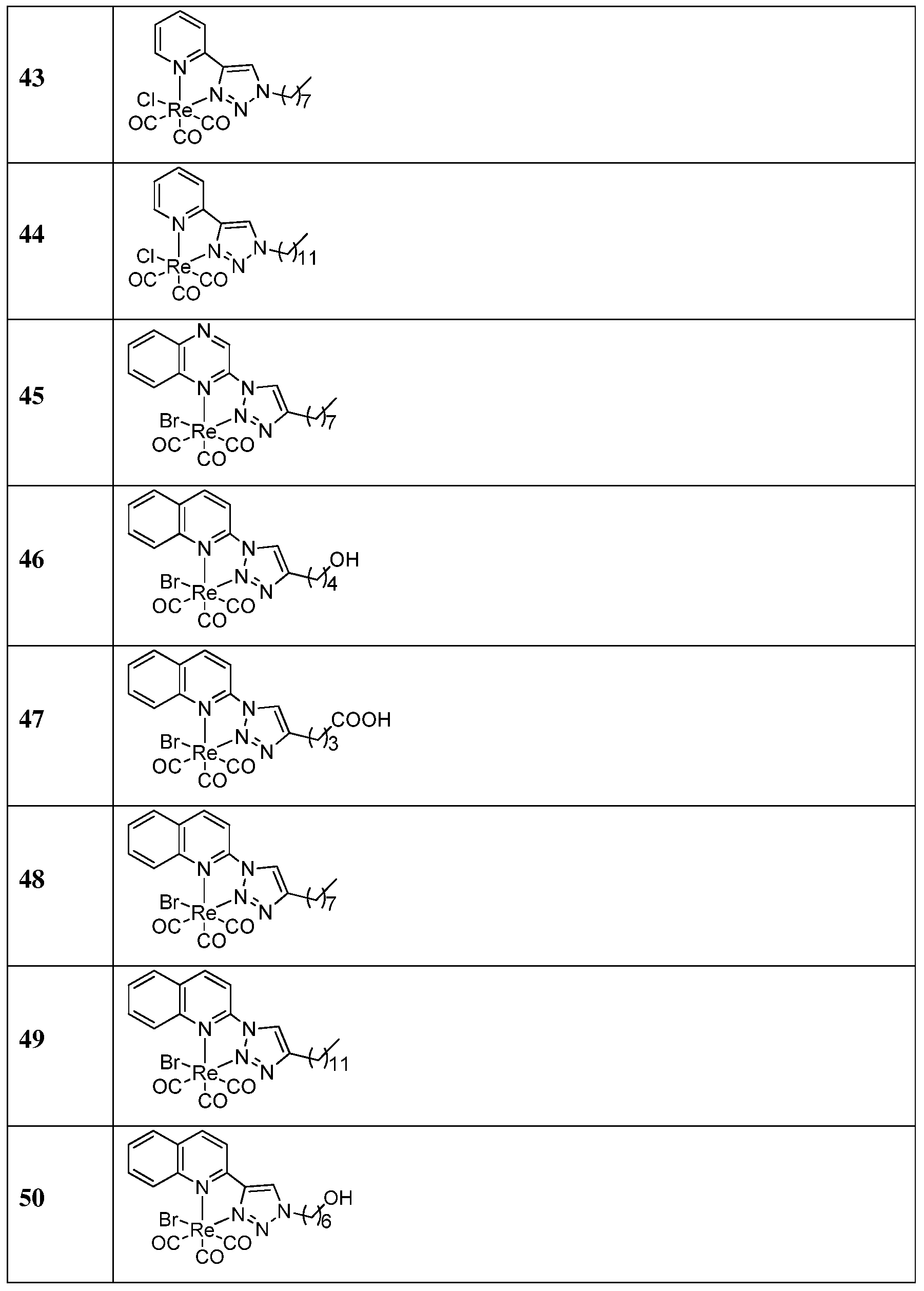


According to one embodiment, the XRF probe of the invention is selected from compounds n°l-62 of Table 1 above. According to one embodiment, the XRF probe of the invention is selected from compounds n°l-65 of Table 1 above. According to a specific embodiment, the XRF probe of the invention is selected from compounds n°l- 37 of Table 1 above. According to a specific embodiment, the XRF probe of the invention is selected from compounds n°l-37 and 63-35 of Table 1 above. According to a specific embodiment, the XRF probe of the invention is selected from compounds n°38-62 of Table 1 above.
Process for manufacturing the XRF probes The compounds of the invention may be prepared using any suitable reactions known by those skilled in the art.
The invention further relates to a process for manufacturing the compounds of the invention. According to one embodiment, the invention relates to a process for manufacturing a compound of formula I as defined above, comprising:
1) reacting a ligand of formula II:

with a rhenium-containing reactant of formula III
(III) ReX1(CO)5, wherein X1 represents a halogen atom; to afford compound of formula Γ :

wherein Het 1, Y1, Y2, L and R2 are as defined in formula I; and X1 represents halo;
2) and optionally:
- replacing X1 moiety by X as defined in formula I; and/or
- modifying and/or functionalizing -L-R2;
to form a compound of formula I as defined above.
According to one embodiment, the optional step of replacement of X1 moiety by X as defined in formula I comprises reacting compound of formula Γ with silver tetrafluoroborate and then adding a compound corresponding to X moiety.
According to one embodiment, the optional step of modification and/or functionalization of -L-R2 includes protection/deprotection steps of reactive functions, coupling reactions of reactive R2 groups with bioactive molecules, etc.
Use of the XRF probes
The present invention further relates to the use of a compound comprising at least one rhenium atom for performing XRF spectroscopy and/or XRF imaging. According to one embodiment, the invention relates to the use of a compound comprising at least one rhenium atom for performing XRF spectroscopy. According to one embodiment, the invention relates to the use of a compound comprising at least one rhenium atom for performing XRF imaging.
The present invention further relates to the use of the XRF probes of the invention for performing XRF spectroscopy and/or XRF imaging. According to one embodiment, the invention relates to the use of the XRF probes of the invention for performing XRF spectroscopy. According to one embodiment, the invention relates to the use of the XRF probes of the invention for performing XRF imaging.
The XRF imaging of a sample containing the XRF probe of the invention enables to map the presence of said XRF probe at different scales, either at a microscopic scale or at a macroscopic scale. The XRF probe of the invention may be quantified by XRF spectroscopy, by integration of its emission bands.
According to one embodiment, an appropriated excitation energy is applied to the sample, preferably of about 12 keV. According to one embodiment, the excitation of the sample may be performed using a synchrotron source of hard X-rays (5-32 keV). According to one embodiment, the detection of the XRF response may be performed using an XRF multi-element detector.
According to one embodiment, the XRF probes of the invention are used to perform XRF spectroscopy and/or XRF imaging on biological tissues, especially on cells. According to one embodiment, the invention relates to a method for imaging cellular environment comprising incubating cells in presence of a XRF probe of the invention. By "cellular environment" it is referred to any part of the cell, including cytoplasm, nucleus and membranes. The cytoplasm corresponds to the biological material present between the cellular membrane and the nucleus envelop. The cytoplasm comprises organelles and
structures in suspension in the cytosol, such as for example the Golgi apparatus, vesicles, endosomes, lysosomes, mitochondria or endoplasmic reticulum. According to one embodiment, "membranes" both refers to the internal and external parts of cell membranes. Membranes include extracellular and membranous receptors. According to one embodiment, the invention relates to a method of imaging cellular environment by XRF spectroscopy, comprising:
- adding a XRF probe according to the invention to a sample containing at least one cell;
- incubating the sample for a time sufficient for the XRF probe to be loaded onto and/or into the cell;
- exciting the sample at an energy that generates a XRF response from the XRF probe;
- detecting the XRF response.
According to one embodiment, cells of potential interest for performing XRF imaging include, but are not limited to, primary culture of mammalian cells, cells dissociated from mammalian tissues, and bacteria. Cell types may include white blood cell, hepatocytes, pancreatic beta cells, neurons, smooth muscle cells, intestinal epithelial cells, cardiac myocytes, glial cells, and the like. Non-limitative examples of bacteria include Escherichia Coli, Lactobacillus, etc.
According to one embodiment, the XRF probe of the invention is functionalized. This refers to cases wherein R2 moiety of the XRF probe of the invention represents a bioactive group. In this case, XRF imaging enables to locate the functionalized XRF probe of the invention in a biological sample or to study biological processes.
The bioactive group may be a moiety enabling to direct the XRF probe to a target of biological interest, especially direct the XRF probe to specific cell organelles. According to one embodiment, the bioactive group may be a biological molecule, such as for example a protein, an oligonucleotide, an antibody, a polysaccharide such as hyaluronic acid, a hormone. The bioactive group may also be a moiety that recognizes a target of biological interest, such as for example an agonist or an antagonist of a receptor, a peptide, a therapeutic agent.
According to one embodiment, the bioactive group is a superoxide dismutase (SOD) mimic, a cell penetrating peptide, a peptide targeting mitochondria, an inhibitor targeting carbonic anhydrase, a fluorophore.
According to a specific embodiment, the XRF probes of the invention enable the imaging of cell organelles, such as for example the Golgi apparatus of a cell or mitochondria; or targeting the nucleus of a cell.
In a specific embodiment, the -L-R2 moiety of the XRF probe of the invention comprises a "ligand-directed acyl imidazole" (LDAI). In this case, the linker L comprises an acyl imidazole moiety that enables to covalently in situ label a biological target having a nucleophilic residue.
In a specific embodiment, the XRF probe of the invention, when having R2 group being a N3 reactive function, may be co-administered with modified biomacromolecules to operate intracellular click reaction, as suggested by Takei et al. (Takei et al., ChemComm, 2013, 49, 7313-7315). Especially, the probe of the invention may be administered with a bibenzylcyclooctyl-modified biomacromolecule. The click reaction between the azide function and the alkyne moiety of the modified biomacromolecule aims at retaining the probe in the cytosol of tested cells.
The invention further relates to the use of the XRF probes of the invention for multimodal imaging. According to one embodiment, the XRF probes of the invention are used for performing XRF spectroscopy and infrared spectroscopy; thereby providing XRF and IR bimodal images. According to one embodiment, the XRF probes of the invention are used for performing XRF spectroscopy and fluorescence spectroscopy; thereby providing XRF and fluorescence bimodal images. According to one embodiment, the XRF probes of the invention are used for performing XRF spectroscopy, infrared spectroscopy and fluorescence spectroscopy; thereby providing XRF, IR and fluorescence trimodal images.
In one embodiment, the invention does not relate to the use of a probe of formula I according to the invention to perform X-ray crystallography.
The present invention further relates to a kit for performing XRF spectroscopy and/or XRF imaging, comprising a XRF probe according to the invention. According to one embodiment, the present invention provides a kit for performing XRF imaging, comprising a XRF probe for imaging according to the invention. The kit of the invention may comprise a XRF probe of the invention either present as a pure compound, or in a suitable carrier composition, or dissolved in an appropriate stock solution. The kit may further comprise instructions for the use of the XRF probe of the invention. The kit may further comprise one or more additional components, such as an additional detection reagent. According to an embodiment, the kit further comprises calibration standards. According to one embodiment, the XRF probe of the invention may be present in the kit associated with a surface, such as for example a chip, microplate well, or other solid or semi- solid matrix.
According to one embodiment, the kit further comprises buffers and/or stabilizers. According to another embodiment, the kit further comprises indicator solutions, blotters, culture media, cuvettes, and the like.
BRIEF DESCRIPTION OF THE DRAWINGS
Figure 1 is the X-ray fluorescence spectrum of compound n° 1.
Figure 2 is a series of X-ray fluorescence images showing the localization of potassium (A), manganese (B) and rhenium (C) in a HT29 MD2 cell incubated with compound n°l (ΙΟΟμΜ, 2h), cryofixed and freeze-dried. Excitation at 12 kev; integration time: 4s/pixel; pixel size: 200 x 200 nm2.
Figure 3 is a series of X-ray fluorescence images showing the localization of calcium, zinc, phosphor and rhenium in CHO cells incubated with labelled proteins Cys-NLS-HD- ReCl or Cys-HD-ReCl of example 3. Excitation at 12 kev; integration time: 3s/pixel; pixel size: 500 x 500 nm2.
EXAMPLES
The present invention is further illustrated by the following examples. CHEMISTRY
Material and methods
lH and 13C NMR spectra were recorded on a Bruker Avance 300 or 600 spectrometer using solvent residuals as internal references. The following abbreviations are used: singlet (s), doublet (d), doublet of doublets (dd), triplet (t), doublet of triplets (td), quintuplet (quint), sextuplet (sext), and multiplet (m). Mass spectrometry services were performed at the ICMMO (Universite Paris Sud, Orsay, France) and at UMR7201 (Universite Pierre et Marie Curie). The following abbreviations are used: MS (mass spectrometry), HRMS (high resolution mass spectrometry), electrospray (ESI), time-of- flight (TOF). TLC analysis was carried out on silica gel (Merck 60F-254) with visualization at 254 and 366 nm. Preparative flash chromatography was carried out with Merck silica gel (Si 60, 40-63 μιη). Reagents and chemicals were purchased from Sigma- Aldrich, Alfa Aesar, or Strem Chemicals. Dry solvents (dichloromethane (CH2CI2 or DCM), toluene, tetrahydrofuran(THF), and dimethylformamide (DMF)) were purchased from Sigma and used without further purification. UV-vis absorption spectra were recorded on a Varian Cary 300 Bio spectrophotometer, luminescence emission spectra on a Jasco FP-8300 spectrofluorometer, and IR spectra on a Perkin-Elmer Spectrum 100 FT- IR spectrometer. Analytical HPLC measurements were run on a Dionex Ultimate 3000 instrument using C8A or C18A ACE columns.
1. Re complexes functionalized with an aldehyde: application to the conjugation with a SOD (superoxide dismutase) mimic


Intermediate ( 1 ): 2-( l-(l-hydroxyhexyl)-lH-l,2,3-triazol-4-yl)pyridine
To a solution of 6-azidohexan-l-ol (0.593 g, 4.147 mmol, 1 eq) in acetone/water (90 mL, 2: 1) were added 2-ethynylpyridine (0.42 mL, 4.147 mmol, 1 eq), copper sulfate (0.259 g, 1.037 mmol, 0.25 eq) and sodium ascorbate (0.409 g, 2.065 mmol, 0.5 eq) at room temperature. The reaction was stirred for 2h at room temperature under nitrogen atmosphere and then ammonia 28% was added (50 mL). The aqueous phase was extracted thrice with ethyl acetate (100 mL), the organic phase was dried over Na2S04, filtered and concentrated. Column chromatography (AcOEt/MeOH 98:2, 850 mL) was applied to the organic fraction and afforded the product as a white-yellow powder (502 mg, 2.024 mmol, 49%). !H-NMR (300 MHz, CDC13): δ ppm: 8.58 (ddd, J = 4.9, 1.8, 0.9 Hz, 1H), 8.27 - 8.07 (m, 2H), 7.79 (td, J = 7.8, 1.8 Hz, 1H), 7.25 - 7.20 (m, 1H), 4.43 (t, J = 7.1 Hz, 2H), 3.63 (t, J = 6.3 Hz, 2H), 2.00 (dt, J = 19.1, 6.5 Hz, 2H), 1.67 - 1.30 (m, 4H).
Intermediate (2): 2-(l-(l-hexanal)-lH-l,2,3-triazol-4-yl)pyridine
To a solution of (1) (253 mg, 1.020 mmol, 1 eq) in DMSO (6 mL) was added 2- iodoxybenzoic acid (0.343 g, 1.225 mmol, 1.2 eq). The reaction was stirred under nitrogen atmosphere overnight at room temperature. Water (50 mL) was added and the resulting solution was filtered over a sintered filter and thoroughly washed with ethyl acetate. The organic phase was extracted thrice with ethyl acetate, washed with NaHC03 and brine, dried over Na2S04, filtered and concentrated. The desired product appeared as a yellow
solid and used in the next step without further purification (213 mg, 0.873 mmol, 86%). ¾ NMR (300 MHz, CDC ): δ ppm: 9.76 (t, J = 1.5 Hz, 1H), 8.58 (ddd, J = 4.9, 1.8, 1.0 Hz, 1H), 8.22 - 8.08 (m, 2H), 7.78 (ddd, J = 7.9, 7.5, 1.8 Hz, 1H), 7.23 (ddd, J = 7.6, 4.9, 1.2 Hz, 1H), 4.43 (t, J = 7.0 Hz, 2H), 2.45 (td, J = 7.2, 1.5 Hz, 2H), 1.99 (dt, J = 14.8, 7.2 Hz, 2H), 1.68 (dt, J = 15.1, 7.3 Hz, 2H), 1.50 - 1.28 (m, 2H).
Cpd n°3: 2-(l-(l-hexanal)-lH-l,2,3-triazol-4-yl)pyridine chlorotricarbonylrhenium
To a solution of (2) (0.210 g, 0.860 mmol, 1 eq) in toluene (10.5 mL) was added rhenium- pentacarbonyl chloride (0.311 g, 0.860 mmol, 1 eq) at room temperature. The reaction was refluxed at 110°C for 3 hours. After cooling the reaction, the solvent was evaporated. Column chromatography (EtOAc/MeOH 95/5, 750 mL) was applied to the brown solid and afforded the product the desired product as a yellow oil (364 mg, 77%). 1H-NMR (300 MHz, CDCb): δ 9.79 (t, J = 1.2 Hz, 1H), 9.03 (d, J = 5.6 Hz, 1H), 8.29 (s, 1H), 8.05 - 7.70 (m, 2H), 7.51 - 7.35 (m, 1H), 4.69 - 4.27 (m, 2H), 2.62 - 2.40 (m, 2H), 2.04 (t, J = 7.4 Hz, 2H), 1.82 - 1.59 (m, 2H), 1.59 - 1.31 (m, 6H), 1.26 (s, 1H). Cpd n°2: 2-(l-(l-hexEnPI2)-lH-l,2,3-triazol-4-yl)pyridine chlorotricarbonylrhenium
To a solution of Cpd n°3 (298 mg, 0.512 mmol, 1 eq) in absolute ethanol (26 mL) was added triethylamine (70 μί, 0.512 mmol, 1 eq) and enPI2 (Cisnetti et al., Eur. J. Inorg. Chem., 2007, 4472-4480) (0.512 mmol, 1 eq). The reaction was stirred under nitrogen atmosphere overnight. To this solution sodium cyanoborohydride (77.3 mg, 1.229 mmol, 2.4 eq) and trifluoroacetic acid (80 μί, 1.025 mmol, 2 eq) were added, the reaction was stirred overnight. The pH was set at 8+0.4 with a saturated solution of sodium hydrogenocarbonate, and ethanol was evaporated under reduced pressure. Then dichloromethane and water (4: 1 v:v, 30 mL) were added and the pH was set at 9.6+0.2. The aqueous phase was extracted thrice with dichloromethane and the combined organic fractions were dried upon Na2S04, filtered and concentrated. The resulting yellow oil was purified by preparative HPLC (acetonitrile/water + TFA 0.1 %, gradient from 10 to 100 over 30 minutes, t« = 5.9 min) to obtained 120 mg (26%) of the expected compound.
Cpd n°l: The Mn(II) complex is then obtained by addition of 1 equivalent of MnCl2 to Cpd n°2, as described by Cisnetti et al. (Eur. J. Inorg. Chem., 2007, 4472-4480).
2. Re complexes functionalized with a carboxylic acid group: application to the conjugation with Cell Penetrating Peptides (CPP) or with a Mitochondria Penetrating Peptide (MPP)

Cpd n°8 Cpd n°9 Cpd n°11

Intermediate (1): N-(2-chloroacetyl) β-alanine methyl ester
β-alanine methyl ester hydrochloride salt (1.33 g, 9.5 mmol, 1.2 equiv) was suspended in dry DCM (15 mL) under argon. Dry DIEA (3.5 mL, 20 mmol, 2.5 equiv) was added, and the suspension was cooled down in an ice bath. Chloroacetyl chloride (0.64 mL, 8 mmol, 1 equiv) was added dropwise at 0°C, and the reaction mixture was stirred for one hour at room temperature. The organic layer was then diluted with DCM (15 mL), washed once with 0.1N HCl aqueous solution (30 mL), once with 10% NaHC03 aqueous solution (30 mL) and once with brine (30 mL). It was then dried over MgS04, filtered, and concentrated to yield the expected compound as a colorless oil (0.947 g, 5.3 mmol, 66%).
!H-NMR (300 MHz, CDC ): δ 7.17 (s, 1H), 4.03 (s, 2H), 3.72 (s, 3H), 3.58 (q, J = 6.0 Hz, 2H), 2.58 (t, J = 6.0 Hz, 2H). 13C-NMR (101 MHz, CDCb): δ 172.40, 166.14, 51.68, 42.40, 35.14, 33.32. HRMS (ESI+): m/z calculated for [C6HioClN03+Na]+ 202.02414, found 202.02438 error: 1.2 ppm. Intermediate (2): N-(2-azidoacetyl) β-alanine methyl ester
Intermediate (1) (0.947 g, 5.3 mmol, 1 equiv) was dissolved in a 3: 1 v:v mixture of acetone (15.6 mL) and water (5.2 mL). Sodium azide (0.69 g, 10.6 mmol, 2 equiv) and sodium iodide (0.079 g, 0.53 mmol, 0.1 equiv) were then added, and the mixture was stirred at 35°C (bath temperature) for 16 h. Acetone was removed by rotary evaporation and the solution was diluted with DCM (15 mL) and water (5 mL). The mixture was then decanted, the organic layer dried over MgS04, filtered and concentrated to yield compound 2 as a colorless oil (0.78 g, 4.2 mmol, 79%). !H-NMR (300 MHz, CDCb): δ 6.87 (s, 1H), 3.97 (s, 2H), 3.72 (s, 3H), 3.57 (q, J = 6.0 Hz, 2H), 2.57 (t, J = 6.0 Hz, 2H). 13C-NMR (101 MHz, CDCb): δ 172.18, 166.94, 52.00, 51.43, 34.67, 33.26. Intermediate (3): 2-(l-acetamide-(N-3-methoxy-3-oxopropyl))-lH-l,2,3-triazol-4- yl)pyridine
Intermediate (2) (0.51 g, 2.74 mmol, 1 equiv) was dissolved in a 2: 1 v:v mixture of acetone (36 mL) and water (18 mL). 2-ethynylpyridine (0.28 mL, 2.74 mmol, 1 equiv), copper sulfate (0.17 g, 0.69 mmol, 0.25 equiv) and sodium ascorbate (0.14 g, 0.69 mmol, 0.25 equiv) were then added, and the suspension was sonicated for a few minutes, during which a light brownish precipitate formed. The reaction mixture was then stirred for 2h at room temperature (until the solution turned greenish). The solution was then poured into a 28% ammonia solution and extracted three times with DCM. The organic layers were combined, dried over Na2S04, filtered and concentrated. The resulting brown solid was purified by silica gel column chromatography (DCM:EtOAc:MeOH 50:50:0 to 0:98:2 v:v:v) to yield compound 3 (0.56 g, 70%) as a white solid. !H-NMR (400 MHz, CDCB): δ 8.56 (ddd, J = 4.9, 1.8, 0.9 Hz, 1H), 8.28 (s, 1H), 8.10 (dt, J = 7.9, 1.0 Hz, 1H), 7.78-7.73 (m, 1H), 7.22 (ddd, J = 7.5, 4.9, 1.2 Hz, 1H), 6.88 (s, 1H), 5.11 (s, 2H), 3.62 (s, 3H), 3.53 (q, J = 6.2 Hz, 2H), 2.53 (t, J = 6.2 Hz, 2H). 13C-NMR (101 MHz, CDCb): δ 172.49, 165.19, 149.58, 136.98, 123.77, 123.16, 120.37, 53.16, 51.97, 35.42, 33.57.
HRMS (ESI+): m/z calculated for [Ci3Hi5N503+H]+ 290.12477, found 290.1125527, error: 1.7 ppm.
Cpd n° 7: 2-(l-acetamide-(N-3-methoxy-3-oxopropyl)-lH-l,2,3-triazol-4-yl)pyridine chlorotricarbonylrhenium Intermediate (3) (36.3 mg, 0.10 mmol, 1 equiv) was dissolved in hot toluene (1.3 mL). Re(CO)5Cl (29 mg, O. lmmol, 1 equiv) was added, and the suspension was refluxed for 6h. The reaction mixture was cooled down to room temperature, the resulting yellow precipitate was filtered and washed with cold toluene, to give pure compound 4 (59.5 mg, 0.10 mmol, 100 %) which was used without further purification. 1H-NMR (300 MHz, CDCl3/MeOD 1: 1 v:v): δ 8.64 (d, J = 5.4 Hz, 1H), 8.50 (s, 1H), 7.80-7.72 (m, 2H), 7.21- 7.16 (m, 1H), 4.93 (q, J = 14.5 Hz, 2H), 3.37 (s, 3H), 3.21 (t, J = 6.5 Hz, 2H), 2.27 (t, J = 6.6 Hz, 2H). 13C-NMR (101 MHz, CDCl3/MeOD 1: 1 v:v): δ 197.55, 196.12, 189.27, 173.12, 165.43, 153.49, 149.87, 149.46, 140.71, 127.06, 126.64, 123.20, 53.88, 52.27, 36.11, 34.04. HRMS (ESI+): m/z calculated for [Ci6Hi5ClN506Re+Na]+ 616.01326, found 616.01333, error: 0.1 ppm.
Cpd n° 10: 2-(l-acetamide-(N-2-carboxyethyl)-lH-l,2,3-triazol-4-yl)pyridine chloro tricarbonylrhenium
Methyl ester Cpd n°7 (59.4 mg, 0.100 mmol, 1 equiv) was dissolved in a 2: 1 mixture of THF/H2O (1 mL). LiOH- H20 (5.0 mg, 0.119 mmol, 1 equiv) was added, and the reaction mixture was stirred at room temperature for 45 min. THF was removed by rotary evaporation (bath temperature 45°C). A 1M aqueous solution of HC1 was added dropwise to the resulting solution, until pH reached 1 (about 0.5 mL). 1 mL of distilled water was added, and the aqueous solution was extracted with EtOAc (15 mL). The organic layer was washed once with brine (2 mL). The aqueous layers were extracted twice more with EtOAc (15 mL). Organic layers were pooled, dried over Na2S04, filtered and concentrated to give the desired compound 5 as a yellow powder (46.5 mg, 0.080 mmol, 80%). 1H-NMR (400 MHz, CDCl3/MeOD 1: 1 v:v): δ 8.65 (d, J = 5.4 Hz, 1H), 8.51 (s, 1H), 7.80-7.74 (m, 2H), 7.19 (td, J = 6.3, 1.4 Hz, 1H), 4.95 (q, J = 19.9 Hz, 2H), 3.22 (t, J = 6.6 Hz, 2H), 2.25 (t, J = 6.6 Hz, 2H). 13C-NMR (101 MHz, CDCl3/MeOD 1: 1 v:v): δ
196.67, 195.10, 188.44, 173.64, 164.45, 152.79, 149.18, 148.71, 139.74, 125.94, 125.79, 122.21, 52.95, 35.40, 33.17. HRMS (ESI+): m/z calculated for [CisHisClNsOeRe+Nar 601.99761, found 601.99786, error: 0.4 ppm.
Cpd n°8: 2-(l-acetamide-(N-3-methoxy-3-oxopropyl)-lH-l,2,3-triazol-4-yl)pyridine bromotricarbonylrhenium
Intermediate (3) (146 mg, 0.50 mmol, 1 equiv) was dissolved in hot toluene (4 mL). Re(CO)5Br (205 mg, 0.5 mmol, 1 equiv) was added, and the suspension was refluxed for 6 h. The reaction mixture was cooled down to room temperature, the resulting yellow precipitate was filtered and washed with cold toluene, to give pure compound 6 (323 mg, 0.5 mmol, 100 %). Ή-ΝΜΙί (300 MHz, CDCb/MeOD 1: 1 v:v ): δ 8.99 (d, J = 5.5 Hz, 1H), 8.84 (s, 1H), 8.10-8.08 (m, 2H), 7.53-7.48 (m, 1H), 5.27 (q, J = 17.4 Hz, 2H), 3.70 (s, 3H), 3.54 (t, J = 6.4 Hz, 2H), 2.60 (t, J = 6.5 Hz, 2H). 13C-NMR (75 MHz, CDCb/MeOD 1: 1 v:v): δ 172.10, 164.40, 152.74, 149.02, 148.53, 139.35, 125.73, 125.49, 121.95, 52.69, 51.17, 35.10, 32.99. HRMS (ESI+): m/z calculated for [CieHisBrNsOeRe+Nar 659.96275, found 659.96321, error: 0.7 ppm.
Cpd n° 9: 2-(l-acetamide-(N-3-methoxy-3-oxopropyl)-lH-l,2,3-triazol-4-yl)pyridine pyridiumtricarbonylrhenium tetrafluoroborate salt
Rhenium tricarbonyl bromide Cpd n°8 (252.3 mg, 0.394 mmol, 1 equiv) was dissolved in acetonitrile (49 mL) under argon. Silver tetrafluoroborate (78.9 mg, 0.405 mmol, 1 equiv) was added and the mixture was refluxed for 5 h, resulting in the formation of a fine dark suspension. Solvent was evaporated to dryness, and the residue was dissolved in THF (58 mL). Pyridine (96 μί, 1.18 mmol, 3 equiv) was added, and the reaction mixture was refluxed for 20 h. The suspension was filtered over celite and the solvent was removed by rotary evaporation. The crude was co-evaporated three times with toluene, dissolved in the minimal amount of methanol and precipitated in diethyl ether, to give the desired compound as a yellow powder (224.7 mg, 0.310 mmol, 79 %). 1H- NMR (300 MHz, MeOD): δ 8.39 (dd, J = 6.5, 1.5 Hz, 2H), 8.26 (td, J = 7.8, 1.5 Hz, 1H), 8.17-8.13 (m, 1H), 7.92 (tt, J = 7.7, 1.5 Hz, 1H), 7.75 (ddd, J = 7.6, 5.6, 1.5 Hz, 1H), 7.43- 7.38 (m, 2H), 5.47 (s, 2H), 3.71 (s, 3H), 3.56 (t, J = 6.4 Hz, 2H), 2.63 (t, J = 6.6 Hz, 2H).
13C-NMR (75 MHz, MeOD): δ 173.67, 166.35, 155.04, 153.40, 150.60, 150.51, 142.75, 141.06, 129.06, 128.68, 127.99, 124.33, 54.72, 52.29, 36.75, 34.45. HRMS (ESI+): m/z calculated for [C2iH2oClN606Re]+ 637.09684, found 637.09735, error: 0.8 ppm.
Cpd n°ll: 2-(l-acetamide-(N-2-carboxyethyl)-lH-l,2,3-triazol-4-yl)pyridine pyridiniumtricarbonylrhenium tetrafluoroborate salt
Compound Cpd n°9 was prepared according to the same procedure as compound 5: compound 7 (148.6 mg, 0.205 mmol, 1 equiv) was dissolved in a 2: 1 v:v mixture of THF (1.3 mL) and water (0.65 mL). Lithium hydroxide monohydrate (8.8 mg, 0.210 mmol, 1 equiv) was then added, and the reaction mixture was stirred for 1 h at room temperature. THF was removed by rotary evaporation, and the solution was acidified to pH<l with IN HC1 aqueous solution. The aqueous layer was extracted three times with EtOAc (5 mL). The organic layers were combined, dried over Na2S04, filtered and concentrated to give compound 8 (127.2 mg, 0.179 mmol, 87%) as a yellow powder. 1H-NMR (300 MHz, MeOD): δ 9.31 (d, J = 5.4 Hz, 1H), 8.98 (s, 1H), 8.41-8.39 (m, 2H), 8.28 (t, J = 7.8 Hz, 1H), 8.18-8.15 (m, 1H), 7.94 (d, J = 7.6 Hz, 1H), 7.79-7.74 (m, 1H), 7.42 (t, J = 6.7 Hz, 2H), 5.48 (s, 2H), 3.72 (s, 3H), 3.58 (t, J = 6.5 Hz, 2H), 2.64 (t, J = 6.5 Hz, 2H). 13C-NMR (101 MHz, MeOD): δ 196.64, 195.17, 192.13, 174.95, 166.27, 154.94, 153.32, 150.49, 150.43, 142.69, 140.98, 128.98, 128.65, 127.93, 124.28, 54.71, 36.81, 34.42. HRMS (ESI+): m/z calculated for [C2oHi8ClN606Re]+ 623.08119, found 623.08152, error: 0.5 ppm.
Cpd n°15: R6W3PytaPy
A solution of EDC in DMF (33.3 mg/mL, 187 μί, 32.5 μιηοΐ, 1.5 equiv) were added to compound Cpd n°ll (15.4 mg, 21.7 μιηοΐ, 1 equiv). The mixture was stirred for 20 min before addition of a solution of R6W3 in DMF (462 mg/mL, 108 μί, 21.6 μιηοΐ, 1 equiv) and of DIEA (7.5 μί, 43.3 μιηοΐ, 2 equiv). The mixture was stirred overnight at room temperature and the crude was purified by HPLC.
Cpd n°13: R6W3PytaCl
The procedure is similar to the one used for Cpd n°15. A solution of EDC in DMF (33.3 mg/mL, 187 μί, 32.5 μιηοΐ, 1.5 equiv) were added to compound Cpd n°10 (12.6 mg, 21.7 μιηοΐ, 1 equiv). The mixture was stirred for 20 min before addition of a solution of R6W3 in DMF (462 mg/mL, 108 μΐ,, 21.6 μιηοΐ, 1 equiv) and of DIEA (7.5 μί, 43.3 μιηοΐ, 2 equiv). The mixture was stirred overnight at room temperature and the crude was purified by HPLC. The collected pure fraction was frozen and freeze-dried immediately after purification in order to prevent the exchange of the chloride.
Cvd n°14: R9PytaPy Compound Cpd n°ll (17.7 mg, 24.5 μιηοΐ, 1.5 equiv) and N-hydroxysuccinimide (4.8 mg, 42.6 μιηοΐ, 2.5 equiv) were dissolved in a solution of DCC in DMF (4.13 mg/mL, 850 μί, 17.7 μιηοΐ, 1.1 equiv). The mixture was stirred for 20 min, followed by addition of an aqueous solution of R9 (50 mg/mL, 680 μί, 16.8 μιηοΐ, 1 equiv) and DIEA (8.5 μί, 49.1 μιηοΐ, 2.9 equiv). The reaction mixture was stirred overnight at room temperature and then purified by HPLC.
Cvd n°12: R9PytaCl
Compound Cpd n°10 (16.1 mg, 27.7 μιηοΐ, 1.6 equiv) and N-hydroxysuccinimide (3.9 mg, 33.8 μιηοΐ, 2 equiv) were dissolved in a solution of DCC in DMF (4.13 mg/mL, 850 μί, 17.7 μιηοΐ, 1.1 equiv). The mixture was stirred for 20 min, followed by addition of an aqueous solution of R9 (50 mg/mL, 680 μί, 16.8 μιηοΐ, 1 equiv) and DIEA (8.5 μί, 49.1 μιηοΐ, 2.9 equiv). The reaction mixture was stirred overnight at room temperature and then purified by HPLC. Right after purification, the collected pure fraction was frozen and freeze-dried to prevent the exchange of the chloride.
Cpd n°63: MPP-PytaCl
MPP synthesis: The peptide was assembled by stepwise solid-phase synthesis using standard protocols for Fmoc chemistry: amino acid activation with HBTU/HOBt, Fmoc deprotection with 20% piperidine in N-methyl-2-pyrrolidone. The peptide was cleaved
from the resin by treatment with a 95/2.5/2.5 mixture of TFA/water/triisopropylsilane or 95/5 mixture of TFA/ triisopropylsilane for 3 hours at room temperature, and precipitation in diethylether. It was purified by preparative HPLC (preparative CI 8 column, acetonitrile/ H20 15/85 to 50/50 over 30 min containing 0.1% of TFA, flow: 16 mL/min). The pure fractions of the expected peptide were combined and freeze-dried to afford the desired compound. MS (Maldi+, HCCA matrix): m/z 1078 (M-C1+H)+.
Compound Cpd n°63 was then obtained by a procedure similar to the one used for compound Cpd n°12 or Cpd n°13.
3. Re complexes functionalized with a maleimide: application to the conjugation with the cysteine of a protein
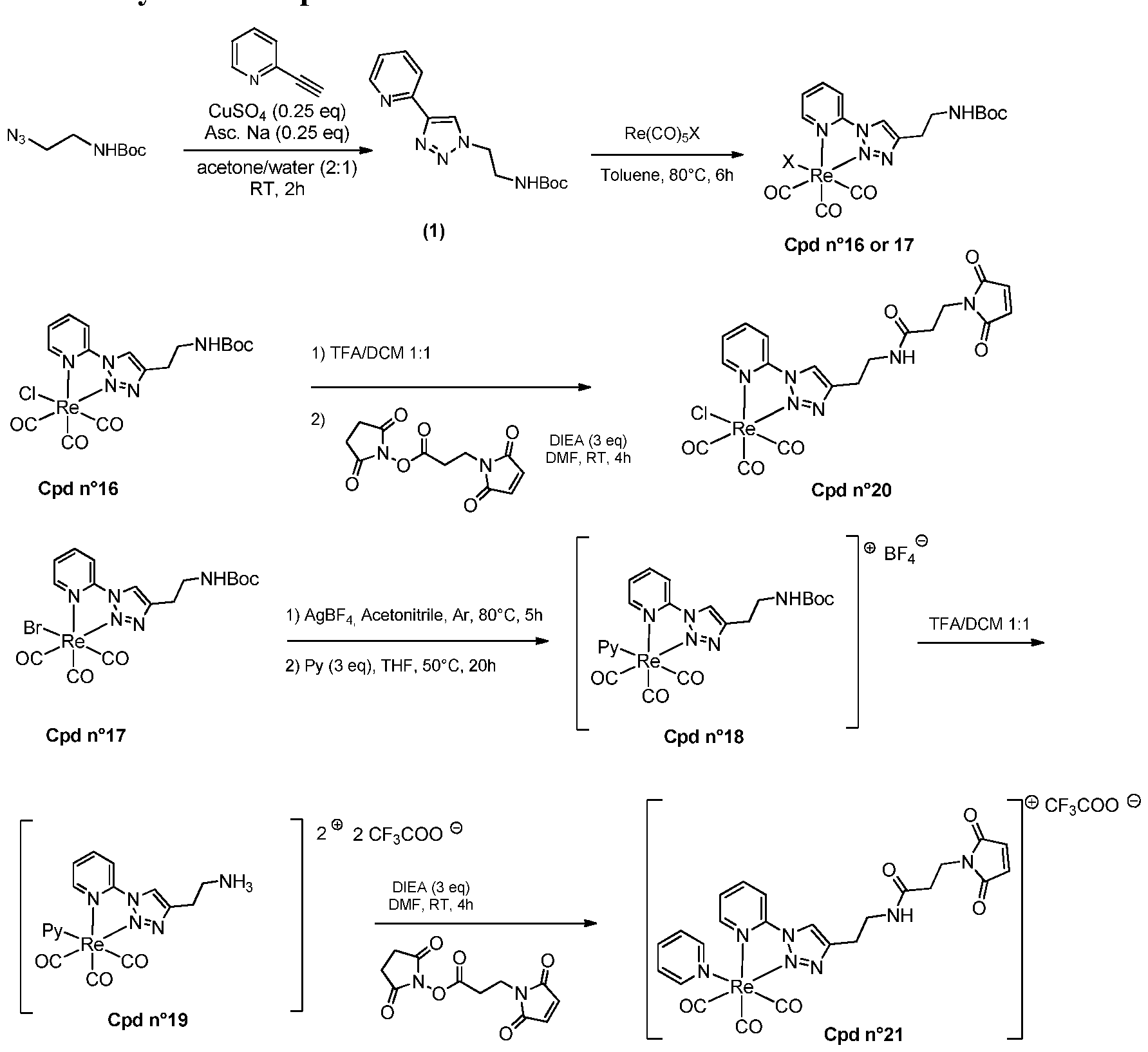
N-(2-azidoethyl)-N-(tert-Butoxycarbonyl)amine (568 mg, 3.05 mmol, 1 equiv.) was dissolved in a mixture of acetone and water (30 mL acetone:water 2: 1 v:v). Anhydrous copper sulfate (131 mg, 0.82 mmol, 0.25 equiv.) and sodium ascorbate (153.8 mg, 0.77 mmol, 0.25 equiv.), followed by 2-ethynylpyridine (310 μί, 3.07 mmol, 1 equiv.), were added. The mixture was sonicated for a few minutes, and reaction mixture was stirred at room temperature for 2 hours. A light brown precipitate formed. Acetone was removed by rotary evaporation, and the aqueous layer was diluted with 28% aqueous ammonia solution. The aqueous layer was extracted once with DCM. The organic layer was then washed once more with 28% ammonia solution, and once with brine. It was then dried over Na2S04, filtered and concentrated. The resulting brown solid was purified by automated silica gel flash column chromatography (0-100% EtOAc in cyclohexane) to yield the desired compound as a white solid (692 mg, 2.39 mmol, 78%). 1H-NMR (300 MHz, CDCb) δ (ppm): 8.33 (d, J = 4.6 Hz, 1H), 8.01 (s, 1H), 7.90 (d, J = 7.9 Hz, 1H), 7.57 (td, J = 7.7, 1.7 Hz, 1H), 7.03 (ddd, J = 7.5, 4.9, 0.9 Hz, 1H), 5.99 (br, 1H), 4.41 (t, J = 5.4 Hz, 2H), 3.56 (q, J = 5.4 Hz, 2H), 1.30 (s, 9H). 13C-NMR (75 MHz, CDCb) δ (ppm): 155.91, 149.74, 149.01, 147.79, 136.60, 122.74, 119.82, 79.41, 50.11, 40.57, 28.19. Cpd n°16: 2-(l-(2-ethyl-N-(tert-Butoxycarbonyl)amine)-lH-l,2,3-triazol-4-yl)pyridine chlorotricarbonylrhenium [Re( O)i{ Cl)(PytaNHBoc)]
The ligand (1) (49.5 mg, 0.171 mmol, 1 equiv.) was dissolved in warm toluene (5 mL). Rhenium pentacarbonyl chloride (62.9 mg, 0.174 mmol, 1 equiv.) was added, and the mixture was heated at 80°C (bath temperature) for 6 hours, during which a yellow precipitate formed. The yellow precipitate was filtered and washed with cold toluene to obtain the desired compound (99.7 mg, 0.168 mmol, 98%). Ή-ΝΜΙί (300 MHz, CDCl3:MeOD 1: 1 v:v) δ (ppm): 8.95 (d, J = 5.5 Hz, 1H), 8.77 (s, 1H), 8.10-8.02 (m, 2H), 7.48 (ddd, J = 6.8, 5.6, 2.1 Hz, 1H), 4.64-4.60 (m, 2H), 3.62 (t, J = 5.8 Hz, 2H), 1.38 (s, 9H). 13C-NMR (75 MHz, CDCl3:MeOD 1: 1 v:v) δ (ppm): 197.3, 195.8, 188.8, 157.4,
153.7, 150.0, 149.4 , 140.4, 126.5, 125.6, 122.9, 80.5, 52.4, 40.5, 28.5. HRMS (ESI+): m/z calculated for [Ci7Hi9ClN505Re+Na]+ 616.04965, found 616.05007, error: 0.7 ppm.
Cpd n°20: 2-(l-(2-ethyl-N-(2,5-dihydro-2,5-dioxo-H-Pyrrole-l-propanamide))-lH- l,2,3-triazol-4-yl)pyridine chlorotricarbonylrhenium [Re( O)i{ Cl)(PytaNH- maleimide)]
[Re(CO)3(Cl)(PytaNHBoc)] derivative Cpd n°16 (30.5 mg, 51.3 μηιοΐ, 1.3 equiv.) was dissolved in DCM (1 mL) and TFA (1 mL) was added drop wise. The reaction mixture was stirred at room temperature for 1 hour, then precipitated in cold Et20. The resulting solid was dried under vacuum, put under argon, and dissolved in dry DMF (1.2 mL). 3- maleimidopropionic acid N-hydroxysuccinimide ester (10.6 mg, 39.8 μιηοΐ, 1 equiv.), then DIEA (27 μί, 156 μιηοΐ, 3.9 equiv.), were added. Reaction mixture was stirred overnight at room temperature. DMF was removed by rotary evaporation and the resulting crude was directly purified by HPLC. The collected fraction was frozen in liquid nitrogen immediately after purification to prevent exchange of the chloride ligand. 1H- NMR (400 MHz, CDCl3:MeOD, 1: 1 v:v) δ (ppm): 8.96 (ddd, J = 5.6, 1.4, 0.9, 1H), 8.83 (s, 1H), 8.10-8.08 (m, 1H), 8.07 (dd, J = 1.7, 0.9 Hz, 1H), 7.51 (ddd, J = 7.3, 5.6, 1.7 Hz, 1H), 6.72 (s, 2H), 4.64 (t, J = 5.7 Hz, 2H), 3.76-3.72 (m, 4H), 2.42 (td, J = 6.8 Hz, 1.0, 2H). 13C-NMR (101 MHz, CDCl3:MeOD 1: 1 v:v) δ (ppm): 197.4, 195.9, 189.3, 172.9, 171.4, 153.7, 150.0, 149.5 , 140.5, 134.9, 126.6, 126.0, 122.9, 51.7, 39.5, 35.17, 34.99. HRMS (ESI+): m/z calculated for [Ci9Hi6ClN606Re+Na]+ 667.02416, found 667.02445, error: 0.4 ppm.
Cvd n°17: 2-(l-(2-ethyl-N-(tert-Butoxycarbonyl)amine)-lH-l,2,3-triazol-4- yl)pyridine bromotricarbonylrhenium [Re(CO)3(Br)(PytaNHBoc)]
The ligand (1) (206 mg, 0.712 mmol, 1 equiv.) was dissolved in warm toluene (30 mL, 80°C). Rhenium pentacarbonyl bromide (289 mg, 0.712 mmol, 1 equiv.) was added, and the mixture was heated at 80°C (bath temperature) for 6 hours, during which a yellow precipitate formed. The yellow precipitate was cooled to room temperature, filtered and washed with cold toluene to obtain the desired compound (428 mg, 0.669 mmol, 94%). !H-NMR (400 MHz, CDCl3:MeOD 1: 1 v:v) δ (ppm): 9.30 (d, J = 5.4 Hz, 1H), 9.09 (s,
1H), 8.43-8.36 (m, 2H), 7.82 (ddd, J = 7.3, 5.6, 1.7 Hz, 1H), 4.96 (t, J = 5.8 Hz, 2H), 3.96 (t, J = 5.6 Hz, 2H), 1.73 (s, 9H). 13C-NMR (101 MHz, CDCl3:MeOD 1: 1 v:v) δ (ppm): 197.25, 195.68, 188.78, 157.44, 153.71, 149.98, 149.40, 140.33, 126.47, 125.57, 122.84, 80.48, 52.37, 40.53, 28.53. HRMS (ESI+): m/z calculated for [Ci7Hi9BrN505Re+Na]+ 659.99913, found 659.99998, error: 1.0 ppm.
Cvd n°18: 2-(l-(2-ethyl-N-(tert-Butoxycarbonyl)amine)-lH-l,2,3-triazol-4- yl)pyridine pyridiniumtricarbonylrhenium tetrafluoroborate salt [Re(CO)3(Py)(PytaNHBoc)]+BF4-
Cpd n°17 (88.3 mg, 0.138 mmol, 1 equiv.) was dissolved in acetonitrile (25 mL) under argon. Silver tetrafluoroborate (29.5 mg, 0.138 mmol, 1 equiv.) was added, and the reaction mixture was stirred for 3 days at 65 °C (bath temperature), during which a dark precipitate formed. Solvent was then removed by rotary evaporation, and the solid was dried under vacuum. It was then dissolved in non-distilled tetrahydrofuran (20 mL), and pyridine (35 μί, 0.434 mmol, 3 equiv.) was added. The reaction mixture was stirred 36h at 60°C. It was then cooled to room temperature and filtered over celite. The solvent was removed by rotary evaporation, and the resulting yellow oil was co-evaporated three times with toluene. The crude was then dissolved in the minimal amount of methanol and precipitated in cold diethyl ether to give compound (68.3 mg, 0.094 mmol, 68%) as a pale brown solid. !H-NMR (400MHZ, MeOD) δ (ppm): 9.29 (d, J = 5.5 Hz, 1H), 8.99 (s, 1H, 8.45, d, J = 5.1 Hz, 2H), 8.26 (td, J = 7.8 Hz, 1.2, 1H), 8.15 (d, J = 7.9 Hz, 1H), 7.93 (tt, J = 7.7, 1.5 Hz, 1H), 7.75 (ddd, J = 7.4, 5.9, 1.3 Hz, 1H), 7.42 (t, J = 7.1 Hz, 2H), 4.74- 4.70 (m, 2H), 3.77-3.66 (m, 2H), 1.23 (s, 9H). 13C-NMR (101 MHz, MeOD) δ (ppm): 158.0, 155.0, 153.5, 150.76, 150.58, 142.7, 140.9, 128.6, 128.03, 127.86, 124.1, 80.4, 54.1, 41.3, 28.5. HRMS (ESI+): m/z calculated for [C22H24N605Re]+ 637.13323, found 637.13369, error: 0.7 ppm.
Cpd n°19: 2-(l-(2-ethyl-N-(tert-Butoxycarbonyl)amine)-lH-l,2,3-triazol-4- yl)pyridine pyridiniumtricarbonylrhenium ditrifluoroacetate salt [Re(CO)3(Py)(PytaNH3)]2+, 2 CFsCOO"
Boc-protected complex Cpd n°18 (70 mg, 0.096 mmol, 1 equiv.) was dissolved in dichloromethane, and trifluoroacetic acid (0.5 mL) was added carefully to the stirred solution. The reaction mixture was stirred 30 min at room temperature, then solvent was removed under reduced pressure. The resulting crude was dissolved in the minimal amount of methanol and precipitated in diethyl ether to give the desired compound as a solid (64 mg, 83.7 μπιοΐ, 87%). Ή-ΝΜΙί (400MHz, MeOD) δ (ppm): 9.35 (ddd, J = 5.6, 1.5, 0.8 Hz, 1H), 9.11 (s, 1H), 8.47-8.45 (m, 2H), 8.32 (dd, J = 7.8, 1.5 Hz, 1H), 8.22- 8.20 (m, 1H), 7.97 (dd, J = 8.5, 7.0 Hz, 1H), 7.81 (ddd, J = 7.7, 5.6, 1.4 Hz, 1H), 7.46- 7.43 (m, 2H), 5.08-4.97 (m, 2H), 3.77-3.67 (m, 2H).
Cpd n°21: 2-(l-(2-ethyl-N-(2,5-dihydro-2,5-dioxo-H-Pyrrole-l-propanamide))-lH- l,2,3-triazol-4-yl)pyridine pyridiniumtricarbonylrhenium trifluoroacetate salt [Re(CO)3(Py)(PytaNH-maleimide)]+, CFsCOO"
Cpd n°19 (61 mg, 79.8 μιηοΐ, 1.2 equiv.) was dissolved in dry DMF under argon. 3- maleimidopropionic acid N-hydroxysuccinimide ester (17.9 mg, 83.7 μιηοΐ, 1 equiv.) and DIEA (33 μί, 191 μιηοΐ, 2.8 equiv.) were added. The reaction mixture was stirred overnight at room temperature. The solvent was removed under reduced pressure, and the resulting oil was dilute in DCM and washed twice with aqueous citric acid (5%). The crude was then purified by HPLC (C8, 20 to 80% ACN (0.1% TFA) in 40 min). The product was obtained as a pale yellow powder (18.5 mg, 23.0 μιηοΐ, 34%). 1H-NMR (400 MHz, MeOD) δ (ppm): 9.29 (d, / = 5.6 Hz, 1H), 9.01 (s, 1H), 8.44-8.42 (m, 2H), 8.27 (td, / = 7.8, 1.5 Hz, 1H), 8.19-8.15 (m, 1H), 7.94 (tt, /= 7.7, 1.5 Hz, 1H), 7.75 (ddd, / = 7.7, 5.6, 1.4 Hz, 1H), 7.45-7.41 (m, 2H), 6.77 (s, 2H), 4.78-4.75 (m, 2H), 3.91-3.71 (m, 3H), 3.67 (td, / = 7.0, 2.4 Hz, 2H), 2.43 (td, /= 7.0, 0.6 Hz, 2H). 13C-NMR (101 MHz, MeOD) δ (ppm): 173.53, 172.11, 155.00, 153.51, 150.62, 142.70, 141.08, 135.47, 128.61, 128.01, 124.33, 53.45, 40.02, 35.56, 35.30. HRMS (ESI+): mJz calculated for [C24H2iClN706Re]+ 688.10774, found 688.10903, error: 1.9 ppm.
Labelling of proteins Cys-HD and Cys-NLS-HD
Engrailed homeodomain has been used as a model to label and image a protein inside cell using X-ray fluorescence. Two Engrailed homeodomain constructions were used: the first one consisted of the homeodomain, the second presented an extended sequence comprising a suspected nuclear localization signal (NLS). Engrailed homeodomains do not contain cystein, consequently a single cystein was introduced at the N-terminus of both proteins, in order to allow diverse protein labelling through thiol-maleimide coupling. The proteins (Cys-HD and Cys-NLS-HD) were expressed and purified.
A solution of protein (100-200μΜ) in reaction buffer (50 mM phosphate buffer, 150 mM NaCl, 10 mM EDTA, pH 6.7) was degased and put under argon. 1 equivalent of TCEP was added, and the solution wad incubated for 30 min-lh at room temperature. 5 equivalents of Cpd n°20 ([Re(CO)3(Cl)(PytaNH-maleimide)]) or 21 ([Re(CO)3(Py)(PytaNH-maleimide)]+, CFsCOO ) were then added (stock solution in DMSO, final concentration of DMSO <1 v:v), and the solution was incubated overnight at room temperature under inert atmosphere. Excess of reagent and TCEP were removed by ultrafiltration (cut 3kDa) with EDTA-free phosphate buffer. Labelled proteins Cys- NLS-HD-ReCl, Cys-HD-ReCl, Cys-NLS-HD-RePy and Cys-HD-RePy were obtained. XRF imaging of Cys-NLS-HD-ReCl and Cys-HD-ReCl in CHO cells is reported further below. 4. Re complexes functionalized with an activated carbonate: application to the conjugation with inhibitors of carbonic anhydrase IX (CAIX) for CAIX imaging by CAIX labeling.
4.1. Synthesis of Cpd n°22 and 23
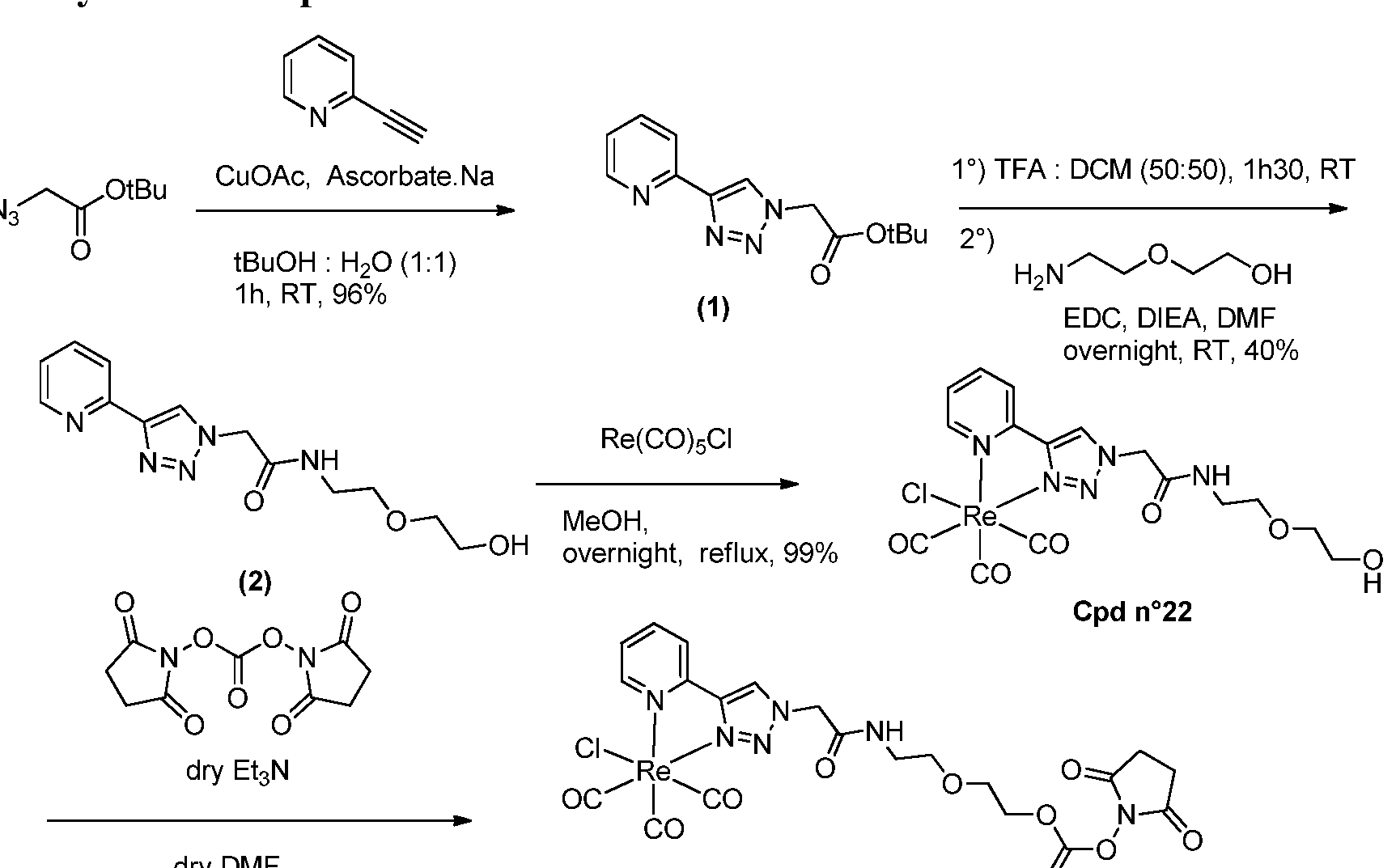
Intermediate (1): 2-(l-[acetic acid tert-butyl ester]-lH-l,2,3-triazol-4-yl)pyridine (PytaCOOtBu) - 2-azidoacetic acid tert-butyl ester (902.1 mg, 5.74 mmol, 1 equiv.) was dissolved in a 1 : 1 mixture of tBuOH (28 mL) and water (28 mL). Copper acetate (278 mg, 1.40 mmol, 0.25 equiv.), sodium ascorbate (276.8 mg, 1.40 mmol, 0.25 equiv.) and 2- ethynylpyridine (560 μί, 5.54 mmol, 0.96 equiv.) were successively added. The mixture was sonicated for a few tens of seconds, during which a pale brown precipitate formed. The mixture was then stirred at room temperature until the solution turned green (lh30). The solution was diluted with DCM (60 mL) and extracted once. The organic layer was washed twice with aqueous saturated (28%) ammonia solution (2 x 60 mL) and once with brine (60 mL). The aqueous layers were extracted once more with DCM (60 mL), then both organic layers were pooled, dried over Na2S04, filtered and concentrated to the desired compound as a white solid (1.3821 g, 5.31 mmol, 96%). !H-NMR (300 MHz, CDC ) δ (ppm): 8.42 (d, J = 4.7 Hz, 1H), 8.18 (s, 1H), 8.00 (d, J = 7.9 Hz, 1H), 7.60 (td, J = 7.7, 1.4 Hz, 1H), 7.06 (dd, J = 6.8, 5.3 Hz, 1H), 5.02 (s, 2H), 1.31 (s, 9H). 13C-NMR (75MHz, CDCb) δ (ppm): 164.99, 149.90, 149.19, 148.37, 136.58, 123.47, 122.63, 119.93, 83.43, 51.43, 27.67.
Intermediate (2) 2-(l-acetamide-(N-2-(2-hydroxyethoxy)ethyl)-lH-l,2,3-triazol-4- yl)pyridine (Pyta-OH) - Intermediate (1) (1.597 g, 6.1 mmol, 1 equiv.) was dissolved in DCM (20 mL), and TFA (20 mL) was added slowly to the solution. The mixture was stirred at room temperature for 2h. Solvents were co-evaporated three times with toluene (3 x 30 mL). EDC.HC1 (1.61 g, 8.4 mmol, 1.4 equiv.) was added to the resulting solid, and both solids were dissolved in dry DMF (30 mL) under argon. After 5-10 min stirring, 2-(2-aminoethoxy)ethanol (0.86 mL, 8.6 mmol, 1.4 equiv.) then DIEA (3.2 mL, 18.5 mmol, 3 equiv.) were added. Reaction mixture was stirred overnight at room temperature, and solvent was removed. The resulting crude was purified by flash silica gel column chromatography (0 to 10% MeOH in DCM) to yield the desired compound as a white solid (721 mg, 2.5 mmol, 40%). !H-NMR (300 MHz, CDCl3:MeOD 1: 1 v:v) δ (ppm): 8.29 (ddd, J = 5.0, 1.8, 0.9 Hz, 1H), 8.16 (s, 1H), 7.86 (dt, J = 8.0, 1.1 Hz, 1H), 7.61 (td, J = 7.8, 1.8 Hz, 1H), 7.07 (ddd, J = 7.6, 5.0, 1.2 Hz, 1H), 4.93 (s, 2H), 3.48-3.45 (m, 2H), 3.34-3.29 (m, 4H), 3.23-3.20 (m, 2H). 13C-NMR (75 MHz, CDCl3:MeOD 1: 1 v:v) δ (ppm): 165.46, 149.23, 148.74, 147.28, 137.39, 123.92, 123.02, 120.31, 71.88, 68.81, 60.77, 52.00, 39.27. HRMS (ESI+): m/z calculated for [Ci3Hi7ClN503+Na]+ 314.12236, found 314.12230, error: -0.2 ppm.
Cpd n°22: 2-(l-acetamide-(N-2-(2-hydroxyethoxy)ethyl)-lH-l,2,3-triazol-4-yl) pyridine chlorotricarbonyrhenium [Re(CO)3(Cl)(Pyta-OH)J - Ligand Pyta-OH (2) (105.3 mg, 0.361 mmol, 1 equiv.) was dissolved in warm MeOH (1 mL). Re(CO)5Cl (133.1 mg, 0.368 mmol, 1 equiv.) was added, and the mixture was refluxed overnight. The yellow precipitate that formed during this time was filtered and dried to give the desired complex (214.2 mg, 0.359 mmol, 99%). !H-NMR (400 MHz, CDCl3:MeOD 1: 1 v:v) δ (ppm): 8.96 (ddd, J = 5.6, 1.4, 1.0 Hz, 1H), 8.83 (s, 1H), 8.11-8.05 (m, 2H), 7.50 (ddd, J = 7.0, 5.6, 2.0 Hz, 1H), 5.28 (q, J = 20.7 Hz, 2H), 3.70 (t, J = 4.6 Hz, 2H), 3.60- 3.56 (m, 4H), 3.48-3.45 (m, 2H). 13C-NMR (101 MHz, CDCl3:MeOD 1: 1 v:v) δ (ppm): 197.5, 195.9, 189.3, 165.3, 153.6, 150.1, 149.6, 140.5, 126.76, 126.58, 123.0, 72.8, 69.7, 61.7, 53.8, 40.3. HRMS (ESI+): m/z calculated for [Ci6Hi7ClN506Re+Na]+ 618.02918, found 618.02891, error: 0.4 ppm.
Cpd n°23: 2-(l-acetamide-(N-2-(((((2,5-dioxo-l-pyrrolidinyl)oxy)carbonyl)oxy) ethoxy)ethyl)-lH-l,2,3-triazol-4-yl)pyridine chlorotricarbonylrhenium [Re( O)i{ CI) (Pyta-OC(O)ONHS)] - Rhenium complex Cpd n°22 (149 mg, 0.25 mmol, 1 equiv.) and N,N'-disuccinimidyl carbonate (DSC) (187.4 mg, 0.73 mmol, 2.9 equiv.) were dissolved in dry DMF (2.4 mL) under Argon. Dry Et3N (99.3 μί, 0.71 μιηοΐ, 2.9 equiv.) was added and the mixture was stirred at room temperature. After 2h30, more DSC was added (121.8 mg, 0.475 mmol, 1.9 equiv.) and the mixture was stirred at 50°C (bath temperature) for another 3h30. DMF was removed by rotary evaporation. The resulting crude was dissolved in EtOAc and washed once with a saturated aqueous solution of NaHC03. The organic layer was dried over Na2S04, filtered and concentrated. It was then purified by silica gel column chromatography (0 to 3 to 5 to 10% MeOH in DCM) to yield the desired compound as a yellow solid containing traces of impurities (106 rng).1!!- NMR (300 MHz, CDC13) δ (ppm): 8.96 (d, J = 5.3 Hz, 1H), 8.60 (s, 1H), 8.04-7.95 (m, 2H), 7.41 (ddd, J = 7.1, 5.6, 1.7 Hz, 1H), 5.14 (q, J = 16.9 Hz, 2H), 4.48 (tdt, J = 13.0, 8.9, 4.4 Hz, 2H), 3.73 (t, J = 4.3 Hz, 2H), 3.58 (t, J = 4.6 Hz, 2H), 3.50-3.45 (m, 2H), 2.88 (s, 4H). 13C-NMR (75MHz, CDC13) δ (ppm): 197.1, 196.3, 188.9, 169.7 (2C), 164.2, 153.1, 151.7, 149.4, 148.8, 139.8, 126.05, 125.93, 122.6, 69.9, 69.5, 68.4, 53.4, 39.9, 25.76. HRMS (ESI+): m/z calculated for [C2iH20ClN6OioRe+Na]+ 759.03512, found 759.03574, error: 0.8 ppm.
4.2. Synthesis of Cpd

C0NH - Trityl imidazole derivative (CO-Trityl) (50.2 mg, 0.091 mmol, 1 equiv.) was dissolved in DCM (0.8 mL). TFA (0.2 mL) was added drop wise, followed by TIS (18.7 μί, 0.091 mmol, 1 equiv.). The mixture was stirred for 1 hour at room temperature, then precipitated in Et20 to give the desired compound as a white solid/oil containing traces of water (34.6 mg of hydrated compound, 93%). Ή-ΝΜΙί (300 MHz, MeOD) δ (ppm): 8.80 (s, 1H), 7.80 (d, J = 8.4 Hz, 2H), 7.39 (d, J = 8.4 Hz, 2H), 7.35 (s, 1H), 3.67 (s, 2H), 3.49 (t, J = 7.2 Hz, 2H), 2.90 (t, J = 7.2 Hz, 2H). 13C-NMR (75 MHz, MeOD) δ (ppm): 169.9, 145.2, 143.1, 135.0, 130.4 (2C), 129.2, 127.3 (2C), 118.5, 41.6, 36.1, 32.0. Cud n°24 - CO-imidazole (C0NH) (8.6 mg, 27.9 μιηοΐ, 1.1 equiv.) and the rhenium complex Cpd n°23 (18.6 mg, 25.2 μιηοΐ, 1 equiv.) were dissolved in dry DMF (2 mL) under argon. Dry pyridine (2.2 μί, 27.3 μιηοΐ, 1.1 equiv.). Solvent was removed by rotary evaporation and the resulting crude was purified by HPLC (ACN: 10 mM NH4OAc pH = 7). !H-NMR (400 MHz, CDCl3:MeOD, 1: 1 v:v) δ (ppm): 8.96 (d, J = 5.5 Hz, 1H), 8.82 (s, 1H), 8.14 (s, 1H), 8.11-8.05 (m, H + H), 7.74 (d, J = 8.3 Hz, 2H), 7.50 (ddd, J = 7.1, 5.4, 1.8 Hz, 1H), 7.36 (s, 1H), 7.27 (d, J = 8.3 Hz, 2H), 5.25 (q, J = 22.2 Hz, 2H), 4.55
(m, 2H, under water signal), 3.84-3.82 (m, 2H), 3.64 (t, J = 5.3 Hz, 2H), 3.48-3.41 (m + d + s, 2H + 2H + 2H), 2.84 (t, J = 7.0 Hz, 2H). HRMS (ESI+): m/z calculated for [C3oH3iClN9OioReS+Na]+ 952.10249, found 952.10229, error: -0.2 ppm.
4.3. Synthesis of Cpd

C3-Boc - Boc-4-aminobutanoic acid (104.6 mg, 0.51 mmol, 1 equiv.), EDC.HC1 (143.8 mg, 0.75 mmol, 1.5 equiv.) and HOBT.H20 (114.6 mg, 0.76 mmol, 1.5 equiv.) were dissolved in dry DMF (2.6 mL) under argon. After 5-10 minutes stirring, 4- (2- aminoethyl)benzene sulfonamide (100.1 mg, 0.50 mmol, 1 equiv.) and DIEA (260 μί, 1.5 mmol, 3 equiv.) were added and reaction mixture was stirred overnight at room temperature. Solvent was removed by rotary evaporation and the resulting sticky solid was taken up in a 1: 1 mixture of EtOAc and saturated aqueous solution of NaHC03. After decantation, the organic layer was washed with brine, dried over Na2S04, filtered and concentrated. The crude was purified by automated silica gel flash column chromatography (5% MeOH in DCM) to give the desired compound as a white solid (133.2 mg, 0.35 mmol, 68%). !H-NMR (300 MHz, MeOD) δ (ppm): 7.83 (d, J = 8.2 Hz, 2H), 7.40 (d, J = 8.2 Hz, 2H), 3.43 (t, J = 7.1 Hz, 2H), 3.00 (t, J = 6.8 Hz, 2H), 2.88 (t, J
= 7.1 Hz, 2H), 2.16 (t, J = 7.5 Hz, 2H), 1.70 (quintet, J = 7.2 Hz, 2H), 1.43 (s, 9H). 13C- NMR (75 MHz, MeOD) δ (ppm): 175.5, 158.4, 145.3, 142.9, 130.4, 127.2, 79.9, 41.3, 40.7, 36.2, 34.3, 28.8, 27.2.
C3-Trityl - C3-Boc (100 mg, 0.26 mmol, 1 equiv.) was dissolved in DCM (1 mL), and TFA (1 mL) was added drop wise. The solution was stirred for lh at room temperature, then precipitated in cold Et20 (40 mL) to give a white solid. l-(triphenylmethyl)-lH- imidazole-4-acetic acid (117.3 mg, 0.32 mmol, 1.2 equiv.), EDC.HC1 (75.2 mg, 0.39 mmol, 1.5 equiv.) and HOBT.H20 (60.5 mg, 0.39 mmol, 1.5 equiv.) were dissolved in dry DMF (1.3 mL) under argon. After 5-10 minutes stirring, the solution was added to the deprotected amine. DIEA (135 μί, 0.78 mmol, 3 equiv.) was added and reaction mixture was stirred overnight at room temperature. Solvent was removed by rotary evaporation and the resulting sticky solid was taken up in a 1: 1 mixture of EtOAc and saturated aqueous solution of NaHC03. After decantation, the organic layer was washed with brine, dried over Na2S04, filtered and concentrated. The crude was purified by automated silica gel flash column chromatography (5% MeOH in DCM). The resulting oil was co-evaporated with Et20 until obtention of the desired compound as a white solid (88.7 mg, 0.14 mmol, 54%). Ή-ΝΜΙί (400MHz, MeOD) δ (ppm): 7.81 (d, J = 8.4 Hz, 2H), 7.43 (s, 1H), 7.36 (ddt, J = 5.9, 2.3, 2.8 Hz, 10H), 7.17-7.14 (m, 5H), 6.87 (s, 1H), 3.43 (t, J = 7.1 Hz, 4H), 3.11 (dd, J = 8.8, 5.0 Hz, 2H), 2.86 (t, J = 7.2 Hz, 2H), 2.13 (t, J = 7.4 Hz, 2H), 1.70 (t, J = 7.2 Hz, 2H). 13C-NMR (75 MHz, MeOD) δ (ppm): 175.47, 158.40, 145.31, 142.89, 130.40, 127.24, 79.92, 41.35, 40.72, 36.18, 34.28, 28.76, 27.25.
C3NH - Trityl imidazole derivative C3-Trityl (60.6 mg, 0.095 mmol, 1 equiv.) was dissolved in DCM (0.8 mL). TFA (0.2 mL) was added drop wise, followed by TIS (19.5 μί, 0.095 mmol, 1 equiv.). The mixture was stirred for 1 hour at room temperature, then precipitated in Et20 to give the desired compound as a white solid containing traces of water (39.7 mg of hydrated compound, 85%). Ή-ΝΜΙί (300 MHz, MeOD) δ (ppm): 8.82 (d, J = 1.4 Hz, 1H), 7.81 (d, J = 8.5 Hz, 2H), 7.39 (d + s, J = 8.5 Hz, 2H + 1H), 3.72 (s, 2H), 3.45 (t, J = 7.1 Hz, 2H), 3.13 (t, J = 7.1 Hz, 2H), 2.88 (t, J = 7.1 Hz, 2H), 2.17 (t, J = 7.4 Hz, 2H), 1.73 (quintet, J = 7.2 Hz, 2H). 13C-NMR (75 MHz, MeOD) δ (ppm):
175.3, 169.9, 145.4, 142.9, 135.0, 130.49 (2C), 129.2, 127.2 (2C), 118.6, 41.3, 40.1, 36.2, 34.3, 32.0, 26.6.
Cpd n°25 - C3-imidazole (C3NH) (11.9 mg, 30.2 μιηοΐ, 1.1 equiv.) and the rhenium complex Cpd n°23 (19.1 mg, 25.9 μιηοΐ, 1 equiv.) were dissolved in dry DMF (2 mL) under argon. Dry pyridine (2.2 μί, 27.3 μιηοΐ, 1.1 equiv.). Solvent was removed by rotary evaporation and the resulting crude was purified by HPLC (ACN: 10 mM NH4OAc pH = 7). 1H-NMR (400 MHz, CDChrMeOD, 1:1 v:v) δ (ppm): 8.96 (dt, J = 5.5 Hz, 1.1, 1H), 8.83 (s, 1H) 8.17 (s, 1H), 8.13-8.06 (m, 2H), 7.78 (d, J = 8.4 Hz, 2H), 7.51 (ddd, J = 6.9, 5.6, 2.1 Hz, 1H), 7.45 (s, 1H), 7.33 (d, J = 8.5 Hz, 2H), 5.26 (q, J = 22.4 Hz, 2H), 4.58- 4.56 (m, 2H, partly hidden by water signal), 3.83-3.80 (m, 2H), 3.63 (t, J = 5.2 Hz, 2H), 3.47-3.40 (m + d + s, 2H + 2H + 2H), 3.07 (t, J = 7.0 Hz, 2H, ), 2.85 (t, J = 7.0 Hz, 2H), 2.10 (t, J = 7.3 Hz, 2H), 1.73-1.64 (m, 2H). HRMS (ESI+): m/z calculated for [C34H38ClNioOnReS+Na]+ 1037.15525, found 1037.15545, error: 0.2 ppm.
4.4. Synthesis of Cpd

C5-Boc - 4-carboxybenzenesulfonamide (120.8 mg, 0.6 mmol, 1.25 equiv.), EDC.HC1 (143.8 mg, 0.75 mmol, 1.6 equiv.) and HOBT.H20 (114.5 mg, 0.75 mmol, 1.6 equiv.)
were dissolved in dry DMF (2.5 mL) under argon. After 5-10 minutes stirring, N-Boc- 1,5-diaminopentane (0.1 mL, 0.48 mmol, 1 equiv.) and DIEA (260 μί, 1.5 mmol, 3.1 equiv.) were added. Reaction mixture was stirred overnight at room temperature. Solvent was removed by rotary evaporation and the resulting sticky solid was taken up in a 1: 1 mixture of EtOAc and saturated aqueous solution of NaHC03. After decantation, the organic layer was washed with brine, dried over Na2S04, filtered and concentrated. The crude was purified by automated silica gel flash column chromatography (5% MeOH in DCM) to give the desired compound as a white solid (173.8 mg, 0.45 mmol, 94%). 1H- NMR (400MHz, MeOD) δ (ppm): 7.98-7.93 (m, 4H), 3.39 (t, J = 7.1 Hz, 2H), 3.05 (t, J = 6.9 Hz, 2H), 1.65 (quintet, J = 7.3 Hz, 2H), 1.56-1.49 (m, 2H), 1.42-1.38 (m, 9H + 2H). 13C-NMR (101 MHz, MeOD) δ (ppm): 168.71, 158.53, 147.53, 139.16, 128.90, 127.26, 79.80, 41.02, 30.03, 28.77, 25.18.
C5-Trityl - Boc-protected compound C5-Boc (112.7 mg, 0.29 mmol, 1 equiv.) was dissolved in DCM (1.2 mL), and TFA (1.2 mL) was added drop wise. The solution was stirred for lh at room temperature, then precipitated in cold Et20 (40 mL) to give the deprotected ammonium salt as a white solid. l-(triphenylmethyl)-lH-imidazole-4-acetic acid (132.6 mg, 0.36 mmol, 1.2 equiv.), EDC.HC1 (88.3 mg, 0.46 mmol, 1.5 equiv.) and HOBT.H20 (69.3 mg, 0.45 mmol, 1.3 equiv.) were dissolved in dry DMF (1.6 mL) under argon. After 5-10 minutes stirring, the solution was added to the deprotected amine. DIEA (156 μί, 0.9 mmol, 3 equiv.) was added and reaction mixture was stirred overnight at room temperature. Solvent was removed by rotary evaporation and the resulting sticky solid was taken up in a 1: 1 mixture of EtOAc and saturated aqueous solution of NaHC03. After decantation, the organic layer was washed with brine, dried over Na2S04, filtered and concentrated. The crude was purified by automated silica gel flash column chromatography (5% MeOH in DCM). The resulting oil was co-evaporated with Et20 until obtention of the desired compound as a white solid (63.4 mg, 0.10 mmol, 34%). 1H- NMR (400 MHz, MeOD): δ (ppm) 7.95 (q, / = 7.1 Hz, 4H), 7.41 (s, 1H), 7.37 (dt, / = 4.3, 2.8 Hz, 9H), 7.15 (dd, / = 6.8, 3.0 Hz, 6H), 6.85 (s, 1H), 3.43 (s, 2H), 3.36 (t, / = 7.1 Hz, 2H), 3.19 (t, / = 7.0 Hz, 2H), 1.67-1.59 (m, 2H), 1.53 (dt, / = 14.4, 7.2 Hz, 2H), 1.38 (dt, / = 15.4, 7.7 Hz, 2H). 13C-NMR (101 MHz, MeOD): δ (ppm) 172.89, 168.72,
147.61, 143.61, 139.18, 130.87, 129.35, 129.25, 128.93, 127.30, 121.28, 77.00, 41.00, 40.38, 29.99, 29.94, 25.24.
C5NH - Trityl imidazole derivative C5-Trityl (67.4 mg, 0.106 mmol, 1 equiv.) was dissolved in DCM (0.8 mL). TFA (0.2 mL) was added drop wise, followed by TIS (23 0.112 mmol, 1 equiv.). The mixture was stirred for 1 hour at room temperature, then precipitated in Et20 to give the desired compound as a white solid containing traces of water (43.2 mg of hydrated compound, 0.095 mmol, 90%). !H-NMR (300 MHz, MeOD) δ (ppm): 8.81 (s, 1H), 7.95 (s, 4H), 7.39 (s, 1H), 3.71 (s, 2H), 3.39 (t, J = 6.7 Hz, 2H), 3.22 (t, J = 6.3 Hz, 2H), 1.61 (td, J = 13.6, 6.7 Hz, 2H + 2H), 1.41 (t, J = 6.6 Hz, 2H). 13C-NMR (75 MHz, MeOD) δ (ppm): 169.80, 168.74, 147.54, 139.12, 134.96, 129.36, 128.92 (2C), 127.27 (2C), 118.49, 40.94, 40.58, 31.96, 29.99-29.91 (C + C), 25.27.
Cpd n°26 - C5-imidazole (C5NH) (12.4 mg, 31.5 μιηοΐ, 1.3 equiv.) and the rhenium complex Cpd n°23 (18.3 mg, 24.8 μιηοΐ, 1 equiv.) were dissolved in dry DMF (2 mL) under argon. Dry pyridine (2.2 μί, 27.3 μιηοΐ, 1.1 equiv.). Solvent was removed by rotary evaporation and the resulting crude was purified by HPLC (ACN: 10 mM NH40Ac pH = 7). ¾ NMR (400MHz, MeOD:CDCl3) d (ppm) : 8.96-8.94 (m, 1H), 8.81 (s, 1H), 8.13 (s, 1H), 8.11-8.04 (m, 2H, H + H), 7.94-7.89 (m, 4H), 7.50 (ddd, J = 7.3, 5.5, 1.8 Hz, 1H), 7.42 (s, 1H), 5.25 (q, J = 23.0 Hz, 2H), 4.57-4.55 (m, 2H, partly hidden by water signal), 3.81 (td, J = 3.1, 2.3 Hz, 2H), 3.62 (t, J = 5.4 Hz, 2H), 3.45 (m + s, 2H + 2H), 3.38-3.33 (m, 2H), 3.18 (t, J = 7.0 Hz, 2H), 1.61 (dt, J = 14.6, 7.3 Hz, 2H), 1.52 (dd, J = 14.5, 6.9 Hz, 2H), 1.38 (dd, J = 16.1, 7.6 Hz, 2H). HRMS (ESI+): m/z calculated for [C34H38ClNioOnReS+Na]+ 1037.15525, found 1037.15464, error: -0.6 ppm.
4.5. Synthesis of C6-SC0MPI
C6-Boc - Boc-7-aminoheptanoic acid (101.8 mg, 0.51 mmol, 1 equiv.), EDC.HC1 (145.7 mg, 0.76 mmol, 1.5 equiv.) and HOBT.H20 (115.6 mg, 0.76 mmol, 1.5 equiv.) were dissolved in dry DMF (2.6 mL) under argon. After 5-10 minutes stirring, 4-(2- aminoethyl)benzene sulfonamide (249.7 mg, 1.25 mmol, 1 equiv.) and DIEA (260{\uL, 1.5 mmol, 3 equiv.) were added and reaction mixture was stirred overnight at room temperature. Solvent was removed by rotary evaporation and the resulting sticky solid was taken up in a 1: 1 mixture of EtOAc and saturated aqueous solution of NaHC03. After decantation, the organic layer was washed with brine, dried over Na2S04, filtered and concentrated. The crude was purified by automated silica gel flash column chromatography (5% MeOH in DCM) to give the desired compound as a white solid (146.1 mg, 0.34 mmol, 67%). Ή-ΝΜΙί (400MHz, MeOD) δ (ppm): 7.84 (d, J = 8.5 Hz, 2H), 7.41 (d, J = 8.6 Hz, 2H), 3.46 (t, J = 7.2 Hz, 2H), 3.02 (t, J = 7.0 Hz, 2H), 2.90 (t, J = 7.1 Hz, 2H), 2.15 (t, J = 7.5 Hz, 2H), 1.57 (t, J = 7.1 Hz, 2H), 1.47-1.44 (m, 9H+ 2H), 1.30 (dt, J = 6.7, 3.1 Hz, 4H). 13C-NMR (101 MHz, MeOD) δ (ppm): 176.2, 158.5, 145.4,
143.1, 130.4 (2C), 127.3 (2C), 79.8, 41.3 (C + C), 37.0, 36.3, 30.8, 29.9, 28.8 (3C), 27.5, 26.9.
C6-Trityl - Boc-protected compound C6-Boc (120 mg, 0.28 mmol, 1 equiv.) was dissolved in DCM (1 mL), and TFA (1 mL) was added drop wise. The solution was stirred for lh at room temperature, then precipitated in cold Et20 (40 mL) to give the deprotected ammonium salt as a white solid. l-(triphenylmethyl)-lH-imidazole-4-acetic acid (121.2 mg, 0.33 mmol, 1.2 equiv.), EDC.HC1 (90.2 mg, 0.47 mmol, 1.5 equiv.) and HOBT.H20 (65.0 mg, 0.42 mmol, 1.3 equiv.) were dissolved in dry DMF (1.5 mL) under argon. After 5-10 minutes stirring, the solution was added to the deprotected amine. DIEA (146 μί, 0.78 mmol, 3 equiv.) was added and reaction mixture was stirred overnight at room temperature. Solvent was removed by rotary evaporation and the resulting sticky solid was taken up in a 1: 1 mixture of EtOAc and saturated aqueous solution of NaHCO3. After decantation, the organic layer was washed with brine, dried over Na2S04, filtered and concentrated. The crude was purified by automated silica gel flash column chromatography (5% MeOH in DCM). The resulting oil was co-evaporated with Et20 until obtention of the desired compound as a white solid (79.8 mg, 0.12 mmol, 42%). 1H- NMR (400 MHz, MeOD) δ (ppm): 7.84-7.81 (m, 2H), 7.40-7.34 (m, 12H), 7.16-7.14 (m, 6H), 6.85 (s, 1H), 3.43 (d, J = 7.1 Hz, 4H), 3.15 (t, J = 6.9 Hz, 2H), 2.87 (t, J = 7.1 Hz, 3H), 2.11 (t, J = 7.4 Hz, 3H), 1.51 (ddd, J = 30.5, 15.9, 7.1 Hz, 5H), 1.30-1.21 (m, 6H). 13C-NMR (101 MHz, MeOD) δ (ppm): 176.14, 145.35, 143.61, 143.07, 130.86, 130.41, 129.33, 129.24, 127.28, 41.28, 40.64, 40.45, 36.95, 36.23, 30.15, 29.75, 27.51, 26.84.
C6NH - Trityl imidazole derivative C6-Trityl (53.6 mg, 0.079 mmol, 1 equiv.) was dissolved in DCM (0.8 mL). TFA (0.2 mL) was added drop wise, followed by TIS (16.2 μί, 0.079 mmol, 1 equiv.). The mixture was stirred for 1 hour at room temperature, then precipitated in Et20 to give the desired compound as a white solid containing traces of water (35.6 mg of hydrated compound, 0.070 mmol, 88%). Ή-ΝΜΙί (300 MHz, MeOD) δ (ppm): 8.81 (s, 1H), 7.82 (d, J = 8.4 Hz, 2H), 7.41-7.38 (d + s, J = 8.3, 2H + 1H), 3.72 (s, 2H), 3.46 (t, J = 7.0 Hz, 2H), 3.18 (t, J = 7.1 Hz, 2H), 2.89 (t, J = 7.0 Hz, 2H), 2.13 (t, J = 7.4 Hz, 2H), 1.51 (tt, J = 13.7, 6.9 Hz, 2H + 2H), 1.33-1.24 (m, 4H, 2H
+ 2H). 13C-NMR (75 MHz, MeOD) δ (ppm): 176.2, 169.8, 145.4, 143.0, 135.0, 130.46 (2C), 129.4, 127.2 (2C), 118.5, 41.2, 40.7, 36.9, 36.1, 32.0, 30.1, 29.7, 27.6, 26.8.
Cpd n°27 - C6-imidazole (C6NH) (12.8 mg, 29.4 μηιοΐ, 1.1 equiv.) and the rhenium complex Cpd n°23 (19.4 mg, 26.3 μιηοΐ, 1 equiv.) were dissolved in dry DMF (2 mL) under argon. Dry pyridine (2.2 μί, 27.3 μιηοΐ, 1.1 equiv.). Solvent was removed by rotary evaporation and the resulting crude was purified by HPLC (ACN: 10 mM NH4OAc pH = 7). 1H-NMR (400MHz, CDCl3:MeOD 1: 1 v:v) δ (ppm): 8.96 (dd, J = 5.6, 0.5 Hz, 1H), 8.82 (s, 1H), 8.16 (s, 1H), 8.10-8.06 (m, 2H), 7.79 (dd, J = 8.5, 1.4 Hz), 7.50 (ddd, J = 7.0, 5.5, 2.0 Hz, 1H), 7.45 (s, 1H), 7.33 (d, J = 8.5 Hz, 2H), 5.25 (q, J = 22.5 Hz, 2H), 4.56-4.55 (m, 2H, partly hidden by water signal), 3.82-3.80 (m, 2H), 3.62 (t, J = 5.3 Hz, 2H), 3.44 (dt, J = 12.3, 6.2 Hz, m + d + s, 2H + 2H + 2H), 3.13 (t, J = 7.1 Hz, 2H), 2.85 (t, J = 7.1 Hz, 2H), 2.09 (t, J = 7.4 Hz, 2H), 1.51 (dt, J = 14.4 Hz, 7.6, 2H), 1.43 (dt, J = 14.6 Hz, 7.4, 2H), 1.28-1.19 (m, 2H + 2H). HRMS (ESI+): m/z calculated for [C37H44ClNioOnReS+Na]+ 1079.20220, found 1079.20160, error: -0.6 ppm. 4.6. Labelling of Carbonic Anhydrases
In vitro labelling of human Carbonic Anhydrase 1 (hCAl)
A solution of hCAl (10μΜ in 50mM HEPES pH 7.2 was incubated at 37°C for 6h with 2 or 20 equivalents of compounds of the invention Cpd n°24-27. At given time points, aliquots of the incubation solution were taken, treated and analyzed either by MALDI- TOF MS or fluorescence gel imaging. A control experiment consisting in incubation solution + 10 equivalents EZA was performed for each experiment, and analyzed at 6h. Treatment for MALDI-TOF MS analysis: ΙΟμΙ^ of sample solution were quenched and purified using a ZipTip (C18) and 0.1% aqueous TFA, then spotted on a MALDI plate. Peak areas of labelled and unlabelled protein were determined and percentage of labelling calculated.
Treatment for gel imaging analysis: 30 μΐ^ of sample solution were diluted with 30 μΐ^ 2X denaturing Laemmli buffer and stored at -30°C prior to gel analysis. Sample were
heated at 70°C for 20 min and loaded on a 12.5% SDS polyacrylamide gel. Fluorescence gel Imaging was performed prior to BBB staining.
In cellulo labelling of CA IX and CA XII for imaging
A549 cells were deposed in 6-wells plates in presence of glass of CaF2 slides (105 cells/well). After 24h, cells were put under hypoxic conditions for 24h using Oxoid Anaerogen kit. Cells were then incubated at 37 °C with compounds of the invention Cpd n°24-27 under normoxic conditions. Typical incubation conditions are 10 μΜ reagent for 3-6h.
5. Re complexes with substituted pyridine and triazole

Intermediate (1): 2-(4-(3-Chlorophenyl)-lH-l,2,3-triazol-l-yl)-4-nitropyridine
2-Ethynyl-4-nitropyridine (30.0 mg, 0.20 mmol, 1.0 equiv.) was dissolved in tert-butanol (2.8 mL). An aqueous solution of CuS04 5H20 (0.1 equiv. from a 4.12 mg.mL 1 solution in water), an aqueous solution of sodium ascorbate (0.3 equiv. from a 8.7 mg.mL"1 solution in water) and l-azido-3-chlorobenzene (31.1 mg, 0.20 mmol, 1.0 equiv.) were then added. The resulting mixture was stirred in a sealed tube at 110 °C for 24 hrs. The obtained suspension was cooled down and filtered. The residue was washed with water and tert-butanol and dried under vacuum to afford 2-(4-(3-chlorophenyl)-lH- 1,2,3- triazol-l-yl)-4-nitropyridine as a clear brown solid (58.0 mg, 95% yield). 1H-NMR (300 MHz, DMSO-d6) δ 8.45 (t app, J = 2.1 Hz, 2H), 8.34 (ddd, J = 1.2, 2.4, 8.1 Hz, 2H), 8.10 (dt, J = 1.2, 8.1 Hz, 2H), 7.76 (t, J = 8.1 Hz, 1H).
Cpd n°4: 2-(4-(3-Chlorophenyl)-lH-l,2,3-triazol-l-yl)-4-nitropyridine chloro tricarbonylrhenium
It was obtained according to general procedure B described below starting from 2-(4-(3- chlorophenyl)-lH-l,2,3-triazol-l-yl)-4-nitropyridine (20.0 mg, 66.2 mmol, 1.0 equiv.) and chloropentacarbonylrhenium(I) (24.2 mg, 66.8 mmol, 1.01 equiv.) after filtration and washing with toluene as a deep red solid (23.0 mg, 57% chemical yield). MS (ESI+) m/z (%): 629.9322 (46) [M+Na]+, 589.9846 (100) [M-C1+H20]+, 571.9747 (69) [M-C1]+, 324.0251 (23) [M-Re(CO)3Cl+Na]+; HRMS (ESI+): calcd for CieHeChNsNaOsRe: 629.9337, found: 629.9322; IR nmax/cm"1 2027, 1899 (CO). Intermediate (2): 2-(4-(3-Iodophenyl)-lH-l,2,3-triazol-l-yl)-4-nitropyridine
2-Ethynyl-4-nitropyridine (30.0 mg, 0.20 mmol, 1.0 equiv.) was dissolved in tert-butanol (2.8 mL). An aqueous solution of CuS04 5H20 (0.1 equiv. from a 4.12 mg.mL 1 solution in water), an aqueous solution of sodium ascorbate (0.3 equiv. from a 8.7 mg.mL"1 solution in water) and l-azido-3-iodobenzene (49.6 mg, 0.20 mmol, 1.0 equiv.) were then added. The resulting mixture was stirred in a sealed tube at 110 °C for 24 hrs. The obtained suspension was cooled down and filtered. The residue was washed with water and tert-butanol and dried under vacuum to afford 2-(4-(3-iodophenyl)-lH-l,2,3-triazol- l-yl)-4-nitropyridine as a brown solid (63.0 mg, 79% yield). !H-NMR (300 MHz, DMSO-d6) δ 9.64 (s, 1H), 9.06 (s, 1H), 8.65 (s, 1H), 8.21-8.06 (m, 3H), 7.67-7.63 (m, 2H).
Cpd n°5: 2-(4-(3-Iodophenyl)-lH-l,2,3-triazol-l-yl)-4-nitropyridine chloro tricarbonylrhenium
It was obtained according to general procedure B described below starting from 2-(4-(3- iodophenyl)-lH-l,2,3-triazol-l-yl)-4-nitropyridine (20.0 mg, 50.8 mmol, 1.0 equiv.) and chloropentacarbonylrhenium(I) (18.6 mg, 51.3 mmol, 1.01 equiv.) after filtration and washing with toluene as a deep red solid (30.0 mg, 84% chemical yield). MS (ESI+) m/z (%): 721.8689 (86) [M+Na]+, 681.9218 (100) [M-C1+H20]+, 663.9119 (71) [M-C1]+;
HRMS (ESI+): calcd for CieHgClINsNaOsRe: 721.8700, found: 721.8689; IR nm cm l
2027, 1899 (CO).
6. Re complexes functionalized with a thioctic acid
PytaC30H - 3-Azidopropan-l-ol was directly added (1 g, 9.7 mmol) with 2- ethynylpyridine (1 g, 9.7 mmol) to a mixture of CH2CI2 (5 mL) and water (5 mL) at r.t. Copper (II) Sulfate pentahydrate (250 mg, 1.0 mmol) and sodium ascorbate (500 mg, 2.0 mmol) were then added. After overnight stirring, water (10 mL) and CH2CI2 (10 mL) were poured into the mixture. The product was extracted with CH2CI2 (2 x 30 mL), the organic fractions were combined, dried over anhydrous sulfate magnesium, filtered and evaporated to dryness. The crude was purified by silica gel column chromatography with (CH2Cl2/MeOH) (from 1/0 to 95/5) to give 4-(2-pyridyl)-l,2,3-triazole-(CH2)3-OH (1.6 g, 7.8 mmol, 80% yield) as a white solid. !H-NMR (CDCI3, 300 MHz) d (ppm): 8.37 (1H, ddd, J =2.9, 2.1, 1 Hz), 8.05 (1H, s), 8.01-7.86 (1H, m), 7.67-7.41 (1H, m), 7.06- 6.90 (1H, m), 4.40-4.09 (2H, m), 3.30 (2H, m), 2.08-1.83 (2H, m). 13C-NMR (CDCI3, 75 MHz) d (ppm): 150.0, 149.27, 148.20, 136.75, 122.74, 122.37, 119.9, 47.8, 47.15, 29.25.
PytaC30thioctic - Thioctic acid (0.5g, 2.5 mmol), and PytaC30H (0.5 g, 2.5 mmol) were dissolved in 50 ml of CHCI3. DMAP (305 mg, 2.5 mmol) and DCC (0.5 g, 2.5 mmol) were successively added under stirring at rt. After one night of stirring, 100 ml of water was added. The product was extracted with CH2CI2 (2 x 50 mL). The organic fractions were combined, dried over anhydrous sulfate magnesium, filtered and evaporated to dryness. 30 ml of acetone was added and the suspension was filtrated. The white solid was discarded and the filtrate was purified by silica gel column chromatography with (CH2Cl2/ethanol) (90/10) to give 360 mg of a yellow solid (36%). !H-NMR (CD3COCD3, 300 MHz) δ ppm: 8.97 (d, / = 5.4 Hz, 1 H), 8.51 (s, 1H), 7.97 (m, 1H), 7.86 (d, / = 7.8 Hz, 1H), 7.44 (m, 1H), 4.54 (m, 2H), 4.16 (t, /= 5.8 Hz, 2H), 3.58 (m, 1H), 3.15 (m, 2H), 2.48 (m, 4H), 2.35 (t, 4H), 1.90 (m, 1H), 1.68 (m, 4H), 1.47 (m, 2H). 13C-NMR (CD3COCD3, 75 MHz) δ ppm: 172.65, 150.80, 149.55, 148.00, 139.79, 122.82, 122.67, 119.44, 60.96, 59.28, 47.17, 40.03, 38.20, 34.40, 33.44, 28.72, 28.21, 24.45. HRMS (ESI+): calcd for C18H24N4Nal02S2 ([M+Na]+): m/z 415.1233, found: m/z 415.1208.
Cpd n°28: RePytaC30thioctique - PytaC30thioctique (200 mg, 0.5 mmol) and Re(CO)5Cl (200 mg, 0.55 mmol) were added in a mixture of (toluene / acetone) (50 ml / 10 ml). The reaction mixture was stirred for 3h at 70°C. After cooling down to r.t, the reaction mixture was evaporated on vacuum and the crude purified by silica gel column chromatography with (CH2Cl2/acetone) (70/30) to give 250 mg of a yellow solid (71%). !H-NMR (CD3COCD3, 300 MHz) δ ppm: 9.07 (s, 1H), 9.03 (d, J = 5.5 Hz, 1 H), 8.20 (m, 2 H), 7.64 (m, 1 H), 4.78 (t, J = 7Hz, 2H), 4.21 (t, J = 6 Hz, 2H), 3.56 (ddd, J = 12.4, 8.3, 6.3 Hz, 1H), 3.13 (m, 2H), 2.42 (m, 3H), 2.29 (t, 2H), 1.89 (m, 1H), 1.59 (m, 4H), 1.40 (m, 2H). 13C-NMR (CDCI3, 75 MHz) δ ppm: 197.13, 195.69, 188.92, 173.37, 153.17, 149.13, 148.68, 139.46, 125.92, 124.08, 122.21, 60.41, 59.47, 49.52, 40.28, 38.52, 34.50, 33.85, 29.10, 28.69, 24.54. HRMS (ESI+): calcd for C21H24CllN4Nal05RelS2 ([M+Na]+): m/z 721.0315, found: m/z 721.0313 and ([M+K]+ m/z 737.0069 and ([M-C1]+ m/z 663.0731).
PytaC8NHthioctic - N3-(CH2)8-NHthioctic (160 mg, 0.5 mmol) and 2-ethynylpyridine (120 mg, 1.2 mmol) were dissolved in CH2CI2 (10 mL) and water (10 mL). Sulfate copper (II) pentahydrate (15 mg, 0.05 mmol) and sodium ascorbate (50 mg, 0.25 mmol) were then added. The reaction mixture was stirred and became trouble and light yellow. After 3 days at r.t., 20 ml of CH2CI2 was added and the organic phase was washed with 20 mL of ammoniac (1 mol L"1) then with 50 ml of water. The organic fraction was dried over anhydrous magnesium sulfate, filtered and concentrated. The crude product was purified by a fast and short column chromatography on silica gel with (CH2CI2 /methanol) (10/0 to 9/1). The product was obtained as a cream colored solid (0.170 g, 73%). 1H-NMR (CDC13, 300 MHz) δ ppm: 8.46 (dd, J = 28, 5 Hz, 1H), 8.08 (s, J= 5.5 Hz, 1 H), 8.10 (m, 1 H), 7.71 (m, 1 H), 7.16 (m, 1 H), 6.04 (m, 1 H), 4.34 (t, J = 7.1 Hz, 2H), 3.47 (dt, J = 13, 6.5, 1 Hz, 1H), 3.06 (m, 2H), 2.36 (dt, J = 12.5, 6.4, 1 Hz, 1H), 2.09 (t, J = 7.1 Hz, 2H), 1.82 (m, 3H), 1.58(m, 4H), 1.38 (m, 4H) 1.20(m, 8H). 13C-NMR (CDC13, 75 MHz) δ ppm: 172.7, 150.28, 149.39, 148.25, 136.89, 122.80, 121.84, 120.07, 56.42, 50.37, 40.17, 39.34, 38.41, 36.37, 34.56, 30.08, 29.50, 28.91, 28.84, 28.73, 26.22, 26.67, 25.45. HRMS (ESI+): C23H36N501S2 ([M+H]+): calc m/z 462.2361, found: m/z 462.2347d for C23H35N5Nal01S2 ([M+Na ]+) calc m/z 484.2175, found: m/z 484.2180.
Cvd n°29: RePYTA-C8-NHthioctic - PytaC8NHCOthioctic (0.5 mmol, 200 mg) and Re(CO)5Cl (0.4 mmol, 140 mg) were added in a mixture of (toluene/chloroforme) (20 ml / 5 ml). The reaction mixture was stirred for 3h at 70°C. After cooling down to r.t., the reaction mixture was evaporated and the crude purified by silica gel column chromatography with (ClH Ck/acetone) (80/20) to give 240 mg of a yellow solid (87%). !H-NMR (CD3CI3, 300 MHz) δ ppm: 8.91 (d, J= 5.4 Hz, 1 H), 8.62(s, 1H), 7.96 (m, 2H),
7.41 (dt, J = 6, 2.5 Hz, 1H), 4.41 (m, 2H), 3.52 (dt, J= 12.8, 6.3, 1 Hz, 1H), 3.10 (m, 2H),
2.42 (dt, J = 12.4, 6.1 Hz, 1H), 2.12 (m, 2H), 1.87 (m, 3H), 1.60 (m, 4H), 1.40 (m, 4H), 1.28 (m, 8H). 13C-NMR (CDCI3, 75 MHz) δ ppm: 197.40, 195.95, 189.01, 172.94, 152.97, 149.31, 148.70, 139.62, 125.86, 124.05, 122.39, 56.52, 52.24, 40.24, 39.27, 38.49, 36.40, 34.60, 29.68, 29.40, 28.85, 28.72, 28.45, 26.49, 25.93, 25.52. HRMS (ESI+): C26H35N5Nal04RelS2+ ([M+Na]+): calc m/z 790.1274, found: m/z 790.1260.
7. Re complexes functionalized with a fluorophore
7-(8-bromoocta)oxycoumarine-3-carboxylic acid ethyl ester 7-hydroxycoumarine-3-carboxylic acid ethyl ester (2.34 g, 10 mmol) was mixed with K2CO3 (20 mmol, 2.80 g) and 1,8-dibromooctane (50 mmol, 12 mg). 10 ml of aliquat was added and the mixture was heated at 80°C for 3h and at room temperature for 2 days. 100 ml of CH2CI2 was added, the suspension was filtrated and the filtrate was dried on vacuum. 100 ml of heptane was added and the formed precipitate was isolated by filtration and washed with 100 ml of heptane. The solid was dissolved in a minimum of mixture (CH2CI2 / heptane) (50/50) and purified by silica gel column chromatography with (CH2CI2 / heptane) (50/50) and (CH2CI2) and (CH2CI2/ acetone) (99/1) to obtain (2.6 g, 61%) of a white non-fluorescent solid. !H-NMR (CDCI3, 300 MHz) δ ppm: 8.50 (m, 1H), 7.51 (dd, J = 8.7, 1.7 Hz, 1H), 6.87 (dd, J = 8.7, 2.2 Hz, 1H), 6.78 (m, 1H), 4.39 (m, 2H), 4.04 (m, 2H), 3.42 (2H), 1.84 (m, 4H), 1.39 (m, 11H). 13C-NMR (CDCI3, 75 MHz) δ ppm: 164.7, 163.4, 157.57, 148.95, 130.67, 113.96, 111.47, 100.78, 68.87, 61.62, 33.91, 32.71, 29.07, 28.81, 28.61, 28.02, 25.80, 14.27. HRMS (ESI+): calcd for C20H25BrNaO5 ([M+Na]+): m/z 447.0778, found: m/z 447.0767 and calcd for([2M+Na]+ m/z 873.1648, found: m/z 873.1621.
7-(8-azidomoocta)oxycoumarine-3-carboxylic acid ethyl ester
7-(8-bromoocta)oxycoumarine-3-carboxylic acid ethyl ester (2.12 g, 5 mmol) was diluted in 25 ml of DMF. NaN3 (0.65 g, 10 mmol) was added and the mixture was stirred overnight at 70°C. After cooling at r.t. the reaction mixture was poured in 200 ml of NaCl saturated ice water. The product was extracted with 100 ml of CH2CI2. The organic phase was dried over anhydrous sulfate sodium, filtered and evaporated to dryness. The oily product was precipitated by addition of water (100 ml). The solid was dissolved in ethyl acetate, dried over anhydrous sulfate sodium and evaporated on vacuum to obtain a white solid (2g, quantitative). Ή-ΝΜΙί (DMSO-d6, 300 MHz) δ ppm: 8.52 (m, 1H), 7.50 (d, J = 8.7 Hz, 1H), 6.89 (dd, J = 8.7, 2.3 Hz, 1H), 6.81 (d, J = 2.3 Hz), 4.41 (q, J = 1.1 Hz, 2H), 4.05 (t, J = 6.5 Hz, 2H), 3.28 (t, J = 6.9 Hz, 2H), 1.83 (dd, J = 14.6, 6.6 Hz, 2H), 1.62 (m, 2H), 1.44 (m, 9H). 13C-NMR (DMSO-d6, 75 MHz) δ ppm: 164.6, 163.36, 157.52, 148.93, 130.67, 113.91, 111.44, 100.76, 68.85, 61.56, 51.38, 29.09, 28.98, 28.77, 26.58, 25.78, 14.23. HRMS (ESI+): calcd for C20H25N3NaO5 ([M+Na]+): m/z 410.1686, found: m/z 410.1687.
Pyta C8-0-coumarineC02Et
7-(8-bromoocta)oxycoumarine-3-carboxylic acid ethyl ester (5 mmol, 2 g) was added with 2-ethynylpyridine (0.5 g, 5 mmol) in 10 mL of water and 20 ml of CH2CI2. The mixture was vigorously stirred and CuS04 (240 mg, 1 mmol) and sodium ascorbate (500 mg, 2 mmol) were added. The reaction mixture was stirred for three days at r.t. 10 ml of concentrated ammoniac solution was added and the product was extracted by (3 x 100 mL) of CH2CI2. The organic fractions were combined, dried over anhydrous sulfate sodium, filtered and evaporated to dryness. The crude was purified by silica gel column chromatography with (CH2CI2 / acetone) (90/10 to 70/30) to give 0.9 g of a white solid (50% yield). Ή-ΝΜΙί (DMSO-d6, 300 MHz) δ ppm: 8.59 (d, J= 4.8 Hz, 1H), 8.50 (s, 1H), 8.19 (d, J= 7.9 Hz, lH), 8.14 (s, lHt), 7.79 (t, J = 7.7 Hz, 1H), 7.49 (d, J= 8.7 Hz, 1H), 7.24 (m, 1H), 6.87 (dd, J = 8.7, 2.3 Hz, 1H), 6.79 (d, J = 2.3 Hz, 1H), 4.41 (m, 4H), 4.02 (t, J = 6.3 Hz, 2H), 1.83 (m, 6.6 Hz, 2H), 1.80 (m, 2H), 1.4 (m, 9H). 13C-NMR (DMSO-d6, 75 MHz) δ ppm: 164.6, 163.36, 157.52, 150.38, 149.39, 148.93, 148.38, 136.92, 130.67, 122.82, 121.77, 120.10, 113.97, 111.46, 100.77, 68.81, 61.62, 50.42,
30.15, 28.99, 28.82, 28.77, 26.30, 25.76, 14.27. HRMS (ESI+): calcd for C27H30N4NaO5 ([M+Na]+): m/z 513.2108, found: m/z 513.2090.
Cpd n°30: Re Pyta C8-0-coumarineC02Et
PytaC8-0-coumarineC02Et (0.2 mmol, 98 mg) and Re(CO)5Cl (72 mg, 0.2 mmol) were added in 20 ml of toluene. The mixture was stirred 3h at 70°C. After cooling at r.t., the product has precipitated and was separated by filtration. Silica gel column chromatography with (CH2Cl2/acetone) (20/80) gave 70 mg of a pale yellow solid (43%). 1H-NMR (DMSO-d6, 300 MHz) δ ppm: 8.92 (d, J = 4.8 Hz, 1H), 8.70 (s, 1H), 8.49 (s, 1H), 7.95 (m, 2H), 7.49 (d, J = 8.7 Hz, 1H), 7.39(m, 1H), 6.87 (dd, J = 8.7, 2.3 Hz, 1H), 6.79 (d, J = 2.3 Hz, 1H), 4.42 (m, 2H), 4.34 (q, 2H), 4.02 (t, J= 6.3 Hz, 2H), 1.96 (m, 6.6 Hz, 2H), 1.75 (m, 2H), 1.4 (m, 9H). 13C-NMR (DMSO-d6, 75 MHz) δ ppm: 197.40, 195.92, 189.08, 164.85, 163.15, 157.44, 157.36, 152.92, 149.37, 148.67, 148.67, 136.55, 130.90, 125.77, 124.27, 122.42, 114.01, 111.40, 100.83, 68.89, 61.54, 52.26, 29.78, 28.87, 28.70, 28.65, 26.10, 25.64, 14.26. HRMS (ESI+): calcd for C30H30ClNaO8Re ([M+Na]+): m/z 819.1194, found: m/z 819.1197.
8. Multivalent Re complexes
N3-peg900-N3 - In 100 mL of DMF were added 1.3 g of NaN3 and 6 g of Cl-peg900-Cl. After overnight stirring at 90°C, the reaction mixture was partially evaporated on vacuum, until the solution volume was around 20 ml. 100 ml of water was added and the product was extracted by (3 x 100 mL) of CH2C12. The organic fractions were combined, dried over anhydrous sulfate sodium, filtered and evaporated to dryness. 6 g of colorless oil were obtained (quantitative yield). The product was used without further purification.1H- NMR (CDC13, 300 MHz) δ ppm: 4.60 (m, 4H), 3.92 (m, J = 5.1 Hz, 4H), 3.59 (m, 76H). 13C-NMR (CDC13, 75 MHz) δ ppm: 70.49, 69.96, 50.59. Pyta-peg900-Pyta - 6 g of N3-peg900-N3 and 1.5 g of 2-ethynylpyridine were added in 10 mL of water and 10 ml of CH2C12. The mixture was vigorously stirred and CuS04 (500 mg, 2 mmol) and sodium ascorbate (1 g, 4 mmol) were added. After overnight stirring at r.t., two colored phases were obtained. 10ml of concentrated ammoniac solution
was added and the product was extracted with (3 x 100 mL) of CH2CI2. The organic fractions were combined, dried over anhydrous sulfate sodium, filtered and evaporated to dryness. The crude was purified by silica gel column chromatography with (CH2CI2 / methanol) (100/0 to 85/15) to give 3.6 g of a brown oil (50%). ¾ NMR (CDCI3, 300 MHz) δ ppm: 8.55 (d, J = 4.8 Hz, 2H), 8.29 (s, 2H), 8.13 (d, J = 8 Hz, 2H), 7.74 (t, J = 7.7 Hz, 2H), 7.19 (ddd, J = 7.5, 4.9, lHz, 2H), 4.60 (m, 4H), 3.92 (m, J = 5.1 Hz, 4H), 3.59 (m, 76H). 13C-NMR (CDCI3, 75 MHz) δ ppm: 150.43, 149.35, 148.21, 136.79, 123.17, 122.69, 120.14, 70.51, 69.39, 50.41.
Cud n°31: RePytaPEG900PytaRe - Pyta-PEG900-Pyta (290 mg, 0.25 mmol), Re(CO)5Cl (198 mg, 0.55 mmol) and 20 ml of toluene were mixed. The mixture was stirred 3h at 70°C. After cooling at r.t., toluene was removed and the crude purified by silica gel column chromatography with (CH2Cl2/ethanol) (90/10) to give 240 mg of a clear yellow oil (54%). Ή-ΝΜΙί (CDC13, 300 MHz) δ ppm: 8.86 (d, J = 5Hz, 2 H), 8.77 (s, 2H), 7.96 (m, 4H), 7.77 (t, J = 7.7 Hz, 2H), 7.37 (m, 2H), 4.61 (m, J = 5 Hz, 4H), 3.88 (t, J = 5.1 Hz, 4H), 3.56 (m, 76H). 13C-NMR (CDC13, 75 MHz) δ ppm: 197.35, 195.86, 189.12, 1452.85, 148.58, 139.64, 125.69, 122.41, 70.36, 68.28, 51.99. pyta-(CH2)8-pyta from N3-(CH2)s-N3 - 1,8-diazidooctane (0.98 g, 5 mmol) and 2- ethynylpyridine (1.03 g, 10 mmol) were dissolved in a mixture of CH2CI2 (20 mL) and water (20 mL) at r.t. Copper (II) sulfate pentahydrate (125 mg, 0.5 mmol) and sodium ascorbate (200 mg, 1 mmol) were then added. After 12 h stirring at r.t., water (50 mL), 10 ml of 10% ammoniac solution were added. Aqueous solution was extract three times with CH2CI2 (3 x 100 mL). The organic phases were combined, dried over anhydrous sulfate magnesium filtered and concentrated. The crude was dissolved in a minimum of (CH2Cl2/MeOH) (99/1) and purified by column chromatography on silica gel with (CH2Cl2/MeOH) (98/2 to 95/5) to give pyta-(CH2)8-pyta (1.7 g, 85%). !H-NMR (DMSO- d6, 300 MHz) δ (ppm): 8.66 (bs, 2H), 8.55 (2H, s), 8.14 (2H, m), 7.92 (2H, m), 7.37 (1H, bs), 4.51 (4H, t, J = 7.12 Hz), 2.02 (4H, m), 1.44 (8H, m). 13C-NMR (acetone-d6/CDCl3, 75 MHz) δ (ppm): 149.2, 148.5, 147.0, 137.3, 122.8, 122.1, 120.0, 48.7, 29.6, 28.2, 25.7. HRMS (ESI+): calcd for C22H26N8Nai ([M + Na]+) m/z 425.2173, found: m/z 425.2176.
Cpd n°32: Repyta-C8-pytaRe from pyta-C8-pyta - PytaC8Pyta (115 mg, 0.25 mmol) and Re(CO)5Cl (118 mg, 0.5 mmol) were added in 20 ml of toluene and 10 ml of acetone. The mixture was stirred for 3h at 70°C. After cooling to r.t., the solvent was evaporated and the crude was purified by silica gel column chromatography with (CH2Cl2/acetone) (90/10) to give 210 mg of a pale yellow solid (78%). Ή-ΝΜΙί (D3COCD3, 300 MHz) δ (ppm): 9.06 (2H, s), 9.05 (2H, s), 8.22 (4H, d), 7.65 (2H, m), 4.65 (4H, t), 1.37 (4H, m), 1.28 (8H, m). 13C-NMR (D3COCD3, 75 MHz) δ (ppm): 197.94, 196.84, 189.54, 153.04, 149.48, 148.67, 140.15, 126.10, 124.91, 122.45, 52.01, 29.55, 29.05, 25.97.
9. Tapy complexes General procedure A for ( CuOTf -CeHe catalyzed CuAAC Click reaction
A vial was charged with tetrazolo- or azido- derivative (1.0 equiv.) and copper(I) trifluoromethanesulfonate benzene complex (10 mol %). After three purges vacuum/N2, dry toluene (1.0 mL / 0.15 mmol) was added under inert atmosphere, followed by alkyne derivative (1.1 equiv.). The vial was closed with a screwed cap and secured by teflon tape. The reaction mixture was stirred at 100°C. The reaction mixture was diluted with EtOAc or DCM and H20. The organic phase was decanted out, washed with water and saturated brine, dried over Na2S04, filtered and evaporated. The residue was purified by column chromatography on silica gel to afford the desired compound.
General procedure B for rhenium coordination The ligand (1.0 equiv.) was suspended in anhydrous toluene (1.0 mL for 70.0 mmol) and heated at 110 °C under N2 until complete dissolution. Halopentacarbonylrhenium(I) (1.0 equiv.) was added, the color of the solution changes and gas was released. The solution was stirred at 110°C under N2 for 6 hrs. The mixture was cooled down to RT and evaporated. The residue was purified as described to afford the desired tricarbonyl rhenium complex.

(1 ) Cpd n°6
Intermediate (1): 2-(4-Dodecyl-lH-l,2,3-triazol-l-yl)pyridine was obtained following the general procedure A at 120°C for 24 hrs starting from tetrazolo[l,5-a]pyridine (150.0 mg, 1.25 mmol, 1.0 equiv.) and 1-tetradecyne (341 μί, 1.38 mmol, 1.1 equiv.) after column chromatography on silica gel (cyclohexane/EtOAc 80:20) as a pale yellow solid (278.0 mg, 70% chemical yield). Rf (cyclohexane/EtOAc 80:20): 0.12; NMR (300 MHz, CDC13) δ ppm: 8.37 (d, J = 4.1 Hz, 1H), 8.21 (s, 1H), 8.07 (d, J = 8.2 Hz, 1H), 7.78 (t, J = 8.6 Hz, 1H), 7.2 (dd, 1H), 2.70 (t, J = 7.6 Hz, 2H), 1.64 (p, J = 7.5 Hz, 2 H), 1.24 (d, J = 48.3 Hz, 18 H), 0.77 (t, J = 6.5 Hz, 3H); 13C-NMR (75 MHz, CDCI3) δ ppm: 149.3, 148.8, 148.4, 138.9, 123.1, 118.0, 113.6, 31.9, 29.7, 29.6, 29.5, 29.4, 29.33, 29.25, 29.19, 26.9, 25.6, 22.7, 14.1 ; MS (ESI+) m/z (%): 315.2529 (100) [M+H]+, 337.2349 (69) [M+Na]+.
Cpd n°6: 2-(4-Dodecyl-lH-l,2,3-triazol-l-yl)pyridine chlorotricarbonyl rhenium(I)
Cpd n°6 was obtained according to general procedure B starting from 2-(4-dodecyl-lH- l,2,3-triazol-l-yl)pyridine (28.0 mg, 92.1 mmol, 1.0 equiv.) and chloropentacarbonylrhenium(I) (35.0 mg, 96.7 mmol, 1.05 equiv.) after purification by column chromatography on silica gel (cyclohexane/EtOAc 30:70) as a yellow solid (44.0 mg, 77% chemical yield). !H-NMR (300 MHz, CDCI3): δ (ppm). 8.89 (d, J = 5.4 Hz, 1H), 8.12 (m, 2H), 7.74 (d, J = 8.1 Hz, 1H), 7.47 (dd, J = 5.7, 7.2 Hz, 1H), 2.75 (m, 2H), 1.68 (quint, J = 1.2 Hz, 2H), 1.23 (m, 18H), 0.81 (t, J = 6.9 Hz, 3H); 13C- NMR (75 MHz, CDCI3): δ (ppm). 153.2, 152.8, 147.7, 141.9, 125.8, 120.2, 113.4, 32.0, 29.79, 29.77, 29.76, 29.6, 29.5, 29.4, 29.36, 28.8, 25.8, 22.8, 14.3; MS (ESI+) m/z (%): 899.4322 (52) [L2Re(CO)3]+, 643.1432 (100) [M+Na]+, 585.1859 (48) [M-Cl ]+, 337.2349 (48) [M-Re(CO)3Cl+Na]+; HRMS (ESI+): calcd for C22H30ClN4NaO3Re: 643.1448, found: 643.1432; HPLC(40 to 100% ACN in 30 min - column C18A): rt 21.754 (100%); IR nmax/cm"1 2028, 1914 (CO).
2-(l-(3-Nitrophenyl)-lH-l,2,3-triazol-4-yl)-6-chloropyridine was obtained following the general procedure A at 100°C for 24 hrs starting from l-ethynyl-3-nitrobenzene (50.0 mg, 0.34 mmol, 1.0 equiv.) and 2-azido-6-chloropyridine (52.6 mg, 0.34 mmol, 1.0 equiv.) after column chromatography on silica gel (cyclohexane/EtOAc 60:40) as a colourless solid (69.0 mg, 67% chemical yield). R (cyclohexane/EtOAc 70:30): 0.35; ¾- NMR (300 MHz, CDC13) δ ppm: 8.92 (s, 1H), 8.75 (m, 1H), 8.29 (d, J = 7.8 Hz, 1H), 8.24-8.17 (m, 2H), 7.93 (t-app, J = 7.8 Hz, 1H), 7.67 (t-app, J = 7.8 Hz, 1H), 7.42 (d, J = 7.8 Hz, lH); 13C-NMR (75 MHz, CDCl3) 5 ppm: 150.5, 148.9, 148.5, 146.2, 141.8, 131.8, 131.7, 130.2, 124.4, 123.3, 120.9, 118.0, 112.2. Cpd n°38: 2-(l-(3-Nitrophenyl)-lH-l,2,3-triazol-4-yl)-6-chloropyridine chloro tricarbonylrhenium(I)
It was obtained according to general procedure B starting from 2-(l-(3-nitrophenyl)-lH- l,2,3-triazol-4-yl)-6-chloropyridine (20.0 mg, 66.2 mmol, 1.0 equiv.) and chloropentacarbonylrhenium(I) (24.2 mg, 66.8 mmol, 1.01 equiv.) after filtration and washing with toluene as a bright yellow solid (33.0 mg, 82% chemical yield). MS (ESI+) m/z (%): 629.9330 (59) [M+Na]+, 589.9854 (70) [M-C1+H20]+, 571.9747 (57) [M-C1]+, 324.0254 (100) [M-Re(CO)3Cl+Na]+; HRMS (ESI+): calcd for Ci6H8Cl2N5Na05Re: 629.9337, found: 629.9330; IR nmax/cm"1 2032, 1939, 1906 (CO).
Cpd n°37: 2-(4-Dodecyl-lH-l,2,3-triazol-l-yl)pyridine pyridiniumtricarbonylrhenium ro Z«oro/>orate2-(4-dodecyl-lH-l,2,3-triazol-l-yl)pyridine bromotricarbonylrhenium (30.0 mg, 45.0 mmol, 1.0 equiv.) is dissolved in ACN (9.4 mL) and AgBF4 (9.7 mg, 50.0 mmol, 1.1 equiv.) is added in one portion. The solution is degassed, purged with Ar and refluxed for 5 hrs under Ar protected from light. The mixture is evaporated. The residue is taken up in THF (stabilized, 6.5 mL), pyridine (11 mL, 136 mmol, 3.0 equiv.) is added and the mixture is stirred at 50°C under Ar protected from light for 20 hrs. The mixture is filtered on celite and evaporated. The residue is taken up in Et20 and the resulting solid is filtered and dried under vacuum to afford 2-(4-dodecyl-lH-l,2,3-triazol-l-yl)pyridine pyridiniumtricarbonylrhenium tetrafluoroborate as a pale yellow solid (21.4 mg, 94% chemical yield). !H-NMR (300 MHz, CD3OD): δ (ppm). 9.27 (ddd, J = 0.6, 1.5, 5.4 Hz,
1H), 9.11 (s, 1H), 8.46 (m, 3H), 8.26 (dtapp, J = 0.9, 8.4 Hz, 1H), 7.95 (m, 2H), 7.86 (ddd, J = 1.2, 5.7, 7.8 Hz, 1H), 7.30 (m, 2H), 2.94 (t, J = 1.5 Hz, 2H), 1.84 (quint, J = 7.5 Hz, 2H), 1.35 (m, 18H), 0.90 (t, J = 6.9 Hz, 3H).
10. Benzimidazoles-triazole complexes

R = H, Me
Cpd n°33: 6-(4-(lH-Benzo[d]imidazol-2-yl)-lH-l,2,3-triazol-l-yl)hexan-l-ol- bromotricarbonylrhenium(I)
2-Ethynyl-lH-benzo[d] imidazole (50.0 mg, 0.35 mmol, 1.0 equiv.) is suspended in tert- butanol (4.6 mL). 6-Azidohexanol (55.4 mg, 0.39 mmol, 1.1 equiv.), an aqueous solution of CuS04.5H20 (2.15 mL, 0.03 mmol, 0.1 equiv. from a 4.12 mg.mL 1 solution in water) and an aqueous solution of sodium ascorbate (2.4 mL, 0.11 mmol, 0.3 equiv., from a 8.7 mg.mL"1 solution in water) are then added. The resulting mixture is stirred at 100°C under Ar overnight. The mixture is diluted with H20 and extracted twice with DCM. The organic phase is dried over MgS04, filtered and evaporated. The residue is purified by column chromatography on silica gel (eluent DCM/MeOH 94:6) to afford 6-(4-(lH- benzo[d]imidazol-2-yl)-lH-l,2,3-triazol-l-yl)hexan-l-ol as a white solid (74.0 mg, 74% chemical yield). Rf (DCM/MeOH 94:6) = 0.26; Ή-ΝΜΙί (300MHz, CDC13): δ (ppm). 8.51 (s, 1H), 7.20 (dd, J = 3.3 Hz, 6.0 Hz, 2H), 7.99 (q, J = 3.0 Hz, 2H), 4.47 (t, J = 1.2 Hz, 2H), 3.65 (t, J = 6.3 Hz, 2H), 1.98 (quint, J = 6.9 Hz, 2H), 1.55 (m, 2H), 1.40 (m, 4H); 13C-NMR (75MHz, CDCI3): δ (ppm). 144.1, 139.6, 124.0, 123.6, 62.5, 51.0, 32.5, 30.2, 26.3, 25.3.6-(4-(lH-Benzo[d]imidazol-2-yl)-lH-l,2,3-triazol-l-yl)hexan-l-ol (50.0 mg, 175.0 mmol, 1.0 equiv.) is suspended in toluene (2.2 mL) and heated at 110°C under Ar until complete dissolution. Bromopentacarbonylrhenium(I) (71.2 mg, 175.0 mmol, 1.0 equiv.) is added, gas release is observed. The solution is stirred at 110°C under Ar for 6 hrs. The mixture is cooled down to RT and the resulting precipitate is filtered. The solid is washed with toluene and dried under vacuum to afford 6-(4-(lH-benzo[d]imidazol-2-
yl)-lH-l,2,3-triazol-l-yl)hexan-l-ol-bromotricarbonylrhenium(I) as a white solid (104.0 mg, 91% chemical yield).1H-NMR (300MHz, Acetone-d6): δ (ppm). 8.95 (s, 1H), 7.96 (dtapp, J = 0.9 Hz, 8.4 Hz, 1H), 7.79 (dtapp, J = 0.9 Hz, 8.1 Hz, 2H), 7.55 (m, 2H), 4.76 (t, J = 7.2 Hz, 2H), 3.55 (t, J = 6.3 Hz, 2H), 2.11 (m, 2H), 1.57-1.45 (m, 6H)13C- NMR (75MHz, Acetone-d6): δ (ppm). 147.9, 142.2, 140.5, 134.9, 126.5, 125.9, 125.5, 119.1, 114.3, 62.4, 53.2, 33.6, 31.0, 27.0, 26.2 (CO non-visible)HPLC(0 to 100% ACN in 30 min - column C8A): rt 20.54 (84.62%).
Cpd n° 34: 6-(4-(l-Methyl-lH-benzo[d]imidazol-2-yl)-lH-l,2,3-triazol-l-yl)hexan-l- ol-bromotricarbonylrhenium(I) 2-Ethynyl-l -methyl- lH-benzo[d] imidazole (100.0 mg, 0.64 mmol, 1.0 equiv.) is suspended in iert-butanol (8.3 mL). 6-Azidohexanol (101.0 mg, 0.70 mmol, 1.1 equiv.), an aqueous solution of CuS04.5H20 (3.9 mL, 0.06 mmol, 0.1 equiv. from a 4.12 mg.mL" 1 solution in water) and an aqueous solution of sodium ascorbate (4.4 mL, 0.19 mmol, 0.3 equiv., from a 8.7 mg.mL"1 solution in water) are then added. The resulting mixture is stirred at 100°C under Ar overnight. The mixture is diluted with H20 and extracted twice with DCM. The organic phase is dried over MgS04, filtered and evaporated. The residue is purified by column chromatography on silica gel (eluent DCM/MeOH 94:6) to afford 6-(4-(l-methyl-lH-benzo[d]imidazol-2-yl)-lH-l,2,3-triazol-l-yl)hexan-l-ol as a beige solid (124.0 mg, 65% chemical yield). Rf (DCM/MeOH 94:6) = 0.29; !H-NMR (300MHz, MeOD): δ (ppm). 8.60 (br s, 1H), 7.72 (br s, 2H), 7.32 (m, 2H), 4.53 (t, J= 6.6 Hz, 2H), 4.17 (s, 3H), 3.54 (t, J= 6.3 Hz, 2H), 2.00 (t, J= 6.3 Hz, 2H), 1.54 (m, 2H), 1.41 (m, 4H); 13C-NMR (75MHz, MeOD): δ (ppm). 126.9, 123., 119.9, 111.7, 62.7, 51.7, 33.4, 32.7, 31.2, 27.3, 26.3.6-(4-(l-Methyl-lH-benzo[d]imidazol-2-yl)-lH-l,2,3-triazol- l-yl)hexan-l-ol (100.0 mg, 334.0 mmol, 1.0 equiv.) is suspended in toluene (4.1 mL) and heated at 110°C under Ar until complete dissolution. Bromopentacarbonylrhenium(I) (135.7 mg, 334.0 mmol, 1.0 equiv.) is added, gas release is observed. The solution is stirred at 110°C under Ar for 6 hrs. The mixture is cooled down to RT and the resulting precipitate is filtered. The solid is washed with toluene and dried under vacuum to afford 6-(4-(l -methyl- lH-benzo[d]imidazol-2-yl)-lH-l,2,3-triazol-l-yl)hexan-l-ol- bromotricarbonylrhenium(I) as a white solid (189.0 mg, 87% chemical yield). 1H-NMR
(300 MHz, Acetone-de): δ (ppm). 9.36 (s, 1H), 7.94 (m, 1H), 7.85 (m, 1H), 7.60 (m, 2H), 4.80 (t, J = 7.2 Hz, 2H), 4.36 (s, 3H), 3.55 (t, J = 6.0 Hz, 2H), 2.15 (m, 2H), 1.57- 1.48 (m, 6H). 13C-NMR (75 MHz, Acetone-d6): δ (ppm). 148.6, 141.6, 139.6, 136.4, 125.9, 125.7, 125.6, 119.0, 112.5, 62.1, 53.1, 32.4, 32.3, 30.6, 26.7, 26.0 (CO non-visible).11. Re complexes functionalized with an amine: application to the conjugation with hyaluronic acid (Cpd n°64)

Deprotection of Cpd n° 16
Cpd n°16 (300.0 mg, 504.2 μιηοΐ, 1 eq.) was dissolved in dichloromethane (2.5 mL), and trifluoroacetic acid (2.5 mL, 32.7 mmol, 62 eq.) was added carefully to the stirred solution. The mixture became transparent. The reaction mixture was stirred 1 h at room temperature, and monitored by TLC (silica, CH2Cl2/EtOH 80/20), then solvents were removed under reduced pressure. The solid was dissolved in a minimum amount of methanol and concentrated HCl was added. It was stirred 10 min and then concentrated under reduced pressure to obtain [Re(CO)3(Cl)Pyta-C2H4-NH3 +Cl~] .
Ugi reaction for coupling with hyaluronic acid
Hyaluronic acid (400 < MW < 1000 kDa) was dissolved in water to 1.25 mg/mL (49.6 mg in 40 mL), then 20 mL of methanol followed by [Re(CO)3(Cl)Pyta-C2H4-NH3+Cr] (3.6 mg, 0.072 mmol) dissolved in a minimum of methanol were added to the mixture. Once it was totally dissolved, isobutyraldehyde (40 μί, 0.44 mmol) and cyclohexyl isocyanide (40 μί, 0.080 mmol) dissolved in methanol were added to the reaction mixture. The reaction was monitored by HPLC (50 μΐ^ of the mixture were diluted in 450 μΐ, of water), 50 μΐ, injected. Acetonitrile/Water+0,1 TFA 5/95 to 100/0 in 10 min.
After two days of stirring at r.t., 10 mL of the mixture was diluted in 130 mL of a Guanidine-HCl/EtOH mixture (6,8 mL of 3M Guanidine + 123,2 mL absolute EtOH) and precipitated at -20°C overnight. The obtained precipitate was centrifugated and washed three times with ice cold absolute ethanol to provide Cpd n°64. IR (cm-1): 3335.44, 2931.68, 2031.56, 1926.74, 1655.92, 1606.61, 1403.88, 1376.02.
12. Re complex functionalized with a nucleus targeting molecule (Cpd n°65)
N-(8-azidooctyl)acridin-9-amine. Under argon, 9-chloroacridine (214.8 mg, 1.01 mmol, 1 eq.) was dissolved in 20 mL of DMF and 8- azidooctan-1 -amine (409.1 mg, 2,40 mmol, 2.4 eq.) was added. The mixture was heated to 120°C, stirred for 2h30 and monitored by TLC
 (alumina oxide, CH2Cl2/EtOH: 95/5). Solvent was removed under reduced pressure to afford a brown oil, that was purified by column chromatography (silica, CH2Cl2/EtOH 100/0 to 90/10, then CH2Cl2/EtOH 80/20 + 1% NEt3). After removing solvents a yellow solid was obtained (282.7 mg, 81%). 1H NMR (300 MHz, CDC13): d 9.90 (s, 1H, NH), 8.40 (d, J = 8.7 Hz, 2H, H4 & H5), 8.06 (d, J = 1.2 Hz, 2H, H1 & H8), 7.49 (ddd, J = 8.3, 6.9, 1.2 Hz, 2H, H3 & H6), 7.21 (ddd, J = 8.3, 6.9, 1.2 Hz, 2H, H2 & H7), 4.02 (t, J = 7.5 Hz, 2H, NH-CH2), 3.17 (t, J = 6.9 Hz, 2H, CH2-N3), 2.09 - 1.80 (m, 2Η, NH-CH2-CH2), 1.46 (m, 2Η, CH2-CH2-N3), 1.32 - 1.18 (m, 8H, CH2). 13C NMR (75 MHz, CDC13): d (ppm) 156.13 (C9), 141.46, 133.28 (C4,C5), 125.13 (C3,C6), 123.04 (C1,C8), 120.91 (C2,C7), 113.09, 51.38 ( H2-N3), 49.07 (NH- H2), 30.33 (NH-CH2- H2), 29.09 (CH2-CH2-N3), 28.99, 28.75, 26.81, 26.57 (4 x CH2). IR: 3189.2, 2928.8, 2856.6, 2736.0, 2088.5, 1634.5, 1587.2, 1563.3, 1532.8, 1468.5, 1428.7; HR-MS (ESI+): m/z calculated for [C2iH26N5]: 348.2183, found: 328.2180, error: 0.8 ppm. N-(8-(4-(pyridin-2-yl)-lH-l,2,3-triazol-l- yl)octyl)acridin-9-amine N-(8-azidooctyl)acridin-9- amine (198.7 mg, 0.57 mmol, 1 eq.) and 2- ethynylpyridine (87.6 mg, 0.85 mmol, 1.5 eq) were

dissolved in 4 mL of dichloromethane and 4 mL of water, then copper sulfate (II) (14.0 mg, 88 μιηοΐ, 0.15 eq.) and sodium ascorbate (32.5 mg,
0.16 mmol, 0.29 eq) were added to the mixture. It was sonicated, stirred at room temperature overnight and monitored by TLC (Aluminum oxide, CH2Cl2/EtOH 98/2). A solution of ammonia (28%) was added to wash the organic layer; it was then washed with more ammonia and brine, and the aqueous layer was extracted with dichloromethane until the organic layer became. Organic layers were dried over sodium sulfate and solvents were removed to give a dark yellow oil (251.7 mg, 98%). ¾ NMR (300 MHz, CDC13): d (ppm) 8.55 (d, J = 4.0 Hz, 1H, Ha pyta), 8.15 (d, J = 1.9 Hz, 1H, Hd pyta), 8.09 (s, 1H, Hg pyta), 8.05 - 8.08 (m, 4H, H1'8'4'5 acridine), 7.72 (td, J = 7.9, 1.5 Hz, 1H, Hc pyta), 7.67 - 7.57 (m, 2H, H3 H6 acridine), 7.31 (dd, J = 8.8, 6.5 Hz, 2H, H2 & H7 acridine), 7.21 - 7.14 (m, 1H, Hb pyta, J = 1.5, 4.0 Hz), 5.08 (s, 1H, NH), 4.33 (t, / = 7.0 Hz, 2H, NH-CH2), 3.73 (t, / = 7.2 Hz, 2H, CH2-N3), 1.85 (p, / = 7.0 Hz, 2H, NH-CH2-CH2), 1.68 (p, / = 7.2 Hz, 2H, CH2-CH2-N3), 1.34 - 1.24 (m, 8H, CHZ). 13C NMR (75 MHz, CDC13): d (ppm) 151.35 (Cf pyta), 150.39 (acridine), 149.40 (Ce pyta), 148.42 (acridine), 136.96 (Cc pyta), 129.86 (C4 C5 acridine), 129.53 (C3 C6 acridine), 123.01 (Cg pyta), 122.89 (C1 C8 acridine), 122.80 (Cb pyta), 121.85 (C2 C7), 120.25 (Cd pyta), 116.70 (acridine), 50.86 (CH2-N3), 50.42 (NH- H2), 31.71 (NH-CH2- H2), 30.13 ( H2-CH2-N3), 29.00, 28.77, 26.69, 26.24 (4 x CH2). IR: 3059.4, 2926.7, 2854.1, 1596.3, 1557.7, 1519.1, 1504.4, 1471.3, 1420.2.
Cpd n°65 - [Re(CO)3(Cl)(Pyta-(CH2)8-NH-
Am ne)7 N-(8-(4-(pyridin-2-yl)- lH-l,2,3-triazol- l- yl)octyl)acridin-9-amine (72.9 mg, 162 μιηοΐ, 1 eq.)
 was dissolved in 15 mL of warm toluene and dichloromethane was added to solubilize it better. Then, Re(CO)5Cl (64.9 mg, 179 μιηοΐ, 1.1 eq) was added and the reaction mixture was stirred at 80°C for 6 h and monitored by TLC (CH2Cl2/EtOH: 98/2). Solvents were removed and the crude was purified by column chromatography (aluminium oxide neutral, CH2Cl2/EtOH 98/2) to afford Cpd n°65 as a yellow solid (47.2 mg, 39%). ¾ NMR (300 MHz, CDC13): d (ppm) 9.04 (s, 1H), 8.98 (ddd, / = 5.6, 1.6, 0.9 Hz, 1H), 8.35 - 8.30 (m, 4H), 8.20 - 8.08 (m, 2H), 7.98 - 7.94 (m, 2H), 7.63 (ddd, / = 8.8, 6.7, 1.3 Hz, 2H), 7.55 (ddd, J = 7.3, 5.6, 1.6 Hz, 1H), 7.32 (ddd, / = 8.8, 6.7, 1.3 Hz, 2H), 4.54 (t, / = 7.2 Hz, 2H), 3.90 (t, / = 7.2 Hz, 2H), 3.59 (q, / = 7.0 Hz, 1H), 2.06 (p, / = 2.2 Hz, 3H), 1.98 - 1.91 (m, OH), 1.87 - 1.76 (m, 2H), 1.30 (q,
J = 2.5 Hz, 7H), 1.14 (t, J = 7.0 Hz, 1H). 13C NMR (75 MHz, CDC13): d (ppm) 152.16, 146.25, 139.06, 129.82, 125.64, 125.13, 123.99, 123.34, 121.70, 115.04, 51.17, 49.35, 29.93, 29.35, 29.10, 28.84, 28.67, 28.58, 28.33, 28.07, 27.82, 27.58, 25.60, 24.97. HR- MS (ESI+): m/z calculated for [CsiHsiClNeOsRe]: 757.1690, found: 757.1742, error: 6.8 ppm.
was dissolved in 15 mL of warm toluene and dichloromethane was added to solubilize it better. Then, Re(CO)5Cl (64.9 mg, 179 μιηοΐ, 1.1 eq) was added and the reaction mixture was stirred at 80°C for 6 h and monitored by TLC (CH2Cl2/EtOH: 98/2). Solvents were removed and the crude was purified by column chromatography (aluminium oxide neutral, CH2Cl2/EtOH 98/2) to afford Cpd n°65 as a yellow solid (47.2 mg, 39%). ¾ NMR (300 MHz, CDC13): d (ppm) 9.04 (s, 1H), 8.98 (ddd, / = 5.6, 1.6, 0.9 Hz, 1H), 8.35 - 8.30 (m, 4H), 8.20 - 8.08 (m, 2H), 7.98 - 7.94 (m, 2H), 7.63 (ddd, / = 8.8, 6.7, 1.3 Hz, 2H), 7.55 (ddd, J = 7.3, 5.6, 1.6 Hz, 1H), 7.32 (ddd, / = 8.8, 6.7, 1.3 Hz, 2H), 4.54 (t, / = 7.2 Hz, 2H), 3.90 (t, / = 7.2 Hz, 2H), 3.59 (q, / = 7.0 Hz, 1H), 2.06 (p, / = 2.2 Hz, 3H), 1.98 - 1.91 (m, OH), 1.87 - 1.76 (m, 2H), 1.30 (q,
J = 2.5 Hz, 7H), 1.14 (t, J = 7.0 Hz, 1H). 13C NMR (75 MHz, CDC13): d (ppm) 152.16, 146.25, 139.06, 129.82, 125.64, 125.13, 123.99, 123.34, 121.70, 115.04, 51.17, 49.35, 29.93, 29.35, 29.10, 28.84, 28.67, 28.58, 28.33, 28.07, 27.82, 27.58, 25.60, 24.97. HR- MS (ESI+): m/z calculated for [CsiHsiClNeOsRe]: 757.1690, found: 757.1742, error: 6.8 ppm.
X-RAY FLUORESCENCE PROPERTIES XRF Spectroscopy
The X-ray fluorescence spectrum of Cpd n°l has been recorded for an excitation at 12 keV at the synchrotron APS at Argonne, Chicago (Fig. 1). The spectrum clearly shows that, even if there is the same amount of manganese and rhenium are present in Cpd n°l, the bands arising from the rhenium are much more intense. Especially, ίβι band of rhenium is about 100 times more intense than Mn Kcc band. This result means that rhenium is more emissive and thus sensitive than manganese in Cpd n°l.
XRF Imaging: Golgi apparatus imaging Cell culture and cell treatments
HT29 MD2 human cancerous intestinal epithelial cells were used for all experiments. HT29 cells were obtained from the European Collection of Cell Cultures (ECCC) and were stably transfected to overexpress MD2 (Lenoir et al., Life Sciences, 2008, 82, 519).
Cells were cultured in DMEM supplemented with 10% of heat inactivated fetal calf serum, 1% of penicillin-streptomycin (100X) and 0.1% of blasticidin (10 μg/mL) at 37°C in a 5% C02/air atmosphere.
HT29-MD2 cells were seeded on silicon nitride windows (size: 1 mm x 1 mm, thickness: 500 nm) in 24- wells plate (75000 cells/well). After 36 h, they were incubated with Cpd n°l (100 μΜ) for 2 h. Cells were washed with NaCl 0.9% and a chaotropic shock was performed by adding a solution of NaCl 1 M. They were then washed and treated with
EDTA (50 mM). After two more washings, cells were cryofixed in liquid ethane and freeze-dried.
XRF imaging
Mapping of intracellular manganese, potassium and rhenium was performed on 2-ID-D beamline of Advanced Photon Source synchrotron (Argonne National Laboratory, Chicago, USA). Cells were located using a phase-contrast optical microscope. All measurements were conducted at room temperature, under a He atmosphere using a 6.8 keV or 12 keV monochomatic X-ray incident beam focused to 200 nm diameter. The X-ray fluorescence signal was detected with an integration time of 2 or 4 s per pixel, with a 200 nm pixel size, at 90° to the incident beam using a Vortex EM single element silicon drift detector. Images analyses were performed by using MAPS software from APS.
Due to the last washing of cells with NaCl 0.9% before cryofixation and freeze-drying, some NaCl crystals were present on silicon nitride membranes. The strong signal of CI was then subtracted from other element signals. Results
Maps showing the localization of potassium, manganese and rhenium are reported in Figure 2 (A), (B) and (C) respectively.
The potassium map (Fig. 2(A)) enables to localize the cell nucleus due to its intrinsic elevated concentration in potassium. The Mn map (Fig. 2(B)) shows a homogenous distribution of Mn over the whole cell, very similar to the one of basal Mn in control cells (cells incubated only with the vehicle). The Mn imaging consequently failed to give the accurate distribution of Cpd n°l since incubated cells and controls cells were the same due to a too weak concentration of Cpd n°l. Very interestingly, rhenium map (Fig 2(C)) shows a perinuclear distribution of Re. As rhenium is intrinsically present in cells as an ultra-trace element, the rhenium map
corresponds to the distribution of Cpd n°l only. Cells were also analyzed by UV-vis fluorescence microscopy, confirming the perinuclear distribution of Cpd n°l.
These results clearly highlight the strong sensitivity of X-ray fluorescence of rhenium XRF probes of the invention. Labeling of the SOD mimic Mn complex by the rhenium XRF probe of the invention enabled its observation despite that it was present in weak quantities in incubated cells.
XRF Imaging: nucleus imaging
Cell culture and cell treatments
Chinese Hamster Ovarian (CHO) cells were seeded in 12- well plates containing Silicon nitride slides, and grown for 24 h. Cells were washed once with HBSS buffer and once with fresh DMEM.
Cells were then incubated with 10 μΜ solutions of Cys-NLS-HD-ReCl or Cys-HD-ReCl in DMEM for one hour at 37 °C. Cells were washed twice with PBS, and incubated for 8 min with 500
 of a 4% PFA solution in PBS at room temperature. Finally, cells were washed once with PBS and twice with milliQ water. Slides were left to dry at air prior to examination by microscopy.
XRF imaging
Mapping of intracellular calcium, zinc, phosphor and rhenium was performed on Nanoscopium beamline of synchrotron Soleil (Saclay, France). Cells were located using a phase-contrast optical microscope. All measurements were conducted at room temperature, under a He atmosphere using a 12 keV monochomatic X-ray incident beam focused to 500 nm diameter. The X-ray fluorescence signal was detected with an integration time of 3 s per pixel, with a 500 nm pixel size, at 90° to the incident beam using a Vortex EM single element silicon drift detector. Images were processed and analysed using PyMCA ImageJ softwares.
Results
Maps showing the localization of calcium, zinc, phosphor and rhenium in incubated CHO cells are reported in Figure 3.
These experiments led to the successful detection of the Re signal and to map the Re distribution in CHO cells incubated with Cys-NLS-HD-ReCl or Cys-HD-ReCl. Some cells incubated with Cys-NLS-HD-ReCl displayed a very localized area where various elements concentrated, including Zn and P. Ca signal, although more diffuse and present in the whole cell, was also stronger in this area. Interestingly, Re signal mostly concentrated in this area. According to the literature, P and Zn are accumulated in the nucleus and are often used to identify it. This thus suggests that the labelled homeodomain is mainly localized in the nucleus. This is consistent with the presence of the NLS sequence in the sequence of the protein.
On the other hand, cells incubated with Cys-HD-ReCl, missing the NLS sequence, displayed weaker signals, which seemed distributed all over the cells.
It should be noted that the resulting maps give a 2D-projection of the signal of the cell. If an element is homogenously distributed in the volume of the cell, its signal will thus be stronger in the thicker areas. This seems to be the case for Cys-HD-ReCl.
Claims
Use of a X-ray fluorescence probe of formula I for performing X-ray fluorescence imaging, wherein formula I is

or a salt thereof, wherein
X represents halo, optionally substituted pyridin-l-yl, carbene, thiolato, alkynyl, carboxylate, phosphine, phosphonate, sulfonate, OH2, NC-alkyl, oxyanion such as phosphate;
Het 1 represents a heteroaryl group comprising at least one nitrogen atom; preferably Het 1 is selected from pyridinyl, quinolynyl, quinoxalinyl, benzothiadiazolyl, benzimidazole, benzoxazole, bipyridine;
R1 is either absent or represents one or more substituent selected from halo, nitro, alkyl, aryl, phosphate, sulfate, cyano;
Y1 represents C and Y2 represents N; or Y1 represents N and Y2 represents C; represents a single bound or a double bound depending on Y1 and Y2 definitions;
L represents a single bound or a linker selected from alkyl, aryl, heteroaryl, heterocyclyl, alkylaryl, arylalkyl, alkoxy, alkenyl, alkynyl, polyethylene glycol, polypropylene glycol, polyamines or a combination thereof; said groups being optionally interrupted or terminated by one or more
-0-, -S-, -S(O)-, -S(0)2-, -C(0)-NH-, -NH-C(O)-, -C(0)0-, -C(O)-, -NH- or a combination thereof; said groups optionally further comprising pendant groups selected from carboxylic acid, carboxylate, sulfonic acid, sulfonate, hydroxy; the
linker optionally additionally comprising a residue of a reactive group through which L is bound to R2;
R2 represents a group selected from:
a hydrogen atom;
a reactive group selected from azide, alkynyl, amino, alkylamino, amido, maleimide, thiol, hydroxy, ester, activated ester, carboxylic acid, activated carboxylic acid, halo, nitro, nitrile, isonitriles, acrylamide, aldehyde, ketone, acetals, ketals, anhydride, glutaric anhydride, succinic anhydride, maleic anhydride, thiocyanate, isothiocyanate, isocyanate, hydrazide, hydrazines, hydrazones, ethers, oxides, cyanates, diazo, diazonium, sulfides, disulfides, sulfoxides, sulfones, sulfonic acids, sulfinic acids, sulfates, sulfenic acids, amidines, imides, imidates, nitrones, hydroxylamines, oximes, hydroxamic acids, thiohydroxamic acids, alkenes, ortho esters, sulfites, enamines, ynamines, ureas, pseudoureas, semicarbazides, carbodiimides, carbamates, carbonate, activated carbonate, imines, phosphonium, chelating moiety;
a bioactive group selected from steroid, peptide, protein, amino acid, nucleic acid, nucleoside, nucleotide, oligonucleotide, antibody, saccharide, polysaccharide, lipid, hormone, biotin, avidin, therapeutic ingredient, complex of metallic ion, microparticle, nanoparticle, fluorophore, a cell organelle targeting group and combinations thereof.
The use according to claim 1, wherein the X-ray fluorescence probe is of formula la or lb

(la) (lb) or a salt thereof, wherein X, Het 1, R1, L and R2 are as defined in claim 1.
The use according to claim 1 or claim 2, wherein the X-ray fluorescence probe of formula Ial or Ibl

(Ial) (Ibl) or a salt thereof, wherein X, R1, L and R2 are as defined in claim 1.
The use according to claim 1 or claim 2, wherein the X-ray fluorescence probe is of formula Ia2 or Ib2:

(Ia2) (Ib2) or a salt thereof, wherein X, R1, L and R2 are as defined in claim 1.
The use according to claim 1 or claim 2, wherein the X-ray fluorescence probe is of formula Ia3 or Ib3:

(Ia3) (Ib3) or a salt thereof, wherein X, R1, L and R2 are as defined in claim 1.
The use according to claim 1 or claim 2, wherein the X-ray fluorescence probe is of formula Ia4 or Ib4:

(Ia4) (Ib4) or a salt thereof, wherein X, R1, L and R2 are as defined in claim 1.
The use according to claim 1 or claim 2, wherein the X-ray fluorescence probe is of formula Ia5 or Ib5:

(Ia5) (Ib5) or a salt thereof, wherein X, R1, L and R2 are as defined in claim 1.
The use according to any one of claims 1 to 7, wherein the X-ray fluorescence prob is selected from:

7


oc coco

oc coco


oc coco

00 cico
 98
98


45


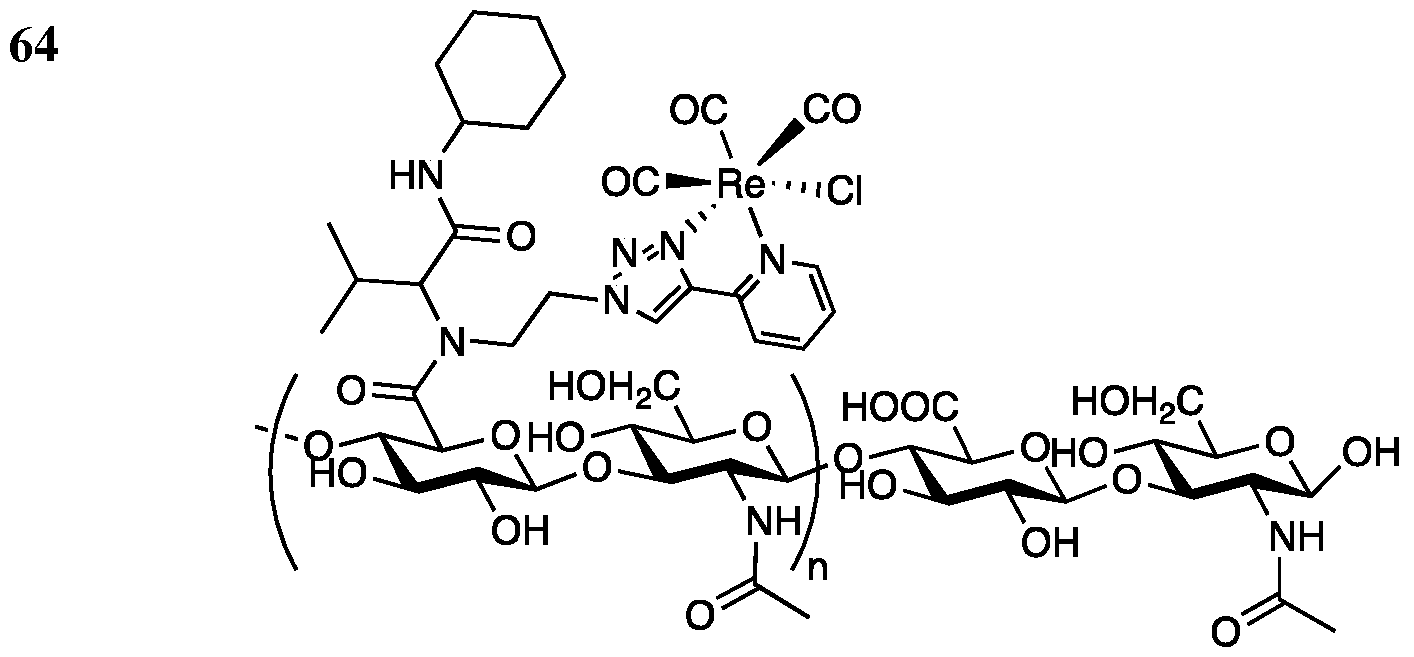
wherein n represents an integer corresponding to a hyaluronic acid having a molecular weight ranging from 400 kDa to 1000 kDa;

9. The use according to any one of claims 1 to 8, further comprising performing infrared spectroscopy and/or fluorescence spectroscopy.
10. The use according to any one of claims 1 to 9, for imaging cellular environment, comprising:
- adding a X-ray fluorescence probe of formula I to a sample containing at least one cell;
- incubating the sample for a time sufficient for the X-ray fluorescence probe to be loaded onto and/or into the cell;
- exciting the sample at an energy that generates a X-ray fluorescence response from the X-ray fluorescence probe;
- detecting the X-ray fluorescence response.
The use according to any one of claims 1 to 105 for imaging cell organelles.
12. X-ray fluorescence probe for imaging of formula I

or a salt thereof, wherein
X represents halo, optionally substituted pyridin-l-yl, carbene, thiolato, alkynyl, carboxylate, phosphine, phosphonate, sulfonate, OH2, NC-alkyl, oxyanion such as phosphate;
Het 1 represents a heteroaryl group comprising at least one nitrogen atom; preferably Het 1 is selected from pyridinyl, quinolynyl, quinoxalinyl, benzothiadiazolyl, benzimidazole, benzoxazole, bipyridine; R1 is either absent or represents one or more substituent selected from halo, nitro, alkyl, aryl, phosphate, sulfate, cyano;
Y1 represents C and Y2 represents N; or Y1 represents N and Y2 represents C; represents a single bound or a double bound depending on Y1 and Y2 definitions; L represents a single bound or a linker selected from alkyl, aryl, heteroaryl, heterocyclyl, alkylaryl, arylalkyl, alkoxy, alkenyl, alkynyl, polyethylene glycol, polypropylene glycol, polyamines or a combination thereof; said groups being optionally interrupted or terminated by one or more -0-, -S-, -S(O)-, -S(0)2-, -C(0)-NH-, -NH-C(O)-, -C(0)0-, -C(O)-, -NH- or a combination thereof; said groups optionally further comprising pendant groups selected from carboxylic acid, carboxylate, sulfonic acid, sulfonate, hydroxy; the linker optionally additionally comprising a residue of a reactive group through which L is bound to R2;
R2 represents a group selected from:
a hydrogen atom;
a reactive group selected from azide, alkynyl, amino, alkylamino, amido, maleimide, thiol, hydroxy, ester, activated ester, carboxylic acid, activated carboxylic acid, halo, nitro, nitrile, isonitriles, acrylamide, aldehyde, ketone, acetals, ketals, anhydride, glutaric anhydride, succinic anhydride, maleic anhydride, thiocyanate, isothiocyanate, isocyanate, hydrazide, hydrazines, hydrazones, ethers, oxides, cyanates, diazo, diazonium, sulfides, disulfides, sulfoxides, sulfones, sulfonic acids, sulfinic acids, sulfates, sulfenic acids, amidines, imides, imidates, nitrones, hydroxylamines, oximes, hydroxamic acids, thiohydroxamic acids, alkenes, ortho esters, sulfites, enamines, ynamines, ureas, pseudoureas, semicarbazides, carbodiimides, carbamates, carbonate, activated carbonate, imines, phosphonium, chelating moiety;
a bioactive group selected from steroid, peptide, protein, amino acid, nucleic acid, nucleoside, nucleotide, oligonucleotide, antibody, saccharide, polysaccharide, lipid, hormone, biotin, avidin, therapeutic ingredient, complex of metallic ion, microparticle, nanoparticle, fluorophore, a cell organelle targeting group and combinations thereof.
The X-ray fluorescence probe for imaging according to claim 12, selected from


oc coco

oc Coco


L oc coco

0o
109


wherein n represents an integer corresponding to a hyaluronic acid having a molecular weight ranging from 400 kDa to 1000 kDa;

1) reacting a ligand of formula II

wherein Het 1, Y1, Y2, L and R2 are as defined in claims 12; with a rhenium-containing reactant of formula III;
(III) ReX1(CO)5, wherein X1 represents a halogen atom; to afford compound of formula Γ

2) and optionally:
- replacing X1 moiety by X as defined in claim 12; and/or;
- modifying and/or functionalizing -L-R2;
to form a compound of formula I as defined in claim 12.
15. Kit for performing X-ray fluorescence imaging, comprising a X-ray fluorescence probe for imaging according to claim 12 or claim 13.
Applications Claiming Priority (2)
| Application Number | Priority Date | Filing Date | Title |
|---|---|---|---|
| EP15175553.5 | 2015-07-06 | ||
| EP15175553 | 2015-07-06 |
Publications (1)
| Publication Number | Publication Date |
|---|---|
| WO2017005822A1 true WO2017005822A1 (en) | 2017-01-12 |
Family
ID=53776297
Family Applications (1)
| Application Number | Title | Priority Date | Filing Date |
|---|---|---|---|
| PCT/EP2016/066048 Ceased WO2017005822A1 (en) | 2015-07-06 | 2016-07-06 | Functionalizable molecular probe for x-ray fluorescence imaging and multimodal imaging |
Country Status (1)
| Country | Link |
|---|---|
| WO (1) | WO2017005822A1 (en) |
Cited By (2)
| Publication number | Priority date | Publication date | Assignee | Title |
|---|---|---|---|---|
| CN110563718A (en) * | 2019-09-09 | 2019-12-13 | 四川大学华西医院 | A preparation method and application of a bioluminescent probe for detecting pyroglutamate aminopeptidase |
| CN111635401A (en) * | 2020-06-18 | 2020-09-08 | 镇江卡博医药科技有限公司 | Copper complex promoted 7-fluoroimidazo [1,2-a ] pyridine synthesis method |
-
2016
- 2016-07-06 WO PCT/EP2016/066048 patent/WO2017005822A1/en not_active Ceased
Non-Patent Citations (16)
| Title |
|---|
| BERTRAND H. ET AL., INORG. CHEM., vol. 53, 2014, pages 6204 - 6223 |
| CLEDE ET AL., ANALYST, vol. 138, 2013, pages 5627 - 5638 |
| CLEDE ET AL., CHEM. COMMUN., vol. 51, 2015, pages 2687 - 2689 |
| CLEDE ET AL., CHEM. EUR. J., vol. 20, 2014, pages 8714 - 8722 |
| CLEDE S ET AL: "Influence of the side-chain length on the cellular uptake and the cytotoxicity of rhenium triscarbonyl derivatives: A bimodal infrared and luminescence quantitative study", CHEMISTRY - A EUROPEAN JOURNAL 20140707 WILEY-VCH VERLAG DEU, vol. 20, no. 28, 7 July 2014 (2014-07-07), pages 8714 - 8722, XP002748654, DOI: 10.1002/CHEM.201402471 * |
| CLEDE S. ET AL., CHEM. COMMUN., vol. 48, 2012, pages 7729 - 7731 |
| CLEDE S.; POLICAR C., CHEM. EUR. J., vol. 21, 2015, pages 942 - 958 |
| EVDOKIMOVA O V ET AL: "Up-to-date methods for the determination of rhenium", JOURNAL OF ANALYTICAL CHEMISTRY, KLUWER ACADEMIC PUBLISHERS-PLENUM PUBLISHERS, NE, vol. 67, no. 9, 24 July 2012 (2012-07-24), pages 741 - 753, XP035089168, ISSN: 1608-3199, DOI: 10.1134/S1061934812090043 * |
| FERNANDEZ ET AL., COLLOIDS AND SURFACES B : BIOINTERFACES, vol. 131, 2015, pages 102 - 107 |
| HÉLÈNE C. BERTRAND ET AL: "Luminescence Modulations of Rhenium Tricarbonyl Complexes Induced by Structural Variations", INORGANIC CHEMISTRY, vol. 53, no. 12, 16 June 2014 (2014-06-16), EASTON, US, pages 6204 - 6223, XP055223520, ISSN: 0020-1669, DOI: 10.1021/ic5007007 * |
| HUANG RACHEL ET AL: "Synthesis, characterization, and biological studies of emissive rhenium-glutamine conjugates", JBIC. JOURNAL OF BIOLOGICAL INORGANIC CHEMISTRY, SPRINGER, DE, vol. 18, no. 7, 8 August 2013 (2013-08-08), pages 831 - 844, XP035349331, ISSN: 0949-8257, [retrieved on 20130808], DOI: 10.1007/S00775-013-1023-3 * |
| MAKOTO OBATA ET AL: "Syntheses, structural characterization and photophysical properties of 4-(2-pyridyl)-1,2,3-triazole rhenium(i) complexes", DALTON TRANSACTIONS: THE INTERNATIONAL JOURNAL FOR INORGANIC, ORGANOMETALLIC AND BIOINORGANIC CHEMISTRY, no. 25, 1 January 2008 (2008-01-01), GB, pages 3292, XP055223181, ISSN: 1477-9226, DOI: 10.1039/b718538c * |
| MATTSON ET AL., ANALYST, vol. 138, 2013, pages 5610 - 5618 |
| RODUSHKIN ET AL., ANAL. BIOANAL. CHEM., 2004, pages 247 |
| SYLVAIN CLÈDE ET AL: "An easy-to-detect nona-arginine peptide for epidermal targeting", CHEMICAL COMMUNICATIONS - CHEMCOM, vol. 51, no. 13, 1 January 2015 (2015-01-01), GB, pages 2687 - 2689, XP055223105, ISSN: 1359-7345, DOI: 10.1039/C4CC08737B * |
| TAKEI ET AL., CHEMCOMM, vol. 49, 2013, pages 7313 - 7315 |
Cited By (3)
| Publication number | Priority date | Publication date | Assignee | Title |
|---|---|---|---|---|
| CN110563718A (en) * | 2019-09-09 | 2019-12-13 | 四川大学华西医院 | A preparation method and application of a bioluminescent probe for detecting pyroglutamate aminopeptidase |
| CN110563718B (en) * | 2019-09-09 | 2022-04-15 | 四川大学华西医院 | Preparation method and application of bioluminescent probe for detecting pyroglutamic acid aminopeptidase |
| CN111635401A (en) * | 2020-06-18 | 2020-09-08 | 镇江卡博医药科技有限公司 | Copper complex promoted 7-fluoroimidazo [1,2-a ] pyridine synthesis method |
Similar Documents
| Publication | Publication Date | Title |
|---|---|---|
| Vellaisamy et al. | A long-lived peptide-conjugated iridium (III) complex as a luminescent probe and inhibitor of the cell migration mediator, formyl peptide receptor 2 | |
| Bhuniya et al. | A fluorescence off–on reporter for real time monitoring of gemcitabine delivery to the cancer cells | |
| Tong et al. | Orchestration of dual cyclization processes and dual quenching mechanisms for enhanced selectivity and drastic fluorescence turn-on detection of cysteine | |
| Kumar et al. | Thiacalix [4] arene based fluorescent probe for sensing and imaging of Fe3+ ions | |
| Huang et al. | New photostable naphthalimide-based fluorescent probe for mitochondrial imaging and tracking | |
| Xu et al. | A novel “Turn-On” fluorescent probe for F− detection in aqueous solution and its application in live-cell imaging | |
| EP3097079A1 (en) | Process for the cycloaddition of a hetero(aryl) 1,3-dipole compound with a (hetero)cycloalkyne | |
| Lelle et al. | Overcoming drug resistance by cell-penetrating peptide-mediated delivery of a doxorubicin dimer with high DNA-binding affinity | |
| Burke et al. | An efficient route to asymmetrically diconjugated tris (heteroleptic) complexes of Ru (II) | |
| Chao et al. | A Ni-NTA-based red fluorescence probe for protein labelling in live cells | |
| Denda et al. | Labelling of endogenous target protein via N–S acyl transfer-mediated activation of N-sulfanylethylanilide | |
| Schanne et al. | Rhenium carbonyl complexes bearing methylated triphenylphosphonium cations as antibody-free mitochondria trackers for X-ray fluorescence imaging | |
| WO2021174035A1 (en) | Intercellular and intracellular proximity-based labeling compositions and systems | |
| Li et al. | Highly luminescent lanthanide CPs based on dinuclear cluster: crystal structure and sensitive Trp sensor | |
| WO2017005822A1 (en) | Functionalizable molecular probe for x-ray fluorescence imaging and multimodal imaging | |
| Tao et al. | Self-assembled nanovesicles based on chiral bis-H 8-BINOL for Fe 3+ recognition and secondary recognition of l-cysteine by 1+ 1 complex | |
| Muresan et al. | Design and synthesis of water-soluble bioconjugatable trans-AB-porphyrins | |
| CN106543251A (en) | Nitric oxide production water-soluble fluorescent probe and its application in a kind of detection hepatocyte | |
| CN103013497A (en) | Sulfydryl fluorescent probe and preparation method thereof | |
| Adhikari et al. | A FRET based colorimetric and fluorescence probe for selective detection of Bi3+ ion and live cell imaging | |
| Vasiljević et al. | Microwave-assisted green synthesis of bile acid derivatives and evaluation of glucocorticoid receptor binding | |
| Feng et al. | Several Golgi targeting fluorescence markers based on 1, 8-naphthalimide derivatives with amide and long carbon chain | |
| CN106929004B (en) | A signal-enhanced near-infrared fluorescent probe and its preparation method and application | |
| Sato et al. | Synthesis and in vitro antitumor activity of 9-hydroxyellipticine derivatives with glucose conjugation via triazolylmethyl succinate linker | |
| EP3688007B1 (en) | Bioconjugation of polypeptides |
Legal Events
| Date | Code | Title | Description |
|---|---|---|---|
| 121 | Ep: the epo has been informed by wipo that ep was designated in this application |
Ref document number: 16736147 Country of ref document: EP Kind code of ref document: A1 |
|
| NENP | Non-entry into the national phase |
Ref country code: DE |
|
| 122 | Ep: pct application non-entry in european phase |
Ref document number: 16736147 Country of ref document: EP Kind code of ref document: A1 |