WO2017003305A1 - Peptides and uses thereof - Google Patents
Peptides and uses thereof Download PDFInfo
- Publication number
- WO2017003305A1 WO2017003305A1 PCT/NZ2016/050111 NZ2016050111W WO2017003305A1 WO 2017003305 A1 WO2017003305 A1 WO 2017003305A1 NZ 2016050111 W NZ2016050111 W NZ 2016050111W WO 2017003305 A1 WO2017003305 A1 WO 2017003305A1
- Authority
- WO
- WIPO (PCT)
- Prior art keywords
- amino acid
- protein
- amino acids
- seq
- polypeptide
- Prior art date
- Legal status (The legal status is an assumption and is not a legal conclusion. Google has not performed a legal analysis and makes no representation as to the accuracy of the status listed.)
- Ceased
Links
Classifications
-
- C—CHEMISTRY; METALLURGY
- C07—ORGANIC CHEMISTRY
- C07K—PEPTIDES
- C07K14/00—Peptides having more than 20 amino acids; Gastrins; Somatostatins; Melanotropins; Derivatives thereof
- C07K14/195—Peptides having more than 20 amino acids; Gastrins; Somatostatins; Melanotropins; Derivatives thereof from bacteria
- C07K14/315—Peptides having more than 20 amino acids; Gastrins; Somatostatins; Melanotropins; Derivatives thereof from bacteria from Streptococcus (G), e.g. Enterococci
-
- A—HUMAN NECESSITIES
- A61—MEDICAL OR VETERINARY SCIENCE; HYGIENE
- A61K—PREPARATIONS FOR MEDICAL, DENTAL OR TOILETRY PURPOSES
- A61K39/00—Medicinal preparations containing antigens or antibodies
- A61K39/0005—Vertebrate antigens
- A61K39/0011—Cancer antigens
-
- A—HUMAN NECESSITIES
- A61—MEDICAL OR VETERINARY SCIENCE; HYGIENE
- A61K—PREPARATIONS FOR MEDICAL, DENTAL OR TOILETRY PURPOSES
- A61K39/00—Medicinal preparations containing antigens or antibodies
- A61K39/02—Bacterial antigens
- A61K39/04—Mycobacterium, e.g. Mycobacterium tuberculosis
-
- A—HUMAN NECESSITIES
- A61—MEDICAL OR VETERINARY SCIENCE; HYGIENE
- A61K—PREPARATIONS FOR MEDICAL, DENTAL OR TOILETRY PURPOSES
- A61K39/00—Medicinal preparations containing antigens or antibodies
- A61K39/02—Bacterial antigens
- A61K39/09—Lactobacillales, e.g. aerococcus, enterococcus, lactobacillus, lactococcus, streptococcus
- A61K39/092—Streptococcus
-
- A—HUMAN NECESSITIES
- A61—MEDICAL OR VETERINARY SCIENCE; HYGIENE
- A61K—PREPARATIONS FOR MEDICAL, DENTAL OR TOILETRY PURPOSES
- A61K39/00—Medicinal preparations containing antigens or antibodies
- A61K2039/60—Medicinal preparations containing antigens or antibodies characteristics by the carrier linked to the antigen
- A61K2039/6031—Proteins
- A61K2039/6068—Other bacterial proteins, e.g. OMP
-
- C—CHEMISTRY; METALLURGY
- C07—ORGANIC CHEMISTRY
- C07K—PEPTIDES
- C07K2319/00—Fusion polypeptide
-
- C—CHEMISTRY; METALLURGY
- C07—ORGANIC CHEMISTRY
- C07K—PEPTIDES
- C07K2319/00—Fusion polypeptide
- C07K2319/40—Fusion polypeptide containing a tag for immunodetection, or an epitope for immunisation
Definitions
- the present invention relates to isolated, purified or recombinant peptides or pili, genetically engineered bacteria comprising recombinant peptides or pili, methods for making the peptides, pili or bacteria, pharmaceutical compositions comprising the peptides, pili or bacteria, methods of eliciting immune responses in a subject and methods of vaccinating a subject, uses of the peptides, pili or bacteria for the same, and uses of the peptides, pili or bacteria in the manufacture of medicaments for the same.
- Vaccines remain the most cost effective and feasible means of infectious disease control in the community.
- Synthetic peptide vaccines generally comprise a synthetic copy of an immunogenic part of protein antigens.
- Peptide vaccines have a number of advantages, including ease of synthesis, avoidance of potentially toxic biological by-products, reduced response to irrelevant antigens, and straightforward characterisation.
- peptides by themselves are often poorly immunogenic and require administration with adjuvants or as amplified (multimeric) peptides. Additionally, peptides are often sensitive to proteolytic degradation.
- Mucosal surfaces of external body cavities are a common entry site of many pathogens.
- the development of vaccines that induce efficient mucosal immune responses through delivery of protective antigens to mucosal sites is thus highly desirable.
- the invention relates to an isolated, purified or recombinant polypeptide comprising one or more amino acid sequences comprising a backbone pilin (BP) protein or fragment thereof and one or more peptides of interest, wherein the peptide of interest is heterologous to the BP protein.
- BP backbone pilin
- the invention relates to an isolated, purified or recombinant polypeptide comprising one or more amino acid sequences comprising a backbone pilin (BP) protein or fragment thereof and one or more peptides of interest, wherein the peptide of interest is not a BP protein or fragment thereof.
- BP backbone pilin
- the invention relates to an isolated, purified or recombinant polypeptide comprising one or more amino acid sequences comprising a backbone pilin (BP) protein or fragment thereof and one or more peptides of interest, wherein the peptide of interest is not a pilus protein or fragment thereof.
- BP backbone pilin
- the invention relates to an isolated, purified or recombinant polypeptide comprising one or more amino acid sequences comprising a backbone pilin (BP) protein or fragment thereof and one or more peptides of interest, wherein the peptide of interest is not a Streptococcus protein or fragment thereof.
- BP backbone pilin
- the invention relates to an isolated, purified or recombinant polypeptide comprising one or more amino acid sequences comprising one or more peptides of interest inserted into or fused to a backbone pilin (BP) protein or fragment thereof and, wherein the peptide of interest is heterologous to the BP protein.
- BP backbone pilin
- the BP protein comprises a BP protein derived from a Gram positive bacterium.
- the BP protein comprises a Streptococcus BP protein.
- the BP protein comprises a Group A Streptococcus BP protein.
- the BP protein is encoded within the FCT-1, FCT-2, FCT-3, FCT-4, FCT-5, FCT-6 or FCT-9 nucleotide region of a Group A Streptococcus genome.
- the BP protein is encoded within the FCT-2, FCT-3 or FCT- 4 nucleotide region of a Group A Streptococcus genome.
- the BP protein comprises a Streptococcus pyogenes BP protein.
- the BP protein is derived from Group A Streptococcus serotype M 1, M2, M3, M4, M5, M6, M9, M 11, M 12, M 18, M22, M23, M28, M33, M44, M49 (2), M50, M53, M75, M77, M78 or M89.
- the BP protein is derived from Group A Streptococcus serotype M 1, M3, M5, M9, M i l, M 12, M 18, M22, M28, M33, M44, M49 (2), M50, M53, M77, M78, or M89.
- the BP protein has at least about 80% amino acid sequence identity to the polypeptide sequence of SEQ ID No 1.
- the BP protein is encoded by a nucleotide coding sequence selected from the group consisting of a. Genbank Accession Number EU725506.1 (GI: 198417284) b. any one of Genbank Accession Numbers KJ816940 (KJ816940.1
- Genbank Accession Number KJ816969 (KJ816969.1 GI: 692334190) i.
- Genbank Accession Number KJ816971 (KJ816971.1 GI: 692334194) m. Genbank Accession Number KJ816965 (KJ816965.1 GI: 692334182) Genbank Accession Number KJ816984 (KJ816984.1 GI: 692334220) Genbank Accession Number KJ816948 (KJ816948.1 GI: 692334148) Genbank Accession Number KJ816943 (KJ816943.1 GI: 692334138) Genbank Accession Number KJ816940 (KJ816940.1 GI: 692334132) Genbank Accession Number KJ816995 (KJ816995.1 GI: 692334242) Genbank Accession Number 4067256, and Genbank Accession Number 4063969.
- the BP protein comprises, consists of, or consists of, an amino acid sequence selected from the group consisting of
- Genbank Accession Number ACH87870.1 (GI: 198417285), any one of Genbank Accession Numbers KJ816940 -KJ817040,
- the BP protein comprises a. first domain having at least about 80% amino acid sequence identity to the polypeptide sequence of the C-terminal domain of Spy0128 (amino acids 174- 340 of SEQ ID No. 1), and/or b. a second domain having at least about 80% amino acid sequence identity to the polypeptide sequence of the N-terminal domain of Spy0128 (amino acids 1-171 of SEQ ID No. 1).
- the amino acid sequence comprises the at least one peptide inserted at a site within the C-terminal domain of the BP protein.
- the amino acid sequence comprises the at least one peptide inserted at a site within the N-terminal domain of the BP protein.
- the at least one peptide of interest is inserted : a. in a region between the ⁇ and ⁇ F loop regions of the BP protein, for example, corresponding to amino acids 119-124 of SEQ ID No: 1, and/or an analogous region in a BP protein having greater than 90% identity to the amino acid sequence of SEQ ID No: 1, and/or b. in a region between the ⁇ 9 and ⁇ loop regions of the BP protein, for
- BP protein in a region between the ⁇ 2 and ⁇ 3 loop regions of the BP protein, for example, corresponding to amino acids 201-206 of SEQ ID No: 1, and/or an analogous region in a BP protein having greater than 90% identity to the amino acid sequence of SEQ ID No: 1, and/or f. in a region between the ⁇ and ⁇ loop regions of the BP protein, for example, corresponding to amino acids 101-108 of SEQ ID No: 1, and/or an analogous region in a BP protein having greater than 90% identity to the amino acid sequence of SEQ ID No: 1.
- the amino acid sequence comprises the polypeptide of interest inserted : a. in a region between the ⁇ and ⁇ loop regions of the BP protein, for example, corresponding to amino acids 119-124 of SEQ ID No: 1, and in a region between the ⁇ 9 and ⁇ loop regions of the BP protein, example, corresponding to amino acids 276-279 of SEQ ID No: 1.
- the amino acid sequence comprises: a. a first peptide of interest inserted in a region between the ⁇ and ⁇ F loop
- regions of the BP protein for example, corresponding to amino acids 119-124 of SEQ ID No: 1, and b. a second peptide of interest inserted in a region between the ⁇ 9 and ⁇ loop regions of the BP protein, for example, corresponding to amino acids 276-279 of SEQ ID No: 1.
- the polypeptide further comprises an amino acid sequence encoding a pilin tip protein (API protein), an AP2 protein, a Sip protein, a sortase or a combination of any two or more thereof.
- the polypeptide further comprises amino acid sequences encoding a pilin tip protein (API protein), an AP2 protein, a Sip protein, and a sortase.
- the polypeptide further comprises amino acid sequences encoding proteins required to form a pilus when the polypeptide is expressed in a bacterium.
- the one or more peptides of interest comprise an antigenic peptide, an enzyme, or an antibody or fragment thereof.
- the one or more peptides of interest comprise a T cell antigenic peptide or epitope/fragment thereof or a B cell antigenic peptide or
- the one or more peptides of interest comprises two or more antigenic peptides or epitopes.
- the one or more peptides of interest are derived from a microorganism, for example, a virus, a bacterium, or a parasite.
- the one or more peptides of interest are capable of eliciting an IgA response.
- the one or more peptides of interest comprise a tumour antigenic peptide.
- the one or more peptides of interest comprise 3 or more, 4 or more, 5 or more, 6 or more, 7 or more, 8 or more, 9 or more, or 10 or more contiguous amino acids that do not encode a BP protein or fragment thereof.
- the peptide of interest comprises, consists of, or consists essentially of an amino acid sequence selected from the group consisting of a. 8 or more contiguous amino acids from the sequence SQAVHAAHAEINEAGRI [SEQ ID No. 30], or b. 8 or more contiguous amino acids from the sequence
- the peptide of interest comprises, consists of, or consists essentially of an amino acid sequence selected from the group consisting of a. 8 or more contiguous amino acids from the sequence SIINFEKL [SEQ ID No. 35], b. 8 or more contiguous amino acids from the sequence TEWTSSNVMEERKIKV [SEQ ID No. 36], or c. 8 or more contiguous amino acids from the sequence SPSYVYHQF [SEQ ID No.
- the peptide of interest comprises, consists of, or consists essentially of an amino acid sequence selected from the group consisting of a. 8 or more contiguous amino acids from the amino acid sequence
- EKANPVNDLCYPGDFNDYEELKH [SEQ ID no. 38] (HA1 b. 8 or more contiguous amino acids from the amino acid sequence LGHHAVP NGTLVKTITNDQIEVTNATELVQSSSTGRICDSPHRILDGKNCTLIDAL [SEQ ID No. 39], c. 8 or more contiguous amino acids from the amino acid sequence KRGL
- FGAIAGFIEGGWQ [SEQ ID No. 40], or d. 8 or more contiguous amino acids from the amino acid sequence
- the peptide of interest comprises, consists of, or consists essentially of an amino acid sequence selected from the group consisting of a. 8 or more contiguous amino acid residues from the Mtb antigen 85B precursor peptide, b. 8 or more contiguous amino acids from the amino acid sequence
- FQDAYNAAGGHNAVF [SEQ ID No: 32, I-A(b) Mtb antigen 85B precursor peptide amino acids 280-294], c. 8 or more contiguous amino acid residues from the Mtb antigen ESAT-6, d. 8 or more contiguous amino acids from the amino acid sequence
- MTEQQWNFAGIEAAASAIQG [SEQ ID No: 33, I-A(b) Mtb ESAT-6 amino acids 1- 20], e. 8 or more contiguous amino acids from the amino acid sequence GAPINSATAM [SEQ ID No: 34, I-A(b) Mtb ESAT-6 amino acids 309 - 318], f. 8 or more contiguous amino acids from the amino acid sequence
- YQGVQQKWDATATELNNALQ [SEQ ID No. 42] I-A(b) Mtb ESAT-6 amino acids 51-70], or g. 8 or more contiguous amino acids from the amino acid sequence
- SEFAYGSFVRTVSLPVGADE [SEQ ID No. 43] .
- the peptide of interest comprises, consists of, or consists essentially of an amino acid sequence of a. 8 or more contiguous amino acid residues from amino acid sequence
- the polypeptide when expressed in a bacterium, assembles to form a pilus on the surface of the bacterium.
- the invention relates to a recombinant polypeptide comprising the amino acid sequence of SEQ ID No. 1 wherein one or more, for example, 1-15 contiguous amino acids have been deleted at one or more of the following sites: a. from amino acid position 61, b. from amino acid position 101, c. from amino acid position 119, d. from amino acid position 201, e. from amino acid position 217, and/or f. from amino acid position 276; and/or wherein one or more of the following sequences of contiguous amino acids have been deleted : g. amino acids 61-65, h. amino acids 101-108, i. amino acids 119-124, j. amino acids 201-206, k. amino acids 217-221, and/or
- amino acids 276-279 and, optionally, wherein two or more contiguous amino acids are inserted at the site or sites of the deleted contiguous amino acids.
- the invention relates to a recombinant polypeptide comprising an amino acid sequence having at least 90% sequence identity with SEQ ID No. 1 wherein one or more, for example, 1-15 contiguous amino acids have been deleted at one or more of the following sites: a. from an amino acid position corresponding to amino acid 61 of SEQ ID No. 1, b. from an amino acid position corresponding to amino acid 101 of SEQ ID No. 1, c. from an amino acid position corresponding to amino acid 119 of SEQ ID No. 1, d. from an amino acid position corresponding to amino acid 201 of SEQ ID No. 1, e. from an amino acid position corresponding to amino acid 217 of SEQ ID No. 1, and/or f.
- the one or more inserted amino acids results from the formation of a restriction enzyme cleavage site.
- the recombinant polypeptide further comprising one or more peptides of interest inserted at the site or sites of the deleted amino acids.
- the invention relates to a recombinant polypeptide comprising the amino acid sequence of SEQ ID No. 1 and comprising a substitution of 1 to 6, for example, 4 contiguous amino acids for a sequence of 1 to 15 contiguous amino acids of the native sequence at one or more of the following sites: a. from an amino acid position corresponding to amino acid 61 of SEQ ID No. 1, b. from an amino acid position corresponding to amino acid 101 of SEQ ID No. 1, c. from an amino acid position corresponding to amino acid 119 of SEQ ID No. 1, d. from an amino acid position corresponding to amino acid 201 of SEQ ID No. 1, e. from an amino acid position corresponding to amino acid 217 of SEQ ID No. 1, and/or f. from an amino acid position corresponding to amino acid 276 of SEQ ID No. 1; and/or
- the invention relates to a recombinant polypeptide comprising an amino acid sequence having at least 90% sequence identity with SEQ ID No. 1 and comprising a substitution of 1 to 6, for example, 4 contiguous amino acids for a sequence of 1 to 15 contiguous amino acids of the native sequence at one or more of the following sites: a. from amino acid position 61, b. from amino acid position 101, c. from amino acid position 119, d. from amino acid position 201, e. from amino acid position 217, and/or f. from amino acid position 276; and/or
- SEQ ID No. l comprising a substitution of 1 to 6, for example, 4 contiguous amino acids for one or more of the following sequences of contiguous amino acids in SEQ ID No. l : g. an amino acid sequence corresponding to amino acids 61-65 of SEQ ID No. 1, h. an amino acid sequence corresponding to amino acids 101-108 of SEQ ID No.
- the invention relates to a recombinant polypeptide of the abovementioned aspect comprising one or more of the following amino acid substitutions: a. amino acids LELD for amino acids 61-65, b. amino acids LELD for amino acids 101-108, c. amino acids LELD for amino acids 119-124, d. amino acids LELD for amino acids 201-206, e. amino acids LELD for amino acids 217-221, and/or f. amino acids LELD for amino acids 276-279.
- the recombinant polypeptide further comprises one or more peptides of interest inserted at the substitution site or sites between the LE and LD residues.
- the invention relates to an isolated, purified, or recombinant pilus comprising a plurality of covalently attached peptides of interest wherein the peptides of interest are heterologous to the pilus.
- the invention relates to an isolated, purified, or recombinant pilus comprising one or more repeating/polymerised polypeptide subunits each subunit comprising a backbone pilin (BP) protein and one or more peptides of interest, wherein the peptides of interest are heterologous to the BP protein.
- BP backbone pilin
- the invention relates to a genetically engineered bacterium comprising at least one recombinant pilus, each pilus comprising a plurality of covalently attached peptides of interest, wherein the peptides of interest are heterologous to the pilus [and the bacterium] .
- the invention relates to a genetically engineered bacterium comprising at least one recombinant pilus, each pilus comprising one or more
- repeating/polymerised polypeptide subunits each subunit comprising a backbone pilin (BP) protein and one or more peptides of interest, wherein the peptides of interest are
- heterologous to the BP protein or heterologous to the bacterium.
- the invention relates to a genetically engineered bacterium comprising a recombinant nucleic acid capable of encoding a polypeptide capable of forming one or more pili on the surface of the bacterium, the nucleic acid encoding one or more repeating polypeptide subunits each subunit comprising a backbone pilin (BP) protein and one or more peptides of interest, wherein the peptides of interest are heterologous to the BP protein, or to the bacterium.
- BP backbone pilin
- the bacterium is a Gram positive bacterium.
- the bacterium belongs to a genus selected from the group comprising Bifidobacterium, Lactobacillus, Lactococcus, and Streptococcus.
- the bacterium is an attenuated pathogenic bacterium, a non-pathogenic bacterium or a generally regarded as safe (GRAS) bacterium.
- GRAS safe
- the invention relates to a pharmaceutical composition
- a pharmaceutical composition comprising an effective amount of one or more polypeptides, pili or bacteria described herein.
- the composition is an immunogenic composition.
- the invention relates to a vaccine composition
- a vaccine composition comprising an effective amount of one or more polypeptides, pili or bacteria described herein.
- the composition additionally comprising an adjuvant.
- the composition does not comprise an extrinsic adjuvant.
- the invention relates to a method of vaccinating or eliciting an immune response in a subject comprising administering to the subject an effective amount of a pharmaceutical composition or vaccine composition described herein.
- the invention relates to a method of vaccinating or eliciting an immune response in a subject comprising administering to the subject an effective amount of a polypeptide, pilus or bacterium described herein.
- the invention relates to use of a polypeptide, pilus or bacterium described herein in the manufacture of a medicament for vaccinating or eliciting an immune response in a subject in a subject in need thereof.
- the invention relates to a polypeptide, pilus or bacterium described herein for use in vaccinating or eliciting an immune response in a subject in a subject in need thereof.
- the invention relates to a method for producing a genetically engineered bacterium comprising at least one pilus, each pilus comprising a plurality of covalently attached peptides of interest, the method comprising : a.
- a polynucleotide comprising a polynucleotide sequence comprising a nucleotide sequence encoding a backbone pilin (BP) protein and one or more peptides of interest, wherein the peptide of interest is heterologous to the BP protein; and b. growing said bacterium under conditions wherein said polypeptide is expressed and said pilus is formed.
- BP backbone pilin
- the peptide of interest is heterologous to the bacterium.
- the polynucleotide further comprises a nucleotide sequence encoding a pilin tip protein (API protein), an AP2 protein, a sortase or a combination of any two or more thereof.
- API protein pilin tip protein
- AP2 protein a pilin tip protein
- sortase a sortase or a combination of any two or more thereof.
- the polynucleotide further comprises a promoter that is active in the bacterium, and wherein the promoter is operably linked to the polynucleotide encoding said polypeptide.
- the promoter drives constitutive expression of the polypeptide in the bacterium.
- This invention may also be said broadly to consist in the parts, elements and features referred to or indicated in the specification of the application, individually or collectively, and any or all combinations of any two or more of said parts, elements or features, and where specific integers are mentioned herein which have known equivalents in the art to which this invention relates, such known equivalents are deemed to be
- Figure 1 shows a Western blot analysis using A) an anti-Spy0128 antibody of cell wall extracts obtained from (1) untransformed L. lactis; (2) L. lactis transformed with a construct expressing native PilM 1; and (3) L. lactis transformed with a construct expressing PilM 1 comprising ovalbumin peptide 323-339 at the N-terminus of the Spy0128 (M 1) protein; and B) an anti-OVA antibody of (1) a cell wall extract obtained from L. lactis transformed with a construct expressing PilM 1 comprising ovalbumin peptide 323-339 at the N-terminus of the Spy0128 (M 1) protein, and (2) ovalbumin;
- Figure 2 shows serum IgG response in mice vaccinated with L. lactis comprising the OVA peptide at the N-terminus of the Spy0128 (M 1) protein (O), L. lactis expressing the native M 1 pilus ( ⁇ ), and the OVA peptide alone administered subcutaneously ( ⁇ );
- Figure 3 shows a Western blot analysis using A) an anti-Spy0128 antibody of cell wall extracts obtained from (1) untransformed L. lactis; (2) L. lactis transformed with a construct expressing native PilM 1; and (3) L. lactis transformed with a construct expressing PilM 1 comprising ovalbumin peptide 323-339 at the ⁇ / ⁇ F loop of the Spy0128 protein; and B) an anti-OVA antibody of (1) untransformed L. lactis; (2) a construct expressing PilM 1 expressing ovalbumin peptide 323-339 at the ⁇ / ⁇ F loop of the Spy0128 protein, and (3) ovalbumin;
- Figure 4 shows serum IgG response in mice vaccinated with L. lactis expressing (1) the OVA peptide at the pilus tip, (2) L. lactis transformed with a construct expressing PilM 1 comprising ovalbumin peptide 323-339 at the ⁇ / ⁇ F loop of the Spy0128 protein, (3) L. lactis transformed with a construct expressing native PilM 1, (4) OVA peptide alone administered intranasally; and (5) OVA peptide alone administered subcutaneously;
- Figure 5 shows bronchoalveolar lavage (BAL) IgA in mice vaccinated with L. lactis expressing (1) the OVA peptide at the ⁇ / ⁇ F loop of the Spy0128 protein, (2) L. lactis transformed with a construct expressing native PilM 1, (3) OVA peptide alone administered intranasally; and (4) OVA peptide alone administered subcutaneously;
- BAL bronchoalveolar lavage
- Figure 6 shows the nucleotide coding sequence and derived amino acid sequence of the GAS M 1 Spy0128 BP protein.
- Figure 7 shows Western blot analyses using A) an anti-Spy0128 antibody or B) an anti-OVA antibody of cell wall extracts obtained from L. lactis transformed with a construct expressing PilM 1 comprising ovalbumin peptide 323-339 at the (1) ⁇ / ⁇ F loop region, and (2) ⁇ 9/ ⁇ 10 loop region of the Spy0128 (M 1) protein;
- Figure 8 shows Western blot analyses using an anti-Spy0128 antibody of cell wall extracts obtained from L. lactis transformed with constructs expressing PilM 1 comprising A) the HA2 peptide, B) the HA3 peptide; C) two copies of the HA3 peptide (HA3- HA3 peptide), D) the M2e peptide, and E) two copies of the M2e peptide (M2e-M2e peptide) in the ⁇ / ⁇ F loop region of the Spy0128 (M 1) protein;
- Figure 9 shows Western blot analyses using an anti-Spy0128 antibody of cell wall extracts obtained from L. lactis transformed with constructs expressing PilM 1 comprising A) the ESAT-61-20 peptide in the ⁇ / ⁇ F loop region of the Spy0128 (M 1) protein, B) the ESAT-651-70 peptide in the ⁇ 9/ ⁇ 10 loop region of the Spy0128 (M 1) protein (both lanes), and C) the TBA61 peptide in the ⁇ / ⁇ F loop region of the Spy0128 (M 1) protein;
- Figure 10 shows a Western blot analysis using an anti-Spy0128 antibody of a cell wall extract obtained from L. lactis transformed with a construct expressing PilM 1 comprising a 41 amino acid peptide in the ⁇ / ⁇ F loop region of the Spy0128 (M 1) protein;
- Figure 13 shows a multiple sequence alignment of the M 1 and M 18 pilus operon sequences prepared using Clustal W;
- Figure 14 shows Western blot analyses using an anti- M 18 Spy0128 antibody of cell wall extracts obtained from L.
- Figure 15 shows flow cytometry analysis using an antibody against
- Figure 16 shows using an a-spy0128 antibody of L. lactis cells transformed with 1) Pilvax- ⁇ Gl_Ova construct (Ex 8); 2) PilVax- ⁇ E/F-AP construct (Ex 5); 3) PilVax- ⁇ E/F- M2eM2e construct (Ex 3); 4) PilVax- ⁇ E/F-M2e construct (Ex 3); 5) PilVax- ⁇ E/F-HA3HA3 construct (Ex 3); 6) PilVax- ⁇ E/F-HA3 construct (Ex 3); 7) PilVax- ⁇ E/F-HA2 construct (Ex 3); 8) PilVax- ⁇ E/F-J 140va construct (Ex 5); 9) PilVax- ⁇ E/F-Ova construct (Ex 2); 10) Pilvax (no peptide insert); or 11) untransformed, wildtype L. lactis; 12) secondary antibody only control; and 13) unstained control.
- Figure 17 shows A) serum lgG response to M2e antigen; B) IgA response to M2e antigen in bronchoalveolar lavage (BAL) fluid; and C) serum IgG response to Spy0128 in in mice vaccinated with L. lactis expressing M 1 pili displaying an M2e peptide;
- Figure 18 shows A) serum lgG response to M2e antigen; B) IgA response to M2e antigen in bronchoalveolar lavage (BAL) fluid; and C) serum IgG response to Spy0128 in in five mice vaccinated with L. lactis expressing M 1 pili displaying an M2eM2e peptide; and
- Figure 19 shows a Western blot analysis using an anti-Spy0128 antibody of a cell wall extract obtained from L. lactis transformed with a construct expressing PilM 1 comprising the B16 peptide in the ⁇ / ⁇ F loop region of the Spy0128 (M 1) protein.
- the present invention relates to isolated, purified or recombinant polypeptides comprising a backbone pilin protein or fragment thereof and one or more heterologous polypeptides of interest.
- the present invention further relates to pili comprising a plurality of covalently attached peptides of interest wherein the peptides of interest are heterologous to the pilus, and a genetically engineered bacterium comprising one or more pili of the invention, and methods of preparing the genetically engineered bacterium.
- the invention further relates to a pharmaceutical composition or vaccine composition comprising polypeptides, pili or bacteria of the invention, and the use of such composition for eliciting an immune response in a subject or vaccinating a subject.
- compositions described herein comprising polypeptides, pili, and bacteria of the invention are useful for eliciting a T cell or B cell immune response in a subject.
- compositions of the invention are vaccine compositions, suitable for administration via various routes, for example, certain compositions described herein provide such a response when delivered to a subject mucosally, for example, intranasally.
- Advantages of the invention include: a. enhanced peptide immunogenicity, b. increased peptide stability, c. ease and efficiency of peptide manufacture d. no requirement for chemical coupling or use of potentially toxic adjuvants, and e. low production costs.
- heterologous peptide as used herein with reference to a peptide of interest present in a polypeptide or pilus of the invention that additionally comprises a backbone pilin (BP) protein, including a polypeptide or pilus of the invention when present in or on a genetically engineered bacterium, means a peptide sequence that is not part of the native BP protein or is not encoded or expressed naturally by the gene encoding that BP protein.
- purified does not require absolute purity; rather, it is intended as a relative term where the material in question is more pure than in the environment it was in previously.
- substantially purified refers to materials that are at least about 60% free, preferably at least about 75% free, and most preferably at least about 90% free, at least about 95% free, at least about 98% free, or more, from other components with which they may be associated during manufacture.
- amino acid refers to a molecule containing both an amino group and a carboxyl group bound to a carbon which is designated the a-carbon.
- Suitable amino acids include, without limitation, both the D- and L-isomers of the naturally- occurring amino acids, as well as non-naturally occurring amino acids prepared by organic synthesis or other metabolic routes. Unless the context specifically indicates otherwise, the term amino acid, as used herein, is intended to include amino acid analogs.
- the peptide or pilus comprises only natural amino acids.
- naturally occurring amino acid refers to any one of the twenty amino acids commonly found in peptides synthesized in nature, and known by the one letter abbreviations A, R, N, C, D, Q, E, G, H, I, L, K, M, F, P, S, T, W, Y and V.
- amino acid analog or “non-naturally occurring amino acid” refers to a molecule which is structurally similar to an amino acid and which can be substituted for an amino acid.
- Amino acid analogs include, without limitation, compounds which are structurally identical to an amino acid, as defined herein, except for the inclusion of one or more additional methylene groups between the amino and carboxyl group (e.g., a-amino ⁇ - carboxy acids), or for the substitution of the amino or carboxy group by a similarly reactive group (e.g., substitution of the primary amine with a secondary or tertiary amine, or substitution or the carboxy group with an ester).
- peptide and the like is used herein to refer to any polymer of amino acid residues of any length.
- the polymer can be linear or non-linear (e.g. , branched), it can comprise modified amino acids or amino acid analogs.
- the term also encompasses amino acid polymers that have been modified naturally or by intervention, for example, by disulfide bond formation, glycosylation, lipidation, acetylation, phosphorylation, or any other modification or manipulation, for example conjugation with labelling or bioactive
- subject is intended to refer to an animal, preferably a mammal, more preferably a human.
- Mammalian subjects include cats, dogs and horses.
- Other mammalian subjects include an agricultural animal, including a horse, a pig, a sheep, a goat, a cow, a deer, or a fowl, or a laboratory animal, including a monkey, a rat, a mouse, a rabbit or a guinea pig.
- treat and its derivatives should be interpreted in their broadest possible context. The term should not be taken to imply that a subject is treated until total recovery. Accordingly, “treat” broadly includes maintaining a subject's disease progression, symptoms or burn or wound healing at a substantially static level, increasing a subject's rate of recovery, amelioration and/or prevention of the onset of the symptoms or severity of a particular condition, burn, wound or other injury, or extending a patient's quality of life. The term “treat” also broadly includes the maintenance of good health for sensitive individuals and building stamina for disease, infection or infestation prevention.
- Pili are long, filamentous, hair-like protrusions that are attached to, and extend from, the surface of bacterial cells.
- the present invention takes advantage of pili derived from Gram positive bacteria, such as Group A Streptococcus (GAS).
- GAS Group A Streptococcus
- proteins derived from Streptococcus pyogenes are used.
- GAS pili are important for bacterial cell adherence and aggregation.
- GAS pili have been shown to mediate cell adhesion to human tonsil epithelium and primary human keratinocytes - two of the major infection sites of GAS (Abbot et al. Cell Microbiol. 2007;9(7) : 1822-33.).
- GAS pili comprise a repeating backbone pilin subunit (a "BP protein") and other minor subunits that are covalently assembled on the cell surface by pilus-associated sortases.
- the elongated BP protein subunits are stacked head to tail and linked covalently to form the shaft of the pilus.
- BP protein repeating backbone pilin subunit
- AP2 cell wall adaptor molecule ancillary pilin 2
- Repeating BP protein subunits extend from the AP2 protein linked by intermolecular isopeptide bonds.
- An ancillary pilin 1 (API) protein is located at the terminus of the pilus.
- the present invention provides for the insertion of one or more peptides into the BP protein monomer, resulting in the expression of potentially hundreds of repeated copies of the one or more peptides along the pilus shaft, and thus potentially thousands of copies on the surface of the bacterium.
- the peptide of interest is an antigen or epitope
- the presence of thousands of copies of the peptide of interest on the pili of the invention enhances the immunological effects of pili and bacteria of the invention.
- the concentrated display of a large number of antigens provides a greater opportunity for the peptides to encounter cells of the immune system.
- the pilus operon is located within a variable region of the bacterial chromosome known as fibronectin-binding, collagen-binding, T antigen (FCT) region.
- FCT T antigen
- the serotype M l GAS pilus structure is utilized.
- the M l pilus comprises the BP protein Spy0128.
- the complete amino acid sequence of Spy0128 is provided as SEQ ID No. 1.
- the complete nucleotide coding sequence of Spy0128 is provided as SEQ ID No. 2.
- the M 1 pilus further comprises a collagen-binding protein or tip adhesion molecule (Spy0125, an API protein) and an AP2 protein Spy0130.
- Suitable sites for insertion of a peptide of interest are those sites that preserve the correct assembly of the pilus on the surface of bacteria when expressed. Furthermore, it is desirable that the peptide of interest does not undergo substantial degradation when expressed.
- the BP protein into which one or more heterologous peptides is inserted is or comprises at least one domain of the Spy0128 protein of SEQ ID No: 1.
- the BP protein is the N-terminal domain of the Spy0128 protein of SEQ ID No: 1, comprising amino acids 1 to 171 of SEQ ID No: 1.
- the BP protein is the C-terminal domain of the Spy0128 protein of SEQ ID No: 1, comprising amino acids 174 to 340 of SEQ ID No: 1.
- the BP protein into which one or more heterologous peptides is inserted is or comprises at least 150 contiguous amino acids of the Spy0128 protein of SEQ ID No: 1.
- the BP protein comprises at least about 100 contiguous amino acids from the N-terminal domain of the Spy0128 protein of SEQ ID No: 1 (amino acids 1 to 171 of SEQ ID No: 1).
- the BP protein comprises at least about 100 contiguous amino acids from the C-terminal domain of the Spy0128 protein of SEQ ID No: 1 (amino acids 174 to 340 of SEQ ID No: 1).
- the BP is selected from the group consisting of one or more of the GAS T antigen sequences presented in Table 1 below
- BP proteins suitable for use in the invention are available from Genbank under the accession numbers KJ816940 - KJ817040.
- the immunogenic pilus proteins have also been shown to play a role in bacterial pathogenesis in several studies using animal models.
- the genes encoding the pilus proteins and assembly enzymes are clustered in the Fibronectin-binding, Collagen-binding, T antigen (FCT) region, of which 9 variants with diverse gene organisation and sequences have been reported, but only a few types have been studied in depth.
- FCT T antigen
- polypeptides, pili and bacteria of the present invention are suitable vehicles for eliciting immunological responses to heterologous peptides presented therein.
- the recombinant BP for example, the recombinant M 1 pilus
- a recombinant bacteria for example a recombinant gram positive bacteria, including non-pathogenic bacteria such as L. lactis, a non-pathogenic relative of GAS.
- the recombinant BP for example, the recombinant M 1 pilus
- tumour antigens or antigens from various pathogenic organisms have been characterised and are suitable for use in the present invention, for example in the polypeptides, pili or genetically engineered bacteria of the present invention. All antigens, whether or not presently characterized, that are capable of eliciting an immune response are contemplated.
- polypeptides, pili or bacteria of the present invention find application in a wide range of immunotherapies, including but not limited to the treatment and prevention of conditions or diseases caused by pathogenic bacteria or viruses, for example including but not limited to the treatment and prevention of tuberculosis, and of cancer and neoplastic conditions including but not limited to colorectal cancer.
- antigens comprising one or more amino acid substitutions, such as one or more conservative amino acid substitutions.
- a “conservative amino acid substitution” is one in which an amino acid residue is replaced with another residue having a chemically similar or derivatised side chain.
- Amino acid analogs e.g., phosphorylated or glycosylated amino acids
- N-alkylated amino acids e.g. N-methyl amino acids
- D-amino acids e.g. D-amino acids
- ⁇ -amino acids e.g. D-amino acids
- ⁇ -amino acids e.g. D-amino acids
- ⁇ -amino acids e.g. D-amino acids
- ⁇ -amino acids e.g. D-amino acids
- a "fragment" of a peptide is a subsequence of the peptide that performs a function that is required for the enzymatic or binding activity and/or provides three dimensional structure of the peptide, such as the three dimensional structure of a polypeptide.
- variant refers to peptide sequences, including for example peptide sequences different from the specifically identified sequences, wherein one or more amino acid residues is deleted, substituted, or added. Variants are naturally- occurring variants, or non-naturally occurring variants. Variants are from the same or from other species and may encompass homologues, paralogues and orthologues. In certain embodiments, variants of peptides including peptides possess biological activities that are the same or similar to those of the wild type peptides.
- variant with reference to peptides encompasses all forms of peptides as defined herein.
- polypeptides, pili, bacteria and compositions of the present invention are in certain embodiments suited for stimulating T- cell responses or B-cell responses or both T-cell and B-cell responses.
- antigens or fragments thereof may be suitable for use in the invention.
- suitable antigens to target a particular disease or condition may be identified using the Immune Epitope Database and Analysis Resource (accessible at http://www.iedb.org/home_v3.php).
- polypeptides, pili, bacteria and compositions of the present invention are in certain embodiments suited for stimulating T- cell responses, for example in the treatment of neoplastic diseases, including cancer, or in the treatment of infectious disease.
- compositions and vaccines of the present invention comprising one or more tumour antigens are provided.
- tumour antigens contemplated for use in the preparation of compositions, vaccines, and/or polypeptides, pili or bacteria of the invention will generally comprise one or more peptides.
- one or more additional tumour antigens may be present, including tumour antigens wherein the one or more tumour antigens does not comprise a peptide.
- Tumour antigens are typically classified as either unique antigens, or shared antigens, with the latter group including differentiation antigens, cancer-specific antigens, and over-expressed antigens. Examples of each class of antigens are amenable to use in the present invention.
- tumour antigens for use in the treatment, for example immunotherapeutic treatment, or vaccination against neoplastic diseases including cancer, are discussed below.
- Polypeptides, pili, bacteria, vaccines and compositions comprising one or more antigens prepared using those methods of immunisation are specifically contemplated.
- the tumour antigen is a polypeptide tumour antigen or glycoprotein tumour antigens.
- the tumour antigen is a saccharide- containing tumour antigen, such as a glycolipid tumour antigen or a ganglioside tumour antigen.
- Tumour antigens appropriate for the use in the present invention encompass a wide variety of molecules, such as (a) peptide-containing tumour antigens, including peptide epitopes (which can range, for example, from 8-20 amino acids in length, although lengths outside this range are also common), lipopolypeptides and glycoproteins, (b) saccharide-containing tumour antigens, including poly-saccharides, mucins, gangliosides, glycolipids and glycoproteins, including and (c) polynucleotides that express antigenic polypeptides.
- peptide-containing tumour antigens including peptide epitopes (which can range, for example, from 8-20 amino acids in length, although lengths outside this range are also common), lipopolypeptides and glycoproteins
- saccharide-containing tumour antigens including poly-saccharides, mucins, gangliosides, glycolipids and glycoproteins, including and (c) polynucleotides that express
- the tumour antigens are, for example, (a) full length molecules associated with cancer cells, (b) homologues and modified forms of the same, including molecules with deleted, added and/or substituted portions, and (c) fragments of the same, provided said fragments remain antigenic or immunogenic.
- the tumour antigens are, for example, (a) full length molecules associated with cancer cells, (b) homologues and modified forms of the same, including molecules with deleted, added and/or substituted portions, and (c) fragments of the same, provided said fragments remain antigenic or immunogenic.
- the tumour antigens include, for example, class I-restricted antigens recognized by CD8+ lymphocytes or class II-restricted antigens recognized by CD4+ lymphocytes.
- shared tumour antigens are generally considered to be native, unmutated sequences that are expressed by tumours due to epigenetic changes that allow derepression of developmentally-repressed genes. Accordingly, shared antigens are typically considered preferable to over-expressed or differentiation-associated antigens because there is no expression in normal tissues. Also, the same antigens can be targeted in a number of cancer patients. For example, the cancer-testis antigen NY-ESO-1 is present in the majority of patients with many tumours, and a sizeable minority of patients with other tumours. In another example, breast differentiation tumour antigens NYBR-1 and NYBR-1.1 are found in a proportion of breast cancer sufferers. Shared tumour antigens thus represent an attractive target for development.
- cancer-testis antigens including NY-ESO-1, CTSP-1, CTSP-2, CTSP-3, CTSP-4, SSX2, and SCP1, and breast cancer antigens NYBR-1 and NYBR-1.1
- shared tumour antigens such as cancer-testis antigens including NY-ESO-1, CTSP-1, CTSP-2, CTSP-3, CTSP-4, SSX2, and SCP1, and breast cancer antigens NYBR-1 and NYBR-1.1
- the polypeptide of the invention for example, the isolated, purified, or recombinant polypeptide or the pili or bacterium comprising a polypeptide of the invention comprises an amino acid sequence selected from the group consisting of 8 or more contiguous, 10 or more contiguous, 12 or more
- the heterologous peptide comprises more than one peptide epitope or antigen, for example two or more amino acid sequences comprising peptide epitopes or peptide antigens.
- Unique antigens are considered to be those antigens that are unique to an individual or are shared by a small proportion of cancer patients, and typically result from mutations leading to unique protein sequences.
- Representative examples of unique tumour antigens include mutated Ras antigens, and mutated p53 antigens.
- the methods of the present invention enable the ready preparation of polypeptides, pili or bacteria comprising one or more unique tumour antigens, for example to elicit specific T-cell responses to one or more unique tumour antigens, for example in the preparation of patient-specific therapies.
- representative tumour antigens include, but are not limited to, (a) antigens such as RAGE, BAGE, GAGE and MAGE family polypeptides, for example, GAGE-1, GAGE-2, MAGE-1, MAGE-2, MAGE-3, MAGE-4, MAGE-5, MAGE-6, and MAGE-12 (which can be used, for example, to address melanoma, lung, head and neck, NSCLC, breast, gastrointestinal, and bladder tumours), (b) mutated antigens, for example, p53 (associated with various solid tumours, for example, colorectal, lung, head and neck cancer), p21/Ras (associated with, for example, melanoma, pancreatic cancer and colorectal cancer), CDK4 (associated with, for example, melanoma), MUM 1 (associated with, for example,
- melanoma caspase-8 (associated with, for example, head and neck cancer), CIA 0205 (associated with, for example, bladder cancer), HLA-A2-R1701, beta catenin (associated with, for example, melanoma), TCR (associated with, for example, T-cell non-Hodgkins lymphoma), BCR-abl (associated with, for example, chronic myelogenous leukemia), triosephosphate isomerase, MA 0205, CDC-27, and LDLR-FUT, (c) over-expressed antigens, for example, Galectin 4 (associated with, for example, colorectal cancer), Galectin 9
- WT 1 Wilm's tumour antigen-1
- carbonic anhydrase associated with, for example, renal cancer
- aldolase A associated with, for example, lung cancer
- PRAME associated with, for example, melanoma
- HER-2/neu associated with, for example, breast, colon, lung and ovarian cancer
- alpha-fetoprotein associated with, for example, hepatoma
- KSA KSA
- telomerase catalytic protein MUC-1 (associated with, for example, breast and ovarian cancer), G-250 (associated with, for example, renal cell carcinoma), p53 (associated with, for example, breast, colon cancer), and carcinoembryonic antigen (associated with, for example, breast cancer, lung cancer, and cancers of the gastrointestinal tract such as colorectal cancer),
- shared antigens for example, melanoma-melanocyte differentiation antigens such as MART-l/Melan A, gplOO, MC1R, melanocyte-stimulating hormone receptor, tyrosinase, tyrosinase related protein-l/TRPl and tyrosinase related protein-2/TRP2 (associated with, for example, melanoma),
- prostate associated antigens such as PAP, prostatic serum antigen (PS)
- tumour antigens amenable to use in the present invention include TAG-72, (See, e.g., U.S. Pat. No. 5,892,020; human carcinoma antigen (See, e.g., U.S. Pat. No. 5,808,005); TP1 and TP3 antigens from osteocarcinoma cells (See, e.g., U.S. Pat. No. 5,855,866); Thomsen-Friedenreich (TF) antigen from adenocarcinoma cells (See, e.g., U.S. Pat. No. 5, 110,911); KC-4 antigen from human prostrate adenocarcinoma (See, e.g., U.S.
- TAG-72 See, e.g., U.S. Pat. No. 5,892,020
- human carcinoma antigen See, e.g., U.S. Pat. No. 5,808,005
- orosomucoid-related antigen See, e.g., U.S. Pat. No. 4,914,021); T and Tn haptens in glycoproteins of human breast carcinoma, MSA breast carcinoma glycoprotein; MFGM breast carcinoma antigen; DU-PAN-2 pancreatic carcinoma antigen; CA125 ovarian carcinoma antigen; YH206 lung carcinoma antigen, Alphafetoprotein (AFP), hepatocellular carcinoma antigen; Carcinoembryonic antigen (CEA); bowel cancer antigen; Epithelial tumour antigen (ETA); breast cancer antigen; Tyrosinase; the raf oncogene product; gp75; gplOO; EBV-LMP 1 & 2; EBV-EBNA 1, 2 & 3C; HPV-E4, 6, 7; C017-1A; GA733; gp72; p53; proteinase 3; telomerase; and melanoma gangliosides.
- CORA oro
- the tumour antigens are derived from mutated or altered cellular components.
- altered cellular components include, but are not limited to ras, p53, Rb, altered protein encoded by the Wilms' tumour gene, ubiquitin, mucin, protein encoded by the DCC, APC, and MCC genes, as well as receptors or receptor-like structures such as neu, thyroid hormone receptor, platelet derived growth factor (PDGF) receptor, insulin receptor, epidermal growth factor (EGF) receptor, and the colony stimulating factor (CSF) receptor.
- PDGF platelet derived growth factor
- EGF epidermal growth factor
- CSF colony stimulating factor
- the present invention also contemplates the preparation of polypeptides, pili and bacteria comprising viral antigens that are capable of stimulating T-cell to elicit effective anti-viral immunity in patients who are or have been immunosuppressed, for example patients who have had bone marrow transplants, haematopoietic stem cell transplants, or are otherwise undergoing immunosuppression.
- antigens derived from viruses associated with increased incidence of cancer, or that are reported to be cancer-causing such as human papillomavirus, hepatitis A virus, and hepatitis B virus, are contemplated for use in the present invention.
- the tumour antigens include, but are not limited to, pl5, Hom/Mel-40, H-Ras, E2A-PRL, H4-RET, IGH-IGK, MYL-RAR, Epstein Barr virus antigens, human papillomavirus (HPV) antigens, including E6 and E7, hepatitis B and C virus antigens, human T-cell lymphotropic virus antigens, TSP-180, pl85erbB2, pl80erbB-3, c-met, mn-23H l, TAG-72-4, CA 19-9, CA 72-4, CAM 17.1, NuMa, K-ras, pl6, TAGE, PSCA, CT7, 43-9F, 5T4, 791 Tgp72, beta-HCG, BCA225, BTAA, CA 125, CA 15-3 (CA 27.29 ⁇ BCAA), CA 195, CA 242, CA-50, CAM43, CD68 ⁇ KP1,
- antigens for use in vaccination against pathogenic organisms are discussed below.
- Compounds, vaccines and compositions comprising one or more antigens prepared using those methods of immunisation are specifically contemplated.
- M. tuberculosis antigens have been characterised and are suitable for use in the present invention. All M. tuberculosis antigens, whether or not presently characterized, that are capable of eliciting an immune response are contemplated.
- Exemplary M. tuberculosis antigens suitable for use include early secretary antigen target (ESAT) -6, Ag85A, Ag85B (MPT59), Ag85B, Ag85C, MPT32, MPT51, MPT59, MPT63, MPT64, MPT83, MPB5, MPB59, MPB64, MTC28, Mtb2, Mtb8.4, Mtb9.9, Mtb32A, Mtb39, Mtb41, TB10.4, TB10C, TB11B, TB12.5, TB13A, TB14, TB15, TB15A, TB16, TBI 6 A, TB17, TB18, TB21, TB20.6, TB24, TB27B, TB32, TB32A, TB33, TB38, TB40.8, TB51, TB54, TB64, CFP6, CFP7, CFP7A, CFP7B, CFP8A, CFP8B
- hepatitis antigens have been characterised and are suitable for use in the present invention.
- Exemplary hepatitis C antigens include C - p22, El - gp35, E2 - gp70, NS1 - p7, NS2 - p23, NS3 - p70, NS4A - p8, NS4B - p27, NS5A - p56/58, and NS5B - p68, and together with one or more antigenic portions or epitopes derived therefrom are each (whether alone or in combination) suitable for application in the present invention. All hepatitis antigens, whether or not presently characterized, that are capable of eliciting an immune response are contemplated.
- influenza antigens have been characterised and are suitable for use as described herein.
- exemplary influenza antigens suitable for use include PB, PB2, PA, any of the hemagglutinin (HA) or neuramimidase (NA) proteins, NP, M, and NS, and together with one or more antigenic portions or epitopes derived therefrom are each (whether alone or in combination) suitable for application in the present invention.
- All influenza antigens, whether or not presently characterized, that are capable of eliciting an immune response are contemplated.
- RSV antigens from Respiratory Syncytial Virus have been identified, for example those used in screening methodologies to identify infection, and are suitable as potential candidates for use as described herein.
- exemplary RSV antigens include those derived from RSV F protein, such as antigens derived from the A, B, C or AB antigenic regions, antigens derived from RSV G protein, or antigens bound by commercially available anti-RSV antibodies such as palivizumab (SynagisTM). All RSV antigens, whether or not presently characterized, that are capable of eliciting an immune response are contemplated.
- Anthrax antigens include those derived from RSV F protein, such as antigens derived from the A, B, C or AB antigenic regions, antigens derived from RSV G protein, or antigens bound by commercially available anti-RSV antibodies such as palivizumab (SynagisTM). All RSV antigens, whether or not presently characterized, that are capable of eliciting
- a number of B. anthracis antigens have been identified as potential candidates for vaccine development and are useful in the present invention.
- PA83 is one such antigen for vaccine development.
- AZA FDA licensed vaccine for anthrax
- BioThrax® BioThrax®. This vaccine is derived from the cell-free supernatant of a non-encapsulated strain of B. anthracis adsorbed to aluminum adjuvant.
- PA is the primary immunogen in AVA.
- anthrax antigens suitable for use in the present invention include Protective antigen (PA or PA63), LF and EF (proteins), poly-gamma-(D-glutamate) capsule, spore antigen (endospore specific components), BcIA (exosporium specific protein), BxpB (spore-associated protein), and secreted proteins. All anthrax antigens together with one or more antigenic portions or epitopes derived therefrom, whether or not presently characterized, that are capable of eliciting an immune response are contemplated.
- F. tularensis antigens have been identified as potential candidates for vaccine development and are useful in the present invention.
- AcpA and IgIC are antigens suitable for vaccine development.
- Other exemplary Tularemia antigens suitable for use in the present invention include O-antigen, CPS, outer membrane proteins (e.g. FopA), lipoproteins (e.g. Tul4), secreted proteins and lipopolysaccharide. All tularemia antigens together with one or more antigenic portions or epitopes derived therefrom, whether or not presently characterized, that are capable of eliciting an immune response are contemplated.
- a number of B. abortusis antigens have been identified as potential candidates for vaccine development and are useful in the present invention.
- Ompl6 is one such antigen for vaccine development.
- Other exemplary Brucellosis antigens suitable for use in the present invention include O-antigen, lipopolysaccharide, outer membrane proteins (e.g. Ompl6), secreted proteins, ribosomal proteins (e.g. L7 and L12),
- bacterioferritin p39 (a putative periplasmic binding protein), groEL(heat-shock protein), lumazine synthase, BCSP31 surface protein, PAL16.5 OM lipoprotein, catalase, 26 kDa periplasmic protein, 31 kDa Omp31, 28 kDa Omp, 25 kDa Omp, and 10 kDA Om lipoprotein. All brucellosis antigens together with one or more antigenic portions or epitopes derived therefrom, whether or not presently characterized, that are capable of eliciting an immune response are contemplated. Meningitis antigens
- N. meningitidis antigens have been identified as potential candidates for vaccine development and are useful in the present invention.
- Cys6, PorA, PorB, FetA, and ZnuD are antigens suitable for vaccine development.
- Other exemplary Meningitis antigens suitable for use in the present invention include O-antigen, factor H binding protein (fHbp), TbpB, NspA, NadA, outer membrane proteins, group B CPS, secreted proteins and lipopolysaccharide. All menigitis antigens together with one or more antigenic portions or epitopes derived therefrom, whether or not presently characterized, that are capable of eliciting an immune response are contemplated.
- a number of Flavivirus antigens have been identified as potential candidates for vaccine development to treat dengue fever and are useful in the present invention.
- dengue virus envelope proteins El - E4 and the membrane proteins M 1 - M4 are antigens suitable for vaccine development.
- Other exemplary dengue antigens suitable for use in the present invention include C, preM, 1, 2A, 2B, 3, 4A, 4B and 5. All dengue antigens together with one or more antigenic portions or epitopes derived therefrom, whether or not presently characterized, that are capable of eliciting an immune response are contemplated.
- a number of ebola virus antigens have been identified as potential candidates for vaccine development to treat ebola infection and are useful in the present invention.
- Filoviridae Zaire ebolavirus and Sudan ebolavirus virion spike glycoprotein precursor antigens ZEBOV-GP, and SEBOV-GP, respectively are suitable for vaccine development.
- Other exemplary ebola antigens suitable for use in the present invention include NP, vp35, vp40, GP, vp30, vp24 and L. All ebola antigens together with one or more antigenic portions or epitopes derived therefrom, whether or not presently characterized, that are capable of eliciting an immune response are contemplated.
- Flavivirus envelope antigen (E) from West Nile virus (WNV) is a non-toxic protein expressed on the surface of WNV virions (WNVE) and are suitable for vaccine development.
- WNV antigens suitable for use in the present invention include Cp, Prm, NS1, NS2A, NS2B, NS3, NS4A, NS4B and NS5.
- Cell-mediated immunity is primarily mediated by T-lymphocytes.
- Pathogenic antigens are expressed on the surface of antigen presenting cells (such as macrophages, B- lymphocytes, and dendritic cells), bound to either major histocompatibility MHC Class I or MHC Class II molecules. Presentation of pathogenic antigen coupled to MHC Class II activates a helper (CD4+) T-cell response.
- CD4+ T-cells Upon binding of the T-cell to the antigen-MHC II complex, release cytokines and proliferate.
- Methods to assess and monitor the onset or progression of a cell-mediated response in a subject are well known in the art.
- Convenient exemplary methods include those in which the presence of or the level of one or more cytokines associated with a cell- mediated response, such as those identified herein, is assessed.
- cell-based methods to assess or monitor the onset and progression of a cell-mediated response are amenable to use in the present invention, and may include cell proliferation or activation assays, including assays targeted at identifying activation or expansion of one or more populations of immune cells, such as T-lymphocytes.
- polypeptides, pili or bacteria of the invention elicit a humoral immune response.
- the humoral immune response is mediated by secreted antibodies produced by specific B cells.
- B cells Generally, full B-cell activation and antibody production occurs following interaction of the B-cell with a T helper cell (CD4+).
- CD4+ T helper cell
- the secreted antibodies bind to antigens presented on the surface of invading pathogens, flagging them for destruction.
- methods of the invention elicit both a cell-mediated immune response and a humoral response.
- compositions of the invention are amenable for administration via various routes. Certain embodiments are particularly suited for mucosal delivery, for example, intranasal delivery. As can be seen herein, the antigen presentation provided by the invention enables a robust IgA production, rendering the invention particularly suited to eliciting a mucosal immune response in subjects to whom the polypeptides, pili, bacteria compositions, and vaccines of the invention are administrated.
- the recombinant proteins, and compositions comprising same can be administered via oral immunisation methods, such as those discussed in Robinson et al., Oral vaccination of mice against tetanus with recombinant Lactococcus lactis, Nature Biotechnology (1997) vol 15 pp 653-7, Ahmed et al., Oral immunisation with Lactococcus /actis-expressing EspB induces protective immune responses against oral immunisation methods, such as those discussed in Robinson et al., Oral vaccination of mice against tetanus with recombinant Lactococcus lactis, Nature Biotechnology (1997) vol 15 pp 653-7, Ahmed et al., Oral immunisation with Lactococcus /actis-expressing EspB induces protective immune responses against
- the pilus operon [SEQ ID No: 29] was PCR amplified from GAS strain SF370 (serotype M 1) using the primers listed in Table 2.
- Table 2 List of primers used to amplify Ml pilus operon from GAS strain SF370
- the recombinant plasmid was first introduced into E. coli by heat-shock.
- the P23 promoter constitutively expresses the pilus. This was confirmed by Western blot analysis of L. lactis cell wall extract.
- Cell wall extracts were obtained by enzymatically removing the cell wall (using mutanolysin and lysozyme) and removing the insoluble fraction by centrifugation.
- the soluble fraction (cell wall extract with pili) was loaded onto an SDS-PAGE gel, blotted onto nitrocellulose and probed with specific anti- Spy0128 serum (generated in a rabbit after immunization with purified recombinant Spy0128). Blots were developed using the Amersham ECL Western Blotting System (GE Healthcare) and the resulting chemiluminescence was detected using a Fujifilm LAS-3000 Scanner (Alphatech).
- the plasmid pLZ12KmP23R comprising the pilus operon was PCR amplified using the primer sets listed in Table 3.
- Table 3 List of primers used to introduce Xhol restriction sites.
- Table 4 Ova323-339 nucleotide and peptide sequences.
- OVA peptide DNA was digested with Xhol/Sall and cloned into the respective Xhol sites in the Spy0128 region (see Table 2) of the pLZ12km_P23R plasmid.
- Table 5 Sequence of recombinant polypeptides in each construct.
- mice Female Balb/c mice were vaccinated intranasally (i .n.) by administration of 20 ⁇ of cell suspension (10 9 CFU) into the nostril. The mice were vaccinated with a dose of 10 9 CFU on days 1, 14 and 27. Blood samples collected on day 39 were analyzed. The mice were sacrificed on day 39, and lung lavage fluids were obtained postmortem by injecting and withdrawing 1 ml of PBS into the exposed trachea. The supernatants were then stored at - 80°C.
- a 96-well microplate (Nunc; Thermoscientific) was coated overnight at 4°C with 10 ⁇ g ovalbumin per well. The coated plate was blocked with 3% BSA in PBS-Tween for 15 minutes to prevent nonspecific binding. Serum (1 : 200 dilution) or lung fluid was reacted with the coated wells for 3 hours. Antibody production was detected using anti-mouse IgG or anti-mouse IgA secondary antibodies coupled to alkaline phosphatase (Sigma).
- L. lactis comprising Ml pili expressing OVA peptide at the N-terminus of pilus protein Spy0128 [SEQ ID No: 21]
- L. lactis comprising Ml pili expressing OVA peptide in ⁇ /pF loop of Spy0128 protein [SEQ ID No: 25]
- Ova323-339 was introduced into the ⁇ / ⁇ F loop or ⁇ 9/ ⁇ 10 loop of the Spy0128 protein of the M 1 pilus as described for Example 1.
- This example demonstrates assembly on the surface of L. lactis of M l pili comprising antigenic peptides from the influenza virus inserted in the ⁇ / ⁇ F loop region of the Spy0128 protein.
- the peptide sequences for the following influenza peptides was reverse transcribed to DNA using L. lactis codon usage. A 5'- Xhol site and a 3' Sail site were added to the peptide.
- Table 6A Insertion peptide nucleotide and peptide sequences.
- Table 7 Sequence of recombinant polypeptides in each construct.
- This example demonstrates assembly on the surface of L. lactis of M l pili comprising antigenic peptides from the Mycobacterium tuberculosis inserted in the ⁇ / ⁇ F loop or the ⁇ 9/ ⁇ 10 loop regions of the Spy0128 protein.
- ESAT-6 amino acids 51-70 (Olsen et al, 2000. Efficient protection against Mycobacterium tuberculosis by vaccination with a single subdominant epitope from the ESAT-6 antigen. Eur. J. Immunol. 30 : 1724-32), and
- Table 7A Insertion peptide nucleotide and peptide sequences.
- the peptide DNA was digested with Xhol/Sall and cloned into the respective Xhol sites in the Spy0128 region of the M 1 pilus of the pLZ12km_P23R plasmid as described for Example 1.
- Table 8 Sequence of recombinant polypeptides in each construct.
- a Xhol cleavage site was introduced into the Spy0128 nucleotide region of the M 1 pilus operon at the ⁇ / ⁇ F loop region according to the method described in Example.
- the peptide sequences for the J 14 peptide [SEQ ID No. 31] and the Ova 323-339 peptide [SEQ ID No. 30] were reverse transcribed to DNA using L. lactis codon usage and introducing a 5'- Xhol site and a 3' Sail site. [0239]
- the J 14 PCR product was digested with Xhol and cloned into pLZ12km P23R to produce a construct expressing the M 1 pilus comprising the J 14 antigenic peptide at the ⁇ / ⁇ F loop region.
- the Ova323-337 PCR product was digested with Xhol and cloned into the construct to produce the fusion construct.
- Cloning strategy used to prepare construct expressing Ml pilus comprising a double peptide fusion was used to prepare construct expressing Ml pilus comprising a double peptide fusion.
- Table 10 Sequence of recombinant polypeptide in construct.
- This example describes a cloning strategy for producing a construct expressing peptides of interest at distinct regions of the BG1 protein in the M 1 pilus.
- the J 14 peptide was introduced into the ⁇ 9/ ⁇ 10 loop region of Spy0128 in the pLZ12km P23R by introducing a Xhol site according to the method described in Example 1 to produce the construct encoded by SEQ ID No. 28.
- a Clal cleavage site was then introduced into the ⁇ / ⁇ F loop region of the Spy0128 nucleotide region by PCR amplification. Introduction of the Clal site enables cloning into the ⁇ / ⁇ F loop of a PCR product encoding a second peptide that has been digested by Clal.
- This example demonstrates assembly on the surface of L. lactis of M 1 pili comprising a peptide inserted in the ⁇ G_1 region of the Spy0128 BP protein.
- a Xhol restriction site was introduced between the ⁇ G and ⁇ 1 strand regions of the Spy0128 nucleotide sequence in plasmid pLZ12KmP23R.
- the Xhol site replaced amino acids 172 and 173 located between the ⁇ G and ⁇ 1 strand regions of the Spy0128 sequence [SEQ ID No. 1] .
- a PCR product encoding the OVA323-339 peptide sequence was cloned into the plasmid at the Xhol restriction site as described for Example 1.
- Table 12 Sequence of recombinant polypeptide in construct.
- nucleotide sequence of the M 18 pilus operon is provided as SEQ ID No. 64.
- the pilus operon [SEQ ID No: 64] was PCR amplified from GAS strain
- Table 12A List of primers used to amplify M 18 pilus operon from GAS strain
- the recombinant plasmid was first introduced into E. coli by heat-shock. Purified plasmid DNA was then electroporated into Lactococcus lactis strain MG1363.
- the plasmid pLZ12KmP23R comprising the pilus operon was PCR amplified using the primers listed in Table 12B.
- the PCR product was digested with Xhol and re-cloned into pLZ12km_P23R.
- OVA323-339 peptide DNA was digested with Xhol/Sall and cloned into the Xhol sites in the M 18 pilus of the pLZ12km_P23R plasmid as described for Example 1.
- Table 13 Sequence of recombinant polypeptides in each construct.
- This example quantifies the amount of recombinant M 1 pili described herein on the surface of L. lactis.
- the cells were washed with FACS buffer (PBS/1% FBS/ 5mM EDTA) and incubated with anti-Spy0128 polyclonal antibodies on ice for 30 min.
- the cells were washed again in FACS buffer, then incubated with FITC-conjugated anti-rabbit IgG antibody on ice for 30 min. After extensive washing with FACS buffer, the cells were fixed in 2% paraformaldehyde (in PBS) at 37°C for 10 min.
- the FITC signals were analysed on a LSRII flow cytometer (Becton Dickinson), and 10,000 events were collected for each experiment. Controls of unstained cells or cells only treated with secondary antibody were used to define positive FITC signals. MFI (mean fluorescence intensity) and percentage of pilus-positive population were calculated by FlowJo software.
- This example demonstrates serum IgG and BAL IgA in mice vaccinated with transformed L. lactis described herein.
- mice were vaccinated with L. lactis PilM 1 strains displaying the M2e or M2eM2e peptides (described in Example 3) using the protocol described in Example 1.
- the plate was washed extensively in PBS-T then probed with HRP-conjugated anti rabbit IgG or IgA secondary antibody.
- the bound complexes were detected with TMB substrate (Pierce) and the colori metric reaction was developed in the dark.
- the reaction was stopped by adding 1 M HCI, and the absorbance at 450 nm was measured on an EnSpire Multimode plate reader (Perkin Elmer).
- Control wells with no protein added, or with pre-immune sera were used to define background absorbance, which was subtracted from the measurements of experiment wells.
- the cut-off value was defined as mean + 3 standard deviations of the absorbance of control wells.
- the endpoint titre was determined as the dilution that produced an absorbance higher than the cut-off value.
- endpoint titres of 1 : 800 in serum IgG and 1 : 256 against M2e antigen were achieved.
- This example demonstrates assembly on the surface of L. lactis of M 1 pili comprising a B16 peptide.
- the amino acid sequence encoding the recombinant Spy0128 protein region of the construct is outlined in Table 16.
- the heterologous peptide is indicated in uppercase and bold.
- Table 16 Sequence of recombinant polypeptide in construct.
- the apparatus and methods of the invention have utility for therapeutic applications, particularly vaccination, including vaccination against pathogenic agents such as viruses and bacteria, and immunological treatments of conditions such as cancers.
Landscapes
- Health & Medical Sciences (AREA)
- Life Sciences & Earth Sciences (AREA)
- Chemical & Material Sciences (AREA)
- General Health & Medical Sciences (AREA)
- Medicinal Chemistry (AREA)
- Veterinary Medicine (AREA)
- Public Health (AREA)
- Microbiology (AREA)
- Mycology (AREA)
- Pharmacology & Pharmacy (AREA)
- Epidemiology (AREA)
- Animal Behavior & Ethology (AREA)
- Immunology (AREA)
- Organic Chemistry (AREA)
- Oncology (AREA)
- Pulmonology (AREA)
- Communicable Diseases (AREA)
- Biochemistry (AREA)
- Gastroenterology & Hepatology (AREA)
- Genetics & Genomics (AREA)
- Molecular Biology (AREA)
- Proteomics, Peptides & Aminoacids (AREA)
- Biophysics (AREA)
- Peptides Or Proteins (AREA)
- Medicines Containing Antibodies Or Antigens For Use As Internal Diagnostic Agents (AREA)
- Micro-Organisms Or Cultivation Processes Thereof (AREA)
Abstract
The present invention relates to purified, isolated or recombinant peptides and pili, and genetically engineered bacteria comprising said peptides or pili, methods for making the peptides, pili and bacteria, pharmaceutical compositions comprising the peptides, pili and bacteria, methods of eliciting immune responses in a subject and methods of vaccinating a subject, uses of the peptides, pili and bacteria for the same, and uses of the peptides, pili and bacteria in the manufacture of medicaments for the same.
Description
PEPTIDES AND USES THEREOF
FIELD OF THE INVENTION
[0001] The present invention relates to isolated, purified or recombinant peptides or pili, genetically engineered bacteria comprising recombinant peptides or pili, methods for making the peptides, pili or bacteria, pharmaceutical compositions comprising the peptides, pili or bacteria, methods of eliciting immune responses in a subject and methods of vaccinating a subject, uses of the peptides, pili or bacteria for the same, and uses of the peptides, pili or bacteria in the manufacture of medicaments for the same.
BACKGROUND TO THE INVENTION
[0002] Vaccines remain the most cost effective and feasible means of infectious disease control in the community.
[0003] Modern vaccines have progressed from the crude mixes of killed or attenuated microorganisms that were developed decades ago, towards carefully designed vaccines based on individual peptides. Synthetic peptide vaccines generally comprise a synthetic copy of an immunogenic part of protein antigens.
[0004] Peptide vaccines have a number of advantages, including ease of synthesis, avoidance of potentially toxic biological by-products, reduced response to irrelevant antigens, and straightforward characterisation. However, peptides by themselves are often poorly immunogenic and require administration with adjuvants or as amplified (multimeric) peptides. Additionally, peptides are often sensitive to proteolytic degradation.
[0005] Mucosal surfaces of external body cavities, such as the lungs and gastrointestinal tract, are a common entry site of many pathogens. The development of vaccines that induce efficient mucosal immune responses through delivery of protective antigens to mucosal sites is thus highly desirable.
[0006] There is an ongoing need for new peptide vaccines and new methods of making peptide vaccines. There is also an ongoing need for new vaccines that are effective when delivered mucosally.
[0007] It is an object of the present invention to provide a method that meets one or more of these needs, or to at least provide the public with a useful choice.
SUMMARY OF THE INVENTION
[0008] In one aspect the invention relates to an isolated, purified or recombinant polypeptide comprising one or more amino acid sequences comprising a backbone pilin (BP) protein or fragment thereof and one or more peptides of interest, wherein the peptide of interest is heterologous to the BP protein.
[0009] In one aspect the invention relates to an isolated, purified or recombinant polypeptide comprising one or more amino acid sequences comprising a backbone pilin (BP) protein or fragment thereof and one or more peptides of interest, wherein the peptide of interest is not a BP protein or fragment thereof.
[0010] In one aspect the invention relates to an isolated, purified or recombinant polypeptide comprising one or more amino acid sequences comprising a backbone pilin (BP) protein or fragment thereof and one or more peptides of interest, wherein the peptide of interest is not a pilus protein or fragment thereof.
[0011] In one aspect the invention relates to an isolated, purified or recombinant polypeptide comprising one or more amino acid sequences comprising a backbone pilin (BP) protein or fragment thereof and one or more peptides of interest, wherein the peptide of interest is not a Streptococcus protein or fragment thereof.
[0012] In one aspect the invention relates to an isolated, purified or recombinant polypeptide comprising one or more amino acid sequences comprising one or more peptides of interest inserted into or fused to a backbone pilin (BP) protein or fragment thereof and, wherein the peptide of interest is heterologous to the BP protein.
[0013] In one embodiment, the BP protein comprises a BP protein derived from a Gram positive bacterium.
[0014] In one embodiment, the BP protein comprises a Streptococcus BP protein.
[0015] In one embodiment, the BP protein comprises a Group A Streptococcus BP protein.
[0016] In one embodiment, the BP protein is encoded within the FCT-1, FCT-2, FCT-3, FCT-4, FCT-5, FCT-6 or FCT-9 nucleotide region of a Group A Streptococcus genome.
[0017] In one embodiment, the BP protein is encoded within the FCT-2, FCT-3 or FCT- 4 nucleotide region of a Group A Streptococcus genome.
[0018] In one embodiment, the BP protein comprises a Streptococcus pyogenes BP protein.
[0019] In one embodiment, the BP protein is derived from Group A Streptococcus serotype M 1, M2, M3, M4, M5, M6, M9, M 11, M 12, M 18, M22, M23, M28, M33, M44, M49 (2), M50, M53, M75, M77, M78 or M89.
[0020] In one embodiment, the BP protein is derived from Group A Streptococcus serotype M 1, M3, M5, M9, M i l, M 12, M 18, M22, M28, M33, M44, M49 (2), M50, M53, M77, M78, or M89.
[0021] In one embodiment, the BP protein has at least about 80% amino acid sequence identity to the polypeptide sequence of SEQ ID No 1.
[0022] In one embodiment, the BP protein is encoded by a nucleotide coding sequence selected from the group consisting of a. Genbank Accession Number EU725506.1 (GI: 198417284) b. any one of Genbank Accession Numbers KJ816940 (KJ816940.1
GI: 692334132) -KJ817040 (KJ817040.1 GI: 692334331), c. Genbank Accession Number 2940764 d. Genbank Accession Number NP_268517 (NP_268517.1 GI: 15674343) e. Genbank Accession Number KJ816977 (KJ816977.1 GI: 692334206) f. Genbank Accession Number KJ817010 (KJ817010.1 GI: 692334272) g. Genbank Accession Number KJ817040 (KJ817040.1 GI: 692334331) h. Genbank Accession Number KJ816969 (KJ816969.1 GI: 692334190) i. Genbank Accession Number 3573111 j. Genbank Accession Number KJ816976 (KJ816976.1 GI: 692334204) k. Genbank Accession Number KJ816959 (KJ816959.1 GI: 692334170)
I. Genbank Accession Number KJ816971 (KJ816971.1 GI: 692334194) m. Genbank Accession Number KJ816965 (KJ816965.1 GI: 692334182)
Genbank Accession Number KJ816984 (KJ816984.1 GI: 692334220) Genbank Accession Number KJ816948 (KJ816948.1 GI: 692334148) Genbank Accession Number KJ816943 (KJ816943.1 GI: 692334138) Genbank Accession Number KJ816940 (KJ816940.1 GI: 692334132) Genbank Accession Number KJ816995 (KJ816995.1 GI: 692334242) Genbank Accession Number 4067256, and Genbank Accession Number 4063969.
In one embodiment, the BP protein comprises, consists of, or consists of, an amino acid sequence selected from the group consisting of
Genbank Accession Number ACH87870.1 (GI: 198417285), any one of Genbank Accession Numbers KJ816940 -KJ817040,
Genbank Accession Number 2940764
Genbank Accession Number NP_268517
Genbank Accession Number KJ816977
Genbank Accession Number KJ817010
Genbank Accession Number KJ817040
Genbank Accession Number KJ816969
Genbank Accession Number 3573111
Genbank Accession Number KJ816976
Genbank Accession Number KJ816959
Genbank Accession Number KJ816971
Genbank Accession Number KJ816965
Genbank Accession Number KJ816984
o. Genbank Accession Number KJ816948 p. Genbank Accession Number KJ816943 q. Genbank Accession Number KJ816940 r. Genbank Accession Number KJ816995 s. Genbank Accession Number 4067256, and t. Genbank Accession Number 4063969.
[0024] In one embodiment, the BP protein comprises a. first domain having at least about 80% amino acid sequence identity to the polypeptide sequence of the C-terminal domain of Spy0128 (amino acids 174- 340 of SEQ ID No. 1), and/or b. a second domain having at least about 80% amino acid sequence identity to the polypeptide sequence of the N-terminal domain of Spy0128 (amino acids 1-171 of SEQ ID No. 1).
[0025] In one embodiment, the amino acid sequence comprises the at least one peptide inserted at a site within the C-terminal domain of the BP protein.
[0026] In one embodiment, the amino acid sequence comprises the at least one peptide inserted at a site within the N-terminal domain of the BP protein.
[0027] In one embodiment, the at least one peptide of interest is inserted : a. in a region between the βΕ and βF loop regions of the BP protein, for example, corresponding to amino acids 119-124 of SEQ ID No: 1, and/or an analogous region in a BP protein having greater than 90% identity to the amino acid sequence of SEQ ID No: 1, and/or b. in a region between the β9 and βΐθ loop regions of the BP protein, for
example, corresponding to amino acids 276-279 of SEQ ID No: 1, and/or an analogous region in a BP protein having greater than 90% identity to the amino acid sequence of SEQ ID No: 1, c. in a region between the βΒ and βC1 loop regions of the BP protein, for
example, corresponding to amino acids 61-65 of SEQ ID No: 1, and/or an
analogous region in a BP protein having greater than 90% identity to the amino acid sequence of SEQ ID No: 1, d. in a region between the β3 and β4 loop regions of the BP protein, for example, corresponding to amino acids 217-221 of SEQ ID No: 1, and/or an analogous region in a BP protein having greater than 90% identity to the amino acid sequence of SEQ ID No: 1, and/or e. in a region between the β2 and β3 loop regions of the BP protein, for example, corresponding to amino acids 201-206 of SEQ ID No: 1, and/or an analogous region in a BP protein having greater than 90% identity to the amino acid sequence of SEQ ID No: 1, and/or f. in a region between the βϋ and βΕ loop regions of the BP protein, for example, corresponding to amino acids 101-108 of SEQ ID No: 1, and/or an analogous region in a BP protein having greater than 90% identity to the amino acid sequence of SEQ ID No: 1.
[0028] In one embodiment, the amino acid sequence comprises the polypeptide of interest inserted : a. in a region between the βΕ and βΡ loop regions of the BP protein, for example, corresponding to amino acids 119-124 of SEQ ID No: 1, and in a region between the β9 and βΐθ loop regions of the BP protein, example, corresponding to amino acids 276-279 of SEQ ID No: 1.
[0029] In one embodiment, the amino acid sequence comprises: a. a first peptide of interest inserted in a region between the βΕ and βF loop
regions of the BP protein, for example, corresponding to amino acids 119-124 of SEQ ID No: 1, and b. a second peptide of interest inserted in a region between the β9 and βΐθ loop regions of the BP protein, for example, corresponding to amino acids 276-279 of SEQ ID No: 1.
[0030] In one embodiment, the polypeptide further comprises an amino acid sequence encoding a pilin tip protein (API protein), an AP2 protein, a Sip protein, a sortase or a combination of any two or more thereof.
[0031] In one embodiment, the polypeptide further comprises amino acid sequences encoding a pilin tip protein (API protein), an AP2 protein, a Sip protein, and a sortase.
[0032] In one embodiment, the polypeptide further comprises amino acid sequences encoding proteins required to form a pilus when the polypeptide is expressed in a bacterium.
[0033] In one embodiment, the one or more peptides of interest comprise an antigenic peptide, an enzyme, or an antibody or fragment thereof.
[0034] In one embodiment, the one or more peptides of interest comprise a T cell antigenic peptide or epitope/fragment thereof or a B cell antigenic peptide or
epitope/fragment thereof.
[0035] In one embodiment, the one or more peptides of interest comprises two or more antigenic peptides or epitopes.
[0036] In one embodiment, the one or more peptides of interest are derived from a microorganism, for example, a virus, a bacterium, or a parasite.
[0037] In one embodiment, the one or more peptides of interest are capable of eliciting an IgA response.
[0038] In one embodiment, the one or more peptides of interest comprise a tumour antigenic peptide.
[0039] In one embodiment, the one or more peptides of interest comprise 3 or more, 4 or more, 5 or more, 6 or more, 7 or more, 8 or more, 9 or more, or 10 or more contiguous amino acids that do not encode a BP protein or fragment thereof.
[0040] In one embodiment, the peptide of interest comprises, consists of, or consists essentially of an amino acid sequence selected from the group consisting of a. 8 or more contiguous amino acids from the sequence SQAVHAAHAEINEAGRI [SEQ ID No. 30], or b. 8 or more contiguous amino acids from the sequence
KQAEDKVKASREAKKQVEKALEQLEDKVQ [SEQ ID No. 31] .
[0041] In one embodiment, the peptide of interest comprises, consists of, or consists essentially of an amino acid sequence selected from the group consisting of
a. 8 or more contiguous amino acids from the sequence SIINFEKL [SEQ ID No. 35], b. 8 or more contiguous amino acids from the sequence TEWTSSNVMEERKIKV [SEQ ID No. 36], or c. 8 or more contiguous amino acids from the sequence SPSYVYHQF [SEQ ID No.
37] .
[0042] In one embodiment, the peptide of interest comprises, consists of, or consists essentially of an amino acid sequence selected from the group consisting of a. 8 or more contiguous amino acids from the amino acid sequence
EKANPVNDLCYPGDFNDYEELKH [SEQ ID no. 38] (HA1 b. 8 or more contiguous amino acids from the amino acid sequence LGHHAVP NGTLVKTITNDQIEVTNATELVQSSSTGRICDSPHRILDGKNCTLIDAL [SEQ ID No. 39], c. 8 or more contiguous amino acids from the amino acid sequence KRGL
FGAIAGFIEGGWQ [SEQ ID No. 40], or d. 8 or more contiguous amino acids from the amino acid sequence
SLLTEVETPIRNEWGCRCNDSSD [SEQ ID No. 41],
[0043] In one embodiment, the peptide of interest comprises, consists of, or consists essentially of an amino acid sequence selected from the group consisting of a. 8 or more contiguous amino acid residues from the Mtb antigen 85B precursor peptide, b. 8 or more contiguous amino acids from the amino acid sequence
FQDAYNAAGGHNAVF [SEQ ID No: 32, I-A(b) Mtb antigen 85B precursor peptide amino acids 280-294], c. 8 or more contiguous amino acid residues from the Mtb antigen ESAT-6, d. 8 or more contiguous amino acids from the amino acid sequence
MTEQQWNFAGIEAAASAIQG [SEQ ID No: 33, I-A(b) Mtb ESAT-6 amino acids 1- 20],
e. 8 or more contiguous amino acids from the amino acid sequence GAPINSATAM [SEQ ID No: 34, I-A(b) Mtb ESAT-6 amino acids 309 - 318], f. 8 or more contiguous amino acids from the amino acid sequence
YQGVQQKWDATATELNNALQ [SEQ ID No. 42] I-A(b) Mtb ESAT-6 amino acids 51-70], or g. 8 or more contiguous amino acids from the amino acid sequence
SEFAYGSFVRTVSLPVGADE [SEQ ID No. 43] .
[0044] In one embodiment, the peptide of interest comprises, consists of, or consists essentially of an amino acid sequence of a. 8 or more contiguous amino acid residues from amino acid sequence
TEWTSSNVMEERKIKV [SEQ ID No 44] .
[0045] In one embodiment, the polypeptide, when expressed in a bacterium, assembles to form a pilus on the surface of the bacterium.
[0046] In one aspect the invention relates to a recombinant polypeptide comprising the amino acid sequence of SEQ ID No. 1 wherein one or more, for example, 1-15 contiguous amino acids have been deleted at one or more of the following sites: a. from amino acid position 61, b. from amino acid position 101, c. from amino acid position 119, d. from amino acid position 201, e. from amino acid position 217, and/or f. from amino acid position 276; and/or wherein one or more of the following sequences of contiguous amino acids have been deleted : g. amino acids 61-65, h. amino acids 101-108,
i. amino acids 119-124, j. amino acids 201-206, k. amino acids 217-221, and/or
I. amino acids 276-279; and, optionally, wherein two or more contiguous amino acids are inserted at the site or sites of the deleted contiguous amino acids.
[0047] In one aspect the invention relates to a recombinant polypeptide comprising an amino acid sequence having at least 90% sequence identity with SEQ ID No. 1 wherein one or more, for example, 1-15 contiguous amino acids have been deleted at one or more of the following sites: a. from an amino acid position corresponding to amino acid 61 of SEQ ID No. 1, b. from an amino acid position corresponding to amino acid 101 of SEQ ID No. 1, c. from an amino acid position corresponding to amino acid 119 of SEQ ID No. 1, d. from an amino acid position corresponding to amino acid 201 of SEQ ID No. 1, e. from an amino acid position corresponding to amino acid 217 of SEQ ID No. 1, and/or f. from an amino acid position corresponding to amino acid 276 of SEQ ID No. 1; g. and/or wherein one or more of the following sequences of contiguous amino acids have been deleted : h. an amino acid sequence corresponding to amino acids 61-65 of SEQ ID No. 1, i. an amino acid sequence corresponding to amino acids 101-108 of SEQ ID No.
1, j. an amino acid sequence corresponding to amino acids 119-124 of SEQ ID No.
1, k. an amino acid sequence corresponding to amino acids 201-206 of SEQ ID No.
1,
I. an amino acid sequence corresponding to amino acids 217-221 of SEQ ID No. 1, and/or m. an amino acid sequence corresponding to amino acids 276-279 of SEQ ID No.
1; and, optionally, wherein two or more contiguous amino acids are inserted at the site or sites of the deleted contiguous amino acids.
[0048] In one embodiment, the one or more inserted amino acids results from the formation of a restriction enzyme cleavage site.]
[0049] In one embodiment, the recombinant polypeptide further comprising one or more peptides of interest inserted at the site or sites of the deleted amino acids.
[0050] In one aspect the invention relates to a recombinant polypeptide comprising the amino acid sequence of SEQ ID No. 1 and comprising a substitution of 1 to 6, for example, 4 contiguous amino acids for a sequence of 1 to 15 contiguous amino acids of the native sequence at one or more of the following sites: a. from an amino acid position corresponding to amino acid 61 of SEQ ID No. 1, b. from an amino acid position corresponding to amino acid 101 of SEQ ID No. 1, c. from an amino acid position corresponding to amino acid 119 of SEQ ID No. 1, d. from an amino acid position corresponding to amino acid 201 of SEQ ID No. 1, e. from an amino acid position corresponding to amino acid 217 of SEQ ID No. 1, and/or f. from an amino acid position corresponding to amino acid 276 of SEQ ID No. 1; and/or
comprising a substitution of 1 to 6, for example, 4 contiguous amino acids for one or more of the following sequences of contiguous amino acids in SEQ ID No.1 : g. amino acids 61-65, h. amino acids 101-108, i. amino acids 119-124,
j. amino acids 201-206, k. amino acids 217-221, and/or
I. amino acids 276-279.
[0051] In one aspect the invention relates to a recombinant polypeptide comprising an amino acid sequence having at least 90% sequence identity with SEQ ID No. 1 and comprising a substitution of 1 to 6, for example, 4 contiguous amino acids for a sequence of 1 to 15 contiguous amino acids of the native sequence at one or more of the following sites: a. from amino acid position 61, b. from amino acid position 101, c. from amino acid position 119, d. from amino acid position 201, e. from amino acid position 217, and/or f. from amino acid position 276; and/or
comprising a substitution of 1 to 6, for example, 4 contiguous amino acids for one or more of the following sequences of contiguous amino acids in SEQ ID No. l : g. an amino acid sequence corresponding to amino acids 61-65 of SEQ ID No. 1, h. an amino acid sequence corresponding to amino acids 101-108 of SEQ ID No.
1, i. an amino acid sequence corresponding to amino acids 119-124 of SEQ ID No.
1, j. an amino acid sequence corresponding to amino acids 201-206 of SEQ ID No.
1, k. an amino acid sequence corresponding to amino acids 217-221 of SEQ ID No.
1, and/or
I. an amino acid sequence corresponding to amino acids 276-279 of SEQ ID No.
1.
[0052] In one aspect the invention relates to a recombinant polypeptide of the abovementioned aspect comprising one or more of the following amino acid substitutions: a. amino acids LELD for amino acids 61-65, b. amino acids LELD for amino acids 101-108, c. amino acids LELD for amino acids 119-124, d. amino acids LELD for amino acids 201-206, e. amino acids LELD for amino acids 217-221, and/or f. amino acids LELD for amino acids 276-279.
[0053] In one embodiment, the recombinant polypeptide further comprises one or more peptides of interest inserted at the substitution site or sites between the LE and LD residues.
[0054] In one aspect the invention relates to an isolated, purified, or recombinant pilus comprising a plurality of covalently attached peptides of interest wherein the peptides of interest are heterologous to the pilus.
[0055] In one aspect the invention relates to an isolated, purified, or recombinant pilus comprising one or more repeating/polymerised polypeptide subunits each subunit comprising a backbone pilin (BP) protein and one or more peptides of interest, wherein the peptides of interest are heterologous to the BP protein.
[0056] In one aspect the invention relates to a genetically engineered bacterium comprising at least one recombinant pilus, each pilus comprising a plurality of covalently attached peptides of interest, wherein the peptides of interest are heterologous to the pilus [and the bacterium] .
[0057] In one aspect the invention relates to a genetically engineered bacterium comprising at least one recombinant pilus, each pilus comprising one or more
repeating/polymerised polypeptide subunits each subunit comprising a backbone pilin (BP) protein and one or more peptides of interest, wherein the peptides of interest are
heterologous to the BP protein, or heterologous to the bacterium.
[0058] In one aspect the invention relates to a genetically engineered bacterium comprising a recombinant nucleic acid capable of encoding a polypeptide capable of forming one or more pili on the surface of the bacterium, the nucleic acid encoding one or more
repeating polypeptide subunits each subunit comprising a backbone pilin (BP) protein and one or more peptides of interest, wherein the peptides of interest are heterologous to the BP protein, or to the bacterium.
[0059] In one embodiment, the bacterium is a Gram positive bacterium.
[0060] In one embodiment, the bacterium belongs to a genus selected from the group comprising Bifidobacterium, Lactobacillus, Lactococcus, and Streptococcus.
[0061] In one embodiment, the bacterium is an attenuated pathogenic bacterium, a non-pathogenic bacterium or a generally regarded as safe (GRAS) bacterium.
[0062] In one aspect the invention relates to a pharmaceutical composition comprising an effective amount of one or more polypeptides, pili or bacteria described herein.
[0063] In one embodiment, the composition is an immunogenic composition.
[0064] In one aspect the invention relates to a vaccine composition comprising an effective amount of one or more polypeptides, pili or bacteria described herein.
[0065] In one embodiment, the composition additionally comprising an adjuvant.
[0066] In one embodiment, the composition does not comprise an extrinsic adjuvant.
[0067] In one aspect the invention relates to a method of vaccinating or eliciting an immune response in a subject comprising administering to the subject an effective amount of a pharmaceutical composition or vaccine composition described herein.
[0068] In one aspect the invention relates to a method of vaccinating or eliciting an immune response in a subject comprising administering to the subject an effective amount of a polypeptide, pilus or bacterium described herein.
[0069] In one aspect the invention relates to use of a polypeptide, pilus or bacterium described herein in the manufacture of a medicament for vaccinating or eliciting an immune response in a subject in a subject in need thereof.
[0070] In one aspect the invention relates to a polypeptide, pilus or bacterium described herein for use in vaccinating or eliciting an immune response in a subject in a subject in need thereof.
[0071] In one aspect the invention relates to a method for producing a genetically engineered bacterium comprising at least one pilus, each pilus comprising a plurality of covalently attached peptides of interest, the method comprising : a. introducing into said bacterium a polynucleotide comprising a polynucleotide sequence comprising a nucleotide sequence encoding a backbone pilin (BP) protein and one or more peptides of interest, wherein the peptide of interest is heterologous to the BP protein; and b. growing said bacterium under conditions wherein said polypeptide is expressed and said pilus is formed.
[0072] In one embodiment, the peptide of interest is heterologous to the bacterium.
[0073] In one embodiment, the polynucleotide further comprises a nucleotide sequence encoding a pilin tip protein (API protein), an AP2 protein, a sortase or a combination of any two or more thereof.
[0074] In one embodiment, the polynucleotide further comprises a promoter that is active in the bacterium, and wherein the promoter is operably linked to the polynucleotide encoding said polypeptide.
[0075] In one embodiment, the promoter drives constitutive expression of the polypeptide in the bacterium.
[0076] Any of the embodiments described herein relate to any of the aspects herein.
[0077] It is intended that reference to a range of numbers disclosed herein (for example, 1 to 10) also incorporates reference to all rational numbers within that range (for example, 1, 1.1, 2, 3, 3.9, 4, 5, 6, 6.5, 7, 8, 9 and 10) and also any range of rational numbers within that range (for example, 2 to 8, 1.5 to 5.5 and 3.1 to 4.7).
[0078] To those skilled in the art to which the invention relates, many changes in construction and widely differing embodiments and applications of the invention will suggest themselves without departing from the scope of the invention as defined in the appended claims. The disclosures and the descriptions herein are purely illustrative and are not intended to be in any sense limiting.
[0079] This invention may also be said broadly to consist in the parts, elements and features referred to or indicated in the specification of the application, individually or collectively, and any or all combinations of any two or more of said parts, elements or
features, and where specific integers are mentioned herein which have known equivalents in the art to which this invention relates, such known equivalents are deemed to be
incorporated herein as if individually set forth.
[0080] In this specification, where reference has been made to external sources of information, including patent specifications and other documents, this is generally for the purpose of providing a context for discussing the features of the present invention. Unless stated otherwise, reference to such sources of information is not to be construed, in any jurisdiction, as an admission that such sources of information are prior art or form part of the common general knowledge in the art.
BRIEF DESCRIPTION OF THE DRAWINGS
[0081] The invention will now be described by way of example only and with reference to the drawings in which :
[0082] Figure 1 shows a Western blot analysis using A) an anti-Spy0128 antibody of cell wall extracts obtained from (1) untransformed L. lactis; (2) L. lactis transformed with a construct expressing native PilM 1; and (3) L. lactis transformed with a construct expressing PilM 1 comprising ovalbumin peptide 323-339 at the N-terminus of the Spy0128 (M 1) protein; and B) an anti-OVA antibody of (1) a cell wall extract obtained from L. lactis transformed with a construct expressing PilM 1 comprising ovalbumin peptide 323-339 at the N-terminus of the Spy0128 (M 1) protein, and (2) ovalbumin;
[0083] Figure 2 shows serum IgG response in mice vaccinated with L. lactis comprising the OVA peptide at the N-terminus of the Spy0128 (M 1) protein (O), L. lactis expressing the native M 1 pilus (□), and the OVA peptide alone administered subcutaneously (Δ);
[0084] Figure 3 shows a Western blot analysis using A) an anti-Spy0128 antibody of cell wall extracts obtained from (1) untransformed L. lactis; (2) L. lactis transformed with a construct expressing native PilM 1; and (3) L. lactis transformed with a construct expressing PilM 1 comprising ovalbumin peptide 323-339 at the βΕ/βF loop of the Spy0128 protein; and B) an anti-OVA antibody of (1) untransformed L. lactis; (2) a construct expressing PilM 1 expressing ovalbumin peptide 323-339 at the βΕ/βF loop of the Spy0128 protein, and (3) ovalbumin;
[0085] Figure 4 shows serum IgG response in mice vaccinated with L. lactis expressing (1) the OVA peptide at the pilus tip, (2) L. lactis transformed with a construct expressing PilM 1 comprising ovalbumin peptide 323-339 at the βΕ/βF loop of the Spy0128 protein, (3)
L. lactis transformed with a construct expressing native PilM 1, (4) OVA peptide alone administered intranasally; and (5) OVA peptide alone administered subcutaneously;
[0086] Figure 5 shows bronchoalveolar lavage (BAL) IgA in mice vaccinated with L. lactis expressing (1) the OVA peptide at the βΕ/βF loop of the Spy0128 protein, (2) L. lactis transformed with a construct expressing native PilM 1, (3) OVA peptide alone administered intranasally; and (4) OVA peptide alone administered subcutaneously;
[0087] Figure 6 shows the nucleotide coding sequence and derived amino acid sequence of the GAS M 1 Spy0128 BP protein; and
[0088] Figure 7 shows Western blot analyses using A) an anti-Spy0128 antibody or B) an anti-OVA antibody of cell wall extracts obtained from L. lactis transformed with a construct expressing PilM 1 comprising ovalbumin peptide 323-339 at the (1) βΕ/βF loop region, and (2) β9/β10 loop region of the Spy0128 (M 1) protein;
[0089] Figure 8 shows Western blot analyses using an anti-Spy0128 antibody of cell wall extracts obtained from L. lactis transformed with constructs expressing PilM 1 comprising A) the HA2 peptide, B) the HA3 peptide; C) two copies of the HA3 peptide (HA3- HA3 peptide), D) the M2e peptide, and E) two copies of the M2e peptide (M2e-M2e peptide) in the βΕ/βF loop region of the Spy0128 (M 1) protein;
[0090] Figure 9 shows Western blot analyses using an anti-Spy0128 antibody of cell wall extracts obtained from L. lactis transformed with constructs expressing PilM 1 comprising A) the ESAT-61-20 peptide in the βΕ/βF loop region of the Spy0128 (M 1) protein, B) the ESAT-651-70 peptide in the β9/β10 loop region of the Spy0128 (M 1) protein (both lanes), and C) the TBA61 peptide in the βΕ/βF loop region of the Spy0128 (M 1) protein;
[0091] Figure 10 shows a Western blot analysis using an anti-Spy0128 antibody of a cell wall extract obtained from L. lactis transformed with a construct expressing PilM 1 comprising a 41 amino acid peptide in the βΕ/βF loop region of the Spy0128 (M 1) protein;
[0092] Figure 11 shows a Western blot analysis using an anti-Spy0128 antibody of a cell wall extract obtained from L. lactis transformed with a construct expressing PilM 1 comprising a J 14-Ova323=327 fusion peptide in the βΕ/βF loop region of the Spy0128 (M 1) protein;
[0093] Figure 12 shows a Western blot analysis using an anti-Spy0128 antibody of a cell wall extract obtained from L. lactis transformed with a construct expressing PilM 1 comprising a Ova323=327 peptide in the βΰ_1^ίοη of the Spy0128 (M 1) protein;
[0094] Figure 13 shows a multiple sequence alignment of the M 1 and M 18 pilus operon sequences prepared using Clustal W; Figure 14 shows Western blot analyses using an anti- M 18 Spy0128 antibody of cell wall extracts obtained from L. lactis transformed with a construct expressing PilM 18 comprising a single ovalbumin peptide 323-339 (lanes 1 and 2) or a double ovalbumin peptide 323-339 (lanes 3 and 4) at the βΕ/βF loop region;
[0095] Figure 15 shows flow cytometry analysis using an antibody against
M 18_Spy0128 of 1) untransformed, wildtype L. lactis cells; 2) L. lactis cells transformed with a construct expressing the M 18 pilus with an OVA-OVA peptide insert; and 3) L. lactis cells transformed with a construct expressing the M 18 pilus with an OVA peptide insert;
[0096] Figure 16 shows using an a-spy0128 antibody of L. lactis cells transformed with 1) Pilvax-βGl_Ova construct (Ex 8); 2) PilVax-βE/F-AP construct (Ex 5); 3) PilVax-βE/F- M2eM2e construct (Ex 3); 4) PilVax-βE/F-M2e construct (Ex 3); 5) PilVax-βE/F-HA3HA3 construct (Ex 3); 6) PilVax-βE/F-HA3 construct (Ex 3); 7) PilVax-βE/F-HA2 construct (Ex 3); 8) PilVax-βE/F-J 140va construct (Ex 5); 9) PilVax-βE/F-Ova construct (Ex 2); 10) Pilvax (no peptide insert); or 11) untransformed, wildtype L. lactis; 12) secondary antibody only control; and 13) unstained control.
[0097] Figure 17 shows A) serum lgG response to M2e antigen; B) IgA response to M2e antigen in bronchoalveolar lavage (BAL) fluid; and C) serum IgG response to Spy0128 in in mice vaccinated with L. lactis expressing M 1 pili displaying an M2e peptide;
[0098] Figure 18 shows A) serum lgG response to M2e antigen; B) IgA response to M2e antigen in bronchoalveolar lavage (BAL) fluid; and C) serum IgG response to Spy0128 in in five mice vaccinated with L. lactis expressing M 1 pili displaying an M2eM2e peptide; and
[0099] Figure 19 shows a Western blot analysis using an anti-Spy0128 antibody of a cell wall extract obtained from L. lactis transformed with a construct expressing PilM 1 comprising the B16 peptide in the βΕ/βF loop region of the Spy0128 (M 1) protein.
DETAILED DESCRIPTION OF THE INVENTION
[0100] The present invention relates to isolated, purified or recombinant polypeptides comprising a backbone pilin protein or fragment thereof and one or more heterologous polypeptides of interest. The present invention further relates to pili comprising a plurality of covalently attached peptides of interest wherein the peptides of interest are heterologous to the pilus, and a genetically engineered bacterium comprising one or more pili of the invention, and methods of preparing the genetically engineered bacterium.
[0101] The invention further relates to a pharmaceutical composition or vaccine composition comprising polypeptides, pili or bacteria of the invention, and the use of such composition for eliciting an immune response in a subject or vaccinating a subject.
[0102] The polypeptides, pili, and bacteria described herein provide for the
presentation of a plurality of proteins of interest on the surface of cells. In particular, the polypeptides, pili, and bacteria are useful for the display of a plurality of antigens or fragments thereof (epitopes). In some embodiments, compositions described herein comprising polypeptides, pili, and bacteria of the invention are useful for eliciting a T cell or B cell immune response in a subject. In various embodiments, compositions of the invention are vaccine compositions, suitable for administration via various routes, for example, certain compositions described herein provide such a response when delivered to a subject mucosally, for example, intranasally.
[0103] Advantages of the invention include: a. enhanced peptide immunogenicity, b. increased peptide stability, c. ease and efficiency of peptide manufacture d. no requirement for chemical coupling or use of potentially toxic adjuvants, and e. low production costs.
1. Definitions
[0104] The term "and/or" can mean "and" or "or".
[0105] The term "comprising" as used in this specification means "consisting at least in part of". When interpreting statements in this specification which include that term, the features, prefaced by that term in each statement, all need to be present but other features can also be present. Related terms such as "comprise" and "comprised" are to be interpreted in the same manner.
[0106] The term "heterologous peptide" as used herein with reference to a peptide of interest present in a polypeptide or pilus of the invention that additionally comprises a backbone pilin (BP) protein, including a polypeptide or pilus of the invention when present in or on a genetically engineered bacterium, means a peptide sequence that is not part of the native BP protein or is not encoded or expressed naturally by the gene encoding that BP protein.
[0107] As used herein "purified" does not require absolute purity; rather, it is intended as a relative term where the material in question is more pure than in the environment it was in previously. In practice the material has typically, for example, been subjected to fractionation to remove various other components, and the resultant material has substantially retained its desired biological activity or activities. The term "substantially purified" refers to materials that are at least about 60% free, preferably at least about 75% free, and most preferably at least about 90% free, at least about 95% free, at least about 98% free, or more, from other components with which they may be associated during manufacture.
[0108] The term "a-amino acid" or "amino acid" refers to a molecule containing both an amino group and a carboxyl group bound to a carbon which is designated the a-carbon. Suitable amino acids include, without limitation, both the D- and L-isomers of the naturally- occurring amino acids, as well as non-naturally occurring amino acids prepared by organic synthesis or other metabolic routes. Unless the context specifically indicates otherwise, the term amino acid, as used herein, is intended to include amino acid analogs.
[0109] In certain embodiments the peptide or pilus comprises only natural amino acids. The term "naturally occurring amino acid" refers to any one of the twenty amino acids commonly found in peptides synthesized in nature, and known by the one letter abbreviations A, R, N, C, D, Q, E, G, H, I, L, K, M, F, P, S, T, W, Y and V.
[0110] The term "amino acid analog" or "non-naturally occurring amino acid" refers to a molecule which is structurally similar to an amino acid and which can be substituted for an amino acid. Amino acid analogs include, without limitation, compounds which are structurally identical to an amino acid, as defined herein, except for the inclusion of one or more additional methylene groups between the amino and carboxyl group (e.g., a-amino β- carboxy acids), or for the substitution of the amino or carboxy group by a similarly reactive group (e.g., substitution of the primary amine with a secondary or tertiary amine, or substitution or the carboxy group with an ester).
[0111] Unless otherwise indicated, conventional techniques of molecular biology, microbiology, cell biology, biochemistry and immunology, which are within the skill of the art may be employed in practicing the methods described herein. Such techniques are explained fully in the literature, such as, Molecular Cloning : A Laboratory Manual, second edition (Sambrook et al., 1989); Oligonucleotide Synthesis (M.J. Gait, ed., 1984); Animal Cell Culture (R.I. Freshney, ed., 1987); Handbook of Experimental Immunology (D.M. Weir & C.C. Blackwell, eds.); Gene Transfer Vectors for Mammalian Cells (J.M. Miller & M.P.
Calos, eds., 1987); Current Protocols in Molecular Biology (F.M. Ausubel et a/., eds., 1987);
PCR: The Polymerase Chain Reaction, (Mullis et a/., eds., 1994); Current Protocols in Immunology (J.E. Coligan et al., eds., 1991); The Immunoassay Handbook (David Wild, ed., Stockton Press NY, 1994); Antibodies: A Laboratory Manual (Harlow et ai., eds., 1987); and Methods of Immunological Analysis (R. Masseyeff, W.H. Albert, and N.A. Staines, eds., Weinheim : VCH Verlags gesellschaft mbH, 1993).
[0112] The term "peptide" and the like is used herein to refer to any polymer of amino acid residues of any length. The polymer can be linear or non-linear (e.g. , branched), it can comprise modified amino acids or amino acid analogs. The term also encompasses amino acid polymers that have been modified naturally or by intervention, for example, by disulfide bond formation, glycosylation, lipidation, acetylation, phosphorylation, or any other modification or manipulation, for example conjugation with labelling or bioactive
component.
[0113] The term "(s)" following a noun contemplates the singular or plural form, or both.
[0114] The term "subject" is intended to refer to an animal, preferably a mammal, more preferably a human. Mammalian subjects include cats, dogs and horses. Other mammalian subjects include an agricultural animal, including a horse, a pig, a sheep, a goat, a cow, a deer, or a fowl, or a laboratory animal, including a monkey, a rat, a mouse, a rabbit or a guinea pig.
[0115] The term "treat" and its derivatives should be interpreted in their broadest possible context. The term should not be taken to imply that a subject is treated until total recovery. Accordingly, "treat" broadly includes maintaining a subject's disease progression, symptoms or burn or wound healing at a substantially static level, increasing a subject's rate of recovery, amelioration and/or prevention of the onset of the symptoms or severity of a particular condition, burn, wound or other injury, or extending a patient's quality of life. The term "treat" also broadly includes the maintenance of good health for sensitive individuals and building stamina for disease, infection or infestation prevention.
[0116] The invention consists in the foregoing and also envisages constructions of which the following gives examples only and in no way limit the scope thereof.
2. Pili and pili polypeptides
[0117] Pili are long, filamentous, hair-like protrusions that are attached to, and extend from, the surface of bacterial cells. In particular, the present invention takes advantage of
pili derived from Gram positive bacteria, such as Group A Streptococcus (GAS). In an exemplary embodiment of the invention, proteins derived from Streptococcus pyogenes are used.
[0118] GAS pili are important for bacterial cell adherence and aggregation. In particular, GAS pili have been shown to mediate cell adhesion to human tonsil epithelium and primary human keratinocytes - two of the major infection sites of GAS (Abbot et al. Cell Microbiol. 2007;9(7) : 1822-33.).
[0119] GAS pili comprise a repeating backbone pilin subunit (a "BP protein") and other minor subunits that are covalently assembled on the cell surface by pilus-associated sortases. The elongated BP protein subunits are stacked head to tail and linked covalently to form the shaft of the pilus. Approximately 50-100 BP subunits are assembled in this way, before a cell wall adaptor molecule ancillary pilin 2 (AP2) protein stops assembly and covalently attaches the pilus to peptidoglycan in the bacterial cell wall. Repeating BP protein subunits extend from the AP2 protein linked by intermolecular isopeptide bonds. An ancillary pilin 1 (API) protein is located at the terminus of the pilus.
[0120] The present invention provides for the insertion of one or more peptides into the BP protein monomer, resulting in the expression of potentially hundreds of repeated copies of the one or more peptides along the pilus shaft, and thus potentially thousands of copies on the surface of the bacterium.
[0121] Without wishing to be bound by any theory or mechanism, it is believed that, in embodiments where the peptide of interest is an antigen or epitope, the presence of thousands of copies of the peptide of interest on the pili of the invention enhances the immunological effects of pili and bacteria of the invention. The concentrated display of a large number of antigens provides a greater opportunity for the peptides to encounter cells of the immune system.
[0122] The pilus operon is located within a variable region of the bacterial chromosome known as fibronectin-binding, collagen-binding, T antigen (FCT) region.
[0123] In an exemplary embodiment of the invention, the serotype M l GAS pilus structure is utilized.
[0124] The M l pilus comprises the BP protein Spy0128. The complete amino acid sequence of Spy0128 is provided as SEQ ID No. 1. The complete nucleotide coding sequence of Spy0128 is provided as SEQ ID No. 2.
[0125] The M 1 pilus further comprises a collagen-binding protein or tip adhesion molecule (Spy0125, an API protein) and an AP2 protein Spy0130.
[0126] The present inventors have identified a number of regions of the Spy0128 suitable for insertion of a peptide of interest. Suitable sites for insertion of a peptide of interest are those sites that preserve the correct assembly of the pilus on the surface of bacteria when expressed. Furthermore, it is desirable that the peptide of interest does not undergo substantial degradation when expressed.
[0127] In various embodiments, the BP protein into which one or more heterologous peptides is inserted is or comprises at least one domain of the Spy0128 protein of SEQ ID No: 1. For example, the BP protein is the N-terminal domain of the Spy0128 protein of SEQ ID No: 1, comprising amino acids 1 to 171 of SEQ ID No: 1. In another example, the BP protein is the C-terminal domain of the Spy0128 protein of SEQ ID No: 1, comprising amino acids 174 to 340 of SEQ ID No: 1.
[0128] In other embodiments, the BP protein into which one or more heterologous peptides is inserted is or comprises at least 150 contiguous amino acids of the Spy0128 protein of SEQ ID No: 1. For example, the BP protein comprises at least about 100 contiguous amino acids from the N-terminal domain of the Spy0128 protein of SEQ ID No: 1 (amino acids 1 to 171 of SEQ ID No: 1). In another example, the BP protein comprises at least about 100 contiguous amino acids from the C-terminal domain of the Spy0128 protein of SEQ ID No: 1 (amino acids 174 to 340 of SEQ ID No: 1).
[0129] In other embodiments, the BP is selected from the group consisting of one or more of the GAS T antigen sequences presented in Table 1 below
Table 1 - Representative BP proteins.


[0130] Other BP proteins suitable for use in the invention are available from Genbank under the accession numbers KJ816940 - KJ817040.
[0131] The immunogenic pilus proteins have also been shown to play a role in bacterial pathogenesis in several studies using animal models. The genes encoding the pilus proteins and assembly enzymes are clustered in the Fibronectin-binding, Collagen-binding, T antigen (FCT) region, of which 9 variants with diverse gene organisation and sequences have been reported, but only a few types have been studied in depth.
[0132] The inventors have found that certain polypeptides, pili and bacteria of the present invention are suitable vehicles for eliciting immunological responses to heterologous peptides presented therein.
[0133] The recombinant BP, for example, the recombinant M 1 pilus, can be expressed and assembled on the surface of a recombinant bacteria, for example a recombinant gram positive bacteria, including non-pathogenic bacteria such as L. lactis, a non-pathogenic relative of GAS. In other embodiments, the recombinant BP, for example, the recombinant M 1 pilus, is expressed from an operon comprising the recombinant gene encoding the one or more heterologous peptides of interest inserted into the BP together with the other pilus- forming genes (e.g., the FCT region) incorporated into a bacterial host, whether or not the native, non-recombinant host is capable of natively expressing or presenting pili.
3. Antigens
[0134] It will be appreciated that a great many antigens, for example tumour antigens or antigens from various pathogenic organisms, have been characterised and are suitable for use in the present invention, for example in the polypeptides, pili or genetically engineered bacteria of the present invention. All antigens, whether or not presently characterized, that are capable of eliciting an immune response are contemplated.
[0135] The polypeptides, pili or bacteria of the present invention find application in a wide range of immunotherapies, including but not limited to the treatment and prevention of conditions or diseases caused by pathogenic bacteria or viruses, for example including but not limited to the treatment and prevention of tuberculosis, and of cancer and neoplastic conditions including but not limited to colorectal cancer.
[0136] Also contemplated are antigens comprising one or more amino acid substitutions, such as one or more conservative amino acid substitutions.
[0137] A "conservative amino acid substitution" is one in which an amino acid residue is replaced with another residue having a chemically similar or derivatised side chain.
Families of amino acid residues having similar side chains, for example, have been defined in the art. These families include, for example, amino acids with basic side chains (e.g., lysine, arginine, histidine), acidic side chains (e.g., aspartic acid, glutamic acid), uncharged polar side chains (e.g., glycine, asparagine, glutamine, serine, threonine, tyrosine, cysteine), nonpolar side chains (e.g., alanine, valine, leucine, isoleucine, proline, phenylalanine, methionine, tryptophan), beta-branched side chains (e.g., threonine, valine, isoleucine) and aromatic side chains (e.g., tyrosine, phenylalanine, tryptophan, histidine). Amino acid analogs (e.g., phosphorylated or glycosylated amino acids) are also
contemplated in the present invention, as are peptides substituted with non-naturally occurring amino acids, including but not limited to N-alkylated amino acids (e.g. N-methyl amino acids), D-amino acids, β-amino acids, and γ-amino acids.
[0138] Fragments and variants of antigens are also specifically contemplated.
[0139] A "fragment" of a peptide, is a subsequence of the peptide that performs a function that is required for the enzymatic or binding activity and/or provides three dimensional structure of the peptide, such as the three dimensional structure of a polypeptide.
[0140] The term "variant" as used herein refers to peptide sequences, including for example peptide sequences different from the specifically identified sequences, wherein one or more amino acid residues is deleted, substituted, or added. Variants are naturally- occurring variants, or non-naturally occurring variants. Variants are from the same or from other species and may encompass homologues, paralogues and orthologues. In certain embodiments, variants of peptides including peptides possess biological activities that are the same or similar to those of the wild type peptides. The term "variant" with reference to peptides encompasses all forms of peptides as defined herein.
[0141] Those of skill in the art will appreciate that the polypeptides, pili, bacteria and compositions of the present invention are in certain embodiments suited for stimulating T- cell responses or B-cell responses or both T-cell and B-cell responses.
[0142] Many different antigens or fragments thereof may be suitable for use in the invention. For example, suitable antigens to target a particular disease or condition may be
identified using the Immune Epitope Database and Analysis Resource (accessible at http://www.iedb.org/home_v3.php).
[0143] Those of skill in the art will appreciate that the polypeptides, pili, bacteria and compositions of the present invention are in certain embodiments suited for stimulating T- cell responses, for example in the treatment of neoplastic diseases, including cancer, or in the treatment of infectious disease.
[0144] Those of skill in the art will appreciate that the polypeptides, pili and bacteria of the present invention are in certain embodiments suited for stimulating T-cell responses, for example in the treatment of neoplastic diseases, including cancer. Compositions and vaccines of the present invention comprising one or more tumour antigens are
contemplated. It will be appreciated that tumour antigens contemplated for use in the preparation of compositions, vaccines, and/or polypeptides, pili or bacteria of the invention will generally comprise one or more peptides. In certain embodiments of the invention, including for example pharmaceutical compositions of the invention, one or more additional tumour antigens may be present, including tumour antigens wherein the one or more tumour antigens does not comprise a peptide. Tumour antigens are typically classified as either unique antigens, or shared antigens, with the latter group including differentiation antigens, cancer-specific antigens, and over-expressed antigens. Examples of each class of antigens are amenable to use in the present invention. Representative tumour antigens for use in the treatment, for example immunotherapeutic treatment, or vaccination against neoplastic diseases including cancer, are discussed below. Polypeptides, pili, bacteria, vaccines and compositions comprising one or more antigens prepared using those methods of immunisation are specifically contemplated.
[0145] In certain embodiments, the tumour antigen is a polypeptide tumour antigen or glycoprotein tumour antigens. In certain embodiments, the tumour antigen is a saccharide- containing tumour antigen, such as a glycolipid tumour antigen or a ganglioside tumour antigen.
[0146] Tumour antigens appropriate for the use in the present invention encompass a wide variety of molecules, such as (a) peptide-containing tumour antigens, including peptide epitopes (which can range, for example, from 8-20 amino acids in length, although lengths outside this range are also common), lipopolypeptides and glycoproteins, (b) saccharide-containing tumour antigens, including poly-saccharides, mucins, gangliosides, glycolipids and glycoproteins, including and (c) polynucleotides that express antigenic polypeptides. Again, those skilled in the art will recognise that a tumour antigen present in a conjugate or composition of the present invention will typically comprise peptide.
[0147] In certain embodiments, the tumour antigens are, for example, (a) full length molecules associated with cancer cells, (b) homologues and modified forms of the same, including molecules with deleted, added and/or substituted portions, and (c) fragments of the same, provided said fragments remain antigenic or immunogenic. In certain
embodiments, the tumour antigens include, for example, class I-restricted antigens recognized by CD8+ lymphocytes or class II-restricted antigens recognized by CD4+ lymphocytes.
[0148] Shared tumour antigens are generally considered to be native, unmutated sequences that are expressed by tumours due to epigenetic changes that allow derepression of developmentally-repressed genes. Accordingly, shared antigens are typically considered preferable to over-expressed or differentiation-associated antigens because there is no expression in normal tissues. Also, the same antigens can be targeted in a number of cancer patients. For example, the cancer-testis antigen NY-ESO-1 is present in the majority of patients with many tumours, and a sizeable minority of patients with other tumours. In another example, breast differentiation tumour antigens NYBR-1 and NYBR-1.1 are found in a proportion of breast cancer sufferers. Shared tumour antigens thus represent an attractive target for development.
[0149] The use of shared tumour antigens, such as cancer-testis antigens including NY-ESO-1, CTSP-1, CTSP-2, CTSP-3, CTSP-4, SSX2, and SCP1, and breast cancer antigens NYBR-1 and NYBR-1.1, in combination with peptides or conjugates of the present invention is specifically contemplated herein.
[0150] In one specifically contemplated embodiment, the polypeptide of the invention, for example, the isolated, purified, or recombinant polypeptide or the pili or bacterium comprising a polypeptide of the invention comprises an amino acid sequence selected from the group consisting of 8 or more contiguous, 10 or more contiguous, 12 or more
contiguous, 15 or more contiguous, 20 or more contiguous, or 25 or more contiguous amino acids of a heterologous peptide epitope or peptide antigen.
[0151] In various embodiments, the heterologous peptide comprises more than one peptide epitope or antigen, for example two or more amino acid sequences comprising peptide epitopes or peptide antigens.
[0152] Unique antigens are considered to be those antigens that are unique to an individual or are shared by a small proportion of cancer patients, and typically result from mutations leading to unique protein sequences. Representative examples of unique tumour antigens include mutated Ras antigens, and mutated p53 antigens. As will be appreciated by those skilled in the art having read this specification, the methods of the present
invention enable the ready preparation of polypeptides, pili or bacteria comprising one or more unique tumour antigens, for example to elicit specific T-cell responses to one or more unique tumour antigens, for example in the preparation of patient-specific therapies.
[0153] Accordingly, representative tumour antigens include, but are not limited to, (a) antigens such as RAGE, BAGE, GAGE and MAGE family polypeptides, for example, GAGE-1, GAGE-2, MAGE-1, MAGE-2, MAGE-3, MAGE-4, MAGE-5, MAGE-6, and MAGE-12 (which can be used, for example, to address melanoma, lung, head and neck, NSCLC, breast, gastrointestinal, and bladder tumours), (b) mutated antigens, for example, p53 (associated with various solid tumours, for example, colorectal, lung, head and neck cancer), p21/Ras (associated with, for example, melanoma, pancreatic cancer and colorectal cancer), CDK4 (associated with, for example, melanoma), MUM 1 (associated with, for example,
melanoma), caspase-8 (associated with, for example, head and neck cancer), CIA 0205 (associated with, for example, bladder cancer), HLA-A2-R1701, beta catenin (associated with, for example, melanoma), TCR (associated with, for example, T-cell non-Hodgkins lymphoma), BCR-abl (associated with, for example, chronic myelogenous leukemia), triosephosphate isomerase, MA 0205, CDC-27, and LDLR-FUT, (c) over-expressed antigens, for example, Galectin 4 (associated with, for example, colorectal cancer), Galectin 9
(associated with, for example, Hodgkin's disease), proteinase 3 (associated with, for example, chronic myelogenous leukemia), Wilm's tumour antigen-1 (WT 1, associated with, for example, various leukemias), carbonic anhydrase (associated with, for example, renal cancer), aldolase A (associated with, for example, lung cancer), PRAME (associated with, for example, melanoma), HER-2/neu (associated with, for example, breast, colon, lung and ovarian cancer), alpha-fetoprotein (associated with, for example, hepatoma), KSA
(associated with, for example, colorectal cancer), gastrin (associated with, for example, pancreatic and gastric cancer), telomerase catalytic protein, MUC-1 (associated with, for example, breast and ovarian cancer), G-250 (associated with, for example, renal cell carcinoma), p53 (associated with, for example, breast, colon cancer), and carcinoembryonic antigen (associated with, for example, breast cancer, lung cancer, and cancers of the gastrointestinal tract such as colorectal cancer), (d) shared antigens, for example, melanoma-melanocyte differentiation antigens such as MART-l/Melan A, gplOO, MC1R, melanocyte-stimulating hormone receptor, tyrosinase, tyrosinase related protein-l/TRPl and tyrosinase related protein-2/TRP2 (associated with, for example, melanoma), (e) prostate associated antigens such as PAP, prostatic serum antigen (PSA), PSMA, PSH-P1, PSM-P1, PSM-P2, associated with for example, prostate cancer, (f) immunoglobulin idiotypes (associated with myeloma and B cell lymphomas, for example), and (g) other tumour antigens, such as polypeptide- and saccharide-containing antigens including (i) glycoproteins such as sialyl Tn and sialyl Le.sup.x (associated with, for example, breast and
colorectal cancer) as well as various mucins; glycoproteins are coupled to a carrier protein (for example, MUC-1 are coupled to KLH); (ii) lipopolypeptides (for example, MUC-1 linked to a lipid moiety); (iii) polysaccharides (for example, Globo H synthetic hexasaccharide), which are coupled to a carrier proteins (for example, to KLH), (iv) gangliosides such as GM2, GM 12, GD2, GD3 (associated with, for example, brain, lung cancer, melanoma), which also are coupled to carrier proteins (for example, KLH).
[0154] Other representative tumour antigens amenable to use in the present invention include TAG-72, (See, e.g., U.S. Pat. No. 5,892,020; human carcinoma antigen (See, e.g., U.S. Pat. No. 5,808,005); TP1 and TP3 antigens from osteocarcinoma cells (See, e.g., U.S. Pat. No. 5,855,866); Thomsen-Friedenreich (TF) antigen from adenocarcinoma cells (See, e.g., U.S. Pat. No. 5, 110,911); KC-4 antigen from human prostrate adenocarcinoma (See, e.g., U.S. Pat. No. 4,743,543); a human colorectal cancer antigen (See, e.g., U.S. Pat. No. 4,921,789); CA125 antigen from cystadenocarcinoma (See, e.g., U.S. Pat. No. 4,921,790); DF3 antigen from human breast carcinoma (See, e.g., U.S. Pat. Nos. 4,963,484 and
5,053,489); a human breast tumour antigen (See, e.g., U.S. Pat. No. 4,939,240); p97 antigen of human melanoma (See, e.g., U.S. Pat. No. 4,918, 164); carcinoma or
orosomucoid-related antigen (CORA) (See, e.g., U.S. Pat. No. 4,914,021); T and Tn haptens in glycoproteins of human breast carcinoma, MSA breast carcinoma glycoprotein; MFGM breast carcinoma antigen; DU-PAN-2 pancreatic carcinoma antigen; CA125 ovarian carcinoma antigen; YH206 lung carcinoma antigen, Alphafetoprotein (AFP), hepatocellular carcinoma antigen; Carcinoembryonic antigen (CEA); bowel cancer antigen; Epithelial tumour antigen (ETA); breast cancer antigen; Tyrosinase; the raf oncogene product; gp75; gplOO; EBV-LMP 1 & 2; EBV-EBNA 1, 2 & 3C; HPV-E4, 6, 7; C017-1A; GA733; gp72; p53; proteinase 3; telomerase; and melanoma gangliosides. These and other tumour antigens, whether or not presently characterized, are contemplated for use in the present invention.
[0155] In certain embodiments, the tumour antigens are derived from mutated or altered cellular components. Representative examples of altered cellular components include, but are not limited to ras, p53, Rb, altered protein encoded by the Wilms' tumour gene, ubiquitin, mucin, protein encoded by the DCC, APC, and MCC genes, as well as receptors or receptor-like structures such as neu, thyroid hormone receptor, platelet derived growth factor (PDGF) receptor, insulin receptor, epidermal growth factor (EGF) receptor, and the colony stimulating factor (CSF) receptor.
[0156] The present invention also contemplates the preparation of polypeptides, pili and bacteria comprising viral antigens that are capable of stimulating T-cell to elicit effective anti-viral immunity in patients who are or have been immunosuppressed, for
example patients who have had bone marrow transplants, haematopoietic stem cell transplants, or are otherwise undergoing immunosuppression.
[0157] Similarly, antigens derived from viruses associated with increased incidence of cancer, or that are reported to be cancer-causing, such as human papillomavirus, hepatitis A virus, and hepatitis B virus, are contemplated for use in the present invention.
[0158] For example, in certain embodiments, the tumour antigens include, but are not limited to, pl5, Hom/Mel-40, H-Ras, E2A-PRL, H4-RET, IGH-IGK, MYL-RAR, Epstein Barr virus antigens, human papillomavirus (HPV) antigens, including E6 and E7, hepatitis B and C virus antigens, human T-cell lymphotropic virus antigens, TSP-180, pl85erbB2, pl80erbB-3, c-met, mn-23H l, TAG-72-4, CA 19-9, CA 72-4, CAM 17.1, NuMa, K-ras, pl6, TAGE, PSCA, CT7, 43-9F, 5T4, 791 Tgp72, beta-HCG, BCA225, BTAA, CA 125, CA 15-3 (CA 27.29\BCAA), CA 195, CA 242, CA-50, CAM43, CD68\KP1, CO-029, FGF-5, Ga733 (EpCAM), HTgp-175, M344, MA-50, MG7-Ag, MOV18, NB/70K, NY-CO-1, RCAS1, SDCCAG16, TA-90 (Mac-2 binding protein\cyclophilin C-associated protein), TAAL6, TAG72, TLP, TPS, and the like.
[0159] It will likewise be appreciated in light of the teaching of this specification that antigens derived from agents causing or associated with infectious diseases are
contemplated for use as described herein.
[0160] Representative antigens for use in vaccination against pathogenic organisms are discussed below. Compounds, vaccines and compositions comprising one or more antigens prepared using those methods of immunisation are specifically contemplated.
Tuberculosis antigens
[0161] It will be appreciated that a great many M. tuberculosis antigens have been characterised and are suitable for use in the present invention. All M. tuberculosis antigens, whether or not presently characterized, that are capable of eliciting an immune response are contemplated.
[0162] Exemplary M. tuberculosis antigens suitable for use include early secretary antigen target (ESAT) -6, Ag85A, Ag85B (MPT59), Ag85B, Ag85C, MPT32, MPT51, MPT59, MPT63, MPT64, MPT83, MPB5, MPB59, MPB64, MTC28, Mtb2, Mtb8.4, Mtb9.9, Mtb32A, Mtb39, Mtb41, TB10.4, TB10C, TB11B, TB12.5, TB13A, TB14, TB15, TB15A, TB16, TBI 6 A, TB17, TB18, TB21, TB20.6, TB24, TB27B, TB32, TB32A, TB33, TB38, TB40.8, TB51, TB54, TB64, CFP6, CFP7, CFP7A, CFP7B, CFP8A, CFP8B, CFP9, CFP10, CFP11, CFP16, CFP17, CFP19, CFP19A, CFP19B, CFP20, CFP21, CFP22, CFP22A, CFP23, CFP23A, CFP23B, CFP25,
CFP25A, CFP27, CFP28, CFP28B, CFP29, CFP30A, CFP30B, CFP50, CWP32, hspX (alpha- crystalline), APA, Tuberculin purified protein derivative (PPD), ST-CF, PPE68, LppX, PstS-1, PstS-2, PstS-3, HBHA, GroEL, GroEL2, GrpES, LHP, 19kDa lipoprotein, 71kDa, RD1-ORF2, RD1-ORF3, RD1-ORF4, RD1-ORF5, RD1-ORF8, RD1-ORF9A, RD1-ORF9B, Rvl984c, Rv0577, Rvl827, BfrB, Tpx. Rvl352, Rvl810, PpiA, Cut2, FbpB, FbpA, FbpC, DnaK, FecB, Ssb, RpIL, FixA, FixB, AhpC2, Rv2626c, Rvl211, Mdh, Rvl626, Adk, ClpP, SucD (Belisle et al, 2005; US 7,037,510; US 2004/0057963; US 2008/0199493; US 2008/0267990), or at least one antigenic portion or T-cell epitope of any of the above mentioned antigens.
Hepatitis antigens
[0163] A number of hepatitis antigens have been characterised and are suitable for use in the present invention. Exemplary hepatitis C antigens include C - p22, El - gp35, E2 - gp70, NS1 - p7, NS2 - p23, NS3 - p70, NS4A - p8, NS4B - p27, NS5A - p56/58, and NS5B - p68, and together with one or more antigenic portions or epitopes derived therefrom are each (whether alone or in combination) suitable for application in the present invention. All hepatitis antigens, whether or not presently characterized, that are capable of eliciting an immune response are contemplated.
Influenza antigens
[0164] Many influenza antigens have been characterised and are suitable for use as described herein. Exemplary influenza antigens suitable for use include PB, PB2, PA, any of the hemagglutinin (HA) or neuramimidase (NA) proteins, NP, M, and NS, and together with one or more antigenic portions or epitopes derived therefrom are each (whether alone or in combination) suitable for application in the present invention. All influenza antigens, whether or not presently characterized, that are capable of eliciting an immune response are contemplated.
Respiratory Syncytial Virus
[0165] Antigens from Respiratory Syncytial Virus (RSV) have been identified, for example those used in screening methodologies to identify infection, and are suitable as potential candidates for use as described herein. Exemplary RSV antigens include those derived from RSV F protein, such as antigens derived from the A, B, C or AB antigenic regions, antigens derived from RSV G protein, or antigens bound by commercially available anti-RSV antibodies such as palivizumab (Synagis™). All RSV antigens, whether or not presently characterized, that are capable of eliciting an immune response are contemplated.
Anthrax antigens
[0166] A number of B. anthracis antigens have been identified as potential candidates for vaccine development and are useful in the present invention. For example, PA83 is one such antigen for vaccine development. Currently, only one FDA licensed vaccine for anthrax is available called "Anthrax Vaccine Adsorbed" (AVA) or BioThrax®. This vaccine is derived from the cell-free supernatant of a non-encapsulated strain of B. anthracis adsorbed to aluminum adjuvant. PA is the primary immunogen in AVA. Other exemplary anthrax antigens suitable for use in the present invention include Protective antigen (PA or PA63), LF and EF (proteins), poly-gamma-(D-glutamate) capsule, spore antigen (endospore specific components), BcIA (exosporium specific protein), BxpB (spore-associated protein), and secreted proteins. All anthrax antigens together with one or more antigenic portions or epitopes derived therefrom, whether or not presently characterized, that are capable of eliciting an immune response are contemplated.
Tularemia antigens
[0167] A number of F. tularensis antigens have been identified as potential candidates for vaccine development and are useful in the present invention. For example, AcpA and IgIC are antigens suitable for vaccine development. Other exemplary Tularemia antigens suitable for use in the present invention include O-antigen, CPS, outer membrane proteins (e.g. FopA), lipoproteins (e.g. Tul4), secreted proteins and lipopolysaccharide. All tularemia antigens together with one or more antigenic portions or epitopes derived therefrom, whether or not presently characterized, that are capable of eliciting an immune response are contemplated.
Brucellosis antigens
[0168] A number of B. abortusis antigens have been identified as potential candidates for vaccine development and are useful in the present invention. For example, Ompl6 is one such antigen for vaccine development. Other exemplary Brucellosis antigens suitable for use in the present invention include O-antigen, lipopolysaccharide, outer membrane proteins (e.g. Ompl6), secreted proteins, ribosomal proteins (e.g. L7 and L12),
bacterioferritin, p39 (a putative periplasmic binding protein), groEL(heat-shock protein), lumazine synthase, BCSP31 surface protein, PAL16.5 OM lipoprotein, catalase, 26 kDa periplasmic protein, 31 kDa Omp31, 28 kDa Omp, 25 kDa Omp, and 10 kDA Om lipoprotein. All brucellosis antigens together with one or more antigenic portions or epitopes derived therefrom, whether or not presently characterized, that are capable of eliciting an immune response are contemplated.
Meningitis antigens
[0169] A number of N. meningitidis antigens have been identified as potential candidates for vaccine development and are useful in the present invention. For example, Cys6, PorA, PorB, FetA, and ZnuD are antigens suitable for vaccine development. Other exemplary Meningitis antigens suitable for use in the present invention include O-antigen, factor H binding protein (fHbp), TbpB, NspA, NadA, outer membrane proteins, group B CPS, secreted proteins and lipopolysaccharide. All menigitis antigens together with one or more antigenic portions or epitopes derived therefrom, whether or not presently characterized, that are capable of eliciting an immune response are contemplated.
Dengue antigens
[0170] A number of Flavivirus antigens have been identified as potential candidates for vaccine development to treat dengue fever and are useful in the present invention. For example, dengue virus envelope proteins El - E4 and the membrane proteins M 1 - M4 are antigens suitable for vaccine development. Other exemplary dengue antigens suitable for use in the present invention include C, preM, 1, 2A, 2B, 3, 4A, 4B and 5. All dengue antigens together with one or more antigenic portions or epitopes derived therefrom, whether or not presently characterized, that are capable of eliciting an immune response are contemplated.
Ebola antigens
[0171] A number of ebola virus antigens have been identified as potential candidates for vaccine development to treat ebola infection and are useful in the present invention. For example, Filoviridae Zaire ebolavirus and Sudan ebolavirus virion spike glycoprotein precursor antigens ZEBOV-GP, and SEBOV-GP, respectively, are suitable for vaccine development. Other exemplary ebola antigens suitable for use in the present invention include NP, vp35, vp40, GP, vp30, vp24 and L. All ebola antigens together with one or more antigenic portions or epitopes derived therefrom, whether or not presently characterized, that are capable of eliciting an immune response are contemplated.
West Nile antigens
[0172] A number of West Nile virus antigens have been identified as potential candidates for vaccine development to treat infection and are useful in the present invention. For example, Flavivirus envelope antigen (E) from West Nile virus (WNV) is a non-toxic protein expressed on the surface of WNV virions (WNVE) and are suitable for
vaccine development. Other exemplary WNV antigens suitable for use in the present invention include Cp, Prm, NS1, NS2A, NS2B, NS3, NS4A, NS4B and NS5.
[0173] All West Nile antigens together with one or more antigenic portions or epitopes derived therefrom, whether or not presently characterized, that are capable of eliciting an immune response are contemplated.
[0174] The above-listed or referenced antigens are exemplary, not limiting, of the present invention.
4. Methods
[0175] The inventors have found that certain polypeptides, pili and bacteria of the present invention have immunological activity.
[0176] Cell-mediated immunity is primarily mediated by T-lymphocytes. Pathogenic antigens are expressed on the surface of antigen presenting cells (such as macrophages, B- lymphocytes, and dendritic cells), bound to either major histocompatibility MHC Class I or MHC Class II molecules. Presentation of pathogenic antigen coupled to MHC Class II activates a helper (CD4+) T-cell response. Upon binding of the T-cell to the antigen-MHC II complex, CD4+ T-cells, release cytokines and proliferate.
[0177] Presentation of pathogenic antigens bound to MHC Class I molecules activates a cytotoxic (CD8+) T-cell response. Upon binding of the T-cell to the antigen-MHC I complex, CD8+ cells secrete perforin and other mediators, resulting in target cell death.
[0178] Methods to assess and monitor the onset or progression of a cell-mediated response in a subject are well known in the art. Convenient exemplary methods include those in which the presence of or the level of one or more cytokines associated with a cell- mediated response, such as those identified herein, is assessed. Similarly, cell-based methods to assess or monitor the onset and progression of a cell-mediated response are amenable to use in the present invention, and may include cell proliferation or activation assays, including assays targeted at identifying activation or expansion of one or more populations of immune cells, such as T-lymphocytes.
[0179] In various embodiments, the polypeptides, pili or bacteria of the invention elicit a humoral immune response.
[0180] The humoral immune response is mediated by secreted antibodies produced by specific B cells. Generally, full B-cell activation and antibody production occurs following
interaction of the B-cell with a T helper cell (CD4+). The secreted antibodies bind to antigens presented on the surface of invading pathogens, flagging them for destruction.
[0181] Again, methods to assess and monitor the onset or progression of a humoral response are well known in the art. These include antibody binding assays, ELISA, skin-prick tests and the like. Representative methods are employed herein in the Examples.
[0182] In certain embodiments, methods of the invention elicit both a cell-mediated immune response and a humoral response.
[0183] The compositions of the invention are amenable for administration via various routes. Certain embodiments are particularly suited for mucosal delivery, for example, intranasal delivery. As can be seen herein, the antigen presentation provided by the invention enables a robust IgA production, rendering the invention particularly suited to eliciting a mucosal immune response in subjects to whom the polypeptides, pili, bacteria compositions, and vaccines of the invention are administrated.
[0184] In some embodiments, the recombinant proteins, and compositions comprising same, can be administered via oral immunisation methods, such as those discussed in Robinson et al., Oral vaccination of mice against tetanus with recombinant Lactococcus lactis, Nature Biotechnology (1997) vol 15 pp 653-7, Ahmed et al., Oral immunisation with Lactococcus /actis-expressing EspB induces protective immune responses against
Escherichia coli 0157 : 1-17 in a murine model of colonization, Vaccine 32 (2014) 3909-3916, and Zhang X, et al., Heterologous expression of carcinoembryonic antigen in Lactococcus lactis via LcsB mediated surface displaying system for oral vaccine development, Journal of Microbiology, Immunology and Infection (2014),
http://dx.doi.org/10.1016/j.jmii.2014.11.009.
[0185] Other methods of administration, and formulations particularly suited to such administration methods, are well known in the art.
EXAMPLES EXAMPLE 1
1. Cloning of the complete M l pilus operon
[0186] The pilus operon [SEQ ID No: 29] was PCR amplified from GAS strain SF370 (serotype M 1) using the primers listed in Table 2.
Table 2: List of primers used to amplify Ml pilus operon from GAS strain SF370
(serotype M 1).

[0187] After digest with BamHI, the operon was cloned into plasmid pLZ12KmP23R for expression in L. lactis. The pLZ12Km vector (Okada, N., et al., (1998). Streptococcus pyogenes protein F promotes invasion of HeLa cells. Microbiology 144, 3079-3086) and modified to add the L. lactis promoter P23.
[0188] The recombinant plasmid was first introduced into E. coli by heat-shock.
Purified plasmid DNA was then electroporated into Lactococcus lactis strain MG1363.
2. Expression of the M l pilus in L. lactis
[0189] The P23 promoter constitutively expresses the pilus. This was confirmed by Western blot analysis of L. lactis cell wall extract. Cell wall extracts were obtained by enzymatically removing the cell wall (using mutanolysin and lysozyme) and removing the insoluble fraction by centrifugation. The soluble fraction (cell wall extract with pili) was loaded onto an SDS-PAGE gel, blotted onto nitrocellulose and probed with specific anti- Spy0128 serum (generated in a rabbit after immunization with purified recombinant Spy0128). Blots were developed using the Amersham ECL Western Blotting System (GE Healthcare) and the resulting chemiluminescence was detected using a Fujifilm LAS-3000 Scanner (Alphatech).
3. Introduction of the Xhol site within the DNA encoding for loop regions.
[0190] To introduce a Xhol cleavage site into the Spy0128 nucleotide region of the M 1 pilus operon at specific sites, the plasmid pLZ12KmP23R comprising the pilus operon was PCR amplified using the primer sets listed in Table 3.
[0191] Each PCR product was digested with Xhol and re-cloned into pLZ12km_P23R.
Table 3: List of primers used to introduce Xhol restriction sites.


4. Introduction of OVA peptide sequence.
[0192] The peptide sequence for Ova323-339 was reverse transcribed to DNA using the L. lactis codon usage as shown in Table 4. A 5'- Xhol site and a 3' Sail site were added to the peptide.
Table 4: Ova323-339 nucleotide and peptide sequences.

[0194] The amino acid sequences encoding the recombinant Spy0128 protein region of each construct are listed in Table 5, in which the heterologous peptide (OVA peptide or J 14 peptide) is indicated in uppercase and bold.
[0195] The recombinant plasmids were electroporated into Lactococcus lactis strain MG1363.
Table 5: Sequence of recombinant polypeptides in each construct.


5. Mouse studies
[0196] The various L. lactis PilM 1 strains with and without heterologous peptide were grown in GM 17 media/Kan200 until an OD of 0.5 was reached. Cells were centrifuged and resuspended in 10% glycerol/PBS at an OD of 20. 0.5 ml aliquots were frozen at -80 °C. Multiple samples were tested for bacterial enumeration. Western blot of cell wall extracts confirmed pilus expression.
[0197] Female Balb/c mice were vaccinated intranasally (i .n.) by administration of 20 μΙ of cell suspension (109 CFU) into the nostril. The mice were vaccinated with a dose of 109 CFU on days 1, 14 and 27. Blood samples collected on day 39 were analyzed. The mice were sacrificed on day 39, and lung lavage fluids were obtained postmortem by injecting and withdrawing 1 ml of PBS into the exposed trachea. The supernatants were then stored at - 80°C.
6. Detection of specific antibodies in serum and bronchoalveolar lavage (BAL) fluid.
[0198] A 96-well microplate (Nunc; Thermoscientific) was coated overnight at 4°C with 10 μg ovalbumin per well. The coated plate was blocked with 3% BSA in PBS-Tween for 15 minutes to prevent nonspecific binding. Serum (1 : 200 dilution) or lung fluid was reacted with the coated wells for 3 hours. Antibody production was detected using anti-mouse IgG or anti-mouse IgA secondary antibodies coupled to alkaline phosphatase (Sigma).
Absorbance was measured at 450 nm after 15 min with the addition of the (TMB). Endpoint (day 39) antibody titres were determined in serum samples by using a similar enzyme- linked immunosorbent assay (ELISA), except that the mouse samples were applied from a
serial dilution to the plate. Antibody titers were calculated as the dilution producing the same 450 nm of more than three standard deviations above the mean OD of control wells containing control mouse saliva or sera (obtained from mice immunised with MG1363/PMM 1 only).
7. Results
L. lactis comprising Ml pili expressing OVA peptide at the N-terminus of pilus protein Spy0128 [SEQ ID No: 21]
[0199] When the OVA peptide was expressed at the N-terminus of the Spy0128 protein, the pilus was correctly assembled on the cell surface. This is indicated by a high molecular protein ladder due to the covalent attachment of individual pilin monomers as shown in Figure 1A. However, the Ova peptide was barely detectable as shown in Figure IB.
[0200] No significant serum IgG response was detected in vaccinated mice as shown in Figure 2.
L. lactis comprising Ml pili expressing OVA peptide in βΕ/pF loop of Spy0128 protein [SEQ ID No: 25]
[0201] When the OVA peptide was expressed at the βΕ/βF loop of the Spy0128 protein in the M 1 pilus, the pilus was correctly assembled on the cell surface as shown in Figure 3A. The OVA peptide was strongly detected by Western blot as shown in Figure 3B, suggesting high expression and little degradation of the OVA peptide when expressed at this site in the Spy0128 protein.
[0202] A significant serum IgG response was detected in vaccinated mice as shown in Figure 4.
[0203] A significant bronchoalveolar lavage (BAL) IgA response was detected in mice vaccinated with the peptide of SEQ ID No: 25 carrying the OVA peptide in the βΕ/βF loop, as shown in Figure 5.
EXAMPLE 2
[0204] This example demonstrates assembly on the surface of L. lactis of M 1 pili comprising the OVA peptide inserted in the βΕ/βF loop or in the β9/β10 loop of the Spy0128 protein.
1. Method
[0205] Ova323-339 was introduced into the βΕ/βF loop or β9/β10 loop of the Spy0128 protein of the M 1 pilus as described for Example 1.
[0206] The amino acid sequences encoding the recombinant Spy0128 protein region of each construct are listed in Table 6, in which the heterologous peptide Ova peptide is indicated in uppercase and bold.
[0207] The recombinant plasmids were electroporated into Lactococcus lactis strain MG1363.
Table 6: Sequence of recombinant polypeptides in each construct.

[0208] Assembly of the pili on the surface of L. lactis was determined by Weste as described for Example 1.
2. Result
[0209] The M 1 pilus correctly assembled on the surface of L. lactis when the OVA peptide was expressed at either the βΕ/βF loop or β9/β10 loop of the Spy0128 protein as shown in Figure 7.
EXAMPLE 3
[0210] This example demonstrates assembly on the surface of L. lactis of M l pili comprising antigenic peptides from the influenza virus inserted in the βΕ/βF loop region of the Spy0128 protein.
1. Method
[0211] The peptide sequences for the following influenza peptides was reverse transcribed to DNA using L. lactis codon usage. A 5'- Xhol site and a 3' Sail site were added to the peptide.
• hemagglutinin HA2 peptide (Xu et al. 2005. Comprehensive serological profiling of human populations using a synthetic human virome, Science 348: 6239),
• hemagglutinin HA3 peptide (CD4 epitope, database 129144 IEDB database at www.iedb.org; Terajima et al., 2013. Cross-reactive human B cell and T cell epitopes between influenza A and B viruses, Virol J. 10: 244), and
• hemagglutinin M2e (Stepanova et al., 2015. Protection against Multiple Influenza A Virus Strains Induced by Candidate Recombinant Vaccine Based on Heterologous M2e Peptides Linked to Flagellin, PLoS One 10(3) : e0119520. doi : 10.1371/journal. pone.019520).
[0212] The amino acid and nucleotide sequences of the peptides are listed in Tale 6A below.
Table 6A: Insertion peptide nucleotide and peptide sequences.


[0213] The peptide DNA was digested with Xhol/Sall and cloned into the respective Xhol sites in the Spy0128 region of the M 1 pilus of the pLZ12km_P23R plasmid as described for Example 1.
[0214] The amino acid sequences encoding the recombinant Spy0128 protein region of each construct are listed in Table 7, in which the heterologous peptide is indicated in uppercase and bold. Additional amino acids introduced during cloning as an artefact are underlined. A point mutation in the M2e peptide is indicated in large font.
[0215] The recombinant plasmids were electroporated into Lactococcus lactis strain MG1363.
Table 7: Sequence of recombinant polypeptides in each construct.


[0216] Assembly of the recombinant pili expressing the antigenic peptides on the surface of L. lactis was determined by Western blot as described for Example 1.
2. Results
[0217] M l pili expressing the HA2 peptide, the M2e peptide and the M2e-M2e peptide assembled effectively on the surface of L. lactis as shown in Figures 8A, D and E, respectively.
[0218] M l pili expressing the HA3 peptide and the HA3-HA3 peptide assembled, but somewhat less effectively as shown in Figures 8 B and C, respectively.
EXAMPLE 4
[0219] This example demonstrates assembly on the surface of L. lactis of M l pili comprising antigenic peptides from the Mycobacterium tuberculosis inserted in the βΕ/βF loop or the β9/β10 loop regions of the Spy0128 protein.
1. Method
[0220] The peptide sequences for the following tuberculosis peptides was reverse transcribed using L. lactis codon usage. A 5'- Xhol site and a 3' Sail site were added to the peptide.
• ESAT-6, amino acids 1-20,
• ESAT-6, amino acids 51-70 (Olsen et al, 2000. Efficient protection against Mycobacterium tuberculosis by vaccination with a single subdominant epitope from the ESAT-6 antigen. Eur. J. Immunol. 30 : 1724-32), and
• TBA61 (Williams et al., 2004. Passive protection with immunoglobulin A
antibodies against tuberculous early infection of the lungs. Immunology l l l(3) : 328-33).
[0221] The amino acid and nucleotide sequences of the peptides are listed in Tale 6A below.
Table 7A: Insertion peptide nucleotide and peptide sequences.

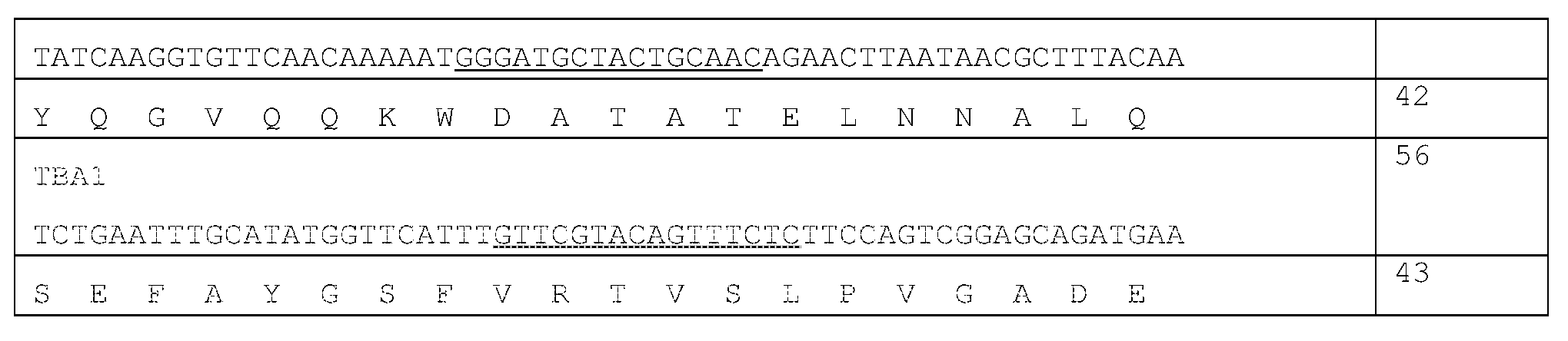
[0222] The peptide DNA was digested with Xhol/Sall and cloned into the respective Xhol sites in the Spy0128 region of the M 1 pilus of the pLZ12km_P23R plasmid as described for Example 1.
[0223] The amino acid sequences encoding the recombinant Spy0128 protein region of each construct are listed in Table 8, in which the heterologous peptide is indicated in uppercase and bold.
[0224] The recombinant plasmids were electroporated into Lactococcus lactis strain MG1363.
Table 8: Sequence of recombinant polypeptides in each construct.


[0225] Assembly of recombinant pili expressing the antigenic peptides on the surface of L. lactis was determined by Western blot as described for Example 1.
2. Results
[0226] The M l pilus expressing the ESAT-61-20 peptide, ESAT-651-70 peptide and TBA61 peptide assembled on the surface of L. lactis as shown in Figures 9A-9C, respectively.
EXAMPLE 5
[0227] This example demonstrates assembly on the surface of L. lactis of M l pili comprising an artificial 41 amino acid peptide.
1. Method
[0228] The peptide sequence for the 41 amino acid peptide [SEQ ID No. X] was reverse transcribed to DNA using L. lactis codon usage.
[0229] A 5'- Xhol site and a 3' Sail site were added to the peptide.
[0230] The peptide DNA was cloned into the βΕ/βF loop region of Spy0128 of the M l pilus of the pLZ12km_P23R plasmid as described for Example 1.
[0231] The amino acid sequence encoding the recombinant Spy0128 protein region of the construct is outlined in Table 9. The heterologous peptide is indicated in uppercase and bold.
[0232] The recombinant plasmid was electroporated into Lactococcus lactis strain MG1363.
Table 9: Sequence of recombinant polypeptide in construct.

[0233] Assembly of recombinant pili expressing the 41 amino acid peptide on the surface of L. lactis was determined by Western blot as described for Example 1.
2. Results
[0234] The M 1 pilus expressing the 41 amino acid peptide assembled on the surface of L. lactis as shown in Figure 10.
EXAMPLE 6
[0235] This example demonstrates assembly on the surface of L. lactis of M 1 pili comprising a peptide fusion.
1. Preparation of pili construct
[0236] The cloning strategy used to produce a construct that expresses the M 1 pilus having comprising a peptide fusion in the βΕ/βF loop region is shown below.
[0237] A Xhol cleavage site was introduced into the Spy0128 nucleotide region of the M 1 pilus operon at the βΕ/βF loop region according to the method described in Example.
[0238] The peptide sequences for the J 14 peptide [SEQ ID No. 31] and the Ova323-339 peptide [SEQ ID No. 30] were reverse transcribed to DNA using L. lactis codon usage and introducing a 5'- Xhol site and a 3' Sail site.
[0239] The J 14 PCR product was digested with Xhol and cloned into pLZ12km P23R to produce a construct expressing the M 1 pilus comprising the J 14 antigenic peptide at the βΕ/βF loop region.
[0240] The Xhol restriction site present at the 5' end of the J 14 sequence in the construct was exploited to produce a construct expressing the M 1 pilus comprising a fusion peptide comprising two antigens.
[0241] The Ova323-337 PCR product was digested with Xhol and cloned into the construct to produce the fusion construct.
[0242] The amino acid sequence encoding the recombinant Spy0128 protein region of the construct is listed in Table 10, in which the heterologous peptide is indicated in uppercase and bold. Each antigen is underlined.
[0243] The recombinant plasmid was electroporated into Lactococcus lactis strain
MG1363.
Cloning strategy used to prepare construct expressing Ml pilus comprising a double peptide fusion.

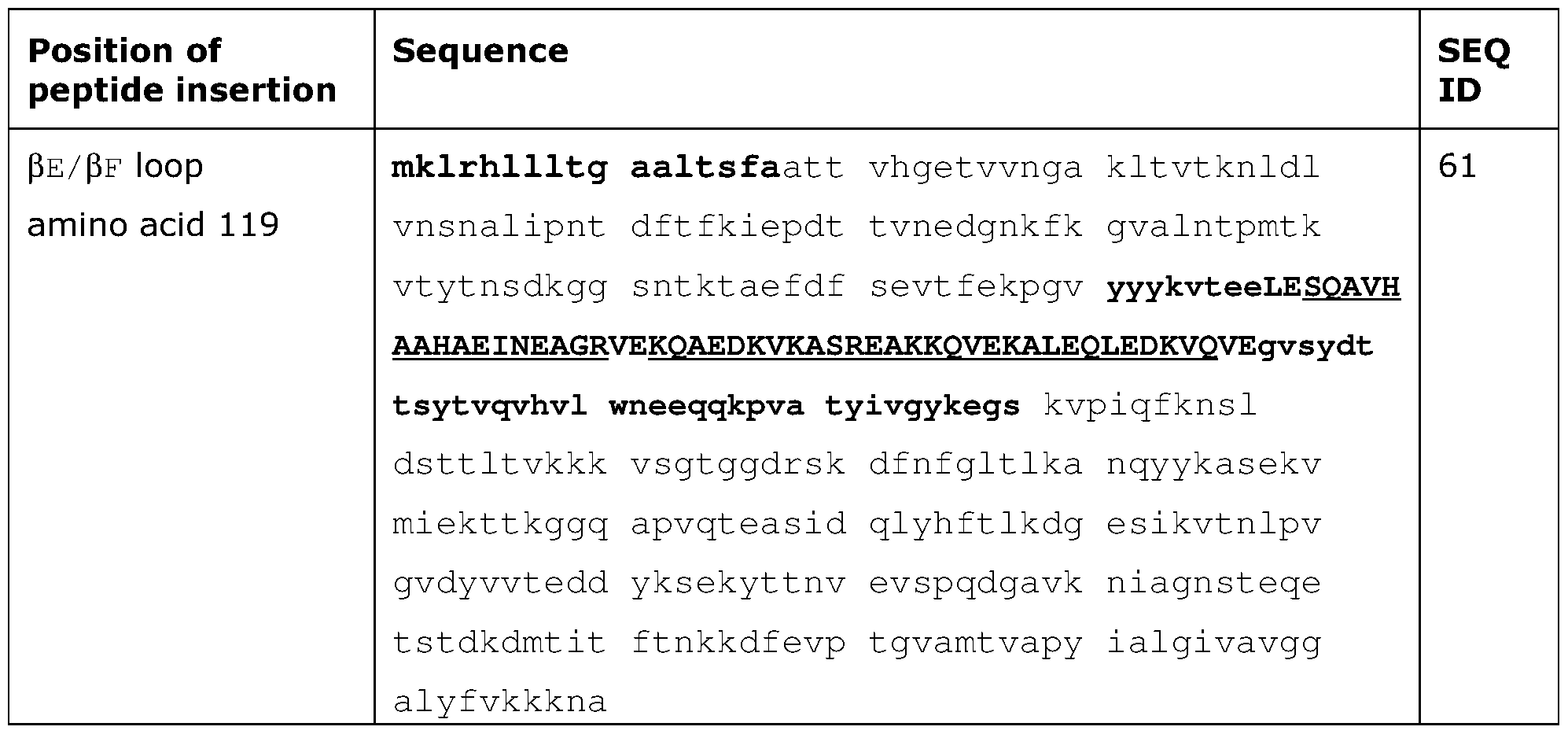
[0244] Assembly of recombinant pili expressing the 41 amino acid peptide on the surface of L. lactis was determined by Western blot as described for Example 1.
2. Results
[0245] The M 1 pilus expressing the fusion peptide assembled on the surface of L. lactis as shown in Figure 11.
EXAMPLE 7
[0246] This example describes a cloning strategy for producing a construct expressing peptides of interest at distinct regions of the BG1 protein in the M 1 pilus.
[0247] The J 14 peptide was introduced into the β9/β10 loop region of Spy0128 in the pLZ12km P23R by introducing a Xhol site according to the method described in Example 1 to produce the construct encoded by SEQ ID No. 28.
[0248] A Clal cleavage site was then introduced into the βΕ/βF loop region of the Spy0128 nucleotide region by PCR amplification. Introduction of the Clal site enables cloning into the βΕ/βF loop of a PCR product encoding a second peptide that has been digested by Clal.
[0249] The amino acid sequence encoding the recombinant Spy0128 protein region of the construct is listed in Table 11. The heterologous J 14 peptide is indicated in uppercase and bold. The Clal site is underlined.
Table 11: Sequence of recombinant polypeptide in construct.

EXAMPLE 8
[0250] This example demonstrates assembly on the surface of L. lactis of M 1 pili comprising a peptide inserted in the βG_1 region of the Spy0128 BP protein.
1. Method
[0251] A Xhol restriction site was introduced between the βG and β1 strand regions of the Spy0128 nucleotide sequence in plasmid pLZ12KmP23R. The Xhol site replaced amino acids 172 and 173 located between the βG and β1 strand regions of the Spy0128 sequence [SEQ ID No. 1] .
[0252] A PCR product encoding the OVA323-339 peptide sequence was cloned into the plasmid at the Xhol restriction site as described for Example 1.
[0253] The amino acid sequence encoding the recombinant Spy0128 protein region of the construct is listed in Table 12. The heterologous peptide is indicated in uppercase and bold.
Table 12: Sequence of recombinant polypeptide in construct.


[0254] Assembly of recombinant pili on the surface of L. lactis was determined by Western blot as described for Example 1.
2. Results
[0255] The M 1 pilus expressing the OVA323-339 peptide in the BG_1 region assembled on the surface of L. lactis as shown in Figure 12.
EXAMPLE 9
[0256] This example demonstrates assembly on the surface of L. lactis of M 18 pili expressing a heterologous peptide.
1. Cloning of the M 18 pilus operon
[0257] The protein sequence of the BP pilus protein of GAS strain MGAS8232 (serotype M 18, GenBank: AAL96938.1) was used to generate a structure model. This was achieved by using the Swiss-PDB modeller (swissmodel.expasy.org) and the crystal structure of Spy0128 (3B2M) as a template. The βEF loop region in M 18_Spy0128 was identified by
superimposing the model structure with the Spy0128 crystal structure and by aa sequence alignment using ClustalW (qenome.jp/tools/clustalw/ )
[0258] The nucleotide sequence of the M 18 pilus operon is provided as SEQ ID No. 64.
[0259] The sequence of the M 18 pilus BP protein was aligned with the M 1 pilus operon using Clustal W software. The sequence alignment is shown in Figure 12.
[0260] The pilus operon [SEQ ID No: 64] was PCR amplified from GAS strain
MGAS8232 (serotype M 18) using the primers listed in Table 12A.
Table 12A: List of primers used to amplify M 18 pilus operon from GAS strain
MGAS8232 (serotype M18).

2. Preparation of a construct encoding the M 18 pilus operon comprising the OVA323-339 peptide
[0261] The recombinant plasmid was first introduced into E. coli by heat-shock. Purified plasmid DNA was then electroporated into Lactococcus lactis strain MG1363.
[0262] To introduce a Xhol cleavage site into the βΕ/βF loop region of the M 18 Spy0128 nucleotide region of the M 18 pilus operon, the plasmid pLZ12KmP23R comprising the pilus operon was PCR amplified using the primers listed in Table 12B.

[0263] The PCR product was digested with Xhol and re-cloned into pLZ12km_P23R.
[0264] OVA323-339 peptide DNA was digested with Xhol/Sall and cloned into the Xhol sites in the M 18 pilus of the pLZ12km_P23R plasmid as described for Example 1.
[0265] The amino acid sequences encoding the recombinant M 18 Spy0128 protein region of each construct are listed in Table 13, in which the heterologous peptide is indicated in uppercase and bold. Clones were prepared encoding a single OVA323-339 and double OVA323-339 peptide.
[0266] The recombinant plasmids were electroporated into Lactococcus lactis strain MG1363.
Table 13: Sequence of recombinant polypeptides in each construct.


3. Assembly of the M 18 pilus on the surface of L. lactis
[0267] Assembly of the recombinant pili on the surface of L. lactis was determined by Western blotting according to the protocol described in Example 1. Blots were probed with specific anti-M 18 Spy0128 serum (generated in a rabbit after immunization with purified recombinant Spy0128).
[0268] The M 18 pilus expressing the OVA323-339 peptide and the pilus expressing the double peptide both assembled on the surface of L. lactis as demonstrated by the Western blot shown in Figure 14.
[0269] Expression of the pilus on the surface of L. lactis was quantified by flow cytometry of transformed L. lactis using an antibody against M 18_Spy0128 using the method described in Example 11.
[0270] The results are shown in Figure 15 and Table 14 below. The results show a significant shift in cells transformed with the constructs described above compared with untransformed L. lactis indicating assembly of the pilus on the cell surface.
Table 14: Flow cytometry using an anti-M 18_Spy0128 antibody

EXAMPLE 10
[0271] This example quantifies the amount of recombinant M 1 pili described herein on the surface of L. lactis.
1. Method
[0272] L. lactis were transformed as described above with constructs expressing the recombinant pili set out in Table 15.
[0273] L. lactis culture was diluted to OD600nm = 0.4 and incubated in blocking buffer (PBS/3% FBS/5 mM EDTA) on ice for 30 min. The cells were washed with FACS buffer (PBS/1% FBS/ 5mM EDTA) and incubated with anti-Spy0128 polyclonal antibodies on ice for 30 min. The cells were washed again in FACS buffer, then incubated with FITC-conjugated anti-rabbit IgG antibody on ice for 30 min. After extensive washing with FACS buffer, the cells were fixed in 2% paraformaldehyde (in PBS) at 37°C for 10 min. The FITC signals were analysed on a LSRII flow cytometer (Becton Dickinson), and 10,000 events were collected for each experiment. Controls of unstained cells or cells only treated with secondary antibody were used to define positive FITC signals. MFI (mean fluorescence intensity) and percentage of pilus-positive population were calculated by FlowJo software.
2. Results
[0274] The results are shown in Figure 16 and Table 15 below.
[0275] The results show that the transformed L. lactis expressed recombinant pili on the cell surface.
Table 15: Flow cytometry using an a-spy0128 antibody
# Sample/strain Bacteria single Pilus positive Pilus positive
Example ref cell MFI percentage population MFI
1 Pilvax-3Gl_Ova 189 29% 3845 Example 8
2 PilVax-βE/F-AP 256 34.4% 622 Example 5
3 PilVax-βE/F-M2eM2e 635 65.7 % 868 Example 3

EXAMPLE 11
[0276] This example demonstrates serum IgG and BAL IgA in mice vaccinated with transformed L. lactis described herein.
1. Method
[0277] Mice were vaccinated with L. lactis PilM 1 strains displaying the M2e or M2eM2e peptides (described in Example 3) using the protocol described in Example 1.
[0278] Purified GST-M2e recombinant protein diluted in PBS to a concentration of 1 μg/ml was used to coat a 96-well Maxisorb plate (Nunc) plate overnight at 4°C (100 μΙ/ well). The plate was washed in PBS-T (PBS/0.05% Tween-20) to remove excess antigens, then blocked with 3% BSA (w/v) in PBS-T at room temperature for 15 min. A 4-fold serial dilution of mouse sera (starting from 1 : 200) or BAL fluid (starting from neat) was prepared in PBS, added to the plate and incubated at room temperature for 3 h. The plate was washed extensively in PBS-T then probed with HRP-conjugated anti rabbit IgG or IgA secondary antibody. The bound complexes were detected with TMB substrate (Pierce) and
the colori metric reaction was developed in the dark. The reaction was stopped by adding 1 M HCI, and the absorbance at 450 nm was measured on an EnSpire Multimode plate reader (Perkin Elmer).
[0279] Control wells with no protein added, or with pre-immune sera were used to define background absorbance, which was subtracted from the measurements of experiment wells. The cut-off value was defined as mean + 3 standard deviations of the absorbance of control wells.
[0280] The endpoint titre was determined as the dilution that produced an absorbance higher than the cut-off value.
2. Result
[0281] The results for the M2e and M2eM2e strains are shown in Figures 17 and 18, respectively.
[0282] For both strains, a strong serum IgG response was observed against Spy0128 antigen, indicating successful delivery of the vaccine. An endpoint titre against Spy0128 in serum IgG of 1 : 204,800 was achieved with both strains.
[0283] For the M2e strain, endpoint titres of 1 : 800 in serum IgG and 1 : 256 against M2e antigen were achieved.
[0284] For the M2eM2e strain, endpoint titres of 1 : 51,200 in serum IgG and 1 :4,096 against M2e antigen were achieved.
EXAMPLE 12
[0285] This example demonstrates assembly on the surface of L. lactis of M 1 pili comprising a B16 peptide.
1. Method
[0286] The peptide sequence for the B16 peptide was reverse transcribed to DNA using L. lactis codon usage.
[0287] The amino acid and nucleotide sequences of the B-16 peptide is listed in Tale 15A below.
Table 15A: Insertion peptide nucleotide and peptide sequence.
[0288] A 5'- Xhol site and a 3' Sail site were added to the peptide.
[0289] The peptide DNA was cloned into the βΕ/βF loop region of Spy0128 of the M 1 pilus of the pLZ12km_P23R plasmid as described for Example 1.
[0290] The amino acid sequence encoding the recombinant Spy0128 protein region of the construct is outlined in Table 16. The heterologous peptide is indicated in uppercase and bold.
[0291] The recombinant plasmid was electroporated into Lactococcus lactis strain MG1363.
Table 16: Sequence of recombinant polypeptide in construct.

[0292] Assembly of recombinant pili expressing the B16 peptide on the surface of L. lactis was determined by Western blot as described for Example 1.
2. Results
[0293] The M 1 pilus expressing the B16 peptide assembled on the surface of L. lactis as shown in Figure 19.
INDUSTRIAL APPLICATION
[0294] The apparatus and methods of the invention have utility for therapeutic applications, particularly vaccination, including vaccination against pathogenic agents such as viruses and bacteria, and immunological treatments of conditions such as cancers.
Claims
1. An isolated, purified or recombinant polypeptide comprising one or more amino acid sequences comprising a backbone pilin (BP) protein or fragment thereof and one or more peptides of interest, wherein the peptide of interest is heterologous to the BP protein.
2. An isolated, purified or recombinant polypeptide comprising one or more amino acid sequences comprising a backbone pilin (BP) protein or fragment thereof and one or more peptides of interest, wherein the peptide of interest is not a BP protein or fragment thereof.
3. An isolated, purified or recombinant polypeptide comprising one or more amino acid sequences comprising a backbone pilin (BP) protein or fragment thereof and one or more peptides of interest, wherein the peptide of interest is not a pilus protein or fragment thereof.
4. An isolated, purified or recombinant polypeptide comprising one or more amino acid sequences comprising a backbone pilin (BP) protein or fragment thereof and one or more peptides of interest, wherein the peptide of interest is not a Streptococcus protein or fragment thereof.
5. An isolated, purified or recombinant polypeptide comprising one or more amino acid sequences comprising one or more peptides of interest inserted into or fused to a backbone pilin (BP) protein or fragment thereof and, wherein the peptide of interest is heterologous to the BP protein.
6. The polypeptide of any one of the preceding claims wherein the BP protein is a BP protein derived from a Gram positive bacterium.
7. The polypeptide of any one of the preceding claims wherein the BP protein is a
Streptococcus BP protein.
8. The polypeptide of any one of the preceding claims wherein the BP protein is a Group A Streptococcus BP protein.
9. The polypeptide of any one of the preceding claims wherein the BP protein is encoded within the FCT-1, FCT-2, FCT-3, FCT-4, FCT-5, FCT-6 or FCT-9 nucleotide region of a Group A Streptococcus genome.
10. The polypeptide of any one of the preceding claims wherein the BP protein is
encoded within the FCT-2, FCT-3 or FCT-4 nucleotide region of a Group A
Streptococcus genome.
11. The polypeptide of any one of the preceding claims wherein the BP protein is a
Streptococcus pyogenes BP protein.
12. The polypeptide of any one of the preceding claims wherein the BP protein is derived from Group A Streptococcus serotype M 1, M2, M3, M4, M5, M6, M9, M i l, M 12, M 18, M22, M23, M28, M33, M44, M49 (2), M50, M53, M75, M77, M78, M89.
13. The polypeptide of any one of the preceding claims wherein the BP protein is derived from Group A Streptococcus serotype M 1, M3, M5, M9, M i l, M 12, M 18, M22, M28, M33, M44, M49 (2), M50, M53, M77, M78, M89.
14. The polypeptide of any one of the preceding claims wherein the BP protein has at least about 80% amino acid sequence identity to the polypeptide sequence of SEQ ID No 1.
15. The polypeptide of any one of the preceding claims wherein the BP protein is
encoded by a nucleotide coding sequence selected from the group consisting of a. Genbank Accession Number EU725506.1 (GI: 198417284)
b. any one of Genbank Accession Numbers KJ816940 -KJ817040,
c. Genbank Accession Number 2940764
d. Genbank Accession Number NP_268517
e. Genbank Accession Number KJ816977
f. Genbank Accession Number KJ817010
g. Genbank Accession Number KJ817040
h. Genbank Accession Number KJ816969
i. Genbank Accession Number 3573111
j. Genbank Accession Number KJ816976
k. Genbank Accession Number KJ816959
I. Genbank Accession Number KJ816971
m. Genbank Accession Number KJ816965
n. Genbank Accession Number KJ816984
0. Genbank Accession Number KJ816948
p. Genbank Accession Number KJ816943
q. Genbank Accession Number KJ816940
r. Genbank Accession Number KJ816995
s. Genbank Accession Number 4067256, and
t. Genbank Accession Number 4063969.
16. The polypeptide of any one of the preceding claims wherein the BP protein
comprises, consists of, or consists essentially of, an amino acid sequence selected from the group consisting of
a. Genbank Accession Number ACH87870.1 (GI: 198417285),
b. any one of Genbank Accession Numbers KJ816940 -KJ817040,
c. Genbank Accession Number 2940764
d. Genbank Accession Number NP_268517
e. Genbank Accession Number KJ816977
f. Genbank Accession Number KJ817010
g. Genbank Accession Number KJ817040
h. Genbank Accession Number KJ816969
1. Genbank Accession Number 3573111
j. Genbank Accession Number KJ816976
k. Genbank Accession Number KJ816959
I . Genbank Accession Number KJ816971
m. Genbank Accession Number KJ816965
n. Genbank Accession Number KJ816984
o. Genbank Accession Number KJ816948
p. Genbank Accession Number KJ816943
q . Genbank Accession Number KJ816940
r. Genbank Accession Number KJ816995
s. Genbank Accession Number 4067256, and
t. Genbank Accession Number 4063969.
17. The polypeptide of any one of the preceding claims wherein the BP protein comprises a. a first domain having at least about 80% amino acid sequence identity to the polypeptide sequence of the C-terminal domain of Spy0128 (amino acids 174- 340 of SEQ ID No. 1), and/or
b. a second domain having at least about 80% amino acid sequence identity to the polypeptide sequence of the N-terminal domain of Spy0128 (amino acids 1-171 of SEQ ID No. 1).
18. The polypeptide of any one of the preceding claims wherein the amino acid sequence comprises the at least one peptide inserted at a site within the C-terminal domain of the BP protein.
19. The polypeptide of any one of the preceding claims wherein the amino acid sequence comprises the at least one peptide inserted at a site within the N-terminal domain of the BP protein.
20. The polypeptide of any one of the preceding claims wherein the at least one peptide of interest is inserted :
a. in a region between the βΕ and 3F loop regions of the BP protein, for example corresponding to amino acids 119-124 of SEQ ID No: 1, and/or an analogous region in a BP protein having greater than 90% identity to the amino acid sequence of SEQ ID No: 1, and/or
b. in a region between the β9 and βΐθ loop regions of the BP protein, for
example, corresponding to amino acids 276-279 of SEQ ID No: 1, and/or an analogous region in a BP protein having greater than 90% identity to the amino acid sequence of SEQ ID No: 1,
c. in a region between the βΒ and βC1 loop regions of the BP protein, for
example, corresponding to amino acids 61-65 of SEQ ID No: 1, and/or an analogous region in a BP protein having greater than 90% identity to the amino acid sequence of SEQ ID No: 1,
d. in a region between the β3 and β4 loop regions of the BP protein, for example, corresponding to amino acids 217-221 of SEQ ID No: 1, and/or an analogous region in a BP protein having greater than 90% identity to the amino acid sequence of SEQ ID No: 1, and/or
e. in a region between the β2 and β3 loop regions of the BP protein, for example, corresponding to amino acids 201-206 of SEQ ID No: 1, and/or an analogous region in a BP protein having greater than 90% identity to the amino acid sequence of SEQ ID No: 1, and/or
f. in a region between the βD and βΕ loop regions of the BP protein, for example, corresponding to amino acids 101-108 of SEQ ID No: 1, and/or an analogous region in a BP protein having greater than 90% identity to the amino acid sequence of SEQ ID No: 1.
21. The polypeptide of any one of the preceding claims wherein the amino acid sequence comprises the polypeptide of interest inserted :
a. in a region between the βΕ and βF loop regions of the BP protein, for example corresponding to amino acids 119-124 of SEQ ID No: 1, and
b. in a region between the β9 and βΐθ loop regions of the BP protein, for example, corresponding to amino acids 276-279 of SEQ ID No: 1,
22. The polypeptide of any one of the preceding claims wherein the amino acid sequence comprises:
a. a first peptide of interest inserted in a region between the βΕ and F loop regions of the BP protein, for example, corresponding to amino acids 119-124 of SEQ ID No: 1, arid
b. a second peptide of interest inserted in a region between the β9 and βΐθ loop regions of the BP protein, for example, corresponding to amino acids 276-279 of SEQ ID No: 1.
23. The polypeptide of any one of the preceding claims wherein the polypeptide further comprises an amino acid sequence encoding a pilin tip protein (API protein), an AP2 protein, a Sip protein, a sortase or a combination of any two or more thereof.
24. The polypeptide of any one of the preceding claims wherein the polypeptide further comprises amino acid sequences encoding a pilin tip protein (API protein), an AP2 protein, a Sip protein, and a sortase.
25. The polypeptide of any one of the preceding claims wherein the polypeptide further comprises amino acid sequences encoding proteins required to form a pilus when the polypeptide is expressed in a bacterium.
26. The polypeptide of any one of the preceding claims wherein the one or more peptides of interest comprise an antigenic peptide, an enzyme, or an antibody or fragment thereof.
27. The polypeptide of any one of the preceding claims wherein the one or more peptides of interest comprise a T cell antigenic peptide or epitope/fragment thereof or a B cell antigenic peptide or epitope/fragment thereof.
28. The polypeptide of any one of the preceding claims wherein the one or more peptides of interest comprises two or more antigenic peptides or epitopes.
29. The polypeptide of any one of the preceding claims wherein the one or more peptides of interest are derived from a microorganism, for example, a virus, a bacterium, a parasite...
30. The polypeptide of any one of the preceding claims wherein the one or more peptides of interest are capable of eliciting an IgA response.
31. The polypeptide of any one of the preceding claims wherein the one or more peptides of interest comprise a tumour antigenic peptide.
32. The polypeptide of any one of the preceding claims wherein the one or more peptides of interest comprise 3 or more, 4 or more, 5 or more, 6 or more, 7 or more, 8 or more, 9 or more, or 10 or more contiguous amino acids that do not encode a BP protein or fragment thereof.
33. The polypeptide of any one of the preceding claims wherein the peptide of interest comprises, consists of, or consists essentially of an amino acid sequence selected from the group consisting of
a. 8 or more contiguous amino acids from the sequence SQAVHAAHAEINEAGRI [SEQ ID No. 30], or
b. 8 or more contiguous amino acids from the sequence
KQAEDKVKASREAKKQVEKALEQLEDKVQ [SEQ ID No. 31] .
34. The polypeptide of any one of the preceding claims wherein the peptide of interest comprises, consists of, or consists essentially of an amino acid sequence selected from the group consisting of
a. 8 or more contiguous amino acid residues from the Mtb antigen 85B precursor peptide,
b. 8 or more contiguous amino acids from the amino acid sequence
FQDAYNAAGGHNAVF [SEQ ID No: 32, I-A(b) Mtb antigen 85B precursor peptide amino acids 280-294],
c. 8 or more contiguous amino acid residues from the Mtb antigen ESAT-6, d. 8 or more contiguous amino acids from the amino acid sequence
MTEQQWNFAGIEAAASAIQG [SEQ ID No: 33, I-A(b) Mtb ESAT-6 amino acids 1-20],
e. 8 or more contiguous amino acids from the amino acid sequence
GAPINSATAM [SEQ ID No: 34, I-A(b) Mtb ESAT-6 amino acids 309 - 318] . 35. The polypeptide of any one of the preceding claims wherein the peptide of interest comprises, consists of, or consists essentially of an amino acid sequence selected from the group consisting of
a. 8 or more contiguous amino acids from the sequence SIINFEKL [SEQ ID No.
35],
b. 8 or more contiguous amino acids from the sequence TEWTSSNVMEERKIKV [SEQ ID No. 36], or
c. 8 or more contiguous amino acids from the sequence SPSYVYHQF [SEQ ID No.
37] .
36. The polypeptide of any one of the preceding claims wherein the polypeptide, when expressed in a bacterium, assembles to form a pilus on the surface of the bacterium.
37. A recombinant polypeptide comprising the amino acid sequence of SEQ ID No. 1
wherein one or more, for example, 1-15 contiguous amino acids have been deleted at one or more of the following sites:
a. from amino acid position 61,
b. from amino acid position 101,
c. from amino acid position 119,
d. from amino acid position 201,
e. from amino acid position 217, and/or
f. from amino acid position 276;
and/or
wherein one or more of the following sequences of contiguous amino acids have been deleted :
g. amino acids 61-65,
h. amino acids 101-108,
i. amino acids 119-124,
j. amino acids 201-206,
k. amino acids 217-221, and/or
I. amino acids 276-279;
and, optionally, wherein two or more contiguous amino acids are inserted at the site or sites of the deleted contiguous amino acids.
38. A recombinant polypeptide comprising an amino acid sequence having at least 90% sequence identity with SEQ ID No. 1 wherein one or more, for example, 1-15 contiguous amino acids have been deleted at one or more of the following sites: a. from an amino acid position corresponding to amino acid 61 of SEQ ID No. 1, b. from an amino acid position corresponding to amino acid 101 of SEQ ID No. 1, c. from an amino acid position corresponding to amino acid 119 of SEQ ID No. 1, d. from an amino acid position corresponding to amino acid 201 of SEQ ID No. 1, e. from an amino acid position corresponding to amino acid 217 of SEQ ID No. 1, and/or
f. from an amino acid position corresponding to amino acid 276 of SEQ ID No.
1 ;
and/or
wherein one or more of the following sequences of contiguous amino acids have been deleted :
g. an amino acid sequence corresponding to amino acids 61-65 of SEQ ID No. 1, h. an amino acid sequence corresponding to amino acids 101-108 of SEQ ID No.
1,
i. an amino acid sequence corresponding to amino acids 119-124 of SEQ ID No.
1,
j. an amino acid sequence corresponding to amino acids 201-206 of SEQ ID No.
1,
k. an amino acid sequence corresponding to amino acids 217-221 of SEQ ID No.
1, and/or
I. an amino acid sequence corresponding to amino acids 276-279 of SEQ ID No.
1 ;
and, optionally, wherein two or more contiguous amino acids are inserted at the site or sites of the deleted contiguous amino acids.
39. The recombinant polypeptide of claim 38 wherein the one or more inserted amino acids result from the formation of a restriction enzyme cleavage site.]
40. The recombinant polypeptide of claim 39 further comprising one or more peptides of interest inserted at the site or sites of the deleted amino acids.
41. A recombinant polypeptide comprising the amino acid sequence of SEQ ID No. 1 and comprising a substitution of 1 to 6, for example, 4 contiguous amino acids for a sequence of 1 to 15 contiguous amino acids of the native sequence at one or more of the following sites:
a. from an amino acid position corresponding to amino acid 61 of SEQ ID No. 1, b. from an amino acid position corresponding to amino acid 101 of SEQ ID No. 1, c. from an amino acid position corresponding to amino acid 119 of SEQ ID No. 1, d . from an amino acid position corresponding to amino acid 201 of SEQ ID No. 1, e. from an amino acid position corresponding to amino acid 217 of SEQ ID No. 1, and/or
f. from an amino acid position corresponding to amino acid 276 of SEQ ID No.
1 ;
and/or
comprising a substitution of 1 to 6, for example, 4 contiguous amino acids for one or more of the following sequences of contiguous amino acids in SEQ ID No.1 :
a. amino acids 61-65,
b. amino acids 101-108,
c. amino acids 119-124,
d. amino acids 201-206,
e. amino acids 217-221, and/or
f. amino acids 276-279.
42. A recombinant polypeptide comprising an amino acid sequence having at least 90% sequence identity with SEQ ID No. 1 and comprising a substitution of 1 to 6, for example, 4 contiguous amino acids for a sequence of 1 to 15 contiguous amino acids of the native sequence at one or more of the following sites:
a. from amino acid position 61,
b. from amino acid position 101,
c. from amino acid position 119,
d. from amino acid position 201,
e. from amino acid position 217, and/or
f. from amino acid position 276;
and/or
comprising a substitution of 1 to 6, for example, 4 contiguous amino acids for one or more of the following sequences of contiguous amino acids in SEQ ID No.1 :
a. an amino acid sequence corresponding to amino acids 61-65 of SEQ ID No. 1, b. an amino acid sequence corresponding to amino acids 101-108 of SEQ ID No. 1, c. an amino acid sequence corresponding to amino acids 119-124 of SEQ ID No. 1, d. an amino acid sequence corresponding to amino acids 201-206 of SEQ ID No. 1, e. an amino acid sequence corresponding to amino acids 217-221 of SEQ ID No. 1, and/or
f. an amino acid sequence corresponding to amino acids 276-279 of SEQ ID No. 1.
43. A recombinant polypeptide of any one of the preceding claims comprising one or more of the following amino acid substitutions:
a. amino acids LELD for amino acids 61-65,
b. amino acids LELD for amino acids 101-108,
c. amino acids LELD for amino acids 119-124,
d. amino acids LELD for amino acids 201-206,
e. amino acids LELD for amino acids 217-221, and/or
f. amino acids LELD for amino acids 276-279.
44. The recombinant polypeptide of any one of the preceding claims further comprising one or more peptides of interest inserted at the substitution site or sites between the LE and LD residues.
45. An isolated, purified, or recombinant pilus comprising a plurality of covalently
attached peptides of interest wherein the peptides of interest are heterologous to the pilus.
46. An isolated, purified, or recombinant pilus comprising one or more
repeating/polymerised polypeptide subunits each subunit comprising a backbone pilin (BP) protein and one or more peptides of interest, wherein the peptides of interest are heterologous to the BP protein.
47. A genetically engineered bacterium comprising at least one recombinant pilus, each pilus comprising a plurality of covalently attached peptides of interest, wherein the peptides of interest are heterologous to the pilus [and the bacterium] .
48. A genetically engineered bacterium comprising at least one recombinant pilus, each pilus comprising one or more repeating/polymerised polypeptide subunits each subunit comprising a backbone pilin (BP) protein and one or more peptides of interest, wherein the peptides of interest are heterologous to the BP protein, or heterologous to the bacterium.
49. A genetically engineered bacterium comprising a recombinant nucleic acid capable of encoding a polypeptide capable of forming one or more pili on the surface of the bacterium, the nucleic acid encoding one or more repeating polypeptide subunits each subunit comprising a backbone pilin (BP) protein and one or more peptides of interest, wherein the peptides of interest are heterologous to the BP protein [and the bacterium] .
50. The pilus or bacterium of any of the preceding claims wherein the bacterium is a Gram positive bacterium.
51. The pilus or bacterium of any of the preceding claims wherein the bacterium belongs to a genus selected from the group comprising Bifidobacterium, Lactobacillus, Lactococcus, and Streptococcus.
52. The pilus or bacterium of any of the preceding claims wherein the bacterium is an attenuated pathogenic bacterium, a non-pathogenic bacterium or a generally regarded as safe (GRAS) bacterium.
53. A pharmaceutical composition comprising an effective amount of one or more
polypeptides, pili or bacteria of any one of the preceding claims.
54. The composition of claim 53 wherein the composition is an immunogenic
composition.
55. A vaccine composition comprising an effective amount of one or more polypeptides, pili or bacteria of any one of the preceding claims.
56. The composition of claim 55 additionally comprising an adjuvant.
57. A method of vaccinating or eliciting an immune response in a subject comprising administering to the subject an effective amount of a pharmaceutical composition or vaccine composition of any one of the preceding claims.
58. A method of vaccinating or eliciting an immune response in a subject comprising administering to the subject an effective amount of a polypeptide, pilus or bacterium of any one of the preceding claims.
59. Use of a polypeptide, pilus or bacterium of any of the preceding claims in the
manufacture of a medicament for vaccinating or eliciting an immune response in a subject in a subject in need thereof.
60. A polypeptide, pilus or bacterium of any of the preceding claims for use in
vaccinating or eliciting an immune response in a subject in a subject in need thereof.
61. A method for producing a genetically engineered bacterium comprising at least one pilus, each pilus comprising a plurality of covalently attached peptides of interest, the method comprising
a) introducing into said bacterium a polynucleotide comprising a polynucleotide sequence comprising a nucleotide sequence encoding a backbone pilin (BP) protein and one or more peptides of interest, wherein the peptide of interest is heterologous to the BP protein; and
b) growing said bacterium under conditions wherein said polypeptide is expressed and said pilus is formed.
62. The method of any of the preceding claims wherein the peptide of interest is heterologous to the bacterium.
63. The method of any of the preceding claims wherein the polynucleotide further
comprises a nucleotide sequence encoding a pilin tip protein (API protein), an AP2 protein, a sortase or a combination of any two or more thereof.
64. The method of any of the preceding claims wherein the polynucleotide further
comprises a promoter that is active in the bacterium, and wherein the promoter is operably linked to the polynucleotide encoding said polypeptide.
65. The method of any of the preceding claims wherein said promoter drives constitutive expression of the polypeptide in the bacterium.
Applications Claiming Priority (2)
| Application Number | Priority Date | Filing Date | Title |
|---|---|---|---|
| NZ70961115 | 2015-07-01 | ||
| NZ709611 | 2015-07-01 |
Publications (1)
| Publication Number | Publication Date |
|---|---|
| WO2017003305A1 true WO2017003305A1 (en) | 2017-01-05 |
Family
ID=57608596
Family Applications (1)
| Application Number | Title | Priority Date | Filing Date |
|---|---|---|---|
| PCT/NZ2016/050111 Ceased WO2017003305A1 (en) | 2015-07-01 | 2016-07-01 | Peptides and uses thereof |
Country Status (1)
| Country | Link |
|---|---|
| WO (1) | WO2017003305A1 (en) |
Cited By (2)
| Publication number | Priority date | Publication date | Assignee | Title |
|---|---|---|---|---|
| CN116983469A (en) * | 2023-08-03 | 2023-11-03 | 东华大学 | Hydrogel scaffold and preparation method and application thereof |
| WO2024092769A1 (en) * | 2022-11-04 | 2024-05-10 | Shenzhen Institute Of Advanced Technology Chinese Academy Of Sciences | Modified covalently-linked pili and recombinant bacteria comprising the same |
Citations (2)
| Publication number | Priority date | Publication date | Assignee | Title |
|---|---|---|---|---|
| US20110189236A1 (en) * | 2008-05-08 | 2011-08-04 | Emory University | Methods and Compositions for the Display of Polypeptides on the Pili of Gram-Positive Bacteria |
| WO2011098772A1 (en) * | 2010-02-11 | 2011-08-18 | Isis Innovation Limited | Peptide tag systems that spontaneously form an irreversible link to protein partners via isopeptide bonds |
-
2016
- 2016-07-01 WO PCT/NZ2016/050111 patent/WO2017003305A1/en not_active Ceased
Patent Citations (2)
| Publication number | Priority date | Publication date | Assignee | Title |
|---|---|---|---|---|
| US20110189236A1 (en) * | 2008-05-08 | 2011-08-04 | Emory University | Methods and Compositions for the Display of Polypeptides on the Pili of Gram-Positive Bacteria |
| WO2011098772A1 (en) * | 2010-02-11 | 2011-08-18 | Isis Innovation Limited | Peptide tag systems that spontaneously form an irreversible link to protein partners via isopeptide bonds |
Non-Patent Citations (9)
| Title |
|---|
| CHEN H. ET AL.: "Construction, characterization, and immunogenicity of an attenuated Salmonella enterica Serovar Typhimurium pgtE vaccine expressing fimbriae with integrated viral epitopes from the spiC promoter", INFECTION AND IMMUNITY, vol. 71, no. 8, 2003, pages 4664 - 4673, XP055185902 * |
| FERRETTI J. J. ET AL.: "Compete genome sequence of an M1 strain of Streptococcus pyogenes", PROCEEDINGS OF THE NATIONAL ACADEMY OF SCIENCES USA, vol. 98, no. 8, 2001, pages 4658 - 4663, XP002344854 * |
| HARFOUCHE C. ET AL.: "RrgB321, a fusion protein of the three variants of the Pneumococcal pilus backbone RrgB, is protective in vivo and elicits opsonic antibodies", INFECTION AND IMMUNITY, vol. 80, 2012, pages 451 - 460, XP055346550 * |
| KRISHNAN V.: "Pilins in Gram-Positive Bacteria: A Structural Perspective", INTERNATIONAL UNION OF BIOCHEMISTRY AND MOLECULAR BIOLOGY, vol. 67, no. 7, 14 July 2015 (2015-07-14), pages 533 - 543, XP055346559 * |
| LO SAPIO M. ET AL.: "A novel strategy to over-express and purify homologous proteins from Streptococcus pneumonia", JOURNAL OF BIOTECHNOLOGY, vol. 157, 2012, pages 279 - 286, XP028442109 * |
| NUCCITELLI A. ET AL.: "Structure based approach to rationally design a chimeric protein for an effective vaccine against Group B Streptococcus infections", PROCEEDINGS OF THE NATIONAL ACADEMY OF SCIENCES USA, vol. 108, 2011, pages 10278 - 10283, XP055346547 * |
| PROFT T. ET AL.: "Pili in Gram-negative and Gram-positive bacteria - structure, assembly and their role in disease", CELLULAR AND MOLECULAR LIFE SCIENCES, vol. 66, 2009, pages 613 - 635, XP019700770 * |
| STEEMSON J. D. ET AL.: "Survey of the bp/tee genes from clinical group A streptococcus isolates in New Zealand - implications for vaccine development", JOURNAL OF MEDICAL MICROBIOLOGY, vol. 63, 2014, pages 1670 - 1678, XP055346554 * |
| ZALEWSKA B. ET AL.: "Chimeric Dr fimbriae with a Herpes Simplex Virus type 1 epitope as a model for a recombinant vaccine", INFECTION AND IMMUNITY, vol. 71, 2003, pages 5505 - 5513, XP055346553 * |
Cited By (2)
| Publication number | Priority date | Publication date | Assignee | Title |
|---|---|---|---|---|
| WO2024092769A1 (en) * | 2022-11-04 | 2024-05-10 | Shenzhen Institute Of Advanced Technology Chinese Academy Of Sciences | Modified covalently-linked pili and recombinant bacteria comprising the same |
| CN116983469A (en) * | 2023-08-03 | 2023-11-03 | 东华大学 | Hydrogel scaffold and preparation method and application thereof |
Similar Documents
| Publication | Publication Date | Title |
|---|---|---|
| US20240398923A1 (en) | Subunit vaccine delivery platform for robust humoral and cellular immune responses | |
| US12054521B2 (en) | FhuD2 fusion proteins for the outer membrane vesicle (OMV) delivery of heterologous polypetides and immunogenic compositions thereof | |
| AU2013320313B2 (en) | Outer membrane vesicles | |
| US12551544B2 (en) | Method for the production of outer membrane vesicles and immunogenic compositions thereof | |
| WO2017011919A1 (en) | Mycoplasma vaccines and uses thereof | |
| Kwon et al. | BCG-booster vaccination with HSP90-ESAT-6-HspX-RipA multivalent subunit vaccine confers durable protection against hypervirulent Mtb in mice | |
| US9931391B2 (en) | Prevention and treatment of mycobacterium infection | |
| JP2024501754A (en) | Vaccine composition against Streptococcus pneumoniae infection | |
| DK2066341T3 (en) | PROCEDURE FOR INITIATING OR INDUCING AN IMMUNE RESPONSE | |
| WO2017003305A1 (en) | Peptides and uses thereof | |
| US20090304750A1 (en) | Novel prime-boost combinations of attenuated mycobacterium | |
| JP6401148B2 (en) | Antigens and antigen combinations | |
| Romano et al. | A Structural View at Vaccine Development Against M. tuberculosis. Cells 2023, 12, 317 | |
| Rivera-De Jesús | Engineering Escherichia coli Outer Membrane Vesicles and Outer Membrane Proteins for Subunit Antigen Delivery and Vaccine Design | |
| Abbas et al. | IMMUNE RESPONSE OF BALB/C MICE AGAINST GENETIC VACCINATION WITH LEISHMANIA MAJOR GP63 GENE (LMAJGP63) |
Legal Events
| Date | Code | Title | Description |
|---|---|---|---|
| 121 | Ep: the epo has been informed by wipo that ep was designated in this application |
Ref document number: 16818319 Country of ref document: EP Kind code of ref document: A1 |
|
| NENP | Non-entry into the national phase |
Ref country code: DE |
|
| 122 | Ep: pct application non-entry in european phase |
Ref document number: 16818319 Country of ref document: EP Kind code of ref document: A1 |