WO2016210141A1 - Immobilization of biomolecules by self-assembled nanostructures - Google Patents
Immobilization of biomolecules by self-assembled nanostructures Download PDFInfo
- Publication number
- WO2016210141A1 WO2016210141A1 PCT/US2016/039034 US2016039034W WO2016210141A1 WO 2016210141 A1 WO2016210141 A1 WO 2016210141A1 US 2016039034 W US2016039034 W US 2016039034W WO 2016210141 A1 WO2016210141 A1 WO 2016210141A1
- Authority
- WO
- WIPO (PCT)
- Prior art keywords
- amino acid
- composition
- peptide
- lysyl
- xbb
- Prior art date
- Legal status (The legal status is an assumption and is not a legal conclusion. Google has not performed a legal analysis and makes no representation as to the accuracy of the status listed.)
- Ceased
Links
Classifications
-
- A—HUMAN NECESSITIES
- A61—MEDICAL OR VETERINARY SCIENCE; HYGIENE
- A61K—PREPARATIONS FOR MEDICAL, DENTAL OR TOILETRY PURPOSES
- A61K47/00—Medicinal preparations characterised by the non-active ingredients used, e.g. carriers or inert additives; Targeting or modifying agents chemically bound to the active ingredient
- A61K47/50—Medicinal preparations characterised by the non-active ingredients used, e.g. carriers or inert additives; Targeting or modifying agents chemically bound to the active ingredient the non-active ingredient being chemically bound to the active ingredient, e.g. polymer-drug conjugates
- A61K47/51—Medicinal preparations characterised by the non-active ingredients used, e.g. carriers or inert additives; Targeting or modifying agents chemically bound to the active ingredient the non-active ingredient being chemically bound to the active ingredient, e.g. polymer-drug conjugates the non-active ingredient being a modifying agent
- A61K47/62—Medicinal preparations characterised by the non-active ingredients used, e.g. carriers or inert additives; Targeting or modifying agents chemically bound to the active ingredient the non-active ingredient being chemically bound to the active ingredient, e.g. polymer-drug conjugates the non-active ingredient being a modifying agent the modifying agent being a protein, peptide or polyamino acid
- A61K47/64—Drug-peptide, drug-protein or drug-polyamino acid conjugates, i.e. the modifying agent being a peptide, protein or polyamino acid which is covalently bonded or complexed to a therapeutically active agent
-
- A—HUMAN NECESSITIES
- A61—MEDICAL OR VETERINARY SCIENCE; HYGIENE
- A61K—PREPARATIONS FOR MEDICAL, DENTAL OR TOILETRY PURPOSES
- A61K47/00—Medicinal preparations characterised by the non-active ingredients used, e.g. carriers or inert additives; Targeting or modifying agents chemically bound to the active ingredient
- A61K47/50—Medicinal preparations characterised by the non-active ingredients used, e.g. carriers or inert additives; Targeting or modifying agents chemically bound to the active ingredient the non-active ingredient being chemically bound to the active ingredient, e.g. polymer-drug conjugates
- A61K47/51—Medicinal preparations characterised by the non-active ingredients used, e.g. carriers or inert additives; Targeting or modifying agents chemically bound to the active ingredient the non-active ingredient being chemically bound to the active ingredient, e.g. polymer-drug conjugates the non-active ingredient being a modifying agent
- A61K47/54—Medicinal preparations characterised by the non-active ingredients used, e.g. carriers or inert additives; Targeting or modifying agents chemically bound to the active ingredient the non-active ingredient being chemically bound to the active ingredient, e.g. polymer-drug conjugates the non-active ingredient being a modifying agent the modifying agent being an organic compound
- A61K47/542—Carboxylic acids, e.g. a fatty acid or an amino acid
-
- A—HUMAN NECESSITIES
- A61—MEDICAL OR VETERINARY SCIENCE; HYGIENE
- A61K—PREPARATIONS FOR MEDICAL, DENTAL OR TOILETRY PURPOSES
- A61K47/00—Medicinal preparations characterised by the non-active ingredients used, e.g. carriers or inert additives; Targeting or modifying agents chemically bound to the active ingredient
- A61K47/50—Medicinal preparations characterised by the non-active ingredients used, e.g. carriers or inert additives; Targeting or modifying agents chemically bound to the active ingredient the non-active ingredient being chemically bound to the active ingredient, e.g. polymer-drug conjugates
- A61K47/69—Medicinal preparations characterised by the non-active ingredients used, e.g. carriers or inert additives; Targeting or modifying agents chemically bound to the active ingredient the non-active ingredient being chemically bound to the active ingredient, e.g. polymer-drug conjugates the conjugate being characterised by physical or galenical forms, e.g. emulsion, particle, inclusion complex, stent or kit
- A61K47/6921—Medicinal preparations characterised by the non-active ingredients used, e.g. carriers or inert additives; Targeting or modifying agents chemically bound to the active ingredient the non-active ingredient being chemically bound to the active ingredient, e.g. polymer-drug conjugates the conjugate being characterised by physical or galenical forms, e.g. emulsion, particle, inclusion complex, stent or kit the form being a particulate, a powder, an adsorbate, a bead or a sphere
- A61K47/6925—Medicinal preparations characterised by the non-active ingredients used, e.g. carriers or inert additives; Targeting or modifying agents chemically bound to the active ingredient the non-active ingredient being chemically bound to the active ingredient, e.g. polymer-drug conjugates the conjugate being characterised by physical or galenical forms, e.g. emulsion, particle, inclusion complex, stent or kit the form being a particulate, a powder, an adsorbate, a bead or a sphere the form being a microcapsule, nanocapsule, microbubble or nanobubble
-
- B—PERFORMING OPERATIONS; TRANSPORTING
- B01—PHYSICAL OR CHEMICAL PROCESSES OR APPARATUS IN GENERAL
- B01D—SEPARATION
- B01D53/00—Separation of gases or vapours; Recovering vapours of volatile solvents from gases; Chemical or biological purification of waste gases, e.g. engine exhaust gases, smoke, fumes, flue gases, aerosols
- B01D53/34—Chemical or biological purification of waste gases
- B01D53/46—Removing components of defined structure
- B01D53/62—Carbon oxides
-
- B—PERFORMING OPERATIONS; TRANSPORTING
- B01—PHYSICAL OR CHEMICAL PROCESSES OR APPARATUS IN GENERAL
- B01D—SEPARATION
- B01D53/00—Separation of gases or vapours; Recovering vapours of volatile solvents from gases; Chemical or biological purification of waste gases, e.g. engine exhaust gases, smoke, fumes, flue gases, aerosols
- B01D53/34—Chemical or biological purification of waste gases
- B01D53/74—General processes for purification of waste gases; Apparatus or devices specially adapted therefor
- B01D53/86—Catalytic processes
- B01D53/8671—Removing components of defined structure not provided for in B01D53/8603 - B01D53/8668
-
- B—PERFORMING OPERATIONS; TRANSPORTING
- B01—PHYSICAL OR CHEMICAL PROCESSES OR APPARATUS IN GENERAL
- B01D—SEPARATION
- B01D53/00—Separation of gases or vapours; Recovering vapours of volatile solvents from gases; Chemical or biological purification of waste gases, e.g. engine exhaust gases, smoke, fumes, flue gases, aerosols
- B01D53/34—Chemical or biological purification of waste gases
- B01D53/74—General processes for purification of waste gases; Apparatus or devices specially adapted therefor
- B01D53/86—Catalytic processes
- B01D53/88—Handling or mounting catalysts
-
- C—CHEMISTRY; METALLURGY
- C21—METALLURGY OF IRON
- C21B—MANUFACTURE OF IRON OR STEEL
- C21B13/00—Making spongy iron or liquid steel, by direct processes
- C21B13/0073—Selection or treatment of the reducing gases
-
- B—PERFORMING OPERATIONS; TRANSPORTING
- B01—PHYSICAL OR CHEMICAL PROCESSES OR APPARATUS IN GENERAL
- B01D—SEPARATION
- B01D2255/00—Catalysts
- B01D2255/80—Type of catalytic reaction
- B01D2255/804—Enzymatic
-
- B—PERFORMING OPERATIONS; TRANSPORTING
- B01—PHYSICAL OR CHEMICAL PROCESSES OR APPARATUS IN GENERAL
- B01D—SEPARATION
- B01D2255/00—Catalysts
- B01D2255/90—Physical characteristics of catalysts
-
- B—PERFORMING OPERATIONS; TRANSPORTING
- B01—PHYSICAL OR CHEMICAL PROCESSES OR APPARATUS IN GENERAL
- B01D—SEPARATION
- B01D2257/00—Components to be removed
- B01D2257/50—Carbon oxides
- B01D2257/504—Carbon dioxide
-
- B—PERFORMING OPERATIONS; TRANSPORTING
- B01—PHYSICAL OR CHEMICAL PROCESSES OR APPARATUS IN GENERAL
- B01D—SEPARATION
- B01D2258/00—Sources of waste gases
- B01D2258/06—Polluted air
-
- C—CHEMISTRY; METALLURGY
- C12—BIOCHEMISTRY; BEER; SPIRITS; WINE; VINEGAR; MICROBIOLOGY; ENZYMOLOGY; MUTATION OR GENETIC ENGINEERING
- C12Y—ENZYMES
- C12Y401/00—Carbon-carbon lyases (4.1)
- C12Y401/01—Carboxy-lyases (4.1.1)
- C12Y401/01039—Ribulose-bisphosphate carboxylase (4.1.1.39)
-
- C—CHEMISTRY; METALLURGY
- C12—BIOCHEMISTRY; BEER; SPIRITS; WINE; VINEGAR; MICROBIOLOGY; ENZYMOLOGY; MUTATION OR GENETIC ENGINEERING
- C12Y—ENZYMES
- C12Y402/00—Carbon-oxygen lyases (4.2)
- C12Y402/01—Hydro-lyases (4.2.1)
- C12Y402/01001—Carbonate dehydratase (4.2.1.1), i.e. carbonic anhydrase
-
- Y—GENERAL TAGGING OF NEW TECHNOLOGICAL DEVELOPMENTS; GENERAL TAGGING OF CROSS-SECTIONAL TECHNOLOGIES SPANNING OVER SEVERAL SECTIONS OF THE IPC; TECHNICAL SUBJECTS COVERED BY FORMER USPC CROSS-REFERENCE ART COLLECTIONS [XRACs] AND DIGESTS
- Y02—TECHNOLOGIES OR APPLICATIONS FOR MITIGATION OR ADAPTATION AGAINST CLIMATE CHANGE
- Y02C—CAPTURE, STORAGE, SEQUESTRATION OR DISPOSAL OF GREENHOUSE GASES [GHG]
- Y02C20/00—Capture or disposal of greenhouse gases
- Y02C20/40—Capture or disposal of greenhouse gases of CO2
Definitions
- Carbon dioxide (CO?) is an abundant greenhouse gas, trapping thermal radiation close to the earth' s atmosphere and contributing to global warming and climate change. CO2 emissions are expected to increase by more than 40% by 2035, unless major worldwide policies are soon implemented. From an industrial perspective, CO2 represents a large source of carbon for the synthesis of a large range of chemicals. While plants and microbes are efficient at converting CO2 into sugars and other compounds, the sophisticated chains of enzymatic reactions that usually accomplish these processes are difficult to replicate in an industrial context. Catalysis represents over 90% of the chemical processes currently utilized by industry, with an annual market value of over US $1 trillion. Much of the feedstock for industrial catalytic processes continues to be petroleum-based, making this endeavor not ideal from a sustainability perspective.
- compositions, articles, devices, and methods as embodied and broadly described herein, the disclosed subject matter relates to compositions and methods of making and using the compositions.
- the disclosed subject matter relates to compositions and methods of making and using the compositions.
- disclosed are self-assembled nanotubes that comprise a wall, wherein the wail is formed from a conjugate.
- the conjugate can comprise a
- compositions also comprise an enzyme sequestered in
- RNA and DNA can contribute to the production of biofuels and bioproducts from sources other than petroleum.
- the nanostructure-RubisCO construct described herein can facilitate the identification of the optimal catalytic platform for greenhouse gas conversion with regard to catalyst robustness, kinetic efficiency and recycl ability.
- Figure I displays dimeric Rhodospirilhim rubrum RubisCO (shadded ribbons) catalyzes the addition of CO2 to RuBP (black) resulting in two molecules of 3- phosphoglycerate, which are utilized by the host organisms (primary producers) to produce usable energy-rich sugars and to regenerate RuBP.
- Figure 2 (top) displays Self- Assembly of lysine NDI bolaamphile into nanotubes.
- FIG. 2 (bottom) displays Nanotubes formed CPT-dipeptides A (Ac- K(CPT) and B (NH2-KK(CPT).
- FIG. 3 displays TEM images obtained without stain to enhance visualization of RubisCO-nanotube assembly.
- Figure 4A displays 5-nm Ni-NTA-NANOGOLDTM particles (Nanoprobes, Inc.) used to target the histidine-tagged It rubrurn RubisCO for easy visualization in TEM. Also in Figure 4A is a notional depiction of Nanogold tagging of R Rubrurn RubisCO.
- Figure 4B displays TEM images of histidine-tagged It rubrurn. RubisCO bound to nanotubes formed by CPT-dipeptide A (Ac-KK(CPT).
- Figures 4C-4D are TEM images of histidine-tagged R. rubrurn RubisCO bound to nanotubes formed by CPT-dipeptide B (NH2-KK(CPT). The dark dots decorating the nanotubes along the inner and other wall surfaces represent bound RubisCO.
- Figure 5 is a plot showing activity of R Rubrurn RubisCO with or without nanotube in presence of proteolytic enzyme subtilisin.
- micromolar (micromolar)," which is intended to include 1 ⁇ , 3 ⁇ , and everything in between to any number of significant figures (e.g., 1.255 ⁇ , 2.1 ⁇ , 2.9999 ⁇ , etc.).
- amphiphilic means the ability to dissolve in both water and lipids/apolar environments.
- an amphiphilic compound comprises a hydrophilic portion and a hydrophobic portion.
- Hydrophobic designates a preference for apolar environments (e.g., a hydrophobic substance or moiet is more readily dissolved in or wetted by non-polar solvents, such as hydrocarbons, than by water).
- hydrophilic means the ability to dissolve in water.
- the term "substituted" is contemplated to include all permissible substituents of organic compounds, in a broad aspect, the permissible substituents include acyclic and cyclic, branched and unbranched, carbocyclic and heterocyclic, and aromatic and nonaromatic substituents of organic compounds. Illustrative substituents include, for example, those described below.
- the permissible substituents can be one or more and the same or different for appropriate organic compounds.
- the heteroatoms, such as nitrogen can have hydrogen substituents and/or any permissible substituents of organic compounds described herein which satisfy the valences of the heteroatoms.
- substitution or “substituted with” include the implicit proviso that such substitution is in accordance with permitted valence of the substituted atom and the substituent, and that the substitution results in a stable compound, e.g., a compound that does not spontaneously undergo transformation such as by rearrangement, eyclization, elimination, etc.
- the substituents of a substituted group can include, without limitation, one or more substituents independently selected from the following groups or a particular designated set of groups, alone or in combination: lower alkyl, lower alkenyl, lower alkynyl, lower alkanoyl, lower heteroalkyl, lower heterocycloalkyl, lower haloalkyl, lower haloalkenyl, lower haloalkynyl, lower perhaloalkyl, lower perhaloalkoxy, lower cycloalkyl, phenyl, aryi, aryloxy, lower alkoxy, lower haioalkoxy, oxo, lower acyloxy, carbonyl, carboxyl, lower alkyl carbonyl, lower carboxyester, lower carboxamido, cyano, hydrogen or deuterium, halogen, hydroxy, amino, lower alkylamino, arylamino, ami do, nitro, thiol, lower aikyithio
- Two substituents can be joined together to form a fused five-, six-, or seven-membered carbocyclic or heterocyclic ring consisting of zero to three heteroatoms, for example forming methyl en edioxy or ethylenedioxy.
- An optionally substituted group can be unsubstituted (e.g., -CH2CH3), fully substituted (e.g., -CF2CF3), monosubstituted (e.g., -CH2CH2F) or substituted at a level anywhere in-between fully substituted and monosubstituted (e.g., -CH2CF3).
- substituents are recited without qualification as to substitution, both substituted and unsubstituted forms are encompassed.
- substituent is qualified as "substituted," the substituted form is specifically intended.
- aliphatic refers to a non-aromatic hydrocarbon group and includes branched and unbranched, alkyl, alkenyl, or alkynyl groups.
- alkyl as used herein is a branched or unbranched saturated hydrocarbon group of 1 to 24 carbon atoms, such as methyl, ethyl, n-propyl, isopropyl, n-butyi, isobutyl, t-butyl, pentyl, hexyl, heptyl, octyl, nonyl, decyl, dodecyl, tetradecyl, hexadecyl, eicosyl, tetracosyl, and the like.
- the alkyl group can also be substituted or unsubstituted.
- the alkyl group can be substituted with one or more groups including, but not limited to, alkyl, halogenated alkyl, alkoxy, alkenyl, alkynyl, aryl, heteroaryl, aldehyde, amino, carboxylic acid, ester, ether, halide, hydroxy, ketone, nitro, silyl, sulfo-oxo, sulfonyl, sulfone, sulfoxide, or thiol, as described below.
- groups including, but not limited to, alkyl, halogenated alkyl, alkoxy, alkenyl, alkynyl, aryl, heteroaryl, aldehyde, amino, carboxylic acid, ester, ether, halide, hydroxy, ketone, nitro, silyl, sulfo-oxo, sulfonyl, sulfone, sulfoxide, or thiol, as described below
- alkyl is generally used to refer to both unsubstituted alkyl groups and substituted alkyl groups; however, substituted alkyl groups are also specifically referred to herein by identifying the specific substituent(s) on the alkyl group.
- halogenated alkyl specifically refers to an alkyl group that is substituted with one or more halide, e.g., fluorine, chlorine, bromine, or iodine.
- alkoxyaikyi specifically refers to an alkyl group that is substituted with one or more alkoxy groups, as described below.
- alkylamino specifically refers to an alkyl group that is substituted with one or more amino groups, as described below, and the like.
- alkyl is used in one instance and a specific term such as “alkylalcohol” is used in another, it is not meant to imply that the term “alkyl” does not also refer to specific terms such as “alkylalcohol” and the like.
- cycloalkyl refers to both unsubstituted and substituted cycloalkyl moieties
- the substituted moieties can, in addition, be specifically identified herein; for example, a particular substituted cycloalkyl can be referred to as, e.g., an "alkylcycloalkyl.”
- a substituted alkoxy can be specifically referred to as, e.g., a "halogenated alkoxy”
- a particular substituted alkenyl can be, e.g., an "alkenylalcohol,” and the like.
- alkylcycloalkyl is not meant to imply that the general term does not also include the specific term.
- alkoxy as used herein is an alkyl group bound through a single, terminal ether linkage; that is, an “alkoxy” group can be defined as— OZ 1 where Z 1 is alkyl as defined above.
- alkenyl as used herein is a hydrocarbon group of from 2 to 24 carbon atoms with a structural formula containing at least one carbon-carbon double bond.
- the alkenyl group can be substituted with one or more groups including, but not limited to, alkyl, halogenated alkyl, alkoxy, alkenyl, aikynyl, aryl, heteroaryi, aldehyde, amino, carboxylic acid, ester, ether, halide, hydroxy, ketone, nitro, silyl, suifo-oxo, sulfonyl, sulfone, sulfoxide, or thiol, as described below.
- groups including, but not limited to, alkyl, halogenated alkyl, alkoxy, alkenyl, aikynyl, aryl, heteroaryi, aldehyde, amino, carboxylic acid, ester, ether, halide, hydroxy, ketone, nitro, silyl, suifo-oxo, sulfonyl, sulfone, sulfoxide, or thiol, as described
- aikynyl is a hydrocarbon group of 2 to 24 carbon atoms with a structural formula containing at least one carbon-carbon triple bond.
- the ai kynyl group can be substituted with one or more groups including, but not limited to, alkyl, halogenated alkyl, alkoxy, alkenyl, aikynyl, aryl, heteroaryi, aldehyde, amino, carboxylic acid, ester, ether, halide, hydroxy, ketone, nitro, silyl, suifo-oxo, sulfonyl, sulfone, sulfoxide, or thiol, as described below.
- aryl as used herein is a group that contains any carbon-based aromatic group including, but not limited to, benzene, naphthalene, phenyl, biphenyl,
- heteroaryi is defined as a group that contains an aromatic group that has at least one heteroatom incorporated within the ring of the aromatic group. Examples of heteroatoms include, but are not limited to, nitrogen, oxygen, sulfur, and phosphorus.
- non-heteroaryl which is included in the term “aryl,” defines a group that contains an aromatic group that does not contain a heteroatom. The aryl or heteroaryi group can be substituted or unsubstituted.
- the aryl or heteroaryi group can be substituted with one or more groups including, but not limited to, alkyl, halogenated alkyl, alkoxy, alkenyl , aikynyl, aryl, heteroaryi, aldehyde, amino, carboxylic acid, ester, ether, halide, hydroxy, ketone, nitro, silyl, suifo-oxo, sulfonyl, sulfone, sulfoxide, or thiol as described herein.
- the term "biaryl" is a specific type of aryl group and is included in the definition of aryl. Biaryl refers to two aryl groups that are bound together via a fused ring structure, as in naphthalene, or are attached via one or more carbon-carbon bonds, as in biphenyl.
- cycloalkyl as used herein is a non-aromatic carbon-based ring composed of at least three carbon atoms.
- examples of cycloalkyl groups include, but are not limited to, cyclopropyl, cyclobutyl, cyclopentyl, cyclohexyl, etc.
- heterocycloalkyl is a cycloalkyl group as defined above where at least one of the carbon atoms of the ring is substituted with a heteroatom such as, but not limited to, nitrogen, oxygen, sulfur, or phosphorus.
- the cycloalkyl group and heterocycloalkyl group can be substituted or unsubstituted.
- the cycloalkyl group and heterocycloalkyl group can be substituted with one or more groups including, but not limited to, alkyl, alkoxy, alkenyl, alkynyl, aryl, heteroaryi, aldehyde, amino, carboxylic acid, ester, ether, halide, hydroxy, ketone, nitro, silyl, sulfo-oxo, sulfonyl, suifone, sulfoxide, or thiol as described herein.
- cycloalkenyl groups include, but are not limited to, cyclopropenyi, cyclobutenyl, cyclopentenyl, cyciopentadienyl, cyclohexenyl, cyclohexadienyl, and the like.
- heterocycloalkenyl is a type of cycloalkenyl group as defined above, and is included within the meaning of the term “cycloalkenyl,” where at least one of the carbon atoms of the ring is substituted with a heteroatom such as, but not limited to, nitrogen, oxygen, sulfur, or phosphorus.
- the cycloalkenyl group and heterocycloalkenyl group can be substituted or unsubstituted.
- the cycloalkenyl group and heterocycloalkenyl group can be substituted with one or more groups including, but not limited to, alkyl, alkoxy, alkenvi, alkynyl, aryl, heteroaryi, aldehyde, amino, carboxylic acid, ester, ether, halide, hydroxy, ketone, nitro, silyl, sulfo-oxo, sulfonyl, suifone, sulfoxide, or thiol as described herein.
- cyclic group is used herein to refer to either aryl groups, non-aryl groups
- Cyclic groups have one or more ring systems that can be substituted or unsubstituted.
- a cyclic group can contain one or more aryl groups, one or more non-aryl groups, or one or more aryl groups and one or more non-aryl groups.
- aldehyde as used herein is represented by the formula— C(0)H.
- amine or “amino” as used herein are represented by the formula— NZ Z 2 , where Z 1 and Z 2 can each be substitution group as described herein, such as hydrogen, an alkyl, halogenated alkyl, alkenyl, alkynyl, aryl, heteroaryi, cycloalkyl, cycloalkenyl, heterocycloalkyl, or heterocycloalkenyl group described above.
- “Amido” is ---C(0)NZ 5 Z 2 .
- the term “earboxylic acid” as used herein is represented by the formula— C(0)OH.
- a “carboxylate” or “carboxyl” group as used herein is represented by the formula — C(0)0-.
- esters as used herein is represented by the formula— 00(0)7 or — C(0)OZ ! , where Z 3 ⁇ 4 can be an alkyl, halogenated alkyl, alkenyl, alkynyi, aryl, heteroaryl, cycloalkyl, cycloalkenyl, heterocycioalkyl, or heterocycloalkenyl group described above.
- ether as used herein is represented by the formula Z " 'OZ 2 , where Z ! and Z 2 can be, independently, an alkyl, halogenated alkyl, alkenyl, alkynyi, aryl, heteroaryl, cycloalkyl , cycloalkenyl , heterocycioalkyl, or heterocycloalkenyl group described above.
- ketone as used herein is represented by the formula Z 1 C(0)Z 2 , where Z l and 7 2 can be, independently, an alkyl, halogenated alkyl, alkenyl, alkynyi , aryl, heteroaryl, cycloalkyl, cycloalkenyl, heterocycioalkyl, or heterocycloalkenyl group described above.
- halide or "halogen” as used herein refers to the fluorine, chlorine, bromine, and iodine.
- hydroxyl as used herein is represented by the formula— OH.
- lower means containing from 1 to and including 6 carbon atoms.
- lower al kyl as used herein, alone or in a combination, means Ci-Ce straight or branched chain alkyl.
- lower alkenyl means C2-C6 straight or branched chain alkenyl.
- lower alkynyi means C2-C6 straight or branched chain alkynyi.
- lower aryl as used herein, alone or in combination, means phenyl or naphthy!, either of which can be optionally substituted as provided.
- lower heteroaryl means either 1 ) monocyclic heteroaryl comprising five or six ring members, of which between one and four said members can be heteroatoms chosen from O, S, and N, or 2) bicyciic heteroaryl, wherein each of the fused rings comprises five or six ring members, comprising between them one to four heteroatoms chosen from O, S, and N.
- lower cycloalkyl as used herein, alone or in combination, means a monocyclic cycloalkyl having between three and six ring members. Lower cycloalkyis can be unsaturated. Examples of lower cycloalkyl include cyclopropyl, cyclobutyl, cvclopentyl, and cyclohexyl.
- lower heterocydoalkyi as used herein, alone or in combination, means a monocyclic heterocydoalkyi having between three and six ring members, of which between one and four can be heteroatoms chosen from O, S, and N. Examples of lower
- heterocycloalkyls include pyrrolidinyl, imidazolidinyl, pyrazolidinyl, piperidinyl, piperazinyl, and morpholinyl. Lower heterocycloalkyls can be unsaturated.
- lower carboxyl as used herein, alone or in combination, means
- R is chosen from hydrogen, lower alkyl, cycloalkyl, cycloheterolkyl, and lower heteroalkyl, any of which can be optionally substituted with hydroxyl, (O), and halogen,
- lower amino refers to— NRR ' , wherein R and R ' are independently chosen from hydrogen, lower alkyl, and lower heteroalkyl, any of which can be optionally substituted. Additionally, the R and R " of a lower amino group can combine to form a five- or six-membered heterocydoalkyi, either of which can be optionally substituted.
- nanotube is used herein in a general sence to refer to an elongated nanostructure. This term is meant to include nanobars, nanowhiskers, helixes, nanospheres, and the like. In some examples, the nanotube is not a ⁇ -sheet.
- sil as used herein is represented by the formula— Si/ 1 / ' / ' , where Z l , Z 2 , and Z 3 can be, independently, hydrogen, alkyl, halogenated alkyl, alkoxy, alkenyl, alkynyl, aryl, heteroaryl, cycloalkyl, cycloalkenyl, heterocydoalkyi, or heterocycloalkenyl group described above.
- sulfonyi is used herein to refer to the suifo-oxo group represented by the formula— S(Oj2Z 1 , where Z 1 can be hydrogen, an alkyl, halogenated alkyl, alkenyl, alkynyl, aryl, heteroaryl, cycloalkyl, cycloalkenyl, heterocydoalkyi, or heterocycloalkenyl group described above.
- sulfonylamino or "sulfonamide” as used herein is represented by the formula— S(0 NH— .
- R 1 ,” “R 2 ,” “R 3 ,” “R n ,” etc., where n is some integer, as used herein can, independently, possess one or more of the groups listed above.
- R 1 is a straight chain alkyl group
- one of the hydrogen atoms of the alkyl group can optionally be substituted with a hydroxyl group, an alkoxy group, an amine group, an alkyl group, a halide, and the like.
- a first group can be incorporated within second group or, alternatively, the first group can be pendant (i.e., attached) to the second group.
- an alkyl group comprising an amino group the amino group can be incorporated within the backbone of the alkyl group.
- the amino group can be attached to the backbone of the alkyl group.
- the nature of the group(s) that is (are) selected will determine if the first group is embedded or attached to the second group.
- peptide refers to short polymers formed from the linking, in a defined order, of a-amino acids.
- the link between one amino acid residue and the next is known as an amide bond or a peptide bond.
- Proteins are polypeptide molecules. The distinction is that peptides are short and poiypeptides/proteins are long. There are several different conventions to determine these. Peptide chains that are short enough to be made syiitheiicaliy from the constituent amino acids are called peptides, rather than proteins, with one dividing line at about 50 amino acids in length.
- a formula with chemical bonds shown only as solid lines and not as wedges or dashed lines contemplates each possible isomer, e.g., each enantiomer, diastereomer, and meso compound, and a mixture of isomers, such as a racemic or seaiemic mixture.
- compositions that comprising: a self-assembled nanotube comprising a conjugate comprising hydrophobic compound, a hydrophilic amino acid residue or peptide; and an optional linker moiety joining the hydrophobic compound to the hydrophilic amino acid or peptide, wherein the conjugate forms a self-assembled nanotube, and an enzyme, wherein the enzyme is sequestered in the self-assembled nanotube.
- a self-assembled nanotube comprising a conjugate comprising hydrophobic compound, a hydrophilic amino acid residue or peptide; and an optional linker moiety joining the hydrophobic compound to the hydrophilic amino acid or peptide, wherein the conjugate forms a self-assembled nanotube, and an enzyme, wherein the enzyme is sequestered in the self-assembled nanotube.
- compositions there are self-assembled nanotubes comprosing a conjugate.
- conjugates that comprise a hydrophobic compound linked via a linker moiety to a protected or unprotected peptide or single amino acid.
- the conjugates can self-assemble into nanotubes so that the walls of the nanotubes are characterized by a hydrophilic domain comprising the peptide component of the conjugate and a hydrophobic domain comprising the hydrophobic compound.
- a nanotube having a wall, wherein the wall comprises a hydrophobic domain and a hydrophilic domain, and wherein the hydrophobic domain comprises a hydrophobic compound and the hydrophilic domain comprises an amino acid or peptide.
- the general structure of a nanotube wall as disclosed herein can be shown as follows:
- conjugates comprising an amino acid or peptide linked to a hydrophobic compound.
- the conjugates are thus amphiphilic with a hydrophilic portion comprising the amino acid or peptide and a hydrophobic portion comprising the compound.
- two conjugates assemble such that the hydrophobic compound portion of each conjugate associate together and create the internal, hydrophobic domain of the wall, and the amino acid or peptide portion of each conjugate is directed outward and create the hydrophilic domain of the wall. This arrangement is repeated linearly many times over to create the wall of the disclosed nanotube.
- the disclosed nanotubes can be single walled as shown above, or double- walled where one wall is on top of the other. It is also contemplated that the disclosed nanotubes can have more than two walls.
- the disclosed nanotube can be defined by its aspect ratio, which is the length of the nanotube divided by the width of the nanotube.
- the disclosed nanotube can have an aspect ratio of at least about 5; for example, the nanotube can have an aspect ratio of at least about 10, at least about 15, at least about 20, or at least about 25.
- the disclosed nanotube can have an aspect ratio that is about 25 or less; for example, the nanotube can have an aspect ratio of about 20 or less, about 15 or less, about 10 or less, or about 5 or less).
- the disclosed nanotube can have an aspect ratio ranging from any of the minimum values described above to any of the maximum values described above.
- the nanotube can have an aspect ratio ranging from about 5 to about 25 (e.g., from at least about 10 to about 20, from about 1 5 to about 25, from about 10 to about 15, or from about 20 to about 25).
- the disclosed nanotube can have a length ranging from about I nm to about 500 nm.
- the disclosed nanotube can have a length ranging from about 1 nm to about 400 nm, from about 1 nm to about 300 nm, from about 1 nm to about 200 nm, from about 1 nm to about 100 nm, from about 100 nm to about 500 nm, from about 100 nm to about 400 nm, from about 100 nm to about 300 nm, from about 10(3 nm to about 200 nm, from about 200 nm to about 500 nm, from about 200 nm to about 400 nm, from about 200 nm to about 300 nm, from about 300 nm to about 500 nm, from about 300 nm to about 400 nm, or from about 400 nm to about 500 nm.
- the nanotube can have a length of greater than about 500 nm.
- the nanotube can have a length ranging from about 500 to about 5 ⁇ , from about 1 ⁇ to about 4 ⁇ , from about 1 ⁇ to about 3 ⁇ , from about 1 to about 2 ⁇ , from about 2 ⁇ to about 5 ⁇ , from about 2 ⁇ to about 4 ⁇ , from about 2 tars to about 3 ⁇ , from about 3 ⁇ to about 5 ⁇ , from about 3 ⁇ to about 4 ⁇ , or from about 4 ⁇ to about 5 ⁇ . It is also contemplated that the disclosed nanotube can have a length of greater than 5 ⁇ .
- the surface charge of the disclosed nanotube can influence the stability and movement of the nanotube in tissue.
- the disclosed nanotube can have a negative Zeta potential, which enhances cell penetration but lowers in vivo stability and mobility. It has been found that near-zero Zeta potentials are preferred, though positive Zeta potential can al so be used.
- the disclosed nanotube can have a Zeta potential of from about - 50 raV to about +50 mV, from about -40 mV to about +40 m V, from about -30 mV to about +30 mV, from about -20 mV to about +20 mV, from about -10 mV to about + 10 mV, from about -5 mV to about +5 mV, from about -1 mV to about +1 mV.
- the disclosed nanotube can have a Zeta potential of about 0 mV.
- the disclosed nanotube can have one or more wall s, each made from conjugates that contain a hydrophobic compound linked to an amino acid or peptide.
- di sclosed herein is such a conjugate, which can be represented by Formula I. D-L-AA (I)
- D is the hydrophobic compound
- L is a linker moiety
- AA is an amino acid residue of a single amino acid or a peptide.
- the hydrophobic compound is NDL
- the hydrophobic compound is linked to a single amino acid residue or an amino acid residue of a peptide.
- This component is shown as AA in Formula I.
- the particular amino acid or peptide should be hydrophilic so that the conjugate will self assemble in aqueous environments into the nanotube wall.
- one or more amino acid residues in the peptide can be hydrophobic or neutral, as long as the overall peptide component is hydrophi lic.
- amino acids in Table 1 can be present as residues in the peptide component of the disclosed conjugates.
- the preferred residues are arginyl, histidyl, lysyl, aspartyl, glutamyl, seryl, threonyl, cystyl, asparagyl, glutaminyl, prolyl, tyrosyl, methionyl, and tryptophanyl.
- These moieties can be attached to the hydrophobic by a linker at the amino group, the carboxylate group, or the side chain.
- the amino acid residue is a lysyl.
- the resulting dipeptide can contain any of the residues in Table 1 as long as the overall dipetide is hydrophilic.
- the dipeptide can comprise two arginyl s, histidyls, lysyis, aspartyis, giutamyls, seryis, threonyl s, cystyls, asparagyls, glutaminyis, prolyls, tyrosyls, methionyis, or tryptophanyls.
- the dipeptide comprises at least one of arginyl, histidyl, lysyl, aspartyl, glutamyl, seryl, threonyl, cystyl, asparagyl, glutaminyl , prolyl, tyrosyl, methionyl , or tryptophanyl .
- the didpetide can comprise arginyl with alanyl, allosoleucyl, asparagyl, aspartyl, cystyl, glutamyl, glutaminyl, glycyl, histidyl, isolelucyl, leucyl, lysyl, methionyl, phenylalanyl, prolyl, pyroglutamyl, send, threonyl, tyrosyl, tryptophanyl, or valyl.
- the didpetide can comprise histidyl with alanyl, allosoleucyl, arginyl, asparagyl, aspartyl, cystyl, glutamyl, glutaminyl, glycyl, isolelucyl, leucyl, lysyl, methionyl, phenylalanyl, prolyl, pyroglutamyl, seryl, threonyl, tyrosyl, tryptophanyl, or valyl.
- the didpetide can comprise lysyl with alanyl, allosoleucyl, arginyl, asparagyl, aspartyl, cystyl, glutamyl, glutaminyl, glycyl, histidyl, isolelucyl, leucyl, methionyl, phenylalanyl, prolyl, pyroglutamyl, seryl, threonyl, tyrosyl, tryptophanyl, or valyl.
- the didpetide can comprise aspartyl with alanyl, allosoleucyl, arginyl, asparagyl, cystyl, glutamyl, glutaminyl, glycyl, histidyl , isolelucyl, leucyl, lysyl, methionyl, phenylalanyl, prolyl, pyroglutamyl, seryl, threonyl, tyrosyl, tryptophanyl, or valyl .
- the didpetide can comprise glutamyl with alanyl, allosoleucyl, arginyl, asparagyl, aspartyl, cystyl, glutaminyl, glycyl, histidyl, isolelucyl, leucyl, lysyl, methionyl, phenylalanyl, prolyl, pyroglutamyl, seryl, threonyl, tyrosyl, tryptophanyl, or valyl .
- the didpetide can comprise seryl with alanyl, ailosoleucyl, arginyl, asparagyl, aspartyi, cystyl, glutamyl, glutaminyl, giycyl, histidyl, isoleiucyl, leucyl, lysyl, methionyl, phenylalanyl, prolyl, pyroglutamyl, threonyl, tyrosyl, tryptophanyl, or valyl.
- the didpetide can comprise threonyl with alanyl, ailosoleucyl, arginyl, asparagyl, aspartyi, cystyl, glutamyl, glutaminyl, giycyl, histidyl, isoleiucyl, leucyl, lysyl, methionyl, phenylalanyl, prolyl , pyroglutamyl, seryl, tyrosyl, tryptophanyl, or valyl .
- the didpetide can comprise cystyl with alanyl, ailosoleucyl, arginyl, asparagyl, aspartyi, glutamyl, glutaminyl, giycyl, histidyl, isoleiucyl, leucyl, lysyl, methionyl, phenylalanyl, prolyl, pyroglutamyl, seryl, threonyl, tyrosyl, tryptophanyl, or valyl.
- the didpetide can comprise asparagyl with alanyl, ailosoleucyl, arginyl, aspartyi, glutamyl, glutaminyl, giycyl, histidyl, isoleiucyl, leucyl, lysyl, methionyl, phenylalanyl, prolyl, pyroglutamyl, seryl, cystyl threonyl, tyrosyl, tryptophanyl, or valyl.
- the didpetide can comprise glutaminyl with alanyl, ailosoleucyl, arginyl, asparagyl, aspartyi, glutamyl, giycyl, histidyl, isoleiucyl , leucyl, lysyl, methionyl, phenylalanyl, prolyl, pyroglutamyl, seryl, cystyl threonyl, tyrosyl, tryptophanyl, or valyl.
- the didpetide can compri se prolyl with alanyl, ailosoleucyl, arginyl, asparagyl, aspartyi, glutamyl, glutaminyl, giycyl, histidyl, isoleiucyl, leucyl, lysyl, methionyl, phenylalanyl, pyroglutamyl, seryl, cystyl, threonyl, tyrosyl, tryptophanyl, or valyl.
- the didpetide can comprise tyrosyl with alanyl, ailosoleucyl, arginyl, asparagyl, aspartyi, glutamyl, glutaminyl, giycyl, histidyl, isoleiucyl, leucyl, lysyl, methionyl, phenylalanyl, prolyl, pyroglutamyl, seryl, cystyl, threonyl, tryptophanyl, or valyl.
- the didpetide can comprise methionyl with alanyl, ailosoleucyl, arginyl, asparagyl, aspartyi, glutamyl, glutaminyl, giycyl, histidyl, isoleiucyl, leucyl, lysyl, phenylalanyl, prolyl, pyroglutamyl, seryl, cystyl threonyl, tyrosyl, tryptophanyl, or valyl.
- the didpetide can comprise tryptophanyl with alanyl, ailosoleucyl, arginyl, asparagyl, aspartyi, glutamyl, glutaminyl, giycyl, histidyl, isoleiucyl, leucyl, lysyl, phenylalanyl, prolyl, pyroglutamyl, seryl, cystyl threonyl, tyrosyl, or valyl.
- a preferred dipeptide is lysyl-lysyi (KK).
- the disclosed conjugate can also comprise three amino acid residues, a tripeptide, linked to the hydrophobic compound.
- Suitable tripeptides include Xaa-Xbb-Xbb, Xbb-Xaa- Xbb, or Xbb-Xbb-Xaa, where Xaa is arginy!, histidyl, lysyl, aspartyl, glutamyl, seryl, threonyl, cystyl, asparagyl, glutaminyl, prolyl, tyrosyl, methionyl, and tryptophanyl; and wherein each Xbb is independent of the others; alanyl, allosoleucyl, arginyl asparagyl, aspartyl, cystyl, glutamyl, glutaminyl, giycyl, histidyl, isolelucyl, ieucyi, lysyl,
- the disclosed conjugate can also comprise four amino acid residues, a tetrapeptide, linked to the hydrophobic compound.
- Suitable tetrapeptides include Xaa-Xaa-Xbb-Xbb (SEQ II) NO: l), Xaa-X.bb-Xaa-X.bb (SEQ ID NO: 2), Xbb-Xbb-Xaa-Xaa (SEQ ID NO:3), or Xbb-Xaa -Xbb-Xaa (SEQ ID NO:4), where each Xaa is independent of the other, arginyl, histidyl, lysyl, aspartyl, glutamyl, seryl, threonyl, cystyl, asparagyl, glutaminyl, prolyl, tyrosyl, methionyl, and tryptophanyl; and wherein each Xbb is independent of the others, alanyl, all
- the conjugate can also comprise five amino acid residues (i.e., a pentapeptide), six amino acid residues (a hexapeptide), seven amino acid residues (a heptapetide), or eight amino acid residue (an octopeptide).
- the peptide has at least three amino acid residues selected from the group consisting of arginyl, histidyl, lysyl, aspartyl, glutamyl, seryl, threonyl, cystyl, asparagyl, glutaminyl, prolyl, tyrosyl, methionyl, and tryptophanyl .
- the conjugate does not contain nine or more amino acid residues.
- the hydrophobic compound can be linked to the peptide at the side chain of one of the amino acid residues.
- the peptide component can be functionalized, at one or more side chains or at the C or N terminus.
- the N terminus of the peptide or amino group on a side chain can be protected with a benzoyloxycarbonyl groups, tert-butoxycarbonyl groups, acetate, trifluoroacetate, 9-fluorenylmethyloxycarbonyl, or 2-bromobenzyloxycarbonyl, or N- hydroxysuccinimide
- the C terminus or relevant side chain can be protected with a methyl, ethyl, t-butyl, or benzyl ester.
- the N terminus of the peptide is protected with a 9-fluorenylmethyloxycarbonyl.
- the disclosed conjugate comprises a hydrophobic compound linked te a single amino acid residue or an amino acid residue of a peptide via a linker moiety.
- the linker moiety is shown as L in Formula I
- the linker moiety of the disclosed conjugates can arise from any compound (linker) that forms a bond with the hydrophobic compound and an amino acid residue, linking them together.
- a linker typically contains at least two functional groups, e.g., one functional group that can be used to form a bond with the hydrophobic compound and another functional group that can be used to form a bond with an amino acid residue.
- the functional group on the linker that is used to form a bond with the hydrophobic group is at one end of the linker and the functional group that is used to form a bond with the amino acid is at the other end of the linker.
- the linker can comprise electrophilic functional groups that can react with nucleophilic functional groups like hydroxy!, thiol, carboxylate, amino, or amide groups on the hydrophobic compound, forming a bond.
- the linker can comprise nucleophi lic functional groups that can react with electrophilic functional groups like carbonyi, halide, or alkoxyi groups on the hydrophobic compound.
- the linker can also have one or more electrophilic groups that can react with and thus form a bond to an amino acid residue.
- bonds can be formed by reaction methods known in the art.
- the hydrophobic compound can be first attached to the linker, followed by attaching the amino acid residue.
- the linker can be first attached to the amino acid residue and then attached to the hydrophobic compound.
- the hydrophobic compound and amino acid residue can both be attached to the linker simultaneously.
- the resulting bond between the linker and the hydrophobic compound and amino acid residue should be biodegradable. In this way the compound can be released to the individual and act in its intended way.
- the bond between the compound and linker, and the bond between the linker and the amino acid residue should be an ester, ether, or amide bond.
- the linker moiety does not contain a disulfide bond.
- the linker moiety can be of varying lengths, such as from 1 to 20 atoms in length.
- the linker moiety can be from I, 2, 3, 4, 5, 6, 7, 8, 9, 10, 1 1, 12, 13, 14, 15, 16, 17, 18, 19, or 20 atoms in length, where any of the stated values can form an upper and/or lower end point of a range.
- the linker moiety can be substituted or unsubstituted. When substituted, the linker can contain substituents attached to the backbone of the linker or substituents embedded in the backbone of the linker.
- an amine substituted linker moiety can contain an amine group attached to the backbone of the linker or a nitrogen in the backbone of the linker.
- Suitable linker moieties include, but are not limited to, substituted or unsubstituted, branched or unbranched, alkyl, alkenyl, or alkynyl groups, ethers, esters, poiyethers, polyesters, polyal kylenes, poiyamines, heteroatom substituted al kyl , alkenyl, or alkynyl groups, cycloalkyl groups, cycloalkenyi groups, heterocycloalkyl groups,
- heterocycloalkenyl groups and the like, and derivatives thereof, where the point of attachment to the hydrophobic compound and/or amino acid is an ester, ether, carboxylate, amine, or amide bond.
- the linker moiety can comprise a Ci-Ce branched or straight-chain alkyl, such as methyl, ethyl, «-propyl, ⁇ -propyi, « ⁇ butyl, v -butyl, sec-butyl, lert-butyl, n- pentyl, j ' so-pentyl, neopentyl, or hexyi.
- the linker moiety can comprise ⁇ (CH2)m ⁇ , wherein m is from 1 to 10, and where the point of attachment to the hydrophobic compound and/or amino acid is an ester, ether, carboxylate, amine, or amide bond.
- the linker moiety can be X l ⁇ (CH: )m ⁇ X 2 , wherein m is from 1 to 10, and X 1 and X 2 are, independent of the other, C(O), C(0)0, C(0)N, NH, or O.
- the linker moiety can comprise a C?.-Ce branched or straight- chain alkyl, wherein one or more of the carbon atoms is substituted with oxygen (e.g. , an ether) or an amino group.
- suitable linkers can include, but are not limited to, a methoxymethyl, methoxyethyl, methoxypropyl, methoxybutyl, ethoxymethyl, ethoxyethyl, ethoxy propyl, propoxymethyl, propoxyethyl, methyl aminomethyl, methylaminoethyl, methyiaminopropyi, methylaminobutyl, ethyiaminomethyi, ethylaminoethyl,
- ethylaminopropyl propyl aminomethyl, propylaminoethyl, methoxymethoxymethyl, ethoxymethoxymethyl, methoxy ethoxymethyl, methoxymethoxyethyl, and the like, and derivatives thereof, where the point of attachment to the hydrophobic compound and/or amino acid is an ester, ether, or amide bond.
- the linker moiety is -C(0)CH2CFI_C(0)-, i.e., a succinate ester.
- compositions that contain one or more enzymes in the nanotubes.
- methane monoxygenase MMO
- This enzyme al so has a broad substrate specificity and can be used to make many other useful compounds.
- Nitrogenases can also be used. In addition to its normal nitrogen fixation reaction, catalyzes the 8 electron transfer reaction by which CO2 can be reduced to methanol. In addition, nitrogenase can also catalyze the reduction of CO2 coupled to acetylene to form propylene, an industrially important compound.
- Methanol dehydrogenase can be used in the first step to convert methanol into a variety of compounds.
- Pyruvate synthase/pyruvate ferredoxin oxidoreducatase (PS/PFOR) from another CO2 fixation pathway [the reductive tricarboxyli c acid (RTCA) pathway] can be used to produce pyruvate from CO2 and acetyl-CoA, with pyruvate subsequently converted to additional products with several different enzyme systems, a—
- ketoglutarate synthase/cx ketogutarate/ferredoxin oxidoreductase (KGS/KGOR) from the RTCA pathway catalyzes the formation of a-ketoglutarate from CO2 and succinyl- CoA, with ⁇ -ketoglutarate converted to several different products with many different enzyme systems.
- RubisCO is used to catalyze the reduction of CO2 to 3-phosphoglyceric acid (3- PGA) as previously noted.
- Other enzymes of the Calvin-Benson-Bassham (CBB) pathway (3 -PGA kinase, 3- phosphoglyceraldedyhe dehydrogenase , triose phosphate isom erase) may be used to convert 3-PGA to dihydroxyacetone phosphate (DHAP).
- DHAP may be converted to 3-phosphogiycerol (3GP) via 3GP dehydydrogenase.
- 3GP can be converted to glycerol, which can be used as a precursor for many chemical syntheses for valuable products.
- RubisCO substrate ribulose 1, 5-bisphosphae, RuBP
- glucokinase glucose-6-phosphahe dehydrogenase
- phosphoguconate dehydrogenase phosphoribulokinase
- butanol is an excellent biofuel and is used in many industrial applications.
- compositions that comprise a self-assembled nanotube comprising a conjugate comprising hydrophobic compound, a hydrophi!ic amino acid residue or peptide; and an optional linker moieiy joining the hydrophobic compound to the bydrophilic amino acid or peptide, wherein the conjugate forms a self-assembled nanotube, and an enzyme, wherein the enzyme is sequestered in the self-assembled nanotube.
- the enzyme is RubisCO.
- the hydrophobic compound is benzo[lmn][3,8]phenanthroline-l,3,6,8(2H,7H)-tetraone (KDI).
- the hydrophobic compound is camptothecin.
- the hydrophiiic peptide has from 2 to 9 amino acid residues.
- the hydrophiiic peptide is a dipeptide comprising two protected or unprotected lysine residues.
- the hydrophiiic peptide is a tripeptide comprising at least two protected or unprotected lysine residues.
- the hydrophiiic peptide is a tripeptide comprising one or more of the following hydrophiiic amino acid residues protected or unprotected arginyl, histidyl, lysyl, aspartyl, glutamyl, seryl, threonyl, cystyl, asparagvl, glutaminyl, prolyl, tyrosyl, methionyl, and or tryptophanyl .
- the hydrophiiic peptide is a tetrapeptide comprising at least two protected or unprotected lysine residues.
- the hydrophiiic peptide is a tetrapeptide comprising the formula Xaa-Xaa-Xbb-Xbb (SEQ ID O: l ), Xaa-Xbb-Xaa-Xbb (SEQ ID NO:2), Xbb- Xbb-Xaa-Xaa (SEQ ID NO:3), or Xbb-Xaa-Xbb-Xaa (SEQ ID NO:4) where each Xaa is independent of the other, a hydrophiiic amino acid residue chosen from a protected or unprotected arginyl, histidyl, lysyl, aspartyl, glutamyl, seryl, threonyl, cystyl, asparagyl, glutaminyl , prolyl, tyrosyl, methionyl , and tryptophanyl; and wherein each Xbb is, independent of the others, a non-
- the hydrophiiic amino acid or peptide is protected at an N terminus or an amino acid residue side chain with a benzoyloxycarbonyl, tert-butoxycarbonyi, acetate, trifluoroacetate, 9- fluorenylmethyloxycarbonyl, or 2-bromobenzyloxycarbonyl, or N-hydroxy succinimide.
- the hydrophobic compound is joined to the hydrophilic amino acid residue or peptide at a side chain on the hydrophilic amino acid or peptide.
- the hydrophobic compound is joined to the hydrophilic amino acid residue or peptide by the linker, which is attached to the hydrophobic compound and a side chain on the hydrophilic amino acid or peptide.
- the linker moiety is from I to 20 atoms in length.
- the linker moiety is substituted or unsubstituted, branched or unbranched, alkyl, alkenyl, alkynyl, ether, ester, polyether, polyester, polyalkylene, polyamine, heteroatom substituted alkyl, alkenyl, or alkynyl group, cycloalkyl, eycloalkenyl, heterocycloalkyl, heterocycloalkenyl, where the point of attachment to the hydrophobic drug and/or amino acid residue is an ester, ether, carboxyiate, amine, or amide bond.
- the linker moiety comprises— (CI i.' )m— , wherein rn is from 1 to 10, and where the point of attachment to the hydrophobic drug and/or amino acid is an ester, ether, carboxyiate, amine, or amide bond.
- the peptide is protected or unprotected lysyl-lysyl, or protected or unprotected lysyl-phenylalanyl-lysyl-lysyl, and the linker moiety is Ci-Ce alkyldiester.
- the composition further comprising carbonic anliydrase.
- the conjugate forms the self-assembled nanotube at 10 mM in water.
- the disclosed materials capitalize on biological and chemical platforms to create a viable, stable catalytic system to convert CO2 to useful products, directly usable (unlike formate or methanol which would require further chemical processing to be useful by the industry).
- Production of acrylic acid largely depends on fossil fuel resources; therefore, due to the rising price of crude oil globally, manufacturers are now focusing on developing and commercializing renewable acrylic acid.
- the global acrylic acid market is forecast to reach $18.8 billion by 2020 from $11.0 billion in 2013 , regi stering a CAGR (Compound Annual Growth Rate) of 7.6% during the forecast period (2014 - 2020).
- CAGR Compound Annual Growth Rate
- Nitrogenase in addition to its well-known ability to catalyze N2 reduction is also able to catalyze the 8-electron reduction of CO?, to CH 4 , and also other products.
- MMO catalyzes the oxidation of CH 4 to CH3OH, an important industrial product for further synthetic processes.
- free or cell-based enzymes as biocatalysts for large-scale industrial processes pose significant drawbacks due to their incompatibility with reaction conditions that often depart, from their physiological states.
- the challenge is to construct catalytic systems that mimic the cellular environment but are (i) scalable, (ii) robust to withstand harsher conditions, and (iii) amenable to further development into devices that may be strategically deployed at sources/repositories of these greenhouse gases.
- cells often compartmentalize various biological reactions to address challenges such as the toxicity of accumulating intermediates, competing reaction pathways and slow turnover rates.
- the disclosed materials focus on mimicking biological compartmentalization, such as in carboxysomes, structures that naturally encapsulate RubisCO and carbonic anhydrase, by co-encapsulating catalytic systems with CO2/CH4 concentrating materials and photosynthetic energy sources.
- the capsules described in this application are synthetic nanostructured capsules, such as nanotubes, nanofibers or nanoribbons in order to enhance catalytic activity and stability.
- Biological catalysts function by reducing the energy required to bring reactants together for product formation and often operate optimally at physiological ionic conditions and temperatures. Furthermore, biocatalysts are highly specific, making them convenient and desirable vehicles for combining a series of steps, all under one roof, leading to a specific product.
- the use of a cell-free catalytic system can be advantageous because it allows for deployment at harsher conditions that are typical of greenhouse-gas repositories. Further, the use of biological hosts poses chall enges in the form of media requirements, maintaining a contamination-free environment, dealing with side products and the requirement to frequently replenish the cell material.
- RubisCO As the world's most abundant enzyme, which accounts for most of the carbon flux sustaining life on this plant, RubisCO has been well studied and is an attractive target for catalyzing the first step of ( () ⁇ capture from the greenhouse gases as part of various bioteehnological applications. It catalyzes the reduction and assimilation of CO2 onto a 5- carbon compound, ribulose 1,5-bisphoshphate (RuBP), resulting in the formation of two 3- carbon (3 -phosphoglycerate) molecules ( Figure 1).
- RuBP ribulose 1,5-bisphoshphate
- RubisCO with varying structural complexity and catalytic properties can be used, ranging from the structurally simple enzyme from bacteria (dimer of two identical catalytic subunits) to the more complex 16-subumt enzyme from bacteria, algae and plants, containing 8 large and 8 small subunits.
- RubisCO is the primary step for CO2 capture and is often the rate-limiting step
- RubisCO was used as a model protein for encapsulation in macromolecular scaffolds such as organic nanotubes and electro polymers.
- macromolecular scaffolds such as organic nanotubes and electro polymers.
- RubisCO has been successfully encapsulated within nanotubes.
- Functionality has been demonstrated for the encapsulated enzymes and preliminary results clearly indicate that these scaffolds impart better stability and/or resilience to the enzyme in comparison to the free form. The experimental details and results obtained are outlined.
- a methods of catalyzing the conversion of CO2 into an organic compound comprising; contacting a composition disclosed herein with CO2.
- the CO2 can be in air or in a flue or industrial gas.
- Simple lysine- DI conjugates undergo self-assembly into nanotubes ranging in diameter from 14-18 nm to 200 nm in water.
- the NDI chromophore naphthalene diimide or benzo[lmn][3,8]phenanthroline-l,3,6,8(2H,7H)- tetraone
- lysine provides both the polar headgroup and molecular chirality of the amphiphile.
- Self-assembly proceeds via a bilayer membrane followed by the formation of twisted ribbons, which then transform into coiled ribbons.
- This series of nanotubes were designed to self-assemble into nanotubes in PBS and serum by using lysine residues to position charged ammonium groups on the surface of the nanotubes. Such an approach is expected to enhance solubility and attenuate aggregation caused by electrostatic repulsion of the ammonium groups. Part of the incompatibility of the nanotubes arises from the screening of charge by the buffer which leads to precipitation of the nanotubes in the buffered systems necessary for RubisCO. Thus, the CPT-dipeptides, Ac-KK-CPT (A) and H2-KK-CPT (B), shown in Figure 2 were used.
- Ni-NTA-NANOGOLD 1M particles were complexed to a poly-histidine tagged R. rubrum RubioCO prior to binding to the nanotubes (Figure 4A-4D).
- Figures 4B-4C large amounts of the Nanogold-tagged RubisCO could be observed as black dots along the inner and outer surface of the nanotubes.
- Example 3 Optimizing activity/stability of RtsbisCO within the nanotubes.
- Modulating the surface charge (Zeta potential) of the nanotube surface can optimize the interaction between the nanotubes and RubisCO to enhance enzyme activity. This is based on the observation that the nanotubes bind RubisCO very strongly, resulting in no activity observed within the supernatant, and the visualization of RubisCO particles adhered to the inner and outer surtace of the nanotubes on the TEM images.
- the Zeta potential of dipeptides NH2-KK-CPT and Ac-KK-CPT are +39 and +27, respectively.
- Newer monomer preps were also less soluble
- Nanotubes for this experiment were set up with 10 mM monomer in 1 mL buffer and aged for ⁇ 5 days at room temperature. Nanotubes were then isolated using uitracentrifugation and re-suspended back in 1 mL buffer with 0.1 mg of R. rubrum RubisCO. This suspension was incubated at 1°C for 15 hrs prior to uitracentrifugation and re-suspension of the final nanotubes in 1 mL buffer.
- Example 4 Stability to Peptidase, Subtilisin.
- Subtilisin is a non-specific, serine protease capable of rapidly degrading proteins by amide bond cleavage.
- the stability of the nanotube-RubisCO co-assembly to proteolysis by subtilisin was evaluated over 45 minutes and compared to the free R. rubrum RubisCO. As shown in Figure 5, the free enzyme loses 80% of the activity within 45 minutes. In contrast, the bound enzyme retains 75% of its activity upon exposure to the protease over this time range.
Landscapes
- Engineering & Computer Science (AREA)
- Health & Medical Sciences (AREA)
- Chemical & Material Sciences (AREA)
- Environmental & Geological Engineering (AREA)
- Life Sciences & Earth Sciences (AREA)
- Bioinformatics & Cheminformatics (AREA)
- Pharmacology & Pharmacy (AREA)
- Animal Behavior & Ethology (AREA)
- Chemical Kinetics & Catalysis (AREA)
- Veterinary Medicine (AREA)
- General Chemical & Material Sciences (AREA)
- Medicinal Chemistry (AREA)
- Analytical Chemistry (AREA)
- Epidemiology (AREA)
- Biomedical Technology (AREA)
- Oil, Petroleum & Natural Gas (AREA)
- General Health & Medical Sciences (AREA)
- Public Health (AREA)
- Proteomics, Peptides & Aminoacids (AREA)
- Nanotechnology (AREA)
- Molecular Biology (AREA)
- Manufacturing & Machinery (AREA)
- Materials Engineering (AREA)
- Metallurgy (AREA)
- Organic Chemistry (AREA)
- Peptides Or Proteins (AREA)
Abstract
Disclosed are nanostructures such as carboxysomes that encapsulate RubisCO and carbonic anhydrase to provide a protected environment to maximize CO2 assimilation. Conditions are disclosed were RubisCO can be sequestered into a variety of self-assembling nanotubes. The encapsulated protein was enzymatically active and was clearly associated with the nanotubes and removed from solution based on a number of criteria. These nanostructures were also found to enhance the stability of RubisCO toward proteases and other environmental factors. These structures can be used in scalable CO2 conversions and other processes.
Description
IMMOBILIZATION OF BIOMOLECULES BY SELF-ASSEMBLED
NANOSTRUCTURES
CROSS-REFERENCE TO RELATED APPLICATIONS This application claims the benefit of priority to U. S. Provisional Application No. 62/183,560, filed June 23, 2015, which is hereby incorporated herein by reference in its entirety.
BACKGROUND
Carbon dioxide (CO?) is an abundant greenhouse gas, trapping thermal radiation close to the earth' s atmosphere and contributing to global warming and climate change. CO2 emissions are expected to increase by more than 40% by 2035, unless major worldwide policies are soon implemented. From an industrial perspective, CO2 represents a large source of carbon for the synthesis of a large range of chemicals. While plants and microbes are efficient at converting CO2 into sugars and other compounds, the sophisticated chains of enzymatic reactions that usually accomplish these processes are difficult to replicate in an industrial context. Catalysis represents over 90% of the chemical processes currently utilized by industry, with an annual market value of over US $1 trillion. Much of the feedstock for industrial catalytic processes continues to be petroleum-based, making this endeavor not ideal from a sustainability perspective. Strategies to sequester and convert CO2 into usable feedstocks have become increasingly important to slow global warming and reduce dependence on fossil fuels. Although biological systems are among the most efficient and ubiquitous catalysts for CO2 fixation, the use of free or cell-based enzymes as biocataiysts for large-scale industrial processes pose significant drawbacks due to their incompatibility with reaction conditions that often depart from their physiological states. The challenge is to construct catalytic systems thai mimic the cellular environment but are scalable and sufficiently robust to withstand harsher conditions and be separated from the product. The subject matter disclosed herein addresses these and other needs.
SUMMARY
In accordance with the purposes of the discl osed m aterials, compounds,
compositions, articles, devices, and methods, as embodied and broadly described herein, the disclosed subject matter relates to compositions and methods of making and using the compositions. In a specific aspect, disclosed are self-assembled nanotubes that comprise a wall, wherein the wail is formed from a conjugate. The conjugate can comprise a
I
hydrophobic compound linked to a hydrophilic amino acid or peptide and can self-assemble into the nanotube wall. The compositions also comprise an enzyme sequestered in
(encapsulated by) the nanotube. Methods for forming the conjugates, nanotubes, and compositions, and using them to stabilize the enzymes are also disclosed.
Also, disclosed are the encapsulation/immobilization of RubisCO, a CC -fixing enzyme, by self-assembled nanotubes and other nanostrutures. These nanostructures enhance the stability of RubisCO toward proteases and other environmental factors that permit these biocatalysts to be useful in scalable CO?, conversion processes. The approach described for RubisCO can be applicable to other biomolecules including other enzymes, cytokines and other biomolecules such as RNA and DNA. This invention can contribute to the production of biofuels and bioproducts from sources other than petroleum. The nanostructure-RubisCO construct described herein can facilitate the identification of the optimal catalytic platform for greenhouse gas conversion with regard to catalyst robustness, kinetic efficiency and recycl ability.
Additional advantages of the disclosed subject matter will be set forth in part in the description that follows, and in part will be obvious from the description, or can be learned by practice of the aspects described below. The advantages described below will be realized and attained by means of the elements and combinations particularly pointed out in the appended claims. It is to be understood that both the foregoing general description and the following detailed description are exemplary and explanatory only and are not restrictive.
BRIEF DESCRIPTION OF THE FIGURES
The accompanying Figures, which are incorporated in and constitute a part of this specifi cation, illustrate several aspects of the invention and together with the description serve to explain the principles of the invention.
Figure I displays dimeric Rhodospirilhim rubrum RubisCO (shadded ribbons) catalyzes the addition of CO2 to RuBP (black) resulting in two molecules of 3- phosphoglycerate, which are utilized by the host organisms (primary producers) to produce usable energy-rich sugars and to regenerate RuBP.
Figure 2 (top) displays Self- Assembly of lysine NDI bolaamphile into nanotubes.
Figure 2 (bottom) displays Nanotubes formed CPT-dipeptides A (Ac- K(CPT) and B (NH2-KK(CPT).
Δ
Figure 3 displays TEM images obtained without stain to enhance visualization of RubisCO-nanotube assembly. Nanotubes formed in Tris-Cl buffer from CPT-dipeptides A (Ac-KK(CPT) and B (M¾-KK(CPT), alone (Figure 3A-3B) or in the presence of O. lmg/mL RubisCO dimer (Figure 3C-3D).
Figure 4A displays 5-nm Ni-NTA-NANOGOLD™ particles (Nanoprobes, Inc.) used to target the histidine-tagged It rubrurn RubisCO for easy visualization in TEM. Also in Figure 4A is a notional depiction of Nanogold tagging of R Rubrurn RubisCO. Figure 4B displays TEM images of histidine-tagged It rubrurn. RubisCO bound to nanotubes formed by CPT-dipeptide A (Ac-KK(CPT). Figures 4C-4D are TEM images of histidine-tagged R. rubrurn RubisCO bound to nanotubes formed by CPT-dipeptide B (NH2-KK(CPT). The dark dots decorating the nanotubes along the inner and other wall surfaces represent bound RubisCO.
Figure 5 is a plot showing activity of R Rubrurn RubisCO with or without nanotube in presence of proteolytic enzyme subtilisin.
DETAILED DESCRIPTION
The compounds, compositions, articles, devices, and methods described herein can be understood more readily by reference to the following detailed description of specific aspects of the disclosed subject matter and the Examples and Figures.
Before the present compounds, compositions, articles, devices, and methods are disclosed and described it is to be understood that the aspects described below are not limited to specific synthetic methods or specific reagents, as such may, of course, vary. It is also to be understood that the terminology used herein is for the purpose of describing particular aspects only and is not intended to be limiting.
Also, throughout this specification, various publications are referenced. The disclosures of these publications in their entireties are hereby incorporated by reference into this application in order to more fully describe the state of the art to which the disclosed matter pertains. The references disclosed are al so individually and specifically incorporated by reference herein for the material contained in them that is discussed in the sentence in which the reference is relied upon.
General Definitions
In this specification and in the claims that follow, reference will be made to a number of terms, which shall be defined to have the following meanings:
As used in the description and the appended claims, the singular forms "a," "an," and "the" include plural referents unless the context clearly dictates otherwise. Thus, for example, reference to "a composition" includes mixtures of two or more such compositions, reference to "the compound" includes mixtures of two or more such compounds, and the like.
'Optional" or "optionally" means that the subsequently described event or circumstance can or cannot occur, and that the description includes instances where the event or circumstance occurs and instances where it does not.
When ranges of values are disclosed, and the notation "from m ... to m" is used, where m and are the numbers, then unless otherwise specified, this notation is intended to include the numbers themselves and the range between them. This range can be integral or continuous between and including the end values. By way of example, the range "from 2 to 6 carbons" is intended to include two, three, four, five, and six carbons, since carbons come in integer units. Compare, by way of example, the range "from 1 to 3 μΜ
(micromolar)," which is intended to include 1 μΜ, 3 μΜ, and everything in between to any number of significant figures (e.g., 1.255 μΜ, 2.1 μΜ, 2.9999 μΜ, etc.).
The term "about," as used herein, is intended to qualify the numerical values which it modifies, denoting such a value as variable within a margin of error. When no particular margin of error, such as a standard deviation to a mean value given in a chart or table of data, is recited, the term "about" should be understood to mean that range which would encompass the recited value and the range which would be included by rounding up or down to that figure as well, taking into account significant figures.
Chemical Definitions
As used herein, the term "amphophilic" means the ability to dissolve in both water and lipids/apolar environments. Typically, an amphiphilic compound comprises a hydrophilic portion and a hydrophobic portion. "Hydrophobic" designates a preference for apolar environments (e.g., a hydrophobic substance or moiet is more readily dissolved in or wetted by non-polar solvents, such as hydrocarbons, than by water). As used herein, the term "hydrophilic" means the ability to dissolve in water.
As used herein, the term "substituted" is contemplated to include all permissible substituents of organic compounds, in a broad aspect, the permissible substituents include acyclic and cyclic, branched and unbranched, carbocyclic and heterocyclic, and aromatic and nonaromatic substituents of organic compounds. Illustrative substituents include, for
example, those described below. The permissible substituents can be one or more and the same or different for appropriate organic compounds. For purposes of this disclosure, the heteroatoms, such as nitrogen, can have hydrogen substituents and/or any permissible substituents of organic compounds described herein which satisfy the valences of the heteroatoms. This disclosure is not intended to be limited in any manner by the permissible substituents of organic compounds. Also, the terms "substitution" or "substituted with" include the implicit proviso that such substitution is in accordance with permitted valence of the substituted atom and the substituent, and that the substitution results in a stable compound, e.g., a compound that does not spontaneously undergo transformation such as by rearrangement, eyclization, elimination, etc.
When substituted, the substituents of a substituted group can include, without limitation, one or more substituents independently selected from the following groups or a particular designated set of groups, alone or in combination: lower alkyl, lower alkenyl, lower alkynyl, lower alkanoyl, lower heteroalkyl, lower heterocycloalkyl, lower haloalkyl, lower haloalkenyl, lower haloalkynyl, lower perhaloalkyl, lower perhaloalkoxy, lower cycloalkyl, phenyl, aryi, aryloxy, lower alkoxy, lower haioalkoxy, oxo, lower acyloxy, carbonyl, carboxyl, lower alkyl carbonyl, lower carboxyester, lower carboxamido, cyano, hydrogen or deuterium, halogen, hydroxy, amino, lower alkylamino, arylamino, ami do, nitro, thiol, lower aikyithio, lower haloalkvlthio, lower perhaioalkylthio, arylthio, sulfonate, sulfonic acid, tri substituted si lyl, Ns, SH, SCH3, C(0)CH3, CO2CH3, ( ' (hi I, pyridinyl, thiophene, furanyl, lower carbamate, and lower urea. Two substituents can be joined together to form a fused five-, six-, or seven-membered carbocyclic or heterocyclic ring consisting of zero to three heteroatoms, for example forming methyl en edioxy or ethylenedioxy. An optionally substituted group can be unsubstituted (e.g., -CH2CH3), fully substituted (e.g., -CF2CF3), monosubstituted (e.g., -CH2CH2F) or substituted at a level anywhere in-between fully substituted and monosubstituted (e.g., -CH2CF3). Where substituents are recited without qualification as to substitution, both substituted and unsubstituted forms are encompassed. Where a substituent is qualified as "substituted," the substituted form is specifically intended.
"Z1," "Z2," "Z3," and "Z4" are used herein as generic symbols to represent various specific substituents. These symbols can be any substituent, not limited to those disclosed herein, and when they are defined to be certain substituents in one instance, they can, in another instance, be defined as some other substituents.
The term "aliphatic" as used herein refers to a non-aromatic hydrocarbon group and includes branched and unbranched, alkyl, alkenyl, or alkynyl groups.
The term "alkyl" as used herein is a branched or unbranched saturated hydrocarbon group of 1 to 24 carbon atoms, such as methyl, ethyl, n-propyl, isopropyl, n-butyi, isobutyl, t-butyl, pentyl, hexyl, heptyl, octyl, nonyl, decyl, dodecyl, tetradecyl, hexadecyl, eicosyl, tetracosyl, and the like. The alkyl group can also be substituted or unsubstituted. The alkyl group can be substituted with one or more groups including, but not limited to, alkyl, halogenated alkyl, alkoxy, alkenyl, alkynyl, aryl, heteroaryl, aldehyde, amino, carboxylic acid, ester, ether, halide, hydroxy, ketone, nitro, silyl, sulfo-oxo, sulfonyl, sulfone, sulfoxide, or thiol, as described below.
Throughout the specification "alkyl" is generally used to refer to both unsubstituted alkyl groups and substituted alkyl groups; however, substituted alkyl groups are also specifically referred to herein by identifying the specific substituent(s) on the alkyl group. For example, the term "halogenated alkyl" specifically refers to an alkyl group that is substituted with one or more halide, e.g., fluorine, chlorine, bromine, or iodine. The term "aikoxyaikyi" specifically refers to an alkyl group that is substituted with one or more alkoxy groups, as described below. The term "alkylamino" specifically refers to an alkyl group that is substituted with one or more amino groups, as described below, and the like. When "alkyl" is used in one instance and a specific term such as "alkylalcohol" is used in another, it is not meant to imply that the term "alkyl" does not also refer to specific terms such as "alkylalcohol" and the like.
This practice is also used for other groups described herein. That is, while a term such as "cycloalkyl" refers to both unsubstituted and substituted cycloalkyl moieties, the substituted moieties can, in addition, be specifically identified herein; for example, a particular substituted cycloalkyl can be referred to as, e.g., an "alkylcycloalkyl." Similarly, a substituted alkoxy can be specifically referred to as, e.g., a "halogenated alkoxy," a particular substituted alkenyl can be, e.g., an "alkenylalcohol," and the like. Again, the practice of using a general term, such as "cycloalkyl," and a specific term, such as
"alkylcycloalkyl," is not meant to imply that the general term does not also include the specific term.
The term "alkoxy" as used herein is an alkyl group bound through a single, terminal ether linkage; that is, an "alkoxy" group can be defined as— OZ1 where Z1 is alkyl as defined above.
The term "alkenyl" as used herein is a hydrocarbon group of from 2 to 24 carbon atoms with a structural formula containing at least one carbon-carbon double bond.
Asymmetric structures such as (Z1Z2)C=C(ZJZ4) are intended to include both the E and Z isomers. This can be presumed in structural formulae herein wherein an asymmetric alkene is present, or it can be explicitly indicated by the bond symbol C=C. The alkenyl group can be substituted with one or more groups including, but not limited to, alkyl, halogenated alkyl, alkoxy, alkenyl, aikynyl, aryl, heteroaryi, aldehyde, amino, carboxylic acid, ester, ether, halide, hydroxy, ketone, nitro, silyl, suifo-oxo, sulfonyl, sulfone, sulfoxide, or thiol, as described below.
The term "aikynyl" as used herein is a hydrocarbon group of 2 to 24 carbon atoms with a structural formula containing at least one carbon-carbon triple bond. The ai kynyl group can be substituted with one or more groups including, but not limited to, alkyl, halogenated alkyl, alkoxy, alkenyl, aikynyl, aryl, heteroaryi, aldehyde, amino, carboxylic acid, ester, ether, halide, hydroxy, ketone, nitro, silyl, suifo-oxo, sulfonyl, sulfone, sulfoxide, or thiol, as described below.
The term "aryl" as used herein is a group that contains any carbon-based aromatic group including, but not limited to, benzene, naphthalene, phenyl, biphenyl,
phenoxybenzene, and the like. The term "heteroaryi" is defined as a group that contains an aromatic group that has at least one heteroatom incorporated within the ring of the aromatic group. Examples of heteroatoms include, but are not limited to, nitrogen, oxygen, sulfur, and phosphorus. The term "non-heteroaryl," which is included in the term "aryl," defines a group that contains an aromatic group that does not contain a heteroatom. The aryl or heteroaryi group can be substituted or unsubstituted. The aryl or heteroaryi group can be substituted with one or more groups including, but not limited to, alkyl, halogenated alkyl, alkoxy, alkenyl , aikynyl, aryl, heteroaryi, aldehyde, amino, carboxylic acid, ester, ether, halide, hydroxy, ketone, nitro, silyl, suifo-oxo, sulfonyl, sulfone, sulfoxide, or thiol as described herein. The term "biaryl" is a specific type of aryl group and is included in the definition of aryl. Biaryl refers to two aryl groups that are bound together via a fused ring structure, as in naphthalene, or are attached via one or more carbon-carbon bonds, as in biphenyl.
The term "cycloalkyl" as used herein is a non-aromatic carbon-based ring composed of at least three carbon atoms. Examples of cycloalkyl groups include, but are not limited to, cyclopropyl, cyclobutyl, cyclopentyl, cyclohexyl, etc. The term "heterocycloalkyl" is a
cycloalkyl group as defined above where at least one of the carbon atoms of the ring is substituted with a heteroatom such as, but not limited to, nitrogen, oxygen, sulfur, or phosphorus. The cycloalkyl group and heterocycloalkyl group can be substituted or unsubstituted. The cycloalkyl group and heterocycloalkyl group can be substituted with one or more groups including, but not limited to, alkyl, alkoxy, alkenyl, alkynyl, aryl, heteroaryi, aldehyde, amino, carboxylic acid, ester, ether, halide, hydroxy, ketone, nitro, silyl, sulfo-oxo, sulfonyl, suifone, sulfoxide, or thiol as described herein.
The term "cycloalkenyl" as used herein is a non-aromatic carbon-based ring composed of at least three carbon atoms and containing at least one double bound, i.e. , C=C. Examples of cycloalkenyl groups include, but are not limited to, cyclopropenyi, cyclobutenyl, cyclopentenyl, cyciopentadienyl, cyclohexenyl, cyclohexadienyl, and the like. The term "heterocycloalkenyl" is a type of cycloalkenyl group as defined above, and is included within the meaning of the term "cycloalkenyl," where at least one of the carbon atoms of the ring is substituted with a heteroatom such as, but not limited to, nitrogen, oxygen, sulfur, or phosphorus. The cycloalkenyl group and heterocycloalkenyl group can be substituted or unsubstituted. The cycloalkenyl group and heterocycloalkenyl group can be substituted with one or more groups including, but not limited to, alkyl, alkoxy, alkenvi, alkynyl, aryl, heteroaryi, aldehyde, amino, carboxylic acid, ester, ether, halide, hydroxy, ketone, nitro, silyl, sulfo-oxo, sulfonyl, suifone, sulfoxide, or thiol as described herein.
The term "cyclic group" is used herein to refer to either aryl groups, non-aryl groups
(i.e., cycloalkyl, heterocycloalkyl, cycloalkenyl, and heterocycloalkenyl groups), or both. Cyclic groups have one or more ring systems that can be substituted or unsubstituted. A cyclic group can contain one or more aryl groups, one or more non-aryl groups, or one or more aryl groups and one or more non-aryl groups.
The term "aldehyde" as used herein is represented by the formula— C(0)H.
Throughout this specification "C(O)" or "CO" is a short hand notation for C=0, which is also refered to herein as a "carbonyl."
The terms "amine" or "amino" as used herein are represented by the formula— NZ Z2, where Z1 and Z2 can each be substitution group as described herein, such as hydrogen, an alkyl, halogenated alkyl, alkenyl, alkynyl, aryl, heteroaryi, cycloalkyl, cycloalkenyl, heterocycloalkyl, or heterocycloalkenyl group described above. "Amido" is ---C(0)NZ5Z2.
The term "earboxylic acid" as used herein is represented by the formula— C(0)OH. A "carboxylate" or "carboxyl" group as used herein is represented by the formula — C(0)0-.
The term "ester" as used herein is represented by the formula— 00(0)7 or — C(0)OZ!, where Z¾ can be an alkyl, halogenated alkyl, alkenyl, alkynyi, aryl, heteroaryl, cycloalkyl, cycloalkenyl, heterocycioalkyl, or heterocycloalkenyl group described above.
The term "ether" as used herein is represented by the formula Z"'OZ2, where Z! and Z2 can be, independently, an alkyl, halogenated alkyl, alkenyl, alkynyi, aryl, heteroaryl, cycloalkyl , cycloalkenyl , heterocycioalkyl, or heterocycloalkenyl group described above.
The term "ketone" as used herein is represented by the formula Z1C(0)Z2, where Zl and 72 can be, independently, an alkyl, halogenated alkyl, alkenyl, alkynyi , aryl, heteroaryl, cycloalkyl, cycloalkenyl, heterocycioalkyl, or heterocycloalkenyl group described above.
The term "halide" or "halogen" as used herein refers to the fluorine, chlorine, bromine, and iodine.
The term "hydroxyl" as used herein is represented by the formula— OH.
The term "lower," as used herein, alone or in a combination, where not otherwise specifically defined, means containing from 1 to and including 6 carbon atoms.
The term "lower al kyl ," as used herein, alone or in a combination, means Ci-Ce straight or branched chain alkyl. The term "lower alkenyl" means C2-C6 straight or branched chain alkenyl. The term "lower alkynyi" means C2-C6 straight or branched chain alkynyi.
The term "lower aryl," as used herein, alone or in combination, means phenyl or naphthy!, either of which can be optionally substituted as provided.
The term "lower heteroaryl," as used herein, alone or in combination, means either 1 ) monocyclic heteroaryl comprising five or six ring members, of which between one and four said members can be heteroatoms chosen from O, S, and N, or 2) bicyciic heteroaryl, wherein each of the fused rings comprises five or six ring members, comprising between them one to four heteroatoms chosen from O, S, and N.
The term "lower cycloalkyl," as used herein, alone or in combination, means a monocyclic cycloalkyl having between three and six ring members. Lower cycloalkyis can be unsaturated. Examples of lower cycloalkyl include cyclopropyl, cyclobutyl, cvclopentyl, and cyclohexyl.
The term "lower heterocydoalkyi," as used herein, alone or in combination, means a monocyclic heterocydoalkyi having between three and six ring members, of which between one and four can be heteroatoms chosen from O, S, and N. Examples of lower
heterocycloalkyls include pyrrolidinyl, imidazolidinyl, pyrazolidinyl, piperidinyl, piperazinyl, and morpholinyl. Lower heterocycloalkyls can be unsaturated.
The term "lower carboxyl," as used herein, alone or in combination, means
-C(0)R, wherein R is chosen from hydrogen, lower alkyl, cycloalkyl, cycloheterolkyl, and lower heteroalkyl, any of which can be optionally substituted with hydroxyl, (O), and halogen,
The term "lower amino," as used herein, alone or in combination, refers to— NRR', wherein R and R' are independently chosen from hydrogen, lower alkyl, and lower heteroalkyl, any of which can be optionally substituted. Additionally, the R and R" of a lower amino group can combine to form a five- or six-membered heterocydoalkyi, either of which can be optionally substituted.
The term "nitro" as used herein is represented by the formula— Ch.
The term "nanotube" is used herein in a general sence to refer to an elongated nanostructure. This term is meant to include nanobars, nanowhiskers, helixes, nanospheres, and the like. In some examples, the nanotube is not a β-sheet.
The term "silyl" as used herein is represented by the formula— Si/ 1/ '/ ', where Zl, Z2, and Z3 can be, independently, hydrogen, alkyl, halogenated alkyl, alkoxy, alkenyl, alkynyl, aryl, heteroaryl, cycloalkyl, cycloalkenyl, heterocydoalkyi, or heterocycloalkenyl group described above.
The term "sulfonyi" is used herein to refer to the suifo-oxo group represented by the formula— S(Oj2Z1, where Z1 can be hydrogen, an alkyl, halogenated alkyl, alkenyl, alkynyl, aryl, heteroaryl, cycloalkyl, cycloalkenyl, heterocydoalkyi, or heterocycloalkenyl group described above.
The term "sulfonylamino" or "sulfonamide" as used herein is represented by the formula— S(0 NH— .
The term "thiol" as used herein is represented by the formula— SH.
The term "thio" as used herein is represented by the formula— S— .
"R1," "R2," "R3," "Rn," etc., where n is some integer, as used herein can, independently, possess one or more of the groups listed above. For example, if R1 is a straight chain alkyl group, one of the hydrogen atoms of the alkyl group can optionally be
substituted with a hydroxyl group, an alkoxy group, an amine group, an alkyl group, a halide, and the like. Depending upon the groups that are selected, a first group can be incorporated within second group or, alternatively, the first group can be pendant (i.e., attached) to the second group. For example, with the phrase "an alkyl group comprising an amino group," the amino group can be incorporated within the backbone of the alkyl group. Alternatively, the amino group can be attached to the backbone of the alkyl group. The nature of the group(s) that is (are) selected will determine if the first group is embedded or attached to the second group.
The term "peptide" as used herein refers to short polymers formed from the linking, in a defined order, of a-amino acids. The link between one amino acid residue and the next is known as an amide bond or a peptide bond. Proteins are polypeptide molecules. The distinction is that peptides are short and poiypeptides/proteins are long. There are several different conventions to determine these. Peptide chains that are short enough to be made syiitheiicaliy from the constituent amino acids are called peptides, rather than proteins, with one dividing line at about 50 amino acids in length.
Unless stated to the contrary, a formula with chemical bonds shown only as solid lines and not as wedges or dashed lines contemplates each possible isomer, e.g., each enantiomer, diastereomer, and meso compound, and a mixture of isomers, such as a racemic or seaiemic mixture.
Reference will now be made in detail to specific aspects of the disclosed materials, compounds, compositions, articles, and methods, examples of which are illustrated in the accompanying Examples and Figures.
Disclosed herein are compositions that comprising: a self-assembled nanotube comprising a conjugate comprising hydrophobic compound, a hydrophilic amino acid residue or peptide; and an optional linker moiety joining the hydrophobic compound to the hydrophilic amino acid or peptide, wherein the conjugate forms a self-assembled nanotube, and an enzyme, wherein the enzyme is sequestered in the self-assembled nanotube. Each of these components is discussed in more detail below.
Nanotubes
In the disclosed compositions there are self-assembled nanotubes comprosing a conjugate. Disclosed herein are conjugates that comprise a hydrophobic compound linked via a linker moiety to a protected or unprotected peptide or single amino acid. The conjugates can self-assemble into nanotubes so that the walls of the nanotubes are
characterized by a hydrophilic domain comprising the peptide component of the conjugate and a hydrophobic domain comprising the hydrophobic compound. By sequestering the enzyme within the nanotube walls, the enzyme can be protected and stabilized.
Thus, disclosed herein is a nanotube having a wall, wherein the wall comprises a hydrophobic domain and a hydrophilic domain, and wherein the hydrophobic domain comprises a hydrophobic compound and the hydrophilic domain comprises an amino acid or peptide. The general structure of a nanotube wall as disclosed herein can be shown as follows:
Nanotube wall
Amino acid/Peptide < hydrophilic domain
Hydrophobic compound <
I hydrophobic domain
r~ Hydrophobic compound < ->'
*— Amino acid/Peptide < hydrophilic domain
In this wall schematic there are two conjugates shown, each comprising an amino acid or peptide linked to a hydrophobic compound. The conjugates are thus amphiphilic with a hydrophilic portion comprising the amino acid or peptide and a hydrophobic portion comprising the compound. In the simplest sense, two conjugates assemble such that the hydrophobic compound portion of each conjugate associate together and create the internal, hydrophobic domain of the wall, and the amino acid or peptide portion of each conjugate is directed outward and create the hydrophilic domain of the wall. This arrangement is repeated linearly many times over to create the wall of the disclosed nanotube. It is also contemplated that the disclosed nanotubes can be single walled as shown above, or double- walled where one wall is on top of the other. It is also contemplated that the disclosed nanotubes can have more than two walls.
The disclosed nanotube can be defined by its aspect ratio, which is the length of the nanotube divided by the width of the nanotube. The disclosed nanotube can have an aspect ratio of at least about 5; for example, the nanotube can have an aspect ratio of at least about 10, at least about 15, at least about 20, or at least about 25. In some examples, the disclosed nanotube can have an aspect ratio that is about 25 or less; for example, the nanotube can have an aspect ratio of about 20 or less, about 15 or less, about 10 or less, or about 5 or
less). The disclosed nanotube can have an aspect ratio ranging from any of the minimum values described above to any of the maximum values described above. For example, the nanotube can have an aspect ratio ranging from about 5 to about 25 (e.g., from at least about 10 to about 20, from about 1 5 to about 25, from about 10 to about 15, or from about 20 to about 25).
In certain examples, the disclosed nanotube can have a length ranging from about I nm to about 500 nm. In specific examples, the disclosed nanotube can have a length ranging from about 1 nm to about 400 nm, from about 1 nm to about 300 nm, from about 1 nm to about 200 nm, from about 1 nm to about 100 nm, from about 100 nm to about 500 nm, from about 100 nm to about 400 nm, from about 100 nm to about 300 nm, from about 10(3 nm to about 200 nm, from about 200 nm to about 500 nm, from about 200 nm to about 400 nm, from about 200 nm to about 300 nm, from about 300 nm to about 500 nm, from about 300 nm to about 400 nm, or from about 400 nm to about 500 nm. In other examples, the nanotube can have a length of greater than about 500 nm. For examples, the nanotube can have a length ranging from about 500 to about 5 μηι, from about 1 μιη to about 4 μηϊ, from about 1 μηι to about 3 μιη, from about 1 to about 2 μιη, from about 2 μηι to about 5 μηι, from about 2 μιη to about 4 μηι, from about 2 tars to about 3 μηι, from about 3 μιη to about 5 μηι, from about 3 μν to about 4 μηι, or from about 4 μχη to about 5 μηι. It is also contemplated that the disclosed nanotube can have a length of greater than 5 μηι.
The surface charge of the disclosed nanotube can influence the stability and movement of the nanotube in tissue. The disclosed nanotube can have a negative Zeta potential, which enhances cell penetration but lowers in vivo stability and mobility. It has been found that near-zero Zeta potentials are preferred, though positive Zeta potential can al so be used. For example, the disclosed nanotube can have a Zeta potential of from about - 50 raV to about +50 mV, from about -40 mV to about +40 m V, from about -30 mV to about +30 mV, from about -20 mV to about +20 mV, from about -10 mV to about + 10 mV, from about -5 mV to about +5 mV, from about -1 mV to about +1 mV. In a preferred example, the disclosed nanotube can have a Zeta potential of about 0 mV.
Conjugates
As mentioned herein, the disclosed nanotube can have one or more wall s, each made from conjugates that contain a hydrophobic compound linked to an amino acid or peptide. Thus, in another aspect, di sclosed herein is such a conjugate, which can be represented by Formula I.
D-L-AA (I)
where D is the hydrophobic compound, L is a linker moiety, and AA is an amino acid residue of a single amino acid or a peptide. In a specific example, the hydrophobic compound is NDL
Amino Acid or Peptide (AA)
In the disclosed conjugate, the hydrophobic compound is linked to a single amino acid residue or an amino acid residue of a peptide. This component is shown as AA in Formula I. The particular amino acid or peptide should be hydrophilic so that the conjugate will self assemble in aqueous environments into the nanotube wall. When using a peptide, one or more amino acid residues in the peptide can be hydrophobic or neutral, as long as the overall peptide component is hydrophi lic.
The amino acids in Table 1 can be present as residues in the peptide component of the disclosed conjugates.
TABLE 1 : Amino Acid Abbreviations
Amino Acid Abbreviations
alanine Ala (A) ailosoleucine Alle
ami nine Arg (R)
asparagine Asn (N)
aspartic acid Asp (D)
cysteine Cys (C)
glutamic acid Glu (E)
glutamine Gin ( )
glycine Gly (G)
histidine His (H)
isoieiucine He (I)
leucine Leu (L)
lysine Lys (K)
phenylalanine Phe (F)
methionine Met (M)
proline Pro (P)
pyroglutamic acid PGlu
serine Ser (S>
threonine Thr (T)
tyrosine Tyr (Y)
tryptophan Trp (W)
Amino Add Abbreviations
valine Val (V)
When a single amino acid residue i s present in the conjugate, the preferred residues are arginyl, histidyl, lysyl, aspartyl, glutamyl, seryl, threonyl, cystyl, asparagyl, glutaminyl, prolyl, tyrosyl, methionyl, and tryptophanyl. These moieties can be attached to the hydrophobic by a linker at the amino group, the carboxylate group, or the side chain. In certain, examples, the amino acid residue is a lysyl.
When two amino acid residues are present in the conjugate and they are coupled by a peptide bond, the resulting dipeptide can contain any of the residues in Table 1 as long as the overall dipetide is hydrophilic. For example, the dipeptide can comprise two arginyl s, histidyls, lysyis, aspartyis, giutamyls, seryis, threonyl s, cystyls, asparagyls, glutaminyis, prolyls, tyrosyls, methionyis, or tryptophanyls. In other examples the dipeptide comprises at least one of arginyl, histidyl, lysyl, aspartyl, glutamyl, seryl, threonyl, cystyl, asparagyl, glutaminyl , prolyl, tyrosyl, methionyl , or tryptophanyl .
In other examples, the didpetide can comprise arginyl with alanyl, allosoleucyl, asparagyl, aspartyl, cystyl, glutamyl, glutaminyl, glycyl, histidyl, isolelucyl, leucyl, lysyl, methionyl, phenylalanyl, prolyl, pyroglutamyl, send, threonyl, tyrosyl, tryptophanyl, or valyl.
In other examples, the didpetide can comprise histidyl with alanyl, allosoleucyl, arginyl, asparagyl, aspartyl, cystyl, glutamyl, glutaminyl, glycyl, isolelucyl, leucyl, lysyl, methionyl, phenylalanyl, prolyl, pyroglutamyl, seryl, threonyl, tyrosyl, tryptophanyl, or valyl.
In other examples, the didpetide can comprise lysyl with alanyl, allosoleucyl, arginyl, asparagyl, aspartyl, cystyl, glutamyl, glutaminyl, glycyl, histidyl, isolelucyl, leucyl, methionyl, phenylalanyl, prolyl, pyroglutamyl, seryl, threonyl, tyrosyl, tryptophanyl, or valyl.
In other examples, the didpetide can comprise aspartyl with alanyl, allosoleucyl, arginyl, asparagyl, cystyl, glutamyl, glutaminyl, glycyl, histidyl , isolelucyl, leucyl, lysyl, methionyl, phenylalanyl, prolyl, pyroglutamyl, seryl, threonyl, tyrosyl, tryptophanyl, or valyl .
In other examples, the didpetide can comprise glutamyl with alanyl, allosoleucyl, arginyl, asparagyl, aspartyl, cystyl, glutaminyl, glycyl, histidyl, isolelucyl, leucyl, lysyl,
methionyl, phenylalanyl, prolyl, pyroglutamyl, seryl, threonyl, tyrosyl, tryptophanyl, or valyl .
In other examples, the didpetide can comprise seryl with alanyl, ailosoleucyl, arginyl, asparagyl, aspartyi, cystyl, glutamyl, glutaminyl, giycyl, histidyl, isoleiucyl, leucyl, lysyl, methionyl, phenylalanyl, prolyl, pyroglutamyl, threonyl, tyrosyl, tryptophanyl, or valyl.
In other examples, the didpetide can comprise threonyl with alanyl, ailosoleucyl, arginyl, asparagyl, aspartyi, cystyl, glutamyl, glutaminyl, giycyl, histidyl, isoleiucyl, leucyl, lysyl, methionyl, phenylalanyl, prolyl , pyroglutamyl, seryl, tyrosyl, tryptophanyl, or valyl .
In other examples, the didpetide can comprise cystyl with alanyl, ailosoleucyl, arginyl, asparagyl, aspartyi, glutamyl, glutaminyl, giycyl, histidyl, isoleiucyl, leucyl, lysyl, methionyl, phenylalanyl, prolyl, pyroglutamyl, seryl, threonyl, tyrosyl, tryptophanyl, or valyl.
In other examples, the didpetide can comprise asparagyl with alanyl, ailosoleucyl, arginyl, aspartyi, glutamyl, glutaminyl, giycyl, histidyl, isoleiucyl, leucyl, lysyl, methionyl, phenylalanyl, prolyl, pyroglutamyl, seryl, cystyl threonyl, tyrosyl, tryptophanyl, or valyl.
In other examples, the didpetide can comprise glutaminyl with alanyl, ailosoleucyl, arginyl, asparagyl, aspartyi, glutamyl, giycyl, histidyl, isoleiucyl , leucyl, lysyl, methionyl, phenylalanyl, prolyl, pyroglutamyl, seryl, cystyl threonyl, tyrosyl, tryptophanyl, or valyl.
In other examples, the didpetide can compri se prolyl with alanyl, ailosoleucyl, arginyl, asparagyl, aspartyi, glutamyl, glutaminyl, giycyl, histidyl, isoleiucyl, leucyl, lysyl, methionyl, phenylalanyl, pyroglutamyl, seryl, cystyl, threonyl, tyrosyl, tryptophanyl, or valyl.
In other examples, the didpetide can comprise tyrosyl with alanyl, ailosoleucyl, arginyl, asparagyl, aspartyi, glutamyl, glutaminyl, giycyl, histidyl, isoleiucyl, leucyl, lysyl, methionyl, phenylalanyl, prolyl, pyroglutamyl, seryl, cystyl, threonyl, tryptophanyl, or valyl.
In other examples, the didpetide can comprise methionyl with alanyl, ailosoleucyl, arginyl, asparagyl, aspartyi, glutamyl, glutaminyl, giycyl, histidyl, isoleiucyl, leucyl, lysyl, phenylalanyl, prolyl, pyroglutamyl, seryl, cystyl threonyl, tyrosyl, tryptophanyl, or valyl.
In other examples, the didpetide can comprise tryptophanyl with alanyl, ailosoleucyl, arginyl, asparagyl, aspartyi, glutamyl, glutaminyl, giycyl, histidyl, isoleiucyl, leucyl, lysyl, phenylalanyl, prolyl, pyroglutamyl, seryl, cystyl threonyl, tyrosyl, or valyl.
A preferred dipeptide is lysyl-lysyi (KK).
The disclosed conjugate can also comprise three amino acid residues, a tripeptide, linked to the hydrophobic compound. Suitable tripeptides include Xaa-Xbb-Xbb, Xbb-Xaa- Xbb, or Xbb-Xbb-Xaa, where Xaa is arginy!, histidyl, lysyl, aspartyl, glutamyl, seryl, threonyl, cystyl, asparagyl, glutaminyl, prolyl, tyrosyl, methionyl, and tryptophanyl; and wherein each Xbb is independent of the others; alanyl, allosoleucyl, arginyl asparagyl, aspartyl, cystyl, glutamyl, glutaminyl, giycyl, histidyl, isolelucyl, ieucyi, lysyl, methionyl, phenyl alanyl, prolyl, pyrogiutamyl, seryl, threonyl, tyrosyl, tryptophanyl, or valyi.
The disclosed conjugate can also comprise four amino acid residues, a tetrapeptide, linked to the hydrophobic compound. Suitable tetrapeptides include Xaa-Xaa-Xbb-Xbb (SEQ II) NO: l), Xaa-X.bb-Xaa-X.bb (SEQ ID NO: 2), Xbb-Xbb-Xaa-Xaa (SEQ ID NO:3), or Xbb-Xaa -Xbb-Xaa (SEQ ID NO:4), where each Xaa is independent of the other, arginyl, histidyl, lysyl, aspartyl, glutamyl, seryl, threonyl, cystyl, asparagyl, glutaminyl, prolyl, tyrosyl, methionyl, and tryptophanyl; and wherein each Xbb is independent of the others, alanyl, allosoleucyl, arginyl asparagyl, aspartyl, cystyl, glutamyl, glutaminyl, giycyl, histidyl, isolelucyl, leucyl, lysyl, methionyl, phenylalanyl, prolyl, pyrogiutamyl, seryl, threonyl, tyrosyl, tryptophanyl, or vaiyl.
In still other examples the conjugate can also comprise five amino acid residues (i.e., a pentapeptide), six amino acid residues (a hexapeptide), seven amino acid residues (a heptapetide), or eight amino acid residue (an octopeptide). In these examples, the peptide has at least three amino acid residues selected from the group consisting of arginyl, histidyl, lysyl, aspartyl, glutamyl, seryl, threonyl, cystyl, asparagyl, glutaminyl, prolyl, tyrosyl, methionyl, and tryptophanyl .
In many examples herein the conjugate does not contain nine or more amino acid residues.
In each example of the disclosed conjugates, the hydrophobic compound can be linked to the peptide at the side chain of one of the amino acid residues. Further, the peptide component can be functionalized, at one or more side chains or at the C or N terminus. For example, the N terminus of the peptide or amino group on a side chain can be protected with a benzoyloxycarbonyl groups, tert-butoxycarbonyl groups, acetate, trifluoroacetate, 9-fluorenylmethyloxycarbonyl, or 2-bromobenzyloxycarbonyl, or N- hydroxysuccinimide, In further examples, the C terminus or relevant side chain can be
protected with a methyl, ethyl, t-butyl, or benzyl ester. In a preferred example, the N terminus of the peptide is protected with a 9-fluorenylmethyloxycarbonyl.
Linker (L)
As noted herein, the disclosed conjugate comprises a hydrophobic compound linked te a single amino acid residue or an amino acid residue of a peptide via a linker moiety. The linker moiety is shown as L in Formula I The linker moiety of the disclosed conjugates can arise from any compound (linker) that forms a bond with the hydrophobic compound and an amino acid residue, linking them together. Thus, a linker typically contains at least two functional groups, e.g., one functional group that can be used to form a bond with the hydrophobic compound and another functional group that can be used to form a bond with an amino acid residue. Typically, though not necessarily, the functional group on the linker that is used to form a bond with the hydrophobic group is at one end of the linker and the functional group that is used to form a bond with the amino acid is at the other end of the linker.
In some aspects, the linker can comprise electrophilic functional groups that can react with nucleophilic functional groups like hydroxy!, thiol, carboxylate, amino, or amide groups on the hydrophobic compound, forming a bond. Conversely, the linker can comprise nucleophi lic functional groups that can react with electrophilic functional groups like carbonyi, halide, or alkoxyi groups on the hydrophobic compound.
The linker can also have one or more electrophilic groups that can react with and thus form a bond to an amino acid residue.
These bonds can be formed by reaction methods known in the art. For example, the hydrophobic compound can be first attached to the linker, followed by attaching the amino acid residue. Alternatively, the linker can be first attached to the amino acid residue and then attached to the hydrophobic compound. Still further, the hydrophobic compound and amino acid residue can both be attached to the linker simultaneously.
The resulting bond between the linker and the hydrophobic compound and amino acid residue should be biodegradable. In this way the compound can be released to the individual and act in its intended way. As such, the bond between the compound and linker, and the bond between the linker and the amino acid residue should be an ester, ether, or amide bond. In many examples herein, the linker moiety does not contain a disulfide bond.
The linker moiety can be of varying lengths, such as from 1 to 20 atoms in length. For example, the linker moiety can be from I, 2, 3, 4, 5, 6, 7, 8, 9, 10, 1 1, 12, 13, 14, 15, 16,
17, 18, 19, or 20 atoms in length, where any of the stated values can form an upper and/or lower end point of a range. Further, the linker moiety can be substituted or unsubstituted. When substituted, the linker can contain substituents attached to the backbone of the linker or substituents embedded in the backbone of the linker. For example, an amine substituted linker moiety can contain an amine group attached to the backbone of the linker or a nitrogen in the backbone of the linker.
Suitable linker moieties include, but are not limited to, substituted or unsubstituted, branched or unbranched, alkyl, alkenyl, or alkynyl groups, ethers, esters, poiyethers, polyesters, polyal kylenes, poiyamines, heteroatom substituted al kyl , alkenyl, or alkynyl groups, cycloalkyl groups, cycloalkenyi groups, heterocycloalkyl groups,
heterocycloalkenyl groups, and the like, and derivatives thereof, where the point of attachment to the hydrophobic compound and/or amino acid is an ester, ether, carboxylate, amine, or amide bond.
In one aspect, the linker moiety can comprise a Ci-Ce branched or straight-chain alkyl, such as methyl, ethyl, «-propyl, ώ -propyi, «~butyl, v -butyl, sec-butyl, lert-butyl, n- pentyl, j'so-pentyl, neopentyl, or hexyi. In a specific example, the linker moiety can comprise ~(CH2)m~, wherein m is from 1 to 10, and where the point of attachment to the hydrophobic compound and/or amino acid is an ester, ether, carboxylate, amine, or amide bond. For example, the linker moiety can be Xl~(CH: )m~X2, wherein m is from 1 to 10, and X1 and X2 are, independent of the other, C(O), C(0)0, C(0)N, NH, or O.
In still another aspect, the linker moiety can comprise a C?.-Ce branched or straight- chain alkyl, wherein one or more of the carbon atoms is substituted with oxygen (e.g. , an ether) or an amino group. For example, suitable linkers can include, but are not limited to, a methoxymethyl, methoxyethyl, methoxypropyl, methoxybutyl, ethoxymethyl, ethoxyethyl, ethoxy propyl, propoxymethyl, propoxyethyl, methyl aminomethyl, methylaminoethyl, methyiaminopropyi, methylaminobutyl, ethyiaminomethyi, ethylaminoethyl,
ethylaminopropyl, propyl aminomethyl, propylaminoethyl, methoxymethoxymethyl, ethoxymethoxymethyl, methoxy ethoxymethyl, methoxymethoxyethyl, and the like, and derivatives thereof, where the point of attachment to the hydrophobic compound and/or amino acid is an ester, ether, or amide bond.
In a preferred example, the linker moiety is -C(0)CH2CFI_C(0)-, i.e., a succinate ester.
Enzymes
Also disclosed are compositions that contain one or more enzymes in the nanotubes. For example, methane monoxygenase (MMO) can be used for conversion of methane to methanol. This enzyme al so has a broad substrate specificity and can be used to make many other useful compounds. Nitrogenases can also be used. In addition to its normal nitrogen fixation reaction, catalyzes the 8 electron transfer reaction by which CO2 can be reduced to methanol. In addition, nitrogenase can also catalyze the reduction of CO2 coupled to acetylene to form propylene, an industrially important compound. Methanol dehydrogenase can be used in the first step to convert methanol into a variety of compounds. Pyruvate synthase/pyruvate ferredoxin oxidoreducatase (PS/PFOR) from another CO2 fixation pathway [the reductive tricarboxyli c acid (RTCA) pathway] can be used to produce pyruvate from CO2 and acetyl-CoA, with pyruvate subsequently converted to additional products with several different enzyme systems, a—
ketoglutarate synthase/cx— ketogutarate/ferredoxin oxidoreductase (KGS/KGOR) from the RTCA pathway catalyzes the formation of a-ketoglutarate from CO2 and succinyl- CoA, with α-ketoglutarate converted to several different products with many different enzyme systems.
RubisCO is used to catalyze the reduction of CO2 to 3-phosphoglyceric acid (3- PGA) as previously noted. Other enzymes of the Calvin-Benson-Bassham (CBB) pathway (3 -PGA kinase, 3- phosphoglyceraldedyhe dehydrogenase , triose phosphate isom erase) may be used to convert 3-PGA to dihydroxyacetone phosphate (DHAP). DHAP may be converted to 3-phosphogiycerol (3GP) via 3GP dehydydrogenase. Using a phosphatase enzyme, 3GP can be converted to glycerol, which can be used as a precursor for many chemical syntheses for valuable products.
Production of RubisCO substrate (ribulose 1, 5-bisphosphae, RuBP) from glucose via the use of glucokinase, glucose-6-phosphahe dehydrogenase, phosphoguconate dehydrogenase and phosphoribulokinase.
Production of acrylic acid from CO2 and acetyl-CoA using acetyl-CoA carboxylase, malyl-CoA reductase, and a trifunctional 3-hydroxypropionate CoA ligase/enoyl-CoA hydratase/enoyl-CoA reductase enzyme, with the CoA reductase region removed so that the enzyme catalyzes the formation of acryl-Co . Then a CoA transferase i s added so the acryl- CoA is converted to acrylic acid. Acrylic acid is a compound that has much industrial interest.
Production of butanol from pyruvate using PS/PFOR, β- ketothiolase, 3- hydroxybutyryl-CoA dehydrogenase, crotonase, trans-2-enoyl-CoA reductase, and aldehyde/alcohol dehydrogenase. Butanol is an excellent biofuel and is used in many industrial applications.
Specific examples
In certain aspects, disclosed are compositions that comprise a self-assembled nanotube comprising a conjugate comprising hydrophobic compound, a hydrophi!ic amino acid residue or peptide; and an optional linker moieiy joining the hydrophobic compound to the bydrophilic amino acid or peptide, wherein the conjugate forms a self-assembled nanotube, and an enzyme, wherein the enzyme is sequestered in the self-assembled nanotube. In specific examples, the enzyme is RubisCO. In specific examples, the hydrophobic compound is benzo[lmn][3,8]phenanthroline-l,3,6,8(2H,7H)-tetraone (KDI). In specific examples, the hydrophobic compound is camptothecin. In specific examples, the hydrophiiic peptide has from 2 to 9 amino acid residues. In specific examples, the hydrophiiic peptide is a dipeptide comprising two protected or unprotected lysine residues. In specific examples, the hydrophiiic peptide is a tripeptide comprising at least two protected or unprotected lysine residues. In specific examples, the hydrophiiic peptide is a tripeptide comprising one or more of the following hydrophiiic amino acid residues protected or unprotected arginyl, histidyl, lysyl, aspartyl, glutamyl, seryl, threonyl, cystyl, asparagvl, glutaminyl, prolyl, tyrosyl, methionyl, and or tryptophanyl . In specific examples, the hydrophiiic peptide is a tetrapeptide comprising at least two protected or unprotected lysine residues. In specific examples, the hydrophiiic peptide is a tetrapeptide comprising the formula Xaa-Xaa-Xbb-Xbb (SEQ ID O: l ), Xaa-Xbb-Xaa-Xbb (SEQ ID NO:2), Xbb- Xbb-Xaa-Xaa (SEQ ID NO:3), or Xbb-Xaa-Xbb-Xaa (SEQ ID NO:4) where each Xaa is independent of the other, a hydrophiiic amino acid residue chosen from a protected or unprotected arginyl, histidyl, lysyl, aspartyl, glutamyl, seryl, threonyl, cystyl, asparagyl, glutaminyl , prolyl, tyrosyl, methionyl , and tryptophanyl; and wherein each Xbb is, independent of the others, a non-hydrophilic amino acid chosen from protected or unprotected alany!, allosoleucyl, arginyl asparagyl, aspartyl, cystyl, glutamyl, glutaminyl, glycyl, histidyl, isolelucyl, leucyl, lysyl, methionyl, phenylalanyl, prolyl, pyroglutamyi, seryl, threonyl, tyrosyl, tryptophanyl, or valyl. In specific examples, the hydrophiiic amino acid or peptide is protected at an N terminus or an amino acid residue side chain with a benzoyloxycarbonyl, tert-butoxycarbonyi, acetate, trifluoroacetate, 9-
fluorenylmethyloxycarbonyl, or 2-bromobenzyloxycarbonyl, or N-hydroxy succinimide. In specific examples, the hydrophobic compound is joined to the hydrophilic amino acid residue or peptide at a side chain on the hydrophilic amino acid or peptide. In specific examples, the hydrophobic compound is joined to the hydrophilic amino acid residue or peptide by the linker, which is attached to the hydrophobic compound and a side chain on the hydrophilic amino acid or peptide. In specific examples, the linker moiety is from I to 20 atoms in length. In specific examples, the linker moiety is substituted or unsubstituted, branched or unbranched, alkyl, alkenyl, alkynyl, ether, ester, polyether, polyester, polyalkylene, polyamine, heteroatom substituted alkyl, alkenyl, or alkynyl group, cycloalkyl, eycloalkenyl, heterocycloalkyl, heterocycloalkenyl, where the point of attachment to the hydrophobic drug and/or amino acid residue is an ester, ether, carboxyiate, amine, or amide bond. In specific examples, the linker moiety comprises— (CI i.' )m— , wherein rn is from 1 to 10, and where the point of attachment to the hydrophobic drug and/or amino acid is an ester, ether, carboxyiate, amine, or amide bond. In specific examples, the linker moiety comprises -Xi— (CH2)m— X2-, wherein m is from 1 to 10, and Xi and X2 are, independent of one another, C(=0), C(=0)0, C(=0)NH, NH, or O. In other examples, the peptide is protected or unprotected lysyl-lysyl, or protected or unprotected lysyl-phenylalanyl-lysyl-lysyl, and the linker moiety is Ci-Ce alkyldiester. In specific examples, the composition further comprising carbonic anliydrase. In specific examples, the conjugate forms the self-assembled nanotube at 10 mM in water.
Methods of use
The disclosed materials capitalize on biological and chemical platforms to create a viable, stable catalytic system to convert CO2 to useful products, directly usable (unlike formate or methanol which would require further chemical processing to be useful by the industry). One example of a product, but not. the only product, is acrylic acid from CO2. Production of acrylic acid largely depends on fossil fuel resources; therefore, due to the rising price of crude oil globally, manufacturers are now focusing on developing and commercializing renewable acrylic acid. The global acrylic acid market is forecast to reach $18.8 billion by 2020 from $11.0 billion in 2013 , regi stering a CAGR (Compound Annual Growth Rate) of 7.6% during the forecast period (2014 - 2020). Currently no technology exists for production of acrylic acid or l actic acid directly from CO2. This represents only one downstream application of CO?, fixation. However, many other small feedstock materials such as butanol, butadiene and others may be possible with this technology.
Biology-inspired catalysts derived from bacteria and plants, such as ribulose-1,5- bisphosphate carboxylase oxygenase (RubisCO), efficiently extract CO2 from air and convert it to energy-rich compounds like glucose; these conversions entail the sequential action of multiple enzymes. In addition, other key catalysts such as nitrogenase and methane monooxygenase (MMO) are also known to catalyze key greenhouse gas conversions. Nitrogenase, in addition to its well-known ability to catalyze N2 reduction is also able to catalyze the 8-electron reduction of CO?, to CH4, and also other products. MMO catalyzes the oxidation of CH4 to CH3OH, an important industrial product for further synthetic processes. However, the use of free or cell-based enzymes as biocatalysts for large-scale industrial processes pose significant drawbacks due to their incompatibility with reaction conditions that often depart, from their physiological states. The challenge is to construct catalytic systems that mimic the cellular environment but are (i) scalable, (ii) robust to withstand harsher conditions, and (iii) amenable to further development into devices that may be strategically deployed at sources/repositories of these greenhouse gases. Furthermore, cells often compartmentalize various biological reactions to address challenges such as the toxicity of accumulating intermediates, competing reaction pathways and slow turnover rates. The disclosed materials focus on mimicking biological compartmentalization, such as in carboxysomes, structures that naturally encapsulate RubisCO and carbonic anhydrase, by co-encapsulating catalytic systems with CO2/CH4 concentrating materials and photosynthetic energy sources. The capsules described in this application are synthetic nanostructured capsules, such as nanotubes, nanofibers or nanoribbons in order to enhance catalytic activity and stability.
Disclosed are scalable catalytic systems that can be deployed at repositories of greenhouse gases for converting them to useful products. Biological catalysts function by reducing the energy required to bring reactants together for product formation and often operate optimally at physiological ionic conditions and temperatures. Furthermore, biocatalysts are highly specific, making them convenient and desirable vehicles for combining a series of steps, all under one roof, leading to a specific product. The use of a cell-free catalytic system can be advantageous because it allows for deployment at harsher conditions that are typical of greenhouse-gas repositories. Further, the use of biological hosts poses chall enges in the form of media requirements, maintaining a contamination-free environment, dealing with side products and the requirement to frequently replenish the cell material.
As the world's most abundant enzyme, which accounts for most of the carbon flux sustaining life on this plant, RubisCO has been well studied and is an attractive target for catalyzing the first step of ( () · capture from the greenhouse gases as part of various bioteehnological applications. It catalyzes the reduction and assimilation of CO2 onto a 5- carbon compound, ribulose 1,5-bisphoshphate (RuBP), resulting in the formation of two 3- carbon (3 -phosphoglycerate) molecules (Figure 1). Several structural variants of RubisCO with varying structural complexity and catalytic properties can be used, ranging from the structurally simple enzyme from bacteria (dimer of two identical catalytic subunits) to the more complex 16-subumt enzyme from bacteria, algae and plants, containing 8 large and 8 small subunits.
Because RubisCO is the primary step for CO2 capture and is often the rate-limiting step, RubisCO was used as a model protein for encapsulation in macromolecular scaffolds such as organic nanotubes and electro polymers. To this end, RubisCO has been successfully encapsulated within nanotubes. Functionality has been demonstrated for the encapsulated enzymes and preliminary results clearly indicate that these scaffolds impart better stability and/or resilience to the enzyme in comparison to the free form. The experimental details and results obtained are outlined.
In specific examples, disclosed herein are a methods of catalyzing the conversion of CO2 into an organic compound comprising; contacting a composition disclosed herein with CO2. The CO2 can be in air or in a flue or industrial gas.
EXAMPLES
The following examples are set forth below to illustrate the methods, compositions, and results according to the disclosed subject matter. These examples are not intended to be inclusive of all aspects of the subject matter disclosed herein, but rather to illustrate representative methods, compositions, and results. These examples are not intended to exclude equivalents and variations of the present invention, which are apparent to one skil led in the art.
Efforts have been made to ensure accuracy with respect to numbers (e.g., amounts, temperature, etc.) but some errors and deviations should be accounted for. Unless indicated otherwise, parts are parts by weight, temperature is in °C or is at ambient temperature, and pressure is at or near atmospheric. There are numerous variations and combinations of reaction conditions, e.g., component concentrations, temperatures, pressures, and other reaction ranges and conditions that can be used to optimize the product purity and yield
obtained from the described process. Only reasonable and routine experimentation will be required to optimize such process conditions.
Example 1: Self-Assembly of Nanotubes and Interaction with RiibisCO
Simple lysine- DI conjugates (Figure 2) undergo self-assembly into nanotubes ranging in diameter from 14-18 nm to 200 nm in water. In these structures, the NDI chromophore (naphthalene diimide or benzo[lmn][3,8]phenanthroline-l,3,6,8(2H,7H)- tetraone) serves as a nonpolar tail capable of hydrophobic π-π association, whereas lysine provides both the polar headgroup and molecular chirality of the amphiphile. Self-assembly proceeds via a bilayer membrane followed by the formation of twisted ribbons, which then transform into coiled ribbons. Based on the bi layer model of the assembly for the NDI- lysine amphiphiles, the assembly of nanotubes in water using a single, boloamphiphilic version of the bilayer is realized (Figure 2, top). In contrast to the amphiphile shown in Figure 2, bolaamphiphilic assembly proceeds via ring formation followed by stacking of the rings into the nanotubes. The interiors of these (bola)amphiphilic nanotubes are hydrophilic, water-filled regions with dimensions up to -200 nm. The systems are ideally suited to accommodate these proteins within their internal regions.
Initial studies whereby a RubisCO dimer from the bacterium Rhodospiriiium rtibrum was mixed with the nanotubes [1 niM nanotube/ RubisCO (0.1 mg.mL, 50 mM, Tris-Cl, 10 mM MgCh, pH 7.2)] induced complete precipitation of the nanotubes. Each of the nanotubes shown in Figure 2 were studied by mixing with RubisCO at a range of concentrations, al l of which resulted in precipitated proteins. To address the incompatibility of the nanotubes with RubisCO, a series of dipeptide-camptothecin (CPT) nanotubes were used. This series of nanotubes were designed to self-assemble into nanotubes in PBS and serum by using lysine residues to position charged ammonium groups on the surface of the nanotubes. Such an approach is expected to enhance solubility and attenuate aggregation caused by electrostatic repulsion of the ammonium groups. Part of the incompatibility of the nanotubes arises from the screening of charge by the buffer which leads to precipitation of the nanotubes in the buffered systems necessary for RubisCO. Thus, the CPT-dipeptides, Ac-KK-CPT (A) and H2-KK-CPT (B), shown in Figure 2 were used. These dipeptides were exceptionally compatible with the Tris-Cl-buffered conditions and RubisCO, resulting in strong encapsulation of RubisCO. The low contrast between RubisCO and the nanotubes made visualization the RubisCO/nanotube complex difficult to resolve, but binding of the enzyme by the nanotube was apparent in the images when stain was not used (Figure 3A-
3D). However, centrifugation of the solutions at 27000 g for 60 min at 4°C, conditions that do not pellet RubisCO alone, pelleted all of the enzyme, as di scussed herein.
To enhance the contrast between the nanotubes and the enzyme during TEM imaging, complexed Ni-NTA-NANOGOLD1M particles were complexed to a poly-histidine tagged R. rubrum RubioCO prior to binding to the nanotubes (Figure 4A-4D). As can be observed in Figures 4B-4C, large amounts of the Nanogold-tagged RubisCO could be observed as black dots along the inner and outer surface of the nanotubes.
Results of the RubisCO are summarized below:
® 10-25% of starting RubisCO activity was recoverable after assembly into nanotubes, depending on the nature and amount of organic monomer used; higher RubisCO concentrations (>0. 1 mg/ml) causes the protein to precipitate out
• No RubisCO was detectable in supematants after centrifugation steps, indicating that all added RubisCO was associated with the nanotube pellets.
® All nanotube preparations tested thus far appear to protect RubisCO from proteolysis (67-100% recovery) but not from heat-induced denaturation.
* Results from initial RubisCO functional assays:
%
Sample Treatment Activity
Activity
(nmoles/min/ing) retained
Pure R. rubrum RubisCO 2903 100
0, 1 mg/ml A rubrum RubisCO Untreated 3007 104
(after 80K spin) Heat (65°C/10 rain) 2248 77
Subtilisin (0.5 ,ug/ml;
212 7
30°C71 hr)
5mM H2-KK-CPT Nanotube only ,-_n 0
+ 0, 1 mg/ml R. rubrum
Untreated 289 10 RubisCO
Heat (65°C/10 rain) 75 3
Subtilisin (0.5 ,ug/ml,
283 10 30°C/1 hr)
5mM Ac-KK-CPT Nanotube only ~ΥΪ 0
+ 0, 1 mg/ml R. rubrum
Untreated 440 15 RubisCO
Heat (65°C/10 rain) 1 18 4
Subtilisin (0.5 ,ug/ml;
293 10
30°C/1 hr)
5mM H2-K-CPT Nanotube only ~0 0
+ 0, 1 mg/ml R. rubrum
Untreated 208 7 RubisCO
Heat (65°C/10 min) 9 0
Subtilisin (0,5 jig/ml;
204 7 30°C/1 hr)
Example 2i Enhanced activity of nanotube-bound RubisCO
It was found that different samples of nanotubes derived from dipeptides A and B resulted in widely different catalytic activities upon co-assembly with RubisCO ranging from 1 .5% to 35%, Although the samples were identical in purity and composition, the resultant activity of the bound RubisCO varied. After significant study, it was determined that the nanotube precursor (monomers of A or B) inhibited the enzyme. Thus, by pelleting the nanotube by ultracentrifugation, fol!owed by additional washing of the pellet, prior to adding the enzyme, the activity increased dramaticaily to 67%. Further experiments have revealed that this procedure leads to near native activity for the RubisCO-nanotube hybrid. The table below shows the activity for nanotube, purified by ultracentrifugation, as described above, along with preliminary studies using a tetrapeptide nanofiber-RubisCO coassembly.
Example 3: Optimizing activity/stability of RtsbisCO within the nanotubes.
Modulating the surface charge (Zeta potential) of the nanotube surface can optimize the interaction between the nanotubes and RubisCO to enhance enzyme activity. This is based on the observation that the nanotubes bind RubisCO very strongly, resulting in no activity observed within the supernatant, and the visualization of RubisCO particles adhered to the inner and outer surtace of the nanotubes on the TEM images. The Zeta potential of dipeptides NH2-KK-CPT and Ac-KK-CPT are +39 and +27, respectively. 42 peptides of 6 combinations of 7 peptides (X) were made; where X= arginine, asparagine, aspartic acid, cysteine, glutamic acid, glutamine, or histidine (Ac-K(CPT)-X-NH?; N¾-K(CPT)-X-NH2; CPT-K-X- H2; Ac-X-K(CPT)-NH2; NH2-X-K(CPT)-NH2; CPT-X-K-NH2). All the dipeptides, except two of the cysteine containing peptides (due to disulfide bond formation) assembled into nanotubes with diameters ranging from 80-1 10 nm) and with Zeta potentials ranging from ~9 to +39. RubisCO activity is inhibited by monomers by not pre-formed nanotubes
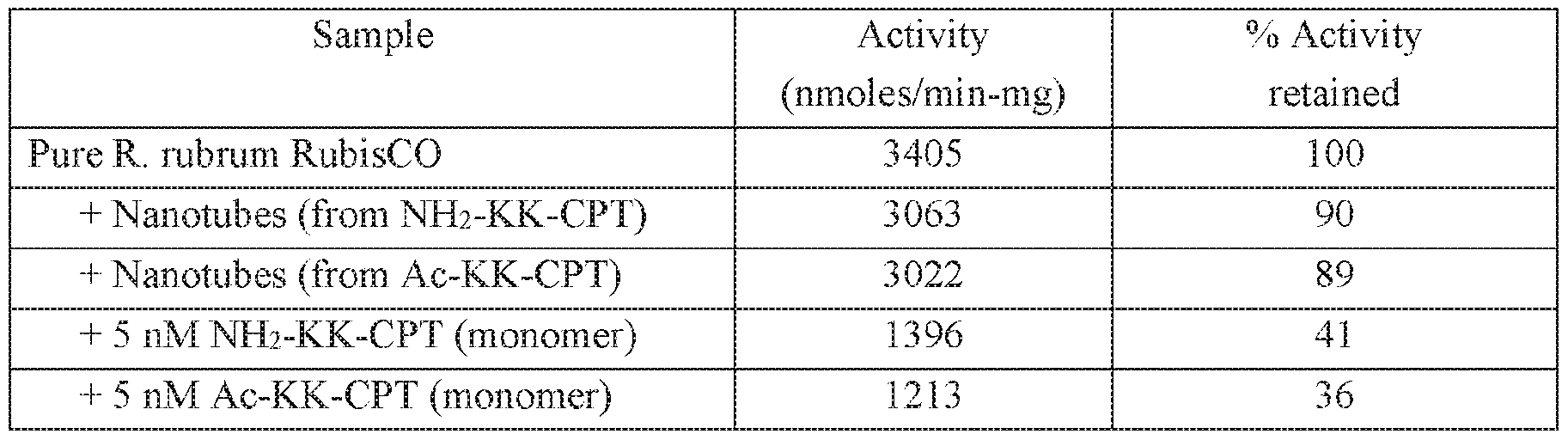
Newer monomer preps were also less soluble
RubisCO activity inhibition by the monomer FMOC-KFKK-Benzene (forms nanofibers)

Final nanofibers (obtained as precipitate after spinning preps at 20000 Xg for 10 min) retained only ~4% activity .
Assembly of RubisCO with "pre-formed" nanotubes gives maximum recovery of activity

Nanotubes for this experiment were set up with 10 mM monomer in 1 mL buffer and aged for ~5 days at room temperature. Nanotubes were then isolated using uitracentrifugation and re-suspended back in 1 mL buffer with 0.1 mg of R. rubrum RubisCO. This suspension was incubated at 1°C for 15 hrs prior to uitracentrifugation and re-suspension of the final nanotubes in 1 mL buffer.
Example 4: Stability to Peptidase, Subtilisin.
Subtilisin is a non-specific, serine protease capable of rapidly degrading proteins by amide bond cleavage. The stability of the nanotube-RubisCO co-assembly to proteolysis by subtilisin was evaluated over 45 minutes and compared to the free R. rubrum RubisCO. As shown in Figure 5, the free enzyme loses 80% of the activity within 45 minutes. In contrast, the bound enzyme retains 75% of its activity upon exposure to the protease over this time range.
The materials and methods of the appended claims are not limited in scope by the specific materials and methods described herein, which are intended as illustrations of a few aspects of the claims and any materials and methods that are functionally equivalent are within the scope of this disclosure. Various modifications of the materials and methods in addition to those shown and described herein are intended to fall within the scope of the appended claims. Further, while only certain representative materials, methods, and aspects of these materials and methods are specifical ly described, other materials and methods and combinations of various features of the materials and methods are intended to fall within the scope of the appended claims, even if not specifically recited. Thus a combination of steps, elements, components, or constituents can be explicitly mentioned herein; however, all other combinations of steps, elements, components, and constituents are included, even though not explicitly stated.
Claims
1. A composition, comprising: a self-assembled nanotube comprising a conjugate comprising hydrophobic compound, a hydrophilic amino acid residue or peptide; and an optional linker moiety joining the hydrophobic compound to the hydrophilic amino acid or peptide, wherein the conjugate forms a self-assembled nanotube, and an enzyme, wherein the enzyme is sequestered in the self-assembled nanotube.
2. The composition of claim 2, wherein the enzyme is RubisCO.
3. The composition of any one of the preceding claims, wherein the hydrophobic compound is benzo[lmn][3,8]phenanthroline-l,3,6,8(2H,7H)-tetraone (NDI).
4. The composition of any one of the preceding claims, wherein the hydrophobic compound is camptothecin.
5. The composition of any one of the preceding claims, wherein the hydrophilic
peptide has from 2 to 9 amino acid residues.
6. The composition of any one of the preceding claims, wherein the hydrophilic
peptide is a dipeptide comprising two protected or unprotected lysine residues.
7. The composition of any one of the preceding claims, wherein the hydrophilic
peptide is a tripeptide comprising at least two protected or unprotected lysine residues.
8. The composition of any one of the preceding claims, wherein the hydrophilic
peptide is a tripeptide comprising one or more of the following hydrophilic amino acid residues protected or unprotected arginyl, histidyl, lysyl, aspartyl, glutamyl, seryl, threonyl, cystyl, asparagyl, glutaminyl, prolyl, tyrosyl, methionyl, and or tryptophanyl.
9. The composition of any one of the preceding claims, wherein the hydrophilic
peptide is a tetrapeptide comprising at least two protected or unprotected lysine residues.
10. The composition of any one of the preceding claims, wherein the hydrophilic peptide is a tetrapeptide comprising the formula Xaa-Xaa-Xbb-Xbb (SliQ ID NO: 1 ), Xaa-Xbb-Xaa-Xbb (SEQ ID NO:2), Xbb-Xbb-Xaa-Xaa (SEQ ID NO:3), or Xbb- Xaa-Xbb-Xaa (SEQ ID NO:4), where each Xaa is independent of the other, a hydrophilic amino acid residue chosen from a protected or unprotected arginyl, histidyl, lysyl, aspartyl, glutamyl, sery!, threonyi, cystyl, asparagyl, glutaminyl, prolyl, tyrosyl, methionyl, and tryptophanyl; and wherein each Xbb is, independent of the others, a non-hydrophilic amino acid chosen from protected or unprotected alanyl , allosoleueyi, arginyl asparagyl, aspartyl, cystyl, glutamyl, glutaminyl, glycyl, histidyl, isolelucyl, ieucyl, lysyl, methionyl, phenylalanyl, prolyl, pyroglutamyl, seryl, threonyi, tyrosyl, tryptophanyl, or valyl.
11. The composition of any one of the preceding claims, wherein the hydrophilic amino acid or peptide is protected at an N terminus or an amino acid residue side chain with a benzoyl oxycarbonyl, tert-butoxycarbonyl, acetate, trifiuoroaeetate, 9~ fluorenylmethyloxycarbonyl, or 2-bromobenzyl oxycarbonyl, or N- hy droxy s iscci ni mi de .
12. The composition of any one of the preceding claims, wherein the hydrophobic
compound is joined to the hydrophilic amino acid residue or peptide at a side chain on the hydrophilic amino acid or peptide.
13. The composition of any one of the preceding claims, wherein the hydrophobic
compound is joined to the hy drophilic amino acid residue or peptide by the linker, which is attached to the hydrophobic compound and a side chain on the hydrophilic amino acid or peptide.
14. The composition of any one of the preceding claims, wherein the linker moiety is from 1 to 20 atoms in length.
15. The composition of any one of the preceding claims, wherein the linker moiety is substitiited or un substituted, branched or unbranched, alkyi, alkenyl, alkynyi, ether, ester, polyether, polyester, polyalkylene, polyamine, heteroatom substituted alkyi, alkenyl, or alkynyi group, cycloalkyl, cycloaikenyl, heterocycioalkyl,
heterocycloalkenyi, where the point of attachment to the hydrophobic drug and/or amino acid residue is an ester, ether, carboxylate, amine, or amide bond.
16. The composition of any one of the preceding claims, wherein the linker moiety comprises— (CH2)m— , wherein m is from 1 to 10, and where the point of attachment to the hydrophobic drug and/or amino acid is an ester, ether, carboxylate, amine, or amide bond.
17. The composition of any one of the preceding claims, wherein the linker moiety
comprises -Xi— (CHj.)m— X2-, wherein m is from 1 to 10, and Xi and X2 are, independent of one another, O O h C( OK), ("( 0)\'H. M L or ().
18. The composition of any one of the preceding claims, wherein the peptide is
protected or unprotected lysyl-lysyl, or protected or unprotected lysyl-phenylalanyl- lysyl-lysyl, and the linker moiety is Ci-Ce alkyldiester.
19. The composition of any one of the preceding claims, further comprising carbonic anhydrase.
20. The composition of any one of the preceding claims, wherein the conjugate forms the self-assembled nanotube at 10 mM in water.
2 . A method of catalyzing the conversion of CO2 into an organic compound
comprising; contacting the composition of any one of the previous claims with CO2.
22. The method of cl aim 21 , wherein the CO2 is in air.
23. The method of claim 21 or 22, wherein the organic compound is acrylic acid.
Priority Applications (1)
| Application Number | Priority Date | Filing Date | Title |
|---|---|---|---|
| US15/739,375 US20180185502A1 (en) | 2015-06-23 | 2016-06-23 | Immobilization of biomolecules by self-assembled nanostructures |
Applications Claiming Priority (2)
| Application Number | Priority Date | Filing Date | Title |
|---|---|---|---|
| US201562183560P | 2015-06-23 | 2015-06-23 | |
| US62/183,560 | 2015-06-23 |
Publications (1)
| Publication Number | Publication Date |
|---|---|
| WO2016210141A1 true WO2016210141A1 (en) | 2016-12-29 |
Family
ID=57586430
Family Applications (1)
| Application Number | Title | Priority Date | Filing Date |
|---|---|---|---|
| PCT/US2016/039034 Ceased WO2016210141A1 (en) | 2015-06-23 | 2016-06-23 | Immobilization of biomolecules by self-assembled nanostructures |
Country Status (2)
| Country | Link |
|---|---|
| US (1) | US20180185502A1 (en) |
| WO (1) | WO2016210141A1 (en) |
Cited By (5)
| Publication number | Priority date | Publication date | Assignee | Title |
|---|---|---|---|---|
| CN109593116A (en) * | 2018-12-20 | 2019-04-09 | 潍坊医学院 | A kind of response type small-molecular peptides nano drug-carrying carrier |
| CN109678931A (en) * | 2018-12-20 | 2019-04-26 | 潍坊医学院 | A kind of response type small-molecular peptides nano drug-carrying carrier |
| US11395820B2 (en) | 2016-03-16 | 2022-07-26 | H. Lee Moffitt Cancer Center And Research Institute, Inc. | Small molecules against cereblon to enhance effector t cell function |
| US11730726B2 (en) | 2018-07-11 | 2023-08-22 | H. Lee Moffitt Cancer Center And Research Institute, Inc. | Dimeric immuno-modulatory compounds against cereblon-based mechanisms |
| US12036286B2 (en) | 2021-03-18 | 2024-07-16 | Seagen Inc. | Selective drug release from internalized conjugates of biologically active compounds |
Families Citing this family (1)
| Publication number | Priority date | Publication date | Assignee | Title |
|---|---|---|---|---|
| CN114249295B (en) * | 2020-09-25 | 2023-04-18 | 中国科学院理化技术研究所 | One-dimensional organic nanotube synthesized through covalent bond or coordination bond and method |
Citations (1)
| Publication number | Priority date | Publication date | Assignee | Title |
|---|---|---|---|---|
| US20140155577A1 (en) * | 2012-12-03 | 2014-06-05 | Ohio State Innovation Foundation | Self-assembly of therapeutic agent-peptide nanostructures |
-
2016
- 2016-06-23 WO PCT/US2016/039034 patent/WO2016210141A1/en not_active Ceased
- 2016-06-23 US US15/739,375 patent/US20180185502A1/en not_active Abandoned
Patent Citations (1)
| Publication number | Priority date | Publication date | Assignee | Title |
|---|---|---|---|---|
| US20140155577A1 (en) * | 2012-12-03 | 2014-06-05 | Ohio State Innovation Foundation | Self-assembly of therapeutic agent-peptide nanostructures |
Non-Patent Citations (1)
| Title |
|---|
| LEE ET AL.: "Spatial organization of enzymes for metabolic engineering.", METAB ENG., vol. 14, no. 3, May 2012 (2012-05-01), pages 242 - 251, XP055340902 * |
Cited By (7)
| Publication number | Priority date | Publication date | Assignee | Title |
|---|---|---|---|---|
| US11395820B2 (en) | 2016-03-16 | 2022-07-26 | H. Lee Moffitt Cancer Center And Research Institute, Inc. | Small molecules against cereblon to enhance effector t cell function |
| US12564583B2 (en) | 2016-03-16 | 2026-03-03 | Lee Moffitt Cancer Center and Research Institute, Inc. | Small molecules against cereblon to enhance effector T cell function |
| US11730726B2 (en) | 2018-07-11 | 2023-08-22 | H. Lee Moffitt Cancer Center And Research Institute, Inc. | Dimeric immuno-modulatory compounds against cereblon-based mechanisms |
| US12233054B2 (en) | 2018-07-11 | 2025-02-25 | H. Lee Moffitt Cancer Center And Research Institute, Inc. | Dimeric immuno-modulatory compounds against cereblon-based mechanisms |
| CN109593116A (en) * | 2018-12-20 | 2019-04-09 | 潍坊医学院 | A kind of response type small-molecular peptides nano drug-carrying carrier |
| CN109678931A (en) * | 2018-12-20 | 2019-04-26 | 潍坊医学院 | A kind of response type small-molecular peptides nano drug-carrying carrier |
| US12036286B2 (en) | 2021-03-18 | 2024-07-16 | Seagen Inc. | Selective drug release from internalized conjugates of biologically active compounds |
Also Published As
| Publication number | Publication date |
|---|---|
| US20180185502A1 (en) | 2018-07-05 |
Similar Documents
| Publication | Publication Date | Title |
|---|---|---|
| US20180185502A1 (en) | Immobilization of biomolecules by self-assembled nanostructures | |
| Ünlü et al. | Enzymes for efficient CO2 conversion | |
| TWI787670B (en) | Peptide compound with cyclic portion and pharmaceutical composition thereof | |
| JP5936627B2 (en) | Liquid cation exchanger | |
| Könst et al. | A study on the applicability of L-aspartate α-decarboxylase in the biobased production of nitrogen containing chemicals | |
| Alfonso et al. | Biocatalytic and biomimetic aminolysis reactions: useful tools for selective transformations on polyfunctional substrates | |
| Bourkaib et al. | N-acylation of L-amino acids in aqueous media: Evaluation of the catalytic performances of Streptomyces ambofaciens aminoacylases | |
| González et al. | Carbonic anhydrases in industrial applications | |
| US20110097781A1 (en) | Immobilized biological material with improved functionality and method for producing the same | |
| Satagopan et al. | Synthetic CO2-fixation enzyme cascades immobilized on self-assembled nanostructures that enhance CO2/O2 selectivity of RubisCO | |
| US20250257376A1 (en) | Generation of acyl alcohols | |
| EP2681326A2 (en) | Preparation of peptide mixtures by protease catalysis designed to provide useful biological and physical properties | |
| CA2744243A1 (en) | Peptide synthesis using enzymatic activation and coupling | |
| Hyeon et al. | Biomimetic magnetoelectric nanocrystals synthesized by polymerization of heme as advanced nanomaterials for biosensing application | |
| Chen et al. | Synthetic strategies for polypeptides and proteins by chemical ligation | |
| CN101845476A (en) | Method for preparing L-tertiary leucine compound by two enzyme system | |
| US20220136016A1 (en) | Modified chloramphenicol acetyltransferase and biosynthesis method of making esters using same | |
| Oike et al. | Process properties of an l-amino acid oxidase from Hebeloma cylindrosporum for the synthesis of phenylpyruvic acid from l-phenylalanine | |
| CN116328840B (en) | A heme-based chimeric oligopeptide-DNA mimetic enzyme and its application | |
| Jiang et al. | Racemization of Amines and Related Derivatives Leading to Their Dynamic Kinetic Resolution | |
| Gayathri et al. | Carbon dioxide capture and bioenergy production by utilizing the biological system | |
| Rogers | A selenocysteine containing αHL for single molecule studies | |
| Canavelli | Prebiotic peptide elongation by the chemoselective ligation of aminonitriles | |
| Ueji et al. | Lyophilization of lipase together with ionic compounds generates highly enantioselective and solvent-sensitive lipase in organic solvents | |
| Pérez | Selective Bioconjugation of Chemical Probes to New Modalities Using Acylases As Biocatalysts |
Legal Events
| Date | Code | Title | Description |
|---|---|---|---|
| 121 | Ep: the epo has been informed by wipo that ep was designated in this application |
Ref document number: 16815309 Country of ref document: EP Kind code of ref document: A1 |
|
| NENP | Non-entry into the national phase |
Ref country code: DE |
|
| 122 | Ep: pct application non-entry in european phase |
Ref document number: 16815309 Country of ref document: EP Kind code of ref document: A1 |