WO2016205798A1 - Selective arylation of dichalcogenides in biomolecules - Google Patents
Selective arylation of dichalcogenides in biomolecules Download PDFInfo
- Publication number
- WO2016205798A1 WO2016205798A1 PCT/US2016/038372 US2016038372W WO2016205798A1 WO 2016205798 A1 WO2016205798 A1 WO 2016205798A1 US 2016038372 W US2016038372 W US 2016038372W WO 2016205798 A1 WO2016205798 A1 WO 2016205798A1
- Authority
- WO
- WIPO (PCT)
- Prior art keywords
- substituted
- radical
- amino acid
- peptide
- natural
- Prior art date
- Legal status (The legal status is an assumption and is not a legal conclusion. Google has not performed a legal analysis and makes no representation as to the accuracy of the status listed.)
- Ceased
Links
- 0 N[C@](C1)*CC1C1=CC=CCC=CC=C1 Chemical compound N[C@](C1)*CC1C1=CC=CCC=CC=C1 0.000 description 15
- GOMAEJQBTWAPAN-UHFFFAOYSA-N CC(C(NC(N1)=O)=O)C1=O Chemical compound CC(C(NC(N1)=O)=O)C1=O GOMAEJQBTWAPAN-UHFFFAOYSA-N 0.000 description 1
- YICAMJWHIUMFDI-UHFFFAOYSA-N CC(Nc1ccc(C)cc1)=O Chemical compound CC(Nc1ccc(C)cc1)=O YICAMJWHIUMFDI-UHFFFAOYSA-N 0.000 description 1
- AHDPZQYTSREXAC-VXNCWWDNSA-N C[C@](CC1)([C@@H](CC2)[C@H]3[C@H]1c1ccc(C)cc1CC3)C2=O Chemical compound C[C@](CC1)([C@@H](CC2)[C@H]3[C@H]1c1ccc(C)cc1CC3)C2=O AHDPZQYTSREXAC-VXNCWWDNSA-N 0.000 description 1
- MZLSNIREOQCDED-UHFFFAOYSA-N Cc(c(F)ccc1)c1F Chemical compound Cc(c(F)ccc1)c1F MZLSNIREOQCDED-UHFFFAOYSA-N 0.000 description 1
- SWLKZHMYZFDCGZ-QMMMGPOBSA-N Cc(c(O)cc([C@@H](C(O)=O)N)c1)c1O Chemical compound Cc(c(O)cc([C@@H](C(O)=O)N)c1)c1O SWLKZHMYZFDCGZ-QMMMGPOBSA-N 0.000 description 1
- OXAOGFXYPMIASX-UHFFFAOYSA-N Cc(c1c(cc2)c(C(c(cc3)ccc3OCCN3CCCCC3)=O)c(-c(cc3)ccc3O)[s]1)c2O Chemical compound Cc(c1c(cc2)c(C(c(cc3)ccc3OCCN3CCCCC3)=O)c(-c(cc3)ccc3O)[s]1)c2O OXAOGFXYPMIASX-UHFFFAOYSA-N 0.000 description 1
- FXFYOPQLGGEACP-UHFFFAOYSA-N Cc(cc1)cc(C=C2)c1OC2=O Chemical compound Cc(cc1)cc(C=C2)c1OC2=O FXFYOPQLGGEACP-UHFFFAOYSA-N 0.000 description 1
- ULKWBVNMJZUEBD-UHFFFAOYSA-N Cc(cc1)ccc1C(N(C)C)=O Chemical compound Cc(cc1)ccc1C(N(C)C)=O ULKWBVNMJZUEBD-UHFFFAOYSA-N 0.000 description 1
- QSSJZLPUHJDYKF-UHFFFAOYSA-N Cc(cc1)ccc1C(OC)=O Chemical compound Cc(cc1)ccc1C(OC)=O QSSJZLPUHJDYKF-UHFFFAOYSA-N 0.000 description 1
- GYVGXEWAOAAJEU-UHFFFAOYSA-N Cc(cc1)ccc1N(C)C Chemical compound Cc(cc1)ccc1N(C)C GYVGXEWAOAAJEU-UHFFFAOYSA-N 0.000 description 1
- DUWYZPORHIKSDF-UHFFFAOYSA-N Cc(cc1)ccc1NCC1=NCCN1 Chemical compound Cc(cc1)ccc1NCC1=NCCN1 DUWYZPORHIKSDF-UHFFFAOYSA-N 0.000 description 1
- MGHKWBQZEBMFOH-UHFFFAOYSA-N Cc1c(C)[o]nc1C Chemical compound Cc1c(C)[o]nc1C MGHKWBQZEBMFOH-UHFFFAOYSA-N 0.000 description 1
- BSQKBHXYEKVKMN-UHFFFAOYSA-N Cc1c(C=O)[s]cc1 Chemical compound Cc1c(C=O)[s]cc1 BSQKBHXYEKVKMN-UHFFFAOYSA-N 0.000 description 1
- UWMWMUANNWRPJA-UHFFFAOYSA-N Cc1c2Oc(cccc3)c3Sc2ccc1 Chemical compound Cc1c2Oc(cccc3)c3Sc2ccc1 UWMWMUANNWRPJA-UHFFFAOYSA-N 0.000 description 1
- XLTFRTTTZWMJJQ-UHFFFAOYSA-N Cc1c2[o]c3ccccc3c2ccc1 Chemical compound Cc1c2[o]c3ccccc3c2ccc1 XLTFRTTTZWMJJQ-UHFFFAOYSA-N 0.000 description 1
- SZQCPPRPWDXLMM-UHFFFAOYSA-N Cc1c[n](C)nc1 Chemical compound Cc1c[n](C)nc1 SZQCPPRPWDXLMM-UHFFFAOYSA-N 0.000 description 1
- QVZIYYPEOJATPO-JTQLQIEISA-N Cc1ccc(C[C@@H](C(OC)=O)N)cc1 Chemical compound Cc1ccc(C[C@@H](C(OC)=O)N)cc1 QVZIYYPEOJATPO-JTQLQIEISA-N 0.000 description 1
- GHPODDMCSOYWNE-UHFFFAOYSA-N Cc1ccc2OCOc2c1 Chemical compound Cc1ccc2OCOc2c1 GHPODDMCSOYWNE-UHFFFAOYSA-N 0.000 description 1
- LCCVYZLUEHOBDC-UHFFFAOYSA-N Cc1cccc(Nc(cccc2)c2C(OC)=O)c1C Chemical compound Cc1cccc(Nc(cccc2)c2C(OC)=O)c1C LCCVYZLUEHOBDC-UHFFFAOYSA-N 0.000 description 1
- QWVGKYWNOKOFNN-UHFFFAOYSA-N Cc1ccccc1O Chemical compound Cc1ccccc1O QWVGKYWNOKOFNN-UHFFFAOYSA-N 0.000 description 1
- PLAZTCDQAHEYBI-UHFFFAOYSA-N Cc1ccccc1[N+]([O-])=O Chemical compound Cc1ccccc1[N+]([O-])=O PLAZTCDQAHEYBI-UHFFFAOYSA-N 0.000 description 1
- BSISCMKMMFLRCW-UHFFFAOYSA-N Cc1cnc(N2CCCCC2)nc1 Chemical compound Cc1cnc(N2CCCCC2)nc1 BSISCMKMMFLRCW-UHFFFAOYSA-N 0.000 description 1
Classifications
-
- A—HUMAN NECESSITIES
- A61—MEDICAL OR VETERINARY SCIENCE; HYGIENE
- A61K—PREPARATIONS FOR MEDICAL, DENTAL OR TOILETRY PURPOSES
- A61K47/00—Medicinal preparations characterised by the non-active ingredients used, e.g. carriers or inert additives; Targeting or modifying agents chemically bound to the active ingredient
- A61K47/50—Medicinal preparations characterised by the non-active ingredients used, e.g. carriers or inert additives; Targeting or modifying agents chemically bound to the active ingredient the non-active ingredient being chemically bound to the active ingredient, e.g. polymer-drug conjugates
- A61K47/51—Medicinal preparations characterised by the non-active ingredients used, e.g. carriers or inert additives; Targeting or modifying agents chemically bound to the active ingredient the non-active ingredient being chemically bound to the active ingredient, e.g. polymer-drug conjugates the non-active ingredient being a modifying agent
- A61K47/68—Medicinal preparations characterised by the non-active ingredients used, e.g. carriers or inert additives; Targeting or modifying agents chemically bound to the active ingredient the non-active ingredient being chemically bound to the active ingredient, e.g. polymer-drug conjugates the non-active ingredient being a modifying agent the modifying agent being an antibody, an immunoglobulin or a fragment thereof, e.g. an Fc-fragment
- A61K47/6835—Medicinal preparations characterised by the non-active ingredients used, e.g. carriers or inert additives; Targeting or modifying agents chemically bound to the active ingredient the non-active ingredient being chemically bound to the active ingredient, e.g. polymer-drug conjugates the non-active ingredient being a modifying agent the modifying agent being an antibody, an immunoglobulin or a fragment thereof, e.g. an Fc-fragment the modifying agent being an antibody or an immunoglobulin bearing at least one antigen-binding site
- A61K47/6851—Medicinal preparations characterised by the non-active ingredients used, e.g. carriers or inert additives; Targeting or modifying agents chemically bound to the active ingredient the non-active ingredient being chemically bound to the active ingredient, e.g. polymer-drug conjugates the non-active ingredient being a modifying agent the modifying agent being an antibody, an immunoglobulin or a fragment thereof, e.g. an Fc-fragment the modifying agent being an antibody or an immunoglobulin bearing at least one antigen-binding site the antibody targeting a determinant of a tumour cell
-
- A—HUMAN NECESSITIES
- A61—MEDICAL OR VETERINARY SCIENCE; HYGIENE
- A61K—PREPARATIONS FOR MEDICAL, DENTAL OR TOILETRY PURPOSES
- A61K38/00—Medicinal preparations containing peptides
- A61K38/04—Peptides having up to 20 amino acids in a fully defined sequence; Derivatives thereof
- A61K38/14—Peptides containing saccharide radicals; Derivatives thereof, e.g. bleomycin, phleomycin, muramylpeptides or vancomycin
-
- A—HUMAN NECESSITIES
- A61—MEDICAL OR VETERINARY SCIENCE; HYGIENE
- A61K—PREPARATIONS FOR MEDICAL, DENTAL OR TOILETRY PURPOSES
- A61K47/00—Medicinal preparations characterised by the non-active ingredients used, e.g. carriers or inert additives; Targeting or modifying agents chemically bound to the active ingredient
- A61K47/50—Medicinal preparations characterised by the non-active ingredients used, e.g. carriers or inert additives; Targeting or modifying agents chemically bound to the active ingredient the non-active ingredient being chemically bound to the active ingredient, e.g. polymer-drug conjugates
- A61K47/51—Medicinal preparations characterised by the non-active ingredients used, e.g. carriers or inert additives; Targeting or modifying agents chemically bound to the active ingredient the non-active ingredient being chemically bound to the active ingredient, e.g. polymer-drug conjugates the non-active ingredient being a modifying agent
- A61K47/62—Medicinal preparations characterised by the non-active ingredients used, e.g. carriers or inert additives; Targeting or modifying agents chemically bound to the active ingredient the non-active ingredient being chemically bound to the active ingredient, e.g. polymer-drug conjugates the non-active ingredient being a modifying agent the modifying agent being a protein, peptide or polyamino acid
- A61K47/64—Drug-peptide, drug-protein or drug-polyamino acid conjugates, i.e. the modifying agent being a peptide, protein or polyamino acid which is covalently bonded or complexed to a therapeutically active agent
-
- C—CHEMISTRY; METALLURGY
- C07—ORGANIC CHEMISTRY
- C07K—PEPTIDES
- C07K1/00—General methods for the preparation of peptides, i.e. processes for the organic chemical preparation of peptides or proteins of any length
- C07K1/107—General methods for the preparation of peptides, i.e. processes for the organic chemical preparation of peptides or proteins of any length by chemical modification of precursor peptides
- C07K1/1072—General methods for the preparation of peptides, i.e. processes for the organic chemical preparation of peptides or proteins of any length by chemical modification of precursor peptides by covalent attachment of residues or functional groups
- C07K1/1075—General methods for the preparation of peptides, i.e. processes for the organic chemical preparation of peptides or proteins of any length by chemical modification of precursor peptides by covalent attachment of residues or functional groups by covalent attachment of amino acids or peptide residues
-
- C—CHEMISTRY; METALLURGY
- C07—ORGANIC CHEMISTRY
- C07K—PEPTIDES
- C07K1/00—General methods for the preparation of peptides, i.e. processes for the organic chemical preparation of peptides or proteins of any length
- C07K1/107—General methods for the preparation of peptides, i.e. processes for the organic chemical preparation of peptides or proteins of any length by chemical modification of precursor peptides
- C07K1/1072—General methods for the preparation of peptides, i.e. processes for the organic chemical preparation of peptides or proteins of any length by chemical modification of precursor peptides by covalent attachment of residues or functional groups
- C07K1/1077—General methods for the preparation of peptides, i.e. processes for the organic chemical preparation of peptides or proteins of any length by chemical modification of precursor peptides by covalent attachment of residues or functional groups by covalent attachment of residues other than amino acids or peptide residues, e.g. sugars, polyols, fatty acids
-
- C—CHEMISTRY; METALLURGY
- C07—ORGANIC CHEMISTRY
- C07K—PEPTIDES
- C07K1/00—General methods for the preparation of peptides, i.e. processes for the organic chemical preparation of peptides or proteins of any length
- C07K1/13—Labelling of peptides
-
- C—CHEMISTRY; METALLURGY
- C07—ORGANIC CHEMISTRY
- C07K—PEPTIDES
- C07K14/00—Peptides having more than 20 amino acids; Gastrins; Somatostatins; Melanotropins; Derivatives thereof
- C07K14/435—Peptides having more than 20 amino acids; Gastrins; Somatostatins; Melanotropins; Derivatives thereof from animals; from humans
- C07K14/46—Peptides having more than 20 amino acids; Gastrins; Somatostatins; Melanotropins; Derivatives thereof from animals; from humans from vertebrates
- C07K14/47—Peptides having more than 20 amino acids; Gastrins; Somatostatins; Melanotropins; Derivatives thereof from animals; from humans from vertebrates from mammals
-
- C—CHEMISTRY; METALLURGY
- C07—ORGANIC CHEMISTRY
- C07K—PEPTIDES
- C07K9/00—Peptides having up to 20 amino acids, containing saccharide radicals and having a fully defined sequence; Derivatives thereof
- C07K9/006—Peptides having up to 20 amino acids, containing saccharide radicals and having a fully defined sequence; Derivatives thereof the peptide sequence being part of a ring structure
- C07K9/008—Peptides having up to 20 amino acids, containing saccharide radicals and having a fully defined sequence; Derivatives thereof the peptide sequence being part of a ring structure directly attached to a hetero atom of the saccharide radical, e.g. actaplanin, avoparcin, ristomycin, vancomycin
Definitions
- Peptide-based technologies have facilitated the elucidation of disease mechanisms and serve as novel and effective therapeutics.
- An emerging theme in biotechnology is to use peptide variants to disrupt protein-protein interactions because compared to small molecules they have a larger surface area for binding, can recognize targets with higher specificity/affinity, and can be generated in weeks by phage display.
- researchers in the field of bioconjugate chemistry have needed well-defined ligation strategies that can be used for the at-will modification of biomolecules.
- Efficient bioconjugation strategies generally involve high levels of functional group tolerance, compatibility with water and other solvents, and efficient conversions (e.g., fast reaction times and high yields).
- Selenocysteine is essential for enzymatic activity in enzymes including glutathione peroxidases, iodothyronine deiodinases, formate dehydrogenases, and methionine-R-sulfoxide reductase. Mutation of the catalytic selenocysteine to cysteine in the aforementioned enzymes results in a decrease in activity of > 100 fold. The inherent nucleophilicity of selenols makes selenocysteine an appealing handle for chemoselective bioconjugation in peptides and proteins. Nevertheless, reports on bioconjugation with this amino acid have been sparse due to several challenges associated with its functionalization.
- a selenol is easily oxidized to the diselenide or seleninic acid.
- selenium is highly polarizable, it can be eliminated to generate dehydroalanine.
- Reports of selenocysteine functionalization have paralleled methods to modify cysteine and relied upon alkylation and maleimide conjugate addition with the selenol group ( Figure 1, Panel (1)).
- a reducing agent i.e., /ra(2-carboxyethyl)phosphine (TCEP)
- TCEP /ra(2-carboxyethyl)phosphine
- the invention relates to a compound comprising substructure I:
- a 1 is H, an amine protecting group, a natural or unnatural amino acid, a peptide, an oligopeptide, a polypeptide, or a protein;
- a 5 is OH, -0(carboxylate protecting group), a natural or unnatural amino acid, a peptide, an oligopeptide, a polypeptide, or a protein; is a substituted or unsubstituted aryl or heteroaryl radical; x is 0, 1, 2, 3, 4, 5, or 6; and
- R is H or alkyl.
- the invention relates to a compound comprising substructure II:
- a 1 is H, an amine protecting group, a natural or unnatural amino acid, a peptide, an oligopeptide, a polypeptide, or a protein;
- a 5 is OH, -0(carboxylate protecting group), a natural or unnatural amino acid, a peptide, an oligopeptide, a polypeptide, or a protein; is a substituted or unsubstituted aryl or heteroaryl radical, provided is not a perfluoroaryl radical; x is 0, 1, 2, 3, 4, 5, or 6; and
- R is H or alkyl.
- the invention relates to a compound comprising substructure III:
- a 1 is H, an amine protecting group, a natural or unnatural amino acid, a peptide, an oligopeptide, a polypeptide, or a protein;
- a 2 , A 3 , and A 4 are selected from the group consisting of a natural amino acid, an unnatural amino acid, and a plurality of natural amino acids or unnatural amino acids;
- a 5 is OH, -0(carboxylate protecting group), a natural or unnatural amino acid, a peptide, an oligopeptide, a polypeptide, or a protein;
- x is 0, 1, 2, 3, 4, 5, or 6; is a substituted or unsubstituted aryl or heteroaryl diradical; and
- R is H or alkyl.
- the invention relates to a compound comprising substructure IV:
- a 1 is H, an amine protecting group, a natural or unnatural amino acid, a peptide, an oligopeptide, a polypeptide, or a protein;
- a 2 , A 3 , and A 4 are selected from the group consisting of a natural amino acid, an unnatural amino acid, and a plurality of natural amino acids or unnatural amino acids;
- a 5 is OH, -0(carboxylate protecting group), a natural or unnatural amino acid, a peptide, an oligopeptide, a polypeptide, or a protein; x is 0, 1, 2, 3, 4, 5, or 6; is a substituted or unsubstituted aryl or heteroaryl diradical, provided is not a perfluoroaryl diradical; and
- R is H or alkyl.
- the invention relates to a compound comprising substructure V or substructure VII:
- a 1 is H, an amine protecting group, a natural or unnatural amino acid, a peptide, an oligopeptide, a polypeptide, or a protein;
- a 2 , A 3 , and A 4 are selected from the group consisting of a natural amino acid, an unnatural amino acid, and a plurality of natural amino acids or unnatural amino acids;
- a 5 is OH, -0(carboxylate protecting group), a natural or unnatural amino acid, a peptide, an oligopeptide, a polypeptide, or a protein; x is 0, 1, 2, 3, 4, 5, or 6; is a substituted or unsubstituted aryl or heteroaryl diradical; and R is H or alkyl.
- the invention relates to a compound comprising substructure VI or substructure VIII:
- a 1 is H, an amine protecting group, a natural or unnatural amino acid, a peptide, an oligopeptide, a polypeptide, or a protein;
- a 2 , A 3 , and A 4 are selected from the group consisting of a natural amino acid, an unnatural amino acid, and a plurality of natural amino acids or unnatural amino acids;
- a 5 is OH, -0(carboxylate protecting group), a natural or unnatural amino acid, a peptide, an oligopeptide, a polypeptide, or a protein; x is 0, 1, 2, 3, 4, 5, or 6; is a substituted or unsubstituted aryl or heteroaryl diradical, provided is not a perfluoroaryl diradical; and
- R is H or alkyl.
- the invention relates to a hybrid composition, wherein the hybrid composition comprises a linker, any one of the aforementioned compounds, and a detectable moiety; and the linker links the compound to the detectable moiety.
- the invention relates to a hybrid composition, wherein the hybrid composition comprises a linker, any one of the aforementioned compounds, and a biomolecule; and the linker links the compound to the biomolecule.
- the invention relates to a peptide, an oligopeptide, a polypeptide, or a protein, wherein the peptide, oligopeptides, polypeptide, or protein comprises substructure I, substructure II, substructure III, substructure IV, substructure V, substructure VI, substructure VII, or substructure VIII.
- the invention relates to an affibody comprising substructure I, substructure II, substructure III, substructure IV, substructure V, substructure VI, substructure VII, or substructure VIII. In certain embodiments, the invention relates to a method according to Scheme 1:
- a 1 is H, an amine protecting group, a natural or unnatural amino acid, a peptide, an oligopeptide, a polypeptide, or a protein;
- a 2 , A 3 , and A 4 are selected from the group consisting of a natural amino acid, an unnatural amino acid, and a plurality of natural amino acids or unnatural amino acids;
- a 5 is OH, -0(carboxylate protecting group), a natural or unnatural amino acid, a peptide, an oligopeptide, a polypeptide, or a protein; x is 0, 1, 2, 3, 4, 5, or 6;
- aryl or heteroaryl diradical is a heteroaromatic moiety substituted with an electron withdrawing group; x is 0, 1, 2, 3, 4, 5, or 6; and R is H or alkyl.
- the invention relates to a method according to Scheme 2:
- a 1 is H, an amine protecting group, a natural or unnatural amino acid, a peptide, an oligopeptide, a polypeptide, or a protein;
- a 2 , A 3 , and A 4 are selected from the group consisting of a natural amino acid, an unnatural amino acid, and a plurality of natural amino acids or unnatural amino acids;
- a 5 is OH, -0(carboxylate protecting group), a natural or unnatural amino acid, a peptide, an oligopeptide, a polypeptide, or a protein; x is 0, 1, 2, 3, 4, 5, or 6; is not a perfluoroaryl radical; is a substituted or unsubstituted aryl or heteroaryl diradical, provided is not a perfluoroaryl radical; is a heteroaromatic moiety substituted with an electron withdrawing group; x is 0, 1, 2, 3, 4, 5, or 6; and R is H or alkyl.
- the invention relates to a method according to Scheme 3:
- a 1 is H, an amine protecting group, a natural or unnatural amino acid, a peptide, an oligopeptide, a polypeptide, or a protein;
- a 2 , A 3 , and A 4 are selected from the group consisting of a natural amino acid, an unnatural amino acid, and a plurality of natural amino acids or unnatural amino acids;
- a 5 is OH, -0(carboxylate protecting group), a natural or unnatural amino acid, a peptide, an oligopeptide, a polypeptide, or a protein; x is 0, 1, 2, 3, 4, 5, or 6; is an aryl or heteroaryl radical substituted with at least one electron donating group; is a substituted aryl or heteroaryl diradical substituted with at least one electron donating group; is a heteroaromatic moiety substituted with an electron withdrawing group; x is 0, 1, 2, 3, 4, 5, or 6; and R is H or alkyl.
- the invention relates to a method according to Scheme 4:
- a 1 is H, an amine protecting group, a natural or unnatural amino acid, a peptide, an oligopeptide, a polypeptide, or a protein;
- a 2 , A 3 , and A 4 are selected from the group consisting of a natural amino acid, an unnatural amino acid, and a plurality of natural amino acids or unnatural amino acids;
- a 5 is OH, -0(carboxylate protecting group), a natural or unnatural amino acid, a peptide, an oligopeptide, a polypeptide, or a protein; x is 0, 1, 2, 3, 4, 5, or 6; B 2B
- x is 0, 1, 2, 3, 4, 5, or 6;
- R is H or alkyl.
- the invention relates to a method according to Scheme 5:
- a 1 is H, an amine protecting group, a natural or unnatural amino acid, a peptide, an oligopeptide, a polypeptide, or a protein;
- a 2 , A 3 , and A 4 are selected from the group consisting of a natural amino acid, an unnatural amino acid, and a plurality of natural amino acids or unnatural amino acids;
- a 5 is OH, -0(carboxylate protecting group), a natural or unnatural amino acid, a peptide, an oligopeptide, a polypeptide, or a protein; x is 0, 1, 2, 3, 4, 5, or 6; is not a perfluoroaryl radical; is a substituted or unsubstituted aryl or heteroaryl diradical, provided is not a perfluoroaryl radical; is a heteroaromatic moiety substituted with an electron withdrawing group; x is 0, 1, 2, 3, 4, 5, or 6; and R is H or alkyl.
- the invention relates to a method according to Scheme 6:
- a 1 is H, an amine protecting group, a natural or unnatural amino acid, a peptide, an oligopeptide, a polypeptide, or a protein;
- a 2 , A 3 , and A 4 are selected from the group consisting of a natural amino acid, an unnatural amino acid, and a plurality of natural amino acids or unnatural amino acids;
- a 5 is OH, -0(carboxylate protecting group), a natural or unnatural amino acid, a peptide, an oligopeptide, a polypeptide, or a protein; x is 0, 1, 2, 3, 4, 5, or 6; l or heteroaryl radical substituted with at least one electron donating group, p rovided is not a perfluoroaryl radical; is an aryl or heteroaryl diradical substituted with at least one electron donating group, provided a perfluoroaryl radical; is a heteroaromatic moiety substituted with an electron withdrawing group; x is 0, 1, 2, 3, 4, 5, or 6; and R is H or alkyl.
- the invention relates to a method according to Scheme 7:
- a 1 is H, an amine protecting group, a natural or unnatural amino acid, a peptide, oligopeptide, a polypeptide, or a protein;
- a 2 , A 3 , and A 4 are selected from the group consisting of a natural amino acid, unnatural amino acid, and a plurality of natural amino acids or unnatural amino acids;
- a 5 is OH, -0(carboxylate protecting group), a natural or unnatural amino acid peptide, an oligopeptide, a polypeptide, or a protein;
- x is 0, 1, 2, 3, 4, 5, or 6; is an aryl or heteroaryl radical substituted with at least one electron donating group; is a substituted aryl or heteroaryl diradical substituted with at least one electron donating group; is a heteroaromatic moiety substituted with an electron withdrawing group; x is 0, 1, 2, 3, 4, 5, or 6; and
- R is H or alkyl.
- the invention relates to a method according to Scheme 8:
- a 1 is H, an amine protecting group, a natural or unnatural amino acid, a peptide, an oligopeptide, a polypeptide, or a protein;
- a 2 , A 3 , and A 4 are selected from the group consisting of a natural amino acid, an unnatural amino acid, and a plurality of natural amino acids or unnatural amino acids;
- a 5 is OH, -0(carboxylate protecting group), a natural or unnatural amino acid, a peptide, an oligopeptide, a polypeptide, or a protein;
- x is 0, 1, 2, 3, 4, 5, or 6, l or heteroaryl radical substituted with at least one electron donating group, p rovided is not a perfluoroaryl radical; is an aryl or heteroaryl diradical substituted with at least one electron donating group, provided a perfluoroaryl radical; is a heteroaromatic moiety substituted with an electron withdrawing group;
- x is 0, 1, 2, 3, 4, 5, or 6; and
- R is H or alkyl.
- the invention relates to a method of killing or inhibiting the growth or proliferation of a bacterium, a fungus, a virus, or a parasite, comprising the step of: contacting with the bacterium, fungus, virus, or parasite an effective amount of any one of the aforementioned compounds, thereby treating killing or inhibiting the growth or proliferation of the bacterium, fungus, virus, or parasite.
- the invention relates to a method of treating a disease in a subject in need thereof comprising the step of: administering to the subject an effective amount of any one of the aforementioned compounds, thereby treating the disease.
- Figure 1 depicts three panels ((l)-(3)) showing reaction schemes comparing the bioconjugation of cysteine (panel (1)) and selenocysteine (panel (2)).
- the proposed reaction pathway of the reaction shown in panel (2) is shown in panel (3).
- Figure 2 depicts a table summarizing reaction conditions and % yield for various arylation reactions.
- Amino acids are shown in a one-letter code.
- R no reaction.
- TIC total ion currents
- c Elimination and diselenide were the only observable products.
- rf 0.5 mM CuS0 4 , 0.5 mM L2, and 0.5 mM boronic acid were used.
- e 0.25 mM CuS0 4 , 0.25 mM L2, and 0.25 mM boronic acid were used. • 'Selenocysteine-T P residue replaced with a serine.
- 3 ⁇ 4elenocysteine-2-thiol-5-nitropyridine residue replaced with a cysteine.
- 'Selenocysteine-2-thiol-5-nitropyridine residue replaced with a methionine.
- Figure 3 depicts five panels (a-e) summarizing reaction substrates, boronic acids, and yields for various arylation reactions.
- ⁇ Amino acids are shown in a one-letter code.
- d 2 mM CuS0 4 , 2 mM L2, and 2 mM boronic acid were used.
- Panel a shows the yield of peptides 4a-41 using aryl boronic acids.
- Panel b shows the yield of peptides 5a-5j using heteroaryl boronic acids.
- Panel c shows the yields of peptides 6a-6e using various biorelevant aryl boronic acids.
- Panel d shows a reaction scheme and an LCMS trace of arylated peptide 8 in the product mixture.
- Panel e shows a reaction scheme and an LCMS trace of starting material 9 in the product mixture.
- Figure 4 depicts data from a stability study of functionalized selenocysteine in peptides. % yields determined by integration of total ion currents (TIC) from LC-MS analysis of the unpurified reaction mixture.
- TIC total ion currents
- Figure 5A depicts the yield of Dha elimination product (%) at pH 8.0 for various selenocysteine peptides at 37 °C (left bar) and at room temperature (about 23 °C) (right bar).
- Figure 5B depicts the yield of Dha elimination product (%) at pH 10.0 for various selenocysteine peptides at 37 °C (left bar) and at room temperature (about 23 °C) (right bar).
- Figure 6 depicts a reaction scheme showing a competition experiment between a functionalized selenocysteine-containing peptide (top starting material) and a functionalized cysteine-containing peptide (bottom starting material).
- the mole ratio of product peptides is 90: 10 Se:S.
- Figure 7 depicts two applications of the various Cu-catalyzed reactions of the invention: peptide stapling with a bis-boronic acid (top) and macrocyclization (bottom).
- Figure 8 depicts an application of the various reactions of the invention: tagging of a biologically active peptide with a pharmaceutical or natural product.
- Figure 9 depicts various pharmaceuticals and biologically active natural products containing electron-rich aromatic rings suitable for conjugation to a selenocysteine- containing peptide.
- Figure 10 depicts various pharmaceuticals and biologically active natural products containing electron-rich aromatic rings suitable for conjugation to a selenocysteine- containing peptide.
- Figure 11 depicts various pharmaceuticals and biologically active natural products containing electron-rich aromatic rings suitable for conjugation to a selenocysteine- containing peptide.
- Figure 12 depicts a reaction scheme and % yield for various arylation reactions using substituted aromatic groups or substituted or unsubstituted indoles in the presence of CuSC catalyst (top yields), and in the absence of a metal catalyst and ligand (bottom yields).
- Figure 13 depicts a reaction scheme and % yield for various arylation reactions using substituted or unsubstituted heteroaromatic groups, natural products, or pharmaceuticals in the presence of CuSCvcatalyst (top yields), and in the absence of a metal catalyst and ligand (bottom yields).
- Figure 14 depicts a reaction scheme and % yield for various arylation reactions using natural products or pharmaceuticals in the presence of CuSCvcatalyst (top yields), and in the absence of a metal catalyst and ligand (bottom yields).
- Figure 15 depicts (top) a reaction scheme showing the Cu-catalyzed arylation of a peptide containing a protected cysteine residue near its N-terminus, and (bottom) a reaction scheme showing the Rh-catalyzed arylation of a peptide containing a protected cysteine residue in the middle of its sequence.
- Figure 16 depicts (top) a reaction scheme showing the Cu-catalyzed arylation of symmetrically Se-Se-coupled peptides containing selenocysteine residues near their N- termini, and (bottom) a reaction scheme showing the Rh-catalyzed arylation of symmetrically Se-Se-coupled peptides containing selenocysteine residues in the middle of their sequences.
- Figure 17 depicts (top) a reaction scheme showing the Cu-catalyzed arylation of symmetrically S-S-coupled peptides containing cysteine residues near their N-termini, and (bottom) a reaction scheme showing the Rh-catalyzed arylation of symmetrically S-S- coupled peptides containing cysteine residues in the middle of their sequences.
- Figure 18 depicts (top) a reaction scheme showing the metal-catalyzed arylation of symmetrically S-S-coupled peptides containing cysteine residues, and (bottom) the yields of these reactions in the presence of various Ir or Ru metal-catalysts.
- Figure 19 depicts (top) a reaction scheme showing that glutathione (GSH, a tripeptide), which is found in 5 mM concentration in animal cells, can promote dissociation of the native drug or natural product by reduction of the C-Se bond; (bottom) shows a bar graph depicting the amount of starting material remaining after the exposure to GSH at room temperature or 37 °C for 3 h.
- GSH glutathione
- Figure 20 depicts (top) a reaction scheme showing the conditions for conjugating vancomycin to a model peptide, and (bottom) the reaction conditions, structure of vancomycin, and reaction yield by LC-MS.
- Figure 21 depicts (top) a reaction scheme showing the conditions for conjugating vancomycin to an antibacterial peptide, and (bottom) a table of various peptide sequences (note, the first two sequences are random sequences with no reported antibacterial activity) that have been conjugated to vancomycin and screened against the gram positive and gram negative bacteria in Table 3.
- Figure 22A depicts various antibacterial sequences conjugated to vancomycin, and the results of screening the conjugates against gram-positive strains.
- Figure 22B depicts various antibacterial sequences conjugated to vancomycin, and the results of screening the conjugates against gram-negative strains.
- Figure 23 depicts (top) a reaction scheme showing the conditions for conjugating small molecules to a polyglycine-containing peptide, and (bottom) various Ar-H moieties to be conjugated.
- Figure 24 depicts a schematic representation of the process of sortase-tagging an antibody with a peptide-drug conjugate.
- Figure 25 depicts a schematic representation of making a peptide-drug conjugate and then sortase-tagging an antibody with the peptide-drug conjugate.
- Figure 26 depicts a reaction scheme showing the conditions for cyclizing a model peptide.
- Figure 27 depicts a reaction scheme showing the conditions for cyclizing an HIV-1 capsid with selenocysteine.
- Figure 28 a reaction scheme showing the conditions for attempting to cyclize a peptide lacking tryptophan.
- Figure 29 depicts a reaction scheme showing the conditions for cyclizing an HIV-1 capsid with cysteine.
- Figure 30 depicts a reaction scheme showing the formation of disulfide starting material (e.g., the disulfide shown in Figure 29) on a resin. Cleavage with 95:5 TFA:H 2 0 at 60 °C for 45 min provides completely cyclized material in 60% yield after FfPLC purification.
- Figure 31A depicts the structure of the phallotoxins.
- Figure 31B depicts the structure of the amatoxins.
- Figure 32A depicts a reaction scheme and reactants for copper-mediated arylation of disulfide-containing peptides.
- Figure 32B depicts a reaction scheme and reactants for rhodium-mediated arylation of disulfide-containing peptides.
- Figure 33 depicts a reaction scheme and concentrations of reactants for rhodium- catalyzed arylation of a disulfide-containing peptide.
- Figure 34 depicts a reaction scheme showing the arylation of a cysteine disulfide. The ability to affect functionalization with only one equivalent of rhodium has important implications for functionalization of antibodies without prior reduction.
- Figure 35 depicts (top) a reaction scheme showing the metal-free arylation of mixed disulfides, and (bottom) various reagents and yields.
- Figure 36 depicts (top) a reaction scheme showing the copper-catalyzed arylation of a disulfide, and (bottom) the results of this reaction with disulfides having varying sequences.
- Figure 37 depicts the results of the reaction depicted in Figure 36 when the position of the disulfide is varied within the peptide.
- Figure 38 depicts (top) a reaction scheme showing the copper-catalyzed arylation of a disulfide, and (bottom) various boronic acid arylating agents.
- Figure 39 depicts a reaction scheme and % yield for various arylation reactions using substituted aromatic or heteroaromatic groups in the presence of CuSC catalyst (top yields), and in the absence of a metal catalyst and ligand (bottom yields).
- the invention relates to the discovery and subsequent development of a new chemical transformation for the conjugation of unprotected peptide biomolecules.
- This process features several significant advantages over existing methods of peptide modifications such as specificity towards selenocysteine over other nucleophiles (e.g., amines, hydroxyls), excellent functional group tolerance, and mild reaction conditions. While the reaction times normally vary depending on the concentration and chemical identity of the peptide, the reaction conditions usually can be optimized where full conversion is accomplished within 1-6 hours.
- this method is employed for synthesis of functionalized peptides, "stapled” peptides, macrocyclized peptides, or heterocoupled peptide systems.
- this methodology is useful for producing hybrid biomaterials featuring other biomolecules such as DNA, RNA, PNA, proteins, oligosaccharides, and a combination of thereof.
- the hybrid biomaterials are useful for cell penetration and intracellular targeting.
- the invention relates to organic polymer-peptide conjugates, peptides decorated with functional small-molecules (such as fluorescent dye labels), natural products or small-molecule drugs (such as antibacterial agents, antifungal agents, antiviral agents, anticonvulsant agents, and antipsychotic agents), inorganic MRI, radio-contrast agents, and also various functionalized metal-based nanoparticle scaffolds.
- functional small-molecules such as fluorescent dye labels
- natural products or small-molecule drugs such as antibacterial agents, antifungal agents, antiviral agents, anticonvulsant agents, and antipsychotic agents
- inorganic MRI such as radio-contrast agents, and also various functionalized metal-based nanoparticle scaffolds.
- the invention employs an Umpolung approach that utilizes the electrophilic character of the oxidized selenocysteine together with a copper, ligand, and nucleophilic boronic acid combination to provide the arylated selenocysteine in unprotected peptides (Figure 1, Panel (2)). While not wishing to be bound by any particular theory, the proposed reaction pathway involves an initial oxidative addition of copper to the Se-S bond ( Figure 1, Panel (3)). A subsequent transmetalation with an arylboronic acid and reductive elimination furnishes the arylated selenocysteine.
- reaction yields are excellent for a wide range of substrates.
- this approach is selective for selenocysteine over cysteine.
- 2-thiol-5-nitropyridine protected selenocysteine (1) is used as a starting material, as it is the reaction product from the deprotection of /?-methoxybenzyl protecting group in solid-phase peptide synthesis.
- the invention relates to a reaction methodology applicable to a wide variety of substrates. See Figure 3. Aryl boronic acids with electron-donating functional groups were examined (Figure 3, Panel a). Methoxy (4b), ortho-phenol (4c), dioxolane (4d), -CH 2 N(H)Boc (4e), and /?ara-dimethylamine (4f) groups were readily tolerated. Under these reaction conditions, Boc deprotection was not observed (4e), thus demonstrating the mild conditions needed to achieve the arylation.
- the invention relates to a method of functionalizing a selenocysteine residue using an aryl boronic acid having an electron-withdrawing functional group (Figure 3, Panel a).
- Figure 3, Panel a Despite the decreased nucleophilicity of these electron-poor boronic acids, the corresponding selenium conjugates were formed in good to excellent yield.
- the number of equivalents of the Cu/L and boronic acid needed to be increased to provide full conversion to product while suppressing side reactions.
- Ester (4g), amide (4h), nitro (4i), nitrile (4j), and halogen (4k and 41) functional groups were compatible with these conditions.
- Peptide 41 was formed quantitatively despite 2,6-difluorophenyl boronic acid having the tendency to undergo protodeboronation under basic conditions.
- the invention relates to a method of functionalizing a selenocysteine residue using a heteroaryl boronic acid (Figure 3, Panel b).
- a heteroaryl boronic acid Figure 3, Panel b.
- Known bioactivities comprising heterocycles makes heterocycles an important class of molecules for conjugation to selenocysteine.
- the arylation of five-membered heterocycles such as indole (5a and 5b), benzofuran (5c), pyrazole (5d), 2, 5 -di substituted isoxazole (5e), and thiophene (5f and 5g) proceeded with excellent yields.
- Six-membered heterocycles, such as dibenzofuran (5h), phenoxathiine (5i), and pyrimidine (5j) likewise furnished the corresponding conjugate in greater than 90% yield.
- the invention relates to the functionalization of selenocysteine-containing peptides with biorelevant molecules (Figure 3, Panel c).
- the linking of protected phenylalanine and coumarin proceeded in good yield (6a and 6b respectively).
- the boronic acids of anti-inflammatory drugs tolfenamic ester and paracetamol furnished the corresponding conjugates in moderate to good yields (6c and 6d respectively).
- estrone was coupled to selenium in moderate yield (6e).
- the invention relates to a robust, selective reaction.
- peptide 7 was prepared; peptide 7 contains most of the key functional groups found in polyamides (e.g., histidine, arginine, aspartic acid, tyrosine, and asparagine) excluding sulfur-based amino acids (Figure 3, Panel d). Exposure of 7 to 2,6-difluorophenyl boronic acid under reaction conditions provided the corresponding arylated product (8) in quantitative yield based on LC-MS analysis. No other peptidic species were observed (see LC-MS trace, Figure 3, Panel d).
- the invention relates to peptides comprising aryl- functionalized selenocysteine.
- the stability of these aryl conjugates relative to the corresponding benzylated variant under basic conditions was investigated. In a pH 8.0 buffered solution at room temperature or 37 °C, neither the arylated nor alkylated selenocysteine peptide underwent elimination to dehydroalanine (la, Dha) even after 11 hours.
- Figure 5A However, in a buffered solution at pH 10.0, appreciable amounts of elimination were observed for both the alkylated and arylated derivatives depending on the substituent on the selenium.
- Figure 5B In a buffered solution at pH 10.0, appreciable amounts of elimination were observed for both the alkylated and arylated derivatives depending on the substituent on the selenium.
- the invention relates to peptides comprising aryl- functionalized selenocysteine that are relatively stable under oxidative conditions. Exposure of these peptide derivatives to a large excess of H 2 0 2 (10 mM) at room temperature lead to the formation of varying amounts of dehydroalanine (la) depending on the R-group on the selenocysteine ( Figure 4). In general, the arylated selenocysteine derivatives were less prone to oxidation/elimination than the benzylated selenocysteine (4n).
- the invention relates to the ability to stabilize the arylated selenocysteine by modulating the electronic nature of the arene substituent.
- the invention relates to a compound comprising substructure I:
- a 1 is H, an amine protecting group, a natural or unnatural amino acid, a peptide, an oligopeptide, a polypeptide, or a protein
- a 5 is OH, -0(carboxylate protecting group), a natural or unnatural amino acid, a peptide, an oligopeptide, a polypeptide, or a protein
- x is 0, 1, 2, 3, 4, 5, or 6
- R is H or alkyl.
- the invention relates to a compound comprising substructure II:
- a 1 is H, an amine protecting group, a natural or unnatural amino acid, a peptide, an oligopeptide, a polypeptide, or a protein;
- a 5 is OH, -0(carboxylate protecting group), a natural or unnatural amino acid, a peptide, an oligopeptide, a polypeptide, or a protein; i s a substituted or unsubstituted aryl or heteroaryl radical, provided [ s not a perfluoroaryl radical; x is 0, 1, 2, 3, 4, 5, or 6; and
- R is H or alkyl.
- the invention relates to any one of the aforementioned compounds, wherein the compound is depicted in the Figures.
- the invention relates to any one of the aforementioned substituted aryl radical. In certain embodiments, the invention relates to any one of the aforementioned compounds, wherein is a substituted phenyl radical.
- the invention relates to any one of the aforementioned compound is an unsubstituted aryl radical.
- the invention relates to any one of the aforementioned compounds, wherein a substituted heteroaryl radical. In certain embodiments, the invention relates to any one of the aforementioned compounds, wherein is a substituted indole, pyrazolo, thiophene, pyrimidine, benzofuran, or isoxazole radical.
- the invention relates to any one of the aforementioned compounds, wherein an unsubstituted heteroaryl radical. In certain embodiments, the invention relates to any one of the aforementioned compounds, wherein is an unsubstituted indole, pyrazolo, thiophene, pyrimidine, benzofuran, or isoxazole radical.
- the invention relates to any one of the aforementioned
- the invention relates to any one of the aforementioned
- stereoisomer thereof is any of the aforementioned moieties, wherein the moiety is further substituted.
- the invention relates to any one of the aforementioned compounds, wherein a substituted aryl radical. In certain embodiments, the invention relates to a ny one of the aforementioned compounds, wherein is a substituted phenyl radical. In certain embodiments, the invention relates to any one of the aforementioned compound is an unsubstituted aryl radical.
- the invention relates to any one of the aforementioned compounds, wherein a substituted heteroaryl radical. In certain embodiments, the invention relates to any one of the aforementioned compounds, wherein is a substituted indole, pyrazolo, thiophene, pyrimidine, benzofuran, or isoxazole radical.
- the invention relates to any one of the aforementioned compounds, wherein an unsubstituted heteroaryl radical. In certain embodiments, the invention relates to any one of the aforementioned compounds, wherein is an unsubstituted indole, pyrazolo, thiophene, pyrimidine, benzofuran, or isoxazole radical.
- the invention relates to any one of the aforementioned
- the invention relates to any one of the aforementioned
- stereoisomer thereof is any of the aforementioned moieties, wherein the moiety is further substituted.
- the invention relates to any one of the aforementioned compounds, wherein the compound is a compound comprising substructure I; and none of A 1 and A 5 comprises selenocysteine.
- the invention relates to any one of the aforementioned compounds, wherein the compound is a compound comprising substructure I; and one or more of A 1 and A 5 comprises arginine, cysteine, histidine, lysine, aspartic acid, glutamic acid, serine, threonine, asparagine, glutamine, glycine, proline, alanine, valine, isoleucine, leucine, methionine, phenylalanine, tyrosine, or tryptophan.
- the invention relates to any one of the aforementioned compounds, wherein the compound is a compound comprising substructure II; and none of A 1 and A 5 comprises cysteine.
- the invention relates to any one of the aforementioned compounds, wherein the compound is a compound comprising substructure II; and one or more of A 1 and A 5 comprises arginine, histidine, lysine, aspartic acid, glutamic acid, serine, threonine, asparagine, glutamine, glycine, proline, alanine, valine, isoleucine, leucine, methionine, phenylalanine, tyrosine, or tryptophan.
- the invention relates to any one of the aforementioned compounds, wherein A 1 is an amine protecting group selected from the group consisting of an N,0-acetal, allyloxycarbonyl (Aloe), benzyl (Bn), benzyloxycarbonyl (Cbz), benzyloxymethyl (BOM), t-butoxycarbonyl (Boc), t-butyldimethylsilyl (TBDMS), t- butyldiphenylsilyl (TBDPS), diphenylmethyl, diphenylmethylene, ethoxycarbonyl, 9- fluorenylmethoxycarbonyl (Fmoc), /?-methoxybenzyl (PMB), methoxycarbonyl, methoxymethyl (MOM), /?-methoxyphenyl (PMP), /?-nitrocinnamyloxycarbonyl (Noc), tosyl (Ts), 2-tosylethoxycarbonyl (Aloe
- the invention relates to any one of the aforementioned compounds, wherein A 5 is -0(carboxylate protecting group), wherein the carboxylate protecting group is selected from the group consisting of allyl, benzyl, benzyloxymethyl (BOM), t-Bu, t-butyldimethylsilyl (TBDMS), t-butyldiphenylsilyl (TBDPS), diphenylmethyl, 9-fluorenylmethyl (Fm), 2-methoxyethoxymethyl (MEM), methoxymethyl (MOM), /?-nitrobenzyl (PNB), an ester, a 1,3-oxazoline, pi valoyloxy methyl (Pom), 2- tosylethyl (TSE), 2,2,2-trichloroethyl (TCE), triethylsilyl (TES), trimethylsilyl (TMS), 2- (trimethylsilyl)ethoxymethyl (SEM), or 2-(tri(carboxy
- the invention relates to any one of the aforementioned compounds, wherein A 1 or A 5 is an antimicrobial peptide, such as a compound comprising magainin/pexiganan (a 22-amino acid linear peptide that may be isolated from the skin of the African clawed frog ⁇ Xenopus laevis)), omiganan (a cationic peptide that may be derived from indolicidin), OP- 145 (a 24-mer peptide that may be derived from LL-37 that may bind to lipopolysaccharides or lipoteichoic acid), novexatin (a cyclic cationic peptide of 1093 Da), LTX-109 (Lytixar, a membrane-degrading peptide), NVB302 (a class B lantibiotic), MU1140 (a lantibiotic), arenicin (a 21-mer that is rich in arginine and hydrophobic amino acids), avidocin (a 22-a
- a 1 or A 5 is an antimicrobial peptide described in Fox, J.L. Nature Biotechnology 2013, 31, 5, 379 or Arnusch, C.J. et al. PLoS ONE 2012, 7(6), e39768.
- the invention relates to any one of the aforementioned compounds, wherein R is H.
- the invention relates to any one of the aforementioned compounds, wherein x is 1, 2, or 3. In certain embodiments, the invention relates to any one of the aforementioned compounds, wherein x is 1.
- the invention relates to any one of the compounds described herein.
- the invention relates to a compound comprising substructure III:
- a 1 is H, an amine protecting group, a natural or unnatural amino acid, a peptide, an oligopeptide, a polypeptide, or a protein;
- a 2 , A 3 , and A 4 are selected from the group consisting of a natural amino acid, an unnatural amino acid, and a plurality of natural amino acids or unnatural amino acids;
- a 5 is OH, -0(carboxylate protecting group), a natural or unnatural amino acid, a peptide, an oligopeptide, a polypeptide, or a protein; x is 0, 1, 2, 3, 4, 5, or 6; is a substituted or unsubstituted aryl or heteroaryl diradical; and R is H or alkyl.
- the invention relates to a compound comprising substructure IV:
- a 1 is H, an amine protecting group, a natural or unnatural amino acid, a peptide, an oligopeptide, a polypeptide, or a protein;
- a 2 , A 3 , and A 4 are selected from the group consisting of a natural amino acid, an unnatural amino acid, and a plurality of natural amino acids or unnatural amino acids;
- a 5 is OH, -0(carboxylate protecting group), a natural or unnatural amino acid, a peptide, an oligopeptide, a polypeptide, or a protein; x is 0, 1, 2, 3, 4, 5, or 6; is a substituted or unsubstituted aryl or heteroaryl diradical, provided is not a perfluoroaryl diradical; and
- R is H or alkyl.
- the invention relates to a compound compri substructure V or substructure VII:
- a 1 is H, an amine protecting group, a natural or unnatural amino acid, a peptide, an oligopeptide, a polypeptide, or a protein;
- a 2 , A 3 , and A 4 are selected from the group consisting of a natural amino acid, an unnatural amino acid, and a plurality of natural amino acids or unnatural amino acids;
- a 5 is OH, -0(carboxylate protecting group), a natural or unnatural amino acid, a peptide, an oligopeptide, a polypeptide, or a protein; x is 0, 1, 2, 3, 4, 5, or 6; is a substituted or unsubstituted aryl or heteroaryl diradical; and R is H or alkyl.
- the invention relates to a compound comprising substructure VI or substructure VIII:
- a 1 is H, an amine protecting group, a natural or unnatural amino acid, a peptide, an oligopeptide, a polypeptide, or a protein;
- a 2 , A 3 , and A 4 are selected from the group consisting of a natural amino acid, an unnatural amino acid, and a plurality of natural amino acids or unnatural amino acids;
- a 5 is OH, -0(carboxylate protecting group), a natural or unnatural amino acid, a peptide, an oligopeptide, a polypeptide, or a protein; x is 0, 1, 2, 3, 4, 5, or 6; is a substituted or unsubstituted aryl or heteroaryl diradical, provided is not a perfluoroaryl diradical; and
- R is H or alkyl.
- the invention relates to any one of the aforementioned compounds, wherein the compound is depicted in the Figures. In certain embodiments, the invention relates to any one of the aforementioned compounds, wherein A 2 , A 3 , and A 4 are natural or unnatural amino acids.
- the invention relates to any one of the aforementioned compounds, wherein A 2 represents one natural or unnatural amino acid. In certain embodiments, the invention relates to any one of the aforementioned compounds, wherein A 3 represents one natural or unnatural amino acid. In certain embodiments, the invention relates to any one of the aforementioned compounds, wherein A 4 represents one natural or unnatural amino acid.
- the invention relates to any one of the aforementioned compounds, wherein A 2 represents two natural or unnatural amino acids. In certain embodiments, the invention relates to any one of the aforementioned compounds, wherein A 3 represents two natural or unnatural amino acids. In certain embodiments, the invention relates to any one of the aforementioned compounds, wherein A 4 represents two natural or unnatural amino acids.
- the invention relates to any one of the aforementioned compounds, wherein A 2 represents three natural or unnatural amino acids. In certain embodiments, the invention relates to any one of the aforementioned compounds, wherein A 3 represents three natural or unnatural amino acids. In certain embodiments, the invention relates to any one of the aforementioned compounds, wherein A 4 represents three natural or unnatural amino acids.
- the invention relates to any one of the aforementioned compounds, wherein the compound is a compound comprising substructure III, V, or VII; and none of A 1 , A 2 , A 3 , A 4 , and A 5 comprises selenocysteine.
- the invention relates to any one of the aforementioned compounds, wherein the compound is a compound comprising substructure III, V, or VII; and one or more of A 1 , A 2 , A 3 , A 4 , and A 5 comprises arginine, cysteine, histidine, lysine, aspartic acid, glutamic acid, serine, threonine, asparagine, glutamine, glycine, proline, alanine, valine, isoleucine, leucine, methionine, phenylalanine, tyrosine, or tryptophan.
- the invention relates to any one of the aforementioned compounds, wherein the compound is a compound comprising substructure IV, VI, or VIII; and none of A 1 , A 2 , A 3 , A 4 , and A 5 comprises cysteine.
- the invention relates to any one of the aforementioned compounds, wherein the compound is a compound comprising substructure IV, VI, or VIII; and one or more of A 1 , A 2 , A 3 , A 4 , and A 5 comprises arginine, histidine, lysine, aspartic acid, glutamic acid, serine, threonine, asparagine, glutamine, glycine, proline, alanine, valine, isoleucine, leucine, methionine, phenylalanine, tyrosine, or tryptophan.
- the invention relates to any one of the aforementioned compounds, wherein A 1 is an amine protecting group selected from the group consisting of an N,0-acetal, allyloxycarbonyl (Aloe), benzyl (Bn), benzyloxycarbonyl (Cbz), benzyloxymethyl (BOM), t-butoxycarbonyl (Boc), t-butyldimethylsilyl (TBDMS), t- butyldiphenylsilyl (TBDPS), diphenylmethyl, diphenylmethylene, ethoxycarbonyl, 9- fluorenylmethoxycarbonyl (Fmoc), /?-methoxybenzyl (PMB), methoxycarbonyl, methoxymethyl (MOM), /?-methoxyphenyl (PMP), /?-nitrocinnamyloxycarbonyl (Noc), tosyl (Ts), 2-tosylethoxycarbonyl (Aloe
- the invention relates to any one of the aforementioned compounds, wherein A 5 is -0(carboxylate protecting group); and the carboxylate protecting group is selected from the group consisting of allyl, benzyl, benzyloxymethyl (BOM), t-Bu, t-butyldimethylsilyl (TBDMS), t-butyldiphenylsilyl (TBDPS), diphenylmethyl, 9- fluorenylmethyl (Fm), 2-methoxyethoxymethyl (MEM), methoxymethyl (MOM), p- nitrobenzyl (P B), an ester, a 1,3-oxazoline, pi valoyloxy methyl (Pom), 2-tosylethyl (TSE), 2,2,2-trichloroethyl (TCE), triethylsilyl (TES), trimethylsilyl (TMS), 2- (trimethylsilyl)ethoxymethyl (SEM), or 2-(trimethyl
- the invention relates to any one of the aforementioned compounds, wherein A 1 or A 5 is an antimicrobial peptide, such as a compound comprising magainin/pexiganan (a 22-amino acid linear peptide that may be isolated from the skin of the African clawed frog ⁇ Xenopus laevis)), omiganan (a cationic peptide that may be derived from indolicidin), OP- 145 (a 24-mer peptide that may be derived from LL-37 that may bind to lipopolysaccharides or lipoteichoic acid), novexatin (a cyclic cationic peptide of 1093 Da), LTX-109 (Lytixar, a membrane-degrading peptide), NVB302 (a class B lantibiotic), MU1140 (a lantibiotic), arenicin (a 21-mer that is rich in arginine and hydrophobic amino acids), avidocin (a 22-a
- a 1 or A 5 is an antimicrobial peptide described in Fox, J.L. Nature Biotechnology 2013, 31, 5, 379 or Arnusch, C.J. et al. PLoS ONE 2012, 7(6), e39768.
- the invention relates to any one of the aforementioned compounds, wherein is a substituted aryl diradical. In certain embodiments, the invention relates to any one of the aforementioned compounds, wherein is a substituted phenyl diradical. In certain embodiments, the invention relates to any one of the aforementioned compound is an unsubstituted aryl diradical.
- the invention relates to any one of the aforementioned compounds, wherein is a substituted heteroaryl diradical.
- the invention relates to any one of the aforementioned compounds, is a substituted indole, pyrazolo, thiophene, pyrimidine, benzofuran, or isoxazole diradical.
- the invention relates to any one of the aforementioned compounds, wherein is an unsubstituted heteroaryl diradical. In certain embodiments, the invention relates to any one of the aforementioned compounds, wherein
- ( ) is an unsubstituted indole, pyrazolo, thiophene, pyrimidine, benzofuran, or isoxazole diradical.
- the invention relates to any one of the aforementioned compounds, wher is a substituted aryl diradical. In certain embodiments, the invention relates to any one of the aforementioned compounds, wherein is a substituted phenyl diradical.
- the invention relates to any one of the aforementioned compounds, wherein is 1,4-disubstituted phenylene, l,4-disubstituted-2,5- dimethy lpheny 1 ene, 1 , 3 -di sub stituted- 5 -fluorophenyl ene, 1,4-di sub stituted-2, 5 - difluorophenylene, l,4-disubstituted-2,5-bis(trifluoromethyl)phenylene, 4,4'-disubstituted- ⁇ , -biphenylene, 4,4'-disubstituted-oxy(l,l '-bisphenylene), or 4,4'-disubstituted-oxy(l,l '- bis(3-methylphenylene)).
- the invention relates to any one of the aforementioned compound is an unsubstituted aryl diradical. In certain embodiments, the invention relates to any one of the aforementioned compounds, wherein is a substituted heteroaryl diradical. In certain embodiments, the invention relates to any one of the aforementioned compounds, wherei is a substituted indole, pyrazolo, thiophene, pyrimidine, benzofuran, or isoxazole diradical.
- the invention relates to any one of the aforementioned compounds, wherein is an unsubstituted heteroaryl diradical. In certain embodiments, the invention relates to any one of the aforementioned compounds, wherein an unsubstituted indole, pyrazolo, thiophene, pyrimidine, benzofuran, or isoxazole diradical.
- the invention relates to any one of the aforementioned compounds, wherein R is H.
- the invention relates to any one of the aforementioned compounds, wherein x is 1, 2, or 3. In certain embodiments, the invention relates to any one of the aforementioned compounds, wherein x is 1.
- the invention relates to any one of the compounds described herein.
- the invention relates to a hybrid composition, wherein the hybrid composition comprises a linker, any one of the aforementioned compounds, and a detectable moiety; and the linker links the compound to the detectable moiety.
- the invention relates to any one of the aforementioned hybrid compositions, wherein the detectable moiety is a fluorescent moiety, a dye moiety, a radionuclide, or an MRI contrast agent.
- the invention relates to a hybrid composition, wherein the hybrid composition comprises a linker, any one of the aforementioned compounds, and a biomolecule; and the linker links the compound to the biomolecule.
- the invention relates to any one of the aforementioned hybrid compositions, wherein the biomolecule is a protein.
- the invention relates to any one of the aforementioned hybrid compositions, wherein the biomolecule is DNA or RNA.
- the invention relates to any one of the aforementioned hybrid compositions, wherein the biomolecule is siRNA.
- the invention relates to any one of the hybrid compositions described herein.
- peptides exemplary peptides, oligopeptides, polypeptides, and proteins
- the invention relates to a peptide, an oligopeptide, a polypeptide, or a protein, wherein the peptide, oligopeptides, polypeptide, or protein comprises substructure I, substructure II, substructure III, substructure IV, substructure V, substructure VI, substructure VII, or substructure VIII.
- the invention relates to a peptide, an oligopeptide, a polypeptide, or a protein, wherein the peptide, oligopeptides, polypeptide, or protein comprises a plurality of substructures selected from the group consisting of substructure I, substructure II, substructure III, substructure IV, substructure V, substructure VI, substructure VII, or substructure VIII.
- the invention relates to any one of the peptides, oligopeptides, polypeptides, or proteins described herein.
- the invention relates to an affibody comprising substructure I, substructure II, substructure III, substructure IV, substructure V, substructure VI, substructure VII, or substructure VIII.
- the invention relates to an affibody comprising a plurality of substructures selected from the group consisting of substructure I, substructure II, substructure III, substructure IV, substructure V, substructure VI, substructure VII, or substructure VIII.
- the term "affibody” refers to a small protein composed of alpha helices.
- the affibody is engineered to bind a target protein or target peptide with high affinity.
- affibodies are antibody mimetics.
- affibodies lack disulfide bridges.
- the affibody comprises a three-helix bundle.
- the affibody has a molar mass of less than about 8 kDa. In certain embodiments, the affibody has a molar mass of about 6 kDa.
- the invention relates to any one of the affibodies described herein.
- the invention relates to a method according to Scheme 1:
- a 1 is H, an amine protecting group, a natural or unnatural amino acid, a peptide, an oligopeptide, a polypeptide, or a protein;
- a 2 , A 3 , and A 4 are selected from the group consisting of a natural amino acid, an unnatural amino acid, and a plurality of natural amino acids or unnatural amino acids;
- a 5 is OH, -0(carboxylate protecting group), a natural or unnatural amino acid, a peptide, an oligopeptide, a polypeptide, or a protein; x is 0, 1, 2, 3, 4, 5, or 6; is a substituted or unsubstituted aryl or heteroaryl radical;
- aryl or heteroaryl diradical is a heteroaromatic moiety substituted with an electron withdrawing group; x is 0, 1, 2, 3, 4, 5, or 6; and R is H or alkyl.
- the invention relates to a method according to Scheme 2
- a 1 is H, an amine protecting group, a natural or unnatural amino acid, a peptide, an oligopeptide, a polypeptide, or a protein;
- a 2 , A 3 , and A 4 are selected from the group consisting of a natural amino acid, an unnatural amino acid, and a plurality of natural amino acids or unnatural amino acids;
- a 5 is OH, -0(carboxylate protecting group), a natural or unnatural amino acid, a peptide, an oligopeptide, a polypeptide, or a protein; x is 0, 1, 2, 3, 4, 5, or 6; is a substituted or unsubstituted aryl or heteroaryl radical, provided not a perfluoroaryl radical; is a substituted or unsubstituted aryl or heteroaryl diradical, provided is not a perfluoroaryl radical; is a heteroaromatic moiety substituted with an electron withdrawing group; x is 0, 1, 2, 3, 4, 5, or 6; and R is H or alkyl.
- the invention relates to a method according to Scheme 3:
- a 1 is H, an amine protecting group, a natural or unnatural amino acid, a peptide, an oligopeptide, a polypeptide, or a protein;
- a 2 , A 3 , and A 4 are selected from the group consisting of a natural amino acid, an unnatural amino acid, and a plurality of natural amino acids or unnatural amino acids;
- a 5 is OH, -0(carboxylate protecting group), a natural or unnatural amino acid, a peptide, an oligopeptide, a polypeptide, or a protein; x is 0, 1, 2, 3, 4, 5, or 6; is an aryl or heteroaryl radical substituted with at least one electron donating group; is a substituted aryl or heteroaryl diradical substituted with at least one electron donating group; is a heteroaromatic moiety substituted with an electron withdrawing group; x is 0, 1, 2, 3, 4, 5, or 6; and
- R is H or alkyl.
- the invention relates to a method according to Scheme 4:
- a 1 is H, an amine protecting group, a natural or unnatural amino acid, a peptide, an oligopeptide, a polypeptide, or a protein;
- a 2 , A 3 , and A 4 are selected from the group consisting of a natural amino acid, an unnatural amino acid, and a plurality of natural amino acids or unnatural amino acids;
- a 5 is OH, -0(carboxylate protecting group), a natural or unnatural amino acid, a peptide, an oligopeptide, a polypeptide, or a protein;
- x is 0, 1, 2, 3, 4, 5, or 6;
- l or heteroaryl radical substituted with at least one electron donating group, p rovided is not a perfluoroaryl radical; is an aryl or heteroaryl diradical substituted with at least one electron donating group, provided a perfluoroaryl radical; is a heteroaromatic moiety substituted with an electron withdrawing group; xisO, 1,2,3,4, 5, or 6; and
- R is H or alkyl.
- the invention relates to a method accordin
- a 1 is H, an amine protecting group, a natural or unnatural amino acid, a peptide, an oligopeptide, a polypeptide, or a protein;
- a 2 , A 3 , and A 4 are selected from the group consisting of a natural amino acid, an unnatural amino acid, and a plurality of natural amino acids or unnatural amino acids;
- a 5 is OH, -0(carboxylate protecting group), a natural or unnatural amino acid, a peptide, an oligopeptide, a polypeptide, or a protein; x is 0, 1, 2, 3, 4, 5, or 6; is a substituted or unsubstituted aryl or heteroaryl radical, provided not a perfluoroaryl radical; is a substituted or unsubstituted aryl or heteroaryl diradical, provided is not a perfluoroaryl radical; is a heteroaromatic moiety substituted with an electron withdrawing group; x is 0, 1, 2, 3, 4, 5, or 6; and R is H or alkyl.
- the invention relates to a method according to Scheme 6:
- a 1 is H, an amine protecting group, a natural or unnatural amino acid, a peptide, an oligopeptide, a polypeptide, or a protein;
- a 2 , A 3 , and A 4 are selected from the group consisting of a natural amino acid, an unnatural amino acid, and a plurality of natural amino acids or unnatural amino acids;
- a 5 is OH, -0(carboxylate protecting group), a natural or unnatural amino acid, a peptide, an oligopeptide, a polypeptide, or a protein; x is 0, 1, 2, 3, 4, 5, or 6; B 2B
- x is 0, 1, 2, 3, 4, 5, or 6;
- R is H or alkyl.
- the invention relates to a method according to Scheme 7:
- a 1 is H, an amine protecting group, a natural or unnatural amino acid, a peptide, an oligopeptide, a polypeptide, or a protein;
- a 2 , A 3 , and A 4 are selected from the group consisting of a natural amino acid, an unnatural amino acid, and a plurality of natural amino acids or unnatural amino acids;
- a 5 is OH, -0(carboxylate protecting group), a natural or unnatural amino acid, a peptide, an oligopeptide, a polypeptide, or a protein; x is 0, 1, 2, 3, 4, 5, or 6; is an aryl or heteroaryl radical substituted with at least one electron donating group; is a substituted aryl or heteroaryl diradical substituted with at least one electron donating group; is a heteroaromatic moiety substituted with an electron withdrawing group; x is 0, 1, 2, 3, 4, 5, or 6; and R is H or alkyl.
- the invention relates to a method according to Scheme 8:
- a 1 is H, an amine protecting group, a natural or unnatural amino acid, a peptide, an oligopeptide, a polypeptide, or a protein;
- a 2 , A 3 , and A 4 are selected from the group consisting of a natural amino acid, an unnatural amino acid, and a plurality of natural amino acids or unnatural amino acids;
- a 5 is OH, -0(carboxylate protecting group), a natural or unnatural amino acid, a peptide, an oligopeptide, a polypeptide, or a protein; x is 0, 1, 2, 3, 4, 5, or 6; l or heteroaryl radical substituted with at least one electron donating group, p rovided is not a perfluoroaryl radical; is an aryl or heteroaryl diradical substituted with at least one electron donating group, provided a perfluoroaryl radical; is a heteroaromatic moiety substituted with an electron withdrawing group; x is 0, 1, 2, 3, 4, 5, or 6; and R is H or alkyl.
- the invention relates to any one of the aforementioned methods, wherein the product is a hybrid biopolymer.
- the invention relates to any one of the aforementioned
- the invention relates to any one of the aforementioned methods, whe is a substituted phenyl radical.
- the invention relates to any one of the aforementioned
- the invention relates to any one of the aforementioned methods, wherein is a substituted heteroaryl radical. In certain embodiments, the invention relates to any one of the aforementioned methods, wherein a substituted indole, pyrazolo, thiophene, pyrimidine, benzofuran, or isoxazole radical.
- the invention relates to any one of the aforementioned methods, wherein an unsubstituted heteroaryl radical. In certain embodiments, the invention relates to any one of the aforementioned methods, wherein is an unsubstituted indole, pyrazolo, thiophene, pyrimidine, benzofuran, or isoxazole radical.
- the invention relates to any one of the aforementioned
- the invention relates to any one of the aforementioned
- the invention relates to any one of the aforementioned methods, wherein a substituted aryl radical. In certain embodiments, the invention relates to any one of the aforementioned methods, whe is a substituted phenyl radical.
- the invention relates to any one of the aforementioned methods, wherein an unsubstituted aryl radical. In certain embodiments, the invention relates to any one of the aforementioned methods, wherein is a substituted heteroaryl radical. In certain embodiments, the invention relates to any one of the aforementioned methods, wherein a substituted indole, pyrazolo, thiophene, pyrimidine, benzofuran, or isoxazole radical.
- the invention relates to any one of the aforementioned methods, wherein an unsubstituted heteroaryl radical. In certain embodiments, the invention relates to any one of the aforementioned methods, wherein is an unsubstituted indole, pyrazolo, thiophene, pyrimidine, benzofuran, or isoxazole radical.
- the invention relates to any one of the aforementioned
- the invention relates to any one of the aforementioned
- the invention relates to any one of the aforementioned methods, wherein a substituted aryl radical. In certain embodiments, the invention relates to any one of the aforementioned methods, whe is a substituted phenyl radical.
- the invention relates to any one of the aforementioned methods, wherein is a substituted heteroaryl radical. In certain embodiments, the invention relates to any one of the aforementioned methods, wherein a substituted indole, pyrazolo, thiophene, pyrimidine, benzofuran, or isoxazole radical. In certain embodiments, the invention relates to any one of the aforementioned
- ertain embodiments is any of the aforementioned moieties, wherein the moiety is further substituted.
- the invention relates to any one of the aforementioned methods, wherein a substituted aryl radical. In certain embodiments, the invention relates to any one of the aforementioned methods, wherein is a substituted phenyl radical.
- the invention relates to any one of the aforementioned methods, wherein is a substituted heteroaryl radical. In certain embodiments, the invention relates to any one of the aforementioned methods, wherein a substituted indole, pyrazolo, thiophene, pyrimidine, benzofuran, or isoxazole radical.
- the invention relates to any one of the aforementioned
- the invention relates to any one of the aforementioned methods, wherein A 2 , A 3 , and A 4 are natural or unnatural amino acids.
- the invention relates to any one of the aforementioned methods, wherein A 2 represents one natural or unnatural amino acid. In certain embodiments, the invention relates to any one of the aforementioned methods, wherein A 3 represents one natural or unnatural amino acid. In certain embodiments, the invention relates to any one of the aforementioned methods, wherein A 4 represents one natural or unnatural amino acid.
- the invention relates to any one of the aforementioned methods, wherein A 2 represents two natural or unnatural amino acids. In certain embodiments, the invention relates to any one of the aforementioned methods, wherein A 3 represents two natural or unnatural amino acids. In certain embodiments, the invention relates to any one of the aforementioned methods, wherein A 4 represents two natural or unnatural amino acids.
- the invention relates to any one of the aforementioned methods, wherein A 2 represents three natural or unnatural amino acids. In certain embodiments, the invention relates to any one of the aforementioned methods, wherein A 3 represents three natural or unnatural amino acids. In certain embodiments, the invention relates to any one of the aforementioned methods, wherein A 4 represents three natural or unnatural amino acids.
- the invention relates to any one of the aforementioned methods, wherein the first solvent, the second solvent, the third solvent, the fourth solvent, the fifth solvent, the sixth solvent, the seventh solvent, or the eighth solvent is water, DMF, CH 3 CN, CH 3 CH 2 OH, CH 3 OH, DMSO, tris(2-carboxyethyl)phosphine (TCEP), dibutyl ether, tetrahydrofuran (THF), 1,4-dioxane, DME, dichloromethane, dichloroethane, acetone, diethyl ether, hexanes, or a mixture thereof.
- TCEP tris(2-carboxyethyl)phosphine
- THF tetrahydrofuran
- DME dichloromethane
- dichloroethane acetone
- diethyl ether hexanes, or a mixture thereof.
- the invention relates to any one of the aforementioned methods, wherein the first buffer, the second buffer, the third buffer, the fourth buffer, the fifth buffer, the sixth buffer, the seventh buffer, or the eighth buffer comprises Na 3 P0 4 , MES, or tris(hydroxymethyl)aminomethane (TRIS).
- the first buffer, the second buffer, the third buffer, the fourth buffer, the fifth buffer, the sixth buffer, the seventh buffer, or the eighth buffer comprises Na 3 P0 4 , MES, or tris(hydroxymethyl)aminomethane (TRIS).
- the invention relates to any one of the aforementioned methods, wherein the first time, the second time, the third time, the fourth time, the fifth time, the sixth time, the seventh time, or the eighth time is from about 30 min to about 24 h.
- the invention relates to any one of the aforementioned methods, wherein the first time, the second time, the third time, the fourth time, the fifth time, the sixth time, the seventh time, or the eighth time is about 30 min, about 40 min, about 50 min, about 1 h, about 2 h, about 3 h, about 4 h, about 5 h, about 6 h, about 7 h, about 8 h, about 9 h, about 10 h, about 11 h, about 12 h, about 13 h, about 14 h, or about 15 h.
- the invention relates to any one of the aforementioned methods, wherein A 1 is an amine protecting group selected from the group consisting of an N,0-acetal, allyloxycarbonyl (Aloe), benzyl (Bn), benzyloxycarbonyl (Cbz), benzyloxymethyl (BOM), t-butoxycarbonyl (Boc), t-butyldimethylsilyl (TBDMS), t- butyldiphenylsilyl (TBDPS), diphenylmethyl, diphenylmethylene, ethoxycarbonyl, 9- fluorenylmethoxycarbonyl (Fmoc), /?-methoxybenzyl (PMB), methoxycarbonyl, methoxymethyl (MOM), /?-methoxyphenyl (PMP), /?-nitrocinnamyloxycarbonyl (Noc), tosyl (Ts), 2-tosylethoxycarbonyl (Aloe
- the invention relates to any one of the aforementioned methods, wherein A 5 is -0(carboxylate protecting group); and the carboxylate protecting group is selected from the group consisting of allyl, benzyl, benzyloxymethyl (BOM), t-Bu, t-butyldimethylsilyl (TBDMS), t-butyldiphenylsilyl (TBDPS), diphenylmethyl, 9- fluorenylmethyl (Fm), 2-methoxyethoxymethyl (MEM), methoxymethyl (MOM), p- nitrobenzyl (P B), an ester, a 1,3-oxazoline, pi valoyloxy methyl (Pom), 2-tosylethyl (TSE), 2,2,2-trichloroethyl (TCE), triethylsilyl (TES), trimethylsilyl (TMS), 2- (trimethylsilyl)ethoxymethyl (SEM), or 2-(trimethyl
- the invention relates to any one of the aforementioned methods, wherein R is H.
- the invention relates to any one of the aforementioned methods, wherein x is 1, 2, or 3. In certain embodiments, the invention relates to any one of the aforementioned methods, wherein x is 1.
- the invention relates to any one of the aforementioned methods, wherein the first, second, third, fourth, fifth, sixth, seventh, or eighth temperature is between about 10°C and about 50 °C. In certain embodiments, the invention relates to any one of the aforementioned methods, wherein the first, second, third, fourth, fifth, sixth, seventh, or eighth temperature is about 10 °C, about 11 °C, about 12 °C, about 13 °C, about 14 °C, about 15 °C, about 16 °C, about 17 °C, about 18 °C, about 19 °C, about 20 °C, about 21 °C, about 22 °C, about 23 °C, about 24 °C, about 25 °C, about 26 °C, about 27 °C, about 28 °C, about 29 °C, about 30 °C, about 31 °C, about 32 °C, about 33 °C, about 34 °C, about 35 °C, about 36 °C, about
- the invention relates to any one of the aforementioned methods, wherein the Cu/ligand comprises CuS0 4 . In certain embodiments, the invention relates to any one of the aforementioned methods, wherein the Cu/ligand comprises a substituted or unsubstituted bipyridine ligand or a substituted or unsubstituted phenanthroline ligand. In certain embodiments, the invention relates to any one of the aforementioned methods, wherein the Cu/ligand comprises 4,4'-di-tert-butyl-2,2'-bipy.
- the invention relates to any one of the aforementioned methods, wherein the Rh/ligand comprises [RhCp*Cl2]2-
- the invention relates to any one of the aforementioned methods, wherein the catalytic metal is not Cu or Rh or absent, but comprises Fe, Co, Ni, Au, Pd, Pt, Ru, or Ir. In certain embodiments, the invention relates to any one of the aforementioned methods, wherein the catalytic metal is not Cu or Rh or absent, but is selected from the group consisting of Fe, Co, Ni, Au, Pd, Pt, Ru, and Ir.
- the reactions typically proceed at mild temperatures and pressures to give high yields of the product.
- yields of desired products greater than 45%, greater than 75%, greater than 80%, greater than 85%, greater than 90%, or greater than 95% may be obtained from reactions at mild temperatures according to the invention.
- the reactions take place under an inert atmosphere of a gas such as nitrogen or argon.
- the reaction processes of the invention can be conducted in continuous, semi- continuous or batch fashion and may involve a liquid recycle operation as desired.
- the processes of this invention are preferably conducted in batch fashion.
- the manner or order of addition of the reaction ingredients, base, and solvent are not generally critical to the success of the reaction, and may be accomplished in any conventional fashion.
- the reaction can be conducted in a single reaction zone or in a plurality of reaction zones, in series or in parallel or it may be conducted batchwise or continuously in an elongated tubular zone or series of such zones.
- the materials of construction employed should be inert to the starting materials during the reaction and the fabrication of the equipment should be able to withstand the reaction temperatures and pressures.
- Means to introduce and/or adjust the quantity of starting materials or ingredients introduced batchwise or continuously into the reaction zone during the course of the reaction can be conveniently utilized in the processes especially to maintain the desired molar ratio of the starting materials.
- the reaction steps may be effected by the incremental addition of one of the starting materials to the other.
- the starting materials can be separated from the product and then recycled back into the reaction zone.
- the processes may be conducted in glass lined, stainless steel, fluoropolymer coated (e.g., Teflon coated) or similar type reaction equipment.
- the reaction zone may be fitted with one or more internal and/or external heat exchanger(s) in order to control undue temperature fluctuations, or to prevent any possible "runaway" reaction temperatures.
- one or more of the reactants can be immobilized on or incorporated into a polymer or other insoluble matrix by, for example, derivatization with one or more of the substituents of the aryl group or an amino acid residue.
- the subject methods can be used as part of combinatorial synthesis schemes to yield libraries of compounds. Accordingly, another aspect of the invention relates to use of the subject method to generate variegated libraries of compounds, and to the libraries themselves.
- the libraries can be soluble or linked to insoluble supports, e.g., through a substituent of a reactant (prior to carrying out a reaction of the invention).
- the invention relates to a method of killing or inhibiting the growth or proliferation of a bacterium, a fungus, a virus, or a parasite, comprising the step of: contacting with the bacterium, fungus, virus, or parasite an effective amount of any one of the aforementioned compounds, thereby treating killing or inhibiting the growth or proliferation of the bacterium, fungus, virus, or parasite.
- the invention relates to a method of treating a disease in a subject in need thereof comprising the step of: administering to the subject an effective amount of any one of the aforementioned compounds, thereby treating the disease.
- the invention relates to any one of the aforementioned methods, wherein the disease is an infection, for example, a bacterial infection, a fungal infection, a viral infection, or a parasitic infection.
- the disease is an infection, for example, a bacterial infection, a fungal infection, a viral infection, or a parasitic infection.
- the invention relates to any one of the aforementioned methods, wherein the disease is cancer.
- the invention relates to any one of the aforementioned methods, wherein the disease is selected from the group consisting of breast cancer, prostate cancer, lymphoma, skin cancer, pancreatic cancer, colon cancer, melanoma, malignant melanoma, ovarian cancer, brain cancer, primary brain carcinoma, head-neck cancer, glioma, glioblastoma, liver cancer, bladder cancer, non-small cell lung cancer, head or neck carcinoma, breast carcinoma, ovarian carcinoma, lung carcinoma, small-cell lung carcinoma, Wilms' tumor, cervical carcinoma, testicular carcinoma, bladder carcinoma, pancreatic carcinoma, stomach carcinoma, colon carcinoma, prostatic carcinoma, genitourinary carcinoma, thyroid carcinoma, esophageal carcinoma, myeloma, multiple myeloma, adrenal carcinoma, renal cell carcinoma, endometrial carcinoma, adrenal cortex carcinoma, malignant pancreatic insulinoma, mal
- the invention relates to any one of the aforementioned methods, further comprising the step of: monitoring the cell or the subject by 19 F MR.
- a subject in need thereof may include, for example, a subject who has been diagnosed with any one of the aforementioned diseases, or a subject who has been treated for any one of the aforementioned diseases, including subjects that have been refractory to the previous treatment.
- the subject pharmaceutical compositions of the present invention will incorporate the substance or substances to be delivered in an amount sufficient to deliver to a patient a therapeutically effective amount of an incorporated therapeutic agent or other material as part of a prophylactic or therapeutic treatment.
- concentration of the active agent will depend on absorption, inactivation, and excretion rates of the drug as well as the delivery rate of the compound. It is to be noted that dosage values may also vary with the severity of the condition to be alleviated. It is to be further understood that for any particular subject, specific dosage regimens should be adjusted over time according to the individual need and the professional judgment of the person administering or supervising the administration of the compositions. Typically, dosing will be determined using techniques known to one skilled in the art.
- the dosage of the subject agent may be determined by reference to the plasma concentrations of the agent.
- the maximum plasma concentration (Cma X ) and the area under the plasma concentration-time curve from time 0 to infinity (AUC (0-4)) may be used.
- Dosages for the present invention include those that produce the above values for Cmax and AUC (0-4) and other dosages resulting in larger or smaller values for those parameters.
- Actual dosage levels of the active ingredients in the pharmaceutical compositions of this invention may be varied so as to obtain an amount of the active ingredient which is effective to achieve the desired therapeutic response for a particular patient, composition, and mode of administration, without being toxic to the patient.
- the selected dosage level will depend upon a variety of factors including the activity of the particular agent employed, the route of administration, the time of administration, the rate of excretion or metabolism of the particular compound being employed, the duration of the treatment, other drugs, compounds and/or materials used in combination with the particular compound employed, the age, sex, weight, condition, general health and prior medical history of the patient being treated, and like factors well known in the medical arts.
- a physician or veterinarian having ordinary skill in the art can readily determine and prescribe the effective amount of the pharmaceutical composition required.
- the physician or veterinarian could prescribe and/or administer doses of the agents of the invention employed in the pharmaceutical composition at levels lower than that required in order to achieve the desired therapeutic effect and gradually increase the dosage until the desired effect is achieved.
- a suitable daily dose of an agent of the invention will be that amount of the agent which is the lowest dose effective to produce a therapeutic effect. Such an effective dose will generally depend upon the factors described above.
- the effective daily dose of the agent may be administered as two, three, four, five, six or more sub-doses administered separately at appropriate intervals throughout the day, optionally, in unit dosage forms.
- the precise time of administration and amount of any particular agent that will yield the most effective treatment in a given patient will depend upon the activity, pharmacokinetics, and bioavailability of a particular agent, physiological condition of the patient (including age, sex, disease type and stage, general physical condition, responsiveness to a given dosage and type of medication), route of administration, and the like.
- the guidelines presented herein may be used to optimize the treatment, e.g., determining the optimum time and/or amount of administration, which will require no more than routine experimentation consisting of monitoring the subject and adjusting the dosage and/or timing.
- the health of the subject may be monitored by measuring one or more of the relevant indices at predetermined times during a 24-hour period. All aspects of the treatment, including supplements, amounts, times of administration and formulation, may be optimized according to the results of such monitoring.
- the patient may be periodically reevaluated to determine the extent of improvement by measuring the same parameters, the first such reevaluation typically occurring at the end of four weeks from the onset of therapy, and subsequent reevaluations occurring every four to eight weeks during therapy and then every three months thereafter. Therapy may continue for several months or even years, with a minimum of one month being a typical length of therapy for humans. Adjustments, for example, to the amount(s) of agent administered and to the time of administration may be made based on these reevaluations.
- Treatment may be initiated with smaller dosages which are less than the optimum dose of the compound. Thereafter, the dosage may be increased by small increments until the optimum therapeutic effect is attained.
- an agent that modulates an autotrophy-associated gene product and a second agent e.g., another agent useful for the treatment of the autophagy-related disease, may reduce the required dosage for any individual agent because the onset and duration of effect of the different compounds and/or agents may be complimentary.
- a compound of the invention can be used alone or in combination with another therapeutic agent to treat diseases such cancer.
- the compounds of the invention can be used alone or in combination with an additional agent, e.g., a therapeutic agent, said additional agent being selected by the skilled artisan for its intended purpose.
- the additional agent can be a therapeutic agent that is art-recognized as being useful to treat the disease or condition being treated by the compound of the present invention.
- the additional agent also can be an agent that imparts a beneficial attribute to the therapeutic composition e.g., an agent that affects the viscosity of the composition.
- the combination therapy contemplated by the invention includes, for example, administration of a compound of the invention, or a pharmaceutically acceptable salt thereof, and additional agent(s) in a single pharmaceutical formulation as well as administration of a compound of the invention, or a pharmaceutically acceptable salt thereof, and additional agent(s) in separate pharmaceutical formulations.
- coadministration shall mean the administration of at least two agents to a subject so as to provide the beneficial effects of the combination of both agents.
- the agents may be administered simultaneously or sequentially over a period of time.
- the combinations included within the invention are those combinations useful for their intended purpose.
- the agents set forth below are illustrative for purposes and not intended to be limited.
- the combinations, which are part of this invention can be the compounds of the present invention and at least one additional agent selected from the lists below.
- the combination can also include more than one additional agent, e.g., two or three additional agents if the combination is such that the formed composition can perform its intended function.
- the co-administration of two or more therapeutic agents achieves a synergistic effect, i.e., a therapeutic effect that is greater than the sum of the therapeutic effects of the individual components of the combination.
- a synergistic effect refers to a combination which is more effective than the additive effects of any two or more single agents.
- a synergistic effect permits the effective treatment of a disease using lower amounts (doses) of individual therapy. The lower doses result in lower toxicity without reduced efficacy.
- a synergistic effect can result in improved efficacy.
- synergy may result in an improved avoidance or reduction of disease as compared to any single therapy.
- Combination therapy can allow for the product of lower doses of the first therapeutic or the second therapeutic agent (referred to as "apparent one-way synergy” herein), or lower doses of both therapeutic agents (referred to as “two-way synergy” herein) than would normally be required when either drug is used alone.
- an element means one element or more than one element.
- heteroatom is art-recognized and refers to an atom of any element other than carbon or hydrogen.
- Illustrative heteroatoms include boron, nitrogen, oxygen, phosphorus, sulfur and selenium.
- alkenyl as used herein, means a straight or branched chain hydrocarbon containing from 2 to 10 carbons and containing at least one carbon-carbon double bond formed by the removal of two hydrogens.
- Representative examples of alkenyl include, but are not limited to, ethenyl, 2-propenyl, 2-methyl-2-propenyl, 3-butenyl, 4-pentenyl, 5- hexenyl, 2-heptenyl, 2-methyl-l-heptenyl, and 3-decenyl.
- alkoxy means an alkyl group, as defined herein, appended to the parent molecular moiety through an oxygen atom. Representative examples of alkoxy include, but are not limited to, methoxy, ethoxy, propoxy, 2-propoxy, butoxy, tert-butoxy, pentyloxy, and hexyloxy.
- Representative examples of alkoxycarbonyl include, but are not limited to, methoxy carbonyl, ethoxy carbonyl, and tert-butoxy carbonyl.
- alkoxy sulfonyl as used herein, means an alkoxy group, as defined herein, appended to the parent molecular moiety through a sulfonyl group, as defined herein.
- Representative examples of alkoxysulfonyl include, but are not limited to, methoxysulfonyl, ethoxysulfonyl and propoxysulfonyl.
- arylalkoxy and heteroalkoxy as used herein, means an aryl group or heteroaryl group, as defined herein, appended to the parent molecular moiety through an alkoxy group, as defined herein.
- alkyl means a straight or branched chain hydrocarbon containing from 1 to 10 carbon atoms.
- Representative examples of alkyl include, but are not limited to, methyl, ethyl, n-propyl, iso-propyl, n-butyl, sec-butyl, iso-butyl, tert-butyl, n-pentyl, isopentyl, neopentyl, and n-hexyl.
- alkylcarbonyl as used herein, means an alkyl group, as defined herein, appended to the parent molecular moiety through a carbonyl group, as defined herein.
- Representative examples of alkylcarbonyl include, but are not limited to, acetyl, 1- oxopropyl, 2,2-dimethyl-l-oxopropyl, 1-oxobutyl, and 1-oxopentyl.
- alkylcarbonyloxy and "arylcarbonyloxy” as used herein, means an alkylcarbonyl or arylcarbonyl group, as defined herein, appended to the parent molecular moiety through an oxygen atom.
- Representative examples of alkylcarbonyloxy include, but are not limited to, acetyloxy, ethylcarbonyloxy, and tert-butylcarbonyloxy.
- Representative examples of arylcarbonyloxy include, but are not limited to phenyl carbonyloxy.
- alkyl sulfonyl as used herein, means an alkyl group, as defined herein, appended to the parent molecular moiety through a sulfonyl group, as defined herein.
- Representative examples of alkylsulfonyl include, but are not limited to, methyl sulfonyl and ethyl sulfonyl.
- alkylthio as used herein, means an alkyl group, as defined herein, appended to the parent molecular moiety through a sulfur atom.
- Representative examples of alkylthio include, but are not limited, methylthio, ethylthio, tert-butylthio, and hexylthio.
- arylthio alkenylthio
- arylakylthio for example, are likewise defined.
- alkynyl as used herein, means a straight or branched chain hydrocarbon group containing from 2 to 10 carbon atoms and containing at least one carbon-carbon triple bond.
- Representative examples of alkynyl include, but are not limited, to acetylenyl, 1-propynyl, 2-propynyl, 3-butynyl, 2-pentynyl, and 1-butynyl.
- amino refers to radicals of both unsubstituted and substituted amines appended to the parent molecular moiety through a nitrogen atom.
- the two groups are each independently hydrogen, alkyl, alkylcarbonyl, alkylsulfonyl, arylcarbonyl, or formyl.
- Representative examples include, but are not limited to methylamino, acetylamino, and acetylmethylamino.
- aromatic refers to a planar or poly cyclic structure characterized by a cyclically conjugated molecular moiety containing 4n+2 electrons, wherein n is the absolute value of an integer.
- Aromatic molecules containing fused, or joined, rings also are referred to as bicyclic aromatic rings.
- bicyclic aromatic rings containing heteroatoms in a hydrocarbon ring structure are referred to as bicyclic heteroaryl rings.
- aryl means a phenyl group or a naphthyl group.
- the aryl groups of the invention can be optionally substituted with 1, 2, 3, 4 or 5 substituents independently selected from the group consisting of alkenyl, alkoxy, alkoxycarbonyl, alkoxysulfonyl, alkyl, alkylcarbonyl, alkylcarbonyloxy, alkylsulfonyl, alkylthio, alkynyl, amido, amino, carboxy, cyano, formyl, halo, haloalkoxy, haloalkyl, hydroxyl, hydroxyalkyl, mercapto, nitro, phosphinyl, silyl and silyloxy.
- arylene is art-recognized, and as used herein, pertains to a bidentate moiety obtained by removing two hydrogen atoms of an aryl ring, as defined above.
- arylalkyl or “aralkyl” as used herein, means an aryl group, as defined herein, appended to the parent molecular moiety through an alkyl group, as defined herein.
- Representative examples of arylalkyl include, but are not limited to, benzyl, 2-phenylethyl, 3-phenylpropyl, and 2-naphth-2-ylethyl.
- arylalkoxy or "arylalkyloxy” as used herein, means an arylalkyl group, as defined herein, appended to the parent molecular moiety through an oxygen.
- heteroarylalkoxy as used herein, means an heteroarylalkyl group, as defined herein, appended to the parent molecular moiety through an oxygen.
- arylalkylthio means an arylalkyl group, as defined herein, appended to the parent molecular moiety through an sulfur.
- heteroaryl alky lthio means an heteroarylalkyl group, as defined herein, appended to the parent molecular moiety through an sulfur.
- arylalkenyl as used herein, means an aryl group, as defined herein, appended to the parent molecular moiety through an alkenyl group.
- a representative example is phenyl ethyl enyl.
- arylalkynyl as used herein, means an aryl group, as defined herein, appended to the parent molecular moiety through an alkynyl group.
- a representative example is phenylethynyl.
- arylcarbonyl as used herein, means an aryl group, as defined herein, appended to the parent molecular moiety through a carbonyl group, as defined herein.
- Representative examples of arylcarbonyl include, but are not limited to, benzoyl and naphthoyl.
- arylcarbonylalkyl as used herein, means an arylcarbonyl group, as defined herein, bound to the parent molecule through an alkyl group, as defined herein.
- arylcarbonylalkoxy as used herein, means an arylcarbonylalkyl group, as defined herein, bound to the parent molecule through an oxygen.
- aryloxy means an aryl group, as defined herein, appended to the parent molecular moiety through an oxygen.
- heteroaryloxy means a heteroaryl group, as defined herein, appended to the parent molecular moiety through an oxygen.
- carboxy as used herein, means a -C0 2 H group.
- cycloalkyl as used herein, means monocyclic or multicyclic (e.g., bicyclic, tricyclic) hydrocarbons containing from 3 to 12 carbon atoms that is completely saturated or has one or more unsaturated bonds but does not amount to an aromatic group.
- a cycloalkyl group include cyclopropyl, cyclobutyl, cyclopentyl, cyclopentenyl, cyclohexyl and cyclohexenyl.
- cycloalkoxy as used herein, means a cycloalkyl group, as defined herein, appended to the parent molecular moiety through an oxygen.
- cyano as used herein, means a -CN group.
- halo or halogen means -CI, -Br, -I or -F.
- haloalkoxy means at least one halogen, as defined herein, appended to the parent molecular moiety through an alkoxy group, as defined herein.
- Representative examples of haloalkoxy include, but are not limited to, chloromethoxy, 2- fluoroethoxy, trifluoromethoxy, and pentafluoroethoxy.
- haloalkyl means at least one halogen, as defined herein, appended to the parent molecular moiety through an alkyl group, as defined herein.
- Representative examples of haloalkyl include, but are not limited to, chloromethyl, 2-fluoroethyl, trifluoromethyl, pentafluoroethyl, and 2-chloro-3-fluoropentyl.
- heterocyclyl include non-aromatic, ring systems, including, but not limited to, monocyclic, bicyclic and tricyclic rings, which can be completely saturated or which can contain one or more units of unsaturation, for the avoidance of doubt, the degree of unsaturation does not result in an aromatic ring system) and have 3 to 12 atoms including at least one heteroatom, such as nitrogen, oxygen, or sulfur.
- heterocyclic rings azepines, azetidinyl, morpholinyl, oxopiperidinyl, oxopyrrolidinyl, piperazinyl, piperidinyl, pyrrolidinyl, quinicludinyl, thiomorpholinyl, tetrahydropyranyl and tetrahydrofuranyl.
- heterocyclyl groups of the invention are substituted with 0, 1, 2, 3, 4 or 5 substituents independently selected from alkenyl, alkoxy, alkoxycarbonyl, alkoxysulfonyl, alkyl, alkylcarbonyl, alkylcarbonyloxy, alkylsulfonyl, alkylthio, alkynyl, amido, amino, carboxy, cyano, formyl, halo, haloalkoxy, haloalkyl, hydroxyl, hydroxyalkyl, mercapto, nitro, phosphinyl, silyl and silyloxy.
- heteroaryl as used herein, include aromatic ring systems, including, but not limited to, monocyclic, bicyclic and tricyclic rings, and have 3 to 12 atoms including at least one heteroatom, such as nitrogen, oxygen, or sulfur.
- azaindolyl benzo(b)thienyl, benzimidazolyl, benzofuranyl, benzoxazolyl, benzothiazolyl, benzothiadiazolyl, benzotriazolyl, benzoxadiazolyl, furanyl, imidazolyl, imidazopyridinyl, indolyl, indolinyl, indazolyl, isoindolinyl, isoxazolyl, isothiazolyl, isoquinolinyl, oxadiazolyl, oxazolyl, purinyl, pyranyl, pyrazinyl, pyrazolyl, pyridinyl, pyrimidinyl, pyrrolyl, pyrrolo[2,3-d]pyrimidinyl, pyrazolo[3,4-d]pyrimidinyl, quinolinyl,
- heteroaryl groups of the invention are substituted with 0, 1, 2, 3, 4 or 5 substituents independently selected from alkenyl, alkoxy, alkoxycarbonyl, alkoxysulfonyl, alkyl, alkylcarbonyl, alkylcarbonyloxy, alkylsulfonyl, alkylthio, alkynyl, amido, amino, carboxy, cyano, formyl, halo, haloalkoxy, haloalkyl, hydroxyl, hydroxyalkyl, mercapto, nitro, phosphinyl, silyl and silyloxy.
- heteroarylene is art-recognized, and as used herein, pertains to a bidentate moiety obtained by removing two hydrogen atoms of a heteroaryl ring, as defined above.
- heteroarylalkyl or “heteroaralkyl” as used herein, means a heteroaryl, as defined herein, appended to the parent molecular moiety through an alkyl group, as defined herein.
- Representative examples of heteroarylalkyl include, but are not limited to, pyridin- 3-ylmethyl and 2-(thien-2-yl)ethyl.
- hydroxy as used herein, means an -OH group.
- hydroxyalkyl as used herein, means at least one hydroxy group, as defined herein, is appended to the parent molecular moiety through an alkyl group, as defined herein.
- Representative examples of hydroxyalkyl include, but are not limited to, hydroxymethyl, 2-hydroxyethyl, 3-hydroxypropyl, 2,3-dihydroxypentyl, and 2-ethyl-4- hydroxyheptyl.
- mercapto as used herein, means a -SH group.
- nitro as used herein, means a -N0 2 group.
- phosphinyl as used herein includes derivatives of the H 3 P- group, wherein the hydrogens are independently replaced with alkyl, adamantyl, fluoroalkyl, cycloalkyl, aryl, heteroaryl, heterocyclyl, aryloxy, or heteroaryloxy groups.
- silyl as used herein includes hydrocarbyl derivatives of the silyl (H 3 Si-) group (i.e., (hydrocarbyl) 3 Si-), wherein a hydrocarbyl groups are univalent groups formed by removing a hydrogen atom from a hydrocarbon, e.g., ethyl, phenyl.
- the hydrocarbyl groups can be combinations of differing groups which can be varied in order to provide a number of silyl groups, such as trimethyl silyl (TMS), tert-butyldiphenylsilyl (TBDPS), tert- butyldimethylsilyl (TBS/TBDMS), triisopropyl silyl (TIPS), and [2- (trimethylsilyl)ethoxy]methyl (SEM).
- TMS trimethyl silyl
- TDPS tert-butyldiphenylsilyl
- TIPS triisopropyl silyl
- SEM [2- (trimethylsilyl)ethoxy]methyl
- silyloxy as used herein means a silyl group, as defined herein, is appended to the parent molecule through an oxygen atom.
- each expression e.g., alkyl, m, n, and the like, when it occurs more than once in any structure, is intended to be independent of its definition elsewhere in the same structure.
- triflyl, tosyl, mesyl, and nonaflyl are art-recognized and refer to trifluoromethanesulfonyl, /?-toluenesulfonyl, methanesulfonyl, and nonafluorobutanesulfonyl groups, respectively.
- triflate, tosylate, mesylate, and nonaflate are art-recognized and refer to trifluoromethanesulfonate ester, /?-toluenesulfonate ester, methanesulfonate ester, and nonafluorobutanesulfonate ester functional groups and molecules that contain said groups, respectively.
- Me, Et, Ph, Tf, Nf, Ts, and Ms represent methyl, ethyl, phenyl, trifluoromethanesulfonyl, nonafluorobutanesulfonyl, /?-toluenesulfonyl and methanesulfonyl, respectively.
- a more comprehensive list of the abbreviations utilized by organic chemists of ordinary skill in the art appears in the first issue of each volume of the Journal of Organic Chemistry; this list is typically presented in a table entitled Standard List of Abbreviations.
- compositions of the invention may exist in particular geometric or stereoisomeric forms.
- polymers of the invention may also be optically active.
- the invention contemplates all such compounds, including cis- and trans-isomers, R- and ⁇ -enantiomers, diastereomers, (D)-isomers, (L)-isomers, the racemic mixtures thereof, and other mixtures thereof, as falling within the scope of the invention.
- Additional asymmetric carbon atoms may be present in a substituent such as an alkyl group. All such isomers, as well as mixtures thereof, are intended to be included in this invention.
- a particular enantiomer of compound of the invention may be prepared by asymmetric synthesis, or by derivation with a chiral auxiliary, where the resulting diastereomeric mixture is separated and the auxiliary group cleaved to provide the pure desired enantiomers.
- the molecule contains a basic functional group, such as amino, or an acidic functional group, such as carboxyl, diastereomeric salts are formed with an appropriate optically-active acid or base, followed by resolution of the diastereomers thus formed by fractional crystallization or chromatographic means well known in the art, and subsequent recovery of the pure enantiomers.
- substitution or “substituted with” includes the implicit proviso that such substitution is in accordance with permitted valence of the substituted atom and the substituent, and that the substitution results in a stable compound, e.g., which does not spontaneously undergo transformation such as by rearrangement, cyclization, elimination, or other reaction.
- substituted is also contemplated to include all permissible substituents of organic compounds.
- the permissible substituents include acyclic and cyclic, branched and unbranched, carbocyclic and heterocyclic, aromatic and nonaromatic substituents of organic compounds.
- Illustrative substituents include, for example, those described herein above.
- the permissible substituents may be one or more and the same or different for appropriate organic compounds.
- the heteroatoms such as nitrogen may have hydrogen substituents and/or any permissible substituents of organic compounds described herein which satisfy the valences of the heteroatoms. This invention is not intended to be limited in any manner by the permissible substituents of organic compounds.
- protecting group means temporary substituents which protect a potentially reactive functional group from undesired chemical transformations.
- protecting groups include esters of carboxylic acids, silyl ethers of alcohols, and acetals and ketals of aldehydes and ketones, respectively.
- the field of protecting group chemistry has been reviewed (Greene, T.W.; Wuts, P.G.M. Protective Groups in Organic Synthesis, 2 n ed.; Wiley: New York, 1991). Protected forms of the inventive compounds are included within the scope of this invention.
- a “polar solvent” means a solvent which has a dielectric constant ( ⁇ ) of 2.9 or greater, such as DMF, THF, ethylene glycol dimethyl ether (DME), DMSO, acetone, acetonitrile, methanol, ethanol, isopropanol, n-propanol, t-butanol or 2-methoxyethyl ether.
- Preferred polar solvents are DMF, DME, NMP, and acetonitrile.
- an “aprotic solvent” means a non-nucleophilic solvent having a boiling point range above ambient temperature, preferably from about 25 °C to about 190 °C, more preferably from about 80 °C to about 160 °C, most preferably from about 80 °C to 150 °C, at atmospheric pressure.
- solvents are acetonitrile, toluene, DMF, diglyme, THF or DMSO.
- a "polar, aprotic solvent” means a polar solvent as defined above which has no available hydrogens to exchange with the compounds of this invention during reaction, for example DMF, acetonitrile, diglyme, DMSO, or TFIF.
- a "hydroxylic solvent” means a solvent that comprises a hydroxyl moiety; for example, water, methanol, ethanol, tert-butanol, and ethylene glycol are hydroxylic solvents.
- Jm(2-carboxyethyl)phosphine hydrochloride (TCEP-HC1) was purchased from Hampton Research (Aliso Viejo, CA). l-[Bis(dimethylamino)methylene]-lH-l,2,3- triazolo[4,5-b]pyridinium 3-oxid hexafluorophosphate (HATU), Fmoc-L-Gly-OH, Fmoc-L- Leu-OH, Fmoc-L-Lys(Boc)-OH, Fmoc-L-Ala-OH, Fmoc-L-Cys(Trt)-OH, Fmoc-L- Asn(Trt)-OH, Fmoc-L-Asp(tBu)-OH, Fmoc-L-Arg(Pbf)-OH, Fmoc-L-Phe-OH, Fmoc-L- Ser(tBu)-OH, Fmoc-L-Ty
- Fmoc-L-4-methoxybenzyl- selenocysteine (Fmoc-L-Sec(Pmb)-OH ) was prepared from Fmoc-Ser-OH using standard literature procedure. Schroll, A. L.; Hondal, R. J.; Flemer, S. J. Pept. Sci. 2012, 18, 155. Peptide synthesis-grade N, N-dimethylformamide (DMF), dichloromethane (DCM), diethyl ether, HPLC-grade acetonitrile, and guanidine hydrochloride were obtained from VWR International (Philadelphia, PA). All reactions were set up on the bench top open to air. Water was deionized and used as is.
- Ethanol, copper, ligands were purchased from commercial sources and used as received. Boronic acids were purchase from commercial sources or prepared according to standard literature procedure. Ishiyama, T.; Murata, M.; Miyaura, N. J. Org. Chem., 1995, 60, 7508.
- Reaction Vessels a) 0.6 mL Axygen Tubes (For 100 ⁇ reaction) - Axygen Cat. No. MCT-060- L-C b) Scintillation Vials (For 1 mM scale-up reactions) - VWR Cat. No.
- Method A - LC conditions Zorbax SB C3 column: 2.1 x 150 mm, 5 ⁇ , column temperature: 40 °C, gradient: 0-2 minutes 1% D, 2-1 1 minutes 1-61% D, 1 1-12 minutes 61%) D, flow rate: 0.8 mL/min.
- ESI positive electrospray ionization
- Method B - LC conditions Zorbax SB C3 column: 2.1 x 150 mm, 5 ⁇ , column temperature: 40 °C, gradient: 0-1 minutes 5-25% D, 1-5 minutes 25-75%) D, flow rate: 0.8 mL/min. 5-6 minutes 75-95% D, flow rate: 1.5 mL/min. MS conditions are same as Method A.
- Method C - LC conditions Zorbax SB C3 column: 2.1 x 150 mm, 5 ⁇ , column temperature: 40 °C, gradient: 0-2 minutes 1% D, 2-23 minutes 1-61% D, 23-24 minutes 61% D, flow rate: 0.8 mL/min. MS conditions are same as Method A.
- Method D - LC conditions Zorbax SB C18 column: 2.1 x 150 mm, 5 ⁇ , column temperature: 40 °C, gradient: 0-2 minutes 1%> D, 2-11 minutes 1-61% D, 11-12 minutes 61% D, flow rate: 0.8 mL/min. MS conditions are same as Method A.
- Method E - LC conditions EclipsePlus C18 column: 2.1 x 50 mm, RRHD 1.8 ⁇ , column temperature: 40 °C, gradient: 0-1 minutes 5%> D, 1-6 minutes 5-50%> D, 6-8 minutes 50-95%) D, 8-10 minutes 95%> D, flow rate: 0.5 mL/min.
- ESI positive electrospray ionization
- the procedure for each amino acid coupling cycle included a 30 second coupling with 1 mmol Fmoc-protected amino acid, 1 mmol HATU, and 500 ⁇ ⁇ of diisopropyl ethyl amine (DIEA) in 2.5 mL of DMF at a flow rate of 6 mL/min (note that for the coupling of cysteine and histidine, 190 ⁇ of DIEA was used to prevent racemization); 1 min wash with DMF at a flow rate of 20 mL/min; 20 second deprotection with 20% (v/v) piperidine in DMF at a flow rate of 20 mL/min; and 1 minute wash with DMF at a flow rate of 20 mL/min. After completion of the fast-flow synthesis, the resins are washed with DCM (3X) and dried under vacuum. The dried resins are used in batch synthesis for coupling of selenocysteine and the rest of the peptide sequence.
- DIEA diis
- Selenocysteine and amino acids N-terminal to selenocysteine were coupled to the resin under batch SPPS conditions on a 0.2-mmol scale. Each amino acid was incorporated into the peptide sequence through a cycle of coupling, washing, deprotection, and washing steps.
- Procedure for the coupling of selenocysteine included a 20 min coupling with 0.4 mmol Fmoc-L-Sec(Pmb)-OH, 0.4 mmol HATU, and 38 of DIEA in 2 mL of DMF. For other amino acids, coupling was performed for 10 min with 1 mmol Fmoc-protected amino acids, 1 mmol HATU, 500 ⁇ of DIEA in 2.5 mL of DMF.
- Peptides containing selenocysteine were cleaved from the resin and the side-chain was simultaneously deprotected by treatment with 5% (v/v) water, 95% (v/v) trifluoroacetic acid (TFA), 0.4 M 2,2' -dithiobis(5-nitropyri dine) (DTNP) for 7 min at 60 °C. 5 mL of cleavage cocktail was used for 0.2 mmol of peptide. The resulting solution was triturated and washed with cold diethyl ether (pre-chilled in -80 °C freezer) this was repeated a total of three times.
- TFA trifluoroacetic acid
- DTNP 2,2' -dithiobis(5-nitropyri dine)
- Peptides without selenocysteine were cleaved from the resin and the side-chain was simultaneously deprotected by treatment with 2.5% (v/v) water, 2.5% (v/v) 1,2- ethanedithiol (EDT), 1% (v/v) triisopropylsilane (TIPS) in neat TFA for 7 min at 60 °C, 5 mL of cleavage cocktail was used for 0.2 mmol of peptide. The resulting solution was triturated and washed with cold ether (pre-chilled in -80 °C freezer). The trituration was repeated a total of three times. The obtained solids were dissolved in 50% A and 50% B and lyophilized.
- Peptide containing methionine was cleaved from the resin and the side-chain was simultaneously deprotected by treatment with 1% (v/v) triisopropylsilane (TIPS), 2.5% (v/v) water, 2.5% (v/v) 1,2-ethanedithiol (EDT), 2% (v/v) methyl disulfide, 92% (v/v) trifluoroacetic acid (TFA), and saturated ammonium iodide for 8 min at 60 °C. 5 mL of this cleavage cocktail was used for 0.2 mmol of peptide.
- TIPS triisopropylsilane
- EDT 1,2-ethanedithiol
- TFA trifluoroacetic acid
- the crude peptide was dissolved in 95% A: 5% B with 6 M guanidinium hydrochloride and purified by semi-preparative RP-HPLC (Agilent Zorbax SB C18 column: 21.2 x 250 mm, 7 ⁇ , linear gradient: 5-50% B over 90 min, flow rate: 5 mL/min). 1 ⁇ . of each HPLC fraction was mixed with 1 ⁇ ⁇ of a-cyano-4-hydroxycinnamic acid (CHCA) matrix in 75% A: 25% B, spotted with MALDI, and checked for fractions with desired molecular mass.
- CHCA a-cyano-4-hydroxycinnamic acid
- Peptide 1-Cys5-TNP Peptide was synthesized using fast-flow peptide synthesis procedure. The TNP protecting group was installed using cleavage cocktail: 5% (v/v) H 2 0, 95% (v/v) TFA, 0.4 M DTNP, at 60 °C for 5 minutes. LCMS Analysis Method A. HRMS (ESI) Mass. calcd. for C57H91N17O14S2 [M+H] + , 1302.64. Found [M+H] + , 1302.64.
- a separate 1.7 mL Eppendorf tube was charged with copper (20 ⁇ ), ligand (20 ⁇ ), arylboronic acid (20 ⁇ ), and 1 mL or 0.5 mL of 200 proof EtOH (making a 20 or 40 mM stock solution, respectively).
- the heterogeneous solution was subjected to sonication for 1 min, vortexed for 30 sec, and 5 ⁇ of the resulting solution was added to the peptide solution in the 0.6 mL Eppendorf tube.
- the resulting reaction mixture was capped, vortexed for 30 seconds, and placed in a 37 °C water bath for the indicated time (1-3 h).
- the reaction mixture was quenched with 5 ⁇ of EDTA (200 mM in H 2 0) and 100 ⁇ L ⁇ of 50% A: 50% B.
- the quenched reaction mixture was subjected to LC-MS analysis.
- ⁇ Conversion and yields were determined by measuring the total ion currents (TIC) of LC- MS using Method A. ⁇ Reaction run without any ligand. c Reaction run without any copper. rf 0.5 mM CuS0 4 , 0.5 mM L2, and 0.5 mM boronic acid were used. e 0.25 mM CuS0 4 , 0.25 mM L2, and 0.25 mM boronic acid were used.
- (6c) Prepared according to the general procedure (A) using peptide 1 (100 ⁇ ) and CuSC"4, L2, and (2-((2-(methoxycarbonyl)phenyl)amino)-6-methylphenyl)boronic acid stock solution (1 mM) at 37 °C for 1 h. The quenched reaction mixture was analyzed using LC-MS Method D. Analytical data for 6c: HRMS (ESI) Mass. calcd. for
- a separate 1.7 mL Eppendorf tube was charged with copper (200 ⁇ ), ligand (200 ⁇ ), arylboronic acid (200 ⁇ ), and 1 mL of 200 proof EtOH.
- the heterogeneous solution was subjected to sonication for 1 min, vortexed for 30 sec, and 200 ⁇ of the resulting solution was added to the peptide solution in the 20 mL scintillation vial.
- the resulting reaction mixture was capped, and stirred at 800 rpm in 37 °C water bath for the indicated time (10-60 min).
- the reaction mixture was quenched with 4 mL of 100 mM aqueous ETDA.
- the resulting mixture was centrifuged at 4,000 rpm for 10 min.
- the supernatant was filtered through a 0.22 ⁇ nylon filter and was subjected to purification by HPLC.
- the ligands were completely removed after filtering through nylon filter.
- a separate 1.7 mL Eppendorf tube was charged with benzylbromide (200 ⁇ ) and 1 mL of 200 proof EtOH. 200 ⁇ of the resulting solution was added to the peptide solution in the 20 mL scintillation vial.
- the resulting reaction mixture was capped, and stirred at 800 rpm in 37 °C water bath for 30 min.
- the reaction mixture was diluted with 4 mL of deionized water.
- the resulting solution was filtered through a 0.22 ⁇ nylon filter and was subjected to purification by HPLC.
- FIG 19 shows that glutathione (GSH, a tripeptide), which is found in 5 mM concentration in animal cells, can promote dissociation of the native drug or natural product. There is no apparent degradation of the small molecule (LCMS). This is an important breakthrough for the field of drug delivery.
- GSH glutathione
- selenocysteine peptide conjugates can be delivered to the treatment site and the glutathione found in vivo can promote slow release of the native pharmaceutical.
- Vancomycin was conjugated to a variety of peptides.
- the reaction mixture was capped, and stirred at 600 rpm in 37 °C water bath for 3 h.
- Upon consumption of the peptide (monitored by LCMS) the reaction mixture was quenched with 2 mL of 0.1% TFA in 95:5 H20: MeCN and centrifuged at 4,000 rpm for 4 min.
- a separate 0.6 mL Eppendorf tube was charged with copper (0.80 mg, 5 ⁇ ), ligand (1.4 mg, 5 ⁇ ), vancomycin (15 mg, 10 ⁇ ), and 0.25 mL of 200 proof EtOH (making a 40 or 80 mM stock solution, respectively).
- the heterogeneous solution was subjected to sonication for 1 min, vortexed for 30 sec, and 2.5 ⁇ of the resulting solution was added to the peptide solution in the 0.6 mL Eppendorf tube.
- the resulting reaction mixture was capped, vortexed for 30 seconds, and placed in a 37 °C water bath for the indicated time (3 h).
- the reaction mixture was quenched with 5 ⁇ , of EDTA (200 mM in H 2 0), 145 ⁇ , of 0.1% TFA in 1 : 1 H 2 0:MeCN.
- the quenched reaction mixture was subjected to immediate LC-MS analysis using LC-MS Method D (injection: 1 uL).
- a separate 0.6 mL Eppendorf tube was charged with vancomycin (15 mg, 10 ⁇ ), and 0.25 mL of DI H 2 0 (making a 80 mM stock solution).
- the heterogeneous solution was subjected to sonication for 1 min, vortexed for 30 sec, and 2.5 ⁇ of the resulting solution was added to the peptide solution in the 0.6 mL Eppendorf tube.
- Vancomycin has been shown to be active against a few strains of gram-positive bacteria by inhibiting the peptidoglycan synthesis. However, vancomycin is not active against gram-negative bacteria due to the bacterium's outer cell membrane. Additionally several strains of gram-positive bacteria have developed resistance towards vancomycin. Vancomycin was conjugated to a variety of antibacterial peptides and screened against (a) resistant strains of gram-positive bacteria and b) gram-negative bacteria. See Figure 20, Figure 21, Figure 22, and Table 3.
- the MIC values are based on mass and the mass of the peptide conjugates are doubled (sometimes more) relative to vancomycin. This means that the conjugates of the invention are an order of magnitude more active than vancomycin.
- Polyglycine peptides with a conjugated small molecule can be effectively sortased onto a mutant trastuzumab antibody. See Figure 23, Figure 24, and Figure 25.
- ADC antibody-drug conjugate
- Phallotoxins and amatoxins are classes of highly cytotoxic macrocyclic natural products that have a cysteine/tryptophan linkage. These classes of natural products have been isolated from the poisonous mushrooms 1937-1941. Previous strategies to synthesize these natural products required two steps (Savige-Fontana reaction) or monomer synthesis to introduce the cysteine/tryptophan linkage.
- selenocysteine or cysteine conjugates described herein may be cyclized to form the required linkage. See Figures 26-3 IB.
- a separate 0.6 mL Eppendorf tube was charged with (hetero)aryl nucleophile (40 or 80 ⁇ ) and 0.5 mL or 0.25 mL of 200 proof EtOH (making a 40 or 80 mM stock solution, respectively).
- the heterogeneous solution was subjected to sonication for 1 min, vortexed for 30 sec, and 2.5 ⁇ of the resulting solution was added to the peptide solution in the 0.6 mL Eppendorf tube.
- the resulting reaction mixture was capped, vortexed for 30 seconds, and placed in a 37 °C water bath for the indicated time (3 h).
- the reaction mixture was quenched with 50 [iL of H 2 0 and 100 [iL of 0.2% TFA in MeCN.
- the quenched reaction mixture was subjected to immediate LC-MS analysis.
Landscapes
- Chemical & Material Sciences (AREA)
- Health & Medical Sciences (AREA)
- Life Sciences & Earth Sciences (AREA)
- Organic Chemistry (AREA)
- General Health & Medical Sciences (AREA)
- Proteomics, Peptides & Aminoacids (AREA)
- Medicinal Chemistry (AREA)
- Molecular Biology (AREA)
- Biochemistry (AREA)
- Engineering & Computer Science (AREA)
- Biophysics (AREA)
- Genetics & Genomics (AREA)
- Bioinformatics & Cheminformatics (AREA)
- Public Health (AREA)
- Veterinary Medicine (AREA)
- Pharmacology & Pharmacy (AREA)
- Epidemiology (AREA)
- Animal Behavior & Ethology (AREA)
- Analytical Chemistry (AREA)
- Immunology (AREA)
- Gastroenterology & Hepatology (AREA)
- General Chemical & Material Sciences (AREA)
- Chemical Kinetics & Catalysis (AREA)
- Cell Biology (AREA)
- Toxicology (AREA)
- Zoology (AREA)
- Peptides Or Proteins (AREA)
Abstract
Disclosed are chemical transformations for the conjugation of unprotected peptide biomolecules. The processes feature several significant advantages over existing methods of peptide modification, including specificity towards selenocysteine over other nucleophiles (e.g., amines, hydroxyls), excellent functional group tolerance, and mild reaction conditions.
Description
Selective Arylation of Dichalcogenides in Biomolecules
RELATED APPLICATIONS
This application claims the benefit of priority to United States Provisional Patent Application serial number 62/182, 146, filed June 19, 2015, the contents of which are hereby incorporated by reference.
GOVERNMENT SUPPORT
This invention was made with Government support under Grant Nos. GM046059 and GM1 10535 awarded by the National Institutes of Health. The government has rights in this invention.
BACKGROUND
Peptide-based technologies have facilitated the elucidation of disease mechanisms and serve as novel and effective therapeutics. An emerging theme in biotechnology is to use peptide variants to disrupt protein-protein interactions because compared to small molecules they have a larger surface area for binding, can recognize targets with higher specificity/affinity, and can be generated in weeks by phage display. For this and other reasons, for many years researchers in the field of bioconjugate chemistry have needed well-defined ligation strategies that can be used for the at-will modification of biomolecules. Efficient bioconjugation strategies generally involve high levels of functional group tolerance, compatibility with water and other solvents, and efficient conversions (e.g., fast reaction times and high yields).
Selenocysteine (Sec or U), discovered by Stadtman in 1974, is the 21st proteinogenic amino acid. Selenocysteine is a structural analogue to cysteine with a selenol in place of the thiol. There are several other notable differences between cysteine and selenocysteine. The greater acidity of selenocysteine (p a = 5.47) versus cysteine (pKa = 8.14) causes it to be deprotonated under physiological pH and its lower reduction potential makes it an integral part of antioxidant proteins. Selenocysteine is essential for enzymatic activity in enzymes including glutathione peroxidases, iodothyronine deiodinases, formate dehydrogenases, and methionine-R-sulfoxide reductase. Mutation of the catalytic selenocysteine to cysteine in the aforementioned enzymes results in a decrease in activity of > 100 fold.
The inherent nucleophilicity of selenols makes selenocysteine an appealing handle for chemoselective bioconjugation in peptides and proteins. Nevertheless, reports on bioconjugation with this amino acid have been sparse due to several challenges associated with its functionalization. Namely, a selenol is easily oxidized to the diselenide or seleninic acid. In addition, because selenium is highly polarizable, it can be eliminated to generate dehydroalanine. Reports of selenocysteine functionalization have paralleled methods to modify cysteine and relied upon alkylation and maleimide conjugate addition with the selenol group (Figure 1, Panel (1)). In contrast to common cysteine conjugation methods, a reducing agent [i.e., /ra(2-carboxyethyl)phosphine (TCEP)] and exclusion of oxygen are needed to generate the selenol in situ prior to reaction with the electrophile.
There exists a need for development of a direct, robust, and selective method for the functionalization of selenocysteine that overcomes these limitations and allow for site- selective modification of unprotected peptides.
SUMMARY
In certain embodiments, the invention relates to a compound comprising substructure I:

I wherein, independently for each occurrence,
A1 is H, an amine protecting group, a natural or unnatural amino acid, a peptide, an oligopeptide, a polypeptide, or a protein;
A5 is OH, -0(carboxylate protecting group), a natural or unnatural amino acid, a peptide, an oligopeptide, a polypeptide, or a protein;
 is a substituted or unsubstituted aryl or heteroaryl radical; x is 0, 1, 2, 3, 4, 5, or 6; and
R is H or alkyl.
In certain embodiments, the invention relates to a compound comprising substructure II:

II wherein, independently for each occurrence,
A1 is H, an amine protecting group, a natural or unnatural amino acid, a peptide, an oligopeptide, a polypeptide, or a protein;
A5 is OH, -0(carboxylate protecting group), a natural or unnatural amino acid, a peptide, an oligopeptide, a polypeptide, or a protein;
 is a substituted or unsubstituted aryl or heteroaryl radical, provided is not a perfluoroaryl radical; x is 0, 1, 2, 3, 4, 5, or 6; and
R is H or alkyl.
In certain embodiments, the invention relates to a compound comprising substructure III:

III wherein, independently for each occurrence,
A1 is H, an amine protecting group, a natural or unnatural amino acid, a peptide, an oligopeptide, a polypeptide, or a protein;
A2, A3, and A4 are selected from the group consisting of a natural amino acid, an unnatural amino acid, and a plurality of natural amino acids or unnatural amino acids;
A5 is OH, -0(carboxylate protecting group), a natural or unnatural amino acid, a peptide, an oligopeptide, a polypeptide, or a protein; x is 0, 1, 2, 3, 4, 5, or 6;
 is a substituted or unsubstituted aryl or heteroaryl diradical; and R is H or alkyl.
In certain embodiments, the invention relates to a compound comprising substructure IV:

IV
wherein, independently for each occurrence,
A1 is H, an amine protecting group, a natural or unnatural amino acid, a peptide, an oligopeptide, a polypeptide, or a protein;
A2, A3, and A4 are selected from the group consisting of a natural amino acid, an unnatural amino acid, and a plurality of natural amino acids or unnatural amino acids;
A5 is OH, -0(carboxylate protecting group), a natural or unnatural amino acid, a peptide, an oligopeptide, a polypeptide, or a protein; x is 0, 1, 2, 3, 4, 5, or 6;
 is a substituted or unsubstituted aryl or heteroaryl diradical, provided is not a perfluoroaryl diradical; and
R is H or alkyl.
In certain embodiments, the invention relates to a compound comprising substructure V or substructure VII:

V

VII wherein, independently for each occurrence,
A1 is H, an amine protecting group, a natural or unnatural amino acid, a peptide, an oligopeptide, a polypeptide, or a protein;
A2, A3, and A4 are selected from the group consisting of a natural amino acid, an unnatural amino acid, and a plurality of natural amino acids or unnatural amino acids;
A5 is OH, -0(carboxylate protecting group), a natural or unnatural amino acid, a peptide, an oligopeptide, a polypeptide, or a protein; x is 0, 1, 2, 3, 4, 5, or 6;
 is a substituted or unsubstituted aryl or heteroaryl diradical; and R is H or alkyl.
In certain embodiments, the invention relates to a compound comprising substructure VI or substructure VIII:
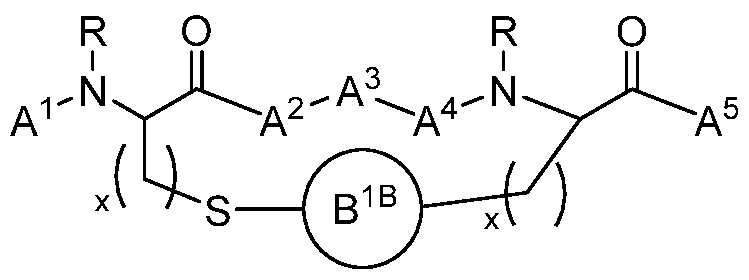
VI

VIII wherein, independently for each occurrence,
A1 is H, an amine protecting group, a natural or unnatural amino acid, a peptide, an oligopeptide, a polypeptide, or a protein;
A2, A3, and A4 are selected from the group consisting of a natural amino acid, an unnatural amino acid, and a plurality of natural amino acids or unnatural amino acids;
A5 is OH, -0(carboxylate protecting group), a natural or unnatural amino acid, a peptide, an oligopeptide, a polypeptide, or a protein; x is 0, 1, 2, 3, 4, 5, or 6;
 is a substituted or unsubstituted aryl or heteroaryl diradical, provided is not a perfluoroaryl diradical; and
R is H or alkyl.
In certain embodiments, the invention relates to a hybrid composition, wherein the hybrid composition comprises a linker, any one of the aforementioned compounds, and a detectable moiety; and the linker links the compound to the detectable moiety.
In certain embodiments, the invention relates to a hybrid composition, wherein the hybrid composition comprises a linker, any one of the aforementioned compounds, and a biomolecule; and the linker links the compound to the biomolecule.
In certain embodiments, the invention relates to a peptide, an oligopeptide, a polypeptide, or a protein, wherein the peptide, oligopeptides, polypeptide, or protein comprises substructure I, substructure II, substructure III, substructure IV, substructure V, substructure VI, substructure VII, or substructure VIII.
In certain embodiments, the invention relates to an affibody comprising substructure I, substructure II, substructure III, substructure IV, substructure V, substructure VI, substructure VII, or substructure VIII.
In certain embodiments, the invention relates to a method according to Scheme 1:

Scheme la

Scheme lb

Scheme lc

Scheme Id wherein, independently for each occurrence,
A1 is H, an amine protecting group, a natural or unnatural amino acid, a peptide, an oligopeptide, a polypeptide, or a protein;
A2, A3, and A4 are selected from the group consisting of a natural amino acid, an unnatural amino acid, and a plurality of natural amino acids or unnatural amino acids;
A5 is OH, -0(carboxylate protecting group), a natural or unnatural amino acid, a peptide, an oligopeptide, a polypeptide, or a protein; x is 0, 1, 2, 3, 4, 5, or 6;
is a substituted or unsubstituted aryl or heteroaryl radical;
is a substituted or unsubstituted aryl or heteroaryl diradical
 is a heteroaromatic moiety substituted with an electron withdrawing group; x is 0, 1, 2, 3, 4, 5, or 6; and R is H or alkyl.
In certain embodiments, the invention relates to a method according to Scheme 2:
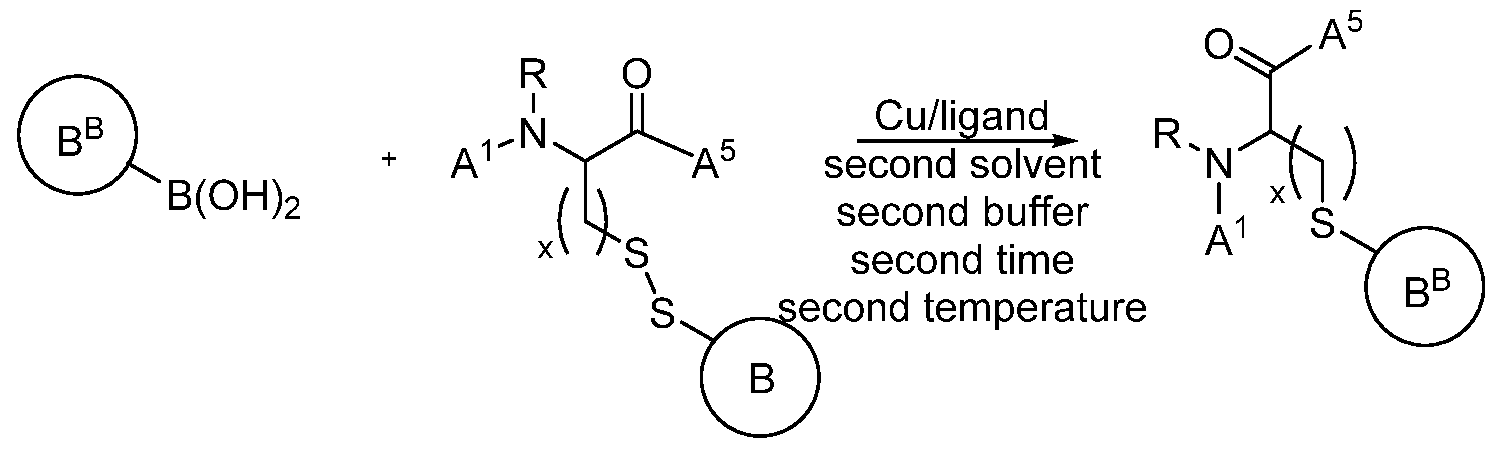
Scheme 2a

Scheme 2b


Scheme 2d wherein, independently for each occurrence,
A1 is H, an amine protecting group, a natural or unnatural amino acid, a peptide, an oligopeptide, a polypeptide, or a protein;
A2, A3, and A4 are selected from the group consisting of a natural amino acid, an unnatural amino acid, and a plurality of natural amino acids or unnatural amino acids;
A5 is OH, -0(carboxylate protecting group), a natural or unnatural amino acid, a peptide, an oligopeptide, a polypeptide, or a protein; x is 0, 1, 2, 3, 4, 5, or 6;
 is not a perfluoroaryl radical;
 is a substituted or unsubstituted aryl or heteroaryl diradical, provided is not a perfluoroaryl radical;
 is a heteroaromatic moiety substituted with an electron withdrawing group; x is 0, 1, 2, 3, 4, 5, or 6; and
R is H or alkyl.
is a heteroaromatic moiety substituted with an electron withdrawing group; x is 0, 1, 2, 3, 4, 5, or 6; and
R is H or alkyl.
In certain embodiments, the invention relates to a method according to Scheme 3:

Scheme 3a
third temperature

Scheme 3b

Scheme 3c

Scheme 3d
wherein, independently for each occurrence,
A1 is H, an amine protecting group, a natural or unnatural amino acid, a peptide, an oligopeptide, a polypeptide, or a protein;
A2, A3, and A4 are selected from the group consisting of a natural amino acid, an unnatural amino acid, and a plurality of natural amino acids or unnatural amino acids;
A5 is OH, -0(carboxylate protecting group), a natural or unnatural amino acid, a peptide, an oligopeptide, a polypeptide, or a protein; x is 0, 1, 2, 3, 4, 5, or 6;
 is an aryl or heteroaryl radical substituted with at least one electron donating group;
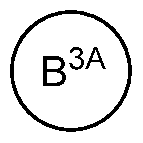 is a substituted aryl or heteroaryl diradical substituted with at least one electron donating group;
 is a heteroaromatic moiety substituted with an electron withdrawing group; x is 0, 1, 2, 3, 4, 5, or 6; and R is H or alkyl.
In certain embodiments, the invention relates to a method according to Scheme 4:

Scheme 4a

Scheme 4b

Scheme 4c

Scheme 4d wherein, independently for each occurrence,
A1 is H, an amine protecting group, a natural or unnatural amino acid, a peptide, an oligopeptide, a polypeptide, or a protein;
A2, A3, and A4 are selected from the group consisting of a natural amino acid, an unnatural amino acid, and a plurality of natural amino acids or unnatural amino acids;
A5 is OH, -0(carboxylate protecting group), a natural or unnatural amino acid, a peptide, an oligopeptide, a polypeptide, or a protein; x is 0, 1, 2, 3, 4, 5, or 6;
B2B
is an aryl or heteroaryl radical substituted with at least one electron donating provided (?) is not a perfluoroaryl radical;
 is an aryl or heteroaryl diradical substituted with at least one electron donating group, provided
 a perfluoroaryl radical;
 is a heteroaromatic moiety substituted with an electron withdrawing group; x is 0, 1, 2, 3, 4, 5, or 6; and
R is H or alkyl.
In certain embodiments, the invention relates to a method according to Scheme 5:

Scheme 5a

Scheme 5b


Scheme 5d wherein, independently for each occurrence,
A1 is H, an amine protecting group, a natural or unnatural amino acid, a peptide, an oligopeptide, a polypeptide, or a protein;
A2, A3, and A4 are selected from the group consisting of a natural amino acid, an unnatural amino acid, and a plurality of natural amino acids or unnatural amino acids;
A5 is OH, -0(carboxylate protecting group), a natural or unnatural amino acid, a peptide, an oligopeptide, a polypeptide, or a protein; x is 0, 1, 2, 3, 4, 5, or 6;
 is not a perfluoroaryl radical;
is a substituted or unsubstituted aryl or heteroaryl diradical, provided is not a perfluoroaryl radical;
is not a perfluoroaryl radical;
is a substituted or unsubstituted aryl or heteroaryl diradical, provided is not a perfluoroaryl radical;
 is a heteroaromatic moiety substituted with an electron withdrawing group; x is 0, 1, 2, 3, 4, 5, or 6; and
R is H or alkyl.
is a heteroaromatic moiety substituted with an electron withdrawing group; x is 0, 1, 2, 3, 4, 5, or 6; and
R is H or alkyl.
In certain embodiments, the invention relates to a method according to Scheme 6:

Scheme 6a

Scheme 6b

Scheme 6c

Scheme 6d
wherein, independently for each occurrence,
A1 is H, an amine protecting group, a natural or unnatural amino acid, a peptide, an oligopeptide, a polypeptide, or a protein;
A2, A3, and A4 are selected from the group consisting of a natural amino acid, an unnatural amino acid, and a plurality of natural amino acids or unnatural amino acids;
A5 is OH, -0(carboxylate protecting group), a natural or unnatural amino acid, a peptide, an oligopeptide, a polypeptide, or a protein; x is 0, 1, 2, 3, 4, 5, or 6; l or heteroaryl radical substituted with at least one electron donating group, p
 rovided is not a perfluoroaryl radical;
 is an aryl or heteroaryl diradical substituted with at least one electron donating group, provided
 a perfluoroaryl radical;
 is a heteroaromatic moiety substituted with an electron withdrawing group; x is 0, 1, 2, 3, 4, 5, or 6; and R is H or alkyl.
In certain embodiments, the invention relates to a method according to Scheme 7:

Scheme 7a

Scheme 7b

Scheme 7c

Scheme 7d
wherein, independently for each occurrence,
A1 is H, an amine protecting group, a natural or unnatural amino acid, a peptide, oligopeptide, a polypeptide, or a protein;
A2, A3, and A4 are selected from the group consisting of a natural amino acid, unnatural amino acid, and a plurality of natural amino acids or unnatural amino acids;
A5 is OH, -0(carboxylate protecting group), a natural or unnatural amino acid peptide, an oligopeptide, a polypeptide, or a protein;
x is 0, 1, 2, 3, 4, 5, or 6;
 is an aryl or heteroaryl radical substituted with at least one electron donating group;
 is a substituted aryl or heteroaryl diradical substituted with at least one electron donating group;
 is a heteroaromatic moiety substituted with an electron withdrawing group; x is 0, 1, 2, 3, 4, 5, or 6; and
R is H or alkyl.
In certain embodiments, the invention relates to a method according to Scheme 8:

Scheme 8a

Scheme 8b

Scheme 8c

Scheme 8d wherein, independently for each occurrence,
A1 is H, an amine protecting group, a natural or unnatural amino acid, a peptide, an oligopeptide, a polypeptide, or a protein;
A2, A3, and A4 are selected from the group consisting of a natural amino acid, an unnatural amino acid, and a plurality of natural amino acids or unnatural amino acids;
A5 is OH, -0(carboxylate protecting group), a natural or unnatural amino acid, a peptide, an oligopeptide, a polypeptide, or a protein; x is 0, 1, 2, 3, 4, 5, or 6, l or heteroaryl radical substituted with at least one electron donating group, p
 rovided is not a perfluoroaryl radical;
 is an aryl or heteroaryl diradical substituted with at least one electron donating group, provided
 a perfluoroaryl radical;
 is a heteroaromatic moiety substituted with an electron withdrawing group;
x is 0, 1, 2, 3, 4, 5, or 6; and R is H or alkyl.
is a heteroaromatic moiety substituted with an electron withdrawing group;
x is 0, 1, 2, 3, 4, 5, or 6; and R is H or alkyl.
In certain embodiments, the invention relates to a method of killing or inhibiting the growth or proliferation of a bacterium, a fungus, a virus, or a parasite, comprising the step of: contacting with the bacterium, fungus, virus, or parasite an effective amount of any one of the aforementioned compounds, thereby treating killing or inhibiting the growth or proliferation of the bacterium, fungus, virus, or parasite.
In certain embodiments, the invention relates to a method of treating a disease in a subject in need thereof comprising the step of: administering to the subject an effective amount of any one of the aforementioned compounds, thereby treating the disease.
BRIEF DESCRIPTION OF THE FIGURES
Figure 1 depicts three panels ((l)-(3)) showing reaction schemes comparing the bioconjugation of cysteine (panel (1)) and selenocysteine (panel (2)). The proposed reaction pathway of the reaction shown in panel (2) is shown in panel (3).
Figure 2 depicts a table summarizing reaction conditions and % yield for various arylation reactions. α Amino acids are shown in a one-letter code. R = no reaction. ^Yields determined by integration of total ion currents (TIC) from LC-MS analysis of the unpurified reaction mixture. c Elimination and diselenide were the only observable products. rf0.5 mM CuS04, 0.5 mM L2, and 0.5 mM boronic acid were used. e0.25 mM CuS04, 0.25 mM L2, and 0.25 mM boronic acid were used.•'Selenocysteine-T P residue replaced with a serine. ¾elenocysteine-2-thiol-5-nitropyridine residue replaced with a cysteine. ASelenocysteine-2-thiol-5-nitropyridine residue replaced with a cysteine-2-thiol-5- nitropyridine. 'Selenocysteine-2-thiol-5-nitropyridine residue replaced with a methionine.
Figure 3 depicts five panels (a-e) summarizing reaction substrates, boronic acids, and yields for various arylation reactions. α Amino acids are shown in a one-letter code. ^Yields determined by integration of total ion currents (TIC) from LC-MS analysis of the unpurified reaction mixture (Average of two runs). h2 h reaction time. c1.5 h reaction time. d2 mM CuS04, 2 mM L2, and 2 mM boronic acid were used. e2 mM CuS04, 2 mM L2, 2 mM boronic acid, and H20:DMF (90: 10) for 3 h. Panel a shows the yield of peptides 4a-41
using aryl boronic acids. Panel b shows the yield of peptides 5a-5j using heteroaryl boronic acids. Panel c shows the yields of peptides 6a-6e using various biorelevant aryl boronic acids. Panel d shows a reaction scheme and an LCMS trace of arylated peptide 8 in the product mixture. Panel e shows a reaction scheme and an LCMS trace of starting material 9 in the product mixture.
Figure 4 depicts data from a stability study of functionalized selenocysteine in peptides. % yields determined by integration of total ion currents (TIC) from LC-MS analysis of the unpurified reaction mixture.
Figure 5A depicts the yield of Dha elimination product (%) at pH 8.0 for various selenocysteine peptides at 37 °C (left bar) and at room temperature (about 23 °C) (right bar).
Figure 5B depicts the yield of Dha elimination product (%) at pH 10.0 for various selenocysteine peptides at 37 °C (left bar) and at room temperature (about 23 °C) (right bar).
Figure 6 depicts a reaction scheme showing a competition experiment between a functionalized selenocysteine-containing peptide (top starting material) and a functionalized cysteine-containing peptide (bottom starting material). The mole ratio of product peptides is 90: 10 Se:S.
Figure 7 depicts two applications of the various Cu-catalyzed reactions of the invention: peptide stapling with a bis-boronic acid (top) and macrocyclization (bottom).
Figure 8 depicts an application of the various reactions of the invention: tagging of a biologically active peptide with a pharmaceutical or natural product.
Figure 9 depicts various pharmaceuticals and biologically active natural products containing electron-rich aromatic rings suitable for conjugation to a selenocysteine- containing peptide.
Figure 10 depicts various pharmaceuticals and biologically active natural products containing electron-rich aromatic rings suitable for conjugation to a selenocysteine- containing peptide.
Figure 11 depicts various pharmaceuticals and biologically active natural products containing electron-rich aromatic rings suitable for conjugation to a selenocysteine- containing peptide.
Figure 12 depicts a reaction scheme and % yield for various arylation reactions using substituted aromatic groups or substituted or unsubstituted indoles in the presence of CuSC catalyst (top yields), and in the absence of a metal catalyst and ligand (bottom yields).
Figure 13 depicts a reaction scheme and % yield for various arylation reactions using substituted or unsubstituted heteroaromatic groups, natural products, or pharmaceuticals in the presence of CuSCvcatalyst (top yields), and in the absence of a metal catalyst and ligand (bottom yields).
Figure 14 depicts a reaction scheme and % yield for various arylation reactions using natural products or pharmaceuticals in the presence of CuSCvcatalyst (top yields), and in the absence of a metal catalyst and ligand (bottom yields).
Figure 15 depicts (top) a reaction scheme showing the Cu-catalyzed arylation of a peptide containing a protected cysteine residue near its N-terminus, and (bottom) a reaction scheme showing the Rh-catalyzed arylation of a peptide containing a protected cysteine residue in the middle of its sequence.
Figure 16 depicts (top) a reaction scheme showing the Cu-catalyzed arylation of symmetrically Se-Se-coupled peptides containing selenocysteine residues near their N- termini, and (bottom) a reaction scheme showing the Rh-catalyzed arylation of symmetrically Se-Se-coupled peptides containing selenocysteine residues in the middle of their sequences.
Figure 17 depicts (top) a reaction scheme showing the Cu-catalyzed arylation of symmetrically S-S-coupled peptides containing cysteine residues near their N-termini, and (bottom) a reaction scheme showing the Rh-catalyzed arylation of symmetrically S-S- coupled peptides containing cysteine residues in the middle of their sequences.
Figure 18 depicts (top) a reaction scheme showing the metal-catalyzed arylation of symmetrically S-S-coupled peptides containing cysteine residues, and (bottom) the yields of these reactions in the presence of various Ir or Ru metal-catalysts.
Figure 19 depicts (top) a reaction scheme showing that glutathione (GSH, a tripeptide), which is found in 5 mM concentration in animal cells, can promote dissociation of the native drug or natural product by reduction of the C-Se bond; (bottom) shows a bar
graph depicting the amount of starting material remaining after the exposure to GSH at room temperature or 37 °C for 3 h.
Figure 20 depicts (top) a reaction scheme showing the conditions for conjugating vancomycin to a model peptide, and (bottom) the reaction conditions, structure of vancomycin, and reaction yield by LC-MS.
Figure 21 depicts (top) a reaction scheme showing the conditions for conjugating vancomycin to an antibacterial peptide, and (bottom) a table of various peptide sequences (note, the first two sequences are random sequences with no reported antibacterial activity) that have been conjugated to vancomycin and screened against the gram positive and gram negative bacteria in Table 3.
Figure 22A depicts various antibacterial sequences conjugated to vancomycin, and the results of screening the conjugates against gram-positive strains.
Figure 22B depicts various antibacterial sequences conjugated to vancomycin, and the results of screening the conjugates against gram-negative strains.
Figure 23 depicts (top) a reaction scheme showing the conditions for conjugating small molecules to a polyglycine-containing peptide, and (bottom) various Ar-H moieties to be conjugated.
Figure 24 depicts a schematic representation of the process of sortase-tagging an antibody with a peptide-drug conjugate.
Figure 25 depicts a schematic representation of making a peptide-drug conjugate and then sortase-tagging an antibody with the peptide-drug conjugate.
Figure 26 depicts a reaction scheme showing the conditions for cyclizing a model peptide.
Figure 27 depicts a reaction scheme showing the conditions for cyclizing an HIV-1 capsid with selenocysteine.
Figure 28 a reaction scheme showing the conditions for attempting to cyclize a peptide lacking tryptophan.
Figure 29 depicts a reaction scheme showing the conditions for cyclizing an HIV-1 capsid with cysteine.
Figure 30 depicts a reaction scheme showing the formation of disulfide starting material (e.g., the disulfide shown in Figure 29) on a resin. Cleavage with 95:5 TFA:H20 at 60 °C for 45 min provides completely cyclized material in 60% yield after FfPLC purification.
Figure 31A depicts the structure of the phallotoxins. Figure 31B depicts the structure of the amatoxins.
Figure 32A depicts a reaction scheme and reactants for copper-mediated arylation of disulfide-containing peptides.
Figure 32B depicts a reaction scheme and reactants for rhodium-mediated arylation of disulfide-containing peptides.
Figure 33 depicts a reaction scheme and concentrations of reactants for rhodium- catalyzed arylation of a disulfide-containing peptide.
Figure 34 depicts a reaction scheme showing the arylation of a cysteine disulfide. The ability to affect functionalization with only one equivalent of rhodium has important implications for functionalization of antibodies without prior reduction.
Figure 35 depicts (top) a reaction scheme showing the metal-free arylation of mixed disulfides, and (bottom) various reagents and yields.
Figure 36 depicts (top) a reaction scheme showing the copper-catalyzed arylation of a disulfide, and (bottom) the results of this reaction with disulfides having varying sequences.
Figure 37 depicts the results of the reaction depicted in Figure 36 when the position of the disulfide is varied within the peptide.
Figure 38 depicts (top) a reaction scheme showing the copper-catalyzed arylation of a disulfide, and (bottom) various boronic acid arylating agents.
Figure 39 depicts a reaction scheme and % yield for various arylation reactions using substituted aromatic or heteroaromatic groups in the presence of CuSC catalyst (top yields), and in the absence of a metal catalyst and ligand (bottom yields).
DETAILED DESCRIPTION
Overview
In certain embodiments, the invention relates to the discovery and subsequent development of a new chemical transformation for the conjugation of unprotected peptide biomolecules. This process features several significant advantages over existing methods of peptide modifications such as specificity towards selenocysteine over other nucleophiles (e.g., amines, hydroxyls), excellent functional group tolerance, and mild reaction conditions. While the reaction times normally vary depending on the concentration and chemical identity of the peptide, the reaction conditions usually can be optimized where full conversion is accomplished within 1-6 hours.
In certain embodiments, this method is employed for synthesis of functionalized peptides, "stapled" peptides, macrocyclized peptides, or heterocoupled peptide systems. In certain embodiments, this methodology is useful for producing hybrid biomaterials featuring other biomolecules such as DNA, RNA, PNA, proteins, oligosaccharides, and a combination of thereof. In certain embodiments, the hybrid biomaterials are useful for cell penetration and intracellular targeting. In certain embodiments, the invention relates to organic polymer-peptide conjugates, peptides decorated with functional small-molecules (such as fluorescent dye labels), natural products or small-molecule drugs (such as antibacterial agents, antifungal agents, antiviral agents, anticonvulsant agents, and antipsychotic agents), inorganic MRI, radio-contrast agents, and also various functionalized metal-based nanoparticle scaffolds.
In certain embodiments, the invention employs an Umpolung approach that utilizes the electrophilic character of the oxidized selenocysteine together with a copper, ligand, and nucleophilic boronic acid combination to provide the arylated selenocysteine in unprotected peptides (Figure 1, Panel (2)). While not wishing to be bound by any particular theory, the proposed reaction pathway involves an initial oxidative addition of copper to the Se-S bond (Figure 1, Panel (3)). A subsequent transmetalation with an arylboronic acid and reductive elimination furnishes the arylated selenocysteine. This method does not require oxygen-free conditions or a reducing agent and takes place in water rich media (e.g., 0.1 M Tris buffer (pH = 8.0), 95:5 H20:EtOH). In certain embodiments, reaction yields are excellent for a wide range of substrates. In certain embodiments, this approach is selective for selenocysteine over cysteine.
In certain embodiments, the invention relates to the synthesis of arylated selenocysteine, which begins by combining unprotected peptide 1, /?-tolylboronic acid, CuSC"4, and a ligand in buffered aqueous conditions [0.1 M Tris (pH = 8.0), 95:5 H20:EtOH] at 37 °C. In certain other embodiments, 2-thiol-5-nitropyridine protected selenocysteine (1) is used as a starting material, as it is the reaction product from the deprotection of /?-methoxybenzyl protecting group in solid-phase peptide synthesis. In certain embodiments, different bipyridine and phenanthroline ligands (Figure 2, entries 1-4) may be used. The formation of the diselenide, seleninic acid, and elimination to dehydroalanine (Dha) were the observed side products. In the absence of ligand, only 30% conversion of 1 and 5% arylation to 4a was observed (Figure 2, entry 5). Other sources of copper provided similar yields (Figure 2, entries 6-8). In the absence of copper, no arylation was observed (Figure 2, entry 9). Lastly, decreasing the number of equivalents of copper, ligand, or boronic acid resulted in lower levels of conversion and increased side reactions (Figure 2, entries 10-11). No product was observed in a control reaction with selenocysteine-to-serine variant (Figure 2, entry 12), confirming that arylation occurs exclusively at selenium. To probe the reactivity of selenocysteine versus cysteine, two peptides in which the selenocysteine was replaced with cysteine (free thiol) or cysteine linked with a 2-thiol-5-nitropyridine as the masking agent (Figure 2, entries 13-14) were examined. For both peptides we observed low conversion to the arylated cysteine, rather the starting material (1) was converted to the respective disulfide or sulfinic acid. This result demonstrates the enhanced reactivity of selenocysteine over cysteine toward copper- mediated arylation. See also Figure 6. It also indicates cysteine is not compatible under these reaction conditions. Lastly, no oxidation was detected for the selenocysteine-to- methionine variant (Figure 2, entry 15), which proves that this method could be applied to methionine containing peptides.
In certain embodiments, the invention relates to a reaction methodology applicable to a wide variety of substrates. See Figure 3. Aryl boronic acids with electron-donating functional groups were examined (Figure 3, Panel a). Methoxy (4b), ortho-phenol (4c), dioxolane (4d), -CH2N(H)Boc (4e), and /?ara-dimethylamine (4f) groups were readily tolerated. Under these reaction conditions, Boc deprotection was not observed (4e), thus demonstrating the mild conditions needed to achieve the arylation.
In certain embodiments, the invention relates to a method of functionalizing a selenocysteine residue using an aryl boronic acid having an electron-withdrawing
functional group (Figure 3, Panel a). Despite the decreased nucleophilicity of these electron-poor boronic acids, the corresponding selenium conjugates were formed in good to excellent yield. In some cases, the number of equivalents of the Cu/L and boronic acid needed to be increased to provide full conversion to product while suppressing side reactions. Ester (4g), amide (4h), nitro (4i), nitrile (4j), and halogen (4k and 41) functional groups were compatible with these conditions. Peptide 41 was formed quantitatively despite 2,6-difluorophenyl boronic acid having the tendency to undergo protodeboronation under basic conditions.
In certain embodiments, the invention relates to a method of functionalizing a selenocysteine residue using a heteroaryl boronic acid (Figure 3, Panel b). Known bioactivities comprising heterocycles makes heterocycles an important class of molecules for conjugation to selenocysteine. The arylation of five-membered heterocycles such as indole (5a and 5b), benzofuran (5c), pyrazole (5d), 2, 5 -di substituted isoxazole (5e), and thiophene (5f and 5g) proceeded with excellent yields. Six-membered heterocycles, such as dibenzofuran (5h), phenoxathiine (5i), and pyrimidine (5j) likewise furnished the corresponding conjugate in greater than 90% yield.
In certain embodiments, the invention relates to the functionalization of selenocysteine-containing peptides with biorelevant molecules (Figure 3, Panel c). The linking of protected phenylalanine and coumarin proceeded in good yield (6a and 6b respectively). The boronic acids of anti-inflammatory drugs tolfenamic ester and paracetamol furnished the corresponding conjugates in moderate to good yields (6c and 6d respectively). Lastly, estrone was coupled to selenium in moderate yield (6e).
In certain embodiments, the invention relates to a robust, selective reaction. As an example, peptide 7 was prepared; peptide 7 contains most of the key functional groups found in polyamides (e.g., histidine, arginine, aspartic acid, tyrosine, and asparagine) excluding sulfur-based amino acids (Figure 3, Panel d). Exposure of 7 to 2,6-difluorophenyl boronic acid under reaction conditions provided the corresponding arylated product (8) in quantitative yield based on LC-MS analysis. No other peptidic species were observed (see LC-MS trace, Figure 3, Panel d). The arylation occurred exclusively on the selenocysteine as a selenocysteine-to-serine control variant (9) provided no product under identical reaction conditions (Figure 3, Panel e).
In certain embodiments, the invention relates to peptides comprising aryl- functionalized selenocysteine. The stability of these aryl conjugates relative to the corresponding benzylated variant under basic conditions was investigated. In a pH 8.0 buffered solution at room temperature or 37 °C, neither the arylated nor alkylated selenocysteine peptide underwent elimination to dehydroalanine (la, Dha) even after 11 hours. Figure 5A. However, in a buffered solution at pH 10.0, appreciable amounts of elimination were observed for both the alkylated and arylated derivatives depending on the substituent on the selenium. Figure 5B.
In certain embodiments, the invention relates to peptides comprising aryl- functionalized selenocysteine that are relatively stable under oxidative conditions. Exposure of these peptide derivatives to a large excess of H202 (10 mM) at room temperature lead to the formation of varying amounts of dehydroalanine (la) depending on the R-group on the selenocysteine (Figure 4). In general, the arylated selenocysteine derivatives were less prone to oxidation/elimination than the benzylated selenocysteine (4n). This result is in agreement with previous reports that alkylated or arylated selenocysteine can be readily converted to dehydroalanine (la) even under mildly oxidative conditions. With regards to the different arenes, the more electron deficient the aryl ring on the selenium, the slower formation of Dha, la. So, in certain embodiments, the invention relates to the ability to stabilize the arylated selenocysteine by modulating the electronic nature of the arene substituent.
Exemplary Functionalized Compounds
In certain embodiments, the invention relates to a compound comprising substructure I:

I wherein, independently for each occurrence,
A1 is H, an amine protecting group, a natural or unnatural amino acid, a peptide, an oligopeptide, a polypeptide, or a protein;
A5 is OH, -0(carboxylate protecting group), a natural or unnatural amino acid, a peptide, an oligopeptide, a polypeptide, or a protein;
 is a substituted or unsubstituted aryl or heteroaryl radical; x is 0, 1, 2, 3, 4, 5, or 6; and R is H or alkyl.
In certain embodiments, the invention relates to a compound comprising substructure II:

II wherein, independently for each occurrence,
A1 is H, an amine protecting group, a natural or unnatural amino acid, a peptide, an oligopeptide, a polypeptide, or a protein;
A5 is OH, -0(carboxylate protecting group), a natural or unnatural amino acid, a peptide, an oligopeptide, a polypeptide, or a protein;
 is a substituted or unsubstituted aryl or heteroaryl radical, provided [s not a perfluoroaryl radical; x is 0, 1, 2, 3, 4, 5, or 6; and
R is H or alkyl.
In certain embodiments, the invention relates to any one of the aforementioned compounds, wherein the compound is depicted in the Figures.
In certain embodiments, the invention relates to any one of the aforementioned
 substituted aryl radical. In certain embodiments, the
invention relates to any one of the aforementioned compounds, wherein
substituted aryl radical. In certain embodiments, the
invention relates to any one of the aforementioned compounds, wherein
 is a substituted phenyl radical.
In certain embodiments, the invention relates to any one of the aforementioned compound
 is an unsubstituted aryl radical.
In certain embodiments, the invention relates to any one of the aforementioned compounds, wherein a substituted heteroaryl radical. In certain embodiments, the invention relates to
 any one of the aforementioned compounds, wherein is a substituted indole, pyrazolo, thiophene, pyrimidine, benzofuran, or isoxazole radical.
In certain embodiments, the invention relates to any one of the aforementioned compounds, wherein
 an unsubstituted heteroaryl radical. In certain embodiments, the invention relates to any one of the aforementioned compounds, wherein
 is an unsubstituted indole, pyrazolo, thiophene, pyrimidine, benzofuran, or isoxazole radical.
In certain embodiments, the invention relates to any one of the aforementioned
compounds, wherein
 is
is


-32-
 stereoisomer thereof. In certain embodiments,
 is any of the aforementioned moieties, wherein the moiety is further substituted.
In certain embodiments, the invention relates to any one of the aforementioned


In certain embodiments, the invention relates to any one of the aforementioned compounds, wherein a substituted aryl radical. In certain embodiments, the invention relates to a
 ny one of the aforementioned compounds, wherein is a substituted phenyl radical.
In certain embodiments, the invention relates to any one of the aforementioned compound
ny one of the aforementioned compounds, wherein is a substituted phenyl radical.
In certain embodiments, the invention relates to any one of the aforementioned compound
 is an unsubstituted aryl radical.
In certain embodiments, the invention relates to any one of the aforementioned compounds, wherein a substituted heteroaryl radical. In certain embodiments, the invention relates to
 any one of the aforementioned compounds, wherein is a substituted indole, pyrazolo, thiophene, pyrimidine, benzofuran, or isoxazole radical.
In certain embodiments, the invention relates to any one of the aforementioned compounds, wherein
 an unsubstituted heteroaryl radical. In certain embodiments, the invention relates to any one of the aforementioned compounds, wherein
 is an unsubstituted indole, pyrazolo, thiophene, pyrimidine, benzofuran, or isoxazole radical.
In certain embodiments, the invention relates to any one of the aforementioned


In certain embodiments, the invention relates to any one of the aforementioned compounds, wherein the compound is a compound comprising substructure I; and none of A1 and A5 comprises selenocysteine.
In certain embodiments, the invention relates to any one of the aforementioned compounds, wherein the compound is a compound comprising substructure I; and one or more of A1 and A5 comprises arginine, cysteine, histidine, lysine, aspartic acid, glutamic acid, serine, threonine, asparagine, glutamine, glycine, proline, alanine, valine, isoleucine, leucine, methionine, phenylalanine, tyrosine, or tryptophan.
In certain embodiments, the invention relates to any one of the aforementioned compounds, wherein the compound is a compound comprising substructure II; and none of A1 and A5 comprises cysteine.
In certain embodiments, the invention relates to any one of the aforementioned compounds, wherein the compound is a compound comprising substructure II; and one or more of A1 and A5 comprises arginine, histidine, lysine, aspartic acid, glutamic acid, serine, threonine, asparagine, glutamine, glycine, proline, alanine, valine, isoleucine, leucine, methionine, phenylalanine, tyrosine, or tryptophan.
In certain embodiments, the invention relates to any one of the aforementioned compounds, wherein A1 is an amine protecting group selected from the group consisting of an N,0-acetal, allyloxycarbonyl (Aloe), benzyl (Bn), benzyloxycarbonyl (Cbz), benzyloxymethyl (BOM), t-butoxycarbonyl (Boc), t-butyldimethylsilyl (TBDMS), t- butyldiphenylsilyl (TBDPS), diphenylmethyl, diphenylmethylene, ethoxycarbonyl, 9- fluorenylmethoxycarbonyl (Fmoc), /?-methoxybenzyl (PMB), methoxycarbonyl, methoxymethyl (MOM), /?-methoxyphenyl (PMP), /?-nitrocinnamyloxycarbonyl (Noc), tosyl (Ts), 2-tosylethoxycarbonyl (Tsoc), 2,2,2-trichloroethoxycarbonyl (Troc), trifluoroacetyl, triisopropylsilyl (TIPS), trimethylsilyl (TMS), 2- (trimethylsilyl)ethoxycarbonyl (Teoc), 2-(trimethylsilyl)ethoxymethyl (SEM), or trityl (Tr).
In certain embodiments, the invention relates to any one of the aforementioned compounds, wherein A5 is -0(carboxylate protecting group), wherein the carboxylate protecting group is selected from the group consisting of allyl, benzyl, benzyloxymethyl (BOM), t-Bu, t-butyldimethylsilyl (TBDMS), t-butyldiphenylsilyl (TBDPS), diphenylmethyl, 9-fluorenylmethyl (Fm), 2-methoxyethoxymethyl (MEM), methoxymethyl (MOM), /?-nitrobenzyl (PNB), an ester, a 1,3-oxazoline, pi valoyloxy methyl (Pom), 2- tosylethyl (TSE), 2,2,2-trichloroethyl (TCE), triethylsilyl (TES), trimethylsilyl (TMS), 2- (trimethylsilyl)ethoxymethyl (SEM), or 2-(trimethylsilyl)ethyl (TMSE).
In certain embodiments, the invention relates to any one of the aforementioned compounds, wherein A1 or A5 is an antimicrobial peptide, such as a compound comprising magainin/pexiganan (a 22-amino acid linear peptide that may be isolated from the skin of the African clawed frog {Xenopus laevis)), omiganan (a cationic peptide that may be derived from indolicidin), OP- 145 (a 24-mer peptide that may be derived from LL-37 that may bind to lipopolysaccharides or lipoteichoic acid), novexatin (a cyclic cationic peptide of 1093 Da), LTX-109 (Lytixar, a membrane-degrading peptide), NVB302 (a class B lantibiotic), MU1140 (a lantibiotic), arenicin (a 21-mer that is rich in arginine and hydrophobic amino acids), avidocin (a R-type bacteriocin that may be derived from Pseudomanas aeruginosa), purocin (a R-type bacteriocin that may be derived from
Pseudomanas aeruginosa), IMX924 (a 5-mer with defense regulation capabilities),

GIGKFLHSAKKFGKAFVGEIMNS, or GIKKFLKK AGKF GK AF . In certain embodiments, A1 or A5 is an antimicrobial peptide described in Fox, J.L. Nature Biotechnology 2013, 31, 5, 379 or Arnusch, C.J. et al. PLoS ONE 2012, 7(6), e39768.
In certain embodiments, the invention relates to any one of the aforementioned compounds, wherein R is H.
In certain embodiments, the invention relates to any one of the aforementioned compounds, wherein x is 1, 2, or 3. In certain embodiments, the invention relates to any one of the aforementioned compounds, wherein x is 1.
In certain embodiments, the invention relates to any one of the compounds described herein.
Exemplary Stapled or Macrocyclized Compounds
In certain embodiments, the invention relates to a compound comprising substructure III:

III wherein, independently for each occurrence,
A1 is H, an amine protecting group, a natural or unnatural amino acid, a peptide, an oligopeptide, a polypeptide, or a protein;
A2, A3, and A4 are selected from the group consisting of a natural amino acid, an unnatural amino acid, and a plurality of natural amino acids or unnatural amino acids;
A5 is OH, -0(carboxylate protecting group), a natural or unnatural amino acid, a peptide, an oligopeptide, a polypeptide, or a protein; x is 0, 1, 2, 3, 4, 5, or 6;
 is a substituted or unsubstituted aryl or heteroaryl diradical; and R is H or alkyl.
In certain embodiments, the invention relates to a compound comprising substructure IV:

IV wherein, independently for each occurrence,
A1 is H, an amine protecting group, a natural or unnatural amino acid, a peptide, an oligopeptide, a polypeptide, or a protein;
A2, A3, and A4 are selected from the group consisting of a natural amino acid, an unnatural amino acid, and a plurality of natural amino acids or unnatural amino acids;
A5 is OH, -0(carboxylate protecting group), a natural or unnatural amino acid, a peptide, an oligopeptide, a polypeptide, or a protein; x is 0, 1, 2, 3, 4, 5, or 6;
 is a substituted or unsubstituted aryl or heteroaryl diradical, provided is not a perfluoroaryl diradical; and
R is H or alkyl.
In certain embodiments, the invention relates to a compound compri substructure V or substructure VII:

V
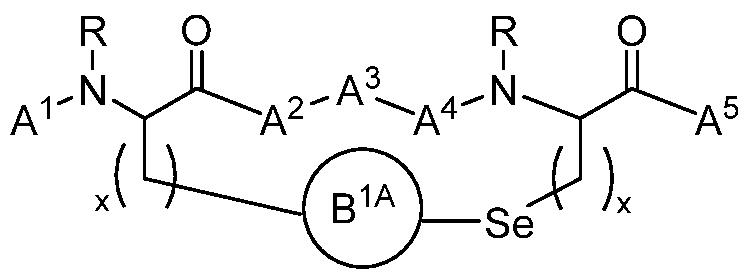
VII wherein, independently for each occurrence,
A1 is H, an amine protecting group, a natural or unnatural amino acid, a peptide, an oligopeptide, a polypeptide, or a protein;
A2, A3, and A4 are selected from the group consisting of a natural amino acid, an unnatural amino acid, and a plurality of natural amino acids or unnatural amino acids;
A5 is OH, -0(carboxylate protecting group), a natural or unnatural amino acid, a peptide, an oligopeptide, a polypeptide, or a protein; x is 0, 1, 2, 3, 4, 5, or 6;
 is a substituted or unsubstituted aryl or heteroaryl diradical; and R is H or alkyl.
In certain embodiments, the invention relates to a compound comprising substructure VI or substructure VIII:

VI

VIII
wherein, independently for each occurrence,
A1 is H, an amine protecting group, a natural or unnatural amino acid, a peptide, an oligopeptide, a polypeptide, or a protein;
A2, A3, and A4 are selected from the group consisting of a natural amino acid, an unnatural amino acid, and a plurality of natural amino acids or unnatural amino acids;
A5 is OH, -0(carboxylate protecting group), a natural or unnatural amino acid, a peptide, an oligopeptide, a polypeptide, or a protein; x is 0, 1, 2, 3, 4, 5, or 6;
 is a substituted or unsubstituted aryl or heteroaryl diradical, provided is not a perfluoroaryl diradical; and
R is H or alkyl.
In certain embodiments, the invention relates to any one of the aforementioned compounds, wherein the compound is depicted in the Figures.
In certain embodiments, the invention relates to any one of the aforementioned compounds, wherein A2, A3, and A4 are natural or unnatural amino acids.
In certain embodiments, the invention relates to any one of the aforementioned compounds, wherein A2 represents one natural or unnatural amino acid. In certain embodiments, the invention relates to any one of the aforementioned compounds, wherein A3 represents one natural or unnatural amino acid. In certain embodiments, the invention relates to any one of the aforementioned compounds, wherein A4 represents one natural or unnatural amino acid.
In certain embodiments, the invention relates to any one of the aforementioned compounds, wherein A2 represents two natural or unnatural amino acids. In certain embodiments, the invention relates to any one of the aforementioned compounds, wherein A3 represents two natural or unnatural amino acids. In certain embodiments, the invention relates to any one of the aforementioned compounds, wherein A4 represents two natural or unnatural amino acids.
In certain embodiments, the invention relates to any one of the aforementioned compounds, wherein A2 represents three natural or unnatural amino acids. In certain embodiments, the invention relates to any one of the aforementioned compounds, wherein A3 represents three natural or unnatural amino acids. In certain embodiments, the invention relates to any one of the aforementioned compounds, wherein A4 represents three natural or unnatural amino acids.
In certain embodiments, the invention relates to any one of the aforementioned compounds, wherein the compound is a compound comprising substructure III, V, or VII; and none of A1, A2, A3, A4, and A5 comprises selenocysteine.
In certain embodiments, the invention relates to any one of the aforementioned compounds, wherein the compound is a compound comprising substructure III, V, or VII; and one or more of A1, A2, A3, A4, and A5 comprises arginine, cysteine, histidine, lysine, aspartic acid, glutamic acid, serine, threonine, asparagine, glutamine, glycine, proline, alanine, valine, isoleucine, leucine, methionine, phenylalanine, tyrosine, or tryptophan.
In certain embodiments, the invention relates to any one of the aforementioned compounds, wherein the compound is a compound comprising substructure IV, VI, or VIII; and none of A1, A2, A3, A4, and A5 comprises cysteine.
In certain embodiments, the invention relates to any one of the aforementioned compounds, wherein the compound is a compound comprising substructure IV, VI, or VIII; and one or more of A1, A2, A3, A4, and A5 comprises arginine, histidine, lysine, aspartic acid, glutamic acid, serine, threonine, asparagine, glutamine, glycine, proline, alanine, valine, isoleucine, leucine, methionine, phenylalanine, tyrosine, or tryptophan.
In certain embodiments, the invention relates to any one of the aforementioned compounds, wherein A1 is an amine protecting group selected from the group consisting of an N,0-acetal, allyloxycarbonyl (Aloe), benzyl (Bn), benzyloxycarbonyl (Cbz), benzyloxymethyl (BOM), t-butoxycarbonyl (Boc), t-butyldimethylsilyl (TBDMS), t- butyldiphenylsilyl (TBDPS), diphenylmethyl, diphenylmethylene, ethoxycarbonyl, 9- fluorenylmethoxycarbonyl (Fmoc), /?-methoxybenzyl (PMB), methoxycarbonyl, methoxymethyl (MOM), /?-methoxyphenyl (PMP), /?-nitrocinnamyloxycarbonyl (Noc), tosyl (Ts), 2-tosylethoxycarbonyl (Tsoc), 2,2,2-trichloroethoxycarbonyl (Troc), trifluoroacetyl, triisopropylsilyl (TIPS), trimethylsilyl (TMS), 2- (trimethylsilyl)ethoxycarbonyl (Teoc), 2-(trimethylsilyl)ethoxymethyl (SEM), or trityl (Tr).
In certain embodiments, the invention relates to any one of the aforementioned compounds, wherein A5 is -0(carboxylate protecting group); and the carboxylate protecting group is selected from the group consisting of allyl, benzyl, benzyloxymethyl (BOM), t-Bu, t-butyldimethylsilyl (TBDMS), t-butyldiphenylsilyl (TBDPS), diphenylmethyl, 9- fluorenylmethyl (Fm), 2-methoxyethoxymethyl (MEM), methoxymethyl (MOM), p- nitrobenzyl (P B), an ester, a 1,3-oxazoline, pi valoyloxy methyl (Pom), 2-tosylethyl (TSE), 2,2,2-trichloroethyl (TCE), triethylsilyl (TES), trimethylsilyl (TMS), 2- (trimethylsilyl)ethoxymethyl (SEM), or 2-(trimethylsilyl)ethyl (TMSE).
In certain embodiments, the invention relates to any one of the aforementioned compounds, wherein A1 or A5 is an antimicrobial peptide, such as a compound comprising magainin/pexiganan (a 22-amino acid linear peptide that may be isolated from the skin of the African clawed frog {Xenopus laevis)), omiganan (a cationic peptide that may be derived from indolicidin), OP- 145 (a 24-mer peptide that may be derived from LL-37 that may bind to lipopolysaccharides or lipoteichoic acid), novexatin (a cyclic cationic peptide of 1093 Da), LTX-109 (Lytixar, a membrane-degrading peptide), NVB302 (a class B lantibiotic), MU1140 (a lantibiotic), arenicin (a 21-mer that is rich in arginine and hydrophobic amino acids), avidocin (a R-type bacteriocin that may be derived from Pseudomanas aeruginosa), purocin (a R-type bacteriocin that may be derived from
Pseudomanas aeruginosa), IMX924 (a 5-mer with defense regulation capabilities),

GIGKFLHSAKKFGKAFVGEIMNS, or GIKKFLKK AGKF GK AF . In certain embodiments, A1 or A5 is an antimicrobial peptide described in Fox, J.L. Nature Biotechnology 2013, 31, 5, 379 or Arnusch, C.J. et al. PLoS ONE 2012, 7(6), e39768.
In certain embodiments, the invention relates to any one of the aforementioned compounds, wherein
 is a substituted aryl diradical. In certain embodiments, the invention relates to any one of the aforementioned compounds, wherein
 is a substituted phenyl diradical.
In certain embodiments, the invention relates to any one of the aforementioned compound
is a substituted phenyl diradical.
In certain embodiments, the invention relates to any one of the aforementioned compound
 is an unsubstituted aryl diradical.
In certain embodiments, the invention relates to any one of the aforementioned compounds, wherein is a substituted heteroaryl diradical. In ents, the invention relates
 to any one of the aforementioned compounds, is a substituted indole, pyrazolo, thiophene, pyrimidine, benzofuran, or isoxazole diradical.
In certain embodiments, the invention relates to any one of the aforementioned compounds, wherein
 is an unsubstituted heteroaryl diradical. In certain embodiments, the invention relates to any one of the aforementioned compounds, wherein
( ) is an unsubstituted indole, pyrazolo, thiophene, pyrimidine, benzofuran, or isoxazole diradical.
In certain embodiments, the invention relates to any one of the aforementioned compounds, wher is a substituted aryl diradical. In certain embodiments, the invention relates
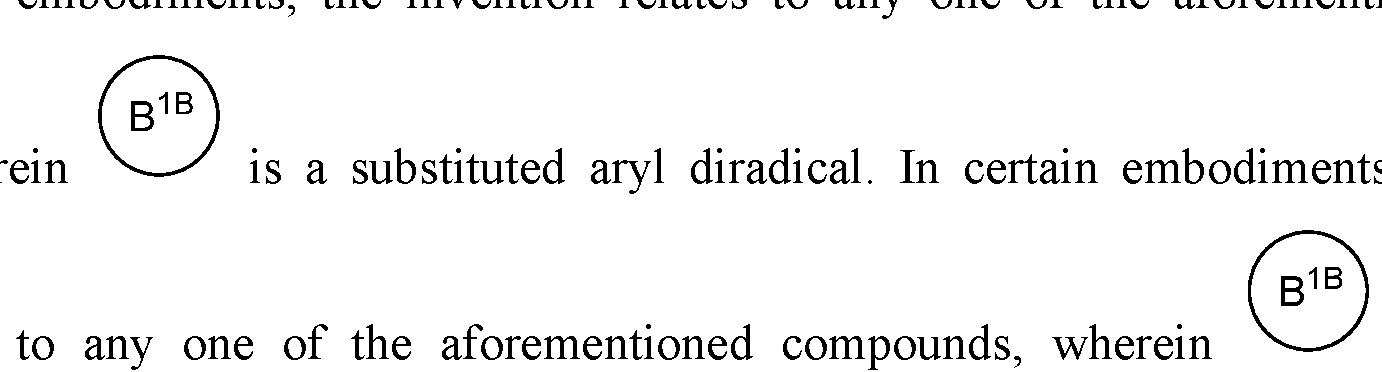 to any one of the aforementioned compounds, wherein is a substituted phenyl diradical.
In certain embodiments, the invention relates to any one of the aforementioned compounds, wherein
 is 1,4-disubstituted phenylene, l,4-disubstituted-2,5- dimethy lpheny 1 ene, 1 , 3 -di sub stituted- 5 -fluorophenyl ene, 1,4-di sub stituted-2, 5 - difluorophenylene, l,4-disubstituted-2,5-bis(trifluoromethyl)phenylene, 4,4'-disubstituted- Ι, -biphenylene, 4,4'-disubstituted-oxy(l,l '-bisphenylene), or 4,4'-disubstituted-oxy(l,l '- bis(3-methylphenylene)).
In ents, the invention relates to any one of the aforementioned compound
 is an unsubstituted aryl diradical.
In certain embodiments, the invention relates to any one of the aforementioned compounds, wherein
is an unsubstituted aryl diradical.
In certain embodiments, the invention relates to any one of the aforementioned compounds, wherein
 is a substituted heteroaryl diradical. In certain embodiments, the invention relates to any one of the aforementioned compounds, wherei
 is a substituted indole, pyrazolo, thiophene, pyrimidine, benzofuran, or isoxazole diradical.
In certain embodiments, the invention relates to any one of the aforementioned compounds, wherein
 is an unsubstituted heteroaryl diradical. In certain embodiments, the invention relates to any one of the aforementioned compounds, wherein
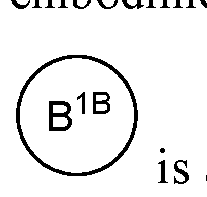 an unsubstituted indole, pyrazolo, thiophene, pyrimidine, benzofuran, or isoxazole diradical.
In certain embodiments, the invention relates to any one of the aforementioned compounds, wherein R is H.
In certain embodiments, the invention relates to any one of the aforementioned compounds, wherein x is 1, 2, or 3. In certain embodiments, the invention relates to any one of the aforementioned compounds, wherein x is 1.
In certain embodiments, the invention relates to any one of the compounds described herein.
Exemplary Conjugated Compounds
In certain embodiments, the invention relates to a hybrid composition, wherein the hybrid composition comprises a linker, any one of the aforementioned compounds, and a detectable moiety; and the linker links the compound to the detectable moiety.
In certain embodiments, the invention relates to any one of the aforementioned hybrid compositions, wherein the detectable moiety is a fluorescent moiety, a dye moiety, a radionuclide, or an MRI contrast agent.
In certain embodiments, the invention relates to a hybrid composition, wherein the hybrid composition comprises a linker, any one of the aforementioned compounds, and a biomolecule; and the linker links the compound to the biomolecule.
In certain embodiments, the invention relates to any one of the aforementioned hybrid compositions, wherein the biomolecule is a protein.
In certain embodiments, the invention relates to any one of the aforementioned hybrid compositions, wherein the biomolecule is DNA or RNA.
In certain embodiments, the invention relates to any one of the aforementioned hybrid compositions, wherein the biomolecule is siRNA.
In certain embodiments, the invention relates to any one of the hybrid compositions described herein.
Exemplary peptides, oligopeptides, polypeptides, and proteins
In certain embodiments, the invention relates to a peptide, an oligopeptide, a polypeptide, or a protein, wherein the peptide, oligopeptides, polypeptide, or protein comprises substructure I, substructure II, substructure III, substructure IV, substructure V, substructure VI, substructure VII, or substructure VIII.
In certain embodiments, the invention relates to a peptide, an oligopeptide, a polypeptide, or a protein, wherein the peptide, oligopeptides, polypeptide, or protein comprises a plurality of substructures selected from the group consisting of substructure I, substructure II, substructure III, substructure IV, substructure V, substructure VI, substructure VII, or substructure VIII.
In certain embodiments, the invention relates to any one of the peptides, oligopeptides, polypeptides, or proteins described herein.
Exemplary Affibodies
In certain embodiments, the invention relates to an affibody comprising substructure I, substructure II, substructure III, substructure IV, substructure V, substructure VI, substructure VII, or substructure VIII.
In certain embodiments, the invention relates to an affibody comprising a plurality of substructures selected from the group consisting of substructure I, substructure II, substructure III, substructure IV, substructure V, substructure VI, substructure VII, or substructure VIII.
As used herein the term "affibody" refers to a small protein composed of alpha helices. In certain embodiments, the affibody is engineered to bind a target protein or target
peptide with high affinity. In certain embodiments, affibodies are antibody mimetics. In certain embodiments, affibodies lack disulfide bridges. In certain embodiments, the affibody comprises a three-helix bundle. In certain embodiments, the affibody has a molar mass of less than about 8 kDa. In certain embodiments, the affibody has a molar mass of about 6 kDa.
In certain embodiments, the invention relates to any one of the affibodies described herein.
Exemplary Methods
In certain embodiments, the invention relates to a method according to Scheme 1:

Scheme la

Scheme lb

Scheme lc
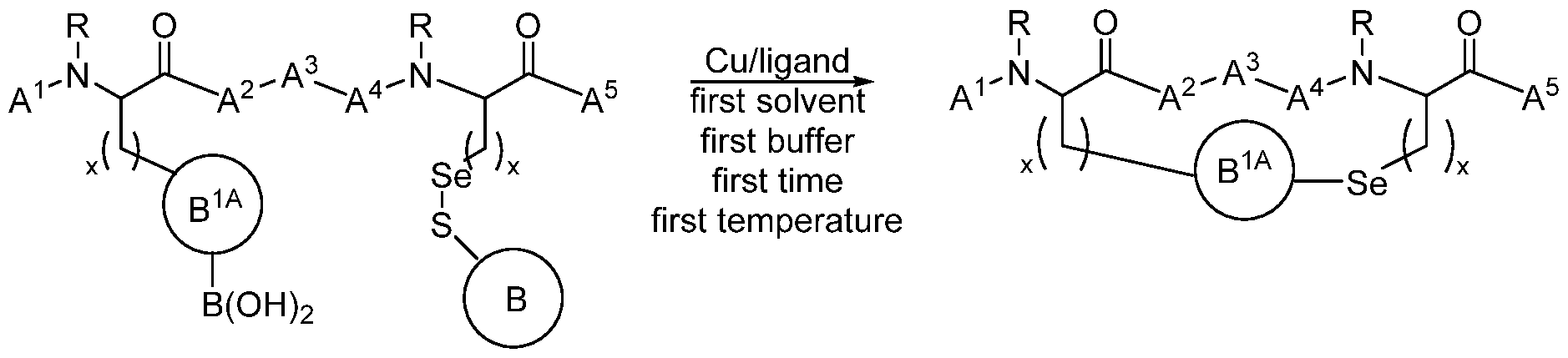
Scheme Id wherein, independently for each occurrence,
A1 is H, an amine protecting group, a natural or unnatural amino acid, a peptide, an oligopeptide, a polypeptide, or a protein;
A2, A3, and A4 are selected from the group consisting of a natural amino acid, an unnatural amino acid, and a plurality of natural amino acids or unnatural amino acids;
A5 is OH, -0(carboxylate protecting group), a natural or unnatural amino acid, a peptide, an oligopeptide, a polypeptide, or a protein; x is 0, 1, 2, 3, 4, 5, or 6;
 is a substituted or unsubstituted aryl or heteroaryl radical;
is a substituted or unsubstituted aryl or heteroaryl diradical
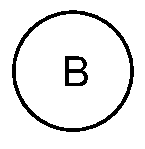 is a heteroaromatic moiety substituted with an electron withdrawing group; x is 0, 1, 2, 3, 4, 5, or 6; and R is H or alkyl.
In certain embodiments, the invention relates to a method according to Scheme 2

Scheme 2a

Scheme 2b

Scheme 2c

Scheme 2d wherein, independently for each occurrence,
A1 is H, an amine protecting group, a natural or unnatural amino acid, a peptide, an oligopeptide, a polypeptide, or a protein;
A2, A3, and A4 are selected from the group consisting of a natural amino acid, an unnatural amino acid, and a plurality of natural amino acids or unnatural amino acids;
A5 is OH, -0(carboxylate protecting group), a natural or unnatural amino acid, a peptide, an oligopeptide, a polypeptide, or a protein; x is 0, 1, 2, 3, 4, 5, or 6;
 is a substituted or unsubstituted aryl or heteroaryl radical, provided not a perfluoroaryl radical;
 is a substituted or unsubstituted aryl or heteroaryl diradical, provided is not a perfluoroaryl radical;
 is a heteroaromatic moiety substituted with an electron withdrawing group; x is 0, 1, 2, 3, 4, 5, or 6; and R is H or alkyl.
In certain embodiments, the invention relates to a method according to Scheme 3:

Scheme 3a

Scheme 3b

Scheme 3c

Scheme 3d wherein, independently for each occurrence,
A1 is H, an amine protecting group, a natural or unnatural amino acid, a peptide, an oligopeptide, a polypeptide, or a protein;
A2, A3, and A4 are selected from the group consisting of a natural amino acid, an unnatural amino acid, and a plurality of natural amino acids or unnatural amino acids;
A5 is OH, -0(carboxylate protecting group), a natural or unnatural amino acid, a peptide, an oligopeptide, a polypeptide, or a protein; x is 0, 1, 2, 3, 4, 5, or 6;
 is an aryl or heteroaryl radical substituted with at least one electron donating group;
 is a substituted aryl or heteroaryl diradical substituted with at least one electron donating group;
 is a heteroaromatic moiety substituted with an electron withdrawing group; x is 0, 1, 2, 3, 4, 5, or 6; and
R is H or alkyl.
In certain embodiments, the invention relates to a method according to Scheme 4:

Scheme 4a

Scheme 4b

Scheme 4c

Scheme 4d wherein, independently for each occurrence,
A1 is H, an amine protecting group, a natural or unnatural amino acid, a peptide, an oligopeptide, a polypeptide, or a protein;
A2, A3, and A4 are selected from the group consisting of a natural amino acid, an unnatural amino acid, and a plurality of natural amino acids or unnatural amino acids;
A5 is OH, -0(carboxylate protecting group), a natural or unnatural amino acid, a peptide, an oligopeptide, a polypeptide, or a protein; x is 0, 1, 2, 3, 4, 5, or 6; l or heteroaryl radical substituted with at least one electron donating group, p
 rovided is not a perfluoroaryl radical;
 is an aryl or heteroaryl diradical substituted with at least one electron donating group, provided
 a perfluoroaryl radical;
 is a heteroaromatic moiety substituted with an electron withdrawing group;
xisO, 1,2,3,4, 5, or 6; and
is a heteroaromatic moiety substituted with an electron withdrawing group;
xisO, 1,2,3,4, 5, or 6; and
R is H or alkyl.
In certain embodiments, the invention relates to a method accordin

Scheme 5a

Scheme 5b

Scheme 5c

Scheme 5d
wherein, independently for each occurrence,
A1 is H, an amine protecting group, a natural or unnatural amino acid, a peptide, an oligopeptide, a polypeptide, or a protein;
A2, A3, and A4 are selected from the group consisting of a natural amino acid, an unnatural amino acid, and a plurality of natural amino acids or unnatural amino acids;
A5 is OH, -0(carboxylate protecting group), a natural or unnatural amino acid, a peptide, an oligopeptide, a polypeptide, or a protein; x is 0, 1, 2, 3, 4, 5, or 6;
 is a substituted or unsubstituted aryl or heteroaryl radical, provided not a perfluoroaryl radical;
 is a substituted or unsubstituted aryl or heteroaryl diradical, provided is not a perfluoroaryl radical;
 is a heteroaromatic moiety substituted with an electron withdrawing group; x is 0, 1, 2, 3, 4, 5, or 6; and R is H or alkyl.
In certain embodiments, the invention relates to a method according to Scheme 6:

Scheme 6a

Scheme 6b

Scheme 6c

Scheme 6d wherein, independently for each occurrence,
A1 is H, an amine protecting group, a natural or unnatural amino acid, a peptide, an oligopeptide, a polypeptide, or a protein;
A2, A3, and A4 are selected from the group consisting of a natural amino acid, an unnatural amino acid, and a plurality of natural amino acids or unnatural amino acids;
A5 is OH, -0(carboxylate protecting group), a natural or unnatural amino acid, a peptide, an oligopeptide, a polypeptide, or a protein; x is 0, 1, 2, 3, 4, 5, or 6;
B2B
is an aryl or heteroaryl radical substituted with at least one electron donating provided (?) is not a perfluoroaryl radical;
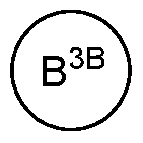 is an aryl or heteroaryl diradical substituted with at least one electron donating group, provided
 a perfluoroaryl radical;
 is a heteroaromatic moiety substituted with an electron withdrawing group; x is 0, 1, 2, 3, 4, 5, or 6; and
R is H or alkyl.
In certain embodiments, the invention relates to a method according to Scheme 7:

Scheme 7a

Scheme 7b

Scheme 7c

Scheme 7d wherein, independently for each occurrence,
A1 is H, an amine protecting group, a natural or unnatural amino acid, a peptide, an oligopeptide, a polypeptide, or a protein;
A2, A3, and A4 are selected from the group consisting of a natural amino acid, an unnatural amino acid, and a plurality of natural amino acids or unnatural amino acids;
A5 is OH, -0(carboxylate protecting group), a natural or unnatural amino acid, a peptide, an oligopeptide, a polypeptide, or a protein; x is 0, 1, 2, 3, 4, 5, or 6;
 is an aryl or heteroaryl radical substituted with at least one electron donating group;
 is a substituted aryl or heteroaryl diradical substituted with at least one electron donating group;
 is a heteroaromatic moiety substituted with an electron withdrawing group; x is 0, 1, 2, 3, 4, 5, or 6; and
R is H or alkyl.
is a heteroaromatic moiety substituted with an electron withdrawing group; x is 0, 1, 2, 3, 4, 5, or 6; and
R is H or alkyl.
In certain embodiments, the invention relates to a method according to Scheme 8:

Scheme 8a

Scheme 8b

Scheme 8c

Scheme 8d
wherein, independently for each occurrence,
A1 is H, an amine protecting group, a natural or unnatural amino acid, a peptide, an oligopeptide, a polypeptide, or a protein;
A2, A3, and A4 are selected from the group consisting of a natural amino acid, an unnatural amino acid, and a plurality of natural amino acids or unnatural amino acids;
A5 is OH, -0(carboxylate protecting group), a natural or unnatural amino acid, a peptide, an oligopeptide, a polypeptide, or a protein; x is 0, 1, 2, 3, 4, 5, or 6; l or heteroaryl radical substituted with at least one electron donating group, p
 rovided is not a perfluoroaryl radical;
 is an aryl or heteroaryl diradical substituted with at least one electron donating group, provided
 a perfluoroaryl radical;
 is a heteroaromatic moiety substituted with an electron withdrawing group; x is 0, 1, 2, 3, 4, 5, or 6; and R is H or alkyl.
In certain embodiments, the invention relates to any one of the aforementioned methods, wherein the product is a hybrid biopolymer.
In certain embodiments, the invention relates to any one of the aforementioned

methods, wherein is a substituted aryl radical. In certain embodiments, the invention relates to any one of the aforementioned methods, whe
 is a substituted phenyl radical.
In certain embodiments, the invention relates to any one of the aforementioned

methods, wherein is an unsubstituted aryl radical.
In certain embodiments, the invention relates to any one of the aforementioned methods, wherein
 is a substituted heteroaryl radical. In certain embodiments, the invention relates to any one of the aforementioned methods, wherein
 a substituted indole, pyrazolo, thiophene, pyrimidine, benzofuran, or isoxazole radical.
In certain embodiments, the invention relates to any one of the aforementioned methods, wherein
 an unsubstituted heteroaryl radical. In certain embodiments, the invention relates to any one of the aforementioned methods, wherein
 is an unsubstituted indole, pyrazolo, thiophene, pyrimidine, benzofuran, or isoxazole radical.
In certain embodiments, the invention relates to any one of the aforementioned
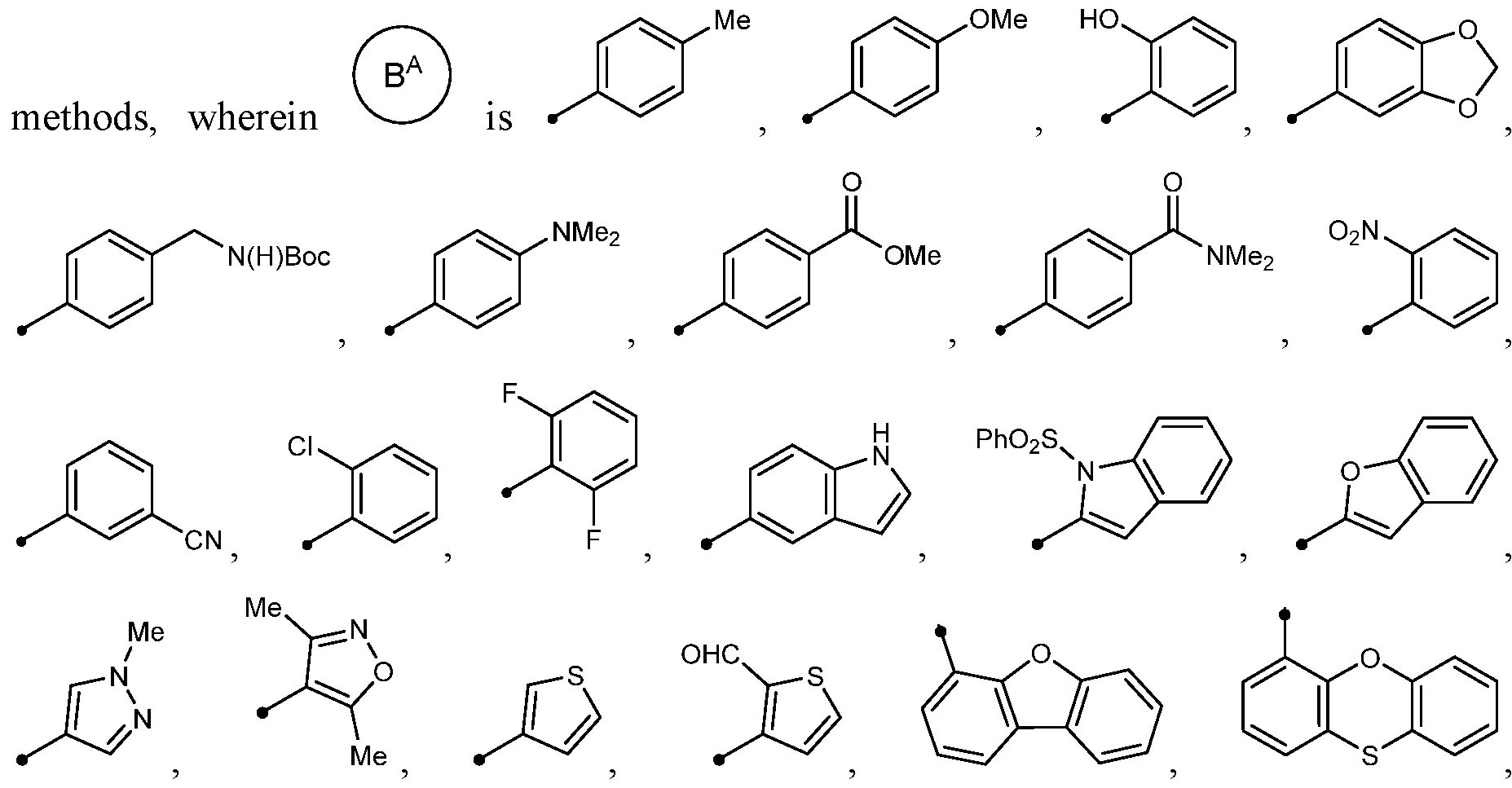


-66-

 In certain embodiments, the invention relates to any one of the aforementioned


In certain embodiments, the invention relates to any one of the aforementioned methods, wherein a substituted aryl radical. In certain embodiments, the invention relates to any one
 of the aforementioned methods, whe is a substituted phenyl radical.
In certain embodiments, the invention relates to any one of the aforementioned methods, wherein
 an unsubstituted aryl radical.
In certain embodiments, the invention relates to any one of the aforementioned methods, wherein
an unsubstituted aryl radical.
In certain embodiments, the invention relates to any one of the aforementioned methods, wherein
 is a substituted heteroaryl radical. In certain embodiments, the invention relates to any one of the aforementioned methods, wherein
 a substituted indole, pyrazolo, thiophene, pyrimidine, benzofuran, or isoxazole radical.
In certain embodiments, the invention relates to any one of the aforementioned methods, wherein
 an unsubstituted heteroaryl radical. In certain embodiments, the invention relates to any one of the aforementioned methods, wherein
 is an unsubstituted indole, pyrazolo, thiophene, pyrimidine, benzofuran, or isoxazole radical.
In certain embodiments, the invention relates to any one of the aforementioned


-71-

 In certain embodiments, the invention relates to any one of the aforementioned


In certain embodiments, the invention relates to any one of the aforementioned methods, wherein a substituted aryl radical. In certain embodiments, the invention relates to any one
 of the aforementioned methods, whe is a substituted phenyl radical.
In certain embodiments, the invention relates to any one of the aforementioned methods, wherein is a substituted heteroaryl radical. In certain embodiments, the invention relates to
 any one of the aforementioned methods, wherein a substituted indole, pyrazolo, thiophene, pyrimidine, benzofuran, or isoxazole radical.
In certain embodiments, the invention relates to any one of the aforementioned
any one of the aforementioned methods, wherein a substituted indole, pyrazolo, thiophene, pyrimidine, benzofuran, or isoxazole radical.
In certain embodiments, the invention relates to any one of the aforementioned


In certain embodiments, the invention relates to any one of the aforementioned methods, wherein
 a substituted aryl radical. In certain embodiments, the invention relates to any one of the aforementioned methods, wherein
 is a substituted phenyl radical.
In certain embodiments, the invention relates to any one of the aforementioned methods, wherein is a substituted heteroaryl radical. In certain embodiments, the invention relates to
 any one of the aforementioned methods, wherein a substituted indole, pyrazolo, thiophene, pyrimidine, benzofuran, or isoxazole radical.
In certain embodiments, the invention relates to any one of the aforementioned


In certain embodiments, the invention relates to any one of the aforementioned methods, wherein A2 represents one natural or unnatural amino acid. In certain embodiments, the invention relates to any one of the aforementioned methods, wherein A3 represents one natural or unnatural amino acid. In certain embodiments, the invention relates to any one of the aforementioned methods, wherein A4 represents one natural or unnatural amino acid.
In certain embodiments, the invention relates to any one of the aforementioned methods, wherein A2 represents two natural or unnatural amino acids. In certain embodiments, the invention relates to any one of the aforementioned methods, wherein A3 represents two natural or unnatural amino acids. In certain embodiments, the invention relates to any one of the aforementioned methods, wherein A4 represents two natural or unnatural amino acids.
In certain embodiments, the invention relates to any one of the aforementioned methods, wherein A2 represents three natural or unnatural amino acids. In certain embodiments, the invention relates to any one of the aforementioned methods, wherein A3 represents three natural or unnatural amino acids. In certain embodiments, the invention relates to any one of the aforementioned methods, wherein A4 represents three natural or unnatural amino acids.
In certain embodiments, the invention relates to any one of the aforementioned methods, wherein the first solvent, the second solvent, the third solvent, the fourth solvent, the fifth solvent, the sixth solvent, the seventh solvent, or the eighth solvent is water, DMF, CH3CN, CH3CH2OH, CH3OH, DMSO, tris(2-carboxyethyl)phosphine (TCEP), dibutyl ether, tetrahydrofuran (THF), 1,4-dioxane, DME, dichloromethane, dichloroethane, acetone, diethyl ether, hexanes, or a mixture thereof.
In certain embodiments, the invention relates to any one of the aforementioned methods, wherein the first buffer, the second buffer, the third buffer, the fourth buffer, the fifth buffer, the sixth buffer, the seventh buffer, or the eighth buffer comprises Na3P04, MES, or tris(hydroxymethyl)aminomethane (TRIS).
In certain embodiments, the invention relates to any one of the aforementioned methods, wherein the first time, the second time, the third time, the fourth time, the fifth
time, the sixth time, the seventh time, or the eighth time is from about 30 min to about 24 h. In certain embodiments, the invention relates to any one of the aforementioned methods, wherein the first time, the second time, the third time, the fourth time, the fifth time, the sixth time, the seventh time, or the eighth time is about 30 min, about 40 min, about 50 min, about 1 h, about 2 h, about 3 h, about 4 h, about 5 h, about 6 h, about 7 h, about 8 h, about 9 h, about 10 h, about 11 h, about 12 h, about 13 h, about 14 h, or about 15 h.
In certain embodiments, the invention relates to any one of the aforementioned methods, wherein A1 is an amine protecting group selected from the group consisting of an N,0-acetal, allyloxycarbonyl (Aloe), benzyl (Bn), benzyloxycarbonyl (Cbz), benzyloxymethyl (BOM), t-butoxycarbonyl (Boc), t-butyldimethylsilyl (TBDMS), t- butyldiphenylsilyl (TBDPS), diphenylmethyl, diphenylmethylene, ethoxycarbonyl, 9- fluorenylmethoxycarbonyl (Fmoc), /?-methoxybenzyl (PMB), methoxycarbonyl, methoxymethyl (MOM), /?-methoxyphenyl (PMP), /?-nitrocinnamyloxycarbonyl (Noc), tosyl (Ts), 2-tosylethoxycarbonyl (Tsoc), 2,2,2-trichloroethoxycarbonyl (Troc), trifluoroacetyl, triisopropylsilyl (TIPS), trimethylsilyl (TMS), 2- (trimethylsilyl)ethoxycarbonyl (Teoc), 2-(trimethylsilyl)ethoxymethyl (SEM), or trityl (Tr).
In certain embodiments, the invention relates to any one of the aforementioned methods, wherein A5 is -0(carboxylate protecting group); and the carboxylate protecting group is selected from the group consisting of allyl, benzyl, benzyloxymethyl (BOM), t-Bu, t-butyldimethylsilyl (TBDMS), t-butyldiphenylsilyl (TBDPS), diphenylmethyl, 9- fluorenylmethyl (Fm), 2-methoxyethoxymethyl (MEM), methoxymethyl (MOM), p- nitrobenzyl (P B), an ester, a 1,3-oxazoline, pi valoyloxy methyl (Pom), 2-tosylethyl (TSE), 2,2,2-trichloroethyl (TCE), triethylsilyl (TES), trimethylsilyl (TMS), 2- (trimethylsilyl)ethoxymethyl (SEM), or 2-(trimethylsilyl)ethyl (TMSE).
In certain embodiments, the invention relates to any one of the aforementioned methods, wherein R is H.
In certain embodiments, the invention relates to any one of the aforementioned methods, wherein x is 1, 2, or 3. In certain embodiments, the invention relates to any one of the aforementioned methods, wherein x is 1.
In certain embodiments, the invention relates to any one of the aforementioned methods, wherein the first, second, third, fourth, fifth, sixth, seventh, or eighth temperature is between about 10°C and about 50 °C. In certain embodiments, the invention relates to
any one of the aforementioned methods, wherein the first, second, third, fourth, fifth, sixth, seventh, or eighth temperature is about 10 °C, about 11 °C, about 12 °C, about 13 °C, about 14 °C, about 15 °C, about 16 °C, about 17 °C, about 18 °C, about 19 °C, about 20 °C, about 21 °C, about 22 °C, about 23 °C, about 24 °C, about 25 °C, about 26 °C, about 27 °C, about 28 °C, about 29 °C, about 30 °C, about 31 °C, about 32 °C, about 33 °C, about 34 °C, about 35 °C, about 36 °C, about 37 °C, about 38 °C, about 39 °C, about 40 °C, about 41 °C, about 42 °C, about 43 °C, about 44 °C, about 45 °C, about 46 °C, about 47 °C, about 48 °C, about 49 °C, or about 50 °C.
In certain embodiments, the invention relates to any one of the aforementioned methods, wherein the Cu/ligand comprises CuS04. In certain embodiments, the invention relates to any one of the aforementioned methods, wherein the Cu/ligand comprises a substituted or unsubstituted bipyridine ligand or a substituted or unsubstituted phenanthroline ligand. In certain embodiments, the invention relates to any one of the aforementioned methods, wherein the Cu/ligand comprises 4,4'-di-tert-butyl-2,2'-bipy.
In certain embodiments, the invention relates to any one of the aforementioned methods, wherein the Rh/ligand comprises [RhCp*Cl2]2-
In certain embodiments, the invention relates to any one of the aforementioned methods, wherein the catalytic metal is not Cu or Rh or absent, but comprises Fe, Co, Ni, Au, Pd, Pt, Ru, or Ir. In certain embodiments, the invention relates to any one of the aforementioned methods, wherein the catalytic metal is not Cu or Rh or absent, but is selected from the group consisting of Fe, Co, Ni, Au, Pd, Pt, Ru, and Ir.
The reactions typically proceed at mild temperatures and pressures to give high yields of the product. Thus, yields of desired products greater than 45%, greater than 75%, greater than 80%, greater than 85%, greater than 90%, or greater than 95% may be obtained from reactions at mild temperatures according to the invention.
In certain embodiments, the reactions take place under an inert atmosphere of a gas such as nitrogen or argon.
The reaction processes of the invention can be conducted in continuous, semi- continuous or batch fashion and may involve a liquid recycle operation as desired. The processes of this invention are preferably conducted in batch fashion. Likewise, the manner or order of addition of the reaction ingredients, base, and solvent are not generally critical to the success of the reaction, and may be accomplished in any conventional fashion.
The reaction can be conducted in a single reaction zone or in a plurality of reaction zones, in series or in parallel or it may be conducted batchwise or continuously in an elongated tubular zone or series of such zones. The materials of construction employed should be inert to the starting materials during the reaction and the fabrication of the equipment should be able to withstand the reaction temperatures and pressures. Means to introduce and/or adjust the quantity of starting materials or ingredients introduced batchwise or continuously into the reaction zone during the course of the reaction can be conveniently utilized in the processes especially to maintain the desired molar ratio of the starting materials. The reaction steps may be effected by the incremental addition of one of the starting materials to the other. When complete conversion is not desired or not obtainable, the starting materials can be separated from the product and then recycled back into the reaction zone.
The processes may be conducted in glass lined, stainless steel, fluoropolymer coated (e.g., Teflon coated) or similar type reaction equipment. The reaction zone may be fitted with one or more internal and/or external heat exchanger(s) in order to control undue temperature fluctuations, or to prevent any possible "runaway" reaction temperatures.
Furthermore, one or more of the reactants can be immobilized on or incorporated into a polymer or other insoluble matrix by, for example, derivatization with one or more of the substituents of the aryl group or an amino acid residue.
The ability to provide synthesis schemes for the compounds of the invention that can be carried out under mild conditions has broad application.
In addition, the subject methods can be used as part of combinatorial synthesis schemes to yield libraries of compounds. Accordingly, another aspect of the invention relates to use of the subject method to generate variegated libraries of compounds, and to the libraries themselves. The libraries can be soluble or linked to insoluble supports, e.g., through a substituent of a reactant (prior to carrying out a reaction of the invention).
Further, the methods of the invention can be used to produce synthetic intermediates that, after being subjected to additional methods known in the art, are transformed to desired end products.
Exemplary Therapeutic Methods
In certain embodiments, the invention relates to a method of killing or inhibiting the growth or proliferation of a bacterium, a fungus, a virus, or a parasite, comprising the step of: contacting with the bacterium, fungus, virus, or parasite an effective amount of any one of the aforementioned compounds, thereby treating killing or inhibiting the growth or proliferation of the bacterium, fungus, virus, or parasite.
In certain embodiments, the invention relates to a method of treating a disease in a subject in need thereof comprising the step of: administering to the subject an effective amount of any one of the aforementioned compounds, thereby treating the disease.
In certain embodiments, the invention relates to any one of the aforementioned methods, wherein the disease is an infection, for example, a bacterial infection, a fungal infection, a viral infection, or a parasitic infection.
In certain embodiments, the invention relates to any one of the aforementioned methods, wherein the disease is cancer. In one group of embodiments, the invention relates to any one of the aforementioned methods, wherein the disease is selected from the group consisting of breast cancer, prostate cancer, lymphoma, skin cancer, pancreatic cancer, colon cancer, melanoma, malignant melanoma, ovarian cancer, brain cancer, primary brain carcinoma, head-neck cancer, glioma, glioblastoma, liver cancer, bladder cancer, non-small cell lung cancer, head or neck carcinoma, breast carcinoma, ovarian carcinoma, lung carcinoma, small-cell lung carcinoma, Wilms' tumor, cervical carcinoma, testicular carcinoma, bladder carcinoma, pancreatic carcinoma, stomach carcinoma, colon carcinoma, prostatic carcinoma, genitourinary carcinoma, thyroid carcinoma, esophageal carcinoma, myeloma, multiple myeloma, adrenal carcinoma, renal cell carcinoma, endometrial carcinoma, adrenal cortex carcinoma, malignant pancreatic insulinoma, malignant carcinoid carcinoma, choriocarcinoma, mycosis fungoides, malignant hypercalcemia, cervical hyperplasia, leukemia, acute lymphocytic leukemia, chronic lymphocytic leukemia, acute myelogenous leukemia, chronic myelogenous leukemia, chronic granulocytic leukemia, acute granulocytic leukemia, hairy cell leukemia, neuroblastoma, rhabdomyosarcoma, Kaposi's sarcoma, polycythemia vera, essential thrombocytosis, Hodgkin's disease, non- Hodgkin's lymphoma, soft-tissue sarcoma, osteogenic sarcoma, primary
macroglobulinemia, and retinoblastoma. In some embodiments, the cancer being treated is metastatic. In other embodiments, the cancer being treated is resistant to anticancer agents.
In certain embodiments, the invention relates to any one of the aforementioned methods, further comprising the step of: monitoring the cell or the subject by 19F MR.
A subject in need thereof (or a mammal in need thereof) may include, for example, a subject who has been diagnosed with any one of the aforementioned diseases, or a subject who has been treated for any one of the aforementioned diseases, including subjects that have been refractory to the previous treatment.
In some embodiments, the subject pharmaceutical compositions of the present invention will incorporate the substance or substances to be delivered in an amount sufficient to deliver to a patient a therapeutically effective amount of an incorporated therapeutic agent or other material as part of a prophylactic or therapeutic treatment. The desired concentration of the active agent will depend on absorption, inactivation, and excretion rates of the drug as well as the delivery rate of the compound. It is to be noted that dosage values may also vary with the severity of the condition to be alleviated. It is to be further understood that for any particular subject, specific dosage regimens should be adjusted over time according to the individual need and the professional judgment of the person administering or supervising the administration of the compositions. Typically, dosing will be determined using techniques known to one skilled in the art.
The dosage of the subject agent may be determined by reference to the plasma concentrations of the agent. For example, the maximum plasma concentration (CmaX) and the area under the plasma concentration-time curve from time 0 to infinity (AUC (0-4)) may be used. Dosages for the present invention include those that produce the above values for Cmax and AUC (0-4) and other dosages resulting in larger or smaller values for those parameters.
Actual dosage levels of the active ingredients in the pharmaceutical compositions of this invention may be varied so as to obtain an amount of the active ingredient which is effective to achieve the desired therapeutic response for a particular patient, composition, and mode of administration, without being toxic to the patient.
The selected dosage level will depend upon a variety of factors including the activity of the particular agent employed, the route of administration, the time of administration, the rate of excretion or metabolism of the particular compound being
employed, the duration of the treatment, other drugs, compounds and/or materials used in combination with the particular compound employed, the age, sex, weight, condition, general health and prior medical history of the patient being treated, and like factors well known in the medical arts.
A physician or veterinarian having ordinary skill in the art can readily determine and prescribe the effective amount of the pharmaceutical composition required. For example, the physician or veterinarian could prescribe and/or administer doses of the agents of the invention employed in the pharmaceutical composition at levels lower than that required in order to achieve the desired therapeutic effect and gradually increase the dosage until the desired effect is achieved.
In general, a suitable daily dose of an agent of the invention will be that amount of the agent which is the lowest dose effective to produce a therapeutic effect. Such an effective dose will generally depend upon the factors described above.
If desired, the effective daily dose of the agent may be administered as two, three, four, five, six or more sub-doses administered separately at appropriate intervals throughout the day, optionally, in unit dosage forms.
The precise time of administration and amount of any particular agent that will yield the most effective treatment in a given patient will depend upon the activity, pharmacokinetics, and bioavailability of a particular agent, physiological condition of the patient (including age, sex, disease type and stage, general physical condition, responsiveness to a given dosage and type of medication), route of administration, and the like. The guidelines presented herein may be used to optimize the treatment, e.g., determining the optimum time and/or amount of administration, which will require no more than routine experimentation consisting of monitoring the subject and adjusting the dosage and/or timing.
While the subject is being treated, the health of the subject may be monitored by measuring one or more of the relevant indices at predetermined times during a 24-hour period. All aspects of the treatment, including supplements, amounts, times of administration and formulation, may be optimized according to the results of such monitoring. The patient may be periodically reevaluated to determine the extent of improvement by measuring the same parameters, the first such reevaluation typically occurring at the end of four weeks from the onset of therapy, and subsequent reevaluations
occurring every four to eight weeks during therapy and then every three months thereafter. Therapy may continue for several months or even years, with a minimum of one month being a typical length of therapy for humans. Adjustments, for example, to the amount(s) of agent administered and to the time of administration may be made based on these reevaluations.
Treatment may be initiated with smaller dosages which are less than the optimum dose of the compound. Thereafter, the dosage may be increased by small increments until the optimum therapeutic effect is attained. In addition, the combined use an agent that modulates an autotrophy-associated gene product and a second agent, e.g., another agent useful for the treatment of the autophagy-related disease, may reduce the required dosage for any individual agent because the onset and duration of effect of the different compounds and/or agents may be complimentary.
In one aspect of the invention, a compound of the invention, or a pharmaceutically acceptable salt thereof, can be used alone or in combination with another therapeutic agent to treat diseases such cancer. It should be understood that the compounds of the invention can be used alone or in combination with an additional agent, e.g., a therapeutic agent, said additional agent being selected by the skilled artisan for its intended purpose. For example, the additional agent can be a therapeutic agent that is art-recognized as being useful to treat the disease or condition being treated by the compound of the present invention. The additional agent also can be an agent that imparts a beneficial attribute to the therapeutic composition e.g., an agent that affects the viscosity of the composition.
The combination therapy contemplated by the invention includes, for example, administration of a compound of the invention, or a pharmaceutically acceptable salt thereof, and additional agent(s) in a single pharmaceutical formulation as well as administration of a compound of the invention, or a pharmaceutically acceptable salt thereof, and additional agent(s) in separate pharmaceutical formulations. In other words, coadministration shall mean the administration of at least two agents to a subject so as to provide the beneficial effects of the combination of both agents. For example, the agents may be administered simultaneously or sequentially over a period of time.
It should further be understood that the combinations included within the invention are those combinations useful for their intended purpose. The agents set forth below are illustrative for purposes and not intended to be limited. The combinations, which are part of
this invention, can be the compounds of the present invention and at least one additional agent selected from the lists below. The combination can also include more than one additional agent, e.g., two or three additional agents if the combination is such that the formed composition can perform its intended function.
In certain embodiments, the co-administration of two or more therapeutic agents (e.g., a pharmaceutical and a peptide) achieves a synergistic effect, i.e., a therapeutic effect that is greater than the sum of the therapeutic effects of the individual components of the combination. The term "synergistic" refers to a combination which is more effective than the additive effects of any two or more single agents. A synergistic effect permits the effective treatment of a disease using lower amounts (doses) of individual therapy. The lower doses result in lower toxicity without reduced efficacy. In addition, a synergistic effect can result in improved efficacy. Finally, synergy may result in an improved avoidance or reduction of disease as compared to any single therapy. Combination therapy can allow for the product of lower doses of the first therapeutic or the second therapeutic agent (referred to as "apparent one-way synergy" herein), or lower doses of both therapeutic agents (referred to as "two-way synergy" herein) than would normally be required when either drug is used alone.
Definitions
For convenience, certain terms employed in the specification, examples, and appended claims are collected here.
The articles "a" and "an" are used herein to refer to one or to more than one (i.e., to at least one) of the grammatical object of the article. By way of example, "an element" means one element or more than one element.
The term "heteroatom" is art-recognized and refers to an atom of any element other than carbon or hydrogen. Illustrative heteroatoms include boron, nitrogen, oxygen, phosphorus, sulfur and selenium.
The term "alkenyl" as used herein, means a straight or branched chain hydrocarbon containing from 2 to 10 carbons and containing at least one carbon-carbon double bond formed by the removal of two hydrogens. Representative examples of alkenyl include, but are not limited to, ethenyl, 2-propenyl, 2-methyl-2-propenyl, 3-butenyl, 4-pentenyl, 5- hexenyl, 2-heptenyl, 2-methyl-l-heptenyl, and 3-decenyl.
The term "alkoxy" means an alkyl group, as defined herein, appended to the parent molecular moiety through an oxygen atom. Representative examples of alkoxy include, but are not limited to, methoxy, ethoxy, propoxy, 2-propoxy, butoxy, tert-butoxy, pentyloxy, and hexyloxy.
The term "alkoxycarbonyl" means an alkoxy group, as defined herein, appended to the parent molecular moiety through a carbonyl group, represented by -C(=0)-, as defined herein. Representative examples of alkoxycarbonyl include, but are not limited to, methoxy carbonyl, ethoxy carbonyl, and tert-butoxy carbonyl.
The term " alkoxy sulfonyl" as used herein, means an alkoxy group, as defined herein, appended to the parent molecular moiety through a sulfonyl group, as defined herein. Representative examples of alkoxysulfonyl include, but are not limited to, methoxysulfonyl, ethoxysulfonyl and propoxysulfonyl.
The term "arylalkoxy" and "heteroalkoxy" as used herein, means an aryl group or heteroaryl group, as defined herein, appended to the parent molecular moiety through an alkoxy group, as defined herein.
The term "alkyl" means a straight or branched chain hydrocarbon containing from 1 to 10 carbon atoms. Representative examples of alkyl include, but are not limited to, methyl, ethyl, n-propyl, iso-propyl, n-butyl, sec-butyl, iso-butyl, tert-butyl, n-pentyl, isopentyl, neopentyl, and n-hexyl.
The term "alkylcarbonyl" as used herein, means an alkyl group, as defined herein, appended to the parent molecular moiety through a carbonyl group, as defined herein. Representative examples of alkylcarbonyl include, but are not limited to, acetyl, 1- oxopropyl, 2,2-dimethyl-l-oxopropyl, 1-oxobutyl, and 1-oxopentyl.
The term "alkylcarbonyloxy" and "arylcarbonyloxy" as used herein, means an alkylcarbonyl or arylcarbonyl group, as defined herein, appended to the parent molecular moiety through an oxygen atom. Representative examples of alkylcarbonyloxy include, but are not limited to, acetyloxy, ethylcarbonyloxy, and tert-butylcarbonyloxy. Representative examples of arylcarbonyloxy include, but are not limited to phenyl carbonyloxy.
The term "alkyl sulfonyl" as used herein, means an alkyl group, as defined herein, appended to the parent molecular moiety through a sulfonyl group, as defined herein.
Representative examples of alkylsulfonyl include, but are not limited to, methyl sulfonyl and ethyl sulfonyl.
The term "alkylthio" as used herein, means an alkyl group, as defined herein, appended to the parent molecular moiety through a sulfur atom. Representative examples of alkylthio include, but are not limited, methylthio, ethylthio, tert-butylthio, and hexylthio. The terms "arylthio," "alkenylthio" and "arylakylthio," for example, are likewise defined.
The term "alkynyl" as used herein, means a straight or branched chain hydrocarbon group containing from 2 to 10 carbon atoms and containing at least one carbon-carbon triple bond. Representative examples of alkynyl include, but are not limited, to acetylenyl, 1-propynyl, 2-propynyl, 3-butynyl, 2-pentynyl, and 1-butynyl.
The term "amido" as used herein, means - HC(=0)-, wherein the amido group is bound to the parent molecular moiety through the nitrogen. Examples of amido include alkylamido such as CH3C(=0)N(H)- and CH3CH2C(=0)N(H)-.
The term "amino" as used herein, refers to radicals of both unsubstituted and substituted amines appended to the parent molecular moiety through a nitrogen atom. The two groups are each independently hydrogen, alkyl, alkylcarbonyl, alkylsulfonyl, arylcarbonyl, or formyl. Representative examples include, but are not limited to methylamino, acetylamino, and acetylmethylamino.
The term "aromatic" refers to a planar or poly cyclic structure characterized by a cyclically conjugated molecular moiety containing 4n+2 electrons, wherein n is the absolute value of an integer. Aromatic molecules containing fused, or joined, rings also are referred to as bicyclic aromatic rings. For example, bicyclic aromatic rings containing heteroatoms in a hydrocarbon ring structure are referred to as bicyclic heteroaryl rings.
The term "aryl," as used herein, means a phenyl group or a naphthyl group. The aryl groups of the invention can be optionally substituted with 1, 2, 3, 4 or 5 substituents independently selected from the group consisting of alkenyl, alkoxy, alkoxycarbonyl, alkoxysulfonyl, alkyl, alkylcarbonyl, alkylcarbonyloxy, alkylsulfonyl, alkylthio, alkynyl, amido, amino, carboxy, cyano, formyl, halo, haloalkoxy, haloalkyl, hydroxyl, hydroxyalkyl, mercapto, nitro, phosphinyl, silyl and silyloxy.
The term "arylene," is art-recognized, and as used herein, pertains to a bidentate moiety obtained by removing two hydrogen atoms of an aryl ring, as defined above.
The term "arylalkyl" or "aralkyl" as used herein, means an aryl group, as defined herein, appended to the parent molecular moiety through an alkyl group, as defined herein. Representative examples of arylalkyl include, but are not limited to, benzyl, 2-phenylethyl, 3-phenylpropyl, and 2-naphth-2-ylethyl.
The term "arylalkoxy" or "arylalkyloxy" as used herein, means an arylalkyl group, as defined herein, appended to the parent molecular moiety through an oxygen. The term "heteroarylalkoxy" as used herein, means an heteroarylalkyl group, as defined herein, appended to the parent molecular moiety through an oxygen.
The term "arylalkylthio" as used herein, means an arylalkyl group, as defined herein, appended to the parent molecular moiety through an sulfur. The term "heteroaryl alky lthio" as used herein, means an heteroarylalkyl group, as defined herein, appended to the parent molecular moiety through an sulfur.
The term "arylalkenyl" as used herein, means an aryl group, as defined herein, appended to the parent molecular moiety through an alkenyl group. A representative example is phenyl ethyl enyl.
The term "arylalkynyl" as used herein, means an aryl group, as defined herein, appended to the parent molecular moiety through an alkynyl group. A representative example is phenylethynyl.
The term "arylcarbonyl" as used herein, means an aryl group, as defined herein, appended to the parent molecular moiety through a carbonyl group, as defined herein. Representative examples of arylcarbonyl include, but are not limited to, benzoyl and naphthoyl.
The term "arylcarbonylalkyl" as used herein, means an arylcarbonyl group, as defined herein, bound to the parent molecule through an alkyl group, as defined herein.
The term "arylcarbonylalkoxy" as used herein, means an arylcarbonylalkyl group, as defined herein, bound to the parent molecule through an oxygen.
The term "aryloxy" as used herein, means an aryl group, as defined herein, appended to the parent molecular moiety through an oxygen. The term "heteroaryloxy" as used herein, means a heteroaryl group, as defined herein, appended to the parent molecular moiety through an oxygen.
The term "carbonyl" as used herein, means a -C(=0)- group.
The term "carboxy" as used herein, means a -C02H group.
The term "cycloalkyl" as used herein, means monocyclic or multicyclic (e.g., bicyclic, tricyclic) hydrocarbons containing from 3 to 12 carbon atoms that is completely saturated or has one or more unsaturated bonds but does not amount to an aromatic group. Examples of a cycloalkyl group include cyclopropyl, cyclobutyl, cyclopentyl, cyclopentenyl, cyclohexyl and cyclohexenyl.
The term "cycloalkoxy" as used herein, means a cycloalkyl group, as defined herein, appended to the parent molecular moiety through an oxygen.
The term "cyano" as used herein, means a -CN group.
The term "formyl" as used herein, means a -C(=0)H group.
The term "halo" or "halogen" means -CI, -Br, -I or -F.
The term "haloalkoxy" as used herein, means at least one halogen, as defined herein, appended to the parent molecular moiety through an alkoxy group, as defined herein. Representative examples of haloalkoxy include, but are not limited to, chloromethoxy, 2- fluoroethoxy, trifluoromethoxy, and pentafluoroethoxy.
The term "haloalkyl" means at least one halogen, as defined herein, appended to the parent molecular moiety through an alkyl group, as defined herein. Representative examples of haloalkyl include, but are not limited to, chloromethyl, 2-fluoroethyl, trifluoromethyl, pentafluoroethyl, and 2-chloro-3-fluoropentyl.
The term "heterocyclyl", as used herein, include non-aromatic, ring systems, including, but not limited to, monocyclic, bicyclic and tricyclic rings, which can be completely saturated or which can contain one or more units of unsaturation, for the avoidance of doubt, the degree of unsaturation does not result in an aromatic ring system) and have 3 to 12 atoms including at least one heteroatom, such as nitrogen, oxygen, or sulfur. For purposes of exemplification, which should not be construed as limiting the scope of this invention, the following are examples of heterocyclic rings: azepines, azetidinyl, morpholinyl, oxopiperidinyl, oxopyrrolidinyl, piperazinyl, piperidinyl, pyrrolidinyl, quinicludinyl, thiomorpholinyl, tetrahydropyranyl and tetrahydrofuranyl. The heterocyclyl groups of the invention are substituted with 0, 1, 2, 3, 4 or 5 substituents independently selected from alkenyl, alkoxy, alkoxycarbonyl, alkoxysulfonyl, alkyl, alkylcarbonyl, alkylcarbonyloxy, alkylsulfonyl, alkylthio, alkynyl, amido, amino, carboxy, cyano, formyl,
halo, haloalkoxy, haloalkyl, hydroxyl, hydroxyalkyl, mercapto, nitro, phosphinyl, silyl and silyloxy.
The term "heteroaryl" as used herein, include aromatic ring systems, including, but not limited to, monocyclic, bicyclic and tricyclic rings, and have 3 to 12 atoms including at least one heteroatom, such as nitrogen, oxygen, or sulfur. For purposes of exemplification, which should not be construed as limiting the scope of this invention: azaindolyl, benzo(b)thienyl, benzimidazolyl, benzofuranyl, benzoxazolyl, benzothiazolyl, benzothiadiazolyl, benzotriazolyl, benzoxadiazolyl, furanyl, imidazolyl, imidazopyridinyl, indolyl, indolinyl, indazolyl, isoindolinyl, isoxazolyl, isothiazolyl, isoquinolinyl, oxadiazolyl, oxazolyl, purinyl, pyranyl, pyrazinyl, pyrazolyl, pyridinyl, pyrimidinyl, pyrrolyl, pyrrolo[2,3-d]pyrimidinyl, pyrazolo[3,4-d]pyrimidinyl, quinolinyl, quinazolinyl, triazolyl, thiazolyl, thiophenyl, tetrahydroindolyl, tetrazolyl, thiadiazolyl, thienyl, thiomorpholinyl, triazolyl or tropanyl. The heteroaryl groups of the invention are substituted with 0, 1, 2, 3, 4 or 5 substituents independently selected from alkenyl, alkoxy, alkoxycarbonyl, alkoxysulfonyl, alkyl, alkylcarbonyl, alkylcarbonyloxy, alkylsulfonyl, alkylthio, alkynyl, amido, amino, carboxy, cyano, formyl, halo, haloalkoxy, haloalkyl, hydroxyl, hydroxyalkyl, mercapto, nitro, phosphinyl, silyl and silyloxy.
The term "heteroarylene," is art-recognized, and as used herein, pertains to a bidentate moiety obtained by removing two hydrogen atoms of a heteroaryl ring, as defined above.
The term "heteroarylalkyl" or "heteroaralkyl" as used herein, means a heteroaryl, as defined herein, appended to the parent molecular moiety through an alkyl group, as defined herein. Representative examples of heteroarylalkyl include, but are not limited to, pyridin- 3-ylmethyl and 2-(thien-2-yl)ethyl.
The term "hydroxy" as used herein, means an -OH group.
The term "hydroxyalkyl" as used herein, means at least one hydroxy group, as defined herein, is appended to the parent molecular moiety through an alkyl group, as defined herein. Representative examples of hydroxyalkyl include, but are not limited to, hydroxymethyl, 2-hydroxyethyl, 3-hydroxypropyl, 2,3-dihydroxypentyl, and 2-ethyl-4- hydroxyheptyl.
The term "mercapto" as used herein, means a -SH group.
The term "nitro" as used herein, means a -N02 group.
The term "phosphinyl" as used herein includes derivatives of the H3P- group, wherein the hydrogens are independently replaced with alkyl, adamantyl, fluoroalkyl, cycloalkyl, aryl, heteroaryl, heterocyclyl, aryloxy, or heteroaryloxy groups.
The term "silyl" as used herein includes hydrocarbyl derivatives of the silyl (H3Si-) group (i.e., (hydrocarbyl)3Si-), wherein a hydrocarbyl groups are univalent groups formed by removing a hydrogen atom from a hydrocarbon, e.g., ethyl, phenyl. The hydrocarbyl groups can be combinations of differing groups which can be varied in order to provide a number of silyl groups, such as trimethyl silyl (TMS), tert-butyldiphenylsilyl (TBDPS), tert- butyldimethylsilyl (TBS/TBDMS), triisopropyl silyl (TIPS), and [2- (trimethylsilyl)ethoxy]methyl (SEM).
The term "silyloxy" as used herein means a silyl group, as defined herein, is appended to the parent molecule through an oxygen atom.
The definition of each expression, e.g., alkyl, m, n, and the like, when it occurs more than once in any structure, is intended to be independent of its definition elsewhere in the same structure.
The terms triflyl, tosyl, mesyl, and nonaflyl are art-recognized and refer to trifluoromethanesulfonyl, /?-toluenesulfonyl, methanesulfonyl, and nonafluorobutanesulfonyl groups, respectively. The terms triflate, tosylate, mesylate, and nonaflate are art-recognized and refer to trifluoromethanesulfonate ester, /?-toluenesulfonate ester, methanesulfonate ester, and nonafluorobutanesulfonate ester functional groups and molecules that contain said groups, respectively.
The abbreviations Me, Et, Ph, Tf, Nf, Ts, and Ms represent methyl, ethyl, phenyl, trifluoromethanesulfonyl, nonafluorobutanesulfonyl, /?-toluenesulfonyl and methanesulfonyl, respectively. A more comprehensive list of the abbreviations utilized by organic chemists of ordinary skill in the art appears in the first issue of each volume of the Journal of Organic Chemistry; this list is typically presented in a table entitled Standard List of Abbreviations.
Certain compounds contained in compositions of the invention may exist in particular geometric or stereoisomeric forms. In addition, polymers of the invention may also be optically active. The invention contemplates all such compounds, including cis- and
trans-isomers, R- and ^-enantiomers, diastereomers, (D)-isomers, (L)-isomers, the racemic mixtures thereof, and other mixtures thereof, as falling within the scope of the invention. Additional asymmetric carbon atoms may be present in a substituent such as an alkyl group. All such isomers, as well as mixtures thereof, are intended to be included in this invention.
If, for instance, a particular enantiomer of compound of the invention is desired, it may be prepared by asymmetric synthesis, or by derivation with a chiral auxiliary, where the resulting diastereomeric mixture is separated and the auxiliary group cleaved to provide the pure desired enantiomers. Alternatively, where the molecule contains a basic functional group, such as amino, or an acidic functional group, such as carboxyl, diastereomeric salts are formed with an appropriate optically-active acid or base, followed by resolution of the diastereomers thus formed by fractional crystallization or chromatographic means well known in the art, and subsequent recovery of the pure enantiomers.
It will be understood that "substitution" or "substituted with" includes the implicit proviso that such substitution is in accordance with permitted valence of the substituted atom and the substituent, and that the substitution results in a stable compound, e.g., which does not spontaneously undergo transformation such as by rearrangement, cyclization, elimination, or other reaction.
The term "substituted" is also contemplated to include all permissible substituents of organic compounds. In a broad aspect, the permissible substituents include acyclic and cyclic, branched and unbranched, carbocyclic and heterocyclic, aromatic and nonaromatic substituents of organic compounds. Illustrative substituents include, for example, those described herein above. The permissible substituents may be one or more and the same or different for appropriate organic compounds. For purposes of this invention, the heteroatoms such as nitrogen may have hydrogen substituents and/or any permissible substituents of organic compounds described herein which satisfy the valences of the heteroatoms. This invention is not intended to be limited in any manner by the permissible substituents of organic compounds.
The phrase "protecting group" as used herein means temporary substituents which protect a potentially reactive functional group from undesired chemical transformations. Examples of such protecting groups include esters of carboxylic acids, silyl ethers of alcohols, and acetals and ketals of aldehydes and ketones, respectively. The field of protecting group chemistry has been reviewed (Greene, T.W.; Wuts, P.G.M. Protective
Groups in Organic Synthesis, 2n ed.; Wiley: New York, 1991). Protected forms of the inventive compounds are included within the scope of this invention.
A "polar solvent" means a solvent which has a dielectric constant (ε) of 2.9 or greater, such as DMF, THF, ethylene glycol dimethyl ether (DME), DMSO, acetone, acetonitrile, methanol, ethanol, isopropanol, n-propanol, t-butanol or 2-methoxyethyl ether. Preferred polar solvents are DMF, DME, NMP, and acetonitrile.
An "aprotic solvent" means a non-nucleophilic solvent having a boiling point range above ambient temperature, preferably from about 25 °C to about 190 °C, more preferably from about 80 °C to about 160 °C, most preferably from about 80 °C to 150 °C, at atmospheric pressure. Examples of such solvents are acetonitrile, toluene, DMF, diglyme, THF or DMSO.
A "polar, aprotic solvent" means a polar solvent as defined above which has no available hydrogens to exchange with the compounds of this invention during reaction, for example DMF, acetonitrile, diglyme, DMSO, or TFIF.
A "hydroxylic solvent" means a solvent that comprises a hydroxyl moiety; for example, water, methanol, ethanol, tert-butanol, and ethylene glycol are hydroxylic solvents.
For purposes of this invention, the chemical elements are identified in accordance with the Periodic Table of the Elements, CAS version, Handbook of Chemistry and Physics, 67th Ed., 1986-87, inside cover.
EXEMPLIFICATION
The invention now being generally described, it will be more readily understood by reference to the following examples, which are included merely for purposes of illustration of certain aspects and embodiments of the invention, and are not intended to limit the invention.
Example 1: Copper-Catalyzed Arylation of Selenocysteine in Unprotected Peptides
Materials
1. Chemicals
Jm(2-carboxyethyl)phosphine hydrochloride (TCEP-HC1) was purchased from Hampton Research (Aliso Viejo, CA). l-[Bis(dimethylamino)methylene]-lH-l,2,3-
triazolo[4,5-b]pyridinium 3-oxid hexafluorophosphate (HATU), Fmoc-L-Gly-OH, Fmoc-L- Leu-OH, Fmoc-L-Lys(Boc)-OH, Fmoc-L-Ala-OH, Fmoc-L-Cys(Trt)-OH, Fmoc-L- Asn(Trt)-OH, Fmoc-L-Asp(tBu)-OH, Fmoc-L-Arg(Pbf)-OH, Fmoc-L-Phe-OH, Fmoc-L- Ser(tBu)-OH, Fmoc-L-Tyr(tBu)-OH, Fmoc-Ser-OH, and Fmoc-L-His(Trt)-OH were purchased from Chem-Impex International (Wood Dale, IL). Fmoc-L-4-methoxybenzyl- selenocysteine (Fmoc-L-Sec(Pmb)-OH ) was prepared from Fmoc-Ser-OH using standard literature procedure. Schroll, A. L.; Hondal, R. J.; Flemer, S. J. Pept. Sci. 2012, 18, 155. Peptide synthesis-grade N, N-dimethylformamide (DMF), dichloromethane (DCM), diethyl ether, HPLC-grade acetonitrile, and guanidine hydrochloride were obtained from VWR International (Philadelphia, PA). All reactions were set up on the bench top open to air. Water was deionized and used as is. Ethanol, copper, ligands were purchased from commercial sources and used as received. Boronic acids were purchase from commercial sources or prepared according to standard literature procedure. Ishiyama, T.; Murata, M.; Miyaura, N. J. Org. Chem., 1995, 60, 7508.
2. Reaction Vessels a) 0.6 mL Axygen Tubes (For 100 μΜ reaction) - Axygen Cat. No. MCT-060- L-C b) Scintillation Vials (For 1 mM scale-up reactions) - VWR Cat. No.
VW74510-20
Methods for LC-MS Analysis
LC-MS chromatograms and associated mass spectra were acquired using Agilent 6520 ESI-Q-TOF mass spectrometer unless noted. Mobile phases are: 0.1% formic acid in water (solvent C) and 0.1% formic acid in acetonitrile (solvent D) Following LC-MS methods were used:
Method A - LC conditions: Zorbax SB C3 column: 2.1 x 150 mm, 5 μιτι, column temperature: 40 °C, gradient: 0-2 minutes 1% D, 2-1 1 minutes 1-61% D, 1 1-12 minutes 61%) D, flow rate: 0.8 mL/min. MS conditions: positive electrospray ionization (ESI) extended dynamic mode in mass range 300 - 3000 m/z, temperature of drying gas = 350 °C, flow rate of drying gas = 1 1 L/min, pressure of nebulizer gas = 60 psi, the capillary, fragmentor, and octupole if voltages were set at 4000, 175, and 750, respectively.
Method B - LC conditions: Zorbax SB C3 column: 2.1 x 150 mm, 5 μιτι, column temperature: 40 °C, gradient: 0-1 minutes 5-25% D, 1-5 minutes 25-75%) D, flow rate: 0.8 mL/min. 5-6 minutes 75-95% D, flow rate: 1.5 mL/min. MS conditions are same as Method A.
Method C - LC conditions: Zorbax SB C3 column: 2.1 x 150 mm, 5 μιτι, column temperature: 40 °C, gradient: 0-2 minutes 1% D, 2-23 minutes 1-61% D, 23-24 minutes 61% D, flow rate: 0.8 mL/min. MS conditions are same as Method A.
Method D - LC conditions: Zorbax SB C18 column: 2.1 x 150 mm, 5 μιτι, column temperature: 40 °C, gradient: 0-2 minutes 1%> D, 2-11 minutes 1-61% D, 11-12 minutes 61% D, flow rate: 0.8 mL/min. MS conditions are same as Method A.
All reactions for peptide stability studies were analyzed by Agilent 6550 ESI-Q- TOF mass spectrometer. Mobile phases are: 0.1%> formic acid in water (solvent C) and 0.1%) formic acid in acetonitrile (solvent D). Following LC-MS method was used:
Method E - LC conditions: EclipsePlus C18 column: 2.1 x 50 mm, RRHD 1.8 μιη, column temperature: 40 °C, gradient: 0-1 minutes 5%> D, 1-6 minutes 5-50%> D, 6-8 minutes 50-95%) D, 8-10 minutes 95%> D, flow rate: 0.5 mL/min. MS conditions: positive electrospray ionization (ESI) extended dynamic mode in mass range 300 - 3000 m/z, temperature of drying gas = 200 °C, flow rate of drying gas = 17 L/min, pressure of nebulizer gas = 35 psi, the capillary, fragmentor, and nozzle voltages were set at 3500, 380, and 500, respectively.
All data were processed using Agilent MassHunter software package. Y-axis in all chromatograms shown represents total ion current (TIC) unless noted; mass spectrum corresponds to the integration of the TIC peak unless noted.
All yields reported were determined by integrating TIC spectra. First, using Agilent MassHunter software package, the peak areas for all relevant peptidic species on the chromatogram were integrated. Then the yield was calculated as following: %>yield = Sp/Saii where Sp is the peak area of the desired product, and Saii is sum of the peak areas of all peptidic species.
General Method for Preparation of Peptides 1) Fast-flow peptide synthesis
All peptide sequences C-terminal to selenocysteine were synthesized on a 0.2-mmol scale using manual Fmoc-SPPS (Solid phase peptide synthesis) chemistry under flow using a 3-minute cycle for each amino acid. Simon, M. D.; et al., ChemBioChem 2014, 15, 713. Specifically, all reagents and solvents are delivered to a stainless steel reactor containing resins at a constant flow rate using an FIPLC pump; temperature of the reactor was maintained at 60 °C during the synthesis using a water bath. The procedure for each amino acid coupling cycle included a 30 second coupling with 1 mmol Fmoc-protected amino acid, 1 mmol HATU, and 500 μΐ^ of diisopropyl ethyl amine (DIEA) in 2.5 mL of DMF at a flow rate of 6 mL/min (note that for the coupling of cysteine and histidine, 190 μΕ of DIEA was used to prevent racemization); 1 min wash with DMF at a flow rate of 20 mL/min; 20 second deprotection with 20% (v/v) piperidine in DMF at a flow rate of 20 mL/min; and 1 minute wash with DMF at a flow rate of 20 mL/min. After completion of the fast-flow synthesis, the resins are washed with DCM (3X) and dried under vacuum. The dried resins are used in batch synthesis for coupling of selenocysteine and the rest of the peptide sequence.
Table 1. Peptide Sequences. Amino acids were incorporated through fast-flow SPPS except
for those underlined, which were synthesized through batch SPPS.
Peptide Sequence
1 NH7-Leu-Phe-Glv-Glv-Sec(TNP)-Glv-Leu-Leu-Lvs-Asn-Lvs-C0NH7
1-Ser5 NH2-Leu-Phe-Gly-Gly-Ser-Gly-Leu-Leu-Lys-Asn-Lys-CONH2
1-Cys5 NH2-Leu-Phe-Gly-Gly-Cys-Gly-Leu-Leu-Lys-Asn-Lys-CONH2
1-Cys5-TNP NH2-Leu-Phe-Gly-Gly-Cys(TNP)-Gly-Leu-Leu-Lys-Asn-Lys-CONH2
1-Met5 NH2-Leu-Phe-Gly-Gly-Met-Gly-Leu-Leu-Lys-Asn-Lys-CONH2
7 NH2-Glv-SecrTNP)-Ala-Asn-Ser-Leu-Arg-Phe-Tvr-His-AsD-Lvs-CONH2
9 NH2-Gly-Ser-Ala-Asn-Ser-Leu-Arg-Phe-Tyr-His-Asp-Lys-CONH2
2) Solid-phase peptide synthesis (SPPS) in batch
Selenocysteine and amino acids N-terminal to selenocysteine were coupled to the resin under batch SPPS conditions on a 0.2-mmol scale. Each amino acid was incorporated into the peptide sequence through a cycle of coupling, washing, deprotection, and washing steps. Procedure for the coupling of selenocysteine included a 20 min coupling with 0.4 mmol Fmoc-L-Sec(Pmb)-OH, 0.4 mmol HATU, and 38 of DIEA in 2 mL of DMF. For other amino acids, coupling was performed for 10 min with 1 mmol Fmoc-protected amino acids, 1 mmol HATU, 500 μΕ of DIEA in 2.5 mL of DMF. After coupling, the resin was washed with DMF (3X). Piperidine (20% (v/v) in DMF) was added to the resin for 2 X 5 min each. The resin was washed with DMF (3X) and then subjected to coupling of the next
amino acid.
Peptide sequences synthesized using batch SPPS are underlined in Table 1.
3) Peptide cleavage and deprotection
Peptides containing selenocysteine were cleaved from the resin and the side-chain was simultaneously deprotected by treatment with 5% (v/v) water, 95% (v/v) trifluoroacetic acid (TFA), 0.4 M 2,2' -dithiobis(5-nitropyri dine) (DTNP) for 7 min at 60 °C. 5 mL of cleavage cocktail was used for 0.2 mmol of peptide. The resulting solution was triturated and washed with cold diethyl ether (pre-chilled in -80 °C freezer) this was repeated a total of three times. The obtained solids were dissolved in 50% H20: 50% acetonitrile containing 0.1% TFA and lyophilized. These same solvent compositions were used in the majority of experiments and will be referred to as A: 0.1 % TFA in H20 and B: 0.1% TFA in acetonitrile.
Peptides without selenocysteine were cleaved from the resin and the side-chain was simultaneously deprotected by treatment with 2.5% (v/v) water, 2.5% (v/v) 1,2- ethanedithiol (EDT), 1% (v/v) triisopropylsilane (TIPS) in neat TFA for 7 min at 60 °C, 5 mL of cleavage cocktail was used for 0.2 mmol of peptide. The resulting solution was triturated and washed with cold ether (pre-chilled in -80 °C freezer). The trituration was repeated a total of three times. The obtained solids were dissolved in 50% A and 50% B and lyophilized.
Peptide containing methionine was cleaved from the resin and the side-chain was simultaneously deprotected by treatment with 1% (v/v) triisopropylsilane (TIPS), 2.5% (v/v) water, 2.5% (v/v) 1,2-ethanedithiol (EDT), 2% (v/v) methyl disulfide, 92% (v/v) trifluoroacetic acid (TFA), and saturated ammonium iodide for 8 min at 60 °C. 5 mL of this cleavage cocktail was used for 0.2 mmol of peptide. The resulting solution was triturated and washed with cold diethyl ether (pre-chilled in -80 °C freezer) this was repeated a total of three times. The obtained solids were dissolved in 50% H20: 50% acetonitrile containing 0.1% TFA and lyophilized.
4) RP-HPLC purification of peptides
The crude peptide was dissolved in 95% A: 5% B with 6 M guanidinium hydrochloride and purified by semi-preparative RP-HPLC (Agilent Zorbax SB C18 column: 21.2 x 250 mm, 7 μπι, linear gradient: 5-50% B over 90 min, flow rate: 5 mL/min).
1 μΐ. of each HPLC fraction was mixed with 1 μΐ^ of a-cyano-4-hydroxycinnamic acid (CHCA) matrix in 75% A: 25% B, spotted with MALDI, and checked for fractions with desired molecular mass. The purity of fractions was confirmed by analytical RP-HPLC (Agilent Zorbax SB C3 column: 2.1 x 150 mm, 5 μπι, gradient: 0-2 minutes 5% B, 2-11 minutes 5-65% B, 11-12 minutes 65% B, flow rate: 0.8 mL/min). HPLC fractions containing only product materials were confirmed by LC-MS analysis, combined, and then lyophilized. Peptides purified by RP-HPLC are listed in Table 1.

Peptide 1: LCMS Analysis Method A. HRMS (ESI) Mass. calcd. for CsTH^NnO^SSe [M+H]+, 1350.58. Found [M+H]+, 1350.58.

Peptide 1-Ser5: LCMS Analysis Method A. HRMS (ESI) Mass. calcd. for C52H90N15O13 [M+H]+, 1132.68. Found [M+H]+, 1132.67.

Peptide 1-Cys5: LCMS Analysis Method A. HRMS (ESI) Mass. calcd. for C52H90N15O12S [M+H]+, 1148.66. Found [M+H]+, 1148.67.

Peptide 1-Cys5-TNP: Peptide was synthesized using fast-flow peptide synthesis procedure. The TNP protecting group was installed using cleavage cocktail: 5% (v/v) H20, 95% (v/v) TFA, 0.4 M DTNP, at 60 °C for 5 minutes. LCMS Analysis Method A. HRMS (ESI) Mass. calcd. for C57H91N17O14S2 [M+H]+, 1302.64. Found [M+H]+, 1302.64.

Peptide 1-Met5: LCMS Analysis Me thodA. HRMS (ESI) Mass. calcd. for C54H94N15O12S [M+H]+, 1176.69. Found [M+H]+, 1176.73.

Peptide 7: LCMS Analysis Method A. HRMS (ESI) Mass. calcd. for C66H95N220i9SSe [M+ +, 1611.60. Found [M+H]+, 1611.60.

Peptide 9: LCMS Analysis Method A. HRMS (ESI) Mass. calcd. for C61H93N20O18 [M+H]+, 1393.69. Found [M+H]+, 1393.72.
General Procedure (A) for the Synthesis of Arylated Selenocysteine ΑΓ

A 0.6 mL Eppendorf tube was charged with 75 μΕ of deionized H20, 10 μΕ of 1.0 M Tris Buffer (pH = 8.0), 10 [iL of peptide (1 mM stock solution in H20). A separate 1.7 mL Eppendorf tube was charged with copper (20 μιηοΐ), ligand (20 μιηοΐ), arylboronic acid (20 μπιοΐ), and 1 mL or 0.5 mL of 200 proof EtOH (making a 20 or 40 mM stock solution, respectively). The heterogeneous solution was subjected to sonication for 1 min, vortexed for 30 sec, and 5 μΕ of the resulting solution was added to the peptide solution in the 0.6 mL Eppendorf tube. The resulting reaction mixture was capped, vortexed for 30 seconds, and placed in a 37 °C water bath for the indicated time (1-3 h). The reaction mixture was quenched with 5 μί of EDTA (200 mM in H20) and 100 μL· of 50% A: 50% B. The quenched reaction mixture was subjected to LC-MS analysis.
Optimization Table
Selenopeptide Arylation Optimization
Table 2

•;v«> S a: l a*
iir
-;;-:·;; £¾ VSS SB rs 2
so :■
&:BO ; - :;o o ;
;oo : i ■ 2 s ΐ-

^Conversion and yields were determined by measuring the total ion currents (TIC) of LC- MS using Method A. ^Reaction run without any ligand. cReaction run without any copper. rf0.5 mM CuS04, 0.5 mM L2, and 0.5 mM boronic acid were used. e0.25 mM CuS04, 0.25 mM L2, and 0.25 mM boronic acid were used.
Serine Control Reaction
no reaction

peptide 1-Ser5
Cysteine Control Reaction

Cysteine- TNP Control Reaction

Methionine Control Reaction
no reaction

peptide 1« et5
LC-MS Analysis of Arylation Reactions for Substrate Scope

(4a): Prepared according to the general procedure (A) using peptide 1 (100 μΜ) and CuS04, L2, and /?-tolylboronic acid stock solution (1 mM) at 37 °C for 2 h. The quenched
reaction mixture was analyzed using LC-MS Method A. Analytical data for 4a: HRMS
(ESI

(4b): Prepared according to the general procedure (A) using peptide 1 (100 μΜ) and CuS04, L2, and (4-methoxyphenyl)boronic acid stock solution (1 mM) at 37 °C for 1 h. The quenched reaction mixture was analyzed using LC-MS Method A. Analytical data for 4b: HRMS (ESI) Mass. calcd. for
 [M+2H]2+, 651.83. Found [M+2H]2+, 651.84.

(4c): Prepared according to the general procedure (A) using peptide 1 (100 μΜ) and CuS04, L2, and (2-hydroxyphenyl)boronic acid stock solution (1 mM) at 37 °C for 1 h. The quenched reaction mixture was analyzed using LC-MS Method A. Analytical data for 4c: HRMS (ESI) Mass. calcd. for CsuHwNisOisSe [M+H]+, 1288.63. Found [M+H]+, 1288.61.

(4d): Prepared according to the general procedure (A) using peptide 1 (100 μΜ) and CuS04, L2, and benzo[<i][l,3]dioxol-5-ylboronic acid stock solution (1 mM) at 37 °C for 1 h. The quenched reaction mixture was analyzed using LC-MS Method A. Analytical data
for 4d: HRMS (ESI) Mass. calcd. for
 [M+2H]2+, 658.82. Found [M+2H]2+, 658.81.

(4e): Prepared according to the general procedure (A) using peptide 1 (100 μΜ) and CuS04, L2, and (4-(((tert-butoxycarbonyl)amino)methyl)phenyl)boronic acid stock solution (1 mM) at 37 °C for 1.5 h. The quenched reaction mixture was analyzed using LC- MS Method A. Analytical data for 4e: HRMS (ESI) Mass. calcd. for C64Hio5Ni6Oi4Se [M+H]+, 1401.72. Found [M+H]+, 1401.70.
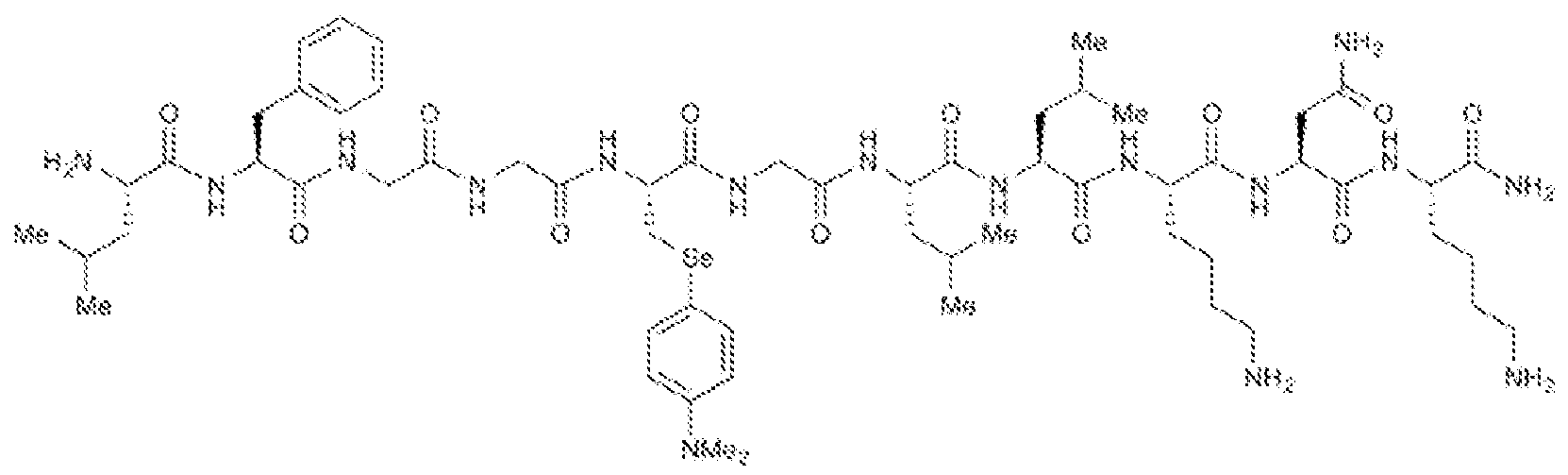
(4f): Prepared according to the general procedure (A) using peptide 1 (100 μΜ) and CuS04, L2, and (4-(dimethylamino)phenyl)boronic acid stock solution (1 mM) at 37 °C for 2 h. The quenched reaction mixture was analyzed using LC-MS Method A. Analytical data for 4f: HRMS (ESI) Mass. calcd. for CeoHggNieOuSe [M+H]+, 1315.68. Found [M+H]+, 1315.69.


(4h): Prepared according to the general procedure (A) using peptide 1 (100 μΜ) and CuS04, L2, and (4-(dimethylcarbamoyl)phenyl)boronic acid stock solution (2 mM) at 37 °C for 1 h. The quenched reaction mixture was analyzed using LC-MS Method A. Analytical data for 4h: HRMS (ESI) Mass. calcd. for CeiHiooNieOisSe [M+2H]2+, 672.34. Found [M+2H]2+, 672.35.

(4i): Prepared according to the general procedure (A) using peptide 1 (100 μΜ) and CuS04, L2, and (2-nitrophenyl)boronic acid stock solution (1 mM) at 37 °C for 1 h. The quenched reaction mixture was analyzed using LC-MS Method A. Analytical data for 4i: HRMS (ESI) Mass. calcd. for
 [M+2H]2+, 659.31. Found [M+2H]2+, 659.32.
NH;.
 (4j): Prepared according to the general procedure (A) using peptide 1 (100 μΜ) and CuS04, L2, and (3-cyanophenyl)boronic acid stock solution (2 mM) at 37 °C for 2 h. The quenched reaction mixture was analyzed using LC-MS Method A. Analytical data for 4j: HRMS (ESI) Mass. calcd. for
 [M+2H]2+, 649.32. Found [M+2H]2+, 649.33.

(4k): Prepared according to the general procedure (A) using peptide 1 (100 μΜ) and CuS04, L2, and (2-chlorophenyl)boronic acid stock solution (1 mM) at 37 °C for 1 h. The quenched reaction mixture was analyzed using LC-MS Method A. Analytical data for 4k: HRMS (ESI) Mass. calcd. for
 [M+H]+, 1306.59. Found [M+H]+, 1306.58.

(41): Prepared according to the general procedure (A) using peptide 1 (100 μΜ) and CuS04, L2, and (2,6-difluorophenyl)boronic acid stock solution (1 mM) at 37 °C for 1 h. The quenched reaction mixture was analyzed using LC-MS Method A. Analytical data for 41: HRMS (ESI) Mass. calcd. for
 [M+2H]2+, 654.81. Found [M+2H]2+, 654.82.


(5b): Prepared according to the general procedure (A) using peptide 1 (100 μΜ) and CuS04, L2, and (l-(phenylsulfonyl)-lH-indol-2-yl)boronic acid acid stock solution (1 mM) at 37 °C for 1 h. The quenched reaction mixture was analyzed using LC-MS Method A. Analytical data for 5b: HRMS (ESI) Mass. calcd. for CeeHiooNieOnSSe [M+2H]2+, 726.32.
Found [M+2H]2+, 726.33

(5c): Prepared according to the general procedure (A) using peptide 1 (100 μΜ) and CuS04, L2, and benzofuran-2-ylboronic acid stock solution (1 mM) at 37 °C for 1 h. The quenched reaction mixture was analyzed using LC-MS Method A. Analytical data for 5c: HRMS (ESI) Mass. calcd. for CeoHgsNisOisSe [M+2H]2+, 656.81. Found [M+2H]2+, 656.82.

(5d): Prepared according to the general procedure (A) using peptide 1 (100 μΜ) and CuSC"4, L2, and (1 -methyl- lH-pyrazol-4-yl)boronic acid stock solution (1 mM) at 37 °C for 1 h. The quenched reaction mixture was analyzed using LC-MS Method A. Analytical data for 5d: HRMS (ESI) Mass. calcd. for Csei^NnO^Se [M+H]+, 1276.64. Found [M+H]+, 1276.63.

(5e): Prepared according to the general procedure (A) using peptide 1 (100 μΜ) and CuSC"4, L2, and (3,5-dimethylisoxazol-4-yl)boronic acid stock solution (1 mM) at 37 °C for 1 h. The quenched reaction mixture was analyzed using LC-MS Method A. Analytical data for 5e: HRMS (ESI) Mass. calcd. for CsvHgeNieOisSe [M+2H]2+, 646.32. Found [M+2H]2+, 646.32.

(5f): Prepared according to the general procedure (A) using peptide 1 (100 μΜ) and CuSC>4, L2, and thiophen-3-ylboronic acid stock solution (1 mM) at 37 °C for 1 h. The quenched reaction mixture was analyzed using LC-MS Method A. Analytical data for 5f: HRMS (ESI) Mass. calcd. for
 [M+2H]2+, 639.79. Found [M+2H]2+, 639.79.

(5g): Prepared according to the general procedure (A) using peptide 1 (100 μΜ) and CuSC"4, L2, and (2-formylthiophen-3-yl)boronic acid stock solution (1 mM) at 37 °C for 1 h. The quenched reaction mixture was analyzed using LC-MS Method A. Analytical data for 5g: HRMS (ESI) Mass. calcd. for CsTHgsNisOnSSe [M+2H]2+, 653.80. Found [M+2H]2+, 653.81.

(5h): Prepared according to the general procedure (A) using peptide 1 (100 μΜ) and CuSC"4, L2, and dibenzo[£,<i]furan-4-ylboronic acid stock solution (1 mM) at 37 °C for 1 h. The quenched reaction mixture was analyzed using LC-MS Method A. Analytical data for 5h: HRMS (ESI) Mass. calcd. for C64H97Ni5Oi3Se [M+2H]2+, 681.83. Found [M+2H]2+, 681.83.

(5i): Prepared according to the general procedure (A) using peptide 1 (100 μΜ) and CUSO4, L2, and phenoxathiin-4-ylboronic acid stock solution (1 mM) at 37 °C for 1 h. The quenched reaction mixture was analyzed using LC-MS Method C. Analytical data for 5i: HRMS (ESI) Mass. calcd. for C64H97Ni50i3SSe [M+2H]2+, 697.81. Found [M+2H]2+, 697.82.

(5j): Prepared according to the general procedure (A) using peptide 1 (100 μΜ) and CuS04, L2, and (2-(piperidin-l-yl)pyrimidin-5-yl)boronic acid stock solution (1 mM) at 37 °C for 1 h. The quenched reaction mixture was analyzed using LC-MS Method A. Analytical data for 5j: HRMS (ESI) Mass. calcd. for C6iHio2Ni8Oi2Se [M+2H]2+, 679.35. Found [M+2H]2+, 679.36.

(6a): Prepared according to the general procedure (A) using peptide 1 (100 μΜ) and CuS04, L2, and (,S)-(4-(2-((tert-butoxycarbonyl)amino)-3-methoxy-3- oxopropyl)phenyl)boronic acid stock solution (2 mM) at 37 °C for 1 h. The quenched reaction mixture was analyzed using LC-MS Method A. Analytical data for 6a: HRMS (ESI) Mass. calcd. for CevHiosNieOieSe [M+H]+, 1473.73. Found [M+H]+, 1473.71.
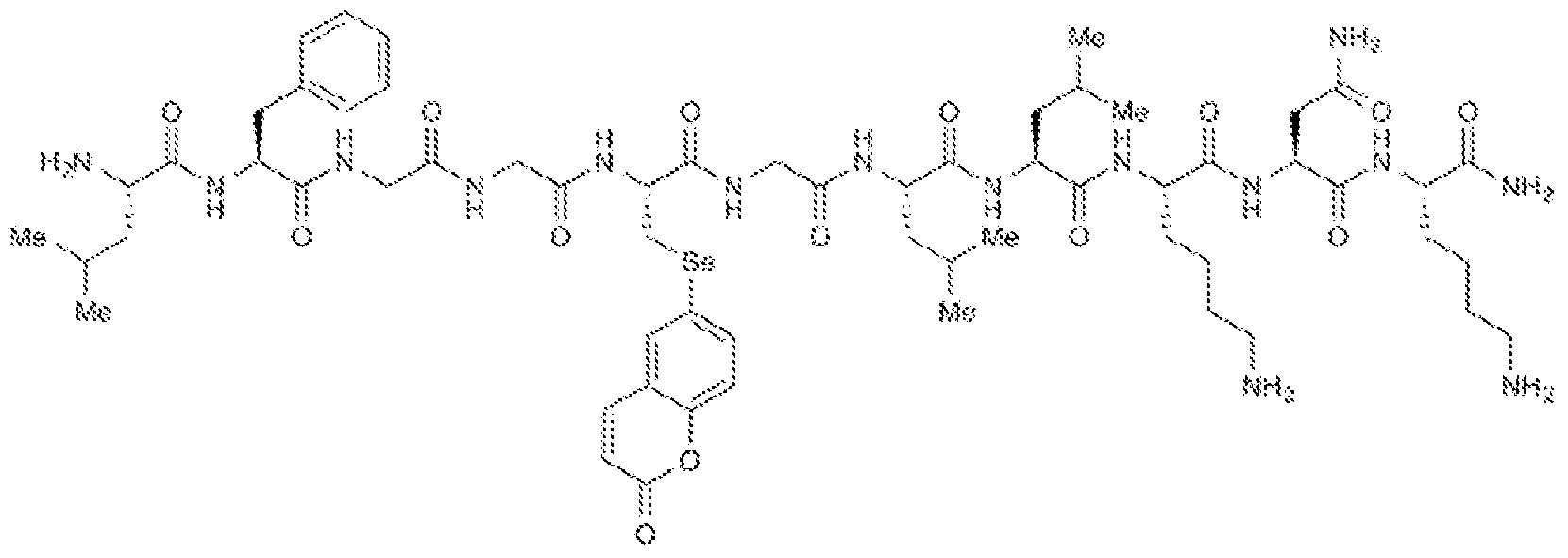
(6b): Prepared according to the general procedure (A) using peptide 1 (100 μΜ) and CuS04, L2, and (2-oxo-2H-chromen-6-yl)boronic acid stock solution (2 mM) at 37 °C for 1 h. The quenched reaction mixture was analyzed using LC-MS Method A. Analytical data
for 6b: HRMS (ESI) Mass. calcd. for
 [M+2H] , 670.82. Found [M+2H] , 670.83.

(6c): Prepared according to the general procedure (A) using peptide 1 (100 μΜ) and CuSC"4, L2, and (2-((2-(methoxycarbonyl)phenyl)amino)-6-methylphenyl)boronic acid stock solution (1 mM) at 37 °C for 1 h. The quenched reaction mixture was analyzed using LC-MS Method D. Analytical data for 6c: HRMS (ESI) Mass. calcd. for

[M+2H]2+, 718.35. Found [M+2H]2+, 718.36.

(6d): Prepared according to the general procedure (A) using peptide 1 (100 μΜ) and CuSC"4, L2, and (4-acetamidophenyl)boronic acid stock solution (2 mM) at 37 °C for 1 h. The quenched reaction mixture was analyzed using LC-MS Method A. Analytical data for 6d: HRMS (ESI) Mass. calcd. for
 [M+2H]2+, 665.33. Found [M+2H]2+, 665.34.


(8): Prepared according to the general procedure (A) using peptide 7 (100 μΜ) and CuS04, L2, and (2,6-difluorophenyl)boronic acid stock solution (1 mM) at 37 °C for 1 h. The quenched reaction mixture was analyzed using LC-MS Method A. Analytical data for 8: HRMS (ESI) Mass. calcd. for C67H96F2N2oOi7Se [M+H]+, 785.32. Found [M+H]+, 785.32.
Procedure for 1 mM Reactions
General Procedure (B) for arylation reactions with arylboronic acids

A 20-mL scintillation vial equipped with a stir bar was charged with 3 mL of deionized H20, 400 of 1.0 M Tris Buffer (pH = 8.0), 400 μΐ, of peptide 1 (10 mM stock solution). A separate 1.7 mL Eppendorf tube was charged with copper (200 μτηοΐ), ligand (200 μτηοΐ), arylboronic acid (200 μτηοΐ), and 1 mL of 200 proof EtOH. The heterogeneous solution was subjected to sonication for 1 min, vortexed for 30 sec, and 200 μΕ of the resulting solution was added to the peptide solution in the 20 mL scintillation vial. The resulting reaction mixture was capped, and stirred at 800 rpm in 37 °C water bath for the indicated time (10-60 min). The reaction mixture was quenched with 4 mL of 100 mM aqueous ETDA. The resulting mixture was centrifuged at 4,000 rpm for 10 min. The supernatant was filtered through a 0.22 μπι nylon filter and was subjected to purification by
HPLC. The ligands were completely removed after filtering through nylon filter. General Procedure for alkylation of selenocysteine

A 20 mL scintillation vial was charged with 3 mL of deionized H20, 400 μΐ^ of 1.0 M Tris Buffer with 200 mM TCEP (pH = 8.0), 400 of peptide 1 (10 mM stock solution). A separate 1.7 mL Eppendorf tube was charged with benzylbromide (200 μπιοΐ) and 1 mL of 200 proof EtOH. 200 μΕ of the resulting solution was added to the peptide solution in the 20 mL scintillation vial. The resulting reaction mixture was capped, and stirred at 800 rpm in 37 °C water bath for 30 min. The reaction mixture was diluted with 4 mL of deionized water. The resulting solution was filtered through a 0.22 μπι nylon filter and was subjected to purification by HPLC.

(4b): Prepared according to the general procedure (B) using peptide 1 (1 mM) and CuS04, L2, and (4-methoxyphenyl)boronic acid (10 mM) at 37 °C for 10 minutes. The quenched reaction mixture was analyzed using LC-MS Method A. Analytical data for 4b: HRMS (ESI) Mass. calcd. for
 [M+H]+, 1302.64. Found [M+H]+, 1302.64. 4b was obtained as white power (3.55 mg, 68%) after HPLC purification and lyophlization.

Ofcte
(4g): Prepared according to the general procedure (B) using peptide 1 (1 mM) and CuS04, L2, and (4-(methoxycarbonyl)phenyl)boronic acid (10 mM) at 37 °C for 1 h. The quenched reaction mixture was analyzed using LC-MS Method A. Analytical data for 4g: HRMS (ESI) Mass. calcd. for CeiHuoNieOisSe [M+2H]2+, 665.82. Found [M+2H]2+, 665.82. 4g was obtained as white power (3.91 mg, 74%) after HPLC purification and lyophlization.
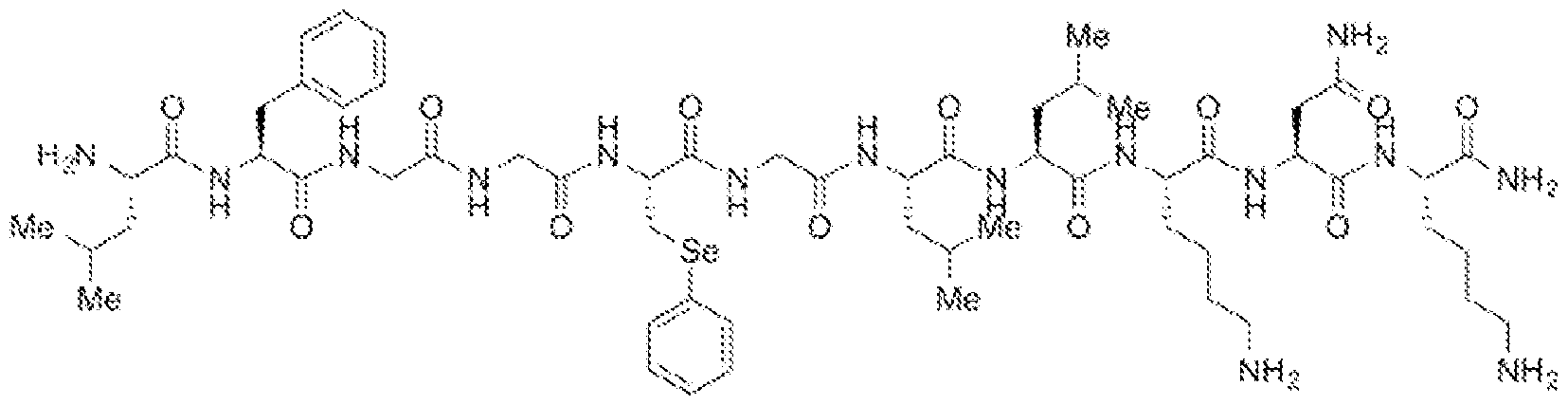
(4m): Prepared according to the general procedure (B) using peptide 1 (1 mM) and CuS04, L2, and phenylboronic acid (10 mM) at 37 °C for 30 minutes. The quenched reaction mixture was analyzed using LC-MS Method A. Analytical data for 4m: HRMS (ESI) Mass. calcd. for
 [M+H]+, 1272.63. Found [M+H]+, 1272.63. 4m was obtained as white power (3.54 mg, 70%) after HPLC purification and lyophlization.

(4n): Prepared according to the alkylation procedure using peptide 1 (1 mM) and benzylbromide (10 mM) at 37 °C for 30 minutes. The reaction mixture was analyzed using LC-MS Method A. Analytical data for 4n: HRMS (ESI) Mass. calcd. for CssHgsNisOuSe [M+H]+, 1286.65. Found [M+H] +, 1286.65. 4n was obtained as white power (3.63 mg, 71%)) after HPLC purification and lyophlization.
Stability Studies of Functionalized Selenocysteine Peptides
1) Stability in pH = 8.0 buffer *" ¾: peptide

100 u h urs a (Dha)
A 0.6 mL tube was charged with 178 μΐ. of deionized H20, 20 μΐ. of 1.0 M Tris Buffer (pH 8.0, 2 μΐ. of peptide (10 mM stock solution). The resulting reaction mixture was capped and incubated in 37 °C water bath or was left at room temperature for 1 1 hours. 5 μΐ. of the crude reaction mixture was quenched by addition of 200 μΐ. of 50% A: 50% B and was subjected to LC-MS analysis Me thodE. Figure 5 A.
2) Stability in pH = 10.0 buffer peptide

1 a (Dha}
A 0.6 mL tube was charged with 178 μΐ, of deionized H20, 20 uL of 1.0 M CAPS Buffer (pH 10.0), 2 μΐ^ of peptide (10 mM stock solution). The resulting reaction mixture was capped and incubated in 37 °C water bath or was left at room temperature for 1 1 hours. 5 μΐ. of the crude reaction was quenched by addition of 200 μΐ. of 50% A: 50% B and was subjected to LC-MS analysis Me thodE. Figure 5B.
3) Stability under oxidative conditions ** pe tide

10 μ rt, 1 1 hours 1 a (Dha)
A 300-μί LC-MS vial was charged with 158 μΐ, of deionized H20, 20 μΐ, of 1.0 M Tris Buffer (pH = 8.0), 2 μΐ, of peptide (1 mM stock solution), 20 μΐ, of H202 (100 mM stock solution in water). The resulting reaction mixture was capped and was monitored by LC- MS (Method E).
Example 2 - Drug Release from Functionalized Selenocysteines
As important as new bioconjugation methods are, it is also important for release of the drug molecule once the bioconjugate is delivered to the treatment site.
Figure 19 shows that glutathione (GSH, a tripeptide), which is found in 5 mM concentration in animal cells, can promote dissociation of the native drug or natural
product. There is no apparent degradation of the small molecule (LCMS). This is an important breakthrough for the field of drug delivery.
So, selenocysteine peptide conjugates can be delivered to the treatment site and the glutathione found in vivo can promote slow release of the native pharmaceutical.
Example 3 - Conjugation of Vancomycin to Peptides
General Procedure
Vancomycin was conjugated to a variety of peptides. As an example: A 20-mL scintillation vial equipped with a stir bar was charged with a peptide (10 mg, 0.00621 mmol), vancomycin hydrochloride (46 mg, 0.031 mmol), DI H20 (5.6 mL), and 620 [iL 1.0 M Tris Buffer (pH = 8.0). The reaction mixture was capped, and stirred at 600 rpm in 37 °C water bath for 3 h. Upon consumption of the peptide (monitored by LCMS) the reaction mixture was quenched with 2 mL of 0.1% TFA in 95:5 H20: MeCN and centrifuged at 4,000 rpm for 4 min. The supernatant was filtered through a 0.22-μπι nylon filter and was subjected to purification by HPLC. Analyzed by LC-MS Method D. Analytical data for 111: HRMS (ESI) Mass. calcd. For Ci27Hi67Cl2N2904iSe [M+2H]2+, 1452.52. Found [M+2H]2+, 1453.05. The following peptide conjugate (111) was obtained as white power (7.7 mg, 43%) after FIPLC purification and lyophlization.

Ill
With Copper and Ligand
A 0.6 mL Eppendorf tube was charged with 32.5 μΐ. of deionized H20, 5 μΐ. of 1.0 M Tris Buffer (pH = 8.0), 10 μΐ. of peptide (1 mM stock solution in H20). A separate 0.6 mL Eppendorf tube was charged with copper (0.80 mg, 5 μιηοΐ), ligand (1.4 mg, 5 μιηοΐ), vancomycin (15 mg, 10 μιηοΐ), and 0.25 mL of 200 proof EtOH (making a 40 or 80 mM stock solution, respectively). The heterogeneous solution was subjected to sonication for 1 min, vortexed for 30 sec, and 2.5 μΕ of the resulting solution was added to the peptide solution in the 0.6 mL Eppendorf tube. The resulting reaction mixture was capped, vortexed for 30 seconds, and placed in a 37 °C water bath for the indicated time (3 h). The reaction mixture was quenched with 5 μΐ, of EDTA (200 mM in H20), 145 μΐ, of 0.1% TFA in 1 : 1 H20:MeCN. The quenched reaction mixture was subjected to immediate LC-MS analysis using LC-MS Method D (injection: 1 uL). Analytical data for 111: HRMS (ESI) Mass. calcd. for Ci27Hi68Cl2N2904iSe [M+3H]2+, 968.68. Found [M+3H]3+, 969.04.
Without Copper and Ligand
A 0.6 mL Eppendorf tube was charged with 32.5 μΕ of deionized H20, 5 μΕ of 1.0 M Tris Buffer (pH = 8.0), 10 μΕ of peptide (1 mM stock solution in H20). A separate 0.6 mL Eppendorf tube was charged with vancomycin (15 mg, 10 μιηοΐ), and 0.25 mL of DI H20 (making a 80 mM stock solution). The heterogeneous solution was subjected to sonication for 1 min, vortexed for 30 sec, and 2.5 μΕ of the resulting solution was added to the peptide solution in the 0.6 mL Eppendorf tube. The resulting reaction mixture was capped, vortexed for 30 seconds, and placed in a 37 °C water bath for the indicated time (3 h). The reaction mixture was quenched with 150 μΕ of 0.1% TFA in 1 : 1 H20:MeCN. The quenched reaction mixture was subjected to immediate LC-MS analysis using LC-MS Method D (injection: 1 uL). Analytical data for 111: HRMS (ESI) Mass. calcd. for Ci27Hi68Cl2N2904iSe [M+3H]2+, 968.68. Found [M+3H]3+, 969.03.
Example 4 - Functionalized Selenocysteines as Antibacterial Agents
Many bacteria have developed a resistance to previously used antibacterial pharmaceuticals.
Vancomycin has been shown to be active against a few strains of gram-positive bacteria by inhibiting the peptidoglycan synthesis. However, vancomycin is not active against gram-negative bacteria due to the bacterium's outer cell membrane. Additionally several strains of gram-positive bacteria have developed resistance towards vancomycin.
Vancomycin was conjugated to a variety of antibacterial peptides and screened against (a) resistant strains of gram-positive bacteria and b) gram-negative bacteria. See Figure 20, Figure 21, Figure 22, and Table 3.
While there was some modest increase in activity for a few examples it is also important to point out that the MIC values are based on mass and the mass of the peptide conjugates are doubled (sometimes more) relative to vancomycin. This means that the conjugates of the invention are an order of magnitude more active than vancomycin.
Table 3. MIC of vancomycin alone as compared to vancomycin/peptide conjugates.

Example 5 - Selenocysteine Antibody-Drug Conjugates
Polyglycine peptides with a conjugated small molecule can be effectively sortased onto a mutant trastuzumab antibody. See Figure 23, Figure 24, and Figure 25.
An antibody-drug conjugate (ADC) of genistein was screened against BT-474 cells (mammary gland cancer cells). These results show that selenocysteine is not toxic to cells and can be used as a handle in bioconjugation.
Example 6 - Selenocysteine or Cysteine Macrocyclization
Phallotoxins and amatoxins are classes of highly cytotoxic macrocyclic natural products that have a cysteine/tryptophan linkage. These classes of natural products have been isolated from the poisonous mushrooms 1937-1941. Previous strategies to synthesize
these natural products required two steps (Savige-Fontana reaction) or monomer synthesis to introduce the cysteine/tryptophan linkage.
However, the selenocysteine or cysteine conjugates described herein may be cyclized to form the required linkage. See Figures 26-3 IB.
Example 7 - Cysteine Arylation
Various disulfides, mixed or symmetrical, were arylated with a variety of arylating agents. Variations in the peptide sequence were also investigated to determine their influence on the success of the arylation reaction. Copper-catalyzed, rhodium-catalyzed, or metal-free conditions were used. See Figures 32A-38.
Example 8 - Copper-free Synthesis of Arylated Selenocysteine
A 0.6 mL Eppendorf tube was charged with 32.5 iL of deionized H20, 5 iL of 1.0 M Tris Buffer (pH = 8.0), 10 iL of peptide (1 mM stock solution in H20). A separate 0.6 mL Eppendorf tube was charged with (hetero)aryl nucleophile (40 or 80 μπιοΐ) and 0.5 mL or 0.25 mL of 200 proof EtOH (making a 40 or 80 mM stock solution, respectively). The heterogeneous solution was subjected to sonication for 1 min, vortexed for 30 sec, and 2.5 μΕ of the resulting solution was added to the peptide solution in the 0.6 mL Eppendorf tube. The resulting reaction mixture was capped, vortexed for 30 seconds, and placed in a 37 °C water bath for the indicated time (3 h). The reaction mixture was quenched with 50 [iL of H20 and 100 [iL of 0.2% TFA in MeCN. The quenched reaction mixture was subjected to immediate LC-MS analysis.
INCORPORATION BY REFERENCE
All of the U.S. patents and U.S. published patent applications cited herein are hereby incorporated by reference.
EQUIVALENTS
Those skilled in the art will recognize, or be able to ascertain using no more than routine experimentation, many equivalents to the specific embodiments of the invention described herein. Such equivalents are intended to be encompassed by the following claims.
Claims
We claim:
1. A compound comprising substructure I:

wherein, independently for each occurrence,
A1 is H, an amine protecting group, a natural or unnatural amino acid, a peptide, an oligopeptide, a polypeptide, or a protein;
A5 is OH, -0(carboxylate protecting group), a natural or unnatural amino acid, a peptide, an oligopeptide, a polypeptide, or a protein;
 is a substituted or unsubstituted aryl or heteroaryl radical; x is 0, 1, 2, 3, 4, 5, or 6; and R is H or alkyl.
2. The compound of claim 1, wherein substituted aryl radical.
3. The compound of claim 1, wherein substituted phenyl radical.
4. The compound of claim 1, wherein unsubstituted aryl radical.
5. The compound of claim 1, wherein substituted heteroaryl radical.
6. The compound of claim 1, wher
 ein is a substituted indole, pyrazolo, thiophene, pyrimidine, benzofuran, or isoxazole radical.
7. The compound of claim 1, wherein an unsubstituted heteroaryl radical
8. The compound of claim 1, wherei
 n is an unsubstituted indole, pyrazolo, thiophene, pyrimidine, benzofuran, or isoxazole radical.


-127-


selenocysteine.
11. The compound of any one of claims 1-9, wherein one or more of A1 and A5 comprises arginine, cysteine, histidine, lysine, aspartic acid, glutamic acid, serine, threonine, asparagine, glutamine, glycine, proline, alanine, valine, isoleucine, leucine, methionine, phenylalanine, tyrosine, or tryptophan.
12. A compound comprising substructure II:

II wherein, independently for each occurrence,
A1 is H, an amine protecting group, a natural or unnatural amino acid, a peptide, an oligopeptide, a polypeptide, or a protein;
A5 is OH, -0(carboxylate protecting group), a natural or unnatural amino acid, a peptide, an oligopeptide, a polypeptide, or a protein;
 is a substituted or unsubstituted aryl or heteroaryl radical, provided not a perfluoroaryl radical; x is 0, 1, 2, 3, 4, 5, or 6; and
R is H or alkyl.
13. The compound of claim 12, wherein is a substituted aryl radical.
14. The compound of claim 12, wherein is a substituted phenyl radical.
15. The compound of claim 12, wherein unsubstituted aryl radical.
16. The compound of claim 12, wherein
 is a substituted heteroaryl radical.
B
is a substituted heteroaryl radical.
B
17. The compound of claim 12, wherein ^ is a substituted indole, pyrazolo, thiophene, pyrimidine, benzofuran, or isoxazole radical.
18. The compound of claim 12, wherein an unsubstituted heteroaryl radical
19. The compound of claim 12, wherein
 is an unsubstituted indole, pyrazolo, thiophene, pyrimidine, benzofuran, or isoxazole radical.


cysteine.
22. The compound of any one of claims 12-20, wherein one or more of A1 and A5 comprises arginine, histidine, lysine, aspartic acid, glutamic acid, serine, threonine, asparagine, glutamine, glycine, proline, alanine, valine, isoleucine, leucine, methionine, phenylalanine, tyrosine, or tryptophan.
23. The compound of any one of claims 1-22, wherein A1 is an amine protecting group selected from the group consisting of an N,0-acetal, allyloxycarbonyl (Aloe), benzyl (Bn), benzyloxycarbonyl (Cbz), benzyloxymethyl (BOM), t-butoxycarbonyl (Boc), t- butyldimethylsilyl (TBDMS), t-butyldiphenylsilyl (TBDPS), diphenylmethyl, diphenylmethylene, ethoxycarbonyl, 9-fluorenylmethoxycarbonyl (Fmoc), p- methoxybenzyl (PMB), methoxycarbonyl, methoxymethyl (MOM), /?-methoxyphenyl (PMP), /?-nitrocinnamyloxycarbonyl (Noc), tosyl (Ts), 2-tosylethoxycarbonyl (Tsoc), 2,2,2- trichloroethoxycarbonyl (Troc), trifluoroacetyl, triisopropylsilyl (TIPS), trimethylsilyl (TMS), 2-(trimethylsilyl)ethoxycarbonyl (Teoc), 2-(trimethylsilyl)ethoxymethyl (SEM), or trityl (Tr).
24. The compound of any one of claims 1-23, wherein A5 is -0(carboxylate protecting group); and the carboxylate protecting group is selected from the group consisting of allyl, benzyl, benzyloxymethyl (BOM), t-Bu, t-butyldimethylsilyl (TBDMS), t-butyldiphenylsilyl (TBDPS), diphenylmethyl, 9-fluorenylmethyl (Fm), 2-methoxyethoxymethyl (MEM), methoxymethyl (MOM), /?-nitrobenzyl (P B), an ester, a 1,3-oxazoline, pivaloyloxymethyl (Pom), 2-tosylethyl (TSE), 2,2,2-trichloroethyl (TCE), triethylsilyl (TES), trimethylsilyl (TMS), 2-(trimethylsilyl)ethoxymethyl (SEM), or 2-(trimethylsilyl)ethyl (TMSE).
25. The compound of any one of claims 1-22, wherein A1 or A5 is an antimicrobial peptide, such as magainin/pexiganan (a 22-amino acid linear peptide that may be isolated from the skin of the African clawed frog (Xenopus laevis)), omiganan (a cationic peptide that may be derived from indolicidin), OP- 145 (a 24-mer peptide that may be derived from LL-37 that may bind to lipopoly saccharides or lipoteichoic acid), novexatin (a cyclic cationic peptide of 1093 Da), LTX-109 (Lytixar, a membrane-degrading peptide), NVB302 (a class B lantibiotic), MU1140 (a lantibiotic), arenicin (a 21-mer that is rich in arginine and hydrophobic amino acids), avidocin (a R-type bacteriocin that may be derived from Pseudomanas aeruginosa), purocin (a R-type bacteriocin that may be derived from Pseudomanas aeruginosa), IMX924 (a 5-mer with defense regulation capabilities),

GIGKFLHSAKKFGKAFVGEIMNS, or GIKKFLKKAGKFGKAF.
26. The compound of any one of claims 1-25, wherein R is H.
27. The compound of any one of claims 1-26, wherein x is 1, 2, or 3.
28. The compound of any one of claims 1-26, wherein x is 1.
29. A compound comprising substructure III:

III
wherein, independently for each occurrence,
A1 is H, an amine protecting group, a natural or unnatural amino acid, a peptide, an oligopeptide, a polypeptide, or a protein;
A2, A3, and A4 are selected from the group consisting of a natural amino acid, an unnatural amino acid, and a plurality of natural amino acids or unnatural amino acids;
A5 is OH, -0(carboxylate protecting group), a natural or unnatural amino acid, a peptide, an oligopeptide, a polypeptide, or a protein; x is 0, 1, 2, 3, 4, 5, or 6;
 is a substituted or unsubstituted aryl or heteroaryl diradical; and
R is H or alkyl.
A compound comprising substructure V or substructure VII:

V

VII wherein, independently for each occurrence,
A1 is H, an amine protecting group, a natural or unnatural amino acid, a peptide, an oligopeptide, a polypeptide, or a protein;
A2, A3, and A4 are selected from the group consisting of a natural amino acid, an unnatural amino acid, and a plurality of natural amino acids or unnatural amino acids;
A5 is OH, -0(carboxylate protecting group), a natural or unnatural amino acid, a peptide, an oligopeptide, a polypeptide, or a protein; x is 0, 1, 2, 3, 4, 5, or 6;
B1A
is a substituted or unsubstituted aryl or heteroaryl diradical; and
R is H or
31. TThhee ccoormi pound of claim 29 or 30, wherein none of A1, A2, A3, A4, and A5 comprises selenocysteine.
32. The compound of claim 29 or 30, wherein one or more of A1, A2, A3, A4, and A5 comprises arginine, cysteine, histidine, lysine, aspartic acid, glutamic acid, serine, threonine, asparagine, glutamine, glycine, proline, alanine, valine, isoleucine, leucine, methionine, phenylalanine, tyrosine, or tryptophan.
33. The compound of any one of claims 29-32, wherein

diradical. B'
34. The compound of any one of claims 29-32, wherein
diradical.
The compound of any one of claims 29-32, wherein
 is an unsubstituted aryl
36. The compound of any one of claims 29-32, wherein
 is a substituted heteroaryl diradical.
37. The compound of any one of claims 29-32, wherein
 is a substituted indole, pyrazolo, thiophene, pyrimidine, benzofuran, or isoxazole diradical.
38. The compound of any one of claims 29-32, wherein ^ is an unsubstituted heteroaryl diradical.
39. The compound of any one of claims 29-32, wherein
 is an unsubstituted indole, pyrazolo, thiophene, pyrimidine, benzofuran, or isoxazole diradical.
A compound comprising substructure IV:
is an unsubstituted indole, pyrazolo, thiophene, pyrimidine, benzofuran, or isoxazole diradical.
A compound comprising substructure IV:

IV wherein, independently for each occurrence,
A1 is H, an amine protecting group, a natural or unnatural amino acid, a peptide, an oligopeptide, a polypeptide, or a protein;
A2, A3, and A4 are selected from the group consisting of a natural amino acid, an unnatural amino acid, and a plurality of natural amino acids or unnatural amino acids;
A5 is OH, -0(carboxylate protecting group), a natural or unnatural amino acid, a peptide, an oligopeptide, a polypeptide, or a protein; x is 0, 1, 2, 3, 4, 5, or 6;
 is a substituted or unsubstituted aryl or heteroaryl diradical, provided is not a perfluoroaryl diradical; and R is H or alkyl.
41. A compound comprising substructure VI or substructure VIII:

VIII wherein, independently for each occurrence,
A1 is H, an amine protecting group, a natural or unnatural amino acid, a peptide, an oligopeptide, a polypeptide, or a protein;
A2, A3, and A4 are selected from the group consisting of a natural amino acid, an unnatural amino acid, and a plurality of natural amino acids or unnatural amino acids;
A5 is OH, -0(carboxylate protecting group), a natural or unnatural amino acid, a peptide, an oligopeptide, a polypeptide, or a protein; x is 0, 1, 2, 3, 4, 5, or 6;
 is a substituted or unsubstituted aryl or heteroaryl diradical, provided is not a perfluoroaryl diradical; and
R is H or alkyl.
42. The compound of claim 40 or 41, wherein none of A1, A2, A3, A4, and A5 comprises cysteine.
43. The compound of claim 40 or 41, wherein one or more of A1, A2, A3, A4, and A5 comprises arginine, histidine, lysine, aspartic acid, glutamic acid, serine, threonine, asparagine, glutamine, glycine, proline, alanine, valine, isoleucine, leucine, methionine, phenylalanine, tyrosine, or tryptophan.
44. The compound of any one of claims 40-43, wherein
 is a substituted aryl diradical.
45. The compound of any one of claims 40-43, wherein
 is a substituted phenyl diradical.
46. The compound of any one of claims 40-43, wherein
 is an unsubstituted aryl diradical.
47. The compound of any one of claims 40-43, wherein
 is a substituted heteroaryl diradical.
B1 B
is a substituted heteroaryl diradical.
B1 B
48. The compound of any one of claims 40-43, wherein ^ is a substituted indole, pyrazolo, thiophene, pyrimidine, benzofuran, or isoxazole diradical.
49. The compound of any one of claims 40-43, wherein
 is an unsubstituted heteroaryl diradical.
50. The compound of any one of claims 40-43, wherein
 is an unsubstituted indole, pyrazolo, thiophene, pyrimidine, benzofuran, or isoxazole diradical.
51. The compound of any one of claims 29-50, wherein A2, A3, and A4 are natural or unnatural amino acids.
52. The compound of any one of claims 29-51, wherein A is an amine protecting group selected from the group consisting of an N,0-acetal, allyloxycarbonyl (Aloe), benzyl (Bn), benzyloxycarbonyl (Cbz), benzyloxymethyl (BOM), t-butoxycarbonyl (Boc), t- butyldimethylsilyl (TBDMS), t-butyldiphenylsilyl (TBDPS), diphenylmethyl, diphenylmethylene, ethoxycarbonyl, 9-fluorenylmethoxycarbonyl (Fmoc), p- methoxybenzyl (PMB), methoxycarbonyl, methoxymethyl (MOM), /?-methoxyphenyl (PMP), /?-nitrocinnamyloxycarbonyl (Noc), tosyl (Ts), 2-tosylethoxycarbonyl (Tsoc), 2,2,2- trichloroethoxycarbonyl (Troc), trifluoroacetyl, triisopropylsilyl (TIPS), trimethylsilyl (TMS), 2-(trimethylsilyl)ethoxycarbonyl (Teoc), 2-(trimethylsilyl)ethoxymethyl (SEM), or trityl (Tr).
53. The compound of any one of claims 29-52, wherein A5 is -0(carboxylate protecting group); and the carboxylate protecting group is selected from the group consisting of allyl, benzyl, benzyloxymethyl (BOM), t-Bu, t-butyldimethylsilyl (TBDMS), t-butyldiphenylsilyl (TBDPS), diphenylmethyl, 9-fluorenylmethyl (Fm), 2-methoxyethoxymethyl (MEM), methoxymethyl (MOM), /?-nitrobenzyl (P B), an ester, a 1,3-oxazoline, pivaloyloxymethyl (Pom), 2-tosylethyl (TSE), 2,2,2-trichloroethyl (TCE), triethylsilyl (TES), trimethylsilyl (TMS), 2-(trimethylsilyl)ethoxymethyl (SEM), or 2-(trimethylsilyl)ethyl (TMSE).
54. The compound of any one of claims 29-51, wherein A1 or A5 is an antimicrobial peptide, such as magainin/pexiganan (a 22-amino acid linear peptide that may be isolated from the skin of the African clawed frog (Xenopus laevis)), omiganan (a cationic peptide that may be derived from indolicidin), OP- 145 (a 24-mer peptide that may be derived from
LL-37 that may bind to lipopoly saccharides or lipoteichoic acid), novexatin (a cyclic cationic peptide of 1093 Da), LTX-109 (Lytixar, a membrane-degrading peptide), NVB302 (a class B lantibiotic), MU1140 (a lantibiotic), arenicin (a 21-mer that is rich in arginine and hydrophobic amino acids), avidocin (a R-type bactenocin that may be derived from Pseudomanas aeruginosa), purocin (a R-type bactenocin that may be derived from Pseudomanas aeruginosa), IMX924 (a 5-mer with defense regulation capabilities),

GIGKFLHSAKKFGKAFVGEIMNS, or GIKKFLKKAGKFGKAF.
55. The compound of any one of claims 29-54, wherein R is H.
56. The compound of any one of claims 29-55, wherein x is 1, 2, or 3.
57. The compound of any one of claims 29-55, wherein x is 1.
A method according to Scheme 1

Scheme la

Scheme lb

Scheme lc

Scheme Id wherein, independently for each occurrence,
A1 is H, an amine protecting group, a natural or unnatural amino acid, a peptide, oligopeptide, a polypeptide, or a protein;
A2, A3, and A4 are selected from the group consisting of a natural amino acid, an unnatural amino acid, and a plurality of natural amino acids or unnatural amino acids;
A5 is OH, -0(carboxylate protecting group), a natural or unnatural amino acid, a peptide, an oligopeptide, a polypeptide, or a protein; x is 0, 1, 2, 3, 4, 5, or 6,
is a substituted or unsubstituted aryl or heteroaryl radical;
is a substituted or unsubstituted aryl or heteroaryl diradical
 is a heteroaromatic moiety substituted with an electron withdrawing x is 0, 1, 2, 3, 4, 5, or 6; and R is H or alkyl.
The method of claim 58, wherein bstituted aryl radical.
61. The method of claim 58, wherein bstituted phenyl radical.
62. The method of claim 58, wherein unsubstituted aryl radical.
63. The method of claim 58, wherein bstituted heteroaryl radical.
64. The method of claim 58, whe
 rein is a substituted indole, pyrazolo, thiophene, pyrimidine, benzofuran, or isoxazole radical.
65. The method of claim 58, wherein n unsubstituted heteroaryl radical
66. The method of claim 58, where
 in is an unsubstituted indole, pyrazolo, thiophene, pyrimidine, benzofuran, or isoxazole radical.


-146-

-147-
 or or a regioisomer or stereoisomer thereof.
A method according to Scheme 3:

Scheme 3a

Scheme 3b

Scheme 3c

Scheme 3d wherein, independently for each occurrence,
A1 is H, an amine protecting group, a natural or unnatural amino acid, a peptide, an oligopeptide, a polypeptide, or a protein;
A2, A3, and A4 are selected from the group consisting of a natural amino acid, an unnatural amino acid, and a plurality of natural amino acids or unnatural amino acids;
A5 is OH, -0(carboxylate protecting group), a natural or unnatural amino acid, a peptide, an oligopeptide, a polypeptide, or a protein; x is 0, 1, 2, 3, 4, 5, or 6;
 is an aryl or heteroaryl radical substituted with at least one electron donating group;
 is a substituted aryl or heteroaryl diradical substituted with at least one electron donating group;
 is a heteroaromatic moiety substituted with an electron withdrawing x is 0, 1, 2, 3, 4, 5, or 6; and R is H or alkyl.
69. The method of claim 68, wherein bstituted aryl radical
70. The method of claim 68, wherein bstituted phenyl radical
The method of claim 68, wherein bstituted heteroaryl radical
72. The method of claim 68, whe
 rein is a substituted indole, pyrazolo, thiophene, pyrimidine, benzofuran, or isoxazole radical.
The method of claim 68, wherein
 IS
IS


-151-
WO 2016/205798
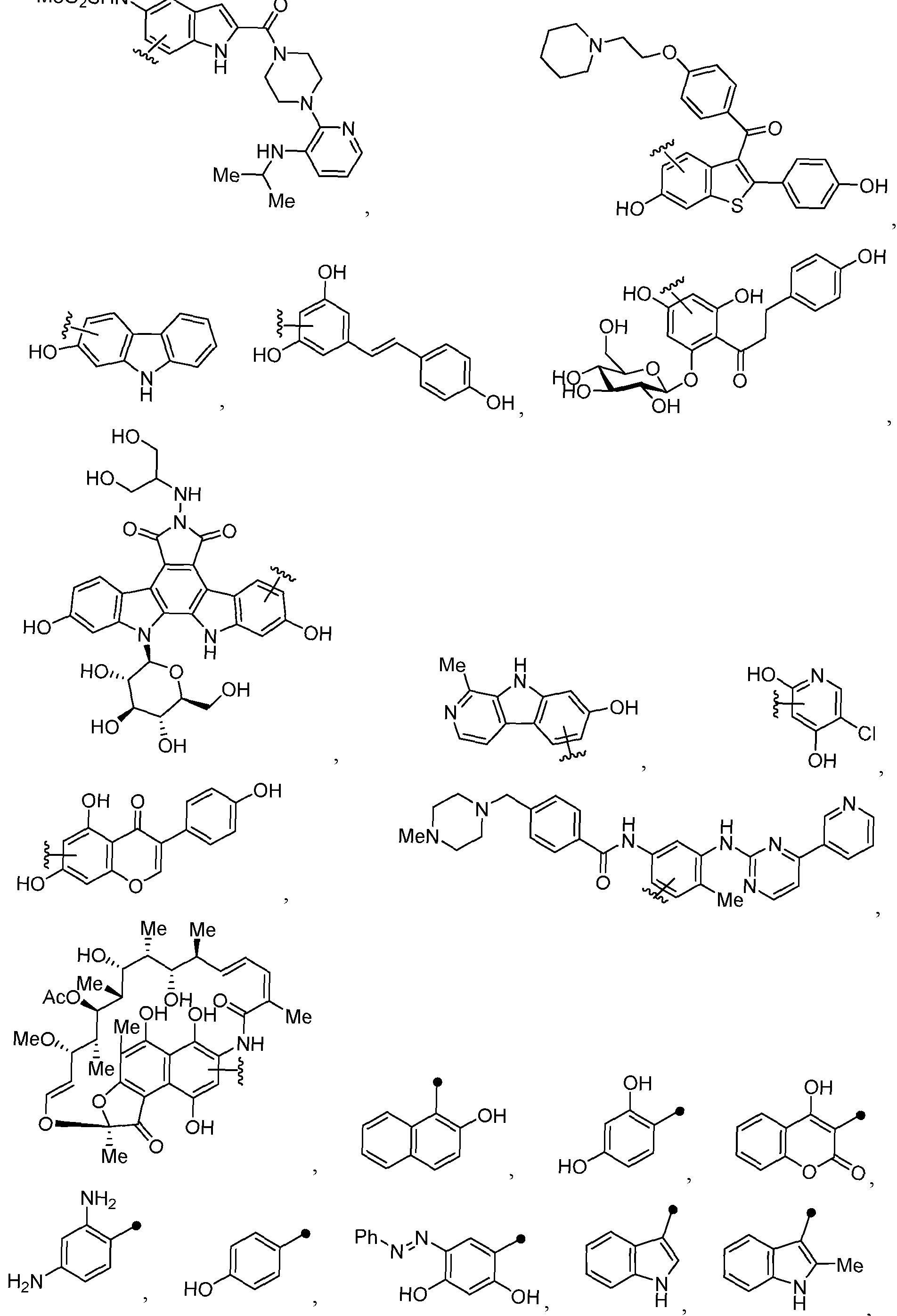

74. The method of any one of claims 58-73, wherein the Cu/ligand comprises CuS04.
75. The method of any one of claims 58-74, wherein the Cu/ligand comprises a substituted or unsubstituted bipyridine ligand or a substituted or unsubstituted phenanthroline ligand.
76. The method of any one of claims 58-74, wherein the Cu/ligand comprises 4,4'-di fert-butyl-2,2'-bipy.
77. A method according to Scheme 7:

Scheme 7a

Scheme 7b

Scheme 7c

Scheme 7d
wherein, independently for each occurrence,
A1 is H, an amine protecting group, a natural or unnatural amino acid, a peptide, an oligopeptide, a polypeptide, or a protein;
A2, A3, and A4 are selected from the group consisting of a natural amino acid, an unnatural amino acid, and a plurality of natural amino acids or unnatural amino acids;
A5 is OH, -0(carboxylate protecting group), a natural or unnatural amino acid, a peptide, an oligopeptide, a polypeptide, or a protein; x is 0, 1, 2, 3, 4, 5, or 6;
 is an aryl or heteroaryl radical substituted with at least one electron donating group;
 is a substituted aryl or heteroaryl diradical substituted with at least one electron donating group;
 is a heteroaromatic moiety substituted with an electron withdrawing x is 0, 1, 2, 3, 4, 5, or 6; and R is H or alkyl.
The method of claim 77, wherein bstituted aryl radical.
79. The method of claim 77, wherein bstituted phenyl radical.
80. The method of claim 77, wherein bstituted heteroaryl radical.
81. The method of claim 77, whe
 rein is a substituted indole, pyrazolo, thiophene, pyrimidine, benzofuran, or isoxazole radical.

-156-

-157-


Scheme 2a

Scheme 2b

Scheme 2c

Scheme 2d wherein, independently for each occurrence,
A1 is H, an amine protecting group, a natural or unnatural amino acid, a peptide, an oligopeptide, a polypeptide, or a protein;
A2, A3, and A4 are selected from the group consisting of a natural amino acid, an unnatural amino acid, and a plurality of natural amino acids or unnatural amino acids;
A5 is OH, -0(carboxylate protecting group), a natural or unnatural amino acid, a peptide, an oligopeptide, a polypeptide, or a protein; x is 0, 1, 2, 3, 4, 5, or 6;
 is a substituted or unsubstituted aryl or heteroaryl radical, provided not a perfluoroaryl radical;
 is a substituted or unsubstituted aryl or heteroaryl diradical, provided is not a perfluoroaryl radical;
 is a heteroaromatic moiety substituted with an electron withdrawing group; x is 0, 1, 2, 3, 4, 5, or 6; and R is H or alkyl.
84. The method of claim 83, wherein bstituted aryl radical.
85. The method of claim 83, wherein bstituted phenyl radical.
86. The method of claim 83, wherein unsubstituted aryl radical.
87. The method of claim 83, wherein bstituted heteroaryl radical.
88. The method of claim 83, whe
 rein is a substituted indole, pyrazolo, thiophene, pyrimidine, benzofuran, or isoxazole radical.
89. The method of claim 83, wherein n unsubstituted heteroaryl radical.
90. The method of claim 83, where
 in is an unsubstituted indole, pyrazolo, thiophene, pyrimidine, benzofuran, or isoxazole radical.


-162-

-163-

-164-
 or or a regioisomer or stereoisomer thereof.
A method according to Scheme 4:

Scheme 4a

Scheme 4b

Scheme 4c

Scheme 4d wherein, independently for each occurrence,
A1 is H, an amine protecting group, a natural or unnatural amino acid, a peptide, an oligopeptide, a polypeptide, or a protein;
A2, A3, and A4 are selected from the group consisting of a natural amino acid, an unnatural amino acid, and a plurality of natural amino acids or unnatural amino acids;
A5 is OH, -0(carboxylate protecting group), a natural or unnatural amino acid, a peptide, an oligopeptide, a polypeptide, or a protein; x is 0, 1, 2, 3, 4, 5, or 6;
l or heteroaryl radical substituted with at least one electron donating group, p
 rovided is not a perfluoroaryl radical;
 is an aryl or heteroaryl diradical substituted with at least one electron donating group, provided
 a perfluoroaryl radical;
 is a heteroaromatic moiety substituted with an electron withdrawing x is 0, 1, 2, 3, 4, 5, or 6; and R is H or alkyl.
The method of claim 92, wherein bstituted aryl radical
The method of claim 92, wherein bstituted phenyl radical
The method of claim 92, wherein bstituted heteroaryl radical
96. The method of claim 92, whe
 rein is a substituted indole, pyrazolo, thiophene, pyrimidine, benzofuran, or isoxazole radical.
The method of claim 92, wherein
 IS
IS


-169-

The method of any one of claims 83-97, wherein the Cu/ligand comprises CuS04
99. The method of any one of claims 83-98, wherein the Cu/ligand comprises a substituted or unsubstituted bipyridine ligand or a substituted or unsubstituted phenanthroline ligand.
100. The method of any one of claims 83-98, wherein the Cu/ligand comprises 4,4'-di- fer/-butyl-2,2'-bipy.
101. A method according to Scheme 5:

Scheme 5a

Scheme 5b

Scheme 5c
A

Scheme 5d wherein, independently for each occurrence,
A1 is H, an amine protecting group, a natural or unnatural amino acid, a peptide, an oligopeptide, a polypeptide, or a protein;
A2, A3, and A4 are selected from the group consisting of a natural amino acid, an unnatural amino acid, and a plurality of natural amino acids or unnatural amino acids;
A5 is OH, -0(carboxylate protecting group), a natural or unnatural amino acid, a peptide, an oligopeptide, a polypeptide, or a protein; x is 0, 1, 2, 3, 4, 5, or 6;
 is a substituted or unsubstituted aryl or heteroaryl radical, provided not a perfluoroaryl radical;
 is a substituted or unsubstituted aryl or heteroaryl diradical, provided is not a perfluoroaryl radical;
 is a heteroaromatic moiety substituted with an electron withdrawing x is 0, 1, 2, 3, 4, 5, or 6; and R is H or alkyl.
The method of claim 101, wherein is a substituted aryl radical.
The method of claim 101, wherein
 is a substituted phenyl radical.
104. The method of claim 101, wherein unsubstituted aryl radical
The method of claim 101, wherein ubstituted heteroaryl radical
106. The method of claim 101, wher
 ein is a substituted indole, pyrazolo, thiophene, pyrimidine, benzofuran, or isoxazole radical.
107. The method of claim 101, wherein unsubstituted heteroaryl radical
108. The method of claim 101, whe
 rein is an unsubstituted indole, pyrazolo, thiophene, pyrimidine, benzofuran, or isoxazole radical.
109. The method of claim 101, wherein
 is
is


-174-


Scheme 6a

Scheme 6b

Scheme 6c

Scheme 6d wherein, independently for each occurrence,
A1 is H, an amine protecting group, a natural or unnatural amino acid, a peptide, an oligopeptide, a polypeptide, or a protein;
A2, A3, and A4 are selected from the group consisting of a natural amino acid, an unnatural amino acid, and a plurality of natural amino acids or unnatural amino acids;
A5 is OH, -0(carboxylate protecting group), a natural or unnatural amino acid, a peptide, an oligopeptide, a polypeptide, or a protein; x is 0, 1, 2, 3, 4, 5, or 6,
 is an aryl or heteroaryl radical substituted with at least one electron donating group, provided
 is not a perfluoroaryl radical;
 is an aryl or heteroaryl diradical substituted with at least one electron donating group, provided
 a perfluoroaryl radical;
 is a heteroaromatic moiety substituted with an electron withdrawing group; x is 0, 1, 2, 3, 4, 5, or 6; and R is H or alkyl.
111. The method of claim 110, wherein is a substituted aryl radical.
112. The method of claim 110, wherein is a substituted phenyl radical.
113. The method of claim 110, wherein
 is a substituted heteroaryl radical.
114. The method of claim 110, wherein ^ is a substituted indole, pyrazolo, thiophene, pyrimidine, benzofuran, or isoxazole radical.


-179-

-180-


116. The method of any one of claim 101-115, wherein the Rh/ligand comprises [RhCp*Cl2]2.
117. A method according to Scheme 8:

Scheme 8b

Scheme 8c

Scheme 8d wherein, independently for each occurrence,
A1 is H, an amine protecting group, a natural or unnatural amino acid, a peptide, an oligopeptide, a polypeptide, or a protein;
A2, A3, and A4 are selected from the group consisting of a natural amino acid, an unnatural amino acid, and a plurality of natural amino acids or unnatural amino acids;
A5 is OH, -0(carboxylate protecting group), a natural or unnatural amino acid, a peptide, an oligopeptide, a polypeptide, or a protein; x is 0, 1, 2, 3, 4, 5, or 6, l or heteroaryl radical substituted with at least one electron donating group, p
 rovided is not a perfluoroaryl radical;
 is an aryl or heteroaryl diradical substituted with at least one electron donating group, provided
 a perfluoroaryl radical;
 is a heteroaromatic moiety substituted with an electron withdrawing group;
x is 0, 1, 2, 3, 4, 5, or 6; and R is H or alkyl.
is a heteroaromatic moiety substituted with an electron withdrawing group;
x is 0, 1, 2, 3, 4, 5, or 6; and R is H or alkyl.
118. The method of claim 117, wherein is a substituted aryl radical
119. The method of claim 117, wherein
 is a substituted phenyl radical
( B* )
120. The method of claim 117, wherein is a substituted heteroaryl radical.
(?)
121. The method of claim 117, wherein is a substituted indole, pyrazolo, thiophene, pyrimidine, benzofuran, or isoxazole radical.
122. The method of claim 117, wherein
 IS
IS


-185-
WO 2016/205798
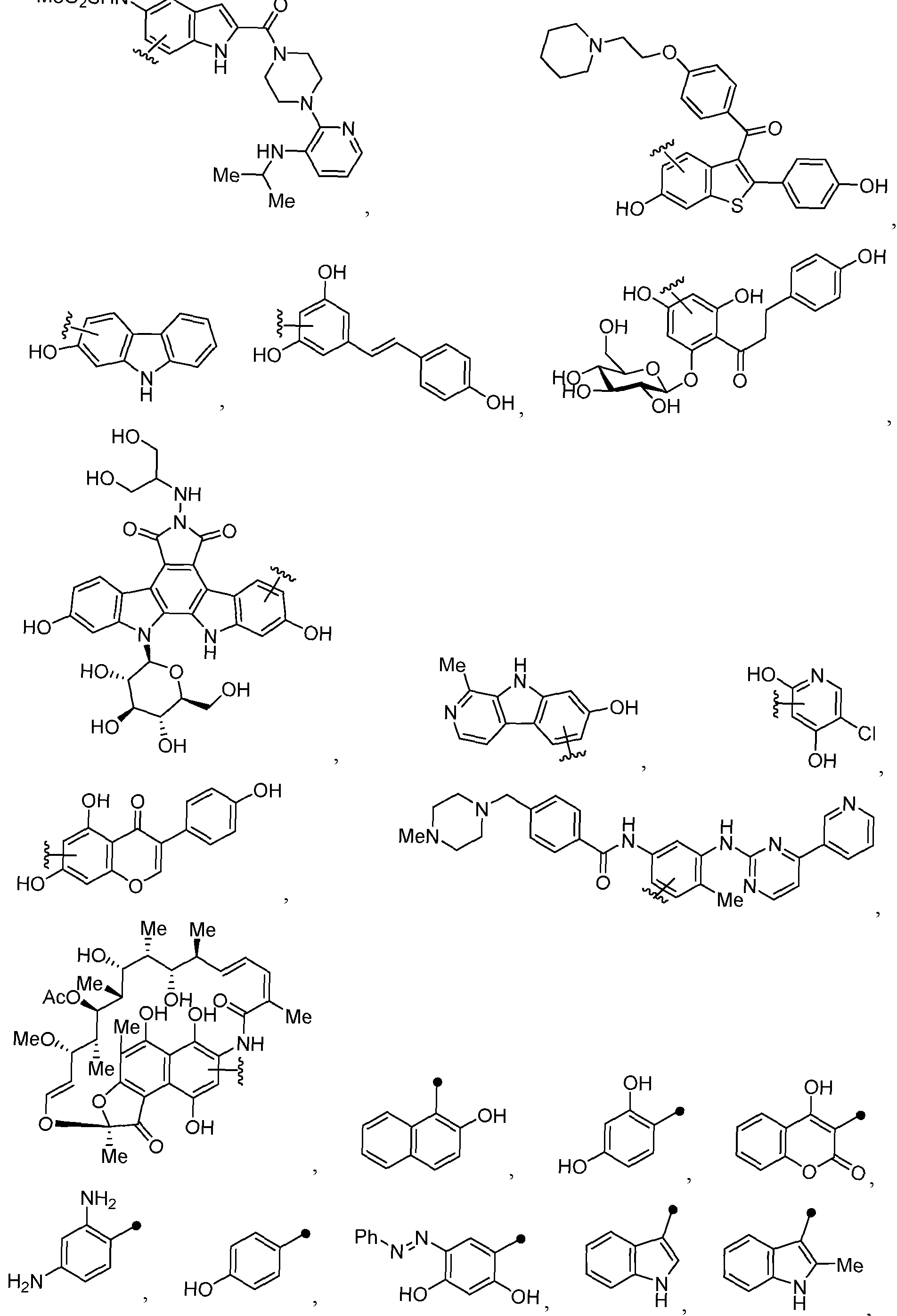

123. The method of any one of claims 58-122, wherein A2, A3, and A4 are natural or unnatural amino acids.
124. The method of any one of claims 58-123, wherein the first solvent, the second solvent, the third solvent, the fourth solvent, the fifth solvent, the sixth solvent, the seventh
solvent, or the eighth solvent is water, DMF, CH3CN, CH3CH2OH, CH3OH, DMSO, tris(2- carboxyethyl)phosphine (TCEP), dibutyl ether, tetrahydrofuran (THF), 1,4-dioxane, DME, dichloromethane, dichloroethane, acetone, diethyl ether, hexanes, or a mixture thereof.
125. The method of any one of claims 58-124, wherein the first buffer, the second buffer, the third buffer, the fourth buffer, the fifth buffer, the sixth buffer, the seventh buffer, or the eighth buffer comprises Na3P04, MES, or tris(hydroxymethyl)aminomethane (TRIS).
126. The method of any one of claims 58-125, wherein the first time, the second time, the third time, the fourth time, the fifth time, the sixth time, the seventh time, or the eighth time is from about 30 min to about 24 h.
127. The method of any one of claims 58-126, wherein A1 is an amine protecting group selected from the group consisting of an N,0-acetal, allyloxycarbonyl (Aloe), benzyl (Bn), benzyloxycarbonyl (Cbz), benzyloxymethyl (BOM), t-butoxycarbonyl (Boc), t- butyldimethylsilyl (TBDMS), t-butyldiphenylsilyl (TBDPS), diphenylmethyl, diphenylmethylene, ethoxycarbonyl, 9-fluorenylmethoxycarbonyl (Fmoc), p- methoxybenzyl (PMB), methoxycarbonyl, methoxymethyl (MOM), /?-methoxyphenyl (PMP), /?-nitrocinnamyloxycarbonyl (Noc), tosyl (Ts), 2-tosylethoxycarbonyl (Tsoc), 2,2,2- trichloroethoxycarbonyl (Troc), trifluoroacetyl, triisopropylsilyl (TIPS), trimethylsilyl (TMS), 2-(trimethylsilyl)ethoxycarbonyl (Teoc), 2-(trimethylsilyl)ethoxymethyl (SEM), or trityl (Tr).
128. The method of any one of claims 58-127, wherein A5 is -0(carboxylate protecting group); and the carboxylate protecting group is selected from the group consisting of allyl, benzyl, benzyloxy methyl (BOM), t-Bu, t-butyldimethylsilyl (TBDMS), t-butyldiphenylsilyl (TBDPS), diphenylmethyl, 9-fluorenylmethyl (Fm), 2-methoxyethoxymethyl (MEM), methoxymethyl (MOM), /?-nitrobenzyl (P B), an ester, a 1,3-oxazoline, pivaloyloxymethyl (Pom), 2-tosylethyl (TSE), 2,2,2-trichloroethyl (TCE), triethylsilyl (TES), trimethylsilyl (TMS), 2-(trimethylsilyl)ethoxymethyl (SEM), or 2-(trimethylsilyl)ethyl (TMSE).
129. The method of any one of claims 58-128, wherein R is H.
130. The method of any one of claims 58-129, wherein x is 1, 2, or 3.
131. The method of any one of claims 58-129, wherein x is 1.
132. The method of any one of claims 58-131, wherein the first, second, third, fourth, fifth, sixth, seventh, or eighth temperature is between about 10°C and about 50 °C.
133. The method of any one of claims 58-132, wherein the catalytic metal is not Cu or Rh or absent, but is selected from the group consisting of Fe, Co, Ni, Au, Pd, Pt, Ru, and Ir.
134. A method of killing or inhibiting the growth or proliferation of a bacterium, a fungus, a virus, or a parasite, comprising the step of: contacting with the bacterium, fungus, virus, or parasite an effective amount of a compound of any one of claims 1-57, thereby treating killing or inhibiting the growth or proliferation of the bacterium, fungus, virus, or parasite.
135. A method of treating a disease in a subject in need thereof comprising the step of: administering to the subject an effective amount of a compound of any one of claims 1-57, thereby treating the disease.
136. The method of claim 135, wherein the disease is an infection, for example, a bacterial infection, a fungal infection, a viral infection, or a parasitic infection.
137. The method of claim 135, wherein the disease is cancer.
Applications Claiming Priority (2)
| Application Number | Priority Date | Filing Date | Title |
|---|---|---|---|
| US201562182146P | 2015-06-19 | 2015-06-19 | |
| US62/182,146 | 2015-06-19 |
Publications (1)
| Publication Number | Publication Date |
|---|---|
| WO2016205798A1 true WO2016205798A1 (en) | 2016-12-22 |
Family
ID=56345232
Family Applications (1)
| Application Number | Title | Priority Date | Filing Date |
|---|---|---|---|
| PCT/US2016/038372 Ceased WO2016205798A1 (en) | 2015-06-19 | 2016-06-20 | Selective arylation of dichalcogenides in biomolecules |
Country Status (2)
| Country | Link |
|---|---|
| US (1) | US10117948B2 (en) |
| WO (1) | WO2016205798A1 (en) |
Cited By (2)
| Publication number | Priority date | Publication date | Assignee | Title |
|---|---|---|---|---|
| WO2022103724A1 (en) * | 2020-11-10 | 2022-05-19 | Regeneron Pharmaceuticals, Inc. | Selenium antibody conjugates |
| US12564636B2 (en) | 2022-03-26 | 2026-03-03 | University Of Rhode Island Board Of Trustees | Pnictogen-containing heterocyclic compounds and their use |
Families Citing this family (2)
| Publication number | Priority date | Publication date | Assignee | Title |
|---|---|---|---|---|
| CN107602666B (en) * | 2017-09-30 | 2021-04-30 | 中国人民解放军第二军医大学 | Thioester stapled peptide and preparation method and application thereof |
| CN115109009B (en) * | 2022-07-27 | 2023-10-31 | 东华理工大学 | A kind of synthesis method of 2-sulfonylbenzothiazole compounds |
Citations (1)
| Publication number | Priority date | Publication date | Assignee | Title |
|---|---|---|---|---|
| JP2004277387A (en) * | 2003-03-19 | 2004-10-07 | National Institute Of Advanced Industrial & Technology | Novel serenyl linker and its use |
Family Cites Families (3)
| Publication number | Priority date | Publication date | Assignee | Title |
|---|---|---|---|---|
| US9018172B2 (en) | 2012-09-26 | 2015-04-28 | Massachusetts Institute Of Technology | Modification of peptides via SNAr reactions of thiols with fluorinated aromatics |
| US9181297B1 (en) | 2014-05-15 | 2015-11-10 | Massachusetts Institute Of Technology | Cysteine arylation directed by a genetically encodable π-clamp |
| CA2955232A1 (en) | 2014-07-15 | 2016-01-21 | Massachusetts Institute Of Technology | Transition metal-based selective functionalization of chalcogens in biomolecules |
-
2016
- 2016-06-20 US US15/187,169 patent/US10117948B2/en active Active
- 2016-06-20 WO PCT/US2016/038372 patent/WO2016205798A1/en not_active Ceased
Patent Citations (1)
| Publication number | Priority date | Publication date | Assignee | Title |
|---|---|---|---|---|
| JP2004277387A (en) * | 2003-03-19 | 2004-10-07 | National Institute Of Advanced Industrial & Technology | Novel serenyl linker and its use |
Non-Patent Citations (28)
| Title |
|---|
| ANDREADOU I ET AL: "SYNTHESIS OF NOVEL SE-SUBSTITUTED SELENOCYSTEINE DERIVATIVES AS POTENTIAL KIDNEY SELECTIVE PRODRUGS OF BIOLOGICALLY ACTIVE SELENOL COMPOUNDS: EVALUATION OF KINETICS OF BETA-ELIMINATION REACTIONS IN RAT RENAL CYTOSOL", JOURNAL OF MEDICINAL CHEMISTRY, AMERICAN CHEMICAL SOCIETY, US, vol. 39, 1 January 1996 (1996-01-01), pages 2040 - 2046, XP000926051, ISSN: 0022-2623, DOI: 10.1021/JM950750X * |
| ANDREADOU IOANNA ET AL: "Comparative cytotoxicity of 14 novel selenocysteine Se-conjugatesin rat renal proximal tubular cells", TOXICOLOGY AND APPLIED PHARMACOLOGY, vol. 141, no. 1, 1 August 1996 (1996-08-01), pages 278 - 287, XP029131039, ISSN: 0041-008X, DOI: 10.1016/S0041-008X(96)80034-2 * |
| ANTONIO L. BRAGA ET AL: "Chiral Seleno-Amines from Indium Selenolates. A Straightforward Synthesis of Selenocysteine Derivatives", THE JOURNAL OF ORGANIC CHEMISTRY, vol. 71, no. 11, 1 May 2006 (2006-05-01), US, pages 4305 - 4307, XP055299619, ISSN: 0022-3263, DOI: 10.1021/jo060286b * |
| ANTONIO L. BRAGA ET AL: "One-Pot Indium Iodide Mediated Synthesis of Chiral [beta]-Seleno Amides and Selenocysteine Derivatives by Ring-Opening Reaction of 2-Oxazolines", EUROPEAN JOURNAL OF ORGANIC CHEMISTRY, vol. 2007, no. 32, 1 November 2007 (2007-11-01), DE, pages 5327 - 5331, XP055299615, ISSN: 1434-193X, DOI: 10.1002/ejoc.200700671 * |
| ARNUSCH, C.J. ET AL., PLOS ONE, vol. 7, no. 6, 2012, pages E39768 |
| BARTON D H R ET AL: "SYNTHESIS OF NOVEL ALPHA-AMINO-ACIDS AND DERIVATIVES USING RADICAL CHEMISTRY: SYNTHESIS OF L- AND D-ALPHA-AMINO-ADIPIC ACIDS, L-ALPHA-AMINOPIMELIC ACID AND APPROPRIATE UNSATURATED DERIVATIVES", TETRAHEDRON, ELSEVIER SCIENCE PUBLISHERS, AMSTERDAM, NL, vol. 43, no. 19, 1 January 1987 (1987-01-01), pages 4297 - 4308, XP001008711, ISSN: 0040-4020, DOI: 10.1016/S0040-4020(01)90305-9 * |
| BARTON D H R ET AL: "The free radical chemistry of carboxylic esters of 2-selenopyridine-N-oxide: a convenient synthesis of (L)-vinylglycine", TETRAHEDRON, ELSEVIER SCIENCE PUBLISHERS, AMSTERDAM, NL, vol. 41, no. 19, 1 January 1985 (1985-01-01), pages 4347 - 4357, XP028086866, ISSN: 0040-4020, [retrieved on 19850101], DOI: 10.1016/S0040-4020(01)97206-0 * |
| DANIEL E. MASON ET AL: "Characterization of Benzoquinone-Peptide Adducts by Electrospray Mass Spectrometry", CHEMICAL RESEARCH IN TOXICOLOGY, vol. 13, no. 10, 1 October 2000 (2000-10-01), US, pages 976 - 982, XP055301270, ISSN: 0893-228X, DOI: 10.1021/tx0000670 * |
| ERIC M. GORDON ET AL: "Chemistry of isoprenylated cysteinyl containing peptides. [2,3]. Sigmatropic rearrangement of S-farnesylcysteinyl sulfoxides. Studies toward a mild method of deprenylating lipopeptides.", JOURNAL OF THE AMERICAN CHEMICAL SOCIETY, vol. 114, no. 4, 1 February 1992 (1992-02-01), US, pages 1521 - 1523, XP055301274, ISSN: 0002-7863, DOI: 10.1021/ja00030a081 * |
| FOX, J.L, NATURE BIOTECHNOLOGY, vol. 31, no. 5, 2013, pages 379 |
| GREENE, T.W.; WUTS, P.G.M: "Protective Groups in Organic Synthesis", 1991, WILEY |
| HIROKAZU TAMAMURA ET AL: "Reduction of Peptide Character of HIV Protease Inhibitors That Exhibit Nanomolar Potency against Multidrug Resistant HIV-1 Strains", JOURNAL OF MEDICINAL CHEMISTRY, vol. 46, no. 9, 1 April 2003 (2003-04-01), US, pages 1764 - 1768, XP055301269, ISSN: 0022-2623, DOI: 10.1021/jm020537i * |
| HIROKI KONDO ET AL: "S .fwdarw. N and N .fwdarw. S reverse rearrangement of S- and N-(2,4-dinitrophenyl)cysteines", THE JOURNAL OF ORGANIC CHEMISTRY, vol. 46, no. 7, 1 March 1981 (1981-03-01), US, pages 1333 - 1336, XP055301277, ISSN: 0022-3263, DOI: 10.1021/jo00320a020 * |
| IRINA P. BELETSKAYA ET AL: "Transition-Metal-Catalyzed C-S, C-Se, and C-Te Bond Formation via Cross-Coupling and Atom-Economic Addition Reactions", CHEMICAL REVIEWS, vol. 111, no. 3, 9 March 2011 (2011-03-09), US, pages 1596 - 1636, XP055301133, ISSN: 0009-2665, DOI: 10.1021/cr100347k * |
| ISHIYAMA, T.; MURATA, M.; MIYAURA, N., J. ORG. CHEM., vol. 60, 1995, pages 7508 |
| JAN KROUZÌ?ELKA ET AL: "Preparation of Arylmercapturic Acids by S -Arylation of N , N â?2-Diacetylcystine", EUROPEAN JOURNAL OF ORGANIC CHEMISTRY, vol. 2009, no. 36, 1 December 2009 (2009-12-01), DE, pages 6336 - 6340, XP055301125, ISSN: 1434-193X, DOI: 10.1002/ejoc.200900982 * |
| JUNGHEIM L N ET AL: "POTENT HUMAN IMMUNODEFICIENCY VIRUS TYPE 1 PROTEASE INHIBITORS THATUTILIZE NONCODED D-AMINO ACIDS AS P2/P3 LIGANDS", JOURNAL OF MEDICINAL CHEMISTRY, AMERICAN CHEMICAL SOCIETY, US, vol. 39, no. 1, 1 January 1996 (1996-01-01), pages 96 - 108, XP002947738, ISSN: 0022-2623, DOI: 10.1021/JM950576C * |
| MOREAU X ET AL: "Palladium catalyzed thiol cross-coupling of cystein derivatives with aryl and alkenyl halides", JOURNAL OF ORGANOMETALLIC CHEMISTRY, ELSEVIER-SEQUOIA S.A. LAUSANNE, CH, vol. 687, no. 2, 7 December 2003 (2003-12-07), pages 322 - 326, XP004475430, ISSN: 0022-328X, DOI: 10.1016/S0022-328X(03)00635-1 * |
| MUNROE J E ET AL: "Potent, orally bioavailable HIV-1 protease inhibitors containing noncoded D-amino acids", BIOORGANIC & MEDICINAL CHEMISTRY LETTERS, PERGAMON, AMSTERDAM, NL, vol. 5, no. 23, 7 December 1995 (1995-12-07), pages 2897 - 2902, XP004135189, ISSN: 0960-894X, DOI: 10.1016/0960-894X(95)00508-Q * |
| OBI K ET AL: "Novel nikkomycin analogues: inhibitors of the fungal cell wall biosynthesis enzyme chitin synthase", BIOORGANIC & MEDICINAL CHEMISTRY LETTERS, PERGAMON, AMSTERDAM, NL, vol. 10, no. 13, 3 July 2000 (2000-07-03), pages 1451 - 1454, XP004222128, ISSN: 0960-894X, DOI: 10.1016/S0960-894X(00)00256-0 * |
| OKELEY N M ET AL: "Facile chemoselective synthesis of dehydroalanine-containing peptides", ORGANIC LETTERS, AMERICAN CHEMICAL SOCIETY, US, vol. 2, no. 23, 16 November 2000 (2000-11-16), pages 3603 - 3606, XP002522341, ISSN: 1523-7060, [retrieved on 20001024], DOI: 10.1021/OL006485D * |
| PRASAD P. PHADNIS ET AL: "Internally stabilized selenocysteine derivatives: syntheses, 77Se NMR and biomimetic studies", ORGANIC & BIOMOLECULAR CHEMISTRY, vol. 3, no. 13, 1 January 2005 (2005-01-01), GB, pages 2476, XP055299612, ISSN: 1477-0520, DOI: 10.1039/b505299h * |
| PRUDENCIO S. HERRADURA ET AL: "Copper-Mediated Cross-Coupling of Aryl Boronic Acids and Alkyl Thiols", ORGANIC LETTERS, vol. 2, no. 14, 1 July 2000 (2000-07-01), US, pages 2019 - 2022, XP055301124, ISSN: 1523-7060, DOI: 10.1021/ol005832g * |
| RICARDO S. SCHWAB ET AL: "Straightforward synthesis of non-natural chalcogen peptides via ring opening of aziridines", TETRAHEDRON, vol. 68, no. 51, 1 December 2012 (2012-12-01), AMSTERDAM, NL, pages 10449 - 10455, XP055299658, ISSN: 0040-4020, DOI: 10.1016/j.tet.2012.08.082 * |
| SCHROLL, A. L.; HONDAL, R. J.; FLEMER, S., J. PEPT. SCI., vol. 18, 2012, pages 155 |
| SENTHIL NARAYANAPERUMAL ET AL: "Transition metal oxide nanopowder and ionic liquid: an efficient system for the synthesis of diorganyl selenides, selenocysteine and derivatives", JOURNAL OF THE BRAZILIAN CHEMICAL SOCIETY, vol. 21, no. 11, 1 January 2010 (2010-01-01), BR, pages 2079 - 2087, XP055299600, ISSN: 0103-5053, DOI: 10.1590/S0103-50532010001100008 * |
| SIMON, M. D. ET AL., CHEMBIOCHEM, vol. 15, 2014, pages 713 |
| STEVENSON FLEMER: "Fmoc-Sec(Xan)-OH: synthesis and utility of Fmoc selenocysteine SPPS derivatives with acid-labile sidechain protection", JOURNAL OF PEPTIDE SCIENCE., vol. 21, no. 1, 11 December 2014 (2014-12-11), GB, pages 53 - 59, XP055299609, ISSN: 1075-2617, DOI: 10.1002/psc.2723 * |
Cited By (2)
| Publication number | Priority date | Publication date | Assignee | Title |
|---|---|---|---|---|
| WO2022103724A1 (en) * | 2020-11-10 | 2022-05-19 | Regeneron Pharmaceuticals, Inc. | Selenium antibody conjugates |
| US12564636B2 (en) | 2022-03-26 | 2026-03-03 | University Of Rhode Island Board Of Trustees | Pnictogen-containing heterocyclic compounds and their use |
Also Published As
| Publication number | Publication date |
|---|---|
| US10117948B2 (en) | 2018-11-06 |
| US20160367693A1 (en) | 2016-12-22 |
Similar Documents
| Publication | Publication Date | Title |
|---|---|---|
| US9018172B2 (en) | Modification of peptides via SNAr reactions of thiols with fluorinated aromatics | |
| CA2909620C (en) | Stapled and stitched polypeptides and uses thereof | |
| CN110114075B (en) | Cell-penetrating peptides containing disulfide and methods of making and using the same | |
| US10023613B2 (en) | Peptidomimetic macrocycles as modulators of MCL-1 | |
| CN111447941B (en) | Peptide conjugates for intracellular delivery of stapled peptides | |
| AU2017371472B2 (en) | Multicyclic peptides and methods for their preparation | |
| US10117948B2 (en) | Selective arylation of dichalcogenides in biomolecules | |
| US20190185518A9 (en) | Warhead-containing peptidomimetic macrocycles as modulators of bfl-1 | |
| Bao et al. | Dimethyl Sulfoxide/visible-light comediated chemoselective C–S bond formation between tryptophans and thiophenols enables site-selective functionalization of peptides | |
| US9181297B1 (en) | Cysteine arylation directed by a genetically encodable π-clamp | |
| EP3828196A1 (en) | Method for preparing antibody-drug conjugate intermediate by means of acid method and application thereof | |
| Zhang et al. | Influence of α-methylation in constructing stapled peptides with olefin metathesis | |
| CN114409563B (en) | Linker for protein labeling and application thereof in biological medicine | |
| US20190055280A1 (en) | Transition metal-based selective functionalization of chalcogens in biomolecules | |
| US20260124313A1 (en) | Site-specific covalent ligation of human serum albumin | |
| Wei et al. | Catalyst‐Free, Divergent Cysteine Modification via Indole Isocyanide Photochemistry | |
| WO2025208117A1 (en) | Cleavable ester compounds and uses thereof | |
| Kinghorn | Bifunctional Helical Peptide Catalysts for Enzyme-like Reactivity and Selectivity and Selective Stapling of Natural Amino Acid Residues with Hydrophilic Squaric Acid Derivatives | |
| KR20250089570A (en) | Anti-CD33 antibodies and anti-CD33 antibody-drug conjugates and uses thereof | |
| WO2025242221A1 (en) | Novel modified side chain, and preparation method therefor and use thereof | |
| Babu et al. | Synthesis and DNA-binding properties of 1, 2, 3-triazole-linked H-pin pyrrole-and imidazole-containing polyamides formed by the Huisgen reaction | |
| CN108840905A (en) | Four peptides pharmaceutical intermediates of a kind of hydroxyl and preparation method thereof |
Legal Events
| Date | Code | Title | Description |
|---|---|---|---|
| 121 | Ep: the epo has been informed by wipo that ep was designated in this application |
Ref document number: 16734812 Country of ref document: EP Kind code of ref document: A1 |
|
| NENP | Non-entry into the national phase |
Ref country code: DE |
|
| 122 | Ep: pct application non-entry in european phase |
Ref document number: 16734812 Country of ref document: EP Kind code of ref document: A1 |