WO2016200941A1 - Lapping composition for substrates - Google Patents
Lapping composition for substrates Download PDFInfo
- Publication number
- WO2016200941A1 WO2016200941A1 PCT/US2016/036449 US2016036449W WO2016200941A1 WO 2016200941 A1 WO2016200941 A1 WO 2016200941A1 US 2016036449 W US2016036449 W US 2016036449W WO 2016200941 A1 WO2016200941 A1 WO 2016200941A1
- Authority
- WO
- WIPO (PCT)
- Prior art keywords
- composition
- composition according
- lapping
- present
- abrasive
- Prior art date
- Legal status (The legal status is an assumption and is not a legal conclusion. Google has not performed a legal analysis and makes no representation as to the accuracy of the status listed.)
- Ceased
Links
Classifications
-
- C—CHEMISTRY; METALLURGY
- C09—DYES; PAINTS; POLISHES; NATURAL RESINS; ADHESIVES; COMPOSITIONS NOT OTHERWISE PROVIDED FOR; APPLICATIONS OF MATERIALS NOT OTHERWISE PROVIDED FOR
- C09G—POLISHING COMPOSITIONS; SKI WAXES
- C09G1/00—Polishing compositions
- C09G1/02—Polishing compositions containing abrasives or grinding agents
-
- C—CHEMISTRY; METALLURGY
- C09—DYES; PAINTS; POLISHES; NATURAL RESINS; ADHESIVES; COMPOSITIONS NOT OTHERWISE PROVIDED FOR; APPLICATIONS OF MATERIALS NOT OTHERWISE PROVIDED FOR
- C09K—MATERIALS FOR MISCELLANEOUS APPLICATIONS, NOT PROVIDED FOR ELSEWHERE
- C09K3/00—Materials not provided for elsewhere
- C09K3/14—Anti-slip materials; Abrasives
- C09K3/1454—Abrasive powders, suspensions and pastes for polishing
- C09K3/1463—Aqueous liquid suspensions
Definitions
- the present invention refers to a lapping composition designed for conditioning surfaces such as gears, seals, rings, and others.
- the composition is an emulsion of water in oil wherein the improvement has been achieved when using a synergistic combination of additives, such as wetting agents, dispersants, surface tension modifiers and surface modifiers.
- Lapping is an operation that uses low speed and low pressure in the finishing of metal parts, so as to correct minor imperfections on metal surfaces, typically by rubbing an abrasive composition against the substrate material in order to help condition the substrate surface.
- Abrasive lapping processes in which the particulate abrasive is placed on the surface of a fabric are widely practiced.
- the particulate abrasive material is placed in a fluid carrier which suspends and transports the abrasive and lubricates the interface between the metallic shield and the workpiece to be conditioned so as to minimize metal to metal contact.
- a mixture comprised of the carrier and the particulate abrasive is continuously fed to the surface of the metal shield and a uniform dispersion of the solid particles in the liquid carrier is desirable to achieve a controlled and uniform feeding to the interface between the metallic shield and the component being lapidated.
- the container containing the carrier and abrasive particle mixture is usually mixed with a stirrer so as to prevent solid particles from precipitating to the bottom of the reservoir.
- Document US 4.046.524 presents a lapping composition for use in polishing surfaces, such as gears, seals, rings and others, comprised of a hydrocarbon liquid that is gelled by adding a gelling agent, which is an alkyl-orthophosphate, to which a sandy abrasive is added.
- a gelling agent which is an alkyl-orthophosphate
- the present invention comprises a synergistic combination of additives, such as water, at least one organic solvent, at least one mineral oil and at least 1.8% by weight, based on the total mass of the composition, of a silicone polyether based stabilizer.
- additives include wetting agents, dispersants, surface tension modifiers and surface modifiers.
- the present invention relates to the composition of a lapping composition capable of keeping the abrasive particles in suspension at the working viscosity for extended periods of time without external agitation.
- the present composition comprises a synergistic combination of additives, such as at least one organic solvent, at least one mineral oil and at least 1.8% by weight, based on the total weight of the composition, of a silicone polyether based stabilizer.
- Optional additives include wetting agents, dispersants, surface tension modifiers and surface modifiers.
- the present inventors have developed a composition surprisingly capable of maintaining stability for at least 10 days at room temperature.
- the composition of the lapping composition in the present invention comprises at least 1.8% by weight, based on the total weight of the composition of a silicone polyether based stabilizer.
- the silicone polyether is selected from the family of trisiloxanes.
- silicone polyether examples include XIAMETER® OFX-5211 from Dow Corning, Hortolandia, Brazil.
- the unexpected results obtained with this composition are partly produced by silicone polyether.
- the inventors of the present composition postulate that the silicone polyether produces a "super-spreading" of the generally hydrophobic abrasive particles present in the composition.
- the silicone polyether present in the composition promotes super-spreading of the mineral oil over the surface of the particles in suspension (especially silicon carbide, which is non-polar), resulting in a greater packing of these particles and thus a larger packing volume fraction.
- the composition flows with greater difficulty at steady state, resulting in high "yield stress” and greater stability to sedimentation.
- the present composition optionally comprises at least one organic solvent to facilitate ring cleaning after using the present composition in the lapping process.
- organic solvents include, but are not limited to, isoparaffin, dodecane, thinners, degreasers, etc.
- the present composition further comprises a mineral oil that serves as lubricant and vehicle for mineral suspension.
- mineral oils that can be used in the present composition include, but are not limited to, USP 70 white mineral oil, paraffin oil, USP 90 mineral oil etc.
- Lapping compositions generally comprise an abrasive mineral.
- Any abrasive mineral may be used in the composition of the composition subject of the patent application, such as alumina, silicon carbide, chromium oxide, calcined bauxite, magnesium silicate, and iron oxide, among others.
- the abrasive mineral is selected from the group consisting of aluminum oxide and silicon carbide.
- Commercially available examples of abrasive minerals include TAP-8 and EC6R 600F, both by Imerys (Salto, Brazil).
- composition of the present invention optionally comprises a colloidal silica based thickener to adjust the viscosity to a range suitable for working.
- colloidal silica based thickener examples include products from the Aerosil family by Evonik (Americana, Brazil) and Cab-o-Sil by Cabot (Boston, USA).
- the present invention comprises a second aqueous stabilizer based on fatty alcohol ethoxylate and a fatty acid.
- a second aqueous stabilizer based on fatty alcohol ethoxylate and a fatty acid.
- Such stabilizers aid in the dispersion of other minerals optionally present in the composition, and that may not interact with the silicone polyether, such as alumina, for example.
- commercially available examples of the second stabilizer include Tergitol 15-S-7 by Dow Chemicals (Jundiai, Brazil) and Quimipel Coat 9330 by Quimipel Indiistria Quimica (Piracaia, Brazil).
- the second stabilizer being a bidentate chelating agent, is useful in the stabilization of the functional groups on the surface of the alumina, as shown in the figure below.
- compositions Prior state of the art compositions aimed at increasing the stability of the composition by adding thickeners. However, this practice results in an increase in viscosity that makes it difficult to apply the composition using a pumping system.
- the inventors of the present invention have developed a composition whose viscosity remains equal to or lower than 2500 cP at a temperature of 25°C. This specified viscosity range is important, not only for maintaining the minerals in suspension, but also to facilitate the application of the liquid through the pumping system.
- the composition of the present invention has between 50% and 100% stabilization of solid particles in suspension, and such stabilization of between 50% and 100%) is maintained without external agitation or shearing for up to 10 days.
- the silicone polyether acts by stabilizing the non-polar mineral oil (silicon carbide)
- the other stabilizers may act on the other components of the composition, for example, a polar mineral (alumina), resulting in a mixture synergistically stable, even at low viscosities.
- the metal part polished with the present composition may be quite easily cleaned with either organic solvents or with water. This is possible because in addition to being a mineral suspension in mineral oil, the composition is also a water in oil emulsion. The water in question comes from the fatty acid used;
- composition provides kinetic stability of the highly improved suspension for the abrasive particles
- composition provides highly desirable flow characteristics, not only under shear, but also in a static system, resulting in unexpected improvements in the lapping rate.
- Density the density of each polishing composition prepared as described below was measured using a 25 mL polished stainless steel pycnometer with lid, following the procedure described in technical standard ASTM D1475 - 13, "Standard Test Method for Density of Liquid Coatings, Inks, and Related Products".
- Total Solids total solids was determined for each lapping composition using a total solids analyzer supplied by MARTE (Sao Paulo, SP, Brazil), based on the mass loss after gradually heating the sample under infrared radiation, to a constant mass (heating ramp from 30 to 250°C in 15 min). The mass of the lapping composition samples was determined before the test and after heating the samples. The mass loss was then calculated as the total percentage of lost mass.
- the lapping composition of Comparative Examples A-H and Examples 1-7 were prepared using the following experimental procedure: the materials listed in Table 1 were added to a clean, dry flask in the order presented. The mixture was homogenized using a Cowles mechanical stirrer (Siemens Model ML- 10, supplied by Tedemix, Sao Paulo, SP) at room temperature until the formation of a vortex in the center of the mixture and for at least 10 min. The amount of each ingredient is expressed in Table 1 as percent by weight (% w), based on the total percentage of the composition (100%). Table 1
- the desired amount of fatty acid emulsion was added slowly under mechanical agitation, as shown in Table 2. After completing the addition, the mixture was stirred again for at least 30 min at room temperature.
- the desired amount of aluminum oxide (alumina) was slowly added to the mixture using mechanical agitation, followed by the silicon carbide, as shown in Table 2. After the addition was complete, the composition was kept under agitation for at least 30 min. at room temperature, to ensure adequate dispersion of the minerals.
- the viscosity of the composition was measured with a Brookfield viscometer (DV-II + Pro model) using number 03 spindle and a 30 rpm stirrer speed. The final viscosity of each composition is shown in Table 3.
- Yield Stress measurements, obtained using an RH-3 Discovery TA Instruments (New Castle, DE, USA) rheometer, and calculated according to the Waal model, represents the minimum pressure on the liquid so that it flows. Therefore, the lower the yield stress value, the greater the tendency of liquid to flow or, in other words, decant. Therefore, the lower the "yield stress” the more unstable the colloidal dispersion will be.
- the stability of each composition was determined based on the Yield Stress values and visual observation of each sample. Samples decanting in less than 10 days were classified as "sedimented”. The lapping compositions of the present invention had their stabilities classified as “stable” in the examples in which no decantation was observed within up to 10 days.
- Comparative lapping compositions were prepared following the procedure described above for Comparative Examples A-H and Examples 1-7 but using a different stabilizing system.
- a mixture of EO-PO block copolymer Teetronic 1107 nonionic surfactant, BASF, Sao Paulo
- polyisobutylene PIB-32, Braskem Camacari
- the amount of each ingredient is expressed in Table 4 as percent by weight (% w), based on the total percentage of the composition (100%).
- each composition was determined based on visual observation of each sample. Samples where decantation was observed in less than 12 hours had their stability classified as "very poor” or “poor” (decantation in less than 24 hours). The lapping compositions of the present invention had their stabilities classified as "good” (no decantation observed after 72 hours) or "excellent” (no decantation observed after 120 hours).
Landscapes
- Chemical & Material Sciences (AREA)
- Organic Chemistry (AREA)
- Engineering & Computer Science (AREA)
- Materials Engineering (AREA)
- Finish Polishing, Edge Sharpening, And Grinding By Specific Grinding Devices (AREA)
Abstract
The present invention refers to a polishing composition designed for conditioning surfaces, such as gears, seals, rings, and others. The composition is an oil in water emulsion, wherein the improvement was achieved when using a synergistic combination of additives, such as wetting agents, dispersants, surface tension modifiers and surface modifiers.
Description
LAPPING COMPOSITION FOR SUBSTRATES
The present invention refers to a lapping composition designed for conditioning surfaces such as gears, seals, rings, and others. The composition is an emulsion of water in oil wherein the improvement has been achieved when using a synergistic combination of additives, such as wetting agents, dispersants, surface tension modifiers and surface modifiers.
STATE OF THE ART
The lapidary composition industry has taken increasing proportions recently. This is due in part to the immense possibilities in the uses of lapidary compositions due to the great flexibility of their characteristics and features.
Lapping is an operation that uses low speed and low pressure in the finishing of metal parts, so as to correct minor imperfections on metal surfaces, typically by rubbing an abrasive composition against the substrate material in order to help condition the substrate surface.
Abrasive lapping processes in which the particulate abrasive is placed on the surface of a fabric are widely practiced. The particulate abrasive material is placed in a fluid carrier which suspends and transports the abrasive and lubricates the interface between the metallic shield and the workpiece to be conditioned so as to minimize metal to metal contact.
A mixture comprised of the carrier and the particulate abrasive is continuously fed to the surface of the metal shield and a uniform dispersion of the solid particles in the liquid carrier is desirable to achieve a controlled and uniform feeding to the interface between the metallic shield and the component being lapidated. The container containing the carrier and abrasive particle mixture is usually mixed with a stirrer so as to prevent solid particles from precipitating to the bottom of the reservoir.
Although it is known that the use of viscous media as the continuous phase tends to delay precipitation, highly viscous fluids are inadequate for the practice of most lapping operations in industry, in addition to being difficult to transport and to produce homogeneous mixtures.
In view of the above issues, it would be highly desirable to be able to achieve an improvement in the vehicles and particles, with the ability to maintain the abrasive particles in suspension at the working viscosity for extended periods of time without
external agitation. This fact would, without a doubt, be a major advance in the state of the art.
Documents which may be considered important in describing the state of the art regarding the technology developed herein for the present invention are patent documents US 2007/0251154 Al and US 4,046,524.
Document US 2007/0251154 Al relates to compositions of polishing compositions comprising a working fluid in a process for polishing the surface of an object, such process including contacting the surface of the object with one or more abrasives, in addition to contact with the polishing composition.
Document US 4.046.524 presents a lapping composition for use in polishing surfaces, such as gears, seals, rings and others, comprised of a hydrocarbon liquid that is gelled by adding a gelling agent, which is an alkyl-orthophosphate, to which a sandy abrasive is added.
BRIEF DESCRIPTION OF THE INVENTION
It is the objective of the present invention to provide a lapping composition capable of maintaining the abrasive particles suspended at the working viscosity for extended periods of time without external agitation. The present composition comprises a synergistic combination of additives, such as water, at least one organic solvent, at least one mineral oil and at least 1.8% by weight, based on the total mass of the composition, of a silicone polyether based stabilizer. Optional additives include wetting agents, dispersants, surface tension modifiers and surface modifiers.
DETAILED DESCRIPTION OF THE INVENTION
Below, the object of the present invention will be described in detail, in an illustrative and not limiting manner, since the composition disclosed herein may contain different details and structural aspects without extrapolating the scope of protection claimed herein.
As mentioned above, the present invention relates to the composition of a lapping composition capable of keeping the abrasive particles in suspension at the working viscosity for extended periods of time without external agitation. The present composition comprises a synergistic combination of additives, such as at least one organic solvent, at least one mineral oil and at least 1.8% by weight, based on the total weight of the composition, of a silicone polyether based stabilizer. Optional additives include wetting agents, dispersants, surface tension modifiers and surface modifiers.
The present inventors have developed a composition surprisingly capable of maintaining stability for at least 10 days at room temperature. The composition of the lapping composition in the present invention comprises at least 1.8% by weight, based on the total weight of the composition of a silicone polyether based stabilizer. Preferably, the silicone polyether is selected from the family of trisiloxanes.

cciy.
Commercially available examples of such silicone polyether include XIAMETER® OFX-5211 from Dow Corning, Hortolandia, Brazil.
The unexpected results obtained with this composition are partly produced by silicone polyether. The inventors of the present composition postulate that the silicone polyether produces a "super-spreading" of the generally hydrophobic abrasive particles present in the composition. Thus, it is believed that the silicone polyether present in the composition promotes super-spreading of the mineral oil over the surface of the particles in suspension (especially silicon carbide, which is non-polar), resulting in a greater packing of these particles and thus a larger packing volume fraction. As this situation leads to a weaker ordered structure, the composition flows with greater difficulty at steady state, resulting in high "yield stress" and greater stability to sedimentation.
The present composition optionally comprises at least one organic solvent to facilitate ring cleaning after using the present composition in the lapping process. Examples of solvents that may be used in the present composition include, but are not limited to, isoparaffin, dodecane, thinners, degreasers, etc.
The present composition further comprises a mineral oil that serves as lubricant and vehicle for mineral suspension. Examples of mineral oils that can be used in the present composition include, but are not limited to, USP 70 white mineral oil, paraffin oil, USP 90 mineral oil etc.
Lapping compositions generally comprise an abrasive mineral. Any abrasive mineral may be used in the composition of the composition subject of the patent application, such as
alumina, silicon carbide, chromium oxide, calcined bauxite, magnesium silicate, and iron oxide, among others. In one embodiment, the abrasive mineral is selected from the group consisting of aluminum oxide and silicon carbide. Commercially available examples of abrasive minerals include TAP-8 and EC6R 600F, both by Imerys (Salto, Brazil).
The composition of the present invention optionally comprises a colloidal silica based thickener to adjust the viscosity to a range suitable for working. Examples of thickeners available include products from the Aerosil family by Evonik (Americana, Brazil) and Cab-o-Sil by Cabot (Boston, USA).
Optionally, the present invention comprises a second aqueous stabilizer based on fatty alcohol ethoxylate and a fatty acid. Such stabilizers aid in the dispersion of other minerals optionally present in the composition, and that may not interact with the silicone polyether, such as alumina, for example. Commercially available examples of the second stabilizer include Tergitol 15-S-7 by Dow Chemicals (Jundiai, Brazil) and Quimipel Coat 9330 by Quimipel Indiistria Quimica (Piracaia, Brazil).
It is believed that the second stabilizer, being a bidentate chelating agent, is useful in the stabilization of the functional groups on the surface of the alumina, as shown in the figure below.

Prior state of the art compositions aimed at increasing the stability of the composition by adding thickeners. However, this practice results in an increase in viscosity that makes it difficult to apply the composition using a pumping system.
The inventors of the present invention have developed a composition whose viscosity remains equal to or lower than 2500 cP at a temperature of 25°C. This specified viscosity range is important, not only for maintaining the minerals in suspension, but also to facilitate the application of the liquid through the pumping system.
The composition of the present invention has between 50% and 100% stabilization of solid particles in suspension, and such stabilization of between 50% and 100%) is maintained without external agitation or shearing for up to 10 days.
The additives comprised in the composition as shown above, acted extremely synergistically with respect to the stabilization of the mineral mixture in suspension. As the silicone polyether acts by stabilizing the non-polar mineral oil (silicon carbide), the other stabilizers may act on the other components of the composition, for example, a polar mineral (alumina), resulting in a mixture synergistically stable, even at low viscosities.
The present invention has as its main advantages:
- The metal part polished with the present composition may be quite easily cleaned with either organic solvents or with water. This is possible because in addition to being a mineral suspension in mineral oil, the composition is also a water in oil emulsion. The water in question comes from the fatty acid used;
- The composition provides kinetic stability of the highly improved suspension for the abrasive particles; and
- The composition provides highly desirable flow characteristics, not only under shear, but also in a static system, resulting in unexpected improvements in the lapping rate.
EXAMPLES TESTS:
Density: the density of each polishing composition prepared as described below was measured using a 25 mL polished stainless steel pycnometer with lid, following the procedure described in technical standard ASTM D1475 - 13, "Standard Test Method for Density of Liquid Coatings, Inks, and Related Products".
Total Solids: total solids was determined for each lapping composition using a total solids analyzer supplied by MARTE (Sao Paulo, SP, Brazil), based on the mass loss after gradually heating the sample under infrared radiation, to a constant mass (heating ramp from 30 to 250°C in 15 min). The mass of the lapping composition samples was determined before the test and after heating the samples. The mass loss was then calculated as the total percentage of lost mass.
Stability: the stability of each sample was estimated using the dynamic rheology technique in the linear viscoelastic region, utilizing a DHR3 TA Instruments
brand rheometer. The parameter "yield stress" was calculated using the software available with the rheometer (Trios Software). Test conditions:
Conditioning sample:
• Temperature 25°C inherited set point: off · Immersion time 10.0 s - wait for the temperature: Off
• Waiting for axial force: Off Pre-shear performance On shear rate 11/s
• Duration: 10.0 s
• Equilibrium performance: On Duration 120.0 s Flow Scan:
· Temperature 25°C inherited set point: Off
• Immersion time 0.0 s waiting for temperature: Off
• Logarithmic Scan
• shear rate: 0.01 to 1001/sec
• Points per decade: 5 · Steady State Sensor: On Maximum equilibrium time 180.0 s
• Sample Period: 30.0 s
• % tolerance: 5.0
• Consecutive within 3
• Average graduated time: Off Final test conditioning:
• Reference Temperature: On Temperature 25°C
• Idle system reference temperature (only if axial force control is active): Off
• Data Run: 3/18/2015
• Geometry Name: parallel plates of 25 mm, ETC Steel - 100577
• TA version of Trios Instruments: 3.1.4.3607
Materials:

Experimental procedure:
COMPARATIVE EXAMPLES A-H AND EXAMPLES 1-15
The lapping composition of Comparative Examples A-H and Examples 1-7 were prepared using the following experimental procedure: the materials listed in Table 1 were added to a clean, dry flask in the order presented. The mixture was homogenized using a Cowles mechanical stirrer (Siemens Model ML- 10, supplied by Tedemix, Sao Paulo, SP) at room temperature until the formation of a vortex in the center of the mixture and for at least 10 min. The amount of each ingredient is expressed in Table 1 as percent by weight (% w), based on the total percentage of the composition (100%).
Table 1

After homogenizing the composition, the desired amount of fatty acid emulsion was added slowly under mechanical agitation, as shown in Table 2. After completing the addition, the mixture was stirred again for at least 30 min at room temperature.
With the aid of a spatula, the desired amount of aluminum oxide (alumina) was slowly added to the mixture using mechanical agitation, followed by the silicon carbide, as shown in Table 2. After the addition was complete, the composition was kept under agitation for at least 30 min. at room temperature, to ensure adequate dispersion of the minerals.
Small quantities of colloidal silica were then slowly added under constant mechanical stirring, until each composition had a viscosity of about 2500 cP (approximately 0.10% in each formulation), as indicated in Table 2. The composition was stirred for about 30 minutes.
Table 2

The viscosity of the composition was measured with a Brookfield viscometer (DV-II + Pro model) using number 03 spindle and a 30 rpm stirrer speed. The final viscosity of each composition is shown in Table 3.
The lapping composition in Examples 1-15 were subjected to density, total solids and stability measurements, following the experimental procedure described above. Results are reported in Table 3, below.
"Yield Stress" measurements, obtained using an RH-3 Discovery TA Instruments (New Castle, DE, USA) rheometer, and calculated according to the Waal model, represents the minimum pressure on the liquid so that it flows. Therefore, the lower the yield stress value, the greater the tendency of liquid to flow or, in other words, decant. Therefore, the lower the "yield stress" the more unstable the colloidal dispersion will be. The stability of each composition was determined based on the Yield Stress values and visual observation of each sample. Samples decanting in less than 10 days
were classified as "sedimented". The lapping compositions of the present invention had their stabilities classified as "stable" in the examples in which no decantation was observed within up to 10 days.
Table 3

COMPARATIVE EXAMPLES I-V
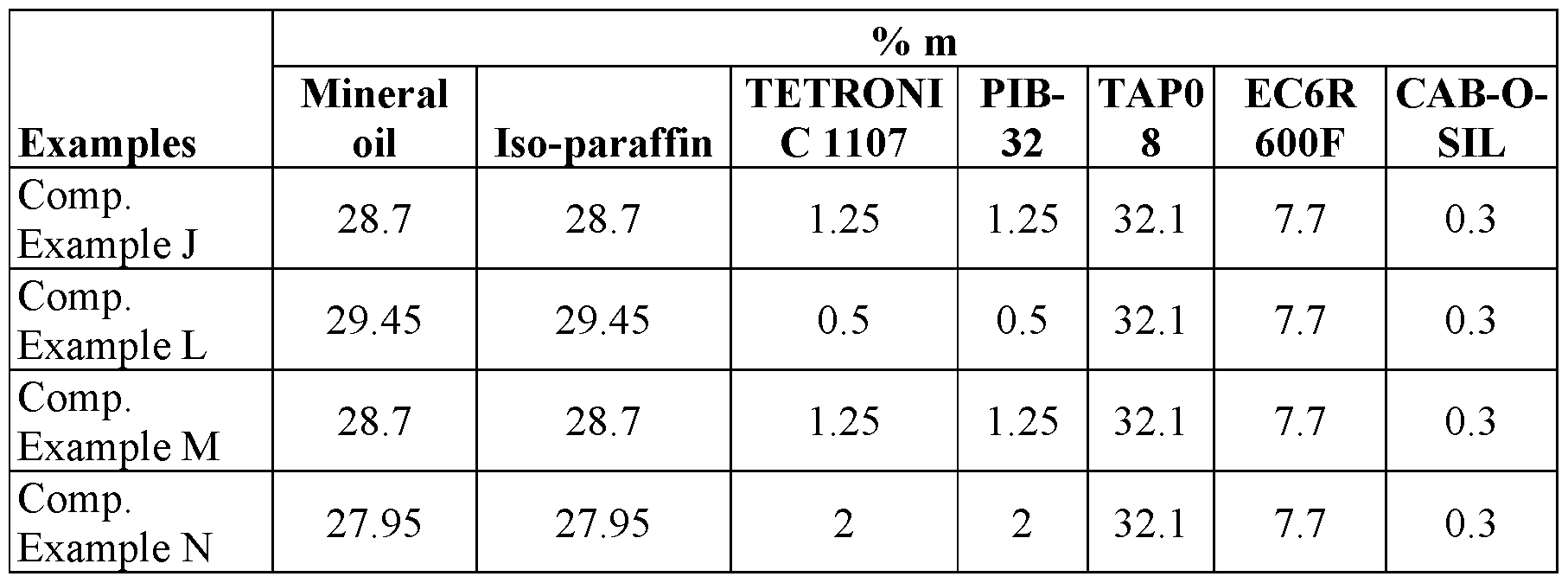
Comparative lapping compositions were prepared following the procedure described above for Comparative Examples A-H and Examples 1-7 but using a different stabilizing system. In the present description, a mixture of EO-PO block copolymer (Tetronic 1107 nonionic surfactant, BASF, Sao Paulo) and polyisobutylene (PIB-32, Braskem Camacari) was used. The amount of each ingredient is expressed in Table 4 as percent by weight (% w), based on the total percentage of the composition (100%).
Table 4
Mineral TETRONI PIB- TAP0 EC6R CAB-O-
Examples oil Iso-paraffin C 1107 32 8 600F SIL
Comp.
28.7 28.7 0.5 2 32.1 7.7 0.3 Example 0
Comp.
28.7 28.7 1.25 1.25 32.1 7.7 0.3 Example P
Comp.
28.7 28.7 2 0.5 32.1 7.7 0.3 Example Q
Comp.
29.23 29.23 0.19 1.25 32.1 7.7 0.3 Example R
Comp.
28.17 28.17 2.31 1.25 32.1 7.7 0.3 Example S
Comp.
29.23 29.23 1.25 0.19 32.1 7.7 0.3 Example T
Comp.
28.17 28.17 1.25 2.31 32.1 7.7 0.3 Example U
Comp.
28.7 28.7 1.25 1.25 32.1 7.7 0.3 Example V
Comp.
28.7 28.7 1.25 1.25 32.1 7.7 0.3 Example X
The stability of each composition was determined based on visual observation of each sample. Samples where decantation was observed in less than 12 hours had their stability classified as "very poor" or "poor" (decantation in less than 24 hours). The lapping compositions of the present invention had their stabilities classified as "good" (no decantation observed after 72 hours) or "excellent" (no decantation observed after 120 hours).
Table 5

Comparative Example T Poor
Comparative Example U Poor
Comparative Example V Poor
Comparative Example X Poor
Thus, it can be concluded that the embodiments of the present invention solve the current state of the art problems, by providing an entirely new composition that results in a product with unique features not observed so far in similar products known.
These and other variations and modifications in the description will become apparent to those skilled in the art without diverting from the scope of the description, and it should be understood that this disclosure is not limited to the illustrative forms set forth herein.
Claims
1. A composition for lapping substrates containing at least one abrasive mineral in a mixture of water and at least one mineral oil, said composition being characterized by comprising at least 1.8% by weight, based on the total mass of the composition, of a silicone polyether based stabilizer.
2. A composition according to claim 1, characterized by silicone polyether being selected from the trisiloxane family.
OB,
M - Si - O - Si - - :¾ - fCM i

3. A composition according to claim 1, characterized by further comprising a colloidal silica based thickener.
4. A composition according to claim 1, characterized by the abrasive mineral being selected from the group consisting of aluminum oxide and silicon carbide.
5. A composition according to claim 1, characterized by further comprising a second stabilizer based on fatty alcohol ethoxylate and a fatty acid.
6. A composition according to claim 1, characterized by said composition having a viscosity of between 1,000 and 20,000 cP at a temperature of 25°C.
7. A composition according to claim 2, characterized by presenting between 50% and 100% stabilization of solid particles in suspension.
8. A composition according to claim 6, characterized by the stabilization of between 50% and 100% being maintained without external agitation or shearing for at least 10 days.
9. A composition according to claim 1, characterized by additionally comprising at least one organic solvent.
Applications Claiming Priority (2)
| Application Number | Priority Date | Filing Date | Title |
|---|---|---|---|
| BR102015013230-1A BR102015013230A2 (en) | 2015-06-08 | 2015-06-08 | COMPOSITION OF SUBSTRATE LAPIDATION |
| BR1020150132301 | 2015-06-08 |
Publications (1)
| Publication Number | Publication Date |
|---|---|
| WO2016200941A1 true WO2016200941A1 (en) | 2016-12-15 |
Family
ID=57504636
Family Applications (1)
| Application Number | Title | Priority Date | Filing Date |
|---|---|---|---|
| PCT/US2016/036449 Ceased WO2016200941A1 (en) | 2015-06-08 | 2016-06-08 | Lapping composition for substrates |
Country Status (2)
| Country | Link |
|---|---|
| BR (1) | BR102015013230A2 (en) |
| WO (1) | WO2016200941A1 (en) |
Cited By (1)
| Publication number | Priority date | Publication date | Assignee | Title |
|---|---|---|---|---|
| US10344169B2 (en) | 2014-09-30 | 2019-07-09 | 3M Innovative Properties Company | Free-radical polymerization methods and articles thereby |
Citations (5)
| Publication number | Priority date | Publication date | Assignee | Title |
|---|---|---|---|---|
| WO1998017765A1 (en) * | 1996-10-23 | 1998-04-30 | Agency Design Services Limited | A composition, a process for treating a non-porous surface and a non-porous surface so treated |
| US6090765A (en) * | 1997-12-12 | 2000-07-18 | Church & Dwight Co., Inc. | Composition for cleaning hard surfaces |
| US20070275867A1 (en) * | 2004-05-05 | 2007-11-29 | Serobian Ashot K | Water-Based Silicone Dispersion Containing Low Level of Silicone Oils |
| US20080171683A1 (en) * | 2007-01-11 | 2008-07-17 | Johnson Andress K | Premoistened cleaning disposable substrate for leather and method of preserving a leather surface by contacting said surface with said substrate |
| US20090035451A1 (en) * | 2007-08-03 | 2009-02-05 | Ashot Serobian | Sprayable Dry Wash and Wax Composition and Method of Using Same |
-
2015
- 2015-06-08 BR BR102015013230-1A patent/BR102015013230A2/en active Search and Examination
-
2016
- 2016-06-08 WO PCT/US2016/036449 patent/WO2016200941A1/en not_active Ceased
Patent Citations (5)
| Publication number | Priority date | Publication date | Assignee | Title |
|---|---|---|---|---|
| WO1998017765A1 (en) * | 1996-10-23 | 1998-04-30 | Agency Design Services Limited | A composition, a process for treating a non-porous surface and a non-porous surface so treated |
| US6090765A (en) * | 1997-12-12 | 2000-07-18 | Church & Dwight Co., Inc. | Composition for cleaning hard surfaces |
| US20070275867A1 (en) * | 2004-05-05 | 2007-11-29 | Serobian Ashot K | Water-Based Silicone Dispersion Containing Low Level of Silicone Oils |
| US20080171683A1 (en) * | 2007-01-11 | 2008-07-17 | Johnson Andress K | Premoistened cleaning disposable substrate for leather and method of preserving a leather surface by contacting said surface with said substrate |
| US20090035451A1 (en) * | 2007-08-03 | 2009-02-05 | Ashot Serobian | Sprayable Dry Wash and Wax Composition and Method of Using Same |
Cited By (1)
| Publication number | Priority date | Publication date | Assignee | Title |
|---|---|---|---|---|
| US10344169B2 (en) | 2014-09-30 | 2019-07-09 | 3M Innovative Properties Company | Free-radical polymerization methods and articles thereby |
Also Published As
| Publication number | Publication date |
|---|---|
| BR102015013230A2 (en) | 2017-10-31 |
Similar Documents
| Publication | Publication Date | Title |
|---|---|---|
| US20100029519A1 (en) | Performance additives for improving the wetting properties of ionic liquids on solid surfaces | |
| CN107523221B (en) | Stone crystal face treatment composition and manufacturing method thereof | |
| US3367872A (en) | Electroviscous fluid composition | |
| CN101502728A (en) | Defoaming of ionic liquids | |
| CN108137991A (en) | It is formed in situ for the slurry suspension body of the stabilization of the gel particle for the inert abrasives particle that detaches and suspend | |
| Sulek et al. | Antiseizure properties of aqueous solutions of compounds forming liquid crystalline structures | |
| CA2098207A1 (en) | Surface protectant composition | |
| US4808329A (en) | Cleaning preparation for glass | |
| WO2016200941A1 (en) | Lapping composition for substrates | |
| EP1709129B1 (en) | Finishing compositions with reduced volatile organic compound content | |
| US4952240A (en) | Scratch remover and polish containing oleic diethanolamide, an abrasive alumina and a bentonite | |
| MX2007008675A (en) | Non-aqueous slurries used as thickeners and defoamers and method of using slurries in aqueous systems. | |
| JP4029886B2 (en) | Oil-in-water emulsion composition and method for producing the same | |
| CN103127874B (en) | Polishing liquid dispersion assistant, polishing liquid containing dispersion assistant, and preparation method and application of polishing liquid | |
| US20040198842A1 (en) | Aqueous defoamer formulations | |
| JP5882865B2 (en) | Oil mist inhibitor | |
| JP6033390B2 (en) | Oil mist inhibitor | |
| Santos et al. | Influence of nonionic surfactant hydrophobicity on the tribological properties of microemulsion systems aimed at cutting fluid applications | |
| JP2015193832A (en) | Photocatalyst coating composition | |
| JP2000226594A (en) | Cutting oil | |
| US1862322A (en) | Saponaceous emulsion and product containing the same | |
| JPH05295264A (en) | Oil-in-water emulsion composition for paintable release agent | |
| US11261347B2 (en) | Water in oil emulsion automotive wax product | |
| KR102021960B1 (en) | Lubricant for cold drawing of stainless steel tube and the method of preparation thereof | |
| JP2000017251A (en) | Aqueous polishing composition |
Legal Events
| Date | Code | Title | Description |
|---|---|---|---|
| 121 | Ep: the epo has been informed by wipo that ep was designated in this application |
Ref document number: 16808189 Country of ref document: EP Kind code of ref document: A1 |
|
| NENP | Non-entry into the national phase |
Ref country code: DE |
|
| 122 | Ep: pct application non-entry in european phase |
Ref document number: 16808189 Country of ref document: EP Kind code of ref document: A1 |