WO2016199433A1 - メッセージ分析装置、メッセージ分析方法、および、記憶媒体 - Google Patents
メッセージ分析装置、メッセージ分析方法、および、記憶媒体 Download PDFInfo
- Publication number
- WO2016199433A1 WO2016199433A1 PCT/JP2016/002816 JP2016002816W WO2016199433A1 WO 2016199433 A1 WO2016199433 A1 WO 2016199433A1 JP 2016002816 W JP2016002816 W JP 2016002816W WO 2016199433 A1 WO2016199433 A1 WO 2016199433A1
- Authority
- WO
- WIPO (PCT)
- Prior art keywords
- message
- cluster
- field
- messages
- pattern
- Prior art date
- Legal status (The legal status is an assumption and is not a legal conclusion. Google has not performed a legal analysis and makes no representation as to the accuracy of the status listed.)
- Ceased
Links
Images






Classifications
-
- G—PHYSICS
- G06—COMPUTING OR CALCULATING; COUNTING
- G06F—ELECTRIC DIGITAL DATA PROCESSING
- G06F11/00—Error detection; Error correction; Monitoring
- G06F11/30—Monitoring
- G06F11/3003—Monitoring arrangements specially adapted to the computing system or computing system component being monitored
- G06F11/3006—Monitoring arrangements specially adapted to the computing system or computing system component being monitored where the computing system is distributed, e.g. networked systems, clusters, multiprocessor systems
-
- G—PHYSICS
- G06—COMPUTING OR CALCULATING; COUNTING
- G06F—ELECTRIC DIGITAL DATA PROCESSING
- G06F11/00—Error detection; Error correction; Monitoring
- G06F11/30—Monitoring
- G06F11/3065—Monitoring arrangements determined by the means or processing involved in reporting the monitored data
- G06F11/3072—Monitoring arrangements determined by the means or processing involved in reporting the monitored data where the reporting involves data filtering, e.g. pattern matching, time or event triggered, adaptive or policy-based reporting
- G06F11/3079—Monitoring arrangements determined by the means or processing involved in reporting the monitored data where the reporting involves data filtering, e.g. pattern matching, time or event triggered, adaptive or policy-based reporting the data filtering being achieved by reporting only the changes of the monitored data
-
- G—PHYSICS
- G06—COMPUTING OR CALCULATING; COUNTING
- G06F—ELECTRIC DIGITAL DATA PROCESSING
- G06F11/00—Error detection; Error correction; Monitoring
- G06F11/30—Monitoring
- G06F11/34—Recording or statistical evaluation of computer activity, e.g. of down time, of input/output operation ; Recording or statistical evaluation of user activity, e.g. usability assessment
- G06F11/3438—Recording or statistical evaluation of computer activity, e.g. of down time, of input/output operation ; Recording or statistical evaluation of user activity, e.g. usability assessment monitoring of user actions
-
- G—PHYSICS
- G06—COMPUTING OR CALCULATING; COUNTING
- G06F—ELECTRIC DIGITAL DATA PROCESSING
- G06F11/00—Error detection; Error correction; Monitoring
- G06F11/30—Monitoring
- G06F11/34—Recording or statistical evaluation of computer activity, e.g. of down time, of input/output operation ; Recording or statistical evaluation of user activity, e.g. usability assessment
- G06F11/3466—Performance evaluation by tracing or monitoring
- G06F11/3476—Data logging
-
- G—PHYSICS
- G06—COMPUTING OR CALCULATING; COUNTING
- G06F—ELECTRIC DIGITAL DATA PROCESSING
- G06F16/00—Information retrieval; Database structures therefor; File system structures therefor
- G06F16/30—Information retrieval; Database structures therefor; File system structures therefor of unstructured textual data
- G06F16/35—Clustering; Classification
-
- G—PHYSICS
- G06—COMPUTING OR CALCULATING; COUNTING
- G06F—ELECTRIC DIGITAL DATA PROCESSING
- G06F18/00—Pattern recognition
- G06F18/20—Analysing
- G06F18/23—Clustering techniques
-
- G—PHYSICS
- G06—COMPUTING OR CALCULATING; COUNTING
- G06Q—INFORMATION AND COMMUNICATION TECHNOLOGY [ICT] SPECIALLY ADAPTED FOR ADMINISTRATIVE, COMMERCIAL, FINANCIAL, MANAGERIAL OR SUPERVISORY PURPOSES; SYSTEMS OR METHODS SPECIALLY ADAPTED FOR ADMINISTRATIVE, COMMERCIAL, FINANCIAL, MANAGERIAL OR SUPERVISORY PURPOSES, NOT OTHERWISE PROVIDED FOR
- G06Q10/00—Administration; Management
- G06Q10/40—Business processes related to social networking or social networking services
Definitions
- the present invention relates to a technique for analyzing a large number of messages.
- logs are recorded as history of the operation status and usage status.
- messages are input and recorded by many users. Analysts who analyze such a large number of messages are required to grasp the contents and trends of information contained in a large number of messages.
- Patent Document 1 An example of a technique for analyzing a message is described in Patent Document 1.
- the related technique described in Patent Document 1 extracts a common part that is common to other messages and a different part that is different from other messages, from messages included in the log.
- identification information is given to the extracted common part and stored as common part information
- identification information is given to the extracted different part and stored as different part information.
- each message is stored in association with the identification information of the common part and the identification information of the different part.
- the related technique described in Patent Document 1 requires the definition of variables constituting the different part in order to extract the common part and the different part.
- a numeric string of one or more characters is defined as a variable representing a process ID.
- a numeric string delimited by periods is defined as a variable representing an IP (Internet Protocol) address.
- IP Internet Protocol
- a part of the message that matches the definition of the variable is extracted as a different part, and the other part is extracted as a common part.
- this related technique cannot extract a common part and a different part of a large number of messages unless variables are defined in advance, and cannot present it as information representing the contents and trends thereof.
- an object of the present invention is to provide a technique for presenting information representing the contents and tendencies of a large number of messages without having to previously define a portion that varies between messages.
- the message analysis apparatus of the present invention comprises a clustering means for classifying a message group, which is a set of messages composed of one or more fields, into clusters based on the similarity between the messages; For each field constituting the message group in the cluster, based on the variable part and the invariant part, field analysis means for identifying a variable part whose value is mutated and an invariant part that is not mutated, Pattern generation means for generating a message pattern common to a group of messages in the cluster.
- the message analysis method of the present invention classifies a message group, which is a set of one or more fields, into a cluster based on the similarity between the messages using a computer device, For each field constituting the message group, a variable part whose value is mutated and an invariant part which is not mutated are identified, and based on the variable part and the invariant part, common to the message group in the cluster Generate a message pattern.
- the storage medium of the present invention comprises a clustering step for classifying a message group, which is a set of messages composed of one or more fields, into a cluster based on the similarity between the messages, and a message group in the cluster.
- Field analysis step for identifying a variable part whose value is mutated and an invariant part that is not mutated for each field, and common to the message group in the cluster based on the variable part and the invariant part
- a message analysis program for causing a computer device to execute a pattern generation step for generating a message pattern to be stored is stored.
- the present invention can provide a technique for presenting information representing the contents and trends of a large number of messages without the need to previously define a portion that varies between messages.
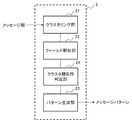
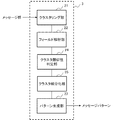
- FIG. 1 shows a functional block configuration of a message analysis apparatus 1 as the first embodiment of the present invention.
- the message analysis apparatus 1 includes a clustering unit 11, a field analysis unit 12, and a pattern generation unit 13.
- the message analysis device 1 is a device that analyzes a message group and generates a message pattern indicating the content and tendency thereof.
- a message refers to a unit of information recorded by a device, service, person, or the like.
- the message may be a unit of information included in log data representing a history of operation status and usage status of devices and services.
- the message may be information of a unit generated by a component of an IT (Information Technology) system such as a server or a client at a predetermined timing and added to log data.
- IT Information Technology
- the message often includes the time when the message was output, the name of the output source, and the like.
- the message is often one line of text data included in a file representing log data. However, one message may extend over a plurality of lines. Alternatively, a plurality of messages may be included in one line.
- a line feed code included in one message across multiple lines is converted to a blank character, or before a blank character between multiple messages included in one line is converted into a line feed code It may be assumed that processing or the like is performed. In this case, the message can be regarded as composed of one line of the file representing the log data.
- the message is not limited to the information included in the log data, but may be a unit of information that is input to an arbitrary service via an input device or a network and recorded.
- a message is composed of one or more fields.
- the field may be information delimited by a separator, for example.
- the message “April 1 13:31:52 logging start” consists of five fields “April”, “1”, “13:31:52”, “logging”, and “start” with a blank as a separator. Is done.
- there are messages that are not separated by a separator such as a blank, such as messages composed in Japanese.
- Such a message can be considered to be composed of one or more fields by preprocessing that is separated by character types such as words, morphemes, katakana, hiragana, and kanji.
- the premise that the message in this embodiment is composed of one or more fields does not limit the types of messages that can be processed in this embodiment. Any type of message can be processed as being composed of one or more fields by pre-processing as necessary.
- a process of dividing one field into a plurality of fields can be considered.
- the value of a certain field is “abc & def” in a certain message and “abc & ghi” in another message.
- abc, def, and ghi are defined to represent individual objects with respect to the content of the message.
- “abc & def” is suitable for processing as three fields such as “abc”, “&” and “def” instead of one field. Such processing may be included in the preprocessing for the message.
- a set of messages composed of one or more fields subjected to the above-described preprocessing as necessary is input to the message analysis apparatus 1.
- the target message group may be stored in advance in the storage device as information representing the value of the field (character string, numerical value, symbol, etc.) in a table format for each message.
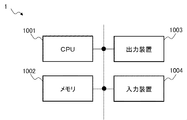
- the message analysis apparatus 1 includes a CPU (Central Processing Unit) 1001, a memory 1002, an output device 1003, and an input device 1004.
- the memory 1002 includes a RAM (Random Access Memory), a ROM (Read Only Memory), an auxiliary storage device (such as a hard disk), and the like.
- the output device 1003 is configured by a device that outputs information, such as a display device or a printer.
- the input device 1004 is configured by a device that receives an input of a user operation, such as a keyboard or a mouse.
- each functional block of the message analysis device 1 is configured by a CPU 1001 that reads and executes a computer program stored in the memory 1002 and controls each unit of the output device 1003 and the input device 1004.
- the hardware configuration of the message analysis device 1 and each functional block thereof is not limited to the above-described configuration.
- the clustering unit 11 classifies the target message group into clusters based on the similarity between messages.
- the number of clusters is less than the number of messages.
- the target message group is a set of messages including one or more fields that have been preprocessed as necessary, as described above.
- the clustering unit 11 may acquire target message groups stored in advance in the memory 1002 and classify them into clusters.
- a known technique can be adopted as a method of classifying a plurality of pieces of information based on the similarity between them.
- the field analysis unit 12 identifies, for each field constituting the message group in the cluster, a variable part whose value is mutated and an invariant part that is not mutated. Specifically, the field analysis unit 12 may identify a field having the same value as an invariant part over all messages in the cluster. Further, the field analysis unit 12 may identify a field having a different value as a variable part in at least one of all messages in the cluster.
- the pattern generation unit 13 generates a message pattern common to the message group in the cluster based on the variable part and the invariant part of the field. For example, the pattern generation unit 13 arranges information in which the variable part field is represented by a predetermined symbol (for example, an asterisk “*”) and information in which the constant part field is represented by the value in the order of appearance of the field. Information may be generated as a common pattern. Then, the pattern generation unit 13 extracts a list of values taken by the field of the variable part in the message group included in the cluster. Hereinafter, a field identified as a variable part is called a variable, and a value that the variable can take is called an argument. Then, the pattern generation unit 13 may generate a common pattern and a list of arguments for each variable as a message pattern for each cluster.
- a predetermined symbol for example, an asterisk “*”
- the constant part field is represented by the value in the order of appearance of the field. Information may be generated as a common pattern.
- the pattern generation unit 13
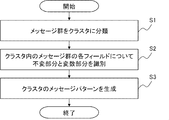
- the clustering unit 11 classifies the target message group into clusters based on the similarity between messages (step S1).
- the field analysis unit 12 includes a variable part whose value is mutated and an invariant part that is not mutated among the fields constituting the message group in the cluster. Is identified (step S2).
- the pattern generation unit 13 generates, for each cluster, a message pattern common to the message group in the cluster based on the variable part and the invariant part (step S3).
- the pattern generation unit 13 may generate a list of common patterns and variable arguments as message patterns.
- the message analysis device 1 finishes the operation.
- the message analysis apparatus can present information representing the contents and trends of a large number of messages without having to previously define a portion that varies between messages.
- the clustering unit classifies the message group into clusters based on the similarity between messages. Then, the field analysis unit identifies, for each field constituting the message group in the cluster, a variable part whose value is mutated and an invariant part that is not mutated. This is because the pattern generation unit generates a message pattern common to the message group in the cluster based on the variable part and the invariant part of the field.
- the present embodiment it is possible to extract a mutated part and an invariant part without requiring definition of a mutated part in the message group.
- the present embodiment can present a similar message group to the user so that the invariable part and the part that mutates between them can be recognized without any prior variable definition.
- a user who uses this embodiment can more easily grasp the contents and trends of a large number of message groups.
- FIG. 4 shows a functional block configuration of the message analyzer 2 as the second embodiment of the present invention.
- the message analysis device 2 is different from the message analysis device 1 as the first embodiment of the present invention in the following points. That is, the message analysis device 2 includes a clustering unit 21 instead of the clustering unit 11, a field analysis unit 22 instead of the field analysis unit 12, and a pattern generation unit 23 instead of the pattern generation unit 13, and further includes a cluster A similarity determination unit 24 is provided.
- the message analysis device 2 and each functional block thereof can be configured by the same hardware elements as those of the first embodiment of the present invention described with reference to FIG. However, the hardware configuration of the message analysis device 2 and each functional block is not limited to the above-described configuration.
- the clustering unit 21 classifies a message and other messages whose similarity satisfies a predetermined condition with respect to the message into the same cluster.
- the clustering unit 21 classifies the message group into clusters by regarding a part that matches a predetermined field pattern in each message as a field similar to each other between the messages.
- the predetermined field pattern is a pattern of values that can be taken by a portion that can be regarded as a similar field even if the values are different.
- Such a field pattern may be defined in advance. For example, date, date and time can be regarded as similar fields even if the values are different. Therefore, the clustering unit 21 may store a field pattern that matches the date format or the date / time format in advance. Then, when calculating the above-described similarity and distance, the clustering unit 21 may calculate the portions that match these field patterns as matching fields even if the values are different.
- the cluster similarity determination unit 24 determines, for each cluster, whether the similarity of the entire message group in the cluster satisfies a predetermined condition. Henceforth, the similarity of the whole message group in a cluster is only described as the whole similarity.
- the cluster similarity determination unit 24 may use, as the overall similarity, the ratio of the fields constituting the invariant portion among the fields constituting the message group in the cluster.
- the predetermined condition may be that a value representing the overall similarity is equal to or greater than a threshold value.
- the threshold value of the value indicating the overall similarity may be the same value as the threshold value of similarity used by the clustering unit 21 to determine the similarity between two messages.
- the cluster similarity determination unit 24 uses a value obtained by dividing the number of fields constituting the invariant portion in the cluster by the maximum number of fields in the message in the cluster as a value representing the overall similarity. It may be calculated. In this case, the cluster similarity determination unit 24 determines whether or not the value representing the overall similarity is equal to or greater than a threshold value.
- the cluster similarity determination unit 24 is a functional block provided for excluding clusters that are not appropriate as message pattern generation targets.
- the pattern generation unit 23 may perform processing.
- the clustering unit 21 may change the similarity threshold and perform the clustering process again.
- the threshold value changing method may be determined according to the usage of the message pattern, the message amount, the number of types of message patterns, and the like.
- the pattern generation unit 23 generates a message pattern for the cluster for which the overall similarity is determined to satisfy the predetermined condition by the cluster similarity determination unit 24 in the same manner as the pattern generation unit 13 in the first embodiment of the present invention. To do.
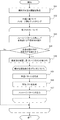
- the clustering unit 21 acquires a threshold value for clustering the message group (step S21).
- the clustering unit 21 may acquire a threshold value via the input device 1004.
- the clustering unit 21 classifies a certain message in the target message group and other messages whose similarity is equal to or higher than the threshold or whose distance is equal to or lower than the threshold to the same cluster (step) S22).
- the clustering unit 21 extracts one message from the set of messages, and calculates the similarity (or distance) between this message and each of the other messages. Then, the clustering unit 21 may form one cluster by using the extracted message and each message for which a similarity (or a distance equal to or less than the threshold) is calculated for the message.
- the clustering unit 21 performs the same processing on the remaining messages that have not yet been classified to form another cluster. Then, the message analysis device 2 performs the processing of steps S23 to S27 for each cluster.
- the message analysis device 2 may first classify all messages into any cluster and then repeat the processing of steps S23 to S27 for each cluster. Alternatively, the message analysis device 2 may repeatedly execute the processes of steps S23 to S27 for each cluster each time one cluster is formed.
- the field analysis unit 22 identifies, as invariant parts, a field whose value matches across all messages in the cluster and a field that matches the field pattern. Further, the field analysis unit 22 identifies a field having a different value in at least one message as a variable part (step S23).
- the cluster similarity determination unit 24 determines whether or not the overall similarity in this cluster satisfies a predetermined condition (step S24).
- the cluster similarity determination unit 24 may calculate a value obtained by dividing the number of fields constituting the invariant portion in the cluster by the maximum number of fields as a value representing the overall similarity in the cluster. . Then, the cluster similarity determination unit 24 may determine whether or not the value representing the overall similarity in this cluster exceeds a threshold value.
- the message analysis device 2 If it is determined that the similarity of the entire cluster does not satisfy the predetermined condition, the message analysis device 2 outputs a message indicating that the message pattern generation has failed for the cluster and ends the process.
- the pattern generation unit 23 when it is determined that the similarity of the entire cluster satisfies the predetermined condition, the pattern generation unit 23 generates a common pattern of the cluster (step S25).
- the pattern generation unit 23 displays information in which information representing the field of the variable part with a predetermined symbol (for example, an asterisk “*”) and information representing the field of the invariant part are arranged in the order of appearance of the field. Generate as a common pattern.
- the pattern generation unit 23 may generate a common pattern using a predetermined character string instead of the value of the field that matches the field pattern in the invariant portion. For example, the pattern generation unit 23 may generate a common pattern by expressing a field matching the date field pattern as “(Date)” and a field matching the time field pattern as “(Time)”. Good.
- the pattern generation unit 23 generates a list of arguments for the field of the variable part in the common pattern (step S26).
- the pattern generation unit 23 outputs the common pattern and the argument list of each variable part as a message pattern of this cluster (step S27).
- the output destination may be the output device 1003, the memory 1002, or another device connected via a network.
- the message analysis device 2 uses the above-described similarity in determining similarity between messages.
- the clustering unit 21 acquires 0.6 as a similarity threshold (step S21).
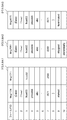
- the clustering unit 21 forms a cluster A and a cluster B shown in FIG. 6 by calculating the similarity between a certain message in the target log message group and each other message with respect to the message ( Step S22).
- each line represents one message.
- a dotted ellipse indicates a field.
- a field pattern representing a date and time is defined.
- the clustering unit 21 regards a portion that matches the date field pattern as a date field, and considers that the messages match each other. Further, the clustering unit 21 regards a portion that matches the time field pattern as a time field, and considers that the messages match each other. In this case, in cluster A, seven of the nine fields match the message of the second line with respect to the message of the first line. Therefore, the clustering unit 21 calculates 7 / 9 ⁇ 0.77 as the similarity between the messages in the first and second rows. As described above, the clustering unit 21 classifies the message on the first line and the messages on the second to fourth lines having a similarity of 0.6 or more with respect to the message on the first line as the cluster A. . The same applies to cluster B.
- the message analyzer 2 performs the processing of steps S23 to S27 for the cluster A.
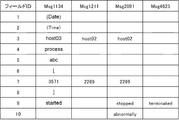
- the field analysis unit 22 identifies the invariant part field and the variable part field for the cluster A, and generates the identification processing result shown in FIG. 7 (step S23).
- the field analysis unit 22 creates a table for storing the identification processing result.
- the table storing the identification processing result includes the ID assigned to the field in the first column (leftmost column). This table also includes message identification information in the first line (uppermost line). Further, in this table, the analysis result of each message can be stored in each column after the second column.
- the field analysis unit 22 performs identification processing using one of the messages included in the cluster A (Msg 1134 as an example) as a representative message.
- the field analysis unit 22 stores the value of each field constituting the representative message Msg 1134 in the second column of the table of FIG.
- the field analysis unit 22 stores information “(Date)” representing a date instead of a value for a date field that matches the date field pattern.
- the field analysis unit 22 stores information “(Time)” representing time instead of a value for a time field that matches the time field pattern.
- the field analysis unit 22 stores the value in the third column for a field having a value different from the representative message among the values of each field constituting the next message Msg 1211 included in the cluster A. However, the field analysis unit 22 does not store values for the date field and the time field on the assumption that the value matches the representative message. Similarly, the field analysis unit 22 stores the values of the remaining messages Msg2091 and Msg4625 of the cluster A in the fourth and fifth columns for the fields having different values from the representative message. In this way, the field analysis unit 22 performs processing for storing values in the table for all messages of the cluster A, and generates the table in FIG.
- the field analysis unit 22 converts the four fields (field IDs 3, 7, 9, 10) whose values are stored in at least one column after the third column in the table of FIG. Identify as part.
- the field analysis unit 22 uses six fields (field IDs 1, 2, 4, 5, 6, and 8) in which values are not stored in the third and subsequent columns of the table of FIG. Identify.
- the cluster similarity determination unit 24 determines whether or not the value indicating the overall similarity in the cluster A is equal to or greater than a threshold value (step S24).
- the cluster similarity determination unit 24 determines that the value representing the overall similarity in the cluster A is equal to or greater than the threshold value.
- the pattern generation unit 23 expresses the field IDs 1, 2, 4, 5, 6, and 8 of the invariant portion with information representing the value or field pattern. Further, the pattern generation unit 23 represents the field IDs 3, 7, 9, and 10 of the variable part with a predetermined symbol “*”. Then, the pattern generation unit 23 arranges these pieces of information in the order of the field IDs, and generates a common pattern “(Date) (Time) * process abc [*] * *” of the cluster A (Step S25).
- the pattern generation unit 23 generates a list of arguments for the field IDs 3, 7, 9, and 10 of the variable portion in the common pattern of the cluster A (step S26).
- the pattern generation unit 23 refers to the field ID3 row in the table of FIG. 7 to generate the argument list “host01, host02, host03” of the field ID3. Similarly, the pattern generation unit 23 generates a list of arguments by referring to the rows of field IDs 7, 9, and 10 in the table of FIG.
- the pattern generation unit 23 outputs the common pattern of cluster A and the argument list of each variable part as a message pattern (step S27).
- the message analysis apparatus 2 also executes steps S23 to S27 for the cluster B.
- the message analysis apparatus as the second exemplary embodiment of the present invention can present a large number of messages as a set of a smaller number of message patterns, and allows the user to grasp the contents and trends of messages more quickly. Can help.
- the clustering unit performs clustering by regarding a portion matching a predetermined field pattern in the message as a similar field.
- the field analysis unit regards a part that matches a predetermined field pattern as an invariant part and generates a common message.
- minor differences among a plurality of messages can be regarded as similar, and a smaller number of common message patterns are generated compared to the case where minor differences are regarded as variable parts. can do.
- the cluster similarity determination unit determines whether or not the overall similarity in the cluster satisfies a predetermined condition. This is because the pattern generation unit generates a message pattern for a cluster whose overall similarity satisfies a predetermined condition.
- the present embodiment since the present embodiment generates a message pattern for a cluster whose overall similarity is appropriate, it is possible to present a message pattern that more accurately reflects the content and trend of the message group.
- FIG. 8 shows a functional block configuration of a message analysis device 3 as a third embodiment of the present invention.
- the message analysis device 3 is different from the message analysis device 2 as the second exemplary embodiment of the present invention in that it further includes a cluster subdivision unit 35.
- the message analysis device 3 and each functional block thereof can be configured by the same hardware elements as those of the first embodiment of the present invention described with reference to FIG.
- the hardware configuration of the message analysis device 3 and each functional block is not limited to the above-described configuration.
- the cluster subdividing unit 35 generates a cluster obtained by further dividing the message group in the cluster generated by the clustering unit 21 based on the importance of the variable portion. At this time, the cluster subdivision unit 35 determines the importance of the variable part based on the part of speech of the value of the field constituting the variable part. Specifically, when the value of the field constituting the variable part is a predetermined part of speech as a character string, the cluster subdivision unit 35 determines that the field is important and determines the cluster based on the difference in the value. Subdivide.
- the cluster subdividing unit 35 specifies a field whose value is mutated in at least one message in the cluster. Then, the cluster subdivision unit 35 determines the importance of the field based on whether or not the part of speech as the character string of the value taken by the specified field is a predetermined part of speech. Note that the cluster subdivision unit 35 may determine the part of speech for the identified field based on the value in any message (for example, a representative message) in the cluster. The cluster subdivision unit 35 may determine the part of speech using a dictionary that stores the part of speech of the character string (word). Such a dictionary may be stored in advance in the memory 1002, for example. As the predetermined part of speech, for example, a verb, an adverb, an adjective and the like are determined.
- the fields determined to be important are identified as invariant parts in the cluster after the division.
- the message analyzer 3 operates in the same manner as in the second embodiment of the present invention from step S21 to S24, analyzes the field for the formed cluster, and whether or not the overall similarity satisfies a predetermined condition. Determine whether.
- the cluster subdivision unit 35 further subdivides the clusters for which the overall similarity is determined to satisfy the predetermined condition based on the part of speech of the field value of the variable part (step S35).
- the cluster subdivision unit 35 determines that the field is important when the value of the field constituting the variable portion is a character string and has a predetermined part of speech. Then, the cluster subdividing unit 35 subdivides the cluster based on the difference in the field values.
- the pattern generation unit 23 executes steps S25 to S27 for each of the subdivided clusters and the non-subdivided clusters, as in the second embodiment of the present invention.
- the pattern generation unit 23 includes the value of the field that is a reference for subdivision as an invariant part in the common pattern. Thereby, the pattern generation unit 23 generates and outputs a list of arguments of the common pattern and its variable part as a message pattern for each cluster subdivided as necessary.
- the cluster subdivision unit 35 subdivides the cluster (step S35).
- the cluster subdivision unit 35 first sets the value “started” of the field ID 9 in the representative message Msg 1134 among the field IDs 3, 7, 9, and 10 which are variable parts in FIG. 7 to a predetermined part of speech (verb). It is determined that That is, the cluster subdivision unit 35 determines that the field ID 9 is an important field to be mutated.
- the cluster subdivision unit 35 determines that the value “host03” of the field ID3 and the value “3571” of the field ID7 in the representative message Msg1134 are neither predetermined parts of speech (verbs, adverbs, and adjectives). That is, the cluster subdividing unit 35 determines that the field ID 3 and the field ID 7 are auxiliary fields to be mutated.
- the cluster subdivision unit 35 subdivides the cluster A based on the value of the field ID 9 which is an important field.
- FIG. 10 shows clusters A1 to A3 obtained by subdividing cluster A.
- the cluster subdivision unit 35 classifies Msg 1134 and Msg 1211 whose field ID 9 is “started” in the message group included in cluster A into cluster A1. Further, the cluster subdivision unit 35 classifies Msg 2091 whose field ID 9 is “stopped” into cluster A2. Further, the cluster subdivision unit 35 classifies Msg 4625 whose field ID 9 value is “terminated” into the cluster A3.
- the cluster subdividing unit 35 also divides the cluster B based on the part of speech of the field value of the variable portion, and subdivides n clusters B1 to Bn (n is an integer of 1 or more). Is generated.
- the pattern generation unit 23 generates message patterns for the subdivided clusters A1 to A3 and clusters B1 to Bn (steps S25 to S27).
- the pattern generation unit 23 includes the value of the field ID 9 that is a reference for division as a constant part in the common pattern.
- the pattern generation unit 23 includes the values of the field IDs 3, 7, and 10 in the common pattern of the clusters A2 and A3.
- the pattern generation unit 23 generates a common pattern as a variable part when the value of the variable part field determined to be unimportant by the cluster subdivision part 35 does not match in the cluster after the division. It will be.
- the pattern generation unit 23 generates message patterns in the same manner for the clusters B1 to Bn.
- the message analysis apparatus When presenting a large number of messages as a set of a smaller number of message patterns, the message analysis apparatus according to the third exemplary embodiment of the present invention more accurately indicates the contents and trends of important information in the message to the user. It can be grasped.
- the cluster subdivision unit further subdivides the message group included in the cluster based on the importance of the field of the variable part. Because it does. This is because the pattern generation unit generates message patterns for the subdivided clusters.
- the value of the important variable part is explicitly included in the message pattern, and the value of the auxiliary variable part is not included. That is, in the present embodiment, main information and auxiliary information can be distinguished from each other in the portion to be mutated. As a result, according to the present embodiment, even if it is a portion to be mutated, the value of main information can be reflected as it is in the message pattern.
- the message analysis apparatus when presenting a large number of messages output from the system as a set of a smaller number of message patterns, the contents and trends of the behavior and status of the system. Can be grasped more accurately by the user.
- an analyst who analyzes a large number of message groups recorded by the system must infer from the message groups what is happening on the system.
- the field portion representing the behavior or status of the system is recognized as a variable, the value does not appear in the message pattern.
- parts of speech such as verbs, adverbs, and adjectives in a message are highly likely to represent the behavior and state of the system and have an important meaning. If the value of such a part is not included in the message pattern, it will be difficult for an analyst to grasp the operation and status of the system.
- the cluster is subdivided based on the value of the field.
- important information representing the operation and status of the system is reflected in the message pattern as it is in the message.
- an analyst using this embodiment can correctly grasp important information such as the behavior and status of the output source system of the message group based on the message pattern.
- FIG. 11 shows a functional block configuration of a message analysis device 4 as a fourth embodiment of the present invention.
- the message analysis device 4 is different from the message analysis device 3 according to the third exemplary embodiment of the present invention in that it includes a cluster subdivision unit 45 instead of the cluster subdivision unit 35.
- the cluster subdivision unit 45 further transmits the message group in the cluster generated by the clustering unit 21 based on the importance of the variable portion, in substantially the same manner as the cluster subdivision unit 35 in the third embodiment of the present invention. Generate split clusters. However, the cluster subdividing unit 45 determines the importance of the variable part based on the correlation between the fields constituting the variable part, with respect to the cluster subdividing unit 35 in the third embodiment of the present invention. Is different.
- the cluster subdivision unit 45 subdivides the cluster based on the difference in values, assuming that these fields are important. .
- the cluster subdividing unit 45 specifies a field whose value is mutated in at least one message in the cluster. Then, the cluster subdivision unit 45 analyzes the co-occurrence relationship between the arguments for the combination of the mutated fields.
- the co-occurrence relationship means that a value (argument) of a certain variable (field) and a value of another variable appear simultaneously in a certain message.
- the cluster subdivision unit 45 may determine that there is a correlation between the fields when the value of a variable and the value of another variable have a one-to-one correspondence in the message group in the cluster. . Further, the cluster subdivision unit 45 may calculate the co-occurrence probability between arguments for the combination of fields constituting the variable part. In this case, the cluster subdivision unit 45 may determine that there is a correlation between the fields when the co-occurrence probability between the arguments is significantly higher than the random probability (for example, greater than or equal to a threshold value).
- cluster subdivision unit 45 subdivides the cluster based on these values, assuming that each field determined to have correlation is important.
- the message analysis device 4 operates in the same manner as in the second embodiment of the present invention from step S21 to S24, analyzes the field for the formed cluster, and whether or not the overall similarity satisfies a predetermined condition. Determine whether.
- the cluster subdivision unit 45 further subdivides the clusters for which the overall similarity is determined to satisfy the predetermined condition based on the presence or absence of correlation between the plurality of fields constituting the variable portion (step S45).
- the cluster subdivision unit 45 has a one-to-one correspondence between arguments for a combination of a plurality of fields constituting a variable portion (or the co-occurrence probability between arguments is equal to or greater than a threshold value). ), It is determined that those fields are important. Then, the cluster subdivision unit 45 subdivides the cluster based on the difference in the field values.
- the message analysis device 4 executes steps S25 to S27 as in the third embodiment of the present invention.
- the pattern generation unit 23 generates and outputs a list of arguments of the common pattern and its variable part as a message pattern for each cluster subdivided as necessary.
- the message analysis device 4 ends the operation.
- the cluster subdivision unit 45 subdivides the cluster based on the correlation between the fields (step S45).
- the cluster subdivision unit 45 analyzes the co-occurrence relationship of arguments for the combinations of field IDs 3, 7, and 11 which are variable portions in the cluster B.
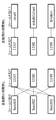
- the analysis result of the co-occurrence relationship is schematically shown in FIG.
- the left diagram shows the co-occurrence relationship of arguments between field IDs 3 and 7.
- the right figure has shown the co-occurrence relation of the argument between field ID7 and 11.
- FIG. 14 the rectangle indicates the value of each field.
- the line which connects between rectangles represents co-occurrence relation.
- the cluster subdivision unit 45 considers that there is a correlation between the field IDs 7 and 11 in which the co-occurrence probability between the arguments is 100%. As a result, the cluster subdivision unit 45 determines that the correlated field IDs 7 and 11 are important fields. Then, the cluster subdivision unit 45 subdivides the cluster B based on the values (arguments) of these field IDs 7 and 11.
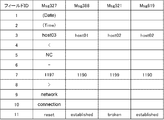
- FIG. 15 shows clusters B1 to B3 into which cluster B is subdivided. As shown in FIG. 15, the cluster subdivision unit 45 assigns Msg 327 in which the combination of the values of the field IDs 7 and 11 among the message groups included in the cluster B is “1197” and “reset” to the cluster B1. Classify.
- the cluster subdivision unit 45 classifies Msg388 and Msg819 whose field IDs 7 and 11 have a combination of values “1190” and “established” into the cluster B2. Further, the cluster subdivision unit 45 classifies Msg 521 whose field IDs 7 and 11 have a combination of values “1199” and “broken” as cluster B3.
- the cluster subdivision unit 45 also divides the cluster A based on the correlation between the fields of the variable part, and subdivides the m clusters A1 to Am (m is an integer of 1 or more). It shall be generated.
- the pattern generation unit 23 generates message patterns for the subdivided clusters A1 to Am and clusters B1 to B3 (steps S25 to S27).
- cluster B2 For cluster B2, a common pattern “(Date) (Time) * ⁇ NC-1190> network connection established” is generated. Further, for the cluster B2, a list of arguments “host01, host02” of the field ID3 that is a variable part is generated.
- the pattern generation unit 23 includes the values of the field IDs 7 and 11 that are the basis of division in the clusters B1 to B3 as invariant portions in the common pattern. Further, in this example, in the clusters B1 and B3, the value is the same for the field ID3 that is a variable part in the cluster B before the division. For this reason, the pattern generation unit 23 includes the value of the field ID 3 in the common pattern of the clusters B1 and B3. However, the pattern generation unit 23 generates a common pattern as a variable part when the value of the variable part field determined to be unimportant by the cluster subdivision part 45 does not match in the divided cluster. It will be.
- the pattern generation unit 23 generates message patterns in the same manner for the clusters A1 to Am.
- the message analysis apparatus When presenting a large number of messages as a set of a smaller number of message patterns, the message analysis apparatus according to the fourth exemplary embodiment of the present invention displays the content and trend of information indicating the intention of the message designer. Can be accurately grasped.
- the cluster subdivision unit further converts the message group included in the cluster based on the presence or absence of correlation between the fields of the variable portion. It is because it subdivides. This is because the pattern generation unit generates message patterns for the subdivided clusters.
- this embodiment explicitly includes the value of the correlated variable part in the message pattern. That is, in the present embodiment, it is possible to distinguish variable information having a correlation among the parts to be mutated as main information and auxiliary information that is not so. As a result, according to the present embodiment, even if it is a portion to be mutated, the value of main information correlated between variables can be reflected as it is in the message pattern.
- the value of such a correlated variable is likely to be information designed in advance by the message designer for some purpose.
- a message designer may design an error code indicating the type of error message and an error level indicating the severity of the error message to be included in the message.
- important information intended by the message designer can be reflected in the message pattern by analyzing the presence / absence of correlation between the fields that are variable portions.
- the message analyst using this embodiment can grasp the intention of the message designer from the message pattern.
- the cluster subdivision unit subdivides the clusters based on the part of speech of the field values constituting the variable part or the presence or absence of correlation between the fields.
- the cluster subdivision unit may determine the importance of the field constituting the variable part based on other information, and may perform subdivision based on the value of the field determined to be important. .
- the message is information output by another element. Also good.
- the message may be information input via an input device. Further, the message may contain information of a type other than text.
- the clustering unit performs clustering using the matching field ratio as the similarity or the non-matching field ratio as the distance.
- the clustering unit may perform clustering by calculating the similarity or distance based on other information that can be calculated as information representing the similarity between messages.
- the pattern generation unit arranges information representing the value of the field of the invariant part and information representing the field of the variable part with a predetermined symbol in the order of appearance of the field.
- An example in which the generated information is generated as a common message has been described. Further, the example in which the pattern generation unit generates a list of arguments that can be taken by the field of the variable part has been described.
- the expression format of the message pattern is not limited. The pattern generator can generate message patterns in other formats as long as it can recognize the values of the fields that make up the invariant part of the cluster and the argument values of the fields that make up the variable part. Good.
- each functional block of the message analysis device is realized by a CPU that executes a computer program stored in a storage device or ROM.
- the present invention is not limited to this, and some, all, or a combination of each functional block may be realized by dedicated hardware.
- the functional blocks of the message analysis device may be realized by being distributed to a plurality of devices.
- the operation of the message analysis apparatus described with reference to each flowchart may be stored in a computer storage device (storage medium) as a computer program of the present invention. Good. Then, the computer program may be read and executed by the CPU. In such a case, the present invention is constituted by the code of the computer program or a storage medium.
- the present invention can extract a common part and a mutated part of a plurality of messages from a large number of messages without needing to define a mutated part in advance, and is suitable as an apparatus for presenting analysis of message contents and trends. is there.
- the present invention is also suitable as an apparatus for mechanically generating a definition of a message pattern to be filtered in a log monitoring tool for filtering a log that does not require notification in a system log monitoring operation.
- the present invention is suitable as a device that supports the work of extracting and analyzing characteristic logs from a group of error messages that are generated in large quantities at the time of abnormality during log analysis work at the time of system abnormality.
- the present invention is suitable as an apparatus that supports analysis of user trends and situation grasps in a large number of messages written by a user to a social network service or the like on the Internet.
- Cluster subdivision unit 1001 CPU 1002 Memory 1003 Output device 1004 Input device
Landscapes
- Engineering & Computer Science (AREA)
- Theoretical Computer Science (AREA)
- Physics & Mathematics (AREA)
- General Engineering & Computer Science (AREA)
- General Physics & Mathematics (AREA)
- Quality & Reliability (AREA)
- Data Mining & Analysis (AREA)
- Computing Systems (AREA)
- Business, Economics & Management (AREA)
- Computer Vision & Pattern Recognition (AREA)
- Computer Hardware Design (AREA)
- Economics (AREA)
- Marketing (AREA)
- Bioinformatics & Computational Biology (AREA)
- Artificial Intelligence (AREA)
- Evolutionary Biology (AREA)
- Evolutionary Computation (AREA)
- Mathematical Physics (AREA)
- Life Sciences & Earth Sciences (AREA)
- Bioinformatics & Cheminformatics (AREA)
- Entrepreneurship & Innovation (AREA)
- Human Resources & Organizations (AREA)
- Operations Research (AREA)
- Strategic Management (AREA)
- Tourism & Hospitality (AREA)
- General Business, Economics & Management (AREA)
- Databases & Information Systems (AREA)
- Debugging And Monitoring (AREA)
- Information Retrieval, Db Structures And Fs Structures Therefor (AREA)
Abstract
Description
本発明の第1の実施の形態としてのメッセージ分析装置1の機能ブロック構成を図1に示す。図1において、メッセージ分析装置1は、クラスタリング部11と、フィールド解析部12と、パターン生成部13とを備える。メッセージ分析装置1は、メッセージ群を分析してその内容や傾向を示すメッセージパターンを生成する装置である。
次に、本発明の第2の実施の形態について図面を参照して詳細に説明する。なお、本実施の形態の説明において参照する各図面において、本発明の第1の実施の形態と同一の構成および同様に動作するステップには同一の符号を付して本実施の形態における詳細な説明を省略する。
次に、本発明の第3の実施の形態について図面を参照して詳細に説明する。なお、本実施の形態の説明において参照する各図面において、本発明の第1および第2の実施の形態と同一の構成および同様に動作するステップには同一の符号を付して本実施の形態における詳細な説明を省略する。
次に、本発明の第4の実施の形態について図面を参照して詳細に説明する。なお、本実施の形態の説明において参照する各図面において、本発明の第1から第3の実施の形態と同一の構成および同様に動作するステップには同一の符号を付して本実施の形態における詳細な説明を省略する。
11、21 クラスタリング部
12、22 フィールド解析部
13、23 パターン生成部
24 クラスタ類似性判定部
35、45 クラスタ細分化部
1001 CPU
1002 メモリ
1003 出力装置
1004 入力装置
Claims (9)
- 1つ以上のフィールドからなるメッセージの集合であるメッセージ群を、前記メッセージ間の類似性に基づいてクラスタに分類するクラスタリング手段と、
前記クラスタ内のメッセージ群を構成する各フィールドについて、その値が変異している変数部分と、変異していない不変部分とを識別するフィールド解析手段と、
前記変数部分および前記不変部分に基づいて、前記クラスタ内のメッセージ群に共通するメッセージパターンを生成するパターン生成手段と、
を備えたメッセージ分析装置。 - 前記クラスタを、前記変数部分の重要性に基づいてさらに分割したクラスタを生成するクラスタ細分化手段をさらに備えたことを特徴とする請求項1に記載のメッセージ分析装置。
- 前記クラスタ細分化手段は、前記変数部分の重要性を、前記変数部分を構成するフィールドの値の品詞に基づいて判定することを特徴とする請求項2に記載のメッセージ分析装置。
- 前記クラスタ細分化手段は、前記変数部分の重要性を、前記変数部分を構成するフィールド間の相関に基づいて判定することを特徴とする請求項2に記載のメッセージ分析装置。
- 前記クラスタリング手段は、前記メッセージと、該メッセージに対して類似性が所定条件を満たす他のメッセージとを同一クラスタに分類することを特徴とする請求項1から請求項4のいずれか1項に記載のメッセージ分析装置。
- 前記クラスタ内におけるメッセージ群全体の類似性が所定条件を満たすか否かを判定するクラスタ類似性判定手段をさらに備え、
前記パターン生成手段は、前記クラスタ類似性判定手段によって前記全体の類似性が所定条件を満たすと判定されたクラスタについて、前記メッセージパターンを生成することを特徴とする請求項1から請求項5のいずれか1項に記載のメッセージ分析装置。 - 前記クラスタリング手段は、前記各メッセージにおいて所定のフィールドパターンに合致する部分を、前記メッセージ間で互いに類似するフィールドとみなして前記メッセージ群を前記クラスタに分類し、
前記フィールド解析手段は、前記フィールドパターンに合致する値を持つフィールドを、不変部分として識別することを特徴とする請求項1から請求項6のいずれか1項に記載のメッセージ分析装置。 - コンピュータ装置を用いて、
1つ以上のフィールドからなるメッセージの集合であるメッセージ群を、前記メッセージ間の類似性に基づいてクラスタに分類し、
前記クラスタ内のメッセージ群を構成する各フィールドについて、その値が変異している変数部分と、変異していない不変部分とを識別し、
前記変数部分および前記不変部分に基づいて、前記クラスタ内のメッセージ群に共通するメッセージパターンを生成するメッセージ分析方法。 - 1つ以上のフィールドからなるメッセージの集合であるメッセージ群を、前記メッセージ間の類似性に基づいてクラスタに分類するクラスタリングステップと、
前記クラスタ内のメッセージ群を構成する各フィールドについて、その値が変異している変数部分と、変異していない不変部分とを識別するフィールド解析ステップと、
前記変数部分および前記不変部分に基づいて、前記クラスタ内のメッセージ群に共通するメッセージパターンを生成するパターン生成ステップと、
をコンピュータ装置に実行させるメッセージ分析プログラムを記憶した記憶媒体。
Priority Applications (2)
| Application Number | Priority Date | Filing Date | Title |
|---|---|---|---|
| JP2017523119A JP6856527B2 (ja) | 2015-06-11 | 2016-06-10 | メッセージ分析装置、メッセージ分析方法、および、メッセージ分析プログラム |
| US15/577,839 US20180165174A1 (en) | 2015-06-11 | 2016-06-10 | Message analysis apparatus, message analysis method, and storage medium |
Applications Claiming Priority (2)
| Application Number | Priority Date | Filing Date | Title |
|---|---|---|---|
| JP2015118217 | 2015-06-11 | ||
| JP2015-118217 | 2015-06-11 |
Publications (1)
| Publication Number | Publication Date |
|---|---|
| WO2016199433A1 true WO2016199433A1 (ja) | 2016-12-15 |
Family
ID=57503335
Family Applications (1)
| Application Number | Title | Priority Date | Filing Date |
|---|---|---|---|
| PCT/JP2016/002816 Ceased WO2016199433A1 (ja) | 2015-06-11 | 2016-06-10 | メッセージ分析装置、メッセージ分析方法、および、記憶媒体 |
Country Status (3)
| Country | Link |
|---|---|
| US (1) | US20180165174A1 (ja) |
| JP (1) | JP6856527B2 (ja) |
| WO (1) | WO2016199433A1 (ja) |
Cited By (2)
| Publication number | Priority date | Publication date | Assignee | Title |
|---|---|---|---|---|
| US11574211B2 (en) | 2017-09-27 | 2023-02-07 | Nec Corporation | Log analysis system, log analysis method, log analysis program, and storage medium |
| JP2023043829A (ja) * | 2021-09-16 | 2023-03-29 | アップル インコーポレイテッド | 制限されたリソース環境における効率的な通信 |
Families Citing this family (4)
| Publication number | Priority date | Publication date | Assignee | Title |
|---|---|---|---|---|
| US11115359B2 (en) * | 2016-11-03 | 2021-09-07 | Samsung Electronics Co., Ltd. | Method and apparatus for importance filtering a plurality of messages |
| CN110730270B (zh) * | 2019-09-09 | 2021-09-14 | 上海斑马来拉物流科技有限公司 | 一种短信分组方法、装置及计算机存储介质、电子设备 |
| CN112541074B (zh) * | 2019-09-20 | 2025-02-14 | 中兴通讯股份有限公司 | 日志解析方法、装置、服务器和存储介质 |
| CN114510364B (zh) * | 2022-02-11 | 2025-04-08 | 青岛特来电新能源科技有限公司 | 文本聚类结合链路调用的异常数据根因分析方法及装置 |
Citations (2)
| Publication number | Priority date | Publication date | Assignee | Title |
|---|---|---|---|---|
| JP2013214148A (ja) * | 2012-03-30 | 2013-10-17 | Toshiba Corp | メッセージ変換装置、及びメッセージ変換プログラム |
| JP2015036891A (ja) * | 2013-08-13 | 2015-02-23 | 日本電信電話株式会社 | 監視情報分析装置及び方法 |
Family Cites Families (2)
| Publication number | Priority date | Publication date | Assignee | Title |
|---|---|---|---|---|
| US8949177B2 (en) * | 2007-10-17 | 2015-02-03 | Avaya Inc. | Method for characterizing system state using message logs |
| US20140317137A1 (en) * | 2012-03-12 | 2014-10-23 | Hitachi, Ltd. | Log management computer and log management method |
-
2016
- 2016-06-10 JP JP2017523119A patent/JP6856527B2/ja active Active
- 2016-06-10 WO PCT/JP2016/002816 patent/WO2016199433A1/ja not_active Ceased
- 2016-06-10 US US15/577,839 patent/US20180165174A1/en not_active Abandoned
Patent Citations (2)
| Publication number | Priority date | Publication date | Assignee | Title |
|---|---|---|---|---|
| JP2013214148A (ja) * | 2012-03-30 | 2013-10-17 | Toshiba Corp | メッセージ変換装置、及びメッセージ変換プログラム |
| JP2015036891A (ja) * | 2013-08-13 | 2015-02-23 | 日本電信電話株式会社 | 監視情報分析装置及び方法 |
Non-Patent Citations (3)
| Title |
|---|
| CHINA TSU HIROSE ET AL.: "News Clustering Based on Background Similarity", IEICE TECHNICAL REPORT NLC2005-110 NATURAL LANGUAGE UNDERSTANDING AND MODELS OF COMMUNICATION, vol. 105, no. 594, 26 January 2006 (2006-01-26), pages 25 - 30, ISSN: 0913-5685 * |
| TAKAHIRO TANAKA ET AL.: "Consideration on Content Classification of Description Questionnaire Using Self-Organizing Map", IEICE TECHNICAL REPORT NC2010-196 NEUROCOMPUTING, vol. 110, no. 461, 28 February 2011 (2011-02-28), pages 407 - 410, ISSN: 0913-5685 * |
| YUKI TSUDA ET AL.: "A Classification Method of Inquiry E-mails for Describing FAQ with Automatic Setting Mechanism of Judgment Thresholds", THE TRANSACTIONS OF THE INSTITUTE OF ELECTRICAL ENGINEERS OF JAPAN . C, A PUBLICATION OF ELECTRONICS, INFORMATION AND SYSTEMS SOCIETY, vol. 131, no. 111, 1 November 2011 (2011-11-01), pages 1925 - 1932, ISSN: 0385-4221 * |
Cited By (5)
| Publication number | Priority date | Publication date | Assignee | Title |
|---|---|---|---|---|
| US11574211B2 (en) | 2017-09-27 | 2023-02-07 | Nec Corporation | Log analysis system, log analysis method, log analysis program, and storage medium |
| JP2023043829A (ja) * | 2021-09-16 | 2023-03-29 | アップル インコーポレイテッド | 制限されたリソース環境における効率的な通信 |
| JP2025023914A (ja) * | 2021-09-16 | 2025-02-19 | アップル インコーポレイテッド | 制限されたリソース環境における効率的な通信 |
| US12335048B2 (en) | 2021-09-16 | 2025-06-17 | Apple Inc. | Efficient communication in limited resource environments |
| JP7841051B2 (ja) | 2021-09-16 | 2026-04-06 | アップル インコーポレイテッド | 制限されたリソース環境における効率的な通信 |
Also Published As
| Publication number | Publication date |
|---|---|
| JP6856527B2 (ja) | 2021-04-07 |
| US20180165174A1 (en) | 2018-06-14 |
| JPWO2016199433A1 (ja) | 2018-03-29 |
Similar Documents
| Publication | Publication Date | Title |
|---|---|---|
| JP6856527B2 (ja) | メッセージ分析装置、メッセージ分析方法、および、メッセージ分析プログラム | |
| US11783046B2 (en) | Anomaly and causation detection in computing environments | |
| KR102665757B1 (ko) | 악성 스크립트 탐지 장치 및 방법 | |
| US10055481B2 (en) | Method and system for automatic event classification | |
| US9781139B2 (en) | Identifying malware communications with DGA generated domains by discriminative learning | |
| CN102779249B (zh) | 恶意程序检测方法及扫描引擎 | |
| CN113656254A (zh) | 基于日志信息的异常检测方法、系统和计算机设备 | |
| EP3136249A1 (en) | Log analysis device, attack detection device, attack detection method and program | |
| US20160124792A1 (en) | Fault analysis apparatus, fault analysis method, and recording medium | |
| JP2018045403A (ja) | 異常検知システム及び異常検知方法 | |
| Baron | Influence of data discretization on efficiency of Bayesian classifier for authorship attribution | |
| CN114818643A (zh) | 一种保留特定业务信息的日志模板提取方法 | |
| CN116155589B (zh) | 一种基于机器学习的攻击事件类型的识别方法和系统 | |
| CN112241530A (zh) | 恶意pdf文档的检测方法及电子设备 | |
| KR102246405B1 (ko) | Tf-idf 기반 벡터 변환 및 데이터 분석 장치 및 방법 | |
| Anton et al. | Security in process: Detecting attacks in industrial process data | |
| JP7078114B2 (ja) | ログ分析装置、ログ分析方法、プログラム | |
| Srinivas et al. | A novel framework for fake news detection using lda and qda | |
| US20210136032A1 (en) | Method and apparatus for generating summary of url for url clustering | |
| WO2016093839A1 (en) | Structuring of semi-structured log messages | |
| US11609957B2 (en) | Document processing device, method of controlling document processing device, and non-transitory computer-readable recording medium containing control program | |
| Xiong et al. | An anomaly detection framework for system logs based on ensemble learning | |
| CN112597494A (zh) | 一种用于恶意程序检测的行为白名单自动收集方法 | |
| CN119377513A (zh) | 网页的智能分类方法及网站的安全设备的有效性验证方法 | |
| Liu et al. | The runtime system problem identification method based on log analysis |
Legal Events
| Date | Code | Title | Description |
|---|---|---|---|
| 121 | Ep: the epo has been informed by wipo that ep was designated in this application |
Ref document number: 16807140 Country of ref document: EP Kind code of ref document: A1 |
|
| ENP | Entry into the national phase |
Ref document number: 2017523119 Country of ref document: JP Kind code of ref document: A |
|
| WWE | Wipo information: entry into national phase |
Ref document number: 15577839 Country of ref document: US |
|
| NENP | Non-entry into the national phase |
Ref country code: DE |
|
| 122 | Ep: pct application non-entry in european phase |
Ref document number: 16807140 Country of ref document: EP Kind code of ref document: A1 |