WO2016198908A1 - Ror nuclear receptor modulators - Google Patents
Ror nuclear receptor modulators Download PDFInfo
- Publication number
- WO2016198908A1 WO2016198908A1 PCT/IB2015/001693 IB2015001693W WO2016198908A1 WO 2016198908 A1 WO2016198908 A1 WO 2016198908A1 IB 2015001693 W IB2015001693 W IB 2015001693W WO 2016198908 A1 WO2016198908 A1 WO 2016198908A1
- Authority
- WO
- WIPO (PCT)
- Prior art keywords
- methyl
- dichloro
- trifluoromethyl
- mmol
- dimethyl
- Prior art date
- Legal status (The legal status is an assumption and is not a legal conclusion. Google has not performed a legal analysis and makes no representation as to the accuracy of the status listed.)
- Ceased
Links
- 0 CCN1**2*=C(*)CC(C)=C(*)*2*C1 Chemical compound CCN1**2*=C(*)CC(C)=C(*)*2*C1 0.000 description 16
- ANBMYODBKYJYPX-UHFFFAOYSA-N Cc1ccc(C(N2CCOCC2)=C)c(C)c1C(C#C)O Chemical compound Cc1ccc(C(N2CCOCC2)=C)c(C)c1C(C#C)O ANBMYODBKYJYPX-UHFFFAOYSA-N 0.000 description 2
- MYPGNKNDYKVDPA-UHFFFAOYSA-N CC(C(Cc(c(Cl)ccc1C(OC)=O)c1Cl)=O)Br Chemical compound CC(C(Cc(c(Cl)ccc1C(OC)=O)c1Cl)=O)Br MYPGNKNDYKVDPA-UHFFFAOYSA-N 0.000 description 1
- NCEMMEVDIYENHL-UHFFFAOYSA-N CC(C)(C)OC(c(c(Cl)c1Cc([n]2S(c3ccccc3)(=O)=O)cc3c2nc(C(F)(F)F)cc3C)cnc1Cl)=O Chemical compound CC(C)(C)OC(c(c(Cl)c1Cc([n]2S(c3ccccc3)(=O)=O)cc3c2nc(C(F)(F)F)cc3C)cnc1Cl)=O NCEMMEVDIYENHL-UHFFFAOYSA-N 0.000 description 1
- ZXWRJAVZDOLKFN-UHFFFAOYSA-N CC(c(cc(C(F)(F)F)cc1C)c1F)O Chemical compound CC(c(cc(C(F)(F)F)cc1C)c1F)O ZXWRJAVZDOLKFN-UHFFFAOYSA-N 0.000 description 1
- ZGBZQCWGUGHXBC-UHFFFAOYSA-N CCOC(C(CCN(C1)C(c(c(Cl)c2Cc3cc(ccc(C(F)(F)F)c4)c4[n]3C)ccc2Cl)=C)C1O)=O Chemical compound CCOC(C(CCN(C1)C(c(c(Cl)c2Cc3cc(ccc(C(F)(F)F)c4)c4[n]3C)ccc2Cl)=C)C1O)=O ZGBZQCWGUGHXBC-UHFFFAOYSA-N 0.000 description 1
- HGRYICNYMPQCFU-UHFFFAOYSA-N CCOC(c(c(Cl)c1Cc2cc3c(C)cc(C(F)(F)F)cc3[n]2C)ncc1Cl)=O Chemical compound CCOC(c(c(Cl)c1Cc2cc3c(C)cc(C(F)(F)F)cc3[n]2C)ncc1Cl)=O HGRYICNYMPQCFU-UHFFFAOYSA-N 0.000 description 1
- NXNBBSNPLJFTNR-UHFFFAOYSA-N COc(ncc(Cl)c1C(C#C)O)c1Cl Chemical compound COc(ncc(Cl)c1C(C#C)O)c1Cl NXNBBSNPLJFTNR-UHFFFAOYSA-N 0.000 description 1
- DHUIRFBDIBBQNV-UHFFFAOYSA-N C[n](c(Cc(c(Cl)ccc1CN2CCOCC2)c1Cl)c1)c2c1cc(C(F)(F)F)cc2 Chemical compound C[n](c(Cc(c(Cl)ccc1CN2CCOCC2)c1Cl)c1)c2c1cc(C(F)(F)F)cc2 DHUIRFBDIBBQNV-UHFFFAOYSA-N 0.000 description 1
- ZKLBSSMXIRDDLB-UHFFFAOYSA-N C[n]1c(cc(cc2C(F)(F)F)Br)c2nc1Cc(c(Cl)ccc1C(N2CCOCC2)=O)c1Cl Chemical compound C[n]1c(cc(cc2C(F)(F)F)Br)c2nc1Cc(c(Cl)ccc1C(N2CCOCC2)=O)c1Cl ZKLBSSMXIRDDLB-UHFFFAOYSA-N 0.000 description 1
- OJNMOZGQTFTHEE-UHFFFAOYSA-N C[n]1c2cc(C(F)(F)F)ncc2cc1Cc(c(Cl)c(cc1)C(N2CCOCC2)=O)c1Cl Chemical compound C[n]1c2cc(C(F)(F)F)ncc2cc1Cc(c(Cl)c(cc1)C(N2CCOCC2)=O)c1Cl OJNMOZGQTFTHEE-UHFFFAOYSA-N 0.000 description 1
- ITNUKDYYDKNPLR-UHFFFAOYSA-N Cc(c1c(cc2)[n](C)c(Cc(c(Cl)ccc3C(N4CCOCC4)=O)c3Cl)n1)c2Br Chemical compound Cc(c1c(cc2)[n](C)c(Cc(c(Cl)ccc3C(N4CCOCC4)=O)c3Cl)n1)c2Br ITNUKDYYDKNPLR-UHFFFAOYSA-N 0.000 description 1
- YAJKHVOHMVJBKR-UHFFFAOYSA-N Cc(cc1C)cc2c1nc(Cc(c(Cl)ccc1C(N3CCOCC3)=O)c1Cl)[n]2C Chemical compound Cc(cc1C)cc2c1nc(Cc(c(Cl)ccc1C(N3CCOCC3)=O)c1Cl)[n]2C YAJKHVOHMVJBKR-UHFFFAOYSA-N 0.000 description 1
- HAUXRTVNCSGRQH-UHFFFAOYSA-N Cc1c(Cc(c(Cl)ccc2C(N3CCC(CCO)CC3)=O)c2Cl)nc(c(C)c2)[n]1cc2C#N Chemical compound Cc1c(Cc(c(Cl)ccc2C(N3CCC(CCO)CC3)=O)c2Cl)nc(c(C)c2)[n]1cc2C#N HAUXRTVNCSGRQH-UHFFFAOYSA-N 0.000 description 1
- OMKVHTSECCTPDK-UHFFFAOYSA-N Cc1c(Cc(c(Cl)ccc2C(N3CCOCC3)=O)c2Cl)nc(c(C)c2)[n]1nc2Cl Chemical compound Cc1c(Cc(c(Cl)ccc2C(N3CCOCC3)=O)c2Cl)nc(c(C)c2)[n]1nc2Cl OMKVHTSECCTPDK-UHFFFAOYSA-N 0.000 description 1
- ZXEJNBOLVQVQGL-UHFFFAOYSA-N Cc1c(Cc(c(Cl)ccc2C(OC)=O)c2Cl)nc(c(C)c2)[n]1nc2Cl Chemical compound Cc1c(Cc(c(Cl)ccc2C(OC)=O)c2Cl)nc(c(C)c2)[n]1nc2Cl ZXEJNBOLVQVQGL-UHFFFAOYSA-N 0.000 description 1
- YUNRYIKNELOYNA-UHFFFAOYSA-N Cc1c(Cc(c(Cl)ccc2C(OC)=O)c2Cl)nc(cc2C)[n]1nc2Cl Chemical compound Cc1c(Cc(c(Cl)ccc2C(OC)=O)c2Cl)nc(cc2C)[n]1nc2Cl YUNRYIKNELOYNA-UHFFFAOYSA-N 0.000 description 1
- RNXUBBRBVHBSJW-UHFFFAOYSA-N Cc1c(cc(C(c(c(Cl)ccc2C(OC)=O)c2Cl)=O)[nH]2)c2cc(C#N)c1 Chemical compound Cc1c(cc(C(c(c(Cl)ccc2C(OC)=O)c2Cl)=O)[nH]2)c2cc(C#N)c1 RNXUBBRBVHBSJW-UHFFFAOYSA-N 0.000 description 1
- PRZLXPYKIHRUDK-UHFFFAOYSA-N Cc1c(cc(Cc(c(Cl)ccc2C(OC)=O)c2Cl)[n]2C)c2cc(OC(F)(F)F)c1 Chemical compound Cc1c(cc(Cc(c(Cl)ccc2C(OC)=O)c2Cl)[n]2C)c2cc(OC(F)(F)F)c1 PRZLXPYKIHRUDK-UHFFFAOYSA-N 0.000 description 1
- RYUJXJBNDFIZCO-UHFFFAOYSA-N Cc1c2[nH]c(Cc(c(Cl)ccc3C(N4CCOCC4)=O)c3Cl)cc2cc(C(F)(F)F)c1 Chemical compound Cc1c2[nH]c(Cc(c(Cl)ccc3C(N4CCOCC4)=O)c3Cl)cc2cc(C(F)(F)F)c1 RYUJXJBNDFIZCO-UHFFFAOYSA-N 0.000 description 1
- SWNLFMCVYCIMFG-UHFFFAOYSA-N Cc1c[n](C(c(c(Cl)c(cc2)C(N3CCC(CC(O)=O)CC3)=O)c2Cl)=O)c(c(C)c2)c1cc2C#N Chemical compound Cc1c[n](C(c(c(Cl)c(cc2)C(N3CCC(CC(O)=O)CC3)=O)c2Cl)=O)c(c(C)c2)c1cc2C#N SWNLFMCVYCIMFG-UHFFFAOYSA-N 0.000 description 1
- UYWYSPYYENKPJP-UHFFFAOYSA-N Cc1c[n](Cc(c(Cl)c(cc2)C(N(CC3)CCC3O)=O)c2Cl)c(c(C)c2)c1cc2C#N Chemical compound Cc1c[n](Cc(c(Cl)c(cc2)C(N(CC3)CCC3O)=O)c2Cl)c(c(C)c2)c1cc2C#N UYWYSPYYENKPJP-UHFFFAOYSA-N 0.000 description 1
- VNBFCIISOIGQSM-UHFFFAOYSA-N Cc1cc(Br)cc2c1nc(Cc(c(Cl)ccc1C(N3CCOCC3)=O)c1Cl)[n]2C Chemical compound Cc1cc(Br)cc2c1nc(Cc(c(Cl)ccc1C(N3CCOCC3)=O)c1Cl)[n]2C VNBFCIISOIGQSM-UHFFFAOYSA-N 0.000 description 1
- PRJMNBFSAUWSPI-UHFFFAOYSA-N Cc1cc(Br)cc2c1nc(Cc1c(C)c(C(N3CCOCC3)=O)ccc1C)[n]2C Chemical compound Cc1cc(Br)cc2c1nc(Cc1c(C)c(C(N3CCOCC3)=O)ccc1C)[n]2C PRJMNBFSAUWSPI-UHFFFAOYSA-N 0.000 description 1
- SKKQMWZUEAPRPB-UHFFFAOYSA-N Cc1cc(C#N)cc2c1cc(C(c(c(Cl)ccc1C(N(CC3)CCC3O)=O)c1Cl)=O)[n]2C Chemical compound Cc1cc(C#N)cc2c1cc(C(c(c(Cl)ccc1C(N(CC3)CCC3O)=O)c1Cl)=O)[n]2C SKKQMWZUEAPRPB-UHFFFAOYSA-N 0.000 description 1
- BOPQPJNZIFWXLE-UHFFFAOYSA-N Cc1cc(C#N)cc2c1cc(C(c1c(C)c(C(O)=O)cnc1C)=O)[n]2C Chemical compound Cc1cc(C#N)cc2c1cc(C(c1c(C)c(C(O)=O)cnc1C)=O)[n]2C BOPQPJNZIFWXLE-UHFFFAOYSA-N 0.000 description 1
- IEQANPCSJIDGPV-UHFFFAOYSA-N Cc1cc(C#N)cc2c1cc(Cc(c(Cl)cnc1C(N3CCOCC3)=O)c1Cl)[n]2C Chemical compound Cc1cc(C#N)cc2c1cc(Cc(c(Cl)cnc1C(N3CCOCC3)=O)c1Cl)[n]2C IEQANPCSJIDGPV-UHFFFAOYSA-N 0.000 description 1
- MSVQLTCHTUXPIT-UHFFFAOYSA-N Cc1cc(C#N)cc2c1cc(Cc1c(C)c(C(N3CCOCC3)=O)ccc1C)[nH]2 Chemical compound Cc1cc(C#N)cc2c1cc(Cc1c(C)c(C(N3CCOCC3)=O)ccc1C)[nH]2 MSVQLTCHTUXPIT-UHFFFAOYSA-N 0.000 description 1
- PGISETOBANJZCF-UHFFFAOYSA-N Cc1cc(C(F)(F)F)cc2c1[n](Cc(c(Cl)ccc1C(N3CCC(CC(O)=O)CC3)=O)c1Cl)cc2 Chemical compound Cc1cc(C(F)(F)F)cc2c1[n](Cc(c(Cl)ccc1C(N3CCC(CC(O)=O)CC3)=O)c1Cl)cc2 PGISETOBANJZCF-UHFFFAOYSA-N 0.000 description 1
- NHDQEJUGJPGBEB-UHFFFAOYSA-N Cc1cc(C(F)(F)F)cc2c1cc(Cc(c(Cl)ccc1C(N(CC3)CCC3N(C)C)=O)c1Cl)[nH]2 Chemical compound Cc1cc(C(F)(F)F)cc2c1cc(Cc(c(Cl)ccc1C(N(CC3)CCC3N(C)C)=O)c1Cl)[nH]2 NHDQEJUGJPGBEB-UHFFFAOYSA-N 0.000 description 1
- NVYIMYFBPUMFNN-UHFFFAOYSA-N Cc1cc(C(F)(F)F)cc2c1cc(Cc(c(Cl)ccc1C(N3CCN(CCOC)CC3)=O)c1Cl)[n]2C Chemical compound Cc1cc(C(F)(F)F)cc2c1cc(Cc(c(Cl)ccc1C(N3CCN(CCOC)CC3)=O)c1Cl)[n]2C NVYIMYFBPUMFNN-UHFFFAOYSA-N 0.000 description 1
- VFACXZUNUQXSLZ-UHFFFAOYSA-N Cc1cc(C(F)(F)F)cc2c1cc(Cc1c(C)c(C(N3CCOCC3)=C)cnc1C)[n]2C Chemical compound Cc1cc(C(F)(F)F)cc2c1cc(Cc1c(C)c(C(N3CCOCC3)=C)cnc1C)[n]2C VFACXZUNUQXSLZ-UHFFFAOYSA-N 0.000 description 1
- DCUQVBICPAMUBW-UHFFFAOYSA-N Cc1cc(C(F)(F)F)cc2c1nc(Cc(c(Cl)ccc1C(N(CC3)CCC3C(O)=O)=O)c1Cl)[n]2C Chemical compound Cc1cc(C(F)(F)F)cc2c1nc(Cc(c(Cl)ccc1C(N(CC3)CCC3C(O)=O)=O)c1Cl)[n]2C DCUQVBICPAMUBW-UHFFFAOYSA-N 0.000 description 1
- ZGXLAYSVWJNCTN-UHFFFAOYSA-N Cc1cc(C(F)(F)F)cc2c1nc(Cc(c(Cl)ccc1C(N3CCOCC3)=O)c1Cl)[n]2C Chemical compound Cc1cc(C(F)(F)F)cc2c1nc(Cc(c(Cl)ccc1C(N3CCOCC3)=O)c1Cl)[n]2C ZGXLAYSVWJNCTN-UHFFFAOYSA-N 0.000 description 1
- PSYSJDIGJNJFQD-UHFFFAOYSA-O Cc1cc(C(N)=O)cc2c1nc(C(c(c(Cl)ccc1C([NH+]3CCOCC3)=O)c1Cl)=O)[n]2C Chemical compound Cc1cc(C(N)=O)cc2c1nc(C(c(c(Cl)ccc1C([NH+]3CCOCC3)=O)c1Cl)=O)[n]2C PSYSJDIGJNJFQD-UHFFFAOYSA-O 0.000 description 1
- FULGVNBPAAFBLM-UHFFFAOYSA-N Cc1cc(Cl)cc2c1nc(Cc(c(Cl)ccc1C(OC)=O)c1Cl)[n]2C Chemical compound Cc1cc(Cl)cc2c1nc(Cc(c(Cl)ccc1C(OC)=O)c1Cl)[n]2C FULGVNBPAAFBLM-UHFFFAOYSA-N 0.000 description 1
- QHUHCKNDRFYKBY-UHFFFAOYSA-N Cc1cc([N+]([O-])=O)cc(C(F)(F)F)n1 Chemical compound Cc1cc([N+]([O-])=O)cc(C(F)(F)F)n1 QHUHCKNDRFYKBY-UHFFFAOYSA-N 0.000 description 1
- OPXHHVDZUDAMES-UHFFFAOYSA-N Cc1ccc(C(OC)=O)c(C)c1CC(O)=O Chemical compound Cc1ccc(C(OC)=O)c(C)c1CC(O)=O OPXHHVDZUDAMES-UHFFFAOYSA-N 0.000 description 1
- YERHWVXGFDTLQF-UHFFFAOYSA-N Cc1n[nH]c2c1cc(C(F)(F)F)cc2C Chemical compound Cc1n[nH]c2c1cc(C(F)(F)F)cc2C YERHWVXGFDTLQF-UHFFFAOYSA-N 0.000 description 1
- QJWPTPYJKGNXRS-UHFFFAOYSA-N Cc1n[n](Cc(c(Cl)ccc2C(N3CCC(CC(OC)=O)CC3)=C)c2Cl)c2c1cc(C(F)(F)F)cc2C Chemical compound Cc1n[n](Cc(c(Cl)ccc2C(N3CCC(CC(OC)=O)CC3)=C)c2Cl)c2c1cc(C(F)(F)F)cc2C QJWPTPYJKGNXRS-UHFFFAOYSA-N 0.000 description 1
- VDNDOUHEEWHDGB-UHFFFAOYSA-N O=C(c(c(Cl)c1CCl)ccc1Cl)N1CCOCC1 Chemical compound O=C(c(c(Cl)c1CCl)ccc1Cl)N1CCOCC1 VDNDOUHEEWHDGB-UHFFFAOYSA-N 0.000 description 1
- FANUAPPTDHKSDQ-UHFFFAOYSA-N O=C(c(ccc(Cl)c1Cc2cc3ncc(C(F)(F)F)cc3[nH]2)c1Cl)N1CCOCC1 Chemical compound O=C(c(ccc(Cl)c1Cc2cc3ncc(C(F)(F)F)cc3[nH]2)c1Cl)N1CCOCC1 FANUAPPTDHKSDQ-UHFFFAOYSA-N 0.000 description 1
- HSKQBSLVSASUSQ-UHFFFAOYSA-N OCCc(c(Cl)ccc1C(O)=O)c1Cl Chemical compound OCCc(c(Cl)ccc1C(O)=O)c1Cl HSKQBSLVSASUSQ-UHFFFAOYSA-N 0.000 description 1
- WWGJUEBXGNZEFS-UHFFFAOYSA-N [O-][N+](c1cc(Cl)c(CC(O)=O)c(Cl)c1)=O Chemical compound [O-][N+](c1cc(Cl)c(CC(O)=O)c(Cl)c1)=O WWGJUEBXGNZEFS-UHFFFAOYSA-N 0.000 description 1
Classifications
-
- C—CHEMISTRY; METALLURGY
- C07—ORGANIC CHEMISTRY
- C07D—HETEROCYCLIC COMPOUNDS
- C07D209/00—Heterocyclic compounds containing five-membered rings, condensed with other rings, with one nitrogen atom as the only ring hetero atom
- C07D209/02—Heterocyclic compounds containing five-membered rings, condensed with other rings, with one nitrogen atom as the only ring hetero atom condensed with one carbocyclic ring
- C07D209/04—Indoles; Hydrogenated indoles
- C07D209/10—Indoles; Hydrogenated indoles with substituted hydrocarbon radicals attached to carbon atoms of the hetero ring
- C07D209/14—Radicals substituted by nitrogen atoms, not forming part of a nitro radical
-
- A—HUMAN NECESSITIES
- A61—MEDICAL OR VETERINARY SCIENCE; HYGIENE
- A61P—SPECIFIC THERAPEUTIC ACTIVITY OF CHEMICAL COMPOUNDS OR MEDICINAL PREPARATIONS
- A61P29/00—Non-central analgesic, antipyretic or antiinflammatory agents, e.g. antirheumatic agents; Non-steroidal antiinflammatory drugs [NSAID]
-
- A—HUMAN NECESSITIES
- A61—MEDICAL OR VETERINARY SCIENCE; HYGIENE
- A61P—SPECIFIC THERAPEUTIC ACTIVITY OF CHEMICAL COMPOUNDS OR MEDICINAL PREPARATIONS
- A61P37/00—Drugs for immunological or allergic disorders
-
- C—CHEMISTRY; METALLURGY
- C07—ORGANIC CHEMISTRY
- C07D—HETEROCYCLIC COMPOUNDS
- C07D209/00—Heterocyclic compounds containing five-membered rings, condensed with other rings, with one nitrogen atom as the only ring hetero atom
- C07D209/02—Heterocyclic compounds containing five-membered rings, condensed with other rings, with one nitrogen atom as the only ring hetero atom condensed with one carbocyclic ring
- C07D209/04—Indoles; Hydrogenated indoles
- C07D209/10—Indoles; Hydrogenated indoles with substituted hydrocarbon radicals attached to carbon atoms of the hetero ring
- C07D209/18—Radicals substituted by carbon atoms having three bonds to hetero atoms with at the most one bond to halogen, e.g. ester or nitrile radicals
-
- C—CHEMISTRY; METALLURGY
- C07—ORGANIC CHEMISTRY
- C07D—HETEROCYCLIC COMPOUNDS
- C07D235/00—Heterocyclic compounds containing 1,3-diazole or hydrogenated 1,3-diazole rings, condensed with other rings
- C07D235/02—Heterocyclic compounds containing 1,3-diazole or hydrogenated 1,3-diazole rings, condensed with other rings condensed with carbocyclic rings or ring systems
- C07D235/04—Benzimidazoles; Hydrogenated benzimidazoles
- C07D235/06—Benzimidazoles; Hydrogenated benzimidazoles with only hydrogen atoms, hydrocarbon or substituted hydrocarbon radicals, directly attached in position 2
- C07D235/16—Radicals substituted by carbon atoms having three bonds to hetero atoms with at the most one bond to halogen, e.g. ester or nitrile radicals
-
- C—CHEMISTRY; METALLURGY
- C07—ORGANIC CHEMISTRY
- C07D—HETEROCYCLIC COMPOUNDS
- C07D401/00—Heterocyclic compounds containing two or more hetero rings, having nitrogen atoms as the only ring hetero atoms, at least one ring being a six-membered ring with only one nitrogen atom
- C07D401/02—Heterocyclic compounds containing two or more hetero rings, having nitrogen atoms as the only ring hetero atoms, at least one ring being a six-membered ring with only one nitrogen atom containing two hetero rings
- C07D401/10—Heterocyclic compounds containing two or more hetero rings, having nitrogen atoms as the only ring hetero atoms, at least one ring being a six-membered ring with only one nitrogen atom containing two hetero rings linked by a carbon chain containing aromatic rings
-
- C—CHEMISTRY; METALLURGY
- C07—ORGANIC CHEMISTRY
- C07D—HETEROCYCLIC COMPOUNDS
- C07D403/00—Heterocyclic compounds containing two or more hetero rings, having nitrogen atoms as the only ring hetero atoms, not provided for by group C07D401/00
- C07D403/02—Heterocyclic compounds containing two or more hetero rings, having nitrogen atoms as the only ring hetero atoms, not provided for by group C07D401/00 containing two hetero rings
- C07D403/10—Heterocyclic compounds containing two or more hetero rings, having nitrogen atoms as the only ring hetero atoms, not provided for by group C07D401/00 containing two hetero rings linked by a carbon chain containing aromatic rings
-
- C—CHEMISTRY; METALLURGY
- C07—ORGANIC CHEMISTRY
- C07D—HETEROCYCLIC COMPOUNDS
- C07D405/00—Heterocyclic compounds containing both one or more hetero rings having oxygen atoms as the only ring hetero atoms, and one or more rings having nitrogen as the only ring hetero atom
- C07D405/02—Heterocyclic compounds containing both one or more hetero rings having oxygen atoms as the only ring hetero atoms, and one or more rings having nitrogen as the only ring hetero atom containing two hetero rings
- C07D405/10—Heterocyclic compounds containing both one or more hetero rings having oxygen atoms as the only ring hetero atoms, and one or more rings having nitrogen as the only ring hetero atom containing two hetero rings linked by a carbon chain containing aromatic rings
-
- C—CHEMISTRY; METALLURGY
- C07—ORGANIC CHEMISTRY
- C07D—HETEROCYCLIC COMPOUNDS
- C07D405/00—Heterocyclic compounds containing both one or more hetero rings having oxygen atoms as the only ring hetero atoms, and one or more rings having nitrogen as the only ring hetero atom
- C07D405/14—Heterocyclic compounds containing both one or more hetero rings having oxygen atoms as the only ring hetero atoms, and one or more rings having nitrogen as the only ring hetero atom containing three or more hetero rings
-
- C—CHEMISTRY; METALLURGY
- C07—ORGANIC CHEMISTRY
- C07D—HETEROCYCLIC COMPOUNDS
- C07D471/00—Heterocyclic compounds containing nitrogen atoms as the only ring hetero atoms in the condensed system, at least one ring being a six-membered ring with one nitrogen atom, not provided for by groups C07D451/00 - C07D463/00
- C07D471/02—Heterocyclic compounds containing nitrogen atoms as the only ring hetero atoms in the condensed system, at least one ring being a six-membered ring with one nitrogen atom, not provided for by groups C07D451/00 - C07D463/00 in which the condensed system contains two hetero rings
- C07D471/04—Ortho-condensed systems
-
- C—CHEMISTRY; METALLURGY
- C07—ORGANIC CHEMISTRY
- C07D—HETEROCYCLIC COMPOUNDS
- C07D487/00—Heterocyclic compounds containing nitrogen atoms as the only ring hetero atoms in the condensed system, not provided for by groups C07D451/00 - C07D477/00
- C07D487/02—Heterocyclic compounds containing nitrogen atoms as the only ring hetero atoms in the condensed system, not provided for by groups C07D451/00 - C07D477/00 in which the condensed system contains two hetero rings
- C07D487/04—Ortho-condensed systems
-
- C—CHEMISTRY; METALLURGY
- C07—ORGANIC CHEMISTRY
- C07D—HETEROCYCLIC COMPOUNDS
- C07D491/00—Heterocyclic compounds containing in the condensed ring system both one or more rings having oxygen atoms as the only ring hetero atoms and one or more rings having nitrogen atoms as the only ring hetero atoms, not provided for by groups C07D451/00 - C07D459/00, C07D463/00, C07D477/00 or C07D489/00
- C07D491/02—Heterocyclic compounds containing in the condensed ring system both one or more rings having oxygen atoms as the only ring hetero atoms and one or more rings having nitrogen atoms as the only ring hetero atoms, not provided for by groups C07D451/00 - C07D459/00, C07D463/00, C07D477/00 or C07D489/00 in which the condensed system contains two hetero rings
- C07D491/10—Spiro-condensed systems
Definitions
- the present invention relates to novel compounds which modulate the activity of Rorc and the RORyt receptor, and their use as medicaments.
- the retinoic acid-related orphan receptor (ROR) isoforms RORoc, RORp, and RORy are members of the steroid nuclear hormone receptor superfamily, and play prominent roles in a variety of biological processes including organ development, immunity, lipid homeostatsis and metabolism, and circadian rhythms (Jetten et al. NURSA 2009, 7, 1).
- the ROR family members are composed of both a ligand-binding domain (LBD) and a DNA-binding domain (DBD).
- Ligand binding causes a conformational change that modulates binding of co-regulatory proteins: agonists recruit co- activators; antagonists and inverse agonists disrupt the binding of co-activators or enhancing the binding of co-repressors thereby repressing the transcription of target genes (Fauber et al. J. Med. Chem. 2014, 57, 5871).
- Retinoic acid-related orphan receptor ⁇ thymus (RORy, also referred to as RORc and NR1F3) is encoded by Rorc; human and mouse RORy share high sequence homology, and nearly identical binding site homology (Jin, L. et al. Mol. Endocrinol. 2010, 24, 923). Mammalian RORy exists in two distinct isoforms, RORy and RORyt, which possess indentical LBDs and differ only in their N-terminal sequences (Medvedev et al. Gene 1996, 181, 199).
- RORyt isoform of lymphoid organs including the thymus, whereas RORy is more broadly expressed (liver, muscle, kidney), similar to ROR which is also found in brain and adipose tissue (Kurebayashi, S. et al. Proc. Natl. Acad. Sci, U.S.A. 2000, 97, 10132).
- RORp is localized to the cerebral cortex (Hirose, T. et al. Biochem. Biophys Res. Commun. 1993, 194, 1371).
- RORyt is critical for the development of lymph nodes and Peyer's patches and for the normal differentiation of T helper-17 (Thl7) cells, ⁇ T cells, and LTi cells (Sun et al. Science 2000, 288, 2369).
- RORyt is an obligatory transcription factor that controls the differentiation of naive CD4 + T cells into Thl7 lineage, and regulates transcription of the effector cytokine IL-17 in Thl7 cells and cells of the innate immune response in both rodents and humans (Ivanov, I. et al. Cell 2006, 126, 1121).
- Proinflammatory cytokines including IL-17A, IL-17F, and IL-22 produced by Thl7 cells and other RORyt + lymphocytes activate and direct the immune response to extracellular pathogens (Eberl, G. et al. Nat. Immunol. 2004, 5, 64).
- EAE experimental autoimmune encephalomyelitis
- Dysregulation of IL-17 transcription and secretion has been implicated multiple human autoimmune disorders including psoriasis, rheumatoid arthritis, inflammatory bowel disease (IBD), asthma, and multiple sclerosis (MS) (for example, see: Yang, X. et al. Immunity 2008, 28, 29; Pantelyushin, S. et al. J. Clin. Invest.
- Therapeutic agents exist to treat a variety of inflammatory and autoimmune diseases, but there still remains a significant unmet medical need in these therapeutic areas.
- IL-17 in human disease
- RORy as targets in murine disease models
- compounds capable of modulating RORyt activity are contemplated to provide a therapeutic benefit in the treatment of multiple immune and inflammatory disorders.
- the invention provides a compound of Formula (I)
- W is C or CR a , L 1 is connected to W or Y;
- a and E are independently C or N provided both are not N;
- V is CR 3 orN
- X is CR a , NR a orN
- Y is C, CR ⁇ NR a , N, O or S;
- Z is CR 3 or N
- W is N or NR a , L 1 is connected to W or Y; and A and E are independently C or N provided both are not N;
- V is CR 3 or N
- X is CR a , NR a or N;
- Y is C, CR a or N
- Z is CR 3 or N
- Cy is a six-membered aromatic or heteroaromatic ring substituted with R 1 and R 2 ;
- L 1 is -CH(R b ), -C(R b )( R d ), C(0) or N(R c );
- L 2 is C(O), -0-,— C(R b )( R d ), -S-, -S(O)-, -S(0) 2 -;
- R 1 and R 2 are independently halo, -0-(C r C 3 )alkyl, -O-cycloalkyl or (C r C 3 )alkyl;
- each R 3 is independently H, CF 3 , CN, halo, OCF 3 , -0-(C C 3 )alkyl, -O-cycloalkyl, optionally substituted (Ci-C 3 )alkyl, optionally substituted heteoraryl or optionally substituted heterocyclyl;
- R 4 is optionally substituted (d-C 6 )alkyl, NR 5 R 6 , optionally substituted (C 3 -C 6 )cycloalkyl or- (CH 2 ) m -optionally substituted heterocyclyl;
- R 5 is H and R 6 is optionally substituted (Ci-C 4 )alkyl, optionally substituted (C 3 - C 6 )cycloalkyl or -(CH 2 ) m -optionally substituted heterocyclyl; or
- R 5 and R 6 together with the nitrogen atom to which they are attached, form an optionally substituted heterocyclyl
- each R a is independently H, -C(0)CH 3 , optionally substituted (C)-C 6 )alkyl, optionally substituted (C 3 -C 6 )cycloalkyl or -S(0) 2 -phenyl;
- each R b is independently H, F, OH, (C r C 3 )alkoxy or (C C 3 )alkyl;
- R° is independently H or (Ci-C 3 )alkyl
- each R d is independently H, F, or (C C 3 )alkyl; or R d and R b form a (C 3 -C 5 ) spirocycle; and m is independently 0 or 1 ;
- G and J are independently CH or N.
- the invention provides ahe compound according to any of the foregoing embodiments wherein the compound is a compound of Formula (la)
- the invention provides a compound according to any of the foregoing embodiments, wherein L 1 is -CH 2 -, -C(O-), -C(H)(OH)- or -C(H)(CH 3 )-.
- the invention provides a compound according to any of the foregoing embodiments, wherein L 2 is -C(O)-, -O- or -CH 2 -.
- the invention provides a compound according to any of the foregoing embodiments, wherein R 1 and R 2 are independently halo, (C r C 3 )alkoxy or (Ci-C 3 )alkyl.
- the invention provides a compound according to any of the foregoing embodiments,wherein R 3 is independently CF 3 , CN, Br, OCF 3 or (C C 3 )alkyl.
- the invention provides a compound according to any of the foregoing embodiments wherein R 4 is optionally substituted (CVCeJalkyl, optionally substituted azepanyl, - N(H)-optionally substituted cyclohexyl, optionally substituted cyclobutyl, optionally substituted cyclopentyl, optionally substituted azabicyclo[3.1.0]heptanyl, optionally substituted
- azabicyclo[2.2.1]heptanyl optionally substituted azaspiro[3.3]heptanyl, optionally substituted 2-oxa-8- azaspiro[4.5]decanyl, optionally substituted azetidinyl, optionally substituted 1 ,2-diazepanyl, optionally substituted 1 ,4-diazepanyl, optionally substituted morpholinyl, optionally substituted oxetanyl, optionally substituted piperazinyl, optionally substituted piperidinyl, optionally substituted pyrrolidinyl, or thiomorpholine 1,1 -dioxide.
- the invention provides a compound according to any of the foregoing embodiments wherein R 4 is azaspiro[3.3]heptanyl, morpholinyl, piperidinyl, piperazinyl or pyrrolidinyl; wherein
- the piperazinyl is optionally substituted with one or more substituents independently selected from -C(0)OH, (C ⁇ -C 3 ) alkyl, and oxetanyl; and
- the piperidinyl is optionally substituted with one or more substituents independently selected from OH, -C(0)OH, -CH 2 C(0)OH, -C(H)(CH 3 )C(0)OH, -CH 2 OH , (C,-C 3 ) alkyl,
- the invention provides a compound according to any of the foregoing embodiments wherein R 1 and R 2 are both halo.
- the invention provides a compound according to any of the foregoing embodiments wherein W is C or CH, A is C and E is C.
- the invention provides a compound according to any of the foregoing embodiments wherein L 1 is CH 2 or C(O) and L 2 is C(O).
- the invention provides a compound according to any of the foregoing embodiments wherein G is CH.
- the invention provides a compound according to any of the foregoing embodiments wherein J is CH.
- the invention provides a compound according the fourteenth embodiment wherein W is CH; X is CR a ; Y is N; A is C; E is C; V is CR 3 ; Z is CR 3 and L 1 is connected to Y.
- the invention provides a compound according the fourteenth embodiment wherein W is C; X is N or NR a ; Y is N; A is C; E is C; V is CR 3 ; and L 1 is connected to W.
- the invention provides a compound according the fourteenth embodiment wherein W is C; X is N or NR a ; Y is CR a ; Z is CR 3 ; A is C; V is CR 3 and L 1 is connected to W.
- the invention provides a compound according the fourteenth embodiment wherein W is C; X is CR a ; Y is NR a ; Z is N; A is C; E is C; V is CR 3 and L 1 is connected to W.
- the invention provides a compound according the fourteenth embodiment wherein W is CH; X is N; Y is N; Z is CR 3 ; A is C; E is C; and V is CR 3 and L 1 is connected to Y.
- W is C; X is NR a ; Y is CR a ; Z is N; A is C; E is C; V is CR 3 and L 1 is connected to W.
- the invention provides a compound according the fourteenth embodiment wherein W is C; X is CR a ; Y is N; A is N; E is C; Z is N; V is CR 3 and L 1 is connected to W.
- the invention provides a compound according the fourteenth embodiment wherein W is C; X is CR a ; Y is N; Z is CR 3 ; A is N; E is C; V is CR 3 and L 1 is connected to W.
- the invention provides a compound according the first embodiment wherein W is N; X is CR a ; Y is N; Z is CR 3 ; A is C; E is C; V is CR 3 and L 1 is connected to W.
- the invention provides a compound according the first embodiment wherein W is N; X is CR a ; Y is N; A is C; E is C; V is CR 3 ; and Z is CR 3 and L 1 is connected to W.
- the invention provides a compound according the fourteenth embodiment wherein W is C; X is NR a ; Y is CR a ; Z is CR 3 ; A is C; E is C; V is N; and L 1 is connected to W.
- the invention provides a compound according the fourteenth embodiment wherein W is CR a ; X is NR a ; Y is C; Z is CR 3 ; A is C; V is C; V is CR 3 ; and L 1 is connected to Y.
- the invention provides a compound according the fourteenth embodiment wherein W is C; X is N or NR a , Y is CR 3 ; Z is CR 3 ; A is C; V is CR 3 ; G or J is N and L 1 is connected to W.
- the invention provides a compound according the fourteenth embodiment wherein W is C; X is N; Y is NR a ; Z is CR 3 ; A is C; E is C; V is CR 3 , G or J is N; and L 1 is connected to W.
- the invention provides a compound according the fourteenth embodiment wherein W is C; X is NR a ; Y is CR a ; Z is N; A is C; E is C; V is CR 3 ; G or J is N; and L 1 is connected to W.
- the invention provides a compound according the fourteenth embodiment wherein W is C; X is CR a ; Y is N; Z is N; V is CR 3 , G or J or N; and L 1 is connected to W.
- the invention provides a compound according the fourteenth embodiment wherein W is C; X is N; Y is CR 3 ; Z is CR 3 ; A is C; E is N; V is CR 3 , G is N or J or N and L 1 is connected to W.
- the invention provides a compound according the fourteenth embodiment wherein W is N; X is N; Y is CR 3 ; Z is CR 3 ; A is C; E is C; V is CR 3 , G or J or N and L 1 is connected to W or Y.
- the invention provides a compound according the any of the foregoing embodiments wherein R 6 is tetrahydropyranyl or oxetanyl.
- the invention provides a pharmaceutical composition comprising a compound of Formula (I) and one or more pharmaceutically acceptable excipients.
- the invention provides a method of treating a disease comprising administering a therapeutically effective amount of a compound of Formula (I), wherein the disease is rheumatoid arthritis, juvenile rheumatoid arthritis, psoriasis, psoriatic arthritis, Crohn's disease, inflammatory bowel disease, ulcerative colitis, ankylosing spondylitis, reactive arthritis, " arthritis associated with inflammatory bowel disease, undifferentiated spondyloarthritis, systemic lupus erythematosus, lupus nephritis, uveitis, atopic dermatitis, multiple sclerosis, axial spondyloarthritides or hidraenitis suppurativa.
- a compound of Formula (I) wherein the disease is rheumatoid arthritis, juvenile rheumatoid arthritis, psoriasis, psoriatic arthritis, Crohn's disease, inflammatory
- the invention provides a kit comprising a packaged product comprising components with which to administer a compound according to any of the foregoing embodiments for treatment of an autoimmune disorder.
- the invention provides a kit according to the thirty-seventh embodiment wherein the packaged product comprises a compound of claim 1 and instructions for use.
- the invention provides a use of a compound according to any of the foregoing embodiments for the preparation of a medicament intended to treat a disease, wherein the disease is rheumatoid arthritis, juvenile rheumatoid arthritis, psoriasis, psoriatic arthritis, Crohn's disease, inflammatory bowel disease, ulcerative colitis, ankylosing spondylitis, reactive arthritis, arthritis associated with inflammatory bowel disease, undifferentiated spondyloarthritis, systemic lupus erythematosus, lupus nephritis, uveitis, atopic dermatitis, multiple sclerosis, axial
- the invention provides a compound according to any of the foregoing embodiments for treating a disease, wherein the disease is rheumatoid arthritis, juvenile rheumatoid arthritis, psoriasis, psoriatic arthritis, Crohn's disease, inflammatory bowel disease, ulcerative colitis, ankylosing spondylitis, reactive arthritis, arthritis associated with inflammatory bowel disease, undifferentiated spondyloarthritis, systemic lupus erythematosus, lupus nephritis, uveitis, atopic dermatitis, multiple sclerosis, axial spondyloarthritides or hidraenitis suppurativa.
- the disease is rheumatoid arthritis, juvenile rheumatoid arthritis, psoriasis, psoriatic arthritis, Crohn's disease, inflammatory bowel disease, ulcerative colitis, ankylosing spondylitis,
- a method for treating a disease or disorder selected from an autoimmune disease or disorder, psoriasis, psoriatic arthritis, asthma, an allergic disease or disorder, a metabolic disease or disorder, and cancer in a subject comprises administering to the subject a therapeutically effective amount of compound according to formula (I), stereoisomeric form, N-oxide, pharmaceutically acceptable salt, solvate, hydrate or pharmaceutical composition as described herein.
- the autoimmune disease or disorder is selected from psoriasis, psoriatic arthritis, ankylosing spondylitis, rheumatoid arthritis, multiple sclerosis, inflammatory bowel disease, Crohn's disease, ulcerative colitis, uveitis, graft-versus-host disease, and lupus.
- the allergic disease or disorder is selected from atopic dermatitis, allergic rhinitis, asthma, or chronic obstructive pulmonary disease (COPD).
- COPD chronic obstructive pulmonary disease
- the metabolic disease or disorder is selected from obesity, obesity-induced insulin resistance, atherosclerosis, and type II diabetes.
- the oncology disease or disorder is is melanoma.
- the disease or disorder is psoriasis or psoriatic arthritis.
- psoriasis or psoriatic arthritis See for example: Pantelyushin, S. et al. "RORyt + innate lymphocytes and ⁇ T cells initiate psoriasiform plaque formation in mice” J. Clin. Invest. 2012, 122, 2252; and Raychaudhuri, S. et al. "Role of EL-17 in psoriasis and psoriatic arthritis," Clin. Rev. Allergy Immunol. 2013, 44, 183.
- the disease or disorder is atopic dermatitis.
- atopic dermatitis See for example: Ma, L. et al. "The imbalance of Thl7 cells and CD4 + CD25highFoxp3 + Treg cells in patients with atopic dermatitis" J. Eur. Acad. Dermatol. Venereol. 2014, 28, 1079; and Peiser, M. "Role of Thl7 cells in skin inflammation of allergic contact dermatitis" Clin. Dev. Immunol. 2013, 261037.
- the disease or disorder is rheumatoid arthritis.
- rheumatoid arthritis See for example: Park, T.- Y. et al. "RORyt-specific transcriptional interactomic inhibition suppresses autoimmunity associated with TH17 cells” Proc. Natl. Acad. Sci. USA 2014, 111, 18673; and Solt, L. et al. "Action of RORs and their ligands in (pathophysiology" Trends Endocrinol. Metab. 2012, 23, 619; and Chang, M. et al. "Pharmacologic repression of retinoic acid receptor-related orphan nuclear receptor ⁇ is therapeutic in the collagen-induced arthritis experimental model" Arthritis Rheumatol. 2014, 66, 579.
- the disease or disorder is ankylosing spondylitis. See for example: Bidad, K. et al "Effect of all-transretinoic acid on Thl7 and T regulatory cell subsets in patients with ankylosing spondylitis" J. Rheumatol. 2013, 40, 476; and Toussirot, E. et al. "The IL-23/Thl7 pathway as a therapeutic target in chronic inflammatory diseases," Inflamm. Allergy Drug Targets 2012, 1, 159.
- the disease or disorder is multiple sclerosis. See for example: Martinez, N. et al. "RORyt, but not T-bet, overexpression exacerbates an autoimmune model for multiple sclerosis” J. Neuroimmunol. 2014, 11, 105/1; and Codarri, L. et al., “RORyt drives production of the cytokine GM-CSF in helper T cells, which is essential for the effector phase of, autoimmune neuroinflammation” Nat. Immunol. 2011 12, 560.
- the disease or disorder is inflammatory bowel disease.
- inflammatory bowel disease See for example: Troncone, E. et al. "Thl7 cytokines in inflammatory bowel diseases: discerning the good from the bad” Intl. Rev. Immunol. 2013, 32, 526; and Leppkes, M. et al. "RORgamma-expressing Thl7 cells induce murine chronic intestinal inflammation via redundant effects of IL-17A and IL-17F" Gastroenterology 2009, 136, 257-67.
- the diseases or disorders are ulcerative colitis or Crohn's disease. See for example: Dong, Z. et al. "Aberrant expression of circulating Thl 7, Thl and Tel cells in patients with active and inactive ulcerative colitis” Intl. J. Mol. Med. 2013, 31, 989; and Kumawat, A. et al. "Microscopic colitis patients demonstrate a mixed Thl7/Tcl7 and Thl /Tel mucosal cytokine profile" Mol Immunol. 2013, 55, 355.
- the disease or disorder is autoimmune uveitis. See for example: Horai, R. et al. "Cytokines in autoimmune uveitis" J. Interferon Cytokine Res. 2011 31, 733.
- the disease or disorder is lupus. See for example: Yoh, K. et al. "Overexpression of RORyt under control of the CD2 promoter induces polyclonal plasmacytosis and autoantibody production in transgenic mice” Eur. J. Immunol. 2012, 42, 1999.
- the disease or disorder is graft-versus-host disease (GVHD).
- GVHD graft-versus-host disease
- the disease or disorder is atherosclerosis. See for example: Erbel, C. et al. "IL-17A influences essential functions of the monocyte/macrophage lineage and is involved in advanced murine and human atherosclerosis" J. Immunol. 2014, 193, 4344.
- the diseases or disorders are allergic rhinitis, asthma, or chronic obstructive pulmonary disease (COPD).
- COPD chronic obstructive pulmonary disease
- the diseases or disorders are obesity, and/or insulin resistance, and/or type II diabetes.
- the diseases or disorders are obesity, and/or insulin resistance, and/or type II diabetes.
- Solt, L. et al. “ROR inverse agonist suppresses insulitis and prevents hyperglycemia in a mouse model of type 1 diabetes” Endocrinology 2015, 156, 869; and Meissburger, B. et al. "Adipogenesis and insulin sensitivity in obesity are regulated by retinoid-related orphan receptor gamma” EMBO Mol. Med. 2011, 3, 637; and Solt, L. "Ligand regulation of retinoic acid receptor-related orphan receptors: implications for development of novel therapeutics” Curr. Opin. Lipidology 2010, 21 , 204.
- the disease or disorder is melanoma. See for example: Purwar, R. et al. "Robust tumor immunity to melanoma mediated by interleukin-9-producing T cells” Nat. Med. 2012, 18, 1248.
- the combinations which are to be included within this invention are those combinations useful for their intended purpose.
- the agents set forth below are illustrative for purposes and not intended to be limited.
- the combinations, which are part of this invention can be the compounds of the present invention and at least one additional agent selected from the lists below.
- the combination can also include more than one additional agent, e.g., two or three additional agents if the combination is such that the formed composition can perform its intended function.
- Preferred combinations are non-steroidal anti-inflammatory drug(s) also referred to as NSAIDS which include drugs like ibuprofen.
- Other preferred combinations are corticosteroids including prednisolone; the well known side-effects of steroid use can be reduced or even eliminated by tapering the steroid dose required when treating patients in combination with the compounds of this invention.
- Non-limiting examples of therapeutic agents for rheumatoid arthritis with which a compound of Formula (I) of the invention can be combined include the following: cytokine suppressive anti-inflammatory drug(s) (CSATDs); antibodies to or antagonists of other human cytokines or growth factors, for example, LT, IL-1, JL-2, IL-3, IL-4, IL-5, IL-6, IL-7, IL-8, IL-12, IL- 15, IL-16, IL-21, IL-23, interferons, EMAP-II, GM-CSF, FGF, MMP-13 and PDGF.
- CSATDs cytokine suppressive anti-inflammatory drug
- Compounds of the invention can be combined with antibodies to cell surface molecules such as CD2, CD3, CD4, CD8, CD25, CD28, CD30, CD40, CD45, CD69, CD80 (B7.1), CD86 (B7.2), CD90, CTLA or their ligands including CD154 (gp39 or CD40L).
- cell surface molecules such as CD2, CD3, CD4, CD8, CD25, CD28, CD30, CD40, CD45, CD69, CD80 (B7.1), CD86 (B7.2), CD90, CTLA or their ligands including CD154 (gp39 or CD40L).
- Preferred combinations of therapeutic agents may interfere at different points in the autoimmune and subsequent inflammatory cascade; preferred examples include IL-1 inhibitors (Interleukin-1 -converting enzyme inhibitors, IL-IRA etc.) may be effective for the same reason. Other preferred combinations include Interleukin 11. Yet other preferred combinations are the other key players of the autoimmune response which may act parallel to, dependent on or in concert with IL-18 function; especially preferred are IL-12 antagonists including IL-12 antibodies or soluble IL-12 receptors, or IL-12 binding proteins. It has been shown that IL-12 and IL-18 have overlapping but distinct functions and a combination of antagonists to both may be most effective. Yet another preferred combination is non-depleting anti-CD4 inhibitors. Yet other preferred combinations include antagonists of the co-stimulatory pathway CD80 (B7.1) or CD86 (B7.2) including antibodies, soluble receptors or antagonistic ligands.
- IL-1 inhibitors Interleukin-1 -converting enzyme inhibitors, IL-IRA etc.
- Other preferred combinations include Interleukin
- a compound of Formula (I) of the invention may also be combined with agents, such as methotrexate, 6-mercaptopurine, azathioprine sulphasalazine, mesalazine, olsalazine chloroquinine/hydroxychloroquine, pencillamine, aurothiomalate (intramuscular and oral), azathioprine, cochicine, corticosteroids (oral, inhaled and local injection), beta-2 adrenoreceptor agonists (salbutamol, terbutaline, salmeteral), xanthines (theophylline, aminophylline), cromoglycate, nedocromil, ketotifen, ipratropium and oxitropium, cyclosporin, FK506, rapamycin, mycophenolate mofetil, leflunomide, NSATDs, for example, ibuprofen, corticosteroids such as prednisolone,
- cytokines e.g. IL- 4, IL-10, IL-11 , IL-13
- celecoxib folic acid, hydroxychloroquine sulfate, rofecoxib, naproxen, valdecoxib, sulfasalazine, methylprednisolone, meloxicam, methylprednisolone acetate, gold sodium thiomalate, aspirin, triamcinolone acetonide, propoxyphene napsylate/apap, folate, nabumetone, diclofenac, piroxicam, etodolac, diclofenac sodium, oxaprozin, oxycodone HC1, hydrocodone bitartrate/apap, diclofenac sodium/misoprostol, fentanyl, anakinra, trama
- Non-limiting examples of therapeutic agents for inflammatory bowel disease with which a compound of Formula (I) of the invention can be combined include the following: budenoside; epidermal growth factor; corticosteroids; cyclosporin, sulfasalazine; aminosalicylates; 6- mercaptopurine; azathioprine; metronidazole; lipoxygenase inhibitors; mesalamine; olsalazine; balsalazide; antioxidants; thromboxane inhibitors; IL-1 receptor antagonists; anti-IL- ⁇ monoclonal antibodies; anti-IL-6 monoclonal antibodies; growth factors; elastase inhibitors; pyridinyl-imidazole compounds; antibodies to or antagonists of other human cytokines or growth factors, for example, LT, IL-1, IL-2, IL-6, IL-7, IL-8, IL-12, IL-15, IL-16, IL-23, EMAP-I
- IL- ⁇ converting enzyme inhibitors T-cell signalling inhibitors such as kinase inhibitors; metalloproteinase inhibitors; sulfasalazine; azathioprine; 6-mercaptopurines; angiotensin converting enzyme inhibitors; soluble cytokine receptors and derivatives thereof (e.g. sIL-lRI, sIL- 1RII, sIL-6R) and antiinflammatory cytokines (e.g. IL-4, IL-10, IL-11, IL-13).
- Preferred examples of therapeutic agents for Crohn's disease with which a compound of Formula (I) can be combined include PDE4 inhibitors.
- a compound of Formula (I) can be combined with corticosteroids, for example, budenoside and dexamethasone; sulfasalazine, 5-aminosalicylic acid; olsalazine; and agents which interfere with synthesis or action of proinflammatory cytokines such as IL-1, for example, IL- ⁇ converting enzyme inhibitors and IL-lra; T cell signaling inhibitors, for example, tyrosine kinase inhibitors; 6-mercaptopurine; IL-11; mesalamine; prednisone; azathioprine; mercaptopurine; infliximab; methylprednisolone sodium succinate; diphenoxylate/atrop sulfate; loperamide hydrochloride; methotrexate; omeprazole; folate; ciprofloxacin/dextrose-water; hydrocodone bitartrate/apap; tetracycline hydrochloride;
- Non-limiting examples of therapeutic agents for multiple sclerosis with which a compound of Formula (I) can be combined include the following: corticosteroids; prednisolone; methylprednisolone; azathioprine; cyclophosphamide; cyclosporine; methotrexate; 4-aminopyridine; tizanidine; interferon-pia (AVONEX®; Biogen); interferon-pib (BETASERON®; Chiron/Berlex); interferon a-n3) (Interferon Sciences Fujimoto), interferon-a (Alfa Wassermann/J&J), interferon ⁇ - IF (Serono/Inhale Therapeutics), Peginterferon a 2b (Enzon/Schering-Plough), Copolymer 1 (Cop-1; COPAXONE®; Teva Pharmaceutical Industries, Inc.); hyperbaric oxygen; intravenous immunoglobulin; cladribine; antibodies to or antagonists of other
- a compound of Formula (I) can be combined with antibodies to cell surface molecules such as CD2, CD3, CD4, CD8, CD19, CD20, CD25, CD28, CD30, CD40, CD45, CD69, CD80, CD86, CD90 or their ligands.
- cell surface molecules such as CD2, CD3, CD4, CD8, CD19, CD20, CD25, CD28, CD30, CD40, CD45, CD69, CD80, CD86, CD90 or their ligands.
- a compound of Formula (I) may also be combined with agents such as methotrexate, cyclosporine, FK506, rapamycin, mycophenolate mofetil, leflunomide, an S1P1 agonist, NSAIDs, for example, ibuprofen, corticosteroids such as prednisolone, phosphodiesterase inhibitors, adensosine agonists, antithrombotic agents, complement inhibitors, adrenergic agents, agents which interfere with signalling by proinflammatory cytokines such as IL-1 (e.g., NIK, IKK, p38 or MAP kinase inhibitors), IL-1 ⁇ converting enzyme inhibitors, TACE inhibitors, T-cell signaling inhibitors such as kinase inhibitors, metalloproteinase inhibitors, sulfasalazine, azathioprine, 6-mercaptopurines, angiotensin converting enzyme inhibitors, soluble cytokine receptor
- interferon- ⁇ for example, IFNpia and IFNpib
- Copaxone corticosteroids
- caspase inhibitors for example inhibitors of caspase-1, IL-1 inhibitors, and antibodies to CD40 ligand and CD80.
- a compound of Formula (I) may also be combined with agents, such as alemtuzumab, dronabinol, daclizumab, mitoxantrone, xaliproden hydrochloride, fampridine, glatiramer acetate, natalizumab, sinnabidol, a-immunokine NNS03, ABR-215062, AnergiX.MS, chemokine receptor antagonists, BBR-2778, calagualine, CPI-1189, LEM (liposome encapsulated mitoxantrone), THC.CBD (cannabinoid agonist), MBP-8298, mesopram (PDE4 inhibitor), MNA-715, anti-IL-6 receptor antibody, neurovax, pirfenidone allotrap 1258 (RDP-1258), sTNF-Rl, talampanel, teriflunomide, TGF-beta2, tiplimotide, VLA-4 antagonists (
- Non-limiting examples of therapeutic agents for ankylosing spondylitis wit which a compound of Formula (I) can be combined include the following: ibuprofen, diclofenac, misoprostol, naproxen, meloxicam, indomethacin, diclofenac, celecoxib, rofecoxib, sulfasalazine, methotrexate, azathioprine, minocyclin, and prednisone
- Non-limiting examples of therapeutic agents for psoriasis with which a compound of Formula (I) can be combined include the following: calcipotriene, clobetasol propionate, triamcinolone acetonide, halobetasol propionate, tazarotene, methotrexate, fluocinonide, betamethasone diprop augmented, fluocinolone acetonide, acitretin, tar shampoo, betamethasone valerate, mometasone furoate, ketoconazole, pramoxine/fluocinolone, hydrocortisone valerate, flurandrenolide, urea, betamethasone, clobetasol propionate/emoll, fluticasone propionate, azithromycin, hydrocortisone, moisturizing formula, folic acid, desonide, pimecrolimus, coal tar, diflorasone diacetate, etanercept fo
- Non-limiting examples of therapeutic agents for psoriatic arthritis with which a compound of Formula (I) can be combined include the following: methotrexate, etanercept, rofecoxib, celecoxib, folic acid, sulfasalazine, naproxen, leflunomide, methylprednisolone acetate, indomethacin, hydroxychloroquine sulfate, prednisone, sulindac, betamethasone diprop augmented, infliximab, methotrexate, folate, triamcinolone acetonide, diclofenac, dimethylsulfoxide, piroxicam, diclofenac sodium, ketoprofen, meloxicam, methylprednisolone, nabumetone, tolmetin sodium, calcipotriene, cyclosporine, diclofenac sodium/misoprostol, fluocinonide, glu
- Non-limiting examples of therapeutic agents for restenosis with which a compound of Formula (I) can be combined include the following: sirolimus, paclitaxel, everolimus, tacrolimus, ABT-578, and acetaminophen.
- Preferred examples of therapeutic agents for SLE (Lupus) with which a compound of Formula (I) can be combined include the following: NSAIDS, for example, diclofenac, naproxen, ibuprofen, piroxicam, indomethacin; COX2 inhibitors, for example, celecoxib, rofecoxib, valdecoxib; antimalarials, for example, hydroxychloroquine; steroids, for example, prednisone, prednisolone, budenoside, dexamethasone; cytotoxics, for example, azathioprine, cyclophosphamide, mycophenolate mofetil, methotrexate; inhibitors of PDE4 or purine synthesis inhibitor, for example Cellceptd ) .
- NSAIDS for example, diclofenac, naproxen, ibuprofen, piroxicam, indomethacin
- COX2 inhibitors for example, celecoxib
- a compound of Formula (I) may also be combined with agents such as sulfasalazine, 5-aminosalicylic acid, olsalazine, Imuran® and agents which interfere with synthesis, production or action of proinflammatory cytokines such as IL-1, for example, caspase inhibitors like IL- ⁇ converting enzyme inhibitors and IL-lra.
- agents such as sulfasalazine, 5-aminosalicylic acid, olsalazine, Imuran® and agents which interfere with synthesis, production or action of proinflammatory cytokines such as IL-1, for example, caspase inhibitors like IL- ⁇ converting enzyme inhibitors and IL-lra.
- a compound of Formula (I) may also be used with T cell signaling inhibitors, for example, tyrosine kinase inhibitors; or molecules that target T cell activation molecules, for example, CTLA-4-IgG or anti-B7 family antibodies, anti-PD-1 family
- a compound of Formula (I) can be combined with EL- 11 or anti-cytokine antibodies, for example, fonotolizumab (anti-IFNg antibody), or anti-receptor receptor antibodies, for example, anti-IL-6 receptor antibody and antibodies to B-cell surface molecules.
- a compound of Formula (I) may also be used with LJP 394 (abetimus), agents that deplete or inactivate B-cells, for example, Rituximab (anti-CD20 antibody), and lymphostat-B (anti-BlyS antibody).
- a “therapeutically effective amount” is an amount of a compound of Formula (I) or a combination of two or more such compounds, which inhibits, totally or partially, the progression of the condition or alleviates, at least partially, one or more symptoms of the condition.
- a therapeutically effective amount can also be an amount which is prophylactically effective. The amount which is therapeutically effective will depend upon the patient's size and gender, the condition to be treated, the severity of the condition and the result sought. For a given patient, a therapeutically effective amount can be determined by methods known to those of skill in the art.
- “Pharmaceutically acceptable salts” refers to those salts which retain the biological effectiveness and properties of the free bases and which are obtained by reaction with inorganic acids, for example, hydrochloric acid, hydrobromic acid, sulfuric acid, nitric acid, and phosphoric acid or organic acids such as sulfonic acid, carboxylic acid, organic phosphoric acid, methanesulfonic acid, ethanesulfonic acid, p-toluenesulfonic acid, citric acid, fumaric acid, maleic acid, succinic acid, benzoic acid, salicylic acid, lactic acid, tartaric acid (e.g. (+) or (-)-tartaric acid or mixtures thereof), amino acids (e.g. (+) or (-)-amino acids or mixtures thereof), and the like.
- These salts can be prepared by methods known to those skilled in the art.
- Certain compounds of Formula (I) which have acidic substituents may exist as salts with pharmaceutically acceptable bases.
- the present invention includes such salts.
- Examples of such salts include sodium salts, potassium salts, lysine salts and arginine salts. These salts may be prepared by methods known to those skilled in the art.
- Certain compounds of Formula (I) and their salts may exist in more than one crystal form and the present invention includes each crystal form and mixtures thereof.
- Certain compounds of Formula (I) and their salts may also exist in the form of solvates, for example hydrates, and the present invention includes each solvate and mixtures thereof.
- Certain compounds of Formula (I) may contain one or more chiral centers, and exist in different optically active forms.
- compounds of Formula (I) may contain one chiral center, the compounds exist in two enantiomeric forms and the present invention includes both enantiomers and mixtures of enantiomers, such as racemic mixtures.
- the enantiomers may be resolved by methods known to those skilled in the art, for example by formation of diastereoisomeric salts which may be separated, for example, by crystallization; formation of diastereoisomeric derivatives or complexes which may be separated, for example, by crystallization, gas-liquid or liquid chromatography; selective reaction of one enantiomer with an enantiomer-specific reagent, for example enzymatic esterification; or gas-liquid or liquid chromatography in a chiral environment, for example on a chiral support for example silica with a bound chiral ligand or in the presence of a chiral solvent.
- enantiomers may be synthesized by asymmetric synthesis using optically active reagents, substrates, catalysts or solvents, or by converting one enantiomer into the other by asymmetric transformation.
- a compound of Formula (I) When a compound of Formula (I) contains more than one chiral center, it may exist in diastereoisomeric forms.
- the diastereoisomeric compounds may be separated by methods known to those skilled in the art, for example chromatography or crystallization and the individual enantiomers may be separated as described above.
- the present invention includes each diastereoisomer of compounds of Formula (I) (and mixtures thereof.
- Certain compounds of Formula (I) may exist in different tautomeric forms or as different geometric isomers, and the present invention includes each tautomer and/or geometric isomer of compounds of Formula (I) and mixtures thereof.
- Certain compounds of Formula (I) may exist in different stable conformational forms which may be separable. Torsional asymmetry due to restricted rotation about an asymmetric single bond, for example because of steric hindrance or ring strain, may permit separation of different conformers.
- the present invention includes each conformational isomer of compounds of Formula (I) and mixtures thereof.
- Certain compounds of Formula (I) may exist in zwitterionic form and the present invention includes each zwitterionic form of compounds of Formula (I) (and mixtures thereof.
- pro-drug refers to an agent which is converted into the parent drug in vivo by some physiological chemical process (e.g., a prodrug on being brought to the physiological pH is converted to the desired drug form).
- Pro-drugs are often useful because, in some situations, they may be easier to administer than the parent drug. They may, for instance, be bioavailable by oral administration whereas the parent drug is not.
- the pro-drug may also have improved solubility in pharmacological compositions over the parent drug.
- pro-drug a compound of the present invention wherein it is administered as an ester (the "pro-drug") to facilitate transmittal across a cell membrane where water solubility is not beneficial, but then it is metabolically hydrolyzed to the carboxylic acid once inside the cell where water solubility is beneficial.
- Pro-drugs have many useful properties. For example, a pro-drug may be more water soluble than the ultimate drug, thereby facilitating intravenous administration of the drug. A pro-drug may also have a higher level of oral bioavailability than the ultimate drug. After administration, the prodrug is enzymatically or chemically cleaved to deliver the ultimate drug in the blood or tissue.
- Exemplary pro-drugs upon cleavage release the corresponding free acid, and such hydrolyzable ester-forming residues of the compounds of this invention include but are not limited to carboxylic acid substituents wherein the free hydrogen is replaced by (Q- Ci 2 )alkanoyloxymethyl, (C 4 -C 9 )l-(alkanoyloxy)ethyl, 1 -methyl- 1 -(alkanoyloxy)-ethyl having from 5 to 10 carbon atoms, alkoxycarbonyloxymethyl having from 3 to 6 carbon atoms, 1- (alkoxycarbonyloxy)ethyl having from 4 to 7 carbon atoms, 1 -methyl- 1 -(alkoxycarbonyloxy)ethyl having from 5 to 8 carbon atoms, N-(alkoxycarbonyl)aminomethyl having from 3 to 9 carbon atoms, l-(N-(alkoxycarbonyl)amino)ethyl having from 4 to 10 carbon atom
- exemplary pro-drugs release an alcohol of Formula (I) wherein the free hydrogen of the hydroxyl substituent (e.g., R 1 contains hydroxyl) is replaced by (C C 6 )alkanoyloxymethyl, l-((Ci- C6)alkanoyloxy)ethyl, l-methyl-l-((Ci-C 6 )alkanoyloxy)ethyl, (Ci-Ci 2 )alkoxycarbonyloxymethyl, ⁇ - (C r C6)alkoxycarbonylamino-methyl, succinoyl, (C]-C 6 )alkanoyl, a-amino(Ci-C 4 )alkanoyl, arylactyl and a-aminoacyl, or ⁇ -aminoacyl-a-aminoacyl wherein said a-aminoacyl moieties are independently any of the naturally occurring L-amino acids found in proteins, P(0)(OH) 2
- heterocyclic include non- aromatic, ring systems, including, but not limited to, monocyclic, bicyclic, tricyclic and spirocyclic rings, which can be completely saturated or which can contain one or more units of unsaturation, for the avoidance of doubt, the degree of unsaturation does not result in an aromatic ring system) and have 5 to 12 atoms including at least one heteroatom, such as nitrogen, oxygen, or sulfur.
- heterocyclic rings azepinyl, azetidinyl, indolinyl, isoindolinyl, morpholinyl, piperazinyl, piperidinyl, pyrrolidinyl, quinucludinyl, thiomorpholinyl, tetrahydropyranyl, tetrahydrofuranyl, tetrahydroindolyl, thiomorpholinyl and tropanyl.
- heteroaryl or “heteroarylene” as used herein, include aromatic ring systems, including, but not limited to, monocyclic, bicyclic and tricyclic rings, and have 5 to 12 atoms including at least one heteroatom, such as nitrogen, oxygen, or sulfur.
- azaindolyl benzo(6)thienyl, benzimidazolyl, benzofuranyl, benzoxazolyl, benzothiazolyl, benzothiadiazolyl, benzoxadiazolyl, furanyl, imidazolyl, imidazopyridinyl, indolyl, indazolyl, isoxazolyl, isothiazolyl, oxadiazolyl, oxazolyl, purinyl, pyranyl, pyrazinyl, pyrazolyl, pyridinyl, pyrimidinyl, pyrrolyl, pyrrolo[2,3- i ]pyrimidinyl, pyrazolo[3,4-i/]pyrimidinyl, quinolinyl, quinazolinyl, triazolyl, thiazolyl, thiophenyl,
- alkyl As used herein, “alkyl,” “alkylene” or notations such as “(C C 8 )” include straight chained or branched hydrocarbons which are completely saturated. Examples of alkyls are methyl, ethyl, propyl, isopropyl, butyl, pentyl, hexyl and isomers thereof.
- alkenyl As used herein, “alkenyl,” “alkenylene,” “alkynylene” and “alkynyl” means C 2 -C 8 and includes straight chained or branched hydrocarbons which contain one or more units of unsaturation, one or more double bonds for alkenyl and one or more triple bonds for alkynyl.
- aromatic groups include aromatic carbocyclic ring systems (e.g. phenyl) and fused polycyclic aromatic ring systems (e.g. naphthyl, biphenyl and 1,2,3,4-tetrahydronaphthyl).
- cycloalkyl or “cycloalkylene” means C 3 -Ci 2 monocyclic or multicyclic (e.g., bicyclic, tricyclic, spirocyclic, etc.) hydrocarbons that is completely saturated.
- Examples of a cycloalkyl group are cyclopropyl, cyclobutyl, cyclopentyl, bicyclo[l.l.l]pentyl, and cyclohexyl.
- cycloalkenyl means C 3 -C 12 monocyclic or multicyclic (e.g., bicyclic, tricyclic, spirocyclic, etc.) hydrocarbons that has one or more unsaturated bonds but does not amount to an aromatic group.
- Examples of a cycloalklenyl group are cyclopentenyl and cyclohexenyl.
- kit refers to a packaged product comprising components with which to administer a compound of Formula (I) of the invention for treatment of an autoimmune disorder.
- the kit preferably comprises a box or container that holds the components of the kit.
- the box or container is affixed with a label or a Food and Drug Administration approved protocol.
- the box or container holds components of the invention which are preferably contained within plastic, polyethylene, polypropylene, ethylene, or propylene vessels.
- the vessels can be capped-tubes or bottles.
- the kit can also include instructions for administering a compound of Formula (I).
- One or more compounds of this invention can be administered to a human patient by themselves or in pharmaceutical compositions where they are mixed with biologically suitable carriers or excipient(s) at doses to treat or ameliorate a disease or condition as described herein. Mixtures of these compounds can also be administered to the patient as a simple mixture or in suitable formulated pharmaceutical compositions.
- a therapeutically effective dose refers to that amount of the compound or compounds sufficient to result in the prevention or attenuation of a disease or condition as described herein.
- Suitable routes of administration may, for example, include oral, eyedrop, rectal, transmucosal, topical, or intestinal administration; parenteral delivery, including intramuscular, subcutaneous, intramedullary injections, as well as intrathecal, direct intraventricular, intravenous, intraperitoneal, intranasal, or intraocular injections.
- compositions of the present invention may be manufactured in a manner that is itself known, e.g., by means of conventional mixing, dissolving, granulating, dragee-making, levigating, emulsifying, encapsulating, entrapping or lyophilizing processes.
- compositions for use in accordance with the present invention thus may be formulated in a conventional manner using one or more physiologically acceptable carriers comprising excipients and auxiliaries which facilitate processing of the active compounds into preparations which can be used pharmaceutically. Proper formulation is dependent upon the route of administration chosen.
- the agents of the invention may be formulated in aqueous solutions, preferably in physiologically compatible buffers such as Hanks' solution, Ringer's solution, or physiological saline buffer.
- physiologically compatible buffers such as Hanks' solution, Ringer's solution, or physiological saline buffer.
- penetrants appropriate to the barrier to be permeated are used in the formulation. Such penetrants are generally known in the art.
- the compounds can be formulated readily by combining the active compounds with pharmaceutically acceptable carriers well known in the art.
- Such carriers enable the compounds of the invention to be formulated as tablets, pills, dragees, capsules, liquids, gels, syrups, slurries, suspensions and the like, for oral ingestion by a patient to be treated.
- Pharmaceutical preparations for oral use can be obtained by combining the active compound with a solid excipient, optionally grinding a resulting mixture, and processing the mixture of granules, after adding suitable auxiliaries, if desired, to obtain tablets or dragee cores.
- Suitable excipients are, in particular, fillers such as sugars, including lactose, sucrose, mannitol, or sorbitol; cellulose preparations such as, for example, maize starch, wheat starch, rice starch, potato starch, gelatin, gum tragacanth, methyl cellulose, hydroxypropylmethyl-cellulose, sodium carboxymethylcellulose, and/or polyvinylpyrrolidone (PVP).
- disintegrating agents may be added, such as the cross-linked polyvinyl pyrrolidone, agar, or alginic acid or a salt thereof such as sodium alginate.
- Dragee cores are provided with suitable coatings.
- suitable coatings For this purpose, concentrated sugar solutions may be used, which may optionally contain gum arabic, talc, polyvinyl pyrrolidone, carbopol gel, polyethylene glycol, and/or titanium dioxide, lacquer solutions, and suitable organic solvents or solvent mixtures.
- Dyestuffs or pigments may be added to the tablets or dragee coatings for identification or to characterize different combinations of active compound doses.
- compositions that can be used orally include push-fit capsules made of gelatin, as well as soft, sealed capsules made of gelatin and a plasticizer, such as glycerol or sorbitol.
- the push-fit capsules can contain the active ingredients in admixture With filler such as lactose, binders such as starches, and/or lubricants such as talc or magnesium stearate and, optionally, stabilizers.
- the active compounds may be dissolved or suspended in suitable liquids, such as fatty oils, liquid paraffin, or liquid polyethylene glycols.
- stabilizers may be added. All formulations for oral administration should be in dosages suitable for such administration.
- compositions may take the form of tablets or lozenges formulated in conventional manner.
- the compounds for use according to the present invention are conveniently delivered in the form of an aerosol spray presentation from pressurized packs or a nebuliser, with the use of a suitable propellant, e.g., dichlorodifluoromethane, trichlorofluoromethane, dichlorotetrafluoroethane, carbon dioxide or other suitable gas.
- a suitable propellant e.g., dichlorodifluoromethane, trichlorofluoromethane, dichlorotetrafluoroethane, carbon dioxide or other suitable gas.
- the dosage unit may be determined by providing a valve to deliver a metered amount.
- Capsules and cartridges of e.g. gelatin for use in an inhaler or insufflator may be formulated containing a powder mix of the compound and a suitable powder base such as lactose or starch.
- the compounds can be formulated for parenteral administration by injection, e.g. bolus injection or continuous infusion.
- Formulations for injection may be presented in ⁇ dosage form, e.g. in ampoules or in multi-dose containers, with an added preservative.
- the compositions may take such forms as suspensions, solutions or emulsions in oily or aqueous vehicles, and may contain formulatory agents such as suspending, stabilizing and/or dispersing agents.
- compositions for parenteral administration include aqueous solutions of the active compounds in water-soluble form. Additionally, suspensions of the active compounds may be prepared as appropriate oily injection suspensions. Suitable lipophilic solvents or vehicles include fatty oils such as sesame oil, or synthetic fatty acid esters, such as ethyl oleate or triglycerides, or liposomes. Aqueous injection suspensions may contain substances which increase the viscosity of the suspension, such as sodium carboxymethyl cellulose, sorbitol, or dextran. Optionally, the suspension may also contain suitable stabilizers or agents which increase the solubility of the compounds to allow for the preparation of highly concentrated solutions.
- the active ingredient may be in powder form for constitution with a suitable vehicle, e.g., sterile pyrogen-free water, before use.
- a suitable vehicle e.g., sterile pyrogen-free water
- the compounds may also be formulated in rectal compositions such as suppositories or retention enemas, e.g., containing conventional suppository bases such as cocoa butter or other glycerides.
- the compounds may also be formulated as a depot preparation.
- Such long acting formulations may be administered by implantation (for example subcutaneously or intramuscularly or by intramuscular injection).
- the compounds may be formulated with suitable polymeric or hydrophobic materials (for example as an emulsion in an acceptable oil) or ion exchange resins, or as sparingly soluble derivatives, for example, as a sparingly soluble salt.
- An example of a pharmaceutical carrier for the hydrophobic compounds of the invention is a cosolvent system comprising benzyl alcohol, a nonpolar surfactant, a water-miscible organic polymer, and an aqueous phase.
- the cosolvent system may be the VPD co-solvent system.
- VPD is a solution of 3% w/v benzyl alcohol, 8% w/v of the nonpolar surfactant polysorbate 80, and 65% w/v polyethylene glycol 300, made up to volume in absolute ethanol.
- the VPD co-solvent system (VPD:5W) consists of VPD diluted 1:1 with a 5% dextrose in water solution.
- This co-solvent system dissolves hydrophobic compounds well, and itself produces low toxicity upon systemic administration.
- the proportions of a co-solvent system may be varied considerably without destroying its solubility and toxicity characteristics.
- identity of the co-solvent components may be varied: for example, other low -toxicity nonpolar surfactants may be used instead of polysorbate 80; the fraction size of polyethylene glycol may be varied; other biocompatible polymers may replace polyethylene glycol, e.g. polyvinyl pyrrolidone; and other sugars or polysaccharides may substitute for dextrose.
- hydrophobic pharmaceutical compounds may be employed.
- Liposomes and emulsions are well known examples of delivery vehicles or carriers for hydrophobic drugs.
- Certain organic solvents such as dimethysulfoxide also may be employed, although usually at the cost of greater toxicity.
- the compounds may be delivered using a sustained-release system, such as semipermeable matrices of solid hydrophobic polymers containing the therapeutic agent.
- sustained-release materials have been established and are well known by those skilled in the art. Sustained-release capsules may, depending on their chemical nature, release the compounds for a few weeks up to over 100 days.
- additional strategies for protein stabilization may be employed.
- compositions also may comprise suitable solid or gel phase carriers or excipients.
- suitable solid or gel phase carriers or excipients include but are not limited to calcium carbonate, calcium phosphate, various sugars, starches, cellulose derivatives, gelatin, and polymers such as polyethylene glycols.
- salts may be provided as salts with pharmaceutically compatible counter ions.
- Pharmaceutically compatible salts may be formed with many acids, including but not limited to hydrochloric, sulfuric, acetic, lactic, tartaric, malic, succinic, etc. Salts tend to be more soluble in aqueous or other protonic solvents than are the corresponding free base forms.
- compositions suitable for use in the present invention include compositions wherein the active ingredients are contained in an effective amount to achieve its intended purpose. More specifically, a therapeutically effective amount means an amount effective to prevent development of or to alleviate the existing symptoms of the subject being treated. Determination of the effective amounts is well within the capability of those skilled in the art.
- the therapeutically effective dose can be estimated initially from cellular assays.
- a dose can be formulated in cellular and animal models to achieve a circulating concentration range that includes the IC 50 as determined in cellular assays (e.g., the concentration of the test compound which achieves a half-maximal inhibition of a given protein kinase activity).
- IC 50 as determined in cellular assays
- serum albumin Such information can be used to more accurately determine useful doses in humans.
- the most preferred compounds for systemic administration effectively inhibit protein kinase signaling in intact cells at levels that are safely achievable in plasma.
- a therapeutically effective dose refers to that amount of the compound that results in amelioration of symptoms in a patient.
- Toxicity and therapeutic efficacy of such compounds can be determined by standard pharmaceutical procedures in cell cultures or experimental animals, e.g., for determining the maximum tolerated dose (MTD) and the ED 50 (effective dose for 50% maximal response).
- the dose ratio between toxic and therapeutic effects is the therapeutic index and it can be expressed as the ratio between MTD and ED 50 .
- Compounds which exhibit high therapeutic indices are preferred.
- the data obtained from these cell culture assays and animal studies can be used in formulating a range of dosage for use in humans.
- the dosage of such compounds lies preferably within a range of circulating concentrations that include the ED 50 with little or no toxicity.
- the dosage may vary within this range depending upon the dosage form employed and the route of administration utilized.
- the exact formulation, route of administration and dosage can be chosen by the individual physician in view of the patient's condition (see, e.g., Fingl et al., 1975, in The Pharmacological Basis of Therapeutics, Ch. 1, p. 1).
- the administration of an acute bolus or an infusion approaching the MTD may be required to obtain a rapid response.
- Dosage amount and interval may be adjusted individually to provide plasma levels of the active moiety which are sufficient to maintain the kinase modulating effects, or minimal effective concentration (MEC).
- MEC minimal effective concentration
- the MEC will vary for each compound but can be estimated from in vitro data; e.g. the concentration necessary to achieve 50-90% inhibition of protein kinase using the assays described herein. Dosages necessary to achieve the MEC will depend on individual characteristics and route of administration. However, HPLC assays or bioassays can be used to determine plasma concentrations. Dosage intervals can also be determined using the MEC value.
- Compounds should be administered using a regimen which maintains plasma levels above the MEC for 10-90% of the time, preferably between 30-90% and most preferably between 50-90% until the desired amelioration of symptoms is achieved.
- the effective local concentration of the drug may not be related to plasma concentration.
- composition administered will, of course, be dependent on the subject being treated, on the subject's weight, the severity of the affliction, the manner of administration and the judgment of the prescribing physician.
- compositions may, if desired, be presented in a pack or dispenser device which may contain one or more unit dosage forms containing the active ingredient.
- the pack may for example comprise metal or plastic foil, such as a blister pack.
- the pack or dispenser device may be accompanied by instructions for administration.
- Compositions comprising a compound of the invention formulated in a compatible pharmaceutical carrier may also be prepared, placed in an appropriate container, and labelled for treatment of an indicated condition.
- the compounds of the present invention in the form of particles of very small size, for example as obtained by fluid energy milling.
- active compound denotes any compound of the invention but particularly any compound which is the final product of one of the following Examples.
- capsules 10 parts by weight of active compound and 240 parts by weight of lactose can be de-aggregated and blended. The mixture can be filled into hard gelatin capsules, each capsule containing a unit dose or part of a unit dose of active compound.
- Tablets can be prepared, for example, from the following ingredients.
- the active compound, the lactose and some of the starch can be de-aggregated, blended and the resulting mixture can be granulated with a solution of the polyvinylpyrrolidone in ethanol.
- the dry granulate can be blended with the magnesium stearate and the rest of the starch.
- the mixture is then compressed in a tabletting machine to give tablets each containing a unit dose or a part of a unit dose of active compound.
- Tablets can be prepared by the method described in (b) above.
- the tablets can be enteric coated in a conventional manner using a solution of 20% cellulose acetate phthalate and 3% diethyl phthalate in ethanolrdichloromethane (1:1).
- suppositories for example, 100 parts by weight of active compound can be incorporated in 1300 parts by weight of triglyceride suppository base and the mixture formed into suppositories each containing a therapeutically effective amount of active ingredient.
- the active compound may, if desired, be associated with other compatible pharmacologically active ingredients.
- the compounds of this invention can be administered in combination with another therapeutic agent that is known to treat a disease or condition described herein.
- the compounds of the invention can be administered prior to, subsequent to or simultaneously with the additional pharmaceutical agent, whichever course of administration is appropriate.
- the additional pharmaceutical agents include, but are not limited to, anti-edemic steroids, NSAIDS, ras inhibitors, anti-ILl agents, antihistamines, PAF-antagonists, COX- 1 inhibitors, COX-2 inhibitors, NO synthase inhibitors, Akt PTB inhibitors, IGF-1R inhibitors, PKC inhibitors, PI3 kinase inhibitors, calcineurin inhibitors and immunosuppressants.
- the compounds of the invention and the additional pharmaceutical agents act either additively or synergistically.
- the present invention also comprises the use of a compound of Formula (I) as a medicament.
- the present invention also provides a method of treating rheumatoid arthritis, juvenile rheumatoid arthritis, psoriasis, psoriatic arthritis, Crohn's disease, inflammatory bowel disease, ulcerative colitis, ankylosing spondylitis, reactive arthritis, arthritis associated with inflammatory bowel disease, undifferentiated spondyloarthritis, systemic lupus erythematosus, lupus nephritis, uveitis, atopic dermatitis, multiple sclerosis, axial spondyloarthritides or hidraenitis suppurativa and/or other disorders of the immune system which comprises the administration of a therapeutically effective amount of a compound of Formula (I) to a mammal, particularly a human being, in need thereof.
- Scheme X General methods for preparing 2,4-dichloro-3-((l-methyl-lH-pyrrolo[2,3-6]pyridin-2- yl)methyl)benzamide compounds of the invention are illustrated in Scheme X, and are further described in Examples CL and CM :
- Scheme XIV General methods for preparing 2,4-dichloro-3-((l-methyl-3,4-dihydroisoquinolin- 2(lH)-yl)methyl)benzamide compounds of the invention are illustrated in Scheme XIV, and are further
- Scheme XXIV General methods for preparing 2,4-dichloro-3-(lH-indol-l-yl)methyl) benzamide compounds of the invention are illustrated in Scheme XXIV, and further described in Examples J, DH, DI, DJ, DK, DL, DM and DN:
- UV detection DAD 210-260 nm. MS detection (ESI positive and negative).
- UV detection DAD 210-260 nm. MS detection (ESI positive and negative).
- Detection methods are diode array (DAD) and
- ELSD evaporative light scattering
- Step B methyl 3-(bromomethyl)-2,4-dichlorobenzoate:
- Step D methyl 2,4-dichloro-3-(l-hydroxyprop-2-yn-l-yl)benzoate
- Step B methyl 2,4-dichloro-3-(2-oxoeth l)benzoate
- Step B 2,6-dichloro-3-(morphoIine-4-carbon l)benzaldehyde
- Step C (2,4-dichloro-3-(l-hydroxypro -2-yn-l-yI)phenyl)(morpholino)methanone:
- Dimethoxyethane was evaporated and the residue was diluted with water and washed with ethyl acetate.
- the aqueous layer was acidified by IN HC1 solution (pH 1) and extracted with dichloromethane, dried over magnesium sulfate and concentrated under reduced pressure to give 3- formyl-2,4-dimethylbenzoic acid (150 mg, 69%) as a white powder.
- Step D (3-(l-hydroxyprop-2-yn-l-yI)- morpholino)methanone:
- methyl 3,5-dichloro-4-(l- hydroxyprop-2-yn-l-yl)benzoate (1 g, 60%) was prepared from methyl 3,5-dichloro-4-formylbenzoate (described in WO2013/149997) (1.5 g, 6.44 mmol).
- Step D 2-(2,6-dichloro-3-(morpholine-4-carbonyI)phenyl)acetic acid
- Step B 2-(3-(methoxycarbonyl)-2,6-dimethylphenyl)acetic acid
- Step B (2,4-dichloro-3-(hydroxymeth l)phenyl)(morpholino)methanone
- Step C (2,4-dichloro-3-(chlorometh I)phenyI)(morphoIino)methanone
- Step B methyl 2,4-dichloro-3-(2-oxobutyl)benzoate
- Step C methyl 3-(3-bromo-2-oxobutyl)-2,4-dichlorobenzoate
- Step B l-(3,5-dichloro-2-methoxypyridin-4- l)prop-2-yn-l-ol
- Step B ⁇ -( -iodo-S-methyl-S-itrifluoromethy ⁇ phenylJbenzenesulfonamide
- N-(2-iodo-4-methyl-5- (trifluoromethyl)phenyl)benzenesulfonamide (3 g, 100%) was prepared from 2-iodo-4-methyl-5- (trifluoromethyl)aniline (described in WO2006/002342) (2 g, 6.64 mmol).
- Step D ⁇ -(S-cyano-l-iodo-S-methylphenylJbenzenesulfonainide
- N-(5-cyano-2-iodo-3- methylphenyl)benzenesulfonamide 9.43 g, 91%) was obtained as an orange solid from 3-amino-4- iodo-5-methylbenzonitrile (6.7 g, 26 mmol).
- LC/MS (Method k) R, 2.68 min.; MS m/z: 397 [M-H] ⁇ .
- N-(4-cyano-2- iodophenyl)benzenesulfonamide (3.7 g, 100%) was obtained as an orange solid from 4-amino-3- iodobenzonitrile (2 g, 8.20 mmol).
- LC/MS (Method h) R, 2.41 min.; MS m/z: 383 [M-H] "
- Step A A r -(2-methyl-4-(trifluoromethyl)phenyl)acetamide
- Acetic anhydride (8.08 niL, 86 mmol) was added to 2-methyl-4-(trifluoromethyl)aniline (5 g, 28.5 mmol) at 0 °C, and the reaction mixture was stirred at 0 °C for 20 minutes. The solid formed was crushed with mortar, put in suspension in water and neutralized with ammonia. The precipitate was filtered and dry under vacuum to give N-(2-methyl-4-(trifluoromethyl)phenyl)acetamide (5.91 g, 95%) as a beige solid.
- Step B 7V-(2-methyl-6-nitro-4-(trifluoromethyl)phenyl)acetamide
- N-(2-methyl-4-(trifluoromethyl)phenyl)acetamide 5.9 g, 27.2 mmol
- sulfuric acid 20 mL, 375 mmol
- nitric acid dropwise 20 mL, 448 mmol
- the reaction mixture was stirred at 0°C for 2 hours and at room temperature overnight.
- the reaction mixture was diluted in water and extracted with ethyl acetate. The layers were separated and the organic layer was washed with NaHC0 3 saturated aqueous solution and brine. The organic layer was dried over magnesium sulfate, filtered and concentrated to give N-(2-methyl-6-nitro-4-(trifluoromethyl)phenyl)acetamide (6.6 g, 93%).
- Step E ethyl (2-amino-3-methyl-5-(trifluoromethyI)phenyl)carbamate
- Step F A'-ljSjS-trimethylbenzene-lj -diamine
- 6-chloro-N2,4- dimethylpyridine-2,3 -diamine (90 mg, 51%) was prepared from 6-chloro-N,4-dimethyl-3-nitropyridin- 2-amine (200 mg, 0.992 mmol).
- LC/MS (Method h) R, 1.40 min.; MS m/z: 172 [M+H] + .
- Step B ⁇ -( -bromo-S-itrifluoromethylJpyridin-S-y benzenesulfonamide
- N-(2-bromo-5- (trifluoromethyl)pyridin-3-yl)benzenesulfonamide 954 m g, 50%
- 2-bromo-5- (trifluoromethyl)pyridin-3 -amine 1.2 g, 4.98 mmol
- LC/MS (Method h) R, 2.52 min.; MS m/r. 381 [M+H] + .
- N-(5-iodo-2- (trifluoromethyl)pyridin-4-yl)benzenesulfonamide (13.32 g, 52%) was prepared from 5-iodo-2- (trifluoromethyl)pyridin-4-amine (described in WO2010/091310) (17.3 g, 60.1 mmol)
- LC/MS (Method h) R t 2.57 min.; MS m/z: 429 [M+H] + .
- Step B l-fluoro-3-methyI-2-nitro-4-(trifluoromethyI)benzene
- Step D 7Vl,3-dimethyl-4-(trifluoromethyl)benzene-l,2-diamine
- Step A 4-bromo-A r ,3-dimethyl-2-nitroaniline
- reaction mixture was partitioned between diethyl ether and IN HC1 solution.
- the aqueous layer was extracted with diethyl ether, the organic layer was dried over magnesium sulfate, and concentrated.
- the residue was purified by column chromatography on silica gel (eluting with 5-10% ethyl acetate in cyclohexane) to give tert-butyl 2,4-dichloro-3-formylbenzoate (10.6g, 71%) as a yellow oil.
- Step C tert-butyl 2,4-dichloro-3-(l-h droxyprop-2-yn-l-yI)benzoate
- N-(2-iodo-6-mefhyl-4- (trifluoromethyl)phenyl)benzenesulfonamide (2.73 g, 32%) was prepared from 2-iodo-6-methyl-4- (trifluoromethyl)aniline (5.8 g, 19.3 mmol).
- Step B 5-bromo-2-iodo-3-methylaniIine r
- N-(5-bromo-2-iodo-3- methylphenyl)benzenesulfonamide (2.21 g, 95%) was prepared from 5-bromo-2-iodo-3-methylaniline (1.6 g, 5.13 mmol).
- LC/MS (Method h) R t 2.94 min.; MS m/z: 450 [M-H] ⁇
- Step A 5-bromo-4,6-dimethyl-2-oxo-l ,2-dihydropyridine-3-carbonitriIe
- Step B 5-bromo-2-chloro-4,6-dimethyInicotinonitrile
- Step E methyl 5-bromo-4,6-dimethylnicotinate
- Step F methyl 4,6-dimethy
- Methyl 5-bromo-4,6-dimethylnicotinate (15g, 61.5 mmol), 4,4,5,5-tetramethyl-2-vinyl-l,3,2- dioxaborolane (14.2 g, 92 mmol), Pd(PPh 3 ) 4 (7.1 g, 6.1 mmol), and KF (5.4 g, 92 mmol) were combined in DMF (20 mL) The mixture was heated to about 100 °C for about 16 h. The mixture was cooled to rt and the solvent was concentrated in vacuo.
- Step H methyl 5-(l-hydroxyprop-2-yn-l-yl)-4,6-dimethylnicotinate
- Step C ethyl 3,5-dichloro-4-(diethoxymethyI)picolinate
- Step D ethyl 3,5-dichloro-4-formylpicolinate
- Step E ethyl 3,5-dichloro-4-(l-hydroxyprop-2-yn-l-yl)picolinate
- Step A ethyl 4,6-dichloronicotinate
- Step B ethyl 4,6-dichloro-5-form lnicotinate
- Step C ethyl 4,6-dichloro-5-(l-hydroxyprop-2-yn-l-yl)nicotinate
- methyl-6- (trifluoromethyl)pyridin-4-amine (409 mg, 42%) was prepared from 2-methyl-4-nitro-6- (trifluoromethyl)pyridine (1.05 g, 5.09 mmol).
- LC/MS (Method k) R t 2.15 min.; MS m/r. Ill [M+H] + .
- Step D 7V-(3-iodo-2-methyl-6-(trifluoromethyl)pyridin-4-yl)benzenesulfonamide
- N-(3-iodo-2-methyl-6- (trifluoromethyl)pyridin-4-yl)benzenesulfonamide (414 mg, 33%) was prepared from 3-iodo-2- methyl-6-(trifluoromethyl)pyridin-4-amine (740 mg, 2.45 mmol).
- LC/MS (Method i) R t 2.24 min.; MS m/r. 443 [M+H] + .
- Step B 7V-(6-cyano-3-iodo-2-methylpyridin-4-yl)benzenesulfonamide
- N-(6-cyano-3-iodo-2- methylpyridin-4-yl)benzenesulfonamide 400 mg, 23%) was prepared from 4-amino-5-iodo-6- methylpicolinonitrile (1.15 g, 4.44 mmol). The compound was used directly in the next step.
- Step A 4-bromo-6-(trifluoromethyl)pyridazin-3-amine
- Step B 4-methyl-6-(trifluoromethyl)pyridazin-3-amine
- the obtained aqueous layer was extracted with ethyl acetate and the obtained organic layer was dried over magnesium sulfate, filtered and concentrated under reduced pressure. The same procedure was done three times with the obtained residue to increase conversion.
- the residue was purified by column chromatography on silica gel (eluting with 7-60% ethyl acetate in cyclohexane) to give 4-methyl-6-(trifluoromethyl)pyridazin-3- amine (318 mg, 94%) as a beige solid.
- Step B l-(2-fluoro-3-methyl-5-(trifluoromethyl)phenyI)ethanol
- Step C l-(2-fluoro-3-methyl-5-(trifluoromethyl)phenyl)ethanone
- Step A /V-allyl-2-iodo-6-methyI-4-(trifluoromethyl)aniline
- More potassium carbonate (0.8eq), tetrabutylammonium bromide (0.05eq), potassium hydroxide (0.5eq) and allyl bromide (0.6eq) were then added.
- the reaction mixture was stirred at 65°C for 18 hours.
- More potassium carbonate (0.8eq), tetrabutylammonium bromide (0.05eq), potassium hydroxide (0.5eq) and allyl bromide (0.6eq) were then added.
- the reaction mixture was stirred at 65°C for 18 hours. More potassium carbonate (0.8eq), tetrabutylammonium bromide (0.05eq), potassium hydroxide (0.5eq) and allyl bromide (0.6eq) were then added.
- the reaction mixture was stirred at 65°C for 18 hours.
- the aqueous layer was extracted with ethyl acetate.
- the organic layer was washed with water, brine, dried over magnesium sulfate, filtered and concentrated under reduced pressure.
- Step A 3-(tert-butoxycarbonyl)-2,6-dichlorobenzoic acid
- Step B tert-butyl 2,4-dichloro-3-(chIorocarbonyl)benzoate
- N-(2-iodo-3-methyl-5- (trifluoromethoxy)phenyl)benzenesulfonamide (1.98 g, 100%) was prepared from 2-iodo-3-methyl-5- (trifluoromethoxy)aniline (1.36 g, 4.29 mmol).
- Step A N-(2-methyl-4-(trifluorometh I)-6-((trimethylsilyl)ethynyl)phenyl)benzenesulfonamide
- N-(2-iodo-6-methyl-4-(trifluoromethyl)phenyl)benzenesulfonamide (Preparation #34) (400 mg, 0.907 mmol) in tetrahydrofuran (4.5 ml) were added bis(triphenylphosphine)palladium dichloride (31.8 mg, 0.045 mmol), copper(I) iodide (17.27 mg, 0.091 mmol), trimethylsilylacetylene (351 ⁇ , 2.54 mmol) and triethylamine (4.5 ml). The reaction mixture was stirred at 65°C under microwaves for 1.5 hours. The reaction mixture was filtered, rinced with ethyl acetate and the filtrate was evaporated to give N-(2-methyl-4-(trifluoromethyl)-6-
- Step B N-(2-ethynyl-6-methyl-4-(trifluorometh l)phenyl)benzenesulfonamide
- Step C 7-methyI-l-(phenylsulfonyl)-5-(trifluoromethyl)-lH-indoIe
- Step A (E)-ethyl 4-(2-ethoxy-2-oxoethylidene)-3-methylpiperidine-l-carboxylate
- Step B ethyl 4-(2-ethoxy-2-oxoethyl)-3-methylpiperidine-l-carboxylate
- Step D methyl 2-(3-methylpiperidin-4-yI)acetate hydrochloride
- Step A N-(3-methyl-5-(trifluoromethyl)-2-((trimethylsilyI)ethynyl)phenyI)beiizenesulfonamide
- Step B 4-methyl-l-(phenyIsulfonyl)-6-(trifluoromethyl)-lH-indole
- Step D 4-methyI-6-(trifluoromethyl)-lH-indole-3-carbaldehyde
- Step E l,4-dimethyI-6-(trifluoromethyl)-lH-indoIe-3-carbaldehyde
- Example A (2,4-dichloro-3-((l,4-dimethyl-6-(trifluoromethyl)-lH-indol-2-yi)methyl)phenyl)(4- (2-methoxyethyl)piperazin-l-yI)methanone
- Step 1 methyl 2,4-dichIoro-3-(hydroxy(4-methyl-l-(phenylsulfonyl)-6-(trifluoromethyl)-lH- indol-2-yl)methyl)benzoate
- Step 2 methyl 2,4-dichloro-3-((4-methyl-l-(phenyIsuIfonyI)-6-(trifluoromethyI)-lH-indol-2- yl)methyl)benzoate
- Step 4 methyl 2,4-dichloro-3-((l,4-dimethyl-6-(trifluoromethyl)-lH-indol-2-yI)methyl)benzoate
- Step 5 2,4-dichloro-3-((l,4-dimethyI-6-(trifluoromethyl)-lH-indol-2-yl)methyI)benzoic acid
- Step 6 (2,4-dichloro-3-((l,4-dimethyl-6-(trifluoromethyl)-lH-indol-2-yI)methyl)phenyl)(4-(2- methoxyethyl)piperazin-l-yl)methanone
- Example B l-(2,4-dichloro-3-((l,4-dimethyl-6-(trifluoromethyl)-lH-indol-2- yl)methyl)benzoyl)piperidine-4-carboxylic acid
- Example B.2 (3S,4S)-l-(2,4-dichloro-3-((l,4-dimethyl-6-(trifluoromethyl)-lH-indol-2- yl)methyl)benzoyI)-3-methylpiperidine-4-carboxylic acid and (3R,4R)-l-(2,4-dichloro-3-((l,4- dimethyl-6-(trifluoromethyl)-lH-indol-2-yI)methyl)benzoyl)-3-methylpiperidine-4-carboxylic acid
- Example C (2,4-dichloro-3-((4-methyl-6-(trifluoromethyI)-lH-indol-2- yI)methyl)phenyl)(niorpholino)methanone
- Step 1 (2,4-dichIoro-3-(hydroxy(4-methyl-l-(phenylsulfonyI)-6-(trifluoromethyl)-lH-indol-2- yl)methyl)phenyl)(niorpholino)methanone
- Step 1 (2,4-dichloro-3-(hydroxy(4- methyl-l-(phenylsulfonyl)-6-(trifluoromethyl)-lH-indol-2-yl)methyl)phenyl)(mo ⁇ holino)methanone (3.7 g, 87%) was prepared from N-(2-iodo-3-methyl-5-(trifluoromethyl)phenyl)benzenesulfonamide (Preparation #16) (3 g, 6.80 mmol) and (2,4-dichloro-3-(l-hydroxyprop-2-yn-l- yl)phenyl)(mo holino)methanone (2.78 g, 8.84 mmol) (Preparation #3).
- LC/MS (Method k) R t 3.10 min.; MS m/z: 627[M+H] + .
- Step 3 (2,4-dichloro-3-((4-methyl-6-(trifluoromethyI)-lH-indol-2- yl)methyl)phenyl)(morpholino)methanone
- Step 3 (2,4-dichloro-3-((4-methyl-6- (trifluoromethyl)-lH-indol-2-yl)methyl)phenyl)(mo holino)methanone (130 mg, 59%) was prepared from (2,4-dichloro-3-((4-methyl-l-(phenylsulfonyl)-6-(trifluoromethyl)-lH-indol-2- yl)methyl)phenyl)(mo ⁇ holino)methanone (286 mg, 0.468 mmol).
- Example D (2,4-dichIoro-3-((l,4-dimethyl-6-(trifluoromethyI)-lH-indol-2- yI)methyI)phenyl)(morphoIino)methanone
- Step 1 (2,4-dichloro-3-(hydroxy(l-(phenylsulfonyI)-6-(trifluoromethyl)-lH-indol-2- yI)methyl)phenyl)(morpholino)methanone :
- Step 1 (2,4-dichloro-3-(hydroxy(l- (phenylsulfonyl)-6-(trifluoromethyl)- lH-mdol-2-yl)methyl)phenyl)(mo holino)methanone (491 mg, 81%) was prepared from N-(2-iodo-5-(trifluoromethyl)phenyl)benzenesulfonamide (420 mg, 0.983 mmol) (Preparation #29) and (2,4-dichloro-3-(l-hydroxyprop-2-yn-l- yl)phenyl)(mo holino)methanone (402 mg, 1.28 mmol) (Preparation #3).
- Step 2 (2,4-dichloro-3-((l-(phenylsulfonyl)-6-(trifluoromethyI)-lH-indol-2- yl)methyI)phenyl)(niorphoIino)methanone
- Step 3 (2,4-dichIoro-3-((6-(trifluoromethyl)-lH-indol-2- yl)methyI)phenyl)(morpholino)methanone
- Step 4 (2,4-dichloro-3-((l-methyl-6-(trifluoromethyl)-lH-indol-2- yl)methyl)phenyl)(morpholino)methanone
- Example F 2-(l-(2,4-dichloro-3-((l,4-dimethyl-6-(trifluoromethyl)-lH-indol-3- yl)methyI)benzoyl)piperidin-4-yl)acetic acid
- Step 1 tert-butyl 2,4-dichloro-3-((l,4-dimethyl-6-(trifluoromethyl)-lH-indol-3- yl)(hydroxy)methyl)benzoate
- Step 3 methyl 2-(l-(2,4-dichloro-3-((l,4-dimethyI-6-(trifluoromethyl)-lH-indol-3- yl)methyl)benzoyl)piperidin-4-yI)acetate
- Step 4 2-(l-(2,4-dichIoro-3-((l,4-dimethyl-6-(trifluoromethyl)-lH-indol-3- yl)methyl)benzoyl)piperidin-4-yl)acetic acid
- Step 1 (3-(hydroxy(4-methyl-l-(phenylsulfonyI)-6-(trifluoromethyI)-lH-indol-2-yI)methyl)-2,4- dimethylphenyl)(morpholino)methanone
- Step 1 (3-(hydroxy(4-methyl-l- (phenylsulfonyl)-6-(trifluoromethyl)-lH-indol-2-yl)methyl)-2,4- dimethylphenyl)(morpholino)methanone (374mg, 94%) was prepared from N-(2-iodo-3-methyl-5- (trifluoromethyl)phenyl)benzenesulfonamide (Preparation #16) (300 mg, 0.680 mmol) and (3-(l- hydroxyprop-2-yn-l-yl)-2,4-dimethylphenyl)(morpholino)methanone (223 mg, 0.816 mmol) (Preparation #4).
- Step 2 (2,4-dimethyI-3-((4-methyl-l-(phenyIsulfonyl)-6-(trifluoromethyl)-lH-indol-2- yl)methyl)phenyl)(morpholino)methanone
- Step 2 (2,4-dimethyl-3-((4-methyl-l- (phenylsulfonyl)-6-(trifluoromethyl)-lH-indol-2-yl)methyl)phenyl)(mo holino)methanone (346 mg, 95%) was prepared from (3-(hydroxy(4-methyl-l-(phenylsulfonyl)-6-(trifluoromethyl)-lH-indol-2- yl)methyl)-2,4-dimethylphenyl)(mo ⁇ holino)methanone (374 mg, 0.638 mmol).
- Step 3 (2,4-dimethyI-3-((4-methyl-6-(trifluoromethyI)-lH-indol-2- yl)methyl)phenyl)(morpholino)methanone
- Step 3 (2,4-dimethyl-3-((4-methyl-6- (trifluoromethyl)-lH-indol-2-yl)methyl)phenyl)(mo ⁇ holino)methanone (198 mg, 76%) was prepared from (2,4-dimethyl-3-((4-methyl-l-(phenylsulfonyl)-6-(trifluoromethyl)-lH-indol-2- yl)methyl)phenyl)(mo ⁇ holino)methanone (346 mg, 0.606 mmol).
- Step 4 (3-((l,4-dimethyl-6-(trifluoromethyl)-lH-indol-2-yl)methyl)-2,4- dimethylphenyI)(morpholino)methanone and (2,6-dimethyl-3-(morpholine-4- carbonyI)phenyI)(l,4-dimethyl-6-(trifluoromethyl)-lH-indol-2-yI)methanone:
- Step 4 (3-((l,4-dimethyl-6- (trifluoromethyl)-lH-indol-2-yl)methyl)-2,4-dimethylphenyl)(mo ⁇ holino)methanone (30 mg, 19%) was prepared from (2,4-dimethyl-3-((4-methyl-6-(trifluoromethyl)-lH-indol-2- yl)methyl) henyl)(mo ⁇ holino)metha one (154 mg, 0.358 mmol).
- LC/MS (Method g) R t 1.87 min.; MS m/z: 445[ ⁇ + ⁇ ] + .
- Step 1 2,4-dichloro-3-((4-methyl-l-(phenyIsulfonyl)-6-(trifluoromethyl)-lH-indol-2- yI)methyI)benzoic acid
Landscapes
- Chemical & Material Sciences (AREA)
- Organic Chemistry (AREA)
- Health & Medical Sciences (AREA)
- Pharmacology & Pharmacy (AREA)
- Animal Behavior & Ethology (AREA)
- Chemical Kinetics & Catalysis (AREA)
- General Chemical & Material Sciences (AREA)
- Medicinal Chemistry (AREA)
- Nuclear Medicine, Radiotherapy & Molecular Imaging (AREA)
- Veterinary Medicine (AREA)
- Public Health (AREA)
- Life Sciences & Earth Sciences (AREA)
- General Health & Medical Sciences (AREA)
- Immunology (AREA)
- Engineering & Computer Science (AREA)
- Bioinformatics & Cheminformatics (AREA)
- Pain & Pain Management (AREA)
- Rheumatology (AREA)
- Pharmaceuticals Containing Other Organic And Inorganic Compounds (AREA)
- Nitrogen Condensed Heterocyclic Rings (AREA)
- Plural Heterocyclic Compounds (AREA)
Abstract
The invention provides compounds of Formula (I) pharmaceutically acceptable salts, pro-drugs, biologically active metabolites, stereoisomers and isomers thereof wherein the variable are defined herein. The compounds of the invention are useful for treating immunological conditions.
Description
ROR NUCLEAR RECEPTOR MODULATORS
TECHNICAL FIELD
The present invention relates to novel compounds which modulate the activity of Rorc and the RORyt receptor, and their use as medicaments.
BACKGROUND OF THE INVENTION
The retinoic acid-related orphan receptor (ROR) isoforms RORoc, RORp, and RORy are members of the steroid nuclear hormone receptor superfamily, and play prominent roles in a variety of biological processes including organ development, immunity, lipid homeostatsis and metabolism, and circadian rhythms (Jetten et al. NURSA 2009, 7, 1). The ROR family members are composed of both a ligand-binding domain (LBD) and a DNA-binding domain (DBD). Ligand binding causes a conformational change that modulates binding of co-regulatory proteins: agonists recruit co- activators; antagonists and inverse agonists disrupt the binding of co-activators or enhancing the binding of co-repressors thereby repressing the transcription of target genes (Fauber et al. J. Med. Chem. 2014, 57, 5871).
Retinoic acid-related orphan receptor γ thymus (RORy, also referred to as RORc and NR1F3) is encoded by Rorc; human and mouse RORy share high sequence homology, and nearly identical binding site homology (Jin, L. et al. Mol. Endocrinol. 2010, 24, 923). Mammalian RORy exists in two distinct isoforms, RORy and RORyt, which possess indentical LBDs and differ only in their N-terminal sequences (Medvedev et al. Gene 1996, 181, 199). Expression of the RORyt isoform is restricted to lymphoid organs including the thymus, whereas RORy is more broadly expressed (liver, muscle, kidney), similar to ROR which is also found in brain and adipose tissue (Kurebayashi, S. et al. Proc. Natl. Acad. Sci, U.S.A. 2000, 97, 10132). RORp is localized to the cerebral cortex (Hirose, T. et al. Biochem. Biophys Res. Commun. 1993, 194, 1371). RORyt is critical for the development of lymph nodes and Peyer's patches and for the normal differentiation of T helper-17 (Thl7) cells, γδ T cells, and LTi cells (Sun et al. Science 2000, 288, 2369).
RORyt is an obligatory transcription factor that controls the differentiation of naive CD4+ T cells into Thl7 lineage, and regulates transcription of the effector cytokine IL-17 in Thl7 cells and cells of the innate immune response in both rodents and humans (Ivanov, I. et al. Cell 2006, 126, 1121). Proinflammatory cytokines including IL-17A, IL-17F, and IL-22 produced by Thl7 cells and other RORyt+ lymphocytes activate and direct the immune response to extracellular pathogens (Eberl, G. et al. Nat. Immunol. 2004, 5, 64). Disruption of RORy by genetic ablation of Rorc in mice attenuates disease severity in murine models of autoimmunity and inflammation including experimental autoimmune encephalomyelitis (EAE) induced by antigenic peptide, imiquimod-induced psoriasiform dermatitis, and allergic airway disease. Dysregulation of IL-17 transcription and secretion has been
implicated multiple human autoimmune disorders including psoriasis, rheumatoid arthritis, inflammatory bowel disease (IBD), asthma, and multiple sclerosis (MS) (for example, see: Yang, X. et al. Immunity 2008, 28, 29; Pantelyushin, S. et al. J. Clin. Invest. 2012, 122, 2252; Leppkes, M. et al. Gastroenterology 2009, 136, 257; and Tilley, J. et al. J. Immunol. 2007, 178, 3208). The outcome of recent clinical trials with neutralizing antibodies to IL-17A and its receptor IL-17RA serve to highlight the role of this cytokine in psoriasis disease pathogenesis (Papp, K. et al. New. Engl. J. Med. 2012, 366, 1181; Leonardi, C. et al. New. Engl. J. Med. 2012, 366, 1190; . The attenuation of IL-17 production from activated T cells and Thl7, for example via inhibition or RORyt, may offer a similar thereapeutic benefit.
Therapeutic agents exist to treat a variety of inflammatory and autoimmune diseases, but there still remains a significant unmet medical need in these therapeutic areas. Given the role of IL-17 in human disease and the validation of IL-17 and RORy as targets in murine disease models, compounds capable of modulating RORyt activity are contemplated to provide a therapeutic benefit in the treatment of multiple immune and inflammatory disorders.
SUMMARY OF THE INVENTION
In a first embodiment the invention provides a compound of Formula (I)

Formula (I)
or a pharmaceutically salt thereof, wherein
W is C or CRa, L1 is connected to W or Y; and
A and E are independently C or N provided both are not N;
V is CR3 orN;
X is CRa, NRa orN;
Y is C, CR\ NRa, N, O or S;
Z is CR3 or N; or
W is N or NRa, L1 is connected to W or Y; and
A and E are independently C or N provided both are not N;
V is CR3 or N;
X is CRa, NRa or N;
Y is C, CRa or N;
Z is CR3 or N; or
Cy is a six-membered aromatic or heteroaromatic ring substituted with R1 and R2 ;
L1 is -CH(Rb), -C(Rb)( Rd), C(0) or N(Rc);
L2 is C(O), -0-,— C(Rb)( Rd), -S-, -S(O)-, -S(0)2-;
R1 and R2 are independently halo, -0-(CrC3)alkyl, -O-cycloalkyl or (CrC3)alkyl;
each R3 is independently H, CF3, CN, halo, OCF3, -0-(C C3)alkyl, -O-cycloalkyl, optionally substituted (Ci-C3)alkyl, optionally substituted heteoraryl or optionally substituted heterocyclyl;
R4 is optionally substituted (d-C6)alkyl, NR5R6, optionally substituted (C3-C6)cycloalkyl or- (CH2)m-optionally substituted heterocyclyl;
wherein R5 is H and R6 is optionally substituted (Ci-C4)alkyl, optionally substituted (C3- C6)cycloalkyl or -(CH2)m-optionally substituted heterocyclyl; or
R5 and R6, together with the nitrogen atom to which they are attached, form an optionally substituted heterocyclyl;
each Ra is independently H, -C(0)CH3, optionally substituted (C)-C6)alkyl, optionally substituted (C3-C6)cycloalkyl or -S(0)2-phenyl;
each Rb is independently H, F, OH, (CrC3)alkoxy or (C C3)alkyl;
R° is independently H or (Ci-C3)alkyl;
each Rd is independently H, F, or (C C3)alkyl; or Rd and Rb form a (C3-C5) spirocycle; and m is independently 0 or 1 ;
provided that not more than two of A, E, W, X and Y are N;
provided the compound is not

In a second embodiment the invention provides a compound according to the first embodiment wherein Cy is

wherein G and J are independently CH or N.
In a third embodiment the invention provides ahe compound according to any of the foregoing embodiments wherein the compound is a compound of Formula (la)

Formula (la)
In a fourth embodiment the invention provides a compound according to any of the foregoing embodiments, wherein L1 is -CH2-, -C(O-), -C(H)(OH)- or -C(H)(CH3)-.
In a fifth embodiment the invention provides a compound according to any of the foregoing embodiments, wherein L2 is -C(O)-, -O- or -CH2-.
In a sixth embodiment the invention provides a compound according to any of the foregoing embodiments, wherein R1 and R2 are independently halo, (CrC3)alkoxy or (Ci-C3)alkyl.
In a seventh embodiment the invention provides a compound according to any of the foregoing embodiments,wherein R3 is independently CF3, CN, Br, OCF3 or (C C3)alkyl.
In an eighth embodiment the invention provides a compound according to any of the foregoing embodiments wherein R4 is optionally substituted (CVCeJalkyl, optionally substituted azepanyl, - N(H)-optionally substituted cyclohexyl, optionally substituted cyclobutyl, optionally substituted cyclopentyl, optionally substituted azabicyclo[3.1.0]heptanyl, optionally substituted
azabicyclo[2.2.1]heptanyl, optionally substituted azaspiro[3.3]heptanyl, optionally substituted 2-oxa-8- azaspiro[4.5]decanyl, optionally substituted azetidinyl, optionally substituted 1 ,2-diazepanyl, optionally substituted 1 ,4-diazepanyl, optionally substituted morpholinyl, optionally substituted
oxetanyl, optionally substituted piperazinyl, optionally substituted piperidinyl, optionally substituted pyrrolidinyl, or thiomorpholine 1,1 -dioxide.
In a ninth embodiment the invention provides a compound according to any of the foregoing embodiments wherein R4 is azaspiro[3.3]heptanyl, morpholinyl, piperidinyl, piperazinyl or pyrrolidinyl; wherein
the azaspiro[3.3]heptanyl is substituted with -CH2OH;
the morpholinyl is optionally substituted with =0;
the piperazinyl is optionally substituted with one or more substituents independently selected from -C(0)OH, (C{-C3) alkyl, and oxetanyl; and
the piperidinyl is optionally substituted with one or more substituents independently selected from OH, -C(0)OH, -CH2C(0)OH, -C(H)(CH3)C(0)OH, -CH2OH , (C,-C3) alkyl,
-OCH2C(0)OH, and cyclobutyl wherein the cyclobutyl is substituted with -C(0)OH.
In a tenth embodiment the invention provides a compound according to any of the foregoing embodiments wherein R1 and R2 are both halo.
In an eleventh embodiment the invention provides a compound according to any of the foregoing embodiments wherein W is C or CH, A is C and E is C.
In a twelfth embodiment the invention provides a compound according to any of the foregoing embodiments wherein L1 is CH2 or C(O) and L2 is C(O).
In a thirteenth embodiment the invention provides a compound according to any of the foregoing embodiments wherein G is CH.
In a fourteenth embodiment the invention provides a compound according to any of the foregoing embodiments wherein J is CH.
In a fifteenth embodiment the invention provides a compound according the fourteenth embodiment wherein W is CH; X is CRa; Y is N; A is C; E is C; V is CR3; Z is CR3 and L1 is connected to Y.
In a sixteenth embodiment the invention provides a compound according the fourteenth embodiment wherein W is C; X is N or NRa; Y is N; A is C; E is C; V is CR3; and L1 is connected to W.
In a seventeenth embodiment the invention provides a compound according the fourteenth embodiment wherein W is C; X is N or NRa; Y is CRa; Z is CR3; A is C; V is CR3 and L1 is connected to W.
In an eighteenth embodiment the invention provides a compound according the fourteenth embodiment wherein W is C; X is CRa; Y is NRa; Z is N; A is C; E is C; V is CR3 and L1 is connected to W.
In a nineteenth embodiment the invention provides a compound according the fourteenth embodiment wherein W is CH; X is N; Y is N; Z is CR3; A is C; E is C; and V is CR3 and L1 is connected to Y.
In a twentieth embodiment the invention provides a compound according the fourteenth embodiment wherein W is C; X is NRa; Y is CRa; Z is N; A is C; E is C; V is CR3 and L1 is connected to W.
In a twenty-first twentieth embodiment the invention provides a compound according the fourteenth embodiment wherein W is C; X is CRa; Y is N; A is N; E is C; Z is N; V is CR3 and L1 is connected to W.
In a twenty-second embodiment the invention provides a compound according the fourteenth embodiment wherein W is C; X is CRa; Y is N; Z is CR3; A is N; E is C; V is CR3 and L1 is connected to W.
In a twenty-third embodiment the invention provides a compound according the first embodiment wherein W is N; X is CRa; Y is N; Z is CR3; A is C; E is C; V is CR3 and L1 is connected to W.
In a twenty-fourth embodiment the invention provides a compound according the first embodiment wherein W is N; X is CRa; Y is N; A is C; E is C; V is CR3; and Z is CR3 and L1 is connected to W.
In a twenty-fifth embodiment the invention provides a compound according the fourteenth embodiment wherein W is C; X is NRa; Y is CRa; Z is CR3; A is C; E is C; V is N; and L1 is connected to W.
In a twenty-sixth embodiment the invention provides a compound according the fourteenth embodiment wherein W is CRa; X is NRa; Y is C; Z is CR3; A is C; V is C; V is CR3; and L1 is connected to Y.
In a twenty-seventh embodiment the invention provides a compound according the fourteenth embodiment wherein W is C; X is N or NRa, Y is CR3; Z is CR3; A is C; V is CR3; G or J is N and L1 is connected to W.
In a twenty-eighth embodiment the invention provides a compound according the fourteenth embodiment wherein W is C; X is N; Y is NRa; Z is CR3; A is C; E is C; V is CR3, G or J is N; and L1 is connected to W.
In a twenty-ninth embodiment the invention provides a compound according the fourteenth embodiment wherein W is C; X is NRa; Y is CRa; Z is N; A is C; E is C; V is CR3; G or J is N; and L1 is connected to W.
In a thirtieth embodiment the invention provides a compound according the fourteenth embodiment wherein W is C; X is CRa; Y is N; Z is N; V is CR3, G or J or N; and L1 is connected to W.
In a thirty-first embodiment the invention provides a compound according the fourteenth embodiment wherein W is C; X is N; Y is CR3; Z is CR3; A is C; E is N; V is CR3, G is N or J or N and L1 is connected to W.
In a thirty-second embodiment the invention provides a compound according the fourteenth embodiment wherein W is N; X is N; Y is CR3; Z is CR3; A is C; E is C; V is CR3, G or J or N and L1 is connected to W or Y.
In a thirty-third embodiment the invention provides a compound according the any of the foregoing embodiments wherein R6 is tetrahydropyranyl or oxetanyl.
In a thirty-fourth embodiment the invention provides a compound according the any of the foregoing embodiments wherein the compound is the compound is
1 -(2,4-dichloro-3-((l ,4-dimethyl-6-(trifluoromethyl)-lH-indol-2- yl)methyl)benzoyl)piperidine-4-carboxylic acid;
2-(2,6-dichloro-3-(mo holine-4-carbonyl)benzyl)-l,4-dimethyl-lH-pyrrolo[2,3-Z']pyridine- 6-carbonitrile;
2-( 1 -(2,4-dichloro-3 -((3 ,7-dimethyl-5-(trifluoromethyl)- 1 H-indazol- 1 - yl)methyl)benzoyl)piperidin-4-yl)acetic acid;
(3R,4R)- 1 -(2,4-dichloro-3 -(( 1 ,4-dimethyl-6-(trifluoromethyl)- 1 H-indol-2- yl)methyl)benzoyl)-3 -methylpiperidine-4-carboxylic acid;
2-(l-(2,4-dichloro-3-((5-cyano-3,7-dimethyl-lH-indol-l-yl)methyl)benzoyl)piperidin-4- yl)acetic acid ;
2-( 1 -(2,4-dichloro-3 -(5 -cyano-3 ,7-dimethyl- 1 H-indole- 1 -carbonyl)benzoyl)piperidin-4- yl)acetic acid;
2-( 1 -(2,4-dichloro-3 -(3 ,7-dimethyl-5 -(trifluoromethyl)- lH-indole- 1 - carbonyl)benzoyl)piperidin-4-yl)acetic acid;
2-( 1 -(2,4-dichloro-3 -(( 1 ,4-dimethyl-6-(trifluoromethyl)- 1 H-indol-2- yl)methyl)benzoyl)piperidin-4-yl)propanoic acid;
2- (2,4-dichloro-3-((l,4-dimethyl-6-(trifluoromethyl)-lH-indol-2-yl)methyl)benzoyl)-2- azaspiro[3.3]heptane-6-carboxylic acid;
1- (2,4-dichloro-3-((l,4-dimethyl-6-(trifluoromethyl)-lH-indol-2- yl)methyl)benzoyl)piperidine-4-carboxylic acid;
3- (4-(2,4-dichloro-3-((l,4-dimethyl-6-(trifluoromethyl)-lH-indol-2- yl)methyl)benzoyl)piperazin-l -yl)cyclobutanecarboxylic acid;
2- (( 1 -(2,4-dichloro-3 -(( 1 ,4-dimethyl-6-(trifluoromethyl)- 1 H-indol-2- yl)methyl)benzoyl)piperidin-4-yl)oxy)acetic acid;
2-(4-(2,4-dichloro-3 -(( 1 ,4-dimethyl-6-(trifluoromethyl)- 1 H-indol-2- yl)methyl)benzoyl)piperazin-l -yl)propanoic acid;
2-(4-(2,4-dichloro-3-((l,4-dimethyl-6-(trifluoromethyl)-lH-indol-2- yl)methyl)benzoyl)piperazin-l -yl)acetic acid;
(3S,4S)-l-(2,4-dichloro-3-((l,4-dimethyl-6-(trinuoromethyl)-lH-indol-2-yl)methyl)benzoyl)- 3 -methylpiperidine-4-carboxylic acid;
(3R,4R)- 1 -(2,4-dichloro-3 -(( 1 ,4-dimethyl-6-(trifluoromethyl)- 1 H-indol-2-yl)methyl)benzoyl)- 3 -methylpiperidine-4-carboxylic acid;
2-(l-(2,4-dichloro-3-((l,4-dimethyl-6-(trifluoromethyl) H-benzo[iflimidazol-2- yl)methyl)benzoyl)piperidin-4-yl)acetic acid;
(2,4-dichloro-3-((l,4-dimethyl-6 trifluoromethyl) H-pyrrolo[2,3-b]pyridin-2- yl)methyl)phenyl)(4-hydroxypiperidin- 1 -yl)methanone;
2-(l-(2,4-dichloro-3-((5-cyano-3 ,7-dimethyl-lH-indol-l-yl)methyl)benzoyl)piperidin-4- yl)acetic acid;
2-(2,6-dichloro-3-(4-(oxetan-3-yl)piperazine-l-carbonyl)benzoyl)-l,4-dimethyl-lH-indole-6- carbonitrile;
2-( 1 -(2,4-dichloro-3 -(5 -cyano-3 ,7 -dimethyl- lH-indole- 1 -carbonyl)benzoyl)piperidin-4- yl)acetic acid;
2-( 1 -(2,4-dichloro-3 -((3 ,7-dimethyl-5-(trifluoromethyl)- 1 H-indol- 1 - yl)methyl)benzoyl)piperidin-4-yl)acetic acid;
2-(l-(2,4-dichloro-3-(3,7-dimethyl-5-(trifluoromethyl)-lH-indole-l- carbonyl)benzoyl)piperidin-4-yl)acetic acid;
2-(l-(2,4-dichloro-3-(l,4-dimethyl-6-(trifluoromethyl)-lH-indole-2- carbonyl)benzoyl)piperidin-4-yl)acetic acid;
2-(l-(2,4-dichloro-3-((3,7-dimethyl-5-(trifluoromethyl)-2H-indazol-2- yl)methyl)benzoyl)piperidin-4-yl)acetic acid;
2-( 1 -(2,4-dichloro-3 -(( 1 ,4-dimethyl-6-(trifluoromethyl)- 1 H-indol-2- yl)methyl)benzoyl)piperidin-4-yl)propanoic acid;
2-(2-(2,4-dichloro-3 -(( 1 ,4-dimethyl-6-(trifluoromethyl)- 1 H-indol-2-yl)methyl)benzoyl)-2- azaspiro[3.3]heptan-6-yl)acetic acid;
2-( 1 -(2,4-dichloro-3 -((1 ,4-dimethyl-6-(trifluoromethoxy)- 1 H-indol-2- yl)methyl)benzoyl)piperidin-4-yl)acetic acid;
2-( 1 -(2,4-dichloro-3-(( 1 ,4-dimethyl-6-(trifluoromethyl)- 1 H-indol-2-yl)methyl)benzoyl)-3 - methylpiperidin-4-yl)acetic acid;
2-(l-(2,4-dichloro-3-((7-methyl-5-(trifluoromethyl)-lH-indol-l-yl)methyl)benzoyl)piperidin- 4-yl)acetic acid; or
2-(l-(2,4-dichloro-3-((l,4-dimethyl-6-(trifluoromethyl)-lH-indol-2-yl)methyl)benzoyl)-3- methylpiperidin-4-yl)acetic acid.
In a thirty-fifth embodiment the invention provides a pharmaceutical composition comprising a compound of Formula (I) and one or more pharmaceutically acceptable excipients.
In a thirty-sixth embodiment the invention provides a method of treating a disease comprising administering a therapeutically effective amount of a compound of Formula (I), wherein the disease is rheumatoid arthritis, juvenile rheumatoid arthritis, psoriasis, psoriatic arthritis, Crohn's disease,
inflammatory bowel disease, ulcerative colitis, ankylosing spondylitis, reactive arthritis, "arthritis associated with inflammatory bowel disease, undifferentiated spondyloarthritis, systemic lupus erythematosus, lupus nephritis, uveitis, atopic dermatitis, multiple sclerosis, axial spondyloarthritides or hidraenitis suppurativa.
In a thirty-seventh embodiment the invention provides a kit comprising a packaged product comprising components with which to administer a compound according to any of the foregoing embodiments for treatment of an autoimmune disorder.
In a thirty-eighth embodiment the invention provides a kit according to the thirty-seventh embodiment wherein the packaged product comprises a compound of claim 1 and instructions for use.
In a thirty-ninth embodiment the invention provides a use of a compound according to any of the foregoing embodiments for the preparation of a medicament intended to treat a disease, wherein the disease is rheumatoid arthritis, juvenile rheumatoid arthritis, psoriasis, psoriatic arthritis, Crohn's disease, inflammatory bowel disease, ulcerative colitis, ankylosing spondylitis, reactive arthritis, arthritis associated with inflammatory bowel disease, undifferentiated spondyloarthritis, systemic lupus erythematosus, lupus nephritis, uveitis, atopic dermatitis, multiple sclerosis, axial
spondyloarthritides or hidraenitis suppurativa.
In a fortieth embodiment the invention provides a compound according to any of the foregoing embodiments for treating a disease, wherein the disease is rheumatoid arthritis, juvenile rheumatoid arthritis, psoriasis, psoriatic arthritis, Crohn's disease, inflammatory bowel disease, ulcerative colitis, ankylosing spondylitis, reactive arthritis, arthritis associated with inflammatory bowel disease, undifferentiated spondyloarthritis, systemic lupus erythematosus, lupus nephritis, uveitis, atopic dermatitis, multiple sclerosis, axial spondyloarthritides or hidraenitis suppurativa.
DETAILED DESCRIPTION
The compounds of the present invention are useful to prevent, diagnose, and treat various medical disorders in humans or animals. The compounds of the present invention are used to inhibit or reduce one or more activities associated with RORyt receptors, relative to RORyt receptors in the absence of the same compounds. Thus, in one aspect of the invention, a method for treating a disease or disorder selected from an autoimmune disease or disorder, psoriasis, psoriatic arthritis, asthma, an allergic disease or disorder, a metabolic disease or disorder, and cancer in a subject comprises administering to the subject a therapeutically effective amount of compound according to formula (I), stereoisomeric form, N-oxide, pharmaceutically acceptable salt, solvate, hydrate or pharmaceutical composition as described herein. In certain embodiments, the autoimmune disease or disorder is selected from psoriasis, psoriatic arthritis, ankylosing spondylitis, rheumatoid arthritis, multiple sclerosis, inflammatory bowel disease, Crohn's disease, ulcerative colitis, uveitis, graft-versus-host disease, and lupus. In certain embodiments, the allergic disease or disorder is selected from atopic dermatitis, allergic rhinitis, asthma, or chronic obstructive pulmonary disease (COPD). In certain embodiments,
the metabolic disease or disorder is selected from obesity, obesity-induced insulin resistance, atherosclerosis, and type II diabetes. In certain embodiments, the oncology disease or disorder is is melanoma.
In one embodiment, the disease or disorder is psoriasis or psoriatic arthritis. See for example: Pantelyushin, S. et al. "RORyt+ innate lymphocytes and γδ T cells initiate psoriasiform plaque formation in mice" J. Clin. Invest. 2012, 122, 2252; and Raychaudhuri, S. et al. "Role of EL-17 in psoriasis and psoriatic arthritis," Clin. Rev. Allergy Immunol. 2013, 44, 183.
In one embodiment, the disease or disorder is atopic dermatitis. See for example: Ma, L. et al. "The imbalance of Thl7 cells and CD4+CD25highFoxp3+ Treg cells in patients with atopic dermatitis" J. Eur. Acad. Dermatol. Venereol. 2014, 28, 1079; and Peiser, M. "Role of Thl7 cells in skin inflammation of allergic contact dermatitis" Clin. Dev. Immunol. 2013, 261037.
In another embodiment, the disease or disorder is rheumatoid arthritis. See for example: Park, T.- Y. et al. "RORyt-specific transcriptional interactomic inhibition suppresses autoimmunity associated with TH17 cells" Proc. Natl. Acad. Sci. USA 2014, 111, 18673; and Solt, L. et al. "Action of RORs and their ligands in (pathophysiology" Trends Endocrinol. Metab. 2012, 23, 619; and Chang, M. et al. "Pharmacologic repression of retinoic acid receptor-related orphan nuclear receptor γ is therapeutic in the collagen-induced arthritis experimental model" Arthritis Rheumatol. 2014, 66, 579.
In another embodiment, the disease or disorder is ankylosing spondylitis. See for example: Bidad, K. et al "Effect of all-transretinoic acid on Thl7 and T regulatory cell subsets in patients with ankylosing spondylitis" J. Rheumatol. 2013, 40, 476; and Toussirot, E. et al. "The IL-23/Thl7 pathway as a therapeutic target in chronic inflammatory diseases," Inflamm. Allergy Drug Targets 2012, 1, 159.
In another embodiment, the disease or disorder is multiple sclerosis. See for example: Martinez, N. et al. "RORyt, but not T-bet, overexpression exacerbates an autoimmune model for multiple sclerosis" J. Neuroimmunol. 2014, 11, 105/1; and Codarri, L. et al., "RORyt drives production of the cytokine GM-CSF in helper T cells, which is essential for the effector phase of, autoimmune neuroinflammation" Nat. Immunol. 2011 12, 560.
In another embodiment, the disease or disorder is inflammatory bowel disease. See for example: Troncone, E. et al. "Thl7 cytokines in inflammatory bowel diseases: discerning the good from the bad" Intl. Rev. Immunol. 2013, 32, 526; and Leppkes, M. et al. "RORgamma-expressing Thl7 cells induce murine chronic intestinal inflammation via redundant effects of IL-17A and IL-17F" Gastroenterology 2009, 136, 257-67.
In another embodiment, the diseases or disorders are ulcerative colitis or Crohn's disease. See for example: Dong, Z. et al. "Aberrant expression of circulating Thl 7, Thl and Tel cells in patients with active and inactive ulcerative colitis" Intl. J. Mol. Med. 2013, 31, 989; and Kumawat, A. et al. "Microscopic colitis patients demonstrate a mixed Thl7/Tcl7 and Thl /Tel mucosal cytokine profile" Mol Immunol. 2013, 55, 355.
In another embodiment, the disease or disorder is autoimmune uveitis. See for example: Horai, R. et al. "Cytokines in autoimmune uveitis" J. Interferon Cytokine Res. 2011 31, 733.
In another embodiment, the disease or disorder is lupus. See for example: Yoh, K. et al. "Overexpression of RORyt under control of the CD2 promoter induces polyclonal plasmacytosis and autoantibody production in transgenic mice" Eur. J. Immunol. 2012, 42, 1999.
In another embodiment, the disease or disorder is graft-versus-host disease (GVHD). See for example: Yu, Y. et al. "Prevention of GVHD while sparing GVL effect by targeting Thl and Thl7 transcription factor T-bet and RORyt in mice" Blood 2011 , 118, 5011.
In another embodiment, the disease or disorder is atherosclerosis. See for example: Erbel, C. et al. "IL-17A influences essential functions of the monocyte/macrophage lineage and is involved in advanced murine and human atherosclerosis" J. Immunol. 2014, 193, 4344.
In another embodiment, the diseases or disorders are allergic rhinitis, asthma, or chronic obstructive pulmonary disease (COPD). See for example: Loubaki, L. et al. "Co-culture of human bronchial fibroblasts and CD4+ T cells increases Thl 7 cytokine signature" PLoS One 2013, 8, e81938/1; and Solt, L. et al. "Action of RORs and their ligands in (pathophysiology" Trends Endocrinol. Metab. 2012, 23, 619.
In another embodiment, the diseases or disorders are obesity, and/or insulin resistance, and/or type II diabetes. See for example: Solt, L. et al. "ROR inverse agonist suppresses insulitis and prevents hyperglycemia in a mouse model of type 1 diabetes" Endocrinology 2015, 156, 869; and Meissburger, B. et al. "Adipogenesis and insulin sensitivity in obesity are regulated by retinoid-related orphan receptor gamma" EMBO Mol. Med. 2011, 3, 637; and Solt, L. "Ligand regulation of retinoic acid receptor-related orphan receptors: implications for development of novel therapeutics" Curr. Opin. Lipidology 2010, 21 , 204.
In another embodiment, the disease or disorder is melanoma. See for example: Purwar, R. et al. "Robust tumor immunity to melanoma mediated by interleukin-9-producing T cells" Nat. Med. 2012, 18, 1248.
It should further be understood that the combinations which are to be included within this invention are those combinations useful for their intended purpose. The agents set forth below are illustrative for purposes and not intended to be limited. The combinations, which are part of this invention, can be the compounds of the present invention and at least one additional agent selected from the lists below. The combination can also include more than one additional agent, e.g., two or three additional agents if the combination is such that the formed composition can perform its intended function.
Preferred combinations are non-steroidal anti-inflammatory drug(s) also referred to as NSAIDS which include drugs like ibuprofen. Other preferred combinations are corticosteroids including prednisolone; the well known side-effects of steroid use can be reduced or even eliminated by tapering the steroid dose required when treating patients in combination with the compounds of this
invention. Non-limiting examples of therapeutic agents for rheumatoid arthritis with which a compound of Formula (I) of the invention can be combined include the following: cytokine suppressive anti-inflammatory drug(s) (CSATDs); antibodies to or antagonists of other human cytokines or growth factors, for example, LT, IL-1, JL-2, IL-3, IL-4, IL-5, IL-6, IL-7, IL-8, IL-12, IL- 15, IL-16, IL-21, IL-23, interferons, EMAP-II, GM-CSF, FGF, MMP-13 and PDGF. Compounds of the invention can be combined with antibodies to cell surface molecules such as CD2, CD3, CD4, CD8, CD25, CD28, CD30, CD40, CD45, CD69, CD80 (B7.1), CD86 (B7.2), CD90, CTLA or their ligands including CD154 (gp39 or CD40L).
Preferred combinations of therapeutic agents may interfere at different points in the autoimmune and subsequent inflammatory cascade; preferred examples include IL-1 inhibitors (Interleukin-1 -converting enzyme inhibitors, IL-IRA etc.) may be effective for the same reason. Other preferred combinations include Interleukin 11. Yet other preferred combinations are the other key players of the autoimmune response which may act parallel to, dependent on or in concert with IL-18 function; especially preferred are IL-12 antagonists including IL-12 antibodies or soluble IL-12 receptors, or IL-12 binding proteins. It has been shown that IL-12 and IL-18 have overlapping but distinct functions and a combination of antagonists to both may be most effective. Yet another preferred combination is non-depleting anti-CD4 inhibitors. Yet other preferred combinations include antagonists of the co-stimulatory pathway CD80 (B7.1) or CD86 (B7.2) including antibodies, soluble receptors or antagonistic ligands.
A compound of Formula (I) of the invention may also be combined with agents, such as methotrexate, 6-mercaptopurine, azathioprine sulphasalazine, mesalazine, olsalazine chloroquinine/hydroxychloroquine, pencillamine, aurothiomalate (intramuscular and oral), azathioprine, cochicine, corticosteroids (oral, inhaled and local injection), beta-2 adrenoreceptor agonists (salbutamol, terbutaline, salmeteral), xanthines (theophylline, aminophylline), cromoglycate, nedocromil, ketotifen, ipratropium and oxitropium, cyclosporin, FK506, rapamycin, mycophenolate mofetil, leflunomide, NSATDs, for example, ibuprofen, corticosteroids such as prednisolone, phosphodiesterase inhibitors, adensosine agonists, antithrombotic agents, complement inhibitors, adrenergic agents, agents which interfere with signalling by proinflammatory cytokines such as IL-1 (e.g., NIK, ΓΚΚ, JAK1, JAK2, JAK3, p38 or MAP kinase inhibitors), IL-1 β converting enzyme inhibitors, T-cell signalling inhibitors such as kinase inhibitors, metalloproteinase inhibitors, sulfasalazine, 6-mercaptopurines, angiotensin converting enzyme inhibitors, soluble cytokine receptors and derivatives thereof (e.g. sIL-lRJ, sIL-lRII, sIL-6R), antiinflammatory cytokines (e.g. IL- 4, IL-10, IL-11 , IL-13 ), celecoxib, folic acid, hydroxychloroquine sulfate, rofecoxib, naproxen, valdecoxib, sulfasalazine, methylprednisolone, meloxicam, methylprednisolone acetate, gold sodium thiomalate, aspirin, triamcinolone acetonide, propoxyphene napsylate/apap, folate, nabumetone, diclofenac, piroxicam, etodolac, diclofenac sodium, oxaprozin, oxycodone HC1, hydrocodone bitartrate/apap, diclofenac sodium/misoprostol, fentanyl, anakinra, tramadol HC1, salsalate, sulindac,
eyanocobalamin/fa/pyridoxine, acetaminophen, alendronate sodium, prednisolone, morphine sulfate, lidocaine hydrochloride, indomethacin, glucosamine sulf/chondroitin, amitriptyline HC1, sulfadiazine, oxycodone HCl/acetaminophen, olopatadine HC1 misoprostol, naproxen sodium, omeprazole, cyclophosphamide, rituximab, tofacitinib, IL-1 TRAP, MRA, CTLA4-IG, IL-18 BP, anti-IL-12, Anti- IL15, BIRB-796, SCIO-469, VX-702, AMG-548, VX-740, Roflumilast, IC-485, CDC-801, S1P1 agonists (such as FTY720), PKC family inhibitors (such as Ruboxistaurin or AEB-071) and Mesopram. Preferred combinations include methotrexate or leflunomide and in moderate or severe rheumatoid arthritis cases, and cyclosporine.
Non-limiting examples of therapeutic agents for inflammatory bowel disease with which a compound of Formula (I) of the invention can be combined include the following: budenoside; epidermal growth factor; corticosteroids; cyclosporin, sulfasalazine; aminosalicylates; 6- mercaptopurine; azathioprine; metronidazole; lipoxygenase inhibitors; mesalamine; olsalazine; balsalazide; antioxidants; thromboxane inhibitors; IL-1 receptor antagonists; anti-IL-Ιβ monoclonal antibodies; anti-IL-6 monoclonal antibodies; growth factors; elastase inhibitors; pyridinyl-imidazole compounds; antibodies to or antagonists of other human cytokines or growth factors, for example, LT, IL-1, IL-2, IL-6, IL-7, IL-8, IL-12, IL-15, IL-16, IL-23, EMAP-II, GM-CSF, FGF, and PDGF; cell surface molecules such as CD2, CD3, CD4, CD8, CD25, CD28, CD30, CD40, CD45, CD69, CD90 or their ligands; methotrexate; cyclosporine; FK506; rapamycin; mycophenolate mofetil; leflunomide; NSAIDs, for example, ibuprofen; corticosteroids such as prednisolone; phosphodiesterase inhibitors; adenosine agonists; antithrombotic agents; complement inhibitors; adrenergic agents; agents which interfere with signalling by proinflammatory cytokines such as IL-1 (e.g. NIK, IKK, p38 or MAP kinase inhibitors); IL-Ιβ converting enzyme inhibitors; T-cell signalling inhibitors such as kinase inhibitors; metalloproteinase inhibitors; sulfasalazine; azathioprine; 6-mercaptopurines; angiotensin converting enzyme inhibitors; soluble cytokine receptors and derivatives thereof (e.g. sIL-lRI, sIL- 1RII, sIL-6R) and antiinflammatory cytokines (e.g. IL-4, IL-10, IL-11, IL-13). Preferred examples of therapeutic agents for Crohn's disease with which a compound of Formula (I) can be combined include PDE4 inhibitors. A compound of Formula (I) can be combined with corticosteroids, for example, budenoside and dexamethasone; sulfasalazine, 5-aminosalicylic acid; olsalazine; and agents which interfere with synthesis or action of proinflammatory cytokines such as IL-1, for example, IL-Ιβ converting enzyme inhibitors and IL-lra; T cell signaling inhibitors, for example, tyrosine kinase inhibitors; 6-mercaptopurine; IL-11; mesalamine; prednisone; azathioprine; mercaptopurine; infliximab; methylprednisolone sodium succinate; diphenoxylate/atrop sulfate; loperamide hydrochloride; methotrexate; omeprazole; folate; ciprofloxacin/dextrose-water; hydrocodone bitartrate/apap; tetracycline hydrochloride; fluocinonide; metronidazole; thimerosal/boric acid; cholestyramine/sucrose; ciprofloxacin hydrochloride; hyoscyamine sulfate; meperidine hydrochloride; midazolam hydrochloride; oxycodone HCl/acetaminophen; promethazine hydrochloride; sodium phosphate; sulfamethoxazole/trimethoprim; celecoxib; polycarbophil; propoxyphene napsylate;
hydrocortisone; multivitamins; balsalazide disodium; codeine phosphate/apap; coles'evelam HC1; cyanocobalamin; folic acid; levofloxacin; methylprednisolone; natalizumab and interferon-gamma.
Non-limiting examples of therapeutic agents for multiple sclerosis with which a compound of Formula (I) can be combined include the following: corticosteroids; prednisolone; methylprednisolone; azathioprine; cyclophosphamide; cyclosporine; methotrexate; 4-aminopyridine; tizanidine; interferon-pia (AVONEX®; Biogen); interferon-pib (BETASERON®; Chiron/Berlex); interferon a-n3) (Interferon Sciences Fujimoto), interferon-a (Alfa Wassermann/J&J), interferon βΙΑ- IF (Serono/Inhale Therapeutics), Peginterferon a 2b (Enzon/Schering-Plough), Copolymer 1 (Cop-1; COPAXONE®; Teva Pharmaceutical Industries, Inc.); hyperbaric oxygen; intravenous immunoglobulin; cladribine; antibodies to or antagonists of other human cytokines or growth factors and their receptors, for example, LT, IL-1, IL-2, IL-6, IL-7, IL-8, IL-12, 1L-23, IL-15, IL-16, EMAP- II, GM-CSF, FGF, and PDGF. A compound of Formula (I) can be combined with antibodies to cell surface molecules such as CD2, CD3, CD4, CD8, CD19, CD20, CD25, CD28, CD30, CD40, CD45, CD69, CD80, CD86, CD90 or their ligands. A compound of Formula (I) may also be combined with agents such as methotrexate, cyclosporine, FK506, rapamycin, mycophenolate mofetil, leflunomide, an S1P1 agonist, NSAIDs, for example, ibuprofen, corticosteroids such as prednisolone, phosphodiesterase inhibitors, adensosine agonists, antithrombotic agents, complement inhibitors, adrenergic agents, agents which interfere with signalling by proinflammatory cytokines such as IL-1 (e.g., NIK, IKK, p38 or MAP kinase inhibitors), IL-1 β converting enzyme inhibitors, TACE inhibitors, T-cell signaling inhibitors such as kinase inhibitors, metalloproteinase inhibitors, sulfasalazine, azathioprine, 6-mercaptopurines, angiotensin converting enzyme inhibitors, soluble cytokine receptors and derivatives thereof (e.g. sIL-lRI, sIL-lRII, sIL-6R) and antiinflammatory cytokines (e.g. IL-4, IL- 10, IL-13 and TGFp).
Preferred examples of therapeutic agents for multiple sclerosis in which a compound of Formula (I) can be combined to include interferon-β, for example, IFNpia and IFNpib; Copaxone, corticosteroids, caspase inhibitors, for example inhibitors of caspase-1, IL-1 inhibitors, and antibodies to CD40 ligand and CD80.
A compound of Formula (I) may also be combined with agents, such as alemtuzumab, dronabinol, daclizumab, mitoxantrone, xaliproden hydrochloride, fampridine, glatiramer acetate, natalizumab, sinnabidol, a-immunokine NNS03, ABR-215062, AnergiX.MS, chemokine receptor antagonists, BBR-2778, calagualine, CPI-1189, LEM (liposome encapsulated mitoxantrone), THC.CBD (cannabinoid agonist), MBP-8298, mesopram (PDE4 inhibitor), MNA-715, anti-IL-6 receptor antibody, neurovax, pirfenidone allotrap 1258 (RDP-1258), sTNF-Rl, talampanel, teriflunomide, TGF-beta2, tiplimotide, VLA-4 antagonists (for example, TR- 14035, VLA4 Ultrahaler, Antegran-ELAN/Biogen), interferon gamma antagonists and IL-4 agonists.
Non-limiting examples of therapeutic agents for ankylosing spondylitis wit which a compound of Formula (I) can be combined include the following: ibuprofen, diclofenac, misoprostol, naproxen, meloxicam, indomethacin, diclofenac, celecoxib, rofecoxib, sulfasalazine, methotrexate, azathioprine, minocyclin, and prednisone
Non-limiting examples of therapeutic agents for psoriasis with which a compound of Formula (I) can be combined include the following: calcipotriene, clobetasol propionate, triamcinolone acetonide, halobetasol propionate, tazarotene, methotrexate, fluocinonide, betamethasone diprop augmented, fluocinolone acetonide, acitretin, tar shampoo, betamethasone valerate, mometasone furoate, ketoconazole, pramoxine/fluocinolone, hydrocortisone valerate, flurandrenolide, urea, betamethasone, clobetasol propionate/emoll, fluticasone propionate, azithromycin, hydrocortisone, moisturizing formula, folic acid, desonide, pimecrolimus, coal tar, diflorasone diacetate, etanercept folate, lactic acid, methoxsalen, hc/bismuth subgal/znox/resor, methylprednisolone acetate, prednisone, sunscreen, halcinonide, salicylic acid, anthralin, clocortolone pivalate, coal extract, coal tar/salicylic acid, coal tar/salicylic acid/sulfur, desoximetasone, diazepam, emollient, fluocinonide/emollient, mineral oil/castor oil/na lact, mineral oil/peanut oil, petroleum/isopropyl myristate, psoralen, salicylic acid, soap/tribromsalan, thimerosal/boric acid, celecoxib, infliximab, cyclosporine, alefacept, efalizumab, tacrolimus, pimecrolimus, PUVA, UVB, sulfasalazine, ABT-874 and ustekinamab.
Non-limiting examples of therapeutic agents for psoriatic arthritis with which a compound of Formula (I) can be combined include the following: methotrexate, etanercept, rofecoxib, celecoxib, folic acid, sulfasalazine, naproxen, leflunomide, methylprednisolone acetate, indomethacin, hydroxychloroquine sulfate, prednisone, sulindac, betamethasone diprop augmented, infliximab, methotrexate, folate, triamcinolone acetonide, diclofenac, dimethylsulfoxide, piroxicam, diclofenac sodium, ketoprofen, meloxicam, methylprednisolone, nabumetone, tolmetin sodium, calcipotriene, cyclosporine, diclofenac sodium/misoprostol, fluocinonide, glucosamine sulfate, gold sodium thiomalate, hydrocodone bitartrate/apap, ibuprofen, risedronate sodium, sulfadiazine, tbioguanine, valdecoxib, and alefacept
Non-limiting examples of therapeutic agents for restenosis with which a compound of Formula (I) can be combined include the following: sirolimus, paclitaxel, everolimus, tacrolimus, ABT-578, and acetaminophen.
Preferred examples of therapeutic agents for SLE (Lupus) with which a compound of Formula (I) can be combined include the following: NSAIDS, for example, diclofenac, naproxen, ibuprofen, piroxicam, indomethacin; COX2 inhibitors, for example, celecoxib, rofecoxib, valdecoxib; antimalarials, for example, hydroxychloroquine; steroids, for example, prednisone, prednisolone, budenoside, dexamethasone; cytotoxics, for example, azathioprine, cyclophosphamide, mycophenolate mofetil, methotrexate; inhibitors of PDE4 or purine synthesis inhibitor, for example Cellceptd). A compound of Formula (I) may also be combined with agents such as sulfasalazine, 5-aminosalicylic
acid, olsalazine, Imuran® and agents which interfere with synthesis, production or action of proinflammatory cytokines such as IL-1, for example, caspase inhibitors like IL-Ιβ converting enzyme inhibitors and IL-lra. A compound of Formula (I) may also be used with T cell signaling inhibitors, for example, tyrosine kinase inhibitors; or molecules that target T cell activation molecules, for example, CTLA-4-IgG or anti-B7 family antibodies, anti-PD-1 family antibodies. A compound of Formula (I) (can be combined with EL- 11 or anti-cytokine antibodies, for example, fonotolizumab (anti-IFNg antibody), or anti-receptor receptor antibodies, for example, anti-IL-6 receptor antibody and antibodies to B-cell surface molecules. A compound of Formula (I) may also be used with LJP 394 (abetimus), agents that deplete or inactivate B-cells, for example, Rituximab (anti-CD20 antibody), and lymphostat-B (anti-BlyS antibody).
In this invention, the following definitions are applicable:
A "therapeutically effective amount" is an amount of a compound of Formula (I) or a combination of two or more such compounds, which inhibits, totally or partially, the progression of the condition or alleviates, at least partially, one or more symptoms of the condition. A therapeutically effective amount can also be an amount which is prophylactically effective. The amount which is therapeutically effective will depend upon the patient's size and gender, the condition to be treated, the severity of the condition and the result sought. For a given patient, a therapeutically effective amount can be determined by methods known to those of skill in the art.
"Pharmaceutically acceptable salts" refers to those salts which retain the biological effectiveness and properties of the free bases and which are obtained by reaction with inorganic acids, for example, hydrochloric acid, hydrobromic acid, sulfuric acid, nitric acid, and phosphoric acid or organic acids such as sulfonic acid, carboxylic acid, organic phosphoric acid, methanesulfonic acid, ethanesulfonic acid, p-toluenesulfonic acid, citric acid, fumaric acid, maleic acid, succinic acid, benzoic acid, salicylic acid, lactic acid, tartaric acid (e.g. (+) or (-)-tartaric acid or mixtures thereof), amino acids (e.g. (+) or (-)-amino acids or mixtures thereof), and the like. These salts can be prepared by methods known to those skilled in the art.
Certain compounds of Formula (I) which have acidic substituents may exist as salts with pharmaceutically acceptable bases. The present invention includes such salts. Examples of such salts include sodium salts, potassium salts, lysine salts and arginine salts. These salts may be prepared by methods known to those skilled in the art.
Certain compounds of Formula (I) and their salts may exist in more than one crystal form and the present invention includes each crystal form and mixtures thereof.
Certain compounds of Formula (I) and their salts may also exist in the form of solvates, for example hydrates, and the present invention includes each solvate and mixtures thereof.
Certain compounds of Formula (I) may contain one or more chiral centers, and exist in different optically active forms. When compounds of Formula (I) contain one chiral center, the compounds exist in two enantiomeric forms and the present invention includes both enantiomers and
mixtures of enantiomers, such as racemic mixtures. The enantiomers may be resolved by methods known to those skilled in the art, for example by formation of diastereoisomeric salts which may be separated, for example, by crystallization; formation of diastereoisomeric derivatives or complexes which may be separated, for example, by crystallization, gas-liquid or liquid chromatography; selective reaction of one enantiomer with an enantiomer-specific reagent, for example enzymatic esterification; or gas-liquid or liquid chromatography in a chiral environment, for example on a chiral support for example silica with a bound chiral ligand or in the presence of a chiral solvent. It will be appreciated that where the desired enantiomer is converted into another chemical entity by one of the separation procedures described above, a further step is required to liberate the desired enantiomeric form. Alternatively, specific enantiomers may be synthesized by asymmetric synthesis using optically active reagents, substrates, catalysts or solvents, or by converting one enantiomer into the other by asymmetric transformation.
When a compound of Formula (I) contains more than one chiral center, it may exist in diastereoisomeric forms. The diastereoisomeric compounds may be separated by methods known to those skilled in the art, for example chromatography or crystallization and the individual enantiomers may be separated as described above. The present invention includes each diastereoisomer of compounds of Formula (I) (and mixtures thereof.
Certain compounds of Formula (I) may exist in different tautomeric forms or as different geometric isomers, and the present invention includes each tautomer and/or geometric isomer of compounds of Formula (I) and mixtures thereof.
Certain compounds of Formula (I) may exist in different stable conformational forms which may be separable. Torsional asymmetry due to restricted rotation about an asymmetric single bond, for example because of steric hindrance or ring strain, may permit separation of different conformers. The present invention includes each conformational isomer of compounds of Formula (I) and mixtures thereof.
Certain compounds of Formula (I) may exist in zwitterionic form and the present invention includes each zwitterionic form of compounds of Formula (I) (and mixtures thereof.
As used herein the term "pro-drug" refers to an agent which is converted into the parent drug in vivo by some physiological chemical process (e.g., a prodrug on being brought to the physiological pH is converted to the desired drug form). Pro-drugs are often useful because, in some situations, they may be easier to administer than the parent drug. They may, for instance, be bioavailable by oral administration whereas the parent drug is not. The pro-drug may also have improved solubility in pharmacological compositions over the parent drug. An example, without limitation, of a pro-drug would be a compound of the present invention wherein it is administered as an ester (the "pro-drug") to facilitate transmittal across a cell membrane where water solubility is not beneficial, but then it is metabolically hydrolyzed to the carboxylic acid once inside the cell where water solubility is beneficial.
Pro-drugs have many useful properties. For example, a pro-drug may be more water soluble than the ultimate drug, thereby facilitating intravenous administration of the drug. A pro-drug may also have a higher level of oral bioavailability than the ultimate drug. After administration, the prodrug is enzymatically or chemically cleaved to deliver the ultimate drug in the blood or tissue.
Exemplary pro-drugs upon cleavage release the corresponding free acid, and such hydrolyzable ester-forming residues of the compounds of this invention include but are not limited to carboxylic acid substituents wherein the free hydrogen is replaced by
 (Q- Ci2)alkanoyloxymethyl, (C4-C9)l-(alkanoyloxy)ethyl, 1 -methyl- 1 -(alkanoyloxy)-ethyl having from 5 to 10 carbon atoms, alkoxycarbonyloxymethyl having from 3 to 6 carbon atoms, 1- (alkoxycarbonyloxy)ethyl having from 4 to 7 carbon atoms, 1 -methyl- 1 -(alkoxycarbonyloxy)ethyl having from 5 to 8 carbon atoms, N-(alkoxycarbonyl)aminomethyl having from 3 to 9 carbon atoms, l-(N-(alkoxycarbonyl)amino)ethyl having from 4 to 10 carbon atoms, 3-phthalidyl, 4-crotonolactonyl, gamma-butyrolacton-4-yl, di-N,N-(C1-C2)alkylamino(C2-C3)alkyl (such as β-dimethylaminoethyl), carbamoyl -(C]-C2)alkyl, NN-di(Ci-C2)-alkylcarbamoyl-(Ci-C2)alkyl and piperidino-, pyrrolidino- or morpholino(C2-C3)alkyl.
Other exemplary pro-drugs release an alcohol of Formula (I) wherein the free hydrogen of the hydroxyl substituent (e.g., R1 contains hydroxyl) is replaced by (C C6)alkanoyloxymethyl, l-((Ci- C6)alkanoyloxy)ethyl, l-methyl-l-((Ci-C6)alkanoyloxy)ethyl, (Ci-Ci2)alkoxycarbonyloxymethyl, Ν- (CrC6)alkoxycarbonylamino-methyl, succinoyl, (C]-C6)alkanoyl, a-amino(Ci-C4)alkanoyl, arylactyl and a-aminoacyl, or α-aminoacyl-a-aminoacyl wherein said a-aminoacyl moieties are independently any of the naturally occurring L-amino acids found in proteins, P(0)(OH)2, -P(0)(0(C C6)alkyl)2 or glycosyl (the radical resulting from detachment of the hydroxyl of the hemiacetal of a carbohydrate).
The term "heterocyclic," "heterocyclyl" or "heterocyclylene," as used herein, include non- aromatic, ring systems, including, but not limited to, monocyclic, bicyclic, tricyclic and spirocyclic rings, which can be completely saturated or which can contain one or more units of unsaturation, for the avoidance of doubt, the degree of unsaturation does not result in an aromatic ring system) and have 5 to 12 atoms including at least one heteroatom, such as nitrogen, oxygen, or sulfur. For purposes of exemplification, which should not be construed as limiting the scope of this invention, the following are examples of heterocyclic rings: azepinyl, azetidinyl, indolinyl, isoindolinyl, morpholinyl, piperazinyl, piperidinyl, pyrrolidinyl, quinucludinyl, thiomorpholinyl, tetrahydropyranyl, tetrahydrofuranyl, tetrahydroindolyl, thiomorpholinyl and tropanyl.
The term "heteroaryl" or "heteroarylene" as used herein, include aromatic ring systems, including, but not limited to, monocyclic, bicyclic and tricyclic rings, and have 5 to 12 atoms including at least one heteroatom, such as nitrogen, oxygen, or sulfur. For purposes of exemplification, which should not be construed as limiting the scope of this invention: azaindolyl, benzo(6)thienyl, benzimidazolyl, benzofuranyl, benzoxazolyl, benzothiazolyl, benzothiadiazolyl, benzoxadiazolyl, furanyl, imidazolyl, imidazopyridinyl, indolyl, indazolyl, isoxazolyl, isothiazolyl, oxadiazolyl,
oxazolyl, purinyl, pyranyl, pyrazinyl, pyrazolyl, pyridinyl, pyrimidinyl, pyrrolyl, pyrrolo[2,3- i ]pyrimidinyl, pyrazolo[3,4-i/]pyrimidinyl, quinolinyl, quinazolinyl, triazolyl, thiazolyl, thiophenyl, tetrazolyl, thiadiazolyl, thienyl, 6H-pyrrolo[2,3-e][l,2,4]triazolo[4,3-a]pyrazinyl, 6H-imidazo[l,5- a]pyrrolo[2,3-e]pyrazinyl, 1 ,6-dihydropyrazolo[3,4-if|pyrrolo[2,3- 7]pyridine, 3H-3,4,6,8a-tetraaza- asindacenyl, 3H-imidazo[l,2-a]pyrrolo[2,3-e]pyrazinyl, pyrazolo[3,4-^pyrrolo[2,3-0]pyridinyl, 1,6- dihydro-1 ,2,5,6-tetraza-as-indacenyl, 3H-3,4,8a-triaza-as-indacenyl, 6H-3-oxa-2,5,6-triaza-as- indacenyl, 3,6-dihydro-2,3,6-tetraaza-as-indacenyl, 1 ,6-dihydro-dipyrrolo[2,3-ft;2'3 '-c/]pyridinyl, 6H- 3-thia-2,5,6-triaza-as-indacenyl, 4,5-dihydro-lH-benzo[b]azepin-2(3H)-one, 3,4-dihydroquinolin- 2(lH)-one, 2H-benzo[6][l,4]oxazin-3(4H)-one, or 6,7-dihydro-4H-pyrazolo[5,l-c][l,4]oxazinyl or 1 ,6-dihydroimidazo[4,5-(i]pyrrolo[2,3-&]pyridine.
As used herein, "alkyl," "alkylene" or notations such as "(C C8)" include straight chained or branched hydrocarbons which are completely saturated. Examples of alkyls are methyl, ethyl, propyl, isopropyl, butyl, pentyl, hexyl and isomers thereof. As used herein, "alkenyl," "alkenylene," "alkynylene" and "alkynyl" means C2-C8 and includes straight chained or branched hydrocarbons which contain one or more units of unsaturation, one or more double bonds for alkenyl and one or more triple bonds for alkynyl.
As used herein, "aromatic" groups (or "aryl" or "arylene" groups) include aromatic carbocyclic ring systems (e.g. phenyl) and fused polycyclic aromatic ring systems (e.g. naphthyl, biphenyl and 1,2,3,4-tetrahydronaphthyl).
As used herein, "cycloalkyl" or "cycloalkylene" means C3-Ci2 monocyclic or multicyclic (e.g., bicyclic, tricyclic, spirocyclic, etc.) hydrocarbons that is completely saturated. Examples of a cycloalkyl group are cyclopropyl, cyclobutyl, cyclopentyl, bicyclo[l.l.l]pentyl, and cyclohexyl.
As used herein, "cycloalkenyl" means C3-C12 monocyclic or multicyclic (e.g., bicyclic, tricyclic, spirocyclic, etc.) hydrocarbons that has one or more unsaturated bonds but does not amount to an aromatic group. Examples of a cycloalklenyl group are cyclopentenyl and cyclohexenyl.
As used herein, many moieties or substituents are termed as being either "substituted" or "optionally substituted". When a moiety is modified by one of these terms, unless otherwise noted, it denotes that any portion of the moiety that is known to one skilled in the art as being available for substitution can be substituted, which includes one or more substituents, where if more than one substituent then each substituent is independently selected. Such means for substitution are well- known in the art and/or taught by the instant disclosure. For purposes of exemplification, which should not be construed as limiting the scope of this invention, some examples of groups that are substituents are: (Ci-Cg)alkyl groups, (C2-C8)alkenyl groups, (C2-C8)alkynyl groups, (C3-Ci0)cycloalkyl groups, halogen (F, CI, Br or I), halogenated (Ci-C8)alkyl groups (for example but not limited to -CF3), -O- (CrC8)alkyl groups, =0, =C¾, -ΟΗ, -CH2OH, -CH2NH2, (d-C4)alkyl-OH, -CH2CH2OCH2CH3, -S- (C C8)alkyl groups, -SH, -NH(C1-C8)alkyl groups, -N((C C8)alkyl)2 groups, -NH2, -C(0)NH2, - CH2NHC(0)(C,-C4)alkyl, -CH2NHC(0)CH2C1, -CH2NHC(0)CH2CN,
CH2NHC(0)CH2CH2N(CH3)2, -CH2NHC(0)C(=CH2)CH3, -CH2NHC(0)(C2-C4)alkynyl, CH2NHC(0)CH2CH2-piperidinyl, -(C1-C4)alkyl-mo holinyl, -CH2NHC(0)CH20-phenyl wherein the phenyl is optionally substituted with halogen, (C C4)alkoxy, -C(0)(C C4)alkyl, -C(0)(CrC4)alkoxy, -C(0)N(H)2, -C(0)N(CH3)2, -C(0)(C,-C6)heteroaryl, -N(CH3)2, -NHC(0)(C!-C4)alkyl, -NHC(0)(C2- C4)alkenyl, -NHC(0)CH2CN, -S(0)2(C C4)alkyl, -S(0)2(Cl-C6)heteroaryl, -S(0)2(C,-C6) (C C6)heterocyclyl, 4-methylpiperazinecarbonyl, -(Ci-C4)alkylC(0)NH2, -C(0)NH(C,-C8)alkyl groups, - C(0)N((C1-C8)alkyl)2, -C(0)N(H)(C3-C8)cycloalkyl groups, -C(0)(C C4)alkoxy, -NHC(0)H, - NHC(0)(C C8)alkyl groups, -NHC(0)(C3-C8)cycloalkyl groups, -NKQ-C^alky C C H, -N((C,- C8)alkyl)C(0)(C C8)alkyl groups, -NHC(0)NH2, -NHC(0) H(C!-C8)alkyl groups, -N((C C8)alkyl)C(0)NH2 groups, -NHC(0)N((C,-C8)alkyl)2 groups, -N((C,-C8)alkyl)C(0)N((C1-C8)alkyl)2 groups, -N((Ci-C8)alkyl)C(0)NH((CrC8)alkyl), -NHCH2-heteroaryl, benzyl, -OCH2-heteroaryl, - C(0)H, -C(0)(C,-C8)alkyl groups, -CN, -N02, -S(0)(C Cs)alkyl groups, -S(0)2(C,-C8)alkyl groups, - S(0)2N((C1-C8)alkyl)2 groups, -S(0)2NH(C,-C8)alkyl groups, -S(0)2NH(C3-C8)cycloalkyl groups, - S(0)2NH2 groups, -NHS(0)2(C C8)alkyl groups, -N((Ci-C8)alkyl)S(0)2(Ci-C8)alkyl groups, -(C C8)alkyl-0-(CrC8)alkyl groups, -0-(C1-C8)alkyl-0-(C1-C8)alkyl groups, -C(0)OH, -C(0)0(d- C8)alkyl groups, ΝΉΟΗ, NHO(C]-C8)alkyl groups, -O-halogenated (CrC8)alkyl groups (for example but not limited to -OCF3), -S(0)2-halogenated (Ci-C8)alkyl groups (for example but not limited to - S(0)2CF3), -S-halogenated (CrC8)alkyl groups (for example but not limited to -SCF3), -(C C6)heterocyclyl (for example but not limited to pyrrolidine, tetrahydrofuran, pyran or morpholine), - (C C6)heteroaryl (for example but not limited to tetrazole, imidazole, furan, pyrazine or pyrazole), -phenyl, optionally substituted benzyl, -NHC(0)0-(C[-C6)alkyl groups, -N((C C6)alkyl)C(0)0-(C C6)alkyl groups, -C(=NH)-(C1-C6)alkyl groups, -C(=NOH)-(C C6)alkyl groups, or -C(=N-0-(C1-C6)alkyl)-(C,-C6)alkyl groups.
The term "kit" as used herein refers to a packaged product comprising components with which to administer a compound of Formula (I) of the invention for treatment of an autoimmune disorder. The kit preferably comprises a box or container that holds the components of the kit. The box or container is affixed with a label or a Food and Drug Administration approved protocol. The box or container holds components of the invention which are preferably contained within plastic, polyethylene, polypropylene, ethylene, or propylene vessels. The vessels can be capped-tubes or bottles. The kit can also include instructions for administering a compound of Formula (I).
One or more compounds of this invention can be administered to a human patient by themselves or in pharmaceutical compositions where they are mixed with biologically suitable carriers or excipient(s) at doses to treat or ameliorate a disease or condition as described herein. Mixtures of these compounds can also be administered to the patient as a simple mixture or in suitable formulated pharmaceutical compositions. A therapeutically effective dose refers to that amount of the compound or compounds sufficient to result in the prevention or attenuation of a disease or condition as described herein. Techniques for formulation and administration of the compounds of the instant application
may be found in references well known to one of ordinary skill in the art, such as "Remington's Pharmaceutical Sciences," Mack Publishing Co., Easton, PA, latest edition.
Suitable routes of administration may, for example, include oral, eyedrop, rectal, transmucosal, topical, or intestinal administration; parenteral delivery, including intramuscular, subcutaneous, intramedullary injections, as well as intrathecal, direct intraventricular, intravenous, intraperitoneal, intranasal, or intraocular injections.
Alternatively, one may administer the compound in a local rather than a systemic manner, for example, via injection of the compound directly into an edematous site, often in a depot or sustained release formulation.
Furthermore, one may administer the drug in a targeted drug delivery system, for example, in a liposome coated with endothelial cell-specific antibody.
The pharmaceutical compositions of the present invention may be manufactured in a manner that is itself known, e.g., by means of conventional mixing, dissolving, granulating, dragee-making, levigating, emulsifying, encapsulating, entrapping or lyophilizing processes.
Pharmaceutical compositions for use in accordance with the present invention thus may be formulated in a conventional manner using one or more physiologically acceptable carriers comprising excipients and auxiliaries which facilitate processing of the active compounds into preparations which can be used pharmaceutically. Proper formulation is dependent upon the route of administration chosen.
For injection, the agents of the invention may be formulated in aqueous solutions, preferably in physiologically compatible buffers such as Hanks' solution, Ringer's solution, or physiological saline buffer. For transmucosal administration, penetrants appropriate to the barrier to be permeated are used in the formulation. Such penetrants are generally known in the art.
For oral administration, the compounds can be formulated readily by combining the active compounds with pharmaceutically acceptable carriers well known in the art. Such carriers enable the compounds of the invention to be formulated as tablets, pills, dragees, capsules, liquids, gels, syrups, slurries, suspensions and the like, for oral ingestion by a patient to be treated. Pharmaceutical preparations for oral use can be obtained by combining the active compound with a solid excipient, optionally grinding a resulting mixture, and processing the mixture of granules, after adding suitable auxiliaries, if desired, to obtain tablets or dragee cores. Suitable excipients are, in particular, fillers such as sugars, including lactose, sucrose, mannitol, or sorbitol; cellulose preparations such as, for example, maize starch, wheat starch, rice starch, potato starch, gelatin, gum tragacanth, methyl cellulose, hydroxypropylmethyl-cellulose, sodium carboxymethylcellulose, and/or polyvinylpyrrolidone (PVP). If desired, disintegrating agents may be added, such as the cross-linked polyvinyl pyrrolidone, agar, or alginic acid or a salt thereof such as sodium alginate.
Dragee cores are provided with suitable coatings. For this purpose, concentrated sugar solutions may be used, which may optionally contain gum arabic, talc, polyvinyl pyrrolidone, carbopol
gel, polyethylene glycol, and/or titanium dioxide, lacquer solutions, and suitable organic solvents or solvent mixtures. Dyestuffs or pigments may be added to the tablets or dragee coatings for identification or to characterize different combinations of active compound doses.
Pharmaceutical preparations that can be used orally include push-fit capsules made of gelatin, as well as soft, sealed capsules made of gelatin and a plasticizer, such as glycerol or sorbitol. The push-fit capsules can contain the active ingredients in admixture With filler such as lactose, binders such as starches, and/or lubricants such as talc or magnesium stearate and, optionally, stabilizers. In soft capsules, the active compounds may be dissolved or suspended in suitable liquids, such as fatty oils, liquid paraffin, or liquid polyethylene glycols. In addition, stabilizers may be added. All formulations for oral administration should be in dosages suitable for such administration.
For buccal administration, the compositions may take the form of tablets or lozenges formulated in conventional manner.
For administration by inhalation, the compounds for use according to the present invention are conveniently delivered in the form of an aerosol spray presentation from pressurized packs or a nebuliser, with the use of a suitable propellant, e.g., dichlorodifluoromethane, trichlorofluoromethane, dichlorotetrafluoroethane, carbon dioxide or other suitable gas. In the case of pressurized aerosol the dosage unit may be determined by providing a valve to deliver a metered amount. Capsules and cartridges of e.g. gelatin for use in an inhaler or insufflator may be formulated containing a powder mix of the compound and a suitable powder base such as lactose or starch.
The compounds can be formulated for parenteral administration by injection, e.g. bolus injection or continuous infusion. Formulations for injection may be presented in μηϊί dosage form, e.g. in ampoules or in multi-dose containers, with an added preservative. The compositions may take such forms as suspensions, solutions or emulsions in oily or aqueous vehicles, and may contain formulatory agents such as suspending, stabilizing and/or dispersing agents.
Pharmaceutical formulations for parenteral administration include aqueous solutions of the active compounds in water-soluble form. Additionally, suspensions of the active compounds may be prepared as appropriate oily injection suspensions. Suitable lipophilic solvents or vehicles include fatty oils such as sesame oil, or synthetic fatty acid esters, such as ethyl oleate or triglycerides, or liposomes. Aqueous injection suspensions may contain substances which increase the viscosity of the suspension, such as sodium carboxymethyl cellulose, sorbitol, or dextran. Optionally, the suspension may also contain suitable stabilizers or agents which increase the solubility of the compounds to allow for the preparation of highly concentrated solutions.
Alternatively, the active ingredient may be in powder form for constitution with a suitable vehicle, e.g., sterile pyrogen-free water, before use.
The compounds may also be formulated in rectal compositions such as suppositories or retention enemas, e.g., containing conventional suppository bases such as cocoa butter or other glycerides.
In addition to the formulations described previously, the compounds may also be formulated as a depot preparation. Such long acting formulations may be administered by implantation (for example subcutaneously or intramuscularly or by intramuscular injection). Thus, for example, the compounds may be formulated with suitable polymeric or hydrophobic materials (for example as an emulsion in an acceptable oil) or ion exchange resins, or as sparingly soluble derivatives, for example, as a sparingly soluble salt.
An example of a pharmaceutical carrier for the hydrophobic compounds of the invention is a cosolvent system comprising benzyl alcohol, a nonpolar surfactant, a water-miscible organic polymer, and an aqueous phase. The cosolvent system may be the VPD co-solvent system. VPD is a solution of 3% w/v benzyl alcohol, 8% w/v of the nonpolar surfactant polysorbate 80, and 65% w/v polyethylene glycol 300, made up to volume in absolute ethanol. The VPD co-solvent system (VPD:5W) consists of VPD diluted 1:1 with a 5% dextrose in water solution. This co-solvent system dissolves hydrophobic compounds well, and itself produces low toxicity upon systemic administration. Naturally, the proportions of a co-solvent system may be varied considerably without destroying its solubility and toxicity characteristics. Furthermore, the identity of the co-solvent components may be varied: for example, other low -toxicity nonpolar surfactants may be used instead of polysorbate 80; the fraction size of polyethylene glycol may be varied; other biocompatible polymers may replace polyethylene glycol, e.g. polyvinyl pyrrolidone; and other sugars or polysaccharides may substitute for dextrose.
Alternatively, other delivery systems for hydrophobic pharmaceutical compounds may be employed. Liposomes and emulsions are well known examples of delivery vehicles or carriers for hydrophobic drugs. Certain organic solvents such as dimethysulfoxide also may be employed, although usually at the cost of greater toxicity. Additionally, the compounds may be delivered using a sustained-release system, such as semipermeable matrices of solid hydrophobic polymers containing the therapeutic agent. Various sustained-release materials have been established and are well known by those skilled in the art. Sustained-release capsules may, depending on their chemical nature, release the compounds for a few weeks up to over 100 days. Depending on the chemical nature and the biological stability of the therapeutic reagent, additional strategies for protein stabilization may be employed.
The pharmaceutical compositions also may comprise suitable solid or gel phase carriers or excipients. Examples of such carriers or excipients include but are not limited to calcium carbonate, calcium phosphate, various sugars, starches, cellulose derivatives, gelatin, and polymers such as polyethylene glycols.
Many of the compounds of the invention may be provided as salts with pharmaceutically compatible counter ions. Pharmaceutically compatible salts may be formed with many acids, including but not limited to hydrochloric, sulfuric, acetic, lactic, tartaric, malic, succinic, etc. Salts
tend to be more soluble in aqueous or other protonic solvents than are the corresponding free base forms.
Pharmaceutical compositions suitable for use in the present invention include compositions wherein the active ingredients are contained in an effective amount to achieve its intended purpose. More specifically, a therapeutically effective amount means an amount effective to prevent development of or to alleviate the existing symptoms of the subject being treated. Determination of the effective amounts is well within the capability of those skilled in the art.
For any compound used in a method of the present invention, the therapeutically effective dose can be estimated initially from cellular assays. For example, a dose can be formulated in cellular and animal models to achieve a circulating concentration range that includes the IC50 as determined in cellular assays (e.g., the concentration of the test compound which achieves a half-maximal inhibition of a given protein kinase activity). In some cases it is appropriate to determine the IC50 in the presence of 3 to 5% serum albumin since such a determination approximates the binding effects of plasma protein on the compound. Such information can be used to more accurately determine useful doses in humans. Further, the most preferred compounds for systemic administration effectively inhibit protein kinase signaling in intact cells at levels that are safely achievable in plasma.
A therapeutically effective dose refers to that amount of the compound that results in amelioration of symptoms in a patient. Toxicity and therapeutic efficacy of such compounds can be determined by standard pharmaceutical procedures in cell cultures or experimental animals, e.g., for determining the maximum tolerated dose (MTD) and the ED50 (effective dose for 50% maximal response). The dose ratio between toxic and therapeutic effects is the therapeutic index and it can be expressed as the ratio between MTD and ED50. Compounds which exhibit high therapeutic indices are preferred. The data obtained from these cell culture assays and animal studies can be used in formulating a range of dosage for use in humans. The dosage of such compounds lies preferably within a range of circulating concentrations that include the ED50 with little or no toxicity. The dosage may vary within this range depending upon the dosage form employed and the route of administration utilized. The exact formulation, route of administration and dosage can be chosen by the individual physician in view of the patient's condition (see, e.g., Fingl et al., 1975, in The Pharmacological Basis of Therapeutics, Ch. 1, p. 1). In the treatment of crises, the administration of an acute bolus or an infusion approaching the MTD may be required to obtain a rapid response.
Dosage amount and interval may be adjusted individually to provide plasma levels of the active moiety which are sufficient to maintain the kinase modulating effects, or minimal effective concentration (MEC). The MEC will vary for each compound but can be estimated from in vitro data; e.g. the concentration necessary to achieve 50-90% inhibition of protein kinase using the assays described herein. Dosages necessary to achieve the MEC will depend on individual characteristics and route of administration. However, HPLC assays or bioassays can be used to determine plasma concentrations.
Dosage intervals can also be determined using the MEC value. Compounds should be administered using a regimen which maintains plasma levels above the MEC for 10-90% of the time, preferably between 30-90% and most preferably between 50-90% until the desired amelioration of symptoms is achieved. In cases of local administration or selective uptake, the effective local concentration of the drug may not be related to plasma concentration.
The amount of composition administered will, of course, be dependent on the subject being treated, on the subject's weight, the severity of the affliction, the manner of administration and the judgment of the prescribing physician.
The compositions may, if desired, be presented in a pack or dispenser device which may contain one or more unit dosage forms containing the active ingredient. The pack may for example comprise metal or plastic foil, such as a blister pack. The pack or dispenser device may be accompanied by instructions for administration. Compositions comprising a compound of the invention formulated in a compatible pharmaceutical carrier may also be prepared, placed in an appropriate container, and labelled for treatment of an indicated condition.
In some formulations it may be beneficial to use the compounds of the present invention in the form of particles of very small size, for example as obtained by fluid energy milling.
The use of compounds of the present invention in the manufacture of pharmaceutical compositions is illustrated by the following description. In this description the term "active compound" denotes any compound of the invention but particularly any compound which is the final product of one of the following Examples.
a) Capsules
In the preparation of capsules, 10 parts by weight of active compound and 240 parts by weight of lactose can be de-aggregated and blended. The mixture can be filled into hard gelatin capsules, each capsule containing a unit dose or part of a unit dose of active compound.
b) Tablets
Tablets can be prepared, for example, from the following ingredients.
Parts by weight
Active compound
Lactose
Maize starch
Polyvinylpyrrolidone
Magnesium stearate
The active compound, the lactose and some of the starch can be de-aggregated, blended and the resulting mixture can be granulated with a solution of the polyvinylpyrrolidone in ethanol. The dry granulate can be blended with the magnesium stearate and the rest of the starch. The mixture is then compressed in a tabletting machine to give tablets each containing a unit dose or a part of a unit dose of active compound.
c) Enteric coated tablets
Tablets can be prepared by the method described in (b) above. The tablets can be enteric coated in a conventional manner using a solution of 20% cellulose acetate phthalate and 3% diethyl phthalate in ethanolrdichloromethane (1:1).
d) Suppositories
In the preparation of suppositories, for example, 100 parts by weight of active compound can be incorporated in 1300 parts by weight of triglyceride suppository base and the mixture formed into suppositories each containing a therapeutically effective amount of active ingredient.
In the compositions of the present invention the active compound may, if desired, be associated with other compatible pharmacologically active ingredients. For example, the compounds of this invention can be administered in combination with another therapeutic agent that is known to treat a disease or condition described herein. The compounds of the invention can be administered prior to, subsequent to or simultaneously with the additional pharmaceutical agent, whichever course of administration is appropriate. The additional pharmaceutical agents include, but are not limited to, anti-edemic steroids, NSAIDS, ras inhibitors, anti-ILl agents, antihistamines, PAF-antagonists, COX- 1 inhibitors, COX-2 inhibitors, NO synthase inhibitors, Akt PTB inhibitors, IGF-1R inhibitors, PKC inhibitors, PI3 kinase inhibitors, calcineurin inhibitors and immunosuppressants. The compounds of the invention and the additional pharmaceutical agents act either additively or synergistically.
The present invention also comprises the use of a compound of Formula (I) as a medicament.
The present invention also provides a method of treating rheumatoid arthritis, juvenile rheumatoid arthritis, psoriasis, psoriatic arthritis, Crohn's disease, inflammatory bowel disease, ulcerative colitis, ankylosing spondylitis, reactive arthritis, arthritis associated with inflammatory bowel disease, undifferentiated spondyloarthritis, systemic lupus erythematosus, lupus nephritis, uveitis, atopic dermatitis, multiple sclerosis, axial spondyloarthritides or hidraenitis suppurativa and/or other disorders of the immune system which comprises the administration of a therapeutically effective amount of a compound of Formula (I) to a mammal, particularly a human being, in need thereof.
ABBREVIATIONS
DME dimethoxyethane
DMF dimethylformamide
DMSO dimethylsulfoxide
g gram
HATU 1 -[Bis(dimethylamino)methylene]-lH-l ,2,3-triazolo[4,5-6]pyridinium 3-oxid hexafluorophosphate
L liter
MeOH methanol
NMP N-methyl-2-pyrrolidone
Pd(dppf)Cl2 [1,1 '-bis(diphenylphosphino)ferrocene]dichloropalladium(II)
THF tetrahydrofuran
GENERAL SYNTHETIC SCHEMES
Compounds of the invention may be prepared using the synthetic transformations illustrated in Schemes I-XXIV. Starting materials are commercially available, may be prepared by the procedures described herein, by literature procedures, or by procedures that would be well known to one skilled in the art of organic chemistry.
Scheme I. General methods for preparing 2,4-dichloro-3-((l-methyl-lH-indol-2-yl)methyl) benzamide compounds of the invention are illustrated in Scheme I, and further described in Example A, Al , L, M, V, AA, AC, AX: (R= Br, CN, CF3, Me, Η; ¾= CN, CF3, Me, Η; R2= CN, CF3, Me, Η; R3=primary or secondary amine).

Scheme II. General methods for preparing (2,4-dichloro-3-((l-alkyl-lH-indol-2- yl)methyl)phenyl)(morpholino)methanone compounds of the invention are illustrated in Scheme II, and further described in Example C, D, E, P, AB, AE: (R= CN, CF3, Me, Η; R,= CN, CF3, Me, Η; R2= CN, CF3, Me, Η; R3= CI, Me, Η; CI, Me, Η: R5=alkyl or acyl substituent).

Scheme III. General methods for preparing 2-(l-(2,4-dichloro-3-((l,4-dimethyl-6-(trifluoromethyl)- lH-indol-3-yl)methyl)benzamide)) compounds of the invention are illustrated in Scheme III, and further described in Example F: (R= CN, CF3, Me, H;
 CN, CF3. Me, H; R2= primary or secondary amine).

Scheme IV. General methods for preparing (2,4-dichloro-3-((l-methylindolin-2- yl)methyl)phenyl)(mo holino)methanone compounds of the invention are illustrated in Scheme IV, and are further described in Example Q: (R= CN, CF3,Me, H; Rl= CN, CF3,Me, H).

Scheme V. General methods for preparing 2-(2,6-dichloro-3-alkoxybenzyl)-l -methyl- lH-indole compounds of the invention are illustrated in Scheme V, and are further described in Examples W, X,
Y, Z, AF, AG, AH, AI, AJ, AK, AL, BI: (R= CN, CF3. Me, H; R,= CN, CF3. Me, H; ¾= CN, CF3, Me, H; R3=alkyl, cycloalkyl, CH2-heterocycle; X=C or N).

Scheme VI. General methods for preparing 3,5-dichloro-4-((l-methyl-lH-indol-2- yl)methyl)benzamide compounds of the invention are illustrated in Scheme VI, and are further described in Example R: (R= CN, CF3, Me, CI, Η; R,= CN, CF3, Me, CI, Η; R2= CN, CF3, Me, CI, Η; R3=primary or secondary amine).

Scheme VII. General methods for preparing 2,4-disubstituted-3-((l-methyl-lH-benzo[i ]imidazol-2- yl)methyl)benzamide compounds of the invention are illustrated in Scheme VII, and are further described in Example BJ: (R= CN, CF3 alkyl, halide, amide, Η; Rx= CN, CF3j alkyl, halide, amide, Η; R2= CN, CF3j alkyl, halide, amide, Η;
 alkyl; R5 primary


Scheme IX. General methods for preparing N-(3,5-dichloro-4-((l-methyl-lH-benzo[if]imidazol-2- yl)methyl)phenyl)acetamide compounds of the invention are illustrated in Scheme IX, and are further described in Example CJ: (R= CN, CF3, alkyl, Η; R,= CN, CF3, alkyl, Η; R2= alkyl or cycloalkyl).

Scheme X. General methods for preparing 2,4-dichloro-3-((l-methyl-lH-pyrrolo[2,3-6]pyridin-2- yl)methyl)benzamide compounds of the invention are illustrated in Scheme X, and are further described in Examples CL and CM :

primary or secondary amine).

Scheme XI. General methods for preparing (2,4-dichloro-3-((l-methyl-lH-pyrrolo[3,2-Z?]pyridin-2- yl)methyl)phenyl)(morpholino)methanone compounds of the invention are illustrated in Scheme XI, and are further described in Example CO : (R= CN, CF3, alkyl, Η; Rt= CN, CF3, alkyl, Η; R2= primary or secondary amine).

Scheme XII. General methods for preparing 2,4-dichloro-3-((l-methyl-lH-pyrrolo[3,2-c]pyridin-2- yl)methyl)benzamide compounds of the invention are illustrated in Scheme XII, and are further described in Example CQ : (R= CN, CF3, alkyl, Η;
 CN, CF3, alkyl, Η; R2= primary or secondary amine).


Scheme XIII. General methods for preparing 2,4-dichloro-3-((3-methylimidazo[l,2-a]pyridin-2- yl)methyl)benzamide compounds of the invention are illustrated in Scheme XIII, and are further described in Example CT and CW : (R= CN, CF3, alkyl, halide, H; ¾= CN, CF3, alkyl, halide, H; R2= CN, CF3i alkyl, halide, H; R3= primary or secondary amine; X=C or N).

Scheme XIV. General methods for preparing 2,4-dichloro-3-((l-methyl-3,4-dihydroisoquinolin- 2(lH)-yl)methyl)benzamide compounds of the invention are illustrated in Scheme XIV, and are further
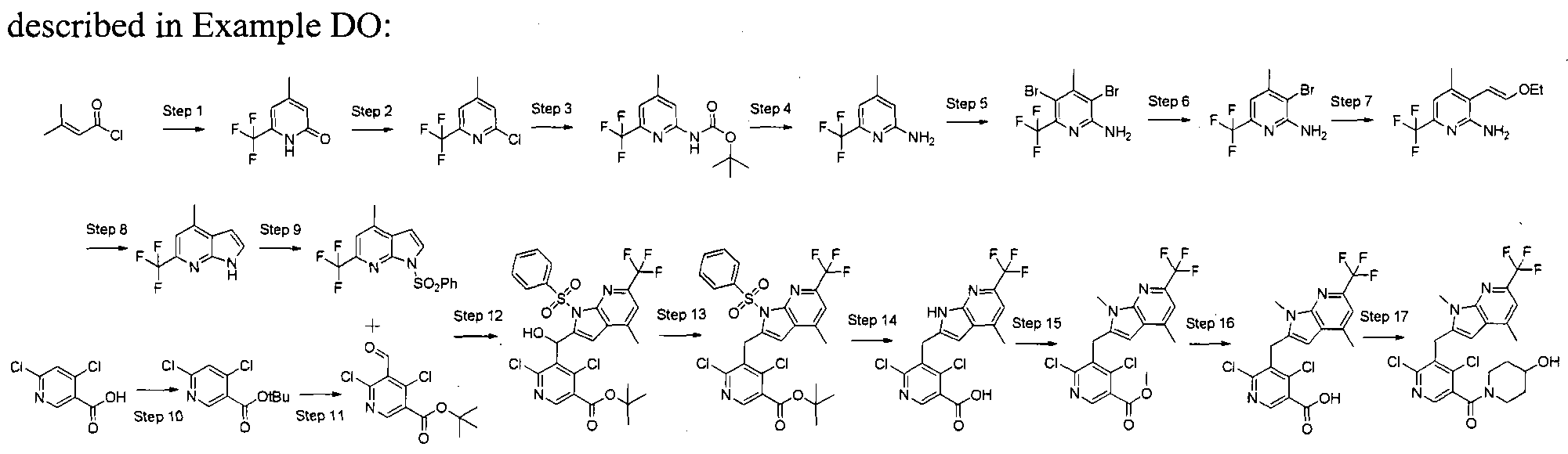
Scheme XV. General methods for preparing 2,4-disubstituted-3-((l-alkyl-lH-benzo[i limidazol-2- yl)methyl)benzamide compounds of the invention are illustrated in Scheme XV, and are further described in Examples CG and CH : (R,= CN, CF3, alkyl, halide, amide, H; R2= CN, CF3, alkyl, halide, amide, H;
 alkyl; R5 primary or secondary amine; Re = alkyl).

Scheme XVT. General methods for preparing 2,4-disubstituted-3-((l-methyl-lH-benzo[i/]imidazol-2- yl)methyl)benzylamine compounds of the invention are illustrated in Scheme XVI, and are further described in Examples BW and BX : (R= CN, CF3, alkyl, halide, amide, Η; R^ CN, CF3, alkyl, halide, amide, Η; R2= CN, CF3, alkyl, halide, amide, Η; R3= CN, CF3, alkyl, halide, amide, Η; R4=C1, alkyl; R5 primary or secondary amine).
From Scheme XII

Scheme XVII. General methods for preparing (2,4-dichloro-3-((3-methyl-lH-indazol-l- yl)methyl)benzamide or (2,4-dichloro-3-((3-methyl-2H-indazol-2-yl)methyl)benzamide compounds of the invention are illustrated in Scheme XVII, and are further described in Examples DD, DE, DF and DG : (R,= CN, CF3, alkyl, halide, amide, Η; R2= CN, CF3, alkyl, halide, amide, Η; R3= CN, CF3, alkyl, halide, amide, Η; R4= CN, CF3 alkyl, halide, amide, Η; R5=methyl; ^ = primary or secondary amine; R7=chloro).

Scheme XVIII. General methods for preparing (2,4-dichloro-3-((3-methyl-3H-imidazo[4,5-i']pyridin- 2-yl)methyl)phenyl)(morpholino)methanone compounds of the invention are illustrated in Scheme XVIII, and are further described in Example DC : (R= CN, CF3, alkyl, halide, amide, H).

Scheme XIX. General methods for preparing 2,4-dichloro-3-((l-methyl-lH-indol-2-yl)methyl) pyridylcarboxamide compounds of the invention are illustrated in Scheme XEX, and further described in Examples BB, BC, BE, BF, BG and ΒΗ: (A=A = C=N or N=C; R= CN, CF3, Me, Η; R,= CN, CF3, Me, Η;
 Me, Η).


Scheme XXI. General methods for preparing 2,4-dichloro-3-(l-methyl-lH-indole-2- carbonyl)benzamide compounds of the invention are illustrated in Scheme XXI, and further described in Examples AN, AO, AP and AQ: (A= C, N; R= CN, CF3, Me, Η; R,= CN, CF3, Me, Η; R2= CN, CF3. Me, Η; R3=primary or secondary amine).

Scheme XXII. General methods for preparing 2,4-disubstituted-3-((l-methyl-lH-indol-2- yl)methyl)benzylamine compounds of the invention are illustrated in Scheme XXII, and are further described in Example AU : (R= CN, CF3> alkyl, halide, amide, Η; R^ CN, CF3, alkyl, halide, amide, Η;
 alkyl; R5 primary or secondary amine).
From scheme I

Scheme XXIII. General methods for preparing 2,4-dichloro-3-((l-methyl-6-morpholino-lH-indol-2- yl)methyl) benzamide compounds of the invention are illustrated in Scheme I, and further described in Example AY : (R^ CN, CF3. Me, Η; R2= CN, CF3,Me, Η; R3=primary or secondary amine).

Scheme XXIV. General methods for preparing 2,4-dichloro-3-(lH-indol-l-yl)methyl) benzamide compounds of the invention are illustrated in Scheme XXIV, and further described in Examples J, DH, DI, DJ, DK, DL, DM and DN:

CN, CF3, Me, H; R5= Me, H; R6=primary or secondary amine; X= H, O).

ANALYTICAL METHODS
Analytical data was included within the procedures below, in the illustrations of the general procedures, or in the tables of examples. Unless otherwise stated, all Ή NMR data were collected on a Varian Mercury Plus 400 MHz or a Varian Inova 600 MHz instrument and chemical shifts are quoted in parts per million (ppm). LC/MS and HPLC data are referenced to the table of LC/MS and HPLC conditions using the lower case method letter provided in Table 1.
Table 1. LC/MS and HPLC methods.

li LC/MS : The gradient was : 0-3.5 min : 10% B to 90% B ; 3.5-4.2 min : 90% B ; 4.21-5.2 min : 10% B (1.4 ml/min flow rate). Mobile Phase A : 0.1% CH3COOH in water. Mobile Phase B : 0.1% CH3COOH in acetonitrile. Column : Kinetex XB - CI 8 (Dimensions : 30 x 3.0 mm, 2.6 μηι particles size). Column temperature :45 °C.
UV detection : DAD 210-260 nm. MS detection (ESI positive and negative).
i LC/MS : The gradient was : 0-2.8 min : 10% B to 100% B (1.4 ml/min flow rate) ; 2.8-2.9 min : 100% B (1.4 ml/min flow rate) ; 2.9.-3.5 min : 100% B (2.5 ml/min flow rate). Mobile Phase A : 0.1% CH3COOH in water. Mobile Phase B : 0.1% CH3COOH in acetonitrile. Column : Kinetex XB - CI 8 (Dimensions : 30 x 3.0 mm, 2.6 μπι particles size) . Column temperature :45 °C. UV detection : DAD 210-260 nm. MS detection (ESI positive and negative).
j LC/MS : The gradient was : 0-3.0 min : 40% B to 100% B (1.4 ml/min flow rate) ; 3.0.- 3.1 min : 100% B (1.4 ml/min flow rate) ; 3.1.-3.4 min : 100% B (2.5 ml/min flow rate). Mobile Phase A : 0.1% CH3COOH in water. Mobile Phase B : 0.1% CH3COOH in acetonitrile. Column : Kinetex XB - CI 8 (Dimensions : 30 x 3.0 mm, 2.6 μηι particles size) . Column temperature :45 °C.
UV detection : DAD 210-260 nm. MS detection (ESI positive and negative).
k LC/MS : The gradient was : 0-3.5 min : 10% B to 95% B ; 3.5-4.0 min : 95% B ; 4.1-5.2 min : 10% B (1.3 ml/min flow rate). Mobile Phase A : 0.1% HCOOH in water. Mobile Phase B : 0.1% HCOOH in acetonitrile. Column : Kinetex XB - CI 8 (Dimensions : 30 x 3.0 mm, 2.6 μπι particles size) . Column temperature :room temperature. UV detection : DAD 210-260 nm. MS detection (ESI positive and negative).
1 The gradient was 5-60% B in 1.5 min then 60-95% B to 2.5 min with a hold at 95% B for 1.2 min (1.3 mL/min flow rate). Mobile phase A was 10 mM NH4OAc, mobile phase B was HPLC grade MeCN. The column used for the chromatography is a 4.6 x 50 mm MAC-MOD Halo C8 column (2.7 μιη particles). Detection methods are diode array (DAD) and evaporative light scattering (ELSD) detection as well as positive/negative electrospray ionization.
-2 The gradient was 30% B for 1 min, then to 85%B in 2 min, then hold at 85%B for 30 min, then to 50% B in one min, then hold at 50%B for 9 min, then to 90%B in 1 min, then hold at 90% for 2 min, then to 30%B in 1 min (15 ml/min flow rate). Mobile phase A was HPLC grade water, mobile phase B was HPLC grade MeOH. The column used for the chromatography is Discovery HS F5, 21.2 x 25mm 5 μπι (Supelco).
-3 LC/MS: The gradient was 5-60% B in 1.6 min then 60-95% B to
2.2 min with a hold at 95% B for 0.1 min (1.0 mL/min flow rate).
Mobile phase A was lOmM ammonium acetate, mobile phase B
was HPLC grade acetonitrile. The column used for the
chromatography is a 2.1x30 mm Waters Cortecs C18 column (1.6
μηα particles). Detection methods are diode array (DAD) and
evaporative light scattering (ELSD) detection as well as
positive/negative electrospray ionization.))
Table 2. Chiral HPLC methods

PREPARATIONS AND EXAMPLES
The general synthetic methods used in each preparation follow and include an illustration of a compound that was synthesized. None of the specific conditions and reagents noted herein are to be construed as limiting the scope of the invention and are provided for illustrative purposes only. All starting materials are commercially available from Sigma-Aldrich (including Fluka and Discovery CPR) unless otherwise noted after the chemical name. Reagent/reactant names given are as named on the commercial bottle or as generated by IUPAC conventions, CambridgeSoft® ChemDraw Ultra 9.0.7, CambridgeSoft® Chemistry E-Notebook 9.0.127, or AutoNom 2000. Compounds designated as salts (e.g. hydrochloride, acetate) may contain more than one molar equivalent of the salt. Compounds of the invention where the absolute stereochemistry has been determined by the use of a commercially available enantiomerically pure starting material or a stereochemically defined intermediate, or by X- ray diffraction are denoted by an asterisk after the example number.
Preparation #1. methyl 2,4-dichloro-3- l-hydroxyprop-2-yn-l-yl)benzoate:

Step A: methyl 2,4-dichloro-3-methylbenzoate

To a solution of 2,4-dichloro-3-methylbenzoic acid (250 g, 1219 mmol) in MeOH (1.5L) was added sulfuric acid (78 mL, 1463 mmol) and the reaction was stirred under reflux for 20 hours. The reaction mixture was concentrated under vacuum. The crude product was dissolved in dichloromethane. The organic layer was washed with water, then with a NaHC03 saturated aqueous solution and brine, dried over magnesium sulfate and concentrated under vacuum to give methyl 2,4-dichloro-3-methylbenzoate (196g, 73.4%) as a colorless oil that precipitates slowly. LC/MS (Method h) R, = 2.78 min.; MS m/z: 217 [M-H]\ Ή NMR (DMSO-i 6, 300 MHz): δ 7.61 (d, J= 8.4 Hz, 1H), 7.55 (d, J= 8.4 Hz, 1H), 3.87 (s, 3H), 2.37 (s, 3H).
Step B: methyl 3-(bromomethyl)-2,4-dichlorobenzoate:

To a solution of methyl 2,4-dichloro-3-methylbenzoate (19.6 g, 89 mmol) in acetonitrile (100 mL) was added N-bromosuccinimide (20.70 g, 116 mmol) and 2,2'-azobis(2-methylpropionitrile) (0.735 g, 4.47 mmol) by small fractions at room temperature. The reaction mixture was stirred under reflux 18 hours then concentrated under vacuum. The crude product was diluted with ethyl acetate and the solid was filtered off and washed with ethyl acetate. The organic layer was washed successively with a NaHC03 saturated aqueous solution, 10% Na2S203 aqueous solution, dried over magnesium sulfate, filtered and evaporated to give methyl 3-(bromomethyl)-2,4-dichlorobenzoate (24.9 g, 93% yield) as a broken white solid. No LC MS Ή NMR (DMSO-d6, 300 MHz): δ 7.78 (d, J= 9 Hz, 1H), 7.67 (d, J= 9 Hz, 1H), 4.84 (s, 2H), 3.88 (s, 3H).
Step C: methyl 2,4-dichloro-3-formylbenzoate:

To a solution of methyl 3-(bromomethyl)-2,4-dichlorobenzoate (51.6 g, 173 mmol) in acetonitrile (400 mL) was added 4-methylmorpholine N-oxide (81 g, 693 mmol) in solution in water (160 mL). The reaction mixture was stirred at reflux for 1.5 hours, cooled to room temperature and diluted with water until precipitation of the expected compound. The solid was filtered off, washed with water and dried under vacuum to give methyl 2,4-dichloro-3-formylbenzoate (25.48 g, 63.1%) as a white solid.
LC/MS (Method h) Rt = 2.21 min.; no ionization Ή NMR (DMSO-d6, 300 MHz): δ 10.33 (s, 1H), 7.95 (d, J= 8.4 Hz, 1H), 7.72 (d, J= 8.4 Hz, 1H), 3.89 (s, 3H).
Step D: methyl 2,4-dichloro-3-(l-hydroxyprop-2-yn-l-yl)benzoate
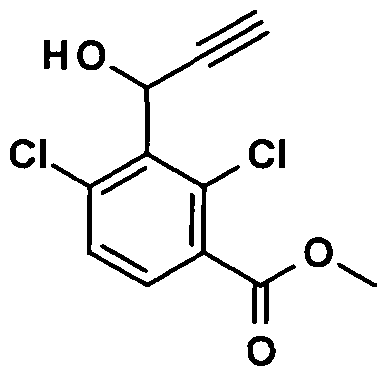
To a suspension of methyl 2,4-dichloro-3-formylbenzoate (19.36 g, 83 mmol) in THF (80 mL) was added dropwise ethynylmagnesium bromide (0.5M in THF, 199 mL, 100 mmol) and the reaction mixture was stirred at room temperature for 1 hour. It was then diluted with a IN HC1 solution and extracted with ethyl acetate. The organic layer was dried over magnesium sulfate, filtered and concentrated under vacuum. The residue was purified by column chromatography on silica gel (eluting with 0-30% ethyl acetate in cyclohexane) to give methyl 2,4-dichloro-3-(l-hydroxyprop-2-yn-l- yl)benzoate (19.6 g, 91%) as a white solid. LC MS (Method h) R, = 1.95 min.; MS m/z: 259 [M+H]+. Ή NMR 300 MHz): 5 7.67 (d, J= 9 Hz, 1H), 7.59 (d, J= 9 Hz, 1H), 6.29 (s, 1H), 6.15 (d, J=2.48Hz, 1H), 3.87 (s, 3H), 3.51 (d, J=2.48Hz, 1H).
Preparation #2. 2-(2,6-dichloro-3-(methox carbonyl)phenyI)acetic acid


To a heated solution (40°C) of KCN (8.52 g, 131 mmol) in DMSO (150 mL) was added dropwise a solution of methyl 3-(bromomethyl)-2,4-dichlorobenzoate (Preparation #1, Step B) (30 g, 101 mmol) in DMSO (90 mL). The reaction mixture was stirred at 40°C for 2h30. It was then cooled to room temperature and a NaHC03 saturated aqueous solution was added. The product was extracted with ethyl acetate. Organic layer was dried over magnesium sulfate, filtered and concentrated under vacuum. The residue was purified by column chromatography on silica gel (eluting with 5-50% ethyl acetate in cyclohexane) to give methyl 2,4-dichloro-3-(cyanomethyl)benzoate (19.1 g, 78%) as a white solid. LC/MS (Method h) Rt = 2.19 min.; MS m/z: 242 [M-H]\ Ή NMR (DMSO-i/6, 300 MHz): δ 7.83 (d, J= 9 Hz, 1H), 7.72 (d, J= 9 Hz, 1H), 4.26 (s, 2H), 3.89 (s, 3H).
Step B: methyl 2,4-dichloro-3-(2-oxoeth l)benzoate

To a solution of methyl 2,4-dichloro-3-(cyanomethyl)benzoate (11 g, 45.1 mmol) in a mixture of pyridine (171 mL), acetic acid (85 mL) and water (85 mL), was added sodium hypophosphite (31.7 g, 361 mmol). The reaction mixture was stirred 15 min at room temperature. Activated Raney nickel (13.13 mL, 77 mmol) was added and the reaction mixture was stirred at 80°C for 1.5 hours. The reaction mixture was filtered, washed with ethyl acetate and water. The layers were separated and the organic layer was washed with a 1M HCl solution, then dried over magnesium sulfate, filtered and concentrated under vacuum. The residue was purified by column chromatography on silica gel (eluting with 10-25% ethyl acetate in cyclohexane) to give methyl 2,4-dichloro-3-(2-oxoethyl)benzoate (10.24 g, 65,3 % yield).
LC/MS (Method h) Rt = 2.19 min., 1.59 min. (hydrate); MS m/z: 323 [M-H] +CH3COOH
Ή NMR (DMSO-rfe, 300 MHz): δ 9.76 (s, 1H), 7.72 (d, J= 9 Hz, 1H), 7.64 (d, J= 9 Hz, 1H), 4.27 (s,
2H), 3.87 (s, 3H).
Step C: 2-(2,6-dichloro-3-(methoxycarbonyl)phenyl)acetic acid

To a solution of methyl 2,4-dichloro-3-(2-oxoethyl)benzoate (3g, 12.14 mmol) in THF (50 mL) and water (50.0 mL) were added successively 2-methyl-2-butene (60.7 mL, 121 mmol), sodium chlorite (8.79 g, 97 mmol) and sodium phosphate, monobasic, monohydrate (15.08 g, 109 mmol). The mixture was stirred at room temperature for 1.5 hours then diluted with dichloromethane and a NaHC03 saturated aqueous solution. The layers were separated and the aqueous layer was re-acidified by IN HCl solution and extracted with dichloromethane. The organic layer was dried over magnesium sulfate and concentrated under reduced pressure. The residue was triturated in pentane to give 2-(2,6-dichloro- 3-(methoxycarbonyl)phenyl)acetic acid (3 g, 94%). LC/MS (Method h) R, = 1.91 min.; MS m/z: 263 [M+H]+ Ή NMR (DMSO-c?6, 300 MHz): δ 12.78 (broad, 1H), 7.70 (d, J = 9 Hz, 1H), 7.62 (d, J= 9 Hz, 1H), 3.97 (s, 2H), 3.87 (s, 3H).
Preparation #3. (2,4-dichloro-3-(l-hydrox rop-2-yn-l-yl)phenyl)(morpholino)methanone

Step A: 2,4-dichloro-3-formylbenzoic acid

To a solution of methyl 2,4-dichloro-3-formylbenzoate (Preparation #1, Step C) (20 g, 86 mmol) in THF (240 mL) and water (120 mL) was added lithium hydroxide (3083 mg, 129 mmol) and the reaction mixture was stirred at room temperature overnight. The reaction mixture was partially evaporated. The resulting aqueous layer was washed with dichloromethane then acidified with a 1M HCl solution to (pH = 2-3) and the compound was extracted successively with dichloromethane and ethyl acetate. The organic layers were dried over magnesium sulfate and concentrated under reduced pressure to give 2,4-dichloro-3-formylbenzoic acid (17.6 g, 94%). LC/MS (Method h) R, = 1.02 min.;
MS m/z: 217 [M-H]" Ή NMR (DMSO- , 300 MHz): δ 13.88 (broad, 1H), 10.36 (s, 1H), 7.92 (d, J = 9 Hz, 1H), 7.67 (d, J= 9 Hz, 1H).
Step B: 2,6-dichloro-3-(morphoIine-4-carbon l)benzaldehyde

To a suspension of 2,4-dichloro-3-formylbenzoic acid (17.2 g, 79 mmol) in dichloromethane (340 mL) was added HATU (32.8 g, 86 mmol) and 4-methylmorpholine (9.51 mL, 86 mmol). The reaction mixture was stirred at room temperature during 20 minutes, then morpholine (10.19 mL, 118 mmol) was added. The reaction mixture was stirred at room temperature during one night. The reaction mixture was diluted with dichloromethane and washed with A NaHC03 saturated aqueous solution. The obtained organic layer was dried over magnesium sulfate, filtered and concentrated under reduced pressure. The residue was purified by column chromatography on silica gel (eluting with 5-40% ethyl acetate in cyclohexane) to give 2,6-dichloro-3-(mo holine-4-carbonyl)benzaldehyde ( 23.8g, 100%) as a white solid.
LC/MS (Method h) Rt = 1.58 min.; MS m/z: 288 [M+H]+ Ή NMR (DMSO-i/6, 300 MHz): δ 10.36(s, 1H), 7.69 (d, J=9Hz, 1H), 7.64 (d, J=9Hz, 1H), 3.66 (m, 4H), 3.54 (m, 2H), 3.16 (m, 2H).
Step C: (2,4-dichloro-3-(l-hydroxypro -2-yn-l-yI)phenyl)(morpholino)methanone:

Using a similar procedure as the one described in Preparation #1, (2,4-dichloro-3-(l-hydroxyprop-2- yn-l-yl)phenyl)(morpholino)methanone (14.1 g, 99%) was prepared from 2,6-dichloro-3-(morpholine- 4-carbonyl)benzaldehyde (13 g, 45.1 mmol). LC/MS (Method h) Rt = 1.43 min.; MS m/z: 314 [M+H]+. Ή NMR (DMSO-i/6, 300 MHz): δ 7.55 (d, J=9Hz, 1H), 7.38 (d, J=9Hz, 1H), 6.26 (s, 1H), 6.09 (d d, J=3Hz, 1H), 3.65 (m, 4H), 3.54 (m, 2H), 3.51 (d, J=3Hz, 1H), 3.12 (m, 2H).
Preparation #4. (3-(l-hydroxyprop-2-yn-l-yl)-2,4-dimethylphenyl)(morpholino)methanone

Step A: 3-bromo-2,6-dimethylbenzaIdehyde

To a suspension of aluminum trichloride (14.91 g, 112 mmol) in dichloromethane (80 mL) were added dropwise at 0°C 2,6-dimethylbenzaldehyde (lOg, 74.5 mmol) in solution in dichloromethane (80 mL) and dibromine (3.72 mL, 72.3 mmol) The mixture was stirred 4 hours at 0°C. The reaction mixture was poured onto ice and extracted twice with dichloromethane. The organic layers were washed with a IN HC1 solution, a NaHC03 saturated aqueous solution, dried over magnesium sulfate and concentrated under reduced pressure to give 3-bromo-2,6-dimethylbenzaldehyde (14.4 g, 91% yield) of as a yellow oil.
LC/MS (Method h) Rt = 2.62 min.; no ionization. ¾ NMR (DMSO-c 6, 300 MHz): δ 10.47 (s, 1H), 7.72 (d, J=9Hz, 1H), 7.12 (d, J=9Hz, 1H), 2.57 (s, 3H), 2.47 (s, 3H).
Step B: 3-formyl-2,4-dimethylbenzoic acid

In a microwave reactor were added palladium(II) acetate (13.70 mg, 0.061 mmol) , tri-tert- butylphosphonium tetrafluoroborate (17.70 mg, 0.061 mmol) and molybdenum hexacarbonyl (354 mg, 1.342 mmol), 3-bromo-2,6-dimethylbenzaldehyde (260 mg, 1.220 mmol) in solution in dimethoxyethane (2 mL) and sodium carbonate (194 mg, 1.830 mmol) in solution in water (0.5 mL).The reaction mixture was stirred one hour at 120°C under microwave irradiation. Dimethoxyethane was evaporated and the residue was diluted with water and washed with ethyl acetate. The aqueous layer was acidified by IN HC1 solution (pH 1) and extracted with dichloromethane, dried over magnesium sulfate and concentrated under reduced pressure to give 3- formyl-2,4-dimethylbenzoic acid (150 mg, 69%) as a white powder. LC/MS (Method h) Rt = 1.50 min.; MS m/z: 177 [M-H]\ Ή NMR (DMSO-i/6, 300 MHz): δ 13.06(broad, 1H), 10.56 (s, 1H), 7.78 (d, J=9Hz, 1H), 7.24 (d, J=9Hz, 1H), 2.65 (s, 3H), 2.52 (s, 3H).
Step C: 2,6-dimethyI-3-(morpholine-4-carbon i)benzaldehyde

To a solution of 3-formyl-2,4-dimethylbenzoic acid (1 g, 5.61 mmol) in DMF (5 mL) was added 1,1'- carbonyldiimidazole (1.183 g, 7.30 mmol) and the reaction mixture was stirred at room temperature for 4 hours. Morpholine (0.971 mL, 11.22 mmol) and triethylamine (1.564 mL, 11.22 mmol) were added and the reaction mixture was stirred at room temperature for one night. The reaction mixture was diluted with water and ethyl acetate. The layers were separated and the obtained aqueous layer was extracted with ethyl acetate. The obtained organic layer was dried over magnesium sulfate, filtered and concentrated under reduced pressure. The residue was purified by column chromatography on silica gel (eluting with 0.1-5% MeOH in dichloromethane) to give 2,6-dimethyl-3-(morpholine-4- carbonyl)benzaldehyde (780 mg, 56%).
LC/MS (Method h) Rt = 1.46 min.; MS m/z: 248 [M+H]+. Ή NMR (DMSO-c?6, 300 MHz): δ 10.53 (s, 1H), 7.32 (d, J=9Hz, 1H), 7.24 (d, J=9Hz, 1H), 3.65(m, 4H), 3.48 (m, 2H), 3.11 (m, 2H), 2.54 (s, 3H), 2.42 (s, 3H).
Step D: (3-(l-hydroxyprop-2-yn-l-yI)- morpholino)methanone:

Using a similar procedure as the one described in Preparation #1, (3-(l-hydroxyprop-2-yn-l-yl)-2,4- dimethylphenyl)(mo holino)methanone (680 mg, 64%) was prepared from 2,6-dimefhyl-3- (mo holine-4-carbonyl)benzaldehyde (953 mg, 3.85 mmol). LC/MS (Method h) R, = 1.39 min.; MS m/z: 274 [M+H]+. Ή NMR (DMSO-</6, 300 MHz): δ 7.06 (d, J=7.6Hz, 1H), 6.98 (d, J=7.6Hz, 1H), 5.83 (m, 1H), 5.76 (m, 1H), 3.64 (m, 4H), 3.47 (m, 2H), 3.41 (d, J=2.3Hz, 1H), 3.10 (m, 2H), 2.44 (s, 3H), 2.34 (s, 3H).
Preparation #5. (3-(l-hydroxyprop-2-yn-l-yl)phenyl)(morphoUno)methanone:

Using a similar procedure as the one described in Preparation #1, (3-(l-hydroxyprop-2-yn-l- yl)phenyl)(morpholino)methanone (2 g, 73%) was prepared from 3-(morpholine-4- carbonyl)benzaldehyde (described in WO2004/058762) (2.54 g, 11.59 mmol). LC/MS (Method h) R, = 1.09 min.; MS m/z: 246 [M+H]+. Ή NMR (DMSO d-, 300 MHz): δ 7.62 (m, 2H), 7.47-7.34 (m, 2H), 5.47 (d, J=2Hz, IH), 3.90-3.30 (m broad, 9H), 2.67 (d, J=2Hz, IH).
Preparation #6: methyl 3,5-dichloro-4-(l-h droxyprop-2-yn-l-yI)benzoate:

Using a similar procedure as the one described in Preparation #1, methyl 3,5-dichloro-4-(l- hydroxyprop-2-yn-l-yl)benzoate (1 g, 60%) was prepared from methyl 3,5-dichloro-4-formylbenzoate (described in WO2013/149997) (1.5 g, 6.44 mmol). LC/MS (Method h) Rt = 2.14 min.; no ionization Ή NMR (DMSO-i/6, 300 MHz): δ 7.91 (s, 2H), 6.37 (s, IH), 6.09 (d, J=2Hz, IH), 3.88 (s, 3H), 3.54 (d, J=2Hz, IH).
Preparation #7. l-(2,6-dichloro-3-methox henyI)prop-2-yn-l-ol :

Using a similar procedure as the one described in Preparation #1, l-(2,6-dichloro-3- methoxyphenyl)prop-2-yn-l-ol (1.68 g, 93%) was prepared from 2,6-dichloro-3- methoxybenzaldehyde (described in WO2006/049952) (1.6 g, 7.80 mmol). LC/MS (Method h) Rt = 1.95 min.; no ionization Ή NMR (DMSCW6, 300 MHz): δ 7.42 (d, J=9Hz, IH), 7.14 (d, J=9Hz, IH), 6.12 (s, IH), 6.05 (d, J=2.4Hz, IH), 3.86 (s, 3H), 3.41 (d, J=2.4Hz, IH).
Preparation #8. 2-(2,6-dichloro-3-(morpholine-4-carbonyl)phenyl)acetic acid

Step A: methyl 2,4-dichloro-3-(2-hydroxyethyl)benzoate

To a solution of methyl 2,4-dichloro-3-(2-oxoethyl)benzoate (Preparation #2, Step B) (1.88 g, 7.61 mmol) in methanol (28 mL) and cooled to 0°C was added sodium borohydride (0.288 g, 7.61 mmol) and reaction mixture was stirred at 0°C for 30 minutes. Water was added and the methanol was evaporated. The resulting aqueous layer was extracted with dichloromethane. The organic layer was dried over magnesium sulfate, filtered and concentrated under reduced pressure to give methyl 2,4- dichloro-3-(2-hydroxyethyl)benzoate (1.6 g, 84%). LC/MS (Method h) Rt = 1.93 min.; MS m/ . 249 [M+H]+. Ή NMR (DMSO-c/6, 300 MHz): δ 7.61 (d, J=8.4Hz, IH), 7.56 (d, J=8.4Hz, IH), 4.92 (broad, IH), 3.85 (s, 3H), 3.56 (m, 2H), 3.13 (t, J=7.8Hz, 2H)
Step B: 2,4-dichIoro-3-(2-hydroxyethyl)benzoic acid

Using a similar procedure as the one described in Preparation #3, Step A, 2,4-dichloro-3-(2- hydroxyethyl)benzoic acid (1.41 g, 93%) was prepared from methyl 2,4-dichloro-3-(2- hydroxyethyl)benzoate (1.60 g, 6.42 mmol). LC/MS (Method h) Rt = 1.20 min.; MS m/r. 233 [M-H]\ Ή NMR (DMSO- , 300 MHz): δ 13.56 (broad, IH), 7.56 (d, J=8.4Hz, IH), 7.51 (d, J=8.4Hz, IH), 4.92 (broad, IH), 3.55 (t, J=2.7Hz, 2H), 3.12 (t, J=7.8Hz, 2H)
Step C: (2,4-dichIoro-3-(2-hydroxyethyI)phenyl)(morpholino)methanone

To a suspension of 2,4-dichloro-3-(2-hydroxyethyl)benzoic acid (1.4 g, 5.96 mmol) in dichloromethane (75 mL) was added l-(3-dimethylaminopropyl)-3-ethylcarbodiimide hydrochloride (1.484 g, 7.74 mmol) and 1 -hydroxybenzotriazole (1.046 g, 7.74 mmol) morpholine (1.031 mL, 11.91 mmol) and triethylamine (1.660 mL, 11.91 mmol). The reaction mixture was stirred at room temperature for one night. It was then diluted with dichloromethane. The layers were separated and the obtained organic layer was washed with water, dried over magnesium sulfate, filtered and concentrated under reduced pressure. The residue was purified by column chromatography on silica gel (eluting with 5-40% ethyl acetate in cyclohexane) to give (2,4-dichloro-3-(2- hydroxyethyl)phe yl)(mo holino)methanone (1.2 g, 66%) as a white solid.
LC/MS (Method h) R, = 1.41 min.; MS m/z: 304 [M+H]+. Ή NMR (DMSO-rf6, 300 MHz): δ 7.53 (d, J=9Hz, 1H), 7.27 (d, J=9Hz, 1H), 4.91 (t, J=6Hz, 1H), 3.65-3.50 (m, 8H), 3.10 (m, 4H).
Step D: 2-(2,6-dichloro-3-(morpholine-4-carbonyI)phenyl)acetic acid
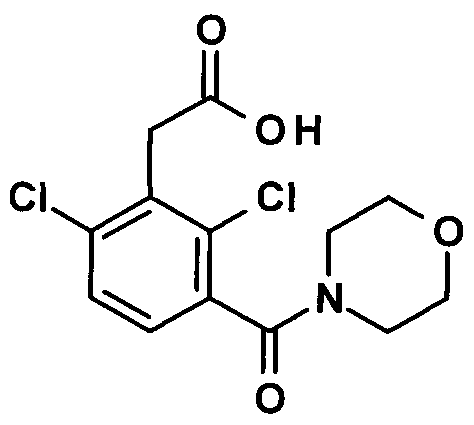
To a solution of chromium(vi) oxide (182 mg, 1.816 mmol) in water ( 325 μΐ) and cooled at 0°C was added sulfuric acid (162 μΐ, 3.05 mmol) and the reaction mixture was stirred at 0°C for lOmin. This solution was added slowly to a solution of (2,4-dichloro-3-(2- hydro yethyl)phenyl)(mo holino)methanone (325 mg, 1.068 mmol) in acetone (3898 μΐ) cooled to 0°C. The reaction mixture was stirred at 0°C for 15min, then at room temperature for 30 minutes. The reaction mixture was filtered and washed with acetone. The filtrate was concentrated. The residue was diluted in ethyl acetate and washed with a IN HCl solution. The organic layer was dried over magnesium sulfate, filtered and concentrated to give 2-(2,6-dichloro-3-(morpholine-4- carbonyl)phenyl)acetic acid (283 mg, 83%). LC/MS (Method h) Rt = 1.42 min.; MS m/z: 318 [M+H]+. Ή NMR (DMSO-rfe, 300 MHz): δ 12.74 (broad, 1H), 7.59 (d, J=9Hz, 1H), 7.36 (d, J=9Hz, 1H), 3.93 (s, 2H), 3.66 (m, 4H), 3.52 (m, 2H), 3.11 (m, 2H).
Preparation #9. 2-(3-(methoxycarbonyI)-2,6-dimethylphenyI)acetic acid

Step A: 2-(3-bromo-2,6-dimethylphenyl)acetic acid

To a heated (40°C) solution of 2-(2,6-dimethylphenyl)acetic acid (2 g, 12.18 mmol) in acetic acid (12 mL), was added dropwise over 1 hour a solution of dibromine (0.845 mL, 16.44 mmol) in acetic acid (5 mL). The reaction mixture was stirred at 45°C for 18 hours then concentrated to dryness. The residue was triturated in cyclohexane and the solid was filtered and washed with cyclohexane to give 2-(3-bromo-2,6-dimethylphenyl)acetic acid (2.4g, 71%) as a white solid. LC/MS (Method h) R, = 2.26 min.; MS m/r. 241 [M-H]\ Ή NMR (DMSO-c?6, 300 MHz): δ 12.45 (broad, 1H), 7.38 (d, J=8.1Hz, 1H), 6.97 (d, J=8.1Hz, 1H), 3.69 (s, 2H), 2.33 (s, 3H), 2.24 (s, 3H)
Step B: 2-(3-(methoxycarbonyl)-2,6-dimethylphenyl)acetic acid

In a microwave vial was added 2-(3-bromo-2,6-dimethylphenyl)acetic acid (1.5 g, 6.17 mmol), trans- bis(acetato)bis[o-(di-o-tolylphosphino)benzyl]dipalladium(II) (0.289 g, 0.309 mmol), tri-tert- butylphosphonium tetrafluoroborate (0.358 g, 1.234 mmol) and molybdenum hexacarbonyl (1.629 g, 6.17 mmol) in methanol (30 mL). l,8-diazabicyclo[5.4.0]undec-7-ene (2.82 g, 18.51 mmol) was added dropwise and the mixture was stirred vigorously at room temperature for 5 minutes. Then the vial was heated under microwaves at 110°C for 30 minutes and at 140°C for 15 minutes. After being cooled to room temperature, the reaction mixture was filtered and the solvent was removed under reduced pressure. The residue was diluted with water and ethyl acetate. The phases were separated and the aqueous one was extracted with ethyl acetate. The organic layers were combined and discarded. The basic water layer was acidified to pH 2-3 with IN HQ solution and thoroughly extracted with ethyl
acetate. The organic phases were combined, washed with brine, dried over magnesium sulfate, filtered and concentrated under reduced pressure to give 2-(3-(methoxycarbonyl)-2,6-dimethylphenyl)acetic acid (1.17 g, 79%) as a green solid. LC/MS (Method h) R, = 1.86 min.; MS m/z: 223 [M+H]+ Ή NMR (CDC13, 300 MHz): δ 7.66 (d, J=9Hz, 1H), 7.11 (d, J=9Hz, 1H), 3.89 (s, 3H), 3.81 (s, 2H), 2.54 (s, 3H), 2.39 (s, 3H).
Preparation #10.2-(2,6-dichIoro-4-nitrophenyl)acetic acid

To a suspension of diethyl malonate (1.006 mL, 6.62 mmol) and cesium carbonate (3.60 g, 11.04 mmol) in DMF (5 mL) heated at 70°C was added 3,4,5-trichloronitrobenzene (1 g, 4.42 mmol) and the mixture was stirred at 70°C for 3 hours. The mixture was cooled to room temperature. A 2M HCl solution was added and the reaction mixture was extracted with ethyl acetate. The combined organic layers were washed with brine, dried over magnesium sulfate and concentrated. The residue was suspended in hydrochloric acid (7.36 mL, 44.2 mmol) and stirred at 100°C for 24 hours. The mixture was cooled to room temperature, pulled into cold water and the reaction mixture was extracted twice with ethyl acetate. The combined organic layers were washed with brine, dried over magnesium sulfate and concentrated. The residue was dissolved in dioxane (15 mL). Sodium hydroxide (11.99 mL, 11.99 mmol) was added and the mixture was stirred at room temperature for 48 hours. An excess of sodium hydroxide (11.99 mL, 11.99 mmol) was added and the stirring was continued for 24hours. Another excess of sodium hydroxide (11.99 mL, 11.99 mmol) was added and the stirring was continued for 48 hours. The mixture was diluted with water and washed twice with ethyl acetate. The aqueous layers were acidifid with 10M HCl solution (pH= 2) and extracted with dichloromethane. The combined organic layers were washed with brine, dried over magnesium sulfate and concentrated to give 2-(2,6-dichloro-4-nitrophenyl)acetic acid (465 mg, 42%) as a white solid. LC/MS (Method h) Rt = 1.98 min.; MS m/z: 497 [2M-H]" Ή NMR (DMSO-< 6, 300 MHz): δ 12.96 (broad, 1H), 8.32 (s, 2H), 4.03 (s, 2H)
Preparation #11. (2,4-dichloro-3-(chloromethyl)phenyl)(morpholino)methanone
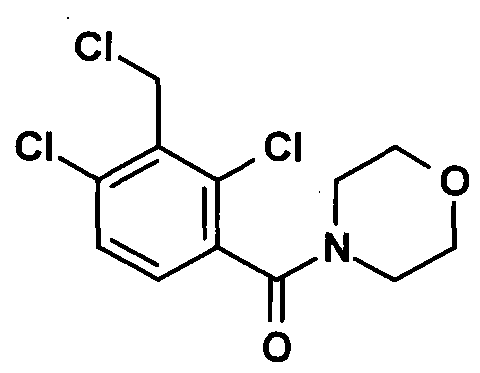
Step A: 2,4-dichloro-3-(hydroxymethyl)benzoic acid
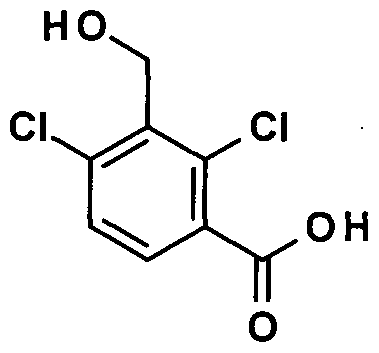
To a solution of methyl 3-(bromomethyl)-2,4-dichlorobenzoate (Preparation #1, Step B) (10 g, 33.6 mmol) in dioxane (100 mL) was added sodium hydroxide (84 mL, 84 mmol) and the reaction mixture was stirred under reflux for 5 hours The reaction mixture was concentrated to dryness. The residue was dissolved in water and acidified at pHl.The white solid was filtered, washed with water and dried under vacuum to give 2,4-dichloro-3-(hydroxymethyl)benzoic acid (5.9 g, 80%). LC/MS (Method h) Rt = 0.70 min.; MS m/z 219 [M-H]" Ή NMR (DMSO-rf6, 300 MHz): δ 13.58 (broad, 1H), 7.67 (d, J=9Hz, 1H), 7.52 (d, J=9Hz, 1H), 5.28 (m, 1H), 4.74 (s, 2H).
Step B: (2,4-dichloro-3-(hydroxymeth l)phenyl)(morpholino)methanone
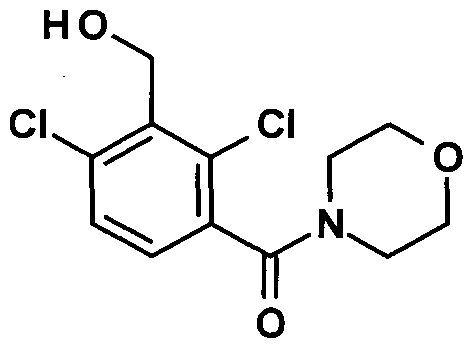
Using a similar procedure as the one described in Preparation #8, (2,4-dichloro-3- (hydroxymethyl)phenyl)(moφholino)methanone (2.6 g, 41%) was prepared from 2,4-dichloro-3- (hydroxymethyl)benzoic acid (4.8 g, 21.72 mmol). LC/MS (Method h) Rt = 1.19 min.; MS m/z: 290 [M+Hf. Ή NMR (DMSO-rfe, 300 MHz): δ 7.53 (d, J=9Hz, 1H), 7.34 (d, J=9Hz, 1H), 5.28 (s, 1H), 4.70 (s, 2H), 3.64 (m, 4H), 3.52 (m, 2H), 3.12 (m, 2H).
Step C : (2,4-dichloro-3-(chlorometh I)phenyI)(morphoIino)methanone
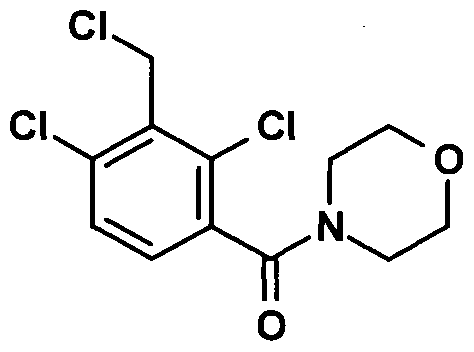
Preparation #12. ethyl 3-((methylsulfonyl)oxy)cyclopentanecarboxylate

To a solution of ethyl 3-hydroxycyclopentanecarboxylate (0.8 g, 5.06 mmol) and triethylamine (1.762 mL, 12.64 mmol) in dichloromethane (8 mL) and cooled at 0°C was added a solution of methanesulfonyl chloride (0.588 mL, 7.59 mmol) in dichloromethane (3 mL). The reaction was stirred at room temperature for 1 hour. Water was added, and the reaction mixture was extracted with dichloromethane. The organic layer was washed with brine dried on MgS04, filtered and evaporated to give ethyl 3-((methylsulfonyl)oxy)cyclopentanecarboxylate (1.1 g, 92%) as a colorless liquid: No LC/MS
¾ NMR (DMSO- 6, 300 MHz): δ 5.08 (m, 1H), 4.05 (m, 2H), 3.60 (m, 4H), 2.86 (m, 1H), 2.30 (m, 1H), 2.05 (m, 1H), 1.80 (m, 3H), 1.18 (m, 3H).
Preparation #13. methyl 2,4-dichloro-3- 3-chloro-2-oxobutyl)benzoate

A suspension of zinc (0.241 g, 3.69 mmol) in THF (1 ml) was heated to reflux and 1 ,2-dibromoethane (0.025 g, 0.134 mmol) and chlorotrimethylsilane (0.015 g, 0.134 mmol) were added. The reaction mixture was stirred 30 minutes. A solution of methyl 3-(bromomethyl)-2,4-dichlorobenzoate (1 g, 3.36 mmol) (Preparation #1, Step B) in THF (3 ml) was then added dropwise over 5 minutes and the
mixture was stirred at reflux for 2 hours. This solution was added at room temperature to a mixture of copper(I) cyanide di(lithium chloride) complex (3.36 ml, 3.36 mmol) and N,N-dimethylformamide (246 mg, 3.36 mmol) and the solution was stirred 30 minutes at room temperature. Then, a solution of 2-chloropropionyl chloride (427 mg, 3.36 mmol) in toluene (4 ml) and tetrakis(triphenylphosphine)palladium(0) (116 mg, 0.101 mmol) were added. The reaction was stirred one hour at room temperature, diluted with 10 mL of hexane and 10 mL of ethyl acetate and solid silica gel was added. The mixture was stirred 5 minutes and the solid was filtered and washed with ethyl acetate. The organic layer was concentrated. The residue was purified by column chromatography on silica gel (eluting with 0-20% ethyl acetate in cyclohexane) to give methyl 2,4- dichloro-3-(3-chloro-2-oxobutyl)benzoate (560 mg, 54%) as a colorless oil. LC MS (Method h) Rt = 2.75 min.; MS m/z: 309 [M+H]+. Ή NMR (DMSO-i/6, 300 MHz): δ 7.71 (d, J=9Hz, 1H), 7.62 (d, J=9Hz, 1H), 5.05 (q, J=7Hz, 1H), 4.56 (d, J=15Hz, 1H), 4.43 (d, J=15Hz, 1H), 3.87 (s, 3H), 1.63 (d, J=7Hz, 3H).
Preparation #14. methyl 3-(3-bromo-2-oxobut l)-2,4-dichlorobenzoate

Step A: methyl 2,4-dichloro-3-(2-hydroxybutyl)benzoate

To a solution of methyl 2,4-dichloro-3-(2-oxoethyl)benzoate (Preparation #2, Step B) (100 mg, 0.405 mmol) in tetrahydrofuran (1 ml) was added ethylmagnesium bromide (1 M in THF, 0.486 ml, 0.486 mmol) and the reaction mixture was stirred at room temperature during 18 hours. The reaction mixture was diluted with a solution of IN HC1 aqueous solution and the obtained aqueous layer was extracted with ethyl acetate. The organic layer was dried over MgS04, filtered and concentrated under reduced pressure. The residue was purified by column chromatography on silica gel (eluting with 5-20% ethyl acetate in cyclohexane) to give methyl 2,4-dichloro-3-(2-hydroxybutyl)benzoate (100 mg, 89%) as a colorless oil. LC MS (Method h) Rt = 2.39 min.; MS m/z: 277 [M+H]+. Ή NMR (DMSO-c/6, 300
MHz): δ 7.58 (m, 2H), 4:65 (d, J=6Hz, IK), 3.85 (s, 3H), 3.72 (m, lH), 3.05 (m, 2H), 1.42 (m, 2H), 0.89 (t, J=6Hz, 3H).
Step B: methyl 2,4-dichloro-3-(2-oxobutyl)benzoate

To a solution of methyl 2,4-dichloro-3-(2-hydroxybutyl)benzoate (100 mg, 0.361 mmol) in dichloromethane (1.5 ml) was added Dess-Martin periodinane (0.750 ml, 0.361 mmol) The reaction mixture was stirred at room temperature for 18 hours. The reaction mixture was diluted with dichloromethane. The organic layer was washed with a saturated Na2S203 aqueous solution, then dried over MgS04, filtered and concentrated under reduced pressure. The residue was purified by column chromatography on silica gel (eluting with 5-20% ethyl acetate in cyclohexane) to give methyl 2,4- dichloro-3-(2-oxobutyl)benzoate (63 mg, 63%) as a colorless oil. LC/MS (Method h) Rt = 2.53 min.; MS m/z: 275 [M+H]+. Ή NMR (DMSO-< , 300 MHz): δ 7.69 (d, J=9Hz, 1H), 7.60 (d, J=9Hz, 1H), 4.21 (s, 2H), 3.86 (s, 3H), 2.64 (q, J=7.2Hz, 2H), 0.99 (t, 7=7.2, 3H).
Step C: methyl 3-(3-bromo-2-oxobutyl)-2,4-dichlorobenzoate

A suspension of cupric bromide (81 mg, 0.363 mmol) in chloroform (300 μ¾ and ethyl acetate (300 μΐ,) was heated to reflux. Methyl 2,4-dichloro-3-(2-oxobutyl)benzoate (100 mg, 0.363 mmol) in solution in chloroform (80
 was added and the reaction mixture was stirred at reflux for 72 hours. The reaction mixture was concentrated under reduced pressure. The residue was purified by column chromatography on silica gel (eluting with 5-20% ethyl acetate in cyclohexane) to give methyl 3-(3-bromo-2-oxobutyl)-2,4-dichlorobenzoate (105 mg, 47%) as a colorless oil. LC MS (Method h) R, = 2.82 min.; MS m/z: 353 [M+H]+. ¾ NMR (DMSO-i/6, 300 MHz): δ 7.70 (d, J=9Hz, 1H), 7.63 (d, J=9Hz, 1H), 5.10 (q, J=6.6Hz, 1H), 4.63 (d, J=18Hz, 1H), 4.46 (d, J=18Hz, 1H), 3.86 (s, 3H), 1.72 (d, J=6.65Hz, 3H).
Preparation #15. l-(3,5-dichloro-2-methoxypyridin-4-yl)prop-2-yn-l-ol

Step A: 3,5-dichIoro-2-methoxyisonicotinaldehyde

A solution of 3,5-dichloro-2-methoxypyridine (16 g, 90 mmol) in THF(100 mL) was slowly added to a solution of LDA (53.9 ml, 108 mmol) (2M in THF) at -78 °C. DMF (14 mL, 180 mmol) was added to the reaction mixture and the resulting solution stirred at -78 °C for about lh. The reaction mixture was then poured into a NH4C1 saturated aqueous solution. The aqueous layer was extracted with EtOAc (3 x 20 mL). The combined organic portion was dried over anhydrous Na2S04, filtered, and concentrated under reduced pressure to give 3,5-dichloro-2-methoxyisonicotinaldehyde (17.54 g, 90 % ). LC/MS (Table 1, Method d) Rt = 1.86 min.; MS m/z: 205, 207 [M+H]+.
Step B: l-(3,5-dichloro-2-methoxypyridin-4- l)prop-2-yn-l-ol

Using a similar procedure as the one described in Preparation #1, l-(3,5-dichloro-2-methoxypyridin-4- yl)prop-2-yn-l-ol (8.74 g, 76 %) was prepared from 3,5-dichloro-2-methoxyisonicotinaldehyde (10 g, 48.5 mmol). LC MS (Table 1, Method b) Rt = 1.90 min.; MS(M+1)= 231, 233
Ή NMR (DMSO-i/g, 400 MHz): δ 8.24 (s,lH), 6.42 (s, 1H), 6.00 (s, 1H), 3.95 (s, 3H), 3.56 (s, 1H).
Preparation #16. /V-(2-iodo-3-methyl-5-(trifluoromethyl)phenyl)benzenesulfonamide

Step A: 2-iodo-3-methyl-5-(trifluoromethyl)aniline

To a solution of 3-amino-5-methylbenzotrifluoride (10 g, 57.1 mmol) in dichloromethane (200 mL) and methanol (50 mL) was added benzyltrimethylammonium dichloroiodate (39.7 g, 114 mmol) and calcium carbonate (14.29 g, 143 mmol). The reaction mixture was stirred at room temperature overnight, filtered, and the solid was washed with dichloromethane. The filtrate was washed with a saturated Na2S203 aqueous solution, and the obtained organic layer was washed with water then dried over magnesium sulfate, filtered and concentrated under reduced pressure. The residue was purified by column chromatography on silica gel (eluting with 5-100% ethyl acetate in cyclohexane) to give 2- iodo-3-methyl-5-(trifluoromethyl)aniline (9.1 g, 53%) as an orange liquid. LC MS (Method h) Rt = 2.83 min.; MS m/z: 302 [M+H]+. Ή NMR (DMSO-c/6, 300 MHz): δ 6.87 (d, J = 1.8 Hz, 1H), 6.81 (d, J - 1.8 Hz, 1H), 5.68 (s, 2H), 2.38 (s, 3H).
Step B : ^-( -iodo-S-methyl-S-itrifluoromethy^phenylJbenzenesulfonamide

To a solution of 2-iodo-3-methyl-5-(trifluoromethyl)aniline (9.1 g, 30.2 mmol) in pyridine (50 mL) was added benzenesulfonyl chloride (7.75 mL, 60.5 mmol). The reaction was stirred at room temperature overnight, then partitioned between water and ethyl acetate. The organic layer was dried over magnesium sulfate, filtered and concentrated under reduced pressure. The residue was dissolved in 1,4-dioxane (66.7 mL) and 3N potassium hydroxide (40.3 mL, 121 mmol) was added to the reaction mixture. The reaction was refluxed for two hours, then diluted with water and acidified with concentrated HC1. The aqueous layer was extracted with dichloromethane and the organic layer was dried over magnesium sulfate, filtered and concentrated under reduced pressure to give N-(2-iodo-3- methyl-5-(trifluoromethyl)phenyl)benzenesulfonamide (13.1 g, 98%) as a brown solid. LC/MS (Method h) Rt = 2.96 min.; MS m/z: 440 [M-H]\
'H MR (DMSO- , 300 MHz): δ 10.9 (s, 1H), 7.71 (m, 3H), 7.59 (m, 3H), 6.92 (s, 1H), 2.46 (s, 3H). Preparation #17. V-(2-iodo-4-methyl-5-(trifluoromethyI)phenyl)benzenesulfonamide

Using a similar procedure as the one described in Preparation #16 Step B, N-(2-iodo-4-methyl-5- (trifluoromethyl)phenyl)benzenesulfonamide (3 g, 100%) was prepared from 2-iodo-4-methyl-5- (trifluoromethyl)aniline (described in WO2006/002342) (2 g, 6.64 mmol). LC/MS (Method h) R, = 2.95 min.; MS m/z: 440 [M-H]~Ή MR (DMSO-rf6, 300 MHz): δ 10.02 (s, 1H), 7.97 (s, 1H), 7.70 (m, 3H), 7.66 (m, 2H), 7.07 (s, 1H), 2.33 (s, 3H).
Preparation #18. A^5-cyano-2-iodo -methylphenyI)benzenesulfonamide

Step A: 4-amino-3-methyl-5-nitrobenzonitriIe
N

To a suspension of 4-bromo-2 -methyl -6-nitroaniline (25 g, 108 mmol) in DMF (300 mL) was added copper(I) iodide (1.030 g, 5.41 mmol) and zinc cyanide (38.1 g, 325 mmol). The mixture was stirred at room temperature for 15 minutes, then palladium tetrakis (12.50 g, 10.82 mmol) was added and the mixture was stirred at 100°C for 24 hours. More palladium tetrakis (12.50 g, 10.82 mmol) was added and the mixture was stirred at 130°C for 6 hours. The reaction mixture was filtered and washed with ethyl acetate. The filtrate was washed successively with NaHC03 saturated aqueous solution and brine then dried over magnesium sulfate and concentrated under reduce pressure. The residue was recristallisated in 600 mL of EtOH and 4-amino-3-methyl-5-nitrobenzonitrile (12 g, 63%) was obtained as a yellow solid. LC/MS (Method h) R, = 1.77 min.; MS m/z: 176 [M-H]~. *H NMR (DMSO- d6, 300 MHz): δ 8.35 (s, 1H), 7.65 (broad, 2H), 7.68 (s, 1H), 2.22 (s, 3H).
Step B: 4-iodo-3-methyl-5-nitrobenzonitrile

To a solution of 4-amino-3-methyl-5-nitrobenzonitrile (12 g, 67.7 mmol) in DMSO (176 mL) and cooled at 0°C was added dropwise sulfuric acid (240 mL, 67.7 mmol). Temperature was maintained under 10°C without freezing the DMSO. Then sodium nitrite (7.01 g, 102 mmol) in water (25 mL) was added drop by drop to the reaction mixture in order to keep the temperature at 0°C and the reaction mixture was stirred for 1 hour between 0-5°C. A solution of potassium iodide (33.7 g, 203 mmol) and iodine (12.89 g, 50.8 mmol) in water (100 mL) was added dropwise keeping the temperature between 0-5°C and the reaction mixture was stirred at 0°C for 1 hour. A 20% Na2S203 aqueous solution was added to the mixture and the solid was filtered and washed with water. The solid was recristallisated in pure EtOH (150 mL) and all the mother liquors were purified by column chromatography on silica gel (eluting with 5-100% ethyl acetate in cyclohexane). 4-iodo-3-methyl-5-nitrobenzonitrile (23.5 g, 70%) was obtained as a yellow solid.
LC/MS (Method h) Rt = 1.77 min.; no ionization Ή NMR (CDC13, 300 MHz): δ 7.69 (m, 2H), 2.64 (s, 3H).
Step C: 3-amino-4-iodo-5-methylbenzonitrile
N
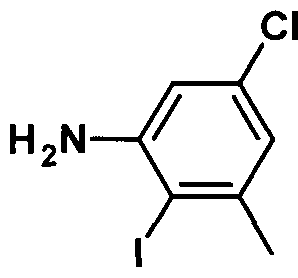
To a solution of 4-iodo-3-methyl-5-nitrobenzonitrile (3.11 g, 10.80 mmol) in ethanol (100 mL) was added iron (6.03 g, 108 mmol), ammonium chloride (1.733 g, 32.4 mmol) and water ( 30 mL). The reaction mixture was stirred at reflux for 1 hour. The reaction mixture was filtered through celite and washed with Ethanol and ethyl acetate. The filtrate was concentrated, the residue was dissolved in ethyl acetate and washed successively with 2M NH4C1 aqueous solution and brine, dried over magnesium sulfate and concentrated. The residue was purified by column chromatography on silica gel (eluting with 10% ethyl acetate in cyclohexane) to give 3-amino-4-iodo-5-methylbenzonitrile (2.55g, 80%) as a brown solid.
LC/MS (Method h) R, = 2.29 min.; MS m/z 259 [M+H]+. Ή NMR (CDC13, 300 MHz): δ 6.87 (s, 1H), 6.77 (s, 1H), 4.41 (broad, 2H), 2.24 (s, 3H).
Step D: ^-(S-cyano-l-iodo-S-methylphenylJbenzenesulfonainide

Using a similar procedure as the one described in Preparation #16 Step B, N-(5-cyano-2-iodo-3- methylphenyl)benzenesulfonamide (9.43 g, 91%) was obtained as an orange solid from 3-amino-4- iodo-5-methylbenzonitrile (6.7 g, 26 mmol). LC/MS (Method k) R, = 2.68 min.; MS m/z: 397 [M-H]~ . Ή NMR (CDC13, 300 MHz): δ 7.72 (m, 2H), 7.64 (m, 1H), 7.50 (m, 1H), 7.41 (m, 2H), 7.16 (m, 1H), 7.09 (s, 1H), 2.34 (s, 3H).
Preparation #19. /A^4-cyano-2-iodophenyi)benzenesulfonamide

Using a similar procedure as the one described in Preparation #16 Step B, N-(4-cyano-2- iodophenyl)benzenesulfonamide (3.7 g, 100%) was obtained as an orange solid from 4-amino-3- iodobenzonitrile (2 g, 8.20 mmol). LC/MS (Method h) R, = 2.41 min.; MS m/z: 383 [M-H]"
Ή NMR (CDCI3, 300 MHz): δ 7.96 (m, 1H), 7.83 (m, 2H), 7.71 (m, 1H), 7.60 (m, 2H), 7.51 (m, 2H), 7.17 (m, 1H).
Preparation #20: /V-(5-cyano-2-iodo henyl)benzenesulfonamide

Using a similar procedure as the one described in Preparation #16 Step B, N-(5-cyano-2- iodophenyl)benzenesulfonamide (1.6 g, 51%) was obtained as an orange solid from 3-amino-4- iodobenzonitrile (2 g, 8.20 mmol). LC/MS (Method h) R, = 2.38 min.; MS m z: 383 [M-H]"
Ή NMR (DMSO-i/6, 300 MHz): δ 10.14 (broad, 1H), 8.05 (d, J = 6Hz, 1H), 7.70 (m, 3H), 7.61 (m, 2H), 7.42 (d, J = 9Hz, 1H), 7.36 (d, J = 3Hz, 1H).
Preparation #21 : jV-l,3-dimethyl-5-(trifluoromethyl)benzene-l,2-diamine

In a Parr reactor were introduced under nitrogen, 2-bromo-6-methyl-4-(trifluoromethyl)aniline (described in WO2009/009411) (14.5 g, 57.1 mmol) in tetrahydrofuran (14.5 mL). Methylamine (40% in water) (72.5 mL, 2094 mmol) and copper(I) oxide (0.817 g, 5.71 mmol) were added. The reactor was closed under nitrogen and warmed at 110°C, during 16 hours. Water was added to the mixture and it was extracted with ethyl acetate. The organic layer was washed with water, dried over magnesium sulfate, filtered and evaporated. The residue was purified by column chromatography on silica gel (eluting with 5-40% ethyl acetate in cyclohexane) to give N-l,3-dimethyl-5-(trifluoromethyl)benzene- 1,2-diamine (2.26 g, 19%). LC/MS (Method h) Rt = 2.07 min.; MS m/r. 205 [M+H]+ Ή NMR (DMSO-c 6, 300 MHz): δ 6.68 (s, 1H), 6.42 (s, 1H), 4.99 (d, J = 5Hz, 1H), 4.85 (s, 2H), 2.73 (d, J = 5Hz, 3H).
Preparation #22: 4-amino-3-methyl-5-(methylamino)benzonitrile N

Step A: 5-bromo-N,3-dimethyl-2-nitroaniline r

To a solution of 5-bromo-l-fluoro-3-methyl-2 -nitrobenzene (5 g, 21.37 mmol) in EtOH, (50 mL) was added methylamine (2M in THF) (32.0 mL, 64.1 mmol) and the reaction mixture was stirred at 70°C for 1.5 hours and overnight at room temperature. 0 (2M in THF) (32.0 mL, 64.1 mmol) was added and the reaction mixture was stirred at 70°C for 1 hour. The reaction mixture was concentrated under reduced pressure. The residue was diluted with ethyl acetate and washed with brine, dried over magnesium sulfate, and evaporated to give 5-bromo-N,3-dimethyl-2-nitroaniline (5.13 g, 98%) as an orange solid.
LC/MS (Method h) Rt = 2.77 min.; MS m/z: 245 [M+H]+. Ή NMR (DMSO-rf6, 300 MHz): 5. 6.86 (s, 1H), 6.77 (s, 1H), 6.72 (m, 1H), 2.77 (d, J= 3Hz, 3H), 2.28 (s, 3H)
Step B: 3-methyl-5-(methylamino)-4-nitrobenzonitrile

In a microwave reactor were added potassium ferrocyanide (3006 mg, 8.16 mmol), Pd(dppf)Cl2 (179 mg, 0.245 mmol), sodium carbonate (865 mg, 8.16 mmol) and 5-bromo-N,3-dimethyl-2-nitroaniline (2000 mg, 8.16 mmol) in NMP (15 niL). The reaction mixture was stirred under microwave 2 hours at 130°C. The reaction mixture was filtered and washed with ethyl acetate. The filtrate was washed with water and brine. The organic layer was dried over magnesium sulfate, filtered and concentrated under vacuum. The residue was purified by column chromatography on silica gel (eluting with 5-25% ethyl acetate in cyclohexane) to give 3-methyl-5-(methylamino)-4-nitrobenzonitrile (1.21 g, 64%). LC/MS
(Method h) Rt = 2.28 min.; MS m/r. 192 [M+H]+. Ή NMR (DMSO-i/6, 300 MHz): δ.7.13 (s, 1H), 7.01(s, 1H), 6.60 (q, J = 4.8Hz, 1H), 2.76 (d, J = 4.8Hz, 3H), 2.25 (s, 3H)
Step C: 4-amino-3-methyl-5-(methylamino)benzonitrile N

To a suspension of 3-methyl-5-(methylamino)-4-nitrobenzonitrile (1.795 g, 9.39 mmol) in ethyl acetate (84 mL) and methanol (84 mL) was added Pd/C (0.400 g, 1.878 mmol) and the reaction mixture was stirred at room temperature under H2 (1 bar) for 1 hour. The reaction mixture was filtered and washed with ethyl acetate. The filtrate was concentrated under reduced pressure to give 4-amino- 3-methyl-5-(methylamino)benzonitrile (1.51 g, 100%) as a red solid. LC/MS (Method h) Rt = 1.40 min.; MS m/r. 162 [M+H]+. Ή NMR (DMSO-^6, 300 MHz): δ.6.79 (s, 1H), 6.50(s, 1H), 5.18 (s, 2H), 5.02(m, 1H), 2.72 (d, J = 5.1Hz, 3H), 2.06 (s, 3H).
Preparation #23: iV-l,3,5-trimethylbenzene-l,2-diainine

Step A: Ar-(2-methyl-4-(trifluoromethyl)phenyl)acetamide

Acetic anhydride (8.08 niL, 86 mmol) was added to 2-methyl-4-(trifluoromethyl)aniline (5 g, 28.5 mmol) at 0 °C, and the reaction mixture was stirred at 0 °C for 20 minutes. The solid formed was crushed with mortar, put in suspension in water and neutralized with ammonia. The precipitate was filtered and dry under vacuum to give N-(2-methyl-4-(trifluoromethyl)phenyl)acetamide (5.91 g, 95%) as a beige solid.
LC/MS (Method h) Rt = 1.99 min.; MS m/z: 218 [M+H]+. Ή NMR (DMSO-i , 300 MHz): δ. 9.45 (s, 1H), 7.76 (d, J = 8.4Hz, 1H), 7.57 (s, 1H), 7.50 (d, J = 8.4Hz, 1H), 2.30 (s, 3H), 2.11 (s, 3H)
Step B: 7V-(2-methyl-6-nitro-4-(trifluoromethyl)phenyl)acetamide

To a solution of N-(2-methyl-4-(trifluoromethyl)phenyl)acetamide (5.9 g, 27.2 mmol) in sulfuric acid (20 mL, 375 mmol) at 0°C was added nitric acid dropwise (20 mL, 448 mmol). The reaction mixture was stirred at 0°C for 2 hours and at room temperature overnight. The reaction mixture was diluted in water and extracted with ethyl acetate. The layers were separated and the organic layer was washed with NaHC03 saturated aqueous solution and brine. The organic layer was dried over magnesium sulfate, filtered and concentrated to give N-(2-methyl-6-nitro-4-(trifluoromethyl)phenyl)acetamide (6.6 g, 93%).
LC/MS (Method h) Rt = 2.00 min.; MS m/z: 263 [M+H]+. Ή NMR (DMSO-rf6, 300 MHz): δ. 10.14 (broad, 1H), 8.08 (s, 1H), 8.04 (s, 1H), 2.39 (s, 3H), 2.07 (s, 3H).
Step C: 2-methyl-6-nitro-4-(trifluoromethyl)aniline

To a solution of N-(2-methyl-6-nitro-4-(trifluoromethyl)phenyl)acetamide (2.95 g, 11.25 mmol) in MeOH (2.5 mL) and water (1 mL) was added potassium hydroxide (0.189 g, 3.38 mmol) and the
reaction mixture was stirred at 60°C for 18 hours. Ice was poured into the reaction mixture and a precipitate was formed, filtered and washed with cold water. The solid was dried under vacuum to give 2-methyl-6-nitro-4-(trifluoromethyl)aniline (1.65 g, 67%). LC/MS (Method h) R, = 2.51 min.; MS m/z: 219 [M-H]\
'HNMR (DMSO-rf6, 300 MHz): δ. 8.16 (s, 1H), 7.66 (s, 1H), 7.62 (s, 2H), 2.27 (s, 3H).
Step D: 3-methyl-5-(trifluoromethyI)benzene-l,2-diamine
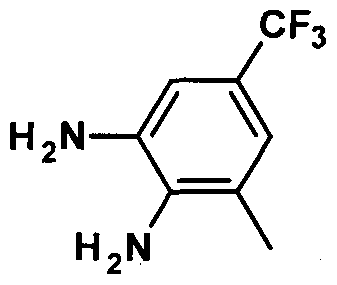
To a solution of 2-methyl-6-nitro-4-(trifluoromethyl)aniline (1.33 g, 6.04 mmol) in ethanol (22 niL) and water (11 mL) were added iron (1.687 g, 30.2 mmol) and calcium chloride (1.341 g, 12.08 mmol) and the reaction mixture was stirred at reflux for 5 hours. The reaction mixture was filtered and the filtrate was concentrated. The residue was purified by column chromatography on silica gel (eluting with 0-5% MeOH in dichloromethane) to give 3-methyl-5-(trifluoromethyl)benzene-l,2-diamine (862 mg, 75%).
LC/MS (Method h) Rt = 1.86 min.; MS m/z: 191 [M+H]+.
Ή NMR (DMSO-J6, 300 MHz): δ. 6.68 (s, 1H), 6.61 (s, 1H), 4.81 (m, 4H), 2.07 (s, 3H).
Step E: ethyl (2-amino-3-methyl-5-(trifluoromethyI)phenyl)carbamate

To a solution of 3-methyl-5-(trifluoromethyl)benzene-l,2-diamine (860 mg, 4.52 mmol) in DMF (9 mL) and cooled at 0 °C was added sodium hydride (109 mg, 4.52 mmol) and the reaction mixture was stirred at 0 °C for 1 hour. Ethyl chloroformate (0.432 mL, 4.52 mmol) was added and the reaction mixture was stirred at room temperature for 18 hours. The reaction mixture was hydrolysed with NH4C1 saturated aqueous solution and extracted with ethyl acetate. The organic layer was dried over magnesium sulfate, filtered and concentrated. The residue was purified by column chromatography on silica gel (eluting with 0-40% ethyl acetate in dichloromethane) to give ethyl (2-amino-3-methyl-5- (trifluoromethyl)phenyl)carbamate (512 mg, 43%) LC/MS (Method h) Rt = 2.28 min.; MS m/z: 263
[M+H]+. Ή NMR (DMSO-</6, 300 MHz): δ. 8.69 (s, 1H), 7.44 (s, 1H), 7.10 (s, 1H), 5.30 (s, 2H), 4.11 (q, J = 7.2Hz, 2H), 2.13 (s, 3H), 1.24 (t, J = 7.2Hz, 3H).
Step F: A'-ljSjS-trimethylbenzene-lj -diamine

To a solution of ethyl (2-amino-3-methyl-5-(trifluoromethyl)phenyl)carbamate (510 mg, 1.945 mmol) in THF (12 mL) cooled at 0°C was added a suspension of L1AIH4 (9.72 mL, 9.72 mmol) in THF (5 mL) and the reaction mixture was refluxed for 18 hours. The reaction mixture was treated at room temperature with Glauber salts for 7 hours and filtered. The filtrate was concentrated. The residue was purified by column chromatography on silica gel (eluting with 0-40% ethyl acetate in dichloromethane) to give Nl,3,5-trimethylbenzene-l,2-diamine (197 mg, 67%). LC/MS (Method h) R, = 1.05 min.; MS m/z: 151 [M+H]+.
Ή NMR (DMSO- , 300 MHz): δ. 6.16 (s, 1H), 6.10 (s, 1H), 4.53 (m, 1H), 3.95 (s, 2H), 2.67 (d, J = 5.1Hz, 3H), 2.10 (s, 3H), 2.00 (s, 3H).
Preparation #24: S-bromo-A^l^-dimethylbenzene-ljZ-diamine

Using a similar procedure as the one described in Preparation #23, Step D, 5-bromo-N-l,3- dimethylbenzene-l,2-diamine (712 mg, 100%) was prepared from 5-bromo-N,3-dimethyl-2- nitroaniline (Preparation #22, Step A) (815 mg, 3.33 mmol). LC/MS (Method h) Rt = 1.93 min.; MS m/z: 215 [M+H]+.
Ή NMR (DMSO-</6, 300 MHz): 5. 6.49 (s, 1H), 6.32 (s, 1H), 4.91 (m, 1H), 4.34 (broad, 2H), 2.67 (d, J= 4.8Hz, 3H), 2.03 (s, 3H).
Preparation #25: e-chloro-A^Z^-dimethylpyridine- ^-diamine I

Step A: 6-chloro-N,4-dimethyl-3-nitropyridin-2-amine

To a solution of 2,6-dichloro-4-methyl-3-nitropyridine (2.2 g, 10.63 mmol) in acetonitrile (60 mL) were added triethylamine (4.44 mL, 31.9 mmol) and methylamine (2M in THF) (6.38 mL, 12.75 mmol) and the reaction mixture was stirred at room temperature for 4 hours. The reaction mixture was quenched with NaHCC>3 saturated aqueous solution and diluted with water and ethyl acetate. The layers were separated and the aqueous one was extracted with ethyl acetate. The organic layer was dried over magnesium sulfate, filtered and concentrated under reduced pressure. The residue was purified by column chromatography on silica gel (eluting with 0-30% ethyl acetate in cyclohexane) to give 6-chloro-N,4-dimethyl-3-nitropyridin-2 -amine (2.05 g, 43%) as a yellow solid. LC/MS (Method h) Rt = 2.45 min.; MS m/z: 202 [M+H]+. Ή NMR (DMSO-i , 400 MHz): δ 7.93 (broad, 1H), 6.72 (s, 1H), 2.89 (s, 3H), 2.38 (s, 3H).
Step B: 6-chloro-/V2,4-dimethylpyridine-2,3-diamine I
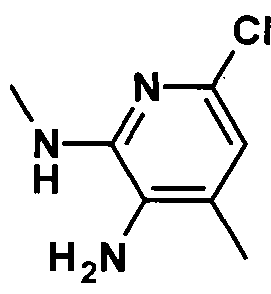
Using a similar procedure as the one described in example Preparation #23, Step D, 6-chloro-N2,4- dimethylpyridine-2,3 -diamine (90 mg, 51%) was prepared from 6-chloro-N,4-dimethyl-3-nitropyridin- 2-amine (200 mg, 0.992 mmol). LC/MS (Method h) R, = 1.40 min.; MS m/z: 172 [M+H]+.
Ή NMR (DMSO-i¾, 300 MHz): δ 6.30 (s, 1H), 5.93 (broad, 1H), 4.48 (broad, 2H), 2.78 (d, J = 3Hz, 3H), 2.00 (s, 3H).
Preparation #26: /V-(2-bromo-5-(trifluoromethyl)pyridin-3-yI)benzenesuIfonamide

Step A: 2-bromo-5-(trifluoromethyl)pyridin-3-aniine

To a solution of 2-bromo-3-nitro-5-(trifluoromethyl)pyridine (described in WO2013/038381) (2.6 g, 9.59 mmol) is ethanol (40 mL) and water (16 mL) was added iron (4.02 g, 72.0 mmol) and acetic acid (3.7 mL). The reaction mixture was stirred at 110°C for 3 hours, then it was filtered and the solvent was evaporated. The residue was diluted with ethyl acetate, and NaHC03 saturated aqueous solution, extracted, dried over magnesium sulfate, filtered and evaporated to give 2-bromo-5- (trifluoromethyl)pyridin-3 -amine (2.35 g, 100%) as a white solid. LC/MS (Method h) R, = 1.91 min.; MS m/r. 241 [M+H]+. 'HNMR (DMSO-C/6, 300 MHz): δ.7.98(s, 1H), 7.34 (s, 1H), 6.06 (s, 2H).
Step B : ^-( -bromo-S-itrifluoromethylJpyridin-S-y benzenesulfonamide
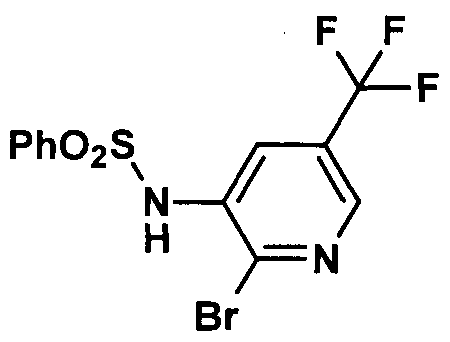
Using a similar procedure as the one described in Preparation #16 Step B, N-(2-bromo-5- (trifluoromethyl)pyridin-3-yl)benzenesulfonamide (954 m g, 50%) was prepared from 2-bromo-5- (trifluoromethyl)pyridin-3 -amine (1.2 g, 4.98 mmol) LC/MS (Method h) R, = 2.52 min.; MS m/r. 381 [M+H]+. ¾ NMR (DMSO-d6, 300MHz,) δ 10.67 (broad, 1H), 8.66 (s, 1H), 7.85 (d, J = 2.3 Hz, 1H), 7.73 (m, 3H), 7.59 (m, 2H).
Preparation #27: Ar-(5-iodo-2-(trifluoromethyl)pyridin-4-yl)benzenesulfonamide

Using a similar procedure as the one described in Preparation #16 Step B, N-(5-iodo-2- (trifluoromethyl)pyridin-4-yl)benzenesulfonamide (13.32 g, 52%) was prepared from 5-iodo-2- (trifluoromethyl)pyridin-4-amine (described in WO2010/091310) (17.3 g, 60.1 mmol) LC/MS
(Method h) Rt = 2.57 min.; MS m/z: 429 [M+H]+. ¾ NMR (DMSO-d6, 300MHz,) δ 8.99 (s, 1H), 7.93 (m, 2H), 7.66 (m, 3H), 7.48 (s, 1H).
Preparation #28: 6-chIoro-4-methylpyridazin-3-amine and 6-chloro-5-methylpyridazin-3-amine

A suspension of 3,6-dichloro-4-methylpyridazine (3.38 g, 20.74 mmol) in ammonium hydroxide (55 mL, 1412 mmol) was heated in a reactor at 130 °C during for about 16 h. The reaction mixture was cooled to room temperature. A precipitate appeared which was filtered, washed with water and dried under vacuum to give an inseparable mixture of 6-chloro-4-methylpyridazin- -amine and 6-chloro-5- methylpyridazin-3 -amine (ratio 57/43) (2.25 g, 76%). Ή NMR (DMSO-d6, 300MHz,) δ 7.30 (s, 1H), 6.45 (broad, 2H), 2.08 (s, 3H) and 6.74 (s, 1H), 6.47 (broad, 2H), 2.19 (s, 3H).
Preparation #29: 7V-(2-iodo-5-(trifluoromethyI)phenyI)benzenesulfonamide

Using a similar procedure as the one described in Preparation #16 Step B, N-[2-iodo-5-
(trifluoromethyl)phenyl]benzenesulfonamide (136 g, 100%) was prepared from 2-iodo-5- (trifluoromethyl)aniline (85 g, 296 mmol) (described in US20070129334).
Preparation #30: 7Vl,3-dimethyl-4-(trifluorometh l)benzene-l,2-diamine

Step A: l-fluoro-4-iodo-3-methyl-2-nitrobenzene

To a solution of 3-fluoro-2-nitrotoluene (lg, 6.45 mmol) in trifluoromethanesulfonic acid (2.83 ml, 32.2 mmol) and cooled at 0°C was added portionwise N-iodosuccinimide (1.740 g, 7.74 mmol) and the mixture was stirred at room temperature for 1 hour. The mixture was poured into water and extracted twice with diethylether. The organic layer was washed successively with a 10% Na2S203 aqueous solution, then brine and concentrated to give l-fluoro-4-iodo-3-methyl-2 -nitrobenzene as a beige solid (1.86 g, 74%).
LC/MS (Method i) Rt = 2.28 min.; no ionization Ή NMR (DMSO-d6, 300MHz): 5 8.16 (dd, J=6 Hz,
9Hz, 1H), 7.31 (t, J=9 Hz, 1H), 2.39 ppm (s, 3H).
Step B: l-fluoro-3-methyI-2-nitro-4-(trifluoromethyI)benzene

To a suspension of l-fluoro-4-iodo-3-methyl-2 -nitrobenzene (2.39 g, 8.50 mmol), copper(I) iodide (2.430 g, 12.76 mmol) and N,N-diisopropylethylamine (4.41 ml, 25.5 mmol) in DMF (8 ml) was added methyl 2,2-difluoro-2-(fluorosulfonyl)acetate (3.25 ml, 25.5 mmol) and the mixture was heated at 80°C for 20 hours in a sealed tube. The reaction mixture was poured into water and extracted twice with ethyl acetate. The organic layer was washed successively with a 10% NaHC03 aqueous solution and brine, dried over magnesium sulfate and concentrated to give l-fluoro-3 -methyl -2 -nitro-4- (trifluoromethyl)benzene (2.37 g, 62%). LC/MS (Method i) Rt = 2.25 min.; no ionization
Ή NMR (DMSO-d6, 300MHz): δ 8.09 (dd, J=6 Hz, 9Hz, 1H), 7.71 (t, J=9 Hz, 1H), 2.43 (m, 1H). Step C: Ar,3-dimethyl-2-nitro-4-(trifluoromethyI)aniline

To a solution of l-fluoro-3 -methyl -2 -nitro-4-(trifluoromethyl)benzene (2.3 g, 10.31 mmol) in methanol (15 ml) was added methylamine (15.46 ml, 30.9 mmol) (2M in THF) and the reaction mixture was stirred at room temperature for 1 hour The reaction mixture was concentrated under reduced pressure and the residue was diluted with ethyl acetate and washed with brine. The organic phase was dried over magnesium sulfate and evaporated. The residue was purified by column chromatography on silica gel (eluting with 5% ethyl acetate in cyclohexane) to give N,3-dimethyl-2-
nitro-4-(trifluoromethyl)aniline (1 g, 43 %) as a yellow solid. LC/MS (Method i) Rt = 2.29 min.; MS m/z 235 [M+H]+.
Ή NMR (DMSO-d6, 300MHz): δ 7.63 (d, J=8.9 Hz, 1H), 6.77 (d, J=8.9 Hz, 1H), 6.59 (broad, 1H), 2.77 (d, 7=4.5 Hz, 3H), 2.24 (m, 3H).
Step D: 7Vl,3-dimethyl-4-(trifluoromethyl)benzene-l,2-diamine

To a suspension of N,3-dimethyl-2-nitro-4-(trifiuoromethyl)aniline (1 g, 4.27 mmol) in ethanol (48 ml) was added iron (2.385 g, 42.7 mmol), ammonium chloride (0.685 g, 12.81 mmol) and water (16 ml) and the reaction mixture was stirred at reflux for 1 hour. The reaction mixture was filtered through celite and the filtrate was concentrated. The residue was dissolved in dichloromethane and washed successively with a 2M NH4C1 aqueous solution and brine; then the organic phase was dried over magnesium sulfate and concentrated to give Nl,3-dimethyl-4-(trifluoromethyl)benzene-l,2-diamine as a yellow solid (884 mg, 77 %). LC/MS (Method i) Rt = 1.96 min.; MS m/z: 205 [M+H]+.
Ή NMR (DMSO-d6, 300MHz): δ 6.87 (d, J=8.4 Hz, 1H), 6.33 (d, J=8.4 Hz, 1H), 5.28 (broad d, J=5.0 Hz, 1H), 4.57 (s, 2H), 2.75 (d, J=5.0 Hz, 3H), 2.12 ppm (m, 3H)
Preparation #31: 4-bromo-Arl,3-dimethylbenzene-l,2-diamine

Step A: 4-bromo-Ar,3-dimethyl-2-nitroaniline

Using a similar procedure as the one described in Preparation #30 Step C, 4-bromo-N,3-dimethyl-2- nitroaniline (428 mg, 82%) was prepared from 1 -bromo-4-fluoro-2-methyl-3 -nitrobenzene (0.5 g, 2.14 mmol). LC/MS (Method h) Rt = 2.73 min.; MS m/z: 245 [M+H]+. ]H NMR (DMSO-d6, 300MHz): δ 7.55 (d, J=9.1 Hz, 1H), 6.65 (d, J=9.1 Hz, 1H), 6.23 (m, 1H), 2.71 (d, J=4.8 Hz, 3H), 2.24 (s, 3H). Step B: 4-bromo-/Vl,3-dimethyIbenzene-l,2-diamine

Using a similar procedure as the one described in Preparation #30 Step D, 4-bromo-Nl,3- dimethylbenzene-l,2-diamine (360 mg, 82%) was prepared from 4-bromo-N,3-dimethyl-2-nitroaniline (425 mg, 1.73 mmol). LC/MS (Method h) Rt = 1.73 min.; MS m/z: 215 [M+H]+. !H NMR (DMSO-d6, 300MHz): δ 6.73 (d, J=8.4 Hz, 1H), 6.21 (d, J=8.4 Hz, 1H), 4.60 (broad, 3H), 2.67 (s, 3H), 2.15 (s, 3H).
Preparation #32: 5-bromo-/Vl-methyl-3- trifluoromethyl)benzene-l,2-diamine

Step A: 5-bromo-l-chloro-2-nitroso-3-(trifluoromethyl)benzene

To a solution of 4-bromo-2-chloro-6-(trifluoromethyl)aniline (1.396 ml, 9.00 mmol) in 1,2- dichloroethane (60 ml) was added 3-chloroperoxybenzoic acid (4.66 g, 27.0 mmol) and the reaction mixture was stirred at room temperature for 20 minutes and at 50°C overnight. Dichloromethane was added and the organic layer was washed successively with a saturated aqueous solution of ammonium thiosulfate and a saturated solution of sodium bicarbonate, then the organic phase was dried over magnesium sulfate and concentrated. The residue was purified by column chromatography on silica gel (eluting with 5% to 20% ethyl acetate in cyclohexane) to give 5-bromo-l-chloro-2-nitroso-3- (trifluoromethyl)benzene as a beige solid (1.89 g, 69%). LC/MS (Method h) R, = 2.98 min.; no ionization
'H NMR (DMSO-d6, 300MHz): δ 8.48 (d, 7=1.8 Hz, 1H), 8.33 (d, J=1.8 Hz, 1H).
Step B: 5-bromo-/V-methyl-2-nitroso-3-(trifluoromethyl)aniline

To a solution of 5-bromo-l-chloro-2-nitroso-3-(trifluoromethyl)benzene (2.7 g, 9.36 mmol) in THF (25 ml) was added methylamine (10.30 ml, 20.59 mmol) (2M in THF) and the reaction mixture was stirred at room temperature for 5 minutes. The reaction mixture was quenched with water and extracted with ethyl acetate. The organic layer was dried with magnesium sulfate, filtered and concentrated under reduced pressure to give 5-bromo-N-methyl-2-nitroso-3-(trifluoromethyl)aniline as a brown liquid (2.65 g, 89%).
LC/MS (Method h) Rt = 2.60 min.; MS m/z: 283 [M+H]+. Ή NMR (DMSO-d6, 300MHz): δ 11.56 (broad, 1H), 7.69 (d, J=1.8 Hz, 1H), 7.39 (d, 7=1.8 Hz, 1H), 2.92 (d, J=5.3 Hz, 3H).
Step C: 5-bromo-7Vl-methyl-3-(trifluoromethyl)benzene-l,2-diamine

Using a similar procedure as the one described in Preparation #23 Step D, 5-bromo-Nl-methyl-3- (trifluoromethyl)benzene-l,2-diamine (1.33 g, 51%) was prepared from 5-bromo-N-methyl-2-nitroso- 3-(trifluoromethyl)aniline (2.65 g, 9.36 mmol). LC/MS (Method h) Rt = 2.67 min.; MS m/z: 269 [M+H]+.
'H NMR (DMSO-d6, 300MHz): δ 6.77 (d, J=2.1 Hz, 1H), 6.60 (d, 7=2.1 Hz, 1H), 5.48 (m, 1H), 5.10 (s, 2H), 2.73 (d, 7=4:8 Hz, 3H).
Preparation #33: tert-but \ 2,4-dichloro-3- l-hydroxyprop-2-yn-l-yl)benzoate

Step A: tert-buty\ 2,4-dichlorobenzoate

Step B: tert-butyl 2,4-dichloro-3-form Ibenzoate

To as solution of tert-butyl 2,4-dichlorobenzoate (13.1 g, 53.0 mmol) in THF (130 ml) and cooled to - 78°C was added dropwise over 10 minutes lithium diisopropylamide (31.8 ml, 63.6 mmol) diluted in THF (25 mL) and already cooled to 0°C. The reaction mixture was stirred for 90 minutes at -75°C then DMF (12.31 ml, 159 mmol) was added and the reaction mixture was stirred for 10 minutes between - 65°C and -75°C. The reaction mixture was quenched with acetic acid (6ml) and allowed to warm to room temperature. The reaction mixture was partitioned between diethyl ether and IN HC1 solution. The aqueous layer was extracted with diethyl ether, the organic layer was dried over magnesium sulfate, and concentrated. The residue was purified by column chromatography on silica gel (eluting with 5-10% ethyl acetate in cyclohexane) to give tert-butyl 2,4-dichloro-3-formylbenzoate (10.6g, 71%) as a yellow oil.
LC/MS (Method h) Rt = 2.88 min.; MS m/z: 275 [M+H]+. Ή NMR (DMSO-d6, 300MHz): δ 10.34 (s, 1H), 7.86 (d, J=8.4 Hz, 1H), 7.69 (d, J=8.4 Hz, 1H), 1.56 (s, 9H).
Step C: tert-butyl 2,4-dichloro-3-(l-h droxyprop-2-yn-l-yI)benzoate

Using a similar procedure as the one described in Preparation #1 Step D, ier -butyl 2,4-dichloro-3-(l- hydroxyprop-2-yn-l-yl)benzoate (4 g, 100%) was prepared from /er/-butyl 2,4-dichloro-3- formylbenzoate (3.39 g, 12.3 mmol). LC/MS (Method i) Rt = 2.14 min.; MS m/z: 301 [M+H]+.
Ή NMR (DMSO-d6, 300MHz): δ 7.56 (s, 2H), 6.26 (d, J=5.0 Hz, 1H), 6.10 (dd, d, J=5.0 Hz and 2.3 Hz, 1H), 3.51 (d, J=2.3 Hz, 1H), 1.55 (s, 9H).
Preparation #34 : V-(2-iodo-6-methyl-4-(trifluoromethyl)phenyl)benzenesulfonamide

Step A: 2-iodo-6-methyl-4-(trifluoromethyl)aniline

To a solution of 2-methyl-4-(trifluoromethyl)aniline (3.5 g, 19.98 mmol) in ethanol (80 ml) was added iodine (5.07 g, 19.98 mmol) and silver sulfate (6.23 g, 19.98 mmol), and the reaction mixture was stirred at room temperature for 2 hours. The reaction mixture was diluted with a 10% Na2S203 aqueous solution. The obtained aqueous layer was extracted with ethyl acetate and the organic layer was dried over magnesium sulfate, filtered and concentrated under reduced pressure to give 2-iodo-6-methyl-4- (trifluoromethyl)aniline as an orange resin (6.3 g, 90%). LC/MS (Method i) Rt = 2.32 min.; MS m/r. 302 [M+H]+. Ή NMR (DMSO-d6, 300MHz): δ 7.70 (s, 1H), 7.31 (s, 1H), 5.55 (s, 2H), 2.20 (s, 3H) Step B: 7V-(2-iodo-6-methyl-4-(trifluoromethyI)phenyI)benzenesulfonamide

Using a similar procedure as the one described in Preparation #16 Step B, N-(2-iodo-6-mefhyl-4- (trifluoromethyl)phenyl)benzenesulfonamide (2.73 g, 32%) was prepared from 2-iodo-6-methyl-4- (trifluoromethyl)aniline (5.8 g, 19.3 mmol). LC/MS (Method i) R, = 2.35 min.; MS m/r. 442 [M+H]+. ¾ NMR (DMSO-d6, 300MHz): δ 10.03 (s, 1H), 8.01 (d, J=2.1 Hz, 1H), 7.60 (m, 6H), 2.04 (s, 3H).
Preparation #35 : /V-(5-bromo-2-iodo-3-methylphenyl)benzenesulfonamide

Step A: 5-bromo-2-iodo-l-methyl-3-nitrobenzene r

To a solution of 4-bromo-2-methyl-6-nitroaniline (250 mg, 1.082 mmol) in chloroform (1.6 ml) was added isoamyl nitrite (190 mg, 1.623 mmol) and iodine (549 mg, 2.164 mmol) and the reaction mixture was stirred at reflux for 3.5 hours. The reaction mixture was diluted with a 50% Na2S203 aqueous solution. The obtained aqueous layer was extracted with ethyl acetate. The organic layer was dried over magnesium sulfate, filtered and concentrated under reduced pressure to give 5-bromo-2- iodo-l-methyl-3 -nitrobenzene (350 mg, 30%) as a brown resin. It was used crude in the next step. LC/MS (Method h) Rt = 2.90 min.; no ionization
Step B: 5-bromo-2-iodo-3-methylaniIine r

Using a similar procedure as the one described in Preparation #23 Step D, 5-bromo-2-iodo-3- methylaniline (1.6 g, 56%) was prepared from 5 -bromo-2-iodo-l-methyl-3 -nitrobenzene (7.25 g, 8.69 mmol). It was used crude in the next step. LC/MS (Method h) Rt = 2.74 min.; MS m/z: 312 [M+H]+. Ή NMR (DMSO-d6, 300MHz): δ 6.76 (d, J=2.5 Hz, 1H), 6.70 (m, 1H), 5.49 (s, 2H), 2.29 (s, 3H). Step C: 7V-(5-bromo-2-iodo-3-methylphenyl)benzenesulfonamide r

Using a similar procedure as the one described in Preparation #16 Step B, N-(5-bromo-2-iodo-3- methylphenyl)benzenesulfonamide (2.21 g, 95%) was prepared from 5-bromo-2-iodo-3-methylaniline (1.6 g, 5.13 mmol). LC/MS (Method h) Rt = 2.94 min.; MS m/z: 450 [M-H]\
Ή NMR (DMSO-d6, 300MHz): δ 9.95 (s, 1H), 7.65 (m, 5H), 7.44 (d, 7=2.1 Hz, 1H), 6.87 (d, J=2.1 Hz, 1H), 2.36 (s, 3H).
Preparation #36: Preparation of methyl -(l-hydroxyprop-2-yn-l-yl)-4,6-dimethylnicotinate

Step A: 5-bromo-4,6-dimethyl-2-oxo-l ,2-dihydropyridine-3-carbonitriIe

To a solution of 4,6-dimethyl-2-oxo-l,2-dihydropyridine-3-carbonitrile (35 g, 236 mmol) in Acetic Acid (200ml) was added bromine (41.5 g, 260 mmol). The reaction mixture stirred for about 30 min at ambient temperature. The reaction mixture was then concentrated to dryness under reduced pressure. The resulting resin precipitated from aqueous EtOH to obtain 5-bromo-4,6-dimethyl-2-oxo-l ,2- dihydropyridine-3-carbonitrile (70 g, 95%). LCMS (Table 1, Method c) RT= 1.63 min.; MS m/z = 226, 228 (M+H).
Step B: 5-bromo-2-chloro-4,6-dimethyInicotinonitrile

To a solution of 5-bromo-4,6-dimethyl-2-oxo-l,2-dihydropyridine-3-carbonitrile (14g, 61.7 mmol) in POCl3 (10 mL) was added pentachlorophosphorane (12.84 g, 61.7 mmol). The reaction was heated to reflux for about 8 h. The POCI3 was concentrated under reduced pressure. The resulting residue was partitioned between DCM (100 mL) and 5% aqueous NaOH (100 mL). The combined organic extracts were dried over anhydrous MgS04, filtered, and concentrated in vacuo. The resulting residue was dissolved in POCl3 (20 mL) and treated with pentachlorophosphorane (13 g, 62.4 mmol). The reaction was heated to reflux for about 12 h. The POCI3 was concentrated under reduced pressure. The resulting residue was partitioned between DCM (100 mL) and 5% aqueous NaOH (100 mL). The combined organic extracts were dried over anhydrous MgS04, filtered, and concentrated in vacuo to provide 5-bromo-2-chloro-4,6-dimethylnicotinonitrile (12 g, 79 %). LCMS (Table 1, Method d) RT= 2.12 min.; MS m/z = 246, 248 (M+H).
Step C: 5-bromo-4,6-dimethylnicotinonitrile

To a mixture of 5-bromo-2-chloro-4,6-dimethylnicotinonitrile (10 g, 40.7 mmol) and red phosphorus (12.62 g, 407 mmol) was added HI (44.7 ml, 489 mmol). The reaction was stirred at about 120 °C for about 4 h. The mixture was cooled to ambient temperature then poured into saturated aqueous
NaHC03 (500 mL) and Na2S03 (10 g). The solids were filtered off and the remaining filtrate was concentrated in vacuo. The resulting solid was extracted with MeOH, then concentrated under reduced pressure to provide 5-bromo-4,6-dimethylnicotinonitrile (7 g, 44.0 %). LCMS (Table 1, Method f) RT= 1.63 min.; MS m/z = 211, 213 (M+H).
Step D: 5-bromo-4,6-dimethylnicotinic acid

To a mixture of 5-bromo-4,6-dimethylnicotinonitrile (10 g, 47.4 mmol) in water (20 mL) was added KOH (26.6 g, 47.4 mmol). The reaction was stirred at about 110 °C for about 16 h. The reaction mixture was then cooled to ambient temperature and was neutralized by the addition of concentrated HC1. The resulting solid was filtered to provide 5-bromo-4,6-dimethylnicotinic acid (9 g, 79 %). LCMS (Table 1 , Method e) RT= 1.61 min.; MS m/z = 232, 233 (M+H).
Step E: methyl 5-bromo-4,6-dimethylnicotinate

To a solution of 5-bromo-4,6-dimethylnicotinic acid (lOg, 43.5 mmol) in MeOH (10 ml) was added thionyl chloride (5.17 g, 43.5 mmol) at about 0°C. The reaction mixture was heated to about 80 °C. After about 12 h, the reaction mixture was concentrated in vacuo. The resulting residue was diluted with DCM, dried over anhyudrous Na2S04, filtered, and concentrated under reduced pressure to provide methyl 5-bromo-4,6-dimethylnicotinate (9.6 g, 81 %). LCMS (Table 1, Method e) RT= 1.99 min.; MS m z = 245, 246 (M+H).
Step F: methyl 4,6-dimethy

Methyl 5-bromo-4,6-dimethylnicotinate (15g, 61.5 mmol), 4,4,5,5-tetramethyl-2-vinyl-l,3,2- dioxaborolane (14.2 g, 92 mmol), Pd(PPh3)4 (7.1 g, 6.1 mmol), and KF (5.4 g, 92 mmol) were combined in DMF (20 mL) The mixture was heated to about 100 °C for about 16 h. The mixture was cooled to rt and the solvent was concentrated in vacuo. The remaining residue was purified by silica gel chromatography (10:1 petroleum ether/EtOAc) to provide methyl 4,6-dimethyl-5-vinylnicotinate (9 g, 56%). LC/MS (Table 1, Method e) RT= 1.23 min.; MS m/z = 192 (M+H).
Step G: methyl 5-formyl-4,6-

To a solution of methyl 4,6-dimethyl-5-vinylnicotinate (12 g, 62.8 mmol) and 2,6-dimethylpyridine (8 mL, 69 mmol) in a 3:1 mixture of l,4-Dioxane:Water (50.0 ml) was added Os04 (12 mL, 0.94 mmol,
0.08 M in /-BuOH) and sodium periodate (40 g, 188 mmol). The mixture was stirred at rt for about 36 h. The reaction mixture was filtered, and the filtrate was washed with saturated aqueous Na2S203. The mixture was extracted with EtOAc, dried over anhydrous Na2S04, filtered, and concentrated in vacuo. The crude material was purified by silica gel chromatography (5:1 to 2:1 petroleum ether: EtOAc) to provide methyl 5-formyl-4,6-dimethylnicotinate (8 g, 59%). LCMS (Table 1, Method d) RT= 1.55 min.; MS m/z = 194 (M+H).
Step H: methyl 5-(l-hydroxyprop-2-yn-l-yl)-4,6-dimethylnicotinate

To a solution of methyl 5-formyl-4,6-dimethylnicotinate (8 g, 37.3 mmol) in anhydrous THF (100 ml) at about 0 °C was added ethynyl magnesium bromide (82 ml, 41 mmol) The resulting reaction was stirred at about 0 °C for about 1 h. The reaction was diluted with methylene chloride, washed with saturated aqueous NH4C1 (3 x 100 mL). The organic layer was dried over anhydrous Na2S04, filtered, and concentrated in vacuo. The crude material was purified by silica gel chromatography (2:1 hexanes .EtOAc) to provide methyl 5-(l-hydroxyprop-2-yn-l-yl)-4,6-dimethylnicotinate (6 g, 73 %). LCMS (Table 1, Method c) RT= 1.73 min.; MS m/z = 220 (M+H).
Preparation #37: ethyl 3,5-dichloro-4-(l-hydroxyprop-2-yn-l-yl)picolinate
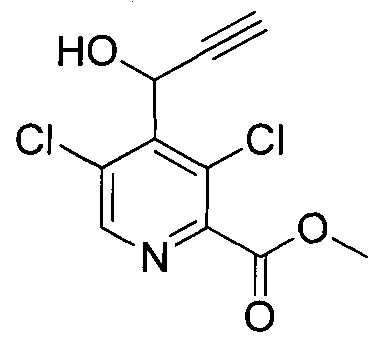
Step A: 2,3,5-trichloroisonicotinaIdehyde

To a solution of LDA (99 mL, 197 mmol) in THF (lOOmL), was added a solution of 2,3,5- trichloropyridine (30 g, 164 mmol) in THF (200 mL) at about -78 °C. The resulting reaction was stirred at about -78 °C for about 1 h. Methyl formate (20 mL, 329 mmol) was added carefully to the reaction, then the mixture was stirred at about -78 °C for about lh, then warmed to rt and stirred for 16 h. The reaction was poured into saturated aqueous NH4C1. The aqueous layer was extracted with EtOAc (3 x 20 mL). The combined organic layers were dried over anhydrous Na2S04, filtered through sintered glass funnel, and concentrated under reduced pressure to give 2,3,5-
trichloroisonicotinaldehyde (26.2 g, 53 %, 70% purity). LCMS (Table 1, Method c) RT= MS m/z = 209, 211 (M+H).
Step B: 2,3,5-trichloro-4-(diethoxymethyl)pyridine

A mixture of 2,3,5-trichloroisonicotinaldehyde (26.2 g, 87 mmol), />-toluenesulfonic acid monohydrate (18.23 g, 96 mmol), MgS04 (11.54 g, 96 mmol) and triethyl orthoformate (21.77 mL, 131 mmol) in DCE (300 mL) was heated to about 50 °C for about 5 h. The solution was diluted with water, extracted with DCM (3 x 50 mL). The combined organic layers were dried over anhydrous Na2S04, filtered, and concentrated under reduced pressure to afford 2,3,5-trichloro-4-(diethoxymethyl)pyridine (20.67 g, 75 %). LCMS (Table 1, Method d) RT= 2.12 min.; MS m/z = 284, 286 (M+H).
Step C: ethyl 3,5-dichloro-4-(diethoxymethyI)picolinate
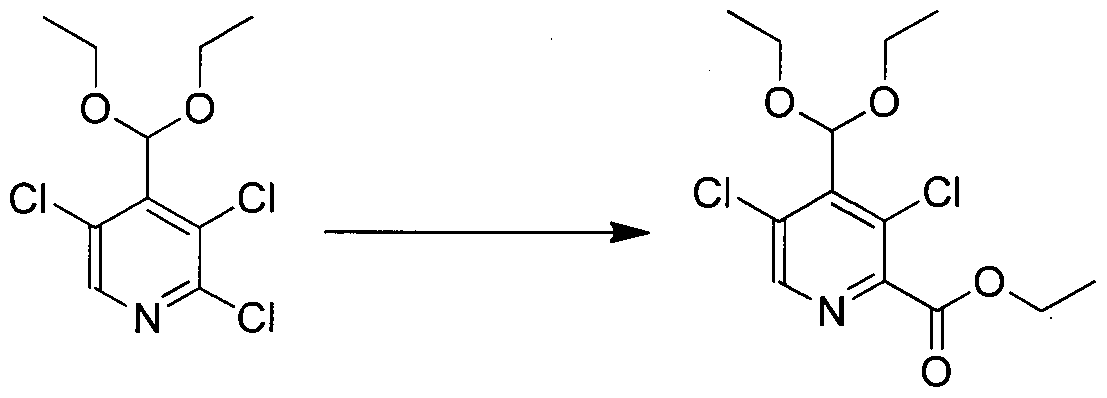
A solution of 2,3,5-trichloro-4-(diethoxymethyl)pyridine (20 g, 70.3 mmol). PdCl2(PPh3)2 (4.93 g, 7.03 mmol), and TEA (29 mL, 211 mmol) in Ethanol (200 mL) was treated with with CO at a pressure of 30 bar and was heated to about 100 °C in a sealed tube for about 24 h. The reaction was filtered through a pad of celite, and the filtrate was concentrated under reudced pressure. The crude material was was purified via silicagel chromatography eluting with 5% EtO Ac/Heptanes to give ethyl S,5-dichloro-4-(diethoxymethyl)picolinate (14 g, 61.8 %). LCMS (Table 1, Method d) RT= 2.02 min.; MS m/z = 322, 324 (M+H).
Step D: ethyl 3,5-dichloro-4-formylpicolinate

A round bottom flask was charged with a mixture of ethyl 3,5-dichloro-4-(diethoxymethyl)picolinate (14 g, 43.5 mmol) and HC1 (100 mL, 3291 mmol). The reaction stirred for about lh at rt. The reaction was diluted with ethyl acetate, washed with IN aq. NaOH (3 x 50 mL). The organic portion
was dried over anhydrous Na2SC>4, filtered through sintered glass funnel, and concentrated under reduced pressure to give ethyl 3,5-dichloro-4-formylpicolinate (10 g, 93%). LCMS (Table 1, Method d) RT= 1.92 min.; MS m/z = 247, 249 (M+H).
Step E: ethyl 3,5-dichloro-4-(l-hydroxyprop-2-yn-l-yl)picolinate

To a solution of ethyl 3,5-dichloro-4-formylpicolinate (9.6 g, 32.9 mmol) in anhydrous THF (100 ml) at about 0 °C was added ethynyl magnesium bromide (72 mL, 36.2 mmol) The resulting reaction was stirred at about 0 °C for about 1 h. The reaction was diluted with methylene chloride, washed with saturated aqueous NH4CI (3 x 100 mL). The organic layer was dried over anhydrous Na2S04, filtered, and concentrated in vacuo. The crude material was purified by silica gel chromatography (10% EtOAc/Heptanes) to provide ethyl 3,5-dichloro-4-(l-hydroxyprop-2-yn-l-yl)picolinate (7.9 g, 88 %). LC MS (Table 1, Method d) RT= 1.65min.; MS m/z = 274, 276 (M+H).
Preparation #38: Preparation of ethyl 4,6-dichloro-5-(l-hydroxyprop-2-yn-l-yl)nicotinate

Step A: ethyl 4,6-dichloronicotinate

A mixture of 4,6-dichloronicotinic acid (20 g, 104 mmol) in DCM (200 mL) was cooled to 0 °C before the addition of DMF (0.807 ml, 10.42 mmol) and oxalyl chloride (10.94 ml, 125 mmol). The resulting reaction was stirred at about 0 °C-25 °C. After about 2h, EtOH (48,7 ml, 833 mmol) was slowly added and stirred at about 25 °C for 2 h. The reaction mixture was diluted with ether (50 mL) and the resulting solution was washed with saturated aqueous NaHC03 (3 x 50 mL). The extracts were combined and dried over anhydrous Na2S04, filtered, and the solvent was removed in vacuo to
provide ethyl 4,6-dichloronicotinate (18 g. 79%): LC/MS (Table 1, Method d) Rt=1.91 min.; MS m/z = 220 (M+H).
Step B: ethyl 4,6-dichloro-5-form lnicotinate

To a flask containing LDA (27.3 mL, 54.5 mmol) in THF (100 mL) was added a solution of ethyl 4,6- dichloronicotinate (10 g, 45.4 mmol) in THF (200 ml) such that the internal temperature was maintained at about -78 °C. After about 30 min, methyl formate (5.57 ml, 91 mmol) was added dropwise to the reaction mixture and stirred at -78°C for lh. The reaction mixture was then poured into saturated aqueous NaaSC^, filtered, and concentrated in vacuo. The residue was purified by silica gel chromatography (20:1 hexanes:EtOAc) to provide ethyl 4,6-dichloro-5-formylnicotinate (5.19 g, 46 %). LCMS (Table 1, Method c) RT= 1.95 min.; MS m/z = 248 (M+H).
Step C: ethyl 4,6-dichloro-5-(l-hydroxyprop-2-yn-l-yl)nicotinate

To a solution of ethyl 4,6-dichloro-5-formylnicotinate (12.9 g, 52.0 mmol) in anhydrous THF (120 mL) at about 0 °C was added ethynylmagnesium bromide (114 ml, 57.2 mmol). The resulting reaction was stirred at about 0 °C for about 1 h. The reaction was diluted with methylene chloride, washed with saturated aqueous NH4CI (3 x 100 mL). The organic layer was dried over anhydrous
 filtered, and concentrated in vacuo. The crude material was purified by silica gel chromatography (10:1 Hexanes/EtOAc) to provide ethyl 4,6-dichloro-5-(l-hydroxyprop-2-yn-l-yl)nicotinate (11.1 g, 78 %). LCMS (Table 1, Method d) RT= 1.70 min.; MS m/z = 274 (M+H).
Preparation #39: A-(3-iodo-2-methyl-6-(trifluoromethyl)pyridin-4-yl)benzenesulfonamide


To a solution of 2-bromo-6-methyl-4-nitropyridine (WO2013/059587) (1.84 g, 8.48 mmol) and copper(I) iodide (1.938 g, 10.17 mmol) in NMP ( 15.73 ml) was added methyl 2,2-difluoro-2- (fluorosulfonyl)acetate (3.24 ml, 25.4 mmol) and the reaction was irradiated under microwave at 100°C for 5 hours. The reaction mixture was washed with water and extracted with ethyl acetate. The organic layer was dried over magnesium sulfate, filtered and concentrated under reduced pressure to give 2-methyl-4-nitro-6-(trifluoromethyl)pyridine (1.48 g, 80%). LC/MS (Method h) Rt = 2.16 min; no ionization ¾ NMR (DMSO-d6, 300MHz): δ 8.41 (d, J=1.8 Hz, 1H), 8.32 (d, J=1.8 Hz, 1H), 2.74 (s, 3H)
Step B: 2-methyl-6-(trifluoromethyl)pyridin-4-amine

Using a similar procedure as the one described in Preparation #18 Step C, methyl-6- (trifluoromethyl)pyridin-4-amine (409 mg, 42%) was prepared from 2-methyl-4-nitro-6- (trifluoromethyl)pyridine (1.05 g, 5.09 mmol). LC/MS (Method k) Rt = 2.15 min.; MS m/r. Ill [M+H]+.
Ή NMR (DMSO-d6, 300MHz): δ 6.73 (d, J=l .7 Hz, 1H), 6.49 (d, J=l .7 Hz, 1H), 6.42 (s, 2H), 2.29 (s, 3H).
Step C: 3-iodo-2-methyl-6-(trifluoromethyI)pyridin-4-amine

To a solution of 2-methyl-6-(trifluoromethyl)pyridin-4-amine (405 mg, 2.299 mmol) in ethanol (8 mL) was added silver sulfate (717 mg, 2.299 mmol) and iodine (584 mg, 2.299 mmol) and the reaction
mixture was stirred at room temperature for 4 hours. The reaction mixture was quenched with a saturated Na2S203 aqueous solution and extracted twice with ethyl acetate. The organic layer was dried over magnesium sulfate, filtered and concentrated under reduced pressure. The residue was purified by column chromatography on silica gel (eluting with 5-40% ethyl acetate in cyclohexane) to give 3-iodo- 2-methyl-6-(trifluoromethyl)pyridin-4-amine (608 mg, 88%) as an amorphous solid. LC/MS (Method i) Rt = 1.78 min.; MS m/r. 303 [M+H]+. Ή NMR (DMSO-d6, 300MHz): δ 6.86 (s, 1H), 6.63 (broad, 2H), 2.59 (s, 3H).
Step D: 7V-(3-iodo-2-methyl-6-(trifluoromethyl)pyridin-4-yl)benzenesulfonamide

Using a similar procedure as the one described in Preparation #16 Step B, N-(3-iodo-2-methyl-6- (trifluoromethyl)pyridin-4-yl)benzenesulfonamide (414 mg, 33%) was prepared from 3-iodo-2- methyl-6-(trifluoromethyl)pyridin-4-amine (740 mg, 2.45 mmol). LC/MS (Method i) Rt = 2.24 min.; MS m/r. 443 [M+H]+. Ή NMR (DMSO-d6, 300MHz): δ 7.90 (m, 2H), 7.64 (m, 3H), 7.22 (s, 1H), 2.70 (s, 3H).
Preparation #40 : iV-(6-cyano-3-iodo-2-methylpyridin-4-yI)benzenesulfonamide

Step A: 4-amino-5-iodo-6-methylpicolinonitrile

To a solution of 4-amino-6-methylpicolinonitrile (1.756 g, 13.19 mmol) (described in WO2005/030213) in acetonitrile (44.0 ml) was added N-iodosuccinimide (3.26 g, 14.51 mmol) and the reaction mixture was stirred at reflux for 24 hours. The reaction mixture was hydrolyzed with a
saturated Na2S203 aqueous solution and extracted with ethyl acetate. The organic layer was dried over magnesium sulfate, filtered and concentrated under reduced pressure. The residue was purified by column chromatography on silica gel (eluting with 5-60% ethyl acetate in cyclohexane) to give 4- amino-5-iodo-6-methylpicolinonitrile (1.18g, 34%) as a brown solid. LC/MS (Method h) Rt = 1.55 min.; MS m/∑: 260 [M+H]+.
Ή NMR (DMSO-d6, 500MHz): δ 6.88 (s, 1H), 6.66 (broad, 2H), 2.55 (s, 3H)
Step B: 7V-(6-cyano-3-iodo-2-methylpyridin-4-yl)benzenesulfonamide

Using a similar procedure as the one described in Preparation #16 Step B, N-(6-cyano-3-iodo-2- methylpyridin-4-yl)benzenesulfonamide (400 mg, 23%) was prepared from 4-amino-5-iodo-6- methylpicolinonitrile (1.15 g, 4.44 mmol). The compound was used directly in the next step.
LC/MS (Method h) Rt = 2.28 min.; MS m/z: 400 [M+H]+.
Preparation #41: 4-methyl-6-(trifluoromethyl)pyridazin-3-amine

Step A: 4-bromo-6-(trifluoromethyl)pyridazin-3-amine

To a solution of 6-(trifluoromethyl)pyridazin-3-amine (730 mg, 4.48 mmol) and sodium bicarbonate (752 mg, 8.95 mmol) in methanol (15 ml) was added bromine (0.231 ml, 4.48 mmol) dropwise. The reaction mixture was stirred at room temperature for one night, then hydrolyzed with a saturated Na2S20 aqueous solution. The methanol was evaporated and the resulting solution was diluted with ethyl acetate and the two phases were separated. The organic layer was washed with a saturated Na2S203 aqueous solution, dried over magnesium sulfate, filtered and concentrated under reduced
pressure. The residue was purified by column chromatography on silica gel (eluting with 7-60% ethyl acetate in cyclohexane) to give 4-bromo-6-(trifluoromethyl)pyridazin-3-amine (513 mg, 47%) as a beige solid. LC/MS (Method i) Rt = 1.33 min.; MS m/z: 242 [M+H]+. ¾ NMR (DMSO-d6, 300MHz): δ 8.23 (s, 1H), 7.55 (broad, 2H).
Step B: 4-methyl-6-(trifluoromethyl)pyridazin-3-amine

To a solution of 4-bromo-6-(trifluoromethyl)pyridazin-3-amine (460 mg, 1.901 mmol), tris(dibenzylideneacetone)dipalladium(0) (17.41 mg, 0.019 mmol), 2-(dicyclohexylphosphino)-2',4',6'- triisopropylbiphenyl (36.2 mg, 0.076 mmol) and potassium phosphate tribasic (807 mg, 3.80 mmol) in 1,4-dioxane (3.7 ml) was added trimethylboroxine (0.398 ml, 2.85 mmol). The reaction mixture was stirred at 100°C for one night, then diluted with H20. The obtained aqueous layer was extracted with ethyl acetate and the obtained organic layer was dried over magnesium sulfate, filtered and concentrated under reduced pressure. The same procedure was done three times with the obtained residue to increase conversion. The residue was purified by column chromatography on silica gel (eluting with 7-60% ethyl acetate in cyclohexane) to give 4-methyl-6-(trifluoromethyl)pyridazin-3- amine (318 mg, 94%) as a beige solid.
LC/MS (Method i) R, = 0.88 min.; MS m/z: 178 [M+H]+.
Ή NMR (DMSO-d6, 300MHz): δ 7.54 (s, 1H), 6.94 (br. s., 2H), 2.09 (s, 3H)
Preparation #42: 3,7-dimethyl-5-(trifluoromethyl)-lH-indazole

Step A: 2-fluoro-3-methyl-5-(trifluoromethyl)benzaldehyde

To a solution of 4-fluoro-3-methylbenzotrifluoride (1.5 g, 8.42 mmol) in THF (11 ml) and cooled at - 78°C was added butyllithium (5.42 ml, 8.67 mmol). The mixture was stirred for 30 minutes at -78°C, then a solution of DMF (0.724 ml, 9.35 mmol) in THF (3 ml) was added drop by drop. The reaction was stirred at -78°C for 1 hour and then warmed to 0°C. A 10% solution of citric acid was added to the reaction mixture at 0°C and the mixture was extracted with ethyl acetate. The organic layer was washed with brine and dried over magnesium sulfate, filtered and evaporated to give 2-fluoro-3- methyl-5-(trifluoromethyl)benzaldehyde (2 g, 100%) as a colorless liquid. LC MS (Method h) R, = 2.52 min.; no ionization ¾ NMR (DMSO-d6, 300MHz): δ 10.23 (s, 1H), 8.09 (m, 1H), 7.97 (m, 1H), 2.39 ppm (m, 3H)
Step B: l-(2-fluoro-3-methyl-5-(trifluoromethyl)phenyI)ethanol

To a solution of 2-fluoro-3-methyl-5-(trifluoromethyl)benzaldehyde (2 g, 9.70 mmol) in THF (42 ml) and cooled at -50°C was added methylmagnesium bromide (3.88 ml, 11.64 mmol) and the mixture was stirred at room temperature for 2 hours. The mixture was quenched with a NH4C1 saturated aqueous solution and extracted with ethyl acetate. The organic layer was washed with brine dried over magnesium sulfate, filtered and evaporated to give l-(2-fluoro-3-methyl-5- (trifiuoromethyl)phenyl)ethanol (1.21 g, 41%) as a colorless liquid: LC/MS (Method h) Rt = 2.42 min.; MS m/z: 281 [M-H]"+CH3COOH
Ή NMR (DMSO-dg, 300MHz): δ 7.65 (m, 1H), 7.59 (m, 1H), 5.53 (d, J=4.6 Hz, 1H), 5.00 (m, 1H),
2.30 (d, J=2.3 Hz, 3H), 1.34 (d, J=6.6 Hz, 3H).
Step C: l-(2-fluoro-3-methyl-5-(trifluoromethyl)phenyl)ethanone

Using a similar procedure as the one described in Preparation #14 Step B, l-(2-fluoro-3-methyl-5- (trifluoromethyl)phenyl)ethanone (854 mg, 75%) was prepared from l-(2-fluoro-3-methyl-5- (trifluoromethyl)phenyl)ethanol (1.1 g, 4.95 mmol). LC/MS (Method h) Rt = 2.63 min.; no ionization ¾ NMR (DMSO-d6, 300MHz): δ 7.99 (m, 1H), 7.91 (m, 1H), 2.63 (d, J=4.3 Hz, 3H), 2.37 (d, J=2.5 Hz, 3H).
Step D: 3,7-dimethyl-5-(trifluoromethyl)-lH-indazole

To a solution of l-(2-fluoro-3-methyl-5-(trifluoromethyl)phenyl)ethanone (200 mg, 0.908 mmol) in ethane- 1,2-diol (700 μΐ, 12.55 mmol) was added hydrazine hydrate (53.0 μΐ, 1.090 mmol) and the mixture was stirred at room temperature for 20 hours. More hydrazine hydrate (53.0 μΐ, 1.090 mmol) was added and the mixture was heated to 50°C for 1 hour. The heated was increased to 170°C and continued for 2 hours. The mixture was cooled to room temperature: the final indazole precipitated. It was diluted with water, filtrated; and rinsed with water and dried at 50°C under vacuum to give 3,7- dimethyl-5-(trifluoromethyl)-lH-indazole (130 mg, 61%) as a white solid. LC/MS (Method i) Rt = 1.99 min.; MS m/z: 215 [M+H]+ lU NMR (DMSO-d6, 300MHz): δ 13.14 (broad, 1H), 7.97 (s, 1H), 7.39 (s, 1H), 2.55 (s, 3H), 2.54 (s, 3H).
Preparation #43: 3,7-dimethyl-5-(trifluoromethyl)-lH-indole

Step A: /V-allyl-2-iodo-6-methyI-4-(trifluoromethyl)aniline

To a solution of 2-iodo-6-methyl-4-(trifluoromethyl)aniline (Preparation #34, Step A) (11. lg, 36.9 mmol) in toluene (56 ml) was added potassium carbonate (7.64 g, 55.3 mmol), tetrabutylammonium bromide (1.189 g, 3.69 mmol), potassium hydroxide (2.276 g, 40.6 mmol) and allyl bromide (5.80 g, 47.9 mmol) The reaction mixture was stirred at 65°C for 18 hours. More potassium carbonate (0.8eq), tetrabutylammonium bromide (0.05eq), potassium hydroxide (0.5eq) and allyl bromide (0.6eq) were then added. The reaction mixture was stirred at 65°C for 18 hours. More potassium carbonate (0.8eq), tetrabutylammonium bromide (0.05eq), potassium hydroxide (0.5eq) and allyl bromide (0.6eq) were then added. The reaction mixture was stirred at 65°C for 18 hours. More potassium carbonate (0.8eq), tetrabutylammonium bromide (0.05eq), potassium hydroxide (0.5eq) and allyl bromide (0.6eq) were then added. The reaction mixture was stirred at 65°C for 18 hours. The reaction mixture was cooled to 5°C. It was diluted with water and acidified with a 5N HC1 solution until pH = 3-4. The aqueous layer was extracted with ethyl acetate. The organic layer was washed with water, brine, dried over magnesium sulfate, filtered and concentrated under reduced pressure. The residue was purified twice by column chromatography on silica gel (eluting with 0-30% ethyl acetate in cyclohexane) then (eluting with 5-10% ethyl acetate in cyclohexane) to give N-allyl-2-iodo-6-methyl-4- (trifluoromethyl)aniline (7.25g, 57%) as an orange oil. LC/MS (Method i) Rt = 2.69 min.; MS m/z: 342 [M+H]+ Ή NMR (CHLOROFORM-d, 300MHz): δ 7.82 (s, 1H), 7.32 (s, 1H), 5.96 (dd, J=17.2, 10.2 Hz, 1H), 5.30 (dd, J=17.2, 1.4 Hz, 1.4H, 1H), 5.16 (dd, J=10.2, 1.4 Hz, 1H), 3.84 (broad, 1H), 3.73 (d, J=5.8 Hz, 2H), 2.38 (s, 3H),
Step B: 3,7-dimethyl-5-(trifluoromethyI)-lH-indole

To a solution of N-allyl-2-iodo-6-methyl-4-(trifluoromethyl)aniline (1 g, 2.93 mmol) in acetonitrile (5 ml) was added palladium(II) acetate (0.013 g, 0.059 mmol) and tri-o-tolylphosphine (0.036 g, 0.117 mmol). The reaction mixture was warmed-up to 45°C and triethylamine (1.5 ml) was added. The
reaction mixture was stirred at 75°C for 15 hours. More palladium(II) acetate (0.05eq) and tri-o- tolylphosphine (0.1 eq) were added and the stirring was continued for 2 hours. The reaction mixture was cooled to room temperature and the solvent was removed under reduced pressure. Ethyl acetate was added to the residue and the obtained precipitate was filtered and washed with ethyl acetate. The filtrate was concentrated under reduce pressure. This residue was purified by column chromatography on silica gel (eluting with 0-15% ethyl acetate in cyclohexane) to give 3,7-dimethyl-5- (trifluoromethyl)-lH-indole (460 mg, 68%) as an orange oil. LC/MS (Method i) Rt = 2.32 min.; MS m/z 214 [M+H]+ 'H NMR (DMSO-d6, 300MHz): δ 11.18 (broad, 1H), 7.67 (s, 1H), 7.28 (s, 1H), 7.16 (s, 1H), 2.51 (s, 3H), 2.29 (s, 3H)
Preparation #44: tert-butyl 2,4-dichIoro-3-(chlorocarbonyl)benzoate

K
Step A: 3-(tert-butoxycarbonyl)-2,6-dichlorobenzoic acid

To a solution of tert-bvXy\ 2,4-dichlorobenzoate (Preparation #33, Step A) (15g, 60.7 mmol) in THF (100 ml).and cooled at -70°C was added lithium diisopropylamide (36.4 ml, 72.8 mmol). The reaction mixture was stirred for 90 minutes at -70°C then crushed carbon dioxide (30 g, 682 mmol) dried over magnesium sulfate was added. The reaction mixture was stirred for 15 minutes between -65°C and - 70°C then warmed to room temperature. The reaction mixture was diluted with water and the THF was evaporated. The basic aqueous layer was washed with diethyl ether then acidified to pH=l by addition of IN HCl solution and extracted with ethyl acetate. The organic layer was washed with saturated NaCl solution, dried over magnesium sulfate, and concentrated to give 3-(feri-butoxycarbonyl)-2,6- dichlorobenzoic acid (13 g, 74%) a beige solid. LC/MS (Method i) Rt = 1.53 min.; no ionization Ή NMR (DMSO-d6, 300MHz): δ 7.76 (d, J=8.4 Hz, 1H), 7.65 (d, J=8.4 Hz, 1H), 1.55 (s, 9H).
Step B: tert-butyl 2,4-dichloro-3-(chIorocarbonyl)benzoate

To a solution of 3-(teri-butoxycarbonyl)-2,6-dichlorobenzoic acid (455 mg, 1.563 mmol) in dichloromethane (23 ml) and cooled at 0°C was added oxalyl chloride (0.205 ml, 2.344 mmol) diluted in dichloromethane (2 ml) with 2 drops of DMF. The reaction mixture was stirred for 45 minutes at 0°C. The reaction mixture was concentrated in vacuo to give ierf-butyl 2,4-dichloro-3- (chlorocarbonyl)benzoate which was used directly crude in the next step.
Preparation #45: 3,7-dimethyl-lH-indole-5-carbonitrile

4-amino-3-chloro-5-methylbenzonitrile (250 mg, 1.501 mmol), potassium carbonate (622 mg, 4.50 mmol), 3-bromoprop-l-ene (0.130 ml, 1.501 mmol), dicyclohexyl(2',4',6'-triisopropyl-[l,r-biphenyl]- 2-yl)phosphine (71.5 mg, 0.150 mmol) were dissolved in DME (7.5 ml) and palladium(II) acetate (16.84 mg, 0.075 mmol) was added. The reaction mixture was stirred 95 minutes at 150°C under microwave irradiation. The reaction mixture was concentrated to dryness and the residue was purified by column chromatography on silica gel (eluting with 15-20% ethyl acetate in cyclohexane) to give 3,7-dimethyl-lH-indole-5-carbonitrile (107 mg, 25%) as a pale yellow solid. LC/MS (Method i) R, = 1.91 min.; MS m/z: 171 [Μ+Η]+ Ή NMR (DMSO-d6, 300MHz): δ 11.34 (broad, 1H), 7.86 (s, 1H), 7.30 (s, 1H), 7.22 (s, 1H), 2.47 (s, 3H), 2.27 (s, 3H)
Preparation #46: V-(2-bromo-5-cyano-3-meth lphenyl)benzenesulfonamide

Using a similar procedure as the one described in Preparation #16 Step B, N-(2-bromo-5-cyano-3- methylphenyl)benzenesulfonamide (2.03 g, 67%) was obtained as an orange solid from 3-amino-4-
bromo-5-methylbenzonitrile (described in Journal of Medicinal Chemistry, 2007, 50, 6519-6534) (1.5 g, 7.11 mmol). LC/MS (Method h) R, = 2.48 min.; MS m/z: 349 [M-H]"
'H NMR (CDC13, 300 MHz): δ 7.81 (m, 3H), 7.59 (m, 1H), 7.49 (m, 2H), 7.24 (m, 2H), 2.36 (s, 3H).
Preparation #47 : N-(2-iodo-3-methyl-5-(trifluoromethoxy)phenyl)benzenesulfonamide

Step A: 2,2,2-trifluoro-N-(2-methyl-6-nitro-4-(trifluoromethoxy)phenyl)acetamide

To a solution of 2-methyl-4-(trifluoromethoxy)aniline (1 g, 5.23 mmol) in dichloromethane (4 ml) and cooled to 0°C was added 2,2,2-trifluoroacetic anhydride (1.921 ml, 13.60 mmol) and the mixture was stirred for one hour at 0°C. Potassium nitrate (0.661 g, 6.54 mmol) was added slowly at 0°C and the mixture was stirred at room temperature for 3 hours. The mixture was diluted with water and extracted three times with dichloromethane. The organic phases were washed with a saturated NaCl solution, dried on magnesium sulfate, filtered and evaporated to give 2,2,2-trifluoro-N-(2-methyl-6-nitro-4- (trifluoromethoxy)phenyl)acetamide (1.7 g, 100%) as a yellow solid. LC MS (Method i) Rt = 2.17 min.; MS m/z: 331 [M-H]" ]H NMR (DMSO-d6, 300MHz): δ = 11.59 (s, 1H), 8.05 (m, 1H), 7.88 (m, 1H), 2.35 (s, 3H).
Step B: 2-methyl-6-nitro-4-(trifluoromethoxy)aniline

To a solution of 2,2,2-trifluoro-N-(2-methyl-6-nitro-4-(trifluoromethoxy)phenyl)acetamide (4 g, 12.04 mmol) in methanol (80 ml) was added potassium carbonate (6.66 g, 48.2 mmol) and the reaction mixture was stirred at 85°C for 36 hours. The solvent was evaporated, the residue was diluted with ethylacetate and water and neutralised by addition of a IN HC1 solution. After two extraction with
ethylacetate, the organic layers were washed with brine, dried on magnesium sulfate and evaporated to give 2-methyl-6-nitro-4-(trifluoromethoxy)aniline (3.24 g, 100%). LC/MS (Method i) R, = 2.16 min.; MS m/z: 235 [M-H]'
Ή NMR (DMSO-d6, 300MHz): d = 7.83 (d, J=2.8 Hz, 1H), 7.47 (d, J=2.8 Hz, 1H), 7.33 (br, 2H), 2.25 (s, 3H)
Step C: 2-iodo-l-methyl-3-nitro-5-(trifluoromethoxy)benzene

To a solution of 2-methyl-6-nitro-4-(trifluoromethoxy)aniline (2.5 g, 10.59 mrnol) in water (10.6 ml) was added drop by drop concentrated hydrochloric acid (10.61 ml, 349 mmol). The insoluble solution was cooled to 0°C, then a solution of sodium nitrite (1.169 g, 16.94 mmol) in water (15 ml) was added drop by drop in order to keep the temperature below 10°C. The reaction mixture was stirred 1 hour between 0°C and 10°C. A solution of potassium iodide (5.27 g, 31.8 mmol) in water (15 ml) was added drop by drop in order to keep the temperature below 10°C and the reaction mixture was stirred one hour at 5-10°C. A saturated sodium thiosulfate solution was added and the reaction was extracted three times with ethyl acetate. The organic layers were washed with a saturated NaCl solution, dried on magnesium sulfate, filtered and evaporated. The residue was purified by column chromatography on silica gel (eluting with 5-20% ethyl acetate in cyclohexane) to give 2-iodo-l-methyl-3-nitro-5- (trifluoromethoxy)benzene (2.81 g, 76%) as a yellow oil. LC/MS (Method i) Rt = 2.43 min.; no ionisation
¾ NMR (DMSO-d6, 300MHz): d = 7.89 (d, J=2.0 Hz, 1H), 7.72 (d, J=2.0 Hz, 1H), 2.55 (s, 3H).
Step D: 2-iodo-3-methyl-5-(trifluoromethoxy)aniline

To a solution of 2-iodo-l-methyl-3-nitro-5-(trifluoromethoxy)benzene (2 g, 5.76 mmol) in ethanol (50 ml) was added iron (0.805 g, 14.41 mmol), water (10.42 ml) and hydrochloric acid (0.154 ml, 5.07 mmol) and the reaction mixture was stirred at 80°C for one night. The reaction mixture was filtered and the solid was washed with ethanol. The filtrate was concentrated under reduced pressure and the residue was purified by column chromatography on silica gel (eluting with 5-20% ethyl acetate in cyclohexane) to give 2-iodo-3-methyl-5-(trifluoromethoxy)aniline (1.36 g, 75%) as a brown liquid.
LC/MS (Method i) Rt = 2.38 min.; MS m/z: 318 [M+H]+ Ή NMR (DMSO-d6, 300MHz): δ 6.56 (s, 1H), 6.52 (s, 1H), 5.62 (s, 2H), 2.33 (s, 3H)
Step E: N-(2-iodo-3-methyl-5-(trifluoromethoxy)phenyl)benzenesulfonamide

Using a similar procedure as the one described in Preparation #16 Step B, N-(2-iodo-3-methyl-5- (trifluoromethoxy)phenyl)benzenesulfonamide (1.98 g, 100%) was prepared from 2-iodo-3-methyl-5- (trifluoromethoxy)aniline (1.36 g, 4.29 mmol). LC/MS (Method i) R, = 2.47 min.; MS m/z: 456 [M-H]~ 'H NMR (DMSO-d6, 300MHz): δ 10.02 (s, 1H), 7.71 (m, 3H), 7.59 (m, 2H), 7.28 (m, 1H), 6.62-6.70 (m, 1H), 2.41 (s, 3H).
Preparation #48: 6-bromo-4-chloro-l-(phenyIsuIfonyl)-lH-indole

To a solution of 6-bromo-4-chloro-lH-indole (1 g, 4.34 mmol) in N,N-dimethylformamide (10 ml) and cooled to 0°C was added sodium hydride (0.208 g, 5.21 mmol) and the reaction mixture was stirred at 0°C during 1 hour. Benzenesulfonyl chloride (0.668 ml, 5.21 mmol) was added and rhe reaction mixture was stirred at room temperature for 2 hours. The reaction mixture was diluted with a saturated NH4CI solution and extracted with ethyl acetate. The organic layer was dried over magnesium sulfate, filtered and concentrated under reduced pressure. The residue was purified by column chromatography on silica gel (eluting with 5-40% ethyl acetate in cyclohexane) to give 6- bromo-4-chloro-l-(phenylsulfonyl)-lH-indole (1.57 g, 98%) as a beige solid. LC/MS (Method i) Rt = 2.71 min.; no ionisation
Ή NMR (DMSO-d6, 300MHz): δ 8.05 (m, 4H), 7.75 (m, 1H), 7.65 (m, 3H), 6.90 (dd, J=3.8, 0.8 Hz,
1H)
Preparation #49: 7-methyl-5-(trifluoromethyl)-lH-indole

Step A: N-(2-methyl-4-(trifluorometh I)-6-((trimethylsilyl)ethynyl)phenyl)benzenesulfonamide

To a solution of N-(2-iodo-6-methyl-4-(trifluoromethyl)phenyl)benzenesulfonamide (Preparation #34) (400 mg, 0.907 mmol) in tetrahydrofuran (4.5 ml) were added bis(triphenylphosphine)palladium dichloride (31.8 mg, 0.045 mmol), copper(I) iodide (17.27 mg, 0.091 mmol), trimethylsilylacetylene (351 μΐ, 2.54 mmol) and triethylamine (4.5 ml). The reaction mixture was stirred at 65°C under microwaves for 1.5 hours. The reaction mixture was filtered, rinced with ethyl acetate and the filtrate was evaporated to give N-(2-methyl-4-(trifluoromethyl)-6-
((trimethylsilyl)ethynyl)phenyl)benzenesulfonamide (495 mg, 100%) as a brown solid. LC/MS (Method i) Rt = 2.76 min.; MS m/z 412 [M+H]+
Ή NMR (DMSO-d6, 300MHz): δ 9.65 (br, 1H), 7.70 (m, 2H), 7.55 (m, 5H), 2.07 (s, 3H), 0.15 (m, 9H).
Step B : N-(2-ethynyl-6-methyl-4-(trifluorometh l)phenyl)benzenesulfonamide

To a solution of N-(2-methyl-4-(trifluoromethyl)-6-
((trimethylsilyl)ethynyl)phenyl)benzenesulfonamide (373 mg, 0.906 mmol) in tetrahydrofuran (3,2 ml) and cooled 0°C was added tetrabutylamonium fluoride (4.08 ml, 4.08 mmol) and the reaction mixture was stirred at 0°C for 15 minutes. The reaction mixture was quenched with citric acid and diluted with water. It was then extracted with ethyl acetate. The organic layer was washed with brine, dried over magnesium sulfate, filtered and evaporated under reduced pressure to give N-(2-ethynyl-6-methyl-4- (trifluoromethyl)phenyl)benzenesulfonamide (413 mg, 100%). The compound was used crude in the next step. LC/MS (Method i) Rt = 2.28 min.; MS m/z: 338 [M-H]"
Step C: 7-methyI-l-(phenylsulfonyl)-5-(trifluoromethyl)-lH-indoIe

To a solution of N-(2-ethynyl-6-methyl-4-(trifluoromethyl)phenyl)benzenesulfonamide (308mg, 0.908 mmol) in dichloroethane (4.5 ml) was added copper (II) acetate (165 mg, 0.908 mmol) and the reaction was heated at 150°C under microwave The reaction mixture was filtered and the filtrate was concentrated under reduced pressure. The residue was purified by column chromatography on silica gel (eluting with 0-15% ethyl acetate in cyclohexane) to give 7-methyl-l-(phenylsulfonyl)-5- (trifluoromethyl)-lH-indole (231 mg, 75%) as a pink oil. LC/MS (Method i) Rt = 2.59 min.; MS m/r. 340 [M+H]+
Ή NMR (DMSO-d6, 300MHz): δ 8.06 (d, J=3.8 Hz, 1H), 7.93 (s, 1H), 7.76 (m, 3H), 7.64 (m, 2H), 7.41 (m, 1H), 7.05 (d, J=3.8 Hz, 1H), 2.53 (s, 3H).
Step D: 7-methyl-5-(trifluoromethyl)-lH-indole

To a solution of 7-methyl-l-(phenylsulfonyl)-5-(trifluoromethyl)-lH-indole (230 mg, 0.68 mmol) in tetrahydrofuran (8.4 ml) was added tetrabutylamonium fluoride (813 μΐ, 0.813 mmol) and the reaction mixture was stirred at 65 C for 2.5 hours. The reaction mixture was concentrated under reduced pressure. The residue was taken in dichloromethane and washed with an saturated NaHCC^ solution.
The organic layer was then dried over magnesium sulfate, filtered and evaporated under reduced pressure. The residue was purified by column chromatography on silica gel (eluting with 0-20% ethyl acetate in cyclohexane) to give 7-methyl-5-(trifluoromethyl)-lH-indole (83 mg, 61%). LC/MS (Method i) Rt = 2.20 min.; MS m/z: 198 [M-H]"Ή NMR (DMSO-d6, 300MHz): δ 11.52 (br, 1H), 7.77 (m, 1H), 7.50 (m, 1H), 7.17 (s, 1H), 6.60 (m, 1H), 2.54 (s, 3H).
Preparation #50: methyl 2-(3-methylpiperidin-4-yl)acetate hydrochloride

Step A: (E)-ethyl 4-(2-ethoxy-2-oxoethylidene)-3-methylpiperidine-l-carboxylate

Step B: ethyl 4-(2-ethoxy-2-oxoethyl)-3-methylpiperidine-l-carboxylate

To a solution of (E)-ethyl 4-(2-ethoxy-2-oxoethylidene)-3-methylpiperidine-l-carboxylate (3.60 g, 14.10 mmol) in Ethanol (100 ml) was added palladium on carbon (0.36 g, 3.38 mmol) and the reaction was stirred under hydrogen (1 atm) for 3 hours. The reaction mixture was filtered and the filtrate was concentrated under reduced pressure to give ethyl 4-(2-ethoxy-2-oxoethyl)-3-methylpiperidine-l- carboxylate (3.6 g, 100%).
Step C: 2-(3-methyIpiperidin-4-yl)acetic acid hydrochloride

A solution of ethyl 4-(2-ethoxy-2-oxoethyl)-3-methylpiperidine-l-carboxylate (200 mg, 0.777 mmol) in hydrochloric acid (1 mL, 3.29 mmol) was stirred at reflux during one night. The reaction mixture was diluted with H20 and lyophilisated to give 2-(3-methylpiperidin-4-yl)acetic acid hydrochloride (151 mg, 100%).
Step D: methyl 2-(3-methylpiperidin-4-yI)acetate hydrochloride

To a solution of 2-(3-methylpiperidin-4-yl)acetic acid hydrochloride (151 mg, 0.780 mmol in methanol (2 ml) and cooled to 0°C was added thionyl chloride (0.566 ml, 7.80 mmol) and d the reaction mixture was stirred at reflux during 4 hours. The reaction mixture was concentrated under
vacuum to give methyl 2-(3-methylpiperidin-4-yl)acetate hydrochloride (151 mg, 93%) as a yellow oil. (70% of cis, 30% of trans).
Preparation #51 : l,4-dimethyl-6-(trifluorometh l)-lH-indole-3-carbaldehyde

Step A: N-(3-methyl-5-(trifluoromethyl)-2-((trimethylsilyI)ethynyl)phenyI)beiizenesulfonamide

To a solution of N-(2-iodo-3-methyl-5-(trifluoromethyl)phenyl)benzenesulfonamide (5 g, 11.33 mmol) in tetrahydrofuran (40 ml) was added bis(triphenylphosphine)palladium(II) dichloride (0.398 g, 0.567 mmol), cuprous iodide (0.216 g, 1.133 mmol), trimethylsilylacetylene (3.12 g, 31.7 mmol) and triethylamine (40.0 ml) and the reaction mixture was stirred at 65°C under microwaves for 1.5 hours. The reaction mixture was filtered and concentrated under reduced pressure to give N-(3-methyl-5- (trifluoromethyl)-2-((trimethylsilyl)ethynyl)phenyl)benzenesulfonamide (4.5 g, 85%) as an orange resin. The product is used crude in the next step.
LC/MS (Method j) Rt = 2.85 min.; MS m/z: 412 [M+H]+
Step B: 4-methyl-l-(phenyIsulfonyl)-6-(trifluoromethyl)-lH-indole

To a solution of N-(3-methyl-5-(trifluoromethyl)-2-
((trimethylsilyl)ethynyl)phenyl)benzenesulfonamide (4.5 g, 10.94 mmol) in tetrahydrofuran (40 ml)
and cooled to 0°C was added tetrabutylammonium fluoride (12.87 g, 49.2 mmol) and the reaction mixture was stirred at 0°C for 1 hour and at room temperature for 1 hour. The reaction mixture was quenched with citric acid and diluted with water. It was extracted with ethyl acetate. The organic layer was washed with brine, dried over magnesium sulfate, filtered and evaporated under reduced pressure to give 4-methyl-l-(phenylsulfonyl)-6-(trifluoromethyl)-lH-indole (3.5g, 84%) as a brown solid. LC/MS (Method i) Rt = 2.58 min.; MS m/∑: 338 [M-H]"
Ή NMR (CHLOROFORM-d, 300MHz): δ 8.12 (s, 1H), 7.90 (m, 2H), 7.70 (d, 7=3.3 Hz, 1H), 7.56 (m, 1H), 7.48 (m, 2H), 7.28 (m, 1H), 6.74 (d, 7=3.3 Hz, 1H), 2.52 (s, 3H)
Step C: 4-methyl-6-(trifluoromethyI)-lH-indole

To a solution of 4-methyl-l-(phenylsulfonyl)-6-(trifluoromethyl)-lH-indole (3.1 g, 9.14 mmol) in tetrahydrofuran (10 ml) was added tetrabutylammonium fluoride (10.96 ml, 10.96 mmol) and the reaction mixture was stirred at 60°C for 1.5 hours. More tetrabutylammonium fluoride (0.6eq) was added and the stirring was continued for 3 hours. More tetrabutylammonium fluoride (0.9eq) was added and the stirring was continued for 18 hours. More tetrabutylammonium fluoride (0.9eq) was added and the stirring was continued for 3 hours. The reaction mixture was concentrated under reduced pressure. The residue was taken in dichloromathane and washed with an saturated NaHCC>3 solution. The organic layer was then dried over magnesium sulfate, filtered and evaporated under reduced pressure. The residue was purified by column chromatography on silica gel (eluting with 0- 20% ethyl acetate in cyclohexane) to give 4-methyl-6-(trifluoromethyl)-lH-indole (1.18 g, 62%) as a pale brown oil.
LC/MS (Method i) R, = 2.24 min.; MS m/z: 198 [M-H]"
Ή NMR (CHLOROFORM-d, 300MHz): δ 8.30 (br, 1H), 7.53 (s, 1H), 7.34 (t, 7=2.9 Hz, 1H), 7.15 (s, 1H), 6.62 (td, 7=2.9, 1.1 Hz, 1H), 2.60 (s, 3H)
Step D: 4-methyI-6-(trifluoromethyl)-lH-indole-3-carbaldehyde

LC/MS (Method i) R, = 1.96 min.; MS m/z: 228 [M+H]+
Step E: l,4-dimethyI-6-(trifluoromethyl)-lH-indoIe-3-carbaldehyde

To a solution of 4-methyl-6-(trifluoromethyl)-lH-indole-3-carbaldehyde (1.09 g, 4.80 mmol) in DMF, (60 ml) was added sodium hydride (0.192 g, 4.80 mmol) and the reaction mixture was stirred at room temperature for 30 minutes, iodomethane (0.300 ml, 4.80 mmol) was added and the reaction mixture was stirred one hour at room temperature. The reaction mixture was diluted with water. The obtained precipitate was filtered, washed with water and concentrated to dryness to give 1 ,4-dimethyl-6- (trifluoromethyl)-lH-indole-3-carbaldehyde (815 mg, 70%) as a pink solid.
LC/MS (Method i) Rt = 2.09 min.; MS m/z: 242 [M+H]+
Ή NMR (DMSO-d6, 300MHz):□ 9.98 (s, 1H), 8.46 (s, 1H), 7.83 (s, 1H), 7.35 (s, 1H), 3.96 (s, 3H), 2.84 (s, 3H)
Example A : (2,4-dichloro-3-((l,4-dimethyl-6-(trifluoromethyl)-lH-indol-2-yi)methyl)phenyl)(4- (2-methoxyethyl)piperazin-l-yI)methanone

Step 1: methyl 2,4-dichIoro-3-(hydroxy(4-methyl-l-(phenylsulfonyl)-6-(trifluoromethyl)-lH- indol-2-yl)methyl)benzoate

To a solution of N-(2-iodo-3-methyl-5-(trifluoromethyl)phenyl)benzenesulfonamide (Preparation #16) (300 mg, 0.680 mmol) in DMF (2 mL) was added Pd(PPh3)2Cl2 (23.86 mg, 0.034 mmol), copper(I) iodide (6.47 mg, 0.034 mmol), triethylamine (2 mL) and methyl 2,4-dichloro-3-(l-hydroxyprop-2-yn- l-yl)benzoate (229 mg, 0.884 mmol) (Preparation #1). The reaction mixture was heated at about 110 °C under microwave for 20 minutes, and then diluted with water. The aqueous layer was extracted with ethyl acetate, dried over magnesium sulfate, filtered and concentrated under reduced pressure. The residue was purified by column chromatography on silica gel (eluting with 0-60% ethyl acetate in cyclohexane) to give methyl 2,4-dichloro-3-(hydroxy(4-methyl-l-(phenylsulfonyl)-6- (trifluoromethyl)-lH-indol-2-yl)methyl)benzoate (400 mg, 99%) as a brown oil. LC/MS (Method h) Rt = 3.33 min.; MS m/z: 630 [M-H]" + CH3COOH. ¾ NMR (DMSO-i/6, 300 MHz): δ 8.08 (s, 1H) 7.80 (m, 1H), 7.78 (m, 1H), 7.68 (m, 2H), 5.56 (m, 3H), 7.43 (s, 1H), 7.02 (d, 1H), 6.88 (s, 1H), 6.75 (d, 1H), 3.86 (s, 3H), 2.47 (s, 3H).
Step 2: methyl 2,4-dichloro-3-((4-methyl-l-(phenyIsuIfonyI)-6-(trifluoromethyI)-lH-indol-2- yl)methyl)benzoate

To a solution of methyl 2,4-dichloro-3-(hydroxy(4-methyl-l-(phenylsulfonyl)-6-(trifluoromethyl)-lH- indol-2-yl)methyl)benzoate (440 mg, 0.769 mmol) in dichloromethane (4.6 mL) cooled at 0°C was added triethylsilane (0.613 mL, 3.84 mmol), boron trifluoride diethyl etherate (0.483 mL, 3.84 mmol) and trifluoroacetic acid (0.046 mL). The reaction mixture was stirred at room temperature for one hour, then diluted with water.The obtained aqueous layer was extracted with dichloromethane and the organic layer was washed with NaHC03 saturated aqueous solution, dried over magnesium sulfate, filtered and concentrated under reduced pressure to give methyl 2,4-dichloro-3-((4-methyl-l- (phenylsulfonyl)-6-(trifluoromethyl)-lH-indol-2-yl)methyl)benzoate (41 mg, 94%) as a black solid.
LC/MS (Method h) Rt = 3.79 min.; MS m/z: 556 [M+H]+ . ¾ NMR (DMSO-a^, 300 MHz): δ 8.24 (s, 1H), 7.92 (m, 2H), 7.81 (m, 2H), 7.70 (m, 3H), 7.42 (s, 1H), 5.98 (s, 1H), 4.61 (s, 2H), 3.86 (s, 3H), 2.35 (s, 3H)
_Step 3: methyl 2,4-dichloro-3-((4-methyI-6-(trifluoromethyl)-lH-indol-2-yI)methyl)benzoate

To a solution of methyl 2,4-dichloro-3-((4-methyl-l-(phenylsulfonyl)-6-(trifluoromethyl)-lH-indol-2- yl)methyl)benzoate (6.16 g, 11.07 mmol) in THF (200 mL) was added dropwise tetrabutylammonium fluoride (13.29 mL, 13.29 mmol). The reaction mixture was stirred at reflux for one hour and tetrabutylammonium fluoride (3.3 mL, 3.3 mmol) was added and refluxed for one more hour. The reaction mixture was concentrated under reduced pressure and the residue was taken in ethyl acetate and washed with NaHC03 saturated aqueous solution. The organic layer was then dried over magnesium sulfate, filtered and evaporated under reduced. The residue was purified by column chromatography on silica gel (eluting with 0-20% ethyl acetate in cyclohexane) to give methyl 2,4- dichloro-3-((4-methyl-6-(trifluoromethyl)-lH-indol-2-yl)methyl)benzoate (3.8 g, 66%) as a yellow solid. LC/MS (Method h) Rt = 3.39 min.; MS m/z: 416 [Μ+Η]+ . Ή NMR (CDC13, 300 MHz): δ 8.36
(s, 1H), 7.64 (d, J = 9.0 Hz, 1H), 7.43 (m, 2H), 7.09 (s, 1H), 6.39 (s, 1H), 4.56 (s, 2H), 3.94 (s, 3H), 2.52 (s, 3H)
Step 4: methyl 2,4-dichloro-3-((l,4-dimethyl-6-(trifluoromethyl)-lH-indol-2-yI)methyl)benzoate

To a solution of methyl 2,4-dichloro-3-((4-methyl-6-(trifluoromethyl)-lH-indol-2-yl)methyl)benzoate (3.80 g, 9.13 mmol) in DMF ( 100 mL) was added portionwise sodium hydride (0.402 g, 10.04 mmol). The reaction mixture was stirred at room temperature for 10 minutes then iodomethane (0.628 mL, 10.04 mmol) was added and the reaction mixture was stirred for one hour. The reaction mixture was diluted with water. The resulting precipitate was filtered, washed with water and dried to obtain methyl 2,4-dichloro-3-((l,4-dimethyl-6-(trifluoromethyl)-lH-indol-2-yl)methyl)benzoate (3.7 g, 94 %) as beige solid.
LC/MS (Method h) Rt = 3.51 min.; MS m/z: 430 [Μ+Η]+ . Ή NMR (DMSO-rf6, 300 MHz): δ 7.80 (d, J = 9.0 Hz ,1H), 7.70 (m, 2H), 7.06 (s, 1H), 5.67 (s, 1H), 4.50 (s, 2H), 3.92 (s, 3H), 3.88 (s, 3H), 2.36 (s, 3H)
Step 5: 2,4-dichloro-3-((l,4-dimethyI-6-(trifluoromethyl)-lH-indol-2-yl)methyI)benzoic acid

To a solution of methyl 2,4-dichloro-3-((l,4-dimethyl-6-(trifluoromethyl)-lH-indol-2- yl)methyl)benzoate (3.7 g, 8.60 mmol) in THF (100 mL) was added lithium hydroxide (0.722 g, 17.20 mmol) in water (50 mL). The reaction mixture was stirred at room temperature for the night then concentrated under reduced pressure. The residue was taken in water and acidified to pH = 3-4 by addition of IN HC1 solution. The obtained precipitate was filtered, washed with water and dried to give 2,4-dichloro-3-((l,4-dimethyl-6-(trifluoromethyl)-lH-indol-2-yl)methyl)benzoic acid (3.5 g, 95 % yield) as a white powder.
LC/MS (Method h) Rt = 3.08 man.; MS m/z: 416 [M+H]+ . !H NMR (DMSO-</6, 300 MHz): δ 13.55 (broad, 1H), 7.76 (d, J = 9.0 Hz, 1H), 7.68 (m, 2H), 7.06 (s, 1H), 5.67 (s, 1H), 4.84 (s, 2H), 3.92 (s, 3H), 2.49 (s, 3H)
Step 6: (2,4-dichloro-3-((l,4-dimethyl-6-(trifluoromethyl)-lH-indol-2-yI)methyl)phenyl)(4-(2- methoxyethyl)piperazin-l-yl)methanone

To a solution of 2,4-dichloro-3-((l,4-dimethyl-6-(trifluoromethyl)-lH-indol-2-yl)methyl)benzoic acid (102 mg, 0.245 mmol) in dichloromethane (2 ml) was added triethylamine (0.044 ml, 0.319 mmol), 1- (3-dimethylaminopropyl)-3-ethylcarbodiimide (49.5 mg, 0.319 mmol) and 1 -hydroxybenzotriazole (43.0 mg, 0.319 mmol). The reaction mixture was stirred at room temperature for 30minutes. l-(2- methoxyethyl)piperazine (0.044 ml, 0.294 mmol) was added and the reaction mixture was stirred at room temperature overnight, then diluted with water and extracted with dichloromethane. The organic layer was dried over magnesium sulfate, filtered and concentrated under reduced pressure. The residue was purified by column chromatography on silica gel (eluting with 0-5% MeOH in dichloromethane) to give (2,4-dichloro-3-((l ,4-dimethyl-6-(trifluoromethyl)-lH-indol-2-yl)methyl)phenyl)(4-(2- methoxyethyl)piperazin-l-yl)methanone (59 mg, 43.6%) as a white solid.
LC/MS (Method g) R, = 1.34 min.; MS m/z: 542 [M+H]+ .
]H NMR (DMSO- , 400 MHz): δ 7.70 (s, 1H), 7.67 (d, J = 8.1Hz, 1H), 7.41 (d, J = 8.1Hz, 1H), 7.07 (s, 1H), 5.67 (s, 1H), 4.49 (d, J = 16.7Hz,lH), 4.43 (d, J = 16.7Hz,lH), 3.92 (s, 3H), 3.68-3.56 (m, 2H), 3.42 (t, J = 5.7Hz, 2H), 3.21 (s, 3H), 3.16 (m, 2H), 2.50-2.34 (m, 6H), 2.36 (s, 3H).
Table A. The following intermediates were prepared from 2,4-dichloro-3-((l,4-dimethyl-6- (trifluoromethyl)-lH-indol-2-yl)methyl)benzoic acid (Example A, Step 5) using the same procedure with the appropriate amine.


To a solution of 2,4-dichloro-3-((l,4-dimethyl-6-(trifluoromethyl)-lH-indol-2-yl)methyl)benzoic acid (Example A, Step 5) (100 mg, 0.240 mmol) in DMF (519 μΐ) was added HATU (110 mg, 0.288 mmol) and 4-methylmorpholine (106 μΐ, 0.961 mmol). The reaction mixture was stirred at room temperature for 15 minutes then l-(oxetan-3-yl)piperazine (41.0 mg, 0.288 mmol) was added. The reaction mixture was stirred at room temperature overnight. Water was added and the formed precipitate was filtered and washed with water and triturated in diethylether to give (2,4-dichloro-3-((l,4-dimethyl-6- (trifluoromethyl)-lH-indol-2-yl)methyl)phenyl)(4-(oxetan-3-yl)piperazin-l -yl)methanone (81 mg, 62%) as a white solid. LC/MS (Method g) Rt = 1.73 min.; MS m/r. 540 [Μ+Η]+ . Ή NMR (DMSO-i/6, 400 MHz): δ 7.70 (s, 1H), 7.68 (d, J = 8.1Hz, 1H), 7.43 (d, J = 8.1Hz, 1H), 7.06 (s, 1H), 5.68 (s, 1H), 4.52 (m, 2H), 4.43 (m, 4H), 3.92 (s, 3H), 3.67 (m; 2H), 3.43 (m, 1H), 3.20 (m, 2H), 2.36 (s, 3H), 2.38- 2.18 (m, 4H).
Table Al. The following intermediates were prepared from 2,4-dichloro-3-((l,4-dimethyl-6- (trifluoromethyl)-lH-indol-2-yl)methyl)benzoic acid (Example A, Step 5) using the same procedure with the appropriate amine.


Example B: l-(2,4-dichloro-3-((l,4-dimethyl-6-(trifluoromethyl)-lH-indol-2- yl)methyl)benzoyl)piperidine-4-carboxylic acid

Using a similar procedure as the one described in Example A, Step 5, l-(2,4-dichloro-3-((l,4- dimethyl-6-(trifluoromethyl)-lH-indol-2-yl)methyl)benzoyl)piperidine-4-carboxylic acid (1.465 g, 95 % yield) was prepared from ethyl l-(2,4-dichloro-3-((l,4-dimethyl-6-(trifiuoromethyl)-lH-indol-2- yl)methyl)benzoyl)piperidine-4-carboxylate (Table A. A-1) (1.6 g, 2.88 mmol). LC/MS (Method g) Rt = 1.79 min.; MS m/z: 527 [M+H]+ . 'H NMR (DMSO-i/6, 500 MHz): δ 13.36 (broad, 1H), 7.87 (s, 1H), 7.67 (m, 1H), 7.42 (m, 1H), 6.87 (s, 1H), 5.67 (m, 1H), 4.48 (m, 2H), 4.35 (m, 1H), 3.92 (s, 3H), 3.31 (m, 1H), 3.08 (m, 1H), 2.97 (m, 1H), 2.58 (m, 1H), 2.35 (s, 3H), 1.93 (m, 1H), 1.75 (m, 1H), 1.50 (m, 2H)
Table B. The following Examples were prepared using the same procedure starting from the appropriate esters (as described in Tables A and Al, BH).


Example B.2: (3S,4S)-l-(2,4-dichloro-3-((l,4-dimethyl-6-(trifluoromethyl)-lH-indol-2- yl)methyl)benzoyI)-3-methylpiperidine-4-carboxylic acid and (3R,4R)-l-(2,4-dichloro-3-((l,4- dimethyl-6-(trifluoromethyl)-lH-indol-2-yI)methyl)benzoyl)-3-methylpiperidine-4-carboxylic acid

Chiral HPLC 2.9 min (Method n, >99% ee).
Fractions of the second eluting peak were pooled and analyzed.
(3R,4R)- 1 -(2,4-dichloro-3 -(( 1 ,4-dimethyl-6-(trifluoromethyl)- 1 H-indol-2-yl)methyl)benzoyl)-3- methylpiperidine-4-carboxylic acid (0.138 g, 0.255 mmol, 32.2 % yield) LC/MS (Method 1) R, = 2.5 min.; MS m/z: 539 [M-H]", 541 [M+H]+ . Ή NMR (CDC13, 400 MHz): δ 12.33 (bs, 1H), 7.73-7.64 (m, 2H), 7.47-7.37 (m, 1H), 7.07 (s, 1H), 4.15-4.55 (m, 3H), 3.91-3.94 (m, 3H), 3.28-3.22 (m, 1H), 3.18- 2.92 (m, 2H), 2.72-2.63 (m, 1H), 2.38-2.34 (m, 3H), 2.34-2.06 (m, 1H), 1.74-1.50 (m, 2H), 0.95-0.70 (m,4H).
Chiral HPLC 3.7 min (Method n, >99% ee).
Example C: (2,4-dichloro-3-((4-methyl-6-(trifluoromethyI)-lH-indol-2- yI)methyl)phenyl)(niorpholino)methanone

Step 1 : (2,4-dichIoro-3-(hydroxy(4-methyl-l-(phenylsulfonyI)-6-(trifluoromethyl)-lH-indol-2- yl)methyl)phenyl)(niorpholino)methanone

Using a similar procedure as the one described in Example A, Step 1, (2,4-dichloro-3-(hydroxy(4- methyl-l-(phenylsulfonyl)-6-(trifluoromethyl)-lH-indol-2-yl)methyl)phenyl)(moφholino)methanone (3.7 g, 87%) was prepared from N-(2-iodo-3-methyl-5-(trifluoromethyl)phenyl)benzenesulfonamide (Preparation #16) (3 g, 6.80 mmol) and (2,4-dichloro-3-(l-hydroxyprop-2-yn-l- yl)phenyl)(mo holino)methanone (2.78 g, 8.84 mmol) (Preparation #3). LC/MS (Method k) Rt = 3.10 min.; MS m/z: 627[M+H]+ .
Ή NMR (CDC13, 300 MHz): δ 8.25 (s, 1H), 7.90 (m, 2H), 7.52 (m, 1H), 7.45 (m, 3H), 7.30 (m, 2H), 7.12 (m, 1H), 6.35 (m, 1H), 4.02 (m, 1H), 3.82 (m, 4H), 3.79 (m, 2H), 3.30 (m, 2H), 2.41 (s, 3H). Step 2: (2,4-dichloro-3-((4-methyl-l-(phenylsulfonyI)-6-(trifluoromethyl)-lH-indol-2- yl)methyl)phenyl)(morpholino)methanone

Using a similar procedure as the one described in Example A, Step 2, (2,4-dichloro-3-((4-methyl-l- (phenylsulfonyl)-6-(triIluoromethyl)-lH-indol-2-yl)methyl)phenyl)(mo holino)methanone (3 g, 86%) was prepared from (2,4-dichloro-3-(hydroxy(4-methyl-l-(phenylsulfonyl)-6-(trifluoromethyl)-lH- indol-2-yl)methyl)phenyl)(moφholino)methanone (3.67 g, 5.85 mmol). LC/MS (Method k) Rt = 3.56 min.; MS m/z: 611[M+H]+ . ]H NMR (DMSO-<¾, 300 MHz): δ 8.24 (s, 1H), 7.92 (m, 2H), 7.68 (m, 1H), 7.65 (m, 3H), 7.46 (m, 1H), 7.42 (s, 1H), 6.00 (s, 1H), 4.57 (m, 2H), 3.62 (m, 4H), 3.47 (m, 2H), 3.18 (m, 2H), 2.35 (s, 3H).
Step 3 : (2,4-dichloro-3-((4-methyl-6-(trifluoromethyI)-lH-indol-2- yl)methyl)phenyl)(morpholino)methanone

Using a similar procedure as the one described in Example A, Step 3, (2,4-dichloro-3-((4-methyl-6- (trifluoromethyl)-lH-indol-2-yl)methyl)phenyl)(mo holino)methanone (130 mg, 59%) was prepared from (2,4-dichloro-3-((4-methyl-l-(phenylsulfonyl)-6-(trifluoromethyl)-lH-indol-2- yl)methyl)phenyl)(moφholino)methanone (286 mg, 0.468 mmol). LC/MS (Method g) Rt = 1.36min.; MS m/z: All [M+H]+ . ¾ NMR (DMSO-t 6, 400 MHz): δ 11.55 (s, IH), 7.66 (m, IH), 7.48 (m, IH), 7.42 (m, IH), 7.02 (s, IH), 5.97 (s, IH), 4.48 (m, 2H), 3.65 (m, 4H), 3.52 (m, 2H), 3.18 (m, 2H), 2.40 (s, 3H).
Example D: (2,4-dichIoro-3-((l,4-dimethyl-6-(trifluoromethyI)-lH-indol-2- yI)methyI)phenyl)(morphoIino)methanone

O
Using a similar procedure as the one described in Example A, Step 4, (2,4-dichloro-3-((l,4-dimethyl- 6-(trifluoromethyl)-lH-indol-2-yl)methyl)phenyl)(mo holino)methanone (26 mg, 50%) was prepared from (2,4-dichloro-3-((4-methyl-6-(trifluoromethyl)-lH-indol-2- yl)methyl)phe yl)(moφholino)methanone (Example C) (50 mg, 0.106 mmol). LC/MS (Method g) R, = 1.91 min.; MS m/z: 485[M+H]+ .
Ή NMR (DMSO- , 400 MHz): δ 7.75 (s, IH), 7.70 (d, J = 9.0Hz, IH), 7.49 (d, J = 9.0Hz, IH), 7.06 (s, IH), 5.67 (s, IH), 4.48 (m, 2H), 3.92 (s, 3H), 3.62 (m, 4H), 3.51 (m, 2H), 3.20 (m, 2H), 2.36 (s, 3H).
Table D. The following analogs were prepared from (2,4-dichloro-3-((4-methyl-6-(trifluoromethyl)- lH-indol-2-yl)methyl) henyl)(moφholino)methanone (Example C) using the same procedure and using the appropriate electrophile.

Example E: (2,4-dichloro-3-((l-methyl-6-(trifluoromethyl)-lH-indol-2- yl)methyl)phenyI)(morpholino)methanone

Step 1 : (2,4-dichloro-3-(hydroxy(l-(phenylsulfonyI)-6-(trifluoromethyl)-lH-indol-2- yI)methyl)phenyl)(morpholino)methanone :

Using a similar procedure as the one described in Example A, Step 1, (2,4-dichloro-3-(hydroxy(l- (phenylsulfonyl)-6-(trifluoromethyl)- lH-mdol-2-yl)methyl)phenyl)(mo holino)methanone (491 mg, 81%) was prepared from N-(2-iodo-5-(trifluoromethyl)phenyl)benzenesulfonamide (420 mg, 0.983 mmol) (Preparation #29) and (2,4-dichloro-3-(l-hydroxyprop-2-yn-l- yl)phenyl)(mo holino)methanone (402 mg, 1.28 mmol) (Preparation #3). LC/MS (Method g) Rt = 1.77 min.; MS m/z: 612[Μ+Η]+ . Ή NMR (DMSO-rf6, 400 MHz): δ 8.21 (s, 1H), 7.91 (m, 1H), 7.85 (m, 2H), 7.72 (m, 1H), 7.61 (m, 3H), 7.53 (m, 1H), 7.38 (m, 1H), 6.98 (m, 1H), 6.82 (m, 1H), 6.65 (m, 1H), 3.68 (m, 4H), 3.57 (m, 2H), 3.15 (m, 2H).
Step 2: (2,4-dichloro-3-((l-(phenylsulfonyl)-6-(trifluoromethyI)-lH-indol-2- yl)methyI)phenyl)(niorphoIino)methanone

Using a similar procedure as the one described in Example A, Step 2, (2,4-dichloro-3-((l- (phenylsulfonyl)-6-(trifluoromethyl)-lH-indol-2-yl)methyl)phenyl)(mo holino)methanone (196 mg, 47%) was prepared from (2,4-dichloro-3-(hydroxy(l-(phenylsulfonyl)-6-(trifluoromethyl)-lH-indol-2- yl)methyl)phenyl)(moφholino)methanone (430 mg, 0.701 mmol). LC MS (Method g) Rt = 2.00 min.; MS m/z: 597 [M+H]+ . ¾ NMR (DMSO-rf6, 400 MHz): δ 8.41 (s, 1H), 7.94 (m, 2H), 7.80 (m, 1H), 7.68 (m, 4H), 7.60 (m, 1H), 6.48 (m, 1H), 6.06 (s, 1H), 4.55 (m, 2H), 3.65 (m, 4H), 3.51 (m, 2H), 3.21 (m, 2H).
Step 3: (2,4-dichIoro-3-((6-(trifluoromethyl)-lH-indol-2- yl)methyI)phenyl)(morpholino)methanone

Using a similar procedure as the one described in Example A, Step 3, (2,4-dichloro-3-((6- (trifluoromethyl)-lH-indol-2-yl)methyl)phenyl)(mo holino)methanone (103 mg, 69%) was prepared from (2,4-dichloro-3-((l-(phenylsulfonyl)-6-(trifluoromethyl)-lH-indol-2- yl)methyl)phenyl)(morpholino)methanone (182 mg, 0.305 mmol). LC/MS (Method g) Rt = 1.76 min.; MS m/r. 457 [Μ+Η]+ . Ή NMR (DMSO-t/6, 400 MHz): δ 11.53 (s, 1H),7.65 (m, 2H), 7.57 (d, J = 8.0Hz, 1H), 7.41 (d, J = 8.0Hz, 1H), 7.21 (dd, J = 8.0Hz, J = 4.0Hz, 1H), 5.97 (s, 1H), 4.46 (s, 2H), 3.64 (m, 4H), 3.53 (m, 2H), 3.18 (m, 2H).
Step 4: (2,4-dichloro-3-((l-methyl-6-(trifluoromethyl)-lH-indol-2- yl)methyl)phenyl)(morpholino)methanone

Using a similar procedure as the one described in Example A, Step 4, (2,4-dichloro-3-((l-methyl-6- (trifluoromethyl)-lH-indol-2-yl)methyl)phenyl)(mo holino)methanone (68 mg, 77%) was prepared from (2,4-dichloro-3-((6-(trifluoromethyl)-lH-indol-2-yl)methyl)phenyl)(mo holino)methanone (86 mg, 0.188 mmol). LC/MS (Method g) R, = 1.83 min.; MS m/z: 471 [Μ+Η]+ . Ή NMR (DMSO-rf6, 400 MHz): δ 7.87 (s, 1H), 7.67 (d, J = 8.0Hz, 1H), 7.56 (d, J = 8.0Hz, 1H), 7.45 (d, J = 8.0Hz, 1H), 7.25 (d, J = 8.0Hz, 1H), 5.72 (s, 1H), 4.45 (s, 2H), 3.93 (s, 3H), 4.65 (m, 4H), 3.52 (m, 2H), 3.18 (m, 2H).
Example F: 2-(l-(2,4-dichloro-3-((l,4-dimethyl-6-(trifluoromethyl)-lH-indol-3- yl)methyI)benzoyl)piperidin-4-yl)acetic acid

Step 1: tert-butyl 2,4-dichloro-3-((l,4-dimethyl-6-(trifluoromethyl)-lH-indol-3- yl)(hydroxy)methyl)benzoate

To a solution of tert-butyl 2,4-dichlorobenzoate (Preparation #33, Step A) (748 mg, 3.03 mmol) in tetrahydrofuran (20 ml) and cooled to -78°C was added lithium diisopropylamide (1.816 ml, 3.63 mmol) diluted in tetrahydrofuran (10 ml) and already cooled to 0°C. The reaction mixture was stirred at -78°C for 1 hour. At -78°C, l,4-dimethyl-6-(trifluoromethyl)-lH-indole-3-carbaldehyde (Preparation #51) (730 mg, 3.03 mmol) was added and the reaction mixture was stirred for 15 minutes. It was then allowed to warm-up to rt and the stirring was continued for 30minutes. The reaction mixture was quenched with a saturated NH4C1 solution. The aqueous layer was extracted with ethyl acetate. The organic layer was dried over magnesium sulfate, filtered and concentrated to drynes under reduced pressure. The residue was purified by column chromatography on silica gel (eluting with 0- 50% ethyl acetate in cyclohexane) to give tert-butyl 2,4-dichloro-3-((l,4-dimethyl-6-(trifluoromethyl)- lH-indol-3-yl)(hydroxy)methyl)benzoate (355 mg, 23%) as an orange solid.
LC/MS (Method i) R, = 2.79 min.; MS m/z: 546 [M-H]" + CH3COOH
Ή NMR (DMSO-d6, 300MHz): δ 7.64 (s, 1H), 7.58 (s, 2H), 7.13 (s, 1H), 6.98 (s, 1H), 6.87 (d, J=5.6 Hz, 1H), 5.93 (d, J=5.6 Hz, 1H), 3.75 (s, 3H), 2.85 (s, 3H), 1.54 (s, 9H)
Step 2: 2,4-dichloro-3-((l,4-dimethyl-6-(trifluoromethyl)-lH-indol-3-yI)methyl)benzoic acid

Using a similar procedure as the one described in Example A, Step 2, 2,4-dichloro-3-((l,4-dimethyl-6- (trifluoromethyl)-lH-indol-3-yl)methyl)benzoic acid (20 mg, 31%) was prepared from tert-butyl 2,4- dichloro-3-((l ,4-dimethyl-6-(trifluoromethyl)-lH-indol-3-yl)(hydroxy)methyl)benzoate (50 mg, 0.10 mmol). Mixture with the corresponding indoline (30%)
LC/MS (Method i) R, = 2.56 min.; MS m/z: 416 [M+H]+
Step 3: methyl 2-(l-(2,4-dichloro-3-((l,4-dimethyI-6-(trifluoromethyl)-lH-indol-3- yl)methyl)benzoyl)piperidin-4-yI)acetate

Using a similar procedure as the one described in Example A, Step 6, methyl 2-(l-(2,4-dichloro-3- (( 1 ,4-dimethyl-6-(trifluoromethyl)- 1 H-indol-3 -yl)methyl)benzoyl)piperidin-4-yl)acetate (65 mg, 77%) was prepared from 2,4-dichloro-3-((l,4-dimethyl-6-(trifluoromethyl)-lH-indol-3-yl)methyl)benzoic acid (50 mg, 0.12 mmol) and methyl (4-piperidyl)acetate hydrochloride (26 mg, 0.13 mmol). Mixture with the corresponding indoline (22%).
LC/MS (Method i) Rt = 2.72 min.; MS m/z: 555 [M+H]+
Step 4: 2-(l-(2,4-dichIoro-3-((l,4-dimethyl-6-(trifluoromethyl)-lH-indol-3- yl)methyl)benzoyl)piperidin-4-yl)acetic acid

To a solution of methyl 2-(l-(2,4-dichloro-3-((l,4-dimethyl-6-(trifluoromethyl)-lH-indol-3- yl)methyl)benzoyl)piperidin-4-yl)acetate (65mg, 0.117 mmol) in dioxane, (1.25 ml) and water (0.5 ml) was added sodium hydroxide (11.70 mg, 0.293 mmol) and the reaction mixture was stirred at 45°C for 1 hour. The reaction mixture was concentrated under reduced pressure. The residue was taken in water and acidified until pH = 3-4 by addition of a IN HC1 solution. The obtained precipitate was washed with water and dried under reduced pressure. The residue was purified by preparative LCMS (method 12) to give 2-(l-(2,4-dichloro-3-((l,4-dimethyl-6-(trifluoromethyl)-lH-indol-3- yl)methyl)benzoyl)piperidin-4-yl)acetic acid (18 mg, 28%) as a white solid. LC MS (Method g) Rt = 1.92 min.; MS m/z: 541 [M+H]+. Ή NMR (DMSO-d6, 400MHz): δ 12.12 (br, 1H), 7.63 (m, 2H), 7.39 and 7.32 (d, J= 8.1 Hz, 1H), 7.09 (s, 1H), 6.53 (m, 1Η),-4.60 (m, 2H), 4.47 (m, 1H), 3.70 (m, 3H), 3.30 (m, 1H), 3.03 (m, 1H), 2.78 (m, 4H), 2.17 (m, 2H), 1.91 (m, 1H), 1.77 (m, 1H), 1.62 (m, 1H), 1.16 (m, 2H).
Example G: (3-((l,4-dimethyl-6-(trifluoromethyI)-lH-indol-2-yl)methyl)-2,4- dimethylphenyl)(morpholino)methanone

Example Gl:(2,6-dimethyl-3-(morpholine-4-carbonyl)phenyl)(l,4-dimethyl-6-(trifluoromethyl)- lH-indol-2-yl)methanone

Step 1 : (3-(hydroxy(4-methyl-l-(phenylsulfonyI)-6-(trifluoromethyI)-lH-indol-2-yI)methyl)-2,4- dimethylphenyl)(morpholino)methanone

Using a similar procedure as the one described in Example A, Step 1, (3-(hydroxy(4-methyl-l- (phenylsulfonyl)-6-(trifluoromethyl)-lH-indol-2-yl)methyl)-2,4- dimethylphenyl)(morpholino)methanone (374mg, 94%) was prepared from N-(2-iodo-3-methyl-5- (trifluoromethyl)phenyl)benzenesulfonamide (Preparation #16) (300 mg, 0.680 mmol) and (3-(l- hydroxyprop-2-yn-l-yl)-2,4-dimethylphenyl)(morpholino)methanone (223 mg, 0.816 mmol) (Preparation #4). LC/MS (Method h) Rt = 3.05 min.; MS m/z: 587 [M+H]+ . ¾ MR (DMSO-i/6, 300 MHz): δ 8.08 (m, 1H), 7.98 (m, 2H), 7.85 (m, 1H), 7.68 (m, 1H), 7.60 (m, 2H), 7.48 (s, 1H), 7.06 (m, 2H), 6.75 (m, 1H), 6.25 (m, 1H), 3.63 (m, 4H), 3.46 (m, 2H), 3.12 (m, 2H), 2.89 (s, 3H), 2.73 (s, 3H), 2.45 (m, 3H).
Step 2: (2,4-dimethyI-3-((4-methyl-l-(phenyIsulfonyl)-6-(trifluoromethyl)-lH-indol-2- yl)methyl)phenyl)(morpholino)methanone

O
Using a similar procedure as the one described in Example A, Step 2, (2,4-dimethyl-3-((4-methyl-l- (phenylsulfonyl)-6-(trifluoromethyl)-lH-indol-2-yl)methyl)phenyl)(mo holino)methanone (346 mg, 95%) was prepared from (3-(hydroxy(4-methyl-l-(phenylsulfonyl)-6-(trifluoromethyl)-lH-indol-2- yl)methyl)-2,4-dimethylphenyl)(moφholino)methanone (374 mg, 0.638 mmol). LC/MS (Method h) Rt = 3.30 min.; MS m/z: 571 [Μ+Η]+ . Ή NMR (DMSO-i/6, 300 MHz): δ 8.29 (s, 1H), 7.96 (m, 2H), 7.76 (m, 1H), 7.68 (m, 2H), 7.41 (s, 1H), 7.17 (m, 1H), 7.08 (m, 1H), 5.73 (s, 1H), 4.25 (m, 2H), 3.62 (m, 4H), 3.44 (m, 2H), 3.10 (m, 2H), 2.30 (s, 3H), 2.05 (s, 3H), 1.90 (s, 3H).
Step 3: (2,4-dimethyI-3-((4-methyl-6-(trifluoromethyI)-lH-indol-2- yl)methyl)phenyl)(morpholino)methanone

Using a similar procedure as the one described in Example A, Step 3, (2,4-dimethyl-3-((4-methyl-6- (trifluoromethyl)-lH-indol-2-yl)methyl)phenyl)(moφholino)methanone (198 mg, 76%) was prepared from (2,4-dimethyl-3-((4-methyl-l-(phenylsulfonyl)-6-(trifluoromethyl)-lH-indol-2- yl)methyl)phenyl)(moφholino)methanone (346 mg, 0.606 mmol). LC/MS (Method g) R, = 1.80min.; MS m/z: 431 [Μ+Η]+ . Ή NMR (DMSO-c/6, 400 MHz): δ 11.39 (s, 1H), 7.46 (s, 1H), 7.17 (d, J = 8.0Hz, 1H), 7.02 (m, 2H), 5.81 (s, 1H), 4.19 (s, 2H), 3.64 (m, 4H), 3.48 (m, 2H), 3.13 (m, 2H), 2.38 (s, 3H), 2.30 (s, 3H), 2.15 (s, 3H).
Step 4: (3-((l,4-dimethyl-6-(trifluoromethyl)-lH-indol-2-yl)methyl)-2,4- dimethylphenyI)(morpholino)methanone and (2,6-dimethyl-3-(morpholine-4- carbonyI)phenyI)(l,4-dimethyl-6-(trifluoromethyl)-lH-indol-2-yI)methanone:
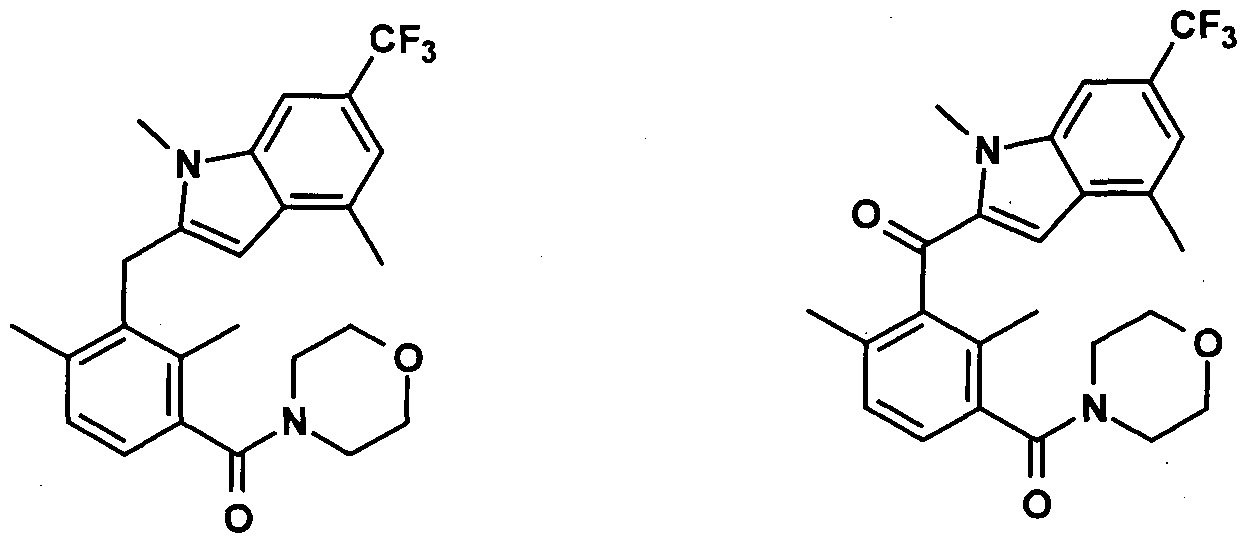
Using a similar procedure as the one described in Example A, Step 4, (3-((l,4-dimethyl-6- (trifluoromethyl)-lH-indol-2-yl)methyl)-2,4-dimethylphenyl)(moφholino)methanone (30 mg, 19%)
was prepared from (2,4-dimethyl-3-((4-methyl-6-(trifluoromethyl)-lH-indol-2- yl)methyl) henyl)(moφholino)metha one (154 mg, 0.358 mmol). LC/MS (Method g) Rt = 1.87 min.; MS m/z: 445[Μ+Η]+ . Ή NMR (DMSO-</6, 400 MHz): δ 7.69 (s, 1H), 7.19 (d, J = 8Hz, 1H), 7.06 (m, 2H), 5.51 (s, 1H), 4.17 (m, 2H), 3.91 (s, 3H), 3.65 (m, 4H), 3.48 (m, 2H), 3.13 (m, 2H), 2.33 (s, 3H), 2.25 (s, 3H), 2.11 (s, 3H).
This reaction also afforded an oxidation product which was isolated and characterized : (2,6-dimethyl- 3-(mo holine-4-carbonyl)phenyl)(l,4-dimethyl-6-(trifluoromethyl)-lH-indol-2-yl)methanone (32 mg, 19%). LC/MS (Method g) Rt = 1.84 min.; MS m/z 459[M+H]+ .
Ή NMR (DMSO- 6, 400 MHz): δ 7.95 (s, 1H), 7.26 (s, 2H), 7.22 (s, 1H), 6,82 (s, 1H), 4.24 (s, 3H), 3.62 (m, 4H), 3.48 (m, 2H), 3.16 (m, 2H), 2.44 (s, 3H), 2.17 (s, 3H), 2.00 (s, 3H).
Example H: (2,4-dichloro-3-((4-methyl-6-(trifluoromethyl)-lH-indol-2-yl)methyl)phenyl)(4- (dimethylamino)piperidin-l-yl)methanone

Step 1 : 2,4-dichloro-3-((4-methyl-l-(phenyIsulfonyl)-6-(trifluoromethyl)-lH-indol-2- yI)methyI)benzoic acid

Using a similar procedure as the one described in Example A, Step 5, 2,4-dichloro-3-((4-methyl-l- (phenylsulfonyl)-6-(trifluoromethyl)-lH-indol-2-yl)methyl)benzoic acid (280 mg, 82%) was prepared from methyl 2,4-dichloro-3-((4-methyl-l-(phenylsulfonyl)-6-(trifluoromethyl)-lH-indol-2- yl)methyl)benzoate (Example A, Step 2,) (350 mg, 0.629 mmol). LC/MS (Method h) Rt = 3.33 min.; MS m/z: 542 [Μ+Η]+ . Ή NMR (DMSO-c?6, 300 MHz): δ 8.25 (s, 1H), 7.92 (m, 2H), 7.75 (m, lH), 7.67 (m, 3H), 7.58 (m, 1H), 7.41 (s, 1H), 5.93 (s, 1H), 4.58 (s, 2H), 2.35 (s, 3H).
Step 2: (2,4-dichIoro-3-((4-methyl-l-(phenyIsulfonyl)-6-(trifluoromethyI)-lH-indoI-2- yl)methyl)phenyI)(4-(dimethylamino)piperidin- l-yl)methanone
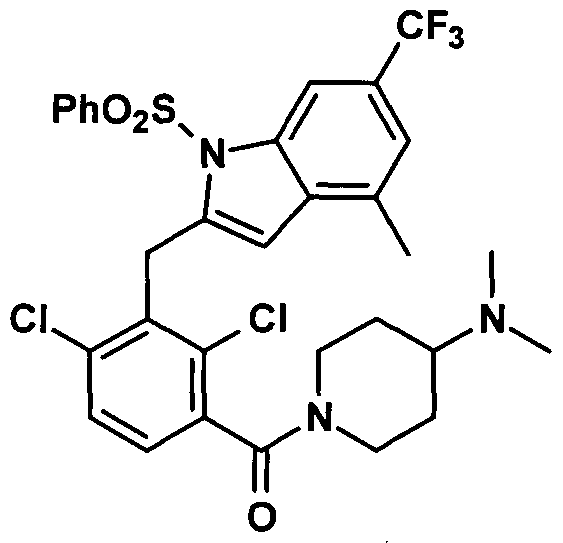
Using a similar procedure as the one described in Example A, Step 6, (2,4-dichloro-3-((4-methyl-l- (phenylsulfonyl)-6-(trifluoromethyl)-lH-indol-2-yl)methyl)phenyl)(4-(dimethylamino)piperidin-l- yl)methanone (305 mg, 72%) was prepared from 2,4-dichloro-3-((4-methyl-l-(phenylsulfonyl)-6- (trifluoromethyl)-lH-indol-2-yl)methyl)benzoic acid (350 mg, 0.645 mmol) and N,N- dimethylpiperidin-4-amine (165 mg, 1.29 mmol). LC/MS (Method h) Rt = 3.34 min.; MS m/z: 652 [M+H]+ .
Ή NMR (DMSO-i 6, 300 MHz): δ 8.25 (s, 1H), 7.92 (m, 2H), 7.75 (m, 1H), 7.66 (m, 3H), 7.48 (m, 2H), 5.98 (m, 1H), 4.50 (m, 2H), 4.41 (m, 1H), 2.98 (m, 1H), 2.80 (m, 1H), 2.36 (s, 3H), 2.30 (m, 2H), 2.20 (s, 3H), 2.09 (s, 3H), 1.82 (m, 1H), 1.64 (m, 1H), 1.27 (m, 2H).
Step 3: (2,4-dichloro-3-((4-methyl-6-(trifluoromethyl)-lH-indol-2-yl)methyl)phenyl)(4- (dimethylamino)piperidin-l-\I)methanone:

Using a similar procedure as the one described in Example A, Step 3, (2,4-dichloro-3-((4-methyl-6- (trifluoromethyl)-lH-indol-2-yl)methyl)phenyl)(4-(dimethylamino)piperidin-l-yl)methanone (190 mg, 86%) was prepared from (2,4-dichloro-3-((4-methyl-l-(phenylsulfonyl)-6-(trifluoromethyl)-lH-indol- 2-yl)methyl)phenyl)(4-(dimethylamino)piperidin-l-yl)methanone (280 mg, 0.429 mmol).
LC/MS (Method g) Rt = 1.22 min.; MS m/z: 512 [Μ+Η]+ . Ή NMR (DMSO-i/6, 400 MHz): δ 11.40 (s, 1H), 7.64 (m, 1H), 7.48 (s, 1H), 7.38 (m, 1H), 7.03 (s, 1H), 5.95 (s, 1H), 4.46 (m, 3H), 3.30 (m, 1H), 3.00 (m, 1H), 2.85 (m, 1H), 2.41 (s, 3H), 2.32 (m, 1H), 2.16 (s, 3H), 2.12 (s, 3H), 1.82 (m, 1H), 1.65 (m, 1H), 1.32 (m, 2H).
Example I: (2,4-dichloro-3-((l,4-dimethyl-6-(trifluoromethyl)-lH-indol-2-yl)methyl)phenyl)(4- (dimethylamino)piperidin-l-yl)methanone

Using a similar procedure as the one described in Example A, Step 4, (2,4-dichloro-3-((l,4-dimethyl- 6-(trifluoromethyl)- lH-indol-2-yl)methyl)phenyl)(4-(dimethylamino)piperidin- 1 -yl)methanone (10 mg, 13%) was prepared from (2,4-dichloro-3-((4-methyl-6-(trifluoromethyl)-lH-indol-2- yl)methyl)phenyl)(4-(dimethylamino)piperidin-l-yl)methanone (Example Η, Step 3) (75 mg, 0.146 mmol). LC/MS (Method g) Rt = 1.29 min.; MS m/z: 526 [Μ+Η]+. Ή NMR (DMSO-i/6, 300 MHz): δ 7.70 (m, 1H), 7.65 (m, 1H), 7.43 (m, 1H), 7.07 (s, 1H), 5.68 (m, 1H), 4.46 (m, 3H), 3.92 (m, 3H), 2.99 (m, 1H), 2.85 (m, 1H), 2.36 (s, 3H), 2.32 (m, 1H), 2.17 (s, 3H), 2.11 (s, 3H), 1.83 (m, 1H), 1.68 (m, 1H), 1.32 (m, 2H).
Example J: 2-(l-(2,4-dichloro-3-((7-methyl-5-(trifluoromethyl)-lH-indol-l- yl)methyl)benzoyl)piperidin-4-yl)acetic acid-

Step 1: methyl 2,4-dichloro-3-((7-methyI-5-(trifluoromethyl)-lH-indol-l-yl)methyI)benzoate

To a solution of 7-methyl-5-(trifluoromethyl)-lH-indole (Preparation #49) (0.850 g, 4.27 mmol) in N,N-dimethylformamide (10.67 ml) and cooled to 0°C was added sodium hydride (0.188 g, 4.69 mmol) and the reaction was stirred 30 minutes. Methyl 3-(bromomethyl)-2,4-dichlorobenzoate (Preparation #1, Step B) (1.272 g, 4.27 mmol) was added and the reaction mixture was stirred 1 hour at 0°C. The reaction mixture was diluted with water and ethyl acetate. The layers were separated and the aqueous one. was extracted with ethyl acetate. The combined organic layers were washed with water then a saturated NaCI solution, dried over magnesium sulfate, filtered and concentrated under reduced pressure. The residue was purified by column chromatography on silica gel (eluting with 0- 10% ethyl acetate in cyclohexane) to give methyl 2,4-dichloro-3-((7-methyl-5-(trifluoromethyl)-lH- indol-l-yl)methyl)benzoate (1.55 g, 80%).
LC/MS (Method j) Rt = 2.32 min.; MS m/z: 416 [M+H]+ Ή NMR (DMSO-d6, 300MHz): δ 7.89 (d, J=8.4 Hz, 1H), 7.79 (m, 1H), 7.76 (d, J=8.4 Hz, 1H), 7.23 (m, 1H), 6.74 (d, J=3.3 Hz, 1H), 6.56 (d, J=3.3 Hz, 1H), 5.98 (s, 2H), 3.88 (s, 3H), 2.94 (s, 3H).
Step 2: 2,4-dichloro-3-((7-methyl-5-(t indol-l-yl)methyl)benzoic acid

Using a similar procedure as the one described in Example F, Step 4, 2,4-dichloro-3-((7-methyl-5- (trifluoromethyl)-lH-indol-l-yl)methyl)benzoic acid (1.44 g, 96%) was prepared from methyl 2,4- dichloro-3-((7-methyl-5-(trifluoromethyl)-lH-indol-l-yl)methyl)benzoate (1.55 g, 3.72 mmol). LC/MS (Method j) Rt = 1.86 min.; MS m/z: 402 [M+H]+ ¾ NMR (DMSO-d6, 300MHz): δ 13.8 (br, 1H), 7.82 (d, 7=8.3 Hz, 1H), 7.79 (s, 1H), 7.69 (d, J=8.3 Hz, lH), 7.23 (s, 1H), 6.73 (d, J=3.3 Hz, 1H), 6.56 (d, J=3.3 Hz, 1H), 5.97 (s, 2H), 2.95 (s, 3H).
Step 3: methyl 2-(l-(2,4-dichloro-3-((7-methyl-5-(trifluoromethyl)-lH-indol-l yl)methyl)benzoyl)piperidin-4-yl)acetate

Using a similar procedure as the one described in Example A, Step 6, methyl 2-(l-(2,4-dichloro-3-((7- methyl-5-(trifluoromethyl)-lH-indol-l-yl)methyl)benzoyl)piperidin-4-yl)acetate (118 mg, 88%) was prepared from 2,4-dichloro-3-((7-methyl-5-(trifluoromethyl)-lH-indol-l-yl)methyl)benzoic acid (100 mg, 0.25 mmol) and methyl 2-(piperidin-4-yl)acetate hydrochloride (62.6, 0.32 mmol).
LC/MS (Method j) Rt = 2.10 min.; MS m/z: 541 [M+H]+ Ή NMR (DMSO-d6, 300MHz): δ 7.79 (s,
IH), 7.70 and 7.69 (d, J=8.3 Hz, IH), 7.53 and 7.46 (d, J=8.3 Hz, IH), 7.23 (s, IH), 6.76 (m, IH), 6.57
(m, IH), 5.94 (m, 2H), 4.46 (m, IH), 3.59 and 3.57 (s, 3H), 3.21 (m, IH), 3.03 (m, IH), 2.94 (s, 3H),
2.80 (m, IH), 2.28 (m, 2H), 1.96 (m, IH), 1.75 (m, IH), 1.59 (m, IH), 1.17 (m, 2H)
Step 4: 2-(l-(2,4-dichIoro-3-((7-methyl-5-(trifluoromethyl)-lH-indol-l- yI)methyl)benzoyI)piperidin-4-yl)acetic acid

Using a similar procedure as the one described in Example A, Step 5, 2-(l-(2,4-dichloro-3-((7-methyl- 5-(trifluoromethyl)-lH-indol-l-yl)methyl)benzoyl)piperidin-4-yl)acetic acid (99 mg, 89%) was prepared from methyl 2-(l-(2,4-dichloro-3-((7-methyl-5-(trifluoromethyl)-lH-indol-l- yl)methyl)benzoyl)piperidin-4-yl)acetate (114 mg, 0.21 mmol). LC/MS (Method g) Rt = 1.85 min.; MS m/z: 527 [M+H]+
Ή NMR (DMSO-dg, 400MHz): δ 12.10 (br, IH), 7.79 (s, IH), 7.70 and 7.69 (d, J=8.3 Hz, IH), 7.53 and 7.46 (d, J=8.3 Hz, IH), 7.23 (s, IH), 6.76 (m, IH), 6.58 (m, IH), 5.94 (m, 2H), 4.46 (m, IH), 3.27 (m, IH), 3.03 (m, IH), 2.94 (s, 3H), 2.80 (m, IH), 2.17 (m, 2H), 1.93 (m, IH), 1.77 (m, IH), 1.61 (m, IH), 1.14 (m, 2H).
Example K: (3-((l,4-dimethyl-6-(trifluoromethyl)-lH-indoI-2-yl)(hydroxy)methyl)-2,4- dimethylphenyI)(morpholino)methanone

Example Kl: (3-((l,4-dimethyl-6-(trifluoromethyl)-lH-indol-2-yl)(methoxy)methyl)-2,4- dimethylphenyl)(morpholino)methanone

Step 1 : (3-(hydroxy(4-methyl-6-(trifluoromethyl)-lH-indol-2-yl)methyl)-2,4- dim ethylphen yl)(morphoIino)m ethanone

Using a similar procedure as the one described in Example A, Step 3, (3-(hydroxy(4-methyl-6- (trifluoromethyl)-lH-indol-2-yl)methyl)-2,4-dimethylphenyl)(moφholino)methanone (189 mg, 39%) was prepared from (3-(hydroxy(4-methyl-l-(phenylsulfonyl)-6-(trifluoromethyl)-lH-indol-2- yl)methyl)-2,4-dimethylphenyl)(morpholino)methanone (Example G, Step 1) (629 mg, 1.072 mmol). LC/MS (Method h) Rt = 2.66 min.; MS m/z: 447 [Μ+Η]+ . Ή NMR (DMSO-rf6, 300 MHz): δ 11.32 (s,
IH), 7.52 (d, J = 4.8Hz, IH), 7.12 (m, IH), 7.03 (m, 2H) 6.38 (s, IH), 6.24 (d, J = 4Hz, IH), 5.94 (s,
IH), 3.62 (m, 4H), 3.49 (m, 2H), 3.136 (m, 2H), 2.41 (s, 3H), 2.40 (s, 3H), 2.12 (s, 3H).
Step 2: (3-((l,4-dimethyl-6-(trifluoromethyI)-lH-indol-2-yl)(hydroxy)methyl)-2,4- dimethylphenyl)(morpholino)methanone and (3-((l ,4-dimethyI-6-(trifluoromethyl)-lH-indol-2- yl)(methoxy)methyl)-2,4-dimethylphenyl)(morpholino)methanone

Using a similar procedure as the one described in Example A, Step 4, (3-((l,4-dimethyl-6- (trifluoromethyl)-lH-indol-2-yl)(hydroxy)methyl)-2,4-dimethylphenyl)(mo holino)methanone (14 mg, 7%) was prepared from (3-(hydroxy(4-methyl-6-(trifluoromethyl)-lH-indol-2-yl)methyl)-2,4- dimethylphenyl)(mo holino)methanone (189 mg, 0.423 mmol). LC/MS (Method g) Rt = 1.70 min.; MS m/z: 461 [Μ+Η]+ . Ή NMR (DMSO-i/6, 500 MHz): δ 7.68 (s, IH), 7.14 (m, IH), 7.07 (m, 2H), 6.39 (s, IH), 6.10 (s, IH), 5.96 and 5.92 (s, IH), 3.86 and 3.82 (s, 3H), 3.63 (m, 4H), 3.48 (m, 2H), 3.16 (m, 2H), 2.39 and 2.38 (s, 3H), 2.34 and 2.31 (s, 3H), 2.21 and 2.19 (s, 3H).
During this reaction a double methylation product was also isolated and characterized as (3-((l,4- dimethyl-6-(trifluoromethyl)-lH-indol-2-yl)(methoxy)methyl)-2,4- dimethylphenyl)(morpholino)methanone (0.5 mg, 0.2%). LC/MS (Method g) Rt = 1.85 min.; MS m/z: 475 [M+H]+ . 'H NMR (DMSCW6, 500 MHz): δ 7.72 (s, IH), 7.20 (m, IH), 7.14 (m, IH), 7.08 (s, IH), 6.05 (s, IH), 5.80 (s, IH), 3.91 (s, 3H), 3.65-3.48 (m, 6H), 3.33 (s, 3H), 3.12 (m, 2H), 2.36 (s, 3H), 2.32 (s, 3H), 2.19 (s, 3H).
Example L: (2,4-dichloro-3-((l-methyl-6-(trifluoromethyl)-lH-indoI-2-yl)methyl)phenyl)(4- hydroxypiperidin-l-yl)methanone

Step 1: methyl 2,4-dichloro-3-(hydroxy(l-(phenylsulfonyI)-6-(trifluoromethyl)-lH-indoI-2- yl)methyI)benzoate

Using a similar procedure as the one described in Example A, Step 1, methyl 2,4-dichloro-3- (hydroxy(l-(phenylsulfonyl)-6-(trifluoromethyl)-lH-indol-2-yl)methyl)benzoate (7.8 g, 78%) was prepared from N-(2-iodo-5-(trifluoromethyl)phenyl)benzenesulfonamide (Preparation #29) (7.00 g, 16.4 mmol) and methyl 2,4-dichloro-3-(l-hydroxyprop-2-yn-l-yl)benzoate (Preparation #1) (4.7 g, 18.1mmol).
LC/MS (Method h) R, = 3.27 min.; MS m/z: 540 [Μ-Η]" +CH3COOH . Ή NMR (DMSO-i 6, 300 MHz): δ 8.24 (s, 1H), 7.85 (m, 3H), 7.69 (m, 2H), 7.58 (m, 4H), 7.03 (m, 1H), 6.84 (s, 1H), 6.73 (m, 1H), 3.87 (s, 3H).
Step 2: methyl 2,4-dichloro-3-((l-(phenylsulfonyl)-6-(trifluoromethyl)-lH-indol-2- yI)methyl)benzoate

Step 3: methyl 2,4-dichloro-3-((6-(trifluoromethyl)-lH-indol-2-yl)methyl)benzoate

Using a similar procedure as the one described in Example A, Step 3, methyl 2,4-dichloro-3-((6- (trifluoromethyl)-lH-indol-2-yl)methyl)benzoate (4.3 g, 93%) was prepared from methyl 2,4-dichloro- 3-((l-(phenylsulfonyl)-6-(trifluoromethyl)-lH-indol-2-yl)methyl)benzoate (6.2 g, 11.4 mmol).
LC/MS (Method h) Rt = 3.23 min.; MS m/z: 402 [Μ+Η]+. Ή NMR (DMSO-J6, 300 MHz): δ 11.5 (broad, 1H), 7.75 (d, J = 9Hz, 1H), 7.69 (d, J = 9Hz, 1H), 7.65 (s, 1H), 7.57 (d, J = 6Hz, 1H), 7.23 (dd, J= 6Hz, J= 1.5Hz, 1H), 5.96 (s, 1H), 4.50 (s, 2H), 2.87 (s, 3H).
Step 4: methyl 2,4-dichloro-3-((l-methyl-6-(trifluoromethyl)-lH-indol-2-yl)methyl)benzoate
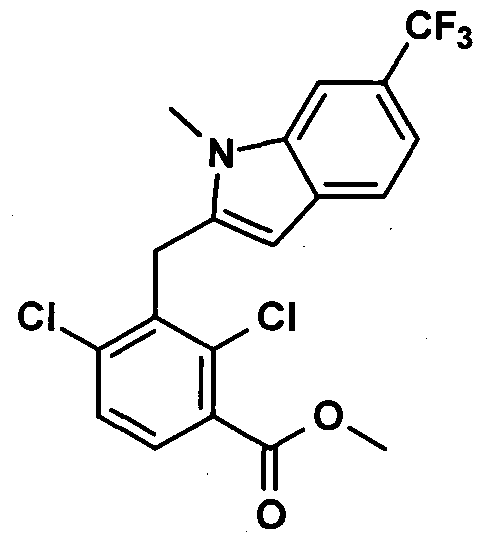
Using a similar procedure as the one described in Example A, Step 4, methyl 2,4-dichloro-3-((l- methyl-6-(trifluoromethyl)-lH-indol-2-yl)methyl)benzoate (3.86 g, 89%) was prepared from methyl 2,4-dichloro-3-((6-(trifluoromethyl)-lH-indol-2-yl)methyl)benzoate (4.17 g, 10.37 mmol). LC/MS (Method g) Rt = 2.06 min.; MS m/z: 416 [Μ+Η]+. Ή NMR (DMSO-cfe, 300 MHz): δ 7.87 (s, 1H), 7.79 (d, J = 9Hz, 1H), 7.71 (d, J = 9Hz, 1H), 7.55 (d, J = 9Hz, 1H), 7.24 (d, J = 9Hz, 1H), 5.68 (s, 1H), 4.50 (s, 2H), 3.94 (s, 3H), 3.88 (s, 3H).
Step 5: 2,4-dichloro-3-((l-methyl-6-(trifluoromethyl)-lH-indol-2-yl)methyl)benzoic acid

Using a similar procedure as the one described in Example A, Step 5, 2,4-dichloro-3-((l-methyl-6- (trifluoromethyl)-lH-indol-2-yl)methyl)benzoic acid (1.53 g, 87%) was prepared from methyl 2,4- dichloro-3-((l-methyl-6-(trifluoromethyl)-lH-indol-2-yl)methyl)benzoate (1.81 g, 4.35 mmol).
LC/MS (Method h) Rt = 3.08 min.; MS m/z: 402 [M+H]+.
Ή NMR (DMSO- , 300 MHz): δ 7.87 (s, 1H), 7.74 (d, J = 9Hz, 1H), 7.67 (d, J = 9Hz, 1H), 7.56 (d, J = 9Hz, 1H), 7.24 (dd, J = 9Hz , J = 1.5Hz, 1H), 5.68 (s, 1H), 4.49 (s, 2H), 3.94 (s, 3H).
Step 6: (2,4-dichloro-3-((l-methyl-6-(trifluoromethyl)-lH-indol-2-yl)methyl)phenyl)(4- hydroxypiperidin-l-yl)methanone

Using a similar procedure as the one described in Example A, Step 6, (2,4-dichloro-3-((l-methyl-6- (trifluoromethyl)-lH-indol-2-yl)methyl)phenyl)(4-hydroxypiperidin-l-yl)methanone (65 mg, 53%) was prepared from 2,4-dichloro-3-((l-methyl-6-(trifluoromethyl)-lH-indol-2-yl)methyl)benzoic acid (100 mg, 0.249 mmol) and piperidin-4-ol (37.7 mg, 0.37 mmol). LC/MS (Method g) Rt = 1.70 min.; MS m/z: 485 [M+H]+.
Ή NMR (DMSO- , 400 MHz): δ 7.87 (s, 1H), 7.65 (dd, J = 6.3Hz, J = 1.8Hz, 1H), 7.56 (d, J = 6.3Hz, 1H), 7.41 (m, 1H), 7.25 (d, J = 6Hz, 1H), 5.70 (m, 1H), 4.80 (m, 1H), 4.38 (m, 2H), 4.05 (m, 1H), 3.96 (s, 3H), 3.73 (m, 1H), 3.20 (m, 2H), 3.07 (m, 1H), 1.81 (m, 1H), 1.75 (m, 1H), 1.39 (m, 2H).
Table L. The following analogs were prepared from 2,4-dichloro-3-((l-methyl-6-(trifluoromethyl)- lH-indol-2-yl)methyl)benzoic acid (Example L, Step 5) using the same procedure with the appropriate amine.

Example M: l-(2,4-dichloro-3-((l-methyl-6-(trifluoromethyl)-lH-indol-2- yl)methyl)benzoyl)piperidine-4-carboxylic acid

Step 1: methyl l-(2,4-dichIoro-3-((l-methyl-6-(trifluoromethyl)-lH-indoI-2- yl)methyl)benzoyI)piperidine-4-carboxylate

Using a similar procedure as the one described in Example A, Step 6, methyl l-(2,4-dichloro-3-((l- methyl-6-(trifluoromethyl)-lH-indol-2-yl)methyl)benzoyl)piperidine-4-carboxylate (172 mg, 73%) was prepared from 2,4-dichloro-3-((l-methyl-6-(trifluoromethyl)-lH-indol-2-yl)methyl)benzoic acid (Example L, Step 5) (180 mg, 0.448 mmol) and methyl 4-piperidinecarboxylate (96 mg, 0.67, mmol). LC/MS (Method h) Rt = 3.17 min.; MS m/z: 527 [Μ+Η]+. Ή NMR (DMSO-rf6, 300 MHz): δ 7.81 (s, 1H), 7.65 (d, J = 8.4Hz, 1H), 7.56 (d, J = 7.8Hz, 1H), 7.46 (d, J = 8.4Hz, 0.5H), 7.39 (d, J = 8.4Hz, 0.5H), 7.26 (d, J = 7.8Hz, 1H), 5.72 and 5.69 (s, 1H), 4.46 (m, 2H), 4.38 (m, 1H), 3.93 (s, 3H), 3.62 and 3.58 (s, 3H), 3.27 (m, 1H), 3.13-2.94 (m, 2H), 2.67 (m, 1H), 1.82 (m, 2H), 1.52 (m, 2H).
Step 2: l-(2,4-dichloro-3-((l-methyl-6-(trifluoromethyl)-lH-indol-2- yI)methyl)benzoyl)piperidine-4-carboxylic acid

Using a similar procedure as the one described in Example A, Step 5, l-(2,4-dichloro-3-((l-methyl-6- (trifluoromethyl)-lH-indol-2-yl)methyl)benzoyl)piperidine-4-carboxylic acid (154 mg, 93%) was prepared from methyl l-(2,4-dichloro-3-((l-methyl-6-(trifluoromethyl)-lH-indol-2- yl)methyl)benzoyl)piperidine-4-carboxylate (170 mg, 0.32 mmol). LC/MS (Method g) Rt = 1.73 min.; MS m/z: 513 [Μ+Η]+. Ή NMR (DMSO-o?6, 400 MHz): δ 12.32 (broad, 1H), 7.87 (s, 1H), 7.65 (d, J = 8.4Hz, 1H), 7.56 (d, J = 8.4Hz, 1H), 7.46 (d, J = 8.4Hz, 0.5H), 7.39 (d, J = 8.4Hz, 0.5H), 7.24 (d, J = 8.4Hz, 1H), 5.71 (m, 1H), 4.51 (m, 2H), 4.45 (m, 1H), 3.93 (s, 3H), 3.29 (m, 1H), 3.12 (m, 1H), 2.95 (m, 1H), 2.54 (m, 1H), 1.95 (m, 1H), 1.76 (m, 1H), 1.50 (m, 2H).
Example N: l-(2,4-dichloro-3-((l-methyl-6-(trifluoromethyl)-lH-indol-2-yl)methyl)benzoyl)-3- hydroxypiperidine-4-carboxylic acid

Step 1: ethyl l-(2,4-dichloro-3-((l-methyl-6-(trifluoromethyl)-lH-indol-2-yl)methyl)benzoyl)-3- oxopiperidine-4-carboxylate

Using a similar procedure as the one described in Example A, Step 6, ethyl l-(2,4-dichloro-3-((l- methyl-6-(trifluoromethyl)- lH-indol-2-yl)methyl)benzoyl)-3-oxopiperidine-4-carboxylate (221 mg, 59%) was prepared from 2,4-dichloro-3-((l-methyl-6-(trifluoromethyl)-lH-indol-2-yl)methyl)benzoic acid (Example L, Step 5) (250 mg, 0.62 mmol) and ethyl 3-oxopiperidine-4-carboxylate hydrochloride (194 mg, 0.93 mmol). LC/MS (Method h) Rt = 3.52 min.; MS m/z: 555 [Μ+Η]+. Ή NMR (DMSO-</6, 300 MHz): 7.87 (s, 1H), 7.69 (m, 1H), 7.65 (m, 1H), 7.46 (m, 1H), 7.26 (m, 1H), 5.74 (s, 1H), 5.73 and 5.69 (s, 1H), 4.48 (s, 2H), 4.30 (m, 1H), 4.17 (m, 2H), 3.92 (m, 3H), 3.51 (m,2H), 3.32 (m, 1H), 3.30 (m, 2H), 1.20 (m, 3H).
Step 2: ethyl l-(2,4-dichloro-3-((l-methyl-6-(trifluoromethyl)-lH-indoI-2-yl)methyl)benzoyl)-3- hydroxypiperidine-4-carboxylate:

To a suspension of ethyl l-(2,4-dichloro-3-((l-methyl-6-(trifluoromethyl)-lH-indol-2- yl)methyl)benzoyl)-3-oxopiperidine-4-carboxylate (218 mg, 0.393 mmol) in methanol (4 mL) cooled at 0°C was added NaBH4 (7.43 mg, 0.196 mmol) and the mixture was stirred at 5°C for 4 hours. NaBH4 (7.43 mg, 0.196 mmol) was added again and the reaction was stirred for 5 hours at 5°C. The reaction was hydrolyzed with NH4C1 saturated aqueous solution and extracted with dichloromethane. The organic layer was washed with brine, dried over magnesium sulfate, filtered and concentrated under reduced pressure. The residue was purified by column chromatography on silica gel (eluting with 0-70% ethyl acetate in cyclohexane) to give ethyl l-(2,4-dichloro-3-((l-methyl-6- (trifluoromethyl)-lH-indol-2-yl)methyl)benzoyl)-3-hydroxypiperidine-4-carboxylate (150 mg, 69%). LC/MS (Method g) Rt = 1.85 min.; MS m/z: 557 [Μ+Η]+. Ή NMR (DMSO-i/6, 400 MHz): δ 7.87 (s,
1H), 7.69 (m, 1H), 7.51 (m, 1H), 7.38 (m, 1H), 7.25 (m, 1H), 5.72 (m, 1H), 5.40 and 5.22 and 5.13 and 5.00 and 4.82 (m, 1H), 4.52-4.25 (m, 3H), 4.22-4.00 (m, 3H), 3.94 (s, 3H), 3.60 (m, 0.5H), 3.38-3.18 (m, 0.5H), 3.10-2.55 (m, 2.5H), 2.45 (m, 0.5H), 2.00-1.40 (m, 2H), 1.18 (m, 3H).
Step 3: l-(2,4-dichloro-3-((l-methyl-6-(trifluoromethyl)-lH-indoI-2-yl)methyl)benzoyl)-3- hydroxypiperidine-4-carboxylic acid

Using a similar procedure as the one described in Example A, Step 5, l-(2,4-dichloro-3-((l -methyl -6- (trifluoromethyl)-lH-indol-2-yl)methyl)benzoyl)-3-hydroxypiperidine-4-carboxylic acid (73 mg, 66%) was prepared from ethyl l-(2,4-dichloro-3-((l-methyl-6-(trifluoromethyl)-lH-indol-2- yl)methyl)benzoyl)-3-hydroxypiperidine-4-carboxylate (Example M, Step 2) (116 mg, 0.208 mmol). LC/MS (Method g) Rt = 2.60 min.; MS m/z: 527 [Μ-Η]". Ή NMR (DMSO-i/6, 400 MHz): δ 7.87 (s, 1H), 7.68 (m, 1H), 7.58 (m, 1H), 7.38 (m, 1H), 7.23 (m, lH), 5.70 (m, 1H), 4.47 (m, 3H), 4.19 and 4.02 (m, 1H), 3.93 (s, 3H), 3.20 (m, 1H), 3.09 (m, 1H), 2.70 (m, 2H), 1.85 (m, 1H), 1.63 and 1.50 (m, 1H).
Example 0 : 3-(4-(2,4-dichloro-3-((l-methyl-6-(trifluoromethyl)-lH-indoI-2- yl)methyl)benzoyl)piperazin-l-yl)cyclobutanecarboxylic acid

Step 1 : tert-butyl 4-(2,4-dichloro-3-((l-methyI-6-(trifluoromethyI)-lH-indol-2- yl)methyl)benzoyl)piperazine-l-carboxylate

Using a similar procedure as the one described in Example A, Step 6, tert-butyl 4-(2,4-dichloro-3-((l- methyl-6-(trifluoromethyl)-lH-indol-2-yl)methyl)benzoyl)piperazine-l-carboxylate (840 mg, 100%) was prepared from 2,4-dichloro-3-((l-methyl-6-(trifluoromethyl)-lH-indol-2-yl)methyl)benzoic acid (Example L, Step 5) (500 mg, 1.243 mmol) and 1-boc-piperazine (347 mg, 1.86 mmol). LC /MS (Method h) Rt = 3.42 min.; MS m/z 570 [M+H]+. ¾ NMR (DMSO-c 6, 300 MHz): δ 7.88 (s, 1H), 7.68 (d, J = 9Hz, 1H), 7.56 (d, J = 9Hz, 1H), 7.46 (d, J = 9Hz, 1H), 7.26 (J = 9Hz, 1H), 5.74 (s, 1H), 4.46 (s, 2H), 3.94 (s, 3H), 3.60 (m, 2H), 3.42 (m, 2H), 3.20 (m, 4H), 1.40 (s, 9H).
Step 2: (2,4-dichloro-3-((l-methyl-6-(trifluoromethyl)-lH-indol-2-yl)methyI)phenyl)(piperazin-l- yl)methanone

To a solution of tert-butyl 4-(2,4-dichloro-3-((l-methyl-6-(trifluoromethyl)-lH-indol-2- yl)methyl)benzoyl)piperazine-l-carboxylate (840 mg, 1.473 mmol) in dichloromethane (32 mL) and cooled at 0°C was added trifluoroacetic acid (8 mL, 104 mmol). The ice bath was removed and the reaction mixture was stirred at room temperature for 1.5 hours. The reaction mixture was concentrated under reduced pressure. The crude was diluted with dichloromethane and it was washed with NaHC03 saturated aqueous solution. The organic layer was washed with water, dried over magnesium sulfate, filtered and concentrated under reduced pressure to give (2,4-dichloro-3-((l-methyl-6- (trifluoromethyl)-lH-indol-2-yl)methyl)phenyl)(piperazin-l-yl)methanone (850 mg, 100%) as an orange powder.
LC/MS (Method h) Rt = 2.07 min.; MS m/z: 470 [M+H]+. rH NMR (CDC13, 300 MHz): δ 7.51 (s, 1H), 7.40 (m, 2H), 7.19 (m, 2H), 5.73 (s, 1H), 4.36 (s, 2H), 3.81 (s, 3H), 3.72 (m, 2H), 3.16 (m, 2H), 2.89 (m, 2H), 2.73 (m, 2H).
Step 3: methyl 3-(4-(2,4-dichloro-3-((l-methyl-6-(trifluoromethyl)-lH-indol-2- yI)methyl)benzoyl)piperazin-l-yI)cyclobutanecarboxyIate

To a solution of (2,4-dichloro-3-((l-methyl-6-(trifluoromethyl)-lH-indol-2- yl)methyl)phenyl)(piperazin-l-yl)methanone (50 mg, 0.106 mmol) and methyl 3- oxocyclobutanecarboxylate (31.8 mg, 0.149 mmol) in 1 ,2-dichloroethane (1.4 mL) was added acetic acid (50 μΐ, 0.873 mmol) and the reaction mixture was stirred at room temperature for 45 minutes. Sodium triacetoxyborohydride (33.8 mg, 0.159 mmol) was then added and the stirring was continued for 2.5 hours. The reaction mixture was concentrated under reduced pressure to give methyl 3-(4-(2,4- dichloro-3-((l-methyl-6-(trifluoromethyl)-lH-indol-2-yl)methyl)benzoyl)piperazin-l- yl)cyclobutanecarboxylate (80 mg, 100%). LC/MS (Method h) Rt = 2.46 min.; MS m/z: 582 [M+H]+. Ή NMR (CDC13, 300 MHz): δ 7.51 (s, 1H), 7.41 (m, 2H), 7.18 (m, 2H), 5.72 (s, 1H), 4.36 (s, 2H), 3.81 (s, 3H), 3.75 (m, 2H), 3.60 (s, 3H), 3.20 (m, 2H), 2.68 (m, 2H), 2.36-2.05 (m, 8H).
Step 4: 3-(4-(2,4-dichIoro-3-((l-methyl-6-(trifluoromethyl)-lH-indoI-2- yI)methyI)benzoyI)piperazin-l-yl)cyclobutanecarboxylic acid

To a solution of methyl 3-(4-(2,4-dichloro-3-((l-methyl-6-(trifluoromethyl)-lH-indol-2- yl)methyl)benzoyl)piperazin-l-yl)cyclobutanecarboxylate (200 mg, 0.343 mmol) in dioxane ( 3.75
niL) and water (1.5 mL) was added sodium hydroxide (54.9 mg, 1.374 mmol). The reaction mixture was stirred at room temperature for 1 hour and concentrated under reduced pressure. The residue was taken in water and acidified until pH = 3-4 by addition of IN HC1 solution. After extraction with ethyl acetate, the organic layer was dried over magnesium sulfate, filtered and concentrated under reduced pressure. The residue was purified by column chromatography on silica gel (eluting with 0-10% MeOH in dichloromethane) to give 3-(4-(2,4-dichloro-3-((l-methyl-6-(trifluoromethyl)-lH-indol-2- yl)methyl)benzoyl)piperazin-l-yl)cyclobutanecarboxylic acid (115 mg, 57%). LC/MS (Method g) Rt = 1.30 min., 1.33min; MS m/z: 568 [M+H]+. ¾ NMR (DMSO-t/6, 400 MHz): δ 7.87 (s, 1H), 7.65 (d, J = 8Hz, 1H), 7.56 (d, J = 8.4Hz, 1H), 7.41 (d, J = 8Hz, 1H), 7.25 (d, J = 8.4Hz, 1H), 5.71 (s, 1H), 4.49 (s, 2H), 3.93 (s, 3H), 3.62 (m, 2H), 3.17 (m, 2H), 2.69 (m, 2H), 2.31 (m, 2H), 2.21 (m, 4H), 1.90 (m, 2H).
Example P: (2,4-dichIoro-3-((l-methyl-5-(trifluoromethyl)-lH-indol-2- yI)methyl)phenyI)(morphoIino)methanone

Step 1 : (2,4-dichloro-3-(hydroxy(l-(phenylsulfonyI)-5-(trifluoromethyI)-lH-indoI-2- yl)methyl)phenyl)(morpholino)methanone

Using a similar procedure as the one described in Example A, Step 1, (2,4-dichloro-3-(hydroxy(l- ( henylsulfonyl)-5-(trifluoromethyl)-lH-indol-2-yl)methyl)phenyl)(mo holino)methanone (850 mg, 74%) was prepared from N-(2-iodo-4-(trifluoromethyl)phenyl)benzenesulfonamide (described in patent FR2890071) (800 mg, 1.873 mmol), and (2,4-dichloro-3-(l-hydroxyprop-2-yn-l- yl)phenyl)(morpholino)methanone (647 mg, 2.060 mmol) (Preparation #3). LC/MS (Method h) Rt =
2.92 min.; MS m/z 613 [M+H]+. Ή NMR (DMSO-«?6, 300 MHz): 8 8.01 (m, 1H), 7.95 (m, 2H), 7.91 (m, 1H), 7.65 (m, 4H), 7.53 (m, 1H), 7.40 (m, 1H), 6.95 (m, 1H), 6.77 and 6.71 (s, 1H), 6.69 (m, 1H), 3.64 (m, 4H), 3.52 (m, 2H), 3.16 (m, 2H).
Step 2: (2,4-dichloro-3-((l-(phenylsulfonyl)-5-(trifluoromethyI)-lH-indol-2- yI)methyl)phenyl)(morpholino)methanone

Using a similar procedure as the one described in Example A, Step 2, (2,4-dichloro-3-((l- (phenylsulfonyl)-5-(trifluoromethyl)-lH-indol-2-yl)methyl)phenyl)(morpholino)methanone (540 mg, 58%) was prepared from (2,4-dichloro-3-(hydroxy(l-(phenylsulfonyl)-5-(trifluoromethyl)-lH-indol-2- yl)methyl)phenyl)(morpholino)methanone (840 mg, 1.369 mmol). LC/MS (Method h) Rt = 3.33 min.; MS m/z: 597 [Μ+Η]+. Ή NMR (DMSO-i/6, 300 MHz): δ 8.33 (d, J = 8.4Hz, 1H), 7.98 (m, 2H), 7.90 (s, 1H), 7.77 (m, 1H), 7.67 (m, 4H), 7.49 (d, J = 8.1Hz, 1H), 6.03 (s, 1H), 4.59 (m, 2H), 3.63 (m, 4H), 3.51 (m, 2H), 3.17 (m, 2H).
Step 3: (2,4-dichIoro-3-((5-(trifluoromethyl)-lH-indol-2- yl)methyl)phenyl)(morpholino)methanone

Using a similar procedure as the one described in Example A, Step 3 (2,4-dichloro-3-((5- (trifluoromethyl)-lH-i dol-2-yl)methyl) henyl)(mo holino)methanone (230 mg, 69%) was prepared from (2,4-dichloro-3-((l-(phenylsulfonyl)-5-(trifluoromethyl)-lH-indol-2- yl)methyl)phenyl)(morpholino)methanone (500 mg, 0.837 mmol). LC/MS (Method h) Rt = 2.86 min.; MS m/z: 457 [Μ+Η]+. Ή NMR (DMSO-</6, 300 MHz): δ 11.55 (broad, 1H), 7.78 (s, 1H), 7.65 (d, J = 8.1Hz, 1H), 7.50 (d, J = 8.7Hz, 1H), 7.41 (d, J = 8.7Hz, 1H), 7.30 (d, J = 8.1Hz, 1H), 5.97 (s, 1H), 4.44 (s, 2H), 3.65 (m, 4H), 3.52 (m, 2H), 3.17 (m, 2H).
Step 4: (2,4-dichloro-3-((l-methyI-5-(trifluoromethyl)-lH-indol-2- yl)methyl)phen l)(morpholino)methanone

To a solution of (2,4-dichloro-3-((5-(trifluoromethyl)-lH-indol-2- yl)methyl)phenyl)(moφholino)methanone (100 mg, 0.219 mmol) in acetonitrile (2 mL) was added dimethyl sulfate (0.031 mL, 0.328 mmol) and cesium carbonate (143 mg, 0.437 mmol). The mixture was stirred at room temperature for 24 hours then diluted with water and extracted with dichloromethane. The organic layer was washed with brine and dried over magnesium sulfate. The residue was purified by preparative LCMS to give (2,4-dichloro-3-((l-methyl-5-(trifluoromethyl)-lH- ^οΐ^^ΐ^ε^ΐ^ε^ ^ο ^ΐΐηο^εΐΐ^ηοηε (50 mg, 45%). LC/MS (Method g) Rt = 1.78 min.; MS m/z: 471 [Μ+Η]+. Ή NMR (DMSO- 6, 400 MHz): δ 7.78 (s, 1H), 7.66 (m, 2H), 7.45 (d, J = 8.4Hz, 1H), 7.38 (d, J = 8.8Hz, 1H), 5.75 (s, 1H), 4.44 (s, 2H), 3.91 (s, 3H), 3.66 (m, 4H), 3.55 (m, 2H), 3.17 (m, 2H).
Example Q: (2,4-dichIoro-3-((l,4-dimethyl-6-(trifluoromethyl)indolin-2- yI)methyl)phenyl)(morpholino)methanone

Step 1: (2,4-dichloro-3-((4-methyl-6-(trifluoromethyl)indolin-2- yl)methyl)phenyl)(niorpholino)rnethanone

To a solution of (2,4-dichloro-3-((4-methyl-6-(trifluoromethyl)-lH-indol-2- yl)methyl)phenyl)(moφholino)methanone (Example C) (256 mg, 0.543 mmol) in trifluoroacetic acid (4 mL) was added sodium cyanoborohydride (170 mg, 2.71 mmol) per fraction. The reaction mixture was stirred at room temperature during 2 hours and a IN NaOH aqueous solution was added (pH 7). The aqueous layer was extracted with dichloromethane. The organic layer was dried over magnesium sulfate, filtered and concentrated under reduced pressure. The residue was purified by preparative LCMS to give (2,4-dichloro-3-((4-methyl-6-(trifluoromethyl)indolin-2- yl)methyl)phenyl)(morpholino)methanone (82 mg, 43%) as a yellow solid. LC/MS (Method h) Rt = 3.08 min.; MS m/z: 473 [M+H]+. Ή NMR (DMSO- , 300 MHz): δ 7.58 (d, J = 9Hz, 1H), 7.32 (J = 9Hz, 1H), 6.67 (s, 1H), 6.49 (dm, 1H), 6.14 (m, 1H), 4.22 (m, 1H), 3.65 (m, 4H), 3.54 (m, 2H), 3.16 (m, 4H), 2.90 (m, 1H), 2.72 (m, 1H), 2.17 (s, 3H).
Step 2: (2,4-dichloro-3-((l,4-dimethyl-6-(trifluoromethyI)indolin-2- yl)methyl)phenyl)(morpholino)rnethanone

Using a similar procedure as the one described in Example A, Step 4, (2,4-dichloro-3-((l,4-dimethyl- 6-(trifiuoromethyl)indolin-2-yl)methyl) henyl)(mo holino)methanone (5 mg, 20%) was prepared from (2,4-dichloro-3-((4-methyl-6-(trifluoromethyl)indolin-2- yl)methyl)phenyl)(moφholino)methanone (24 mg, 0.051 mmol). LC/MS (Method g) R, = 1.97 min.; MS m/z: 487 [M+H]+. Ή NMR (DMSO- , 400 MHz): δ 7.61 (d, J = 8.4Hz, 1H), 7.35 (d, J = 8.4Hz,
IH), 6.76 (s, IH), 6.57 (s, IH)", 3.90 (m, IH), 3.69 (m, 4Η), 3.54 (m, 2H), 3.40 (m, IH), 3.13 (m, 3Η), 2.93 (m, IH), 2.82 (m, 3H), 2.72 (m, IH), 2.14 (s, 3H).
Example R: 2-(l-(2,4-dichloro-3-((4-chIoro-6-cyano-l-methyl-lH-indol-2- yl)methyI)benzoyl)piperidin-4-yl)acetic acid

Step 1: methyl 2-(l-(2,4-dichloro-3-((4-chloro-6-cyano-l-methyl-lH-indol-2- yl)methyl)benzoyl)piperidin-4-yl)acetate

Using a similar procedure as the one described in Example Al, methyl 2-(l-(2,4-dichloro-3-((4- chloro-6-cyano-l-methyl-lH-indol-2-yl)methyl)benzoyl)piperidin-4-yl)acetate (101 mg, 83%) was prepared from 2,4-dichloro-3-((4-chloro-6-cyano-l-methyl-lH-indol-2-yl)methyl)benzoic acid (Example DQ, Step 6) (90 mg, 0.23 mmol) and methyl (4-piperidyl)acetate hydrochloride (66.4 mg, 0.34 mmol).
LC/MS (Method i) R, = 2.43 min.; MS m/∑: 532 [M+H]+ ¾ NMR (DMSO-d6, 300MHz): δ 8.17 (m, IH), 7.68 and 7.67 (d, J=8.4 Hz, IH), 7.51 and 7.50 (s, IH), 7.47 and 7.40 (d, J=8.4 Hz, IH), 5.68 and 5.65 (m, IH), 4.47 (m, 3H), 3.96 and 3.95 (s, 3H), 3.59 and 3.56 (s, 3H), 3.25 (m, IH), 3.05 (m, IH), 2.80 (m, IH), 2.25 (m, 2H), 1.95 (m, IH), 1.75 (m, IH), 1.59 (m, IH), 1.17 (m, 2H).
Step 2: 2-(l-(2,4-dichloro-3-((4-chIoro-6-cyano-l-methyl-lH-indol-2- yl)methyl)benzoyI)piperidin-4-yl)acetic acid

Using a similar procedure as the one described in Example A, Step 5, 2-(l-(2,4-dichloro-3-((4-chloro- 6-cyano-l -methyl- lH-indol-2-yl)methyl)benzoyl)piperidin-4-yl)acetic acid (93 mg, 95%) was prepared from methyl 2-(l-(2,4-dichloro-3-((4-chloro-6-cyano-l -methyl- lH-indol-2- yl)methyl)benzoyl)piperidin-4-yl)acetate (101 mg, 0.19 mmol). LC/MS (Method g) R, = 1.63 min.; MS m/z: 518 [M+H]+
Ή NMR (DMSO-d6, 400MHz): δ 12.09 (m, 1H), 8.17 (s, 1H), 7.68 and 7.67 (d, J=8.4 Hz, 1H), 7.50 (m, 1H), 7.46 and 7.39 (d, J=8.4 Hz, 1H), 5.68 and 5.66 (m, 1H), 4.49 (m, 3H), 3.96 and 3.95 (s, 3H), 3.27 (m, 1H), 3.05 (m, 1H), 2.80 (m, 1H), 2.15 (m, 2H), 193 (m, 1H), 1.77 (m, 1H), 1.61 (m, 1H), 1.15 (m, 2H).
Example S: 3-(4-(2,4-dichloro-3-((l,4-dimethyl-6-(trifluoromethyl)-lH-indol-2- yl)methyl)benzoyl)piperazin-l-yI)cyc!obutanecarboxyIic acid

Step 1: tert-butyl 4-(2,4-dichloro-3-((l,4-dimethyl-6-(trifluoromethyI)-lH-indol-2- yl)methyl)benzoyl)piperazine-l-carboxylate

Using a similar procedure as the one described in Example A, Step 6, tert-butyl 4-(2,4-dichloro-3- ((1 ,4-dimethyl-6-(trifluoromethyl)-lH-indol-2-yl)methyl)benzoyl)piperazine-l -carboxylate (700 mg, 100%) was prepared from 2,4-dichloro-3-((l,4-dimethyl-6-(trifluoromethyl)-lH-indol-2- yl)methyl)benzoic acid (Example A, Step 5) (500 mg, 1.201 mmol) and 1 -boc-piperazine (336 mg, 1.8 mmol). LC/MS (Method h) Rt = 3.49 min.; MS m/z: 584 [M+H]+ ¾ NMR (CDC13, 300 MHz): δ 7.49 (d, J = 9Hz, 1H), 7.43 (s, 1H), 7.26 (d, J = 9Hz, 1H), 7.09 (s, 1H), 5.76 (s, 1H), 4.44 (m, 2H), 3.87 (s, 3H), 3.75 (m, 2H), 3.53 (m, 2H), 3.39 (m, 2H), 3.22 (m, 2H), 2.43 (s, 3H), 1.46 (m, 9H).
Step 2: (2,4-dichloro-3-((l,4-dimethyI-6-(trifluoromethyl)-lH-indol-2- yl)methyI)phenyl)(piperazin-l-yl)methanone

Using a similar procedure as the one described in Example O, Step 2, (2,4-dichloro-3-((l,4-dimethyl- 6-(trifluoromethyl)-lH-indol-2-yl)methyl)phenyl)(piperazin-l-yl)methanone (535mg, 92%) was prepared from tert-butyl 4-(2,4-dichloro-3-((l,4-dimethyl-6-(trifluoromethyl)-lH-indol-2- yl)methyl)benzoyl)piperazine-l -carboxylate (700mg, 1.198 mmol). LC/MS (Method h) Rt = 2.73 min.; MS m/z: 483 [Μ+Η]+ Ή NMR (CDC13) 300 MHz): δ 7.49 (d, J = 9Hz, 1H), 7.43 (s, 1H), 7.26 (d, J = 9Hz, 1H), 7.08 (s, lH), 5.78 (s, 1H), 4.43 (m, 2H), 3.87 (s, 3H), 3.80 (m, 2H), 3.23 (m, 2H), 2.95 (m, 2H), 2.88 (m, 1H), 2.80 (m, 1H), 2.42 (s, 3H).
Step 3: tert-butyl 3-(4-(2,4-dichloro-3-((l,4-dimethyl-6-(trifluoromethyl)-lH-indol-2- yl)methyl)benzoyl)piperazin-l-yI)cyclobutanecarboxylate

Using a similar procedure as the one described in Example O, Step 3, tert-b tyl 3-(4-(2,4-dichloro-3- ((l,4-dimethyl-6-(trifluoromethyl)-lH-indol-2-yl)methyl)benzoyl)piperazin-l- yl)cyclobutanecarboxylate (105mg, 80%) was prepared from (2,4-dichloro-3-((l,4-dimethyl-6- (trifluoromethyl)-lH-indol-2-yl)methyl)phenyl)(piperazin-l-yl)methanone (lOOmg, 0.206 mmol) and tert-butyl 3-oxocyclobutanecarboxylate (52.7 mg, 0.310 mmol). LC/MS (Method h) Rt = 3.39 min.; MS m/z: 638 [M+H]+ ¾ NMR (DMSO-rf6, 300 MHz): δ 7.70 (s, 1H), 7.67 (d, J = 9Hz, 1H), 7.42 (d, J = 9Hz, 1H), 7.06 (s, 1H), 5.67 (s, 1H), 4.46 (m, 2H), 3.92 (s, 3H), 3.60 (m, 2H), 3.15 (m, 2H), 2.70 (m, 2H), 2.28 (s, 3H), 2.20 (m, 6H), 2.17 (m, 2H), 1.39 (s, 9H).
Step 4: 3-(4-(2,4-dichloro-3-((l,4-dimethyl-6-(trifluoromethyl)-lH-indol-2- yl)methyl)benzoyl)piperazin-l-yl)cyclobutanecarboxylic acid:

To a solution of fer/-butyl 3-(4-(2,4-dichloro-3-((l,4-dimethyl-6-(trifluoromethyl)-lH-indol-2- yl)methyl)benzoyl)piperazin-l-yl)cyclobutanecarboxylate (105 mg, 0.164 mmol) in dichlorome hane (3.5 mL) and cooled to 0°C was added trifluoroacetic acid (0.8 mL, 10.38 mmol). The ice bath was removed and the reaction mixture was stirred at room temperature for 3 hours. The reaction mixture was concentrated under reduced pressure. The crude was diluted with dichloromethane and was washed with NaHC03 saturated aqueous solution. The organic layer was washed with water, dried over magnesium sulfate, filtered and concentrated under reduced pressure. The crude was taken in water and the pH was adjusted to 7. The aqueous layer was extracted with dichloromethane. The organic layer was dried over magnesium sulfate, filtered and concentrated under reduced pressure to give 3-(4-(2,4-dichloro-3-((l,4-dimethyl-6-(trifluoromethyl)-lH-indol-2-yl)methyl)benzoyl)piperazin- l-yl)cyclobutanecarboxylic acid (45 mg, 45.8%). LC/MS (Method g) Rt = 1.38 min.; MS m/z: 582
[M+Hf Ή NMR (Pyridine-^, 500 MHz): δ 7.66 (s, 1H), 7.53 (d, J = 8Hz, 1H), 7.44 (d, J = 8Hz, 1H), 7.18 (s, 1H), 6.10 (s, 1H), 4.48 (m, 2H), 3.90 (m, 2H), 3.76 (s, 3H), 3.32 (m, 2H), 2.98 (m, 1H), 2.56 (m, 1H), 2.32 (m, 8H), 2.26 (s, 3H).
Example T: 2-(4-(2,4-dichloro-3-((l,4-dimethyl-6-(trifluoromethyl)-lH-indol-2- yl)methyl)benzoyl)piperazin-l-yl)-2-methylpropanoic acid

Step 1: ethyl 2-(4-(2,4-dichloro-3-((l,4-dimethyl-6-(trifluoromethyl)-lH-indol-2- yI)methyl)benzoyl)piperazin-l- l)-2-methylpropanoate

To a solution of (2,4-dichloro-3-((l,4-dimethyl-6-(trifluoromethyl)-lH-indol-2- yl)methyl)phenyl)(piperazin-l-yl)methanone (Example S, Step 2) (50 mg, 0.103 mmol) and ethyl 2- bromoisobutyrate (60.4 mg, 0.310 mmol) in DMF (0.3 mL) was added potassium carbonate (42.8 mg, 0.310 mmol) and the reaction mixture was stirred at 60°C for the night. Potassium carbonate (3eq) and ethyl 2-bromoisobutyrate (3eq) were added and the stirring was continued for 24 hours. The reaction mixture was diluted with water and ethyl acetate. The aqueous layer was extracted with ethyl acetate. The organic layers were combined, dried over magnesium sulfate, filtered and concentrated under reduced pressure. The residue was purified by column chromatography on silica gel (eluting with 20- 80% ethyl acetate in cyclohexane) to give ethyl 2-(4-(2,4-dichloro-3-((l,4-dimethyl-6- (trifluoromethyl)-lH-indol-2-yl)methyl)benzoyl)piperazin-l-yl)-2-methylpropanoate (30 mg, 49%). LC/MS (Method h) Rt = 3.35 min.; MS m z: 598 [M+H]+
Step 2: 2-(4-(2,4-dichloro-3-((l,4-dimethyl-6-(trifluoromethyl)-lH-indol-2- yl)methyl)benzoyl)piperazin-l-yl)-2-methylpropanoic acid

Using a similar procedure as the one described in Example O, Step 4, 2-(4-(2,4-dichloro-3-((l,4- dimethyl-6-(trifluoromethyl)-lH-indol-2-yl)methyl)benzoyl)piperazin-l-yl)-2-methylpropanoic acid (60 mg, 96%) was prepared from ethyl 2-(4-(2,4-dichloro-3-((l,4-dimethyl-6-(trifluoromethyl)-lH- indol-2-yl)methyl)benzoyl)piperazin-l-yl)-2-methylpropanoate (60 mg, 0.100 mmol). LC MS (Method g) R, = 1.59 min.; MS m/z: 570 [Μ+Η]+Ή MR (DMSO-d6) 400 MHz): δ 7.70 (s, 1H), 7.66 (d, J = 8Hz, 1H), 7.47 (d, J = 8Hz, 1H), 7.06 (s, 1H), 5.68 (s, 1H), 4.49 (m, 2H), 3.90 (s, 3H), 3.65 (m, 2H), 3.18 (m, 2H), 2.62 (m, 2H), 2.58 (m, 2H), 2.36 (s, 3H), 1.19 (s, 6H).
Example U: 2-(4-(2,4-dichloro-3-((l,4-dimethyl-6-(trifluoromethyl)-lH-indol-2- yI)methyl)benzoyl)piperazin-l-yl)propanoic acid

Step 1: ethyl 2-(4-(2,4-dichloro-3-((l,4-dimethyl-6-(trifluoromethyl)-lH-indol-2- yl)methyl)benzoyl)piperazin-l-yl)propanoate
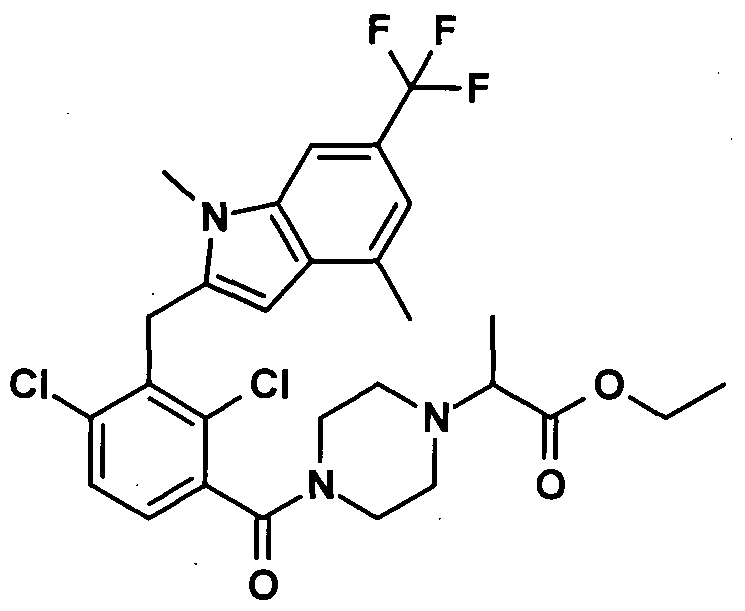
Using a similar procedure as the one described in Example T, Step 1, ethyl 2-(4-(2,4-dichloro-3-((l,4- dimethyl-6-(trifluoromethyl)-lH-indol-2-yl)methyl)benzoyl)piperazin-l-yl)propanoate (43 mg, 66%) was prepared from (2,4-dichloro-3-((l,4-dimethyl-6-(trifluoromethyl)-lH-indol-2- yl)methyl)phenyl)(piperazin-l-yl)methanone (Example S, Step 2) (50 mg, 0.103 mmol) and ethyl 2- bromopropionate (28 mg, 0.155 mmol). LC/MS (Method k) Rt = 3.05 min.; MS m/z: 584 [M+H]+ ¾ NMR (CDC13, 300 MHz): δ 7.48 (d, J = 9Hz, 1H), 7.43 (s, 1H), 7.25 (d, J = 9Hz, 1H), 7.08 (s, 1H), 5.78 (s, 1H), 4.42 (m, 2H), 4.14 (m, 2H), 3.86 (s, 3H), 3.84 (m, 2H), 3.28 (m, 3H), 2.71 (m, 4H), 2.43 (s, 3H), 1.28 (m, 6H).
Step 2: 2-(4-(2,4-dichloro-3-((l,4-dimethyl-6-(trifluoromethyl)-lH-indol-2- yl)methyl)benzoyl)piperazin-l-yI)propanoic acid

Using a similar procedure as the one described in Example O, Step 4, 2-(4-(2,4-dichloro-3-((l,4- dimethyl-6-(trifluoromethyl)-lH-indol-2-yl)methyl)benzoyl)piperazin-l-yl)propanoic acid (45 mg, 53%) was prepared from ethyl 2-(4-(2,4-dichloro-3-((l,4-dimethyl-6-(trifluoromethyl)-lH-indol-2- yl)methyl)benzoyl)piperazin-l-yl)propanoe (85 mg, 0.145 mmol). LC/MS (Method g) Rt = 1.52 min.; MS m/z: 556 [Μ+Η]+ Ή NMR (DMSO-rf6, 300 MHz): S 7.70 (s, 1H), 7.66 (d, J = 8Hz, 1H), 7.40 (d, J = 8Hz, 1H), 7.06 (s, 1H), 5.67 (s, 1H), 4.46 (m, 2H), 3.92 (s, 3H), 3.63 (m, 3H), 3.16 (m, 4H), 2.57 (m, 2H), 2.36 (s, 3H), 1.73 (m, 3H).
Example V: l-(2,4-dichloro-3-((l,5-dimethyl-6-(trifluoromethyl)-lH-indoI-2- yl)methyl)benzoyl)piperidine-4-carboxylic acid

Step 1: methyl 2,4-dichIoro-3-(hydroxy(5-methyl-l-(phenylsulfonyl)-6-(trifluoromethyl)-lH- indol-2-yI)methyI)benzoate
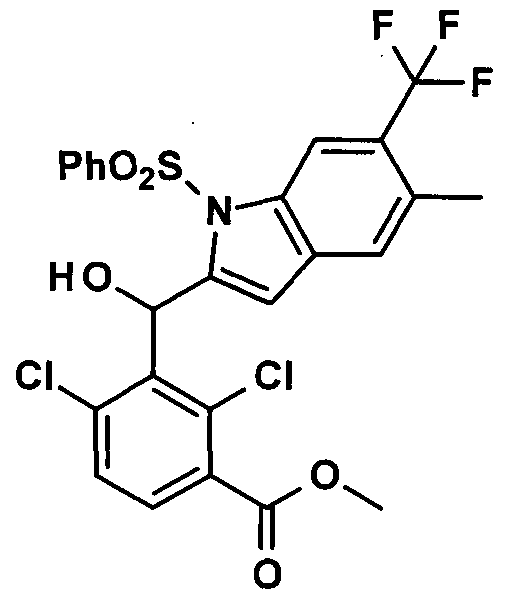
Using a similar procedure as the one described in Example A, Step 1, methyl 2,4-dichloro-3- (hydroxy(5-methyl-l-(phenylsulfonyl)-6-(trifluoromethyl)-lH-indol-2-yl)methyl)benzoate (1 g, 96%) was prepared from N-(2-iodo-4-methyl-5-(trifluoromethyl)phenyl)benzenesulfonamide (Preparation #17) (800 mg, 1.813 mmol) and methyl 2,4-dichloro-3-(l-hydroxyprop-2-yn-l-yl)benzoate (Preparation #1) (564 mg, 2.176 mmol). LC MS (Method h) Rt = 3.36 min.; MS m/z: 630 [Μ-Η]" +CH3COOH Ή NMR (DMSO-i/6, 300 MHz): δ 8.29 (s, 1H), 7.79 (m, 2H), 7.68-7.53 (m, 6H), 6.97 (d, J = 3Hz, 1H), 6.77 (s, 1H), 6.72 (d, J = 8Hz, 1H), 3.86 (s, 3H), 2.46 (s, 3H).
Step 2: methyl 2,4-dichloro-3-((5-methyl-l-(phenylsulfonyl)-6-(trifluoromethyl)-lH-indoI-2- yl)methyI)benzoate

Using a similar procedure as the one described in Example A, Step 2, methyl 2,4-dichloro-3-((5- methyl-l-(phenylsulfonyl)-6-(trifluoromethyl)-lH-indol-2-yl)methyl)benzoate (841 mg, 87%) was prepared from methyl 2,4-dichloro-3-(hydroxy(5-methyl-l-(phenylsulfonyl)-6-(trifluoromethyl)-lH- indol-2-yl)methyl) (1 g, 1.747 mmol). LC/MS (Method h) Rt = 3.80 min.; MS m/z 556 [Μ+Η]+ Ή MR (DMSO-i/e, 300 MHz): δ 8.38 (s, 1H), 7.90 (d, J = 8Hz, 1H), 7.79 (m, 3H), 7.69 (m, 3H), 7.50 (s, 1H), 5.88 (s, 1H), 4.58 (s, 2H), 3.87 (s, 3H), 2.44 (s, 3H).
Step 3: methyl 2,4-dichloro-3-((5-methyl-6-(trifluoromethyI)-lH-indol-2-yl)methyI)benzoate

Using a similar procedure as the one described in Example A, Step 3, methyl 2,4-dichloro-3-((5- methyl-6-(trifluoromethyl)-lH-indol-2-yl)methyl)benzoate (420 mg, 67%) was prepared from methyl 2,4-dichloro-3-((5-methyl-l-(phenylsulfonyl)-6-(trifluoromethyl)-lH-indol-2-yl)methyl)benzoate (841 mg, 1.512 mmol) LC/MS (Method h) Rt = 3.43 min.; MS m/z: 416 [Μ+Η]+ Ή NMR (DMSO-i/6, 300 MHz): δ 11.35 (s, 1H), 7.75 (d, J = 9Hz, 1H), 7.68 (d, J = 9Hz, 1H), 7.62 (s, 1H), 7.37 (s, 1H), 5.87 (s, 1H), 4.47 (s, 2H), 3.87 (s, 3H), 2.42 (s, 3H).
Step 4: methyl 2,4-dichloro-3-((l,5-dimethyl-6-(trifluoromethyI)-lH-indol-2-yI)methyI)benzoate

Using a similar procedure as the one described in Example P, Step 4, methyl 2,4-dichloro-3-((l,5- dimethyl-6-(trifluoromethyl)-lH-indol-2-yl)methyl)benzoate (530 mg, 84%) was prepared from methyl 2,4-dichloro-3-((5-methyl-6-(trifluoromethyl)-lH-indol-2-yl)methyl)benzoate (592 mg, 1.422 mmol)
LC/MS (Method h) Rt = 3.57 min.; MS m/z: 430 [Μ+Η]+ Ή NMR (DMSO- 6, 300 MHz): δ 7.79 (s, 1H), 7.78 (d, J = 8Hz, 1H), 7.71 (d, J = 8Hz, 1H), 7.36 (s, 1H), 5.56 (s, 1H), 4.47 (s, 2H), 3.90 (s, 3H), 3.86 (s, 3H), 2.42 (s, 3H).
Step 5: 2,4-dichloro-3-((l,5-dimethyl-6-(trifluoromethyl)-lH-indol-2-yl)methyI)benzoic acid

Using a similar procedure as the one described in Example A, Step 5, 2,4-dichloro-3-((l,5-dimethyl-6- (trifluoromethyl)-lH-indol-2-yl)methyl)benzoic acid (424 mg, 100%) was prepared from methyl 2,4- dichloro-3-((l,5-dimethyl-6-(trifluoromethyl)-lH-indol-2-yl)methyl)benzoate (438 mg, 1.018 mmol) LC/MS (Method h) Rt = 3.13 min.; MS m/z: 416 [M+H]+ ¾ NMR (DMSO-</6, 300 MHz): δ 13.67 (broad, 1H), 7.79 (s, 1H), 7.75 (d, J = 9Hz, 1H), 7.67 (d, J = 9Hz, 1H), 7.36 (s, 1H), 5.57 (s, 1H), 4.47 (d, 2H), 3.90 (s, 3H), 2.43 (s, 3H).
Step 6: ethyl l-(2,4-dichloro-3-((l,5-dimethyI-6-(trifluoromethyI)-lH-indoI-2- yl)methyl)benzoyl)piperidine-4-carboxylate

Using a similar procedure as the one described in Example Al, ethyl l-(2,4-dichloro-3-((l,5-dimethyl- 6-(trifluoromethyl)-lH-indol-2-yl)methyl)benzoyl)piperidine-4-carboxylate (133 mg, 100%) was prepared from 2,4-dichloro-3-((l,5-dimethyl-6-(trifluoromethyl)-lH-indol-2-yl)methyl)benzoic acid (100 mg, 0.240 mmol) and ethyl piperidine-4-carboxylate (37.8 mg, 0.24 mmol). LC/MS (Method h) Rt = 3.43 min.; MS m/z: 555 [Μ+Η]+ Ή NMR (DMSO-c 6, 300 MHz): δ 7.79 (s, 1H), 7.65 (d, J = 6Hz, 1H), 7.46 (d, J = 6Hz, 0.5H), 7.38 (m, 1.5H), 5.60 and 5.58 (s, 1H), 4.43 (m, 2H), 4.37 (m, 1H), 4.07 (m, 2H), 3.89 (s, 3H), 3.27 (m, 1H), 3.13 (m, 2H), 2.65 (m, 1H), 2.43 (s, 3H), 1.93 (m, 1H), 1.81 (m, 1H), 1.51 (m, 2H), 1.18 (m, 3H).
Step 7: l-(2,4-dichloro-3-((l,5-dimethyl-6-(trifluoromethyl)-lH-indol-2- yl)methyl)benzoyI)piperidine-4-carboxylic acid

Using a similar procedure as the one described in Example A, Step 5, l-(2,4-dichloro-3-((l,5- dimethyl-6-(trifluoromethyl)-lH-indol-2-yl)methyl)benzoyl)piperidine-4-carboxylic acid (102 mg, 77%) was prepared from ethyl l-(2,4-dichloro-3-((l,5-dimethyl-6-(trifluoromethyl)-lH-indol-2- yl)methyl)benzoyl)piperidine-4-carboxylate (133 mg, 0.239 mmol). LC/MS (Method g) Rt = 1.82 min.; MS m/z: 527 [Μ+Η]+ 1Η NMR (DMSO-c/6, 400 MHz): δ 12.40 (broad, 1H), 7.79 (s, 1H), 7.67 (d, J = 10Hz, 1H), 7.45 (d, J = 10Hz, 0.5H), 7.37 (m, 1.5H), 5.60 and 5.58 (s, 1H), 4.46 (s, 2H), 4.36 (m, 1H), 3.96 (s, 3H), 3.29 (m, 1H), 3.12 (m, 1H), 3.01 (m, 1H), 2.56 (m, 1H), 2.49 (s, 3H), 1.92 (m, 1H), 1.78 (m, 1H), 1.53 (m, 2H).
Example W: 2-(2,6-dichloro-3-methoxybenzyl)-l,4-dimethyl-6-(trifluoromethyl)-lH-indole

Step 1 : (2,6-dichloro-3-methoxyphenyl)(4-methyl-l-(phenylsulfonyl)-6-(trifluoromethyI)-lH- indol-2-yl)methanoI

Using a similar procedure as the one described in Example A, Step 1, (2,6-dichloro-3- methoxyphenyl)(4-methyl-l-(phenylsulfonyl)-6-(trifluoromethyl)-lH-indol-2-yl)methanol (2.51 g, 90%) was prepared from N-(2-iodo-3-methyl-5-(trifluoromethyl)phenyl)benzenesulfonamide (Preparation #16) (2.262 g, 5.13 mmol) and l-(2,6-dichloro-3-methoxyphenyl)prop-2-yn-l-ol (Preparation #7 (1.54 g, 6.66 mmol). LC/MS (Method h) Rt = 3.39 min.; MS m/z: 602 [Μ-Η]" +CH3COOH Ή NMR (DMSO- , 300 MHz): δ 8.68 (m, 1H), 7.82 (m, 2H), 7.67 (m, 1H), 7.56 (m, 2H), 7.40 (m, 2H), 7.14 (d, J = 9Hz, 1H), 6.98 (d, 6Hz, 1H), 6.79 (s, 1H), 6.57 (d, J = 6Hz, 1H), 3.87 (s, 3H), 2.45 (s, 3H).
Step 2: 2-(2,6-dichloro-3-methoxybenzyl)-4-methyI-l-(phenylsulfonyl)-6-(trifluoromethyl)-lH- indole

Using a similar procedure as the one described in Example A, Step 2, 2-(2,6-dichloro-3- methoxybenzyl)-4-methyl-l-(phenylsulfonyl)-6-(trifluoromethyl)-lH-indole (2.12 g, 87%) was prepared from (2,6-dichloro-3-methoxyphenyl)(4-methyl-l-(phenylsulfonyl)-6-(trifluoromethyl)-lH- indol-2-yl)methanol (2.5 g, 4.59 mmol). LC/MS (Method h) Rt = 3.85 min.; MS m/z: 528 [Μ+Η]+ Ή NMR (DMSO- , 300 MHz): δ 8.24 (s, 1H), 7.93 (m, 2H), 7.76 (m, 1H), 7.68 (m, 2H), 7.53 (d, J = 9Hz, 1H), 7.41 (s, 1H), 7.23 (d, J= 9Hz, 1H), 5.90 (s, 1H), 4.54 (s, 2H), 3.90 (s, 3H), 2.34 (s, 3H).
Step 3: 2-(2,6-dichloro-3-methoxybenzyl)-4-methyl-6-(trifluoromethyI)-lH-indoIe

Using a similar procedure as the one described in Example A, Step 3, 2-(2,6-dichloro-3- methoxybenzyl)-4-methyl-6-(trifluoromethyl)-lH-indole (1.52 g, 98%) was prepared from 2-(2,6- dichloro-3-methoxybenzyl)-4-methyl-l-(phenylsulfonyl)-6-(trifluoromethyl)-lH-indole (2.12 g, 4.01 mmol). LC/MS (Method h) Rt = 3.47 min.; MS m/z: 388 [Μ+Η]+ Ή NMR (DMSO- 6, 300 MHz): δ 11.50 (broad, 1H), 7.52 (d, J = 9Hz, 1H), 7.48 (s, 1H), 7.17 (d, J = 9Hz, 1H), 7.02 (s, 1H), 5.95 (s, 1H), 4.42 (s, 2H), 3.89 (s, 3H), 2.40 (s, 3H).
Step 4 : 2-(2,6-dichloro-3-methoxybenzyl)- 1 ,4-dimethyI-6-(trifluoromethyl)- IH-indoIe

Using a similar procedure as the one described in Example P, Step 4, 2-(2,6-dichloro-3- methoxybenzyl)-l,4-dimethyl-6-(trifluoromethyl)-lH-indole (517 mg, 93%) was prepared from 2- (2,6-dichloro-3-methoxybenzyl)-4-methyl-6-(trifluoromethyl)-lH-indole (1.36 g, 3.50 mmol) LC/MS (Method g) Rt 2.17 min.; MS m/z: 402 [Μ+Η]+Ή NMR (DMSO-(/6, 300 MHz): δ 7.69 (s, 1H), 7.54 (d, J = 9Hz, 1H), 7.22 (d, J = 9Hz, 1H), 7.05 (s, 1H), 5.65 (s, 1H), 4.41 (s, 2H), 3.91 (s, 6H), 2.35 (s, 3H).
Example X: 2,4-dichloro-3-((l,4-dimethyl-6-(trifluoromethyI)-lH-indol-2-yl)methyl)phenol

To a solution of 2-(2,6-dichloro-3-methoxybenzyl)-l,4-dimethyl-6-(trifluoromethyl)-lH-indole (Example W) (0.517 g, 1.285 mmol) in dichloromethane (51.4 mL) and cooled at -10°C was added BBr3 (3.86 mL, 3.86 mmol). The reaction was stirred at -10°C for 1 hour and warmed at room temperature for 1.5 hours. Te reaction was hydrolysed by addition of saturated NaHC03 aqueous solution, and the basic mixture was extracted with dichloromethane. The organic layer was washed successively with water and saturated NaCl solution, dried over magnesium sulfate, filtered and evaporated. The residue was purified by column chromatography on silica gel (eluting with 0-30% ethyl acetate in cyclohexane) to give 2,4-dichloro-3-((l,4-dimethyl-6-(trifluoromethyl)-lH-indol-2- yl)methyl)phenol (389 mg, 78 %). LC/MS (Method g) R, 1.97 min.; MS m/z: 388 [M+H]+ ]H NMR (DMSO-tf6, 400 MHz): δ 10.58 (broad, 1H), 7.68 (s, 1H), 7.35 (d, J = 8.8Hz, 1H), 7.05 (s, 1H), 7.01 (d, J = 8.8Hz, 1H), 5.66 (s, 1H), 4.37 (s, 2H), 3.90 (s, 3H), 2.36 (s, 3H).
Example Y: 2-(2,4-dichloro-3-((l,4-dimethyl-6-(trifluoromethyl)-lH-indol-2- yl)methyl)phenoxy)acetic acid

Step 1: methyl 2-(2,4-dichloro-3-((l,4-dimethyl-6-(trifluoromethyl)-lH-indol-2- yl)methyl)phenoxy)acetate

To a solution of 2,4-dichloro-3-((l,4-dimethyl-6-(trifluoromethyl)-lH-indol-2-yl)methyl)phenol (Example X) (100 mg, 0.258 mmol) in acetonitrile (1 mL) was added Cs2C03 (92 mg, 0.283 mmol) and the mixture was stirred at room temperature for lOmn. methyl bromoacetate (0.036 mL, 0.386 mmol) was added and the mixture was stirred at room temperature for 7 hours. The reaction mixture was diluted with water and extracted with dichloromethane. The organic layer was washed with brine, dried over magnesium sulfate, filtered and concentrated under reduced pressure. The residue was purified by column chromatography on silica gel (eluting with 0-30% ethyl acetate in cyclohexane) to give methyl 2-(2,4-dichloro-3-((l ,4-dimethyl-6-(trifluoromethyl)-lH-indol-2- yl)methyl)phenoxy)acetate (98 mg, 83 %).
LC/MS (Method h) Rt 3.46 min.; MS m/z: 460 [M+H]+
Ή NMR (DMSO-c/g, 300 MHz): δ 7.70 (s, 1H), 7.52 (d, J = 9Hz, 1H), 7.16 (d, J = 9Hz, 1H), 7.06 (s,
1H), 5.65 (s, 1H), 5.00 (s, 2H), 4.43 (s, 2H), 3.92 (s, 3H), 3.72 (s, 3H), 2.36 (s, 3H).
Step 2: 2-(2,4-dichloro-3-((l,4-dimethyl-6-(trifluoromethyl)-lH-indol-2-yl)methyl)phenoxy)acetic acid

Using a similar procedure as the one described in Example A, Step 5, 2-(2,4-dichloro-3-((l,4- dimethyl-6-(trifluoromethyl)-lH-indol-2-yl)methyl)phenoxy)acetic acid (88 mg, 93%) was prepared from methyl 2-(2,4-dichloro-3-((l ,4-dimethyl-6-(trifluoromethyl)-lH-indol-2-- yl)methyl)phenoxy)acetate (98 mg, 0.213 mmol) LC/MS (Method g) Rt 1.98 min.; MS m/z: 446 [Μ+Η]+ Ή NMR (DMSO-c/6, 400 MHz): δ 13.30 (broad, 1H), 7.70 (s, 1H), 7.50 (d, J = 8.8Hz, 1H), 7.09 (d, J = 8.8Hz, 1H), 7.06 (s, 1H), 5.66 (s, 1H), 4.83 (s, 2H), 4.42 (s, 2H), 3.91 (s, 3H), 2.34 (s, 3H).
Example Yl : 3-(2,4-dichloro-3-((l,4-dimethyI-6-(trifluoromethyI)-lH-indol-2- yl)methyl)phenoxy)propanoic acid

To a solution of 2,4-dichloro-3-((l,4-dimethyl-6-(trifluoromethyl)-lH-indol-2-yl)methyl)phenol (Example X) (150 mg, 0.386 mmol) in DMF (2 mL) was added NaH (23.18 mg, 0.580 mmol) and the mixture was stirred at room temperature for 10 minutes. Beta-propiolactone (0.036 mL, 0.580 mmol) was added and the mixture was stirred at room temeprature overnight. Water was added to the mixture, and the mixture was acidified to pH=3-4 with IN HC1 solution. The solid was filtered, washed with water and diethyl ether and dried under vaccum. The residue was purified by column chromatography on silica gel (eluting with 0-20% MeOH in dichloromethane) to give 3-(2,4-dichloro-3-((l,4-dimefhyl- 6-(trifluoromethyl)-lH-indol-2-yl)methyl)phenoxy)propanoic acid (101 mg, 37%) as a white solid. LC/MS (Method g) R, 1.97 min.; MS m/z: 460 [Μ+Η]+ Ή NMR (DMSO-<¾, 400 MHz): δ 12.56
(broad, 1H), 7.67 (s, lH), 7.52 (d, J = 9.2Hz, 1H), 7.24 (d, J = 9.2Hz, 1H), 7.05 (s, 1H), 5.65 (s, 4.40 (s, 2H), 4L30 (t, J = 6Hz, 2H), 3.90 (s, 3H), 2.74 (t, J = 6Hz, 2H), 2.36 (s, 3H).
Example Z: 2-((3,5-dichloro-2-methoxypyridin-4-yI)methyl)-l,4-dimethyl-6-(trifluoromethyl) lH-indole

Step 1 : (3,5-dichloro-2-methoxypyridin-4-yl)(4-methyl-l-(phenyIsulfonyl)-6-(trifluoromethyl)- lH-indol-2-yl)methanol

Using a similar procedure as the one described in Example A, Step 1, (3,5-dichloro-2-methoxypyridin- 4-yl)(4-methyl-l-(phenylsulfonyl)-6-(trifluoromethyl)-lH-indol-2-yl)methanol (3.47 g, 94%) was prepared from N-(2-iodo-3-methyl-5-(trifluoromethyl)phenyl)benzenesulfonamide (Preparation #16) (3 g, 6.80 mmol) and l-(3,5-dichloro-2-methoxypyridin-4-yl)prop-2-yn-l-ol (Preparation #15) (1.894 g, 8.16 mmol). LC/MS (Method k) Rt 3.59 min.; MS m/z: 545 [Μ+Η]+ Ή NMR (DMSO-rf6, 300 MHz): δ 8.21 (s, 1H), 8.09 (s, 1H), 7.82 (m, 2H), 7.71 (m, 1H), 7.58 (m, 1H), 7.44 (s, 1H), 6.94 (s, 1H), 6.87 (m, 2H), 3.95 (s, 3H), 2.48 (s, 3H).
Step 2: 2-((3,5-dichloro-2-methoxypyridin-4-yl)methyl)-4-methyl-l-(phenylsulfonyl)-6- (trifluoromethyl)-lH-indole

To a solution of (3,5-dichloro-2-methoxypyridin-4-yl)(4-methyl-l-(phenylsulfonyl)-6- (trifluoromethyl)-lH-indol-2-yl)methanol (50 mg, 0.092 mmol) in chloroform (420 μί) was added thionyl chloride (19.95 μί, 0.275 mmol) and the reaction mixture was stirred at room temperature during one night. The reaction mixture was basified (pH 8) with NaHC03 saturated aqueous solution. The obtained aqueous layer was extracted with ethyl acetate. The obtained organic layer was dried over magnesium sulfate, filtered and concentrated under reduced pressure. The residue was dissolved in acetic acid (420 μΐ,) and zinc (30.0 mg, 0.458 mmol) was added. The reaction mixture was stirred at room temperature during 2 hours, then filtered, washed with dichloromethane and the filtrate was concentrated under reduced pressure. The residue was diluted with ethyl acetate and washed with water. The obtained organic layer was dried over magnesium sulfate, filtered and concentrated under reduced pressure to give 2-((3,5-dichloro-2-methoxypyridin-4-yl)methyl)-4-methyl-l- (phenylsulfonyl)-6-(trifluoromethyl)-lH-indole (50 mg, 94%) as a beige solid. LC/MS (Method k) Rt 4.19 min.; MS m/∑: 529 [M+H]+
Ή NMR (DMSO-( 6, 300 MHz): δ 8.32 (s, 1H), 8.22 (s, 1H), 7.92 (m, 2H), 7.77 (m, 1H), 7.67 (m, 2H), 7.41 (s, 1H), 6.21 (s, 1H), 4.54 (s, 2H), 3.39 (s, 3H), 2.37 (s, 3H).
Step 3: 2-((3,5-dichloro-2-methoxypyridin-4-yl)methyl)-4-methyl-6-(trifluoromethyl)-lH-indole

Using a similar procedure as the one described in Example A, Step 3, 2-((3,5-dichloro-2- methoxypyridin-4-yl)methyl)-4-methyl-6-(trifluoromethyl)-lH-indole (1.2 g, 86%) was prepared from 2-((3,5-dichloro-2-methoxypyridin-4-yl)methyl)-4-methyl-l-(phenylsulfonyl)-6-(trifluoromethyl)-lH- indole (1.9 g, 3.59 mmol) LC/MS (Method h) Rt 3.45 min.; MS m/z 389 [Μ+Η]+ 1Η NMR (DMSO- 6, 300 MHz): δ 11.49 (s, 1H), 8.31 (s, 1H), 7.48 (s, 1H), 7.03 (s, 1H), 6.06 (s, 1H), 4.42 (s, 2H), 3.98 (s, 3H), 2.42 (s, 3H).
Step 4: 2-((3,5-dichloro-2-methoxypyridin-4-yI)methyl)-l,4-dimethyl-6-(trifluoromethyI)-lH- indole

Using a similar procedure as the one described in Example A, Step 4, 2-((3,5-dichloro-2- methoxypyridin-4-yl)methyl)-l,4-dimethyl-6-(trifluoromethyl)-lH- indole (963 mg, 77%) was prepared from 2-((3,5-dichloro-2-methoxypyridin-4-yl)methyl)-4-methyl-6-(trifluoromethyl)-lH- indole (1.2 g, 3.08 mmol). LC/MS (Method h) Rt 3.60 min.; MS m/z: 403 [Μ+Η]+ Ή NMR (DMSO- d6, 300 MHz): δ 8.35 (s, IH), 7.70 (s, IH), 7.07 (s, IH), 5.80 (s, IH), 4.43 (s, 2Η), 4.00 (s, 3H), 3.92 (s, 3H), 2.38 (s, 3H).
Example AA: 2-(2,6-dichloro-3-(4-(oxetan-3-yl)piperazine-l-carbonyl)benzyl)-l,4-dimethyl-lH- indole-6-carbonitrile

Step 1: methyl 2,4-dichloro-3-((6-cyano-4-methyl-l-(phenylsulfonyl)-lH-indol-2- yl)(hydroxy)methyl)benzoate

Using a similar procedure as the one described in Example A, Step 1, methyl 2,4-dichloro-3-((6- cyano-4-methyl-l-(phenylsulfonyl)-lH-indol-2-yl)(hydroxy)methyl)benzoate (1.32 g, 71%) was obtained as a brown solid from N-(5-cyano-2-iodo-3-methylphenyl)benzenesulfonamide (Preparation
#18) (1.4 g, 3.52mmol) and methyl 2,4-dichloro-3-(l-hydroxyprop-2-yn-l-yl)benzoate (Preparation
#1) (1.093 g, 4.22 mmol). LC/MS (Method h) Rt = 2.97 min.; MS m/z: 587[M-H]~ + CH3COOH .
Ή NMR (DMSO-</6, 300 MHz): δ 8.24 (s, 1H), 7.90 (m, 2H), 7.67 (m, 2H), 7.53 (m, 4H), 7.02 (m,
1H), 6.89 (s, 1H), 6.77 (d, J = 6Hz, 1H), 3.87 (s, 3H), 2.43 (s, 3H).
Step 2: methyl 2,4-dichloro-3-((6-cyano-4-methyl-l-(phenylsulfonyl)-lH-indol-2- yl)methyI)benzoate

Using a similar procedure as the one described in Example A, Step 2, methyl 2,4-dichloro-3-((6- cyano-4-methyl-l-(phenylsulfonyl)-lH-indol-2-yl)methyl)benzoate (1.6 g, 100%) was obtained as a yellow solid from methyl 2,4-dichloro-3-((6-cyano-4-methyl-l-(phenylsulfonyl)-lH-indol-2- yl)(hydroxy)methyl)benzoate (1.52 g, 2.87mmol). LC/MS (Method h) R, = 3.45 min.; MS m/z: 513 [M+H]+. !H NMR (DMSO-i 6, 300 MHz): δ 8.36 (s, 1H), 8.07 (d, J = 9Hz, 2H), 7.81 (m, 2H), 7.69 (m, 3H), 7.48 (s, 1H), 5.98 (s, 1H), 4.63 (s, 2H), 3.86 (s, 3H), 2.31 (s, 3H).
Step 3: methyl 2,4-dichloro-3-((6-cyano-4-methyl-lH-indol-2-yl)methyl)benzoate

Using a similar procedure as the one described in Example A, Step 3, methyl 2,4-dichloro-3-((6- cyano-4-methyl-lH-indol-2-yl)methyl)benzoate (850 mg, 67%) was obtained as a brown solid from methyl 2,4-dichloro-3-((6-cyano-4-methyl-l -(phenylsulfonyl)-lH-indol-2-yl)methyl)benzoate (1.6 g, 3.12 mmol).
LC/MS (Method h) Rt = 3.03 min.; MS m/z: 373 [M+H]+ . Ή NMR (DMSO-J6, 300 MHz): δ 11.66 (broad, 1H), 7.76 (d, J = 6Hz, 1H), 7.68 (d, J = 6Hz, 1H), 7.64 (s, 1H), 7.08 (s, 1H), 5.99 (s, 1H), 4.50 (s, 2H), 3.87 (s, 3H), 2.37 (s, 3H).
Step 4: methyl 2,4-dichloro-3-((6-cyano-l 4-dimethyl-lH-indol-2-yl)methyl)benzoate

Using a similar procedure as the one described in Example A, Step 4, methyl 2,4-dichloro-3-((6- cyano-l,4-dimethyl-lH-indol-2-yl)methyl)benzoate (660 mg, 75%) was obtained as a beige solid from methyl 2,4-dichloro-3-((6-cyano-4-methyl-lH-indol-2-yl)methyl)benzoate (847 mg, 2.27 mmol). LC/MS (Method k) Rt = 3.29 min.; MS m/z: 387 [Μ+Η]+ . Ή NMR (DMSO-</6, 300 MHz): δ 7.92 (s, 1H), 7.80 (d, J = 9Hz, 1H), 7.72 (d, J = 9Hz, 1H), 7.11 (s, 1H), 5.70 (s, 1H), 4.50 (s, 2H), 3.91 (s, 3H), 3.88 (s, 3H), 2.33 (s, 3H).
Step 5: 2,4-dichloro-3-((6-cyano-l,4-dimethyl-lH-indol-2-yl)methyl)benzoic acid

Using a similar procedure as the one described in Example A, Step 5, 2,4-dichloro-3-((6-cyano-l,4- dimethyl-lH-indol-2-yl)methyl)benzoic acid (660 mg, 100%) was obtained as a white solid from methyl 2,4-dichloro-3-((6-cyano-l,4-dimethyl-lH-indol-2-yl)methyl)benzoate (655 mg, 1.69 mmol). LC/MS (Method k) Rt = 2.82 min.; MS m/r. 373 [Μ+Η]+ . Ή NMR (DMSO-i/6, 300 MHz): δ 7.92 (s, 1H), 7.77 (d, J= 9Hz, 1H), 7.68 (d, J= 9Hz, 1H), 7.11 (s, 1H), 5.70 (s, 1H), 4.49 (s, 2H), 3.91 (s, 3H), 2.33 (s, 3H).
Step 6: 2-(2,6-dichloro-3-(4-(oxetan-3-yl)piperazine-l-carbonyl)benzyl)-l,4-dimethyl-lH-indole- 6-carbonitrile

Using a similar procedure as the one described in Example A.1, 2-(2,6-dichloro-3-(4-(oxetan-3- yl)piperazine-l-carbonyl)benzyl)-l,4-dimethyl-lH-indole-6-carbonitrile (700 mg, 88%) was obtained as a white solid from 2,4-dichloro-3-((6-cyano-l,4-dimethyl-lH-indol-2-yl)methyl)benzoic acid (600 mg, 1.608 mmol) and l-(oxetan-3-yl)piperazine (260 mg, 1.83 mmol). LC MS (Method g) Rt = 1.47 min.; MS m/z: 497 [Μ+Η]+ Ή NMR (DMSO- 6, 400 MHz): δ 7.92 (s, 1H), 7.67 (d, J = 8Hz, 1H), 7.43 (d, J = 8Hz, 1H), 7.11 (s, 1H), 5.71 (s, 1H), 4.53 (m, 2H), 4.47 (m, 4H), 3.90 (s, 3H), 3.69 (m, 2H), 3.48 (m, 1H), 3.20 (m, 2H), 2.38 (m, 2H), 2.23 (s, 3H), 2.18 (m, 2H).
Table AA. The following examples were prepared from 2,4-dichloro-3-((6-cyano-l,4-dimethyl-lH- indol-2-yl)methyl)benzoic acid (Example AA, Step 5) using the same procedure with the appropriate amine.


Example AB: 2-(2,6-dichloro-3-(morphoIine-4-carbonyI)benzyl)-l-methyl-lH-indole-5- carbonitrile

Step 1 : 2-((2,6-dichloro-3-(morpholine-4-carbonyI)phenyI)(hydroxy)methyI)-l-(phenylsulfonyl)- lH-indole-5-carbonitrile

Using a similar procedure as the one described in Example A, Step 1, 2-((2,6-dichloro-3-(morpholine- 4-carbonyl)phenyl)(hydroxy)methyl)-l-(phenylsulfonyl)-lH-indole-5-carbonitrile (500 mg, 100%) was obtained as a brown solid from (2,4-dichloro-3-(l-hydroxyprop-2-yn-l- yl)phenyl)(morpholino)methanone (Preparation #3) (319 mg, 1.015 mmol) and N-(4-cyano-2- iodophenyl)benzenesulfonamide (Preparation #19) (300 mg, 0.781 mmol). LC/MS (Method h) Rt = 2.52 min.; MS m/z: 570 [M+H]+
]H NMR (DMSO-rf6, 300 MHz): δ 8.14 (m, 2H), 7.94 (m, 2H), 7.70 (m, 1H), 7.55 (m, 4H), 7.52 (m, 2H), 7.01 (m, 1H), 6.71 (m, 1H), 3.65 (m, 4H), 3.53 (m, 2H), 3.17 (m, 2H).
Step 2: 2-(2,6-dichloro-3-(morpholine-4-carbonyl)benzyl)-l-(phenylsulfonyl)-lH-indole-5- carbonitrile

Using a similar procedure as the one described in Example A, Step 2, 2-(2,6-dichloro-3-(morpholine- 4-carbonyl)benzyl)-l-(phenylsulfonyl)-lH-indole-5-carbonitrile (20 mg, 29%) was obtained as a white solid from 2-((2,6-dichloro-3-(morpholine-4-carbo nyl)phenyl)(hydroxy)methyl)-l -(phenylsulfonyl)- lH-indole-5-carbonitrile (70 mg, 0.123 mmol). LC/MS (Method g) Rt = 1.78 min.; MS m/z: 554 [M+H]+
!H NMR (DMSO-rf6, 300 MHz): δ 8.30 (d, J = 9Hz, 1H), 7.98 (m, 3H), 7.77 (m, 2H), 7.68 (m, 3H), 7.48 (d, J = 9Hz, 1H), 5.99 (s, 1H), 4.58 (m, 2H), 3.65 (m, 4H), 3.53 (m, 2H), 3.17 (m, 2H).
Step 3 : 2-(2,6-dichloro-3-(morpholine-4-carbonyI)benzyl)- lH-indole-5-carbonitrile

Using a similar procedure as the one described in Example A, Step 3, 2-(2,6-dichloro-3-(morpholine- 4-carbonyl)benzyl)-lH-indole-5-carbonitrile (465 mg, 85%) was obtained as a yellow solid from 2- (2,6-dichloro-3-(morpholine-4-carbonyl)benzyl)- 1 -(phenylsulfonyl)- 1 H-indole-5 -carbonitrile (670 mg, 1.208 mmol). LC/MS (Method h) Rt = 2.40 min.; MS m/z: 414 [M+H]+
Ή NMR (DMSO-i 6, 300 MHz): δ 11.70 (s, 1H), 7.90 (s, 1H), 7.64 (d, J = 9Hz, 1H), 7.47 (m, 1H),
7.39 (m, 2H), 5.96 (s, 1H), 4.44 (s, 2H), 3.65 (m, 4H), 3.52 (m, 2H), 3.17 (m, 2H).
Step 4: 2-(2,6-dichloro-3-(morphoIine-4-carbonyI)benzyI)-l-methyl-lH-indole-5-carbonitrile:

LC/MS (Method g) R, = 1.49 min.; MS m/z: 428 [M+H]+
Ή NMR (DMSO-c/6, 400 MHz): δ 7.90 (m, 1H), 7.68 (d, J = 8Hz, 1H), 7.65 (d, J = 8Hz, 1H), 7.46 (m, 2H), 5.73 (s, 1H), 4.44 (s, 2H), 3.90 (s, 3H), 3.65 (m, 4H), 3.55 (m, 2H), 3.19 (m, 2H).
Example AC: 2-(2,6-dichIoro-3-(morpholine-4-carbonyl)benzyl)-l-methyl-lH-indole-6- carbonitrile

Step 1: methyl 2,4-dichloro-3-((6-cyano-l-(phenylsulfonyl)-lH-indol-2- yl)(hydroxy)methyl)benzoate

Using a similar procedure as the one described in Example A, Step 1, methyl 2,4-dichloro-3-((6- cyano-l-(phenylsulfonyl)-lH-indol-2-yl)(hydroxy)methyl)benzoate (715 mg, 89%) was obtained as a white solid from N-(5-cyano-2-iodophenyl)benzenesulfonamide (Preparation #20) (600 mg, 1.562 mmol) and methyl 2,4-dichloro-3-(l-hydroxyprop-2-yn-l-yl)benzoate (Preparation #1) (445 mg, 1.718 mmol).
LC/MS (Method h) Rt = 2.87 min.; MS m/z: 573 [Μ-Η]" +CH3COOH !H NMR (DMSO-cii6, 300 MHz): 5 8.40 (s, 1H), 7.98 (dd, J = 3Hz, 9Hz, 2H), 7.79 (d, J = 6Hz, 1H), 7.68 (m, 3H), 7.58 (m, 3H), 7.03 (dd, J = 3Hz, 6Hz, 1H), 6.82 (s, 1H), 6.76 (d, J = 6Hz, 1H), 3.86 (s, 3H).
Step 2: methyl 2,4-dichloro-3-((6-cyano-l- henylsulfonyI)-lH-indol-2-yl)methyl)benzoate

Using a similar procedure as the one described in Example A, Step 2, methyl 2,4-dichloro-3-((6- cyano-l-(phenylsulfonyl)-lH-indol-2-yl)methyl)benzoate (400 mg, 100%) was obtained as a yellow solid from methyl 2,4-dichloro-3-((6-cyano-l-(phenylsulfonyl)-lH-indol-2- yl)(hydroxy)methyl)benzoate (400 mg, 0.776 mmol). LC/MS (Method h) R, = 3.39 min.; MS m/z: 497 [Μ-Η]- Ή NMR (DMSO- , 300 MHz): δ 8.51 (s, 1H), 8.07 (d, J = 9Hz, 2H), 7.80 (m, 2H), 7.68 (m, 5H), 6.00 (s, 1H), 4.62 (s, 2H), 3.86 (s, 3H).
Step 3: methyl 2,4-dichloro-3-((6-cyano-lH-indol-2- l)methyl)benzoate

Using a similar procedure as the one described in Example A, Step 3, methyl 2,4-dichloro-3-((6- cyano-lH-indol-2-yl)methyl)benzoate (213 mg, 74%) was obtained as a yellow solid from methyl 2,4- dichloro-3-((6-cyano-l-(phenylsulfonyl)-lH-indol-2-yl)methyl)benzoate (400 mg, 0.801 mmol).
LC/MS (Method h) Rt = 2.93 min.; MS m/z: 359 [Μ+Η]+ Ή NMR (DMSO-</6, 300 MHz): δ 11.65 (broad, 1H), 7.79 (d, J = 9Hz, 1H), 7.74 (s, 1H), 7.68 (d, J = 9Hz, 1H), 7.54 (d, J = 9Hz, 1H), 7.27 (dd, J = 3Hz, 9Hz, 1H), 7.98 (s, 1H), 4.50 (s, 2H), 3.87 (s, 3H).
Step 4: methyl 2,4-dichloro-3-((6-cyano-l-methyl-lH-indol-2-yl)methyl)benzoate

Using a similar procedure as the one described in Example P, Step 4, methyl 2,4-dichloro-3-((6-cyano- l-methyl-lH-indol-2-yl)methyl)benzoate (210 mg, 93%) was obtained as a white solid from methyl 2,4-dichloro-3-((6-cyano-lH-indol-2-yl)methyl)benzoate (210 mg, 0.585 mmol). LC/MS (Method h) Rt = 3.04 min.; MS m/z: 373 [Μ+Η]+ Ή NMR (DMSO-rf6, 300 MHz): δ 8.08 (s, 1H), 7.80 (d, J = 9Hz, 1H), 7.72 (d, J = 9Hz, 1H), 7.53 (d, J = 9Hz, 1H), 7.30 (dd, J = 3Hz, 9Hz, 1H), 5.71 (s, 1H), 4.50 (s, 2H), 3.92 (s, 3H), 3.88 (s, 3H).
Step 5: 2,4-dichIoro-3-((6-cyano-l-meth l-lH-indol-2-yl)methyl)benzoic acid

Using a similar procedure as the one described in Example A, Step 5, 2,4-dichloro-3-((6-cyano-l- methyl-lH-indol-2-yl)methyl)benzoic acid (170 mg, 88%) was obtained as a white solid from methyl 2,4-dichloro-3-((6-cyano-l-methyl-lH-indol-2-yl)methyl)benzoate (200 mg, 0.536 mmol). LC/MS (Method h) Rt = 2.61 min.; MS m/z: 359 [M+H]+
Ή NMR (DMSO-rf6, 300 MHz): δ 8.08 (d, J = 3Hz, 1H), 7.75 (d, J = 9Hz, 1H), 7.66 (d, J = 9Hz, 1H), 7.54 (d, J = 9Hz, 1H), 7.30 (dd, J = 3Hz, 9Hz, 1H), 5.71 (s, 1H), 4.50 (s, 2H), 3.92 (s, 3H).
Step 6: 2-(2,6-dichloro-3-(morpholine-4-carbonyl)benzyI)-l-methyl-lH-indole-6-carbonitrile :

Using a similar procedure as the one described in Example A, Step 6, 2-(2,6-dichloro-3-(morpholine- 4-carbonyl)benzyl)-l-methyl-lH-indole-6-carbonitrile (100 mg, 50%) was obtained as a white solid from 2,4-dichloro-3-((6-cyano-l -methyl- lH-indol-2-yl)methyl)benzoic acid (165 mg, 0.459 mmol) and morpholine (80 mg, 0.92 mmol). LC/MS (Method g) R, = 1.53 min.; MS m/z: 428 [M+H]+ JH NMR (DMSO-c 6, 400 MHz): δ 8.08 (s, 1H), 7.67 (d, J = 8Hz, 1H), 7.54 (d, J = 8Hz, 1H), 7.45 (d, J = 8Hz, 1H), 7.30 (dd, J = 3Hz, 8Hz, 1H), 5.75 (s, 1H), 4.46 (s, 2H), 3.92 (s, 3H), 3.65 (m, 4H), 3.54 (m, 2H), 3.18 (m, 2H).
Example AD: 2-(2,6-dichloro-3-(morphoIine-4-carbonyI)benzoyl)-l,4-dimethyl-lH-indole-6- carbonitrile

Step 1 : 2-((2,6-dichloro-3-(morpholine-4-carbonyl)phenyl)(hydroxy)methyl)-4-methyl-l- (phenylsulfonyl)-lH-indole-6-carbonitrile

Using a similar procedure as the one described in example A, Step 1, 2-((2,6 lichloro-3-(morpholine- 4-carbonyl)phenyl)(hydroxy)methyl)-4-methyl-l -(phenylsulfonyl)-lH-indole-6-carbonitrile (3 g, 41%) was obtained as an orange solid from N-(2-bromo-5-cyano-3-methylphenyl)benzenesulfonamide (Preparation #46) (3.6 g, 10.25 mmol) and (2,4-dichloro-3-(l-hydroxyprop-2-yn-l- yl)phenyl)(morpholino)methanone (Preparation #3) (4.83 g, 15.38 mmol). LC MS (Method h) R, = 2.60 min.; MS m/z: 584 [M+H]+
Ή NMR (CDClj, 300 MHz): δ 8.30 (s, 1H), 7.92 (m, 2H), 7.54 (m, 2H), 7.47 (m, 3H), 7.28 (m, 3H), 6.43 and 6.31 (s, 1H), 3.81 (m, 4H), 3.67 (m, 2H), 3.29 (m, 2H), 2.40 (s, 3H).
Step 2: 2-(2,6-dichIoro-3-(morphoIine-4-carbonyl)benzoyl)-4-methyl-l-(phenylsulfonyl)-lH- indoIe-6-carbonitrile
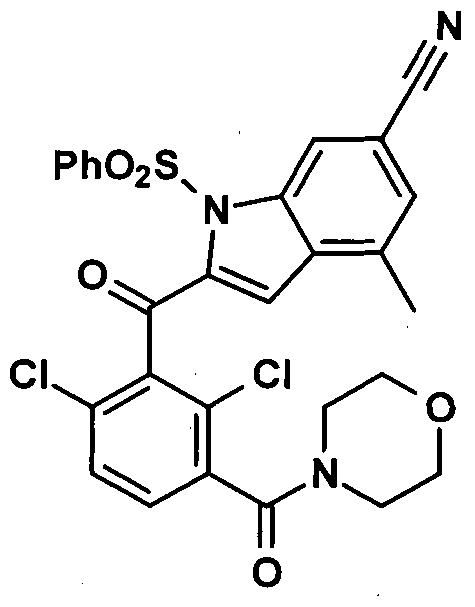
To a solution of 2-((2,6-dichloro-3-(morpholine-4-carbonyl)phenyl)(hydroxy)methyl)-4-methyl-l- (phenylsulfonyl)-lH-indole-6-carbonitrile (321 mg, 0.549 mmol) in dichloromethane (5 mL) was added Dess-Martin periodinane (2.284 mL, 1.098 mmol). The reaction was stirred at room temperature for 2 hours then filtered and washed with acetonitrile. The filtrate was washed with NaHC03 saturated aqueous solution, brine and dried over magnesium sulfate; then concentrated to give 2-(2,6-dichloro-3- (mo holine-4-carbonyl)benzoyl)-4-methyl-l-(phenylsulfonyl)-lH-indole-6-carbonitrile as a yellow solid (252 mg, 72%). LC/MS (Method h) R, = 2.79 min.; MS m/z: 582 [M+H]+
Ή NMR (DMSO-i/6, 300 MHz): δ 8.53 (s, 1H), 8.28 (m, 2H), 7.80 (m, 1H), 7.73 (m, 4H), 7.65 (m, 2H), 3.63 (m, 4H), 3.52 (m, 2H), 3.23 (m, 2H), 2.48 (s, 3H).
Step 3: 2-(2,6-dichloro-3-(morphoIine-4-carbonyl)benzoyl)-4-methyI-lH-indole-6-carbonitrile

Using a similar procedure as the one described in Example A, Step 3, 2-(2,6-dichloro-3-(morpholine-
4-carbonyl)benzoyl)-4-methyl-lH-indole-6-carbonitrile (165 mg, 73%) was obtained as a yellow solid from 2-(2,6-dichloro-3-(mo holine-4-carbonyl)benzoyl)-4-metllyl-l-(phenylsulfonyl)-lH-indole-6- carbonitrile (250 mg, 0.429 mmol). LC/MS (Method h) Rt = 2.34 min.; MS m/z: 442 [M+H]+
Ή NMR (DMSO-</6, 300 MHz): δ 12.72 (broad, 1H), 7.79 (m, 2H), 7.66 (d, J = 6Hz, 1H), 7.33 and
7.12 (s, 1H), 7.24 (s, 1H), 3.66 (m, 4H), 3.56 (m, 2H), 3.18 (m, 2H), 2.48 (s, 3H).
Step 4: 2-(2,6-dichloro-3-(morpholine-4-carbonyl)benzoyl)-l,4-dimethyl-lH-indole-6- carbonitrile:

Using a similar procedure as the one described in Example A, Step 4, 2-(2,6-dichloro-3-(nK^holine- 4-carbonyl)benzoyl)-l,4-dimethyl-lH-indole-6-carbonitrile (49 mg, 29%) was obtained as a yellow solid from 2-(2,6-dichloro-3-(mo holine-4-carbonyl)benzoyl)-4-methyl-lH-indole-6-carbonitrile (160 mg, 0.362 mmol). LC/MS (Method g) Rt = 1.58 min.; MS m/z: 456 [M+H]+
Ή NMR (DMSO-de, 400 MHz): δ 8.21 (s, 1H), 7.75 (d, J = 8Hz, 1H), 7.65 (d, J = 8Hz, 1H), 7.30 and 7.10 (broad, 1H), 7.29 (s, 1H), 4.20 (s, 3H), 3.65 (m, 4H), 3.54 (m, 2H), 3.19 (m, 2H), 2.48 (s, 3H).
Example AE: 2- 2,6-dimethyl-3-(morpholine-4-carbonyl)benzyl)-l,4-dimethyl-lH-indole-6-
Step 1 : 2-((2,6-dimethyl-3-(morpholine-4-carbonyl)phenyI)(hydroxy)methyl)-4-methyI-l- (phenylsulfonyl)-lH-indole-6-carbomtrile

Using a similar procedure as the one described in Example A, Step 1,

4-carbonyl)phenyl)(hydroxy)methyl)-4-methyl-l-(phenylsulfonyl)-lH-indole-6-carbonitrile (730 mg, 71%) was obtained as a yellow oil from N-(5-cyano-2-iodo-3-methylphenyl)benzenesulfonamide (Preparation #18) (730 mg, 1.833 mmol) and (3-(l-hydroxyprop-2-yn-l-yl)-2,4- dimethylphenyl)(morpholino)methanone (Preparation #4) (601 mg, 2.2 mmol).
LC/MS (Method h) R, = 2.66min.; MS m/z: 544 [Μ+Η]+ Ή NMR (DMSO-c?6, 300 MHz): δ 8.24 (d, J
= 9Hz, 1H), 8.08 (d, J = 9Hz, 1H), 7.97 (d, J = 9Hz, 1H), 7.95 (s, 1H), 7.71 (t, J = 9Hz, 1H), 7.59 (t, J
= 9Hz, 2H), 7.48 (s, 1H), 7.06 (m, 1H), 6.78 and 6.72 (s, 1H), 6.80 and 6.42 (s, 1H), 6.30 (broad, 1H),
3.64 (m, 4H), 3.47 (m, 2H), 3.12 (m, 2H), 2.89 (s, 3H), 2.73 (s, 3H), 2.36 and 2.39 (s, 3H).
Step 2: 2-(2,6-dimethyl-3-(morpholine-4-carbonyl)benzyl)-4-methyl-l-(phenylsulfonyl)-lH- indole-6-carbonitrile

Using a similar procedure as the one described in Example A, Step 2, 2-(2,6-dimethyl-3-(morpholine- 4-carbonyl)benzyl)-4-methyl-l-(phenylsulfonyl)-lH-indole-6-carbonitrile (700 mg, 100%) was obtained as a yellow solid from 2-((2,6-dimethyl-3-(moφholine-4-carbonyl)phenyl)(hydroxy)methyl)- 4-methyl-l-(phenylsulfonyl)indoline-6-carbonitrile (725 mg, 1.329 mmol). LC/MS (Method h) Rt = 2.94min.; MS m/z 528 [Μ+Η]+. Ή NMR (DMSO-</5, 300 MHz): δ 8.39 (s, 1H), 8.08 (m, 2H), 7.81 (m, 1H), 7.67 (m, 2H), 7.47 (s, 1H), 7.18 (d, J = 9Hz, 1H), 7.07 (d, J = 9Hz, 1H), 5.73 (s, 1H), 4.28 (m, 2H), 3.62 (m, 4H), 3.44 (m, 2H), 3.09 (m, 2H), 2.26 (s, 3H), 2.06 (s, 3H), 1.89 (s, 3H).
Step 3 : 2-(2,6-dimethyl-3-(morpholine-4-carbon l)benzyl)-4-methyl-lH-indole-6-carbonitrile

Using a similar procedure as the one described in Example A, Step 3, 2-(2,6-dimethyl-3-(morpholine- 4-carbonyl)benzyl)-4-methyl-lH-indole-6-carbonitrile (380 mg, 64%) was obtained as a yellow solid from 2-(2,6-dimethyl-3-(morpholine-4-carbonyl)benzyl)-4-methyl-l-(phenylsulfonyl)-lH-indole-6- carbonitrile (700 mg, 1.327 mmol). LC/MS (Method h) Rt = 2.52min.; MS m/z 388 [M+H]+
Ή NMR (DMSO-c/6, 300 MHz): δ 11.56 (broad, 1H), 7.61 (s, 1H), 7.17 (d, J = 6Hz, 1H), 7.06 (m, 1H), 7.03 (d, J = 6Hz, 1H), 5.83 (s,lH), 4.18 (s, 2H), 3.64 (m, 4H), 3.47 (m, 2H), 3.12 (m, 2H), 2.35 (s, 3H), 2.30 (s, 3H), 2.13 (s, 3H).
Step 4: 2-(2,6-dimethyl-3-(morpholine-4-carbonyl)benzyI)-l,4-dimethyl-lH-indole-6-carbonitrile

Using a similar procedure as the one described in Example P, Step 4, 2-(2,6-dimethyl-3-(morpholine- 4-carbonyl)benzyl)-l,4-dimethyl-lH-indole-6-carbonitrile (70 mg, 33%) was obtained as a pink solid from 2-(2,6-dimethyl-3-(moφholine-4-carbonyl)benzyl)-4-methyl-lH-indole-6-carbonitrile (200 mg, 0.516 mmol). LC/MS (Method g) Rt = 1.56min.; MS m/∑: 402 [Μ+Η]+ Ή MR (DMSO-< , 400 MHz): δ 7.90 (s, 1H), 7.19 (d, J = 8Hz, 1H), 7.09 (m, 1H), 7.07 (d, J = 8Hz, 1H), 5.53 (s, 1H), 4.18 (m, 2H), 3.90 (s, 3H), 3.65 (m, 4H), 3.50 (m, 2H), 3.13 (m, 2H), 2.29 (s, 3H), 2.25 (s, 3H), 2.10 (s, 3H).
Example AF: irans-4-(2,4-dichloro-3-((6-cyano-l,4-dimethyl-lH-indol-2- yl)methyI)phenoxy)cyclohexanecarboxy!ic acid
Example AF1: cis-4-(2,4-dichloro-3-((6-cyano-l,4-dimethyl-lH-indoI-2- yl)methyl)phenox cyclohexanecarboxylic acid

Step 1: 2-((2,6-dichloro-3-methoxyphenyl)(hydroxy)methyl)-4-methyl-l-(phenylsulfonyl)-lH- indole-6-carbonitrile

Using a similar procedure as the one described in Example A, Step 1, 2-((2,6-dichloro-3- methoxyphenyl)(hydroxy)methyl)-4-methyl- 1 -(phenylsulfonyl)- 1 H-indole-6-carbonitrile (2.25 g, 67%) was obtained as a beige solid from l-(2,6-dichloro-3-methoxyphenyl)prop-2-yn-l-ol (Preparation #7) (1.810 g, 7.83 mmol) and N-(5-cyano-2-iodo-3-methylphenyl)benzenesulfonamide (Preparation #18) (2.4 g, 6.03 mmol). LC/MS (Method h) Rt = 2.99min.; MS m/z: 559 [Μ-Η]" +CH3COOH.
Ή NMR (DMSO-i/6, 300 MHz): δ 8.24 (s, 1H), 7.90 (m, 2H), 7.68 (m, 1H), 7.57 (m, 2H), 7.49 (s, 1H), 7.40 (d, J = 9Hz, 1H), 7.14 (d, J = 9Hz, 1H), 6.98 (dd, J = 3Hz, 6Hz, 1H), 6.79 (s, 1H), 6.62 (d, J = 6Hz, 1H), 3.86 (s, 3H), 2.41 (s, 3H).
Step 2: 2-(2,6-dichloro-3-methoxybenzyl)-4-methyI-l-(phenylsulfonyl)-lH-indoIe-6-carbonitrile

Using a similar procedure as the one described in Example A, Step 2, 2-(2,6-dichloro-3- methoxybenzyl)-4-methyl-l -(phenylsulfonyl)- lH-indole-6-carbonitrile (1.99 g, 84%) was obtained as a yellow solid from 2-((2,6-dichloro-3-methoxyphenyl)(hydroxy)methyl)-4-methyl-l- (phenylsulfonyl)-lH-indole-6-carbonitrile (2.2 g, 4.39 mmol). LC/MS (Method h) R, = 3.50min.; MS m/z: 485 [M+H]+
Ή NMR (DMSO-c?6, 300 MHz): δ 8.36 (s, 1H), 8.06 (m, 2H), 7.79 (t, J = 9Hz, 1H), 7.67 (t, J = 9Hz, 2H), 7.52 (d, J = 9Hz, 1H), 7.48 (s, 1H), 7.28 (d, J = 9H, 1H), 7.89 (s, 1H), 4.56 (s, 2H), 3.89 (s, 3H), 2.30 (s, 3H).
Step 3: 2-(2,6-dichIoro-3-methoxybenzyl)-4-methyl-lH-indole-6-carbonitrile

Using a similar procedure as the one described in Example A, Step 3, 2-(2,6-dichloro-3- methoxybenzyl)-4-methyl-lH-indole-6-carbonitrile (1.22 g, 78%) was obtained as a beige solid from 2-(2,6-dichloro-3-methoxybenzyl)-4-methyl-l -(phenylsulfonyl)-lH-indole-6-carbonitrile (1.99 g, 4.10 mmol).
LC/MS (Method h) R, = 3.10min.; MS m/z: 345 [Μ+Η]+ Ή NMR (DMSO-i 6, 300 MHz): δ 11.61 (broad, 1H), 7.63 (s, 1H), 7.52 (d, J = 9Hz, 1H), 7.18 (d, J = 9Hz, 1H), 7.07 (s, 1H), 5.96 (s, 1H), 4.42 (s, 2H), 3.89 (s, 3H), 2.36 (s, 3H).
Step 4: 2-(2,6-dichloro-3-methoxybenz I)-l,4-dimethyl-lH-indole-6-carbonitrile

Using a similar procedure as the one described in Example P, Step 4, 2-(2,6-dichloro-3- methoxybenzyl)-l,4-dimethyl-lH-indole-6-carbonitrile (1.20 g, 80%) was obtained as a pink solid from 2-(2,6-dichloro-3-methoxybenzyl)-4-methyl-lH-indole-6-carbonitrile (1.2 g, 3.48 mmol) LC/MS (Method g) Rt = 1.96 min.; MS m/z: 359 [Μ+Η]+ Ή NMR (DMSO-</6, 300 MHz): δ 7.91 (s, 1H), 7.55 (d, J = 9Hz, 1H), 7.21 (d, J = 9Hz, 1H), 7.10 (s, 1H), 5.68 (s, 1H), 4.41 (s, 2H), 3.91 (s, 3H), 3.90 (s, 3H), 2.32 (s, 3H).
Step 5: 2-(2,6-dichloro-3-hydroxybenz l)-l,4-dimethyl-lH-indole-6-carbonitrile

Step 6: ethyl irans-4-(2,4-dichloro-3-((6-cyano-l,4-dimethyl-lH-indol-2- yl)methyl)phenoxy)cyclohexanecarboxylate and ethyl cis-4-(2,4-dichloro-3-((6-cyano-l,4- dimethyl-lH-indol-2-yI)methyl)phenoxy)cyclohexanecarboxylate

To a solution of ethyl 4-((methylsulfonyl)oxy)cyclohexanecarboxylate (described in WO2011/035159) (75 mg, 0.300 mmol) in DMSO (0.5 mL) was added 2-(2,6-dichloro-3-hydroxybenzyl)-l,4-dimethyl- lH-indole-6-carbonitrile (100 mg, 0.290 mmol) and cesium carbonate (123 mg, 0.377 mmol) in DMSO (0.5 mL). The reaction was stirred at 90°C for 26 hours. The mixture was diluted with water and extracted with ethyl acetate. The organic layer was washed with brine and concentrated. The residue was purified by column chromatography on silica gel (eluting with 10% ethyl acetate in cyclohexane) to give ethyl ira«5-4-(2,4-dichloro-3-((6-cyano-l,4-dimethyl-lH-indol-2- yl)methyl)phenoxy)cyclohexanecarboxylate ( 15 mg, 10%) LC/MS (Method k) Rt = 4.04 min.; MS m/z: 499 [Μ+Η]+Ή NMR (DMSO-rf6, 300 MHz): δ 7.91 (s, 1H), 7.48 (d, J = 9Hz, 1H), 7.31 (d, J = 9Hz, 1H), 7.11 (s,TH), 5.68 (s, 1H), 4.47 (m, 1H), 4.40 (s, 2H), 4.08 (m, 2H), 3.89 (s, 3H), 2.37 (m, 1H), 2.32 (s, 3H), 2.06 (m, 2H), 1.94 (m, 2H), 1.51 (m, 4H), 1.16 (m, 3H).
and ethyl m-4-(2,4-dichloro-3-((6-cyano-l ,4-dimethyl-lH-indol-2- yl)methyl)phenoxy)cyclohexanecarboxylate (26 mg, 18%) as white solids. LC/MS (Method k) Rt = 4.04 min.; MS m/z: 499 [Μ+Η]+ Ή NMR (DMSO-i/6, 300 MHz): δ 7.91 (s, 1H), 7.48 (d, J = 9Hz, 1H), 7.31 (d, J = 9Hz, 1H), 7.11 (s, 1H), 5.68 (s, lH), 4.47 (m, 1H), 4.40 (s, 2H), 4.08 (m, 2H), 3.89 (s, 3H), 2.37 (m, 1H), 2.32 (s, 3H), 2.06 (m, 2H), 1.94 (m, 2H), 1.51 (m, 4H), 1.16 (m, 3H).
Step 7: ir «s-4-(2,4-dichloro-3-((6-cyano-l,4-dimethyl-lH-indol-2- yl)methyI)phenoxy)cyclohexanecarboxylic acid

Using a similar procedure as the one described in Example A, Step 5, irara-4-(2,4-dichloro-3-((6- cyano-l,4-dimethyl-lH-indol-2-yl)methyl)phenoxy)cyclohexanecarboxylic acid (16.5 mg, 45%) was obtained as a white solid from ethyl /ra«5-4-(2,4-dichloro-3-((6-cyano-l,4-dimethyl-lH-indol-2- yl)methyl)phenoxy)cyclohexanecarboxylate (37 mg, 0.074 mmol). LC/MS (Method g) R, = 1.87 min.; MS m/z: All [Μ+Η]+ Ή NMR (DMSO-c 6, 500 MHz): δ 12.12 (broad, 1H), 7.90 (s, 1H), 7.48 (d, J = 9Hz, 1H), 7.30 (d, J = 9Hz, 1H), 7.10 (s, 1H), 5.69 (s, 1H), 4.45 (m, 1H), 4.40 (s, 2H), 3.89 (s, 3H), 2.32 (s, 3H), 2.28 (m, 1H), 2.08 (m, 2H), 1.95 (m, 2H), 1.49 (m, 4H).
Step 7a : c s-4-(2,4-dichloro-3-((6-cyano-l ,4-dimethyl- lH-indol-2- yl)methyI)phenoxy)cycIohexanecarbox lic acid

Using a similar procedure as the one described in Example A, Step 5, cw-4-(2,4-dichloro-3-((6-cyano- l,4-dimethyl-lH-indol-2-yl)methyl)phenoxy)cyclohexanecarboxylic acid (14.5 mg, 54%) was obtained as a white solid from ethyl cw-4-(2,4-dichloro-3-((6-cyano-l,4-dimethyl-lH-indol-2- yl)methyl)phenoxy)cyclohexanecarboxylate (26 mg, 0.052 mmol). LC/MS (Method g) Rt = 1.89 min.; MS m/r. 471 [Μ+Η]+ Ή NMR (DMSO-rf6, 500 MHz): δ 12.10 (broad, 1H), 7.91 (s, 1H), 7.49 (d, J = 9Hz, 1H), 7.26 (d, J = 9Hz, 1H), 7.11 (s, 1H), 5.69 (s, 1H), 4.72 (m, 1H), 4.41 (s, 2H), 3.90 (s, 3H), 2.39 (m, 1H), 2.32 (s, 3H), 1.87 (m, 2H), 1.77 (m, 2H), 1.69 (m, 4H).
Example AG: frans-3-(2,4-dichloro-3-((6-cyano-l,4-dimethyl-lH-indol-2- yl)methyl)phenoxy)cyclopentanecarboxylic acid
Example AG1: cw-3-(2,4-dichloro-3-((6-cyano-l,4-dimethyl-lH-indol-2- yl)methyl)phenoxy)cyclopentanecarboxylic acid

Step 1: ethyl fraMS-3-(2,4-dichloro-3-((6-cyano-l,4-dimethyl-lH-indol-2- yl)methyl)phenoxy)cyclopentanecarboxylate and ethyl ci's-3-(2,4-dichloro-3-((6-cyano-l,4- dimethy -lH-indol-2- l)methyl)phenoxy)cyclopentanecarboxylate

Using a similar procedure as the one described in Example AF, Step 6, ethyl trans-3-(2,4-dichloro-3- ((6-cyano-l,4-dimethyl-lH-indol-2-yl)methyl)phenoxy)cyclopentanecarboxylate (52 mg, 32%) LC/MS (Method h) Rt = 3.62 min.; MS m/r. 485 [Μ+Η]+Ή NMR (DMSO-i/6, 300 MHz): δ 7.90 (s, 1H), 7.51 (d, J = 9Hz, 1H), 7.21 (d, J = 9Hz, 1H), 7.11 (s, 1H), 5.68 (s, 1H), 5.05 (m, 1H), 4.40 (s, 2H), 4.07 (q, / = 6Hz, 2H), 3.89 (s, 3H), 3.01 (m, 1H), 2.32 (s, 3H), 2.09 (m, 4H), 1.81 (m, 2H), 1.18 (t, J= 6Hz, 3H);
and ethyl cw-3-(2,4-dichloro-3-((6-cyano-l,4-dimethyl-lH-indol-2- yl)methyl)phenoxy)cyclopentanecarboxylate (15mg, 9%) were obtained from 2-(2,6-dichloro-3- hydroxybenzyl)-l,4-dimethyl-lH-indole-6-carbonitrile (Example AF, Step 5) (100 mg, 0.290 mmol) and ethyl 3-((methylsulfonyl)oxy)cyclopentanecarboxylate (Preparation #12) (90mg, 0.381mmol) LC/MS (Method h) Rt = 3.54 min.; MS m/z: 485 [M+H]+ ¾ NMR (DMSO-</6, 300 MHz): δ 7.90 (s, 1H), 7.50 (d, J = 9Hz, 1H), 7.20 (d, J = 9Hz, 1H), 7.11 (s, 1H), 5.70 (s, 1H), 4.97 (m, 1H), 4.40 (s, 2H), 4.01 (q, J = 6Hz, 2H), 3.89 (s, 3H), 2.92 (m, 1H), 2.32 (s, 3H), 2.28 (m, 1H), 2.09 (m, 2H), 1.94 (m, 3H), l,10 (t, J = 6Hz, 3H).
Step 2: ir ns-3-(2,4-dichloro-3-((6-cyano-l,4-dimethyl-lH-indol-2- yl)methyl)phenoxy)cyclopentanecarboxylic acid

Using a similar procedure as the one described in Example A, Step 5, ira«5-3-(2,4-dichloro-3-((6- cyano-l,4-dimethyl-lH-indol-2-yl)methyl)phenoxy)cyclopentanecarboxylic acid (35 mg, 48%) was obtained from ethyl iran -3-(2,4-dichloro-3-((6-cyano-l,4-dimethyl-lH-indol-2- yl)methyl)phenoxy)cyclopentanecarboxylate (73 mg, 0.150 mmol). LC/MS (Method g) Rt = 1.85 min.; MS m/z: 457 [Μ+Η]+ Ή NMR (DMSO-</6, 500 MHz): δ 12.21 (broad, 1H), 7.90 (s, 1H), 7.50 (d, J = 9Hz, 1H), 7.22 (d, J = 9Hz, 1H), 7.10 (s, 1H), 5.69 (s, 1H), 5.04 (m, 1H), 4.40 (s, 2H), 3.89 (s, 3H), 2.94 (m, 1H), 2.32 (s, 3H), 2.11 (m, 2H), 2.05 (m, 2H), 1;80 (m, 2H).
Step 2a: m-3-(2,4-dichloro-3-((6-cyano-l,4-dimethyl-lH-indol-2- yI)methyl)phenoxy)cyclopentanecarbox lic acid

Using a similar procedure as the one described in Example A, Step 5, cw-3-(2,4-dichloro-3-((6-cyano- l,4-dimethyl-lH-indol-2-yl)methyl)phenoxy)cyclopentanecarboxylic acid (5 mg, 21%) was obtained from ethyl cw-3-(2,4-dichloro-3-((6-cyano-l,4-dimethyl-lH-indol-2- yl)methyl)phenoxy)cyclopentanecarboxylate (24 mg, 0.049 mmol). LC/MS (Method g) Rt = 1.83 min.; MS m/z: 457 [M+H]+ ¾ NMR (DMSO- 6, 500 MHz): δ 12.15 (broad, 1H), 7.90 (s, 1H), 7.50 (d, J = 9Hz, 1H), 7.19 (d, J = 9Hz, 1H), 7.10 (s, 1H), 5.69 (s, 1H), 4.94 (m, 1H), 4.40 (s, 2H), 3.89 (s, 3H), 2.81 (s, 1H), 2.36 (m, 1H), 2.32 (s, 3H), 1.94 (m, 5H).
Example AH: ira is-3-(2,4-dichloro-3-((6-cyano-l,4-dimethyl-lH-indol-2- yl)methyl)phenoxy)cyclobutanecarboxylic acid
Example ΑΗ1: m-3-(2,4-dichloro-3-((6-cyano-l,4-dimethyl-lH-indol-2- yl)methyl)phenoxy)cyclobutanecarboxylic acid

Step 1: ethyl ir «s-3-(2,4-dichloro-3-((6-cyano-l,4-dimethyl-lH-indol-2- yl)methyl)phenoxy)cycIobutanecarboxylate and ethyl cis- 3-(2,4-dichloro-3-((6-cyano-l,4- dimethyl-lH-indol-2- l)methyl)phenoxy)cycIobutanecarboxylate

Using a similar procedure as the one described in Example AF, Step 6, methyl iran5-3-(2,4-dichloro-3- ((6-cyano-l,4-dimethyl-lH-indol-2-yl)methyl)phenoxy)cyclobutanecarboxylate (200 mg, 29%) LC/MS (Method h) Rt = 3.37 min.; MS m/z: 457 [Μ+Η]+ Ή NMR (DMSO-d6, 300MHz): δ 7.91 (s, 1H), 7.49 (d, 7=8.9 Hz, 1H), 7.11 (s, 1H), 6.99 (d, J=8.9 Hz, 1H), 5.68 (s, 1H), 4.96 (m, 1H), 4.41 (s, 2H), 3.90 (s, 3H), 3.67 (s, 3H), 3.23 (m, 1H), 2.73 (m, 2H), 2.43 (m, 2H), 2.32 (s, 3H).
and methyl cis- 3-(2,4-dichloro-3-((6-cyano-l,4-dim ethyl- lH-indol-2- yl)methyl)phenoxy)cyclobutanecarboxylate (75 mg, 11%) LC/MS (Method h) R, = 3.30 min.; MS m/z: 457 [Μ+Η]+ Κ NMR (DMSO-d6, 300MHz): δ 7.91 (s, 1H), 7.50 (d, J=8.9 Hz, 1H), 7.11 (s, 1H), 7.05 (d, J=9.1 Hz, 1H), 5.68 (m, 1H), 4.79 (m, 1H), 4.41 (s, 2H), 3.90 (s, 3H), 3.63 (s, 3H), 2.80 (m, 3H), 2.32 (s, 3H), 2.25 (m, 2H).
were obtained from 2-(2,6-dichloro-3-hydroxybenzyl)-l,4-dimethyl-lH-indole-6-carbonitrile (Example AF, Step 5) (400 mg, 1.16 mmol) and methyl 3- ((methylsulfonyl)oxy)cyclobutanecarboxylate (described in WO2011/035159) (314 mg, 1.50 mmol). Step 2: irans-3-(2,4-dichloro-3-((6-cyano-l,4-dimethyl-lH-indol-2- yl)methyl)phenoxy)cyclobutanecarboxylic acid

Using a similar procedure as the one described in Example A, Step 5 tra«.s-3-(2,4-dichloro-3-((6- cyano-l,4-dimethyl-lH-indol-2-yl)methyl)phenoxy)cyclobutanecarboxylic acid (130 mg, 71%) was prepared from methyl ira«5-3-(2,4-dichloro-3-((6-cyano-l,4-dimethyl-lH-indol-2- yl)methyl)phenoxy)cyclobutanecarboxylate (180 mg, 0.38 mmol). LC/MS (Method g) Rt = 1.79 min.; MS m/z: 443 [Μ+Η]+ Ή NMR (DMSO-d6, 500MHz): δ 12.40 (broad, IH), 7.91 (s, IH), 7.49 (d, J=8.9 Hz, IH), 7.11 (s, IH), 7.00 (d, 7=9.1 Hz, IH), 5.70 (s, IH), 4.96 (m, IH), 4.42 (s, 2H), 3.91 (s, 3H), 3.11 (m, IH), 2.72 (m, 2H), 2.41 (m, 2H), 2.33 (s, 3H).
Step 2a: c«-3-(2,4-dichloro-3-((6-cyano-l,4-dimethyl-lH-indol-2- yl)methyl)phenoxy)cyclobutanecarbox lic acid

Using a similar procedure as the one described in Example A, Step 5, cw-3-(2,4-dichloro-3-((6-cyano- l,4-dimethyl-lH-indol-2-yl)methyl)phenoxy)cyclobutanecarboxylic acid (35 mg, 44%) was prepared from methyl c/s-3-(2,4-dichloro-3-((6-cyano-l ,4-dimethyl-lH-indol-2- yl)methyl)phenoxy)cyclobutanecarboxylate (70 mg, 0.15 mmol). LC/MS (Method g) Rt = 1.76 min.; MS m/z: 443 [Μ+Η]+ Ή NMR (DMSO-d6, 500MHz): δ 12.34 (broad, IH), 7.91 (s, IH), 7.50 (d, 7=8.9 Hz, IH), 7.10-7.15 (m, IH), 7.06 (d, 7=8.9 Hz, IH), 5.69 (s, IH), 4.78 (m, IH), 4.42 (s, 2H), 3.91 (s, 3H), 2.77 (m, 3H), 2.33 (s, 3H), 2.24 (m, 2H).
Example AI: i/-a is-4-(2,4-dichloro-3-((l,4-dimethyl-6-(trifluoromethyI)-lH-indol-2- yl)methyI)phenoxy)cyclohexanecarboxylic acid
Example All: c«-4-(2,4-dichloro-3-((l,4-dimethyl-6-(trifluoromethyl)-lH-indol-2- yl)methyl)phenoxy)cyclohexanecarboxylic acid


Using a similar procedure as the one described in Example A, Step 1 (2,6-dichloro-3- methoxyphenyl)(4-methyl- 1 -(phenylsulfonyl)-6-(trifluoromethyl)- lH-indol-2-yl)methanol (2.54 g, 80%) was prepared from N-(2-iodo-3-methyl-5-(trifluoromethyl)phenyl)benzenesulfonamide (Preparation #16) (2.2 g, 5 mmol) and l-(2,6-dichloro-3-methoxyphenyl)prop-2-yn-l-ol (Preparation # 7) (1.5 g, 6.48 mmol).
LC/MS (Method h) Rt = 3.35 min.; MS m/z: 602 [Μ-Η]" + CH3COOH Ή NMR (DMSO-d6, 300MHz): δ 8.08 (s, IH), 7.82 (m, 2H), 7.68 (s, IH), 7.58 (m, 2H), 7.40 (m, 2H), 7.14 (d, J=9.1 Hz, IH), 6.98 (d, J=5.9 Hz, IH), 6.79 (s, IH), 6.60 (d, J=5.9 Hz, IH), 3.86 (s, 3H), 2.45 (s, 3H).
Step 2: 2-(2,6-dichloro-3-methoxybenzyl)-4-methyl-l-(phenylsulfonyl)-6-(trifluoromethyl)-lH- indole

Using a similar procedure as the one described in Example A, Step 2, 2-(2,6-dichloro-3- methoxybenzyl)-4-methyl-l-(phenylsulfonyl)-6-(trifluoromethyl)-lH-indole (2.5 g, 96%) was
prepared from (2,6-dichloro-3-methoxyphenyl)(4-methyl-l -(phenylsulfonyl)-6-(trifluoromethyl)-lH- indol-2-yl)methanol (2.5 g, 4.6 mmol). LC/MS (Method h) Rt = 3.80 min.; MS m/z: 528 [M+H]+ ¾ NMR (DMSO-d6, 300MHz): δ 8.24 (s, 1H), 7.95 (m, 2H), 7.75 (m, 1H), 7.69 (m, 2H), 7.53 (d, J=9.1 Hz, 1H), 7.41 (s, 1H), 7.23 (d, J=8.9 Hz, 1H), 5.90 (s, 1H), 4.54 (s, 2H), 3.90 (s, 3H), 2.34 (s, 3H).
Step 3: 2-(2,6-dichloro-3-methoxybenzyl)-4-methyl-6-(trifluoroinethyl)-lH-indole

Using a similar procedure as the one described in Example A, Step 3, 2-(2,6-dichloro-3- methoxybenzyl)-4-methyl-6-(trifluoromethyl)-lH-indole (860 mg, 97%) was prepared from 2-(2,6- dicUoro-3-methoxybenzyl)-4-methyl-l-(phenylsulfonyl)-6-(trifluoromethyl)-lH-indole (1.11 g, 2.10 mmol).
LC/MS (Method h) R, = 3.44 min.; MS m/z: 388 [M+H]+
Ή NMR (DMSO-d6, 300MHz): δ 11.45 (s, 1H), 7.51 (d, J=8.9 Hz, 1H), 7.48 (s, 1H), 7.18 (d, J=8.9 Hz, 1H), 7.02 (s, 1H), 5.95 (s 1H), 4.42 (s, 2H), 3.89 (s, 3H), 2.40 (s, 3H).
Step 4: 2-(2,6-dichloro-3-methoxybenzyl)-l,4-dimethyl-6-(trifluoromethyl)-lH-indole

Using a similar procedure as the one described in Example P, Step 4, 2-(2,6-dichloro-3- methoxybenzyl)-l,4-dimethyl-6-(trifluoromethyl)-lH-indole (663 mg, 72%) was prepared from 2- (2,6-dichloro-3-methoxybenzyl)-4-methyl-6-(trifluoromethyl)-lH-indole (856 mg, 2.2 mmol). LC/MS (Method h) Rt = 3.57 min.; MS m/z: 402 [Μ+Η]+ Ή NMR (DMSO-d6, 300MHz): δ 7.69 (s, 1H), 7.55 (d, J=9.1 Hz, 1H), 7.22 (d, J=9.1 Hz, 1H), 7.06 (s, 1H), 5.65 (s, 1H), 4.41 (s, 2H), 3.91 (s, 6H), 2.35 (s, 3H).
Step 5: 2,4-dichloro-3-((l,4-dimethyl-6-(trifluoromethyI)-lH-indol-2-yl)methyl)phenol

Using a similar procedure as the one described in Example X, 2,4-dichloro-3-((l,4-dimethyl-6- (trifluoromethyl)-lH-indol-2-yl)methyl)phenol (624 mg, 65%) was prepared from 2-(2,6-dichloro-3- methoxybenzyl)-l,4-dimethyl-6-(trifluoromethyl)-lH-indole (1 g, 2.48 mmol). LC/MS (Method h) R, = 3.21 min.; MS m/z: 388 [Μ+Η]+ Ή NMR (DMSO-d6, 300MHz): δ 10.56 (broad, IH), 7.69 (s, IH), 7.36 (d, J=8.9 Hz, IH), 7.06 (s, IH), 7.02 (d, J=8.9 Hz, IH), 5.67 (s, IH), 4.37 (s, 2H), 3.91 (s, 3H), 2.36 (s, 3H).
Step 6: ethyl ira«s-4-(2,4-dichloro-3-((l,4-dimethyl-6-(trifluoromethyl)-lH-indol-2- yl)methyl)phenoxy)cyclohexanecarboxylate and ethyl cw-4-(2,4-dichloro-3-((l,4-dimethyl-6- (trifluorometh I)-lH-indol-2-yl)methyl)phenoxy)cyclohexanecarboxyIate

Using a similar procedure as the one described in Example AF, Step 6 ethyl ira/M-4-(2,4-dichloro-3- ((1 ,4-dimethyl-6-(trifluoromethyl)-lH-indol-2-yl)methyl)phenoxy)cyclohexanecarboxylate (48 mg, 14%)
LC/MS (Method h) Rt = 3.99 min.; MS m/z: 542 [Μ+Η]+ Ή NMR (DMSO-d6, 300MHz): δ 7.69 (s, IH), 7.49 (d, J=9.1 Hz, IH), 7.30 (d, J=9.1 Hz, IH), 7.05 (s, IH), 5.66 (s, IH), 4.47 (m, 2H), 4.40 (q, J=7.1 Hz, 2H), 4.07 (m, 2H), 3.91 (s, 3H), 3.30 (s, IH), 2.32 (m, 4H), 2.08 (m, IH), 1.95 (m, IH), 1.52 (m, 4H), 1.19 (t, J=7.1 Hz, 3H).
and ethyl cw-4-(2,4-dichloro-3-((l,4-dimethyl-6-(trifluoromethyl)-lH-indol-2- yl)methyl)phenoxy)cyclohexanecarboxylate (70 mg, 25%) LC/MS (Method h) Rt = 3.96 min.; MS m/z: 542 [M+H]+ ]H NMR (DMSO-d6, 300MHz): δ 7.69 (s, IH), 7.49 (d, J=9.1 Hz, IH), 7.26 (d, J=9.1 Hz, IH), 7.06 (s, IH), 5.66 (s, IH), 4.74 (m, IH), 4.41 (m, 2H), 4.05 (q, J=7.0 Hz, 2H), 3.91 (m, 4H), 3.30 (s, IH), 2.36 (m, 4H), 1.87 (m, 2H), 1.65 (m, 4H), 1.16 (t, J=7.1 Hz, 3H).
was prepared from 2,4-dichloro-3-((l,4-dimethyl-6-(trifluoromethyl)-lH-indol-2-yl)methyl)phenol (200 mg, 0.51 mmol) and ethyl 4-((methylsulfonyl)oxy)cyclohexanecarboxylate (193 mg, 0.77mmol). Step 7: ira«if-4-(2,4-dichloro-3-((l,4-dimethyl-6-(trifluoromethyl)-lH-indol-2- yl)methyI)phenoxy)cyc!ohexanecarboxylic acid
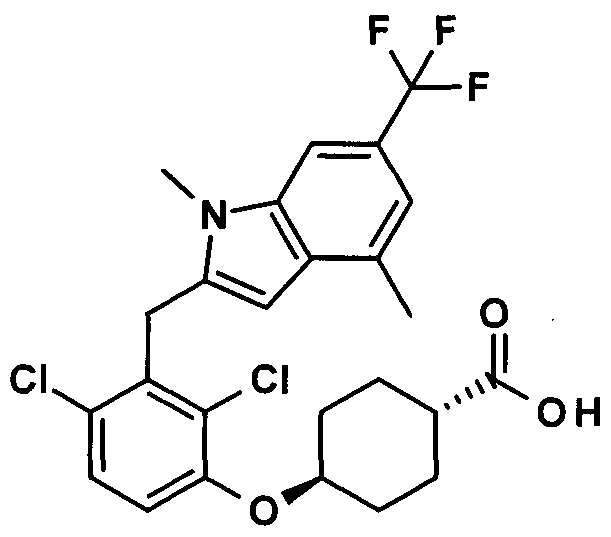
Using a similar procedure as the one described in Example 1, Step 5, irans-4-(2,4-dichloro-3-((l,4- dimethyl-6-(trifluoromethyl)-lH-indol-2-yl)methyl)phenoxy)cyclohexanecarboxylic acid (13 mg, 28%) was prepared from ethyl ira«5-4-(2,4-dichloro-3-((l,4-dimethyl-6-(trifluoromethyl)-lH-indol-2- yl)methyl)phenoxy)cyclohexanecarboxylate (48 mg, 0.088 mmol). LC/MS (Method g) Rt = 2.12 min.; MS m/z: 514 [Μ+Η]+ Ή NMR (DMSO-d6, 400MHz): δ 12.15 (broad 1H), 7.69 (s, 1H), 7.49 (d, J=9.0 Hz, 1H), 7.30 (d, 7=9.0 Hz, 1H), 7.05 (s, 1H), 5.66 (s, 1H), 4.46 (m, 1H), 4.40 (s, 2H), 3.91 (s, 3H), 2.32 (s, 3H), 2.30 (m, 1H), 2.08 (m, 2H), 1.97 (m, 2H), 149 (m, 4H).
Step 7a : ci's-4-(2,4-dichloro-3-((l,4-dimethyl-6-(trifluoromethyI)-lH-indol-2- yI)methyl)phenoxy)cycIohexanecarboxylic acid

Using a similar procedure as the one described in Example A, Step 5, cz5-4-(2,4-dichloro-3-((l,4- dimethyl-6-(trifluoromethyl)-lH-indol-2-yl)methyl)phenoxy)cyclohexanecarboxylic acid (23 mg, 46%) was prepared from ethyl cw-4-(2,4-dichloro-3-((l,4-dimethyl-6-(trifluoromethyl)-lH-indol-2- yl)methyl)phenoxy)cyclohexanecarboxylate (52 mg, 0.096 mmol). LC/MS (Method g) Rt = 2.11 min.; MS m/z: 514 [Μ+Η]+ Ή NMR (DMSO-d6, 400MHz): δ 12.08 (broad, 1H), 7.69 (s, 1H), 7.49 (d, J=9.0 Hz, 1H), 7.26 (d, J=9.0 Hz, 1H), 7.05 (s, 1H), 5.66 (s, 1H), 4.72 (m, 1H), 4.41 (s, 2H), 3.91 (s, 3H), 2.36 (s, 4H), 1.87 (broad, 2H), 1.78 (t, J=10.2 Hz, 2H), 1.61-1.74 (m, 4H).
Example AJ: ir «s-4-(2,4-dichloro-3-((l,4-dimethyl-6-(trifluoromethyl)-lH-indol-2- yl)methyl)phenoxy)cyclohexanecarboxylic acid
Example AJ1 : m-4-(2,4-dichloro-3-((l,4-dimethyl-6-(trifluoromethyl)-lH-indol-2- yI)meth l)phenoxy)cyclohexanecarboxylic acid

Step 1: methyl trans -3-(2,4-dichIoro-3-((l,4-dimethyl-6-(trifluoromethyI)-lH-indol-2- yl)methyl)phenoxy)cyclobutanecarboxylate and methyl cis -3-(2,4-dichloro-3-((l,4-dimethyl-6- (trifluorometh l)-lH-indol-2-yI)methyl)phenoxy)cyclobutanecarboxylate

Using a similar procedure as the one described in Example AF, Step 6, methyl trans -3-(2,4-dichloro- 3-((l,4-dimethyl-6-(trifluoromethyl)-lH-indol-2-yl)methyl)phenoxy)cyclobutanecarboxylate (200 mg, 63%)
LC/MS (Method h) Rt = 3.72 min.; MS m/z: 500 [M+H]+ ¾ MR (DMSO-d6, 300MHz): δ 7.69 (s, IH), 7.49 (d, J=8.9 Hz, IH), 7.06 (s, IH), 6.99 (d, J=8.9 Hz, IH), 5.66 (s, IH), 4.97 (m, IH), 4.41 (s, 2H), 3.91 (s, 3H), 3.67 (s, 3H), 3.23 (m, IH), 2.72 (m, 2H), 2.44 (m, 2H), 2.36 (s, 3H) and methyl cis - 3-(2,4-dichloro-3-((l,4-dimethyl-6-(trifluoromethyl)-lH-indol-2- yl)methyl)phenoxy)cyclobutanecarboxylate
LC/MS (Method h) Rt = 3.65 min.; MS m/z: 500 [Μ+Η]+ Ή NMR (DMSO-d6, 300MHz): δ 7.69 (s, IH), 7.50 (d, J=8.9 Hz, IH), 7.02-7.09 (m, 2H), 5.65 (s, IH), 4.80 (m, IH), 4.40 (s, 2H), 3.91 (s, 3H), 3.63 (s, 3H), 2.86 (m, 3H), 2.36 (s, 3H), 2.26 (m, 2H) were prepared from 2,4-dichloro-3-((l,4- dimethyl-6-(trifluoromethyl)-lH-indol-2-yl)methyl)phenol (Example AI, Step 5) (200 mg, 0.51 mmol) and methyl 3-((methylsulfonyl)oxy)cyclobutanecarboxylate (161 mg, 0.77 mmol).
Step 2: ira/iir-4-(2,4-dichloro-3-((l,4-dimethyl-6-(trifluoromethyl)-lH-indol-2- yl)methyl)phenoxy)cyclohexanecarbox lic acid

Using a similar procedure as the one described in Example A, Step 5, ?ra«5-4-(2,4-dichloro-3-((l,4- dimethyl-6-(trifluoromethyl)-lH-indol-2-yl)methyl)phenoxy)cyclohexanecarboxylic acid (125 mg, 98%) was prepared from methyl trans -3-(2,4-dichloro-3-((l,4-dimethyl-6-(trifluoromethyl)-lH-indol- 2-yl)methyl)phenoxy)cyclobutanecarboxylate (130 mg, 0.26 mmol). LC MS (Method g) Rt = 2.05 min.; MS m/z: 486 [Μ+Η]+ Ή NMR (DMSO-d6, 400MHz): δ 12.36 (broad, 1H), 7.69 (s, 1H), 7.48 (d, J=9.0 Hz, 1H), 7.05 (s, 1H), 6.99 (d, J=9.0 Hz, 1H), 5.66 (s, 1H), 4.95 (m, 1H), 4.41 (s, 2H), 3.91 (s, 3H), 3.12 (m, 1H), 2.70 (m, 2H), 2.41 (m, 2H), 2.36 (s, 3H).
Step 2a: cis-4-(2,4-dichloro-3-((l,4-dimethyl-6-(trifluoromethyl)-lH-indol-2- yl)methyI)phenoxy)cyclohexanecarboxylic acid

Using a similar procedure as the one described in Example A, Step 5, cw-4-(2,4-dichloro-3-((l,4- dimethyl-6-(trifluoromethyl)-lH-indol-2-yl)methyl)phenoxy)cyclohexanecarboxylic acid (25 mg, 70%) was prepared from methyl cis -3-(2,4-dichloro-3-((l,4-dimethyl-6-(trifluoromethyl)-lH-indol-2- yl)methyl)phenoxy)cyclobutanecarboxylate (33 mg, 0.066 mmol).
LC/MS (Method g) Rt = 2.02 min.; MS m/z: 486 [M+H]+
Ή NMR (DMSO-d6, 400MHz): δ 12.35 (broad, 1H), 7.69 (s, 1H), 7.49 (d, J=8.8 Hz, 1H), 7.03-7.08 (m, 2H), 5.66 (s, 1H), 4.78 (m, 1H), 4.40 (s, 2H), 3.91 (s, 3H), 2.76 (m, 3H), 2.36 (s, 3H), 2.22 (m, 2H).
Example AK: trans -3-(2,4-dichloro-3-((l,4-dimethyl-6-(trifluoromethyI)-lH-indol-2- yl)methyl)phenoxy)cycIopentanecarboxylic acid
Example AK1: cis -3-(2,4-dichloro-3-((l,4-dimethyl-6-(trifluoromethyI)-lH-indol-2- yl)meth I)phenoxy)cyclopentanecarboxyIic acid

Step 1: ethyl irans-3-(2,4-dichloro-3-((l,4-dimethyl-6-(trifluoromethyl)-lH-indol-2- yl)methyl)phenoxy)cyclopentanecarboxyIate and ethyl cis-3-(2,4-dichloro-3-((l,4-dimethyl-6- (trifluorometh l)-lH-indol-2-yI)methyl)phenoxy)cyclopentanecarboxylate
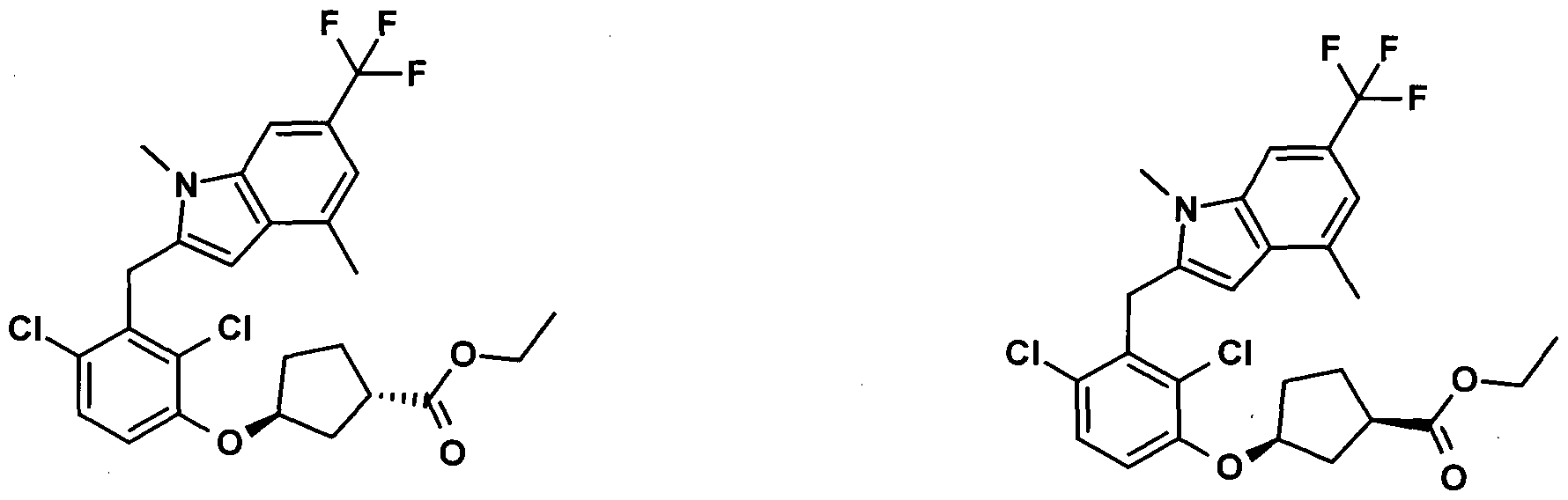
Using a similar procedure as the one described in Example AF, Step 6, ethyl ira«5-3-(2,4-dichloro-3- (( 1 ,4-dimethyl-6-(trifluoromethyl)-lH-indol-2-yl)methyl)phenoxy)cyclopentanecarboxylate ( 125 mg, 46%)
LC/MS (Method h) Rt = 3.94 min.; MS m/z: 528 [Μ+Η]+ Ή NMR (DMSO-d6, 300MHz): δ 7.69 (s, 1H), 7.51 (d, 7=9.1 Hz, 1H), 7.22 (d, J=9.1 Hz, 1H), 7.06 (s, 1H), 5.66 (s, 1H), 5.06 (m, 1H), 4.40 (s, 2H), 4.03 (q, J= 7.1Hz, 2H), 3.91 (s, 3H), 3.02 (m, 1H), 2.36 (s, 3H), 2.10 (m, 4H), 1.80 (m, 2H), 1.20 (t, J= 7.1Hz, 3H) and ethyl cw-3-(2,4-dichloro-3-((l,4-dimethyl-6-(trifluoromethyl)-lH-indol-2- yl)methyl)phenoxy)cyclopentanecarboxylate (55 mg, 20%) (containing 20% of isomer trans)
LC/MS (Method h) Rt = 3.86 min.; MS m/z: 528 [M+H]+ ¾ NMR (DMSO-d6, 300MHz): δ 7.69 (s, 1H), 7.50 (d, J=9.1 Hz, IH), 7.19 (d, J=9.1 Hz, 1H), 7.05 (s, 1H), 5.67 (s, 1H), 4.97 (m, 1H), 4.39 (s, 3H), 3.02 (q, J=7.1 Hz, 2H), 3.91 (s, 3H), 2.92 (m, IH), 2.32 (m, 4H), 1.95 (m, 4H), 1.11 (t, J=7.1 Hz, 3H)
were prepared from 2,4-dichloro-3-((l ,4-dimethyl-6-(trifluoromethyl)-lH-indol-2-yl)methyl)phenol (Example AI, Step 5) (200 mg, 0.51 mmol) and ethyl 3-((methylsulfonyl)oxy)cyclopentanecarboxylate (Preparation #12) (183 mg, 0.77 mmol).
Step 2: ii* «s-3-(2,4-dichloro-3-((l,4-dimethyl-6-(trifluoromethyl)-lH-indol-2- yl)methyl)phenoxy)cyclopentanecarboxylic acid

Using a similar procedure as the one described in Example A, Step 5, ira«s-3-(2,4-dichloro-3-((l,4- dimethyl-6-(trifluoromethyl)-lH-indol-2-yl)methyl)phenoxy)cyclopentanecarboxylic acid (80 mg, 68%) was prepared from ethyl ira« -3-(2,4-dichloro-3-((l,4-dimethyl-6-(trifluoromethyl)-lH-indol-2- yl)methyl)phenoxy)cyclopentanecarboxylate (122 mg, 0.23 mmol). LC/MS (Method g) R, = 2.09 min.; MS m/∑: 500 [Μ+Η]+ Ή NMR (DMSO-d6, 400MHz): δ 12.21 (broad, IH), 7.69 (s, IH), 7.51 (d, J=9.0 Hz, IH), 7.22 (d, J=9.0 Hz, IH), 7.05 (s, IH), 5.66 (s, IH), 5.04 (m, IH), 4.40 (s, 2H), 3.91 (s, 3H), 2.95 (m, IH), 2.36 (s, 3H), 2.08 (m, 4H), 1.81 (m, 2H).
Step 2a: c s-3-(2,4-dichloro-3-((l,4-dimethyl-6-(trifluoromethyI)-lH-indol-2- yl)methyl)phenoxy)cyclopentanecarboxylic acid

Using a similar procedure as the one described in Example A, Step 5, cw-3-(2,4-dichloro-3-((l,4- dimethyl-6-(trifluoromethyl)-lH-indol-2-yl)methyl)phenoxy)cyclopentanecarboxylic acid (18 mg, 34%) (containing 20% of trans isomer) was prepared from ethyl cw-3-(2,4-dichloro-3-((l,4-dimethyl- 6-(trifluoromethyl)-lH-indol-2-yl)methyl)phenoxy)cyclopentanecarboxylate (52 mg, 0.098 mmol). LC/MS (Method g) Rt = 2.07 min.; MS m/z: 500 [Μ+Η]+ Ή NMR (DMSO-d6, 400MHz): δ 12.14 (broad, IH), 7.69 (s, IH), 7.50 (d, .7=9.2 Hz, IH), 7.19 (d, J=9.2 Hz, IH), 7.05 (s, IH), 5.66 (s, IH), 4.95 (m, IH), 4.39 (s, 2H), 3.91 (s, 3H), 2.80 (m, IH), 2.36 (m, 4H), 1.92 (m, 5H).
Example AL: 2-((3,5-dichloro-2-((tetrahydro-2H-pyran-4-yl)methoxy)pyridin-4-yl)methyl)-l,4- dimethyl-6-(trifluoromethyl)-lH-indole

Step 1 : 3,5-dichIoro-4-((l,4-dimethyl-6-(trifluoromethyI)-lH-indol-2-yl)methyl)pyridin-2-ol

Using a similar procedure as the one described in Example X, 3,5-dichloro-4-((l,4-dimethyl-6- (trifluoromethyl)-lH-indol-2-yl)methyl)pyridin-2-ol (716 mg, 100%) was prepared from 2-((3,5- dichloro-2-methoxypyridin-4-yl)methyl)-l ,4-dimethyl-6-(trifluoromethyl)-lH-indole (example Z, step 4) (647 mg, 1.6 mmol).LC/MS (Method h) Rt = 2.68 min.; MS m/z: 389 [M+H]+
Ή NMR (DMSO-d6, 300MHz): δ 12.60 (broad, IH), 7.81 (s, IH), 7.70 (s, IH), 7.07 (s, IH), 5.97 (s, IH), 4.31 (s, 2H), 3.89 (s, 3H), 2.41 (s, 3H).
Step 2: 2-((3,5-dichloro-2-((tetrahydro-2H-pyran-4-yl)methoxy)pyridin-4-yl)methyl)-l,4- dimethyl-6-(trifluoromethyI)-lH-indole and 3,5-dichloro-4-((l,4-dimethyl-6-(trifluoromethyl)- lH-indol-2-yl)methyl)-l-((tetrahydro-2H-pyran-4-yI)methyl)pyridin-2(lH)-one

To a solution of 3,5-dichloro-4-((l,4-dimethyl-6-(trifluoromethyl)-lH-indol-2-yl)methyl)pyridin-2-ol (200 mg, 0.514 mmol) in DMF (2.6 ml) was added potassium carbonate (284 mg, 2.056 mmol) and 4- (bromomethyl)tetrahydropyran (0.135 ml, 1.028 mmol) and reaction mixture was stirred at 100°C for 2 hours. The reaction mixture was diluted with water and the obtained aqueous layer was extracted with ethyl acetate. The obtained organic layer was dried over magnesium sulfate, filtered and concentrated under reduced pressure. The residue was purified by column chromatography on silica gel (eluting with 5-100% ethyl acetate in dichloromethane) then by preparative LCMS to give 2-((3,5- dicMoro-2-((tetrahydro-2H-pyran-4-yl)methoxy)pyridin-4-yl)methyl)-l,4-dimethyl-6- (trifluoromethyl)-lH-indole (108 mg, 40%) as a white solid LC/MS (Method g) Rt = 2.26 min.; MS m/z: 487 [M+H]+
Ή NMR (DMSO-d6, 400MHz): δ 8.32 (m, 1H), 7.70 (s, 1H), 7.07 (s, 1H), 5.80 (s, 1H), 4.42 (s, 2H), 4.24 (d, J=6.3 Hz, 2H), 3.91 (s, 3H), 3.88 (m, 2H), 3.34 (m, 2H), 2.38 (s, 3H), 2.07 (m, 1H), 1.68 (m, 2H), 1.39 (m, 2H) and 3,5-dichloro-4-((l,4-dimethyl-6-(trifluoromethyl)-lH-indol-2-yl)methyl)-l- ((tetrahydro-2H-pyran-4-yl)methyl)pyridin-2(lH)-one (46 mg, 18%) as a white solid.
LC/MS (Method g) R, = 1.84 min.; MS m/z: 487 [M+H]+
Ή NMR (DMSO-d6, 400MHz): δ 8.14 (s, 1H), 7.69 (s, 1H), 7.07 (s, 1H), 6.00 (s, 1H), 4.30 (s, 2H), 3.82-3.95 (m, 7H), 3.20-3.30 (m, 2H), 2.41 (s, 3H), 2.09 (m, 1H), 1.48 (m, 2H), 1.30 (m, 2H).
Example AM: 2-((l-(2,4-dichloro-3-((6-cyano-l,4-dimethyl-lH-indol-2- yl)methyl)benzoyl)piperidin-4-yI)oxy)acetic acid

Step 1: ethyl 2-((l-(2,4-dichloro-3-((6-cyano-l,4-dimethyl-lH-indol-2- yI)methyl)benzoyl)piperidin-4- l)oxy)acetate

Using a similar procedure as the one described in Example A, Step 6, ethyl 2-((l-(2,4-dichloro-3-((6- cyano-l,4-dimethyl-lH-indol-2-yl)methyl)benzoyl)piperidin-4-yl)oxy)acetate (337 mg, 88%) was obtained as an orange oil from 2,4-dichloro-3-((6-cyano-l,4-dimethyl-lH-indol-2-yl)methyl)benzoic acid (Example AA, Step 5) (150 mg, 0.402 mmol) and N-l-((ethylimino)methylene)-N3,N3- dimethylpropane- 1,3 -diamine hydrochloride (100 mg, 0.52 mmol) and used crude in the next step. LC/MS (Method h) Rt = 2.90 min.; MS m/z: 542 [M+Hf
Step 2: 2-((l-(2,4-dichloro-3-((6-cyano-l,4-dimethyl-lH-indol-2-yl)methyl)benzoyl)piperidin-4- yl)oxy)acetic acid

Using a similar procedure as the one described in Example A, Step 5, 2-((l-(2,4-dichloro-3-((6-cyano- l,4-dimethyl-lH-indol-2-yl)methyl)benzoyl)piperidin-4-yl)oxy)acetic acid (33 mg, 18%) was obtained
as a white solid from ethyl 2-((l-(2,4-dichloro-3-((6-cyano-l,4-dimethyl-lH-indol-2- yl)methyl)benzoyl)piperidin-4-yl)oxy)acetate (336 mg, 0.353 mmol). LC/MS (Method g) R, = 1.52 min.; MS m/z: 514 [Μ+Η]+ Ή NMR (DMSO-rf6> 400 MHz): δ 12.57 (broad, 1H), 7.92 (s, 1H), 7.66 (d, J = 9Hz, 1H), 7.46 and 7.42 (d, J = 9Hz, 1H), 7.12 (s, 1H), 5.70 (m, 1H), 4.47 (m, 2H), 4.05 and 4.03 (s, 2H), 3.96 (m, 1H), 3.90 (s, 3H), 3.63 (m, 1H), 3.37 (m, 2H), 3.05 (m, 1H), 2.33 (s, 3H), 1.91 (m, 1H), 1.78 (m, 1H), 1.60-1.40 (m, 2H).
Table AM. The following Examples were prepared using the same procedure starting from the appropriate esters from Table AA.

Example AN: 2-(2,6-dichloro-3-(4-hydroxypiperidine-l-carbonyl)benzoyl)-l,4-dimethyl-lH- indoIe-6-carbonitriIe

Step 1: methyl 2,4-dichloro-3-(6-cyano-4-methyI-l-(phenylsulfonyl)-lH-indole-2- carbonyl)benzoate

Using a similar procedure as the one described in Example AD, Step 2, methyl 2,4-dichloro-3-(6- cyano-4-methyl-l-(phenylsulfonyl)-lH-indole-2-carbonyl)benzoate (5.98 g, 100%) was obtained as a beige foam from methyl 2,4-dichloro-3-((6-cyano-4-methyl-l-(phenylsulfonyl)-lH-indol-2- yl)(hydroxy)methyl)benzoate (Example AA,Step 1) (6 g, 11.33 mmol). LC/MS (Method i) R, = 2.57 min.; MS m/z 527 [Μ+Η]+ Ή NMR (DMSO-d6, 300MHz): δ 8.54 (s, 1H), 8.29 (m, 2H), 8.05 (m, 2H), 7.68-7.91 (m, 4H), 7.63 (m, 1H), 3.88 (s, 3H), 2.26 (s, 3H)
Step 2: methyl 2,4-dichloro-3-(6-cyano-4-methyI-l-(phenylsulfonyl)-lH-indole-2- carbonyI)benzoate

Using a similar procedure as the one described in Example A, Step 3, methyl 2,4-dichloro-3-(6-cyano- 4-methyl-l-(phenylsulfonyl)-lH-indole-2-carbonyl)benzoate (3.32 g, 76%>) was obtained as a beige foam from methyl 2,4-dichloro-3-(6-cyano-4-methyl-l-(phenylsulfonyl)-lH-indole-2- carbonyl)benzoate (5.98 g, 11.34 mmol). LC/MS (Method i) Rt = 2.33 min.; MS m/z: 387 [Μ+Η]+ Ή NMR (DMSO-d6, 300MHz): δ 12.72 (s, 1H), 8.03 (d, J=8.4 Hz, 1H), 7.80 (m, 2H), 7.15 (m, 2H), 3.90 (s, 3H), 2.50 (s, 3H).
Step 3: methyl 2,4-dichloro-3-(6-cyano-l,4-dimethyl-lH-indoIe-2-carbonyl)benzoate

Using a similar procedure as the one described in Example A, Step 4, methyl 2,4-dichloro-3-(6-cyano- l,4-dimethyl-lH-indole-2-carbonyl)benzoate (3.34 g, 97%) was obtained as a white solid from methyl 2 ,4-dichloro-3 -(6-cyano-4-methyl- 1 -(phenylsulfonyl)- 1 H-indole-2-carbonyl)benzoate (3.32 g, 8.57 mmol).
LC/MS (Method i) Rt = 2.49 min.; MS m/z: 401 [Μ+Η]+ Ή NMR (DMSO-d6, 300MHz): δ 8.20 (s, 1H), 8.03 (d, J=8.1 Hz, 1H), 7.79 (d, J=8.1 Hz, 1H), 7.26-7.34 (m, 1H), 7.20 (s, 1H), 4.20 (s, 3H), 3.90 (s, 3H), 2.47 (s, 3H)
Step 4: 2,4-dichloro-3-(6-cyano-l,4-dimeth l-lH-indoIe-2-carbonyl)benzoic acid

Using a similar procedure as the one described in Example A, Step 5, 2,4-dichloro-3-(6-cyano-l,4- dimethyl-lH-indole-2-carbonyl)benzoic acid (3.22 g, 100%) was obtained as a white solid from methyl 2,4-dichloro-3-(6-cyano-l,4-dimethyl-lH-indole-2-carbonyl)benzoate (3.34 g, 8.32 mmol). LC/MS (Method i) Rt = 2.12 min.; MS m/z: 387 [Μ+Η]+ Ή NMR (DMSO-d6, 300MHz): δ 8.20 (s, 1H), 8.00 (d, J=8.6 Hz, 1H), 7.75 (d, 7=8.6 Hz, 1H), 7.29 (m, 1H), 7.17 (m, 1H), 4.20 (s, 3H), 2.47 (s, 3H).
Step 5: 2-(2,6-dichloro-3-(4-hydroxypiperidine-l-carbonyl)benzoyl)-l,4-dimethyl-lH-indole-6- carbonitrile

Using a similar procedure as the one described in Example A, Step 6, 2-(2,6-dichloro-3-(4- hydroxypiperidine-l-carbonyl)benzoyl)-l,4-dimethyl-lH-indole-6-carbonitrile (101 mg, 83%) was obtained as a yellow solid from 2,4-dichloro-3-(6-cyano-l,4-dimethyl-lH-indole-2-carbonyl)benzoic acid (100 mg, 0.26 mmol) and piperidin-4-ol (39 mg, 0.38 mmol). LC/MS (Method g) R, = 1.47 min.; MS m/z: 470 [Μ+Η]+Ή NMR (DMSO-d6, 400MHz): δ 8.20 (s, 1H), 7.74 (d, J=8.4 Hz, 1H), 7.61 (m, 1H), 7.29 (s, 1H), 7.20 and 7.07 (m, 1H), 4.81 and 4.76 (m, 1H), 4.20 and 4.19 (s, 3H), 4.02 (m, 1H), 3.75 (m, 1H), 3.25 (m, 1H), 3.08 (m, 1H), 2.48 (s, 3H), 1.70 (m, 2H), 1.35 (m, 2H).
Table AN. The following intermediates were prepared from 2,4-dichloro-3-(6-cyano-l,4-dimethyl- lH-indole-2-carbonyl)benzoic acid (Example AN, Step 4) using the same procedure with the appropriate amine.


Example AO : 2-(l-(2,4-dichloro-3-(6-cyano-l ,4-dim ethyl- lH-indole-2- carbonyl)benzoyl)piperidin-4-yI acetic acid

Using a similar procedure as the one described in Example A, Step 5, 2-(l-(2,4-dichloro-3-(6-cyano- l,4-dimethyl-lH-indole-2-carbonyl)benzoyl)piperidin-4-yl)acetic acid (107 mg, 94%) was obtained as a white solid from methyl 2-(l-(2,4-dichloro-3-(6-cyano-l,4-dimethyl-lH-indole-2- carbonyl)benzoyl)piperidin-4-yl)acetate (Table AN, Example AN-6) (116 mg, 0.22 mmol). LC/MS (Method g) Rt = 1.54 min.; MS m/z: 512 [M+H]+ ¾ NMR (DMSO-d6, 400MHz): δ 12.12 (broad., 1H), 8.20 (s, 1H), 7.75 (m, 1H), 7.63 and 7.57 (d, J=8.4 Hz, 1H), 7.29 (s, 1H), 7.01-7.26 (m, 1H), 4.47 (m, 1H), 4.20 and 4.19 (s, 3H), 3.55 (m, 1H), 3.06 (m, 1H), 2.81 (m, 1H), 2.48 (m, 3H), 2.19 (m, 1H), 2.13 (m, 1H), 1.95 (m, 1H), 1.77 (m, 1H), 1.64 (m, 1H), 1.14 (m, 2H).
Example AP: (2,4-dichloro-3-(l,4-dimethyl-6-(trifluorometliyl)-lH-indole-2- carbonyl)phenyI)(morpholino)methanone

Step 1: methyl 2,4-dichloro-3-(4-methyl-l-(phenylsulfonyI)-6-(trifluoromethyl)-lH-indole-2- carbonyl)benzoate
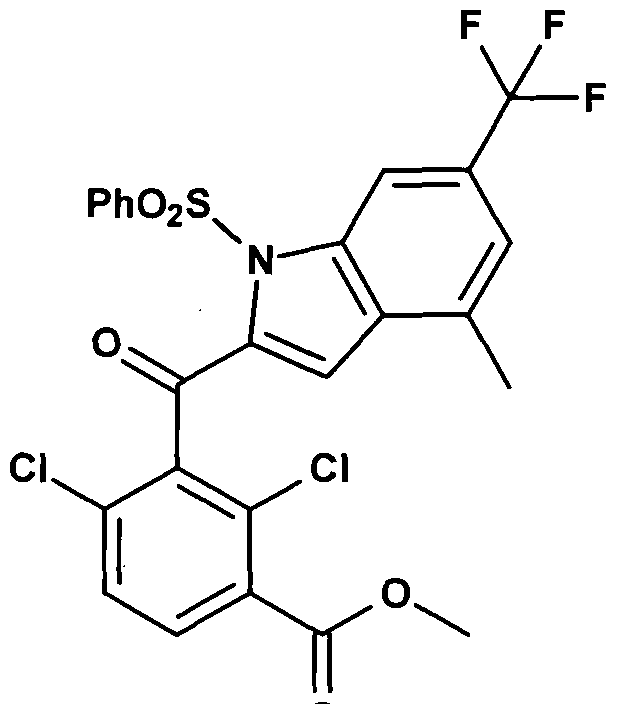
Using a similar procedure as the one described in Example AD, Step 2, methyl 2,4-dichloro-3-(4- methyl-l-(phenyisulfonyl)-6-(trifluoromethyl)-lH-indole-2-carbonyl)benzoate (5.88 g, 100%) was obtained as a beige foam from methyl 2,4-dichloro-3-(hydroxy(4-methyl-l-(phenylsulfonyl)-6- (trifluoromethyl)-lH-indol-2-yl)methyl)benzoate (example A, step 1) (5.9 g, 10.3 mmol). LC MS (Method i) Rt = 2.80 min.; MS m/z: 570 [M+H]+ ¾ NMR (DMSO-d6, 300MHz): δ 8.37 (s, 1H), 8.12 (m, 2H), 8.01 (d, J=8.4 Hz, 1H), 7.70 (m, 5H), 7.58 (s, 1H), 3.88 (s, 3H), 2.56 (s, 3H).
Step 2: methyl 2,4-dichloro-3-(4-methyl-l-(phenylsuIfonyI)-6-(trifluoromethyl)-lH-indole-2- carbonyI)benzoate

Using a similar procedure as the one described in Example A, Step 3, methyl 2,4-dichloro-3-(4- methyl-l-(phenylsulfonyl)-6-(trifluoromethyl)-lH-indole-2-carbonyl)benzoate (4 g, 79%) was obtained as a colorless foam from methyl 2,4-dichloro-3-(4-methyl-l-(phenylsulfonyl)-6- (trifluoromethyl)-lH-indole-2-carbonyl)benzoate (5.88 g, 10.3 mmol). LC/MS (Method i) Rt = 2.59min.; MS m/z: 430 [M+H]+
Ή NMR (DMSO-d6, 300MHz): δ 12.64 (s, 1H), 8.03 (d, 7=8.4 Hz, 1H), 7.80 (d, J=8.4 Hz, 1H), 7.62 (s, 1H), 7.18 (s, 2H), 3.90 (s, 3H), 2.56 (s, 3H).
Step 3: methyl 2,4-dichloro-3-(l,4-dimethyl-6-(trifluoromethyl)-lH-indole-2-carbonyl)benzoate

Using a similar procedure as the one described in Example A, Step 4, methyl 2,4-dichloro-3-(l,4- dimethyl-6-(trifluoromethyl)-lH-indole-2-carbonyl)benzoate (2.45 g, 92%) was obtained as a white solid from methyl 2,4-dichloro-3-(4-methyl-6-(trifluoromethyl)-lH-indole-2-carbonyl)benzoate (2.58 g, 6 mmol). LC/MS (Method i) Rt = 2.75 min.; MS m/z: 444 [M+H]+
Ή NMR (DMSO-d6, 300MHz): δ 8.02 (d, J=8.5 Hz, 1H), 7.96 (s, 1H), 7.79 (d, J=8.5 Hz, 1H), 7.24 (s, 1H), 7.18 (s, 1H), 4.24 (s, 3H), 3.32 (s, 3H), 2.50 (s, 3H).
Step 4: 2,4-dichloro-3-(l,4-dimethyl-6-(trifluoromethyl)-lH-indoIe-2-carbonyI)benzoic acid

Using a similar procedure as the one described in Example A, Step 5, 2,4-dichloro-3-(l,4-dimethyl-6- (trifluoromethyl)-lH-indole-2-carbonyl)benzoic acid (2.37 g, 100%) was obtained as a white solid from methyl 2,4-dichloro-3-(l,4-dimethyl-6-(trifluoromethyl)-lH-indole-2-carbonyl)benzoate (2.45 g, 5.52 mmol). LC/MS (Method i) Rt = 2.42 min.; MS m/z 430 [M+H]+
'HNMR (DMSO-d6, 300MHz): δ 13.84 (broad, 1H), 7.99 (d, 7=8.4 Hz, 1H), 7.96 (s, 1H), 7.75 (d, J=8.4 Hz, 1H), 7.24 (s, 1H), 7.15 (s, 1H), 4.24 (s, 3H), 2.50 (s, 3H).
Step 5: (2,4-dichloro-3-(l,4-dimethyl-6-(trifluoromethyl)-lH-indole-2- carbonyl)phenyl)(morphoIino)methanone

Using a similar procedure as the one described in Example Al, (2,4-dichloro-3-(l,4-dimethyl-6- (trifluoromethyl)-lH-indole-2-carbonyl)phenyl)(morpholino)methanone (101 mg, 87%) was obtained as a white solid from 2,4-dichloro-3-(l,4-dimethyl-6-(trifluoromethyl)-lH-indole-2-carbonyl)benzoic acid (100 mg, 0.23 mmol) and morpholine (26.3 mg, 0.30 mmol).
LC/MS (Method g) Rt = 1.87 min.; MS m/r. 499 [Μ+Η]+Ή NMR (DMSO-d6, 400MHz): δ 7.96 (s, 1H), 7.76 (d, J=8.1 Hz, 1H), 7.65 (d, J=8.1 Hz, 1H), 7.30 and 7.09 (m, 1H), 7.24 (s, 1H), 4.23 (s, 3H), 3.65 (m, 4H), 3.55 (m, 2H), 3.36 (m, 1H), 3.15 (m, 1H), 2.50 (s, 3H).
Table AP. The following intermediates were prepared from 2,4-dichloro-3-(l,4-dimethyl-6- (trifluoromethyl)-lH-indole-2-carbonyl)benzoic acid (Example AP, Step 4) using the same procedure with the appropriate amine.

Example AQ: 2-(l-(2,4-dichloro-3-(l,4-dimethyl-6-(trifluoromethyl)-lH-indole-2- carbonyl)benzoyl)piperidin-4-yl)acetic acid

Using a similar procedure as the one described in Example A, Step 5, 2-(l-(2,4-dichloro-3-(l,4- dimethyl-6-(trifluoromethyl)-lH-indole-2-carbonyl)benzoyl)piperidin-4-yl)acetic acid (108 mg, 82%) was obtained as a white solid from 2,4-dichloro-3-(l,4-dimethyl-6-(trifluoromethyl)-lH-indole-2- carbonyl)benzoic acid (Example AP, Step 4) (100 mg, 0.23 mmol). LC MS (Method g) Rt = 1.80 min.; MS m/z: 555 [M+H]+
'H NMR (DMSO-d6, 400MHz): δ 12.10 (broad, 1H), 7.96 (s, 1H), 7.74 (m, 1H), 7.63 and 7.57 (d, J=8 Hz, 1H), 7.24-7.00 (m, 2H), 4.47 (m, 1H), 4.23 and 4.22 (s, 3H), 3.20 (m, 1H), 3.06 (m, 1H), 2.81 (m, 1H), 2.50 (s, 3H), 2.20 (m, 2H), 1.94 (m, 1H), 1.78 (m, 1H), 1.65 (m, 1H), 1.15 (m, 2H).
Table AQ. The following Examples were prepared using the same procedure starting from the appropriate esters (as described in Table AP).

Example AR: (2,6-dichloro-3-(hydroxymethyI)phenyI)(l,4-dimethyl-6-(trifluoromethyI)-lH- indol-2-yl)m ethanone

To a solution of methyl 2,4-dichloro-3-(l,4-dimethyl-6-(trifluoromethyl)-lH-indole-2- carbonyl)benzoate (Example AP, Step 3) (250 mg, 0.563 mmol) in methanol (10 ml) was added at room temperature sodium tetrahydroborate (63.9 mg, 1.688 mmol) and the reaction mixture was stirred at room temperature for 1 hour. More sodium tetrahydroborate (63.9 mg, 1.688 mmol) was added and the reaction mixture was stirred at room temperature for 24 hours. The reaction was quenched with NH4C1 saturated aqueous solution. The reaction mixture was extracted with ethyl acetate and the organic layer was dried over magnesium sulfate and concentrated to dryness. The crude product was purified by preparative LCMS to give (2,6-dichloro-3-(hydroxymethyl)phenyl)(l,4- dimethyl-6-(trifluoromethyl)-lH-indol-2-yl)methanone (71 mg, 29%). LC/MS (Method g) Rt = 1.92 min.; MS m/z: 416 [M+H]+
¾ NMR (DMSO-d6, 400MHz): δ 7.95 (s, 1H), 7.73 (d, J=8 Hz, 1H), 7.66 (d, J=8 Hz, 1H), 7.23 (s, 1H), 7.02 (s, 1H), 5.62 (t, J=5.4 Hz, 1H), 4.61 (d, J=5.4 Hz, 2H), 4.23 (s, 3H), 2.50 (s, 3H).
Example AS: (2,4-dichloro-3-((7-methyl-5-(trifluoromethyl)-lH-indol-2- yl)methyl)phenyl)(morpholino)methanone

Step 1: tert-butyl 2,4-dichloro-3-(hydroxy(7-methyl-l-(phenylsulfonyl)-5-(trifluoromethyl)-lH- indol-2-yI) methyl)benzoate

Using a similar procedure as the one described in Example A, Step 1, /erf-butyl 2,4-dichloro-3- (hydroxy(7-methyl-l -(phenylsulfonyl)-5-(trifluoromethyl)-lH-indol-2-yl)methyl)benzoate (1.75 g, 49%) was obtained as an orange resin from N-(2-iodo-6-methyl-4- (trifluoromethyl)phenyl)benzenesulfonamide (Preparation #34) (2 g, 4.53 mmol) and tert-butyl 2,4- dichloro-3-(l-hydroxyprop-2-yn-l-yl)benzoate (Preparation #33) (1.23g, 4.08mmol). LC/MS (Method i) Rt = 2.84 min.; MS m/z: 672 [M-H]" + CH3COOH Ή NMR (DMSO-d6, 300MHz): δ 7.60 (m, 8H), 7.44 (s, IH), 6.97 (dd, J=5.9 and 1.5Hz, IH), 6.74 (d, J=1.5 Hz, IH), 6.66 (d, J=5.9 Hz, IH), 2.45 (s, 3H), 1.49 (s, 9H).
Step 2: 2,4-dichloro-3-((7-methyl-l-(phenylsulfonyl)-5-(trifluoromethyl)-lH-indol-2- yl)niethyl)benzoic acid

Using a similar procedure as the one described in Example A, Step 2, 2,4-dichloro-3 -((7 -methyl- 1- (phenylsulfonyl)-5-(trifluoromethyl)-lH-indol-2-yl)methyl)benzoic acid (800 mg, 52%) was obtained as a yellow powder from tert-butyl 2,4-dichloro-3-(hydroxy(7-methyl-l-(phenylsulfonyl)-5- (trifluoromethyl)-lH-indol-2-yl)methyl)benzoate (1.7 g, 2.77 mmol). LC/MS (Method i) Rt = 2.67 min.; MS m/z: 542 [Μ+Η]+ Ή NMR (DMSO-d6, 300MHz): δ 7.51-7.80 (m, 6H), 7.40 (m, 3H), 5.98 (s, 1H), 4.49 (s, 2H), 2.66 (s, 3H).
Step 3: 2,4-dichloro-3-((7-methyl-5-(trifluoromethyI)-lH-indol-2-yl)methyl)benzoic acid

Using a similar procedure as the one described in Example A, Step 3, 2,4-dichloro-3-((7-methyl-5- (trifluoromethyl)-lH-indol-2-yl)methyl)benzoic acid (620 mg, 99%) was obtained as an orange powder from 2,4-dichloro-3-((7-methyl-l -(phenylsulfonyl)-5-(trifluoromethyl)-lH-indol-2- yl)methyl)benzoic acid (800 mg, 1.47 mmol). LC/MS (Method i) Rt = 2.37 min.; MS m/z: 402 [M+H]+ Ή NMR (DMSO-d6, 300MHz): δ 11.57 (s, 1H), 7.55 (s, 1H), 7.41 (m, 1H), 7.29 (m, 2H), 7.10 (s, 1H), 5.77 (s, 1H), 4.40 (s, 2H), 2.54 (s, 3H).
Step 4: (2,4-dichloro-3-((7-methyl-5-(trifluoromethyl)-lH-indol-2- l)methyl)phenyl)(morphoIino)raethanone

(trifluoromethyl)-lH-indol-2-yl)methyl)phenyl)(morpholino)methanone (95 mg, 20%) was obtained as an orange powder from 2,4-dichloro-3-((7-methyl-5-(trifluoromethyl)-lH-indol-2-yl)methyl)benzoic acid (400 mg, 0.99 mmol). LC/MS (Method g) R, = 1.79 min.; MS m/z: 471 [M+H]+
Ή NMR (DMSO-d6, 500MHz): δ 11.56 (s, 1H), 7.65 (d, J=8.4 Hz, 1H), 7.58 (s, 1H), 7.42 (d, J=8.4
Hz, 1H), 7.12 (s, 1H), 5.80 (m, 1H), 4.45 (s, 2H), 3.65 (m, 4H), 3.55 (m, 2H), 3.17 (m, 2H), 2.54 (s,
3H).
Example AT: (2,4-dichloro-3-((l,7-dimethyl-5-(trifluoromethyl)-lH-indol-2- yl)methyl)phenyI)(morpholino)methanone

Using a similar procedure as the one described in Example A, Step 4, (2,4-dichloro-3-((l,7-dimethyl- 5-(trifluoromethyl)-lH-indol-2-yl)methyl)phenyl)(moφholino)metha one (48 mg, 63%) was obtained as a beige powder from (2,4-dichloro-3-((7-methyl-5-(trifluoromethyl)-lH-indol-2- yl)methyl)phenyl)(morpholino)methanone (example AS, step 4) (70 mg, 0.149 mmol).
LC/MS (Method g) Rt = 1.88 min.; MS m/z: 485 [M+H]+
]H NMR (DMSO-d6, 400MHz): δ 7.67 (d, 7=8.1 Hz, 1H), 7.59 (s, 1H), 7.45 (d, J=8.1 Hz, 1H), 7.09 (s, 1H), 5.67 (s, 1H), 4.39 (m, 2H), 4.12 (s, 3H), 3.65 (m, 4H), 3.55 (m, 2H), 3.20 (m, 2H), 2.83 (s, 3H).
Example AU: 2-(2,6-dichloro-3-((3-oxomorpholino)methyl)benzyl)-l,4-dimethyl-lH-indole-6- carbonitrile
Example AUl : 2-(2,6-dichloro-3-((3-oxomorpholino)methyl)benzoyl)-l,4-dimethyl-lH-indole-6- carbonitrile


To a solution of methyl 2,4-dichloro-3-((6-cyano-l,4-dimethyl-lH-indol-2-yl)methyl)benzoate (Example AA, Step 4) (300 mg, 0.775 mmol) in tetrahydrofuran (10 ml) was added lithium borohydride (1.162 ml, 2.32 mmol) (2M in THF) and the mixture was stirred at room temperature overnight. More lithium borohydride (0.5 ml, 1.17 mmol) (2M in THF) was added and the mixture was stired at 50°C for one hour, then cooled to 0°C and quenched slowly by addition of 1M HCl aqueous solution. Tetrahydrofuran was concentrated, the precipitate was filtered, washed with water and dried under vacuum. The residue was dissolved in dichloromethane, dried with magnesium sulfate and concentrated to give 2-(2,6-dichloro-3-(hydroxymethyl)benzyl)-l,4-dimethyl-lH-indole-6- carbonitrile (290 mg, 89%) as a white solid.
LC/MS (Method h) Rt = 2.77 min.; MS m/z: 359 [Μ+Η]+ Ή MR (DMSO-d6, 300MHz): δ 7.91 (s, 1H), 7.60 (m, 2H), 7.11 (s, 1H), 5.67 (s, 1H), 5.55 (t, J=5.5 Hz, 1H), 4.59 (d, 7=5.5 Hz, 2H), 4.44 (s, 2H), 3.91 (s, 3H), 2.31 (s, 3H).
Step 2: 2,4-dichIoro-3-((6-cyano-l,4-dimeth l-lH-indol-2-yl)methyl)benzyI methanesulfonate

LC/MS (Method h) Rt = 2.95 min.; MS m/z: 437 [Μ+Η]+ Ή NMR (DMSO-d6, 300MHz): δ 7.92 (s, 1H), 7.67 (m, 2H), 7.10 (m, 1H), 5.70 (m, 1H), 5.39 (s, 2H), 4.48 (s, 2H), 3.92 (s, 3H), 3.30 (s, 3H), 2.32 (m, 3H).
Step 3: 2-(2,6-dichloro-3-((3-oxomorpholino)methyI)benzyl)-l,4-dimethyI-lH-indole-6- carbonitrile

To a solution of morpholin-3-one (139 mg, 1.372 mmol) in DMF (9 ml) was added sodium hydride (63.1 mg, 1.578 mmol) and the reaction mixture was stirred at room temperature for 15 minutes. 2,4- dichloro-3-((6-cyano-l,4-dimethyl-lH-indol-2-yl)methyl)benzyl methanesulfonate (300 mg, 0.686 mmol) was added to the reaction mixture and it was stirred at room temperature for 20 hours. The reaction mixture was poured in a solution of water and ethyl acetate; the organic layer was extracted, washed with brine; dried over magnesium sulfate and concentrated. The residue was purified by column chromatography on silica gel (eluting with 30-70% ethyl acetate in cyclohexane) then purified by preparative LCMS to give 2-(2,6-dichloro-3-((3-oxomorpholino)methyl)benzyl)-l,4-dimethyl-lH- indole-6-carbonitrile (35 mg, 11%) as a yellow solid. LC MS (Method g) Rt = 1.65 min.; MS m/z: 443 [Μ+Η]+ Ή NMR (DMSO-d6, 400MHz): δ 7.91 (s, 1H), 7.60 (d, J=8.4 Hz, 1H), 7.30 (d, J=8.4 Hz, 1H), 7.04-7.14 (m, 1H), 5.70 (s, 1H), 4.66 (s, 2H), 4.46 (s, 2H), 4.16 (s, 2H), 3.91 (s, 3H), 3.89 (m, 2H), 3.35 (m, 2H), 2.32 (s, 3H).
During this reaction, an oxidation side product was isolated and characterized as 2-(2,6-dichloro-3-((3- oxomoφholino)methyl)benzoyl)-l,4-dimethyl-lH-indole-6-carbonitrile (30 mg, 9%) as a white solid. LC/MS (Method g) Rt = 1.62 min.; MS m/z: 456 [Μ+Η]+ Ή NMR (DMSO-d6, 400MHz): δ 8.20 (s, 1H), 7.66 (d, J=8.4 Hz, 1H), 7.46 (d, J=8.4 Hz, 1H), 7.29 (m, 1H), 7.09 (s, 1H), 4.67 (m, 2H), 4.20 (s, 3H), 4.17 (s, 2H), 3.91 (m, 2H), 3.40 (m, 2H), 2.47 (s, 3H).
Example AV: ethyl 2-(4-(2,4-dichloro-3-((l,4-dimethyl-6-(trifluoromethyl)-lH-indoI-2- yI)methyl)benzoyI)piperazin-l-yI)acetate

Using a similar procedure as the one described in Example T, Step 1, ethyl 2-(4-(2,4-dichloro-3-((l,4- dimethyl-6-(trifluoromethyl)-lH-indol-2-yl)methyl)benzoyl)piperazin-l-yl)acetate (51 mg, 49%) was prepared from (2,4-dichloro-3-((l ,4-dimethyl-6-(trifluoromethyl)-lH-indol-2- yl)methyl)phenyl)(piperazin-l-yl)methanone (Example S, Step 2) (85 mg, 0.17 mmol) and ethyl bromoacetate (30 mg, 0.18 mmol). LC/MS (Method g) Rt = 1.90 min.; MS m/z: 570 [Μ+Η]+Ή NMR (DMSO-d6, 400MHz): δ 7.70 (s, IH), 7.67 (d, J=8.1 Hz, IH), 7.41 (d, J=8.1 Hz, IH), 7.06 (s, IH), 5.68 (s, IH), 4.48 (d, J=16 Hz, IH), 4.43 (d, J=16 Hz, IH), 4.06 (q, 7=7.2 Hz, 2H), 3.92 (s, 3H), 3.68 (m, IH), 3.61 (m, IH), 3.27 (s, 2H), 3.16 (m, 2H), 2.60 (m, 2H), 2.50 (m, 2H), 2.36 (s, 3H), 1.16 (t, 7=7.2 Hz, 3H).
Example AW: 2-(4-(2,4-dichloro-3-((l,4-dimethyl-6-(trifluoromethyl)-lH-indol-2- yl)methyl)benzoyl)piperazin-l-yl)acetic acid

Step 1: methyl 2-(4-(2,4-dichloro-3-((l,4-dimethyl-6-(trifluoromethyl)-lH-indol-2- yl)methyl)benzoyl)piperazin-l-yl)acetate

Using a similar procedure as the one described in Example T, Step 1, methyl 2-(4-(2,4-dichloro-3- (( 1 ,4-dimethyl-6-(trifluoromethyl)- lH-indol-2-yl)methyl)benzoyl)piperazin- 1 -yl)acetate (115 mg, 100%) was prepared from (2,4-dichloro-3-((l,4-dimethyl-6-(trifluoromethyl)-lH-indol-2- yl)methyl)phenyl)(piperazin-l-yl)methanone (Example S, Step 2) (100 mg, 0.206 mmol) and methyl bromoacetate (42.8 mg, 0.31 mmol). LC/MS (Method h) Rt = 3.11 min.; MS m/z: 556 [M+H]+ !H NMR (CHLOROFORM-d, 300MHz): δ 7.41 (d, J=8.1 Hz, IH), 7.36 (s, IH), 7.19 (d, J=8.1 Hz, IH), 7.01 (s, IH), 5.70 (s, IH), 4.36 (m, 2H), 3.80 (m, 5H), 3.65 (s, 3H), 3.25 (m, 2H), 3.20 (s, 2H), 2.62 (m, 2H), 2.50 (m, 2H), 2.35 (s, 3H).
Step 2: 2-(4-(2,4-dichloro-3-((l,4-dimethyl-6-(trifluoromethyl)-lH-indol-2- yl)methyl)benzoyl)piperazin-l-yl)acetic acid

Using a similar procedure as the one described in Example O, Step 4, 2-(4-(2,4-dichloro-3-((l,4- dimethyl-6-(trifluoromethyl)-lH-indol-2-yl)methyl)benzoyl)piperazin-l-yl)acetic acid (25 mg, 15%) was prepared from methyl 2-(4-(2,4-dichloro-3-((l,4-dimethyl-6-(trifluoromethyl)-lH-indol-2- yl)methyl)benzoyl)piperazin-l-yl)acetate (170 mg, 0.30 mmol). LC/MS (Method g) Rt = 1.50 min.; MS m/z: 542 [Μ+Η]+Ή NMR (DMSO-d6, 500MHz): δ 7.70 (s, IH), 7.66 (d, J=8.4 Hz, IH), 7.41 (d, J=8.4 Hz, IH), 7.06 (s, IH), 5.68 (s, IH), 4.46 (m, 2H), 3.91 (s, 3H), 3.65 (m, 2H), 3.19 (m, 4H), 3.06 (m, 2H), 2.58 (m, IH), 2.48 (m, IH), 2.36 (s, 3H).
Example AX: (3-((6-bromo-l,4-dimethyl-lH-indol-2-yl)methyl)-2,4- dichlorophenyl)(morpholino)methanone

Step 1: methyl 3-((6-bromo-4-methyl-l-(phenylsulfonyI)-lH-indol-2-yl)(hydroxy)methyl)-2,4- dichlorobenzoate

Using a similar procedure as the one described in Example A, Step 1, methyl 3-((6-bromo-4-methyl-l- (phenylsulfonyl)-lH-indol-2-yl)(hydroxy)methyl)-2,4-dichlorobenzoate (1.9 g, 66%) was prepared from N-(5-bromo-2-iodo-3-methylphenyl)benzenesulfonamide (Preparation #35) (2.21 g, 4.89 mmol) and methyl 2,4-dichloro-3-(l-hydroxyprop-2-yn-l-yl)benzoate (Preparation #1) (1.39 g, 5.38 mmol). LC/MS (Method h) Rt = 3.33 min.; MS m/z:640 [M-H]"+ CH3COOH Ή NMR (DMSO-d6, 300MHz): δ 7.94 (s, 1H), 7.85 (m, 2H), 7.60 (m, 5H), 7.28 (s, 1H), 6.98 (dd, 7=5.8, 1.2 Hz, lH), 6.71 (s, 1H), 6.64 (d, J=5.8 Hz, 1H, 3.86 (s, 3H), 2.37 (s, 3H).
Step 2: methyl 3-((6-bromo-4-methyl-l-(phenylsulfonyl)-lH-indol-2-yl)methyl)-2,4- dichlorobenzoate
r

Step 3: methyl 3-((6-bromo-4-methyl-lH-indol-2-yl)methyl)-2,4-dichlorobenzoate
r

Using a similar procedure as the one described in Example A, Step 3 methyl 3-((6-bromo-4-methyl- lH-indol-2-yl)methyl)-2,4-dichlorobenzoate (1.05 g, 81%) was prepared from methyl 3-((6-bromo-4- methyl-l-(phenylsulfonyl)-lH-indol-2-yl)methyl)-2,4-dichlorobenzoate (1.73 g, 3.05 mmol). LC/MS (Method h) R, = 3.36 min.; MS m/z: 426 [M+H]+ ¾ NMR (DMSO-d6, 300MHz): δ 11.19 (s, 1H), 7.75 (m, 1H), 7.65 (m, 1H), 7.32 (s, 1H), 6.88 (s, 1H), 5.84 (s, 1H), 4.43 (s, 2H), 3.87 (s, 3H), 2.32 (s, 3H).
Step 4: methyl 3-((6-bromo-l,4-dimethyl-lH-indol-2-yI)methyl)-2,4-dichlorobenzoate

Using a similar procedure as the one described in Example P, Step 4, methyl 3-((6-bromo-l,4- dimethyl-lH-indol-2-yl)methyl)-2,4-dichlorobenzoate (916 mg, 89%) was prepared from methyl 3- ((6-bromo-4-methyl-lH-indol-2-yl)methyl)-2,4-dichlorobenzoate (1 g, 2.34 mmol). LC/MS (Method h) Rt = 3.52 min.; MS m/z: 440 [Μ+Η]+ Ή NMR (DMSO-d6, 300MHz): δ 7.80 (m, 1H), 7.70 (m, 1H), 7.54 (s, 1H), 6.91 (s, 1H), 5.54 (m, lH), 4.43 (s, 2H), 3.88 (s, 3H), 3.82 (s, 3H), 2.27 (s, 3H).
Step 5: 3-((6-bromo-l,4-dimethyl-lH-indoI-2-yl)methyl)-2,4-dichlorobeiizoic acid

Using a similar procedure as the one described in Example A, Step 5, 3-((6-bromo-l,4-dimethyl-lH- indol-2-yl)methyl)-2,4-dichlorobenzoic acid (850 mg, 96%) was prepared from methyl 3-((6-bromo- l,4-dimethyl-lH-indol-2-yl)methyl)-2,4-dichlorobenzoate (916 mg, 2.07 mmol). The compound was used directly in the next step. LG/MS (Method h) Rt = 3.06 min.; MS m/z: 426 [M+H]+
Step 6: (3-((6-bromo-l,4-dimethyl-lH-indol-2-yl)methyl)-2,4- dichlorophenyl)(morpholino)methanone

Using a similar procedure as the one described in Example Al, (3-((6-bromo-l,4-dimethyl-lH-indol- 2-yl)methyl)-2,4-dichlorophenyl)(morpholino)methanone (970 mg, 97%) was prepared from 3-((6- bromo-l,4-dimethyl-lH-indol-2-yl)methyl)-2,4-dichlorobenzoic acid (850 mg, 1.99 mmol) and morpholine (260 mg, 2.99 mmol). LC/MS (Method g) R, = 1.90 min.; MS m/z: 495 [Μ+Η]+ Ή NMR (DMSO-d6, 400MHz): δ 7.67 (d, J=8.4 Hz, IH), 7.53 (m, IH), 7.44 (d, J=8.4 Hz, IH), 6.92 (s, IH), 5.57 (s, IH), 4.39 (m, 2H), 3.81 (s, 3H), 3.65 (m, 4H), 3.53 (m, 2H), 3.17 (m, 2H), 2.28 (s, 3H).
Example AY: (2,4-dichIoro-3-((l,4-dimethyl-6-morpholino-lH-indol-2- yl)methyl)phenyl)(morpholino)methanone

To a suspension of (3-((6-bromo-l,4-dimethyl-lH-indol-2-yl)methyl)-2,4- dichlorophenyl)(moφholino)methanone (Example AW, Step 6), (200 mg, 0.403 mmol) and potassium phosphate tribasic (171 mg, 0.806 mmol) in dioxane (2.5ml) was added 2-dicyclohexylphosphino- 2',6'-di-isopropoxy-l,l'-biphenyl (11.28 mg, 0.024 mmol), chloro(2-dicyclohexylphosphino-2',6'-di- isopropoxy-l,l'-biphenyl)[2-(2-aminoethylphenyl)]palladium(II), methyl-t-butylether adduct (9.88 mg, 0.012 mmol) and morpholine (38.6 mg, 0.443 mmol). The mixture was stirred at reflux for 8 hours. More potassium phosphate tribasic (171 mg, 0.806 mmol), 2-dicyclohexylphosphino-2',6'-di- isopropoxy-l,l'-biphenyl (11.28 mg, 0.024 mmol), chloro(2-dicyclohexylphosphino-2',6'-di- isopropoxy-1 , 1 '-biphenyl)[2-(2-aminoethylphenyl)]palladium(II), methyl-ieri-butylether adduct (9.88 mg, 0.012 mmol) and morpholine (38.6 mg, 0.443 mmol) were added and the mixture was stirred at reflux overnight. The mixture was diluted with ethyl acetate and the organic phase was washed successively with water and a saturated NaCl aqueous solution, dried over magnesium sulfate and concentrated. The residue was purified by preparative LCMS to give (2,4-dichloro-3-((l,4-dimethyl-6- mo holino-lH-indol-2-yl)methyl)phenyl)(mo holino)methanone (25 mg, 12%) as a beige solid. LC/MS (Method g) t = 1.38 min.; MS m/z 502 [M+H]+ ]H NMR (DMSO-d6, 400MHz): δ 7.65 (d, J=8.1 Hz, 1H), 7.42 (d, 7=8.1 Hz, 1H), 6.73 (s, 1H), 6.55 s, 1H), 5.40 (s, 1H), 4.36 (m, 2H), 3.76 (m, 7H), 3.65 (m, 4H), 3.54 (m, 2H), 3.17 (m, 2H), 3.07 (m, 4H), 2.23 (s, 3H).
Example AZ: l-(2,4-dichloro-3-((l,4-dimethyI-6-(trifluoromethyl)-lH-indol-2- yl)methyl)benzoyl)-3,3-difluoropiperidine-4-carboxyIic acid

Example BA: l-(2,4-dichloro-3-((l,4-dimethyl-6-(trifluoromethyl)-lH-indol-2- yl)methyl)benzoyI)-3-fluoropiperidine-4-carbox Iic acid

Using a similar procedure as the one described in Example AZ, l-(2,4-dichloro-3-((l,4-dimethyl-6- (trifluoromethyl)-lH-indol-2-yl)methyl)benzoyl)-3-fluoropiperidine-4-carboxylic acid (11 mg, 13%) was prepared from ethyl l-(2,4-dichloro-3-((l,4-dimethyl-6-(trifluoromethyl)-lH-indol-2- yl)methyl)benzoyl)-3-fluoropiperidine-4-carboxylate (Table A, Example A-9) (80 mg, 0.14 mmol). LC/MS (Method i) Rt = 2.42 min.; MS m/z: 545 [Μ+Η]+ Ή NMR (DMSO-d6, 500MHz): δ 12.81 (broad, 1H), 7.70 (m, 2H), 7.50 and 7.40 (m, 1H), 7.06 (s, 1H), 5.68 (m, 1H), 4.89-4.70 (m, 1H), 4.39- 4.58 (m, 2H), 4.31-3.90 (m, 4H), 3.40-3.58 (m, 2H), 3.10-3.26 (m, 2H), 2.38 (m, 3H), 1.85-2.08 (m, 1H), 1.56-1.76 (m, 1H)
Example BB: (5-((l ,4-dimethyl-6-(trifluoromethyl)-lH-indol-2-yl)methyl)-4,6-dimethylpyridin-3- yl)(morpholino)methanone

Step 1: methyl 5-(hydroxy(4-methyl-l-(phenylsulfonyl)-6-(trifluoromethyI)-lH-indoI-2- yl)methyI)-4,6-dimethylnicotinate

Using a similar procedure as the one described in Example A, Step 1, methyl 5-(hydroxy(4-methyl-l- (phenylsulfonyl)-6-(trifluoromethyl)-lH-indol-2-yl)methyl)-4,6-dimethylnicotinate (1.4 g, 69%) was prepared from N-(2-iodo-3-methyl-5-(trifluoromethyl)phenyl)benzenesulfonamide (Preparation #16) (1.8 g, 4.16 mmol) and methyl 5-(l-hydroxyprop-2-yn-l-yl)-4,6-dimethylnicotinate (Preparation #36) (830 mg, 3.79 mmol). the compound was used directly in the next step. LC/MS (Method i) Rt = 2.51 min.; MS m/z: 533 [M+H]+
Step 2: methyl 4,6-dimethyl-5-((4-methyl-l-(phenyIsulfonyl)-6-(trifluoromethyl)-lH-indol-2- yI)methyl)nicotinate

Using a similar procedure as the one described in Example Z, Step 2, methyl 4,6-dimethyl-5-((4- methyl-l-(phenylsulfonyl)-6-(trifluoromethyl)-lH-indol-2-yl)methyl)nicotinate (1.28 g, 94%) was
prepared from methyl 5-(hydroxy(4-methyl-l-(phenylsulfonyl)-6-(trifluoromethyl)-lH-indol-2- yl)methyl)-4,6-dimethylnicotinate (1.4 g, 2.63 mmol). The crude product was used directly in the next step. LC/MS (Method i) Rt = 2.74 min.; MS m/z: 517 [M+H]+
Step 3: methyl 4,6-dimethyl-5-((4-methyl-6-(trifluoromethyl)-lH-indol-2-yl)methyI)nicotinate

Using a similar procedure as the one described in Example A, Step 3, methyl 4,6-dimethyl-5-((4- methyl-6-(trifluoromethyl)-lH-indol-2-yl)methyl)nicotinate (700 mg, 75%) was prepared from methyl 4,6-dimethyl-5-((4-methyl-l-(phenylsulfonyl)-6-(trifluoromethyl)-lH-indol-2-yl)methyl)nicotinate (1.28 g, 2.48 mmol). LC/MS (Method i) Rt = 2.45 min.; MS m/z: 377 [Μ+Η]+ Ή NMR (DMSO-d6, 300MHz): δ 11.42 (s, 1H), 8.72 (s, 1H), 7.46 (s, 1H), 7.02 (s, 1H), 5.91 (s, 1H), 4.26 (s, 2H), 3.32 (s, 3H), 2.54 (s, 3H), 2.47 (s, 3H), 2.40 (s, 3H).
Step 4: methyl 5-((l,4-dimethyl-6-(trifluoromethyl)-lH-indol-2-yl)methyl)-4,6- dimethylnicotinate

Using a similar procedure as the one described in Example A, Step 4, methyl 5-((l,4-dimethyl-6- (trifluoromethyl)-lH-indol-2-yl)methyl)-4,6-dimethylnicotinate (540 mg, 75%) was prepared from methyl 4,6-dimethyl-5-((4-methyl-6-(trifluoromethyl)-lH-indol-2-yl)methyl)nicotinate (700 mg, 1.86 mmol). LC/MS (Method i) Rt = 2.53 min.; MS m/z 391 [Μ+Η]+ Ή NMR (DMSO-d6, 300MHz): δ 8.76 (s, 1H), 7.70 (s, 1H), 7.05 (s, 1H), 5.57 (s, 1H), 4.27 (s, 2H), 3.93 (s, 3H), 3.32 (s, 3H), 2.50 (s, 3H), 2.43 (s, 3H), 2.34 (s, 3H)
Step 5: 5-((l,4-dimethyl-6-(trifluoromethyl)-lH-indol-2-yl)methyl)-4,6-dimethylnicotinic acid

Using a similar procedure as the one described in Example A, Step 5, 5-((l,4-dimethyl-6- (trifluoromethyl)-lH-indol-2-yl)methyl)-4,6-dimethylnicotinic acid (420 mg, 81%) was prepared from methyl 5 -(( 1 ,4-dimethyl-6-(trifluoromethyl)- 1 H-indol-2-yl)methyl)-4,6-dimethylnicotinate (540 mg, 1.38 mmol). LC/MS (Method i) Rt = 1.89 min.; MS m/z: 377 [Μ+Η]+ Ή NMR (DMSO-d6, 300MHz): δ 13.21 (broad, 1H), 8.76 (s, 1H), 7.70 (s, 1H), 7.05 (s, 1H), 5.57 (s, 1H), 4.25 (s, 2H), 3.92 (s, 3H), 2.48 (s., 3H), 2.45 (s, 3H), 2.34 (s, 3H).
Step 6: (5-((l,4-dimethyl-6-(trifluoromethyI)-lH-indol-2-yI)methyl)-4,6-dimethylpyridin-3- yl)(morpholino)methanone

Using a similar procedure as the one described in Example Al, (5-((l,4-dimethyl-6-(trifluoromethyl)- lH-indol-2-yl)methyl)-4,6-dimethylpyridin-3-yl)(mo holino)methanone (19 mg, 26%) was prepared from 5-((l,4-dimethyl-6-(trifluoromethyl)-lH-indol-2-yl)methyl)-4,6-dimethylnicotinic acid (59 mg, 0.16 mmol) and morpholine (25 mg, 0.29 mmol). LC/MS (Method g) Rt = 1.50 min.; MS m/z: 446 [M+H]+
Ή NMR (DMSO-d6, 400MHz): δ 8.26 (s, 1H), 7.70 (s, 1H), 7.05 (s, 1H), 5.58 (s, 1H), 4.23 (s, 2H), 3.92 (s, 3H), 3.67 (m, 4H), 3.51 (m, 2H), 3.18 (m, 2H), 2.46 (s, 3H), 2.35 (s, 3H), 2.14 (s, 3H).
Example BC: 2-(l-(5-((l,4-dimethyl-6-(trifluoromethyl)-lH-indol-2-yl)methyl)-4,6- dimethylnicotinoyl)piperidin-4-yl)acetic acid

Step 1: methyl 2-(l-(5-((l,4-dimethyl-6-(trifluoromethyI)-lH-indol-2-yl)methyI)-4,6- dimethylnicotinoyI)piperidin-4-yI)acetate

Using a similar procedure as the one described in Example Al, methyl 2-(l-(5-((l,4-dimethyl-6- (trifluoromethyl)-lH-indol-2-yl)methyl)-4,6-dimethylnicotinoyl)piperidin-4-yl)acetate (137 mg, 100%) was prepared from 5-((l,4-dimethyl-6-(trifluoromethyl)-lH-indol-2-yl)methyl)-4,6- dimethylnicotinic acid (Example BB, Step 5) (100 mg, 0.26 mmol) and methyl (4-piperidyl)acetate hydrochloride (66.9 mg, 0.34mmol). the compound was used crude in the next step. LC/MS (Method i) R, = 2.41 min.; MS m/z: 516 [M+H]+
Step 2: 2-(l-(5-((l,4-dimethyl-6-(trifluoromethyl)-lH-indol-2-yl)methyI)-4,6- dimethylnicotinoyI)piperidin-4-yI)acetic acid

Using a similar procedure as the one described in Example A, Step 5, 2-(l-(5-((l,4-dimethyl-6- (trifluoromethyl)-lH-indol-2-yl)methyl)-4,6-dimethylnicotinoyl)piperidin-4-yl)acetic acid (116 mg,
87%) was prepared from methyl 2-(l-(5-((l,4-dimethyl-6-(trifluoromethyl)-lH-indol-2-yl)methyl)- 4,6-dimethylnicotinoyl)piperidin-4-yl)acetate (137 mg, 0.26 mmol).
LC/MS (Method g) R, = 1.43 min.; MS m/z: 502 [Μ+Η]+ Ή NMR (DMSO-d6, 400MHz): δ 12.09 (broad, 1H), 8.30 and 8.24 (s, 1H), 7.70 (s, 1H), 7.05 (s, 1H), 5.57 (m, 1H), 4.52 (m, 1H), 4.25 (m, 2H), 3.92 (s, 3H), 3.34 (m, 1H), 3.05 (m, 1H), 2.81 (m, 1H), 2.48 (s, 3H), 2.35 and 2.34 (s, 3H), 2.06- 2.25 (m, 5H), 1.92 (m, 1H), 1.78 (m, 1H), 1.63 (m, 1H), 1.17 (m, 2H).
Example BD : 2- [2,4-dimethyI-5- [4-(oxetan-3-yl)piperidine- 1 -carbonyl] pyridine-3-carbonyl] - 1 ,4- dimethyl-indole-6-carbonitrile

Step 1: methyl 5-((6-cyano-4-methyl-l-(phenylsulfonyl)-lH-indol-2-yl)(hydroxy)methyl)-4,6- dimethylnicotinate

Using a similar procedure as the one described in Example A, Step 1, methyl 5-((6-cyano-4-methyl-l- (phenylsulfonyl)-lH-indol-2-yl)(hydroxy)methyl)-4,6-dimethylnicotinate (14 g, 81%>) was prepared from N-(5-cyano-2-iodo-3-methylphenyl)benzenesulfonamide (Preparation #18) (14 g, 35.2 mmol) and methyl 5-(l-hydroxyprop-2-yn-l-yl)-4,6-dimethylnicotinate (Preparation #36) (8.86 g, 40.4 mmol). LC/MS (Method i) Rt = 2.22 min.; MS m/z: 490 [Μ+Η]+ Ή NMR (DMSO-d6, 300MHz): δ 8.65 (s, 1H), 8.25 (s, 1H), 7.93 (m, 2H), 7.69 (m, 1H), 7.52-7.64 (m, 2H), 7.50 (s, 1H), 6.75 (s, 2H), 6.54 (s, 1H), 3.85 (s, 3H), 2.46 (s, 3H), 2.42 (s, 3H), 2.41 (s, 3H).
Step 2: methyl 5-(6-cyano-4-methyl-l-(phenylsulfonyl)-lH-indole-2-carbonyI)-4,6- dimethylnicotinate

Using a similar procedure as the one described in Example AD, Step 2, methyl 5-(6-cyano-4-methyl-l- (phenylsulfonyl)-lH-indole-2-carbonyl)-4,6-dimethylnicotinate (7.5 g, 100%) was prepared from methyl 5-((6-cyano-4-methyl-l -(phenylsulfonyl)-lH-indol-2-yl)(hydroxy)methyl)-4,6- dimethylnicotinate (6.9 g, 14 mmol). LC/MS (Method i) Rt = 2.40 min.; MS m/z: 488 [Μ+Η]+ Ή NMR (DMSO-d5, 300MHz): δ 8.96 (s, 1H), 8.51 (s, 1H), 8.37 (m, 2H), 7.88 (m, 1H), 7.75 (m, 2H), 7.62 (m, 1H), 7.55 (s, 1H), 3.88 (s, 3H), 2.50 (s, 3H), 2.37 (s, 3H), 2.36 (s, 3H).
Step 3: methyl 5-(6-cyano-4-methyl-lH-indole-2-carbon I)-4,6-dimethylnicotinate

Using a similar procedure as the one described in Example A, Step 3, methyl 5-(6-cyano-4-methyl-lH- indole-2-carbonyl)-4,6-dimethylnicotinate (5 g, 100%) was prepared from methyl 5-(6-cyano-4- methyl-l-(phenylsulfonyl)-lH-indole-2-carbonyl)-4,6-dimethylnicotinate (6.87 g, 14 mmol). LC/MS (Method i) Rt = 2.05 min.; MS m/z: 348 [Μ+Η]+Ή NMR (DMSO-d6, 300MHz): δ 12.64 (broad, 1H), 8.97 (s, 1H), 7.78 (s, 1H), 7.23 (s, 1H), 7.09 (s, 1H), 3.89 (s, 3H), 2.47 (s, 3H), 2.36 (s, 6H).
Step 4: methyl 5-(6-cyano-l,4-dimethyl-lH-indole-2-carbonyl)-4,6-dimethylnicotinate

Using a similar procedure as the one described in Example A, Step 4, methyl 5-(6-cyano-l,4-dimethyl- lH-indole-2-carbonyl)-4,6-dimethylnicotinate (2.6 g, 51%) was prepared from methyl 5-(6-cyano-4- methyl-lH-indole-2-carbonyl)-4,6-dimethylnicotinate (4.89 g, 14 mmol). LC/MS (Method i) R, = 2.20 min.; MS m/z: 362 [Μ+Η]+Ή NMR (DMSO-d6, 300MHz): δ 8.96 (s, 1H), 8.21 (s, 1H), 7.27 (s, 1H), 7.06 (s, 1H), 4.23 (s, 3H), 3.32 (s, 3H), 2.45 (s, 3H), 2.38 (s, 3H), 2.37 (s, 3H).
Step 5: 5-(6-cyano-l,4-dimethyl-lH-indole-2-carbon l)-4,6-dimethylnicotinic acid

Using a similar procedure as the one described in Example A, Step 5, 5-(6-cyano-l,4-dimethyl-lH- indole-2-carbonyl)-4,6-dimethylnicotinic acid (2 g, 95%) was prepared from methyl 5-(6-cyano-l,4- dimethyl-lH-indole-2-carbonyl)-4,6-dimethylnicotinate (2.19 g, 6.06 mmol). LC/MS (Method i) R, = 1.80 min.; MS m/z: 348 [M+Hf Ή NMR (DMSO-d6, 300MHz): δ 13.42 (broad, 1H), 8.96 (s, 1H), 8.21 (s, 1H), 7.27 (s, 1H), 7.05 (s, 1H), 4.23 (s, 3H), 2.45 (s, 3H), 2.39 (s, 3H), 2.36 (s, 3H).
Step 6: 2-[2,4-dimethyl-5-[4-(oxetan-3-yl)piperidine-l-carbonyI]pyridine-3-carbonyl]-l,4- dimethyl-indole-6-carbonitrile

Using a similar procedure as the one described in Example Al, 2-[2,4-dimethyl-5-[4-(oxetan-3- yl)piperidine-l-carbonyl]pyridine-3-carbonyl]-l,4-dimethyl-indole-6-carbonitrile (73 mg, 54%) was prepared from 5-(6-cyano-l,4-dimethyl-lH-indole-2-carbonyl)-4,6-dimethylnicotinic acid (100 mg, 0.28 mmol) and 4-(oxetan-3-yl)piperidine (53 mg, 0.374 mmol). LC/MS (Method g) R, = 1.42 min.; MS m/z: 471 [M+H]+ ¾ NMR (DMSO-d6, 400MHz): δ 8.44 (broad, 1H), 8.20 (s, 1H), 7.27 (s, 1H), 7.02 (broad, 1H), 4.58 (m, 3H), 4.34 (m, 2H), 4.21 (s, 3H), 3.44 (m, 1H), 3.08 (m, 1H), 2.78 (m, 2H), 2.46 (m, 3H), 2.35 (s, 3H), 2.04 (m, 3H), 1.90 (m, 1H), 1.69 (m, 1H), 1.56 (m, 1H), 1.06 (m, 2H).
Example BE: (3,5-dichloro-4-((l,4-dimethyl-6-(trifluoromethyl)-lH-indol-2-yl)methyl)pyridin-2- yI)(morpholino)methanone

Step 1: ethyl 3,5-dichloro-4-(hydroxy(4-methyl-l-(phenylsulfonyl)-6-(trifluoromethyl)-lH-indol- 2-yl)methyl)picoIinate

Using a similar procedure as the one described in Example A, Step 1, ethyl 3,5-dichloro-4-(hydroxy(4- methyl-l-(phenylsulfonyl)-6-(trifluoromethyl)-lH-indol-2-yl)methyl)picolinate (702 mg, 53%) was prepared from N-(2-iodo-3-methyl-5-(trifluoromethyl)phenyl)benzenesulfonamide (Preparation #16) (1 g, 0.267 mmol) and ethyl 3,5-dichloro-4-(l-hydroxyprop-2-yn-l-yl)picolinate (Preparation #37 X0.87 mg, 3.17mmol). LC/MS (Method h) Rt = 3.30 min.; MS m/z: 587 [Μ+Η]+ Ή NMR (DMSO-d6, 300MHz): δ 8.65 (s, 1H), 8.08 (s, 1H), 7.84 (m, 2H), 7.70 (m, 1H), 7.61 (m, 2H), 7.45 (s, 1H), 7.03 (m, 2H), 6.94 (s, 1H), 4.40 (q, 7=7.1 Hz, 2H), 2.50 (s, 3H), 1.33 (t, J=7.1 Hz, 3H).
Step 2: ethyl 3,5-dichloro-4-((4-methyl-l-(phenylsulfonyl)-6-(trifluoromethyl)-lH-indol-2- yl)methyI)picolinate

Using a similar procedure as the one described in Example Z, Step 2, ethyl 3,5-dichloro-4-((4-methyl- l-(phenylsulfonyl)-6-(trifluoromethyl)-lH-indol-2-yl)methyl)picolinate (474 mg, 69%) was prepared from ethyl 3,5-dichloro-4-(hydroxy(4-methyl-l -(phenylsulfonyl)-6-(trifluoromethyl)-lH-indol-2- yl)methyl)picolinate (702 mg, 1.19 mmol). LC/MS (Method h) Rt = 3.65 min.; MS m/z: 571 [M+H]+ 'H NMR (DMSO-d6, 300MHz): δ 8.77 (s, 1H), 8.23 (s, 1H), 7.91 (m, 2H), 7.77 (m, 1H), 7.69 (m, 2H), 7.42 (s, 1H), 6.31 (s, 1H), 4.61 (s, 2H), 4.39 (q, J=7.1 Hz, 2H), 2.38 (s, 3H), 1.32 (t, J=7.1 Hz, 3H).
Step 3: ethyl 3,5-dichloro-4-((4-methyl-6-(trifluoromethyl)-lH-indol-2-yl)methyl)picolinate

Using a similar procedure as the one described in Example A, Step 3, ethyl 3,5-dichloro-4-((4-methyl- 6-(trifluoromethyl)-lH-indol-2-yl)methyl)picolinate (221 mg, 51%) was prepared from ethyl 3,5- dichloro-4-((4-methyl-l-(phenylsulfonyl)-6-(trifluoromethyl)-lH-indol-2-yl)methyl)picolinate (427 mg, 0.82 mmol). LC/MS (Method h) Rt = 3.27 min.; MS m/ . 431 [M+H]+ Ή NMR (DMSO-d6, 300MHz): δ 11.53 (s, 1H), 8.77 (s, 1H), 7.48 (s, 1H), 7.04 (s, 1H), 6.10 (m, 1H), 4.50 (s, 2H), 4.40 (q, 7=7.1 Hz, 2H), 2.43 (s, 3H), 1.32 (t, J=7.1 Hz, 3H).
Step 4: ethyl 3,5-dichloro-4-((l,4-dimethyI-6-(trifluoromethyl)-lH-indol-2-yl)methyl)picolinate

Using a similar procedure as the one described in Example P, Step 4, ethyl 3,5-dichloro-4-((l,4- dimethyl-6-(trifluoromethyl)-lH-indol-2-yl)methyl)picolinate (191 mg, 69%) was prepared from ethyl 3,5-dichloro-4-((4-methyl-6-(trifluoromethyl)-lH-indol-2-yl)methyl)picolinate (220 mg, 0.51 mmol). LC/MS (Method h) R, = 3.37 min.; MS m/r. 445 [Μ+Η]+ Ή NMR (DMSO-d6, 300MHz): δ 8.80 (s, 1H), 7.72 (s, 1H), 7.07 (s, 1H), 5.83 (s, 1H), 4.51 (s, 2H), 4.41 (d, 7=7.1 Hz, 2H), 3.92 (s, 3H), 2.38 (s, 3H), 1.33 (t, 7=7.1 Hz, 3H).
Step 5: 3,5-dichloro-4-((l,4-dimethyl-6-(trifluoromethyl)-lH-indol-2-yl)methyl)picolinic acid

Using a similar procedure as the one described in Example A, Step 5, 3,5-dichloro-4-((l,4-dimethyl-6- (trifluoromethyl)-lH-indol-2-yl)methyl)picolinic acid (154 mg, 97%) was prepared from ethyl 3,5- dichloro-4-((l,4-dimethyl-6-(trifluoromethyl)-lH-indol-2-yl)methyl)picolinate (170 mg, 0.38 mmol). LC/MS (Method h) Rt = 2.61 min.; MS m/z: All [M+H]+ ¾ NMR (DMSO-d6, 300MHz): δ 8.74 (s, 1H), 7.72 (s, 1H), 7.07 (s, 1H), 5.79 (s, 1H), 4.50 (s, 2H), 3.93 (s, 3H), 2.38 (s, 3H).
Step 6: (3,5-dichloro-4-((l,4-dimethyl-6-(trifluoromethyl)-lH-indoI-2-yl)methyI)pyridin-2- yI)(morpholino)methanone

Using a similar procedure as the one described in Example A, Step 6, (3,5-dichloro-4-((l,4-dimethyl- 6-(triIluoromethyl)-lH-indol-2-yl)methyl)pyridi -2-yl)(mo holino)methanone (108 mg, 72%) was prepared from 3,5-dichloro-4-((l ,4-dimethyl-6-(trifluoromethyl)-lH-indol-2-yl)methyl)picolinic acid (129 mg, 0.30 mmol). LC/MS (Method g) Rt = 1.79 min.; MS m/z: 486 [Μ+Η]+Ή NMR (DMSO-d6, 300MHz): δ 8.78 (s, 1H), 7.72 (s, 1H), 7.07 (s, 1H), 5.83 (s, 1H), 4.48 (s, 2H), 3.92 (s, 3H), 3.54 (s, 2H), 3.31 (m, 4H), 3.21 (m, 2H), 2.38 (s, 3H).
Example BF: 2-[[3,5-dichloro-2-(morpholine-4-carbonyl)-4-pyridyl]methyl]-l,4-dimethyl-indole- 6-carbonitrile

3,5-dichloro-4-((6-cyano-4-methyl-l-(phenylsulfonyl)-lH-indol-2-

Using a similar procedure as the one described in Example A, Step 1, ethyl 3,5-dichloro-4-((6-cyano- 4-methyl-l-(phenylsulfonyl)-lH-indol-2-yl)(hydroxy)methyl)picolinate (7.6 mg, 39%) was prepared from N-(5-cyano-2-iodo-3-methylphenyl)benzenesulfonamide (Preparation #18) (12 g, 30. mmol) and ethyl 3,5-dichloro-4-(l-hydroxyprop-2-yn-l-yl)picolinate (Preparation #37) (9.42 g, 34.4 mmol). LC/MS (Method i) Rt = 2.39 min.; MS m/z: 544 [Μ+Η]+ Ή NMR (DMSO-d6, 300MHz): δ 8.64 (s, 1H), 8.25 (s, 1H), 7.95 (m, 2H), 7.71 (m, 1H), 7.60 (m, 2H), 7.52 (m, 1H), 7.06 (s, 1H), 7.02 (m, 1H), 6.92 (m, 1H), 4.40 (q, J=7.1 Hz, 2H), 2.44 (s, 3H), 1.32 (t, J=7.1 Hz, 3H).
Step 2: ethyl 3,5-dichloro-4-((6-cyano-4-methyl-l-(phenylsuIfonyl)-lH-indol-2- yl)methyI)picolinate

Using a similar procedure as the one described in Example Z, Step 2, ethyl 3,5-dichloro-4-((6-cyano-4- methyl-l-(phenylsulfonyl)-lH-indol-2-yl)methyl)picolinate (5.3 g, 56%) was prepared from ethyl 3,5- dichloro-4-((6-cyano-4-methyl-l-(phenylsulfonyl)-lH-indol-2-yl)(hydroxy)methyl)picolinate (7.3 g, 13.4 mmol). LC/MS (Method i) t = 2.67 min.; MS m/z: 528 [Μ+Η]+ Ή NMR (DMSO-d6, 300MHz): δ 8.77 (s, 1H), 8.35 (s, 1H), 8.05 (m, 2H), 7.78 (m, 1H), 7.65 (m, 2H), 7.48 (s, 1H), 6.32 (s, 1H), 4.63 (s, 2H), 4.39 (q, J=7.1 Hz, 2H), 2.33 (s, 3H), 1.32 (t, J=7.1 Hz, 3H).
Step 3: ethyl 3,5-dichloro-4-((6-cyano-4-meth l-lH-indol-2-yI)methyl)picolinate

Using a similar procedure as the one described in Example A, Step 3, ethyl 3,5-dichloro-4-((6-cyano- 4-methyl-lH-indol-2-yl)methyl)picolinate (4.9 g, 100%) was prepared from ethyl 3,5-dichloro-4-((6- cyano-4-methyl-l-(phenylsulfonyl)-lH-indol-2-yl)methyl)picolinate (5.3 g, 10 mmol). The product is used crude in the next step. LC/MS (Method i) Rt = 2.36 min.; MS m/z: 388 [M+H]+
Step 4: ethyl 3,5-dichloro-4-((6-cyano-l,4-dimethyl-lH-indol-2-yl)methyl)picolinate

Using a similar procedure as the one described in Example P, Step 4, ethyl 3,5-dichloro-4-((6-cyano- l,4-dimethyl-lH-indol-2-yl)methyl)picolinate (1.25 g, 31%) was prepared from ethyl 3,5-dichloro-4- ((6-cyano-4-methyl-lH-indol-2-yl)methyl)picolinate (3.89 g, 10.02 mmol). The product was used directly in the next step. LC/MS (Method i) Rt = 2.41 min.; MS m/z: 402 [M+H]+
Step 5: 3,5-dichloro-4-((6-cyano-l,4-dimeth l-lH-indol-2-yI)methyl)picolinic acid

Using a similar procedure as the one described in Example A, Step 5, 3,5-dichloro-4-((6-cyano-l,4- dimethyl-lH-indol-2-yl)methyl)picolinic acid (1.06 g, 88%) was prepared from ethyl 3,5-dichloro-4- ((6-cyano-l,4-dimethyl-lH-indol-2-yl)methyl)picolinate (1.25 g, 3.11 mmol). LC/MS (Method i) Rt = 1.80 min.; MS m/z: Τ,ΊΑ [Μ+Η]+ Ή NMR (DMSO-d6, 300ΜΗζ): δ 14.15 (broad., 1Η), 8.76 (s, 1Η), 7.93 (s, 1Η), 7.13 (s, 1Η), 5.83 (s, 1Η), 4.51 (s, 2Η), 3.91 (s, 3Η), 2.35 (s, 3Η).
Step 6: 2-[[3,5-dichloro-2-(morpholine-4-carbonyl)-4-pyridyl]methyl]-l,4-dimethyl-indole-6- carbonitrile

Using a similar procedure as the one described in Example Al, 2-[[3,5-dichloro-2-(morpholine-4- carbonyl)-4-pyridyl]methyl]-l,4-dimethyl-indole-6-carbonitrile (49 mg, 41%) was prepared from 3,5- dichloro-4-((6-cyano-l,4-dimethyl-lH-indol-2-yl)methyl)picolinic acid (100 mg, 0.26 mmol) and morpholine (30 mg, 0.347 mmol). LC/MS (Method g) Rt = 1.53 min.; MS m/z: 443 [Μ+Η]+ Ή NMR (DMSO-d6, 400MHz): δ 8.78 (s, 1H), 7.93 (s, 1H), 7.12 (m, 1H), 5.87 (s, 1H), 4.49 (s, 2H), 3.91 (s, 3H), 3.67 (s, 4H), 3.53 (m, 2H), 3.22 (m, 2H), 2.35 (s, 3H).
Table BF. The following examples were prepared from 3,5-dichloro-4-((6-cyano-l,4-dimethyl-lH- indol-2-yl)methyl)picolinic acid (Example BA, Step 5) using the same procedure with the appropriate amine.


Example BG: 2-[l-[3,5-dichloro-4-[(6-cyano-l,4-dimethyl-indol-2-yl)methyl]pyridine-2- carbonyl]-4-piperidyI] acetic acid

Using a similar procedure as the one described in Example A, Step 5, 2-[l-[3,5-dichloro-4-[(6-cyano- l,4-dimethyl-indol-2-yl)methyl]pyridine-2-carbonyl]-4-piperidyl]acetic acid (49 mg, 37%) was prepared from methyl 2-[l-[3,5-dichloro-4-[(6-cyano-l,4-dimethyl-indol-2-yl)methyl]pyridine-2- carbonyl]-4-piperidyl]acetate (Table BF, Example BF-6) (0.27 mmol). LC/MS (Method g) Rt = 1.48 min.; MS m/z: 499 [M+H]+
Ή NMR (DMSO-d6, 400MHz): δ 12.11 (broad, 1H), 8.76 (s, 1H), 7.93 (s, 1H), 7.10 (m, 1H), 5.83 (s, 1H), 4.49 (m, 2H), 4.44 (m, 1H), 3.91 (s, 3H), 3.25 (m, 1H), 3.07 (m, 1H), 2.85 (m, 1H), 2.34 (s, 3H), 2.17 (m, 2H), 1.96 (m, 1H), 1.79 (m, 1H), 1.63 (m, 1H), 1.14 (m, 2H).
Example BH: (4,6-dichloro-5-((l,4-dimethyl-6-(trifluoromethyl)-lH-indol-2-yl)methyl)pyridin-3- yl)(morpholino)methanone

Step 1 : (4,6-dichloro-5-((l,4-dimethyl-6-(trifluoromethyI)-lH-indol-2-yl)methyl)pyridin-3- yI)(morphoIino)methanone

Using a similar procedure as the one described in Example A, Step 1, (4,6-dichloro-5-((l,4-dimethyl- 6-(trifiuoromethyl)-lH-indol-2-yl)methyl)pyridin-3-yl)(mo holino)methanone (4.3 mg, 32%) was prepared from N-(2-iodo-3-methyl-5-(trifluoromethyl)phenyl)benzenesulfonamide (Preparation #16) (8.72 g, 19.7 mmol) and ethyl 4,6-dichloro-5-(l-hydroxyprop-2-yn-l-yl)nicotinate (Preparation #38) (6.5 g, 23.7 mmol). LC/MS (Method h) R, = 2.65 min.; MS m/z: 587 [Μ+Η]+ Ή NMR (DMSO-d6, 300MHz): δ 8.69 (s, 1H), 8.08 (s, 1H), 7.80 (m, 2H), 7.69 (m, 1H), 7.60 (m, 2H), 7.45 (s, 1H), 7.07 (s, 1H), 6.91 (m, 2H), 4.37 (q, J=7.1 Hz, 2H), 2.50 (s, 3H), 1.33 (t, J=7.1 Hz, 3H).
Step 2: ethyl 4,6-dichloro-5-((4-methyl-l-(phenylsulfonyl)-6-(trifluoromethyl)-lH-indoI-2- yl)methyl)nicotinate

Using a similar procedure as the one described in Example Z, Step 2, ethyl 4,6-dichloro-5-((4-methyl- l-(phenylsulfonyl)-6-(trifluoromethyl)-lH-indol-2-yl)methyl)nicotinate (3.35 g, 80%) was prepared
from (4,6-dichloro-5-((l,4-dimethyl-6-(trifluoromethyl)-lH-indol-2-yl)methyl)pyridin-3- yl)(morpholino)methanone (4.3 g, 7.32 mmol). LC/MS (Method h) R, = 2.57 min.; MS m/z: 571 [Μ+Η]+Ή NMR (DMSO-d6, 300MHz): δ 8.84 (s, 1H), 8.23 (s, 1H), 7.93 (m, 2H), 7.77 (m, 1H), 7.69 (m, 2H), 7.42 (s, 1H), 6.33 (s, 1H), 4.60 (s, 2H), 4.38 (q, J=7.1 Hz, 2H), 2.38 (s, 3H), 1.34 (t, J=7.1 Hz, 3H).
Step 3: 4,6-dichloro-5-((4-methyl-6-(trifluoromethyl)-lH-indol-2-yl)methyl)iiicotinic acid

To a solution of ethyl 4,6-dichloro-5-((4-methyl-l-(phenylsulfonyl)-6-(trifluoromethyl)-lH-indol-2- yl)methyl)nicotinate (3.29g, 5.76 mmol) in tetrahydrofuran (30ml) and methanol (30 ml) was added sodium hydroxide (28 ml) and the mixture was stirred at room temperature overnight. Solvants were concentrated under vacuum and the residue was diluted with water. pH was adjusted to 5 with addition of IN HCl aqueous solution, and the obtained precipitate was filtered, washed by water and dried to give 4,6-dichloro-5-((4-methyl-6-(trifluoromethyl)-lH-indol-2-yl)methyl)nicotinic acid (2.27 g, 98 %) as a beige powder. The product was used directly in the next step. LC/MS (Method h) Rt = 1.46 min.; MS m/z: 403 [M+H]+
Step 4: methyl 4,6-dichloro-5-((l,4-dimethyl-6-(trifluoromethyl)-lH-indol-2-yl)methyl)nicotinate

To a solution of 4,6-dichloro-5-((4-methyl-6-(trifluoromethyl)-lH-indol-2-yl)methyl)nicotinic acid (2 g, 4.96 mmol) in acetonitrile (50 ml) was added cesium carbonate (4.85 g, 14.88 mmol) and dimethyl sulfate (1.176 ml, 12.40 mmol) and the mixture was stirred overnight at 45°C. More dimethyl sulfate (624 mg, 4.9 mmol) were added and the mixture was stirred for 6 hours. Water was added to the mixture and the aqueous layer was extracted with ethyl acetate. The organic phase was washed by a
saturated NaCl aqueous solution, dried over magnesium sulfate and concentrated. The residue was purified by column chromatography on silica gel (eluting with 0-80% ethyl acetate in cyclohexane) to give methyl 4,6-dichloro-5-((l,4-dimethyl-6-(trifluoromethyl)-lH-indol-2-yl)methyl)nicotinate (1 g, 47%) as a pink powder. LC/MS (Method h) Rt = 2.13 min.; MS m/z: 431 [Μ+Η]+ Ή NMR (DMSO-d6, 300MHz): δ 8.84 (s, 1H), 7.71 (s, 1H), 7.07 (s, 1H), 5.82 (s, 1H), 4.50 (s, 2H), 3.92 (s, 6H), 2.38 (s, 3H).
Step 5: 4,6-dichloro-5-((l,4-dimethyI-6-(trifluoromethyI)-lH-indoI-2-yl)methyI)nicotinic acid

Using a similar procedure as the one described in Example A, Step 5, 4,6-dichloro-5-((l,4-dimethyl-6- (trifluoromethyl)-lH-indol-2-yl)methyl)nicotinic acid (88 mg, 100%) was prepared from methyl 4,6- dichloro-5-((l,4-dimethyl-6-(trifluoromethyl)-lH-indol-2-yl)methyl)nicotinate (92 mg, 0.21 mmol). LC/MS (Method h) Rt = 2.70 min.; MS m/z: 417 [Μ+Η]+ Ή NMR (DMSO-d6, 300MHz): δ 8.79 (s, 1H), 7.71 (s, 1H), 7.07 (s, 1H), 5.81 (s, 1H), 4.49 (s, 2H), 3.92 (s, 3H), 2.38 (s, 3H).
Step 6: (4,6-dichloro-5-((l,4-dimethyl-6-(trifluoromethyl)-lH-indol-2-yl)methyl)pyridin-3- yI)(morpholino)methanone

Using a similar procedure as the one described in Example A, Step 6, (4,6-dichloro-5-((l,4-dimethyl- 6-(trifluoromethyl)-lH-indol-2-yl)methyl)pyridin-3-yl)(morpholino)methanone (81 mg, 78%) was prepared from 4,6-dichloro-5-((l ,4-dimethyl-6-(trifluoromethyl)-lH-indol-2-yl)methyl)nicotinic acid (85 mg, 0.20 mmol). LC/MS (Method g) R, = 1.78 min.; MS m/z: 486 [Μ+Η]+ Ή NMR (DMSO-d6,
400MHz): δ 8.51 (s, 1H), 7.71 (s, 1H), 7.07 (s, 1H), 5.85 (s, 1H), 4.46 (m, - 2H), 3.92 (s, 3H), 3.70(m, 4H), 3.55 (m, 2H), 3.25 (m, 2H), 2.39 (s, 3H).
Table BH. The following examples were prepared from 4,6-dichloro-5-((l,4-dimethyl-6- (trifluoromethyl)-lH-indol-2-yl)methyl)nicotinic acid (Example BH, Step 5) using the same procedure with the appropriate amine.

Example BI: 3-(3,5-dichloro-4-((l,4-dimethyl-6-(trifluoromethyl)-lH-indol-2-yI)methyl)-2- oxopyridin-l(2H)-yl)propanoic acid

To a suspension of 3,5-dichloro-4-((l,4-dimethyl-6-(trifluoromethyl)-lH-indol-2-yl)methyl)pyridin-2- ol (example AL, step 1) (50 mg, 0.128 mmol) in DMF (700 μ∑) was added sodium hydride (4.62 mg, 0.193 mmol) and the reaction mixture was stirred at room temperature for 15 minutes. Beta- propiolactone (12.12 μί, 0.193 mmol) was added to the reaction mixture and the reaction mixture was stirred at 50°C for 24 hours. The reaction mixture was diluted with water. The obtained aqueous layer was extracted with ethyl acetate. The obtained organic layer was dried over magnesium sulfate, filtered and concentrated under reduced pressure. The residue was purified by preparative LCMS to give 3 -(3 ,5 -dichloro-4-(( 1 ,4-dimethyl-6-(trifluoromethyl)- lH-indol-2-yl)methyl)-2-oxopyridin- 1 (2Η)- yl)propanoic acid (7 mg, 12%) as a white solid. LC/MS (Method g) Rt = 1.68 min.; MS m/z: 461 [M+H]+
Ή NMR (DMSO-d6, 500MHz): δ 8.15 (s, 1H), 7.69 (s, 1H), 7.07 (s, 1H), 5.98 (s, 1H), 4.30 (s, 4.17 (t, J=6.9 Hz, 2H), 3.89 (s, 3H), 2.66 (m, 2H), 2.41 ppm (s, 3H)
Example BJ: (2,4-dichloro-3-((l,4-dimethyl-6-(trifluoromethyl)-lH-benzo[< ]imidazol-2- yl)methyl)phenyl)(morpholino)methanone

Step 1: methyl 2,4-dichloro-3-((l,4-dimethyl-6-(trifluoromethyl)-lH-benzo[rf]imidazol-2- yl)methyl)benzoate

A mixture of N-l,3-dimethyl-5-(trifluoromethyl)benzene-l,2-diamine (Preparation #21) (100 mg, 0.490 mmol), 2-(2,6-dichloro-3-(methoxycarbonyl)phenyl)acetic acid (Preparation #2) (129 mg, 0.490 mmol), HATU (186 mg, 0.490 mmol) and 4-methylmorpholine (216 μΐ, 1.959 mmol) was warmed at 100°C under fast agitation for 18 hours. Acetic acid (245 μΐ) was added and the mixture was stirred at 100°C for 1 additional hour. The reaction mixture was diluted with water, extracted with ethyl acetate. The organic layer was washed with NaHC03 saturated aqueous solution, water and brine, dried over magnesium sulfate, filtered and concentrated to give methyl 2,4-dichloro-3-((l,4-dimethyl-6- (trifluoromethyl)-lH-benzo[i/]imidazol-2-yl)methyl)benzoate (199 mg, 94%) as a beige solid. LC/ MS (Method k) R, = 2.98 min.; MS m/z: 431 [Μ+Η]+ Ή NMR (DMSO-i 6, 300 MHz): δ 7.83 (s, 1H), 7.76 (d, J = 9Hz, 1H), 7.67 (d, J = 9Hz, 1H), 7.27 (s, 1H), 4.63 (s, 2H), 3.98 (s, 3H), 3.87 (s, 3H), 2.41 (s, 3H).
Step 2: 2,4-dichloro-3-((l,4-dimethyl-6-(trifluoromethyl)-lH-benzo[i ]imidazol-2- yl)methyl)benzoic acid

Using a similar procedure as the one described in Example A, Step 5, 2,4-dichloro-3-((l,4-dimethyl-6- (trifluoromethyl)-lH-benzo[i ]imidazol-2-yl)methyl)benzoic acid (7.4 g, 98%) was prepared from methyl 2,4-dichloro-3 -(( 1 ,4-dimethyl-6-(trifluoromethyl)- 1 H-benzo [cT]imidazol-2-yl)methyl)benzoate (7.81 g, 18.16 mmol). LC/MS (Method h) Rt = 2.41 min.; MS m/z: 417 [M+H]+.
Ή NMR (DMSO-i 6, 300 MHz): δ 13.67 (broad, 1H), 7.82 (s, 1H), 7.73 (d, / = 9Hz, 1H), 7.62 (d, J = 9Hz, 1H), 7.27 (s, 1H), 4.63 (s, 2H), 3.97 (s, 3H), 2.41 (s, 3H).
Step 3: (2,4-dichloro-3-((l,4-dimethyl-6-(trifluoromethyl)-lH-benzo[i ]imidazol-2- yl)methy])phenyl)(morpholino)methanone

Using a similar procedure as the one described in Example Al, (2,4-dichloro-3-((l,4-dimethyl-6- (trifluoromethyl)-lH-benzo[c/]imidazol-2-yl)methyl)phenyl)(mo holino)methanone (191 mg, 56%) was prepared from 2,4-dichloro-3-((l,4-dimethyl-6-(trifluoromethyl)-lH-benzo[( |imidazol-2- yl)methyl)benzoic acid (290 mg, 0.695 mmol) and morpholine (79 mg, 0.90 mmol).
LC/MS (Method h) Rt = 2.59 min.; MS m/z: 486 [Μ+Η]+. Ή NMR (DMSO-i/6, 400 MHz): δ 7.82 (s, 1H), 7.65 (d, J = 8Hz, 1H), 7.41 (d, J = 8Hz, 1H), 7.26 (s, 1H), 4.63 (d, J = 16Hz, 1H), 4.56 (d, J = 16Hz, 1H), 3.97 (s, 3H), 3.63 (m, 4H), 3.52 (m, 2H), 3.17 (m, 2H), 2.39 (s, 3H).
Table BJ. The following examples were prepared from 2,4-dichloro-3-((l,4-dimethyl-6- (trifluoromethyl)-lH-benzo[cf|imidazol-2-yl)methyl)benzoic acid using the same procedure with the appropriate amine.


Example BK: l-(2,4-dichloro-3-((l,4-dimethyI-6-(trifluoromethyI)-lH-benzo[i ]imidazol-2- yI)methyl)benzoyl)piperidine-4-carboxylic acid

Step 1: ethyl l-(2,4-dichloro-3-((l,4-dimethyl-6-(trifluoromethyl)-lH-benzo[i ]imidazoI-2- yl)methyl)benzoyl)piperidine-4-carboxylate

Using a similar procedure as the one described in Example A, Step 6, ethyl l-(2,4-dichloro-3-((l,4- dimethyl-6-(trifluoromethyl)-lH-benzo[i/]imidazol-2-yl)methyl)benzoyl)piperidine-4-carboxylate (110 mg, 63%) was prepared from 2,4-dichloro-3-((l,4-dimethyl-6-(trifluoromethyl)-lH-benzo[i/|imidazol- 2-yl)methyl)benzoic acid (Example BJ, Step 2) (130 mg, 0.312 mmol) and ethyl piperidine-4- carboxylate (73.5 mg, 0.467 mmol). LC/MS (Method h) Rt = 2.97 min.; MS m/z: 556 [Μ+Η]+. Ή NMR (DMSO-</6, 300 MHz): δ 7.82 (s, 1H), 7.62 (d, J = 9Hz, 1H), 7.42 and 7.35 (d, J = 9Hz, 1H),
7.26 (s, lH), 4.65 (m, 1H), 4.56 (d, J = 16Hz, 1H), 4.38 and 4.34 (m, 1H), 4.04 (m, 2H), 3.97 (s, 3H),
3.27 (m, 1H), 3.09 (m, 1H), 2.97 (m, 1H), 2.64 (m, 1H), 2.40 (s, 3H), 1.93 (m, 1H), 1.76 (m, 1H), 1.50 (m, 2H), 1.16 (m, 3H).
Step 2: l-(2,4-dichloro-3-((l,4-dimethyl-6-(trifluoromethyI)-lH-benzo[rf]imidazol-2- yI)methyl)benzoyl)piperidine-4-carboxylic acid

Using a similar procedure as the one described in Example A, Step 5, l-(2,4-dichloro-3-((l,4- dimethyl-6-(trifluoromethyl)-lH-benzo[ii]imidazol-2-yl)methyl)benzoyl)piperidine-4-carboxylic acid (88 mg, 83%) was prepared from ethyl l-(2,4-dichloro-3-((l,4-dimethyl-6-(trifluoromethyl)-lH- benzo[if]imidazol-2-yl)methyl)benzoyl)piperidine-4-carboxylate (110 mg, 0.198 mmol). LC/MS (Method g) Rt = 1.53 min.; MS m/z: 528 [Μ+Η]+. Ή NMR (DMSO-i 6, 400 MHz): δ 7.83 (s, 1H), 7.62 (d, J = 8Hz, 1H), 7.42 and 7.35 (d, J = 8Hz, 1H), 7.27 (s, 1H), 4.65 (dd, J = 6Hz, 12Hz, 1H), 4.56 (d, J = 12Hz, 1H), 4.36 and 4.33 (m, 1H), 3.97 (s, 3H), 3.28 (m, 1H), 3.07 (m, 1H), 2.96 (m, 1H), 2.54 (m, 1H), 2.40 (s, 3H), 1.92 (m, 1H), 1.76 (m, 1H), 1.60-1.40 (m, 2H).
Example BL: (IR, 5S, 6r)-3-(2,4-dichloro-3-((l,4-dimethyl-6-(trifluoromethyl)-lH- benzo[i/]imidazol-2-yl)methyl)benzoyl)-3-azabicyclo[3.1.0]hexane-6-carboxylic acid

Step 1: (IR, 55)-ethyl-3-(2,4-dichloro-3-((l,4-dimethyl-6-(trifluoromethyl)-lH-benzo[rf]imidazol- 2-yl)methyI)benzoyl)-3-azabicycIo[3.1.0]hexane-6-carboxylate

Using a similar procedure as the one described in Example A, Step 6, (1R,5S)- ethyl-3-(2,4-dichloro-3- ((l,4-dimethyl-6-(trifluoromethyl)-lH-benzo[(3 |imidazol-2-yl)methyl)benzoyl)-3- azabicyclo[3.1.0]hexane-6-carboxylate (110 mg, 52%) was prepared from 2,4-dichloro-3-((l,4- dimethyl-6-(trifluoromethyl)-lH-benzo[i ]imidazol-2-yl)methyl)benzoic acid (Example BJ, Step 2) (160 mg, 0.384 mmol) and (lR,5S)-ethyl 3-azabicyclo[3.1.0]hexane-6-carboxylate hydrochloride (89 mg, 0.464 mmol).
LC/MS (Method g) Rt = 1.77 min.; MS m/z: 554 [Μ+Η]+. Ή NMR (DMSO-rf6, 300 MHz): δ 7.82 (s, 1H), 7.63 (d, J = 9Hz, 1H), 7.42 (d, J = 9Hz, 1H), 7.26 (s, 1H), 4.60 (m, 2H), 4.05 (m, 2H), 3.97 (s, 3H), 3.91 (m, 1H), 3.50 (m, 2H), 3.29 (m, 1H), 3.20 (m, 1H), 2.40 (s, 3H), 2.13 (m, 1H), 2.05 (m, 1H), 1.15 (m, 3H).
Step 2: (IR, 5S, 6r)-3-(2,4-dichIoro-3-((l,4-dimethyl-6-(trifluoromethyI)-lH-benzo[< ]imidazol-2- yI)methyl)benzoyI)-3-azabicyclo[3.1.0] hexane-6-carboxylic acid

Using a similar procedure as the one described in Example A, Step 5 (1R, 5S, 6r)-3-(2,4-dichloro-3- (( 1 ,4-dimethyl-6-(trifluoromethyl)- 1 H-benzo [<f|imidazol-2-yl)methyl)benzoyl)-3 - azabicyclo[3.1.0]hexane-6-carboxylic acid (74 mg, 62%) was prepared from ethyl (1R, 5S ,6r)-3-(2,4- dichloro-3-((l,4-dimethyl-6-(trifluoromethyl)-lH-benzo[i ]imidazol-2-yl)methyl)benzoyl)-3- azabicyclo[3.1.0]hexane-6-carboxylate (122 mg, 0.220 mmol). LC/MS (Method g) Rt = 1.50 min.; MS m/z: 526 [Μ+Η]+. Ή NMR (DMSO- , 400 MHz): δ 7.82 (s, IH), 7.62 (d, J = 9Hz, IH), 7.41 (d, J = 9Hz, IH), 7.26 (s, IH), 4.60 (m, 2H), 3.97 (s, 3H), 3.88 (m, IH), 3.48 (m, 2H), 3.20 (m, IH), 2.40 (s, 3H), 2.07 (m, IH), 1.99 (m, IH), 1.33 (m, IH).
Example BM: l-[2,4-dichloro-3-[[l,4-dimethyl-6-(trifluoromethyl)benzimidazol-2- yl] methyl] benzoyl] -3-methyl-piperidine-4-carboxyIic acid

Using a similar procedure as the one described in Example A, Step 6 and 5, l-[2,4-dichloro-3-[[l,4- dimethyl-6-(trifluoromethyl)benzimidazol-2-yl]methyl]benzoyl]-3-methyl-piperidine-4-carboxylic acid was prepared from 2,4-dichloro-3-((l,4-dimethyl-6-(trifluoromethyl)-lH-benzo[cT]imidazol-2- yl)methyl)benzoic acid (Example BJ, Step 2) (60 mg, 0.144mmol) and methyl 3-methylpiperidine-4- carboxylate hydrochloride (0.216 mmol). LC/MS (Method g) R, = 1.61 min.; MS m/z: 542 [M+H]+.
Ή NMR (DMSO-i 6, 400 MHz): δ 12.26 (broad, IH), 7.83 (s, IH), 7.61 (m, IH), 7.37 (m, IH), 7.27 (s, IH), 4.62 (m, 2H), 4.38 and 4.23 (m, IH), 3.97 (m, 3H), 3.28-2.95 (m, 3H), 2.69 (m, IH), 2.40 (m, 3H), 2.29 and 2.10 (m, IH), 1.75-1.48 (m, 2H), 0.89 and 0.74 (m, 3H).
Example BN:2-(2,6-dichloro-3-(4-(2-hydroxyethyl)piperidine-l-carbonyl)benzyl)-l,4-dimethyl- lH-benzo[rf]imidazole-6-carbonitrile

Step 1: methyl 2,4-dichloro-3-((6-cyano-l,4-dimethyl-lH-benzo[< ]imidazol-2-yl)methyI)benzoate N

Using a similar procedure as the one described in Example BJ, Step 1, methyl 2,4-dichloro-3-((6- cyano-l,4-dimethyl-lH-benzo[c/]imidazol-2-yl)methyl)benzoate (1.65 g, 44%) was prepared from 4- amino-3-methyl-5-(methylamino)benzonitrile (Preparation #22) (1.55 g, 9.62 mmol) and 2-(2,6- dichloro-3-(methoxycarbonyl)phenyl)acetic acid (Preparation #2) (2.53 g, 9.62 mmol). LC/MS (Method k) Rt = 2.69 min.; MS m/z: 388 [Μ+Η]+. Ή NMR (DMSO-</6, 300 MHz): δ. 8.02 (s, 1H), 7.76 (d, J = 9Hz, 1H), 7.68 (d, J = 9Hz, 1H), 7.34 (s, 1H), 4.64 (s, 2H), 3.95 (s, 3H), 3.87 (s, 3H), 2.37 (s, 3H).
Step 2: 2,4-dichloro-3-((6-cyano-l,4-dimethyl-lH-benzo[rf]imidazol-2-yl)methyl)benzoic acid N

Step 3: 2-(2,6-dichloro-3-(4-(2-hydroxyethyl)piperidine-l-carbonyl)benzyI)-l,4-dimethyl-lH- benzo [d] imidazole-6-carbonitrile :

Using a similar procedure as the one described in Example Al, 2-(2,6-dichloro-3-(4-(2- hydroxyethyl)piperidine-l -carbonyl)benzyl)-l ,4-dimethyl-lH-benzo[ii|imidazole-6-carbonitrile (55 mg, 65%) was prepared from 2,4-dichloro-3-((6-cyano-l,4-dimethyl-lH-benzo[i ]imidazol-2- yl)methyl)benzoic acid (65mg, 0.174 mmol) and 4-piperidineethanol (0.26 mmol). LC/MS (Method h) Rt = 2.04 min.; MS m/z: 485 [Μ+Η]+. Ή NMR (DMSO-c/6, 300 MHz): δ. 8.02 (s, IH), 7.61 and 7.60 (d, J=8.1Hz, IH), 7.40 and 7.32 (d, J=8.1Hz, IH), 7.34 (s, IH), 4.66 and 6.64 (d, J=17.1, IH), 4.56 (d, j=17.1, IH), 4.46 (m, IH), 3.95 (s, 3H), 3.42 (m, 3H), 3.27 (m, IH), 2.99 (m, IH), 2.75 (m, IH), 2.36 (m, 3H), 1.75 (m, IH), 1.86 (m, IH), 1.57 (m, IH), 1.35 (m, 2H), 1.06 (m, 2H)
Table BN. The following examples were prepared from 2,4-dichloro-3-((6-cyano-l,4-dimethyl-lH- benzo[i/]imidazol-2-yl)methyl)benzoic acid (Example BN, Step 2) using the same procedure with the appropriate amine.


0
BN-15 0.95 500
0
BN-16 1.51 513
0
BN-17 0.90 456
0
Example BO: (2,4-dichloro-3-((l,4,6-trimethyl-lH-benzo[</]imidazol-2- yI)methyl)phenyI)(morpholino)methanone

Step 1: (2,4-dichIoro-3-((l,4,6-trimethyl-lH-benzo[</]imidazol-2- yl)methyl)phenyI)(morpholino)methanone

Using a similar procedure as the one described in Example BJ, Step 1, (2,4-dichloro-3-((l,4,6- trimethyl-lH-benzo[( |imidazol-2-yl)methyl)phenyl)(morpholino)methanone (17 mg, 12%) was prepared from Nl,3,5-trimethylbenzene-l,2-diamine (Preparation #23) (50 mg, 0.333 mmol) and 2- (2,6-dichloro-3-(morpholine-4-carbonyl)phenyl)acetic acid ( Preparation #8) (100 mg, 0.314 mmol). LC/MS (Method g) Rt = 1.05 min.; MS m/z: 432 [Μ+Η]+. Ή NMR (DMSO- , 300 MHz): δ. 7.62 (d, J = 9Hz, 1H), 7.38 (d, J = 9Hz, 1H), 7.11 (s, 1H), 6.75 (s, 1H), 4.55 (d, J = 15Hz, 1H), 4.46 (d, J = 15Hz, IH), 3.82 (s, 3H), 3.64 (m, 4H), 3.53 (m, 2H), 3.17 (m, 2H), 2.38 (s, 3H), 2.27 (s, 3H).
Example BP: (2,4-dichloro-3-((l,7-dimethyl-5-(trifluoromethyl)-lH-benzo [</]imidazol-2- yI)methyl)phenyl)(morpholino)methanone

Step 1: (2,4-dichloro-3-((4-methyl-6-(trifluoromethyl)-lH-benzo[ii]imidazol-2- yI)methyI)phenyl)(morpholino)niethanone

'H NMR (DMSO- , 300 MHz): δ. 12.92 and 12.62 (broad, IH), 7.63 (m, 2H), 7.41 (m, IH), 7.24 and 7.16 (m, IH), 4.56 (m, 2H), 3.64 (m, 4H), 3.53 (m, 2H), 3.17 (m, 2H), 2.56 and 2.50 (s, 3H).
Step 2: (2,4-dichloro-3-((l,7-dimethyl-5-(trifluoromethyl)-lH-benzo[</]imidazol-2- yI)methyl)phenyl)(morpholino)methanone

Using a similar procedure as the one described in Example A, Step 4, (2,4-dichloro-3-((l,7-dimethyl- 5-(trifluoromethyl)-lH-benzo[c ]imidazol-2-yl)methyl)phenyl)(morpholino)methanone (8 mg, 11%) was prepared from (2,4-dichloro-3-((4-methyl-6-(trifluoromethyl)-lH-benzo /Iimidazol-2- yl)methyl)phenyl)(morpholino)methanone (70 mg, 0.148 mmol). LC/MS (Method g) R, = 1.54 min.;
MS m/z: 486 [Μ+Η]+. Ή NMR (DMSO- 6, 400 MHz): δ. 7.69 (s, IH), 7.62 (d, J = 9Hz, IH), 7.41 (d, J = 9Hz, IH), 7.25 (s, IH), 4.56 (m, 2H), 4.15 (s, 3H), 3.65 (m, 4H), 3.53 (m, 2H), 3.16 (m, 2H), 2.81
(s, 3H).
Example BQ: (3-((6-bromo-l,4-dimethyl-lH-benzo[i/]imidazol-2-yl)methyl)-2,4- dichlorophenyl)(morpholino)methanone
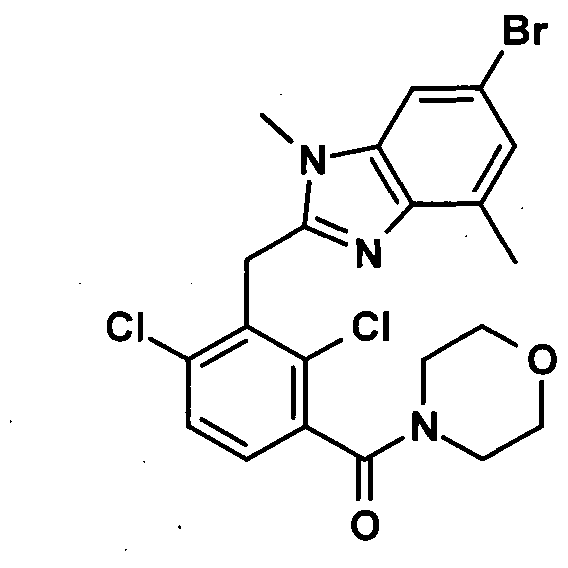

Using a similar procedure as the one described in Example BJ, Step 1, methyl 3-((6-bromo-l,4- dimethyl-lH-benzo[i ]imidazol-2-yl)methyl)-2,4-dichlorobenzoate (451 mg, 42%) was prepared from 5-bromo-N-l,3-dimethylbenzene-l,2-diamine (Preparation #24) (440 mg, 2.046 mmol) and 2-(2,6- dichloro-3-(methoxycarbonyl)phenyl)acetic acid (Preparation #2) (538 mg, 2.046 mmol). LC/MS (Method h) R, = 2.89 min.; MS m/z: 441 [Μ+Η]+. Ή NMR (DMSO-< 6, 300 MHz): 5. 7.75 (d, J = 9Hz, 1H), 7.67 (d, J = 9Hz, 1H), 7.63 (m, 1H), 7.10 (m, 1H), 4.57 (s, 2H), 3.88 (s, 3H), 3.87 (s, 3H), 2.32 (s, 3H).
Step 2: 3-((6-bromo-l,4-dimethyI-lH-benzo[< ]imidazoI-2-yI)methyl)-2,4-dichlorobenzoic acid

Using a similar procedure as the one described in Example A, Step 5, 3-((6-bromo-l,4-dimethyl-lH- benzo[<f|imidazol-2-yl)methyl)-2,4-dichlorobenzoic acid (248 mg, 57%) was prepared from methyl 3- ((6-bromo-l,4-dimethyl-lH-benzo[i/]imidazol-2-yl)methyl)-2,4-dichlorobenzoate (445 mg, 1.006 mmol).
LC/MS (Method h) Rt = 2.16 min.; MS m/z: 427 [Μ+Η]+. Ή NMR (DMSO-</6, 300 MHz): δ. 7.72 (d, J = 9Hz, 1H), 7.65 (s, 1H), 7.62 (d,J= 9Hz, 1H), 7.11 (s, 1H), 4.57 (s, 2H), 3.88 (s, 3H), 2.33 (s, 3H). Step 3: (3-((6-bromo-l,4-dimethyl-lH-benzo[rf]imidazol-2-yl)methyl)-2,4- dichlorophenyl)(morphoIino)methanone:

Using a similar procedure as the one described in Example Al, (3-((6-bromo-l,4-dimethyl-lH- benzo[6 |imidazol-2-yl)methyl)-2,4-dichlorophenyl)(moφholino)methanone (223 mg, 78%) was prepared from 3-((6-bromo-l,4-dimethyl-lH-benzo[< ]imidazol-2-yl)methyl)-2,4-dichlorobenzoic acid (245 mg, 0.572 mmol) and morpholine (64.8mg, 0.744mmol). LC/MS (Method g) Rt = 1.53 min.; MS m/z: 496 [Μ+Η]+. Ή NMR (DMSO-rf6, 300 MHz): δ. 7.63 (s, 1H), 7.62 (d, J = 9Hz, 1H), 7.40 (d, J = 9Hz, 1H), 7.10 (s, 1H), 4.56 (d, J = 15Hz, 1H), 4.48 (d, J = 15Hz, 1H), 3.87 (s, 3H), 3.64 (m, 4H), 3.52 (m, 2H), 3.17 (m, 2H), 2.31 (s, 3H).
Example BR: (3-((6-bromo-l,4-dimethyl-lH-benzo[rf]imidazol-2-yl)methyl)-2,4- dimethylphenyI)(morpholino)methanone

Step 1: methyl 3-((6-bromo-l,4-dimethyl-lH-benzo[rf]imidazol-2-yl)methyl)-2,4- dimethylbenzoate
r

Using a similar procedure as the one described in Example BJ, Step 1, methyl 3-((6-bromo-l,4- dimethyl-lH-benzo[cT|imidazol-2-yl)methyl)-2,4-dimethylbenzoate (620 mg, 70%) was prepared from 2-(3-(methoxycarbonyl)-2,6-dimethylphenyl)acetic acid (Preparation #9) (500 mg, 2.250 mmol) and 5- bromo-Nl,3-dimethylbenzene-l,2-diamine (Preparation #24) (484 mg, 2.250 mmol) LC/MS (Method h) Rt = 2.62 min.; MS m/z: 401 [Μ+Η]+. Ή NMR (DMSO-i 6, 300 MHz): δ 7.61 (m, 1H), 7.55 (d, J = 9Hz, 1H), 7.18 (d, J = 9Hz, 1H), 7.08 (m, 1H), 4.28 (s, 2H), 3.85 (s, 3H), 3.81 (s, 3H), 2.36 (s, 3H), 2.33 (s, 3H), 2.28 (s, 3H).
Step 2: 3-((6-bromo-l,4-dimethyl-lH-benzo[rf]imidazoI-2-yI)methyl)-2,4-dimethylbenzoic acid r

Using a similar procedure as the one described in Example E, Step 1, 3-((6-bromo-l,4-dimethyl-lH- benzo[<i]imidazol-2-yl)methyl)-2,4-dimethylbenzoic acid (580 mg, 94%) was prepared from methyl 3- ((6-bromo-l,4-dimethyl-lH-benzo[i ]imidazol-2-yl)methyl)-2,4-dimethylbenzoate 620 mg, 1.545 mmol)
LC/MS (Method h) Rt = 2.09 min.; MS m/z: 387 [M+H]+.
Ή NMR (DMSO-</6, 400 MHz): δ 12.72 (broad, 1H), 7.63 (s, 1H), 7.57 (d, J = 9Hz, 1H), 7.14 (d, J = 9Hz, 1H), 7.09 (s, 1H), 4.27 (s, 2H), 3.33 (s, 3H), 2.38 (s, 3H), 2.33 (s, 3H), 2.28 (s, 3H).
Step 3: (3-((6-bromo-l,4-dimethyl-lH-benzo[ir|imidazol-2-yl)methyl)-2,4- dimeth lphenyl)(morpholino)methanone:

Using a similar procedure as the one described in Example A, Step 6, (3-((6-bromo-l,4-dimethyl-lH- benzo[ii]imidazol-2-yl)methyl)-2,4-dimethylphenyl)(morpholino)methanone (580 mg, 97%) was prepared from 3-((6-bromo-l ,4-dimethyl-lH-benzo[i/]imidazol-2-yl)methyl)-2,4-dimethylbenzoic acid (465 mg, 1.201 mmol) and morpholine (157 mg, 1.80 mmol). LC/MS (Method g) Rt = 1.99 min.; MS m/z: 456 [Μ+Η]+. Ή NMR (DMSO- , 300 MHz): δ 7.61 (m, 1H), 7.12 (d, J = 9Hz, 1H), 7.08 (m, 1H), 7.01 (d, J = 9Hz, 1H), 4.26 (m, 2H), 3.83 (s, 3H), 3.64 (m, 4H), 3.48 (m, 2H), 3.14 (m, 2H), 2.32 (s, 3H), 2.25 (s, 3H), 2.12 (s, 3H).
Example BS: (2,4-dichloro-3-(l,4-dimethyl-6-(trifluoromethyl)-lH-benzo[i/]iinidazole-2- carbonyI)phenyl)(morpholino)methanone

To a solution of (2,4-dichloro-3-((l,4-dimethyl-6-(trifluoromethyl)-lH-benzo[if]imidazol-2- yl)methyl)phenyl)(moφholino)methanone (Example BJ, Step 3) (35 mg, 0.072 mmol) in dioxane (500 μΐ.) was added manganese dioxide (67 mg, 0.771 mmol). The reaction mixture was stirred at 65°C for 24 hours. Manganese dioxide (55 mg, 0.633 mmol) was added and the reaction mixture was stirred at 65°C for 24 hours. Manganese dioxide (55 mg, 0.633 mmol) was added and the reaction mixture was stirred at 80°C for 24 hours. Manganese dioxide (55 mg, 0.633 mmol) was added and the reaction mixture was stirred at 80°C for 36 hours. The reaction mixture was filtered and washed with ethyl acetate. The filtrate was concentrated under reduced pressure. The residue was purified by preparative LCMS to give (2,4-dichloro-3-(l,4-dimethyl-6-(trifluoromethyl)-lH-benzo[c/]imidazole-2- carbonyl)phenyl)(morpholino)methanone (20 mg, 55%). LC/MS (Method g) Rt = 1.77 min.; MS m/z:
500 [M+Hf. Ή NMR (DMSO-d6, 400 MHz): δ 8.16 (s, 1H), 7.76 (d, J = 9Hz, lH), 7.66 (d, J = 9Hz, 1H), 7.51 (s, 1H), 4.31 (s, 3H), 3.65 (m, 4H), 3.56 (m, 2H), 3.20 (m, 2H), 2.51 (s, 3H).
Example BT: 2-(2,6-dichloro-3-(morpholine-4-carbonyl)benzoyl)-l,4-dimethyl-lH- benzo [d] imidazole-6-car boxamide

Using a similar procedure as the one described in Example BS, 2-(2,6-dicrlloro-3-(mo holine-4- carbonyl)benzoyl)-l,4-dimethyl-lH-benzo[dTjimidazole-6-carboxamide (15 mg, 18%) was prepared from 2-(2,6-dichloro-3-(mo holine-4-carbonyl)benzyl)-l,4-dimethyl-lH-benzo[ί ]imidazole-6- carbonitrile (Table BN, Example BN-1) (180 mg, 0.406 mmol). LC/MS (Method g) R, = 1.12 min.; MS m/z: 475 [Μ+Η]+. Ή NMR (DMSO- , 300 MHz): δ 8.18 (s, 1H), 8.06 (broad, lH), 7.75 (d, J = 9Hz, 1H), 7.71 (m, 1H), 7.64 (d, J = 9Hz, 1H), 7.46 (broad, 1H), 4.27 (s, 3H), 3.65 (m, 4H), 3.55 (m, 2H), 3.20 (m, 2H), 2.46 (s, 3H).
Example BU: 2-(l-(2,4-dichloro-3-((l,4-dimethyl-6-(trifluoromethyl)-lH-benzo[<i]imidazol-2- yI)methyl)benzoyl)piperidin-4-yl)acetic acid

Step 1: methyl 2-(l-(2,4-dichIoro-3-((l,4-dimethyl-6-(trifluoromethyl)-lH-benzo[</]imidazol-2- yl)methyl)benzoyl)piperidin-4-yl)acetate

Using a similar procedure as the one described in Example Al, methyl 2-(l-(2,4-dichloro-3-((l,4- dimethyl-6-(trifluoromethyl)-lH-benzo[ii|imidazol-2-yl)methyl)benzoyl)piperidin-4-yl)acetate (163 mg, 100%) was prepared from 2,4-dichloro-3-((l,4-dimethyl-6-(trifluoromethyl)-lH- benzo[d]imidazol-2-yl)methyl)benzoic acid (Example BJ, Step 2) (120 mg, 0.288 mmol) and methyl (4-piperidyl)acetate hydrochloride (67 mg, 0.345 mmol). LC/MS (Method i) Rt = 2.37 min.; MS m/z: 556 [M+H]+.
Ή NMR (DMSO-d5, 300MHz): δ 7.85 (s, IH), 7.62 (m, IH), 7.40 and 7.33 (d, 7=8.3 Hz, IH), 7.29 (s, IH), 4.64 (m, 2H), 4.47 (m, IH), 3.98 and 3.97 (s, 3H), 3.59 and 3.56 (s, 3H), 3.28 (m, IH), 3.04 (m, IH), 2.80 (m, IH), 2.40 (s, 3H), 2.26 (m, 2H), 1.95 (m, IH), 1.74 (m, IH), 1.56 (m, IH), 1.13 (m, 2H). Step 2: 2-(l-(2,4-dichloro-3-((l,4-dimethyl-6-(trifluoromethyl)-lH-benzo[rf]imidazol-2- yI)methyl)benzoyl)piperidin-4-yl)acetic acid

Using a similar procedure as the one described in Example A, Step 5, 2-(l-(2,4-dichloro-3-((l,4- dimethyl-6-(trifluoromethyl)-lH-benzo[^imidazol-2-yl)methyl)benzoyl)piperidin-4-yl)acetic acid (130 mg, 81%) was prepared from methyl 2-(l-(2,4-dichloro-3-((l,4-dimethyl-6-(trifluoromethyl)-lH- benzo[( |imidazol-2-yl)methyl)benzoyl)piperidin-4-yl)acetate (163 mg, 0.0.293 mmol). LC/MS (Method g) Rt = 1.56 min.; MS m/z: 542 [M+H]+.
'H NMR (DMSO-d6, 400MHz): δ 12.01 (s, IH), 7.85 (s, IH), 7.61 (m, IH), 7.40 and 7.33 (d, 7=8.4 Hz, IH), 7.29 (s, IH), 4.65(m, 2H), 4.47 (m, IH), 3.98 and 3.97 (s, 3H), 3.29 (m, IH), 3.04 (m, IH), 2.79 (m, IH), 2.40 (s, 3H), 2.18 (m, IH), 2.13 (m, IH), 1.91 (m, IH), 1.62(m, IH), 1.59 (m, IH), 1.17 (m, 2H).
Example BV: 3-[4-[2,4-dichloro-3-[[l,4-dimethyI-6-(trifluoromethyl)benzimidazol-2- yl] m ethyl] benzoyl] piper azin- 1 -yl] cyclobutanecarboxylic acid

Step 1: tert-butyl 4-(2,4-dichloro-3-((l,4-dimethyl-6-(trifluoromethyl)-lH-benzo[rf]imidazoI-2- yI)methyl)benzoyl)piperazine-l-carboxylate

Using a similar procedure as the one described in Example A, Step 6, ier/-butyl 4-(2,4-dichloro-3- ((l,4-dimethyl-6-(trifluoromethyl)-lH-benzo[£ ]imidazol-2-yl)methyl)benzoyl)piperazine-l- carboxylate (480 mg, 100%) was prepared from 2,4-dichloro-3-((l,4-dimethyl-6-(trifluoromethyl)-lH- benzo[if|imidazol-2-yl)methyl)benzoic acid (Example BJ, Step 2) (300 mg, 0.719 mmol) and tert-butyl piperazine-l-carboxylate (201 mg, 1.079 mmol). LC/MS (Method h) Rt = 3.11 min.; MS m/z: 585 [M+H]+.
Ή NMR (DMSO-d6, 300MHz): δ 7.83 (s, 1H), 7.64 (d, J=8.3 Hz, 1H), 7.41 (d, J=8.3 Hz, 1H), 7.27 (s, 1H), 4.65 (d, J=16 Hz, 1H), 4.53 (d, J=16 Hz, 1H), 3.97 (s, 3H), 3.61 (m, 2H), 3.21 (m, 2H), 3.15 (m, 2H), 2.58 (m, 2H), 2.41 (s, 3H), 1.30 (s, 9H).
Step 2: (2,4-dichloro-3-((l,4-dimethyI-6-(trifluoromethyl)-lH-benzo[rf]iinidazol-2- yl)methyl)phenyl)(piperazin-l-yl)methanone

Using a similar procedure as the one described in Example O, Step 2, (2,4-dichloro-3-((l,4-dimethyl- 6-(trifluoromethyl)-lH-benzo[ii|imidazol-2-yl)methyl)phenyl)(piperazin-l -yl)methanone (340 mg, 98%) was prepared from teri-butyl 4-(2,4-dichloro-3-((l,4-dimethyl-6-(trifluoromethyl)-lH- benzo[c/]imidazol-2-yl)methyl)benzoyl)piperazine-l-carboxylate (420 mg, 0.717 mmol). LC/MS (Method h) R, = 2.46 min.; MS m/z: 485 [Μ+Η]+. Ή NMR (DMSO-d6, 300MHz): δ 7.82 (s, IH), 7.61 (d, J=8.3 Hz, IH), 7.37 (d, 7=8.3 Hz, IH), 7.26 (s, IH), 4.66 (d, J=16 Hz, IH), 4.53 (d, 7=16 Hz, IH), 3.97 (s, 3H), 3.53 (m, 2H), 3.07 (m, 2H), 2.6770 (m, 2H), 2.60 (m, 2H), 2.39 (s, 3H).
Step 3: methyl 3-(4-(2,4-dichIoro-3-((l,4-dimethyl-6-(trifluoromethyI)-lH-benzo[</]imidazol-2- yl)methyl)benzoyl)piperazin-l-yI)cyclobutanecarboxylate

Using a similar procedure as the one described in Example O, Step 3, methyl 3-(4-(2,4-dichloro-3- ((l,4-dimethyl-6-(trifluoromethyl)-lH-benzo[i/]imidazol-2-yl)methyl)benzoyl)piperazin-l- yl)cyclobutanecarboxylate (105 mg, 65%) was prepared from (2,4-dichloro-3-((l,4-dimethyl-6- (trifluoromethyl)-lH-benzo[(/]imidazol-2-yl)methyl)phenyl)(piperazin-l-yl)methanone (130 mg, 0.268 mmol) and methyl 3-oxocyclobutanecarboxylate (85.8mg, 0.67 mmol). LC/MS (Method h) Rt = 2.89 min.; MS m/z: 597 [Μ+Η]+. Ή NMR (DMSO-d6, 300MHz): δ 7.82 (s, IH), 7.62 (d, 7=8.1 Hz, IH), 7.37 (d, J=8.1 Hz, IH), 7.27 (s, IH), 4.65 (d, 7=16 Hz, IH), 4.53 (d, 7=16 Hz, IH), 3.97 (s, 3H), 3.65 (m, IH), 3.58 (s, 3H), 3.14 (m, 2H), 2.82 (m, IH), 2.65 (m, IH), 2.39 (s, 3H), 2.32 (m, IH), 2.20 (m, 6H), 1.93 (m, 2H).
Step 4: 3-[4-[2,4-dichloro-3-[[l,4-dimethyl-6-(trifluoromethyl)benzimidazol-2- yl]methyl]benzoyl]piperazin-l-yl]cyclobutanecarboxylic acid

Using a similar procedure as the one described in Example A, Step 5, 3-[4-[2,4-dichloro-3-[[l,4- dimethyl-6-(trifluoromethyl)benzimidazol-2-yl]methyl]benzoyl]piperazin-l-yl]cyclobutanecarboxylic acid (65 mg, 63%) was prepared from methyl 3-(4-(2,4-dichloro-3-((l,4-dimethyl-6-(trifluoromethyl)- lH-benzo[i/]imidazol-2-yl)methyl)benzoyl)piperazin-l-yl)cyclobutanecarboxylate (105 mg, 0.176 mmol).
LC/MS (Method g) R, = 1.16 min.; MS m/z: 583 [Μ+Η]+. Ή NMR (DMSO-d6, 300MHz,): δ 7.82 (s, 1H), 7.61 (d, 7=8.3 Hz, 1H), 7.37 (d, 7=8.3 Hz, 1H), 7.27 (s, 1H), 4.65 (d, 7=16 Hz, 1H), 4.53 (d, 7=16 Hz, 1H), 3.96 (s, 3H), 3.61 (m, 2H), 3.13 (m, 2H), 2.40 (s, 3H), 2.18 (m, 6H), 1.97 (m, 2H), 1.81 (m, 2H)
Example BW: 2- [ [2,6-dichloro-3-[ [4-(2-methoxyethyI)-l-piperidyl] methyl] phenyl] methyl]-l,4- dimethyI-6-(trifluoromethyl)benzimidazole

Step 1: (2,4-dichloro-3-((l,4-dimethyI-6-(trifluoromethyl)-lH-benzo[</]imidazoI-2- yl)methyl)phenyI)methanol

LC/MS (Method h) Rt = 2.66 min.; MS m/z: 403 [Μ+Η]+. Ή NMR (DMSO-d6, 300MHz): δ 7.82 (s, 1H), 7.55 (s, 2H), 7.26 (s, 1H), 5.54 (t, J=5.6 Hz, 1H), 4.53-4.60 (m, 4H), 3.97 (s, 3H), 2.41 (s, 3H).
Step 2: 2,4-dichloro-3-((l,4-dimethyl-6-(trifluoromethyl)-lH-benzo[</]imidazol-2- yl)methyl)benzyl methanesulfonate

To a suspension of (2,4-dichloro-3-((l,4-dimethyl-6-(trifluoromethyl)-lH-benzo[if|imidazol-2- yl)methyl)phenyl)methanol (1.820 g, 4.51 mmol) in dichloromethane (150 ml) was added triethylamine (0.913 g, 9.03 mmol) and methanesulfonyl chloride (0.776 g, 6.77 mmol) and the mixture was stirred at room temperature for 2 hours. The reaction mixture was diluted with dichloromethane. The obtained organic layer was washed successively with water and a IN HQ aqueous solution. The obtained organic layer was dried over magnesium sulfate, filtered and concentrated under reduced pressure to give 2,4-dichloro-3-((l,4-dimethyl-6-(trifluoromethyl)-lH- benzo[< ]imidazol-2-yl)methyl)benzyl methanesulfonate (2.1 g, 97 %) as a white powder. LC/MS (Method h) Rt = 2.92 min.; MS m/z: 481 [M+H]+.
'HNMR (DMSO-d6, 300MHz): δ 7.83 (s, 1H), 7.64 (m, 2H), 7.26 (s, 1H), 5.37 (s, 2H), 4.62 (s, 2H), 3.98 (s, 3H), 3.28 (s, 3H), 2.40 ppm (s, 3H).
Step 3 : 2- [ [2,6-dichloro-3- [ [4-(2-methoxyethyl)-l-piperidyl] methyl] phenyl] methyl] -1,4-dimethyl- 6-(trifluoromethyl)benzimidazole

To a solution of 4-(2-methoxyethyl)piperidine hydrochloride (52 mg, 0.29 mmol) in DMF (0.5 mL) was added potassium carbonate (40 mg, 0.29 mmol) and 2,4-dichloro-3-((l,4-dimethyl-6- (trifluoromethyl)-lH-benzo[i ]imidazol-2-yl)methyl)benzyl methanesulfonate (70 mg, 0.145 mmol) in solution in DMF (1.5 mL). The mixture was stirred at 60°C for 18 hours. Water was added and the mixture was extracted with dichloromethane. The organic phase was dried by filtration through a hydrophobic membrane and concentrated. The residue was purified by preparative LCMS to give 2- [[2,6-dichloro-3-[[4-(2-methoxyethyl)-l-piperidyl]methyl]phenyl]methyl]-l,4-dimethyl-6- (trifluoromethyl)benzimidazole (52 mg, 68%). LC/MS (HPLC) R, = 1.24 min.; MS m/z: 528 [M+Hf. Ή NMR (DMSO-d6, 400MHz): δ 7.79 (s, 1H), 7.50 (d, 7=8 Hz, 1H)> 7.45 (d, J=8 Hz, 1H), 7.23 (s, 1H), 4.58 (s, 2H), 3.96 (s, 3H), 3.54 (s, 2H), 3.32 (t, J= 6Hz, 2H), 3.21 (s, 3H), 2.80 (m, 2H), 2.40 (s, 3H), 2.00 (m, 2H), 1.60 (m, 2H), 1.42 (m, 2H), 1.32 (m, 1H), 1.10 (m, 2H)
Table BW. The following examples were prepared from 2,4-dichloro-3-((l,4-dimethyl-6- (trifiuoromethyl)-lH-benzo[^imidazol-2-yl)methyl)benzyl methanesulfonate using the same procedure with the appropriate amine.


To a solution of morpholin-3-one (42.0 mg, 0.416 mmol) in DMF (3 ml) was added sodium hydride (19.11 mg, 0.478 mmol) and the reaction was stirred at room temperature during 15 minutes. 2,4- dichloro-3-((l,4-dimethyl-6-(trifluoromethyl)-lH-benzo[i ]imidazol-2-yl)methyl)benzyl
methanesulfonate (Example BW, Step 2) (100 mg, 0.208 mmol) was added and the reaction mixture was stirred at room temperature for 1 hour then water and ethyl acetate were added. The organic layer was decantated, washed with brine; dried over magnesium sulfate and concentrated. The residue was purified by column chromatography on silica gel (eluting with 40-70% ethyl acetate in cyclohexane) to give 4-(2,4-dichloro-3-((l,4-dimethyl-6-(trifluoromethyl)-lH-benzo[ii|imidazol-2- yl)methyl)benzyl)mo holin-3-one (20 mg, 19%) as a white solid. LC/MS (HPLC) Rt = 1.62 min.; MS m/z: 486 [M+H]+.
Ή NMR (DMSO-d6, 400MHz): δ 7.82 (s, 1H), 7.55 (d, 7=8.4 Hz, 1H), 7.26 (m, 2H), 4.64 (s, 2H), 4.60 (s, 2H), 4.16 (s, 2H), 3.97 (s, 3H), 3.89 (m, 2H), 3.34 (m, 2H), 2.41 (s, 3H).
Example BY: l-(2,4-dichloro-3-((l,4-dimethyl-5-(trifluoromethyl)-lH-benzo[i ]imidazol-2- yI)methyl)benzoyl)piperidine-4-carbox Iic acid

Step 1: methyl 2,4-dichloro-3-((l,4-dimethyl-5-(trifluoromethyl)-lH-benzo[i ]imidazol-2- yl)methyl)benzoate

Using a similar procedure as the one described in Example BJ, Step 1, methyl 2,4-dichloro-3-((l,4- dimethyl-5-(trifluoromethyl)-lH-benzo[ii]imidazol-2-yl)methyl)benzoate (1.2 g, 61%) was prepared from Nl,3-dimethyl-4-(trifluoromethyl)benzene-l,2-diamine (Preparation #30) (880 mg, 4.31 mmol) and 2-(2,6-dichloro-3-(methoxycarbonyl)phenyl)acetic acid ( Preparation #2) (1.13 g, 4.31 mmol). LC/MS (Method i) Rt = 2.50 min.; MS m/z: 431 [M+H]+.
Ή NMR (DMSO-d6, 300MHz): δ 7.6 (d, J=9 Hz, 1H), 7.68 (d, 7=9 Hz, 1H), 7.54 (d, J=9 Hz, 1H), 7.50 (d, J=9 Hz, 1H), 4.63 (s, 2H), 3.95 (s, 3H), 3.87 (s, 3H), 2.49 (s, 3H).
Step 2: 2,4-dichloro-3-((l,4-dimethyl-5-(trifluoromethyI)-lH-benzo[</]imidazol-2- yl)methyI)benzoic acid

Using a similar procedure as the one described in Example A, Step 5, 2,4-dichloro-3-((l,4-dimethyl-5- (trifluoromethyl)-lH-benzo[ii]imidazol-2-yl)methyl)benzoic acid (1.09 g, 98%) was prepared from methyl 2,4-dichloro-3-(( 1 ,4-dimethyl-5 -(trifluoromethyl)- 1 H-benzo [d]imidazol-2-yl)methyl)benzoate (1.1 g, 2.55 mmol). LC/MS (Method i) Rt = 2.08 min.; MS m/z: All [M+H]+.
Ή NMR (DMSO-d6, 300MHz): δ 13.63 (broad, 1H), 7.73 (d, J=9 Hz, 1H), 7.63 (d, J=9 Hz, 1H), 7.54 (d, J=9 Hz, 1H),7.50 (d, J=9 Hz, 1H), 4.62 (s, 2H), 3.95 (s, 3H), 2.50 (s, 3H).
Step 3: methyl l-(2,4-dichloro-3-((l,4-dimethyl-5-(trifluoromethyl)-lH-benzo[i/]imidazol-2- yl)methyl)benzoyl)piperidine-4-carbox late


Using a similar procedure as the one described in Example A, Step 5, l-(2,4-dichloro-3-((l,4- dimethyl-5-(trifluoromethyl)-lH-benzo[if|imidazol-2-yl)methyl)benzoyl)piperidine-4-carboxylic acid (80 mg, 32%) was prepared from methyl l-(2,4-dichloro-3-((l,4-dimethyl-5-(trifluoromethyl)-lH- benzo[i/]imidazol-2-yl)methyl)benzoyl)piperidine-4-carboxylate (254 mg, 0.468 mmol). LC/MS (Method g) Rt = 1.55 min.; MS m/r. 528 [Μ+Η]+. Ή NMR (DMSO-d6, 400MHz): δ 12.31 (broad, IH), 7.61 (m, IH), 7.52 (d, 7=9 Hz, IH), 7.50 (d, J=9 Hz, IH), 7.42 and 7.35 (d, J=8 Hz, IH ), 4.59 (m, 2H), 4.35 (m, IH), 3.94 (m, 3H), 3.21 (m, IH), 3.09 (m, IH), 2.96 (m, IH), 2.54 (m, IH), 2.50 (m, 3H), 1.91 (m, IH), 1.74 (m, IH), 1.50 (m, 2H).
Example BZ: 2-(l-(2,4-dichloro-3-((l ,4-dimethyl-5-(trifluoromethyl)-lH-benzo [rf] imidazol-2- yl)methyl)benzoyl)piperidin-4- l)acetic acid

Step 1: methyl 2-(l-(2,4-dichloro-3-((l,4-dimethyl-5-(trifluoromethyl)-lH-benzo[i ]imidazol-2- yl)methyl)benzoyl)piperidin-4-yl)acetate
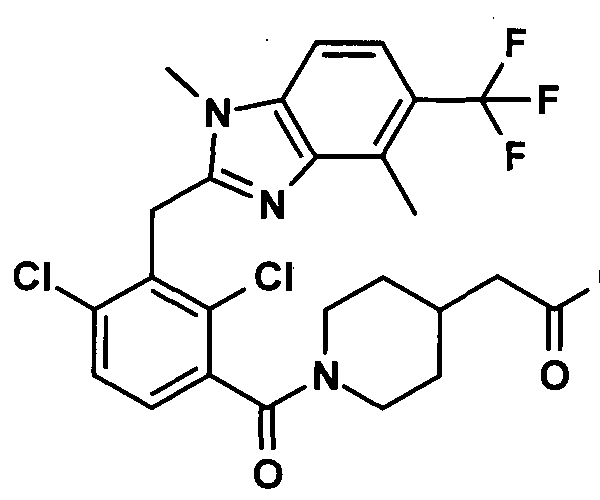
Using a similar procedure as the one described in Example Al, methyl 2-(l-(2,4-dichloro-3-((l,4- dimethyl-5-(trifluoromethyl)-lH-benzo[< |imidazol-2-yl)methyl)benzoyl)piperidin-4-yl)acetate (275 mg, 100%) was prepared from 2,4-dichloro-3-((l,4-dimethyl-5-(trifiuoromethyl)-lH- benzo[i/]imidazol-2-yl)methyl)benzoic acid (Example BY, Step 2) (200 mg, 0.479 mmol) and methyl (4-piperidyl)acetate hydrochloride (111 mg, 0.57 mmol). LC/MS (Method i) R, = 2.39 min.; MS m/z: 556 [M+Hf.
¾ NMR (DMSO-d6, 300MHz): δ 7.61 (m, IH), 7.55 (d, J=9 Hz, IH), 7.51 (d, J=9 Hz, IH), 7.40 and 7.33 (d, J=8.3 Hz, IH), 4.62 (m, 2H), 4.46 (m, IH), 3.94 (m, 3H), 3.59 and 3.55 (s, 3H), 3.28 (m, IH), 3.06 (m, IH), 2.78 (m, IH), 2.47 (m, 3H), 2.25 (m, 2H), 1.94 (m, IH), 1.75 (m, IH), 1.57 (m, IH), 1.14 (m, 2H).
Step 2: 2-(l-(2,4-dichIoro-3-((l,4-dimethyI-5-(trifluoromethyl)-lH-benzo[ii]imidazoI-2- yl)methyl)benzoyl)piperidin-4- I)acetic acid
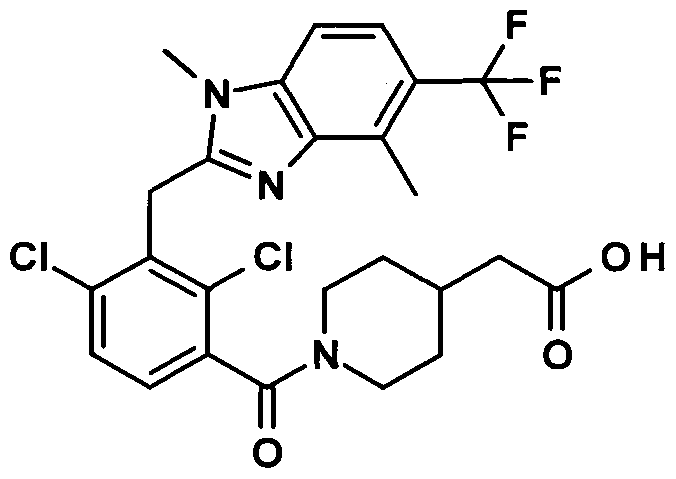
Using a similar procedure as the one described in Example A, Step 5, 2-(l-(2,4-dichloro-3-((l,4- dimethyl-5-(trifluoromethyl)-lH-benzo[iilimidazol-2-yl)methyl)benzoyl)piperidin-4-yl)acetic acid (210 mg, 76%) was prepared from methyl 2-(l-(2,4-dichloro-3-((l,4-dimethyl-5-(trifluoromethyl)-lH- benzo[(/]imidazol-2-yl)methyl)benzoyl)piperidin-4-yl)acetate (272 mg, 0.46 mmol). LC/MS (Method g) Rt = 1.57 min.; MS m/z: 542 [Μ+Η]+. Ή NMR (DMSO-d6, 400MHz): δ 12.07 (broad, IH), 7.61 (m, IH), 7.54 (d, J=9 Hz, IH), 7.50(d, J=9 Hz, IH), 7.40 and 7.32 (d, J=8.1 Hz, IH), 4.4.62 (m, 2H), 4.47 (m, IH), 3.94 (m, 3H), 3.30 (m, IH), 3.04 (m, IH), 2.79 (m, IH), 2.48, 2.47 (s, 3H), 2.10 (m, 2H), 1.93 (m, IH), 1.77 (m, IH), 1.57 (m, IH), 1.10 (m, 2H).
Example CA: (2,4-dichloro-3-((l,4-dimethyl-5-(trifluoromethyl)-lH-benzo[</]imidazol-2- yl)methyl)phenyl)(morpholino)methanone

Using a similar procedure as the one described in Example Al, (2,4-dichloro-3-((l,4-dimethyl-5- (trifluoromethyl)-lH-benzo[ii|imidazol-2-yl)methyl)phenyl)(morpholino)methanone (90 mg, 76%) was prepared from 2,4-dichloro-3-((l,4-dimethyl-5-(trifluoromethyl)-lH-benzo[i ]imidazol-2- yl)methyl)benzoic acid (Example BY, Step 2) (200 mg, 0.479 mmol) and morpholine (31 mg, 0.360 mmol). LC/MS (Method g) Rt = 1.63 min.; MS m/z: 486 [Μ+Η]+. Ή NMR (DMSO-d6, 400MHz): δ = 7.63 (d, 7=8.1 Hz, IH), 7.55 (d, 7=8 Hz, IH), 7.50 (d, J=8 Hz, IH), 7.41 (d, 7=8.1 Hz, IH), 4.64 (d, 7=16 Hz, IH), 4.56 (d, 7=16 Hz, IH), 3.94 (s, 3H), 3.64 (m, 4H), 3.53 (m, 2H), 3.17 (m, 2H), 2.48 (s, 3H).
Example CB: (3-((5-bromo-l,4-dimethyl-lH-benzo[rf]imidazol-2-yI)methyl)-2,4- dichlorophenyl)(morpholino)methanone

Step 1: methyl 3-((5-bromo-l,4-dimethyl-lH-benzo[inimidazol-2-yl)methyl)-2,4- dichlorobenzoate

Using a similar procedure as the one described in Example BJ, Step 1, methyl 3-((5-bromo-l,4- dimethyl-lH-benzo[i ]imidazol-2-yl)methyl)-2,4-dichlorobenzoate (508 mg, 67%) was prepared from 4-bromo-Nl,3-dimethylbenzene-l,2-diamine (Preparation #31) (350 mg, 1.63 mmol) and 2 -(2,6- dichloro-3-(methoxycarbonyl)phenyl)acetic acid ( Preparation #2) (428 mg, 1.63 mmol). LC/MS
(Method h) R, = 2.98 min.; MS m/z: 441 [M+H]+. Ή NMR (DMSO-d6, 300MHz): δ 7.75 (d, J=9 Hz, IH), 7.66 (d, J=9 Hz, IH), 7.38 (d, J=9 Hz, IH), 7.34 (d, J=9 Hz, IH), 4.58 (s, 2H), 3.88 (s, 3H), 3.86 (s, 3H), 2.37 (s, 3H).
Step 2: 3-((5-bromo-l,4-dimethyl-lH-benzo[rf]iinidazol-2-yI)methyl)-2,4-dichIorobenzoic acid

Using a similar procedure as the one described in Example A, Step 5, 3-((5-bromo-l,4-dimethyl-lH- benzo[c/]imidazol-2-yl)methyl)-2,4-dichlorobenzoic acid (450 mg, 93%) was prepared from methyl 3- ((5-bromo-l,4-dimethyl-lH-benzo[ii]imidazol-2-yl)methyl)-2,4-dichlorobenzoate (500 mg, 1.13 mmol).
LC/MS (Method h) Rt = 2.14 min.; MS m/z: All [Μ+Η]+. Ή NMR (DMSO-d6, 300MHz): δ 7.71 (d, J=9 Hz, IH), 7.63 (d, =9 Hz, IH), 7.37 (d, J=9 Hz, IH), 7.34 (d, J=9 Hz, IH), 4.57 (s, 2H), 3.88 (s, 3H), 2.37 (s, 3H).
Step 3: (3-((5-bromo-l,4-dimethyl-lH-benzo[</]imidazoI-2-yl)methyI)-2,4- dichlorophenyl)(morpholino)methanone

Using a similar procedure as the one described in Example Al, (3-((5-bromo-l,4-dimethyl-lH- be zo[ίiΓ|imidazol-2-yl)methyl)-2,4-dichlorophenyl)(mo holino)methanone (465 mg, 84%) was prepared from 3-((5-bromo-l,4-dimethyl-lH-benzo[cf]imidazol-2-yl)methyl)-2,4-dichlorobenzoic acid (436 mg, 4.02 mmol) and morpholine (133 mg, 1.53 mmol). LC/MS (Method g) Rt = 1.53 min.; MS m/z: 496 [Μ+Η]+. Ή NMR (DMSO-d6, 400MHz): δ 7.63 (d, J=8.1 Hz, IH), 7.40 (m, 3H), 4.63 (d, J=16 Hz, IH), 4.55 (d, J=16 Hz, IH), 3.89 (s, 3H), 3.65 (m, 4H), 3.52 (m, 2H), 3.17 (m, 2H), 2.38 (s, 3H).
Example CC: 2-(2,6-dichloro-3-(morpholine-4-carbonyl)benzyl)-l,4-dimethyl-lH- benzo[i/]imidazole-5-carbonitrile

In a microwave vial were put (3-((5-bromo-l,4-dimethyl-lH-benzo[<f|imidazol-2-yl)methyl)-2,4- dichlorophenyl)(morpholino)methanone (Example CB, Step 3) (140 mg, 0.28 mmol), zinc cyanide (24.8 mg, 0.211 mmol) and Pd(Ph3P)4 (32.5 mg, 0.028mmol) in DMF (800 μΙ_) and the reaction mixture was stirred at 120°C for 60 minutes under microwave irradiation. The reaction mixture was diluted with ethyl acetate and filtered. Water was added on the filtrate. The layers were separated and the aqueous one was washed with ethyl acetate. The organic layers was dried over magnesium sulfate, filtered and concentrated under reduced pressure. The residue was purified by column chromatography on silica gel (eluting with 50-60% ethyl acetate in cyclohexane) to give 2-(2,6-dichloro-3-(mo holine- 4-carbonyl)benzyl)-l,4-dimethyl-lH-benzo[c ]imidazole-5-carbonitrile (30 mg, 23%). LC/MS (Method g) R, = 1.32 min.; MS m/z: 443 [M+H]+. ]H NMR (DMSO-d6, 400MHz): δ 7.63 (d, J=8.1 Hz, 1H), 7.56 (m, 2H), 7.41 (d, J=8.1 Hz, 1H), 4.64 (d, J=16 Hz, 1H), 4.56 (d, J=16 Hz, 1H), 3.94 (s, 3H), 3.60 (m, 4H), 3.53 (m, 2H), 3.17 (m, 2H), 2.50 (s, 3H).
Example CD: 2-(2,6-dichIoro-3-(morpholine-4-carbonyl)benzyl)-l-methyl-lH- benzo [< ]imidazole-5-carbonitrile

Step 1: methyl 2,4-dichloro-3-((5-cyano-l-methyl-lH-benzo[rf]imidazol-2-yl)methyl)benzoate

Using a similar procedure as the one described in Example BJ, Step 1, methyl 2,4-dichloro-3-((5- cyano-l-methyl-lH-benzo[i ]imidazol-2-yl)methyl)benzoate (460 mg, 82%) was prepared from 3- amino-4-(methylamino)benzonitrile (WO 2003060078) (220 mg, 1.49 mmol) and 2-(2,6-dichloro-3- (methoxycarbonyl)phenyl)acetic acid ( Preparation #2) (393 mg, 1.49 mmol). LC/MS (Method h) R, = 2.39 min.; MS m/z: 374 [Μ+Η]+. Ή NMR (DMSO-d6, 300MHz): δ 8.04 (d, 7=1.5 Hz, 1H), 7.76 (m, 2H), 7.66 (d, 7=9 Hz, 1H), 7.62 (dd, 7=9, 1.5 Hz, 1H), 4.64 (s, 2H), 3.97 (s, 3H), 3.87 (s, 3H).
Step 2: 2,4-dichloro-3-((5-cyano-l-methyl-lH-benzo[</]imidazol-2-yI)methyl)benzoic acid

Using a similar procedure as the one described in Example A, Step 5, 2,4-dichloro-3-((5-cyano-l- methyl-lH-benzo[ifJimidazol-2-yl)methyl)benzoic acid (400 mg, 92%) was prepared from methyl 2,4- dichloro-3-((5-cyano-l-methyl-lH-benzo[ii|imidazol-2-yl)methyl)benzoate (450 mg, 1.20 mmol). LC/MS (Method h) Rt = 1.80 min.; MS m/z: 360 [Μ+Η]+. Ή NMR (DMSO-d6, 300MHz): δ 8.04 (d, 7=1.3 Hz, 1H), 7.77 (d, 7=8.4 Hz, 1H), 7.72 (d, 7=9 Hz, 1H), 7.62 (m, 2H), 4.63 (s, 2H), 3.97 (s, 3H). Step 3: 2-(2,6-dichloro-3-(morpholine-4-carbonyI)benzyl)-l-methyl-lH-benzo[i/]imidazole-5- carbonitrile

Using a similar procedure as the one described in Example Al, 2-(2,6-dichloro-3-(morpholine-4- carbonyl)benzyl)-l-methyl-lH-benzo[i/]imidazole-5-carbonitrile (178 mg, 38%) was prepared from
2,4-dichloro-3-((5-cyano-l-methyl-lH-benzo[ ]imidazol-2-yl)methyl)benzoic acid (387 mg, 1.07 mmol) and morpholine (140 mg, 1.61 mmol). LC/MS (HPLC) Rt = 1.19 min.; MS m/z: 429 [M+H]+. Ή NMR (DMSO-d6, 400MHz): δ 8.05 (s, 1H), 7.77 (d, J=8.4 Hz, 1H), 7.62 (m, 2H), 7.41 (d, J=8.4 Hz, 1H), 4.61 (m, 2H), 3.97 (s, 3H), 3.64 (m, 4H), 3.54 (m, 2H), 3.16 (m, 2H).
Example CE: (3-((6-bromo-l-methyl-4-(trifluoromethyl)-lH-benzo[< ]imidazol-2-yl)methyl)-2,4- dichIorophenyl)(morpholino)niethanone

Step 1: methyl 3-((6-bromo-l-methyl-4-(trifluoromethyl)-lH-benzo[< ]imidazol-2-yl)methyl)-2,4- dichlorobenzoate

Using a similar procedure as the one described in Example BJ, Step 1, methyl 3-((6-bromo-l-methyl- 4-(trifluoromethyl)-lH-benzo[ii|imidazol-2-yl)methyl)-2,4-dichlorobenzoate (827 mg) was prepared from 5-bromo-Nl-methyl-3-(trifluoromethyl)benzene-l,2-diamine (Preparation #32) (450 mg, 1.67 mmol) and 2-(2,6-dichloro-3-(methoxycarbonyl)phenyl)acetic acid ( Preparation #2) (440 mg, 1.67 mmol). It was used crude in the next step. LC/MS (Method h) R, = 3.19 min.; MS m/z: 494 [M+H]+. Step 2: 3-((6-bromo-l-methyl-4-(trifluorometbyI)-lH-benzo[rf]imidazol-2-yl)methyl)-2,4- dichlorobenzoic acid

Using a similar procedure as the one described in Example A, Step 5, 3-((6-bromo-l-methyl-4- (trifluoromethyl)-lH-benzo[ii]imidazol-2-yl)methyl)-2,4-dichlorobenzoic acid (487 mg, 88%) was prepared from methyl 3-((6-bromo-l-methyl-4-(trifluoromethyl)-lH-benzo[ci|imidazol-2-yl)methyl)- 2,4-dichlorobenzoate (830 mg, 1.67 mmol). LC/MS (Method h) R, = 2.77 min.; MS m/z: 481 [M+H]+. Ή NMR (DMSO-d6, 300MHz): δ 8.24 (d, J=1.0 Hz, IH), 7.74 (d, J=9 Hz, IH), 7.63 (d, =9 Hz, IH), 7.59 (d, J=1.0 Hz, IH), 4.64 (s, 2H), 3.97 (s, 3H).
Step 3: (3-((6-bromo-l-methyl-4-(trifluoromethyl)-lH-benzo[rf]iinidazol-2-yI)methyl)-2,4- dichlorophenyl)(morpholino)methanone

Using a similar procedure as the one described in Example Al, (3-((6-bromo-l-methyl-4- (trifluoromethyl)-lH-benzo[i/]imidazol-2-yl)methyl)-2,4-dichlorophenyl)(morpholino)methanone (442 mg, 79%) was prepared from 3-((6-bromo-l-methyl-4-(trifluoromethyl)-lH-benzo[i ]imidazol-2- yl)methyl)-2,4-dichlorobenzoic acid (478 mg, 0.99 mmol) and morpholine (86 mg, 0.99 mmol).
LC/MS (Method g) Rt = 1.76 min.; MS m/z: 550 [M+H . Ή NMR (DMSO-d6, 400MHz): δ 8.23 (s, IH), 7.63 (d, J=8.4 Hz, IH), 7.58 (s, IH), 7.40 (d, J=8.4 Hz, IH), 4.66 (d, J=16 Hz, IH), 4.56 (d, J=16 Hz, IH), 3.96 (s, 3H), 3.63 (m, 4H), 3.40-3.54 (m, 2H), 3.12 (m, 2H).
Example CF: 2-(2,6-dichloro-3-(morpholine-4-carbonyl)benzyl)-l-methyl-4-(trifluoromethyl)- lH-benzo [d] imidazole-6-carbonitrile

Using a similar procedure as the one described in Example CC, 2-(2,6-dichloro-3-(mo holine-4- carbonyl)benzyl)-l-methyl-4-(trifluoromethyl)-lH-benzo[i ]imidazole-6-carbonitrile (57 mg, 42%) was prepared from (3-((6-bromo-l-methyl-4-(trifluoromethyl)-lH-benzo[ii]imidazol-2-yl)methyl)-2,4- dichlorophenyl)(mo ^lolino)methanone (Example CE, Step 3) (151 mg, 0.0.27 mmol).
LC/MS (Method g) R, = 1.50 min.; MS m/z: 497 [M+H]+. ¾ NMR (DMSO-d6, 400MHz): δ 8.58 (s, IH), 7.94 (m, IH), 7.64 (d, J=8.4 Hz, IH), 7.41 (d, J=8.4 Hz, IH), 4.74 (d, J=16 Hz, IH), 4.64 (d, J=16 Hz, IH), 4.03 (s, 3H), 3.63 (m, 4H), 3.48 (m, 2H), 3.12 (m, 2H).
Example CG: 2-(2,6-dichloro-3-(morpholine-4-carbonyl)benzyI)-l-ethyl-4-methyl-lH- benzo [d] imidazoIe-6-car bonitrile

Step 1: methyl 2,4-dichloro-3-((6-cyano-4-meth l-lH-benzo[i/]imidazol-2-yl)methyI)benzoate

Step 2: 2,4-dichloro-3-((6-cyano-4-meth l-lH-benzo[i ]imidazol-2-yl)methyl)benzoic acid

Using a similar procedure as the one described in Example A, Step 5, 2,4-dichloro-3-((6-cyano-4- methyl-lH-benzo[i |imidazol-2-yl)methyl)benzoic acid (462 mg, 76%) was prepared from methyl 2,4- dichloro-3-((6-cyano-4-methyl-lH-benzo[cf]imidazol-2-yl)methyl)benzoate (600 mg, 1.60 mmol).
LC/MS (Method h) Rt = 1.72 min.; MS m/z: 360 [M+H]+. ]H NMR (DMSO-d6, 300MHz): δ 7.85 (d,
J=8.4 Hz, 1H), 7.78 (s, 1H), 7.52 (d, J=8.4 Hz, 1H), 7.47 (s, 1H), 5.03 (s, 2H), 2.74 (s, 3H).
Step 3 : 2-(2,6-dichloro-3-(morpholine-4-carbonyl)benzyl)-4-methyl-lH-benzo [rf] imidazole-6- carbonitrile

Using a similar procedure as the one described in Example Al, 2-(2,6-dichloro-3-(morpholine-4- carbonyl)benzyl)-4-methyl-lH-benzo[i/]imidazole-6-carbonitrile (129 mg, 71%) was prepared from 2,4-dichloro-3-((6-cyano-4-methyl-lH-benzo[(f|imidazol-2-yl)methyl)benzoic acid (150 mg, 0.416 mmol) and morpholine (43.5 mg, 0.5 mmol). LC/MS (Method h) R, = 1.97 min.; MS m/z: 429 [M+H]+.
Ή NMR (DMSO-d6, 300MHz): δ 13.04 and 12.76 (s, IH), 7.85 and 7.76 (s, IH), 7.63 (m, IH), 7.39
(m, 2H), 4.57 (m, 2H), 3.65 (m, 4H), 3.53 (m, 2H), 3.16 (m, 2H), 2.50 and 2.45 (s, 3H).
Step 4 : 2-(2,6-dichloro-3-(morpholine-4-car bonyl)benzyl)-l -ethy 1-4-methyl- 1H- benzo[< ]imidazole-6-carbonitrile

Using a similar procedure as the one described in Example A Step 4, 2-(2,6-dichloro-3-(morpholine-4- carbonyl)benzyl)-l-ethyl-4-methyl-lH-benzo[cT]imidazole-6-carbonitrile (63 mg, 47%) was prepared from 2-(2,6-dichloro-3-(mo holine-4-carbonyl)benzyl)-4-methyl-lH-benzo[ί/]imidazole-6- carbonitrile (125 mg, 0.29 mmol) and bromoethane (56 mg, 0.52 mmol). LC/MS (Method g) Rt = 1.43 min.; MS m/z: 457 [Μ+Η]+. Ή NMR (DMSO-d6, 500MHz): δ 8.05 (s, IH), 7.64 (d, J=8.2 Hz, IH), 7.42 (d, 7=8.4 Hz, IH), 7.34 (s, IH), 4.65 (d, 7=16 Hz, IH), 4.57 (d, 7=8.2 Hz, IH), 4.45 (q, 7=7.1 Hz, 2H), 3.65 (m, 4H), 3.53 (m, 2H), 3.16 (m, 2H), 2.34 (s, 3H), 1.39 (t, 7=7.1 Hz, 3H).
Example CH: 2-(2,6-dichloro-3-(morpholine-4-carbonyI)benzyl)-l-isopropyl-4-methyl-lH- benzo[i/]imidazole-6-carbonitrile

Using a similar procedure as the one described in Example Al Step 4, 2-(2,6-dichloro-3-(moφholine- 4-carbonyl)benzyl)-l-isopropyl-4-methyl-lH-benzo[(f]imidazole-6-carbonitrile (20 mg, 14%) was prepared from 2-(2,6-dichloro-3-(morpholine-4-carbonyl)benzyl)-4-methyl-lH-benzo[<7|imidazole-6- carbonitrile (Example CG, Step 3) (130 mg, 0.30 mmol) and 2-iodopropane (61 mg, 0.36 mmol). LC/MS (Method g) Rt = 1.52 min.; MS m/z: 471 [Μ+Η]+. Ή NMR (DMSO-d6, 500MHz): δ 8.15 (s, IH), 7.63 (d, 7=8.2 Hz, IH), 7.41 (d, 7=8.2 Hz, IH), 7.33 (s, IH), 5.05 (sept, 7=6.9 Hz, IH), 4.66 (d,
7=16 Hz, IH), 4.58 (d, 7=16 Hz, IH), 3.65 (m, 4H), 3.52 (m, 2H), 3.16 (m, 2H), 2.31 (s, 3H), 1.64 (d, 7=6.9 Hz, 6H).
Example CI: 2-(2,6-dichloro-3-(morpholine-4-carbonyl)benzyl)-3,7-dimethyl-3H-imidazo [4,5- b] pyridine-5-carbonitrile

Step 1: methyl 2,4-dichloro-3-((5-chloro-3,7-dimethyl-3H-imidazo[4,5-Z»]pyridin-2- yl)methyl)benzoate I

Using a similar procedure as the one described in Example BJ, Step 1, methyl 2,4-dichloro-3-((5- chloro-3,7-dimethyl-3H-imidazo[4,5-6]pyridin-2-yl)methyl)benzoate (350 mg, 50%) was prepared from 6-chloro-N2,4-dimethylpyridine-2,3-diamine (Preparation #25) (150 mg, 0.874 mmol) and 2-
(2,6-dichloro-3-(methoxycarbonyl)phenyl)acetic acid (Preparation #2) (230 mg, 0.874 mmol) and was used crude in the next step. LC/MS (Method h) Rt = 2.78 min.; MS m/z: 398 [M+H]+.
Step 2: 2,4-dichloro-3-((5-chloro-3,7-dimethyl-3H-imidazo[4,5-6]pyridin-2-yl)methyl)benzoic acid
I

Using a similar procedure as the one described in Example F, Step 4, 2,4-dichloro-3-((5-chloro-3,7- dimethyl-3H-imidazo[4,5-6]pyridin-2-yl)methyl)benzoic acid (250 mg, 86%) was prepared from methyl 2,4-dichloro-3-((5-chloro-3,7-dimethyl-3H-imidazo[4,5-i>]pyridin-2-yl)methyl)benzoate (300 mg, 0.753 mmol). LC/MS (Method h) Rt = 2.21 min.; MS m/z: 384 [Μ+Η]+. Ή NMR (OMSO-d6, 300 MHz): δ 13.64 (broad, 1H), 7.72 (d, J = 9Hz, 1H), 7.62 (d, J = 9Hz, 1H), 7.14 (s, 1H), 4.62 (s, 2H), 3.88 (s, 3H), 2.39 (s, 3H).
Step 3: (2,4-dichloro-3-((5-chloro-3,7-dimethyl-3H-imidazo[4,5-A]pyridin-2- yl)methyI)phenyl)(morpholino)methanone

Using a similar procedure as the one described in Example A, Step 6, (2,4-dichloro-3-((5-chloro-3,7- dimethyl-3H-imidazo[4,5-δ]pyridm-2-yl)methyl)phenyl)(mo holino)methanone (160 mg, 87%) was prepared from 2,4-dichloro-3-((5-chloro-3,7-dimethyl-3H-imidazo[4,5- >]pyridin-2-yl)methyl)benzoic acid (150 mg, 0.390 mmol) and morpholine (51 mg, 0.585 mmol). LC/MS (Method g) Rt = 1.43 min.; MS m/z: 453 [Μ+Η]+. Ή NMR (DMSO- , 400 MHz): δ 7.63 (d, J = 9Hz, 1H), 7.41 (d, J = 9Hz, 1H), 7.13 (s,lH), 4.63 (d, J = 12Hz, 1H), 4.56 (d, J = 12Hz, 1H), 3.87 (s, 3H), 3.64 (m, 4H), 3.52 (m, 2H), 3.15 (m, 2H), 2.38 (s, 3H).
Step 4 : 2-(2,6-dichloro-3-(morpholine-4-carbonyl)benzyl)-3,7-dimethyl-3H-imidazo [4,5- b] pyridine-5-carbonitrile

In a microwave vial were put (2,4-dichloro-3-((5-chloro-3,7-dimethyl-3H-imidazo[4,5- ?]pyridin-2- yl)methyl)phenyl)(morpholino)methanone (70 mg, 0.154 mmol), zinc cyanide (15.40 mg, 0.131 mmol) and Pd(Ph3P)4 (17.83 mg, 0.015 mmol) in DMF (250 μΐ,) and the reaction mixture was stirred at 110°C for 30 minutes under microwave irradiation. The reaction mixture was diluted with ethyl acetate and filtered. The filtrate was then washed with water. The layers were separated and the aqueous one was washed with ethyl acetate. The organic layers were combined, dried over magnesium sulfate, filtered and concentrated under reduced pressure. The residue was purified by column chromatography on silica gel (eluting with 0-100% ethyl acetate in cyclohexane) to give 2-(2,6- dichloro-3-(mo holine-4-carbonyl)benzyl)-3,7-dimethyl-3H-imidazo[4,5-δ]pyridine-5-carbo itrile (18 mg, 26%). LC/MS (Method g) Rt = 1.32 min.; MS m/z: 444 [Μ+Η]+. Ή NMR (DMSO-d6, 400 MHz): δ 7.70 (s, 1H), 7.64 (d, J = 9Hz, 1H), 7.43 (d, J = 9Hz, 1H), 4.72 (d, J = 16Hz, 1H), 4.64 (d, J = 16Hz, 1H), 3.94 (s, 3H), 3.65 (m, 4H), 3.53 (m, 2H), 3.15 (m, 2H), 2.43 (s, 3H).
Example CJ: 4-chIoro-2-(2,6-dichIoro-3-(morpholine-4-carbonyl)benzyl)-l-methyl-lH-indole-6- carbonitrile

Step 1: tert-butyl 3-((6-bromo-4-chloro-l-(phenyIsulfonyl)-lH-indol-2-yl)(hydroxy)methyI)-2,4- dichlorobenzoate

To a solution of 6-bromo-4-chloro-l-(phenylsulfonyl)-lH-indole (Preparation #48) (200 mg, 0.54 mmol) in tetrahydrofuran (1.5 ml) and cooled to -78°C was added lithium diisopropylamide (0.30 ml, 0.59 mmol) and the reaction mixture was stirred for 1 hour at -78°C. Tert-butyl 2,4-dichloro-3- formylbenzoate (Preparation #33, Step B) (178 mg, 0.65 mmol) in solution in tetrahydrofuran (1.5 ml) was added to the reaction mixture and the reaction mixture was stirred for 2 hours at -78°C. The reaction mixture was quenched with a saturated NH4CI solution and extracted with ethyl acetate. The organic layer was dried over magnesium sulfate, filtered and concentrated under reduced pressure. The residue was purified by column chromatography on silica gel (eluting with 0-10% ethyl acetate in cyclohexane) to give tert-butyl 3-((6-bromo-4-chloro-l-(phenylsulfonyl)-lH-indol-2- yl)(hydroxy)methyl)-2,4-dichlorobenzoate (262 mg, 75%). LC/MS (Method j) Rt = 2.75 min.; MS m/z: 702 [M-H]" + CH3COOH
Ή NMR (DMSO-d6, 300MHz): δ 8.11 (m, 1H), 7.85 (m, 2H), 7.72 (m, 1H), 7.66 (d, J=6 Hz, 1H), 7.55 (m, 4H), 6.95 (m, 1H), 6.75 (m, 1H), 6.66 (m, 1H), 1.54 ppm (s, 9H)
Step 2: 3-((6-bromo-4-chloro-l-(phenylsulfonyI)-lH-indol-2-yl)methyl)-2,4-dichlorobenzoic acid

Using a similar procedure as the one described in Example A, Step 2, 3-((6-bromo-4-chloro-l- (phenylsulfonyl)-lH-indol-2-yl)methyl)-2,4-dichlorobenzoic acid (1.17 g, 93%) was prepared from tert-butyl 3-((6-bromo-4-chloro-l-(phenylsulfonyl)-lH-indol-2-yl)(hydroxy)methyl)-2,4- dichlorobenzoate (1.42 g, 2.2 mmol). LC/MS (Method i) Rt = 2.81 min.; MS m/z: 570 [M-H]" Ή
NMR (DMSO-d6, 300MHz): δ 8.27 (m, 1H), 8.00 (m, 2H), 7.80 (m, 2H), 7.69 (m, 4H), 5.70 (m, 1H), 4.55 (s, 2H).
Step 3: 3-((6-bromo-4-chloro-lH-indol-2-yl)methyl)-2,4-dichlorobenzoic acid

Using a similar procedure as the one described in Example A, Step 3, 3-((6-bromo-4-chloro-lH-indol- 2-yl)methyl)-2,4-dichlorobenzoic acid (657 mg, 100%) was prepared from 3-((6-bromo-4-chloro-l- (phenylsulfonyl)-lH-indol-2-yl)methyl)-2,4-dichlorobenzoic acid (870 mg, 1.52 mmol). The compound was used directly in the next step. LC/MS (Method i) Rt = 2.48 min.; MS m/z: 432 [M+H]+ Step 4: methyl 3-((6-bromo-4-chloro-l-methyl-lH-indol-2-yl)methyl)-2,4-dichIorobenzoate

Using a similar procedure as the one described in Example P, Step 4, methyl 3-((6-bromo-4-chloro-l- methyl-lH-indol-2-yl)methyl)-2,4-dichlorobenzoate (568 mg, 81%) was prepared from 3-((6-bromo-4- chloro-lH-indol-2-yl)methyl)-2,4-dichlorobenzoic acid (657 mg, 1.52 mmol). LC/MS (Method j) R, = 2.46 min.; MS m/z: 460 [M+H]+ Ή NMR (DMSO-d6, 300MHz): δ 7.80 (m, 2H), 7.72 (m, 1H), 7.23 (d, 7=1.5 Hz, 1H), 5.52 (m, 1H), 4.46 (s, 2H), 3.89 (s, 3H), 3.88 (s, 3H).
Step 5: methyl 2,4-dichloro-3-((4-chloro-6-cyano-l-methyl-lH-indol-2-yI)methyl)benzoate

To a solution of methyl 3-((6-bromo-4-chloro-l-methyl-lH-indol-2-yl)methyl)-2,4-dichlorobenzoate (559 mg, 1.211 mmol) in N,N-dimethylformamide (4.3 ml) was added zinc cyanide (107 mg, 0.908 mmol) and tetrakis(triphenylphosphine)palladium (140 mg, 0.121 mmol) and the reaction mixture was heated at 120°C under microwave during 1 hour. The reaction mixture was diluted with water and extracted with ethyl acetate. The obtained organic layer was dried over magnesium sulfate, filtered and concentrated under reduced pressure. The residue was purified by column chromatography on silica gel (eluting with 0-40% ethyl acetate in cyclohexane) to give methyl 2,4-dichloro-3-((4-chloro-6- cyano-1 -methyl- lH-indol-2-yl)methyl)benzoate (200 mg, 40%). LC/MS (Method i) Rt = 2.59 min.; MS m/z: 405 [M-H]"
Ή NMR (DMSO-d6, 300MHz): 5 = 8.18 (m, 1H), 7.83 (d, J=8.4 Hz, 1H), 7.73 (d, J=8.4 Hz, 1H), 7.50
(d, 7=1.2 Hz, 1H), 5.67 (m, 1H), 4.54 (s, 2H), 3.96 (s, 3H), 3.88 (s, 3H).
Step 6: 2,4-dichloro-3-((4-chloro-6-cyano-l-methyl-lH-indol-2-yl)methyl)benzoic acid

Using a similar procedure as the one described in Example A, Step 5, 2,4-dichloro-3-((4-chloro-6- cyano-1 -methyl- lH-indol-2-yl)methyl)benzoic acid (180 mg, 94%) was prepared from methyl 2,4- dichloro-3-((4-chloro-6-cyano-l -methyl- lH-indol-2-yl)methyl)benzoate (198 mg, 0.48 mmol). LC/MS (Method i) Rt = 2.25 min.; MS m/z: 393 [M+H]+ Ή NMR (DMSO-d6, 300MHz): δ 13.60 (br, 1H), 8.18 (m, 1H), 7.79 (d, J=8.4 Hz„ 1H), 7.69 (d, J=8.4 Hz„ 1H), 7.50 (d, 7=1.2 Hz, 1H), 5.67 (m, 1H), 4.53 (s, 2H), 3.96 (s, 3H).
Step 7: 4-chloro-2-(2,6-dichIoro-3-(morpholine-4-carbonyl)benzyI)-l-methyl-lH-indole-6- carbonitrile

Using a similar procedure as the one described in Example Al, 4-chloro-2-(2,6-dichloro-3- (morpholine-4-carbonyl)benzyl)-l -methyl- lH-indole-6-carbonitrile (89 mg, 82%) was prepared from 2,4-dichloro-3-((4-chloro-6-cyano-l -methyl- lH-indol-2-yl)methyl)benzoic acid (90 mg, 0.23 mmol) and morpholine (23.9 mg, 0.27 mmol). LC/MS (Method g) R, = 1.69 min.; MS m/z: 462 [M+H]+ Ή NMR (DMSO-d6, 400MHz): δ 8.17 (s, IH), 7.69 (d, J=8.1 Hz, IH), 7.50 (d, 7=1.3 Hz, IH), 7.47 (d, 7=8.1 Hz, IH), 5.70 (m, IH), 4.50 (m, 2H), 3.96 (s, 3H), 3.65 (m, 4H), 3.55 (m, 2H), 3.15 (m, 2H).
Example CK: (2,4-dichloro-3-((l-methyl-lH-pyrrolo[2,3-Z>]pyridin-2- yl)methyl)phenyl)(morpholino)methanone

Step 1: methyl 2,4-dichloro-3-((l-(phenylsulfonyl)-lH-pyrrolo [2,3-b] pyridin-2- yl)methyI)benzoate

Step 2: methyl 3-((lH-pyrrolo[2,3-£>]p ridin-2-yl)methyl)-2,4-dichlorobenzoate

Using a similar procedure as the one described in Example A, Step 3, methyl 3-((lH-pyrrolo[2,3- Z?]pyridin-2-yl)methyl)-2,4-dichlorobenzoate (125 mg, 71%) was obtained as a white solid from methyl 2,4-dichloro-3-((l-(phenylsulfonyl)-lH-pyrrolo[2,3-i>]pyridin-2-yl)methyl)benzoate (250 mg, 0.526 mmol). LC/MS (Method h) Rt = 2.34 min.; MS m/z: 335 [Μ+Η]+ Ή NMR (DMSO-< 6, 300 MHz): δ 11.71 (broad, 1H), 8.12 (dd, J = 5Hz, 1.6Hz, 1H), 7.75 (d, J = 8.4Hz, 1H), 7.74 (dd, J = 7.7Hz, 1.6Hz, 1H), 7.68 (d, J = 8.4Hz, 1H), 6.97 (dd, J = 7.7Hz, 5Hz, 1H), 5.68 (m, 1H), 4.46 (s, 2H), 3.87 (s, 3H).
Step 3: methyl 2,4-dichloro-3-((l-meth l-lH-pyrrolo[2,3-0]pyridin-2-yl)methyl)benzoate


Using a similar procedure as the one described in Example A, Step 5, 2,4-dichloro-3-((l -methyl- 1H- pyrrolo[2,3-Z>]pyridin-2-yl)methyl)benzoic acid (87 mg, 96%) was obtained from methyl 2,4-dichloro-
3-((l -methyl- lH-pyrrolo[2,3-0]pyridin-2-yl)methyl)benzoate (94 mg, 0.269 mmol).
LC/MS (Method h) R, = 2.44 min.; MS m/z: 335 [M+H]+
Step 5: (2,4-dichloro-3-((l-methyI-lH-pyrrolo[2,3-6]pyridin-2- yl)methyl)phenyl)(morpholino)methanone:

Using a similar procedure as the one described in Example A, Step 6, (2,4-dichloro-3-((l -methyl- 1H- pyrrolo[2,3-6]pyridin-2-yl)methyl)phenyl)(moφholino)methanone (82 mg, 79%) was obtained as a yellow solid from 2,4-dichloro-3-((l-methyl-lH-pyrrolo[2,3-Z?]pyridin-2-yl)methyl)benzoic acid (86 mg, 0.257 mmol) and morpholine (33.5 mg, 0.385 mmol). LC/MS (Method g) R, = 1.34 min.; MS m/z: 404 [M+Hf Ή NMR (DMSO-rf6, 400 MHz): δ 8.19 (dd, J = 4.6Hz, and 1.5Hz, IH), 7.77 (dd, J = 7.9Hz, and 1.5Hz, IH), 7.67(d, J = 8.4Hz, IH), 7.45 (d, J = 8.4Hz, IH), 7.02 (dd, J = 4.6Hz, and 7.9Hz, IH), 5.60 (m, IH), 4.46 (s, 2H), 3.90 (s, 3H), 3.65 (m, 4H), 3.55 (m, 2H), 3.18 (m, 2H).
Example CL: 2-(2,6-dichloro-3-(morpholine-4-carbonyl)benzyl)-l,4-dimethyl-lH-pyrrolo[2,3- b] pyridine-6-carbonitrile

Step 1: methyl 2,4-dichloro-3-(hydroxy(4-methyl-l-(phenylsuIfonyI)-lH-pyrrolo[2,3-A]pyridin-2- yI)methyl)benzoate

To a solution of lithium diisopropylamide (8.81 n L, 17.63 mmol) in tetrahydrofuran (27 mL) cooled at -25°C was added dropwise over 10 minutes 4-methyl-l-(phenylsulfonyl)-lH-pyrrolo[2,3-6]pyridine (described in WO2013/015984) (2.40 g, 8.81 mmol) in solution in THF (44 mL) and the reaction mixture was stirred for 20-25 minutes at -25 °C. Methyl 2,4-dichloro-3-formylbenzoate (Preparation #1, Step C) (2.157 g, 9.25 mmol) previously dissolved in tetrahydrofuran (22 mL) was added dropwise over 15 minutes at -25 °C. The reaction mixture was stirred for 1.5 hour at -25 °C. The reaction mixture was quenched with NH4C1 saturated aqueous solution, and extracted with ethyl acetate. The organic layer was washed with brine, dried over magnesium sulfate, and concentrated to dryness. The residue was purified by column chromatography on silica gel (eluting with 10-20% ethyl acetate in cyclohexane) to give methyl 2,4-dichloro-3-(hydroxy(4-methyl-l-(phenylsulfonyl)-lH-pyrrolo[2,3- Z>]pyridin-2-yl)methyl)benzoate (1.32 g, 27%) as an orange foam. LC/MS (Method h) R, = 2.69 min.;
MS m/z: 505 [Μ+Η]+ Ή NMR (DMSO-rf6, 300 MHz): δ 8.20 (d, J = 4.9Hz, 1H), 8.00 (m, 2H), 7.68 (m, 2H), 7.56 (m, 3H), 7.13 (dd, J = 1.1Hz, 6.1Hz, 1H), 7.10 (d, J = 4.9Hz, 1H), 6.70 (d, J = 1.1Hz, 1H), 6.68 (d, J = 6.1Hz, 1H), 3.86 (s, 3H), 2.42 (s, 3H).
Step 2: methyl 2,4-dichloro-3-((4-methyl-l-(phenylsulfonyl)-lH-pyrrolo[2,3-6]pyridin-2- yl)methyl)benzoate

Using a similar procedure as the one described in Example Z, Step 2, methyl 2,4-dichloro-3-((4- methyl-l-(phenylsulfonyl)-lH-pyrrolo[2,3-Z?]pyridin-2-yl)methyl)benzoate (1.85 g, 70%) (mixture with exocyclic double bond) was obtained from methyl 2,4-dichloro-3-(hydroxy(4-methyl-l- (phenylsulfonyl)-lH-pyrrolo[2,3-^]pyridin-2-yl)methyl)benzoate (2.12 g, 4.19 mmol). LC/MS (Method h) R, = 3.00 min. And 3.11 min; MS m/z: 489 [Μ+Η]+ Ή NMR (DMSO-c/6, 300 MHz): δ 8.15 (m, 3H), 7.85 (d, J = 8.4Hz, 1H), 7.76-7.60 (m, 4H), 7.06 (d, J = 5.2Hz, 1H), 5.85 (m, 1H), 4.79 (s, 2H), 3.88 (s, 3H), 2.29 (s, 3H).
Step 3: methyl 2,4-dichloro-3-((4-meth l-lH-pyrrolo [2,3-6] pyridin-2-yl)methyl)benzoate

Using a similar procedure as the one described in Example A, Step 3, methyl 2,4-dichloro-3-((4- methyl-lH-pyrrolo[2,3-6]pyridin-2-yl)methyl)benzoate (86 mg, 93%) was obtained as a yellow solid from methyl 2,4-dichloro-3-((4-methyl-l -(phenylsulfonyl)-lH-pyrrolo[2,3-i]pyridin-2- yl)methyl)benzoate (130 mg, 0.266 mmol). LC/MS (Method h) Rt = 2.27 min; MS m/z: 349 [M+H]+ Ή NMR (DMSO-</6, 300 MHz): δ 11.55 (broad, 1H), 8.00 (d, J = 4.9Hz, 1H), 7.75 (d, J = 8.4Hz, 1H), 7.68 (d, / = 8.4Hz, 1H), 6.80 (d, J = 4.9Hz, 1H), 5.72 (m, 1H), 4.45 (s, 2H), 3.87 (s, 3H), 2.34 (s, 3H).
Step 4: 2-(2,6-dichloro-3-(methoxycarbonyl)benzyl)-4-methyl-lH-pyrrolo[2,3-A]pyridine 7-oxide

To a solution of methyl 2,4-dichloro-3-((4-methyl-lH-pyrrolo[2,3- >]pyridin-2-yl)methyl)benzoate (160 mg, 0.458 mmol) in DME (6 mL) and cooled at 0 °C was added 3-chlorobenzoperoxoic acid (138 mg, 0.802 mmol) and the reaction was stired at room temperature for 1 hour. The reaction mixture was concentrated to dryness, the residue was solubilized in ethyl acetate and washed with NaHC03 saturated aqueous solution and brine. The organic layer was dried over magnesium sulfate, filtered and concentrated to dryness to give 2-(2,6-dichloro-3-(methoxycarbonyl)benzyl)-4-methyl-lH-pyrrolo[2,3- 6]pyridine 7-oxide (140 mg, 84%). LC/MS (Method h) Rt = 2.14 min; MS m/z: 365 [M+H]+
Ή NMR (DMSO-i/6, 300 MHz): δ 12.60 (broad, 1H), 7.95 (d, J = 6.2Hz, 1H), 7.77 (d, J = 8.4Hz, 1H), 7.69 (d, J = 8.4Hz, 1H), 6.82 (d, J = 6.4Hz, 1H), 5.78 (s, 1H), 4.46 (s, 2H), 3.87 (s, 3H), 2.33 (s, 3H).
Step 5: methyl 2,4-dichloro-3-((6-cyano-4-methyl-lH-pyrrolo[2,3-Z>]pyridin-2-yl)methyl)benzoate N

To a solution of 2-(2,6-dichloro-3-(methoxycarbonyl)benzyl)-4-methyl-lH-pyrrolo[2,3-Zj]pyridine 7- oxide (70 mg, 0.192 mmol) in acetonitrile ( 4 mL) was added triethylamine (0.067 mL, 0.479 mmol) then trimethylsilyl cyanide (0.154 mL, 1.150 mmol); The reaction mixture was stirred at reflux overnight. More triethylamine (0.067 mL, 0.479 mmol) and trimethylsilyl cyanide (0.154 mL, 1.150 mmol) were added. The reaction mixture was stirred at reflux during 24 hours. The reaction mixture was quenched with NaHC03 saturated aqueous solution and extracted with dichloromethane. The organic layer was dried over magnesium sulfate, filtered and concentrated to dryness. The residue was purified by column chromatography on silica gel (eluting with 5-20% ethyl acetate in cyclohexane) to
give methyl 2,4-dichloro-3-((6-cyano-4-methyl-lH-pyrrolo[2,3-6]pyridin-2-yl)methyl)benzoate (22 mg, 30%).
LC/MS (Method k) Rt = 2.93 min; MS m/z: 374 [Μ+Η]+ Ή NMR (DMSO-rf6, 300 MHz): δ 12.29 (broad, 1H), 7.78 (d, J = 8.4Hz, 1H), 7.69 (d, J = 8.4Hz, 1H), 7.41 (s, 1H), 5.95 (s, 1H), 4.51 (s, 2H), 3.87 (s, 3H), 2.43 (s, 3H).
Step 6: methyl 2,4-dichloro-3-((6-cyano-l,4-dimethyl-lH-pyrrolo[2,3-i>lpyridin-2- yl)methyI)benzoate N

Using a similar procedure as the one described in Example P, Step 4, methyl 2,4-dichloro-3-((6-cyano- l,4-dimethyl-lH-pyrrolo[2,3-6]pyridin-2-yl)methyl)benzoate (63 mg, 95%>) was obtained from methyl 2,4-dichloro-3-((6-cyano-4-methyl-lH-pyrrolo[2,3- 7]pjTidin-2-yl)methyl)benzoate (64 mg, 0.171 mmol)
LC/MS (Method h) Rt = 3.06 min; MS m/z: 388 [Μ+Η]+ Ή NMR (DMSO-< 300 MHz): δ 7.83 (d, J = 8.4Hz, 1H), 7.73 (d, J = 8.4Hz, 1H), 7.45 (s, 1H), 5.82 (s, 1H), 4.56 (s, 2H), 3.93 (s, 3H), 3.88 (s, 3H), 2.41 (s, 3H).
Step 7: 2,4-dichloro-3-((6-cyano-l,4-dimethyl-lH-pyrrolo[2,3-0]pyridin-2-yI)methyl)benzoic acid N

Using a similar procedure as the one described in Example A, Step 5, 2,4-dichloro-3-((6-cyano-l,4- dimethyl-lH-pyrrolo[2,3-i]pyridin-2-yl)methyl)benzoic acid (59 mg, 99%) was obtained from methyl 2,4-dichloro-3-((6-cyano-l,4-dimethyl-lH-pyrrolo[2,3-0]pyridin-2-yl)methyl)benzoate (62 mg, 0.160 mmol). LC/MS (Method h) Rt = 2.56 min; MS m/z: 374 [M+H]+
Ή NMR (DMSO-i 300 MHz): δ 13.66 (broad, 1H), 7.76 (d, J = 8.4Hz, 1H), 7.67 (d, J
1H), 7.45 (s, 1H), 5.81 (s, 1H), 4.55 (s, 2H), 3.93 (s, 3H), 2.42 (s, 3H).
Step 8: 2-(2,6-dichloro-3-(morpholine-4-carbonyl)benzyl)-l,4-dimethyl-lH-pyrrolo[2,3- b] pyridine-6-carbonitrile

Using a similar procedure as the one described in Example A, Step 6, 2-(2,6-dichloro-3-(morpholine- 4-carbonyl)benzyl)-l,4-dimethyl-lH-pyrrolo[2,3-^]pyridine-6-carbonitrile (55 mg, 79%) was obtained from 2,4-dichloro-3-((6-cyano-l,4-dimethyl-lH-pyrrolo[2,3-6]pyridin-2-yl)methyl)benzoic acid (58 mg, 0.155 mmol) and morpholine (23.5 mg, 0.23 mmol). LC/MS (Method g) R, = 1.57 min; MS m/z: 443 [M+H]+
'H NMR (DMSO-i/6, 400 MHz): δ 7.69 (d, J = 8.4Hz, 1H), 7.47 (d, J = 8.4Hz, 1H), 7.46 (m, 1H), 5.76 (s, 1H), 4.53 (m, 2H), 3.92 (s, 3H), 3.65 (m, 4H), 3.53 (m, 2H), 3.18 (m, 2H), 2.42 (s, 3H).
Table CL. The following intermediates were prepared from 2,4-dichloro-3-((6-cyano-l,4-dimethyl- lH-pyrrolo[2,3-i>]pyridin-2-yl)methyl)benzoic acid (Example CL, Step 7) using the same procedure with the appropriate amine.

Example CM1 : (2,4-dichloro-3-((6-chloro-l,4-dimethyl-lH-pyrroIo[2,3-6]pyridin-2- yl)methyl)phen l)(morpholino)methanone

Step 1: methyl 2-(2,6-dichloro-3-(methoxycarbonyl)benzyl)-6-iodo-4-methyl-lH-pyrrolo[2,3- 6]pyridine-l-carboxylate

To a solution of 2-(2,6-dichloro-3-(methoxycarbonyl)benzyl)-4-methyl-lH-pyrrolo[2,3- ?]pyridine 7- oxide (Example CL, Step 4) (60 mg, 0.164 mmol) in tetrahydrofuran (3 ml) was added bis(trimethylsilyl)amine (0.034 ml, 0.164 mmol) and iodotrimethylsilane (0.067 ml, 0.493 mmol) and the reaction was stirred 10 minutes at room temperature. The reaction mixture was concentrated under reduced pressure ant the residue was disssolved in ethyl acetate. The organic layer was washed successively with saturated NaHCC>3 aqueous solution, brine and dried over magnesium sulfate, filtered then concentrated. The residue was purified by column chromatography on silica gel (eluting with 0-5% ethyl acetate in cyclohexane) to give methyl 2-(2,6-dichloro-3-(methoxycarbonyl)benzyl)- 6-iodo-4-methyl-lH-pyrrolo[2,3-fc]pyridine-l-carboxylate (33 mg, 14%) as a pale yellow solid. The compound was used directly in the next step. LC/MS (Method h) Rt = 3.30 min; MS m/z: 533 [M+H]+ Step 2: methyl 2-(2,6-dichloro-3-(methoxycarbonyl)benzyl)-4-methyl-6-(trifluoromethyl)-lH- pyrrolo[2,3-£]pyridine-l-carboxylate and methyl 6-chloro-2-(2,6-dichloro-3-
(methoxycarbonyl)benzyl)-4-methyl-lH-pyrrolo[2,3-6]pyridine-l-carboxylate
10460478-561

To a solution of methyl 2-(2,6-dichloro-3-(methoxycarbonyl)benzyl)-6-iodo-4-methyl-lH-pyrrolo[2,3- £>]pyridine-l-carboxylate (134 mg, 0.251 mmol) in DMF (3 ml) were added at room temperature methyl 2,2-difluoro-2-(fluorosulfonyl)acetate (0.127 ml, 1.005 mmol) and copper(I) iodide (47.9 mg, 0.251 mmol), and the reaction mixture was stirred at 115°C for 24 hours in a sealed tube. The residue was diluted in ethyl acetate. The organic layer was washed successively with water, with 10% LiCl aqous solution and brine and dried over magnesium sulfate, filtered then concentrated. The residue was purified by column chromatography on silica gel (eluting with 10-20% ethyl acetate in cyclohexane) to give a mixture of methyl 2-(2,6-dichloro-3-(methoxycarbonyl)benzyl)-4-methyl-6- (trifluoromethyl)-lH-pyrrolo[2,3-6]pyridine-l-carboxylate LC/MS (Method h) R, = 3.30 min; MS m/z: 475 [M+H]+ and methyl 6-chloro-2-(2,6-dichloro-3-(methoxycarbonyl)benzyl)-4-methyl-lH- pyrrolo[2,3-6]pyridine-l-carboxylate (120 mg) with a 43/57 ratio. LC/MS (Method h) Rt = 3.12 min; MS m/z: 441 [M+H]+
Step 3: 2,4-dichloro-3-((4-methyl-6-(trifluoromethyl)-lH-pyrrolo[2,3-Z>]pyridin-2- yl)methyl)benzoic acid and 2,4-dichloro-3-((6-chloro-4-methyl-lH-pyrrolo[2,3- >]pyridin-2- yl)methyl)benzoic acid
10460478-563

Using a similar procedure as the one described in Example F, Step 4 , 2,4-dichloro-3-((4-methyl-6- (trifluoromethyl)-lH-pyrrolo[2,3-^]pyridin-2-yl)methyl)benzoic acid LC/MS (Method h) Rt = 2.65 min; MS m/z: 403 [M+H]+ and 2,4-dichloro-3-((6-chloro-4-methyl-lH-pyrrolo[2,3-A]pyridin-2- yl)methyl)benzoic acid (85 mg) LC/MS (Method h) Rt = 2.48 min; MS m/z: 369 [M+H]+ were obtained with a 35/65 ratio from a mixture of methyl 2-(2,6-dichloro-3-(methoxycarbonyl)benzyl)-4- methyl-6-(trifluoromethyl)-lH-pyrrolo[2,3-0]pyridine-l-carboxylate and methyl 6-chloro-2-(2,6-
dichloro-3-(niethoxycarbonyl)benzyl)-4-methyl-lH-pyrrolo[2,3-6]pyridine-l -carboxylate (120 mg) with a 43/57 ratio.
Step 4: (2,4-dichloro-3-((4-methyI-6-(trifluoromethyI)-lH-pyrrolo[2,3-6]pyridin-2- yI)methyI)phenyl)(morpholino)methanone and (2,4-dichloro-3-((6-chloro-4-methyl-lH- pyrrolo[2,3-A]pyridin-2-yl)methyl)phenyl)(morpholino)methanone
10460478-565

Using a similar procedure as the one described in Example A, Step 6 , (2,4-dichloro-3-((4-methyl-6- (trifluoromethyl)-lH-pyrrolo[2,3- ?]pyridin-2-yl)methyl)phenyl)(mo holino)methanone LC/MS (Method h) Rt = 2.68 min; MS m/z: All [M+H]+ and (2,4-dichloro-3-((6-chloro-4-methyl-lH- pyrrolo[2,3-0]pyridin-2-yl)methyl)phenyl)(morpholino)methanone (102 mg) LC/MS (Method h) R, = 2.51 min; MS m/z: 438 [M+H]+ were obtained with a 39/61 ratio from a mixture of 2,4-dichloro-3-((4- methyl-6-(trifluoromethyl)-lH-pyrrolo[2,3- >]pyridin-2-yl)methyl)benzoic acid and 2,4-dichloro-3-((6- chloro-4-methyl-lH-pyrrolo[2,3-6]pyridin-2-yl)methyl)benzoic acid (102 mg) with a 35/65 ratio. Step 5: (2,4-dichIoro-3-((l,4-dimethyl-6-(trifluoromethyI)-lH-pyrroIo[2,3-6]pyridin-2- yl)methyl)phenyl)(morpholino)methanone and (2,4-dichloro-3-((6-chloro-l,4-dimethyl-lH- pyrrolo[2,3-Z>]pyridin-2-yl)methyl)phenyI)(morpholino)methanone
10460478-567

Using a similar procedure as the one described in Example P, Step 4 , (2,4-dichloro-3-((l,4-dimethyl- 6-(trifluoromethyl)-lH-pyrrolo[2,3- )]pyridin-2-yl)methyl)phenyl)(morpholino)methanone ( 24 mg, 23%)
LC/MS (Method g) R, = 1.83 min; MS m/z: 486 [Μ+Η]+Ή NMR (DMSO-d6, 400MHz): δ 7.69 (d, J=8.4 Hz, 1H), 7.47 (d, J=8.4 Hz, 1H), 7.34 (d, J=0.9 Hz, 1H), 5.81 (m, 1H), 4.51 (m, 2H), 3.93 (s,
3H), 3.65 (m, 4H), 3.54 (m, 2H), 3.20 (m, 2H), 2.46 (s, 3H) and (2,4-dichloro-3-((6-chloro-l,4- dimethyl-lH-pyIτolo[2,3-ό]pyridin-2-yl)methyl)phenyl)(mo holino)methanone (30 mg, 31%) LC/MS (Method g) Rt = 1.72 min; MS m/z: 452 [Μ+Η]+ Ή NMR (DMSO-d6, 400MHz): δ 7.67 (d, J=8.4 Hz, 1H), 7.45 (d, J=8.4 Hz, 1H), 6.94 (d, J=0.9 Hz, 1H), 5.68 (m, 1H), 4.44 (m, 2H), 3.84 (s, 3H), 3.65 (m, 4H), 3.52 (m, 2H), 3.19 (m, 2H), 2.35 (s, 3H) were obtained from a mixture of (2,4- dichloro-3-((4-methyl-6-(trifluoromethyl)-lH-pyrrolo[2,3- )]pyridin-2- yl)methyl)phenyl)(mo holino)methanone and (2,4-dichloro-3-((6-chloro-4-methyl-lH-pyrrolo[2,3- Z>]pyridin-2-yl)methyl)phe yl)(mo holino)methanone (100 mg) with a 39/61 ratio.
Example CN: (2,4-dichloro-3-(hydroxy(l-methyl-5-(trifluoromethyl)-lH-pyrrolo[3,2-6]pyridin- 2-yl)methyl)phenyl)(morphoIino)methanone

Step 1: methyl 3-((l-((3-(tert-butyl)phenyl)sulfonyl)-5-(trifluoromethyl)-lH-pyrrolo[3,2- £]pyridin-2-yl)(hydroxy)methyl)-2,4-dichlorobenzoate

Using a similar procedure as the one described in Example A, Step 1, methyl 3-((l-((3-(ier/- butyl)phenyl)sulfonyl)-5-(trifluoromethyl)-lH^yrrolo[3,2-6]pyridin-2-yl)(hydroxy)methyl)-2,4- dichlorobenzoate (540 mg, 76%) was prepared from 3-(iert-butyl)-N-(2-iodo-6- (trifluoromethyl)pyridin-3-yl)benzenesulfonamide (described in WO2007/026104) (500 mg, 1.032 mmol) and methyl 2,4-dichloro-3-(l-hydroxyprop-2-yn-l-yl)benzoate (Preparation #1) (348 mg, 1.342 mmol) LC/MS (Method h) Rt = 3.43 min.; MS m/z: 615 [Μ+Η]+. Ή NMR (DMSO-d6, 300MHz,) δ 8.70 (d, J = 8.7Hz, 1H), 7.94 (m, 1H), 7.87 (d, J = 8.7Hz, 1H), 7.76 (d, J = 7.9Hz, 1H), 7.70 (d, J =
7.9Hz, 1H), 7.68 (d, J = 8.7Hz, ΪΗ), 7.53 (m, 2H), 7.02 (broad, 1H), 6.95 (broad, 1H), 6.92 (s, 3.86 (s, 3H), 1.21 (s, 9H).
Step 2: 2,4-dichloro-3-(hydroxy(5-(trifluoromethyI)-lH-pyrrolo[3,2-6]pyridin-2- yI)methyl)benzoic acid

To a solution of methyl 3-((l-((3-( er/-butyl)phenyl)sulfonyl)-5-(trifluoromethyl)-lH-pyrrolo[3,2- 6]pyridin-2-yl)(hydroxy)methyl)-2,4-dichlorobenzoate (500 mg, 0.812 mmol) in tetrahydrofuran (5 mL) and water (2 niL) was added lithium hydroxide (97 mg, 4.06 mmol) The reaction mixture was stirred at room temperature overnight. Lithium hydroxide (97 mg, 4.06 mmol) (10 mg, leq) was added and the reaction was refluxed for 5 hours and stirred overnight at room temperature. The reaction mixture was diluted with water and acidified with 1M HCl aqueous solution. The obtained aqueous layer was extracted with dichloromethane and the obtained organic layer was washed with brine, dried over magnesium sulfate, filtered and concentrated under reduced pressure to give 2,4-dichloro-3- (hydroxy(5-(trifluoromethyl)-lH-pyrrolo[3,2-Z)]pyridin-2-yl)methyl)benzoic acid (374 mg, 45%) as a brown solid. LC/MS (Method h) Rt = 1.85 min.; MS m/z: 405 [M+H]+. ¾ NMR (DMSO-d6, 300MHz,) δ 11.76 (s, 1H), 7.90 (d, J = 9Hz, 1H), 7.68 (d, J = 9Hz, 1H), 7.56 (d, J = 9Hz, 1H), 7.50 (d, J = 9Hz, 1H), 6.82 (broad, 1H), 6.20 (s, 1H).
Step 3: (2,4-dichloro-3-(hydroxy(5-(trifluoromethyl)-lH-pyrrolo[3,2-Z>]pyridin-2- yI)methyl)phenyl)(morpholino)methanone

Using a similar procedure as the one described in Example A, Step 6, (2,4-dichloro-3-(hydroxy(5- (trifluoromethyl)-lH-pyrrolo[3,2-έ]pyridin-2-yl)methyl)phenyl)(mo holi o)methanone (87 mg, 15%) was prepared from 2,4-dichloro-3-(hydroxy(5-(trifluoromethyl)-lH-pyrrolo[3,2-i]pyridin-2-
yl)methyl)benzoic acid (370 mg, 0.913 mmol) and used crude in the next step and morpholine (239 mg, 2.74 mmol). LC/MS (Method h) R, = 2.07 min.; MS m/z: 41 A [M+H]+.
Step 4: (2,4-dichloro-3-(hydroxy(l-methyl-5-(trifluoromethyl)-lH-pyrrolo[3,2-i]pyridin-2- yl)methyl)phenyl)(niorpholino)methanone

Using a similar procedure as the one described in Example P, Step 4 (2,4-dichloro-3 -(hydro y(l- methyl-5-(trifluoromethyl)-lH-pyi olo[3,2- 7]pyridin-2-yl)methyl)phenyl)(morpholino)methanone (28 mg, 34%) was prepared from (2,4-dichloro-3-(hydroxy(5-(trifluoromethyl)-lH-pyrrolo[3,2-Z)]pyridin- 2-yl)methyl)phenyl)(mo holino)methanone (80 mg, 0.169 mmol). LC/MS (Method g) Rt = 1.36 min.; MS m/z: 488 [Μ+Η]+. Ή NMR (DMSO-d6, 400MHz,) 5 8.13 (m, 1H), 7.62 (m, 2H), 7.46 (d, J = 8Hz, 1H), 6.73 (m, 1H), 6.65 (m, 1H), 6.32 and 6.29 (s, 1H), 3.88 and 3.86 (s, 3H), 3.66 (m, 3H), 3.55 (m, 3H), 3.21 (m, 2H).
Example CO: (2,4-dichloro-3-((l-methyl-6-(trifluoromethyl)-lH-pyrrolo[3,2-A]pyridin-2- yI)methyl)phenyl)(morpholino)methanone

Step 1 : (2,4-dichloro-3-(hydroxy(l-(phenylsulfonyl)-6-(trifluoromethyl)-lH-pyrrolo[3,2- 6]pyridin-2-yl)methyI)phenyl)(morpholino)methanone

Using a similar procedure as the one described in Example A, Step 1, (2,4-dichloro-3-(hydroxy(l- (phenylsulfonyl)-6-(trifluoromethyl)- 1 H-pyrrolo[3 ,2-6]pyridin-2- yl)methyl) henyl)(moφholino)methanone (520 mg, 87%) was prepared from N-(2-bromo-5- (trifluoromethyl)pyridin-3-yl)benzenesulfonamide (Preparation #26) (370 mg, 0.971 mmol) and (2,4- dichloro-3-(l-hydroxyprop-2-yn-l-yl)phenyl)(morpholino)methanone (Preparation #3) (396 mg, 1.262 mmol). LC/MS (Method g) R, = 1.62 min.; MS m/z: 614 [M+H]+.
Ή NMR (DMSO-d6, 400MHz,) δ 8.92 (s, 1H), 8.56 (m, 1H), 7.89 (m, 2H), 7.74 (m, 1H), 7.60 (m, 2H), 7.52 and 7.45 (d, J = 8Hz, 1H), 7.39 (m, 1H), 7.03 and 6.92 (s, 1H), 6.98 and 6.88 (m, 1H), 6.87 and 6.83 (d, J = 8Hz, 1H), 3.64 (m, 4H), 3.54 (m, 2H), 3.17 (m, 2H).
Step 2 : (2,4-dichloro-3-((l-(phenylsulfonyl)-6-(trifluoromethyl)-lH-pyrrolo [3,2-6] pyridin-2- yl)meth l)phenyl)(morpholino)methanone

Using a similar procedure as the one described in Example Z, Step 2, (2,4-dichloro-3-((l- (phenylsulfonyl)-6-(trifluoromethyl)-lH-pyrrolo[3,2-6]pyridin-2- yl)methyl)phenyl)(morpholino)methanone (314 mg, 96%) was prepared from (2,4-dichloro-3- (hydroxy(l-(phenylsulfonyl)-6-(trifluoromethyl)-lH-pyrrolo[3,2- )]pyridin-2- yl)methyl)phenyl)(moφholi o)methanone (336 mg, 0.547 mmol).
LC/MS (Method h) Rt = 3.05 min.; MS m/z: 598 [M+H]+.
Ή NMR (DMSO-d6, 300MHz,) δ 8.89 (m, 1H), 8.70 (m, 1H), 8.05 (m, 2H), 7.83 (m, 1H), 7.67 (m, 3H), 7.46 (d, J = 9Hz, 1H), 6.18 (s, 1H), 4.58 (m, 2H), 3.64 (m, 4H), 3.49 (m, 2H), 3.21 (m, 2H). Step 3: (2,4-dichloro-3-((6-(trifluoromethyl)-lH-pyrrolo[3,2-6]pyridin-2- yl)methyI)phenyl)(morpholino)methanone

Using a similar procedure as the one described in Example A, Step 3, (2,4-dichloro-3-((6- (trifluoromethyl)-lH-pyrrolo[3,2-¾pyridin-2-yl)methyl) henyl)(mo holino)methanone (237 mg, 100%) was prepared from (2,4-dichloro-3-((l-(phenylsulfonyl)-6-(trifluoromethyl)-lH-pyrrolo[3,2- 6]pyridin-2-yl)methyl)phenyl)(morpholino)methanone (310 mg, 0.518 mmol) LC/MS (Method h) Rt = 2.10 min.; MS m/z: 456 [M-H]\ ¾ NMR (DMSO-d6, 300MHz,) δ 11.83 (broad, 1H), 8.56 (m, 1H), 8.02 (m, 1H), 7.66 (d, J = 9Hz, 1H), 7.46 (d, J = 9Hz, 1H), 6.13 (s, 1H), 4.53 (s, 2H), 3.65 (m, 4H), 3.54 (m, 2H), 3.19 (m, 2H).
Step 4: (2,4-dichloro-3-((l-methyl-6-(trifluoromethyl)-lH-pyrrolo[3,2-Z>]pyridin-2- yl)methyl)phenyl)(morpholino)methanone:

Using a similar procedure as the one described in Example A, Step 4, (2,4-dichloro-3-((l-methyl-6- (trifluoromethyl)-lH-pyπ·olo[3,2-έ]pyridin-2-yl)methyl) henyl)(moφholino)methanone (16 mg, 31%) was prepared from (2,4-dichloro-3-((6-(trifluoromethyl)-lH-pyrrolo[3,2-fe]pyridin-2- yl)methyl)phenyl)(morpholino)methanone (50 mg, 0.109 mmol) LC/MS (Method g) Rt = 1.46 min.; MS m/z: 472 [Μ+Η]+. Ή NMR (DMSO-d6, 400MHz,) δ 8.57 (m, 1H), 8.37 (m, 1H), 7.69 (d, J = 8Hz,
1H), 7.47 (d, J = 8Hz, 1H), 5.85 (s, 1H), 4.52 (s, 2H), 3.98 (s, 3H), 3.56 (m, 4H), 3.55 (m, 2H), 3.21 (m, 2H).
Examle CP: (2,4-dichloro-3-(l-methyl-6-(trifluoromethyl)-lH-pyrrolo[3,2-A]pyridine-2- carbonyl)phenyl)(morpholino)methanone

Step 1 : (2,4-dichloro-3-(l-(phenylsulfonyl)-6-(trifluoromethyl)-lH-pyrrolo[3,2-fe]pyridine-2- carbonyl)phenyl)(morpholino)methanone

To a solution of (2,4-dicUoro-3-(hydroxy(l-(phenylsulfonyl)-6-(trifluoromethyl)-lH-pyrrolo[3,2-?]pyridin-2-yl)methyl)phenyl)(morpholino)methanone (Example CO, Step 1) (580 mg, 0.944 mmol) in dichloroethane (10 mL) was added manganese dioxide (821 mg, 9.44 mmol).and the mixture was stirred at 85°C for 24 hours. The mixture was filtered and washed with dichloromethane, and acetonitrile. The filtrate was concentrated to give (2,4-dichloro-3-(l-(phenylsulfonyl)-6- (trifluoromethyl)-lH-pyrrolo[3,2-6]pyridine-2-carbonyl)phenyl)(morpholino)methanone (540 mg, 80%) as a beige powder.
LC/MS (Method h) Rt = 2.92 min.; MS m/z: 612 [M+H]+.
Ή NMR (DMSO-d6, 300MHz,) δ 9.13 (s, 1H), 8.93 (s, 1H), 8.26 (d, J = 9Hz, 2H), 7.85 (broad, 1H), 7.84 (in, 1H), 7.71 (m, 3H), 7.64 (d, J = 9Hz, 1H), 3.66 (m, 4H), 3.53 (m, 2H), 3.25 (m, 2H).
Step 2: (2,4-dichloro-3-(6-(trifIuoromethyl)-lH-pyrrolo[3,2-6]pyridine-2- carbonyl)phenyl)(morpholino)methanone

Using a similar procedure as the one described in Example A, Step 3, (2,4-dichloro-3-(6- (trifluoromethyl)-lH-pyrrolo[3,2-^]pyridine-2-carbonyl)phenyl)(mo holino)methanone (363 mg, 86%) was prepared from (2,4-dichloro-3-(l-(phenylsulfonyl)-6-(trifluoromethyl)-lH-pyrrolo[3,2- έ]pyridine-2-carbonyl)phenyl)(mo holino)methanone (530 mg, 0.865 mmol). LC MS (Me thod h) R, = 2.31 min.; MS m/z: 472 [M+H]+. Ή NMR (DMSO-d6, 300MHz,) δ 13.00 (broad, 1H), 8.84 (m, 1H), 8.20 (m, 1H), 7.77 (d, J = 9Hz, 1H), 7.68 (d, J = 9Hz, 1H), 7.50 and 7.20 (broad, 1H), 3.66 (m, 4H), 3.57 (m, 2H), 3.40 (m, 1H), 3.19 (m, 1H).
Step 3: (2,4-dichIoro-3-(l-methyl-6-(trifluoromethyl)-lH-pyrrolo[3,2-Z»]pyridine-2- carbonyl)phenyl)(morpholino)methanone

Using a similar procedure as the one described in Example A, Step 4, (2,4-dichloro-3-(l-methyl-6- (trifluoromethyl)-lH-pyrrolo[3,2- 7]pyridine-2-carbonyl)phenyl)(morpholino)methanone (28 mg, 27%) was prepared from (2,4-dichloro-3-(6-(trifluoromethyl)-lH-pyrrolo[3,2- )]pyridine-2- carbonyl)phenyl)(mo holino)methanone (100 mg, 0.212 mmol). LC/MS (Method g) Rt = 1.56 min.; MS m/z: 486 [Μ+Η]+. Ή NMR (DMSO-d6, 400MHz,) δ 8.87 (m, 1H), 8.75 (m, 1H), 7.77 (d, J = 8Hz, 1H), 7.66 (d, J = 8Hz, 1H), 7.45 (broad, 1H), 4.27 (s, 3H), 3.66 (m, 4H), 3.55 (m, 2H), 3.26 (m, 2H).
Example CQ: (2,4-dichloro-3-((l-methyl-6-(trifluoromethyl)-lH-pyrrolo[3,2-c]pyridin-2- yl)methyl)phenyl)(morpholino)metbanone

Step 1: (2,4-dichloro-3-(hydroxy(l-(phenylsulfonyl)-6-(trifluoromethyl)-lH-pyrrolo[3,2- c]pyridin-2-yl)methyl)phenyI)(morpholino)methanone

Using a similar procedure as the one described in Example A, Step 1, (2,4-dichloro-3-(hydroxy(l- (phenylsulfonyl)-6-(trifluoromethyl)-lH-pyrrolo[3,2-c]pyridin-2- yl)methyl)pllenyl)(moφholino)methanone (1.94 g, 68%) was prepared from N-(5-iodo-2- (trifluoromethyl)pyridin-4-yl)benzenesulfonamide (Preparation #27) (2 g, 4.67 mmol) and (2,4- dichloro-3-(l -hydroxyprop-2-yn-l -yl)phenyl)(tetrahydro-2H-pyran-4-yl)methanone (Preparation #3) (1.902 g, 6.07 mmol). LC MS (Method h) R, = 2.63 min.; MS m/z: 614 [Μ+Η]+. Ή NMR (DMSO-d6, 300MHz) δ 9.07 and 9.05 (s, 1H), 8.32 and 8.29 (s, 1H), 7.95 (m, 2H), 7.75 (m, 1H), 7.63 (m, 2H), 7.51 (m, 1H), 7.40 (m, 1H), 6.97 (m, 2H), 6.79 and 6.74 (d, J = 8Hz, 1H), 3.65 (m, 4H), 3.54 (m, 2H), 3.16 (m, 2H).
Step 2: (2,4-dichloro-3-((l-(phenylsulfonyI)-6-(trifluoromethyl)-lH-pyrrolo[3,2-c]pyridin-2- yl)methyI)phenyl)(morpholino)methanone

Using a similar procedure as the one described in Example Z, Step 2, (2,4-dichloro-3-((l- (phenylsulfonyl)-6-(trifluoromethyl)- 1 H-pyrrolo[3 ,2-c]pyridin-2- yl)methyl)phenyl)(morpholino)methanone (2.1 g, 100%) was prepared from (2,4-dichloro-3- (hydroxy(l-(phenylsulfonyl)-6-(trifluoromethyl)-lH-pyrrolo[3,2-c]pyridin-2- yl)methyl)phenyl)(morpholino)methanone (1.93 g, 3.14 mmol). LC/MS (Method k) Rt = 3.14 min.; MS m/z: 598 [M+H]+. 'H NMR (DMSO-d6, 300MHz,) δ 8.94 (s, 1H), 8.48 (s, lH), 8.05 (m, 1H), 7.96 (m, 1H), 7.81 (m, 1H), 7.66 (m, 2H), 7.47 (m, 1H), 7.41 (m, 1H), 6.21 (s, 1H), 4.52 (m, 2H), 3.64 (m, 4H), 3.49 (m, 2H), 3.16 (m, 2H).
Step 3 : (2,4-dichloro-3-((6-(trifluoromethyl)-lH-pyrrolo [3,2-c] pyridin-2- yl)methyI)phenyl)(morpholino)methanone

Using a similar procedure as the one described in Example A, Step 3, (2,4-dichloro-3-((6- (trifluoromethyl)-lH-pyrrolo[3,2-c]pyridin-2-yl)methyl)phenyl)(morpholino)methanone (1.05 g, 65%) was prepared from (2,4-dichloro-3-((l-(phenylsulfonyl)-6-(trifluoromethyl)-lH-pyrrolo[3,2-c]pyridin- 2-yl)methyl)phenyl)(morpholino)methanone (2.1 g, 3.51 mmol). LC/MS (Method k) Rt = 2.35 min.; MS m/z: 458 [M+H]+. 'H NMR (DMSO-d6, 300MHz,) δ 12.05(broad, 1H), 8.80 (s, 1H), 7.78 (s, 1H), 7.66 (d, J = 9Hz, 1H), 7.43 (d, J = 9Hz, 1H), 6.14 (s, 1H), 4.49 (s, 2H), 3.66 (m, 4H), 3.54 (m, 2H), 3.18 (m, 2H).
Step 4: (2,4-dichloro-3-((l-methyl-6-(trifluoromethyl)-lH-pyrrolo[3,2-c]pyridin-2- yl)methyl)phenyl)(morpholino)raethanone

Using a similar procedure as the one described in Example A, Step 4 (2,4-dichloro-3-((l-methyl-6- (trifluoromethyl)-lH-pyrrolo[3,2-c]pyridin-2-yl)methyl)phenyl)(mo llolino)methanone (78mg, 50%) was prepared from (2,4-dichloro-3-((6-(trifluoromethyl)-lH-pyrrolo[3,2-c]pyridin-2- yl)methyl)phenyl)(morpholino)methanone (150 mg, 0.327 mmol) LC/MS (Method g) Rt = 2.36 min.; MS m/z: All [Μ+Η]+. Ή NMR (DMSO-d6, 400MHz,) δ 8.76 (s, 1H), 8.09 (s, 1H), 7.69 (d, J = 8Hz, 1H), 7.47 (d, J = 8Hz, 1H), 5.91 (s, 1H), 4.49 (s, 2H), 3.98 (s, 3H), 3.65 (m, 4H), 3.55 (m, 2H), 3.19 (m, 2H).
Example CR: (2,4-dichloro-3-((l,4-dimethyl-6-(trifluoromethyl)-lHr-pyrrolo[3,2-c]pyridin yI)methyl)phenyl)(morpholino)methanone

Step 1 : (2,4-dichIoro-3-(hydroxy(4-methyl-l-(phenylsulfonyl)-6-(trifluoromethyl)-lH- pyrrolo[3,2-c]pyridin-2-yl)methyl)phenyl)(morpholino)methanone

Using a similar procedure as the one described in Example A, Step 1, (2,4-dichloro-3-((l,4-dimethyl- 6-(trifluoromethyl)-lH-pyπ■olo[3,2-c]pyridin-2-yl)methyl) hen l)(mo holi o)methanone (180 mg, 50%) was prepared from N-(3-iodo-2-methyl-6-(trifluoromethyl)pyridin-4-yl)benzenesulfonamide (Preparation #39) (233 mg, 0.53 mmol), and (2,4-dichloro-3-(l-hydroxyprop-2-yn-l- γ1)ρηε^1)^οφηο1ίηο)πΐ6ΐ1ΐ3ηοη6 (199 mg, 0.63 mmol) (Preparation #3). LC MS (Method i) R, = 2.21 min; MS m/z: 628 [Μ+Η]+ Ή NMR (DMSO-d6, 300MHz): δ 8.14 (m, 1H), 7.94 (d, J=7.8 Hz, 1H), 7.86 (d, J=7.8 Hz, 1H), 7.75 (m, 1H), 7.62 (m, 2H), 7.50 (m, 1H), 7.40 (m, 1H), 7.00 (m, 1H), 6.91 (m, 1H), 6.74 and 6.81 (d, J=6 Hz, 1H), 3.65 (m, 4H), 3.55 (m, 2H), 3.18 (m, 2H), 2.68 and 2.69 (s, 3H).
Step 2: (2,4-dichloro-3-((4-methyI-l-(phenylsulfonyl)-6-(trifluoromethyl)-lH-pyrrolo[3,2- c]pyridin-2-yl)methyl)phenyl)(morpholino)methanone

Using a similar procedure as the one described in Example Z, Step 2, (2,4-dichloro-3-((4-methyl-l- (phenylsulfonyl)-6-(trifluoromethyl)-lH-pyrrolo[3,2-c]pyridin-2- yl)methyl)phenyl)(moφholino)methanone (202 mg, 100%) was prepared from (2,4-dichloro-3-
(hydroxy(4-methyl-l-(phenylsulfonyl)-6-(trifluoromethyl)-lH-pyrrolo[3,2-c]pyridin-2- yl)methyl)phenyl)(mo holino)methanone (175 mg, 0.28mmol) as a yellow resin. The compound is used directly in the next step. LC/MS (Method i) Rt = 2.48 min; MS m/z: 612 [M+H]+
Step 3: (2,4-dichloro-3-((4-methyl-6-(trifluoromethyl)-lH-pyrrolo[3,2-c]pyridin-2- yl)methyl)phenyl)(morpholino)methanone

Using a similar procedure as the one described in Example A, Step 3, (2,4-dichloro-3-((4-methyl-6- (trifluoromethyl)-lH-pyrrolo[3,2-c]pyridin-2-yl)methyl)phenyl)(morpholino)methanone (115 mg, 87%) was prepared from (2,4-dichloro-3-((4-methyl-l-(phenylsulfonyl)-6-(trifluoromethyl)-lH- pyITolo[3,2- ]pyridin-2-yl)methyl)phe yl)(moφholino)methanone (171 mg, 0.28 mmol). LC/MS (Method i) R, = 1.98 min; MS m/z: All [Μ+Η]+ Ή MR (DMSO-d6, 300MHz): δ 11.96 (s, IH), 7.65 (m, 2H), 7.43 (d, J=8.3 Hz, IH), 6.13 (s, IH), 4.48 (s, 2H), 3.65 (dm, 4H), 3.53 (m, 2Η), 3.17 (m, 2H), 2.58 (s, 3H).
Step 4: (2,4-dichloro-3-((l,4-dimethyl-6-(trifluoromethyl)-lH-pyrrolo[3,2-c]pyridin-2- yl)methyI)phenyl)(morpholino)methanone

Using a similar procedure as the one described in Example A, Step 4, (2,4-dichloro-3-((l,4-dimethyl- 6-(trifluoromethyl)-lH-pyrrolo[3,2-c]pyridin-2-yl)methyl)phenyl)(morpholino)methanone (25 mg, 21%) was prepared from (2,4-dichloro-3-((4-methyl-6-(trifluoromethyl)-lH-pyrrolo[3,2-c]pyridin-2- yl)methyl)phenyl)(mo holino)methanone (112 mg, 0.24 mmol). LC/MS (Method g) R, = 1.53 min; MS. m/z: 486 [Μ+Η]+ Ή NMR (DMSO-d6, 400MHz): δ 7.92 (s, IH), 7.69 (d, J=8.4 Hz, IH), 7.47 (d, 7=8.4 Hz, IH), 5.88 (s, IH), 4.48 (m, 2H), 3.96 (s, 3H), 3.65 (m, 4H), 3.55 (m, 2H), 3.21 (m, 2H), 2.54 (s, 3H).
Example CS: 2-(2,6-dichloro-3-(morpholine-4-carbonyl)benzyl)-l,4-dimethyl-lH-pyrroIo[3,2- c]pyridine-6-carbonitrile

Step 1 : 2-((2,6-dichloro-3-(morpholine-4-carbonyl)phenyI)(hydroxy)methyl)-4-methyl-l- (phenylsulfonyl)-lH-pyrrolo[3,2-c]p ridine-6-carbonitrile

Using a similar procedure as the one described in Example A, Step 1, 2-((2,6-dichloro-3-(morpholine- 4-carbonyl)phenyl)(hydroxy)methyl)-4-methyl-l-(phenylsulfonyl)-lH-pyrrolo[3,2-c]pyridine-6- carbonitrile (204 mg, 42%) was prepared from N-(6-cyano-3-iodo-2-methylpyridin-4- yl)benzenesulfonamide (Preparation #40) (300 mg, 0.75 mmol), and (2,4-dichloro-3-(l-hydroxyprop- 2-yn-l-yl)phenyl)(mo holino)methanone (283 mg, 0.90 mmol) (Preparation #3). LC/MS (Method h) Rt = 2.37 min; MS m/z: 585 [M+HfΉ MR (DMSO-d6, 300MHz): δ 8.44 and 8.42 (s, IH), 8.07 (m, IH), 7.99 (m, IH), 7.75 (m, IH), 7.63 (m, 2H), 7.52 and 7.49 (d, J= 8.1 Hz, IH), 7.40 and 7.39 (d, J= 8.1 Hz, IH), 7.06 and 6.89 (s, IH), 7.03 and 6.93 (d, J= 5.5 Hz, IH), 6.83 and 6.77 (d, J= 5.5 Hz, IH), 3.64 (m, 4H), 3.55 (m, 2H), 3.16 (m, 2H), 2.65 and 2.63 (s, 3H).
Step 2: 2-(2,6-dichloro-3-(morpholine-4-carbonyl)benzyl)-4-methyl-l-(phenylsulfonyI)-lH- pyrrolo [3,2-c] pyridine-6-carbonitrile

Using a similar procedure as the one described in Example Z, Step 2, 2-(2,6-dichloro-3-(morpholine-4- carbonyl)benzyl)-4-methyl-l-(phenylsulfonyl)-lH-pyrrolo[3,2-c]pyridine-6-carbonitrile (248 mg, 100%) was prepared from 2-((2,6-dichloro-3-(moφholine-4-carbonyl)phenyl)(hydro y)methyl)-4- methyl-l-(phenylsulfonyl)-lH-pyrrolo[3,2-c]pyridine-6-carbonitrile (200 mg, 0.34 mmol) as a yellow resin. The compound is used directly in the next step. LC/MS (Method h) Rt = 2.77 min; MS m/z: 569 [M+H]+
Step 3: 2-(2,6-dichloro-3-(morphoIine-4-carbonyl)benzyI)-4-methyl-lH-pyrrolo[3,2-c]pyridine-6- carbonitrile

Using a similar procedure as the one described in Example A, Step 3, 2-(2,6-dichloro-3-(mo holine- 4-carbonyl)benzyl)-4-methyl-lH-pyrrolo[3,2-c]pyridine-6-carbonitrile (100 mg, 47%) was prepared from 2-(2,6-dichloro-3-(mo holine-4-carbonyl)benzyl)-4-methyl-l-(phenylsulfonyl)-lH-pyrrolo[3,2- c]pyridine-6-carbonitrile (248 mg, 0.43 mmol). LC/MS (Method h) Rt = 2.07 min; MS m/z: 429 [M+H]+
Ή NMR (DMSO-d6, 300MHz): δ 12.14 (broad, 1H), 7.85 (s, 1H), 7.66 (d, J=8.3 Hz, 1H), 7.43 (d, J=8.3 Hz, 1H), 6.15 (s, 1H), 4.48 (s, 2H), 3.65 (m, 4H), 3.53 (m, 2H), 3.17 (m, 2H), 2.56 (s, 3H). Step 4: 2-(2,6-dichloro-3-(morpholine-4-carbonyI)benzyl)-l,4-dimethyl-lH-pyrrolo[3,2- c]pyridine-6-carbonitriIe

Using a similar procedure as the one described in Example A, Step 4, 2-(2,6 hchloro-3-(morpholine- 4-carbonyl)benzyl)-l,4-dimethyl-lH-pyrrolo[3,2-c]pyridine-6-carbonitrile (18 mg, 16%) was prepared from 2-(2,6-dicllloro-3-(moφholine-4-carbonyl)benzyl)-4-metb.yl-lH-pyrrolo[3,2-c]pyridine-6- carbonitrile (100 mg, 0.23 mmol). LC/MS (Method g) R, = 1.31 min; MS m/z: 443 [M+H]+
!H NMR (DMSO-d6, 400MHz): δ 8.17 (s, IH), 7.69 (d, J=8.1 Hz, IH), 7.47 (d, j=8.1 Hz, IH), 5.92 (s, IH), 4.48 (m, 2H), 3.94 (s, 3H), 3.64 (m, 4H), 3.54 (m, 2H), 3.20 (m, 2H), 2.52 (s, 3H).
Example CT: (2,4-dichloro-3-((3,8-dimethyl-6-(trifluoromethyl)imidazo[l,2- ]pyridin-2- yl)methyl)phenyl)(morpholino)metbanone

Step 1: methyl 2,4-dichloro-3-((3,8-dimethyl-6-(trifluoromethyl)imidazo[l,2-fl]pyridin-2- yl)methyl)benzoate

To a solution of methyl 2,4-dichloro-3-(3-chloro-2-oxobutyl)benzoate (Preparation #13) (176 mg, 0.568 mmol) in N-methyl-2-pyrrolidinone (300 μΙ ) was added 3-methyl-5-(trifJuoromethyl)pyridin-2- amine (described in WO2007/089034) (100 mg, 0.568 mmol). The reaction mixture was stirred at 120 °C for 48 hours and concentated under reduced pressure. The residue was purified by column chromatography on silica gel (eluting with 5-20% ethyl acetate in cyclohexane) to give methyl 2,4- dichloro-3-((3,8-dimethyl-6-(trifluoromethyl)imidazo[l,2-ij]pyridin-2-yl)methyl)benzoate (55 mg, 22%) LC/MS (Method h) Rt = 2.96 min.; MS m/z 431 [M+H]+. !H NMR (DMSO-d6, 300MHz) δ 8.59 (s, 1H), 7.67 (d, J = 8Hz, 1H), 7.62 (d,J = 8Hz, 1H), 7.22 (s, 1H), 4.43 (s, 2H), 3.85 (s, 3H), 2.48 (s, 3H), 2.42 (s, 3H).
Step 2: 2,4-dichloro-3-((3,8-dimethyl-6-(trifluoromethyI)imidazo[l,2-a]pyridin-2- yl)methyl)benzoic acid

Using a similar procedure as the one described in Example A, Step 5, 2,4-dichloro-3-((3,8-dimethyl-6- (trifluoromethyl)imidazo[l,2-a]pjTidin-2-yl)methyl)benzoic acid (18 mg, 35%) was prepared from methyl 2,4-dichloro-3-((3,8-dimethyl-6-(trifluoromethyl)imidazo[l,2-a]pyridin-2-yl)methyl)benzoate (53 mg, 0.123 mmol) LC/MS (Method h) Rt = 2.03 min.; MS m/z: 417 [M+H]+. ¾ NMR (DMSO-d6, 300MHz,) δ 13.57 (broad, 1H), 8.59 (s, 1H), 7.61 (d, J = 9Hz, 1H), 7.55 (d, J = 9Hz, 1H), 7.22 (s, 1H), 4.42 (s, 2H), 2.47 (s, 3H), 2.43 (s, 3H).
Step 3: (2,4-dichloro-3-((3,8-dimethyl-6-(trifluoromethyl)imidazo[l,2-a]pyridin-2- yl)methyl)phenyl)(morpholino)methanone

Using a similar procedure as the one described in Example Al, (2,4-dichloro-3-((3,8-dimethyl-6- (trifluoromethyl)imidazo[l,2-a]pyridin-2-yl)methyl)phenyl)(morpholino)methanone (14 mg, 19%) was prepared from 2,4-dichloro-3-((3,8-dimethyl-6-(trifluoromethyl)imidazo[l,2-a]pyridin-2- yl)methyl)benzoic acid (62mg, 0.149mmol) and morpholine (19.4 mg, 0.22 mmol). LC/MS (Method g) Rt = 1.47 min.; MS m/z: 486 [M+H]+. 'H NMR (DMSO-d6, 400MHz,) δ 8.59 (s, IH), 7.56 (d, J = 8Hz, IH), 7.32 (d, J = 8Hz, IH), 7.22 (s, IH), 4.40 (m, 2H), 3.66 (m, 4H), 3.55 (m, 2H), 3.14 (m, 2H), 2.48 (s, 3H), 2.41 (s, 3H).
Table CT. The following intermediates were prepared from 2,4-dichloro-3-((3,8-dimethyl-6- (trifluoromethyl)imidazo[l,2-a]pyridin-2-yl)methyl)benzoic acid (Example CT, Step 2) using the same procedure with the appropriate amine.


Example CU: 2-(l-(2,4-dichloro-3-((3,8-dimethyl-6-(trifluoromethyl)imidazo[l,2- ]pyridin-2- yl)methyl)benzoyI)piperidin-4-yI)acetic acid

Using a similar procedure as the one described in Example A, Step 5, 2-(l-(2,4-dichloro-3-((3,8- dimethyl-6-(trifluoromethyl)imidazo[ 1 ,2- ]pyridin-2-yl)methyl)benzoyl)piperidin-4-yl)acetic acid (73 mg, 48%) was prepared from methyl 2-(l-(2,4-dichloro-3-((3,8-dimethyl-6- (trifluoromethyl)imidazo[l,2-a]pyridin-2-yl)methyl)benzoyl)piperidin-4-yl)acetate (table CT, CT-12) (155 mg, 0.28 mmol). LC/MS (Method g) Rt = 1.43 min; MS m/z: 542 [M+H]+ Ή NMR (DMSO-d6, 400MHz): δ 12.08 (broad, IH), 8.60 (s, IH), 7.54 (m, IH), 7.32 and 7.24 (d, J=8.1 Hz, IH), 7.22 (s, IH), 4.43 (m, 3H), 3.23 (m, IH), 3.02 (m, IH), 2.79 (m, IH), 2.47 (s, 3H), 2.41 (s, 3H), 2.15 (m, 2H), 1.96 (m, IH), 1.75 (m, IH), 1.61 (m, IH), 1.15 (m, 2H).
Example CV: 2- [ [2,6-dichloro-3- [4-(2-hydroxyethyl)piperidine-l-carbonyl] phenyl] methyl]-3,8- dim ethyl-imidazo [ 1 ,2- ] pyridine-6-carbonitrile

Step 1: 2,4-dichloro-3-((6-cyano-3,8-dimeth Iimidazo[l,2- ]pyridin-2-yl)methyl)benzoic acid

Using a similar procedure as the one described in Example CT, Step 1 , followed by Example A, Step 5, 2,4-dichloro-3-((6-cyano-3,8-dimethylimidazo[l,2-<2]pyridin-2-yl)methyl)benzoic acid (1.17 g, 34%) was prepared from methyl 2,4-dichloro-3-(3-chloro-2-oxobutyl)benzoate (Preparation #13) (2.67 g, 8.64 mmol) and 6-amino-5-methylnicotinonitrile (1.15 g, 8.64 mmol). LC/MS (Method g) R, = 1.74 min; MS m/r. 374 [M+H]+Ή NMR (DMSO-d6, 300MHz): δ 13.55 (broad, 1H), 8.95 (s, 1H), 7.63 (d, J=9 Hz, 1H), 7.57 (d, J=9 Hz, 1H), 7.24 (s, 1H), 4.42 (s, 2H), 2.44 (s, 3H), 2.38 (s, 3H).
Step 2: 2-[[2,6-dichloro-3-[4-(2-hydroxyethyl)piperidine-l-carbonyl]phenyl]methyl]-3,8- dimethyl-imidazo [ 1 ,2-a] pyridine-6-carbonitrile

Using a similar procedure as the one described in Example Al, 2-[[2,6-dichloro-3-[4-(2- hydroxyethyl)piperidine- 1 -carbonyl]phenyl]methyl] -3 , 8-dimethyl-imidazo[ 1 ,2-a]pyridine-6- carbonitrile (40 mg, 52%) was prepared from 2,4-dichloro-3-((6-cyano-3,8-dimethylimidazo[l,2-
a]pyridin-2-yl)methyl)benzoic acid (60 mg, 0.16 mmol). LC/MS (Method g) R, = 1.33 min; MS m/z: 485 [M+H]+ Ή NMR (DMSO-d6, 400MHz): δ 8.94 (s, IH), 7.54 and 7.53 (d, 7=8.1, IH), 7.31 and 7.24 (d, J=8.4 Hz, IH), 7.22 (m, IH), 4.45 (m, IH), 4.38 (m, 3H), 3.42 (m, 2H), 3.24 (m, IH), 2.98 (m, IH), 2.75 (m, IH), 2.44 (s, 3H), 2.35 (m, 3H), 1.75 (m, IH), 1.66 (m, IH), 1.57 (m, IH), 1.36 (m, 2H), 0.94-1.20 (m, 2H).
Table CV. The following intermediates were prepared from 2,4-dichloro-3-((6-cyano-3,8- dimethylimidazo[l,2-a]pyridin-2-yl)methyl)benzoic acid (Example CV, Step 1) using the same procedure with the appropriate amine.


Example CW: (2,4-dichloro-3-((6-chloro-3,8-dimethylimidazo[l,2-6]pyridazin-2- yI)methyl)phenyl)(morpholino)methanone

Step 1: methyl 2,4-dichloro-3-((6-chloro-3,8-dimethylimidazo[l,2-6]pyridazin-2- yI)methyl)benzoate and methyl 2,4-dichloro-3-((6-chloro-3,7-dimethylimidazo [1,2-b] pyridazin-2- yl)methyl)benzoate

Using a similar procedure as the one described in Example CT, Step 1, methyl 2,4-dichloro-3-((6- chloro-3,8-dimethylimidazo[l,2- j]pyridazin-2-yl)methyl)benzoate (47 mg, 34%)
LC/MS (Method h) Rt = 3.10 min.; MS m/z: 398 [M+H]+. Ή NMR (DMSO-d6, 400MHz) δ 7.68 (d, J = 8Hz, 1H), 7.63 (d, J = 8Hz, 1H), 7.15 (s, 1H), 4.45 (s, 2H), 3.87 (s, 3H), 2.44 (s, 6H);
and methyl 2,4-dichloro-3-((6-chloro-3,7-dimethylimidazo[l,2-6]pyridazin-2-yl)methyl)benzoate (38 mg, 28%) were prepared from a mixture of 6-chloro-5-methylpyridazin-3 -amine and 6-chloro-4- methylpyridazin-3 -amine (Preparation #28) (23.12 mg, 0.161 mmol) and methyl 3-(3-bromo-2- oxobutyl)-2,4-dichlorobenzoate (Preparation #14) (57 mg, 0.161 mmol). LC/MS (Method h) Rt = 2.98
min.; MS m/z: 398 [M+H]+. !H NMR (DMSO-d6, 400MHz,) δ 7.98 (s, 1H), 7.66 (d, J = 8Hz, 1H), 7.60 (d, J = 8Hz, 1H), 4.43 (s, 2H), 3.85 (s, 3H), 2.49 (s, 3H), 2.33 (s, 3H).
Step 2: 2,4-dichloro-3-((6-chloro-3,8-dimethylimidazo[l,2-Z>]pyridazin-2-yl)methyl)benzoic acid I

Using a similar procedure as the one described in Example A, Step 5, 2,4-dichloro-3-((6-chloro-3,8- dimethylimidazo[l,2-6]pyridazin-2-yl)methyl)benzoic acid (330 mg, 93%) was prepared from methyl 2,4-dichloro-3-((6-chloro-3,8-dimethylimidazo[l ,2-6]pyridazin-2-yl)methyl)benzoate (366 mg, 0.918 mmol) LC/MS (Method h) R, = 2.47 min.; MS m/z: 384 [M+H]+. Ή NMR (DMSO-d6, 300MHz,) δ 13.57 (broad, 1H), 7.65 (d, J = 9Hz, 1H), 7.57 (d, J = 9Hz, 1H), 7.15 (s, 1H), 4.45 (s, 2H), 2.45 (s, 3H), 2.43 (s, 3H).
Step 3: (2,4-dichloro-3-((6-chIoro-3,8-dimethylimidazo[l,2-Z>]pyridazin-2- yl)methyl)phenyl)(morpholino)methanone

Using a similar procedure as the one described in Example Al, (2,4-dichloro-3-((6-chloro-3,8- dimethylimidazo[l,2-Z)]pyridazin-2-yl)methyl)phenyl)(morpholino)methanone (356 mg, 92%) was prepared from 2,4-dichloro-3-((6-chloro-3,8-dimethylimidazo[l ,2-&]pyridazin-2-yl)methyl)benzoic acid (327 mg, 0.850 mmol) and morpholine (89 mg, 1.02 mmol). LC/MS (Method g) Rt = 1.62 min.; MS m/z: 453 [M+H]+. Ή NMR (DMSO-d6, 300MHz,) δ 7.57 (d, J = 8Hz, 1H), 7.33 (d, J = 8Hz, 1H), 7.15 (m, 1H), 4.42 (m, 2H), 3.65 (m, 4H), 3.54 (m, 2H), 3.14 (m, 2H), 2.44 (s, 6H).
Example CY: (2,4-dichloro-3-((6-chloro-3,7-dimethylimidazo [1,2-6] pyridazin-2- yl)methyI)phenyI)(morpholino)methanone

Step 1: 2,4-dichloro-3-((6-chloro-3,7-dimethylimidazo[l,2-6]pyridazin-2-yI)methyl)benzoic acid

Using a similar procedure as the one described in Example A, Step 5, 2,4-dichloro-3-((6-chloro-3,7- dimethylimidazo[l,2-&]pyridazin-2-yl)methyl)benzoic acid (21 mg, 66%) was prepared from methyl 2,4-dichloro-3-((6-chloro-3,7-dimethylimidazo[l,2-i>]pyridazin-2-yl)methyl)benzoate (Example CW, Step 1) (33 mg, 0.083 mmol). LC MS (Method h) Rt = 2.30 min.; MS m/z: 384 [M+H]+. Ή NMR (DMSO-d5, 300MHz,) δ 13.55 (broad, 1H), 8.01 (s, 1H), 7.64 (d, J = 9Hz, 1H), 7.56 (d, J = 9Hz, 1H), 4.45 (s, 2H), 2.48 (s, 3H), 2.36 (s, 3H).
Step 2 : (2,4-dichloro-3-((6-chloro-3,7-dimethylimidazo [1 ,2-b] pyridazin-2- yl)methyl)phenyl)(morpholino)methanone

Example CZ: (2,4-dichloro-3-((3,8-dimethyl-6-(trifluoromethyl)imidazo[l,2-Z>]pyridazin-2- yl)methyl)phenyl)(morpholino)methanone

Step 1: methyl 2,4-dichloro-3-((3,8-dimethyl-6-(trifluoromethyl)imidazo[l,2-Z>]pyridazin-2- yl)methyl)benzoate

Using a similar procedure as the one described in Example CT, Step 1, methyl 2,4-dichloro-3-((3,8- dimethyl-6-(trifluoromethyl)imidazo[l,2-Zj]pyridazin-2-yl)methyl)benzoate (135 mg, 37%) was prepared from methyl 2,4-dichloro-3-(3-chloro-2-oxobutyl)benzoate (Preparation #13) (262 mg, 0.847 mmol) and 4-methyl-6-(trifluoromethyl)pyridazin-3-amine (Preparation #41) (150 mg, 0.847 mmol). LC/MS (Method i) Rt = 2.65 min; MS m/z: 432 [M+H]+ Ή NMR (DMSO-d6, 300MHz): δ 7.69 (d, J=9 Hz, IH), 7.64 (, J=9 Hz, IH), 7.47 (d, J=1.0 Hz, IH), 4.52 (s, 2H), 3.86 (s, 3H), 2.55 (d, J=l Hz, 3H), 2.51 (s, 3H).
2: 2,4-dichloro-3-((3,8-dimethyl-6-(trifluoromethyl)imidazo[l,2-6]pyridazin-2- enzoic acid

Using a similar procedure as the one described in Example A, Step 5, 2,4-dichloro-3-((3,8-dimethyl-6- (trifluoromethyl)imidazo[l,2-6]pyridazin-2-yl)methyl)benzoic acid (100 mg, 80%) was prepared from methyl 2,4-dichloro-3-((3,8-dimethyl-6-(trifluoromethyl)imidazo[l,2-6]pyridazin-2- yl)methyl)benzoate (129 mg, 0.29 mmol). LC/MS (Method i) Rt = 2.27 min; MS m/z: 418 [M+H]+ Ή NMR (DMSO-d6, 300MHz): δ 13.61 (broad, IH), 7.65 (d, J=9 Hz, IH), 7.61 (d, J=9 Hz, IH), 7.47 (d, J=1.0 Hz, IH), 4.52 (s, 2H), 2.55 (d, J=0.8 Hz, 3H), 2.50 (s, 3H).
Step 3: (2,4-dichloro-3-((3,8-dimethyl-6-(trifluoromethyl)imidazofl,2-0]pyridazin-2- yl)methyl)phenyI)(morpholino)methanone

Using a similar procedure as the one described in Example Al, (2,4-dichloro-3-((3,8-dimethyl-6- (trifluoromethyl)imidazo[l,2-6]pyridazin-2-yl)methyl)phenyl)(mo holino)methanone (22 mg, 38%) was prepared from methyl 2,4-dichloro-3-((3,8-dimethyl-6-(trifluoromethyl)imidazo[l,2-fc]pyridazin- 2-yl)methyl)benzoate (48 mg, 0.11 mmol). LC/MS (Method g) Rt = 1.75 min; MS m/z: 487 [M+H]+ Ή NMR (DMSO-d6, 400MHz): δ 7.58 (d, J=8.4 Hz, IH), 7.46 (d, J=l.l Hz, IH), 7.35 (d, J=8.4 Hz, IH), 4.49 (m, 2H), 3.64 (m, 4H), 3.54 (m, 2H), 3.15 (m, 2H), 2.54 (d, J=0.9 Hz, 3H) 2.50 (s, 3H).
Example DA: 2-(2,6-dichloro-3-(morpholine-4-carbonyI)benzyl)-3,8-dimethyIimidazo[l,2- 6]pyridazine-6-carbonitrile

Using a similar procedure as the one described in Example CI, Step 4, 2-(2,6-dic^lloro-3-(moφholine- 4-carbonyl)benzyl)-3,8-dimethylimidazo[l,2-¾]pyridazine-6-carbonitrile (41 mg, 79%) was prepared from (2,4-dichloro-3-((6-chloro-3,8-dimethylimidazo[l,2-6]pyridazin-2- yl)methyl)phenyl)(morpholino)methanone (Example CW, Step 3) (50 mg, 0.11 mmol). LC/MS (Method g) Rt = 1.52min; MS m/z: 444 [M+H]+ Ή NMR (DMSO-d6, 400MHz): δ 7.58 (d, J=8.4 Hz, IH), 7.53 (d, J=l.l Hz, IH), 7.35 (d, J=8.4 Hz, IH), 4.49 (m, 2H), 3.64 (m, 4H), 3.54 (m, 2H), 3.14 (m, 2H), 2.54 m (s, 3H), 2.50 (s, 3H).
Example DB: 2-(2,6-dichloro-3-(morpholine-4-carbonyl)benzyl)-3,7-dimethylimidazo[l,2- 6]pyridazine-6-carbonitrile

Using a similar procedure as the one described in Example CI, Step 4, 2-(2,6-dichloro-3-(morpholine- 4-carbonyl)benzyl)-3,7-dimethylimidazo[l,2-6]pyridazine-6-carbonitrile (30 mg, 13%) was prepared from (2,4-dichloro-3-((6-chloro-3,7-dimethylimidazo[l,2-0]pyridazin-2- yl)methyl)phenyl)(morpholino)methanone (Example CY, Step 2) (100 mg, 0.22 mmol). LC/MS (Method g) Rt = 1.48 min; MS m/z: AAA [M+H]+ Ή NMR (DMSO-d6, 400MHz): δ 8.10 (d, J=l.l Hz, IH), 7.56 (d, J=8.4 Hz, IH), 7.34 (d, J=8.4 Hz, IH), 4.47 (m, 2H), 3.65 (m, 4H), 3.53 (m, 2H), 3.13 (m, 2H), 2.53 (s, 3H), 2.47 (m, 3H).
Example DC : (2,4-dichloro-3-((3,7-dimethyl-5-(trifluoromethyI)-3H-imidazo [4,5-6]pyridin-2- yl)methyl)phenyI)(morpholino)methanone

Step 1: methyl 2,4-dichloro-3-((3,7-dimethyl-5-(trifluoromethyl)-3H-imidazo[4,5-i»]pyridin-2- yl)methyI)benzoate

To a solution of methyl 2,4-dichloro-3-((5-chloro-3,7-dimethyl-3H-imidazo[4,5-6]pyridin-2- yl)methyl)benzoate (Example CI, Step 1) (350 mg, 0.878 mmol) in DMF (2.5 ml) were added methyl 2,2-difluoro-2-(fluorosulfonyl)acetate (0.333 ml, 2.63 mmol) and copper(I) iodide (167 mg, 0.878 mmol) and the reaction mixture was stirred at 115°C for 24 hours. The reaction mixture was diluted with ethyl acetate. The organic layer was washed with water, with 10% LiCl aqueous solution, with brine and it was dried over magnesium sulfate, filtered concentrated under reduced pressure. The residue was purified by column chromatography on silica gel (eluting with 0-5% ethyl acetate in cyclohexane) to give methyl 2,4-dichloro-3-((3,7-dimethyl-5-(trifluoromethyl)-3H-imidazo[4,5- 6]pyridin-2-yl)methyl)benzoate (165 mg, 17%) as a pale yellow powder. The product was used directly in the next step.
LC/MS (Method h) Rt = 2.86 min; MS m/z: 432 [M+H]+
Step 2: 2,4-dichloro-3-((3,7-dimethyl-5-(trifluoromethyl)-3H-imidazo[4,5-fe]pyridin-2- yI)methyl)benzoic acid

Using a similar procedure as the one described in Example F, Step 4, 2,4-dichloro-3-((3,7-dimethyl-5- (trifluoromethyl)-3H-imidazo[4,5-Z?]pyridin-2-yl)methyl)benzoic acid (210 mg, 94%) was prepared from methyl 2,4-dichloro-3-((3,7-dimethyl-5-(trifluoromethyl)-3H-imidazo[4,5-Z?]pyridin-2- yl)methyl)benzoate (230 mg, 0.53 mmol). LC/MS (Method h) Rt = 2.15 min; MS m/z: 418 [M+H]+ Ή NMR (DMSO-d6, 300MHz): δ 7.84 and 7.66 (d, J=8.4 Hz, 1H), 7.50 (m, 1H), 7.13 (m, 1H), 4.61 (s, 1H), 4.53 (s, 1H), 3.87 (m, 3H), 2.39 and 2.37 (s, 3H).
Step 3: (2,4-dichloro-3-((3,7-dimethyl-5-(trifluoromethyI)-3H-imidazo[4,5-6]pyridin-2- yl)methyI)phenyl)(morphoIino)methanone

Using a similar procedure as the one described in Example A, Step 6, (2,4-dichloro-3-((3,7-dimethyl- 5-(trifluoromethyl)-3H-imidazo[4,5-ft]pyridin-2-yl)methyl)phenyl)(morpholino)methanone (33 mg, 13%) was prepared from 2,4-dichloro-3-((3,7-dimethyl-5-(trifluoromethyl)-3H-imidazo[4,5- )]pyridin- 2-yl)mefhyl)benzoic acid (210 mg, 0.50 mmol) and morpholine (125 mg, 0.65 mmol).
LC/MS (Method g) R, = 1.49 min; MS m/z: 487 [M+H]+
Ή NMR (DMSO-d6, 500MHz): δ 7.93 (d, J=8.4 Hz, 1H), 7.49 (d, J=8.4 Hz, 1H), 7.13 (d, J=0.7 Hz, 1H), 4.55 (s, 2H), 3.86 (m, 3H), 3.53-3.73 (m, 5H), 3.47 (m, 1H), 3.20 (m, 1H), 3.10 (m, 1H), 2.37 (s, 3H).
Example DD: (2,4-dichloro-3-((3,7-dimethyl-5-(trifluoromethyl)-lH-indazol-l- yl)methyl)phenyI)(morpholino)methanone

Step 1: methyl 2,4-dichloro-3-((3,7-dimethyl-5-(trifluoromethyl)-lH-indazol-l- yl)methyl)benzoate and methyl 2,4-dichloro-3-((3,7-dimethyl-5-(trifluoromethyI)-2H-indazol-2- yl)methyl)benzoate

To a solution of 3,7-dimethyl-5-(trifluoromethyl)-lH-indazole (Preparation #42) (140 mg, 0.654 mmol) in DMF (5 ml) was added potassium carbonate (117 mg, 0.850 mmol) and the reation mixture was stirred 30 minutes at room temperature. Methyl 3-(bromomethyl)-2,4-dichlorobenzoate (Preparation #1, Step B) (214 mg, 0.719 mmol) was added and the reaction was heated at 50°C for 2 hours. The reaction mixture was poured into water (100 ml), and extracted with ethyl acetate. The combined organic layer was washed with brine and concentrated. The residue was purified by column chromatography on silica gel (eluting with 10-20% ethyl acetate in cyclohexane) to give methyl 2,4- dichloro-3-((3,7-dimethyl-5-(trifluoromethyl)-lH-indazol-l-yl)methyl)benzoate (82 mg, 17%) LC/MS (Method h) Rt = 3.39 min; MS m/z: 431 [Μ+Η]+ Ή NMR (DMSO-d6, 500MHz): δ 7.98 (s, 1H), 7.78 (d, J=8.5 Hz, 1H), 7.67 (d, J=8.5 Hz, 1H), 7.47 (s, 1H), 6.02 (s, 2H), 3.86 (s, 3H), 2.94 (s, 3H), 2.39 (s, 3H) and methyl 2,4-dichloro-3-((3,7-dimethyl-5-(trifluoromethyl)-2H-indazol-2-yl)methyl)benzoate (215 mg, 49%). LC/MS (Method h) Rt = 3.28 min; MS m/z: 431 [Μ+Η]+ Ή NMR (DMSO-d6, 300MHz): δ 8.05 (s, 1H), 7.82 (d, 7=8.5 Hz, 1H), 7.70 (d, J=8.5 Hz, 1H), 7.15 (s, 1H), 5.85 (s, 2H), 3.86 (s, 3H), 2.83 (s, 3H), 2.36 (s, 3H).
Step 2: 2,4-dichloro-3-((3,7-dimethyl-5-(trifluoromethyl)-lH-indazoI-l-yl)methyl)benzoic acid

Using a similar procedure as the one described in Example A, Step 5, 2,4-dichloro-3-((3,7-dimethyl-5- (trifluoromethyl)-lH-indazol-l-yl)methyl)benzoic acid (75 mg, 90%) was prepared from methyl 2,4- dichloro-3-((3,7-dimethyl-5-(trifluoromethyl)-lH-indazol-l-yl)methyl)benzoate (80 mg, 0.18 mmol). LC/MS (Method h) Rt = 2.93 min; MS m/r. 417 [Μ+Η]+ Ή NMR (DMSO-d6, 300MHz): δ 7.98 (s, IH), 7.74 (d, J=8.5 Hz, IH), 7.62 (d, J=8.5 Hz, IH), 7.48 (s, IH), 6.01 (s, 2Η), 2.94 (s, 3H), 2.39 (s, 3H).
Step 3 : (2,4-dichIoro-3-((3,7-dimethyl-5-(trifluoromethyI)-lH-indazol-l- yl)methyl)phenyI)(morpholino)methanone

Using a similar procedure as the one described in Example Al, (2,4-dichloro-3-((3,7-dimethyl-5- (trifluoromethyl)-lH-indazol-l-yl)methyl)phenyl)(mo holino)methanone (25 mg, 30%) was prepared from 2,4-dichloro-3-((3,7-dimethyl-5-(trifluoromethyl)-lH-indazol-l-yl)methyl)benzoic acid (70 mg, 0.17 mmol) and morpholine (29 mg, 0.33 mmol). LC/MS (Method g) R, = 1.83 min; MS m/r. 486 [M+H]+
Ή NMR (DMSO-d6, 400MHz): δ 7.98 (s, IH), 7.62 (d, J=8.4 Hz, IH), 7.47 (s, IH), 7.44 (d, J=8.4 Hz, IH), 6.00 (d, J=12 Hz, IH), 5.97 (d, J=12 Hz, IH), 3.60 (m, 4H), 3.52 (m, 2H), 3.13 (m, 2H), 2.93 (s, 3H), 2.39 (s, 3H)
Example DE: 2-(l-(2,4-dichloro-3-((3,7-dimethyl-5-(trifluoromethyl)-lH-indazol-l- yl)methyI)benzoyl)piperidin-4- I)acetic acid

Step 1: methyl 2-(l-(2,4-dichloro-3-((3,7-dimethyl-5-(trifluoromethyI)-lH-indazol-l- yl)methyl)benzoyl)piperidin-4- l)acetate

Using a similar procedure as the one described in Example Al, methyl 2-(l-(2,4-dichloro-3-((3,7- dimethyl-5-(trifluoromethyl)-lH-indazol-l -yl)methyl)benzoyl)piperidin-4-yl)acetate (90 mg, 73%) was prepared from 2,4-dichloro-3-((3,7-dimethyl-5-(trifluoromethyl)-lH-indazol-l-yl)methyl)benzoic acid (Example DD, Step 2) (92 mg, 0.22 mmol) and methyl (4-piperidyl)acetate hydrochloride (51 mg, 0.26 mmol). LC/MS (Method i) Rt = 2.59 min; MS m/z: 556 [Μ+Η]+ Ή NMR (DMSO-d6, 300MHz): δ 7.98 (s, IH), 7.60 and 7.59 (d, J=8.3 Hz, IH), 7.47 (s, IH), 7.43 and 7.36 (d, 7=8.3 Hz, IH), 5.90 (m, 2H), 4.46 (m, IH), 3.59 and 3.57 (s, 3H), 3.22 (m, IH), 3.02 (m, IH), 2.93 (s, 3H), 2.79 (m, IH), 2.39 (m, 3H), 2.27 (m, 2H), 1.97 (m, H), 1.74 (m, IH), 1.57 (m, IH), 1.15 (m, 2H).
Step 2: 2-(l-(2,4-dichloro-3-((3,7-dimethyl-5-(trifluoromethyl)-lH-indazol-l- yl)methyl)benzoyl)piperidin-4-yl)acetic acid

Using a similar procedure as the one described in Example A, Step 5, 2-(l-(2,4-dichloro-3-((3,7- dimethyl-5-(trifluoromethyl)-lH-indazol-l-yl)methyl)benzoyl)piperidin-4-yl)acetic acid (64 mg, 71%) was prepared from methyl 2-(l-(2,4-dichloro-3-((3,7-dimethyl-5-(trifluoromethyl)-lH-indazol-l- yl)methyl)benzoyl)piperidin-4-yl)acetate (90 mg, 0.16 mmol). LC/MS (Method g) R, = 1.77 min; MS m/z: 542 [Μ+Η]+Ή NMR (DMSO-d6, 500MHz): δ 12.09 (broad, IH), 7.98 (s, IH), 7.60 (m, IH), 7.47 (s, IH), 7.43 and 7.36 (d, J=8.3 Hz, IH), 5.96 (m, 2H), 4.46 (m, IH), 3.23 (m, IH), 2.02 (m, IH), 2.93 (s, 3H), 2.79 (m, IH), 2.39 (m, 3H), 2.15 (m, 2H), 1.92 (m, IH), 1.76 (m, IH), 1.60 (m, IH), 1.10 (m, 2H).
Example DF: (2,4-dichloro-3-((3,7-dimethyl-5-(trifluoromethyl)-2H-indazol-2- yl)methyl)phenyI)(morpholino)methanone

Step 1: 2,4-dichloro-3-((3,7-dimethyl-5-(trifluoromethyl)-2H-indazol-2-yl)methyI)benzoic acid
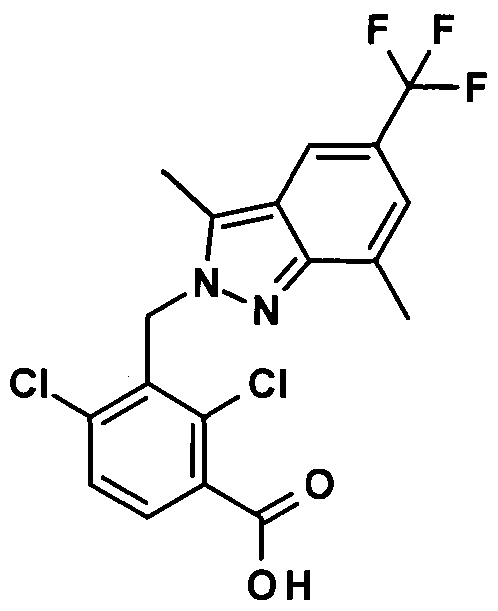
Using a similar procedure as the one described in Example A, Step 5, 2,4-dichloro-3-((3,7-dimethyl-5- (trifluoromethyl)-2H-indazol-2-yl)methyl)benzoic acid (160 mg, 76%) was prepared from methyl 2,4- dichloro-3-((3,7-dimethyl-5-(trifluoromethyl)-2H-indazol-2-yl)methyl)benzoate (Example DD, Step 1) (200 mg, 0.46 mmol). LC/MS (Method h) Rt = 2.81 min; MS m/z: 417 [M+H]+
Ή NMR (DMSO-d6, 300MHz): δ 13.68 (s, IH), 8.05 (s, IH), 7.78 (d, J=9 Hz, IH), 7.65 (d, J=9 Hz, IH), 7.15 (s, IH), 5.84 (s, 2H), 2.83 (s, 3H), 2.36 (s, 3H).
Step 2 : (2,4-dichloro-3-((3,7-dimethyl-5-(trifluoromethyl)-2H-indazol-2- yl)methyI)phenyl)(morphoIino)methanone
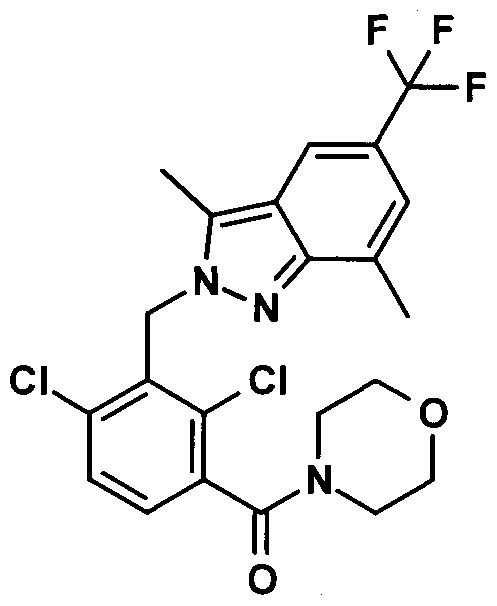
Using a similar procedure as the one described in Example Al, (2,4-dichloro-3-((3,7-dimethyl-5- (trifluoromethyl)-2H-indazol-2-yl)methyl)phenyl)(moφholino)methanone (153 mg, 82%) was prepared from 2,4-dichloro-3-((3 ,7-dimethyl-5 -(trifluoromethyl)-2H-indazol-2-yl)methyl)benzoic acid (156 mg, 0.37 mmol) and morpholine (65 mg, 0.75 mmol). LC/MS (Method g) R, = 1.78 min; MS m/z: 486 [M+Hf
¾ NMR (DMSO-d6, 400MHz): δ 8.05 (s, IH), 7.64 (d, J=8.4 Hz, IH), 7.47 (d, 7=8.4 Hz, IH), 7.15 (s, IH), 5.81 (m, 2H), 3.60 (m, 4H), 3.53 (m, 2H), 3.14 (m, 2H), 2.83 (s, 3H), 2.34 (s, 3H).
Example DG: 2-(l-(2,4-dichloro-3-((3,7-dimethyI-5-(trifluoromethyl)-2H-indazoI-2- yl)methyl)benzoyI)piperidin-4-yI)acetic acid
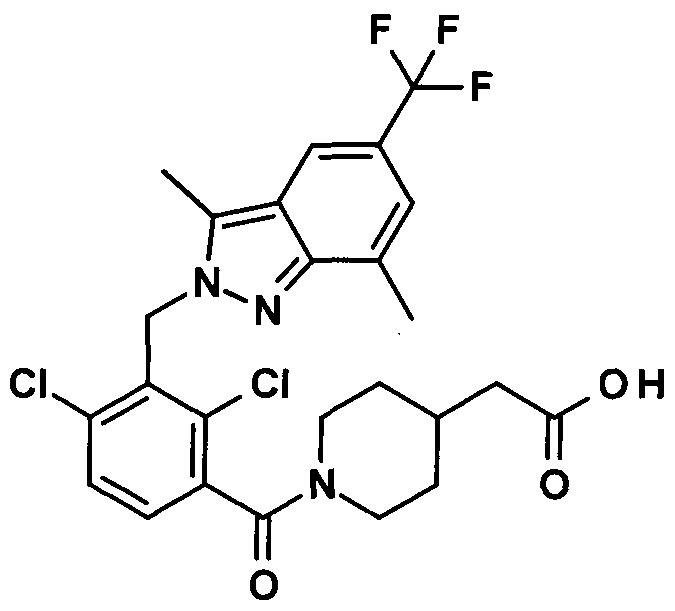
Step 1: methyl 2-(l-(2,4-dichloro-3-((3,7-dimethyl-5-(trifluoromethyl)-2H-indazol-2- yl)methyl)benzoyI)piperidin-4-yI)acetate

Using a similar procedure as the one described in Example Al, methyl 2-(l-(2,4-dichloro-3-((3,7- dimethyl-5-(trifluoromethyl)-2H-indazol-2-yl)methyl)benzoyl)piperidin-4-yl)acetate (192 mg, 56%) was prepared from 2,4-dichloro-3-((3,7-dimethyl-5-(trifluoromethyl)-2H-indazol-2-yl)methyl)benzoic acid (Example DF, Step 1) (237 mg, 0.56 mmol) and methyl (4-piperidyl)acetate hydrochloride (132 mg, 0.68 mmol). LC/MS (Method i): Rt = 2.52 min; MS m/z: 556 [M+H]+
Ή NMR (DMSO-d6, 300MHz): δ 8.05 (s, IH), 7.63 and 7.60 (d, 7=8.3 Hz, IH), 7.46 and 7.38 (d, J=8.3 Hz, IH), 7.15 (s, IH), 5.82 (m, 2H), 4.46 (m, IH), 3.59 and 3.57 (s, 3H), 3.22 (m, IH), 3.03 (m, IH), 2.83 (m, 3H), 2.79 (m,lH), 2.34 (s, 3H), 2.20 (m, 2H), 1.99 (m, IH), 1.75 (m, IH), 1.56 (m, IH), 1.15 (m, 2H).
Step 2: 2-(l-(2,4-dichloro-3-((3,7-dimethyl-5-(trifluoromethyl)-2H-indazol-2- yl)methyI)benzoyI)piperidin-4-yl)acetic acid

Using a similar procedure as the one described in Example A, Step 5, 2-(l-(2,4-dichloro-3-((3,7- dimethyl-5-(trifluoromethyl)-2H-indazol-2-yl)methyl)benzoyl)piperidin-4-yl)acetic acid (170 mg, 89%) was prepared from methyl 2-(l-(2,4-dichloro-3-((3,7-dimethyl-5-(trifluoromethyl)-2H-indazol- 2-yl)methyl)benzoyl)piperidin-4-yl)acetate (190 mg, 0.34 mmol). LC/MS (Method g): Rt = 1.71 min; MS m/z: 542 [M+H]+ 1H NMR (DMSO-d6, 400MHz): δ 12.15 (s, IH), 8.04 (s, IH), 7.61 (m, IH), 7.46 and 7.38 (d, J=8.3 Hz, IH), 7.14 (s, IH), 5.73-5.91 (m, 2Η), 4.47 (m, IH), 3.21 (m, IH), 3.03 (m, IH), 2.83 (s, 3H), 2.78 (m, IH), 2.34 (s, 3H), 2.10 (m, 2H), 1.93 (m, IH), 1.77 (m, IH), 1.58 (m, IH), 1.10 (m, 2H).
Example DH: l-(2,4-dichloro-3-((3,7-dimethyl-5-(trifluoromethyI)-lH-indol-l- yl)methyl)benzoyl)piperidine-4-carbox lic acid

Step 1: methyl 2,4-dichloro-3-((3,7-dimethyl-5-(trifluoromethyl)-lH-indol-l-yl)methyl)benzoate
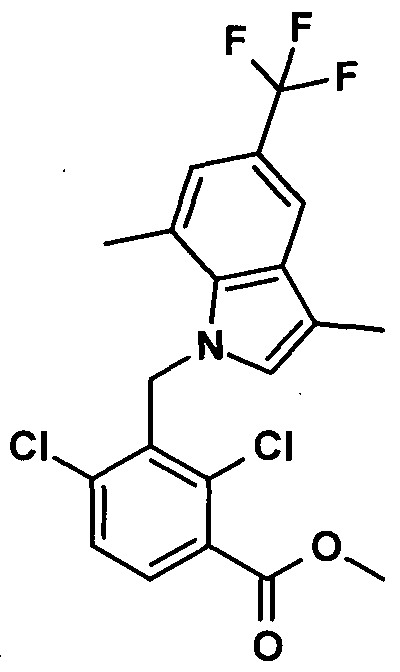
To a solution of 3,7-dimethyl-5-(trifluoromethyl)-lH-indole (Preparation #43) (90mg, 0.422 mmol) in DMF (1.1 ml) and cooled to 0°C was added sodium hydride (18.57 mg, 0.464 mmol). After 30 minutes of stirring, methyl 3-(bromomethyl)-2,4-dichlorobenzoate (Preparation #1, Step B) (126 mg, 0.422 mmol) was added and the stirring was continued for 1 hour at 0°C. The reaction mixture was diluted with water and ethyl acetate. The layers were separated and the aqueous one was extracted with ethyl acetate. The organic layers were combined, dried over magnesium sulfate, filtered and concentrated under reduced pressure. The residue was purified by column chromatography on silica gel (eluting with 0-5% ethyl acetate in cyclohexane) to give methyl 2,4-dichloro-3-((3,7-dimethyl-5- (trifluoromethyl)-lH-indol-l-yl)methyl)benzoate (100 mg, 53%) as a white powder. LC/MS (Method i): Rt = 2.86 min; MS m/z: 430 [Μ+Η]+ Ή NMR (DMSO-d6, 300MHz): δ 7.88 (d, J=8.4 Hz, 1H), 7.75 (d, J=8.4 Hz, 1H), 7.68 (s, 1H), 7.23 (s, 1H), 6.55 (d, J=l .2 Hz, 1H), 5.92 (s, 2H), 3.88 (s, 3H), 2.93 (s, 3H), 2.17 (s, 3H).
Step 2: 2,4-dichloro-3-((3,7-dimethyl-5- trifluoromethyI)-lH-indol-l-yl)methyI)benzoic acid

Using a similar procedure as the one described in Example F, Step 4, 2,4-dichloro-3-((3,7-dimethyl-5- (trifluoromethyl)-lH-indol-l-yl)methyl)benzoic acid (90 mg, 93%) was prepared from methyl 2,4- dichloro-3-((3,7-dimethyl-5-(trifluoromethyl)-lH-indol-l-yl)methyl)benzoate (100 mg, 0.23 mmol).
LC/MS (Method i): R, = 2.57 min; MS m/z: 416 [Μ+Η]+ Ή NMR (DMSO-d6, 300MHz): δ 7.67 (s, 1H), 7.55 (s, 2H), 7.22 (s, 1H), 6.52 (s, 1H), 5.87 (s, 2H), 2.93 (s, 3H), 2.16 (s, 3H).
Step 3: methyl l-(2,4-dichloro-3-((3,7-dimethyl-5-(trifluoromethyI)-lH-indol-l- yl)methyl)benzoyl)piperidine-4-carbox late

Using a similar procedure as the one described in Example A, Step 6, methyl l-(2,4-dichloro-3-((3,7- dimethyl-5-(trifluoromethyl)-lH-indol-l-yl)methyl)benzoyl)piperidine-4-carboxylate (84 mg, 72%) was prepared from 2,4-dichloro-3-((3,7-dimethyl-5-(trifluoromethyl)-lH-indol-l-yl)methyl)benzoic acid (90 mg, 0.12 mmol) and methyl piperidine-4-carboxylate hydrochloride (43 mg, 0.24 mmol). LC/MS (Method i): R, = 2.69 min; MS m/r. 541 [Μ+Η]+ Ή NMR (DMSO-d6, 300MHz): δ 7.69 (m, 2H), 7.55 and 7.48 (d, J=8.3 Hz, IH), 7.23 (s, IH), 6.56 (m, IH), 5.90 (m, 2H), 4.35 (m, IH), 3.62 and 3.60 (s, 3H), 3.31 (m, IH), 2.94-3.15 (m, 2H), 2.92 (s, 3H), 2.67 (m, IH), 2.18 (m, 3H), 1.90 (m, IH), 1.77 (m, IH), 1.50 (m, 2H)
Step 4: l-(2,4-dichloro-3-((3,7-dimethyl-5-(trinuoromethyl)-lH-indol-l- yl)methyl)benzoyl)piperidine-4-carbox lic acid

Using a similar procedure as the one described in Example F, Step 4, l-(2,4-dichloro-3-((3,7-dimethyl- 5-(trifluoromethyl)-lH-indol-l-yl)methyl)benzoyl)piperidine-4-carboxylic acid (67 mg, 82%) was prepared from methyl l-(2,4-dichloro-3-((3,7-dimethyl-5-(trifluoromethyl)-lH-indol-l- yl)methyl)benzoyl)piperidine-4-carboxylate (84 mg, 0.15 mmol). LC MS (Method g): Rt = 1.87 min; MS m/r. 527 [Μ+Η]+ Ή NMR (DMSO-d6, 400MHz): δ 12.30 (broad, IH), 7.70 (m, 2H), 7.55 and 7.48 (d, J=8.1 Hz, IH), 7.22 (s, IH), 6.57 and 6.55 (d, IH), 5.90 (m, 2H), 4.34 (m, IH), 3.29 (m, IH), 3.00 (m, 2H), 2.92 (s, 3H), 2.54 (m, IH), 2.18 (s, 3H), 1.92 (m, IH), 1.76 (m, IH), 1.49 (m, 2H).
Example DI: 2-(l-(2,4-dichloro-3-((3,7-dimethyl-5-(trifluoromethyl)-lH-indol-l- yl)methyl)benzoyl)piperidin-4- l)acetic acid

Step 1: methyl 2-(l-(2,4-dichloro-3-((3,7-dimethyl-5-(trifluoromethyl)-lH-indol-l- yl)methyl)benzoyl)piperidin-4- I)acetate

Using a similar procedure as the one described in Example A, Step 6, methyl 2-(l-(2,4-dichloro-3- ((3 ,7-dimethyl-5 -(trifluoromethyl)- 1 H-indol- 1 -yl)methyl)benzoyl)piperidin-4-yl)acetate ( 120 mg, 84%) was prepared from 2,4-dichloro-3-((3,7-dimethyl-5-(trifluoromethyl)-lH-indol-l- yl)methyl)benzoic acid (Example DH, Step 2) (105 mg, 0.25 mmol) and methyl (4-piperidyl)acetate hydrochloride (54 mg, 0.27 mmol). LC/MS (Method i): Rt = 2.73 min; MS m/z: 555 [M+H]+
Ή NMR (DMSO-d6, 300MHz): δ 7.69 (m, 2H), 7.52 and 7.45 (d, J=8.3 Hz, 1H), 7.23 (s, 1H), 6.55 (m, 1H), 5.88 (m, 2H), 4.46 (m, 1H), 3.59 and 3.57 (s, 3H), 3.25 (m, 1H), 3.04 (m, 1H), 2.92 (s, 3H), 2.80 (m, 1H), 2.27 (m, 2H), 2.17 (s, 3H), 1.95 (m, 1H), 1.75 (m, 1H), 1.58 (m, 1H), 1.10 (m, 2H). Step 2: 2-(l-(2,4-dichloro-3-((3,7-dimethyl-5-(trifluoromethyl)-lH-indol-l- yl)methyI)benzoyl)piperidin-4-yl)acetic acid

Using a similar procedure as the one described in Example F, Step 4, 2-(l-(2,4-dichloro-3-((3,7- dimethyl-5-(trifluoromethyl)-lH-indol-l-yl)methyl)benzoyl)piperidin-4-yl)acetic acid (70 mg, 58%) was prepared from methyl 2-(l-(2,4-dichloro-3-((3,7-dimethyl-5-(trifluoromethyl)-lH-indol-l- yl)methyl)benzoyl)piperidin-4-yl)acetate (120 mg, 0.21 mmol).
LC MS (Method g): Rt = 1.89 min; MS m/z: 541 [M+H]+
Ή NMR (DMSO-d6, 400MHz): δ 12.10 (broad, IH), 7.71 (m, 2H), 7.52 and 7.45 (d, J=8.4 Hz, IH), 7.22 (s, IH), 6.55 and 6.53 (s, IH), 5.85 (m, 2H), 4.46 (m, IH), 3.26 (m, IH), 3.03 (m, IH), 2.92 (s, 3H), 2.80 (m, IH), 2.19 (m, 5H), 1.90 (m, IH), 1.77 (m, IH), 1.60 (m, IH), 1.10 (m, 2H).
Example DJ: 2-(l-(2,4-dichIoro-3-(3,7-dimethyI-5-(trifluoromethyl)-lH-indole-l- carbonyl)benzoyl)piperidin-4-yl acetic acid

Step 1: tert-butyl 2,4-dichloro-3-(3,7-dimethyl-5-(trifluoromethyl)-lH-indole-l- carbonyl)benzoate

To a solution of 3, 7-dimethyl-5-(trifluoromethyl)-lH- indole (Preparation #43) (170 mg, 0.797 mmol) in DMF (5 ml) and cooled at °C was added sodium hydride (57.4 mg, 1.435 mmol) and the reaction mixture was stirred at 0°C for 20 minutes. 7eri-butyl 2,4-dichloro-3-(chlorocarbonyl)benzoate (Preparation #44) (443 mg , 1.435 mmol) diluted in DMF (4 ml) was then added and the reaction mixture was stirred at room temperature for 3 hours. The reaction mixture was quenched with a NH CI saturated aqueous solution and extracted with ethyl acetate. The organic layer was washed with water and brine, dried over magnesium sulfate, filtered and concentrated to dryness. The residue was purified by column chromatography on silica gel (eluting with 0-10% ethyl acetate in cyclohexane) to give tert- butyl 2,4-dichloro-3-(3,7-dimethyl-5-(trifluoromethyl)-lH-indole-l-carbonyl)benzoate (300 mg, 76%) as a yellow resin. LC/MS (Method j): Rt = 2.87 min; MS m/z: 486 [Μ+Η]+ Ή NMR (DMSO-d6, 300MHz): δ 7.99 (d, J=8.4 Hz, 1H), 7.82 (m, 2H), 7.61 (s, 1H), 7.27 (s, 1H), 2.73 (s, 3H), 2.21 (s, 3H),
1.57 (s, 9Η)
Step 2: 2,4-dichloro-3-(3,7-dimethyl-5- trifluoromethyI)-lH-indoIe-l-carbonyl)benzoic acid
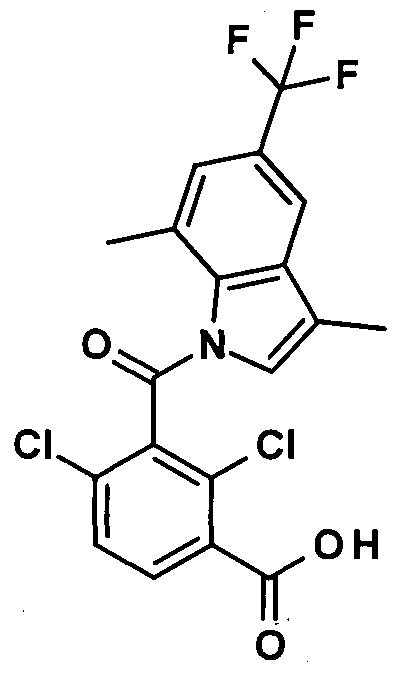
To a solution of terZ-butyl 2,4-dichloro-3-(3,7-dimethyl-5-(trifluoromethyl)-lH-indole-l- carbonyl)benzoate (300mg, 0.617 mmol) in dichloromethane (5 ml) was added trifluoroacetic acid (2.5 ml, 32.4 mmol) and the reaction mixture was stirred at room temperature for 1 hour. The reaction mixture was concentrated with toluene under reduced pressure to give 2,4-dichloro-3-(3,7-dimethyl-5- (trifluoromethyl)-lH-indole-l-carbonyl)benzoic acid (260 mg, 96%) as a beige solid.
LC/MS (Method i): Rt = 2.50 min; MS m/z: 430 [M+H]+ Ή NMR (DMSO-d6, 300MHz): δ 13.87 (broad, 1H), 8.05 (d, J=8.4 Hz, 1H), 7.81 (m, 2H), 7.61 (s, 1H), 7.25 (s, 1H), 2.74 (s, 3H), 2.21 (s, 3H). Step 3: methyl 2-(l-(2,4-dichloro-3-(3,7-dimethyI-5-(trifluoromethyI)-lH-indole-l- carbonyl)benzoyl)piperidin-4-yl acetate

Using a similar procedure as the one described in Example A, Step 6, methyl 2-(l-(2,4-dichloro-3- (3,7-dimethyl-5-(trifluoromethyl)-lH-indole-l-carbonyl)benzoyl)piperidin-4-yl)acetate (150 mg, 81%) was prepared from 2,4-dichloro-3-(3,7-dimethyl-5-(trifluoromethyl)-lH-indole-l-carbonyl)benzoic acid (105 mg, 0.25 mmol) and methyl (4-piperidyl)acetate hydrochloride (64 mg, 0.33 mmol). LC/MS (Method i): R, = 2.71 min; MS m/z: 569 [M+H]+ ¾ NMR (DMSO-d6, 300MHz): δ 7.76-81 (m, 2H), 7.65 (m, 2H), 7.43, 7.37 and 7.17 (m, 1H), 4.47 (m, 1H), 3.60 (m, 3H), 3.23 (m, 1H), 3.07 (m, 1H), 2.85 (m, 1H), 2.72 (s, 3H), 2.30 (m, 2H), 2.23 (m, 3H), 1.92 (m, 1H), 1.77 (m, 1H), 1.62 (m, 1H), 1.06-1.27 (m, 2H).
Step 4: 2-(l-(2,4-dichloro-3-(3,7-dimethyl-5-(trifluoromethyI)-lH-indole-l- carbonyl)benzoyl)piperidin-4-yl acetic acid

Using a similar procedure as the one described in Example F, Step 4, 2-(l-(2,4-dichloro-3-(3,7- dimethyl-5-(trifluoromethyl)-lH-indole-l-carbonyl)benzoyl)piperidin-4-yl)acetic acid (96 mg, 65%) was prepared from methyl 2-(l-(2,4-dichloro-3-(3,7-dimethyl-5-(trifluoromethyl)-lH-indole-l- carbonyl)benzoyl)piperidin-4-yl)acetate (150 mg, 0.26 mmol). LC/MS (Method g): Rt = 1.89 min; MS m/z: 555 [Μ+Η]+ Ή NMR (DMSO-d6, 400MHz): δ 12.10 (s, 1H), 7.82 (m, 2H), 7.57-7.72 (m, 2H),
7.42, 7.37 and 7.16 (m, 1H), 4.48 (m, 1H), 3.57 and 3.26 (m, 1H), 3.08 (m, 1H), 2.82 (m, 1H), 2.72 (s, 3H), 2.23 (m, 3H), 2.19 (m, 2H), 1.95 (m, 1H), 1.77 (m, 1H), 1.63 (m, 1H), 1.16 (m, 2H).
Example DK: l-(2,6-dichloro-3-(4-hydroxypiperidine-l-carbonyl)benzyI)-3,7-dimethyl-lH- indole-5-carbonitrile

Step 1: methyl 2,4-dichloro-3-((5-cyano-3 7-dimethyl-lH-indol-l-yl)methyl)benzoate

Using a similar procedure as the one described in Example DH, Step 1, methyl 2,4-dichloro-3-((5- cyano-3,7-dimethyl-lH-indol-l-yl)methyl)benzoate (262 mg, 56%) was prepared from 3,7-dimethyl- lH-indole-5-carbonitrile (Preparation #45) (242 mg, 0.87 mmol) and methyl 3-(bromomethyl)-2,4- dichlorobenzoate (Preparation #1, Step B) (466 mg, 1.56 mmol). The compound is used directly in the next step
LC/MS (Method i): Rt = 2.58 min; MS m/z: 387 [M+H]+
Step 2: 2,4-dichIoro-3-((5-cyano-3,7-dimethyl-lH-indol-l-yl)methyl)benzoic acid

Using a similar procedure as the one described in Example A, Step 5, 2,4-dichloro-3-((5-cyano-3,7- dimethyl-lH-indol-l-yl)methyl)benzoic acid (100 mg, 90%) was prepared from methyl 2,4-dichloro-3- ((5-cyano-3,7-dimethyl-lH-indol-l-yl)methyl)benzoate (113 mg, 0.29 mmol). LC/MS (Method i): Rt = 2.22 min; MS m/z: 373 [Μ+Η]+ Ή NMR (DMSO-d6, 400MHz): δ 7.88 (s, 1H), 7.82 (d, J=8.4 Hz, 1H), 7.69 (d, J=8.4 Hz, 1H), 7.29 (s, 1H), 6.56 (d, J=l Hz, 1H), 5.90 (s, 2H), 2.89 (s, 3H), 2.15 (d, J=l Hz, 3H).
Step 3: l-(2,6-dichIoro-3-(4-hydroxypiperidine-l-carbonyl)benzyI)-3,7-dimethyl-lH-indole-5- carbonitrile

Using a similar procedure as the one described in Example A, Step 6, l-(2,6-dichloro-3-(4- hydroxypiperidine-l-carbonyl)benzyl)-3,7-dimethyl-lH-indole-5-carbonitrile (48 mg, 65%) was prepared from 2,4-dichloro-3-((5-cyano-3,7-dimethyl-lH-indol-l-yl)methyl)benzoic acid (60 mg, 0.16 mmol) and 4-hydrox piperidine (19.5 mg, 0.19 mmol). LC/MS (Method g): R, = 1.54 min; MS m/z: 456 [M+H]+
*H NMR (DMSO-d6, 400MHz): δ 7.89 (s, 1H), 7.69 and 7.68 (d, J=8.4 Hz, 1H), 7.49 and 7.48 (d, J= 8.4 Hz, 1H), 7.29 (d, J=l Hz, 1H), 6.57 and 7.56 (d, J=l Hz, 1H), 5.88 (m, 2H), 4.79 (m, 1H), 4.01 (m, 1H), 3.73 (m, 1H), 3.26 (m, 2H), 3.01 (m, 1H), 2.88 (m, 3H), 2.16 (s, 3H), 1.78 (m, 1H), 1.66 (m, 1H), 137 (m, 2H).
Example DL: 2-(l-(2,4-dichloro-3-((5-cyano-3,7-dimethyl-lH-indol-l- yl)methyI)benzoyI)piperidin-4-yI acetic acid

Step 1: methyl 2-(l-(2,4-dichloro-3-((5-cyano-3,7-dimethyl-lH-indol-l- yl)methyl)benzoyl)piperidin-4-yl acetate

Using a similar procedure as the one described in Example A, Step 6, methyl 2-(l-(2,4-dichloro-3-((5- cyano-3,7-dimethyl-lH-indol-l-yl)methyl)benzoyl)piperidin-4-yl)acetate (111 mg, 99%) was prepared from 2,4-dichloro-3-((5-cyano-3,7-dimethyl-lH-indol-l-yl)methyl)benzoic acid (Example DK, Step 2) (80 mg, 0.21 mmol) and methyl (4-piperidyl)acetate hydrochloride (49.8 mg, 0.27 mmol). The compound is used directly in the next step. LC/MS (Method i): R, = 2.43 min; MS m/z: 512 [M+H]+ Step 2: 2-(l-(2,4-dichloro-3-((5-cyano-3,7-dimethyl-lH-indol-l-yl)methyl)benzoyl)piperidin-4- yl)acetic acid

Using a similar procedure as the one described in Example A, Step 5, 2-(l-(2,4-dichloro-3-((5-cyano- 3,7-dimethyl-lH-indol-l-yl)methyl)benzoyl)piperidin-4-yl)acetic acid (51 mg, 45%) was prepared from methyl 2-(l-(2,4-dichloro-3-((5-cyano-3,7-dimethyl-lH-indol-l-yl)methyl)benzoyl)piperidin-4- yl)acetate (110 mg, 0.21 mmol). LC/MS (Method g): Rt = 1.62 min; MS m/r. 498 [Μ+Η]+ Ή NMR (DMSO-d6, 400MHz): δ 12.09 (broad, IH), 7.88 (m, IH), 7.69 and 7.68 (d, J=8.4 Hz, IH), 7.52 and 7.46 (d, 7=8.4 Hz, IH), 7.29 (s, IH), 6.58 and 6.55 (s, IH), 5.87 (m, 2H), 4.46 (m, IH), 3.27 (m, IH), 3.03 (m, IH), 2.88 (s, 3H), 2.80 (m, IH), 2.16 (m, 5H), 1.93 (m, IH), 1.77 (m, IH), 1.60 (m, IH), 1.15 (m, 2H).
Example DM: l-(2,6-dichloro-3-(4-hydroxypiperidine-l-carbonyl)benzoyI)-3,7-dimethyl-lH- indole-5-carbonitrile

Step 1: tert-butyl 2,4-dichloro-3-(5-cyano-3,7-dimethyl-lH-indole-l-carbonyl)benzoate

Using a similar procedure as the one described in Example DJ, Step 1, tert-butyl 2,4-dichloro-3-(5- cyano-3,7-dimethyl-lH-indole-l-carbonyl)benzoate (290 mg, 75%) was prepared from 3,7-dimethyl- lH-indole-5-carbonitrile (Preparation #45) (242 mg, 0.87 mmol) and /er/-butyl 2,4-dichloro-3- (chlorocarbonyl)benzoate (Preparation #44) (483 mg , 1.56 mmol). The product is used directly in the next step. LC/MS (Method i): Rt = 2.87 min; MS m/z: 443 [M+H]+
Step 2: 2,4-dichloro-3-(5-cyano-3,7-dimeth l-lH-indoIe-l-carbonyI)benzoic acid

Using a similar procedure as the one described in Example DJ, Step 2, 2,4-dichloro-3-(5-cyano-3,7- dimethyl-lH-indole-l-carbonyl)benzoic acid (232 mg, 82%) was prepared from teri-butyl 2,4- dichloro-3-(5-cyano-3,7-dimethyl-lH-indole-l-carbonyl)benzoate (290 mg, 0.65 mmol). LC/MS (Method i): Rt = 2.17 min; MS m/z: 387 [Μ+Η]+ Ή NMR (DMSO-d6, 300MHz): δ 13.91 (broad, 1H), 8.05 (d, J=8.6 Hz, 1H), 8.02 (m, 1H), 7.81 (d, J=8.6 Hz, 1H), 7.71 (s, 1H), 7.27 (d, J=1.3 Hz, 1H), 2.69 (s, 3H), 2.19 (d, J=1.3 Hz, 3H).
Step 3: l-(2,6-dichloro-3-(4-hydroxypiperidine-l-carbonyl)benzoyl)-3,7-dimethyl-lH-indole-5- carbonitrile

Using a similar procedure as the one described in Example A, Step 6, l-(2,6-dichloro-3-(4- hydroxypiperidine-l-carbonyl)benzoyl)-3,7-dimethyl-lH-indole-5-carbonitrile (65 mg, 45%) was prepared from 2,4-dichloro-3-(5-cyano-3,7-dimethyl-lH-indole-l-carbonyl)benzoic acid (113 mg, 0.3 mmol) and 4-hydroxypiperidine (36.4 mg, 0.36 mmol). LC/MS (Method g): R, = 1.54 min; MS m/r. 470 [Μ+Η]+ Ή NMR (DMSO-d6, 400MHz): δ 8.03 (s, 1H), 7.80 (m, 1H), 7.70 (m, 1H), 7.67 (m, 1H), 7.45 , 7.41 and 7.19 (m, 1H), 4.80 (m, 1H), 4.02 (m, 1H), 3.75 (m, 1H), 3.50 (m, 1H), 3.27 (m, 1H), 3.12 (m, 1H), 2.67 (s, 3H), 2.20 (s, 3H), 1.80 (m, 1H), 1.70 (m, 1H), 1.35 (m, 2H).
Example DN: 2-(l-(2,4-dichloro-3-(5-cyano-3,7-dimethyl-lH-indole-l- carbonyl)benzoyl)piperidin-4-yl)acetic acid

Step 1: methyl 2-(l-(2,4-dichloro-3-(5-cyano-3,7-dimethyl-lH-indole-l- carbonyl)benzoyI)piperidin-4-yl)acetate

Using a similar procedure as the one described in Example A, Step 6, methyl 2-(l-(2,4-dichloro-3-(5- cyano-3,7-dimethyl-lH-indole-l-carbonyl)benzoyl)piperidin-4-yl)acetate (140 mg, 72%) was prepared from 2,4-dichloro-3-(5-cyano-3,7-dimethyl-lH-indole-l-carbonyl)benzoic acid (Example DM, Step 2) (115 mg, 0.29 mmol) and methyl (4-piperidyl)acetate hydrochloride (69 mg, 0.35 mmol). The product is used directly in the next step. LC MS (Method i): Rt = 2.42 min; MS m/z: 526 [M+H]+
Step 2: 2-(l-(2,4-dichloro-3-(5-cyano-3,7-dimethyl-lH-indole-l-carbonyl)benzoyI)piperidin-4- yl)acetic acid

Using a similar procedure as the one described in Example A, Step 5, 2-(l-(2,4-dichloro-3-(5-cyano- 3,7-dimethyl-lH-indole-l-carbonyl)benzoyl)piperidin-4-yl)acetic acid (123 mg, 85%) was prepared from methyl 2-( 1 -(2,4-dichloro-3 -(5 -cyano-3 ,7-dimethyl- 1 H-indole- 1 -carbonyl)benzoyl)piperidin-4- yl)acetate (138 mg, 0.26 mmol). LC/MS (Method i): R, = 2.18 min; MS m/z: 512 [M+H]+
Ή NMR (DMSO-d6, 400MHz): δ 12.10 (broad, 1H), 8.02 (s, 1H), 7.80 (m, 1H), 7.65 (m, 2H), 7.45 and 7.39 and 7.19 (m, 1H), 4.48 (m, 1H), 3.57 (m, 1H), 3.24 (m, 1H), 3.07 (m, 1H), 2.82 (m, 1H), 2.67 (s, 3H), 2.18 (m, 4H), 1.95 (m, 1H), 1.78 (m, 1H), 1.63 (m,lH), 1.17 (m, 2H).
Example DO: (4,6-dichloro-5-((l,4-dimethyl-6-(trifluoromethyl)-lH-pyrrolo[2,3-b]pyridin-2- yl)methyI)pyridin-3-yI)(4-hydroxypiperidin-l-yl)methanone
Step 1: 4-methyl-6-(trifluoromethyI

A solution of CHC13 (1.25 L) was cooled down to about 0 °C and 2,2,2-trifluoroacetic anhydride (0.141 L, 1012 mmol) was added followed by the addition of 3-methylbut-2-enoyl chloride (0.094 L, 843 mmol). Triethylamine (0.259 L, 1856 mmol) was added dropwise such that the internal temperature was maintained below about 10 °C (exothermic). After addition, the mixture was stirred at about 0 °C for about 1 h and then warmed up to rt slowly and stirred overnight. The reaction mixture was washed with water (1 L), sat NaHC03 (1 L), water brine (1:1, 500 mL), dried over MgS04, filtered and concentrated in vacuo. The residue was dissolved in acetic acid (1.250 L) and acetic acid/ammonia salt (130 g, 1687 mmol) was added. The reaction flask was capped with a balloon and the mixture was heated at about 115 °C overnight. After about 20 h the reaction mixture was cooled to about 40 °C and concentrated in vacuo. The syrup was poured onto water (~2 L) with stirring. After about lh the solids were collected by filtration to provide 4-methyl-6-(trifluoromethyl)pyridin-2(lH)- one (101 g, 68%) as a tan solid. LC/MS (Method a) Rt = 1.59 min.; MS m/z: 178 [Μ+Η]+. Ή NMR (CDC13, 400 MHz): δ 6.79 (s, 1H), 6.70 (s, 1H), 2.34 (s, 3H).
Step 2: 2-chloro-4-methyl-6-(trifluoromethyl)pyridine
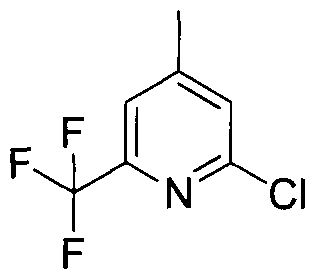
A 50 mL pear-shaped flask fitted with a short path distillation head was charged with 4-methyl-6- (trifluoromethyl)pyridin-2(lH)-one (20 g, 113 mmol). To the flask was added phenylphosphonic dichloride (19.2 mL, 135 mmol). The reaction mixture was heated to about 160 °C. After about 3 h the pressure on the reaction mixture was slowly reduced to 100 mBar and distillation starts with a head temp about 120-130 °C. Peridoically when distillation had significantly slowed the pressure over the reaction mixture was reduced to 80 mBar and the bath temp was raised to about 170 °C. After about 3
h the distillation had ceased providing 2-chloro-4-methyl-6-(trifluoromethyl)pyridine (12 g, 54 %). LC/MS (Method a) Rt = 2.4 min.; MS m/z: 196 [M+H]+. Ή NMR (OUSO-d6, 400 MHz): 7.79 (s, 1 H), 7.71 (s, 1H), 2.43 (s, 3 H).
Step 3: tert-butyl (4-methyl-6-(trifluoromethyl)pyridin-2-yI)carbamate

A flask charged with 2-chloro-4-methyl-6-(trifluoromethyl)pyridine (35.1 g, 180 mmol), tert-butyl carbamate (42.1 g, 359 mmol), Pd2(dba)3 (4.11 g, 4.49 mmol), dicyclohexyl(2',4',6'-triisopropyl-[l,r- biphenyl]-2-yl)phosphine (X-Phos) (4.28 g, 8.98 mmol) and cesium carbonate (205 g, 629 mmol) was evacuated and filled with N2 (repeated 3 times) before addition of degassed 1,4-dioxane (350 mL). The mixture was then heated at about 80 °C for about 2 h. The reaction mixture was cooled to rt and the reaction mixture was partitioned between water and EtOAc. The aqueous layer was further extracted with EtOAc (2 x 100 mL). Organic layer was dried over Na2S04, filtered and concentrated to dryness to give a dark red oil. The material was used without additional purification, assuming a 100% yield. LC/MS (Method a) Rt = 2.71 min.; MS m/z: 275 [M+H]+. Ή NMR (400 MHz, DMSO-</<5) δ 10.13 (s, 1H), 7.90 (dt, J = 1.3, 0.7 Hz, 1H), 7.34 (dd, J = 1.3, 0.7 Hz, 1H), 2.38 (t, J = 0.6 Hz, 3H), 1.45 (s, 9H).
Step 4: 4-methyl-6-(trifluoromethyI)pyridin-2-amine

A mixture of teri-butyl (4-methyl-6-(trifluoromethyl)pyridin-2-yl)carbamate (49.6 g, 180 mmol) and hydrogen chloride (4M in dioxane) (597 ml, 2388 mmol) was stirred at rt for about 2 h. The solvent was removed under reduced pressure and the residue was filtered. The insoluble was washed with EtOAc and the filtrate was diluted with EtOAc and extracted with 6 N HC1 (3x). The aqueous layer was washed with DCM (4 x 100 mL) and then adjusted to pH 8 with addition of Na2C03 slowly. The bright yellow solid was collected by filtration and washed with water. The solid was then dissolved in DCM, washed with brine, dried over Na2S04, filtered and concentrated to almost dryness. The solid was triturated with petroleum ether and collected by filtration, washed with petroleum ether and air dried to give 4-methyl-6-(trifluoromethyl)pyridin-2-amine (27.7 g, 88 %) as a pale yellow solid. LC/MS (Method a) R, = 1.92 min.; MS m/z: 177 [M+H]+. Ή NMR (400 MHz, DMSO-</<5) δ 6.72 (s, 1 H), 6.45 (s, 1 H), 6.35 (s, 2 H), 2.20 (s, 3 H).
Step 5: 3,5-dibromo-4-methyl-6-(trifluoromethyI)pyridin-2-amine

A mixture of 4-methyl-6-(trifluoromethyl)pyridin-2-amine (31.4 g, 179 mmol) and NBS (66.7 g, 375 mmol) in ACN (250 mL) was heated at about 70 °C for about 2 h. To the reaction flask was added water (-500 mL). The resulting solid was collected by filtration, washed with water and air dried for about 5 minutes. The solid was solubilized in DCM, washed with water, dried over Na2S04, filtered and concentrated to almost dryness. The solid was triturated with heptane and collected by filtration, washed with heptane and dried to give 3,5-dibromo-4-methyl-6-(trifluoromethyl)pyridin-2-amine (56.9 g, 96 %) as light yellow solid. LC/MS (Method a) Rt = 2.55 min.; MS m/z: 333 [M+H]+. Ή NMR (400 MHz, DMSO-i/6) δ 6.90 (s, 2H), 2.53 (s, 3H).
Step 6: 3-bromo-4-methyl-6-(trifluoromethyl)pyridin-2-amine

To a light orange solution of 3,5-dibromo-4-methyl-6-(trifluoromethyl)pyridin-2-amine (56.98 g, 171 mmol) in THF (570 mL) at about -78 °C was added «-butyllithium (2.5 M in hexane) (68.3 mL, 171 mmol) dropwise (turned into a brown solution). The mixture was stirred at about -78 °C for about 45 minutes. LCMS indicated only partial conversion and a second portion of BuLi (2.5 M in hexane) (20.48 mL, 51.2 mmol) was added dropwise. A third portion of butyllithium (2.5 M in hexane) (13.65 mL, 34.1 mmol) was added dropwise to complete conversion to product.The reaction flask was transferred to an ice-water bath and 20 mL water was added quickly. The reaction mixture was then warmed to room temperature. The reaction mixture was partitioned between saturated NH4CI and EtOAc. The organic layer was washed with NaHC03, dried over Na2S04, filtered and concentrated to almost dryness. The solid was triturated with heptane and collected by filtration, washed with hepane to give the first crop of product as a off-white solid (38.9 g, 85%). The filtrate was concentrated to dryness and heptane was added. The solid was collected by vacuum filtration and washed with heptane and dried to give the second crop of product as a pale yellow solid (1.9 g, 3%). LC/MS (Method a) Rt
= 2.29 min.; MS m/z: 255 [M+H]+. Ή NMR (400 MHz, DMSO-i/6) δ 6.96 (s, 1 H), 6.74 (s, 1 H), 2.32
(s, 3 H).
Step 7: (£)-2-(2-EthoxyvinyI)-4,4,5,5-tetramethyl-l ,3,2-dioxaborolane

Under an atmosphere of nitrogen in a round bottom flask ethoxyethyne, 50% solution in hexanes (100 g, 710 mmol) and DCM (996 mL) were stirred at about 0 - 5 °C. To the stirred solution was added 4,4,5,5-tetramethyl-l,3,2-dioxaborolane (113 mL, 781 mmol) in one portion followed by the addition of bis(cyclopentadienyl)zirconium hydridochloride (9.16 g, 35.5 mmol) at about 0 - 5 °C. The suspension (orange) was allowed to gradually warm to room temperature over about 30 min. Dissolution occurred within about 10 min. The reaction mixture was stirred at RT overnight (very dark red). To the reaction solution was added ether (2L) and the solution was washed with saturated aqueous NH4CI. The solvents were removed under reduced pressure, minimal DCM (100 mL) was added and the solution was filtered through a pad of alumina, topped with Celite. The alumina was washed with DCM and the filtrate solvent was removed in vacuo to yield (£)-2-(2-ethoxyvinyl)- 4,4,5,5-tetramethyl-l,3,2-dioxaborolane (114.9 g, 82 %) as a very dark red oil. ¾ NMR (400 MHz, OMSO-d6) δ 7.05 (d, 1 H), 4.45 (d, 1 H), 3.83 (q, 2 H), 1.30 (t, 3 H), 1.28 (s, 12 H).
Step 8 : (JE)-3-(2-ethoxyvinyI)-4-methyI-6-(trifluoromethyl)pyridin-2-amine

A flask charged with 3-bromo-4-methyl-6-(trifluoromethyl)pyridin-2 -amine (38.3 g, 143 mmol), (E)- 2-(2-ethoxyvinyl)-4,4,5,5-tetramethyl-l,3,2-dioxaborolane (56.5 g, 285 mmol), diacetoxypalladium (0.960 g, 4.28 mmol), dicyclohexyl(2',4',6'-triisopropyl-[l,r-biphenyl]-2-yl)phosphine (XPhos) (4.28 g, 8.98 mmol) and cesium carbonate (116 g, 356 mmol) was degassed with N2 for 15 min before addition of 320 mL degassed dioxane/H20 (4:1). The mixture was heated at about 80 °C for about 2 h. The mixture was cooled down to rt. The reaction mixture was partitioned between EtOAc and water and the aqueous layer was further extracted with EtOAc (2 x 50 mL). The organic layer was dried over Na2S04, filtered and concentrated to dryness. To the residue was added heptane and the resulting solid was collected by filtration and washed with heptane to give an off-white solid (1.45 g). The filtrate was concentrated to dryness again to give a thick black oil that was left at rt overnight. Significant solid formation was noticed and the solid was diluted with heptane, sonicated and filtered, washed with heptane to give a light brown solid (15.2 g, 42%). The filtrate was concentrated to dryness to give a black oil that was purified by flash chromatography (0-25% EtOAc/heptane over 30 min). The product containing fractions were concentrated to almost dryness. The solid was collected by filtration, washed with a small amount of heptane and dried to give the second crop of product as a light yellow
solid (12.7 g, 35%). LC/MS (Method 1) Rt = 1.48 min.; MS m/z: 247 [M+H]+. Ή NMR (400 MHz, DMSO-ita) δ 6.82 (s, 1H), 6.73 (d, J= 13.1 Hz, 1H), 6.12 (s, 2H), 5.45 (d, J= 13.1 Hz, 1H), 3.93 (q, J = 7.0 Hz, 2H), 2.23 (s, 3H), 1.25 (t, J= 7.0 Hz, 3H).
Step 9: 4-methyl-6-(trifluoromethyl)-lH-pyrrolo[2,3-6]pyridine

A mixture of (£)-3-(2-ethoxyvinyl)-4-methyl-6-(trifluoromethyl)pyridin-2-amine (27.9 g, 113 mmol) and acetic acid (130 niL) was heated at about 100 °C overnight. The mixture was cooled to rt and the precipitate was collected by filtration, washed with ACN and dried to give the first crop of product. The filtrate was concentrated to ~ 50 niL. and the solid was collected by filtration, washed with ACN and dried to give the second crop of product. Both looked similar purity and therefore combined. Filtrate still had some product in it and was set aside. The solid was suspended in ~ 250 mL EtOAc and heated to reflux to dissolve. Most of the solvent was removed under reduced pressure and heptane was added. The solid was collected by vacuum filtration, dried to give the product as an off-white solid
(19.8 g, 87%). LC/MS (Method 1-3) R, = 1.30 min.; MS m/z: 201 [Μ+Η]+. Ή NMR (400 MHz, DMSO-i/6) δ 12.13 - 11.98 (br, 1H), 7.67 (t, J = 3.1 Hz, 1H), 7.34 (d, J = 1.0 Hz, 1H), 6.63 (dd, J = 3.5, 1.9 Hz, 1H), 2.59 (s, 3H).
Step 10: 4-methyl-l-(phenylsuIfonyl)-6-(trifluoromethyI)-lH-pyrroIo[2,3-b]pyridine

To a suspension of sodium hydride (60 % in mineral oil) (4.35 g, 109 mmol) in DMF (40 mL) at about 0 °C was added a solution of 4-methyl-6-(trifluoromethyl)-lH-pyrrolo[2,3-b]pyridine (19.8 g, 99 mmol) under N2. After addition, the ice-water bath was removed and the mixture was stirred at rt for about 30 min. It was cooled down to about 0 °C again, benzenesulfonyl chloride (13.27 mL, 104 mmol) was added dropwise. After addition, the reaction was allowed to warm up to rt and stirred at rt for about 1 h.
The reaction was quenched with the addition of 100 mL saturated NH4C1 solution followed by the addition of 350 mL water. The solid was collected by filtration, washed with water and dried in vacuum oven at about 70 °C for about 2 days to give an off-white solid. The solid was dissolved in
EtOAc, filtered through 70 g silica gel and the pad was washed with EtOAc. The filtrate was dried over Na2S04, filtered and concentrated to dryness. The solid was triturated with EtO Ac/heptane to give the first crop of 4-methyl-l-(phenylsulfonyl)-6-(trifiuoromethyl)-lH-pyrrolo[2,3-Z7]pyridine (28.5 g, 85 % ) as white solid.
The filtrate was concentrated to dryness and the solid was triturated with ether/hepatane. The resulting solid was collected by filtration, washed with heptane and dried to give the second crop of 4-methyl-l- (phenylsulfonyl)-6-(trifiuorornethyl)-lH-pyrrolo[2,3-fe]pyridine (3.65 g, 11 %) as an off-white solid. LC/MS (Method 1-3) Rt = 1.84 min.; MS m/z: 341 [Μ+Η]+. Ή NMR (400 MHz, DMSO-tW) δ 8.15 - 8.07 (m, 3H), 7.75 - 7.67 (m, 1H), 7.64 - 7.56 (m, 3H), 7.03 (d, J = 4.1 Hz, 1H), 2.57 (s, 3H).
Step 11: terf-butyl 4,6-dichloronicotinate

A mixture of 4,6-dichloronicotinic acid (8.2 g, 42.7 mmol) and BOC20 (19.83 ml, 85 mmol) in THF (100 mL) was stirred at rt, then DMAP (1.044 g, 8.54 mmol) was added to the solution. The resulting mixture was stirred at about 70 °C for about 1 h. The sample was deposited onto silica gel and loaded onto a silica gel column and eluted with 5% EtO Ac/heptane. The following fractions were collected to give the ter/-butyl 4,6-dichloronicotinate (10 g, 94 %) as a colorless oil. *H NMR (400 MHz, CDC13) δ 8.76 (s, 1 H), 7.43 (s, 1 H), 1.61 (s, 9 H).
Step 12: tert-butyl 4,6-dichloro-5-formylnicotinate

The tert-butyl 4,6-dichloronicotinate (10 g, 40.3 mmol) was dissolved in THF (100 mL), stirred and cooled to about -78 °C. To the solution was added LDA (22.2 mL, 44.3 mmol) at a rate to maintain the temperature below about -70°C. The resulting solution was stirred at about -78°C for about 10 min. Then methyl formate (4.94 mL, 81 mmol) was added to the solution and the mixture was stirred at about -78°C for about 30 min. The mixture was poured into saturated NH4CI, extracted with EtOAc (3x) and the combined organic layers were dried with Na2S04, filtered and concentrated to afford a brown oil. The sample was deposited onto silica gel and purified by silica gel chromatography eluting with 2% EtO Ac/heptane. The following fractions were collected to give tert-butyl 4,6-dichloro-5- formylnicotinate (5.0 g, 45 % yield) as a yellow solid. Ή NMR (400 MHz, CDC13) δ 10.47 (s, 1 H), 8.7 (s, 1 H), 1.65 (s, 9 H).
Step 13: tert-butyl 4,6-dichloro-5-(hydroxy(4-methyl-l-(phenylsulfonyl)-6-(trifluoromethyl)-lH- pyrrolo[2,3-6]pyridin-2-yI)methyl)nicotinate

Using a similar procedure as the one described in Example CL, Step 1 ,
teri-butyl 4,6-dichloro-5-(hydroxy(4-methyl-l-(phenylsulfonyl)-6-(trifluoromethyl)-lH-pyrrolo[2,3- &]pyridin-2-yl)methyl)nicotinate was prepared from 4-methyl-l-(phenylsulfonyl)-6-(trifmoromethyl)- lH-pyrrolo[2,3-b]pyridine (6.0 g, 17.6 mmol) and ter/-butyl 4,6-dichloro-5-formylnicotinate (5.35 g, 19.4 mmol). LC/MS (Method 1-3) Rt = 2.15 min.; MS m/z: 616 [Μ+Η]+. Ή NMR (400 MHz, DMSO- d6) δ 8.67 (s, 1 H), 7.95 (d, 2 H), 7.69 (m, 1 H), 7.61 (s, 1 H), 7.55 (m, 2 H), 7.05 (s, 1 H), 7.04 (d, 1 H), 6.92 (d, 1 H), 2.54 (s, 3 H), 1.54 (s, 9 H).
Step 14: tert-butyl 4,6-dichloro-5-((4-methyl-l-(phenylsulfonyl)-6-(trifluoromethyI)-lH- pyrrolo[2,3-b]pyridin-2-yl)methyl)nicotinate

Using a similar procedure as the one described in Example Z, Step 2, tert-butyl 4,6-dichloro-5-((4- methyl-l-( henylsulfonyl)-6-(trifluoromethyl)-lH-pyrrolo[2,3- ?]pyridin-2-yl)methyl)nicotinate was prepared from tert-butyl 4,6-dichloro-5-(hydroxy(4-methyl-l-(phenylsulfonyl)-6- (trifluoromethyl)-lH-pyrrolo[2,3- )]pyridin-2-yl)methyl)nicotinate (1.51 g, 2.44 mmol). LC/MS (Method 1-3) R, = 2.33 min.; MS m/z: 600 [M+H]+.
Step 15: 4,6-dichloro-5-((4-methyl-6-(trifluoromethyI)-lH-pyrrolo[2,3-b]pyridin-2- yI)methyl)nicotinic acid

To a solution of tert-butyl 4,6-dichloro-5-((4-methyl-l-(phenylsulfonyl)-6-(trifluoromethyl)-lH- pyrrolo[2,3- )]pyridin-2-yl)methyl)nicotinate (334.9 mg, 0.558 mmol) in 1,4-dioxane (7339 μί) was added sodium hydroxide (2M) (1394 μί, 2.79 mmol). The mixture was heated at about 50 °C overnight. The reaction mixture was cooled to room temperature, diluted with water and acidified with HCl (1M). The mixture was extracted twice with EtOAc and the combined organic extracts were dried over Na2S04, filtered and evaporated to give 4,6-dichloro-5-((4-methyl-6-(trifluoromethyl)-lH- pyrrolo[2,3-b]pyridin-2-yl)methyl)nicotinic acid (0.23 g, 100%) as a pale brown solid. LC/MS (Method 1-3) Rt = 1.02 min.; MS m/z: 404 [Μ+Η]+. Ή NMR (400 MHz, DMSO-d6) δ 12.16 (s, 1H), 8.75 (s, 1H), 7.29 (d, J = 0.8 Hz, 1H), 6.09 (dd, J = 2.1, 1.0 Hz, 1H), 4.48 (s, 3H).
Step 16: methyl 4,6-dichloro-5-((l,4-dimethyl-6-(trifluoromethyI)-lH-pyrrolo[2,3-A]pyridin-2- yl)methyl)nicotinate

Using a similar procedure as the one described in Example P, Step 4, methyl 4,6-dichloro-5-((l,4- dimethyl-6-(trifluoromethyl)-lH-pyrrolo[2,3-b]pyridin-2-yl)methyl)nicotinate
was prepared from 4,6-dichloro-5-((4-methyl-6-(trifluoromethyl)-lH-pyrrolo[2,3-b]pyridin-2- yl)methyl)nicotinic acid (0.23 g, 0.567 mmol) LC/MS (Method 1-3) Rt = 2.01 min.; MS m/z: 432 [M+H]+.
Step 17: 4,6-dichloro-5-((l,4-dimethyl-6-(trifluoromethyI)-lH-pyrrolo[2,3-6]pyridin-2- yl)methyl)nicotinic acid

Using a similar procedure as the one described in Example A, Step 5, 4,6-dichloro-5-((l,4-dimethyl-6- (trifluoromethyl)-lH-pyrrolo[2,3-i)]pyridin-2-yl)methyl)nicotinic acid was prepared from methyl 4,6- dichloro-5-((l,4-dimethyl-6-(trifluoromethyl)-lH-pyn-olo[2,3-b]pyridin-2-yl)methyl)nico
(0.25 g, 0.578 mmol) LC/MS (Method 1-3) R, = 1.14 min.; MS m/z: 418 [M+H]+.
Step 18: (4,6-dichloro-5-((l,4-dimethyI-6-(trifluoromethyl)-lH-pyrrolo[2,3-6]pyridin-2- yl)methyl)pyridin-3-yl)(4-hydroxypiperidin-l-yI)methanone

Using a similar procedure as the one described in Example A, Step 6, (4,6-dichloro-5-((l,4-dimethyl- 6-(trifluoromethyl)-lH-pyiTolo[2,3-^]pyridin-2-yl)methyl)pyridin-3-yl)(4-hydroxypiperidin-l- yl)methanone was prepared from 4,6-dichloro-5-((l,4-dimethyl-6-(trifluoromethyl)-lH-pyrrolo[2,3- 6]pyridin-2-yl)methyl)nicotinic acid (0.116 g, 0.278 mmol) and
piperidin-4-ol (0.042 g, 0.42 mmol). LC/MS (Method a) Rt = 2.28 min.; MS m/z: 501 [Μ+Η]+. Ή MR (400 MHz, DMSO-d6) δ 8.31 (s, 1 H), 7.26 (s, 1 H), 7.22 (s, 1 H), 5.81 (s, 1 H), 4.46 (m, 2 H), 4.15 (m, 1 H), 4.04 (m, 1 H), 3.98 (s, 3 H), 3.65-3.45 (m, 3 H), 3.13 (m, 2 H), 2.00 (m, 1 H), 1.87 (m, 2 H), 1.70 (m, 2 H).
Example DP: 2-(l-(2,4-dichloro-3-((l,4-dimethyl-6-(trifluoromethoxy)-lH-indol-2- yl)methyl)benzoyI)piperidin-4-yl)acetic acid

Step 1: methyl 2,4-dichloro-3-(hydroxy(4-methyl-l-(phenylsulfonyl)-6-(trifluoromethoxy)-lH- indol-2-yl)methyl)benzoate

Using a similar procedure as the one described in Example A, Step 1, methyl 2,4-dichloro-3- (hydroxy(4-methyl- 1 -(phenylsulfonyl)-6-(trifluoromethoxy)- 1 H-indol-2-yl)methyl)benzoate (814 mg, 79%) was prepared from N-(2-iodo-3-methyl-5-(trifluoromethoxy)phenyl)benzenesulfonamide (Preparation #47) (800 mg, 1.75 mmol) and methyl 2,4-dichloro-3-(l-hydroxyprop-2-yn-l-yl)benzoate (Preparation # 1) (544 mg, 2.1 mmol). LC MS (Method i) Rt = 2.69 min.; MS m/z: 646 [M-H]"+ CH3COOH
Ή NMR (DMSO-d6, 300MHz): δ 7.89 (m, 2H), 7.74 (s, 1H), 7.69 (m, 2H), 7.58 (m, 3H), 7.12 (m, 1H), 7.03 (dd, J=5.9, 1.2 Hz, 1H), 6.74 (m, 1H), 6.67 (d, J=5.9 Hz, 1H), 3.87 (s, 3H), 2.40 (s, 3H). Step 2: methyl 2,4-dichloro-3-((4-methyl-l-(phenylsulfonyl)-6-(trifluoromethoxy)-lH-indol-2- yl)methyl)benzoate

Using a similar procedure as the one described in Example A, Step 2, methyl 2,4-dichloro-3-((4- methyl-l-(phenylsulfonyl)-6-(trifluoromethoxy)-lH-indol-2-yl)methyl)benzoate (540 mg, 68%) was prepared from methyl 2,4-dichloro-3-(hydroxy(4-methyl-l-(phenylsulfonyl)-6-(trifluoromethoxy)-lH- indol-2-yl)methyl)benzoate (811 mg, 1.38 mmol). LC/MS (Method j) R, = 2.65 min.; MS m/r. 572 [M+H]+
¾ NMR (DMSO-d6, 300MHz): δ 7.96 (m, 2H), 7.88 (s, IH), 7.83 (m, IH), 7.76 (d, J=7.6 Hz, IH), 7.68 (m, 3H), 7.12 (m, IH), 5.89 (m, IH), 4.61 (m, 2H), 3.87 (s, 3H), 2.29 (s, 3H).
Step 3: methyl 2,4-dichloro-3-((4-methyl-6-(trifluoromethoxy)-lH-indoI-2-yl)methyl)benzoate

Using a similar procedure as the one described in Example A, Step 3, methyl 2,4-dichloro-3-((4- methyl-6-(trifluoromethoxy)-lH-indol-2-yl)methyl)benzoate (408 mg, 100%) was prepared from methyl 2,4-dichloro-3-((4-methyl-l-(phenylsulfonyl)-6-(trifluoromethoxy)-lH-indol-2- yl)methyl)benzoate (540 mg, 0.94 mmol). LC/MS (Method j) Rt = 2.25 min.; MS m/z: 432 [M+H]+ Ή NMR (DMSO-d6, 300MHz): δ 11.26 (s, IH), 7.74 (d, J= 8.4 Hz, IH), 7.68 (d, J= 8.4 Hz, IH), 7.11 (s, IH), 6.73 (s, IH), 5.90 (s, IH), 4.45 (s, 2H), 3.87 (s, 3H), 2.36 (s, 3H)
Step 4: methyl 2,4-dichloro-3-((l,4-dimethyl-6-(trifluoromethoxy)-lH-indol-2- yI)methyl)benzoate

Using a similar procedure as the one described in Example P, Step 4, methyl 2,4-dichloro-3-((l,4- dimethyl-6-(trifluoromethoxy)-lH-indol-2-yl)methyl)benzoate (178 mg, 42%) was obtained from methyl 2,4-dichloro-3-((4-methyl-6-(trifluoromethoxy)-lH-indol-2-yl)methyl)benzoate (408 mg, 0.944 mmol).
LC/MS (Method j) Rt = 2.42 min.; MS m/z: 446 [M+H]+ Ή NMR (DMSO-d6, 300MHz): δ 7.80 (d, J=8.4 Hz, 1H), 7.71 (d, J=8.4 Hz, 1H), 7.34 (s, 1H), 6.77 (s, 1H), 5.59 (s, 1H), 4.46 (s, 2H), 3.88 (s, 3H), 3.85 (s, 3H), 2.31 (s, 3H).
Step 5: 2,4-dichloro-3-((l,4-dimeth l-6-(trifluoromethoxy)-lH-indol-2-yI)methyl)benzoic acid

Using a similar procedure as the one described in Example A, Step 5, 2,4-dichloro-3-((l,4-dimethyl-6- (trifluoromethoxy)-lH-indol-2-yl)methyl)benzoic acid (170 mg, 97%) was prepared from methyl 2,4- dichloro-3-((l,4-dimethyl-6-(trifluoromethoxy)-lH-indol-2-yl)methyl)benzoate (178 mg, 0.4 mmol).
LC/MS (Method i) Rt = 2.53 min.; MS m/z: 432 [M+H]+ ]H NMR (DMSO-d6, 300MHz): δ 13.60 (br, 1H), 7.75 (d, J=8.4 Hz, 1H), 7.66 (d, J=8.4 Hz, 1H), 7.34 (s, 1H), 6.77 (s, 1H), 5.59 (s, 1H), 4.45 (s, 2H), 3.85 (s, 3H), 2.32 (s, 3H)
Step 6: methyl 2-(l-(2,4-dichloro-3-((l,4-dimethyl-6-(trifluoromethoxy)-lH-indol-2- yI)methyI)benzoyl)piperidin-4-yI)acetate

Using a similar procedure as the one described in Example Al, methyl 2-(l-(2,4-dichloro-3-((l,4- dimethyl-6-(trifluoromethoxy)-lH-indol-2-yl)methyl)benzoyl)piperidin-4-yl)acetate (102 mg, 96%) was prepared from 2,4-dichloro-3-((l,4-dimethyl-6-(trifluoromethoxy)-lH-indol-2-yl)methyl)benzoic acid (80 mg, 0.18 mmol) and methyl (4-piperidyl)acetate hydrochloride (54 mg, 0.28 mmol).
LC/MS (Method i) Rt = 2.68 min.; MS m/z: 571 [M+H]+ Ή NMR (DMSO-d6, 300MHz): δ 7.66 and 7.65 (d, J=8.4 Hz, 1H), 7.42 and 7.37 (d, J=8.4 Hz, 1H), 7.34 (m, 1H), 6.77 (m, 1H), 5.59 and 5.56 (m, 1H), 4.44 (m, 3H), 3.85 and 3.84 (s, 3H), 3.59 and 3.55 (s, 3H), 3.25 (m, 1H), 3.05 (m, 1H), 2.80 (m, 1H), 2.31 and 2.30 (s, 3H), 2.24 (m, 2H), 1.95 (m, 1H), 1.74 (m, 1H), 1.58 (m, 1H), 1.17 (m, 2H). Step 7: 2-(l-(2,4-dichloro-3-((l,4-dimethyl-6-(trifluoromethoxy)-lH-indol-2- yl)methyl)benzoyl)piperidin-4- l)acetic acid

O
Using a similar procedure as the one described in Example A, Step 5, 2-(l-(2,4-dichloro-3-((l,4- dimethyl-6-(trifluoromethoxy)-lH-indol-2-yl)methyl)benzoyl)piperidin-4-yl)acetic acid (90 mg, 89%) was prepared from methyl 2-(l-(2,4-dichloro-3-((l,4-dimethyl-6-(trifluoromethoxy)-lH-indol-2- yl)methyl)benzoyl)piperidin-4-yl)acetate (102 mg, 0.18 mmol).
LC/MS (Method g) Rt = 1.88 min.; MS m/z: 557 [M+H]+ Ή NMR (DMSO-d6, 400MHz): δ 12.10 (m, 1H), 7.66 and 7.65 (d, J=8.3 Hz, 1H), 7.43 and 7.36 (d, J=8.3 Hz, 1H), 7.34 (s, 1H), 6.77 (m, 1H), 5.59 and 5.56 (s, 1H), 4.42 (m, 3H), 3.84 (m, 3H), 3.26 (m, 1H), 3.05 (m, lH), 2.80 (m, 1H), 2.31 and 2.30 (s, 3H), 2.15 (m, 2H), 1.95 (m, 1H), 1.77 (m, 1H), 1.62 (m, 1H), 1.15 (m, 2H).
Biological Activity
The primary screen was performed by transient transactivation assays. These cell-based assays were carried out using Cos-7 cells transfected with a chimeric human RORy-Gal4 receptor expression plasmid and a 5Gal4 pGL3 TK Luc reporter plasmid. Transfections were performed by a chemical agent (Jet PEI). Transfected cells were distributed in 384-wells plates and were allowed to recover for 24 h. The culture medium was then removed and fresh medium containing the compounds to be tested was added (final concentration ranging from 10"4 M to 3 10"10 M). After an overnight incubation, luciferase expression was measured by adding SteadyGlo according to the manufacturer's instructions (Promega). T0901317 at 10"5 M was used as reference. Results were expressed as fold induction compared to basal level or as percentage activity compared to references taken as 100% (basal) or 0% (T0901317). Dose-effect curves and IC50 were calculated using the software Assay Explorer (MDL).
IC50 for the different examples are reported in the table using the following categories:
A : IC50 < 0.1 μΜ ; B : 0.1 μΜ < IC50 < 0.5 μΜ ; C : 0.5 μΜ < IC50 < 1 μΜ ;
D : 1 μΜ < IC50 < 10 μΜ ; E : ICso > 10 μΜ.

B-9 A
B-10 D
B-l l B
B-12 D
B-13 B
B-14 B
B-15 D
B-16 B
B-17 A
B-18 A
B-19 A
B-20 A
B-21 A
B-22 A
C D
D A
D-l A
D-2 A
D-3 D
E B
F A
G A
Gl B
H D
I B
J A
K B
Kl B
L A
L-l B
L-2 B
L-3 B
L-4 B
L-5 C
M B
N C
0 B
P B
Q B
R A
S A
T B
u A
V A
w B
X D
Y D
Yl B z D
AA A
AA-1 A
AA-2 A
AA-3 A
AA-4 A
AA-5 B
AA-6 B
AA-7 A
AA-8 A
AA-9 B
AA-10 B
AA-11 A
AA-12 B
AA-13 B
AA-14 B
AA-15 B
AA-16 B
AA-17 A
AA-18 A
AA-19 B
AA-20 B
AA-21 B
AA-22 B
AA-23 C
AA-24 B
AA-25 B
AA-26 B
AA-27 A
AA-28 A
AA-29 A
AA-30 A
AA-31 A
AA-32 B
AA-35 A
AA-36 A
AA-37 A
AA-39 B
AA-40 B
AB B
AC B
AD B
AE B
AF B
AF1 C
AG B
AG1 C
AH C
AH1 C
AI B
All A
AJ B
AJ1 B
AK B
AK1 B
AL A
AL1 B
AM D
AM-1 C
AM-2 D
AM-3 B
AN A
AN-1 C
AN-2 A
AN-3 A
AN-4 A
AN-5 A
AO A
AP A
AP-1 A
AQ A
AQ-1 A
AQ-2 B
AR D
AS D
AT B
AU B
AV B
AW A
AX A
AY A
AZ A
BA A
BB C
BC B
BD D
BE B
BF B
BF-1 A
BF-2 B
BF-3 C
BF-4 B
BF-5 D
BG C
BH A
BI D
BJ B
BJ-1 D
BJ-2 D
BJ-3 C
BJ-4 D
BJ-5 B
BJ-6 C
BJ-7 D
BJ-8 A
BJ-9 B
BJ-10 A
BJ-11 B
BJ-12 A
BJ-13 B
BJ-14 B
BJ-15 B
BJ-16 B
BJ-17 A
BJ-18 A
BJ-19 B
BJ-20 B
BJ-21 B
BJ-22 B
BJ-24 C
BJ-25 C
BJ-26 D
BJ-27 D
BJ-28 D
BJ-29 D
BJ-30 B
BJ-31 D
BJ-32 C
BJ-33 B
BJ-34 B
BJ-35 B
BJ-36 B
BJ-37 B
BJ-38 B
BJ-39 D
BJ-40 B
BJ-41 B
BJ-42 B
BJ-43 D
BJ-44 C
BK D
BL D
BM D
BN B
BN-1 NT
BN-2 C
BN-3 B
BN-4 C
BN-5 D
BN-6 B
BN-7 B
BN-8 B
BN-9 D
BN-10 D
BN-11 C
BN-12 B
BN-13 C
BN-14 D
BN-15 D
BN-16 C
BN-17 D
BO C
BP D
BR B
BS B
BT D
BU A
BV NT
BW B
BW-1 B
BW-2 B
BW-3 B
BW-4 B
BW-5 B
BW-6 B
BW-7 B
BW-8 B
BW-9 B
BW-10 B
BW-11 B
BW-12 C
BW-13 B
BW-14 B
BW-15 B
BW-16 D
BW-17 B
BW-18 C
BX C
BY D
BZ B
CA B
CB B
CC D
CD D
CE B
CF C
CG C
CH A
CI D
CJ D
CK D
CL A
CL B
CL-1 A
CL-2 A
CM A
CM1 A
CO D
CP D
CQ D
CR B
CS D
CT B
CT-1 B
CT-2 B
CT-3 A
CT-4 E
CT-5 C
CT-6 A
CT-7 A
CT-8 A
CT-9 B
CT-10 B
CT-11 B
CU B
cv C
CV-1 D
CV-2 C
CV-3 C
CV-4 D
CV-5 B
CV-6 B
CW B
CY D
CZ A
DA D
DB D
DC D
DD B
DE A
DF B
DG A
DH A
DI A
DJ A
DK B
DL A
DM B
DN A
DO A
DP A
DQ A
Claims
What is claimed:
1. A compound of Formula (I)

Formula (I) or a pharmaceutically salt thereof, wherein
W is C or CRa, L1 is connected to W or Y; and
A and E are independently C or N provided both are not N;
V is CR3 orN;
X is CRa, NRa or N;
Y is C, CRa, NRa , N, O or S;
Z is CR3 or N; or
W is N or NR\ L1 is connected to W or Y; and
A and E are independently C or N provided both are not N;
V is CR3 or N;
X is CRa, NRa or N;
Y is C, CRa or N;
Z is CR3 or N; or
Cy is a six-membered aromatic or heteroaromatic ring substituted with R1 and R2;
L1 is -CH(Rb), -C(Rb)( Rd), C(0) or N(Rc);
L2 is C(O), -0-,— C(Rb)( Rd), -S-, -S(O)-, -S(0)2-;
R1 and R2 are independently halo, -0-(Ci-C3)alkyl, -O-cycloalkyl or (Ci-C3)alkyl;
each R3 is independently H, CF3, CN, halo, OCF3, -0-(C C3)alkyl, -O-cycloalkyl, optionally substituted (CrC3)alkyl, optionally substituted heteoraryl or optionally substituted heterocyclyl;
R4 is optionally substituted (CrC6)alkyl, NR5R6, optionally substituted (C3-C6)cycloalkyl or - (CH2)m-optionally substituted heterocyclyl;
wherein R5 is H and R6 is optionally substituted (CrC4)alkyl, optionally substituted (Q- C6)cycloalkyl or -(CH2)m-optionally substituted heterocyclyl; or
R5 and R6, together with the nitrogen atom to which they are attached, form an optionally substituted heterocyclyl;
each Ra is independently H, -C(0)CH3, optionally substituted (Ci-C6)alkyl , optionally substituted (C3-C6)cycloalkyl or -S(0)2-phenyl;
each Rb is independently H, F, OH, (d-C3)alkoxy or (Ci-C3)alkyl;
Rc is independently H or (Q-C3)alkyl;
each Rd is independently H, F, or (C]-C3)alkyl; or Rd and Rb form a (C3-C5) spirocycle; and m is independently 0 or 1 ;
provided that not more than two of A, E, W, X and Y are N;
provided the compound is not

2. The compound according to claim 1 wherein Cy is

wherein G and J are independently CH
The compound according to claim 2, wherein the compound is a compound of Formula (la)

Formula (la)
The compound according to claim 3, wherein L1 is -CH2-, -C(O-), -C(H)(OH)- or - C(H)(CH3)-.
The compound according to claim 4, wherein L2 is -C(O)-, -O- or -CH2-.
The compound according to claim 5, wherein R1 and R2 are independently halo, (Ci-C3)alkoxy or (C C^alkyl.
The compound according to claim 6, wherein R? is independently CF3, CN, Br, OCF3 or (Cr C3)alkyl.
The compound according to claim 7, wherein R4 is optionally substituted (C]-C6)alkyl, optionally substituted azepanyl, -N(H)-optionally substituted cyclohexyl, optionally substituted cyclobutyl, optionally substituted cyclopentyl, optionally substituted
azabicyclo[3.1.0]heptanyl, optionally substituted azabicyclo[2.2.1]heptanyl, optionally substituted azaspiro[3.3]heptanyl, optionally substituted 2-oxa-8-azaspiro[4.5]decanyl, optionally substituted azetidinyl, optionally substituted 1 ,2-diazepanyl, optionally substituted 1,4-diazepanyl, optionally substituted morpholinyl, optionally substituted oxetanyl, optionally substituted piperazinyl, optionally substituted piperidinyl, optionally substituted pyrrolidinyl, or thiomorpholine 1,1 -dioxide.
The compound according to claim 8, wherein R4is azaspiro[3.3]heptanyl, morpholinyl, piperidinyl, piperazinyl or pyrrolidinyl; wherein
the azaspiro[3.3]heptanyl is substituted with -CH2OH;
the morpholinyl is optionally substituted with =0;
the piperazinyl is optionally substituted with one or more substituents independently selected from -C(0)OH, (Q-C3) alkyl, and oxetanyl; and
the piperidinyl is optionally substituted with one or more substituents independently selected from OH, -C(0)OH, -CH2C(0)OH, -C(H)(CH3)C(0)OH, -CH2OH , (C C3) alkyl, -OCH2C(0)OH, and cyclobutyl wherein the cyclobutyl is substituted with -C(0)OH.
10. The compound according to claim 9, wherein R1 and R2 are both halo.
11. The compound according to claim 10, wherein W is C or CH, A is C and E is C.
12. The compound according to claim 11, wherein L1 is CH2 or C(O) and L2 is C(O).
13. The compound according to claim 12, wherein G is CH.
14. The compound according to claim 13, wherein J is CH.
15. The compound according to claim 14, wherein
W is CH;
X is CRa;
Y is N;
A is C;
E is C;
V is CR3;
Z is CR3; and
L1 is connected to Y.
16. The compound according to claim 14, wherein
W is C;
X is N or NRa;
V is N;
A is C;
E is C;
V is CR3; and
L1 is connected to W.
17. The compound according to claim 14, wherein W is C;
X is N or NRa;
V is CRa;
Z is CR3;
AisC;
V is CR3; and
L1 is connected to W.
18. The compound according to claim 14, wherein Wis C;
X is CRa;
V is NRa;
Zis N;
A is C;
E is C;
V is CR3; and
L1 is connected to W.
19. The compound according to claim 14, wherein W is CH;
X is N;
Yis N;
Z is CR3;
A is C;
Eis C;
V is CR3; and
L1 is connected to Y.
20. The compound according to claim 14, wherein W is C;
X is NRa;
V is CRa;
ZisN;
AisC;
E is C;
V is CR3; and
L1 is connected to W.
21. The compound according to claim 14, wherein W is C;
X is CRa;
Y is N;
A is N;
E is C;
Z is N;
V is CR3; and
L1 is connected to W.
22. The compound according to claim 14, wherein W is C;
X is CRa;
Y is N;
Z is CR3;
A is N;
E is C;
V is CR3; and
L1 is connected to W.
23. The compound according to claim 1 , wherein W is N;
X is CRa;
Y is N;
Z is CR3;
A is C;
E is C;
V is CR3; and
L1 is connected to W.
24. The compound according to claim 1 , wherein W is N;
X is CRa;
Y is N;
Z is CR3;
A is C;
E is C;
V is CR3; and
L1 is connected to Y.
25. The compound according to claim 14, wherein
W is C;
X is NRa;
V is CRa;
Z is CR3;
A is C;
E is C;
V is N; and
L1 is connected to W.
26. The compound according to claim 14, wherein
W is CRa;
X is NRa;
V is C;
Z is CR3;
A is C;
E is C;
V is CR3; and
L1 is connected to Y.
27. The compound according to claim 1 , wherein the compound is
1- (2,4-dichloro-3-((l,4-dimethyl-6-(trifluoromethyl)-lH-indol-2- yl)methyl)benzoyl)piperidine-4-carboxylic acid;
2- (2,6-dichloro-3-(mo holine-4-carbonyl)benzyl)-l,4-dimethyl-lH-pyrrolo[2,3-^]pyridine-6- carbonitrile;
2- ( 1 -(2,4-dichloro-3 -((3 ,7-dimethyl-5 -(trifluoromethyl)-l H-indazol-1 - yl)methyl)benzoyl)piperidin-4-yl)acetic acid;
(3R,4R)- 1 -(2,4-dichloro-3 -(( 1 ,4-dimethyl-6-(trifluoromethyl)- 1 H-indol-2-yl)methyl)benzoyl)-
3- methylpiperidine-4-carboxylic acid;
2-( 1 -(2,4-dichloro-3 -((5 -cyano-3 ,7-dimethyl- 1 H-indol- 1 -yl)methyl)benzoyl)piperidin-4- yl)acetic acid ;
2-( 1 -(2,4-clichloro-3 -(5 -cyano-3 ,7-dimethyl- 1H- indole- 1 -carbonyl)benzoyl)piperidin-4- yl)acetic acid;
2-( 1 -(2,4-dichloro-3 -(3 ,7-dimethyl-5-(trifluoromethyl)- lH-indole- 1 - carbonyl)benzoyl)piperidin-4-yl)acetic acid;
2-(l -(2,4-dichloro-3-((l ,4-dimethyl-6-(trifluoromethyl)-l H-indol-2- yl)methyl)benzoyl)piperidin-4-yl)propanoic acid;
2- (2,4-dichloro-3-((l,4-dimethyl-6-(trifluoromethyl)-lH-indol-2-yl)methyl)benzoyl)-2- azaspiro[3.3]heptane-6-carboxylic acid;
1 -(2,4-dichloro-3-((l ,4-dimethyl-6-(trifluoromethyl)-l H-indol-2- yl)methyl)benzoyl)piperidine-4-carboxylic acid;
3- (4-(2,4-dichloro-3-((l,4-dimethyl-6-(trifluoromethyl)-lH-indol-2- yl)methyl)benzoyl)piperazin-l -yl)cyclobutanecarboxylic acid;
2-(( 1 -(2,4-dichloro-3 -(( 1 ,4-dimethyl-6-(trifluoromethyl)- 1 H-indol-2- yl)methyl)benzoyl)piperidin-4-yl)oxy)acetic acid;
2-(4-(2,4-dichloro-3-((l,4-dimethyl-6-(trifluoromethyl)-lH-indol-2- yl)methyl)benzoyl)piperazin-l -yl)propanoic acid;
2-(4-(2,4-dichloro-3-((l,4-dimethyl-6-(trifluoromethyl)-lH-indol-2- yl)methyl)benzoyl)piperazin-l -yl)acetic acid;
(3S,4S)-l-(2,4-dichloro-3-((l

3 -methylpiperidine-4-carboxylic acid;
(3R,4R)- 1 -(2,4-dichloro-3 -(( 1 ,4-dimethyl-6-(trifluoromethyl)- 1 H-indol-2-yl)methyl)benzoyl)- 3 -methylpiperidine-4-carboxylic acid;
2-( 1 -(2,4-dichloro-3 -(( 1 ,4-dimethyl-6-(trifluoromethyl)- 1 H-benzo [if|imidazol-2- yl)methyl)benzoyl)piperidin-4-yl)acetic acid;
(2,4-dichloro-3 -(( 1 ,4-dimethyl-6-(trifluoromethyl)- 1 H-pyrrolo[2,3 -b]pyridin-2- yl)methyl)phenyl)(4-hydroxypiperidin- 1 -yl)methanone;
2-(l-(2,4-dichloro-3-((5-cyano-3,7-dimethyl-lH-indol-l-yl)methyl)benzoyl)piperidin-4- yl)acetic acid;
2-(2,6-dichloro-3-(4-(oxetan-3 -yl)piperazine- 1 -carbonyl)benzoyl)- 1 ,4-dimethyl- 1 H-indole-6- carbonitrile;
2-( 1 -(2,4-dichloro-3 -(5 -cyano-3 ,7-dimethyl- 1 H-indole- 1 -carbonyl)benzoyl)piperidin-4- yl)acetic acid;
2-( 1 -(2,4-dichloro-3 -((3 ,7-dimethyl-5 -(trifluoromethyl)- 1 H-indol- 1 - yl)methyl)benzoyl)piperidin-4-yl)acetic acid;
2-( 1 -(2,4-dichloro-3 -(3 ,7-dimethyl-5-(trifluoromethyl)- lH-indole- 1 - carbonyl)benzoyl)piperidin-4-yl)acetic acid;
2-(l-(2,4-cUchloro-3-(l,4-dimethyl-6-(trifluoromethyl)-lH-indole-2- carbonyl)benzoyl)piperidin-4-yl)acetic acid;
2-(l 2,4-dichloro-3-((3,7-dimethyl-5-(trifluoromethyl)-2H-indazol-2- yl)methyl)benzoyl)piperidin-4-yl)acetic acid;
2-(l-(2,4-dichloro-3-((l,4-dimethyl-6-(trifluoromethyl)-lH-indol-2- yl)methyl)benzoyl)piperidin-4-yl)propanoic acid;
2-(2 2,4-dichloro-3-((l,4-dimethyl-6-(Mfl^^
azaspiro [3.3] heptan-6 -yl)acetic acid;
2-( 1 -(2,4-dichloro-3 -(( 1 ,4-dimethyl-6-(trifluoromethoxy)- 1 H-indol-2- yl)methyl)benzoyl)piperidin-4-yl)acetic acid;
2-(l 2,4-dichloro-3-((l,4-dimethyl-6-(trifluoromethyl)-lH-indol-2-yl)methyl)be^
methylpiperidin-4-yl)acetic acid;
2-(l-(2,4-dichloro-3-((7-methyl-5-(trifluoromethyl)-lH-indol-l-yl)methyl)benzoyl)piperi 4-yl)acetic acid; or
2-( 1 -(2,4-dichloro-3 -(( 1 ,4-dimethyl-6-(trifluoromethyl)- 1 H-indol-2-yl)methyl)benzoyl)-3- methylpiperidin-4-yl)acetic acid.
28. A pharmaceutical composition comprising a compound of any one of claims 1 to 27 and one or more pharmaceutically acceptable excipients.
29. A method of treating a disease comprising administering a therapeutically effective amount of a compound of any one of claims 1 to 27, wherein the disease is rheumatoid arthritis, juvenile rheumatoid arthritis, psoriasis, psoriatic arthritis, Crohn's disease, inflammatory bowel disease, ulcerative colitis, ankylosing spondylitis, reactive arthritis, arthritis associated with inflammatory bowel disease, undifferentiated spondylarthritis, systemic lupus erythematosus, lupus nephritis, uveitis, atopic dermatitis, multiple sclerosis, axial spondyloarthritides or hidraenitis suppurativa.
30. A kit comprising a packaged product comprising components with which to administer a compound of any one of claims 1 to 27 for treatment of an autoimmune disorder.
31. The kit according to claim 30, wherein the packaged product comprises a compound of claim 1 and instructions for use.
32. Use of a compound according to any one of claims 1 to 27 for the preparation of a medicament intended to treat a disease, wherein the disease is rheumatoid arthritis, juvenile rheumatoid arthritis, psoriasis, psoriatic arthritis, Crohn's disease, inflammatory bowel disease, ulcerative
colitis, ankylosing spondylitis, reactive arthritis, arthritis associated with inflammatory bowel disease, undifferentiated spondylarthritis, systemic lupus erythematosus, lupus nephritis, uveitis, atopic dermatitis, multiple sclerosis, axial spondyloarthritides or hidraenitis suppurativa.
A compound as claimed in any one of claims 1 to 27 for treating a disease, wherein the disease is rheumatoid arthritis, juvenile rheumatoid arthritis, psoriasis, psoriatic arthritis, Crohn's disease, inflammatory bowel disease, ulcerative colitis, ankylosing spondylitis, reactive arthritis, arthritis associated with inflammatory bowel disease, undifferentiated
spondylarthritis, systemic lupus erythematosus, lupus nephritis, uveitis, atopic dermatitis, multiple sclerosis, axial spondyloarthritides or hidraenitis suppurativa.
Priority Applications (52)
| Application Number | Priority Date | Filing Date | Title |
|---|---|---|---|
| PCT/IB2015/001693 WO2016198908A1 (en) | 2015-06-09 | 2015-06-09 | Ror nuclear receptor modulators |
| SI201630618T SI3307734T1 (en) | 2015-06-09 | 2016-06-08 | Nuclear receptor modulators (RORs) for the treatment of inflammatory and autoimmune diseases |
| CR20170594A CR20170594A (en) | 2015-06-09 | 2016-06-08 | NUCLEAR RECEIVER MODULATORS |
| LTEP16731721.3T LT3307734T (en) | 2015-06-09 | 2016-06-08 | NUCLEAR RECEPTOR MODULATORS (ROR) FOR THE TREATMENT OF INFLAMMATORY AND AUTOIMMUNE DISEASES |
| HUE16731721A HUE047988T2 (en) | 2015-06-09 | 2016-06-08 | Nuclear receptor modulators (ROR) for the treatment of inflammatory and autoimmune diseases |
| AU2016276316A AU2016276316B2 (en) | 2015-06-09 | 2016-06-08 | Nuclear receptor modulators |
| US15/176,309 US10106501B2 (en) | 2015-06-09 | 2016-06-08 | Nuclear receptor modulators |
| PT167317213T PT3307734T (en) | 2015-06-09 | 2016-06-08 | Nuclear receptor modulators |
| PL16731721T PL3307734T3 (en) | 2015-06-09 | 2016-06-08 | Nuclear receptor modulators (ror) for the treatment of inflammatory and autoimmune diseases |
| PE2022000685A PE20230683A1 (en) | 2015-06-09 | 2016-06-08 | NUCLEAR RECEIVER MODULATORS |
| UY0001036716A UY36716A (en) | 2015-06-09 | 2016-06-08 | NUCLEAR RECEIVERS MODULATORS |
| MA051556A MA51556A (en) | 2015-06-09 | 2016-06-08 | NUCLEAR RECEPTOR (MMR) MODULATORS FOR THE TREATMENT OF INFLAMMATORY AND AUTOIMMUNE DISEASES |
| ARP160101700A AR104934A1 (en) | 2015-06-09 | 2016-06-08 | NUCLEAR RECEIVERS MODULATORS |
| CN201680036750.1A CN107820494B (en) | 2015-06-09 | 2016-06-08 | nuclear receptor modulator |
| TW110113121A TW202128619A (en) | 2015-06-09 | 2016-06-08 | Nuclear receptor modulators |
| TW105118235A TWI726888B (en) | 2015-06-09 | 2016-06-08 | Nuclear receptor modulators |
| RS20200097A RS59934B1 (en) | 2015-06-09 | 2016-06-08 | Nuclear receptor modulators (ror) for the treatment of inflammatory and autoimmune diseases |
| ES16731721T ES2774517T3 (en) | 2015-06-09 | 2016-06-08 | Nuclear receptor modulators (ROR) for the treatment of inflammatory and autoimmune diseases |
| HK18108102.8A HK1248678B (en) | 2015-06-09 | 2016-06-08 | Nuclear receptor modulators |
| EP16731721.3A EP3307734B1 (en) | 2015-06-09 | 2016-06-08 | Nuclear receptor modulators (ror) for the treatment of inflammatory and autoimmune diseases |
| PH1/2017/502237A PH12017502237B1 (en) | 2015-06-09 | 2016-06-08 | Nuclear receptor modulators |
| EP19203418.9A EP3636643A1 (en) | 2015-06-09 | 2016-06-08 | Nuclear receptor modulators (ror) for the treatment of inflammatory and autoimmune diseases |
| RU2017146835A RU2715897C2 (en) | 2015-06-09 | 2016-06-08 | Modulators of nuclear receptors |
| JP2017563311A JP6549735B2 (en) | 2015-06-09 | 2016-06-08 | Nuclear receptor modulator |
| PCT/US2016/036283 WO2016200851A1 (en) | 2015-06-09 | 2016-06-08 | Nuclear receptor modulators |
| PE2017002535A PE20181020A1 (en) | 2015-06-09 | 2016-06-08 | MUCLEAR RECEIVER MODULATORS |
| KR1020187000451A KR20180014433A (en) | 2015-06-09 | 2016-06-08 | Nuclear receptor modulator |
| CA2988502A CA2988502A1 (en) | 2015-06-09 | 2016-06-08 | Nuclear receptor modulators |
| HRP20200064TT HRP20200064T1 (en) | 2015-06-09 | 2016-06-08 | Nuclear receptor modulators (ror) for the treatment of inflammatory and autoimmune diseases |
| MYPI2017704687A MY193715A (en) | 2015-06-09 | 2016-06-08 | Nuclear receptor modulators (ror) for the treatment of inflammatory and autoimmune diseases |
| UAA201713051A UA120651C2 (en) | 2015-06-09 | 2016-06-08 | MODULATORS OF NUCLEAR RECEPTORS |
| SG10201911849SA SG10201911849SA (en) | 2015-06-09 | 2016-06-08 | Nuclear receptor modulators |
| MX2017015980A MX372543B (en) | 2015-06-09 | 2016-06-08 | NUCLEAR RECEPTOR MODULATORS. |
| BR112017026452-8A BR112017026452A2 (en) | 2015-06-09 | 2016-06-08 | nuclear receptor modulators |
| DK16731721.3T DK3307734T3 (en) | 2015-06-09 | 2016-06-08 | NUCLEAR RECEPTOR MODULATORS (ROR) FOR TREATMENT OF INFLAMMATORY AND AUTO-IMMUNE DISEASES |
| IL256043A IL256043B (en) | 2015-06-09 | 2017-12-01 | Heterocyclic nuclear receptor modulators |
| ZA2017/08285A ZA201708285B (en) | 2015-06-09 | 2017-12-06 | Nuclear receptor modulators |
| CONC2017/0012594A CO2017012594A2 (en) | 2015-06-09 | 2017-12-06 | Nuclear receiver modulators |
| DO2017000289A DOP2017000289A (en) | 2015-06-09 | 2017-12-07 | NUCLEAR RECEIVER MODULATORS |
| CL2017003147A CL2017003147A1 (en) | 2015-06-09 | 2017-12-07 | Nuclear receiver modulators |
| MX2020003224A MX2020003224A (en) | 2015-06-09 | 2017-12-07 | Nuclear receptor modulators. |
| ECIEPI20181225A ECSP18001225A (en) | 2015-06-09 | 2018-01-08 | NUCLEAR RECEIVER MODULATORS. |
| US16/108,230 US20190055196A1 (en) | 2015-06-09 | 2018-08-22 | Nuclear receptor modulators |
| JP2019118167A JP2019178159A (en) | 2015-06-09 | 2019-06-26 | Nuclear receptor modulators |
| US16/654,141 US20210130293A1 (en) | 2015-06-09 | 2019-10-16 | Nuclear receptor modulators |
| CY20201100043T CY1122495T1 (en) | 2015-06-09 | 2020-01-21 | NUCLEAR RECEPTOR (ROR) REGULATORS FOR THE TREATMENT OF INFLAMMATORY AND AUTOIMMUNE DISEASES |
| AU2020202584A AU2020202584A1 (en) | 2015-06-09 | 2020-04-16 | Nuclear receptor modulators |
| IL274537A IL274537A (en) | 2015-06-09 | 2020-05-08 | Nuclear receptor modulators |
| JP2020135558A JP6938737B2 (en) | 2015-06-09 | 2020-08-11 | Nuclear receptor regulator |
| US17/443,264 US20230066771A1 (en) | 2015-06-09 | 2021-07-23 | Nuclear receptor modulators |
| JP2021140781A JP7235816B2 (en) | 2015-06-09 | 2021-08-31 | Nuclear receptor modulator |
| AU2021232727A AU2021232727A1 (en) | 2015-06-09 | 2021-09-15 | Nuclear receptor modulators |
Applications Claiming Priority (1)
| Application Number | Priority Date | Filing Date | Title |
|---|---|---|---|
| PCT/IB2015/001693 WO2016198908A1 (en) | 2015-06-09 | 2015-06-09 | Ror nuclear receptor modulators |
Publications (1)
| Publication Number | Publication Date |
|---|---|
| WO2016198908A1 true WO2016198908A1 (en) | 2016-12-15 |
Family
ID=54293273
Family Applications (1)
| Application Number | Title | Priority Date | Filing Date |
|---|---|---|---|
| PCT/IB2015/001693 Ceased WO2016198908A1 (en) | 2015-06-09 | 2015-06-09 | Ror nuclear receptor modulators |
Country Status (3)
| Country | Link |
|---|---|
| AR (1) | AR104934A1 (en) |
| PE (1) | PE20181020A1 (en) |
| WO (1) | WO2016198908A1 (en) |
Cited By (7)
| Publication number | Priority date | Publication date | Assignee | Title |
|---|---|---|---|---|
| CN108689942A (en) * | 2017-04-11 | 2018-10-23 | 广东东阳光药业有限公司 | Nitrogenous dicyclic compound and its preparation method and application |
| CN112239468A (en) * | 2019-07-19 | 2021-01-19 | 文卡特什·切尔姆 | Metal-free and solvent-free synthesis of fused pyridine heterocycles and biomedical applications thereof |
| WO2021204577A1 (en) | 2020-04-06 | 2021-10-14 | Basf Se | Imidazo-pyrimidone compounds as pesticides |
| CN116283753A (en) * | 2023-03-20 | 2023-06-23 | 武汉朗克环境科技有限公司 | A kind of trifluoromethylpyridine amide derivative and its preparation method and application |
| US11827627B2 (en) | 2021-06-04 | 2023-11-28 | Vertex Pharmaceuticals Incorporated | N-(hydroxyalkyl (hetero)aryl) tetrahydrofuran carboxamides as modulators of sodium channels |
| US11834441B2 (en) | 2019-12-06 | 2023-12-05 | Vertex Pharmaceuticals Incorporated | Substituted tetrahydrofurans as modulators of sodium channels |
| WO2024071371A1 (en) | 2022-09-30 | 2024-04-04 | ユビエンス株式会社 | Heterocyclic compound |
Citations (19)
| Publication number | Priority date | Publication date | Assignee | Title |
|---|---|---|---|---|
| WO2003060078A2 (en) | 2001-12-21 | 2003-07-24 | X-Ceptor Therapeutics, Inc. | Heterocyclic modulators of nuclear receptors |
| WO2004058762A1 (en) | 2002-12-20 | 2004-07-15 | Pharmacia Corporation | Mitogen activated protein kinase-activated protein kinase-2 inhibiting compounds |
| WO2005021510A2 (en) | 2003-07-29 | 2005-03-10 | Bristol-Myers Squibb Company | Benzimidazole c-2 heterocycles as kinase inhibitors |
| WO2005030213A1 (en) | 2003-09-24 | 2005-04-07 | Boehringer Ingelheim Pharmaceuticals, Inc. | 1,1,1-trifluoro-4-phenyl-4-methyl-2-(1h-pyrrolo |
| WO2006002342A1 (en) | 2004-06-24 | 2006-01-05 | Eli Lilly And Company | Compounds and methods for treating dyslipidemia |
| WO2006050076A1 (en) | 2004-10-29 | 2006-05-11 | Janssen Pharmaceutica, N.V. | Pyrimidinyl substituted fused-pyrrolyl compounds useful in treating kinase disorders |
| WO2006049952A1 (en) | 2004-10-29 | 2006-05-11 | Eli Lilly And Company | Cycloalkyl lactam derivatives as inhibitors of 11-beta-hydroxysteroid dehydrogenase 1 |
| US20070129334A1 (en) | 2001-10-30 | 2007-06-07 | Conforma Therapeutics Corporation | Orally Active Purine-Based Inhibitors of Heat Shock Protein 90 |
| WO2009009411A1 (en) | 2007-07-11 | 2009-01-15 | Bristol-Myers Squibb Company | Substituted heterocyclic ethers and their use in cns disorders |
| WO2010091310A1 (en) | 2009-02-06 | 2010-08-12 | Elan Pharmaceuticals, Inc. | Inhibitors of jun n-terminal kinase |
| WO2011035159A1 (en) | 2009-09-18 | 2011-03-24 | Zalicus Pharmaceuticals Ltd. | Aryl sulphone derivatives as calcium channel blockers |
| WO2012076672A1 (en) * | 2010-12-10 | 2012-06-14 | Boehringer Ingelheim International Gmbh | 2 -aminobenz imidazole derivatives useful in the treatment of inflammation |
| WO2012106995A1 (en) * | 2011-02-11 | 2012-08-16 | Merck Sharp & Dohme Corp. | Rorgammat inhibitors |
| WO2013015984A1 (en) | 2011-07-25 | 2013-01-31 | Allergan, Inc. | N-(IMIDAZOLIDIN-2-YLIDENE)-HETEROCYCLOPENTA[b]PYRIDINE DERIVATIVES AS MODULATORS OF ALPHA 2 ADRENERGIC RECEPTORS |
| WO2013038381A1 (en) | 2011-09-16 | 2013-03-21 | Novartis Ag | Pyridine/pyrazine amide derivatives |
| WO2013059587A1 (en) | 2011-10-20 | 2013-04-25 | Sirtris Pharmaceuticals, Inc. | Substituted bicyclic aza-heterocycles and analogues as sirtuin modulators |
| WO2013149997A1 (en) | 2012-04-02 | 2013-10-10 | Almirall, S.A. | Substituted tricyclic compounds with activity towards ep1 receptors |
| WO2014026328A1 (en) * | 2012-08-15 | 2014-02-20 | Merck Sharp & Dohme Corp. | 3-cyclohexenyl substituted indole and indazole compounds as rorgammat inhibitors and uses thereof |
| WO2015036411A1 (en) * | 2013-09-11 | 2015-03-19 | F. Hoffmann-La Roche Ag | KETO-IMIDAZOPYRIDINE DERIVATIVES AS RORc MODULATORS |
-
2015
- 2015-06-09 WO PCT/IB2015/001693 patent/WO2016198908A1/en not_active Ceased
-
2016
- 2016-06-08 AR ARP160101700A patent/AR104934A1/en unknown
- 2016-06-08 PE PE2017002535A patent/PE20181020A1/en unknown
Patent Citations (19)
| Publication number | Priority date | Publication date | Assignee | Title |
|---|---|---|---|---|
| US20070129334A1 (en) | 2001-10-30 | 2007-06-07 | Conforma Therapeutics Corporation | Orally Active Purine-Based Inhibitors of Heat Shock Protein 90 |
| WO2003060078A2 (en) | 2001-12-21 | 2003-07-24 | X-Ceptor Therapeutics, Inc. | Heterocyclic modulators of nuclear receptors |
| WO2004058762A1 (en) | 2002-12-20 | 2004-07-15 | Pharmacia Corporation | Mitogen activated protein kinase-activated protein kinase-2 inhibiting compounds |
| WO2005021510A2 (en) | 2003-07-29 | 2005-03-10 | Bristol-Myers Squibb Company | Benzimidazole c-2 heterocycles as kinase inhibitors |
| WO2005030213A1 (en) | 2003-09-24 | 2005-04-07 | Boehringer Ingelheim Pharmaceuticals, Inc. | 1,1,1-trifluoro-4-phenyl-4-methyl-2-(1h-pyrrolo |
| WO2006002342A1 (en) | 2004-06-24 | 2006-01-05 | Eli Lilly And Company | Compounds and methods for treating dyslipidemia |
| WO2006050076A1 (en) | 2004-10-29 | 2006-05-11 | Janssen Pharmaceutica, N.V. | Pyrimidinyl substituted fused-pyrrolyl compounds useful in treating kinase disorders |
| WO2006049952A1 (en) | 2004-10-29 | 2006-05-11 | Eli Lilly And Company | Cycloalkyl lactam derivatives as inhibitors of 11-beta-hydroxysteroid dehydrogenase 1 |
| WO2009009411A1 (en) | 2007-07-11 | 2009-01-15 | Bristol-Myers Squibb Company | Substituted heterocyclic ethers and their use in cns disorders |
| WO2010091310A1 (en) | 2009-02-06 | 2010-08-12 | Elan Pharmaceuticals, Inc. | Inhibitors of jun n-terminal kinase |
| WO2011035159A1 (en) | 2009-09-18 | 2011-03-24 | Zalicus Pharmaceuticals Ltd. | Aryl sulphone derivatives as calcium channel blockers |
| WO2012076672A1 (en) * | 2010-12-10 | 2012-06-14 | Boehringer Ingelheim International Gmbh | 2 -aminobenz imidazole derivatives useful in the treatment of inflammation |
| WO2012106995A1 (en) * | 2011-02-11 | 2012-08-16 | Merck Sharp & Dohme Corp. | Rorgammat inhibitors |
| WO2013015984A1 (en) | 2011-07-25 | 2013-01-31 | Allergan, Inc. | N-(IMIDAZOLIDIN-2-YLIDENE)-HETEROCYCLOPENTA[b]PYRIDINE DERIVATIVES AS MODULATORS OF ALPHA 2 ADRENERGIC RECEPTORS |
| WO2013038381A1 (en) | 2011-09-16 | 2013-03-21 | Novartis Ag | Pyridine/pyrazine amide derivatives |
| WO2013059587A1 (en) | 2011-10-20 | 2013-04-25 | Sirtris Pharmaceuticals, Inc. | Substituted bicyclic aza-heterocycles and analogues as sirtuin modulators |
| WO2013149997A1 (en) | 2012-04-02 | 2013-10-10 | Almirall, S.A. | Substituted tricyclic compounds with activity towards ep1 receptors |
| WO2014026328A1 (en) * | 2012-08-15 | 2014-02-20 | Merck Sharp & Dohme Corp. | 3-cyclohexenyl substituted indole and indazole compounds as rorgammat inhibitors and uses thereof |
| WO2015036411A1 (en) * | 2013-09-11 | 2015-03-19 | F. Hoffmann-La Roche Ag | KETO-IMIDAZOPYRIDINE DERIVATIVES AS RORc MODULATORS |
Non-Patent Citations (43)
| Title |
|---|
| "Remington's Pharmaceutical Sciences", MACK PUBLISHING CO. |
| BENJAMIN P. FAUBER ET AL: "Modulators of the Nuclear Receptor Retinoic Acid Receptor-Related Orphan Receptor-[gamma] (ROR[gamma] or RORc)", JOURNAL OF MEDICINAL CHEMISTRY, vol. 57, no. 14, 24 July 2014 (2014-07-24), US, pages 5871 - 5892, XP055242989, ISSN: 0022-2623, DOI: 10.1021/jm401901d * |
| BIDAD, K. ET AL.: "Effect of all-transretinoic acid on Thl7 and T regulatory cell subsets in patients with ankylosing spondylitis", J. RHEUMATOL., vol. 40, 2013, pages 476 |
| CHANG, M. ET AL.: "Pharmacologic repression of retinoic acid receptor-related orphan nuclear receptor y is therapeutic in the collagen-induced arthritis experimental model", ARTHRITIS RHEUMATOL, vol. 66, 2014, pages 579 |
| CODARRI, L. ET AL.: "RORyt drives production of the cytokine GM-CSF in helper T cells, which is essential for the effector phase of autoimmune neuroinflammation", NAT. IMMUNOL., vol. 12, 2011, pages 560 |
| DONG, Z. ET AL.: "Aberrant expression of circulating Thl7, Thl and Tel cells in patients with active and inactive ulcerative colitis", INTL. J. MOL. MED., vol. 31, 2013, pages 989 |
| EBERL, G. ET AL., NAT. IMMUNOL., vol. 5, 2004, pages 64 |
| ERBEL, C. ET AL.: "IL-17A influences essential functions of the monocyte/macrophage lineage and is involved in advanced murine and human atherosclerosis", J. IMMUNOL., vol. 193, 2014, pages 4344 |
| FAUBER ET AL., J. MED. CHEM., vol. 57, 2014, pages 5871 |
| FINGL ET AL.: "The Pharmacological Basis of Therapeutics", 1975, pages: 1 |
| HIROSE, T. ET AL., BIOCHEM. BIOPHYS RES. COMMUN., vol. 194, 1993, pages 1371 |
| HORAI, R. ET AL.: "Cytokines in autoimmune uveitis", J. INTERFERON CYTOKINE RES., vol. 31, 2011, pages 733 |
| IVANOV, I. ET AL., CELL, vol. 126, 2006, pages 1121 |
| JETTEN ET AL., NURSA, vol. 7, 2009, pages 1 |
| JIN, L. ET AL., MOL. ENDOCRINOL., vol. 24, 2010, pages 923 |
| JOURNAL OF MEDICINAL CHEMISTRY, vol. 50, 2007, pages 6519 - 6534 |
| KUMAWAT, A. ET AL.: "Microscopic colitis patients demonstrate a mixed Thl7/Tcl7 and Thl/Tcl mucosal cytokine profile", MOL IMMUNOL., vol. 55, 2013, pages 355 |
| KUREBAYASHI, S. ET AL., PROC. NATL. ACAD. SCI., U.S.A., vol. 97, 2000, pages 10132 |
| LEONARDI, C ET AL., NEW. ENGL. J. MED., vol. 366, 2012, pages 1190 |
| LEPPKES, M. ET AL., GASTROENTEROLOGY, vol. 136, 2009, pages 257 |
| LEPPKES, M. ET AL.: "RORgamma-expressing Thl7 cells induce murine chronic intestinal inflammation via redundant effects of IL-17A and IL-17F", GASTROENTEROLOGY, vol. 136, 2009, pages 257 - 67 |
| LOUBAKI, L. ET AL.: "Co-culture of human bronchial fibroblasts and CD4+ T cells increases Thl7 cytokine signature", PLOS ONE, vol. 8, 2013, pages E81938,1 |
| MA, L. ET AL.: "The imbalance of Thl7 cells and CD4+CD25highFoxp3+ Treg cells in patients with atopic dermatitis", J. EUR. ACAD. DERMATOL. VENEREOL., vol. 28, 2014, pages 1079 |
| MARTINEZ, N. ET AL.: "RORyt, but not T-bet, overexpression exacerbates an autoimmune model for multiple sclerosi", J. NEUROIMMUNOL., vol. 11, 2014, pages 105,1 |
| MEDVEDEV ET AL., GENE, vol. 181, 1996, pages 199 |
| MEISSBURGER, B. ET AL.: "Adipogenesis and insulin sensitivity in obesity are regulated by retinoid-related orphan receptor gamma", EMBO MOL. MED., vol. 3, 2011, pages 637 |
| PANTELYUSHIN, S ET AL.: "RORyt+ innate lymphocytes and y8 T cells initiate psoriasiform plaque formation in mice", J. CLIN. INVEST., vol. 122, 2012, pages 2252 |
| PANTELYUSHIN, S. ET AL., J. CLIN. INVEST., vol. 122, 2012, pages 2252 |
| PAPP, K. ET AL., NEW. ENGL. J. MED., vol. 366, 2012, pages 1181 |
| PARK, T.-Y. ET AL.: "RORyt-specific transcriptional interactomic inhibition suppresses autoimmunity associated with TH17 cells", PROC. NATL. ACAD. SCI. USA, vol. 111, 2014, pages 18673 |
| PEISER, M.: "Role of Thl7 cells in skin inflammation of allergic contact dermatitis", CLIN. DEV. IMMUNOL., 2013, pages 261037 |
| PURWAR, R. ET AL.: "Robust tumor immunity to melanoma mediated by interleukin-9-producing T cells", NAT. MED., vol. 18, 2012, pages 1248 |
| RAYCHAUDHURI, S ET AL.: "Role of EL-17 in psoriasis and psoriatic arthritis", CLIN. REV. ALLERGY IMMUNOL., vol. 44, 2013, pages 183 |
| SOLT, L. ET AL.: "Action of RORs and their ligands in (patho)\physiology", TRENDS ENDOCRINOL. METAB., vol. 23, 2012, pages 619 |
| SOLT, L. ET AL.: "ROR inverse agonist suppresses insulitis and prevents hyperglycemia in a mouse model of type 1 diabetes", ENDOCRINOLOGY, vol. 156, 2015, pages 869 |
| SOLT, L.: "Ligand regulation of retinoic acid receptor-related orphan receptors: implications for development of novel therapeutics", CURR. OPIN. LIPIDOLOGY, vol. 21, 2010, pages 204 |
| SUN ET AL., SCIENCE, vol. 288, 2000, pages 2369 |
| TILLEY, J. ET AL., J. IMMUNOL., vol. 178, 2007, pages 3208 |
| TOUSSIROT, E. ET AL.: "The IL-23/Thl7 pathway as a therapeutic target in chronic inflammatory diseases", INFLAMM. ALLERGY DRUG TARGETS, vol. 1, 2012, pages 159 |
| TRONCONE, E. ET AL.: "Thl7 cytokines in inflammatory bowel diseases: discerning the good from the bad", INTL. REV. IMMUNOL., vol. 32, 2013, pages 526 |
| YANG, X. ET AL., IMMUNITY, vol. 28, 2008, pages 29 |
| YOH, K. ET AL.: "Overexpression of RORyt under control of the CD2 promoter induces polyclonal plasmacytosis and autoantibody production in transgenic mice", EUR. J. IMMUNOL., vol. 42, 2012, pages 1999 |
| YU, Y ET AL.: "Prevention of GVHD while sparing GVL effect by targeting Thl and Thl7 transcription factor T-bet and RORyt in mice", BLOOD, vol. 118, 2011, pages 5011 |
Cited By (11)
| Publication number | Priority date | Publication date | Assignee | Title |
|---|---|---|---|---|
| CN108689942A (en) * | 2017-04-11 | 2018-10-23 | 广东东阳光药业有限公司 | Nitrogenous dicyclic compound and its preparation method and application |
| CN112239468A (en) * | 2019-07-19 | 2021-01-19 | 文卡特什·切尔姆 | Metal-free and solvent-free synthesis of fused pyridine heterocycles and biomedical applications thereof |
| WO2021014463A1 (en) * | 2019-07-19 | 2021-01-28 | Chelvam Venkatesh | Metal-free solvent-free synthesis of fused-pyrido heterocycles and biomedical applications |
| US11834441B2 (en) | 2019-12-06 | 2023-12-05 | Vertex Pharmaceuticals Incorporated | Substituted tetrahydrofurans as modulators of sodium channels |
| US11919887B2 (en) | 2019-12-06 | 2024-03-05 | Vertex Pharmaceuticals Incorporated | Substituted tetrahydrofurans as modulators of sodium channels |
| US12247021B2 (en) | 2019-12-06 | 2025-03-11 | Vertex Pharmaceuticals Incorporated | Substituted tetrahydrofurans as modulators of sodium channels |
| WO2021204577A1 (en) | 2020-04-06 | 2021-10-14 | Basf Se | Imidazo-pyrimidone compounds as pesticides |
| US11827627B2 (en) | 2021-06-04 | 2023-11-28 | Vertex Pharmaceuticals Incorporated | N-(hydroxyalkyl (hetero)aryl) tetrahydrofuran carboxamides as modulators of sodium channels |
| US12258333B2 (en) | 2021-06-04 | 2025-03-25 | Vertex Pharmaceuticals Incorporated | N-(hydroxyalkyl (hetero)aryl) tetrahydrofuran carboxamides as modulators of sodium channels |
| WO2024071371A1 (en) | 2022-09-30 | 2024-04-04 | ユビエンス株式会社 | Heterocyclic compound |
| CN116283753A (en) * | 2023-03-20 | 2023-06-23 | 武汉朗克环境科技有限公司 | A kind of trifluoromethylpyridine amide derivative and its preparation method and application |
Also Published As
| Publication number | Publication date |
|---|---|
| AR104934A1 (en) | 2017-08-23 |
| PE20181020A1 (en) | 2018-06-27 |
Similar Documents
| Publication | Publication Date | Title |
|---|---|---|
| JP7235816B2 (en) | Nuclear receptor modulator | |
| JP6770127B2 (en) | First-class carboxamides as BTK inhibitors | |
| US10160748B2 (en) | Indazolones as modulators of tnf signaling | |
| US9763922B2 (en) | Therapeutic compounds and uses thereof | |
| US20060074102A1 (en) | Kinase inhibitors as therapeutic agents | |
| JP2019516759A (en) | Pyrazolopyridine derivatives for the treatment of cancer | |
| WO2016198908A1 (en) | Ror nuclear receptor modulators | |
| JP2017511365A (en) | Heterocyclic kinase inhibitors | |
| WO2014094357A1 (en) | Heterocyclic nuclear hormone receptor modulators |
Legal Events
| Date | Code | Title | Description |
|---|---|---|---|
| 121 | Ep: the epo has been informed by wipo that ep was designated in this application |
Ref document number: 15779003 Country of ref document: EP Kind code of ref document: A1 |
|
| NENP | Non-entry into the national phase |
Ref country code: DE |
|
| 122 | Ep: pct application non-entry in european phase |
Ref document number: 15779003 Country of ref document: EP Kind code of ref document: A1 |