WO2016196885A1 - [2-2]paracyclophane-derived donor/acceptor-type molecules for oled applications - Google Patents
[2-2]paracyclophane-derived donor/acceptor-type molecules for oled applications Download PDFInfo
- Publication number
- WO2016196885A1 WO2016196885A1 PCT/US2016/035655 US2016035655W WO2016196885A1 WO 2016196885 A1 WO2016196885 A1 WO 2016196885A1 US 2016035655 W US2016035655 W US 2016035655W WO 2016196885 A1 WO2016196885 A1 WO 2016196885A1
- Authority
- WO
- WIPO (PCT)
- Prior art keywords
- compound
- substituted
- alkyl
- electron
- substituent
- Prior art date
- Legal status (The legal status is an assumption and is not a legal conclusion. Google has not performed a legal analysis and makes no representation as to the accuracy of the status listed.)
- Ceased
Links
- VIPNJQBVUVCKQE-XHLNEMQHSA-N CCC(/C=C(\C(CCc1ccc(CC)c(Br)c1)=C)/c1nc(-c2ccccc2)nc(-c2ccccc2)n1)=C Chemical compound CCC(/C=C(\C(CCc1ccc(CC)c(Br)c1)=C)/c1nc(-c2ccccc2)nc(-c2ccccc2)n1)=C VIPNJQBVUVCKQE-XHLNEMQHSA-N 0.000 description 1
- UUMLNLJYAGAEKY-XHLNEMQHSA-N CCC(/C=C(\C(CCc1ccc(CC)c(N)c1)=C)/c1nc(-c2ccccc2)nc(-c2ccccc2)n1)=C Chemical compound CCC(/C=C(\C(CCc1ccc(CC)c(N)c1)=C)/c1nc(-c2ccccc2)nc(-c2ccccc2)n1)=C UUMLNLJYAGAEKY-XHLNEMQHSA-N 0.000 description 1
- NJRZKARHISGCIT-UHFFFAOYSA-N CCc1ccc(CCC2=C=C(C)C=C2)c(c2c3cccc2)c1[n]3-c(c(C#N)ccc1)c1C#N Chemical compound CCc1ccc(CCC2=C=C(C)C=C2)c(c2c3cccc2)c1[n]3-c(c(C#N)ccc1)c1C#N NJRZKARHISGCIT-UHFFFAOYSA-N 0.000 description 1
Classifications
-
- C—CHEMISTRY; METALLURGY
- C08—ORGANIC MACROMOLECULAR COMPOUNDS; THEIR PREPARATION OR CHEMICAL WORKING-UP; COMPOSITIONS BASED THEREON
- C08G—MACROMOLECULAR COMPOUNDS OBTAINED OTHERWISE THAN BY REACTIONS ONLY INVOLVING UNSATURATED CARBON-TO-CARBON BONDS
- C08G61/00—Macromolecular compounds obtained by reactions forming a carbon-to-carbon link in the main chain of the macromolecule
- C08G61/02—Macromolecular compounds containing only carbon atoms in the main chain of the macromolecule, e.g. polyxylylenes
-
- C—CHEMISTRY; METALLURGY
- C07—ORGANIC CHEMISTRY
- C07D—HETEROCYCLIC COMPOUNDS
- C07D209/00—Heterocyclic compounds containing five-membered rings, condensed with other rings, with one nitrogen atom as the only ring hetero atom
- C07D209/56—Ring systems containing three or more rings
- C07D209/80—[b, c]- or [b, d]-condensed
- C07D209/94—[b, c]- or [b, d]-condensed containing carbocyclic rings other than six-membered
-
- C—CHEMISTRY; METALLURGY
- C07—ORGANIC CHEMISTRY
- C07D—HETEROCYCLIC COMPOUNDS
- C07D403/00—Heterocyclic compounds containing two or more hetero rings, having nitrogen atoms as the only ring hetero atoms, not provided for by group C07D401/00
- C07D403/02—Heterocyclic compounds containing two or more hetero rings, having nitrogen atoms as the only ring hetero atoms, not provided for by group C07D401/00 containing two hetero rings
- C07D403/10—Heterocyclic compounds containing two or more hetero rings, having nitrogen atoms as the only ring hetero atoms, not provided for by group C07D401/00 containing two hetero rings linked by a carbon chain containing aromatic rings
-
- C—CHEMISTRY; METALLURGY
- C07—ORGANIC CHEMISTRY
- C07D—HETEROCYCLIC COMPOUNDS
- C07D487/00—Heterocyclic compounds containing nitrogen atoms as the only ring hetero atoms in the condensed system, not provided for by groups C07D451/00 - C07D477/00
- C07D487/02—Heterocyclic compounds containing nitrogen atoms as the only ring hetero atoms in the condensed system, not provided for by groups C07D451/00 - C07D477/00 in which the condensed system contains two hetero rings
- C07D487/08—Bridged systems
-
- C—CHEMISTRY; METALLURGY
- C08—ORGANIC MACROMOLECULAR COMPOUNDS; THEIR PREPARATION OR CHEMICAL WORKING-UP; COMPOSITIONS BASED THEREON
- C08G—MACROMOLECULAR COMPOUNDS OBTAINED OTHERWISE THAN BY REACTIONS ONLY INVOLVING UNSATURATED CARBON-TO-CARBON BONDS
- C08G61/00—Macromolecular compounds obtained by reactions forming a carbon-to-carbon link in the main chain of the macromolecule
- C08G61/12—Macromolecular compounds containing atoms other than carbon in the main chain of the macromolecule
- C08G61/122—Macromolecular compounds containing atoms other than carbon in the main chain of the macromolecule derived from five- or six-membered heterocyclic compounds, other than imides
- C08G61/123—Macromolecular compounds containing atoms other than carbon in the main chain of the macromolecule derived from five- or six-membered heterocyclic compounds, other than imides derived from five-membered heterocyclic compounds
- C08G61/124—Macromolecular compounds containing atoms other than carbon in the main chain of the macromolecule derived from five- or six-membered heterocyclic compounds, other than imides derived from five-membered heterocyclic compounds with a five-membered ring containing one nitrogen atom in the ring
-
- C—CHEMISTRY; METALLURGY
- C09—DYES; PAINTS; POLISHES; NATURAL RESINS; ADHESIVES; COMPOSITIONS NOT OTHERWISE PROVIDED FOR; APPLICATIONS OF MATERIALS NOT OTHERWISE PROVIDED FOR
- C09K—MATERIALS FOR MISCELLANEOUS APPLICATIONS, NOT PROVIDED FOR ELSEWHERE
- C09K11/00—Luminescent materials, e.g. electroluminescent or chemiluminescent
- C09K11/06—Luminescent materials, e.g. electroluminescent or chemiluminescent containing organic luminescent materials
-
- H—ELECTRICITY
- H10—SEMICONDUCTOR DEVICES; ELECTRIC SOLID-STATE DEVICES NOT OTHERWISE PROVIDED FOR
- H10K—ORGANIC ELECTRIC SOLID-STATE DEVICES
- H10K85/00—Organic materials used in the body or electrodes of devices covered by this subclass
- H10K85/10—Organic polymers or oligomers
- H10K85/111—Organic polymers or oligomers comprising aromatic, heteroaromatic, or aryl chains, e.g. polyaniline, polyphenylene or polyphenylene vinylene
-
- H—ELECTRICITY
- H10—SEMICONDUCTOR DEVICES; ELECTRIC SOLID-STATE DEVICES NOT OTHERWISE PROVIDED FOR
- H10K—ORGANIC ELECTRIC SOLID-STATE DEVICES
- H10K85/00—Organic materials used in the body or electrodes of devices covered by this subclass
- H10K85/60—Organic compounds having low molecular weight
- H10K85/649—Aromatic compounds comprising a hetero atom
- H10K85/654—Aromatic compounds comprising a hetero atom comprising only nitrogen as heteroatom
-
- H—ELECTRICITY
- H10—SEMICONDUCTOR DEVICES; ELECTRIC SOLID-STATE DEVICES NOT OTHERWISE PROVIDED FOR
- H10K—ORGANIC ELECTRIC SOLID-STATE DEVICES
- H10K85/00—Organic materials used in the body or electrodes of devices covered by this subclass
- H10K85/60—Organic compounds having low molecular weight
- H10K85/649—Aromatic compounds comprising a hetero atom
- H10K85/657—Polycyclic condensed heteroaromatic hydrocarbons
- H10K85/6572—Polycyclic condensed heteroaromatic hydrocarbons comprising only nitrogen in the heteroaromatic polycondensed ring system, e.g. phenanthroline or carbazole
-
- C—CHEMISTRY; METALLURGY
- C08—ORGANIC MACROMOLECULAR COMPOUNDS; THEIR PREPARATION OR CHEMICAL WORKING-UP; COMPOSITIONS BASED THEREON
- C08G—MACROMOLECULAR COMPOUNDS OBTAINED OTHERWISE THAN BY REACTIONS ONLY INVOLVING UNSATURATED CARBON-TO-CARBON BONDS
- C08G2261/00—Macromolecular compounds obtained by reactions forming a carbon-to-carbon link in the main chain of the macromolecule
- C08G2261/10—Definition of the polymer structure
- C08G2261/14—Side-groups
- C08G2261/143—Side-chains containing nitrogen
-
- C—CHEMISTRY; METALLURGY
- C08—ORGANIC MACROMOLECULAR COMPOUNDS; THEIR PREPARATION OR CHEMICAL WORKING-UP; COMPOSITIONS BASED THEREON
- C08G—MACROMOLECULAR COMPOUNDS OBTAINED OTHERWISE THAN BY REACTIONS ONLY INVOLVING UNSATURATED CARBON-TO-CARBON BONDS
- C08G2261/00—Macromolecular compounds obtained by reactions forming a carbon-to-carbon link in the main chain of the macromolecule
- C08G2261/10—Definition of the polymer structure
- C08G2261/14—Side-groups
- C08G2261/146—Side-chains containing halogens
-
- C—CHEMISTRY; METALLURGY
- C08—ORGANIC MACROMOLECULAR COMPOUNDS; THEIR PREPARATION OR CHEMICAL WORKING-UP; COMPOSITIONS BASED THEREON
- C08G—MACROMOLECULAR COMPOUNDS OBTAINED OTHERWISE THAN BY REACTIONS ONLY INVOLVING UNSATURATED CARBON-TO-CARBON BONDS
- C08G2261/00—Macromolecular compounds obtained by reactions forming a carbon-to-carbon link in the main chain of the macromolecule
- C08G2261/10—Definition of the polymer structure
- C08G2261/14—Side-groups
- C08G2261/148—Side-chains having aromatic units
-
- C—CHEMISTRY; METALLURGY
- C08—ORGANIC MACROMOLECULAR COMPOUNDS; THEIR PREPARATION OR CHEMICAL WORKING-UP; COMPOSITIONS BASED THEREON
- C08G—MACROMOLECULAR COMPOUNDS OBTAINED OTHERWISE THAN BY REACTIONS ONLY INVOLVING UNSATURATED CARBON-TO-CARBON BONDS
- C08G2261/00—Macromolecular compounds obtained by reactions forming a carbon-to-carbon link in the main chain of the macromolecule
- C08G2261/10—Definition of the polymer structure
- C08G2261/14—Side-groups
- C08G2261/149—Side-chains having heteroaromatic units
-
- C—CHEMISTRY; METALLURGY
- C08—ORGANIC MACROMOLECULAR COMPOUNDS; THEIR PREPARATION OR CHEMICAL WORKING-UP; COMPOSITIONS BASED THEREON
- C08G—MACROMOLECULAR COMPOUNDS OBTAINED OTHERWISE THAN BY REACTIONS ONLY INVOLVING UNSATURATED CARBON-TO-CARBON BONDS
- C08G2261/00—Macromolecular compounds obtained by reactions forming a carbon-to-carbon link in the main chain of the macromolecule
- C08G2261/50—Physical properties
- C08G2261/52—Luminescence
- C08G2261/522—Luminescence fluorescent
- C08G2261/5222—Luminescence fluorescent electrofluorescent
-
- C—CHEMISTRY; METALLURGY
- C08—ORGANIC MACROMOLECULAR COMPOUNDS; THEIR PREPARATION OR CHEMICAL WORKING-UP; COMPOSITIONS BASED THEREON
- C08G—MACROMOLECULAR COMPOUNDS OBTAINED OTHERWISE THAN BY REACTIONS ONLY INVOLVING UNSATURATED CARBON-TO-CARBON BONDS
- C08G2261/00—Macromolecular compounds obtained by reactions forming a carbon-to-carbon link in the main chain of the macromolecule
- C08G2261/90—Applications
- C08G2261/95—Use in organic luminescent diodes
-
- C—CHEMISTRY; METALLURGY
- C08—ORGANIC MACROMOLECULAR COMPOUNDS; THEIR PREPARATION OR CHEMICAL WORKING-UP; COMPOSITIONS BASED THEREON
- C08G—MACROMOLECULAR COMPOUNDS OBTAINED OTHERWISE THAN BY REACTIONS ONLY INVOLVING UNSATURATED CARBON-TO-CARBON BONDS
- C08G73/00—Macromolecular compounds obtained by reactions forming a linkage containing nitrogen with or without oxygen or carbon in the main chain of the macromolecule, not provided for in groups C08G12/00 - C08G71/00
- C08G73/06—Polycondensates having nitrogen-containing heterocyclic rings in the main chain of the macromolecule
- C08G73/0666—Polycondensates containing five-membered rings, condensed with other rings, with nitrogen atoms as the only ring hetero atoms
- C08G73/0672—Polycondensates containing five-membered rings, condensed with other rings, with nitrogen atoms as the only ring hetero atoms with only one nitrogen atom in the ring
-
- C—CHEMISTRY; METALLURGY
- C09—DYES; PAINTS; POLISHES; NATURAL RESINS; ADHESIVES; COMPOSITIONS NOT OTHERWISE PROVIDED FOR; APPLICATIONS OF MATERIALS NOT OTHERWISE PROVIDED FOR
- C09K—MATERIALS FOR MISCELLANEOUS APPLICATIONS, NOT PROVIDED FOR ELSEWHERE
- C09K2211/00—Chemical nature of organic luminescent or tenebrescent compounds
- C09K2211/10—Non-macromolecular compounds
- C09K2211/1003—Carbocyclic compounds
- C09K2211/1007—Non-condensed systems
-
- C—CHEMISTRY; METALLURGY
- C09—DYES; PAINTS; POLISHES; NATURAL RESINS; ADHESIVES; COMPOSITIONS NOT OTHERWISE PROVIDED FOR; APPLICATIONS OF MATERIALS NOT OTHERWISE PROVIDED FOR
- C09K—MATERIALS FOR MISCELLANEOUS APPLICATIONS, NOT PROVIDED FOR ELSEWHERE
- C09K2211/00—Chemical nature of organic luminescent or tenebrescent compounds
- C09K2211/10—Non-macromolecular compounds
- C09K2211/1018—Heterocyclic compounds
- C09K2211/1025—Heterocyclic compounds characterised by ligands
- C09K2211/1029—Heterocyclic compounds characterised by ligands containing one nitrogen atom as the heteroatom
-
- C—CHEMISTRY; METALLURGY
- C09—DYES; PAINTS; POLISHES; NATURAL RESINS; ADHESIVES; COMPOSITIONS NOT OTHERWISE PROVIDED FOR; APPLICATIONS OF MATERIALS NOT OTHERWISE PROVIDED FOR
- C09K—MATERIALS FOR MISCELLANEOUS APPLICATIONS, NOT PROVIDED FOR ELSEWHERE
- C09K2211/00—Chemical nature of organic luminescent or tenebrescent compounds
- C09K2211/10—Non-macromolecular compounds
- C09K2211/1018—Heterocyclic compounds
- C09K2211/1025—Heterocyclic compounds characterised by ligands
- C09K2211/1029—Heterocyclic compounds characterised by ligands containing one nitrogen atom as the heteroatom
- C09K2211/1033—Heterocyclic compounds characterised by ligands containing one nitrogen atom as the heteroatom with oxygen
-
- C—CHEMISTRY; METALLURGY
- C09—DYES; PAINTS; POLISHES; NATURAL RESINS; ADHESIVES; COMPOSITIONS NOT OTHERWISE PROVIDED FOR; APPLICATIONS OF MATERIALS NOT OTHERWISE PROVIDED FOR
- C09K—MATERIALS FOR MISCELLANEOUS APPLICATIONS, NOT PROVIDED FOR ELSEWHERE
- C09K2211/00—Chemical nature of organic luminescent or tenebrescent compounds
- C09K2211/10—Non-macromolecular compounds
- C09K2211/1018—Heterocyclic compounds
- C09K2211/1025—Heterocyclic compounds characterised by ligands
- C09K2211/1029—Heterocyclic compounds characterised by ligands containing one nitrogen atom as the heteroatom
- C09K2211/1037—Heterocyclic compounds characterised by ligands containing one nitrogen atom as the heteroatom with sulfur
-
- C—CHEMISTRY; METALLURGY
- C09—DYES; PAINTS; POLISHES; NATURAL RESINS; ADHESIVES; COMPOSITIONS NOT OTHERWISE PROVIDED FOR; APPLICATIONS OF MATERIALS NOT OTHERWISE PROVIDED FOR
- C09K—MATERIALS FOR MISCELLANEOUS APPLICATIONS, NOT PROVIDED FOR ELSEWHERE
- C09K2211/00—Chemical nature of organic luminescent or tenebrescent compounds
- C09K2211/10—Non-macromolecular compounds
- C09K2211/1018—Heterocyclic compounds
- C09K2211/1025—Heterocyclic compounds characterised by ligands
- C09K2211/1044—Heterocyclic compounds characterised by ligands containing two nitrogen atoms as heteroatoms
- C09K2211/1051—Heterocyclic compounds characterised by ligands containing two nitrogen atoms as heteroatoms with sulfur
-
- C—CHEMISTRY; METALLURGY
- C09—DYES; PAINTS; POLISHES; NATURAL RESINS; ADHESIVES; COMPOSITIONS NOT OTHERWISE PROVIDED FOR; APPLICATIONS OF MATERIALS NOT OTHERWISE PROVIDED FOR
- C09K—MATERIALS FOR MISCELLANEOUS APPLICATIONS, NOT PROVIDED FOR ELSEWHERE
- C09K2211/00—Chemical nature of organic luminescent or tenebrescent compounds
- C09K2211/10—Non-macromolecular compounds
- C09K2211/1018—Heterocyclic compounds
- C09K2211/1025—Heterocyclic compounds characterised by ligands
- C09K2211/1059—Heterocyclic compounds characterised by ligands containing three nitrogen atoms as heteroatoms
-
- C—CHEMISTRY; METALLURGY
- C09—DYES; PAINTS; POLISHES; NATURAL RESINS; ADHESIVES; COMPOSITIONS NOT OTHERWISE PROVIDED FOR; APPLICATIONS OF MATERIALS NOT OTHERWISE PROVIDED FOR
- C09K—MATERIALS FOR MISCELLANEOUS APPLICATIONS, NOT PROVIDED FOR ELSEWHERE
- C09K2211/00—Chemical nature of organic luminescent or tenebrescent compounds
- C09K2211/14—Macromolecular compounds
- C09K2211/1441—Heterocyclic
- C09K2211/1466—Heterocyclic containing nitrogen as the only heteroatom
-
- H—ELECTRICITY
- H10—SEMICONDUCTOR DEVICES; ELECTRIC SOLID-STATE DEVICES NOT OTHERWISE PROVIDED FOR
- H10K—ORGANIC ELECTRIC SOLID-STATE DEVICES
- H10K10/00—Organic devices specially adapted for rectifying, amplifying, oscillating or switching; Organic capacitors or resistors having potential barriers
- H10K10/40—Organic transistors
- H10K10/46—Field-effect transistors, e.g. organic thin-film transistors [OTFT]
- H10K10/462—Insulated gate field-effect transistors [IGFETs]
- H10K10/484—Insulated gate field-effect transistors [IGFETs] characterised by the channel regions
-
- H—ELECTRICITY
- H10—SEMICONDUCTOR DEVICES; ELECTRIC SOLID-STATE DEVICES NOT OTHERWISE PROVIDED FOR
- H10K—ORGANIC ELECTRIC SOLID-STATE DEVICES
- H10K50/00—Organic light-emitting devices
- H10K50/10—OLEDs or polymer light-emitting diodes [PLED]
- H10K50/11—OLEDs or polymer light-emitting diodes [PLED] characterised by the electroluminescent [EL] layers
-
- H—ELECTRICITY
- H10—SEMICONDUCTOR DEVICES; ELECTRIC SOLID-STATE DEVICES NOT OTHERWISE PROVIDED FOR
- H10K—ORGANIC ELECTRIC SOLID-STATE DEVICES
- H10K50/00—Organic light-emitting devices
- H10K50/10—OLEDs or polymer light-emitting diodes [PLED]
- H10K50/11—OLEDs or polymer light-emitting diodes [PLED] characterised by the electroluminescent [EL] layers
- H10K50/12—OLEDs or polymer light-emitting diodes [PLED] characterised by the electroluminescent [EL] layers comprising dopants
-
- H—ELECTRICITY
- H10—SEMICONDUCTOR DEVICES; ELECTRIC SOLID-STATE DEVICES NOT OTHERWISE PROVIDED FOR
- H10K—ORGANIC ELECTRIC SOLID-STATE DEVICES
- H10K50/00—Organic light-emitting devices
- H10K50/80—Constructional details
- H10K50/805—Electrodes
- H10K50/81—Anodes
-
- H—ELECTRICITY
- H10—SEMICONDUCTOR DEVICES; ELECTRIC SOLID-STATE DEVICES NOT OTHERWISE PROVIDED FOR
- H10K—ORGANIC ELECTRIC SOLID-STATE DEVICES
- H10K50/00—Organic light-emitting devices
- H10K50/80—Constructional details
- H10K50/805—Electrodes
- H10K50/82—Cathodes
Definitions
- OLED Organic light-emitting diode
- LCD liquid- crystal display
- a typical OLED display combines three basic colors— red, green, and blue— generated by electroluminescence of emitting materials.
- phosphorescent materials can achieve higher quantum efficiency than fluorescent materials because electroluminescent materials generate singlet-to-triplet excitation states in an intrinsic ratio of 1 :3. Because of their relative increased quantum efficiency, noble metal-based phosphorescent molecules have been used as highly efficient and stable red and green light-emitting sources for OLED applications. However, phosphorescent materials that emit blue light have been found to be inefficient and unstable because of the highly energetic nature of excited states in blue light-emitting sources.
- fluorescent materials minimize the lifetime of high-energy excited states, thereby resulting in a much faster light-emission process.
- the intrinsic nature of electroluminescence limits the theoretical quantum efficiency of traditional fluorescent materials to 25%.
- the other 75% of excited states i.e., triplet excited states
- Thermally activated delayed fluorescence can be used to address the efficiency and stability problems associated with fluorescent materials.
- TADF involves reverse intersystem crossing from triplet excited state to singlet excited state, which increases the theoretical quantum efficiency of fluorescence to a level comparable to phosphorescent materials.
- fast photo decay through the TADF process decreases the quantity as well as the lifetime of triplet excited states generated by excitons.
- a molecule must meet the standard general criteria for fluorescing, such as rigid structure to minimize non-radioactive decay, and also must have a small energy difference between its singlet and triplet excited states.
- _Also in order to achieve blue light emission, a compound must have a large energy gap between its highest occupied molecular orbital (HOMO) and lowest unoccupied molecular orbital (LUMO).
- the invention relates to a compound of formula la or formula lb:
- A is an aromatic moiety substituted with at least one electron-withdrawing substituent or a heteroaromatic moiety substituted with at least one electron-withdrawing substituent;
- R 1 is, independently for each occcurrence, hydrogen or alkyl
- the invention relates to a compound of formula Ila', formula lib', or formula lie' :
- R 1 is, independently for each occurrence, hydrogen or alkyl
- R 2 is substituted or unsubstituted triazinyl, substituted or unsubstituted phenyl, substituted or unsubstituted pyridyl, substituted or unsubstituted pyrimidyl, or an electron- withdrawing group;
- R 3 is hydrogen, alkyl, an optionally substituted aromatic moiety, or an optionally substituted heteroaromatic moiety.
- the invention relates to a compound of formula Ila, formula lib, or formula lie:
- R 1 is, independently for each occurrence, hydrogen or alkyl
- R 2 is substituted or unsubstituted triazinyl or substituted or unsubstituted phenyl
- R 3 is hydrogen, alkyl, an optionally substituted aromatic moiety, or an optionally substituted heteroaromatic moiety.
- the invention relates to a compound of formula Ilia', formula Illb', or formula IIIc' :
- R is, independently for each occurrence, hydrogen or alkyl
- R 2 is substituted or unsubstituted triazinyl, substituted or unsubstituted phenyl, substituted or unsubstituted pyridyl, substituted or unsubstituted pyrimidyl, or an electron- withdrawing group;
- R 4 is hydrogen or an electron-donating group.
- the invention relates to a compound of formula Ilia, formula Illb, or formula IIIc:
- R 1 is, independently for each occurrence, hydrogen or alkyl
- R 2 is substituted or unsubstituted triazinyl or substituted or unsubstituted phenyl; and R 4 is hydrogen or an electron-donating group.
- the invention relates to a compound of formula IVa or formula IVb:
- R 1 is, independently for each occurrence, hydrogen or alkyl
- B is absent or an optionally substituted heteroaromatic moiety
- R 3 is hydrogen, alkyl, an optionally substituted aromatic moiety, or an optionally substituted heteroaromatic moiety.
- the invention relates to a compound of formula Va or formula Vb:
- R 1 is, independently for each occurrence, hydrogen or alkyl; B is absent or an optionally substituted heteroaromatic moiety;
- X is O, S, or R 3 ;
- R 3 is hydrogen, alkyl, an optionally substituted aromatic moiety, or an optionally substituted heteroaromatic moiety.
- the invention relates to a polymer comprising a repeat unit of formula Via or formula VIb:
- A is an aromatic moiety substituted with at least one electron-withdrawing substituent or a heteroaromatic moiety substituted with at least one electron-withdrawing substituent;
- R 1 is, independently for each occurrence, hydrogen or alkyl
- R 3 is hydrogen, alkyl, an optionally substituted aromatic moiety, or an optionally substituted heteroaromatic moiety.
- the invention relates to an electronic device, such as an OLED, comprising an anode, a cathode, and an emissive layer, wherein the emissive layer is disposed between the anode and the cathode; and the emissive layer comprises any of the compounds or any of the polymers described herein.
- the invention relates to a method of producing visible light comprising applying a charge to any of the electronic devices described herein.
- Figure 1 depicts the chemical structures of five sub-classes of [2.2]paracylophane- derived carbazoles with attached acceptors (labeled as A in the drawing).
- Figure 2 depicts the chemical structure of representative acceptor moieties.
- Figure 3A shows preliminary results from evaluation in a device of [2.2]paracyclophane derived molecules without TADF properties.
- Figure 3B shows preliminary results from evaluation in a device of [2.2]paracyclophane derived molecules with TADF properties.
- Figure 4A depicts a schematic structural diagram showing an electronic device of the in ention.
- Figure 4B depicts a schematic structural diagram showing an electronic device of the invention.
- Figure 4C depicts a schematic structural diagram showing an electronic device of the invention.
- Figure 4D depicts a schematic structural diagram showing an electronic device of the invention.
- the invention relates to [2.2]paracyclophane-derived donor- acceptor type compounds.
- Figure 1 depicts the general structures of a number of exemplary classes of compounds of the invention.
- the invention relates to one of five different sub-classes of compound, that is, mono-, ortho-, geminal-, para-, and meta- [2.2]paracylophane-carbazole derivatives.
- the compound is substituted with an acceptor moiety. Representative acceptor moieties are shown in Figure 2.
- a [2.2]paracylophane has high kinetic stability because there is no decomposition pathway with a low activation barrier.
- the only decomposition pathway involves breaking one or two carbon-carbon single bonds between two benzylic carbon atoms. Therefore, most compounds having a [2.2]paracyclophane core structure are stable to moderate heat and chemical conditions. For example, decomposition of underivatized [2.2]paracyclophane occurs only at high temperature (>350 °C) and under reduced pressure.
- the invention relates to compounds exhibiting TADF properties ( Figure 3B).
- the short lifetime for delayed fluorescence is comparable to state-of-art green emitting TADF materials.
- the invention relates to a method of synthesizing any compound described herein by palladium-catalyzed carbon-nitrogen bond and carbon- carbon bond formation reactions. In certain embodiments, the invention relates to a method of synthesizing any compound described herein by using a one-step carbon-nitrogen bond- forming reaction to couple an acceptor moiety, such as a phenyl derivative or a triazine, to a carbazole moiety.
- an acceptor moiety such as a phenyl derivative or a triazine
- the invention relates to a compound of formula la or formula lb:
- A is an aromatic moiety substituted with at least one electron-withdrawing substituent or a heteroaromatic moiety substituted with at least one electron-withdrawing substituent;
- R 1 is, independently for each occcurrence, hydrogen or alkyl
- B is absent or an optionally substituted heteroaromatic moiety.
- the invention relates to any one of the compounds described herein, wherein A is an aromatic moiety substituted with at least one electron- withdrawing substituent.
- the invention relates to any one of the compounds described herein, wherein A is a heteroaromatic moiety substituted with at least one electron-withdrawing substituent.
- the invention relates to any one of the compounds described herein, wherein A is phenyl substituted with at least one electron- withdrawing substituent.
- the invention relates to any one of the compounds described herein, wherein A is phenyl substituted with one electron-withdrawing substituent. In certain embodiments, the invention relates to any one of the compounds described herein, wherein A is phenyl substituted with two electron-withdrawing substituents. In certain embodiments, the invention relates to any one of the compounds described herein, wherein A is phenyl substituted in the 3-position with an electron- withdrawing substituent. In certain embodiments, the invention relates to any one of the compounds described herein, wherein A is phenyl substituted in the 5-position with an electron-withdrawing substituent.
- the invention relates to any one of the compounds described herein, wherein A is phenyl substituted in the 2-position with an electron-withdrawing substituent. In certain embodiments, the invention relates to any one of the compounds described herein, wherein A is phenyl substituted in the 6-position with an electron-withdrawing substituent. In certain embodiments, the invention relates to any one of the compounds described herein, wherein A is phenyl substituted in the 4- position with an electron-withdrawing substituent.
- the invention relates to any one of the compounds described herein, wherein A is phenyl substituted with two electron-withdrawing substituents. In certain embodiments, the invention relates to any one of the compounds described herein, wherein A is phenyl substituted in the 3-position with an electron- withdrawing substituent and in the 5-position with an electron-withdrawing substituent. In certain embodiments, the invention relates to any one of the compounds described herein, wherein A is phenyl substituted in the 2-position with an electron-withdrawing substituent and in the 6-position with an electron-withdrawing substituent.
- the invention relates to any one of the compounds described herein, wherein the electron-withdrawing substituent is selected from the group consisting of -CHO, -C(0)R n , -C(0)OR n , -C(0)OH, -C(0)C1, -CF 3 , -CC1 3 , -CN, S0 3 H, -NO 2 , and substituted or unsubstituted triazinyl; and R n is alkyl, aryl, or aralkyl.
- the invention relates to any one of the compounds described herein, wherein B is absent.
- the invention relates to any one of the compounds described herein, wherein B is an optionally substituted heteroaromatic moiety. In certain embodiments, the invention relates to any one of the compounds described herein, wherein B is a substituted heteroaromatic moiety. In certain embodiments, the invention relates to any one of the compounds described herein, wherein B is an unsubstituted heteroaromatic moiety.
- the invention relates to any one of the compounds described herein, wherein the B-ring is derived from an acridine, carbazole, carboline, cinnoline, furan, furazan, imidazole, indazole, indole, indolizine, isobenzofuran, isoindole, isoquinoline, isothiazole, isoxazole, naphthyridine, oxazole, phenanthridine, phenanthroline, phenazine, phthalazine, pteridine, purine, pyrazine, pyrazole, pyridazine, pyridine, pyrimidine, pyrrole, quinazoline, quinoline, quinoxaline, thiadiazole, thianthrene, thiophene, triazole, or trithiole.
- the invention relates to any one of the compounds described herein, wherein the B-ring is derived from an
- the invention relates to any one of the compounds described herein, wherein R is hydrogen. In certain embodiments, the invention relates to any one of the compounds described herein, wherein R 1 is alkyl. In certain embodiments, the invention relates to any one of the compounds described herein, wherein R 1 is methyl, ethyl, propyl, or butyl.
- the invention relates to a compound of formula Ila', formula lib', or formula lie' :
- R 1 is, independently for each occurrence, hydrogen or alkyl
- R 2 is substituted or unsubstituted triazinyl, substituted or unsubstituted phenyl, substituted or unsubstituted pyridyl, substituted or unsubstituted pyrimidyl, or an electron- withdrawing group;
- R 3 is hydrogen, alkyl, an optionally substituted aromatic moiety, or an optionally substituted heteroaromatic moiety.
- the invention relates to a compound of formula Ila, formula lib, or formula lie:
- R 1 is, independently for each occurrence, hydrogen or alkyl
- R 2 is substituted or unsubstituted triazinyl or substituted or unsubstituted phenyl
- R 3 is hydrogen, alkyl, an optionally substituted aromatic moiety, or an optionally substituted heteroaromatic moiety.
- the invention relates to any one of the compounds described herein, wherein R 1 is hydrogen.
- the invention relates to any one of the compounds described herein, wherein R 1 is alkyl. In certain embodiments, the invention relates to any one of the compounds described herein, wherein R 1 is methyl, ethyl, propyl, or butyl.
- the invention relates to any one of the compounds described herein, wherein R 2 is substituted triazinyl. In certain embodiments, the invention relates to any one of the compounds described herein, wherein R 2 is phenyl-substituted triazinyl. In certain embodiments, the invention relates to any one of the compounds described herein, wherein R 2 is bisphenyl-substituted triazinyl.
- the invention relates to any one of the compounds described herein, wherein R 2 is unsubstituted triazinyl.
- the invention relates to any one of the compounds described herein, wherein R 2 is substituted phenyl. In certain embodiments, the invention relates to any one of the compounds described herein, wherein R 2 is cyano-substituted phenyl or trifluoromethyl-substituted phenyl. In certain embodiments, the invention relates to any one of the compounds described herein, wherein R 2 is dicyano-substituted phenyl or bistrifluoromethyl-substituted phenyl.
- the invention relates to any one of the compounds described herein, wherein R 2 is 2,6-dicyanophenyl, 2,6- bistrifluoromethylphenyl, 3,5-dicyanophenyl, 3,5-bistrifluoromethylphenyl, or 4- cyanophenyl. In certain embodiments, the invention relates to any one of the compounds described herein, wherein R 2 is 2,6-dicyanophenyl. In certain embodiments, the invention relates to any one of the compounds described herein, wherein R 2 is 3,5- bistrifluoromethylphenyl.
- the invention relates to any one of the compounds described herein, wherein R 2 is unsubstituted phenyl.
- the invention relates to any one of the compounds described herein, wherein R 2 is substituted or unsubstituted pyridyl.
- the invention relates to any one of the compounds described herein, wherein R 2 is 4-pyridyl.
- the invention relates to any one of the compounds described herein, wherein R 2 is an electron-withdrawing group, such as 1,3,4-thiadiazolyl and 1,3,4-oxadiazolyl.
- the invention relates to any one of the compounds described herein, wherein R 2 is 2-pyrimidyl.
- the invention relates to any one of the compounds described herein, wherein R 2 is substituted triazinyl. In certain embodiments, the invention relates to any one of the compounds described herein, wherein R 2 is phenyl-substituted triazinyl. In certain embodiments, the invention relates to any one of the compounds described herein, wherein R 2 is bisphenyl-substituted triazinyl. In certain embodiments, the invention relates to any one of the compounds described herein, wherein R 2 is unsubstituted triazinyl.
- the invention relates to any one of the compounds described herein, wherein R 2 is substituted phenyl. In certain embodiments, the invention relates to any one of the compounds described herein, wherein R 2 is cyano-substituted phenyl or trifluoromethyl-substituted phenyl. In certain embodiments, the invention relates to any one of the compounds described herein, wherein R 2 is dicyano-substituted phenyl or bistrifluoromethyl-substituted phenyl.
- the invention relates to any one of the compounds described herein, wherein R 2 is 2,6-dicyanophenyl, 2,6- bistrifluoromethylphenyl, 3,5-dicyanophenyl, 3,5-bistrifluoromethylphenyl, or 4- cyanophenyl. In certain embodiments, the invention relates to any one of the compounds described herein, wherein R 2 is 2,6-dicyanophenyl. In certain embodiments, the invention relates to any one of the compounds described herein, wherein R 2 is 3,5- bistrifluoromethylphenyl.
- the invention relates to any one of the compounds described herein, wherein R 2 is unsubstituted phenyl.
- the invention relates to any one of the compounds described herein, wherein R 3 is hydrogen.
- the invention relates to any one of the compounds described herein, wherein R 3 is alkyl. In certain embodiments, the invention relates to any one of the compounds described herein, wherein R 3 is methyl, ethyl, propyl, or butyl.
- the invention relates to any one of the compounds described herein, wherein R 3 is a substituted aromatic moiety.
- the invention relates to any one of the compounds described herein, wherein R 3 is an unsubstituted aromatic moiety. In certain embodiments, the invention relates to any one of the compounds described herein, wherein R 3 is phenyl.
- the invention relates to any one of the compounds described herein, wherein R 3 is a substituted heteroaromatic moiety.
- the invention relates to any one of the compounds described herein, wherein R 3 is an unsubstituted heteroaromatic moiety.
- the invention relates to any one of the compounds described herein, wherein R 3 is an aromatic moiety substituted with at least one electron- withdrawing substituent. In certain embodiments, the invention relates to any one of the compounds described herein, wherein R 3 is phenyl substituted with at least one electron- withdrawing substituent.
- the invention relates to any one of the compounds described herein, wherein R 3 is phenyl substituted with one electron-withdrawing substituent. In certain embodiments, the invention relates to any one of the compounds described herein, wherein R 3 is phenyl substituted with two electron-withdrawing substituents. In certain embodiments, the invention relates to any one of the compounds described herein, wherein R 3 is phenyl substituted in the 3-position with an electron- withdrawing substituent. In certain embodiments, the invention relates to any one of the compounds described herein, wherein R 3 is phenyl substituted in the 5-position with an electron-withdrawing substituent.
- the invention relates to any one of the compounds described herein, wherein R 3 is phenyl substituted in the 2-position with an electron-withdrawing substituent. In certain embodiments, the invention relates to any one of the compounds described herein, wherein R 3 is phenyl substituted in the 6-position with an electron-withdrawing substituent. In certain embodiments, the invention relates to any one of the compounds described herein, wherein R 3 is phenyl substituted in the 4- position with an electron-withdrawing substituent.
- the invention relates to any one of the compounds described herein, wherein R 3 is phenyl substituted with two electron-withdrawing substituents. In certain embodiments, the invention relates to any one of the compounds described herein, wherein R 3 is phenyl substituted in the 3-position with an electron- withdrawing substituent and in the 5-position with an electron-withdrawing substituent. In certain embodiments, the invention relates to any one of the compounds described herein, wherein R 3 is phenyl substituted in the 2-position with an electron-withdrawing substituent and in the 6-position with an electron-withdrawing substituent.
- the invention relates to any one of the compounds described herein, wherein the electron-withdrawing substituent is selected from the group consisting of -CHO, -C(0)R n , -C(0)OR n , -C(0)OH, -C(0)C1, -CF 3 , -CC1 3 , -CN, S0 3 H, -NO 2 , and substituted or unsubstituted triazinyl; and R n is alkyl, aryl, or aralkyl.
- the invention relates to any one of the compounds described herein, wherein R 3 is an aromatic moiety substituted with at least one alkyl, aryl, or aralkyl substituent. In certain embodiments, the invention relates to any one of the compounds described herein, wherein R is phenyl substituted with at least one alkyl, aryl, or aralkyl substituent.
- the invention relates to any one of the compounds described herein, wherein R 3 is an aromatic moiety substituted with one alkyl, aryl, or aralkyl substituent. In certain embodiments, the invention relates to any one of the compounds described herein, wherein R 3 is phenyl substituted with one alkyl, aryl, or aralkyl substituent. In certain embodiments, the invention relates to any one of the compounds described herein, wherein R 3 is phenyl substituted in the 3-position with an alkyl, aryl, or aralkyl substituent.
- the invention relates to any one of the compounds described herein, wherein R 3 is phenyl substituted in the 5-position with an alkyl, aryl, or aralkyl substituent. In certain embodiments, the invention relates to any one of the compounds described herein, wherein R 3 is phenyl substituted in the 2-position with an alkyl, aryl, or aralkyl substituent. In certain embodiments, the invention relates to any one of the compounds described herein, wherein R 3 is phenyl substituted in the 6- position with an alkyl, aryl, or aralkyl substituent. In certain embodiments, the invention relates to any one of the compounds described herein, wherein R 3 is phenyl substituted in the 4-position with an alkyl, aryl, or aralkyl substituent.
- the invention relates to any one of the compounds described herein, wherein R 3 is an aromatic moiety substituted with two alkyl, aryl, or aralkyl substituents. In certain embodiments, the invention relates to any one of the compounds described herein, wherein R 3 is phenyl substituted with two alkyl, aryl, or aralkyl substituents. In certain embodiments, the invention relates to any one of the compounds described herein, wherein R 3 is phenyl substituted in the 3-position with an alkyl, aryl, or aralkyl substituent and in the 5-position with an alkyl, aryl, or aralkyl substituent.
- the invention relates to any one of the compounds described herein, wherein R 3 is phenyl substituted in the 2-position with an alkyl, aryl, or aralkyl substituent and in the 6-position with an alkyl, aryl, or aralkyl substituent.
- the invention relates to a compound of formula Ilia', formula Illb', or formula IIIc' :
- R 1 is, independently for each occurrence, hydrogen or alkyl
- R 2 is substituted or unsubstituted triazinyl, substituted or unsubstituted phenyl, substituted or unsubstituted pyridyl, substituted or unsubstituted pyrimidyl, or an electron- withdrawing group;
- R 4 is hydrogen or an electron-donating group.
- the invention relates to a compound of formula Ilia, formula Illb, or formula IIIc:
- R 1 is, independently for each occurrence, hydrogen or alkyl
- R 2 is substituted or unsubstituted triazinyl or substituted or unsubstituted phenyl
- R 4 is hydrogen or an electron-donating group.
- the invention relates to any one of the compounds described herein, wherein R 1 is hydrogen.
- the invention relates to any one of the compounds described herein, wherein R 1 is alkyl. In certain embodiments, the invention relates to any one of the compounds described herein, wherein R 1 is methyl, ethyl, propyl, or butyl.
- the invention relates to any one of the compounds described herein, wherein R 2 is substituted triazinyl. In certain embodiments, the invention relates to any one of the compounds described herein, wherein R 2 is phenyl-substituted triazinyl. In certain embodiments, the invention relates to any one of the compounds described herein, wherein R 2 is bisphenyl-substituted triazinyl.
- the invention relates to any one of the compounds described herein, wherein R 2 is unsubstituted triazinyl.
- the invention relates to any one of the compounds described herein, wherein R 2 is substituted phenyl. In certain embodiments, the invention relates to any one of the compounds described herein, wherein R 2 is cyano-substituted phenyl or trifluoromethyl-substituted phenyl. In certain embodiments, the invention relates to any one of the compounds described herein, wherein R 2 is dicyano-substituted phenyl or bistrifluoromethyl-substituted phenyl.
- the invention relates to any one of the compounds described herein, wherein R 2 is 2,6-dicyanophenyl, 2,6- bistrifluoromethylphenyl, 3,5-dicyanophenyl, 3,5-bistrifluoromethylphenyl, or 4- cyanophenyl. In certain embodiments, the invention relates to any one of the compounds described herein, wherein R 2 is 2,6-dicyanophenyl. In certain embodiments, the invention relates to any one of the compounds described herein, wherein R 2 is 3,5- bistrifluoromethylphenyl.
- the invention relates to any one of the compounds described herein, wherein R 2 is unsubstituted phenyl.
- the invention relates to any one of the compounds described herein, wherein R 2 is substituted or unsubstituted pyridyl.
- the invention relates to any one of the compounds described herein, wherein R 2 is 4-pyridyl.
- the invention relates to any one of the compounds described herein, wherein R 2 is an electron-withdrawing group, such as 1,3,4-thiadiazolyl and 1,3,4-oxadiazolyl.
- the invention relates to any one of the compounds described herein, wherein R 2 is 2-pyrimidyl.
- the invention relates to any one of the compounds described herein, wherein R 2 is substituted triazinyl. In certain embodiments, the invention relates to any one of the compounds described herein, wherein R 2 is phenyl-substituted triazinyl. In certain embodiments, the invention relates to any one of the compounds described herein, wherein R 2 is bisphenyl-substituted triazinyl.
- the invention relates to any one of the compounds described herein, wherein R 2 is unsubstituted triazinyl.
- the invention relates to any one of the compounds described herein, wherein R 2 is substituted phenyl. In certain embodiments, the invention relates to any one of the compounds described herein, wherein R 2 is cyano-substituted phenyl or trifluoromethyl-substituted phenyl. In certain embodiments, the invention relates to any one of the compounds described herein, wherein R 2 is dicyano-substituted phenyl or bistrifluoromethyl-substituted phenyl.
- the invention relates to any one of the compounds described herein, wherein R 2 is 2,6-dicyanophenyl, 2,6- bistrifluoromethylphenyl, 3,5-dicyanophenyl, 3,5-bistrifluoromethylphenyl, or 4- cyanophenyl. In certain embodiments, the invention relates to any one of the compounds described herein, wherein R 2 is 2,6-dicyanophenyl. In certain embodiments, the invention relates to any one of the compounds described herein, wherein R 2 is 3,5- bistrifluoromethylphenyl.
- the invention relates to any one of the compounds described herein, wherein R 2 is unsubstituted phenyl.
- the invention relates to any one of the compounds described herein, wherein R 4 is hydrogen.
- the invention relates to any one of the compounds described herein, wherein R 4 is - H 2 , - HR n , -N(R n ) 2 , -OH, -OR n , - R n C(0)R n , - HC(0)R n , or -OC(0)R n , wherein R n is alkyl, aryl, or aralkyl, or, for instances where there are two R n , the two R n , taken together, form a ring.
- the invention relates to any one of the compounds described herein, wherein R 4 is - H 2 , - HR n , -N(R n ) 2 , -OH, -OR n , - R n C(0)R n , - HC(0)R n , or -OC(0)R n , wherein R n is alkyl, aryl, or aralkyl.
- the invention relates to any one of the compounds described herein, wherein R 4 is a nitrogen-containing heterocyclyl, including N-carbazolyl, N-(9,9-dialkyl-9, 10-dihydroacridine), N-(9,9-diaryl-9,10-dihydroacridine), N- iminodibenzyl, N-iminostilbene, N-(9(10H)-acridanone), N-(lOH-phenothiazine), N-(9H- 3,9'-bicarbazole), N-(7, 12-dihydro-5H-7, 12-[l,2]benzenonaphtho[2,3- )]carbazole, and their derivatives (such as substituted N-carbazolyl and N-heterocyclic iminodibenzyl or iminostilbene).
- R 4 is a nitrogen-containing heterocyclyl, including N-carbazolyl, N-(9,9-dial
- the invention relates to any one of the compounds described herein, wherein R 4 is N-carbazolyl.
- the invention relates to any one of the compounds described herein, wherein R 4 is -NH 2 or -N(alkyl) 2 . In certain embodiments, the invention relates to any one of the compounds described herein, wherein R 4 is -NH 2 or -N(CH 3 ) 2 .
- the invention relates to any one of the compounds described herein, wherein R 4 is -N(aryl) 2 . In certain embodiments, the invention relates to any one of the compounds described herein, wherein R 4 is -N(phenyl) 2 .
- the invention relates to any one of the compounds described herein, wherein R 4 is -O(alkyl). In certain embodiments, the invention relates to any one of the compounds described herein, wherein R 4 is -OCH 3 . In certain embodiments, the invention relates to a compound of formula IVa or formula IVb:
- R 1 is, independently for each occurrence, hydrogen or alkyl
- B is absent or an optionally substituted heteroaromatic moiety
- R 3 is hydrogen, alkyl, an optionally substituted aromatic moiety, or an optionally substituted heteroaromatic moiety.
- the invention relates to any one of the compounds described herein, wherein R 1 is hydrogen.
- the invention relates to any one of the compounds described herein, wherein R 1 is alkyl. In certain embodiments, the invention relates to any one of the compounds described herein, wherein R 1 is methyl, ethyl, propyl, or butyl.
- the invention relates to any one of the compounds described herein, wherein R 3 is hydrogen.
- the invention relates to any one of the compounds described herein, wherein R 3 is alkyl. In certain embodiments, the invention relates to any one of the compounds described herein, wherein R 3 is methyl, ethyl, propyl, or butyl.
- the invention relates to any one of the compounds described herein, wherein R 3 is a substituted aromatic moiety.
- the invention relates to any one of the compounds described herein, wherein R 3 is an unsubstituted aromatic moiety. In certain embodiments, the invention relates to any one of the compounds described herein, wherein R 3 is phenyl. In certain embodiments, the invention relates to any one of the compounds described herein, wherein R 3 is a substituted heteroaromatic moiety.
- the invention relates to any one of the compounds described herein, wherein R 3 is an unsubstituted heteroaromatic moiety.
- the invention relates to any one of the compounds described herein, wherein R 3 is an aromatic moiety substituted with at least one electron- withdrawing substituent.
- the invention relates to any one of the compounds described herein, wherein R 3 is phenyl substituted with at least one electron- withdrawing substituent.
- the invention relates to any one of the compounds described herein, wherein R 3 is phenyl substituted with one electron-withdrawing substituent. In certain embodiments, the invention relates to any one of the compounds described herein, wherein R 3 is phenyl substituted with two electron-withdrawing substituents. In certain embodiments, the invention relates to any one of the compounds described herein, wherein R 3 is phenyl substituted in the 3-position with an electron- withdrawing substituent. In certain embodiments, the invention relates to any one of the compounds described herein, wherein R 3 is phenyl substituted in the 5-position with an electron-withdrawing substituent.
- the invention relates to any one of the compounds described herein, wherein R 3 is phenyl substituted in the 2-position with an electron-withdrawing substituent. In certain embodiments, the invention relates to any one of the compounds described herein, wherein R 3 is phenyl substituted in the 6-position with an electron-withdrawing substituent. In certain embodiments, the invention relates to any one of the compounds described herein, wherein R 3 is phenyl substituted in the 4- position with an electron-withdrawing substituent.
- the invention relates to any one of the compounds described herein, wherein R 3 is phenyl substituted with two electron-withdrawing substituents. In certain embodiments, the invention relates to any one of the compounds described herein, wherein R 3 is phenyl substituted in the 3-position with an electron- withdrawing substituent and in the 5-position with an electron-withdrawing substituent. In certain embodiments, the invention relates to any one of the compounds described herein, wherein R 3 is phenyl substituted in the 2-position with an electron-withdrawing substituent and in the 6-position with an electron-withdrawing substituent.
- the invention relates to any one of the compounds described herein, wherein the electron-withdrawing substituent is selected from the group consisting of -CHO, -C(0)R n , -C(0)OR n , -C(0)OH, -C(0)C1, -CF 3 , -CC1 3 , -CN, S0 3 H, -N0 2 , and substituted or unsubstituted triazinyl; and R n is alkyl, aryl, or aralkyl.
- the invention relates to any one of the compounds described herein, wherein R 3 is an aromatic moiety substituted with at least one alkyl, aryl, or aralkyl substituent. In certain embodiments, the invention relates to any one of the compounds described herein, wherein R 3 is phenyl substituted with at least one alkyl, aryl, or aralkyl substituent.
- the invention relates to any one of the compounds described herein, wherein R 3 is an aromatic moiety substituted with one alkyl, aryl, or aralkyl substituent. In certain embodiments, the invention relates to any one of the compounds described herein, wherein R 3 is phenyl substituted with one alkyl, aryl, or aralkyl substituent. In certain embodiments, the invention relates to any one of the compounds described herein, wherein R 3 is phenyl substituted in the 3-position with an alkyl, aryl, or aralkyl substituent.
- the invention relates to any one of the compounds described herein, wherein R 3 is phenyl substituted in the 5-position with an alkyl, aryl, or aralkyl substituent. In certain embodiments, the invention relates to any one of the compounds described herein, wherein R 3 is phenyl substituted in the 2-position with an alkyl, aryl, or aralkyl substituent. In certain embodiments, the invention relates to any one of the compounds described herein, wherein R 3 is phenyl substituted in the 6- position with an alkyl, aryl, or aralkyl substituent. In certain embodiments, the invention relates to any one of the compounds described herein, wherein R 3 is phenyl substituted in the 4-position with an alkyl, aryl, or aralkyl substituent.
- the invention relates to any one of the compounds described herein, wherein R 3 is an aromatic moiety substituted with two alkyl, aryl, or aralkyl substituents. In certain embodiments, the invention relates to any one of the compounds described herein, wherein R 3 is phenyl substituted with two alkyl, aryl, or aralkyl substituents. In certain embodiments, the invention relates to any one of the compounds described herein, wherein R 3 is phenyl substituted in the 3-position with an alkyl, aryl, or aralkyl substituent and in the 5-position with an alkyl, aryl, or aralkyl substituent.
- the invention relates to any one of the compounds described herein, wherein R is phenyl substituted in the 2-position with an alkyl, aryl, or aralkyl substituent and in the 6-position with an alkyl, aryl, or aralkyl substituent.
- the invention relates to any one of the compounds described herein, wherein B is absent.
- the invention relates to any one of the compounds described herein, wherein B is an optionally substituted heteroaromatic moiety. In certain embodiments, the invention relates to any one of the compounds described herein, wherein B is a substituted heteroaromatic moiety. In certain embodiments, the invention relates to any one of the compounds described herein, wherein B is an unsubstituted heteroaromatic moiety.
- the invention relates to any one of the compounds described herein, wherein the B-ring is derived from an acridine, carbazole, carboline, cinnoline, furan, furazan, imidazole, indazole, indole, indolizine, isobenzofuran, isoindole, isoquinoline, isothiazole, isoxazole, naphthyridine, oxazole, phenanthridine, phenanthroline, phenazine, phthalazine, pteridine, purine, pyrazine, pyrazole, pyridazine, pyridine, pyrimidine, pyrrole, quinazoline, quinoline, quinoxaline, thiadiazole, thianthrene, thiophene, triazole, or trithiole.
- the B-ring is derived from an acridine, carbazole, carboline, cin
- the invention relates to any one of the compounds described herein, wherein the B-ring is derived from a pyridine, quinoline, thiadiazole, triazole, or trithiole.
- the invention relates to a compound of formula Va or formula Vb:
- R 1 is, independently for each occurrence, hydrogen or alkyl
- B is absent or an optionally substituted heteroaromatic moiety
- X is O, S, or R 3 ;
- R 3 is hydrogen, alkyl, an optionally substituted aromatic moiety, or an optionally substituted heteroaromatic moiety.
- the invention relates to any one of the compounds described herein, wherein R 1 is hydrogen.
- the invention relates to any one of the compounds described herein, wherein R 1 is alkyl. In certain embodiments, the invention relates to any one of the compounds described herein, wherein R 1 is methyl, ethyl, propyl, or butyl.
- the invention relates to any one of the compounds described herein, wherein X is O.
- the invention relates to any one of the compounds described herein, wherein X is S.
- the invention relates to any one of the compounds described herein, wherein X is NR 3 .
- the invention relates to any one of the compounds described herein, wherein R 3 is hydrogen.
- the invention relates to any one of the compounds described herein, wherein R 3 is alkyl. In certain embodiments, the invention relates to any one of the compounds described herein, wherein R 3 is methyl, ethyl, propyl, or butyl.
- the invention relates to any one of the compounds described herein, wherein R 3 is a substituted aromatic moiety.
- the invention relates to any one of the compounds described herein, wherein R 3 is an unsubstituted aromatic moiety. In certain embodiments, the invention relates to any one of the compounds described herein, wherein R 3 is phenyl.
- the invention relates to any one of the compounds described herein, wherein R 3 is a substituted heteroaromatic moiety.
- the invention relates to any one of the compounds described herein, wherein R 3 is an unsubstituted heteroaromatic moiety. In certain embodiments, the invention relates to any one of the compounds described herein, wherein R 3 is an aromatic moiety substituted with at least one electron- withdrawing substituent.
- the invention relates to any one of the compounds described herein, wherein R 3 is phenyl substituted with at least one electron- withdrawing substituent.
- the invention relates to any one of the compounds described herein, wherein R 3 is phenyl substituted with one electron-withdrawing substituent. In certain embodiments, the invention relates to any one of the compounds described herein, wherein R 3 is phenyl substituted with two electron-withdrawing substituents. In certain embodiments, the invention relates to any one of the compounds described herein, wherein R 3 is phenyl substituted in the 3-position with an electron- withdrawing substituent. In certain embodiments, the invention relates to any one of the compounds described herein, wherein R 3 is phenyl substituted in the 5-position with an electron-withdrawing substituent.
- the invention relates to any one of the compounds described herein, wherein R 3 is phenyl substituted in the 2-position with an electron-withdrawing substituent. In certain embodiments, the invention relates to any one of the compounds described herein, wherein R 3 is phenyl substituted in the 6-position with an electron-withdrawing substituent. In certain embodiments, the invention relates to any one of the compounds described herein, wherein R 3 is phenyl substituted in the 4- position with an electron-withdrawing substituent.
- the invention relates to any one of the compounds described herein, wherein R 3 is phenyl substituted with two electron-withdrawing substituents. In certain embodiments, the invention relates to any one of the compounds described herein, wherein R 3 is phenyl substituted in the 3-position with an electron- withdrawing substituent and in the 5-position with an electron-withdrawing substituent. In certain embodiments, the invention relates to any one of the compounds described herein, wherein R 3 is phenyl substituted in the 2-position with an electron-withdrawing substituent and in the 6-position with an electron-withdrawing substituent.
- the invention relates to any one of the compounds described herein, wherein the electron-withdrawing substituent is selected from the group consisting of -CHO, -C(0)R n , -C(0)OR n , -C(0)OH, -C(0)C1, -CF 3 , -CC1 3 , -CN, S0 3 H, -N0 2 , and substituted or unsubstituted triazinyl; and R n is alkyl, aryl, or aralkyl.
- the invention relates to any one of the compounds described herein, wherein R 3 is an aromatic moiety substituted with at least one alkyl, aryl, or aralkyl substituent.
- the invention relates to any one of the compounds described herein, wherein R 3 is phenyl substituted with at least one alkyl, aryl, or aralkyl substituent.
- the invention relates to any one of the compounds described herein, wherein R 3 is an aromatic moiety substituted with one alkyl, aryl, or aralkyl substituent. In certain embodiments, the invention relates to any one of the compounds described herein, wherein R 3 is phenyl substituted with one alkyl, aryl, or aralkyl substituent. In certain embodiments, the invention relates to any one of the compounds described herein, wherein R 3 is phenyl substituted in the 3-position with an alkyl, aryl, or aralkyl substituent.
- the invention relates to any one of the compounds described herein, wherein R 3 is phenyl substituted in the 5-position with an alkyl, aryl, or aralkyl substituent. In certain embodiments, the invention relates to any one of the compounds described herein, wherein R 3 is phenyl substituted in the 2-position with an alkyl, aryl, or aralkyl substituent. In certain embodiments, the invention relates to any one of the compounds described herein, wherein R 3 is phenyl substituted in the 6- position with an alkyl, aryl, or aralkyl substituent. In certain embodiments, the invention relates to any one of the compounds described herein, wherein R 3 is phenyl substituted in the 4-position with an alkyl, aryl, or aralkyl substituent.
- the invention relates to any one of the compounds described herein, wherein R 3 is an aromatic moiety substituted with two alkyl, aryl, or aralkyl substituents. In certain embodiments, the invention relates to any one of the compounds described herein, wherein R 3 is phenyl substituted with two alkyl, aryl, or aralkyl substituents. In certain embodiments, the invention relates to any one of the compounds described herein, wherein R 3 is phenyl substituted in the 3-position with an alkyl, aryl, or aralkyl substituent and in the 5-position with an alkyl, aryl, or aralkyl substituent.
- the invention relates to any one of the compounds described herein, wherein R 3 is phenyl substituted in the 2-position with an alkyl, aryl, or aralkyl substituent and in the 6-position with an alkyl, aryl, or aralkyl substituent.
- the invention relates to any one of the compounds described herein, wherein B is absent. In certain embodiments, the invention relates to any one of the compounds described herein, wherein B is an optionally substituted heteroaromatic moiety. In certain embodiments, the invention relates to any one of the compounds described herein, wherein B is a substituted heteroaromatic moiety. In certain embodiments, the invention relates to any one of the compounds described herein, wherein B is an unsubstituted heteroaromatic moiety.
- the invention relates to any one of the compounds described herein, wherein the B-ring is derived from an acridine, carbazole, carboline, cinnoline, furan, furazan, imidazole, indazole, indole, indolizine, isobenzofuran, isoindole, isoquinoline, isothiazole, isoxazole, naphthyridine, oxazole, phenanthridine, phenanthroline, phenazine, phthalazine, pteridine, purine, pyrazine, pyrazole, pyridazine, pyridine, pyrimidine, pyrrole, quinazoline, quinoline, quinoxaline, thiadiazole, thianthrene, thiophene, triazole, or trithiole.
- the B-ring is derived from an acridine, carbazole, carboline, cin
- the invention relates to any one of the compounds described herein, wherein the B-ring is derived from a pyridine, quinoline, thiadiazole, triazole, or trithiole.
- the invention relates to any one of the compounds described herein, in the form of a thin film, a thick film, or a crystal.
- the invention relates to any one of the compounds described herein, wherein the compound is depicted in the Figures or in the Examples.
- the invention relates to a polymer comprising a repeat unit of formula Via or formula VIb:
- A is an aromatic moiety substituted with at least one electron-withdrawing substituent or a heteroaromatic moiety substituted with at least one electron-withdrawing substituent;
- R 1 is, independently for each occurrence, hydrogen or alkyl
- R 3 is hydrogen, alkyl, an optionally substituted aromatic moiety, or an optionally substituted heteroaromatic moiety.
- the invention relates to any one of the polymers described herein, wherein A is an aromatic moiety substituted with at least one electron-withdrawing substituent.
- the invention relates to any one of the polymers described herein, wherein A is a heteroaromatic moiety substituted with at least one electron- withdrawing substituent.
- the invention relates to any one of the polymers described herein, wherein A is phenyl substituted with at least one electron-withdrawing substituent.
- the invention relates to any one of the polymers described herein, wherein A is phenyl substituted with one electron-withdrawing substituent. In certain embodiments, the invention relates to any one of the polymers described herein, wherein A is phenyl substituted with two electron-withdrawing substituents. In certain embodiments, the invention relates to any one of the polymers described herein, wherein A is phenyl substituted in the 3-position with an electron-withdrawing substituent. In certain embodiments, the invention relates to any one of the polymers described herein, wherein A is phenyl substituted in the 5-position with an electron-withdrawing substituent.
- the invention relates to any one of the polymers described herein, wherein A is phenyl substituted in the 2-position with an electron-withdrawing substituent. In certain embodiments, the invention relates to any one of the polymers described herein, wherein A is phenyl substituted in the 6-position with an electron-withdrawing substituent. In certain embodiments, the invention relates to any one of the polymers described herein, wherein A is phenyl substituted in the 4-position with an electron-withdrawing substituent.
- the invention relates to any one of the polymers described herein, wherein A is phenyl substituted with two electron-withdrawing substituents. In certain embodiments, the invention relates to any one of the polymers described herein, wherein A is phenyl substituted in the 3-position with an electron-withdrawing substituent and in the 5-position with an electron-withdrawing substituent. In certain embodiments, the invention relates to any one of the polymers described herein, wherein A is phenyl substituted in the 2-position with an electron-withdrawing substituent and in the 6-position with an electron- withdrawing substituent.
- the invention relates to any one of the polymers described herein, wherein the electron-withdrawing substituent is selected from the group consisting of -CHO, -C(0)R n , -C(0)OR n , -C(0)OH, -C(0)C1, -CF 3 , -CC1 3 , -CN, S0 3 H, -N0 2 , and substituted or unsubstituted triazinyl; and R n is alkyl, aryl, or aralkyl.
- the invention relates to any one of the polymers described herein, wherein R 1 is hydrogen.
- the invention relates to any one of the polymers described herein, wherein R 1 is alkyl. In certain embodiments, the invention relates to any one of the polymers described herein, wherein R 1 is methyl, ethyl, propyl, or butyl.
- the invention relates to any one of the polymers described herein, wherein R 3 is hydrogen.
- the invention relates to any one of the polymers described herein, wherein R 3 is alkyl. In certain embodiments, the invention relates to any one of the polymers described herein, wherein R 3 is methyl, ethyl, propyl, or butyl.
- the invention relates to any one of the polymers described herein, wherein R 3 is a substituted aromatic moiety.
- the invention relates to any one of the polymers described herein, wherein R 3 is an unsubstituted aromatic moiety. In certain embodiments, the invention relates to any one of the polymers described herein, wherein R 3 is phenyl.
- the invention relates to any one of the polymers described herein, wherein R 3 is a substituted heteroaromatic moiety.
- the invention relates to any one of the polymers described herein, wherein R 3 is an unsubstituted heteroaromatic moiety. In certain embodiments, the invention relates to any one of the polymers described herein, wherein R 3 is an aromatic moiety substituted with at least one electron-withdrawing substituent.
- the invention relates to any one of the polymers described herein, wherein R 3 is phenyl substituted with at least one electron-withdrawing substituent.
- the invention relates to any one of the polymers described herein, wherein R 3 is phenyl substituted with one electron-withdrawing substituent. In certain embodiments, the invention relates to any one of the polymers described herein, wherein R 3 is phenyl substituted with two electron-withdrawing substituents. In certain embodiments, the invention relates to any one of the polymers described herein, wherein R 3 is phenyl substituted in the 3-position with an electron-withdrawing substituent. In certain embodiments, the invention relates to any one of the polymers described herein, wherein R 3 is phenyl substituted in the 5-position with an electron-withdrawing substituent.
- the invention relates to any one of the polymers described herein, wherein R 3 is phenyl substituted in the 2-position with an electron-withdrawing substituent. In certain embodiments, the invention relates to any one of the polymers described herein, wherein R 3 is phenyl substituted in the 6-position with an electron-withdrawing substituent. In certain embodiments, the invention relates to any one of the polymers described herein, wherein R 3 is phenyl substituted in the 4-position with an electron-withdrawing substituent.
- the invention relates to any one of the polymers described herein, wherein R 3 is phenyl substituted with two electron-withdrawing substituents. In certain embodiments, the invention relates to any one of the polymers described herein, wherein R 3 is phenyl substituted in the 3-position with an electron-withdrawing substituent and in the 5-position with an electron-withdrawing substituent. In certain embodiments, the invention relates to any one of the polymers described herein, wherein R 3 is phenyl substituted in the 2-position with an electron-withdrawing substituent and in the 6-position with an electron- withdrawing substituent.
- the invention relates to any one of the polymers described herein, wherein the electron-withdrawing substituent is selected from the group consisting of -CHO, -C(0)R n , -C(0)OR n , -C(0)OH, -C(0)C1, -CF 3 , -CC1 3 , -CN, S0 3 H, -N0 2 , and substituted or unsubstituted triazinyl; and R n is alkyl, aryl, or aralkyl.
- the invention relates to any one of the polymers described herein, wherein R 3 is an aromatic moiety substituted with at least one alkyl, aryl, or aralkyl substituent. In certain embodiments, the invention relates to any one of the polymers described herein, wherein R 3 is phenyl substituted with at least one alkyl, aryl, or aralkyl substituent.
- the invention relates to any one of the polymers described herein, wherein R 3 is an aromatic moiety substituted with one alkyl, aryl, or aralkyl substituent. In certain embodiments, the invention relates to any one of the polymers described herein, wherein R 3 is phenyl substituted with one alkyl, aryl, or aralkyl substituent. In certain embodiments, the invention relates to any one of the polymers described herein, wherein R 3 is phenyl substituted in the 3-position with an alkyl, aryl, or aralkyl substituent.
- the invention relates to any one of the polymers described herein, wherein R 3 is phenyl substituted in the 5-position with an alkyl, aryl, or aralkyl substituent. In certain embodiments, the invention relates to any one of the polymers described herein, wherein R 3 is phenyl substituted in the 2-position with an alkyl, aryl, or aralkyl substituent. In certain embodiments, the invention relates to any one of the polymers described herein, wherein R 3 is phenyl substituted in the 6-position with an alkyl, aryl, or aralkyl substituent. In certain embodiments, the invention relates to any one of the polymers described herein, wherein R 3 is phenyl substituted in the 4-position with an alkyl, aryl, or aralkyl substituent.
- the invention relates to any one of the polymers described herein, wherein R 3 is an aromatic moiety substituted with two alkyl, aryl, or aralkyl substituents. In certain embodiments, the invention relates to any one of the polymers described herein, wherein R 3 is phenyl substituted with two alkyl, aryl, or aralkyl substituents. In certain embodiments, the invention relates to any one of the polymers described herein, wherein R 3 is phenyl substituted in the 3-position with an alkyl, aryl, or aralkyl substituent and in the 5-position with an alkyl, aryl, or aralkyl substituent.
- the invention relates to any one of the polymers described herein, wherein R 3 is phenyl substituted in the 2-position with an alkyl, aryl, or aralkyl substituent and in the 6- position with an alkyl, aryl, or aralkyl substituent.
- the invention relates to any one of the polymers described herein, wherein the polymer is depicted in the Examples.
- the invention relates to an electronic device, such as an OLED, comprising an anode (2), a cathode (3), and an emissive layer (1), wherein the emissive layer is disposed between the anode and the cathode; and the emissive layer comprises any of the compounds described herein or any one of the polymers described herein. See, for example, Figure 4.
- the invention relates to any one of the electronic devices described herein, wherein the emissive layer further comprises an emissive dopant.
- the invention relates to any one of the electronic devices described herein, wherein the compound or the polymer is used directly as the emissive layer, or forms an emissive host material in a case where the emissive layer comprises a host material plus an emissive dopant.
- the invention relates to any one of the electronic devices described herein, wherein the emissive dopant is a hole transport material.
- the hole transport material is, for example, poly(9-vinyl carbazole), tris- [(N,N-diaryl)amino]triphenylamine, for example 4,4',4"-tris[(N-(l-naphthyl)-N- phenylaminotriphenyl-amine] (1-TNATA) and its derivatives, 4,4',4"-tris[(N-(2-naphthyl)- N-phenylamino)-triphenylamine] (2-TNATA) or 4,4',4"-tris[(N-(3-methylphenyl)-N- phenylamino)-triphenyl-amine] (m-TDATA) and its derivatives, 4,4',4"-tris (carbazol-9- yl)triphenylamines;
- the invention relates to any one of the electronic devices described herein, wherein the emissive dopant is an electron transport material.
- the electron transport material is, for example, 4,7-diphenyl-l, 10- phenanthroline (Bphen) and derivatives thereof, especially 2,9-dimethyl-4,7-diphenyl-l, 10- phenanthroline (BCP), 2,5-diaryloxadiazole and their derivatives, such as 2-(4-tert- butylphenyl)-5-(4-biphenyl)-oxadiazole (PBD), oligo(benzoxadiazol-2-yl)arenes and their derivatives, such as bis-2,5-(5-tert-butyl-benzoxadizol-2-yl)-thiophene (BBOT), l,3-bis[5- (aryl)-l,3,4-oxadiazol-2-yl]benzene and their derivatives, such as l,
- the invention relates to any one of the electronic devices described herein, further comprising a gate electrode (4).
- the gate electrode is in contact with the cathode and the anode.
- the invention relates to any one of the electronic devices described herein, further comprising an insulating film (5).
- the insulating film may be formed between the gate electrode 4 and the emissive layer ⁇ .
- the invention relates to any one of the electronic devices described herein, wherein the insulating film is formed using various insulating film materials.
- the insulating materials include inorganic insulating film materials such as silicon oxide, silicon nitride, aluminum oxide, aluminum nitride, titanium oxide, tantalum oxide, tin oxide, vanadium oxide, barium strontium titanate, barium zirconate titanate, lead zirconate titanate, lanthanum lead titanate, strontium titanate, barium titanate, magnesium barium fluoride, bismuth tantalate niobate, and yttrium in oxide.
- organic polymer insulating film material such as polyimide, polyvinyl alcohol, polyvinyl phenol, polyester, polyethylene, polyphenylene sulfide, polystyrene, polymethacrylate, unsubstituted or halogen- substituted polyparaxylylene, polyacrylonitriie, and cyanoethyl pullulan.
- two or more insulating film materials may be used in combination.
- preferable materials are ones having high dielectric constant and low conductivity, but not limited to the specific materials.
- Examples of a method for forming the insulating film include: dry processes, such as CVD, plasma CVD, plasma polymerization, and deposition; and wet processes, such as spray-coating, spin-coating, dip-coating, inkjet-printing, casting, blade-coating, and bar- coating.
- the invention relates to any one of the electronic devices described herein, further comprising an organic thin film between the emissive layer and the insulating film for the purpose of improving the adhesion between the emissive layer and the insulating film, and reducing the driving voltage and leak current, etc.
- the organic thin film does not chemically affect the emissive layer.
- an organic molecular film or polymer thin film can be used as the organic thin film.
- the organic thin film include a film formed of a coupling agent, such as octadecyltrichlorosilane, and hexamethy!disilazane.
- the organic thin film may be formed of any one of the aforementioned polymer insulating film materials, and can also function as an insulating film.
- the invention relates to any one of the electronic devices described herein, wherein an electric current running through the portion of the emissive layer 1 between the anode 2 and the cathode 3 is controlled by adjusting the voltage applied to the gate electrode 4.
- the invention relates to any one of the electronic devices described herein, wherein the state of the applied voltage to the gate electrode can largely influence the amount of the current running between the anode and the cathode.
- the invention relates to any one of the electronic devices described herein, wherein the gate electrode and the anode are suitably selected depending on the intended purpose without any restriction, provided that they are formed of a conductive material.
- the conductive material include: metals such as platinum, gold, silver, nickel, chromium, cupper, iron, tin, antimony, lead, tantalum, indium, aluminum, zinc, and magnesium; alloys such as alloys of the aforementioned metals, conductive metal oxides such as indium tin oxide; and inorganic or organic semiconductor having the conductivity improved by doping or the like, where examples of inorganic or organic materials used for such inorganic or organic semiconductor include silicon monocrystai, polysilicon, amorphous silicon, germanium, graphite, polyacetylene, polyparaphenylene, polythiophene, polypyrrole, polyaniline, polythienylenevinylene, polyparaphenyienevinylene, and a complex compound of polyethylenedioxythi
- the invention relates to any one of the electronic devices described herein, wherein the anode and the cathode each have low electric resistance at the contact plane thereof with the emissive layer.
- a hole transport layer is evaporated with a thickness of -200 A.
- the emissive layer is evaporated with a host and a dopant. With the shutter closed to prevent premature deposition, the evaporation of the dopant is stabilized at a rate around 0.03 A/s. Then, the evaporation of the host is stabilized at a rate around 1-3 A/s, giving a doping concentration of about 1-3%. The shutter is then opened, and deposition is monitored by a quartz crystal monitor. Usually 100-400 A of the emissive layer is deposited.
- the electron transporting material is evaporated at a rate of approximately 1-3 A/s to form a layer that is usually 200-400 A thick.
- a mask is placed next to the substrates to define where metallic electrodes are to be evaporated.
- the invention relates to a method of producing visible light comprising applying a charge to any one of the electronic devices described herein.
- the invention relates to any one of the methods described herein, wherein the visible light has a wavelength of from about 400 nm to about 500 nm. In certain embodiments, the invention relates to any one of the methods described herein, wherein the visible light has a wavelength of about 400 nm, about 410 nm, about 420 nm, about 430 nm, about 440 nm, abuot 450 nm, about 460 nm, about 470 nm, about 480 nm, about 490 nm, or about 500 nm. In certain embodiments, the invention relates to any one of the methods described herein, wherein the visible light has a wavelength of about 450 nm.
- the invention relates to any one of the methods described herein, wherein the external quantum efficiency of the device or the method is at least about 5%, about 10%, or about 15%.
- the invention relates to any one of the methods described herein, wherein the emission decay time of the device or the method is from about 0.5 ⁇ 3 to about 1 .5 ⁇ 8. In certain embodiments, the invention relates to any one of the methods described herein, wherein the emission decay time of the device or the method is about 0.5 _us, about 0.6 ⁇ , about 0.7 .s, about 0.8 _us, about 0.9 [is, about 1.0 .s, about 1 .1 .us. about 1 ,2 us, about 1.3 ⁇ $, about 1.4 ⁇ 8, or about 1.5 ⁇ 8. In certain embodiments, the invention relates to any one of the methods described herein, wherein the emission decay time of the device or the method is about 1.0 ⁇ .3.
- the invention relates to any one of the methods described herein, wherein the brightness of the visible light is greater than about 500 cd m "2 , about 600 cd m “2 , about 700 cd m “2 , about 800 cd m “2 , about 900 cd m “2 , about 1000 cd m '2 , about 1100 cd nf 2 , about 1200 cd m " , about 1300 cd m “2 , about 1400 cd m '2 , or about 1500 cd m "2 .
- the invention relates to any one of the methods described herein, wherein the brightness of the visible light is greater than about 1000 cd m '2 .
- the invention relates to any one of the methods described herein, wherein visible light is still produced after application of the charge for a period of time (lifetime).
- period of time is at least about 5,000 h, about 6,000 h, about 7,000 h, about 8,000 h, about 9,000 h, about 10,000 h, about 11,000 h, about 12,000 h, about 13,000 h, about 14,000 h, or about 15,000 h.
- period of time is at least about 10,000 h.
- the invention relates to any one of the methods described herein, wherein period of time is at least about 5,000 h, about 6,000 h, about 7,000 h, about 8,000 h, about 9,000 h, about 10,000 h, about 11,000 h, about 12,000 h, about 13,000 h, about 14,000 h, or about 1 5,000 h under at least about 100 cd m " ' ⁇
- period of time is at least about 10,000 h under at least about 100 cd m " ' .
- alkyl refers to the radical of saturated aliphatic groups, including straight-chain alkyl groups, branched-chain alkyl groups, cycloalkyl (alicyclic) groups, alkyl substituted cycloalkyl groups, and cycloalkyl substituted alkyl groups.
- a straight chain or branched chain alkyl has 30 or fewer carbon atoms in its backbone (e.g., C 1 -C30 for straight chain, C3-C30 for branched chain), and more preferably 20 or fewer.
- preferred cycloalkyls have from 3-10 carbon atoms in their ring structure, and more preferably have 5, 6 or 7 carbons in the ring structure.
- aralkyl refers to an alkyl group substituted with an aryl group (e.g., an aromatic or heteroaromatic group).
- lower alkyl as used herein means an alkyl group, as defined above, but having from one to ten carbons, more preferably from one to six carbon atoms in its backbone structure.
- lower alkenyl and “lower alkynyl” have similar chain lengths but with at least two carbon atoms.
- Preferred alkyl groups are lower alkyls.
- a substituent designated herein as alkyl is a lower alkyl.
- aryl as used herein includes 5-, 6- and 7-membered aromatic groups that may include from zero to four heteroatoms, for example, benzene, naphthalene, anthracene, pyrene, pyrrole, furan, thiophene, imidazole, oxazole, thiazole, triazole, pyrazole, pyridine, pyrazine, pyridazine and pyrimidine, and the like.
- aryl heterocycles or "heteroaromatics”.
- the aromatic ring can be substituted at one or more ring positions with such substituents as described above, for example, halogen, azide, alkyl, aralkyl, alkenyl, alkynyl, cycloalkyl, hydroxyl, amino, nitro, sulfhydryl, imino, amido, phosphonate, phosphinate, carbonyl, carboxyl, silyl, ether, alkylthio, sulfonyl, sulfonamido, ketone, aldehyde, ester, heterocyclyl, aromatic or heteroaromatic moieties, -CF3, -CN, or the like.
- substituents as described above, for example, halogen, azide, alkyl, aralkyl, alkenyl, alkynyl, cycloalkyl, hydroxyl, amino, nitro, sulfhydryl, imino, amido, phosphonate, phos
- aryl also includes polycyclic ring systems having two or more cyclic rings in which two or more carbons are common to two adjoining rings (the rings are "fused rings") wherein at least one of the rings is aromatic, e.g., the other cyclic rings can be cycloalkyls, cycloalkenyls, cycloalkynyls, aryls and/or heterocyclyls.
- Me, Et, Ph, Tf, Nf, Ts, Ms, and dba represent methyl, ethyl, phenyl, trifluoromethanesulfonyl, nonafluorobutanesulfonyl, /?-toluenesulfonyl, methanesulfonyl, and dibenzylideneacetone, respectively.
- DCM dichloromethane
- rt room temperature, and may mean about 20 °C, about 21 °C, about 22 °C, about 23 °C, about 24 °C, about 25 °C, or about 26 °C
- THF stands for tetrahydrofuran.
- heterocyclyl or “heterocyclic group” refer to 3- to 10-membered ring structures, more preferably 3- to 7-membered rings, whose ring structures include one to four heteroatoms. Heterocycles can also be polycycles.
- Heterocyclyl groups include, for example, thiophene, thianthrene, furan, pyran, isobenzofuran, chromene, xanthene, phenoxathiin, pyrrole, imidazole, pyrazole, isothiazole, isoxazole, pyridine, pyrazine, pyrimidine, pyridazine, indolizine, isoindole, indole, indazole, purine, quinolizine, isoquinoline, quinoline, phthalazine, naphthyridine, quinoxaline, quinazoline, cinnoline, pteridine, carbazole, carboline, phenanthridine, acridine, pyrimidine, phenanthroline, phenazine, phenarsazine, phenothiazine, furazan, phenoxazine, pyrrolidine, o
- the heterocyclic ring can be substituted at one or more positions with such substituents as described above, as for example, halogen, alkyl, aralkyl, alkenyl, alkynyl, cycloalkyl, hydroxyl, amino, nitro, sulfhydryl, imino, amido, phosphonate, phosphinate, carbonyl, carboxyl, silyl, ether, alkylthio, sulfonyl, ketone, aldehyde, ester, a heterocyclyl, an aromatic or heteroaromatic moiety, -CF3, -CN, or the like.
- substituents as described above, as for example, halogen, alkyl, aralkyl, alkenyl, alkynyl, cycloalkyl, hydroxyl, amino, nitro, sulfhydryl, imino, amido, phosphonate, phosphinate, carbonyl, carboxyl,
- non-coordinating anion relates to a negatively charged moiety that interacts weakly with cations.
- Non-coordinating anions are useful in studying the reactivity of electrophilic cations, and are commonly found as counterions for cationic metal complexes with an unsaturated coordination sphere.
- non-coordinating anions have a negative charge that is distributed symmetrically over a number of electronegative atoms. Salts of these anions are often soluble non-polar organic solvents, such as dichloromethane, toluene, or alkanes.
- polycyclyl or “polycyclic group” refer to two or more rings (e.g., cycloalkyls, cycloalkenyls, cycloalkynyls, aryls and/or heterocyclyl s) in which two or more carbons are common to two adjoining rings, e.g., the rings are "fused rings". Rings that are joined through non-adjacent atoms are termed "bridged" rings.
- Each of the rings of the polycycle can be substituted with such substituents as described above, as for example, halogen, alkyl, aralkyl, alkenyl, alkynyl, cycloalkyl, hydroxyl, amino, nitro, sulfhydryl, imino, amido, phosphonate, phosphinate, carbonyl, carboxyl, silyl, ether, alkylthio, sulfonyl, ketone, aldehyde, ester, a heterocyclyl, an aromatic or heteroaromatic moiety, -CF 3 , -CN, or the like.
- substituents as described above, as for example, halogen, alkyl, aralkyl, alkenyl, alkynyl, cycloalkyl, hydroxyl, amino, nitro, sulfhydryl, imino, amido, phosphonate, phosphinate, carbonyl, carboxyl, si
- heteroatom as used herein means an atom of any element other than carbon or hydrogen. Preferred heteroatoms are nitrogen, oxygen, sulfur and phosphorous.
- nitro means -NO2; the term “halogen” designates -F, -CI,
- sulfhydryl means -SH
- hydroxyl means -OH
- sulfonyl means -SO2-.
- amine and “amino” are art recognized and refer to both unsubstituted and substituted amines, e.g., a moiety that can be represented by the general formula:
- R9, RI Q and R' io eacn independently represent a hydrogen, an alkyl, an alkenyl,
- R9 and Ri o taken together with the N atom to which they are attached complete a heterocycle having from 4 to 8 atoms in the ring structure;
- Rg represents an aryl, a cycloalkyl, a cycloalkenyl, a heterocycle or a polycycle; and
- m is zero or an integer in the range of 1 to 8.
- only one of R9 or Ri Q can be a carbonyl, e.g., R9, RI Q and the nitrogen together do not form an imide.
- R9 and Ri o independently represent a hydrogen, an alkyl, an alkenyl, or -(CH2) m -R8.
- alkylamine as used herein means an amine group, as defined above, having a substituted or unsubstituted alkyl attached thereto, i.e., at least one of R9 and Ri 0 is an alkyl group.
- triflyl, tosyl, mesyl, and nonaflyl are art-recognized and refer to trifluoromethanesulfonyl, /?-toluenesulfonyl, methanesulfonyl, and nonafluorobutanesulfonyl groups, respectively.
- triflate, tosylate, mesylate, and nonaflate are art-recognized and refer to trifluoromethanesulfonate ester, /?-toluenesulfonate ester, methanesulfonate ester, and nonafluorobutanesulfonate ester functional groups and molecules that contain said groups, respectively.
- protecting group means temporary modifications of a potentially reactive functional group which protect it from undesired chemical transformations.
- protecting groups include esters of carboxylic acids, silyl ethers of alcohols, and acetals and ketals of aldehydes and ketones, respectively.
- the field of protecting group chemistry has been reviewed (Greene, T.W.; Wuts, P.G.M. Protective Groups in Organic Synthesis, 2 nd ed.; Wiley: New York, 1991).
- substitution or “substituted with” includes the implicit proviso that such substitution is in accordance with permitted valence of the substituted atom and the substituent, and that the substitution results in a stable compound, e.g., which does not spontaneously undergo transformation such as by rearrangement, cyclization, elimination, etc.
- the term "substituted" is contemplated to include all permissible substituents of organic compounds.
- the permissible substituents include acyclic and cyclic, branched and unbranched, carbocyclic and heterocyclic, aromatic and nonaromatic substituents of organic compounds.
- Illustrative substituents include, for example, those described hereinabove.
- the permissible substituents can be one or more and the same or different for appropriate organic compounds.
- the heteroatoms, such as nitrogen may have hydrogen substituents and/or any permissible substituents of organic compounds described herein which satisfy the valencies of the heteroatoms.
- the invention may be understood with reference to the following examples, which are presented for illustrative purposes only and which are non-limiting.
- the substrates utilized in these examples were either commercially available, or were prepared from commercially available reagents.
- Example 1 Compounds where donor /acceptor interact via ⁇ - ⁇ conjugation
- Table 1 and Table 2 depict compounds that involve a donor (paracyclophane-fused carbazole)-acceptor (R group) interaction through ⁇ - ⁇ conjugation.
- o-CP-2Br to o-CP-2 H 2 In a 500-mL Schlenk flask, were placed o-CP-2Br (3.67 g), NaO'Bu (2.90 g), and Pd-'BuDavePhos-OMs (0.36 g). The flask was evacuated/refilled with argon three times and then H 3 solution in 1,4-dioxane (0.5 M, 161 mL) was transferred under argon. The mixture was stirred at 80 °C for 16 h. For workup, the mixture was diluted with ethyl acetate and then filtered through silica gel. After removing the volatiles of the filtrate, flash chromatography (gradient 0-15% ethyl acetate in hexanes) was used to purify the product. Yield: 1.62 g, 68%.
- the mixture was diluted with DCM (dichloromethylene) and filtered through silica gel. The filtration was washed with saturatued lithium chloride solution twice and then with saturated sodium chloride solution twice. Flash chromatography (gradient 0 to 30%) DCM in hexanes) was used to purify the product. The pure o-CP-2Cz was obtained after DCM/hexanes trituration. Yield: 1.01 g, 72%.
- CP to CP-Br Modified procedure from literature: Cram et al. J. Org. Chem. 1966, 1227.
- iron powder 0.075 g
- the flask was then filled with 50 mL of DCM.
- Br 2 (4.5 g) was diluted with 100 mL of CC1 4 to make a store solution.
- 7.5 mL Br 2 store solution was added to the 1 L flask and the mixture was allowed to stir at room temperature for 30 min.
- CP [2.2]paracylophane, 5.0 g
- CP-CN to CP-Cz In a 300-mL Schlenk flask, was placed K 2 C0 3 (4.18 g). The flask was then evacuated under vacuum and flame dried for ca. 1 min. After cooling down to room temperature under vacuum, CP-CN (2.53 g), Pd-PCy 3 -OMs (0.98 g), and PivOH (0.47 g) were added to the tube. The flask was evacuate/refill with argon three times. 30 mL of anhydrous DMA was filled in under argon. The mixture was stirred at 110 °C for 16 h. For work-up, the mixture was diluted with DCM and filtered through silica gel.
- Example 2 Compounds where donor /acceptor interact via spatial proximity
- Table 3 Table 4, and Table 5 depict compounds that involve a donor (R-substituted top ring)-acceptor (heteroaromatic group or triazine-substituted phenylene) interaction through spatial proximity.
- R H, NH 2 , NMe 2 , OMe, NPh 2 , and N-carbazolyl, N-iminodibenzyl, N- iminostilbene, N-(I OH-phenothiazine), N-(10 - -phenoxazine), N-(9H-3,9'- bicarbazole), N-(7,12-dihydro-5H-7,12-[1 ,2]benzenonaphtho[2,3- b]carbazole), and other electron-donating aromatics or heteroaromatics.
- o-CP-Cz/Trz p-CP-Cz/Trz R H, Me, Aryl (Ph, 3,5-(CF3) 2 -C 6 H 3l 3,5-(CH 3 ) 2 -C 6 H3, etc.)
- o-CP-2Br to o-CP-Br/Trz In a 500-mL round-bottom flask, was added o-CP-2Br (4.21 g) and transferred 50 mL of anhydrous THF. The solution was placed in a dry ice/acetone bath for 15 min before dropwisely adding wBuLi (2.5 M in «-hexane, 5.0 mL) to result in a yellow slurry. The reaction mixture was allowed to stir at -78 °C for 0.5 h.
- the mixture was diluted with DCM and filtered through silica gel. The filtration was washed with saturatued lithium chloride solution twice and then with saturated sodium chloride solution twice. Flash chromatography (gradient 0 to 20% DCM in hexanes) was used to purify the product. Yield: 0.42 g, 66%.
- Photoluminescent characterization of /?-CP- Ph 2 /Trz maximum emission wavelength: 481 nm (in toluene, r. ); Photoluminescent quantum yields (PLQY): 0.75 (under air, in toluene), 0.89 (under N 2 , in toluene). -(N-Cz
- Photoluminescent characterization of /?-CP-(N-CzCz)/Trz maximum emission wavelength: 438 nm (in toluene, r.t), 514 nm (in dichloromethane, r.t), 456 nm (thin film); Photoluminescent quantum yields (PLQY): 0.08 (under air, in toluene), 0.20 (under N 2 , in toluene).
- Example 3 Compounds where donor /acceptor interact via spatial proximity
- Table 6 depicts compounds that involve a donor (top ring)-acceptor (heteroaromatic group) interaction through spatial proximity.
- [2.2]paracylophane is a dimer of /?-xylylene which can polymerize to form parylene, a trade name for variety poly( -xylylene) polymers.
- the process is "green" polymer chemistry because, under pyrolysis conditions (usually heat and vacuum), [2.2]paracyclophane yields 100% monomer, i.e., /?-xylylene, with no by-products.
- [2.2]paracylophane is a dimer of /?-xylylene which can polymerize to form parylene, a trade name for variety poly( -xylylene) polymers.
- the process is "green" polymer chemistry because, under pyrolysis conditions (usually heat and vacuum), [2.2]paracyclophane yields 100% monomer, i.e., /?-xylylene, with no by-products.
- the mixture is diluted with ethyl acetate and then filtered through silica gel. After removing the volatiles of the filtrate, flash chromatography (gradient 0-30% dichloromethane in hexanes) is used to purify the product.
- the mixture is diluted with ethyl acetate and then filtered through silica gel. After removing the volatiles of the filtrate, flash chromatography (gradient 0-30% dichloromethane in hexanes) is used to purify the product.
- the mixture is stirred at 100 °C for 1 d.
- the mixture is diluted with ethyl acetate and then filtered through silica gel. After removing the volatiles of the filtrate, flash chromatography (gradient 0-20% dichloromethane in hexanes) is used to purify the product.
- the mixture is stirred at 110 °C for 1 d.
- the mixture is diluted with ethyl acetate and then filtered through silica gel. After removing the volatiles of the filtrate, flash chromatography (gradient 0-30% dichloromethane in hexanes) is used to purify the product.
- the mixture is diluted with ethyl acetate and then filtered through silica gel. After removing the volatiles of the filtrate, flash chromatography (gradient 0-20% dichloromethane in hexanes) is used to purify the product.
- the flask is evacuated/refilled with argon three times and then 1,4-dioxane (0.2 M for p- P- Br/(3,5-C 6 H 3 (CF 3 ) 2 )) is transferred under argon.
- the mixture is stirred at 110 °C for 1 d.
- the mixture is diluted with ethyl acetate and then filtered through silica gel. After removing the volatiles of the filtrate, flash chromatography (gradient 0-30% dichloromethane in hexanes) is used to purify the product.
Landscapes
- Chemical & Material Sciences (AREA)
- Organic Chemistry (AREA)
- Engineering & Computer Science (AREA)
- Materials Engineering (AREA)
- Health & Medical Sciences (AREA)
- Chemical Kinetics & Catalysis (AREA)
- Medicinal Chemistry (AREA)
- Polymers & Plastics (AREA)
- Physics & Mathematics (AREA)
- Spectroscopy & Molecular Physics (AREA)
- Plural Heterocyclic Compounds (AREA)
Abstract
Disclosed are [2.2]paracyclophane-derivative compounds and related polymers that are useful as stable, efficient, blue-light emitting compounds for OLED applications.
Description
[2.2]Pamcyclophane-Derived Donor/Acceptor-Type
Molecules for OLED Applications
RELATED APPLICATION
This application claims the benefit of priority to United States Provisional Patent Application serial number 62/171,411, filed June 5, 2015, the contents of which are hereby incorporated by reference.
BACKGROUND
Organic light-emitting diode (OLED) technology has been widely used to create digital displays in high resolution televisions, computer monitors, and handheld devices. The use of OLED technology provides advantages over other techniques, such as liquid- crystal display (LCD) technology, in various measures, such as energy efficiency, color contrast, resolution, and weight. A typical OLED display combines three basic colors— red, green, and blue— generated by electroluminescence of emitting materials.
Both fluorescent and phosphorescent materials have been developed as emitting materials. In principle, phosphorescent materials can achieve higher quantum efficiency than fluorescent materials because electroluminescent materials generate singlet-to-triplet excitation states in an intrinsic ratio of 1 :3. Because of their relative increased quantum efficiency, noble metal-based phosphorescent molecules have been used as highly efficient and stable red and green light-emitting sources for OLED applications. However, phosphorescent materials that emit blue light have been found to be inefficient and unstable because of the highly energetic nature of excited states in blue light-emitting sources.
As an alternative, fluorescent materials minimize the lifetime of high-energy excited states, thereby resulting in a much faster light-emission process. However, as mentioned above, the intrinsic nature of electroluminescence limits the theoretical quantum efficiency of traditional fluorescent materials to 25%. Moreover, the other 75% of excited states (i.e., triplet excited states) can cause decomposition and, thus, undermine long-term stability of the material.
Thermally activated delayed fluorescence (TADF) can be used to address the efficiency and stability problems associated with fluorescent materials. TADF involves reverse intersystem crossing from triplet excited state to singlet excited state, which increases the theoretical quantum efficiency of fluorescence to a level comparable to phosphorescent materials. In addition, fast photo decay through the TADF process
decreases the quantity as well as the lifetime of triplet excited states generated by excitons. To achieve TADF, a molecule must meet the standard general criteria for fluorescing, such as rigid structure to minimize non-radioactive decay, and also must have a small energy difference between its singlet and triplet excited states._Also, in order to achieve blue light emission, a compound must have a large energy gap between its highest occupied molecular orbital (HOMO) and lowest unoccupied molecular orbital (LUMO).
Despite some successes in developing red- and green-emitting TADF materials, a highly efficient and stable blue-emitting TADF source has not been discovered. There exists a need for a new class of stable, efficient, blue-light emitting compounds for OLED applications.
SUMMARY
In certain embodiments, the invention relates to a compound of formula la or formula lb:

Formula lb
wherein
A is an aromatic moiety substituted with at least one electron-withdrawing substituent or a heteroaromatic moiety substituted with at least one electron-withdrawing substituent;
R1 is, independently for each occcurrence, hydrogen or alkyl; and
B is absent or an optionally substituted heteroaromatic moiety.
In certain embodiments, the invention relates to a compound of formula Ila', formula lib', or formula lie' :

Formula lie'
wherein
R1 is, independently for each occurrence, hydrogen or alkyl;
R2 is substituted or unsubstituted triazinyl, substituted or unsubstituted phenyl, substituted or unsubstituted pyridyl, substituted or unsubstituted pyrimidyl, or an electron- withdrawing group; and
R3 is hydrogen, alkyl, an optionally substituted aromatic moiety, or an optionally substituted heteroaromatic moiety.
In certain embodiments, the invention relates to a compound of formula Ila, formula lib, or formula lie:


Formula lie
wherein
R1 is, independently for each occurrence, hydrogen or alkyl;
R2 is substituted or unsubstituted triazinyl or substituted or unsubstituted phenyl; and
R3 is hydrogen, alkyl, an optionally substituted aromatic moiety, or an optionally substituted heteroaromatic moiety.
In certain embodiments, the invention relates to a compound of formula Ilia', formula Illb', or formula IIIc' :

Formula Illb'

Formula IIIc'
wherein
R is, independently for each occurrence, hydrogen or alkyl;
R2 is substituted or unsubstituted triazinyl, substituted or unsubstituted phenyl, substituted or unsubstituted pyridyl, substituted or unsubstituted pyrimidyl, or an electron- withdrawing group; and
R4 is hydrogen or an electron-donating group.
In certain embodiments, the invention relates to a compound of formula Ilia, formula Illb, or formula IIIc:
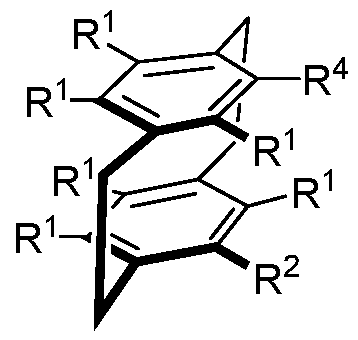
Formula Ilia

Formula Illb

Formula IIIc
wherein
R1 is, independently for each occurrence, hydrogen or alkyl;
R2 is substituted or unsubstituted triazinyl or substituted or unsubstituted phenyl; and
R4 is hydrogen or an electron-donating group.
In certain embodiments, the invention relates to a compound of formula IVa or formula IVb:

Formula IVb
wherein
R1 is, independently for each occurrence, hydrogen or alkyl;
B is absent or an optionally substituted heteroaromatic moiety; and
R3 is hydrogen, alkyl, an optionally substituted aromatic moiety, or an optionally substituted heteroaromatic moiety.
In certain embodiments, the invention relates to a compound of formula Va or formula Vb:

Formula Vb
wherein
R1 is, independently for each occurrence, hydrogen or alkyl;
B is absent or an optionally substituted heteroaromatic moiety;
X is O, S, or R3; and
R3 is hydrogen, alkyl, an optionally substituted aromatic moiety, or an optionally substituted heteroaromatic moiety.
In certain embodiments, the invention relates to a polymer comprising a repeat unit of formula Via or formula VIb:

A is an aromatic moiety substituted with at least one electron-withdrawing substituent or a heteroaromatic moiety substituted with at least one electron-withdrawing substituent;
R1 is, independently for each occurrence, hydrogen or alkyl; and
R3 is hydrogen, alkyl, an optionally substituted aromatic moiety, or an optionally substituted heteroaromatic moiety.
In certain embodiments, the invention relates to an electronic device, such as an OLED, comprising an anode, a cathode, and an emissive layer, wherein the emissive layer is disposed between the anode and the cathode; and the emissive layer comprises any of the compounds or any of the polymers described herein.
In certain embodiments, the invention relates to a method of producing visible light comprising applying a charge to any of the electronic devices described herein.
BRIEF DESCRIPTION OF THE FIGURES
Figure 1 depicts the chemical structures of five sub-classes of [2.2]paracylophane- derived carbazoles with attached acceptors (labeled as A in the drawing).
Figure 2 depicts the chemical structure of representative acceptor moieties.
Figure 3A shows preliminary results from evaluation in a device of [2.2]paracyclophane derived molecules without TADF properties.
Figure 3B shows preliminary results from evaluation in a device of [2.2]paracyclophane derived molecules with TADF properties.
Figure 4A depicts a schematic structural diagram showing an electronic device of the in ention.
Figure 4B depicts a schematic structural diagram showing an electronic device of the invention.
Figure 4C depicts a schematic structural diagram showing an electronic device of the invention.
Figure 4D depicts a schematic structural diagram showing an electronic device of the invention.
DETAILED DESCRIPTION
Overview
In certain embodiments, the invention relates to [2.2]paracyclophane-derived donor- acceptor type compounds. Figure 1 depicts the general structures of a number of exemplary classes of compounds of the invention. In certain embodiments, the invention relates to one of five different sub-classes of compound, that is, mono-, ortho-, geminal-, para-, and meta- [2.2]paracylophane-carbazole derivatives. In certain embodiments, the compound is substituted with an acceptor moiety. Representative acceptor moieties are shown in Figure 2.
[2.2]Paracylophane has a unique structure. The two phenyl rings are forced in close proximity, which leads to their distortion from planarity. The distortion from planarity energetically disfavors local triplet excited states, which, in turn, increases the quantum efficiency of emission.
In addition, despite high ring strain, a [2.2]paracylophane has high kinetic stability because there is no decomposition pathway with a low activation barrier. In fact, the only decomposition pathway involves breaking one or two carbon-carbon single bonds between two benzylic carbon atoms. Therefore, most compounds having a [2.2]paracyclophane core
structure are stable to moderate heat and chemical conditions. For example, decomposition of underivatized [2.2]paracyclophane occurs only at high temperature (>350 °C) and under reduced pressure.
High thermal stability is crucial for late-stage manufacturing of large-size OLED displays because the chemical vapor deposition (CVD) process used in fabrication usually requires heat and vacuum conditions. In addition, molecules having a [2.2]paracylophane core structure exhibit good luminescence properties in the solid state for at least two reasons: intermolecular interactions are disfavored by (i) the π-π stacking interaction between the two phenyl rings, and (ii) the overall geometry of the molecule.
In certain embodiments, the invention relates to compounds exhibiting TADF properties (Figure 3B). In certain embodiments, the short lifetime for delayed fluorescence is comparable to state-of-art green emitting TADF materials.
In certain embodiments, the invention relates to a method of synthesizing any compound described herein by palladium-catalyzed carbon-nitrogen bond and carbon- carbon bond formation reactions. In certain embodiments, the invention relates to a method of synthesizing any compound described herein by using a one-step carbon-nitrogen bond- forming reaction to couple an acceptor moiety, such as a phenyl derivative or a triazine, to a carbazole moiety.
Exemplary Compounds
In certain embodiments, the invention relates to a compound of formula la or formula lb:

Formula lb
wherein
A is an aromatic moiety substituted with at least one electron-withdrawing substituent or a heteroaromatic moiety substituted with at least one electron-withdrawing substituent;
R1 is, independently for each occcurrence, hydrogen or alkyl; and
B is absent or an optionally substituted heteroaromatic moiety.
In certain embodiments, the invention relates to any one of the compounds described herein, wherein A is an aromatic moiety substituted with at least one electron- withdrawing substituent.
In certain embodiments, the invention relates to any one of the compounds described herein, wherein A is a heteroaromatic moiety substituted with at least one electron-withdrawing substituent.
In certain embodiments, the invention relates to any one of the compounds described herein, wherein A is phenyl substituted with at least one electron- withdrawing substituent.
In certain embodiments, the invention relates to any one of the compounds described herein, wherein A is phenyl substituted with one electron-withdrawing substituent. In certain embodiments, the invention relates to any one of the compounds described herein, wherein A is phenyl substituted with two electron-withdrawing substituents. In certain embodiments, the invention relates to any one of the compounds described herein, wherein A is phenyl substituted in the 3-position with an electron- withdrawing substituent. In certain embodiments, the invention relates to any one of the compounds described herein, wherein A is phenyl substituted in the 5-position with an electron-withdrawing substituent. In certain embodiments, the invention relates to any one of the compounds described herein, wherein A is phenyl substituted in the 2-position with an electron-withdrawing substituent. In certain embodiments, the invention relates to any one of the compounds described herein, wherein A is phenyl substituted in the 6-position with an electron-withdrawing substituent. In certain embodiments, the invention relates to any one of the compounds described herein, wherein A is phenyl substituted in the 4- position with an electron-withdrawing substituent.
In certain embodiments, the invention relates to any one of the compounds described herein, wherein A is phenyl substituted with two electron-withdrawing substituents. In certain embodiments, the invention relates to any one of the compounds described herein, wherein A is phenyl substituted in the 3-position with an electron-
withdrawing substituent and in the 5-position with an electron-withdrawing substituent. In certain embodiments, the invention relates to any one of the compounds described herein, wherein A is phenyl substituted in the 2-position with an electron-withdrawing substituent and in the 6-position with an electron-withdrawing substituent.
In certain embodiments, the invention relates to any one of the compounds described herein, wherein the electron-withdrawing substituent is selected from the group consisting of -CHO, -C(0)Rn, -C(0)ORn, -C(0)OH, -C(0)C1, -CF3, -CC13, -CN, S03H, -NO2, and substituted or unsubstituted triazinyl; and Rn is alkyl, aryl, or aralkyl.
In certain embodiments, the invention relates to any one of the compounds described herein, wherein B is absent.
In certain embodiments, the invention relates to any one of the compounds described herein, wherein B is an optionally substituted heteroaromatic moiety. In certain embodiments, the invention relates to any one of the compounds described herein, wherein B is a substituted heteroaromatic moiety. In certain embodiments, the invention relates to any one of the compounds described herein, wherein B is an unsubstituted heteroaromatic moiety.
In certain embodiments, the invention relates to any one of the compounds described herein, wherein the B-ring is derived from an acridine, carbazole, carboline, cinnoline, furan, furazan, imidazole, indazole, indole, indolizine, isobenzofuran, isoindole, isoquinoline, isothiazole, isoxazole, naphthyridine, oxazole, phenanthridine, phenanthroline, phenazine, phthalazine, pteridine, purine, pyrazine, pyrazole, pyridazine, pyridine, pyrimidine, pyrrole, quinazoline, quinoline, quinoxaline, thiadiazole, thianthrene, thiophene, triazole, or trithiole. In certain embodiments, the invention relates to any one of the compounds described herein, wherein the B-ring is derived from an indole. In certain embodiments the invention relates to any one of the compounds described herein, wherein

the B-ring is
In certain embodiments, the invention relates to any one of the compounds described herein, wherein R is hydrogen.
In certain embodiments, the invention relates to any one of the compounds described herein, wherein R1 is alkyl. In certain embodiments, the invention relates to any one of the compounds described herein, wherein R1 is methyl, ethyl, propyl, or butyl.
In certain embodiments, the invention relates to a compound of formula Ila', formula lib', or formula lie' :

Formula lie'
wherein
R1 is, independently for each occurrence, hydrogen or alkyl;
R2 is substituted or unsubstituted triazinyl, substituted or unsubstituted phenyl, substituted or unsubstituted pyridyl, substituted or unsubstituted pyrimidyl, or an electron- withdrawing group; and
R3 is hydrogen, alkyl, an optionally substituted aromatic moiety, or an optionally substituted heteroaromatic moiety.
In certain embodiments, the invention relates to a compound of formula Ila, formula lib, or formula lie:

Formula lie
wherein
R1 is, independently for each occurrence, hydrogen or alkyl;
R2 is substituted or unsubstituted triazinyl or substituted or unsubstituted phenyl; and
R3 is hydrogen, alkyl, an optionally substituted aromatic moiety, or an optionally substituted heteroaromatic moiety.
In certain embodiments, the invention relates to any one of the compounds described herein, wherein R1 is hydrogen.
In certain embodiments, the invention relates to any one of the compounds described herein, wherein R1 is alkyl. In certain embodiments, the invention relates to any one of the compounds described herein, wherein R1 is methyl, ethyl, propyl, or butyl.
In certain embodiments, the invention relates to any one of the compounds described herein, wherein R2 is substituted triazinyl. In certain embodiments, the invention relates to any one of the compounds described herein, wherein R2 is phenyl-substituted
triazinyl. In certain embodiments, the invention relates to any one of the compounds described herein, wherein R2 is bisphenyl-substituted triazinyl.
In certain embodiments, the invention relates to any one of the compounds described herein, wherein R2 is unsubstituted triazinyl.
In certain embodiments, the invention relates to any one of the compounds described herein, wherein R2 is substituted phenyl. In certain embodiments, the invention relates to any one of the compounds described herein, wherein R2 is cyano-substituted phenyl or trifluoromethyl-substituted phenyl. In certain embodiments, the invention relates to any one of the compounds described herein, wherein R2 is dicyano-substituted phenyl or bistrifluoromethyl-substituted phenyl. In certain embodiments, the invention relates to any one of the compounds described herein, wherein R2 is 2,6-dicyanophenyl, 2,6- bistrifluoromethylphenyl, 3,5-dicyanophenyl, 3,5-bistrifluoromethylphenyl, or 4- cyanophenyl. In certain embodiments, the invention relates to any one of the compounds described herein, wherein R2 is 2,6-dicyanophenyl. In certain embodiments, the invention relates to any one of the compounds described herein, wherein R2 is 3,5- bistrifluoromethylphenyl.
In certain embodiments, the invention relates to any one of the compounds described herein, wherein R2 is unsubstituted phenyl.
In certain embodiments, the invention relates to any one of the compounds described herein, wherein R2 is substituted or unsubstituted pyridyl.
In certain embodiments, the invention relates to any one of the compounds described herein, wherein R2 is 4-pyridyl.
In certain embodiments, the invention relates to any one of the compounds described herein, wherein R2 is an electron-withdrawing group, such as 1,3,4-thiadiazolyl and 1,3,4-oxadiazolyl.
In certain embodiments, the invention relates to any one of the compounds described herein, wherein R2 is 2-pyrimidyl.
In certain embodiments, the invention relates to any one of the compounds described herein, wherein R2 is substituted triazinyl. In certain embodiments, the invention relates to any one of the compounds described herein, wherein R2 is phenyl-substituted triazinyl. In certain embodiments, the invention relates to any one of the compounds described herein, wherein R2 is bisphenyl-substituted triazinyl.
In certain embodiments, the invention relates to any one of the compounds described herein, wherein R2 is unsubstituted triazinyl.
In certain embodiments, the invention relates to any one of the compounds described herein, wherein R2 is substituted phenyl. In certain embodiments, the invention relates to any one of the compounds described herein, wherein R2 is cyano-substituted phenyl or trifluoromethyl-substituted phenyl. In certain embodiments, the invention relates to any one of the compounds described herein, wherein R2 is dicyano-substituted phenyl or bistrifluoromethyl-substituted phenyl. In certain embodiments, the invention relates to any one of the compounds described herein, wherein R2 is 2,6-dicyanophenyl, 2,6- bistrifluoromethylphenyl, 3,5-dicyanophenyl, 3,5-bistrifluoromethylphenyl, or 4- cyanophenyl. In certain embodiments, the invention relates to any one of the compounds described herein, wherein R2 is 2,6-dicyanophenyl. In certain embodiments, the invention relates to any one of the compounds described herein, wherein R2 is 3,5- bistrifluoromethylphenyl.
In certain embodiments, the invention relates to any one of the compounds described herein, wherein R2 is unsubstituted phenyl.
In certain embodiments, the invention relates to any one of the compounds described herein, wherein R3 is hydrogen.
In certain embodiments, the invention relates to any one of the compounds described herein, wherein R3 is alkyl. In certain embodiments, the invention relates to any one of the compounds described herein, wherein R3 is methyl, ethyl, propyl, or butyl.
In certain embodiments, the invention relates to any one of the compounds described herein, wherein R3 is a substituted aromatic moiety.
In certain embodiments, the invention relates to any one of the compounds described herein, wherein R3 is an unsubstituted aromatic moiety. In certain embodiments, the invention relates to any one of the compounds described herein, wherein R3 is phenyl.
In certain embodiments, the invention relates to any one of the compounds described herein, wherein R3 is a substituted heteroaromatic moiety.
In certain embodiments, the invention relates to any one of the compounds described herein, wherein R3 is an unsubstituted heteroaromatic moiety.
In certain embodiments, the invention relates to any one of the compounds described herein, wherein R3 is an aromatic moiety substituted with at least one electron- withdrawing substituent.
In certain embodiments, the invention relates to any one of the compounds described herein, wherein R3 is phenyl substituted with at least one electron- withdrawing substituent.
In certain embodiments, the invention relates to any one of the compounds described herein, wherein R3 is phenyl substituted with one electron-withdrawing substituent. In certain embodiments, the invention relates to any one of the compounds described herein, wherein R3 is phenyl substituted with two electron-withdrawing substituents. In certain embodiments, the invention relates to any one of the compounds described herein, wherein R3 is phenyl substituted in the 3-position with an electron- withdrawing substituent. In certain embodiments, the invention relates to any one of the compounds described herein, wherein R3 is phenyl substituted in the 5-position with an electron-withdrawing substituent. In certain embodiments, the invention relates to any one of the compounds described herein, wherein R3 is phenyl substituted in the 2-position with an electron-withdrawing substituent. In certain embodiments, the invention relates to any one of the compounds described herein, wherein R3 is phenyl substituted in the 6-position with an electron-withdrawing substituent. In certain embodiments, the invention relates to any one of the compounds described herein, wherein R3 is phenyl substituted in the 4- position with an electron-withdrawing substituent.
In certain embodiments, the invention relates to any one of the compounds described herein, wherein R3 is phenyl substituted with two electron-withdrawing substituents. In certain embodiments, the invention relates to any one of the compounds described herein, wherein R3 is phenyl substituted in the 3-position with an electron- withdrawing substituent and in the 5-position with an electron-withdrawing substituent. In certain embodiments, the invention relates to any one of the compounds described herein, wherein R3 is phenyl substituted in the 2-position with an electron-withdrawing substituent and in the 6-position with an electron-withdrawing substituent.
In certain embodiments, the invention relates to any one of the compounds described herein, wherein the electron-withdrawing substituent is selected from the group consisting of -CHO, -C(0)Rn, -C(0)ORn, -C(0)OH, -C(0)C1, -CF3, -CC13, -CN, S03H, -NO2, and substituted or unsubstituted triazinyl; and Rn is alkyl, aryl, or aralkyl.
In certain embodiments, the invention relates to any one of the compounds described herein, wherein R3 is an aromatic moiety substituted with at least one alkyl, aryl, or aralkyl substituent. In certain embodiments, the invention relates to any one of the
compounds described herein, wherein R is phenyl substituted with at least one alkyl, aryl, or aralkyl substituent.
In certain embodiments, the invention relates to any one of the compounds described herein, wherein R3 is an aromatic moiety substituted with one alkyl, aryl, or aralkyl substituent. In certain embodiments, the invention relates to any one of the compounds described herein, wherein R3 is phenyl substituted with one alkyl, aryl, or aralkyl substituent. In certain embodiments, the invention relates to any one of the compounds described herein, wherein R3 is phenyl substituted in the 3-position with an alkyl, aryl, or aralkyl substituent. In certain embodiments, the invention relates to any one of the compounds described herein, wherein R3 is phenyl substituted in the 5-position with an alkyl, aryl, or aralkyl substituent. In certain embodiments, the invention relates to any one of the compounds described herein, wherein R3 is phenyl substituted in the 2-position with an alkyl, aryl, or aralkyl substituent. In certain embodiments, the invention relates to any one of the compounds described herein, wherein R3 is phenyl substituted in the 6- position with an alkyl, aryl, or aralkyl substituent. In certain embodiments, the invention relates to any one of the compounds described herein, wherein R3 is phenyl substituted in the 4-position with an alkyl, aryl, or aralkyl substituent.
In certain embodiments, the invention relates to any one of the compounds described herein, wherein R3 is an aromatic moiety substituted with two alkyl, aryl, or aralkyl substituents. In certain embodiments, the invention relates to any one of the compounds described herein, wherein R3 is phenyl substituted with two alkyl, aryl, or aralkyl substituents. In certain embodiments, the invention relates to any one of the compounds described herein, wherein R3 is phenyl substituted in the 3-position with an alkyl, aryl, or aralkyl substituent and in the 5-position with an alkyl, aryl, or aralkyl substituent. In certain embodiments, the invention relates to any one of the compounds described herein, wherein R3 is phenyl substituted in the 2-position with an alkyl, aryl, or aralkyl substituent and in the 6-position with an alkyl, aryl, or aralkyl substituent.
In certain embodiments, the invention relates to a compound of formula Ilia', formula Illb', or formula IIIc' :

Formula Ilia'

Formula Illb'

Formula IIIc'
wherein
R1 is, independently for each occurrence, hydrogen or alkyl;
R2 is substituted or unsubstituted triazinyl, substituted or unsubstituted phenyl, substituted or unsubstituted pyridyl, substituted or unsubstituted pyrimidyl, or an electron- withdrawing group; and
R4 is hydrogen or an electron-donating group.
In certain embodiments, the invention relates to a compound of formula Ilia, formula Illb, or formula IIIc:

Formula Ilia


Formula IIIc
wherein
R1 is, independently for each occurrence, hydrogen or alkyl;
R2 is substituted or unsubstituted triazinyl or substituted or unsubstituted phenyl; and
R4 is hydrogen or an electron-donating group.
In certain embodiments, the invention relates to any one of the compounds described herein, wherein R1 is hydrogen.
In certain embodiments, the invention relates to any one of the compounds described herein, wherein R1 is alkyl. In certain embodiments, the invention relates to any one of the compounds described herein, wherein R1 is methyl, ethyl, propyl, or butyl.
In certain embodiments, the invention relates to any one of the compounds described herein, wherein R2 is substituted triazinyl. In certain embodiments, the invention relates to any one of the compounds described herein, wherein R2 is phenyl-substituted triazinyl. In certain embodiments, the invention relates to any one of the compounds described herein, wherein R2 is bisphenyl-substituted triazinyl.
In certain embodiments, the invention relates to any one of the compounds described herein, wherein R2 is unsubstituted triazinyl.
In certain embodiments, the invention relates to any one of the compounds described herein, wherein R2 is substituted phenyl. In certain embodiments, the invention relates to any one of the compounds described herein, wherein R2 is cyano-substituted phenyl or trifluoromethyl-substituted phenyl. In certain embodiments, the invention relates to any one of the compounds described herein, wherein R2 is dicyano-substituted phenyl or bistrifluoromethyl-substituted phenyl. In certain embodiments, the invention relates to any
one of the compounds described herein, wherein R2 is 2,6-dicyanophenyl, 2,6- bistrifluoromethylphenyl, 3,5-dicyanophenyl, 3,5-bistrifluoromethylphenyl, or 4- cyanophenyl. In certain embodiments, the invention relates to any one of the compounds described herein, wherein R2 is 2,6-dicyanophenyl. In certain embodiments, the invention relates to any one of the compounds described herein, wherein R2 is 3,5- bistrifluoromethylphenyl.
In certain embodiments, the invention relates to any one of the compounds described herein, wherein R2 is unsubstituted phenyl.
In certain embodiments, the invention relates to any one of the compounds described herein, wherein R2 is substituted or unsubstituted pyridyl.
In certain embodiments, the invention relates to any one of the compounds described herein, wherein R2 is 4-pyridyl.
In certain embodiments, the invention relates to any one of the compounds described herein, wherein R2 is an electron-withdrawing group, such as 1,3,4-thiadiazolyl and 1,3,4-oxadiazolyl.
In certain embodiments, the invention relates to any one of the compounds described herein, wherein R2 is 2-pyrimidyl.
In certain embodiments, the invention relates to any one of the compounds described herein, wherein R2 is substituted triazinyl. In certain embodiments, the invention relates to any one of the compounds described herein, wherein R2 is phenyl-substituted triazinyl. In certain embodiments, the invention relates to any one of the compounds described herein, wherein R2 is bisphenyl-substituted triazinyl.
In certain embodiments, the invention relates to any one of the compounds described herein, wherein R2 is unsubstituted triazinyl.
In certain embodiments, the invention relates to any one of the compounds described herein, wherein R2 is substituted phenyl. In certain embodiments, the invention relates to any one of the compounds described herein, wherein R2 is cyano-substituted phenyl or trifluoromethyl-substituted phenyl. In certain embodiments, the invention relates to any one of the compounds described herein, wherein R2 is dicyano-substituted phenyl or bistrifluoromethyl-substituted phenyl. In certain embodiments, the invention relates to any one of the compounds described herein, wherein R2 is 2,6-dicyanophenyl, 2,6- bistrifluoromethylphenyl, 3,5-dicyanophenyl, 3,5-bistrifluoromethylphenyl, or 4- cyanophenyl. In certain embodiments, the invention relates to any one of the compounds
described herein, wherein R2 is 2,6-dicyanophenyl. In certain embodiments, the invention relates to any one of the compounds described herein, wherein R2 is 3,5- bistrifluoromethylphenyl.
In certain embodiments, the invention relates to any one of the compounds described herein, wherein R2 is unsubstituted phenyl.
In certain embodiments, the invention relates to any one of the compounds described herein, wherein R4 is hydrogen.
In certain embodiments, the invention relates to any one of the compounds described herein, wherein R4 is - H2, - HRn, -N(Rn)2, -OH, -ORn, - RnC(0)Rn, - HC(0)Rn, or -OC(0)Rn, wherein Rn is alkyl, aryl, or aralkyl, or, for instances where there are two Rn, the two Rn, taken together, form a ring. In certain embodiments, the invention relates to any one of the compounds described herein, wherein R4 is - H2, - HRn, -N(Rn)2, -OH, -ORn, - RnC(0)Rn, - HC(0)Rn, or -OC(0)Rn, wherein Rn is alkyl, aryl, or aralkyl. In certain embodiments, the invention relates to any one of the compounds described herein, wherein R4 is a nitrogen-containing heterocyclyl, including N-carbazolyl, N-(9,9-dialkyl-9, 10-dihydroacridine), N-(9,9-diaryl-9,10-dihydroacridine), N- iminodibenzyl, N-iminostilbene, N-(9(10H)-acridanone), N-(lOH-phenothiazine), N-(9H- 3,9'-bicarbazole), N-(7, 12-dihydro-5H-7, 12-[l,2]benzenonaphtho[2,3- )]carbazole, and their derivatives (such as substituted N-carbazolyl and N-heterocyclic iminodibenzyl or iminostilbene).
In certain embodiments, the invention relates to any one of the compounds described herein, wherein R4 is N-carbazolyl.
In certain embodiments, the invention relates to any one of the compounds described herein, wherein R4 is -NH2 or -N(alkyl)2. In certain embodiments, the invention relates to any one of the compounds described herein, wherein R4 is -NH2 or -N(CH3)2.
In certain embodiments, the invention relates to any one of the compounds described herein, wherein R4 is -N(aryl)2. In certain embodiments, the invention relates to any one of the compounds described herein, wherein R4 is -N(phenyl)2.
In certain embodiments, the invention relates to any one of the compounds described herein, wherein R4 is -O(alkyl). In certain embodiments, the invention relates to any one of the compounds described herein, wherein R4 is -OCH3.
In certain embodiments, the invention relates to a compound of formula IVa or formula IVb:

Formula IVb
wherein
R1 is, independently for each occurrence, hydrogen or alkyl;
B is absent or an optionally substituted heteroaromatic moiety; and
R3 is hydrogen, alkyl, an optionally substituted aromatic moiety, or an optionally substituted heteroaromatic moiety.
In certain embodiments, the invention relates to any one of the compounds described herein, wherein R1 is hydrogen.
In certain embodiments, the invention relates to any one of the compounds described herein, wherein R1 is alkyl. In certain embodiments, the invention relates to any one of the compounds described herein, wherein R1 is methyl, ethyl, propyl, or butyl.
In certain embodiments, the invention relates to any one of the compounds described herein, wherein R3 is hydrogen.
In certain embodiments, the invention relates to any one of the compounds described herein, wherein R3 is alkyl. In certain embodiments, the invention relates to any one of the compounds described herein, wherein R3 is methyl, ethyl, propyl, or butyl.
In certain embodiments, the invention relates to any one of the compounds described herein, wherein R3 is a substituted aromatic moiety.
In certain embodiments, the invention relates to any one of the compounds described herein, wherein R3 is an unsubstituted aromatic moiety. In certain embodiments, the invention relates to any one of the compounds described herein, wherein R3 is phenyl.
In certain embodiments, the invention relates to any one of the compounds described herein, wherein R3 is a substituted heteroaromatic moiety.
In certain embodiments, the invention relates to any one of the compounds described herein, wherein R3 is an unsubstituted heteroaromatic moiety.
In certain embodiments, the invention relates to any one of the compounds described herein, wherein R3 is an aromatic moiety substituted with at least one electron- withdrawing substituent.
In certain embodiments, the invention relates to any one of the compounds described herein, wherein R3 is phenyl substituted with at least one electron- withdrawing substituent.
In certain embodiments, the invention relates to any one of the compounds described herein, wherein R3 is phenyl substituted with one electron-withdrawing substituent. In certain embodiments, the invention relates to any one of the compounds described herein, wherein R3 is phenyl substituted with two electron-withdrawing substituents. In certain embodiments, the invention relates to any one of the compounds described herein, wherein R3 is phenyl substituted in the 3-position with an electron- withdrawing substituent. In certain embodiments, the invention relates to any one of the compounds described herein, wherein R3 is phenyl substituted in the 5-position with an electron-withdrawing substituent. In certain embodiments, the invention relates to any one of the compounds described herein, wherein R3 is phenyl substituted in the 2-position with an electron-withdrawing substituent. In certain embodiments, the invention relates to any one of the compounds described herein, wherein R3 is phenyl substituted in the 6-position with an electron-withdrawing substituent. In certain embodiments, the invention relates to any one of the compounds described herein, wherein R3 is phenyl substituted in the 4- position with an electron-withdrawing substituent.
In certain embodiments, the invention relates to any one of the compounds described herein, wherein R3 is phenyl substituted with two electron-withdrawing substituents. In certain embodiments, the invention relates to any one of the compounds described herein, wherein R3 is phenyl substituted in the 3-position with an electron- withdrawing substituent and in the 5-position with an electron-withdrawing substituent. In certain embodiments, the invention relates to any one of the compounds described herein, wherein R3 is phenyl substituted in the 2-position with an electron-withdrawing substituent and in the 6-position with an electron-withdrawing substituent.
In certain embodiments, the invention relates to any one of the compounds described herein, wherein the electron-withdrawing substituent is selected from the group consisting of -CHO, -C(0)Rn, -C(0)ORn, -C(0)OH, -C(0)C1, -CF3, -CC13, -CN, S03H, -N02, and substituted or unsubstituted triazinyl; and Rn is alkyl, aryl, or aralkyl.
In certain embodiments, the invention relates to any one of the compounds described herein, wherein R3 is an aromatic moiety substituted with at least one alkyl, aryl, or aralkyl substituent. In certain embodiments, the invention relates to any one of the compounds described herein, wherein R3 is phenyl substituted with at least one alkyl, aryl, or aralkyl substituent.
In certain embodiments, the invention relates to any one of the compounds described herein, wherein R3 is an aromatic moiety substituted with one alkyl, aryl, or aralkyl substituent. In certain embodiments, the invention relates to any one of the compounds described herein, wherein R3 is phenyl substituted with one alkyl, aryl, or aralkyl substituent. In certain embodiments, the invention relates to any one of the compounds described herein, wherein R3 is phenyl substituted in the 3-position with an alkyl, aryl, or aralkyl substituent. In certain embodiments, the invention relates to any one of the compounds described herein, wherein R3 is phenyl substituted in the 5-position with an alkyl, aryl, or aralkyl substituent. In certain embodiments, the invention relates to any one of the compounds described herein, wherein R3 is phenyl substituted in the 2-position with an alkyl, aryl, or aralkyl substituent. In certain embodiments, the invention relates to any one of the compounds described herein, wherein R3 is phenyl substituted in the 6- position with an alkyl, aryl, or aralkyl substituent. In certain embodiments, the invention relates to any one of the compounds described herein, wherein R3 is phenyl substituted in the 4-position with an alkyl, aryl, or aralkyl substituent.
In certain embodiments, the invention relates to any one of the compounds described herein, wherein R3 is an aromatic moiety substituted with two alkyl, aryl, or aralkyl substituents. In certain embodiments, the invention relates to any one of the compounds described herein, wherein R3 is phenyl substituted with two alkyl, aryl, or aralkyl substituents. In certain embodiments, the invention relates to any one of the compounds described herein, wherein R3 is phenyl substituted in the 3-position with an alkyl, aryl, or aralkyl substituent and in the 5-position with an alkyl, aryl, or aralkyl substituent. In certain embodiments, the invention relates to any one of the compounds
described herein, wherein R is phenyl substituted in the 2-position with an alkyl, aryl, or aralkyl substituent and in the 6-position with an alkyl, aryl, or aralkyl substituent.
In certain embodiments, the invention relates to any one of the compounds described herein, wherein B is absent.
In certain embodiments, the invention relates to any one of the compounds described herein, wherein B is an optionally substituted heteroaromatic moiety. In certain embodiments, the invention relates to any one of the compounds described herein, wherein B is a substituted heteroaromatic moiety. In certain embodiments, the invention relates to any one of the compounds described herein, wherein B is an unsubstituted heteroaromatic moiety.
In certain embodiments, the invention relates to any one of the compounds described herein, wherein the B-ring is derived from an acridine, carbazole, carboline, cinnoline, furan, furazan, imidazole, indazole, indole, indolizine, isobenzofuran, isoindole, isoquinoline, isothiazole, isoxazole, naphthyridine, oxazole, phenanthridine, phenanthroline, phenazine, phthalazine, pteridine, purine, pyrazine, pyrazole, pyridazine, pyridine, pyrimidine, pyrrole, quinazoline, quinoline, quinoxaline, thiadiazole, thianthrene, thiophene, triazole, or trithiole.
In certain embodiments, the invention relates to any one of the compounds described herein, wherein the B-ring is derived from a pyridine, quinoline, thiadiazole, triazole, or trithiole.
In certain embodiments, the invention relates to a compound of formula Va or formula Vb:

Formula Vb
wherein
R1 is, independently for each occurrence, hydrogen or alkyl;
B is absent or an optionally substituted heteroaromatic moiety;
X is O, S, or R3; and
R3 is hydrogen, alkyl, an optionally substituted aromatic moiety, or an optionally substituted heteroaromatic moiety.
In certain embodiments, the invention relates to any one of the compounds described herein, wherein R1 is hydrogen.
In certain embodiments, the invention relates to any one of the compounds described herein, wherein R1 is alkyl. In certain embodiments, the invention relates to any one of the compounds described herein, wherein R1 is methyl, ethyl, propyl, or butyl.
In certain embodiments, the invention relates to any one of the compounds described herein, wherein X is O.
In certain embodiments, the invention relates to any one of the compounds described herein, wherein X is S.
In certain embodiments, the invention relates to any one of the compounds described herein, wherein X is NR3.
In certain embodiments, the invention relates to any one of the compounds described herein, wherein R3 is hydrogen.
In certain embodiments, the invention relates to any one of the compounds described herein, wherein R3 is alkyl. In certain embodiments, the invention relates to any one of the compounds described herein, wherein R3 is methyl, ethyl, propyl, or butyl.
In certain embodiments, the invention relates to any one of the compounds described herein, wherein R3 is a substituted aromatic moiety.
In certain embodiments, the invention relates to any one of the compounds described herein, wherein R3 is an unsubstituted aromatic moiety. In certain embodiments, the invention relates to any one of the compounds described herein, wherein R3 is phenyl.
In certain embodiments, the invention relates to any one of the compounds described herein, wherein R3 is a substituted heteroaromatic moiety.
In certain embodiments, the invention relates to any one of the compounds described herein, wherein R3 is an unsubstituted heteroaromatic moiety.
In certain embodiments, the invention relates to any one of the compounds described herein, wherein R3 is an aromatic moiety substituted with at least one electron- withdrawing substituent.
In certain embodiments, the invention relates to any one of the compounds described herein, wherein R3 is phenyl substituted with at least one electron- withdrawing substituent.
In certain embodiments, the invention relates to any one of the compounds described herein, wherein R3 is phenyl substituted with one electron-withdrawing substituent. In certain embodiments, the invention relates to any one of the compounds described herein, wherein R3 is phenyl substituted with two electron-withdrawing substituents. In certain embodiments, the invention relates to any one of the compounds described herein, wherein R3 is phenyl substituted in the 3-position with an electron- withdrawing substituent. In certain embodiments, the invention relates to any one of the compounds described herein, wherein R3 is phenyl substituted in the 5-position with an electron-withdrawing substituent. In certain embodiments, the invention relates to any one of the compounds described herein, wherein R3 is phenyl substituted in the 2-position with an electron-withdrawing substituent. In certain embodiments, the invention relates to any one of the compounds described herein, wherein R3 is phenyl substituted in the 6-position with an electron-withdrawing substituent. In certain embodiments, the invention relates to any one of the compounds described herein, wherein R3 is phenyl substituted in the 4- position with an electron-withdrawing substituent.
In certain embodiments, the invention relates to any one of the compounds described herein, wherein R3 is phenyl substituted with two electron-withdrawing substituents. In certain embodiments, the invention relates to any one of the compounds described herein, wherein R3 is phenyl substituted in the 3-position with an electron- withdrawing substituent and in the 5-position with an electron-withdrawing substituent. In certain embodiments, the invention relates to any one of the compounds described herein, wherein R3 is phenyl substituted in the 2-position with an electron-withdrawing substituent and in the 6-position with an electron-withdrawing substituent.
In certain embodiments, the invention relates to any one of the compounds described herein, wherein the electron-withdrawing substituent is selected from the group consisting of -CHO, -C(0)Rn, -C(0)ORn, -C(0)OH, -C(0)C1, -CF3, -CC13, -CN, S03H, -N02, and substituted or unsubstituted triazinyl; and Rn is alkyl, aryl, or aralkyl.
In certain embodiments, the invention relates to any one of the compounds described herein, wherein R3 is an aromatic moiety substituted with at least one alkyl, aryl, or aralkyl substituent. In certain embodiments, the invention relates to any one of the compounds described herein, wherein R3 is phenyl substituted with at least one alkyl, aryl, or aralkyl substituent.
In certain embodiments, the invention relates to any one of the compounds described herein, wherein R3 is an aromatic moiety substituted with one alkyl, aryl, or aralkyl substituent. In certain embodiments, the invention relates to any one of the compounds described herein, wherein R3 is phenyl substituted with one alkyl, aryl, or aralkyl substituent. In certain embodiments, the invention relates to any one of the compounds described herein, wherein R3 is phenyl substituted in the 3-position with an alkyl, aryl, or aralkyl substituent. In certain embodiments, the invention relates to any one of the compounds described herein, wherein R3 is phenyl substituted in the 5-position with an alkyl, aryl, or aralkyl substituent. In certain embodiments, the invention relates to any one of the compounds described herein, wherein R3 is phenyl substituted in the 2-position with an alkyl, aryl, or aralkyl substituent. In certain embodiments, the invention relates to any one of the compounds described herein, wherein R3 is phenyl substituted in the 6- position with an alkyl, aryl, or aralkyl substituent. In certain embodiments, the invention relates to any one of the compounds described herein, wherein R3 is phenyl substituted in the 4-position with an alkyl, aryl, or aralkyl substituent.
In certain embodiments, the invention relates to any one of the compounds described herein, wherein R3 is an aromatic moiety substituted with two alkyl, aryl, or aralkyl substituents. In certain embodiments, the invention relates to any one of the compounds described herein, wherein R3 is phenyl substituted with two alkyl, aryl, or aralkyl substituents. In certain embodiments, the invention relates to any one of the compounds described herein, wherein R3 is phenyl substituted in the 3-position with an alkyl, aryl, or aralkyl substituent and in the 5-position with an alkyl, aryl, or aralkyl substituent. In certain embodiments, the invention relates to any one of the compounds described herein, wherein R3 is phenyl substituted in the 2-position with an alkyl, aryl, or aralkyl substituent and in the 6-position with an alkyl, aryl, or aralkyl substituent.
In certain embodiments, the invention relates to any one of the compounds described herein, wherein B is absent.
In certain embodiments, the invention relates to any one of the compounds described herein, wherein B is an optionally substituted heteroaromatic moiety. In certain embodiments, the invention relates to any one of the compounds described herein, wherein B is a substituted heteroaromatic moiety. In certain embodiments, the invention relates to any one of the compounds described herein, wherein B is an unsubstituted heteroaromatic moiety.
In certain embodiments, the invention relates to any one of the compounds described herein, wherein the B-ring is derived from an acridine, carbazole, carboline, cinnoline, furan, furazan, imidazole, indazole, indole, indolizine, isobenzofuran, isoindole, isoquinoline, isothiazole, isoxazole, naphthyridine, oxazole, phenanthridine, phenanthroline, phenazine, phthalazine, pteridine, purine, pyrazine, pyrazole, pyridazine, pyridine, pyrimidine, pyrrole, quinazoline, quinoline, quinoxaline, thiadiazole, thianthrene, thiophene, triazole, or trithiole.
In certain embodiments, the invention relates to any one of the compounds described herein, wherein the B-ring is derived from a pyridine, quinoline, thiadiazole, triazole, or trithiole.
In certain embodiments, the invention relates to any one of the compounds described herein, in the form of a thin film, a thick film, or a crystal.
In certain embodiments, the invention relates to any one of the compounds described herein, wherein the compound is depicted in the Figures or in the Examples. Exemplary Polymers
In certain embodiments, the invention relates to a polymer comprising a repeat unit of formula Via or formula VIb:

Formula Via

Formula VIb
wherein, independently for each occurrence,
A is an aromatic moiety substituted with at least one electron-withdrawing substituent or a heteroaromatic moiety substituted with at least one electron-withdrawing substituent;
R1 is, independently for each occurrence, hydrogen or alkyl; and
R3 is hydrogen, alkyl, an optionally substituted aromatic moiety, or an optionally substituted heteroaromatic moiety.
In certain embodiments, the invention relates to any one of the polymers described herein, wherein A is an aromatic moiety substituted with at least one electron-withdrawing substituent.
In certain embodiments, the invention relates to any one of the polymers described herein, wherein A is a heteroaromatic moiety substituted with at least one electron- withdrawing substituent.
In certain embodiments, the invention relates to any one of the polymers described herein, wherein A is phenyl substituted with at least one electron-withdrawing substituent.
In certain embodiments, the invention relates to any one of the polymers described herein, wherein A is phenyl substituted with one electron-withdrawing substituent. In certain embodiments, the invention relates to any one of the polymers described herein, wherein A is phenyl substituted with two electron-withdrawing substituents. In certain embodiments, the invention relates to any one of the polymers described herein, wherein A is phenyl substituted in the 3-position with an electron-withdrawing substituent. In certain embodiments, the invention relates to any one of the polymers described herein, wherein A is phenyl substituted in the 5-position with an electron-withdrawing substituent. In certain embodiments, the invention relates to any one of the polymers described herein, wherein A is phenyl substituted in the 2-position with an electron-withdrawing substituent. In certain embodiments, the invention relates to any one of the polymers described herein, wherein A is phenyl substituted in the 6-position with an electron-withdrawing substituent. In certain
embodiments, the invention relates to any one of the polymers described herein, wherein A is phenyl substituted in the 4-position with an electron-withdrawing substituent.
In certain embodiments, the invention relates to any one of the polymers described herein, wherein A is phenyl substituted with two electron-withdrawing substituents. In certain embodiments, the invention relates to any one of the polymers described herein, wherein A is phenyl substituted in the 3-position with an electron-withdrawing substituent and in the 5-position with an electron-withdrawing substituent. In certain embodiments, the invention relates to any one of the polymers described herein, wherein A is phenyl substituted in the 2-position with an electron-withdrawing substituent and in the 6-position with an electron- withdrawing substituent.
In certain embodiments, the invention relates to any one of the polymers described herein, wherein the electron-withdrawing substituent is selected from the group consisting of -CHO, -C(0)Rn, -C(0)ORn, -C(0)OH, -C(0)C1, -CF3, -CC13, -CN, S03H, -N02, and substituted or unsubstituted triazinyl; and Rn is alkyl, aryl, or aralkyl.
In certain embodiments, the invention relates to any one of the polymers described herein, wherein R1 is hydrogen.
In certain embodiments, the invention relates to any one of the polymers described herein, wherein R1 is alkyl. In certain embodiments, the invention relates to any one of the polymers described herein, wherein R1 is methyl, ethyl, propyl, or butyl.
In certain embodiments, the invention relates to any one of the polymers described herein, wherein R3 is hydrogen.
In certain embodiments, the invention relates to any one of the polymers described herein, wherein R3 is alkyl. In certain embodiments, the invention relates to any one of the polymers described herein, wherein R3 is methyl, ethyl, propyl, or butyl.
In certain embodiments, the invention relates to any one of the polymers described herein, wherein R3 is a substituted aromatic moiety.
In certain embodiments, the invention relates to any one of the polymers described herein, wherein R3 is an unsubstituted aromatic moiety. In certain embodiments, the invention relates to any one of the polymers described herein, wherein R3 is phenyl.
In certain embodiments, the invention relates to any one of the polymers described herein, wherein R3 is a substituted heteroaromatic moiety.
In certain embodiments, the invention relates to any one of the polymers described herein, wherein R3 is an unsubstituted heteroaromatic moiety.
In certain embodiments, the invention relates to any one of the polymers described herein, wherein R3 is an aromatic moiety substituted with at least one electron-withdrawing substituent.
In certain embodiments, the invention relates to any one of the polymers described herein, wherein R3 is phenyl substituted with at least one electron-withdrawing substituent.
In certain embodiments, the invention relates to any one of the polymers described herein, wherein R3 is phenyl substituted with one electron-withdrawing substituent. In certain embodiments, the invention relates to any one of the polymers described herein, wherein R3 is phenyl substituted with two electron-withdrawing substituents. In certain embodiments, the invention relates to any one of the polymers described herein, wherein R3 is phenyl substituted in the 3-position with an electron-withdrawing substituent. In certain embodiments, the invention relates to any one of the polymers described herein, wherein R3 is phenyl substituted in the 5-position with an electron-withdrawing substituent. In certain embodiments, the invention relates to any one of the polymers described herein, wherein R3 is phenyl substituted in the 2-position with an electron-withdrawing substituent. In certain embodiments, the invention relates to any one of the polymers described herein, wherein R3 is phenyl substituted in the 6-position with an electron-withdrawing substituent. In certain embodiments, the invention relates to any one of the polymers described herein, wherein R3 is phenyl substituted in the 4-position with an electron-withdrawing substituent.
In certain embodiments, the invention relates to any one of the polymers described herein, wherein R3 is phenyl substituted with two electron-withdrawing substituents. In certain embodiments, the invention relates to any one of the polymers described herein, wherein R3 is phenyl substituted in the 3-position with an electron-withdrawing substituent and in the 5-position with an electron-withdrawing substituent. In certain embodiments, the invention relates to any one of the polymers described herein, wherein R3 is phenyl substituted in the 2-position with an electron-withdrawing substituent and in the 6-position with an electron- withdrawing substituent.
In certain embodiments, the invention relates to any one of the polymers described herein, wherein the electron-withdrawing substituent is selected from the group consisting of -CHO, -C(0)Rn, -C(0)ORn, -C(0)OH, -C(0)C1, -CF3, -CC13, -CN, S03H, -N02, and substituted or unsubstituted triazinyl; and Rn is alkyl, aryl, or aralkyl.
In certain embodiments, the invention relates to any one of the polymers described herein, wherein R3 is an aromatic moiety substituted with at least one alkyl, aryl, or aralkyl
substituent. In certain embodiments, the invention relates to any one of the polymers described herein, wherein R3 is phenyl substituted with at least one alkyl, aryl, or aralkyl substituent.
In certain embodiments, the invention relates to any one of the polymers described herein, wherein R3 is an aromatic moiety substituted with one alkyl, aryl, or aralkyl substituent. In certain embodiments, the invention relates to any one of the polymers described herein, wherein R3 is phenyl substituted with one alkyl, aryl, or aralkyl substituent. In certain embodiments, the invention relates to any one of the polymers described herein, wherein R3 is phenyl substituted in the 3-position with an alkyl, aryl, or aralkyl substituent. In certain embodiments, the invention relates to any one of the polymers described herein, wherein R3 is phenyl substituted in the 5-position with an alkyl, aryl, or aralkyl substituent. In certain embodiments, the invention relates to any one of the polymers described herein, wherein R3 is phenyl substituted in the 2-position with an alkyl, aryl, or aralkyl substituent. In certain embodiments, the invention relates to any one of the polymers described herein, wherein R3 is phenyl substituted in the 6-position with an alkyl, aryl, or aralkyl substituent. In certain embodiments, the invention relates to any one of the polymers described herein, wherein R3 is phenyl substituted in the 4-position with an alkyl, aryl, or aralkyl substituent.
In certain embodiments, the invention relates to any one of the polymers described herein, wherein R3 is an aromatic moiety substituted with two alkyl, aryl, or aralkyl substituents. In certain embodiments, the invention relates to any one of the polymers described herein, wherein R3 is phenyl substituted with two alkyl, aryl, or aralkyl substituents. In certain embodiments, the invention relates to any one of the polymers described herein, wherein R3 is phenyl substituted in the 3-position with an alkyl, aryl, or aralkyl substituent and in the 5-position with an alkyl, aryl, or aralkyl substituent. In certain embodiments, the invention relates to any one of the polymers described herein, wherein R3 is phenyl substituted in the 2-position with an alkyl, aryl, or aralkyl substituent and in the 6- position with an alkyl, aryl, or aralkyl substituent.
In certain embodiments, the invention relates to any one of the polymers described herein, wherein the polymer is depicted in the Examples.
Exemplary Electronic Devices
In certain embodiments, the invention relates to an electronic device, such as an OLED, comprising an anode (2), a cathode (3), and an emissive layer (1), wherein the
emissive layer is disposed between the anode and the cathode; and the emissive layer comprises any of the compounds described herein or any one of the polymers described herein. See, for example, Figure 4.
In certain embodiments, the invention relates to any one of the electronic devices described herein, wherein the emissive layer further comprises an emissive dopant.
In certain embodiments, the invention relates to any one of the electronic devices described herein, wherein the compound or the polymer is used directly as the emissive layer, or forms an emissive host material in a case where the emissive layer comprises a host material plus an emissive dopant.
In certain embodiments, the invention relates to any one of the electronic devices described herein, wherein the emissive dopant is a hole transport material. In certain embodiments, the hole transport material is, for example, poly(9-vinyl carbazole), tris- [(N,N-diaryl)amino]triphenylamine, for example 4,4',4"-tris[(N-(l-naphthyl)-N- phenylaminotriphenyl-amine] (1-TNATA) and its derivatives, 4,4',4"-tris[(N-(2-naphthyl)- N-phenylamino)-triphenylamine] (2-TNATA) or 4,4',4"-tris[(N-(3-methylphenyl)-N- phenylamino)-triphenyl-amine] (m-TDATA) and its derivatives, 4,4',4"-tris (carbazol-9- yl)triphenylamines; Ν,Ν,Ν',Ν'-tetra-arylbenzidine, in particular Ν,Ν,Ν',Ν'- tetraphenylbenzidine and its derivatives, N,N'-bis(naphthalen-l-yl)-N,N'-diphenylbenzidine, N,N'-bis(naphthalen-2-yl)-N,N'-diphenylbenzidine, 4,4'-bis(carbazol-9-yl)biphenyl (CBP) and its derivatives and its analogues substituted by heteroatoms (for example, thienyl, selenyl, furanyl derivatives); 4,4'-bis(2,2'-diphenylvinyl)-l, l'-biphenyl (DPVBi); triarylamines and their derivatives, 4,4'-bis(N,N-diarylamino)alkylterphenyls, Ν,Ν'- dimethylquinacridone and its derivatives, l, l-bis(4-bis(4-methyl-phenyl)-aminophenyl)- cyclohexane (TAPC), and Ν,Ν,Ν',Ν'-tetraaryldiaminofluorene and their derivatives.
In certain embodiments, the invention relates to any one of the electronic devices described herein, wherein the emissive dopant is an electron transport material. In certain embodiments, the electron transport material is, for example, 4,7-diphenyl-l, 10- phenanthroline (Bphen) and derivatives thereof, especially 2,9-dimethyl-4,7-diphenyl-l, 10- phenanthroline (BCP), 2,5-diaryloxadiazole and their derivatives, such as 2-(4-tert- butylphenyl)-5-(4-biphenyl)-oxadiazole (PBD), oligo(benzoxadiazol-2-yl)arenes and their derivatives, such as bis-2,5-(5-tert-butyl-benzoxadizol-2-yl)-thiophene (BBOT), l,3-bis[5- (aryl)-l,3,4-oxadiazol-2-yl]benzene and their derivatives, such as l,3-bis[5-(4-tert-
butylphenyl)-l,3,4-oxadiazol-2-yl]benzene (OXD-7), 2,5-diaryltriazole and their derivatives, such as 2-(4-tert-butylphenyl)-5-(4-biphenyl)-triazole (TAZ).
In certain embodiments, the invention relates to any one of the electronic devices described herein, further comprising a gate electrode (4). In certain embodiments, the gate electrode is in contact with the cathode and the anode.
In certain embodiments, the invention relates to any one of the electronic devices described herein, further comprising an insulating film (5). In certain embodiments, the insulating film may be formed between the gate electrode 4 and the emissive layer ί .
In certain embodiments, the invention relates to any one of the electronic devices described herein, wherein the insulating film is formed using various insulating film materials. Examples of the insulating materials include inorganic insulating film materials such as silicon oxide, silicon nitride, aluminum oxide, aluminum nitride, titanium oxide, tantalum oxide, tin oxide, vanadium oxide, barium strontium titanate, barium zirconate titanate, lead zirconate titanate, lanthanum lead titanate, strontium titanate, barium titanate, magnesium barium fluoride, bismuth tantalate niobate, and yttrium in oxide.
Examples thereof also include organic polymer insulating film material such as polyimide, polyvinyl alcohol, polyvinyl phenol, polyester, polyethylene, polyphenylene sulfide, polystyrene, polymethacrylate, unsubstituted or halogen- substituted polyparaxylylene, polyacrylonitriie, and cyanoethyl pullulan.
Moreover, two or more insulating film materials may be used in combination. Among the aforementioned insulating film materials, preferable materials are ones having high dielectric constant and low conductivity, but not limited to the specific materials.
Examples of a method for forming the insulating film include: dry processes, such as CVD, plasma CVD, plasma polymerization, and deposition; and wet processes, such as spray-coating, spin-coating, dip-coating, inkjet-printing, casting, blade-coating, and bar- coating.
In certain embodiments, the invention relates to any one of the electronic devices described herein, further comprising an organic thin film between the emissive layer and the insulating film for the purpose of improving the adhesion between the emissive layer and the insulating film, and reducing the driving voltage and leak current, etc.
in certain embodiments, the organic thin film does not chemically affect the emissive layer. For example, an organic molecular film or polymer thin film can be used as the organic thin film.
Examples of the organic thin film include a film formed of a coupling agent, such as octadecyltrichlorosilane, and hexamethy!disilazane.
The organic thin film may be formed of any one of the aforementioned polymer insulating film materials, and can also function as an insulating film.
In certain embodiments, the invention relates to any one of the electronic devices described herein, wherein an electric current running through the portion of the emissive layer 1 between the anode 2 and the cathode 3 is controlled by adjusting the voltage applied to the gate electrode 4.
In certain embodiments, the invention relates to any one of the electronic devices described herein, wherein the state of the applied voltage to the gate electrode can largely influence the amount of the current running between the anode and the cathode.
In certain embodiments, the invention relates to any one of the electronic devices described herein, wherein the gate electrode and the anode are suitably selected depending on the intended purpose without any restriction, provided that they are formed of a conductive material. Examples of the conductive material include: metals such as platinum, gold, silver, nickel, chromium, cupper, iron, tin, antimony, lead, tantalum, indium, aluminum, zinc, and magnesium; alloys such as alloys of the aforementioned metals, conductive metal oxides such as indium tin oxide; and inorganic or organic semiconductor having the conductivity improved by doping or the like, where examples of inorganic or organic materials used for such inorganic or organic semiconductor include silicon monocrystai, polysilicon, amorphous silicon, germanium, graphite, polyacetylene, polyparaphenylene, polythiophene, polypyrrole, polyaniline, polythienylenevinylene, polyparaphenyienevinylene, and a complex compound of polyethylenedioxythiophene and polystyrene sulfonic acid.
In certain embodiments, the invention relates to any one of the electronic devices described herein, wherein the anode and the cathode each have low electric resistance at the contact plane thereof with the emissive layer.
General procedures for an OLED fabrication are as follows:
1) Obtain clean ITO substrates coated with a patterned layer.
2) Treat the substrates with 02 plasma for 1-5 minutes.
3) Place the substrates in a thermal evaporator and pump down the pressure below 6x l0"6 torr.
4) Evaporate organic and metallic layers onto the substrates.
a. A hole transport layer is evaporated with a thickness of -200 A. b. Usually the emissive layer is evaporated with a host and a dopant. With the shutter closed to prevent premature deposition, the evaporation of the dopant is stabilized at a rate around 0.03 A/s. Then, the evaporation of the host is stabilized at a rate around 1-3 A/s, giving a doping concentration of about 1-3%. The shutter is then opened, and deposition is monitored by a quartz crystal monitor. Usually 100-400 A of the emissive layer is deposited.
c. The electron transporting material is evaporated at a rate of approximately 1-3 A/s to form a layer that is usually 200-400 A thick.
d. A mask is placed next to the substrates to define where metallic electrodes are to be evaporated.
e. About 120 A of a Li-Al alloy is evaporated to improve electron injection into the device.
f. 1500 A of Al is deposited, and the evaporator is allowed to cool. 5) Test the devices for luminance, color, and current-voltage characteristics.
Exemplary Methods
In certain embodiments, the invention relates to a method of producing visible light comprising applying a charge to any one of the electronic devices described herein.
In certain embodiments, the invention relates to any one of the methods described herein, wherein the visible light has a wavelength of from about 400 nm to about 500 nm. In certain embodiments, the invention relates to any one of the methods described herein, wherein the visible light has a wavelength of about 400 nm, about 410 nm, about 420 nm, about 430 nm, about 440 nm, abuot 450 nm, about 460 nm, about 470 nm, about 480 nm, about 490 nm, or about 500 nm. In certain embodiments, the invention relates to any one of the methods described herein, wherein the visible light has a wavelength of about 450 nm.
In certain embodiments, the invention relates to any one of the methods described herein, wherein the external quantum efficiency of the device or the method is at least about 5%, about 10%, or about 15%.
In certain embodiments, the invention relates to any one of the methods described herein, wherein the emission decay time of the device or the method is from about 0.5 μ3 to about 1 .5 μ8. In certain embodiments, the invention relates to any one of the methods described herein, wherein the emission decay time of the device or the method is about 0.5 _us, about 0.6 μα, about 0.7 .s, about 0.8 _us, about 0.9 [is, about 1.0 .s, about 1 .1 .us.
about 1 ,2 us, about 1.3 μ$, about 1.4 μ8, or about 1.5 μ8. In certain embodiments, the invention relates to any one of the methods described herein, wherein the emission decay time of the device or the method is about 1.0 μ.3.
In certain embodiments, the invention relates to any one of the methods described herein, wherein the brightness of the visible light is greater than about 500 cd m"2, about 600 cd m"2, about 700 cd m"2, about 800 cd m"2, about 900 cd m"2, about 1000 cd m'2, about 1100 cd nf2, about 1200 cd m" , about 1300 cd m"2, about 1400 cd m'2, or about 1500 cd m"2. In certain embodiments, the invention relates to any one of the methods described herein, wherein the brightness of the visible light is greater than about 1000 cd m'2.
In certain embodiments, the invention relates to any one of the methods described herein, wherein visible light is still produced after application of the charge for a period of time (lifetime). In certain embodiments, the invention relates to any one of the methods described herein, wherein period of time is at least about 5,000 h, about 6,000 h, about 7,000 h, about 8,000 h, about 9,000 h, about 10,000 h, about 11,000 h, about 12,000 h, about 13,000 h, about 14,000 h, or about 15,000 h. In certain embodiments, the invention relates to any one of the methods described herein, wherein period of time is at least about 10,000 h. In certain embodiments, the invention relates to any one of the methods described herein, wherein period of time is at least about 5,000 h, about 6,000 h, about 7,000 h, about 8,000 h, about 9,000 h, about 10,000 h, about 11,000 h, about 12,000 h, about 13,000 h, about 14,000 h, or about 1 5,000 h under at least about 100 cd m"'\ In certain embodiments, the invention relates to any one of the methods described herein, wherein period of time is at least about 10,000 h under at least about 100 cd m" '.
Definitions
For convenience, before further description of the present invention, certain terms employed in the specification, examples, and appended claims are collected here.
The term "alkyl" refers to the radical of saturated aliphatic groups, including straight-chain alkyl groups, branched-chain alkyl groups, cycloalkyl (alicyclic) groups, alkyl substituted cycloalkyl groups, and cycloalkyl substituted alkyl groups. In preferred embodiments, a straight chain or branched chain alkyl has 30 or fewer carbon atoms in its backbone (e.g., C 1 -C30 for straight chain, C3-C30 for branched chain), and more preferably 20 or fewer. Likewise, preferred cycloalkyls have from 3-10 carbon atoms in their ring structure, and more preferably have 5, 6 or 7 carbons in the ring structure.
The term "aralkyl", as used herein, refers to an alkyl group substituted with an aryl group (e.g., an aromatic or heteroaromatic group).
Unless the number of carbons is otherwise specified, "lower alkyl" as used herein means an alkyl group, as defined above, but having from one to ten carbons, more preferably from one to six carbon atoms in its backbone structure. Likewise, "lower alkenyl" and "lower alkynyl" have similar chain lengths but with at least two carbon atoms. Preferred alkyl groups are lower alkyls. In preferred embodiments, a substituent designated herein as alkyl is a lower alkyl.
The term "aryl" as used herein includes 5-, 6- and 7-membered aromatic groups that may include from zero to four heteroatoms, for example, benzene, naphthalene, anthracene, pyrene, pyrrole, furan, thiophene, imidazole, oxazole, thiazole, triazole, pyrazole, pyridine, pyrazine, pyridazine and pyrimidine, and the like. Those aryl groups having heteroatoms in the ring structure may also be referred to as "aryl heterocycles" or "heteroaromatics". The aromatic ring can be substituted at one or more ring positions with such substituents as described above, for example, halogen, azide, alkyl, aralkyl, alkenyl, alkynyl, cycloalkyl, hydroxyl, amino, nitro, sulfhydryl, imino, amido, phosphonate, phosphinate, carbonyl, carboxyl, silyl, ether, alkylthio, sulfonyl, sulfonamido, ketone, aldehyde, ester, heterocyclyl, aromatic or heteroaromatic moieties, -CF3, -CN, or the like. The term "aryl" also includes polycyclic ring systems having two or more cyclic rings in which two or more carbons are common to two adjoining rings (the rings are "fused rings") wherein at least one of the rings is aromatic, e.g., the other cyclic rings can be cycloalkyls, cycloalkenyls, cycloalkynyls, aryls and/or heterocyclyls.
The abbreviations Me, Et, Ph, Tf, Nf, Ts, Ms, and dba represent methyl, ethyl, phenyl, trifluoromethanesulfonyl, nonafluorobutanesulfonyl, /?-toluenesulfonyl, methanesulfonyl, and dibenzylideneacetone, respectively. Also, "DCM" stands for dichloromethane; "rt" stands for room temperature, and may mean about 20 °C, about 21 °C, about 22 °C, about 23 °C, about 24 °C, about 25 °C, or about 26 °C; and "THF" stands for tetrahydrofuran. A more comprehensive list of the abbreviations utilized by organic chemists of ordinary skill in the art appears in the first issue of each volume of the Journal of Organic Chemistry; this list is typically presented in a table entitled Standard List of Abbreviations. The abbreviations contained in said list, and all abbreviations utilized by organic chemists of ordinary skill in the art are hereby incorporated by reference.
The terms ortho, meta and para apply to 1,2-, 1,3- and 1,4-di substituted benzenes, respectively. For example, the names 1,2-dimethylbenzene and ort/zo-dimethylbenzene are synonymous.
The terms "heterocyclyl" or "heterocyclic group" refer to 3- to 10-membered ring structures, more preferably 3- to 7-membered rings, whose ring structures include one to four heteroatoms. Heterocycles can also be polycycles. Heterocyclyl groups include, for example, thiophene, thianthrene, furan, pyran, isobenzofuran, chromene, xanthene, phenoxathiin, pyrrole, imidazole, pyrazole, isothiazole, isoxazole, pyridine, pyrazine, pyrimidine, pyridazine, indolizine, isoindole, indole, indazole, purine, quinolizine, isoquinoline, quinoline, phthalazine, naphthyridine, quinoxaline, quinazoline, cinnoline, pteridine, carbazole, carboline, phenanthridine, acridine, pyrimidine, phenanthroline, phenazine, phenarsazine, phenothiazine, furazan, phenoxazine, pyrrolidine, oxolane, thiolane, oxazole, piperidine, piperazine, morpholine, lactones, lactams such as azetidinones and pyrrolidinones, sultams, sultones, and the like. The heterocyclic ring can be substituted at one or more positions with such substituents as described above, as for example, halogen, alkyl, aralkyl, alkenyl, alkynyl, cycloalkyl, hydroxyl, amino, nitro, sulfhydryl, imino, amido, phosphonate, phosphinate, carbonyl, carboxyl, silyl, ether, alkylthio, sulfonyl, ketone, aldehyde, ester, a heterocyclyl, an aromatic or heteroaromatic moiety, -CF3, -CN, or the like.
The term "non-coordinating anion" relates to a negatively charged moiety that interacts weakly with cations. Non-coordinating anions are useful in studying the reactivity of electrophilic cations, and are commonly found as counterions for cationic metal complexes with an unsaturated coordination sphere. In many cases, non-coordinating anions have a negative charge that is distributed symmetrically over a number of electronegative atoms. Salts of these anions are often soluble non-polar organic solvents, such as dichloromethane, toluene, or alkanes.
The terms "polycyclyl" or "polycyclic group" refer to two or more rings (e.g., cycloalkyls, cycloalkenyls, cycloalkynyls, aryls and/or heterocyclyl s) in which two or more carbons are common to two adjoining rings, e.g., the rings are "fused rings". Rings that are joined through non-adjacent atoms are termed "bridged" rings. Each of the rings of the polycycle can be substituted with such substituents as described above, as for example, halogen, alkyl, aralkyl, alkenyl, alkynyl, cycloalkyl, hydroxyl, amino, nitro, sulfhydryl, imino, amido, phosphonate, phosphinate, carbonyl, carboxyl, silyl, ether, alkylthio,
sulfonyl, ketone, aldehyde, ester, a heterocyclyl, an aromatic or heteroaromatic moiety, -CF3, -CN, or the like.
The term "heteroatom" as used herein means an atom of any element other than carbon or hydrogen. Preferred heteroatoms are nitrogen, oxygen, sulfur and phosphorous.
As used herein, the term "nitro" means -NO2; the term "halogen" designates -F, -CI,
-Br or -I; the term "sulfhydryl" means -SH; the term "hydroxyl" means -OH; and the term "sulfonyl" means -SO2-.
The terms "amine" and "amino" are art recognized and refer to both unsubstituted and substituted amines, e.g., a moiety that can be represented by the general formula:
R 10
/ 10 1 +
N N R1 0
\R or I wherein R9, RI Q and R' io eacn independently represent a hydrogen, an alkyl, an alkenyl,
-(CH2)m-R8, or R9 and Ri o taken together with the N atom to which they are attached complete a heterocycle having from 4 to 8 atoms in the ring structure; Rg represents an aryl, a cycloalkyl, a cycloalkenyl, a heterocycle or a polycycle; and m is zero or an integer in the range of 1 to 8. In preferred embodiments, only one of R9 or Ri Q can be a carbonyl, e.g., R9, RI Q and the nitrogen together do not form an imide. In even more preferred embodiments, R9 and Ri o (and optionally R' io) eacn independently represent a hydrogen, an alkyl, an alkenyl, or -(CH2)m-R8. Thus, the term "alkylamine" as used herein means an amine group, as defined above, having a substituted or unsubstituted alkyl attached thereto, i.e., at least one of R9 and Ri 0 is an alkyl group.
The terms triflyl, tosyl, mesyl, and nonaflyl are art-recognized and refer to trifluoromethanesulfonyl, /?-toluenesulfonyl, methanesulfonyl, and nonafluorobutanesulfonyl groups, respectively. The terms triflate, tosylate, mesylate, and nonaflate are art-recognized and refer to trifluoromethanesulfonate ester, /?-toluenesulfonate ester, methanesulfonate ester, and nonafluorobutanesulfonate ester functional groups and molecules that contain said groups, respectively.
The phrase "protecting group" as used herein means temporary modifications of a potentially reactive functional group which protect it from undesired chemical transformations. Examples of such protecting groups include esters of carboxylic acids, silyl ethers of alcohols, and acetals and ketals of aldehydes and ketones, respectively. The
field of protecting group chemistry has been reviewed (Greene, T.W.; Wuts, P.G.M. Protective Groups in Organic Synthesis, 2nd ed.; Wiley: New York, 1991).
It will be understood that "substitution" or "substituted with" includes the implicit proviso that such substitution is in accordance with permitted valence of the substituted atom and the substituent, and that the substitution results in a stable compound, e.g., which does not spontaneously undergo transformation such as by rearrangement, cyclization, elimination, etc.
As used herein, the term "substituted" is contemplated to include all permissible substituents of organic compounds. In a broad aspect, the permissible substituents include acyclic and cyclic, branched and unbranched, carbocyclic and heterocyclic, aromatic and nonaromatic substituents of organic compounds. Illustrative substituents include, for example, those described hereinabove. The permissible substituents can be one or more and the same or different for appropriate organic compounds. For purposes of this invention, the heteroatoms, such as nitrogen, may have hydrogen substituents and/or any permissible substituents of organic compounds described herein which satisfy the valencies of the heteroatoms.
For purposes of this invention, the chemical elements are identified in accordance with the Periodic Table of the Elements, CAS version, Handbook of Chemistry and Physics, 67th Ed., 1986-87, inside cover.
EXEMPLIFICATION
The invention may be understood with reference to the following examples, which are presented for illustrative purposes only and which are non-limiting. The substrates utilized in these examples were either commercially available, or were prepared from commercially available reagents.
Example 1 - Compounds where donor /acceptor interact via π-π conjugation
Table 1 and Table 2 depict compounds that involve a donor (paracyclophane-fused carbazole)-acceptor (R group) interaction through π- π conjugation.
Table 1


Table 2


Compounds in Table 1 and Table 2 were synthesized, for example, by the following methods.
From 0-CP-2CZ, CP-Cz, #-CP-2Cz, /?-CP-2Cz, and m-CP-2Cz carbazoles, palladium catalyzed N-arylation of carbazole was applied to store the acceptor group(s). In some cases, SNAr reaction was employed to establish the C-N bond linkage between carbazole and acceptor group(s).
Scheme 1. Synthesis of o-CP-2Cz from commercially available o-CP-2Br

(2) o-CP-2 H2 to 0-CP-2CN: In a 20-mL glass tube equipped with a screw cap, were placed o-CP-2 H2 (1.20 g), NaO'Bu (1.51 g), and Pd-DavePhos-OMs (0.23 g). The tube was evacuated/refilled with argon three times and then added l-Br-2-Cl-C6H4 (1.50 mL) and 1,4-dioxane (10.0 mL) under argon. The mixture was stirred at 80 °C for 3 h. For workup, the mixture was diluted with DCM and filtered through silica gel. The volatiles were removed under vacuum, and flash chromatography (gradient 0-5% ethyl acetate in hexanes) was performed to purify the product. Yield: 1.70 g, 74%.
(3) 0-CP-2CN to o-CP-2Cz: In a 20-mL glass tube equipped with a screw cap, was placed K2C03 (1.39 g). The tube was then evacuated under vacuum and flame dried for ca. 1 min. After cooling down to room temperature under vacuum, o-CP-2CN (0.76 g), Pd- PCy3-OMs (0.23 g), and PivOH (0.11 g) were added to the tube. The tube was then capped and evacuate/refill with argon three times. 6.75 mL of anhydrous DMA (N,N- dimethylacetamide) was filled in under argon. The mixture was stirred at 110 °C for 16 h. For work-up, the mixture was diluted with DCM (dichloromethylene) and filtered through silica gel. The filtration was washed with saturatued lithium chloride solution twice and then with saturated sodium chloride solution twice. Flash chromatography (gradient 0 to 30%) DCM in hexanes) was used to purify the product. The pure o-CP-2Cz was obtained after DCM/hexanes trituration. Yield: 1.01 g, 72%.
Scheme 2. Synthesis of CP-Cz from [2.2]paracylophane

(1) CP to CP-Br: Modified procedure from literature: Cram et al. J. Org. Chem. 1966, 1227. In a 1-L round-bottom flask, was placed iron powder (0.075 g). The flask was then filled with 50 mL of DCM. Br2 (4.5 g) was diluted with 100 mL of CC14 to make a store solution. 7.5 mL Br2 store solution was added to the 1 L flask and the mixture was allowed to stir at room temperature for 30 min. Then CP ([2.2]paracylophane, 5.0 g) was added as powder followed by transfer of 450 mL of DCM. The mixture was heated to reflux and the rest Br2 solution was added dropwisely to the reflux solution over a period of 1 h. After addition, the mixture was allowed to stir under reflux for 12 h. For work-up, the solution was washed with NaHS03 (40 mL) two times, and saturated NaCl (150 mL) two times. The organic layer was dried over MgS04 and volatiles were removed to result in a yellow solid as crude product. Yield: 7.0 g, 102%. The purity of crude product was checked by gas chromatography -mass spectroscopy (GC-MS): ca 85% desired product CP-Br and ca. 15% dibrominated by-products CP-2Br. No further purification was required and the mixture was directly carried to the next-step to synthesize CP-NH2.
(2) CP-Br to CP-NH2: In a 500-mL Schlenk flask, were added CP-Br (2.89 g), NaO'Bu (1.45 g), and Pd-feuDavePhos-OMs (0.36 g). The flask was evacuated/refilled with argon three times and then NH3 solution in 1,4-dioxane (0.5 M, 102 mL) was transferred under argon. The mixture was stirred at 80 °C for 16 h. For work-up, the mixture was diluted with ethyl acetate and then filtered through silica gel. After removing the volatiles of the filtrate, flash chromatography (gradient 0-10% ethyl acetate in hexanes) was used to purify the product. Yield: 1.58 g, 67%.
(3) CP-NH2 to CP-CN: In a 20-mL glass tube equipped with a screw cap, were placed CP-NH2 (1.56 g), NaO'Bu (1.03 g), and Pd-DavePhos-OMs (0.17 g). The tube was
evacuated/refilled with argon three times and then added l-Br-2-Cl-C6H4 (1.06 mL) and 1,4-dioxane (14.0 mL) under argon. The mixture was stirred at 80 °C for 3 h. For work-up, the mixture was diluted with DCM and filtered through silica gel. The volatiles were removed under vacuum, and flash chromatography (gradient 0-5% ethyl acetate in hexanes) was used to purify the product. Yield: 2.41 g, 95%.
(4) CP-CN to CP-Cz: In a 300-mL Schlenk flask, was placed K2C03 (4.18 g). The flask was then evacuated under vacuum and flame dried for ca. 1 min. After cooling down to room temperature under vacuum, CP-CN (2.53 g), Pd-PCy3-OMs (0.98 g), and PivOH (0.47 g) were added to the tube. The flask was evacuate/refill with argon three times. 30 mL of anhydrous DMA was filled in under argon. The mixture was stirred at 110 °C for 16 h. For work-up, the mixture was diluted with DCM and filtered through silica gel. The filtration was washed with saturatued lithium chloride solution twice and then with saturated sodium chloride solution twice. Flash chromatography (gradient 0 to 20% DCM in hexanes) was used to purify the product. The pure CP-Cz was obtained after DCM/hexanes trituration. Yield: 1.30 g, 58%.
-CP-2Cz from CP

0-CP-2CN
Preparation of g-CP-2NH2 from CP following literature: Hopf et al. Eur. J. Org. Chem. 2002, 2298.
(1) g-CP-2NH2 to g-CP-2CN: In a 20-mL glass tube equipped with a screw cap, were placed #-CP-2NH2 (0.25 g), NaO'Bu (0.30 g), and Pd-DavePhos-OMs (0.051 g). The tube was evacuated/refilled with argon three times and then added l-Br-2-Cl-C6H4 (0.31 mL) and 1,4-dioxane (4.0 mL) under argon. The mixture was stirred at 80 °C for 3 h. For workup, the mixture was diluted with DCM and filtered through silica gel. The volatiles were
removed under vacuum, and flash chromatography (gradient 0-5% ethyl acetate in hexanes) was used to purify the product. Yield: 0.29 g, 62%.
(2) g-CP-2CN to g-CP-2Cz: In a 20-mL glass tube equipped with a screw cap, was placed K2C03 (0.66 g). The tube was then evacuated under vacuum and flame dried for ca. 1 min. After cooling down to room temperature under vacuum, g-CP-2CN (0.19 g), Pd- PCy3-OMs (0.15 g), and PivOH (0.072 g) were added to the tube. The tube was then capped and evacuate/refill with argon three times. 2.5 mL of anhydrous DMA was filled in under argon. The mixture was stirred at 110 °C for 16 h. For work-up, the mixture was diluted with DCM and filtered through silica gel. The filtration was washed with saturatued lithium chloride solution twice and then with saturated sodium chloride solution twice. Flash chromatography (gradient 0 to 40% DCM in hexanes) was used to purify the product. The pure g-CP-2Cz was obtained after DCM/hexanes trituration. Yield: 0.12 g, 76%.
Synthesis of [2.2]paracylcophane derived donor-acceptor compounds (selected examples in
Table 1 and Table 2)
-CP-2Cz-3,5-CF3

In a 20-mL glass tube equipped with a screw cap, were placed o-CP-2Cz (0.39 g), NaO'Bu (0.32 g), and Pd-XPhos-OMs (0.090 g). The tube was then capped and evacuate/refill with argon three times. 0.79 mL of l-Br-3,5-(CF3)2-C6H3 and 4.0 mL of anhydrous 1,4-dioxane were filled in under argon. The mixture was stirred at 110 °C for 16 h. For work-up, the mixture was diluted with DCM and filtered through silica gel. After removing the volatiles, flash chromatography (gradient 0 to 10% DCM in hexanes) was used to purify the product. Yield: 0.56 g, 68%.
-Cz-3,5-CF3

In a 20-mL glass tube equipped with a screw cap, were placed CP-Cz (0.54 g), NaO'Bu (0.28 g), and Pd-XPhos-OMs (0.080 g). The tube was then capped and evacuate/refill with argon three times. 0.73 mL of l-Br-3,5-(CF3)2-C6H3 and 7.0 mL of anhydrous 1,4-dioxane were filled in under argon. The mixture was stirred at 1 10 °C for 16 h. For work-up, the mixture was diluted with DCM and filtered through silica gel. After removing the volatiles, flash chromatography (gradient 0 to 10% DCM in hexanes) was used to purify the product. Yield: 0.68 g, 74%.
-CP-Cz-3,5-CF3

In a 20-mL glass tube equipped with a screw cap, were placed g-CP-2Cz (0.092 g), NaO'Bu (0.090 g), and Pd-XPhos-OMs (0.028 g). The tube was then capped and evacuate/refill with argon three times. 0.22 mL of l-Br-3,5-(CF3)2-C6H3 and 1.5 mL of anhydrous 1,4-dioxane were filled in under argon. The mixture was stirred at 1 10 °C for 16 h. For work-up, the mixture was diluted with DCM and filtered through silica gel. After removing the volatiles, flash chromatography (gradient 0 to 15% DCM in hexanes) was used to purify the product. Yield: 0.045 g, 23%.
-CP-2Cz-3,5-CF3/CN

In a 20-mL glass tube equipped with a screw cap, were placed o-CP-2Cz (0.39 g), NaO'Bu (0.39 g), and Pd-XPhos-OMs (0.097 g). The tube was then capped and evacuate/refill with argon three times. 0.53 mL of l-Br-3-CN-5-CF3-C6H3 and 4.0 mL of anhydrous 1,4- dioxane were filled in under argon. The mixture was stirred at 1 10 °C for 16 h. For workup, the mixture was diluted with DCM and filtered through silica gel. After removing the volatiles, flash chromatography (gradient 0 to 20% DCM in hexanes) was used to purify the product. Yield: 0.41 g, 51%.
Scheme 8. CP-Cz-3,5-CF3/CN

In a 20-mL glass tube equipped with a screw cap, were placed CP-Cz (0.45 g), NaO'Bu (0.29 g), and Pd-XPhos-OMs (0.069 g). The tube was then capped and evacuate/refill with argon three times. 0.39 mL of l-Br-3-CN-5-CF3-C6H3 and 5.0 mL of anhydrous 1,4- dioxane were filled in under argon. The mixture was stirred at 1 10 °C for 16 h. For workup, the mixture was diluted with DCM and filtered through silica gel. After removing the volatiles, flash chromatography (gradient 0 to 20% DCM in hexanes) was used to purify the product. Yield: 0.48 g, 65%.
-Cz-2,6-CN

In a 20-mL glass tube equipped with a screw cap, were placed CP-Cz (0.45 g), K2C03 (2.13 g), and l-Cl-2,6-(CN)2-C6H3 (1.23 g). The tube was then capped and evacuate/refill with argon three times. 3.0 mL of anhydrous DMF (N,N-dimethylformamide) was filled in under argon. The mixture was stirred at 150 °C for 24 h. For work-up, the mixture was diluted with DCM and filtered through silica gel. The filtrate was washed with saturated NaCl solution twice and organic layer was dried over MgS04. After removing the volatiles, flash chromatography (gradient 0 to 40% ethyl acetate in hexanes) was used to purify the product. Yield: 0.20 g, 28%.
Scheme 10. CP-Cz-Ph-Trz

In a 20-mL glass tube equipped with a screw cap, were placed CP-Cz (0.11 g), 2- parabromophenyl-4,6-diphenyl-l,3,5-triazine (Trz-Ph-Br, 0.12 g), NaO'Bu (0.065 g), Pd(OAc)2 (0.014 g), and XPhos (0.037 g). The tube was then capped and evacuate/refill with argon three times. 0.6 mL of anhydrous 1,4-dioxane was filled in under argon. The mixture was stirred at 80 °C for 16 h. For work-up, the mixture was diluted with DCM and filtered through silica gel. After removing the volatiles, flash chromatography (gradient 0 to 30%) DCM in hexanes) was used to purify the product. Yield: 0.23 g, 72%.
Example 2 - Compounds where donor /acceptor interact via spatial proximity
Table 3, Table 4, and Table 5 depict compounds that involve a donor (R-substituted top ring)-acceptor (heteroaromatic group or triazine-substituted phenylene) interaction through spatial proximity.
Table 3
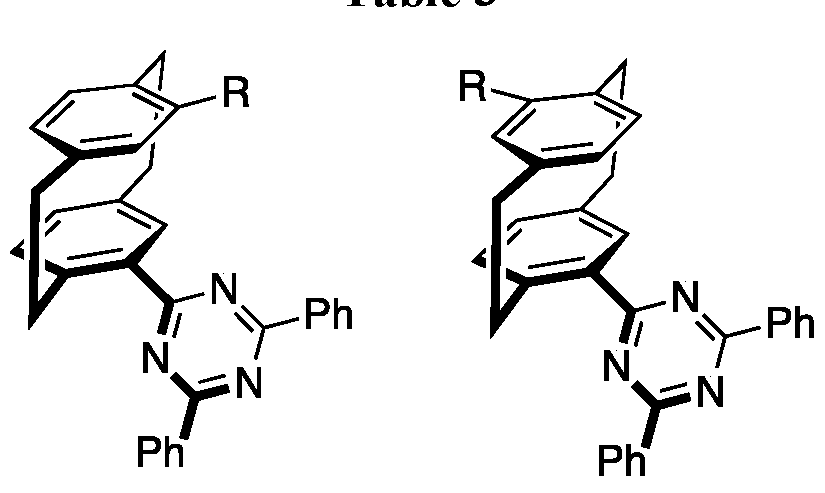
o-CP-R Trz p-CP-R/Trz
R = H, NH2, NMe2, OMe, NPh2, and N-carbazolyl, N-iminodibenzyl, N- iminostilbene, N-(I OH-phenothiazine), N-(10 - -phenoxazine), N-(9H-3,9'- bicarbazole), N-(7,12-dihydro-5H-7,12-[1 ,2]benzenonaphtho[2,3- b]carbazole), and other electron-donating aromatics or heteroaromatics.
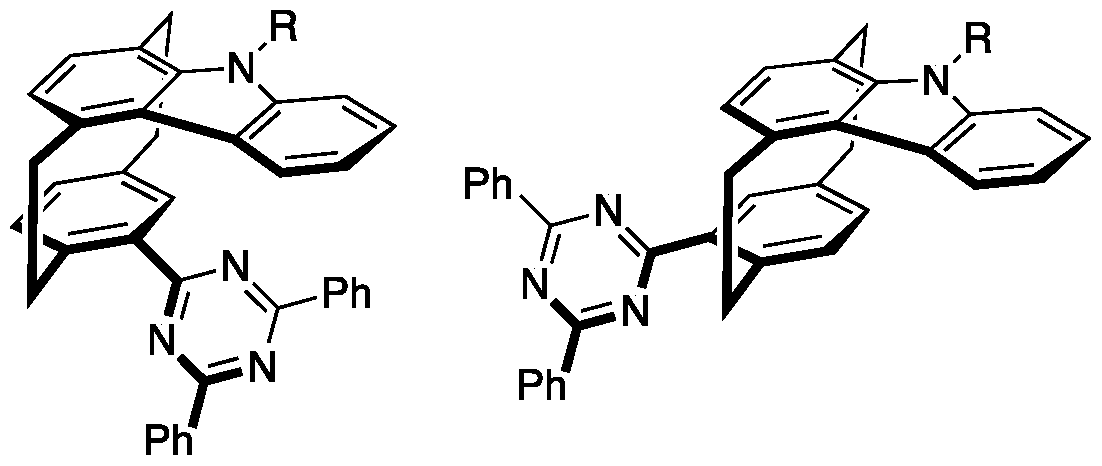
Table 4
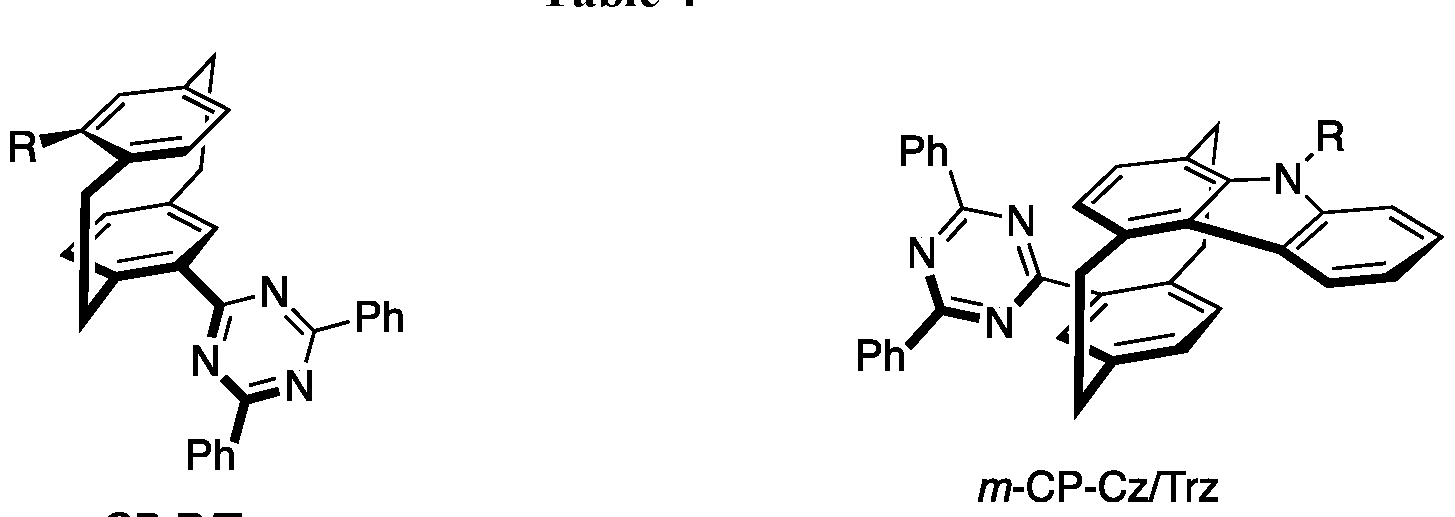
m-CP-R/Trz
R = H, NH2, NMe2, OMe, NPh2, and N-carbazolyl, R = H, Me, Aryl (Ph, 3,5-(CF3)2-C6H3,
N-iminodibenzyl, N-iminostilbene, N-(10H- 3,5-(CH3)2-C6H3, etc.) phenothiazine), N-(I OH-phenoxazine), N-(9H-3,9'- bicarbazole), N-(7,12-dihydro-5H-7,12- [1 ,2]benzenonaphtho[2,3-0]carbazole), and other
electron-donating aromatics or heteroaromatics.

Syntheses of selected compounds from Tables 3, 4, and 5 are described below.
-H/T

In a 250-mL round-bottom flask, was added CP-Br (0.70 g) and transferred 20 mL of anhydrous THF (tetrahydrofuran). The solution was placed in a dry ice/acetone bath for 15 min before dropwisely adding wBuLi (2.5 M in «-hexane, 1.04 mL) to result in a yellow
slurry. The reaction mixture was allowed to stir at -78 °C for 0.5 h. Then THF solution (20 mL) of 2-Cl-4,6-Ph2-l,3,5-C3N3 (0.53 g) was slowly transferred into the yellow slurry over a period of 5 min. After addition, the mixture was allowed to warm up to room temperature and stirred for 12 h. For work-up, the reaction mixture was quenched by saturated H4CI solution and organic layer was washed by H4CI solution twice followed by saturated NaCl twice and dried over MgSC After removing volatiles, the crude product was purified by flash chromatography (gradient 0-20% DCM in hexanes). Yield: 0.51 g,
58%.
Scheme 12. Synthesis of o-CP-NH Trz

(1) o-CP-2Br to o-CP-Br/Trz: In a 500-mL round-bottom flask, was added o-CP-2Br (4.21 g) and transferred 50 mL of anhydrous THF. The solution was placed in a dry ice/acetone bath for 15 min before dropwisely adding wBuLi (2.5 M in «-hexane, 5.0 mL) to result in a yellow slurry. The reaction mixture was allowed to stir at -78 °C for 0.5 h. Then THF solution (50 mL) of 2-Cl-4,6-Ph2-l,3,5-C3N3 (2.68 g) was slowly transferred into the yellow slurry over a period of 5 min. After addition, the mixture was allowed to warm up to room temperature and stirred for 12 h. For work-up, the reaction mixture was quenched by saturated NH4C1 solution and organic layer was washed by NH4C1 solution twice followed by saturated NaCl twice and dried over MgSC After removing volatiles, the crude product was purified by flash chromatography (gradient 0-20% DCM in hexanes). Yield: 2.2 g, 42%.
(2) o-CP-Br/Trz to o-CP-NH2/Trz: In a 200-mL Schlenk flask, were added o-CP-Br/Trz (1.55 g), NaO'Bu (1.41 g), and Pd-'BuDavePhos-OMs (0.22 g). The flask was evacuated/refilled with argon three times and then NH3 solution in 1,4-dioxane (0.5 M, 34.0 mL) was transferred under argon. The mixture was stirred at 80 °C for 16 h. For workup, the mixture was diluted with ethyl acetate and then filtered through silica gel. After removing the volatiles of the filtrate, flash chromatography (gradient 0-10% ethyl acetate in hexanes) was used to purify the product. Yield: 1.20 g, 86%.
Scheme 13. Synthesis of CP- H2/Trz

(1) /?-CP-2Br to p-CP-Βτ/Ίτζ: In a 500-mL round-bottom flask, was added /?-CP-2Br (2.20 g) and transferred 250 mL of anhydrous THF. The solution was placed in dry ice / acetone bath for 15 min before dropwisely adding wBuLi (2.5 M in «-hexane, 5.2 mL) to result in a yellow slurry. The reaction mixture was allowed to stir at -78 °C for 0.5 h. Then THF solution (30 mL) of 2-Cl-4,6-Ph2-l,3,5-C3N3 (2.68 g) was slowly transferred into the yellow slurry over a period of 5 min. After addition, the mixture was allowed to warm up to room temperature and stirred for 12 h. For work-up, the reaction mixture was quenched by saturated H4C1 solution and organic layer was washed by H4C1 solution twice followed by saturated NaCl twice and dried over MgS04. After removing volatiles, the crude product was purified by flash chromatography (gradient 0-20% DCM in hexanes). Yield: 1.5 g, 48%.
(2) /?-CP-Br/Trz to /?-CP- H2/Trz: In a 200-mL Schlenk flask, were added /?-CP-Br/Trz (1.04 g), NaO'Bu (0.33 g), and Pd-'BuDavePhos-OMs (0.14 g). The flask was evacuated/refilled with argon three times and then H3 solution in 1,4-dioxane (0.5 M, 21.0 mL) was transferred under argon. The mixture was stirred at 80 °C for 16 h. For workup, the mixture was diluted with ethyl acetate and then filtered through silica gel. After removing the volatiles of the filtrate, flash chromatography (gradient 0-20% ethyl acetate in hexanes) was used to purify the product. Yield: 0.87 g, 80%.
Scheme 14. Synthesis of o-CP-Cz/Trz

(1) o-CP- H2/Trz to o-CP-CN/Trz: In a 20-mL glass tube equipped with a screw cap, was placed o-CP- H2/Trz (1.00 g), NaO'Bu (1.35 g), and Pd-DavePhos-OMs (0.15 g). The tube was evacuated/refilled with argon three times and then added l-Br-2-Cl-C6H4
(0.34 mL) and 1,4-dioxane (4.5 mL) under argon. The mixture was stirred at 80 °C for 2.5 h. For work-up, the mixture was diluted with DCM and filtered through silica gel. The volatiles were removed under vacuum, and flash chromatography (gradient 0-20% ethyl acetate in hexanes) was used to purify the product. Yield: 1.2 g, 94%.
(2) 0-CP-CN/Trz to o-CP-Cz/Trz: In a 20-mL glass tube equipped with a screw cap, was placed K2C03 (0.69 g). The tube was then evacuated under vacuum and flame dried for ca. 1 min. After cooling down to room temperature under vacuum, o-CP-CN/Trz (0.57 g), Pd2(dba)3 (0.09 g), XPhos (0.14 g), and PivOH (0.06 g) were added to the tube. The tube was then capped and evacuate/refill with argon three times. 4.0 mL of anhydrous DMA was filled in under argon. The mixture was stirred at 1 10 °C for 16 h. For work-up, the mixture was diluted with DCM and filtered through silica gel. The filtration was washed with saturatued lithium chloride solution twice and then with saturated sodium chloride solution twice. Flash chromatography (gradient 0 to 20% DCM in hexanes) was used to purify the product. Yield: 0.42 g, 66%.
-CP- Ph2

p-CP-Br/Trz p-CP-NPh2VTrz
In a 20-mL glass tube equipped with a screw cap, was placed p-CP-Βτ/Ίτζ (0.88 g), diphenylamine (0.26 g), NaO'Bu (0.24 g), Pd2(dba)3 (dba = dibenzylideneacetone, 0.31 g) and XPhos (0.49 g). The tube was evacuated/refilled with argon three times and then added 1,4-dioxane (7.0 mL) under argon. The mixture was stirred at 1 10 °C for 1 d. For work-up, the mixture was diluted with DCM and filtered through silica gel. The volatiles were removed under vacuum, and flash chromatography (gradient 0-20% dichloromethane in hexanes) was used to purify the product. The curde product obtained from chromatography was furthure purified by trituration with methanol. Yield: 0.41 g, 45%.
Photoluminescent characterization of /?-CP- Ph2/Trz: maximum emission wavelength: 481 nm (in toluene, r. ); Photoluminescent quantum yields (PLQY): 0.75 (under air, in toluene), 0.89 (under N2, in toluene).
-(N-Cz

In a 20-mL glass tube equipped with a screw cap, was placed ?-CP-Br/Trz (0.104 g), carbazole (0.030 g), NaO'Bu (0.025 g), Pd2(dba)3 (0.037 g) and tBuXPhos (0.051 g). The tube was evacuated/refilled with argon three times and then added 1,4- dioxane (1.0 mL) under argon. The mixture was stirred at 110 °C for 1 d. For work-up, the mixture was diluted with DCM and filtered through silica gel. The volatiles were removed under vacuum, and flash chromatography (gradient 0-30% dichlorom ethane in hexanes) was used to purify the product. The curde product obtained from chromatography was furthure purified by trituration with methanol. Yield: 0.040 g, 37%.
-CP-( -CzCz)/Trz

In a 20-mL glass tube equipped with a screw cap, was placed /?-CP-Br/Trz (0.259 g), 9H-3,9'-bicarbazole (0.133 g), NaO'Bu (0.063 g), Pd2(dba)3 (0.092 g) and tBuXPhos (0.133 g). The tube was evacuated/refilled with argon three times and then added 1,4-dioxane (2.5 mL) under argon. The mixture was stirred at 110 °C for 1 d. For work-up, the mixture was diluted with DCM and filtered through silica gel. The volatiles were removed under vacuum, and flash chromatography (gradient 0-30% dichloromethane in hexanes) was used to purify the product. The curde product obtained from chromatography was furthure purified by trituration with methanol. Yield: 0.080 g, 26%.
Photoluminescent characterization of /?-CP-(N-CzCz)/Trz: maximum emission wavelength: 438 nm (in toluene, r.t), 514 nm (in dichloromethane, r.t), 456 nm (thin film);
Photoluminescent quantum yields (PLQY): 0.08 (under air, in toluene), 0.20 (under N2, in toluene).
-(N-Id

p-CP-Br/Trz p-CP-(N-ldb)/Trz
In a 20-mL glass tube equipped with a screw cap, was placed ?-CP-Br/Trz (0.104 g), iminodibenzyl (0.031 g), NaO'Bu (0.025 g), Pd2(dba)3 (0.037 g) and RuPhos (0.056 g). The tube was evacuated/refilled with argon three times and then added 1,4- dioxane (1.0 mL) under argon. The mixture was stirred at 110 °C for 1 d. For work-up, the mixture was diluted with DCM and filtered through silica gel. The volatiles were removed under vacuum, and flash chromatography (gradient 0-30% dichlorom ethane in hexanes) was used to purify the product. Yield: 0.040 g, 40%.
-CP-(N-Ptz

In a 20-mL glass tube equipped with a screw cap, was placed /?-CP-Br/Trz (0.259 g), phenothiazine (0.080 g), NaO'Bu (0.063 g), Pd2(dba)3 (0.092 g) and XPhos (0.143 g). The tube was evacuated/refilled with argon three times and then added 1,4- dioxane (2.5 mL) under argon. The mixture was stirred at 110 °C for 1 d. For work-up, the mixture was diluted with DCM and filtered through silica gel. The volatiles were removed under vacuum, and flash chromatography (gradient 0-30% dichlorom ethane in hexanes) was used to purify the product. The curde product obtained from chromatography was furthure purified by trituration with methanol. Yield: 0.100 g, 39%.
Scheme 20. Synthesis of>CP-(N-TTC-Cz)/Trz

In a 20-mL glass tube equipped with a screw cap, was placed ?-CP-Br/Trz (0.104 g), TTC-Cz (0.062 g), NaO'Bu (0.025 g), Pd2(dba)3 (0.037 g) and tBuXPhos (0.051 g). The tube was evacuated/refilled with argon three times and then added 1,4- dioxane (1.0 mL) under argon. The mixture was stirred at 110 °C for 1 d. For work-up, the mixture was diluted with DCM and filtered through silica gel. The volatiles were removed under vacuum, and flash chromatography (gradient 0-30% dichlorom ethane in hexanes) was used to purify the product. The curde product obtained from chromatography was furthure purified by trituration with methanol. Yield: 0.065 g, 42%.
-CP-(N-Poz

In a 20-mL glass tube equipped with a screw cap, was placed /?-CP-Br/Trz (0.052 g), phenoxazine (0.017 g), NaO'Bu (0.014 g), Pd2(dba)3 (0.018 g) and XPhos (0.029 g). The tube was evacuated/refilled with argon three times and then added 1,4- dioxane (0.5 mL) under argon. The mixture was stirred at 110 °C for 1 d. For work-up, the mixture was diluted with DCM and filtered through silica gel. The volatiles were removed under vacuum, and flash chromatography (gradient 0-30% dichlorom ethane in hexanes) was used to purify the product. Yield: 0.028 g, 50%.
Scheme 2 -(N-Ard)/Trz

p-CP-Br Trz p-CP-(N-Ard)/Trz
In a 20-mL glass tube equipped with a screw cap, was placed ?-CP-Br/Trz (0.052 g), phenoxazine (0.017 g), NaC/Bu (0.014 g), Pd2(dba)3 (0.028 g) and XPhos (0.043 g). The tube was evacuated/refilled with argon three times and then added 1,4- dioxane (0.5 mL) under argon. The mixture was stirred at 110 °C for 1 d. For work-up, the mixture was diluted with DCM and filtered through silica gel. The volatiles were removed under vacuum, and flash chromatography (gradient 0-30% dichlorom ethane in hexanes) was used to purify the product. Yield: 0.010 g, 19%.
Scheme 23. Synthesis of o-CP- Ph2/Trz

o-CP-Br Trz o-CP-NPh2/Trz
In a 20-mL glass tube equipped with a screw cap, was placed o-CP-Br/Trz (0.052 g), diphenylamine (0.019 g), NaO'Bu (0.014 g), Pd2(dba)3 (0.028 g) and XPhos (0.043 g). The tube was evacuated/refilled with argon three times and then added 1,4- dioxane (0.5 mL) under argon. The mixture was stirred at 110 °C for 1 d. For work-up, the mixture was diluted with DCM and filtered through silica gel. The volatiles were removed under vacuum, and flash chromatography (gradient 0-20% dichloromethane in hexanes) was used to purify the product. Yield: 0.016 g, 20%.
Example 3 - Compounds where donor /acceptor interact via spatial proximity
Table 6 depicts compounds that involve a donor (top ring)-acceptor (heteroaromatic group) interaction through spatial proximity.
Table 6

Example 4 - Polymeric materials for single color light OLED applications
[2.2]paracylophane is a dimer of /?-xylylene which can polymerize to form parylene, a trade name for variety poly( -xylylene) polymers. The process is "green" polymer chemistry because, under pyrolysis conditions (usually heat and vacuum), [2.2]paracyclophane yields 100% monomer, i.e., /?-xylylene, with no by-products.
By anaology, we anticipate that [2.2]paracylophane derived N-arylated carbazoles will undergo similar process (Gorham Process) and yield poly(carbazole) polymers, thereby forming homogeneous polymeric carbazole-based OLED materials, as depicted in Scheme 15. See Gorham, W. F. (1966), A New, General Synthetic Method for the Preparation of Linear Poly-p-xylylenes. J. Polym. Sci. A-l Polym. Chem., 4: 3027-3039.
Scheme 24

Example 5 - Polymeric materials for white light OLED applications
[2.2]paracylophane is a dimer of /?-xylylene which can polymerize to form parylene, a trade name for variety poly( -xylylene) polymers. The process is "green" polymer
chemistry because, under pyrolysis conditions (usually heat and vacuum), [2.2]paracyclophane yields 100% monomer, i.e., /?-xylylene, with no by-products.
By anaology, we anticipate that asymmetrically-substituted [2.2]paracylophane derived N-arylated carbazoles will undergo similar process (Gorham Process) and yield poly(carbazole) polymers, thereby forming heterogeneous polymeric carbazole-based OLED materials, as depicted in Scheme 16. See Gorham, W. F. (1966), A New, General Synthetic Method for the Preparation of Linear Poly-p-xylylenes. J. Polym. Sci. A-l Polym. Chem., 4: 3027-3039. In the resulting polymer, the different repeat units may be randomly distributed or in a certain order. By tuning identity of Rx and Ry, and relative concentrations of starting materials, the resulting polymers may be white light emitters.
heme 25

p-CP-2Br p-CP-Br/Pmd p-CP-NPh2/Pmd
/?-CP-2Br to /?-CP-Br/Pmd: In a 500-mL round-bottom flask, is added /?-CP-2Br (1.2 equiv.) and 250 mL of anhydrous THF. The solution is placed in dry ice / acetone bath for 15 min before dropwisely adding «BuLi (2.5 M in «-hexane, 1.3 equiv.) to result in a yellow slurry. The reaction mixture is allowed to stir at -78 °C for 0.5 h. Then THF solution (30 mL) of 2-chloropyrimidine (1.0 equiv.) is slowly transferred into the yellow slurry over a period of 5 min. After addition, the mixture is allowed to warm up to room temperature
and stirred for 12 h. For work-up, the reaction mixture is quenched by saturated H4CI solution and organic layer is washed by H4CI solution twice followed by saturated NaCl twice and dried over MgSC After removing volatiles, the crude product is purified by flash chromatography (gradient 0-20% DCM in hexanes).
p- P-BrfPmd to >-CP- Ph2/Pmd: In a 20 mL reaction tube equipped with Teflon cap, are added ?-CP-Br/Pmd (1.0 equiv.), NaO'Bu (1.3 equiv.), diphenylamine (0.85 equiv.), Pd2(dba)3 (20 mol% [Pd]), and XPhos (30 mol%). The flask is evacuated/refilled with argon three times and then 1,4-dioxane (0.2 M for p- P-BrfPmd) is transferred under argon. The mixture is stirred at 1 10 °C for 1 d. For work-up, the mixture is diluted with ethyl acetate and then filtered through silica gel. After removing the volatiles of the filtrate, flash chromatography (gradient 0-30% dichloromethane in hexanes) is used to purify the product.
-CP- Ph2/Ipn

p-CP-2Br p-CP-Br lpn p-CP-NPhj lpn
/?-CP-2Br to /?-CP-Br/Ipn: In a 500-mL round-bottom flask, is added /?-CP-2Br (1.2 equiv.) and 250 mL of anhydrous TUF. The solution is placed in dry ice / acetone bath for 15 min before dropwisely adding «BuLi (2.5 M in «-hexane, 1.3 equiv.) to result in a yellow slurry. The reaction mixture is allowed to stir at -78 °C for 0.5 h. Then TUF solution (30 mL) of 2-chloroisophthalonitrile (1.0 equiv.) is slowly transferred into the yellow slurry over a period of 5 min. After addition, the mixture is allowed to warm up to room temperature and stirred for 12 h. For work-up, the reaction mixture is quenched by saturated H4CI solution and organic layer is washed by H4CI solution twice followed by saturated NaCl twice and dried over MgSC After removing volatiles, the crude product is purified by flash chromatography (gradient 0-20% DCM in hexanes).
/?-CP-Br/Ipn to /?-CP- Ph2/Ipn: In a 20 mL reaction tube equipped with Teflon cap, are added >-CP-Br/Ipn (1.0 equiv.), NaO'Bu (1.3 equiv.), diphenylamine (0.85 equiv.), Pd2(dba)3 (20 mol% [Pd]), and XPhos (30 mol%). The flask is evacuated/refilled with argon three times and then 1,4-dioxane (0.2 M for p- P- r/lp ) is transferred under argon. The mixture is stirred at 1 10 °C for 1 d. For work-up, the mixture is diluted with ethyl
acetate and then filtered through silica gel. After removing the volatiles of the filtrate, flash chromatography (gradient 0-30% dichloromethane in hexanes) is used to purify the product.
-CP-(N-Cz)/(p-Py)

p-CP-2Br p-CP-Br/(p-Py) p-CP-(N-Cz) (p-Py) p-CP-2Br to ?-CP-Br/(p-Py): In a 20 mL reaction tube equipped with Teflon cap, are added p- P-2Br (1.0 equiv.), K2C03 (3.0 equiv.), 4-pyridineboronic acid (1.2 equiv.), and Pd-XPhos-G3 precatalyst (5 mol%). The flask is evacuated/refilled with argon three times and then 1,4-dioxane (0.2 M for p- P-2Br) is transferred under argon. The mixture is stirred at 100 °C for 1 d. For work-up, the mixture is diluted with ethyl acetate and then filtered through silica gel. After removing the volatiles of the filtrate, flash chromatography (gradient 0-20% dichloromethane in hexanes) is used to purify the product.
p- P-Br/(p-Py) to ?-CP-(N-Cz)/(p-Py): In a 20 mL reaction tube equipped with Teflon cap, are added ?-CP-Br/(p-Py) (1.0 equiv.), NaO'Bu (1.3 equiv.), carbazole (0.85 equiv.), Pd2(dba)3 (20 mol% [Pd]), and XPhos (30 mol%). The flask is evacuated/refilled with argon three times and then 1,4-dioxane (0.2 M for >-CP-Br/(p-Py)) is transferred under argon. The mixture is stirred at 110 °C for 1 d. For work-up, the mixture is diluted with ethyl acetate and then filtered through silica gel. After removing the volatiles of the filtrate, flash chromatography (gradient 0-30% dichloromethane in hexanes) is used to purify the product.
-CP-(N-Cz)/(3,5-C6H3(CF3)2)

p-CP-2Br p-CP-(N-Czy(3,5-C6H3(CF3)2) p-CP-(N-Cz) (3,5-C6H3(CF3)2)
/?-CP-2Br to ^-CP-Br/(3,5-C6H3(CF3)2): In a 20 mL reaction tube equipped with Teflon cap, are added >-CP-2Br (1.0 equiv.), K2C03 (3.0 equiv.), 3,5- bis(trifluoromethyl)benzeneboronic acid (1.2 equiv.), Pd-XPhos-G3 precatalyst (5 mol%). The flask is evacuated/refilled with argon three times and then 1,4-dioxane (0.2 M for p-
CP-2Br) is transferred under argon. The mixture is stirred at 100 °C for 1 d. For work-up, the mixture is diluted with ethyl acetate and then filtered through silica gel. After removing the volatiles of the filtrate, flash chromatography (gradient 0-20% dichloromethane in hexanes) is used to purify the product.
/?-CP-Br/(3,5-C6H3(CF3)2) to /?-CP-(N-Cz)/(3,5-C6H3(CF3)2): In a 20 mL reaction tube equipped with Teflon cap, are added ?-CP-Br/(3,5-C6H3(CF3)2) (1.0 equiv.), NaO'Bu (1.3 equiv.), carbazole (0.85 equiv.), Pd2(dba)3 (20 mol% [Pd]), and XPhos (30 mol%). The flask is evacuated/refilled with argon three times and then 1,4-dioxane (0.2 M for p- P- Br/(3,5-C6H3(CF3)2)) is transferred under argon. The mixture is stirred at 110 °C for 1 d. For work-up, the mixture is diluted with ethyl acetate and then filtered through silica gel. After removing the volatiles of the filtrate, flash chromatography (gradient 0-30% dichloromethane in hexanes) is used to purify the product.
INCORPORATION BY REFERENCE
All of the U.S. patents and U.S. patent application publications cited herein are hereby incorporated by reference.
EQUIVALENTS
Those skilled in the art will recognize, or be able to ascertain using no more than routine experimentation, many equivalents to the specific embodiments of the invention described herein. Such equivalents are intended to be encompassed by the following claims.
Claims
A compound of formula la or formula lb:

Formula lb
wherein
A is an aromatic moiety substituted with at least one electron-withdrawing substituent or a heteroaromatic moiety substituted with at least one electron-withdrawing substituent;
R1 is, independently for each occcurrence, hydrogen or alkyl; and
B is absent or an optionally substituted heteroaromatic moiety.
2. The compound of claim 1, wherein A is an aromatic moiety substituted with at least one electron- withdrawing substituent.
3. The compound of claim 1, wherein A is a heteroaromatic moiety substituted with at least one electron-withdrawing substituent.
4. The compound of claim 1, wherein A is phenyl substituted with at least one electron-withdrawing substituent.
5. The compound of claim 1, wherein A is phenyl substituted with one electron- withdrawing substituent.
6. The compound of claim 1, wherein A is phenyl substituted with two electron- withdrawing substituents.
7. The compound of claim 1, wherein A is phenyl substituted in the 3-position with an electron-withdrawing substituent.
8. The compound of claim 1, wherein A is phenyl substituted in the 5-position with an electron-withdrawing substituent.
9. The compound of claim 1, wherein A is phenyl substituted in the 2-position with an electron-withdrawing substituent.
10. The compound of claim 1, wherein A is phenyl substituted in the 6-position with an electron-withdrawing substituent.
11. The compound of claim 1, wherein A is phenyl substituted in the 4-position with an electron-withdrawing substituent.
12. The compound of claim 1, wherein A is phenyl substituted with two electron- withdrawing substituents.
13. The compound of claim 1, wherein A is phenyl substituted in the 3-position with an electron-withdrawing substituent and in the 5-position with an electron-withdrawing substituent.
14. The compound of claim 1, wherein A is phenyl substituted in the 2-position with an electron-withdrawing substituent and in the 6-position with an electron-withdrawing substituent.
15. The compound of any one of claims 1-14, wherein the electron- withdrawing substituent is selected from the group consisting of -CHO, -C(0)Rn, -C(0)ORn, -C(0)OH, -C(0)C1, -CF3, -CC13, -CN, S03H, -N02, and substituted or unsubstituted triazinyl; and Rn is alkyl, aryl, or aralkyl.
16. The compound of any one of claims 1-15, wherein B is absent.
17. The compound of any one of claims 1-15, wherein B is an optionally substituted heteroaromatic moiety.
18. The compound of any one of claims 1-15, wherein B is a substituted heteroaromatic moiety.
19. The compound of any one of claims 1-15, wherein B is an unsubstituted heteroaromatic moiety.
20. The compound of any one of claims 1-15, wherein the B-ring is derived from an acridine, carbazole, carboline, cinnoline, furan, furazan, imidazole, indazole, indole, indolizine, isobenzofuran, isoindole, isoquinoline, isothiazole, isoxazole, naphthyridine, oxazole, phenanthridine, phenanthroline, phenazine, phthalazine, pteridine, purine, pyrazine, pyrazole, pyridazine, pyridine, pyrimidine, pyrrole, quinazoline, quinoline, quinoxaline, thiadiazole, thianthrene, thiophene, triazole, or trithiole.
21. The compound of any one of claims 1-15, wherein the B-ring is derived from an indole.
22. The compound of any one of claims 1-15, wherein the B-ring is
 23. The compound of any one of claims 1-22, wherein R1 is hydrogen.
24. The compound of any one of claims 1-22, wherein R1 is alkyl.
25. The compound of any one of claims 1-22, wherein R1 is methyl, ethyl, propyl, or
A compound of formula Ila', formula lib', or formula lie'

Formula Ila'

Formula lib'

Formula lie'
wherein
R1 is, independently for each occurrence, hydrogen or alkyl;
R2 is substituted or unsubstituted triazinyl, substituted or unsubstituted phenyl, substituted or unsubstituted pyridyl, substituted or unsubstituted pyrimidyl, or an electron- withdrawing group; and
R3 is hydrogen, alkyl, an optionally substituted aromatic moiety, or an optionally substituted heteroaromatic moiety.
27. The compound of claim 26, wherein R1 is hydrogen.
28. The compound of claim 26, wherein R1 is alkyl.
29. The compound of claim 26, wherein R1 is methyl, ethyl, propyl, or butyl.
30. The compound of any one of claims 26-29, wherein R2 is substituted triazinyl.
31. The compound of any one of claims 26-29, wherein R2 is phenyl-substituted triazinyl.
32. The compound of any one of claims 26-29, wherein R2 is bisphenyl-substituted triazinyl.
33. The compound of any one of claims 26-29, wherein R2 is unsubstituted triazinyl.
34. The compound of any one of claims 26-33, wherein R3 is hydrogen.
35. The compound of any one of claims 26-33, wherein R3 is alkyl.
36. The compound of any one of claims 26-33, wherein R3 is methyl, ethyl, propyl, or butyl.
37. The compound of any one of claims 26-33, wherein R3 is a substituted aromatic moiety.
38. The compound of any one of claims 26-33, wherein R3 is an unsubstituted aromatic moiety.
39. The compound of any one of claims 26-33, wherein R3 is phenyl.
40. The compound of any one of claims 26-33, wherein R3 is a substituted heteroaromatic moiety.
41. The compound of any one of claims 26-33, wherein R3 is an unsubstituted heteroaromatic moiety.
42. The compound of any one of claims 26-33, wherein R3 is an aromatic moiety substituted with at least one electron-withdrawing substituent.
43. The compound of any one of claims 26-33, wherein R3 is phenyl substituted with at least one electron-withdrawing substituent.
44. The compound of any one of claims 26-33, wherein R3 is phenyl substituted with one electron- withdrawing substituent.
45. The compound of any one of claims 26-33, wherein R3 is phenyl substituted with two electron-withdrawing substituents.
46. The compound of any one of claims 26-33, wherein R3 is phenyl substituted in the 3-position with an electron-withdrawing substituent.
47. The compound of any one of claims 26-33, wherein R3 is phenyl substituted in the 5-position with an electron-withdrawing substituent.
48. The compound of any one of claims 26-33, wherein R is phenyl substituted in the
2- position with an electron-withdrawing substituent.
49. The compound of any one of claims 26-33, wherein R3 is phenyl substituted in the 6-position with an electron-withdrawing substituent.
50. The compound of any one of claims 26-33, wherein R3 is phenyl substituted in the
4- position with an electron-withdrawing substituent.
51. The compound of any one of claims 26-33, wherein R3 is phenyl substituted with two electron-withdrawing substituents.
52. The compound of any one of claims 26-33, wherein R3 is phenyl substituted in the
3- position with an electron-withdrawing substituent and in the 5-position with an electron- withdrawing substituent.
53. The compound of any one of claims 26-33, wherein R3 is phenyl substituted in the
2- position with an electron-withdrawing substituent and in the 6-position with an electron- withdrawing substituent.
54. The compound of any one of claims 26-53, wherein the electron- withdrawing substituent is selected from the group consisting of -CHO, -C(0)Rn, -C(0)ORn, -C(0)OH, -C(0)C1, -CF3, -CC13, -CN, S03H, -N02, and substituted or unsubstituted triazinyl; and Rn is alkyl, aryl, or aralkyl.
55. The compound of any one of claims 26-33, wherein R3 is an aromatic moiety substituted with at least one alkyl, aryl, or aralkyl substituent.
56. The compound of any one of claims 26-33, wherein R3 is phenyl substituted with at least one alkyl, aryl, or aralkyl substituent.
57. The compound of any one of claims 26-33, wherein R3 is an aromatic moiety substituted with one alkyl, aryl, or aralkyl substituent.
58. The compound of any one of claims 26-33, wherein R3 is phenyl substituted with one alkyl, aryl, or aralkyl substituent.
59. The compound of any one of claims 26-33, wherein R3 is phenyl substituted in the
3- position with an alkyl, aryl, or aralkyl substituent.
60. The compound of any one of claims 26-33, wherein R3 is phenyl substituted in the
5- position with an alkyl, aryl, or aralkyl substituent.
61. The compound of any one of claims 26-33, wherein R3 is phenyl substituted in the 2-position with an alkyl, aryl, or aralkyl substituent.
62. The compound of any one of claims 26-33, wherein R is phenyl substituted in the 6-position with an alkyl, aryl, or aralkyl substituent.
63. The compound of any one of claims 26-33, wherein R3 is phenyl substituted in the 4-position with an alkyl, aryl, or aralkyl substituent.
64. The compound of any one of claims 26-33, wherein R3 is an aromatic moiety substituted with two alkyl, aryl, or aralkyl substituents.
65. The compound of any one of claims 26-33, wherein R3 is phenyl substituted with two alkyl, aryl, or aralkyl substituents.
66. The compound of any one of claims 26-33, wherein R3 is phenyl substituted in the 3-position with an alkyl, aryl, or aralkyl substituent and in the 5-position with an alkyl, aryl, or aralkyl substituent.
67. The compound of any one of claims 26-33, wherein R3 is phenyl substituted in the 2-position with an alkyl, aryl, or aralkyl substituent and in the 6-position with an alkyl, aryl, or aralkyl substituent.
68. A compound of formula Ilia', formula Illb', or formula IIIc' :

Formula Ilia'

Formula Illb'

Formula IIIc'
wherein
R1 is, independently for each occurrence, hydrogen or alkyl;
R2 is substituted or unsubstituted triazinyl, substituted or unsubstituted phenyl, substituted or unsubstituted pyridyl, substituted or unsubstituted pyrimidyl, or an electron- withdrawing group; and
R4 is hydrogen or an electron-donating group.
69. The compound of claim 68, wherein R1 is hydrogen.
70. The compound of claim 68, wherein R1 is alkyl.
71. The compound of claim 68, wherein R1 is methyl, ethyl, propyl, or butyl.
72. The compound of any one of claims 68-71, wherein R2 is substituted triazinyl.
73. The compound of any one of claims 68-71, wherein R2 is phenyl-substituted triazinyl.
74. The compound of any one of claims 68-71, wherein R2 is bisphenyl-substituted triazinyl.
75. The compound of any one of claims 68-71, wherein R2 is unsubstituted triazinyl.
76. The compound of any one of claims 68-75, wherein R4 is hydrogen.
77. The compound of any one of claims 68-75, wherein R4 is - H2, - HRn, -N(Rn)2, -OH, -ORn, - RnC(0)Rn, - HC(0)Rn, or -OC(0)Rn, wherein Rn is alkyl, aryl, or aralkyl.
78. A compound of formula IVa or formula IVb:

Formula IVb
wherein
R1 is, independently for each occurrence, hydrogen or alkyl;
B is absent or an optionally substituted heteroaromatic moiety; and
R3 is hydrogen, alkyl, an optionally substituted aromatic moiety, or an optionally substituted heteroaromatic moiety.
79. The compound of claim 78, wherein R1 is hydrogen.
80. The compound of claim 78, wherein R1 is alkyl.
81. The compound of claim 78, wherein R1 is methyl, ethyl, propyl, or butyl.
82. The compound of any one of claims 78-81, wherein R3 is hydrogen.
83. The compound of any one of claims 78-81, wherein R3 is alkyl.
84. The compound of any one of claims 78-81, wherein R3 is methyl, ethyl, propyl, or butyl.
85. The compound of any one of claims 78-81, wherein R3 is a substituted aromatic moiety.
86. The compound of any one of claims 78-81, wherein R3 is an unsubstituted aromatic moiety.
87. The compound of any one of claims 78-81, wherein R3 is phenyl.
88. The compound of any one of claims 78-81, wherein R3 is a substituted heteroaromatic moiety.
89. The compound of any one of claims 78-81, wherein R3 is an unsubstituted heteroaromatic moiety.
91. The compound of any one of claims 78-81, wherein R3 is an aromatic moiety substituted with at least one alkyl, aryl, or aralkyl substituent.
92. The compound of any one of claims 78-81, wherein R3 is phenyl substituted with at least one alkyl, aryl, or aralkyl substituent.
93. The compound of any one of claims 78-81, wherein R3 is an aromatic moiety substituted with one alkyl, aryl, or aralkyl substituent.
94. The compound of any one of claims 78-81, wherein R3 is phenyl substituted with one alkyl, aryl, or aralkyl substituent.
95. The compound of any one of claims 78-81, wherein R3 is phenyl substituted in the 3-position with an alkyl, aryl, or aralkyl substituent.
96. The compound of any one of claims 78-81, wherein R3 is phenyl substituted in the
5- position with an alkyl, aryl, or aralkyl substituent.
97. The compound of any one of claims 78-81, wherein R3 is phenyl substituted in the 2-position with an alkyl, aryl, or aralkyl substituent.
98. The compound of any one of claims 78-81, wherein R3 is phenyl substituted in the
6- position with an alkyl, aryl, or aralkyl substituent.
99. The compound of any one of claims 78-81, wherein R is phenyl substituted in the 4-position with an alkyl, aryl, or aralkyl substituent.
100. The compound of any one of claims 78-81, wherein R3 is an aromatic moiety substituted with two alkyl, aryl, or aralkyl substituents.
101. The compound of any one of claims 78-81, wherein R3 is phenyl substituted with two alkyl, aryl, or aralkyl substituents.
102. The compound of any one of claims 78-81, wherein R3 is phenyl substituted in the 3-position with an alkyl, aryl, or aralkyl substituent and in the 5-position with an alkyl, aryl, or aralkyl substituent.
103. The compound of any one of claims 78-81, wherein R3 is phenyl substituted in the 2-position with an alkyl, aryl, or aralkyl substituent and in the 6-position with an alkyl, aryl, or aralkyl substituent.
104. The compound of any one of claims 78-103, wherein B is an optionally substituted heteroaromatic moiety.
105. The compound of any one of claims 78-103, wherein B is a substituted heteroaromatic moiety.
106. The compound of any one of claims 78-103, wherein B is an unsubstituted heteroaromatic moiety.
107. The compound of any one of claims 78-106, wherein the B-ring is derived from an acridine, carbazole, carboline, cinnoline, furan, furazan, imidazole, indazole, indole, indolizine, isobenzofuran, isoindole, isoquinoline, isothiazole, isoxazole, naphthyridine, oxazole, phenanthridine, phenanthroline, phenazine, phthalazine, pteridine, purine, pyrazine, pyrazole, pyridazine, pyridine, pyrimidine, pyrrole, quinazoline, quinoline, quinoxaline, thiadiazole, thianthrene, thiophene, triazole, or trithiole.
108. The compound of any one of claims 78-106, wherein the B-ring is derived from a pyridine, quinoline, thiadiazole, triazole, or trithiole.
109. A compound of formula Va or formula Vb:

Formula Va

Formula Vb
wherein
R1 is, independently for each occurrence, hydrogen or alkyl;
B is absent or an optionally substituted heteroaromatic moiety;
X is O, S, or R3; and
R3 is hydrogen, alkyl, an optionally substituted aromatic moiety, or an optionally substituted heteroaromatic moiety.
110. The compound of claim 109, wherein R1 is hydrogen.
111. The compound of claim 109, wherein R1 is alkyl.
112. The compound of claim 109, wherein R1 is methyl, ethyl, propyl, or butyl.
113. The compound of any one of claims 109-112, wherein X is O.
114. The compound of any one of claims 109-112, wherein X is S.
115. The compound of any one of claims 109-112, wherein X is NR3.
116. The compound of claim 115, wherein R3 is hydrogen.
117. The compound of claim 115, wherein R3 is alkyl.
118. The compound of claim 115, wherein R3 is methyl, ethyl, propyl, or butyl.
119. The compound of claim 115, wherein R3 is a substituted aromatic moiety.
120. The compound of claim 115, wherein R3 is an unsubstituted aromatic moiety.
121. The compound of claim 115, wherein R3 is phenyl.
122. The compound of claim 115, wherein R3 is a substituted heteroaromatic moiety.
123. The compound of claim 115, wherein R3 is an unsubstituted heteroaromatic moiety.
124. The compound of claim 115, wherein R3 is an aromatic moiety substituted with at least one alkyl, aryl, or aralkyl substituent.
125. The compound of claim 115, wherein R3 is phenyl substituted with at least one alkyl, aryl, or aralkyl substituent.
126. The compound of claim 115, wherein R3 is an aromatic moiety substituted with one alkyl, aryl, or aralkyl substituent.
127. The compound of claim 115, wherein R3 is phenyl substituted with one alkyl, aryl, or aralkyl substituent.
128. The compound of claim 115, wherein R is phenyl substituted in the 3-position with an alkyl, aryl, or aralkyl substituent.
129. The compound of claim 115, wherein R3 is phenyl substituted in the 5-position with an alkyl, aryl, or aralkyl substituent.
130. The compound of claim 115, wherein R3 is phenyl substituted in the 2-position with an alkyl, aryl, or aralkyl substituent.
131. The compound of claim 115, wherein R3 is phenyl substituted in the 6-position with an alkyl, aryl, or aralkyl substituent.
132. The compound of claim 115, wherein R3 is phenyl substituted in the 4-position with an alkyl, aryl, or aralkyl substituent.
133. The compound of claim 115, wherein R3 is an aromatic moiety substituted with two alkyl, aryl, or aralkyl substituents.
134. The compound of claim 115, wherein R3 is phenyl substituted with two alkyl, aryl, or aralkyl substituents.
135. The compound of claim 115, wherein R3 is phenyl substituted in the 3-position with an alkyl, aryl, or aralkyl substituent and in the 5-position with an alkyl, aryl, or aralkyl substituent.
136. The compound of claim 115, wherein R3 is phenyl substituted in the 2-position with an alkyl, aryl, or aralkyl substituent and in the 6-position with an alkyl, aryl, or aralkyl substituent.
137. The compound of any one of claims 109-136, wherein B is an optionally substituted heteroaromatic moiety.
138. The compound of any one of claims 109-136, wherein B is a substituted heteroaromatic moiety.
139. The compound of any one of claims 109-136, wherein B is an unsubstituted heteroaromatic moiety.
140. The compound of any one of claims 109-139, wherein the B-ring is derived from an acridine, carbazole, carboline, cinnoline, furan, furazan, imidazole, indazole, indole, indolizine, isobenzofuran, isoindole, isoquinoline, isothiazole, isoxazole, naphthyridine, oxazole, phenanthridine, phenanthroline, phenazine, phthalazine, pteridine, purine, pyrazine, pyrazole, pyridazine, pyridine, pyrimidine, pyrrole, quinazoline, quinoline, quinoxaline, thiadiazole, thianthrene, thiophene, triazole, or trithiole.
141. The compound of any one of claims 109-139, wherein the B-ring is derived from a pyridine, quinoline, thiadiazole, triazole, or trithiole.
142. A polymer comprising a re eat unit of formula Via or formula VIb:

A is an aromatic moiety substituted with at least one electron-withdrawing substituent or a heteroaromatic moiety substituted with at least one electron-withdrawing substituent;
R1 is, independently for each occurrence, hydrogen or alkyl; and
R3 is hydrogen, alkyl, an optionally substituted aromatic moiety, or an optionally substituted heteroaromatic moiety.
143. The polymer of claim 142, wherein A is an aromatic moiety substituted with at least one electron- withdrawing substituent.
144. The polymer of claim 142, wherein A is a heteroaromatic moiety substituted with at least one electron-withdrawing substituent.
145. The polymer of claim 142, wherein A is phenyl substituted with at least one electron-withdrawing substituent.
146. The polymer of claim 142, wherein A is phenyl substituted with one electron- withdrawing substituent.
147. The polymer of claim 142, wherein A is phenyl substituted with two electron- withdrawing substituents.
148. The polymer of claim 142, wherein A is phenyl substituted in the 3-position with an electron-withdrawing substituent.
149. The polymer of claim 142, wherein A is phenyl substituted in the 5-position with an electron-withdrawing substituent.
150. The polymer of claim 142, wherein A is phenyl substituted in the 2-position with an electron-withdrawing substituent.
151. The polymer of claim 142, wherein A is phenyl substituted in the 6-position with an electron-withdrawing substituent.
152. The polymer of claim 142, wherein A is phenyl substituted in the 4-position with an electron-withdrawing substituent.
153. The polymer of claim 142, wherein A is phenyl substituted with two electron- withdrawing substituents.
154. The polymer of claim 142, wherein A is phenyl substituted in the 3-position with an electron-withdrawing substituent and in the 5-position with an electron-withdrawing substituent.
155. The polymer of claim 142, wherein A is phenyl substituted in the 2-position with an electron-withdrawing substituent and in the 6-position with an electron-withdrawing substituent.
156. The polymer of any one of claims 142-155, wherein the electron- withdrawing substituent is selected from the group consisting of -CHO, -C(0)Rn, -C(0)ORn, -C(0)OH, -C(0)C1, -CF3, -CC13, -CN, S03H, -N02, and substituted or unsubstituted triazinyl; and Rn is alkyl, aryl, or aralkyl.
157. The polymer of any one of claims 142-156, wherein R1 is hydrogen.
158. The polymer of any one of claims 142-156, wherein R1 is alkyl.
159. The polymer of any one of claims 142-156, wherein R1 is methyl, ethyl, propyl, or butyl.
160. The polymer of any one of claims 142-159, wherein R3 is hydrogen.
161. The polymer of any one of claims 142-159, wherein R3 is alkyl.
162. The polymer of any one of claims 142-159, wherein R3 is methyl, ethyl, propyl, or butyl.
163. The polymer of any one of claims 142-159, wherein R3 is a substituted aromatic moiety.
164. The polymer of any one of claims 142-159, wherein R is an unsubstituted aromatic moiety.
165. The polymer of any one of claims 142-159, wherein R3 is phenyl.
166. The polymer of any one of claims 142-159, wherein R3 is a substituted heteroaromatic moiety.
167. The polymer of any one of claims 142-159, wherein R3 is an unsubstituted heteroaromatic moiety.
168. The polymer of any one of claims 142-159, wherein R3 is an aromatic moiety substituted with at least one electron-withdrawing substituent.
169. The polymer of any one of claims 142-159, wherein R3 is phenyl substituted with at least one electron-withdrawing substituent.
170. The polymer of any one of claims 142-159, wherein R3 is phenyl substituted with one electron- withdrawing substituent.
171. The polymer of any one of claims 142-159, wherein R3 is phenyl substituted with two electron-withdrawing substituents.
172. The polymer of any one of claims 142-159, wherein R3 is phenyl substituted in the
3- position with an electron-withdrawing substituent.
173. The polymer of any one of claims 142-159, wherein R3 is phenyl substituted in the
5- position with an electron-withdrawing substituent.
174. The polymer of any one of claims 142-159, wherein R3 is phenyl substituted in the
2- position with an electron-withdrawing substituent.
175. The polymer of any one of claims 142-159, wherein R3 is phenyl substituted in the
6- position with an electron-withdrawing substituent.
176. The polymer of any one of claims 142-159, wherein R3 is phenyl substituted in the
4- position with an electron-withdrawing substituent.
177. The polymer of any one of claims 142-159, wherein R3 is phenyl substituted with two electron-withdrawing substituents.
178. The polymer of any one of claims 142-159, wherein R3 is phenyl substituted in the
3- position with an electron-withdrawing substituent and in the 5-position with an electron- withdrawing substituent.
179. The polymer of any one of claims 142-159, wherein R3 is phenyl substituted in the 2-position with an electron-withdrawing substituent and in the 6-position with an electron- withdrawing substituent.
180. The polymer of any one of claims 168-179, wherein the electron- withdrawing substituent is selected from the group consisting of -CHO, -C(0)Rn, -C(0)ORn, -C(0)OH, -C(0)C1, -CF3, -CC13, -CN, S03H, -N02, and substituted or unsubstituted triazinyl; and Rn is alkyl, aryl, or aralkyl.
181. The polymer of any one of claims 142-159, wherein R3 is an aromatic moiety substituted with at least one alkyl, aryl, or aralkyl substituent.
182. The polymer of any one of claims 142-159, wherein R3 is phenyl substituted with at least one alkyl, aryl, or aralkyl substituent.
183. The polymer of any one of claims 142-159, wherein R3 is an aromatic moiety substituted with one alkyl, aryl, or aralkyl substituent.
184. The polymer of any one of claims 142-159, wherein R3 is phenyl substituted with one alkyl, aryl, or aralkyl substituent.
185. The polymer of any one of claims 142-159, wherein R3 is phenyl substituted in the
3- position with an alkyl, aryl, or aralkyl substituent.
186. The polymer of any one of claims 142-159, wherein R3 is phenyl substituted in the
5- position with an alkyl, aryl, or aralkyl substituent.
187. The polymer of any one of claims 142-159, wherein R3 is phenyl substituted in the
2- position with an alkyl, aryl, or aralkyl substituent.
188. The polymer of any one of claims 142-159, wherein R3 is phenyl substituted in the
6- position with an alkyl, aryl, or aralkyl substituent.
189. The polymer of any one of claims 142-159, wherein R3 is phenyl substituted in the
4- position with an alkyl, aryl, or aralkyl substituent.
190. The polymer of any one of claims 142-159, wherein R3 is an aromatic moiety substituted with two alkyl, aryl, or aralkyl substituents.
191. The polymer of any one of claims 142-159, wherein R3 is phenyl substituted with two alkyl, aryl, or aralkyl substituents.
192. The polymer of any one of claims 142-159, wherein R3 is phenyl substituted in the
3- position with an alkyl, aryl, or aralkyl substituent and in the 5-position with an alkyl, aryl, or aralkyl substituent.
193. The polymer of any one of claims 142-159, wherein R3 is phenyl substituted in the 2-position with an alkyl, aryl, or aralkyl substituent and in the 6-position with an alkyl, aryl, or aralkyl substituent.
194. An electronic device, such as an OLED, comprising an anode, a cathode, and an emissive layer, wherein the emissive layer is disposed between the anode and the cathode; and the emissive layer comprises a compound of any one of claims 1-141 or a polymer of any one of claims 142-193.
195. The electronic device of claim 194, wherein the emissive layer further comprises an emissive dopant.
196. The electronic device of claim 194 or claim 195, further comprising a gate electrode.
197. A method of producing visible light, comprising applying a charge to an electronic device of any one of claims 194-196.
Applications Claiming Priority (2)
| Application Number | Priority Date | Filing Date | Title |
|---|---|---|---|
| US201562171411P | 2015-06-05 | 2015-06-05 | |
| US62/171,411 | 2015-06-05 |
Publications (1)
| Publication Number | Publication Date |
|---|---|
| WO2016196885A1 true WO2016196885A1 (en) | 2016-12-08 |
Family
ID=57441837
Family Applications (1)
| Application Number | Title | Priority Date | Filing Date |
|---|---|---|---|
| PCT/US2016/035655 Ceased WO2016196885A1 (en) | 2015-06-05 | 2016-06-03 | [2-2]paracyclophane-derived donor/acceptor-type molecules for oled applications |
Country Status (2)
| Country | Link |
|---|---|
| US (1) | US9972791B2 (en) |
| WO (1) | WO2016196885A1 (en) |
Cited By (2)
| Publication number | Priority date | Publication date | Assignee | Title |
|---|---|---|---|---|
| CN111995562A (en) * | 2020-09-14 | 2020-11-27 | 深圳大学 | D-A thermally activated delayed fluorescent materials, electronic devices and applications of triptycene |
| TWI767460B (en) * | 2020-12-18 | 2022-06-11 | 國立臺灣大學 | Colored Chemical Film, Colored Functionalized Para-Xylene Dimer |
Families Citing this family (4)
| Publication number | Priority date | Publication date | Assignee | Title |
|---|---|---|---|---|
| US10056556B2 (en) * | 2014-12-05 | 2018-08-21 | Lg Display Co., Ltd. | Space-through charge transfer compound, and organic light emitting diode and display device using the same |
| CN110194734B (en) * | 2019-04-03 | 2022-12-13 | 南京大学 | Chiral fluorescent compound based on cyclopentane skeleton and its preparation method and application |
| US11591348B2 (en) | 2019-08-28 | 2023-02-28 | Case Western Reserve University | Organogold nonlinear optical chromophores |
| CN110628022B (en) * | 2019-09-25 | 2021-06-22 | 福州大学 | A kind of organic polymer containing phenazine group and its preparation method and its catalytic application to benzylamine oxidative coupling reaction |
Citations (1)
| Publication number | Priority date | Publication date | Assignee | Title |
|---|---|---|---|---|
| US20130137818A1 (en) * | 2010-08-09 | 2013-05-30 | Merck Patent Gmbh | Polymers having carbazole structural units |
Family Cites Families (1)
| Publication number | Priority date | Publication date | Assignee | Title |
|---|---|---|---|---|
| US10056556B2 (en) * | 2014-12-05 | 2018-08-21 | Lg Display Co., Ltd. | Space-through charge transfer compound, and organic light emitting diode and display device using the same |
-
2016
- 2016-06-03 US US15/172,623 patent/US9972791B2/en active Active
- 2016-06-03 WO PCT/US2016/035655 patent/WO2016196885A1/en not_active Ceased
Patent Citations (1)
| Publication number | Priority date | Publication date | Assignee | Title |
|---|---|---|---|---|
| US20130137818A1 (en) * | 2010-08-09 | 2013-05-30 | Merck Patent Gmbh | Polymers having carbazole structural units |
Non-Patent Citations (1)
| Title |
|---|
| LENNARTZ ET AL.: "Synthesis of Planar Chiral Carbazole Derivatives Bearing a [2.2]Paracyclophane Skeleton", ISRAEL JOURNAL OF CHEMISTRY, vol. 52, no. 1-2, 2012, pages 171 - 179, XP055335312 * |
Cited By (2)
| Publication number | Priority date | Publication date | Assignee | Title |
|---|---|---|---|---|
| CN111995562A (en) * | 2020-09-14 | 2020-11-27 | 深圳大学 | D-A thermally activated delayed fluorescent materials, electronic devices and applications of triptycene |
| TWI767460B (en) * | 2020-12-18 | 2022-06-11 | 國立臺灣大學 | Colored Chemical Film, Colored Functionalized Para-Xylene Dimer |
Also Published As
| Publication number | Publication date |
|---|---|
| US20160359118A1 (en) | 2016-12-08 |
| US9972791B2 (en) | 2018-05-15 |
Similar Documents
| Publication | Publication Date | Title |
|---|---|---|
| JP5433677B2 (en) | Organic electroluminescence device | |
| JP6806312B2 (en) | Organic light emitting element | |
| KR102221106B1 (en) | Organic light-emitting Devices | |
| US9972791B2 (en) | [2.2]paracyclophane-derived donor/acceptor-type molecules for OLED applications | |
| JP5638612B2 (en) | Novel heterocyclic derivative and organic light emitting device using the same | |
| KR102050572B1 (en) | Novel compound and organic light emitting device comprising the same | |
| JP7557216B2 (en) | Compositions used in organic light emitting diodes | |
| JP7210858B2 (en) | Novel compound and organic light-emitting device using the same | |
| JP6847309B2 (en) | Organic light emitting device | |
| KR102032955B1 (en) | Novel hetero-cyclic compound and organic light emitting device comprising the same | |
| JP6940275B2 (en) | Compounds, Organic Electroluminescence Device Materials, Organic Electroluminescence Device Manufacturing Compositions and Organic Electroluminescence Devices | |
| CN103958485A (en) | Spirobifluorene compounds for light emitting devices | |
| KR102192368B1 (en) | Organic light emitting device | |
| KR101452579B1 (en) | Novel compound and organic electroluminescent device comprising the same | |
| CN1863891B (en) | Novel organic compound and organic light-emitting device using the compound | |
| JP2012527744A5 (en) | ||
| TW201726602A (en) | Amine compound and organic light-emitting device containing the same | |
| KR101994448B1 (en) | Novel hetero-cyclic compound and organic light emitting device comprising the same | |
| KR20070104086A (en) | Novel anthracene derivatives, preparation method thereof and organic electronic device using same | |
| WO2020111081A1 (en) | Compound having azabenzoxazole ring structure and organic electroluminescent element | |
| CN112703192B (en) | Compound and organic light-emitting device containing the same | |
| JP6789406B2 (en) | Compounds, coating compositions containing them and organic light emitting devices containing them | |
| KR20240138997A (en) | High molecular weight compound and organic electroluminescence device | |
| JP7094600B2 (en) | Polymers, coating compositions containing them, and organic light emitting devices using them. | |
| KR102603365B1 (en) | Compounds having a pyrimidine ring structure and organic electroluminescence devices |
Legal Events
| Date | Code | Title | Description |
|---|---|---|---|
| 121 | Ep: the epo has been informed by wipo that ep was designated in this application |
Ref document number: 16804493 Country of ref document: EP Kind code of ref document: A1 |
|
| NENP | Non-entry into the national phase |
Ref country code: DE |
|
| 122 | Ep: pct application non-entry in european phase |
Ref document number: 16804493 Country of ref document: EP Kind code of ref document: A1 |