WO2016191803A1 - Organic light emitting device with thermally activated delayed fluorescent light emitting material - Google Patents
Organic light emitting device with thermally activated delayed fluorescent light emitting material Download PDFInfo
- Publication number
- WO2016191803A1 WO2016191803A1 PCT/AU2016/050421 AU2016050421W WO2016191803A1 WO 2016191803 A1 WO2016191803 A1 WO 2016191803A1 AU 2016050421 W AU2016050421 W AU 2016050421W WO 2016191803 A1 WO2016191803 A1 WO 2016191803A1
- Authority
- WO
- WIPO (PCT)
- Prior art keywords
- optionally substituted
- formula
- moiety
- independently selected
- hydrogen
- Prior art date
- Legal status (The legal status is an assumption and is not a legal conclusion. Google has not performed a legal analysis and makes no representation as to the accuracy of the status listed.)
- Ceased
Links
- VUQCHOGXZNSPHL-UHFFFAOYSA-N Brc(ccc1nc(-c2ccccc2)c2)cc1c2-c1ccccc1 Chemical compound Brc(ccc1nc(-c2ccccc2)c2)cc1c2-c1ccccc1 VUQCHOGXZNSPHL-UHFFFAOYSA-N 0.000 description 1
- QTNXIBWWLQKZOQ-UHFFFAOYSA-N CCN(CC)c1cc(N2c3ccccc3Oc3c2cccc3)cc(-c2cc(-c3ccccc3)c(cccc3)c3n2)c1 Chemical compound CCN(CC)c1cc(N2c3ccccc3Oc3c2cccc3)cc(-c2cc(-c3ccccc3)c(cccc3)c3n2)c1 QTNXIBWWLQKZOQ-UHFFFAOYSA-N 0.000 description 1
- JCJBADUYSRQZBA-UHFFFAOYSA-N Cc1cccc2c1N(c(cc1)ccc1-c1cc(-c3ccccc3)c(cccc3)c3n1)c1c(C)cccc1N2c1ccccc1 Chemical compound Cc1cccc2c1N(c(cc1)ccc1-c1cc(-c3ccccc3)c(cccc3)c3n1)c1c(C)cccc1N2c1ccccc1 JCJBADUYSRQZBA-UHFFFAOYSA-N 0.000 description 1
- FAJIUNGIPNNGCV-UHFFFAOYSA-N O=S1(c(cccc2)c2N(c(cc2)cc(c(-c3ccccc3)c3)c2nc3-c2ccccc2)c2c1cccc2)=O Chemical compound O=S1(c(cccc2)c2N(c(cc2)cc(c(-c3ccccc3)c3)c2nc3-c2ccccc2)c2c1cccc2)=O FAJIUNGIPNNGCV-UHFFFAOYSA-N 0.000 description 1
- NMTGUUIVMWLQIR-UHFFFAOYSA-N c(cc1)ccc1-c1cc(-c(cc2)cc(c3c4cccc3)c2[n]4-c2ccccc2)nc(cc2)c1cc2N1c2ccccc2Oc2ccccc12 Chemical compound c(cc1)ccc1-c1cc(-c(cc2)cc(c3c4cccc3)c2[n]4-c2ccccc2)nc(cc2)c1cc2N1c2ccccc2Oc2ccccc12 NMTGUUIVMWLQIR-UHFFFAOYSA-N 0.000 description 1
- AIHKYVZSYFNGMI-UHFFFAOYSA-N c(cc1)ccc1-c1cc(-c2cc3ccccc3cc2)nc(cc2)c1cc2N1c2ccccc2Oc2c1cccc2 Chemical compound c(cc1)ccc1-c1cc(-c2cc3ccccc3cc2)nc(cc2)c1cc2N1c2ccccc2Oc2c1cccc2 AIHKYVZSYFNGMI-UHFFFAOYSA-N 0.000 description 1
- FDLLMHSEVBLBAZ-UHFFFAOYSA-N c(cc1)ccc1-c1cc(-c2ccccc2)nc(cc2)c1cc2N1c2ccccc2Sc2ccccc12 Chemical compound c(cc1)ccc1-c1cc(-c2ccccc2)nc(cc2)c1cc2N1c2ccccc2Sc2ccccc12 FDLLMHSEVBLBAZ-UHFFFAOYSA-N 0.000 description 1
- ZHEFQKUHQPIDEN-UHFFFAOYSA-N c(cc1)ccc1-c1cc(-c2ccccc2)nc(nc2)c1cc2N1c2ccccc2Oc2ccccc12 Chemical compound c(cc1)ccc1-c1cc(-c2ccccc2)nc(nc2)c1cc2N1c2ccccc2Oc2ccccc12 ZHEFQKUHQPIDEN-UHFFFAOYSA-N 0.000 description 1
- IIOZFMXWRQCAFZ-UHFFFAOYSA-N c(cc1)ccc1-c1nc(ccc(N2c3ccccc3Oc3ccccc23)c2)c2c(-c2cccc3c2cccc3)c1 Chemical compound c(cc1)ccc1-c1nc(ccc(N2c3ccccc3Oc3ccccc23)c2)c2c(-c2cccc3c2cccc3)c1 IIOZFMXWRQCAFZ-UHFFFAOYSA-N 0.000 description 1
- JJFUJRFMXCTDFZ-UHFFFAOYSA-N c1ccc(C2(c3ccccc3)c3ccccc3N(c(cc3)cc(c(-c4ccccc4)c4)c3nc4-c3cccc4c3cccc4)c3ccccc23)cc1 Chemical compound c1ccc(C2(c3ccccc3)c3ccccc3N(c(cc3)cc(c(-c4ccccc4)c4)c3nc4-c3cccc4c3cccc4)c3ccccc23)cc1 JJFUJRFMXCTDFZ-UHFFFAOYSA-N 0.000 description 1
Classifications
-
- C—CHEMISTRY; METALLURGY
- C07—ORGANIC CHEMISTRY
- C07D—HETEROCYCLIC COMPOUNDS
- C07D401/00—Heterocyclic compounds containing two or more hetero rings, having nitrogen atoms as the only ring hetero atoms, at least one ring being a six-membered ring with only one nitrogen atom
- C07D401/02—Heterocyclic compounds containing two or more hetero rings, having nitrogen atoms as the only ring hetero atoms, at least one ring being a six-membered ring with only one nitrogen atom containing two hetero rings
- C07D401/04—Heterocyclic compounds containing two or more hetero rings, having nitrogen atoms as the only ring hetero atoms, at least one ring being a six-membered ring with only one nitrogen atom containing two hetero rings directly linked by a ring-member-to-ring-member bond
-
- C—CHEMISTRY; METALLURGY
- C07—ORGANIC CHEMISTRY
- C07D—HETEROCYCLIC COMPOUNDS
- C07D215/00—Heterocyclic compounds containing quinoline or hydrogenated quinoline ring systems
- C07D215/02—Heterocyclic compounds containing quinoline or hydrogenated quinoline ring systems having no bond between the ring nitrogen atom and a non-ring member or having only hydrogen atoms or carbon atoms directly attached to the ring nitrogen atom
- C07D215/04—Heterocyclic compounds containing quinoline or hydrogenated quinoline ring systems having no bond between the ring nitrogen atom and a non-ring member or having only hydrogen atoms or carbon atoms directly attached to the ring nitrogen atom with only hydrogen atoms or radicals containing only hydrogen and carbon atoms, directly attached to the ring carbon atoms
- C07D215/06—Heterocyclic compounds containing quinoline or hydrogenated quinoline ring systems having no bond between the ring nitrogen atom and a non-ring member or having only hydrogen atoms or carbon atoms directly attached to the ring nitrogen atom with only hydrogen atoms or radicals containing only hydrogen and carbon atoms, directly attached to the ring carbon atoms having only hydrogen atoms, hydrocarbon or substituted hydrocarbon radicals, attached to the ring nitrogen atom
-
- C—CHEMISTRY; METALLURGY
- C07—ORGANIC CHEMISTRY
- C07D—HETEROCYCLIC COMPOUNDS
- C07D215/00—Heterocyclic compounds containing quinoline or hydrogenated quinoline ring systems
- C07D215/02—Heterocyclic compounds containing quinoline or hydrogenated quinoline ring systems having no bond between the ring nitrogen atom and a non-ring member or having only hydrogen atoms or carbon atoms directly attached to the ring nitrogen atom
- C07D215/16—Heterocyclic compounds containing quinoline or hydrogenated quinoline ring systems having no bond between the ring nitrogen atom and a non-ring member or having only hydrogen atoms or carbon atoms directly attached to the ring nitrogen atom with hetero atoms or with carbon atoms having three bonds to hetero atoms with at the most one bond to halogen, e.g. ester or nitrile radicals, directly attached to ring carbon atoms
- C07D215/18—Halogen atoms or nitro radicals
-
- C—CHEMISTRY; METALLURGY
- C07—ORGANIC CHEMISTRY
- C07D—HETEROCYCLIC COMPOUNDS
- C07D401/00—Heterocyclic compounds containing two or more hetero rings, having nitrogen atoms as the only ring hetero atoms, at least one ring being a six-membered ring with only one nitrogen atom
- C07D401/02—Heterocyclic compounds containing two or more hetero rings, having nitrogen atoms as the only ring hetero atoms, at least one ring being a six-membered ring with only one nitrogen atom containing two hetero rings
- C07D401/10—Heterocyclic compounds containing two or more hetero rings, having nitrogen atoms as the only ring hetero atoms, at least one ring being a six-membered ring with only one nitrogen atom containing two hetero rings linked by a carbon chain containing aromatic rings
-
- C—CHEMISTRY; METALLURGY
- C07—ORGANIC CHEMISTRY
- C07D—HETEROCYCLIC COMPOUNDS
- C07D401/00—Heterocyclic compounds containing two or more hetero rings, having nitrogen atoms as the only ring hetero atoms, at least one ring being a six-membered ring with only one nitrogen atom
- C07D401/14—Heterocyclic compounds containing two or more hetero rings, having nitrogen atoms as the only ring hetero atoms, at least one ring being a six-membered ring with only one nitrogen atom containing three or more hetero rings
-
- C—CHEMISTRY; METALLURGY
- C07—ORGANIC CHEMISTRY
- C07D—HETEROCYCLIC COMPOUNDS
- C07D413/00—Heterocyclic compounds containing two or more hetero rings, at least one ring having nitrogen and oxygen atoms as the only ring hetero atoms
- C07D413/02—Heterocyclic compounds containing two or more hetero rings, at least one ring having nitrogen and oxygen atoms as the only ring hetero atoms containing two hetero rings
- C07D413/04—Heterocyclic compounds containing two or more hetero rings, at least one ring having nitrogen and oxygen atoms as the only ring hetero atoms containing two hetero rings directly linked by a ring-member-to-ring-member bond
-
- C—CHEMISTRY; METALLURGY
- C07—ORGANIC CHEMISTRY
- C07D—HETEROCYCLIC COMPOUNDS
- C07D413/00—Heterocyclic compounds containing two or more hetero rings, at least one ring having nitrogen and oxygen atoms as the only ring hetero atoms
- C07D413/02—Heterocyclic compounds containing two or more hetero rings, at least one ring having nitrogen and oxygen atoms as the only ring hetero atoms containing two hetero rings
- C07D413/10—Heterocyclic compounds containing two or more hetero rings, at least one ring having nitrogen and oxygen atoms as the only ring hetero atoms containing two hetero rings linked by a carbon chain containing aromatic rings
-
- C—CHEMISTRY; METALLURGY
- C07—ORGANIC CHEMISTRY
- C07D—HETEROCYCLIC COMPOUNDS
- C07D413/00—Heterocyclic compounds containing two or more hetero rings, at least one ring having nitrogen and oxygen atoms as the only ring hetero atoms
- C07D413/14—Heterocyclic compounds containing two or more hetero rings, at least one ring having nitrogen and oxygen atoms as the only ring hetero atoms containing three or more hetero rings
-
- C—CHEMISTRY; METALLURGY
- C07—ORGANIC CHEMISTRY
- C07D—HETEROCYCLIC COMPOUNDS
- C07D417/00—Heterocyclic compounds containing two or more hetero rings, at least one ring having nitrogen and sulfur atoms as the only ring hetero atoms, not provided for by group C07D415/00
- C07D417/02—Heterocyclic compounds containing two or more hetero rings, at least one ring having nitrogen and sulfur atoms as the only ring hetero atoms, not provided for by group C07D415/00 containing two hetero rings
- C07D417/04—Heterocyclic compounds containing two or more hetero rings, at least one ring having nitrogen and sulfur atoms as the only ring hetero atoms, not provided for by group C07D415/00 containing two hetero rings directly linked by a ring-member-to-ring-member bond
-
- C—CHEMISTRY; METALLURGY
- C07—ORGANIC CHEMISTRY
- C07D—HETEROCYCLIC COMPOUNDS
- C07D471/00—Heterocyclic compounds containing nitrogen atoms as the only ring hetero atoms in the condensed system, at least one ring being a six-membered ring with one nitrogen atom, not provided for by groups C07D451/00 - C07D463/00
- C07D471/02—Heterocyclic compounds containing nitrogen atoms as the only ring hetero atoms in the condensed system, at least one ring being a six-membered ring with one nitrogen atom, not provided for by groups C07D451/00 - C07D463/00 in which the condensed system contains two hetero rings
- C07D471/04—Ortho-condensed systems
-
- C—CHEMISTRY; METALLURGY
- C09—DYES; PAINTS; POLISHES; NATURAL RESINS; ADHESIVES; COMPOSITIONS NOT OTHERWISE PROVIDED FOR; APPLICATIONS OF MATERIALS NOT OTHERWISE PROVIDED FOR
- C09K—MATERIALS FOR MISCELLANEOUS APPLICATIONS, NOT PROVIDED FOR ELSEWHERE
- C09K11/00—Luminescent materials, e.g. electroluminescent or chemiluminescent
- C09K11/06—Luminescent materials, e.g. electroluminescent or chemiluminescent containing organic luminescent materials
-
- H—ELECTRICITY
- H10—SEMICONDUCTOR DEVICES; ELECTRIC SOLID-STATE DEVICES NOT OTHERWISE PROVIDED FOR
- H10K—ORGANIC ELECTRIC SOLID-STATE DEVICES
- H10K50/00—Organic light-emitting devices
- H10K50/10—OLEDs or polymer light-emitting diodes [PLED]
- H10K50/11—OLEDs or polymer light-emitting diodes [PLED] characterised by the electroluminescent [EL] layers
-
- H—ELECTRICITY
- H10—SEMICONDUCTOR DEVICES; ELECTRIC SOLID-STATE DEVICES NOT OTHERWISE PROVIDED FOR
- H10K—ORGANIC ELECTRIC SOLID-STATE DEVICES
- H10K85/00—Organic materials used in the body or electrodes of devices covered by this subclass
- H10K85/60—Organic compounds having low molecular weight
- H10K85/631—Amine compounds having at least two aryl rest on at least one amine-nitrogen atom, e.g. triphenylamine
- H10K85/636—Amine compounds having at least two aryl rest on at least one amine-nitrogen atom, e.g. triphenylamine comprising heteroaromatic hydrocarbons as substituents on the nitrogen atom
-
- H—ELECTRICITY
- H10—SEMICONDUCTOR DEVICES; ELECTRIC SOLID-STATE DEVICES NOT OTHERWISE PROVIDED FOR
- H10K—ORGANIC ELECTRIC SOLID-STATE DEVICES
- H10K85/00—Organic materials used in the body or electrodes of devices covered by this subclass
- H10K85/60—Organic compounds having low molecular weight
- H10K85/649—Aromatic compounds comprising a hetero atom
- H10K85/657—Polycyclic condensed heteroaromatic hydrocarbons
-
- H—ELECTRICITY
- H10—SEMICONDUCTOR DEVICES; ELECTRIC SOLID-STATE DEVICES NOT OTHERWISE PROVIDED FOR
- H10K—ORGANIC ELECTRIC SOLID-STATE DEVICES
- H10K85/00—Organic materials used in the body or electrodes of devices covered by this subclass
- H10K85/60—Organic compounds having low molecular weight
- H10K85/649—Aromatic compounds comprising a hetero atom
- H10K85/657—Polycyclic condensed heteroaromatic hydrocarbons
- H10K85/6572—Polycyclic condensed heteroaromatic hydrocarbons comprising only nitrogen in the heteroaromatic polycondensed ring system, e.g. phenanthroline or carbazole
-
- C—CHEMISTRY; METALLURGY
- C09—DYES; PAINTS; POLISHES; NATURAL RESINS; ADHESIVES; COMPOSITIONS NOT OTHERWISE PROVIDED FOR; APPLICATIONS OF MATERIALS NOT OTHERWISE PROVIDED FOR
- C09K—MATERIALS FOR MISCELLANEOUS APPLICATIONS, NOT PROVIDED FOR ELSEWHERE
- C09K2211/00—Chemical nature of organic luminescent or tenebrescent compounds
- C09K2211/10—Non-macromolecular compounds
- C09K2211/1018—Heterocyclic compounds
- C09K2211/1025—Heterocyclic compounds characterised by ligands
- C09K2211/1044—Heterocyclic compounds characterised by ligands containing two nitrogen atoms as heteroatoms
-
- C—CHEMISTRY; METALLURGY
- C09—DYES; PAINTS; POLISHES; NATURAL RESINS; ADHESIVES; COMPOSITIONS NOT OTHERWISE PROVIDED FOR; APPLICATIONS OF MATERIALS NOT OTHERWISE PROVIDED FOR
- C09K—MATERIALS FOR MISCELLANEOUS APPLICATIONS, NOT PROVIDED FOR ELSEWHERE
- C09K2211/00—Chemical nature of organic luminescent or tenebrescent compounds
- C09K2211/10—Non-macromolecular compounds
- C09K2211/1018—Heterocyclic compounds
- C09K2211/1025—Heterocyclic compounds characterised by ligands
- C09K2211/1044—Heterocyclic compounds characterised by ligands containing two nitrogen atoms as heteroatoms
- C09K2211/1048—Heterocyclic compounds characterised by ligands containing two nitrogen atoms as heteroatoms with oxygen
-
- C—CHEMISTRY; METALLURGY
- C09—DYES; PAINTS; POLISHES; NATURAL RESINS; ADHESIVES; COMPOSITIONS NOT OTHERWISE PROVIDED FOR; APPLICATIONS OF MATERIALS NOT OTHERWISE PROVIDED FOR
- C09K—MATERIALS FOR MISCELLANEOUS APPLICATIONS, NOT PROVIDED FOR ELSEWHERE
- C09K2211/00—Chemical nature of organic luminescent or tenebrescent compounds
- C09K2211/10—Non-macromolecular compounds
- C09K2211/1018—Heterocyclic compounds
- C09K2211/1025—Heterocyclic compounds characterised by ligands
- C09K2211/1059—Heterocyclic compounds characterised by ligands containing three nitrogen atoms as heteroatoms
-
- C—CHEMISTRY; METALLURGY
- C09—DYES; PAINTS; POLISHES; NATURAL RESINS; ADHESIVES; COMPOSITIONS NOT OTHERWISE PROVIDED FOR; APPLICATIONS OF MATERIALS NOT OTHERWISE PROVIDED FOR
- C09K—MATERIALS FOR MISCELLANEOUS APPLICATIONS, NOT PROVIDED FOR ELSEWHERE
- C09K2211/00—Chemical nature of organic luminescent or tenebrescent compounds
- C09K2211/10—Non-macromolecular compounds
- C09K2211/1018—Heterocyclic compounds
- C09K2211/1025—Heterocyclic compounds characterised by ligands
- C09K2211/1059—Heterocyclic compounds characterised by ligands containing three nitrogen atoms as heteroatoms
- C09K2211/1062—Heterocyclic compounds characterised by ligands containing three nitrogen atoms as heteroatoms with oxygen
-
- C—CHEMISTRY; METALLURGY
- C09—DYES; PAINTS; POLISHES; NATURAL RESINS; ADHESIVES; COMPOSITIONS NOT OTHERWISE PROVIDED FOR; APPLICATIONS OF MATERIALS NOT OTHERWISE PROVIDED FOR
- C09K—MATERIALS FOR MISCELLANEOUS APPLICATIONS, NOT PROVIDED FOR ELSEWHERE
- C09K2211/00—Chemical nature of organic luminescent or tenebrescent compounds
- C09K2211/10—Non-macromolecular compounds
- C09K2211/1018—Heterocyclic compounds
- C09K2211/1025—Heterocyclic compounds characterised by ligands
- C09K2211/1074—Heterocyclic compounds characterised by ligands containing more than three nitrogen atoms as heteroatoms
-
- C—CHEMISTRY; METALLURGY
- C09—DYES; PAINTS; POLISHES; NATURAL RESINS; ADHESIVES; COMPOSITIONS NOT OTHERWISE PROVIDED FOR; APPLICATIONS OF MATERIALS NOT OTHERWISE PROVIDED FOR
- C09K—MATERIALS FOR MISCELLANEOUS APPLICATIONS, NOT PROVIDED FOR ELSEWHERE
- C09K2211/00—Chemical nature of organic luminescent or tenebrescent compounds
- C09K2211/10—Non-macromolecular compounds
- C09K2211/1018—Heterocyclic compounds
- C09K2211/1025—Heterocyclic compounds characterised by ligands
- C09K2211/1074—Heterocyclic compounds characterised by ligands containing more than three nitrogen atoms as heteroatoms
- C09K2211/1077—Heterocyclic compounds characterised by ligands containing more than three nitrogen atoms as heteroatoms with oxygen
-
- H—ELECTRICITY
- H10—SEMICONDUCTOR DEVICES; ELECTRIC SOLID-STATE DEVICES NOT OTHERWISE PROVIDED FOR
- H10K—ORGANIC ELECTRIC SOLID-STATE DEVICES
- H10K85/00—Organic materials used in the body or electrodes of devices covered by this subclass
- H10K85/40—Organosilicon compounds, e.g. TIPS pentacene
Definitions
- the present disclosure relates to organic electroluminescent devices comprising thermally activated emission material(s) in an emission layer.
- the present disclosure also relates to compounds capable of providing thermally activated delayed fluorescence, and to emission layers comprising at least one of the compounds.
- An organic electroluminescent device is generally comprised of a pair of electrodes forming an anode and a cathode, and one layer or multiple layers comprising a hole injection layer, emission layer (comprised of either fluorescent or
- the organic luminescence device emits light.
- the conventional organic electroluminescent devices were started from a device with a simple structure comprised a layer of an aluminium quinolinol complex (as electron transporting and fluorescent luminescent material) and a layer of a triphenylamine derivative (as a hole transporting material) (Appl. Phys. Lett, vol. 51, pp. 913 (1987) ).
- the maximum internal quantum yield of fluorescent OLEDs has an efficiency limitation of 25%, which was a widely held belief.
- phosphorescent materials have been shown to provide promising dopants for OLEDs by improving the quantum yield of the phosphorescent OLED.
- the phosphorescent dopant(s) is basically composed of heavy metal complex to induce spin-orbit interaction. In this case a theoretical internal quantum efficiency of 100% is possible (Appl. Phys. Lett., vol. 75, No. 1, pp 4-6 (1999) ).
- TTA triplet-triplet annihilation
- an organic light emitting device comprising an anode, cathode and an intervening organic layer comprising one or more compounds as described herein capable of providing thermally activated delayed fluorescence, which provides alternatives or addresses problems as described above.
- the present disclosure provides an electroluminescent device comprising a pair of electrodes forming an anode and a cathode, and one layer or multiple layers comprising a hole injection layer, emission layer and electron transporting layer, and wherein the emission layer comprises a light emitting compound as described herein.
- the compounds as described can be used as organic light emitting materials, and at least in some embodiments as fluorescence emitting materials.
- the compounds may provide enhanced fluorescence through thermally activated delayed fluorescence (TADF).
- TADF thermally activated delayed fluorescence
- the compounds may be used in organic layers such as emission layers of an organic electroluminescence device such as fluorescent OLEDs.
- an electroluminescent device comprising a pair of electrodes forming an anode and a cathode, and one layer or multiple layers comprising a hole injection layer, emission layer and electron transporting layer, and wherein the emission layer comprises a light emitting compound represented by Formula (1):
- a 1 , A 2 , A 3 , A 4 , A 6 , A 7 , A 8 , A 9 , A 10 , A 11 , A 12 , A 13 , A 14 and A 15 are each independently selected from C-Y and N;
- Each Y is independently selected from hydrogen, deuterium, halo, CN, N(3 ⁇ 4, C(0)R 2 , OR 2 , OS(0) 2 R 2 , NR 2 R 3 , SR 2 , optionally substituted d- ! oalkyl, optionally substituted C 2 -ioalkenyl, optionally substituted C 2 -ioalkynyl, optionally substituted monocyclic or polycyclic carbocyclic or heterocyclic, a moiety of Formula 2, and where two or more Y groups together form a fused aryl or heteroaryl group optionally substituted with a moiety of Formula 2, wherein the moiety of Formula 2 is represented by:
- X 1 to X 5 are each independently selected from C, CR 4 , CR 4 R 5 , N, NR 4 , S, SO, SO 2 , SiR 4 R 5 and O; and each R 4 and R 5 are independently selected from hydrogen, deuterium, halo, CN, N0 2 , C(0)R 2 , OR 2 , OS(0) 2 R 2 , NR 2 R 3 , SR 2 , optionally substituted Ci_ioalkyl, optionally substituted C 2 -ioalkenyl, optionally substituted C 2 - l oalkynyl, optionally substituted aryl or heteroaryl, an optionally substituted monocyclic or polycyclic heterocyclic, and two or more R 4 and R 5 groups may together form an optionally substituted monocyclic or polycyclic carbocyclic or heterocyclic;
- R 2" and R 3 J are each independently selected from hydrogen, Ci_ioalkyl, and monocyclic or polycyclic aryl and heteroaryl;
- a 1 , A 2 , A 3 , A 4 , A 6 , A 7 , A 8 , A 9 , A 10 , A 11 , A 12 , A 13 , A 14 and A 15 are each independently selected from C-Y and N;
- Each Y is independently selected from hydrogen, deuterium, halo, CN, N(3 ⁇ 4, C(0)R 2 , OR 2 , OS(0) 2 R 2 , NR 2 R 3 , SR 2 , optionally substituted d- ! oalkyl, optionally substituted C2-ioalkenyl, optionally substituted C2-ioalkynyl, optionally substituted monocyclic or polycyclic carbocyclic or heterocyclic, a moiety of Formula 2, and where two or more Y groups together form a fused aryl or heteroaryl group optionally substituted with a moiety of Formula 2, wherein the moiety of Formula 2 is represented by:
- X 1 to X 5 are each independently selected from C, CR 4 , CR 4 R 5 , N, NR 4 , S, SO, SO2, SiR 4 R 5 and O; and each R 4 and R 5 are independently selected from hydrogen, deuterium, halo, CN, N0 2 , C(0)R 2 , OR 2 , OS(0) 2 R 2 , NR 2 R 3 , SR 2 , optionally substituted Ci.io lkyl, optionally substituted C2-ioalkenyl, optionally substituted C 2- l oalkynyl, optionally substituted aryl or heteroaryl, an optionally substituted monocyclic or polycyclic heterocyclic, and two or more R 4 and R 5 groups may together form an optionally substituted monocyclic or polycyclic carbocyclic or heterocyclic; wherein R 4 and R 5 cannot both be hydrogen;
- R" and R J are each independently selected from hydrogen, Ci_ioalkyl, and monocyclic or polycyclic aryl and heteroaryl;
- Formula 1 may be provided wherein each Y is independently selected from hydrogen, deuterium, halo, hydroxyl, nitro, cyano, thiol, amino, optionally substituted Ci_ 6 alkyl, a moiety of Formula 2 as described herein, and where two or more Y groups together form a fused aryl or heteroaryl group optionally substituted with a moiety of Formula 2.
- Formula 1 may be provided wherein each Y is independently selected from hydrogen, a moiety of Formula 2 as described herein, and where two or more Y groups together form a fused aryl or heteroaryl group optionally substituted with a moiety of Formula 2.
- Formula 1 may be provided wherein:
- a 1 , A 2 , A 4 , A 6 , A 7 , A 8 , A 9 , A 10 , A 11 , A 12 , A 13 , A 14 and A 15 are each independently selected from C-Y;
- A is C-Y, wherein Y is a moiety of Formula 2;
- a 1 , A 2 , A 4 , A 6 , A 7 , A 8 , A 9 , A 10 , A 11 , A 12 , A 13 , A 14 and A 15 are each CH; and A is C-Y, wherein Y is a moiety of Formula 2 as described herein.
- a 1 , A 2 , A 3 , A 4 , A 6 , A 7 , A 8 , A 9 , A 10 , A 11 , A 12 , A 14 and A 15 are each independently selected from C-Y;
- a 13 is C-Y, wherein Y is a moiety of Formula 2;
- a 1 , A 2 , A 3 , A 4 , A 6 , A 7 , A 8 , A 9 , A 10 , A 11 , A 12 , A 14 and A 15 , are each CH;
- a 13 is C-Y, wherein Y is a moiety of Formula 2 as described herein.
- a 1 , A 2 , A 4 , A 6 , A 7 , A 8 , A 9 , A 10 , A 11 , A 12 , A 14 and A 15 are each independently selected from C-Y;
- a 3 and A 13 are each C-Y, wherein Y is a moiety of Formula 2; and wherein Y and Formula 2 are as described herein.
- a 1 , A 2 , A 4 , A 6 , A 7 , A 8 , A 9 , A 10 , A 11 , A 12 , A 14 and A 15 , are each CH;
- a 3 and A 13 are each C-Y, wherein Y is a moiety of Formula 2 as described herein.
- a 1 , A 6 , A 7 , A 8 , A 9 , A 10 , A 11 , A 12 , A 13 , A 14 and A 15 are each independently selected from C-Y and N;
- a 2 and A 4 are each CH;
- A is C-Y, wherein Y is a moiety of Formula 2;
- a 1 is CH or N
- a 2 and A 4 are each CH;
- A is C-Y, wherein Y is a moiety of Formula 2 as described herein;
- a 6 , A 7 , A 8 , A 9 , A 10 , A 11 , A 12 , A 13 , A 14 and A 15 are each independently selected from C-Y, wherein each Y is independently selected from hydrogen, a moiety of Formula 2, and where two or more Y groups together form a fused aryl or heteroaryl group optionally substituted with a moiety of Formula 2.
- Formula 2 may be a moiet of Formula 2(a):
- X 1 to X 13 are each independently selected from C, CR 4 , CR 4 R 5 , N, NR 4 , S, SO, SO2, SiR 4 R 5 and O; and each R 4 and R 5 are independently selected from hydrogen, deuterium, halo, CN, N0 2 , C(0)R 2 , OR 2 , OS(0) 2 R 2 , NR 2 R 3 , SR 2 , optionally substituted Ci_ioalkyl, optionally substituted C2-ioalkenyl, optionally substituted C2- l oalkynyl, optionally substituted aryl or heteroaryl, and wherein the dotted circle indicates one or more optional double bonds; and
- R 2" and R 3 J are each independently selected from hydrogen and Ci_ioalkyl.
- Formula 2 may be a moiety of Formula 2(a)(i):
- X 3 is selected from CR 4 R 5 , NR 4 , S, SO, S0 2 , SiR 4 R 5 and O; and each R 4 and R 5 are independently selected from hydrogen, deuterium, halo, CN, NO 2 , C(0)R 2 , OR 2 , OS(0) 2 R 2 , NR 2 R 3 , SR 2 , optionally substituted Ci-ioalkyl, optionally substituted C 2 -ioalkenyl, optionally substituted C 2 -ioalkynyl, and optionally substituted aryl or heteroaryl;
- R 2" and R 3 J are each independently selected from hydrogen and Ci_ioalkyl
- R 2 i 0 U to IT 27' are each independently selected from hydrogen, deuterium, halo, CN, N0 2 , C(0)R 2 , OR 2 , OS(0) 2 R 2 , NR 2 R 3 , SR 2 , optionally substituted Ci-ioalkyl, optionally substituted C 2 -ioalkenyl, and optionally substituted C 2 -ioalkynyl.
- a 1 is CR 6 or N;
- X 1 to X 5 are each independently selected from C, CR 4 , CR 4 R 5 , N, NR 4 , S, SiR 4 R 5 and O, wherein each R 4 and R 5 are independently selected from hydrogen, deuterium, halo, CN, N0 2 , C(0)R 2 , OR 2 , OS(0) 2 R 2 , NR 2 R 3 , SR 2 , optionally substituted Ci_ioaikyl, optionally substituted C2-ioalkenyl, optionally substituted C2-ioalkynyl, optionally substituted aryl or heteroaryl, an optionally substituted monocyclic or polycyclic heterocyclic, two or more R 4 and R 5 groups may together form an optionally substituted monocyclic or polycyclic carbocyclic or heterocyclic;
- R 2" and R 3 J are independently selected from hydrogen, Ci_ioalkyl, and monocyclic or polycyclic aryl and heteroaryl;
- R 6 , R 7' and R 8° are each independently selected from hydrogen, deuterium, halo, CN, N0 2 , C(0)R 2 , OR 2 , OS(0) 2 R 2 , NR 2 R 3 , SR 2 , optionally substituted Ci-ioalkyl, optionally substituted C2-ioalkenyl, optionally substituted C2-ioalkynyl; and
- R 9 to R 18 are each independently selected from hydrogen, deuterium, halo, CN, N0 2 , C(0)R 2 , OR 2 , OS(0) 2 R 2 , NR 2 R 3 , SR 2 , optionally substituted Ci-ioalkyl, optionally substituted C2-ioalkenyl, optionally substituted C2-ioalkynyl, optionally substituted aryl or heteroaryl, an optionally substituted monocyclic or polycyclic heterocyclic, a moiety of Formula 2 as defined in claim 1 , and where two or more groups together form a fused aryl or heteroaryl group optionally substituted with a moiety of Formula 2.
- Formula 1 ma be a compound of Formula l(a)(i):
- a 1 is CR 6 or N
- X 3 is selected from CR 4 R 5 , NR 4 , S, SO, S0 2 , SiR 4 R 5 and O; and each R 4 and R 5 are independently selected from hydrogen, deuterium, halo, CN, N(3 ⁇ 4, C(0)R 2 , OR 2 , OS(0) 2 R 2 , NR 2 R 3 , SR 2 , optionally substituted Cnoalkyl, optionally substituted C 2 _ l oalkenyl, optionally substituted C2-ioalkynyl, optionally substituted aryl or heteroaryl;
- R 2" and R 3 J are each independently selected from hydrogen and Ci_ioalkyl
- R 2 i 0 U to R 2"7' are ach independently selected from hydrogen, deuterium, halo, CN, N0 2 , C(0)R 2 , OR 2 , OS(0) 2 R 2 , NR 2 R 3 , SR 2 , optionally substituted Cnoalkyl, optionally substituted C 2 _ioalkenyl, optionally substituted C 2 _ioalkynyl;
- R 6 , R 7' and R 8° are each independently selected from hydrogen, deuterium, halo, CN, N0 2 , C(0)R 2 , OR 2 , OS(0) 2 R 2 , NR 2 R 3 , SR 2 , optionally substituted Ci-i 0 alkyl, optionally substituted C 2 _ioalkenyl, optionally substituted C 2 _ioalkynyl;
- R 9 to R 18 are each independently selected from hydrogen, deuterium, halo, CN, N0 2 , C(0)R 2 , OR 2 , OS(0) 2 R 2 , NR 2 R 3 , SR 2 , optionally substituted Cnoalkyl, optionally substituted C 2 _ioalkenyl, optionally substituted C 2 _ioalkynyl, optionally substituted aryl or heteroaryl, an optionally substituted monocyclic or polycyclic heterocyclic, a moiety of Formula 2 as defined in claim 1 , and where two or more groups together form a fused aryl or heteroaryl group optionally substituted with a moiety of Formula 2.
- an emission material comprising a compound of Formula 1 or any embodiment thereof as described above or herein.
- a host material for use in an organic electroluminescent device comprising the emission material as described in the third aspect above.
- the host material may comprise a fluorescent material provided by the compound of Formula 1 and one or more additional fluorescent materials.
- an organic electroluminescent device comprising an anode, a cathode and one or more layers arranged between the anode and the cathode, wherein at least one layer comprises an emission material according to the third aspect above or host material according to the fourth aspect above.
- the electroluminescent device according to any of the above aspects or embodiments herein may comprise one or more layers having a thickness of between 1 nm to 1 ⁇ , 2 nm to 500 nm, or 3 nm to lOOnm, for example 5 to 50 nm.
- the device may be a stacked organic electroluminescence device for white emission.
- the device may be a stacked organic electroluminescence device for white emission comprising three emission layers each containing a different emission material.
- the device may comprise a display.
- the device may comprise a light source for use in medical applications.
- an imaging agent selected from a compound of Formula 1 or any embodiment thereof as described above or herein.
- a pharmaceutical composition comprising the imaging agent.
- the imaging agents may comprise any pharmaceutically acceptable salts of the compounds of Formula 1.
- the imaging agents may be used in diagnostic methods.
- a sensitizer material comprising a compound of Formula 1 or any embodiment thereof as described above or herein.
- the sensitizer material may be for therapeutic or diagnostic use.
- a pharmaceutical composition comprising the sensitizer material.
- the sensitizer material may comprise any pharmaceutically acceptable salts of the compounds of Formula 1.
- a polymer comprising a compound of Formula 1 or any embodiment thereof as described above or herein.
- the compounds of Formula 1 may be incorporated into the polymer.
- the compounds of Formula 1 may be covalently bonded to the polymer.
- the compounds of Formula 1 may be used as polymerizable monomers or as pendant groups in polymerizable monomers.
- Figure 1 PL spectra (a) and PL decay curves (b) for compounds 17-20 films doped in Pyd2Cz (2,6-di(9H-carbazol-9-yl)pyridine)10 w/w (dopant/Pyd2Cz).
- Figure 2 (a) Device structures A and B ; (b) HOMO-LUMO energy level diagram of the materials used, energy values are given in eV.
- Figure 3 (a) Luminance- voltage; (b) current- voltage; (c) current efficiency; (d) external quantum efficiency for compounds 17 - 19.
- the present inventors have identified various nitrogen-containing aromatic derivatives that may be used as organic fluorescence emitting materials.
- the nitrogen- containing aromatic derivatives may provide enhanced fluorescence through thermally activated delayed fluorescence (TADF).
- TADF thermally activated delayed fluorescence
- the nitrogen-containing aromatic derivatives may be used in organic layers such as emission layers of an organic
- electroluminescence device such as fluorescent OLEDs.
- carrier and “carbocyclyl” represent a ring system wherein the ring atoms are all carbon atoms, e.g., of about 3 to about 30 carbon atoms, and which may be aromatic, non-aromatic, saturated, or unsaturated, and may be substituted and/or carry fused rings. Examples of such groups include benzene, cyclopentyl, cyclohexyl, or fully or partially hydrogenated phenyl, naphthyl and fluorenyl.
- Heterocyclyl or “heterocyclic” whether used alone, or in compound words such as heterocyclyloxy represents: (i) an optionally substituted cycloalkyl or cycloalkenyl group, e.g., of about 3 to about 30 ring members, which may contain one or more heteroatoms such as nitrogen, oxygen, or sulfur (examples include pyrrolidinyl, morpholino, thiomorpholino, or fully or partially hydrogenated thienyl, furyl, pyrrolyl, thiazolyl, oxazolyl, oxazinyl, thiazinyl, pyridyl and azepinyl); (ii) an optionally substituted partially saturated polycyclic ring system in which an aryl (or heteroaryl) ring and a heterocyclic group are fused together to form a cyclic structure (examples include phenoxazine, phenothiazine,
- an “aromatic” group means a cyclic group having 4m+2 ⁇ electrons, where m is an integer equal to or greater than 1.
- aromatic is used interchangeably with “aryl” to refer to an aromatic group, regardless of the valency of aromatic group.
- Aryl whether used alone, or in compound words such as arylalkyl, aryloxy, aralkyl or arylthio, represents: (i) an optionally substituted mono- or polycyclic aromatic carbocyclic moiety, e.g., of about 6 to about 30 carbon atoms, such as phenyl, naphthyl or fluorenyl; or, (ii) an optionally substituted partially saturated polycyclic carbocyclic aromatic ring system in which an aryl and a cycloalkyl or cycloalkenyl group are fused together to form a cyclic structure such as a tetrahydronaphthyl, indenyl ,indanyl or fluorene ring.
- a heteroaromatic group is an aromatic group or ring containing one or more heteroatoms, such as N, O, S, Se, Si or P.
- heteroaryl is used interchangeably with “heteroaryl”
- a heteroaryl group refers to monovalent aromatic groups, bivalent aromatic groups and higher multi valency aromatic groups containing one or more heteroatoms.
- Heteroaryl whether used alone, or in compound words such as heteroaryloxy represents: (i) an optionally substituted mono- or polycyclic aromatic organic moiety, e.g., of about 5 to about 30 ring members in which one or more of the ring members is/are element(s) other than carbon, for example nitrogen, oxygen, sulfur or silicon; the heteroatom(s) interrupting a carbocyclic ring structure and having a sufficient number of delocalized ⁇ electrons to provide aromatic character, provided that the rings do not contain adjacent oxygen and/or sulfur atoms.
- Typical 6-membered heteroaryl groups are pyrazinyl, pyridazinyl, pyrazolyl, pyridyl and pyrimidinyl.
- All regioisomers are contemplated, e.g., 2-pyridyl, 3-pyridyl and 4-pyridyl. Typical 5 -membered heteroaryl rings are furyl, imidazolyl, oxazolyl, isoxazolyl, isothiazolyl, oxadiazolyl, pyrrolyl, 1,3,4-thiadiazolyl, thiazolyl, thienyl, triazolyl, and silole. All regioisomers are contemplated, e.g., 2-thienyl and 3-thienyl.
- Bicyclic groups typically are benzo-fused ring systems derived from the heteroaryl groups named above, e.g., benzofuryl, benzimidazolyl, benzthiazolyl, indolyl, indolizinyl, isoquinolyl, quinazolinyl, quinolyl and benzothienyl; or, (ii) an optionally substituted partially saturated polycyclic heteroaryl ring system in which a heteroaryl and a cycloalkyl or cycloalkenyl group are fused together to form a cyclic structure such as a tetrahydroquinolyl or pyrindinyl ring.
- fused means that a group is either fused by another ring system or unfused, and "fused” refers to one or more rings that share at least two common ring atoms with one or more other rings. Fusing may be provided by one or more carbocyclic, heterocyclic, aryl or heteroaryl rings, as defined herein, or be provided by substituents of rings being joined together to form a further ring system.
- the fused ring may be a 5, 6 or 7 membered ring of between 5 and 10 ring atoms in size.
- the fused ring may be fused to one or more other rings, and may for example contain 1 to 4 rings.
- substitution means that a functional group is either substituted or unsubstituted, at any available position. Substitution can be with one or more functional groups selected from, e.g., alkyl, alkenyl, alkynyl, cycloalkyl, cycloalkenyl, aryl, heterocyclyl, heteroaryl, formyl, alkanoyl, cycloalkanoyl, aroyl, heteroaroyl, carboxyl, alkoxycarbonyl, cycloalkyloxycarbonyl, aryloxycarbonyl, heterocyclyloxycarbonyl, heteroaryloxycarbonyl, alkylaminocarbonyl,
- heteroarylaminocarbonyl cyano, alkoxy, cycloalkoxy, aryloxy, heterocyclyloxy, heteroaryloxy, alkanoate, cycloalkanoate, aryloate, heterocyclyloate, heteroaryloate, alkylcarbonylamino, cycloalkylcarbonylamino, arylcarbonylamino, heterocyclylcarbonylamino, heteroarylcarbonylamino, nitro, alkylthio, cycloalkylthio, arylthio, heterocyclylthio, heteroarylthio, alkylsulfonyl, cycloalkylsulfonyl, arylsulfonyl, heterocyclysulfonyl, heteroarylsulfonyl, hydroxyl, halo, haloalkyl, haloaryl, haloheterocyclyl, haloheteroaryl, haloal
- halo or "halogen” whether employed alone or in compound words such as haloalkyl, haloalkoxy or haloalkylsulfonyl, represents fluorine, chlorine, bromine or iodine. Further, when used in compound words such as haloalkyl, haloalkoxy or haloalkylsulfonyl, the alkyl may be partially halogenated or fully substituted with halogen atoms which may be independently the same or different. Examples of haloalkyl include, without limitation, -CH 2 CH 2 F, -CF 2 CF 3 and - CH 2 CHFC1.
- haloalkoxy examples include, without limitation, -OCHF 2 , -OCF 3 , - OCH2CCI3, -OCH2CF3 and -OCH2CH2CF3.
- haloalkylsulfonyl examples include, without limitation, -S0 2 CF 3 , -SO 2 CCI 3 , -S0 2 CH 2 CF 3 and -S0 2 CF 2 CF 3 .
- Alkyl whether used alone, or in compound words such as alkoxy, alkylthio, alkylamino, dialkylamino or haloalkyl, represents straight or branched chain hydrocarbons ranging in size from one to about 20 carbon atoms, or more.
- alkyl moieties include, unless explicitly limited to smaller groups, moieties ranging in size, for example, from one to about 6 carbon atoms or greater, such as, methyl, ethyl, n- propyl, iso-propyl and/or butyl, pentyl, hexyl, and higher isomers, including, e.g., those straight or branched chain hydrocarbons ranging in size from about 6 to about 20 carbon atoms, or greater.
- alkenyl represents straight or branched chain hydrocarbons containing at least one carbon-carbon double bond, including, unless explicitly limited to smaller groups, moieties ranging in size from two to about 6 carbon atoms or greater, such as, methylene, ethylene, 1-propenyl, 2-propenyl, and/or butenyl, pentenyl, hexenyl, and higher isomers, including, e.g., those straight or branched chain hydrocarbons ranging in size, for example, from about 6 to about 20 carbon atoms, or greater.
- Alkynyl represents straight or branched chain hydrocarbons containing at least one carbon- carbon triple bond, including, unless explicitly limited to smaller groups, moieties ranging in size from, e.g., two to about 6 carbon atoms or greater, such as, ethynyl, 1- propynyl, 2-propynyl, and/or butynyl, pentynyl, hexynyl, and higher isomers, including, e.g., those straight or branched chain hydrocarbons ranging in size from, e.g., about 6 to about 20 carbon atoms, or greater.
- Cycloalkyl represents a mono- or polycarbocyclic ring system of varying sizes, e.g., from about 3 to about 20 carbon atoms, e.g., cyclopropyl, cyclobutyl, cyclopentyl, cyclohexyl or cycloheptyl.
- the term cycloalkyloxy represents the same groups linked through an oxygen atom such as cyclopentyloxy and cyclohexyloxy.
- cycloalkylthio represents the same groups linked through a sulfur atom such as cyclopentylthio and cyclohexylthio.
- Cycloalkenyl represents a non-aromatic mono- or polycarbocyclic ring system, e.g., of about 3 to about 20 carbon atoms containing at least one carbon-carbon double bond, e.g., cyclopentenyl, cyclohexenyl or cycloheptenyl.
- cycloalkenyloxy represents the same groups linked through an oxygen atom such as cyclopentenyloxy and cyclohexenyloxy.
- cycloalkenylthio represents the same groups linked through a sulfur atom such as cyclopentenylthio and
- Cycloalkynyl represents a non-aromatic mono- or polycarbocyclic ring system, e.g., of about 3 to about 20 carbon atoms containing at least one carbon-carbon double bond, e.g., cyclopentenyl, cyclohexenyl or cycloheptenyl.
- cycloalkenyloxy represents the same groups linked through an oxygen atom such as cyclopentenyloxy and cyclohexenyloxy.
- cycloalkenylthio represents the same groups linked through a sulfur atom such as cyclopentenylthio and
- an aroyl ranges in size from about C7-C20- Examples include benzoyl and 1-naphthoyl and 2-naphthoyl.
- an heterocycloyl ranges in size from about C/ t -C2o-
- a heteroaroyl ranges in size from about C6-C20-
- An example is pyridylcarbonyl.
- Carboxyl represents a -C(3 ⁇ 4H moiety.
- Oxycarbonyl represents a carboxylic acid ester group -C(3 ⁇ 4 which is linked to the rest of the molecule through a carbon atom.
- Alkoxycarbonyl represents an -CC alkyl group in which the alkyl group is as defined supra. In a particular embodiment, an alkoxycarbonyl ranges in size from about C2-C20- Examples include methoxycarbonyl and ethoxycarbonyl.
- Aryloxycarbonyl represents an -C(3 ⁇ 4-aryl group in which the aryl group is as defined supra. Examples include phenoxycarbonyl and naphthoxycarbonyl.
- Heterocyclyloxycarbonyl represents a -C0 2 -heterocyclyl group in which the heterocyclic group is as defined supra.
- Heteroaryloxycarbonyl represents a -CO-heteroaryl group in which the heteroaryl group is as defined supra.
- NR 2 is a heterocyclic ring, which is optionally substituted.
- NR 2 is a heteroaryl ring, which is optionally substituted.
- Alkoxy represents an -O-alkyl group in which the alkyl group is as defined supra. Examples include methoxy, ethoxy, n-propoxy, iso-propoxy, and the different butoxy, pentoxy, hexyloxy and higher isomers.
- Aryloxy represents an -O-aryl group in which the aryl group is as defined supra. Examples include, without limitation, phenoxy and naphthoxy.
- Alkenyloxy represents an -O-alkenyl group in which the alkenyl group is as defined supra. An example is allyloxy.
- Heterocyclyloxy represents an -O-heterocyclyl group in which the heterocyclic group is as defined supra.
- Heteroaryloxy represents an -O-heteroaryl group in which the heteroaryl group is as defined supra.
- An example is pyridyloxy.
- Alkylamino represents an -NHR or -NR2 group in which R is an alkyl group as defined supra. Examples include, without limitation, methylamino, ethylamino, n- propylamino, isopropylamino, and the different butylamino, pentylamino, hexylamino and higher isomers.
- Arylamino represents an -NHR or -NR2 group in which R is an aryl group as defined supra.
- An example is phenylamino.
- Heterocyclylamino represents an -NHR or -NR2 group in which R is a heterocyclic group as defined supra.
- NR2 is a heterocyclic ring, which is optionally substituted.
- Heteroarylamino represents a -NHR or ⁇ NR 2 group in which R is a heteroaryl group as defined supra.
- NR2 is a heteroaryl ring, which is optionally substituted.
- Alkylthio represents an -S-alkyl group in which the alkyl group is as defined supra. Examples include, without limitation, methylthio, ethylthio, n-propylthio, iso propylthio, and the different butylthio, pentylthio, hexylthio and higher isomers.
- Arylthio represents an -S-aryl group in which the aryl group is as defined supra. Examples include phenylthio and naphthylthio.
- Heterocyclylthio represents an -S-heterocyclyl group in which the heterocyclic group is as defined supra.
- Heteroarylthio represents an -S-heteroaryl group in which the heteroaryl group is as defined supra.
- Sulfonyl represents an -S(3 ⁇ 4 group that is linked to the rest of the molecule through a sulfur atom.
- Alkylsulfonyl represents an -S02-alkyl group in which the alkyl group is as defined supra.
- Arylsulfonyl represents an -S(3 ⁇ 4-aryl group in which the aryl group is as defined supra.
- Heterocyclylsulfonyl represents an -SC ⁇ -heterocyclyl group in which the heterocyclic group is as defined supra.
- Heteoarylsulfonyl presents an -S(3 ⁇ 4-heteroaryl group in which the heteroaryl group is as defined supra.
- Alkylsilyl presents an alkyl group that is linked to the rest of the molecule through the silicon atom, which may be substituted with up to three independently selected alkyl groups in which each alkyl group is as defined supra.
- Alkenylsilyl presents an alkenyl group that is linked to the rest of the molecule through the silicon atom, which may be substituted with up to three independently selected alkenyl groups in which each alkenyl group is as defined supra.
- Alkynylsilyl presents an alkynyl group that is linked to the rest of the molecule through the silicon atom, which may be substituted with up to three independently selected alkynyl groups in which each alkenyl group is as defined supra.
- “Pharmaceutically acceptable salt” or “salts thereof means organic or inorganic salts of the pharmaceutically important molecule.
- a pharmaceutically acceptable salt may involve the inclusion of another molecule such as an acetate ion, a succinate ion or other counterion.
- the counterion may be any organic or inorganic moiety that stabilizes the charge on the parent compound.
- a salt may be provided by reaction of a tertiary amine group to form a quaternary ammonium group having a counterion, such as n-butylammonium bromide.
- a counterion such as n-butylammonium bromide.
- the molecule of a pharmaceutically acceptable salt may contain one or more than one charged atom and may also contain one or more than one counterion.
- the desired charge distribution is determined according to methods of drug administration. Examples of pharmaceutically acceptable salts are well known in the art but, without limiting the scope of the present invention, exemplary presentations can be found in the Physician's Desk Reference, The Merck Index, The Pharmacopoeia and Goodman & Gilman's The Pharmacological Basis of Therapeutics.
- Treatment refers to any type of measure that imparts a benefit to a patient afflicted with or at risk for developing a disease, including improvement in the condition of the patient (e.g., in one or more symptoms), delay in the onset or progression of the disease, etc. Treatment may include any drug, drug product, method, procedure, lifestyle change, or other adjustment introduced in attempt to effect a change in a particular aspect of a subject's health (i.e., directed to a particular disease, disorder, or condition).
- the present disclosure provides thermally activated delayed fluorescence and triplet-triplet annihilation compounds of Formula 1 as described below.
- the compounds may be suitable for use as emission materials or within emission layers of electronic devices, such as fluorescent OLEDs.
- the compounds of Formula 1 may be a compound according to the following structure:
- a 1 , A 2 , A 3 , A 4 , A 6 , A 7 , A 8 , A 9 , A 10 , A 11 , A 12 , A 13 , A 14 and A 15 are each independently selected from C-Y and N;
- Each Y is independently selected from hydrogen, deuterium, halo, CN, N(3 ⁇ 4, C(0)R 2 , OR 2 , OS(0) 2 R 2 , NR 2 R 3 , SR 2 , optionally substituted d- ! oalkyl, optionally substituted C2-ioalkenyl, optionally substituted C2-ioalkynyl, optionally substituted monocyclic or polycyclic carbocyclic or heterocyclic, a moiety of Formula 2, and where two or more Y groups together form a fused aryl or heteroaryl group optionally substituted with a moiety of Formula 2, wherein the moiety of Formula 2 is represented by:
- X 1 to X 5 are each independently selected from C, CR 4 , CR 4 R 5 , N, NR 4 , S, SO, SO2, SiR 4 R 5 and O; and each R 4 and R 5 are independently selected from hydrogen, deuterium, halo, CN, N0 2 , C(0)R 2 , OR 2 , OS(0) 2 R 2 , NR 2 R 3 , SR 2 , optionally substituted Ci_ioalkyl, optionally substituted C2-ioalkenyl, optionally substituted C2- l oalkynyl, optionally substituted aryl or heteroaryl, an optionally substituted monocyclic or polycyclic heterocyclic, and two or more R 4 and R 5 groups may together form an optionally substituted monocyclic or polycyclic carbocyclic or heterocyclic;
- R" and R J are each independently selected from hydrogen, Ci_ioalkyl, and monocyclic or polycyclic aryl and heteroaryl;
- the compounds of Formula 1 may be a compound according to the following structure:
- a 1 , A 2 , A 3 , A 4 , A 6 , A 7 , A 8 , A 9 , A 10 , A 11 , A 12 , A 13 , A 14 and A 15 are each independently selected from C-Y and N;
- Each Y is independently selected from hydrogen, deuterium, halo, CN, N(3 ⁇ 4, C(0)R 2 , OR 2 , OS(0) 2 R 2 , NR 2 R 3 , SR 2 , optionally substituted C ! _ 10 lkyl, optionally substituted C2-ioalkenyl, optionally substituted C2-ioalkynyl, optionally substituted monocyclic or polycyclic carbocyclic or heterocyclic, a moiety of Formula 2, and where two or more Y groups together form a fused aryl or heteroaryl group optionally substituted with a moiety of Formula 2, wherein the moiety of Formula 2 is represented by:
- X 1 to X 5 are each independently selected from C, CR 4 , CR 4 R 5 , N, NR 4 , S, SO, S0 2 , SiR 4 R 5 and O; and each R 4 and R 5 are independently selected from hydrogen, deuterium, halo, CN, N0 2 , C(0)R 2 , OR 2 , OS(0) 2 R 2 , NR 2 R 3 , SR 2 , optionally substituted Ci.io lkyl, optionally substituted C2-ioalkenyl, optionally substituted C 2- l oalkynyl, optionally substituted aryl or heteroaryl, an optionally substituted monocyclic or polycyclic heterocyclic, and two or more R 4 and R 5 groups may together form an optionally substituted monocyclic or polycyclic carbocyclic or heterocyclic; wherein R 4 and R 5 cannot both be hydrogen;
- R 2" and R 3 J are each independently selected from hydrogen, Ci_ioalkyl, and monocyclic or polycyclic aryl and heteroaryl;
- the compounds of Formula 1 may be a compound according to the following structure:
- a 1 , A 2 , A 3 , A 4 , A 6 , A 7 , A 8 , A 9 , A 10 , A 11 , A 12 , A 13 , A 14 and A 15 are each independently selected from C-Y and N;
- Each Y is independently selected from hydrogen, deuterium, halo, CN, N(3 ⁇ 4, C(0)R 2 , OR 2 , OS(0) 2 R 2 , NR 2 R 3 , SR 2 , optionally substituted d- ! oalkyl, optionally substituted C2-ioalkenyl, optionally substituted C2-ioalkynyl, optionally substituted monocyclic or polycyclic carbocyclic or heterocyclic, a moiety of Formula 2, and where two or more Y groups together form a fused aryl or heteroaryl group optionally substituted with a moiety of Formula 2, wherein the moiety of Formula 2 is represented by:
- X 1 to X 5 are each independently selected from C, CR 4 , CR 4 R 5 , N, NR 4 , S, SO, S0 2 , SiR 4 R 5 and O;
- R 4 is independently selected from hydrogen, deuterium, halo, CN, NO2, C(0)R 2 , OR 2 , OS(0) 2 R 2 , NR 2 R 3 , SR 2 , optionally substituted d- ! oalkyl, optionally substituted C2-ioalkenyl, optionally substituted C2-ioalkynyl, optionally substituted aryl or heteroaryl, an optionally substituted monocyclic or polycyclic heterocyclic;
- R 5 is independently selected from deuterium, halo, CN, NO2, C(0)R 2 , OR 2 , OS(0) 2 R 2 , NR 2 R 3 , SR 2 , optionally substituted d- ! oalkyl, optionally substituted C 2 - l oalkenyl, optionally substituted C2-ioalkynyl, optionally substituted aryl or heteroaryl, an optionally substituted monocyclic or polycyclic heterocyclic; and
- R 4 and R 5 groups may together form an optionally substituted monocyclic or polycyclic carbocyclic or heterocyclic;
- R 2 and R 3 are each independently selected from hydrogen, Ci-ioalkyl, and monocyclic or polycyclic aryl and heteroaryl;
- the compounds of Formula 1 may be a compound according to the following structure:
- a 1 , A 2 , A 3 , A 4 , A 6 , A 7 , A 8 , A 9 , A 10 , A 11 , A 12 , A 13 , A 14 and A 15 are each independently selected from C-Y and N;
- Each Y is independently selected from hydrogen, deuterium, halo, CN, N(3 ⁇ 4, C(0)R 2 , OR 2 , OS(0) 2 R 2 , NR 2 R 3 , SR 2 , optionally substituted d- ! oalkyl, optionally substituted C2-ioalkenyl, optionally substituted C2-ioalkynyl, optionally substituted monocyclic or polycyclic carbocyclic or heterocyclic, a moiety of Formula 2, and where two or more Y groups together form a fused aryl or heteroaryl group optionally substituted with a moiety of Formula 2, wherein the moiety of Formula 2 is represented by:
- X 1 to X 5 are each independently selected from C, CR 4 , CR 4 R 5 , N, NR 4 , S, SO, S0 2 , SiR 4 R 5 and O; and each R 4 and R 5 are independently selected from hydrogen, deuterium, halo, CN, N0 2 , C(0)R 2 , OR 2 , OS(0) 2 R 2 , NR 2 R 3 , SR 2 , optionally substituted Ci_ioalkyl, optionally substituted C2-ioalkenyl, optionally substituted C 2- l oalkynyl, optionally substituted aryl or heteroaryl, an optionally substituted monocyclic or polycyclic heterocyclic, and two or more R 4 and R 5 groups may together form an optionally substituted monocyclic or polycyclic carbocyclic or heterocyclic;
- R 2" and R 3 J are each independently selected from hydrogen, Ci_ioalkyl, and monocyclic or polycyclic aryl and heteroaryl;
- a compound of Formula 1 may be provided wherein: A 1 , A 2 , A 4 , A 6 , A 7 , A 8 , A 9 , A 10 , A 11 , A 12 , A 13 , A 14 and A 15 , are each independently selected from C-Y and N, wherein Y is any embodiment of Y as described herein; and
- A is C-Y, wherein Y is a moiety of Formula 2, wherein Formula 2 may be any embodiment of Formula 2 as described herein.
- a compound of Formula 1 may be provided wherein:
- a 1 , A 6 , A 7 , A 8 , A 9 , A 10 , A 11 , A 12 , A 13 , A 14 and A 15 are each independently selected from C-Y and N, wherein Y is any embodiment of Y as described herein;
- a 2 and A 4 are each CH;
- A is C-Y, wherein Y is a moiety of Formula 2, and wherein Formula 2 is any embodiment of Formula 2 as described herein.
- a compound of Formula 1 may be provided wherein:
- a 1 is CH or N
- a 2 and A 4 are each CH;
- A is C-Y, wherein Y is a moiety of Formula 2; wherein Formula 2 is any embodiment of Formula 2 as described herein;
- a 6 , A 7 , A 8 , A 9 , A 10 , A 11 , A 12 , A 13 , A 14 and A 15 are each independently selected from C-Y, wherein Y is any embodiment of Y as described herein.
- a compound of Formula 1 may be provided wherein:
- a 1 is CH or N
- a 2 and A 4 are each CH;
- A is C-Y, wherein Y is a moiety of Formula 2 as described herein;
- a 6 , A 7 , A 8 , A 9 , A 10 , A 11 , A 12 , A 14 and A 15 are each independently selected from C-Y, wherein Y is as described herein;
- a 13 is selected from C-Y; wherein Y is selected from a moiety of Formula 2 or where two or more Y groups together form a fused aryl or heteroaryl group optionally substituted with a moiety of Formula 2.
- a compound of Formula 1 may be provided wherein:
- a 1 is CH or N;
- a 2 , A 4 , A 6 , A 7 , A 8 , A 9 , A 10 , A 11 , A 12 , A 13 , A 14 and A 15 are each CH;
- A is C-Y, wherein Y is a moiety of Formula 2, and wherein Formula 2 may be any embodiment of Formula 2 as described herein.
- a compound of Formula 1 may be provided wherein:
- a 1 , A 2 , A 4 , A 6 , A 7 , A 8 , A 9 , A 10 , A 11 , A 12 , A 13 , A 14 and A 15 are each CH; and A is C-Y, wherein Y is a moiety of Formula 2, and wherein Formula 2 may be any embodiment of Formula 2 as described herein.
- X 1 to X 13 are each independently selected from C, CR 4 , CR 4 R 5 , N, NR 4 , S, SO, S0 2 , SiR 4 R 5 and O; and each R 4 and R 5 are independently selected from hydrogen, deuterium, halo, CN, N0 2 , C(0)R 2 , OR 2 , OS(0) 2 R 2 , NR 2 R 3 , SR 2 , optionally substituted Cnoalkyl, optionally substituted C2-ioalkenyl, optionally substituted C 2 - l oalkynyl, optionally substituted aryl or heteroaryl, and wherein the dotted circle indicates one or more optional double bonds; and
- R 2" and R 3 J are each independently selected from hydrogen and Ci_ioalkyl.
- X 3 is selected from CR 4 R 5 , NR 4 , S, SO, S0 2 , SiR 4 R 5 and O; and each R 4 and R 5 are independently selected from hydrogen, deuterium, halo, CN, NO2, C(0)R 2 , OR 2 , OS(0) 2 R 2 , NR 2 R 3 , SR 2 , optionally substituted Ci-ioalkyl, optionally substituted C2-ioalkenyl, optionally substituted C2-ioalkynyl, optionally substituted aryl or heteroaryl;
- R 2" and R 3 J are each independently selected from hydrogen and Ci_ioalkyl
- R 2 i 0 U to R 2"7' are ach independently selected from hydrogen, deuterium, halo, CN, N0 2 , C(0)R 2 , OR 2 , OS(0) 2 R 2 , NR 2 R 3 , SR 2 , optionally substituted Ci-ioalkyl, optionally substituted C2-ioalkenyl, optionally substituted C2-ioalkynyl.
- the compound of Formula 2 may be, for example, selected from phenoxazine, phenothiazine and acridine.
- a compound of Formula 1 may be provided wherein:
- a 1 , A 2 , A 3 , A 4 , A 6 , A 7 , A 8 , A 9 , A 10 , A 11 , A 12 , A 13 , A 14 and A 15 are each independently selected from any of the above embodiments;
- Each Y is independently selected from hydrogen, deuterium, halo, hydroxyl, nitro, cyano, thiol, amino, optionally substituted Ci_ 6 alkyl, optionally substituted tricyclic carbocyclic or heterocyclic, where two or more Y groups together form a fused phenyl group optionally substituted with a moiety of Formula 2 as described herein.
- the nitrogen-containing aromatic compounds of Formula 1, as described herein including embodiments thereof as described herein, can be used as an active component in an electronic device.
- the electronic device may comprise one or more organic layer(s) interposed between an anode and a cathode.
- the one or more organic layer(s) may each comprise or consist of one or more layers selected from an electron transport layer, an emission layer, a hole transporting layer, a hole injection layer, an insulation layers, and combination thereof. At least one of these layers includes a nitrogen-containing aromatic derivative of Formula 1 as described herein including any embodiments thereof.
- the layer(s) may be constituted by (i) a single layer doped with a compound of formula 1 ; or (ii) multiple layers of which at least one layer may be doped with a compound of formula 1 ; or (iii) at least one layer is a layer comprised of a compound of formula 1 doped with a separate dopant; or (iv) multiple layers of which at least one layer may be comprised entirely of a compound of formula 1.
- the situation where a particular layer comprises primarily the compound of formula 1, and the layer is doped with at least one dopant may also be referred to as a host-guest material. In this situation, the compound of formula 1 is the guest material and the host is the host material.
- Electronic devices may be selected from the group consisting of organic electroluminescent devices (OLEDs), organic field-effect transistors (O-FETs), organic thin-film transistors (O-TFTs), organic light-emitting transistors (O-LETs), organic integrated circuits (O-ICs), organic solar cells (O-SCs), organic field-quench devices (O-FQDs), light-emitting electrochemical cells (LECs), organic photoreceptors and organic laser diodes (O-lasers).
- OLEDs organic electroluminescent devices
- O-FETs organic field-effect transistors
- O-TFTs organic thin-film transistors
- O-LETs organic light-emitting transistors
- O-ICs organic integrated circuits
- O-ICs organic solar cells
- O-FQDs organic field-quench devices
- LECs light-emitting electrochemical cells
- O-lasers organic laser diodes
- Active components are generally introduced between the anode and cathode, for example charge-injection, charge-transport or charge-blocking materials, but in particular emission materials and matrix materials.
- the nitrogen-containing aromatic compounds of Formula 1 as described herein including embodiments thereof as described herein, can exhibit particularly good properties for these functions, in particular as an TADF or a TTA emission material in organic electroluminescent devices, as described in further detail below.
- Organic electroluminescent devices are therefore a particular embodiment of the invention.
- the organic electroluminescent device can comprise a cathode, an anode and at least one emitting layer (which may also be referred to as an emissive layer).
- the nitrogen-containing aromatic compounds of Formula 1 can be provided as an emitting compound in the emitting layer.
- the nitrogen-containing aromatic compounds of Formula 1 may also be provided as a host material for an emitting compound in the emitting layer.
- the organic electronic device may comprise further layers, selected from in each case one or more hole-injection layers, hole-transport layers, hole-blocking layers, electron-transport layers, electron-injection layers, electron-blocking layers, exciton- blocking layers, charge-generation layers and/or organic or inorganic p/n junctions.
- Optional interlayers may be added to provide, for example, an exciton- blocking function, to be introduced between two emitting layers or also between other layers.
- the fluorescent OLED may comprise one or more emitting layers, where at least one emitting layer comprises at least one nitrogen-containing aromatic compound of Formula 1. If a plurality of emission layers are present, these can have in total a plurality of emission maxima between 380 nm and 750 nm, resulting overall in white emission, i.e. various emitting compounds which are able to fluoresce or phosphoresce are used in the emitting layers.
- the electronic device comprises at least one nitrogen- containing aromatic compound of Formula 1, as an emitting compound in an emitting layer.
- Each of the one or more layers in the device may comprise one or more matrix materials.
- the mixture of the nitrogen-containing aromatic compounds of the Formula 1, and the matrix material may comprise between 1 and 99% by vol., between 2 and 90% by vol., between 3 and 40% by vol., or between 5 and 15% by vol., of the metal complex, based on the mixture as a whole comprising emitter and matrix material.
- the mixture may comprise between 99 and 1% by vol., between 98 and 10% by vol., between 97 and 60% by vol., or between 95 and 85% by vol., of the matrix material, based on the mixture as a whole comprising emitter and matrix material.
- Suitable host materials may include ketones, phosphine oxides, sulfoxides and sulfones, for example in accordance with WO04/013080, WO04/093207 or
- WO06/005627 triarylamines, carbazole derivatives, for example CBP (N,N- biscarbazolylbiphenyl), mCBP or the carbazole derivatives disclosed in WO05/039246, US2005/0069729, JP2004/288381, EP1205527 or WO08/086851, poly-CBP or poly- CBP-fluorene disclosed in WO09/080799, polyfluorene derivatives or polyvinylarylene derivatives, for example poly(p-phenylenevinylene) disclosed in JP2004288632, indolocarbazole derivatives, for example in accordance with WO07/063754 or WO08/056746, azacarbazoles, for example in accordance with EP1617710,
- CBP N,N- biscarbazolylbiphenyl
- mCBP carbazole derivatives disclosed in WO05/039246, US2005/0069729, JP2004
- WO06/117052 triazine derivatives, for example in accordance with WO07/063754 or WO08/056746, or zinc complexes, for example in accordance with EP652273 or WO09/062578.
- the nitrogen-containing aromatic compounds of Formula 1 may also be suitable as host materials. In general, all host materials as employed in accordance with the prior art for fluorescent or phosphorescent emitters in organic
- electroluminescent devices can also be employed for the compounds according to the invention. Mixtures of these matrix materials may also be used.
- the electroluminescent device may comprise a separate hole-transport layer or comprise a nitrogen-containing aromatic compound, which is identical or similar to the compound employed in the emitting layer, as hole-transport material in the hole- transport layer.
- the nitrogen-containing aromatic compound of Formula 1, including embodiments as described herein, may be employed as a host material for an emitting compound in an emitting layer.
- the electroluminescent device may comprise a host material and at least two fluorescent emitters in the emitting layer, where at least one of the two fluorescent emitters is a nitrogen-containing aromatic compound of Formula 1.
- the fluorescent emitter which emits at shorter wavelength serves here as host for the fluorescent emitter which emits at longer wavelength.
- the nitrogen-containing aromatic compound of Formula 1 may be the compound emitting at shorter wavelength or the compound emitting at longer wavelength.
- both fluorescent compounds can be a nitrogen-containing aromatic compound of Formula 1.
- the nitrogen-containing aromatic compounds of Formula 1, as described herein, may be used as hole-blocking materials in a hole-blocking layer and/or as electron-transport material in an electron-transport layer.
- the emitting layer may be fluorescent or phosphorescent.
- Each of the one or more layers in the organic electroluminescent device may be prepared by a sublimation process or by organic vapour phase deposition process, such as organic vapour jet printing (see M. S. Arnold et al., Appl. Phys. Lett. 2008, 92, 053301).
- Each of the one or more layers in the organic electroluminescent device may be produced from solution, such as, for example, by spin coating, or by means of any desired printing process, such as, for example, screen printing, flexographic printing, offset printing, LITI (light induced thermal imaging, thermal transfer printing), ink-jet printing or nozzle printing.
- Hybrid processes, in which one or more layers are applied from solution and one or more other layers are applied by vapour deposition are also possible.
- Each of the one or more layers in the organic electroluminescent device may be prepared by a solution process or an evaporation process in vacuo, or in
- the nitrogen-containing aromatic compounds of Formula 1, as described herein, may be used in combination with one or more of a hole injection material, a hole transporting compound (or material), an electron transporting compound and/or an additional emission compound, examples of which may include the following:
- a hole injection material e.g., boron nitride, boronitride, boronitride, boronitride, boronitride, boronitride, boronitride, boronitride, boronitride, boronitride, boronitride, boronitride, boronitride, boronitride, boronitride, boronitride, boronitride, boronitride, boronitride, boronitride, boronitride, boronitride, boronitride, boronitride, boronitride, boron
- Exemplary electron transporting materials/compounds include:
- the anode is typically selected from a material having a large work function, examples of which may include metals, such as gold, platinum, nickel, palladium, cobalt, selenium, vanadium and their alloys; metal oxides, such as tin oxide, zinc oxide, indium zinc oxide (IZO) and indium tin oxide (ITO) and electroconductive polymers, such as PEDOT:PSS, polyaniline, polypyrrole and polythiophene and derivatives thereof. These compounds may be used singly or in combination of two or more species.
- a substrate for the anode of the organic electroluminescence device may be provided and selected from an opaque substrate made from any suitable material, such as metal or ceramics, or a transparent substrate made from any suitable transparent material such as glass, quartz, plastics.
- the cathode is typically selected from a material having a smaller work function, usually under 4.0 eV, examples of which may include; metals such as sodium, magnesium, calcium, lithium, potassium, aluminium, indium, silver, lead, chromium and their alloys, or oxides.
- a charge blocking layer may be deposited adjacent to either electrode to avoid current leakage.
- the charge blocking material may be an inorganic compound, examples of which may include aluminium oxide, lithium fluoride, lithium oxide, caesium oxide, magnesium oxide, magnesium fluoride, calcium oxide, calcium fluoride, aluminium nitride, titanium oxide, silicon oxide, silicon nitride, boron nitride, vanadium oxide.
- the one or more organic layers in the electronic device may be constituted by: a single layer doped with a fluorescent material of the present application; multiple layers of which at least one layer may be doped with a fluorescent material of the present application; or
- At least one layer may be comprised entirely of a fluorescent material of the present application.
- anode/emissive layer/cathode anode/emissive layer/cathode
- a polymer comprising a compound of Formula 1 or any embodiment thereof as described above or herein.
- the compounds of Formula 1 may be incorporated into the polymer.
- the compounds of Formula 1 may be covalently bonded to the polymer.
- the compounds of Formula 1 may be used as polymerizable monomers or as pendant groups in polymerizable monomers.
- the compounds of Formula 1 may be used as prepolymers, for example in prepolymer compositions.
- the polymer or polymer material may be used with other materials.
- the polymer or polymer material may be provided in one or more layers of an electroluminescent device as described herein.
- an imaging agent selected from a compound of Formula 1 or any embodiment thereof as described above or herein.
- a pharmaceutical composition comprising the imaging agent.
- the imaging agents may comprise any pharmaceutically acceptable salts of the compounds of Formula 1.
- the imaging agents may be used in diagnostic methods.
- sensitizer material comprising a compound of Formula 1 or any embodiment thereof as described above or herein.
- the sensitizer material may be for therapeutic or diagnostic use.
- a pharmaceutical composition comprising the sensitizer material.
- the sensitizer material may comprise any pharmaceutically acceptable salts of the compounds of Formula 1.
- a polymer comprising a compound of Formula 1 or any embodiment thereof as described above or herein.
- the compounds of Formula 1 may be incorporated into the polymer.
- the compounds of Formula 1 may be covalently bonded to the polymer.
- the compounds of Formula 1 may be used as polymerizable monomers or as pendant groups in polymerizable monomers.
- PDT photo-dynamic therapy
- skin cancer including; basal cell carcinoma (BCC), actinic (solar) keratosis (AK) and bowens disease (squamous carcinoma in situ).
- BCC basal cell carcinoma
- AK actinic keratosis
- bowens disease squamous carcinoma in situ
- PDT may be used in dermatology including nonmelanoma skin cancer, acne vulgaris,
- PDT may also be used in the treatment of psoriasis, lichen planus, lichen sclerosus, scleroderma, cutaneous T cell lymphoma, alopecia areata, verruca vulgaris, darier's disease and tinea infections.
- the photosensitive agent will only work after it has been activated by a light source.
- the photosensitizing agent is either put into the bloodstream through a vein or put on the skin. Over a certain amount of time the photosensitising agent is absorbed. This amount of time can be anywhere from about three hours to a couple of days, depending on the photosensitising agent used. Then light is applied to the area to be treated. The light causes the
- photosensitising agent to react with oxygen to form highly reactive intermediaries. These have a short half-life (fractions of a second) and thus have a very localised tissue-damaging effect.
- photosensitizing agents are currently available. For example, porfimer sodium (Photofrin ® ), aminolevulinic acid (ALA or Levulan ® ) and methyl ester of ALA (Metvixia ® cream).
- the conventional procedure required for PDT involve the patient going to the hospital to be administered the photosensitive agent, for example cream or injection. Once administered the patient is required to wait several hours to a couple of days before a light of suitable wavelength is supplied to the photosensitive agent.
- Lasers or filtered arc lamps are used as the light source, which are unwieldy, inconvenient, expensive to the patient, and this technique is restricted to hospital use.
- the electroluminescent device is as described herein comprises a light source for use in a therapeutic and/or cosmetic treatment, which in use, covers the area to be treated and emits light to activate the photosensitive agent and initiate treatment.
- the electroluminescent device is sufficiently portable so that, in use, the patient can move around freely. This provides the patient with convenience and avoidance of hospital stays. This means that a lower light level can be used since exposure time can be increased. As a result of the lower light level, the pain associated with the treatment (i.e. caused by high irradiances) is reduced.
- the electroluminescent device is lightweight and can be powered by a portable low voltage power supply. At least according to some embodiments, the compounds as described herein may provide further advantage in relation to suitable processing to form effective thin film portable devices.
- the electroluminescent device is for use in the treatment of a human or animal by photodynamic therapy or cosmetic applications.
- the device comprises an external quantum efficiency of more than about 20%, more than about 19%, more than about 18%, more than about 17%, more than about 16%, more than about 15%, more than about 14%, more than about 13%, more than about 12%, more than about 11%, more than about 10%, more than about 9.0%, more than about 8.0%, more than about 7.0%, more than about 6.0%, more than about 5.0%, more than about 4.0%, more than about 3.0%.
- the device comprises an external quantum efficiency of more than about 5%.
- the electroluminescent device may comprise one or more transparent layers.
- one or more of the cathode, anode, and emitting layer, hole-injection layer, hole-transport layer, hole-blocking layer, electron-transport layers, electron-injection layers, electron-blocking layers, exciton-blocking layers, charge- generation layers and/or organic or inorganic p/n junctions may be transparent.
- the transparency of the one or more layers may be greater than about 60%, greater than about 65%, greater than about 70%, greater than about 75%, greater than about 80%, greater than about 85%, greater than about 90%, and greater than about 99%. In one particular embodiment, the transparency is greater than 80%.
- the transparency of the one or more layers may be between about 60-99%, between about 65-95%, between about 70-90%, or between about 75-85%.
- the electroluminescent device is flexible.
- the device may be formed into a variety of different configurations so as to be capable of shaping to the body part for which it is applied.
- the device may be formed into a variety of different configurations so as to be capable of shaping to the body part for which it is applied.
- the device may be formed into a variety of different configurations so as to be capable of shaping to the body part for which it is applied.
- electroluminescent device may be attached to a stretching bandage (e.g. VELCRO) or installed inside a facemask for face cancer therapy.
- a stretching bandage e.g. VELCRO
- Tris(dibenzylideneacetone)dipalladium(0) 29 mg, 0.032 mmol
- 1 , l'-bis(diphenylphosphino)ferrocene 36 mg, 0.064 mmol
- Tris(dibenzylideneacetone)dipalladium(0) 31 mg, 0.015 mmol
- 1,1'- bis(diphenylphosphino)ferrocene 16 mg, 0.03 mmol
- the mixture was allowed to cool to room temperature and then filtered through silica gel washing with EtOAc/CH2Ci2 (15:85). The filtrate was concentrated to give a solid residue.
- Density Functional Theory (DFT) calculations for compounds 17 - 20 using Gaussian 09 showed localized HOMO and LUMO levels across the electron donating area and electron accepting core respectively. Compounds 17 - 20 display limited overlap between the HOMO and LUMO levels.
- the Si-Tj gap for compounds 17 - 20 were calculated with Gaussian 09 (TD B3LYP/6-31G*//B3LYP/6- 31G*) and predicted to be less than 0.1 eV with predicted emissions at approximately 550 nm, 534 nm, 578 nm and 510 nm, respectively.
- OLED devices were fabricated on pre-patterned indium tin oxide (ITO) coated glass substrates (10 ⁇ / ). Substrates were pre-cleaned with isopropanol and water and then treated with UV-ozone for 15 minutes at 25 °C immediately prior to use. Devices were fabricated via thermal evaporation in a vacuum chamber with a base pressure of around 5 x 10 "6 Pa. The deposition rate for the organic layers was maintained at approximately 1 A/s and 0.1 A/s for the emitter.
- ITO indium tin oxide
- Compound 20 was only tested using Device A.
- VIL voltage-current-luminance
- Compound 19 with the symmetrical electron-donating groups had and maintaining an EQE of 7.8% at 1000 cd/m 2 .
- Compound 17 had a peak EQE of 11.8% at low luminance and 5.0% at 1000 cd/m 2 .
- Compound 16 had a lower peak efficiency of 7.8%. All three results are consistent with triplet involvement in the excited state and TADF as observed in the spectroscopy.
- the device prepared with compound 20 had a sky blue emission at 489 nm and the coordinates for this device were (0.212, 0.228).
Landscapes
- Chemical & Material Sciences (AREA)
- Organic Chemistry (AREA)
- Engineering & Computer Science (AREA)
- Materials Engineering (AREA)
- Physics & Mathematics (AREA)
- Spectroscopy & Molecular Physics (AREA)
- Optics & Photonics (AREA)
- Electroluminescent Light Sources (AREA)
- Heterocyclic Carbon Compounds Containing A Hetero Ring Having Oxygen Or Sulfur (AREA)
- Plural Heterocyclic Compounds (AREA)
- Devices For Indicating Variable Information By Combining Individual Elements (AREA)
Abstract
Description


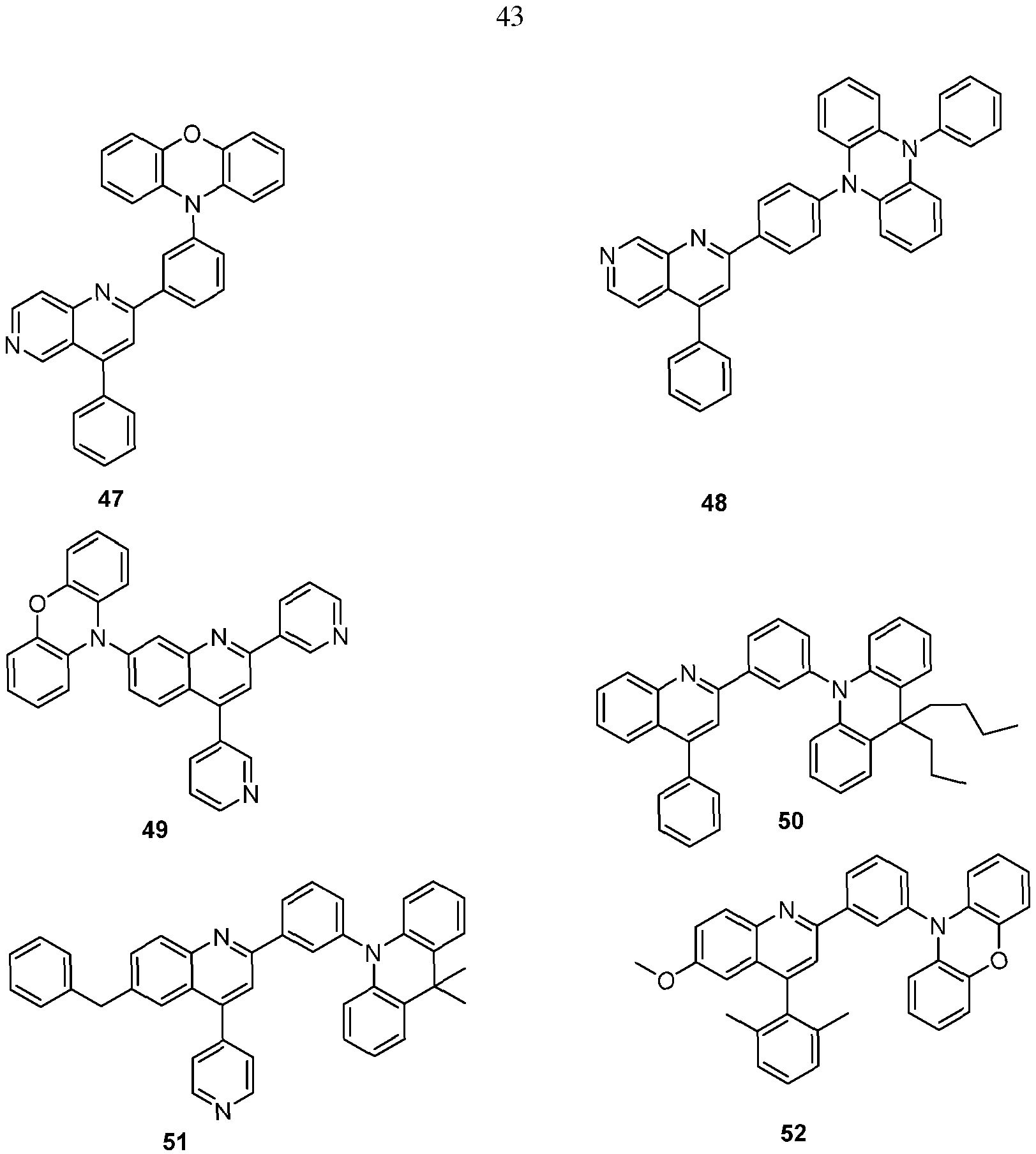


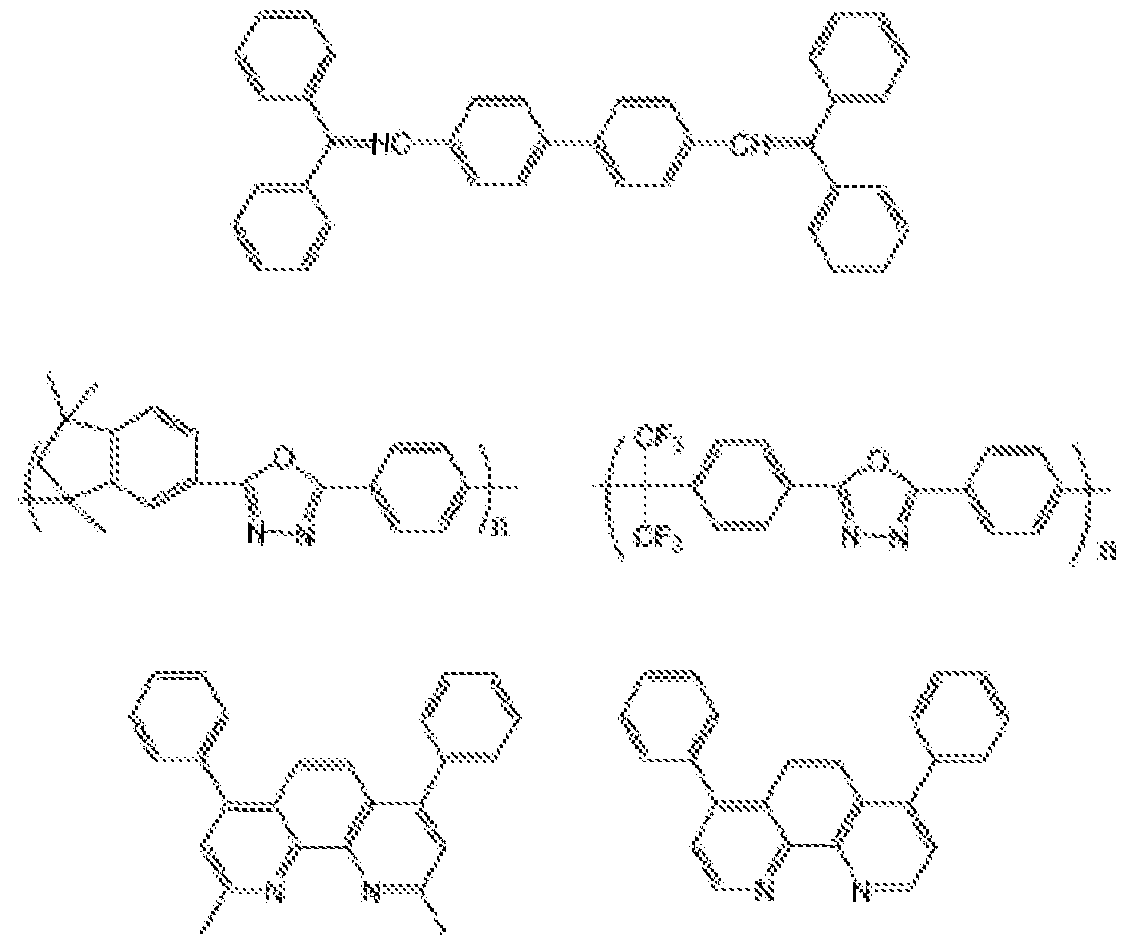

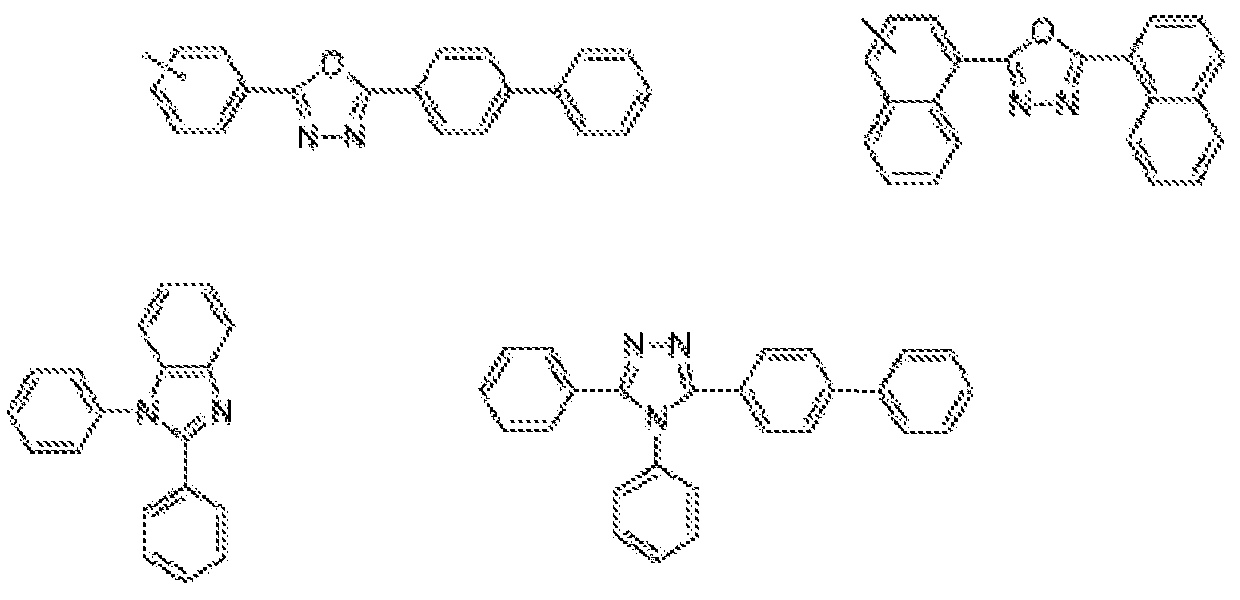


Claims


Priority Applications (3)
| Application Number | Priority Date | Filing Date | Title |
|---|---|---|---|
| US15/577,511 US20180148428A1 (en) | 2015-05-29 | 2016-05-27 | Organic light emitting device with thermally activated delayed fluorescent light emitting material |
| AU2016269834A AU2016269834A1 (en) | 2015-05-29 | 2016-05-27 | Organic light emitting device with thermally activated delayed fluorescent light emitting material |
| JP2017561860A JP2018524801A (en) | 2015-05-29 | 2016-05-27 | Organic light emitting device having thermally activated delayed fluorescent material |
Applications Claiming Priority (2)
| Application Number | Priority Date | Filing Date | Title |
|---|---|---|---|
| AU2015902002A AU2015902002A0 (en) | 2015-05-29 | Organic light emitting device with thermally activated delayed fluorescent light emitting material | |
| AU2015902002 | 2015-05-29 |
Publications (1)
| Publication Number | Publication Date |
|---|---|
| WO2016191803A1 true WO2016191803A1 (en) | 2016-12-08 |
Family
ID=57439736
Family Applications (1)
| Application Number | Title | Priority Date | Filing Date |
|---|---|---|---|
| PCT/AU2016/050421 Ceased WO2016191803A1 (en) | 2015-05-29 | 2016-05-27 | Organic light emitting device with thermally activated delayed fluorescent light emitting material |
Country Status (4)
| Country | Link |
|---|---|
| US (1) | US20180148428A1 (en) |
| JP (1) | JP2018524801A (en) |
| AU (1) | AU2016269834A1 (en) |
| WO (1) | WO2016191803A1 (en) |
Cited By (1)
| Publication number | Priority date | Publication date | Assignee | Title |
|---|---|---|---|---|
| CN109796451A (en) * | 2019-02-18 | 2019-05-24 | 中国科学院化学研究所 | A kind of polychrome hot activation delayed fluorescence material and the preparation method and application thereof using naphthyridines as electron acceptor |
Families Citing this family (2)
| Publication number | Priority date | Publication date | Assignee | Title |
|---|---|---|---|---|
| KR102839497B1 (en) * | 2020-05-25 | 2025-07-28 | 삼성디스플레이 주식회사 | Light emitting device comprising heterocyclic compound and electronic apparatus comprising the device |
| US20220158096A1 (en) * | 2020-11-16 | 2022-05-19 | Universal Display Corporation | Organic electroluminescent materials and devices |
Citations (3)
| Publication number | Priority date | Publication date | Assignee | Title |
|---|---|---|---|---|
| EP2182040A2 (en) * | 2008-10-31 | 2010-05-05 | Gracel Display Inc. | Aromatic compounds and organic electronic device using the same |
| KR20120072785A (en) * | 2010-12-24 | 2012-07-04 | 에스에프씨 주식회사 | Spiro compound and organic electroluminescent devices comprising the same |
| US20130181196A1 (en) * | 2011-07-08 | 2013-07-18 | Lg Chem, Ltd. | Compounds and organic electronic device using the same |
-
2016
- 2016-05-27 AU AU2016269834A patent/AU2016269834A1/en not_active Abandoned
- 2016-05-27 JP JP2017561860A patent/JP2018524801A/en active Pending
- 2016-05-27 US US15/577,511 patent/US20180148428A1/en not_active Abandoned
- 2016-05-27 WO PCT/AU2016/050421 patent/WO2016191803A1/en not_active Ceased
Patent Citations (3)
| Publication number | Priority date | Publication date | Assignee | Title |
|---|---|---|---|---|
| EP2182040A2 (en) * | 2008-10-31 | 2010-05-05 | Gracel Display Inc. | Aromatic compounds and organic electronic device using the same |
| KR20120072785A (en) * | 2010-12-24 | 2012-07-04 | 에스에프씨 주식회사 | Spiro compound and organic electroluminescent devices comprising the same |
| US20130181196A1 (en) * | 2011-07-08 | 2013-07-18 | Lg Chem, Ltd. | Compounds and organic electronic device using the same |
Non-Patent Citations (1)
| Title |
|---|
| ZHU, Y. ET AL.: "Phenoxazine-Based Emissive Donor-Acceptor Materials for Efficient Organic Light-Emitting Diodes", CHEMISTRY OF MATERIALS, vol. 17, no. 21, 2005, pages 5225 - 5227, XP055331873 * |
Cited By (1)
| Publication number | Priority date | Publication date | Assignee | Title |
|---|---|---|---|---|
| CN109796451A (en) * | 2019-02-18 | 2019-05-24 | 中国科学院化学研究所 | A kind of polychrome hot activation delayed fluorescence material and the preparation method and application thereof using naphthyridines as electron acceptor |
Also Published As
| Publication number | Publication date |
|---|---|
| JP2018524801A (en) | 2018-08-30 |
| AU2016269834A1 (en) | 2017-12-07 |
| US20180148428A1 (en) | 2018-05-31 |
Similar Documents
| Publication | Publication Date | Title |
|---|---|---|
| JP6786393B2 (en) | Organic electroluminescent device | |
| CN108137564B (en) | Organic electroluminescent compound and organic electroluminescent device containing the same | |
| KR101925192B1 (en) | Materials for electronic devices | |
| CN104885249B (en) | Organic electroluminescent element | |
| CN109311904B (en) | Certain substituted benzofuro-and benzothienoquinolines for use in organic light emitting diodes | |
| EP3875455B1 (en) | Organic electroluminescent device comprising a tribenzazole amine derivative | |
| TWI567164B (en) | Organic electroluminescent element materials and organic electroluminescent elements | |
| US20110306922A1 (en) | Light-emitting devices for phototherapy | |
| KR102790172B1 (en) | Organic electronic device comprising an organic semiconductor layer | |
| KR20170018946A (en) | Compositions for electronic devices | |
| KR20160039657A (en) | Materials for electronic devices | |
| KR20230023673A (en) | Organic light-emitting compound and organic electroluminescent device using the same | |
| KR102220220B1 (en) | Organic compounds and organic electro luminescence device comprising the same | |
| KR102790061B1 (en) | Organic electronic device comprising an organic semiconductor layer | |
| JP7732986B2 (en) | organic electroluminescence element | |
| KR102736357B1 (en) | Organic compounds and organic electro luminescence device comprising the same | |
| US20180148428A1 (en) | Organic light emitting device with thermally activated delayed fluorescent light emitting material | |
| KR102238925B1 (en) | Hetero cyclic compound and organic light emitting device comprising the same | |
| KR20190078139A (en) | Heterocyclic compound and organic light emitting device comprising the same | |
| KR102703928B1 (en) | Organic compound and organic electroluminescent device comprising the same | |
| KR102746525B1 (en) | Organic compounds and organic electro luminescence device comprising the same | |
| KR102617613B1 (en) | Organic compounds and organic electro luminescence device comprising the same | |
| KR101556826B1 (en) | Organic compounds and organic electro luminescence device comprising the same | |
| KyuáJeon et al. | Synthesis and blue phosphorescent device performances of a new bipolar host material containing pyrazino [2, 3-b] indole moiety | |
| KR102716977B1 (en) | Organic light-emitting compound and organic electroluminescent device comprising the same |
Legal Events
| Date | Code | Title | Description |
|---|---|---|---|
| 121 | Ep: the epo has been informed by wipo that ep was designated in this application |
Ref document number: 16802233 Country of ref document: EP Kind code of ref document: A1 |
|
| ENP | Entry into the national phase |
Ref document number: 2017561860 Country of ref document: JP Kind code of ref document: A |
|
| WWE | Wipo information: entry into national phase |
Ref document number: 15577511 Country of ref document: US |
|
| NENP | Non-entry into the national phase |
Ref country code: DE |
|
| ENP | Entry into the national phase |
Ref document number: 2016269834 Country of ref document: AU Date of ref document: 20160527 Kind code of ref document: A |
|
| 122 | Ep: pct application non-entry in european phase |
Ref document number: 16802233 Country of ref document: EP Kind code of ref document: A1 |