WO2016191366A1 - MODULATORS FOR NICOTINIC ACETYLCHOLINE RECEPTOR α2 AND α4 SUBUNITS - Google Patents
MODULATORS FOR NICOTINIC ACETYLCHOLINE RECEPTOR α2 AND α4 SUBUNITS Download PDFInfo
- Publication number
- WO2016191366A1 WO2016191366A1 PCT/US2016/033774 US2016033774W WO2016191366A1 WO 2016191366 A1 WO2016191366 A1 WO 2016191366A1 US 2016033774 W US2016033774 W US 2016033774W WO 2016191366 A1 WO2016191366 A1 WO 2016191366A1
- Authority
- WO
- WIPO (PCT)
- Prior art keywords
- pbtc
- thiophene
- nachrs
- benzo
- synthetic example
- Prior art date
- Legal status (The legal status is an assumption and is not a legal conclusion. Google has not performed a legal analysis and makes no representation as to the accuracy of the status listed.)
- Ceased
Links
- HFWBXFARIRRHNF-MRVPVSSYSA-N O=C(c([s]c1c(cc2)F)cc1c2Cl)N[C@H]1CNCCC1 Chemical compound O=C(c([s]c1c(cc2)F)cc1c2Cl)N[C@H]1CNCCC1 HFWBXFARIRRHNF-MRVPVSSYSA-N 0.000 description 2
- LIHDLMOSQKQCAF-MRVPVSSYSA-N O=C(c([s]c1ccc2Cl)cc1c2Cl)N[C@H]1CNCCC1 Chemical compound O=C(c([s]c1ccc2Cl)cc1c2Cl)N[C@H]1CNCCC1 LIHDLMOSQKQCAF-MRVPVSSYSA-N 0.000 description 2
- ORTAXXZJVCPZJF-SECBINFHSA-N CC(C)N1C[C@H](C)CCC1 Chemical compound CC(C)N1C[C@H](C)CCC1 ORTAXXZJVCPZJF-SECBINFHSA-N 0.000 description 1
- YRAXXPVGCYWODW-LLVKDONJSA-N CN(CCC1)C[C@@H]1NC(c1cc2cccc(Cl)c2[s]1)=O Chemical compound CN(CCC1)C[C@@H]1NC(c1cc2cccc(Cl)c2[s]1)=O YRAXXPVGCYWODW-LLVKDONJSA-N 0.000 description 1
- HTOLZPMMZRKTCP-UHFFFAOYSA-N COc1c(cc(C(O)=O)[s]2)c2ccc1 Chemical compound COc1c(cc(C(O)=O)[s]2)c2ccc1 HTOLZPMMZRKTCP-UHFFFAOYSA-N 0.000 description 1
- ZDURBHKVZMRHFR-LLVKDONJSA-N COc1cccc2c1[s]c(C(N[C@H]1CNCCC1)=O)c2 Chemical compound COc1cccc2c1[s]c(C(N[C@H]1CNCCC1)=O)c2 ZDURBHKVZMRHFR-LLVKDONJSA-N 0.000 description 1
- YKEXKUQNLSVXNJ-UHFFFAOYSA-N Cc1cccc2c1cc(C(N)=O)[s]2 Chemical compound Cc1cccc2c1cc(C(N)=O)[s]2 YKEXKUQNLSVXNJ-UHFFFAOYSA-N 0.000 description 1
- DXGAIDCHFIFGLL-SECBINFHSA-N O=C(c([s]c1c2Cl)cc1ccc2F)N[C@H]1CNCCC1 Chemical compound O=C(c([s]c1c2Cl)cc1ccc2F)N[C@H]1CNCCC1 DXGAIDCHFIFGLL-SECBINFHSA-N 0.000 description 1
- WYDKIZFSOJUNFU-SECBINFHSA-N O=C(c([s]c1cc(I)c2)cc1c2Cl)N[C@H]1CNCCC1 Chemical compound O=C(c([s]c1cc(I)c2)cc1c2Cl)N[C@H]1CNCCC1 WYDKIZFSOJUNFU-SECBINFHSA-N 0.000 description 1
- JQIZNHUXEQXDMC-MRVPVSSYSA-N O=C(c([s]c1ccc2F)cc1c2Cl)N[C@H]1CNCCC1 Chemical compound O=C(c([s]c1ccc2F)cc1c2Cl)N[C@H]1CNCCC1 JQIZNHUXEQXDMC-MRVPVSSYSA-N 0.000 description 1
- GDIVRCPDUKBGHY-MRVPVSSYSA-N O=C(c1cc(c(F)ccc2F)c2[s]1)N[C@H]1CNCCC1 Chemical compound O=C(c1cc(c(F)ccc2F)c2[s]1)N[C@H]1CNCCC1 GDIVRCPDUKBGHY-MRVPVSSYSA-N 0.000 description 1
- LVEWCVFNZFHOPV-QGZVFWFLSA-N O=C(c1cc(ccc(-c2ccccc2)c2)c2[s]1)N[C@H]1CNCCC1 Chemical compound O=C(c1cc(ccc(-c2ccccc2)c2)c2[s]1)N[C@H]1CNCCC1 LVEWCVFNZFHOPV-QGZVFWFLSA-N 0.000 description 1
- LAYNZUFIYSYHIV-UHFFFAOYSA-N OC(c([s]c1ccc2)cc1c2Br)=O Chemical compound OC(c([s]c1ccc2)cc1c2Br)=O LAYNZUFIYSYHIV-UHFFFAOYSA-N 0.000 description 1
- ZKADPMNICCXSRV-UHFFFAOYSA-N OC(c([s]c1ccc2)cc1c2F)=O Chemical compound OC(c([s]c1ccc2)cc1c2F)=O ZKADPMNICCXSRV-UHFFFAOYSA-N 0.000 description 1
Classifications
-
- C—CHEMISTRY; METALLURGY
- C07—ORGANIC CHEMISTRY
- C07D—HETEROCYCLIC COMPOUNDS
- C07D495/00—Heterocyclic compounds containing in the condensed system at least one hetero ring having sulfur atoms as the only ring hetero atoms
- C07D495/02—Heterocyclic compounds containing in the condensed system at least one hetero ring having sulfur atoms as the only ring hetero atoms in which the condensed system contains two hetero rings
- C07D495/04—Ortho-condensed systems
-
- C—CHEMISTRY; METALLURGY
- C07—ORGANIC CHEMISTRY
- C07D—HETEROCYCLIC COMPOUNDS
- C07D409/00—Heterocyclic compounds containing two or more hetero rings, at least one ring having sulfur atoms as the only ring hetero atoms
- C07D409/02—Heterocyclic compounds containing two or more hetero rings, at least one ring having sulfur atoms as the only ring hetero atoms containing two hetero rings
- C07D409/12—Heterocyclic compounds containing two or more hetero rings, at least one ring having sulfur atoms as the only ring hetero atoms containing two hetero rings linked by a chain containing hetero atoms as chain links
Definitions
- Nicotinic acetylcholine receptors are critical for nicotine addiction and important for several neuropsychiatric disorders (De Biasi and Dani, 201 1 ; Lewis and Picciotto, 2013; Picciotto, 2015). They are ligand-gated ion channels formed from five homologous subunits whose subtypes are defined by their subunit composition. There are twelve neuronal types of subunits: 2-10 and ⁇ 2-4. Homomeric nAChRs like ct7 assemble from only a7 subunits, while heteromeric nAChRs usually require both a and ⁇ subunits (Hurst et al., 2013; Zoli et al., 2014).
- Both homomeric and heteromeric nAChRs form orthosteric agonist binding sites at interfaces between subunits in the extracellular domain.
- various ligands have been identified which activate, inhibit, or potentiate activation of nAChRs from allosteric sites other than the agonist binding sites (Williams et al., 201 1 ; Hurst et al., 2013; Grupe et al., 2015).
- PAMs positive allosteric modulators
- NAMs negative allosteric modulators
- allosteric agonists Williams et al., 201 1 ; Gill et al., 201 1 ; Gill-Thind et al., 2015).
- nAChRs these drugs bind to various places in nAChRs, including the extracellular domain, transmembrane domain, and the extracellular C-terminus (i.e., C- tail) (Grupe et al., 2015; Williams et al., 201 1).
- PAMs enhance nAChR function in an activity-dependent manner, potentially modulating the endogenous pattern of signaling rather than constantly activating or desensitizing nAChRs.
- PAMs also increase the potential for subtype specificity. This is because diversity of PAM binding sites in nAChRs provides better chances to develop selective therapeutics than does targeting the relatively similar ACh binding sites.
- Type I PAMs increase peak responses.
- Type II PAMs not only increase peak responses but also the duration of channel opening by delaying desensitization. This makes type II PAMs especially efficacious. In some cases, they can act as allosteric agonists (Gill et al., 201 1). Understanding the pharmacology and potentiation mechanism of PAMs should facilitate design of more potent and selective PAMs. There is no direct correlation between where a PAM binds and which type of PAM it is (Williams et al., 201 1).
- PAMs bind in the transmembrane domain near the gate for the cation channel whose opening they influence (Williams et al., 201 1). These transmembrane PAMs can be either type I or type II. Here we describe a novel type II PAM, Br-PBTC, which binds at the C-tail of the 4 subunit.
- the invention provides, in various embodiments, a compound of formula (I)
- ring bearing R 1 comprises 0 or 1 nitrogen atom therewithin
- R 1 is halo, cyano, (C
- NR 2 or phenyl optionally substituted with 1 or 2 OR groups, wherein R is H or (C
- -C4)alkyl, or two R 1 groups together form a methylenedioxy; m 0, 1, 2, or 3;
- R 2 is H, (Ci-Gt)alkyl, or phenyl, wherein the phenyl is optionally substituted with 1 -2
- R 3 is H, (Ci-C6)alkyl, (C r C6)acyl, or benzyl, wherein the benzyl is optionally substituted with 1 -2 R 4 ;
- R 4 is halo, (C C 4 )alkyl, (C,-C 4 )alkoxy, or NR 2 ;
- R 5 is independently at each occurrence H or (C] -C 4 )alkyl
- n 2, 3, or 4;
- the invention can further provide a pharmaceutical composition comprising a compound of the invention and a pharmaceutically acceptable excipient.
- the invention can further provide a method of allosterically modulating an a5-nicotinic receptor, comprising contacting the receptor with an effective amount or concentration of the invention.
- the allosteric modulation can be a positive allosteric modulation.
- the invention can provide a method of treatment of nicotine addiction in a patient afflicted therewith, comprising administering to the patient an effective dose of a compound of the invention. Because 4 ⁇ 2 nicotinic receptors are lost in Alzheimer's disease and the weak positive allosteric modulator for all a subunits galantamine has been found useful for symptomatic therapy (Samochocki et al., 2003) it is possible that the more potent and efficacious positive allosteric modulators of the invention might be more useful and less liable to side effects because they are more specific and effect only a4 subunits.
- FIGURE 1 Chemical structure and nAChR subtype-selectivity of the PAM Br- PBTC.
- A Structural comparision of Br-PBTC and 17P-estradiol.
- B
- Concentration/response curves of Br-PBTC for potentiating activation of nAChR subtypes expressed in HEK cell lines were pre-applied for 15 minutes before acute application of ACh at EC 2 o concentrations (i.e., ⁇ 4 ⁇ 2, 0.4 ⁇ ; ⁇ 4 ⁇ 4, 1 ⁇ ; ⁇ 3 ⁇ 2, 4 ⁇ ; ⁇ 3 ⁇ 4, 5 ⁇ ; 2 ⁇ 2, 0.4 ⁇ ; ⁇ 2 ⁇ 4, 0.8 ⁇ ).
- Potentiation effects were calculated by increased peak responses by Br-PBTC relative to responses evoked by ACh.
- FIGURE 2 Schematic illustration of human nAChR a3 and 4 subunit chimeras.
- the a3 sequences are grey and the a4 sequences are black.
- a4 AAC is an cc4 subunit with its last four amino acids replaced with alanine-alanine-cysteine. These were chosen because this mutation inhibits the PAM effect of ⁇ -estradiol (Paradiso et al., 201 1 ).
- This modified C- tail is annotated as a grey squiggly line.
- FIGURE 3 Summary of potentiation effects of Br-PBTC on ⁇ 3/ ⁇ 4 nAChR chimeras expressed in oocytes.
- Br-PBTC (3 ⁇ ) was co-applied with EC3 0 -40 ACh to each oocyte. Each data point was collected from more than four oocytes.
- A Bar graph comparison of the PAM effects of Br-PBTC.
- B Representative response kinetics for wild type ⁇ 3 ⁇ 2, ⁇ 4 ⁇ 2, ⁇ 4 ⁇ ⁇ 2 and ⁇ 3 (1 - 440) / ⁇ 4 (561 - 594) ⁇ 2 nAChRs.
- FIGURE 4 Br-PBTC potentiates activation of both stiochiometries of ⁇ 4 ⁇ 2 nAChRs.
- Concatameric nAChRs of defined stoichiometries were expressed in HEK cell lines.
- ACh indicates ACh binding sites at subunit interfaces.
- PAM indicates PAM binding sites near 4 C-tails.
- B Concentration/response curves for Br-PBTC potentiation of EC40-50 ACh.
- FIGURE 5 Br-PBTC PAM effect increases with the number of a4 subunits in a nAChR. Each data point was collected from more than five oocytes.
- A Illustration of nAChRs constructs used that contain different numbers of a4 subunits.
- B Potentiation by Br-PBTC (3 ⁇ ) increases with the number of 4 subunits in a nAChR. Br-PBTC was co- applied with 100 or 3000 ⁇ ACh.
- FIGURE 6 Br-PBTC reactivates short-term desensitized nAChRs expressed in oocytes.
- ACh 1000 ⁇ was applied to oocytes for 6 minutes before its co-application with Br-PBTC (3 ⁇ ). Each data point was collected from more than five oocytes.
- A Br-PBTC requires two or more a4 subunits to reactivate short-term desensitized nAChRs. The efficacy of reactivation increases with more a4 subunits in a nAChR.
- B Response kinetics from representative oocytes.
- FIGURE 7 Br-PBTC reactivates short-term desensitized ( ⁇ 4 ⁇ 2) 2 ⁇ 4 and ( ⁇ 4 ⁇ 2) 2 ⁇ 2 nAChRs expressed in HEK cells. Saturating concentrations of agonists were added to desensitize nAChRs. Because of the low ACh affinity site at the ⁇ 4/ ⁇ 4 interface, higher concentrations of agonists were used for ( ⁇ 4 ⁇ 2) 2 ⁇ 4 than ( ⁇ 4 ⁇ 2) 2 ⁇ 2. Br-PBTC (3 ⁇ ) and ⁇ (1 ⁇ ) were added separately or together to nAChRs 6 minutes after addition of agonist. The antagonist ⁇ prevents activation.
- A ACh (300 ⁇ ) and nicotine ( 100 ⁇ ) desensitized ( ⁇ 4 ⁇ 2) 2 ⁇ 4 nAChRs.
- B ACh (100 ⁇ ) and nicotine (10 ⁇ ) desensitized ( ⁇ 4 ⁇ 2) 2 ⁇ 2 nAChRs.
- FIGURE 8 Br-PBTC reactivates long-term desensitized nAChRs expressed in HEK cells.
- FIGURE 9 Effect of Br-PBTC and conotoxin Mil on ( ⁇ 4 ⁇ 2)( ⁇ 6 ⁇ 2) ⁇ 3 nAChRs expressed in oocytes.
- A Illustration of expressing ( ⁇ 4 ⁇ 2)( ⁇ 6 ⁇ 2) ⁇ 3 from a pentameric concatamer. These nAChRs have only one C-tail PAM site for Br-PBTC.
- B Br-PBTC potentiated activation of ( ⁇ 4 ⁇ 2)( ⁇ 6 ⁇ 2) ⁇ 3 by ACh, but both activation and potentiation were blocked by the a6-selective antagonist, conotoxin Mil (50 nM). Responses to ACh (3 ⁇ ) are shown in black and responses to ACh with Br-PBTC (3 ⁇ ) are shown in grey.
- FIGURE 10 Proposed potentiation mechanism for C-tail PAMs.
- A States of nAChRs bound with an agonist or antagonist. Upon agonist binding, nAChRs go through various conformation changes from the resting state (R) to the open state (O), and non- conductive short-term (D s ) or long-term (D L ) desensitized states. When an antagonist binds to nAChRs, nAChRs go into an inactive state (I) or is held in a resting state that prevents further activation by agonists. nAChRs may pass through various transitional states, which are not displayed in the figure.
- B Hypothetical PAM effects on probability of nAChR states.
- FIGURE 11 A graph of data indicating that compound SRI 3521 reduced nicotine intake in a dose-dependent manner when administered by intraperitoneal injection 30 min prior to the l h nicotine self-administration session.
- FIGURE 12 Protein backbone structure model of an ( ⁇ 4 ⁇ 2) 2 ⁇ 2 AChR showing docking of ACh to an ⁇ 4/ ⁇ 2 binding site and docking of the PAM Br-PBTC to the transmembrane region of an a4 subunit. The large cytoplasmic domains of the subunits are not shown. cc4 subunits are green, and ⁇ 2 subunits are yellow. To the right on top is an expanded view of the ACh binding site showing the a4 C loop closed over an ACh molecule bound between a4 and ⁇ 2 subunits.
- an effective amount when used to describe therapy to an individual suffering from a disorder, refers to the quantity or concentration of a compound of the invention that is effective to inhibit or otherwise act on an a5-nicotinic receptor in the individual's tissues wherein an a5-nicotinic receptor involved in the disorder, such as nicotine addiction, wherein such inhibition or other action occurs to an extent sufficient to produce a beneficial therapeutic effect.
- Treating” or “treatment” within the meaning herein refers to an alleviation of symptoms associated with a disorder or disease, or inhibition of further progression or worsening of those symptoms, or prevention or prophylaxis of the disease or disorder, or curing the disease or disorder.
- an "effective amount” or a “therapeutically effective amount” of a compound of the invention refers to an amount of the compound that alleviates, in whole or in part, symptoms associated with the disorder or condition, or halts or slows further progression or worsening of those symptoms, or prevents, or provides prophylaxis for, the disorder or condition.
- a “therapeutically effective amount” refers to an amount effective, at dosages and for periods of time necessary, to achieve the desired therapeutic result.
- a therapeutically effective amount is also one in which any toxic or detrimental effects of compounds of the invention are outweighed by the therapeutically beneficial effects.
- phrases such as "under conditions suitable to provide” or “under conditions sufficient to yield” or the like, in the context of methods of synthesis, as used herein refers to reaction conditions, such as time, temperature, solvent, reactant concentrations, and the like, that are within ordinary skill for an experimenter to vary, that provide a useful quantity or yield of a reaction product. It is not necessary that the desired reaction product be the only reaction product or that the starting materials be entirely consumed, provided the desired reaction product can be isolated or otherwise further used.
- chemically feasible is meant a bonding arrangement or a compound where the generally understood rules of organic structure are not violated; for example a structure within a definition of a claim that would contain in certain situations, e.g., a pentavalent carbon atom that would not exist in nature would be understood to not be within the claim.
- the structures disclosed herein, in all of their embodiments are intended to include only “chemically feasible” structures, and any recited structures that are not chemically feasible, for example in a structure shown with variable atoms or groups, are not intended to be disclosed or claimed herein.
- an "analog" of a chemical structure refers to a chemical structure that preserves substantial similarity with the parent structure, although it may not be readily derived synthetically from the parent structure.
- a related chemical structure that is readily derived synthetically from a parent chemical structure is referred to as a "derivative.” All single enantiomer, diastereomeric, and racemic forms of a structure are intended, unless a particular stereochemistry or isomeric form is specifically indicated. In several instances though an individual stereoisomer is described among specifically claimed compounds, the stereochemical designation does not imply that alternate isomeric forms are less preferred, undesired, or not claimed.
- Compounds used in the present invention can include enriched or resolved optical isomers at any or all asymmetric atoms as are apparent from the depictions, at any degree of enrichment. Both racemic and diastereomeric mixtures, as well as the individual optical isomers can be isolated or synthesized so as to be substantially free of their enantiomeric or diastereomeric partners, and these are all within the scope of the invention.
- each individual integral number representing the number of carbon atoms is intended.
- recitation of a (Ci-C4)alkyl group indicates that the alkyl group can be any of methyl, ethyl, propyl, isopropyl, butyl, sec-butyl, isobutyl, or tert-butyl. It is understood that a specification of a number of carbon atoms must be an integer.
- Alkyl groups include straight chain and branched carbon-based groups having from 1 to about 20 carbon atoms, and typically from 1 to 12 carbons or, in some embodiments, from 1 to 8 carbon atoms.
- straight chain alkyl groups include those with from 1 to 8 carbon atoms such as methyl, ethyl, n-propyl, n-butyl, n-pentyl, n-hexyl, n-heptyl, and n- octyl groups.
- alkyl groups include, but are not limited to, isopropyl, iso-butyl, sec-butyl, t-butyl, neopentyl, isopentyl, and 2,2-dimethylpropyl groups.
- alkyl encompasses n-alkyl, isoalkyl, and anteisoalkyl groups as well as other branched chain forms of alkyl.
- alkoxy refers to an oxygen atom connected to an alkyl group, including a cycloalkyl group, as are defined above.
- linear alkoxy groups include but are not limited to methoxy, ethoxy, n-propoxy, n-butoxy, n-pentyloxy, n-hexyloxy, and the like.
- branched alkoxy include but are not limited to isopropoxy, sec-butoxy, tert-butoxy, isopentyloxy, isohexyloxy, and the like.
- haloalkyl group includes mono-halo alkyl groups, poly-halo alkyl groups wherein all halo atoms can be the same or different, and per-halo alkyl groups, wherein all hydrogen atoms are replaced by the same or differing halogen atoms, such as fluorine and/or chlorine atoms.
- haloalkyl include trifluoromethyl, 1 , 1 -dichloroethyl, 1 ,2-dichloroethyl, l ,3-dibromo-3,3-difluoropropyl, perfluorobutyl, and the like.
- acyl group refers to a group containing a carbonyl moiety wherein the group is bonded via the carbonyl carbon atom.
- the carbonyl carbon atom is also bonded to another carbon atom, which can be part of an alkyl, aryl, aralkyl cycloalkyl, cycloalkylalkyl, heterocyclyl, heterocyclylalkyl, heteroaryl, heteroarylalkyl group or the like.
- amine includes primary, secondary, and tertiary amines having, e.g., the formula N(group)3 wherein each group can independently be H or non-H, such as alkyl, aryl, and the like.
- Amines include but are not limited to R-NH 2 , wherein R is a carbon-based moiety, for example, alkylamines, arylamines, alkylarylamines; R 2 NH wherein each R is independently selected carbon-based moiety, such as dialkylamines, diarylamines, aralkylamines, heterocyclylamines and the like; and R3N wherein each R is independently selected carbon- based moiety, such as trialkylamines, dialkylarylamines, alkyldiarylamines, triarylamines, and the like.
- the term "amine” as used herein also includes positively charged (cationic) forms such as amine salts and quaternarized amines.
- amino group is a substituent group of the form -NH 2 , -NHR, -NR 2 , or -NR 3 + , wherein each R is an independently selected carbon-based group, and protonated forms of each, except for -NR 3 + , which cannot be protonated. Accordingly, any compound substituted with an amino group can be viewed as an amine.
- An “amino group” within the meaning herein can be a primary, secondary, tertiary or quaternary amino group.
- alkylamino includes a monoalkylamino, dialkylamino, and trialkylamino (trialkylammonium) group.
- a “salt” as is well known in the art includes an organic compound such as a carboxylic acid, a sulfonic acid, or an amine, in ionic form, in combination with a counterion.
- acids in their anionic form can form salts with cations such as metal cations, for example sodium, potassium, and the like; with ammonium salts such as ⁇ 3 ⁇ 4 + or the cations of various amines, including tetraalkyl ammonium salts such as tetramethylammonium, or other cations such as trimethylsulfonium, and the like.
- a “pharmaceutically acceptable” or “pharmacologically acceptable” salt is a salt formed from an ion that has been approved for human consumption and is generally non-toxic, such as a chloride salt or a sodium salt.
- Suitable pharmaceutically-acceptable acid addition salts may be prepared from an inorganic acid or from an organic acid.
- inorganic acids include hydrochloric, hydrobromic, hydriodic, nitric, carbonic, sulfuric, and phosphoric acids.
- Appropriate organic acids may be selected from aliphatic, cycloaliphatic, aromatic, araliphatic, heterocyclic, carboxylic and sulfonic classes of organic acids, examples of which include formic, acetic, propionic, succinic, glycolic, gluconic, lactic, malic, tartaric, citric, ascorbic, glucuronic, maleic, fumaric, pyruvic, aspartic, glutamic, benzoic, anthranilic, 4-hydroxybenzoic, phenylacetic, mandelic, embonic (pamoic), methanesulfonic, ethanesulfonic,
- benzenesulfonic pantothenic, trifluoromethanesulfonic, 2-hydroxyethanesulfonic, p-toluenesulfonic, sulfanilic, cyclohexylaminosulfonic, stearic, alginic, ⁇ -hydroxybutyric, salicylic, galactaric and galacturonic acid.
- pharmaceutically unacceptable acid addition salts include, for example, perchlorates and tetrafluoroborates.
- the compounds described herein can be prepared in a number of ways based on the teachings contained herein and synthetic procedures known in the art.
- synthetic procedures known in the art.
- all proposed reaction conditions including choice of solvent, reaction atmosphere, reaction temperature, duration of the experiment and workup procedures, can be chosen to be the conditions standard for that reaction, unless otherwise indicated.
- the functionality present on various portions of the molecule should be compatible with the reagents and reactions proposed.
- Substituents not compatible with the reaction conditions will be apparent to one skilled in the art, and alternate methods are therefore indicated.
- the starting materials for the examples are either commercially available or are readily prepared by standard methods from known materials.
- the present invention further embraces isolated compounds of the invention.
- isolated compound refers to a preparation of a compound of the invention, or a mixture of compounds the invention, wherein the isolated compound has been separated from the reagents used, and/or byproducts formed, in the synthesis of the compound or compounds. "Isolated” does not mean that the preparation is technically pure
- an "isolated compound” refers to a preparation of a compound of the invention or a mixture of compounds of the invention, which contains the named compound or mixture of compounds of the invention in an amount of at least 10 percent by weight of the total weight.
- the preparation contains the named compound or mixture of compounds in an amount of at least 50 percent by weight of the total weight; more preferably at least 80 percent by weight of the total weight; and most preferably at least 90 percent, at least 95 percent or at least 98 percent by weight of the total weight of the preparation.
- the compounds of the invention and intermediates may be isolated from their reaction mixtures and purified by standard techniques such as filtration, liquid-liquid extraction, solid phase extraction, distillation, recrystallization or chromatography, including flash column chromatography, or HPLC.
- Isolated optical isomer or “isolated enantiomer” means a compound which has been substantially purified from the corresponding optical isomer(s) of the same formula.
- the isolated isomer is at least about 80%, more preferably at least 90%
- enantiomeric purity is meant the percent of the predominant enantiomer in an enantiomeric mixture of optical isomers of a compound. A pure single enantiomer has an enantiomeric purity of 100%.
- Isolated optical isomers may be purified from racemic mixtures by well-known chiral separation techniques. According to one such method, a racemic mixture of a compound of the invention, or a chiral intermediate thereof, is separated into 99% wt.% pure optical isomers by HPLC using a suitable chiral column, such as a member of the series of
- DAICEL ® CHIRALPAK ® family of columns (Daicel Chemical Industries, Ltd., Tokyo, Japan). The column is operated according to the manufacturer's instructions.
- PAMs Positive allosteric modulators
- nAChR nicotinic acetylcholine receptors
- Br-BPTC binds to the C-terminal extracellular sequences of a4 subunits, which is also a PAM site for steroid hormone estrogens such as 17- ⁇ estradiol.
- Br-PBTC is much more potent than estrogens.
- the non-steroid Br-PBTC only requires one a4 subunit to potentiate nAChR function, and its potentiation is stronger with more a4 subunits.
- Br-BPTC potentiate activation of ( ⁇ 4 ⁇ 2)( ⁇ 6 ⁇ 2) ⁇ 3 but not ( 6 ⁇ 2)2 ⁇ 3 nAChRs. Therefore, this compound is potentially useful in vivo for determining functions of different cc6* nAChR subtypes.
- Br-BPTC affects desensitization of nAChRs induced by sustained exposure to agonists. After minutes of exposure to agonists, Br-PBTC reactivated short-term desensitized nAChRs that have at least two a4 subunits, but not those with only one.
- Br-PBTC selectively affects a2 and a4 subunits
- Br-PBTC Br-PBTC increased activation by EC2 0 ACh of a2- and a4-containing nAChRs by 1 19-560% (Table 1 ).
- Br-PBTC potentiated activation of nAChRs more than ⁇ 4- ⁇ 3 ⁇ nAChRs.
- Our ⁇ 2 ⁇ 4 and ⁇ 4 ⁇ 4 nAChR cell lines preferably express more of the ( ⁇ ) 2 ⁇ stoichiometry than the ( ⁇ )2( stoichiometry, while our 2 ⁇ 2 and ⁇ 4 ⁇ 2 lines express more of the ( ⁇ ) 2 stoichiometry (Wang et al., 2015).
- the higher efficacy of Br-PBTC on 2 ⁇ 2 and ⁇ 4 ⁇ 2 nAChRs could result from Br-PBTC having greater effects on the ( ⁇ )2 ⁇ stoichiometry.
- Br-PBTC 0 values for Br-PBTC ranged from 0.261 to 0.660 ⁇ (Table 1 ), equal to the most potent nAChR PAMs (Williams et al., 201 1 ; Grupe et al., 2015). At more than 3 ⁇ , Br-PBTC inhibited its own potentiation effect, perhaps because it behaved as an open channel blocker like some other nAChR PAMs and ACh itself (Weltzin and Schutle, 2010) (see Figure 1). Br-PBTC did not alter activation by ACh of ⁇ 3 ⁇ 2 or ⁇ 3 ⁇ 4 nAChRs (Fig. I B). Moreover, Br-PBTC did not activate any nAChR subtype by itself (data not shown). Therefore, Br-PBTC is an a2 and a4 nAChR subtype-selective PAM.
- Br-PBTC binds to the extracellular C-terminal domain of a4 subunits Since Br-PBTC has no effect on a3* nAChRs, we expressed various chimeras of a3 and a4 subunits in Xenopus oocytes to identify the Br-PBTC binding site in the 4 subunit.
- Figure 2 illustrates the chimeras of a3 and a4 that we used. Since Br-PBTC potentiates activation of ACh more strongly at intermediate agonist concentrations, we used ACh at EC30-40 to test PAM effects of Br-PBTC on 3 ⁇ 2, ⁇ 4 ⁇ 2 and their chimeras (Fig. 3 A).
- Br- PBTC did not potentiate ⁇ 3 ⁇ 2 nAChRs expressed in oocytes.
- Chimeras ⁇ 4 (1 "207) / ⁇ 3 (208"446) and a4 (l " 297) /a3 (298"446) which have the a3 cytoplasmic, M4, and C-tails, abolished potentiation by Br- PBTC.
- Br-PBTC increases the sensitivity to ACh of the a4/a4, but not the ⁇ 4/ ⁇ 2 ACh site
- Pentameric ⁇ 4 ⁇ 2 nAChRs assemble into two stoichiometries, ( 4 ⁇ 2) 2 ⁇ 4 and
- nAChRs both have two 4/ ⁇ 2 ACh binding sites, but there is a third ⁇ 4/ ⁇ 4 ACh binding site in ( ⁇ 4 ⁇ 2) 2 4 (Harpsoe et al., 201 1 , Mazafarro et al., 201 1 ).
- the site- selective agonist NS9283 binds only at the ⁇ 4/ ⁇ 4 site, increasing responses to low concentrations of ACh activating the ⁇ 4/ ⁇ 2 sites (Wang et al., 2015; Olsen et al., 2014;
- PAMs increase the potency and/or efficacy of an agonist via promoting agonist activation.
- Br-PBTC increased maximum efficacy of ACh on ( ⁇ 4 ⁇ 2) 2 ⁇ 4 nAChRs by 30 %.
- Br-PBTC requires the three a4 subunits in ( ⁇ 4 ⁇ 2) 2 ⁇ 4 to affect agonist affinity
- Br-PBTC increases agonist affinity to the low ACh affinity ⁇ 4/ ⁇ 4 site, but does not affect the high ACh affinity ⁇ 4/ ⁇ 2 sites.
- ⁇ 2- ⁇ 4- ⁇ 2- ⁇ 4 concatamers with a3 subunits in oocytes to obtain ( ⁇ 4 ⁇ 2) 2 ⁇ 3, which has two ⁇ 4 ⁇ 2 binding sites like ( ⁇ 4 ⁇ 2) 2 ⁇ 2 and an additional low ACh affinity 3 ⁇ 4 site like
- Br-PBTC increased the sensitivity of ( ⁇ 4 ⁇ 2) 2 ⁇ 4 to ACh by 37 fold, but changed the sensitivities of ( ⁇ 4 ⁇ 2) 2 ⁇ 3 and ( ⁇ 4 ⁇ 2) 2 ⁇ 2 very little (Table 2). This suggests that three a4 subunits are required for Br- PBTC to increase agonist sensitivity of nAChRs.
- Br-PBTC potentiates nAChRs through a single a.4 subunit
- nAChRs have similar numbers of agonist binding sites and agonist affinity. They all have at least one high ACh affinity ⁇ 4/ ⁇ 2 site. A low affinity ACh site can be formed at ⁇ 4/ ⁇ 4 and ⁇ 3/ ⁇ 4 interfaces (Wang et al., 2015; Harpsoe et al., 201 1 ; Mazzaferro et al., 201 1 ). ( ⁇ 3 ⁇ 4) 2 ⁇ 3 nAChRs showed lower ACh sensitivity than ( ⁇ 3 ⁇ 4) 2 ⁇ 4 nAChRs (Krashia et al., 2010).
- the ⁇ 4/ ⁇ 4 site-selective agonist NS9283 also potentiated activation of ( ⁇ 4 ⁇ 2)( ⁇ 3 ⁇ 2) ⁇ 3 nAChRs (data not shown). Therefore, a low affinity ACh site is likely to be present at the ⁇ 3/ ⁇ 3 interface.
- Br-PBTC can increase channel activation by a maximal concentration of ACh. This is similar to was observed with 4 ⁇ 2 nAChRs expressed in HEK cells (Fig. 4B). At higher concentrations of agonists, nAChRs desensitize more rapidly. The potentiation by Br-PBTC on 3000 ⁇ ACh could be due to increasing channel conductance, or increased open state probability, or destabilizing or slowing entry into the desensitized state.
- Br-PBTC can reactivate both short-term and long-term desensitized nAChRs
- nAChRs were all desensitized because application of ⁇ to these nAChRs showed no blockage of activation (black traces in Fig. 8, A and B).
- Br-PBTC (4 ⁇ ) efficiently reactivated nicotine long-term desensitized ( 4 ⁇ 2) 2 ⁇ 4 nAChRs, but only weakly reactivated desensitized ( ⁇ 4 ⁇ 2) 2 ⁇ 2 nAChRs (Fig. 8, A and B).
- the desensitized ( ⁇ 4 ⁇ 2) 2 ⁇ 2 could be less sensitive to reactivation by Br-PBTC.
- Br-PBTC can equally reactivate both stoichiometrics of ⁇ 4 ⁇ 2 nAChRs after short-term desensitization by agonists, but reactivates long-term desensitized ( ⁇ 4 ⁇ 2) 2 ⁇ 4 nAChRs more efficaciously.
- This potentiation of Br-PBTC is specific to agonist- desensitized nAChRs.
- Br-PBTC could not reactivate antagonist-inactivated nAChRs (green traces in Fig. 8).
- Br-PBTC did not potentiate activation of ( ⁇ 6 ⁇ 2) 2 ⁇ 3 expressed in oocytes (data not shown), but it increased ACh (3 ⁇ ) activation of ( ⁇ 6 ⁇ 2)( ⁇ 4 ⁇ 2) ⁇ 3 by 99.0 ⁇ 13.6% (representative kinetics shown in Fig. 9A). This is consistent with the finding in Figure 5 that only one a4 subunit is required for Br-PBTC potentiation.
- One feature of ( ⁇ 6 ⁇ 2)( ⁇ 4 ⁇ 2) ⁇ 3 is that the competitive antagonist a-conotoxin Mil selectively blocks its activation from the ⁇ 6/ ⁇ 2 interface. This antagonist site is far away from the 4 C-tail where Br-PBTC acts.
- a-Conotoxin Mil 50 nM completely blocked activation by ACh and potentiation by Br-PBTC (Fig. 9B).
- activation is a cooperative event involving conformational change in the whole nAChR and antagonist inhibition of any one ACh site is sufficient to prevent activation (Unwin and Fujiyoshi, 2012; Fletcher and Steinbach, 1996).
- Blockage by competitive antagonists also applies to potentiation of Br-PBTC on other a4* nAChRs.
- the competitive antagonist ⁇ selective for ⁇ 2 nAChRs blocked activation of HEK cell lines expressing ( ⁇ 4 ⁇ 2) 2 ⁇ 2 and ( ⁇ 4 ⁇ 2) 2 ⁇ 4 nAChRs in the presence of Br-PBTC.
- ⁇ also inhibited reactivation of both short-term and long-term desensitized nAChRs by Br-PBTC (grey traces in Figs. 7 and 8).
- Figs. 1 and 3 submicromolar affinity (Figs. 1 and 3) (Paradiso et al., 2001).
- the a4 C-tail can be engineered onto ⁇ 2 subunits and enabled estrogens to potentiate through this mutant ⁇ 2 subunit (Jin et al., 201 1 ).
- a suitable PAM to bind the C-tail of ⁇ 2 and interact with the end of its M4 might produce a p2-selective effect. Perhaps in this way PAMs could be found that would be selective for any subunit.
- These ligands might behave similarly to type II PAMs like Br-PBTC, but they might also be NAMs or allosteric agonists, depending on their structures. There is not clear guidance for how to design or select such ligands, but 17 ⁇ - estradiol and Br-PBTC illustrate examples of structurally different compounds with similar PAM properties but very different affinities. Suitable selection approaches using
- stoichiometry-specific nAChR cell lines might allow discovery of PAMs, NAMs, and allosteric agonists for many nAChR subunits that will be useful tools for studying nAChRs and as drugs.
- the C-tail PAM site is stereoselective. Neither the enantiomer of Br-PBTC nor estrogens potentiate a4* nAChRs (Paradiso et al., 2001 ). Stereoselectivity suggests that the PAM and the C-tail of a4 subunit are interacting with protein rather than membrane lipid. PAM bound to the short a4 C-tail must interact stereospecifically with a nearby region, probably on the same subunit, which is capable of influencing the channel gate. There are prolines at the extracellular end of M4 transmembrane domains. These prolines may contribute to a stereoselective site that interacts with PAM bound to the C-tail to mediate PAM effects.
- ivermectin acts as a PAM on cc7 (Williams et al., 201 1) and is an allosteric agonist on glutamate gated chloride channels where its binding site has been localized in receptor crystals to near the C-terminal end of M4 (Hibbs and Gouaux, 201 1).
- the C-tail PAMs could function through targeting a similar region of M4.
- Br-PBTC is a better tool than estrogens to study the relationship between occupancy and potentiation of PAMs acting at the C-tail. That Br-PBTC potentiated linked a4 C-tail in concatamers also suggests that certain conformation of the C-tail is not required for potentiation from this site. The linker in ⁇ 4- ⁇ 2 concatamer might have prevented entrance of estrogens into the C-tail site.
- nAChRs go into an inactive state (I) or are forced to remain in a resting state that prevents activation (Fig. 10A).
- PAM binds to the C-tail of 4
- Fig. 10B The increase of channel open probability only requires one C-tail site, and its extent is proportionate to the number of C-tail PAM sites in a nAChR (Fig. 10B).
- nAChRs are the most prevalent subtypes in brain (Gaimarri et al., 2007). PAMs promoting activation of these nAChRs could be beneficial in improving cognition, movement, learning and memory, and reducing pain, or aggressive behaviors, thus beneficial for analgesia, Parkinson, or other dementia diseases (Srinivasan et al., 2014; Grupe et al., 2015; Lewis and Picciotto, 2013; Picciotto et al., 2015).
- dFBr desformylflustrabromine
- nAChRs form complex subtypes such as ( ⁇ 4 ⁇ 2) 2 ⁇ 2, ( ⁇ 4 ⁇ 2) 2 ⁇ 3, ( 6 ⁇ 2) 2 ⁇ 3 and ( ⁇ 6 ⁇ 2)( 4 ⁇ 2) ⁇ 3 (Wang et al., 2014).
- the nAChR subtype expression pattern differs between brain areas (Wang et al., 2014; Zoli et al., 2014).
- the a6-selective antagonist a-conotoxin Mil helps distinguish a6 and non- 6 nAChRs.
- Br-PBTC selectively potentiates 6 ⁇ 4* nAChRs (Fig. 9). This differentiates them from ⁇ 6( ⁇ 4) nAChRs.
- Br- PBTC can further distinguish ⁇ 4 ⁇ 6* from ⁇ 4( ⁇ 6) nAChRs.
- the invention provides in various embodiments a compound of formula
- ring bearing R 1 comprises 0 or 1 nitrogen atom therewithin
- R 1 is halo, cyano, (Ci -C ⁇ alkyl, (Ci-C4)haloalkyl, (Ci-C4)alkoxy, (C] -C4)haloalkoxy,
- R 2 is H, (Ci-C 4 )alkyl, or phenyl, wherein the phenyl is optionally substituted with 1 -2
- R 3 is H, (Ci-C 6 )alkyl, (Ci-C 6 )acyl, or benzyl, wherein the benzyl is optionally substituted with 1-2 R 4 ;
- R 4 is halo, (C r C 4 )alkyl, (Ci-C 4 )alkoxy, or NR 2 ;
- R 5 is independently at each occurrence H or (C)-C 4 )alkyl
- n 2, 3, or 4;
- the compound can be any of the compounds noted in Table 3, below. Bioactivity data for the compounds of Table 3 are provided in Table 4, below.
- the invention can further provide a pharmaceutical composition comprising a compound of the invention and a pharmaceutically acceptable excipient.
- the invention provides a method of allosterically modulating an a5-nicotinic receptor, comprising contacting the receptor with an effective amount or concentration of the compound of the invention.
- the invention provides a method of treatment of nicotine addiction in a patient afflicted therewith, comprising administering to the patient an effective dose of a compound of the invention.
- Nicotinic acetylcholine receptors From basic science to therapeutics. Pharmacol. Ther. 137, 22-54
- a binding element for 17 ⁇ - estradiol can be placed on any subunit of a nicotinic ⁇ 4 ⁇ 2 receptor. J. Neurosci. 31, 5045- 5054
- the nicotinic a5 subunit can replace either an acetylcholine-binding or nonbinding subunit in the ⁇ 4 ⁇ 2* neuronal nicotinic receptor.
- Nicotine acts as a pharmacological chaperone to up-regulate human ⁇ 4 ⁇ 2 acetylcholine receptors. Mol.
- Galantamine is an allosterically potentiating ligand of neuronal nicotinic but not of muscarinic acetylcholine receptors. J. Pharmacol, and Exp. Ther. 305: 1024-1036.
- nAChRs A therapeutic target for Parkinson's disease. Pharmacol. Res. 83, 20-29.
- N.D refers to data not detected when the PAM effects are too small to obtain meaningful potency and efficacy values.
- ACh concentration/response curves were determined on oocytes or HEK cell lines expressing defined stiochiometries. The maximum efficacy was defined as 100% for ACh without PAMs.
- defined stoichiometrics were obtained by injecting ⁇ 2- ⁇ 4- ⁇ 2- ⁇ 4 concatamers with a free subunit. Each data point was collected from more than four oocytes or more than three wells of cells. "*" indicates data reported previously (Wang et al., 2015).
- the ( ⁇ 4 ⁇ 2) 2 ⁇ 4 cell line exhibits a two component concentration/response curve due to a high sensitivity component reflecting its two ⁇ 4/ ⁇ 2 ACh binding sites and a low affinity component reflecting activation in combination with the low sensitivity ct4/a4 site.
- concentration/response data for ( 4 ⁇ 2) 2 ⁇ 4 obtained from oocytes were too noisy to fit a biphasic curve, so was approximated with a monophasic curve.
- Br-PBTC (SR-13523) was synthesized as described in the synthetic example ). A 10 mM stock of Br-PBTC was prepared in dimethyl sulfoxide. Dilutions of drugs were prepared daily in testing buffer before use. All other chemicals were purchased from Sigma-Aldrich (St. Louis, MO) unless otherwise noted.
- Benzothiophene 2-carboxylic acids were prepared from appropriately substituted benzaldehyde and methyl (or ethyl) mercaptoacetate, and followed by base hydrolysis. Then, the Benzothiophene 2-carboxylic acid was coupled with (R)-tert-butyl 3-aminopyrrolidine-l- carboxylate (or (R)-tert-butyl 3-aminopiperidine-l -carboxylate) under the assistance of HATU. The protecting group BOC was deprotected by TFA in DCM to give analogue with N-H, which can be further modified into analogue with N-R 5 .
- 2,4-Dichloro-6-fluorobenzaldehyde (300.0 mg, 1.6 mmol), ethyl mercaptoacetate (204 uL, 1.9 mmol), Et 3 N (556 uL, 4.0 mmol) and CH 3 CN (10 mL) were added into a 50 ml round bottom flask, and stirred at 60 °C for overnight.
- the CH 3 CN was removed in vacuo, and the residue was dissolved in ethyl acetate (30 ml) and water (10 mL). The layers were separated and the aqueous layer was extracted with ethyl acetate (2x).
- Ethyl 4-bromobenzo[b]thiophene-2-carboxylate was prepared by general procedure B in Synthetic Example 5 using 2-bromo-6-fluorobenzaldehyde and ethyl mercaptoacetate. ⁇
- Ethyl 5-bromobenzo[b]thiophene-2-carboxylate was prepared by general procedure B in Synthetic Example 5 using 5-bromo-2-fluorobenzaldehyde and ethyl mercaptoacetate. ⁇
- Ethyl 6-chlorobenzo[b]thiophene-2-carboxylate was prepared by general procedure B in Synthetic Example 5 using 4-chloro-2-fluorobenzaldehyde and ethyl mercaptoacetate. ⁇
- Ethyl 7-chlorobenzo[b]thiophene-2-carboxylate was prepared by general procedure B in Synthetic Example 5 using 3-chloro-2-fluorobenzaldehyde and ethyl mercaptoacetate.
- Ethyl 6-bromobenzo[b]thiophene-2-carboxylate was prepared by general procedure B in Synthetic Example 5 using 4-bromo-2-fluorobenzaldehyde and ethyl mercaptoacetate.
- Ethyl 7-bromobenzo[b]thiophene-2-carboxylate was prepared by general procedure B in Synthetic Example 5 using 3-bromo-2-fluorobenzaldehyde and ethyl mercaptoacetate.
- Ethyl 4-(trifluoromethyl)benzo[b]thiophene-2-carboxylate was prepared by general procedure B in Synthetic Example 5 using 2-fluoro-6-(trifluoromethyl)benzaldehyde and ethyl mercaptoacetate.
- Ethyl 4-fluorobenzo[b]thiophene-2-carboxylate was prepared by general procedure B in Synthetic Example 5 using 2,6-difluorobenzaldehyde and ethyl mercaptoacetate.
- Ethyl benzo[b]thiophene-2-carboxylate was prepared by general procedure B in Synthetic Example 5 using 2-fluorobenzaldehyde and ethyl mercaptoacetate.
- Ethyl 6-(dimethylamino)benzo[b]thiophene-2-carboxylate was prepared by general procedure A in Synthetic Example 1 using 4-(dimethylamino)-2-nitrobenzaldehyde and ethyl mercaptoacetate.
- Ethyl 7-chloro-6-fluorobenzo[b]thiophene-2-carboxylate was prepared by general procedure B in Synthetic Example 5 using 3-chloro-2,4-difluorobenzaldehyde and ethyl
- Ethyl 7-methoxybenzo[b]thiophene-2-carboxylate was prepared by general procedure A in Synthetic Example 1 using 3-methoxy-2-nitrobenzaldehyde and ethyl mercaptoacetate.
- Ethyl thieno 2',3':4,5]benzo l,2-dl l,31dioxole-6-carboxylate Ethyl thieno[2',3':4,5]benzo[l ,2-d][ l,3]dioxole-6-carboxylate was prepared by general procedure A in Synthetic Example 1 using 6-nitrobenzo[d][ l ,3]dioxole-5-carbaldehyde and ethyl mercaptoacetate.
- Ethyl 7-fluorobenzo[b]thiophene-2-carboxylate was prepared by general procedure B in Synthetic Example 5 using 2,3-difluorobenzaldehyde and ethyl mercaptoacetate.
- Ethyl 4-methoxybenzo[b]thiophene-2-carboxylate was prepared by general procedure B in Synthetic Example 5 using 2-fJuoro-6-methoxybenzaldehyde and ethyl mercaptoacetate.
- Ethyl 4,7-dichlorobenzo[b]thiophene-2-carboxylate was prepared by general procedure A in Synthetic Example 1 using 2,3,6-trichlorobenzaldehyde and ethyl mercaptoacetate, and final compound was mixed with ethyl 4,5-dichlorobenzo[b]thiophene-2-carboxylate.
- Ethyl 4,7-dibromobenzo[b]thiophene-2-carboxylate was prepared by general procedure B in Synthetic Example 5 using 3,6-dibromo-2-fluorobenzaldehyde and ethyl mercaptoacetate.
- Concatamers were formed by linking the C-terminus of one subunit to the N-terminus of the next. Synthesis of the tetrameric concatamer p2(AGS) 6 a4(AGS)i 2 p2(AGS)6( 4 (abbreviated as ⁇ 2- ⁇ 4- ⁇ 2- ⁇ 4) and the trimeric concatamer p2(QAP) n 4(QAP) n p2
- the trimeric concatamer p2(QAP) n a4(QAP) n p2 (abbreviated as ⁇ 2- ⁇ 4- ⁇ 2) was synthesized through linking together ⁇ 2( ⁇ ) ⁇ ⁇ 4 with QAP linker and ⁇ 2.
- ⁇ 2((3 ⁇ ) ⁇ ⁇ 4 was made similarly as ⁇ 3( ⁇ . ⁇ ) ⁇ ⁇ 6 which was describe (Ley et al, 2014).
- a BspEI site was introduced at the end of mature peptide of ⁇ 2 using
- the second (QAP) n linker was prepared from the p2(QAP) n 4 piece. We mutated Fspl site at the beginning of a4 sequence into BstBI site. The second (QAP) n linker with new restriction sites was cut out using Xmal site and BstBI enzymes. We introduced a BstBI restriction site at the beginning of mature peptide of ⁇ 2 using
- GGCATGATCTTCGAAACGGATACAGAGGAG oligo allowed us to link together ⁇ 2 ⁇ ) ⁇ 4 dimer with Agel site, QAP linker with Xmal and BstBI ends, and ⁇ 2 subunits with BstBI restriction site at the beginning of mature peptide.
- Resulting construct has been recloned into pBS SK(-) vector using EcoRI restriction enzyme. Resulting clone has been linearized with EcoRV for expression in oocytes.
- the ⁇ 3 ( 40) / ⁇ 4 (56 94) were prepared from ligating three pieces of DNA: a 0.6 kb fragment from the Ncol to BstEII site of the (x3 subunit, a 1 kb fragment from the Hidlll to BstEII site of the a3 subunit, and a 3.1 kb fragment from the Ncol to Hidlll site of the a4 subunit in the pSP64 vector.
- the ligation mixture was transformed into XL I O-Gold ultracompetent cells (Stratagene, La Jolla CA) and the right clone was chosen from a restriction enzyme digestion.
- a C-tail mutant (noted as 4 AAC ) was obtained by mutating the last four amino acids of the (x4 subunit, alanine-glycine-methionine-isoleucine, to analine-analine-cysteine followed by a stop codon. Mutations were introduced using the PfuUltra high-fidelity DNA polymerase (Agilent, Santa Clara, CA), following the manufacturer's instructions. All mutations were confirmed by sequencing.
- cRNA transcripts were prepared in vitro using mMessage mMachine kits (Ambion, Austin, TX). Concentrations of cDNAs and cRNAs were calculated by spectrophotometry.
- HEK cells that express only one stiochiomety either ( ⁇ 4 ⁇ 2) 2 ⁇ 4 or ( ⁇ 4 ⁇ 2) 2 ⁇ 2, were obtained by transfecting a dimeric concatamer p2(QAP) n a4 cell line with a4 or ⁇ 2 subunits (Kuryatov et al., in preparation).
- FLEXstation experiments For functional tests of nAChRs expressed in HEK cells, we used a FLEXstation (Molecular Devices, Sunnyvale, CA) bench-top scanning fluorometer as described by Kuryatov et al. (2005). To increase the expression level of ⁇ 2 ⁇ 3, ⁇ 3 ⁇ 2 and ( ⁇ 4 ⁇ 2) 2 ⁇ 2 nAChRs, the plates were incubated at 29 °C for 20 hours before being tested. A membrane potential fluorescent indicator kit (Molecular Devices, Sunnyvale, CA) was used according to the manufacturer's protocols. In PAM experiments, serial dilutions of Br-PBTC were manually added to the assay plate 15 min prior to addition of agonists during recording, unless otherwise noted.
- I(x) I max [x" H /(x" H +EC 50 " H )J, where I(x) is the peak current measured at the drug concentration x, I max is the maximum current peak at the saturating concentration, EC 50 is the drug concentration required to achieve half of the maximum response, and nH ⁇ ' s the Hill coefficient.
- Ooctye removal and injection Oocytes were removed surgically from Xenopus laevis and defolliculated as described (Gerzanich et al., 1997; Wang et al., 2015).
- Oocyte injections were performed within 48 hours after surgery. Oocytes were injected with 20-40 ng of concatamer cRNA and free single subunit at 1 : 1 ratio. A total of 2- 20 ng cRNA were injected for free wild type or chimeric a and ⁇ subunits at 4: 1 ratio to force expression of the ( )3( ⁇ 2) 2 stoichiometry. Function was assayed 3-7 days after injection.
- Electrophysiology Currents in oocytes were measured using the OpusXpress 6000A (Molecular Devices, Union City, CA), an automated two-electrode voltage clamp amplifier that enables recording up to eight oocytes in parallel (Wang et al., 2015). Oocytes were voltage-clamped at a holding potential of -50 mV. 200 ⁇ of drugs were delivered on top of oocytes for 4 seconds (s) through the sidewall of the bath to minimize disturbance to oocytes.
- oocytes received a 30 s pre-wash and 223 s post-wash of ND96 solution (96 mM NaCl, 2 mM KC1, 1.8 mM CaCl 2 , 1 mM MgCl 2; 5 mM HEPES, pH 7.6) with 0.5 ⁇ atropine perfused through the bath at a rate of 3 ml/min, unless otherwise noted.
- ND96 solution 96 mM NaCl, 2 mM KC1, 1.8 mM CaCl 2 , 1 mM MgCl 2; 5 mM HEPES, pH 7.6
- Peak amplitudes of experimental responses were calculated relative to ACh responses to normalize the data and compensate for variable expression levels among oocytes.
- PAM effect of Br-PBTC was calculated by increased responses with Br-PBTC relative to responses to ACh alone. Mean and standard error were calculated from normalized responses.
- Table 4 provides biodata for the exemplary compounds of the invention.
- rats weighing 250-300 g were housed in groups of 1 -23 per cage, in a temperature-controlled vivarium under a reversed 12-h light/dark cycle (lights off at 8 am). Food and water were provided ad libitum until behavioral training commences. During training, rats were food-restricted to maintain -85-90% of their free-feeding body weight. Behavioral testing occurred during the dark portion of the light/dark cycle between the hours of 9 am-1 pm, during the early portion of the dark phase of the cycle. All procedures were conducted in strict adherence with the National Institutes of Health Guide for the Care and Use of Laboratory Animals and were approved by the Institutional Animal Care and Use Committee of The Scripps Research Institute.
- Rats were anesthetized by inhalation of 1 -3% isoflurane in oxygen and silastic catheters were inserted into the jugular veins.
- the catheters consist of a 14 cm length of silastic tubing fitted to a guide cannula (Plastics One, Wallingford, CT), bent at a curved right angle and encased in dental acrylic.
- the catheter tubing was passed subcutaneously from each animal's back to the right jugular vein, and 1 cm length of the catheter tip is inserted into the vein. After surgery, catheters are flushed daily with 0.1 mL of a heparinized (30 USP units/ml) sterile saline solution.
- rats were mildly food restricted to 85-90%) of their free-feeding body weight and trained to press a lever in an operant chamber (Med Associates, St. Albans, VT) for food pellets (20 mg; TestDiet, Richmond, IN) under a fixed-ratio 5, time out 20 s (FR5TO20 s) schedule of reinforcement prior to catheter implantation.
- FR5TO20 s time out 20 s
- rats were permitted to acquire IV nicotine self-administration by autoshaping during 1 -h daily sessions, 7 days per week. Nicotine was delivered through the tubing into the IV catheter by a Razel syringe pump (Med Associates). Each nicotine self-administration session was performed using two retractable levers ( 1 active; 1 inactive).
Landscapes
- Chemical & Material Sciences (AREA)
- Organic Chemistry (AREA)
- Pharmaceuticals Containing Other Organic And Inorganic Compounds (AREA)
Abstract
Positive allosteric modulators (PAMs) of nicotinic acetylcholine receptors (nAChR) are important therapeutic candidates as well as valuable research tools. We identified a novel type II PAM, (R)-7-bromo-N-(piperidin-3-yl)benzo[b]thiophene-2-carboxamide (Br-PBTC), which both increases activation and reactivates desensitized nAChRs. This compound increases acetylcholine-evoked responses of α2* and α4* nAChRs, but is without effect on α3* or α6* nAChRs ("*" indicates presence of other nAChR subunits). Br-BPTC binds to the C-terminal extracellular sequences of a4 subunits, which is also a PAM site for steroid hormone estrogens such as 17-β estradiol. Br-PBTC is much more potent than estrogens. Like 17-P-estradiol, the non-steroid Br-PBTC only requires one α4 subunit to potentiate nAChR function, and its potentiation is stronger with more a4 subunits. This feature enables Br-BPTC to potentiate activation of (α4β2)(α6β2)β3 but not (α6β2)2β3 nAChRs. Various bioactive analogs of Br-PBTC are provided.
Description
Modulators for Nicotinic Acetylcholine Receptor a2 and a4 Subunits
CROSS-REFERENCE TO RELATED APPLICATION
This application claims the priority of U.S. provisional application serial number 62/167,638, filed May 28, 2015, the disclosure of which is incorporated by reference herein in its entirety.
STATEMENT OF GOVERNMENT SUPPORT
This invention was made with government support under DA030929
awarded by the National Institutes of Health. The government has certain rights in the invention.
BACKGROUND
Nicotinic acetylcholine receptors (nAChRs) are critical for nicotine addiction and important for several neuropsychiatric disorders (De Biasi and Dani, 201 1 ; Lewis and Picciotto, 2013; Picciotto, 2015). They are ligand-gated ion channels formed from five homologous subunits whose subtypes are defined by their subunit composition. There are twelve neuronal types of subunits: 2-10 and β2-4. Homomeric nAChRs like ct7 assemble from only a7 subunits, while heteromeric nAChRs usually require both a and β subunits (Hurst et al., 2013; Zoli et al., 2014). Both homomeric and heteromeric nAChRs form orthosteric agonist binding sites at interfaces between subunits in the extracellular domain. Recently, various ligands have been identified which activate, inhibit, or potentiate activation of nAChRs from allosteric sites other than the agonist binding sites (Williams et al., 201 1 ; Hurst et al., 2013; Grupe et al., 2015). These include positive allosteric modulators (PAMs), negative allosteric modulators (NAMs), and allosteric agonists (Williams et al., 201 1 ; Gill et al., 201 1 ; Gill-Thind et al., 2015). These drugs bind to various places in nAChRs, including the extracellular domain, transmembrane domain, and the extracellular C-terminus (i.e., C- tail) (Grupe et al., 2015; Williams et al., 201 1). There are interests in developing PAMs, because agonists both activate and desensitize nAChRs, and because subtype selectivity is hard to achieve with agonists due to similarity between ACh binding in different nAChR subtypes. By contrast, PAMs enhance nAChR function in an activity-dependent manner, potentially modulating the endogenous pattern of signaling rather than constantly activating or desensitizing nAChRs. PAMs also increase the potential for subtype specificity. This is
because diversity of PAM binding sites in nAChRs provides better chances to develop selective therapeutics than does targeting the relatively similar ACh binding sites.
Based on pharmacology, there are two types of PAMs (Gronlien et al., 2007). Type I PAMs increase peak responses. Type II PAMs not only increase peak responses but also the duration of channel opening by delaying desensitization. This makes type II PAMs especially efficacious. In some cases, they can act as allosteric agonists (Gill et al., 201 1). Understanding the pharmacology and potentiation mechanism of PAMs should facilitate design of more potent and selective PAMs. There is no direct correlation between where a PAM binds and which type of PAM it is (Williams et al., 201 1). Some PAMs bind in the transmembrane domain near the gate for the cation channel whose opening they influence (Williams et al., 201 1). These transmembrane PAMs can be either type I or type II. Here we describe a novel type II PAM, Br-PBTC, which binds at the C-tail of the 4 subunit.
Discovering how this site, which is distant from both agonist binding sites and the channel gate, influences activation and desensitization should provide new insights on the structure and function of nAChRs.
Higher occupancy of agonist sites increases activation and speed of desensitization of both heteromeric and homomeric nAChRs (Benallegue et al., 2013; Rayes et al., 2009; Wang et al., 2015). Knowledge of how binding of PAMs affects activation and desensitization is limited. Some estrogens act as PAMs through the C-tail of a4 (Paradiso et al., 2001). Their PAM effect increases with the number of a4 subunits with free C-tails in a nAChR (Jin et al., 201 1). By contrast, Br-PBTC potentiates a4 concatamers and free a4 subunits. Using this novel PAM and various concatamers, we investigated how PAM site occupancy influences activation and desensitization of nAChRs expressed in Xenopus oocytes and mammalian cell lines. We found that occupying one PAM site is sufficient to potentiate nAChR activation, and higher PAM site occupancy promotes nAChR opening and alleviates short- and long- term desensitization more efficiently. This C-tail potentiation mechanism might be applicable to other nAChR subtypes and facilitate development of other subtype-selective drugs.
SUMMARY
The invention provides, in various embodiments, a compound of formula (I)

wherein the ring bearing R1 comprises 0 or 1 nitrogen atom therewithin,
R1 is halo, cyano, (C| -C4)alkyl, (Ci-C4)haloalkyl, (Ci -C4)alkoxy, (Ci-C4)haloalkoxy,
NR2, or phenyl optionally substituted with 1 or 2 OR groups, wherein R is H or (C| -C4)alkyl, or two R1 groups together form a methylenedioxy; m = 0, 1, 2, or 3;
R2 is H, (Ci-Gt)alkyl, or phenyl, wherein the phenyl is optionally substituted with 1 -2
R3 is H, (Ci-C6)alkyl, (CrC6)acyl, or benzyl, wherein the benzyl is optionally substituted with 1 -2 R4;
R4 is halo, (C C4)alkyl, (C,-C4)alkoxy, or NR2;
R5 is independently at each occurrence H or (C] -C4)alkyl;
n = 2, 3, or 4;
or a pharmaceutically acceptable salt thereof.
The invention can further provide a pharmaceutical composition comprising a compound of the invention and a pharmaceutically acceptable excipient.
In various embodiments, the invention can further provide a method of allosterically modulating an a5-nicotinic receptor, comprising contacting the receptor with an effective amount or concentration of the invention. The allosteric modulation can be a positive allosteric modulation.
Further, the invention can provide a method of treatment of nicotine addiction in a patient afflicted therewith, comprising administering to the patient an effective dose of a compound of the invention. Because 4β2 nicotinic receptors are lost in Alzheimer's disease and the weak positive allosteric modulator for all a subunits galantamine has been found useful for symptomatic therapy (Samochocki et al., 2003) it is possible that the more potent and efficacious positive allosteric modulators of the invention might be more useful and less liable to side effects because they are more specific and effect only a4 subunits.
BRIEF DESCRIPTION OF THE FIGURES
FIGURE 1. Chemical structure and nAChR subtype-selectivity of the PAM Br- PBTC. (A) Structural comparision of Br-PBTC and 17P-estradiol. (B)
Concentration/response curves of Br-PBTC for potentiating activation of nAChR subtypes expressed in HEK cell lines. Various concentrations of Br-PBTC were pre-applied for 15 minutes before acute application of ACh at EC2o concentrations (i.e., α4β2, 0.4 μΜ; α4β4, 1 μΜ; α3β2, 4 μΜ; α3β4, 5 μΜ; 2β2, 0.4 μΜ; α2β4, 0.8 μΜ). Potentiation effects were calculated by increased peak responses by Br-PBTC relative to responses evoked by ACh.
FIGURE 2. Schematic illustration of human nAChR a3 and 4 subunit chimeras. The a3 sequences are grey and the a4 sequences are black. a4AAC is an cc4 subunit with its last four amino acids replaced with alanine-alanine-cysteine. These were chosen because this mutation inhibits the PAM effect of ^-estradiol (Paradiso et al., 201 1 ). This modified C- tail is annotated as a grey squiggly line.
FIGURE 3. Summary of potentiation effects of Br-PBTC on α3/α4 nAChR chimeras expressed in oocytes. Br-PBTC (3 μΜ) was co-applied with EC30-40 ACh to each oocyte. Each data point was collected from more than four oocytes. (A) Bar graph comparison of the PAM effects of Br-PBTC. (B) Representative response kinetics for wild type α3β2, α4β2, α4ΑΑαβ2 and α3(1-440)/α4(561-594)β2 nAChRs.
FIGURE 4. Br-PBTC potentiates activation of both stiochiometries of α4β2 nAChRs. Concatameric nAChRs of defined stoichiometries were expressed in HEK cell lines. (A) Illustration of these nAChRs expressed from β2-α4 concatamers in combination with free a4 or β2 subunits. ACh indicates ACh binding sites at subunit interfaces. "PAM" indicates PAM binding sites near 4 C-tails. (B) Concentration/response curves for Br-PBTC potentiation of EC40-50 ACh. Various concentrations of Br-PBTC were pre-applied to HEK cells for 15 minutes before acute application of ACh at EC40-50 (3 μΜ for (α4β2)2α4 and 0.4 μΜ for (α4β2)2β2 nAChRs). (C) Potentiation by 3 μΜ Br-PBTC of ACh activation of ( 4β2)2α4 and (α4β2)2β2 nAChRs.
FIGURE 5. Br-PBTC PAM effect increases with the number of a4 subunits in a nAChR. Each data point was collected from more than five oocytes. (A) Illustration of nAChRs constructs used that contain different numbers of a4 subunits. (B) Potentiation by Br-PBTC (3 μΜ) increases with the number of 4 subunits in a nAChR. Br-PBTC was co- applied with 100 or 3000 μΜ ACh.
FIGURE 6. Br-PBTC reactivates short-term desensitized nAChRs expressed in oocytes. To desensitize nAChRs, ACh (1000 μΜ) was applied to oocytes for 6 minutes before its co-application with Br-PBTC (3 μΜ). Each data point was collected from more
than five oocytes. (A) Br-PBTC requires two or more a4 subunits to reactivate short-term desensitized nAChRs. The efficacy of reactivation increases with more a4 subunits in a nAChR. (B) Response kinetics from representative oocytes.
FIGURE 7. Br-PBTC reactivates short-term desensitized (α4β2)2α4 and (α4β2)2β2 nAChRs expressed in HEK cells. Saturating concentrations of agonists were added to desensitize nAChRs. Because of the low ACh affinity site at the α4/α4 interface, higher concentrations of agonists were used for (α4β2)2α4 than (α4β2)2β2. Br-PBTC (3 μΜ) and ΟΗβΕ (1 μΜ) were added separately or together to nAChRs 6 minutes after addition of agonist. The antagonist ΟΗβΕ prevents activation. (A) ACh (300 μΜ) and nicotine ( 100 μΜ) desensitized (α4β2)2α4 nAChRs. (B) ACh (100 μΜ) and nicotine (10 μΜ) desensitized (α4β2)2β2 nAChRs.
FIGURE 8. Br-PBTC reactivates long-term desensitized nAChRs expressed in HEK cells. (A) Br-PBTC reactivated long-term desensitized ( 4β2)2α4. Nicotine (0.5 μΜ) or ϋΗβΕ (0.3 μΜ) was pre-incubated with cell culture wells for 6 hours before applications of Br-PBTC (4 μΜ) and/or ϋΗβΕ (1 μΜ) during recording. Response kinetics are displayed for Br-PBTC applied to nicotine (red) or ϋΗβΕ (green) treated nAChRs. Nicotine completely desensitized ( 4β2)2α4 nAChRs after 6 hours because addition of ΟΗβΕ showed no effect (black). Co-application of ϋΗβΕ with Br-PBTC blocked reactivation of nicotine desensitized ( 4β2)2α4 nAChRs by Br-PBTC (grey). (B) Br-PBTC (4 μΜ) did not reactivate lone-term desensitized (α4β2)2β2 efficaciously. (C) Effects on desensitized nAChRs by various concentrations of Br-PBTC. Nicotine (0.5 μΜ) was incubated with nAChRs for 6 hours prior to acute application of Br-PBTC. The evoked responses by Br-PBTC were normalized to maximum ACh responses of nAChRs. Br-PBTC greatly reactivated long-term desensitized (α4β2)2α4 nAChRs, but showed very little effect on ( 4β2)2β2 nAChRs.
FIGURE 9. Effect of Br-PBTC and conotoxin Mil on (α4β2)(α6β2)β3 nAChRs expressed in oocytes. (A) Illustration of expressing (α4β2)(α6β2)β3 from a pentameric concatamer. These nAChRs have only one C-tail PAM site for Br-PBTC. (B) Br-PBTC potentiated activation of (α4β2)(α6β2)β3 by ACh, but both activation and potentiation were blocked by the a6-selective antagonist, conotoxin Mil (50 nM). Responses to ACh (3 μΜ) are shown in black and responses to ACh with Br-PBTC (3 μΜ) are shown in grey.
FIGURE 10. Proposed potentiation mechanism for C-tail PAMs. (A) States of nAChRs bound with an agonist or antagonist. Upon agonist binding, nAChRs go through various conformation changes from the resting state (R) to the open state (O), and non- conductive short-term (Ds) or long-term (DL) desensitized states. When an antagonist binds
to nAChRs, nAChRs go into an inactive state (I) or is held in a resting state that prevents further activation by agonists. nAChRs may pass through various transitional states, which are not displayed in the figure. (B) Hypothetical PAM effects on probability of nAChR states. "*" indicates that the position can be occupied either by an a or a β subunit. An agonist site can form at the α/ and α/β subunit interface, but not the β/α subunit interface. Therefore, a question mark for agonist binding is annotated at those undefined interfaces. Higher PAM occupancy increases the probability of nAChRs being in the open state and decreases the probability in the Ds or DL states. Therefore, a4 selective PAMs showed the greatest potentiation effect on (α4β2)2α4 nAChRs with three a4 subunits.
FIGURE 11. A graph of data indicating that compound SRI 3521 reduced nicotine intake in a dose-dependent manner when administered by intraperitoneal injection 30 min prior to the l h nicotine self-administration session.
FIGURE 12. Protein backbone structure model of an (α4β2)2β2 AChR showing docking of ACh to an α4/β2 binding site and docking of the PAM Br-PBTC to the transmembrane region of an a4 subunit. The large cytoplasmic domains of the subunits are not shown. cc4 subunits are green, and β2 subunits are yellow. To the right on top is an expanded view of the ACh binding site showing the a4 C loop closed over an ACh molecule bound between a4 and β2 subunits. Below that is an expanded view of the PAM bound near the extracellular ends of the transmembrane a helices and the linker between M2 and M3 on which impinges the βι-β2 linker at the base of the extracellular domain that is thought to transmit movements initiated by closing of the C loop.
DETAILED DESCRIPTION
Definitions
The expression "effective amount", when used to describe therapy to an individual suffering from a disorder, refers to the quantity or concentration of a compound of the invention that is effective to inhibit or otherwise act on an a5-nicotinic receptor in the individual's tissues wherein an a5-nicotinic receptor involved in the disorder, such as nicotine addiction, wherein such inhibition or other action occurs to an extent sufficient to produce a beneficial therapeutic effect.
"Treating" or "treatment" within the meaning herein refers to an alleviation of symptoms associated with a disorder or disease, or inhibition of further progression or
worsening of those symptoms, or prevention or prophylaxis of the disease or disorder, or curing the disease or disorder. Similarly, as used herein, an "effective amount" or a "therapeutically effective amount" of a compound of the invention refers to an amount of the compound that alleviates, in whole or in part, symptoms associated with the disorder or condition, or halts or slows further progression or worsening of those symptoms, or prevents, or provides prophylaxis for, the disorder or condition. In particular, a "therapeutically effective amount" refers to an amount effective, at dosages and for periods of time necessary, to achieve the desired therapeutic result. A therapeutically effective amount is also one in which any toxic or detrimental effects of compounds of the invention are outweighed by the therapeutically beneficial effects.
Phrases such as "under conditions suitable to provide" or "under conditions sufficient to yield" or the like, in the context of methods of synthesis, as used herein refers to reaction conditions, such as time, temperature, solvent, reactant concentrations, and the like, that are within ordinary skill for an experimenter to vary, that provide a useful quantity or yield of a reaction product. It is not necessary that the desired reaction product be the only reaction product or that the starting materials be entirely consumed, provided the desired reaction product can be isolated or otherwise further used.
It is to be further understood that where descriptions of various embodiments use the term "comprising," those skilled in the art would understand that in some specific instances, an embodiment can be alternatively described using language "consisting essentially of or "consisting of."
By "chemically feasible" is meant a bonding arrangement or a compound where the generally understood rules of organic structure are not violated; for example a structure within a definition of a claim that would contain in certain situations, e.g., a pentavalent carbon atom that would not exist in nature would be understood to not be within the claim. The structures disclosed herein, in all of their embodiments are intended to include only "chemically feasible" structures, and any recited structures that are not chemically feasible, for example in a structure shown with variable atoms or groups, are not intended to be disclosed or claimed herein.
An "analog" of a chemical structure, as the term is used herein, refers to a chemical structure that preserves substantial similarity with the parent structure, although it may not be readily derived synthetically from the parent structure. A related chemical structure that is readily derived synthetically from a parent chemical structure is referred to as a "derivative."
All single enantiomer, diastereomeric, and racemic forms of a structure are intended, unless a particular stereochemistry or isomeric form is specifically indicated. In several instances though an individual stereoisomer is described among specifically claimed compounds, the stereochemical designation does not imply that alternate isomeric forms are less preferred, undesired, or not claimed. Compounds used in the present invention can include enriched or resolved optical isomers at any or all asymmetric atoms as are apparent from the depictions, at any degree of enrichment. Both racemic and diastereomeric mixtures, as well as the individual optical isomers can be isolated or synthesized so as to be substantially free of their enantiomeric or diastereomeric partners, and these are all within the scope of the invention.
When a group is recited, wherein the group can be present in more than a single orientation within a structure resulting in more than single molecular structure, e.g., a carboxamide group C(=0)NR, it is understood that the group can be present in any possible orientation, e.g., X- C(=0)N(R)-Y or X-N(R)C(=0)-Y, unless the context clearly limits the orientation of the group within the molecular structure.
When a number of carbon atoms in a group, e.g., an alkyl, alkenyl, alkynyl, cycloalkyl, aryl, etc., is specified as a range, each individual integral number representing the number of carbon atoms is intended. For example, recitation of a (Ci-C4)alkyl group indicates that the alkyl group can be any of methyl, ethyl, propyl, isopropyl, butyl, sec-butyl, isobutyl, or tert-butyl. It is understood that a specification of a number of carbon atoms must be an integer.
Alkyl groups include straight chain and branched carbon-based groups having from 1 to about 20 carbon atoms, and typically from 1 to 12 carbons or, in some embodiments, from 1 to 8 carbon atoms. Examples of straight chain alkyl groups include those with from 1 to 8 carbon atoms such as methyl, ethyl, n-propyl, n-butyl, n-pentyl, n-hexyl, n-heptyl, and n- octyl groups. Examples of branched alkyl groups include, but are not limited to, isopropyl, iso-butyl, sec-butyl, t-butyl, neopentyl, isopentyl, and 2,2-dimethylpropyl groups. As used herein, the term "alkyl" encompasses n-alkyl, isoalkyl, and anteisoalkyl groups as well as other branched chain forms of alkyl.
The term "alkoxy" or "alkoxyl" refers to an oxygen atom connected to an alkyl group, including a cycloalkyl group, as are defined above. Examples of linear alkoxy groups include but are not limited to methoxy, ethoxy, n-propoxy, n-butoxy, n-pentyloxy, n-hexyloxy, and the like. Examples of branched alkoxy include but are not limited to isopropoxy, sec-butoxy, tert-butoxy, isopentyloxy, isohexyloxy, and the like.
The terms "halo" or "halogen" or "halide" by themselves or as part of another substituent mean, unless otherwise stated, a fluorine, chlorine, bromine, or iodine atom, preferably, fluorine, chlorine, or bromine.
A "haloalkyl" group includes mono-halo alkyl groups, poly-halo alkyl groups wherein all halo atoms can be the same or different, and per-halo alkyl groups, wherein all hydrogen atoms are replaced by the same or differing halogen atoms, such as fluorine and/or chlorine atoms. Examples of haloalkyl include trifluoromethyl, 1 , 1 -dichloroethyl, 1 ,2-dichloroethyl, l ,3-dibromo-3,3-difluoropropyl, perfluorobutyl, and the like.
An "acyl" group as the term is used herein refers to a group containing a carbonyl moiety wherein the group is bonded via the carbonyl carbon atom. The carbonyl carbon atom is also bonded to another carbon atom, which can be part of an alkyl, aryl, aralkyl cycloalkyl, cycloalkylalkyl, heterocyclyl, heterocyclylalkyl, heteroaryl, heteroarylalkyl group or the like. The term "amine" includes primary, secondary, and tertiary amines having, e.g., the formula N(group)3 wherein each group can independently be H or non-H, such as alkyl, aryl, and the like. Amines include but are not limited to R-NH2, wherein R is a carbon-based moiety, for example, alkylamines, arylamines, alkylarylamines; R2NH wherein each R is independently selected carbon-based moiety, such as dialkylamines, diarylamines, aralkylamines, heterocyclylamines and the like; and R3N wherein each R is independently selected carbon- based moiety, such as trialkylamines, dialkylarylamines, alkyldiarylamines, triarylamines, and the like. The term "amine" as used herein also includes positively charged (cationic) forms such as amine salts and quaternarized amines.
An "amino" group is a substituent group of the form -NH2, -NHR, -NR2, or -NR3 +, wherein each R is an independently selected carbon-based group, and protonated forms of each, except for -NR3 +, which cannot be protonated. Accordingly, any compound substituted with an amino group can be viewed as an amine. An "amino group" within the meaning herein can be a primary, secondary, tertiary or quaternary amino group. An "alkylamino" group includes a monoalkylamino, dialkylamino, and trialkylamino (trialkylammonium) group.
Standard abbreviations for chemical groups such as are well known in the art are used; e.g., Me = methyl, Et = ethyl, i-Pr = isopropyl, Bu = butyl, t-Bu = tert-butyl, Ph = phenyl, Bn = benzyl, Ac = acetyl, Bz = benzoyl, and the like.
A "salt" as is well known in the art includes an organic compound such as a carboxylic acid, a sulfonic acid, or an amine, in ionic form, in combination with a counterion. For example, acids in their anionic form can form salts with cations such as metal cations, for
example sodium, potassium, and the like; with ammonium salts such as Ν¾+ or the cations of various amines, including tetraalkyl ammonium salts such as tetramethylammonium, or other cations such as trimethylsulfonium, and the like. A "pharmaceutically acceptable" or "pharmacologically acceptable" salt is a salt formed from an ion that has been approved for human consumption and is generally non-toxic, such as a chloride salt or a sodium salt.
Suitable pharmaceutically-acceptable acid addition salts may be prepared from an inorganic acid or from an organic acid. Examples of inorganic acids include hydrochloric, hydrobromic, hydriodic, nitric, carbonic, sulfuric, and phosphoric acids. Appropriate organic acids may be selected from aliphatic, cycloaliphatic, aromatic, araliphatic, heterocyclic, carboxylic and sulfonic classes of organic acids, examples of which include formic, acetic, propionic, succinic, glycolic, gluconic, lactic, malic, tartaric, citric, ascorbic, glucuronic, maleic, fumaric, pyruvic, aspartic, glutamic, benzoic, anthranilic, 4-hydroxybenzoic, phenylacetic, mandelic, embonic (pamoic), methanesulfonic, ethanesulfonic,
benzenesulfonic, pantothenic, trifluoromethanesulfonic, 2-hydroxyethanesulfonic, p-toluenesulfonic, sulfanilic, cyclohexylaminosulfonic, stearic, alginic, β-hydroxybutyric, salicylic, galactaric and galacturonic acid. Examples of pharmaceutically unacceptable acid addition salts include, for example, perchlorates and tetrafluoroborates.
The compounds described herein can be prepared in a number of ways based on the teachings contained herein and synthetic procedures known in the art. In the description of the synthetic methods described below, it is to be understood that all proposed reaction conditions, including choice of solvent, reaction atmosphere, reaction temperature, duration of the experiment and workup procedures, can be chosen to be the conditions standard for that reaction, unless otherwise indicated. It is understood by one skilled in the art of organic synthesis that the functionality present on various portions of the molecule should be compatible with the reagents and reactions proposed. Substituents not compatible with the reaction conditions will be apparent to one skilled in the art, and alternate methods are therefore indicated. The starting materials for the examples are either commercially available or are readily prepared by standard methods from known materials. All commercially available chemicals were obtained from Aldrich, Alfa Aesare, Wako, Acros, Fisher, Fluka, Maybridge or the like and were used without further purification, except where noted. Dry solvents are obtained, for example, by passing these through activated alumina columns.
The present invention further embraces isolated compounds of the invention. The expression "isolated compound" refers to a preparation of a compound of the invention, or a mixture of compounds the invention, wherein the isolated compound has been separated from
the reagents used, and/or byproducts formed, in the synthesis of the compound or compounds. "Isolated" does not mean that the preparation is technically pure
(homogeneous), but it is sufficiently pure to compound in a form in which it can be used therapeutically. Preferably an "isolated compound" refers to a preparation of a compound of the invention or a mixture of compounds of the invention, which contains the named compound or mixture of compounds of the invention in an amount of at least 10 percent by weight of the total weight. Preferably the preparation contains the named compound or mixture of compounds in an amount of at least 50 percent by weight of the total weight; more preferably at least 80 percent by weight of the total weight; and most preferably at least 90 percent, at least 95 percent or at least 98 percent by weight of the total weight of the preparation.
The compounds of the invention and intermediates may be isolated from their reaction mixtures and purified by standard techniques such as filtration, liquid-liquid extraction, solid phase extraction, distillation, recrystallization or chromatography, including flash column chromatography, or HPLC.
"Isolated optical isomer" or "isolated enantiomer" means a compound which has been substantially purified from the corresponding optical isomer(s) of the same formula.
Preferably, the isolated isomer is at least about 80%, more preferably at least 90%
enantiomerically pure, even more preferably at least 98% enantiomerically pure, most preferably at least about 99% enantiomerically pure, by weight. By "enantiomeric purity" is meant the percent of the predominant enantiomer in an enantiomeric mixture of optical isomers of a compound. A pure single enantiomer has an enantiomeric purity of 100%.
Isolated optical isomers may be purified from racemic mixtures by well-known chiral separation techniques. According to one such method, a racemic mixture of a compound of the invention, or a chiral intermediate thereof, is separated into 99% wt.% pure optical isomers by HPLC using a suitable chiral column, such as a member of the series of
DAICEL® CHIRALPAK® family of columns (Daicel Chemical Industries, Ltd., Tokyo, Japan). The column is operated according to the manufacturer's instructions.
Description
Positive allosteric modulators (PAMs) of nicotinic acetylcholine receptors (nAChR) are important therapeutic candidates as well as valuable research tools. We identified a novel type II PAM, (R)-7-bromo-N-(piperidin-3-yl)benzo[ >]thiophene-2-carboxamide (Br-PBTC, see compound 19 in Table 3, below), which both increases activation and reactivates
desensitized nAChRs. This compound increases acetylcholine-evoked responses of cc2* and ec4* nAChRs, but is without effect on a3 * or a6* nAChRs ("*" indicates presence of other nAChR subunits). Br-BPTC binds to the C-terminal extracellular sequences of a4 subunits, which is also a PAM site for steroid hormone estrogens such as 17-β estradiol. Br-PBTC is much more potent than estrogens. Like 17-P-estradiol, the non-steroid Br-PBTC only requires one a4 subunit to potentiate nAChR function, and its potentiation is stronger with more a4 subunits. This feature enables Br-BPTC to potentiate activation of (α4β2)(α6β2)β3 but not ( 6β2)2β3 nAChRs. Therefore, this compound is potentially useful in vivo for determining functions of different cc6* nAChR subtypes. Besides activation, Br-BPTC affects desensitization of nAChRs induced by sustained exposure to agonists. After minutes of exposure to agonists, Br-PBTC reactivated short-term desensitized nAChRs that have at least two a4 subunits, but not those with only one. Three a4 subunits were required for Br- BPTC to reactivate long-term desensitized nAChRs. These data suggest that higher PAM occupancy promotes channel opening more efficiently, and overcomes short- and long-term desensitization. This C-terminal extracellular domain could be a target for developing subtype or state-selective drugs for nAChRs.
Br-PBTC selectively affects a2 and a4 subunits
To investigate the subtype selectivity of compound Br-PBTC (Fig. 1 A), we tested its ability to potentiate ACh activation of various subtypes of nAChRs stably expressed in HEK cells (Fig. IB). Br-PBTC increased activation by EC20 ACh of a2- and a4-containing nAChRs by 1 19-560% (Table 1 ). Br-PBTC potentiated activation of
 nAChRs more than β4-οοηΐ3ΐη^ nAChRs. Our α2β4 and α4β4 nAChR cell lines preferably express more of the (αβ)2β stoichiometry than the (αβ)2( stoichiometry, while our 2β2 and α4β2 lines express more of the ( β)2 stoichiometry (Wang et al., 2015). The higher efficacy of Br-PBTC on 2β2 and α4β2 nAChRs could result from Br-PBTC having greater effects on the (αβ)2α stoichiometry. EC50 values for Br-PBTC ranged from 0.261 to 0.660 μΜ (Table 1 ), equal to the most potent nAChR PAMs (Williams et al., 201 1 ; Grupe et al., 2015). At more than 3 μΜ, Br-PBTC inhibited its own potentiation effect, perhaps because it behaved as an open channel blocker like some other nAChR PAMs and ACh itself (Weltzin and Schutle, 2010) (see Figure 1). Br-PBTC did not alter activation by ACh of α3β2 or α3β4 nAChRs (Fig. I B). Moreover, Br-PBTC did not activate any nAChR subtype by itself (data not shown). Therefore, Br-PBTC is an a2 and a4 nAChR subtype-selective PAM.
Br-PBTC binds to the extracellular C-terminal domain of a4 subunits
Since Br-PBTC has no effect on a3* nAChRs, we expressed various chimeras of a3 and a4 subunits in Xenopus oocytes to identify the Br-PBTC binding site in the 4 subunit. Figure 2 illustrates the chimeras of a3 and a4 that we used. Since Br-PBTC potentiates activation of ACh more strongly at intermediate agonist concentrations, we used ACh at EC30-40 to test PAM effects of Br-PBTC on 3β2, α4β2 and their chimeras (Fig. 3 A). Br- PBTC couldn't activate nAChRs by itself, but increased ACh activation of α4β2 nAChRs expressed in oocytes by 385 ± 61% (Fig. 3). Similar to the HEK cell results, Br-BPTC did not potentiate α3β2 nAChRs expressed in oocytes. Chimeras α4(1 "207)/α3(208"446) and a4(l " 297)/a3(298"446), which have the a3 cytoplasmic, M4, and C-tails, abolished potentiation by Br- PBTC. Chimeras retaining a4 sequences in these domains, α3(1 "207)/α4(208"59 ) and <x3(1 " 297)/a4(298-594); exhibited Br-PBTC potentiation. In the chimera 3(ι "440)/ 4(56 | "594), Br-PBTC PAM effects resembled wild type a4 subunit (Fig. 3). These data suggest that Br-PBTC binds within the region M4 to the C-terminus. The C-tail of human a4 binds to endogenous steroids such as 17p-estradiol (Zhou et al., 2003; Jin et al., 201 1). To test whether Br-PBTC binds to the a4 subunit C-tail, we mutated the last four amino acids of human a4 subunit (AGMI) to alanine-alanine-cysteine, noted as a4AAC. This "AAC" sequence corresponds to the C-tail of the rat a4 subunit, and when substituted for the last four amino acids of human a4 abolished potentiation by ^-estradiol (Jin et al., 201 1). This mutant decreased potentiation by Br-PBTC to 70 ± 18 % (P < 0.01 compared to wild type; Fig. 3). Attenuation instead of elimination of the Br-PBTC PAM effect by this C-tail mutant suggests that Br- PBTC binds to the C-tail but closer to the M4 domain than doesl 7p-estradiol. Both the "AAC" mutation and an additional tryptophan to leucine mutation before the "AGMI" sequence are required to abolish the potentiation effect of an ethynyl derivative of 17β- estradiol (Paradiso et al., 2001 ). This tryptophan may help retain the PAM effect of Br- BPTC via cation-π interaction between the tryptophan side chain and the secondary amine of Br-PBTC.
Br-PBTC increases the sensitivity to ACh of the a4/a4, but not the α4/β2 ACh site
Pentameric α4β2 nAChRs assemble into two stoichiometries, ( 4β2)2α4 and
(α4β2)2β2. These nAChRs both have two 4/β2 ACh binding sites, but there is a third α4/α4 ACh binding site in (α4β2)2 4 (Harpsoe et al., 201 1 , Mazafarro et al., 201 1 ). The site- selective agonist NS9283 binds only at the α4/α4 site, increasing responses to low concentrations of ACh activating the α4/β2 sites (Wang et al., 2015; Olsen et al., 2014;
Marotta et al., 2014). Here we studied potentiation of Br-PBTC on the two stoichiometries of α4β2 nAChRs stably expressed in HEK cells (Kuryatov et al., in preparation). The defined
stoichiometries were obtained by expressing a β2-α4 concatamer with free 4 or β2 subunit (Fig.4A). Br-PBTC enhanced activation by EC40-5o ACh of both stoichiometries. It is 2.5 fold more efficacious on the (α4β2)2(χ4 stoichiometry (Fig.4A). The potencies of Br-PBTC are similar for the two stoichiometries, at ~ 200 nM (Table 1).
PAMs increase the potency and/or efficacy of an agonist via promoting agonist activation. We investigated potentiation by Br-PBTC on activation of α4β2 nAChRs by various concentrations of ACh. 3 μΜ Br-PBTC was used in these experiments because it produced maximum effects on both (α4β2)2α4 and (α4β2)2β2 nAChRs. The ACh concentration/response curve of (α4β2)2α4 nAChRs in the absence of Br-PBTC contains two components representing the high affinity α4/β2 agonist sites (EC501 = 0.220 ± 0.056 μΜ) and the low affinity α4/ 4 site (EC502 = 18.1 ± 5.7 μΜ) in this nAChR subtype. In the presence of Br-PBTC, the ACh concentration/response curve became mono-phasic with EC50 = 0.0481 ± 0.0043 μΜ (Fig.4B and Table 2). Br-PBTC increased maximum efficacy of ACh on (α4β2)2α4 nAChRs by 30 %. Such an efficacy increase by Br-PBTC was also observed with (α4β2)2β2 nAChRs (Fig.4B). However, Br-PBTC affected the potency of (α4β2)2β2 nAChRs very little, EC50 (without Br-PBTC) = 0.992 ± 0.193 μΜ, and EC50 (with Br-PBTC) = 0.429 ± 0.079 μΜ (Table 2). Two effects might account for the difference of potency changes by Br-PBTC: 1) Br-PBTC requires the three a4 subunits in (α4β2)2α4 to affect agonist affinity, or 2) Br-PBTC increases agonist affinity to the low ACh affinity α4/α4 site, but does not affect the high ACh affinity α4/β2 sites. To test these hypotheses, we expressed β2-α4-β2-α4 concatamers with a3 subunits in oocytes to obtain (α4β2)2α3, which has two α4β2 binding sites like (α4β2)2β2 and an additional low ACh affinity 3α4 site like
(α4β2)2α4 (Fig. 5 A) (Wang et al., 2015). In parallel, we also expressed ( 4β2)2α4 and (α4β2)2β2 in oocytes. The Br-PBTC potentiation effects on ACh efficacy were greater in oocytes than in HEK cells (Table 2). This could be because the potentiated activation of high concentration ACh by Br-PBTC reached the detection limit of the membrane potential dye that is used to assay HEK cells. However, Br-PBTC potentiation effects on ACh potencies of (α4β2)2 4 and ( 4β2)2β2 were similar on oocytes and HEK cells. Br-PBTC increased the sensitivity of (α4β2)2α4 to ACh by 37 fold, but changed the sensitivities of (α4β2)2α3 and (α4β2)2β2 very little (Table 2). This suggests that three a4 subunits are required for Br- PBTC to increase agonist sensitivity of nAChRs.
Br-PBTC potentiates nAChRs through a single a.4 subunit
The efficacy of ^-estradiol increases with more free a4 C-tails in a nAChR (Jin et al., 201 1 ). Since Br-PBTC also binds to this C-tail site, we investigated the effect of the
number of a4 subunits on the potentiation profile of Br-PBTC. Br-PBTC does not affect functions of a3* nAChRs, thus we expressed free a3 subunit with various concatamers of a4 and β2 subunits in Xenopus oocytes to decrease the numbers of Br-PBTC potentiation sites in a nAChR (Fig. 5A). Another benefit of using a3 to replace a4 subunit is that these nAChRs have similar numbers of agonist binding sites and agonist affinity. They all have at least one high ACh affinity α4/β2 site. A low affinity ACh site can be formed at α4/α4 and α3/α4 interfaces (Wang et al., 2015; Harpsoe et al., 201 1 ; Mazzaferro et al., 201 1 ). (α3β4)2α3 nAChRs showed lower ACh sensitivity than (α3β4)2α4 nAChRs (Krashia et al., 2010). The α4/α4 site-selective agonist NS9283 also potentiated activation of (α4β2)(α3β2)α3 nAChRs (data not shown). Therefore, a low affinity ACh site is likely to be present at the α3/α3 interface.
We tested the effect of 3 μΜ Br-PBTC on peak currents evoked by ACh, a feature shared by both type I and type II PAMs (Fig. 5, B and C). This concentration is enough to evoke a maximal PAM effect for nAChRs containing two or three a4 subunits (Fig. 4A). This concentration is also sufficient for ( 4β2)(α3β2)α3 that has only one a4 subunit (data not shown). Br-PBTC potentiated activation of (α4β2)2α4 nAChRs expressed from β2-α4- β2-α4 concatamer and free a4 similarly to those expressed from only free subunits (Figs. 3A and 5). This is different from estrogens, which do not potentiate concatamers in which the a4 subunit C-tail is linked to another subunit such as α4-β2 (Zhou et al., 2003; Jin et al., 2014). Therefore, the concatamer linker has no effect on potentiation by Br-PBTC. Br-PBTC increased activation of nAChRs by both medium (100 μΜ) and maximal (3000 μΜ) concentrations of ACh, as long as there was more than one a4 subunit (Fig. 5B). This is consistent with the property of the other known C-tail binding PAM 17-β estradiol (Jin et al., 201 1). Moreover, the potentiation effect of (α4β2)2α3 nAChRs with two a4 subunits was larger, and the effect on (α4β2)2α4 with three a4 subunits was the largest. These data suggest that higher PAM occupancy increased efficiency of channel opening.
Br-PBTC can increase channel activation by a maximal concentration of ACh. This is similar to was observed with 4β2 nAChRs expressed in HEK cells (Fig. 4B). At higher concentrations of agonists, nAChRs desensitize more rapidly. The potentiation by Br-PBTC on 3000 μΜ ACh could be due to increasing channel conductance, or increased open state probability, or destabilizing or slowing entry into the desensitized state.
Br-PBTC can reactivate both short-term and long-term desensitized nAChRs
To investigate whether Br-PBTC affects channel desensitization, we applied 1000 μΜ ACh for 6 minutes to oocytes expressing a4* nAChRs to desensitize nAChRs before acute
application of Br-PBTC (3 μΜ) with ACh (1000 μΜ) (Fig. 6). Representative response kinetics are shown in Figure 6B. Most of the nAChRs were desensitized after 6 minutes incubation with ACh, because addition of ACh (1000 μΜ) without Br-BPTC showed no activation of a4* nAChRs (data not show). Br-PBTC reactivated both (α4β2)2α4 and (α4β2)2α3, but it had little effect on (α4β2)( 3β2)α3 nAChRs. This suggests that this type II effect requires binding to two or more tx4 subunits. This type II property of Br-PBTC was also observed in mammalian HEK cells that express (α4β2)2 4 or (α4β2)2β2 nAChRs (Fig. 7). Br-PBTC reactivated nAChRs desensitized by either ACh or nicotine for 6 minutes. We use a membrane potential fluorescent indicator to assay nAChR responses in HEK cells. This method is not as sensitive to kinetics of channel function as two-electrode voltage clamp performed on oocytes. Therefore, we didn't observe a higher PAM effect on desensitized (α4β2)2α4 than (α4β2)2β2 (Fig. 7) as we expected from oocyte experiments (Fig. 6). Another factor contributing to this discrepancy is that because ( 4β2)2β2 desensitizes slower than (α4β2)2 4, more ( 4β2)2β2 nAChRs were still in the open state (represented by the portion blocked by ΟΗβΕ applied alone in Fig. 7) when Br-PBTC was applied. This is not the case for the experiments we performed on cc4* nAChRs expressed in oocytes (Fig. 6).
Unlike ACh that is quickly hydrolyzed by esterase, nicotine remains in brains for hours (Picciotto et al., 2008). This causes long-term desensitization of nAChRs in smokers. Since Br-PBTC can reactivate short-term desensitized nAChRs with more than two a4 subunits (Figs. 6 and 7), we studied its effect on nAChRs expressed in HEK cells after six hours exposure to 0.5 μΜ nicotine (Fig. 8). This concentration of nicotine is found in smokers (Picciotto et al., 2008). Treating 4β2 cells overnight with 0.5 μΜ nicotine changes the stoichiometry of the α4β2 cell line (Kuryatov et al., 2005). Receptor up-regulation on the cell surface does not begin until 3 hours after exposure to 0.5 μΜ nicotine (Kuryatov et al., 2005), so we incubated the two stoichiometry cell lines with nicotine for six hours to avoid significant change of 4β2 stoichiometry resulting from up-regulation by nicotine. Treating α4β2 cells overnight with 0.5 μΜ nicotine changes stoichiometry of α4β2 cell line. Up- regulation on the surface does not begin until 3 hours after exposure to 0.5 μΜ nicotine, so effects are limited after 6 hours. After a six-hour incubation with nicotine, nAChRs were all desensitized because application of ϋΗβΕ to these nAChRs showed no blockage of activation (black traces in Fig. 8, A and B). Interestingly, Br-PBTC (4 μΜ) efficiently reactivated nicotine long-term desensitized ( 4β2)2α4 nAChRs, but only weakly reactivated desensitized (α4β2)2β2 nAChRs (Fig. 8, A and B). The desensitized (α4β2)2β2 could be less sensitive to reactivation by Br-PBTC. Therefore, we determined the dependence on Br-BPTC
concentration of reactivation of desensitized nAChRs (Fig. 8C). The maximum reactivation efficacy of Br-PBTC relative to maximal ACh responses is 92.5 ± 2.7% for (α4β2)2α4, but only 27.6 ± 6.5% for (α4β2)2β2.
These data suggest that Br-PBTC can equally reactivate both stoichiometrics of α4β2 nAChRs after short-term desensitization by agonists, but reactivates long-term desensitized (α4β2)2α4 nAChRs more efficaciously. This potentiation of Br-PBTC is specific to agonist- desensitized nAChRs. Br-PBTC could not reactivate antagonist-inactivated nAChRs (green traces in Fig. 8).
Competitive antagonists block the potentiation by Br-PBTC
Competitive antagonists block activation by agonists because they bind to the same sites as agonists but do not activate nAChRs. We investigated whether competitive antagonists affect the potentiation of allosteric ligand Br-BPTC. One of the important native nAChR subtypes that contain only one potential Br-PBTC site is (α6β2)(α4β2)β3 (Wang et al., 2014). This is the subtype that regulates nicotine addiction because knockout of 4, a6 or β2 abolished nicotine self-administration in rodents (Pons et al., 2008). Br-PBTC did not potentiate activation of (α6β2)2β3 expressed in oocytes (data not shown), but it increased ACh (3 μΜ) activation of (α6β2)(α4β2)β3 by 99.0 ± 13.6% (representative kinetics shown in Fig. 9A). This is consistent with the finding in Figure 5 that only one a4 subunit is required for Br-PBTC potentiation. One feature of (α6β2)(α4β2)β3 is that the competitive antagonist a-conotoxin Mil selectively blocks its activation from the α6/β2 interface. This antagonist site is far away from the 4 C-tail where Br-PBTC acts. a-Conotoxin Mil (50 nM) completely blocked activation by ACh and potentiation by Br-PBTC (Fig. 9B). This is consistent with the idea that activation is a cooperative event involving conformational change in the whole nAChR and antagonist inhibition of any one ACh site is sufficient to prevent activation (Unwin and Fujiyoshi, 2012; Fletcher and Steinbach, 1996). Blockage by competitive antagonists also applies to potentiation of Br-PBTC on other a4* nAChRs. The competitive antagonist ϋΗβΕ selective for β2 nAChRs blocked activation of HEK cell lines expressing (α4β2)2β2 and (α4β2)2α4 nAChRs in the presence of Br-PBTC. ΟΗβΕ also inhibited reactivation of both short-term and long-term desensitized nAChRs by Br-PBTC (grey traces in Figs. 7 and 8).
Developing subtype-selective therapeutics is challenging for nAChRs. Efforts have been made to develop allosteric modulators binding to non-conserved regions to achieve subtype-selectivity (Williams et al., 201 1 ; Grupe et al., 2014). C-tail sequences are not conserved among human nAChR subunits. Only the a2 and <x4 subunits share similar
sequences. Other subunits differ in length and the amino acid sequences of their C-tails. This makes the C-tail a promising target for selective PAMs. Here we showed that, besides steroids, non-steroid structures could bind to the oc4 C-tail as PAMs, and exhibit
submicromolar affinity (Figs. 1 and 3) (Paradiso et al., 2001). The a4 C-tail can be engineered onto β2 subunits and enabled estrogens to potentiate through this mutant β2 subunit (Jin et al., 201 1 ). A suitable PAM to bind the C-tail of β2 and interact with the end of its M4 might produce a p2-selective effect. Perhaps in this way PAMs could be found that would be selective for any subunit. These ligands might behave similarly to type II PAMs like Br-PBTC, but they might also be NAMs or allosteric agonists, depending on their structures. There is not clear guidance for how to design or select such ligands, but 17β- estradiol and Br-PBTC illustrate examples of structurally different compounds with similar PAM properties but very different affinities. Suitable selection approaches using
stoichiometry-specific nAChR cell lines might allow discovery of PAMs, NAMs, and allosteric agonists for many nAChR subunits that will be useful tools for studying nAChRs and as drugs.
The C-tail PAM site is stereoselective. Neither the enantiomer of Br-PBTC nor estrogens potentiate a4* nAChRs (Paradiso et al., 2001 ). Stereoselectivity suggests that the PAM and the C-tail of a4 subunit are interacting with protein rather than membrane lipid. PAM bound to the short a4 C-tail must interact stereospecifically with a nearby region, probably on the same subunit, which is capable of influencing the channel gate. There are prolines at the extracellular end of M4 transmembrane domains. These prolines may contribute to a stereoselective site that interacts with PAM bound to the C-tail to mediate PAM effects. Several important subunit structural elements besides the C-tail and M4 are close to this stereoselective site: the cys-loop, M2-M3 loop, β1 -β2 loop and β8-β9 loop (Unwin, 2005; Hibbs and Gouaux, 201 1). Movement of these structural elements contributes to opening of the transmembrane channel pore triggered by binding of agonist in the extracellular domain. Compounds that act directly on these structural elements are likely to affect channel activation, either as PAMs, NAMs or allosteric agonists. For example, ivermectin acts as a PAM on cc7 (Williams et al., 201 1) and is an allosteric agonist on glutamate gated chloride channels where its binding site has been localized in receptor crystals to near the C-terminal end of M4 (Hibbs and Gouaux, 201 1). The C-tail PAMs could function through targeting a similar region of M4.
It is not evident how a PAM binding to an a4 C-tail on an a4 or a β2 subunit affects activation or desensitization. Estrogens do not potentiate a4 subunits whose C-terminus end
is linked into another subunit such as concatamer α4-β2 (Zhou et al., 2003). However, Br- PBTC potentiated C-tail linked 4 subunit equally efficiently as the free subunit (Figs. 3 and 5). This allowed us to express various concatamers with free a3 subunit to reduce binding sites for Br-PBTC (Fig. 5). We cannot rule out the possibility that Br-BPTC can bind to the cx3 C-tail, but cannot potentiate nAChR activation. But considering the far different C-tail sequence of a3 from 4, it is unlikely that Br-PBTC can bind to the oc3 subunit. Occupancy by agonists affects nAChR activation and desensitization (Benallegue et al., 2013; Rayes et al., 2009). Using a3 subunit to replace 4 maintained the number of agonist sites and desensitization rate among nAChRs (Figs. 5 and 6B). Therefore, Br-PBTC is a better tool than estrogens to study the relationship between occupancy and potentiation of PAMs acting at the C-tail. That Br-PBTC potentiated linked a4 C-tail in concatamers also suggests that certain conformation of the C-tail is not required for potentiation from this site. The linker in α4-β2 concatamer might have prevented entrance of estrogens into the C-tail site.
A previous study used concatamers to achieve different numbers of a4 subunits with free C-tails and showed that more a4 subunits increased potentiation efficacy by estrogens (Jin et al., 201 1). Using Br-PBTC, we confirmed and extended the C-tail potentiation mechanism revealed by estrogen (Fig. 10). Upon agonist binding, nAChRs go through various conformation changes from the resting state (R) to the open state (O), and or desensitized state (D) (Fig. 10A). There are different types of desensitized states (Boyd et al., 1987; Yu et al., 2009; Williams et al., 201 1). Some have lower energy barriers and are favored soon after ligand binding, i.e., the short-term desensitization (Ds). Some have lower energy levels and are preferred after long-term incubation with agonists (DL). When an antagonist binds, nAChRs go into an inactive state (I) or are forced to remain in a resting state that prevents activation (Fig. 10A). When a PAM binds to the C-tail of 4, it increases the probability of channel opening (Curtis et al., 2002). The increase of channel open probability only requires one C-tail site, and its extent is proportionate to the number of C-tail PAM sites in a nAChR (Fig. 10B). This is supported by potentiation profiles of both estrogens and Br-PBTC (Fig. 5B) (Jin et al., 201 1). PAMs reactivate short-term desensitized nAChRs from the C-tail also in an occupancy-dependent manner, but require occupying two or more C-tail sites (Figs. 6 and 7). This suggests that Br-PBTC lowers the energy barrier from the Ds state to the O state, thus decreasing probability in the Ds state (Fig. 10B). C-tail PAMs exert little effect on the energy level of the Ds state because nAChRs still desensitize at a similar speed in the presence of Br-PBTC as those with agonists (Figs. 3B). Occupying three C-tail sites is required to efficiently reactivate long-term desensitized nAChRs (Figs. 8
and 10B). The DL state is favored over time because it has the lowest energy level. Br- PBTC probably needs to bind to three a4 subunits to initiate sufficient conformational change to compensate the energy loss from leaving the DL state. The cooperative effect of Br-PBTC binding to three sites also enables Br-BPTC to increase agonist sensitivity of (α4β2)2α4 nAChRs (Table 2). PAMs at the a4 C-tail cannot activate antagonist-bound nAChRs, and antagonists block their potentiation (Figs. 7-9). This is consistent with the concerted conformational change model for activation, i.e., any one ACh site being held in a resting conformation through an antagonist blocking closing of its C-loop prevents activation (Changeux, 2013).
Understanding the potentiation mechanism from the subunit C-tail could help design therapeutics from PAMs, NAMs and allosteric agonists acting at this site. α4β2* nAChRs are the most prevalent subtypes in brain (Gaimarri et al., 2007). PAMs promoting activation of these nAChRs could be beneficial in improving cognition, movement, learning and memory, and reducing pain, or aggressive behaviors, thus beneficial for analgesia, Parkinson, or other dementia diseases (Srinivasan et al., 2014; Grupe et al., 2015; Lewis and Picciotto, 2013; Picciotto et al., 2015). Sustained levels of nicotine, which usually keep high affinity nAChRs desensitized, are found in chronic smokers (Picciotto et al., 2008). Desensitization was suggested to contribute to nicotine addiction via reducing withdrawal (Brody et al., 2006). One might think that a type II PAM would potentiate nicotine reward and elevate withdrawal, making nicotine more addictive. However, an α4β2 type II PAM,
desformylflustrabromine (dFBr), reduced nicotine self-administration in rats (Liu et al., 2013). Perhaps type II PAMs enable rats to achieve reward with less nicotine. This may benefit heavy smokers by reducing intake of harmful combustion products from smoking.
The unique potentiation profile of Br-PBTC makes it a good research tool for differentiating nAChR subtypes. For example, in dopamine neurons, nAChRs form complex subtypes such as (α4β2)2β2, (α4β2)2β3, ( 6β2)2β3 and (α6β2)( 4β2)β3 (Wang et al., 2014). The nAChR subtype expression pattern differs between brain areas (Wang et al., 2014; Zoli et al., 2014). The a6-selective antagonist a-conotoxin Mil helps distinguish a6 and non- 6 nAChRs. Br-PBTC selectively potentiates 6α4* nAChRs (Fig. 9). This differentiates them from α6(ηοηα4) nAChRs. In combination with a-conotoxin Mil (Mcintosh et al., 2004), Br- PBTC can further distinguish α4α6* from α4(ηοηα6) nAChRs.
In summary, using the novel type II PAM Br-PBTC, we learned more about potentiation from the C-tail PAM site. We found that activation and reactivation increase
with higher PAM occupancy at the C-tail site. We observed that activation and reactivation effects of Br-PBTC on nAChRs bound with agonist rapidly desensitized.
Accordingly, the invention provides in various embodiments a compound of formula
(I)

wherein the ring bearing R1 comprises 0 or 1 nitrogen atom therewithin,
R1 is halo, cyano, (Ci -C^alkyl, (Ci-C4)haloalkyl, (Ci-C4)alkoxy, (C] -C4)haloalkoxy,
NR2, or phenyl optionally substituted with 1 or 2 OR groups, wherein R is H or (Ci-C4)alkyl, or two R1 groups together form a methylenedioxy; m = 0, 1, 2, or 3;
R2 is H, (Ci-C4)alkyl, or phenyl, wherein the phenyl is optionally substituted with 1 -2
R3 is H, (Ci-C6)alkyl, (Ci-C6)acyl, or benzyl, wherein the benzyl is optionally substituted with 1-2 R4;
R4 is halo, (CrC4)alkyl, (Ci-C4)alkoxy, or NR2;
R5 is independently at each occurrence H or (C)-C4)alkyl;
n = 2, 3, or 4;
or a pharmaceutically acceptable salt thereof.
For example, the compound can be any of the compounds noted in Table 3, below. Bioactivity data for the compounds of Table 3 are provided in Table 4, below.
The invention can further provide a pharmaceutical composition comprising a compound of the invention and a pharmaceutically acceptable excipient.
In various embodiments, the invention provides a method of allosterically modulating an a5-nicotinic receptor, comprising contacting the receptor with an effective amount or concentration of the compound of the invention.
In various embodiments, the invention provides a method of treatment of nicotine addiction in a patient afflicted therewith, comprising administering to the patient an effective dose of a compound of the invention.
Documents Cited:
Benallegue, N., Mazzaferro, S., Alcaino, C, and Bermudez, I. (2013) The additional ACh binding site at the α4(+)/α4(-) interface of the ( 4β2)2α4 nicotinic ACh receptor contributes to desensitization. Br. J. Pharmacol. 170, 304-316
Boyd, N. D. (1987) Two distinct kinetic phases of desensitization of acetylcholine receptors of clonal rat PC 12 cells. J. Physiol. 389, 45-67
Brody, A. L., Olmstead, R. E., London, E. D., Farahi, J., Meyer, J. H., Grossman, P., Lee, G. S., Huang, J., Hahn, E. L., and Mandelkern, M. A. (2004) Smoking-induced ventral striatum dopamine release. Am. J. Psychiatry 161, 121 1 -1218
Changeux, J. P. (2013) 50 years of allosteric interactions: the twists and turns of the models. Nat. Rev. Mol. Cell Biol. 14, 819-829
Curtis, L., Buisson, B., Bertrand, S., and Bertrand, D. (2002) Potentiation of human α4β2 neuronal nicotinic acetylcholine receptor by estradiol. Mol. Pharmacol. 61, 127-135
De Biasi, M., and Dani, J. A. (201 1 ) Reward, addiction, withdrawal to nicotine. Annu. Rev. Neurosci. 34, 105-130
Fletcher, G. H., and Steinbach, J. H. (1996) Ability of nondepolarizing neuromuscular blocking drugs to act as partial agonists at fetal and adult mouse muscle nicotinic receptors. Mol. Pharmacol. 49, 938-947
Gaimarri, A., Moretti, M., Riganti, L., Zanardi, A., Clementi, F., and Gotti, C. (2007) Regulation of neuronal nicotinic receptor traffic and expression. Brain Res. Rev. 55, 134-143
Gerzanich, V., Kuryatov, A., Anand, R., and Lindstrom, J. (1997) "Orphan" ct6 nicotinic AChR subunit can form a functional heteromeric acetylcholine receptor. Mol.
Pharmacol. 51, 320-327
Gill, J. K., Savolainen, M., Young, G. T„ Zwart, R„ Sher, E., and Millar, N. S. (201 1 ) Agonist activation of a7 nicotinic acetylcholine receptors via an allosteric transmembrane site. Proc. Natl. Acad. Sci. USA. 108, 5867-5872
Gill-Thind, J. ., Dhankher, P., D'Oyley, J. M„ Sheppard, T. D., and Millar, N. S. (2015) Structurally similar allosteric modulators of l nicotinic acetylcholine receptors exhibit five distinct pharmacological effects. J. Biol. Chem. 290, 3552-3562
Gronlien, J. H., Hakerud, M., Ween, H., Thorin-Hagene, K., Briggs, C. A.,
Copalakrishnan, M., and Malysz, J. (2007) Distinct profiles of 7 nAChR positive allosteric modulation revealed by structurally diverse chemotypes. Mol. Pharmacol. 72, 715-724
Grupe, M., Grunnet, M., Bastlund, J. F., and Jensen, A. A. (2015) Targeting 4β2 nicotinic acetylcholine receptors in central nervous system disorders: perspectives on positive
allosteric modulation as a therapeutic approach. Basic Clin, Pharmacol. Toxicol. 116, 187- 200
Harpsoe, K., Ahring, P. K., Christensen, J. K., Jensen, M. L., Peters, D., and Balle, T. (201 1) Unraveling the high- and low-sensitivity agonist responses of nicotinic acetylcholine receptors. J. Neurosci. 31, 10759-10766
Hibbs, R., and Gouaux, E. (201 1 ) Principles of activation and permeation in an anion- selective Cys-loop receptor. Nature 474, 54-62
Hurst R., Rollema H., and Bertrand D. (2013) Nicotinic acetylcholine receptors: From basic science to therapeutics. Pharmacol. Ther. 137, 22-54
Jin, X., and Steinbach, J. H. (201 1 ) A portable site: a binding element for 17β- estradiol can be placed on any subunit of a nicotinic α4β2 receptor. J. Neurosci. 31, 5045- 5054
Jin, X., Bermudez, I., Steinbach, J. H. (2014) The nicotinic a5 subunit can replace either an acetylcholine-binding or nonbinding subunit in the α4β2* neuronal nicotinic receptor. Mol. Pharmacol. 85, 1 1 -17
Krashia, P., Moroni, M., Broadbent, S., Hofmann, G., Kracun, S., Beato, M, Groot- Kormelink, P. J., and Sivilotti, L. G., (2010) Human α3β4 neuronal nicotinic receptors show different stoichiometry if they are expressed in Xenopus oocytes or mammalian HEK293 cells. PLoS One. 5, el 361 1
Kuryatov, A., Gerzanich, V., Nelson, M., Olale, F., and Lindstrom, J. (1997) Mutation causing autosomal dominant nocturnal frontal lobe epilepsy alters Ca2+ permeability, conductance, and gating of human 4β2 nicotinic acetylcholine receptors. J. Neurosci. 17, 9035-9047
Kuryatov, A., Olale, F. A., Choi, C, and Lindstrom, J. (2000) Acetylcholine receptor extracellular domain determines sensitivity to nicotine-induced inactivation. Eur, J.
Pharmacol. 393, 1 1 -21
Kuryatov, A., Luo, J., Cooper, J., and Lindstrom, J. (2005) Nicotine acts as a pharmacological chaperone to up-regulate human α4β2 acetylcholine receptors. Mol.
Pharmacol. 68, 1839-1851
Kuryatov, A., and Lindstrom, J. (201 1 ) Expression of functional human α6β2β3* AChRs in Xenopus oocytes achieved through subunit chimeras and concatamers. Mol.
Pharmacol. 79, 126-140
Kuryatov, A., Wang, J., and Lindstrom, J. Stably expressing α4β2* AChRs of defined stoichiometries in human eukaryotic kidney cells using β2-α4 concatamers. In preparation.
Lewis, A. S., and Picciotto, M. R. (2013) High-affinity nicotinic acetylcholine receptor expression and trafficking abnormalities in psychiatric illness. Psychopharmacology (Berl) 229, 477-485.
Ley, C, Kuryatov, A., Wang, J., Lindstrom, J. (2014) Efficient expression of functional (α6β2)2β3 AChRs in Xenopus oocytes from free subunits using slightly modified (x6 subunits. PLoS One 9, el 03244
Liu, X. (2013) Positive allosteric modulation of α4β2 nicotinic acetylcholine receptors as a new approach to smoking reduction: evidence from a rat model of nicotine self- administration. P ychopharmacology (Berl) 230, 203-213
Marotta, C. B., Rreza, I., Lester, H. A., and Dougherty, D. A. (2014) Selective ligand behaviors provide new insights into agonist activation of nicotinic acetylcholine receptors. ACS Chem. Biol. 9, 1 153-1 159
Mazzaferro, S., Benallegue, N., Carbone, A., Gasparri, F., Vijayan, R., Biggin, P. C, Moroni, M., and Bermudez, I. (201 1) Additional acetylcholine (ACh) binding site at α4/α4 interface of (α4β2)2α4 nicotinic receptor influences agonist sensitivity. J. Biol. Chem. 286, 31043-31054
Nelson, M. E., Kuryatov, A., Chio, C. H., Zhou, Y., and Lindstrom, J. (2003) Alternate stoichiometries of 4β2 nicotinic acetylcholine receptors. Mol. Pharmacol. 63, 332- 341
Olsen, J. A., Ahring, P. K, Kastrup, J. S., Gajhede, M., and Balle, T. (2014)
Structural and functional studies of the modulator NS9283 reveal agonist-like mechanism of action at α4β2 nicotinic acetylcholine receptors. J. Biol. Chem. 289, 2491 1 -24921
Paradiso, K., Zhang, J., and Steinbach, J. H. (2001) The C terminus of the human nicotinic alpha4beta2 receptor forms a binding site required for potentiation by an estrogenic steroid. J. Neurosci. 21, 6561-6568
Picciotto, M. R„ Addy, N. A., Mineur, Y. S., and Brunzell, D. H. (2008) It's not "either/or": activation and desensitization of nicotinic acetylcholine receptors both contribute to behaviors related to nicotine addiction and mood. Prog. Neurobiol. 84, 329-342
Picciotto, M. R., Lewis, A. S., van Schalkwyk, G. I., and Mineur, Y. S. (Jan 9, 2015) Mood and anxiety regulation by nicotinic acetylcholine receptors: A potential pathway to modulate aggression and related behavioral states. Neuropharmacology.
10.1016/j.neuropharm.2014.12.028
Rayes, D., De Rosa, M. J., Sine, S. ML, and Bouzat, C. (2009) Number and locations of agonist binding sites required to activate homomeric Cys-loop receptors. J. Neurosci. 29, 6022-6032.
Samochocki, M., Hoffle A., Fehrenbacher A., Jostock R., Ludwig J., Christner, C, Radina M., Zerlin M., Ullmer, C, Perreira, E., Lubbert, H., Albuquerque, E., and Maelicke A. (2003) Galantamine is an allosterically potentiating ligand of neuronal nicotinic but not of muscarinic acetylcholine receptors. J. Pharmacol, and Exp. Ther. 305: 1024-1036.
Srinivasan, R., Henderson, B. J., Lester, H. A., and Richards, C. I. (2014)
Pharmacological chaperoning of nAChRs: A therapeutic target for Parkinson's disease. Pharmacol. Res. 83, 20-29.
Unwin, N., and Fujiyoshi, Y. (2012) Gating movement of acetylcholine receptor caught by plunge-freezing. J. Mol. Biol. 422, 617-634.
Wang, F., Gerzanich, V., Wells, G. B., Anand, R., Peng, X., Keyser, K., and
Lindstrom, J. (1996) Assembly of human neuronal nicotinic receptor a5 subunits with α3, β2, and β4 subunits. J. Biol. Chem. 271, 17656-17665
Wang, F., Nelson, M. E., Kuryatov, A., Olale, F., Cooper, J., Keyser, K., and
Lindstrom, J. (1998) Chronic nicotine treatment up-regulates human 3β2 but not α3β4 acetylcholine receptors stably transfected in human embryonic kidney cells. J. Biol. Chem. 273, 28721 -28732
Wang, J., Kuryatov, A., Sriram, A., Jin, Z., Kamenecka, T. M., Kenny, P. J., and Lindstrom, J. (2015) An accessory agonist binding site promotes activation of α4β2* nicotinic acetylcholine receptors. J Biological Chemistry 290: 13907-13918.
Wang J, Kuryatov A, Jin Z, Norleans J, Kamenecka T, Kenny P, and Lindstrom J (2015) A cover alpha 2/alpha 4 subtype-selective positive allosteric modulator of nicotinic acetylcholine receptors acting from the C-tail of an alpha subunit. J Biological Chemistry 290: 28834-28846.
Weltzin, M.M., and Schulte, M.K. (2010) Pharmacological characterization of the allosteric modulator desformylflustrabromine and its interaction with α4β2 neuronal nicotinic acetylcholine receptor orthosteric ligands. J. Pharmacol. Exp. Ther. 334, 917-926
Williams, D. K., Wang, J., and Papke, R. L. (201 1) Positive allosteric modulators as an approach to nicotinic acetylcholine receptor-targeted therapeutics: advantages and limitations. Biochem. Pharmacol. 82, 915-930
Yu, K. D., Liu, Q., Wu, J., and Lukas, R. J. (2009) Kinetics of desensitization and recovery from desensitization for human a4p2-nicotinic acetylcholine receptors stably expressed in SH-EP1 cells. Acta Pharmacol. Sin. 30, 805-817
Zhou, Y., Nelson, M. E., Kuryatov, A., Choi, C, Cooper, J., and Lindstrom, J. (2003) Human α4β2 acetylcholine receptors formed from linked subunits. J. Neurosci. 23, 9004- 9015
Zoli, M., Pistillo, F., and Gotti, C. (Nov 25, 2014)_Diversity of native nicotinic receptor subtypes in mammalian brain. Neuropharmacology.
10.1016/j .neuropharm.2014.1 1.003.
TABLES
Table 1 : Potencies and maximum efficacies of potentiation by Br-PBTC on activation by
EC
nAChR Br-PBTC nHni Lmu (%)
Subtypes EC50 (μΜ)
α2β2 0.660 ± 0.377 1 .07 ± 0.47 560 ± 102
α2β4 0.286 ± 0.039 1.10 ± 0.09 202 ± 7
α3β2 N.D. N.D. < 0
α3β4 N.D. N.D. < 21
α4β2 0.446 ± 0.086 1.16 ± 0.17 651 ± 47
α4β4 0.237 ± 0.340 0.770 ± 0.552 1 19 ± 45
(α4β2)2α4 0.165 ± 0.033 1.67 ± 0.47 246 ± 17
(α4β2)2β2 0.275 ± 0.100 1.17 ± 0.40 101 ± 10
ACh. nAChR subtypes were expressed in HEK cell lines. "N.D." refers to data not detected when the PAM effects are too small to obtain meaningful potency and efficacy values.
Table 2: Effect of 3 μΜ Br-PBTC on potencies and efficacies of ACh to activate nAChRs. nAChR Drug ACh EC50 (μΜ) IlHill Imax (%)
Subtypes
Assays in HEK cell lines
(α4β2)2α4 high affinity 0.220 ± 0.056 1.91 ± 0.62 100
ACh alone
low affinity 18.1 ± 5.7 1 .1 1 ± 0.42
+Br-PBTC 0.0481 ± 0.0043 1.51 ± 0.18 134 ± 2
(α4β2)2β2 ACh alone 0.992 ± 0.193 0.735 ± 0.080 100
+Br-PBTC 0.429 ± 0.079 0.790 ± 0.094 143 ± 5
Assays in oocytes
( 4β2)2α4 ACh 108 ± 45 0.762 ± 0.126 100
alone*
+Br-PBTC 2.89 ± 1.38 0.478 ± 0.080 418 ± 31
(α4β2)2β2 ACh 1.02 ± 0.10 0.959 ± 0.1 14 100
alone*
+Br-PBTC 2.02 ± 0.16 0.988 ± 0.063 712 ± 120
(α4β2)2α3 ACh 101 ± 20 0.977 ± 0.141 100
alone*
+Br-PBTC 37.8 ± 8.6 0.597 ± 0.053 352 ± 15
ACh concentration/response curves were determined on oocytes or HEK cell lines expressing defined stiochiometries. The maximum efficacy was defined as 100% for ACh without PAMs. In oocytes, defined stoichiometrics were obtained by injecting β2-α4-β2-α4 concatamers with a free subunit. Each data point was collected from more than four oocytes or more than three wells of cells. "*" indicates data reported previously (Wang et al., 2015). The (α4β2)2α4 cell line exhibits a two component concentration/response curve due to a high sensitivity component reflecting its two α4/β2 ACh binding sites and a low affinity component reflecting activation in combination with the low sensitivity ct4/a4 site. The concentration/response data for ( 4β2)2α4 obtained from oocytes were too noisy to fit a biphasic curve, so was approximated with a monophasic curve.
Table 3: Compounds of the Invention


EXPERIMENTAL PROCEDURES
Chemicals— Br-PBTC ((SR-13523) was synthesized as described in the synthetic example ). A 10 mM stock of Br-PBTC was prepared in dimethyl sulfoxide. Dilutions of drugs were prepared daily in testing buffer before use. All other chemicals were purchased from Sigma-Aldrich (St. Louis, MO) unless otherwise noted.
General Synthetic Scheme I

Benzothiophene 2-carboxylic acids were prepared from appropriately substituted benzaldehyde and methyl (or ethyl) mercaptoacetate, and followed by base hydrolysis. Then, the Benzothiophene 2-carboxylic acid was coupled with (R)-tert-butyl 3-aminopyrrolidine-l- carboxylate (or (R)-tert-butyl 3-aminopiperidine-l -carboxylate) under the assistance of HATU. The protecting group BOC was deprotected by TFA in DCM to give analogue with N-H, which can be further modified into analogue with N-R5.
Synthetic Examples
Synthetic Example 1 : (/?)-4-chloro-N-(pyrrolidin-3-yl)benzo[blthiophene-2-carboxamide (SR-12354)

General procedure A for making benzo[b]thiophene-2-carboxylate
Methyl 4-chlorobenzo[blthiophene-2-carboxylate

-Chlorobenzo[blthiophene-2-carboxylic acid

Methyl 4-chlorobenzo[b]thiophene-2-carboxylate (600 mg, 2.7 mmol), LiOH (318 mg, 13.3 mmol), THF (6 mL) and water (8 mL) were added to a 50 mL round bottom flask, and stirred at room temperature until starting material was consumed. The majority of THF was removed in vacuo. The resulting crude mixture was acidified with aqueous HC1 (~pH = 3) and cooled in an ice bath. The solids were filtered and washed with cold water (about 6 ml) to give title compound (523 mg, 91%).
General procedure: Amide Coupling using HATU as a coupling agent
(R)-4-chloro-N-(pyrrolidin-3-yl)benzo[blthiophene-2-carboxamide (SR-12354)
A mixture of 4-chlorobenzo[b]thiophene-2-carboxylic acid (22.0 mg, 0.1 mmol), (/?)-tert- butyl 3-aminopyrrolidine-l-carboxylate (22.3 mg, 0.12 mmol), N,N-Diisopropylethylamine (52 uL, 0.3 mmol) and HATU (57.0 mg, 0.15 mmol) in DMF (2 mL) was stirred at room temperature overnight. The reaction mixture was diluted with ethyl acetate (15 mL) and washed with water (4 mL, 3 times). The organic layer was collected and concentrated in vacuo. The residue was dissolved in a mixture of CH2CI2 (5 mL) and TFA (5 mL) and stirred at room temperature for l h. All solvent was removed in vacuo to give crude product, which was purified by pre-HPLC using binary solvents (A: methanol and acetonitrile (1 : 1 , v/v); B: water containing TFA (0.1%>, v/v)). The title compound was obtained in TFA salt (26.0 mg, 66%). Ή NMR (CD3CN, 400 MHz) δ 8.55 (d, 1 H, J= 5.6 Hz), 8.20 (s, 1H), 7.87 (dt, 1H, J = 0.8, 7.6 Hz), 7.47-7.39 (m, 2H), 4.70 (m, 1H), 3.53 (m, 3H), 3.38 (m, 1 H), 2.32 (m, 1 H), 2.18 (m, 1 H). LCMS (ESI) 281 , 283 (M+H).
Synthetic Example 2: (7?)-4-chloro-N-(piperidin-3-yl)benzo[b]thiophene-2-carboxamide (SR- 12355)

( ?)-4-chloro-N-(piperidin-3-yl)benzo[b]thiophene-2-carboxamide was prepared by general amide coupling procedure in Synthetic Example 1 using (R)-tert-butyl 3-aminopiperidine-l- carboxylate. Ή NMR (CD3CN, 400 MHz) δ 8.07 (d, 1 H, J= 0.8 Hz), 7.84 (dt, 1H, J= 0.8, 7.6 Hz), 7.70 (d, 1 H, J= 7.2 Hz), 7.46-7.39 (m, 2H), 4.33 (m, 1 H), 3.52 (d, 1 H, J = 12.0 Hz), 3.29 (m, 1 H), 3.1 1 (m, 2H), 2.07 (m, 2H), 1.85 (m, 2H). LCMS (ESI) 295, 297 (M+H). Synthetic Example 3: (R)-4-chloro-N-(l -methylpyrrolidin-3-yl)benzo[b1thiophene-2- carboxamide (SR- 12496)

General procedure for reductive amination: formaldehyde (60 uL, 37% aqueous solution) and NaBH3CN (20 mg, 0.32 mmol) were added to a methanol solution (3 mL) of (R)-4-chloro- N-(pyrrolidin-3-yl)benzo[b]thiophene-2-carboxamide (5 mg, 0.013 mmol), and stirred at room temperature for lh. The resulting solution was purified by pre-HPLC using binary solvents (A: methanol and acetonitrile (1 : 1 , v/v); B: water containing TFA (0.1 %, v/v)), the title compound was obtained as white solid (3.2 mg, 60%). Ή NMR (CD3OD, 400 MHz) δ 8.22 (s, 1 H), 7.90 (d, 1 H, J= 7.6 Hz), 7.50-7.43 (m, 2H), 4.70 (m, 1H), 4.09-3.78 (m, 2H), 3.50-3.43 (m, 1 H), 3.21 (m, 1H), 3.05-3.01 (m, 3H), 2.65-2.33 (m, 2H). LCMS (ESI) 295, 297 (M+H).
Synthetic Example 4: (R)-4-chloro-N-(l -methylpiperidin-3-yl)benzo[b]thiophene-2-

The title compound was prepared by general reductive amination procedure in Synthetic Example 3 using (R)-4-chloro-N-(piperidin-3-yl)benzo[b]thiophene-2-carboxamide. Ή NMR (CD3OD, 400 MHz) δ 8.21 (s, 1 H), 7.89 (dt, 1H, J= 0.4, 7.6 Hz), 7.50-7.43 (m, 2H), 4.29 (m, 1 H), 3.73 (d, J= 1 1.6 Hz), 3.56 (m, 1 H), 2.98 (m, 4H), 2.87 (t, J= 12.0 Hz), 2.20-2.10 (m, 2H), 1.78 (m, 1 H), 1.74 (m, 1H). LCMS (ESI) 309, 31 1 (M+H).
Synthetic Example 5: (R)-4,6-dichloro-N-(pyrrolidin-3-yl)benzo[b]thiophene-2-carboxamide (SR-13059)

General procedure B for making benzo[b]thiophene-2-carboxylate
Ethyl 4,6-dichlorobenzo[b]thiophene-2-carboxylate

2,4-Dichloro-6-fluorobenzaldehyde (300.0 mg, 1.6 mmol), ethyl mercaptoacetate (204 uL, 1.9 mmol), Et3N (556 uL, 4.0 mmol) and CH3CN (10 mL) were added into a 50 ml round bottom flask, and stirred at 60 °C for overnight. The CH3CN was removed in vacuo, and the residue was dissolved in ethyl acetate (30 ml) and water (10 mL). The layers were separated and the aqueous layer was extracted with ethyl acetate (2x). The combined organics were dried (MgS04) and concentrated to give title compound (397.3 mg, 87%). Ή NMR (CDC13, 400 MHz) δ 8.16 (d, 1 H, J= 0.8 Hz), 7.76 (dd, 1 H, J= 0.8, 2.0 Hz), 7.44 (d, 1 H, J= 1.6 Hz), 4.44 (q, 2H, J= 7.2 Hz), 1.45 (t, 3H, J= 7.2 Hz).
4,6-Dichlorobenzo[blthiophene-2-carboxylic acid

The base (LiOH) hydrolysis of ethyl 4,6-dichlorobenzo[b]thiophene-2-carboxylate was similar to General Procedure A in Synthetic example 1.
( ?)-4,6-dichloro-N-(pyrrolidin-3-yl)benzo[b]thiophene-2-carboxamide was prepared by general amide coupling procedure in Synthetic Example 1 using 4,6- dichlorobenzo[b]thiophene-2-carboxylic acid and (R)-tert-butyl 3-aminopyrrolidine-l - carboxylate. Ή NMR (CD3OD, 400 MHz) δ 8.18 (d, 1H, J= 0.8 Hz), 7.98 (dd, 1 H, J = 0.8, 2.0 Hz), 7.54 (d, 1H, J= 1.6 Hz), 4.63 (m, 1H), 3.66-3.55 (m, 2H), 3.47-3.40 (m, 2H), 2.54 (m, 1 H), 2.25 (m, 2H). LCMS (ESI) 315, 317 (M+H).
Synthetic Example 6: (R)-4,6-dichloro-N-(piperidin-3-yl)benzo[b]thiophene-2-carboxamide (SR- 13060)
CI
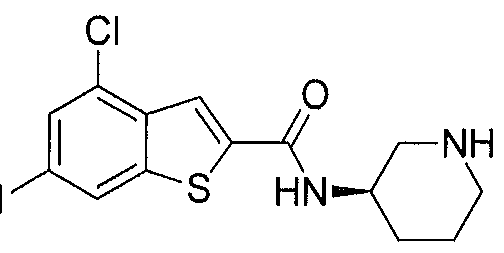
(/?)-4,6-dichloro-N-(piperidin-3-yl)benzo[b]thiophene-2-carboxamide was prepared by general amide coupling procedure in Synthetic Example 1. Ή NMR (CD3OD, 400 MHz) δ 8.18 (d, IH, J=0.4 Hz), 7.98 (dd, 1H,J=0.4, 1.6 Hz), 7.53 (d, 1H,J= 1.6 Hz), 4.25 (m, IH), 3.56 (dd, 1H,J=4.0, 12.4 Hz), 3.40 (m, IH), 3.01 (m, 2H), 2.17-2.08 (m, 2H), 1.93- 1.93 (m, 2H). LCMS (ESI) 329, 331 (M+H).
Synthetic Example 7: (R)-4-bromo-N-(pyrrolidin-3-yl)benzo[b]thiophene-2-carboxamide (SR- 13061)

Ethyl 4-bromobenzo|"b]thiophene-2-carboxylate

Ethyl 4-bromobenzo[b]thiophene-2-carboxylate was prepared by general procedure B in Synthetic Example 5 using 2-bromo-6-fluorobenzaldehyde and ethyl mercaptoacetate. Ή
NMR (CDCI3, 400 MHz) δ 8.19 (d, IH, J= 0.8 Hz), 7.81 (dt, IH, J= 0.8, 8.0 Hz), 7.60 (dd, 1H,J=0.8, 7.6 Hz), 7.32 (t, lH,J=8.0Hz), 4.45 (q, 1H,J=7.2 Hz), 1.45 (t, 1H,J=7.2
Hz).
4-Bromobenzofb]thiophene-2-carboxylic acid

The base (LiOH) hydrolysis of ethyl 4-bromobenzo[b]thiophene-2-carboxylate was similar to General Procedure A in Synthetic example 1.
(i?)-4-bromo-N-(pyrrolidin-3-yl)benzo[b]thiophene-2-carboxamide was prepared by general amide coupling procedure in Synthetic Example 1. Ή NMR (CD3OD, 400 MHz) δ 8.19 (d, IH, J= 0.8 Hz), 7.91 (dt, IH, J= 0.4, 8.2 Hz), 7.63 (dd, IH, J= 0.8, 7.6 Hz), 7.36 (t, IH, J = 8.2 Hz), 4.66 (m, IH), 3.66-3.56 (m, 2H), 3.46-3.41 (m, 2H), 2.47 (m, IH), 2.28 (m, 2H). LCMS (ESI) 325, 327 (M+H).
Synthetic Example 8: (i?)-4-bromo-N-(piperidin-3-yl)benzo[b1thiophene-2-carboxamide (SR- 13062)

(7?)-4-bromo-N-(piperidin-3-yl)benzo[b]thiophene-2-carboxamide was prepared by general amide coupling procedure in Synthetic Example 1. Ή NMR (CD3OD, 400 MHz) δ 8.18 (d, 1 H, J = 0.4 Hz), 7.91 (d, 1H, J= 8.0 Hz), 7.64 (dd, 1H, J= 0.8, 8.0 Hz), 7.35 (t, 1 H, J = 8.0 Hz), 4.27 (m, 1H), 3.57 (dd, 1H, J= 1.6, 12.4 Hz), 3.38 (dd, 1H, J= 0.4, 12.4 Hz), 3.05-2.98 (m, 2H), 2.18-2.08 (m, 2H), 1.95-1.87 (m, 2H). LCMS (ESI) 339, 341 (M+H).
Synthetic Example 9: (^)-4-chloro-N-(l -ethylpiperidin-3-yl)benzo[b]thiophene-2- carboxamide (SR-13178)

The title compound was prepared by general reductive amination procedure in Synthetic Example 3. Ή NMR (CD3OD, 400 MHz) δ 8.22 (s, 1 H), 7.90 (d, 1H, J= 7.6 Hz), 7.47 (m, 2H), 4.37 (m, 1 H), 3.83 (m, 1H), 3.67-3.63 (m, 1H), 3.50 (m, 1H), 3.14-2.88 (m, 2H), 2.19- 2.14 (m, 2H), 2.00-1.85 (m, 1 H), 1 .81 -1.70 (m, 2H), 1 .42 (d, 3H, J= 6.8 Hz). LCMS (ESI) 323, 325 (M+H).
Synthetic Example 10: (i?)-4-chloro-N-(l -isopropylpiperidin-3-yl)benzo[b]thiophene-2-

The title compound was prepared by general reductive amination procedure in Synthetic Example 3. Ή NMR (CD3OD, 400 MHz) δ 8.22 (d, 1H, J= 0.4 Hz), 7.91 (dt, 1 H, J = 1.2, 7.6 Hz), 7.47 (m, 2H), 4.35 (m, 1 H), 3.68-3.58 (m, 2H), 3.50 (m, 1 H), 3.02 (dt, 1 H, J= 2.8, 12.8 Hz), 2.88 (t, 1H, J= 1 1.6 Hz), 2.17 (d, 2H, J= 1 1.2 Hz), 1.93 (m, 1H), 1.74 (m, 1 H), 1.41 (d, 6H, J= 6.4 Hz). LCMS (ESI) 337, 339 (M+H).
Synthetic Example 1 1 : (R)-4-chloro-N-(l-isopentylpiperidin-3-yl)benzo[blthiophene-2- carboxamide (SR-13180)

The title compound was prepared by general reductive amination procedure in Synthetic Example 3. Ή NMR (CD3OD, 400 MHz) δ 8.22 (s, 1H), 7.90 (dt, 1 H, 7 = 0.8, 7.6 Hz), 7.47 (m, 2H), 4.30 (m, 1 H), 3.78 (dt, 1H, J= 1.6, 1 1.6 Hz), 3.63 (d, 1H, J= 1 1.2 Hz), 3.20 (m, 2H), 2.94 (dt, 1H, 7= 2.8, 12.8 Hz), 2.84 (t, 1H, 7= 1 1.6 Hz), 2.17 (m, 2H), 1.89 (m, 1H), 1 .81 -1 .67 (m, 4H), 1.00 (d, 6H, 7= 6.4 Hz). LCMS (ESI) 365, 367 (M+H).
Synthetic Example 12; (R)-N-(l -benzylpiperidin-3-yl)-4-chlorobenzo[b1thiophene-2- carboxamide (SR-13181)

The title compound was prepared by general reductive amination procedure in Synthetic Example 3. Ή NMR (CD3OD, 400 MHz) δ 8.20 (s, 1 H), 7.90 (dt, 1 H, 7 = 1.2, 7.6 Hz), 7.50 (brs, 5H), 7.45 (m, 2H), 4.42 (s, 2H), 4.30 (m, 1 H), 3.70 (d, 1 H, 7= 1 1.6 Hz), 3.51 (dt, 1 H, 7 = 2.0, 10.0 Hz), 3.01 (t, 1H, 7= 12.0 Hz), 2.89 (t, 1H, 7= 1 1.6 Hz), 2.15 (m, 2H), 1.90 (m, 1 H), 1.75 (m, 1 H). LCMS (ESI) 385, 387 (M+H).
Synthetic Example 13 : (7?)-N-(l-acetylpiperidin-3-yl)-4-chlorobenzo blthiophene-2-

To a THF (5 mL) solution containing (R)-4-chloro-N-(piperidin-3-yl)benzo[b]thiophene-2- carboxamide (TFA salt, 15 mg, 0.037 mmol) and N,N-Diisopropylethylamine (26 uL, 0.16 mmol) at 0 °C, Acetyl chloride (71 uL, 1.0 mmol) was slowly added. The resulting mixture was slowly warmed to room temperature and stirred for 30 min. The solvent was removed in vacuo, and title compound (10 mg, 80%) was purified on silica gel column by using hexanes and ethyl acetate. Ή NMR (CD3OD, 400 MHz) δ 8.22 (d, 0.5H, 7= 0.4 Hz), 8.18 (d, 0.5H, 7 = 0.4 Hz), 7.89 (dq, 1 H, 7= 1.2, 8.0 Hz), 7.45 (m, 2H), 4.52 (m, 0.5H), 4.25 (m, 0.5H), 4.04 (dd, 0.5H, 7= 4.0, 9.2 Hz), 3.95 (m, 1 H), 3.85 (m, 0.5H), 3.60 (m, 0.5H), 3.47 (m, 0.5H),
3.18 (m, 1 H), 2.88 (m, 1H), 2.16 (s, 3H), 2.13 (m, 1 H), 1.90-161 (m, 2H). LCMS (ESI) 337, 339 (M+H).
Synthetic Example 14: (7?)-5-bromo-N-(piperidin-3-yl)benzo[b]thiophene-2-carboxamide (SR-13278)

-bromobenzo[b]thiophene-2-carboxylate
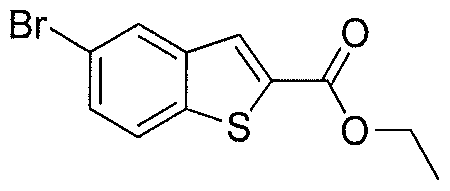
Ethyl 5-bromobenzo[b]thiophene-2-carboxylate was prepared by general procedure B in Synthetic Example 5 using 5-bromo-2-fluorobenzaldehyde and ethyl mercaptoacetate. Ή
NMR (CDC13, 400 MHz) δ 7.94 (d, 1H, J= 2.0 Hz), 7.89 (d, 1H, J = 0.4 Hz), 7.65 (d, 1 H, J = 8.8 Hz), 7.47 (dd, 1 H, J= 2.0, 8.4 Hz), 4.34 (q, 2H, J= 7.0 Hz), 1.35 (t, 3H, J= 7.0 Hz). -Bromobenzo[b]thiophene-2-carboxylic acid

The base (LiOH) hydrolysis of ethyl 5-bromobenzo[b]thiophene-2-carboxylate was similar to General Procedure A in Synthetic example 1.
(7?)-5-bromo-N-(piperidin-3-yl)benzo[b]thiophene-2-carboxamide was prepared by general amide coupling procedure in Synthetic Example 1. Ή NMR (CD3OD, 400 MHz) δ 8.09 (d, 1 H, J= 2.0 Hz), 7.96 (d, 1H, J = 0.4 Hz), 7.86 (d, 1H, J= 8.8 Hz), 7.58 (dd, 1H, J= 2.0, 8.8 Hz), 4.27 (m, 1 H), 3.56 (dd, 1H, J= 4.0, 12.0 Hz), 3.39 (m, 1H), 3.01 (m, 2H), 2.13 (m, 2H), 1.82 (m, 2H). LCMS (ESI) 339, 341 (M+H).
Synthetic Example 15: (R)-5-chloro-N-(piperidin-3-yl)benzo[b1thiophene-2-carboxamide -13519)

-chlorobenzo[blthiophene-2-carboxylate
 Ethyl 5-chlorobenzo[b]thiophene-2-carboxylate was prepared by general procedure B in Synthetic Example 5 using 3-chloro-6-fluorobenzaldehyde and ethyl mercaptoacetate. Ή NMR (CDC , 400 MHz) δ 7.98 (s, 1H), 7.86 (d, 1H, J= 2.4 Hz), 7.79 (d, 1 H, J = 8.8 Hz), 7.42 (dd, 1 H, J= 2.0, 8.8 Hz), 4.43 (q, 2H, J= 6.8 Hz), 1.44 (t, 3H, J = 7.2 Hz).
-Chlorobenzo|"b"|thiophene-2-carboxylic acid

The base (LiOH) hydrolysis of ethyl 5-chlorobenzo[b]thiophene-2-carboxylate was similar to General Procedure A in Synthetic example 1.
(R)-5-chloro-N-(piperidin-3-yl)benzo[b]thiophene-2-carboxamide was prepared by general amide coupling procedure in Synthetic Example 1. Ή NMR (CD3OD, 400 MHz) δ 7.96 (s, 1 H), 7.88 (m, 2H), 7.42 (dd, 1H, J= 2.0, 8.8 Hz), 4.29 (m, 1H), 3.55 (dd, 1H, J = 4.0, 12.4 Hz), 3.35 (m, 1 H), 3.00 (m, 2H), 2.15 (m, 2H), 1 .87 (m, 2H). LCMS (ESI) 295, 297 (M+H). Synthetic Example 16: ( ?)-6-chloro-N-(piperidin-3-yl)benzo[blthiophene-2-carboxamide - 13520)

-chlorobenzo b]thiophene-2-carboxylate
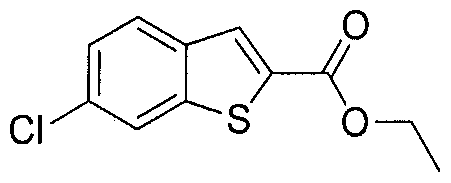
Ethyl 6-chlorobenzo[b]thiophene-2-carboxylate was prepared by general procedure B in Synthetic Example 5 using 4-chloro-2-fluorobenzaldehyde and ethyl mercaptoacetate. Ή
NMR (CDCI3, 400 MHz) δ 8.03 (d, 1 H, J= 0.4 Hz), 7.86 (t, 1H, J= 0.4 Hz), 7.80 (d, 1 H, J = 8.8 Hz), 7.38 (dd, 1H, J= 2.0, 8.8 Hz), 4.42 (q, 2H, J= 7.2 Hz), 1.45 (t, 3H, J= 7.2 Hz). -Chlorobenzo[b]thiophene-2-carboxylic acid

The base (LiOH) hydrolysis of ethyl 6-chlorobenzo[b]thiophene-2-carboxylate was similar to General Procedure A in Synthetic example 1.
(R)-6-chloro-N-(piperidin-3-yl)benzo[b]thiophene-2-carboxamide was prepared by general amide coupling procedure in Synthetic Example 1. Ή NMR (CD3OD, 400 MHz) δ 8.00 (s,
1H), 7.96 (d, 1H,J= 1.6 Hz), 7.85 (d, lH,J=8.4Hz), 7.41 (dd, 1H,J=2.0, 8.4 Hz), 4.27 (m, 1H), 3.55 (dd, 1H, J= 4.0, 12.4 Hz), 3.38 (m, 1H), 3.00 (m, 2H), 2.13 (m, 2H), 1.89 (m, 2H). LCMS (ESI) 295, 297 (M+H).
Synthetic Example 17: (R)-7-chloro-N-(piperidin-3-yl)benzo[blthiophene-2-carboxamide -13521)

-chlorobenzo[b]thiophene-2-carboxylate

Ethyl 7-chlorobenzo[b]thiophene-2-carboxylate was prepared by general procedure B in Synthetic Example 5 using 3-chloro-2-fluorobenzaldehyde and ethyl mercaptoacetate. Ή NMR (CDC13, 400 MHz) δ 8.00 (s, 1H), 7.71 (dd, 1H, J= 0.8, 8.0 Hz), 7.37 (dd, 1H, J= 1.2, 8.0 Hz), 7.29 (t, 1H, J= 8.0 Hz), 4.34 (q, 2H, J= 7.2 Hz), 1.37 (t, 3H, J= 7.2 Hz).
-Chlorobenzo|"b"|thiophene-2-carboxylic acid

The base (LiOH) hydrolysis of ethyl 7-chlorobenzo[b]thiophene-2-carboxylate was similar to General Procedure A in Synthetic example 1.
(R)-7-chloro-N-(piperidin-3-yl)benzo[b]thiophene-2-carboxamide was prepared by general amide coupling procedure in Synthetic Example 1. Ή NMR (CD3OD, 400 MHz) δ 8.07 (s, 1H), 7.84 (dd, 1H,J= 1.2, 8.0 Hz), 7.48 (dd, 1H,J=1.2, 7.6 Hz), 7.43 (t, lH,J=8.0Hz), 4.29 (m, 1H), 3.56 (dd, 1H,J=4.0, 12.4 Hz), 3.37 (m, 1H), 3.02 (m, 2H), 2.14 (m, 2H), 1.87 (m, 2H). LCMS (ESI) 295, 297 (M+H).
Synthetic Example 18: (R)-6-bromo-N-(piperidin-3-yl)benzo[blthiophene-2-carboxamide -13522)

Ethyl 6-bromobenzo[blthiophene-2-carboxylate

Ethyl 6-bromobenzo[b]thiophene-2-carboxylate was prepared by general procedure B in Synthetic Example 5 using 4-bromo-2-fluorobenzaldehyde and ethyl mercaptoacetate. Ή NMR (CDC13, 400 MHz) δ 8.03 (m, 2H), 7.74 (d, 1H, J= 8.4 Hz), 7.53 (dd, 1H, J= 1.6, 8.4 Hz), 4.42 (q, 2H, J= 7.2 Hz), 1.44 (t, 3H, J= 7.2 Hz).
-Bromobenzo[b]thiophene-2-carboxylic acid

The base (LiOH) hydrolysis of ethyl 6-bromobenzo[b]thiophene-2-carboxylate was similar to General Procedure A in Synthetic example 1.
(i?)-6-bromo-N-(piperidin-3-yl)benzo[b]thiophene-2-carboxamide was prepared by general amide coupling procedure in Synthetic Example 1. Ή NMR (CD3OD, 400 MHz) δ 8.11 (dd, 1H, J= 0.4, 1.2 Hz), 7.99 (s, 1H), 7.79 (d, 1H, J= 8.4 Hz), 7.54 (dd, 1H, J= 1.6, 8.4 Hz), 4.29 (m, 1H), 3.55 (dd, 1H,J=4.4, 12.4 Hz), 3.39 (m, 1H), 3.00 (m, 2H), 2.12(m, 2H), 1.84 (m, 2H). LCMS (ESI) 339, 341 (M+H).
Synthetic Example 19: (R)-7-bromo-N-(piperidin-3-yl)benzo[b]thiophene-2-carboxamide -13523)

-bromobenzo[b]thiophene-2-carboxylate
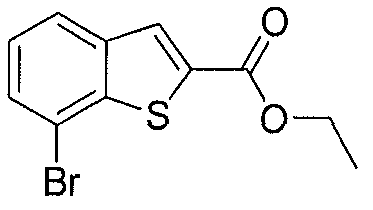
Ethyl 7-bromobenzo[b]thiophene-2-carboxylate was prepared by general procedure B in Synthetic Example 5 using 3-bromo-2-fluorobenzaldehyde and ethyl mercaptoacetate. Ή NMR (CDCI3, 400 MHz) δ 8.15 (s, 1H), 7.84 (d, lH,J=8.0Hz), 7.61 (d, lH,J=7.6Hz), 7.31 (t, 1H, 7=7.6 Hz), 4.43 (q, 2H,J=6.8Hz), 1.46 (t, 3H, J= 6.8 Hz).
-Bromobenzo[blthiophene-2-carboxylic acid
 The base (LiOH) hydrolysis of ethyl 7-bromobenzo[b]thiophene-2-carboxylate was similar to General Procedure A in Synthetic example 1 .
(R)-7-bromo-N-(piperidin-3-yl)benzo[b]thiophene-2-carboxamide was prepared by general amide coupling procedure in Synthetic Example 1. Ή NMR (CD3OD, 400 MHz) δ 8.10 (s, 1H), 7.90 (dd, 1 H, J= 0.8, 8.0 Hz), 7.63 (dd, 1H, J= 0.8, 7.6 Hz), 7.36 (t, 1H, J= 8.0 Hz), 4.1 1 (m, lH), 3.34 (m, 1 H), 3.13 (m, 1H), 2.74 (m, 2H), 2.08 (m, 1 H), 1.69 (m, 2H). LCMS (ESI) 339, 341 (M+H).
Synthetic Example 20: (R)-4-methyl-N-(piperidin-3-yl)benzo[b]thiophene-2-carboxamide -13524)

( ?)-4-Bromo-N-(piperidin-3-yl)benzo[b]thiophene-2-carboxamide (TFA salt, 10 mg, 0.022 mmol), trimethylboroxine (100 uL, 0.72 mmol), Pd(PPh3)4 (6.0 mg, 0.005 mmol), K2C03 (30 mg, 0.22 mmol) and a mixture of dioxane and water (1.5 ml, 3: 1 , v/v) were added into a reaction flask containing stir bar, sealed and heated at 100 °C for 2.5 h. The title compound was purified by pre-HPLC using binary solvents (A: methanol and acetonitrile (1 : 1 , v/v); B: water containing TFA (0.1 %, v/v)). Ή NMR (CD3OD, 400 MHz) δ 8.18 (d, 1 H, J= 0.4 Hz), 7.74 (d, 1 H, J = 8.4 Hz), 7.36 (t, 1H, J= 8.0 Hz), 7.23 (d, 1H, J = 7.2 Hz), 4.28 (m, 1 H), 3.57 (dd, 1H, J= 4.0, 12.0 Hz), 3.40 (m, 1 H), 3.01 (m, 2H), 2.66 (s, 3H), 2.14 (m, 2H), 1.84 (m, 2H). LCMS (ESI) 275 (M+H).
Synthetic Example 21 : (R)-4-phenyl-N-(piperidin-3-yl)benzo[blthiophene-2-carboxamide -13525)

(/?)-4-Bromo-N-(piperidin-3-yl)benzo[b]thiophene-2-carboxamide (TFA salt, 10 mg, 0.022 mmol), phenylboronic acid (15 mg, 0.12 mmol), Pd(PPh3)4 (6.0 mg, 0.005 mmol), K2C03 (30 mg, 0.22 mmol) and a mixture of dioxane and water (1.5 ml, 3: 1 , v/v) were added into a reaction flask containing stir bar, sealed and heated at 100 °C for 2 h. The title compound was purified by pre-HPLC using binary solvents (A: methanol and acetonitrile (1 : 1 , v/v); B: water containing TFA (0.1 %, v/v)). 'H NMR (CD3OD, 400 MHz) δ 8.10 (d, 1H, J= 0.8 Hz), 7.93
(dd, 1 H, J = 0.8, 8.4 Hz), 7.59-7.52 (m, 5H), 7.43 (m, 1H), 7.40 (dd, 1H, J= 1.2, 7.6 Hz), 4.23 (m, 1 H), 3.53 (dd, 1 H, J= 4.0, 12.4 Hz), 3.35 (m, 1H), 2.92 (m, 2H), 2.12 (m, 2H), 1.89 (m, 1 H), 1.76 (m, 1 H). LCMS (ESI) 337 (M+H).
Synthetic Example 22: (R)-5-methyl-N-(piperidin-3-yl)benzo["blthiophene-2-carboxamide -13526)

(7?)-5-methyl-N-(piperidin-3-yl)benzo[b]thiophene-2-carboxamide was prepared by a similar procedure in Synthetic Example 20 using (7?)-5-bromo-N-(piperidin-3-yl)benzo[b]thiophene- 2-carboxamide and trimethylboroxine. Ή NMR (CD3OD, 400 MHz) δ 7.94 (s, 1H), 7.79 (d, 1 H, J= 8.4 Hz), 7.70 (m, 1 H), 7.31 (dd, 1H, J= 1.2, 8.4 Hz), 4.26 (m, 1H), 3.55 (dd, 1 H, J = 4.0, 12.4 Hz), 3.39 (m, 1H), 3.03 (m, 1 H), 2.50 (s, 3H), 2.14 (m, 2H), 1.87 (m, 2H). LCMS (ESI) 275 (M+H).
Synthetic Example 23; (R)-7-methyl-N-(piperidin-3-yl)benzo blthiophene-2-carboxamide -13527)

(i?)-7-methyl-N-(piperidin-3-yl)benzo[b]thiophene-2-carboxamide was prepared by a similar procedure in Synthetic Example 20 using (R)-7-bromo-N-(piperidin-3-yl)benzo[b]thiophene- 2-carboxamide and trimethylboroxine. Ή NMR (CD3OD, 400 MHz) δ 8.05 (s, 1H), 7.75 (d, 1 H, J= 8.0 Hz), 7.37 (t, 1H, J= 8.0 Hz), 7.28 (dd, 1 H, J= 1.2, 6.4 Hz), 4.27 (m, 1H), 3.56 (dd, 1 H, J= 4.0, 12.4 Hz), 3.40 (m, 1H), 3.01 (m, 2H), 2.55 (s, 3H), 2.15 (m, 2H), 1.86 (m, 2H). LCMS (ESI) 275 (M+H).
Synthetic Example 24: (R)-4-cyano-N-(piperidin-3-yl)benzo[blthiophene-2-carboxamide (SR-13528)

(7?)-4-bromo-N-(piperidin-3-yl)benzo[b]thiophene-2-carboxamide (TFA salt, 10 mg, 0.022 mmol), Zn(CN)2 (6 mg, 0.05 mmol), Pd2(dba)3 (4 mg, 0.0038 mmol), S-Phos (4 mg, 0.01 mmol) and DMF (1.2 mL) were added into a microwave tube containing stir bar, and sealed and heated at 150 °C for 40 min by microwave, Title compound was purified by pre-HPLC
using binary solvents (A: methanol and acetonitrile (1 : 1, v/v); B: water containing TFA (0.1 %, v/v)). Ή NMR (CD3OD, 400 MHz) δ 8.29 (m, 2H), 7.90 (dd, 1 H, J= 0.8, 7.2 Hz), 7.62 (dd, 1 H, J = 7.6, 8.4 Hz), 4.29 (m, 1H), 3.57 (dd, 1 H, J = 4.0, 12.4 Hz), 3.40 (m, 1H), 3.01 (m, 2H), 2.17 (m, 2H), 1.87 (m, 2H), LCMS (ESI) 286 (M+H).
Synthetic Example 25 : (R)-N-(piperidin-3-yl)-4-(trifluoromethyl)benzo[b1thiophene-2- carboxamide (SR- 13529)

-(trifluoromethyl)benzo[b]thiophene-2-carboxylate

Ethyl 4-(trifluoromethyl)benzo[b]thiophene-2-carboxylate was prepared by general procedure B in Synthetic Example 5 using 2-fluoro-6-(trifluoromethyl)benzaldehyde and ethyl mercaptoacetate. Ή NMR (CDC13, 400 MHz) δ 8.27 (dd, 1H, J= 2.0, 2.8 Hz), 8.06 (dd, 1H, J= 0.4, 8.0 Hz), 7.54 (dd, 1H, J= 0.8, 8.0 Hz), 7.55 (dt, 1 H, J= 0.8, 8.0 Hz), 4.56 (q, 2H, J = 7.2 Hz), 1.45 (t, 3H, J= 7.2 Hz).
4-(Trifluoromethyl)benzo[b]thiophene-2-carboxylic acid

The base (LiOH) hydrolysis of ethyl 4-(trifluoromethyl)benzo[b]thiophene-2-carboxylate was similar to General Procedure A in Synthetic example 1.
(R)-N-(piperidin-3-yl)-4-(trifluoromethyl)benzo[b]thiophene-2-carboxamide was prepared by general amide coupling procedure in Synthetic Example 1. Ή NMR (CD3OD, 400 MHz) δ 8.29 (t, 1H, J= 0.8 Hz), 8.23 (d, 1 H, J= 8.4 Hz), 7.81 (d, 1 H, J= 7.2 Hz), 7.62 (t, 1H, J= 7.6 Hz), 4.28 (m, 1 H), 3.56 (dd, 1H, J= 4.0, 12.4 Hz), 3.40 (m, 1H), 3.00 (m, 2H), 2.17 (m, 2H), 1.89 (m, 2H). LCMS (ESI) 329 (M+H).
Synthetic Example 26: (i?)-4-fluoro-N-(piperidin-3-yl)benzo[blthiophene-2-carboxamide (SR-13530)

Ethyl 4-fluorobenzo|"blthiophene-2-carboxylate
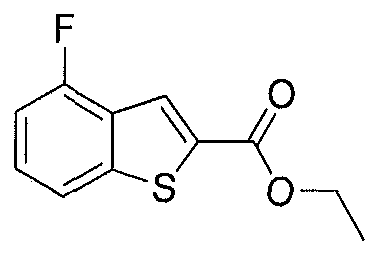
Ethyl 4-fluorobenzo[b]thiophene-2-carboxylate was prepared by general procedure B in Synthetic Example 5 using 2,6-difluorobenzaldehyde and ethyl mercaptoacetate. Ή NMR (CDC13, 400 MHz) δ 8.16 (d, 1 H, J= 0.8 Hz), 7.64 (dt, 1 H, J= 0.8, 8.4 Hz), 7.42 (m, 1 H), 7.07 (m, 1 H), 7.43 (q, 2H, J = 6.8 Hz), 1.44 (t, 3H, J= 7.2 Hz).
4-Fluorobenzo[b]thiophene-2-carboxylic acid

The base (LiOH) hydrolysis of ethyl 4-fluorobenzo[b]thiophene-2-carboxylate was similar to General Procedure A in Synthetic example 1.
(R)-4-fluoro-N-(piperidin-3-yl)benzo[b]thiophene-2-carboxamide was prepared by general amide coupling procedure in Synthetic Example 1. Ή NMR (CD3OD, 400 MHz) δ 8.13 (d, 1 H, J = 0.4 Hz), 7.74 (d, 1 H, J = 7.6 Hz), 7.45 (m, 1 H), 7.14 (m, 1H), 4.29 (m, lH), 3.56 (dd, 1H, J = 4.0, 12.4 Hz), 3.38 (m, 1 H), 3.00 (m, 2H), 2.1 1 (m, 2H), 1.86 (m, 2H). LCMS (ESI) 279 (M+H).
Synthetic Example 27: C^^-chloro-S-methyl-N-fpiperidin-S-vDbenzo blthiophene^-


mercaptoacetate. Ή NMR (CDC13, 400 MHz) δ 7.72 (dd, 1 H, J= 1.2, 8.0 Hz), 7.39 (dd, 1 H, J= 1.2, 7.6 Hz), 7.34 (t, 1 H, J= 7.6 Hz), 4.41 (q, 2H, J= 7.2 Hz), 3.14 (s, 3H), 1.41 (t, 3H, J = 7.2 Hz).
-Chloro-3-methylbenzo[b]thiophene-2-carboxylic acid

The base (LiOH) hydrolysis of ethyl 4-chloro-3-methylbenzo[b]thiophene-2-carboxylate was similar to General Procedure A in Synthetic example 1.
(i?)-4-chloro-3-methyl-N-(piperidin-3-yl)benzo[b]thiophene-2-carboxamide was prepared by general amide coupling procedure in Synthetic Example 1. Ή NMR (CD3OD, 400 MHz) δ
7.84 (dd, 1 H, J = 1.2, 8.0 Hz), 7.45 (dd, 1 H, J= 1.2, 7.6 Hz), 7.38 (t, 1 H, J= 8.0 Hz ), 4.27 (m, 1 H), 3.60 (dd, 1 H, J= 4.0, 12.4 Hz), 3.40 (m, 1 H), 2.98 (m, 2H), 2.88 (s, 3H), 2.16 (m, 2H), 1.90 (m, 1 H), 1.72 (m, 1 H). LCMS (ESI) 309, 31 1 (M+H).
Synthetic Example 28: (R)-6-methyl-N-(piperidin-3-yl)benzo blthiophene-2-carboxamide -13802)

(7?)-6-methyl-N-(piperidin-3-yl)benzo[b]thiophene-2-carboxamide was prepared by a similar procedure in Synthetic Example 20 using (R)-6-bromo-N-(piperidin-3-yl)benzo[b]thiophene-
2-carboxamide and trimethylboroxine. Ή NMR (CD3OD, 400 MHz) δ 7.96 (s, 1 H), 7.78 (d, 1H, J= 8.0 Hz), 7.72 (d, 1 H, J= 0.4 Hz), 7.28 (dd, 1 H, J = 1.2, 8.4 Hz), 4.26 (m, 1H), 3.55 (dd, 1 H, J= 4.0, 12.4 Hz), 3.37 (m, 1H), 3.00 (m, 2H), 2.50 (s, 3H), 2.15 (m, 2H), 1.87 (m, 2H). LCMS (ESI) 275 (M+H).
Synthetic Example 29: (7?)-5-phenyl-N-(piperidin-3-yl)benzo[blthiophene-2-carboxamide - 13803)

(7?)-5-phenyl-N-(piperidin-3-yl)benzo[b]thiophene-2-carboxamide was prepared by similar procedure in Synthetic Example 21 using (R)-5-bromo-N-(piperidin-3-yl)benzo[b]thiophene-
2-carboxamide and phenylboronic acid. Ή NMR (CD3OD, 400 MHz) δ 8.13 (s, 1 H), 8.08 (s, 1 H), 8.01 (d, 1 H, J = 8.8 Hz), 7.76 (dd, 1H, J = 2.0, 8.4 Hz), 7.71 (dd, 2H, J= 0.8, 7.2 Hz), 7.49 (t, 2H, J= 8.0 Hz), 7.40 (dt, 1 H, J = 0.8, 8.4 Hz), 4.29 (m, 1 H), 3.57 (dd, 1 H, J= 4.0, 12.4 Hz), 3.38 (m, 1 H), 3.01 (m, 2H), 2.14 (m, 2H), 1.85 (m, 2H). LCMS (ESI) 337 (M+H). Synthetic Example 30: (R)-5-cyano-N-(piperidin-3-yl)benzo[blthiophene-2-carboxamide -13804)

(R)-5-cyano-N-(piperidin-3-yl)benzo[b]thiophene-2-carboxamide was prepared by similar procedure in Synthetic Example 24 using (i?)-5-bromo-N-(piperidin-3-yl)benzo[b]thiophene- 2-carboxamide. Ή NMR (CD3OD, 400 MHz) δ 8.36 (s, 1 H, j = 0.8 Hz), 8.15 (d, 1 H, J = 8.4 Hz), 8.10 (s, 1 H), 7.73 (dd, 1 H, J= 1.6, 8.4 Hz), 4.27 (m, 1H), 3.57 (dd, 1 H, J= 4.0, 12.4 Hz), 3.38 (m, 1H), 3.01 (m, 2H), 2.16 (m, 2H), 1.85 (m, 2H). LCMS (ESI) 286 (M+H). Synthetic Example 31 : (R)-6-cyano-N-(piperidin-3-yl)benzo[blthiophene-2-carboxamide -13805)

(7?)-6-cyano-N-(piperidin-3-yl)benzo[b]thiophene-2-carboxamide was prepared by similar procedure in Synthetic Example 24 using ( )-6-bromo-N-(piperidin-3-yl)benzo[b]thiophene- 2-carboxamide. Ή NMR (CD3OD, 400 MHz) δ 8.44 (t, 1 H, J= 0.8 Hz), 8.10 (d, 1 H, J= 0.4 Hz), 8.07 (d, 1 H, J = 8.4 Hz), 7.71 (dd, 1 H, J= 1.2, 8.4 Hz), 4.29 (m, 1 H), 3.57 (dd, 1H, J = 4.0, 12.4 Hz), 3.38 (m, 1H), 3.01 (m, 2H), 2.14 (m, 2H), 1.87 (m, 2H). LCMS (ESI) 286 (M+H).
Synthetic Example 32: ( ?)-6-phenyl-N-(piperidin-3-yl)benzo[b1thiophene-2-carboxamide -13806)

( ?)-6-phenyl-N-(piperidin-3-yl)benzo[b]thiophene-2-carboxamide was prepared by similar procedure in Synthetic Example 21 using (R)-6-bromo-N-(piperidin-3-yl)benzo[b]thiophene-
2-carboxamide and phenylboronic acid. Ή NMR (CD3OD, 400 MHz) δ 8.18 (d, 1 H, J= 0.8 Hz), 8.04 (s, 1H), 7.98 (d, 1H, J= 8.4 Hz), 7.73 (m, 3H), 7.49 (m, 2H), 7.38 (m, 1 H), 4.28
(m, 1 H), 3.57 (dd, 1 H, J= 4.0, 12.4 Hz), 3.37 (m, 1H), 3.01 (m, 2H), 2.14 (m, 2H), 1.90 (m, 2H). LCMS (ESI) 337 (M+H).
Synthetic Example 33; (7?)-7-cyano-N-(piperidin-3-yl)benzo[b]thiophene-2-carboxamide -13807)
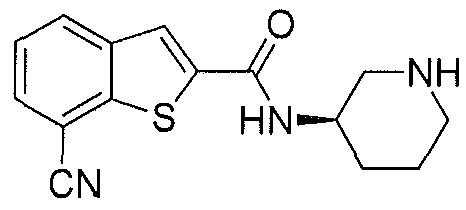
(R)-7-cyano-N-(piperidin-3-yl)benzo[b]thiophene-2-carboxamide was prepared by similar procedure in Synthetic Example 24 using (7?)-7-bromo-N-(piperidin-3-yl)benzo[b]thiophene- 2-carboxamide. Ή NMR (CD3OD, 400 MHz) δ 8.23 (dd, 1H, J= 0.8, 8.4 Hz), 8.14 (s, 1H), 7.92 (dd, 1 H, J= 0.8, 7.2 Hz), 7.62 (dd, 1 H, J= 7.6, 8.0 Hz), 4.27 (m, 1H), 3.58 (dd, 1 H, J = 4.0, 12.4 Hz), 3.39 (m, 1 H), 3.01 (m, 2H), 2.17 (m, 2H), 1.90 (m, 2H). LCMS (ESI) 286 (M+H).
Synthetic Example 34: (^)-7-phenyl-N-(piperidin-3-yl)benzo b"|thiophene-2-carboxamide -13808)
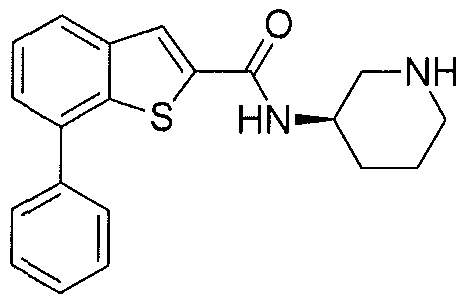
(7?)-7-phenyl-N-(piperidin-3-yl)benzo[b]thiophene-2-carboxamide was prepared by similar procedure in Synthetic Example 21 using (R)-7-bromo-N-(piperidin-3-yl)benzo[b]thiophene- 2-carboxamide and phenylboronic acid. Ή NMR (CD3OD, 400 MHz) δ 8.10 (s, 1 H), 7.90 (d, 1 H, J = 8.0 Hz), 7.72 (m, 2H), 7.52 (m, 5H), 4.27 (m, 1H), 3.57 (dd, 1 H, J= 4.0, 12.4 Hz), 3.39 (m, 1H), 3.01 (m, 2H), 2.17 (m, 2H), 1.90 (m, 2H). LCMS (ESI) 337 (M+H).

Ethyl benzofblthiophene-2-carboxylate
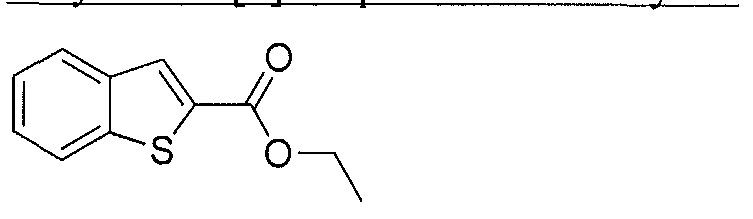
Ethyl benzo[b]thiophene-2-carboxylate was prepared by general procedure B in Synthetic Example 5 using 2-fluorobenzaldehyde and ethyl mercaptoacetate. Ή NMR (CDCI3, 400
MHz) δ 7.97 (d, 1 H, J= 0.4 Hz), 7.82 (m, 2H), 7.34 (m, 2H), 4.35 (q, 2H, J= 7.2 Hz), 1.33 (t, 3H, J= 7.2 Hz).
Benzo[b]thiophene-2-carboxylic acid

The base (LiOH) hydrolysis of ethyl benzo[b]thiophene-2-carboxylate was similar to General Procedure A in Synthetic example 1.
(i?)-N-(piperidin-3-yl)benzo[b]thiophene-2-carboxamide was prepared by general amide coupling procedure in Synthetic Example 1. Ή NMR (CD3OD, 400 MHz) δ 7.91 (s, 1H), 7.80 (m, 2H), 7.33 (m, 2H), 4.15 (m, 1 H), 3.44 (dd, 1H, J = 4.0, 12.4 Hz), 3.26 (m, 1H), 2.89 (m, 2H), 2.01 (m, 2H), 1.76 (m, 2H). LCMS (ESI) 261 (M+H).
Synthetic Example 36: (R)-6-(dimethylamino)-N-(piperidin-3-yl)benzo[b]thiophene-2- carboxamide (SR-13810)
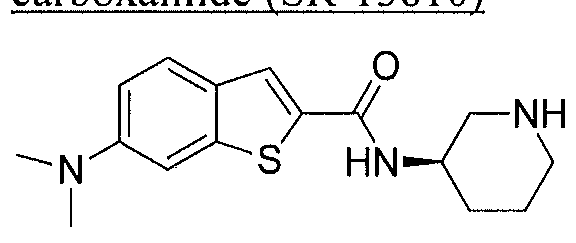
-(dimethylamino)benzo[b]thiophene-2-carboxylate

Ethyl 6-(dimethylamino)benzo[b]thiophene-2-carboxylate was prepared by general procedure A in Synthetic Example 1 using 4-(dimethylamino)-2-nitrobenzaldehyde and ethyl mercaptoacetate. Ή NMR (CDC13, 400 MHz) δ 7.83 (d, 1 H, J= 0.4 Hz), 7.60 (d, 1 H, J= 8.8 Hz), 6.94 (d, 1 H, J = 2.4 Hz), 6.82 (dd, 1H, J= 2.4, 8.8 Hz), 4.29 (q, 2H, J= 6.4 Hz), 2.98 (s, 6H), 1.32 (t, 3H, J= 6.4 Hz).
-(Dimethylamino)benzofb]thiophene-2-carboxylic acid

The base (LiOH) hydrolysis of ethyl 6-(dimethylamino)benzo[b]thiophene-2-carboxylate was similar to General Procedure A in Synthetic example 1.
(R)-6-(dimethylamino)-N-(piperidin-3-yl)benzo[b]thiophene-2-carboxamide was prepared by general amide coupling procedure in Synthetic Example 1. Ή NMR (CD3OD, 400 MHz) δ
7.81 (s, 1 H), 7.71 (d, l H, J= 8.8 Hz), 7.38 (d, lH, J = 2.0 Hz), 7.10 (dd, 1H, J = 2.0, 8.8 Hz),
4.15 (m, 1 H), 3.42 (dd, 1H, J= 4.0, 12.4 Hz), 3.26 (m, 1H), 3.03 (s, 6H), 2.86 (m, 2H), 2.00 (m, 2H), 1.72 (m, 2H). LCMS (ESI) 304 (M+H).
Synthetic Example 37: f^)-7-chloro-6-fluoro-N-(piperidin-3-yl)benzo b]thiophene-2-

Ethyl 7-chloro-6-fluorobenzo[b]thiophene-2-carboxylate

Ethyl 7-chloro-6-fluorobenzo[b]thiophene-2-carboxylate was prepared by general procedure B in Synthetic Example 5 using 3-chloro-2,4-difluorobenzaldehyde and ethyl
mercaptoacetate. Ή NMR (CDC13, 400 MHz) δ 7.94 (s, 1 H), 7.64 (dd, 1H, J = 4.8, 8.8 Hz), 7.16 (t, 1 H, J= 8.8 Hz), 4.33 (q, 2H, J= 7.2 Hz), 1 .34 (t, 3H, J = 7.2 Hz).
-Chloro-6-fluorobenzo[b]thiophene-2-carboxylic acid

The base (LiOH) hydrolysis of ethyl 7-chloro-6-fluorobenzo[b]thiophene-2-carboxylate was similar to General Procedure A in Synthetic example 1.
(R)-7-chloro-6-fluoro-N-(piperidin-3-yl)benzo[b]thiophene-2-carboxamide was prepared by general amide coupling procedure in Synthetic Example 1. Ή NMR (CD3OD, 400 MHz) δ 7.95 (s, 1 H), 7.78 (dd, 1 H, J= 4.4, 8.8 Hz), 7.28 (dd, 1H, J= 8.4, 9.2 Hz), 4.15 (m, 1H), 3.45 (dd, 1 H, J = 4.0, 12.4 Hz), 3.28 (m, 1 H), 2.90 (m, 2H), 2.01 (m, 2H), 1.73 (m, 2H). LCMS (ESI) 313, 315 (M+H).
Synthetic Example 38: (R)-4-chloro-7-fluoro-N-(piperidin-3-yl)benzo b1thiophene-2- carboxamide (SR-13812)
(i?)-4,5-dichloro-N-(piperidin-3-yl)benzo[b]thiophene-2-carboxamide (SR-13813)

Ethyl 4,5-dichlorobenzo b1thiophene-2-carboxylate
Ethyl 4-chloro-7-fluorobenzo[blthiophene-2-carboxylate

Ethyl 4,5-dichlorobenzo[b]thiophene-2-carboxylate and ethyl 4-chloro-7
fluorobenzo[b]thiophene-2-carboxylate, which were inseparable, were prepared by general procedure B in Synthetic Example 5 using 2,3-dichloro-6-fluorobenzaldehydeand ethyl mercaptoacetate. Ή NMR (CDC13, 400 MHz) for ethyl 4,5-dichlorobenzo[b]thiophene-2- carboxylate (major): 8.10 (s, 1 H), 7.60 (d, 1 H, J = 8.4 Hz), 7.41 (d, 1 H, J= 8.4 Hz), 4.35 (q, 2H, J= 6.8 Hz), 1.36 (t, 3H, J = 6.8 Hz). Ή NMR (CDC13) 400 MHz) for ethyl 4-chloro-7 fluorobenzo[b]thiophene-2-carboxylate (minor): 8.06 (s, 1 H), 7.31 (m, 1 H), 6.99 (m, 1 H), 4.15 (q, 2H, J = 6.8 Hz), 1.20 (t, 3H, J = 6.8 Hz)
4,5-Dichlorobenzo[b"|thiophene-2-carboxylic acid
4-Chloro-7-fluorobenzo[blthiophene-2-carboxylic acid

The base (LiOH) hydrolysis of ethyl 4,5-dichlorobenzo[b]thiophene-2-carboxylate and ethyl 4-chloro-7 fluorobenzo[b]thiophene-2-carboxylate was similar to General Procedure A in Synthetic example 1.
(7?)-4-chloro-7-fluoro-N-(piperidin-3-yl)benzo[b]thiophene-2-carboxamide and (R)-4,5- dichloro-N-(piperidin-3-yl)benzo[b]thiophene-2-carboxamide were prepared by general amide coupling procedure in Synthetic Example 1. Ή NMR (CD3OD, 400 MHz) for (R)-4- chloro-7-fluoro-N-(piperidin-3-yl)benzo[b]thiophene-2-carboxamide: 8, 19 (s, 1 H), 7.52 (d, 1 H, J= 4.4, 8.8 Hz), 7.21 (dd, 1H, J = 8.4, 12.0 Hz), 4.21 (m, 1 H), 3.56 (dd, 1 H, J= 4.0, 12.4 Hz), 3.32 (m, 1 H), 3.00 (m, 2H), 2.13 (m, 2H), 1.86 (m, 2H). LCMS (ESI) 313, 315 (M+H). Ή NMR (CD3OD, 400 MHz) for (R)-4,5-dichloro-N-(piperidin-3-yl)benzo[b]thiophene-2- carboxamide: 8.40 (d, 1 H, J= 0.8 Hz), 8.08 (dd, 1 H, J= 0.4, 8.4 Hz), 7.78 (d, 1H, J = 8.8 Hz), 4.50 (m, 1 H), 3.81 (dd, 1H, J= 4.0, 12.4 Hz), 3.60 (m, 1H), 3.23 (m, 2H), 2.36 (m, 2H), 2.1 1 (m, 2H). LCMS (ESI) 329, 331 (M+H).
Synthetic Example 39: (R)-4 J-difluoro-N-(piperidin-3-yl)benzo b thiophene-2-carboxamide (SR-13814)
(piperidin-3- l)benzo b1thiophene-2-carboxarnide (SR-13815)

Ethyl 4,7-difluorobenzo[b]thiophene-2-carboxylate
Ethyl 4-chloro-5-fluoiObenzo[b]thiophene-2-carboxylate

Ethyl 4,7-difluorobenzo[b]thiophene-2-carboxylate and ethyl 4-chloro-5- fluorobenzo[b]thiophene-2-carboxylate, which were inseparable, were prepared by general procedure B in Synthetic Example 5 using 2-chloro-3,6-difluorobenzaldehyde and ethyl mercaptoacetate. Ή NMR (CDC13, 400 MHz) for ethyl 4,7-difluorobenzo[b]thiophene-2- carboxylate: 8.07 (t, 1 H, J = 3.6 Hz), 7.04 (m, 1H), 6.94 (m, 1 H), 4.36 (q, 2H, J= 7.2 Hz),
1.35 (t, 3H, J= 7.2 Hz). Ή NMR (CDC13, 400 MHz) for ethyl 4-chloro-5- fluorobenzo[b]thiophene-2-carboxylate: 8.10 (s, 1H), 7.63 (m, 1 H), 7.23 (t, 1 H, J = 8.8 Hz),
4.36 (q, 2H, J= 7.2 Hz), 1.35 (t, 3H, J = 7.2 Hz).
4,7-Difluorobenzo[b]thiophene-2-carboxylic acid
4-Chloro-5-fluorobenzo b thio hene-2-carbox lic acid

The base (LiOH) hydrolysis of ethyl 4,7-difluorobenzo[b]thiophene-2-carboxylate and ethyl 4-chloro-5-fluorobenzo[b]thiophene-2-carboxylate was similar to General Procedure A in Synthetic example 1.
(/?)-4,7-difluoro-N-(piperidin-3-yl)benzo[b]thiophene-2-carboxamide and ( ?)-4-chloro-5- fluoro-N-(piperidin-3-yl)benzo[b]thiophene-2-carboxamide were prepared by general amide coupling procedure in Synthetic Example 1 . Ή NMR (CD3OD, 400 MHz) for (R)-4,7- difluoro-N-(piperidin-3-yl)benzo[b]thiophene-2-carboxamide: 8.05 (d, 1 H, J = 3.6 Hz), 7.13- 7.05 (m, 2H), 4.17 (m, 1 H), 3.43 (dd, 1 H, J = 4.0, 12.4 Hz), 3.20 (m, 1 H), 2.93 (m, 2H), 2.04 (m, 2H), 1.80 (m, 2H). LCMS (ESI) 297 (M+H). Ή NMR (CD3OD, 400 MHz) for (R)-4- chloro-5-fluoro-N-(piperidin-3-yl)benzo[b]thiophene-2-carboxamide: 8.04 (s, 1 H), 7.77 (m,
1 H), 7.28 (t, lH, J= 9.2 Hz), 4.17 (m, 1H), 3.46 (dd, 1H, J= 4.0, 12.4 Hz), 3.20 (m, 1H),
2.97 (m, 2H), 2.01 (m, 2H), 1.78 (m, 2H). LCMS (ESI) 313, 315 (M+H).
Synthetic Example 40: (i? -7-rnethoxy-N-(piperidin-3-yl)benzo[b1thiophene-2-carboxamide -13816)

-methoxybenzo[b"|thiophene-2-carboxylate

Ethyl 7-methoxybenzo[b]thiophene-2-carboxylate was prepared by general procedure A in Synthetic Example 1 using 3-methoxy-2-nitrobenzaldehyde and ethyl mercaptoacetate. Ή NMR (CDC13, 400 MHz) δ 7.97 (s, 1H), 7.41 (dd, 1H, J= 0.8, 8.0 Hz), 7.28 (t, 1 H, J= 8.0 Hz), 6.79 (d, 1 H, J= 7.6 Hz), 4.33 (q, 2H, J= 7.2 Hz), 3.94 (s, 3H), 1.35 (t, 3H, J = 12 Hz) -Methoxybenzo[b]thiophene-2-carboxylic acid

The base (LiOH) hydrolysis of ethyl 7-methoxybenzo[b]thiophene-2-carboxylate was similar to General Procedure A in Synthetic example 1.
(i?)-7-methoxy-N-(piperidin-3-yl)benzo[b]thiophene-2-carboxamide was prepared by general amide coupling procedure in Synthetic Example 1. Ή NMR (CD3OD, 400 MHz) δ 7.88 (s, 1 H), 7.36 (dd, 1 H, J= 0.4, 7.6 Hz), 7.27 (t, 1 H, J= 7.6 Hz), 6.79 (d, 1H, J= 7.2 Hz), 4.17 (m, 1 H), 3.89 (s, 3H), 3.43 (dd, 1 H, J= 4.0, 12.4 Hz), 3.24 (m, 1 H), 2.89 (m, 2H), 2.01 (m, 2H), 1.75 (m, 2H). LCMS (ESI) 291 (M+H).
Synthetic Example 41 : (R)-N-(piperidin-3-yl)thieno 2'J':4,51benzori.2-din ,31dioxole-6-

Ethyl thieno 2',3':4,5]benzo l,2-dl l,31dioxole-6-carboxylate
 Ethyl thieno[2',3':4,5]benzo[l ,2-d][ l,3]dioxole-6-carboxylate was prepared by general procedure A in Synthetic Example 1 using 6-nitrobenzo[d][ l ,3]dioxole-5-carbaldehyde and ethyl mercaptoacetate. Ή NMR (CDC13, 400 MHz) δ 7.82 (d, 1H, J = 0.4 Hz), 7.13 (s, 1H), 7.12 (s, 1H), 5.98 (s, 2H), 4.30 (q, 2H, J= 8.8 Hz), 1.33 (t, 3H, J = 8.8 Hz).
Thieno[2',3':4,5]benzo[l ,2-d][l J1dioxole-6-carboxylic acid
The base (LiOH) hydrolysis of ethyl thieno[2',3':4,5]benzo[l,2-d][ l ,3]dioxole-6-carboxylate was similar to General Procedure A in Synthetic example 1.
(/?)-N-(piperidin-3-yl)thieno[2',3':4,5]benzo[l,2-d][l ,3]dioxole-6-carboxamide was prepared by general amide coupling procedure in Synthetic Example 1 . Ή NMR (CD3OD, 400 MHz) 5 7.74 (s, 1 H), 7.21 (s, 1H), 7.13 (s, 1H), 5.94 (s, 2H), 4.14 (m, 1 H), 3.43 (dd, 1 H, J= 4.0, 12.4 Hz), 3.25 (m, 1 H), 2.88 (m, 2H), 2.01 (m, 2H), 1.75 (m, 2H). LCMS (ESI) 305 (M+H). Synthetic Example 42: (i? -7-fluoro-N-(piperidin-3-yl)benzo|"b1thiophene-2-carboxamide -13818)

-fluorobenzo|"b]thiophene-2-carboxylate

Ethyl 7-fluorobenzo[b]thiophene-2-carboxylate was prepared by general procedure B in Synthetic Example 5 using 2,3-difluorobenzaldehyde and ethyl mercaptoacetate. Ή NMR (CDCI3, 400 MHz) δ 8.00 (d, 1 H, J= 3.2 Hz), 7.60 (d, 1 H, J = 4.0 Hz), 7.30 (m, 1 H), 7.08 (dq, 1 H, J= 0.8, 10.4 Hz), 4.35 (q, 2H, J= 7.2 Hz), 1.35 (t, 3H, J = 7.2 Hz).
-Fluorobenzo[b]thiophene-2-carboxylic acid

The base (LiOH) hydrolysis of ethyl 7-fluorobenzo[b]thiophene-2-carboxylate was similar to General Procedure A in Synthetic example 1.
(7?)-7-fluoro-N-(piperidin-3-yl)benzo[b]thiophene-2-carboxamide was prepared by general amide coupling procedure in Synthetic Example 1. Ή NMR (CD3OD, 400 MHz) δ 8.08 (d, 1 H, J = 3.6 Hz), 7.75 (d, 1 H, J = 8.0 Hz), 7.45 (m, 1 H), 7.23 (dq, 1 H, J = 0.8, 10.4 Hz), ),
4.29 (m, 1 H), 3.56 (dd, 1H, J = 4.0, 12.4 Hz), 3.39 (m, 1H), 3.03 (m, 2H), 2.15 (m, 2H), 1.87 (m, 2H). LCMS (ESI) 279 (M+H).
Synthetic Example 43: (R)-4-chloro-7-methyl-N-(piperidin-3-yl)benzo[blthiophene-2- carboxamide (SR-13819

Ethyl 4-chloro-7-methylbenzo blthiophene-2-carboxylate

Ethyl 4-chloro-7-methylbenzo[b]thiophene-2-carboxylate was prepared by general procedure B in Synthetic Example 5 using 6-chloro-2-fluoro-3-methylbenzaldehyde and ethyl mercaptoacetate. Ή NMR (CDC13, 400 MHz) δ 8.15 (s, 1 H), 7.25 (d, 1H, J= 8.0 Hz), 7.10 (dd, 1 H, J = 0.8, 7.6 Hz), 4.36 (q, 2H, J= 6.8 Hz), 2.47 (s, 3H), 1.36 (t, 3H, J = 6.8 Hz). 4-Chloro-7-methylbenzo[blthiophene-2-carboxylic acid

The base (LiOH) hydrolysis of ethyl 4-chloro-7-methylbenzo[b]thiophene-2-carboxylate was similar to General Procedure A in Synthetic example 1.
(R)-4-chloro-7-methyl-N-(piperidin-3-yl)benzo[b]thiophene-2-carboxamide was prepared by general amide coupling procedure in Synthetic Example 1. Ή NMR (CD3OD, 400 MHz) δ 8.21 (s, 1 H), 7.38 (d, 1H, J= 7.6 Hz), 7.25 (dd, 1 H, J= 0.4, 7.6 Hz), 4.29 (m, 1H), 3.57 (dd, 1H, J = 4.0, 12.4 Hz), 3.39 (m, 1H), 3.03 (m, 2H), 2.55 (s, 3H), 2.15 (m, 2H), 1.92 (m, 2H). LCMS (ESI) 309, 31 1 (M+H).
Synthetic Example 44: (i?)-4-methoxy-N-(piperidin-3-yl)benzo[blthiophene-2-carboxamide -13820)

Ethyl 4-methoxybenzo[b]thiophene-2-carboxylate

Ethyl 4-methoxybenzo[b]thiophene-2-carboxylate was prepared by general procedure B in Synthetic Example 5 using 2-fJuoro-6-methoxybenzaldehyde and ethyl mercaptoacetate. Ή NMR (CDCI3, 400 MHz) δ 8.14 (d, 1 H, J= 0.4 Hz), 7.31 (m, 2H), 6.67 (dd, 1 H, J = 0.8, 7.2 Hz), 4.32 (q, 2H, J = 7.2 Hz), 3.89 (s, 3H), 1.33 (t, 3H, J= 7.2 Hz).
-Methoxybenzo[b1thiophene-2-carboxylic acid

The base (LiOH) hydrolysis of ethyl 4-methoxybenzo[b]thiophene-2-carboxylate was similar to General Procedure A in Synthetic example 1.
(7?)-4-methoxy-N-(piperidin-3-yl)benzo[b]thiophene-2-carboxamide was prepared by general amide coupling procedure in Synthetic Example 1. Ή NMR (CD3OD, 400 MHz) δ 8.17 (d, 1 H, J= 0.4 Hz), 7.47-7.39 (m, 2H), 6.89 (dd, 1H, J= 0.4, 7.6 Hz), 4.26 (m, 1H), 3.98 (s, 3H), 3.54 (dd, 1 H, J= 4.0, 12.4 Hz), 3.39 (m, 1 H), 3.03 (m, 2H), 2.15 (m, 2H), 1.92 (m, 2H). LCMS (ESI) 309, 291 (M+H).
Synthetic Example 45: (R)-4,7-dichloiO-N-(piperidin-3-yl)benzo[blthiophene-2-carboxamide (SR-13879)

Ethyl 4,7-dichlorobenzo[b]thiophene-2-carboxylate was prepared by general procedure A in Synthetic Example 1 using 2,3,6-trichlorobenzaldehyde and ethyl mercaptoacetate, and final compound was mixed with ethyl 4,5-dichlorobenzo[b]thiophene-2-carboxylate. Ή NMR (CDCI3, 400 MHz) for ethyl 4,7-dichlorobenzo[b]thiophene-2-carboxylate: δ 8.13 (s, 1H), 7.42 (s, 2H), 4.36 (q, 2H, J= 7.2 Hz), 1.36 (t, 3H, J= 7.2 Hz).
4,7-Dichlorobenzo[blthiophene-2-carboxylic acid

The base (LiOH) hydrolysis of ethyl 4,7-dichlorobenzo[b]thiophene-2-carboxylate was similar to General Procedure A in Synthetic example 1.
( ?)-4,7-dichloro-N-(piperidin-3-yl)benzo[b]thiophene-2-carboxamide was prepared by general amide coupling procedure in Synthetic Example 1. Ή NMR (CD3OD, 400 MHz) δ 8.15 (s, I H), 7.39 (s, 2H), 4.16 (m, I H), 3.46 (dd, 1H, J= 4.0, 12.4 Hz), 3.25 (m, I H), 2.98 (m, 2H), 2.05 (m, 2H), 1.80 (m, 2H). LCMS (ESI) 329, 331 (M+H).
Synthetic Example 46: (R)-7-bromo-N-(l -methylpiperidin-3-yl)benzo[b]thiophene-2-

The title compound was prepared by general reductive amination procedure in Synthetic Example 3 using (R)-7-bromo-N-(piperidin-3-yl)benzo[b]thiophene-2-carboxamide. ' H NMR (CD3OD, 400 MHz) δ 8.13 (s, IH), 7.92 (d, IH, J= 8.0 Hz), 7.66 (dd, I H, J= 0.8, 7.6 Hz), 7.39 (t, I H, J= 8.0 Hz), 4.30 (m, I H), 3.74 (dt, I H, J= 2.0, 12.0 Hz), 3.56 (d, I H, J= 10.8 Hz), 3.01 -2.85 (m, 4H), 2.15 (m, 2H), 1.95 (m, IH), 1.74 (m, IH). LCMS (ESI) 339, 341 (M+H).
Synthetic Example 47: (R)-7-chloro-N-(l -methylpiperidin-3-yl)benzo b1thiophene-2-

The title compound was prepared by general reductive amination procedure in Synthetic Example 3 using (R)-7-chloro-N-(piperidin-3-yl)benzo[b]thiophene-2-carboxamide. 'H NMR (CD3OD, 400 MHz) δ 7.95 (s, IH), 7.76 (d, IH, J = 7.6 Hz), 7.41 (dd, IH, J= 1.2, 8.0 Hz), 7.35 (t, lH, J= 7.6 Hz), 4.18 (m, IH), 3.62 (dt, 1H, J= 2.0, 12.0 Hz), 3.45 (d, 1H, J= 10.8 Hz), 2.89-2.73 (m, 4H), 2.03 (m, 2H), 1.88 (m, IH), 1.62 (m, IH). LCMS (ESI) 309, 31 1 (M+H).
Synthetic Example 48: (R)-7-chloro-N-(piperidin-3-yl)-4-
(trifluoromethyl)benzo[b1thiophene-2-carboxamide ( SR- 14271 )

Ethyl 7-chloro-4-(trifluoromethyl)benzo[blthiophene-2-carboxylate

Ethyl 7-chloro-4-(trifluoromethyl)benzo[b]thiophene-2-carboxylate was prepared by general procedure B in Synthetic Example 5 using 3-chloro-2-fluoro-6-
(trifluoromethyl)benzaldehyde and ethyl mercaptoacetate. Ή NMR (CDC13, 400 MHz) δ 8.18 (t, l H, J= 1.6 Hz), 7.61 (d, l H, J = 8.0 Hz), 7.45 (d, 1 H, J = 7.7 Hz), 4.38 (q, 2H, J = 7.2 Hz), 1 .37 (t, 3H, J= 7.2 Hz).
-Chloro-4-(trifluoromethyl)benzo b1thiophene-2-carboxylic acid

The base (LiOH) hydrolysis of ethyl 7-chloro-4-(trifluoromethyl)benzo[b]thiophene-2- carboxylic acid was similar to General Procedure A in Synthetic example 1.
(i?)-7-chloro-N-(piperidin-3-yl)-4-(trifluoromethyl)benzo[b]thiophene-2-carboxamide was prepared by general amide coupling procedure in Synthetic Example 1. 'H NMR (CD3OD, 400 MHz) δ 8.34 (t, 1 H, J= 1.6 Hz), 7.83 (dd, 1 H, J= 0.8, 8.0 Hz), 7.45 (dd, 1H, J= 0.4, 8.0 Hz), 4.31 (m, 1H), 3.59 (dd, 1H, J= 4.0, 12.4 Hz), 3.39 (m, 1 H), 3.03 (m, 2H), 2.15 (m, 2H), 1.92 (m, 2H). LCMS (ESI) 363, 365 (M+H).
Synthetic Example 49: (R)-4 J-dibromo-N-(piperidin-3-yl)benzo[b1thiophene-2-carboxamide (SR- 14272)


Ethyl 4,7-dibromobenzo[b]thiophene-2-carboxylate was prepared by general procedure B in Synthetic Example 5 using 3,6-dibromo-2-fluorobenzaldehyde and ethyl mercaptoacetate. Ή NMR (CDCI3, 400 MHz) δ 8.17 (s, 1H), 7.39 (brs, 2H), 4.36 (q, 2H, J = 7.2 Hz), 1.36 (t, 3H, J= 7.2 Hz).
4, 7-d ibromobenzo[b]thiophene-2-carboxy 1 ic ac id

The base (LiOH) hydrolysis of ethyl 4,7-dibromobenzo[b]thiophene-2-carboxylate was similar to General Procedure A in Synthetic example 1.
(i?)-4,7-dibromo-N-(piperidin-3-yl)benzo[b]thiophene-2-carboxamide was prepared by general amide coupling procedure in Synthetic Example 1. Ή NMR (CD3OD, 400 MHz) δ 8.24 (s, 1H), 7.51 (brs, 2H), 4.31 (m, 1H), 3.59 (dd, 1 H, J = 4.0, 12.4 Hz), 3.39 (m, 1H), 3.03 (m, 2H), 2.15 (m, 2H), 1.92 (m, 2H). LCMS (ESI) 417, 419 (M+H).
Synthetic Example 50: (R)-2-(3-(7-chloro-4-(trifluoromethyl)benzo b1thiophene-2- carboxamido)piperidin-l-yl)ethyl acetate (SR-14273)

(R)-7-chloro-N-(piperidin-3-yl)-4-(trifluoromethyl)benzo[b]thiophene-2-carboxamide (TFA salt, 95 mg, 0.20 mmol), Nal (50 mg, 0.33 mmol), 2C03 (180 mg, 1.30 mmole), 2- bromoethyl acetate (32 uL, 0.29 mmol) and DMF (2 mL) were added into a reaction flask, and stirred at room temperature overnight. The mixture was dissolved in ethyl acetate (20 mL) and water (5 mL). The layers were separated and the aqueous layer was extracted with ethyl acetate (2x). The ethyl acetate layer was concentrated in vacuo and chromatographed on silica gel using hexanes and ethyl acetate to give title compound (50 mg, 0.1 1 mmol, 56%). Ή NMR (CD3OD, 400 MHz) δ 8.34 (s, 1 H), 7.83 (dd, 1 H, J = 0.4, 8.0 Hz), 7.68 (dd, 1 H, J =
0.4, 8.0 Hz), 4.50 (m, 2H), 4.38 (m, 1H), 3.73 (m, 1H), 3.56 (m, 1 H), 3.32 (m, 2H),3.02 (m, 2H), 2.14 (m, 5H), 2.00 (m, 2H), 1.79 (m, 2H). LCMS (ESI) 449, 451 (M+H).
Synthetic Example 51 : (R)-2-(3-(7-methoxybenzo[b]thiophene-2-carboxamido)piperidin-l- vDethyl acetate (SR-19457)

(R)-7-methoxy-N-(piperidin-3-yl)benzo[b]thiophene-2-carboxamide (HC1 salt, 20 mg, 0.06 mmol), Nal (14 mg, 0.1 mmol), K2C03 (49 mg, 0.35 mmol), 2-bromoethyl acetate (8 uL, 0.08mmol) and DMF (1 mL) were added into a reaction flask, and stirred at room
temperature overnight. The mixture was dissolved in ethyl acetate (20 mL) and water (5 mL). The layers were separated and the aqueous layer was extracted with ethyl acetate (2x). The ethyl acetate layer was concentrated in vacuo and chromatographed on silica gel using hexanes and ethyl acetate to give title compound (15 mg, 0.04 mmol, 65%). 'H NMR
(CD3OD, 400 MHz) δ 7.98 (s, 1 H), 7.47 (dd, 1H, J = 0.6, 8.0 Hz), 7.38 (t, 1 H, J = 8.0 Hz), 6.98 (dd, 1 H, J = 0.6, 8.0 Hz), 4.44 (m, 2H), 4.35 (m, 1 H), 3.81 (m, 1H), 3.69 (m, 1H), 3.53 (m, 2H), 3.00 (m, 2H), 2.1 1 (m, 5H), 1.97 (m, 2H), 1.77 (m, 2H). LCMS (ESI) 377.142
(M+H).
Synthetic Example 52: (R)-2-(3-(7-cyanobenzo[blthiophene-2-carboxamido)piperidin-l -
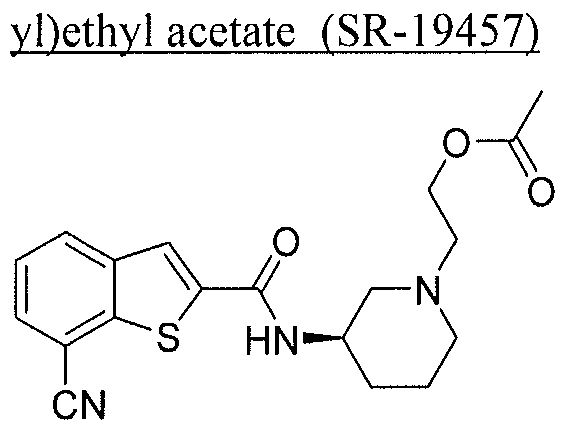
(R)-7-cyano-N-(piperidin-3-yl)benzo[b]thiophene-2-carboxamide (HC1 salt, 33 mg, 0.10 mmol), Nal (25 mg, 0.17 mmol), K2C03 (90 mg, 0.65 mmol), 2-bromoethyl acetate (16 uL, 0.14 mmol) and DMF (2 mL) were added into a reaction flask, and stirred at room
temperature overnight. The mixture was dissolved in ethyl acetate (20 mL) and water (5 mL). The layers were separated and the aqueous layer was extracted with ethyl acetate (2x). The
ethyl acetate layer was concentrated in vacuo and chromatographed on silica gel using hexanes and ethyl acetate to give title compound (17 mg, 0.045 mmol, 45%). 'H NMR (CD3OD, 400 MHz) δ 8.18 (dd, 1 H, J = 0.9, 8.3 Hz), 8.1 1 (s, 1 H), 7.87 (dd, 1 H, J= 0.9, 7.5 Hz), 7.59 (dd, 1 H, J= 7.5, 8.3 Hz), 4.46 (m, 2H), 4.37 (m, 1 H), 3.87 (m, 1H), 3.69 (m, 1 H), 3.54 (m, 2H), 3.00 (m, 2H), 2.12 (m, 5H), 1.98 (m, 2H), 1.78 (m, 2H). LCMS (ESI) 372.128 (M+H).
Synthetic Example 53: 4-chloro-7-methyl-N-(2-methylpiperidin-3-yl)benzo|"b]thiophene-2- carboxamide (SR-14338)

4-Chloro-7-methyl-N-(2-methylpiperidin-3-yl)benzo[b]thiophene-2-carboxamide was prepared by general amide coupling procedure in Synthetic Example 1. Ή NMR (CDC13, 400 MHz) δ 8.05 (s, 1 H), 7.53 (d, 1 H, j=7.67 Hz), 7.30 (d, 1 H, J=7.89 Hz), 7.12 (dd, 1 H, J = 0.88, 7.90 Hz), 4.28 - 4.19 (m, 1 H), 3.18 - 3.10 (m, 1 H), 3.04-2.95 (m, 1H), 2.77 (dt, 1H, J = 2.85, 1 1.73 Hz), 2.53 (s, 3H), 2.1 1-2.05 (m, 1H), 1.79-1.69 (m, 1 H), 1.67-1.54 (m, 2H), 1.15 (d, 3H, J= 6.58 Hz). LCMS (ESI) 323, 325 (M+H).
Synthetic Example 54: 4-chloro-7-methyl-N-(6-methylpiperidin-3-yl)benzo[blthiophene-2- carboxamide (SR- 14339)
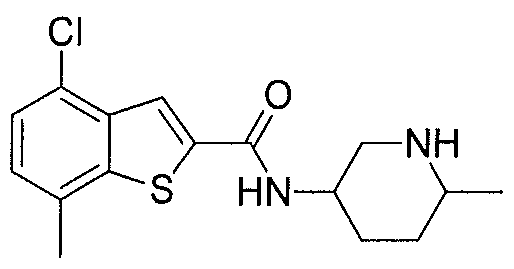
4-Chloro-7-methyl-N-(6-methylpiperidin-3-yl)benzo[b]thiophene-2-carboxamide (a mixture of diastereoisomers: 8/2) was prepared by general amide coupling procedure in Synthetic Example 1. Ή NMR (CDC13, 400 MHz) δ 8.09 (s, l Hminor), 8.05 (s, l Hmajor), 7.79 (d, 1 Hmejor J= 7.21 Hz), 7.58 (d, l Hminor, J= 7.72 Hz), 7.30 (d, 1 H, J= 7.85 Hz), 7.12 (dd, 1 H, J= 0.87, 7.91 Hz), 4.36-4.34 (m, lHmajor), 4.28-4.24 (m, lHminor), 3.16-3.12 (m, 1 H), 3.03-2.99 (m, 1 H), 2.81 -2.75 (m, 1 H), 2.53 (s, 3H), 2.09-2.05 (m, 1 H), 1.70-1.59 (m, 2H), 1.52-1.45 (m, 1 H), 1.19 (d, 3H, J= 6.45 Hz). LCMS (ESI) 323, 325 (M+H).
Synthetic Example 55: 4-chloro-7-methyl-N-(5-methylpiperidin-3-yl)benzo[blthiophene-2- carboxamide (SR- 14340)

4-Chloro-7-methyl-N-(5-methylpiperidin-3-yl)benzo[b]thiophene-2-carboxamide was prepared by general amide coupling procedure in Synthetic Example 1. Ή NMR (CDCI3, 400 MHz) δ 8.09 (s, I H), 7.58 (brs, I H), 7.19 (d, I H, J= 7.72 Hz), 7.02 (d, I H, J = 7.72 Hz), 4.32-4.24 (m, I H), 3.79-3.76 (m, I H), 3.17-3.14 (m, I H), 2.95-2.90 (m, I H), 2.43 (s, 3H), 2.38-2.32 (m, I H), 2.20- 2.17 (m, I H), 2.01-1.91 (m, I H), 1.32-1.20 (m, 2H), 0.91 (d, 3H, J = 6.62 Hz). LCMS (ESI) 323, 325 (M+H).
Synthetic Example 56: 4-chloro-7-methyl-N-(4-methylpiperidin-3-yl)benzo|"b]thiophene-2- carboxamide (SR-14380)

4-Chloro-7-methyl-N-(4-methylpiperidin-3-yl)benzo[b]thiophene-2-carboxamide was prepared by general amide coupling procedure in Synthetic Example 1. Ή NMR (CDC13, 400 MHz) δ 8.06 (s, IH), 7.58 (brs, I H), 7.31 (d, I H, J= 8.49 Hz), 7.14 (d, I H, J = 8.49 Hz), 4.41 -4.39 (m, I H), 3.19-3.14 (m, 2H), 2.94-2.92 (m, I H), 2.77-2.73 (m, IH), 2.54 (s, 3H), 1 .91 - 1.83 (m, 2H), 1.58-1.54 (m, 2H), 1.00 (d, 3H, J = 6.84 Hz). LCMS (ESI) 323, 325 (M+H).
Biological procedures
cDNAs and cRNAs— Human a2, a3, a4, a6, β2, and β4 were cloned in this lab (Wang et al., 1996, 1998; Gerzanich et al., 1997; Kuryatov et al„ 1997; Wang et al., 2015).
Concatamers were formed by linking the C-terminus of one subunit to the N-terminus of the next. Synthesis of the tetrameric concatamer p2(AGS)6a4(AGS)i2p2(AGS)6( 4 (abbreviated as β2-α4-β2-α4) and the trimeric concatamer p2(QAP)n 4(QAP)np2
(abbreviated as β2-α4-β2) were described (Kuryatov and Lindstrom, 201 1 ).
The trimeric concatamer p2(QAP)na4(QAP)np2 (abbreviated as β2-α4-β2) was synthesized through linking together β2(ΟΑΡ)ηα4 with QAP linker and β2. β2((3ΑΡ)ηα4 was made similarly as β3(ΟΑ.Ρ)ηα6 which was describe (Ley et al, 2014). A BspEI site was introduced at the end of mature peptide of β2 using
CCCAGCTCCAAGTCCGGACCTTCCTCATCTC oligo. The (QAP)n linker was then
inserted between the BspEI site at the end of β2 and the Fspl site at the beginning of 4. At the end of coding domain of a4 in p2QAPaa4 dimer we introduced a Agel site
(GCTGGCTGGCATGATCACCGGTGGGACCGGGAGCCTG oligo) which is
complementary to the Xmal site of the second (QAP)n linker in concatamer
β2(ς>ΑΡ)ηα4(ΟΑΡ)ηβ2. The second (QAP)n linker was prepared from the p2(QAP)n 4 piece. We mutated Fspl site at the beginning of a4 sequence into BstBI site. The second (QAP)n linker with new restriction sites was cut out using Xmal site and BstBI enzymes. We introduced a BstBI restriction site at the beginning of mature peptide of β2 using
GGCATGATCTTCGAAACGGATACAGAGGAG oligo. These allowed us to link together β2ζ)ΑΡα4 dimer with Agel site, QAP linker with Xmal and BstBI ends, and β2 subunits with BstBI restriction site at the beginning of mature peptide. Resulting construct has been recloned into pBS SK(-) vector using EcoRI restriction enzyme. Resulting clone has been linearized with EcoRV for expression in oocytes.
Four of the five chimeras of a3 and a4 subunits were prepared previously (Kuryatov et al., 2000). Chimeras were numbered according to the amino acid sequences of the mature subunit. The α3( 40)/α4(56 94) were prepared from ligating three pieces of DNA: a 0.6 kb fragment from the Ncol to BstEII site of the (x3 subunit, a 1 kb fragment from the Hidlll to BstEII site of the a3 subunit, and a 3.1 kb fragment from the Ncol to Hidlll site of the a4 subunit in the pSP64 vector. The ligation mixture was transformed into XL I O-Gold ultracompetent cells (Stratagene, La Jolla CA) and the right clone was chosen from a restriction enzyme digestion.
A C-tail mutant (noted as 4AAC) was obtained by mutating the last four amino acids of the (x4 subunit, alanine-glycine-methionine-isoleucine, to analine-analine-cysteine followed by a stop codon. Mutations were introduced using the PfuUltra high-fidelity DNA polymerase (Agilent, Santa Clara, CA), following the manufacturer's instructions. All mutations were confirmed by sequencing.
After linearization and purification of cDNAs, cRNA transcripts were prepared in vitro using mMessage mMachine kits (Ambion, Austin, TX). Concentrations of cDNAs and cRNAs were calculated by spectrophotometry.
Cell culture and transfection— All cells were maintained as described previously (Wang et al., 1998). The human embryonic kidney tsA201 (HEK) cell lines stably expressing human α4β2, α4β4, α2β2, α2β4, α3β2, and α3β4 were described (Wang et al., 2015). The α4β2 cell line expresses a mixture of (α4β2)2α4 and (α4β2)2β2 nAChRs (Nelson et al., 2003). HEK cells that express only one stiochiomety, either (α4β2)2α4 or (α4β2)2β2,
were obtained by transfecting a dimeric concatamer p2(QAP)na4 cell line with a4 or β2 subunits (Kuryatov et al., in preparation).
FLEXstation experiments— For functional tests of nAChRs expressed in HEK cells, we used a FLEXstation (Molecular Devices, Sunnyvale, CA) bench-top scanning fluorometer as described by Kuryatov et al. (2005). To increase the expression level of α2β3, α3β2 and (α4β2)2β2 nAChRs, the plates were incubated at 29 °C for 20 hours before being tested. A membrane potential fluorescent indicator kit (Molecular Devices, Sunnyvale, CA) was used according to the manufacturer's protocols. In PAM experiments, serial dilutions of Br-PBTC were manually added to the assay plate 15 min prior to addition of agonists during recording, unless otherwise noted. In short-term desensitization experiments, 6 minutes after agonists were added to cell culture wells, Br-PBTC or dihydro^-erythroidine hydrobromide (ϋΗβΕ) was automatically added into the wells during recording. In long-term desensitization experiments, nicotine or ϋΗβΕ was incubated with cells for 6 hours prior to recording. Br- PBTC with or without ΟΗβΕ was added to cell culture wells during recording. Each data point was averaged from three to four responses from separate wells. The potency and maximum efficacy of drugs were calculated by fitting the Hill equation to the
concentration/response relationship using a nonlinear least squares curve fitting method (Kaleidagraph; Abelbeck/Synergy, Reading, PA): I(x) = Imax [x"H/(x"H+EC50"H)J, where I(x) is the peak current measured at the drug concentration x, Imax is the maximum current peak at the saturating concentration, EC50 is the drug concentration required to achieve half of the maximum response, and nH \'s the Hill coefficient.
Ooctye removal and injection— Oocytes were removed surgically from Xenopus laevis and defolliculated as described (Gerzanich et al., 1997; Wang et al., 2015).
Oocyte injections were performed within 48 hours after surgery. Oocytes were injected with 20-40 ng of concatamer cRNA and free single subunit at 1 : 1 ratio. A total of 2- 20 ng cRNA were injected for free wild type or chimeric a and β subunits at 4: 1 ratio to force expression of the ( )3(β2)2 stoichiometry. Function was assayed 3-7 days after injection.
Electrophysiology— Currents in oocytes were measured using the OpusXpress 6000A (Molecular Devices, Union City, CA), an automated two-electrode voltage clamp amplifier that enables recording up to eight oocytes in parallel (Wang et al., 2015). Oocytes were voltage-clamped at a holding potential of -50 mV. 200 μΐ of drugs were delivered on top of oocytes for 4 seconds (s) through the sidewall of the bath to minimize disturbance to oocytes. Between drug applications, oocytes received a 30 s pre-wash and 223 s post-wash of ND96
solution (96 mM NaCl, 2 mM KC1, 1.8 mM CaCl2, 1 mM MgCl2; 5 mM HEPES, pH 7.6) with 0.5 μΜ atropine perfused through the bath at a rate of 3 ml/min, unless otherwise noted.
Peak amplitudes of experimental responses were calculated relative to ACh responses to normalize the data and compensate for variable expression levels among oocytes. PAM effect of Br-PBTC was calculated by increased responses with Br-PBTC relative to responses to ACh alone. Mean and standard error were calculated from normalized responses.
Statistical analyses were performed using the Student T-test. More than four oocytes were tested for each experiment.
Pre-application of Br-PBTC gave slightly higher PAM effects on wild type and chimeric nAChRs than co-application with agonists. But conclusions were the same for both application methods. To save time, thereafter we used co-application method to evaluate PAM effects in experiments performed in oocytes. In short-term desensitization experiments, 1 mM ACh was applied to oocytes for 4 s at the rate of 3 ml/min followed by another 56 s at 0.75 ml/min. Then the oocytes were incubated for an additional 5 min in a static bath before a co-application with 1 mM ACh plus 3 μΜ Br-PBTC for 4 s at 3 ml/min. Control experiments were performed on the same oocytes before Br-PBTC applications following the same protocol in which 3 μΜ Br-PBTC was replaced with 0.1% (v/v) DMSO. Reactivation by Br-PBTC was calculated by response of 3 μΜ Br-PBTC versus response of ACh applied prior to Br-PBTC. In antagonist inhibition experiments, Conotoxin Mil was applied for 4 s at the rate of 3 ml/min followed by another 56 s at 0.75 ml/min. To fully block ACh activation, the oocytes were then incubated for an additional 16 min in a static bath before co-application of ACh (3 μΜ) or ACh together with Br-PBTC (3 μΜ).
Table 4, below, provides biodata for the exemplary compounds of the invention.
Table 4: Biodata for Exemplary Compounds of the Invention

4β2 2.8±0.3 (66±6%) α4β2 1.7±0.3 (1 12±10%) α4β2α5 0.24±0.06 (180±13%) α4β2α5 2.2±0.6 (1 15±14%) α4β2α5 1.5±0.2 (162±9%) (α4β2)2β2 1.64±0.29 (106±7%)
(α4β2)2β2 (α4β2)2β2 (α4β2)2α4 0.23±0.03 (Α145%) 4β4 α4β4 0.25±0.08 (28±3%) α4β4 0.78±0.17 (70±7%)

α4β2 0.16±0.03 (207±15%)
α4β2α5 0.16±0.05 (201 ±19%) 1 .1 ±0.4 (60±8%) 1.7±0.2 (81 ±4%) (α4β2)2β2 1.12±0.21 (141±8%) 0.60±0.24 (91 ±1 1 %) 0.80±0.27 (85±10%) (α4β2)2α4 0.18±0.02 (167±5%)
α4β4 0.21 ±0.05 (63±5%)

0.72±0.23 (87± 0%) α4β2α5 0.33±0.18 (233±34%) α4β2 0.53±0.13 (104±8%)
(α4β2)2β2 1.4±0.2 (121±8%) α4β2α5 0.30±0.10 (101±10%) ( 4β2)2α4 0.29±0.06 (186±15%) (α4β2)2β2 1.0±0.2 (45±8%)
α4β4 0.36±0.14 (62±9%)

1.1±1.1 (43±13%) 2.7±1.6 (125±28%) 3.7±3.9 (75±14%)
3.1±2.8 (64±22%) A3.8 (Α54%)

3.7±0.5 (A69%) 3.0±1.0 (A95%) α4β2 no effect 3.0±0.6 (A97%) 2.1±0.7 (A154%) α4β2α5 no effect
(α4β2)2β2
α4β4

4β2 no effect α4β2 0.33±0.17 (167±25%) α4β2 1.5±0.2 (140±8%)
α4β2α5 no effect α4β2α5 0.20±0.13 (236±40%) 4β2α5 1 ,3±0.3 (212±17%)
(α4β2)2β2
(α4β2)2β2 0.55±0.09 (113±8%) (α4β2)2β2 Α1 (50±5%)
α4β4
(α4β2)2α4 0.20±0.03 (335±14%) α4β4 Αθ.4(30±4%)
α4β4 0.20±0.09 (75±11 %)

α4β2 no effect
3.3±0.3(Α78%) α4β2 0.70±0.25 (151±19%)
4β2α5 no effect 2.1±0.7 (Α116%) α4β2α5 0.46±0.15 (254±28%)
(α4β2)2β2
(α4β2)2β2 1.8±0.5 (216±28%)
α4β4
4β4 0.20±0.06 (Α53%)

ο4β2 0.83+0.17 (129±10%) α4β2 1.9±0.3 (129±10%)
less than 32% at 4 μΜ α4β2α5 0.48+0.15 (246±25%) α4β2α5 0.48+0.15 (246±25%)
less than 34% at 4 μΜ
(α4β2)2β2 2.6+0.6 (224+21 %) (α4β2)2β2 2.0+0.3 (A77%)
(α4β2)2α4 0.36±0.09 (282±25%) (α4β2)2α4 1 .2+0.1 (108±6%)
α4β4 0.13±0.08 (90+14%) α4β4 (<40%)
α3 4 N.A. α3β4 N.A.

13805 13806
α4β2 2.0+0.9 (372±63%) α4β2 no effect
less than 60% at 5 μΜ α4β2α5 1 ,7±0.3 (550±49%) α4β2α5 no effect
less than 55% at 5 μΜ (α4β2)2β2
(α4β2)2β2 (α4β2)2α4
α4β4 α4β4
3β4

13810
4β2 1.8±0.4 (Α120%) α4β2 1 .6±1 .0 (133+25%)
α4β2α5 2.9+1 .3 (166+39%) «4β2α5 3.1 ±0.5 (170±13%) 4β2 no effect
(α4β2)2β2 (α4β2)2β2 α4β2α5 no effect
(«4β2)2α4 (α4β2)2α4 (α4β2)2β2
α4β4 α4β4 α4β4
α3β4 α3β4

α4β2 1.5±0.4 (21 1 ±24%) α4β2 0.31 ±0.09 (209±20%) 1.9±0.2 (208±7%) α4β2α5 1.2±0.3 (363±37%) α4β2α5 0.15±0.06 (420±42%) 0.65±0.05 (306±9%) (α4β2)2β2 (α4β2)2β2
(α4β2)2α4 ( 4β2)2α4
α4β4 α4β4
α3β

α4β2 0.31 ±0.09 (209±20%) 1.8±0.4 (126±14%) 1.2±0.1 (205±10%) α4β2α5 0.15±0.06 (420±42%) 0.71 ±0.27 (207±31 %) 0.75±0.20 (452±46%) (α4β2)2β2
(α4β2)2α4
) )


α4β2 0.13±0.02 (668±27%) α4β2 0.54±0.15 (Α301 %) α4β2 0.64±0.11 (Α252%) α4β2α5 0.18±0.03 (328±20%) α4β2α5 0.58±0.09 (Α343%) 4β2 5 0.52±0.16 (Α316%) (α4β2)2β2 («4β2)2β2 (α4β2)2β2
(α4β2)2α4 (α4β2)2α4 (α4β2)2α4
α4β4 α4β4 α4β4

α4β2 0.58±0.05 (Α275%) α4β2 0.80±0.36 (Α153%) α4β2 0.89±0.27 (Α290%)
α4β2α5 0.28±0.04 (Α227%) α4β2α5 0.36±0.13 (Α151 %) α4β2α5 0.29±0.07 (Α296%)
(«4β2)2β2 (α4β2)2β2
(«4β2)2β2
(α4β2)2α4 (α4β2)2α4
(«4β2)2α4
α4β4 4β4
α4β4

14340 4β2 0.48±0.08 (122±7%)
α4β2 no effect α4β2α5 0.28±0.12 (97±13%)
α4β2α5 no effect (α4β2)2β2
(«4β2)2β2 (α4β2)2α4
α4β4 α4β4
Nicotine Self-Administration Assay
For all experiments, rats weighing 250-300 g were housed in groups of 1 -23 per cage, in a temperature-controlled vivarium under a reversed 12-h light/dark cycle (lights off at 8 am). Food and water were provided ad libitum until behavioral training commences. During training, rats were food-restricted to maintain -85-90% of their free-feeding body weight. Behavioral testing occurred during the dark portion of the light/dark cycle between the hours of 9 am-1 pm, during the early portion of the dark phase of the cycle. All procedures were conducted in strict adherence with the National Institutes of Health Guide for the Care and Use of Laboratory Animals and were approved by the Institutional Animal Care and Use Committee of The Scripps Research Institute. Rats were anesthetized by inhalation of 1 -3% isoflurane in oxygen and silastic catheters were inserted into the jugular veins. Briefly, the catheters consist of a 14 cm length of silastic tubing fitted to a guide cannula (Plastics One, Wallingford, CT), bent at a curved right angle and encased in dental acrylic. The catheter tubing was passed subcutaneously from each animal's back to the right jugular vein, and 1 cm length of the catheter tip is inserted into the vein. After surgery, catheters are flushed daily with 0.1 mL of a heparinized (30 USP units/ml) sterile saline solution. Following 7 d of surgical recovery, rats were mildly food restricted to 85-90%) of their free-feeding body weight and trained to press a lever in an operant chamber (Med Associates, St. Albans, VT) for food pellets (20 mg; TestDiet, Richmond, IN) under a fixed-ratio 5, time out 20 s (FR5TO20 s) schedule of reinforcement prior to catheter implantation. Once stable responding was achieved (> 25 pellets per session), rats were permitted to acquire IV nicotine self-administration by autoshaping during 1 -h daily sessions, 7 days per week. Nicotine was delivered through the tubing into the IV catheter by a Razel syringe pump (Med Associates). Each nicotine self-administration session was performed using two retractable levers ( 1 active; 1 inactive). Completion of the response criteria on the active lever resulted in the delivery of an IV nicotine infusion (0.03 mg/kg/infusion). After 1 week, the nicotine dose was increased to 0.1 mg/kg/inf for the remainder of the experiment, including subsequent training and test sessions. Delivery of all nicotine infusions coincided with the initiation of a 20-s time-out (TO) period, signaled by a light cue located above the lever. During the TO period, responding on the lever was recorded but without scheduled consequence. Catheter integrity was tested with the ultrashort-acting barbiturate Brevital (methohexital sodium; Eli Lilly) at the end of the experiment. See Figure 1 1 showing that compound SR13521 reduced nicotine intake in a dose-dependent manner when administered by intraperitoneal injection 30 min prior to the l h nicotine self-administration session
While the invention has been described and exemplified in sufficient detail for those skilled in this art to make and use it, various alternatives, modifications, and improvements will be apparent to those skilled in the art without departing from the spirit and scope of the claims.
All patents and publications referred to herein are incorporated by reference herein to the same extent as if each individual publication was specifically and individually indicated to be incorporated by reference in its entirety.
The terms and expressions which have been employed are used as terms of description and not of limitation, and there is no intention that in the use of such terms and expressions of excluding any equivalents of the features shown and described or portions thereof, but it is recognized that various modifications are possible within the scope of the invention claimed. Thus, it should be understood that although the present invention has been specifically disclosed by preferred embodiments and optional features, modification and variation of the concepts herein disclosed may be resorted to by those skilled in the art, and that such modifications and variations are considered to be within the scope of this invention as defined by the appended claims.
Claims
What is claimed is
A com ound of formula (I)

wherein the ring bearing R1 comprises 0 or 1 nitrogen atom therewithin,
R1 is halo, cyano, (C] -C4)alkyl, (Ci -C4)haloalkyl, (Ci -C4)alkoxy, (Ci -C4)haloalkoxy,
NR2, or phenyl optionally substituted with 1 or 2 OR groups, wherein R is H or (Ci -C4)alkyl, or two R1 groups together form a methylenedioxy; m = 0, 1 , 2, or 3 ;
R2 is H, (C i -C4)alkyl, or phenyl, wherein the phenyl is optionally substituted with 1 -2
R4;
R3 is H, (C, -C6)alkyl, (Ci -C6)acyl, or benzyl, wherein the benzyl is optionally substituted with 1 -2 R4;
R4 is halo, (C C4)alkyl, (C, -C4)alkoxy, or NR2;
R5 is independently at each occurrence H or (C] -C4)alkyl;
n = 2, 3, or 4;
or a pharmaceutically acceptable salt thereof.
2. The compound of claim 1 , wherein R1 is halo and m = 1 or 2.
3. The compound of claim 1 , wherein R2 is H.
4. The compound of claim 1 wherein R3 is H, methyl, ethyl, isopropyl, isobutyl, or isopenyl.
5. The compound of claim 1 wherein R3 is benzyl.
6. The compound of claim 1 wherein all R5 are H.

77

78


or a pharmaceutically acceptable salt thereof.
8. A pharmaceutical composition comprising a compound of claim 1 and a pharmaceutically acceptable excipient.
9. A method of allosterically modulating an a2- or an a4-nicotinic receptor, comprising contacting the receptor with an effective amount or concentration of the compound of any one of claims 1-7.
10. A method of treatment of an addiction in a patient afflicted therewith, comprising administering to the patient an effective dose of a compound of any one of claims 1-7.
1 1. The method of claim 10, wherein the addiction is to nicotine, cocaine, or ethanol.
12. A method for treating a patient afflicted with reduced numbers or defective nicotinic receptors containing a2 or a4 subunits, to compensate for this deficit by positive allosteric modulation, comprising administering to the patient an effective dose of a compound of any one of claims 1 -7.
13. The method of claim 12, wherein the patient is afflicted with Alzheimer's or Parkinson's diseases, or another affliction of cognition and affect.
Applications Claiming Priority (2)
| Application Number | Priority Date | Filing Date | Title |
|---|---|---|---|
| US201562167638P | 2015-05-28 | 2015-05-28 | |
| US62/167,638 | 2015-05-28 |
Publications (1)
| Publication Number | Publication Date |
|---|---|
| WO2016191366A1 true WO2016191366A1 (en) | 2016-12-01 |
Family
ID=57394222
Family Applications (1)
| Application Number | Title | Priority Date | Filing Date |
|---|---|---|---|
| PCT/US2016/033774 Ceased WO2016191366A1 (en) | 2015-05-28 | 2016-05-23 | MODULATORS FOR NICOTINIC ACETYLCHOLINE RECEPTOR α2 AND α4 SUBUNITS |
Country Status (1)
| Country | Link |
|---|---|
| WO (1) | WO2016191366A1 (en) |
Cited By (3)
| Publication number | Priority date | Publication date | Assignee | Title |
|---|---|---|---|---|
| CN106432179A (en) * | 2016-07-26 | 2017-02-22 | 江苏兢业制药有限公司 | Preparation method of 4-chloro-1-benzothiophene-2-carboxylic acid |
| CN112094224A (en) * | 2019-06-18 | 2020-12-18 | 太景生物科技股份有限公司 | Preparation method of 3-substituted-5-aminopiperidine with protecting group |
| CN114907335A (en) * | 2022-02-25 | 2022-08-16 | 陕西维世诺新材料有限公司 | 2- (benzothiophene-2-yl) benzo [ d ] oxazole derivative, preparation method and application |
Citations (3)
| Publication number | Priority date | Publication date | Assignee | Title |
|---|---|---|---|---|
| WO2010008808A2 (en) * | 2008-06-23 | 2010-01-21 | Pixsense, Inc. | Compressed domain system and method for compression gains in encoded data |
| US20120088791A1 (en) * | 2009-02-19 | 2012-04-12 | Vanderbilt University | Amidobipiperidinecarboxylate m1 allosteric agonists, analogs and derivatives thereof, and methods of making and using same |
| US20120202842A1 (en) * | 2001-12-27 | 2012-08-09 | Bayer Schering Pharma Ag | 2-heteroarylcarboxylic acid amides |
-
2016
- 2016-05-23 WO PCT/US2016/033774 patent/WO2016191366A1/en not_active Ceased
Patent Citations (3)
| Publication number | Priority date | Publication date | Assignee | Title |
|---|---|---|---|---|
| US20120202842A1 (en) * | 2001-12-27 | 2012-08-09 | Bayer Schering Pharma Ag | 2-heteroarylcarboxylic acid amides |
| WO2010008808A2 (en) * | 2008-06-23 | 2010-01-21 | Pixsense, Inc. | Compressed domain system and method for compression gains in encoded data |
| US20120088791A1 (en) * | 2009-02-19 | 2012-04-12 | Vanderbilt University | Amidobipiperidinecarboxylate m1 allosteric agonists, analogs and derivatives thereof, and methods of making and using same |
Non-Patent Citations (4)
| Title |
|---|
| DATABASE PUBCHEM [O] NCBI; 31 July 2006 (2006-07-31), XP055337357, Database accession no. 9488558 * |
| DATABASE PUBCHEM. [O] NCBI; 22 October 2012 (2012-10-22), XP055337360, Database accession no. AKOS011665779 * |
| DATABASE PURCHEM. [O] NCBI; 30 May 2009 (2009-05-30), XP055337363, Database accession no. ZINC32912071 * |
| GONZALES, D ET AL.: "Varenicline, an alpha4beta2 Nicotinic Acetylcholine Receptor Partial Agonist, vs Sustained-Release Bupropion and Placebo for Smoking Cessation.", THE JOURNAL OF THE AMERICA L MEDICAL ASSOCIATION, vol. 296, no. 1, 5 July 2006 (2006-07-05), pages 47 - 55, XP055337361 * |
Cited By (4)
| Publication number | Priority date | Publication date | Assignee | Title |
|---|---|---|---|---|
| CN106432179A (en) * | 2016-07-26 | 2017-02-22 | 江苏兢业制药有限公司 | Preparation method of 4-chloro-1-benzothiophene-2-carboxylic acid |
| CN112094224A (en) * | 2019-06-18 | 2020-12-18 | 太景生物科技股份有限公司 | Preparation method of 3-substituted-5-aminopiperidine with protecting group |
| CN112094224B (en) * | 2019-06-18 | 2022-08-26 | 浙江医药股份有限公司新昌制药厂 | Preparation method of 3-substituted-5-aminopiperidine with protecting group |
| CN114907335A (en) * | 2022-02-25 | 2022-08-16 | 陕西维世诺新材料有限公司 | 2- (benzothiophene-2-yl) benzo [ d ] oxazole derivative, preparation method and application |
Similar Documents
| Publication | Publication Date | Title |
|---|---|---|
| TWI374141B (en) | Spiro-oxindole compounds and their uses as therapeutic agents | |
| Bonnefous et al. | Discovery of inducible nitric oxide synthase (iNOS) inhibitor development candidate KD7332, part 1: Identification of a novel, potent, and selective series of quinolinone iNOS dimerization inhibitors that are orally active in rodent pain models | |
| KR20080007250A (en) | Spiroheterocyclic compounds and their uses as therapeutic agents | |
| HRP20110946A2 (en) | ENANTIOMERS OF SPIROOXINDOL COMPOUNDS AND THEIR USE AS THERAPY AGENTS | |
| JP2008536941A (en) | Oxindole compounds and their use as therapeutic agents | |
| KR20020069375A (en) | 1,3-Disubstituted Pyrrolidines as Alpha-2-Adrenoceptor Antagonists | |
| AU2010323175A1 (en) | Morpholinothiazoles as alpha 7 positive allosteric modulators | |
| JP2008536942A (en) | 2-pyrrolidone derivatives and their use for the treatment of inflammatory conditions and pain | |
| Oberdorf et al. | Thiophene bioisosteres of spirocyclic σ receptor ligands. 1. N-substituted spiro [piperidine-4, 4′-thieno [3, 2-c] pyrans] | |
| JP6751161B2 (en) | Fluorine-containing triazolopyridine compound, method for producing the same, pharmaceutical composition and use | |
| US20070179172A1 (en) | Positive modulators of nicotinic acetylcholine receptors | |
| JP2009507800A (en) | Fused and spirocyclic compounds and uses thereof | |
| WO2016191366A1 (en) | MODULATORS FOR NICOTINIC ACETYLCHOLINE RECEPTOR α2 AND α4 SUBUNITS | |
| US20080051441A1 (en) | Aryl Sulphonamide Modulators | |
| Oberdorf et al. | Thiophene bioisosteres of spirocyclic σ receptor ligands: Relationships between substitution pattern and σ receptor affinity | |
| TW200951119A (en) | Novel compounds-300 | |
| Diamanti et al. | Might the observed α2A-adrenoreceptor agonism or antagonism of allyphenyline analogues be ascribed to different molecular conformations? | |
| AU2018305223A1 (en) | New propanamine derivatives for treating pain and pain related conditions | |
| CN115427410A (en) | Amide or sulfonamide derivative and application thereof | |
| WO2020007977A1 (en) | 7-trifluoromethyl-[1,4]diazepan derivatives | |
| Deb et al. | Synthesis and characterizations of novel quinoline derivatives having mixed ligand activities at the κ and μ receptors: potential therapeutic efficacy against morphine dependence | |
| WO2023284834A1 (en) | Piperidine derivative, and pharmaceutical composition thereof, preparation method therefor, and use thereof | |
| KR20190104195A (en) | Substituted 3-dialkylaminomethyl-piperidin-4-yl-benzamide and methods of making and using the same | |
| WO2008031888A2 (en) | Condensed pyrimidinones active on glutamatergic receptors | |
| WO2011040510A1 (en) | Indazole analogue |
Legal Events
| Date | Code | Title | Description |
|---|---|---|---|
| 121 | Ep: the epo has been informed by wipo that ep was designated in this application |
Ref document number: 16800601 Country of ref document: EP Kind code of ref document: A1 |
|
| NENP | Non-entry into the national phase |
Ref country code: DE |
|
| 122 | Ep: pct application non-entry in european phase |
Ref document number: 16800601 Country of ref document: EP Kind code of ref document: A1 |