WO2016177773A1 - Polymer compositions for extrusion coating - Google Patents
Polymer compositions for extrusion coating Download PDFInfo
- Publication number
- WO2016177773A1 WO2016177773A1 PCT/EP2016/059986 EP2016059986W WO2016177773A1 WO 2016177773 A1 WO2016177773 A1 WO 2016177773A1 EP 2016059986 W EP2016059986 W EP 2016059986W WO 2016177773 A1 WO2016177773 A1 WO 2016177773A1
- Authority
- WO
- WIPO (PCT)
- Prior art keywords
- layer
- polymer composition
- plastomer
- extrusion coated
- rad
- Prior art date
- Legal status (The legal status is an assumption and is not a legal conclusion. Google has not performed a legal analysis and makes no representation as to the accuracy of the status listed.)
- Ceased
Links
Classifications
-
- C—CHEMISTRY; METALLURGY
- C08—ORGANIC MACROMOLECULAR COMPOUNDS; THEIR PREPARATION OR CHEMICAL WORKING-UP; COMPOSITIONS BASED THEREON
- C08L—COMPOSITIONS OF MACROMOLECULAR COMPOUNDS
- C08L23/00—Compositions of homopolymers or copolymers of unsaturated aliphatic hydrocarbons having only one carbon-to-carbon double bond; Compositions of derivatives of such polymers
- C08L23/02—Compositions of homopolymers or copolymers of unsaturated aliphatic hydrocarbons having only one carbon-to-carbon double bond; Compositions of derivatives of such polymers not modified by chemical after-treatment
- C08L23/04—Homopolymers or copolymers of ethene
- C08L23/06—Polyethylene
-
- B—PERFORMING OPERATIONS; TRANSPORTING
- B05—SPRAYING OR ATOMISING IN GENERAL; APPLYING FLUENT MATERIALS TO SURFACES, IN GENERAL
- B05D—PROCESSES FOR APPLYING FLUENT MATERIALS TO SURFACES, IN GENERAL
- B05D1/00—Processes for applying liquids or other fluent materials
- B05D1/26—Processes for applying liquids or other fluent materials performed by applying the liquid or other fluent material from an outlet device in contact with, or almost in contact with, the surface
- B05D1/265—Extrusion coatings
-
- B—PERFORMING OPERATIONS; TRANSPORTING
- B29—WORKING OF PLASTICS; WORKING OF SUBSTANCES IN A PLASTIC STATE IN GENERAL
- B29C—SHAPING OR JOINING OF PLASTICS; SHAPING OF MATERIAL IN A PLASTIC STATE, NOT OTHERWISE PROVIDED FOR; AFTER-TREATMENT OF THE SHAPED PRODUCTS, e.g. REPAIRING
- B29C48/00—Extrusion moulding, i.e. expressing the moulding material through a die or nozzle which imparts the desired form; Apparatus therefor
- B29C48/001—Combinations of extrusion moulding with other shaping operations
- B29C48/0018—Combinations of extrusion moulding with other shaping operations combined with shaping by orienting, stretching or shrinking, e.g. film blowing
-
- B—PERFORMING OPERATIONS; TRANSPORTING
- B32—LAYERED PRODUCTS
- B32B—LAYERED PRODUCTS, i.e. PRODUCTS BUILT-UP OF STRATA OF FLAT OR NON-FLAT, e.g. CELLULAR OR HONEYCOMB, FORM
- B32B27/00—Layered products comprising a layer of synthetic resin
- B32B27/06—Layered products comprising a layer of synthetic resin as the main or only constituent of a layer, which is next to another layer of the same or of a different material
- B32B27/08—Layered products comprising a layer of synthetic resin as the main or only constituent of a layer, which is next to another layer of the same or of a different material of synthetic resin
-
- B—PERFORMING OPERATIONS; TRANSPORTING
- B32—LAYERED PRODUCTS
- B32B—LAYERED PRODUCTS, i.e. PRODUCTS BUILT-UP OF STRATA OF FLAT OR NON-FLAT, e.g. CELLULAR OR HONEYCOMB, FORM
- B32B27/00—Layered products comprising a layer of synthetic resin
- B32B27/32—Layered products comprising a layer of synthetic resin comprising polyolefins
-
- C—CHEMISTRY; METALLURGY
- C08—ORGANIC MACROMOLECULAR COMPOUNDS; THEIR PREPARATION OR CHEMICAL WORKING-UP; COMPOSITIONS BASED THEREON
- C08F—MACROMOLECULAR COMPOUNDS OBTAINED BY REACTIONS ONLY INVOLVING CARBON-TO-CARBON UNSATURATED BONDS
- C08F210/00—Copolymers of unsaturated aliphatic hydrocarbons having only one carbon-to-carbon double bond
- C08F210/02—Ethene
-
- C—CHEMISTRY; METALLURGY
- C08—ORGANIC MACROMOLECULAR COMPOUNDS; THEIR PREPARATION OR CHEMICAL WORKING-UP; COMPOSITIONS BASED THEREON
- C08J—WORKING-UP; GENERAL PROCESSES OF COMPOUNDING; AFTER-TREATMENT NOT COVERED BY SUBCLASSES C08B, C08C, C08F, C08G or C08H
- C08J7/00—Chemical treatment or coating of shaped articles made of macromolecular substances
- C08J7/04—Coating
- C08J7/0427—Coating with only one layer of a composition containing a polymer binder
-
- C—CHEMISTRY; METALLURGY
- C08—ORGANIC MACROMOLECULAR COMPOUNDS; THEIR PREPARATION OR CHEMICAL WORKING-UP; COMPOSITIONS BASED THEREON
- C08L—COMPOSITIONS OF MACROMOLECULAR COMPOUNDS
- C08L23/00—Compositions of homopolymers or copolymers of unsaturated aliphatic hydrocarbons having only one carbon-to-carbon double bond; Compositions of derivatives of such polymers
- C08L23/02—Compositions of homopolymers or copolymers of unsaturated aliphatic hydrocarbons having only one carbon-to-carbon double bond; Compositions of derivatives of such polymers not modified by chemical after-treatment
- C08L23/04—Homopolymers or copolymers of ethene
- C08L23/08—Copolymers of ethene
- C08L23/0807—Copolymers of ethene with unsaturated hydrocarbons only containing four or more carbon atoms
- C08L23/0815—Copolymers of ethene with unsaturated hydrocarbons only containing four or more carbon atoms with aliphatic 1-olefins containing one carbon-to-carbon double bond
-
- C—CHEMISTRY; METALLURGY
- C09—DYES; PAINTS; POLISHES; NATURAL RESINS; ADHESIVES; COMPOSITIONS NOT OTHERWISE PROVIDED FOR; APPLICATIONS OF MATERIALS NOT OTHERWISE PROVIDED FOR
- C09D—COATING COMPOSITIONS, e.g. PAINTS, VARNISHES OR LACQUERS; FILLING PASTES; CHEMICAL PAINT OR INK REMOVERS; INKS; CORRECTING FLUIDS; WOODSTAINS; PASTES OR SOLIDS FOR COLOURING OR PRINTING; USE OF MATERIALS THEREFOR
- C09D123/00—Coating compositions based on homopolymers or copolymers of unsaturated aliphatic hydrocarbons having only one carbon-to-carbon double bond; Coating compositions based on derivatives of such polymers
- C09D123/02—Coating compositions based on homopolymers or copolymers of unsaturated aliphatic hydrocarbons having only one carbon-to-carbon double bond; Coating compositions based on derivatives of such polymers not modified by chemical after-treatment
- C09D123/04—Homopolymers or copolymers of ethene
- C09D123/06—Polyethylene
-
- C—CHEMISTRY; METALLURGY
- C09—DYES; PAINTS; POLISHES; NATURAL RESINS; ADHESIVES; COMPOSITIONS NOT OTHERWISE PROVIDED FOR; APPLICATIONS OF MATERIALS NOT OTHERWISE PROVIDED FOR
- C09D—COATING COMPOSITIONS, e.g. PAINTS, VARNISHES OR LACQUERS; FILLING PASTES; CHEMICAL PAINT OR INK REMOVERS; INKS; CORRECTING FLUIDS; WOODSTAINS; PASTES OR SOLIDS FOR COLOURING OR PRINTING; USE OF MATERIALS THEREFOR
- C09D123/00—Coating compositions based on homopolymers or copolymers of unsaturated aliphatic hydrocarbons having only one carbon-to-carbon double bond; Coating compositions based on derivatives of such polymers
- C09D123/02—Coating compositions based on homopolymers or copolymers of unsaturated aliphatic hydrocarbons having only one carbon-to-carbon double bond; Coating compositions based on derivatives of such polymers not modified by chemical after-treatment
- C09D123/04—Homopolymers or copolymers of ethene
- C09D123/08—Copolymers of ethene
- C09D123/0807—Copolymers of ethene with unsaturated hydrocarbons only containing more than three carbon atoms
- C09D123/0815—Copolymers of ethene with aliphatic 1-olefins
-
- C—CHEMISTRY; METALLURGY
- C09—DYES; PAINTS; POLISHES; NATURAL RESINS; ADHESIVES; COMPOSITIONS NOT OTHERWISE PROVIDED FOR; APPLICATIONS OF MATERIALS NOT OTHERWISE PROVIDED FOR
- C09J—ADHESIVES; NON-MECHANICAL ASPECTS OF ADHESIVE PROCESSES IN GENERAL; ADHESIVE PROCESSES NOT PROVIDED FOR ELSEWHERE; USE OF MATERIALS AS ADHESIVES
- C09J123/00—Adhesives based on homopolymers or copolymers of unsaturated aliphatic hydrocarbons having only one carbon-to-carbon double bond; Adhesives based on derivatives of such polymers
- C09J123/02—Adhesives based on homopolymers or copolymers of unsaturated aliphatic hydrocarbons having only one carbon-to-carbon double bond; Adhesives based on derivatives of such polymers not modified by chemical after-treatment
- C09J123/04—Homopolymers or copolymers of ethene
- C09J123/06—Polyethylene
-
- D—TEXTILES; PAPER
- D21—PAPER-MAKING; PRODUCTION OF CELLULOSE
- D21H—PULP COMPOSITIONS; PREPARATION THEREOF NOT COVERED BY SUBCLASSES D21C OR D21D; IMPREGNATING OR COATING OF PAPER; TREATMENT OF FINISHED PAPER NOT COVERED BY CLASS B31 OR SUBCLASS D21G; PAPER NOT OTHERWISE PROVIDED FOR
- D21H19/00—Coated paper; Coating material
- D21H19/10—Coatings without pigments
- D21H19/14—Coatings without pigments applied in a form other than the aqueous solution defined in group D21H19/12
- D21H19/20—Coatings without pigments applied in a form other than the aqueous solution defined in group D21H19/12 comprising macromolecular compounds obtained by reactions only involving carbon-to-carbon unsaturated bonds
- D21H19/22—Polyalkenes, e.g. polystyrene
-
- C—CHEMISTRY; METALLURGY
- C08—ORGANIC MACROMOLECULAR COMPOUNDS; THEIR PREPARATION OR CHEMICAL WORKING-UP; COMPOSITIONS BASED THEREON
- C08F—MACROMOLECULAR COMPOUNDS OBTAINED BY REACTIONS ONLY INVOLVING CARBON-TO-CARBON UNSATURATED BONDS
- C08F2500/00—Characteristics or properties of obtained polyolefins; Use thereof
- C08F2500/12—Melt flow index or melt flow ratio
-
- C—CHEMISTRY; METALLURGY
- C08—ORGANIC MACROMOLECULAR COMPOUNDS; THEIR PREPARATION OR CHEMICAL WORKING-UP; COMPOSITIONS BASED THEREON
- C08F—MACROMOLECULAR COMPOUNDS OBTAINED BY REACTIONS ONLY INVOLVING CARBON-TO-CARBON UNSATURATED BONDS
- C08F2500/00—Characteristics or properties of obtained polyolefins; Use thereof
- C08F2500/18—Bulk density
-
- C—CHEMISTRY; METALLURGY
- C08—ORGANIC MACROMOLECULAR COMPOUNDS; THEIR PREPARATION OR CHEMICAL WORKING-UP; COMPOSITIONS BASED THEREON
- C08J—WORKING-UP; GENERAL PROCESSES OF COMPOUNDING; AFTER-TREATMENT NOT COVERED BY SUBCLASSES C08B, C08C, C08F, C08G or C08H
- C08J2323/00—Characterised by the use of homopolymers or copolymers of unsaturated aliphatic hydrocarbons having only one carbon-to-carbon double bond; Derivatives of such polymers
- C08J2323/02—Characterised by the use of homopolymers or copolymers of unsaturated aliphatic hydrocarbons having only one carbon-to-carbon double bond; Derivatives of such polymers not modified by chemical after treatment
- C08J2323/04—Homopolymers or copolymers of ethene
- C08J2323/06—Polyethene
-
- C—CHEMISTRY; METALLURGY
- C08—ORGANIC MACROMOLECULAR COMPOUNDS; THEIR PREPARATION OR CHEMICAL WORKING-UP; COMPOSITIONS BASED THEREON
- C08J—WORKING-UP; GENERAL PROCESSES OF COMPOUNDING; AFTER-TREATMENT NOT COVERED BY SUBCLASSES C08B, C08C, C08F, C08G or C08H
- C08J2423/00—Characterised by the use of homopolymers or copolymers of unsaturated aliphatic hydrocarbons having only one carbon-to-carbon double bond; Derivatives of such polymers
- C08J2423/02—Characterised by the use of homopolymers or copolymers of unsaturated aliphatic hydrocarbons having only one carbon-to-carbon double bond; Derivatives of such polymers not modified by chemical after treatment
- C08J2423/04—Homopolymers or copolymers of ethene
- C08J2423/06—Polyethene
-
- C—CHEMISTRY; METALLURGY
- C08—ORGANIC MACROMOLECULAR COMPOUNDS; THEIR PREPARATION OR CHEMICAL WORKING-UP; COMPOSITIONS BASED THEREON
- C08J—WORKING-UP; GENERAL PROCESSES OF COMPOUNDING; AFTER-TREATMENT NOT COVERED BY SUBCLASSES C08B, C08C, C08F, C08G or C08H
- C08J2423/00—Characterised by the use of homopolymers or copolymers of unsaturated aliphatic hydrocarbons having only one carbon-to-carbon double bond; Derivatives of such polymers
- C08J2423/02—Characterised by the use of homopolymers or copolymers of unsaturated aliphatic hydrocarbons having only one carbon-to-carbon double bond; Derivatives of such polymers not modified by chemical after treatment
- C08J2423/04—Homopolymers or copolymers of ethene
- C08J2423/08—Copolymers of ethene
-
- C—CHEMISTRY; METALLURGY
- C08—ORGANIC MACROMOLECULAR COMPOUNDS; THEIR PREPARATION OR CHEMICAL WORKING-UP; COMPOSITIONS BASED THEREON
- C08L—COMPOSITIONS OF MACROMOLECULAR COMPOUNDS
- C08L2205/00—Polymer mixtures characterised by other features
- C08L2205/02—Polymer mixtures characterised by other features containing two or more polymers of the same C08L -group
-
- C—CHEMISTRY; METALLURGY
- C08—ORGANIC MACROMOLECULAR COMPOUNDS; THEIR PREPARATION OR CHEMICAL WORKING-UP; COMPOSITIONS BASED THEREON
- C08L—COMPOSITIONS OF MACROMOLECULAR COMPOUNDS
- C08L2205/00—Polymer mixtures characterised by other features
- C08L2205/02—Polymer mixtures characterised by other features containing two or more polymers of the same C08L -group
- C08L2205/025—Polymer mixtures characterised by other features containing two or more polymers of the same C08L -group containing two or more polymers of the same hierarchy C08L, and differing only in parameters such as density, comonomer content, molecular weight, structure
-
- C—CHEMISTRY; METALLURGY
- C08—ORGANIC MACROMOLECULAR COMPOUNDS; THEIR PREPARATION OR CHEMICAL WORKING-UP; COMPOSITIONS BASED THEREON
- C08L—COMPOSITIONS OF MACROMOLECULAR COMPOUNDS
- C08L2207/00—Properties characterising the ingredient of the composition
- C08L2207/06—Properties of polyethylene
- C08L2207/066—LDPE (radical process)
Definitions
- the present invention relates to polymer compositions having improved processing and sealing properties. Especially the present invention deals with polyethylene compositions to be used in extrusion coating. Further, the invention relates to extrusion coated articles, and preparation thereof, which articles comprise a substrate layer and at least one film layer of said polyethylene composition having good processability in extrusion coating process and improved sealing properties, like hot-tack performance.
- Laminates and single or multi-layer films are packaging materials that often employ heat- sealable layer(s). Laminates are often made by coating a substrate, like a fibrous substrate, such as paper, paperboard or Kraft paper or woven or non- woven fabrics; a metal foil, such as aluminium foil or a plastic film, such as an oriented polypropylene film, PET film, PA film or cellophane film, metallised film or combinations thereof with a heat-sealable layer by extrusion coating.
- a heat-sealable layer in such articles makes it possible to seal the material to form structures such as bags or other packages and lidding materials.
- the heat-sealable film is usually employed singly or as the outermost and/or innermost layer in the case of multi-layer structures.
- fibrous, polymeric, metallic or any material needed for producing desired structure and properties can be used.
- the polymer In preparing an extrusion coated article the polymer is extruded onto the moving substrate through a flat die.
- the melt film When the melt exits the die the melt film is pulled down into a nip formed between two rollers, the pressure roll and the chill roll, situated below the die.
- the substrate moving at a velocity which is higher than that of the melt film, draws the film to the required thickness.
- the pressure between the two rolls forces the film onto the substrate. Further, the film is cooled and solidified by the low temperature of the chill roll.
- the draw ratio which is one of the characteristic parameters of the extrusion coating process, is the ratio of the die gap to the thickness of the polymer film on the substrate.
- compositions in extrasion coating process In extrasion coating process when the molten polymer is drawn from the die at high speed into the nip, the thickness of the polymer is reduced dramatically.
- the relation between the thickness of the die opening and the final coating weight is called "draw ratio".
- Draw resonance describes the thickness variation of the polymer web in the machine direction as well in the transverse direction caused by inhomogeneous instable response of the melt film when drawn down.
- Draw-down measures the capability of the polymer to stand high speed without breaking. Signs of poor processability are instabilities in web edges (edge weaving) and in coating weight (pumping, draw resonance). Edge tear or web breaks indicate limitations in draw-down speed. Instead good processability means web stability at high draw-down speeds and ratios resulting in even coating weight over the whole web. Due to the internal stress in the polymers, the effective coating width is always narrower than the actual die slot width. This difference is called neck-in. Low neck- in is desired. High line speed used in extrasion coating process sets heavy requirements for the material.
- Low density polyethylene is a resin commonly used in extrasion coating because of the ease in processing.
- some other properties of the material are not always satisfactory for desired applications.
- barrier and organoleptic properties might not fulfill all desired requirements.
- extrusion coating process and extrusion coated articles are disclosed e.g. in EP 1 777 238, WO 2000/78859 and WO 2013/124221, all based on polyethylene compositions.
- Sealing properties are typically defined by measuring hot-tack properties and heat sealing temperature range as defined later.
- the hot-tack properties i.e. the properties of the seal at temperatures subsequent to formation while the seal is still warm are important indicators of seal performance in high speed packaging lines.
- hot tack properties that are important for heat sealable films.
- One important hot tack property is the "seal initiation temperature.”
- the seal initiation temperature is the first temperature above ambient at which a seal can be formed by applying a given pressure to a given thickness of film for a given length of time. In general, lower initiation temperatures are desired because less energy is required to be used to form the seal and also it takes less time for the initial seal to form at a given seal jaw temperature. Thus, production rates are capable of being increased.
- maximum hot tack is the largest strength the seal has at temperatures above the initiation temperature. Usually it is desirable that the maximum hot tack occurs at the lowest possible temperature. Further, an additional hot tack property that is generally desired is a wide processing window such that the film exhibits desired seal strength as measured over a broad temperature range. It is also desired a high temperature hot tack such that the seal strength remains sufficient even at elevated temperatures.
- LDPE compositions which have been widely used in extrusion coating field, have hot tack properties, which are not satisfactory for many applications.
- the low density ethylene polymer can be blended with other polymers. Especially advantageously, the low density ethylene polymer is blended with olefin polymers produced by polymerising olefins in the presence of transition metal
- polymerisation catalysts examples of such polymers are homo- and copolymers of ethylene, homo- and copolymers of propylene and homo- and copolymers of 1-butene.
- blending LDPE with e.g. plastomers is as such known.
- Drawback in using plastomers in extrusion coating applications has been that the processability of plastomers causes problems in extrusion coating process and limits the production capacity.
- finding compositions, where benefits of plastomers could be combined with properties of LDPE would be highly appreciated.
- an extrusion coated article like laminate, comprising a substrate layer, at least one layer having good sealing properties, especially good hot-tack properties. Further, a broader sealing window is an additional beneficial feature.
- the present invention relates to a polymer composition comprising a specific low density polyethylene and a specific plastomer. Further details of the composition are described later in the present application.
- a further object of the invention is the use of the polymer composition comprising specific low density polyethylene and a specific plastomer in extrusion coating processes comprising coating a substrate with a layer of said composition.
- the present invention relates to an extrusion coated article comprising at least a substrate layer and at least one layer of the composition comprising specific low density polyethylene and specific plastomer.
- the article can comprise additional layers as well.
- the present invention relates also to the process for producing an extrusion coated article.
- Low density ethylene polymers contain long chain branches and are thus different from linear copolymers of ethylene and alpha-olefin comonomers produced in the presence of a Ziegler or a metallocene catalyst. Especially, the presence of said long chain branches causes clear differences in the rheological behaviour of the polymer.
- Plastomers are generally defined as a polymer material which combines qualities of elastomers and plastics, such as rubber-like properties with the processing ability of plastic. Plastomers used in the present invention are ethylene-alpha olefin copolymers.
- the present invention relates to a new polymer composition (A) for extrusion coating comprising
- a) is a low density polyethylene having
- melt flow rate (MFR 2 ), measured according to ISO 1133 (190 °C, 2,16 kg load) of 2.5 to lO kg/lOmin,
- b) is a plastomer of ethylene copolymer with at least one a- olefin comonomer of 4 to 10 C-atoms, provided that at least one co-monomer is a monomer with at least 6 C-atoms and having a density of 880 to 915 kg/m3, and
- the present invention relates to an extrusion coated article comprising
- melt flow rate (MFR 2 ), measured according to ISO 1133 /190 °C, 2,16 kg load) of 2,5 to lO kg/lOmin,
- the plastomer is an ethylene copolymer with at least one a- olefin comonomer of 4 to 10 C-atoms, provided that at least one co-monomer is a monomer with at least 6 C-atoms and having a density of 880 to 915 kg/m3, and
- Extrasion coated article can comprise in addition to the substrate layer (S) and at least one heat sealable layer (H) of polymer composition (A) one or more additional layers (L).
- the present invention relates to a process for producing extrusion coated articles by extrusion coating a substrate layer (S) by extruding at least one layer of the polymer composition (A) in a molten state through a flat die onto said substrate.
- the layer of the polymer composition (A) forms a heat sealable polymer layer (H) of the extrusion coated article.
- the invention relates to the use of the composition (A) as heat sealable layer (H) in extrusion coating article.
- the extrusion coated articles can comprise in addition to the substrate layer (S) and at least one heat sealable layer (H) of the polymer composition (A) one or more additional layers (L), provided that the layer of the polymer composition (A), i.e. the heat sealable layer (H), forms always a surface layer of the extrusion coated article.
- the heat sealable layer can be located on one or both surfaces of the extrusion coated article.
- Such optional layers (L) can be of any material suitable to be used in an extrusion coated article, like any polymeric layer, metal foil, metallised polymeric layer, fibrous material or combinations thereof. Layers (L) can be used for many purposes, like as adhesive layers, being typically of polymeric materials, tie layers, barrier layers or structural layers.
- the present invention relates to an extrusion coated article comprising
- the substrate layer (S) may comprise at least one layer of, among others, fibrous substrates, like paper, paperboard or Kraft paper or woven or non- woven fabrics, woven plastic, a plastic film, such as an oriented polypropylene film, PET film, PA film or cellophane film or a metal foil.
- the substrate layer (S) is selected from paper, paperboard or Kraft paper, plastic film being a biaxially oriented polypropylene film, oriented PET film, oriented PA film, metallised biaxially oriented polypropylene film, woven fabric or plastic, and metal foil being an aluminium foil.
- Ethylene polymer used in the composition (A) of the present invention is a low density ethylene polymer (LDPE).
- Low density ethylene polymers contain long chain branches and are thus different from linear copolymers of ethylene and alpha-olefin comonomers produced in the presence of a Ziegler or a metallocene catalyst. Especially, the presence of the long chain branches causes clear differences in the rheological behaviour of the polymer.
- the meaning of low density polyethylene (LDPE) is well known and documented in the literature.
- LDPE low density polyethylene
- HP polyethylene high pressure polyethylenes
- Autoclave and tubular reactors are typically used in HP ethylene polymerization process.
- LDPE describes and distinguishes only the nature of HP polyethylene with typical features, such as different branching architecture, compared to the polyethylene produced in the presence of an olefin polymerization catalyst.
- said low density polyethylene (LDPE), preferably the low density polyethylene (LDPE) homopolymer may be unsaturated.
- low density polyethylene In case the low density polyethylene (LDPE) is a copolymer, it comprises comonomers, typically selected from, but not restricted to, acrylates, acrylic acids, methacrylates, methacrylic acids and acetates.
- Low density polyethylenes (LDPE) consist of chain molecules of many different lengths causing distribution of molecular length or molecular weight (MWD). MWD is the ratio of weight average molecular weight (Mw) and number average molecular weight (Mn), thus MWD is Mw/Mn.
- Polyethylenes used in the present invention can be unimodal or multimodal as re to the form of its molecular weight distribution (MWD) curve, i.e.
- the appearance of the graph of the polymer weight fraction as a function of its molecular weight If the polymer is produced in the sequential step process, i.e. by utilizing reactors coupled in series, and using different conditions in each reactor, the different polymer fractions produced in the different reactors each have their own molecular weight distribution which may considerably differ from one another and as a result a bi- or multimodal polymer is produced. Unimodal polymers have no such bi- or multimodal appearance of molecular weight maximums. Low density polyethylenes to be used in extrusion coating applications have broad MWD due to the branched structure of the polymers.
- LDPE used in the compositions (A) of the present invention is preferably produced in autoclave reactors as described in EP 1777283 of Borealis.
- the density of the LDPE used in the present invention is at most 920 kg/m 3 , preferably 918 kg/m 3 or less, more preferably 917 kg/m 3 or less.
- the lower limit of the density is not crucial, but can be defined to be 910 kg/m 3 .
- the density can be defined to be in the range of 910 to 920 kg/m 3 , preferably in the range of 912 to 918 kg/m 3 .
- Melt index (or melt flow rate) MFR 2 measured according to ISOl 133, 190 °C/2,16 kg load, of the LDPE suitable for the present invention is of from 2.5 to 10 g/10 min, preferably from 2.5 to 8,0 g/10 min and in particular from 3,5 to 6,5 g/10 min.
- the MFR2 is in the range of 3,5 to 6,5 g/10 min and the density is 918 kg/m 3 or less.
- LDPE used in the compositions (A) of the present invention can further be defined by the rheological properties thereof.
- the LDPE used in the present invention has a dynamic viscosity at a shear rate of 0.05 rad/s ( ⁇ .05), and a dynamic viscosity at a shear rate of 300 rad/s (r
- the LDPE used in the present invention has in addition to the density and MFR2 as defined above, tan ⁇ .5, the value of the tangent of the phase shift at a frequency of 0.5 rad/s, and tan 8300, the value of the tangent of the phase shift at a frequency of 300 rad/s, which satisfy the following relationship:
- the LDPE used in the present invention has the density and MFR2 as defined above, and the dynamic viscosity at a shear rate of 0.05 rad/s ( ⁇ .05), and the dynamic viscosity at a shear rate of 300 rad/s (r
- the low density ethylene polymer used in the present invention has a higher content of long chain branches per 1000 atoms in the polymer backbone than the traditional low density polyethylene of the prior art.
- the following statements are applicable to all embodiments of the present invention.
- the low density ethylene polymer has a dynamic viscosity at a shear rate of 0.05 rad/s, ⁇ .05, of from 1000 to 10000 Pa-s, more preferably from 1500 to 7000 Pa-s and in particular from 2000 to 5000 Pa-s.
- the low density ethylene polymer has a value of tan ⁇ .5, the value of the tangent of the phase shift at a frequency of 0.5 rad/s of from 1.5 to 3.0, more preferably from 1.9 to 2.8, and a value of tan 8300, the value of the tangent of the phase shift at a frequency of 300 rad/s of from 0.8 to 1.0, more preferably from 0.85 to 0.95.
- the low density ethylene component has a shear thinning index SHImoo of from 20 to 60, more preferably from 30 to 50.
- the low density ethylene polymer has a number average molecular weight, M Prima, of from 8000 to 30000 g/mol, more preferably from 10000 to 25000. Also, it preferably has a weight average molecular weight, M w , of from 400000 to 600000 g/mol, preferably from 470000 to 540000 g/mol. It is also preferred that it has a z-average molecular weight, M z , of from 2000000 to 4000000 g/mol, more preferably from 2500000 to 3500000 g/mol.
- the low-density ethylene polymer used in the present invention has a storage modulus G'(5 kPa), measured at a loss modulus G" of 5 kPa, within the range of 3000 to 3700 Pa, more preferably 3200 to 3600 Pa.
- Plastomers used in the present invention are low-density ethylene-copolymers comprising ethylene polymers with at least one- olefin comonomer.
- the comonomers are a- olefin comonomers of 4 to 10 C-atoms, provided that at least one co-monomer is a monomer with at least 6 C-atoms. I.e., if the plastomer is an ethylene terpolymer, then at least one monomer has 6 or more C-atoms.
- comonomers in ethylene-copolymers are selected from a- olefins of 6 to 10 C-atoms, preferably 6 to 8 C atoms, and are more preferably copolymers of ethylene with one a-olefin of 6 to 8 C-atoms, especially ethylene- octene copolymers.
- Plastomers used in the present invention have low density, typically in the range of 880 to 915 kg/m 3 , preferably 880 to 910 kg/m 3 , and especially in the range of 882 to 908 kg/m 3 .
- MFPv2 (190 °C/2,16 kg) of the plastomers used in the present invention is in the range of 3 to 25 g/lOmin, preferably in the range of 5 to 20 g/lOmin.
- Plastomers used in the present invention are preferably produced in a solution process in the presence of a metallocene catalyst.
- the plastomer has MFR2 (190 °C/2.16kg) in the range of 5 to 20 kg/10 min and density in the range of 880 to 910 kg/m 3 , especially in the range of 882 to 908 kg/m 3
- Layers (L) can be of any other material suitable to be used in an extrusion coated article, like any other polymeric layer, metal foil, fibrous material or combinations thereof.
- Layers (L) can comprise e.g. paper, paperboard or Kraft paper or woven or non- woven fabrics, a plastic film, such as low density polyethylene films, an oriented polypropylene film, like a biaxially oriented polypropylene film, metallised biaxially oriented polypropylene film, optionally oriented PET film, optionally oriented PA film or cellophane film or a metal foil being an aluminium foil.
- compositions can optionally be modified with other components to get desired properties.
- a preferred polymer composition (A) of the present invention comprises
- melt flow rate (MFR 2 ), measured according to ISOl 133 /190 °C, 2,16 kg load) of 3,5 to 6,5 kg/lOmin and
- the plastomer is an ethylene copolymer with at least one a- olefin comonomer of 4 to 10 C-atoms, provided that at least one co-monomer is a monomer with at least 6 C- atoms and having a density of 880 to 910 kg/m3,
- An additional preferred polymer composition (A) of the present invention comprises a) 10 to 60 wt-% of low density polyethylene
- melt flow rate (MFR 2 ), measured according to ISOl 133 /190 °C, 2,16 kg load) of
- the plastomer is of ethylene copolymer with at least one a- olefin comonomer of 4 to 10 C-atoms, provided that at least one co-monomer is a monomer with at least 6 C- atoms and having a density of 880 to 915 kg/m3,
- the polymer composition (A) comprises
- the low density polyethylene has - a melt flow rate (MFR 2 ), measured according to ISOl 133 /190 °C, 2,16 kg load) of
- the plastomer is an ethylene copolymer with at least one a- olefin comonomer of 4 to 10 C-atoms, provided that at least one co-monomer is a monomer with at least 6 C- atoms and having a density of 880 to 915 kg/m3,
- the polymer composition (A) comprises
- melt flow rate (MFR 2 ), measured according to ISOl 133 /190 °C, 2,16 kg load) of 2,5 to lO kg/lOmin,
- the plastomer is an ethylene copolymer with at least one a- olefin comonomer of 4 to 10 C-atoms, provided that at least one co-monomer is a monomer with at least 6 C- atoms and having a density of 880 to 915 kg/m3,
- melt flow rate MFR2
- density 918 kg/m 3 or less of the low density polyethylene and/or the preferred density ranges of 880 to 910 kg/m 3 or 882 to 908 kg/m 3 of the plastomer
- the plastomer is in all embodiments most preferably ethylene- octene copolymer.
- All the preferred embodiments of the polymer composition (A) are applicable as preferred embodiments for the extrusion coated articles comprising the substrate layer (S), at least one layer of polymer composition (A) as a heat sealable layer (H) and optionally at least one additional layer (L).
- the polymer compositions (A) of the present invention may be formed from the components (a) and (b) in any convenient manner, like using melt or dry blending.
- melt blending all polymeric components of compositions (A) used in the present invention are melt compounded in compounding extruder, typically a twin- extruder.
- dry blending the components are preferably blended at an extrusion coating line.
- additional additives such as fillers, slip agents, anti-block agents, antioxidants, chill roll release agents and polymer process aid can be incorporated in the melt blends and dry blends.
- the polymer composition (A) of the present invention is surprisingly well suitable for forming a heat sealable film having improved hot- tack properties and for use in extrusion coated articles.
- composition (A) By using a film made of composition (A) as the only layer on a substrate or as an outer layer of a multilayer structure makes the extrusion coated articles very suitable for packaging materials, where good sealing properties, like good hot tack properties are required within a wide temperature range. In addition to good sealing properties also very good processability is obtained, when a polymer composition layer (A) is used in the extrusion coating process.
- heat sealing properties are among the main indexes used in evaluating the packaging materials.
- the heat seal properties include hot tack strengths and heat seal temperature range.
- Hot tack strength refers to the peel force of the sealing area when it is not yet completely cooled down.
- the inventive composition (A) used as heat sealing layer in extrusion coated article, where kraft paper is used as substrate, has maximum hot-tack strength of more than 4 N, preferably at least 4,5 N, still more preferably at least 5 N.
- Maximum hot-tack strength is defined to be the maximum strength level along 20 °C interval of sealing range.
- sealing materials are SIT and SET values.
- SIT seal initiation temperature
- SET highest sealing temperature
- Low SIT value and broad sealing window are especially important sealing properties in packaging industry, where line speed and process integrity are essential elements.
- the extrusion coating process may be carried out using conventional extrusion coating techniques.
- at least the polymer composition (A) according to the present invention is fed, typically in the form of pellets, optionally containing additives, to an extruding device.
- the polymer melt is passed preferably through a flat die to the substrate to be coated.
- the coated substrate is cooled on a chill roll, after which it is passed to edge trimmers and wound up.
- the die width typically depends on the size of the extruder used.
- the width may suitably be within the range of 600 to 1 ,200 mm, with 115 mm extruders from 900 to 2,500 mm, with 150 mm extruders from 1,000 to 4,000 mm and with 200 mm extruders from 3,000 to 5,000 mm.
- the line speed (draw-down speed) is preferably 75 m/min or more, more preferably at least 100 m/min, preferably at least 150 m/min. In most commercially operating machines the line speed is preferably more than 300 m/min or more than 500 m/min. Modern machines are designed to operate at lines speeds of up to 800 m (min, even up to 1,000 m/min, for instance 300 to 800 m/min.
- the temperature of the polymer melt is typically between 240 and 310 °C, like 250 tO 290 °C.
- the polymer composition (A) of the invention can be extruded onto the substrate as a monolayer coating or as an outer layer in co-extrusion. In a multilayer extrusion coating, the optional other layers may be coextruded. It is possible to further perform ozone and/or corona treatment in a known way, if desired or necessary.
- the main end-uses for extrusion coated products obtained by using the polymer composition (A) according to the invention are in packaging applications, like liquid packaging for milk, juice, wine or other liquids, flexible packaging for snacks, confectionary, meat, cheese and medical products, rigid packaging like detergent cartons, cup and plate boards, but also for photographic paper or industrial applications like paper reel and ream wraps, and technical laminates.
- the present invention therefore also provides a substrate, respectively article which has at least one layer of excellent sealing properties being of polymer based composition (A) according to the invention on at least one surface.
- the present invention is also directed to the use of the inventive article as packaging and lidding material, in particular as a packaging and lidding material for food and/or medical products.
- the extrusion coated article is subjected to different machining and forming operations in a downstream process. Such operations include, for instance, drilling, punching and bending.
- the polymer layer of the extrusion coated substrate has preferably a thickness in the range of 5 to 1,000 ⁇ , more preferably in the range of 5 to 100 ⁇ , such as from about 7 to 50 ⁇ .
- the specific thickness will be selected according to the nature of the substrate, its expected subsequent handling conditions and, most importantly, the subsequent use of the end product.
- the thickness of the substrate may generally be chosen freely and has no effect on the coating process. It can typically be from 1 to 1000 ⁇ , e.g. 10 to 600 ⁇ .
- the temperature of the polymer melt i.e. of the composition melt, is typically between 240 to 330 °C, preferably from 250 to 310 °C.
- the extrusion coated article is produced by
- the substrate is passed between two conductor elements serving as electrodes, with such a high voltage, usually an alternating voltage (about 10000 V and 10000 Hz), being applied between the electrodes that spray or corona discharges can occur. Due to the spray or corona discharge, the air above the substrate surface is ionized and reacts with the molecules of the substrate surface.
- Mw, Mn and MWD are measured by Gel Permeation Chromatography (GPC) according to the following method:
- a Waters GPCV2000 instrument, equipped with refractive index 10 detector and online viscometer was used with 2 x GMHXL-HT and lx G7000HXL-HT TSK-gel columns from Tosoh Bioscience and 1 ,2,4-trichlorobenzene (TCB, stabilized with 250 mg/1 2,6-Di tert- butyl-4-methyl-phenol) as solvent at 140 °C and at a constant flow rate of 1 mL/min.
- sample solution 209.5 ⁇ .
- the column set was calibrated using universal calibration (according to ISO 16014-2:2003) with at least 15 narrow MWD polystyrene (PS) standards in the range of 1 kg/mol to 12 000 kg/mol. Mark Houwink constants were used as given in ASTM D 6474-99. All samples were prepared by dissolving 0.5 - 4.0 mg of polymer in 4 mL (at 140 °C) of stabilized TCB (same as mobile phase) and keeping for max. 3 hours at a maximum temperature of 160 °C with continuous gentle shaking prior sampling in into the GPC instrument.
- PS polystyrene
- Melt flow rate (or melt index) (MFR) was determined according to ISO 1133 at 190 °C.
- the load under which the measurement is conducted is given as a subscript.
- MFR2 the MFR under the load of 2.16 kg
- MFR21 the melt flow rate MFR21 is correspondingly determined at 190 °C under a load of 21.6 kg.
- Density of the polymer was determined according to ISO 1183-1987. Melt temperature
- the melt temperature Tm and crystallisation temperature T c were measured with a TA Instruments Q2000 differential scanning calorimetry device (DSC) according to ISO 11357/3 on 5 to 10 mg samples. Crystallisation and melt temperatures were obtained in a heat/cool/heat cycle with a scan rate of 10 °C/min between 30 °C and 180°C. Melt and crystallisation temperatures were taken as the peaks of the endotherms and exotherms in the cooling cycle and the second heating cycle respectively.
- DSC differential scanning calorimetry device
- Shear thinning index (SHI) which correlates with MWD and is independent of Mw, was calculated according to Heino ("Rheological characterization of polyethylene fractions" Heino, EX., Lehtinen, A., Tanner J., Seppala, J., Neste Oy, Porvoo, Finland, Theor. Appl. Rheol., Proc. Int. Congr. Rheol, 11 th (1992), 1, 360-362, and "The influence of molecular structure on some rheological properties of polyethylene", Heino, EX., Borealis Polymers Oy, Porvoo, Finland, Annual Transactions of the Nordic Rheology Society, 1995.)
- SHI value is obtained by calculating the complex viscosities ⁇ *(1 kPa) and ⁇ *(100 kPa) at a constant value of complex modulus of 1 kPa and 100 kPa, respectively.
- the shear thinning index SHIl/100 is defined as the ratio of the two viscosities ⁇ *(1 kPa) and ⁇ *(100 kPa), i.e. ⁇ (1)/ ⁇ (100).
- phase shift ⁇ indicates how much the dynamic response measured from the polymer is shifted with respect to the input signal.
- the phase shift is given in radians.
- the frequency which was used in the measurement is indicated as a subscript.
- ⁇ .5 indicates the phase shift measured at 0.5 rad/s frequency.
- tan8 i.e. the tangent of the phase shift, is used instead of ⁇ .
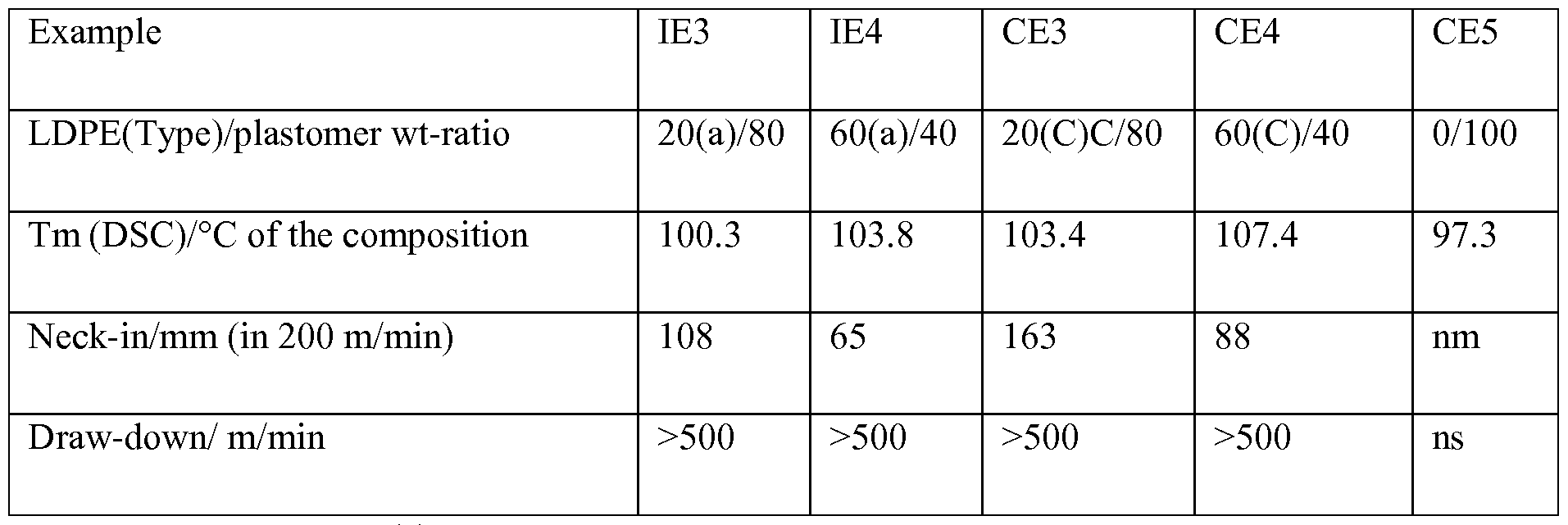
- Neck- in was determined as the difference between the width of the die and the width of the coating on the substrate.
- Basis weight was determined as follows: Five samples were cut off from the extrusion coated paper parallel in the transverse direction of the line. The size of the samples was 100 cm 2 . The paper was removed from the plastic. The samples were then weighed and the average was calculated. The result was given as a weight of the plastic per square meter. Hot tack force
- the maximum hot-tack force i.e. the maximum of a force/temperature diagram is determined and reported.
- Hot tack measurements were made with J&B hot tack tester following the method ASTM F 1921. The standard requires that the samples have to be cut into 15 mm slices in width. The samples are placed into the hot tack testing machine in vertical direction both ends attached to a mechanical lock. Then the tester seals and pulls out the hot seal and the resisting force is measured.
- Hot tack of each sample was established by testing hot tack forces with temperatures ranging from 80°C to a temperature where the measured hot tack force was below 1 N.
- the standard requires at least 3 parallel measurements to be done.
- the temperature was increased in steps of 5 °C.
- SIT and SET values are obtained from hot tack measurement.
- the lowest sealing temperature (SIT) is defined to be the temperature (°C), where hot-tack strength is reaching 2 N
- highest sealing temperature (SET) is the temperature (°C), where hot-tack strength is still at 2 N.
- Maximum hot-tack strength is defined to be the highest strength (N) level over 20 °C interval of sealing range.
- Low density polyethylene (a) was produced in an autoclave reactor according to the procedure of example 1 of EP 1777238.
- LDPE had MFR 2 of 4,5 kg/lOmin and density 917 kg/m 3 . It had further ⁇ 0 .05 of 3690 Pa-s and r
- G' (5kPa) was 3433Pa. It further had M n of 17500 g/mol, M w of 629000 g/mol and Mz of 3520000 g/mol. The polydispersity index, M w /M n was thus 36.
- ethylene- octene copolymer produced in solution process with metallocene catalyst and having density of 902 kg/m 3 and MFR 2 (190 °C/2,16 kg) of 10 g/lOmin.
- Composition (A) was formed by dry blending LDPE (a) as defined above with ethylene- octene plastomer (b) as defined above.
- LDPE resin As a comparative LDPE resin was used commercial LDPE grade CA7230 of Borealis having density of 923 kg/m 3 and MFR 2 of 4,5 g/lOmin.
- the basis weight of the heat sealable layer (H) was 10 g/m 2
- the basis weight of layer (L) was 10 g/m 2
- the basis weight of the substrate layer (S) was 70 g/m 2 .
- the basis weight of the layer H in the extrusion coated article was 30 g/m 2 or 10 g/m 2 as indicated in the examples.
- the polymer composition (Al) was used as a heat sealable layer in the inventive extrusion coated article with a layer structure (H-L-S).
- the polymer composition (A2) was used as a heat sealable layer in the inventive extrusion coated article with a layer structure (H-L-S).
- the polymer composition (Al) was used as a heat sealable layer in the inventive extrusion coated article with a layer structure (H-S) having the basis weight of the layer (H) 10 g/m 2 .
- IE4 Inventive Example 4
- the polymer composition (A2) was used as a heat sealable layer in the inventive extrusion coated article with a layer structure (H-S) having the basis weight of the layer (H) 10 g/m 2 .
- Comparative example 1 (CE1) Comparative example 1 (CE1)
- the heat sealable layer was used the same LDPE (a) as in inventive examples, but no plastomer was added to the composition.
- the layer structure was (H-S), having the basis weight of the layer (H) 30 g/m 2 .
- the heat sealable layer was used a composition of LDPE (C) (20 wt-%) and plastomer (b) (80 wt-%).
- the layer structure was (H-S), having the basis weight of the layer (H) 10 g/m 2 .
- the heat sealable layer was used a composition of LDPE (C) (60 wt-%) and plastomer (b) (40 wt-%)).
- the layer structure was (H-S), having the basis weight of the layer (H) 10 g/m 2 .
- Comparative example 5 (CE5)
- the layer structure was (H-S) having the basis weight of the layer (H) 10 g/m 2 .
- extrusion coated articles composed of the same substrate layer (S) and polymer layers as indicated in IE1 to IE4 and CE1 to CE5.
- the articles were prepared according to the following method:
- EBR edge bead reduction
- the deckling is shown as the position of the deckles in mm from the starting, open, position.
- the first number indicates the position of the upper deckle and the second number the position of the lower deckle.
- deckling 70/30 means that the upper deckle has been moved to a position of 70 mm from the starting position and the lower deckle to 30 mm from the starting position.
- a UG kraft paper was coated with layers as indicated in the examples.
- the temperature of the polymer melt was set to 290 °C and the extruders' temperature profile was 200-240-290-290 °C.
- the chill roll was matt and temperature of the cooling water was 15 °C. Used die opening was 0,65 mm and nip distance was 180 mm. Melt film touched the substrate for the first time +10 mm from nip to substrate side. Pressure of the pressure roll was 3.2kp/cm 2 .
- the line speed was 150 m/min.
- Ozone treatment for the melt (Wedeco) and Corona treatment for the substrate (Vetaphone) have been employed for all samples.
- Set point for ozone was 2.0 kW and thus concentration of ozone was 25 g/m 3 .
- Applicator's distance and angle from molten film was 70 mm and 45°C Vetaphone ET5 corona treater had a output power of 12 kW and frequency of 18 to 35 kHz. It had an HF-amplifier with output voltage of 15 to 25 kV and multi-profile aluminium electrode.
- Set point for used corona was 12.0 kW.
- inventive examples show improved maximum hot- tack strength and lower SIT compared to the composition without the plastomer (CEl). Also SET is on a clearly higher level. Sealing window is thus broadened when using the inventive compositions.
- SIT value is very low due to the very low melt temperature (Tm) of the plastomer.
- Tm melt temperature
Landscapes
- Chemical & Material Sciences (AREA)
- Organic Chemistry (AREA)
- Chemical Kinetics & Catalysis (AREA)
- Polymers & Plastics (AREA)
- Health & Medical Sciences (AREA)
- Medicinal Chemistry (AREA)
- Engineering & Computer Science (AREA)
- Wood Science & Technology (AREA)
- Materials Engineering (AREA)
- Life Sciences & Earth Sciences (AREA)
- Mechanical Engineering (AREA)
- Laminated Bodies (AREA)
- Compositions Of Macromolecular Compounds (AREA)
- Extrusion Moulding Of Plastics Or The Like (AREA)
Abstract
Description

Claims
Priority Applications (5)
| Application Number | Priority Date | Filing Date | Title |
|---|---|---|---|
| BR112017022301-5A BR112017022301B1 (en) | 2015-05-07 | 2016-05-04 | Polymeric composition, extrusion coated article, process for producing an extrusion coated article, and, use of a polymeric composition |
| EA201700505A EA037263B1 (en) | 2015-05-07 | 2016-05-04 | Polymer compositions for extrusion coating |
| US15/569,351 US20180298168A1 (en) | 2015-05-07 | 2016-05-04 | Polymer compositions for extrusion coating |
| KR1020177032691A KR101978082B1 (en) | 2015-05-07 | 2016-05-04 | Polymer compositions for extrusion coating |
| CN201680018658.2A CN107429101B (en) | 2015-05-07 | 2016-05-04 | Polymer composition for extrusion coating |
Applications Claiming Priority (2)
| Application Number | Priority Date | Filing Date | Title |
|---|---|---|---|
| EP15166779.7A EP3091057B1 (en) | 2015-05-07 | 2015-05-07 | Polymer compositions for extrusion coating |
| EP15166779.7 | 2015-05-07 |
Publications (2)
| Publication Number | Publication Date |
|---|---|
| WO2016177773A1 true WO2016177773A1 (en) | 2016-11-10 |
| WO2016177773A9 WO2016177773A9 (en) | 2016-12-29 |
Family
ID=53177147
Family Applications (1)
| Application Number | Title | Priority Date | Filing Date |
|---|---|---|---|
| PCT/EP2016/059986 Ceased WO2016177773A1 (en) | 2015-05-07 | 2016-05-04 | Polymer compositions for extrusion coating |
Country Status (8)
| Country | Link |
|---|---|
| US (1) | US20180298168A1 (en) |
| EP (1) | EP3091057B1 (en) |
| KR (1) | KR101978082B1 (en) |
| CN (1) | CN107429101B (en) |
| BR (1) | BR112017022301B1 (en) |
| EA (1) | EA037263B1 (en) |
| ES (1) | ES2822291T3 (en) |
| WO (1) | WO2016177773A1 (en) |
Families Citing this family (12)
| Publication number | Priority date | Publication date | Assignee | Title |
|---|---|---|---|---|
| KR102106711B1 (en) * | 2018-10-19 | 2020-05-04 | 한화토탈 주식회사 | Polyolefin Resin Composition for a Sealant Layer of a Peelable Film and Peelable Film Comprising a Sealant Layer Prepared Therefrom |
| EP3753732B1 (en) * | 2019-06-20 | 2023-02-01 | SABIC Global Technologies B.V. | Container liner for holding liquids |
| AR119432A1 (en) * | 2019-07-31 | 2021-12-15 | Dow Global Technologies Llc | NARROW SUPPRESSION FOR LDPE-BASED TUBULAR POLYMERS FOR EXTRUSION COATING AT MEDIUM AND HIGH LINE SPEED |
| KR102932913B1 (en) * | 2019-10-15 | 2026-02-27 | 보레알리스 게엠베하 | Polymer composition comprising a recycled coated polyolefin fabric substrate |
| EP3916023A1 (en) * | 2020-05-27 | 2021-12-01 | Borealis AG | Polypropylene coating composition |
| EP4359476B1 (en) * | 2021-06-22 | 2025-08-06 | SABIC Global Technologies B.V. | Polyethylene composition having improved melt strength and flexibility |
| US20240060239A1 (en) * | 2022-08-19 | 2024-02-22 | Georgia Tech Research Corporation | Degradable and recyclable cellulose containing compositions and methods of making the same |
| US20240253853A1 (en) | 2023-01-30 | 2024-08-01 | Pratt Corrugated Holdings, Inc. | Meal kit assembly |
| US12264006B1 (en) | 2023-12-21 | 2025-04-01 | Pratt Corrugated Holdings, Inc. | Insulated packaging liner |
| USD1083588S1 (en) | 2023-12-28 | 2025-07-15 | Pratt Corrugated Holdings, Inc. | Packaging insert |
| US12497229B2 (en) | 2024-01-29 | 2025-12-16 | Pratt Corrugated Holdings, Inc. | Packaging assembly |
| CN119081274B (en) * | 2024-09-25 | 2025-05-23 | 埃克森美孚(惠州)化工有限公司 | Heat sealable composition and use thereof |
Citations (6)
| Publication number | Priority date | Publication date | Assignee | Title |
|---|---|---|---|---|
| WO2000022040A1 (en) | 1998-10-14 | 2000-04-20 | Borealis Technology Oy | Polymer composition for pipes |
| WO2000078859A1 (en) | 1999-06-17 | 2000-12-28 | The Dow Chemical Company | Polymer compositions which exhibit high hot tack |
| WO2005019333A1 (en) * | 2003-08-19 | 2005-03-03 | Innovene Europe Limited | Polymer blends |
| EP1777238A1 (en) | 2005-10-18 | 2007-04-25 | Borealis Technology Oy | Polyethylene blend component and blends containing the same |
| WO2013079654A1 (en) * | 2011-12-01 | 2013-06-06 | Ineos Europe Ag | Polymer blends |
| WO2013124221A1 (en) | 2012-02-22 | 2013-08-29 | Borealis Ag | Extrusion coating polyethylene with improved drawdown |
Family Cites Families (12)
| Publication number | Priority date | Publication date | Assignee | Title |
|---|---|---|---|---|
| US4096309A (en) * | 1976-08-12 | 1978-06-20 | Champion International Corporation | Laminated packaging material |
| US4359553A (en) * | 1981-09-14 | 1982-11-16 | Eastman Kodak Company | Polyethylene extrusion coating compositions |
| ZA832777B (en) * | 1982-04-27 | 1984-11-28 | Bp Chem Int Ltd | Polyethylene blend and film |
| US5582923A (en) * | 1991-10-15 | 1996-12-10 | The Dow Chemical Company | Extrusion compositions having high drawdown and substantially reduced neck-in |
| US6682825B1 (en) * | 1994-06-06 | 2004-01-27 | Cryovac, Inc. | Films having enhanced sealing characteristics and packages containing same |
| US5879768A (en) * | 1995-10-06 | 1999-03-09 | The Dow Chemical Company | Pouches for packaging flowable materials |
| US6087079A (en) * | 1998-10-26 | 2000-07-11 | Eastman Kodak Company | High speed lamination of paper and biaxially oriented sheet |
| GB0315275D0 (en) * | 2003-06-30 | 2003-08-06 | Borealis Tech Oy | Extrusion coating |
| EP1777283A1 (en) | 2003-11-14 | 2007-04-25 | PUGACHEV, Alexandr Vasilievich | Method and reactor for hydrocarbon conversion by a cascade oxydation cracking |
| MX2007008157A (en) * | 2005-01-03 | 2007-07-24 | Dow Global Technologies Inc | Elastomeric resin compositions with improved resistance to draw resonance. |
| ATE485337T1 (en) * | 2008-01-07 | 2010-11-15 | Borealis Tech Oy | EXTRUSION COATING OF A POLYETHYLENE COMPOSITION |
| KR101746692B1 (en) * | 2012-05-31 | 2017-06-27 | 보레알리스 아게 | Ethylene polymers for extrusion coating |
-
2015
- 2015-05-07 ES ES15166779T patent/ES2822291T3/en active Active
- 2015-05-07 EP EP15166779.7A patent/EP3091057B1/en active Active
-
2016
- 2016-05-04 BR BR112017022301-5A patent/BR112017022301B1/en active IP Right Grant
- 2016-05-04 US US15/569,351 patent/US20180298168A1/en not_active Abandoned
- 2016-05-04 EA EA201700505A patent/EA037263B1/en not_active IP Right Cessation
- 2016-05-04 KR KR1020177032691A patent/KR101978082B1/en active Active
- 2016-05-04 WO PCT/EP2016/059986 patent/WO2016177773A1/en not_active Ceased
- 2016-05-04 CN CN201680018658.2A patent/CN107429101B/en active Active
Patent Citations (6)
| Publication number | Priority date | Publication date | Assignee | Title |
|---|---|---|---|---|
| WO2000022040A1 (en) | 1998-10-14 | 2000-04-20 | Borealis Technology Oy | Polymer composition for pipes |
| WO2000078859A1 (en) | 1999-06-17 | 2000-12-28 | The Dow Chemical Company | Polymer compositions which exhibit high hot tack |
| WO2005019333A1 (en) * | 2003-08-19 | 2005-03-03 | Innovene Europe Limited | Polymer blends |
| EP1777238A1 (en) | 2005-10-18 | 2007-04-25 | Borealis Technology Oy | Polyethylene blend component and blends containing the same |
| WO2013079654A1 (en) * | 2011-12-01 | 2013-06-06 | Ineos Europe Ag | Polymer blends |
| WO2013124221A1 (en) | 2012-02-22 | 2013-08-29 | Borealis Ag | Extrusion coating polyethylene with improved drawdown |
Non-Patent Citations (5)
| Title |
|---|
| HEINO, E.L.: "The influence of molecular structure on some rheological properties of polyethylene", BOREALIS POLYMERS OY, PORVOO, FINLAND, ANNUAL TRANSACTIONS OF THE NORDIC RHEOLOGY SOCIETY, 1995 |
| HEINO, E.L.; LEHTINEN, A.; TANNER J.; SEPPALA, J., RHEOLOGICAL CHARACTERIZATION OF POLYETHYLENE FRACTIONS |
| R.A.V. RAFF; K.W. DOAK: "Crystalline Olefin Polymers", 1964, INTERSCIENCE PUBLISHERS, pages: 478 - 484 |
| SCHLEY; SCHWARZ: "Kunststoff Handbuch", vol. 20, 1969, CARL HANSER VERLAG, article "Polyolefine", pages: 412 - 420 |
| THEOR. APPL. RHEOL., PROC. INT. CONGR. RHEOL, vol. 11TH, no. 1, 1992, pages 360 - 362 |
Also Published As
| Publication number | Publication date |
|---|---|
| CN107429101A (en) | 2017-12-01 |
| WO2016177773A9 (en) | 2016-12-29 |
| ES2822291T3 (en) | 2021-04-30 |
| EA037263B1 (en) | 2021-03-01 |
| KR20170136611A (en) | 2017-12-11 |
| EA201700505A1 (en) | 2018-03-30 |
| BR112017022301B1 (en) | 2022-04-12 |
| KR101978082B1 (en) | 2019-05-13 |
| EP3091057B1 (en) | 2020-09-09 |
| BR112017022301A2 (en) | 2018-07-10 |
| CN107429101B (en) | 2021-04-16 |
| EP3091057A1 (en) | 2016-11-09 |
| US20180298168A1 (en) | 2018-10-18 |
Similar Documents
| Publication | Publication Date | Title |
|---|---|---|
| EP3091057B1 (en) | Polymer compositions for extrusion coating | |
| US9976020B2 (en) | Polymer compositions and extrusion coated articles | |
| AU2004213164B2 (en) | Polypropylene compositions | |
| CA2724235C (en) | Biaxially oriented lldpe blends | |
| AU2005205120B2 (en) | Extrusion coating polyethylene | |
| US11746222B2 (en) | Polymer blends for use in multilayer structure and multilayer structures comprising the same | |
| CN106687287B (en) | Cast film assembly layers exhibiting excellent adhesion properties |
Legal Events
| Date | Code | Title | Description |
|---|---|---|---|
| 121 | Ep: the epo has been informed by wipo that ep was designated in this application |
Ref document number: 16723296 Country of ref document: EP Kind code of ref document: A1 |
|
| REG | Reference to national code |
Ref country code: BR Ref legal event code: B01A Ref document number: 112017022301 Country of ref document: BR |
|
| WWE | Wipo information: entry into national phase |
Ref document number: 15569351 Country of ref document: US |
|
| NENP | Non-entry into the national phase |
Ref country code: DE |
|
| ENP | Entry into the national phase |
Ref document number: 20177032691 Country of ref document: KR Kind code of ref document: A |
|
| WWE | Wipo information: entry into national phase |
Ref document number: 201700505 Country of ref document: EA |
|
| 122 | Ep: pct application non-entry in european phase |
Ref document number: 16723296 Country of ref document: EP Kind code of ref document: A1 |
|
| ENP | Entry into the national phase |
Ref document number: 112017022301 Country of ref document: BR Kind code of ref document: A2 Effective date: 20171017 |