WO2016173948A1 - Indazolopyrimidinones as fibrinolysis inhibitors - Google Patents
Indazolopyrimidinones as fibrinolysis inhibitors Download PDFInfo
- Publication number
- WO2016173948A1 WO2016173948A1 PCT/EP2016/059052 EP2016059052W WO2016173948A1 WO 2016173948 A1 WO2016173948 A1 WO 2016173948A1 EP 2016059052 W EP2016059052 W EP 2016059052W WO 2016173948 A1 WO2016173948 A1 WO 2016173948A1
- Authority
- WO
- WIPO (PCT)
- Prior art keywords
- group
- substituted
- formula
- butyl
- compound
- Prior art date
- Legal status (The legal status is an assumption and is not a legal conclusion. Google has not performed a legal analysis and makes no representation as to the accuracy of the status listed.)
- Ceased
Links
- 0 *C(C1)N(*)CCC1C([n]1nc(cccc2C#N)c2c1N1)=CC1=O Chemical compound *C(C1)N(*)CCC1C([n]1nc(cccc2C#N)c2c1N1)=CC1=O 0.000 description 8
- ZWOQCYZTJLZFGY-UHFFFAOYSA-N CC(C)(C)OC(N(CC1)CCC1C([n]1nc(cccc2C(NCC3CCCCC3)=O)c2c1N1)=CC1=O)=O Chemical compound CC(C)(C)OC(N(CC1)CCC1C([n]1nc(cccc2C(NCC3CCCCC3)=O)c2c1N1)=CC1=O)=O ZWOQCYZTJLZFGY-UHFFFAOYSA-N 0.000 description 1
- PGZFZASSHKHXSM-UHFFFAOYSA-N CC(C)(C)OC(N(CC1)CCC1C([n]1nc(cccc2C(NCc(cc3)ccc3F)=O)c2c1N1)=CC1=O)=O Chemical compound CC(C)(C)OC(N(CC1)CCC1C([n]1nc(cccc2C(NCc(cc3)ccc3F)=O)c2c1N1)=CC1=O)=O PGZFZASSHKHXSM-UHFFFAOYSA-N 0.000 description 1
- TVIVWLQVMZZPFP-INIZCTEOSA-N CC(C)(C)OC(N(CC1)CCC1C([n]1nc(cccc2N(CC[C@@H](C3)O)C3=O)c2c1N1)=CC1=O)=O Chemical compound CC(C)(C)OC(N(CC1)CCC1C([n]1nc(cccc2N(CC[C@@H](C3)O)C3=O)c2c1N1)=CC1=O)=O TVIVWLQVMZZPFP-INIZCTEOSA-N 0.000 description 1
- RYGOQUNNROUVSK-UHFFFAOYSA-N CC(C)(C)OC(N(CC1)CCC1C([n]1nc(cccc2NC(c(c(F)ccc3)c3F)=O)c2c1N1)=CC1=O)=O Chemical compound CC(C)(C)OC(N(CC1)CCC1C([n]1nc(cccc2NC(c(c(F)ccc3)c3F)=O)c2c1N1)=CC1=O)=O RYGOQUNNROUVSK-UHFFFAOYSA-N 0.000 description 1
- GUEWLTJHMMTSJN-UHFFFAOYSA-N CC(C)(C)OC(N(CC1)CCC1C([n]1nc(cccc2NC(c3cc(cccc4)c4cc3)=O)c2c1N1)=CC1=O)=O Chemical compound CC(C)(C)OC(N(CC1)CCC1C([n]1nc(cccc2NC(c3cc(cccc4)c4cc3)=O)c2c1N1)=CC1=O)=O GUEWLTJHMMTSJN-UHFFFAOYSA-N 0.000 description 1
- XGFZOROGRZULIC-UHFFFAOYSA-N CC(C)(C)OC(N(CC1)CCC1C([n]1nc(cccc2NC(c3ccccc3C)=O)c2c1N1)=CC1=O)=O Chemical compound CC(C)(C)OC(N(CC1)CCC1C([n]1nc(cccc2NC(c3ccccc3C)=O)c2c1N1)=CC1=O)=O XGFZOROGRZULIC-UHFFFAOYSA-N 0.000 description 1
- RPXIXWMNGHASGT-UHFFFAOYSA-N CC(C)(C)OC(N(CC1)CCC1C([n]1nc(cccc2Nc(cc3)ncc3C#N)c2c1N1)=CC1=O)=O Chemical compound CC(C)(C)OC(N(CC1)CCC1C([n]1nc(cccc2Nc(cc3)ncc3C#N)c2c1N1)=CC1=O)=O RPXIXWMNGHASGT-UHFFFAOYSA-N 0.000 description 1
- FYOWGEJONAPFFJ-UHFFFAOYSA-N CC(C)(C)OC(N(CC1)CCC1C([n]1nc(cccc2Nc(nc3)ncc3C#N)c2c1N1)=CC1=O)=O Chemical compound CC(C)(C)OC(N(CC1)CCC1C([n]1nc(cccc2Nc(nc3)ncc3C#N)c2c1N1)=CC1=O)=O FYOWGEJONAPFFJ-UHFFFAOYSA-N 0.000 description 1
- CFRUDXCUWBEGHT-UHFFFAOYSA-N CC(C)(C)OC(N(CC1)CCC1C([n]1nc(cccc2Nc(nccc3)c3C#N)c2c1N1)=CC1=O)=O Chemical compound CC(C)(C)OC(N(CC1)CCC1C([n]1nc(cccc2Nc(nccc3)c3C#N)c2c1N1)=CC1=O)=O CFRUDXCUWBEGHT-UHFFFAOYSA-N 0.000 description 1
- JYPQATPHVZBULI-UHFFFAOYSA-N CC(C)(C)OC(N(CC1)CCC1C([n]1nc(cccc2Nc3ncccc3F)c2c1N1)=CC1=O)=O Chemical compound CC(C)(C)OC(N(CC1)CCC1C([n]1nc(cccc2Nc3ncccc3F)c2c1N1)=CC1=O)=O JYPQATPHVZBULI-UHFFFAOYSA-N 0.000 description 1
- MERAXRIKWBRLIJ-UHFFFAOYSA-N CC(C)(C)OC(N(CC1)CCC1C([n]1ncc(-c2nc(-c3cccc(C(F)(F)F)c3)n[o]2)c1N1)=CC1=O)=O Chemical compound CC(C)(C)OC(N(CC1)CCC1C([n]1ncc(-c2nc(-c3cccc(C(F)(F)F)c3)n[o]2)c1N1)=CC1=O)=O MERAXRIKWBRLIJ-UHFFFAOYSA-N 0.000 description 1
- NZMNPTDTJUEPEP-UHFFFAOYSA-N CC(C)CC(Nc(c1c2N3)cccc1n[n]2C(C(CC1)CCN1C1=[O](C)C(C)(C)O1)=CC3=O)=O Chemical compound CC(C)CC(Nc(c1c2N3)cccc1n[n]2C(C(CC1)CCN1C1=[O](C)C(C)(C)O1)=CC3=O)=O NZMNPTDTJUEPEP-UHFFFAOYSA-N 0.000 description 1
- KEQKCPSQERQFAA-UHFFFAOYSA-N CC(C)NC(Nc(c1c2N3)cccc1n[n]2C(C1CCNCC1)=CC3=O)=O Chemical compound CC(C)NC(Nc(c1c2N3)cccc1n[n]2C(C1CCNCC1)=CC3=O)=O KEQKCPSQERQFAA-UHFFFAOYSA-N 0.000 description 1
- NQCHDKAHLNUFJM-UHFFFAOYSA-N CC(C)NC1OC1c(c1c2N3)cccc1n[n]2C(C(CC1)CCN1C(OC(C)(C)C)=O)=CC3=O Chemical compound CC(C)NC1OC1c(c1c2N3)cccc1n[n]2C(C(CC1)CCN1C(OC(C)(C)C)=O)=CC3=O NQCHDKAHLNUFJM-UHFFFAOYSA-N 0.000 description 1
- WUEYPHWJKDREBY-UHFFFAOYSA-N CC(C)OC(Nc(c1c2N3)cccc1n[n]2C(C(CC1)CCN1C(OC(C)(C)C)=O)=CC3=O)=O Chemical compound CC(C)OC(Nc(c1c2N3)cccc1n[n]2C(C(CC1)CCN1C(OC(C)(C)C)=O)=CC3=O)=O WUEYPHWJKDREBY-UHFFFAOYSA-N 0.000 description 1
- PILJMGVZKCGFIH-UHFFFAOYSA-N CC1(C)[O](C)=C(N(CC2)CCC2C([n]2nc(cccc3C(O)=O)c3c2N2)=CC2=O)O1 Chemical compound CC1(C)[O](C)=C(N(CC2)CCC2C([n]2nc(cccc3C(O)=O)c3c2N2)=CC2=O)O1 PILJMGVZKCGFIH-UHFFFAOYSA-N 0.000 description 1
- ATVDWUABCUEKJP-UHFFFAOYSA-N CC1(C)[O](C)=C(N(CC2)CCC2C([n]2nc(cccc3NC(C4(CC(C5)C6)CC6CC5C4)=O)c3c2N2)=CC2=O)O1 Chemical compound CC1(C)[O](C)=C(N(CC2)CCC2C([n]2nc(cccc3NC(C4(CC(C5)C6)CC6CC5C4)=O)c3c2N2)=CC2=O)O1 ATVDWUABCUEKJP-UHFFFAOYSA-N 0.000 description 1
- UEVBNIIWHQEODO-UHFFFAOYSA-N CC1(C)[O](C)=C(N(CC2)CCC2C([n]2nc(cccc3NC(NC4CCCCC4)=O)c3c2N2)=CC2=O)O1 Chemical compound CC1(C)[O](C)=C(N(CC2)CCC2C([n]2nc(cccc3NC(NC4CCCCC4)=O)c3c2N2)=CC2=O)O1 UEVBNIIWHQEODO-UHFFFAOYSA-N 0.000 description 1
- URUFDLHKFFDNPB-UHFFFAOYSA-N CC1(C)[O](C)=C(N(CC2)CCC2C([n]2nc(cccc3NC(NCCOC)=O)c3c2N2)=CC2=O)O1 Chemical compound CC1(C)[O](C)=C(N(CC2)CCC2C([n]2nc(cccc3NC(NCCOC)=O)c3c2N2)=CC2=O)O1 URUFDLHKFFDNPB-UHFFFAOYSA-N 0.000 description 1
- QCAKONWPJGOKBG-UHFFFAOYSA-N CC1(C)[O](C)=C(N(CC2)CCC2C([n]2nc(cccc3NC(c4c[nH]nn4)=O)c3c2N2)=CC2=O)O1 Chemical compound CC1(C)[O](C)=C(N(CC2)CCC2C([n]2nc(cccc3NC(c4c[nH]nn4)=O)c3c2N2)=CC2=O)O1 QCAKONWPJGOKBG-UHFFFAOYSA-N 0.000 description 1
- PHYKVSQCJQNEED-UHFFFAOYSA-N CCCCC(Nc(c1c2N3)cccc1n[n]2C(C1CCNCC1)=CC3=O)=O Chemical compound CCCCC(Nc(c1c2N3)cccc1n[n]2C(C1CCNCC1)=CC3=O)=O PHYKVSQCJQNEED-UHFFFAOYSA-N 0.000 description 1
- HQPUSLPAVRUDKO-UHFFFAOYSA-N CCNC(Nc(c1c2N3)cccc1n[n]2C(C(CC1)CCN1C(OC(C)(C)C)=O)=CC3=O)=O Chemical compound CCNC(Nc(c1c2N3)cccc1n[n]2C(C(CC1)CCN1C(OC(C)(C)C)=O)=CC3=O)=O HQPUSLPAVRUDKO-UHFFFAOYSA-N 0.000 description 1
- PCVISQSGUWXDDR-UHFFFAOYSA-N COc(cccc1)c1C(Nc(c1c2N3)cccc1n[n]2C(C1CCNCC1)=CC3=O)=O Chemical compound COc(cccc1)c1C(Nc(c1c2N3)cccc1n[n]2C(C1CCNCC1)=CC3=O)=O PCVISQSGUWXDDR-UHFFFAOYSA-N 0.000 description 1
- OAHRAGMAJQMBOF-UHFFFAOYSA-N COc1nccc(C(Nc(c2c3N4)cccc2n[n]3C(C2CCNCC2)=CC4=O)=O)c1 Chemical compound COc1nccc(C(Nc(c2c3N4)cccc2n[n]3C(C2CCNCC2)=CC4=O)=O)c1 OAHRAGMAJQMBOF-UHFFFAOYSA-N 0.000 description 1
- HURGCURRKUJIHC-ZDUSSCGKSA-N C[C@@H](C(Nc(c1c2N3)cccc1n[n]2C(C(CC1)CCN1C(OC(C)(C)C)=O)=CC3=O)=O)O Chemical compound C[C@@H](C(Nc(c1c2N3)cccc1n[n]2C(C(CC1)CCN1C(OC(C)(C)C)=O)=CC3=O)=O)O HURGCURRKUJIHC-ZDUSSCGKSA-N 0.000 description 1
- GJFHWNKHWFQKFQ-UHFFFAOYSA-N Cc1cccnc1Nc(c1c2N3)cccc1n[n]2C(C1CCNCC1)=CC3=O Chemical compound Cc1cccnc1Nc(c1c2N3)cccc1n[n]2C(C1CCNCC1)=CC3=O GJFHWNKHWFQKFQ-UHFFFAOYSA-N 0.000 description 1
- YSMJYNQVKLLMRY-UHFFFAOYSA-N Cc1nc(C(F)(F)F)ccc1C(Nc(c1c2N3)cccc1n[n]2C(C1CCNCC1)=CC3=O)=O Chemical compound Cc1nc(C(F)(F)F)ccc1C(Nc(c1c2N3)cccc1n[n]2C(C1CCNCC1)=CC3=O)=O YSMJYNQVKLLMRY-UHFFFAOYSA-N 0.000 description 1
- SYQYORAIYQBYKB-UHFFFAOYSA-N N#Cc(c(NC(C1CC1)=O)ccc1)c1F Chemical compound N#Cc(c(NC(C1CC1)=O)ccc1)c1F SYQYORAIYQBYKB-UHFFFAOYSA-N 0.000 description 1
- JDIPIMXOTBSJKK-UHFFFAOYSA-N N#Cc(c(NC(c1ccc(C(F)(F)F)cc1)=O)ccc1)c1F Chemical compound N#Cc(c(NC(c1ccc(C(F)(F)F)cc1)=O)ccc1)c1F JDIPIMXOTBSJKK-UHFFFAOYSA-N 0.000 description 1
- PIMZSZXYDKCIFE-UHFFFAOYSA-N N#Cc(cc1)cnc1Nc(c1c2N3)cccc1n[n]2C(C1CCNCC1)=CC3=O Chemical compound N#Cc(cc1)cnc1Nc(c1c2N3)cccc1n[n]2C(C1CCNCC1)=CC3=O PIMZSZXYDKCIFE-UHFFFAOYSA-N 0.000 description 1
- BPVZYXACKFJIPK-UHFFFAOYSA-N NC(Nc(c1c2N3)cccc1n[n]2C(C1CCNCC1)=CC3=O)=O Chemical compound NC(Nc(c1c2N3)cccc1n[n]2C(C1CCNCC1)=CC3=O)=O BPVZYXACKFJIPK-UHFFFAOYSA-N 0.000 description 1
- QLAWTKKUWVYJPN-UHFFFAOYSA-N O=C(Nc1ccccc1)Nc(c1c2N3)cccc1n[n]2C(C1CCNCC1)=CC3=O Chemical compound O=C(Nc1ccccc1)Nc(c1c2N3)cccc1n[n]2C(C1CCNCC1)=CC3=O QLAWTKKUWVYJPN-UHFFFAOYSA-N 0.000 description 1
- GMJXGCMRUCYJIO-UHFFFAOYSA-N O=C(c(c1c2N3)cccc1n[n]2C(C1CCNCC1)=CC3=O)NCC1CCCCC1 Chemical compound O=C(c(c1c2N3)cccc1n[n]2C(C1CCNCC1)=CC3=O)NCC1CCCCC1 GMJXGCMRUCYJIO-UHFFFAOYSA-N 0.000 description 1
- CLDBGPBQQCSOHF-UHFFFAOYSA-N O=C(c(c1c2N3)cccc1n[n]2C(C1CCNCC1)=CC3=O)Nc(cc1)ccc1F Chemical compound O=C(c(c1c2N3)cccc1n[n]2C(C1CCNCC1)=CC3=O)Nc(cc1)ccc1F CLDBGPBQQCSOHF-UHFFFAOYSA-N 0.000 description 1
- LJJXUFRUAXEURB-UHFFFAOYSA-N O=C(c(cc1)ccc1[Np]=O)Nc(c1c2N3)cccc1n[n]2C(C1CCNCC1)=CC3=O Chemical compound O=C(c(cc1)ccc1[Np]=O)Nc(c1c2N3)cccc1n[n]2C(C1CCNCC1)=CC3=O LJJXUFRUAXEURB-UHFFFAOYSA-N 0.000 description 1
- AHGYWSXMIJYYDC-UHFFFAOYSA-N O=C(c(ccc(F)c1)c1F)Nc(c1c2N3)cccc1n[n]2C(C1CCNCC1)=CC3=O Chemical compound O=C(c(ccc(F)c1)c1F)Nc(c1c2N3)cccc1n[n]2C(C1CCNCC1)=CC3=O AHGYWSXMIJYYDC-UHFFFAOYSA-N 0.000 description 1
Classifications
-
- C—CHEMISTRY; METALLURGY
- C07—ORGANIC CHEMISTRY
- C07D—HETEROCYCLIC COMPOUNDS
- C07D417/00—Heterocyclic compounds containing two or more hetero rings, at least one ring having nitrogen and sulfur atoms as the only ring hetero atoms, not provided for by group C07D415/00
- C07D417/02—Heterocyclic compounds containing two or more hetero rings, at least one ring having nitrogen and sulfur atoms as the only ring hetero atoms, not provided for by group C07D415/00 containing two hetero rings
- C07D417/04—Heterocyclic compounds containing two or more hetero rings, at least one ring having nitrogen and sulfur atoms as the only ring hetero atoms, not provided for by group C07D415/00 containing two hetero rings directly linked by a ring-member-to-ring-member bond
-
- A—HUMAN NECESSITIES
- A61—MEDICAL OR VETERINARY SCIENCE; HYGIENE
- A61P—SPECIFIC THERAPEUTIC ACTIVITY OF CHEMICAL COMPOUNDS OR MEDICINAL PREPARATIONS
- A61P7/00—Drugs for disorders of the blood or the extracellular fluid
Definitions
- the present application relates to novel substituted indazolopyrimidinones, to processes for their preparation, the compounds for use alone or in combinations in a method for the treatment and/or prophylaxis of diseases, in particular for the treatment and/or prophylaxis of acute and recurrent bleeding in patients with or without underlying hereditary or acquired hemostatic disorders.
- the present invention also relates to medicaments comprising the compounds according to the invention for the treatment and/or prophylaxis of acute and recurrent bleeding in patients with or without underlying hereditary or acquired hemostatic disorders, wherein the bleeding is associated with a disease or medical intervention selected from the group consisting of heavy menstrual bleeding (HMB), postpartum hemorrhage, hemorrhagic shock, trauma, surgery, transplantation, stroke, liver diseases, hereditary angioedema, nosebleed, and synovitis and cartilage damage following hemarthrosis.
- HMB heavy menstrual bleeding
- Bleeding is the common clinical hallmark in hereditary and acquired hemostatic disorders, trauma, surgery, stroke, heavy menstrual bleeding, HMB (also termed menorrhagia), postpartum hemorrhage, and liver diseases.
- HMB also termed menorrhagia
- the fibrinolytic system is activated by the deposition of fibrin and assists in the maintenance of an open lumen in damaged blood vessels. A balance between the formation and lysis of fibrin is required to maintain and remold the hemostatic seal during several days in which the injured vessel wall is repaired.
- Fibrinolysis is the physiological mechanism that dissolves clots.
- the fibrinolytic system comprises plasminogen, the circulating inactive precursor of plasmin, a potent serine protease involved in the dissolution of fibrin blood clots.
- Tissue-type plasminogen activator (tPA) and urokinase-type plasminogen activator (uPA) are the two major plasminogen activators expressed in many cell types and tissues (Levi JH, Lancet 2010, 376, 9734, 3-4). Plasminogen binds to lysine residues on the surface of fibrin and is converted to plasmin by an activator released from endothelial cells - tPA - that simultaneously binds to fibrin.
- plasmin generation and activity are also modulated by multiple inhibitors that include plasminogen activator inhibitor (PAI-1), thrombin- activatable fibrinolysis inhibitor (TAFI) and cb-antiplasmin (Cesarman-Maus G, Hajjar KA, Br J Haematol 2005; 129: 307-21).
- PAI-1 plasminogen activator inhibitor
- TAFI thrombin- activatable fibrinolysis inhibitor
- cb-antiplasmin Cesarman-Maus G, Hajjar KA, Br J Haematol 2005; 129: 307-21.
- Activators of fibrinolysis can be therapeutically used to dissolve blood clots in thrombotic conditions like myocardial infarction or ischemic stroke, to avoid degradation of the surrounding tissue (Flemming M, Melzig MF, J Pharm Pharmacol. 2012, 64(8): 1025-39).
- fibrinolysis can be, and is successfully and safely used in the management of bleeding. After extensive tissue injury that occurs with trauma or surgery, the equilibrium is shifted and fibrinolysis is considered to be an important contributor to bleeding and coagulopathy.
- many studies reported the use of antifibrinolytic agents to decrease bleeding and need for allogeneic transfusions.
- Antifibrinolytics are a safe and effective proven concept for reducing blood loss and rebleeding, without increased risk for thrombotic events, for example in the management of hemostatic disorders like hemophilia and von Willebrand's disease, in heavy menstrual bleeding, HMB (also called menorrhagia) and in different surgical conditions.
- antiplasmin may be used for treating synovitis and cartilage damage following hemarthrosis in patients with underlying hemostatic disorders including hemophilia and von Willebrand's disease (L. Nieuwenhuizen L, Roosendaal G, Masterbergen SC, Coeleveld K, Biesma DH, Lafeber FPJG, and Schuthens, REG, J Thrombosis and Haemostasis 2013, 12: 237-245).
- hemophilia and von Willebrand's disease L. Nieuwenhuizen L, Roosendaal G, Masterbergen SC, Coeleveld K, Biesma DH, Lafeber FPJG, and Schuthens, REG, J Thrombosis and Haemostasis 2013, 12: 237-245
- a further potential area of use of antifibrinolytics is the treatment of nosebleed caused by trauma and other causes, also coupled with underlying hemostatic disorders including hemophilia and von Willebrand's disease.
- Antifibrinolytics have also been successfully applied to the treatment of hereditary angioedema, where a reduction in the number and severity of attacks of edema in patients treated with tranexamic acid could be demonstrated (Dunn CJ, Goa KL, Drugs 1999, 57(6): 1005-1032).
- Abnormal uterine bleeding (AUB) may be diagnosed when a woman experiences a change in her menstrual blood loss (MBL), or the degree of MBL or vaginal bleeding pattern differs from that experienced by the age-matched general female population (National Collaborating Centre for Women's and Children's Health (NCCWCH): National Institute for Clinical Excellence (NICE) guidelines. CG44 Heavy Menstrual Bleeding: full guideline. 24 January 2007).
- AUB presents a spectrum of abnormal menstrual bleeding patterns that includes irregular, heavy or prolonged menstrual bleeding or an altered bleeding pattern. AUB may be associated with ovulatory or anovulatory cycles. Terms in use are dysfunctional uterine bleeding (DUB), heavy menstrual bleeding (HMB) or menorrhagia (abnormally heavy menstrual bleeding at regular intervals which may also be prolonged), metrorrhagia (uterine bleeding at irregular intervals, particularly between the expected menstrual periods), and metromenorrhagia (combination of both).
- DAB dysfunctional uterine bleeding
- HMB heavy menstrual bleeding
- metrorrhagia uterine bleeding at irregular intervals, particularly between the expected menstrual periods
- metromenorrhagia combination of both.
- AUB is one of the most frequent gynecological disorders observed by general practitioners and gynecologists. AUB is an exclusion diagnosis; an organic cause should always be ruled out. Organic causes of AUB include benign uterine neoplasia, especially cervical and endometrial polyps and myoma's, adenomyosis, and malignancies of the cervix and endometrium.
- HMB Heavy menstrual bleeding, HMB (also called menorrhagia) is widely defined in the medical literature as blood loss (MBL) of 80 mL or more per menstrual period
- MBL blood loss
- heavy menstrual bleeding is defined as menstrual blood loss of 60 ml or more per cycle, for example 60 to 80 ml per cycle, in particular more than 80 ml per cycle.
- heavy menstrual bleeding should be defined for clinical purposes as excessive menstrual blood loss which interferes with the woman's physical, emotional, social and material quality of life, and which can occur alone or in combination with other symptoms. Any interventions should aim to improve quality of life measures.
- the global prevalence rate of heavy menstrual bleeding based on 18 epidemiological studies, ranges from 4% to 52% (Fraser IS, Langham S, Uhl-Hochgraeber K. Health-related quality of life and economic burden of abnormal uterine bleeding.
- hemostatic disorders for example hereditary or acquired hemostatic disorders, such as hemophilia and von Willebrand's disease, platelet disorders/dysfunctions like Glantzmann's thrombasthenia and thrombocytopenia as well as PAI-1 deficiency, are potential causes of heavy menstrual bleeding. Menstruation and ovulation are unique hemostatic challenges that occur monthly in women of reproductive age. Integral hemostatic systems are required to control excessive bleeding during these events. While men with mild hereditary hemostatic disorders are often asymptomatic, women suffer a significant morbidity and impaired quality of life mainly with menstrual-related bleedings. Heavy menstrual bleeding is often the presenting symptom of an underlying hemostatic disorder and can be the only bleeding symptom in women.
- Tranexamic acid is approved for the treatment of heavy menstrual bleeding and a variety of surgical hemorrhagic conditions. Very high, multiple doses of tranexamic acid are required and the most commonly reported drug-related adverse events after oral administration are gastrointestinal, like nausea, vomiting, diarrhea and dyspepsia (Wellington K, Wagstaff AJ, Drugs 2003, 63 (13): 1417- 1433), (Dunn CJ, Goa KL, Drugs 1999, 57(6): 1005-1032).
- WO 2006/023000 Al pertains to modified release oral tranexamic acid formulations and methods of treatment herewith.
- WO 2010/117323 Al and WO 2012/047156 Al pertain to isoxazol-3(2H)-one analogs as plasminogen inhibitors and their use in the treatment of fibrinolysis related diseases, including hereditary hemostatic disorders, stroke, heavy menstrual bleeding and liver diseases.
- the compounds described in WO 2010/117323 Al and WO 2012/047156 Al are structurally unrelated to the compounds of the present invention.
- WO 2012/080237 pertains to substituted pyrimido[l,2-B]indazoles and their use as modulators of the PI3K/AKT pathway for the treatment of cancer.
- the compounds of formula (I-A) or (I-B) according to the present invention are structurally distinct from the compounds of formula (I) of WO 2012/080237.
- the present invention provides compounds of the general formula (I- A)
- R is selected from hydrogen and C1-C5 alkyl; R 2 is selected from the group consisting of
- -CO-NR 3 R 4 wherein selected from the group consisting of hydrogen and C 1 -C4 alkyl; selected from the group consisting of C1-C4 alkyl, wherein the C1-C4 alkyl may be substituted with C3-C6 cycloalkyl or phenyl, wherein the phenyl may be substituted with one, two or three halogen substituents
- 5- or 6-membered heteroaryl wherein the 5- or 6-membered heteroaryl may be substituted with one, two or three methyl substituents, or
- N, R 3 , and R 4 together form a 4-, 5- or 6-membered heterocyclyl, optionally substituted with one, two or three halogen substituents;
- R 5 is selected from the group consisting of C 1 -C4 alkyl, wherein the C 1 -C4 alkyl may be substituted with one, two or three substituents independently of one another selected from the group consisting of halogen, amino, hydroxyl, C1-C4 alkoxy,
- 5- or 6-membered heteroaryl wherein the 5- or 6-membered heteroaryl may be substituted with one, two or three substituents independently of one another selected from the group consisting of Ci- C4 alkyl, C1-C4 haloalkyl, C1-C4 alkoxy, halogen, and N-oxo,
- R 7 is selected from the group consisting of hydrogen and C 1 -C4 alkyl; is selected from the group consisting of hydrogen, C 1 -C4 alkyl, wherein the C 1 -C4 alkyl may be substituted with one, two or three substituents independently of one another selected from hydroxyl, halogen, dimethylamino and C1-C4 alkoxy, or with one substituent selected from phenyl, furanyl, and pyridinyl phenyl, wherein the phenyl may be substituted with one, two or three substituents independently of one another selected from C1-C4 alkyl and C1-C4 haloalkyl, and C3-C6 cycloalkyl, or R 7 , and R 8 together form a 5- to 6-membered N-heterocycle;
- R 11 is selected from the group consisting of 6-membered N-heteroaryl, wherein the 6-membered N-heteroaryl may be substituted with one, two or three substituents independently of one another selected from the group consisting of Ci- C4 alkyl, C1-C4 haloalkyl, halogen, cyano, and C1-C4 alkoxy, and -SO2-R 12 , wherein R 12 is selected from the group consisting of C1-C4 alkyl and phenyl; and its salts, solvates, and solvates of the salts.
- the present invention provides compounds of the general formula (I-B)
- R 1 and R 2 are as defined above and its salts, solvates, and solvates of the salts.
- Compounds according to the invention are the compounds of the formulae (I-A) or (I-B) and their salts, solvates and solvates of the salts, the compounds included in the formulae (I-A) or (I-B) of the formulae mentioned in the following and their salts, solvates and solvates of the salts, and the compounds included in the formulae (I-A) or (I-B) and mentioned in the following as embodiment examples and their salts, solvates and solvates of the salts, where the compounds included in the formulae (I-A) or (I- B) and mentioned in the following are not already salts, solvates and solvates of the salts.
- the term "x acid" in any of the formulae does not indicate any defined stoichiometric ratio of acid and the respective compound.
- the term “x acid” denotes different ratios of the compound to the acid, such as 10: 1 to 1: 10, 8: 1 to 1 :8, 7: 1 to 1:7, 5: 1 to 1:5, 4.5: 1 to 1 :4.5, 4: 1 to 1 :4, 3.5: 1 to 1 : 3.5, 3: 1 to 1:3, 2.5: 1 to 1 : 2.5, 2: 1 to 1:2, 1.5: 1 to 1: 1.5, and 1:1.
- Preferred salts in the context of the present invention are physiologically acceptable salts of the compounds of formula (I-A) or (I-B) according to the invention. Salts which are not themselves suitable for pharmaceutical uses but can be used, for example, for isolation or purification of the compounds of formula (I-A) or (I-B) according to the invention are also included.
- Physiologically acceptable salts of the compounds of formula (I-A) or (I-B) according to the invention include acid addition salts of mineral acids, carboxylic acids and sulphonic acids, e.g. salts of hydrochloric acid, hydrobromic acid, sulphuric acid, phosphoric acid, methanesulphonic acid, ethanesulphonic acid, toluenesulphonic acid, benzenesulphonic acid, naphthalenedisulphonic acid, formic acid, acetic acid, trifluoroacetic acid, propionic acid, lactic acid, tartaric acid, malic acid, citric acid, fumaric acid, maleic acid, benzoic acid, oxalic acid, ascorbic acid, and salicylic acid.
- mineral acids e.g. salts of mineral acids, carboxylic acids and sulphonic acids
- Physiologically acceptable salts of the compounds of formula (I-A) or (I-B) according to the invention also include salts of conventional bases, such as, by way of example and preferably, alkali metal salts (e.g. sodium and potassium salts), alkaline earth metal salts (e.g.
- ammonium salts derived from ammonia or organic amines having 1 to 16 carbon atoms, such as, by way of example and preferably, ethylamine, diethylamine, triethylamine, ethyldiisopropylamine, monoethanolamine, diethanolamine, triethanolamine, dicyclohexylamine, dimethylaminoethanol, procaine, dibenzylamine, N-methylmorpholine, arginine, lysine, ethylenedi amine, and N- methylpiperidine.
- physiologically acceptable salts of the compounds of formula (I-A) or (I-B) according to the invention include salts of hydrochloric acid, sulphuric acid, maleic acid, acetic acid, trifluoroacetic acid, phosphoric acid, tartaric acid, citric acid, fumaric acid, oxalic acid, ascorbic acid, salicylic acid, and lysine.
- physiologically acceptable salts of the compounds of formula (I-A) or (I-B) according to the invention include salts of hydrochloric acid, sulphuric acid, maleic acid, acetic acid, trifluoroacetic acid, tartaric acid, ascorbic acid, and salicylic acid.
- physiologically acceptable salts of the compounds of formula (I-A) or (I-B) according to the invention include salts of hydrochloric acid, and trifluoroacetic acid.
- the physiologically acceptable salts of the compounds of formula (I-A) or (I-B) according to the invention are the salts of hydrochloric acid.
- the terms “heavy menstrual bleeding, HMB” and “menorrhagia” are interchangeable.
- the term “medical intervention” includes medical interventions associated with bleeding, such as surgery and transplantation.
- the definition of the term “medical intervention” also includes minor medical interventions that may cause bleeding, such as tooth extractions, periodontal (gum) surgery, dental implant placement, biopsies, e.g. dental, prostatic, and urinary biopsies, and the removal of urinary stones.
- Solvates in the context of the invention are designated as those forms of the compounds of formula (I-A) or (I-B) according to the invention which form a complex in the solid or liquid state by coordination with solvent molecules. Hydrates are a specific form of solvates, in which the coordination takes place with water. Hydrates are preferred solvates in the context of the present invention.
- the compounds of formula (TA) or (TB) according to the invention can exist in different stereoisomeric forms depending on their structure, i.e. in the form of configuration isomers or optionally also as conformation isomers (enantiomers and/or diastereomers, including those in the case of atropisomers).
- the present invention therefore includes the enantiomers and diastereomers and their particular mixtures.
- the stereoisomerically uniform constituents can be isolated from such mixtures of enantiomers and/or diastereomers in a known manner; chromatography processes are preferably used for this, in particular HPLC chromatography on an achiral or chiral phase.
- the compounds of formula ( A) or (TB) according to the invention can occur in tautomeric forms
- the present invention includes all the tautomeric forms.
- stereoisomeric forms of the compounds of formula (TA) or (TB) or (IV) according to the invention are compounds of the formulae (TA) or (TB) as defined above, and compounds of the formula (IV) as defined below, wherein the substituent R 1 has the meaning of C 1 -C4 alkyl.
- Formula (TA), wherein the substituent R 1 has the meaning of C 1 -C5 alkyl comprises the following trans-isomers:
- the present invention comprises all possible stereoisomeric forms, also in cases where no stereoisomerism is indicated.
- the compounds of formulae (I-A), (I-B), and (IV), wherein the substituent R 1 has the meaning of C 1 -C5 alkyl are present as mixtures of cis- and trans- isomers.
- the compounds of formulae (I-A), (I-B), and (IV), wherein the substituent R 1 has the meaning of C 1 -C5 alkyl are present as mixtures of cis- and trans- isomers, wherein more than 50%, more than 55%, more than 60%, more than 65%, more than 70%, more than 75%, more than 80%, more than 85%, more than 90%, more than 95%, more than 97%, more than 98%, or more than 99%, of the compounds of formulae (I-A), (I-B), and (IV) are present as trans- isomer.
- the compounds of formulae (I-A), (I-B), and (IV), wherein the substituent R 1 has the meaning of C 1-C5 alkyl are present as the enantiomerically pure trans-isomers.
- the present invention also encompasses all suitable isotopic variants of the compounds of formula (I-A) or (I-B) according to the invention.
- An isotopic variant of a compound according to the invention is understood here to mean a compound in which at least one atom within the compound according to the invention has been exchanged for another atom of the same atomic number, but with a different atomic mass than the atomic mass which usually or predominantly occurs in nature.
- isotopes which can be incorporated into a compound according to the invention are those of hydrogen, carbon, nitrogen, oxygen, phosphorus, sulphur, fluorine, chlorine, bromine and iodine, such as 2 H (deuterium), 3 H (tritium), 13 C, 14 C, 15 N, 17 0, 18 0, 32 P, 33 P, 33 S, 34 S, 35 S, 36 S, 18 F, 36 C1, 82 Br, 123 I, 124 I, 129 I and 131 I.
- Particular isotopic variants of a compound according to the invention may be beneficial, for example, for the examination of the mechanism of action or of the active compound distribution in the body; due to comparatively easy preparability and detectability, especially compounds labelled with 3 H or 14 C isotopes are suitable for this purpose.
- the incorporation of isotopes for example of deuterium, can lead to particular therapeutic benefits as a consequence of greater metabolic stability of the compound, for example an extension of the half-life in the body or a reduction in the active dose required; such modifications of the compounds of formula (I-A) or (I-B) according to the invention may therefore in some cases also constitute a preferred embodiment of the present invention.
- Isotopic variants of the compounds of formula (I-A) or (I-B) according to the invention can be prepared by processes known to those skilled in the art, for example by the methods described below and the methods described in the working examples, by using corresponding isotopic modifications of the particular reagents and/or starting compounds therein.
- the present invention moreover also includes prodrugs of the compounds of formula (I-A) or (TB) according to the invention.
- prodrugs here designates compounds which themselves can be biologically active or inactive, but are converted (for example metabolically or hydrolytically) into compounds of formula (I-A) or (TB) according to the invention during their dwell time in the body.
- Alkyl in the context of the invention represents a straight-chain or branched alkyl radical having the number of carbon atoms stated in each case.
- the following may be mentioned by way of example and by way of preference: methyl, ethyl, n-propyl, isopropyl, n-butyl, isobutyl, 1-methylpropyl, tert-butyl, n- pentyl, isopentyl, 1-ethylpropyl, 1-methylbutyl, 2-methylbutyl, 3-methylbutyl, n-hexyl, 1-methylpentyl, 2-methylpentyl, 3-methylpentyl, 4-methylpentyl, 3,3-dimethylbutyl, 1-ethylbutyl, 2-ethylbutyl, 3- methyl-3-ethylpropyl.
- Haloalkyl in the context of the invention represents an alkyl radical as defined above being mono- or polyhalogenated up to the maximum possible number of substituents.
- the halogen atoms can be identical or different.
- halogen represents fluorine, chlorine, bromine or iodine, in particular fluorine, chlorine or bromine.
- Cycloalkyl or carbocycle in the context of the invention represents a monocyclic saturated alkyl radical having the number of ring carbon atoms stated in each case.
- cyclopropyl, cyclobutyl, cyclopentyl, cyclohexyl and cycloheptyl The following may be mentioned by way of example and by way of preference: fluoro methyl, difluoromethyl, trifluoro methyl, fluoroethyl, difluoroethyl, trifluoroethyl, pentafluoroethyl, chloromethyl, dichloromethyl, trichloromethyl, chloroethyl, dichloroethyl, 3-methyl-3-fluorethyl- 1 -fluorpropyl.
- Cycloalkyl or carbocycle in the context of the invention represents a monocyclic saturated alkyl radical having the number of ring carbon atoms stated in each case.
- Cycloalkylalkyl in the context of the invention represents a monocyclic saturated cycloalkyl radical being as defined above, attached to an alkyl group, being as defined above.
- the following may be mentioned by way of example and by way of preference: cyclopropyl-methyl, cyclopropyl-ethyl, cyclopropyl-propyl, cyclopropyl-isopropyl, cyclopropyl-butyl, cyclopropyl-isobutyl, cyclopropyl- 1- methylpropyl, cyclopropyl-ieri-butyl, cyclobutyl-methyl, cyclobutyl-ethyl, cyclobutyl-propyl, cyclobutyl-isopropyl, cyclobutyl-butyl, cyclobutyl-isobutyl, cyclobutyl- 1 -methylpropyl, cyclobutyl- tert-
- Bridged bi- and tri-cycloalkyl in the context of the invention include Cs— C12, or C7-C12, or Cs, groups. Bicyclic and tricyclic groups may be fused or bridged. Examples include: bicyclo-[2,2,l]-heptyl, methylbicyclo-[2,2,l]-octyl, bicyclo-[3,3,0] -octyl, bicyclo- [2,2,2] -octyl, bicyclo-[3,2,l]-octyl, bicyclo- [4,3,0]-nonyl, bicyclo-[3,3,l]-nonyl, and tricyclo[3.3.1.1 3 ' 7 ]decan (adamantanyl).
- a 10- 18 membered annelated aryl in the context of the invention represents a bi- to tricyclic aromatic cycle.
- this may be naphthalenyl.
- a 10-18 membered annelated heteroaryl in the context of the invention represents a bi- to tricyclic aromatic heterocycle which has a total of 10 to 18 ringatoms in two or three rings, and which contains up to six identical or different ring heteroatoms from the group consisting of N, O and S and is attached via a ring carbon atom or, if appropriate, a ring nitrogen atom.
- this may be benzimidazole.
- 3- to 6-membered heterocycloalkyl in the context of the invention represents a monocyclic saturated heterocycloalkyl radical which has a total of 3 to 6 ring atoms, which contains one or two ring heteroatoms from the group consisting of N, O, S, SO and SO 2 and which is attached via a ring carbon atom or, if appropriate, a ring nitrogen atom.
- azetidinyl oxetanyl, oxythianyl, oxoimidazolidinyl, oxazolidinyl, pyrrolidinyl, pyrazolidinyl, tetrahydrofuranyl, thiolanyl, piperidinyl, piperazinyl, tetrahydropyranyl, tetrahydrothiopyranyl, morpholinyl, thiomorpholinyl, hexahydroazepinyl, diazepanyl, and hexahydro-l,4-diazepinyl.
- 3- to 6-membered heterocycloalkyl- alkyl in the context of the invention represents a heterocycloalkyl radical being as defined above, attached to an alkyl group, being as defined above.
- the following may be mentioned by way of example and by way of preference: azetidinylmethyl, oxetanylmethyl, oxythianylmethyl, oxoimidazolidinylmethyl, oxazolidinylmethyl, pyrrolidinylmethyl, pyrazolidinylmethyl, tetrahydrofuranylmethyl, thiolanylmethyl, piperidinylmethyl, piperazinylmethyl, tetrahydropyranylmethyl, tetrahydrothiopyranylmethyl, morpholinylmethyl, thiomorpholinylmethyl, hexahydroazepinylmethyl, diazepanylmethyl, hexahydro-lmethyl,4-diazepinyl, azetidin
- a cyclic amine in the context of the invention represents a 5 to 7 membered heterocycle which contains one or two ring nitrogen atoms and zero or one ring oxygen atom and is attached via a ring nitrogen atom.
- the following may be mentioned by way of example: morpholinyl, piperidinyl, piperazinyl, diazepanyl, pyrrolidinyl, aziridinyl, and azetidinyl.
- Alkenyl in the context of the invention represents a straight-chain or branched alkenyl radical having 2 to 6 carbon atoms and one or two double bonds. Preference is given to a straight-chain or branched alkenyl radical having 2 to 4 carbon atoms and one double bond.
- Alkoxy in the context of the invention represents a straight-chain or branched alkoxy radical having 1 to 4 carbon atoms.
- the following may be mentioned by way of example and by way of preference: methoxy, ethoxy, n-propoxy, isopropoxy, 1-methylpropoxy, n-butoxy, isobutoxy and tert-butoxy.
- Haloalkoxy in the context of the invention represents an alkoxy radical as defined above being mono- or polyhalogenated up to the maximum possible number of substituents.
- the halogen atoms can be identical or different.
- halogen represents fluorine, chlorine, bromine or iodine, in particular fluorine, chlorine or bromine.
- Alkoxy alky 1 in the context of the invention represents a straight-chain or branched alkoxy radical having 1 to 4 carbon atoms as defined above, attached to an alkyl group, being as defined above.
- the following may be mentioned by way of example and by way of preference: methoxy-methyl, methoxy-ethyl, methoxy -propyl, methoxy-isopropyl, methoxy -butyl, methoxy-isobutyl, methoxy- 1-methylpropyl, methoxy-ieri-butyl, ethoxy-methyl, ethoxy-ethyl, ethoxy-propyl, ethoxy-isopropyl, ethoxy-butyl, ethoxy-isobutyl, ethoxy- 1 -ethylpropyl, ethoxy-ieri-butyl, n-propoxy-methyl, n-propoxy-ethyl, n-propoxy-propyl,
- Alkylester in the context of the invention represents a straight-chain or branched alkyl radical having 1 to 4 carbon atoms as defined above, which is attached to a carboxy group.
- Alkylamino in the context of the invention includes mono- and dialkylamino and represents an amino group wherein one or two hydrogen atoms are substituted with alkyl radicals.
- a 5 to 6-membered Heteroaryl in the context of the invention represents a monocyclic aromatic heterocycle (heteroaromatic) which has a total of 5 or 6 ring atoms, which contains up to three identical or different ring heteroatoms from the group consisting of N, O and S and is attached via a ring carbon atom or, if appropriate, a ring nitrogen atom.
- heterocycle monocyclic aromatic heterocycle (heteroaromatic) which has a total of 5 or 6 ring atoms, which contains up to three identical or different ring heteroatoms from the group consisting of N, O and S and is attached via a ring carbon atom or, if appropriate, a ring nitrogen atom.
- a 5 to 6-membered N-Heteroaryl in the context of the invention represents a subgroup of 5 to 6- membered Heteroaryl and represents a monocyclic aromatic heterocycle (heteroaromatic) which has a total of 5 or 6 ring atoms, which contains up to three ring nitrogen atoms and is attached via a ring carbon atom or, if appropriate, a ring nitrogen atom.
- heterocycle heterocycle
- pyrrolyl pyrazolyl, imidazolyl, triazolyl, including 1,2,4- and 1,2,3- triazolyl, pyridinyl, pyrimidinyl, pyridazinyl, pyrazinyl and triazinyl, including 1,2,3-, 1,2,4-, and 1,3,5- triazinyl.
- Halogen in the context of the invention includes fluorine, chlorine, bromine and iodine. Preference is given to chlorine, bromine, or fluorine.
- radicals in the compounds of formula (I-A) or (I-B) according to the invention are substituted, the radicals may, unless specified otherwise, be mono- or polysubstituted. In the context of the present invention, all radicals which occur more than once are defined independently of one another. Substitution by one, two or three identical or different substituents is preferred.
- treatment includes the inhibition, delay, arrest, amelioration, attenuation, limitation, reduction, suppression, reversal or cure of a disease, a condition, a disorder, an injury and a health impairment, of the development, course or the progression of such states and/or the symptoms of such states.
- therapy is understood to be synonymous with the term “treatment”.
- prevention In the context of the present invention, the terms “prevention”, “prophylaxis” or “precaution” are used synonymously and refer to the avoidance or reduction of the risk to get, to contract, to suffer from or to have a disease, a condition, a disorder, an injury or a health impairment, a development or a progression of such states and/or the symptoms of such states.
- the treatment or the prevention of a disease, a condition, a disorder, an injury or a health impairment may take place partially or completely.
- the compounds of the formulae (TA) or (TB) are defined as follows: R 1 is selected from hydrogen and C 1-C5 alkyl;
- R 2 is selected from the group consisting of (a) -CO-NR 3 R 4 , wherein
- R 3 is selected from the group consisting of hydrogen and C 1 -C4 alkyl
- R 4 is selected from the group consisting of C1-C4 alkyl, wherein the C1-C4 alkyl is substituted with C3-C6 cycloalkyl or phenyl, wherein the phenyl may be substituted with one, two or three halogen substituents
- 5- or 6-membered heterocyclyl wherein the 5- or 6-membered heterocyclyl may be substituted with one, two or three methyl substituents, phenyl, wherein the phenyl is substituted independently from each other with one, two or three halogen or methyl substituents
- 5- or 6-membered heteroaryl wherein the 5- or 6-membered heteroaryl is substituted with one, two or three methyl substituents, or
- N, R 3 , and R 4 together form a 4-, 5- or 6-membered heterocyclyl, optionally substituted with one, two or three halogen substituents;
- R 5 is selected from the group consisting of C 1 -C4 alkyl, wherein the C1-C4 alkyl is substituted with one, two or three substituents independently of one another selected from the group consisting of halogen, amino, hydroxyl, C1-C4 alkoxy,
- 5- or 6-membered heteroaryl wherein the 5- or 6-membered heteroaryl is substituted with one, two or three substituents independently of one another selected from the group consisting of Ci- C4 alkyl, C1-C4 haloalkyl, C1-C4 alkoxy, halogen, and N-oxo,
- 10- to 18-membered annelated aryl or heteroaryl, or adamantanyl wherein the 10- to 18-membered annelated aryl or heteroaryl, or adamantanyl may be substituted with one, two or three substituents independently of one another selected from C1-C4 alkyl,
- R 6 is selected from the group consisting of C1-C4 alkyl and C3-C6 cycloalkyl
- R 7 is selected from the group consisting of hydrogen and C1-C4 alkyl
- R 8 is selected from the group consisting of hydrogen, C 1 -C4 alkyl, wherein the C 1 -C4 alkyl may be substituted with one, two or three substituents independently of one another selected from hydroxyl, halogen, dimethylamino, C1-C4 alkoxy, phenyl, furanyl, and pyridinyl phenyl, wherein the phenyl may be substituted with one, two or three substituents independently of one another selected from C1-C4 alkyl and C1-C4 haloalkyl, and C3-C6 cycloalkyl, or
- N, R 7 , and R 8 together form a 5- to 6-membered N-heterocycle
- (c) wherein is selected from the group consisting of-(CH2) m -, wherein m is selected from 2, 3 and 4; and wherein R 9 may be substituted with one, two or three substituents independently of one another selected from C1-C4 alkyl;
- R 11 is selected from the group consisting of 6-membered N-heteroaryl, wherein the 6-membered N-heteroaryl may be substituted with one, two or three substituents independently of one another selected from the group consisting of Ci- C4 alkyl, C1-C4 haloalkyl, halogen, cyano, and C1-C4 alkoxy, and -SO2-R 12 , wherein R 12 is selected from the group consisting of C1-C4 alkyl and phenyl; and its salts, solvates, and solvates of the salts.
- the compounds of the formulae (I- A) or (I-B) are defined as follows:
- R 1 is hydrogen
- R 2 is selected from the group consisting of
- R 3 is selected from the group consisting of hydrogen and methyl
- R 4 is selected from the group consisting of methyl, wherein the methyl may be substituted with cyclohexyl or phenyl, wherein the phenyl may be substituted with one fluorine substituent, ethyl, iso-propyl, tert-butyl, sec -butyl, 1,1,1-trifluoroethyl, cyclohexyl, cyclopentyl, phenyl, wherein the phenyl may be substituted with one substituent selected from fluorine, chlorine and methyl, oxanyl, and pyridinyl wherein the pyridinyl may be substituted with one methyl substituent; or N, R 3 , and R 4 together form a piperidinyl, azetidinyl, morpholinyl or pyrrolidinyl, wherein the azetidinyl may be substituted with two fluorine
- R 5 is selected from the group consisting of methyl, ethyl, iso-propyl, propyl, butyl, sec-butyl, tert-butyl, butenyl, trifluoromethyl, 1-amino-ethyl, 2-hydroxy-ethyl, 1-hydroxy-ethyl, methoxy-methyl, cyclopropyl, cyclobutyl, cyclopentyl, cyclohexyl, phenyl, the phenyl being optionally substituted with one, two or three fluorine substituents, or optionally substituted with one or two substituents independently selected from the group consisting of fluorine, chlorine, methyl, and trifluoromethyl, or optionally substituted with one substituent selected from piperidine, trifluoromethoxy, methoxy, ethyl, butyl, tert-butyl, nitro, cyano, and hydroxyl, pyrimidinyl, pyrazinyl,
- R 5 is -O-R 6 , wherein R 6 is selected from the group consisting of methyl, iso-propyl, butyl, sec -butyl, and cyclohexyl; or is -NR 7 R 8 , wherein
- R 7 is selected from the group consisting of hydrogen, methyl, ethyl
- R 8 is selected from the group consisting of hydrogen, methyl, ethyl, hydroxyethyl, methoxy ethyl, 1,1,1-trifluoroethyl, propyl, iso-propyl, dimethylamino-propyl, butyl, iso-butyl, tert-butyl, furanylmethyl, pyridinylmethyl, benzyl, phenyl, the phenyl being optionally substituted with methyl, and cyclohexyl, or
- N, R 7 , and R 8 together form a piperazinyl, piperidinyl, or pyrrolidinyl;
- R may be substituted with one substituent selected from fluorine and hydroxyl, and wherein one carbon atom of R 10 may have two substituents which, together with the carbon atom to which they are jointly attached, form a 4-membered heterocycle or wherein two carbon atoms of R 10 may have two substituents which, together with the two carbon atoms to which they are attached, form a 5- to 6-membered aliphatic cycle; and
- R 11 is selected from the group consisting of pyrimidinyl and pyridinyl wherein pyrimidinyl and pyridinyl may be substituted with one or two substituents independently of one another selected from methyl, and fluorine, or may be substituted with one substituent selected from trifluoromethyl, cyano, and methoxy, and -SO2-R 12 , wherein R 12 is selected from the group consisting of methyl and phenyl; and salts, solvates, and solvates of the salts.
- the compounds of the formulae (I- A) or (I-B) are defined as follows:
- R 1 is hydrogen
- R 2 is selected from the group consisting of (a) -CO-NR 3 R 4 , wherein
- R 3 is selected from the group consisting of hydrogen and methyl
- R 4 is selected from the group consisting of methyl, wherein the methyl is substituted with cyclohexyl or phenyl, wherein the phenyl may be substituted with one fluorine substituent, ethyl, iso-propyl, tert-butyl, sec -butyl, 1,1,1-trifluoroethyl, cyclohexyl, cyclopentyl, phenyl, wherein the phenyl may be substituted with one substituent selected from fluorine, chlorine and methyl, oxanyl, and pyridinyl wherein the pyridinyl is substituted with one methyl substituent; or
- N, R 3 , and R 4 together form a piperidinyl, azetidinyl, morpholinyl or pyrrolidinyl, wherein the azetidinyl may be substituted with two fluorine substituents;
- R 5 is selected from the group consisting of butenyl, trifluoromethyl, 1-amino-ethyl, 2- hydroxy-ethyl, 1-hydroxy-ethyl, methoxy-methyl, cyclopropyl, cyclobutyl, cyclopentyl, cyclohexyl, phenyl, the phenyl being substituted with one, two or three fluorine substituents, or being substituted with one or two substituents independently selected from the group consisting of fluorine, chlorine, methyl, and trifluoromethyl, or being substituted with one substituent selected from piperidine, trifluoromethoxy, methoxy, ethyl, butyl, tert-butyl, nitro, cyano, and hydroxyl, pyridinyl, the pyridinyl being substituted with one or two substituents independently selected from methyl and trifluoromethyl, or being substituted with one substituent selected from methoxy and N-oxo
- R 5 is -O-R 6 , wherein
- R 6 is selected from the group consisting of methyl, iso-propyl, butyl, sec-butyl, and cyclohexyl;
- R 7 is selected from the group consisting of hydrogen, methyl, and ethyl
- R 8 is selected from the group consisting of hydrogen, methyl, ethyl, hydroxyethyl, methoxy ethyl, 1,1,1-trifluoroethyl, propyl, iso-propyl, dimethylamino-propyl, butyl, sec-butyl, tert-butyl, furanylmethyl, pyridinylmethyl, benzyl, phenyl, the phenyl being optionally substituted with methyl , and cyclohexyl, or
- N, R 7 , and R 8 together form a piperazinyl, piperidinyl, or pyrrolidinyl;
- R is selected from the group consisting of pyrimidinyl and pyridinyl wherein pyrimidinyl and pyridinyl may be substituted with one or two substituents independently of one another selected from methyl and fluorine, or may be substituted with one substituent selected from trifluoromethyl, cyano, and methoxy, and -SO 2 -R 12 , wherein R 12 is selected from the group consisting of methyl and phenyl; and salts, solvates, and solvates of the salts.
- the compounds of the formulae (I- A) or (I-B) are defined as follows: R 1 is hydrogen and R 2 is as defined above, and its salts, solvates, and solvates of the salts.
- R 1 is selected from hydrogen and C1-C5 alkyl
- R 3 is selected from the group consisting of hydrogen and C 1 -C4 alkyl
- R 4 is selected from the group consisting of C1-C4 alkyl, wherein the C1-C4 alkyl may be substituted with C3-C6 cycloalkyl or phenyl, wherein the phenyl may be substituted with one, two or three halogen substituents
- 5- or 6-membered heteroaryl wherein the 5- or 6-membered heteroaryl may be substituted with one, two or three methyl substituents, or
- N, R 3 , and R 4 together form a 4-, 5- or 6-membered heterocyclyl, optionally substituted with one, two or three halogen substituents; and its salts, solvates, and solvates of the salts.
- the compounds of the formulae (I- A) or (I-B) are defined as follows:
- R is selected from hydrogen and C1-C5 alkyl
- R 5 is selected from the group consisting of C 1 -C4 alkyl, wherein the C 1 -C4 alkyl may be substituted with one, two or three substituents independently of one another selected from the group consisting of halogen, amino, hydroxyl, C1-C4 alkoxy,
- 5- or 6-membered heteroaryl wherein the 5- or 6-membered heteroaryl may be substituted with one, two or three substituents independently of one another selected from the group consisting of Ci- C4 alkyl, C1-C4 haloalkyl, C1-C4 alkoxy, halogen, and N-oxo,
- R 5 is -O-R 6 , wherein
- R 6 is selected from the group consisting of C1-C4 alkyl and C3-C6 cycloalkyl; or R 5 is -NR 7 R 8 , wherein
- R 7 is selected from the group consisting of hydrogen and C 1 -C4 alkyl
- R 8 is selected from the group consisting of hydrogen, C1-C4 alkyl, wherein the C 1 -C4 alkyl may be substituted with one, two or three substituents independently of one another selected from hydroxyl, halogen, dimethylamino and C 1 -C4 alkoxy, or with one substituent selected from phenyl, furanyl, and pyridinyl phenyl, wherein the phenyl may be substituted with one, two or three substituents independently of one another selected from C1-C4 alkyl and C1-C4 haloalkyl, and C3-C6 cycloalkyl, or
- N, R 7 , and R 8 together form a 5- to 6-membered N-heterocycle, and its salts, solvates, and solvates of the salts.
- the compounds of the formulae (I- A) or (I-B) are defined as follows:
- R 1 is selected from hydrogen and C1-C5 alkyl
- R 11 is selected from the group consisting of 6-membered N-heteroaryl, wherein the 6-membered N-heteroaryl may be substituted with one, two or three substituents independently of one another selected from the group consisting of Ci- C4 alkyl, C1-C4 haloalkyl, halogen, cyano, and C1-C4 alkoxy, and -SO2-R 12 , wherein R 12 is selected from the group consisting of C1-C4 alkyl and phenyl; and its salts, solvates, and solvates of the salts.
- the compounds of the formulae (I- A) or (I-B) are defined as follows:
- R 3 is selected from the group consisting of hydrogen and C 1 -C4 alkyl
- R 4 is selected from the group consisting of C 1 -C4 alkyl, wherein the C1-C4 alkyl is substituted with C3-C6 cycloalkyl or phenyl, wherein the phenyl may be substituted with one, two or three halogen substituents
- 5- or 6-membered heterocyclyl wherein the 5- or 6-membered heterocyclyl may be substituted with one, two or three methyl substituents, phenyl, wherein the phenyl is substituted independently from each other with one, two or three halogen or methyl substituents
- 5- or 6-membered heteroaryl wherein the 5- or 6-membered heteroaryl is substituted with one, two or three methyl substituents, or
- N, R 3 , and R 4 together form a 4-, 5- or 6-membered heterocyclyl, optionally substituted with one, two or three halogen substituents; and its salts, solvates, and solvates of the salts.
- the compounds of the formulae (I- A) or (I-B) are defined as follows:
- R is selected from hydrogen and C1-C5 alkyl
- R 5 is selected from the group consisting of C 1 -C4 alkyl, wherein the C 1 -C4 alkyl is substituted with one, two or three substituents independently of one another selected from the group consisting of halogen, amino, hydroxyl, C1-C4 alkoxy,
- 5- or 6-membered heteroaryl wherein the 5- or 6-membered heteroaryl is substituted with one, two or three substituents independently of one another selected from the group consisting of Ci- C4 alkyl, C1-C4 haloalkyl, C1-C4 alkoxy, halogen, and N-oxo,
- 10- to 18-membered annelated aryl or heteroaryl, or adamantanyl wherein the 10- to 18-membered annelated aryl or heteroaryl, or adamantanyl may be substituted with one, two or three substituents independently of one another selected from C1-C4 alkyl, or
- R 5 is -O-R 6 , wherein
- R 6 is selected from the group consisting of C1-C4 alkyl and C3-C6 cycloalkyl; or R 5 is -NR 7 R 8 , wherein
- R 7 is selected from the group consisting of hydrogen and C 1 -C4 alkyl
- R 8 is selected from the group consisting of hydrogen, C1-C4 alkyl, wherein the C 1 -C4 alkyl is substituted with one, two or three substituents independently of one another selected from hydroxyl, halogen, dimethylamino, C 1 -C4 alkoxy, phenyl, furanyl, and pyridinyl phenyl, wherein the phenyl may be substituted with one, two or three substituents independently of one another selected from C1-C4 alkyl and C1-C4 haloalkyl, and C3-C6 cycloalkyl, or
- N, R 7 , and R 8 together form a 5- to 6-membered N-heterocycle; and its salts, solvates, and solvates of the salts.
- the compounds of the formulae (I- A) or (I-B) are defined as follows:
- R 1 is selected from hydrogen and C1-C5 alkyl
- R 11 is selected from the group consisting of 6-membered N-heteroaryl, wherein the 6-membered N-heteroaryl may be substituted with one, two or three substituents independently of one another selected from the group consisting of Ci- C4 alkyl, C1-C4 haloalkyl, halogen, cyano, and C1-C4 alkoxy, and -SO2-R 12 , wherein R 12 is selected from the group consisting of C1-C4 alkyl and phenyl; and its salts, solvates, and solvates of the salts.
- the definitions of radicals indicated specifically in the respective combinations of radicals are replaced as desired irrespective of the particular combinations indicated for the radicals also by definitions of radicals of other combinations.
- the invention furthermore provides a process for preparing the compounds of the formula (IV)
- R 1 has the meaning given above
- R 6 represents an amino protective group
- R 13 is bromine or cyano, wherein a compound of the formula (II)
- reaction sequence described above is a regioselective process.
- regioselective process within the meaning of the invention is defined as a process that yields a compound of formula (IV) wherein less than 20%, less than 15%, less than 10%, less than 5%, less than 3%, less than 2%, less than 1%, less than 0.5%, less than 0.1 % or 0% of the compound of formula (IV) is present as the regioisomer of the compound of formula (IV) shown below
- the compound of formula (IV) is isolated from the mixture of regioisomers.
- Suitable amino protective groups (substituent R 6 ) in formulae (ITA), (ITB), and (IV) are tert- butoxycarbonyl (Boc), removed by a concentrated strong acid, benzyloxycarbonyl (Cbz), removed by hydrogenolysis, methyl or ethylcarbamate, removed by TMSI in CHCI 3 or HBr in AcOH, Trimethylsilylethyl carbamate (Teoc), removed by fluoride, p-Methoxybenzyl carbamate (Moz or MeOZ), removed by hydrogenolysis, 9-Fluorenylmethyl carbamate (F-moc), removed by a base, and optionally substituted benzyl or benzylamine, removed by hydrogenolysis.
- Preferred for use as amino protective group is ieri-butoxycarbonyl (Boc).
- the amino protective group R 6 is ieri-butoxycarbonyl (Boc).
- the condensation process (II) + (III) -> [(V)] -> (IV) can be carried out in one single step without isolation of the intermediate (V), in two separate steps by changing the reaction conditions for the formation of (V) from (ITB) and (III) and the formation of (IV) from (V) but without purification of the intermediate (V), or in two separate steps involving the purification of intermediate (V). Preference is given to a procedure with two separate steps without purification of the intermediate.
- the compounds of formulae (II) and (III) are reacted in a first step to a compound of formula (V).
- the compound of formula (V) is reacted in a second step to the compound of formula (IV) without separation and purification of the intermediate (V).
- the solvent is changed between the first and the second step.
- Suitable solvents for the process steps (II) + (III) -> (V) are, for example, aliphatic alcohols such as methanol, ethanol, iso-propanol, l-methoxy-2-propanol or ieri-butanol, ethers such as diethyl ether, dioxane, tetrahydrofuran, glycol dimethyl ether or diethylene glycol dimethyl ether, hydrocarbons such as benzene, toluene, xylene, hexane, cyclohexane or mineral oil fractions, halogenated hydrocarbons such as dichloromethane, trichloromethane, carbon tetrachloride, 1,2-dichloroethane, trichloroethylene or chlorobenzene, or other solvents such as acetone, ethyl acetate, acetonitrile, pyridine, dimethyl sulph- oxide, -dimefhyl
- Suitable solvents for the process steps (V) -> (IV) are, for example, aliphatic alcohols such as methanol, ethanol, iso-propanol, l-methoxy-2-propanol or ieri-butanol, ethers such as diethyl ether, dioxane, tetrahydrofuran, glycol dimethyl ether or diethylene glycol dimethyl ether, hydrocarbons such as benzene, toluene, xylene, hexane, cyclohexane or mineral oil fractions, halogenated hydrocarbons such as dichloromethane, trichloromethane, carbon tetrachloride, 1,2-dichloroethane, trichloroethylene or chlorobenzene, or other solvents such as acetone, ethyl acetate, acetonitrile, pyridine, dimethyl sulph- oxide, -dimefhylformamide, -
- the process (II) + (III) -> (V) may proceed in the absence of a base, in the presence of organic bases such as triethylamine or diisopropylethylamine, or in the presence of inorganic bases.
- Inorganic bases include alkali metal or alkali earth metal phosphates and carbonates such as potassium phosphate, potassium carbonate, cesium carbonate, sodium phosphate, or calcium carbonate. Preference is given to reacting the compounds of formulae (II-B) and (III) in the absence of a base.
- the compounds of formulae (II-B) and (III) are reacted in the absence of a base.
- the condensation process (V) -> (IV) may proceed in the absence of a base, in the presence of organic bases such as triethylamine or diisopropylethylamine, or in the presence of inorganic bases.
- Inorganic bases include alkali metal or alkali earth metal phosphates and carbonates such as potassium phosphate, potassium carbonate, cesium carbonate, sodium phosphate, or calcium carbonate. Preference is given to reacting the compound of formula (V) to the compound of formula (IV) in the presence of potassium phosphate.
- the compound of formula (V) is reacted to the compound of formula (IV) in the presence of a base, in particular in the presence of potassium phosphate.
- a base in particular in the presence of potassium phosphate.
- the reaction is carried out in the presence of a base.
- the process (II) + (III) -> (V) is generally carried out in a temperature range of 0 °C to 100 °C, preferably from 40°C to 80°C.
- the compounds of formulae (II) and (III) are reacted at a temperature of 0 °C to 100 °C, preferably of 40°C to 80°C.
- the process (V) -> (IV) is generally carried out in a temperature range of 0 °C to 150 °C, preferably from 60 °C to 130 °C.
- the compound of formula (V) is reacted to a compound of formula (IV) at a temperature of 0 °C to 150 °C, preferably of 60°C to 130°C.
- R 6 is an acid cleavable amino protective group, such as ieri-butoxycarbonyl
- the compound of the formula (IV) obtained in reaction [A] or [B] is reacted to the compound of the formula (TB) by addition of an acid.
- This reaction is carried out in a suitable solvent, e.g. dioxane.
- salts of formula (TB) may be transformed to the respective free bases of formula (I- A) by any way known to the person skilled in art.
- the compound of formula (TB) may be reacted to the compound of formula (TA) by treating the compound of formula (TB) with a base.
- bases are ammonia, sodium hydroxide, NaHCCb, and Na 2 CC>3. This may also be achieved by a suitable chromatographic method by using a basic eluent.
- the acid used to obtain the compound of the formula (TB) from the compound of the formula (IV) is selected from hydrochloric acid, trifluoroacetic acid, acetic acid, sulphuric acid, maleic acid, tartaric acid, ascorbic acid, and salicylic acid.
- the compound of the formula (I-A) is obtained from the compound of formula (IV) by cleaving the amino protective group of the compound of formula (IV) for example by hydrogenation. Examples for this reaction are the cleavage of benzyloxycarbonyl (Cbz), and of optionally substituted benzyl.
- the invention furthermore provides a process for preparing a compound of the formula (TB) as defined above, wherein a compound of formula (XIII)
- R 1 is as defined above and R 6 represents an acid cleavable amino protective group
- R 6 represents an acid cleavable amino protective group
- a compound of the formula H-R 14 wherein R 14 is defined as R 2 above, with the proviso that R 14 is not -CO-NR 3 R 4 , wherein the compound of formula H-R 14 is reacted in an inert solvent, in the presence of a base, and in the presence of a catalyst, optionally in the presence of a ligand to give a compound of formula (VI-A)
- R 14 of formula (I-B) is defined as R 2 above, with the proviso that R 14 is not -CO-NR 3 R 4 R 2 .
- reactions in process (XIII) (VI-A) are generally carried out in an inert solvent, in the presence of a base, and in the presence of a catalyst, optionally in the presence of a ligand.
- reactions in process (XIII) (VI-A) are generally carried out in an inert solvent, in the presence of a base, and in the presence of a catalyst, optionally in the presence of a ligand, preferably at elevated temperature and at atmospheric pressure.
- Suitable solvents for reactions in process (XIII) (VI-A) are, for example, aliphatic alcohols such as methanol, ethanol, iso-propanol, l-methoxy-2-propanol, 2-methyl-2-butanol or tert-butanol, ethers such as diethyl ether, dioxane, tetrahydrofuran, glycol dimethyl ether or diethylene glycol dimethyl ether, hydrocarbons such as benzene, toluene, xylene, hexane, cyclohexane or mineral oil fractions, halo- genated hydrocarbons such as dichloromethane, trichloromethane, carbon tetrachloride, 1,2-dichlor- oethane, trichloroethylene or chlorobenzene, or other solvents such as acetone, ethyl acetate, acetonitrile, pyridine, dimethyl sulph
- reaction in process (XIII) (VI-A) may proceed in the absence of a base, or in the presence of organic bases such as metal alcoholates, such as sodium tert-butoxide, potassium tert-butoxide, and metal amides, such as Lithium diisopropyl amide or Lithium bis(trimethylsylyl)amide, or amines such as triethylamine or diisopropylethylamine, or in the presence of inorganic bases.
- organic bases such as metal alcoholates, such as sodium tert-butoxide, potassium tert-butoxide, and metal amides, such as Lithium diisopropyl amide or Lithium bis(trimethylsylyl)amide, or amines such as triethylamine or diisopropylethylamine, or in the presence of inorganic bases.
- Inorganic bases include alkali metal or alkali earth metal phosphates and carbonates such as potassium phosphate, potassium carbonate, cesium carbonate, sodium phosphate, or calcium carbonate. Preference is given to using tripotassium phosphate or sodium tert-butoxide.
- the reactions in process (XIII) (VI- A) are generally carried out in a temperature range from 0 °C to 200 °C. Heating options include conventional heating below the boiling point of the solvent, under reflux, or above the boiling point of the solvent in a closed vial, or in a closed vial with the aid of a microwave reactor. Preference is given to heating the reaction to 60-110 °C.
- the reactions in process (XIII) (VI- A) can be carried out at atmospheric, elevated or reduced pressure (for example from 0.5 to 25 bar). In general, the reactions are carried out at atmospheric pressure.
- Suitable catalysts for the reactions in the process (XIII) (VI-A) are usually copper and palladium catalyst, for example, Copper(I) iodide, Copper(II) diacetate, Copper(I) oxide, Palladium(II) acetate, Bis(dibenzylideneacetone)palladium(0), Tris(dibenzylideneacetone)dipalladium(0), Tetrakis(triphenylphosphine)palladium(0), Bis(triphenylphosphine)palladium(II) dichloride, [1,1 '- Bis(diphenylphosphino)ferrocene]dichloropalladium(II), l,3-Bis(2,6-diisopropylphenyl)imidazol-2- ylidene ( 1 ,4-naphthoquinone)palladium(0) dimer, Methanesulfonato [2-(di- 1 -adamant
- Suitable ligands for the reactions in process (XIII) are usually amino and phosphor ligands, for example, 2,2,6,6-Tetramethyl-3,5-heptanedione, N-methyl-2-(methylamino)ethylamine, (+)- Pyrrolidine-2-carboxylic acid, 1,10-Phenanthroline, (+)-trans-l,2-Diaminocyclohexane, N V'- Dimethylethylenediamine, 2-(Di- l-adamantylphosphino)-3,6-dimethoxy-2',4',6'-tri-i-propyl- 1,1'- biphenyl (AdBrettPhos), 2-(Dicyclohexylphosphino)3,6-dimethoxy-2',4',6'-triisopropyl- 1 , 1 '-biphenyl (BrettPhos), 2-(Di-ieri-butyl
- the invention furthermore provides a process for preparing a compound of the formula (TB) as defined above, wherein R 2 is -NH-CO-R 5 , and R 5 is as defined above, and wherein a compound of formula
- R 2 is -NH-CO-R 5 , and R 5 is as defined above.
- the compounds of formulae (XIII) and tert-butyl carbamate are reacted in a first step to a compound of formula (VII) in an inert solvent, in the presence of a base, and in the presence of a catalyst, optionally in the presence of a ligand.
- the compounds of formulae (XIII) and tert-butyl carbamate are reacted in a first step to a compound of formula (VII) in an inert solvent, in the presence of a base, and in the presence of a catalyst, optionally in the presence of a ligand, preferably at elevated temperature and atmospheric pressure.
- Suitable solvents are, for example, aliphatic alcohols such as methanol, ethanol, iso-propanol, 1- methoxy-2-propanol, 2-methyl-2-butanol or tert-butanol, ethers such as diethyl ether, dioxane, tetrahydrofuran, glycol dimethyl ether or diethylene glycol dimethyl ether, hydrocarbons such as benzene, toluene, xylene, hexane, cyclohexane or mineral oil fractions, halogenated hydrocarbons such as dichloromethane, trichloromethane, carbon tetrachloride, 1,2-dichloroethane, trichloroethylene or chlorobenzene, or other solvents such as acetone, ethyl acetate, acetonitrile, pyridine, dimethyl sulph- oxide, ⁇ , ⁇ -dimethylformamide, N,N-di
- the step may proceed in the absence of a base,or in the presence of organic bases such as metal alcoholates, such as sodium tert-butoxide, potassium tert-butoxide, and metal amides, such as Lithium diisopropylamide or Lithium bis(trimethylsylyl)amide, or amines such as triethylamine or diisopropylethylamine, or in the presence of inorganic bases.
- organic bases such as metal alcoholates, such as sodium tert-butoxide, potassium tert-butoxide, and metal amides, such as Lithium diisopropylamide or Lithium bis(trimethylsylyl)amide, or amines such as triethylamine or diisopropylethylamine, or in the presence of inorganic bases.
- organic bases such as metal alcoholates, such as sodium tert-butoxide, potassium tert-butoxide, and metal amides, such as Lithium diisoprop
- the step is generally carried out in a temperature range from 0 °C to 200 °C.
- Heating options include conventional heating below the boiling point of the solvent, under reflux, or above the boiling point of the solvent in a closed vial, or in a closed vial with the aid of a microwave reactor. Preference is given to heating the reaction to 50-70 °C.
- the step can be carried out at atmospheric, elevated or reduced pressure (for example from 0.5 to 25 bar). In general, the reactions are carried out at atmospheric pressure.
- Suitable catalysts for the step are usually copper and palladium catalyst, for example, Copper(I) iodide, Copper(II) diacetate, Copper(I) oxide, Palladium(II) acetate, Bis(dibenzylideneacetone)palladium(0), Tris(dibenzylideneacetone)dipalladium(0), Tetrakis(triphenylphosphine)palladium(0), Bis(triphenylphosphine)palladium(II) dichloride, [1,1'- Bis(diphenylphosphino)ferrocene]dichloropalladium(II), l,3-Bis(2,6-diisopropylphenyl)imidazol-2- ylidene ( 1 ,4-naphthoquinone)palladium(0) dimer, Methanesulfonato [2-(di- 1 -adamantylphosphino)-3,6- dime
- Suitable ligands for the step are usually amino and phosphor ligands, for example, 2,2,6,6-Tetramethyl- 3,5-heptanedione, N-methyl-2-(methylamino)ethylamine, (+)-Pyrrolidine-2-carboxylic acid, 1,10- Phenanthroline, (+)-trans-l,2-Diaminocyclohexane, /V,/V'-Dimethylethylenediamine, 2-(Di-l- adamantylphosphino)-3,6-dimethoxy-2',4',6'-tri-i-propyl- 1, 1 '-biphenyl (AdBrettPhos), 2- (Dicyclohexylphosphino)3,6-dimethoxy-2',4',6'-triisopropyl-l,l '-biphenyl (BrettPhos), 2-(Oi-tert- butylphosphin
- the compound of formula (VII) is reacted in a second step to the compound of formula (VIII) in the presence of an acid, a solvent, preferably at room temperature and atmospheric pressure.
- the step can partially result in a cleavage of protecting group R 6 .
- the compound of formula (VIII) is isolated from this mixture.
- Suitable solvents for the process steps (VII) -> (VIII) are, for example, aliphatic alcohols such as methanol, ethanol, iso-propanol, l-methoxy-2-propanol or ieri-butanol, ethers such as diethyl ether, dioxane, tetrahydrofuran, glycol dimethyl ether or diethylene glycol dimethyl ether, hydrocarbons such as benzene, toluene, xylene, hexane, cyclohexane or mineral oil fractions, halogenated hydrocarbons such as dichloromethane, trichloromethane, carbon tetrachloride, 1,2-dichloroethane, trichloroethylene or chlorobenzene, or other solvents such as acetone, ethyl acetate, acetonitrile, pyridine, dimethyl sulph- oxide, -dimethylformamide, /V
- Suitable acids for the process step are, for example, mineral acids, such as hydrochloric acid, hydrobromic acid, hydrofluoric acid, sulfuric acid, organic acids, such as acetic acid, trifluoroacetic acid, sulfonic acids, such as para-toluenesulfonic acid, trifluorsulfonic acid, methylsulfonic acid. It is also possible to use mixtures of the acids mentioned. The acids can also be used as solutions in solvents of the type mentioned above. Preference is given to using hydrochloric acid or hydrochloric acid dissolved in 1,4-dioxane.
- the process (VII) -> (VIII) is generally carried out in a temperature range of -78 °C to 150 °C, preferably from 10 °C to 30 °C.
- the reaction in process (VIII) -> (IX) is generally effected in inert solvents, in the presence of a dehydrating reagent, optionally in the presence of a base, preferably within a temperature range from 0°C to the reflux of the solvents at atmospheric pressure.
- Suitable dehydrating reagents here are, for example, carbodiimides, for example NN'-diethyl-, ⁇ , ⁇ '- dipropyl-, /V,/V'-diisopropyl- and A ⁇ /V'-dicyclohexylcarbodiimide, /V-(3-dimethylaminoisopropyl)-/V'- ethylcarbodiimide hydrochloride (EDC) (optionally in the presence of pentafluorophenol (PFP)), N- cyclohexylcarbodiimide- '-propyloxymethyl-polystyrene (PS-carbodiimide) or carbonyl compounds such as carbonyldiimidazole, or 1,2-oxazolium compounds such as 2-ethyl-5-phenyl-l,2-oxazolium 3- sulphate or 2-tert-butyl-5-methyl-isoxazolium perchlor
- Bases are, for example, alkali metal carbonates, for example sodium carbonate or potassium carbonate, or sodium hydrogencarbonate or potassium hydrogencarbonate, or organic bases such as trialkylamines, for example triethylamine, -mefhylmorpholine, /V-methylpiperidine, 4-dimethylaminopyridine or diisopropylethylamine, preference being given to diisopropylethylamine.
- alkali metal carbonates for example sodium carbonate or potassium carbonate
- sodium hydrogencarbonate or potassium hydrogencarbonate or organic bases
- organic bases such as trialkylamines, for example triethylamine, -mefhylmorpholine, /V-methylpiperidine, 4-dimethylaminopyridine or diisopropylethylamine, preference being given to diisopropylethylamine.
- Inert solvents are, for example, halogenated hydrocarbons such as dichloromethane or trichloromethane, hydrocarbons such as benzene, or other solvents such as nitromethane, tetrahydrofuran, dioxane, dimethylformamide, dimethyl sulphoxide, acetonitrile or pyridine, or mixtures of the solvents, preference being given to dimethylformamide.
- halogenated hydrocarbons such as dichloromethane or trichloromethane
- hydrocarbons such as benzene
- other solvents such as nitromethane, tetrahydrofuran, dioxane, dimethylformamide, dimethyl sulphoxide, acetonitrile or pyridine, or mixtures of the solvents, preference being given to dimethylformamide.
- the invention furthermore provides a process for preparing a compound of the formula (TB) as defined above, in which R 2 is -CO-NR 3 R 4 , and R 3 and R 4 are as defined above, wherein a compound of formula
- R 3 and R 4 are as defined above, and R 3 and R 4 together with N-CO form R 2 .
- the reaction in process (X) -> (XI) is generally effected in solvents, in the presence of a base, preferably within a temperature range from 0°C to the reflux of the solvents at atmospheric pressure.
- Suitable solvents for the process step are, for example, water, or aliphatic alcohols such as methanol, ethanol, iso-propanol, l-methoxy-2-propanol or ieri-butanol, ethers such as diethyl ether, dioxane, tetrahydrofuran, glycol dimethyl ether or diethylene glycol dimethyl ether, hydrocarbons such as benzene, toluene, xylene, hexane, cyclohexane or mineral oil fractions, halogenated hydrocarbons such as carbon tetrachloride, trichloroethylene or chlorobenzene, or other solvents such as acetonitrile, pyridine, dimethyl sulphoxide,
- Bases are alkali hydroxides, such as sodium hydroxide or potassium hydroxide or caesium hydroxide. Bases can also be used as solutions in water. Preference is given to sodium hydroxide.
- the reaction in process (XI) -> (XII) is generally effected in inert solvents, in the presence of a dehydrating reagent, optionally in the presence of a base, preferably within a temperature range from 0°C to the reflux of the solvents at atmospheric pressure.
- Suitable dehydrating reagents here are, for example, carbodiimides, for example ⁇ , ⁇ '-diet yl-, ⁇ , ⁇ '- dipropyl-, /V,/V'-diisopropyl- and A ⁇ /V'-dicyclohexylcarbodiimide, /V-(3-dimethylaminoisopropyl)-/V'- ethylcarbodiimide hydrochloride (EDC) (optionally in the presence of pentafluorophenol (PFP)), N- cyclohexylcarbodiimide- '-propyloxymefhyl-polystyrene (PS-carbodiimide) or carbonyl compounds such as carbonyldiimidazole, or 1,2-oxazolium compounds such as 2-ethyl-5-phenyl-l,2-oxazolium 3- sulphate or 2-tert-butyl-5-methyl-iso
- Bases are, for example, alkali metal carbonates, for example sodium carbonate or potassium carbonate, or sodium hydrogencarbonate or potassium hydrogencarbonate, or organic bases such as trialkylamines, for example triethylamine, -mefhylmorpholine, /V-methylpiperidine, 4-dimethylaminopyridine or diisopropylethylamine, preference being given to diisopropylethylamine.
- alkali metal carbonates for example sodium carbonate or potassium carbonate
- sodium hydrogencarbonate or potassium hydrogencarbonate or organic bases
- organic bases such as trialkylamines, for example triethylamine, -mefhylmorpholine, /V-methylpiperidine, 4-dimethylaminopyridine or diisopropylethylamine, preference being given to diisopropylethylamine.
- Inert solvents are, for example, halogenated hydrocarbons such as dichloromethane or trichloromethane, hydrocarbons such as benzene, or other solvents such as nitromethane, tetrahydrofuran, dioxane, dimethylformamide, dimethyl sulphoxide, acetonitrile or pyridine, or mixtures of the solvents, preference being given to dimethylformamide.
- halogenated hydrocarbons such as dichloromethane or trichloromethane
- hydrocarbons such as benzene
- other solvents such as nitromethane, tetrahydrofuran, dioxane, dimethylformamide, dimethyl sulphoxide, acetonitrile or pyridine, or mixtures of the solvents, preference being given to dimethylformamide.
- the present invention also provides compounds of the formula (VII)
- the present invention also provides compounds of the formula (VIII)
- the present invention also provides compounds of the formula (XII)
- R 3 and R 4 are as defined above, and R 3 and R 4 together with N-CO form R 2 .
- the preparation processes described can be illustrated in an exemplary manner by the synthesis schemes below (Scheme 1).
- Suitable amino protecting groups (substituent R 6 ) in formulae (II-A), (II-B), (IV) and (V) are tert- butoxycarbonyl (Boc), removed by a concentrated strong acid, benzyloxycarbonyl (Cbz), removed by hydrogenolysis, methyl or ethylcarbamate, removed by TMSI in CHCh or HBr in AcOH, Trimethylsilylethyl carbamate (Teoc), removed by fluoride, p-Methoxybenzyl carbamate (Moz or MeOZ), removed by hydrogenolysis, 9-Fluorenylmethyl carbamate (F-moc), removed by a base, and optionally substituted benzyl or benzylamine, removed by hydrogenolysis.
- Preferred for use as amino protective group is ieri-butoxycarbonyl (Boc).
- the amino protective group R 6 is selected from tert- butoxycarbonyl (Boc), and benzyloxycarbonyl (Cbz). Preferred for use as amino protective group is tert- butoxycarbonyl (Boc).
- the reaction can also be carried out without protecting the amino group.
- R 6 is hydrogen. According to an embodiment of the invention, the reaction is carried out without protecting the amino group. In this embodiment, R 6 is hydrogen.
- the compounds of formula (I-A) or (TB) according to the invention have useful pharmacological properties and can be employed for the prevention and treatment of disorders in humans and animals.
- the compounds of formula (TA) or (TB) according to the invention open up a further treatment alternative and are therefore an enrichment of pharmacy.
- the compounds of formula ( A) or (TB) according to the invention bring about an inhibition of clot lysis (fibrinolysis), lead to an increase in clot stability (clot firmness) and thereby to a reduction of bleeding, re-bleeding and blood loss. These effects are due to direct inhibition of plasminogen, the central precursor of plasmin, a potent serine protease involved in the dissolution of fibrin blood clots.
- the compounds of formula (I-A) or (I-B) according to the invention are suitable for the treatment and/or prophylaxis of acute and recurrent bleeding in patients with or without underlying hereditary or acquired hemostatic disorders.
- the compounds of formula (TA) or (TB) according to the invention are also suitable for the treatment and/or prophylaxis of acute and recurrent bleeding in patients with or without underlying hereditary or acquired hemostatic disorders.
- the compounds of formula (TA) or (TB) according to the invention are also suitable for the treatment and/or prophylaxis of acute and recurrent bleeding in patients with or without underlying hereditary rare hemostatic disorders.
- the compounds of formula (TA) or (TB) according to the invention are also suitable for the treatment and/or prophylaxis of hereditary or acquired hemostatic disorders, hereditary or acquired hemostatic disorders, and rare hemostatic disorders.
- hereditary or acquired hemostatic disorders comprises von Willebrand's disease, platelet disorders/dysfunctions like Glantzmann's thrombasthenia and thrombocytopenia, and vitamin K deficiency, PAI-1 deficiency, mild and moderate hemophilia, including hemophilia A (factor VIII deficiency), hemophilia B (factor IX deficiency), and hemophilia C (factor XI deficiency), symptomatic carriers of hemophilia and other hereditary hemostatic disorders, autoimmune disorders that lead to the formation of antibodies against the coagulation factor, blood cancers, bone marrow diseases, infections, kidney failure, liver disease, medications, medications, including heparin, low molecular weight heparin, and coumarin derivatives, like warfarin, accidental injuries and surgical interventions leading to massive blood loss and resulting in a critical reduction in the level of coagulation factors which can lead to additional non-surgical bleeding complications (e.g.
- coagulopathic bleeding acquired von Willebrand syndrome (AVWS), characterized by structural or functional defects of von Willebrand factor (VWF) that are secondary to autoimmune, lymphoproliferative or myeloproliferative, malignant, cardiovascular, or other disorders.
- VWF von Willebrand factor
- mild hemophilia is defined as a level of clotting factor activity of the respective deficient factor of 5% to 50% of the normal level
- moderate hemophilia is defined as a level of clotting factor activity of the respective deficient factor of 1% to 5% of the normal level.
- hereditary or acquired hemostatic disorders is defined as pathological processes resulting in abnormal bleeding or clotting.
- the term underlying hereditary rare hemostatic disorders is defined as hemostatic disorders caused by hereditary disorders, that are less common than e.g. hemophilia A and B or von Willebrand disease.
- Rare hemostatic disorders include deficiency of fibrinogen, prothrombin, factors V, combined factors V+VIII, factor VII, factor X, factor XI or factor XIII.
- the compounds of formula (I-A) or (I-B) according to the invention can be used in a wide range of hemorrhagic conditions like upper gastrointestinal bleeding, hemorrhages caused by antifibrinolytics, and gynecological bleeding indications including heavy menstrual bleeding (HMB, also termed menorrhagia), placental bleeding, postpartum hemorrhage and conisation of the cervix.
- HMB also termed menorrhagia
- menorrhagia menorrhagia
- menorrhagia menorrhagia
- menstrual blood loss 60 ml or more per cycle, for example 60 to 80 ml per cycle, in particular more than 80 ml per cycle.
- heavy menstrual bleeding is defined for clinical purposes as excessive menstrual blood loss which interferes with the woman's physical, emotional, social and material quality of life, and which can occur alone or in combination with other symptoms.
- the compounds of formula (I-A) or (I-B) according to the invention can be used in heavy menstrual bleeding (HMB, also termed menorrhagia) caused by underlying hemostatic disorders, for example hereditary or acquired hemostatic disorders, such as von Willebrand's disease, platelet disorders/dysfunctions like Glantzmann's thrombasthenia and thrombocytopenia, and vitamin K deficiency, PAI-1 deficiency, mild and moderate hemophilia, including hemophilia A (factor VIII deficiency), hemophilia B (factor IX deficiency), and hemophilia C (factor XI deficiency), symptomatic carriers of hemophilia and other hereditary hemostatic disorders, such as deficiency of fibrinogen, prothrombin, factors V, combined factors V+VIII, factor VII, factor X, factor XI, or factor XIII, autoimmune disorders, blood cancers, bone marrow diseases, infections, kidney failure, liver disease,
- the compounds of formula (I-A) or (I-B) according to the invention can also be used for reducing peri- and postoperative blood loss and rebleeding during and after different surgical interventions, including cardiovascular surgery, including coronary artery bypass surgery, spinal surgery, trauma surgery, transplantation, including orthotopic liver transplantation, and hysterectomy, as well as transfusion requirements in patients with or without underlying hemostatic disorders.
- the compounds of formula (I-A) or (I-B) according to the invention can be used for the prevention of recurrence of bleeding in patients after elective minor surgery like prostatic surgery including prostatectomy and transurethral prostatic surgery, gynaecological surgery, urinary surgery, otolaryngological (ENT) surgery including tonsillectomy, and adenoidectomy, oral surgery, and dental surgery, in patients with or without underlying hereditary or acquired hemostatic disorders.
- the compounds of formula (I-A) or (I-B) according to the invention can also be used for treatment and/or prophylaxis of acute and recurrent bleeding in patients with liver diseases, including patients with end-stage liver diseases in patients with or without underlying hemostatic disorders.
- the compounds of formula (TA) or (TB) according to the invention can also be used for treatment and/or prophylaxis of acute and recurrent bleeding in patients with trauma and/or traumatic hyphaema, hemorrhagic stroke, acute promyelocytic leukaemia, and to block plasmin-induced proteolysis which may be of biological relevance during athero-thrombosis and inflammatory states, cancer and other diseases in patients with or without underlying hereditary or acquired hemostatic disorders.
- the compounds of formula (TA) or (TB) according to the invention can also be used for the treatment and/or prophylaxis of hereditary or acquired hemostatic disorders in patients including von Willebrand's disease, platelet disorders/dysfunctions like Glantzmann's thrombasthenia and thrombocytopenia, and vitamin K deficiency, PAI-1 deficiency, mild and moderate hemophilia, including hemophilia A (factor VIII deficiency), hemophilia B (factor IX deficiency), and hemophilia C (factor XI deficiency), symptomatic carriers of hemophilia and other hereditary hemostatic disorders, such as deficiency of fibrinogen, prothrombin, factors V, combined factors V+VIII, factor VII, factor X, factor XI or factor XIII, autoimmune disorders, blood cancers, bone marrow diseases, infections, kidney failure, liver disease, medications, medications, including heparin, low molecular weight heparin, and coumarin
- the compounds of the present invention can be used either alone as monotherapy or in combination with other therapies to address a hemostatic disorder.
- co-administration of one or more compounds of the invention with a plasma-derived or recombinant coagulation factor such as factor Vila, factor VIII, factor IX or desmopressin is believed useful for treating hemophilia.
- the compounds of formula (TA) or (TB) according to the invention can also be used for treating synovitis, wherein the synovitis may be associated with cartilage damage and is associated with hemarthrosis in patients with or without underlying hereditary or acquired hemostatic disorders.
- the compounds of formula (TA) or (TB) according to the invention can also be used for the treatment of nosebleed (epistaxis) caused by trauma or other causes in patients with or without underlying hereditary or acquired hemostatic disorders.
- the compounds of formula (TA) or (TB) according to the invention can also be used for the treatment and/or prophylaxis of hereditary or acquired hemostatic disorders in patients.
- the present invention further relates to the use of the compounds of formula (I-A) or (I-B) according to the invention for the treatment and/or prophylaxis of diseases, in particular the aforementioned diseases.
- An embodiment of the present invention is also a compound of formula (I-A) or (I-B) according to the invention for use in a method for the treatment and/or prophylaxis of diseases.
- An embodiment of the present invention is also a compound of formula (I-A) or (I-B) according to the invention for use in a method for the treatment and/or prophylaxis of acute and recurrent bleeding in patients with or without underlying hereditary or acquired hemostatic disorders.
- An embodiment of the present invention is also a compound of formula (I-A) or (I-B) according to the invention for use in a method for the treatment and/or prophylaxis of acute and recurrent bleeding in patients with underlying hereditary or acquired hemostatic disorders.
- An embodiment of the present invention is also a compound of formula (I-A) or (I-B) according to the invention for use in a method for the treatment and/or prophylaxis of acute and recurrent bleeding in patients with or without underlying hereditary or acquired hemostatic disorders, wherein the bleeding is associated with a disease or medical intervention selected from the group consisting of heavy menstrual bleeding, postpartum hemorrhage, hemorrhagic shock, trauma, surgery, including otolaryngological, cardiovascular, and spinal surgery, liver or lung transplantation, stroke, liver diseases, hereditary angioedema, nosebleed, and synovitis.
- a disease or medical intervention selected from the group consisting of heavy menstrual bleeding, postpartum hemorrhage, hemorrhagic shock, trauma, surgery, including otolaryngological, cardiovascular, and spinal surgery, liver or lung transplantation, stroke, liver diseases, hereditary angioedema, nosebleed, and synovitis.
- An embodiment of the present invention is also a compound of formula (I-A) or (I-B) according to the invention for use in a method for the treatment and/or prophylaxis of acute and recurrent bleeding in patients with underlying hereditary or acquired hemostatic disorders, wherein the bleeding is associated with a disease or medical intervention selected from the group consisting of heavy menstrual bleeding, postpartum hemorrhage, hemorrhagic shock, trauma, surgery, including otolaryngological, cardiovascular, and spinal surgery, liver or lung transplantation, stroke, liver diseases, hereditary angioedema, nosebleed, and synovitis.
- An embodiment of the present invention is also a medicament comprising a compound of the formula (I- A) or (I-B) according to the invention in combination with an inert, non-toxic, pharmaceutically suitable auxiliary.
- An embodiment of the present invention is also a medicament comprising a compound of the formula (I- A) or (I-B) according to the invention in combination with a further active compound selected from the group consisting of Factor VIII, Factor IX, Factor Vila, activated prothrombin complex concentrates (aPCC) or prothrombin complex concentrates (PCCs), ⁇ -aminocaproic acid, ethamsylate, paraaminobutyl benzoic acid, tranexamic acid, desmopressin, danazol, combined oral contraceptive pills (COCPs), progestin intrauterine system, glucocorticoid receptor agonists, analgesics, and nonsteroidal anti-inflammatory drugs (NSAIDs).
- a further active compound selected from the group consisting of Factor VIII, Factor IX, Factor Vila, activated prothrombin complex concentrates (aPCC) or prothrombin complex concentrates (PCCs), ⁇ -aminocaproic acid
- An embodiment of the present invention is also a medicament comprising a compound of the formula (I- A) or (I-B) according to the invention as described above for the treatment and/or prophylaxis of acute and recurrent bleeding in patients with or without underlying hereditary or acquired hemostatic disorders.
- An embodiment of the present invention is also a medicament comprising a compound of the formula (I- A) or (I-B) according to the invention as described above for the treatment and/or prophylaxis of acute and recurrent bleeding in patients with underlying hereditary or acquired hemostatic disorders.
- An embodiment of the present invention is also a medicament comprising a compound of the formula (I- A) or (I-B) according to the invention as defined above for the treatment and/or prophylaxis of acute and recurrent bleeding in patients with or without underlying hereditary or acquired hemostatic disorders, wherein the bleeding is associated with a disease or medical intervention selected from the group consisting of heavy menstrual bleeding, postpartum hemorrhage, hemorrhagic shock, trauma, surgery, otolaryngological surgery, dental surgery, urinary surgery, prostatic surgery, gynaecological surgery, cardiovascular surgery, spinal surgery, liver or lung transplantation, stroke, liver diseases, hereditary angioedema, nosebleed, and synovitis and cartilage damage following hemarthrosis.
- a disease or medical intervention selected from the group consisting of heavy menstrual bleeding, postpartum hemorrhage, hemorrhagic shock, trauma, surgery, otolaryngological surgery, dental surgery, urinary surgery, prostatic
- An embodiment of the present invention is also a medicament comprising a compound of the formula (I- A) or (I-B) according to the invention as defined above for the treatment and/or prophylaxis of acute and recurrent bleeding in patients with underlying hereditary or acquired hemostatic disorders, wherein the bleeding is associated with a disease or medical intervention selected from the group consisting of heavy menstrual bleeding, postpartum hemorrhage, hemorrhagic shock, trauma, surgery, otolaryngological surgery, dental surgery, urinary surgery, prostatic surgery, cardiovascular surgery, spinal surgery, liver or lung transplantation, stroke, liver diseases, hereditary angioedema, nosebleed, and synovitis and cartilage damage following hemarthrosis.
- a disease or medical intervention selected from the group consisting of heavy menstrual bleeding, postpartum hemorrhage, hemorrhagic shock, trauma, surgery, otolaryngological surgery, dental surgery, urinary surgery, prostatic surgery, cardiovascular surgery, spinal surgery, liver or lung transplant
- An embodiment of the present invention is also a method for the treatment and/or prophylaxis of acute and recurrent bleeding in patients with or without underlying hereditary or acquired hemostatic disorders in humans and animals using an effective amount of at least one compound of the formula (I- A) or (I-B) according to the invention or a medicament comprising a compound of the formula (I-A) or (I-B) according to the invention as defined above.
- An embodiment of the present invention is also a method for the treatment and/or prophylaxis of acute and recurrent bleeding in patients with underlying hereditary or acquired hemostatic disorders in humans and animals using an effective amount of at least one compound of the formula (I- A) or (I-B) according to the invention or a medicament comprising a compound of the formula (I- A) or (I-B) according to the invention as defined above.
- An embodiment of the present invention is also a method for the treatment and/or prophylaxis of acute and recurrent bleeding in patients with or without underlying hereditary or acquired hemostatic disorders in humans and animals using an effective amount of at least one compound of the formula (I- A) or (I-B) according to the invention or a medicament comprising a compound of the formula (I-A) or (I-B) according to the invention as defined above, wherein the bleeding is associated with a disease or medical intervention selected from the group consisting of heavy menstrual bleeding, postpartum hemorrhage, hemorrhagic shock, trauma, surgery, otolaryngological surgery, dental surgery, urinary surgery, prostatic surgery, cardiovascular surgery, spinal surgery, liver or lung transplantation, stroke, liver diseases, hereditary angioedema, nosebleed, and synovitis and cartilage damage following hemarthrosis.
- a disease or medical intervention selected from the group consisting of heavy menstrual bleeding, postpartum hemorrhage, hemorrhagi
- An embodiment of the present invention is also a method for the treatment and/or prophylaxis of acute and recurrent bleeding in patients with underlying hereditary or acquired hemostatic disorders in humans and animals using an effective amount of at least one compound of the formula (I-A) or (I-B) according to the invention or a medicament comprising a compound of the formula (I-A) or (I-B) according to the invention as defined above, wherein the bleeding is associated with a disease or medical intervention selected from the group consisting of heavy menstrual bleeding, postpartum hemorrhage, hemorrhagic shock, trauma, surgery, otolaryngological surgery, dental surgery, urinary surgery, prostatic surgery, cardiovascular surgery, spinal surgery, liver or lung transplantation, stroke, liver diseases, hereditary angioedema, nosebleed, and synovitis and cartilage damage following hemarthrosis.
- a disease or medical intervention selected from the group consisting of heavy menstrual bleeding, postpartum hemorrhage, hemorrhagic shock
- the compound of formula (I-A) or (I-B) need not be, but is optionally administered with one or more agents currently used to prevent or treat the disorder in question.
- the effective amount of such other agents depends on the amount of compound of the invention present, the type of disorder or treatment. These are generally used in the same dosages and with administration routes as used hereinbefore or about from 1 to 99% of the heretofore employed dosages.
- the present invention further relates to medicaments containing at least one of the compounds of formula (TA) or (TB) according to the invention and one or more further active substances, in particular for the treatment and/or prophylaxis of the aforementioned diseases.
- Suitable combination active substances we may mention for example and preferably: Factor VIII, Factor IX, Factor Vila, activated prothrombin complex concentrates (aPCC) or prothrombin complex concentrates (PCCs), ⁇ -aminocaproic acid, ethamsylate, paraaminobutyl benzoic acid, tranexamic acid, desmopressin, danazol, combined oral contraceptive pills (COCPs), progestin intrauterine systems, glucocorticoid receptor agonists, analgesics, and nonsteroidal anti-inflammatory drugs (NSAIDs).
- the compounds of formula (TA) or (TB) according to the invention are administered in a combination with the coagulation factor commonly known as Factor VIII, any derivatives, fragments, muteins or conjugates thereof.
- the compounds of formula (TA) or (TB) according to the invention are administered in a combination with the coagulation factor commonly known as Factor IX, any derivatives, fragments, muteins or conjugates thereof.
- the coagulation factor commonly known as Factor IX, any derivatives, fragments, muteins or conjugates thereof.
- the compounds of formula (TA) or (TB) according to the invention are administered in a combination with the coagulation factor commonly known as Factor Vila, any derivatives, fragments, muteins or conjugates thereof.
- the coagulation factor commonly known as Factor Vila
- the compounds of formula (TA) or (TB) according to the invention are administered in a combination with activated prothrombin complex concentrates (aPCCs) or prothrombin complex concentrates (PCCs).
- aPCCs activated prothrombin complex concentrates
- PCCs prothrombin complex concentrates
- the compounds of formula (TA) or (TB) according to the invention are administered in a combination with antifibrinolytic agents such as, by way of example and preferably, ⁇ -aminocaproic acid, ethamsylate, paraaminobutyl benzoic acid, and tranexamic acid.
- antifibrinolytic agents such as, by way of example and preferably, ⁇ -aminocaproic acid, ethamsylate, paraaminobutyl benzoic acid, and tranexamic acid.
- the compounds of formula (TA) or (TB) according to the invention are administered in a combination with desmopressin.
- the compounds of formula (I-A) or (I-B) according to the invention are administered in a combination with danazol.
- the compounds of formula (I-A) or (I-B) according to the invention are administered in combination with combined oral contraceptive pills (COCPs) such as, by way of example and preferably, combinations of an estrogen, for example the synthetic estrogen ethinylestradiol or the natural estrogens estradiol and estradiolderivatives, preferably estradiolester, such as estradiolvalerate and estradiolhydrate, and a gestagen for example progesterone, trimegestone, medroxyprogesterone acetate, megestrol acetate, cyproterone acetate, chlormadinone acetate, nestorone, levonorgestrel, norgestimate, desogestrel, ethonogestrel (3-Ketodesogestrel), nomegestrol acetate (NOMAC), norethisterone acetate (NETA), drospirenone, gestodene, dienogest,
- COCPs such
- the compounds of formula (I-A) or (I-B) according to the invention are administered in combination with intrauterine devices, including progestine impregnated intrauterine devices, e.g. LNG-IUS levonorgestrel intrauterine system.
- intrauterine devices including progestine impregnated intrauterine devices, e.g. LNG-IUS levonorgestrel intrauterine system.
- the compounds of formula (I-A) or (I-B) according to the invention are administered in combination with a glucocorticoid receptor agonist, such as, by way of example and preferably, Cortisol, cortisone, hydrocortisone, prednisone, methyl-prednisolone, prednylidene, deflazacort, fluocortolone, triamcinolone, dexamethasone or betamethasone.
- a glucocorticoid receptor agonist such as, by way of example and preferably, Cortisol, cortisone, hydrocortisone, prednisone, methyl-prednisolone, prednylidene, deflazacort, fluocortolone, triamcinolone, dexamethasone or betamethasone.
- the compounds of formula (I-A) or (I-B) according to the invention are administered in combination with nonsteroidal anti-inflammatory drugs (NSAIDs), such as by way of example and preferably acetylsalicylic acid, diclofenac, flurbiprofen, ibuprofen, indomethacin, mefenamic acid, meclofenamic acid, and naproxen.
- NSAIDs nonsteroidal anti-inflammatory drugs
- the compounds of formula (I-A) or (I-B) according to the invention are administered in combination with analgesics, such as by way of example and preferably, acetaminophen, acetanilide, aminobenzoic acid, antipyrine, calcium or choline salicylate, codeine, phenatecin, phenyltoloxamine citrate, salicylamide, sodium salicylate, and sodium para-aminobenzoate.
- analgesics such as by way of example and preferably, acetaminophen, acetanilide, aminobenzoic acid, antipyrine, calcium or choline salicylate, codeine, phenatecin, phenyltoloxamine citrate, salicylamide, sodium salicylate, and sodium para-aminobenzoate.
- An embodiment of the invention is also a medicament, comprising a compound of the formula (I-A) or (I-B) as defined above in combination with a further active compound selected from the group consisting of Factor VIII, Factor IX, Factor Vila, activated prothrombin complex concentrates (aPCC) or prothrombin complex concentrates (PCCs), ⁇ -aminocaproic acid, ethamsylate, paraaminobutyl benzoic acid, tranexamic acid, desmopressin, danazol, hormonal treatments, including combined oral contraceptive pills (COCPs), progestin intrauterine system, glucocorticoid receptor agonists, analgesics, and nonsteroidal anti-inflammatory drugs (NSAIDs).
- COCPs oral contraceptive pills
- NSAIDs nonsteroidal anti-inflammatory drugs
- An embodiment of the invention is also a medicament as defined above for the treatment and/or prophylaxis of hereditary or acquired hemostatic disorders, trauma, surgery, stroke, heavy menstrual bleeding, including heavy menstrual bleeding in women with underlying hemostatic disorders, postpartum hemorrhage, liver diseases, and hereditary angioedema.
- An embodiment of the invention is also a method for the treatment and/or prophylaxis of hereditary or acquired hemostatic disorders, trauma, surgery, stroke, heavy menstrual bleeding, including heavy menstrual bleeding in women with underlying hemostatic disorders, postpartum hemorrhage, liver diseases, and hereditary angioedema in humans and animals using an effective amount of at least one compound of the formula (I-A) or (I-B) as defined above or a medicament as defined above.
- the present invention further relates to medicaments that contain at least one compound of formula (I- A) or (I-B) according to the invention, usually together with one or more inert, non-toxic, pharmaceutically suitable auxiliaries, and use thereof for the aforementioned purposes.
- the compounds of formula (TA) or (I-B) according to the invention may be effective after systemic and/or local administration. For this purpose they can be applied in a suitable way, e.g. by oral, parenteral, pulmonary, nasal, sublingual, lingual, buccal, rectal, dermal, transdermal, conjunctival, or otic administration or as implant or stent.
- the compounds of formula (TA) or (I-B) according to the invention can be administered in suitable dosage forms.
- tablets uncoated or coated tablets, for example with enteric coatings or coatings with delayed dissolution or insoluble coatings, which control the release of the compound formula (TA) or (I-B) according to the invention
- tablets or films/wafers that disintegrate rapidly in the oral cavity films/lyophilizates, capsules (for example hard or soft gelatin capsules), sugar-coated pills, granules, pellets, powders, emulsions, suspensions, aerosols or solutions, are suitable for oral administration.
- Parenteral administration can take place avoiding an absorption step (e.g. intravenous, intraarterial, intracardiac, intraspinal or intralumbar) or including absorption (e.g. intramuscular, subcutaneous, intracutaneous, percutaneous or intraperitoneal).
- absorption step e.g. intravenous, intraarterial, intracardiac, intraspinal or intralumbar
- absorption e.g. intramuscular, subcutaneous, intracutaneous, percutaneous or intraperitoneal
- Injection and infusion preparations in the form of solutions, suspensions, emulsions, lyophilizates or sterile powders are suitable, among others, as dosage forms for parenteral application.
- Intravenous administration can take place for example by bolus administration or by continuous infusion.
- Inhaled pharmaceutical forms including powder inhalers, nebulizers
- nasal drops nasal solutions or nasal sprays
- tablets films/wafers or capsules for lingual, sublingual or buccal application, suppositories, ear or eye preparations, vaginal capsules, aqueous suspensions (lotions, shaking mixtures), lipophilic suspensions, ointments, creams, transdermal therapeutic systems (e.g. patches), milk, pastes, foams, dusting powders, implants or stents for example are suitable for other routes of administration.
- the compounds of formula (I-A) or (I-B) according to the invention can be administered in the form of nasal drops, nasal solutions or nasal sprays for the treatment and/or prophylaxis of acute and recurrent nosebleed in patients, in particular in patients with underlying hereditary or acquired hemostatic disorders.
- the compounds of formula (I-A) or (I-B) according to the invention can be administered in the form of patches soaked with the compounds of formula (I-A) or (I-B) according to the invention and applied to the wound for the treatment and/or prophylaxis of acute and recurrent bleeding in patients, in particular in patients with underlying hereditary or acquired hemostatic disorders.
- the compounds of formula (I-A) or (I-B) according to the invention are administered intra-muscular, rectal or transvaginal for the treatment and/or prophylaxis of acute and recurrent bleeding in patients with trauma and other forms of acute bleeding, in particular in patients with underlying hereditary or acquired hemostatic disorders.
- the compounds of formula (I-A) or (I-B) according to the invention are administered in form of a swish and swallow or a lozenge for the treatment and/or prophylaxis of acute and recurrent mouth bleeding in patients, in particular in patients with underlying hereditary or acquired hemostatic disorders.
- a swish and swallow route of administration is defined as the administration of a liquid substance to the oral mucosa by swishing the drug inside the mouth for a certain amount of time then allowed to be swallowed. The drug action is both topical and systemic.
- the compounds of formula (TA) or (TB) according to the invention can also be used in vitro or ex vivo to inhibit fibrinolysis, for example for in vitro/ex vivo assays, to inhibit fibrinolysis in blood and plasma products, to pretreat catheters and other medicinal devices and equipment, for surface coatings or in biological samples.
- the compounds of formula (TA) or (TB) according to the invention can be transformed to the aforementioned dosage forms. This can take place in a manner known per se by mixing with inert, nontoxic, pharmaceutically suitable auxiliaries.
- auxiliaries include inter alia carriers (for example microcrystalline cellulose, lactose, mannitol), solvents (e.g.
- liquid polyethylene glycols such as sodium dodecyl sulphate, polyoxysorbitan oleate
- binders for example polyvinylpyrrolidone
- synthetic and natural polymers for example albumin
- stabilizers e.g. antioxidants such as ascorbic acid
- colorants e.g. inorganic pigments, for example iron oxides
- taste and/or odour correctants for example sodium dodecyl sulphate, polyoxysorbitan oleate
- binders for example polyvinylpyrrolidone
- synthetic and natural polymers for example albumin
- stabilizers e.g. antioxidants such as ascorbic acid
- colorants e.g. inorganic pigments, for example iron oxides
- An embodiment of the invention are pharmaceutical compositions comprising at least one compound of formula (I-A) or (I-B) according to the invention, preferably together with at least one inert, non-toxic, pharmaceutically suitable auxiliary, and the use of these pharmaceutical compositions for the above cited purposes.
- the appropriate dosage of a compound of the invention (when used alone or in combination with other agents) will depend on the type of disease to be treated, the type of compound, the severity and course of the disease, whether the compound is administered for preventive or therapeutic purposes, previous therapy, the patient's clinical history and response to the compound, and the discretion of the attending physician.
- the compound is suitably administered to the patient at one time or over a series of treatments.
- 0.1 ⁇ g/kg to 100 mg/kg of the compound is an initial candidate dosage for administration to the patient, whether for example, by one or more separate administrations, or by continuous infusion.
- a typical daily dosage might range from about 0.1 ⁇ g kg to 100 mg kg or more, depending on the factors mentioned above.
- the treatment is sustained until a desired suppression of disease symptoms occurs.
- An initial higher loading dose, followed by one or more lower doses may be administered.
- other dosing regimen may be useful. The progress of this therapy is easily monitored by conventional techniques and assays.
- the compounds of formula (I-A) or (I-B) according to the invention are administered orally once or twice or three times a day. According to a further embodiment, the compounds of formula (I-A) or (I-B) according to the invention are administered orally once or twice a day. According to a further embodiment, the compounds of formula (I-A) or (I-B) according to the invention are administered orally once a day. For the oral administration, a rapid release or a modified release dosage form may be used.
- the compounds of formula (I-A) or (I-B) according to the invention are administered orally once or twice or three times a day on 1 or 2 or 3 or 4 or 5 or 6 or 7 or 8 or 9 or 10 days per month.
- the compounds of formula (I-A) or (I-B) according to the invention are administered orally once or twice or three times a day on 2 or 3 or 4 or 5 or 6 or 7 or 8 or 9 or 10 consecutive days per month.
- the compounds of formula (I-A) or (I-B) according to the invention are administered orally once or twice or three times a day on 3 or 4 or 5 or 6 or 7 days per month.
- the compounds of formula (I-A) or (I-B) according to the invention are administered orally once or twice or three times a day on 3 or 4 or 5 or 6 or 7 consecutive days per month.
- Instrument MS Waters (Micromass) Quattro Micro; Instrument Waters UPLC Acquity; column : Waters BEH C18 1.7 ⁇ 50 x 2.1 mm; solvent A: 1 1 water + 0.01 mol Ammonium formiate, solvent B: 1 1 Acetonitrile; gradient: 0.0 min 95% A ⁇ 0.1 min 95% A ⁇ 2.0 min 15% A ⁇ 2.5 min 15% A ⁇ 2.51 min 10% A ⁇ 3.0 min 10% A; oven: 40°C; flows: 0.5 ml/min; UV-detection: 210 nm.
- a mixture of potassium carbonate (124 mg, 0.89 mmol), di-ieri-butyl[2',4',6'-tri(propan-2-yl)biphenyl-2- yl]phosphane ( iBu-XPhos) (38 mg, 0.089 mmol), allylpalladium(II) chloride dimer (8 mg, 0.022 mmol), methanesulfonamide (51 mg, 0.54 mmol), 1.8 ml acetonitrile and tert-b tyl 4-(10-bromo-2-oxo- l,2-dihydropyrimido[l,2-b]indazol-4-yl)piperidine-l-carboxylate (200 mg, 0.45 mmol) was stirred for 15min at RT before being placed into a pre-heated bath at 80 °C.
- the mixture was stirred 2 h at 60 °C under argon. After cooling to RT, the mixture was stirred with a 10% aqueous solution of 2-hydroxypropane-l,2,3-tricarboxylic acid. The phases were separated and the aqueous phase was extracted twice with dichloromethane. The combined organic phases were then concentrated and purified by preparative HPLC (gradient acetonitrile/water with 0.1 % trifluoroacetic acid). Evaporation of the combined product fractions yielded the title compound. The obtained amout was 152 mg (100 % purity, 72 % of theory).
- tert-butyl 4 10-(tert-butylcarbamoyl)-2-oxo-l,2-dihydropyrimido[l,2-b]indazol-4-yl]piperidine-l- carboxylate
- the obtained amout was 125 mg (63 % purity, 46 % of theory).
- the obtained amout was 82.6 mg (100 % purity, 47 % of theory).
- the obtained amout was 71.0 mg (100 % purity, 41 % of theory).
- the obtained amout was 120 mg (96 % purity, 72 % of theory).
- the obtained amout was 76.6 mg (92 % purity, 48 % of theory).
- tert-butyl 4-(10-bromo-2-oxo-l,2-dihydropyrimido[l,2-b]indazol-4-yl)piperidine-l- carboxylate 150 mg, 335 ⁇
- 2,6-dimethylpyridin-3-amine 102 mg, 838 ⁇
- Tripotassium phosphate 99.6 mg, 469 ⁇
- tBuBrettPhos 9.75 mg, 20.1 ⁇
- tBuBrettPhos Pd G3 (17.2 mg, 20.1 ⁇ ) were dissolved in tert-Butanol (3.0 ml, 31 mmol).
- tert-butyl 4-(10-bromo-2-oxo-l,2-dihydropyrimido[l,2-b]indazol-4-yl)piperidine-l- carboxylate 150 mg, 335 ⁇
- 4-methylpyrimidin-2-amine 91.5 mg, 838 ⁇
- Tripotassium phosphate 99.6 mg, 469 ⁇
- tBuBrettPhos 9.75 mg, 20.1 ⁇
- tBuBrettPhos Pd G3 (17.2 mg, 20.1 ⁇ ) were dissolved in tert-Butanol (3.0 ml, 31 mmol).
- tert-butyl 4-(10-bromo-2-oxo-l,2-dihydropyrimido[l,2-b]indazol-4-yl)piperidine-l- carboxylate 150 mg, 335 ⁇
- pyrimidin-2-amine 79.7 mg, 838 ⁇
- Tripotassium phosphate 99.6 mg, 469 ⁇
- tBuBrettPhos 9.75 mg, 20.1 ⁇
- tBuBrettPhos Pd G3 (17.2 mg, 20.1 ⁇ ) were dissolved in tert-Butanol (3.0 ml, 31 mmol).
- tert-butyl 4-(10-bromo-2-oxo-l,2-dihydropyrimido[l,2-b]indazol-4-yl)piperidine-l- carboxylate 150 mg, 335 ⁇
- 3-methylpyridin-2-amine 84 ⁇ , 840 ⁇ mol
- Tripotassium phosphate 99.6 mg, 469 ⁇
- tBuBrettPhos 9.75 mg, 20.1 ⁇
- tBuBrettPhos Pd G3 (17.2 mg, 20.1 ⁇ ) were dissolved in tert-Butanol (3.0 ml, 31 mmol).
- tert-butyl 4-(10-bromo-2-oxo-l,2-dihydropyrimido[l,2-b]indazol-4-yl)piperidine-l- carboxylate 150 mg, 335 ⁇
- 2-aminopyridine-3-carbonitrile 99.9 mg, 838 ⁇
- Tripotassium phosphate 99.6 mg, 469 ⁇
- tBuBrettPhos 9.75 mg, 20.1 ⁇
- tBuBrettPhos Pd G3 (17.2 mg, 20.1 ⁇ ) were dissolved in tert-Butanol (3.0 ml, 31 mmol).
- tert-butyl 4-(10-bromo-2-oxo-l,2-dihydropyrimido[l,2-b]indazol-4-yl)piperidine-l- carboxylate 150 mg, 335 ⁇
- 3-fluoropyridin-2-amine 94.0 mg, 838 ⁇
- Tripotassium phosphate 99.6 mg, 469 ⁇
- tBuBrettPhos 9.75 mg, 20.1 ⁇
- tBuBrettPhos Pd G3 (17.2 mg, 20.1 ⁇ ) were dissolved in tert-Butanol (3.0 ml, 31 mmol).
- tert-butyl 4-(10-bromo-2-oxo-l,2-dihydropyrimido[l,2-b]indazol-4-yl)piperidine-l- carboxylate 150 mg, 335 ⁇
- 3,5-difluoropyridin-2-amine 109 mg, 838 ⁇
- Tripotassium phosphate 99.6 mg, 469 ⁇
- tBuBrettPhos 9.75 mg, 20.1 ⁇
- tBuBrettPhos Pd G3 (17.2 mg, 20.1 ⁇ ) were dissolved in tert-Butanol (3.0 ml, 31 mmol).
- tert-butyl 4-(10-bromo-2-oxo-l,2-dihydropyrimido[l,2-b]indazol-4-yl)piperidine-l- carboxylate 150 mg, 335 ⁇
- 6-methylpyridin-2-amine 90.7 mg, 838 ⁇
- Tripotassium phosphate 99.6 mg, 469 ⁇
- tBuBrettPhos 9.75 mg, 20.1 ⁇
- tBuBrettPhos Pd G3 (17.2 mg, 20.1 ⁇ ) were dissolved in tert-Butanol (3.0 ml, 31 mmol).
- tert-butyl 4-(10-bromo-2-oxo-l,2-dihydropyrimido[l,2-b]indazol-4-yl)piperidine-l- carboxylate 200 mg, 447 ⁇
- 4,6-dimethylpyridin-2-amine 137 mg, 1.12 mmol
- Tripotassium phosphate 133 mg, 626 ⁇
- tBuBrettPhos 13.0 mg, 26.8 ⁇
- tBuBrettPhos Pd G3 22.9 mg, 26.8 ⁇
- tert-butyl 4-(10-bromo-2-oxo-l,2-dihydropyrimido[l,2-b]indazol-4-yl)piperidine-l- carboxylate 200 mg, 447 ⁇
- 5-fluoropyridin-2-amine 125 mg, 1.12 mmol
- Tripotassium phosphate 133 mg, 626 ⁇
- tBuBrettPhos 13.0 mg, 26.8 ⁇
- tBuBrettPhos Pd G3 22.9 mg, 26.8 ⁇
Landscapes
- Chemical & Material Sciences (AREA)
- Organic Chemistry (AREA)
- Health & Medical Sciences (AREA)
- Medicinal Chemistry (AREA)
- Engineering & Computer Science (AREA)
- Diabetes (AREA)
- Chemical Kinetics & Catalysis (AREA)
- General Chemical & Material Sciences (AREA)
- Bioinformatics & Cheminformatics (AREA)
- Nuclear Medicine, Radiotherapy & Molecular Imaging (AREA)
- Hematology (AREA)
- Pharmacology & Pharmacy (AREA)
- Life Sciences & Earth Sciences (AREA)
- Animal Behavior & Ethology (AREA)
- General Health & Medical Sciences (AREA)
- Public Health (AREA)
- Veterinary Medicine (AREA)
- Pharmaceuticals Containing Other Organic And Inorganic Compounds (AREA)
Abstract
The present application relates to novel substituted indazolopyrimidinones, to processes for their preparation, the compounds for use alone or in combinations in a method for the treatment and/or prophylaxis of diseases, in particular for the treatment and/or prophylaxis of acute and recurrent bleeding in patients with or without underlying hereditary or acquired hemostatic disorders, wherein the bleeding is associated with a disease or medical intervention selected from the group consisting of heavy menstrual bleeding, postpartum hemorrhage, hemorrhagic shock, trauma, surgery, transplantation, stroke, liver diseases, hereditary angioedema, nosebleed, and synovitis and cartilage damage following hemarthrosis.
Description
INDAZOLOPYRIMIDINONES AS FIBRINOLYSIS INHIBITORS
The present application relates to novel substituted indazolopyrimidinones, to processes for their preparation, the compounds for use alone or in combinations in a method for the treatment and/or prophylaxis of diseases, in particular for the treatment and/or prophylaxis of acute and recurrent bleeding in patients with or without underlying hereditary or acquired hemostatic disorders. The present invention also relates to medicaments comprising the compounds according to the invention for the treatment and/or prophylaxis of acute and recurrent bleeding in patients with or without underlying hereditary or acquired hemostatic disorders, wherein the bleeding is associated with a disease or medical intervention selected from the group consisting of heavy menstrual bleeding (HMB), postpartum hemorrhage, hemorrhagic shock, trauma, surgery, transplantation, stroke, liver diseases, hereditary angioedema, nosebleed, and synovitis and cartilage damage following hemarthrosis.
Bleeding is the common clinical hallmark in hereditary and acquired hemostatic disorders, trauma, surgery, stroke, heavy menstrual bleeding, HMB (also termed menorrhagia), postpartum hemorrhage, and liver diseases. When tissue is damaged, vessels can rupture, immediately triggering the hemostatic mechanism, resulting in a stable fibrin network. The fibrinolytic system is activated by the deposition of fibrin and assists in the maintenance of an open lumen in damaged blood vessels. A balance between the formation and lysis of fibrin is required to maintain and remold the hemostatic seal during several days in which the injured vessel wall is repaired.
Fibrinolysis is the physiological mechanism that dissolves clots. The fibrinolytic system comprises plasminogen, the circulating inactive precursor of plasmin, a potent serine protease involved in the dissolution of fibrin blood clots. Tissue-type plasminogen activator (tPA) and urokinase-type plasminogen activator (uPA) are the two major plasminogen activators expressed in many cell types and tissues (Levi JH, Lancet 2010, 376, 9734, 3-4). Plasminogen binds to lysine residues on the surface of fibrin and is converted to plasmin by an activator released from endothelial cells - tPA - that simultaneously binds to fibrin. As part of the hemostatic balance, plasmin generation and activity are also modulated by multiple inhibitors that include plasminogen activator inhibitor (PAI-1), thrombin- activatable fibrinolysis inhibitor (TAFI) and cb-antiplasmin (Cesarman-Maus G, Hajjar KA, Br J Haematol 2005; 129: 307-21).
Activators of fibrinolysis can be therapeutically used to dissolve blood clots in thrombotic conditions like myocardial infarction or ischemic stroke, to avoid degradation of the surrounding tissue (Flemming M, Melzig MF, J Pharm Pharmacol. 2012, 64(8): 1025-39). On the other hand inhibition of fibrinolysis can be, and is successfully and safely used in the management of bleeding. After extensive tissue injury that occurs with trauma or surgery, the equilibrium is shifted and fibrinolysis is considered to be an important contributor to bleeding and coagulopathy. In surgical patients, many studies reported the use
of antifibrinolytic agents to decrease bleeding and need for allogeneic transfusions. The most commonly used are the lysine analogues, ε-aminocaproic acid and tranexamic acid that interfere with the binding of plasminogen to fibrin, which are necessary for activating plasmin (Levi JH, Lancet 2010, 376, 9734, 3- 4). Antifibrinolytics are a safe and effective proven concept for reducing blood loss and rebleeding, without increased risk for thrombotic events, for example in the management of hemostatic disorders like hemophilia and von Willebrand's disease, in heavy menstrual bleeding, HMB (also called menorrhagia) and in different surgical conditions.
Bleeding due to platelet disorders/dysfunctions like Glantzmann's thrombasthenia and thrombocytopenia as well as anticoagulant-induced bleeding and PAI-1 deficiency might be potential areas of use. Patients with acute promyelocytic leukaemia who frequently develop severe bleeding might also benefit from antifibrinolytics therapy. In addition, it has been suggested that blocking fibrinolysis could potentially be useful to block plasmin-induced proteolysis which may be of biological relevance during athero-thrombosis and inflammatory states, cancer and other diseases. Further, it has been described that antiplasmin may be used for treating synovitis and cartilage damage following hemarthrosis in patients with underlying hemostatic disorders including hemophilia and von Willebrand's disease (L. Nieuwenhuizen L, Roosendaal G, Masterbergen SC, Coeleveld K, Biesma DH, Lafeber FPJG, and Schuthens, REG, J Thrombosis and Haemostasis 2013, 12: 237-245).
A further potential area of use of antifibrinolytics is the treatment of nosebleed caused by trauma and other causes, also coupled with underlying hemostatic disorders including hemophilia and von Willebrand's disease.
Antifibrinolytics have also been successfully applied to the treatment of hereditary angioedema, where a reduction in the number and severity of attacks of edema in patients treated with tranexamic acid could be demonstrated (Dunn CJ, Goa KL, Drugs 1999, 57(6): 1005-1032). Abnormal uterine bleeding (AUB) may be diagnosed when a woman experiences a change in her menstrual blood loss (MBL), or the degree of MBL or vaginal bleeding pattern differs from that experienced by the age-matched general female population (National Collaborating Centre for Women's and Children's Health (NCCWCH): National Institute for Clinical Excellence (NICE) guidelines. CG44 Heavy Menstrual Bleeding: full guideline. 24 January 2007). Normal menstruation occurs at a cycle of 28 + 7 days, lasting 4 + 2 days with a mean MBL of 40 + 20 mL. AUB presents a spectrum of abnormal menstrual bleeding patterns that includes irregular, heavy or prolonged menstrual bleeding or an altered bleeding pattern. AUB may be associated with ovulatory or anovulatory cycles. Terms in use are
dysfunctional uterine bleeding (DUB), heavy menstrual bleeding (HMB) or menorrhagia (abnormally heavy menstrual bleeding at regular intervals which may also be prolonged), metrorrhagia (uterine bleeding at irregular intervals, particularly between the expected menstrual periods), and metromenorrhagia (combination of both). AUB is one of the most frequent gynecological disorders observed by general practitioners and gynecologists. AUB is an exclusion diagnosis; an organic cause should always be ruled out. Organic causes of AUB include benign uterine neoplasia, especially cervical and endometrial polyps and myoma's, adenomyosis, and malignancies of the cervix and endometrium.
Heavy menstrual bleeding, HMB (also called menorrhagia) is widely defined in the medical literature as blood loss (MBL) of 80 mL or more per menstrual period (Hallberg L, Nilsson L. Determination of menstrual blood loss. Scandinav J Clin Lab Invest 1964;16:244-8, Hallberg L, Hogdahl AM, Nilsson L, Rybo G. Menstrual blood loss— a population study. Variation at different ages and attempts to define normality. Acta Obstet Gynecol Scand 1966; 45(3): 320-51, O'Flynn N, Britten N. Menorrhagia in general practice— disease or illness. Soc Sci Med 2000; 50(5): 651-61). Within the meaning of the present invention, heavy menstrual bleeding, is defined as menstrual blood loss of 60 ml or more per cycle, for example 60 to 80 ml per cycle, in particular more than 80 ml per cycle. According to NICE, heavy menstrual bleeding should be defined for clinical purposes as excessive menstrual blood loss which interferes with the woman's physical, emotional, social and material quality of life, and which can occur alone or in combination with other symptoms. Any interventions should aim to improve quality of life measures. The global prevalence rate of heavy menstrual bleeding, based on 18 epidemiological studies, ranges from 4% to 52% (Fraser IS, Langham S, Uhl-Hochgraeber K. Health-related quality of life and economic burden of abnormal uterine bleeding. Expert Rev Obstet Gynecol 2009; 4(2): 179— 89). The wide variation can be accounted for by different methods of assessment and population samples used by each study. Prevalence rates in studies that use subjective assessments have been found to be consistently higher, compared to 9-11% in studies that directly measured MBL. However an estimated 30% of women suffering from heavy menstrual bleeding appears to be more representative (Hurskainen R, Grenman S, Komi I, Kujansuu E, Luoto R, Orrainen M, et al. Diagnosis and treatment of menorrhagia. Acta Obstet Gynecol Scand 2007; 86(6): 749-57, El-Hemaidi I, Gharaibeh A, Shehata H. Menorrhagia and bleeding disorders. Curr Opin Obstet Gynecol 2007; 19(6): 513-20). Heavy menstrual bleeding is more prevalent among women at the extreme ends of the reproductive age spectrum (i.e., adolescent girls and women approaching or going through menopause) (Shapley M, Jordan K, Croft PR. An epidemiological survey of symptoms of menstrual loss in the community. Br J Gen Pract 2004; 54(502): 359-63).
Underlying hemostatic disorders, for example hereditary or acquired hemostatic disorders, such as hemophilia and von Willebrand's disease, platelet disorders/dysfunctions like Glantzmann's thrombasthenia and thrombocytopenia as well as PAI-1 deficiency, are potential causes of heavy menstrual bleeding. Menstruation and ovulation are unique hemostatic challenges that occur monthly in women of reproductive age. Integral hemostatic systems are required to control excessive bleeding during these events. While men with mild hereditary hemostatic disorders are often asymptomatic, women suffer a significant morbidity and impaired quality of life mainly with menstrual-related bleedings. Heavy menstrual bleeding is often the presenting symptom of an underlying hemostatic disorder and can be the only bleeding symptom in women. Heavy menstrual bleeding was recognized as a valuable predictor for diagnosis of hemostatic disorders. A prospective study of 150 women presenting with heavy menstrual bleeding found the frequency of undiagnosed hemostatic disorders of 17% and von Willebrand's disease was the most common with an incidence of 13%. Subsequently, a systematic review of literature confirmed an overall incidence of 13% (95% CI 11%, 15.6%) of von Willebrand's disease among 988 women in 11 studies. Mild platelet function defects are also a frequently found hereditary hemostatic disorder in women with heavy menstrual bleeding. However, disorders of platelet function are more likely to remain undiagnosed due to the complex and specialized testing that requires fresh specimens. There are only a few studies in the literature that assess the incidence of platelet function disorders in women with heavy menstrual bleeding. These studies reported platelet function defects to be more common than von Willebrand's disease and were found in approximately 50% of women presenting with heavy menstrual bleeding. Thus, the association of heavy menstrual bleeding in women and hereditary hemostatic disorders is well established (Kadir RA, Davies J. Hemostatic disorders in women. J Thromb Haemost 2013, 11 (Suppl.l): 170-9).
Tranexamic acid is approved for the treatment of heavy menstrual bleeding and a variety of surgical hemorrhagic conditions. Very high, multiple doses of tranexamic acid are required and the most commonly reported drug-related adverse events after oral administration are gastrointestinal, like nausea, vomiting, diarrhea and dyspepsia (Wellington K, Wagstaff AJ, Drugs 2003, 63 (13): 1417- 1433), (Dunn CJ, Goa KL, Drugs 1999, 57(6): 1005-1032). WO 2006/023000 Al pertains to modified release oral tranexamic acid formulations and methods of treatment herewith.
WO 2010/117323 Al and WO 2012/047156 Al pertain to isoxazol-3(2H)-one analogs as plasminogen inhibitors and their use in the treatment of fibrinolysis related diseases, including hereditary hemostatic disorders, stroke, heavy menstrual bleeding and liver diseases. The compounds described in WO 2010/117323 Al and WO 2012/047156 Al are structurally unrelated to the compounds of the present invention.
WO 2012/080237 pertains to substituted pyrimido[l,2-B]indazoles and their use as modulators of the PI3K/AKT pathway for the treatment of cancer. The compounds of formula (I-A) or (I-B) according to the present invention are structurally distinct from the compounds of formula (I) of WO 2012/080237.
It was an object of the present invention to provide novel substances which act as inhibitors of fibrinolysis and, as such, are suitable for the treatment and/or prophylaxis of diseases.
The present invention provides compounds of the general formula (I- A)

R is selected from hydrogen and C1-C5 alkyl; R2 is selected from the group consisting of
-CO-NR3R4, wherein selected from the group consisting of hydrogen and C1-C4 alkyl; selected from the group consisting of C1-C4 alkyl, wherein the C1-C4 alkyl may be substituted with C3-C6 cycloalkyl or phenyl, wherein the phenyl may be substituted with one, two or three halogen substituents
C1-C4 haloalkyl, C3-C6 cycloalkyl, 5- or 6-membered heterocyclyl, wherein the 5- or 6-membered heterocyclyl may be substituted with one, two or three methyl substituents, phenyl,
wherein the phenyl may be substituted independently from each other with one, two or three halogen or methyl substituents
5- or 6-membered heteroaryl wherein the 5- or 6-membered heteroaryl may be substituted with one, two or three methyl substituents, or
N, R3, and R4 together form a 4-, 5- or 6-membered heterocyclyl, optionally substituted with one, two or three halogen substituents;
-NH-CO-R5, wherein
R5 is selected from the group consisting of C1-C4 alkyl, wherein the C1-C4 alkyl may be substituted with one, two or three substituents independently of one another selected from the group consisting of halogen, amino, hydroxyl, C1-C4 alkoxy,
C2-C4 alkenyl, C3-C6 cycloalkyl, phenyl, wherein the phenyl may be substituted with one, two or three substituents independently of one another selected from the group consisting of halogen, C1-C4 alkyl, C1-C4 haloalkyl, C1-C4 alkoxy, C1-C4 haloalkoxy, nitro, cyano, hydroxyl, and 5- to 6-membered heterocyclyl,
5- or 6-membered heteroaryl, wherein the 5- or 6-membered heteroaryl may be substituted with one, two or three substituents independently of one another selected from the group consisting of Ci- C4 alkyl, C1-C4 haloalkyl, C1-C4 alkoxy, halogen, and N-oxo,
10- to 18-membered annelated aryl or heteroaryl, or bridged bi- or tricycloalkyl, wherein the 10- to 18-membered annelated aryl or heteroaryl may be substituted with one, two or three substituents independently of one another selected from C1-C4 alkyl, or
O-R6, wherein is selected from the group consisting of C1-C4 alkyl and C3-C6 cycloalkyl;
-NR7R8, wherein
R7 is selected from the group consisting of hydrogen and C1-C4 alkyl; is selected from the group consisting of hydrogen, C1-C4 alkyl, wherein the C1-C4 alkyl may be substituted with one, two or three substituents independently of one another selected from hydroxyl, halogen, dimethylamino and C1-C4 alkoxy, or with one substituent selected from phenyl, furanyl, and pyridinyl phenyl, wherein the phenyl may be substituted with one, two or three substituents independently of one another selected from C1-C4 alkyl and C1-C4 haloalkyl, and C3-C6 cycloalkyl, or R7, and R8 together form a 5- to 6-membered N-heterocycle;

(c) , wherein
R9 is selected from the group consisting of-(CH2)m-, wherein m is selected from 2, 3 and 4; and wherein R9 may be substituted with one, two or three substituents independently of one another selected from C1-C4 alkyl;
(d)
 , wherein selected from the group consisting of -(0¾)η- and -(CH=CH)0-, wherein n is selected from 2, 3, 4, and 5 and o is selected from 1 and 2; wherein one ring carbon atom not being attached to the carbonyl group or the nitrogen atom may be replaced by an oxygen atom; wherein R10 may be substituted with one, two or three substituents independently of one another selected from fluorine and hydroxyl, and wherein one carbon atom of R10 may have two substituents which, together with the carbon atom to which they are jointly attached, form a 4- to 6-membered heterocycle or wherein two carbon atoms of R10 may have two substituents which, together with the two carbon atoms to which they are attached, form a 5- to 6-membered aliphatic cycle; and
-NH-R , wherein
R11 is selected from the group consisting of 6-membered N-heteroaryl, wherein the 6-membered N-heteroaryl may be substituted with one, two or three substituents independently of one another selected from the group consisting of Ci- C4 alkyl, C1-C4 haloalkyl, halogen, cyano, and C1-C4 alkoxy, and -SO2-R12, wherein R12 is selected from the group consisting of C1-C4 alkyl and phenyl; and its salts, solvates, and solvates of the salts.
The present invention provides compounds of the general formula (I-B)

R1 and R2 are as defined above and its salts, solvates, and solvates of the salts.
Compounds according to the invention are the compounds of the formulae (I-A) or (I-B) and their salts, solvates and solvates of the salts, the compounds included in the formulae (I-A) or (I-B) of the formulae mentioned in the following and their salts, solvates and solvates of the salts, and the compounds included in the formulae (I-A) or (I-B) and mentioned in the following as embodiment examples and their salts, solvates and solvates of the salts, where the compounds included in the formulae (I-A) or (I- B) and mentioned in the following are not already salts, solvates and solvates of the salts.
Within the meaning of the present invention, the term "x acid" in any of the formulae does not indicate any defined stoichiometric ratio of acid and the respective compound. Thus, depending e.g. on the alkalinity of the respective compound, the term "x acid" denotes different ratios of the compound to the acid, such as 10: 1 to 1: 10, 8: 1 to 1 :8, 7: 1 to 1:7, 5: 1 to 1:5, 4.5: 1 to 1 :4.5, 4: 1 to 1 :4, 3.5: 1 to 1 : 3.5, 3: 1 to 1:3, 2.5: 1 to 1 : 2.5, 2: 1 to 1:2, 1.5: 1 to 1: 1.5, and 1:1.
Preferred salts in the context of the present invention are physiologically acceptable salts of the compounds of formula (I-A) or (I-B) according to the invention. Salts which are not themselves suitable for pharmaceutical uses but can be used, for example, for isolation or purification of the compounds of formula (I-A) or (I-B) according to the invention are also included.
Physiologically acceptable salts of the compounds of formula (I-A) or (I-B) according to the invention include acid addition salts of mineral acids, carboxylic acids and sulphonic acids, e.g. salts of hydrochloric acid, hydrobromic acid, sulphuric acid, phosphoric acid, methanesulphonic acid, ethanesulphonic acid, toluenesulphonic acid, benzenesulphonic acid, naphthalenedisulphonic acid,
formic acid, acetic acid, trifluoroacetic acid, propionic acid, lactic acid, tartaric acid, malic acid, citric acid, fumaric acid, maleic acid, benzoic acid, oxalic acid, ascorbic acid, and salicylic acid.
Physiologically acceptable salts of the compounds of formula (I-A) or (I-B) according to the invention also include salts of conventional bases, such as, by way of example and preferably, alkali metal salts (e.g. sodium and potassium salts), alkaline earth metal salts (e.g. calcium and magnesium salts) and ammonium salts derived from ammonia or organic amines having 1 to 16 carbon atoms, such as, by way of example and preferably, ethylamine, diethylamine, triethylamine, ethyldiisopropylamine, monoethanolamine, diethanolamine, triethanolamine, dicyclohexylamine, dimethylaminoethanol, procaine, dibenzylamine, N-methylmorpholine, arginine, lysine, ethylenedi amine, and N- methylpiperidine.
According to an embodiment of the invention, physiologically acceptable salts of the compounds of formula (I-A) or (I-B) according to the invention include salts of hydrochloric acid, sulphuric acid, maleic acid, acetic acid, trifluoroacetic acid, phosphoric acid, tartaric acid, citric acid, fumaric acid, oxalic acid, ascorbic acid, salicylic acid, and lysine. According to an embodiment of the invention, physiologically acceptable salts of the compounds of formula (I-A) or (I-B) according to the invention include salts of hydrochloric acid, sulphuric acid, maleic acid, acetic acid, trifluoroacetic acid, tartaric acid, ascorbic acid, and salicylic acid.
According to an embodiment of the invention, physiologically acceptable salts of the compounds of formula (I-A) or (I-B) according to the invention include salts of hydrochloric acid, and trifluoroacetic acid.
According to an embodiment of the invention, the physiologically acceptable salts of the compounds of formula (I-A) or (I-B) according to the invention are the salts of hydrochloric acid.
Within the meaning of this invention, the terms "heavy menstrual bleeding, HMB" and "menorrhagia" are interchangeable. In the context of the present invention, the term "medical intervention" includes medical interventions associated with bleeding, such as surgery and transplantation. The definition of the term "medical intervention"also includes minor medical interventions that may cause bleeding, such as tooth extractions, periodontal (gum) surgery, dental implant placement, biopsies, e.g. dental, prostatic, and urinary biopsies, and the removal of urinary stones. Solvates in the context of the invention are designated as those forms of the compounds of formula (I-A) or (I-B) according to the invention which form a complex in the solid or liquid state by coordination
with solvent molecules. Hydrates are a specific form of solvates, in which the coordination takes place with water. Hydrates are preferred solvates in the context of the present invention.
The compounds of formula (TA) or (TB) according to the invention can exist in different stereoisomeric forms depending on their structure, i.e. in the form of configuration isomers or optionally also as conformation isomers (enantiomers and/or diastereomers, including those in the case of atropisomers). The present invention therefore includes the enantiomers and diastereomers and their particular mixtures. The stereoisomerically uniform constituents can be isolated from such mixtures of enantiomers and/or diastereomers in a known manner; chromatography processes are preferably used for this, in particular HPLC chromatography on an achiral or chiral phase. Where the compounds of formula ( A) or (TB) according to the invention can occur in tautomeric forms, the present invention includes all the tautomeric forms.
Examples of stereoisomeric forms of the compounds of formula (TA) or (TB) or (IV) according to the invention are compounds of the formulae (TA) or (TB) as defined above, and compounds of the formula (IV) as defined below, wherein the substituent R1 has the meaning of C1-C4 alkyl. Formula (TA), wherein the substituent R1 has the meaning of C1-C5 alkyl, comprises the following trans-isomers:

Formula (TA), wherein the substituent R has the meaning of C1-C5 alkyl, further comprises the following cis-isomers:

Formula (I-B), wherein the substituent R has the meaning of C1-C5 alkyl, comprises the following trans-


Formula (IV), wherein the substituent R has the meaning of C1-C5 alkyl, comprises the following trans-

Formula (IV), wherein the substituent R has the meaning of C1-C5 alkyl, further comprises the following cis-isomers:

The present invention comprises all possible stereoisomeric forms, also in cases where no stereoisomerism is indicated.
According to an embodiment of the invention, the compounds of formulae (I-A), (I-B), and (IV), wherein the substituent R1 has the meaning of C1-C5 alkyl, are present as mixtures of cis- and trans- isomers.
According to an embodiment of the invention, the compounds of formulae (I-A), (I-B), and (IV), wherein the substituent R1 has the meaning of C1-C5 alkyl, are present as mixtures of cis- and trans- isomers, wherein more than 50%, more than 55%, more than 60%, more than 65%, more than 70%, more than 75%, more than 80%, more than 85%, more than 90%, more than 95%, more than 97%, more than 98%, or more than 99%, of the compounds of formulae (I-A), (I-B), and (IV) are present as trans- isomer.
According to an embodiment of the invention, the compounds of formulae (I-A), (I-B), and (IV), wherein the substituent R1 has the meaning of C 1-C5 alkyl, are present as the enantiomerically pure trans-isomers.
The present invention also encompasses all suitable isotopic variants of the compounds of formula (I-A) or (I-B) according to the invention. An isotopic variant of a compound according to the invention is understood here to mean a compound in which at least one atom within the compound according to the invention has been exchanged for another atom of the same atomic number, but with a different atomic mass than the atomic mass which usually or predominantly occurs in nature. Examples of isotopes which can be incorporated into a compound according to the invention are those of hydrogen, carbon, nitrogen, oxygen, phosphorus, sulphur, fluorine, chlorine, bromine and iodine, such as 2H (deuterium), 3H (tritium), 13C, 14C, 15N, 170, 180, 32P, 33P, 33S, 34S, 35S, 36S, 18F, 36C1, 82Br, 123I, 124I, 129I and 131I. Particular isotopic variants of a compound according to the invention, especially those in which one or more radioactive isotopes have been incorporated, may be beneficial, for example, for the examination of the mechanism of action or of the active compound distribution in the body; due to comparatively easy preparability and detectability, especially compounds labelled with 3H or 14C isotopes are suitable for this purpose. In addition, the incorporation of isotopes, for example of deuterium, can lead to particular therapeutic benefits as a consequence of greater metabolic stability of the compound, for example an extension of the half-life in the body or a reduction in the active dose required; such modifications of the compounds of formula (I-A) or (I-B) according to the invention may therefore in some cases also constitute a preferred embodiment of the present invention. Isotopic variants of the compounds of formula (I-A) or (I-B) according to the invention can be prepared by processes known to those skilled in the art, for example by the methods described below and the methods described in the working examples, by using corresponding isotopic modifications of the particular reagents and/or starting compounds therein. The present invention moreover also includes prodrugs of the compounds of formula (I-A) or (TB) according to the invention. The term "prodrugs" here designates compounds which themselves can be biologically active or inactive, but are converted (for example metabolically or hydrolytically) into compounds of formula (I-A) or (TB) according to the invention during their dwell time in the body.
In the context of the present invention, the substituents have the following meaning, unless specified otherwise:
Alkyl in the context of the invention represents a straight-chain or branched alkyl radical having the number of carbon atoms stated in each case. The following may be mentioned by way of example and by way of preference: methyl, ethyl, n-propyl, isopropyl, n-butyl, isobutyl, 1-methylpropyl, tert-butyl, n- pentyl, isopentyl, 1-ethylpropyl, 1-methylbutyl, 2-methylbutyl, 3-methylbutyl, n-hexyl, 1-methylpentyl,
2-methylpentyl, 3-methylpentyl, 4-methylpentyl, 3,3-dimethylbutyl, 1-ethylbutyl, 2-ethylbutyl, 3- methyl-3-ethylpropyl.
Haloalkyl in the context of the invention represents an alkyl radical as defined above being mono- or polyhalogenated up to the maximum possible number of substituents. In the case of polyhalogenation, the halogen atoms can be identical or different. Here, halogen represents fluorine, chlorine, bromine or iodine, in particular fluorine, chlorine or bromine. The following may be mentioned by way of example and by way of preference: fluoro methyl, difluoromethyl, trifluoro methyl, fluoroethyl, difluoroethyl, trifluoroethyl, pentafluoroethyl, chloromethyl, dichloromethyl, trichloromethyl, chloroethyl, dichloroethyl, 3-methyl-3-fluorethyl- 1 -fluorpropyl. Cycloalkyl or carbocycle in the context of the invention represents a monocyclic saturated alkyl radical having the number of ring carbon atoms stated in each case. The following may be mentioned by way of example and by way of preference: cyclopropyl, cyclobutyl, cyclopentyl, cyclohexyl and cycloheptyl.
Cycloalkylalkyl in the context of the invention represents a monocyclic saturated cycloalkyl radical being as defined above, attached to an alkyl group, being as defined above. The following may be mentioned by way of example and by way of preference: cyclopropyl-methyl, cyclopropyl-ethyl, cyclopropyl-propyl, cyclopropyl-isopropyl, cyclopropyl-butyl, cyclopropyl-isobutyl, cyclopropyl- 1- methylpropyl, cyclopropyl-ieri-butyl, cyclobutyl-methyl, cyclobutyl-ethyl, cyclobutyl-propyl, cyclobutyl-isopropyl, cyclobutyl-butyl, cyclobutyl-isobutyl, cyclobutyl- 1 -methylpropyl, cyclobutyl- tert- butyl, cyclopentyl-methyl, cyclopentyl-ethyl, cyclopentyl-propyl, cyclopentyl-isopropyl cyclopentyl- butyl, cyclopentyl-isobutyl, cyclopentyl- 1-methylpentyl, cyclopentyl-ieri- butyl, cyclohexyl-methyl, cyclohexyl-ethyl, cyclohexyl-propyl, cyclohexyl-isopropyl cyclohexyl-butyl, cyclohexyl-isobutyl, cyclohexyl- 1-methylhexyl, and cyclohexyl-ieri- butyl.
Bridged bi- and tri-cycloalkyl in the context of the invention include Cs— C12, or C7-C12, or Cs, groups. Bicyclic and tricyclic groups may be fused or bridged. Examples include: bicyclo-[2,2,l]-heptyl, methylbicyclo-[2,2,l]-octyl, bicyclo-[3,3,0] -octyl, bicyclo- [2,2,2] -octyl, bicyclo-[3,2,l]-octyl, bicyclo- [4,3,0]-nonyl, bicyclo-[3,3,l]-nonyl, and tricyclo[3.3.1.13'7]decan (adamantanyl).
A 10- 18 membered annelated aryl in the context of the invention represents a bi- to tricyclic aromatic cycle. By way of example and by way of preference this may be naphthalenyl.
A 10-18 membered annelated heteroaryl in the context of the invention represents a bi- to tricyclic aromatic heterocycle which has a total of 10 to 18 ringatoms in two or three rings, and which contains up to six identical or different ring heteroatoms from the group consisting of N, O and S and is attached
via a ring carbon atom or, if appropriate, a ring nitrogen atom. By way of example and by way of preference this may be benzimidazole.
3- to 6-membered heterocycloalkyl in the context of the invention represents a monocyclic saturated heterocycloalkyl radical which has a total of 3 to 6 ring atoms, which contains one or two ring heteroatoms from the group consisting of N, O, S, SO and SO2 and which is attached via a ring carbon atom or, if appropriate, a ring nitrogen atom. The following may be mentioned by way of example: azetidinyl, oxetanyl, oxythianyl, oxoimidazolidinyl, oxazolidinyl, pyrrolidinyl, pyrazolidinyl, tetrahydrofuranyl, thiolanyl, piperidinyl, piperazinyl, tetrahydropyranyl, tetrahydrothiopyranyl, morpholinyl, thiomorpholinyl, hexahydroazepinyl, diazepanyl, and hexahydro-l,4-diazepinyl. Preference is given to oxythianyl, oxoimidazolidinyl, oxazolidinyl, piperidinyl, piperazinyl, morpholinyl, and diazepanyl.
3- to 6-membered heterocycloalkyl- alkyl in the context of the invention represents a heterocycloalkyl radical being as defined above, attached to an alkyl group, being as defined above. The following may be mentioned by way of example and by way of preference: azetidinylmethyl, oxetanylmethyl, oxythianylmethyl, oxoimidazolidinylmethyl, oxazolidinylmethyl, pyrrolidinylmethyl, pyrazolidinylmethyl, tetrahydrofuranylmethyl, thiolanylmethyl, piperidinylmethyl, piperazinylmethyl, tetrahydropyranylmethyl, tetrahydrothiopyranylmethyl, morpholinylmethyl, thiomorpholinylmethyl, hexahydroazepinylmethyl, diazepanylmethyl, hexahydro-lmethyl,4-diazepinyl, azetidinylethyl, oxetanylethyl, oxythianylethyl, oxoimidazolidinylethyl, oxazolidinylethyl, pyrrolidinylethyl, pyrazolidinylethyl, tetrahydrofuranylethyl, thiolanylethyl, piperidinylethyl, piperazinylethyl, tetrahydro- pyranylethyl, tetrahydrothiopyranylethyl, morpholinylethyl, thiomorpholinylethyl, hexahydroaze- pinylethyl, diazepanylethyl, hexahydro-lethyl,4-diazepinyl. Preference is given to oxythianylmethyl, oxoimidazolidinylmethyl, oxazolidinylmethyl, piperidinylmethyl, piperazinylmethyl, morpholinylmethyl, diazepanyl, oxythianylethyl, oxoimidazolidinylethyl, oxazolidinylethyl, piperidinylethyl, piperazinylethyl, morpholinylethyl, diazepanyl.
A cyclic amine in the context of the invention represents a 5 to 7 membered heterocycle which contains one or two ring nitrogen atoms and zero or one ring oxygen atom and is attached via a ring nitrogen atom. The following may be mentioned by way of example: morpholinyl, piperidinyl, piperazinyl, diazepanyl, pyrrolidinyl, aziridinyl, and azetidinyl. Alkenyl in the context of the invention represents a straight-chain or branched alkenyl radical having 2 to 6 carbon atoms and one or two double bonds. Preference is given to a straight-chain or branched alkenyl radical having 2 to 4 carbon atoms and one double bond. The following may be mentioned by way of example and by way of preference: vinyl, allyl, isopropenyl and n-but-2-en-l-yl.
Alkoxy in the context of the invention represents a straight-chain or branched alkoxy radical having 1 to 4 carbon atoms. The following may be mentioned by way of example and by way of preference: methoxy, ethoxy, n-propoxy, isopropoxy, 1-methylpropoxy, n-butoxy, isobutoxy and tert-butoxy.
Haloalkoxy in the context of the invention represents an alkoxy radical as defined above being mono- or polyhalogenated up to the maximum possible number of substituents. In the case of polyhalogenation, the halogen atoms can be identical or different. Here, halogen represents fluorine, chlorine, bromine or iodine, in particular fluorine, chlorine or bromine.
Alkoxy alky 1 in the context of the invention represents a straight-chain or branched alkoxy radical having 1 to 4 carbon atoms as defined above, attached to an alkyl group, being as defined above. The following may be mentioned by way of example and by way of preference: methoxy-methyl, methoxy-ethyl, methoxy -propyl, methoxy-isopropyl, methoxy -butyl, methoxy-isobutyl, methoxy- 1-methylpropyl, methoxy-ieri-butyl, ethoxy-methyl, ethoxy-ethyl, ethoxy-propyl, ethoxy-isopropyl, ethoxy-butyl, ethoxy-isobutyl, ethoxy- 1 -ethylpropyl, ethoxy-ieri-butyl, n-propoxy-methyl, n-propoxy-ethyl, n- propoxy-propyl, n-propoxy-isopropyl, n-propoxy-butyl, n-propoxy-isobutyl, n-propoxy- 1 -ethylpropyl, n-propoxy-ieri-butyl, isopropoxy-methyl, isopropoxy-ethyl, isopropoxy-propyl, isopropoxy-isopropyl, isopropoxy-butyl, isopropoxy-isobutyl, isopropoxy- 1 -ethylpropyl, isopropoxy- ieri-butyl, 1- methylpropoxy-methyl, 1 -methylpropoxy-ethyl, 1 -methylpropoxy-propyl, 1 -methylpropoxy-isopropyl, 1 -methylpropoxy -butyl, 1 -methylpropoxy-isobutyl, 1 -methylpropoxy- 1 -ethylpropyl, 1 -methylpropoxy- ieri-butyln-butoxy-methyl, n-butoxy-ethyl, n-butoxy-propyl, n-butoxy-isopropyl, n-butoxy-butyl, n- butoxy-isobutyl, n-butoxy- 1 -ethylpropyl, n-butoxy-ieri-butyl, isobutoxy-methyl, isobutoxy-ethyl, isobutoxy-propyl, isobutoxy-isopropyl, isobutoxy-butyl, isobutoxy-isobutyl, isobutoxy- 1 -ethylpropyl, isobutoxy-ieri-butyl, ieri-butoxy-methyl, ieri-butoxy-ethyl, ieri-butoxy-propyl, ieri-butoxy-isopropyl, ieri-butoxy-butyl, ieri-butoxy-isobutyl, ieri-butoxy- 1 -ethylpropyl, and ieri-butoxy-ieri-butyl.
Alkylester in the context of the invention represents a straight-chain or branched alkyl radical having 1 to 4 carbon atoms as defined above, which is attached to a carboxy group.
Alkylamino in the context of the invention includes mono- and dialkylamino and represents an amino group wherein one or two hydrogen atoms are substituted with alkyl radicals.
A 5 to 6-membered Heteroaryl in the context of the invention represents a monocyclic aromatic heterocycle (heteroaromatic) which has a total of 5 or 6 ring atoms, which contains up to three identical or different ring heteroatoms from the group consisting of N, O and S and is attached via a ring carbon atom or, if appropriate, a ring nitrogen atom. The following may be mentioned by way of example and by way of preference: furanyl, pyrrolyl, thiophenyl, pyrazolyl, imidazolyl, thiazolyl, including 1,3 thiazolyl, isothiazolyl, oxazolyl, including 1,2 oxadiazolyl, isoxazolyl, isothiazolyl, triazolyl, including
1,2,4- and 1,2,3-triazolyl, oxadiazolyl, including 1,2,4- oxadiazol-5-yl, 1,2,4- oxadiazol-3-yl, and 1,3,4- oxadiazol-5-yl, thiadiazolyl, including 1,2,3-, 1,2,4-, 1,2,5-, and 1,3,4-, thiadiazolyl, pyridinyl, pyrimi- dinyl, pyridazinyl, pyrazinyl and triazinyl, including 1,2,3-, 1,2,4-, and 1,3,5-triazinyl.
A 5 to 6-membered N-Heteroaryl in the context of the invention represents a subgroup of 5 to 6- membered Heteroaryl and represents a monocyclic aromatic heterocycle (heteroaromatic) which has a total of 5 or 6 ring atoms, which contains up to three ring nitrogen atoms and is attached via a ring carbon atom or, if appropriate, a ring nitrogen atom. The following may be mentioned by way of example and by way of preference: pyrrolyl, pyrazolyl, imidazolyl, triazolyl, including 1,2,4- and 1,2,3- triazolyl, pyridinyl, pyrimidinyl, pyridazinyl, pyrazinyl and triazinyl, including 1,2,3-, 1,2,4-, and 1,3,5- triazinyl.
Halogen in the context of the invention includes fluorine, chlorine, bromine and iodine. Preference is given to chlorine, bromine, or fluorine.
If radicals in the compounds of formula (I-A) or (I-B) according to the invention are substituted, the radicals may, unless specified otherwise, be mono- or polysubstituted. In the context of the present invention, all radicals which occur more than once are defined independently of one another. Substitution by one, two or three identical or different substituents is preferred.
In the context of the present invention, the term "treatment" or "treat" includes the inhibition, delay, arrest, amelioration, attenuation, limitation, reduction, suppression, reversal or cure of a disease, a condition, a disorder, an injury and a health impairment, of the development, course or the progression of such states and/or the symptoms of such states. Here, the term "therapy" is understood to be synonymous with the term "treatment".
In the context of the present invention, the terms "prevention", "prophylaxis" or "precaution" are used synonymously and refer to the avoidance or reduction of the risk to get, to contract, to suffer from or to have a disease, a condition, a disorder, an injury or a health impairment, a development or a progression of such states and/or the symptoms of such states.
The treatment or the prevention of a disease, a condition, a disorder, an injury or a health impairment may take place partially or completely.
According to an embodiment of the present invention, the compounds of the formulae (TA) or (TB) are defined as follows: R1 is selected from hydrogen and C 1-C5 alkyl;
R2 is selected from the group consisting of
(a) -CO-NR3R4, wherein
R3 is selected from the group consisting of hydrogen and C1-C4 alkyl;
R4 is selected from the group consisting of C1-C4 alkyl, wherein the C1-C4 alkyl is substituted with C3-C6 cycloalkyl or phenyl, wherein the phenyl may be substituted with one, two or three halogen substituents
C1-C4 haloalkyl, C3-C6 cycloalkyl,
5- or 6-membered heterocyclyl, wherein the 5- or 6-membered heterocyclyl may be substituted with one, two or three methyl substituents, phenyl, wherein the phenyl is substituted independently from each other with one, two or three halogen or methyl substituents
5- or 6-membered heteroaryl wherein the 5- or 6-membered heteroaryl is substituted with one, two or three methyl substituents, or
N, R3, and R4 together form a 4-, 5- or 6-membered heterocyclyl, optionally substituted with one, two or three halogen substituents;
(b) -NH-CO-R5, wherein
R5 is selected from the group consisting of C1-C4 alkyl, wherein the C1-C4 alkyl is substituted with one, two or three substituents independently of one another selected from the group consisting of halogen, amino, hydroxyl, C1-C4 alkoxy,
C2-C4 alkenyl, C3-C6 cycloalkyl, phenyl,
wherein the phenyl is substituted with one, two or three substituents independently of one another selected from the group consisting of halogen, C1-C4 alkyl, C1-C4 haloalkyl, C1-C4 alkoxy, C1-C4 haloalkoxy, nitro, cyano, hydroxyl, and 5- to 6- membered heterocyclyl,
5- or 6-membered heteroaryl, wherein the 5- or 6-membered heteroaryl is substituted with one, two or three substituents independently of one another selected from the group consisting of Ci- C4 alkyl, C1-C4 haloalkyl, C1-C4 alkoxy, halogen, and N-oxo,
10- to 18-membered annelated aryl or heteroaryl, or adamantanyl, wherein the 10- to 18-membered annelated aryl or heteroaryl, or adamantanyl may be substituted with one, two or three substituents independently of one another selected from C1-C4 alkyl,
is -O-R6, wherein
R6 is selected from the group consisting of C1-C4 alkyl and C3-C6 cycloalkyl;
is -NR7R8, wherein
R7 is selected from the group consisting of hydrogen and C1-C4 alkyl;
R8 is selected from the group consisting of hydrogen, C1-C4 alkyl, wherein the C1-C4 alkyl may be substituted with one, two or three substituents independently of one another selected from hydroxyl, halogen, dimethylamino, C1-C4 alkoxy, phenyl, furanyl, and pyridinyl phenyl, wherein the phenyl may be substituted with one, two or three substituents independently of one another selected from C1-C4 alkyl and C1-C4 haloalkyl, and C3-C6 cycloalkyl,
or
N, R7, and R8 together form a 5- to 6-membered N-heterocycle;

(c) , wherein is selected from the group consisting of-(CH2)m-, wherein m is selected from 2, 3 and 4; and wherein R9 may be substituted with one, two or three substituents independently of one another selected from C1-C4 alkyl;

(d) , wherein selected from the group consisting of -(0¾)η- and -(CH=CH)0-, wherein n is selected from 2, 3, 4, and 5 and o is selected from 1 and 2; wherein one ring carbon atom not being attached to the carbonyl group nitrogen atom may be replaced by an oxygen atom; wherein R may be substituted with one, two or three substituents independently of one another selected from fluorine and hydroxyl, and wherein one carbon atom of R10 may have two substituents which, together with the carbon atom to which they are jointly attached, form a 4- to 6-membered heterocycle or wherein two carbon atoms of R10 may have two substituents which, together with the two carbon atoms to which they are attached, form a 5- to 6-membered aliphatic cycle; and
(e) -NH-R11, wherein
R11 is selected from the group consisting of 6-membered N-heteroaryl, wherein the 6-membered N-heteroaryl may be substituted with one, two or three substituents independently of one another selected from the group consisting of Ci- C4 alkyl, C1-C4 haloalkyl, halogen, cyano, and C1-C4 alkoxy, and -SO2-R12, wherein R12 is selected from the group consisting of C1-C4 alkyl and phenyl; and its salts, solvates, and solvates of the salts.
According to an embodiment of the present invention, the compounds of the formulae (I- A) or (I-B) are defined as follows:
R1 is hydrogen;
R2 is selected from the group consisting of
(a) -CO-NR3R4, wherein
R3 is selected from the group consisting of hydrogen and methyl; R4 is selected from the group consisting of methyl, wherein the methyl may be substituted with cyclohexyl or phenyl, wherein the phenyl may be substituted with one fluorine substituent, ethyl, iso-propyl, tert-butyl, sec -butyl, 1,1,1-trifluoroethyl, cyclohexyl, cyclopentyl, phenyl, wherein the phenyl may be substituted with one substituent selected from fluorine, chlorine and methyl, oxanyl, and pyridinyl wherein the pyridinyl may be substituted with one methyl substituent; or
N, R3, and R4 together form a piperidinyl, azetidinyl, morpholinyl or pyrrolidinyl, wherein the azetidinyl may be substituted with two fluorine substituents; -NH-CO-R5, wherein
R5 is selected from the group consisting of methyl, ethyl, iso-propyl, propyl, butyl, sec-butyl, tert-butyl, butenyl, trifluoromethyl, 1-amino-ethyl, 2-hydroxy-ethyl, 1-hydroxy-ethyl, methoxy-methyl, cyclopropyl, cyclobutyl, cyclopentyl, cyclohexyl, phenyl, the phenyl being optionally substituted with one, two or three fluorine substituents, or optionally substituted with one or two substituents independently selected from the group consisting of fluorine, chlorine, methyl, and trifluoromethyl, or optionally substituted with one substituent selected from piperidine, trifluoromethoxy, methoxy, ethyl, butyl, tert-butyl, nitro, cyano, and hydroxyl, pyrimidinyl, pyrazinyl, pyridazinyl, pyridinyl, the pyridinyl being optionally substituted with one or two substituents independently selected from methyl and trifluoromethyl, or optionally substituted with one substituent selected from methoxy, and N-oxo, 1,2,3-triazolyl, pyrrolyl, pyrazolyl, the pyrazolyl being optionally substituted with one ethyl substituent, thiazolyl, thiophen-yl, the thiophen-yl being optionally substituted with one chlorine substituent, furanyl, adamantanyl, benzimidazolyl, the benzimidazolyl being substituted with one methyl and one ethyl substituent, and napthalenyl, or
R5 is -O-R6, wherein
R6 is selected from the group consisting of methyl, iso-propyl, butyl, sec -butyl, and cyclohexyl; or is -NR7R8, wherein
R7 is selected from the group consisting of hydrogen, methyl, ethyl
R8 is selected from the group consisting of hydrogen, methyl, ethyl, hydroxyethyl, methoxy ethyl, 1,1,1-trifluoroethyl, propyl, iso-propyl, dimethylamino-propyl, butyl, iso-butyl, tert-butyl, furanylmethyl, pyridinylmethyl, benzyl, phenyl, the phenyl being optionally substituted with methyl, and cyclohexyl, or
N, R7, and R8 together form a piperazinyl, piperidinyl, or pyrrolidinyl;


(e) -NH-R11, wherein R11 is selected from the group consisting of pyrimidinyl and pyridinyl wherein pyrimidinyl and pyridinyl may be substituted with one or two substituents independently of one another selected from methyl, and fluorine, or may be substituted with one substituent selected from trifluoromethyl, cyano, and methoxy, and -SO2-R12, wherein R12 is selected from the group consisting of methyl and phenyl; and salts, solvates, and solvates of the salts.
According to an embodiment of the present invention, the compounds of the formulae (I- A) or (I-B) are defined as follows:
R1 is hydrogen;
R2 is selected from the group consisting of (a) -CO-NR3R4, wherein
R3 is selected from the group consisting of hydrogen and methyl; R4 is selected from the group consisting of methyl, wherein the methyl is substituted with cyclohexyl or phenyl, wherein the phenyl may be substituted with one fluorine substituent,
ethyl, iso-propyl, tert-butyl, sec -butyl, 1,1,1-trifluoroethyl, cyclohexyl, cyclopentyl, phenyl, wherein the phenyl may be substituted with one substituent selected from fluorine, chlorine and methyl, oxanyl, and pyridinyl wherein the pyridinyl is substituted with one methyl substituent; or
N, R3, and R4 together form a piperidinyl, azetidinyl, morpholinyl or pyrrolidinyl, wherein the azetidinyl may be substituted with two fluorine substituents;
(b) -NH-CO-R5, wherein
R5 is selected from the group consisting of butenyl, trifluoromethyl, 1-amino-ethyl, 2- hydroxy-ethyl, 1-hydroxy-ethyl, methoxy-methyl, cyclopropyl, cyclobutyl, cyclopentyl, cyclohexyl, phenyl, the phenyl being substituted with one, two or three fluorine substituents, or being substituted with one or two substituents independently selected from the group consisting of fluorine, chlorine, methyl, and trifluoromethyl, or being substituted with one substituent selected from piperidine, trifluoromethoxy, methoxy, ethyl, butyl, tert-butyl, nitro, cyano, and hydroxyl, pyridinyl, the pyridinyl being substituted with one or two substituents independently selected from methyl and trifluoromethyl, or being substituted with one substituent selected from methoxy and N-oxo, pyrazolyl, the pyrazolyl being substituted with one ethyl substituent,
thiophen-yl, the thiophen-yl being substituted with one chlorine substituent, adamantanyl, benzimidazolyl, the benzimidazolyl being optionally substituted with one or two substituents independently selected from methyl and ethyl, and napthalenyl, or
R5 is -O-R6, wherein
R6 is selected from the group consisting of methyl, iso-propyl, butyl, sec-butyl, and cyclohexyl;
is -NR7R8, wherein
R7 is selected from the group consisting of hydrogen, methyl, and ethyl;
R8 is selected from the group consisting of hydrogen, methyl, ethyl, hydroxyethyl, methoxy ethyl, 1,1,1-trifluoroethyl, propyl, iso-propyl, dimethylamino-propyl, butyl, sec-butyl, tert-butyl, furanylmethyl, pyridinylmethyl, benzyl, phenyl, the phenyl being optionally substituted with methyl , and cyclohexyl, or
N, R7, and R8 together form a piperazinyl, piperidinyl, or pyrrolidinyl;

(c) , wherein
is selected from the group consisting of -(0¾)πι- , wherein m is 2 or 3, and wherein R9 may be substituted with methyl;

R is selected from the group consisting of -(0¾)η- and -(CH=CH)0- , wherein n is 2, 3, or 4 and o is 2, wherein one ring carbon atom being neither attached to the carbonyl group nor to the nitrogen atom may be replaced by an oxygen atom; wherein R may be substituted with one substituent selected from fluorine and hydroxyl, and wherein one carbon atom of R10 may have two substituents which, together with the carbon atom to which they are jointly attached, form a 4-membered heterocycle or wherein two carbon atoms of R10 may have two substituents which, together with the two carbon atoms to which they are attached, form a 5- to 6-membered aliphatic cycle; and
(e) -NH-R , wherein R is selected from the group consisting of pyrimidinyl and pyridinyl wherein pyrimidinyl and pyridinyl may be substituted with one or two substituents independently of one another selected from methyl and fluorine, or may be substituted with one substituent selected from trifluoromethyl, cyano, and methoxy, and -SO2-R12, wherein R12 is selected from the group consisting of methyl and phenyl; and salts, solvates, and solvates of the salts.
According to an embodiment of the present invention, the compounds of the formulae (I- A) or (I-B) are defined as follows:
R1 is hydrogen and R2 is as defined above, and its salts, solvates, and solvates of the salts.
According to an embodiment of the present invention, the compounds of the formulae (I- A) or (I-B) are defined as follows: R1 is selected from hydrogen and C1-C5 alkyl;
R2 is
(a) -CO-NR3R4, wherein
R3 is selected from the group consisting of hydrogen and C1-C4 alkyl;
R4 is selected from the group consisting of C1-C4 alkyl, wherein the C1-C4 alkyl may be substituted with C3-C6 cycloalkyl or phenyl, wherein the phenyl may be substituted with one, two or three halogen substituents
C1-C4 haloalkyl, C3-C6 cycloalkyl, 5- or 6-membered heterocyclyl, wherein the 5- or 6-membered heterocyclyl may be substituted with one, two or three methyl substituents, phenyl, wherein the phenyl may be substituted independently from each other with one, two or three halogen or methyl substituents
5- or 6-membered heteroaryl wherein the 5- or 6-membered heteroaryl may be substituted with one, two or three methyl substituents, or
N, R3, and R4 together form a 4-, 5- or 6-membered heterocyclyl, optionally substituted with one, two or three halogen substituents; and its salts, solvates, and solvates of the salts.
According to an embodiment of the present invention, the compounds of the formulae (I- A) or (I-B) are defined as follows:
R is selected from hydrogen and C1-C5 alkyl;
R2 is
(b) -NH-CO-R5, wherein
R5 is selected from the group consisting of C1-C4 alkyl, wherein the C1-C4 alkyl may be substituted with one, two or three substituents independently of one another selected from the group consisting of halogen, amino, hydroxyl, C1-C4 alkoxy,
C2-C4 alkenyl, C3-C6 cycloalkyl, phenyl, wherein the phenyl may be substituted with one, two or three substituents independently of one another selected from the group consisting of halogen, C1-C4 alkyl, C1-C4 haloalkyl, C1-C4 alkoxy, C1-C4 haloalkoxy, nitro, cyano, hydroxyl, and 5- to 6-membered heterocyclyl,
5- or 6-membered heteroaryl, wherein the 5- or 6-membered heteroaryl may be substituted with one, two or three substituents independently of one another selected from the group consisting of Ci- C4 alkyl, C1-C4 haloalkyl, C1-C4 alkoxy, halogen, and N-oxo,
10- to 18-membered annelated aryl or heteroaryl, or bridged bi- or tricycloalkyl, wherein the 10- to 18-membered annelated aryl or heteroaryl may be substituted with one, two or three substituents independently of one another selected from C1-C4 alkyl, or
R5 is -O-R6, wherein
R6 is selected from the group consisting of C1-C4 alkyl and C3-C6 cycloalkyl; or
R5 is -NR7R8, wherein
R7 is selected from the group consisting of hydrogen and C1-C4 alkyl;
R8 is selected from the group consisting of hydrogen, C1-C4 alkyl, wherein the C1-C4 alkyl may be substituted with one, two or three substituents independently of one another selected from hydroxyl, halogen, dimethylamino and C1-C4 alkoxy, or with one substituent selected from phenyl, furanyl, and pyridinyl phenyl, wherein the phenyl may be substituted with one, two or three substituents independently of one another selected from C1-C4 alkyl and C1-C4 haloalkyl, and C3-C6 cycloalkyl, or
N, R7, and R8 together form a 5- to 6-membered N-heterocycle, and its salts, solvates, and solvates of the salts.
According to an embodiment of the present invention, the compounds of the formulae (I- A) or (I-B) are defined as follows:
R1 is selected from hydrogen and C1-C5 alkyl;
R2 is
(e) -NH-R11, wherein
R11 is selected from the group consisting of 6-membered N-heteroaryl, wherein the 6-membered N-heteroaryl may be substituted with one, two or three substituents independently of one another selected from the group consisting of Ci- C4 alkyl, C1-C4 haloalkyl, halogen, cyano, and C1-C4 alkoxy, and -SO2-R12, wherein R12 is selected from the group consisting of C1-C4 alkyl and phenyl;
and its salts, solvates, and solvates of the salts.
According to an embodiment of the present invention, the compounds of the formulae (I- A) or (I-B) are defined as follows:
R1 is selected from hydrogen and C1-C5 alkyl; R2 is
(a) -CO-NR3R4, wherein
R3 is selected from the group consisting of hydrogen and C1-C4 alkyl;
R4 is selected from the group consisting of C1-C4 alkyl, wherein the C1-C4 alkyl is substituted with C3-C6 cycloalkyl or phenyl, wherein the phenyl may be substituted with one, two or three halogen substituents
C1-C4 haloalkyl, C3-C6 cycloalkyl,
5- or 6-membered heterocyclyl, wherein the 5- or 6-membered heterocyclyl may be substituted with one, two or three methyl substituents, phenyl, wherein the phenyl is substituted independently from each other with one, two or three halogen or methyl substituents
5- or 6-membered heteroaryl wherein the 5- or 6-membered heteroaryl is substituted with one, two or three methyl substituents, or
N, R3, and R4 together form a 4-, 5- or 6-membered heterocyclyl, optionally substituted with one, two or three halogen substituents; and its salts, solvates, and solvates of the salts.
According to an embodiment of the present invention, the compounds of the formulae (I- A) or (I-B) are defined as follows:
R is selected from hydrogen and C1-C5 alkyl;
R2 is
(b) -NH-CO-R5, wherein
R5 is selected from the group consisting of C1-C4 alkyl, wherein the C1-C4 alkyl is substituted with one, two or three substituents independently of one another selected from the group consisting of halogen, amino, hydroxyl, C1-C4 alkoxy,
C2-C4 alkenyl, C3-C6 cycloalkyl, phenyl, wherein the phenyl is substituted with one, two or three substituents independently of one another selected from the group consisting of halogen, C1-C4 alkyl, C1-C4 haloalkyl, C1-C4 alkoxy, C1-C4 haloalkoxy, nitro, cyano, hydroxyl, and 5- to 6- membered heterocyclyl,
5- or 6-membered heteroaryl, wherein the 5- or 6-membered heteroaryl is substituted with one, two or three substituents independently of one another selected from the group consisting of Ci- C4 alkyl, C1-C4 haloalkyl, C1-C4 alkoxy, halogen, and N-oxo,
10- to 18-membered annelated aryl or heteroaryl, or adamantanyl, wherein the 10- to 18-membered annelated aryl or heteroaryl, or adamantanyl may be substituted with one, two or three substituents independently of one another selected from C1-C4 alkyl, or
R5 is -O-R6, wherein
R6 is selected from the group consisting of C1-C4 alkyl and C3-C6 cycloalkyl; or
R5 is -NR7R8, wherein
R7 is selected from the group consisting of hydrogen and C1-C4 alkyl;
R8 is selected from the group consisting of hydrogen, C1-C4 alkyl, wherein the C1-C4 alkyl is substituted with one, two or three substituents independently of one another selected from hydroxyl, halogen, dimethylamino, C1-C4 alkoxy, phenyl, furanyl, and pyridinyl phenyl, wherein the phenyl may be substituted with one, two or three substituents independently of one another selected from C1-C4 alkyl and C1-C4 haloalkyl, and C3-C6 cycloalkyl, or
N, R7, and R8 together form a 5- to 6-membered N-heterocycle; and its salts, solvates, and solvates of the salts.
According to an embodiment of the present invention, the compounds of the formulae (I- A) or (I-B) are defined as follows:
R1 is selected from hydrogen and C1-C5 alkyl;
R2 is
(e) -NH-R11, wherein
R11 is selected from the group consisting of 6-membered N-heteroaryl, wherein the 6-membered N-heteroaryl may be substituted with one, two or three substituents independently of one another selected from the group consisting of Ci- C4 alkyl, C1-C4 haloalkyl, halogen, cyano, and C1-C4 alkoxy, and -SO2-R12, wherein R12 is selected from the group consisting of C1-C4 alkyl and phenyl; and its salts, solvates, and solvates of the salts.
The definitions of radicals indicated specifically in the respective combinations of radicals are replaced as desired irrespective of the particular combinations indicated for the radicals also by definitions of radicals of other combinations.
According to an embodiment of the invention, two or more of the embodiments mentioned above are combined.
The invention furthermore provides a process for preparing the compounds of the formula (IV)

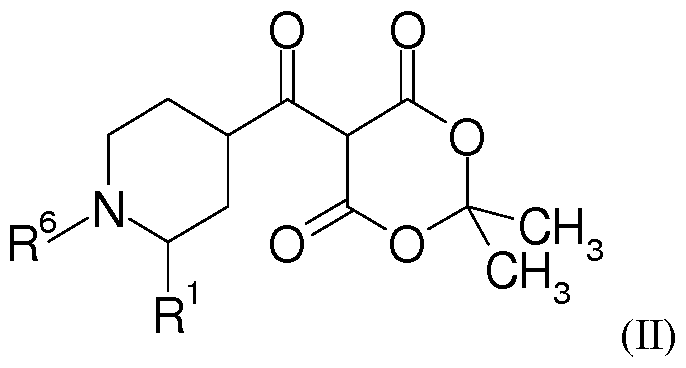


According to an embodiment of the invention, the compound of formula (IV) is isolated from the mixture of regioisomers.
Suitable amino protective groups (substituent R6) in formulae (ITA), (ITB), and (IV) are tert- butoxycarbonyl (Boc), removed by a concentrated strong acid, benzyloxycarbonyl (Cbz), removed by hydrogenolysis, methyl or ethylcarbamate, removed by TMSI in CHCI3 or HBr in AcOH, Trimethylsilylethyl carbamate (Teoc), removed by fluoride, p-Methoxybenzyl carbamate (Moz or MeOZ), removed by hydrogenolysis, 9-Fluorenylmethyl carbamate (F-moc), removed by a base, and optionally substituted benzyl or benzylamine, removed by hydrogenolysis. Preferred for use as amino protective group is ieri-butoxycarbonyl (Boc).
According to an embodiment of the invention, the amino protective group R6 is ieri-butoxycarbonyl (Boc).
The condensation process (II) + (III) -> [(V)] -> (IV) can be carried out in one single step without isolation of the intermediate (V), in two separate steps by changing the reaction conditions for the formation of (V) from (ITB) and (III) and the formation of (IV) from (V) but without purification of the intermediate (V), or in two separate steps involving the purification of intermediate (V). Preference is given to a procedure with two separate steps without purification of the intermediate.
According to an embodiment of the invention, the compounds of formulae (II) and (III) are reacted in a first step to a compound of formula (V). The compound of formula (V) is reacted in a second step to the
compound of formula (IV) without separation and purification of the intermediate (V). According to a further embodiment of the invention, the solvent is changed between the first and the second step.
Suitable solvents for the process steps (II) + (III) -> (V) are, for example, aliphatic alcohols such as methanol, ethanol, iso-propanol, l-methoxy-2-propanol or ieri-butanol, ethers such as diethyl ether, dioxane, tetrahydrofuran, glycol dimethyl ether or diethylene glycol dimethyl ether, hydrocarbons such as benzene, toluene, xylene, hexane, cyclohexane or mineral oil fractions, halogenated hydrocarbons such as dichloromethane, trichloromethane, carbon tetrachloride, 1,2-dichloroethane, trichloroethylene or chlorobenzene, or other solvents such as acetone, ethyl acetate, acetonitrile, pyridine, dimethyl sulph- oxide, -dimefhylformamide, /V,/V-dimethylacetamide, /V,/V'-dimethylpropyleneurea (DMPU) or N- methylpyrrolidone (NMP). It is also possible to use mixtures of the solvents mentioned. Preference is given to using acetonitrile or toluene as solvents, or mixtures of these solvents.
Suitable solvents for the process steps (V) -> (IV) are, for example, aliphatic alcohols such as methanol, ethanol, iso-propanol, l-methoxy-2-propanol or ieri-butanol, ethers such as diethyl ether, dioxane, tetrahydrofuran, glycol dimethyl ether or diethylene glycol dimethyl ether, hydrocarbons such as benzene, toluene, xylene, hexane, cyclohexane or mineral oil fractions, halogenated hydrocarbons such as dichloromethane, trichloromethane, carbon tetrachloride, 1,2-dichloroethane, trichloroethylene or chlorobenzene, or other solvents such as acetone, ethyl acetate, acetonitrile, pyridine, dimethyl sulph- oxide, -dimefhylformamide, -dimefhylacetamide, /V,/V'-dimethylpropyleneurea (DMPU) or N- methylpyrrolidone (NMP). It is also possible to use mixtures of the solvents mentioned. Preference is given to using l-methoxy-2-propanol or toluene or Acetonitrile as solvents, or mixtures of these solvents.
The process (II) + (III) -> (V) may proceed in the absence of a base, in the presence of organic bases such as triethylamine or diisopropylethylamine, or in the presence of inorganic bases. Inorganic bases include alkali metal or alkali earth metal phosphates and carbonates such as potassium phosphate, potassium carbonate, cesium carbonate, sodium phosphate, or calcium carbonate. Preference is given to reacting the compounds of formulae (II-B) and (III) in the absence of a base.
According to an embodiment of the invention, the compounds of formulae (II-B) and (III) are reacted in the absence of a base.
The condensation process (V) -> (IV) may proceed in the absence of a base, in the presence of organic bases such as triethylamine or diisopropylethylamine, or in the presence of inorganic bases. Inorganic bases include alkali metal or alkali earth metal phosphates and carbonates such as potassium phosphate, potassium carbonate, cesium carbonate, sodium phosphate, or calcium carbonate. Preference is given to
reacting the compound of formula (V) to the compound of formula (IV) in the presence of potassium phosphate.
According to an embodiment of the invention, the compound of formula (V) is reacted to the compound of formula (IV) in the presence of a base, in particular in the presence of potassium phosphate. According to an embodiment of the invention, wherein the compounds of formulae (II) and (III) are reacted to the compound of formula (V) and the compound of formula (V) is reacted to the compound of formula (IV) in one single step without isolation of the intermediate (V), the reaction is carried out in the presence of a base.
The process (II) + (III) -> (V) is generally carried out in a temperature range of 0 °C to 100 °C, preferably from 40°C to 80°C.
According to an embodiment of the invention, the compounds of formulae (II) and (III) are reacted at a temperature of 0 °C to 100 °C, preferably of 40°C to 80°C.
The process (V) -> (IV) is generally carried out in a temperature range of 0 °C to 150 °C, preferably from 60 °C to 130 °C. According to an embodiment of the invention, the compound of formula (V) is reacted to a compound of formula (IV) at a temperature of 0 °C to 150 °C, preferably of 60°C to 130°C.
According to an embodiment of the invention, wherein R6 is an acid cleavable amino protective group, such as ieri-butoxycarbonyl, the compound of the formula (IV) obtained in reaction [A] or [B] is reacted to the compound of the formula (TB) by addition of an acid. This reaction is carried out in a suitable solvent, e.g. dioxane.
Generally, the salts of formula (TB) may be transformed to the respective free bases of formula (I- A) by any way known to the person skilled in art.
The compound of formula (TB) may be reacted to the compound of formula (TA) by treating the compound of formula (TB) with a base. Preferred bases are ammonia, sodium hydroxide, NaHCCb, and Na2CC>3. This may also be achieved by a suitable chromatographic method by using a basic eluent.
According to an embodiment of the invention, the acid used to obtain the compound of the formula (TB) from the compound of the formula (IV) is selected from hydrochloric acid, trifluoroacetic acid, acetic acid, sulphuric acid, maleic acid, tartaric acid, ascorbic acid, and salicylic acid.
According to an embodiment of the invention, wherein R6 is not cleaved by an acid, the compound of the formula (I-A) is obtained from the compound of formula (IV) by cleaving the amino protective group of the compound of formula (IV) for example by hydrogenation. Examples for this reaction are the cleavage of benzyloxycarbonyl (Cbz), and of optionally substituted benzyl.
The compounds of the formulae (III) and (II) are commercially available, known from the literature or can be prepared analogously to processes known from the literature.
The invention furthermore provides a process for preparing a compound of the formula (TB) as defined above, wherein a compound of formula (XIII)


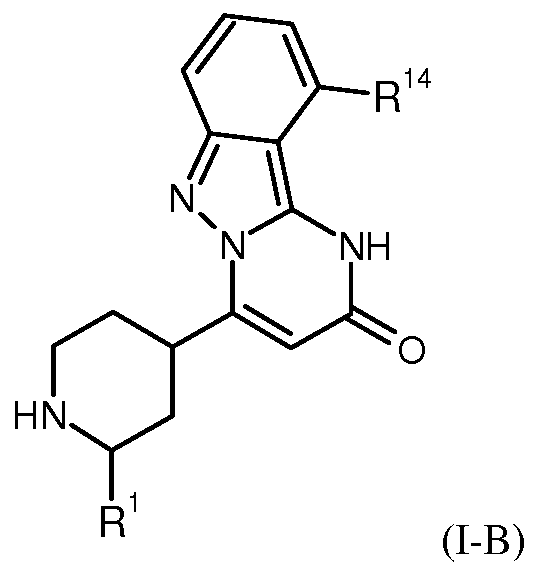
According to an embodiment of the invention, reactions in process (XIII) (VI-A) are generally carried out in an inert solvent, in the presence of a base, and in the presence of a catalyst, optionally in the presence of a ligand.
According to an embodiment of the invention, reactions in process (XIII) (VI-A) are generally carried out in an inert solvent, in the presence of a base, and in the presence of a catalyst, optionally in the presence of a ligand, preferably at elevated temperature and at atmospheric pressure. Suitable solvents for reactions in process (XIII) (VI-A) are, for example, aliphatic alcohols such as methanol, ethanol, iso-propanol, l-methoxy-2-propanol, 2-methyl-2-butanol or tert-butanol, ethers such as diethyl ether, dioxane, tetrahydrofuran, glycol dimethyl ether or diethylene glycol dimethyl ether, hydrocarbons such as benzene, toluene, xylene, hexane, cyclohexane or mineral oil fractions, halo- genated hydrocarbons such as dichloromethane, trichloromethane, carbon tetrachloride, 1,2-dichlor- oethane, trichloroethylene or chlorobenzene, or other solvents such as acetone, ethyl acetate, acetonitrile, pyridine, dimethyl sulphoxide, Ν,Ν-dimethylformamide, N,N-dimethylacetamide, Ν,Ν'- dimethylpropyleneurea (DMPU) or N-methylpyrrolidone (NMP). It is also possible to use mixtures of the solvents mentioned. Preference is given to using tert-butanol, 2-methyl-2-butanol, N,N- dimethylformamide or dioxane as solvents, or mixtures of these solvents. The reactions in process (XIII) (VI-A) may proceed in the absence of a base, or in the presence of organic bases such as metal alcoholates, such as sodium tert-butoxide, potassium tert-butoxide, and metal amides, such as Lithium diisopropyl amide or Lithium bis(trimethylsylyl)amide, or amines such as triethylamine or diisopropylethylamine, or in the presence of inorganic bases. Inorganic bases include alkali metal or alkali earth metal phosphates and carbonates such as potassium phosphate, potassium carbonate, cesium carbonate, sodium phosphate, or calcium carbonate. Preference is given to using tripotassium phosphate or sodium tert-butoxide.
The reactions in process (XIII) (VI- A) are generally carried out in a temperature range from 0 °C to 200 °C. Heating options include conventional heating below the boiling point of the solvent, under reflux, or above the boiling point of the solvent in a closed vial, or in a closed vial with the aid of a microwave reactor. Preference is given to heating the reaction to 60-110 °C. The reactions in process (XIII) (VI- A) can be carried out at atmospheric, elevated or reduced pressure (for example from 0.5 to 25 bar). In general, the reactions are carried out at atmospheric pressure.
Suitable catalysts for the reactions in the process (XIII) (VI-A) are usually copper and palladium catalyst, for example, Copper(I) iodide, Copper(II) diacetate, Copper(I) oxide, Palladium(II) acetate, Bis(dibenzylideneacetone)palladium(0), Tris(dibenzylideneacetone)dipalladium(0), Tetrakis(triphenylphosphine)palladium(0), Bis(triphenylphosphine)palladium(II) dichloride, [1,1 '- Bis(diphenylphosphino)ferrocene]dichloropalladium(II), l,3-Bis(2,6-diisopropylphenyl)imidazol-2- ylidene ( 1 ,4-naphthoquinone)palladium(0) dimer, Methanesulfonato [2-(di- 1 -adamantylphosphino)-3,6- dimethoxy-2',4',6'-tri-i-propyl- 1 , 1 '-biphenyl] (2'-amino- 1 , 1 '-biphenyl-2-yl)palladium(II) (AdBrettPhos Pd G3), Methanesulfonato { [4-(N,N-dimethylamino)phenyl] di-t-butylphosphino } (2'-amino- 1 , 1 '-biphenyl-2- yl)palladium(II) (Amphos Pd G3), [(2-Di-cyclohexylphosphino-3,6-dimethoxy-2',4',6'- triisopropyl-Ι, - biphenyl)-2-(2 '-amino- 1,1 ' -biphenyl)]palladium(II) methanesulfonate (BrettPhos Pd G3), [(2-di-tert- butylphosphino-3,6-dimethoxy-2',4',6'-triisopropyl- 1,1 '-biphenyl)-2-(2 '-amino- 1,1 '- biphenyl)] palladium(II) methanesulfonate (tBuBrettPhos Pd G3), Methanesulfonato [2- (dicyclohexylphosphino)-2'-(N,N-dimethylamino)- 1 , 1 '-biphenyl] (2'-amino- 1 , 1 '-biphenyl-2- yl)palladium(II) (DavePhos Pd G3), Methanesulfonato{ (R)-(-)-l-[(S)-2-
(dicyclohexylphosphino)ferrocenyl]ethyldi-t-butylphosphine } (2'-amino- 1 , 1 '-biphenyl-2-yl)palladium(II) (JosiPhos Pd G3), Methanesulfonato(tri-t-butylphosphino)(2'-methylamino-l,l'-biphenyl-2- yl)palladium(II) (P(t-Bu)3 Pd G4), Methanesulfonato(tricyclohexylphosphine)(2'-amino-l,l'-biphenyl- 2-yl)palladium(II) (PCy3 Pd G3), Methanesulfonato(2-(di-t-butylphosphino)-3-methoxy-6-methyl- 2',4,,6,-tri-i-propyl-l,l'-biphenyl)(2,-amino-l,l,-biphenyl-2-yl)palladium(II) (RockPhos Pd G3), Methanesulfonato(2-dicyclohexylphosphino-2',6'-di-i-propoxy- 1 , 1 '-biphenyl)(2'-amino- 1 , l'-biphenyl-2- yl)palladium(II) (RuPhos Pd G3), Methanesulfonato(2-dicyclohexylphosphino-2',6'-dimethoxy-l,l'- biphenyl)(2'-amino-l,l'-biphenyl-2-yl)palladium(II) (SPhos Pd G3), (2-Dicyclohexylphosphino-2',4',6'- triisopropyl-l, -biphenyl)[2-(2'-amino-l, -biphenyl)]palladium(II) methanesulfonate (XPhos Pd G3), Methanesulfonato(2-di-t-butylphosphino-2',4',6'-tri-i-propyl- 1 , 1 '-biphenyl)(2'-amino- 1 , 1 '-biphenyl-2- yl)palladium(II) (tBuXPhos Pd G3), Methanesulfonato[9,9-dimethyl-4,5- bis(diphenylphosphino)xanthene] [2'-amino-l,r-biphenyl]palladium(II) (XantPhos Pd G3), Methanesulfonato[2-bis(3,5-di(trifluoromethyl)phenylphosphino)-3,6-dimethoxy-2',4',6'-tri-i-propyl- l,r-biphenyl](2'-amino-l,r-biphenyl-2-yl)palladium(II) (JackiePhos Pd G3). Preference is given to using copper iodide, palladium(O) bis(dibenzylideneacetone) or [(2-di-tert-butylphosphino-3,6-
dimethoxy-2 ',4',6'-triisopropyl- 1 , 1 '-biphenyl)-2-(2 '-amino- 1 , 1 '-biphenyl)]palladium(II)
methanesulfonate.
Suitable ligands for the reactions in process (XIII) (VI- A) are usually amino and phosphor ligands, for example, 2,2,6,6-Tetramethyl-3,5-heptanedione, N-methyl-2-(methylamino)ethylamine, (+)- Pyrrolidine-2-carboxylic acid, 1,10-Phenanthroline, (+)-trans-l,2-Diaminocyclohexane, N V'- Dimethylethylenediamine, 2-(Di- l-adamantylphosphino)-3,6-dimethoxy-2',4',6'-tri-i-propyl- 1,1'- biphenyl (AdBrettPhos), 2-(Dicyclohexylphosphino)3,6-dimethoxy-2',4',6'-triisopropyl- 1 , 1 '-biphenyl (BrettPhos), 2-(Di-ieri-butylphosphino)-2',4',6'- triisopropyl-3,6-dimethoxy- 1 , 1 '-biphenyl
(tBuBrettPhos), 2-Dicyclohexylphosphino-2',6'-bis(/V,/V-dimethylamino)biphenyl (CPhos), 2- Dicyclohexylphosphino-2'-(/V,/V-dimethylamino)biphenyl (DavePhos), 2'-(Di-tert-butylphosphino)-N,N- dimethylbipheny 1-2- amine (tBuDavePhos), 2'-(Diphenylphosphino)-N,N'-dimethyl-(l,l '-biphenyl)-2- amine (PhDavePhos), 2- {Bis[3,5-bis(trifluoromethyl)phenyl]phosphino }-3,6-dimethoxy -2',4',6'- triisopropy 1-1,1 '-biphenyl (JackiePhos), (2-Biphenyl)di-ieri-butylphosphine (JohnPhos), (2- Biphenyl)dicyclohexylphosphine (Cy JohnPhos), 2-Dicyclohexylphosphino-2'-methylbiphenyl (MePhos), 2-Di-ieri-butylphosphino-2'-methylbiphenyl (tBuMePhos), 2-Di(tert-butyl)phosphino- 2',4',6'-triisopropyl-3-methoxy-6-methylbiphenyl (RockPhos), 2-Dicyclohexylphosphino-2',6'- diisopropoxybiphenyl (RuPhos), 2-Dicyclohexylphosphino-2',6'-dimethoxybiphenyl (SPhos), rac-2-(Di- ieri-butylphosphino)-l,l '-binaphthyl (TrixiePhos), 2-Dicyclohexylphosphino-2',4',6'- triisopropylbiphenyl (XPhos), 4,5-Bis(diphenylphosphino)-9,9-dimethylxanthene (XantPhos), 2-Oi-tert- butylphosphino-2',4',6'-triisopropylbiphenyl (tBuXPhos), 2-Di-ieri-butylphosphino-3,4,5,6-tetramethyl- 2',4',6'-triisopropyl- 1 , 1 '-biphenyl (tetramethyl tBuXPhos), 2-Di-t-butylphosphino-4-methoxy-3,5,6- trimethyl-2',4',6'-tri-i-propylbiphenyl (Me3(OMe)tBuXPhos), 2,2'-Bis(diphenylphosphino)- 1 ,Γ- binaphthyl (BINAP). Preference is given to using 2- (dimethylamino) acetic acid, 2-(di-tert- butylphosphino)-2',4',6'- triisopropyl-3,6-dimethoxy- 1,1 '-biphenyl or di-tert-butyl[2',4',6'-tri(propan-2- yl)biphenyl-2-yl]phosphane.
The invention furthermore provides a process for preparing a compound of the formula (TB) as defined above, wherein R2 is -NH-CO-R5, and R5 is as defined above, and wherein a compound of formula
(xiii)


According to an embodiment of the invention, the compounds of formulae (XIII) and tert-butyl carbamate are reacted in a first step to a compound of formula (VII) in an inert solvent, in the presence of a base, and in the presence of a catalyst, optionally in the presence of a ligand.
According to an embodiment of the invention, the compounds of formulae (XIII) and tert-butyl carbamate are reacted in a first step to a compound of formula (VII) in an inert solvent, in the presence of a base, and in the presence of a catalyst, optionally in the presence of a ligand, preferably at elevated temperature and atmospheric pressure.
Suitable solvents are, for example, aliphatic alcohols such as methanol, ethanol, iso-propanol, 1- methoxy-2-propanol, 2-methyl-2-butanol or tert-butanol, ethers such as diethyl ether, dioxane, tetrahydrofuran, glycol dimethyl ether or diethylene glycol dimethyl ether, hydrocarbons such as benzene, toluene, xylene, hexane, cyclohexane or mineral oil fractions, halogenated hydrocarbons such as dichloromethane, trichloromethane, carbon tetrachloride, 1,2-dichloroethane, trichloroethylene or chlorobenzene, or other solvents such as acetone, ethyl acetate, acetonitrile, pyridine, dimethyl sulph-
oxide, Ν,Ν-dimethylformamide, N,N-dimethylacetamide, Ν,Ν'-dimethylpropyleneurea (DMPU) or N- methylpyrrolidone (NMP). It is also possible to use mixtures of the solvents mentioned. Preference is given to 1,4- dioxane as solvent.
The step may proceed in the absence of a base,or in the presence of organic bases such as metal alcoholates, such as sodium tert-butoxide, potassium tert-butoxide, and metal amides, such as Lithium diisopropylamide or Lithium bis(trimethylsylyl)amide, or amines such as triethylamine or diisopropylethylamine, or in the presence of inorganic bases. Inorganic bases include alkali metal or alkali earth metal phosphates and carbonates such as potassium phosphate, potassium carbonate, cesium carbonate, sodium phosphate, or calcium carbonate. Preference is given to using sodium tert-butoxide. The step is generally carried out in a temperature range from 0 °C to 200 °C. Heating options include conventional heating below the boiling point of the solvent, under reflux, or above the boiling point of the solvent in a closed vial, or in a closed vial with the aid of a microwave reactor. Preference is given to heating the reaction to 50-70 °C.
The step can be carried out at atmospheric, elevated or reduced pressure (for example from 0.5 to 25 bar). In general, the reactions are carried out at atmospheric pressure.
Suitable catalysts for the step are usually copper and palladium catalyst, for example, Copper(I) iodide, Copper(II) diacetate, Copper(I) oxide, Palladium(II) acetate, Bis(dibenzylideneacetone)palladium(0), Tris(dibenzylideneacetone)dipalladium(0), Tetrakis(triphenylphosphine)palladium(0), Bis(triphenylphosphine)palladium(II) dichloride, [1,1'- Bis(diphenylphosphino)ferrocene]dichloropalladium(II), l,3-Bis(2,6-diisopropylphenyl)imidazol-2- ylidene ( 1 ,4-naphthoquinone)palladium(0) dimer, Methanesulfonato [2-(di- 1 -adamantylphosphino)-3,6- dimethoxy-2',4',6'-tri-i-propyl- 1 , 1 '-biphenyl] (2'-amino- 1 , 1 '-biphenyl-2-yl)palladium(II) (AdBrettPhos Pd G3), Methanesulfonato { [4-(N,N-dimethylamino)phenyl] di-t-butylphosphino } (2'-amino- 1 , 1 '-biphenyl-2- yl)palladium(II) (Amphos Pd G3), [(2-Di-cyclohexylphosphino-3,6-dimethoxy-2',4',6'- triisopropyl-1,1 '- biphenyl)-2-(2 '-amino- 1,1' -biphenyl)]palladium(II) methanesulfonate (BrettPhos Pd G3), [(2-di-tert- butylphosphino-3,6-dimethoxy-2',4',6'-triisopropyl- 1,1 '-biphenyl)-2-(2 '-amino- 1,1 '- biphenyl)] palladium(II) methanesulfonate (tBuBrettPhos Pd G3), Methanesulfonato [2- (dicyclohexylphosphino)-2'-(N,N-dimethylamino)- 1 , 1 '-biphenyl] (2'-amino- 1 , 1 '-biphenyl-2- yl)palladium(II) (DavePhos Pd G3), Methanesulfonato{(R)-(-)-l-[(S)-2- (dicyclohexylphosphino)ferrocenyl]ethyldi-t-butylphosphine } (2'-amino- 1 , 1 '-biphenyl-2-yl)palladium(II) (JosiPhos Pd G3), Methanesulfonato(tri-t-butylphosphino)(2'-methylamino-l,l'-biphenyl-2- yl)palladium(II) (P(t-Bu)3 Pd G4), Methanesulfonato(tricyclohexylphosphine)(2'-amino-l,l'-biphenyl- 2-yl)palladium(II) (PCy3 Pd G3), Methanesulfonato(2-(di-t-butylphosphino)-3-methoxy-6-methyl- 2',4',6'-tri-i-propyl- 1 , 1 '-biphenyl)(2'-amino- 1 , 1 '-biphenyl-2-yl)palladium(II) (RockPhos Pd G3),
Methanesulfonato(2-dicyclohexylphosphino-2',6'-di-i-propoxy- 1 , 1 '-biphenyl)(2'-amino- 1 , l'-biphenyl-2- yl)palladium(II) (RuPhos Pd G3), Methanesulfonato(2-dicyclohexylphosphino-2',6'-dimethoxy-l,l'- biphenyl)(2'-amino-l,l'-biphenyl-2-yl)palladium(II) (SPhos Pd G3), (2-Dicyclohexylphosphino-2',4',6'- triisopropyl-1 J '-biphenyl)[2-(2'-amino-l, -biphenyl)]palladium(II) methanesulfonate (XPhos Pd G3), Methanesulfonato(2-di-t-butylphosphino-2',4',6'-tri-i-propyl- 1 , 1 '-biphenyl)(2'-amirio- 1 , 1 '-biphenyl-2- yl)palladium(II) (tBuXPhos Pd G3), Mefhanesulfonato[9,9-dimefhyl-4,5- bis(diphenylphosphino)xanthene] [2'-amino-l,r-biphenyl]palladium(II) (XantPhos Pd G3), Methanesulfonato[2-bis(3,5-di(trifluoromethyl)phenylphosphino)-3,6-dimethoxy-2',4',6'-tri-i-propyl- l,r-biphenyl](2'-amino-l,r-biphenyl-2-yl)palladium(II) (JackiePhos Pd G3). Preference is given to using Bis(dibenzylideneacetone)palladium(0).
Suitable ligands for the step are usually amino and phosphor ligands, for example, 2,2,6,6-Tetramethyl- 3,5-heptanedione, N-methyl-2-(methylamino)ethylamine, (+)-Pyrrolidine-2-carboxylic acid, 1,10- Phenanthroline, (+)-trans-l,2-Diaminocyclohexane, /V,/V'-Dimethylethylenediamine, 2-(Di-l- adamantylphosphino)-3,6-dimethoxy-2',4',6'-tri-i-propyl- 1, 1 '-biphenyl (AdBrettPhos), 2- (Dicyclohexylphosphino)3,6-dimethoxy-2',4',6'-triisopropyl-l,l '-biphenyl (BrettPhos), 2-(Oi-tert- butylphosphino)-2',4',6'- triisopropyl-3,6-dimethoxy- 1,1 '-biphenyl (tBuBrettPhos), 2- Dicyclohexylphosphino-2',6'-bis(/V,/V-dimethylamino)biphenyl (CPhos), 2-Dicyclohexylphosphino-2'- (Ar,Ar-dimethylamino)biphenyl (DavePhos), 2'-(Di-tert-butylphosphino)-N,N-dimethylbiphenyl-2-amine (tBuDavePhos), 2'-(Diphenylphosphino)-N,N'-dimethyl-(l,l '-biphenyl)-2-amine (PhDavePhos), 2- { Bis[3,5-bis(trifluoromethyl)phenyl]phosphino } -3,6-dimethoxy -2',4',6'-triisopropyl- 1, 1 '-biphenyl (JackiePhos), (2-Biphenyl)di-ieri-butylphosphine (JohnPhos), (2-Biphenyl)dicyclohexylphosphine (CyJohnPhos), 2-Dicyclohexylphosphino-2'-methylbiphenyl (MePhos), 2-Di-ieri-butylphosphino-2'- methylbiphenyl (tBuMePhos), 2-Di(tert-butyl)phosphino-2',4',6'-triisopropyl-3-methoxy-6- methylbiphenyl (RockPhos), 2-Dicyclohexylphosphino-2',6'-diisopropoxybiphenyl (RuPhos), 2- Dicyclohexylphosphino-2 ',6 '-dimethoxy biphenyl (SPhos), rac-2-(Di-ieri-butylphosphino)- l,l '- binaphthyl (TrixiePhos), 2-Dicyclohexylphosphino-2',4',6'-triisopropylbiphenyl (XPhos), 4,5- Bis(diphenylphosphino)-9,9-dimethylxanthene (XantPhos), 2-Di-ieri-butylphosphino-2',4',6'- triisopropylbiphenyl (tBuXPhos), 2-Di-ieri-butylphosphino-3,4,5,6-tetramethyl-2',4',6'-triisopropyl-l,l '- biphenyl (tetramethyl tBuXPhos), 2-Di-t-butylphosphino-4-methoxy-3,5,6-trimethyl-2',4',6'-tri-i- propylbiphenyl (Me3(OMe)tBuXPhos), 2,2'-Bis(diphenylphosphino)-l,l'-binaphthyl (BINAP). Preference is given to using 2-Di-ieri-butylphosphino-2',4',6'-triisopropylbiphenyl (tBuXPhos).
The compound of formula (VII) is reacted in a second step to the compound of formula (VIII) in the presence of an acid, a solvent, preferably at room temperature and atmospheric pressure.
The step can partially result in a cleavage of protecting group R6. According to an embodiment of the invention, the compound of formula (VIII) is isolated from this mixture.
Suitable solvents for the process steps (VII) -> (VIII) are, for example, aliphatic alcohols such as methanol, ethanol, iso-propanol, l-methoxy-2-propanol or ieri-butanol, ethers such as diethyl ether, dioxane, tetrahydrofuran, glycol dimethyl ether or diethylene glycol dimethyl ether, hydrocarbons such as benzene, toluene, xylene, hexane, cyclohexane or mineral oil fractions, halogenated hydrocarbons such as dichloromethane, trichloromethane, carbon tetrachloride, 1,2-dichloroethane, trichloroethylene or chlorobenzene, or other solvents such as acetone, ethyl acetate, acetonitrile, pyridine, dimethyl sulph- oxide, -dimethylformamide, /V,/V-dimethylacetamide, /V,/V'-dimethylpropyleneurea (DMPU) or N- methylpyrrolidone (NMP). It is also possible to use mixtures of the solvents mentioned. Preference is given to using 1,4-dioxane.
Suitable acids for the process step are, for example, mineral acids, such as hydrochloric acid, hydrobromic acid, hydrofluoric acid, sulfuric acid, organic acids, such as acetic acid, trifluoroacetic acid, sulfonic acids, such as para-toluenesulfonic acid, trifluorsulfonic acid, methylsulfonic acid. It is also possible to use mixtures of the acids mentioned. The acids can also be used as solutions in solvents of the type mentioned above. Preference is given to using hydrochloric acid or hydrochloric acid dissolved in 1,4-dioxane.
The process (VII) -> (VIII) is generally carried out in a temperature range of -78 °C to 150 °C, preferably from 10 °C to 30 °C. The reaction in process (VIII) -> (IX) is generally effected in inert solvents, in the presence of a dehydrating reagent, optionally in the presence of a base, preferably within a temperature range from 0°C to the reflux of the solvents at atmospheric pressure.
Suitable dehydrating reagents here are, for example, carbodiimides, for example NN'-diethyl-, Ν,Ν'- dipropyl-, /V,/V'-diisopropyl- and A^/V'-dicyclohexylcarbodiimide, /V-(3-dimethylaminoisopropyl)-/V'- ethylcarbodiimide hydrochloride (EDC) (optionally in the presence of pentafluorophenol (PFP)), N- cyclohexylcarbodiimide- '-propyloxymethyl-polystyrene (PS-carbodiimide) or carbonyl compounds such as carbonyldiimidazole, or 1,2-oxazolium compounds such as 2-ethyl-5-phenyl-l,2-oxazolium 3- sulphate or 2-tert-butyl-5-methyl-isoxazolium perchlorate, or acylamino compounds such as 2-ethoxy-l- ethoxycarbonyl-l,2-dihydroquinoline, or propanephosphonic anhydride, or isobutyl chloroformate, or bis-(2-oxo-3-oxazolidinyl)phosphoryl chloride or benzotriazolyloxytri(dimethylamino)phosphonium hexafluorophosphate, or 0-(benzotriazol-l-yl)-/V,/V,/V',/V'-tetramethyluronium hexafluorophosphate (HBTU), 2-(2-oxo-l-(2H)-pyridinyl)-l,l,3,3-tetramethyluronium tetrafluoroborate (TPTU), (benzotriazol-l-yloxy)bisdimethylaminomethylium fluoroborate (TBTU) or 0-(7-azabenzotriazol-l-yl)-
 hexafluorophosphate (HATU), or 1-hydroxybenzotriazole (HOBt), or benzotriazol-l-yloxytris(dimethylamino)phosphoriium hexafluorophosphate (BOP), or ethyl cyano(hydroxyimino)acetate (Oxyma), or (l-cyano-2-ethoxy-2-oxoethylideneaminooxy)dimethylamino morpholinocarbenium hexafluorophosphate (COMU), or N-[(dimethylamino)(3ii-[l,2,3]triazolo[4,5- b]pyridin-3-yloxy)methylidene]-N-methylmethariamiriium hexafluorophosphate, or 2,4,6-tripropyl- 1,3,5,2,4,6-trioxatriphosphinane 2,4,6-trioxide (T3P), or mixtures of these, preference being given to O- (7-azabenzotriazol- 1 -yl)-/V,/V,/V',/V'-tetramethyluronium hexafluorophosphate (HATU)
Bases are, for example, alkali metal carbonates, for example sodium carbonate or potassium carbonate, or sodium hydrogencarbonate or potassium hydrogencarbonate, or organic bases such as trialkylamines, for example triethylamine, -mefhylmorpholine, /V-methylpiperidine, 4-dimethylaminopyridine or diisopropylethylamine, preference being given to diisopropylethylamine.
Inert solvents are, for example, halogenated hydrocarbons such as dichloromethane or trichloromethane, hydrocarbons such as benzene, or other solvents such as nitromethane, tetrahydrofuran, dioxane, dimethylformamide, dimethyl sulphoxide, acetonitrile or pyridine, or mixtures of the solvents, preference being given to dimethylformamide.
The invention furthermore provides a process for preparing a compound of the formula (TB) as defined above, in which R2 is -CO-NR3R4, and R3 and R4 are as defined above, wherein a compound of formula
(X)


wherein R3 and R4 are as defined above, and R3 and R4 together with N-CO form R2, and finally, the compound of formula (XII) is treated with an acid to give the compound of formula (I-B)

wherein R3 and R4 are as defined above, and R3 and R4 together with N-CO form R2.
The reaction in process (X) -> (XI) is generally effected in solvents, in the presence of a base, preferably within a temperature range from 0°C to the reflux of the solvents at atmospheric pressure. Suitable solvents for the process step are, for example, water, or aliphatic alcohols such as methanol, ethanol, iso-propanol, l-methoxy-2-propanol or ieri-butanol, ethers such as diethyl ether, dioxane, tetrahydrofuran, glycol dimethyl ether or diethylene glycol dimethyl ether, hydrocarbons such as benzene, toluene, xylene, hexane, cyclohexane or mineral oil fractions, halogenated hydrocarbons such as carbon tetrachloride, trichloroethylene or chlorobenzene, or other solvents such as acetonitrile, pyridine, dimethyl sulphoxide, A^ -dimethylformamide, -dimefhylacetamide, Ν,Ν'- dimethylpropyleneurea (DMPU) or /V-methylpyrrolidone (NMP). It is also possible to use mixtures of the solvents mentioned. Preference is given to using water or water in combination with ethanol.
Bases are alkali hydroxides, such as sodium hydroxide or potassium hydroxide or caesium hydroxide. Bases can also be used as solutions in water. Preference is given to sodium hydroxide.
The reaction in process (XI) -> (XII) is generally effected in inert solvents, in the presence of a dehydrating reagent, optionally in the presence of a base, preferably within a temperature range from 0°C to the reflux of the solvents at atmospheric pressure.
Suitable dehydrating reagents here are, for example, carbodiimides, for example Ν,Ν'-diet yl-, Ν,Ν'- dipropyl-, /V,/V'-diisopropyl- and A^/V'-dicyclohexylcarbodiimide, /V-(3-dimethylaminoisopropyl)-/V'- ethylcarbodiimide hydrochloride (EDC) (optionally in the presence of pentafluorophenol (PFP)), N- cyclohexylcarbodiimide- '-propyloxymefhyl-polystyrene (PS-carbodiimide) or carbonyl compounds such as carbonyldiimidazole, or 1,2-oxazolium compounds such as 2-ethyl-5-phenyl-l,2-oxazolium 3- sulphate or 2-tert-butyl-5-methyl-isoxazolium perchlorate, or acylamino compounds such as 2-ethoxy-l- ethoxycarbonyl-l,2-dihydroquinoline, or propanephosphonic anhydride, or isobutyl chloroformate, or bis-(2-oxo-3-oxazolidinyl)phosphoryl chloride or benzotriazolyloxytri(dimethylamino)phosphonium hexafluorophosphate, or 0-(benzotriazol-l-yl)-/V,/V,/V',/V'-tetramethyluronium hexafluorophosphate (HBTU), 2-(2-oxo-l-(2H)-pyridinyl)-l,l,3,3-tetramethyluronium tetrafluoroborate (TPTU), (benzotriazol-l-yloxy)bisdimethylaminomethylium fluoroborate (TBTU) or 0-(7-azabenzotriazol-l-yl)- AWA^ '-tetramethyluronium hexafluorophosphate (HATU), or 1-hydroxybenzotriazole (HOBt), or benzotriazol-l-yloxytris(dimethylamino)phosphonium hexafluorophosphate (BOP), or ethyl cyano(hydroxyimino)acetate (Oxyma), or (l-cyano-2-ethoxy-2-oxoethylideneaminooxy)dimethylamino morpholinocarbenium hexafluorophosphate (COMU), or N-[(dimethylamino)(3i7-[l,2,3]triazolo[4,5- b]pyridin-3-yloxy)methylidene]-N-methylmethanaminium hexafluorophosphate, or 2,4,6-tripropyl- 1,3,5,2,4,6-trioxatriphosphinane 2,4,6-trioxide (T3P), or mixtures of these, preference being given to O- (7-azabenzotriazol- 1 -yl)-/V,/V,/V',/V'-tetramethyluronium hexafluorophosphate (HATU)
Bases are, for example, alkali metal carbonates, for example sodium carbonate or potassium carbonate, or sodium hydrogencarbonate or potassium hydrogencarbonate, or organic bases such as trialkylamines, for example triethylamine, -mefhylmorpholine, /V-methylpiperidine, 4-dimethylaminopyridine or diisopropylethylamine, preference being given to diisopropylethylamine.
Inert solvents are, for example, halogenated hydrocarbons such as dichloromethane or trichloromethane, hydrocarbons such as benzene, or other solvents such as nitromethane, tetrahydrofuran, dioxane, dimethylformamide, dimethyl sulphoxide, acetonitrile or pyridine, or mixtures of the solvents, preference being given to dimethylformamide.
The present invention also provides compounds of the formula (VII)

in which R1 and R6 have the meaning given above.
The present invention also provides compounds of the formula (VIII)

in which R1 and R6 have the meaning given above.
The present invention also provides compounds of the formula (XII)

wherein R3 and R4 are as defined above, and R3 and R4 together with N-CO form R2.
The preparation processes described can be illustrated in an exemplary manner by the synthesis schemes below (Scheme 1).
Scheme 1: Synthesis of compounds of formula IV via the piperidinyl Meldrum's acid derivative
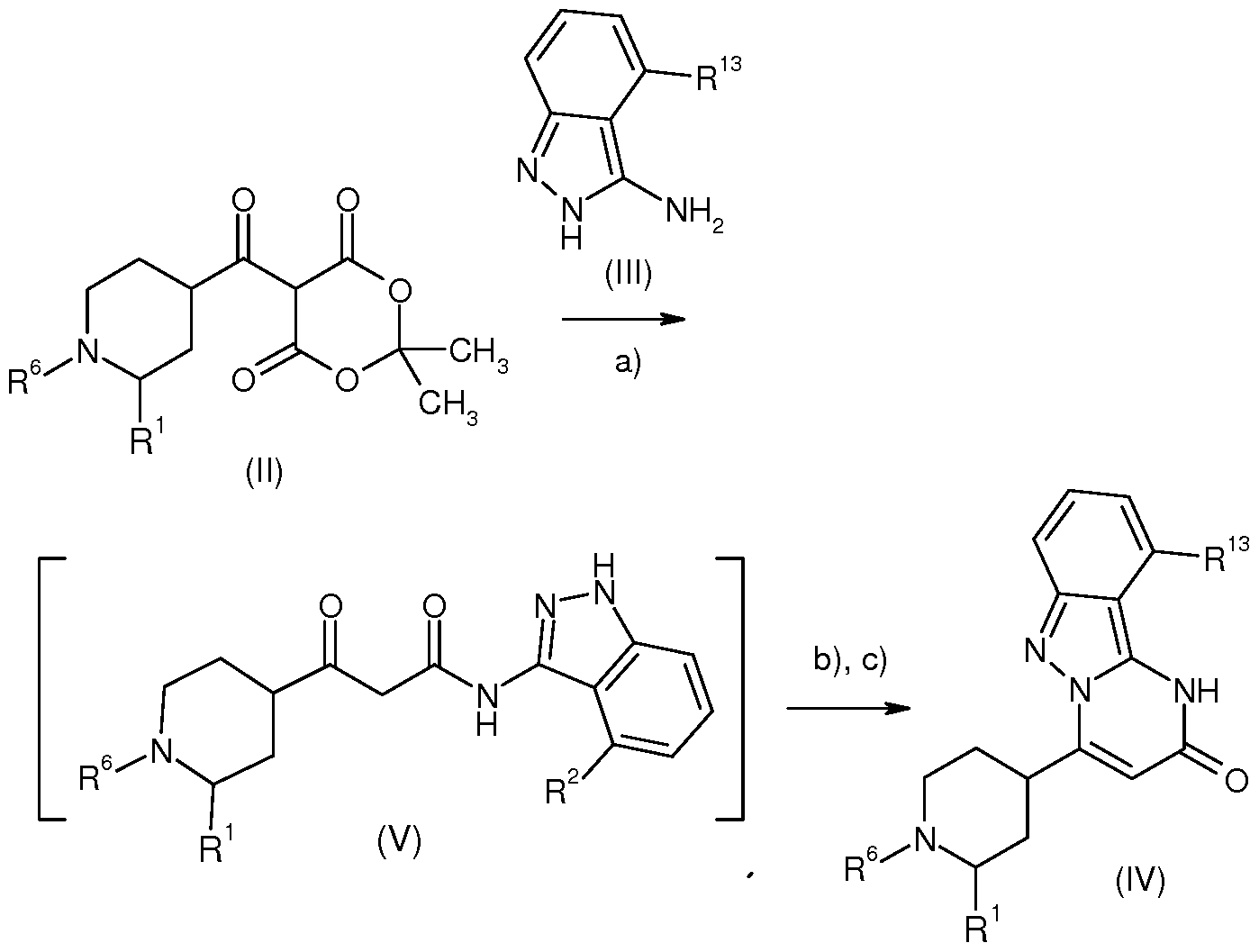
Suitable amino protecting groups (substituent R6) in formulae (II-A), (II-B), (IV) and (V) are tert- butoxycarbonyl (Boc), removed by a concentrated strong acid, benzyloxycarbonyl (Cbz), removed by hydrogenolysis, methyl or ethylcarbamate, removed by TMSI in CHCh or HBr in AcOH, Trimethylsilylethyl carbamate (Teoc), removed by fluoride, p-Methoxybenzyl carbamate (Moz or MeOZ), removed by hydrogenolysis, 9-Fluorenylmethyl carbamate (F-moc), removed by a base, and optionally substituted benzyl or benzylamine, removed by hydrogenolysis. Preferred for use as amino protective group is ieri-butoxycarbonyl (Boc).
According to an embodiment of the invention, the amino protective group R6 is selected from tert- butoxycarbonyl (Boc), and benzyloxycarbonyl (Cbz). Preferred for use as amino protective group is tert- butoxycarbonyl (Boc).
The reaction can also be carried out without protecting the amino group. In this case, R6 is hydrogen.
According to an embodiment of the invention, the reaction is carried out without protecting the amino group. In this embodiment, R6 is hydrogen.
Scheme 2: Synthesis of compounds of the formula (I-B) via the bromo indazolopyrimidinone derivative

Scheme 3: Preparation of compound of the formula (I-B) via the aniline indazolopyrimidinone derivative


The compounds of formula (I-A) or (TB) according to the invention have useful pharmacological properties and can be employed for the prevention and treatment of disorders in humans and animals. The compounds of formula (TA) or (TB) according to the invention open up a further treatment alternative and are therefore an enrichment of pharmacy. The compounds of formula ( A) or (TB) according to the invention bring about an inhibition of clot lysis (fibrinolysis), lead to an increase in clot stability (clot firmness) and thereby to a reduction of bleeding, re-bleeding and blood loss. These effects are due to direct inhibition of plasminogen, the central precursor of plasmin, a potent serine protease involved in the dissolution of fibrin blood clots.
The compounds of formula (I-A) or (I-B) according to the invention are suitable for the treatment and/or prophylaxis of acute and recurrent bleeding in patients with or without underlying hereditary or acquired hemostatic disorders. The compounds of formula (TA) or (TB) according to the invention are also suitable for the treatment and/or prophylaxis of acute and recurrent bleeding in patients with or without underlying hereditary or acquired hemostatic disorders. The compounds of formula (TA) or (TB) according to the invention are also suitable for the treatment and/or prophylaxis of acute and recurrent bleeding in patients with or without underlying hereditary rare hemostatic disorders. The compounds of formula (TA) or (TB) according to the invention are also suitable for the treatment and/or prophylaxis of hereditary or acquired hemostatic disorders, hereditary or acquired hemostatic disorders, and rare hemostatic disorders.
Within the meaning of the present invention, the term underlying hereditary or acquired hemostatic disorders comprises von Willebrand's disease, platelet disorders/dysfunctions like Glantzmann's thrombasthenia and thrombocytopenia, and vitamin K deficiency, PAI-1 deficiency, mild and moderate hemophilia, including hemophilia A (factor VIII deficiency), hemophilia B (factor IX deficiency), and hemophilia C (factor XI deficiency), symptomatic carriers of hemophilia and other hereditary hemostatic disorders, autoimmune disorders that lead to the formation of antibodies against the coagulation factor, blood cancers, bone marrow diseases, infections, kidney failure, liver disease, medications, medications, including heparin, low molecular weight heparin, and coumarin derivatives, like warfarin, accidental injuries and surgical interventions leading to massive blood loss and resulting in a critical reduction in the level of coagulation factors which can lead to additional non-surgical bleeding complications (e.g. coagulopathic bleeding), acquired von Willebrand syndrome (AVWS), characterized by structural or functional defects of von Willebrand factor (VWF) that are secondary to autoimmune, lymphoproliferative or myeloproliferative, malignant, cardiovascular, or other disorders.
Within the meaning of the present invention, the term mild hemophilia is defined as a level of clotting factor activity of the respective deficient factor of 5% to 50% of the normal level, the term moderate hemophilia is defined as a level of clotting factor activity of the respective deficient factor of 1% to 5% of the normal level.
Within the meaning of the present invention, the term underlying hereditary or acquired hemostatic disorders is defined as pathological processes resulting in abnormal bleeding or clotting. Within the meaning of the present invention, the term underlying hereditary rare hemostatic disorders (RBD) is defined as hemostatic disorders caused by hereditary disorders, that are less common than e.g. hemophilia A and B or von Willebrand disease. Rare hemostatic disorders include deficiency of fibrinogen, prothrombin, factors V, combined factors V+VIII, factor VII, factor X, factor XI or factor XIII.
The compounds of formula (I-A) or (I-B) according to the invention can be used in a wide range of hemorrhagic conditions like upper gastrointestinal bleeding, hemorrhages caused by antifibrinolytics, and gynecological bleeding indications including heavy menstrual bleeding (HMB, also termed menorrhagia), placental bleeding, postpartum hemorrhage and conisation of the cervix. Within the meaning of the present invention, heavy menstrual bleeding (HMB, also termed menorrhagia)is defined as menstrual blood loss of 60 ml or more per cycle, for example 60 to 80 ml per cycle, in particular more than 80 ml per cycle. Also within the meaning of the present invention and according to National Institute for Clinical Excellence (NICE) guidelines, heavy menstrual bleeding is defined for clinical purposes as excessive menstrual blood loss which interferes with the woman's physical, emotional, social and material quality of life, and which can occur alone or in combination with other symptoms.
In particular, the compounds of formula (I-A) or (I-B) according to the invention can be used in heavy menstrual bleeding (HMB, also termed menorrhagia) caused by underlying hemostatic disorders, for example hereditary or acquired hemostatic disorders, such as von Willebrand's disease, platelet disorders/dysfunctions like Glantzmann's thrombasthenia and thrombocytopenia, and vitamin K deficiency, PAI-1 deficiency, mild and moderate hemophilia, including hemophilia A (factor VIII deficiency), hemophilia B (factor IX deficiency), and hemophilia C (factor XI deficiency), symptomatic carriers of hemophilia and other hereditary hemostatic disorders, such as deficiency of fibrinogen, prothrombin, factors V, combined factors V+VIII, factor VII, factor X, factor XI, or factor XIII, autoimmune disorders, blood cancers, bone marrow diseases, infections, kidney failure, liver disease, medications, including heparin, low molecular weight heparin, and coumarin derivatives, like warfarin, accidental injuries and surgical interventions leading to massive blood loss and resulting in a critical reduction in the level of coagulation factors, and acquired von Willebrand syndrome (AVWS).
The compounds of formula (I-A) or (I-B) according to the invention can also be used for reducing peri- and postoperative blood loss and rebleeding during and after different surgical interventions, including cardiovascular surgery, including coronary artery bypass surgery, spinal surgery, trauma surgery, transplantation, including orthotopic liver transplantation, and hysterectomy, as well as transfusion requirements in patients with or without underlying hemostatic disorders. Moreover, the compounds of formula (I-A) or (I-B) according to the invention can be used for the prevention of recurrence of bleeding in patients after elective minor surgery like prostatic surgery including prostatectomy and transurethral prostatic surgery, gynaecological surgery, urinary surgery, otolaryngological (ENT) surgery including tonsillectomy, and adenoidectomy, oral surgery, and dental surgery, in patients with or without underlying hereditary or acquired hemostatic disorders.
The compounds of formula (I-A) or (I-B) according to the invention can also be used for treatment and/or prophylaxis of acute and recurrent bleeding in patients with liver diseases, including patients with end-stage liver diseases in patients with or without underlying hemostatic disorders.
The compounds of formula (TA) or (TB) according to the invention can also be used for treatment and/or prophylaxis of acute and recurrent bleeding in patients with trauma and/or traumatic hyphaema, hemorrhagic stroke, acute promyelocytic leukaemia, and to block plasmin-induced proteolysis which may be of biological relevance during athero-thrombosis and inflammatory states, cancer and other diseases in patients with or without underlying hereditary or acquired hemostatic disorders.
The compounds of formula (TA) or (TB) according to the invention can also be used for the treatment and/or prophylaxis of hereditary or acquired hemostatic disorders in patients including von Willebrand's disease, platelet disorders/dysfunctions like Glantzmann's thrombasthenia and thrombocytopenia, and vitamin K deficiency, PAI-1 deficiency, mild and moderate hemophilia, including hemophilia A (factor VIII deficiency), hemophilia B (factor IX deficiency), and hemophilia C (factor XI deficiency), symptomatic carriers of hemophilia and other hereditary hemostatic disorders, such as deficiency of fibrinogen, prothrombin, factors V, combined factors V+VIII, factor VII, factor X, factor XI or factor XIII, autoimmune disorders, blood cancers, bone marrow diseases, infections, kidney failure, liver disease, medications, medications, including heparin, low molecular weight heparin, and coumarin derivatives, like warfarin, accidental injuries and surgical interventions leading to massive blood loss and resulting in a critical reduction in the level of coagulation factors, and acquired von Willebrand syndrome (AVWS).
The compounds of the present invention can be used either alone as monotherapy or in combination with other therapies to address a hemostatic disorder. For instance, co-administration of one or more compounds of the invention with a plasma-derived or recombinant coagulation factor such as factor Vila, factor VIII, factor IX or desmopressin is believed useful for treating hemophilia. The compounds of formula (TA) or (TB) according to the invention can also be used for treating synovitis, wherein the synovitis may be associated with cartilage damage and is associated with hemarthrosis in patients with or without underlying hereditary or acquired hemostatic disorders.
The compounds of formula (TA) or (TB) according to the invention can also be used for the treatment of nosebleed (epistaxis) caused by trauma or other causes in patients with or without underlying hereditary or acquired hemostatic disorders.
The compounds of formula (TA) or (TB) according to the invention can also be used for the treatment and/or prophylaxis of hereditary or acquired hemostatic disorders in patients.
The present invention further relates to the use of the compounds of formula (I-A) or (I-B) according to the invention for the treatment and/or prophylaxis of diseases, in particular the aforementioned diseases.
An embodiment of the present invention is also a compound of formula (I-A) or (I-B) according to the invention for use in a method for the treatment and/or prophylaxis of diseases. An embodiment of the present invention is also a compound of formula (I-A) or (I-B) according to the invention for use in a method for the treatment and/or prophylaxis of acute and recurrent bleeding in patients with or without underlying hereditary or acquired hemostatic disorders.
An embodiment of the present invention is also a compound of formula (I-A) or (I-B) according to the invention for use in a method for the treatment and/or prophylaxis of acute and recurrent bleeding in patients with underlying hereditary or acquired hemostatic disorders.
An embodiment of the present invention is also a compound of formula (I-A) or (I-B) according to the invention for use in a method for the treatment and/or prophylaxis of acute and recurrent bleeding in patients with or without underlying hereditary or acquired hemostatic disorders, wherein the bleeding is associated with a disease or medical intervention selected from the group consisting of heavy menstrual bleeding, postpartum hemorrhage, hemorrhagic shock, trauma, surgery, including otolaryngological, cardiovascular, and spinal surgery, liver or lung transplantation, stroke, liver diseases, hereditary angioedema, nosebleed, and synovitis.
An embodiment of the present invention is also a compound of formula (I-A) or (I-B) according to the invention for use in a method for the treatment and/or prophylaxis of acute and recurrent bleeding in patients with underlying hereditary or acquired hemostatic disorders, wherein the bleeding is associated with a disease or medical intervention selected from the group consisting of heavy menstrual bleeding, postpartum hemorrhage, hemorrhagic shock, trauma, surgery, including otolaryngological, cardiovascular, and spinal surgery, liver or lung transplantation, stroke, liver diseases, hereditary angioedema, nosebleed, and synovitis. An embodiment of the present invention is also a medicament comprising a compound of the formula (I- A) or (I-B) according to the invention in combination with an inert, non-toxic, pharmaceutically suitable auxiliary.
An embodiment of the present invention is also a medicament comprising a compound of the formula (I- A) or (I-B) according to the invention in combination with a further active compound selected from the group consisting of Factor VIII, Factor IX, Factor Vila, activated prothrombin complex concentrates (aPCC) or prothrombin complex concentrates (PCCs), ε-aminocaproic acid, ethamsylate, paraaminobutyl benzoic acid, tranexamic acid, desmopressin, danazol, combined oral contraceptive pills
(COCPs), progestin intrauterine system, glucocorticoid receptor agonists, analgesics, and nonsteroidal anti-inflammatory drugs (NSAIDs).
An embodiment of the present invention is also a medicament comprising a compound of the formula (I- A) or (I-B) according to the invention as described above for the treatment and/or prophylaxis of acute and recurrent bleeding in patients with or without underlying hereditary or acquired hemostatic disorders.
An embodiment of the present invention is also a medicament comprising a compound of the formula (I- A) or (I-B) according to the invention as described above for the treatment and/or prophylaxis of acute and recurrent bleeding in patients with underlying hereditary or acquired hemostatic disorders. An embodiment of the present invention is also a medicament comprising a compound of the formula (I- A) or (I-B) according to the invention as defined above for the treatment and/or prophylaxis of acute and recurrent bleeding in patients with or without underlying hereditary or acquired hemostatic disorders, wherein the bleeding is associated with a disease or medical intervention selected from the group consisting of heavy menstrual bleeding, postpartum hemorrhage, hemorrhagic shock, trauma, surgery, otolaryngological surgery, dental surgery, urinary surgery, prostatic surgery, gynaecological surgery, cardiovascular surgery, spinal surgery, liver or lung transplantation, stroke, liver diseases, hereditary angioedema, nosebleed, and synovitis and cartilage damage following hemarthrosis.
An embodiment of the present invention is also a medicament comprising a compound of the formula (I- A) or (I-B) according to the invention as defined above for the treatment and/or prophylaxis of acute and recurrent bleeding in patients with underlying hereditary or acquired hemostatic disorders, wherein the bleeding is associated with a disease or medical intervention selected from the group consisting of heavy menstrual bleeding, postpartum hemorrhage, hemorrhagic shock, trauma, surgery, otolaryngological surgery, dental surgery, urinary surgery, prostatic surgery, cardiovascular surgery, spinal surgery, liver or lung transplantation, stroke, liver diseases, hereditary angioedema, nosebleed, and synovitis and cartilage damage following hemarthrosis.
An embodiment of the present invention is also a method for the treatment and/or prophylaxis of acute and recurrent bleeding in patients with or without underlying hereditary or acquired hemostatic disorders in humans and animals using an effective amount of at least one compound of the formula (I- A) or (I-B) according to the invention or a medicament comprising a compound of the formula (I-A) or (I-B) according to the invention as defined above.
An embodiment of the present invention is also a method for the treatment and/or prophylaxis of acute and recurrent bleeding in patients with underlying hereditary or acquired hemostatic disorders in humans
and animals using an effective amount of at least one compound of the formula (I- A) or (I-B) according to the invention or a medicament comprising a compound of the formula (I- A) or (I-B) according to the invention as defined above.
An embodiment of the present invention is also a method for the treatment and/or prophylaxis of acute and recurrent bleeding in patients with or without underlying hereditary or acquired hemostatic disorders in humans and animals using an effective amount of at least one compound of the formula (I- A) or (I-B) according to the invention or a medicament comprising a compound of the formula (I-A) or (I-B) according to the invention as defined above, wherein the bleeding is associated with a disease or medical intervention selected from the group consisting of heavy menstrual bleeding, postpartum hemorrhage, hemorrhagic shock, trauma, surgery, otolaryngological surgery, dental surgery, urinary surgery, prostatic surgery, cardiovascular surgery, spinal surgery, liver or lung transplantation, stroke, liver diseases, hereditary angioedema, nosebleed, and synovitis and cartilage damage following hemarthrosis.
An embodiment of the present invention is also a method for the treatment and/or prophylaxis of acute and recurrent bleeding in patients with underlying hereditary or acquired hemostatic disorders in humans and animals using an effective amount of at least one compound of the formula (I-A) or (I-B) according to the invention or a medicament comprising a compound of the formula (I-A) or (I-B) according to the invention as defined above, wherein the bleeding is associated with a disease or medical intervention selected from the group consisting of heavy menstrual bleeding, postpartum hemorrhage, hemorrhagic shock, trauma, surgery, otolaryngological surgery, dental surgery, urinary surgery, prostatic surgery, cardiovascular surgery, spinal surgery, liver or lung transplantation, stroke, liver diseases, hereditary angioedema, nosebleed, and synovitis and cartilage damage following hemarthrosis.
The efficacy of the compounds of formula (I-A) and (I-B) according of the invention for the treatment and/or prophylaxis of hereditary or acquired hemostatic disorders, and of acute and recurrent bleeding in patients with or without underlying hereditary or acquired hemostatic disorders, wherein the bleeding is associated with a disease or medical intervention selected from the group consisting of heavy menstrual bleeding, postpartum hemorrhage, hemorrhagic shock, trauma, surgery, otolaryngological surgery, dental surgery, urinary surgery, prostatic surgery, cardiovascular surgery, spinal surgery, liver or lung transplantation, stroke, liver diseases, hereditary angioedema, nosebleed, and synovitis and cartilage damage following hemarthrosis, can be demonstrated for example by a reduction in blood loss (quantitative and laboratory values), by a shortened duration of bleeding, by an increased clot firmness, by a lower incidence of recurrent bleeding, by an improved quality of life, which may in the case of heavy menstrual bleeding be determined by the Menorrhagia Impact Questionnaire, the number of medical visits, and/or by improved compliance due to less frequent dosing as compared to e.g. lysine analogs, including tranexamic acid and ε-aminocaproic acid.
The compound of formula (I-A) or (I-B) need not be, but is optionally administered with one or more agents currently used to prevent or treat the disorder in question. The effective amount of such other agents depends on the amount of compound of the invention present, the type of disorder or treatment. These are generally used in the same dosages and with administration routes as used hereinbefore or about from 1 to 99% of the heretofore employed dosages. The present invention further relates to medicaments containing at least one of the compounds of formula (TA) or (TB) according to the invention and one or more further active substances, in particular for the treatment and/or prophylaxis of the aforementioned diseases. As suitable combination active substances, we may mention for example and preferably: Factor VIII, Factor IX, Factor Vila, activated prothrombin complex concentrates (aPCC) or prothrombin complex concentrates (PCCs), ε-aminocaproic acid, ethamsylate, paraaminobutyl benzoic acid, tranexamic acid, desmopressin, danazol, combined oral contraceptive pills (COCPs), progestin intrauterine systems, glucocorticoid receptor agonists, analgesics, and nonsteroidal anti-inflammatory drugs (NSAIDs). In an embodiment of the invention, the compounds of formula (TA) or (TB) according to the invention are administered in a combination with the coagulation factor commonly known as Factor VIII, any derivatives, fragments, muteins or conjugates thereof.
In an embodiment of the invention, the compounds of formula (TA) or (TB) according to the invention are administered in a combination with the coagulation factor commonly known as Factor IX, any derivatives, fragments, muteins or conjugates thereof.
In an embodiment of the invention, the compounds of formula (TA) or (TB) according to the invention are administered in a combination with the coagulation factor commonly known as Factor Vila, any derivatives, fragments, muteins or conjugates thereof.
In an embodiment of the invention, the compounds of formula (TA) or (TB) according to the invention are administered in a combination with activated prothrombin complex concentrates (aPCCs) or prothrombin complex concentrates (PCCs).
In an embodiment of the invention, the compounds of formula (TA) or (TB) according to the invention are administered in a combination with antifibrinolytic agents such as, by way of example and preferably, ε-aminocaproic acid, ethamsylate, paraaminobutyl benzoic acid, and tranexamic acid. In an embodiment of the invention, the compounds of formula (TA) or (TB) according to the invention are administered in a combination with desmopressin.
In an embodiment of the invention, the compounds of formula (I-A) or (I-B) according to the invention are administered in a combination with danazol.
In an embodiment of the invention, the compounds of formula (I-A) or (I-B) according to the invention are administered in combination with combined oral contraceptive pills (COCPs) such as, by way of example and preferably, combinations of an estrogen, for example the synthetic estrogen ethinylestradiol or the natural estrogens estradiol and estradiolderivatives, preferably estradiolester, such as estradiolvalerate and estradiolhydrate, and a gestagen for example progesterone, trimegestone, medroxyprogesterone acetate, megestrol acetate, cyproterone acetate, chlormadinone acetate, nestorone, levonorgestrel, norgestimate, desogestrel, ethonogestrel (3-Ketodesogestrel), nomegestrol acetate (NOMAC), norethisterone acetate (NETA), drospirenone, gestodene, dienogest, norethindrone acetate, danazole, norgestrel, and tanaproget.
In an embodiment of the invention, the compounds of formula (I-A) or (I-B) according to the invention are administered in combination with intrauterine devices, including progestine impregnated intrauterine devices, e.g. LNG-IUS levonorgestrel intrauterine system. In an embodiment of the invention, the compounds of formula (I-A) or (I-B) according to the invention are administered in combination with a glucocorticoid receptor agonist, such as, by way of example and preferably, Cortisol, cortisone, hydrocortisone, prednisone, methyl-prednisolone, prednylidene, deflazacort, fluocortolone, triamcinolone, dexamethasone or betamethasone.
In an embodiment of the invention, the compounds of formula (I-A) or (I-B) according to the invention are administered in combination with nonsteroidal anti-inflammatory drugs (NSAIDs), such as by way of example and preferably acetylsalicylic acid, diclofenac, flurbiprofen, ibuprofen, indomethacin, mefenamic acid, meclofenamic acid, and naproxen.
In an embodiment of the invention, the compounds of formula (I-A) or (I-B) according to the invention are administered in combination with analgesics, such as by way of example and preferably, acetaminophen, acetanilide, aminobenzoic acid, antipyrine, calcium or choline salicylate, codeine, phenatecin, phenyltoloxamine citrate, salicylamide, sodium salicylate, and sodium para-aminobenzoate.
An embodiment of the invention is also a medicament, comprising a compound of the formula (I-A) or (I-B) as defined above in combination with a further active compound selected from the group consisting of Factor VIII, Factor IX, Factor Vila, activated prothrombin complex concentrates (aPCC) or prothrombin complex concentrates (PCCs), ε-aminocaproic acid, ethamsylate, paraaminobutyl benzoic acid, tranexamic acid, desmopressin, danazol, hormonal treatments, including combined oral
contraceptive pills (COCPs), progestin intrauterine system, glucocorticoid receptor agonists, analgesics, and nonsteroidal anti-inflammatory drugs (NSAIDs).
An embodiment of the invention is also a medicament as defined above for the treatment and/or prophylaxis of hereditary or acquired hemostatic disorders, trauma, surgery, stroke, heavy menstrual bleeding, including heavy menstrual bleeding in women with underlying hemostatic disorders, postpartum hemorrhage, liver diseases, and hereditary angioedema.
An embodiment of the invention is also a method for the treatment and/or prophylaxis of hereditary or acquired hemostatic disorders, trauma, surgery, stroke, heavy menstrual bleeding, including heavy menstrual bleeding in women with underlying hemostatic disorders, postpartum hemorrhage, liver diseases, and hereditary angioedema in humans and animals using an effective amount of at least one compound of the formula (I-A) or (I-B) as defined above or a medicament as defined above.
The present invention further relates to medicaments that contain at least one compound of formula (I- A) or (I-B) according to the invention, usually together with one or more inert, non-toxic, pharmaceutically suitable auxiliaries, and use thereof for the aforementioned purposes. The compounds of formula (TA) or (I-B) according to the invention may be effective after systemic and/or local administration. For this purpose they can be applied in a suitable way, e.g. by oral, parenteral, pulmonary, nasal, sublingual, lingual, buccal, rectal, dermal, transdermal, conjunctival, or otic administration or as implant or stent.
For these routes of application, the compounds of formula (TA) or (I-B) according to the invention can be administered in suitable dosage forms.
Dosage forms functioning according to the prior art, for rapid and/or modified release of the compounds according to the invention, which contain the compounds of formula (TA) or (I-B) according to the invention in crystalline and/or amorphized and/or dissolved form, e.g. tablets (uncoated or coated tablets, for example with enteric coatings or coatings with delayed dissolution or insoluble coatings, which control the release of the compound formula (TA) or (I-B) according to the invention), tablets or films/wafers that disintegrate rapidly in the oral cavity, films/lyophilizates, capsules (for example hard or soft gelatin capsules), sugar-coated pills, granules, pellets, powders, emulsions, suspensions, aerosols or solutions, are suitable for oral administration.
Parenteral administration can take place avoiding an absorption step (e.g. intravenous, intraarterial, intracardiac, intraspinal or intralumbar) or including absorption (e.g. intramuscular, subcutaneous, intracutaneous, percutaneous or intraperitoneal). Injection and infusion preparations in the form of solutions, suspensions, emulsions, lyophilizates or sterile powders are suitable, among others, as dosage
forms for parenteral application. Intravenous administration can take place for example by bolus administration or by continuous infusion.
Inhaled pharmaceutical forms (including powder inhalers, nebulizers), nasal drops, nasal solutions or nasal sprays, tablets, films/wafers or capsules for lingual, sublingual or buccal application, suppositories, ear or eye preparations, vaginal capsules, aqueous suspensions (lotions, shaking mixtures), lipophilic suspensions, ointments, creams, transdermal therapeutic systems (e.g. patches), milk, pastes, foams, dusting powders, implants or stents for example are suitable for other routes of administration.
In one embodiment, the compounds of formula (I-A) or (I-B) according to the invention can be administered in the form of nasal drops, nasal solutions or nasal sprays for the treatment and/or prophylaxis of acute and recurrent nosebleed in patients, in particular in patients with underlying hereditary or acquired hemostatic disorders.
In one embodiment, the compounds of formula (I-A) or (I-B) according to the invention can be administered in the form of patches soaked with the compounds of formula (I-A) or (I-B) according to the invention and applied to the wound for the treatment and/or prophylaxis of acute and recurrent bleeding in patients, in particular in patients with underlying hereditary or acquired hemostatic disorders. In one embodiment, the compounds of formula (I-A) or (I-B) according to the invention are administered intra-muscular, rectal or transvaginal for the treatment and/or prophylaxis of acute and recurrent bleeding in patients with trauma and other forms of acute bleeding, in particular in patients with underlying hereditary or acquired hemostatic disorders. In one embodiment, the compounds of formula (I-A) or (I-B) according to the invention are administered in form of a swish and swallow or a lozenge for the treatment and/or prophylaxis of acute and recurrent mouth bleeding in patients, in particular in patients with underlying hereditary or acquired hemostatic disorders. A swish and swallow route of administration is defined as the administration of a liquid substance to the oral mucosa by swishing the drug inside the mouth for a certain amount of time then allowed to be swallowed. The drug action is both topical and systemic.
The compounds of formula (TA) or (TB) according to the invention can also be used in vitro or ex vivo to inhibit fibrinolysis, for example for in vitro/ex vivo assays, to inhibit fibrinolysis in blood and plasma products, to pretreat catheters and other medicinal devices and equipment, for surface coatings or in biological samples. The compounds of formula (TA) or (TB) according to the invention can be transformed to the aforementioned dosage forms. This can take place in a manner known per se by mixing with inert, nontoxic, pharmaceutically suitable auxiliaries. These auxiliaries include inter alia carriers (for example
microcrystalline cellulose, lactose, mannitol), solvents (e.g. liquid polyethylene glycols), emulsifiers and dispersants or wetting agents (for example sodium dodecyl sulphate, polyoxysorbitan oleate), binders (for example polyvinylpyrrolidone), synthetic and natural polymers (for example albumin), stabilizers (e.g. antioxidants such as ascorbic acid), colorants (e.g. inorganic pigments, for example iron oxides) and taste and/or odour correctants.
An embodiment of the invention are pharmaceutical compositions comprising at least one compound of formula (I-A) or (I-B) according to the invention, preferably together with at least one inert, non-toxic, pharmaceutically suitable auxiliary, and the use of these pharmaceutical compositions for the above cited purposes. For the prevention or treatment of disease, the appropriate dosage of a compound of the invention (when used alone or in combination with other agents) will depend on the type of disease to be treated, the type of compound, the severity and course of the disease, whether the compound is administered for preventive or therapeutic purposes, previous therapy, the patient's clinical history and response to the compound, and the discretion of the attending physician. The compound is suitably administered to the patient at one time or over a series of treatments. Depending on the type and severity of disease, about 0.1 μg/kg to 100 mg/kg of the compound is an initial candidate dosage for administration to the patient, whether for example, by one or more separate administrations, or by continuous infusion. A typical daily dosage might range from about 0.1 μg kg to 100 mg kg or more, depending on the factors mentioned above. For repeated administrations over several days or longer, depending on the condition, the treatment is sustained until a desired suppression of disease symptoms occurs. An initial higher loading dose, followed by one or more lower doses may be administered. However, other dosing regimen may be useful. The progress of this therapy is easily monitored by conventional techniques and assays.
In general, it has proved advantageous, in the case of oral or parenteral administration, to administer amounts in a range of from 0.1 to 300 or from 0.5 to 50 or from 1 to 50 or from 2 to 10 mg/kg body weight every 24 hours to achieve effective results.
According to a further embodiment, it has proved advantageous, in the case of oral administration of an immediate release tablet, to administer amounts in a range of from 5 to 15 or from 7 to 12 or from 9 to 11 or of 10 mg/kg body weight twice a day (b.i.d.). In the case of oral administration of a modified release tablet it has proved advantageous to administer amounts up to 2-fold lower than that in the case of oral administration of an immediate release tablet.
Nevertheless, it may optionally be necessary to deviate from the stated amounts, namely depending on body weight, route of administration, individual response to the active substance, type of preparation and time point or interval when application takes place. Thus, in some cases it may be sufficient to use
less than the aforementioned minimum amount, whereas in other cases the stated upper limit must be exceeded. When applying larger amounts, it may be advisable to distribute these in several individual doses throughout the day.
According to a further embodiment, the compounds of formula (I-A) or (I-B) according to the invention are administered orally once or twice or three times a day. According to a further embodiment, the compounds of formula (I-A) or (I-B) according to the invention are administered orally once or twice a day. According to a further embodiment, the compounds of formula (I-A) or (I-B) according to the invention are administered orally once a day. For the oral administration, a rapid release or a modified release dosage form may be used. According to a further embodiment, the compounds of formula (I-A) or (I-B) according to the invention are administered orally once or twice or three times a day on 1 or 2 or 3 or 4 or 5 or 6 or 7 or 8 or 9 or 10 days per month. According to a further embodiment, the compounds of formula (I-A) or (I-B) according to the invention are administered orally once or twice or three times a day on 2 or 3 or 4 or 5 or 6 or 7 or 8 or 9 or 10 consecutive days per month. According to a further embodiment, the compounds of formula (I-A) or (I-B) according to the invention are administered orally once or twice or three times a day on 3 or 4 or 5 or 6 or 7 days per month. According to a further embodiment, the compounds of formula (I-A) or (I-B) according to the invention are administered orally once or twice or three times a day on 3 or 4 or 5 or 6 or 7 consecutive days per month.
The following practical examples explain the invention. The invention is not limited to the examples. The percentages in the following tests and examples are percentages by weight, unless stated otherwise; parts are parts by weight. Proportions of solvents, dilution ratios and concentrations for liquid/liquid solutions refer in each case to the volume.
A. Examples
Abbreviations and acronyms:
[a] specific rotation value
AcOH acetic acid
Boc tert- butoxycarbonyl
br. broad signal (NMR coupling pattern)
Burgess Reagent Af-(triethylammoniosulfonyl)carbamate
CDI N,N'-carbonyldiimidazole
Cone. concentrated
CPhos 2-dicyclohexylphosphino-2',6 '-bis(N,N-dimethylamino)- 1 , 1 '-biphenyl δ NMR shift in ppm
d doublet (NMR coupling pattern)
DCM dichloromethane
DIPEA diisopropyl ethyl amine
DMAP 4-N,N-dimethylaminopyridine
DMF N,N-dimethylformamide
DMPU l,3-Dimethyltetrahydropyrimidin-2(l//)-one
DMSO dimethylsulfoxide
EDCI N-ethyl-N'-(3-dimethylaminopropyl)carbodiimide hydrochloride
ESI electrospray ionisation (MS)
GC-MS gas chromatography coupled to mass spectrometry
H ATU 1 - [Bis(dimethylamino)methylene] - 1 H- 1 ,2,3 -triazolo [4,5-b] pyridinium 3 -oxid hexafluorophosphate
HC1 Hydrochloric acid
HOBt 1 -hydro xybenzotriazole hydrate
HPLC high performance liquid chromatography
LC-MS liquid chromatography coupled to mass spectrometry
m multiplet (NMR coupling pattern)
MS mass spectrometry
MTBE tert-butyl methyl ether
NMP N-methylpyrrolidone
NMR nuclear magnetic resonance
q quartet (NMR coupling pattern)
Rt retention time
RT room temperature
s singlet (NMR coupling pattern)
t triplet (NMR coupling pattern)
tBuBrettPhos 2-(Di-tert-butylphosphino)-2',4',6'- triisopropyl-3,6-dimethoxy- 1,1 '-biphenyl tBuBrettPhos Pd G3 [(2-Di-tert-butylphosphino-3,6-dimetho y-2 4 6'-triisopropyl ,l '-biphenyl)-2-(2'- amino- 1 , 1 '-biphenyl)]palladium(II) methanesulfonate
tBuXPhos 2-Di-tert-butylphosphino-2',4',6'-triisopropylbiphenyl
TFA trifluoroacetic acid
THF tetrahydrofurane
UV ultraviolet
WL wavelength
XPhos 2-dicyclohexylphosphino-2',4',6'-triisopropylbiphenyl
LC-MS-Methods:
Method 1
Instrument: Waters ACQUITY SQD UPLC system; column: Waters Acquity UPLC HSS T3 1.8 μ 50 x 1 mm; eluent A: 1 1 water + 0.25 ml 99% formic acid, eluent B: 1 1 acetonitrile + 0.25 ml 99% formic acid; gradient: 0.0 min 90% A→ 1.2 min 5% A→ 2.0 min 5% A; oven: 50°C; flow: 0.40 ml/min; UV- detection: 208 - 400 nm.
Method 2
Instrument: Waters ACQUITY SQD UPLC system; column: Waters Acquity UPLC HSS T3 1.8 μ 50 x 1 mm; eluent A: 1 1 water + 0.25 ml 99% formic acid, eluent B: 1 1 acetonitrile + 0.25 ml 99% formic acid; gradient: 0.0 min 95% A→ 6.0 min 5% A→ 7.5 min 5% A oven: 50°C; flow: 0.35 ml/min; UV- detection: 210 - 400 nm.
Method 3
Instrument MS: Waters (Micromass) QM; Instrument HPLC: Agilent 1100 Series; Column: Agilent ZORBAX Extend-C18 3.0x50mm 3.5-Micron; Eluent A: 1 L water + 0.01 mol ammonium carbonate, Eluent B: 1 L acetonitrile; Gradient: 0.0 min 98% A→ 0.2min 98% A→ 3.0 min 5% A→ 4.5 min 5% A ; Oven: 40°C; Flow: 1.75 ml/min; UV-detection: 210 nm.
Method 4
Instrument: Agilent MS Quad 6150;HPLC: Agilent 1290; Column: Waters Acquity UPLC HSS T3 1.8 μ 50 x 2.1 mm; Eluent A: 1 1 water + 0.25 ml 99% formic acid, Eluent B: 1 1 acetonitrile + 0.25 ml 99% formic acid; Gradient: 0.0 min 90% A → 0.3 min 90% A→ 1.7 min 5% A→ 3.0 min 5% A Oven: 50°C; Flow: 1,20 ml/min; UV-Detection: 205 - 305 nm.
Method 5
Instrument MS: Waters (Micromass) Quattro Micro; Instrument Waters UPLC Acquity; column : Waters BEH C18 1.7 μ 50 x 2.1 mm; solvent A: 1 1 water + 0.01 mol Ammonium formiate, solvent B: 1 1 Acetonitrile; gradient: 0.0 min 95% A→ 0.1 min 95% A→ 2.0 min 15% A→ 2.5 min 15% A→ 2.51 min 10% A→ 3.0 min 10% A; oven: 40°C; flows: 0.5 ml/min; UV-detection: 210 nm.
Example 1A
Rac-tert-butyl 4-[10-(4-methyl-2-oxo-l,3-oxazolidin-3-yl)-2-oxo-l,2-dihydropyrimido[l,2- b]indazol-4-yl]piperidine-l-carboxylate

A solution of compound ieri-butyl 4-(10-bromo-2-oxo-l,2-dihydropyrimido[l,2-b]indazol-4- yl)piperidine- l-carboxylate (200 mg, 0.45 mmol), rac- 4-methyl-l,3-oxazolidin-2-one (226 mg, 2.24 mmol), potassium carbonate (124 mg, 0.89 mmol) and copper (II) sulfate pentahydrate (11 mg, 0.045 mmol) in 5 mL dimethylformamide was stirred 3h at 190 °C in the microwave. After cooling to RT, the mixture was filtered and purified by preparative HPLC (gradient acetonitrile/water with 0.1 % trifluoro acetic acid). Evaporation of the combined product fractions yielded the title compound (9 mg, 4% of theory; 123 mg, 79% purity, 46% of theory).
LC-MS (Method 4): Rt = 1.22 min, MS (ESINeg): m/z = 466 [M-H]"
Example 2A
7¾rt-butyl 4 2-oxo 0-(2-oxopiperidin^-yl) ,2-dihydropyrimido[l,2-b]indazol-4-yl]piperidine-l- carboxylate

A solution of compound ieri-butyl 4-(10-bromo-2-oxo-l,2-dihydropyrimido[l,2-b]indazol-4- yl)piperidine- 1 -carboxylate (180 mg, 0.40 mmol), piperidin-2-one (199 mg, 2.01 mmol), potassium carbonate (111 mg, 0.81 mmol) and copper (II) sulfate pentahydrate (10 mg, 0.040 mmol) in 5 mL dimethylformamide was stirred 5h at 190 °C in the microwave. After cooling to RT, the mixture was filtered and purified by preparative HPLC (gradient acetonitrile/water with 0.1 % trifluoro acetic acid). Evaporation of the combined product fractions yielded the title compound (18 mg, 66% purity, 6% of theory).
LC-MS (Method 4): Rt = 1.22 min, MS (ESINeg): m/z = 464 [M-H]"
Example 3A
Tert-butyl 4-{10 (dimethylcarbamoyl)amino]-2-oxo-l,2-dihydropyrimido[l,2-b]indazol-4-yl} piperidine- 1 -carboxylate

A mixture of ieri-butyl 4-(10-bromo-2-oxo-l,2-dihydropyrimido[l,2-b]indazol-4-yl)piperidine-l- carboxylate (200 mg, 0.45 mmol), 1,1-dimethylurea (98 mg, 1.12 mmol), tripotassium phosphate (133 mg, 0.63 mmol), [(2-di-ieri-butylphosphino-3,6-dimethoxy-2',4',6'-triisopropyl-l, -biphenyl)-2-(2'- amino-l, -biphenyl)]palladium(II) methanesulfonate (= tBuBrettPhos Pd G3) (23 mg, 0.027 mmol), 2- (di-ieri-butylphosphino)-2',4',6'- triisopropyl-3,6-dimethoxy-l,l '-biphenyl (= tBuBrettPhos) (13 mg, 0.027 mmol) was added to a flask and flushed with argon before being suspended in 2 ml of tert- butanol. The suspension was stirred overnight at 110 °C. After cooling to RT, the mixture was filtered and purified by preparative HPLC (gradient acetonitrile/water with 0.1 % trifluoroacetic acid). Evaporation of the combined product fractions yielded the title compound (92 mg, 68% purity, 31 % of theory).
LC-MS (Method 4): Rt = 1.24 min, MS (ESINeg): m/z = 453 [M-H]"
Example 4A
Tert-butyl 4-(10-{[(l-ethyl-2-methyl-lH-benzimidazol-5-yl)carbonyl]amino}-2-oxo-l,2-dihydro pyrimido[ 1 ,2-b] indazol-4-yl)piperidine- 1 -carboxylate

A mixture of ieri-butyl 4-(10-bromo-2-oxo-l,2-dihydropyrimido[l,2-b]indazol-4-yl)piperidine-l- carboxylate (200 mg, 0.45 mmol), l-ethyl-2-methyl-lH-benzimidazole-5-carboxamide (227 mg, 1.12 mmol), tripotassium phosphate (133 mg, 0.63 mmol), [(2-di-ieri-butylphosphino-3,6-dimethoxy-2',4',6'- triisopropyl- 1 ,l '-biphenyl)-2-(2 '-amino- 1 , 1 '-biphenyl)]palladium(II) methanesulfonate (= tBuBrettPhos Pd G3) (23 mg, 0.027 mmol), 2-(di-feri-butylphosphino)-2',4',6'- triisopropyl-3,6-dimethoxy- l,l '- biphenyl (= tBuBrettPhos) (13 mg, 0.027 mmol) was added to a flask and flushed with argon before
being suspended in 2 ml of ieri-butanol. Argon was bubbled for Imin more through the suspension, which was then stirred overnight at 110 °C. After cooling to RT, the mixture was filtered and purified by preparative HPLC (gradient acetonitrile/water with 0.1 % trifluoroacetic acid). Evaporation of the combined product fractions yielded the title compound (60 mg, 84% purity, 20% of theory).
LC-MS (Method 4): Rt = 1.27 min, MS (ESINeg): m/z = 568 [M-H]"
Example 5A
Tert-butyl 4-(10-{[(l-oxidopyridin-3-yl)carbonyl]amino}-2-oxo-l,2-dihydropyrimido[l,2- b]indazol-4-yl)piperidine-l-carboxylate

A mixture of ieri-butyl 4-(10-bromo-2-oxo-l,2-dihydropyrimido[l,2-b]indazol-4-yl)piperidine-l- carboxylate (200 mg, 0.45 mmol), nicotinamide 1-oxide (154 mg, 1.12 mmol), tripotassium phosphate (133 mg, 0.63 mmol), [(2-di-ieri-butylphosphino-3,6-dimethoxy-2',4',6'-triisopropyl-l, -biphenyl)-2- (2'-amino-l,l '-biphenyl)]palladium(II) methanesulfonate (= tBuBrettPhos Pd G3) (23 mg, 0.027 mmol), 2-(di-ieri-butylphosphino)-2',4',6'- triisopropyl-3,6-dimethoxy- l,l '-biphenyl (= tBuBrettPhos) (13 mg, 0.027 mmol) was added to a flask and flushed with argon before being suspended in 2 ml of tert- butanol. Argon was bubbled for Imin more through the suspension, which was then stirred overnight at 110 °C. After cooling to RT, the mixture was filtered and purified by preparative HPLC (gradient acetonitrile/water with 0.1 % trifluoroacetic acid). Evaporation of the combined product fractions yielded the title compound (40 mg, 18% of theory).
LC-MS (Method 4): Rt = 1.19 min, MS (ESINeg): m/z = 503 [M-H]
Example 6A
Tert-butyl 4-(10-{[3,5-bis(trifluoromethyl)benzoyl]amino}-2-oxo-l,2-dihydropyrimido[l,2- b]indazol-4-yl)piperidine-l-carboxylate

LC-MS (Method 4): Rt = 1.66 min, MS (ESINeg): m/z = 622 [M-H]"
Example 7A
Tert-butyl 4-(10-{[2-methyl-5-(trifluoromethyl)benzoyl]amino}-2-oxo-l,2-dihydropyrimido[l,2-b] indazol-4-yl)piperidine-l-carboxylate

A mixture of ieri-butyl 4-(10-bromo-2-oxo-l,2-dihydropyrimido[l,2-b]indazol-4-yl)piperidine-l- carboxylate (200 mg, 0.45 mmol), 2-methyl-5-(trifluoromethyl)benzamide (227 mg, 1.12 mmol), tripotassium phosphate (133 mg, 0.63 mmol), [(2-di-ieri-butylphosphino-3,6-dimethoxy-2',4',6'- triisopropyl- 1 ,1 '-biphenyl)-2-(2 '-amino- 1 , 1 '-biphenyl)]palladium(II) methanesulfonate (= tBuBrettPhos Pd G3) (23 mg, 0.027 mmol), 2-(di-teri-butylphosphino)-2',4',6'- triisopropyl-3,6-dimethoxy- l,l '- biphenyl (= tBuBrettPhos) (13 mg, 0.027 mmol) was added to a flask and flushed with argon before being suspended in 2 ml of ieri-butanol. Argon was bubbled for Imin more through the suspension, which was then stirred overnight at 110 °C. After cooling to RT, the mixture was filtered and purified by preparative HPLC (gradient acetonitrile/water with 0.1 % trifluoroacetic acid). Evaporation of the combined product fractions yielded the title compound (88 mg, 35% of theory).
LC-MS (Method 4): Rt = 1.58 min, MS (ESINeg): m/z = 568 [M-H]
Example 8A
Tert-butyl 4-(10-{[(l-ethyl^H-pyrazol-3-yl)carbonyl]amino}-2-oxo-l,2-dihydropyrimido[l,2- b]indazol-4-yl)piperidine-l-carboxylate

A mixture of feri-butyl 4-(10-bromo-2-oxo-l,2-dihydropyrimido[l,2-b]indazol-4-yl)piperidine-l- carboxylate (200 mg, 0.45 mmol), l-ethyl-lH-pyrazole-3-carboxamide (156 mg, 1.12 mmol), tripotassium phosphate (133 mg, 0.63 mmol), [(2-di-ieri-butylphosphino-3,6-dimethoxy-2',4',6'- triisopropyl- 1 ,1 '-biphenyl)-2-(2 '-amino- 1 , 1 '-biphenyl)]palladium(II) methanesulfonate (= tBuBrettPhos Pd G3) (23 mg, 0.027 mmol), 2-(di-feri-butylphosphino)-2',4',6'- triisopropyl-3,6-dimefhoxy-l,l'- biphenyl (= tBuBrettPhos) (13 mg, 0.027 mmol) was added to a flask and flushed with argon before being suspended in 2 ml of ieri-butanol. Argon was bubbled for lmin more through the suspension, which was then stirred 5h at 110 °C. After cooling to RT, the mixture was filtered and purified by preparative HPLC (gradient acetonitrile/water with 0.1 % trifluoroacetic acid). Evaporation of the combined product fractions yielded the title compound (132 mg, 57% purity, 33% of theory).
LC-MS (Method 3): Rt = 1.94 min, MS (ESINeg): m/z = 504 [M-H]"
Example 9A
Tert-butyl 4-{2-oxo-10-[(3,4,5-trifluorobenzoyl)amino]-l,2-dihydropyrimido[l,2-b]indazol-4-yl} piperidine- 1 -carboxylate

A mixture of feri-butyl 4-(10-bromo-2-oxo-l,2-dihydropyrimido[l,2-b]indazol-4-yl)piperidine-l- carboxylate (200 mg, 0.45 mmol), 3,4,5-trifluorobenzamide (196 mg, 1.12 mmol), tripotassium phosphate (133 mg, 0.63 mmol), [(2-di-ieri-butylphosphino-3,6-dimethoxy-2',4',6'-triisopropyl-l, - biphenyl)-2-(2 '-amino- l,l'-biphenyl)]palladium(II) methanesulfonate (= tBuBrettPhos Pd G3) (23 mg, 0.027 mmol), 2-(di-ieri-butylphosphino)-2',4',6'- triisopropyl-3,6-dimethoxy-l,l '-biphenyl (= tBuBrettPhos) (13 mg, 0.027 mmol) was added to a flask and flushed with argon before being suspended
in 2 ml of ieri-butanol. Argon was bubbled for Imin more through the suspension, which was then stirred overnight at 110 °C. After cooling to RT, the mixture was filtered and purified by preparative HPLC (gradient acetonitrile/water with 0.1 % trifluoroacetic acid). Evaporation of the combined product fractions yielded the title compound (78 mg, 32% of theory).
LC-MS (Method 2): Rt = 4.07 min, MS (ESINeg): m/z = 540 [M-H]"
Example 10A
Tert-butyl 4-{10 (dimethylcarbamoyl)amino]-2-oxo-l,2-dihydropyrimido[l,2-b]indazol-4-yl} piperidine- 1 -carboxylate

A mixture of ieri-butyl 4-(10-bromo-2-oxo-l,2-dihydropyrimido[l,2-b]indazol-4-yl)piperidine-l- carboxylate (200 mg, 0.45 mmol), 1,1-dimethylurea (97 mg, 1.12 mmol), tripotassium phosphate (133 mg, 0.63 mmol), [(2-di-ieri-butylphosphino-3,6-dimethoxy-2 ',4 ',6'-triisopropyl- 1 , 1 '-biphenyl)-2-(2 '- amino- l, -biphenyl)]palladium(II) methanesulfonate (= tBuBrettPhos Pd G3) (23 mg, 0.027 mmol), 2- (di-feri-butylphosphino)-2',4',6'- triisopropyl-3,6-dimethoxy-l,l '-biphenyl (= tBuBrettPhos) (13 mg, 0.027 mmol) was added to a flask and flushed with argon before being suspended in 2 ml of tert- butanol. Argon was bubbled for Imin more through the suspension, which was then stirred overnight at 110 °C. After cooling to RT, the mixture was filtered and purified by preparative HPLC (gradient acetonitrile/water with 0.1 % trifluoroacetic acid). Evaporation of the combined product fractions yielded the title compound (57 mg, 94% purity, 26% of theory).
LC-MS (Method 2): Rt = 3.26 min, MS (ESINeg): m/z = 452 [M-H]"
Example 11 A
Tert-butyl 4-{2-oxo-10-[(3E)-pent-3-enoylamino]-l,2-dihydropyrimido[l,2-b]indazol-4- yljpiperidine- 1 -carboxylate

LC-MS (Method 2): Rt = 3.35 min, MS (ESINeg): m/z = 464 [M-H]"
Example 12A
Tert-butyl 4 10-({[2-methyl-6-(trifluoromethyl)pyridin-3-yl]carbonyl}amino)-2-oxo-l,2-dihydro pyrimido[ 1 ,2-b] indazol-4-yl]piperidine- 1 -carboxylate

A mixture of feri-butyl 4-(10-bromo-2-oxo-l,2-dihydropyrimido[l,2-b]indazol-4-yl)piperidine-l- carboxylate (200 mg, 0.45 mmol), 2-methyl-6-(trifluoromethyl)nicotinamide (228 mg, 1.12 mmol), tripotassium phosphate (133 mg, 0.63 mmol), [(2-di-ieri-butylphosphino-3,6-dimethoxy-2',4',6'- triisopropyl- 1 ,1 '-biphenyl)-2-(2 '-amino- 1 , 1 '-biphenyl)]palladium(II) methanesulfonate (= tBuBrettPhos Pd G3) (23 mg, 0.027 mmol), 2-(di-feri-butylphosphino)-2',4',6'- triisopropyl-3,6-dimethoxy- l,l '- biphenyl (= tBuBrettPhos) (13 mg, 0.027 mmol) was added to a flask and flushed with argon before being suspended in 2 ml of ieri-butanol. Argon was bubbled for Imin more through the suspension, which was then stirred overnight at 110 °C. After cooling to RT, the mixture was filtered and purified by preparative HPLC (gradient acetonitrile/water with 0.1 % trifluoroacetic acid). Evaporation of the combined product fractions yielded the title compound (114 mg, 45% of theory).
LC-MS (Method 2): Rt = 3.87 min, MS (ESINeg): m/z = 569 [M-H]
Example 13A
Tert-butyl 4-{2-oxo-10 (l,3 hiazol-4-ylcarbonyl)amino]-l,2-dihydropyrimido[l,2-b]indazol-4-yl} piperidine- 1 -carboxylate

A mixture of ieri-butyl 4-(10-bromo-2-oxo-l,2-dihydropyrimido[l,2-b]indazol-4-yl)piperidine-l- carboxylate (200 mg, 0.45 mmol), l,3-fhiazole-4-carboxamide (143 mg, 1.12 mmol), tripotassium phosphate (133 mg, 0.63 mmol), [(2-di-ieri-butylphosphino-3,6-dimethoxy-2',4',6'-triisopropyl-l, - biphenyl)-2-(2 '-amino- l,l'-biphenyl)]palladium(II) methanesulfonate (= tBuBrettPhos Pd G3) (23 mg, 0.027 mmol), 2-(di-ieri-butylphosphino)-2',4',6'- triisopropyl-3,6-dimethoxy-l,l '-biphenyl (= tBuBrettPhos) (13 mg, 0.027 mmol) was added to a flask and flushed with argon before being suspended in 2 ml of ieri-butanol. Argon was bubbled for lmin more through the suspension, which was then stirred overnight at 110 °C. After cooling to RT, the mixture was filtered and purified by preparative HPLC (gradient acetonitrile/water with 0.1 % trifluoroacetic acid). Evaporation of the combined product fractions yielded the title compound (133 mg, 60% purity, 36% of theory).
LC-MS (Method 4): Rt = 1.41 min, MS (ESINeg): m/z = 493 [M-H]"
Example 14A
Tert-butyl 4 10-(butyrylamino)-2-oxo-l,2-dihydropyrimido[l,2-b]indazol-4-yl]piperidine-l- carboxylate

A mixture of feri-butyl 4-(10-bromo-2-oxo-l,2-dihydropyrimido[l,2-b]indazol-4-yl)piperidine-l- carboxylate (200 mg, 0.45 mmol), butyramide (97 mg, 1.12 mmol), tripotassium phosphate (133 mg, 0.63 mmol), [(2-di-ieri-butylphosphino-3,6-dimethoxy-2',4',6'-triisopropyl-l,r-biphenyl)-2-(2'-amino- l,l'-biphenyl)]palladium(II) methanesulfonate (= tBuBrettPhos Pd G3) (23 mg, 0.027 mmol), 2-(di-tert- butylphosphino)-2',4',6'- triisopropyl-3,6-dimethoxy-l,l'-biphenyl (= tBuBrettPhos) (13 mg, 0.027
mmol) was added to a flask and flushed with argon before being suspended in 2 ml of feri-butanol. Argon was bubbled for lmin more through the suspension, which was then stirred overnight at 110 °C. After cooling to RT, the mixture was filtered and purified by preparative HPLC (gradient acetonitrile/water with 0.1 % trifluoroacetic acid). Evaporation of the combined product fractions yielded the title compound (60 mg, 30% of theory).
LC-MS (Method 4): Rt = 1.36 min, MS (ESINeg): m/z = 452 [M-H]"
Example 15A
Tert-butyl 4-(2-oxo^0-{[3-(trifluoromethyl)pyridin-2-yl]amino} ,2-dihydropyrimido[l,2- b]indazol-4-yl)piperidine-l-carboxylate

A mixture of feri-butyl 4-(10-bromo-2-oxo-l,2-dihydropyrimido[l,2-b]indazol-4-yl)piperidine-l- carboxylate (200 mg, 0.45 mmol), 3-(trifluoromethyl)pyridin-2-amine (181 mg, 1.12 mmol), tripotassium phosphate (133 mg, 0.63 mmol), [(2-di-ieri-butylphosphino-3,6-dimethoxy-2',4',6'- triisopropyl- 1 ,1 '-biphenyl)-2-(2 '-amino- 1 , 1 '-biphenyl)]palladium(II) methanesulfonate (= tBuBrettPhos Pd G3) (23 mg, 0.027 mmol), 2-(di-feri-butylphosphino)-2',4',6'- triisopropyl-3,6-dimethoxy- l,l '- biphenyl (= tBuBrettPhos) (13 mg, 0.027 mmol) was added to a flask and flushed with argon before being suspended in 2 ml of ieri-butanol. Argon was bubbled for lmin more through the suspension, which was then stirred overnight at 110 °C. After cooling to RT, the mixture was filtered and purified by preparative HPLC (gradient acetonitrile/water with 0.1 % trifluoroacetic acid). Evaporation of the combined product fractions yielded the title compound (137 mg, 58% of theory).
LC-MS (Method 4): Rt = 1.57 min, MS (ESINeg): m/z = 527 [M-H]"
Example 16A
Tert-butyl 4-{10-[(cyclobutylcarbonyl)amino]-2-oxo-l,2-dihydropyrimido[l,2-b]indazol-4-yl} piperidine- 1 -carboxylate

A mixture of ieri-butyl 4-(10-bromo-2-oxo-l,2-dihydropyrimido[l,2-b]indazol-4-yl)piperidine-l- carboxylate (200 mg, 0.45 mmol), cyclobutanecarboxamide (111 mg, 1.12 mmol), tripotassium phosphate (133 mg, 0.63 mmol), [(2-di-ieri-butylphosphino-3,6-dimethoxy-2',4',6'-triisopropyl-l, - biphenyl)-2-(2 '-amino- l,l '-biphenyl)]palladium(II) methanesulfonate (= tBuBrettPhos Pd G3) (23 mg, 0.027 mmol), 2-(di-ieri-butylphosphino)-2',4',6'- triisopropyl-3,6-dimethoxy-l,l '-biphenyl (= tBuBrettPhos) (13 mg, 0.027 mmol) was added to a flask and flushed with argon before being suspended in 2 ml of ieri-butanol. Argon was bubbled for Imin more through the suspension, which was then stirred overnight at 110 °C. After cooling to RT, the mixture was filtered and purified by preparative HPLC (gradient acetonitrile/water with 0.1 % trifluoroacetic acid). Evaporation of the combined product fractions yielded the title compound (97 mg, 74% purity, 34% of theory).
LC-MS (Method 2): Rt = 3.38 min, MS (ESINeg): m/z = 464 [M-H]"
Example 17A
Tert-butyl 4-{10 (4-ethylbenzoyl)amino]-2-oxo-l,2-dihydropyrimido[l,2-b]indazol-4- yl}piperidine-l-carboxylat

A mixture of ieri-butyl 4-(10-bromo-2-oxo-l,2-dihydropyrimido[l,2-b]indazol-4-yl)piperidine-l- carboxylate (200 mg, 0.45 mmol), 4-ethylbenzamide (167 mg, 1.12 mmol), tripotassium phosphate (133 mg, 0.63 mmol), [(2-di-ieri-butylphosphino-3,6-dimethoxy-2',4',6'-triisopropyl-l,r-biphenyl)-2-(2'- amino- l,l '-biphenyl)]palladium(II) methanesulfonate (= tBuBrettPhos Pd G3) (23 mg, 0.027 mmol), 2- (di-ieri-butylphosphino)-2',4',6'- triisopropyl-3,6-dimethoxy-l,l '-biphenyl (= tBuBrettPhos) (13 mg, 0.027 mmol) was added to a flask and flushed with argon before being suspended in 2 ml of tert- butanol. Argon was bubbled for Imin more through the suspension, which was then stirred overnight at 110 °C. After cooling to RT, the mixture was filtered and purified by preparative HPLC (gradient acetonitrile/water with 0.1 % trifluoroacetic acid). Evaporation of the combined product fractions
yielded the title compound (156 mg, 68% of theory).
LC-MS (Method 2): Rt = 4.12 min, MS (ESINeg): m/z = 514 [M-H]"
Example 18A
Tert-butyl 4-{10 (3,5-dichlorobenzoyl)amino]-2-oxo-l,2-dihydropyrimido[l,2-b]indazol-4-yl} piperidine-1 -carboxylate

A mixture of feri-butyl 4-(10-bromo-2-oxo-l,2-dihydropyrimido[l,2-b]indazol-4-yl)piperidine-l- carboxylate (200 mg, 0.45 mmol), 3,5-dichlorobenzamide (212 mg, 1.12 mmol), tripotassium phosphate (133 mg, 0.63 mmol), [(2-di-ieri-butylphosphino-3,6-dimethoxy-2',4',6'-triisopropyl-l, -biphenyl)-2- (2'-amino-l,l '-biphenyl)]palladium(II) methanesulfonate (= tBuBrettPhos Pd G3) (23 mg, 0.027 mmol), 2-(di-ieri-butylphosphino)-2',4',6'- triisopropyl-3,6-dimethoxy- l,l '-biphenyl (= tBuBrettPhos) (13 mg, 0.027 mmol) was added to a flask and flushed with argon before being suspended in 2 ml of tert- butanol. Argon was bubbled for lmin more through the suspension, which was then stirred overnight at 110 °C. After cooling to RT, the mixture was filtered and purified by preparative HPLC (gradient acetonitrile/water with 0.1 % trifluoroacetic acid). Evaporation of the combined product fractions yielded the title compound (70 mg, 28% of theory).
LC-MS (Method 2): Rt = 4.38 min, MS (ESINeg): m/z = 554 [M-H]"
Example 19A
Tert-butyl 4-{10-[(3-methoxypyridin-2-yl)amino]-2-oxo-l,2-dihydropyrimido[l,2-b]indazol-4-yl} piperidine-1 -carboxylate

A mixture of feri-butyl 4-(10-bromo-2-oxo-l,2-dihydropyrimido[l,2-b]indazol-4-yl)piperidine-l- carboxylate (200 mg, 0.45 mmol), 3-methoxypyridin-2-amine (139 mg, 1.12 mmol), tripotassium
phosphate (133 mg, 0.63 mmol), [(2-di-ieri-butylphosphino-3,6-dimethoxy-2',4',6'-triisopropyl-l, - biphenyl)-2-(2 '-amino- l, -biphenyl)]palladium(II) methanesulfonate (= tBuBrettPhos Pd G3) (23 mg, 0.027 mmol), 2-(di-ieri-butylphosphino)-2',4',6'- triisopropyl-3,6-dimethoxy-l,l '-biphenyl (= tBuBrettPhos) (13 mg, 0.027 mmol) was added to a flask and flushed with argon before being suspended in 2 ml of ieri-butanol. Argon was bubbled for Imin more through the suspension, which was then stirred overnight at 110 °C. After cooling to RT, the mixture was filtered and purified by preparative HPLC (gradient acetonitrile/water with 0.1 % trifluoroacetic acid). Evaporation of the combined product fractions yielded the title compound (160 mg, 92% purity, 67% of theory).
LC-MS (Method 2): Rt = 3.31 min, MS (ESINeg): m/z = 489 [M-H]" Example 20A
Tert-butyl 4-(2-oxo^0-{[4-(piperidin-4-yl)benzoyl]amino} ,2-dihydropyrimido[l,2-b]indazol-4- yl)piperidine-l-carboxyl

A mixture of feri-butyl 4-(10-bromo-2-oxo-l,2-dihydropyrimido[l,2-b]indazol-4-yl)piperidine-l- carboxylate (200 mg, 0.45 mmol), 4-(piperidin-4-yl)benzamide (228 mg, 1.12 mmol), tripotassium phosphate (133 mg, 0.63 mmol), [(2-di-ieri-butylphosphino-3,6-dimethoxy-2',4',6'-triisopropyl-l,r- biphenyl)-2-(2 '-amino- l,l'-biphenyl)]palladium(II) methanesulfonate (= tBuBrettPhos Pd G3) (23 mg, 0.027 mmol), 2-(di-ieri-butylphosphino)-2',4',6'- triisopropyl-3,6-dimethoxy-l,l '-biphenyl (= tBuBrettPhos) (13 mg, 0.027 mmol) was added to a flask and flushed with argon before being suspended in 2 ml of ieri-butanol. Argon was bubbled for Imin more through the suspension, which was then stirred overnight at 110 °C. After cooling to RT, the mixture was filtered and purified two times by preparative HPLC (gradient acetonitrile/water with 0.1 % trifluoroacetic acid). Evaporation of the combined product fractions yielded the title compound (83 mg, 27% of theory).
LC-MS (Method 2): Rt = 2.52 min, MS (ESINeg): m/z = 569 [M-H-TFA]
Example 21A
Tert-butyl 4-(2-oxo^0-{[2-(trifluoromethoxy)benzoyl]amino} ,2-dihydropyriinido[l,2-b]indazol- 4-yl)piperidine-l-carboxylate

A mixture of feri-butyl 4-(10-bromo-2-oxo-l,2-dihydropyrimido[l,2-b]indazol-4-yl)piperidine-l- carboxylate (200 mg, 0.45 mmol), 2-(trifluoromethoxy)benzamide (229 mg, 1.12 mmol), tripotassium phosphate (133 mg, 0.63 mmol), [(2-di-ieri-butylphosphino-3,6-dimethoxy-2',4',6'-triisopropyl-l, - biphenyl)-2-(2 '-amino- l,l'-biphenyl)]palladium(II) methanesulfonate (= tBuBrettPhos Pd G3) (23 mg, 0.027 mmol), 2-(di-ieri-butylphosphino)-2',4',6'- triisopropyl-3,6-dimethoxy-l,l '-biphenyl (= tBuBrettPhos) (13 mg, 0.027 mmol) was added to a flask and flushed with argon before being suspended in 2 ml of ieri-butanol. Argon was bubbled for lmin more through the suspension, which was then stirred overnight at 110 °C. After cooling to RT, the mixture was filtered and purified by preparative HPLC (gradient acetonitrile/water with 0.1 % trifluoroacetic acid). Evaporation of the combined product fractions yielded the title compound (79 mg, 31% of theory).
LC-MS (Method 2): Rt = 3.88 min, MS (ESINeg): m/z = 570 [M-H]"
Example 22A
Tert-butyl 4-{2-oxo-10 (pyrimidin-4-ylcarbonyl)amino]-l,2-dihydropyrimido[l,2-b]indazol-4-yl} piperidine- 1 -carboxylate

A mixture of feri-butyl 4-(10-bromo-2-oxo-l,2-dihydropyrimido[l,2-b]indazol-4-yl)piperidine-l- carboxylate (200 mg, 0.45 mmol), pyrimidine-4-carboxamide (138 mg, 1.12 mmol), tripotassium phosphate (133 mg, 0.63 mmol), [(2-di-ieri-butylphosphino-3,6-dimethoxy-2',4',6'-triisopropyl-l,r- biphenyl)-2-(2 '-amino- l,l'-biphenyl)]palladium(II) methanesulfonate (= tBuBrettPhos Pd G3) (23 mg,
0.027 mmol), 2-(di-ieri-butylphosphino)-2',4',6'- triisopropyl-3,6-dimethoxy-l,l '-biphenyl (= tBuBrettPhos) (13 mg, 0.027 mmol) was added to a flask and flushed with argon before being suspended in 2 ml of ieri-butanol. Argon was bubbled for lmin more through the suspension, which was then stirred overnight at 110 °C. After cooling to RT, the mixture was filtered and purified by preparative HPLC (gradient acetonitrile/water with 0.1 % trifluoroacetic acid). Evaporation of the combined product fractions yielded the title compound (149 mg, 65% of theory).
LC-MS (Method 2): Rt = 3.28 min, MS (ESINeg): m/z = 488 [M-H]"
Example 23A
Tert-butyl 4-{2-oxo-10-[(pyridin-2-ylcarbonyl)amino]-l,2-dihydropyrimido[l,2-b]indazol-4-yl} piperidine-1 -carboxylate

A mixture of ieri-butyl 4-(10-bromo-2-oxo-l,2-dihydropyrimido[l,2-b]indazol-4-yl)piperidine-l- carboxylate (200 mg, 0.45 mmol), pyridine-2-carboxamide (137 mg, 1.12 mmol), tripotassium phosphate (133 mg, 0.63 mmol), [(2-di-ieri-butylphosphino-3,6-dimethoxy-2',4',6'-triisopropyl-l,r- biphenyl)-2-(2 '-amino- l,l'-biphenyl)]palladium(II) methanesulfonate (= tBuBrettPhos Pd G3) (23 mg, 0.027 mmol), 2-(di-ieri-butylphosphino)-2',4',6'- triisopropyl-3,6-dimethoxy-l,l '-biphenyl (= tBuBrettPhos) (13 mg, 0.027 mmol) was added to a flask and flushed with argon before being suspended in 2 ml of ieri-butanol. Argon was bubbled for lmin more through the suspension, which was then stirred overnight at 110 °C. After cooling to RT, the mixture was filtered and purified by preparative HPLC (gradient acetonitrile/water with 0.1 % trifluoroacetic acid). Evaporation of the combined product fractions yielded the title compound (134 mg, 61 % of theory).
LC-MS (Method 2): Rt = 3.60 min, MS (ESINeg): m/z = 487 [M-H]"
Example 24A
Tert-butyl 4-{2-oxo-10-[(lH-pyrazol-3-ylcarbonyl)amino]-l,2-dihydropyrimido[l,2-b]indazol-4-yl} piperidine-1 -carboxylate

A mixture of feri-butyl 4-(10-bromo-2-oxo-l,2-dihydropyrimido[l,2-b]indazol-4-yl)piperidine-l- carboxylate (200 mg, 0.45 mmol), lH-pyrazole-3-carboxamide (124 mg, 1.12 mmol), tripotassium phosphate (133 mg, 0.63 mmol), [(2-di-ieri-butylphosphino-3,6-dimethoxy-2',4',6'-triisopropyl-l, - biphenyl)-2-(2 '-amino- l,l'-biphenyl)]palladium(II) methanesulfonate (= tBuBrettPhos Pd G3) (23 mg, 0.027 mmol), 2-(di-ieri-butylphosphino)-2',4',6'- triisopropyl-3,6-dimethoxy-l,l '-biphenyl (= tBuBrettPhos) (13 mg, 0.027 mmol) was added to a flask and flushed with argon before being suspended in 2 ml of ieri-butanol. Argon was bubbled for Imin more through the suspension, which was then stirred overnight at 110 °C. After cooling to RT, the mixture was filtered and purified by preparative HPLC (gradient acetonitrile/water with 0.1 % trifluoroacetic acid). Evaporation of the combined product fractions yielded the title compound (119 mg, 56% of theory).
LC-MS (Method 2): Rt = 2.73 min, MS (ESINeg): m/z = 476 [M-H]"
Example 25A
Tert-butyl 4-{10 (3-methylbutanoyl)amino]-2-oxo-l,2-dihydropyrimido[l,2-b]indazol-4-yl} piperidine-l-carboxylate

A mixture of ieri-butyl 4-(10-bromo-2-oxo-l,2-dihydropyrimido[l,2-b]indazol-4-yl)piperidine-l- carboxylate (200 mg, 0.45 mmol), 3-methylbutanamide (113 mg, 1.12 mmol), tripotassium phosphate (133 mg, 0.63 mmol), [(2-di-ieri-butylphosphino-3,6-dimethoxy-2',4',6'-triisopropyl-l,r-biphenyl)-2- (2'-amino-l,l '-biphenyl)]palladium(II) methanesulfonate (= tBuBrettPhos Pd G3) (23 mg, 0.027 mmol), 2-(di-ieri-butylphosphino)-2',4',6'- triisopropyl-3,6-dimethoxy- l,l '-biphenyl (= tBuBrettPhos) (13 mg, 0.027 mmol) was added to a flask and flushed with argon before being suspended in 2 ml of tert- butanol. Argon was bubbled for Imin more through the suspension, which was then stirred overnight at 110 °C. After cooling to RT, the mixture was filtered and purified by preparative HPLC (gradient
acetonitrile/water with 0.1 % trifluoroacetic acid). Evaporation of the combined product fractions yielded the title compound (59 mg, 81 % purity, 23% of theory).
LC-MS (Method 1): Rt = 1.11 min, MS (ESINeg): m/z = 466 [M-H]"
Example 26A
Tert-butyl 4-[2-oxo-10-(pentanoylamino)-l,2-dihydropyrimido[l,2-b]indazol-4-yl]piperidine-l- carboxylate

A mixture of ieri-butyl 4-(10-bromo-2-oxo-l,2-dihydropyrimido[l,2-b]indazol-4-yl)piperidine-l- carboxylate (200 mg, 0.45 mmol), valeramide (113 mg, 1.12 mmol), tripotassium phosphate (133 mg, 0.63 mmol), [(2-di-feri-butylphosphino-3,6-dimethoxy-2',4',6'-triisopropyl-l, -biphenyl)-2-(2'-amino- l,l'-biphenyl)]palladium(II) methanesulfonate (= tBuBrettPhos Pd G3) (23 mg, 0.027 mmol), 2-(di-tert- butylphosphino)-2',4',6'- triisopropyl-3,6-dimethoxy-l,l'-biphenyl (= tBuBrettPhos) (13 mg, 0.027 mmol) was added to a flask and flushed with argon before being suspended in 2 ml of ieri-butanol. Argon was bubbled for lmin more through the suspension, which was then stirred overnight at 110 °C. After cooling to RT, the mixture was filtered and purified by preparative HPLC (gradient acetonitrile/water with 0.1 % trifluoroacetic acid). Evaporation of the combined product fractions yielded the title compound (112 mg, 94% purity, 50% of theory).
LC-MS (Method 2): Rt = 3.51 min, MS (ESINeg): m/z = 466 [M-H]"
Example 27A
Tert-butyl 4-{10-[(cyclopentylcarbonyl)amino]-2-oxo-l,2-dihydropyrimido[l,2-b]indazol-4-yl} piperidine- 1 -carboxylate

A mixture of ieri-butyl 4-(10-bromo-2-oxo-l,2-dihydropyrimido[l,2-b]indazol-4-yl)piperidine-l- carboxylate (200 mg, 0.45 mmol), cyclopentanecarboxamide (126 mg, 1.12 mmol), tripotassium
phosphate (133 mg, 0.63 mmol), [(2-di-ieri-butylphosphino-3,6-dimethoxy-2',4',6'-triisopropyl-l,r- biphenyl)-2-(2 '-amino- l,r-biphenyl)]palladium(II) methanesulfonate (= tBuBrettPhos Pd G3) (23 mg, 0.027 mmol), 2-(di-ieri-butylphosphino)-2',4',6'- triisopropyl-3,6-dimethoxy-l,l '-biphenyl (= tBuBrettPhos) (13 mg, 0.027 mmol) was added to a flask and flushed with argon before being suspended in 2 ml of ieri-butanol. Argon was bubbled for lmin more through the suspension, which was then stirred overnight at 110 °C. After cooling to RT, the mixture was filtered and purified by preparative HPLC (gradient acetonitrile/water with 0.1 % trifluoroacetic acid). Evaporation of the combined product fractions yielded the title compound (60 mg, 34% purity, 10% of theory).
LC-MS (Method 4): Rt = 1.45 min, MS (ESINeg): m/z = 478 [M-H]" Example 28A
Tert-butyl 4-{2-oxo-10 (lH^yrrol-2-ylcarbonyl)amino]-l,2-dihydropyrimido[l,2-b]indazol-4-yl} piperidine- 1 -carboxylate

A mixture of feri-butyl 4-(10-bromo-2-oxo-l,2-dihydropyrimido[l,2-b]indazol-4-yl)piperidine-l- carboxylate (200 mg, 0.45 mmol), lH-pyrrole-2-carboxamide (123 mg, 1.12 mmol), tripotassium phosphate (133 mg, 0.63 mmol), [(2-di-ieri-butylphosphino-3,6-dimethoxy-2',4',6'-triisopropyl-l,l '- biphenyl)-2-(2 '-amino- l,l'-biphenyl)]palladium(II) methanesulfonate (= tBuBrettPhos Pd G3) (23 mg, 0.027 mmol), 2-(di-ieri-butylphosphino)-2',4',6'- triisopropyl-3,6-dimethoxy-l,l '-biphenyl (= tBuBrettPhos) (13 mg, 0.027 mmol) was added to a flask and flushed with argon before being suspended in 2 ml of ieri-butanol. Argon was bubbled for lmin more through the suspension, which was then stirred overnight at 110 °C. After cooling to RT, the mixture was filtered and purified by preparative HPLC (gradient acetonitrile/water with 0.1 % trifluoroacetic acid). Evaporation of the combined product fractions yielded the title compound (148 mg, 79% purity, 55% of theory).
LC-MS (Method 4): Rt = 1.34 min, MS (ESINeg): m/z = 475 [M-H]
Example 29 A
Tert-butyl 4-(10-{[3-fluoro-4-(trifluoromethyl)benzoyl]amino}-2-oxo-l,2-dihydropyrimido[l,2-b] indazol-4-yl)piperidine-l-carboxylate

A mixture of ieri-butyl 4-(10-bromo-2-oxo-l,2-dihydropyrimido[l,2-b]indazol-4-yl)piperidine-l- carboxylate (200 mg, 0.45 mmol), 3-fluoro-4-(trifluoromethyl)benzamide (232 mg, 1.12 mmol), tripotassium phosphate (133 mg, 0.63 mmol), [(2-di-ieri-butylphosphino-3,6-dimethoxy-2',4',6'- triisopropyl- 1 ,1 '-biphenyl)-2-(2 '-amino- 1 , 1 '-biphenyl)]palladium(II) methanesulfonate (= tBuBrettPhos Pd G3) (23 mg, 0.027 mmol), 2-(di-feri-butylphosphino)-2',4',6'- triisopropyl-3,6-dimethoxy- l,l '- biphenyl (= tBuBrettPhos) (13 mg, 0.027 mmol) was added to a flask and flushed with argon before being suspended in 2 ml of ieri-butanol. Argon was bubbled for lmin more through the suspension, which was then stirred overnight at 110 °C. After cooling to RT, the mixture was filtered and purified by preparative HPLC (gradient acetonitrile/water with 0.1 % trifluoroacetic acid). Evaporation of the combined product fractions yielded the title compound (93 mg, 93% purity, 34% of theory).
LC-MS (Method 4): Rt = 1.63 min, MS (ESINeg): m/z = 572 [M-H]"
Example 30A
Tert-butyl 4-{10-[(3-hydroxypropanoyl)amino]-2-oxo-l,2-dihydropyrimido[l,2-b]indazol-4-yl} piperidine- 1 -carboxylate

A mixture of feri-butyl 4-(10-bromo-2-oxo-l,2-dihydropyrimido[l,2-b]indazol-4-yl)piperidine-l- carboxylate (200 mg, 0.45 mmol), 3-hydroxypropanamide (100 mg, 1.12 mmol), tripotassium phosphate (133 mg, 0.63 mmol), [(2-di-ieri-butylphosphino-3,6-dimethoxy-2',4',6'-triisopropyl-l, -biphenyl)-2- (2'-amino-l,l '-biphenyl)]palladium(II) methanesulfonate (= tBuBrettPhos Pd G3) (23 mg, 0.027 mmol), 2-(di-ieri-butylphosphino)-2',4',6'- triisopropyl-3,6-dimethoxy- l,l '-biphenyl (= tBuBrettPhos) (13 mg, 0.027 mmol) was added to a flask and flushed with argon before being suspended in 2 ml of tert-
butanol. Argon was bubbled for Imin more through the suspension, which was then stirred overnight at 110 °C. After cooling to RT, the mixture was filtered and purified by preparative HPLC (gradient acetonitrile/water with 0.1 % trifluoroacetic acid). Evaporation of the combined product fractions yielded the title compound (46 mg, 22% of theory).
LC-MS (Method 4): Rt = 1.11 min, MS (ESINeg): m/z = 454 [M-H]"
Example 31A
Tert-butyl 4-{10-[(4-butylbenzoyl)amino]-2-oxo-l,2-dihydropyrimido[l,2-b]indazol-4- yljpiperidine- 1 -carboxylate

A mixture of ieri-butyl 4-(10-bromo-2-oxo-l,2-dihydropyrimido[l,2-b]indazol-4-yl)piperidine-l- carboxylate (200 mg, 0.45 mmol), 4-butylbenzamide (198 mg, 1.12 mmol), tripotassium phosphate (133 mg, 0.63 mmol), [(2-di-ieri-butylphosphino-3,6-dimethoxy-2 ',4 ',6'-triisopropyl- 1 , 1 '-biphenyl)-2-(2 '- amino- l, -biphenyl)]palladium(II) methanesulfonate (= tBuBrettPhos Pd G3) (23 mg, 0.027 mmol), 2- (di-ieri-butylphosphino)-2',4',6'- triisopropyl-3,6-dimethoxy-l,l '-biphenyl (= tBuBrettPhos) (13 mg, 0.027 mmol) was added to a flask and flushed with argon before being suspended in 2 ml of tert- butanol. Argon was bubbled for Imin more through the suspension, which was then stirred overnight at 110 °C. After cooling to RT, the mixture was filtered and purified by preparative HPLC (gradient acetonitrile/water with 0.1 % trifluoroacetic acid). Evaporation of the combined product fractions yielded the title compound (160 mg, 64% of theory).
LC-MS (Method 4): Rt = 1.70 min, MS (ESINeg): m/z = 542 [M-H]"
Example 32A
Tert-butyl 4-{10-[(methylsulfonyl)amino]-2-oxo-l,2-dihydropyrimido[l,2-b]indazol-4- yljpiperidine- 1 -carboxylate

LC-MS (Method 4): Rt = 1.21 min, MS (ESINeg): m/z = 460 [M-H]"
Example 33A
Tert-butyl 4-{2-oxo-10-[(phenylsulfonyl)amino]-l,2-dihydropyrimido[l,2-b]indazol-4- yljpiperidine- 1 -carboxylate

A mixture of feri-butyl 4-(10-bromo-2-oxo-l,2-dihydropyrimido[l,2-b]indazol-4-yl)piperidine-l- carboxylate (200 mg, 0.45 mmol), potassium carbonate (185 mg, 1.34 mmol), di-ieri-butyl[2',4',6'- tri(propan-2-yl)biphenyl-2-yl]phosphane (= iBu-XPhos) (38 mg, 0.089 mmol), allylpalladium(II) chloride dimer (8 mg, 0.022 mmol), benzenesulfonamide (141 mg, 0.89 mmol), 1.5 ml acetonitrile and 1.5 ml tert-amyl alcohol was stirred for 15min at RT before being placed into a pre-heated bath at 80 °C. The suspension was stirred two days. Another portion of potassium carbonate (185 mg, 1.34 mmol), di- teri-butyl[2',4',6,-tri(propan-2-yl)biphenyl-2-yl]phosphane (= iBu-XPhos) (38 mg, 0.089 mmol), allylpalladium(II) chloride dimer (8 mg, 0.022 mmol), benzenesulfonamide (141 mg, 0.89 mmol) and 2 ml tert-amyl alcohol were added. The suspension was stirred for 8h more at 80 °C, cooled down to RT, concentrated and purified by preparative HPLC (gradient acetonitrile/water with 0.1 % trifluoroacetic acid). Evaporation of the combined product fractions yielded the title compound (96 mg, 41 % of theory).
LC-MS (Method 4): Rt = 1.38 min, MS (ESINeg): m/z = 522 [M-H]
Example 34A
Tert-butyl 4-{10 (adamantan-l-ylcarbonyl)amino]-2-oxo-l,2-dihydropyrimido[l,2-b]indazol-4-yl} piperidine- 1 -carboxylate

A mixture of feri-butyl 4-(10-bromo-2-oxo-l,2-dihydropyrimido[l,2-b]indazol-4-yl)piperidine-l- carboxylate (200 mg, 0.45 mmol), adamantane- l-carboxamide (176 mg, 0.98 mmol), tripotassium phosphate (190 mg, 0.89 mmol), [(2-di-ieri-butylphosphino-3,6-dimethoxy-2',4',6'-triisopropyl-l, - biphenyl)-2-(2 '-amino- l,l '-biphenyl)]palladium(II) methanesulfonate (= iBuBrettPhos Pd G3) (38 mg, 0.045 mmol), 2-(di-ieri-butylphosphino)-2',4',6'- triisopropyl-3,6-dimethoxy-l,l '-biphenyl (= tBuBrettPhos) (22 mg, 0.045 mmol), 2 ml 1,4-dioxane and 4 ml ieri-amyl alcohol was stirred 8h at 110 °C. After cooling to RT, the mixture was filtered and purified by preparative HPLC (gradient acetonitrile/water with 0.1 % trifluoroacetic acid). Evaporation of the combined product fractions yielded the title compound (94 mg, 38% of theory).
LC-MS (Method 4): Rt = 1.65 min, MS (ESINeg): m/z = 544 [M-H]" Example 35 A
Tert-butyl 4-{10-[(tert-butylcarbamoyl)amino]-2-oxo-l,2-dihydropyrimido[l,2-b]indazol-4-yl} piperidine- 1 -carboxylate

A mixture of feri-butyl 4-(10-bromo-2-oxo-l,2-dihydropyrimido[l,2-b]indazol-4-yl)piperidine-l- carboxylate (200 mg, 0.45 mmol), 1-ieri-butylurea (130 mg, 1.12 mmol), tripotassium phosphate (133 mg, 0.63 mmol), [(2-di-ieri-butylphosphino-3,6-dimethoxy-2 ',4 ',6'-triisopropyl- 1 , 1 '-biphenyl)-2-(2 '- amino- l, -biphenyl)]palladium(II) methanesulfonate (= iBuBrettPhos Pd G3) (23 mg, 0.027 mmol), 2- (di-feri-butylphosphino)-2',4',6'- triisopropyl-3,6-dimethoxy-l,l '-biphenyl (= tBuBrettPhos) (13 mg, 0.027 mmol) was added to a flask and flushed with argon before being suspended in 2 ml of tert-
butanol. The suspension was stirred overnight at 110 °C. After cooling to RT, the mixture was filtered and purified by preparative HPLC (gradient acetonitrile/water with 0.1 % trifluoroacetic acid). Evaporation of the combined product fractions yielded the title compound (120 mg, 83% purity, 46% of theory).
LC-MS (Method 4): Rt = 1.35 min, MS (ESINeg): m/z = 481 [M-H]" Example 36A
Tert-butyl 4-(10-{[(2-furylmethyl)carbamoyl]amino}-2-oxo^,2-dihydropyrimido[l,2-b]indazol-4- yl) piperidine-l-carboxylate

A mixture of feri-butyl 4-(10-bromo-2-oxo-l,2-dihydropyrimido[l,2-b]indazol-4-yl)piperidine-l- carboxylate (200 mg, 0.45 mmol), l-(2-furylmethyl)urea (157 mg, 1.12 mmol), tripotassium phosphate (133 mg, 0.63 mmol), [(2-di-ieri-butylphosphino-3,6-dimethoxy-2',4',6'-triisopropyl-l, -biphenyl)-2- (2'-amino-l,l '-biphenyl)]palladium(II) methanesulfonate (= iBuBrettPhos Pd G3) (23 mg, 0.027 mmol), 2-(di-ieri-butylphosphino)-2',4',6'- triisopropyl-3,6-dimethoxy- l,l '-biphenyl (= tBuBrettPhos) (13 mg, 0.027 mmol) was added to a flask and flushed with argon before being suspended in 2 ml of tert- butanol. The suspension was stirred overnight at 110 °C. After cooling to RT, the mixture was filtered and purified by preparative HPLC (gradient acetonitrile/water with 0.1 % trifluoroacetic acid). Evaporation of the combined product fractions yielded the title compound (55 mg, 87% purity, 21 % of theory).
LC-MS (Method 4): Rt = 1.28 min, MS (ESINeg): m/z = 505 [M-H]"
Example 37A
Tert-butyl 4-[10-({[3-(dimethylamino)propyl]carbamoyl}amino)-2-oxo-l,2-dihydropyrimido[l,2-b] indazol-4-yl]piperidine-l-carboxylate trifluoroacetic acid

A mixture of ieri-butyl 4-(10-bromo-2-oxo-l,2-dihydropyrimido[l,2-b]indazol-4-yl)piperidine-l- carboxylate (200 mg, 0.45 mmol), l-[3-(dimethylamino)propyl]urea (162 mg, 1.12 mmol), tripotassium phosphate (133 mg, 0.63 mmol), [(2-di-ieri-butylphosphino-3,6-dimethoxy-2',4',6'-triisopropyl-l, - biphenyl)-2-(2 '-amino- l,l '-biphenyl)]palladium(II) methanesulfonate (= tBuBrettPhos Pd G3) (23 mg, 0.027 mmol), 2-(di-ieri-butylphosphino)-2',4',6'- triisopropyl-3,6-dimethoxy-l,l '-biphenyl (= tBuBrettPhos) (13 mg, 0.027 mmol) was added to a flask and flushed with argon before being suspended in 2 ml of feri-butanol. The suspension was stirred overnight at 110 °C. After cooling to RT, the mixture was filtered and purified by preparative HPLC (gradient acetonitrile/water with 0.1 % trifluoroacetic acid). Evaporation of the combined product fractions yielded the title compound (95 mg, 34% of theory).
LC-MS (Method 4): Rt = 0.93 min, MS (ESINeg): m/z = 510 [M-H-TFA]"
Example 38A
Tert-butyl 4-(2-oxo-10-{[(pyridin-3-ylmethyl)carbamoyl]amino}-l,2-dihydropyrimido[l,2- b]indazol-4-yl)piperidine-l-carboxylate trifluoroacetic acid

A mixture of ieri-butyl 4-(10-bromo-2-oxo-l,2-dihydropyrimido[l,2-b]indazol-4-yl)piperidine-l- carboxylate (200 mg, 0.45 mmol), l-(pyridin-3-ylmethyl)urea (169 mg, 1.12 mmol), tripotassium phosphate (133 mg, 0.63 mmol), [(2-di-ieri-butylphosphino-3,6-dimethoxy-2',4',6'-triisopropyl-l,r- biphenyl)-2-(2 '-amino- l,l '-biphenyl)]palladium(II) methanesulfonate (= tBuBrettPhos Pd G3) (23 mg, 0.027 mmol), 2-(di-ieri-butylphosphino)-2',4',6'- triisopropyl-3,6-dimethoxy-l,l '-biphenyl (= tBuBrettPhos) (13 mg, 0.027 mmol) was added to a flask and flushed with argon before being suspended in 2 ml of ieri-butanol. The suspension was stirred overnight at 110 °C. After cooling to RT, the mixture was diluted with methanol, filtered and purified by preparative HPLC (gradient acetonitrile/water with
0.1 % trifluoroacetic acid). Evaporation of the combined product fractions yielded the title compound (77 mg, 91 % purity, 25% of theory).
LC-MS (Method 4): Rt = 0.99 min, MS (ESINeg): m/z = 516 [M-H-TFA]" Example 39A
Tert-butyl 4-{2-oxo-10-[(phenylcarbamoyl)amino]-l,2-dihydropyrimido[l,2-b]indazol-4-yl} piperidine- 1 -carboxylate

A mixture of feri-butyl 4-(10-bromo-2-oxo-l,2-dihydropyrimido[l,2-b]indazol-4-yl)piperidine-l- carboxylate (200 mg, 0.45 mmol), 1-phenylurea (152 mg, 1.12 mmol), tripotassium phosphate (133 mg, 0.63 mmol), [(2-di-ieri-butylphosphino-3,6-dimethoxy-2',4',6'-triisopropyl-l, -biphenyl)-2-(2'-amino- l,l'-biphenyl)]palladium(II) methanesulfonate (= tBuBrettPhos Pd G3) (23 mg, 0.027 mmol), 2-(di-tert- butylphosphino)-2',4',6'- triisopropyl-3,6-dimethoxy-l,l'-biphenyl (= tBuBrettPhos) (13 mg, 0.027 mmol) was added to a flask and flushed with argon before being suspended in 2 ml of ieri-butanol. The suspension was stirred overnight at 110 °C. After cooling to RT, the mixture was filtered through a short pad of silica gel (elution with dichloromethane/methanol 5/1) and evaporated to yield the title compound (310 mg, 19% purity, 26% of theory) which was engaged in the next step without further purification. LC-MS (Method 4): Rt = 1.39 min, MS (ESINeg): m/z = 501 [M-H]"
Example 40A
Tert-butyl 4-(10-{[(2-methylphenyl)carbamoyl]amino}-2-oxo-l,2-dihydropyrimido[l,2-b]indazol- 4-yl)piperidine-l-carboxylat

A mixture of ieri-butyl 4-(10-bromo-2-oxo-l,2-dihydropyrimido[l,2-b]indazol-4-yl)piperidine-l-
carboxylate (200 mg, 0.45 mmol), l-(2-methylphenyl)urea (168 mg, 1.12 mmol), tripotassium phosphate (133 mg, 0.63 mmol), [(2-di-ieri-butylphosphino-3,6-dimethoxy-2',4',6'-triisopropyl-l, - biphenyl)-2-(2 '-amino- l,l '-biphenyl)]palladium(II) methanesulfonate (= tBuBrettPhos Pd G3) (23 mg, 0.027 mmol), 2-(di-ieri-butylphosphino)-2',4',6'- triisopropyl-3,6-dimethoxy-l,l '-biphenyl (= tBuBrettPhos) (13 mg, 0.027 mmol) was added to a flask and flushed with argon before being suspended in 2 ml of ieri-butanol. The suspension was stirred overnight at 110 °C. After cooling to RT, the mixture was filtered through a short pad of silica gel (elution with dichloromethane/methanol 5/1) and evaporated to yield the title compound (300 mg, 25% purity, 32% of theory) which was engaged in the next step without further purification.
LC-MS (Method 4): Rt = 1.39 min, MS (ESINeg): m/z = 515 [M-H]"
Example 41A
Tert-butyl 4-(10-{[(2-hydroxyethyl)carbamoyl]amino}-2-oxo-l,2-dihydropyrimido[l,2-b]indazol-4- yl)piperidine- 1 -carboxylate

A mixture of feri-butyl 4-(10-bromo-2-oxo-l,2-dihydropyrimido[l,2-b]indazol-4-yl)piperidine-l- carboxylate (200 mg, 0.45 mmol), l-(2-hydroxyethyl)urea (116 mg, 1.12 mmol), tripotassium phosphate (133 mg, 0.63 mmol), [(2-di-ieri-butylphosphino-3,6-dimethoxy-2',4',6'-triisopropyl-l, -biphenyl)-2- (2'-amino-l,l '-biphenyl)]palladium(II) methanesulfonate (= tBuBrettPhos Pd G3) (23 mg, 0.027 mmol), 2-(di-ieri-butylphosphino)-2',4',6'- triisopropyl-3,6-dimethoxy- l,l '-biphenyl (= tBuBrettPhos) (13 mg, 0.027 mmol) was added to a flask and flushed with argon before being suspended in 2 ml of tert- butanol. The suspension was then stirred overnight at 110 °C. After cooling to RT, the mixture was filtered and purified by preparative HPLC (gradient acetonitrile/water with 0.1 % trifluoro acetic acid). Evaporation of the combined product fractions yielded the title compound (76 mg, 35% of theory). LC-MS (Method 4): Rt = 1.07 min, MS (ESINeg): m/z = 469 [M-H]" Example 42A
Tert-butyl 4-{10 (butylcarbamoyl)amino]-2-oxo-l,2-dihydropyrimido[l,2-b]indazol-4- yljpiperidine- 1 -carboxylate

A mixture of feri-butyl 4-(10-bromo-2-oxo-l,2-dihydropyrimido[l,2-b]indazol-4-yl)piperidine-l- carboxylate (200 mg, 0.45 mmol), 1-butylurea (130 mg, 1.12 mmol), tripotassium phosphate (133 mg, 0.63 mmol), [(2-di-ieri-butylphosphino-3,6-dimethoxy-2',4',6'-triisopropyl-l, -biphenyl)-2-(2'-amino- l,l'-biphenyl)]palladium(II) methanesulfonate (= tBuBrettPhos Pd G3) (23 mg, 0.027 mmol), 2-(di-tert- butylphosphino)-2',4',6'- triisopropyl-3,6-dimethoxy-l,l'-biphenyl (= tBuBrettPhos) (13 mg, 0.027 mmol) was added to a flask and flushed with argon before being suspended in 2 ml of ieri-butanol. The suspension was then stirred overnight at 110 °C. After cooling to RT, the mixture was filtered and purified by preparative HPLC (gradient acetonitrile/water with 0.1 % trifluoroacetic acid). Evaporation of the combined product fractions yielded the title compound (43 mg, 86% purity, 17% of theory). LC-MS (Method 4): Rt = 1.33 min, MS (ESINeg): m/z = 481 [M-H]"
Example 43A
Tert-butyl 4-{10 (diethylcarbamoyl)amino]-2-oxo-l,2-dihydropyrimido[l,2-b]indazol-4-yl} piperidine- 1 -carboxylate

A mixture of feri-butyl 4-(10-bromo-2-oxo-l,2-dihydropyrimido[l,2-b]indazol-4-yl)piperidine-l- carboxylate (200 mg, 0.45 mmol), 1,1-diethylurea (130 mg, 1.12 mmol), tripotassium phosphate (133 mg, 0.63 mmol), [(2-di-ieri-butylphosphino-3,6-dimethoxy-2 ',4 ',6'-triisopropyl- 1 , 1 '-biphenyl)-2-(2 '- amino- l, -biphenyl)]palladium(II) methanesulfonate (= tBuBrettPhos Pd G3) (23 mg, 0.027 mmol), 2- (di-ieri-butylphosphino)-2',4',6'- triisopropyl-3,6-dimethoxy-l,l '-biphenyl (= tBuBrettPhos) (13 mg, 0.027 mmol) was added to a flask and flushed with argon before being suspended in 2 ml of tert- butanol. The suspension was then stirred overnight at 110 °C. After cooling to RT, the mixture was filtered and purified by preparative HPLC (gradient acetonitrile/water with 0.1 % trifluoroacetic acid). Evaporation of the combined product fractions yielded the title compound (54 mg, 25% of theory; 25 mg, 82% purity, 10% of theory).
LC-MS (Method 4): Rt = 1.36 min, MS (ESINeg): m/z = 481 [M-H]"
Example 44A
Rac-tert-butyl 4-{10 (sec-butylcarbamoyl)amino]-2-oxo-l,2-dihydropyrimido[l,2-b]indazol-4-yl} piperidine- 1 -carboxylate

A mixture of feri-butyl 4-(10-bromo-2-oxo-l,2-dihydropyrimido[l,2-b]indazol-4-yl)piperidine-l- carboxylate (200 mg, 0.45 mmol), rac-l-sec-butylurea (130 mg, 1.12 mmol), tripotassium phosphate (133 mg, 0.63 mmol), [(2-di-ieri-butylphosphino-3,6-dimethoxy-2',4',6'-triisopropyl-l, -biphenyl)-2- (2'-amino-l,l '-biphenyl)]palladium(II) methanesulfonate (= tBuBrettPhos Pd G3) (23 mg, 0.027 mmol), 2-(di-ieri-butylphosphino)-2',4',6'- triisopropyl-3,6-dimethoxy- l,l '-biphenyl (= tBuBrettPhos) (13 mg, 0.027 mmol) was added to a flask and flushed with argon before being suspended in 2 ml of tert- butanol. The suspension was then stirred overnight at 110 °C. After cooling to RT, the mixture was filtered and purified by preparative HPLC (gradient acetonitrile/water with 0.1 % trifluoro acetic acid). Evaporation of the combined product fractions yielded the title compound (35 mg, 16% of theory; 40 mg, 65 % purity, 12 % of theory) .
LC-MS (Method 4): Rt = 1.30 min, MS (ESINeg): m/z = 481 [M-H]"
Example 45A
Tert-butyl 4-(10-{[(4-methylphenyl)carbamoyl]amino}-2-oxo-l,2-dihydropyrimido[l,2-b]indazol- 4-yl)piperidine-l-carboxylate

A mixture of ieri-butyl 4-(10-bromo-2-oxo-l,2-dihydropyrimido[l,2-b]indazol-4-yl)piperidine-l- carboxylate (200 mg, 0.45 mmol), l-(4-methylphenyl)urea (168 mg, 1.12 mmol), tripotassium phosphate (133 mg, 0.63 mmol), [(2-di-ieri-butylphosphino-3,6-dimethoxy-2',4',6'-triisopropyl-l,r-
biphenyl)-2-(2 '-amino- l, -biphenyl)]palladium(II) methanesulfonate (= tBuBrettPhos Pd G3) (23 mg, 0.027 mmol), 2-(di-ieri-butylphosphino)-2',4',6'- triisopropyl-3,6-dimethoxy-l,l '-biphenyl (= tBuBrettPhos) (13 mg, 0.027 mmol) was added to a flask and flushed with argon before being suspended in 2 ml of ieri-butanol. The suspension was then stirred overnight at 110 °C. After cooling to RT, the mixture was filtered, purified first by flash chromatography with silica gel (gradient dichloromethane/methanol) and then by preparative HPLC (gradient acetonitrile/water with 0.1 % trifluoro acetic acid). Evaporation of the combined product fractions yielded the title compound (57 mg, 94% purity, 23% of theory).
LC-MS (Method 1): Rt = 1.11 min, MS (ESINeg): m/z = 515 [M-H]" Example 46A
Tert-butyl 4-{10 (cyclohexylcarbamoyl)amino]-2-oxo-l,2-dihydropyrimido[l,2-b]indazol-4-yl} piperidine- 1 -carboxylate

A mixture of ieri-butyl 4-(10-bromo-2-oxo-l,2-dihydropyrimido[l,2-b]indazol-4-yl)piperidine-l- carboxylate (200 mg, 0.45 mmol), 1-cyclohexylurea (159 mg, 1.12 mmol), tripotassium phosphate (133 mg, 0.63 mmol), [(2-di-ieri-butylphosphino-3,6-dimethoxy-2',4',6'-triisopropyl-l, -biphenyl)-2-(2'- amino-l, -biphenyl)]palladium(II) methanesulfonate (= tBuBrettPhos Pd G3) (23 mg, 0.027 mmol), 2- (di-ieri-butylphosphino)-2',4',6'- triisopropyl-3,6-dimethoxy-l,l '-biphenyl (= tBuBrettPhos) (13 mg, 0.027 mmol) was added to a flask and flushed with argon before being suspended in 2 ml of tert- butanol. The suspension was then stirred overnight at 110 °C. After cooling to RT, the mixture was filtered and purified by preparative HPLC (gradient acetonitrile/water with 0.1 % trifluoro acetic acid). Evaporation of the combined product fractions yielded the title compound (200 mg, 32% purity, 28% of theory).
LC-MS (Method 2): Rt = 3.53 min, MS (ESINeg): m/z = 507 [M-H]" Example 47 A
Tert-butyl 4-(10-{[(6-methoxypyridin-2-yl)carbonyl]amino}-2-oxo-l,2-dihydropyrimido[l,2-b] indazol-4-yl)piperidine-l-carboxylate

A mixture of ieri-butyl 4-(10-bromo-2-oxo-l,2-dihydropyrimido[l,2-b]indazol-4-yl)piperidine-l- carboxylate (200 mg, 0.45 mmol), 6-methoxypyridine-2-carboxamide (170 mg, 1.12 mmol), tripotassium phosphate (133 mg, 0.63 mmol), [(2-di-ieri-butylphosphino-3,6-dimethoxy-2',4',6'- triisopropyl- 1 ,1 '-biphenyl)-2-(2 '-amino- 1 , 1 '-biphenyl)]palladium(II) methanesulfonate (= tBuBrettPhos Pd G3) (23 mg, 0.027 mmol), 2-(di-teri-butylphosphino)-2',4',6'- triisopropyl-3,6-dimefhoxy-l,l'- biphenyl (= tBuBrettPhos) (13 mg, 0.027 mmol) was added to a flask and flushed with argon before being suspended in 2 ml of ieri-butanol. The suspension was then stirred overnight at 110 °C. After cooling to RT, the mixture was diluted with dimethylsulfoxide and acetonitrile, filtered and purified by preparative HPLC (gradient acetonitrile/water with 0.1 % trifluoroacetic acid). Evaporation of the combined product fractions yielded the title compound (58 mg, 25% of theory).
LC-MS (Method 4): Rt = 1.51 min, MS (ESINeg): m/z = 517 [M-H]"
Example 48A
Tert-butyl 4-{2-oxo-10 (lH-l,2,3 riazol-4-ylcarbonyl)ainino]-l,2-dihydropyrimido[l,2-b]indazol- 4-yl}piperidine- 1-carboxylate

A mixture of feri-butyl 4-(10-bromo-2-oxo-l,2-dihydropyrimido[l,2-b]indazol-4-yl)piperidine-l- carboxylate (200 mg, 0.45 mmol), lH-l,2,3-triazole-4-carboxamide (251 mg, 2.24 mmol), tripotassium phosphate (285 mg, 1.34 mmol), [(2-di-ieri-butylphosphino-3,6-dimethoxy-2',4',6'-triisopropyl-l, - biphenyl)-2-(2 '-amino- l,l'-biphenyl)]palladium(II) methanesulfonate (= tBuBrettPhos Pd G3) (46 mg, 0.054 mmol), 2-(di-ieri-butylphosphino)-2',4',6'- triisopropyl-3,6-dimethoxy-l,l '-biphenyl (= tBuBrettPhos) (26 mg, 0.054 mmol) was added to a flask and flushed with argon before being suspended in 2 ml of ieri-butanol. The suspension was then stirred overnight at 110 °C. After cooling to RT, the mixture was diluted with dimethylsulfoxide and acetonitrile, filtered and purified by preparative HPLC (gradient acetonitrile/water with 0.1 % trifluoroacetic acid). The fractions containing the product and the
solid recovered from the filtration were combined and purified again by preparative HPLC (gradient acetonitrile/water with 0.1 % trifluoroacetic acid). Evaporation of the combined product fractions yielded the title compound (62 mg, 90% purity, 26% of theory).
LC-MS (Method 4): Rt = 1.20 min, MS (ESINeg): m/z = 477 [M-H]" Example 49 A
Tert-butyl 4-{10 (6-methoxypyridin-2-yl)ainino]-2-oxo-l,2-dihydropyrimido[l,2-b]indazol-4- yljpiperidine- 1 -carboxylate

A mixture of feri-butyl 4-(10-bromo-2-oxo-l,2-dihydropyrimido[l,2-b]indazol-4-yl)piperidine-l- carboxylate (200 mg, 0.45 mmol), 6-methoxypyridin-2-amine (139 mg, 1.12 mmol), tripotassium phosphate (133 mg, 0.63 mmol), [(2-di-ieri-butylphosphino-3,6-dimethoxy-2',4',6'-triisopropyl-l,r- biphenyl)-2-(2 '-amino- l,l '-biphenyl)]palladium(II) methanesulfonate (= tBuBrettPhos Pd G3) (23 mg, 0.027 mmol), 2-(di-ieri-butylphosphino)-2',4',6'- triisopropyl-3,6-dimethoxy-l,l '-biphenyl (= tBuBrettPhos) (13 mg, 0.027 mmol) was added to a flask and flushed with argon before being suspended in 2 ml of ieri-butanol. The suspension was then stirred overnight at 110 °C. After cooling to RT, the mixture was filtered and purified by preparative HPLC (gradient acetonitrile/water with 0.1 % trifluoroacetic acid). Evaporation of the combined product fractions yielded the title compound (129 mg, 94% purity, 55% of theory; 39 mg, 58% purity, 10% of theory).
LC-MS (Method 4): Rt = 1.53 min, MS (ESINeg): m/z = 489 [M-H]" Example 50A
Tert-butyl 4-{2-oxo-10-[(propylcarbamoyl)amino]-l,2-dihydropyrimido[l,2-b]indazol-4-yl} piperidine- 1 -carboxylate

LC-MS (Method 4): Rt = 1.26 min, MS (ESINeg): m/z = 467 [M-H]"
Example 51A
Tert-butyl 4-(2-oxo 0-{[(2,2,2 rifluoroethyl)carbamoyl]amino}-l,2-dihydropyrimido[l,2- b]indazol-4-yl)piperidine-l-carboxylate

A mixture of feri-butyl 4-(10-bromo-2-oxo-l,2-dihydropyrimido[l,2-b]indazol-4-yl)piperidine-l- carboxylate (200 mg, 0.45 mmol), l-(2,2,2-trifluoroethyl)urea (159 mg, 1.12 mmol), tripotassium phosphate (133 mg, 0.63 mmol), [(2-di-ieri-butylphosphino-3,6-dimethoxy-2',4',6'-triisopropyl-l,r- biphenyl)-2-(2 '-amino- l,l'-biphenyl)]palladium(II) methanesulfonate (= tBuBrettPhos Pd G3) (23 mg, 0.027 mmol), 2-(di-ieri-butylphosphino)-2',4',6'- triisopropyl-3,6-dimethoxy-l,l '-biphenyl (= tBuBrettPhos) (13 mg, 0.027 mmol) was added to a flask and flushed with argon before being suspended in 2 ml of ieri-butanol. The suspension was then stirred overnight at 110 °C. After cooling to RT, the mixture was diluted with dimethylsulfoxide, filtered and purified by preparative HPLC (gradient acetonitrile/water with 0.1 % trifluoroacetic acid). Evaporation of the combined product fractions yielded the title compound (79 mg, 35% of theory).
LC-MS (Method 4): Rt = 1.29 min, MS (ESINeg): m/z = 507 [M-H]
Example 52A
Tert-butyl 4-(10-{[(2-methoxyethyl)carbamoyl]amino}-2-oxo-l,2-dihydropyrimido[l,2-b]indazol-4- yl)piperidine- 1 -carboxylate

A mixture of ieri-butyl 4-(10-bromo-2-oxo-l,2-dihydropyrimido[l,2-b]indazol-4-yl)piperidine-l- carboxylate (200 mg, 0.45 mmol), l-(2-methoxyethyl)urea (132 mg, 1.12 mmol), tripotassium phosphate (133 mg, 0.63 mmol), [(2-di-ieri-butylphosphino-3,6-dimethoxy-2',4',6'-triisopropyl-l, - biphenyl)-2-(2 '-amino- l,l '-biphenyl)]palladium(II) methanesulfonate (= tBuBrettPhos Pd G3) (23 mg, 0.027 mmol), 2-(di-ieri-butylphosphino)-2',4',6'- triisopropyl-3,6-dimethoxy-l,l '-biphenyl (= tBuBrettPhos) (13 mg, 0.027 mmol) was added to a flask and flushed with argon before being suspended in 2 ml of ieri-butanol. The suspension was then stirred overnight at 110 °C. After cooling to RT, the mixture was diluted with dimethylsulfoxide, filtered and purified by preparative HPLC (gradient acetonitrile/water with 0.1 % trifluoroacetic acid). Evaporation of the combined product fractions yielded the title compound (122 mg, 94% purity, 53% of theory).
LC-MS (Method 4): Rt = 1.18 min, MS (ESINeg): m/z = 483 [M-H]"
Example 53A
Tert-butyl 4-{10-[(isopropylcarbamoyl)amino]-2-oxo-l,2-dihydropyrimido[l,2-b]indazol-4-yl} piperidine- 1 -carboxylate

A mixture of ieri-butyl 4-(10-bromo-2-oxo-l,2-dihydropyrimido[l,2-b]indazol-4-yl)piperidine-l- carboxylate (500 mg, 1.12 mmol), 1-wopropylurea (285 mg, 2.79 mmol), tripotassium phosphate (332 mg, 1.57 mmol), [(2-di-ieri-butylphosphino-3,6-dimethoxy-2 ',4 ',6'-triisopropyl- 1 , 1 '-biphenyl)-2-(2 '- amino- l, -biphenyl)]palladium(II) methanesulfonate (= tBuBrettPhos Pd G3) (57 mg, 0.067 mmol), 2- (di-feri-butylphosphino)-2',4',6'- triisopropyl-3,6-dimethoxy-l,l '-biphenyl (= tBuBrettPhos) (32 mg,
0.067 mmol) was added to a flask and flushed with argon before being suspended in 2 ml of tert- butanol. The suspension was then stirred overnight at 110 °C. After cooling to RT, the mixture was diluted with dimethylsulfoxide, filtered and purified two times by preparative HPLC (gradient acetonitrile/water with 0.1 % trifluoroacetic acid). Evaporation of the combined product fractions yielded the title compound (80 mg, 15% of theory).
LC-MS (Method 2): Rt = 2.98 min, MS (ESINeg): m/z = 467 [M-H]"
Example 54A
Tert-butyl 4-{2-oxo^0 (piperidin-l-ylcarbonyl)amino]-l,2-dihydropyrimido[l,2-b]indazol-4-yl} piperidine- 1 -carboxylate

A mixture of ieri-butyl 4-(10-bromo-2-oxo-l,2-dihydropyrimido[l,2-b]indazol-4-yl)piperidine-l- carboxylate (200 mg, 0.45 mmol), piperidine-l-carboxamide (143 mg, 1.12 mmol), tripotassium phosphate (133 mg, 0.63 mmol), [(2-di-ieri-butylphosphino-3,6-dimethoxy-2',4',6'-triisopropyl-l,r- biphenyl)-2-(2 '-amino- l,l '-biphenyl)]palladium(II) methanesulfonate (= tBuBrettPhos Pd G3) (23 mg, 0.027 mmol), 2-(di-ieri-butylphosphino)-2',4',6'- triisopropyl-3,6-dimethoxy-l,l '-biphenyl (= tBuBrettPhos) (13 mg, 0.027 mmol) was added to a flask and flushed with argon before being suspended in 2 ml of ieri-butanol. The suspension was then stirred overnight at 110 °C. After cooling to RT, the mixture was diluted with dimethylsulfoxide, filtered and purified two times by preparative HPLC (gradient acetonitrile/water with 0.1 % trifluoroacetic acid). Evaporation of the combined product fractions yielded the title compound (25 mg, 59% purity, 7% of theory).
LC-MS (Method 2): Rt = 3.39 min, MS (ESINeg): m/z = 493 [M-H]"
Example 55A
tert-butyl 4 2-oxo-10-(propanoylamino)-l,2-dihydropyrimido[l,2-b]indazol-4-yl]piperidine-l- carboxylate

A mixture of ieri-butyl 4-(10-bromo-2-oxo-l,2-dihydropyrimido[l,2-b]indazol-4-yl)piperidine-l- carboxylate (1.30 g, 2.91 mmol), propanamide (1.1 ml, 7.3 mmol), tripotassium phosphate (864 mg, 4.07 mmol), [(2-di-ieri-butylphosphino-3,6-dimethoxy-2',4',6'-triisopropyl-l, -biphenyl)-2-(2'-amino- l,l'-biphenyl)]palladium(II) methanesulfonate (= tBuBrettPhos Pd G3) (149 mg, 174 μιηοΐ), 2-(di-tert- butylphosphino)-2',4',6'- triisopropyl-3,6-dimethoxy-l,l '-biphenyl (= tBuBrettPhos) (84.5 mg, 174 μιηοΐ) was added to a flask and flushed with argon before being suspended in 13 ml of ieri-butanol. The suspension was stirred overnight at 110 °C. Another portion of tBuBrettPhos precatalyt (149 mg, 174 μιηοΐ) and tBuBrettPhos (84.5 mg, 174 μιηοΐ) were added. The suspension was stirred for 4h more at 110 °C. After cooling to RT, the mixture was filtered and purified by preparative HPLC (gradient acetonitrile/water with 0.1 % trifluoroacetic acid). Evaporation of the combined product fractions yielded the title compound.
The obtained amout was 528 mg (49 % purity, 20 % of theory)
LC-MS (Method 4): Rt = 1.27 min; MS (ESIneg): m/z = 438 [M-H]" Example 56A
tert-butyl 4-(10-{[(2S)-2-hydroxypropanoyl]amino}-2-oxo-l,2-dihydropyrimido[l,2-b]indazol-4- yl)piperidine- 1 -carboxylate

A mixture of feri-butyl 4-(10-bromo-2-oxo-l,2-dihydropyrimido[l,2-b]indazol-4-yl)piperidine-l- carboxylate (200 mg, 447 μιηοΐ), rac-2-hydroxypropanamide (99.6 mg, 1.12 mmol), tripotassium phosphate (133 mg, 626 μιηοΐ), [(2-di-ieri-butylphosphino-3,6-dimethoxy-2',4',6'-triisopropyl-l, - biphenyl)-2-(2 '-amino- l,l '-biphenyl)]palladium(II) methanesulfonate (= tBuBrettPhos Pd G3) (22.9 mg,
26.8 μιηοΐ), 2-(di-ieri-butylphosphino)-2',4',6'- triisopropyl-3,6-dimethoxy-l,l '-biphenyl (= tBuBrettPhos) (13.0 mg, 26.8 μιηοΐ) was added to a flask and flushed with argon before being suspended in 2.0 ml of ieri-butanol. The suspension was stirred overnight at 1 10 °C. After cooling to RT, the mixture was diluted with dimethyl sulfoxide and purified by preparative HPLC (gradient acetonitrile/water with 0.1 % trifluoroacetic acid). Evaporation of the combined product fractions yielded the title compound.
The obtained amout was 114 mg (85 % purity, 48 % of theory)
LC-MS (Method 4): Rt = 1.24 min; MS (ESIneg): m/z = 454 [M-H]"
Example 57A
tert-butyl 4-{10 (ethylcarbamoyl)ainino]-2-oxo ,2-dihydropyrimido[l,2-b]indazol-4- yljpiperidine- 1 -carboxylate

A mixture of ieri-butyl 4-(10-bromo-2-oxo-l,2-dihydropyrimido[l,2-b]indazol-4-yl)piperidine-l- carboxylate (200 mg, 447 μιηοΐ), 1-ethylurea (98.5 mg, 1.12 mmol), tripotassium phosphate (133 mg, 626 μιηοΐ), [(2-di-ieri-butylphosphino-3,6-dimethoxy-2',4',6'-triisopropyl-l,r-biphenyl)-2-(2'-amino- l,l'-biphenyl)]palladium(II) methanesulfonate (= tBuBrettPhos Pd G3) (22.9 mg, 26.8 μιηοΐ), 2-(di-tert- butylphosphino)-2',4',6'- triisopropyl-3,6-dimethoxy-l,l '-biphenyl (= tBuBrettPhos) (13.0 mg, 26.8 μιηοΐ) was added to a flask and flushed with argon before being suspended in 2.0 ml of ieri-butanol. The suspension was stirred overnight at 110 °C. After cooling to RT, the mixture was diluted with dimethyl sulfoxide and purified by preparative HPLC (gradient acetonitrile/water with 0.1 % trifluoroacetic acid). Evaporation of the combined product fractions yielded the title compound.
The obtained amout was 155 mg (100 % purity, 76 % of theory)
LC-MS (Method 4): Rt = 1.20 min; MS (ESIneg): m/z = 453
Example 58A
tert-butyl 4-[10-(carbamoylamino)-2-oxo-l,2-dihydropyrimido[l,2-b]indazol-4-yl]piperidine-l- carboxylate

A mixture of ieri-butyl 4-(10-bromo-2-oxo-l,2-dihydropyrimido[l,2-b]indazol-4-yl)piperidine-l- carboxylate (200 mg, 447 μιηοΐ), urea (67.1 mg, 1.12 mmol), tripotassium phosphate (133 mg, 626 μιηοΐ), [(2-di-ier^butylphosphino-3,6-dimethoxy-2^4^6'-triisopropyl-l, -bipheriyl)-2-(2'-amirio- l, - biphenyl)]palladium(II) methanesulfonate (= tBuBrettPhos Pd G3) (22.9 mg, 26.8 μιηοΐ), 2-(di-tert- butylphosphino)-2',4',6'- triisopropyl-3,6-dimethoxy-l,l '-biphenyl (= tBuBrettPhos) (13.0 mg, 26.8 μιηοΐ) was added to a flask and flushed with argon before being suspended in 2.0 ml of feri-butanol. The suspension was stirred overnight at 110 °C. After cooling to RT, the mixture was diluted with dimethyl sulfoxide and purified by preparative HPLC (gradient acetonitrile/water with 0.1 % trifluoroacetic acid). Evaporation of the combined product fractions yielded the title compound.
The obtained amout was 89.0 mg (100 % purity, 47 % of theory)
LC-MS (Method 4): Rt = 1.08 min; MS (ESIneg): m/z = 425 [M-H]"
Example 59A
tert-butyl 4-[2-oxo-10-(2-oxo-l,3-oxazinan-3-yl)-l,2-dihydropyrimido[l,2-b]indazol-4- yl]piperidine-l-carboxylate

A suspension of ieri-butyl 4-(10-bromo-2-oxo-l,2-dihydropyrimido[l,2-b]indazol-4-yl)piperidine-l- carboxylate (100 mg, 224 μιηοΐ), l,3-oxazinan-2-one (27.1 mg, 268 μιηοΐ), tripotassium carbonate (124 mg, 0.89 mmol), 2-(Dimethylamino)acetic acid (4.61 mg, 44.7 μιηοΐ) and copper(I) iodide (8.51 mg, 44.7 μιηοΐ) in 1.5 mL A^ -Dimethylformamide was stirred 11 days at 100 °C under argon. After cooling to RT, the mixture was filtered and purified by preparative HPLC (gradient acetonitrile/water with 0.1 % trifluoroacetic acid). Evaporation of the combined product fractions yielded the title compound.
The obtained amout was 18.5 mg (100 % purity, 17 % of theory)
LC-MS (Method 4): Rt = 1.17 min; MS (ESIneg): m/z = 466 [M-H]"
Example 60A
tert-butyl 4-[2-oxo-10-(7-oxo-2-oxa-6-azaspiro[3.4]oct-6-yl)-l,2-dihydropyrimido[l,2-b]indazol-4- yljpiperidine- 1 -carboxylate

A suspension of ieri-butyl 4-(10-bromo-2-oxo-l,2-dihydropyrimido[l,2-b]indazol-4-yl)piperidine-l- carboxylate (200 mg, 447 μιηοΐ), 2-oxa-6-azaspiro[3.4]octan-7-one (68.2 mg, 537 μιηοΐ), tripotassium phosphate (237 mg, 1.12 mmol), 2-(Dimethylamino)acetic acid (9.22 mg, 89.4 μιηοΐ) and copper(I) iodide (17.0 mg, 89.4 μιηοΐ) in 2.0 mL /V,/V-Dimethylformamide was stirred 11 days at 100 °C under argon. After cooling to RT, the mixture was filtered and purified by preparative HPLC (gradient acetonitrile/water with 0.1 % trifluoroacetic acid). Evaporation of the combined product fractions yielded the title compound.
The obtained amout was 159 mg (100 % purity, 72 % of theory)
LC-MS (Method 4): Rt = 1.14 min; MS (ESIneg): m/z = 492 [M-H]"
Example 61A
tert-butyl 4-[2-oxo-10-(2-oxo-l,3-oxazolidin-3-yl)-l,2-dihydropyrimido[l,2-b]indazol-4- yljpiperidine- 1 -carboxylate

A suspension of ieri-butyl 4-(10-bromo-2-oxo-l,2-dihydropyrimido[l,2-b]indazol-4-yl)piperidine-l- carboxylate (200 mg, 447 μιηοΐ), l,3-oxazolidin-2-one (46.7 mg, 537 μιηοΐ), tripotassium phosphate (119 mg, 559 μιηοΐ), 2-(Dimethylamino)acetic acid (4.61 mg, 44.7 μιηοΐ) and copper(I) iodide (8.51 mg,
44.7 μιηοΐ) in 2.0 mL A^ -Dimefhylformamide was stirred 11 days at 100 °C under argon. After cooling to RT, the mixture was filtered and purified by preparative HPLC (gradient acetonitrile/water with 0.1 % trifluoro acetic acid). Evaporation of the combined product fractions yielded the title compound.
The obtained amout was 72.0 mg (82 % purity, 29 % of theory)
LC-MS (Method 4): Rt = 1.17 min; MS (ESIneg): m/z = 452 [M-H]"
Example 62A
tert-butyl 4-{10 (4R)-4-methyl-2-oxo-l,3-oxazolidin-3-yl]-2-oxo-l,2-dihydropyrimido[l,2- b]indazol-4-yl}piperidine-l-carboxylate

A suspension of ieri-butyl 4-(10-bromo-2-oxo-l,2-dihydropyrimido[l,2-b]indazol-4-yl)piperidine-l- carboxylate (200 mg, 447 μιηοΐ), rac-4-mefhyl-l,3-oxazolidin-2-one (54.2 mg, 537 μιηοΐ), tripotassium phosphate (119 mg, 559 μιηοΐ), 2-(Dimethylamino)acetic acid (4.61 mg, 44.7 μιηοΐ) and copper(I) iodide (8.51 mg, 44.7 μιηοΐ) in 2.0 mL A^ -Dimethylformamide was stirred 11 days at 100 °C under argon. After cooling to RT, the mixture was filtered and purified by preparative HPLC (gradient acetonitrile/water with 0.1 % trifluoroacetic acid). Evaporation of the combined product fractions yielded the title compound.
The obtained amout was 116 mg (97 % purity, 54 % of theory)
LC-MS (Method 4): Rt = 1.24 min; MS (ESIneg): m/z = 466 [M-H]"
Example 63A
tert-butyl 4-{10 rac-4-hydroxy-2-oxopiperidin-l-yl]-2-oxo-l,2-dihydropyrimido[l,2-b]indazol-4- yljpiperidine- 1 -carboxylate

The obtained amout was 40.0 mg (100 % purity, 19 % of theory)
LC-MS (Method 4): Rt = 1.09 min; MS (ESIneg): m/z = 480 [M-H]"
Example 64A
tert-butyl 4 2-oxo 0-(3-oxomorpholin-4-yl)-l,2-dihydropyrimido[l,2-b]indazol-4-yl]piperidine carboxylate

A suspension of ieri-butyl 4-(10-bromo-2-oxo-l,2-dihydropyrimido[l,2-b]indazol-4-yl)piperidine-l- carboxylate (200 mg, 447 μιηοΐ), morpholin-3-one (54.2 mg, 537 μιηοΐ), tripotassium phosphate (237 mg, 1.12 mmol), 2-(Dimethylamino)acetic acid (9.22 mg, 89.4 μιηοΐ) and copper(I) iodide (17.0 mg, 89.4 μιηοΐ) in 2.0 mL /V,/V-Dimethylformamide was stirred 11 days at 100 °C under argon. After cooling to RT, the mixture was filtered and purified by preparative HPLC (gradient acetonitrile/water with 0.1 % trifluoroacetic acid). Evaporation of the combined product fractions yielded the title compound.
The obtained amout was 57.0 mg (100 % purity, 27 % of theory)
LC-MS (Method 4): Rt = 1.16 min; MS (ESIneg): m/z = 466 [M-H]"
Example 65A
tert-butyl 4-[10-(3-fluoro-2-oxopyridin-l(2H)-yl)-2-oxo-l,2-dihydropyrimido[l,2-b]indazol-4- yl] piperidine- 1 -carboxylate

A suspension of ieri-butyl 4-(10-bromo-2-oxo-l,2-dihydropyrimido[l,2-b]indazol-4-yl)piperidine-l- carboxylate (200 mg, 447 μmol), 3-fluoropyridin-2(lH)-one (60.7 mg, 537 μmol), tripotassium phosphate (237 mg, 1.12 mmol), 2-(Dimethylamino)acetic acid (9.22 mg, 89.4 μιηοΐ) and copper(I) iodide (17.0 mg, 89.4 μιηοΐ) in 2.0 mL A^ -Dimefhylformamide was stirred 11 days at 100 °C under argon. After cooling to RT, the mixture was filtered and purified by preparative HPLC (gradient acetonitrile/water with 0.1 % trifluoroacetic acid). Evaporation of the combined product fractions yielded the title compound.
The obtained amout was 71.0 mg (100 % purity, 33 % of theory)
LC-MS (Method 4): Rt = 1.19 min; MS (ESIneg): m/z = 478 [M-H]"
Example 66A
tert-butyl 4 2-oxo-10-(7-oxo-6-azabicyclo[3 .0]hept-6-yl) ,2-dihydropyrimido[l,2-b]indazol-4- yljpiperidine- 1 -carboxylate

A suspension of ieri-butyl 4-(10-bromo-2-oxo-l,2-dihydropyrimido[l,2-b]indazol-4-yl)piperidine-l- carboxylate (200 mg, 447 μιηοΐ), 6-azabicyclo[3.2.0]heptan-7-one (59.6 mg, 537 μιηοΐ), tripotassium phosphate (237 mg, 1.12 mmol), 2-(Dimethylamino)acetic acid (9.22 mg, 89.4 μιηοΐ) and copper(I) iodide (17.0 mg, 89.4 μιηοΐ) in 2.0 mL A^ -Dimefhylformamide was stirred 1 day at 110 °C under argon. After cooling to RT, the mixture was filtered and purified by preparative HPLC (gradient acetonitrile/water with 0.1 % trifluoroacetic acid). Evaporation of the combined product fractions yielded the title compound.
The obtained amout was 104 mg (93 % purity, 45 % of theory)
LC-MS (Method 4): Rt = 1.42 min; MS (ESIneg): m/z = 476 [M-H]
Example 67 A
tert-butyl 4 2-oxo 0-(2-oxoazetidin^-yl) ,2-dihydropyrimido[l,2-b]indazol-4-yl]piperidine-l- carboxylate

A suspension of ieri-butyl 4-(10-bromo-2-oxo-l,2-dihydropyrimido[l,2-b]indazol-4-yl)piperidine-l- carboxylate (200 mg, 447 μιηοΐ), azetidin-2-one (159 mg, 2.24 mmol), tripotassium phosphate (237 mg, 1.12 mmol), 2-(Dimethylamino)acetic acid (9.22 mg, 89.4 μιηοΐ) and copper(I) iodide (17.0 mg, 89.4 μιηοΐ) in 2.0 mL A^/V-Dimefhylformamide was stirred 1 day at 110 °C under argon. After cooling to RT, the mixture was filtered and purified two times by preparative HPLC (gradient acetonitrile/water with 0.1 % trifluoroacetic acid). Evaporation of the combined product fractions yielded the title compound. The obtained amout was 47.0 mg (96 % purity, 23 % of theory)
LC-MS (Method 4): Rt = 1.27 min; MS (ESIneg): m/z = 436 [M-H]"
Example 68A
tert-butyl 4-{10 (benzylcarbamoyl)amino]-2-oxo-l,2-dihydropyrimido[l,2-b]indazol-4- yl}piperidine-l-carboxylate

A mixture of ieri-butyl 4-(10-bromo-2-oxo-l,2-dihydropyrimido[l,2-b]indazol-4-yl)piperidine-l- carboxylate (200 mg, 447 μιηοΐ), 1-benzylurea (269 mg, 1.79 mmol), tripotassium phosphate (133 mg, 626 μιηοΐ), [(2-di-ieri-butylphosphino-3,6-dimethoxy-2',4',6'-triisopropyl-l,l '-biphenyl)-2-(2'-amino- l,l'-biphenyl)]palladium(II) methanesulfonate (= tBuBrettPhos Pd G3) (22.9 mg, 26.8 μιηοΐ), 2-(di-tert- butylphosphino)-2',4',6'- triisopropyl-3,6-dimethoxy-l,l '-biphenyl (= tBuBrettPhos) (13.0 mg, 26.8 μιηοΐ) was added to a flask and flushed with argon before being suspended in 2.0 ml of ieri-butanol. The suspension was stirred overnight at 110 °C. After cooling to RT, the mixture was filtered and purified by
preparative HPLC (gradient acetonitrile/water with 0.1 % trifluoroacetic acid). Evaporation of the combined product fractions yielded the title compound.
The obtained amout was 104 mg (75 % purity, 34 % of theory)
LC-MS (Method 4): Rt = 1.34 min; MS (ESIneg): m/z = 515 [M-H]" Example 69 A
tert-butyl 4-({4 1 tert-butoxycarbonyl)piperidin-4-yl]-2-oxo ,2-dihydropyrimido[l,2-b]indazol- 10-yl}carbamoyl)piperazine-l-carboxylate

A mixture of feri-butyl 4-(10-bromo-2-oxo-l,2-dihydropyrimido[l,2-b]indazol-4-yl)piperidine-l- carboxylate (200 mg, 447 μιηοΐ), ieri-butyl 4-carbamoylpiperazine-l-carboxylate (410 mg, 1.79 mmol), tripotassium phosphate (133 mg, 626 μιηοΐ), [(2-di-ieri-butylphosphino-3,6-dimethoxy-2',4',6'- triisopropyl- 1 ,l '-biphenyl)-2-(2 '-amino- 1 , 1 '-biphenyl)]palladium(II) methanesulfonate (= tBuBrettPhos Pd G3) (22.9 mg, 26.8 μιηοΐ), 2-(di-teri-butylphosphino)-2',4',6'- triisopropyl-3,6-dimethoxy- l,l '- biphenyl (= tBuBrettPhos) (13.0 mg, 26.8 μιηοΐ) was added to a flask and flushed with argon before being suspended in 2.0 ml of ieri-butanol. The suspension was stirred overnight at 110 °C. After cooling to RT, the mixture was filtered and purified by preparative HPLC (gradient acetonitrile/water with 0.1 % trifluoroacetic acid). Evaporation of the combined product fractions yielded the title compound.
The obtained amout was 130 mg (99 % purity, 48 % of theory)
LC-MS (Method 4): Rt = 1.46 min; MS (ESIneg): m/z = 594 [M-H]" Example 70A
tert-butyl 4 2-oxo-10-(2-oxopiperidin-l-yl)-l,2-dihydropyrimido[l,2-b]indazol-4-yl]piperidine-l- carboxylate
- I l l -

A suspension of ieri-butyl 4-(10-bromo-2-oxo-l,2-dihydropyrimido[l,2-b]indazol-4-yl)piperidine-l- carboxylate (400 mg, 894 μιηοΐ), piperidin-2-one (443 mg, 4.47 mmol), tripotassium phosphate (475 mg, 2.24 mmol), 2-(Dimethylamino)acetic acid (18.4 mg, 179 μιηοΐ) and copper(I) iodide (34.1 mg, 179 μιηοΐ) in 4.0 mL A^/V-Dimefhylformamide was degased with argon for 10 min and stirred overnight at 110 °C. After cooling to RT, the mixture was filtered and purified by preparative HPLC (gradient acetonitrile/water with 0.1 % trifluoroacetic acid). Evaporation of the combined product fractions yielded the title compound.
The obtained amout was 259 mg (94 % purity, 58 % of theory)
LC-MS (Method 4): Rt = 1.22 min; MS (ESIneg): m/z = 464 [M-H]"
Example 71A
tert-butyl 4-(10-{[N-(tert-butoxycarbonyl)-beta-alanyl]ainino}-2-oxo ,2-dihydropyrimido[l,2- b]indazol-4-yl)piperidine-l-carboxylate

A mixture of feri-butyl 4-(10-bromo-2-oxo-l,2-dihydropyrimido[l,2-b]indazol-4-yl)piperidine-l- carboxylate (200 mg, 447 μιηοΐ), N3-(tert-butoxycarbonyl)-beta-alaninamide (313 mg, 70 % purity, 1.16 mmol), tripotassium phosphate (133 mg, 626 μιηοΐ), [(2-di-ieri-butylphosphino-3,6-dimethoxy-2',4',6'- triisopropyl- 1 ,1 '-biphenyl)-2-(2 '-amino- 1 , 1 '-biphenyl)]palladium(II) methanesulfonate (= tBuBrettPhos Pd G3) (22.9 mg, 26.8 μιηοΐ), 2-(di-ieri-butylphosphino)-2',4',6'- triisopropyl-3,6-dimethoxy- l,l '- biphenyl (= tBuBrettPhos) (13.0 mg, 26.8 μιηοΐ) was added to a flask and flushed with argon before being suspended in 2.0 ml of ieri-butanol. The suspension was stirred overnight at 110 °C. After cooling to RT, the mixture was filtered and purified two times by preparative HPLC (gradient acetonitrile/water
with 0.1 % trifluoroacetic acid). Evaporation of the combined product fractions yielded the title compound.
The obtained amout was 85.0 mg (87 % purity, 30 % of theory)
LC-MS (Method 4): Rt = 1.42 min; MS (ESIneg): m/z = 553 [M-H]" Example 72A
tert-butyl 4 2-oxo-10-(l-oxooctahydro-2H-isoindol-2-yl)-l,2-dihydropyrimido[l,2-b]indazol-4- yllpiperidine- 1 -carboxylate

A suspension of ieri-butyl 4-(10-bromo-2-oxo-l,2-dihydropyrimido[l,2-b]indazol-4-yl)piperidine-l- carboxylate (200 mg, 447 μιηοΐ), octahydro-lH-isoindol-l-one (74.7 mg, 537 μιηοΐ), tripotassium phosphate (237 mg, 1.12 mmol), 2-(Dimethylamino)acetic acid (9.22 mg, 89.4 μιηοΐ) and copper(I) iodide (17.0 mg, 89.4 μιηοΐ) in 2.0 mL A^ -Dimefhylformamide was stirred 1 day at 110 °C under argon. After cooling to RT, the mixture was filtered and purified two times by preparative HPLC (gradient acetonitrile/water with 0.1 % trifluoroacetic acid). Evaporation of the combined product fractions yielded the title compound.
The obtained amout was 140 mg (26 % purity, 16 % of theory)
LC-MS (Method 2): Rt = 3.59 min; MS (ESIneg): m/z = 553 [M-H]"
Example 73A
tert-butyl 4-(10-{[(2-methylpropoxy)carbonyl]amino}-2-oxo-l,2-dihydropyrimido[l,2-b]indazol-4- yl)piperidine-l -carboxylate

The obtained amout was 70.0 mg (100 % purity, 32 % of theory)
LC-MS (Method 4): Rt = 1.52 min; MS (ESIneg): m/z = 482 [M-H]"
Example 74A
tert-butyl 4-(10-{[(cyclohexyloxy)carbonyl]amino}-2-oxo-l,2-dihydropyrimido[l,2-b]indazol-4- yl)piperidine-l-carboxylate

A mixture of ieri-butyl 4-(10-bromo-2-oxo-l,2-dihydropyrimido[l,2-b]indazol-4-yl)piperidine-l- carboxylate (200 mg, 447 μιηοΐ), cyclohexyl carbamate (76.8 mg, 537 μιηοΐ) and 1,4-Dioxane (5.0 ml) was degased with argon before sodium 2-methylpropan-2-olate (129 mg, 1.34 mmol), di-tert- butyl[2',4,,6,-tri(propan-2-yl)biphenyl-2-yl]phosphane (= iBu-XPhos) (38.0 mg, 89.4 μιηοΐ) and bis(dibenzylideneacetone)palladium(0) (= Pd(dba)2) (25.7 mg, 44.7 μιηοΐ) were added. The mixture was stirred 2 h at 60 °C under argon. After cooling to RT, the mixture was stirred with a 10% aqueous solution of 2-hydroxypropane- l,2,3-tricarboxylic acid. The phases were separated and the aqueous phase was extracted twice with dichloromethane. The combined organic phases were then concentrated and purified by preparative HPLC (gradient acetonitrile/water with 0.1 % trifluoroacetic acid). Evaporation of the combined product fractions yielded the title compound.
The obtained amout was 133 mg (100 % purity, 58 % of theory)
LC-MS (Method 4): Rt = 1.60 min; MS (ESIneg): m/z = 508
Example 75A
tert-butyl 4-{10 (butoxycarbonyl)amino]-2-oxo-l,2-dihydropyrimido[l,2-b]indazol-4- yljpiperidine- 1 -carboxylat

A mixture of ieri-butyl 4-(10-bromo-2-oxo-l,2-dihydropyrimido[l,2-b]indazol-4-yl)piperidine-l- carboxylate (200 mg, 447 μιηοΐ), butyl carbamate (62.9 mg, 537 μιηοΐ) and 1,4-Dioxane (5.0 ml) was degased with argon before sodium 2-methylpropan-2-olate (129 mg, 1.34 mmol), di-ieri-butyl[2',4',6'- tri(propan-2-yl)biphenyl-2-yl]phosphane (= iBu-XPhos) (38.0 mg, 89.4 μιηοΐ) and bis(dibenzylideneacetone)palladium(0) (= Pd(dba)2) (25.7 mg, 44.7 μιηοΐ) were added. The mixture was stirred 2 h at 60 °C under argon. After cooling to RT, the mixture was stirred with a 10% aqueous solution of 2-hydroxypropane- l,2,3-tricarboxylic acid. The phases were separated and the aqueous phase was extracted twice with dichloromethane. The combined organic phases were then concentrated and purified by preparative HPLC (gradient acetonitrile/water with 0.1 % trifluoroacetic acid). Evaporation of the combined product fractions yielded the title compound.
The obtained amout was 123 mg (100 % purity, 57 % of theory)
LC-MS (Method 4): Rt = 1.53 min; MS (ESIneg): m/z = 482 [M-H]"
Example 76A
tert-butyl 4-(2-oxo^0-{[(propan-2-yloxy)carbonyl]amino}-l,2-dihydropyrimido[l,2-b]indazol-4- y piperidine- 1 -carboxylate

A mixture of feri-butyl 4-(10-bromo-2-oxo-l,2-dihydropyrimido[l,2-b]indazol-4-yl)piperidine-l- carboxylate (200 mg, 447 μιηοΐ), propan-2-yl carbamate (55.3 mg, 537 μιηοΐ) and 1,4-Dioxane (5.0 ml) was degased with argon before sodium 2-methylpropan-2-olate (129 mg, 1.34 mmol), di-tert-
butyl[2',4,,6'-tri(propan-2-yl)biphenyl-2-yl]phosphane (= iBu-XPhos) (38.0 mg, 89.4 μιηοΐ) and bis(dibenzylideneacetone)palladium(0) (= Pd(dba)2) (25.7 mg, 44.7 μιηοΐ) were added. The mixture was stirred 2 h at 60 °C under argon. After cooling to RT, the mixture was stirred with a 10% aqueous solution of 2-hydroxypropane-l,2,3-tricarboxylic acid. The phases were separated and the aqueous phase was extracted twice with dichloromethane. The combined organic phases were then concentrated and purified by preparative HPLC (gradient acetonitrile/water with 0.1 % trifluoroacetic acid). Evaporation of the combined product fractions yielded the title compound. The obtained amout was 152 mg (100 % purity, 72 % of theory).
LC-MS (Method 4): Rt = 1.45 min; MS (ESIneg): m/z = 468 [M-H]" Example 77 A
tert-butyl 4-{10-[(methoxycarbonyl)amino]-2-oxo-l,2-dihydropyrimido[l,2-b]indazol-4- yljpiperidine- 1 -carboxylate

A mixture of ieri-butyl 4-(10-bromo-2-oxo-l,2-dihydropyrimido[l,2-b]indazol-4-yl)piperidine-l- carboxylate (200 mg, 447 μιηοΐ), methyl carbamate (40.3 mg, 537 μιηοΐ) and 1,4-Dioxane (5.0 ml) was degased with argon before sodium 2-methylpropan-2-olate (129 mg, 1.34 mmol), di-ieri-butyl[2',4',6'- tri(propan-2-yl)biphenyl-2-yl]phosphane (= iBu-XPhos) (38.0 mg, 89.4 μιηοΐ) and bis(dibenzylideneacetone)palladium(0) (= Pd(dba)2) (25.7 mg, 44.7 μιηοΐ) were added. The mixture was stirred 2 h at 60 °C under argon. After cooling to RT, the mixture was stirred with a 10% aqueous solution of 2-hydroxypropane-l,2,3-tricarboxylic acid. The phases were separated and the aqueous phase was extracted twice with dichloromethane. The combined organic phases were then concentrated and purified by preparative HPLC (gradient acetonitrile/water with 0.1 % trifluoroacetic acid). Evaporation of the combined product fractions yielded the title compound.
The obtained amout was 62.0 mg (77 % purity, 24 % of theory)
LC-MS (Method 4): Rt = 1.33 min; MS (ESIneg): m/z = 440 [M-H]"
Example 78A
4 1^^r^butoxycarbonyl)piperidin-4-yl]-2-oxo-l,2-dihydropyrimido[l,2-b]indazole-10-carboxylic acid

A mixture tert-butyl 4-(10-cyario-2-oxo-l,2-dihydropyrimido[l,2-b]indazol-4-yl)piperidine-l- carboxylate (3.00 g, 7.62 mmol) and sodium hydroxide (2M in water, 58 ml, 114 mmol) was suspended in ethanol (25 ml, 429 mmol). The suspension was stirred overnight at 110 °C. After cooling to RT citric acid solution (10% in water) was added. The obtained participate was filtered, washed with water and dried in vacuo to obtain the title compound. The obtained amout was 3010 mg (99 % purity, 95 % of theory).
LC-MS (Method 1): Rt = 0.91 min; MS (ESIneg): m/z = 411 [M-H]"
¾ NMR (400 MHz, DMSO-d6) delta ppm = 13.09 (br. s, 1 H), 7.80 (d, 1 H), 7.71 (d, 1 H), 7.45 (t, 1 H), 6.31 (s, 1 H), 4.13 (d, 2 H), 3.56 - 3.72 (m, 1 H), 2.81 - 3.07 (m, 2 H), 2.09 (d, 2 H), 1.62 (dd, 2 H), 1.41 (s, 9 H).
Example 79A
tert-butyl 4-{10 (tert-butoxycarbonyl)ainino]-2-oxo-l,2-dihydropyrimiclo[l,2-b]inclazol-4- yljpiperid ine- 1 -carboxylate

Under argon tert-butyl 4-(10-bromo-2-oxo-l,2-dihydropyrimido[l,2-b]indazol-4-yl)piperidine-l- carboxylate (7.50 g, 16.8 mmol) and tert-butyl carbamate (2.36 g, 20.1 mmol) were dissolved in degassed 1,4-Dioxane (180 ml). Di-tert-butyl[2',4',6'-tri(propan-2-yl)biphenyl-2-yl]phosphane (1.42 g, 3.35 mmol), Sodium tert-butoxide (4.83 g, 50.3 mmol) and Bis(dibenzylideneacetone)palladium(0) (964 mg, 1.68 mmol) were added and the mixture was stirred at 60 °C for 2 h. The mixture was diluted with citric acid solution (10% in water), and extracted with ethyl acetate. The organic phase was washed with water and brine. Drying over magnesium sulfate and concentration in vacuo afforded a crude mixture.
Purification by chromatography (Si02, hexanes/ethyl acetate 1 : 1) afforded the title compound after drying in vacuo. The obtained amout was 5.68 g (100 % purity, 70 % of theory).
LC-MS (Method 1): Rt = 1.24 min; MS (ESIpos): m/z = 484 [M+H]+
1H-NMR (400 MHz, DMSO-d6) delta [ppm]: 1.326 (0.76), 1.355 (1.39), 1.392 (16.00), 1.513 (15.69), 1.568 (0.30), 1.599 (0.72), 1.627 (0.74), 1.660 (0.30), 2.074 (0.95), 2.104 (0.82), 2.920 (0.40), 3.686 (0.26), 3.713 (0.43), 3.741 (0.23), 4.089 (0.66), 4.116 (0.62), 6.678 (0.37), 7.205 (0.73), 7.227 (0.97), 7.325 (0.42), 7.344 (0.68), 7.363 (0.37), 7.487 (0.34), 8.722 (0.34), 12.379 (0.72).
Example 80A
tert-butyl 4-(10-amino-2-oxo ,2-dihydropyrimido[l,2-b]indazol-4-yl)piperidine-l-carboxylate hydrochloride

LC-MS (Method 1): Rt = 0.64 min; MS (ESIpos): m/z = 384 [M+H]+
1H-NMR (400 MHz, DMSO-d6) delta [ppm]: 1.388 (0.09), 1.427 (1.37), 1.469 (0.09), 1.548 (16.00), 1.988 (0.24), 2.012 (0.45), 2.020 (0.51), 2.043 (0.49), 2.051 (0.49), 2.080 (0.81), 2.319 (0.68), 2.351 (0.53), 3.128 (0.19), 3.158 (0.47), 3.184 (0.48), 3.213 (0.20), 3.414 (0.72), 3.445 (0.57), 3.875 (0.24), 3.905 (0.37), 3.935 (0.16), 6.768 (0.93), 7.229 (0.92), 7.251 (1.13), 7.363 (0.08), 7.380 (0.58), 7.399 (0.83), 7.420 (0.52), 7.440 (0.19), 7.520 (0.53), 7.538 (0.40), 8.795 (0.81), 9.228 (0.44).
Example 81A
tert-butyl 4 10-(tert-butylcarbamoyl)-2-oxo-l,2-dihydropyrimido[l,2-b]indazol-4-yl]piperidine-l- carboxylate
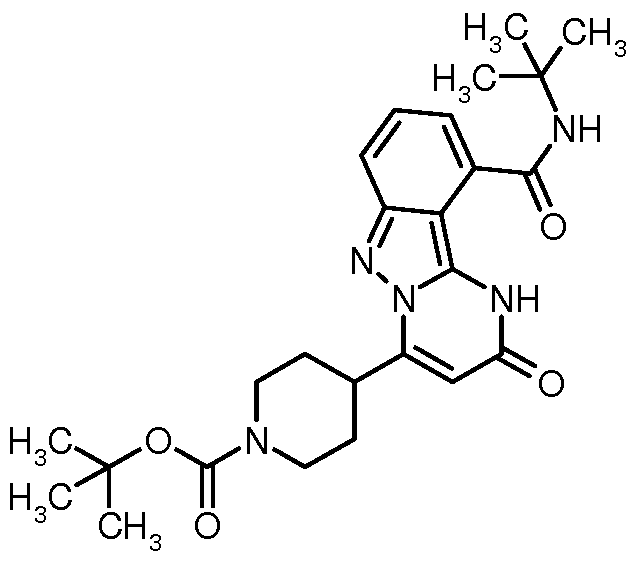
LC-MS (Method 2): Rt = 3.59 min; MS (ESIpos): m/z = 468 [M+H]+ Example 82A
tert-butyl 4-{10-[(4-fluorophenyl)carbamoyl]-2-oxo-l,2-dihydropyrimido[l,2-b]indazol-4- yljpiperidine- 1 -carboxylate

LC-MS (Method 1): Rt = 1.12 min; MS (ESIpos): m/z = 506 [M+H]+ Example 83A
tert-butyl 4-{10-[(2-methylpyridin-3-yl)carbamoyl]-2-oxo-l,2-dihydropyrimido[l,2-b]indazol-4- yljpiperidine- 1 -carboxylate

To a solution of 4-[l-(tert-butoxycarbonyl)piperidin-4-yl]-2-oxo-l,2-dihydropyrimido[l,2-b]indazole- 10-carboxylic acid (150 mg, 364 μιηοΐ) and 2-methylpyridin-3-amine (59.0 mg, 546 μιηοΐ) in N,N- Dimethylformamide (4.6 ml, 60 mmol) was added N,N-Diisopropylethylamine (190 μΐ, 1.1 mmol). After addition of l-[Bis(dimethylamino)methylene]-lH-l,2,3-triazolo[4,5-b]pyridinium 3-oxid hexafluorophosphate (166 mg, 436 μιηοΐ) the reaction mixture was stirred at RT for 16 h. Water was added and the resulting precipitate was filtered off. The filtrate was dried in vacuo and the resulting residue filtered and washed with water. Drying in vacuo afforded the product. The obtained amout was 114 mg (97 % purity, 60 % of theory).
LC-MS (Method 1): Rt = 0.81 min; MS (ESIpos): m/z = 503 [M+H]+
Example 84A
tert-butyl 4-{10-[(3-methylphenyl)carbamoyl]-2-oxo-l,2-dihydropyrimido[l,2-b]indazol-4- yljpiperidine- 1 -carboxylate

To a solution of 4-[l-(tert-butoxycarbonyl)piperidin-4-yl]-2-oxo-l,2-dihydropyrimido[l,2-b]indazole- 10-carboxylic acid (150 mg, 364 μιηοΐ) and 3-methylaniline (59 μΐ, 550 μmol) in N,N- Dimethylformamide (4.6 ml, 60 mmol) was added N,N-Diisopropylethylamine (190 μΐ, 1.1 mmol). After addition of l-[Bis(dimethylamino)methylene]-lH-l,2,3-triazolo[4,5-b]pyridinium 3-oxid hexafluorophosphate (166 mg, 436 μιηοΐ) the reaction mixture was stirred at RT for 16 h. Water was added and the resulting precipitate was filtered off. The filtrate was dried in vacuo and the resulting residue filtered and washed with water. Drying in vacuo afforded the product. The obtained amout was 98.9 mg (97 % purity, 53 % of theory).
LC-MS (Method 1): Rt = 1.16 min; MS (ESIpos): m/z = 502 [M+H]+ Example 85A
tert-butyl 4-{10-[(cyclohexylmethyl)carbamoyl]-2-oxo-l,2-dihydropyrimido[l,2-b]indazol-4- yljpiperidine- 1 -carboxylate

LC-MS (Method 1): Rt = 1.24 min; MS (ESIpos): m/z = 508 [M+H]+
Example 86A
tert-butyl 4-{10-[(4-fluorobenzyl)carbamoyl]-2-oxo-l,2-dihydropyrimido[l,2-b]indazol-4- yljpiperidine- 1 -carboxylate

To a solution of 4-[l-(tert-butoxycarbonyl)piperidin-4-yl]-2-oxo-l,2-dihydropyrimido[l,2-b]indazole- 10-carboxylic acid (150 mg, 364 μιηοΐ) and l-(4-fluorophenyl)methanamine (62 μΐ, 550 μιηοΐ) in Ν,Ν- Dimethylformamide (4.6 ml, 60 mmol) was added N,N-Diisopropylethylamine (190 μΐ, 1.1 mmol). After addition of l-[Bis(dimethylamino)methylene]-lH-l,2,3-triazolo[4,5-b]pyridinium 3-oxid hexafluorophosphate (166 mg, 436 μιηοΐ) the reaction mixture was stirred at RT for 16 h. Another 0.5 equivalents of l-[Bis(dimethylamino)methylene]-lH-l,2,3-triazolo[4,5-b]pyridinium 3-oxid hexafluorophosphate were added and the mixture was stirred at RT for 24h. Water was added and the aqueous phase was extracted with ethyl acetate. The organic phase was washed with water. Drying over sodium sulfate and concentration in vacuo afforded a crude mixture. Filtration of the precipitate afforded the title compound after drying in vacuo. The obtained amout was 115 mg (91 % purity, 55 % of theory).
LC-MS (Method 1): Rt = 1.15 min; MS (ESIneg): m/z
Example 87A
tert-butyl 4-[2-oxo-10-(piperidin-l-ylcarbonyl)-l,2-dihydropyrimido[l,2-b]indazol-4- yljpiperidine- 1 -carboxylate

To a solution of 4-[l-(tert-butoxycarbonyl)piperidin-4-yl]-2-oxo-l,2-dihydropyrimido[l,2-b]indazole- 10-carboxylic acid (150 mg, 364 μιηοΐ) and piperidine (54 μΐ, 550 μmol) in N,N-Dimethylformamide (4.6 ml, 60 mmol) was added N,N-Diisopropylethylamine (190 μΐ, 1.1 mmol). After addition of 1- [Bis(dimethylamino)methylene]-lH-l,2,3-triazolo[4,5-b]pyridinium 3-oxid hexafluorophosphate (138 mg, 364 μιηοΐ) the reaction mixture was stirred at RT for 16 h. Another 0.5 equivalents of 1- [Bis(dimethylamino)methylene]-lH-l,2,3-triazolo[4,5-b]pyridinium 3-oxid hexafluorophosphate were added and the mixture was stirred at RT for 24h. The mixture was purified via reverse phase chromatography (Method: Reprosil CI 8; 10 μιη; 125x30 mm / flow: 50 ml/min / solvents: A = water (0,01% formic acid), B = Acetonitrile / gradient: 0.00-4.25 min = 20%B, 4.50min = 30%B, 19.00- 22.50min = 100%B, 22.75-25.00min = 20%B) which afforded the product after drying in vacuo. The obtained amout was 82.6 mg (100 % purity, 47 % of theory).
LC-MS (Method 1): Rt = 1.12 min; MS (ESIneg): m/z = 478
Example 88A
tert-butyl 4-{10-[(3-chlorophenyl)carbamoyl]-2-oxo-l,2-dihydropyrimido[l,2-b]indazol-4- yl}piperidine-l -carboxylate

To a solution of 4-[l-(tert-butoxycarbonyl)piperidin-4-yl]-2-oxo-l,2-dihydropyrimido[l,2-b]indazole- 10-carboxylic acid (150 mg, 364 μιηοΐ) and 3 -chloro aniline (57 μΐ, 550 μmol) in N,N- Dimethylformamide (4.6 ml, 60 mmol) was added N,N-Diisopropylethylamine (190 μΐ, 1.1 mmol). After addition of l-[Bis(dimethylamino)methylene]-lH-l,2,3-triazolo[4,5-b]pyridinium 3-oxid hexafluorophosphate (166 mg, 436 μmol) the reaction mixture was stirred at RT for 16 h. Water was added and the resulting precipitate was filtered off. The filtrate was dried in vacuo and the resulting residue filtered and washed with water. Drying in vacuo afforded the product. The obtained amout was 144 mg (93 % purity, 71 % of theory). LC-MS (Method 1): Rt = 1.23 min; MS (ESIneg): m/z = 520 [M-H]" Example 89A
tert-butyl 4 10-(cyclohexylcarbamoyl)-2-oxo ,2-dihydropyrimido[l,2-b]indazol-4-yl]piperidine- 1-carboxylate

To a solution of 4-[l-(tert-butoxycarbonyl)piperidin-4-yl]-2-oxo-l,2-dihydropyrimido[l,2-b]indazole- 10-carboxylic acid (150 mg, 364 μιηοΐ) and cyclohexanamine (63 μΐ, 550 μιηοΐ) in Ν,Ν- Dimethylformamide (4.6 ml, 60 mmol) was added N,N-Diisopropylethylamine (190 μΐ, 1.1 mmol). After addition of l-[Bis(dimethylamino)methylene]-lH-l,2,3-triazolo[4,5-b]pyridinium 3-oxid hexafluorophosphate the reaction mixture was stirred at RT for 16 h. Another 0.5 equivalents of 1- [Bis(dimethylamino)methylene]-lH-l,2,3-triazolo[4,5-b]pyridinium 3-oxid hexafluorophosphate (138
mg, 364 μιηοΐ) were added and the mixture was stirred at RT for 24h. Water was added and the resulting precipitate was filtered off. The filtrate was dried in vacuo and the resulting residue filtered and washed with water. Drying in vacuo afforded the product. The obtained amout was 155 mg (97 % purity, 84 % of theory). LC-MS (Method 1): Rt = 1.22 min; MS (ESIneg): m/z = 492 [M-H]" Example 90A
tert-butyl 4 10-(cyclopentylcarbamoyl)-2-oxo-l,2-dihydropyrimido[l,2-b]indazol-4-yl]piperidine- 1-carboxylate

To a solution of 4-[l-(tert-butoxycarbonyl)piperidin-4-yl]-2-oxo-l,2-dihydropyrimido[l,2-b]indazole- 10-carboxylic acid (150 mg, 364 μιηοΐ) and cyclopentanamine (54 μΐ, 550 μιηοΐ) in Ν,Ν- Dimethylformamide (4.6 ml, 60 mmol) was added N,N-Diisopropylethylamine (190 μΐ, 1.1 mmol). After addition of l-[Bis(dimethylamino)methylene]-lH-l,2,3-triazolo[4,5-b]pyridinium 3-oxid hexafluorophosphate (138 mg, 364 μιηοΐ) the reaction mixture was stirred at RT for 16 h. Another 0.5 equivalents of l-[Bis(dimethylamino)methylene]-lH-l,2,3-triazolo[4,5-b]pyridinium 3-oxid hexafluorophosphate were added and the mixture was stirred at RT for 24h. Water was added and the resulting precipitate was filtered off. The filtrate was dried in vacuo and the resulting residue filtered and washed with water. Drying in vacuo afforded the product. The obtained amout was 150 mg (100 % purity, 86 % of theory). LC-MS (Method 1): Rt = 1.16 min; MS (ESIpos): m/z = 480 [M+H]
Example 91A
tert-butyl 4-{10-[(3,3-difluoroazetidin-l-yl)carbonyl]-2-oxo-l,2-dihydropyrimido[l,2-b]indazol-4- yljpiperidine- 1 -carboxylate

To a solution of 4-[l-(tert-butoxycarbonyl)piperidin-4-yl]-2-oxo-l,2-dihydropyrimido[l,2-b]indazole- 10-carboxylic acid (150 mg, 364 μιηοΐ) and 3,3-difluoroazetidine hydrochloride (1 : 1) (39 μΐ, 550 μιηοΐ) in N,N-Dimethylformamide (4.6 ml, 60 mmol) was added N,N-Diisopropylethylamine (190 μΐ, 1.1 mmol). After addition of l-[Bis(dimethylamino)methylene]-lH-l,2,3-triazolo[4,5-b]pyridinium 3-oxid hexafluorophosphate the reaction mixture was stirred at RT for 16 h. Another 0.9 equivalents of 1- [Bis(dimethylamino)methylene]-lH-l,2,3-triazolo[4,5-b]pyridinium 3-oxid hexafluorophosphate (138 mg, 364 μιηοΐ) were added and the mixture was stirred at RT for 24h. Water was added and the resulting precipitate was filtered off. The filtrate was dried in vacuo and the resulting residue filtered and washed with water. Drying in vacuo afforded the product. The obtained amout was 90.0 mg (51 % of theory).
LC-MS (Method 1): Rt = 1.07 min; MS (ESIneg): m/z = 486 [M-H]"
Example 92A
tert-butyl 4-[10-(morpholin-4-ylcarbonyl)-2-oxo-l,2-dihydropyrimido[l,2-b]indazol-4- yljpiperidine- 1 -carboxylate

To a solution of 4-[l-(tert-butoxycarbonyl)piperidin-4-yl]-2-oxo-l,2-dihydropyrimido[l,2-b]indazole- 10-carboxylic acid (150 mg, 364 μιηοΐ) and morpholine (48 μΐ, 550 μιηοΐ) in N,N-Dimethylformamide (4.6 ml, 60 mmol) was added N,N-Diisopropylethylamine (190 μΐ, 1.1 mmol). After addition of 1- [Bis(dimethylamino)methylene]-lH-l,2,3-triazolo[4,5-b]pyridinium 3-oxid hexafluorophosphate (138 mg, 364 μιηοΐ) the reaction mixture was stirred at RT for 16 h. Another 0.5 equivalents of 1- [Bis(dimethylamino)methylene]-lH-l,2,3-triazolo[4,5-b]pyridinium 3-oxid hexafluorophosphate were
added and the mixture was stirred at RT for 24h. Another 0.5 equivalents of 1- [Bis(dimethylamino)methylene]-lH-l,2,3-triazolo[4,5-b]pyridinium 3-oxid hexafluorophosphate were added and the mixture was stirred at RT for 24h. The mixture was purified via reverse phase chromatography (Method: Reprosil CI 8; 10 μιη; 125x30 mm / flow: 45 ml/min / solvents: A = water (0,01% formic acid), B = Acetonitrile / gradient 0.00-4.25 min = 10%B, 4.50min = 20%B, 15.50min = 85%B, 16.00-18.50min = 100%B, 18.75.00-22.00min = 20%B) which afforded the product after drying in vacuo. The obtained amout was 71.0 mg (100 % purity, 41 % of theory).
LC-MS (Method 1): Rt = 0.95 min; MS (ESIneg): m/z = 480 [M-H]"
Example 93A
tert-butyl 4 10-(dimethylcarbamoyl)-2-oxo-l,2-dihydropyrimido[l,2-b]indazol-4-yl]piperidine carboxylate

To a solution of 4-[l-(tert-butoxycarbonyl)piperidin-4-yl]-2-oxo-l,2-dihydropyrimido[l,2-b]indazole- 10-carboxylic acid (150 mg, 364 μιηοΐ) and N-methylmethanamine (270 μΐ, 2.0 M, 550 μιηοΐ) in N,N- Dimethylformamide (4.6 ml, 60 mmol) was added N,N-Diisopropylethylamine (190 μΐ, 1.1 mmol). After addition of l-[Bis(dimethylamino)methylene]-lH-l,2,3-triazolo[4,5-b]pyridinium 3-oxid hexafluorophosphate (138 mg, 364 μιηοΐ) the reaction mixture was stirred at RT for 16 h. Another 0.7 equivalents of l-[Bis(dimethylamino)methylene]-lH-l,2,3-triazolo[4,5-b]pyridinium 3-oxid hexafluorophosphate were added and the mixture was stirred at RT for 24h. Another 0.5 equivalents of l-[Bis(dimethylamino)methylene]-lH-l,2,3-triazolo[4,5-b]pyridinium 3-oxid hexafluorophosphate were added and the mixture was stirred at RT for 24h. The mixture was purified via reverse phase chromatography (Method: Reprosil CI 8; 10 μιη; 125x30 mm / flow: 45 ml/min / solvents: A = water (0,01% formic acid), B = Acetonitrile / gradient 0.00-4.25 min = 10%B, 4.50min = 20%B, 15.50min = 85%B, 16.00-18.50min = 100%B, 18.75.00-22.00min = 20%B) which afforded the product after drying in vacuo. The obtained amout was 120 mg (96 % purity, 72 % of theory).
LC-MS (Method 1): Rt = 0.97 min; MS (ESIneg): m/z = 438
Example 94A
tert-butyl 4-[2-oxo-10-(pyrrolidin-l-ylcarbonyl)-l,2-dihydropyrimido[l,2-b]indazol-4- yljpiperidine- 1 -carboxylate

To a solution of 4-[l-(tert-butoxycarbonyl)piperidin-4-yl]-2-oxo-l,2-dihydropyrimido[l,2-b]indazole- 10-carboxylic acid (130 mg, 315 μιηοΐ) and pyrrolidine (39 μΐ, 470 μιηοΐ) in N,N-Dimethylformamide (4.0 ml, 52 mmol) was added N,N-Diisopropylethylamine (160 μΐ, 950 μmol). After addition of 1- [Bis(dimethylamino)methylene] - 1H- l,2,3-triazolo[4,5-b]pyridinium 3-oxid hexafluorophosphate (180 mg, 473 μmol) the reaction mixture was stirred at RT for 16 h. The mixture was purified via reverse phase chromatography (Method: Reprosil C18; 10 μιη; 125x30 mm / flow: 50 ml/min / solvents: A = water (0,01% formic acid), B = Acetonitrile / gradient: 0.00-4.25 min = 20%B, 4.50min = 30%B, 19.00- 22.50min = 100%B, 22.75-25.00min = 20%B) which afforded the product after drying in vacuo. The obtained amout was 76.6 mg (92 % purity, 48 % of theory).
LC-MS (Method 1): Rt = 1.02 min; MS (ESIpos): m/z = 466 [M+H]+ Example 95 A
tert-butyl 4-[2-oxo-10-(tetrahydro-2H-pyran-4-ylcarbamoyl)-l,2-dihydropyrimido[l,2-b]indazol- 4-yl] piperidine- 1 -carboxylate

To a solution of 4-[l-(tert-butoxycarbonyl)piperidin-4-yl]-2-oxo-l,2-dihydropyrimido[l,2-b]indazole- 10-carboxylic acid (145 mg, 352 μιηοΐ) and tetrahydro-2H-pyran-4-amine (55 μΐ, 530 μιηοΐ) in Ν,Ν- Dimethylformamide (4.5 ml, 58 mmol) was added N,N-Diisopropylethylamine (180 μΐ, 1.1 mmol).
After addition of l-[Bis(dimethylamino)methylene]-lH-l,23-triazolo[4,5-b]pyridinium 3-oxid hexafluorophosphate (201 mg, 527 μιηοΐ) the reaction mixture was stirred at RT for 16 h. Water was added and the resulting precipitate was filtered off. The filtrate was dried in vacuo and the resulting residue filtered and washed with water. Drying in vacuo afforded the product. The obtained amout was 67.7 mg (99 % purity, 38 % of theory).
LC-MS (Method 1): Rt = 0.99 min; MS (ESIneg): m/z = 494 [M-H]" Example 96A
tert-butyl 4-{10-[(2-methylpropyl)carbamoyl]-2-oxo-l,2-dihydropyrimido[l,2-b]indazol-4- yljpiperidine- 1 -carboxylate

To a solution of 4-[l-(tert-butoxycarbonyl)piperidin-4-yl]-2-oxo-l,2-dihydropyrimido[l,2-b]indazole- 10-carboxylic acid (142 mg, 344 μιηοΐ) and 2-methylpropan-l -amine (51 μΐ, 520 μιηοΐ) in Ν,Ν- Dimethylformamide (4.4 ml, 57 mmol) was added N,N-Diisopropylethylamine (180 μΐ, 1.0 mmol). After addition of l-[Bis(dimethylamino)methylene]-lH-l,2,3-triazolo[4,5-b]pyridinium 3-oxid hexafluorophosphate (196 mg, 516 μιηοΐ) the reaction mixture was stirred at RT for 16 h. Water was added and the resulting precipitate was filtered off. The filtrate was dried in vacuo and the resulting residue filtered and washed with water. Drying in vacuo afforded the product. The obtained amout was 106 mg (100 % purity, 66 % of theory).
LC-MS (Method 1): Rt = 1.14 min; MS (ESIpos): m/z = 468 [M+H]+ Example 97 A
tert-butyl 4 2-oxo-10-(propan-2-ylcarbamoyl)-l,2-dihydropyrimido[l,2-b]indazol-4-yl]piperidine- 1 -carboxylate

To a solution of 4-[l-(tert-butoxycarbonyl)piperidin-4-yl]-2-oxo-l,2-dihydropyrimido[l,2-b]indazole- 10-carboxylic acid (147 mg, 356 μιηοΐ) and prop an- 2 -amine in N,N-Dimethylformamide (4.5 ml, 59 mmol) was added N,N-Diisopropylethylamine (190 μΐ, 1.1 mmol). After addition of 1- [Bis(dimethylamino)methylene]-lH-l,2,3-triazolo[4,5-b]pyridinium 3-oxid hexafluorophosphate (203 mg, 535 μιηοΐ) the reaction mixture was stirred at RT for 16 h. Water was added and the resulting precipitate was filtered off. The filtrate was dried in vacuo and the resulting residue filtered and washed with water. Drying in vacuo afforded the product. The obtained amout was 111 mg (100 % purity, 69 % of theory). LC-MS (Method 1): Rt = 1.08 min; MS (ESIneg): m/z = 452 [M-H]" Example 98A
tert-butyl 4-{2-oxo-10 (2,2,2 rifluoroethyl)carbamoyl]-l,2-dihydropyrimido[l,2-b]indazol-4- yljpiperidine- 1 -carboxylate

To a solution of 4-[l-(tert-butoxycarbonyl)piperidin-4-yl]-2-oxo-l,2-dihydropyrimido[l,2-b]indazole- 10-carboxylic acid (144 mg, 349 μιηοΐ) and 2,2,2-trifluoroethanamine hydrochloride (1: 1) (71.0 mg, 524 μιηοΐ) in N,N-Dimethylformamide (4.4 ml, 58 mmol) was added N,N-Diisopropylethylamine (180 μΐ, 1.0 mmol). After addition of l-[Bis(dimethylamino)methylene]-lH-l,2,3-triazolo[4,5-b]pyridinium 3- oxid hexafluorophosphate (199 mg, 524 μιηοΐ) the reaction mixture was stirred at RT for 16 h. Water was added and the resulting precipitate was filtered off. The filtrate was dried in vacuo and the resulting
residue filtered and washed with water. Drying in vacuo afforded the product. The obtained amout was 67.2 mg (98 % purity, 38 % of theory).
LC-MS (Method 1): Rt = 1.07 min; MS (ESIpos): m/z = 494 [M+H]+
Example 99A
tert-butyl 4 10-(ethylcarbamoyl)-2-oxo-l,2-dihydropyrimido[l,2-b]indazol-4-yl]piperidine-l- carboxylate

To a solution of 4-[l-(tert-butoxycarbonyl)piperidin-4-yl]-2-oxo-l,2-dihydropyrimido[l,2-b]indazole- 10-carboxylic acid (100 mg, 242 μιηοΐ) and ethanamine (180 μΐ, 2.0 M in THF, 360 μιηοΐ) in N,N- Dimethylformamide (3.1 ml, 40 mmol) was added N,N-Diisopropylethylamine (130 μΐ, 730 μιηοΐ). After addition of l-[Bis(dimethylamino)methylene]-lH-l,2,3-triazolo[4,5-b]pyridinium 3-oxid hexafluorophosphate (138 mg, 364 μιηοΐ) the reaction mixture was stirred at RT for 16 h. Another 0.5 equivalents of l-[Bis(dimethylamino)methylene]-lH-l,2,3-triazolo[4,5-b]pyridinium 3-oxid hexafluorophosphate and another 0.5 equivalents of ethanamine were added and the mixture was stirred at RT for lh. Water was added and the resulting precipitate was filtered off and washed with water. The residue was purified via reverse phase chromatography (Method: Reprosil C18; 10 μιη; 125x30 mm / flow: 45 ml/min / solvents: A = water (0,01% formic acid), B = Acetonitrile / gradient 0.00-4.25 min = 10%B, 4.50min = 20%B, 15.50min = 85%B, 16.00-18.50min = 100%B, 18.75.00-22.00min = 20%B) which afforded the product after drying in vacuo. The obtained amout was 33.4 mg (100 % purity, 31 % of theory).
LC-MS (Method 1): Rt = 0.97 min; MS (ESIneg): m/z = 438 [M-H]"
Example 100A
tert-butyl 4-{10 (2,6-dimethylpyridin-3-yl)ainino]-2-oxo-l,2-dihydropyrimido[l,2-b]indazol-4- yljpiperidine- 1 -carboxylate

Under argon, tert-butyl 4-(10-bromo-2-oxo-l,2-dihydropyrimido[l,2-b]indazol-4-yl)piperidine-l- carboxylate (150 mg, 335 μιηοΐ), 2,6-dimethylpyridin-3-amine (102 mg, 838 μιηοΐ), Tripotassium phosphate (99.6 mg, 469 μιηοΐ), tBuBrettPhos (9.75 mg, 20.1 μιηοΐ), and tBuBrettPhos Pd G3 (17.2 mg, 20.1 μιηοΐ) were dissolved in tert-Butanol (3.0 ml, 31 mmol). The mixture was stirred at 95 °C for 16 h and then purified via reverse phase chromatography (Method: Reprosil C18; 10 μιη; 125x30 mm / flow: 45 ml/min / solvents: A = water (0,01% formic acid), B = Acetonitrile / gradient 0.00-4.25 min = 10%B, 4.50min = 20%B, 15.50min = 85%B, 16.00-18.50min = 100%B, 18.75.00-22.00min = 20%B) which afforded the product after drying in vacuo. The obtained amout was 85 mg (60 % purity, 31 % of theory).
LC-MS (Method 1): Rt = 0.79 min; MS (ESIpos): m/z = 489 [M+H]+
Example 101A
tert-butyl 4-{10 (4-methylpyrimidin-2-yl)ainino]-2-oxo-l,2-dihydropyrimido[l,2-b]indazol-4 yljpiperidine- 1 -carboxylate

Under argon, tert-butyl 4-(10-bromo-2-oxo-l,2-dihydropyrimido[l,2-b]indazol-4-yl)piperidine-l- carboxylate (150 mg, 335 μιηοΐ), 4-methylpyrimidin-2-amine (91.5 mg, 838 μιηοΐ), Tripotassium phosphate (99.6 mg, 469 μιηοΐ), tBuBrettPhos (9.75 mg, 20.1 μιηοΐ), and tBuBrettPhos Pd G3 (17.2 mg, 20.1 μιηοΐ) were dissolved in tert-Butanol (3.0 ml, 31 mmol). The mixture was stirred at 95 °C for 16 h and then purified via reverse phase chromatography (Method: Reprosil C18; 10 μιη; 125x30 mm / flow: 45 ml/min / solvents: A = water (0,01% formic acid), B = Acetonitrile / gradient 0.00-4.25 min =
10%B, 4.50min = 20%B, 15.50min = 85%B, 16.00-18.50min = 100%B, 18.75.00-22.00min = 20%B) which afforded the product after drying in vacuo. The obtained amout was 141 mg (100 % purity, 88 % of theory).
LC-MS (Method 1): Rt = 1.28 min; MS (ESIpos): m/z = 476 [M+H]+ Example 102A
tert-butyl 4-[2-oxo-10-(pyrimidin-2-ylamino)-l,2-dihydropyrimM
1-carboxylate

Under argon, tert-butyl 4-(10-bromo-2-oxo-l,2-dihydropyrimido[l,2-b]indazol-4-yl)piperidine-l- carboxylate (150 mg, 335 μιηοΐ), pyrimidin-2-amine (79.7 mg, 838 μιηοΐ), Tripotassium phosphate (99.6 mg, 469 μιηοΐ), tBuBrettPhos (9.75 mg, 20.1 μιηοΐ), and tBuBrettPhos Pd G3 (17.2 mg, 20.1 μιηοΐ) were dissolved in tert-Butanol (3.0 ml, 31 mmol). The mixture was stirred at 95 °C for 16 h and then purified via reverse phase chromatography (Method: Reprosil C18; 10 μιη; 125x30 mm / flow: 45 ml/min / solvents: A = water (0,01% formic acid), B = Acetonitrile / gradient 0.00-4.25 min = 10%B, 4.50min = 20%B, 15.50min = 85%B, 16.00- 18.50min = 100%B, 18.75.00-22.00min = 20%B) which afforded the product after drying in vacuo. The obtained amout was 126 mg (100 % purity, 81 % of theory).
LC-MS (Method 1): Rt = 1.16 min; MS (ESIpos): m/z = 462 [M+H]+
Example 103A
tert-butyl 4-{10-[(3-methylpyridin-2-yl)amino]-2-oxo-l,2-dihydropyrimido[l,2-b]indazol-4- yljpiperidine- 1 -carboxylate

Under argon, tert-butyl 4-(10-bromo-2-oxo-l,2-dihydropyrimido[l,2-b]indazol-4-yl)piperidine-l- carboxylate (150 mg, 335 μιηοΐ), 3-methylpyridin-2-amine (84 μΐ, 840 μmol), Tripotassium phosphate (99.6 mg, 469 μιηοΐ), tBuBrettPhos (9.75 mg, 20.1 μιηοΐ), and tBuBrettPhos Pd G3 (17.2 mg, 20.1 μιηοΐ) were dissolved in tert-Butanol (3.0 ml, 31 mmol). The mixture was stirred at 95 °C for 16 h and then purified via reverse phase chromatography (Method: Reprosil C18; 10 μιη; 125x30 mm / flow: 50 ml/min / solvents: A = water (0,01% formic acid), B = Acetonitrile / gradient 0.00-4.25 min = 20%B, 4.50min = 30%B, 19.00-22.50min = 100%B, 22.75-25.00min = 20%B) which afforded the product after drying in vacuo. The obtained amout was 81 mg (100 % purity, 51 % of theory). LC-MS (Method 1): Rt = 1.01 min; MS (ESIpos): m/z = 475 [M+H]+ Example 104A
tert-butyl 4-{10 (3-cyanopyridin-2-yl)ainino]-2-oxo-l,2-dihyclropyrimiclo[l,2-b]inclazol-4- yljpiperid ine- 1 -carboxylate

Under argon, tert-butyl 4-(10-bromo-2-oxo-l,2-dihydropyrimido[l,2-b]indazol-4-yl)piperidine-l- carboxylate (150 mg, 335 μιηοΐ), 2-aminopyridine-3-carbonitrile (99.9 mg, 838 μιηοΐ), Tripotassium phosphate (99.6 mg, 469 μιηοΐ), tBuBrettPhos (9.75 mg, 20.1 μιηοΐ), and tBuBrettPhos Pd G3 (17.2 mg, 20.1 μιηοΐ) were dissolved in tert-Butanol (3.0 ml, 31 mmol). The mixture was stirred at 95 °C for 16 h and then purified via reverse phase chromatography (Method: Reprosil C18; 10 μιη; 125x30 mm / flow: 50 ml/min / solvents: A = water (0,01% formic acid), B = Acetonitrile / gradient 0.00-4.25 min =
20%B, 4.50min = 30%B, 19.00-22.50min = 100%B, 22.75-25.00min = 20%B) which afforded the product after drying in vacuo. The obtained amout was 65 mg (100 % purity, 40 % of theory).
LC-MS (Method 1): Rt = 1.24 min; MS (ESIpos): m/z = 486 [M+H]+
Example 105A
tert-butyl 4-{10 (3-fluoropyridin-2-yl)ainino]-2-oxo-l,2-dihydropyrimido[l,2-b]indazol-4- yljpiperidine- 1 -carboxylate

Under argon, tert-butyl 4-(10-bromo-2-oxo-l,2-dihydropyrimido[l,2-b]indazol-4-yl)piperidine-l- carboxylate (150 mg, 335 μιηοΐ), 3-fluoropyridin-2-amine (94.0 mg, 838 μιηοΐ), Tripotassium phosphate (99.6 mg, 469 μιηοΐ), tBuBrettPhos (9.75 mg, 20.1 μιηοΐ), and tBuBrettPhos Pd G3 (17.2 mg, 20.1 μιηοΐ) were dissolved in tert-Butanol (3.0 ml, 31 mmol). The mixture was stirred at 95 °C for 16 h and then purified via reverse phase chromatography (Method: Reprosil C18; 10 μιη; 125x30 mm / flow: 50 ml/min / solvents: A = water (0,01% formic acid), B = Acetonitrile / gradient 0.00-4.25 min = 20%B, 4.50min = 30%B, 19.00-22.50min = 100%B, 22.75-25.00min = 20%B) which afforded the product after drying in vacuo. The obtained amout was 114 mg (100 % purity, 71 % of theory).
LC-MS (Method 1): Rt = 1.20 min; MS (ESIpos): m/z = 479 [M+H]+ Example 106A
tert-butyl 4-{10-[(3,5-difluoropyridin-2-yl)amino]-2-oxo-l,2-dihydropyrimido[l,2-b]indazol-4- yljpiperidine- 1 -carboxylate

LC-MS (Method 1): Rt = 1.28 min; MS (ESIpos): m/z = 497 [M+H]+ Example 107A
tert-butyl 4-{10 (6-methylpyridin-2-yl)amino]-2-oxo-l,2-dihydropyrimido[l,2-b]indazol-4- yljpiperidine- 1 -carboxylate

Under argon, tert-butyl 4-(10-bromo-2-oxo-l,2-dihydropyrimido[l,2-b]indazol-4-yl)piperidine-l- carboxylate (150 mg, 335 μιηοΐ), 6-methylpyridin-2-amine (90.7 mg, 838 μιηοΐ), Tripotassium phosphate (99.6 mg, 469 μιηοΐ), tBuBrettPhos (9.75 mg, 20.1 μιηοΐ), and tBuBrettPhos Pd G3 (17.2 mg, 20.1 μιηοΐ) were dissolved in tert-Butanol (3.0 ml, 31 mmol). The mixture was stirred at 95 °C for 16 h and then purified via reverse phase chromatography (Method: Reprosil C18; 10 μιη; 125x30 mm / flow: 45 ml/min / solvents: A = water (0,01% formic acid), B = Acetonitrile / gradient 0.00-4.25 min = 10%B, 4.50min = 20%B, 15.50min = 85%B, 16.00-18.50min = 100%B, 18.75.00-22.00min = 20%B) which afforded the product after drying in vacuo. The obtained amout was 107 mg (100 % purity, 67 % of theory).
LC-MS (Method 1): Rt = 0.95 min; MS (ESIpos): m/z = 475 [M+H]+
Example 108A
tert-butyl 4-{10-[(4,6-dimethylpyridin-2-yl)ainino]-2-oxo-l,2-dm^
yljpiperidine- 1 -carboxylate

Under argon, tert-butyl 4-(10-bromo-2-oxo-l,2-dihydropyrimido[l,2-b]indazol-4-yl)piperidine-l- carboxylate (200 mg, 447 μιηοΐ), 4,6-dimethylpyridin-2-amine (137 mg, 1.12 mmol), Tripotassium phosphate (133 mg, 626 μιηοΐ), tBuBrettPhos (13.0 mg, 26.8 μιηοΐ), and tBuBrettPhos Pd G3 (22.9 mg, 26.8 μιηοΐ) were dissolved in tert-Butanol (3.0 ml, 31 mmol). The mixture was stirred at 95 °C for 16 h and then purified via reverse phase chromatography (Method: Reprosil C18; 10 μιη; 125x30 mm / flow: 50 ml/min / solvents: A = water (0,01% formic acid), B = Acetonitrile / gradient 0.00-4.25 min = 10%B, 4.50min = 20%B, 15.50min = 85%B, 16.00- 18.50min = 100%B, 18.75.00-22.00min = 20%B) which afforded the product after drying in vacuo. The obtained amout was 1197 mg (100 % purity, 90 % of theory).
LC-MS (Method 1): Rt = 0.88 min; MS (ESIpos): m/z = 489 [M+H]+ Example 109A
tert-butyl 4-{10 (5-fluoropyridin-2-yl)amino]-2-oxo-l,2-dihydropyrimido[l,2-b]indazol-4- yljpiperidine- 1 -carboxylate

Under argon, tert-butyl 4-(10-bromo-2-oxo-l,2-dihydropyrimido[l,2-b]indazol-4-yl)piperidine-l- carboxylate (200 mg, 447 μιηοΐ), 5-fluoropyridin-2-amine (125 mg, 1.12 mmol), Tripotassium
phosphate (133 mg, 626 μιηοΐ), tBuBrettPhos (13.0 mg, 26.8 μιηοΐ), and tBuBrettPhos Pd G3 (22.9 mg, 26.8 μιηοΐ) were dissolved in tert-Butanol (3.0 ml, 31 mmol). The mixture was stirred at 95 °C for 16 h and then purified via reverse phase chromatography (Method: Reprosil C18; 10 μιη; 125x30 mm / flow: 50 ml/min / solvents: A = water (0,01% formic acid), B = Acetonitrile / gradient : 0.00-4.25 min = 20%B, 4.50min = 30%B, 19.00-22.50min = 100%B, 22.75-25.00min = 20%B) which afforded the product after drying in vacuo. The obtained amout was 166 mg (100 % purity, 77 % of theory).
LC-MS (Method 1): Rt = 1.14 min; MS (ESIpos): m/z = 479 [M+H]+
Example 110A
tert-butyl 4-{10 (2-methoxybenzoyl)amino]-2-oxo-l,2-dihydropyrimido[l,2-b]indazol-4- yl}piperidine-l-carboxylate

Under argon, tert-butyl 4-(10-bromo-2-oxo-l,2-dihydropyrimido[l,2-b]indazol-4-yl)piperidine-l- carboxylate (200 mg, 447 μιηοΐ), 2-methoxybenzamide (169 mg, 1.12 mmol), Tripotassium phosphate (133 mg, 626 μιηοΐ), tBuBrettPhos (13.0 mg, 26.8 μιηοΐ), and tBuBrettPhos Pd G3 (22.9 mg, 26.8 μιηοΐ) were dissolved in l-Methoxy-2-propanol (5.0 ml, 52 mmol). The mixture was stirred at 110 °C for 16 h and then purified via reverse phase chromatography (Method: Reprosil CI 8; 10 μιη; 125x30 mm / flow: 50 ml/min / solvents: A = water (0,01% formic acid), B = Acetonitrile / gradient : 0.00-4.25 min = 20%B, 4.50min = 30%B, 19.00-22.50min = 100%B, 22.75-25.00min = 20%B) which afforded the product after drying in vacuo. The obtained amout was 130 mg (56 % of theory). LC-MS (Method 1): Rt = 1.15 min; MS (ESIpos): m/z = 518 [M+H]+
Example 111A
tert-butyl 4-(2-oxo-10-{[4-(trifluoromethoxy)benzoyl]amino}-l,2-dihydropyrimido[l,2-b]indazol- 4-yl)piperidine-l-carboxylate

Under argon, tert-butyl 4-(10-bromo-2-oxo-l,2-dihydropyrimido[l,2-b]indazol-4-yl)piperidine-l- carboxylate (200 mg, 447 μιηοΐ), 4-(trifluoromethoxy)benzamide (229 mg, 1.12 mmol), Tripotassium phosphate (133 mg, 626 μιηοΐ), tBuBrettPhos (13.0 mg, 26.8 μιηοΐ), and tBuBrettPhos Pd G3 (22.9 mg, 26.8 μιηοΐ) were dissolved in l-Methoxy-2-propanol (5.0 ml, 52 mmol). The mixture was stirred at 110 °C for 16 h and then purified via reverse phase chromatography (Method: Reprosil CI 8; 10 μιη; 125x30 mm / flow: 50 ml/min / solvents: A = water (0,01% formic acid), B = Acetonitrile / gradient : 0.00-4.25 min = 20%B, 4.50min = 30%B, 19.00-22.50min = 100%B, 22.75-25.00min = 20%B) which afforded the product after drying in vacuo. The obtained amout was 154 mg (60 % of theory). LC-MS (Method 1): Rt = 1.20 min; MS (ESIpos): m/z = 572 [M+H]+ Example 112A
tert-butyl 4-(2-oxo-10-{[2-(trifluoromethyl)benzoyl]ainino}-l,2-dihydropyrimido[l,2-b]indazol-4- y piperidine- 1 -carboxylate

Under argon, tert-butyl 4-(10-bromo-2-oxo-l,2-dihydropyrimido[l,2-b]indazol-4-yl)piperidine-l- carboxylate (200 mg, 447 μιηοΐ), 2-(trifluoromethyl)benzamide (211 mg, 1.12 mmol), Tripotassium phosphate (133 mg, 626 μιηοΐ), tBuBrettPhos (13.0 mg, 26.8 μιηοΐ), and tBuBrettPhos Pd G3 (22.9 mg, 26.8 μιηοΐ) were dissolved in l-Methoxy-2-propanol (5.0 ml, 52 mmol). The mixture was stirred at 110 °C for 16 h and then purified via reverse phase chromatography (Method: Reprosil CI 8; 10 μιη; 125x30 mm / flow: 50 ml/min / solvents: A = water (0,01% formic acid), B = Acetonitrile / gradient : 0.00-4.25
min = 20%B, 4.50min = 30%B, 19.00-22.50min = 100%B, 22.75-25.00min = 20%B) which afforded the product after drying in vacuo. The obtained amout was 95.0 mg (38 % of theory).
LC-MS (Method 1): Rt = 1.17 min; MS (ESIpos): m/z = 556 [M+H]+
Example 113A
tert-butyl 4-{10 (naphthalen^-ylcarbonyl)ainino]-2-oxo ,2-dihydropyrimido[l,2-b]indazol-4- yljpiperidine- 1 -carboxylate

Under argon, tert-butyl 4-(10-bromo-2-oxo-l,2-dihydropyrimido[l,2-b]indazol-4-yl)piperidine-l- carboxylate (200 mg, 447 μιηοΐ), naphthalene- 1-carboxamide (191 mg, 1.12 mmol), Tripotassium phosphate (133 mg, 626 μιηοΐ), tBuBrettPhos (13.0 mg, 26.8 μιηοΐ), and tBuBrettPhos Pd G3 (22.9 mg, 26.8 μιηοΐ) were dissolved in l-Methoxy-2-propanol (5.0 ml, 52 mmol). The mixture was stirred at 110 °C for 16 h and then purified via reverse phase chromatography (Method: Reprosil CI 8; 10 μιη; 125x30 mm / flow: 50 ml/min / solvents: A = water (0,01% formic acid), B = Acetonitrile / gradient : 0.00-4.25 min = 20%B, 4.50min = 30%B, 19.00-22.50min = 100%B, 22.75-25.00min = 20%B) which afforded the product after drying in vacuo. The obtained amout was 141 mg (59 % of theory).
LC-MS (Method 1): Rt = 1.24 min; MS (ESIpos): m/z = 538 [M+H]+
Example 114A
tert-butyl 4-{10-[(4-chlorobenzoyl)amino]-2-oxo-l,2-dihydropyrimido[l,2-b]indazol-4- yljpiperidine- 1 -carboxylate

Under argon, tert-butyl 4-(10-bromo-2-oxo-l,2-dihydropyrimido[l,2-b]indazol-4-yl)piperidine-l- carboxylate (200 mg, 447 μιηοΐ), 4-chlorobenzamide (174 mg, 1.12 mmol), Tripotassium phosphate (133 mg, 626 μιηοΐ), tBuBrettPhos (13.0 mg, 26.8 μιηοΐ), and tBuBrettPhos Pd G3 (22.9 mg, 26.8 μιηοΐ) were dissolved in l-Methoxy-2-propanol (5.0 ml, 52 mmol). The mixture was stirred at 110 °C for 16 h and then purified via reverse phase chromatography (Method: Reprosil CI 8; 10 μιη; 125x30 mm / flow: 50 ml/min / solvents: A = water (0,01% formic acid), B = Acetonitrile / gradient : 0.00-4.25 min = 20%B, 4.50min = 30%B, 19.00-22.50min = 100%B, 22.75-25.00min = 20%B) which afforded the product after drying in vacuo. The obtained amout was 83.0 mg (36 % of theory). LC-MS (Method 1): Rt = 1.25 min; MS (ESIpos): m/z = 522 [M+H]+ Example 115A
tert-butyl 4-{10 (2,6-difluorobenzoyl)ainino]-2-oxo-l,2-dihydropyrimiclo[l,2-b]inclazol-4- yljpiperidine- 1 -carboxylate

Under argon, tert-butyl 4-(10-bromo-2-oxo-l,2-dihydropyrimido[l,2-b]indazol-4-yl)piperidine-l- carboxylate (200 mg, 447 μιηοΐ), 2,6-difluorobenzamide (176 mg, 1.12 mmol), Tripotassium phosphate (133 mg, 626 μιηοΐ), tBuBrettPhos (13.0 mg, 26.8 μιηοΐ), and tBuBrettPhos Pd G3 (22.9 mg, 26.8 μιηοΐ) were dissolved in l-Methoxy-2-propanol (5.0 ml, 52 mmol). The mixture was stirred at 110 °C for 16 h and then purified via reverse phase chromatography (Method: Reprosil CI 8; 10 μιη; 125x30 mm / flow: 50 ml/min / solvents: A = water (0,01% formic acid), B = Acetonitrile / gradient : 0.00-4.25 min = 20%B, 4.50min = 30%B, 19.00-22.50min = 100%B, 22.75-25.00min = 20%B) which afforded the product after drying in vacuo. The obtained amout was 71.0 mg (30 % of theory).
LC-MS (Method 1): Rt = 1.12 min; MS (ESIpos): m/z = 524 [M+H]+ Example 116A
tert-butyl 4-{10 (2,4-difluorobenzoyl)ainino]-2-oxo ,2-dihydropyrimido[l,2-b]indazol-4- yljpiperidine- 1 -carboxylate

Under argon, tert-butyl 4-(10-bromo-2-oxo-l,2-dihydropyrimido[l,2-b]indazol-4-yl)piperidine-l- carboxylate (200 mg, 447 μιηοΐ), 2,4-difluorobenzamide (176 mg, 1.12 mmol), Tripotassium phosphate (133 mg, 626 μιηοΐ), tBuBrettPhos (13.0 mg, 26.8 μιηοΐ), and tBuBrettPhos Pd G3 (22.9 mg, 26.8 μιηοΐ) were dissolved in l-Methoxy-2-propanol (5.0 ml, 52 mmol). The mixture was stirred at 110 °C for 16 h and then purified via reverse phase chromatography (Method: Reprosil CI 8; 10 μιη; 125x30 mm / flow: 50 ml/min / solvents: A = water (0,01% formic acid), B = Acetonitrile / gradient : 0.00-4.25 min = 20%B, 4.50min = 30%B, 19.00-22.50min = 100%B, 22.75-25.00min = 20%B) which afforded the product after drying in vacuo. The obtained amout was 131 mg (100 % purity, 56 % of theory).
LC-MS (Method 1): Rt = 1.19 min; MS (ESIpos): m/z = 524 [M+H]+ Example 117A
tert-butyl 4-{2-oxo-10-[(pyrrolidin-l-ylcarbonyl)amino]-l,2-dihydropyrimido[l,2-b]indazol-4- yljpiperidine- 1 -carboxylate

Under argon, tert-butyl 4-(10-bromo-2-oxo-l,2-dihydropyrimido[l,2-b]indazol-4-yl)piperidine-l- carboxylate (200 mg, 447 μιηοΐ), pyrrolidine- 1-carboxamide (128 mg, 1.12 mmol), Tripotassium phosphate (133 mg, 626 μιηοΐ), tBuBrettPhos (13.0 mg, 26.8 μιηοΐ), and tBuBrettPhos Pd G3 (22.9 mg,
26.8 μιηοΐ) were dissolved in l-Methoxy-2-propanol (5.0 ml, 52 mmol). The mixture was stirred at 110 °C for 16 h and then purified via reverse phase chromatography (Method: Reprosil CI 8; 10 μιη; 125x30 mm / flow: 50 ml/min / solvents: A = water (0,01% formic acid), B = Acetonitrile / gradient : 0.00-4.25 min = 20%B, 4.50min = 30%B, 19.00-22.50min = 100%B, 22.75-25.00min = 20%B) which afforded the product after drying in vacuo. The obtained amout was 123 mg (57 % of theory).
LC-MS (Method 1): Rt = 1.01 min; MS (ESIpos): m/z = 481 [M+H]+
Example 118A
tert-butyl 4-{10 (furan-2-ylcarbonyl)amino]-2-oxo-l,2-dihydropyrimido[l,2-b]indazol-4- yljpiperidine- 1 -carboxylate

Under argon, tert-butyl 4-(10-bromo-2-oxo-l,2-dihydropyrimido[l,2-b]indazol-4-yl)piperidine-l- carboxylate (200 mg, 447 μιηοΐ), furan-2-carboxamide (124 mg, 1.12 mmol), Tripotassium phosphate (133 mg, 626 μιηοΐ), tBuBrettPhos (13.0 mg, 26.8 μιηοΐ), and tBuBrettPhos Pd G3 (22.9 mg, 26.8 μιηοΐ) were dissolved in l-Methoxy-2-propanol (5.0 ml, 52 mmol). The mixture was stirred at 110 °C for 16 h and then purified via reverse phase chromatography (Method: Reprosil CI 8; 10 μιη; 125x30 mm / flow: 50 ml/min / solvents: A = water (0,01% formic acid), B = Acetonitrile / gradient : 0.00-4.25 min = 20%B, 4.50min = 30%B, 19.00-22.50min = 100%B, 22.75-25.00min = 20%B) which afforded the product after drying in vacuo. The obtained amout was 44.0 mg (98 % purity, 20 % of theory).
LC-MS (Method 1): Rt = 1.09 min; MS (ESIpos): m/z = 478 [M+H]+ Example 119A
tert-butyl 4-{10-[(3-fluorobenzoyl)amino]-2-oxo-l,2-dihydropyrimido[l,2-b]indazol-4- yljpiperidine- 1 -carboxylate

Under argon, tert-butyl 4-(10-bromo-2-oxo-l,2-dihydropyrimido[l,2-b]indazol-4-yl)piperidine-l- carboxylate (200 mg, 447 μιηοΐ), 3-fluorobenzamide (156 mg, 1.12 mmol), Tripotassium phosphate (133 mg, 626 μιηοΐ), tBuBrettPhos (13.0 mg, 26.8 μιηοΐ), and tBuBrettPhos Pd G3 (22.9 mg, 26.8 μιηοΐ) were dissolved in l-Methoxy-2-propanol (5.0 ml, 52 mmol). The mixture was stirred at 110 °C for 16 h and then purified via reverse phase chromatography (Method: Reprosil CI 8; 10 μιη; 125x30 mm / flow: 50 ml/min / solvents: A = water (0,01% formic acid), B = Acetonitrile / gradient : 0.00-4.25 min = 20%B, 4.50min = 30%B, 19.00-22.50min = 100%B, 22.75-25.00min = 20%B) which afforded the product after drying in vacuo. The obtained amout was 122 mg (100 % purity, 54 % of theory). LC-MS (Method 1): Rt = 1.20 min; MS (ESIpos): m/z = 506 [M+H]+ Example 120A
tert-butyl 4-{2-oxo-10 (thiophen-3-ylcarbonyl)amino]-l,2-dihydropyrimido[l,2-b]indazol-4- yljpiperidine- 1 -carboxylate

Under argon, tert-butyl 4-(10-bromo-2-oxo-l,2-dihydropyrimido[l,2-b]indazol-4-yl)piperidine-l- carboxylate (200 mg, 447 μιηοΐ), thiophene-3-carboxamide (142 mg, 1.12 mmol), Tripotassium phosphate (133 mg, 626 μιηοΐ), tBuBrettPhos (13.0 mg, 26.8 μιηοΐ), and tBuBrettPhos Pd G3 (22.9 mg, 26.8 μιηοΐ) were dissolved in l-Methoxy-2-propanol (5.0 ml, 52 mmol). The mixture was stirred at 110 °C for 16 h and then purified via reverse phase chromatography (Method: Reprosil CI 8; 10 μιη; 125x30 mm / flow: 50 ml/min / solvents: A = water (0,01% formic acid), B = Acetonitrile / gradient : 0.00-4.25 min = 20%B, 4.50min = 30%B, 19.00-22.50min = 100%B, 22.75-25.00min = 20%B) which afforded the product after drying in vacuo. The obtained amout was 96 mg (92 % purity, 45 % of theory).
LC-MS (Method 1): Rt = 1.13 min; MS (ESIpos): m/z = 494 [M+H]+
Example 121 A
tert-butyl 4-{2-oxo-10 (propan-2-ylcarbamoyl)amino]-l,2-dihydropyrimido[l,2-b]indazol-4- yljpiperidine- 1 -carboxylate
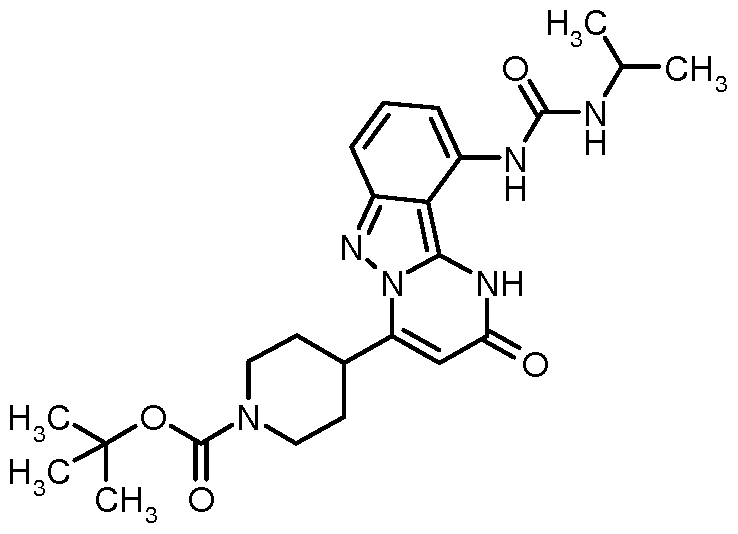
Under argon, tert-butyl 4-(10-bromo-2-oxo-l,2-dihydropyrimido[l,2-b]indazol-4-yl)piperidine-l- carboxylate (200 mg, 447 μmol), l-propan-2-ylurea (114 mg, 1.12 mmol), Tripotassium phosphate (133 mg, 626 μιηοΐ), tBuBrettPhos (13.0 mg, 26.8 μιηοΐ), and tBuBrettPhos Pd G3 (22.9 mg, 26.8 μιηοΐ) were dissolved in l-Methoxy-2-propanol (5.0 ml, 52 mmol). The mixture was stirred at 110 °C for 16 h and then purified via reverse phase chromatography (Method: Reprosil C18; 10 μιη; 125x30 mm / flow: 50 ml/min / solvents: A = water (0,01% formic acid), B = Acetonitrile / gradient : 0.00-4.25 min = 20%B, 4.50min = 30%B, 19.00-22.50min = 100%B, 22.75-25.00min = 20%B) which afforded the product after drying in vacuo. The obtained amout was 40 mg (87 % purity, 19 % of theory).
LC-MS (Method 1): Rt = 0.99 min; MS (ESIpos): m/z = 469 [M+H]
Example 122A
tert-butyl 4-{10-[(2-methylbenzoyl)amino]-2-oxo-l,2-dihydropyrimido[l,2-b]indazol-4 yljpiperidine- 1 -carboxylate

LC-MS (Method 1): Rt = 1.18 min; MS (ESIpos): m/z = 502 [M+H]+ Example 123A
tert-butyl 4-{10 (2-fluorobenzoyl)amino]-2-oxo-l,2-dihydropyrimido[l,2-b]inclazol-4- yljpiperidine- 1 -carboxylate

Under argon, tert-butyl 4-(10-bromo-2-oxo-l,2-dihydropyrimido[l,2-b]indazol-4-yl)piperidine-l- carboxylate (200 mg, 447 μιηοΐ), 2-fluorobenzamide (156 mg, 1.12 mmol), Tripotassium phosphate (133 mg, 626 μιηοΐ), tBuBrettPhos (13.0 mg, 26.8 μιηοΐ), and tBuBrettPhos Pd G3 (22.9 mg, 26.8 μιηοΐ) were dissolved in l-Methoxy-2-propanol (5.0 ml, 52 mmol). The mixture was stirred at 110 °C for 16 h and then purified via reverse phase chromatography (Method: Reprosil CI 8; 10 μιη; 125x30 mm / flow: 50 ml/min / solvents: A = water (0,01% formic acid), B = Acetonitrile / gradient : 0.00-4.25 min = 20%B, 4.50min = 30%B, 19.00-22.50min = 100%B, 22.75-25.00min = 20%B) which afforded the product after drying in vacuo. The obtained amout was 146 mg (65 % of theory).
LC-MS (Method 1): Rt = 1.16 min; MS (ESIpos): m/z = 506 [M+H]+
Example 124A
tert-butyl 4-{2-oxo^0 (pyrazin-2-ylcarbonyl)amino]-l,2-dihydropyrimido[l,2-b]indazol-4- yljpiperidine- 1 -carboxylate

Under argon, tert-butyl 4-(10-bromo-2-oxo-l,2-dihydropyrimido[l,2-b]indazol-4-yl)piperidine-l- carboxylate (200 mg, 447 μιηοΐ), pyrazine-2-carboxamide (138 mg, 1.12 mmol), Tripotassium phosphate (133 mg, 626 μιηοΐ), tBuBrettPhos (13.0 mg, 26.8 μιηοΐ), and tBuBrettPhos Pd G3 (22.9 mg, 26.8 μιηοΐ) were dissolved in l-Methoxy-2-propanol (5.0 ml, 52 mmol). The mixture was stirred at 110 °C for 16 h and then purified via reverse phase chromatography (Method: Reprosil CI 8; 10 μιη; 125x30 mm / flow: 50 ml/min / solvents: A = water (0,01% formic acid), B = Acetonitrile / gradient : 0.00-4.25 min = 20%B, 4.50min = 30%B, 19.00-22.50min = 100%B, 22.75-25.00min = 20%B) which afforded the product after drying in vacuo. The obtained amout was 105 mg (48 % of theory).
LC-MS (Method 1): Rt = 1.06 min; MS (ESIpos): m/z = 490 [M+H]+ Example 125A
tert-butyl 4-{2-oxo-10-[(pyridin-4-ylcarbonyl)amino]-l,2-dihydropyrimido[l,2-b]indazol-4- yljpiperidine- 1 -carboxylate

Under argon, tert-butyl 4-(10-bromo-2-oxo-l,2-dihydropyrimido[l,2-b]indazol-4-yl)piperidine-l- carboxylate (200 mg, 447 μιηοΐ), pyridine-4-carboxamide (137 mg, 1.12 mmol), Tripotassium phosphate (133 mg, 626 μιηοΐ), tBuBrettPhos (13.0 mg, 26.8 μιηοΐ), and tBuBrettPhos Pd G3 (22.9 mg, 26.8 μιηοΐ) were dissolved in l-Methoxy-2-propanol (5.0 ml, 52 mmol). The mixture was stirred at 110 °C for 16 h and then purified via reverse phase chromatography (Method: Reprosil CI 8; 10 μιη; 125x30 mm / flow: 50 ml/min / solvents: A = water (0,01% formic acid), B = Acetonitrile / gradient : 0.00-4.25
min = 20%B, 4.50min = 30%B, 19.00-22.50min = 100%B, 22.75-25.00min = 20%B) which afforded the product after drying in vacuo. The obtained amout was 85.0 mg (93 % purity, 36 % of theory).
LC-MS (Method 1): Rt = 1.04 min; MS (ESIpos): m/z = 489 [M+H]+
Example 126A
tert-butyl 4-{10-[(methylcarbamoyl)amino]-2-oxo-l,2-dihydropyrimido[l,2-b]indazol-4- yljpiperidine- 1 -carboxylate

Under argon, tert-butyl 4-(10-bromo-2-oxo-l,2-dihydropyrimido[l,2-b]indazol-4-yl)piperidine-l- carboxylate (200 mg, 447 μιηοΐ), 1-methylurea (82.8 mg, 1.12 mmol), Tripotassium phosphate (133 mg, 626 μιηοΐ), tBuBrettPhos (13.0 mg, 26.8 μιηοΐ), and tBuBrettPhos Pd G3 (22.9 mg, 26.8 μιηοΐ) were dissolved in l-Methoxy-2-propanol (0.9 ml, 9.0 mmol). The mixture was stirred at 110 °C for 16 h and then purified via reverse phase chromatography (Method: Reprosil C18; 10 μιη; 125x30 mm / flow: 50 ml/min / solvents: A = water (0,01% formic acid), B = Acetonitrile / gradient : 0.00-4.25 min = 20%B, 4.50min = 30%B, 19.00-22.50min = 100%B, 22.75-25.00min = 20%B) which afforded the product after drying in vacuo. The obtained amout was 108.0 mg (73 % purity, 55 % of theory).
LC-MS (Method 1): Rt = 0.90 min; MS (ESIpos): m/z = 441 [M+H]+ Example 127A
tert-butyl 4-(2-oxo-10-{[6-(trifluoromethyl)pyridin-2-yl]amino}-l,2-dihydropyrimido[l,2- b]indazol-4-yl)piperidine-l-carboxylate

Under argon, tert-butyl 4-(10-bromo-2-oxo-l,2-dihydropyrimido[l,2-b]indazol-4-yl)piperidine-l- carboxylate (200 mg, 447 μιηοΐ), 6-(trifluoromethyl)pyridin-2-amine (181 mg, 1.12 mmol), Tripotassium phosphate (133 mg, 626 μιηοΐ), tBuBrettPhos (13.0 mg, 26.8 μιηοΐ), and tBuBrettPhos Pd G3 (22.9 mg, 26.8 μιηοΐ) were dissolved in l-Methoxy-2-propanol (5.0 ml, 52 mmol). The mixture was stirred at 110 °C for 16 h and then purified via reverse phase chromatography (Method: Reprosil C18; 10 μιη; 125x30 mm / flow: 50 ml/min / solvents: A = water (0,01% formic acid), B = Acetonitrile / gradient 0.00-4.25 min = 20%B, 4.50min = 30%B, 19.00-22.50min = 100%B, 22.75-25.00min = 20%B) which afforded the product after drying in vacuo. The obtained amout was 108 mg (100 % purity, 46 % of theory).
LC-MS (Method 1): Rt = 1.28 min; MS (ESIpos): m/z = 529 [M+H]+ Example 128A
tert-butyl 4-{10-[(4-fluorobenzyl)carbamoyl]-2-oxo-l,2-dihydropyrimido[l,2-b]inclazol-4- yljpiperidine- 1 -carboxylate

To a solution of 4-[l-(tert-butoxycarbonyl)piperidin-4-yl]-2-oxo-l,2-dihydropyrimido[l,2-b]indazole- 10-carboxylic acid (150 mg, 364 μιηοΐ) and l-(4-fluorophenyl)methanamine (62 μΐ, 550 μιηοΐ) in Ν,Ν- Dimethylformamide (4.6 ml, 60 mmol) was added N,N-Diisopropylethylamine (190 μΐ, 1.1 mmol).
After addition of l-[Bis(dimethylamino)methylene]-lH-l,23-triazolo[4,5-b]pyridinium 3-oxid hexafluorophosphate (166 mg, 436 μιηοΐ) the reaction mixture was stirred at RT for 16 h. Another 0.5 equivalents of l-[Bis(dimethylamino)methylene]-lH-l,2,3-triazolo[4,5-b]pyridinium 3-oxid hexafluorophosphate was added and the mixture stirred at RT for 24h . Water and Ethyl acetate were added. The aqueous phase was extracted 3x with ethyl actetate, the combines organic phases were washed with water and dried with Sodium sulfate. The solvent was removed. The resulting precipitate was washed with water on a filter and dried in vacuo to the product. The obtained amout was 115 mg (91 % purity, 55 % of theory).
LC-MS (Method 1): Rt = 1.15 min; MS (ESIneg): m/z Example 129A
tert-butyl 4-{10 (5-cyanopyridin-3-yl)ainino]-2-oxo ,2-dihydropyrimido[l,2-b]indazol-4- yljpiperidine- 1 -carboxylate

Under argon, tert-butyl 4-(10-bromo-2-oxo-l,2-dihydropyrimido[l,2-b]indazol-4-yl)piperidine-l- carboxylate (150 mg, 335 μιηοΐ), 5-aminopyridine-3-carbonitrile (99.9 mg, 838 μιηοΐ), Tripotassium phosphate (99.6 mg, 469 μιηοΐ), tBuBrettPhos (17.2 mg, 20.1 μιηοΐ), and tBuBrettPhos Pd G3 (9.75 mg, 20.1 μιηοΐ) were dissolved in tert-Butanol (3.0 ml, 31 mmol). The mixture was stirred at 95 °C for 16 h and then purified via reverse phase chromatography (Method: Reprosil C18; 10 μιη; 125x30 mm / flow: 50 ml/min / solvents: A = water (0,01% formic acid), B = Acetonitrile / gradient 0.00-4.25 min = 20%B, 4.50min = 30%B, 19.00-22.50min = 100%B, 22.75-25.00min = 20%B) which afforded the product after drying in vacuo. The obtained amout was 26.9 mg (99 % purity, 16 % of theory).
LC-MS (Method 1): Rt = 1.06 min; MS (ESIpos): m/z = 486 [M+H]+
Example 130A
tert-butyl 4-{10 (5-cyanopyrimidin-2-yl)ainino]-2-oxo ,2-dihydropyrimido[l,2-b]indazol-4- yljpiperidine- 1 -carboxylate

Under argon, tert-butyl 4-(10-bromo-2-oxo-l,2-dihydropyrimido[l,2-b]indazol-4-yl)piperidine-l- carboxylate (150 mg, 335 μιηοΐ), 2-aminopyrimidine-5-carbonitrile (101 mg, 838 μιηοΐ), Tripotassium phosphate (99.6 mg, 469 μιηοΐ), tBuBrettPhos (9.75 mg, 20.1 μιηοΐ), and tBuBrettPhos Pd G3 (17.2 mg, 20.1 μιηοΐ) were dissolved in tert-Butanol (3.0 ml, 31 mmol). The mixture was stirred at 95 °C for 16 h and then purified via reverse phase chromatography (Method: Reprosil C18; 10 μιη; 125x30 mm / flow: 50 ml/min / solvents: A = water (0,01% formic acid), B = Acetonitrile / gradient 0.00-4.25 min = 20%B, 4.50min = 30%B, 19.00-22.50min = 100%B, 22.75-25.00min = 20%B) which afforded the product after drying in vacuo. The obtained amout was _107.3 mg (95 % purity, 63 % of theory).
LC-MS (Method 1): Rt = 1.16 min; MS (ESIpos): m/z = 487 [M+H]+
Example 131 A
tert-butyl 4-{10 (2-methylpyridin-3-yl)amino]-2-oxo-l,2-dihydropyrimido[l,2-b]indazol-4- yljpiperidine- 1 -carboxylate

Under argon, tert-butyl 4-(10-bromo-2-oxo-l,2-dihydropyrimido[l,2-b]indazol-4-yl)piperidine-l- carboxylate (160 mg, 358 μιηοΐ), 2-methylpyridin-3-amine (96.7 mg, 894 μιηοΐ), Tripotassium
phosphate (106 mg, 501 μιηοΐ), tBuBrettPhos (10.4 mg, 21.5 μιηοΐ), and tBuBrettPhos Pd G3 (18.3 mg, 21.5 μιηοΐ) were dissolved in tert-Butanol (3.0 ml, 31 mmol). The mixture was stirred at 95 °C for 16 h and then purified via reverse phase chromatography (Method: Reprosil C18; 10 μιη; 125x30 mm / flow: 50 ml/min / solvents: A = water (0,01% formic acid), B = Acetonitrile / gradient 0.00-4.25 min = 20%B, 4.50min = 30%B, 19.00-22.50min = 100%B, 22.75-25.00min = 20%B) which afforded the product after drying in vacuo. The obtained amout was 74.9 mg (66 % purity, 29 % of theory).
LC-MS (Method 1): Rt = 0.76 min; MS (ESIpos): m/z = 475 [M+H]+
Example 132A
tert-butyl 4-{10 (4,6-dimethylpyrimidin-2-yl)ainino]-2-ox
yl}piperidine-l-carboxylate

Under argon, tert-butyl 4-(10-bromo-2-oxo-l,2-dihydropyrimido[l,2-b]indazol-4-yl)piperidine-l- carboxylate (150 mg, 335 μιηοΐ), 4,6-dimethylpyrimidin-2-amine (103 mg, 838 μιηοΐ), Tripotassium phosphate (99.6 mg, 469 μιηοΐ), tBuBrettPhos (9.75 mg, 20.1 μιηοΐ), and tBuBrettPhos Pd G3 (17.2 mg, 20.1 μιηοΐ) were dissolved in tert-Butanol (3.0 ml, 31 mmol). The mixture was stirred at 95 °C for 16 h and then purified via reverse phase chromatography (Method: Reprosil C18; 10 μιη; 125x30 mm / flow: 50 ml/min / solvents: A = water (0,01% formic acid), B = Acetonitrile / gradient 0.00-4.25 min = 20%B, 4.50min = 30%B, 19.00-22.50min = 100%B, 22.75-25.00min = 20%B) which afforded the product after drying in vacuo. The obtained amout was 109.0 mg (100 % purity, 66 % of theory). LC-MS (Method 1): Rt = 1.25 min; MS (ESIpos): m/z = 490 [M+H]+
Example 133A
tert-butyl 4-{10 (5-cyanopyridin-2-yl)ainino]-2-oxo-l,2-dihydropyrimido[l,2-b]indazol-4- yljpiperidine- 1 -carboxylate
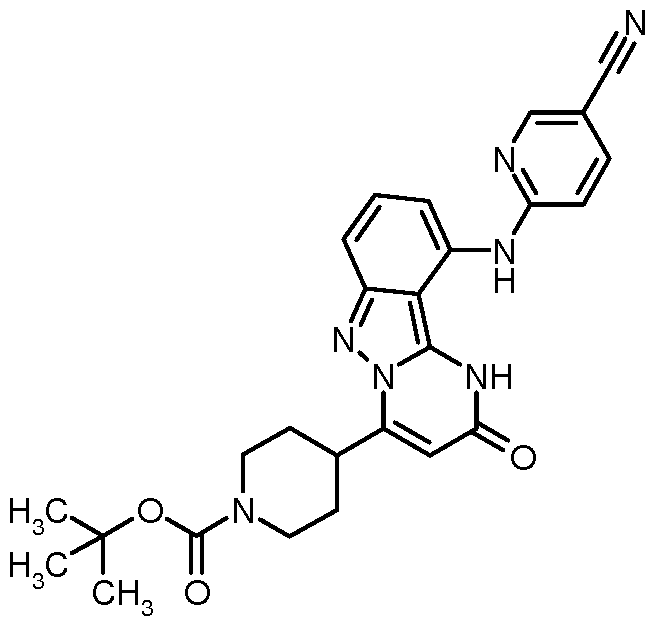
Under argon, tert-butyl 4-(10-bromo-2-oxo-l,2-dihydropyrimido[l,2-b]indazol-4-yl)piperidine-l- carboxylate (200 mg, 447 μιηοΐ), 6-aminopyridine-3-carbonitrile (133 mg, 1.12 mmol), Tripotassium phosphate (133 mg, 626 μιηοΐ), tBuBrettPhos (13.0 mg, 26.8 μιηοΐ), and tBuBrettPhos Pd G3 (22.9 mg, 26.8 μιηοΐ) were dissolved in tert-Butanol (3.0 ml, 31 mmol). The mixture was stirred at 95 °C for 16 h and then purified via reverse phase chromatography (Method: Reprosil C18; 10 μιη; 125x30 mm / flow: 50 ml/min / solvents: A = water (0,01% formic acid), B = Acetonitrile / gradient 0.00-4.25 min = 20%B, 4.50min = 30%B, 19.00-22.50min = 100%B, 22.75-25.00min = 20%B) which afforded the product after drying in vacuo. The obtained amout was 180.3 mg (100 % purity, 83 % of theory).
LC-MS (Method 1): Rt = 1.10 min; MS (ESIpos): m/z = 486 [M+H]+
Example 134A
tert-butyl 4-(10-{[2-fluoro-4-(trifluoromethyl)benzoyl]amino}-2-oxo-l,2-dihydropyrimido[l,2- b]indazol-4-yl)piperidine-l-carboxylate
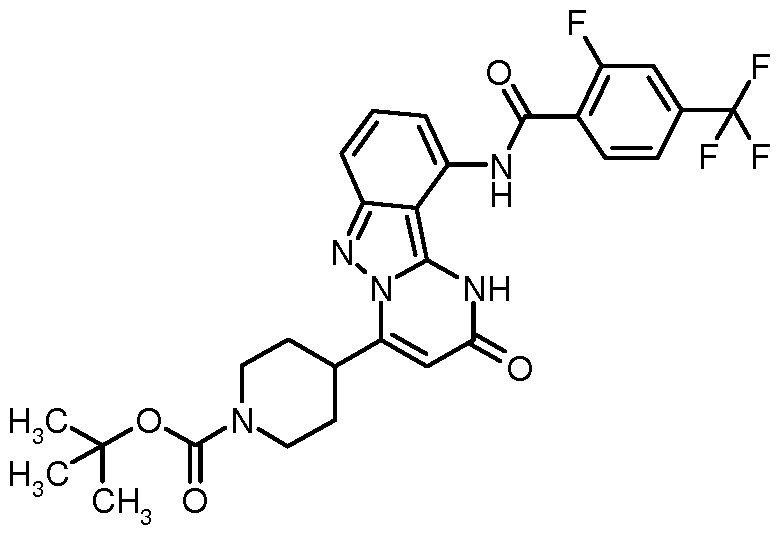
Under argon, tert-butyl 4-(10-bromo-2-oxo-l,2-dihydropyrimido[l,2-b]indazol-4-yl)piperidine-l- carboxylate (200 mg, 447 μιηοΐ), 2-fluoro-4-(trifluoromethyl)benzamide (232 mg, 1.12 mmol), Tripotassium phosphate (133 mg, 626 μιηοΐ), tBuBrettPhos (13.0 mg, 26.8 μιηοΐ), and tBuBrettPhos Pd
G3 (22.9 mg, 26.8 μιηοΐ) were dissolved in degassed l-Methoxy-2-propanol (5.0 ml, 52 mmol). The mixture was stirred at 110 °C for 16 h and then purified via reverse phase chromatography (Method: Reprosil C18; 10 μιη; 125x30 mm / flow: 50 ml/min / solvents: A = water (0,01% formic acid), B = Acetonitrile / gradient 0.00-4.25 min = 20%B, 4.50min = 30%B, 19.00-22.50min = 100%B, 22.75- 25.00min = 20%B) which afforded the product after drying in vacuo. The obtained amout was 42.0 mg (77 % purity, 13 % of theory).
LC-MS (Method 1): Rt = 1.32 min; MS (ESIpos): m/z = 574 [M+H]+
Example 135A
tert-butyl 4-(10-{[(6-methoxypyridin-3-yl)carbonyl]ainino}-2-oxo ,2-dihydropyrimido[l,2- b]indazol-4-yl)piperidine-l-carboxylate

Under argon, tert-butyl 4-(10-bromo-2-oxo-l,2-dihydropyrimido[l,2-b]indazol-4-yl)piperidine-l- carboxylate (200 mg, 447 μιηοΐ), 6-methoxypyridine-3-carboxamide (170 mg, 1.12 mmol), Tripotassium phosphate (133 mg, 626 μιηοΐ), tBuBrettPhos (13.0 mg, 26.8 μιηοΐ), and tBuBrettPhos Pd G3 (22.9 mg, 26.8 μιηοΐ) were dissolved in degassed l-Methoxy-2-propanol (5.0 ml, 52 mmol). The mixture was stirred at 110 °C for 16 h and then purified via reverse phase chromatography (Method: Reprosil C18; 10 μιη; 125x30 mm / flow: 50 ml/min / solvents: A = water (0,01% formic acid), B = Acetonitrile / gradient 0.00-4.25 min = 20%B, 4.50min = 30%B, 19.00-22.50min = 100%B, 22.75- 25.00min = 20%B) which afforded the product after drying in vacuo. The obtained amout was 105.0 mg (100 % purity, 45 % of theory).
LC-MS (Method 1): Rt = 1.14 min; MS (ESIpos): m/z = 519 [M+H]+ Example 136A
tert-butyl 4-(10-{[(5-chlorothiophen-2-yl)carbonyl]amino}-2-oxo-l,2-dihydropyrimido[l,2- b]indazol-4-yl)piperidine-l-carboxylate

Under argon, tert-butyl 4-(10-bromo-2-oxo-l,2-dihydropyrimido[l,2-b]indazol-4-yl)piperidine-l- carboxylate (200 mg, 447 μmol), 5-chlorothiophene-2-carboxamide (181 mg, 1.12 mmol), Tripotassium phosphate (133 mg, 626 μιηοΐ), tBuBrettPhos (13.0 mg, 26.8 μιηοΐ), and tBuBrettPhos Pd G3 (22.9 mg, 26.8 μιηοΐ) were dissolved in degassed l-Methoxy-2-propanol (5.0 ml, 52 mmol). The mixture was stirred at 110 °C for 16 h and then purified via reverse phase chromatography (Method: Reprosil C18; 10 μιη; 125x30 mm / flow: 50 ml/min / solvents: A = water (0,01% formic acid), B = Acetonitrile / gradient 0.00-4.25 min = 20%B, 4.50min = 30%B, 19.00-22.50min = 100%B, 22.75-25.00min = 20%B) which afforded the product after drying in vacuo. The obtained amout was 34.0 mg (94 % purity, 14 % of theory).
LC-MS (Method 1): Rt = 1.25 min; MS (ESIpos): m/z = 528 [M+H]+ Example 137A
tert-butyl 4-(2-oxo-10-{[3-(trifluoromethoxy)benzoyl]amino}-l,2-dihydropyrimido[l,2-b]inclazol- 4-yl)piperidine-l-carboxyla

Under argon, tert-butyl 4-(10-bromo-2-oxo-l,2-dihydropyrimido[l,2-b]indazol-4-yl)piperidine-l- carboxylate (200 mg, 447 μιηοΐ), 3-(trifluoromethoxy)benzamide (229 mg, 1.12 mmol), Tripotassium phosphate (133 mg, 626 μιηοΐ), tBuBrettPhos (13.0 mg, 26.8 μιηοΐ), and tBuBrettPhos Pd G3 (22.9 mg, 26.8 μιηοΐ) were dissolved in degassed l-Methoxy-2-propanol (5.0 ml, 52 mmol). The mixture was stirred at 110 °C for 16 h and then purified via reverse phase chromatography (Method: Reprosil C18; 10 μιη; 125x30 mm / flow: 50 ml/min / solvents: A = water (0,01% formic acid), B = Acetonitrile / gradient 0.00-4.25 min = 20%B, 4.50min = 30%B, 19.00-22.50min = 100%B, 22.75-25.00min = 20%B)
which afforded the product after drying in vacuo. The obtained amout was 161 mg (100 % purity, 63 % of theory).
LC-MS (Method 1): Rt = 1.34 min; MS (ESIpos): m/z = 572 [M+H]+
Example 138A
tert-butyl 4-{10 (3-nitrobenzoyl)amino]-2-oxo-l,2-dihydropyrimido[l,2-b]indazol-4- yljpiperidine- 1 -carboxylat

Under argon, tert-butyl 4-(10-bromo-2-oxo-l,2-dihydropyrimido[l,2-b]indazol-4-yl)piperidine-l- carboxylate (200 mg, 447 μιηοΐ), 3-nitrobenzamide (186 mg, 1.12 mmol), Tripotassium phosphate (133 mg, 626 μιηοΐ), tBuBrettPhos (13.0 mg, 26.8 μιηοΐ), and tBuBrettPhos Pd G3 (22.9 mg, 26.8 μιηοΐ) were dissolved in degassed l-Methoxy-2-propanol (5.0 ml, 52 mmol). The mixture was stirred at 110 °C for 16 h and then purified via reverse phase chromatography (Method: Reprosil CI 8; 10 μιη; 125x30 mm / flow: 50 ml/min / solvents: A = water (0,01% formic acid), B = Acetonitrile / gradient 0.00-4.25 min = 20%B, 4.50min = 30%B, 19.00-22.50min = 100%B, 22.75-25.00min = 20%B) which afforded the product after drying in vacuo. The obtained amout was 120 mg (100 % purity, 50 % of theory).
LC-MS (Method 1): Rt = 1.15 min; MS (ESIpos): m/z = 533 [M+H]+ Example 139A
tert-butyl 4-{10 (4-tert-butylbenzoyl)amino]-2-oxo-l,2-dihydropyrimido[l,2-b]indazol-4- yljpiperidine- 1 -carboxylate

Example 140A
tert-butyl 4-{10 (4-nitrobenzoyl)amino]-2-oxo-l,2-dihydropyrimido[l,2-b]inclazol-4- yljpiperidine- 1 -carboxylate

Under argon, tert-butyl 4-(10-bromo-2-oxo-l,2-dihydropyrimido[l,2-b]indazol-4-yl)piperidine-l- carboxylate (200 mg, 447 μιηοΐ), 4-nitrobenzamide (186 mg, 1.12 mmol), Tripotassium phosphate (133 mg, 626 μιηοΐ), tBuBrettPhos (13.0 mg, 26.8 μιηοΐ), and tBuBrettPhos Pd G3 (22.9 mg, 26.8 μιηοΐ) were dissolved in degassed l-Methoxy-2-propanol (5.0 ml, 52 mmol). The mixture was stirred at 110 °C for 16 h and then purified via reverse phase chromatography (Method: Reprosil CI 8; 10 μιη; 125x30 mm / flow: 50 ml/min / solvents: A = water (0,01% formic acid), B = Acetonitrile / gradient 0.00-4.25 min = 20%B, 4.50min = 30%B, 19.00-22.50min = 100%B, 22.75-25.00min = 20%B) which afforded the product after drying in vacuo. The obtained amout was 100 mg (94 % purity, 42 % of theory).
LC-MS (Method 1): Rt = 1.20 min; MS (ESIpos): m/z = 533 [M+H]+
Example 141 A
tert-butyl 4-{10 (3,5-difluorobenzoyl)ainino]-2-oxo ,2-dihydropyrimido[l,2-b]indazol-4- yljpiperidine- 1 -carboxylate
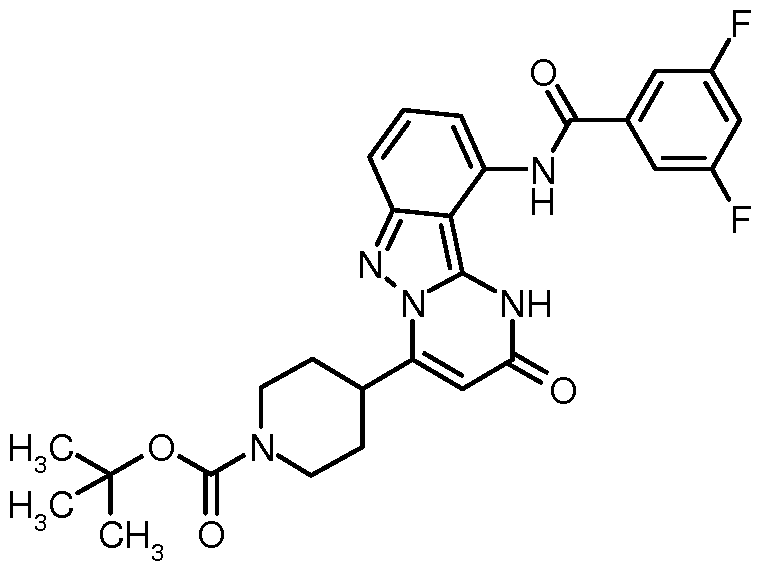
Under argon, tert-butyl 4-(10-bromo-2-oxo-l,2-dihydropyrimido[l,2-b]indazol-4-yl)piperidine-l- carboxylate (200 mg, 447 μιηοΐ), 3,5-difluorobenzamide (176 mg, 1.12 mmol), Tripotassium phosphate (133 mg, 626 μιηοΐ), tBuBrettPhos (13.0 mg, 26.8 μιηοΐ), and tBuBrettPhos Pd G3 (22.9 mg, 26.8 μιηοΐ) were dissolved in degassed l-Methoxy-2-propanol (5.0 ml, 52 mmol). The mixture was stirred at 110 °C for 16 h and then purified via reverse phase chromatography (Method: Reprosil C18; 10 μιη; 125x30 mm / flow: 50 ml/min / solvents: A = water (0,01% formic acid), B = Acetonitrile / gradient 0.00-4.25 min = 20%B, 4.50min = 30%B, 19.00-22.50min = 100%B, 22.75-25.00min = 20%B) which afforded the product after drying in vacuo. The obtained amout was 110 mg (100 % purity, 47 % of theory).
LC-MS (Method 1): Rt = 1.26 min; MS (ESIpos): m/z = 524 [M+H]+ Example 142A
tert-butyl 4-(2-oxo-10-{[3-(trifluoromethyl)benzoyl]amino}-l,2-dihydropyrimido[l,2-b]indazol-4- yl)piperidine- 1 -carboxylate

tert-butyl 4-{10 (naphthalen-2-ylcarbonyl)ainino]-2-oxo-l,2-dihydropyrimiclo[l,2-b]inclazol-4- yljpiperid ine- 1 -carboxylat

Under argon, tert-butyl 4-(10-bromo-2-oxo-l,2-dihydropyrimido[l,2-b]indazol-4-yl)piperidine-l- carboxylate (200 mg, 447 μιηοΐ), naphthalene-2-carboxamide (191 mg, 1.12 mmol), Tripotassium phosphate (133 mg, 626 μιηοΐ), tBuBrettPhos (13.0 mg, 26.8 μιηοΐ), and tBuBrettPhos Pd G3 (22.9 mg, 26.8 μιηοΐ) were dissolved in degassed l-Methoxy-2-propanol (5.0 ml, 52 mmol). The mixture was stirred at 110 °C for 16 h and then purified via reverse phase chromatography (Method: Reprosil C18; 10 μιη; 125x30 mm / flow: 50 ml/min / solvents: A = water (0,01% formic acid), B = Acetonitrile / gradient 0.00-4.25 min = 20%B, 4.50min = 30%B, 19.00-22.50min = 100%B, 22.75-25.00min = 20%B) which afforded the product after drying in vacuo. The obtained amout was 125 mg (100 % purity, 52 % of theory).
LC-MS (Method 1): Rt = 1.28 min; MS (ESIpos): m/z = 538 [M+H]+
Example 144A
tert-butyl 4-{10 (2,6-dimethylbenzoyl)ainino]-2-oxo ,2-dihydropyrimido[l,2-b]indazol-4- yljpiperidine- 1 -carboxylate

Under argon, tert-butyl 4-(10-bromo-2-oxo-l,2-dihydropyrimido[l,2-b]indazol-4-yl)piperidine-l- carboxylate (200 mg, 447 μιηοΐ), naphthalene-2-carboxamide (167 mg, 1.12 mmol), Tripotassium phosphate (133 mg, 626 μιηοΐ), tBuBrettPhos (13.0 mg, 26.8 μιηοΐ), and tBuBrettPhos Pd G3 (22.9 mg, 26.8 μιηοΐ) were dissolved in degassed l-Methoxy-2-propanol (5.0 ml, 52 mmol). The mixture was stirred at 110 °C for 3 d and then purified via reverse phase chromatography (Method: Reprosil C18; 10 μιη; 125x30 mm / flow: 50 ml/min / solvents: A = water (0,01% formic acid), B = Acetonitrile / gradient 0.00-4.25 min = 20%B, 4.50min = 30%B, 19.00-22.50min = 100%B, 22.75-25.00min = 20%B) which afforded the product after drying in vacuo. The obtained amout was 42.0 mg (96 % purity, 18 % of theory).
LC-MS (Method 1): Rt = 1.19 min; MS (ESIpos): m/z = 516 [M+H]+ Example 145A
tert-butyl 4-{10-[(3,4-difluorobenzoyl)amino]-2-oxo-l,2-dihydropyrimido[l,2-b]indazol-4- yljpiperidine- 1 -carboxylate

Under argon, tert-butyl 4-(10-bromo-2-oxo-l,2-dihydropyrimido[l,2-b]indazol-4-yl)piperidine-l- carboxylate (200 mg, 447 μιηοΐ), 3,4-difluorobenzamide (176 mg, 1.12 mmol), Tripotassium phosphate (133 mg, 626 μιηοΐ), tBuBrettPhos (13.0 mg, 26.8 μιηοΐ), and tBuBrettPhos Pd G3 (22.9 mg, 26.8
μιηοΐ) were dissolved in degassed l-Methoxy-2-propanol (5.0 ml, 52 mmol). The mixture was stirred at 110 °C for 3 d and then purified via reverse phase chromatography (Method: Reprosil CI 8; 10 μιη; 125x30 mm / flow: 50 ml/min / solvents: A = water (0,01% formic acid), B = Acetonitrile / gradient 0.00-4.25 min = 20%B, 4.50min = 30%B, 19.00-22.50min = 100%B, 22.75-25.00min = 20%B) which afforded the product after drying in vacuo. The obtained amout was 15.0 mg (89% purity, 6 % of theory).
LC-MS (Method 1): Rt = 1.23 min; MS (ESIpos): m/z = 524 [M+H]+
Example 146A
tert-butyl 4-{10 (3-methoxybenzoyl)amino]-2-oxo-l,2-dihydropyrimido[l,2-b]indazol-4- yl}piperidine-l-carboxylate

Under argon, tert-butyl 4-(10-bromo-2-oxo-l,2-dihydropyrimido[l,2-b]indazol-4-yl)piperidine-l- carboxylate (200 mg, 447 μιηοΐ), 3-methoxybenzamide (169 mg, 1.12 mmol), Tripotassium phosphate (133 mg, 626 μιηοΐ), tBuBrettPhos (13.0 mg, 26.8 μιηοΐ), and tBuBrettPhos Pd G3(22.9 mg, 26.8 μιηοΐ) were dissolved in degassed l-Methoxy-2-propanol (5.0 ml, 52 mmol). The mixture was stirred at 110 °C for 3 d and then purified via reverse phase chromatography (Method: Reprosil CI 8; 10 μιη; 125x30 mm / flow: 50 ml/min / solvents: A = water (0,01% formic acid), B = Acetonitrile / gradient 0.00-4.25 min = 20%B, 4.50min = 30%B, 19.00-22.50min = 100%B, 22.75-25.00min = 20%B) which afforded the product after drying in vacuo. The obtained amout was 11.0 mg (97 % purity, 5 % of theory). LC-MS (Method 1): Rt = 1.15 min; MS (ESIpos): m/z = 518 [M+H]+
Example 147A
tert-butyl 4-{10-[(4-methoxybenzoyl)amino]-2-oxo-l,2-dihydropyrimido[l,2-b]indazol-4- yljpiperidine- 1 -carboxylate
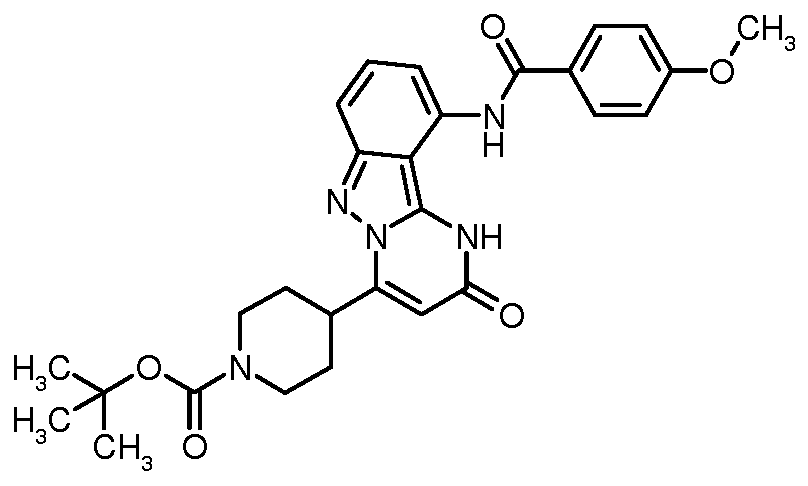
Under argon, tert-butyl 4-(10-bromo-2-oxo-l,2-dihydropyrimido[l,2-b]indazol-4-yl)piperidine-l- carboxylate (200 mg, 447 μιηοΐ), 4-methoxybenzamide (169 mg, 1.12 mmol), Tripotassium phosphate (133 mg, 626 μιηοΐ), tBuBrettPhos (13.0 mg, 26.8 μιηοΐ), and tBuBrettPhos Pd G3 (22.9 mg, 26.8 μιηοΐ) were dissolved in degassed l-Methoxy-2-propanol (5.0 ml, 52 mmol). The mixture was stirred at 110 °C for 3 d and then purified via reverse phase chromatography (Method: Reprosil CI 8; 10 μιη; 125x30 mm / flow: 50 ml/min / solvents: A = water (0,01% formic acid), B = Acetonitrile / gradient 0.00-4.25 min = 20%B, 4.50min = 30%B, 19.00-22.50min = 100%B, 22.75-25.00min = 20%B) which afforded the product after drying in vacuo. The obtained amout was 9.00 mg (87 % purity, 4 % of theory).
LC-MS (Method 1): Rt = 1.13 min; MS (ESIpos): m/z = 518 [M+H]+
Example 148A
tert-butyl 4-{10 (2,3-difluorobenzoyl)ainino]-2-oxo-l,2-dihydropyrimiclo[l,2-b]inclazol-4- yljpiperidine- 1 -carboxylate

Under argon, tert-butyl 4-(10-bromo-2-oxo-l,2-dihydropyrimido[l,2-b]indazol-4-yl)piperidine-l- carboxylate (200 mg, 447 μιηοΐ), 2,3-difluorobenzamide (176 mg, 1.12 mmol), Tripotassium phosphate (133 mg, 626 μιηοΐ), tBuBrettPhos (13.0 mg, 26.8 μιηοΐ), and tBuBrettPhos Pd G3 (22.9 mg, 26.8 μιηοΐ) were dissolved in l-Methoxy-2-propanol (5.0 ml, 52 mmol). The mixture was stirred at 110 °C for 3 d and then purified via reverse phase chromatography (Method: Reprosil CI 8; 10 μιη; 125x30 mm / flow: 50 ml/min / solvents: A = water (0,01% formic acid), B = Acetonitrile / gradient 0.00-4.25 min =
20%B, 4.50min = 30%B, 19.00-22.50min = 100%B, 22.75-25.00min = 20%B) which afforded the product after drying in vacuo. The obtained amout was 113 mg (100% purity, 48 % of theory).
LC-MS (Method 1): Rt = 1.18 min; MS (ESIpos): m/z = 524 [M+H]+
Example 149A
tert-butyl 4-{10 (4-methylbenzoyl)ainino]-2-oxo-l,2-dihydropyrimido[l,2-b]indazol-4- yljpiperidine- 1 -carboxylate

Under argon, tert-butyl 4-(10-bromo-2-oxo-l,2-dihydropyrimido[l,2-b]indazol-4-yl)piperidine-l- carboxylate (200 mg, 447 μιηοΐ), 4-methylbenzamide (151 mg, 1.12 mmol), Tripotassium phosphate (133 mg, 626 μιηοΐ), tBuBrettPhos (13.0 mg, 26.8 μιηοΐ), and tBuBrettPhos Pd G3 (22.9 mg, 26.8 μιηοΐ) were dissolved in l-Methoxy-2-propanol (5.0 ml, 52 mmol). The mixture was stirred at 110 °C for 16 h and then purified via reverse phase chromatography (Method: Reprosil CI 8; 10 μιη; 125x30 mm / flow: 50 ml/min / solvents: A = water (0,01% formic acid), B = Acetonitrile / gradient 0.00-4.25 min = 20%B, 4.50min = 30%B, 19.00-22.50min = 100%B, 22.75-25.00min = 20%B) which afforded the product after drying in vacuo. The obtained amout was 121 mg (98 % purity, 54 % of theory).
LC-MS (Method 1): Rt = 1.22 min; MS (ESIpos): m/z = 502 [M+H]+ Example 150A
tert-butyl 4-(10-{[(2-methoxypyridin-4-yl)carbonyl]amino}-2-oxo-l,2-dihydropyrimido[l,2- b]indazol-4-yl)piperidine-l-carboxylate

Example 151 A
tert-butyl 4-{10 (2,5-difluorobenzoyl)ainino]-2-oxo-l,2-dihydropyrimiclo[l,2-b]inclazol-4- yljpiperidine- 1 -carboxylate

Under argon, tert-butyl 4-(10-bromo-2-oxo-l,2-dihydropyrimido[l,2-b]indazol-4-yl)piperidine-l- carboxylate (200 mg, 447 μιηοΐ), 2,5-difluorobenzamide (176 mg, 1.12 mmol), Tripotassium phosphate (133 mg, 626 μιηοΐ), tBuBrettPhos (13.0 mg, 26.8 μιηοΐ), and tBuBrettPhos Pd G3 (22.9 mg, 26.8 μιηοΐ) were dissolved in l-Methoxy-2-propanol (5.0 ml, 52 mmol). The mixture was stirred at 110 °C for 16 h and then purified via reverse phase chromatography (Method: Reprosil CI 8; 10 μιη; 125x30 mm / flow: 50 ml/min / solvents: A = water (0,01% formic acid), B = Acetonitrile / gradient 0.00-4.25 min = 20%B, 4.50min = 30%B, 19.00-22.50min = 100%B, 22.75-25.00min = 20%B) which afforded the product after drying in vacuo. The obtained amout was 153 mg (100 % purity, 65 % of theory).
LC-MS (Method 1): Rt = 1.20 min; MS (ESIpos): m/z = 524 [M+H]+
Example 152A
tert-butyl 4-{2-oxo^0 (pyridin-3-ylcarbonyl)amino] ,2-dihydropyrimido[l,2-b]indazol-4- yljpiperidine- 1 -carboxylate

Under argon, tert-butyl 4-(10-bromo-2-oxo-l,2-dihydropyrimido[l,2-b]indazol-4-yl)piperidine-l- carboxylate (200 mg, 447 μιηοΐ), pyridine-3-carboxamide (137 mg, 1.12 mmol), Tripotassium phosphate (133 mg, 626 μιηοΐ), tBuBrettPhos (13.0 mg, 26.8 μιηοΐ), and tBuBrettPhos Pd G3 (22.9 mg, 26.8 μιηοΐ) were dissolved in l-Methoxy-2-propanol (5.0 ml, 52 mmol). The mixture was stirred at 110 °C for 16 h and then purified via reverse phase chromatography (Method: Reprosil CI 8; 10 μιη; 125x30 mm / flow: 50 ml/min / solvents: A = water (0,01% formic acid), B = Acetonitrile / gradient 0.00-4.25 min = 20%B, 4.50min = 30%B, 19.00-22.50min = 100%B, 22.75-25.00min = 20%B) which afforded the product after drying in vacuo. The obtained amout was 126 mg (100 % purity, 58 % of theory).
LC-MS (Method 1): Rt = 1.07 min; MS (ESIpos): m/z = 489 [M+H]+
Example 153A
tert-butyl 4-{10-[(3-hydroxybenzoyl)amino]-2-oxo-l,2-dihydropyrimido[l,2-b]indazol-4- yljpiperidine- 1 -carboxylate

Under argon, tert-butyl 4-(10-bromo-2-oxo-l,2-dihydropyrimido[l,2-b]indazol-4-yl)piperidine-l- carboxylate (200 mg, 447 μιηοΐ), 3-hydroxybenzamide (153 mg, 1.12 mmol), Tripotassium phosphate (133 mg, 626 μιηοΐ), tBuBrettPhos (13.0 mg, 26.8 μιηοΐ), and tBuBrettPhos Pd G3 (22.9 mg, 26.8 μιηοΐ) were dissolved in l-Methoxy-2-propanol (5.0 ml, 52 mmol). The mixture was stirred at 110 °C for 16 h and then purified via reverse phase chromatography (Method: Reprosil CI 8; 10 μιη; 125x30
mm / flow: 50 ml/min / solvents: A = water (0,01% formic acid), B = Acetonitrile / gradient 0.00-4.25 min = 20%B, 4.50min = 30%B, 19.00-22.50min = 100%B, 22.75-25.00min = 20%B) which afforded the product after drying in vacuo. The obtained amout was 126 mg (95 % purity, 56 % of theory).
LC-MS (Method 1): Rt = 1.05 min; MS (ESIpos): m/z = 504 [M+H]+ Example 154A
tert-butyl 4-{10 (3-fluorobenzoyl)amino]-2-oxo-l,2-dihydropyrimido[l,2-b]indazol-4- yljpiperidine- 1 -carboxylate

Under argon, tert-butyl 4-(10-bromo-2-oxo-l,2-dihydropyrimido[l,2-b]indazol-4-yl)piperidine-l- carboxylate (200 mg, 447 μιηοΐ), 3-fluorobenzamide (156 mg, 1.12 mmol), Tripotassium phosphate (133 mg, 626 μιηοΐ), tBuBrettPhos (13.0 mg, 26.8 μιηοΐ), and tBuBrettPhos Pd G3 (22.9 mg, 26.8 μιηοΐ) were dissolved in l-Methoxy-2-propanol (5.0 ml, 52 mmol). The mixture was stirred at 110 °C for 16 h and then purified via reverse phase chromatography (Method: Reprosil CI 8; 10 μιη; 125x30 mm / flow: 50 ml/min / solvents: A = water (0,01% formic acid), B = Acetonitrile / gradient 0.00-4.25 min = 20%B, 4.50min = 30%B, 19.00-22.50min = 100%B, 22.75-25.00min = 20%B) which afforded the product after drying in vacuo. The obtained amout was 122 mg (100 % purity, 54 % of theory).
LC-MS (Method 1): Rt = 1.20 min; MS (ESIpos): m/z = 506 [M+H]+
Example 155A
tert-butyl 4-{10-[(4-cyanobenzoyl)amino]-2-oxo-l,2-dihydropyrimido[l,2-b]indazol-4- yl}piperidine-l -carboxylate

LC-MS (Method 1): Rt = 1.17 min; MS (ESIpos): m/z = 513 [M+H]+ Example 156A
tert-butyl 4-{10 (3-cyanobenzoyl)amino]-2-oxo-l,2-dihydropyrimido[l,2-b]inclazol-4- yljpiperidine- 1 -carboxylate

Under argon, tert-butyl 4-(10-bromo-2-oxo-l,2-dihydropyrimido[l,2-b]indazol-4-yl)piperidine-l- carboxylate (200 mg, 447 μιηοΐ), 3-cyanobenzamide (163 mg, 1.12 mmol), Tripotassium phosphate (133 mg, 626 μιηοΐ), tBuBrettPhos (13.0 mg, 26.8 μιηοΐ), and tBuBrettPhos Pd G3 (22.9 mg, 26.8 μιηοΐ) were dissolved in l-Methoxy-2-propanol (5.0 ml, 52 mmol). The mixture was stirred at 110 °C for 16 h and then purified via reverse phase chromatography (Method: Reprosil C18; 10 μιη; 125x30 mm / flow: 50 ml/min / solvents: A = water (0,01% formic acid), B = Acetonitrile / gradient 0.00-4.25 min = 20%B, 4.50min = 30%B, 19.00-22.50min = 100%B, 22.75-25.00min = 20%B) which afforded the product after drying in vacuo. The obtained amout was 130 mg (100 % purity, 57 % of theory).
LC-MS (Method 1): Rt = 1.15 min; MS (ESIpos): m/z = 513 [M+H]+
Example 157A
tert-butyl 4-{2-oxo-10 (pyridazin-4-ylcarbonyl)amino] ,2-dihydropyrimido[l,2-b]indazol-4- yljpiperidine- 1 -carboxylate

Under argon, tert-butyl 4-(10-bromo-2-oxo-l,2-dihydropyrimido[l,2-b]indazol-4-yl)piperidine-l- carboxylate (200 mg, 447 μιηοΐ), pyridazine-4-carboxamide (138 mg, 1.12 mmol), Tripotassium phosphate (133 mg, 626 μιηοΐ), tBuBrettPhos (13.0 mg, 26.8 μιηοΐ), and tBuBrettPhos Pd G3 (22.9 mg, 26.8 μιηοΐ) were dissolved in l-Methoxy-2-propanol (5.0 ml, 52 mmol). The mixture was stirred at 110 °C for 16 h and then purified via reverse phase chromatography (Method: Reprosil CI 8; 10 μιη; 125x30 mm / flow: 50 ml/min / solvents: A = water (0,01% formic acid), B = Acetonitrile / gradient 0.00-4.25 min = 20%B, 4.50min = 30%B, 19.00-22.50min = 100%B, 22.75-25.00min = 20%B) which afforded the product after drying in vacuo. The obtained amout was 79.0 mg (100 % purity, 36 % of theory).
LC-MS (Method 1): Rt = 0.99 min; MS (ESIpos): m/z = 490 [M+H]+
Example 158A
tert-butyl 4-{10-[(3-methylbenzoyl)amino]-2-oxo-l,2-dihydropyrimido[l,2-b]indazol-4- yljpiperidine- 1 -carboxylate

Under argon, tert-butyl 4-(10-bromo-2-oxo-l,2-dihydropyrimido[l,2-b]indazol-4-yl)piperidine-l- carboxylate (200 mg, 447 μιηοΐ), 3-methylbenzamide (151 mg, 1.12 mmol), Tripotassium phosphate (133 mg, 626 μιηοΐ), tBuBrettPhos (13.0 mg, 26.8 μιηοΐ), and tBuBrettPhos Pd G3 22.9 mg, 26.8 μιηοΐ) were dissolved in l-Methoxy-2-propanol (5.0 ml, 52 mmol). The mixture was stirred at 110 °C for 16 h
and then purified via reverse phase chromatography (Method: Reprosil C18; 10 μιη; 125x30 mm / flow: 50 ml/min / solvents: A = water (0,01% formic acid), B = Acetonitrile / gradient 0.00-4.25 min = 20%B, 4.50min = 30%B, 19.00-22.50min = 100%B, 22.75-25.00min = 20%B) which afforded the product after drying in vacuo. The obtained amout was 144 mg (98 % purity, 64 % of theory). LC-MS (Method 1): Rt = 1.22 min; MS (ESIpos): m/z = 502 [M+H]+
Example 159A
tert-butyl 4-{10 (4-fluorobenzoyl)amino]-2-oxo-l,2-dihydropyrimido[l,2-b]indazol-4- yljpiperidine- 1 -carboxylate

Under argon, tert-butyl 4-(10-bromo-2-oxo-l,2-dihydropyrimido[l,2-b]indazol-4-yl)piperidine-l- carboxylate (200 mg, 447 μιηοΐ), 4-fluorobenzamide (156 mg, 1.12 mmol), Tripotassium phosphate (133 mg, 626 μιηοΐ), tBuBrettPhos (13.0 mg, 26.8 μιηοΐ), and tBuBrettPhos Pd G3 (22.9 mg, 26.8 μιηοΐ) were dissolved in l-Methoxy-2-propanol (5.0 ml, 52 mmol). The mixture was stirred at 110 °C for 16 h and then purified via reverse phase chromatography (Method: Reprosil CI 8; 10 μιη; 125x30 mm / flow: 50 ml/min / solvents: A = water (0,01% formic acid), B = Acetonitrile / gradient 0.00-4.25 min = 20%B, 4.50min = 30%B, 19.00-22.50min = 100%B, 22.75-25.00min = 20%B) which afforded the product after drying in vacuo. The obtained amout was 127 mg (100 % purity, 56 % of theory).
LC-MS (Method 1): Rt = 1.20 min; MS (ESIpos): m/z = 506 [M+H]+
Example 160A
tert-butyl 4-{2-oxo-10-[(thiophen-2-ylcarbonyl)amino]-l,2-dihydropyrimido[l,2-b]indazol-4- yljpiperidine- 1 -carboxylate
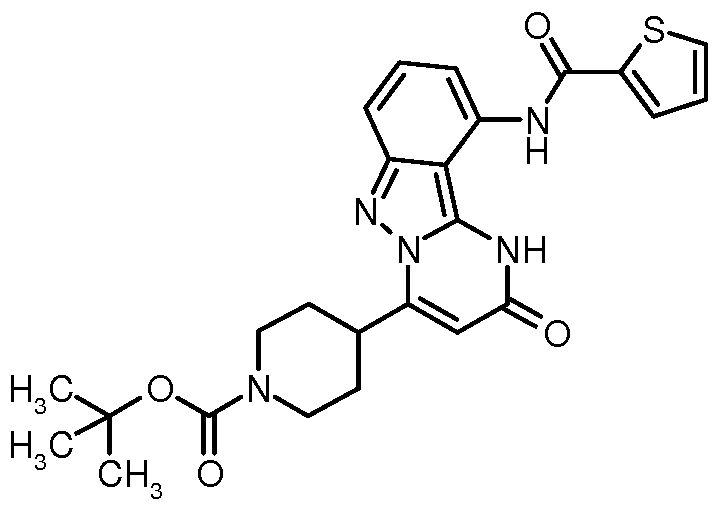
Under argon, tert-butyl 4-(10-bromo-2-oxo-l,2-dihydropyrimido[l,2-b]indazol-4-yl)piperidine-l- carboxylate (200 mg, 447 μιηοΐ), thiophene-2-carboxamide (142 mg, 1.12 mmol), Tripotassium phosphate (133 mg, 626 μιηοΐ), tBuBrettPhos (13.0 mg, 26.8 μιηοΐ), and tBuBrettPhos Pd G3 (22.9 mg, 26.8 μιηοΐ) were dissolved in l-Methoxy-2-propanol (5.0 ml, 52 mmol). The mixture was stirred at 110 °C for 16 h and then purified via reverse phase chromatography (Method: Reprosil CI 8; 10 μιη; 125x30 mm / flow: 50 ml/min / solvents: A = water (0,01 % formic acid), B = Acetonitrile / gradient 0.00-4.25 min = 20%B, 4.50min = 30%B, 19.00-22.50min = 100%B, 22.75-25.00min = 20%B) which afforded the product after drying in vacuo. The obtained amout was
156 mg (100 % purity, 71 % of theory)
LC-MS (Method 1): Rt = 1.18 min; MS (ESIpos): m/z = 494 [M+H]+ Example 161A
tert-Butyl-4-{2-oxo-10 (trifluoracetyl)amm^
1 -carboxylate

Under argon, tert-Butyl-4-( 10-brom-2-oxo- 1 ,2-dihydropyrimido [ 1 ,2-b]indazol-4-yl)piperidin- 1 - carboxylate (200 mg, 447 μιηοΐ), 2,2,2-Trifluoracetamide (126 mg, 1.12 mmol), tripotassium phosphate (133 mg, 626 μιηοΐ), [(2-Di-tert-butylphosphino-3,6-dimethoxy-2',4',6'-triisopropyl-l,l '-biphenyl)-2-(2'- amino- l, -biphenyl)]palladium(II) methanesulfonate (22.9 mg, 26.8 μιηοΐ), and 2-(Di-tert- butylphosphino)-2',4',6'- triisopropyl-3,6-dimethoxy-l,l '-biphenyl (13.0 mg, 26.8 μιηοΐ) were dissolved in ieri-butanol (860 μΐ, 9.0 mmol) and the mixture was stirred at 110°C for 16 h. Concentration in vacuo
and purification by preparative HPLC afforded the title compound. The obtained amount was (100% Purity, 42 % of theory).
LC-MS (Method 1): Rt = 1.16 min; MS (ESIPos): m/z = 480 [M+H]+ Example 162A
tert-Butyl-4 10-(benzoylamino)-2-oxo-l,2-dm^
carboxylate

Under argon, tert-Butyl-4-( 10-brom-2-oxo- 1 ,2-dihydropyrimido [ 1 ,2-b]indazol-4-yl)piperidin- 1 - carboxylate (200 mg, 447 μιηοΐ), benzamide, tripotassium phosphate (133 mg, 626 μιηοΐ), [(2-Di-tert- butylphosphino-3,6-dimethoxy-2',4',6'-triisopropyl- 1,1 '-biphenyl)-2-(2 '-amino- 1,1 '- biphenyl)]palladium(II) methanesulfonate (22.9 mg, 26.8 μιηοΐ), and 2-(Di-tert-butylphosphino)-2',4',6'- triisopropyl-3,6-dimethoxy-l,l '-biphenyl (13.0 mg, 26.8 μmol) were dissolved in ieri-butanol (860 μΐ, 9.0 mmol) and the mixture was stirred at 110°C for 16 h. Concentration in vacuo and purification by preparative HPLC afforded the title compound. The obtained amount was 116 mg (100% Purity, 53 % of theory).
LC-MS (Method 1): Rt = 1.17 min; MS (ESIPos): m/z = 488 [M+H]+ Example 163A
tert-Butyl-4-{10 (cyclohexylcarbonyl)amino]-2-oxo-l,2-dihydropyrimido[l,2-b]indazol-4- yl}piperidin-l-carboxylate

LC-MS (Method 1): Rt = 1.19 min; MS (ESIPos): m/z = 494 [M+H]+ Example 164A
tert-Butyl-4-(10-acetainido-2-oxo ,2-dihydropyrimido[l,2-b]indazol-4-yl)piperidm

Under argon, tert-Butyl-4-( 10-brom-2-oxo- 1 ,2-dihydropyrimido [ 1 ,2-b]indazol-4-yl)piperidin- 1 - carboxylate (200 mg, 447 μιηοΐ), Acetamide, tripotassium phosphate (133 mg, 626 μιηοΐ), [(2-Di-tert- butylphosphino-3,6-dimethoxy-2',4',6'-triisopropyl- 1,1 '-biphenyl)-2-(2 '-amino- 1,1 '- biphenyl)]palladium(II) methanesulfonate (22.9 mg, 26.8 μιηοΐ), and 2-(Di-tert-butylphosphino)-2',4',6'- triisopropyl-3,6-dimethoxy-l,l '-biphenyl (13.0 mg, 26.8 μιηοΐ) were dissolved in ieri-butanol (420 μΐ, 4.4 mmol) and the mixture was stirred at 110°C for 16 h. Concentration in vacuo and purification by preparative HPLC afforded the title compound. The obtained amount was 104 mg (100% Purity, 55 % of theory).
LC-MS (Method 1): Rt = 0.94 min; MS (ESIPos): m/z = 426 [M+H]+
Example 165A
N-(2-Cyan-3-fluorphenyl)cyclopropancarboxamide
 2-amino-6-fluorobenzonitrile (1.00 g, 7.35 mmol) was dissolved in pyridine (20 ml), 4- dimethylaminopyridine (89.7 mg, 735 μιηοΐ) and cyclopropancarbonylchloride (630 μΐ, 7.0 mmol) were added and the mixture was stirred at room temperature for 16 h. Concentration in vacuo afforded the crude title compound. The obtained amount was 1500 mg (100% Purity). LC-MS (Method 1): Rt = 0.71 min; MS (ESIPos): m/z = 205 [M+H]+ Example 166A
tert-Butyl-4-{10 (cyclopropylcarbonyl)amino]-2-oxo^,2-dihydropyriinido[l,2-b]indazol-4- yl}piperidin-l-carboxylate

N-(2-Cyan-3-fluorphenyl)cyclopropancarboxamid (1.50 g, 7.35 mmol) was dissolved in ethanol (11 ml, 180 mmol) and treated with hydrazine hydrate (1.4 ml, 29 mmol). After stirring at 70 °C for 8 h, the mixture was cooled to RT and concentrated in vacuo. The residue was treated with water and ethyl acetate, the aqueous phase was extracted with exthyl acetate, and the combined organic phases were washed with water and brine, dried over magnesium sulfate, and concentrated in vacuo. The residue and ieri-butyl 4-[(2,2-dimethyl-4,6-dioxo-l,3-dioxan-5-yl)carbonyl]piperidine-l-carboxylate (542 mg, 1.53 mmol) were dissolved in acetonitrile (3.6 ml, 69 mmol) and stirred at 60 °C for 4 h. After cooling to RT, the solvent was removed in vacuo and the residue was dissolved in l-methoxy-2-propanol (3.6 ml, 37 mmol). Potassium phosphate (432 mg, 2.03 mmol) was added and the mixture was stirred at 110 °C for 4 h. After concentration in vacuo, the residue was dissolved in water and extracted with ethyl acetate. The organic phase was washed with brine and dried over magnesium sulfate. Concentration in vacuo and purification by preparative HPLC afforded the title compound. The obtained amount was 187 mg (100% Purity, 6 % of theory).
LC-MS (Method 1): Rt = 1.03 min; MS (ESIPos): m/z = 452 [M+H]+
Example 167A
3-Chlor-N-(2-cyan-3-fluorphenyl)benzamide

Under argon, 2-amino-6-fluorobenzonitrile (300 mg, 2.20 mmol) was dissolved in pyridine (3.6 ml, 44 mmol), 4-dimethylaminopyridine (2.69 mg, 22.0 μιηοΐ) and 3-Chlorobenzoylchlorid (501 mg, 2.86 mmol) were added and the mixture was stirred at room temperature for 16 h. The mixture was diluted with ethyl acetate, washed with water and brine, and dried over magnesium sulfate. Concentration in vacuo and purification by preparative HPLC afforded the title compound. The obtained amount was 401 mg (100% Purity, 66 % of theory). LC-MS (Method 1): Rt = 0.97 min; MS (ESIPos): m/z = 275 [M+H]+
Example 168A
tert-Butyl-4-{10 (3-chlorbenzoyl)amino]-2-oxo-l,2-d^
1-carboxylate

3-Chlor-N-(2-cyan-3-fluorphenyl)benzamid (300 mg, 1.09 mmol) was dissolved in ethanol (3.0 ml, 52 mmol) and treated with hydrazine hydrate (210 μΐ, 4.4 mmol). After stirring at 70 °C for 8 h, the mixture was cooled to RT and concentrated in vacuo. The residue and ieri-butyl 4-[(2,2-dimethyl-4,6-dioxo-l,3- dioxan-5-yl)carbonyl]piperidine- 1-carboxylate (746 mg, 2.10 mmol) were dissolved in acetonitrile (5.0 ml, 95 mmol) and stirred at 60 °C for 4 h. After cooling to RT, the solvent was removed in vacuo and the residue was dissolved in l-methoxy-2-propanol (5.0 ml, 51 mmol). Potassium phosphate (594 mg, 2.80 mmol) was added and the mixture was stirred at 110 °C for 4 h. After concentration in vacuo, the residue was dissolved in water and extracted with ethyl acetate. The organic phase was washed with brine and dried over magnesium sulfate. Concentration in vacuo and purification by preparative HPLC afforded the title compound. The obtained amount was 24 mg (100% Purity, 11 % of theory).
LC-MS (Method 1): Rt = 1.25 min; MS (ESIPos): m/z = 522 [M+H]+
Example 169A
N-(2-Cyan-3-fluorphenyl)-4-(trifluormethyl)benzamide

Under argon, 2-amino-6-fluorobenzonitrile (300 mg, 2.20 mmol) was dissolved in pyridine (3.6 ml, 44 mmol), 4-dimethylaminopyridine (2.69 mg, 22.0 μιηοΐ) and 4-(Trifluormethyl)benzoylchlorid (598 mg, 2.86 mmol) were added and the mixture was stirred at room temperature for 16 h. The mixture was diluted with ethyl acetate, washed with water and brine, and dried over magnesium sulfate. Concentration in vacuo and purification by preparative HPLC afforded the title compound. The obtained amount was 670 mg (100% Purity, 99 % of theory).
LC-MS (Method 1): Rt = 1.01 min; MS (ESIPos): m/z = 309 [M+H]+
Example 170A
tert-Butyl-4-(2-oxo-10-{[4-(trifluormethyl)b^
yl)piperidin-l-carboxylate

N-(2-Cyan-3-fluorphenyl)-4-(trifluormethyl)benzamid (300 mg, 973 μιηοΐ) was dissolved in ethanol (3.0 ml, 52 mmol) and treated with hydrazine hydrate (190 μΐ, 3.9 mmol). After stirring at 70 °C for 8 h, the mixture was cooled to RT and concentrated in vacuo. The residue and ieri-butyl 4-[(2,2-dimethyl- 4,6-dioxo-l,3-dioxan-5-yl)carbonyl]piperidine-l-carboxylate (746 mg, 2.10 mmol) were dissolved in acetonitrile (5.0 ml, 95 mmol) and stirred at 60 °C for 4 h. After cooling to RT, the solvent was removed in vacuo and the residue was dissolved in l-methoxy-2-propanol (5.0 ml, 51 mmol). Potassium phosphate (594 mg, 2.80 mmol) was added and the mixture was stirred at 110 °C for 4 h. After
concentration in vacuo, the residue was dissolved in water and extracted with ethyl acetate. The organic phase was washed with brine and dried over magnesium sulfate. Concentration in vacuo and purification by preparative HPLC afforded the title compound. The obtained amount was 74 mg (100% Purity, 13 % of theory). LC-MS (Method 1): Rt = 1.3 min; MS (ESIPos): m/z = 556 [M+H]+ Example 171 A
N-(2-Cyan-3-fluorphenyl)-2,2-dimeth lpropanamide

Under argon, 2-amino-6-fluorobenzonitrile (300 mg, 2.20 mmol) was dissolved in pyridine (3.6 ml, 44 mmol), 4-dimethylaminopyridine (2.69 mg, 22.0 μιηοΐ) and 2,2-Dimethylpropanoylchlorid (345 mg, 2.86 mmol) were added and the mixture was stirred at room temperature for 16 h. The mixture was diluted with ethyl acetate, washed with water and brine, and dried over magnesium sulfate. Concentration in vacuo and purification by preparative HPLC afforded the title compound. The obtained amount was 160 mg (100% Purity, 33 % of theory). LC-MS (Method 1): Rt = 0.86 min; MS (ESIPos): m/z = 221 [M+H]+ Example 172A
tert-butyl 4 10-(tert-butylcarbamoyl)-2-oxo-l,2-dihydropyrimido[l,2-b]indazol-4-yl]piperidine-l- carboxylate

N-(2-Cyan-3-fluorphenyl)-2,2-dimethylpropanamid (160 mg, 726 μιηοΐ) was dissolved in ethanol (2.0 ml, 34 mmol) and treated with hydrazine hydrate (140 μΐ, 2.9 mmol). After stirring at 70 °C for 8 h, the mixture was cooled to RT and concentrated in vacuo. The residue and ieri-butyl 4-[(2,2-dimethyl-4,6- dioxo-l,3-dioxan-5-yl)carbonyl]piperidine-l-carboxylate (402 mg, 1.13 mmol) were dissolved in
acetonitrile (2.7 ml, 51 mmol) and stirred at 60 °C for 4 h. After cooling to RT, the solvent was removed in vacuo and the residue was dissolved in l-methoxy-2-propanol (3.0 ml, 31 mmol). Potassium phosphate (320 mg, 1.51 mmol) was added and the mixture was stirred at 110 °C for 4 h. After concentration in vacuo, the residue was dissolved in water and extracted with ethyl acetate. The organic phase was washed with brine and dried over magnesium sulfate. Concentration in vacuo and purification by preparative HPLC afforded the title compound. The obtained amount was 34 mg (100% Purity, 9.6 % of theory).
LC-MS (Method 1): Rt = 1.15 min; MS (ESIPos): m/z = 468 [M+H]+ Example 173A
Tert-butyl 4-[(2,2-dimethyl-4,6-dioxo-l,3-dioxan-5-yl)carbonyl]piperidine-l-carboxylate

To a solution of l-(ieri-butoxycarbonyl)piperidine-4-carboxylic acid (10 g, 43.6 mmol) and 2,2- dimethyl-l,3-dioxane-4,6-dione (6.9 g, 47.98 mmol) in 100 ml dichloromethane was added 4- dimethylaminopyridin (8.0 g, 65.42 mmol). After cooling the mixture to 0 C l-(3- dimethylaminopropyl)-3-ethylcarbodiimide hydrochloride (11.7 g, 61.1 mmol) was added in portions and then the reaction mixture was stirred at RT for 16 h. The mixture was treated with 50 ml of water and then the layers were separated. The organic layer was extracted with HC1 1M, dried over magnesium sulfate, filtered and evaporated under vacuo to yield the title compound (14 g, 86% of theory).
LC-MS (Method IB): Rt = 1.10 min, MS (ESIPos): m/z = 354 [M-H]"
Example 174A
tert-butyl 4-(10-bromo-2-oxo-l, -dihydropyrimido[l,2-b]indazol-4-yl)piperidine-l-carboxylate
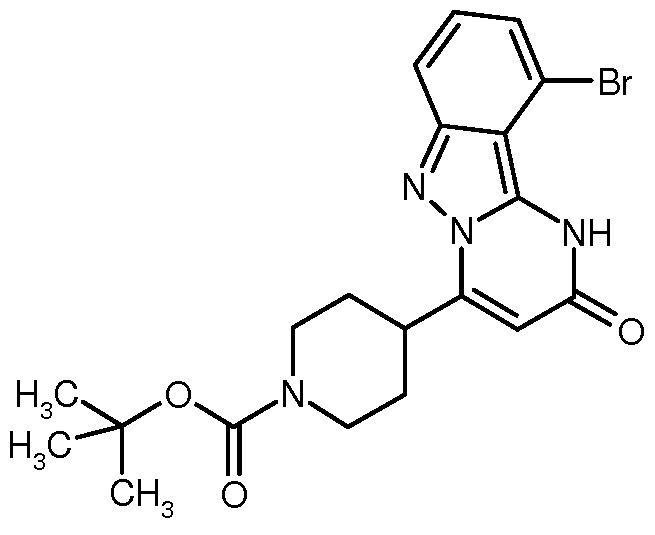
LC-MS (Method IB): Rt = 1.13 min, MS (ESIPos): m/z = 447 [M+H]+
Example 175A
Tert-butyl 4-(10-cyano-2-oxo-l,2-dihydropyriinido[l,2-b]indazol-4-yl)piperidine-l-carboxylate

3-Amino-li7-indazole-4-carbonitrile (0.51 g, 3.20 mmol) and ieri-butyl 4-[(2,2-dimethyl-4,6-dioxo-l,3- dioxan-5-yl)carbonyl]piperidine-l-carboxylate (1.27 g, 3.55 mmol) were dissolved in acetonitrile (20 mL) and refluxed for 6 h. After cooling to RT, the solvent was removed in vacuo and the residue was dissolved in l-methoxy-2-propanol (20 mL). Potassium phosphate (1.37 g, 6.45 mmol) was added and the mixture was stirred at 80 °C for 6 h. Concentration in vacuo and purification by preparative HPLC (Method 1A) afforded the title compound (0.32 g, 25% of theory).
LC-MS (Method IB): Rt = 1.07 min, MS (ESIPos): m/z = 394 [M+H]+ Example 176A
4 1^^r^butoxycarbonyl)piperidin-4-yl]-2-oxo-l,2-dihydropyrimido[l,2-b]indazole-10-carboxylic acid

Teri-butyl 4-( 10-cyano-2-oxo- 1 ,2-dihydropyrimido [ 1 ,2-b] indazol-4-yl)piperidine- 1 -carboxylate (200 mg, 0.51 mmol) and sodium hydroxide solution (2M in water, 25 ml, 50.8 mol) were dissolved in water (5 ml) and ethanol (40 ml). After stirring at 100 °C for 4 h and 2 d at rt, the mixture was worked up 3x with ethyl acetate and citric acid solution (10% in water). The organic phases were washed with water and dried with sodium sulfate. Drying in vacuo afforded the title compound (187 mg, 84% of theory). LC-MS (Method 5B): Rt = 0.95 min, MS (ESIPos): m/z = 412.3 [M+H] +
Example 177A
tert-butyl 4-(5-oxo-3-{3-[3-(trifluoromethyl)phenyl]-l,2,4-oxadiazol-5-yl}-4,5-dihydropyrazolo[l,5- a]pyrimidin-7-yl)piperidine-l-carboxylate

To a solution of compound 7-[l-(tert-butoxycarbonyl)piperidin-4-yl]-5-oxo-4,5-dihydropyrazolo[l,5- a]pyrimidine-3-carboxylic acid (100 mg, 0.28 mmol) in 2.0 ml dimethylformamide was added 1,1 '- carbonyldiimidazole (89 mg, 0.55 mmol), DBU (99 mg, 0.65 mmol) and N,N-Diisopropylethylamin (71 mg, 0.55 mmol) and then the reaction mixture was stirred 1.5 h at 90 oC. After this time N'-hydroxy-3- (trifluoromethyl)benzenecarboximidamide (112 mg, 0.55 mmol) was added and the mixture was stirred for 5.5 h at 110 oC. After cooling to RT, the mixture was diluted in 2 ml acetonitrile and purified by preparative HPLC (water/ acetonitrile, 0.1% formic acid). After evaporation of the solvent, the product was obtained (63 mg, 43% of theory).
LC-MS (Method 1): RT 1.35 min, m/z = 531 (M+H)+
Example 1
fac^0-(4-methyl-2-oxo-l,3-oxazolidin-3-yl)-4-(piperidin-4-yl)pyriinido[l,2-b]indaz
trifluoroacetic acid

Compound rac-tert-butyl 4-[10-(4-methyl-2-oxo-l,3-oxazolidin-3-yl)-2-oxo-l,2-dihydropyrimido[l,2- b]indazol-4-yl]piperidine-l-carboxylate (130 mg, 80% purity, 0.22 mmol) was suspended in hydrochloric acid 4N in 1,4-dioxane (4.0 ml). The reaction mixture was stirred 2h at RT. The suspension was filtered, dissolved in dimethylsulfoxide and purified two times by preparative HPLC (gradient acetonitrile/water with 0.1 % trifluoroacetic acid). The combined product fractions were lyophilized to yield the title compound (13 mg, 12% of theory).
LC-MS (Method 4): Rt = 0.59 min, MS (ESINeg): m/z = 366 [M-H-TFA]"
H-NMR (400 MHz, DMSO): delta = 12.77-12.14 (m, 1H), 8.76 (bs, 1H), 8.47 (bs, 1H), 7.73-7.36 (m, 2H), 6.98 (s, 1H), 6.75 (bs, 1H), 4.96-4.55 (m, 2H), 4.15 (s, 1H), 4.02-3.75 (m, 1H), 3.46 (d, 2H), 3.28- 3.13 (m, 2H), 2.42-2.28 (m, 2H), 2.02-1.84 (m, 2H), 1.13 (s, 3H). Example 2
10-(2-oxopiperidin-l-yl)-4-(piperidin-4-yl)pyrimido[l,2-b]indazol-2(lH)-one trifluoroacetic acid

Compound ieri-butyl 4- [2-oxo- 10-(2-oxopiperidin- 1 -yl)-l ,2-dihydropyrimido[ 1 ,2-b] indazol-4- yl]piperidine- l-carboxylate (18 mg, 66% purity, 0.026 mmol) was suspended in hydrochloric acid 4N in 1,4-dioxane (3.0 ml). The reaction mixture was stirred 2h at RT. The suspension was dissolved in water, purified by preparative HPLC (gradient acetonitrile/water with 0.1 % trifluoroacetic acid). The combined product fractions were lyophilized to yield the title compound (3 mg, 25% of theory).
LC-MS (Method 4): Rt = 0.66 min, MS (ESINeg): m/z = 364 [M-H-TFA] "
¾-NMR (400 MHz, DMSO): delta = 11.90 (s, 1H), 8.79-8.66 (m, 1H), 8.48-8.32 (m, 1H), 7.61-7.52
(m, IH), 7.48 (t, IH), 6.88 (dd, IH), 6.72 (bs, IH), 4.00-3.87 (m, IH), 3.65 (bs, 2H), 3.47 (d, 2H), 3.30- 3.16 (m, 2H), 2.41-2.29 (m, 2H), 2.16- 1.83 (m, 6H). 2H are missing and are believed to be below the solvent signals.
Example 3
l,l-dimethyl-3 2-oxo-4-(piperidin-4-yl) ,2-dihydropyrim^
trifluoroacetic acid

Compound ieri-butyl 4-{ 10-[(dimethylcarbamoyl)amino]-2-oxo-l,2-dihydropyrimido[l,2-b]indazol-4- yl} piperidine-l-carboxylate (92 mg, 68% purity, 0.14 mmol) was dissolved in dichloromethane (2 ml) and stirred 4h at RT with hydrochloric acid 4N in 1,4-dioxane (3.0 ml). The suspension was concentrated, dissolved in water/acetonitrile and purified by preparative HPLC (gradient acetonitrile/water with 0.1 % trifluoroacetic acid). Evaporation of the combined product fractions yielded the title compound (22 mg, 34% of theory).
LC-MS (Method 4): Rt = 0.61 min, MS (ESIPos): m/z = 355 [M+H-TFA]+
¾-NMR (400 MHz, DMSO): delta = 12.41 (bs, IH), 8.92 (s, IH), 8.85-8.74 (m, IH), 8.52 (bs, IH), 7.73 (d, IH), 7.38 (t, IH), 7.17 (d, IH), 6.72 (s, IH), 3.93 (t, IH), 3.48 (d, 2H), 3.22 (q, 2H), 3.10 (s, 6H), 2.37 (d, 2H), 1.95 (dq, 2H).
Example 4
l-ethyl-2-methyl-N 2-oxo-4-(piperidin-4-yl)-l,2-dihydropyrimido[l,2-b]indazol-10-yl]-lH- benzimidazole-5-carboxamide hydrochloride

Compound ieri-butyl 4-( 10- { [( 1 -ethyl-2-methyl- 1 H-benzimidazol-5-yl)carbonyl] amino } -2-oxo- 1 ,2- dihydro pyrimido[l,2-b]indazol-4-yl)piperidine-l-carboxylate (70 mg, 84% purity, 0.10 mmol) was dissolved in dichloromethane (2 ml) and stirred 4h at RT with hydrochloric acid 4N in 1,4-dioxane (3.5
ml). The suspension was concentrated and lyophilized to yield the title compound (51 mg, 98% of theory).
LC-MS (Method 4): Rt = 0.71 min, MS (ESINeg): m/z = 468 [M-H-xHCl]"
¾-NMR (400 MHz, D20): delta = 8.15 (s, IH), 7.99 (d, IH), 7.82 (d, IH), 7.44 (t, IH), 7.36 (d, IH), 7.31 (d, IH), 7.19 (t, IH), 6.86 (d, IH), 6.51 (s, IH), 6.24-6.18 (m, IH), 4.43 (q, IH), 3.77-3.58 (m, 4H), 3.40-3.19 (t x 2, 2H), 2.88 (s, 3H), 2.53-2.33 (d x 2, 2H), 2.10-1.83 (q x 2, 2H), 1.50 (t, 3H).
Example 5
N 2-oxo-4-(piperidin-4-yl) ,2-dihydropyrimido[l,2-b]in^ 1-oxide trifluoroacetic acid

Compound ieri-butyl 4-( 10- { [( 1 -oxidopyridin-3-yl)carbonyl] amino } -2-oxo- 1 ,2-dihydropyrimido[ 1 ,2- b]indazol-4-yl)piperidine-l-carboxylate (35 mg, 0.069 mmol) was dissolved in dichloromethane (2 ml) and stirred 4h at RT with hydrochloric acid 4N in 1,4-dioxane (2.0 ml). The suspension was concentrated, dissolved in water/acetonitrile and purified by preparative HPLC (gradient acetonitrile/water with 0.1 % trifluoroacetic acid). Evaporation of the combined product fractions yielded the title compound (11 mg, 94% purity, 29% of theory).
LC-MS (Method 4): Rt = 0.59 min, MS (ESINeg): m/z = 403 [M-H-TFA]"
¾-NMR (400 MHz, DMSO): delta = 12.48 (bs, IH), 10.42 (s, IH), 8.82-8.64 (m, 2H), 8.53-8.36 (m, 2H), 7.95 (d, IH), 7.64 (t, IH), 7.83-7.35 (m, 3H), 6.75 (bs, IH), 4.01-3.73 (m, IH), 3.53-3.41 (m, 2H), 3.28-3.12 (m, 2H), 2.42-2.27 (m, 2H), 2.03-1.81 (m, 2H).
Example 6
N 2-oxo-4-(piperidin-4-yl) ,2-dihydropyrimido[l,2-b]indazol-10-yl]-3,5-bis(trifluoromethyl) benzamide hydrochloride

LC-MS (Method 4): Rt = 1.06 min, MS (ESINeg): m/z = 522 [M-H-xHCl]"
¾-NMR (400 MHz, DMSO): delta = 12.37 (bs, IH), 10.77 (s, IH), 9.08-8.87 (m, 2H), 8.69 (s, 2H), 8.45 (s, IH), 7.73-7.29 (m, 3H), 6.71 (bs, IH), 4.25-3.76 (m, IH), 3.52-3.38 (m, 2H), 3.20 (q, 2H), 2.35 (d, 2H), 2.00 (q, 2H).
Example 7
2-methyl-N 2-oxo-4-(piperidin-4-yl)-l,2-dihydropyrimM
benzamide hydrochloride

Compound ieri-butyl 4-(10-{ [2-methyl-5-(trifluoromethyl)benzoyl] amino }-2-oxo- l,2-dihydro pyrimido[l,2-b] indazol-4-yl)piperidine-l-carboxylate (88 mg, 0.15 mmol) was dissolved in dichloromethane (2 ml) and stirred 4h at RT with hydrochloric acid 4N in 1,4-dioxane (4.0 ml). The suspension was concentrated and lyophilized to yield the title compound (78 mg, quantitativ).
LC-MS (Method 4): Rt = 0.96 min, MS (ESINeg): m/z = 468 [M-H-xHCl]"
¾-NMR (400 MHz, DMSO): delta = 12.44 (bs, IH), 10.13 (s, IH), 9.09-8.88 (m, 2H), 8.04 (s, IH), 7.84 (d, IH), 7.88-7.72 (m, IH), 7.64 (d, IH), 7.49 (t, IH), 7.42 (d, IH), 6.71 (bs, IH), 4.12-3.85 (m, IH), 3.45 (d, 2H), 3.20 (q, 2H), 2.61 (s, 3H), 2.39-2.30 (m, 2H), 2.00 (dq, 2H).
Example 8
l-ethyl-N-[2-oxo-4-(piperidin-4-yl)-l,2-dihydropyrimido[l,2-b]indazol-10-yl]-lH-pyrazole-3- carboxamide trifluoroacetic acid
x

LC-MS (Method 4): Rt = 0.77 min, MS (ESINeg): m/z = 404 [M-H-TFA]"
1H-NMR (400 MHz, DMSO): delta = 12.36 (bs, 1H), 10.79 (s, 1H), 8.78 (bs, 1H), 8.48 (bs, 1H), 8.09- 8.00 (m, 1H), 7.98 (d, 1H), 7.48 (t, 1H), 7.34 (d, 1H), 6.85 (d, 1H), 6.76 (s, 1H), 4.34 (q, 2H), 3.95 (t, 1H), 3.49 (d, 2H), 3.23 (q, 2H), 2.39 (d, 2H), 1.95 (dq, 2H), 1.55 (t, 3H).
Example 9
3,4,5 rifluoro-N 2-oxo-4-(piperidin-4-yl) ,2-dihydropyrimido[l,2-b]indazol-10-yl]benzam hydrochloride

Compound ieri-butyl 4- { 2-oxo- 10- [(3,4,5-trifluorobenzoyl)amino] - 1 ,2-dihydropyrimido [ 1 ,2-b] indazol- 4-yl} piperidine-l-carboxylate (70 mg, 0.13 mmol) was dissolved in 1,4-dioxane (2 ml) and stirred overnight at RT with hydrochloric acid 4N in 1,4-dioxane (4.0 ml). The suspension was filtered, washed with diethyl ether (2 ml) and dried in vacuo to yield the title compound (56 mg, 91% of theory).
LC-MS (Method 4): Rt = 0.94 min, MS (ESINeg): m/z = 440 [M-H-xHCl]"
H-NMR (400 MHz, DMSO): delta = 12.54 (bs, 1H), 10.41 (s, 1H), 9.04-8.76 (m, 2H), 8.00 (dd, 2H), 7.73 (bs, 1H), 7.49 (t, 1H), 7.43 (d, 1H), 6.76 (bs, 1H), 3.94 (t, 1H), 3.46 (d, 2H), 3.21 (q, 2H), 2.36 (d, 2H), 2.00 (q, 2H).
Example 10
2-methyl-N-[2-oxo-4-(piperidin-4-yl)-l,2-dihydropyrimido[l,2-b]indazol-10-yl]propanamide hydrochloride

Compound ieri-butyl 4-{ 10-[(dimethylcarbamoyl)amino]-2-oxo-l,2-dihydropyrimido[l,2-b]indazol-4- yl} piperidine-l-carboxylate (50 mg, 94% purity, 0.10 mmol) was dissolved in 1,4-dioxane (2 ml) and stirred overnight at RT with hydrochloric acid 4N in 1,4-dioxane (4.0 ml). The suspension was filtered, washed with diethyl ether (2 ml) and dried in vacuo to yield the title compound (33 mg, 82% of theory). LC-MS (Method 4): Rt = 0.70 min, MS (ESIPos): m/z = 354 [M+H-xHCl]+
¾-NMR (400 MHz, DMSO): delta = 12.49 (bs, IH), 9.69 (s, IH), 9.04 (bs, 2H), 7.79 (bs, IH), 7.41 (t, IH), 7.30 (d, IH), 6.72 (s, IH), 4.10-3.70 (m, IH), 3.45 (d, 2H), 3.19 (q, 2H), 2.81 (sept, IH), 2.34 (d, 2H), 2.01 (q, 2H), 1.25 (d, 6H). Example 11
(3E)-N 2-oxo-4-(piperidin-4-yl)-l,2-dihydropyri
hydrochloride

Compound ieri-butyl 4- { 2-oxo- 10- [(3E)-pent-3-enoylamino] - 1 ,2-dihydropyrimido[ 1 ,2-b]indazol-4- yl}piperidine-l-carboxylate (68 mg, 0.15 mmol) was dissolved in 1,4-dioxane (2 ml) and stirred overnight at RT with hydrochloric acid 4N in 1,4-dioxane (4.0 ml). The suspension was filtered, washed with diethyl ether (2 ml) and dried in vacuo to yield the title compound (40 mg, 68% of theory).
LC-MS (Method 4): Rt = 0.75 min, MS (ESIPos): m/z = 366 [M+H-xHCl]+
¾-NMR (400 MHz, DMSO): delta = 12.48 (bs, IH), 9.77-9.65 (m, IH), 9.10-8.84 (m, 2H), 7.74 (bs, IH), 7.41 (t, IH), 7.30 (d, IH), 6.72 (bs, IH), 5.82-5.65 (m, 2H), 4.04-3.65 (m, IH), 3.45 (d, 2H), 3.26 (d, 2H), 3.19 (q, 2H), 2.35 (d, 2H), 2.00 (q, 2H), 1.74 (d, 3H).
Example 12
2-methyl-N 2-oxo-4-(piperidin-4-yl) ,2-dihydropyrimM
nicotinamide hydrochloride

Compound feri-butyl 4-[10-({ [2-methyl-6-(trifluoromethyl)pyridin-3-yl]carbonyl}amino)-2-oxo-l,2- dihydro pyrimido[l,2-b]indazol-4-yl]piperidine-l-carboxylate (108 mg, 0.19 mmol) was dissolved in 1,4-dioxane (2 ml) and stirred overnight at RT with hydrochloric acid 4N in 1,4-dioxane (4.0 ml). The suspension was filtered, washed with diethyl ether (2 ml) and dried in vacuo to yield the title compound (96 mg, quantitativ).
LC-MS (Method 4): Rt = 0.89 min, MS (ESIPos): m/z = 471 [M+H-xHCl]+
¾-NMR (400 MHz, DMSO): delta = 12.36 (bs, 1H), 10.24 (s, 1H), 9.04 (bs, 2H), 8.42 (d, 1H), 7.96 (d, 1H), 7.73 (bs, 1H), 7.54-7.48 (m, 1H), 7.45 (d, 1H), 6.70 (bs, 1H), 4.03-3.70 (m, 1H), 3.45 (d, 2H), 3.20 (q, 2H), 2.78 (s, 3H), 2.35 (d, 2H), 2.00 (q, 2H).
Example 13
N 2-oxo-4-(piperidin-4-yl) ,2-dihydropyrimido[l,2-b]indazol-10-yl] ,3 hiazole-4-carboxamide hydrochloride

Compound ieri-butyl 4- { 2-oxo- 10- [( 1 ,3-thiazol-4-ylcarbonyl)amino] - 1 ,2-dihydropyrimido[ 1 ,2-b] indazol-4-yl} piperidine-l-carboxylate (130 mg, 60% purity, 0.16 mmol) was dissolved in 1,4-dioxane (2 ml) and stirred overnight at RT with hydrochloric acid 4N in 1,4-dioxane (4.0 ml). The suspension was diluted with water/acetonitrile (20 ml), filtered, washed with diethyl ether (2 ml) and dried in vacuo to yield the title compound (73 mg, 88% purity, 95% of theory).
LC-MS (Method 3): Rt = 1.53 min, MS (ESIPos): m/z = 395 [M+H-xHCl]+
¾-NMR (400 MHz, DMSO): delta = 12.41 (bs, 1H), 11.17 (s, 1H), 9.35 (d, 1H), 9.06 (bs, 2H), 8.61 (d,
1H), 8.12 (d, 1H), 7.50 (t, 1H), 7.38 (d, 1H), 6.84 (s, 1H), 4.08-3.80 (m, 1H), 3.46 (d, 2H), 3.27-3.13 (m, 2H), 2.42-2.30 (m, 2H), 2.03 (dq, 2H).
Example 14
N 2-oxo-4-(piperidin-4-yl) ,2-dihydropyrimido[l,2-b]indazol-10-yl]butanamide hydrochloride

Compound ieri-butyl 4- [ 10-(butyrylamino)-2-oxo- 1 ,2-dihydropyrimido [ 1 ,2-b]indazol-4-yl]piperidine- 1 - carboxylate (54 mg, 0.12 mmol) was dissolved in 1,4-dioxane (2 ml) and stirred overnight at RT with hydrochloric acid 4N in 1,4-dioxane (4.0 ml). The suspension was filtered, washed with diethyl ether (2 ml) and dried in vacuo to yield the title compound (43 mg, 93% of theory).
LC-MS (Method 4): Rt = 0.71 min, MS (ESIPos): m/z = 355 [M+H-xHCl]+
¾-NMR (400 MHz, DMSO): delta = 12.50 (bs, 1H), 9.66 (s, 1H), 9.06-8.82 (m, 2H), 7.76 (bs, 1H), 7.41 (t, 1H), 7.30 (d, 1H), 6.69 (bs, 1H), 3.96-3.86 (m, 1H), 3.45 (d, 2H), 3.19 (q, 2H), 2.56-2.52 (m, 2H), 2.35 (d, 2H), 2.00 (q, 2H), 1.73 (sext, 2H), 0.99 (t, 3H).
Example 15
4-(piperidin-4-yl)-10-{[3-(trifluoromethyl)pyrid
hydrochloride

Compound ieri-butyl 4-(2-oxo- 10- { [3-(trifluoromethyl)pyridin-2-yl] amino }- 1 ,2-dihydropyrimido[ 1 ,2- b]indazol-4-yl)piperidine-l -carboxylate (130 mg, 0.25 mmol) was dissolved in 1,4-dioxane (2 ml) and stirred overnight at RT with hydrochloric acid 4N in 1,4-dioxane (4.0 ml). The suspension was filtered, washed with diethyl ether (2 ml) and dried in vacuo to yield the title compound (111 mg, 97% of theory).
LC-MS (Method 4): Rt = 0.93 min, MS (ESIPos): m/z = 429 [M+H-xHCl]+
1H-NMR (400 MHz, DMSO): delta = 12.34 (bs, 1H), 9.48 (s, 1H), 9.14 (bs, 2H), 8.60 (d, 1H), 8.17 (d, 1H), 8.15 (d, 1H), 7.46 (t, 1H), 7.25 (d, 1H), 7.14 (dd, 1H), 6.89 (s, 1H), 3.96 (t, 1H), 3.46 (d, 2H), 3.27- 3.13 (m, 2H), 2.36 (d, 2H), 2.03 (q, 2H). Example 16
N 2-oxo-4-(piperidin-4-yl) ,2-dihydropyrim
hydrochloride

Compound ieri-butyl 4- { 10- [(cyclobutylcarbonyl)amino] -2-oxo- 1 ,2-dihydropyrimido [ 1 ,2-b]indazol-4- yl} piperidine-l-carboxylate (95 mg, 74% purity, 0.15 mmol) was dissolved in 1,4-dioxane (2 ml) and stirred overnight at RT with hydrochloric acid 4N in 1,4-dioxane (4.0 ml). The suspension was filtered, washed with diethyl ether (2 ml) and purified by preparative HPLC (gradient acetonitrile/water with 1% aqueous hydrochloric acid IN). The combined product fractions were lyophilized to yield the title compound (31 mg, 50% of theory).
LC-MS (Method 4): Rt = 0.75 min, MS (ESIPos): m/z = 366 [M+H-xHCl]+
¾-NMR (400 MHz, DMSO): delta = 12.46 (bs, 1H), 9.54 (s, 1H), 9.01-8.68 (m, 2H), 7.82 (bs, 1H), 7.42 (t, 1H), 7.30 (d, 1H), 6.71 (bs, 1H), 3.91 (t, 1H), 3.61-3.38 (m, 2H), 3.20 (q, 2H), 2.39-2.23 (m, 6H), 2.08-1.82 (m, 4H). 1H is missing and is believed to be bellow the water signal.
Example 17
4-ethyl-N-[2-oxo-4-(piperidin-4-yl)-l,2-dihydropyrimido[l,2-b]indazol-10-yl]benzamide hydrochloride

Compound ieri-butyl 4-{ 10-[(4-ethylbenzoyl)amino]-2-oxo-l,2-dihydropyrimido[l,2-b]indazol-4- yl }piperidine-l-carboxylate (145 mg, 0.28 mmol) was dissolved in 1,4-dioxane (2 ml) and stirred
overnight at RT with hydrochloric acid 4N in 1,4-dioxane (5.0 ml). The suspension was filtered, washed with diethyl ether (2 ml) and purified by preparative HPLC (gradient acetonitrile/water with 1 % aqueous hydrochloric acid IN). The combined product fractions were lyophilized to yield the title compound (68 mg, 54% of theory).
LC-MS (Method 4): Rt = 0.94 min, MS (ESINeg): m/z = 414 [M-H-xHCl]"
¾-NMR (400 MHz, DMSO): delta = 12.64 (bs, 1H), 10.38 (s, 1H), 9.08 (bs, 2H), 8.08 (d, 2H), 8.02 (bs, 1H), 7.52-7.45 (m, 3H), 7.37 (d, 1H), 6.81 (s, 1H), 4.01-3.90 (m, 1H), 3.46 (d, 2H), 3.28-3.14 (m, 2H), 2.75 (q, 2H), 2.37 (d, 2H), 2.04 (q, 2H), 1.26 (t, 3H).
Example 18
3,5-dichloro-N 2-oxo-4-(piperidin-4-yl) ,2-dihydropyrimM
hydrochloride

Compound ieri-butyl 4-{ 10-[(3,5-dichlorobenzoyl)amino]-2-oxo-l,2-dihydropyrimido[l,2-b]indazol-4- yl} piperidine-l-carboxylate (60 mg, 0.11 mmol) was dissolved in 1,4-dioxane (2 ml) and stirred overnight at RT with hydrochloric acid 4N in 1,4-dioxane (4.0 ml). The suspension was dissolved in water, lyophilized and purified by preparative HPLC (gradient acetonitrile/water with 1% aqueous hydrochloric acid IN). The combined product fractions were lyophilized to yield the title compound (52 mg, 97% of theory).
LC-MS (Method 4): Rt = 0.97 min, MS (ESINeg): m/z = 454 [M-H-xHCl]"
H-NMR (400 MHz, DMSO): delta = 12.48 (bs, 1H), 10.49 (s, 1H), 9.00 (bs, 2H), 8.07 (d, 2H), 7.95 (bs, 1H), 7.61 (bs, 1H), 7.48 (t, 1H), 7.43 (d, 1H), 6.73 (bs, 1H), 3.99-3.88 (m, 1H), 3.46 (d, 2H), 3.20 (q, 2H), 2.36 (d, 2H), 2.00 (q, 2H).
Example 19
10-[(3-methoxypyridin-2-yl)amino]-4-(piperidin-4-yl)pyrimido[l,2-b]indazol-2(lH)- hydrochloride

Compound ieri-butyl 4-{ 10-[(3-methoxypyridin-2-yl)amino]-2-oxo-l,2-dihydropyrimido[l,2-b]indazol- 4-yl} piperidine-l-carboxylate (150 mg, 0.31 mmol) was dissolved in 1,4-dioxane (2 ml) and stirred overnight at RT with hydrochloric acid 4N in 1,4-dioxane (5.0 ml). The suspension was filtered, washed with diethyl ether (2 ml) and purified by preparative HPLC (gradient acetonitrile/water with 1 % aqueous hydrochloric acid IN). The combined product fractions were lyophilized to yield the title compound (76 mg, 58% of theory).
LC-MS (Method 4): Rt = 0.74 min, MS (ESINeg): m/z = 389 [M-H-xHCl]"
¾-NMR (400 MHz, DMSO): delta = 12.23 (bs, 1H), 9.85 (bs, 1H), 9.13 (bs, 2H), 7.96 (bs, 1H), 7.71 (bs, 1H), 7.52-7.40 (m, 2H), 7.31 (bs, 1H), 6.93 (dd, 1H), 6.78 (bs, 1H), 4.05 (s, 3H), 4.01-3.87 (m, 1H), 3.46 (d, 2H), 3.20 (q, 2H), 2.36 (d, 2H), 2.03 (q, 2H).
Example 20
N 2-OXO-4- (piperidin-4-yl) ,2-dihydropyrimid^ ^
hydrochloride

Compound ieri-butyl 4-(2-oxo- 10- { [4-(piperidin-4-yl)benzoyl] amino } - 1 ,2-dihydropyrimido[ 1 ,2- b]indazol-4-yl)piperidine-l-carboxylate trifluoroacetic acid (75 mg, 0.13 mmol) was dissolved in 1,4- dioxane (2 ml) and stirred overnight at RT with hydrochloric acid 4N in 1,4-dioxane (4.0 ml). The suspension was filtered, washed with diethyl ether (2 ml) and purified by preparative HPLC (gradient acetonitrile/water with 1% aqueous hydrochloric acid IN). The combined product fractions were lyophilized to yield the title compound (10 mg, 14% of theory).
LC-MS (Method 4): Rt = 0.63 min, MS (ESINeg): m/z = 469 [M-H-xHCl]"
¾-NMR (400 MHz, DMSO): delta = 12.68 (bs, 1H), 10.40 (s, 1H), 9.11-8.80 (m, 4H), 8.13 (d, 2H),
8.04 (bs, IH), 7.55-7.46 (m, 3H), 7.38 (d, IH), 6.83 (bs, IH), 4.01-3.90 (m, IH), 3.72-3.34 (m, 4H), 3.28-3.14 (m, 2H), 3.10-2.96 (m, 3H), 2.37 (d, 2H), 2.11-1.87 (m, 6H).
Example 21
N 2-oxo-4-(piperidin-4-yl) ,2-dihydropyrim
benzamide hydrochloride

Compound ieri-butyl 4-(2-oxo- 10- { [2-(trifluoromethoxy)benzoyl] amino } - 1 ,2-dihydropyrimido[ 1 ,2- b]indazol-4-yl)piperidine-l-carboxylate (72 mg, 0.13 mmol) was dissolved in 1,4-dioxane (2 ml) and stirred overnight at RT with hydrochloric acid 4N in 1,4-dioxane (4.0 ml). The suspension was filtered, washed with diethyl ether (2 ml) and dried in vacuo to yield the title compound (51 mg, 80% of theory). LC-MS (Method 4): Rt = 0.93 min, MS (ESINeg): m/z = 470 [M-H-xHCl]"
1H-NMR (400 MHz, DMSO): delta = 12.44 (bs, IH), 10.21 (s, IH), 8.98 (bs, 2H), 7.97 (d, IH), 8.06- 7.81 (m, IH), 7.77 (t, IH), 7.63 (t, IH), 7.60 (d, IH), 7.49 (t, IH), 7.41 (d, IH), 6.72 (bs, IH), 3.98-3.87 (m, IH), 3.45 (d, 2H), 3.20 (q, 2H), 2.36 (d, 2H), 1.99 (q, 2H). Example 22
N 2-oxo-4-(piperidin-4-yl) ,2-dihydropyrimido[l,2-b]indazol-10-yl]pyrimidine-4-carboxainide hydrochloride

Compound ieri-butyl 4- { 2-oxo- 10- [(pyrimidin-4-ylcarbonyl)amino] - 1 ,2-dihydropyrimido[ 1 ,2-b] indazol- 4-yl} piperidine-l-carboxylate (147 mg, 0.29 mmol) was dissolved in 1,4-dioxane (2 ml) and stirred overnight at RT with hydrochloric acid 4N in 1,4-dioxane (5.0 ml). The suspension was concentrated and purified by preparative HPLC (gradient acetonitrile/water with 1 % aqueous hydrochloric acid IN). The product fractions were further purified [Column: Kinetix, 5 μιη C18, 100 x 21.2 mm, Eluent: 80%
water / 15% acetonitrile / 5% (1% formic acid in water), Flow: 25 ml/min, Detection: 210 nm]. The combined product fractions were concentrated, dissolved with aqueous 2N HCl/ acetonitrile and lyophilized to yield the title compound (38 mg, 31% of theory).
LC-MS (Method 4): Rt = 0.73 min, MS (ESINeg): m/z = 388 [M-H-xHCl]"
¾-NMR (400 MHz, DMSO): delta = 12.39 (bs, 1H), 11.72 (s, 1H), 9.55 (d, 1H), 9.20 (d, 1H), 9.07 (bs, 2H), 8.22 (dd, 1H), 8.15 (d, 1H), 7.53 (t, 1H), 7.44 (d, 1H), 6.85 (s, 1H), 3.96 (tt, 1H), 3.46 (d, 2H), 3.28-3.14 (m, 2H), 2.38 (d, 2H), 2.04 (q, 2H).
Example 23
N 2-OXO-4- (piperidin-4-yl) ,2-dihydropyrimid^ ^
hydrochloride

Compound ieri-butyl 4- { 2-oxo- 10- [(pyridin-2-ylcarbonyl)amino] - 1 ,2-dihydropyrimido[ 1 ,2-b] indazol-4- yl} piperidine-l-carboxylate (127 mg, 0.26 mmol) was dissolved in 1,4-dioxane (2 ml) and stirred overnight at RT with hydrochloric acid 4N in 1,4-dioxane (5.0 ml). The suspension was concentrated and purified by preparative HPLC (gradient acetonitrile/water with 1% aqueous hydrochloric acid IN). The combined product fractions were lyophilized to yield the title compound (110 mg, quantitativ).
LC-MS (Method 4): Rt = 0.81 min, MS (ESIPos): m/z = 389 [M+H-xHCl]+
¾-NMR (400 MHz, DMSO): delta = 11.80 (s, 1H), 9.08 (bs, 2H), 8.90 (d, 1H), 8.24 (d, 1H), 8.20 (d, 1H), 8.13 (dt, 1H), 7.75 (dd, 1H), 7.52 (t, 1H), 7.40 (d, 1H), 6.85 (s, 1H), 4.01-3.91 (m, 1H), 3.46 (d, 2H), 3.28-3.14 (m, 2H), 2.38 (d, 2H), 2.04 (q, 2H).
Example 24
N 2-oxo-4-(piperidin-4-yl) ,2-dihydropyrimido[l,2-b]indazol-10-yl]-lH-pyrazole-3-carboxamide hydrochloride

LC-MS (Method 4): Rt = 0.59 min, MS (ESIPos): m/z = 378 [M+H-xHCl]+
1H-NMR (400 MHz, DMSO): delta = 12.52 (bs, 1H), 9.07-8.69 (m, 2H), 8.87 (s, 1H), 8.13-7.90 (m, 1H), 7.59 (d, 2H), 7.51 (s, 2H), 7.14 (bs, 1H), 6.36 (bs, 1H), 3.92-3.78 (m, 1H), 3.44 (d, 2H), 3.18 (q, 2H), 2.32 (d, 2H), 1.95 (q, 2H).
Example 25
3-methyl-N 2-oxo-4-(piperidin-4-yl) ,2-dihyd^^
hydrochloride

Compound ieri-butyl 4-{ 10-[(3-methylbutanoyl)amino]-2-oxo-l,2-dihydropyrimido[l,2-b]indazol-4-yl} piperidine- l-carboxylate (56 mg, 81 % purity, 0.097 mmol) was dissolved in 1,4-dioxane (2 ml) and stirred overnight at RT with hydrochloric acid 4N in 1,4-dioxane (3.0 ml). The suspension was concentrated and purified by preparative HPLC (gradient acetonitrile/water with 1% aqueous hydrochloric acid IN). The combined product fractions were lyophihzed to yield the title compound (30 mg, 77% of theory).
LC-MS (Method 4): Rt = 0.79 min, MS (ESIPos): m/z = 368 [M+H-xHCl]+
¾-NMR (400 MHz, DMSO): delta = 12.50 (bs, 1H), 9.66 (s, 1H), 9.01 (bs, 2H), 7.76 (bs, 1H), 7.41 (t, 1H), 7.30 (d, 1H), 6.69 (bs, 1H), 3.96-3.86 (m, 1H), 3.45 (d, 2H), 3.19 (q, 2H), 2.43 (d, 2H), 2.35 (d, 2H), 2.18 (sept, 1H), 2.00 (q, 2H), 1.01 (d, 6H).
Example 26
N 2-oxo-4-(piperidin-4-yl) ,2-dihydropyrimido[l,2-b]indazol-10-yl]pentanamide hydrochloride

Compound ieri-butyl 4-[2-oxo-10-(pentanoylamino)- l,2-dihydropyrimido[l,2-b]indazol-4-yl] piperidine- l-carboxylate (105 mg, 94% purity, 0.21 mmol) was dissolved in 1,4-dioxane (2 ml) and stirred overnight at RT with hydrochloric acid 4N in 1,4-dioxane (5.0 ml). The suspension was concentrated and purified by preparative HPLC (gradient acetonitrile/water with 1% aqueous hydrochloric acid IN). The combined product fractions were lyophilized to yield the title compound (53 mg, 62% of theory).
LC-MS (Method 4): Rt = 0.80 min, MS (ESIPos): m/z = 368 [M+H-xHCl]+
¾-NMR (400 MHz, DMSO): delta = 12.50 (bs, IH), 9.66 (s, IH), 9.02-8.76 (m, 2H), 7.76 (bs, IH), 7.41 (t, IH), 7.30 (d, IH), 6.70 (bs, IH), 3.91 (t, IH), 3.45 (d, 2H), 3.19 (q, 2H), 2.55 (t, 2H), 2.35 (d, 2H), 1.99 (q, 2H), 1.69 (quint, 2H), 1.40 (sext, 2H), 0.94 (t, 3H).
Example 27
N-[2-oxo-4-(piperidin-4-yl)-l,2-dihydropyrimido[l,2-b]indazol-10-yl]cyclopentanecarboxamide hydrochloride

Compound feri-butyl 4- { 10- [(cyclopentylcarbonyl) amino] -2-oxo- 1 ,2-dihydropyrimido[ 1 ,2-b] indazol-4- yl} piperidine-l-carboxylate (60 mg, 34% purity, 0.043 mmol) was dissolved in 1,4-dioxane (2 ml) and stirred overnight at RT with hydrochloric acid 4N in 1,4-dioxane (3.0 ml). The suspension was concentrated, dissolved in water/acetonitrile and purified by preparative HPLC (gradient acetonitrile/water with 1 % aqueous hydrochloric acid IN). The combined product fractions were concentrated in vacuo to yield the title compound (17 mg, 96% of theory).
LC-MS (Method 4): Rt = 0.81 min, MS (ESIPos): m/z = 380 [M+H-xHCl]+
Ή-NMR (400 MHz, DMSO): delta = 12.47 (bs, IH), 9.68 (s, IH), 8.89 (bs, IH), 8.74 (bs, IH), 7.80 (bs, IH), 7.41 (t, IH), 7.29 (d, IH), 6.71 (bs, IH), 3.92 (t, IH), 3.45 (d, 2H), 3.20 (q, 2H), 3.00 (quint, IH), 2.35 (d, 2H), 2.07- 1.91 (m, 4H), 1.88-1.78 (m, 2H), 1.78-1.69 (m, 2H), 1.69-1.58 (m, 2H).
Example 28
N 2-oxo-4-(piperidin-4-yl) ,2-dihydropyrim
hydrochloride

Compound ieri-butyl 4- { 2-oxo- 10- [( 1 H-pyrrol-2-ylcarbonyl)amino] - 1 ,2-dihydropyrimido[ 1 ,2- b]indazol-4-yl} piperidine-l-carboxylate (135 mg, 79% purity, 0.22 mmol) was dissolved in 1,4-dioxane (2 ml) and stirred overnight at RT with hydrochloric acid 4N in 1,4-dioxane (4.0 ml). The suspension was concentrated and lyophilized to yield the title compound (85 mg, 92% of theory).
LC-MS (Method 4): Rt = 0.70 min, MS (ESIPos): m/z = 377 [M+H-xHCl]+
1H-NMR (400 MHz, DMSO): delta = 12.62 (bs, IH), 11.92 (s, IH), 10.02 (s, IH), 9.02 (bs, 2H), 7.99 (bs, IH), 7.46 (t, IH), 7.31 (d, IH), 7.26 (bs, IH), 7.08 (bs, IH), 6.80 (bs, IH), 6.30 (dd, IH), 3.95 (t, IH), 3.46 (d, 2H), 3.21 (q, 2H), 2.37 (d, 2H), 2.03 (q, 2H).
Example 29
3-fluoro-N 2-oxo-4-(piperidin-4-yl) ,2-dihydropyrimido[l,2-b]indazol-10-yl]-4-(trifluoromethyl) benzamide hydrochloride

Compound ieri-butyl 4-(10-{ [3-fluoro-4-(trifluoromethyl)benzoyl] amino} -2-oxo- 1,2-dihydropyrimido [1,2-b] indazol-4-yl)piperidine-l-carboxylate (88 mg, 93% purity, 0.14 mmol) was dissolved in 1,4- dioxane (2 ml) and stirred overnight at RT with hydrochloric acid 4N in 1,4-dioxane (4.1 ml). The suspension was concentrated and lyophilized to yield the title compound (73 mg, quantitativ).
LC-MS (Method 4): Rt = 1.01 min, MS (ESINeg): m/z = 472 [M-H-xHCl]"
1H-NMR (400 MHz, DMSO): delta = 12.51 (bs, IH), 10.50 (s, IH), 9.11 (bs, 2H), 8.17-8.05 (m, 3H), 7.80 (bs, IH), 7.50 (t, IH), 7.44 (d, IH), 6.76 (bs, IH), 3.94 (t, IH), 3.50-3.40 (m, 2H), 3.27-3.13 (m, 2H), 2.36 (d, 2H), 2.04 (q, 2H). Example 30
3-hydroxy-N 2-oxo-4-(piperidin-4-yl) ,2-dih^
hydrochloride

Compound feri-butyl 4-{ 10-[(3-hydroxypropanoyl)amino]-2-oxo-l,2-dihydropyrimido[l,2-b]indazol-4- yl} piperidine-l-carboxylate (40 mg, 0.084 mmol) was dissolved in 1,4-dioxane (2 ml) and stirred overnight at RT with hydrochloric acid 4N in 1,4-dioxane (4.0 ml). The suspension was concentrated and lyophilized to yield the title compound (31 mg, 94% of theory).
LC-MS (Method 4): Rt = 0.24 min, MS (ESIPos): m/z = 356 [M+H-xHCl]+
¾-NMR (400 MHz, DMSO): delta = 9.80 (s, IH), 9.11-8.85 (m, 2H), 7.73 (bs, IH), 7.41 (t, IH), 7.31 (d, IH), 6.66 (bs, IH), 3.90 (t, IH), 3.82 (t, 2H), 3.44 (d, 2H), 3.19 (q, 2H), 2.68 (t, 2H), 2.35 (d, 2H), 2.00 (q, 2H).
Example 31
4-butyl-N 2-oxo-4-(piperidin-4-yl)-l,2-dihydropyrimido[l,2-b]indazol-10-yl]benzamide hydrochloride

Compound ieri-butyl 4-{ 10-[(4-butylbenzoyl)amino]-2-oxo-l,2-dihydropyrimido[l,2-b]indazol-4- yl }piperidine-l-carboxylate (150 mg, 0.27 mmol) was dissolved in 1,4-dioxane (2 ml) and stirred overnight at RT with hydrochloric acid 4N in 1,4-dioxane (5.2 ml). The suspension was filtered and
dried in vacuo to yield the title compound (128 mg, quantitativ).
LC-MS (Method 4): Rt = 1.07 min, MS (ESINeg): m/z = 442 [M-H-xHCl]"
¾-NMR (400 MHz, DMSO): delta = 12.64 (bs, IH), 10.37 (s, IH), 9.01 (bs, 2H), 8.07 (d, 2H), 8.13- 7.95 (m, IH), 7.54-7.42 (m, 3H), 7.37 (d, IH), 6.80 (s, IH), 3.95 (t, IH), 3.46 (d, 2H), 3.21 (q, 2H), 2.72 (t, 2H), 2.38 (d, 2H), 2.03 (q, 2H), 1.63 (quint, 2H), 1.36 (sext, 2H), 0.93 (t, 3H).
Example 32
N 2-OXO-4- (piperidin-4-yl) - 1 ,2-dihydropyrimM
hydrochloride

Compound ieri-butyl 4-{ 10-[(methylsulfonyl)amino]-2-oxo-l,2-dihydropyrimido[l,2-b]indazol-4- yl }piperidine-l-carboxylate (77 mg, 83% purity, 0.14 mmol) was dissolved in 1,4-dioxane (2 ml) and stirred overnight at RT with hydrochloric acid 4N in 1,4-dioxane (4.0 ml). The suspension was concentrated, dissolved in water/acetonitrile and purified by preparative HPLC (gradient acetonitrile/water with 1 % aqueous hydrochloric acid IN). The combined product fractions were lyophilized to yield the title compound (33 mg, 59% of theory).
LC-MS (Method 4): Rt = 0.37 min, MS (ESINeg): m/z = 360 [M-H-xHCl]"
¾-NMR (400 MHz, D20): delta = 8.46 (s, IH), 7.44 (t, IH), 7.37 (d, IH), 6.93 (d, IH), 6.39 (s, 3.66 (d, 3H), 3.32 (t, 2H), 3.18 (s, 3H), 2.47 (d, 2H), 1.99 (q, 2H).
Example 33
N 2-oxo-4-(piperidin-4-yl)-l,2-dihydropyrimido[l,2-b]indazol-10-yl]benzenesulfonamide hydrochloride

LC-MS (Method 4): Rt = 0.78 min, MS (ESINeg): m/z = 422 [M-H-xHCl]"
1H-NMR (400 MHz, D20): delta = 7.51 (t, 1H), 7.45 (d, 2H), 7.38 (dd, 1H), 7.33 (t, 2H), 7.19 (t, 1H), 6.38 (d, 1H), 6.35 (s, 1H), 3.67-3.55 (m, 3H), 3.24 (t, 2H), 2.36 (d, 2H), 1.91 (dq, 2H). Example 34
N 2-oxo-4-(piperidin-4-yl) ,2-dihydropyrimid^
hydrochloride

Compound feri-butyl 4-{ 10-[(adamantan-l-ylcarbonyl)amino]-2-oxo- l,2-dihydropyrimido[l,2-b] indazol-4-yl} piperidine-l-carboxylate (94 mg, 0.17 mmol) was dissolved in 1,4-dioxane (4 ml) and stirred overnight at RT with hydrochloric acid 4N in 1,4-dioxane (4.0 ml). The suspension was concentrated, dissolved in water/acetonitrile and purified by preparative HPLC (gradient acetonitrile/water with 1 % aqueous hydrochloric acid IN). The combined product fractions were lyophilized to yield the title compound (66 mg, 79% of theory).
LC-MS (Method 4): Rt = 1.04 min, MS (ESINeg): m/z = 444 [M-H-xHCl]"
¾-NMR (400 MHz, DMSO): delta = 12.43 (bs, 1H), 9.75 (s, 1H), 8.99-8.77 (m, 2H), 7.94 (d, 1H), 7.42 (t, 1H), 7.30 (d, 1H), 6.81 (s, 1H), 3.94 (tt, 1H), 3.21 (q, 2H), 2.36 (d, 2H), 2.13-2.07 (m, 3H), 2.06-1.92 (m, 8H), 1.79-1.75 (m, 6H). 2H are missing and are believed to be below the water signal.
Example 35
l-tert-butyl-3-[2-oxo-4-(piperidin-4-yl)-l,2-dihydropyrimido[l,2-b]indazol-10-yl]urea
hydrochloride

Compound ieri-butyl 4-{ 10-[(tert-butylcarbamoyl)amino]-2-oxo-l,2-dihydropyrimido[l,2-b]indazol-4- yl} piperidine-l-carboxylate (118 mg, 83% purity, 0.20 mmol) was dissolved in 1,4-dioxane (2 ml) and stirred overnight at RT with hydrochloric acid 4N in 1,4-dioxane (4.0 ml). The suspension was filtered, washed with diethyl ether and dried in vacuo to yield the title compound (87 mg, 97% of theory).
LC-MS (Method 4): Rt = 0.77 min, MS (ESIPos): m/z = 383 [M+H-xHCl]+
¾-NMR (400 MHz, DMSO): delta = 9.10-8.83 (m, 2H), 8.71-8.61 (m, IH), 7.55 (d, IH), 7.32 (t, IH), 7.11 (d, IH), 7.02 (bs, IH), 6.62 (bs, IH), 3.88 (t, IH), 3.44 (d, 2H), 3.18 (q, 2H), 2.35 (d, 2H), 1.99 (q, 2H), 1.36 (s, 9H). Example 36
l-(2-furylmethyl)-3 2-oxo-4-(piperidin-4-yl)-l,2-d^
hydrochloride

Compound ieri-butyl 4-(10-{ [(2-furylmethyl)carbamoyl]amino}-2-oxo-l,2-dihydropyrimido[l,2-b] indazol-4-yl) piperidine-l-carboxylate (48 mg, 87% purity, 0.082 mmol) was dissolved in 1,4-dioxane (2 ml) and stirred overnight at RT with hydrochloric acid 4N in 1,4-dioxane (4.0 ml). The suspension was filtered, washed with diethyl ether and dried in vacuo to yield the title compound (25 mg, 68% of theory).
LC-MS (Method 4): Rt = 0.70 min, MS (ESIPos): m/z = 407 [M+H-xHCl]+
1H-NMR (400 MHz, DMSO): delta = 9.05-8.81 (m, 2H), 8.78 (s, IH), 7.73 (bs, IH), 7.65-7.50 (m, 2H), 7.35 (t, IH), 7.15 (d, IH), 6.65 (bs, IH), 6.43-6.39 (m, IH), 6.33 (d, IH), 4.35 (d, 2H), 3.89 (t, IH), 3.45 (d, 2H), 3.19 (q, 2H), 2.35 (d, 2H), 1.98 (q, 2H).
Example 37
1 3^dimethylamino)propyl]-3 2-oxo-4-(piperidin^
yljurea hydrochloride

Compound ieri-butyl 4-[10-({ [3-(dimethylamino)propyl]carbamoyl}amino)-2-oxo- l,2-dihydro pyrimido[l,2-b] indazol-4-yl]piperidine-l-carboxylate trifluoroacetic acid (88 mg, 0.14 mmol) was dissolved in 1,4-dioxane (2 ml) and stirred overnight at RT with hydrochloric acid 4N in 1,4-dioxane (4.0 ml). The suspension was concentrated and lyophilized to yield the title compound (68 mg, quantitativ).
LC-MS (Method 3): Rt = 1.37 min, MS (ESIPos): m/z = 412 [M+H-xHCl]+
H-NMR (400 MHz, DMSO): delta = 10.09 (bs, 1H), 9.16-8.93 (m, 3H), 7.71 (bs, 1H), 7.58 (d, 1H), 7.35 (t, 1H), 7.14 (d, 1H), 6.70 (s, 1H), 3.89 (t, 1H), 3.44 (d, 2H), 3.28-3.11 (m, 6H), 2.77 (d, 6H), 2.35 (d, 2H), 2.01 (q, 2H), 1.90 (quint, 2H).
Example 38
1 2-oxo-4-(piperidin-4-yl)-l,2-dihydropyrimido[l,2-b]indazol-10-yl]-3-(pyridin-3-ylmethyl) hydrochloride

Compound ieri-butyl 4-(2-oxo- 10- { [(pyridin-3-ylmethyl)carbamoyl] amino } - 1 ,2-dihydropyrimido[ 1 ,2- b]indazol-4-yl)piperidine-l-carboxylate trifluoroacetic acid (70 mg, 91% purity, 0.10 mmol) was dissolved in 1,4-dioxane (2 ml) and stirred overnight at RT with hydrochloric acid 4N in 1,4-dioxane (4.0 ml). The suspension was concentrated and lyophilized to yield the title compound (30 mg, 61 % of theory).
LC-MS (Method 3): Rt = 1.46 min, MS (ESIPos): m/z = 418 [M+H-xHCl]+
¾-NMR (400 MHz, DMSO): delta = 9.17 (bs, 1H), 9.04 (bs, 2H), 8.93 (s, 1H), 8.84 (d, 1H), 8.59 (d,
1H), 8.37 (bs, 1H), 8.06 (t, 1H), 7.55 (d, 1H), 7.35 (t, 1H), 7.16 (d, 1H), 6.71 (bs, 1H), 4.57 (d, 2H), 3.90 (t, 1H), 3.48-3.38 (m, 2H), 3.18 (q, 2H), 2.35 (d, 2H), 2.01 (q, 2H).
Example 39
1 2-oxo-4-(piperidin-4-yl)-l,2-dihydropyrimido[l,2-b]indazol-10-yl]-3-phenylurea hydrochloride
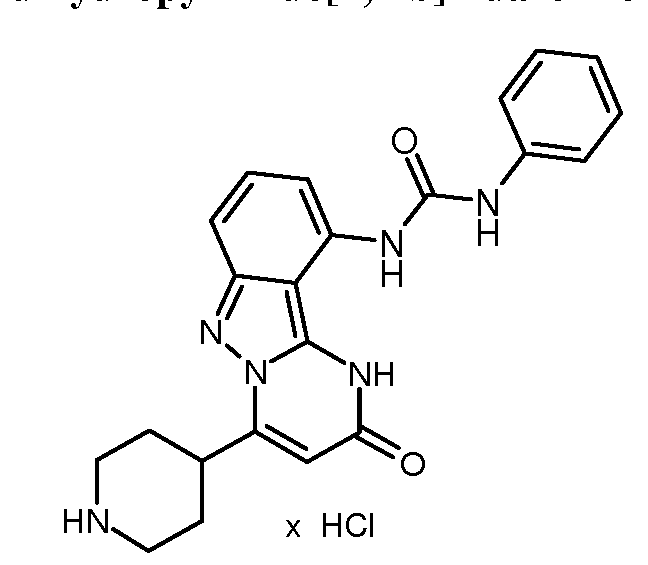
Compound ieri-butyl 4- { 2-oxo- 10- [(phenylcarbamoyl)amino] - 1 ,2-dihydropyrimido[ 1 ,2-b]indazol-4-yl } piperidine- l-carboxylate (300 mg, 19% purity, 0.60 mmol) was dissolved in 1,4-dioxane (2 ml) and stirred 3h at RT with hydrochloric acid 4N in 1,4-dioxane (10.0 ml). The suspension was filtered, washed with 1,4-dioxane and methyl-ieri-butylether, and purified by preparative HPLC (gradient acetonitrile/water with 1% aqueous hydrochloric acid IN). The product fractions were further purified [Column: Kinetix, 5 μιη CI 8, 100 x 21.2 mm, Eluent: 95% water / 5% (acetonitrile/water 80/20 + 2% formic acid), Flow: 60 ml/min, Temperature: 40 °C, Detection: 210 nm] . The combined product fractions were concentrated, dissolved with acetonitrile/ aqueous hydrochloric acid IN (1/1) at 50 °C, and lyophilized to yield the title compound (53 mg, 20% of theory).
LC-MS (Method 4): Rt = 0.83 min, MS (ESIPos): m/z = 403 [M+H-xHCl]+
¾-NMR (400 MHz, DMSO): delta = 9.87 (bs, 1H), 9.17 (s, 1H), 8.96 (bs, 1H), 8.84 (bs, 1H), 7.65 (d, 3H), 7.40 (t, 1H), 7.31 (t, 2H), 7.21 (d, 1H), 7.00 (t, 1H), 6.70 (s, 1H), 3.91 (t, 1H), 3.46 (d, 2H), 3.20 (q, 2H), 2.37 (d, 2H), 2.00 (q, 2H).
Example 40
l-(2-methylphenyl)-3-[2-oxo-4-(piperidin-4-yl)-l,2-dihydropyrimido[l,2-b]indazol-10-yl] hydrochloride

LC-MS (Method 4): Rt = 0.82 min, MS (ESIPos): m/z = 417 [M+H-xHCl]+
¾-NMR (400 MHz, DMSO): delta = 9.24 (bs, IH), 9.09-8.75 (m, 3H), 7.62-7.49 (m, 2H), 7.38 (t, IH), 7.25-7.14 (m, 3H), 7.04 (t, IH), 6.65 (bs, IH), 3.91 (t, IH), 3.46 (d, 2H), 3.20 (q, 2H), 2.36 (d, 2H), 2.33 (s, 3H), 1.98 (q, 2H).
Example 41
l-(2-hydroxyethyl)-3 2-oxo-4-(piperidin-4-yl)-l,2-dihydropyrimido[l,2-b]indazol-10-yl] hydrochloride

Compound ieri-butyl 4-(10-{ [(2-hydroxyethyl)carbamoyl]amino}-2-oxo-l,2-dihydropyrimido[l,2- b]indazol-4-yl)piperidine-l-carboxylate (70 mg, 0.14 mmol) was dissolved in 1,4-dioxane (2 ml) and stirred overnight at RT with hydrochloric acid 4N in 1,4-dioxane (4.0 ml). The suspension was filtered, washed with diethyl ether (2 ml) and dried in vacuo to yield the title compound (60 mg, 99% of theory). LC-MS (Method 2): Rt = 0.64 min, MS (ESIPos): m/z = 371 [M+H-xHCl]+
¾-NMR (400 MHz, DMSO): delta = 9.11-8.86 (m, 2H), 8.77 (bs, IH), 7.56 (d, IH), 7.34 (t, IH), 7.13 (d, IH), 6.64 (bs, IH), 3.89 (t, IH), 3.51 (t, 2H), 3.48-3.38 (m, 2H), 3.26-3.12 (m, 4H), 2.34 (d, 2H), 1.99 (q, 2H).
Example 42
l-butyl-3 2-oxo-4-(piperidin-4- -l,2-dihydropyrimido[l,2-b]indazol-10-yl]urea hydrochloride

Compound ieri-butyl 4- { 10-[(butylcarbamoyl)amino]-2-oxo-l,2-dihydropyrimido[l,2-b]indazol-4- yl }piperidine-l-carboxylate (40 mg, 86% purity, 0.071 mmol) was dissolved in 1,4-dioxane (2 ml) and stirred overnight at RT with hydrochloric acid 4N in 1,4-dioxane (4.0 ml). The suspension was filtered, washed with diethyl ether (2 ml) and dissolved in water. This solution was purified by preparative HPLC (gradient acetonitrile/water with 1 % aqueous hydrochloric acid IN) and the combined product fractions were lyophilized to yield the title compound (13 mg, 44% of theory).
LC-MS (Method 4): Rt = 0.76 min, MS (ESIPos): m/z = 383 [M+H-xHCl]+
¾-NMR (400 MHz, DMSO): delta = 9.06 (s, 1H), 7.30 (d, 1H), 7.12 (bs, 1H), 7.07 (t, 1H), 6.79 (d, 1H), 5.92 (s, 1H), 3.61 (t, 1H), 3.15-3.01 (m, 4H), 2.28 (d, 2H), 1.80 (dq, 2H), 1.46 (quint, 2H), 1.33 (sext, 2H), 0.89 (t, 3H). 2H are missing and are believed to be below the water signal.
Example 43
l,l-diethyl-3-[2-oxo-4-(piperidin-4-yl)-l,2-dihydropyrimido[l,2-b]indazol-10-yl]urea
hydrochloride

Compound feri-butyl 4- { 10- [(diethylcarbamoyl)amino] -2-oxo- 1 ,2-dihydropyrimido[ 1 ,2-b] indazol-4-yl } piperidine- l-carboxylate (75 mg, 94% purity, 0.15 mmol) was dissolved in 1,4-dioxane (2 ml) and stirred overnight at RT with hydrochloric acid 4N in 1,4-dioxane (4.0 ml). The suspension was filtered, dissolved in water and lyophilized to yield the title compound (60 mg, 98% of theory).
LC-MS (Method 4): Rt = 0.75 min, MS (ESIPos): m/z = 383 [M+H-xHCl]+
¾-NMR (400 MHz, DMSO): delta = 12.34 (bs, 1H), 9.01 (s, 1H), 9.04-8.80 (m, 2H), 7.74 (d, 1H), 7.38 (t, 1H), 7.16 (d, 1H), 6.78 (s, 1H), 3.93 (dt, 1H), 3.54-3.41 (m, 6H), 3.20 (q, 2H), 2.35 (d, 2H), 2.00 (dq, 2H), 1.22 (t, 6H).
Example 44
/fac^-sec-butyl-3 2-oxo-4-(piperidin-4-yl) ,2-dihydTO
hydrochloride

Compound rac-tert-butyl 4-{ 10-[(sec-butylcarbamoyl)amino]-2-oxo-l,2-dihydropyrimido[l,2- b]indazol-4-yl} piperidine-l-carboxylate (33 mg, 0.068 mmol) was dissolved in 1,4-dioxane (2 ml) and stirred overnight at RT with hydrochloric acid 4N in 1,4-dioxane (2.4 ml). The suspension was concentrated, dissolved in water/acetonitrile and lyophilized to yield the title compound (28 mg, 96% of theory).
LC-MS (Method 4): Rt = 0.72 min, MS (ESIPos): m/z = 383 [M+H-xHCl]+
¾-NMR (400 MHz, D20): delta = 7.24 (t, 1H), 6.96 (t, 2H), 6.35 (s, 1H), 3.73-3.64 (m, 3H), 3.40-3.24 (m, 3H), 2.39 (d, 2H), 1.92 (q, 2H), 1.57 (quint, 2H), 1.23 (d, 3H), 0.98 (t, 3H).
Example 45
l-(4-methylphenyl)-3-[2-oxo-4-(piperidin-4-yl)-l,2-dihydropyrimido[l,2-b]indazol-10-yl]urea hydrochloride

Compound ieri-butyl 4-(10-{ [(4-methylphenyl)carbamoyl]amino }-2-oxo-l,2-dihydropyrimido[l,2- b]indazol-4-yl)piperidine-l-carboxylate (52 mg, 94% purity, 0.095 mmol) was dissolved in 1,4-dioxane (2 ml) and stirred overnight at RT with hydrochloric acid 4N in 1,4-dioxane (3.0 ml). The suspension was concentrated, dissolved in water/acetonitrile and lyophilized to yield the title compound (38 mg, 89% of theory).
LC-MS (Method 4): Rt = 0.90 min, MS (ESIPos): m/z = 417 [M+H-xHCl]+
¾-NMR (400 MHz, DMSO): delta = 9.76 (bs, 1H), 9.13 (bs, 1H), 8.96 (bs, 1H), 8.84 (bs, 1H), 7.63 (d,
1H), 7.52 (d, 2H), 7.39 (t, IH), 7.19 (d, IH), 7.11 (d, 2H), 6.69 (s, IH), 3.95-3.83 (m, IH), 3.46 (d, 2H), 3.20 (q, 2H), 2.41-2.32 (m, 2H), 2.26 (s, 3H), 2.00 (q, 2H).
Example 46
l-cyclohexyl-3 2-oxo-4-(piperidin-4-yl) ,2-dihydropyrimido[l,2-b]indazol-10-yl]urea
hydrochloride

Compound ieri-butyl 4-{ 10-[(cyclohexylcarbamoyl)amino]-2-oxo-l,2-dihydropyrimido[l,2-b]indazol- 4-yl} piperidine-l-carboxylate (200 mg, 32% purity, 0.13 mmol) was dissolved in 1,4-dioxane (2 ml) and stirred overnight at RT with hydrochloric acid 4N in 1,4-dioxane (4.0 ml). The suspension was concentrated, dissolved in water/acetonitrile and purified by preparative HPLC (gradient acetonitrile/water with 1 % aqueous hydrochloric acid IN). The combined product fractions were lyophilized to yield the title compound (56 mg, quantitativ).
LC-MS (Method 4): Rt = 0.85 min, MS (ESIPos): m/z = 409 [M+H-xHCl]+
1H-NMR (400 MHz, DMSO): delta = 12.33 (bs, IH), 8.73 (d, IH), 8.63-8.36 (m, 2H), 7.59 (bs, IH), 7.39-7.28 (m, IH), 7.13 (d, IH), 6.67 (bs, IH), 3.90 (t, IH), 3.47 (d, 2H), 3.21 (q, 2H), 2.41-2.30 (m, 2H), 1.99-1.82 (m, 4H), 1.77-1.67 (m, 2H), 1.63-1.54 (m, IH), 1.48-1.11 (m, 5H). IH is missing and is believed to be below the water signal.
Example 47
6-methoxy-N 2-oxo-4-(piperidin-4-yl) ,2-dihydropyrimido[l,2-b]indazol-10-yl]pyridine-2- carboxamide hydrochloride

Compound ieri-butyl 4-(10-{ [(6-methoxypyridin-2-yl)carbonyl] amino }-2-oxo-l,2-dihydropyrimido [1,2-b] indazol-4-yl)piperidine-l-carboxylate (52 mg, 0.10 mmol) was dissolved in 1,4-dioxane (2 ml)
and stirred 5h at RT with hydrochloric acid 4N in 1,4-dioxane (3.0 ml). The suspension was concentrated, dissolved in water/acetonitrile and lyophilized to yield the title compound (45 mg, 99% of theory).
LC-MS (Method 4): Rt = 0.90 min, MS (ESIPos): m/z = 419 [M+H-xHCl]+
¾-NMR (400 MHz, DMSO): delta = 12.44 (bs, 1H), 11.55 (s, 1H), 8.99 (bs, 2H), 8.24 (d, 1H), 8.00 (t, 1H), 7.84 (d, 1H), 7.52 (t, 1H), 7.39 (d, 1H), 7.16 (d, 1H), 6.91-6.86 (m, 1H), 4.28 (s, 3H), 4.02-3.92 (m, 1H), 3.47 (d, 2H), 3.21 (q, 2H), 2.42-2.32 (m, 2H), 2.00 (dq, 2H).
Example 48
N 2-oxo-4-(piperidin-4-yl) ,2-dihydropyrimido[l,2-b]indazol-10-yl] H-l,2,3 riazole-4- carboxamide hydrochloride

Compound ieri-butyl 4- { 2-oxo- 10- [( 1H- 1 ,2,3-triazol-4-ylcarbonyl)amino] - 1 ,2-dihydropyrimido[ 1 ,2- b]indazol-4-yl}piperidine- l-carboxylate (58 mg, 90% purity, 0.11 mmol) was dissolved in 1,4-dioxane (2 ml) and stirred overnight at RT with hydrochloric acid 4N in 1,4-dioxane (3.0 ml). The suspension was diluted with acetonitrile and half concentrated hydrochloric acid (5 ml), concentrated and dried in vacuo to yield the title compound (48 mg, 93% purity, 99% of theory).
LC-MS (Method 2): Rt = 1.00 min, MS (ESIPos): m/z = 379 [M+H-xHCl]+
¾-NMR (400 MHz, DMSO): delta = 11.99 (s, 1H), 8.94 (bs, 1H), 8.77 (bs, 1H), 8.71 (s, 1H), 8.27 (bs, 1H), 7.88 (bs, 1H), 7.81 (bs, 1H), 7.70 (d, 1H), 7.57 (t, 1H), 6.39 (s, 1H), 3.84 (t, 1H), 3.45 (d, 2H), 3.19 (q, 2H), 2.32 (d, 2H), 1.95 (dq, 2H).
Example 49
10-[(6-methoxypyridin-2-yl)amino]-4-(piperidin-4-yl)pyrimido[l,2-b]indazol-2(lH)-one hydrochloride

LC-MS (Method 4): Rt = 0.89 min, MS (ESIPos): m/z = 391 [M+H-xHCl]+
¾-NMR (400 MHz, DMSO): delta = 12.49 (bs, IH), 9.14 (bs, IH), 8.98 (bs, IH), 8.89 (bs, IH), 7.92 (d, IH), 7.66 (t, IH), 7.43 (t, IH), 7.13 (d, IH), 6.74 (d, IH), 6.70 (s, IH), 6.33 (d, IH), 3.96 (s, 3H), 3.97- 3.89 (m, IH), 3.46 (d, 2H), 3.20 (q, 2H), 2.37 (d, 2H), 2.01 (dq, 2H).
Example 50
1 2-oxo-4-(piperidin-4-yl)-l,2-dihydropyrimido[l,2-b]indazol-10-yl]-3-propylurea hydrochloride

Compound ieri-butyl 4- { 2-oxo- 10-[(propylcarbamoyl)amino]- 1 ,2-dihydropyrimido[ 1 ,2-b]indazol-4-yl } piperidine- l-carboxylate (73 mg, 94% purity, 0.15 mmol) was dissolved in 1,4-dioxane (2 ml) and stirred overnight at RT with hydrochloric acid 4N in 1,4-dioxane (4.0 ml). The suspension was concentrated, dissolved in water/acetonitrile and lyophilized to yield the title compound (64 mg, 91% purity, 97% of theory).
LC-MS (Method 1): Rt = 0.49 min, MS (ESIPos): m/z = 369 [M+H-xHCl]+
H-NMR (400 MHz, DMSO): delta = 8.96 (bs, IH), 8.87 (bs, IH), 8.77 (s, IH), 7.57 (d, IH), 7.34 (t, IH), 7.12 (d, IH), 6.66 (bs, IH), 3.89 (t, IH), 3.48-3.40 (m, 2H), 3.19 (q, 2H), 3.11 (t, 2H), 2.35 (d, 2H), 1.98 (q, 2H), 1.52 (sext, 2H), 0.92 (t, 3H).
Example 51
1 2-oxo-4-(piperidin-4-yl)-l,2-dihydropyrimido[l,2-b]indazol-10-yl]-3-(2,2,2-trifluoroethyl)urea hydrochloride

LC-MS (Method 1): Rt = 0.51 min, MS (ESIPos): m/z = 409 [M+H-xHCl]+
¾-NMR (400 MHz, DMSO): delta = 9.09-8.85 (m, 3H), 8.10 (bs, IH), 7.58 (d, IH), 7.37 (t, IH), 7.19 (d, IH), 6.69 (bs, IH), 4.03-3.85 (m, 3H), 3.45 (d, 2H), 3.19 (q, 2H), 2.35 (d, 2H), 1.99 (dq, 2H).
Example 52
l-(2-methoxyethyl)-3 2-oxo-4-(piperidin-4-yl)-l,2-dihydropy
hydrochloride

Compound ieri-butyl 4-(10-{ [(2-methoxyethyl)carbamoyl]amino }-2-oxo-l,2-dihydropyrimido[l,2- b]indazol-4-yl)piperidine-l-carboxylate (120 mg, 94% purity, 0.23 mmol) was dissolved in 1,4-dioxane (2 ml) and stirred overnight at RT with hydrochloric acid 4N in 1,4-dioxane (4.0 ml). The suspension was concentrated, dissolved in water/ acetonitrile and lyophilized to yield the title compound (98 mg, quantitativ).
LC-MS (Method 1): Rt = 0.43 min, MS (ESIPos): m/z = 385 [M+H-xHCl]+
¾-NMR (400 MHz, DMSO): delta = 9.09-8.85 (m, 2H), 8.76 (bs, IH), 7.56 (d, IH), 7.34 (t, IH), 7.13 (d, IH), 6.64 (bs, IH), 3.89 (tt, IH), 3.48-3.40 (m, 4H), 3.34-3.28 (m, 2H), 3.30 (s, 3H), 3.18 (q, 2H), 2.34 (d, 2H), 1.99 (q, 2H).
Example 53
l-isopropyl-3-[2-oxo-4-(piperidin-4-yl)-l,2-dihydropyrimido[l,2-b]indazol-10-yl]urea
hydrochloride

Compound ieri-butyl 4- { 10- [(isopropylcarbamoyl)amino] -2-oxo- 1 ,2-dihydropyrimido[ 1 ,2-b] indazol-4- yl } piperidine-l-carboxylate (80 mg, 0.17 mmol) was dissolved in 1,4-dioxane (2 ml) and stirred overnight at RT with hydrochloric acid 4N in 1,4-dioxane (4.0 ml). The suspension was concentrated, dissolved in water/acetonitrile and lyophilized to yield the title compound (67 mg, quantitativ).
LC-MS (Method 1): Rt = 0.49 min, MS (ESIPos): m/z = 369 [M+H-xHCl]+
¾-NMR (400 MHz, DMSO): delta = 9.07-8.84 (m, 2H), 8.74 (bs, IH), 7.59 (d, IH), 7.34 (t, IH), 7.22 (bs, IH), 7.11 (d, IH), 6.66 (bs, IH), 3.94-3.78 (m, 2H), 3.49-3.38 (m, 2H), 3.19 (q, 2H), 2.35 (d, 2H), 1.99 (q, 2H), 1.16 (d, 6H). Example 54
N 2-oxo-4-(piperidin-4-yl) ,2-dihydropyrimid^
hydrochloride

Compound ieri-butyl 4- { 2-oxo- 10- [(piperidin- 1 -ylcarbonyl)amino] - 1 ,2-dihydropyrimido[ 1 ,2-b] indazol- 4-yl} piperidine-l-carboxylate (25 mg, , 59% purity, 0.051 mmol) was dissolved in 1,4-dioxane (2 ml) and stirred overnight at RT with hydrochloric acid 4N in 1,4-dioxane (3.0 ml). The suspension was filtered, washed with acetonitrile (2 ml) and dried in vacuo to yield the title compound (22 mg, 83% purity, 84% of theory).
LC-MS (Method 2): Rt = 1.43 min, MS (ESIPos): m/z = 395 [M+H-xHCl]+
¾-NMR (400 MHz, DMSO): delta = 12.43 (bs, IH), 9.10-8.87 (m, 3H), 7.71 (bs, IH), 7.38 (t, IH), 7.18 (d, IH), 6.76 (s, IH), 3.93 (t, IH), 3.61-3.52 (m, 4H), 3.45 (d, 2H), 3.19 (q, 2H), 2.35 (d, 2H), 2.08- 1.93 (m, 2H), 1.68-1.52 (m, 6H).
Example 55
N 2-oxo-4-(piperidin-4-yl) ,2-dihydropyrimido[l,2-b]indazol-10-yl]propanamide hydrochloride

Compound ieri-butyl 4-[2-oxo- lO-(propanoylamino)- 1 ,2-dihydropyrimido[ 1 ,2-b]indazol-4- yl]piperidine- l-carboxylate (528 mg, 49 % purity, 589 μιηοΐ) was stirred overnight at RT with hydrochloric acid 4N in 1,4-dioxane (15 ml). The suspension was dissolved with water and purified by preparative HPLC (gradient acetonitrile/water with 0.1 % trifluoroacetic acid). The product containing fractions were concentrated and further purified [Column: Sunfire, 5 μιη CI 8, 75 x 30 mm, Eluent: gradient 95% water / 0% acetonitrile / 5% (1 % formic acid in water) to 55% water / 40% acetonitrile / 5% (1 % formic acid in water), Flow: 75 ml/min, Detection: 210 nm] . The combined product fractions were concentrated, dissolved with aqueous IN HCl/ acetonitrile and lyophilized to yield the title compound.
The obtained amout was 136 mg (100 % purity, 62 % of theory)
LC-MS (Method 4): Rt = 0.61 min; MS (ESIpos): m/z = 340 [M+H-xHCl]+
¾-NMR (400 MHz, DMSO-d6) delta [ppm] : 0.000 (15.98), 1.184 (7.97), 1.202 (16.00), 1.221 (7.82), 1.965 (1.07), 1.994 (2.67), 2.024 (2.76), 2.054 (1.05), 2.330 (4.17), 2.362 (3.19), 2.559 (10.29), 2.578 (9.70), 2.596 (2.94), 3.174 (2.74), 3.202 (2.71), 3.429 (4.13), 3.458 (3.21), 3.877 (2.67), 3.906 (2.99), 3.937 (1.62), 6.693 (1.62), 7.286 (5.06), 7.308 (6.99), 7.390 (2.97), 7.409 (4.06), 7.430 (2.14), 7.740 (1.03), 9.041 (1.66), 9.659 (5.43). Example 56
rac-2-hydroxy-N 2-oxo-4-(piperidin-4-yl)-l,2-dihydropyrimido[l,2-b]indazol-10-yl]propanamide hydrochloride

The obtained amout was 25.0 mg (100 % purity, 30 % of theory) and 21.0 mg (75 % purity, 19 % of theory)
LC-MS (Method 4): Rt = 0.62 min; MS (ESIpos): m/z = 354 [M-H-xHCl]"
¾-NMR (400 MHz, DMSO-d6) delta [ppm] : -0.008 (6.69), 0.008 (6.66), 1.381 (15.78), 1.398 (16.00), 1.896 (2.27), 1.928 (2.44), 1.958 (0.98), 2.333 (3.80), 2.366 (3.29), 3.162 (3.01), 3.194 (5.56), 3.226 (4.83), 3.438 (6.06), 3.468 (4.58), 3.733 (1.05), 3.841 (1.54), 4.226 (1.12), 4.243 (3.55), 4.260 (3.52), 4.277 (1.11), 6.482 (1.35), 7.218 (2.12), 7.342 (1.97), 7.901 (2.15), 10.743 (2.57).
Example 57
l-ethyl-3 2-oxo-4-(piperidin-4-yl)-l,2-dihydropyrimido[l,2-b]indazol-10-yl]urea hydrochloride

Compound ieri-butyl 4-{ 10-[(ethylcarbamoyl)amino]-2-oxo-l,2-dihydropyrimido[l,2-b]indazol-4- yl}piperidine-l-carboxylate (148 mg, 100 % purity, 326 μιηοΐ) was dissolved in 1,4-dioxane (2.0 ml) and stirred overnight at RT with hydrochloric acid 4N in 1,4-dioxane (5.0 ml). The suspension was concentrated, dissolved in water/acetonitrile and lyophilized to yield the title compound.
The obtained amout was 136 mg (94 % purity, quantitative of theory)
LC-MS (Method 4): Rt = 0.57 min; MS (ESIpos): m/z = 355 [M+H-xHCl]+
¾-NMR (400 MHz, DMSO-d6) delta [ppm] : -0.008 (0.80), 0.000 (16.00), 0.008 (0.51), 1.104 (3.84), 1.122 (8.26), 1.140 (3.89), 1.954 (0.34), 1.978 (0.88), 1.985 (0.90), 2.010 (0.96), 2.016 (0.92), 2.041 (0.40), 2.075 (0.19), 2.331 (1.39), 2.364 (1.10), 3.150 (1.09), 3.168 (3.22), 3.186 (2.73), 3.204 (1.63), 3.229 (0.40), 3.391 (0.21), 3.428 (1.33), 3.460 (1.04), 3.865 (0.42), 3.894 (0.76), 3.925 (0.39), 4.330 (0.68), 6.669 (0.76), 7.110 (2.27), 7.132 (2.66), 7.321 (1.37), 7.340 (1.89), 7.361 (1.28), 7.565 (1.13), 7.584 (0.96), 8.785 (1.44), 8.962 (0.36), 9.021 (0.52).
Example 58
l-[2-oxo-4-(piperidin-4-yl)-l,2-dihydropyrimido[l,2-b]indazol-10-yl]urea hydrochloride
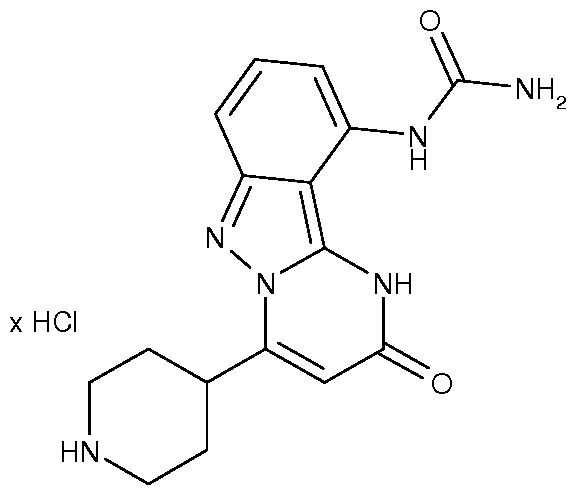
Compound ieri-butyl 4-[10-(carbamoylamino)-2-oxo-l,2-dihydropyrimido[l,2-b]indazol-4-yl] piperidine- l-carboxylate (84.0 mg, 100 % purity, 197 μιηοΐ) was dissolved in 1,4-dioxane (2.0 ml) and stirred overnight at RT with hydrochloric acid 4N in 1,4-dioxane (4.0 ml). The suspension was filtered, washed with diethyl ether (2.0 ml) and dried in vacuo to yield the title compound.
The obtained amout was 49.0 mg (100 % purity, 69 % of theory)
LC-MS (Method 5): Rt = 0.75 min; MS (ESIpos): m/z = 327 [M+H-xHCl]+
¾-NMR (400 MHz, DMSO-d6) delta [ppm] : -0.008 (1.02), 0.000 (16.00), 0.008 (0.58), 1.112 (0.46), 1.958 (0.48), 1.980 (1.18), 1.990 (1.20), 2.013 (1.30), 2.022 (1.17), 2.045 (0.54), 2.055 (0.43), 2.329 (1.82), 2.331 (1.80), 2.361 (1.42), 2.370 (1.02), 3.137 (0.49), 3.170 (1.26), 3.196 (1.27), 3.228 (0.49), 3.425 (1.78), 3.427 (1.75), 3.458 (1.33), 3.861 (0.54), 3.870 (0.41), 3.882 (0.61), 3.890 (0.95), 3.899 (0.58), 3.921 (0.44), 6.649 (1.21), 7.127 (2.56), 7.147 (2.98), 7.320 (1.64), 7.339 (2.24), 7.342 (1.83), 7.360 (1.49), 7.536 (1.40), 7.555 (1.14), 8.859 (1.77), 9.055 (0.69).
Example 59
10-(2-oxo-l,3-oxazinan-3-yl)-4-(piperidin-4-yl)pyrimido[l,2-b]indazol-2(lH)-one hydrochloride

Compound ieri-butyl 4- [2-oxo- 10-(2-oxo- 1 ,3-oxazinan-3-yl)- 1 ,2-dihydropyrimido [ 1 ,2-b]indazol-4- yl]piperidine- l-carboxylate (35.0 mg, 100 % purity, 74.9 μιηοΐ) was dissolved in 1,4-dioxane (2.0 ml) and stirred overnight at RT with hydrochloric acid 4N in 1,4-dioxane (1.7 ml). The suspension was concentrated, dissolved in water/acetonitrile and purified by preparative HPLC [Column: XBridge, 5 μιη C18, 75 x 30 mm, Eluent: gradient 95% water / 0% acetonitrile / 5% (acetonitrile/water 80/20 + 1%
ammonia solution) to gradient 5% water / 90% acetonitrile / 5% (acetonitrile/water 80/20 + 1% ammonia solution), Flow: 75 ml/min, Detection: 210 nm]. The combined product fractions were concentrated in the presence 10 mL of aqueous IN hydrochloric acid and lyophilized to yield the title compound.
The obtained amout was 11.2 mg (100 % purity, 37 % of theory)
LC-MS (Method 4): Rt = 0.57 min; MS (ESIpos): m/z = 368 [M+H-xHCl]+
¾-NMR (400 MHz, DMSO-d6) delta [ppm] : -0.008 (9.14), 0.008 (7.31), 1.991 (5.75), 2.024 (6.22), 2.333 (10.69), 2.367 (9.01), 3.187 (6.37), 3.216 (6.54), 3.434 (9.28), 3.463 (7.16), 3.910 (2.74), 3.940 (4.94), 3.970 (2.44), 4.519 (6.30), 6.717 (5.70), 6.958 (15.11), 6.975 (16.00), 7.466 (7.43), 7.488 (10.72), 7.505 (9.46), 7.589 (15.60), 7.610 (10.64), 9.019 (3.01).
Example 60
10-(7-oxo-2-oxa-6-azaspiro[3.4]oct-6-yl)-4-(piperidin-4-yl)pyrimido[l,2-b]indazol-2(lH)-one hydrochloride

Compound ierf -butyl 4-[2-oxo-10-(7-oxo-2-oxa-6-azaspiro[3.4]oct-6-yl)-l,2-dihydropyrimido[l,2- b]indazol-4-yl]piperidine-l-carboxylate (150 mg, 100 % purity, 304 μιηοΐ) was dissolved in 1,4-dioxane (2.0 ml) and stirred overnight at RT with hydrochloric acid 4N in 1,4-dioxane (5.0 ml). The suspension was concentrated and purified by preparative HPLC (gradient acetonitrile/water with 1% aqueous hydrochloric acid IN). Evaporation of the combined product fractions yielded the title compound. The obtained amout was 35.0 mg (100 % purity, 27 % of theory)
LC-MS (Method 1): Rt = 0.51 min; MS (ESIneg): m/z = 392 [M-H-xHCl]"
¾-NMR (400 MHz, DMSO-d6) delta [ppm] : -0.149 (0.59), -0.008 (5.22), 0.008 (4.87), 0.146 (0.52), 1.146 (0.45), 1.176 (3.44), 1.194 (7.23), 1.212 (3.53), 1.946 (0.84), 1.977 (2.45), 2.007 (2.64), 2.036 (1.11), 2.316 (3.84), 2.349 (3.19), 2.525 (2.03), 2.569 (8.73), 2.577 (7.71), 2.619 (0.93), 2.671 (0.55), 2.711 (0.38), 3.031 (0.48), 3.049 (1.44), 3.061 (1.43), 3.067 (1.47), 3.079 (1.40), 3.098 (0.42), 3.148 (0.97), 3.177 (2.72), 3.205 (2.83), 3.236 (1.17), 3.427 (3.81), 3.457 (3.02), 3.665 (0.71), 3.693 (16.00), 3.710 (4.49), 3.720 (1.05), 3.734 (7.27), 3.777 (5.87), 3.801 (3.22), 3.889 (1.06), 3.918 (1.81), 3.947 (1.06), 3.965 (1.12), 3.993 (9.89), 4.022 (0.88), 4.559 (5.42), 6.661 (0.78), 6.935 (5.93), 6.952 (6.21), 7.459 (2.36), 7.481 (3.80), 7.499 (3.20), 7.569 (5.12), 7.591 (3.34), 8.958 (0.92), 9.031 (1.30).
Example 61
10-(2-oxo-l,3-oxazolidin-3-yl)-4-(piperidin-4-yl)pyrimido[l,2-b]indazol-2(lH)-one hydrochloride

ieri-butyl 4-[2-oxo-10-(2-oxo-l,3-oxazolidin-3-yl)-l,2-di ydropyrimido[l,2-b]indazol-4-yl] piperidine- 1-carboxylate (70.0 mg, 82 % purity, 127 μιηοΐ)
hydrochloric acid 4N in 1,4-dioxane (4.0 ml)
1,4-dioxane (2.0 ml)
The title compound was prepared according to the same procedure as Example 60.
The obtained amout was 26.0 mg (100 % purity, 53 % of theory)
LC-MS (Method 2): Rt = 0.71 min; MS (ESIneg): m/z = 352 [M-H-xHCl]"
1H-NMR (400 MHz, DMSO-d6) delta [ppm] : -0.008 (8.64), 0.008 (6.62), 1.938 (2.52), 1.975 (6.33), 2.005 (6.47), 2.035 (2.50), 2.286 (1.86), 2.320 (10.72), 2.352 (7.61), 3.145 (3.48), 3.175 (7.61), 3.203 (7.18), 3.235 (2.80), 3.457 (7.38), 3.803 (1.18), 3.881 (2.68), 3.909 (4.54), 3.937 (2.74), 4.201 (11.92), 4.220 (16.00), 4.239 (12.58), 4.588 (11.36), 4.608 (15.84), 4.627 (9.11), 6.249 (1.18), 6.605 (1.71), 6.980 (1.20), 7.002 (1.57), 7.025 (9.79), 7.043 (10.31), 7.372 (0.95), 7.393 (1.30), 7.409 (1.13), 7.456 (4.08), 7.477 (7.32), 7.495 (5.73), 7.529 (2.66), 7.556 (8.43), 7.578 (5.15), 7.954 (2.21), 7.975 (2.12), 8.943 (2.10), 9.022 (3.24).
Example 62
10 (4R)-4-methyl-2-oxo^,3-oxazolidin-3-yl]-4-(piperidin-4-yl)pyrimido[l,2-b]indazol-2(lH)-one hydrochloride

ieri-butyl 4- { 10- [(4R)-4-methyl-2-oxo- 1 ,3-oxazolidin-3-yl] -2-oxo- 1 ,2-dihydropyrimido [ 1 ,2-b] indazol- 4-yl}piperidine- 1-carboxylate (108 mg, 97 % purity, 224 μιηοΐ)
hydrochloric acid 4N in 1,4-dioxane (5.0 ml)
1,4-dioxane (2.0 ml)
The title compound was prepared according to the same procedure as Example 57.
The obtained amout was 90.0 mg (100 % purity, quantitative of theory)
LC-MS (Method 5): Rt = 0.90 min; MS (ESIneg): m/z = 366 [M-H-xHCl]"
¾-NMR (400 MHz, DMSO-d6) delta [ppm] : -0.008 (2.88), 0.008 (2.24), 1.118 (15.67), 1.132 (16.00), 1.758 (1.59), 1.981 (3.19), 2.012 (3.43), 2.041 (1.36), 2.320 (5.19), 2.352 (4.16), 3.147 (1.34), 3.177 (3.64), 3.205 (3.75), 3.235 (1.54), 3.427 (5.29), 3.457 (4.29), 3.491 (0.76), 3.503 (0.59), 3.667 (0.46), 3.681 (0.56), 3.699 (0.57), 3.713 (0.48), 3.909 (2.49), 4.125 (4.68), 4.142 (8.83), 4.158 (5.25), 4.806 (3.68), 6.626 (0.80), 6.974 (6.22), 6.991 (6.62), 7.473 (2.13), 7.494 (3.84), 7.512 (2.91), 7.589 (3.27), 7.611 (2.36), 9.040 (1.53).
Example 63
10-[rac-4-hydroxy-2-oxopiperidin-l-yl]-4-(piperidin-4-yl)pyrimido[l,2-b]indazol-2(lH)-one hydrochloride

ieri-butyl 4- { 10- [rac-4-hydroxy-2-oxopiperidin- 1 -yl] -2-oxo- 1 ,2-dihydropyrimido[ 1 ,2-b]indazol-4-yl } piperidine- l-carboxylate (38.0 mg, 100 % purity, 78.9 μιηοΐ)
hydrochloric acid 4N in 1,4-dioxane (3.0 ml)
1,4-dioxane (2.0 ml)
The title compound was prepared according to the same procedure as Example 57.
The obtained amout was 24.0 mg (100 % purity, 73 % of theory)
LC-MS (Method 5): Rt = 0.81 min; MS (ESIneg): m/z = 380 [M-H-xHCl]"
¾-NMR (400 MHz, DMSO-d6) delta [ppm] : 1.239 (1.67), 1.758 (6.44), 1.955 (7.45), 1.985 (8.17), 2.098 (3.11), 2.298 (10.50), 2.330 (10.27), 2.672 (2.67), 2.711 (2.33), 3.166 (8.14), 3.194 (8.58), 3.390 (8.11), 3.416 (12.15), 3.445 (10.01), 3.491 (2.73), 3.501 (2.03), 3.734 (2.28), 3.871 (3.67), 4.020 (4.39), 4.239 (12.10), 4.319 (16.00), 4.629 (1.54), 6.850 (14.44), 6.867 (15.62), 7.430 (3.50), 7.450 (7.12), 7.468 (5.50), 7.536 (12.94), 7.558 (8.99), 8.934 (2.73), 9.027 (4.50).
Example 64
10-(3-oxomorpholin-4-yl)-4-(piperidin-4-yl)pyrimido[l,2-b]indazol-2(lH)-one hydrochloride

ieri-butyl 4- [2-oxo- 10-(3-oxomorpholin-4-yl)- 1 ,2-dihydropyrimido [ 1 ,2-b]indazol-4-yl]piperidine- 1 - carboxylate (53.0 mg, 100 % purity, 113 μιηοΐ)
hydrochloric acid 4N in 1,4-dioxane (4.0 ml)
1,4-dioxane (2.0 ml)
The title compound was prepared according to the same procedure as Example 57.
The obtained amout was 43.0 mg (100 % purity, 94 % of theory)
LC-MS (Method 5): Rt = 0.80 min; MS (ESIneg): m/z = 366 [M-H-xHCl]"
¾-NMR (400 MHz, DMSO-d6) delta [ppm] : -0.008 (5.20), 0.008 (4.56), 1.967 (2.19), 1.996 (5.76), 2.025 (6.09), 2.056 (2.44), 2.325 (9.26), 2.358 (7.26), 3.183 (6.13), 3.210 (6.17), 3.240 (2.64), 3.390 (2.76), 3.429 (8.92), 3.462 (9.03), 3.473 (5.44), 3.491 (3.89), 3.503 (3.33), 3.667 (2.61), 3.671 (2.11), 3.681 (3.16), 3.699 (3.33), 3.709 (2.36), 3.713 (2.79), 3.729 (1.66), 3.764 (8.64), 3.777 (15.65), 3.788 (9.13), 3.909 (2.87), 3.939 (4.91), 3.969 (2.69), 4.020 (1.34), 4.089 (3.74), 4.168 (9.06), 4.346 (15.99), 6.707 (5.73), 6.971 (15.19), 6.989 (15.89), 7.483 (7.52), 7.501 (8.02), 7.505 (10.77), 7.523 (9.54), 7.607 (16.00), 7.629 (10.91), 9.065 (3.49).
Example 65
10^3-fluoro-2-oxopyridin-l(2H)-yl)-4-(piperidin-4-yl)pyrimido[l,2-b]indazol-2(lH)- hydrochloride

ieri-butyl 4- [ 10-(3-fluoro-2-oxopyridin- 1 (2H)-yl)-2-oxo- 1 ,2-dihydropyrimido [ 1 ,2-b]indazol-4- yl]piperidine- l-carboxylate (65.0 mg, 100 % purity, 136 μιηοΐ)
hydrochloric acid 4N in 1,4-dioxane (3.0 ml)
1,4-dioxane (2.0 ml)
The title compound was prepared according to the same procedure as Example 57.
The obtained amout was 60.0 mg (94 % purity, quantitative of theory)
LC-MS (Method 5): Rt = 0.85 min; MS (ESIneg): m/z = 378 [M-H-xHCl]"
¾-NMR (400 MHz, DMSO-d6) delta [ppm] : 1.177 (2.74), 1.196 (5.79), 1.214 (2.85), 1.758 (3.18), 1.954 (1.80), 1.979 (4.85), 2.012 (5.26), 2.042 (2.14), 2.324 (6.68), 2.355 (5.25), 3.046 (1.01), 3.064 (1.21), 3.076 (1.00), 3.186 (5.05), 3.213 (5.12), 3.243 (2.13), 3.463 (6.74), 3.492 (1.99), 3.503 (1.46), 3.594 (1.48), 3.667 (1.28), 3.681 (1.72), 3.701 (1.86), 3.713 (1.46), 3.913 (2.31), 3.943 (4.05), 3.973 (2.25), 4.021 (1.22), 4.228 (2.84), 4.646 (0.71), 6.292 (2.98), 6.304 (3.41), 6.310 (6.09), 6.322 (5.77), 6.328 (3.84), 6.340 (3.25), 6.696 (3.74), 7.029 (6.83), 7.047 (7.25), 7.516 (15.56), 7.533 (16.00), 7.563 (6.61), 7.585 (6.79), 7.603 (5.32), 7.757 (11.06), 7.778 (8.88), 7.956 (0.50), 7.978 (0.47), 9.067 (2.74).
Example 66
10-(7-oxo-6-azabicyclo[32.0]hept-6-yl)-4-(piperidin-4-yl)pyrimido[l,2-b]indazol-2(lH)-one hydrochloride

Compound ieri-butyl 4-[2-oxo-10-(7-oxo-6-azabicyclo[3.2.0]hept-6-yl)- l,2-dihydropyrimido[l,2- b]indazol-4-yl]piperidine-l-carboxylate (102 mg, 93 % purity, 199 μιηοΐ) was dissolved in 1,4-dioxane (2.0 ml) and stirred overnight at RT with hydrochloric acid 4N in 1,4-dioxane (4.0 ml). The suspension was filtered, washed with acetonitrile (2.0 ml) and dried in vacuo to yield the title compound.
The obtained amout was 59.3 mg (94 % purity, 68 % of theory)
LC-MS (Method 5): Rt = 1.10 min; MS (ESIneg): m/z = 376 [M-H-xHCl]"
¾-NMR (400 MHz, DMSO-d6) delta [ppm] : -0.150 (0.42), 1.468 (3.53), 1.610 (1.80), 1.627 (1.61), 1.781 (2.41), 1.970 (3.03), 2.008 (4.93), 2.041 (3.05), 2.075 (15.99), 2.318 (4.39), 2.350 (3.60), 3.175 (3.29), 3.204 (3.36), 3.427 (4.66), 3.457 (3.66), 3.568 (16.00), 3.685 (2.78), 3.694 (3.00), 3.703 (2.86), 3.713 (2.63), 3.914 (1.60), 4.529 (1.89), 6.684 (0.57), 7.304 (0.54), 7.418 (10.76), 7.426 (11.18), 9.009 (1.54).
Example 67
10-(2-oxoazetidin-l-yl)-4-(piperidin-4-yl)pyrimido[l,2-b]indazol-2(lH)-one hydrochloride

ieri-butyl 4- [2-oxo- 10-(2-oxoazetidin- 1 -yl)-l ,2-dihydropyrimido[ 1 ,2-b]indazol-4-yl]piperidine- 1 - carboxylate (45.0 mg, 96 % purity, 98.7 μιηοΐ)
hydrochloric acid 4N in 1,4-dioxane (4.0 ml)
1,4-dioxane (2.0 ml)
The title compound was prepared according to the same procedure as Example 60.
The obtained amout was 28.0 mg (100 % purity, 76 % of theory)
LC-MS (Method 1): Rt = 0.47 min; MS (ESIneg): m/z = 336 [M-H-xHCl]"
¾-NMR (400 MHz, DMSO-d6) delta [ppm] : 0.000 (16.00), 0.008 (0.52), 1.953 (0.46), 1.983 (0.48), 2.305 (0.69), 2.339 (0.58), 2.629 (0.44), 2.646 (0.92), 2.662 (0.44), 3.167 (1.01), 3.178 (1.29), 3.190 (0.98), 3.418 (0.73), 3.449 (0.57), 3.526 (0.37), 3.542 (0.63), 3.990 (0.78), 6.017 (0.32), 6.035 (0.32), 6.534 (0.18), 6.775 (0.53), 6.797 (0.55), 7.232 (0.30), 7.251 (0.38), 7.272 (0.24), 7.399 (1.09), 7.407 (0.77), 9.004 (0.22).
Example 68
l-benzyl-3-[2-oxo-4-(piperidin-4-yl)-l,2-dihydropyrimido[l,2-b]indazol-10-yl]urea hydrochloride

ieri-butyl 4- { 10- [(benzylcarbamoyl)amino] -2-oxo- 1 ,2-dihydropyrimido [ 1 ,2-b]indazol-4-yl } piperidine- 1-carboxylate (100 mg, 75 % purity, 145 μιηοΐ)
hydrochloric acid 4N in 1,4-dioxane (4.0 ml, 970 μιηοΐ)
1,4-dioxane (2.0 ml)
The title compound was prepared according to the same procedure as Example 58.
The obtained amout was 55.0 mg (93 % purity, 78 % of theory)
LC-MS (Method 4): Rt = 0.76 min; MS (ESIpos): m/z = 417 [M+H-xHCl]+
¾-NMR (400 MHz, DMSO-d6) delta [ppm] : 0.000 (16.00), 1.111 (0.13), 1.264 (0.12), 1.282 (0.11), 1.330 (0.26), 1.375 (0.26), 1.595 (0.16), 1.950 (0.48), 1.981 (1.34), 2.007 (1.43), 2.038 (0.59), 2.329 (1.97), 2.362 (1.59), 3.141 (0.50), 3.171 (1.40), 3.199 (1.45), 3.229 (0.59), 3.427 (1.99), 3.457 (1.57), 3.649 (0.11), 3.866 (0.51), 3.896 (1.01), 3.925 (0.57), 4.003 (0.11), 4.354 (3.25), 4.818 (0.43), 6.670 (0.87), 6.762 (0.26), 7.127 (2.59), 7.149 (3.12), 7.231 (0.53), 7.248 (1.47), 7.266 (1.07), 7.286 (0.26), 7.304 (0.43), 7.325 (2.49), 7.342 (4.85), 7.359 (3.69), 7.371 (5.17), 7.389 (1.98), 7.582 (1.65), 7.601 (1.41), 7.641 (0.34), 7.662 (0.29), 7.915 (0.31), 8.903 (1.38), 9.019 (0.68). Example 69
N 2-oxo-4-(piperidin-4-yl) ,2-dihydropyrimido[l,2-b]indazol-10-yl]piperazine-l-carboxam hydrochloride

Compound feri-butyl 4-( { 4- [ 1 -(tert-butoxycarbonyl)piperidin-4-yl] -2-oxo- 1 ,2-dihydropyrimido[ 1 ,2- b]indazol-10-yl }carbamoyl)piperazine-l-carboxylate (123 mg, 99 % purity, 204 μιηοΐ) was dissolved in
1,4-dioxane (2.0 ml) and stirred overnight at RT with hydrochloric acid 4N in 1,4-dioxane (4.0 ml). The mixture was concentrated and dried in vacuo to yield the title compound.
The obtained amout was 96.0 mg (100 % purity, quantitative of theory)
LC-MS (Method 5): Rt = 0.75 min; MS (ESIneg): m/z = 394 [M-H-xHCl]"
¾-NMR (400 MHz, DMSO-d6) delta [ppm] : -0.008 (2.99), 0.008 (2.91), 1.148 (0.43), 1.234 (0.65),
1.756 (1.04), 1.972 (0.93), 2.003 (2.55), 2.029 (2.75), 2.060 (1.16), 2.329 (4.21), 2.366 (3.36), 2.671
(0.47), 3.232 (9.58), 3.390 (0.91), 3.433 (4.02), 3.463 (3.51), 3.491 (0.91), 3.814 (16.00), 3.826 (15.75),
3.895 (2.04), 3.925 (2.57), 4.020 (0.76), 6.759 (1.73), 7.223 (5.90), 7.245 (7.23), 7.381 (2.92), 7.401
(4.20), 7.422 (2.59), 7.676 (0.98), 9.029 (7.23), 9.330 (3.02), 12.488 (0.52).
Example 70
10-(2-oxopiperidin-l-yl)-4-(piperidin-4-yl)pyrimido[l,2-b]indazol-2(lH)-one hydrochloride
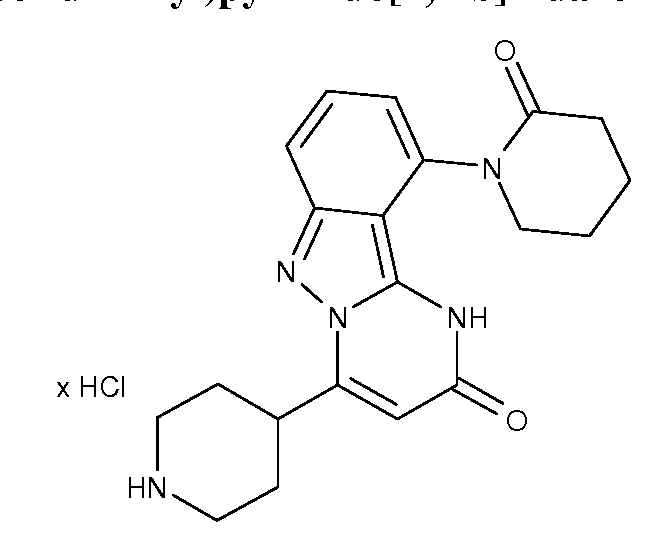
Compound ieri-butyl 4- [2-oxo- 10-(2-oxopiperidin- 1 -yl)-l ,2-dihydropyrimido[ 1 ,2-b] indazol-4- yl]piperidine- l-carboxylate (256 mg, 94 % purity, 517 μιηοΐ) was dissolved in 1,4-dioxane (2.0 ml) and stirred overnight at RT with hydrochloric acid 4N in 1,4-dioxane (5.0 ml). The suspension was filtered and dried in vacuo to yield the title compound.
The obtained amout was 216 mg (96 % purity, quantitative of theory)
LC-MS (Method 5): Rt = 0.88 min; MS (ESIneg): m/z = 364 [M-H-xHCl]"
¾-NMR (400 MHz, DMSO-d6) delta [ppm] : 0.000 (16.00), 1.179 (0.34), 1.198 (0.73), 1.216 (0.36), 2.000 (1.32), 2.030 (1.37), 2.059 (0.79), 2.074 (0.86), 2.320 (1.28), 2.353 (1.05), 3.059 (0.14), 3.180 (0.79), 3.204 (0.80), 3.424 (1.28), 3.455 (0.98), 3.652 (0.84), 3.906 (0.36), 3.936 (0.68), 3.966 (0.33), 5.707 (0.22), 6.706 (1.22), 6.863 (1.93), 6.880 (2.02), 7.451 (0.94), 7.472 (1.44), 7.490 (1.29), 7.555 (2.41), 7.577 (1.52), 9.117 (0.63). Example 71
N 2-oxo-4-(piperidin-4-yl)-l,2-dihydropyrimido[l,2-b]indazol-10-yl]-beta-alaninamide hydrochloride

ieri-butyl 4-( 10- { [N-(tert-butoxycarbonyl)-beta-alanyl] amino } -2-oxo- 1 ,2-dihydropyrimido[ 1 ,2- b]indazol-4-yl)piperidine-l-carboxylate (80.0 mg, 87 % purity, 125 μιηοΐ)
hydrochloric acid 4N in 1,4-dioxane (4.0 ml, 970 μιηοΐ)
1,4-dioxane (2.0 ml)
The title compound was prepared according to the same procedure as Example 58.
The obtained amout was 54.0 mg (100 % purity, quantitative of theory)
LC-MS (Method 5): Rt = 0.70 min; MS (ESIpos): m/z = 355 [M+H-xHCl]+
¾-NMR (400 MHz, DMSO-d6) delta [ppm] : -0.149 (0.65), -0.008 (6.45), 0.008 (5.40), 0.146 (0.62), 0.919 (1.62), 0.935 (1.65), 1.148 (0.61), 1.200 (1.55), 1.216 (1.60), 1.265 (2.40), 1.283 (2.28), 1.332 (5.03), 1.378 (5.04), 1.393 (0.91), 1.425 (0.61), 1.438 (0.94), 1.472 (0.51), 1.963 (1.98), 1.974 (2.47), 1.996 (6.24), 2.006 (6.47), 2.028 (6.99), 2.038 (6.57), 2.060 (2.97), 2.071 (2.43), 2.269 (0.43), 2.322 (10.58), 2.325 (9.76), 2.352 (8.79), 2.672 (0.66), 2.712 (0.40), 2.961 (6.05), 2.979 (13.63), 2.996 (8.42), 3.135 (4.00), 3.151 (9.10), 3.167 (16.00), 3.180 (15.13), 3.197 (10.58), 3.390 (0.90), 3.425 (10.76), 3.457 (8.45), 3.491 (0.71), 3.503 (0.53), 3.568 (3.08), 3.651 (2.06), 3.681 (0.81), 3.700 (0.55), 3.870 (2.83), 3.900 (5.23), 3.930 (3.05), 4.006 (2.56), 4.019 (1.40), 4.854 (0.52), 6.769 (0.98), 7.142 (1.34), 7.286 (0.92), 7.303 (1.63), 7.324 (0.45), 7.344 (8.78), 7.366 (15.77), 7.387 (1.37), 7.405 (7.57), 7.423 (9.52), 7.445 (5.14), 7.573 (2.54), 7.596 (2.04), 7.643 (1.85), 7.663 (1.37), 8.072 (8.92), 9.125 (6.06), 9.883 (4.04).
Example 72
10-(l-oxooctahydro-2H-isoindol-2-yl)-4-(piperidin-4-yl)pyrimido[l,2-b]indazol-2(lH)- hydrochloride

Compound ieri-butyl 4- [2-oxo- 10-( 1 -oxooctahydro-2H-isoindol-2-yl)- 1 ,2-dihydropyrimido[ 1 ,2- b]indazol-4-yl]piperidine-l-carboxylate (140 mg, 26 % purity, 72.0 μιηοΐ) was dissolved in 1,4-dioxane (2.0 ml) and stirred overnight at RT with hydrochloric acid 4N in 1,4-dioxane (4.0 ml). The suspension was concentrated and purified by preparative HPLC (gradient acetonitrile/water with 0.1 % trifluoro acetic acid). Evaporation of the combined product fractions in the presence of 30 mL of aqueous IN hydrochloric acid yielded the title compound.
The obtained amout was 30.0 mg (100 % purity, 94 % of theory)
LC-MS (Method 4): Rt = 0.87 min; MS (ESIpos): m/z = 406 [M+H-xHCl]+
¾-NMR (400 MHz, DMSO-d6) delta [ppm] : 1.250 (7.59), 1.271 (8.67), 1.295 (4.38), 1.537 (8.52), 1.642 (5.22), 1.796 (4.49), 1.998 (10.89), 2.323 (11.95), 2.355 (9.66), 2.943 (7.18), 3.182 (8.49), 3.211 (8.91), 3.283 (6.07), 3.305 (6.21), 3.432 (12.46), 3.462 (10.04), 3.729 (16.00), 3.929 (5.99), 4.179
(5.35), 6.703 (1.83), 6.921 (11.42), 6.938 (11.80), 7.460 (4.89), 7.481 (8.87), 7.499 (6.96), 7.554 (9.55), 7.576 (6.40), 8.993 (3.59).
Example 73
2-methylpropyl [2-oxo-4-(piperidin-4-yl)-l,2-dihydropyrimido[l,2-b]indazol-10-yl]carbamate hydrochloride

Compound ieri-butyl 4-(10-{ [(2-methylpropoxy)carbonyl]amino}-2-oxo-l,2-dihydropyrimido[l,2- b]indazol-4-yl)piperidine-l-carboxylate (73.0 mg, 100 % purity, 151 μιηοΐ) was dissolved in 1,4- dioxane (2.0 ml) and stirred overnight at RT with hydrochloric acid 4N in 1,4-dioxane (4.0 ml). The suspension was concentrated, stirred with diethyl ether (3.0 mL), filtered and dried in vacuo to yield the title compound.
The obtained amout was 55.0 mg (100 % purity, 87 % of theory)
LC-MS (Method 4): Rt = 0.91 min; MS (ESIpos): m/z = 384 [M+H-xHCl]+
¾-NMR (400 MHz, DMSO-d6) delta [ppm] : -0.008 (2.02), 0.008 (1.61), 0.966 (15.60), 0.983 (16.00), 1.756 (1.22), 1.973 (1.38), 1.990 (1.38), 2.007 (2.18), 2.024 (1.21), 2.041 (0.81), 2.074 (0.72), 2.329 (1.50), 2.368 (1.25), 3.180 (1.00), 3.208 (1.03), 3.238 (0.43), 3.390 (0.58), 3.434 (1.42), 3.457 (0.99), 3.462 (1.33), 3.473 (0.99), 3.475 (0.85), 3.491 (0.41), 3.904 (0.46), 3.912 (0.73), 3.921 (0.47), 3.989 (4.36), 4.006 (4.29), 6.714 (0.57), 7.263 (2.13), 7.285 (2.71), 7.407 (0.96), 7.426 (1.58), 7.447 (1.02), 7.516 (0.50), 8.976 (0.85). Example 74
cyclohexyl [2-oxo-4-(piperidin-4-yl)-l,2-dihydropyrimido[l,2-b]indazol-10-yl]carbamate hydrochloride

ieri-butyl 4-( 10- { [(cyclohexyloxy)carbonyl] amino } -2-oxo- 1 ,2-dihydropyrimido[ 1 ,2-b] indazol-4- yl)piperidine- l-carboxylate (128 mg, 100 % purity, 251 μιηοΐ)
hydrochloric acid 4N in 1,4-dioxane (4.0 ml, 970 μιηοΐ)
1,4-dioxane (2.0 ml)
The title compound was prepared according to the same procedure as Example 73.
The obtained amout was 112 mg (100 % purity, quantitative of theory)
LC-MS (Method 4): Rt = 0.99 min; MS (ESIpos): m/z = 410 [M+H-xHCl]+
¾-NMR (400 MHz, DMSO-d6) delta [ppm] : 1.267 (2.55), 1.370 (3.82), 1.403 (4.28), 1.430 (2.15), 1.459 (2.29), 1.482 (4.92), 1.511 (4.16), 1.543 (3.34), 1.759 (5.44), 1.954 (5.43), 1.986 (6.88), 2.020 (3.95), 2.329 (5.95), 2.363 (4.63), 3.176 (3.53), 3.202 (3.68), 3.430 (5.49), 3.461 (4.39), 3.568 (16.00), 3.912 (2.89), 4.740 (3.30), 6.729 (3.01), 7.255 (8.57), 7.276 (10.73), 7.404 (4.26), 7.423 (6.57), 7.444 (4.26), 7.537 (2.72), 8.908 (2.33), 9.025 (2.93).
Example 75
butyl [2-oxo-4-(piperidin-4-yl)-l,2-dihydropyrimido[l,2-b]inclazol-10-yl]carbamate hydrochloride

ieri-butyl 4- { 10- [(butoxycarbonyl)amino] -2-oxo- 1 ,2-dihydropyrimido[ 1 ,2-b] indazol-4-yl Jpiperidine- 1 - carboxylate (118 mg, 100 % purity, 244 μιηοΐ)
hydrochloric acid 4N in 1,4-dioxane (4.0 ml, 970 μιηοΐ)
1,4-dioxane (2.0 ml)
The title compound was prepared according to the same procedure as Example 73.
The obtained amout was 105 mg (98 % purity, quantitative of theory)
LC-MS (Method 4): Rt = 0.88 min; MS (ESIpos): m/z = 384 [M+H-xHCl]+
Ή-NMR (400 MHz, DMSO-d6) delta [ppm] : 0.927 (7.02), 0.945 (16.00), 0.964 (8.13), 1.194 (0.31), 1.211 (0.41), 1.226 (0.60), 1.266 (0.44), 1.370 (0.59), 1.388 (2.23), 1.407 (3.86), 1.426 (3.89), 1.444 (2.33), 1.463 (0.62), 1.644 (1.30), 1.661 (3.41), 1.680 (4.16), 1.698 (3.26), 1.715 (1.00), 1.762 (3.17), 1.970 (0.65), 1.999 (1.82), 2.029 (1.99), 2.060 (0.80), 2.327 (2.94), 2.360 (2.37), 3.174 (1.69), 3.199 (1.73), 3.428 (2.81), 3.458 (2.28), 3.492 (0.34), 3.504 (0.25), 3.569 (1.21), 3.595 (0.44), 3.682 (0.31), 3.702 (0.34), 3.714 (0.26), 3.883 (0.81), 3.913 (1.54), 3.943 (0.74), 4.188 (4.24), 4.205 (8.52), 4.221 (4.08), 6.349 (0.28), 6.730 (2.04), 7.012 (0.18), 7.262 (4.13), 7.284 (5.26), 7.405 (2.19), 7.424 (3.46), 7.445 (2.30), 7.521 (1.46), 7.537 (1.16), 8.965 (1.72), 9.086 (1.43).
Example 76
propan-2-yl [2-oxo-4-(piperidin-4-yl)-l,2-dihydropyrimido[l,2-b]indazol-10-yl]carbamate hydrochloride

ieri-butyl 4-(2-oxo- 10- { [(propan-2-yloxy)carbonyl] amino } - 1 ,2-dihydropyrimido[ 1 ,2-b]indazol-4- yl)piperidine- l-carboxylate (145 mg, 100 % purity, 309 μιηοΐ)
hydrochloric acid 4N in 1,4-dioxane (4.0 ml, 970 μιηοΐ)
1,4-dioxane (2.0 ml)
The title compound was prepared according to the same procedure as Example 73.
The obtained amout was 127 mg (98 % purity, 99 % of theory)
LC-MS (Method 4): Rt = 0.80 min; MS (ESIpos): m/z = 370 [M+H-xHCl]+
¾-NMR (400 MHz, DMSO-d6) delta [ppm] : 0.000 (16.00), 1.166 (0.32), 1.199 (0.31), 1.242 (0.15), 1.260 (0.17), 1.324 (10.83), 1.340 (10.86), 1.759 (0.29), 1.960 (0.22), 1.990 (0.68), 2.022 (0.73), 2.052 (0.28), 2.329 (1.08), 2.362 (0.85), 3.177 (0.64), 3.202 (0.64), 3.430 (1.00), 3.460 (0.79), 3.568 (1.59), 3.882 (0.29), 3.912 (0.55), 3.942 (0.27), 4.972 (0.30), 4.988 (0.74), 5.004 (0.99), 5.019 (0.73), 5.035 (0.29), 6.732 (0.62), 7.254 (1.65), 7.276 (2.08), 7.403 (0.78), 7.423 (1.25), 7.444 (0.77), 7.547 (0.56), 7.565 (0.46), 8.894 (0.48), 9.053 (0.41).
Example 77
methyl [2-oxo-4-(piperidin-4-yl)-l,2-dihydropyrimido[l,2-b]indazol-10-yl]carbamate hydrochloride

ieri-butyl 4-{ 10-[(methoxycarbonyl)amino]-2-oxo-l,2-dihydropyrimido[l,2-b]indazol-4-yl} piperidine- 1-carboxylate (62.0 mg, 77 % purity, 108 μιηοΐ)
hydrochloric acid 4N in 1,4-dioxane (4.0 ml, 970 μιηοΐ)
1,4-dioxane (2.0 ml)
The title compound was prepared according to the same procedure as Example 66.
The obtained amout was 34.0 mg (99 % purity, 82 % of theory)
LC-MS (Method 4): Rt = 0.65 min; MS (ESIpos): m/z = 342 [M+H-xHCl]+
¾-NMR (400 MHz, DMSO-d6) delta [ppm] : -0.008 (2.80), 0.008 (2.64), 1.433 (0.98), 1.596 (1.05), 1.975 (1.13), 2.006 (1.23), 2.038 (0.48), 2.328 (1.95), 2.367 (1.52), 3.150 (0.45), 3.180 (1.23), 3.209 (1.30), 3.239 (0.52), 3.432 (1.74), 3.466 (1.34), 3.788 (16.00), 3.881 (0.51), 3.903 (0.62), 3.911 (0.92), 3.920 (0.56), 3.940 (0.46), 5.755 (1.76), 6.704 (0.85), 7.267 (2.56), 7.289 (3.25), 7.412 (1.20), 7.430 (1.84), 7.452 (1.26), 7.523 (0.75), 9.010 (0.91).
Example 78
l-methyl-3-[2-oxo-4-(piperidin-4-yl)-l,2-dihydropyrimido[l,2-b]indazol-10-yl]urea hydrochloride

tert-butyl 4- { 10- [(2-methylbenzoyl)amino] -2-oxo- 1 ,2-dihydropyrimido [ 1 ,2-b]indazol-4-yl Jpiperidine- 1 - carboxylate (108 mg, 245 μιηοΐ) was dissolved in 1,4-Dioxane (8.0 ml, 94 mmol) and treated with hydrochloric acid in 1,4-Dioxane (610 μΐ, 4.0 M, 2.5 mmol) at RT for 16h. The precipitate was filtered and washed with 1,4-Dioxan. Drying in vacuo afforded the product. The obtained amout was 74 mg (96 % purity, 73 % of theory).
LC-MS (Method 3): Rt = 1.30 min; MS (ESIpos): m/z = 341 [M+H]+
1H-NMR (400 MHz, DMSO-d6) delta [ppm] : 1.941 (0.45), 1.966 (1.28), 1.998 (1.37), 2.030 (0.54), 2.327 (2.16), 2.364 (1.75), 2.709 (9.90), 3.142 (0.53), 3.170 (1.40), 3.200 (1.46), 3.229 (0.63), 3.427 (2.09), 3.457 (1.72), 3.565 (16.00), 6.661 (0.80), 7.113 (2.33), 7.134 (2.85), 7.321 (1.56), 7.341 (2.42), 7.361 (1.55), 7.544 (1.26), 7.562 (1.09), 8.782 (1.07), 8.922 (0.47), 8.984 (0.52).
Example 79
N-(2-methylpyridin-3-yl)-2-oxo-4-(piperidin-4-yl)-l,2-dm^
carboxamide hydrochloride

tert-butyl 4- { 10- [(2-methylpyridin-3-yl)carbamoyl] -2-oxo- 1 ,2-dihydropyrimido[ 1 ,2-b] indazol-4- yl}piperidine-l-carboxylate (113 mg, 225 μιηοΐ) was dissolved in 1,4-Dioxane (4.4 ml) and treated with hydrochloric acid in 1,4-Dioxane (1.1 ml, 4.0 M, 4.5 mmol) at RT for 16h. More hydrochloric acid in 1,4-Dioxane (10 equivalents) was added and stirred at RT for 16h. Drying in vacuo afforded the product. The obtained amout was 105 mg (100 % purity, 99 % of theory).
LC-MS (Method 1): Rt = 0.34 min; MS (ESIpos): m/z = 403 [M+H]+
1H-NMR (400 MHz, DMSO-d6) delta [ppm] : 1.948 (5.17), 1.971 (5.82), 2.003 (3.75), 2.299 (7.77), 2.327 (8.42), 2.678 (12.36), 3.165 (6.78), 3.191 (7.39), 3.424 (11.14), 3.455 (9.61), 3.830 (3.79), 6.302 (3.06), 7.615 (4.21), 7.772 (2.99), 7.916 (4.52), 7.936 (4.40), 8.007 (16.00), 8.025 (14.55), 8.390 (1.91), 8.627 (12.10), 8.640 (11.67), 8.887 (2.11), 9.001 (4.63), 11.078 (2.37), 11.747 (2.56). Example 80
N-(3-methylphenyl)-2-oxo-4-(piperidin-4-yl)-l,2-dihydropyrimido[l,2-b]indazole-10-carboxamide hydrochloride

LC-MS (Method 1): Rt = 0.65 min; MS (ESIpos): m/z = 402 [M+H]+
1H-NMR (400 MHz, DMSO-d6) delta [ppm] : 1.905 (0.41), 1.936 (1.13), 1.962 (1.23), 1.993 (0.52), 2.299 (1.70), 2.332 (1.67), 2.359 (16.00), 3.132 (0.45), 3.160 (1.22), 3.188 (1.29), 3.216 (0.55), 3.423 (1.78), 3.455 (1.51), 3.471 (0.63), 3.807 (0.37), 3.829 (0.56), 3.836 (0.58), 3.859 (0.43), 6.320 (0.47), 7.006 (1.48), 7.025 (1.66), 7.284 (1.73), 7.303 (3.06), 7.323 (1.69), 7.548 (0.76), 7.569 (1.27), 7.588 (1.11), 7.608 (0.75), 7.683 (0.95), 7.852 (2.27), 7.874 (2.04), 7.896 (2.37), 7.914 (2.10), 8.804 (0.41), 8.964 (0.61), 10.706 (0.43), 11.876 (0.37).
Example 81
N-(cyclohexylmethyl)-2-oxo-4-(piperidin-4-yl)-l,2-dihydropyrimido[l,2-b]indazole-10- carboxamide hydrochloride

LC-MS (Method 1): Rt = 0.70 min; MS (ESIpos): m/z = 408 [M+H]+
1H-NMR (400 MHz, DMSO-d6) delta [ppm] : 0.938 (2.33), 0.962 (6.93), 0.991 (8.16), 1.019 (3.71), 1.144 (2.75), 1.172 (9.23), 1.196 (11.69), 1.230 (6.22), 1.256 (1.93), 1.606 (5.02), 1.613 (6.61), 1.624 (7.66), 1.632 (8.60), 1.637 (7.29), 1.649 (4.94), 1.677 (11.14), 1.706 (7.11), 1.729 (9.99), 1.764 (8.86), 1.892 (2.33), 1.922 (6.48), 1.950 (7.01), 1.980 (3.01), 2.278 (9.80), 2.311 (8.31), 3.115 (2.48), 3.144 (7.01), 3.173 (7.48), 3.203 (3.76), 3.222 (10.09), 3.238 (16.00), 3.253 (9.23), 3.408 (9.75), 3.438 (7.90), 3.775 (2.64), 3.804 (4.86), 3.835 (2.61), 6.295 (5.86), 7.469 (5.93), 7.490 (8.84), 7.508 (7.69), 7.717 (9.83), 7.734 (8.50), 7.777 (15.48), 7.798 (13.25), 8.829 (2.04), 8.991 (2.88), 9.159 (1.99), 12.473 (1.33).
Example 82
N-(4-fluorobenzyl)-2-oxo-4-(piperidin-4-yl) ,2-dihydropyrim^
hydrochloride

tert-butyl 4- { 10- [(4-fluorobenzyl)carbamoyl] -2-oxo- 1 ,2-dihydropyrimido[ 1 ,2-b]indazol-4-yl Jpiperidine- 1-carboxylate (102 mg, 195 μιηοΐ) was dissolved in 1,4-Dioxane (3.8 ml) and treated with hydrochloric acid in 1,4-Dioxane(980 μΐ, 4.0 M, 3.9 mmol) at RT for 16h. Drying in vacuo afforded the product. The obtained amout was 91.4 mg (97 % purity, 100 % of theory).
LC-MS (Method 1): Rt = 0.61 min; MS (ESIpos): m/z = 420 [M+H]+
1H-NMR (400 MHz, DMSO-d6) delta [ppm] : 1.924 (1.67), 1.956 (4.67), 1.982 (5.07), 2.013 (2.21), 2.278 (6.97), 2.311 (5.87), 3.113 (1.80), 3.141 (4.93), 3.170 (5.18), 3.199 (2.29), 3.405 (6.91), 3.435
(5.73) , 3.781 (1.70), 3.810 (3.15), 3.838 (1.68), 4.584 (9.80), 4.597 (9.74), 6.291 (3.14), 7.152 (6.69), 7.174 (13.95), 7.196 (8.07), 7.422 (8.59), 7.437 (10.35), 7.443 (9.67), 7.458 (7.60), 7.484 (3.49), 7.504
(5.74) , 7.523 (4.16), 7.804 (16.00), 7.824 (13.46), 9.046 (1.65), 9.143 (2.50), 9.825 (1.17), 12.406 (0.86).
Example 83
N-(4-fluorophenyl)-2-oxo-4-(piperidin-4-yl)-l,2-dihydropyrimido[l,2-b]indazole-10-carboxa hydrochloride

LC-MS (Method 1): Rt = 0.61 min; MS (ESIpos): m/z = 406 [M+H]+
IH-NMR (400 MHz, DMSO-d6) delta [ppm] : 1.927 (1.62), 1.957 (4.69), 1.989 (5.16), 2.018 (2.20), 2.291 (7.18), 2.324 (6.36), 2.988 (0.47), 2.989 (0.47), 3.121 (1.84), 3.149 (5.00), 3.178 (5.31), 3.207 (2.29), 3.413 (7.31), 3.444 (5.96), 3.806 (1.60), 3.834 (2.64), 3.859 (1.60), 6.326 (1.33), 7.241 (8.11), 7.263 (16.00), 7.285 (8.51), 7.544 (3.18), 7.564 (5.36), 7.583 (3.69), 7.853 (13.20), 7.875 (14.11), 7.910 (9.67), 7.928 (8.33), 9.018 (1.47), 9.108 (2.20), 10.893 (0.73), 11.833 (0.62).
Example 84
N-(3-chlorophenyl)-2-oxo-4-(piperidin-4-yl)-l,2-dihydropyriinido[l,2-b]indazole 0-carboxainide hydrochloride
xHCI

LC-MS (Method 1): Rt = 0.68 min; MS (ESIpos): m/z = 422 [M+H]+
1H-NMR (400 MHz, DMSO-d6) delta [ppm] : 1.253 (3.02), 1.269 (3.31), 1.279 (2.35), 1.296 (2.15), 1.900 (0.32), 1.932 (0.66), 1.963 (0.73), 1.993 (0.32), 2.072 (16.00), 2.303 (1.04), 2.332 (0.96), 2.636 (0.65), 2.674 (1.31), 2.709 (0.25), 2.739 (1.24), 2.777 (0.66), 3.112 (0.27), 3.122 (0.38), 3.130 (0.49), 3.139 (0.52), 3.164 (0.79), 3.193 (0.82), 3.221 (0.37), 3.427 (1.18), 3.456 (0.96), 3.830 (0.46), 6.332 (0.31), 7.243 (0.73), 7.264 (0.89), 7.436 (1.12), 7.456 (2.07), 7.476 (1.05), 7.560 (0.37), 7.580 (0.66), 7.599 (0.46), 7.794 (0.53), 7.811 (0.52), 7.869 (1.26), 7.890 (2.32), 7.907 (1.37), 8.024 (0.50), 8.775 (0.20), 8.946 (0.30), 10.911 (0.27), 11.724 (0.25).
Example 85
10 (3,3-difluoroazetidin-l-yl)carbonyl]-4-(piperidin-4-yl)pyrimido[l,2-b]indazol-2(lH) hydrochloride

tert-butyl 4- { 10-[(3,3-difluoroazetidin- 1 -yl)carbonyl] -2-oxo- 1 ,2-dihydropyrimido[ l,2-b]indazol-4- yl}piperidine-l-carboxylate (75.0 mg, 154 μιηοΐ) was dissolved in 1,4-Dioxane (3.0 ml) and treated with hydrochloric acid in 1,4-Dioxane (770 μΐ, 4.0 M, 3.1 mmol) at RT for 16h. Drying in vacuo afforded the product. The obtained amout was 70.5 mg (100 % purity, 100 % of theory).
LC-MS (Method 1): Rt = 0.50 min; MS (ESIpos): m/z = 388 [M+H]+
1H-NMR (400 MHz, DMSO-d6) delta [ppm] : 1.900 (2.69), 1.930 (7.59), 1.957 (7.95), 1.988 (3.46), 2.279 (11.26), 2.313 (9.58), 3.117 (3.00), 3.146 (7.92), 3.174 (8.41), 3.204 (3.61), 3.408 (11.35), 3.439 (9.12), 3.780 (3.18), 3.809 (5.93), 3.840 (3.21), 4.653 (5.51), 4.902 (3.43), 6.318 (6.76), 7.394 (5.08), 7.411 (9.45), 7.432 (12.33), 7.454 (13.12), 7.471 (7.04), 7.785 (16.00), 7.808 (14.99), 8.892 (2.54), 9.009 (3.61), 11.397 (1.25).
Example 86
N-cyclopentyl-2-oxo-4-(piperidin-4-yl) ,2-dihydropyrim^
hydrochloride

tert-butyl 4- [ 10-(cyclopentylcarbamoyl)-2-oxo- 1 ,2-dihydropyrimido [ 1 ,2-b]indazol-4-yl]piperidine- 1 - carboxylate (137 mg, 286 μιηοΐ) was dissolved in 1,4-Dioxane (5.6 ml) and treated with hydrochloric acid in 1,4-Dioxane (1.4 ml, 4.0 M, 5.7 mmol) at RT for 16h. Drying in vacuo afforded the product. The obtained amout was 128 mg (92 % purity, 91 % of theory).
LC-MS (Method 1): Rt = 0.59 min; MS (ESIpos): m/z = 380 [M+H]+
1H-NMR (400 MHz, DMSO-d6) delta [ppm] : 1.554 (2.80), 1.559 (3.89), 1.570 (6.18), 1.582 (7.44), 1.595 (9.69), 1.606 (8.23), 1.627 (7.35), 1.642 (6.27), 1.658 (4.93), 1.669 (3.17), 1.711 (2.63), 1.728 (6.14), 1.744 (7.23), 1.785 (1.71), 1.890 (2.01), 1.920 (6.43), 1.946 (9.94), 1.955 (12.70), 1.975 (7.35), 1.987 (7.69), 2.005 (2.42), 2.279 (8.23), 2.313 (6.89), 3.114 (2.05), 3.145 (5.89), 3.173 (6.10), 3.204 (2.76), 3.409 (8.02), 3.440 (6.68), 3.774 (2.34), 3.804 (4.22), 3.834 (2.34), 4.323 (1.50), 4.340 (3.38), 4.358 (5.51), 4.375 (5.22), 4.392 (2.88), 4.411 (1.13), 6.297 (4.60), 7.465 (6.64), 7.483 (8.19), 7.487 (8.44), 7.505 (8.27), 7.736 (10.07), 7.753 (8.86), 7.772 (16.00), 7.794 (13.24), 8.823 (1.88), 8.972 (3.80), 12.447 (1.21).
Example 87
N-cyclohexyl-2-oxo-4-(piperidin-4-yl)-l,2-dihydropyrimido[l,2-b]indazole-10-carboxamide hydrochloride

LC-MS (Method 1): Rt = 0.64 min; MS (ESIpos): m/z = 394 [M+H]+
1H-NMR (400 MHz, DMSO-d6) delta [ppm] : 1.116 (1.04), 1.146 (3.84), 1.171 (2.92), 1.198 (1.48), 1.306 (2.12), 1.337 (5.68), 1.366 (12.92), 1.390 (15.20), 1.419 (5.88), 1.450 (2.12), 1.627 (3.96), 1.658 (3.60), 1.758 (6.32), 1.782 (7.92), 1.877 (10.84), 1.907 (9.84), 1.942 (6.12), 1.974 (2.48), 2.278 (8.20), 2.312 (7.04), 3.120 (2.04), 3.147 (5.64), 3.176 (6.04), 3.204 (2.48), 3.411 (7.92), 3.442 (6.60), 3.774 (2.48), 3.803 (4.48), 3.833 (2.40), 3.924 (3.76), 6.293 (6.16), 7.463 (5.16), 7.482 (7.80), 7.502 (6.80), 7.719 (11.64), 7.737 (10.12), 7.771 (16.00), 7.793 (13.64), 8.767 (1.32), 8.898 (2.80), 12.438 (1.32).
Example 88
10-(morpholin-4-ylcarbonyl)-4-(piperidin-4-yl)pyrimido[l,2-b]indazol-2(lH)-one hydrochloride

LC-MS (Method 1): Rt = 0.40 min; MS (ESIpos): m/z = 382 [M+H]+
1H-NMR (400 MHz, DMSO-d6) delta [ppm] : 1.939 (1.99), 1.950 (2.30), 1.973 (5.64), 1.979 (5.77), 2.005 (6.14), 2.011 (5.82), 2.037 (2.54), 2.043 (2.14), 2.317 (8.87), 2.348 (6.99), 3.136 (3.00), 3.167 (6.84), 3.194 (7.13), 3.224 (4.07), 3.422 (10.69), 3.454 (9.88), 3.488 (4.52), 3.778 (6.56), 3.861 (4.29), 3.892 (5.55), 3.922 (3.45), 6.605 (2.27), 7.039 (5.31), 7.055 (5.33), 7.467 (6.75), 7.484 (7.24), 7.488 (8.50), 7.505 (7.04), 7.682 (16.00), 7.704 (12.35), 9.005 (2.56), 9.047 (4.07).
Example 89
N,N-dimethyl-2-oxo-4-(piperidin-4-yl) ,2-dihydropyrii^
hydrochloride

tert-butyl 4-[10-(dimethylcarbamoyl)-2-oxo-l,2-dihydropyrimido[l,2-b]indazol-4-yl]piperi carboxylate (108 mg, 246 μιηοΐ) was dissolved in 1,4-Dioxane (4.8 ml) and treated with hydrochloric acid in 1,4-Dioxane (1.2 ml, 4.0 M, 4.9 mmol) at RT for 16h. Drying in vacuo afforded the product. The obtained amout was 110 mg (92 % purity, 100 % of theory).
LC-MS (Method 1): Rt = 0.40 min; MS (ESIpos): m/z = 340 [M+H]+
1H-NMR (400 MHz, DMSO-d6) delta [ppm] : 1.948 (1.50), 1.978 (3.96), 2.009 (4.22), 2.038 (1.71), 2.304 (6.20), 2.336 (4.98), 2.932 (6.82), 3.128 (16.00), 3.155 (4.97), 3.183 (4.25), 3.212 (1.81), 3.411 (6.04), 3.442 (4.83), 3.843 (1.67), 3.872 (3.00), 3.902 (1.48), 6.510 (2.98), 7.079 (3.97), 7.095 (4.20), 7.451 (5.13), 7.468 (5.31), 7.473 (6.40), 7.490 (5.49), 7.673 (10.94), 7.695 (8.82), 9.117 (2.55).
Example 90
4-(piperidin-4-yl)-10-(piperidin-l-ylcarbon l)pyrimido[l,2-b]indazol-2(lH)-one hydrochloride

tert-butyl 4-[2-oxo- 10-(piperidin- 1 -ylcarbonyl)- 1 ,2-dihydropyrimido[ 1 ,2-b]indazol-4-yl]piperidine- 1 - carboxylate (82.0 mg, 171 μιηοΐ) was dissolved in 1,4-Dioxane (3.4 ml) and treated with hydrochloric acid in 1,4-Dioxane (850 μΐ, 4.0 M, 3.4 mmol) at RT for 16h. Drying in vacuo afforded the product. The obtained amout was 76.5 mg (100 % purity, 99 % of theory).
LC-MS (Method 1): Rt = 0.55 min; MS (ESIpos): m/z = 380 [M+H]+
1H-NMR (400 MHz, DMSO-d6) delta [ppm]: 1.413 (2.75), 1.610 (10.22), 1.932 (2.16), 1.962 (5.89), 1.992 (6.37), 2.021 (2.66), 2.313 (8.92), 2.346 (7.51), 3.137 (2.89), 3.167 (7.31), 3.196 (7.87), 3.226
(4.23), 3.422 (10.13), 3.454 (8.40), 3.731 (3.91), 3.858 (4.42), 3.883 (6.17), 3.911 (4.94), 6.553 (1.21), 7.024 (3.62), 7.453 (6.90), 7.470 (7.74), 7.475 (9.17), 7.492 (7.65), 7.664 (16.00), 7.686 (12.77), 8.927 (1.96), 9.014 (3.00).
Example 91
4-(piperidin-4-yl)-10-(pyrrolidin-l- lcarbonyl)pyrimido[l,2-b]indazol-2(lH)-one hydrochloride

tert-butyl 4- [2-oxo- 10-(pyrrolidin- 1 -ylcarbonyl)- 1 ,2-dihydropyrimido[ 1 ,2-b]indazol-4-yl]piperidirie- 1 - carboxylate (55.5 mg, 119 μιηοΐ) was dissolved in 1,4-Dioxane (2.3 ml) and treated with hydrochloric acid in 1,4-Dioxane (600 μΐ, 4.0 M, 2.4 mmol) at RT for 16h. Drying in vacuo afforded the product. The obtained amout was 54.0 mg (92 % purity, 95 % of theory).
LC-MS (Method 1): Rt = 0.50 min; MS (ESIpos): m/z = 366 [M+H]+
1H-NMR (400 MHz, DMSO-d6) delta [ppm] : 1.809 (4.72), 1.824 (7.40), 1.839 (6.41), 1.855 (3.08), 1.896 (4.52), 1.912 (13.22), 1.928 (12.47), 1.945 (11.88), 1.974 (2.88), 2.292 (8.15), 2.326 (7.95), 2.709 (1.84), 3.132 (2.39), 3.161 (6.46), 3.189 (6.76), 3.220 (2.98), 3.419 (11.58), 3.449 (12.87), 3.629 (11.33), 3.647 (16.00), 3.664 (9.84), 3.804 (2.58), 3.830 (3.83), 3.861 (2.09), 6.337 (2.29), 7.332 (1.44), 7.448 (6.66), 7.465 (6.36), 7.469 (8.45), 7.487 (6.21), 7.700 (11.43), 7.722 (9.54), 8.728 (2.14), 8.893 (2.78).
Example 92
2-oxo-4-(piperidin-4-yl)-N-(tetrahydro-2H-pyran-4-yl)-l,2-dihydropyrimido[l,2-b]indazole-10- carboxamide hydrochloride

LC-MS (Method 1): Rt = 0.46 min; MS (ESIpos): m/z = 396 [M+H]+
1H-NMR (400 MHz, DMSO-d6) delta [ppm] : 1.618 (1.36), 1.629 (1.68), 1.649 (4.55), 1.658 (4.69), 1.679 (5.55), 1.689 (5.07), 1.708 (2.55), 1.719 (2.19), 1.809 (6.96), 1.841 (4.97), 1.887 (1.64), 1.918 (4.65), 1.949 (4.99), 1.978 (2.03), 2.277 (6.92), 2.312 (5.83), 3.114 (1.76), 3.146 (5.05), 3.174 (5.23), 3.205 (2.21), 3.408 (12.61), 3.438 (16.00), 3.463 (6.90), 4.119 (0.94), 4.130 (1.54), 4.148 (2.55), 4.158 (3.21), 4.168 (2.63), 4.177 (3.13), 4.187 (2.49), 4.205 (1.38), 4.216 (0.76), 6.293 (3.59), 7.476 (5.19), 7.494 (6.78), 7.498 (6.62), 7.516 (6.44), 7.736 (8.18), 7.754 (7.22), 7.786 (12.65), 7.808 (10.69), 8.802 (1.60), 8.978 (3.47), 12.366 (1.32).
Example 93
N-(2-methylpropyl)-2-oxo-4-(piperidin-4-yl)-l,2-dihy
hydrochloride

tert-butyl 4- { 10- [(2-methylpropyl)carbamoyl] -2-oxo- 1 ,2-dihydropyrimido[ 1 ,2-b] indazol-4- yl}piperidine-l-carboxylate (94.0 mg, 201 μιηοΐ) was dissolved in 1,4-Dioxane (4.0 ml) and treated with hydrochloric acid in 1,4-Dioxane (1.0 ml, 4.0 M, 4.0 mmol) at RT for 16h. Drying in vacuo afforded the product. The obtained amout was 83.7 mg (100 % purity, 95 % of theory).
LC-MS (Method 1): Rt = 0.56 min; MS (ESIpos): m/z = 368 [M+H]+
1H-NMR (400 MHz, DMSO-d6) delta [ppm]: 0.927 (15.73), 0.943 (16.00), 1.912 (0.82), 1.929 (1.87), 1.945 (1.96), 1.963 (2.06), 1.996 (0.60), 2.274 (1.76), 2.306 (1.45), 3.108 (0.46), 3.137 (1.24), 3.166 (1.31), 3.199 (2.40), 3.215 (3.17), 3.231 (1.84), 3.402 (1.71), 3.432 (1.34), 3.774 (0.49), 3.804 (0.90), 3.833 (0.44), 6.289 (1.45), 7.474 (1.07), 7.492 (1.64), 7.513 (1.34), 7.729 (2.19), 7.746 (1.90), 7.780 (2.97), 7.802 (2.52), 8.963 (0.34), 9.081 (0.47), 9.224 (0.37), 12.444 (0.12).
Example 94
2-oxo-4-(piperidin-4-yl)-N-(2,2,2 rifluoroethyl) ,2-dihydropyriinido[l,2-b]indaz
carboxamide hydrochloride

tert-butyl 4- { 2-oxo- 10- [(2,2,2-trifluoroethyl)carbamoyl] - 1 ,2-dihydropyrimido[ 1 ,2-b]indazol-4- yl}piperidine-l-carboxylate (60.0 mg, 122 μιηοΐ) was dissolved in 1,4-Dioxane (2.4 ml) and treated with hydrochloric acid in 1,4-Dioxane (610 μΐ, 4.0 M, 2.4 mmol) at RT for 16h. Drying in vacuo afforded the product. The obtained amout was 55.9 mg (97 % purity, 95 % of theory).
LC-MS (Method 1): Rt = 0.54 min; MS (ESIpos): m/z = 394 [M+H]+
1H-NMR (400 MHz, DMSO-d6) delta [ppm]: 1.256 (12.47), 1.272 (16.00), 1.285 (10.11), 1.302 (9.42), 1.904 (1.66), 1.932 (4.53), 1.963 (4.93), 1.995 (2.07), 2.282 (7.30), 2.316 (6.23), 3.119 (3.03), 3.150 (5.49), 3.179 (5.58), 3.207 (2.31), 3.411 (7.72), 3.442 (6.23), 3.821 (2.25), 4.253 (4.36), 6.310 (1.96), 7.517 (2.55), 7.534 (4.34), 7.555 (2.92), 7.810 (3.07), 7.852 (7.19), 7.874 (6.15), 8.859 (1.37), 9.007 (2.18), 9.753 (1.53), 12.025 (1.55). Example 95
2-oxo-4-(piperidin-4-yl)-N-(propan-2-yl)-l,2-dihydropyrimido[l,2-b]indazole-10-carboxamide hydrochloride

tert-butyl 4- [2-oxo- 10-(propan-2-ylcarbamoyl)- 1 ,2-dihydropyrimido[ 1 ,2-b]indazol-4-yl]piperidine- 1 - carboxylate (96.0 mg, 212 μιηοΐ) was dissolved in 1,4-Dioxane (4.2 ml) and treated with hydrochloric
acid in 1,4-Dioxane (1.1 ml, 4.0 M, 4.2 mmol) at RT for 16h. Drying in vacuo afforded the product. The obtained amout was 89.4 mg (100 % purity, 99 % of theory).
LC-MS (Method 1): Rt = 0.50 min; MS (ESIpos): m/z = 354 [M+H]+
1H-NMR (400 MHz, DMSO-d6) delta [ppm]: 1.235 (16.00), 1.251 (15.66), 1.902 (0.40), 1.911 (0.47), 1.936 (1.18), 1.942 (1.20), 1.967 (1.28), 1.974 (1.23), 1.999 (0.54), 2.008 (0.45), 2.272 (1.77), 2.306 (1.42), 3.106 (0.51), 3.136 (1.27), 3.164 (1.28), 3.195 (0.51), 3.400 (1.73), 3.431 (1.34), 3.772 (0.53), 3.802 (0.94), 3.831 (0.45), 4.209 (0.29), 4.226 (0.73), 4.242 (1.08), 4.260 (1.05), 4.277 (0.65), 4.294 (0.24), 6.287 (2.00), 7.462 (1.37), 7.479 (1.74), 7.483 (1.65), 7.501 (1.62), 7.727 (2.63), 7.745 (2.28), 7.773 (3.03), 7.795 (2.54), 8.959 (0.74), 9.090 (0.63). Example 96
N ert-butyl-2-oxo-4-(piperidin-4-yl)^,2-dihydropyrimido[l,2-b]indazole-10-carboxam hydrochloride

tert-butyl 4-[ 10-(tert-butylcarbamoyl)-2-oxo- 1 ,2-dihydropyrimido[l ,2-b]indazol-4-yl]piperidine- 1 - carboxylate (120 mg, 257 μιηοΐ) was dissolved in 1,4-Dioxane (5.0 ml) and treated with hydrochloric acid in 1,4-Dioxane (1.3 ml, 4.0 M, 5.1 mmol) at RT for 16h. The solvents were removed in vacuo. The residue was dissolved in acetonitrile water and purified via reverse phase chromatography (Method: Reprosil C18; 10 μιη; 125x30 mm / flow: 45 ml/min / solvents: A = water (0,01% formic acid), B = Acetonitrile / gradient: 0.00-4.25 min = 10%B, 4.50min = 20%B, 15.50min = 85%B, 16.00- 18.50min = 100%B, 18.75.00-22.00min = 20%B). The solvents were removed and 1 ml hydrochloric acid in 1,4- Dioxane (4M) was added. Drying in vacuo afforded the product. The obtained amout was 60.0 mg (95 % purity, 50 % of theory).
LC-MS (Method 5): Rt = 1.19 min; MS (ESIpos): m/z = 368 [M+H]+
1H-NMR (400 MHz, DMSO-d6) delta [ppm]: 1.469 (16.00), 1.881 (0.22), 1.910 (0.59), 1.941 (0.64), 1.971 (0.27), 2.281 (0.87), 2.314 (0.75), 3.119 (0.24), 3.148 (0.64), 3.177 (0.67), 3.209 (0.31), 3.414 (0.95), 3.446 (0.81), 3.777 (0.26), 3.803 (0.37), 3.830 (0.23), 6.290 (0.51), 7.445 (0.30), 7.465 (0.53), 7.483 (0.40), 7.691 (0.48), 7.707 (0.44), 7.764 (1.10), 7.786 (0.97), 8.379 (0.44), 8.761 (0.32), 8.942 (0.27), 12.245 (0.39).
Example 97
N-ethyl-2-oxo-4-(piperidin-4-yl) ,2-dihydropyrimido[l,2-b]indazole-10-carboxamide
hydrochloride

tert-butyl 4-[10-(ethylcarbamoyl)-2-oxo-l,2-dihydropyrimido[l,2-b]indazol-4-yl]piperidine-l- carboxylate (33.0 mg, 75.1 μιηοΐ) was dissolved in 1,4-Dioxane (1.5 ml) and treated with hydrochloric acid in 1,4-Dioxane (380 μΐ, 4.0 M, 1.5 mmol) at RT for 16h. Drying in vacuo afforded the product. The obtained amout was 31.0 mg (100 % purity, 100 % of theory).
LC-MS (Method 5): Rt = 0.94 min; MS (ESIpos): m/z = 340 [M+H]+
1H-NMR (400 MHz, DMSO-d6) delta [ppm]: 1.182 (7.45), 1.200 (16.00), 1.218 (7.36), 1.881 (0.59), 1.889 (0.71), 1.914 (1.75), 1.921 (1.77), 1.945 (1.88), 1.952 (1.82), 1.977 (0.80), 1.985 (0.66), 2.280 (2.60), 2.314 (2.16), 3.116 (0.73), 3.147 (1.90), 3.175 (1.96), 3.207 (0.79), 3.387 (1.74), 3.404 (5.22), 3.418 (5.18), 3.436 (4.69), 3.775 (0.81), 3.805 (1.41), 3.835 (0.70), 6.299 (2.20), 7.470 (2.16), 7.487 (2.73), 7.491 (2.63), 7.509 (2.73), 7.690 (3.07), 7.707 (2.61), 7.776 (4.76), 7.798 (4.05), 8.798 (0.65), 8.956 (0.88), 9.195 (0.60).
Example 98
10-[(2,6-dimethylpyridin-3-yl)amino]-4-(piperidin-4-yl)pyrimido[l,2-b]indazol-2(lH)-one hydrochloride

tert-butyl 4- { 10- [(2,6-dimethylpyridin-3-yl)amino] -2-oxo- 1 ,2-dihydropyrimido[ 1 ,2-b] indazol-4- yl}piperidine-l-carboxylate (80.0 mg, 164 μιηοΐ) was dissolved in 1,4-Dioxane (3.2 ml) and treated with hydrochloric acid in 1,4-Dioxane (820 μΐ, 4.0 M, 3.3 mmol) at RT for 16h. Drying in vacuo afforded the product. The obtained amout was 77.0 mg (100 % purity, 102 % of theory).
LC-MS (Method 5): Rt = 1.08 min; MS (ESIpos): m/z = 389 [M+H]+
¾ NMR (500 MHz, D20) delta ppm = 1.98 - 2.09 (m, 2H), 2.49 (d, 2H), 2.66 (s, 3H), 2.72 (s, 3H), 3.37 (t, 2H), 3.64 - 3.77 (m, 3H), 6.48 (s, 1H), 6.61 (d, 1H), 7.23 (d, 1H), 7.42 (t, 1H), 7.54 (d, 1H), 8.08 (d, 1H).
Example 99
10 (4-methylpyrimidin-2-yl)amino]-4-(piperidin-4-yl)pyrimido[l,2-b]indazo
hydrochloride

tert-butyl 4- { 10- [(4-methylpyrimidin-2-yl)amirio] -2-oxo- 1 ,2-dihydropyrimido[ 1 ,2-b] indazol-4- yl}piperidine-l-carboxylate (140 mg, 294 μιηοΐ) was dissolved in 1,4-Dioxane (5.8 ml) and treated with hydrochloric acid (1.5 ml, 4.0 M, 5.9 mmol) in 1,4-Dioxane at RT for 16h. Drying in vacuo afforded the product. The obtained amout was 132 mg (100 % purity, 100 % of theory).
LC-MS (Method 1): Rt = 0.63 min; MS (ESIneg): m/z = 374 [M-H]"
¾ NMR (500 MHz, D20) delta ppm = 1.91 - 2.03 (m, 2H), 2.41 (d, 2H), 2.46 (s, 3H), 3.30 (t, 2H), 3.52 (t, 1H), 3.68 (d, 2H), 6.32 (s, 1H), 6.95 - 7.12 (m, 3H), 7.18 (t, 1H), 8.19 - 8.24 (m, 1H).
Example 100
4-(piperidin-4-yl)-10-(pyrimidin-2-ylamino rimido[l,2-b]indazol-2(lH)-one hydrochloride

tert-butyl 4-[2-oxo- 10-(pyrimidin-2-ylamino)- 1 ,2-dihydropyrimido[l ,2-b]indazol-4-yl]piperidine- 1 - carboxylate (125 mg, 271 μιηοΐ) was dissolved in 1,4-Dioxane (5.3 ml) and treated with hydrochloric
acid in 1,4-Dioxane (1.4 ml, 4.0 M, 5.4 mmol) at RT for 16h. Drying in vacuo afforded the product. The obtained amout was 117 mg (100 % purity, 99 % of theory).
LC-MS (Method 1): Rt = 0.55 min; MS (ESIpos): m/z = 362 [M+H]+
¾ NMR (500 MHz, D20) delta ppm = 1.83 - 1.95 (m, 2H), 2.31 (d, 2H), 3.26 (t, 3H), 3.66 (d, 2H), 6.15 (s, 1H), 6.71 (d, 1H), 6.83 (d, 1H), 6.93 (t, 1H), 7.02 (t, 1H), 8.38 (d, 1H).
Example 101
10 (3-methylpyridin-2-yl)amino]-4-(piperidin-4-yl)pyrimido[l,2-b]indazol-2(lH)-one
hydrochloride

tert-butyl 4-{ 10-[(3-methylpyridin-2-yl)amino]-2-oxo-l,2-dihydropyrimido[l,2-b]indazol-4- yl}piperidine-l-carboxylate (80.0 mg, 169 μιηοΐ) was dissolved in 1,4-Dioxane (3.3 ml) and treated with hydrochloric acid in 1,4-Dioxane (840 μΐ, 4.0 M, 3.4 mmol) at RT for 16h. Drying in vacuo afforded the product. The obtained amout was 75.0 mg (100 % purity, 99 % of theory).
LC-MS (Method 1): Rt = 0.43 min; MS (ESIneg): m/z = 373 [M-H]"
¾ NMR (500 MHz, D20) delta ppm = 1.99 - 2.09 (m, 2H), 2.51 (d, 5H), 3.34 (t, 2H), 3.68 (d, 2H), 3.80 - 3.88 (m, 1H), 6.53 (s, 1H), 7.08 (t, 1H), 7.20 (d, 1H), 7.59 - 7.66 (m, 2H), 7.72 (d, 1H), 8.03 (d, 1H).
Example 102
2-{[2-oxo-4-(piperidin-4-yl) ,2-dihydropyrimido[l,2-b]indazol-10-yl]amino}pyridine-3- carbonitrile hydrochloride

LC-MS (Method 1): Rt = 0.60 min; MS (ESIpos): m/z = 386 [M+H]+
¾ NMR (500 MHz, D20) delta ppm = 1.79 - 1.91 (m, 2H), 2.30 (d, 2H), 3.19 (t, 2H), 3.36 (t, 1H), 3.58 (d, 2H), 6.19 (s, 1H), 6.75 (d, 1H), 6.82 (t, 1H), 6.87 - 6.95 (m, 2H), 7.81 (d, 1H), 8.01 (d, 1H).
Example 103
10 (3-fluoropyridin-2-yl)amino]-4-(piperidin-4-yl)pyrimido[l,2-b]indazol-2(lH)- hydrochloride

tert-butyl 4-{ 10-[(3-fluoropyridin-2-yl)amino]-2-oxo-l,2-dihydropyrimido[l,2-b]indazol-4- yl}piperidine-l-carboxylate (110 mg, 230 μιηοΐ) was dissolved in 1,4-Dioxane (4.5 ml) and treated with hydrochloric acid in 1,4-Dioxane (1.1 ml, 4.0 M, 4.6 mmol)
at RT for 16h. Drying in vacuo afforded the product. The obtained amout was 104 mg (98 % purity, 98 % of theory).
LC-MS (Method 1): Rt = 0.61 min; MS (ESIneg): m/z = 377 [M-H]"
¾ NMR (500 MHz, D20) delta ppm = 1.90 - 2.00 (m, 2H), 2.40 (d, 2H), 3.28 (t, 2H), 3.52 (t, 1H), 3.67 (d, 2H), 6.32 (s, 1H), 7.00 - 7.05 (m, 1H), 7.10 (d, 1H), 7.22 (d, 1H), 7.32 (t, 1H), 7.69 (d, 1H), 7.76 (t, 1H).
Example 104
10 (3,5-difluoropyridin-2-yl)amino]-4-(piperidin-4-yl)pyrimido[l,2-b]indazol-2(lH)-one hydrochloride

tert-butyl 4- { 10- [(3,5-difluoropyridin-2-yl)amino] -2-oxo- 1 ,2-dihydropyrimido[ 1 ,2-b] indazol-4- yl}piperidine-l-carboxylate (110 mg, 222 μιηοΐ) was dissolved in 1,4-Dioxane (4.4 ml) and treated with hydrochloric acid in 1,4-Dioxane (1.1 ml, 4.0 M, 4.4 mmol) at RT for 16h. Drying in vacuo afforded the product. The obtained amout was 115 mg (91 % purity, 101 % of theory).
LC-MS (Method 1): Rt = 0.66 min; MS (ESIpos): m/z = 397 [M+H]+
1H-NMR (400 MHz, DMSO-d6) delta [ppm] : 1.985 (2.41), 2.014 (6.82), 2.045 (7.42), 2.078 (3.11), 2.344 (10.48), 2.377 (8.72), 3.189 (6.08), 3.434 (10.20), 3.466 (8.49), 3.935 (10.20), 3.964 (7.98), 6.784 (10.25), 7.191 (12.94), 7.213 (15.17), 7.412 (7.33), 7.432 (11.46), 7.453 (6.35), 7.999 (4.50), 8.021 (8.30), 8.047 (7.74), 8.229 (14.01), 8.234 (16.00), 9.155 (4.82), 9.197 (9.60).
Example 105
10 (6-methylpyridin-2-yl)amino]-4-(piperidin-4-yl)pyrimido[l,2-b]indazol-2(lH)-one
hydrochloride

tert-butyl 4- { 10- [(6-methylpyridin-2-yl)amino] -2-oxo- 1 ,2-dihydropyrimido[ 1 ,2-b] indazol-4- yl}piperidine-l-carboxylate (102 mg, 215 μιηοΐ) was dissolved in 1,4-Dioxane (2.0 ml) and treated with hydrochloric acid in 1,4-Dioxane (1.1 ml, 4.0 M, 4.3 mmol) at RT for 16h. Drying in vacuo afforded the product. The obtained amout was 101 mg (95 % purity, 100 % of theory).
LC-MS (Method 1): Rt = 0.43 min; MS (ESIpos): m/z = 375 [M+H]+
¾ NMR (500 MHz, D20) delta ppm = 1.96 - 2.07 (m, 2H), 2.48 (d, 2H), 2.55 (s, 3H), 3.34 (t, 2H), 3.65 - 3.76 (m, 3H), 6.46 (s, 1H), 6.97 (d, 1H), 7.03 (d, 1H), 7.11 - 7.15 (q, 1H), 7.51 - 7.58 (m, 2H), 7.92 (t, 1H).
Example 106
10 (4,6-dimethylpyridin-2-yl)amino]-4-(piperidin-4-yl)pyrimido[l,2-b]indazol-2(
hydrochloride

tert-butyl 4- { 10- [(4,6-dimethylpyridin-2-yl)amirio] -2-oxo- 1 ,2-dihydropyrimido[ 1 ,2-b] indazol-4- yl}piperidine-l-carboxylate (195 mg, 399 μιηοΐ) was dissolved in 1,4-Dioxane (3.0 ml) and treated with hydrochloric acid in 1,4-Dioxane (2.0 ml, 4.0 M, 8.0 mmol) at RT for 16h. Drying in vacuo afforded a residue that was washed with Acetonitrile and dried again to afford the product. The obtained amout was 166 mg (99 % purity, 89 % of theory).
LC-MS (Method 1): Rt = 0.41 min; MS (ESIpos): m/z = 389 [M+H]+
IH-NMR (400 MHz, DMSO-d6) delta [ppm] : 1.946 (0.44), 1.979 (1.23), 2.011 (1.33), 2.039 (0.56), 2.304 (16.00), 2.353 (1.61), 2.465 (12.37), 3.177 (1.14), 3.189 (1.15), 3.202 (1.20), 3.431 (2.14), 3.462 (1.81), 3.566 (12.90), 3.866 (1.09), 3.897 (1.23), 3.926 (0.78), 6.645 (0.27), 6.826 (2.29), 6.855 (3.42), 7.185 (0.25), 7.490 (1.92), 7.500 (1.81), 9.018 (1.12), 9.881 (0.19).
Example 107
10 (5-fluoropyridin-2-yl)amino]-4-(piperidin-4-yl)pyrimido[l,2-b]indazol-2(lH)-one
hydrochloride

tert-butyl 4-{ 10-[(5-fluoropyridin-2-yl)amino]-2-oxo-l,2-dihydropyrimido[l,2-b]indazol-4- yl}piperidine-l-carboxylate (162 mg, 339 μιηοΐ) was dissolved in 1,4-Dioxane (3.0 ml) and treated with hydrochloric acid in 1,4-Dioxane (1.7 ml, 4.0 M, 6.8 mmol)
at RT for 16h. Drying in vacuo afforded the product. The obtained amout was 154 mg (100 % purity, 101 % of theory).
LC-MS (Method 1): Rt = 0.60 min; MS (ESIneg): m/z = 377 [M-H]"
¾ NMR (500 MHz, D20) delta ppm = 1.88 - 2.00 (m, 2H), 2.40 (d, 2H), 3.20 - 3.30 (m, 2H), 3.60 (d, 2H), 3.66 - 3.70 (m, 1H), 6.40 (s, 1H), 7.06 - 7.10 (m, 1H), 7.18 - 7.24 (q, 1H), 7.42 - 7.50 (m, 2H), 7.84 - 7.92 (m, 2H).
Example 108
3-fluoro-N 2-oxo-4-(piperidin-4-yl) ,2-dihydropyrimido[l,2-b]indazol^0-yl]benzamide hydrochloride

tert-butyl 4- { 10- [(3-fluorobenzoyl)amino] -2-oxo- 1 ,2-dihydropyrimido [ 1 ,2-b]indazol-4-yl Jpiperidine- 1 - carboxylate (122 mg, 241 μιηοΐ) was dissolved in 1,4-Dioxane (7.9 ml, 92 mmol) and treated with hydrochloric acid in 1,4-Dioxane (600 μΐ, 4.0 M, 2.4 mmol) at RT for 16h. The precipitate was filtered and washed with 1,4-Dioxane. Drying in vacuo afforded the product. The obtained amout was 122.0 mg (100 % purity, 54 % of theory).
LC-MS (Method 1): Rt = 0.68 min; MS (ESIpos): m/z = 406 [M+H]+
¾ NMR (500 MHz, D20) delta ppm = 1.66 - 2.81 (m, 2H), 2.14 (d, 2H), 3.00 (t, 1H), 3.14 (t, 2H), 3.58 (d, 2H), 5.96 (s, 1H), 6.27 (d, 1H), 6.48 (d, 2H), 6.72 (d, 1H), 6.81 (s, 1H), 7.07 (d, 2H).
Example 109
N 2-oxo-4-(piperidin-4-yl) ,2-dihydropyrimi
hydrochloride

tert-butyl 4- { 2-oxo- 10- [(thiophen-3-ylcarbonyl)amino] - 1 ,2-dihydropyrimido[ 1 ,2-b]indazol-4- yl}piperidine-l-carboxylate (96.0 mg, 194 μιηοΐ) was dissolved in 1,4-Dioxane (6.4 ml, 74 mmol) and treated with hydrochloric acid in 1,4-Dioxane (490 μΐ, 4.0 M, 1.9 mmol) at RT for 16h. The precipitate was filtered and washed with 1,4-Dioxane. Drying in vacuo afforded the product. The obtained amout was 71.0 mg (90 % purity, 70 % of theory).
LC-MS (Method 1): Rt = 0.60 min; MS (ESIpos): m/z = 394 [M+H]+
¾ NMR (500 MHz, D20) delta ppm = 1.73 - 1.88 (m, 2H), 2.25 (d, 2H), 3.10 (t, 1H), 3.19 (t, 2H), 3.62 (d, 2H), 6.11 (s, 1H), 6.44 (d, 1H), 6.59 - 6.71 (m, 2H), 7.00 (d, 1H), 7.37 (d, 1H), 7.59 (s, 1H).
Example 110
l-[2-oxo-4-(piperidin-4-yl)-l,2-dihydropyrimido[l,2-b]indazol-10-yl]-3-propan-2-ylurea hydrochloride

tert-butyl 4- { 2-oxo- 10- [(propan-2-ylcarbamoyl)amino] - 1 ,2-dihydropyrimido[ 1 ,2-b] indazol-4- yl}piperidine-l-carboxylate (40.0 mg, 85.4 μιηοΐ) was dissolved in 1,4-Dioxane (2.8 ml, 33 mmol) and treated with hydrochloric acid in 1,4-Dioxane (210 μΐ, 4.0 M, 850 μιηοΐ) at RT for 16h. The precipitate was filtered and washed with 1,4-Dioxane. Drying in vacuo afforded the product. The obtained amout was 24.0 mg (99 % purity, 63 % of theory).
LC-MS (Method 1): Rt = 0.50 min; MS (ESIpos): m/z = 369 [M+H]+
¾ NMR (500 MHz, D20) delta ppm = 1.22 (d, 6H), 1.90 - 2.03 (m, 2H), 2.44 (d, 2H), 3.30 (t, 2H), 3.55 (t, 1H), 3.66 (d, 2H), 3.84 - 3.93 (m, 1H), 6.42 (s, 1H), 7.01 (d, 1H), 7.17 (d, 1H), 7.36 (t, 1H).
Example 111
2-methoxy-N 2-oxo-4-(piperidin-4-yl) ,2-dihy^
hydrochloride

tert-butyl 4-{ 10-[(2-methoxybenzoyl)amino]-2-oxo-l,2-dihydropyrimid^
1-carboxylate (130 mg, 251 μιηοΐ) was dissolved in l,4-Dioxane(2.7 ml, 31 mmol) and treated with hydrochloric acid in 1,4-Dioxane (630 μΐ, 4.0 M, 2.5 mmol) at RT for 16h. The precipitate was filtered. Drying in vacuo afforded the product. The obtained amout was 112.0 mg (100 % purity, 91 % of theory).
LC-MS (Method 1): Rt = 0.65 min; MS (ESIpos): m/z = 418 [M+H]+
1H-NMR (400 MHz, DMSO-d6) delta [ppm] : 1.946 (0.43), 1.956 (0.52), 1.979 (1.29), 1.988 (1.30), 2.011 (1.37), 2.018 (1.32), 2.044 (0.59), 2.053 (0.49), 2.365 (2.22), 2.393 (1.60), 3.172 (0.52), 3.202 (1.36), 3.230 (1.39), 3.260 (0.59), 3.454 (1.96), 3.483 (1.56), 3.961 (1.70), 4.113 (16.00), 6.822 (1.82), 7.138 (1.44), 7.156 (2.66), 7.175 (1.51), 7.300 (2.43), 7.320 (2.74), 7.348 (2.92), 7.369 (3.93), 7.460 (2.22), 7.479 (2.59), 7.501 (1.62), 7.605 (1.36), 7.610 (1.34), 7.628 (1.75), 7.645 (1.04), 7.649 (0.99), 8.008 (1.37), 8.024 (1.30), 8.218 (0.75), 8.235 (0.68), 8.860 (0.52), 8.917 (0.76), 11.189 (1.02).
Example 112
4-(piperidin-4-yl)-10-{[6-(trifluoromethyl)pyri
hydrochloride

tert-butyl 4-(2-oxo- 10- { [6-(trifluoromethyl)pyridin-2-yl] amino } - 1 ,2-dihydropyrimido[ 1 ,2-b] indazol-4- yl)piperi dine- 1-carboxylate (105 mg, 199 μιηοΐ) was dissolved in 1,4-Dioxane (2.0 ml, 23 mmol) and
treated with hydrochloric acid in 1,4-Dioxane (500 μΐ, 4.0 M, 2.0 mmol) at RT for 16h. The precipitate was filtered. Drying in vacuo afforded the product. The obtained amout was 86.0 mg (100 % purity, 86 % of theory).
LC-MS (Method 1): Rt = 0.70 min; MS (ESIpos): m/z = 429 [M+H]+
¾ NMR (500 MHz, D20) delta ppm = 1.83 - 1.98 (m, 2H), 2.38 (d, 2H), 3.25 (t, 2H), 3.43 (t, 1H), 3.64 (d, 2H), 6.25 (s, 1H), 6.84 - 6.94 (m, 2H), 7.05 - 7.16 (m, 2H), 7.23 (d, 1H), 7.72 (t, 1H).
Example 113
N 2-oxo-4-(piperidin-4-yl)-l,2-dihydropyrimido[l,2-b]indazol-10-yl]-4- (trifluoromethoxy)benzamide hydrochloride

tert-butyl 4-(2-oxo-10-{ [4-(trifluoromethoxy)benzoyl]amino}-l,2-dihydropyrimido[l,2-b]indazol-4- yl)piperidine-l-carboxylate (152 mg, 266 μιηοΐ) was dissolved in 1,4-Dioxane (2.0 ml, 23 mmol) and treated with hydrochloric acid in 1,4-Dioxane (660 μΐ, 4.0 M, 2.7 mmol) at RT for 16h. The precipitate was filtered. Drying in vacuo afforded the product. The obtained amout was 140 mg (100 % purity, 97 % of theory).
LC-MS (Method 1): Rt = 0.68 min; MS (ESIpos): m/z = 472 [M+H]+
1H-NMR (400 MHz, DMSO-d6) delta [ppm] : 1.945 (0.46), 1.974 (1.27), 2.004 (1.36), 2.035 (0.54), 2.336 (2.01), 2.366 (2.01), 3.154 (0.55), 3.183 (1.43), 3.211 (1.43), 3.243 (0.58), 3.434 (2.01), 3.465 (1.57), 3.566 (16.00), 6.712 (0.39), 7.400 (2.34), 7.421 (3.77), 7.471 (1.05), 7.490 (1.35), 7.511 (0.67), 7.585 (1.26), 7.606 (1.73), 7.631 (2.03), 7.650 (1.26), 7.746 (1.09), 7.764 (1.50), 7.782 (0.69), 7.959 (1.19), 7.977 (1.02), 8.958 (0.72), 10.203 (1.69).
Example 114
N-[2-oxo-4-(piperidin-4-yl)-l,2-dihydropyrimido[l,2-b]indazol-10-yl]-2- (trifluoromethyl)benzamide hydrochloride

tert-butyl 4-(2-oxo- 10- { [2-(trifluoromethyl)benzoyl] amino } - 1 ,2-dihydropyrimido[ 1 ,2-b]indazol-4- yl)piperidine-l-carboxylate (92.0 mg, 166 μιηοΐ) was dissolved in 1,4-Dioxane (4.1 ml, 48 mmol) and treated with hydrochloric acid in 1,4-Dioxane (410 μΐ, 4.0 M, 1.7 mmol) at RT for 16h. The precipitate was filtered. Drying in vacuo afforded the product. The obtained amout was 86.0 mg (100 % purity, 98 % of theory).
LC-MS (Method 1): Rt = 0.61 min; MS (ESIpos): m/z = 456 [M+H]+
1H-NMR (400 MHz, DMSO-d6) delta [ppm] : 1.944 (2.79), 1.971 (7.30), 2.002 (7.75), 2.033 (3.13), 2.320 (11.38), 2.353 (9.04), 3.149 (3.55), 3.176 (7.83), 3.203 (7.92), 3.232 (3.41), 3.426 (12.34), 3.460 (11.21), 3.883 (5.07), 3.913 (6.20), 3.941 (3.55), 6.676 (1.63), 7.412 (9.04), 7.433 (16.00), 7.470 (5.77), 7.489 (7.27), 7.510 (3.46), 7.786 (5.46), 7.805 (9.77), 7.824 (7.32), 7.869 (5.72), 7.888 (9.86), 7.907 (6.28), 7.924 (12.87), 7.944 (12.37), 9.007 (4.73), 10.060 (2.45).
Example 115
N 2-OXO-4- (piperidin-4-yl) ,2-dihydropyrimid^ ^
hydrochloride

tert-butyl 4- { 10- [(naphthalen- 1 -ylcarbonyl)amino] -2-oxo- 1 ,2-dihydropyrimido [ 1 ,2-b]indazol-4- yl}piperidine-l-carboxylate (140 mg, 260 μιηοΐ) was dissolved in 1,4-Dioxane (6.4 ml, 75 mmol) and treated with hydrochloric acid in 1,4-Dioxane (650 μΐ, 4.0 M, 2.6 mmol) at RT for 16h. The precipitate was filtered. Drying in vacuo afforded the product. The obtained amout was 133 mg (100 % purity, 100 % of theory).
LC-MS (Method 1): Rt = 0.67 min; MS (ESIpos): m/z = 438 [M+H]+
1H-NMR (400 MHz, DMSO-d6) delta [ppm] : 1.937 (1.50), 1.946 (1.90), 1.970 (4.94), 1.977 (5.16), 2.002 (5.51), 2.009 (5.38), 2.034 (2.34), 2.042 (1.98), 2.336 (7.85), 2.366 (7.85), 3.155 (1.98), 3.186
(5.47) , 3.213 (5.77), 3.244 (2.42), 3.436 (7.98), 3.466 (6.35), 3.905 (3.17), 3.934 (4.54), 3.964 (2.47), 6.703 (2.07), 7.416 (11.11), 7.437 (16.00), 7.513 (4.67), 7.532 (6.35), 7.553 (3.44), 7.624 (15.91), 7.631
(9.61), 7.633 (9.96), 7.638 (10.09), 7.642 (9.26), 7.648 (15.82), 7.683 (6.92), 7.701 (9.65), 7.722 (7.85), 8.029 (6.57), 8.046 (5.82), 8.063 (8.29), 8.071 (7.54), 8.076 (5.16), 8.081 (4.89), 8.087 (6.96), 8.171
(9.48) , 8.192 (8.64), 8.417 (3.31), 8.428 (3.39), 8.923 (2.12), 8.977 (3.39), 10.226 (6.26).
Example 116
2,4-difluoro-N 2-oxo-4-(piperidin-4-yl) ,2-dihydropyrimM
hydrochloride

tert-butyl 4- { 10- [(2,4-difluorobenzoyl)amino] -2-oxo- 1 ,2-dihydropyrimido[ 1 ,2-b] indazol-4- yl}piperidirie-l-carboxylate (128 mg, 244 μιηοΐ) was dissolved in 1,4-Dioxane (6.0 ml, 70 mmol) and treated with hydrochloric acid in 1,4-Dioxane (610 μΐ, 4.0 M, 2.4 mmol) at RT for 16h. The precipitate was filtered. Drying in vacuo afforded the product. The obtained amout was 117 mg (100 % purity, 96 % of theory).
LC-MS (Method 1): Rt = 0.67 min; MS (ESIpos): m/z = 424 [M+H]+
¾ NMR (500 MHz, D20) delta ppm = 1.86 - 2.03 (m, 2H), 2.41 (d, 2H), 3.30 (t, 2H), 3.48 (t, 1H), 3.67 (d, 2H), 6.33 (s, 1H), 6.91 - 7.17 (m, 5H), 7.71 - 7.80 (m, 1H).
Example 117
4-chloro-N 2-oxo-4-(piperidin-4-yl)-l,2-dihydropyrimido[l,2-b]indazol-10-yl]benzamide hydrochloride

tert-butyl 4- { 10- [(4-chlorobenzoyl)amino] -2-oxo- 1 ,2-dihydropyrimido [ 1 ,2-b]indazol-4-yl Jpiperidine- 1 - carboxylate (81.0 mg, 155 μιηοΐ) was dissolved in 1,4-Dioxane (4.0 ml, 47 mmol) and treated with hydrochloric acid in 1,4-Dioxane (390 μΐ, 4.0 M, 1.6 mmol) at RT for 16h. The precipitate was filtered. Drying in vacuo afforded the product. The obtained amout was 32.0 mg (95 % purity, 40 % of theory). LC-MS (Method 1): Rt = 0.66 min; MS (ESIpos): m/z = 422 [M+H]+
1H-NMR (400 MHz, DMSO-d6) delta [ppm] : 1.815 (1.02), 1.839 (2.77), 1.845 (2.84), 1.871 (3.03), 1.878 (2.93), 1.902 (1.27), 2.305 (4.24), 2.337 (3.86), 3.123 (3.41), 3.150 (5.93), 3.154 (5.93), 3.181 (4.49), 3.401 (8.25), 3.432 (6.44), 3.636 (1.69), 3.664 (2.55), 3.695 (1.47), 6.050 (3.28), 6.061 (2.80), 7.052 (3.67), 7.074 (4.59), 7.219 (2.90), 7.239 (4.49), 7.259 (2.45), 7.661 (11.41), 7.682 (15.52), 7.701 (3.12), 8.168 (13.77), 8.181 (7.33), 8.189 (16.00), 11.300 (2.90).
Example 118
2,6-difluoro-N 2-oxo-4-(piperidin-4-yl) ,2-dihy^
hydrochloride

tert-butyl 4- { 10- [(2,6-difluorobenzoyl)amino] -2-oxo- 1 ,2-dihydropyrimido[ 1 ,2-b] indazol-4- yl}piperidine-l-carboxylate (70.0 mg, 134 μιηοΐ) was dissolved in 1,4-Dioxane (3.0 ml, 35 mmol) and treated with hydrochloric acid in 1,4-Dioxane (330 μΐ, 4.0 M, 1.3 mmol) at RT for 16h. The precipitate was filtered. Drying in vacuo afforded the product. The obtained amout was 62.0 mg (100 % purity, 93 % of theory).
LC-MS (Method 1): Rt = 0.61 min; MS (ESIpos): m/z = 424 [M+H]+
¾ NMR (500 MHz, D20) delta ppm = 1.88 - 1.98 (m, 2H), 2.39 (d, 2H), 3.29 (t, 2H), 3.50 (t, 1H), 3.66 (d, 2H), 6.33 (s, 1H), 7.13 (t, 3H), 7.18 (d, 1H), 7.26 (t, 1H), 7.57 - 7.64 (m, 1H).
Example 119
2-methyl-N 2-oxo-4-(piperidin-4-yl) ,2-dihydropyrimM
hydrochloride

tert-butyl 4- { 10- [(2-methylbenzoyl)amino] -2-oxo- 1 ,2-dihydropyrimido [ 1 ,2-b]indazol-4-yl Jpiperidine- 1 - carboxylate (143 mg, 285 μιηοΐ) was dissolved in 1,4-Dioxane (2.0 ml, 23 mmol) and treated with hydrochloric acid in 1,4-Dioxane (710 μΐ, 4.0 M, 2.9 mmol) at RT for 16h. The precipitate was filtered. Drying in vacuo afforded the product. The obtained amout was 133 mg (100 % purity, 98 % of theory). LC-MS (Method 1): Rt = 0.68 min; MS (ESIpos): m/z = 402 [M+H]+
¾ NMR (500 MHz, D20) delta ppm = 1.82 - 1.95 (m, 2H), 2.35 (d, 2H), 2.40 (s, 3H), 3.22 (t, 2H), 3.47 - 3.64 (m, 3H), 6.35 (s, 1H), 7.18 - 7.45 (m, 6H), 7.51 (d, 1H).
Example 120
2-fluoro-N-[2-oxo-4-(piperidin-4-yl)-l,2-dihydropyrimido[l,2-b]indazol-10-yl]benzamide hydrochloride

tert-butyl 4- { 10- [(2-fluorobenzoyl)amino] -2-oxo- 1 ,2-dihydropyrimido [ 1 ,2-b]indazol-4-yl Jpiperidine- 1 - carboxylate (146 mg, 289 μιηοΐ) was dissolved in 1,4-Dioxane (2.0 ml, 23 mmol) and treated with hydrochloric acid in 1,4-Dioxane (720 μΐ, 4.0 M, 2.9 mmol) at RT for 16h. The precipitate was filtered. Drying in vacuo afforded the product. The obtained amout was 132 mg (100 % purity, 96 % of theory).
LC-MS (Method 1): Rt = 0.66 min; MS (ESIpos): m/z = 406 [M+H]+
1H-NMR (400 MHz, DMSO-d6) delta [ppm] : 1.940 (1.82), 1.963 (4.76), 1.970 (4.96), 1.996 (5.30), 2.003 (5.10), 2.027 (2.21), 2.346 (7.51), 2.378 (6.38), 3.164 (1.96), 3.194 (5.50), 3.223 (5.84), 3.253 (2.40), 3.445 (7.75), 3.474 (6.23), 3.934 (6.04), 3.964 (3.19), 6.748 (2.06), 7.391 (10.16), 7.413 (16.00), 7.420 (5.06), 7.440 (13.64), 7.459 (11.44), 7.476 (5.74), 7.488 (6.09), 7.496 (7.07), 7.517 (3.39), 7.686
(2.21), 7.701 (4.02), 7.720 (3.68), 7.734 (1.62), 7.958 (2.55), 7.975 (4.07), 7.994 (2.80), 8.032 (1.37), 8.750 (1.96), 8.774 (2.11), 8.882 (2.94), 8.912 (2.21), 10.335 (6.13), 10.347 (5.89).
Example 121
N 2-oxo-4-(piperidin-4-yl) ,2-dihydropyri
hydrochloride

tert-butyl 4- { 2-oxo- 10- [(pyrazin-2-ylcarbonyl)amino] - 1 ,2-dihydropyrimido[ 1 ,2-b] indazol-4- yl}piperidine-l-carboxylate (105 mg, 214 μιηοΐ) was dissolved in 1,4-Dioxane (2.0 ml, 23 mmol) and treated with hydrochloric acid in 1,4-Dioxane (540 μΐ, 4.0 M, 2.1 mmol) at RT for 16h. Drying in vacuo afforded the product. The obtained amout was 98.0 mg (95 % purity, 94 % of theory).
LC-MS (Method 1): Rt = 0.58 min; MS (ESIpos): m/z = 390 [M+H]+
¾ NMR (500 MHz, D20) delta ppm = 1.82 - 1.96 (m, 2H), 2.34 (d, 2H), 3.20 - 3.40 (m, 3H), 3.64 (d, 2H), 6.23 (s, IH), 6.64 (d, IH), 6.78 (t, IH), 7.00 (d, IH), 8.27 (s, IH), 8.59 (s, IH), 8.72 (s, IH).
Example 122
N 2-oxo-4-(piperidin-4-yl) ,2-dihydropyrimido[l,2-b]indazol-10-yl]pyridine-4-carboxamide hydrochloride

tert-butyl 4- {2-oxo- 10- [(pyridin-4-ylcarbonyl)amino] - 1 ,2-dihydropyrimido[ 1 ,2-b] indazol-4- yl}piperidine-l-carboxylate (90.0 mg, 184 μιηοΐ) was dissolved in 1,4-Dioxane (2.0 ml, 23 mmol) and treated with hydrochloric acid in 1,4-Dioxane (460 μΐ, 4.0 M, 1.8 mmol) at RT for 16h. Drying in vacuo afforded the product. The obtained amout was 89.0 mg (95 % purity, 99 % of theory).
LC-MS (Method 1): Rt = 0.54 min; MS (ESIpos): m/z = 389 [M+H]+
1H-NMR (400 MHz, DMSO-d6) delta [ppm] : 1.983 (1.72), 2.012 (5.13), 2.043 (5.66), 2.074 (2.25), 2.345 (8.45), 2.377 (6.96), 3.201 (4.84), 3.437 (8.38), 3.470 (6.86), 3.909 (2.15), 3.939 (4.01), 3.969 (1.99), 6.753 (2.25), 7.444 (7.29), 7.465 (16.00), 7.491 (7.06), 7.509 (7.82), 7.531 (3.71), 7.834 (1.06), 8.257 (5.53), 9.011 (10.77), 9.083 (3.51), 10.623 (3.38). Example 123
N 2-oxo-4-(piperidin-4-yl) ,2-dihydropyrimi
hydrochloride

tert-butyl 4- { 2-oxo- 10- [(pyrrolidin- 1 -ylcarbonyl) amino] - 1 ,2-dihydropyrimido[ 1 ,2-b] indazol-4- yl}piperidine-l-carboxylate (123 mg, 256 μιηοΐ) was dissolved in 1,4-Dioxane (5.0 ml, 58 mmol) and treated with hydrochloric acid in 1,4-Dioxane (640 μΐ, 4.0 M, 2.6 mmol) at RT for 16h. The precipitate was filtered. Drying in vacuo afforded the product. The obtained amout was 116.0 mg (95 % purity, 100 % of theory).
LC-MS (Method 1): Rt = 0.51 min; MS (ESIpos): m/z = 381 [M+H]+
1H-NMR (400 MHz, DMSO-d6) delta [ppm]: 1.962 (16.00), 1.993 (6.12), 2.026 (4.99), 2.057 (2.10), 2.332 (6.95), 2.365 (6.13), 3.150 (1.63), 3.179 (3.91), 3.204 (4.09), 3.235 (1.85), 3.430 (6.76), 3.460 (5.87), 3.538 (12.09), 6.746 (10.09), 7.149 (9.74), 7.171 (11.47), 7.353 (5.95), 7.373 (8.39), 7.393 (5.35), 7.704 (3.34), 7.721 (3.09), 8.722 (10.96), 9.030 (4.11).
Example 124
N 2-oxo-4-(piperidin-4-yl) ,2-dihydropyrimido[l,2-b]indazol-10-yl]furan-2-carboxamide hydrochloride
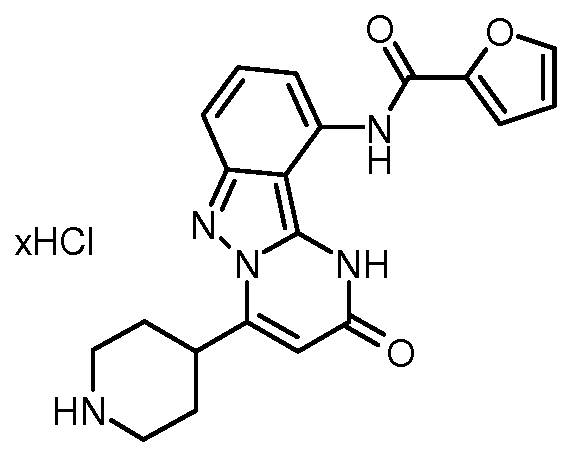
Example 125
5-{[2-oxo-4-(piperidin-4-yl) ,2-dihydropyrim
carbonitrile hydrochloride

tert-butyl 4-{ 10-[(5-cyanopyridin-3-yl)amino]-2-oxo-l,2-dihydropyrimido[l,2-b]indazol-4- yljpiperidine- 1-carboxylate (26.0 mg, 53.5 μιηοΐ) was dissolved in 1,4-Dioxane (1.1 ml) and treated with hydrochloric acid in 1,4-Dioxane (270 μΐ, 4.0 M, 1.1 mmol) at RT for 16h. Drying in vacuo afforded the product. The obtained amout was 25.0 mg (98 % purity, 100 % of theory).
LC-MS (Method 1): Rt = 0.55 min; MS (ESIpos): m/z = 386 [M+H]+
¾ NMR (500 MHz, D20) delta ppm = 1.85 - 1.97 (m, 2H), 2.35 (d, 2H), 3.24 (t, 2H), 3.50 (t, 1H), 3.61 (d, 2H), 6.36 (s, 1H), 6.50 (d, 1H), 6.91 (d, 1H), 7.12 (t, 1H), 7.52 (s, 1H), 8.07 (d, 2H).
Example 126
2-{[2-oxo-4-(piperidin-4-yl)-l,2-dihydropyrimido[l,2-b]indazol-10-yl]amino}pyrimidine-5- carbonitrile hydrochloride

tert-butyl 4- { 10- [(5-cy anopyrimidin-2-yl)amino] -2-oxo- 1 ,2-dihydropyrimido [ 1 ,2-b]indazol-4- yl}piperidine-l-carboxylate (105 mg, 216 μmol) was dissolved in 1,4-Dioxane (4.2 ml) and treated with hydrochloric acid in 1,4-Dioxane (1.1 ml, 4.0 M, 4.3 mmol) at RT for 16h. Drying in vacuo afforded the product. The obtained amout was 100.0 mg (100 % purity, 101 % of theory).
LC-MS (Method 1): Rt = 0.57 min; MS (ESIpos): m/z = 387 [M+H]+
1H-NMR (400 MHz, DMSO-d6) delta [ppm] : 1.938 (1.03), 1.971 (2.71), 2.001 (2.84), 2.032 (1.12), 2.352 (4.56), 2.384 (3.87), 3.167 (1.81), 3.194 (3.40), 3.225 (3.66), 3.251 (1.81), 3.902 (1.51), 3.932 (2.67), 3.962 (1.38), 6.721 (2.49), 7.352 (7.74), 7.373 (9.94), 7.481 (3.48), 7.502 (4.60), 7.521 (2.58), 7.942 (1.16), 8.789 (0.69), 8.906 (0.99), 9.045 (16.00), 9.942 (3.35), 12.642 (0.39).
Example 127
10 (2-methylpyridin-3-yl)amino]-4-(piperidin-4-yl)pyrimido[l,2-b]indazol-2(lH)-one
hydrochloride

tert-butyl 4-{ 10-[(2-methylpyridin-3-yl)amino]-2-oxo-l,2-dihydropyrimido[l,2-b]indazol-4- yl}piperidine-l-carboxylate (73.0 mg, 154 μιηοΐ) was dissolved in 1,4-Dioxane (2.0 ml) and treated with hydrochloric acid in 1,4-Dioxane(770 μΐ, 4.0 M, 3.1 mmol) at RT for 16h. Drying in vacuo afforded the product. The obtained amout was 66.8 mg (95 % purity, 92 % of theory).
LC-MS (Method 1): Rt = 0.29 min; MS (ESIneg): m/z = 373 [M-H]"
1H-NMR (400 MHz, DMSO-d6) delta [ppm] : 1.945 (1.19), 1.974 (3.14), 2.001 (3.14), 2.030 (1.41), 2.317 (4.54), 2.350 (3.68), 2.819 (16.00), 3.145 (1.41), 3.177 (3.03), 3.202 (3.24), 3.232 (1.62), 3.428
(5.41), 3.460 (4.97), 3.865 (2.05), 3.897 (2.70), 3.928 (1.62), 6.591 (0.76), 6.784 (1.62), 7.334 (4.43), 7.355 (7.35), 7.407 (2.16), 7.425 (2.81), 7.446 (1.30), 7.613 (2.92), 7.627 (3.46), 7.634 (3.57), 7.648 (3.35), 7.946 (1.62), 7.963 (1.51), 8.238 (5.19), 8.252 (5.08), 8.512 (5.95), 9.005 (3.24).
Example 128
10 (4,6-dimethylpyrimidin-2-yl)amino]-^
hydrochloride

tert-butyl 4- { 10- [(4,6-dimethylpyrimidin-2-yl)amino] -2-oxo- 1 ,2-dihydropyrimido [ 1 ,2-b]indazol-4- yl}piperidine-l-carboxylate (104 mg, 212 μιηοΐ) was dissolved in 1,4-Dioxane (2.0 ml) and treated with hydrochloric acid in 1,4-Dioxane (1.1 ml, 4.0 M, 4.2 mmol) at RT for 16h. Drying in vacuo afforded the product. The obtained amout was 98.0 mg (100 % purity, 100 % of theory).
LC-MS (Method 1): Rt = 0.67 min; MS (ESIpos): m/z = 390 [M+H]+
¾ NMR (500 MHz, D20) delta ppm = 1.89 - 2.00 (m, 2H), 2.22 (s, 6H), 2.38 (d, 2H), 3.30 (t, 2H), 3.40 (t, 1H), 3.68 (d, 2H), 6.23 (s, 1H), 6.66 (d, 2H), 6.82 (d, 2H). Example 129
6-{[2-oxo-4-(piperidin-4-yl) ,2-dihydropyrimido[l,2-b]indazol-10-yl]amino}pyridine-3- carbonitrile hydrochloride

LC-MS (Method 1): Rt = 0.55 min; MS (ESIpos): m/z = 386 [M+H]+
1H-NMR (400 MHz, DMSO-d6) delta [ppm] : 1.949 (2.03), 1.978 (5.54), 2.011 (5.85), 2.042 (2.26), 2.343 (8.35), 2.376 (7.02), 3.153 (2.50), 3.184 (6.24), 3.213 (6.48), 3.241 (2.73), 3.437 (8.98), 3.461 (8.04), 3.471 (9.68), 6.670 (2.97), 7.230 (5.31), 7.252 (5.54), 7.275 (13.27), 7.297 (16.00), 7.434 (5.93), 7.453 (8.12), 7.474 (4.84), 7.795 (2.11), 8.084 (5.23), 8.088 (5.39), 8.105 (4.84), 8.110 (5.00), 8.705 (6.87), 8.838 (1.95), 8.946 (2.89), 9.623 (11.16).
Example 130
2-fluoro-N 2-oxo-4-(piperidin-4-yl)-l,2-dihydropyrimido[l,2-b]indazol-10-yl]-4- (trifluoromethyl)benzamide hydrochloride

tert-butyl 4-(10-{ [2-fluoro-4-(trifluoromethyl)benzoyl]amino}-2-oxo-l,2-dihydropyrimido[l,2- b]indazol-4-yl)piperidine-l-carboxylate (42.0 mg, 73.2 μιηοΐ) was dissolved in dichloromethane (650 μΐ, 7.5 mmol) and treated with hydrochloric acid in 1,4-Dioxane (150 μΐ, 4.0 M, 610 μιηοΐ) at RT for 2 h. The mixture was purified via reverse phase chromatography (Method: Reprosil C18; 10 μιη; 125x30 mm / flow: 50 ml/min / solvents: A = water (0,01% formic acid), B = Acetonitrile / gradient 0.00-4.25 min = 20%B, 4.50min = 30%B, 19.00-22.50min = 100%B, 22.75-25.00min = 20%B) which afforded the product after drying in vacuo. The obtained amout was 21.0 mg (100 % purity, 52 % of theory). LC-MS (Method 1): Rt = 0.75 min; MS (ESIpos): m/z = 474 [M+H]+
1H-NMR (400 MHz, DMSO-d6) delta [ppm] : 1.957 (1.58), 1.989 (4.61), 2.021 (4.92), 2.050 (1.95), 2.332 (7.74), 2.366 (7.21), 3.155 (1.92), 3.184 (5.04), 3.212 (5.14), 3.242 (2.23), 3.435 (7.61), 3.465 (6.10), 3.928 (6.68), 6.740 (1.79), 7.423 (8.97), 7.445 (16.00), 7.484 (4.58), 7.503 (5.76), 7.524 (2.88), 7.817 (6.07), 7.837 (6.93), 7.921 (1.33), 7.954 (6.50), 7.980 (6.16), 8.161 (2.38), 8.180 (3.78), 8.197 (2.29), 8.998 (2.91), 10.404 (7.77), 10.413 (7.83).
Example 131
6-methoxy-N 2-oxo-4-(piperidin-4-yl) ,2-dih^^
carboxamide hydrochloride

tert-butyl 4-( 10- { [(6-methoxypyridin-3-yl)carbonyl] amino } -2-oxo- 1 ,2-dihydropyrimido [ 1 ,2-b]indazol- 4-yl)piperidine-l-carboxylate (104 mg, 201 μιηοΐ) was dissolved in 1,4-Dioxane (650 μΐ, 7.5 mmol) and treated with hydrochloric acid in 1,4-Dioxane (150 μΐ, 4.0 M, 610 μιηοΐ) at RT for 2 d. Drying in vacuo afforded the product. The obtained amout was 76.0 mg (95 % purity, 77 % of theory).
LC-MS (Method 1): Rt = 0.58 min; MS (ESIpos): m/z = 419 [M+H]+
¾ NMR (500 MHz, D20) delta ppm = 1.81 - 1.95 (m, 2H), 2.30 (d, 2H), 3.12 - 3.32 (m, 3H), 3.67 (d, 5H), 6.22 (s, 1H), 6.37 (d, 1H), 6.50 (d, 1H), 6.70 (d, 2H), 7.34 (d, 1H), 7.61 (s, 1H).
Example 132
5-chloro-N 2-oxo-4-(piperidin-4-yl)-l,2-dihydropyrimido[l,2-b]indazol-10-yl]thiophene-2- carboxamide hydrochloride

tert-butyl 4-( 10- { [(5-chlorothiophen-2-yl)carbonyl] amino } -2-oxo- 1 ,2-dihydropyrimido[ 1 ,2-b] indazol-4- yl)piperidine-l-carboxylate (32.0 mg, 60.6 μιηοΐ) was dissolved in 1,4-Dioxane (650 μΐ, 7.5 mmol) and treated with hydrochloric acid in 1,4-Dioxane (150 μΐ, 4.0 M, 610 μιηοΐ) at RT for 16 h. Drying in vacuo afforded the product. The obtained amout was 24.0 mg (95 % purity, 75 % of theory).
LC-MS (Method 1): Rt = 0.68 min; MS (ESIpos): m/z = 428 [M+H]+
IH-NMR (400 MHz, DMSO-d6) delta [ppm] : 1.968 (1.74), 1.999 (4.50), 2.027 (4.83), 2.057 (2.02), 2.346 (6.90), 2.379 (5.72), 3.160 (1.78), 3.190 (4.88), 3.217 (4.97), 3.247 (2.06), 3.442 (7.32), 3.472 (7.13), 6.767 (2.30), 7.357 (13.42), 7.367 (13.94), 7.378 (8.87), 7.399 (13.94), 7.452 (5.68), 7.471
(7.04), 7.492 (3.80), 7.809 (1.13), 8.018 (16.00), 8.028 (15.53), 8.912 (1.64), 8.968 (2.72), 10.270 (8.02).
Example 133
N-[2-oxo-4-(piperidin-4-yl)-l,2-dihydropyrimido[l,2-b]indazol-10-yl]-3- (trifluoromethoxy)benzamide h drochloride

tert-butyl 4-(2-oxo- 10- { [3-(trifluoromethoxy)benzoyl] amino }- 1 ,2-dihydropyrimido[ l,2-b]indazol-4- yl)piperidine- 1 -carboxylate (161 mg, 282 μιηοΐ) was dissolved in 1,4-Dioxane (3.0 ml, 35 mmol) and treated with hydrochloric acid in 1,4-Dioxane (700 μΐ, 4.0 M, 2.8 mmol) at RT for 16 h. The resulting precipitate was filtered and washed with 1,4-Dioxane. Drying in vacuo afforded the product. The obtained amout was 151 mg (100 % purity, 98 % of theory).
LC-MS (Method 1): Rt = 0.72 min; MS (ESIpos): m/z = 472 [M+H]+
1H-NMR (400 MHz, DMSO-d6) delta [ppm] : 1.960 (2.09), 1.992 (5.27), 2.018 (5.61), 2.048 (2.39), 2.349 (7.96), 2.383 (6.73), 3.165 (2.17), 3.195 (5.79), 3.224 (5.98), 3.252 (2.62), 3.446 (8.19), 3.475 (6.58), 6.769 (1.72), 7.405 (9.20), 7.426 (14.58), 7.481 (4.64), 7.500 (5.98), 7.521 (3.14), 7.701 (4.19), 7.722 (6.13), 7.789 (5.38), 7.808 (8.19), 7.829 (4.19), 7.915 (1.05), 8.004 (10.65), 8.185 (6.47), 8.204 (5.98), 8.884 (2.13), 8.949 (3.25), 10.467 (16.00).
Example 134
3-nitro-N-[2-oxo-4-(piperidin-4-yl)-l,2-dihydropyrimido[l,2-b]indazol-10-yl]benzamide hydrochloride

tert-butyl 4- { 10- [(3-nitrobenzoyl)amino] -2-oxo- 1 ,2-dihydropyrimido [ 1 ,2-b]indazol-4-yl Jpiperidine- 1 - carboxylate (120 mg, 225 μιηοΐ) was dissolved in 1,4-Dioxane (2.0 ml, 23 mmol) and treated with
hydrochloric acid in 1,4-Dioxane (560 μΐ, 4.0 M, 2.3 mmol) at RT for 16 h. The resulting precipitate was filtered and washed with 1,4-Dioxane. Drying in vacuo afforded the product. The obtained amout was 106 mg (100 % purity, 93 % of theory)
LC-MS (Method 1): Rt = 0.61 min; MS (ESIpos): m/z = 433 [M+H]+
¾ NMR (500 MHz, D20) delta ppm = 1.81 - 1.95 (m, 2H), 2.29 (d, 2H), 3.17 - 3.31 (m, 3H), 3.66 (d, 2H), 6.18 (s, 1H), 6.52 (d, 1H), 6.71 (d, 2H), 7.25 (t, 1H), 7.49 (d, 1H), 7.66 (s, 1H), 7.99 (s, 1H).
Example 135
4 ert-butyl-N 2-oxo-4-(piperidin-4-yl)-l,2-dihydropyrii^
hydrochloride

tert-butyl 4- { 10- [(4-tert-butylbenzoyl)amino] -2-oxo- 1 ,2-dihydropyrimido [ 1 ,2-b]indazol-4- yl}piperidine-l-carboxylate (150 mg, 276 μιηοΐ) was dissolved in 1,4-Dioxane (6.8 ml, 79 mmol) and treated with hydrochloric acid in 1,4-Dioxane (690 μΐ, 4.0 M, 2.8 mmol) at RT for 16 h. The resulting precipitate was filtered and washed with 1,4-Dioxane. Drying in vacuo afforded the product. The obtained amout was 140 mg (91 % purity, 98 % of theory).
LC-MS (Method 1): Rt = 0.77 min; MS (ESIpos): m/z = 444 [M+H]+
1H-NMR (400 MHz, DMSO-d6) delta [ppm]: 1.368 (16.00), 1.967 (0.10), 1.997 (0.30), 2.029 (0.32), 2.062 (0.12), 2.365 (0.49), 2.392 (0.38), 3.171 (0.12), 3.200 (0.33), 3.228 (0.34), 3.258 (0.15), 3.450 (0.50), 3.482 (0.44), 3.923 (0.14), 3.953 (0.24), 3.982 (0.12), 6.804 (0.19), 7.363 (0.69), 7.385 (0.96), 7.471 (0.37), 7.490 (0.49), 7.511 (0.27), 7.653 (1.10), 7.675 (1.21), 8.082 (1.11), 8.103 (0.98), 8.858 (0.09), 8.942 (0.15), 10.362 (0.78).
Example 136
4-nitro-N-[2-oxo-4-(piperidin-4-yl)-l,2-dihydropyrimido[l,2-b]indazol-10-yl]benzamide hydrochloride

tert-butyl 4- { 10- [(4-nitrobenzoyl)amino] -2-oxo- 1 ,2-dihydropyrimido [ 1 ,2-b]indazol-4-yl Jpiperidine- 1 - carboxylate (101 mg, 189 μιηοΐ) was dissolved in 1,4-Dioxane (4.6 ml, 54 mmol) and treated with hydrochloric acid in 1,4-Dioxane (470 μΐ, 4.0 M, 1.9 mmol) at RT for 16 h. The resulting precipitate was filtered and washed with 1,4-Dioxane. Drying in vacuo afforded the product. The obtained amout was 91.0 mg (100 % purity, 95 % of theory).
LC-MS (Method 1): Rt = 0.62 min; MS (ESIpos): m/z = 433 [M+H]+
1H-NMR (400 MHz, DMSO-d6) delta [ppm] : 1.955 (1.23), 1.988 (3.32), 2.018 (3.53), 2.047 (1.50), 2.365 (5.99), 2.392 (4.39), 3.171 (1.50), 3.201 (3.96), 3.228 (4.17), 3.260 (1.82), 3.917 (1.34), 3.946 (2.30), 3.975 (1.34), 6.786 (1.23), 7.424 (6.90), 7.446 (11.40), 7.494 (2.73), 7.512 (3.64), 7.533 (1.82), 7.969 (0.80), 8.359 (6.15), 8.380 (9.47), 8.450 (16.00), 8.472 (10.01), 8.788 (1.39), 8.895 (1.93), 10.513 (8.99).
Example 137
3,5-difluoro-N 2-oxo-4-(piperidin-4-yl) ,2-dihy^
hydrochloride
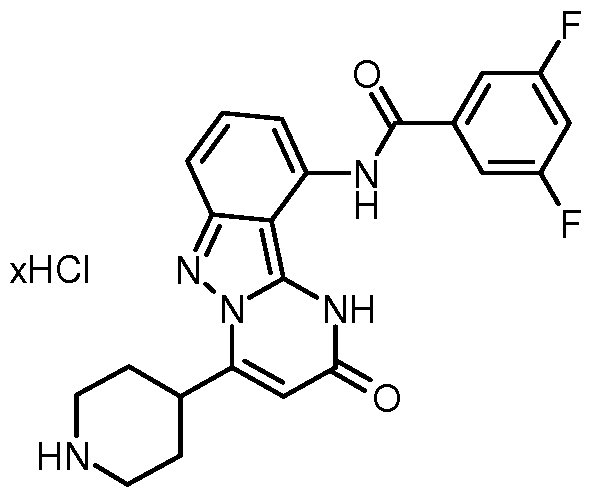
tert-butyl 4-{ 10-[(3,5-difluorobenzoyl)amino]-2-oxo-l,2-dihydropyrimido[l,2-b]indazol-4- yl}piperidine-l-carboxylate (110 mg, 210 μιηοΐ) was dissolved in 1,4-Dioxane (2.0 ml, 23 mmol) and treated with hydrochloric acid in 1,4-Dioxane (530 μΐ, 4.0 M, 2.1 mmol) at RT for 16 h. The resulting precipitate was filtered and washed with 1,4-Dioxane. Drying in vacuo afforded the product. The obtained amout was 101 mg (100 % purity, 97 % of theory).
LC-MS (Method 1): Rt = 0.64 min; MS (ESIpos): m/z = 424 [M+H]+
1H-NMR (400 MHz, DMSO-d6) delta [ppm] : 1.946 (1.52), 1.979 (4.40), 2.008 (4.72), 2.035 (1.92), 2.346 (6.80), 2.380 (5.76), 3.165 (1.92), 3.195 (5.12), 3.223 (5.36), 3.254 (2.24), 3.446 (7.60), 3.476 (6.32), 3.908 (2.00), 3.940 (3.12), 3.968 (1.76), 6.770 (1.12), 7.417 (8.16), 7.439 (15.28), 7.476 (3.84), 7.494 (4.88), 7.516 (2.48), 7.598 (2.56), 7.603 (2.00), 7.621 (4.96), 7.639 (1.68), 7.643 (2.64), 7.736 (1.92), 7.748 (9.28), 7.753 (11.92), 7.767 (12.08), 7.773 (9.52), 7.785 (2.24), 8.829 (1.68), 8.919 (2.40), 10.410 (16.00).
Example 138
N 2-oxo-4-(piperidin-4-yl) ,2-dihydropyrimido[l,2-b]indazol-10-yl]-3- (trifluoromethyl)benzamide hydrochloride

tert-butyl 4-(2-oxo- 10- { [3-(trifluoromethyl)benzoyl] amino }-l, 2-dihydropyrimido[ l,2-b]indazol-4- yl)piperidine-l-carboxylate (70.0 mg, 126 μιηοΐ) was dissolved in 1,4-Dioxane (4.1 ml, 48 mmol) and treated with hydrochloric acid in 1,4-Dioxane (310 μΐ, 4.0 M, 1.3 mmol) at RT for 16 h. Drying in vacuo afforded the product. The obtained amout was 66 mg (100 % purity, 99 % of theory).
LC-MS (Method 1): Rt = 0.75 min; MS (ESIpos): m/z = 456 [M+H]+
¾ NMR (500 MHz, D20) delta ppm = 1.71 - 1.85 (m, 2H), 2.19 (d, 2H), 3.11 (t, 1H), 3.19 (t, 2H), 3.62 (d, 2H), 6.04 (s, 1H), 6.36 (s, 1H), 6.51 (s, 2H), 7.11 - 7.24 (m, 2H), 7.50 (s, 1H), 7.63 (d, 1H).
Example 139
N 2-oxo-4-(piperidin-4-yl)-l,2-dihydropyrimido[l,2-b]indazol-10-yl]naphthalene-2-carboxamide hydrochloride

LC-MS (Method 1): Rt = 0.75 min; MS (ESIpos): m/z = 438 [M+H]+
Example 140
2,6-dimethyl-N 2-oxo-4-(piperidin-4-yl)-l,2-dihydropyrimido[l,2-b]indazol^0-yl]benzamid hydrochloride

tert-butyl 4-{ 10-[(2,6-dimethylbenzoyl)amino]-2-oxo-l,2-dihydropyrimido[l,2-b]indazol-4- yl}piperidine-l-carboxylate (38.0 mg, 73.7 μιηοΐ) was dissolved in 1,4-Dioxane (2.4 ml, 28 mmol) and treated with hydrochloric acid in 1,4-Dioxane (180 μΐ, 4.0 M, 740 μιηοΐ) at RT for 16 h. Drying in vacuo afforded the product. The obtained amout was 34 mg (100 % purity, 94 % of theory).
LC-MS (Method 1): Rt = 0.67 min; MS (ESIpos): m/z = 416 [M+H]+
¾ NMR (500 MHz, D20) delta ppm = 1.92 - 2.04 (m, 2H), 2.32 (s, 5H), 2.45 (d, 2H), 3.33 (t, 2H), 3.61 - 3.73 (m, 3H), 3.74 - 3.79 (m, 1H), 6.43 (s, 1H), 7.06 (d, 2H), 7.24 (t, 1H), 7.41 (d, 1H), 7.46 (d, 1H), 7.53 (t, 1H).
Example 141
3,4-difluoro-N 2-oxo-4-(piperidin-4-yl) ,2-dihydropyrimido[l,2-b]indazol^0-yl]benzamide hydrochloride

LC-MS (Method 1): Rt = 0.70 min; MS (ESIpos): m/z = 424 [M+H]+
¾ NMR (500 MHz, D20) delta ppm = 1.75 - 1.89 (m, 2H), 2.24 (d, 2H), 3.09 - 3.28 (m, 3H), 3.63 (d, 2H), 6.08 (s, 1H), 6.47 (s, 1H), 6.65 (s, 2H), 6.89 (s, 3H).
Example 142
3-methoxy-N 2-oxo-4-(piperidin-4-yl) ,2-dihydropyrimido[l,2-b]indazol^0-yl]benzaini hydrochloride

tert-butyl 4-{ 10-[(3-methoxybenzoyl)amino]-2-oxo-l,2-dihydropyrimido[l,2-b]indazol-4-yl}piperidine- 1-carboxylate (11.0 mg, 21.3 μιηοΐ) was dissolved in 1,4-Dioxane (700 μΐ, 8.1 mmol) and treated with hydrochloric acid in 1,4-Dioxane (53 μΐ, 4.0 M, 210 μιηοΐ) at RT for 16 h. Drying in vacuo afforded the product. The obtained amout was _10.0 mg (100 % purity, 96 % of theory).
LC-MS (Method 1): Rt = 0.67 min; MS (ESIpos): m/z = 418 [M+H]+
¾ NMR (500 MHz, D20) delta ppm = 1.69 - 1.81 (m, 2H), 2.17 (d, 2H), 3.01 (t, 1H), 3.17 (t, 2H), 3.32 (s, 3H), 3.60 (d, 2H), 5.94 (s, 1H), 6.29 (s, 1H), 6.36 (d, 1H), 6.55 (s, 1H), 6.59 - 6.70 (m, 3H), 6.85 (t, 1H). Example 143
4-methoxy-N 2-oxo-4-(piperidin-4-yl) ,2-dihydropyrimido[l,2-b]indazol^0-yl]benzamide hydrochloride

LC-MS (Method 1): Rt = 0.65 min; MS (ESIpos): m/z = 418 [M+H]+
¾ NMR (500 MHz, D20) delta ppm = 1.71 - 1.88 (m, 2H), 2.20 (d, 2H), 3.06 (t, 1H), 3.19 (t, 2H), 3.61 (d, 5H), 6.05 (s, 1H), 6.34 (s, 1H), 6.43 (s, 1H), 6.65 (s, 1H), 6.77 (s, 1H), 6.98 (s, 2H).
Example 144
2,3-difluoro-N 2-oxo-4-(piperidin-4-yl) ,2-dihyd^
hydrochloride

tert-butyl 4-{ 10-[(4-methoxybenzoyl)amino]-2-oxo-l,2-dihydropyrimido[l,2-b]indazol-4-yl}piperidine- 1-carboxylate (110 mg, 210 μιηοΐ) was dissolved in 1,4-Dioxane (5.0 ml, 58 mmol) and treated with hydrochloric acid in 1,4-Dioxane (530 μΐ, 4.0 M, 2.1 mmol) at RT for 16 h. The resulting precipitate was filtered and washed with 1,4-Dioxane. Drying in vacuo afforded the product. The obtained amout was 102 mg (98 % purity, 98 % of theory).
LC-MS (Method 1): Rt = 0.65 min; MS (ESIpos): m/z = 424 [M+H]+
¾ NMR (500 MHz, D20) delta ppm = 1.78 - 1.90 (m, 2H), 2.28 (d, 2H), 3.24 (t, 3H), 3.64 (d, 2H), 6.13 (s, 1H), 6.55 (d, 1H), 6.73 (t, 1H), 6.86 (d, 1H), 7.10 - 7.17 (m, 1H), 7.28 (t, 1H), 7.35 - 7.43 (m, 1H).
Example 145
4-methyl-N-[2-oxo-4-(piperidin-4-yl)-l,2-dihydropyrimido[l,2-b]indazol-10-yl]benzamide hydrochloride

tert-butyl 4- { 10- [(4-methylbenzoyl)amino] -2-oxo- 1 ,2-dihydropyrimido [ 1 ,2-b]indazol-4-yl Jpiperidine- 1 - carboxylate (118 mg, 235 μmol) was dissolved in 1,4-Dioxane (6.0 ml, 70 mmol) and treated with hydrochloric acid in 1,4-Dioxane (590 μΐ, 4.0 M, 2.4 mmol) at RT for 16 h. The resulting precipitate was filtered and washed with 1,4-Dioxane. Drying in vacuo afforded the product. The obtained amout was 111 mg (98 % purity, 99 % of theory).
LC-MS (Method 1): Rt = 0.67 min; MS (ESIpos): m/z = 402 [M+H]+
1H-NMR (400 MHz, DMSO-d6) delta [ppm] : 1.982 (0.63), 2.011 (1.73), 2.042 (1.83), 2.072 (0.72), 2.350 (2.59), 2.383 (2.16), 2.442 (16.00), 3.166 (0.75), 3.193 (1.57), 3.218 (1.54), 3.245 (0.67), 3.441 (2.61), 3.471 (2.09), 3.920 (0.86), 3.950 (1.49), 3.979 (0.86), 6.802 (1.77), 7.358 (2.87), 7.379 (3.91), 7.444 (5.12), 7.464 (6.59), 7.485 (2.59), 7.506 (1.29), 8.034 (6.51), 8.055 (5.52), 9.035 (1.21), 10.369 (5.22).
Example 146
2-methoxy-N 2-oxo-4-(piperidin-4-yl) ,2-dihyd^
carboxamide hydrochloride

tert-butyl 4-( 10- { [(2-methoxypyridin-4-yl)carbonyl] amino } -2-oxo- 1 ,2-dihydropyrimido [ 1 ,2-b]indazol- 4-yl)piperidine-l -carboxylate (82.0 mg, 158 μιηοΐ) was dissolved in 1,4-Dioxane (4.0 ml, 47 mmol) and treated with hydrochloric acid in 1,4-Dioxane (400 μΐ, 4.0 M, 1.6 mmol) at RT for 16 h. The resulting precipitate was filtered and washed with 1,4-Dioxane. Drying in vacuo afforded the product. The obtained amout was 72.0 mg (98 % purity, 93 % of theory).
LC-MS (Method 1): Rt = 0.63 min; MS (ESIpos): m/z = 419 [M+H]+
¾ NMR (500 MHz, D20) delta ppm = 1.72 - 1.85 (m, 2H), 2.19 (d, 2H), 3.08 (t, 1H), 3.20 (t, 2H), 3.46 (s, 3H), 3.62 (d, 2H), 5.98 (s, 2H), 6.33 (s, 1H), 6.40 (s, 1H), 6.48 (s, 2H), 7.55 (s, 1H).
Example 147
2,5-difluoro-N 2-oxo-4-(piperidin-4-yl) ,2-dihydropyrimM
hydrochloride

tert-butyl 4-{ 10-[(2,5-difluorobenzoyl)amino]-2-oxo-l,2-dihydropyrimido[l,2-b]indazol-4- yl}piperidine-l-carboxylate (148 mg, 283 μιηοΐ) was dissolved in 1,4-Dioxane (7.0 ml, 82 mmol) and treated with hydrochloric acid in 1,4-Dioxane (710 μΐ, 4.0 M, 2.8 mmol) at RT for 16 h. The resulting precipitate was filtered and washed with 1,4-Dioxane. Drying in vacuo afforded the product. The obtained amout was 133 mg (100 % purity, 95 % of theory).
LC-MS (Method 1): Rt = 0.68 min; MS (ESIpos): m/z = 424 [M+H]+
¾ NMR (500 MHz, D20) delta ppm = 1.85 - 2.00 (m, 2H), 2.38 (d, 2H), 3.29 (t, 2H), 3.43 (t, 1H), 3.67 (d, 2H), 6.30 (s, 1H), 6.86 (d, 1H), 7.01 (t, 1H), 7.07 (d, 2H), 7.30 (d, 2H).
Example 148
N 2-oxo-4-(piperidin-4-yl) ,2-dihydropyrimido[l,2-b]indazol-10-yl]pyridine-3-carboxamide hydrochloride

tert-butyl 4- {2-oxo- 10-[(pyridin-3-ylcarbonyl)amino] - 1 ,2-dihydropyrimido[ 1 ,2-b]indazol-4- yl}piperidine-l-carboxylate (123 mg, 252 μιηοΐ) was dissolved in 1,4-Dioxane (5.0 ml, 58 mmol) and treated with hydrochloric acid in 1,4-Dioxane (630 μΐ, 4.0 M, 2.5 mmol) at RT for 16 h. The resulting precipitate was filtered and washed with 1,4-Dioxane. Drying in vacuo afforded the product. The obtained amout was 114 mg (100 % purity, 98 % of theory).
LC-MS (Method 1): Rt = 0.51 min; MS (ESIpos): m/z = 389 [M+H]+
1H-NMR (400 MHz, DMSO-d6) delta [ppm] : 1.967 (1.77), 1.990 (4.66), 1.996 (4.86), 2.024 (5.22), 2.029 (5.01), 2.054 (2.18), 2.347 (7.49), 2.381 (6.23), 3.161 (1.87), 3.193 (5.16), 3.218 (5.32), 3.249
(2.23), 3.442 (7.54), 3.474 (6.03), 3.910 (2.48), 3.939 (4.10), 3.970 (2.58), 6.742 (1.57), 7.421 (9.06), 7.442 (16.00), 7.483 (5.82), 7.501 (6.89), 7.523 (3.54), 7.775 (2.89), 7.788 (4.20), 7.795 (4.71), 7.807 (4.30), 7.858 (0.76), 8.597 (4.10), 8.613 (4.25), 8.913 (9.06), 8.926 (9.06), 8.978 (3.65), 9.344 (11.54), 10.504 (6.53). Example 149
3-hydroxy-N 2-oxo-4-(piperidin-4-yl) ,2-dm^
hydrochloride

tert-butyl 4-{ 10-[(3-hydroxybenzoyl)amino]-2-oxo-l,2-dm^
1-carboxylate (126 mg, 250 μιηοΐ) was dissolved in 1,4-Dioxane (8.2 ml, 96 mmol) and treated with hydrochloric acid in 1,4-Dioxane (630 μΐ, 4.0 M, 2.5 mmol) at RT for 16 h. The resulting precipitate was filtered and washed with 1,4-Dioxane. Drying in vacuo afforded the product. The obtained amout was 104 mg (100 % purity, 87 % of theory).
LC-MS (Method 1): Rt = 0.59 min; MS (ESIpos): m/z = 404 [M+H]+
¾ NMR (500 MHz, D20) delta ppm = 1.73 - 1.87 (m, 2H), 2.22 (d, 2H), 3.06 - 3.24 (m, 3H), 3.61 (d, 2H), 6.13 (s, 1H), 6.54 (d, 1H), 6.64 (s, 1H), 6.71 (t, 1H), 6.78 (d, 1H), 6.87 (d, 2H), 7.06 (t, 1H).
Example 150
N 2-oxo-4-(piperidin-4-yl) ,2-dihydropyrimido[l,2-b]indazol-10-yl]thiophene-2-carboxamide hydrochloride

tert-butyl 4- { 2-oxo- 10- [(thiophen-2-ylcarbonyl)amino] - 1 ,2-dihydropyrimido[ 1 ,2-b] indazol-4- yl}piperidine-l-carboxylate (156 mg, 316 μιηοΐ) was dissolved in 1,4-Dioxane (3.0 ml, 35 mmol) and treated with hydrochloric acid in 1,4-Dioxane (790 μΐ, 4.0 M, 3.2 mmol) at RT for 16 h. The resulting
precipitate was filtered and washed with 1,4-Dioxane. Drying in vacuo afforded the product. The obtained amout was 136 mg (100 % purity, 92 % of theory).
LC-MS (Method 1): Rt = 0.65 min; MS (ESIpos): m/z = 394 [M+H]+
¾ NMR (500 MHz, D20) delta ppm = 1.83 - 1.97 (m, 2H), 2.36 (d, 2H), 3.19 - 3.36 (m, 3H), 3.65 (d, 2H), 6.28 (s, 1H), 6.75 (d, 1H), 6.85 - 6.95 (m, 2H), 7.08 (t, 1H), 7.33 (s, 1H), 7.72 (d, 1H).
Example 151
4-cyano-N 2-oxo-4-(piperidin-4-yl) ,2-dihydTO^
hydrochloride

tert-butyl 4- { 10- [(4-cyanobenzoyl)amino] -2-oxo- 1 ,2-dihydropyrimido [ 1 ,2-b]indazol-4-yl Jpiperidine- 1 - carboxylate (98.0 mg, 191 μιηοΐ) was dissolved in 1,4-Dioxane (6.3 ml, 73 mmol) and treated with hydrochloric acid in 1,4-Dioxane (480 μΐ, 4.0 M, 1.9 mmol) at RT for 16 h. The resulting precipitate was filtered and washed with 1,4-Dioxane. Drying in vacuo afforded the product. The obtained amout was 73 mg (100 % purity, 79 % of theory).
LC-MS (Method 1): Rt = 0.67 min; MS (ESIpos): m/z = 413 [M+H]+
¾ NMR (500 MHz, D20) delta ppm = 1.79 - 1.94 (m, 2H), 2.28 (d, 2H), 3.14 - 3.32 (m, 3H), 3.66 (d, 2H), 6.17 (s, 1H), 6.58 (d, 1H), 6.71 - 6.85 (m, 2H), 7.19 (d, 2H), 7.28 (d, 2H).
Example 152
3-cyano-N 2-oxo-4-(piperidin-4-yl)-l,2-dihydropyrimido[l,2-b]indazol-10-yl]benzamide hydrochloride

tert-butyl 4- { 10- [(3-cyanobenzoyl)amino] -2-oxo- 1 ,2-dihydropyrimido [ 1 ,2-b]indazol-4-yl Jpiperidine- 1 - carboxylate (130 mg, 254 μιηοΐ) was dissolved in 1,4-Dioxane (8.3 ml, 97 mmol) and treated with
hydrochloric acid in 1,4-Dioxane (630 μΐ, 4.0 M, 2.5 mmol) at RT for 16 h. The resulting precipitate was filtered and washed with 1,4-Dioxane. Drying in vacuo afforded the product. The obtained amout was 98 mg (99 % purity, 79 % of theory).
LC-MS (Method 1): Rt = 0.65 min; MS (ESIpos): m/z = 413 [M+H]+
¾ NMR (500 MHz, D20) delta ppm = 1.75 - 1.91 (m, 2H), 2.25 (d, 2H), 3.09 - 3.28 (m, 3H), 3.63 (d, 2H), 6.07 (s, 1H), 6.32 (d, 1H), 6.43 (d, 1H), 6.55 (d, 1H), 7.11 (s, 1H), 7.21 (t, 1H), 7.34 (d, 1H), 7.58 (d, 1H).
Example 153
N 2-oxo-4-(piperidin-4-yl) ,2-dihydropyrimido[l,2-b]indazol-10-yl]pyridazine-4-carb hydrochloride

tert-butyl 4- { 2-oxo- 10- [(pyridazin-4-ylcarbonyl)amino] - 1 ,2-dihydropyrimido[ 1 ,2-b] indazol-4- yl}piperidine-l-carboxylate (79.0 mg, 161 μιηοΐ) was dissolved in 1,4-Dioxane (5.3 ml, 62 mmol) and treated with hydrochloric acid in 1,4-Dioxane (400 μΐ, 4.0 M, 1.6 mmol) at RT for 16 h. The resulting precipitate was filtered and washed with 1,4-Dioxane. Drying in vacuo afforded the product. The obtained amout was 76.6 mg (100 % purity, 103 % of theory)
LC-MS (Method 1): Rt = 0.48 min; MS (ESIpos): m/z = 390 [M+H]+
¾ NMR (500 MHz, D20) delta ppm = 1.78 - 1.94 (m, 2H), 2.27 (d, 2H), 3.26 (t, 3H), 3.65 (d, 2H), 6.18 (s, 1H), 6.62 (d, 1H), 6.73 (d, 2H), 7.40 (s, 1H), 8.78 (s, 1H), 9.13 (d, 1H). Example 154
3-methyl-N-[2-oxo-4-(piperidin-4-yl)-l,2-dihydropyrimido[l,2-b]indazol-10-yl]benzamide hydrochloride

LC-MS (Method 1): Rt = 0.72 min; MS (ESIpos): m/z = 402 [M+H]+
¾ NMR (500 MHz, D20) delta ppm = 1.79 - 1.94 (m, 2H), 2.25 - 2.37 (m, 5H), 3.17 - 3.33 (m, 3H), 3.64 (d, 2H), 6.21 (s, 1H), 6.79 (d, 1H), 6.92 - 7.02 (m, 2H), 7.24 (t, 1H), 7.28 - 7.38 (m, 3H).
Example 155
4-fluoro-N 2-oxo-4-(piperidin-4-yl) ,2-dihydropyrimido[l,2-b]indazol^0-yl]benzamide hydrochloride

tert-butyl 4- { 10- [(4-fluorobenzoyl)amino] -2-oxo- 1 ,2-dihydropyrimido [ 1 ,2-b]indazol-4-yl Jpiperidine- 1 - carboxylate (127 mg, 251 μιηοΐ) was dissolved in 1,4-Dioxane (2.0 ml, 23 mmol) and treated with hydrochloric acid in 1,4-Dioxane (630 μΐ, 4.0 M, 2.5 mmol) at RT for 16 h. The resulting precipitate was filtered and washed with 1,4-Dioxane. Drying in vacuo afforded the product. The obtained amout was 116 mg (100 % purity, 97 % of theory).
LC-MS (Method 1): Rt = 0.68 min; MS (ESIpos): m/z = 406 [M+H]+
¾ NMR (500 MHz, D20) delta ppm = 1.74 - 1.89 (m, 2H), 2.25 (d, 2H), 3.18 (t, 3H), 3.60 (d, 2H), 6.17 (s, 1H), 6.67 (d, 1H), 6.80 - 6.91 (m, 2H), 6.96 (t, 2H), 7.40 (t, 2H).
Example 156
2,2,2-Trifluor-N 2-oxo-4-(piperidin-4-yl) ,2-dihydropyri
hydrochloride

tert-Butyl-4- { 2-oxo- 10- [(trifluoracetyl)amino] - 1 ,2-dihydropyrimido [ 1 ,2-b] indazol-4-yl Jpiperidin- 1 - carboxylate (90.0 mg, 188 μmol) was dissolved in dichloromethane and treated with hydrochloric acid (4 M solution in 1,4-dioxane) (4.0 ml). The mixture was stirred at RT for 16 h. The precipitate was collected by filtration, washed with dichloromethane, and dried. The residue was subjected by preparative HPLC and precipitated with IN aqueous hydrochloric acid to afford the title compound. The obtained amount was 2.3 mg (100% Purity, 3 % of theory).
LC-MS (Method 1): Rt = 0.61 min; MS (ESIPos): m/z = 380 [M+H]+
Example 157
N 2-Oxo-4-(piperidin-4-yl) ,2-dihydropyrimido[l,2-b]indazol-10-yl]benzamide hydrochloride

tert-Butyl-4-[10-(benzoylamino)-2-oxo-l,2-dihydropyrimido[l,2-b]indazol-4-yl]piperidin-l-carboxylate (117 mg, 240 μιηοΐ) was dissolved in dichloromethane and treated with hydrochloric acid (4 M solution in 1,4-dioxane) (4.0 mL). The mixture was stirred at RT for 16 h. Concentration in vacuo, purification by preparative HPLC and precipitation with hydrochloric acid (4 M solution in 1,4-dioxane) afforded the title compound. The obtained amount was 64 mg (100% Purity, 63 % of theory).
LC-MS (Method 3): Rt = 1.68 min; MS (ESIPos): m/z = 388 [M+H]+
¾ -NMR (400 MHz, D20): delta [ppm] = 7.50 (d, 1H), 7.31 (br. s., 4H), 6.72 (d, 1H), 6.62 (t, 1H), 6.45 (d, 1H), 6.03 (s, 1H), 3.59 (d, 1H), 3.13 (t, 2H), 3.03 (t, 2H), 2.16 (d, 2H), 1.75 (q, 2H)
Example 158
N 2-Oxo-4-(piperidin-4-yl) ,2-dihydropyrimido[l,2-b]indazol-10-yl]cyclohexancarboxaim hydrochloride

Tert-Butyl-4-{ 10-[(cyclohexylcarbonyl)amino]-2-oxo-l,2-dihydropyrimido[l,2-b]indazol-4- yl}piperidin-l-carboxylate (116 mg, 235 μιηοΐ) was dissolved in dichloromethane and treated with hydrochloric acid (4 M solution in 1,4-dioxane) (4.0 mL). The mixture was stirred at RT for 16 h. Concentration in vacuo, purification by preparative HPLC and precipitation with hydrochloric acid (4 M solution in 1,4-dioxane) afforded the title compound. The obtained amount was 91 mg (100% Purity, 90 % of theory).
LC-MS (Method 3): Rt = 1.7 min; MS (ESIPos): m/z = 394 [M+H]+
¾ -NMR (400 MHz, D20): delta [ppm] = 7.47-7.40 (m, 1H), 7.39-7.33 (m, 1H), 7.13 (d, 1H), 6.48 (s, 1H), 3.67 (d, 3H), 3.31 (t, 2H), 2.62-2.51 (m, 1H), 2.46 (d, 2H), 2.07-1.95 (m, 4H), 1.85 (d, 2H), 1.74 (d, 2H), 1.57-1.21 (m, 5H) Example 159
N-[2-Oxo-4-(piperidin-4-yl)-l,2-dihydropyrimido[l,2-b]indazol-10-yl]acetamide hydrochloride

Tert-Butyl-4-( 10-acetamido-2-oxo- 1 ,2-dihydropyrimido [ 1 ,2-b]indazol-4-yl)piperidin- 1 -carboxylate (104 mg, 244 μιηοΐ) was dissolved in dichloromethane and treated with hydrochloric acid (4 M solution in 1,4-dioxane) (4.0 mL). The mixture was stirred at RT for 16 h. Concentration in vacuo, purification by preparative HPLC and precipitation with hydrochloric acid (4 M solution in 1,4-dioxane) afforded the title compound. The obtained amount was 35 mg (100% Purity, 40 % of theory).
LC-MS (Method 1): Rt = 0.32 min; MS (ESIPos): m/z = 326 [M+H]+
¾ -NMR (400 MHz, D20): delta [ppm] = 7.51-7.36 (m, 1H), 7.07 (d, 1H), 6.46 (s, 1H), 3.66 (d, 1H), 3.31 (t, 2H), 2.46 (d, 2H), 2.32 (s, 2H), 2.06-1.90 (m, 2H)
Example 160
N 2-Oxo-4-(piperidin-4-yl)-l,2-dihydropyrimido[l,2-b]m^
hydrochloride

tert-Butyl-4- { 10- [(cyclopropylcarbonyl)amino] -2-oxo- 1 ,2-dihydropyrimido [ 1 ,2-b]indazol-4- yl}piperidin-l-carboxylate (151 mg, 334 μιηοΐ) was dissolved in dichloromethane and treated with hydrochloric acid (4 M solution in 1,4-dioxane) (4.0 mL). The mixture was stirred at RT for 16 h. Concentration in vacuo, purification by preparative HPLC and precipitation with hydrochloric acid (4 M solution in 1,4-dioxane) afforded the title compound. The obtained amount was 130 mg (100% Purity, quant % of theory).
LC-MS (Method 1): Rt = 0.48 min; MS (ESIPos): m/z = 352 [M+H]+
¾ -NMR (500 MHz, D20): delta [ppm] = 7.16-7.08 (m, 1H), 6.96 (d, 1H), 6.90 (d, 1H), 6.36 (s, 1H), 3.77 (s, 1H), 3.68 (d, 2H), 3.36-3.20 (m, 3H), 2.37 (d, 2H), 1.98-1.84 (m, 2H), 1.75-1.65 (m, 1H), 1.11- 0.96 (m, 4H) Example 161
3-Chlor-N 2-oxo-4-(piperidin-4-yl)-l,2-dihydropyrimido[l,2-b]indazol-10-yl]benzamide hydrochloride

tert-Butyl-4- { 10- [(3-chlorbenzoyl)amino] -2-oxo- 1 ,2-dihydropyrimido [ 1 ,2-b]indazol-4-yl Jpiperidin- 1 - carboxylate (24.0 mg, 46.0 μιηοΐ) was dissolved in 1,4-dioxane (1.5 ml, 18 mmol) and treated with hydrochloric acid (4 M solution in 1,4-dioxane) (110 μΐ, 4.0 M, 460 μιηοΐ). The mixture was stirred at RT for 16 h. The precipitate was collected by filtration, washed with 1,4-dioxane, and dried to afford the title compound. The obtained amount was 22 mg (100% Purity, 97 % of theory).
LC-MS (Method 3): Rt = 1.85 min; MS (ESIPos): m/z = 422 [M+H]+
¾ -NMR (400 MHz, DMSO-d6): delta [ppm] = 12.54 (br. s., 1H), 10.42 (s, 2H), 8.85 (br. s., 2H), 8.71 (br. s., 3H), 8.10 (s, 5H), 7.93 (br. s., 1H), 7.82-7.73 (m, 2H), 7.72-7.64 (m, 2H), 7.49 (d, 2H), 7.45-7.36 (m, 2H), 6.78 (br. s., 1H), 3.94 (br. s., 2H), 3.75-3.50 (m, 5H), 3.28-3.13 (m, 6H), 2.86 (br. s., 1H), 2.42- 2.28 (m, 4H), 2.09-1.86 (m, 5H), 1.63 (s, 2H)
Example 162
N 2-Oxo-4-(piperidin-4-yl) ,2-dihydropyrimido[l,2-b]indazol-10-yl]-4- (trifluormethyl)benzamide hydrochloride

tert-Butyl-4-(2-oxo- 10- { [4-(trifluormethyl)benzoyl] amino } - 1 ,2-dihydropyrimido[ 1 ,2-b] indazol-4- yl)piperi din- 1-carboxy late (74.0 mg, 133 μιηοΐ) was dissolved in 1,4-dioxane (4.0 ml, 47 mmol) and treated with hydrochloric acid (4 M solution in 1,4-dioxane) (330 μΐ, 4.0 M, 1.3 mmol). The mixture was stirred at RT for 16 h. The precipitate was collected by filtration, washed with 1,4-dioxane, and dried to afford the title compound. The obtained amount was 72 mg (100% Purity, quant % of theory). LC-MS (Method 3): Rt = 1.93 min; MS (ESIPos): m/z = 456 [M+H]+
Example 163
2,2-Dimethyl-N 2-oxo-4-(piperidin-4-yl) ,2-dihydrop
hydrochloride

Example 164
7-(piperidin-4-yl)-3-{3 3-(trifluoromethyl)phe^
5(4H)-one hydrochloride

(56.0 mg, 100 % purity, 110 μιηοΐ)
hydrochloric acid 4N in 1,4-dioxane (0.5 ml)
methanol (0.5 ml)
The title compound was prepared according to the same procedure as Example 210.
The obtained amount was 47.0 mg (100 % purity, 96 % of theory).
LC-MS (Method 1): Rt = 0.76 min; MS (ESIpos): m/z = 431 [M+H-HC1]+
IH-NMR (400 MHz, MeOD) delta [ppm] : 2.05 (dd, 2H), 2.46 (d, 2H), 3.28 (dd, 2H), 3.60 (d, 2H), 3.75 (dd, 1H), 6.21 (s, 1H), 7.80 (dd,lH), 7.92 (d, 1H), 8.48 (d, 1H), 8.52 (d, 2H)
B. Assessment of the pharmacological activity
The following abbreviations are used:
Brij polyoxyethylene lauryl ether
CaCl2 calciumchloride
CFT clot formation time
CM5 carboxymethylated dextran biosensor chips
CT clotting time
DMSO dimethylsulfoxide
EDC N-ethyl-N' -(3-dimethylaminopropyl)-carbodiimide hydrochloride
FVIII factor eight
HEPES hydroxyethyl-piperazineethanesulfonic acid
HC1 hydrochloric acid
IC50 half-maximal inhibitory concentration
KD dissociation constant
MCF maximum clot firmness
ML maximum lysis
NaCl sodium chloride
NHS N-hydroxysuccinimide
OD optical density
PBS phosphate buffered saline
P-20 hybond P20
Rmax response at saturation
RU response units
SPR surface plasmon resonance
TF tissue factor
tPA tissue plasminogen activator
v/v volume/volume
The pharmacological effect of the compounds of formula (I- A) or (I-B) according to the invention can be shown in the following assays:
B-l. Biacore Assay
Assay description Surface Plasmon Resonance Plasminogen Inh.
Definitions
The term "surface plasmon resonance", as used herein, refers to an optical phenomenon that allows for the analysis of the reversible associations of biological molecules in real time within a biosensor matrix, for example using the Biacore® system (GE Healthcare Biosciences, Uppsala, Sweden). Biacore® uses the optical properties of surface plasmon resonance (SPR) to detect alterations in the refractive index of a buffer, which changes as molecules in solution interact with the target immobilized on the surface. In brief, proteins are covalently bound to the dextran matrix at a known concentration and a ligand for the protein is injected through the dextran matrix. Near infrared light, directed onto the opposite side of the sensor chip surface is reflected and also induces an evanescent wave in the gold film, which in turn, causes an intensity dip in the reflected light at a particular angle known as the resonance angle. If the refractive index of the sensor chip surface is altered (e.g. by compound binding to the protein bound to the surface) a shift occurs in the resonance angle. This angle shift can be measured. These changes are displayed with respect to time along the y-axis of a sensorgram, which depicts the association and dissociation of any biological reaction. For further descriptions see Jonsson U et al al., 1993 Ann Biol Clin.;51(l): 19-26.; Johnsson B et al, Anal Biochem. 1991;198(2):268-77.; Day Y et al, Protein Science, 2002;11, 1017-1025; Myskza DG, Anal Biochem., 2004; 329, 316-323
The term "KD", as used herein, is intended to refer to the dissociation constant of a particular compound/target protein complex.
Biological activity
The biological activity (e.g. as inhibitors of plasminogen) of the compounds of the invention can be measured using the assays set forth in the examples below, for example the surface plasmon resonance (SPR) experiments described in Example 1. The level of activity exhibited by a given compound in the SPR assay can be defined in terms of the KD value.
Example 1
The ability of the compounds of the invention to bind human plasminogen protein may be determined using surface plasmon resonance (SPR). KD values may be measured using a Biacore® T200 or Biacore® 4000 instrument (GE Healthcare, Uppsala, Sweden).
Cloning, expression, and purification of recombinant human plasminogen kringle 1 domain protein is performed according to a protocol based on published methods (Menhart et al, Biochemistry, 1991, 30, 1948-1957) with modifications as follows: Briefly, an E. coli expression construct coding for the amino acid sequence MKYLLPTAAAGLLLLAAQPAMAHHHHHHHHHHMDYDIPTTENLYFQG followed by the human plasminogen kringle 1 domain protein sequence amino acids 101 to 181 (numbering based on Uniprot acc no P00747) and a stop codon is synthesized (GeneArt, Regensburg, Germany) and cloned into a modified pET22b vector (Novagen, Darmstadt, Germany), allowing for periplasmatic expression in E. coli and immobilized metal ion affinity chromatography employing a deca-histidine tag. E. coli BL21DE3 cells (Novagen) are transformed, grown and harvested and their periplasmatic fraction released using a buffer comprising 50mM Tris pH 8 and 500mM sucrose (modified from Menhart et al, Biochemistry, 1991, 30, 1948-1957). The periplasmatic fraction is then sequentially filtered using 8μιη, 3μιη and 1.2μιη cellulose nitrate filters (Sartorius Stedim, Gottingen, Germany) and the filtrate subjected to Ni-Sepharose HP chromatography (GE Healthcare) according to the manufacturer's instructions. The resulting eluate is then subjected to a Desalting Hi Prep 26/10 column (GE Healthcare) equilibrated in buffer (lOOmM sodium phosphate pH 8, 300mM NaCl) followed by a lysine sepharose 4B (GE Healthcare) chromatography step according to the manufacturer's instructions. The resulting fractions of highly purified protein at concentrations of approximately 0.5 mg / ml are buffer exchanged against buffer (lOOmM sodium phosphate pH 8, 300mM NaCl) and stored at -80° C.
For SPR measurements, recombinant human plasminogen kringle 1 protein is immobilized using standard amine coupling (Johnsson B et al, Anal Biochem. 1991 Nov l ;198(2):268-77). Briefly, carboxymethylated dextran biosensor chips (CM5, GE Healthcare) are activated with N-ethyl-N'-(3- dimethylaminopropyl)-carbodiimide hydrochloride (EDC) and N-hydroxysuccinimide (NHS) according to the supplier's instructions. Purified recombinant human plasminogen kringle 1 protein is diluted in 10 mM sodium acetate pH 4.5 into 10 μg / ml and injected on the activated chip surface. Subsequently, 1 M ethanolamine-HCl (GE Healthcare) is injected to block unreacted groups, resulting in approximately 400 response units (RU) of immobilized protein. A reference surface is generated by treatment with NHS- EDC and ethanolamine-HCl. Compounds are dissolved in an aqueous 1 % v/v acetic acid solution to a concentration of 20 mM, followed by addition of 1 vol of 100% dimethylsulfoxide (DMSO, Sigma- Aldrich, Germany) resulting in a compound concentration of 10 mM and subsequently diluted in running buffer (PBS pH 7.4, 0.05% v/v Surfactant P-20 (GE Healthcare), 1% v/v DMSO). For affinity measurements, five-fold serial dilutions of compound (0.64 nM to 10 μΜ) are injected over immobilized protein. The resulting sensorgrams are double-referenced against the reference surface as well as against blank injections. The double-referenced steady state responses are plotted against the test compound concentration and a fit using the equation Response=Rmax*[compound]/([compound]+KD)+offset is generated. Parameters Rmax (response at saturation), KD (dissociation constant) and the offset parameter
are calculated using a nonlinear least squares fit as implemented in the Biacore® evaluation software (GE Healthcare).
B-2. Plasma-based Clot Lysis Assay (5%)
The clot-lysis test system configures the kinetics of clot formation and degradation in vitro and allows quantifying modulation of the process by selected test compounds.
The test compounds were dissolved in 1 % acetic acid and further complemented with an equal volume of DMSO. The resulting stock solutions were serially diluted in 0.5 % acetic acid / 50 % DMSO. 1 μΐ^ aliquots of these solutions were placed into 384 well microplates (Greiner, black, transparent bottom), followed by 30 μΐ^ of diluted human citrated plasma (platelet-poor, final concentration: 5 %; supplemented with fibrinogen, final concentration: 3 μΜ; dilution buffer: 20 mM HEPES, 150 mM NaCl, 0,01 % Brij (pH 7)). The reactions were started by addition of 20 μΕ of CaCl2 (final concentration: 10 mM), and tPA (tissue plasminogen activator, final concentration: 0.2 nM) in dilution buffer, followed by an additional volume of 20 μΕ dilution buffer for improved mixing. The reactions were incubated at 37°C. Clot formation and degradation was monitored spectrophotometrically by kinetic optical density measurements at 405 nm. IC50 values were determined by comparing the resulting time courses with the time course of a blank control reaction.
Results B-2.
Example IC50 (nM) Example IC50 (nM) Example IC50 (nM)
1 38 23 33 45 35
2 36 24 15 46 28
3 14 25 33 47 36
4 42 26 22 48 33
5 29 27 34 49 37
6 17 28 34 50 39
7 14 29 33 51 39
8 22 30 36 52 39
9 14 31 34 53 38
10 24 32 35 54 34
11 18 33 58 55 15
12 16 34 12 56 35
13 20 35 9.1 57 33
14 28 36 8.5 58 34
15 15 37 33 59 34
16 16 38 31 60 39
17 10 39 36 61 35
18 33 40 48 62 37
19 35 41 34 63 35
20 26 42 34 64 34
21 25 43 34 65 33
Example IC50 (nM) Example IC50 (nM) Example IC50 (nM)
22 35 44 38 66 35
67 32 98 43 129 30
68 35 99 27 130 19
69 39 100 35 131 33
70 35 101 32 132 37
71 66 102 34 133 36
72 31 103 33 134 39
73 29 104 35 135 29
74 28 105 30 136 34
75 25 106 10 137 86
76 26 107 39 138 18
77 33 108 39 139 40
78 41 109 31 140 28
79 33 110 40 141 57
80 40 111 38 142 41
81 62 112 32 143 43
82 29 113 37 144 40
83 24 114 38 145 40
84 27 115 41 146 41
85 34 116 37 147 38
86 33 117 100 148 39
87 27 118 39 149 40
88 20 119 40 150 28
89 28 120 32 151 39
90 27 121 34 152 33
91 30 122 38 153 38
92 31 123 55 154 25
93 31 124 85 155 38
94 41 125 29
95 31 126 33
96 38 127 37
97 85 128 33
B-3. Plasma-based Clot Lysis Assay (85%)
For induction of clot formation and subsequent clot lysis (fibrinolysis) a mixture of tissue factor (1 pM) and tissue plasminogen activator (tPA, 0.04 μΜ) was added to human plasma (final concentration 85%). The test compounds or saline controls were added simultaneously to TF and tPA. The functional activity is triggered with CaCL (12.5 mM) and was monitored by measuring the optical density at 405 nM (OD405). Fibrinolysis was evaluated as a relative decrease of OD after maximal clot formation. (Sperzel M, Huetter J, 2007, J Thromb Haemost 5(10): 2113-2118).
B-4. Thrombelastometry
Whole blood Thrombelastometry measurements are performed to confirm the potency of the compounds in inhibiting fibrinolysis and improving firmness of the clots (as seen in plasma based assays), for example using the ROTEM® system (Tem International GmbH, Munich, Germany). The ROTEM® system is a diagnostic (viscoelastic) technique which provides information on hemostasis. It includes a four-channel instrument, a computer, activators and disposable cups and pins. Kinetic changes in the blood sample are detected optically (light reflection) and data obtained from the reflected light is then processed into a graphical output by an integrated computer. Characteristic curves and numeric paremeters are generated. Thrombelastographic parameters of ROTEM® hemostatic systems include: Clotting Time (CT), which reflects the reaction time (the time required to obtain 2 mm amplitude following the initiation of data collection) to initiate blood clotting; Clot Formation Time (CFT), provides information about the kinetics of clot formation; the alpha angle to reflect clotting propagation. Maximum Clot Firmess (MCF) is defined as maximum amplitude which reflects the firmness of the clot (clot quality) and Maximum Lysis (ML) indicates fibrinolysis. For induction of clot formation and subsequent clot lysis a mixture of tissue factor (TF) and tissue plasminogen activator (tPA) is added to 300 μΕ freshly drawn citrated whole blood. Blood from patients with coagulation disorders and antibodies against coagulation factors (e.g. to neutralize FVIII activity and render the blood hemophilic) may be used. TF and tPA concentrations are adjusted dependent on the different conditions and species the whole blood is drawn from. Data are collected for 2 hours using a computer-controlled ROTEM® system.
For induction of clot formation and subsequent clot lysis in human whole blood or human Factor VIII depleted whole blood, a mixture of tissue factor (final concentration 0.5 pM) and tissue plasminogen activator (tPA, final concentration 10 nM) is added to 300 μΕ citrated human whole blood. The test compounds or controls are added simultaneously to TF and tPA.
For induction of clot formation and subsequent clot lysis (fibrinolysis) in rat whole blood, a mixture of tissue factor (final concentration 1 pM) and tissue plasminogen activator (tPA, final concentration 50 nM) is added to 300 μΕ citrated rat whole blood. The test compounds or controls are added simultaneously to TF and tPA. Or in the case of ex vivo experiments the test compounds are dosed to the animal, blood is drawn at different time points after administration and added to the test cup.
For induction of clot formation and subsequent clot lysis (fibrinolysis) in hemophilia A dog plasma or whole blood, a mixture of tissue factor (TF) and tissue plasminogen activator (tPA) is added to 300 μΕ citrated hemophilia A whole blood or plasma. TF and tPA concentrations are titrated and adjusted according to the current needs and technical requirements. Different concentrations of rFVIII are added to the test system in vitro (1 - 100%). The test compounds or controls are added simultaneously to TF and tPA. In the case of ex vivo experiments the test compounds are dosed to the animal, blood is drawn
at different time points after administration and added to the test cup.
B-5. In vivo Assays
To determine the protective effect of compounds on clot stability and blood loss in vivo, different bleeding models in different species are employed. Animals may be anticoagulated with different anticoagulants to induce a bleeding tendency. Genetically modified animals to mimick blood coagulation disorders may be used or antibodies to neutralize activity of different coagulation factors may be administered. Compounds of the invention are administered orally or parenterally at various indicated doses, at varying time courses prior to the injury. Injuries and endpoints may vary dependent on the mimicked disease condition. B-5.1 Tail bleeding in hyperfibrinolytic rats
In anaesthetized rats hyperfibrinolysis is induced by a continuous infusion of tPA (8 mg kg h) for twenty-five minutes via the right jugular vein. The right jugular vein is exposed and cannulated with saline-filled polyethylene catheters. The catheter is connected to a syringe pump (Braun, Melsungen, Germany) for the infusion of tPA. Hemostatic efficacy is evaluated in a rat bleeding model, where 8 mg/kg h tPA is continuously infused to prolong bleeding time beyond control values. Test compounds or vehicle are administered by oral gavage at different time points before induction of anesthesia or intravenously through a second catheter in the contralateral jugular vein starting ten minutes after initiating tPA infusion. All infusions are stopped twenty-five minutes after onset of tPA administration. Twentyfive minutes after starting the tPA infusion, the rat tail is fully transsected 2 mm from the tip of the tail. The tail is submerged in 37°C physiological saline and bleeding is observed for 30 minutes. The time of bleeding is defined as the interval between the initial transection and the visual cessation of bleeding. A value of 30 minutes is assigned to those animals where bleeding does not stop during the entire observation period.
B-5.2 Tail bleeding in Dabigatran-anticoagulated Rats
Animals are treated orally at different time points prior to induction of bleeding. In anaesthetized, anticoagulated rats bleeding is induced by a bolus and continuous infusion (jugular vein) of the thrombin-inhibitor Dabigatran (bolus 1 mg/kg followed by an infusion of 0.3 mg/kg/ml/h) for 15 minutes. 15 minutes after Dabigatran infusion the rat tail is fully transected 2 mm from the tip of the tail. Bleeding is observed for 30 minutes after the tail is submerged in 37°C physiological saline. Blood loss is evaluated visually in 30 second intervals utilizing a scoring system (0 = no blood flow; 1 = weak, breaking to no blood flow; 2 = reduced blood flow; 3 = continuous blood flow; 4 = strong, continuous blood flow). Initial bleeding time until the first visual cessation of bleeding as well as cumulative bleeding time over the entire observation period of 30 minutes is evaluated.
C. Exemplary embodiments of pharmaceutical compositions
The compounds of formula (TA) or (TB) according to the invention can be converted into pharmaceutical preparations in the following ways:
Tablet: Composition:
100 mg of the compound according to the invention, 50 mg of lactose (monohydrate), 50 mg of maize starch (native), 10 mg of polyvinylpyrrolidone (PVP 25) (from BASF, Ludwigshafen, Germany) and 2 mg of magnesium stearate.
Tablet weight 212 mg, diameter 8 mm, radius of curvature 12 mm. Production:
The mixture of compound according to the invention, lactose and starch is granulated with a 5% strength solution (m/m) of the PVP in water. The granules are dried and then mixed with the magnesium stearate for 5 minutes. This mixture is compressed in a conventional tablet press (see above for format of the tablet). A guideline compressive force for the compression is 15 kN. Suspension which can be administered orally:
Composition:
1000 mg of the compound according to the invention, 1000 mg of ethanol (96%), 400 mg of Rhodigel® (xanthan gum from FMC, Pennsylvania, USA) and 99 g of water.
10 ml of oral suspension correspond to a single dose of 100 mg of the compound according to the invention.
Production:
The Rhodigel is suspended in ethanol, and the compound according to the invention is added to the suspension. The water is added while stirring. The mixture is stirred for about 6 h until the swelling of the Rhodigel is complete. Solution which can be administered orally:
Composition:
500 mg of the compound according to the invention, 2.5 g of polysorbate and 97 g of polyethylene glycol 400. 20 g of oral solution correspond to a single dose of 100 mg of the compound according to the invention.
Production:
The compound according to the invention is suspended in the mixture of polyethylene glycol and polysorbate with stirring. The stirring process is continued until the compound according to the invention has completely dissolved. i.v. solution:
The compound according to the invention is dissolved in a concentration below the saturation solubility in a physiologically tolerated solvent (e.g. isotonic saline, 5% glucose solution and/or 30% PEG 400 solution). The solution obtained is sterilized by filtration and used to fill sterile and pyrogen-free injection containers.
Claims
claims
Compound of the formula (I- A)

R1 is selected from hydrogen and C1-C5 alkyl;
R2 is selected from the group consisting of
(a) -CO-NR3R\ wherein
R3 is selected from the group consisting of hydrogen and C1-C4 alkyl;
R4 is selected from the group consisting of C1-C4 alkyl, wherein the C1-C4 alkyl may be substituted with C3-C6 cycloalkyl or phenyl, wherein the phenyl may be substituted with one, two or three halogen substituents
C1-C4 haloalkyl, C3-C6 cycloalkyl, 5- or 6-membered heterocyclyl, wherein the 5- or 6-membered heterocyclyl may be substituted with one, two or three methyl substituents, phenyl, wherein the phenyl may be substituted independently from each other with one, two or three halogen or methyl substituents and
5- or 6-membered heteroaryl
wherein the 5- or 6-membered heteroaryl may be substituted with one, two or three methyl substituents, or
N, R3, and R4 together form a 4-, 5- or 6-membered heterocyclyl, optionally substituted with one, two or three halogen substituents;
-NH-CO-R5, wherein
R5 is selected from the group consisting of C1-C4 alkyl, wherein the C1-C4 alkyl may be substituted with one, two or three substituents independently of one another selected from the group consisting of halogen, amino, hydroxyl, C1-C4 alkoxy,
C2-C4 alkenyl, C3-C6 cycloalkyl, phenyl, wherein the phenyl may be substituted with one, two or three substituents independently of one another selected from the group consisting of halogen, C1-C4 alkyl, C1-C4 haloalkyl, C1-C4 alkoxy, C1-C4 haloalkoxy, nitro, cyano, hydroxyl, and 5- to 6-membered heterocyclyl,
5- or 6-membered heteroaryl, wherein the 5- or 6-membered heteroaryl may be substituted with one, two or three substituents independently of one another selected from the group consisting of C1-C4 alkyl, C1-C4 haloalkyl, C1-C4 alkoxy, halogen, and N- oxo, and
10- to 18-membered annelated aryl or heteroaryl, or bridged bi- or tricycloalkyl, wherein the 10- to 18-membered annelated aryl or heteroaryl may be substituted with one, two or three substituents independently of one another selected from C1-C4 alkyl, or
R5 is -O-R6, wherein
R6 is selected from the group consisting of C1-C4 alkyl and C3-C6 cycloalkyl; or
R5 is -NR7R8, wherein
R7 is selected from the group consisting of hydrogen and C1-C4 alkyl; R8 is selected from the group consisting of hydrogen, C1-C4 alkyl, wherein the C1-C4 alkyl may be substituted with one, two or three substituents independently of one another selected from hydroxyl, halogen, dimethylamino and C1-C4 alkoxy, or with one substituent selected from phenyl, furanyl, and pyridinyl phenyl, wherein the phenyl may be substituted with one, two or three substituents independently of one another selected from C1-C4 alkyl and C1-C4 haloalkyl, and C3-C6 cycloalkyl, or
N, R7, and R8 together form a 5- to 6-membered N-heterocycle;

(c) , wherein
R9 is selected from the group consisting of-(CH2)m-, wherein m is selected from 2, 3 and 4; and wherein R9 may be substituted with one, two or three substituents independently of one another selected from C1-C4 alkyl;

(d) , wherein selected from the group consisting of -(CH2)n- and -(CH=CH), wherein n is selected from 2, 3, 4, and 5 and o is selected from 1 and 2; wherein one ring carbon atom not being attached to the carbonyl group or the nitrogen atom may be replaced by an oxygen atom; wherein R10 may be substituted with one, two or three substituents independently of one another selected from fluorine and hydroxyl, and wherein one carbon atom of R10 may have two substituents which, together with the carbon atom to which they are jointly attached, form a 4- to 6- membered heterocycle or wherein two carbon atoms of R may have two substituents which, together with the two carbon atoms to which they are attached, form a 5- to 6- membered aliphatic cycle; and
(e) -NH-R11, wherein
R11 is selected from the group consisting of 6-membered N-heteroaryl, wherein the 6-membered N-heteroaryl may be substituted with one, two or three substituents independently of one another selected from the group consisting of C1-C4 alkyl, C1-C4 haloalkyl, halogen, cyano, and C1-C4 alkoxy, and -SO2-R12, wherein R12 is selected from the group consisting of C1-C4 alkyl and phenyl; and its salts, solvates, and solvates of the salts.
2. Compound of the formula (I-B)

R and R2 are as defined in claim 1, and its salts, solvates, and solvates of the salts.
3. Compound of formula (I- A) or (I-B) as defined in claim 1 or 2, wherein
R1 is selected from hydrogen and C1-C5 alkyl;
R2 is selected from the group consisting of
(a) -CO-NR3R4, wherein
R3 is selected from the group consisting of hydrogen and C1-C4 alkyl;
R4 is selected from the group consisting of C1-C4 alkyl, wherein the C1-C4 alkyl is substituted with C3-C6 cycloalkyl or phenyl, wherein the phenyl may be substituted with one, two or three halogen substituents
C1-C4 haloalkyl, C3-C6 cycloalkyl,
5- or 6-membered heterocyclyl, wherein the 5- or 6-membered heterocyclyl may be substituted with one, two or three methyl substituents, phenyl,
wherein the phenyl is substituted independently from each other with one, two or three halogen or methyl substituents and
5- or 6-membered heteroaryl wherein the 5- or 6-membered heteroaryl is substituted with one, two or three methyl substituents, or
N, R3, and R4 together form a 4-, 5- or 6-membered heterocyclyl, optionally substituted with one, two or three halogen substituents;
-NH-CO-R5, wherein
R5 is selected from the group consisting of C1-C4 alkyl, wherein the C1-C4 alkyl is substituted with one, two or three substituents independently of one another selected from the group consisting of halogen, amino, hydroxyl, C1-C4 alkoxy,
C2-C4 alkenyl, C3-C6 cycloalkyl, phenyl, wherein the phenyl is substituted with one, two or three substituents independently of one another selected from the group consisting of halogen, C1-C4 alkyl, C1-C4 haloalkyl, C1-C4 alkoxy, C1-C4 haloalkoxy, nitro, cyano, hydroxyl, and 5- to 6-membered heterocyclyl,
5- or 6-membered heteroaryl, wherein the 5- or 6-membered heteroaryl is substituted with one, two or three substituents independently of one another selected from the group consisting of C1-C4 alkyl, C1-C4 haloalkyl, C1-C4 alkoxy, halogen, and N-oxo,
10- to 18-membered annelated aryl or heteroaryl, or adamantanyl, wherein the 10- to 18-membered annelated aryl or heteroaryl, or adamantanyl may be substituted with one, two or three substituents independently of one another selected from C1-C4 alkyl,
or
R5 is -O-R6, wherein
R6 is selected from the group consisting of C1-C4 alkyl and C3-C6 cycloalkyl; or
R5 is -NR7R8, wherein
R7 is selected from the group consisting of hydrogen and C1-C4 alkyl; R8 is selected from the group consisting of hydrogen, C1-C4 alkyl, wherein the C1-C4 alkyl may be substituted with one, two or three substituents independently of one another selected from hydroxyl, halogen, dimethylamino, C1-C4 alkoxy, phenyl, furanyl, and pyridinyl phenyl, wherein the phenyl may be substituted with one, two or three substituents independently of one another selected from C1-C4 alkyl and C1-C4 haloalkyl, and C3-C6 cycloalkyl, or
N, R7, and R8 together form a 5- to 6-membered N-heterocycle;

(c) , wherein is selected from the group consisting of-(CH2)m-, wherein m is selected from 2, 3 and 4; and wherein R9 may be substituted with one, two or three substituents independently of one another selected from C1-C4 alkyl;

(d) , wherein selected from the group consisting of -(CH2)n- and -(CH=CH), wherein n is selected from 2, 3, 4, and 5 and o is selected from 1 and 2; wherein one ring carbon atom not being attached to the carbonyl group or the nitrogen atom may be replaced by an oxygen atom; wherein R10 may be substituted with one, two or three substituents independently of one another selected from fluorine and hydroxyl, and wherein one carbon atom of R10 may have two substituents which, together with the carbon atom to which they are jointly attached, form a 4- to 6- membered heterocycle or wherein two carbon atoms of R10 may have two substituents which, together with the two carbon atoms to which they are attached, form a 5- to 6- membered aliphatic cycle; and
(e) -NH-R , wherein
R11 is selected from the group consisting of 6-membered N-heteroaryl, wherein the 6-membered N-heteroaryl may be substituted with one, two or three substituents independently of one another selected from the group consisting of C1-C4 alkyl, C1-C4 haloalkyl, halogen, cyano, and C1-C4 alkoxy, and -SO2-R12, wherein R12 is selected from the group consisting of C1-C4 alkyl and phenyl; and its salts, solvates, and solvates of the salts.
4. Compound of the formula (I- A) or (I-B) as defined claim 1 or 2, wherein
R1 is hydrogen;
R2 is selected from the group consisting of
(a) -CO-NR3R\ wherein
R3 is selected from the group consisting of hydrogen and methyl;
R4 is selected from the group consisting of methyl, wherein the methyl may be substituted with cyclohexyl or phenyl, wherein the phenyl may be substituted with one fluorine substituent, ethyl, iso-propyl, tert-butyl, sec -butyl, 1,1,1-trifluoroethyl, cyclohexyl, cyclopentyl, phenyl, wherein the phenyl may be substituted with one substituent selected from fluorine, chlorine and methyl, oxanyl, and pyridinyl wherein the pyridinyl may be substituted with one methyl substituent; or
N, R3, and R4 together form a piperidinyl, azetidinyl, morpholinyl or pyrrolidinyl, wherein the azetidinyl may be substituted with two fluorine substituents;
(b) -NH-CO-R5, wherein
R5 is selected from the group consisting of methyl, ethyl, iso-propyl, propyl, butyl, sec-butyl, tert-butyl, butenyl, trifluoromethyl, 1-amino-ethyl, 2-hydroxy-ethyl, 1- hydroxy-ethyl, methoxy-methyl, cyclopropyl, cyclobutyl, cyclopentyl, cyclohexyl, phenyl,
the phenyl being optionally substituted with one, two or three fluorine substituents, or optionally substituted with one or two substituents independently selected from the group consisting of fluorine, chlorine, methyl, and trifluoromethyl, or optionally substituted with one substituent selected from piperidine, trifluoromethoxy, methoxy, ethyl, butyl, tert-butyl, nitro, cyano, and hydroxyl, pyrimidinyl, pyrazinyl, pyridazinyl, pyridinyl, the pyridinyl being optionally substituted with one or two substituents independently selected from methyl and trifluoromethyl, or the pyridinyl being optionally substituted with one substituent selected from methoxy, and N-oxo,
1,2,3-triazolyl, pyrrolyl, pyrazolyl, the pyrazolyl being optionally substituted with one ethyl substituent, thiazolyl, thiophen-yl, the thiophen-yl being optionally substituted with one chlorine substituent, furanyl, adamantanyl, benzimidazolyl, the benzimidazolyl being optionally substituted with one or two substituents independently selected from methyl and ethyl, and napthalenyl, or is -O-R6, wherein
R6 is selected from the group consisting of methyl, iso-propyl, butyl, sec -butyl, and cyclohexyl; or
is -NR7R8, wherein is selected from the group consisting of hydrogen, methyl, ethyl is selected from the group consisting of hydrogen, methyl, ethyl, 1- hydroxyethyl, methoxyethyl, 1,1,1 trifluoroethyl, propyl, iso-propyl, dimethylamino-propyl, butyl, iso-butyl, tert-butyl, furanylmethyl, pyridinylmethyl, benzyl, phenyl, the phenyl being optionally substituted with methyl, and cyclohexyl, or
N, R7, and R8 together form a piperazinyl, piperidinyl, or pyrrohdinyl;
(c)
, wherein
R9 is selected from the group consisting of -(CH2)m- , wherein m is 2 or 3, and wherein R9 may be substituted with methyl;
(d)
 , wherein R10 is selected from the group consisting of -(CH2)n- and -(CH=CH)0- , wherein n is
2, 3, or 4 and o is 2, wherein one ring carbon atom being neither attached to the carbonyl group nor to the nitrogen atom may be replaced by an oxygen atom; wherein R10 may be substituted with one substituent selected from fluorine and hydroxyl, and
wherein one carbon atom of R may have two substituents which, together with the carbon atom to which they are jointly attached, form a 4-membered heterocycle or wherein two carbon atoms of R10 may have two substituents which, together with the two carbon atoms to which they are attached, form a 5- to 6- membered aliphatic cycle; and
(e) -NH-R11, wherein
R11 is selected from the group consisting of pyrimidinyl and pyridinyl wherein pyrimidinyl and pyridinyl may be substituted with one or two substituents independently of one another selected from methyl, and fluorine, or may be substituted with one substituent selected from trifluoro methyl, cyano, and methoxy, and -SO2-R12, wherein R12 is selected from the group consisting of methyl and phenyl; and salts, solvates, and solvates of the salts.
Compound of the formula (I- A) or (I-B) according to any of claims 1 to 3, wherein R1 is hydrogen;
R2 is selected from the group consisting of (a) -CO-NR3R4, wherein
R3 is selected from the group consisting of hydrogen and methyl; R4 is selected from the group consisting of methyl, wherein the methyl is substituted with cyclohexyl or phenyl, wherein the phenyl may be substituted with one fluorine substituent,
ethyl, iso-propyl, tert-butyl, sec-butyl, 1,1,1-trifluoroethyl, cyclohexyl, cyclopentyl, phenyl, wherein the phenyl may be substituted with one substituent selected from fluorine, chlorine and methyl, oxanyl, and pyridinyl wherein the pyridinyl is substituted with one methyl substituent; or
N, R3, and R4 together form a piperidinyl, azetidinyl, morpholinyl or pyrrolidinyl, wherein the azetidinyl may be substituted with two fluorine substituents; -NH-CO-R5, wherein
R5 is selected from the group consisting of butenyl, trifluoromethyl, 1-amino-ethyl, 2-hydroxy-ethyl, 1-hydroxy-ethyl, methoxy-methyl, cyclopropyl, cyclobutyl, cyclopentyl, cyclohexyl, phenyl, the phenyl being substituted with one, two or three fluorine substituents, or being substituted with one or two substituents independently selected from the group consisting of fluorine, chlorine, methyl, and trifluoromethyl, or being substituted with one substituent selected from piperidine, trifluoromethoxy, methoxy, ethyl, butyl, tert-butyl, nitro, cyano, and hydroxyl, pyridinyl, the pyridinyl being substituted with one or two substituents independently selected from methyl and trifluoromethyl, or being substituted with one substituent selected from methoxy and N-oxo, pyrazolyl,
the pyrazolyl being substituted with one ethyl substituent, thiophen-yl, the thiophen-yl being substituted with one chlorine substituent, adamantanyl, benzimidazolyl, the benzimidazolyl being substituted with one methyl and one ethyl substituent, and napthalenyl, or
R5 is -O-R6, wherein
R6 is selected from the group consisting of methyl, iso-propyl, butyl, sec -butyl, and cyclohexyl; or
R5 is -NR7R8, wherein
R7 is selected from the group consisting of hydrogen, methyl, and ethyl;
R8 is selected from the group consisting of hydrogen, methyl, ethyl,
hydroxy ethyl, methoxy ethyl, 1,1,1-trifluoroethyl, propyl, iso-propyl, dimethylamino-propyl, butyl, sec-butyl, tert-butyl, furanylmethyl, pyridinylmethyl, benzyl, phenyl, the phenyl being optionally substituted with methyl , and cyclohexyl, or
N, R7, and R8 together form a piperazinyl, piperidinyl, or pyrrolidinyl;

(c) , wherein
R9 is selected from the group consisting of -(CH2)m- , wherein m is 2 or 3, and wherein R9 may be substituted with methyl;

(d) , wherein selected from the group consisting of -(CH2)n- and -(CH=CH)0- , wherein n is 3, or 4 and o is 2, wherein one ring carbon atom being neither attached to the carbonyl group nor to the nitrogen atom may be replaced by an oxygen atom; wherein R10 may be substituted with one substituent selected from fluorine and hydroxyl, and wherein one carbon atom of R may have two substituents which, together with the carbon atom to which they are jointly attached, form a 4-membered heterocycle or wherein two carbon atoms of R10 may have two substituents which, together with the two carbon atoms to which they are attached, form a 5- to 6- membered aliphatic cycle; and
(e) -NH-R , wherein R is selected from the group consisting of pyrimidinyl and
pyridinyl wherein pyrimidinyl and pyridinyl may be substituted with one or two substituents independently of one another selected from methyl and fluorine, or may be substituted with one substituent selected from trifluoromethyl, cyano, and methoxy,
and -SO2-R , wherein R is selected from the group consisting of methyl and phenyl; and salts, solvates, and solvates of the salts.
6. Compound of formula (I-A) or (I-B) as defined in any of claims 1 to 3, wherein R1 is hydrogen and R2 is as defined in any of claims 1 to 3, and its salts, solvates, and solvates of the salts.
7. Process for preparing a compound of the formula (I-B) as defined in any of claims 2 to 6, wherein a compound of formula (XIII)


Process for preparing a compound of the formula (I-B) as defined in any of claims 2 to 6, wherein R2 is -NH-CO-R5, and R5 is as defined in any of claims 1 to 6, wherein a compound of formula (XIII)


9. Process for preparing a compound of the formula (I-B) as defined in any of claims 2 to 6, in which R2 is -CO-NR3R4, and R3 and R4 are as defined in any of claims 1 to 6, wherein a compound of formula (X)


10. Compound of the formula (VII)

11. Compound of the formula (VIII)

12. Compound of the formula (I-A) or (I-B) as defined in any of claims 1 to 6 for use in a method for the treatment and/or prophylaxis of acute and recurrent bleeding in patients with or without underlying hereditary or acquired hemostatic disorders.
13. Compound of the formula (I-A) or (I-B) as defined in any of claims 1 to 6 for use in a method for the treatment and/or prophylaxis of acute and recurrent bleeding in patients with or without underlying hereditary or acquired hemostatic disorders according to claim 12, wherein the bleeding is associated with a disease or medical intervention selected from the group consisting of heavy menstrual bleeding, postpartum hemorrhage, hemorrhagic shock, trauma, surgery, otolaryngological surgery, dental surgery, urinary surgery, prostatic surgery, gynaecological surgery, cardiovascular surgery, spinal surgery, liver or lung transplantation, stroke, liver diseases, hereditary angioedema, nosebleed, and synovitis and cartilage damage following hemarthrosis .
14. Medicament, comprising a compound of the formula (I-A) or (I-B) as defined in any of claims 1 to 6 in combination with an inert, non-toxic, pharmaceutically suitable auxiliary.
15. Medicament, comprising a compound of the formula (I-A) or (I-B) as defined in any of claims 1 to 6 in combination with a further active compound selected from the group consisting of Factor VIII, Factor IX, Factor Vila, activated prothrombin complex concentrates (aPCC) or prothrombin complex concentrates (PCCs), ε-aminocaproic acid, ethamsylate, paraaminobutyl benzoic acid, tranexamic acid, desmopressin, danazol, combined oral contraceptive pills (COCPs), progestin intrauterine system, glucocorticoid receptor agonists, analgesics, and nonsteroidal anti-inflammatory drugs (NSAIDs).
16. Medicament according to claim 14 or 15 for the treatment and/or prophylaxis of acute and recurrent bleeding in patients with or without underlying hereditary or acquired hemostatic disorders.
17. Method for the treatment and/or prophylaxis of acute and recurrent bleeding in patients with or without underlying hereditary or acquired hemostatic disorders in humans and animals using an effective amount of at least one compound of the formula (I-A) or (I-B) as defined in any of Claims 1 to 6 or a medicament as defined in any of Claims 14 to 16.
Applications Claiming Priority (2)
| Application Number | Priority Date | Filing Date | Title |
|---|---|---|---|
| EP15165916.6 | 2015-04-30 | ||
| EP15165916 | 2015-04-30 |
Publications (1)
| Publication Number | Publication Date |
|---|---|
| WO2016173948A1 true WO2016173948A1 (en) | 2016-11-03 |
Family
ID=53040400
Family Applications (1)
| Application Number | Title | Priority Date | Filing Date |
|---|---|---|---|
| PCT/EP2016/059052 Ceased WO2016173948A1 (en) | 2015-04-30 | 2016-04-22 | Indazolopyrimidinones as fibrinolysis inhibitors |
Country Status (1)
| Country | Link |
|---|---|
| WO (1) | WO2016173948A1 (en) |
Cited By (2)
| Publication number | Priority date | Publication date | Assignee | Title |
|---|---|---|---|---|
| US20180344739A1 (en) * | 2013-11-05 | 2018-12-06 | Bayer Pharma Aktiengesellschaft | (aza)pyridopyrazolopyrimidinones and indazolopyrimidinones and their use |
| WO2022018256A1 (en) * | 2020-07-24 | 2022-01-27 | Université Grenoble Alpes | Compounds for the treatment of haemophilia |
Citations (5)
| Publication number | Priority date | Publication date | Assignee | Title |
|---|---|---|---|---|
| WO2006023000A1 (en) | 2004-07-30 | 2006-03-02 | Xanodyne Pharmaceuticals, Inc. | Tranexamic acid formulations |
| WO2010117323A1 (en) | 2009-04-07 | 2010-10-14 | Astrazeneca Ab | Method and apparatus for producing heat energy and carbon dioxide |
| WO2012047156A1 (en) | 2010-10-04 | 2012-04-12 | Astrazeneca Ab | Isoxazol-3(2h)-one analogs as plasminogen inhibitors and their use in the treatment of fibrinolysis related diseases |
| WO2012080237A1 (en) | 2010-12-16 | 2012-06-21 | Bayer Pharma Aktiengesellschaft | Substituted pyrimido[1,2-b]indazoles and their use as modulators of the pi3k/akt pathway |
| US20150126449A1 (en) * | 2013-11-05 | 2015-05-07 | Bayer Pharma Aktiengesellschaft | (Aza)pyridopyrazolopyrimidinones and indazolopyrimidinones and their use |
-
2016
- 2016-04-22 WO PCT/EP2016/059052 patent/WO2016173948A1/en not_active Ceased
Patent Citations (5)
| Publication number | Priority date | Publication date | Assignee | Title |
|---|---|---|---|---|
| WO2006023000A1 (en) | 2004-07-30 | 2006-03-02 | Xanodyne Pharmaceuticals, Inc. | Tranexamic acid formulations |
| WO2010117323A1 (en) | 2009-04-07 | 2010-10-14 | Astrazeneca Ab | Method and apparatus for producing heat energy and carbon dioxide |
| WO2012047156A1 (en) | 2010-10-04 | 2012-04-12 | Astrazeneca Ab | Isoxazol-3(2h)-one analogs as plasminogen inhibitors and their use in the treatment of fibrinolysis related diseases |
| WO2012080237A1 (en) | 2010-12-16 | 2012-06-21 | Bayer Pharma Aktiengesellschaft | Substituted pyrimido[1,2-b]indazoles and their use as modulators of the pi3k/akt pathway |
| US20150126449A1 (en) * | 2013-11-05 | 2015-05-07 | Bayer Pharma Aktiengesellschaft | (Aza)pyridopyrazolopyrimidinones and indazolopyrimidinones and their use |
Non-Patent Citations (21)
| Title |
|---|
| CESARMAN-MAUS G; HAJJAR KA, BR J HAEMATOL, vol. 129, 2005, pages 307 - 21 |
| DAY Y ET AL., PROTEIN SCIENCE, vol. 11, 2002, pages 1017 - 1025 |
| DUNN CJ; GOA KL, DRUGS, vol. 57, no. 6, 1999, pages 1005 - 1032 |
| EL-HEMAIDI I; GHARAIBEH A; SHEHATA H.: "Menorrhagia and bleeding disorders.", CURR OPIN OBSTET GYNECOL, vol. 19, no. 6, 2007, pages 513 - 20 |
| FLEMMING M; MELZIG MF, J PHARM PHARMACOL., vol. 64, no. 8, 2012, pages 1025 - 39 |
| FRASER IS; LANGHAM S; UHL-HOCHGRAEBER K.: "Health-related quality of life and economic burden of abnormal uterine bleeding.", EXPERT REV OBSTET GYNECOL, vol. 4, no. 2, 2009, pages 179 - 89 |
| HALLBERG L; HOGDAHL AM; NILSSON L; RYBO G.: "Menstrual blood loss--a population study. Variation at different ages and attempts to define normality.", ACTA OBSTET GYNECOL SCAND, vol. 45, no. 3, 1966, pages 320 - 51 |
| HALLBERG L; NILSSON L.: "Determination of menstrual blood loss. Scandinav", J CLIN LAB INVEST, vol. 16, 1964, pages 244 - 8 |
| HURSKAINEN R; GRENMAN S; KOMI I; KUJANSUU E; LUOTO R; ORRAINEN M ET AL.: "Diagnosis and treatment of menorrhagia.", ACTA OBSTET GYNECOL SCAND, vol. 86, no. 6, 2007, pages 749 - 57 |
| JOHNSSON B ET AL., ANAL BIOCHEM., vol. 198, no. 2, 1 November 1991 (1991-11-01), pages 268 - 77 |
| JOHNSSON B ET AL., ANAL BIOCHEM., vol. 198, no. 2, 1991, pages 268 - 77 |
| JONSSON U ET AL., ANN BIOL CLIN., vol. 51, no. 1, 1993, pages 19 - 26 |
| KADIR RA; DAVIES J.: "Hemostatic disorders in women", J THROMB HAEMOST, vol. 11, no. L, 2013, pages 170 - 9 |
| L. NIEUWENHUIZEN L; ROOSENDAAL G; MASTERBERGEN SC; COELEVELD K; BIESMA DH; LAFEBER FPJG; SCHUTHENS, REG, J THROMBOSIS AND HAEMOSTASIS, vol. 12, 2013, pages 237 - 245 |
| LEVI JH, LANCET, vol. 376, no. 9734, 2010, pages 3 - 4 |
| MENHART ET AL., BIOCHEMISTRY, vol. 30, 1991, pages 1948 - 1957 |
| MYSKZA DG, ANAL BIOCHEM., vol. 329, 2004, pages 316 - 323 |
| O'FLYNN N; BRITTEN N.: "Menorrhagia in general practicedisease or illness.", SOC SCI MED, vol. 50, no. 5, 2000, pages 651 - 61 |
| SHAPLEY M; JORDAN K; CROFT PR.: "An epidemiological survey of symptoms of menstrual loss in the community", BR J GEN PRACT, vol. 54, no. 502, 2004, pages 359 - 63 |
| SPERZEL M; HUETTER J, J THROMB HAEMOST, vol. 5, no. 10, 2007, pages 2113 - 2118 |
| WELLINGTON K; WAGSTAFF AJ, DRUGS, vol. 63, no. 13, 2003, pages 1417 - 1433 |
Cited By (4)
| Publication number | Priority date | Publication date | Assignee | Title |
|---|---|---|---|---|
| US20180344739A1 (en) * | 2013-11-05 | 2018-12-06 | Bayer Pharma Aktiengesellschaft | (aza)pyridopyrazolopyrimidinones and indazolopyrimidinones and their use |
| US10668071B2 (en) * | 2013-11-05 | 2020-06-02 | Bayer Pharma Aktiengesellschaft | (Aza)pyridopyrazolopyrimidinones and indazolopyrimidinones and their use |
| WO2022018256A1 (en) * | 2020-07-24 | 2022-01-27 | Université Grenoble Alpes | Compounds for the treatment of haemophilia |
| FR3112684A1 (en) * | 2020-07-24 | 2022-01-28 | Université Grenoble Alpes | COMPOUNDS FOR THE TREATMENT OF HEMOPHILIA |
Similar Documents
| Publication | Publication Date | Title |
|---|---|---|
| AU2014345771B2 (en) | (aza)pyridopyrazolopyrimidinones and indazolopyrimidinones as inhibitors of fibrinolysis | |
| ES2633248T3 (en) | Substituted oxopyridine derivatives and their use as factor XIa and plasma calicrein inhibitors | |
| CN105408312B (en) | Quinoline derivatives | |
| JP2021508703A (en) | IRAK Degradants and Their Use | |
| JP2022516401A (en) | IRAK Degradants and Their Use | |
| TW202317526A (en) | Methods for treating cancer | |
| EP3666774B1 (en) | 1h-pyrazolo[4,3-h]quinazoline compound serving as protein kinase inhibitor | |
| BRPI0821994A2 (en) | compound or a pharmaceutically acceptable salt thereof, pharmaceutical composition, and use of a compound | |
| KR20250121146A (en) | Protein tyrosine kinase inhibitors and their medicinal uses | |
| KR20140117582A (en) | Substituted phenylimidazopyrazoles and use thereof | |
| AU2015342021B2 (en) | Piperidinylpyrazolopyrimidinones and their use | |
| US11091485B2 (en) | Imidazo[1′,2′:1,6]pyrido[2,3-d]pyrimidine compound as protein kinase inhibitor | |
| WO2016173948A1 (en) | Indazolopyrimidinones as fibrinolysis inhibitors | |
| HK1223940B (en) | (aza)pyridopyrazolopyrimidinones and indazolopyrimidinones as inhibitors of fibrinolysis | |
| NZ718100B2 (en) | (aza)pyridopyrazolopyrimidinones and indazolopyrimidinones and their use | |
| CN118525017A (en) | Quinoline compounds as KRAS inhibitors | |
| BR112023025691B1 (en) | Urea-derived compounds, compositions comprising them, and their uses. | |
| HK40085364A (en) | Trpv4 inhibitor as therapeutic drug for eye disease |
Legal Events
| Date | Code | Title | Description |
|---|---|---|---|
| 121 | Ep: the epo has been informed by wipo that ep was designated in this application |
Ref document number: 16721727 Country of ref document: EP Kind code of ref document: A1 |
|
| NENP | Non-entry into the national phase |
Ref country code: DE |
|
| 122 | Ep: pct application non-entry in european phase |
Ref document number: 16721727 Country of ref document: EP Kind code of ref document: A1 |