WO2016173640A1 - Method for manufacturing a branched poly(hydroxyl acid) - Google Patents
Method for manufacturing a branched poly(hydroxyl acid) Download PDFInfo
- Publication number
- WO2016173640A1 WO2016173640A1 PCT/EP2015/059299 EP2015059299W WO2016173640A1 WO 2016173640 A1 WO2016173640 A1 WO 2016173640A1 EP 2015059299 W EP2015059299 W EP 2015059299W WO 2016173640 A1 WO2016173640 A1 WO 2016173640A1
- Authority
- WO
- WIPO (PCT)
- Prior art keywords
- acid
- cooh
- hydroxyl
- groups
- group
- Prior art date
- Legal status (The legal status is an assumption and is not a legal conclusion. Google has not performed a legal analysis and makes no representation as to the accuracy of the status listed.)
- Ceased
Links
Classifications
-
- C—CHEMISTRY; METALLURGY
- C08—ORGANIC MACROMOLECULAR COMPOUNDS; THEIR PREPARATION OR CHEMICAL WORKING-UP; COMPOSITIONS BASED THEREON
- C08G—MACROMOLECULAR COMPOUNDS OBTAINED OTHERWISE THAN BY REACTIONS ONLY INVOLVING UNSATURATED CARBON-TO-CARBON BONDS
- C08G63/00—Macromolecular compounds obtained by reactions forming a carboxylic ester link in the main chain of the macromolecule
- C08G63/02—Polyesters derived from hydroxycarboxylic acids or from polycarboxylic acids and polyhydroxy compounds
- C08G63/60—Polyesters derived from hydroxycarboxylic acids or from polycarboxylic acids and polyhydroxy compounds derived from the reaction of a mixture of hydroxy carboxylic acids, polycarboxylic acids and polyhydroxy compounds
-
- C—CHEMISTRY; METALLURGY
- C08—ORGANIC MACROMOLECULAR COMPOUNDS; THEIR PREPARATION OR CHEMICAL WORKING-UP; COMPOSITIONS BASED THEREON
- C08G—MACROMOLECULAR COMPOUNDS OBTAINED OTHERWISE THAN BY REACTIONS ONLY INVOLVING UNSATURATED CARBON-TO-CARBON BONDS
- C08G63/00—Macromolecular compounds obtained by reactions forming a carboxylic ester link in the main chain of the macromolecule
- C08G63/66—Polyesters containing oxygen in the form of ether groups
- C08G63/668—Polyesters containing oxygen in the form of ether groups derived from polycarboxylic acids and polyhydroxy compounds
- C08G63/672—Dicarboxylic acids and dihydroxy compounds
-
- C—CHEMISTRY; METALLURGY
- C08—ORGANIC MACROMOLECULAR COMPOUNDS; THEIR PREPARATION OR CHEMICAL WORKING-UP; COMPOSITIONS BASED THEREON
- C08G—MACROMOLECULAR COMPOUNDS OBTAINED OTHERWISE THAN BY REACTIONS ONLY INVOLVING UNSATURATED CARBON-TO-CARBON BONDS
- C08G63/00—Macromolecular compounds obtained by reactions forming a carboxylic ester link in the main chain of the macromolecule
- C08G63/78—Preparation processes
- C08G63/80—Solid-state polycondensation
Definitions
- the present invention relates to a method for synthesizing a branched poly(hydroxyl acid) by polycondensation, to the poly(hydroxyl acid) obtained there from, and to the use of this latter for the manufacture of films.
- Hydroxyl acids may be polycondensed in order to form polymers and some of them (glycolic acid (GA), lactic acid (LA), etc.) have been the subject of a resurgence of interest in recent years due to their bio-sourced nature.
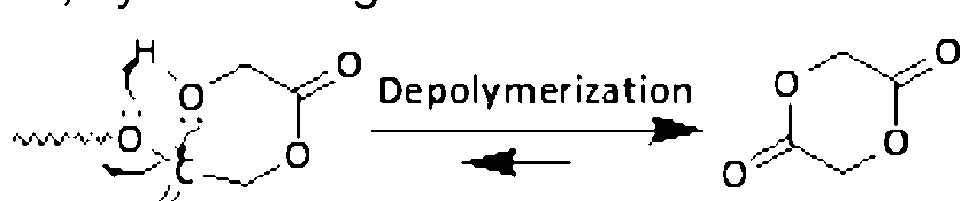
- back-biting might lead to the formation of macro-cycles from a growing chain possessing a terminal -OH group, hence providing a considerably shorter PGA macromolecule with an -OH end group, and a low molecular weight macrocycle.
- US 2012027973 (SOLVAY SA) 2/2/2012 discloses a process for manufacturing a polymer by polycondensation of a hydroxy acid, said polymer comprising at least 80 % by weight of units that correspond to the hydroxy acid, according to which at least one polyfunctional reactant capable of giving rise to the formation of a three-dimensional polymer network is mixed with the hydroxy acid, and according to which the mixture is subjected to temperature and pressure conditions and for a duration which are all suitable for giving rise to the formation of the network.
- polyfunctional reactants mention is made of epoxy silanes, polyepoxides, and mixtures of at least one polyol and at least one polyacid, of which at least one of (preferably both) the polyol and the polyacid comprise(s) three functionalities.
- CN 1563138 TONGJI UNIVERISTY (CHINA) 1/12/2005 is directed to a method for manufacturing highly branched polyhydroxyacid polymer (in particular polylactic acid polymer) using a combination of chain extenders comprising 2 or more functional groups, and more particularly chain extenders of type A, having groups able to react with hydroxyl radicals, and chain extenders of type B, having groups able to react with carboxylic acids.
- chain extenders comprising 2 or more functional groups
- chain extenders of type A having groups able to react with hydroxyl radicals
- chain extenders of type B having groups able to react with carboxylic acids.
- chain extenders of type A mention is notably made of dicarboxylic acids - including notably adipic acid (C6), sebacic acid (C10), undecanoic acid (C1 1 ), dodecanoic acid (C12), tridecanoic acid (C13), tetradecanoic acid (C14), pentadecanoic acid (C15) - and of polycarboxylic acid (or derivatives thereof) - including notably pyromellitic acid anhydride and EDTA (ethylenediaminetetraacetic acid), (both having 4 carboxylic groups).
- dicarboxylic acids including notably adipic acid (C6), sebacic acid (C10), undecanoic acid (C1 1 ), dodecanoic acid (C12), tridecanoic acid (C13), tetradecanoic acid (C14), pentadecanoic acid (C15) - and of polycarboxylic acid (or derivatives thereof) - including
- chain extenders of type B mention is notably made of polyols, including e.g. pentaerythritol (having 4 OH groups) and sorbitol (having 6 OH groups).
- CN 10158591 1 (UNIVERSITY OF BEIJING CHEMICAL (CHINA)) 1 1/25/2009 discloses a method for manufacturing branched or micro- crosslinked polylactic acid, by polymerization of lactic acid in the presence of comonomers, and accurately controlling average functionality of the monomers' mixture for achieving high molecular weight.
- the comonomers are selected in three classes, i.e.:
- pentaerythritol as branching agent
- SnCh and p-toluenesulfonic acid (TSA) as catalysts.
- branched poly(hydroxyl acids) which can be manufactured in a more effective manner for delivering high molecular weight and high viscosity within reasonable reaction times.
- the invention pertains to a method for synthesizing a branched poly(hydroxyl acid) polymer comprising effecting polycondensation reaction of a monomer mixture comprising:
- the amount of said acid (C) is such that the number of carboxylic acid groups thereof is comprised between 0.0001 to 0.010 % with respect to the number of hydroxyl groups of hydroxyacid (A).
- the Applicant is of the opinion that the addition of the acid (C), as above detailed, substantially contributes to decrease the amount of free hydroxyl group in the growing chain, so as to inhibit the back-biting phenomena, as above detailed, which are
- the present invention may be applied to all hydroxyl acids capable of
- hydroxyacids (A) that have a primary alcohol are preferred as they are more reactive.
- Glycolic acid (GA) is very
- hydroxyacid (A) is bio-sourced, that is to say derived from a natural and renewable raw material, as opposed to a fossil raw material.
- bio-sourced hydroxyacids (A) allows the synthesis of "green” polymers, that is to say polymers synthesized from renewable raw material.
- polyol (H) is not particularly limited.
- Polyol (H) can be any polyol (H)
- triols in particularly selected from the group consisting of glycerol, trimethylolpropane, trimethylolbutane, 2,3-di(2'-hydroxyethyl)-cyclohexan-
- - tetraols in particularly selected from the group consisting of diglycerol, di(trimethylolpropane), pentaerythritol, 1 ,1 ,4-tris-(dihydroxyphenyl)-butane;
- Preferred polyols (H) are triols (in particular trimethylolpropane) and
- tetraols in particular pentaerythritol, as above detailed, more particularly tetraols.
- a polyol (H) which has been found to provide particularly good results within the frame of the present invention is trimethylolpropane.
- the polyol (H) is used in amount of at least 0.1 , preferably at least 0.25, more preferably at least 0.5 mmol of polyol (H) per mol of hydroxyacid (A) and/or at most 50, preferably at most 25, more preferably at most 10 mmol of polyol (H) per mol of hydroxyacid (A).
- hydroxyacid (A) has been found particularly useful according to the preferred embodiments of the present invention.
- the polyacid (O) can comprise three carboxylic acid groups or more than three carboxylic acid groups, in particular four carboxylic acid groups.
- Polyacid (O) can be selected among polycarboxylic aliphatic acids, polycarboxylic cycloaliphatic acids and polycarboxylic aromatic acids.
- polycarboxylic aliphatic acids examples include:
- butane-1 , 2, 3,4 tetracarboxylic acid is preferred.
- polycarboxylic cycloaliphatic acids are:
- polycarboxylic aromatic acids examples include:
- Polyacids (O) which have been found to provide particularly good results within the frame of the present invention are tricarballylic acid, 1 ,2,4,5- benzene tetracarboxylic acid and butane-1 , 2,3,4 tetracarboxylic acid, with tricarballylic acid being particularly preferred.
- the polyacids (O) is used in amount of at least 0.1 , preferably at least 0.25, more preferably at least 0.5 mmol of polyacid (O) per mol of hydroxyacid (A) and/or at most 50, preferably at most 25, more preferably at most 10 mmol of polyacids (O) per mol of hydroxyacid (A).
- polyacid (O) An amount of polyacid (O) of from 0.5 to 5 mmol of polyacid (O) per mol of hydroxyacid (A) has been found particularly useful according to the preferred embodiments of the present invention.
- the amount of polyacid (O) and of polyol (H), when expressed in moles per mole of hydroxyacid (A), are substantially similar, and the molar ratio polyacid (O):polyol (H) is in the range 1.5: 1 to 0.5: 1 ; according to certain embodiments, this molar ratio is preferably of 1.25: 1 to 0.75: 1 , more preferably of 1.10: 1 to 0.9: 1.
- the monomer mixture comprises at least one carboxylic acid
- the amount of said acid (C) is such that the number of carboxylic acid groups thereof is comprised between 0.0001 to 0.010 % with respect to the number of hydroxyl groups of hydroxyacid (A).
- said amount is such that the number of carboxylic acid group of said acid (C) is of at least 0.0005 %, preferably at least 0.001 % with respect to the number of hydroxyl groups of hydroxyacid (A) and/or at most 0.010 %, preferably at most 0.008 %, most preferably at most 0.007 %, even more preferably at most 0.006 % with respect to the number of hydroxyl groups of
- the choice of the acid (C) is not particularly limited; both monoacids
- acids (C) wherein the total number of carbon atoms is at least 4, preferably at least 5 more preferably at least 6.
- the acid (C) possesses from 4 to 36 carbon atoms, preferably from 6 to 24 carbon atoms.
- the acid (C) can comprise unsaturated double bonds in its hydrocarbon chain; the acid (C) is nevertheless preferably an aliphatic acid, that is to say an acid of any of formulae below:
- RHm is a monovalent aliphatic group having at least 3 carbon atoms; and wherein RHCI is a divalent aliphatic group having at least 2 carbon atoms.
- acids (C) of monoacid type which can be advantageously used in the process of the invention, mention can be notably made of caprylic acid [CH 3 (CH 2 )6COOH], capric acid [CH 3 (CH 2 )8COOH], undecanoic acid [H 3 C- (CH 2 )9-COOH], dodecanoic or lauric acid [H 3 C-(CH 2 )io-COOH], tridecanoic acid [H 3 C-(CH 2 )i i-COOH], tetradecanoic or myristic acid [H 3 C-(CH 2 )i 2 - COOH], pentadecanoic acid [H 3 C-(CH 2 )i 3 -COOH], hexadecanoic or palmitic acid [H 3 C-(CH 2 )i 4 -COOH], octadecanoic or stearic acid [H 3 C- (CH 2 )i 6-COOH], arachidic acid [H 3 C- (CH
- acids (C) of diacid type which can be advantageously used in the process of the invention, mention can be notably made of succinic acid [HOOC-(CH 2 ) 2 -COOH], glutaric acid [HOOC-(CH 2 ) 3 -COOH],
- a polycondensation catalyst may optionally be added to the monomer mixture.
- a catalyst is usually added in an amount of about 0.01 to 2 mol %, in particular of about 0.1 to 1 mol % with respect to the total moles of the monomers of the monomer mixtures.
- Such polycondensation catalysts are well known to a person skilled in the art and may be selected, for example, from tin (II) chloride, stannous octoate, zinc acetate, zinc lactate and methanesulphonic acid, methanesulphonic acid being preferred.
- an antioxidant may optionally be added to the reaction medium.
- such an antioxidant is added between the hydroxy acid polycondensation step and the SPC step.
- Such an antioxidant is typically added in an amount of about 0.01 to 1 % by weight, in particular of about 0.1 to 0.5 % by weight of the monomer mixture.
- Such antioxidants are well known to a person skilled in the art and may be selected, for example, from hindered phenols and hindered phosphites.
- the polycondensation reaction is carried out at least partly at a temperature that is high enough so that the reaction takes place in a reasonable time, but that is not too high, in order to avoid degradation (and the associated coloration problems).
- the duration of the polycondensation reaction is not critical and may be of about 2 to 500 h, most often of about 5 to 250 h, depending on the temperature. In practice, good results have been obtained with glycolic acid and lactic acid at a temperature between 160 and 240°C. Such temperatures are within their melting/crystallization range so that, during the reaction, the crystallization of the polymer obtained may happen.
- the expression "temperature plateau” means that the temperature is kept substantially constant for at least 5 minutes.
- the temperature profile during the polycondensation step may be such that it includes more than one temperature plateau.
- the various temperature plateaus are between 160 and 240°C.
- the various temperature plateaus are advantageously within the range of 170 to 230°C, preferably from 180 to 210°C.
- the various temperature plateaus are advantageously above 180°C and below 240°C, in particular within the range of 190 to 230°C.
- the temperature difference between the various plateaus may vary from 5 to 30°C, in particular may be of about 10 to 20°C.
- the polycondensation step may be followed by or end in a plateau at a lower temperature, in particular at a temperature of 10 to 70°C below the temperature of the highest
- the temperature plateau reached during the polycondensation step for example at a temperature of about 150 to 190°C, preferably of 160 to 180° C.
- the lowest temperature plateau is generally maintained for 1 to 24 h.
- the polycondensation reaction takes place under vacuum in order to evaporate the water of reaction and prevent the latter from hydrolyzing the polymer chains being formed.
- polycondensation reaction is initiated at atmospheric pressure and the vacuum is applied gradually until a pressure of the order of a few mbar, in particular less than 10 mbar, for example from 2 to 8 mbar, is achieved.
- the SSP step is typically carried out at a pressure of about 0.01 to 10 mbar, in particular of 0.05 to 5 mbar, for example of about 0.1 mbar.
- the polycondensation reaction generally includes a first step of
- the temperature is selected so as to maintain the
- the first step of polymerization in the molten state is
- the temperature may be kept constant during this first step, or can be varied and maintained at more than one temperature plateau.
- the expression "temperature plateau” means that the temperature is kept substantially constant for at least 5 minutes.
- a milling step is advantageously carried out between the first step of polymerization in the molten state and the second step of solid state polymerization.
- Such a milling step may be carried out by any means known to a person skilled in the art, for example by milling in a high-speed grinder or in a rotary mill such as the
- a granulation step may be carried out at the end of the melt phase polycondensation in order to carry out the SSP step on granules.
- This granulation may especially be carried out at the outlet of the reactor on rods cooled in an air stream then introduced into a granulator.
- Such a granulation or milling is
- the milled or granulated product is easier to handle.
- the SSP step may take place by exposing the reaction mixture in the solid state, typically under vacuum, for one or more hours or even several days, at a temperature above the glass transition temperature of the said branched poly(hydroxyl acid) polymer, but below its melting/crystallization temperature.
- a SSP step may be carried out at a temperature of 140 to 240°C, in particular of 150 to 230°C, for example at around 170-220°C and at a pressure below 10 mbar.
- the duration of the SSP step may be a few hours to 1 week, in particular from 6 to 200 h, for example of about 10 to 150 h. It should be noted that a too high temperature during the SSP step may also result in a coloration due to the thermal
- the invention further pertains to a branched poly(hydroxyl acid) polymer comprising repeat units and moieties derived from (i) at least one hydroxyl acid having only one hydroxyl group and only one carboxylic acid group [hydroxyacid (A)];
- the amount of moieties derived from said acid (C) is such that the number of carboxylic acid derivative groups thereof is comprised between 0.0001 to 0.015 % with respect to the number of hydroxyl derivative groups of hydroxyacid (A).
- This branched poly(hydroxyl acid) polymer has a particularly
- the pressure was further reduced to 20 Torr and the reaction mass was heated gradually to melt the solid mass. It melted at about 230°C, after which it was allowed to stand at molten state for 40-50 minutes under reduced pressure and then cooled to 190°C to solidify. After about 2 hours at 190°C, the heating was stopped and the reaction mass was allowed to cool to room temperature under a steady flow of nitrogen at atmospheric pressure. Upon cooling to room temperature, the hard monolithic PGA mass was taken out and weighed. Crude yield: 710 g (-93 %). It was then crushed into small pieces using a hammer, and powdered into small particles with less than 1 mm diameter using a highspeed grinder and a 1 mm sieve.
- the resultant polymer was transferred into a round-bottom flask and attached into a rotary evaporator system for uniform mixing. It was polymerized in the solid state using an oil bath maintained at 215°C. The heating was stopped periodically and the small quantity of the polymer was carefully taken out to analyze the melt viscosity using a parallel plate rheometer at different times of solid state polymerization (SSP). After achieving the desired melt viscosity, the heating was stopped and the SSP was arrested.
- SSP solid state polymerization
- Poly(glycolic acid) PGA2400-100 was prepared similar to the procedure described for PGA2800-100, except that the following amounts of tricarballylic acid and trimethylolpropane monomers were used: TCA (2.81 g; 0.0159 mole, 0.0012 mol per mol of GA) and TMP (2.1 17 g; 0.0159 mole, 0.0012 mol per mol of GA).
- Poly(glycolic acid) PGA2000-100 was prepared similar to the procedure described for PGA2800-100, except that the following amounts of tricarballylic acid and trimethylolpropane monomers were used: TCA (2.342 g; 0.0133 mole, 0.0010 mol per mol of GA) and TMP (1.764 g; 0.0133 mole, 0.0010 mol per mol of GA).
- Poly(glycolic acid) PGA1600-100 was prepared similar to the procedure described for PGA2800-100, except that the following amounts of tricarballylic acid and trimethylolpropane monomers were used: TCA (1.873 g; 0.01064 mole, 0.0008 mol per mol of GA) and TMP (1.41 12 g; 0.01064 mole, 0.0008 mol per mol of GA).
- TCA 1.73 g; 0.01064 mole, 0.0008 mol per mol of GA
- TMP (1.41 12 g; 0.01064 mole, 0.0008 mol per mol of GA.
- Poly(glycolic acid) PGA2800-0 was prepared similar to the procedure described for PGA2800-0, except that no stearic acid was used.
- Poly(glycolic acid) PGA2800-50 was prepared similar to the procedure described for PGA2800-100, except that 0.05 g of stearic acid (SA; 50 ppm, 0.000176 mole, 0.000014 mol per mol of GA) was used.
- SA stearic acid
- Poly(glycolic acid) PGA2800-200 was prepared similar to the procedure described for PGA2800-100, except that 0.2 g of stearic acid (SA; 200 ppm, 0.000704 mole, 0.000054 mol per mol of GA) was used.
- SA stearic acid
- Poly(glycolic acid) PGA2000-50 was prepared similar to the procedure described for PGA2000-100, except that 0.05 g of stearic acid (SA; 50 ppm, 0.000176 mole, 0.000014 mol per mol of GA) was used.
- SA stearic acid
- Poly(glycolic acid) PGA2000-200 was prepared similar to the procedure described for PGA2000-100, except that 2.00 g of stearic acid (SA; 200 ppm, 0.000704 mole, 0.000054 mol per mol of GA) was used.
- SA stearic acid
- Poly(glycolic acid) PGA2800-100-TMA was prepared similar to the procedure described for PGA2800-100, except that 3.87 g of trimesic acid (TMA; 0.0186 mole, 0.0014 mol per mol of GA) was used in place of TCA.
Landscapes
- Chemical & Material Sciences (AREA)
- Health & Medical Sciences (AREA)
- Chemical Kinetics & Catalysis (AREA)
- Medicinal Chemistry (AREA)
- Polymers & Plastics (AREA)
- Organic Chemistry (AREA)
- Polyesters Or Polycarbonates (AREA)
Abstract
Description

Claims
Priority Applications (6)
| Application Number | Priority Date | Filing Date | Title |
|---|---|---|---|
| CA2983473A CA2983473A1 (en) | 2015-04-29 | 2015-04-29 | Method for manufacturing a branched poly(hydroxyl acid) |
| PCT/EP2015/059299 WO2016173640A1 (en) | 2015-04-29 | 2015-04-29 | Method for manufacturing a branched poly(hydroxyl acid) |
| JP2017556589A JP2018514623A (en) | 2015-04-29 | 2015-04-29 | Process for producing branched poly (hydroxyl acid) |
| CN201580079338.3A CN107531891A (en) | 2015-04-29 | 2015-04-29 | Method for manufacturing side chain poly- (carboxylic acid) |
| EP15720054.4A EP3289001A1 (en) | 2015-04-29 | 2015-04-29 | Method for manufacturing a branched poly(hydroxyl acid) |
| US15/570,745 US20180171072A1 (en) | 2015-04-29 | 2015-04-29 | Method for manufacturing a branched poly(hydroxyl acid) |
Applications Claiming Priority (1)
| Application Number | Priority Date | Filing Date | Title |
|---|---|---|---|
| PCT/EP2015/059299 WO2016173640A1 (en) | 2015-04-29 | 2015-04-29 | Method for manufacturing a branched poly(hydroxyl acid) |
Publications (1)
| Publication Number | Publication Date |
|---|---|
| WO2016173640A1 true WO2016173640A1 (en) | 2016-11-03 |
Family
ID=53039893
Family Applications (1)
| Application Number | Title | Priority Date | Filing Date |
|---|---|---|---|
| PCT/EP2015/059299 Ceased WO2016173640A1 (en) | 2015-04-29 | 2015-04-29 | Method for manufacturing a branched poly(hydroxyl acid) |
Country Status (6)
| Country | Link |
|---|---|
| US (1) | US20180171072A1 (en) |
| EP (1) | EP3289001A1 (en) |
| JP (1) | JP2018514623A (en) |
| CN (1) | CN107531891A (en) |
| CA (1) | CA2983473A1 (en) |
| WO (1) | WO2016173640A1 (en) |
Cited By (6)
| Publication number | Priority date | Publication date | Assignee | Title |
|---|---|---|---|---|
| EP3339372A1 (en) | 2016-12-22 | 2018-06-27 | Solvay SA | Glycolic acid polymer composition |
| WO2018115008A1 (en) | 2016-12-22 | 2018-06-28 | Solvay Sa | Glycolic acid polymer |
| WO2021122391A1 (en) | 2019-12-18 | 2021-06-24 | Solvay Specialty Polymers Usa, Llc | Downhole tool member comprising a branched poly(hydroxyacid) |
| WO2023025718A1 (en) | 2021-08-25 | 2023-03-02 | Solvay Specialty Polymers Usa, Llc | Toughened branched poly(hydroxyacid) composition |
| WO2024225797A1 (en) * | 2023-04-27 | 2024-10-31 | 주식회사 엘지화학 | Poly(3-hydroxypropionic acid) polymer and method for preparing same |
| WO2024225798A1 (en) * | 2023-04-27 | 2024-10-31 | 주식회사 엘지화학 | Poly(lactic acid-3-hydroxypropionic acid) copolymer and method for preparing same |
Families Citing this family (2)
| Publication number | Priority date | Publication date | Assignee | Title |
|---|---|---|---|---|
| US11548979B2 (en) * | 2019-12-27 | 2023-01-10 | Dak Americas Llc | Poly(glycolic acid) for containers and films with reduced gas permeability |
| CN115785404B (en) * | 2022-03-23 | 2024-06-14 | 上海浦景化工技术股份有限公司 | A method for preparing polyglycolic acid with adjustable hydrolysis rate and softening point |
Citations (5)
| Publication number | Priority date | Publication date | Assignee | Title |
|---|---|---|---|---|
| WO2010112602A1 (en) * | 2009-04-02 | 2010-10-07 | Solvay Sa | Branched poly (hydroxy acid) and production process thereof |
| EP2348063A1 (en) * | 2009-05-15 | 2011-07-27 | Kingfa Science & Technology Co., Ltd. | Biodegradable polyesters and preparing method thereof |
| US20140051780A1 (en) * | 2012-08-16 | 2014-02-20 | Synthezyme Llc | COPOLYESTERS HAVING REPEAT UNITS DERIVED FROM w-HYDROXY FATTY ACIDS |
| CN103772677A (en) * | 2013-12-23 | 2014-05-07 | 中国科学院长春应用化学研究所 | Polylactic acid segmented copolymer and preparation method thereof |
| CN103910981A (en) * | 2014-03-27 | 2014-07-09 | 泗阳宝源塑胶材料有限公司 | Branched chain type degradable hydrophilic polyester master batch and preparation method thereof |
-
2015
- 2015-04-29 WO PCT/EP2015/059299 patent/WO2016173640A1/en not_active Ceased
- 2015-04-29 CA CA2983473A patent/CA2983473A1/en not_active Abandoned
- 2015-04-29 EP EP15720054.4A patent/EP3289001A1/en not_active Withdrawn
- 2015-04-29 CN CN201580079338.3A patent/CN107531891A/en active Pending
- 2015-04-29 JP JP2017556589A patent/JP2018514623A/en not_active Withdrawn
- 2015-04-29 US US15/570,745 patent/US20180171072A1/en not_active Abandoned
Patent Citations (5)
| Publication number | Priority date | Publication date | Assignee | Title |
|---|---|---|---|---|
| WO2010112602A1 (en) * | 2009-04-02 | 2010-10-07 | Solvay Sa | Branched poly (hydroxy acid) and production process thereof |
| EP2348063A1 (en) * | 2009-05-15 | 2011-07-27 | Kingfa Science & Technology Co., Ltd. | Biodegradable polyesters and preparing method thereof |
| US20140051780A1 (en) * | 2012-08-16 | 2014-02-20 | Synthezyme Llc | COPOLYESTERS HAVING REPEAT UNITS DERIVED FROM w-HYDROXY FATTY ACIDS |
| CN103772677A (en) * | 2013-12-23 | 2014-05-07 | 中国科学院长春应用化学研究所 | Polylactic acid segmented copolymer and preparation method thereof |
| CN103910981A (en) * | 2014-03-27 | 2014-07-09 | 泗阳宝源塑胶材料有限公司 | Branched chain type degradable hydrophilic polyester master batch and preparation method thereof |
Cited By (11)
| Publication number | Priority date | Publication date | Assignee | Title |
|---|---|---|---|---|
| EP3339372A1 (en) | 2016-12-22 | 2018-06-27 | Solvay SA | Glycolic acid polymer composition |
| WO2018115008A1 (en) | 2016-12-22 | 2018-06-28 | Solvay Sa | Glycolic acid polymer |
| WO2018115011A1 (en) | 2016-12-22 | 2018-06-28 | Solvay Sa | Glycolic acid polymer composition |
| CN110088167A (en) * | 2016-12-22 | 2019-08-02 | 索尔维公司 | Glycolic acid polymer |
| CN110088167B (en) * | 2016-12-22 | 2022-02-08 | 索尔维公司 | Glycolic acid polymers |
| US12312440B2 (en) | 2016-12-22 | 2025-05-27 | Syensqo Sa | Glycolic acid polymer |
| WO2021122391A1 (en) | 2019-12-18 | 2021-06-24 | Solvay Specialty Polymers Usa, Llc | Downhole tool member comprising a branched poly(hydroxyacid) |
| US12384878B2 (en) | 2019-12-18 | 2025-08-12 | Solvay Specialty Polymers Usa, Llc | Downhole tool member comprising a branched poly(hydroxyacid) |
| WO2023025718A1 (en) | 2021-08-25 | 2023-03-02 | Solvay Specialty Polymers Usa, Llc | Toughened branched poly(hydroxyacid) composition |
| WO2024225797A1 (en) * | 2023-04-27 | 2024-10-31 | 주식회사 엘지화학 | Poly(3-hydroxypropionic acid) polymer and method for preparing same |
| WO2024225798A1 (en) * | 2023-04-27 | 2024-10-31 | 주식회사 엘지화학 | Poly(lactic acid-3-hydroxypropionic acid) copolymer and method for preparing same |
Also Published As
| Publication number | Publication date |
|---|---|
| EP3289001A1 (en) | 2018-03-07 |
| JP2018514623A (en) | 2018-06-07 |
| US20180171072A1 (en) | 2018-06-21 |
| CN107531891A (en) | 2018-01-02 |
| CA2983473A1 (en) | 2016-11-03 |
Similar Documents
| Publication | Publication Date | Title |
|---|---|---|
| EP3289001A1 (en) | Method for manufacturing a branched poly(hydroxyl acid) | |
| EP3085723B1 (en) | Polyester resin | |
| EP3559081B1 (en) | Glycolic acid polymer | |
| US8987343B2 (en) | Branched poly (hydroxy acid) and production process thereof | |
| JP2005508419A (en) | Method for producing block copolymer by solid phase polymerization | |
| WO2004029129A1 (en) | Glycolic acid copolymer and method for production thereof | |
| TR201811203T4 (en) | Polyester and a method for preparing such a polyester. | |
| CN116601206A (en) | Process for producing polyesters comprising 2,5-furandicarboxylate units | |
| WO2003106532A1 (en) | Process for producing polyester resin | |
| JP7697949B2 (en) | Glycolic Acid Polymer | |
| EP3211022A1 (en) | Method for continuously preparing poly(trimethylene terephthalate) having low by-product content | |
| Steinborn-Rogulska et al. | Melt/solid-state polytransesterification supported by an inert gas flow–an alternative route for the synthesis of high molar mass poly (L-lactic acid) | |
| KR20220091634A (en) | Biodegradable polyester copolymer comprising anhydrosugar alcohol based polycarbonate diol and preparation method thereof, and molded article comprising the same | |
| EP4392476B1 (en) | Toughened branched poly(hydroxyacid) composition | |
| JP2012139835A (en) | Aliphatic polyhydroxycarboxylic acid pellet and method for manufacturing the same | |
| WO2026047169A1 (en) | Ethylene-2,5-furandicarboxylate polyester comprising further dicarboxylic acid derived units | |
| TWI429677B (en) | Copolyesters based on oxalic acid unit, their preparation and applications | |
| JP6705287B2 (en) | Polyester resin | |
| MXPA00010331A (en) | Isosorbide containing polyesters and methods for making same |
Legal Events
| Date | Code | Title | Description |
|---|---|---|---|
| 121 | Ep: the epo has been informed by wipo that ep was designated in this application |
Ref document number: 15720054 Country of ref document: EP Kind code of ref document: A1 |
|
| REEP | Request for entry into the european phase |
Ref document number: 2015720054 Country of ref document: EP |
|
| ENP | Entry into the national phase |
Ref document number: 2983473 Country of ref document: CA |
|
| ENP | Entry into the national phase |
Ref document number: 2017556589 Country of ref document: JP Kind code of ref document: A |
|
| WWE | Wipo information: entry into national phase |
Ref document number: 15570745 Country of ref document: US |
|
| NENP | Non-entry into the national phase |
Ref country code: DE |